Operator
Greetings, and welcome to the Coherent Third Quarter Fiscal Year 2026 Earnings Call. It is now my pleasure to introduce your host, Mr. Paul Silverstein, Senior Vice President of Investor Relations for Coherent. Please go ahead.
Thank you, Operator. With me today are Jimmy Anderson and Sherry Luther, Coherent CFO. During today's call, we will provide a financial and business review of the third quarter of fiscal 2026 and the business outlook for the fourth quarter of fiscal 2026. Our earnings press release can be found in the investor relations section of our company website at coherent.com. I would like to remind everyone that during our conference call, we may make projections or other forward-looking statements regarding future events or the future financial performance of the company. These are subject to a number of significant risks and uncertainties, and our actual results may differ materially of future financial results in business, please refer to the disclosure in today's earnings release. Our most recent forms 10-K and 10-Q, and the reports that we may file in forms 8-K with the Securities and Exchange Commission. All our statements are made as of today, May 6, 2026, except as required by law. We assume no obligation to update any such statements. We discuss non-GAAP financial measures. You can find a reconciliation of these non-GAAP financial measures to GAAP financial measures in our earnings release and investor presentation that can be found on the investor relations section of our website at Coherent.com. Let me now turn the call over to our CEO, Jimmy Anderson.
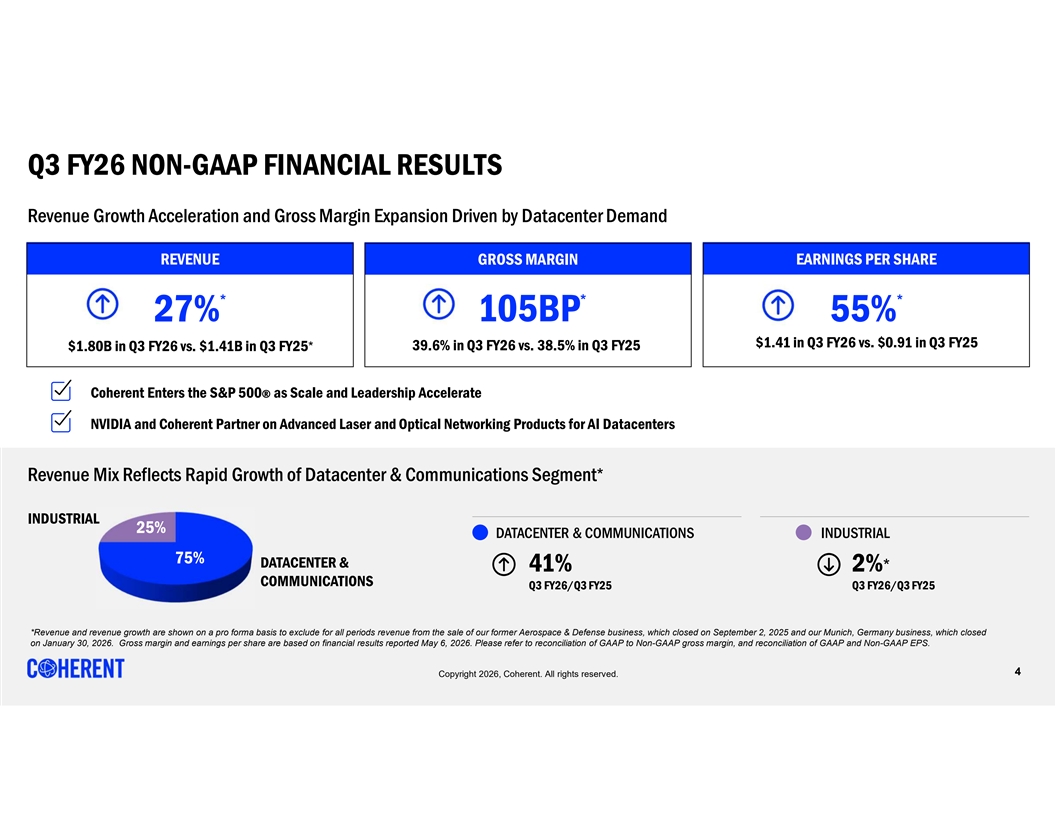
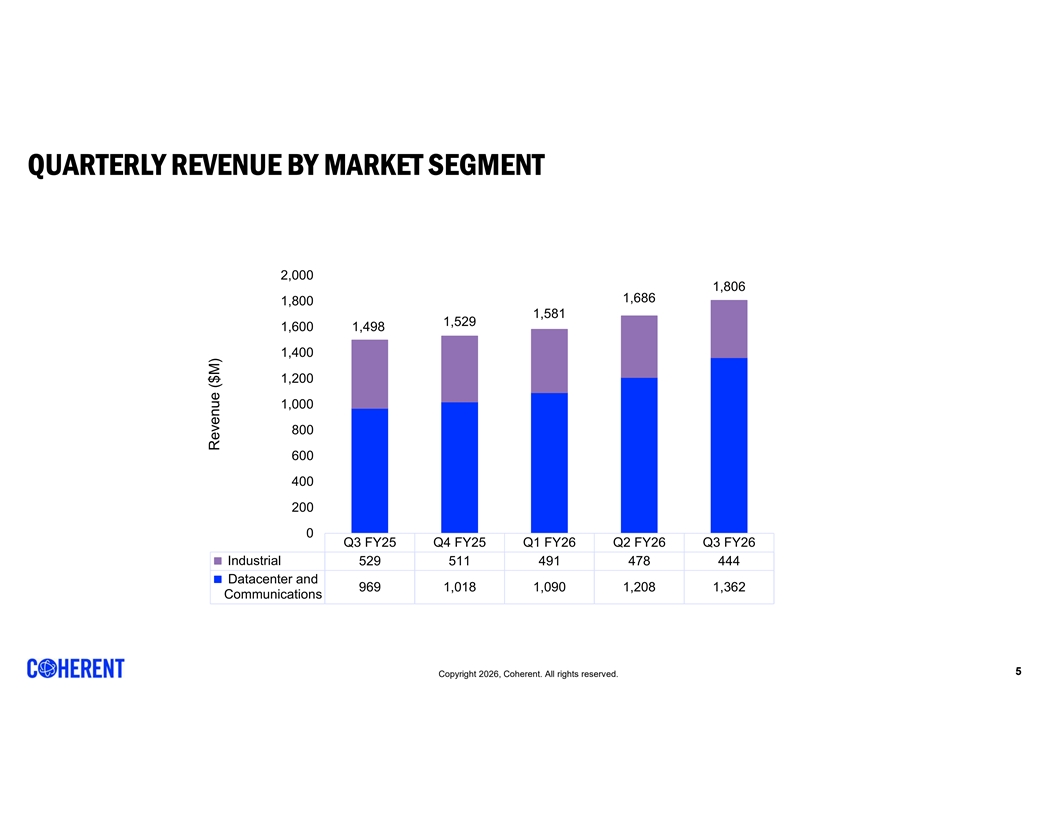
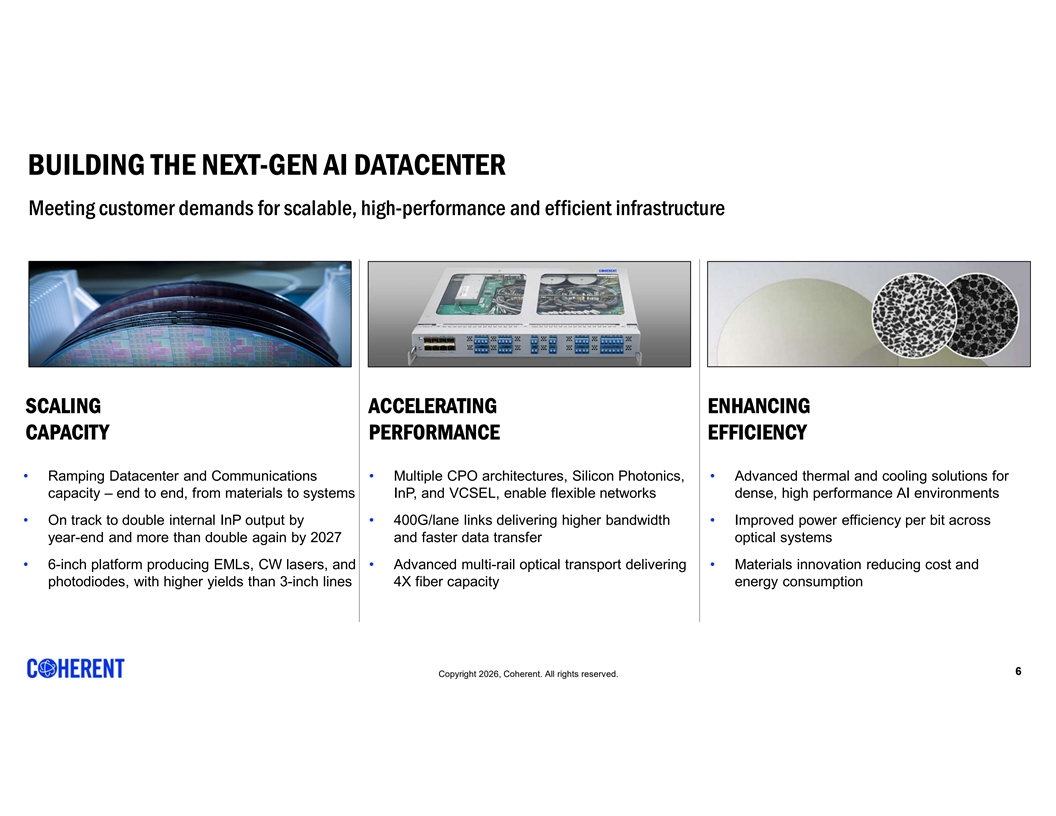
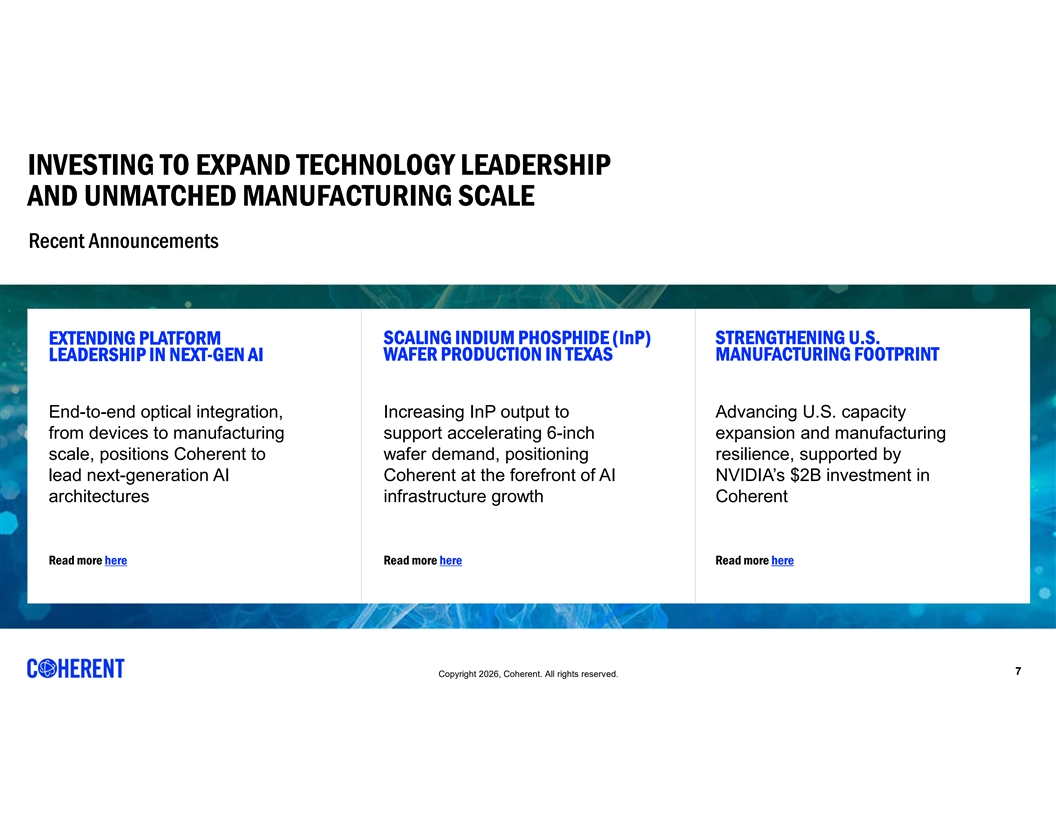
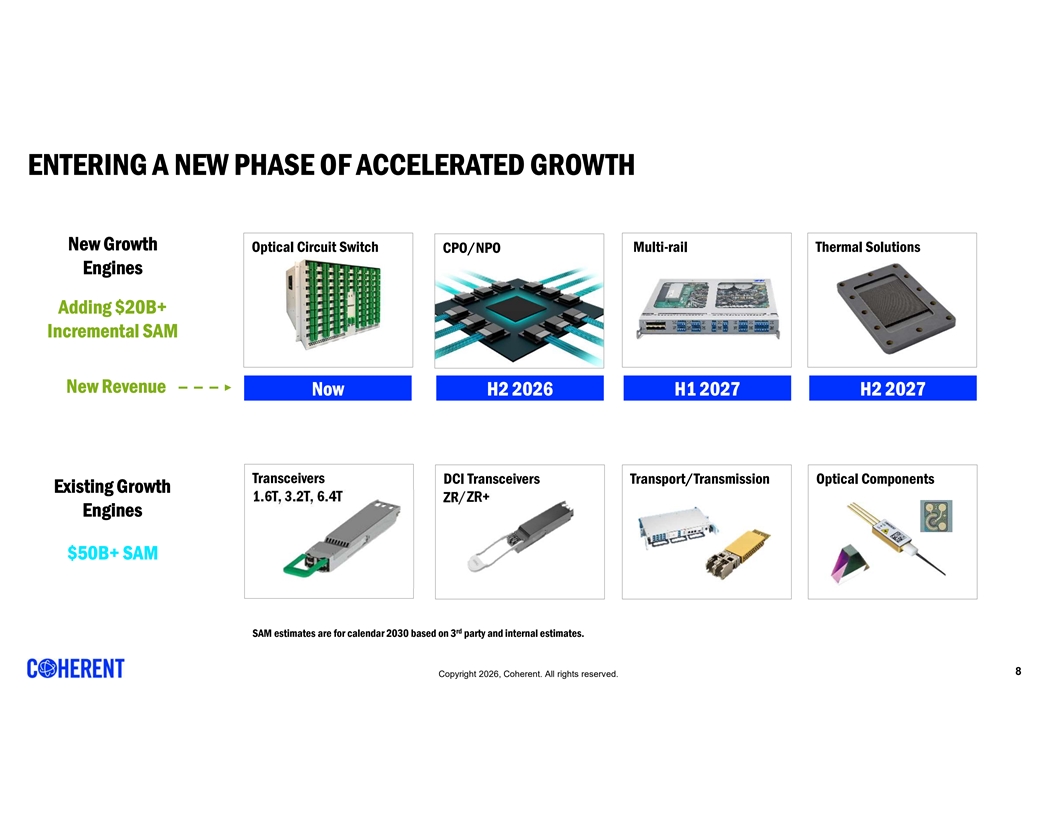
Thank you, Paul, and thank you, everyone, for joining today's call. Coherent is a global leader in photonic technology, which is foundational to the performance and scalability of AI data centers and critical to many important industrial applications. We are at the center of an extraordinary expansion in optical networking infrastructure, driven by the rapid growth of AI and the increasing need for bandwidth and energy efficiency. As a result, we delivered another quarter of strong financial performance, with accelerating growth, expanding margins, and improving profitability. Importantly, we are seeing continued strengthening and demand across our business, This quarter, we experienced another step function increase in our order book, driving our backlog to a record level. Customer demand remains exceptionally strong with no signs of attenuation, and our visibility continues to extend further into the future, with orders now reaching into calendar 2028 and customer LTAs extending to the end of the decade. This demand is increasingly translating into near-term shipment and revenue opportunities as we continue to expand capacity. Given both the near- and long-term demand strength, combined with our continued expansion of production capacity, we expect a period of sustained, strong revenue growth over the coming quarters. We expect strong sequential revenue growth in our June quarter, and we continue to expect fiscal 27 growth rate to exceed our fiscal 26 growth rate. Turning to our Q3 operating results, revenue increased 9% sequentially and 27% year-over-year on a pro forma basis, representing an acceleration in our year-over-year growth rate versus the prior quarter. Non-GAAP gross margin expanded both sequentially and year-over-year, and the combination of revenue growth, margin expansion, and operating leverage drove non-GAAP EPS growth of 55% year-over-year. We continue to grow profitability significantly faster than revenue. We are pleased with the continued execution, but we also see significant opportunity ahead. as we scale the business to meet the demand environment in front of us. Our data center and communication segment continues to be the primary driver of our growth and accounted for 75% of total company revenue in Q3. Growth in this segment accelerated again this quarter, with revenue increasing more than 40% year over year. Segment performance was driven by both accelerating demand and strong execution across our product portfolio. In our data center business, revenue increased 13% sequentially and 37% year-over-year, representing a second consecutive quarter of double-digit sequential growth. We expect data center growth to further accelerate in the current quarter, supported by exceptionally strong demand, improving supply, and continued progress in our capacity ramp. Demand in our data center business remains exceptionally strong and broad-based across multiple customers and product categories. We expect the accelerated growth in the current quarter to be driven by both transceivers and OCS systems. Within transceivers, we expect growth to be driven by both 800GB and 1.6T. In particular, we expect 800GB revenue to grow year-over-year in calendar 26, while 1.6T transceivers ramp rapidly through the balance of this calendar year and into next year as a broad range of customers adopt 1.6T. Given the exceptionally strong demand environment and the industry-wide constraint in Indian Phosphide, capacity expansion remains one of our highest priorities. Importantly, we continue to make excellent progress on our 6-inch Indian Phosphide ramp, which is a key driver of our long-term capacity expansion and a meaningful differentiator for Coherent. We are now seeing the benefits of this ramp in both revenue and margin, and we expect those benefits to increase further over the coming quarters. We remain on track to achieve our goal of doubling internal Indian Phosphite output capacity by the end of this calendar year, and based on current execution, we now expect to reach that milestone one quarter earlier than originally planned. We also expect to more than double our internal Indian Phosphite capacity again by the end of calendar 2027. Our six-inch platform is producing EMLs, CW lasers, and photodiodes in the yields for each of the three device categories continues to exceed those of our 3-inch production lines. During the quarter we shipped our first transceivers containing components produced on our 6-inch lines and those shipments contributed to both sequential revenue growth and gross margin improvement. The initial 6-inch production contribution came from our Sherman Texas facility which is the world's most advanced indium phosphide production site and will play an important role in ramping CW laser production for our CPO solutions, including those supporting our NVIDIA partnership. Given the success of the 6 inch ramp to date, we have also announced plans to begin 6 inch Indian phosphide production at a third site in Zurich. Overall, we are very pleased with the execution of our production teams. As we continue to ramp 6 inch output, we expect increasing benefits to both revenue and gross margin across our transceiver and CPO product lines over the coming quarter. We expect OCS revenue to grow this quarter as we ramp production capacity to meet demand. We have increased our view of the OCS market opportunity to over $4 billion, reflecting expanding use cases across data center interconnect, scale-out, and scale-up networks, and continued broadening customer engagement. We believe OCS also expands our role into higher value layers of AI networking infrastructure. We recently resolved a bottleneck in our production capacity and are now ramping output rapidly across two production facilities. As a result, we expect strong sequential revenue growth over the coming quarters as production improvements translate into higher shipments and backlog conversion. We also continue to make strong progress in co-packaged optics, which we believe represents one of the most important long-term growth opportunities for Coherent. As we have discussed previously, CPO expands our role in AI data center architectures, particularly in the scale-up portion of the network, where optics is expected to increasingly complement and over time displace copper. We believe CPO represents more than $15 billion of incremental addressable market opportunity. In March, we announced a strategic partnership with NVIDIA focused on multiple CPO-related products and solutions. This partnership includes both NVIDIA's $2 billion equity investment in Coherent in a multi-year supply agreement extending through the end of the decade. The agreement covers multiple CPO-related products, including our high-power CW laser, and provides meaningful long-term visibility into future demand. More broadly, our CPO opportunity is supported by the breadth and depth of Coherent's photonic technology platform. We believe our breadth of photonic technology and our manufacturing scale position us very well to support a broad range of customer requirements across key optical components, subsystems, and higher-level assemblies. We expect initial scale-out CPO revenue to begin ramping in the second half of this calendar year, with scale-up CPO revenue expected to begin ramping in the second half of calendar 2027. In addition to NVIDIA, we are also engaged with multiple other customers across a broad range of CPO and MPO opportunities. Overall, we believe CPO will become a significant contributor to Coherin's long-term revenue growth and margin expansion and will further strengthen our strategic position in AI data center infrastructure. Turning to our communications business, revenue growth accelerated significantly in Q3, with revenue increasing 16% sequentially and 60% year-over-year, driven by strong demand across data center interconnect, scale across, and traditional telecom applications. We expect strong sequential growth again in the current quarter. Demand remains broad-based across customers, products, and end-to-end applications. We are seeing strong momentum across our communications portfolio, which spans components, modules, and systems, reflecting both favorable market conditions and coherent, strong, competitive position. In particular, we continue to see robust demand for our DCI solutions, including ZR and ZR plus transceivers, as well as strong demand across our broader transport portfolio. One additional growth driver that we are particularly excited about is Multirail. These solutions address the increasing need for greater bandwidth and connectivity between AI data centers as workloads become more distributed across multiple locations. We believe Multirail represents a significant expansion of our communications addressable market opportunity, and we expect initial revenue to begin ramping in the first half of calendar of 2027. Overall, we believe our communications business is very well positioned for continued strong growth, supported by current demand strength, our expanding portfolio, and the ramp of important new platforms over time. Across our data center and communication segment, the breadth and depth of Coherent's photonic technology portfolio, combined with our manufacturing scale, continue to resonate strongly with our customers. As a result, we have signed or are the process of finalizing long-term supply agreements with multiple strategic customers that include both multi-year demand commitments and upfront investment to support capacity expansion. Turning to our industrial segment, revenue declined modestly both sequentially and year-over-year on a pro forma basis, reflecting continued softness in parts of the broader industrial market. However, we are seeing encouraging signs of improvement, particularly particularly in semiconductor capital equipment, where bookings have increased meaningfully. We expect that improving demand to begin contributing to revenue growth in the current quarter and to support further sequential improvement through the balance of the calendar year. Over the longer term, we see important incremental growth opportunities for our industrial technologies in AI data center applications. At OFC, we highlighted our data center XPU cooling solutions and thermoelectric generators, which address the growing thermal and power challenges created by larger AI data centers. Our proprietary Thermodyte material can improve thermal performance and help enable higher XPU efficiency, while our advanced materials for thermoelectric generation can improve data center power efficiency through waste heat recovery. We are engaged with multiple strategic customers on these technologies, and we believe they represent a meaningful expansion of our long-term market opportunity. We expect revenue from these products to begin ramping in the second half of calendar 2027. Overall, while industrial remains a smaller contributor to our current growth than data centering communications, we believe it is positioned to become an increasingly important source of incremental revenue and diversification. In summary, we delivered another quarter of strong financial performance with accelerating revenue growth, expanding margins, and increasing visibility into future demand. We are operating in a highly favorable demand environment driven by AI data center expansion and we believe Coherent is uniquely well positioned to capitalize on this opportunity given the breadth of our photonic technology portfolio, our manufacturing scale, our continued capacity expansion, and the increasing conversion of demand into backlog and revenue. I want to thank the entire Coherent team for their strong execution and continued innovation. I'll now turn the call over to Sherry.
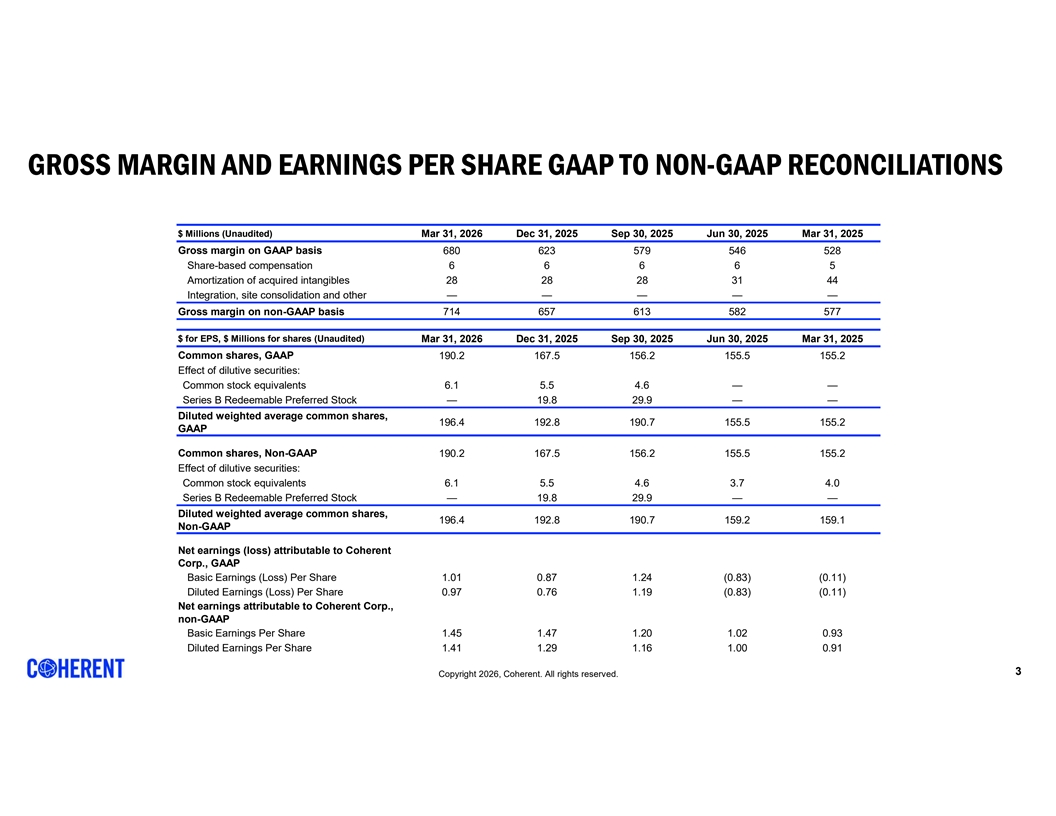
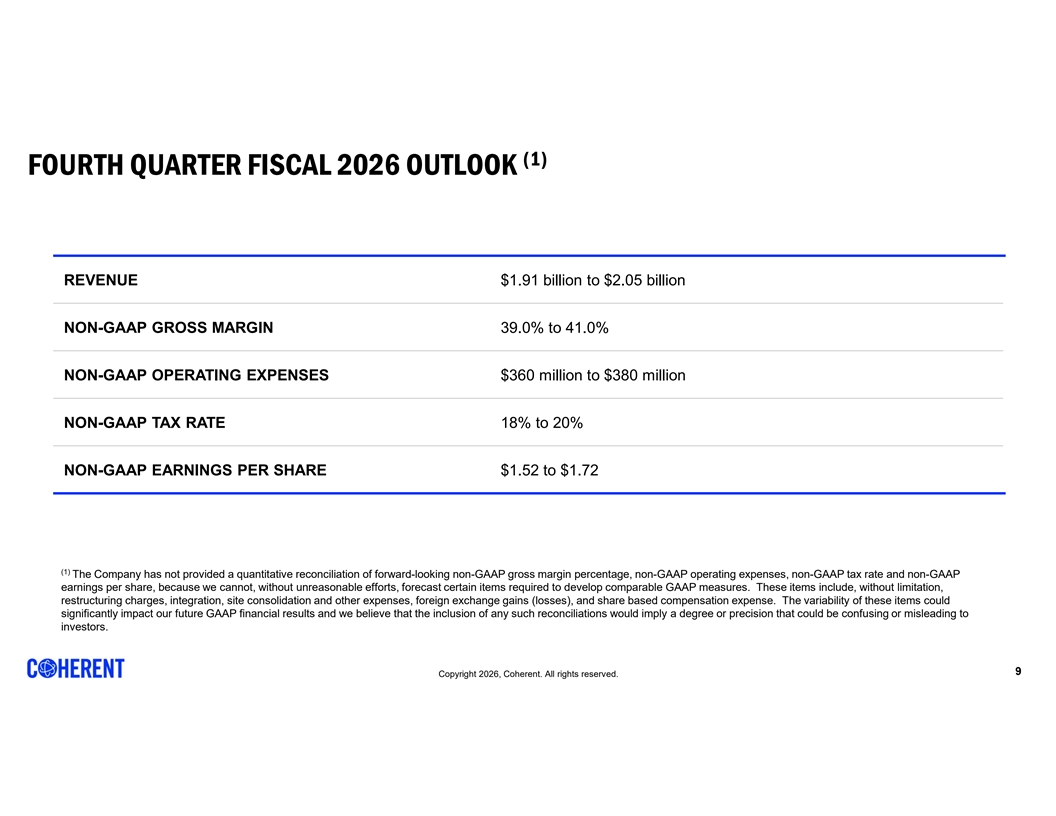
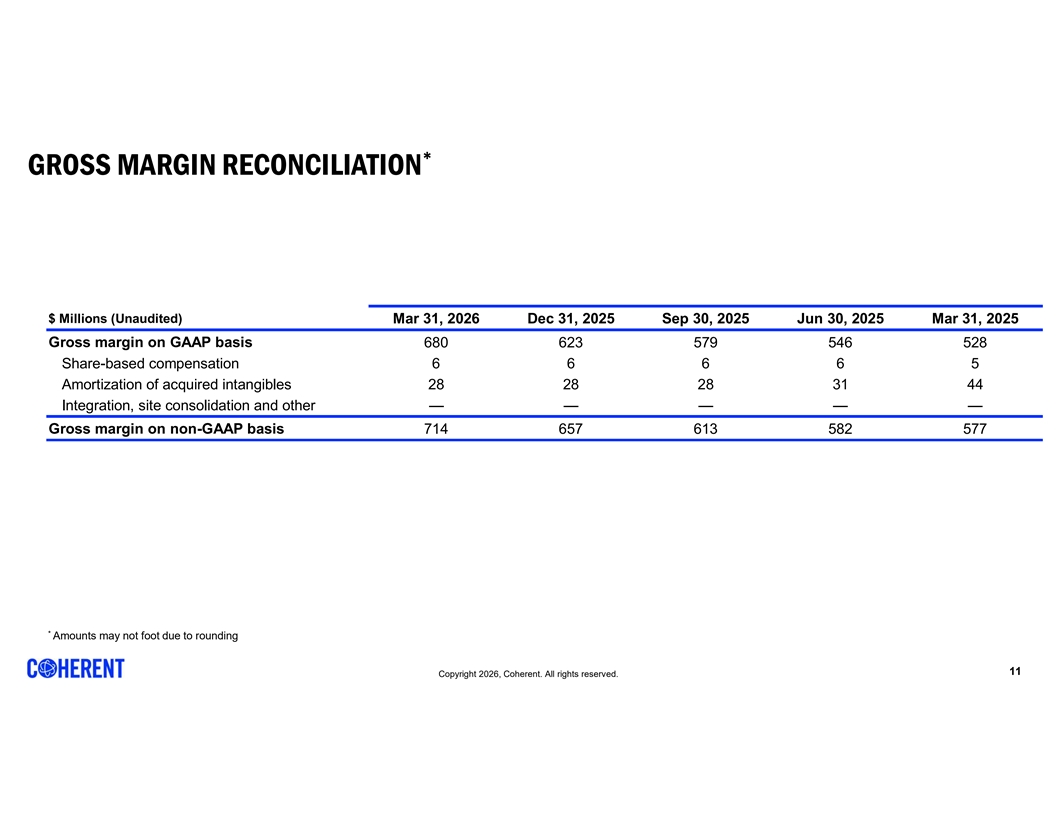
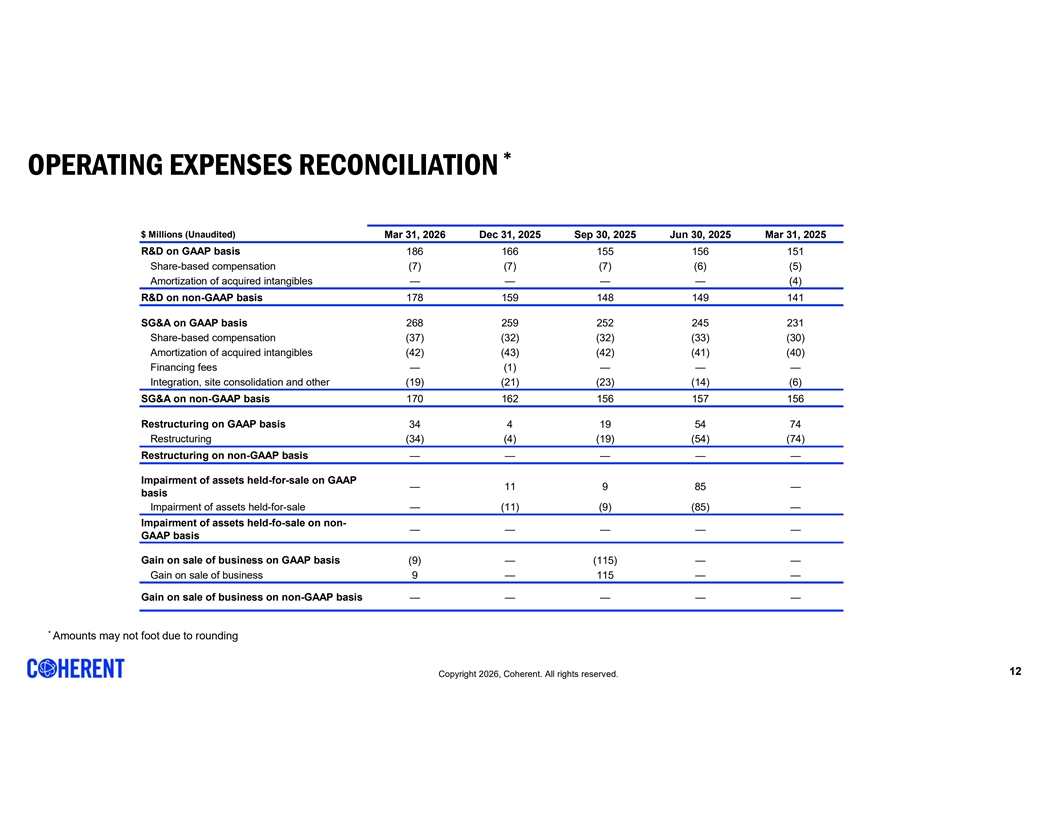
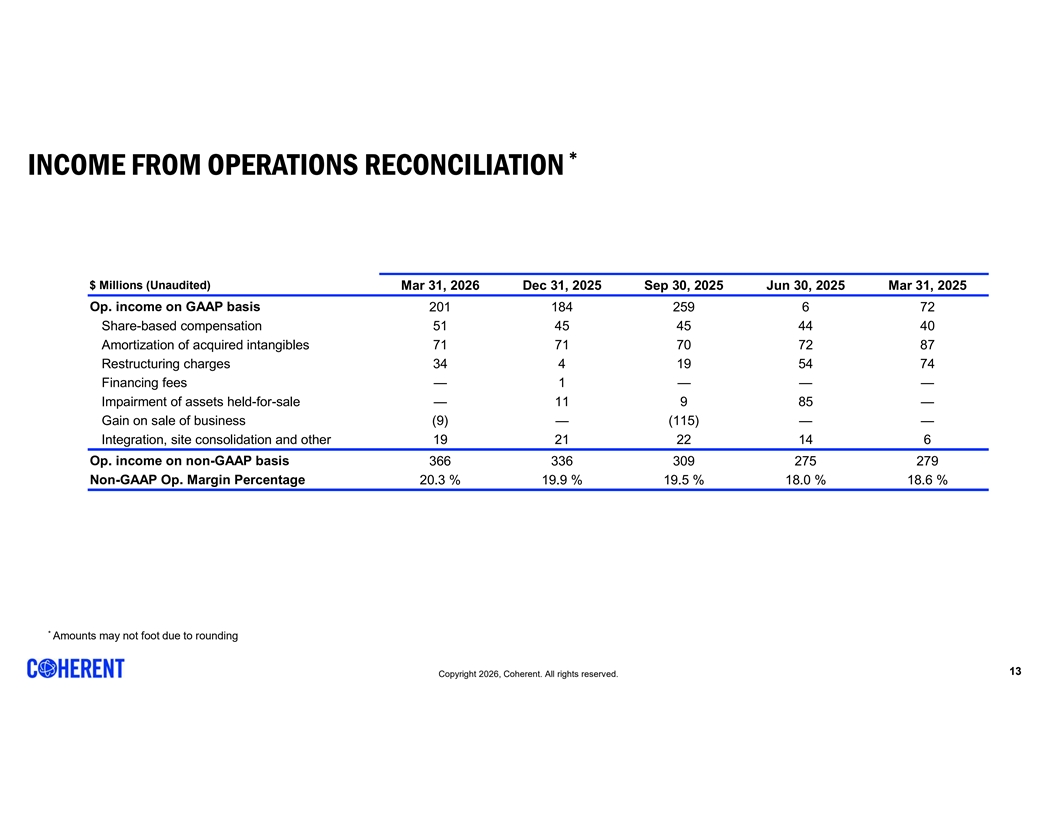
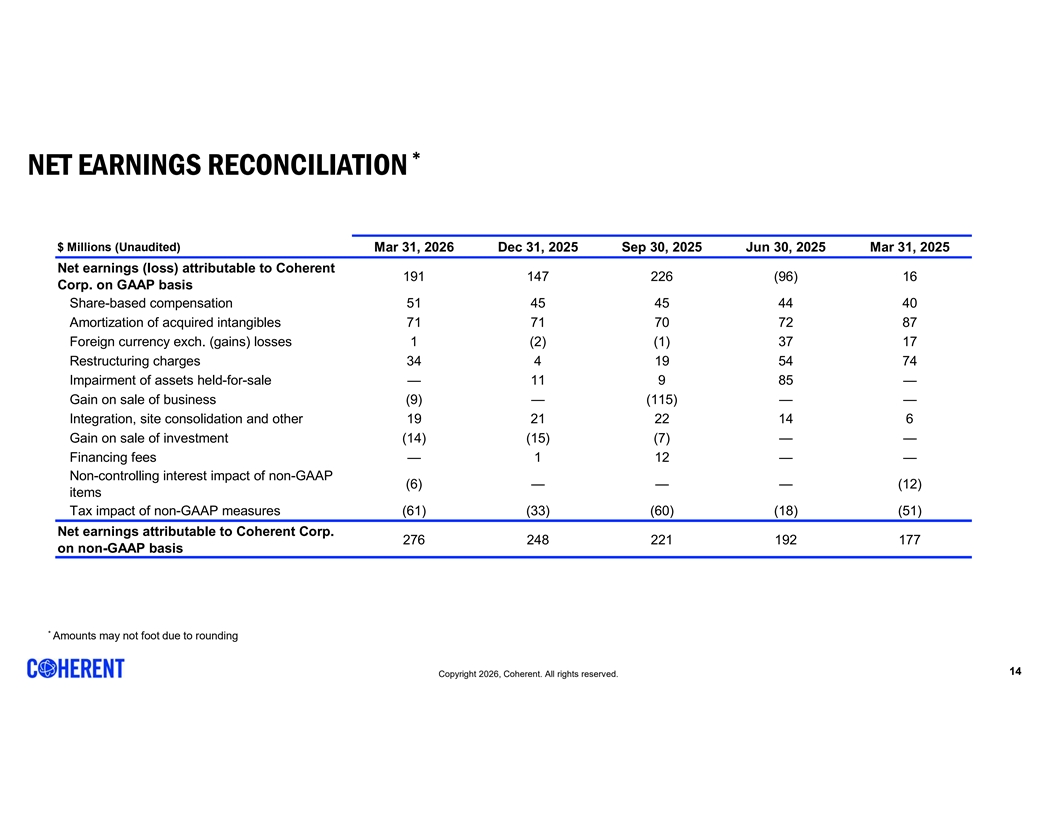
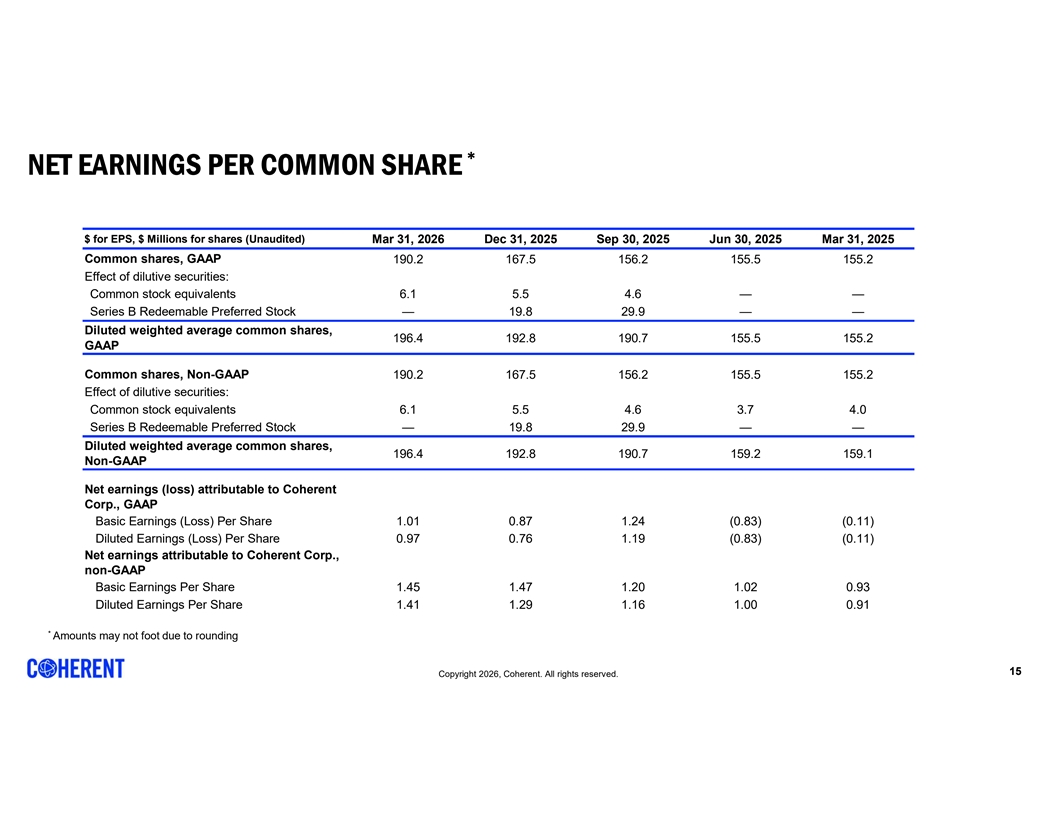
Thank you, Jim. In our third quarter, we delivered accelerated double-digit year-over-year revenue growth and meaningful gross margin expansion, significantly improving profitability. We have strategically increased our capital investments to expand internal capacity in support of the rapidly growing demand in data center and communications. In addition, we also continue to strengthen in our balance sheet, reducing our debt leverage ratio to below one time. I will now provide a summary of our Q3 results. Third quarter revenue was a record $1.8 billion, up 7% sequentially from the second quarter and up 21% year-over-year, driven by growth in AI data center and communications demand. On a pro forma basis, revenue increased 9% sequentially and 27% year-over-year, excluding revenue from our aerospace and defense business and our Munich-Germany product division, which were sold in Q1 and Q3, respectively. Our Q3 non-GAAP gross margin was 39.6%, a 57 basis point improvement compared to the prior quarter, and a 105 basis point improvement as compared to the year-ago quarter. We continued to execute on our gross margin expansion strategy, where we generated sequential and year-over-year increases in gross margin, primarily in the data center and communication segment. These improvements were driven by reductions in product input costs, yield improvements from 6-inch indium phosphide, as well as significant benefits from pricing optimization. Third quarter non-GAAP operating expenses were $348 million compared to $321 million in the prior quarter and $297 million in the year-ago quarter. R&D expense as a percentage of revenue increased to 9.9% in Q3 compared to 9.4% in both the prior quarter and the year-ago quarter. The sequential and year-over-year increases in R&D were primarily in the data center and communication segment product roadmaps. These investments are focused on multiple short- and long-term revenue growth drivers, namely in transceivers and CPO, as well as new high-margin, high-value systems, such as OCS and multi-rail. We continue to focus on investments with the highest ROI that drive the future growth of the company. SG&A expense as a percentage of revenue declined to 9.4% in Q3 compared to 9.6% in the prior quarter and 10.4% in the year-ago quarter, with continued progress on driving efficiencies and greater leverage in SG&A. We are already seeing benefits from our low-cost regional shared services initiatives within the G&A functions as we streamline processes and gain better leverage and efficiency. In addition, our ERP consolidation project has made great progress where the majority of the company is now in a single ERP platform. We expect additional benefits from these initiatives in Q4 with more meaningful benefits into fiscal year 2027. Our third-quarter non-GAAP operating margin increased to 20.3% compared to 19.9% in the prior quarter and 18.6% in the year-ago quarter due to strong revenue growth and continued gross margin expansion. Third-quarter non-GAAP earnings per diluted share was $1.41, up 9% from the second quarter and up 55% from the year-ago quarter. The acceleration in earnings outpaced revenue growth driven by strong top-line performance as well as gross margin expansion. Our cash balance increased to $3 billion from $1.5 billion in the prior quarter, primarily due to the $2 billion equity investment from NVIDIA that we announced on March 2, 2026. We focused our capital allocation priorities during the quarter on investments that drive long-term revenue growth and profitability, specifically investments in our data center and communications business in our R&D product roadmap as well as capacity expansion. We also made $162 million in debt payments during the quarter, reducing our debt leverage ratio to 0.5 times, down from 1.7 times in Q2 and 2.1 times in the year-ago quarter. Our capital expenditures increased to $290 million compared to $154 million in the prior quarter and $112 million in the year-ago quarter. These investments were focused on expanding our internal capacity to support the exceptional demand in data center and communications. Due to our strong bookings and the rapidly growing demand, we expect capital expenditures will increase sequentially in Q4. We continue to be on track with our capacity expansion plans. With a strong balance sheet and continued focus on improving profitability, we are well positioned to support the unprecedented customer demand with investments to rapidly expand our production capacity. As a reminder, at the end of January, we closed the sale of our Munich-Germany product division. For reference, over the prior four quarters, this business contributed average quarterly revenue of $25 million with a gross margin well below Coherence corporate gross margin. Our Q3 results included $8 million in revenue from this business. I will now turn to our guidance for the fourth quarter of fiscal 2026. We expect revenue to be between $1.91 billion and $2.05 billion. We expect non-GAAP gross margin to be between 39% and 41%. We expect total operating expenses of between $360 million and $380 million on a non-GAAP basis. We expect the tax rate for the quarter to be between 18% and 20% on a non-GAAP basis. We expect EPS of between $1.52 and $1.72 on a non-GAAP basis. With our strong backlog and excellent visibility, we are focused on rapidly expanding our internal capacity with investments that drive the long-term growth and profitability of the company. We will continue to allocate capital in a disciplined manner as we execute against our long-term financial target model and drive durable shareholder value. That concludes my formal comments. Operator, please open the call for Q&A.
Operator
We will now be conducting a question and answer session. If you would like to ask a question, please press star 1 on your telephone keypad. A confirmation tone will indicate your line is in the question queue. You may press star 2 if you would like to remove your question from the queue. For participants using speaker equipment, it may be necessary to pick up your handset before pressing the star keys. We ask analysts to limit themselves to one question and a follow-up so that others have an opportunity to do so as well. One moment please while we poll for questions.
We take the first question from the line of Samik Chatterjee from JPMorgan, please go Hi, thanks for taking my question and congrats on the robust set of results, numbers here. Jim, maybe if I can start off with the guide for the June quarter. It is implying acceleration from Q3, so the increases you had in Q3 from a revenue perspective. And particularly when I look back through the year, every quarter you've managed to sort of accelerate the sequential revenue growth. So maybe if you can sort of dive into, one, what's the driver on the demand side that's helping you lead to that acceleration, and maybe also contextualize it in terms of supply and how that's helping with the acceleration as well. And I have a follow-up after that.
Yeah, thanks, Amik, for the question. Yeah, if you look at the midpoint in the June quarter guide, certainly we expect acceleration in growth versus prior quarter. And if you look at the year-over-year growth rate as well, we really believe the current June quarter kind of represents a new inflection point in our revenue growth rate moving forward. So faster growth this quarter. And as we look forward into fiscal 27, which starts in July, we expect our fiscal 27 growth rate to be above fiscal 26. And on the demand side of the equation, I would say that just, it looks exceptional right now, both in terms of the degree of demand, but also our visibility on demand. If we look at just bookings in the prior quarter. Bookings in the prior quarter were up substantially from the previous quarter. Record bookings, incredible amount of backlog, and we've now got orders that extend out into calendar 28. And so we have just tremendous demand ahead of us, but also great visibility on that demand. And that demand is coming from, you know, the places you'd expect. Certainly data center, the new growth vectors were, you know, probably more importantly on the supply side of the equation, that's probably really more a benefit forward. We're bringing on subsisting quarters, and probably the best example, the indium phosphide has kind of been the key constraint for us for a number of quarters. It's a constraint for the industry. You know, our target this year is to double our indium phosphide capacity, and the great thing is where it looks like based on the current execution, we'll achieve that goal next quarter, which is one quarter earlier than we thought. And when I look into NECT, more than double indium phosphide capacity again. So that's a quadrupling of capacity over a two-year period. And so that looks really good. And so I think that really unlocks an acceleration in our revenue growth moving forward. And that's kind of on all the existing business. Then you layer on top of that some of the new growth areas, new growth vectors that are coming online. OCS is ramping. We expect that. CPO revenue kicks in in the second half of this year. We view that as all incremental. Our multi-rail systems will start contributing revenue in the first half of next calendar year. And then we think thermal solutions will start to generate revenue in the second half of calendar 27. So we sort of have these multiple growth vectors that are layering on top of the sort of accelerated growth ahead of us.
Got it. Got it. Thanks for that, Jim. And then maybe just to To follow up on similar lines, you mentioned the acceleration on the Indian phosphide capacity. Given that you're tracking a bit ahead relative to your target for 2X in the first year, how should we think about potentially upside or accelerating the target for 2X on next year as well? And as investors, how should investors think about the impact of that on gross margin? How material is it? When does it start to be material to your gross margin trajectory as well?
Yeah, thanks, Samik. Actually, on the second part of your question on gross margin, we already started to see the impact of six-inch Indian phosphide capacity, which has a much better cost structure. So six-inch versus three-inch is more than four times as many devices at less than half the cost. We already started to see that contribute to gross margin expansion in our fiscal Q3. As Sherry said, I think in her prepared remarks, our guide in the current June quarter has gross margin going up sequentially. Again, part of that, what's driving the gross margin expansion is the six-inch Indian phosphide capacity, which just gives us a much, much better cost structure. But overall, I'm really pleased with the execution on our six-inch Indian phosphide ramp. You know, there's kind of two factors underneath there. there's just the raw capacity ramp, but also very important is the yields. And so the team has executed a head of plan on the raw capacity ramp, but also we're seeing very healthy yields. We're in production on three different types of devices, EML, CWs, and PDs. And all three of those devices have yields on six inch that are higher than our three inch production yields. And, you Texas was the first facility we started ramping 6-inch on. Super pleased with the progress there because we saw such good yields out of the gate from Texas, which is a world-leading Indian Fossified production facility. We started production in Sweden, and now we announced a third site that we're going to start production on 6-inch Indian Fossified, and that's Zurich, and we'll start to see production from that third site at the beginning of calendar 27. So this ramp of indium phosphide six inches is both, it unlocks a lot of additional growth for us, but it's also definitely contributed to gross margin as it becomes a bigger portion of our indium phosphide overall production.
Thank you. Thanks for taking my questions.
Operator
Thank you. We take the next question from the line of Simon Leopold from Raymond James. Please go ahead.
Thank you very much for taking the question. The first thing I wanted to see if you could address is there's a perceived gap versus one of your primary competitors that stems from investors comparing their forecasts and your forecasts in categories like the OCS and CPO. How do you explain the difference? And then I've got a quick follow-up.
Yeah, I think, Simon, on both of those new growth areas, we feel really good about the growth that's ahead of us. On OCS, we recently, just over the last couple months at OFC, we doubled our forecast of the market opportunity there. The revenue growth rate, the sequential growth that we're guiding in the current quarter, Part of that growth, that sequential growth, is OCS systems growth. We feel great about the differentiation of our technology. It's a very differentiated technology that provides both higher reliability but much, much better power efficiency. And so we feel really good about the long-term, both the short and the long-term growth prospects on that product line. And we've really been focused on just ramping capacity as fast as possible. As I mentioned in their prepared remarks, we did kind of have a breakthrough over the last couple months on removing a bottleneck in the production capacity that's allowed us to ramp production at a much faster rate, and we're ramping in two sites in parallel. So we feel good about the OCS, both in long-term opportunity, but the ramp in the near term as well. And then, look, CPO is, I think it's a transformational growth opportunity for the company. We see that market size as over $15 billion, and that's probably a conservative estimate over the coming, you know, CPO revenue for us will start in the second half of this calendar year, and that'll be initially scale-out CPO revenue. And then we expect to see the beginning of scale-up CPO revenue in the second half of calendar 27. And, you know, we're engaged with multiple customers. Obviously, we have a public announcement that we did with NVIDIA on our partnership with NVIDIA. That's all around CPO. That's a multibillion-dollar agreement that extends out through the end of the decade. And importantly is it's multiple different CPO solutions. So if you look at what can we provide in a CPO solution, it's not just the laser, right? We're certainly providing the high-power CW laser. but beyond that we're providing the external laser source module we can provide the fiber attach unit which includes micro lens arrays it includes polarization maintaining fiber so we have our own fiber that will provide in those solutions within that external laser source and we provide all of the ingredients not just the laser but the isolators the thermoelectric coolers so there's a tremendous amount of content that i see this as right and just just as a follow-up i i appreciate
you you don't want to get uh the street micromanaging each product segment but i'd like to see if you could confirm if the 1.6 terabit transceiver revenue exceeded let's say 100 million in the march quarter and if not when can we get to that that milestone thank you yeah simon we don't break out individual data rate revenue for our transceiver business, but, you know, we expect 800 gig to grow this year.
It'll probably grow again next calendar year. And then on top of that, 1.60 is ramping at an incredibly rapid pace. In fact, as I think we've shared in the past, that 1.60 ramp is actually faster than what we would have thought, say, a year ago, which we're really pleased with. And so if you look at our incremental or sequential growth in the current quarter, a good portion of that is driven by the 1.60 ramp. And we expect 1.60 to not just contribute to the current quarter sequential growth, but to continue to ramp very quickly over the coming quarters as well. And so I think really the growth drivers for our transceiver business, or really 801.60 combined, not just this calendar year, but next calendar year as well.
Operator
Thank you. We take the next question from the line of Thomas O'Malley from Barclays. Please go ahead.
Hey, guys. Thanks for taking my question. My first one's on gross margin. So, if I look at gross margins in March at 39.6, and then I look at gross margins last year at 38.5. The incremental on a year-over-year basis is around 44%. So since that time, I mean, you've increased six-inch production, you've doubled indium phosphide almost, you exit some businesses. In fact, like your data center business, you kind of report, well, you can assume some percentage of this comms business, but that's growing really nicely as well. So why aren't you getting more incremental fall-through on the gross margin side? Is there any puts that you could highlight that are preventing you from kind of breaking out on that line item?
Yeah, thanks, Thomas. So, you know, the way – a few things I'll just highlight from a gross margin perspective is that if you go back about to the end of Q4 of 2025, we've increased our gross margin sequentially in seven out of the past eight quarters. And if you include the 57 basis points improvement from our just, you know, our recent Q3 quarter, that's an increase of about 530 basis points. And then if you tack on to the midpoint of our guide for Q4, that takes you to 570 basis points improvement. So I think that's pretty good progress. I mean, we're not done, but I am pleased with the progress that we've made there. And, you know, the target that we put out at our investor day last year was greater than 42%, and we are super, super focused on making sure that we get to that target. And when you look at, you know, the drivers of our gross margin expansion strategy that we've been executing on a quarter, over quarter, over quarter, you know, it's cost reduction, it's yield improvements, and it's pricing optimization. And when you look at our Q3 quarter, you know, each of those areas increased, you know, quite significantly from the prior quarter in each of those categories. And so we talked a little bit about some of those in my prepared remarks, but, you know, from a cost reduction perspective, you know, we had improvements from six-inch indium phosphide. We've talked about the fact that, you know, you know, it's half the cost, right, when you go from three-inch to 6-inch. So we're already seeing the benefit of 6-inch. We also talked about yield improvements in Q2 that we saw in 6-inch. So, you know, we're continuing to see yield improvements as we continue to ramp. And we talked about how we've got two sites going in parallel. We've got another site coming up. I expect to continue to see improvements on 6-inch as we bring, you know, the other site up and as we continue to ramp 6-inch. That's going to continue to add benefit to our gross margin. And the other areas of cost reductions that we've seen, actually, that's been predominantly in our data center and communications business. So the majority of, well over the majority of our improvements in gross margin have really been in the data center and communications business. So I'm really pleased with that progress. We've also seen pricing optimization benefits. That has significantly increased quarter and quarter and certainly year over year. And that's been, you know, not only in the industrial business, but that was actually quite sizable in our data center and communications business. So I'm really pleased with the progress we've made so far. We're going to continue to drive to get to our target and super focused on doing that. But I'm quite pleased with the progress so far. And we're early stages is the way that I would look at it.
And then just as a follow-up in the preamble, Jim, you mentioned some bottlenecks that were being relieved in the OCS business. What specifically are you referring to and how much of an impact did that have on production?
Yeah, there were some internal components or some components that we make in internal to coherent that were pacing our production capacity expansion. And so we were able to sort of dramatically improve the amount of internal components that we were producing. And so that really unlocked an acceleration in our production capacity. And so over the last month or two, we've seen a really good ramp up in our pace of production and expect that to continue. So we're seeing a much faster ramp of production on OCS than say, you know, a few months ago, which is really...
Operator
Thank you. We take the next question from the line of Blaine Curtis from Jefferies. Please go ahead.
Hey guys, thanks for having my question. I actually wanted to ask about scale across just becoming a big talking point. You called it out in the comm business. Maybe you could just talk about, you know, kind of where that is today, and as you look to fiscal 27, how do you frame that ramp for scale across?
Yeah, thanks, Blaine. Yeah, we're seeing just tremendous growth in the scale across part of the business. This falls within our communication segment, which I mentioned in the prepared remarks. So scale across or DCI, also within that communication segment is traditional telecom. But the fastest growth that we're seeing is in that scale across piece of the business. You know, in the most recent quarter, we saw 16% sequential growth and 60% year-over-year. And here again, similar to data center, just the demand is exceptional. The visibility is exceptional. We have LTAs that are in place with customers in that segment. And we're seeing it's really broad-based across almost every product we have in that segment and broad across customers as well. And just to give you a sense of the products, in that segment, you know, it would cover components like pump lasers. It would cover modules like ZRZR Plus transceivers, which would be the 100-gig, 400-gig, and 800-gig ramping ZRZR Plus. It covers line cards and amplifiers and then full systems as well. And so, yeah, we expect this area, just given the demand we see in front of us and the visibility of this, to be a very strong growth area for us moving forward. And then a new system that we think is going to continue to accelerate our growth. And so our multi-rail technology, which we highlighted at OFC, this helps provide a differentiated component technology pieces that go into that system that really position us very well, and we're selling full system. We expect that revenue to start in the first half of it. And so just another growth factor layering on top. So very strong growth in this area, and we expect that.
And then I just wanted to follow up on Tommy's gross margin question. I just want to better understand the tailwinds. You called out six inches being the biggest driver. I'm assuming the six-inch volumes that you mentioned your shipping and your units are still fairly small. So are there startup costs that kind of roll off there, and that's what the savings are? And then is 1.8 T, is that a gross margin uplift as well?
Yeah, so when I mentioned in the prior quarter the 6-inch, I mentioned that as it was one of the contributing factors. There were actually a number of other contributing factors to gross margin expansion in the prior quarter. And in our guide for the current quarter, it's kind of similar. 6-inch is a contributor, but there's other factors as well. There's pricing and other cost structure improvements that we've made. And, yeah, I would say we're still pretty early in the 6-inch ramp. If you think about 6-inch, so we shipped our first transceivers last quarter that included devices from our 6-inch, and that was just the initial production that we started. That will ramp significantly over the coming quarters. So I think there's much more of the 6-inch benefit is ahead of us. the, you know, if you think about the total doubling of capacity and the fact that all of that doubling of capacity is six inch, you know, by the end of this year, next quarter, half of our capacity will be a six inch. So I think that benefit from six inches more ahead of us. And then on the 1.60 question, yeah, we definitely see that as beneficial to gross margin. We expect, you know, just like we've always seen in prior transitions of speed of data rates, at the beginning of the life cycle of a new data rate, generally the gross margins are better than the prior data rate. So we would expect 1.6.
Operator
Thanks, Jim. Thank you. We take the next question from the line of George Nodder from Wolf Research. Please go ahead.
Thanks very much. I was just curious about anything more you could tell us on the new LTAs that you're signing. Obviously, we learned a lot around the NVIDIA transaction, but you mentioned there's a number of other deals that you guys have brought in. Anything you can tell us in terms of, you know, how big those deals are? What kind of duration are we talking about? Are they funding your capital expansions? Like anything you can tell us, like financially, just in the aggregate, more details would be interesting.
There were a couple additional LTAs that we signed in the prior quarter. And then I would say there's a number of other ongoing discussions we would expect to close some additional LTAs this quarter or very soon. And those, you know, those LTAs usually have three parts. You asked about kind of a CapEx commitment. Again, there's usually an upfront investment from the customer to help with the CapEx. And that can come in a number of different forms. but there's usually some upfront investment, which kind of represents sort of skin in the game from the customer, which we view as really positive. And then, of course, there's a supply commitment from us. But the third element is there's almost always some sort of demand, minimal, at least minimal demand commitment. Make sure that that can pass. So those are kind of three parts of the LTA. Almost every LTA has those. And so, yeah, I would say good progress last quarter in additional LTAs, significant in size.
Anything about the genre of customer here? Is this cloud providers? Is this systems manufacturers? Anything else you could say?
It's both, right? We would see...
Operator
Thank you. Thank you. We take the next question from the line of Vivek Arya from Bank of America Security. Please go ahead.
Hi, this is Michael Mani on Vivek Arya. thanks so much for taking our questions. I wanted to dive in deeper with some of the CPO LTAs or long-term agreements that you're dealing with, including NVIDIA, but maybe some of the other deals that you're kind of eyeing over the next couple of years. What's the mix of these agreements between lasers, ELS modules, which you highlighted, OFC, and, you know, the various other components that you could sell into a CPO solution like fiber-attached units?
How does that vary by customer like what are the puts and takes there based on based on the deal thank you yeah it kind of it can depend by customer but you know it's important to to keep in mind that we have a very broad portfolio of CPO technology that we can we can bring to the customers I think that's a real advantage for us and we at OFC we laid out all the different types of technology that we can bring to a CPO solution. Lasers, the high-power CW lasers is certainly one important component, but it's not the only. We can also bring 200 gig and in the future 400 gig VIXELs as well. There's some applications where VIXELs are sort of a better laser technology for near-packaged optics, but beyond that, if you look at the external laser source, we can provide that module, But within that, almost all those key optical ingredients we have in-house as well, not just the laser, but the isolators, the thermoelectric coolers. So all of the ingredients that go in that, which customers view as a big strength because we're not dependent on others for those technologies. And then the actual fiber attach unit, so this is what connects the switch chip or the XPU to the faceplate or to the external laser source module, we can provide that entire assembly as well because we have the lens arrays, we have the polarization maintaining fiber, so we have all the ingredients for the CPO solution. And I would say most customers are leveraging, if not all of that portfolio, certainly a good portion.
Great. Thank you. And for my follow-up, I just wanted to ask about the two incremental opportunities you highlighted for 27, right, with multi-rail and thermal management products. So you said revenue timing for first half, I think, for multi-rail and second half for the thermal products. But what are the milestones between now and then from a customer perspective? But when will we get a better sense of how large those ramps can be? And what does the competitive landscape look like in both of those areas? And how do you think you're especially differentiated, if you could articulate that?
Yeah, Michael, let me start with the multi-rail, which is the near-term one. I would say the milestones are just the typical engineering milestones that we would walk through with the customers. you know, there'd be a qualification, a pilot run, very normal engineering milestones that we're moving through. And again, we would expect revenue to start in the first half of 27. I think as we get closer to that revenue ramp, we could provide just some better idea of what the rate and pace of that revenue ramp is. But we see that as a substantial new product line with significant revenue opportunity. I mean, we sized the market for multi-rail at least $2 billion over the coming years, and it could be larger than that. And the technology that we have is very differentiated. With multi-rail, it's really all about the underlying technology. And without going into a bunch of the technical details, because we've covered this at OFC, but there's a number of key components of multi-rail that are unique to us or we have unique differentiation that position us really well. So we feel really good about the competitive positioning on multi-rail. And then the second part of your question, definitely thanks for asking about the thermal solutions. We're very excited about our materials technology that we apply to the industrial market and repurposing this for data center. An example is our Thermodyte technology. Thermodyte is a material that's a proprietary material. that only coherent provides. And if you look at thermodite applied to the cooling of, say, a switch chip or an ASIC chip, to the current thermal solutions, which are usually copper-based solutions, a thermodite or other type of material that we could provide, provide heat transfer that's, because what that means is we use, it allows the, at a much higher, like getting, more tokens out of the same CPU or GPU. And so it's a big win for our customers. We're really excited about that. Very strong customer engagements, the normal engineering milestones, but we would expect revenue in the second half of next year. By the way, the other one that I would mention, thermoelectric generators, harvesting waste heat and converting that back into electrical energy.
Operator
Thank you. We take the next question from the line of Papa Silla from Citi. Please go ahead.
Thank you for taking my question, and congrats on the results. Maybe, Jim, my first question is around pricing in general from a transceiver perspective. Obviously, you were, I guess, two had one special seller of transceivers, but also a buyer of lasers and electrical components as well. And at least kind of yesterday or over the past couple of days, We have been hearing kind of some later pricing increases, particularly for EML. So I'm curious if you are seeing that on one front, but also are you able, if that's the case, at a transceiver level, pass through those costs? Do you have enough levers in general at a transceiver level to also increase pricing given the demand supply imbalance?
Yeah, let me start with the pricing and come back to the cost. On price, yeah, I would call pricing very healthy. very healthy dynamics around pricing. Because of the supply versus demand, I think pricing has been very good, right? And one of the things that always happens as we change data rates is the ASP goes up with the new data rate. So 1.60 pricing, higher than 800 gig, etc. And so I would say the pricing dynamics are very healthy. And then on the cost side, remember that most of the components that go into our transceivers are internally sourced and so that buffers us from any, you know, increases, provide some level of buffer against increases in pricing in externally sourced. Now we do use some externally sourced components, we do that for strategic reasons, but yeah we view it as we've been successful at either passing along those external component price, higher prices, or offsetting that with our own internal production as well. So, we've, you know, the combination of pricing and cost has been, you know, we've seen higher gross margins. I think Sherry shared in her prepared remarks, specifically in data center and communication, the gross margin improvement we've seen has primarily become.
Got it. That's very helpful. And then in terms of my follow-up, it seems like it's very clear that the demand you are seeing for 1.6c is very strong, the early deployments at least. So I'm curious if you can touch a little bit on the mix you are seeing between EML, SIFO, and perhaps even Vixel. And maybe a follow-up to that is kind of what would be, generally speaking, the margin implication of selling higher SIFO transceivers versus EML or vice versa?
Yeah, on the second part of your question, we really don't see a significant margin difference between EML or SIFO-based transceivers. Both those transceivers are in the same ballpark of gross margin. And we're ramping both. On 1.60, we are ramping both EML and SIFO-based 1.60. Remember, even a SIFO-based transceiver requires a CW laser based on indium phosphide, right? So either way, they both require Indian phosphide capacity, which is, again, ties back to why we're driving, one of the reasons we're driving higher Indian phosphide capacity ramp. But for us, the mix is really determined by, between EML and SIFO, is really determined by kind of the customer applications. We work with the customer on which one of those two technologies just, and there can be pros and cons depending. And then we do expect Vixels, but yeah, that initial 1.6T RAMP is a combination of EML.
Operator
You got it. Thank you, Jim. Thank you. We take the next question from the line of Ruben Roy from Stiefel. Please go ahead.
Yes, thank you. Jim, the discussion around CTO has certainly seemingly accelerated since the beginning of the year through OFC and then even over the past few weeks with some of your peers and yourselves. talking about it um the first question is the clarification on the second half scale out 27 scale up ramp are those ramps tied uh to nvidia specifically or are there other customers contributing uh to those initial scale out cpo revenues for you and then the second part of the question is as you think about cpo and and new opportunities like multi-rail and the components you know, that go into multi-rail that, you know, my understanding is some of those things have higher margin structures than, you know, maybe, you know, other Indian phosphide or sulfur and photonics components. How do you think about allocating capacity, you know, across some of these, you know, sort of, let's call them newer growth areas, you know, as you think about the next 12 to 18 months?
Yeah, thanks, Ruben. And the CPO, certainly now that the NVIDIA partnership is public, yeah, they're Clearly, they're probably our lead customer on CPO, but we do expect other customers to follow as well, and we're engaged with multiple different customers. It's actually a pretty wide set of customers, and we expect to have CPO solutions across multiple customers, but definitely NVIDIA would be kind of the lead customer for us. And then on the second question on multi-rail, yeah, definitely higher gross margin structure in that part of the business. You're absolutely right that there's some specific components that go into multi-rail solutions that are quite high margin that also rely on Indian phosphide capacity. In general, the way we look at capacity allocation is we allocate Indian phosphate capacity to whatever drives the highest margin dollars. So whatever drives the maximum amount of margin dollars for the company, that's where we allocate the capacity.
Operator
Thank you. We take the next question from the line of Sean O. Laughlin from TD Calvin. Please go ahead.
Hi, Jim, Sherry. Thanks for letting me join the party, and congrats on a solid set of results, as always. One of the things, and I think this speaks a lot to maybe Blaine and Tom's questions earlier in the call, is one of the things that investors are trying to get a better handle on is, as you ramp six-inch indium phosphide and the capacity there, Where the delta between maybe shipping initial SKUs, initial transceivers to revenue, as you mentioned, versus having that, you know, that line fully qualified at some of your customers for volume production. And, you know, I'm going to ask the question in a way that I know is the wrong way to frame it. But if I think about we're going to double indium phosphide capacity next quarter, why hasn't that translated into doubling revenue? And that's, I think, where I'm having conversations with a lot of folks, if you could just comment on that.
Yeah, remember that there is a latency from the indium-phosphified devices to when we actually ship transceivers, right? So when the indium-phosphified devices, whether that's an EML or CW laser, come out of the production facility, it's really probably the next quarter, two to three months later before we see the transceivers then shipped based on those devices, right? And as an example, those transceivers that shipped in our March quarter, that was indium phosphide device.
And then just can you comment, Jim, on anything on the customer side, or should we assume that there's a much tighter relationship between, you know, once the transceiver ships, then through the qualification?
Yeah, there's nothing unique about the devices on 6-inch versus 3-inch qualification. When we're talking about production shipments, the qualification is ours.
Got it. That's helpful. And then the EML question, and I know I just, I wasn't not listening. I know you're going to say it's sort of agnostic and you go where the customer goes, but if you could maybe comment on the 400-gig, you know, silicon photonics that you demonstrated at OFC and maybe some of the other industry commentary that's maybe questioning the viability of silicon photonics and CW lasers at 3.2T, that would be helpful. Thanks.
Yeah, thanks, Sean. Yeah, as you mentioned, at OFC, we demonstrated, you know, 400 gig silicon photonics that would enable 3.2T. We demonstrated that, but it could be used in either transceiver or it could be used in CPO. So we demonstrated just the capability to do that. The form factor may be CPO or transceiver or both. But we believe we have a path to infotonics based on that demonstration. And we certainly expect to have both solutions based on 400-gig differential EMLs, which we already have, but 400-gig silicon photonics as well. And, by the way, we're working on, but we also have 400-gig pixels as well. So we think we've got a really robust road.
Operator
Thanks, Jim, and thanks again for letting me out.
Operator
Thank you. Ladies and gentlemen, we have reached the end of our question and answer session. I would now like to turn the floor back over to Koryan's CEO, Jim Anderson, for his closing comments.
All right. Thank you, Operator, and thanks, everybody, for joining us today. In closing, we are certainly very pleased about the strong third quarter performance and the continued momentum across our business. Demand remains exceptionally strong, and we see accelerating growth ahead of us as we ramp capacity significantly over the coming quarters. I want to thank our employees for the great execution and the continued innovation, and we look forward to updating you at our next call in another quarter.
Operator
Thank you. Ladies and gentlemen, you may disconnect your lines at this time. Thank you for your participation.