Operator
Good morning, my name is John, and I'll be your conference facilitator today. At this time, I would like to welcome everyone to the Crawford and Company First Quarter 2025 Earnings Release Conference Call. In conjunction with this call, a supplementary financial presentation is available on our website at www.proco.com under the Investor Relations section. all lines have been placed on mute to prevent any background noise after the speaker's remarks there will be a question and answer period instructions will follow at that time should anyone need assistance at any time during this conference please press star then zero and an operator will assist you as a reminder ladies and gentlemen this conference is being recorded today, Tuesday, May 6, 2025. Now, I would like to introduce Tammy Stevenson, Crawford and Companies General Counsel. Please go ahead.
Thank you, John. Some of the matters to be discussed in this conference call and in the supplementary financial presentation may include forward-looking statements that involve risks and uncertainties. These statements may relate to, among other things, our expected future operating results and financial condition, our ability to grow our revenues and reduce our operating expenses, expectations regarding our anticipated contributions to our underfunded defined benefit pension plans, collectability of our billed and unbilled accounts receivable, financial results from our recently completed acquisitions, our continued compliance with financial and other covenants contained in our financing agreements, our long-term capital resource and liquidity requirements, and our ability to pay dividends in the future. The company's actual results achieved in future quarters could differ materially from the results that may be implied by such forward-looking statements. The company undertakes no obligation to publicly release revisions to any forward-looking statements made in this conference call to reflect events or circumstances occurring after the day of the call or to reflect the occurrence of unanticipated events. In addition, you are reminded that the operating results for any historical period are not necessarily indicative of the results to be expected for any future period. For a complete discussion regarding factors which could affect the company's financial performance, Please refer to the company's Form TEM-Q for the quarter end of March 31, 2025, filed with the Securities and Exchange Commission, particularly the information under the headings Risk Factors and Management's Discussion and Analysis of Financial Condition and Results of Operations, as well as subsequent company filings with the SEC. This presentation also includes certain non-GAAP financial measures as defined under SEC rules. As required, a reconciliation is provided for those measures to the most directly comparable gap measures. I would like now to introduce Mr. Rohit Verma, Chief Executive Officer of Crawford & Company. Rohit.
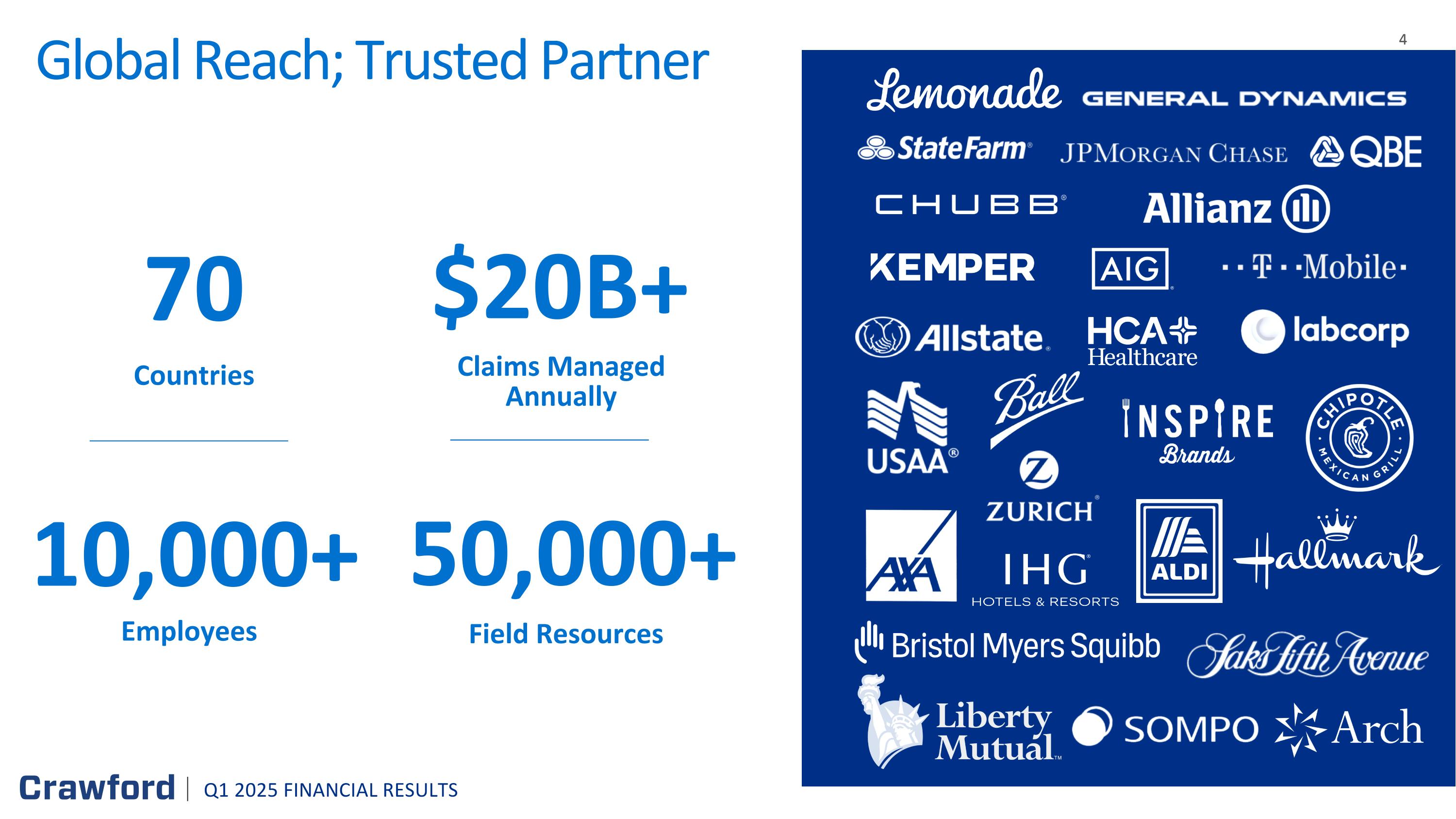
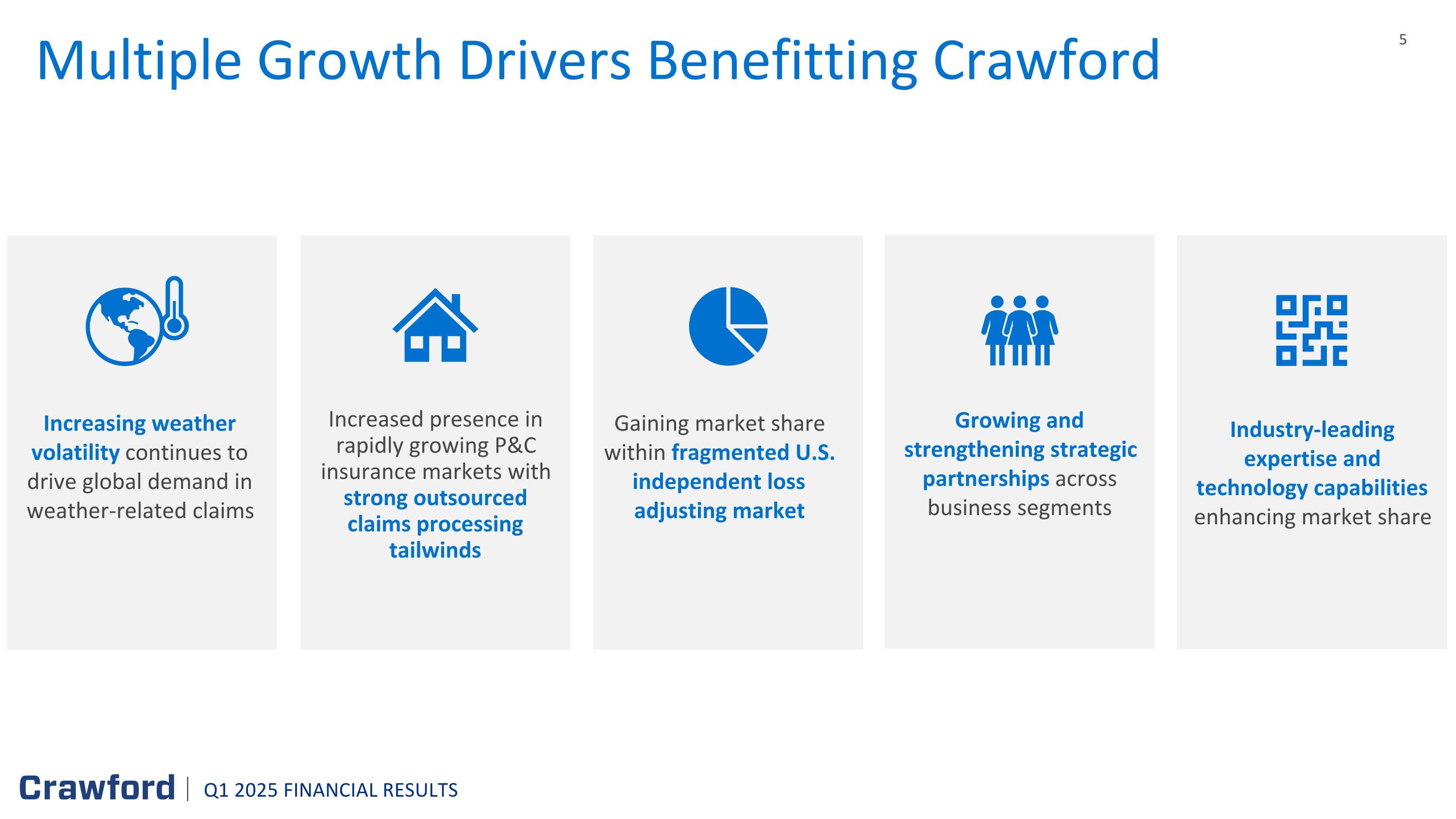
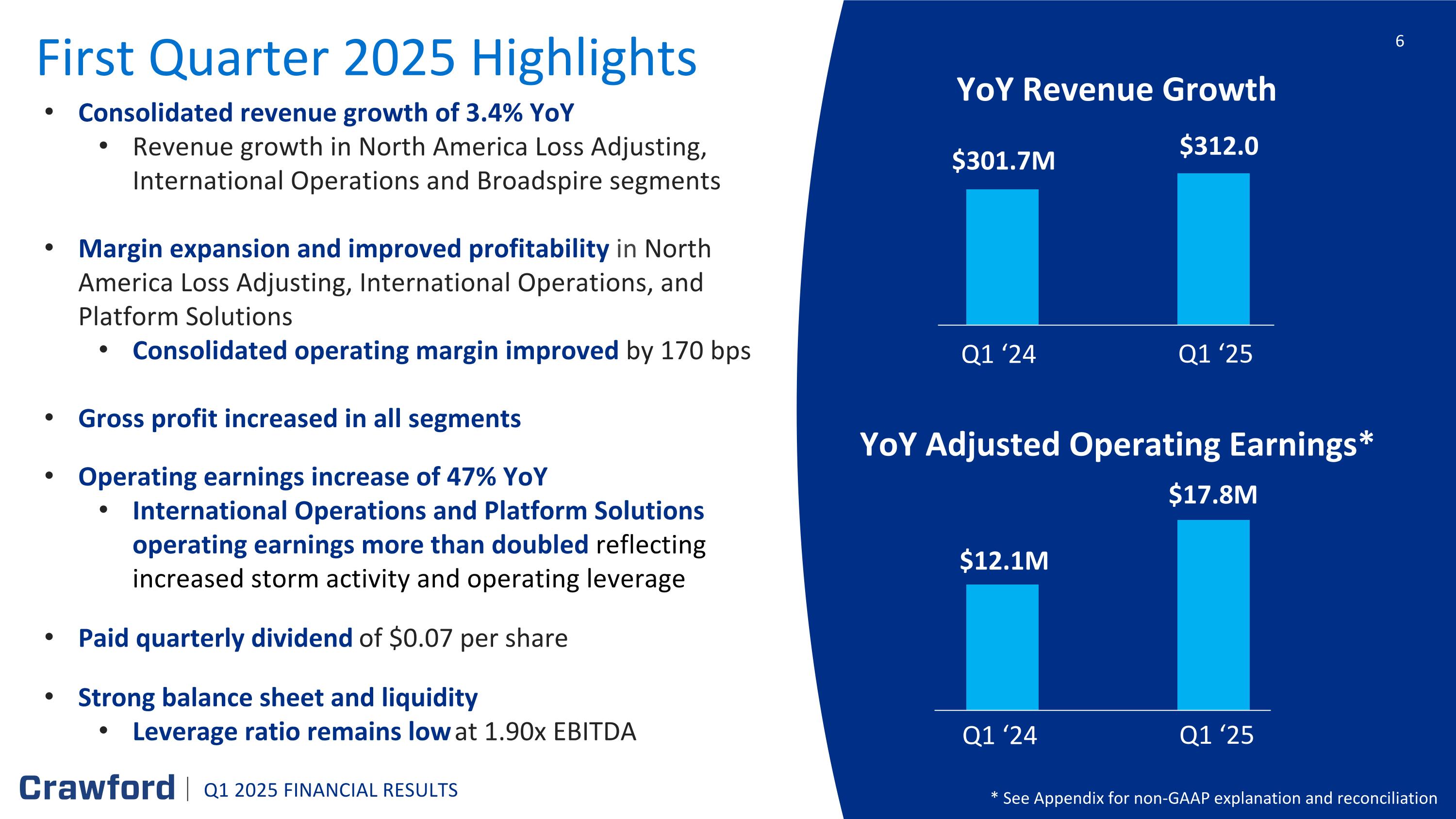
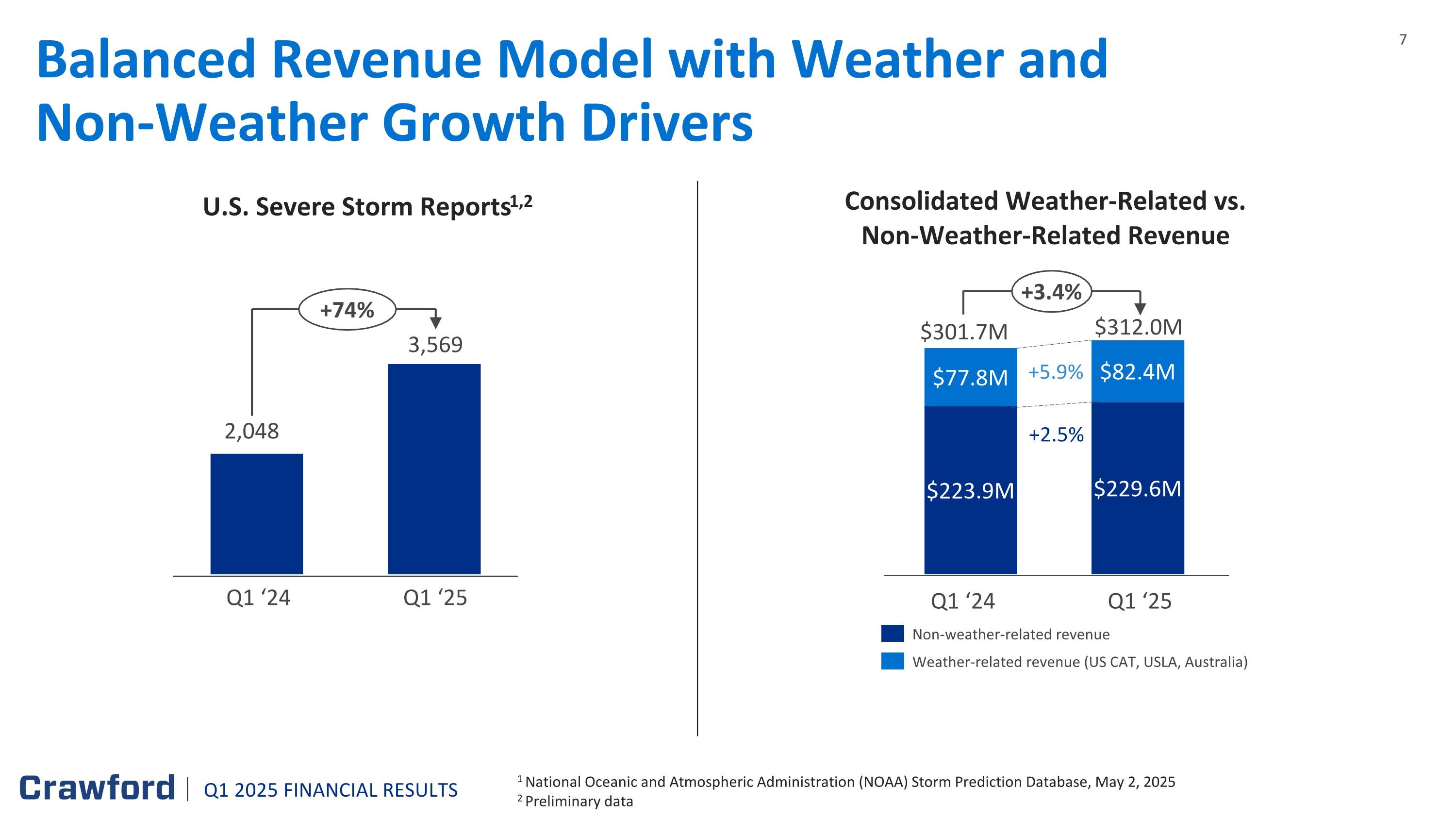
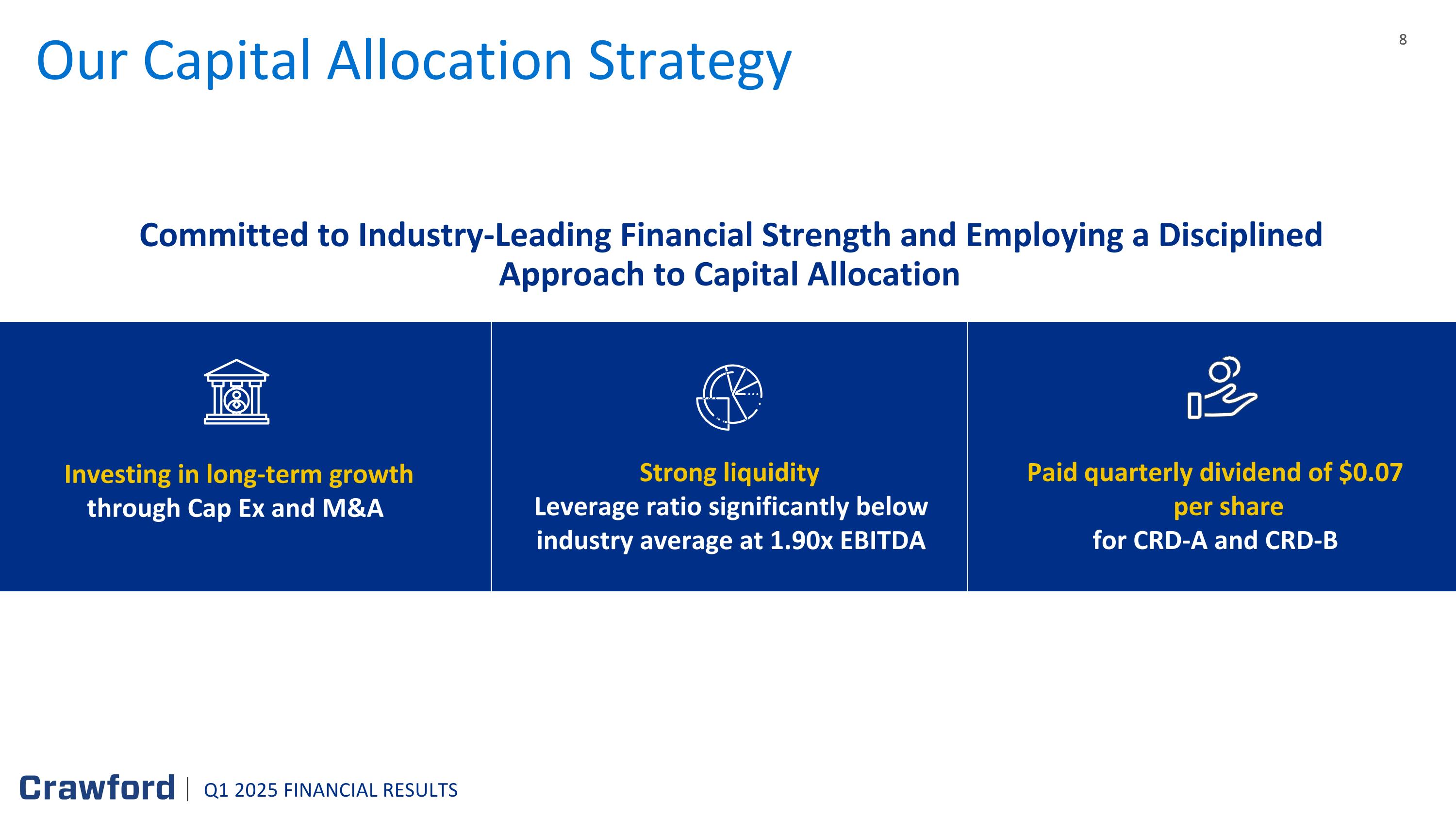
Thank you so much, Tammy. Good morning and welcome to our first quarter 2025 earnings call. Joining me today is Bruce Swain, our Chief Financial Officer, and Tammy Stevenson, our General Counsel. After our prepared remarks, we will open the call for your questions. We've had a strong start to the year in the first quarter of 2025, continuing the growth and profitability and momentum we achieved in the fourth quarter of 2024. Our diversified business model and disciplined execution resulted in profitable revenue growth and meaningful margin expansion in the quarter with expanded profit contributions from all four segments. We were especially encouraged by the performance of our non-weather dependent business which continue to deliver steady growth and reinforce our position as a market leader across a wide range of claim types. This morning I'll review our segment operations for the first quarter before handing it over to Bruce for a deeper dive into our financial performance. On this slide you will see a few of the leading global insurers and organizations that partner with Crawford. Managing over 20 billion dollars in claims annually across 70 countries, Crawford is the largest publicly traded claims management provider in the world. Our reputation as trusted partner is built on decades of experience specialized expertise and our ability to operate in some of the most complex and challenging environments backed by a global team of 10,000 professionals we continue to differentiate ourselves through consistent execution scale and a unique ability to support clients wherever and whenever we're needed Crawford brings a rare combination of global reach technical capability and specialized talent positioning us to grow alongside the evolving needs of our industry with people plus technology at the core of our identity our strategy blends innovation and expertise to enhance claims management and deliver superior outcomes for clients across the globe we see growing demand for expert-led efficient claim solutions across property casualty and specialty lines of business with their unique complexities and need for expertise additionally we remain well positioned to meet our clients needs arising from the increasingly frequent and severe weather events globally Crawford's deep climb relationships across global reach and proven ability to rapidly deploy specialized talent and advanced technology enable us to support both weather and non-weather claims. This balanced capability reinforces our role as a trusted partner and positions as well for sustained growth across diverse risk environments. As the insurance industry faces increasing regulatory demands and cost pressures, more insurers are turning to claims outsourcing to enhance efficiency and scalability. Our comprehensive service offerings, industry expertise, and global reach make us the ideal partner for insurers seeking to streamline operations. Industry consolidation also creates more opportunities for specialized service providers, allowing us to expand our footprint and reinforce key partnerships in an increasingly dynamic and decentralized PNC market. Expanding our strategic partnerships is a top priority for us. Through our knowledge of our client's operations, we deliver better service and drive stronger outcomes, which improves retention and positions Crawford as a long-term valued partner. Finally, our ability to attract and retain top-tier talent and our insurtech capabilities are central to our growth strategy. The expertise and efficiency of our adjusters is a distinct competitive advantage and our innovative technology solutions backed by a highly skilled and agile team enable us to drive efficiencies and deliver superior claims outcomes these components help position Crawford as the go-to partner for insurers navigating a rapidly evolving tech-driven market and now our first quarter highlights in the first quarter Crawford delivered 3.4 percent year-over-year growth in consolidated revenue a five percent growth in constant currency driven by solid performances across North America loss adjusting international operations and broadspire we achieved a 5.7 million dollar increase in operating earnings year-over-year driven by improved profitability in North America loss adjusting international operations and platform solutions our consolidated operating margin improved by 170 basis points reflecting our efforts to drive operational efficiencies gross profit increased across all segments driven by both high revenue and our focus on improving our operating leverage our commitment to returning value to shareholders is reflected in the quarterly dividend of seven cents per share for crda and crdb which illustrates our solid financial foundation and our confidence in the future of crawford our balance sheet shows continued strength and liquidity with a low leverage ratio of 1.9 times EBITDA providing us the flexibility to navigate market fluctuations and to make strategic investments to fuel our long-term growth. Our balanced revenue model is a core strength of the business. According to NOAA, severe storm reports increased 74% year-over-year in the first quarter, with March storm reports jumping 215% compared to the same period last year. This uptick in severe weather events provided a late quarter boost to our weather-related business lines, resulting in an almost 6% increase in the first quarter weather-related revenues year over year. Importantly, with our two-pronged revenue model, we not only captured the benefits of this increased storm activity, but also maintained strong growth in our non-weather-related business lines. Our non-weather business revenue grew 2.5% or 4.6% in constant currency year-over-year in the first quarter of 2025 and continues to perform well. Our balance model is a key differentiator for Crawford, allowing us to remain resilient and positioned for sustained growth, regardless of weather volatility. The solid performance from both our weather and non-weather business lines highlights the strength of our diversified portfolio and the operational flexibility we've built over time. Our capital allocation strategy remains focused on maintaining financial flexibility while driving sustainable growth. We prioritize investments in long-term growth through capital expenditures and strategic acquisitions with a commitment to operational leverage and strengthening our balance sheet. During the first quarter, we maintain strong liquidity and our leverage ratio remains below industry averages we have consistently returned value to shareholders as demonstrated by a quarterly dividend the disciplined approach to capital allocation enables us to balance growth initiatives with shareholder return positioning Crawford for long-term success with that let me turn the call over to Bruce for a deeper look at our segment operational and financial performance Thank you, Rowett.
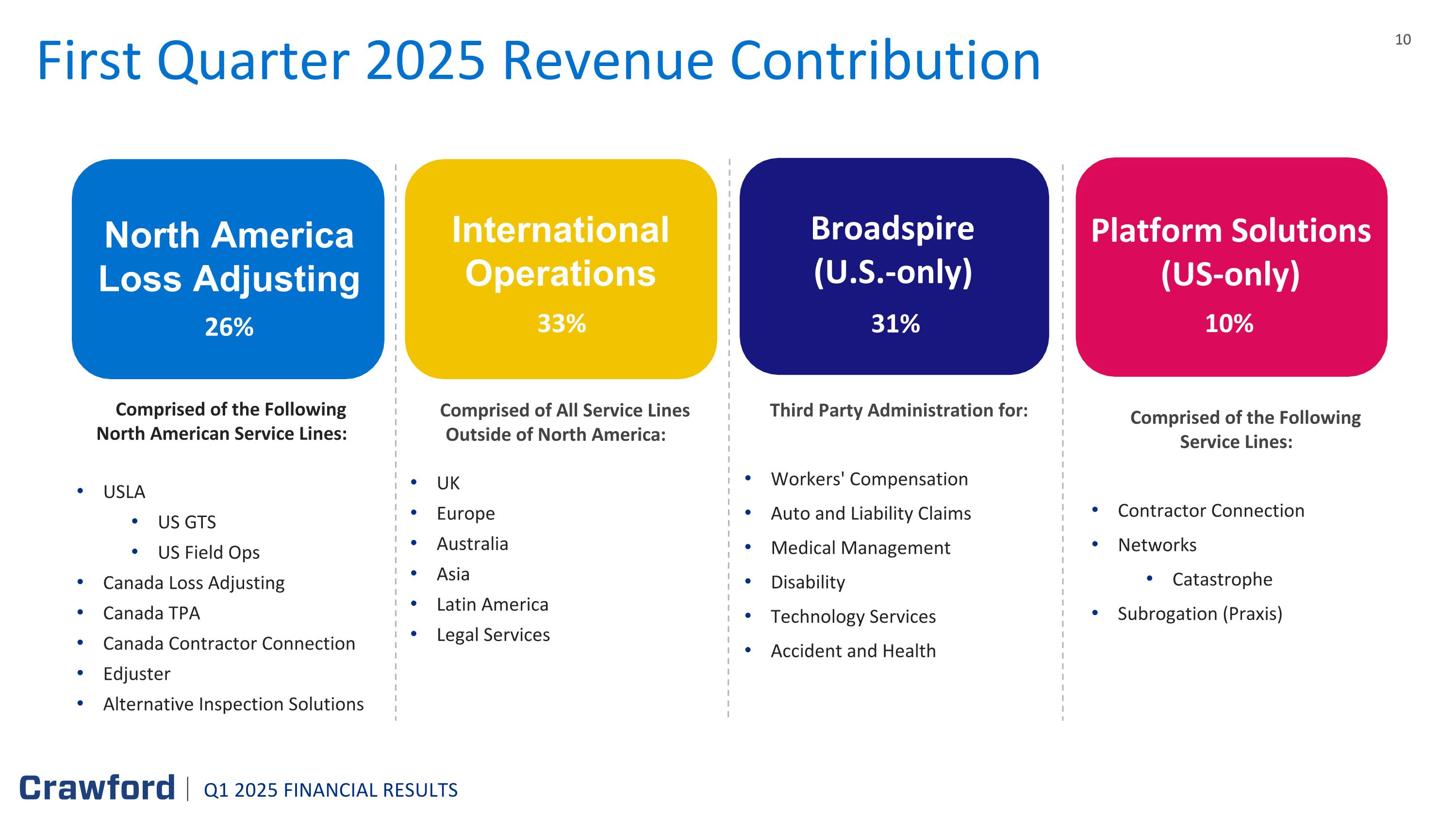
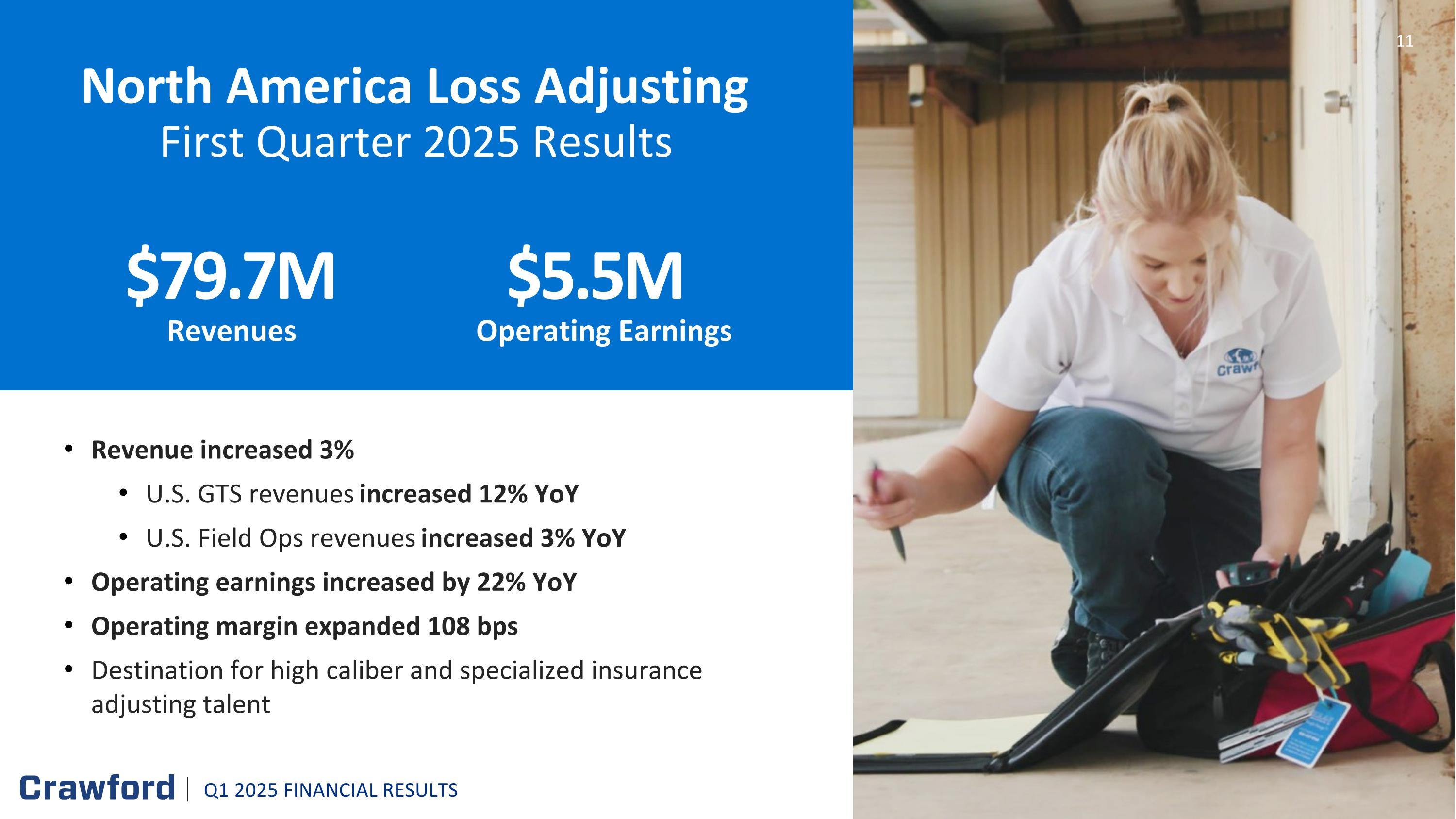
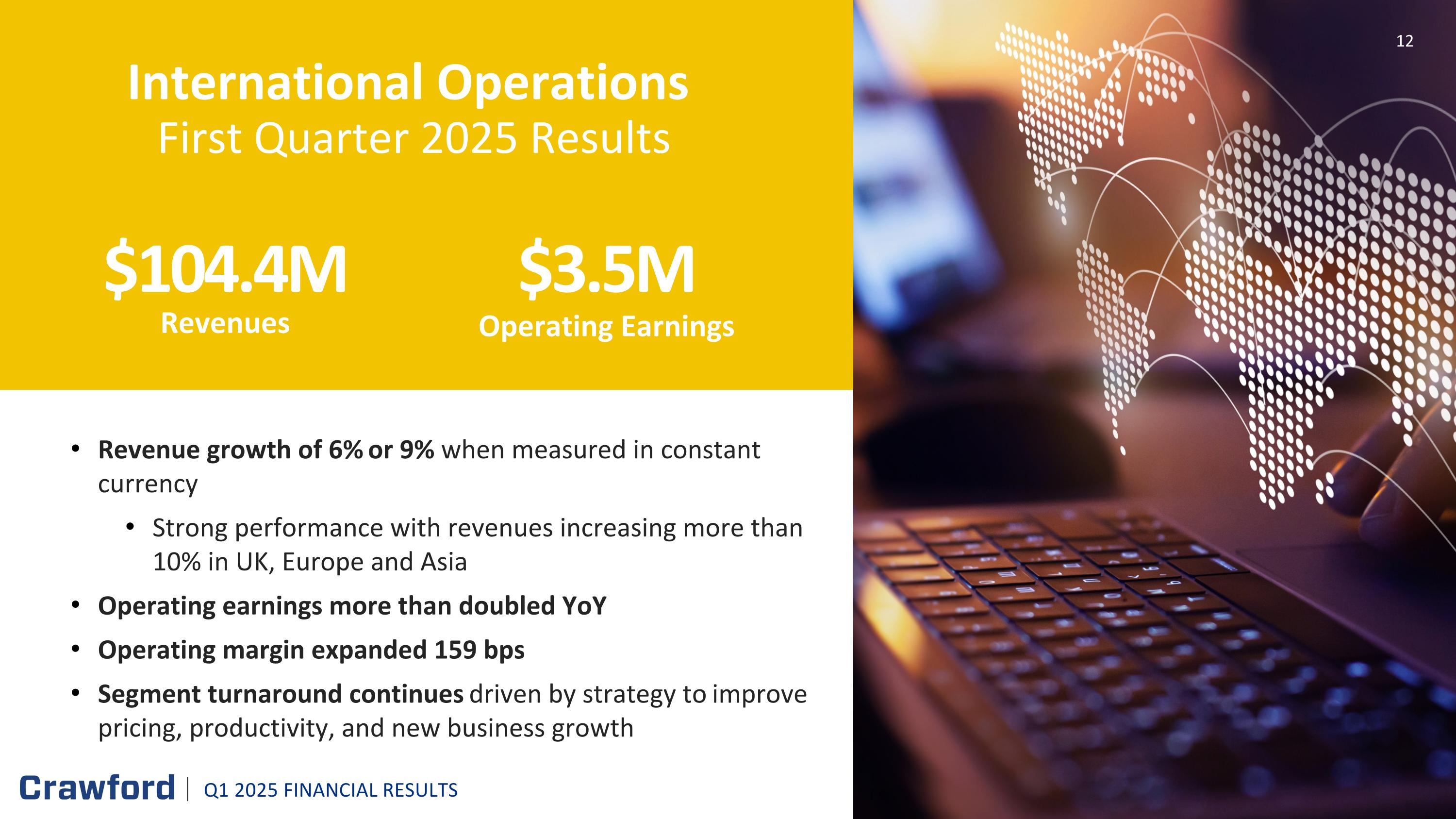
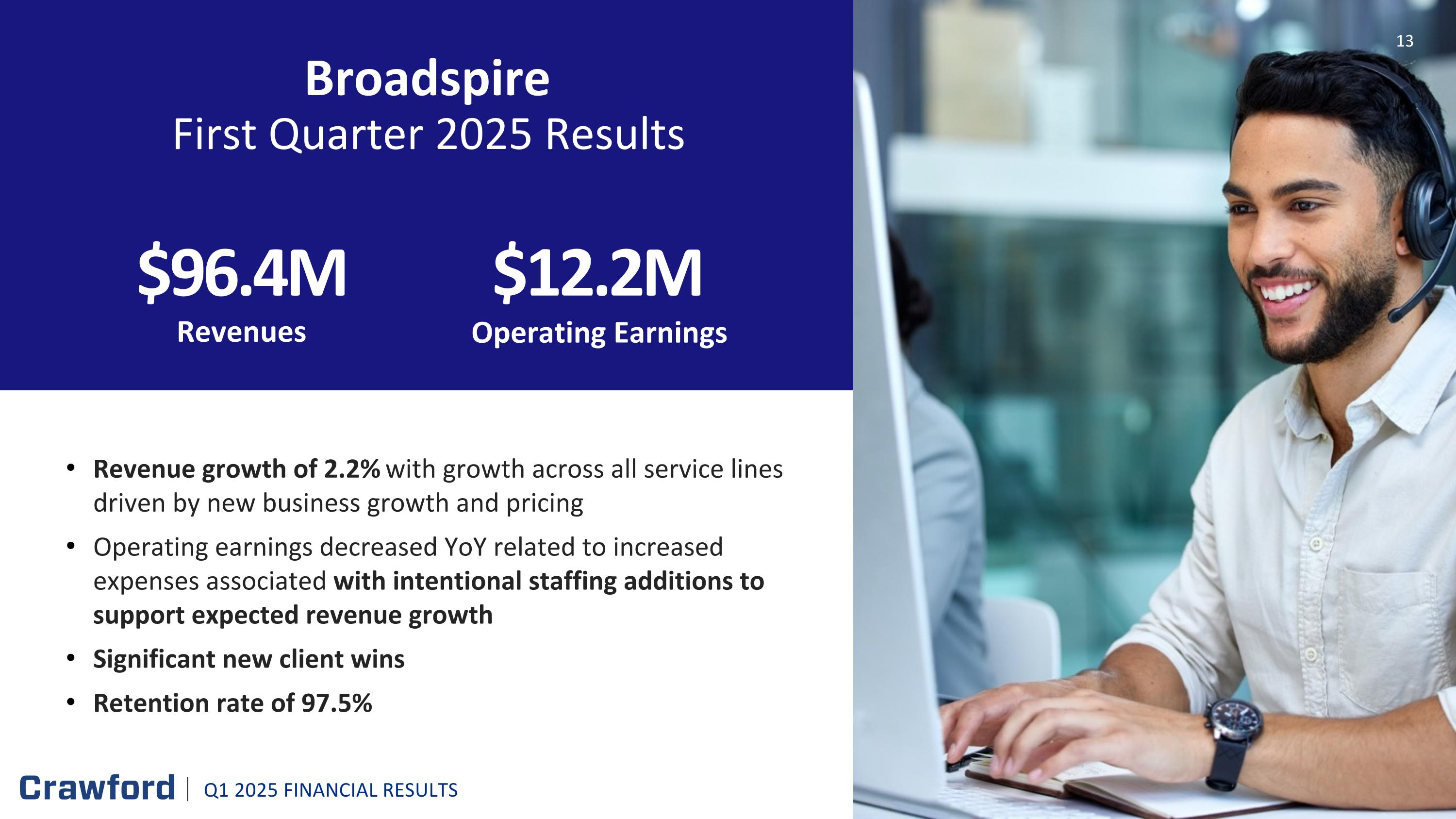
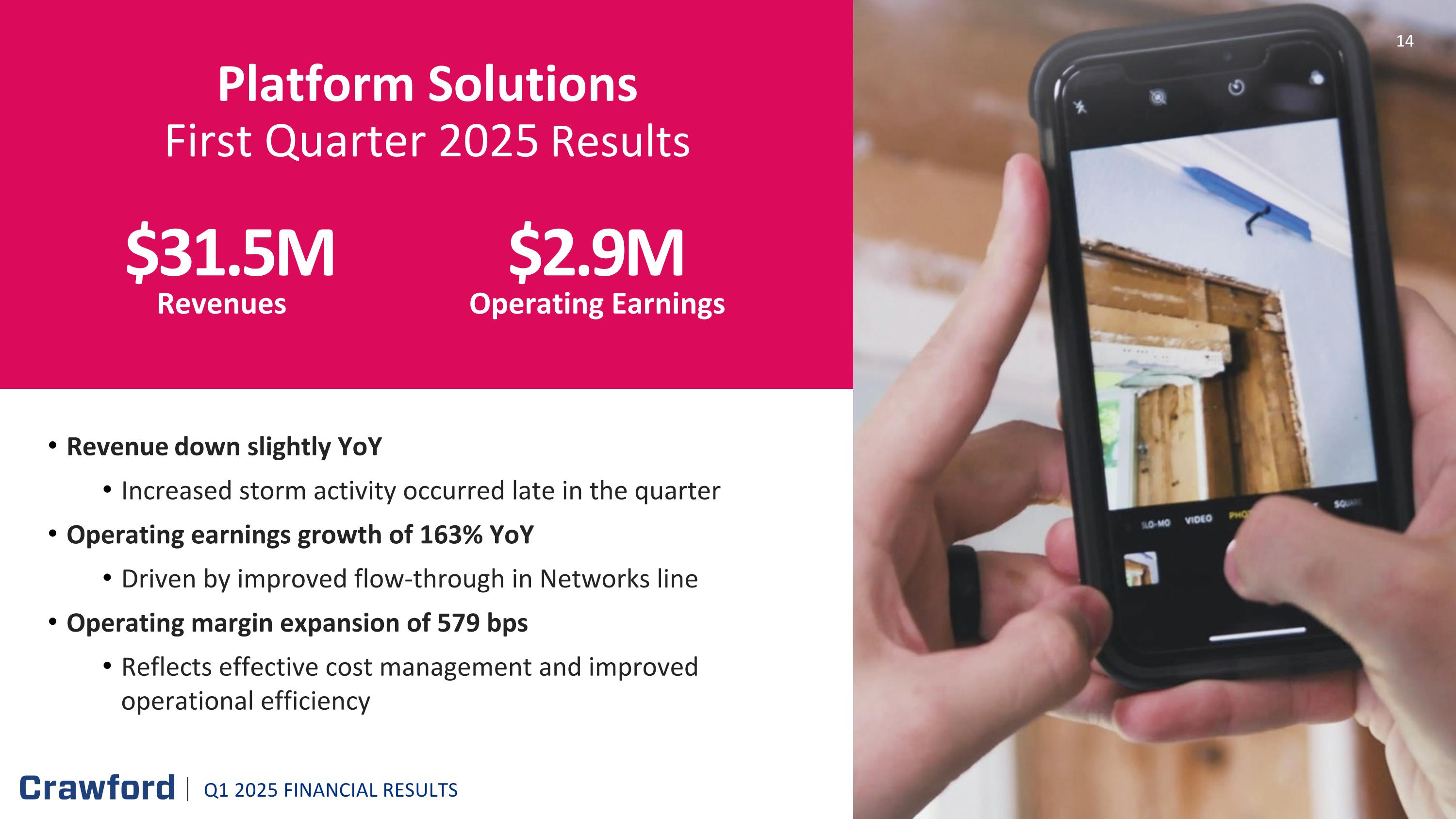
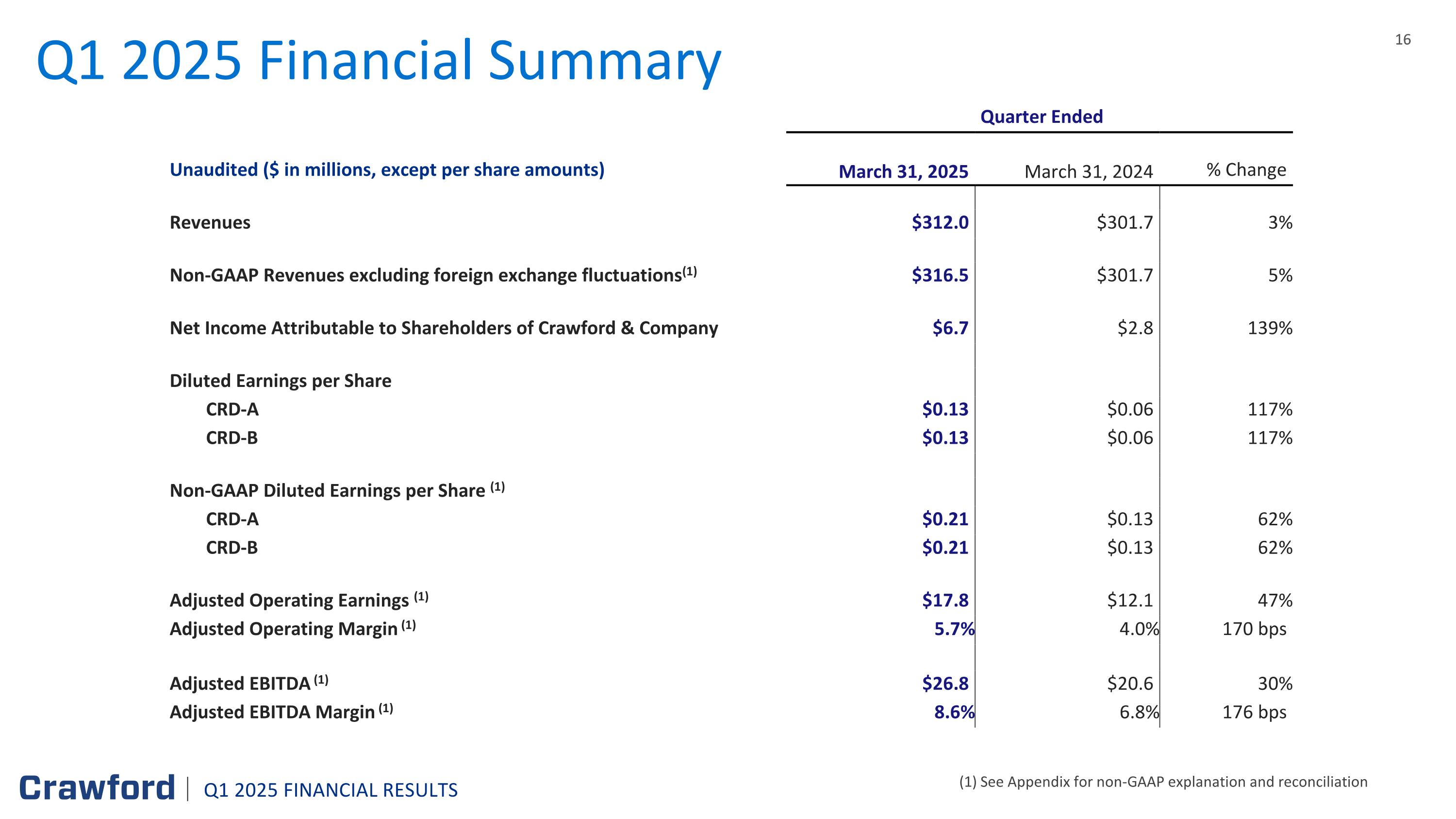
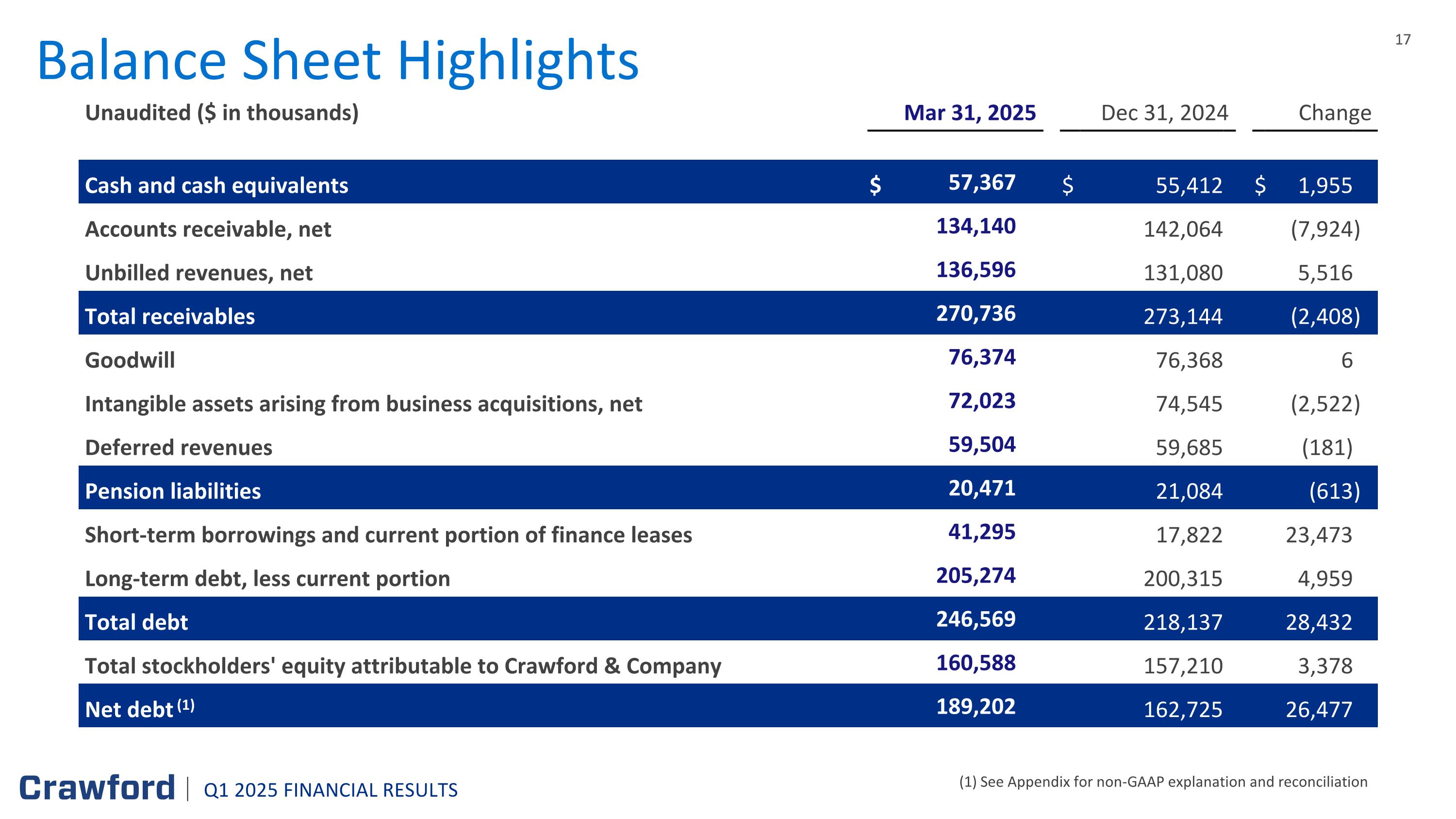
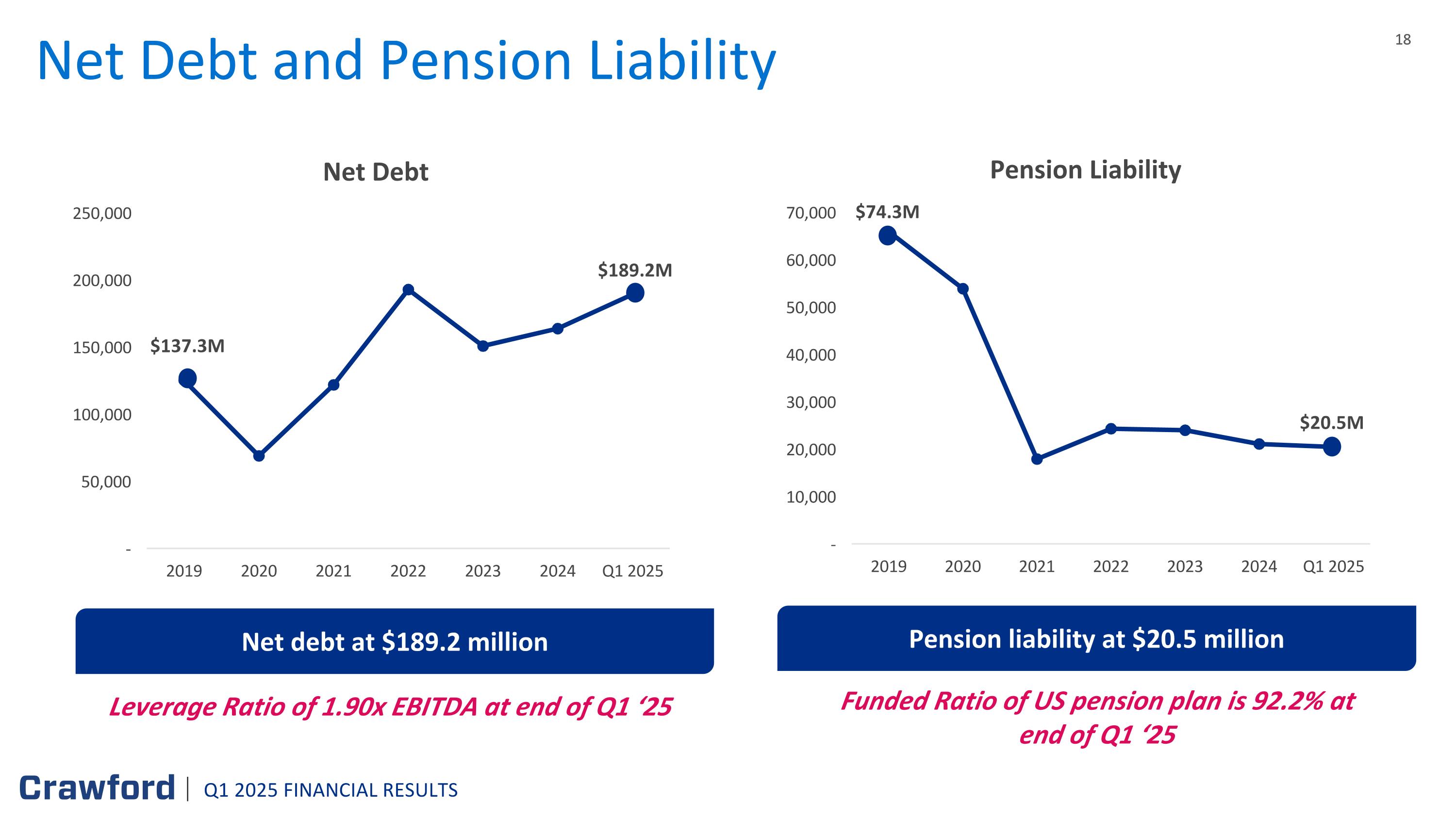
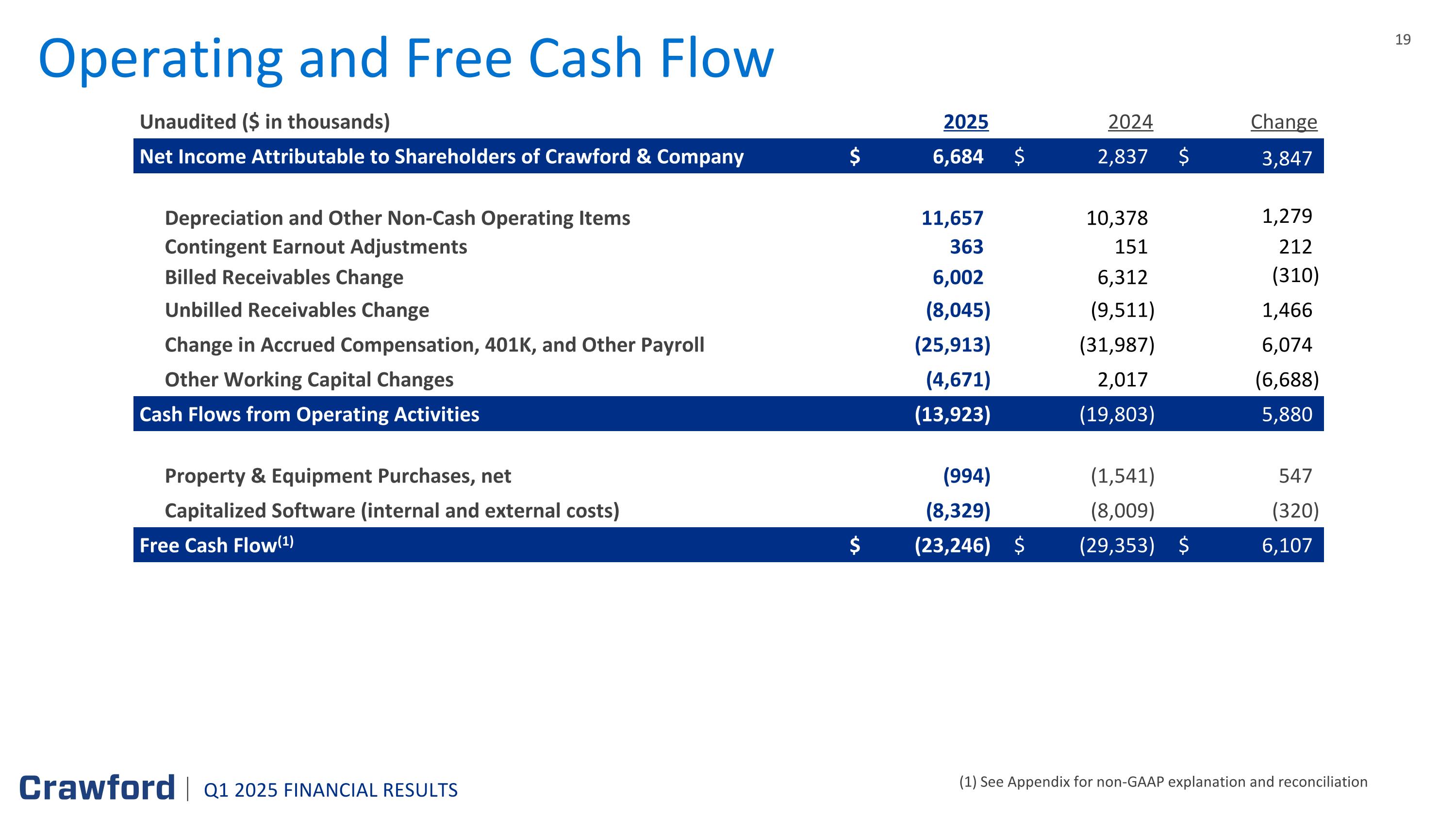
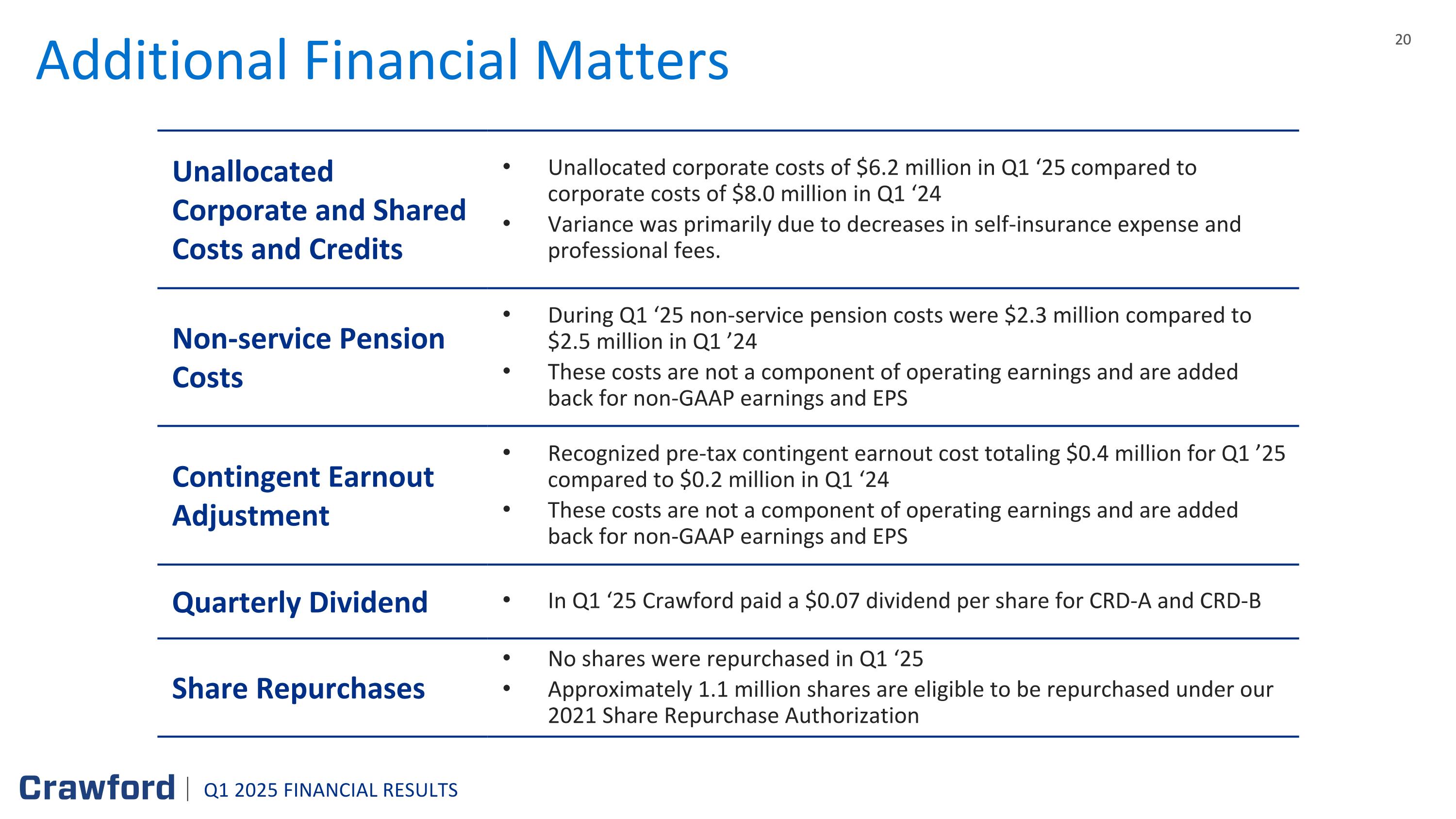
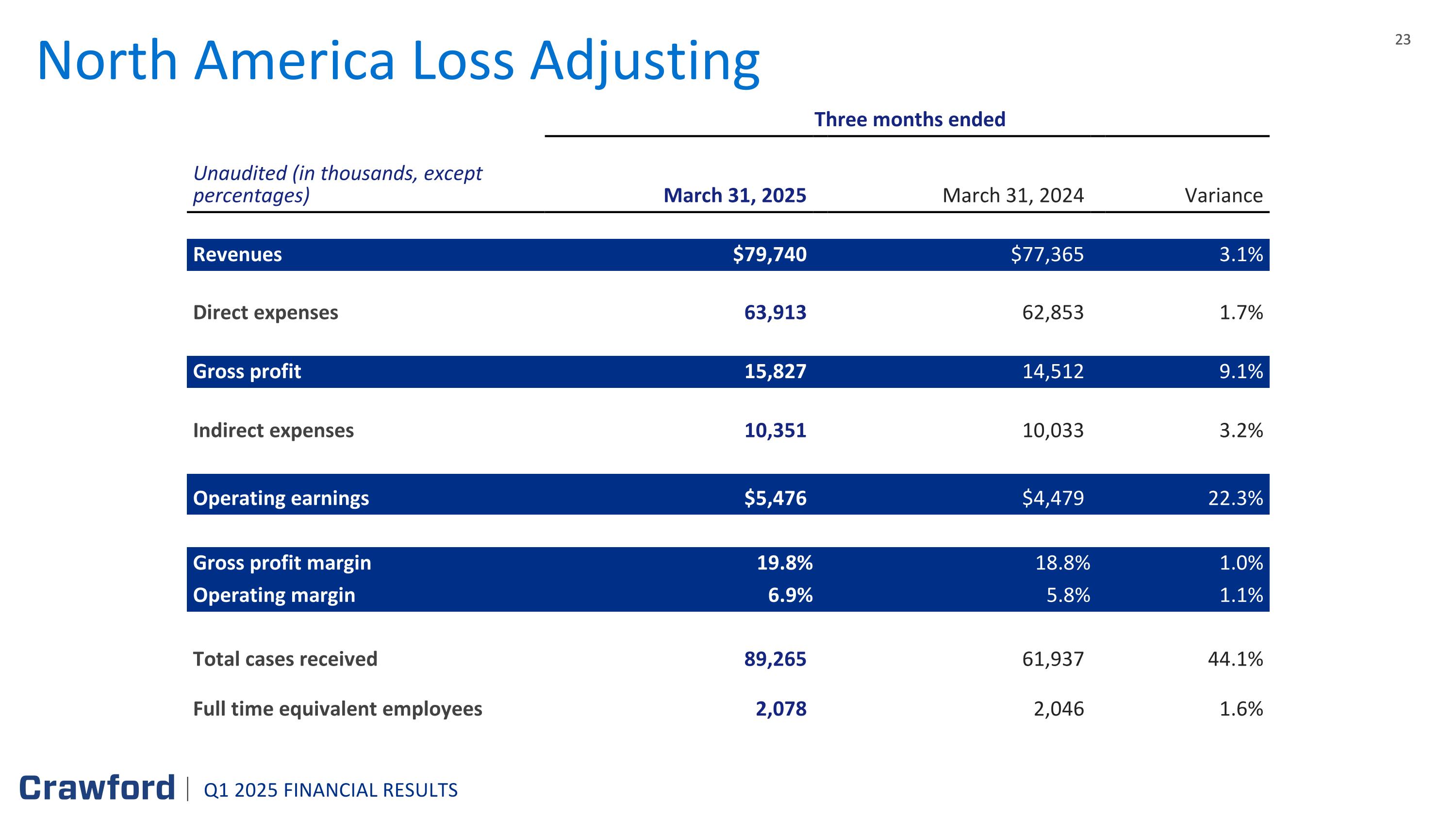
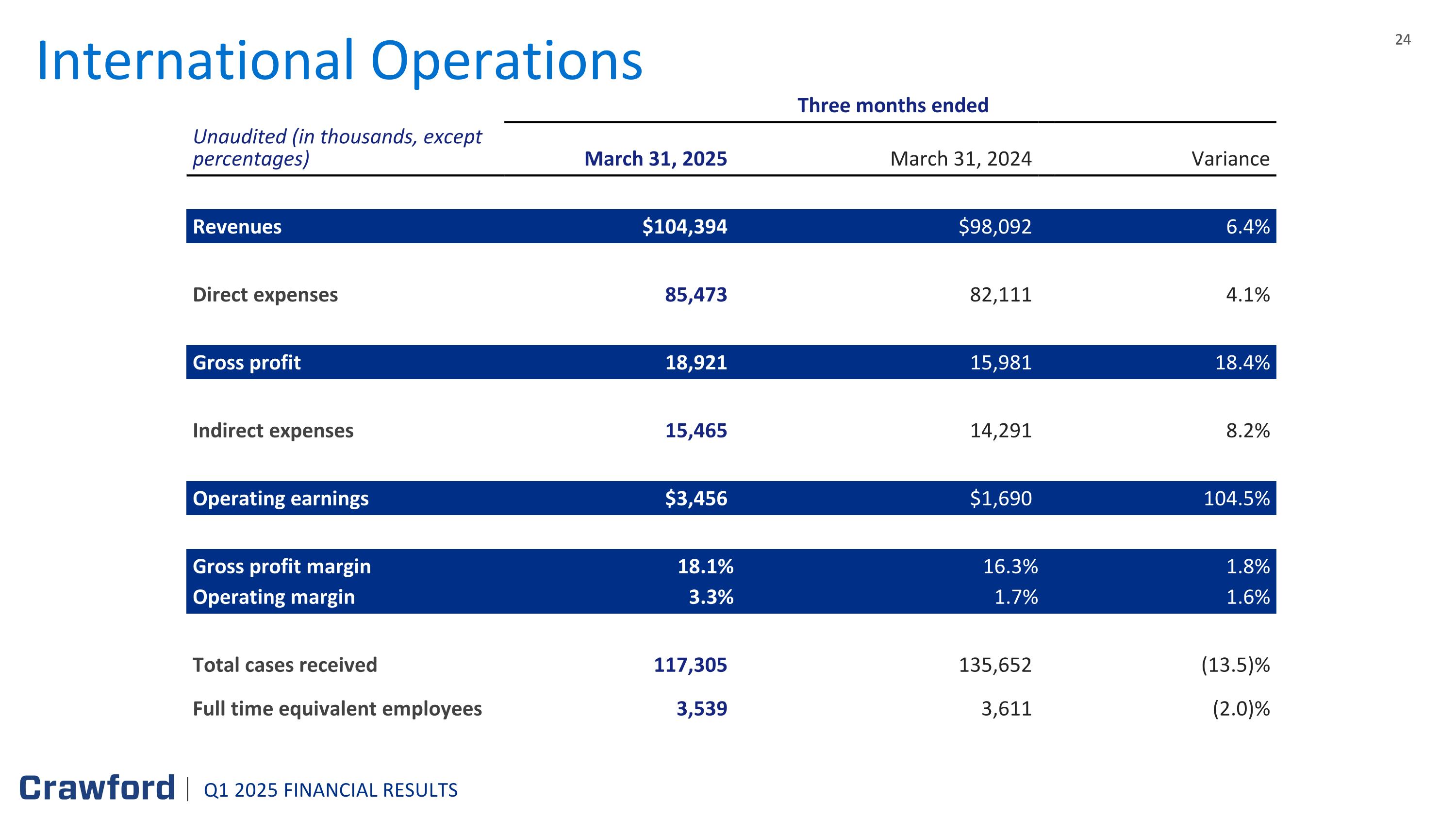
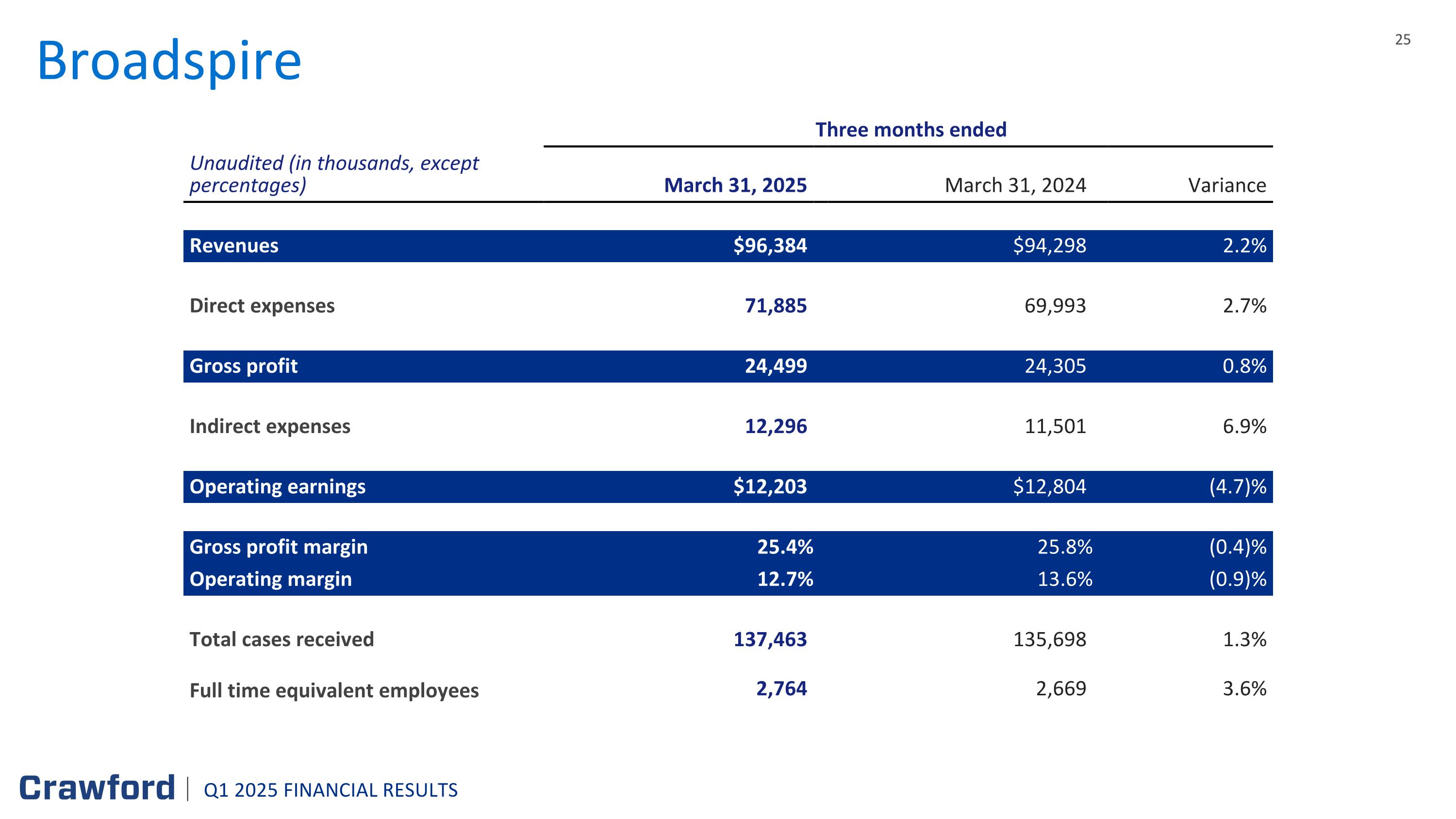
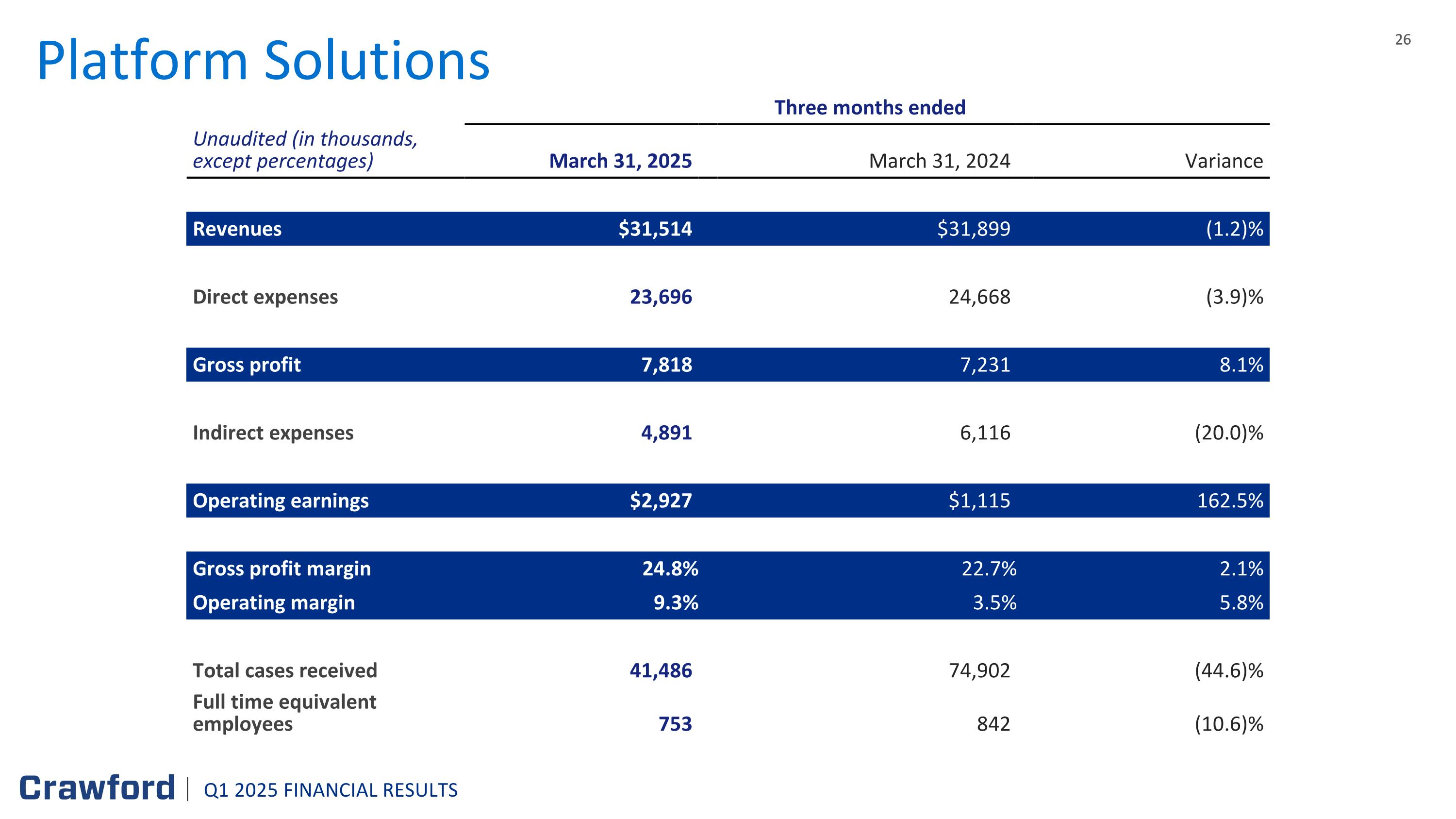
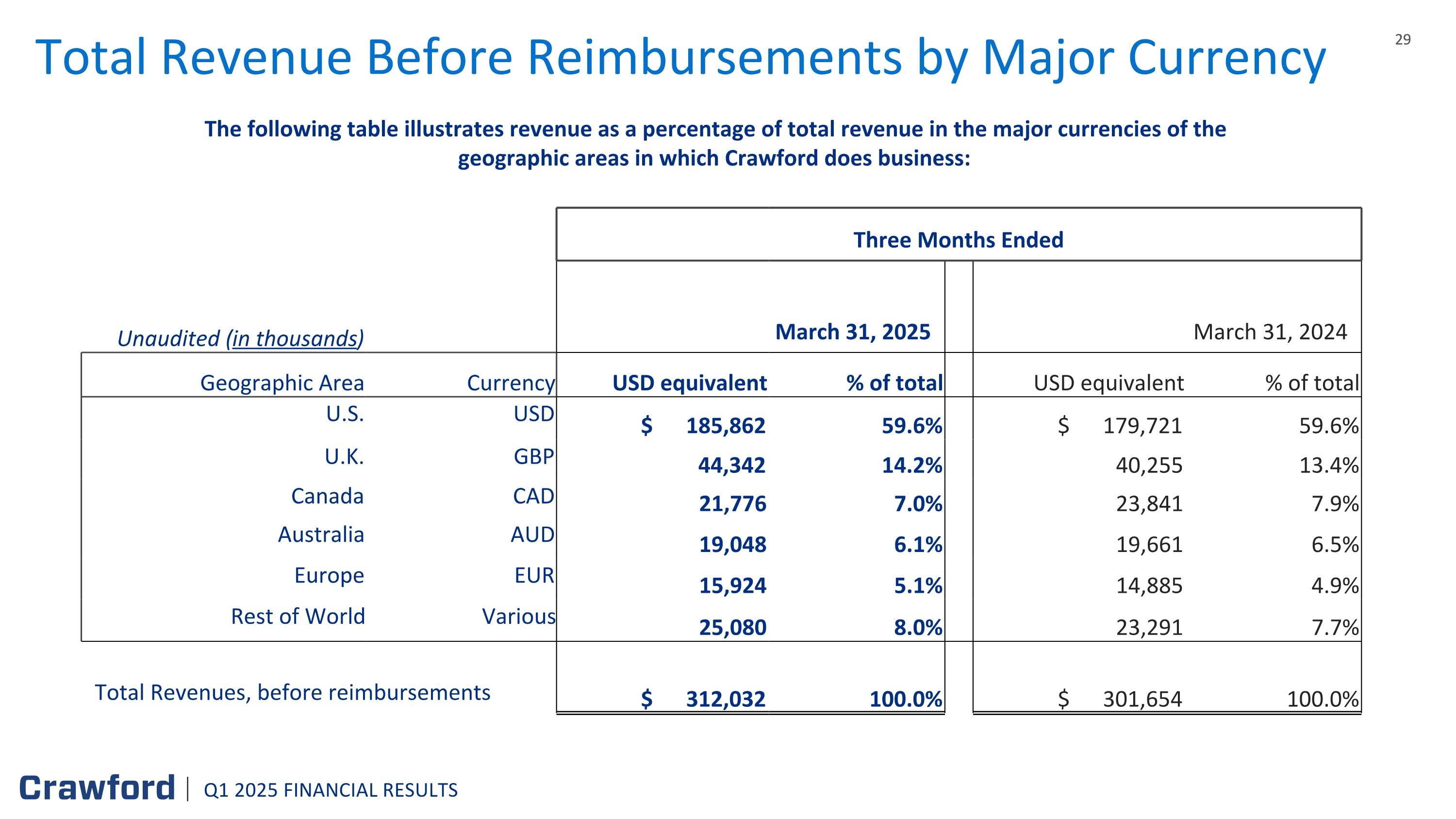
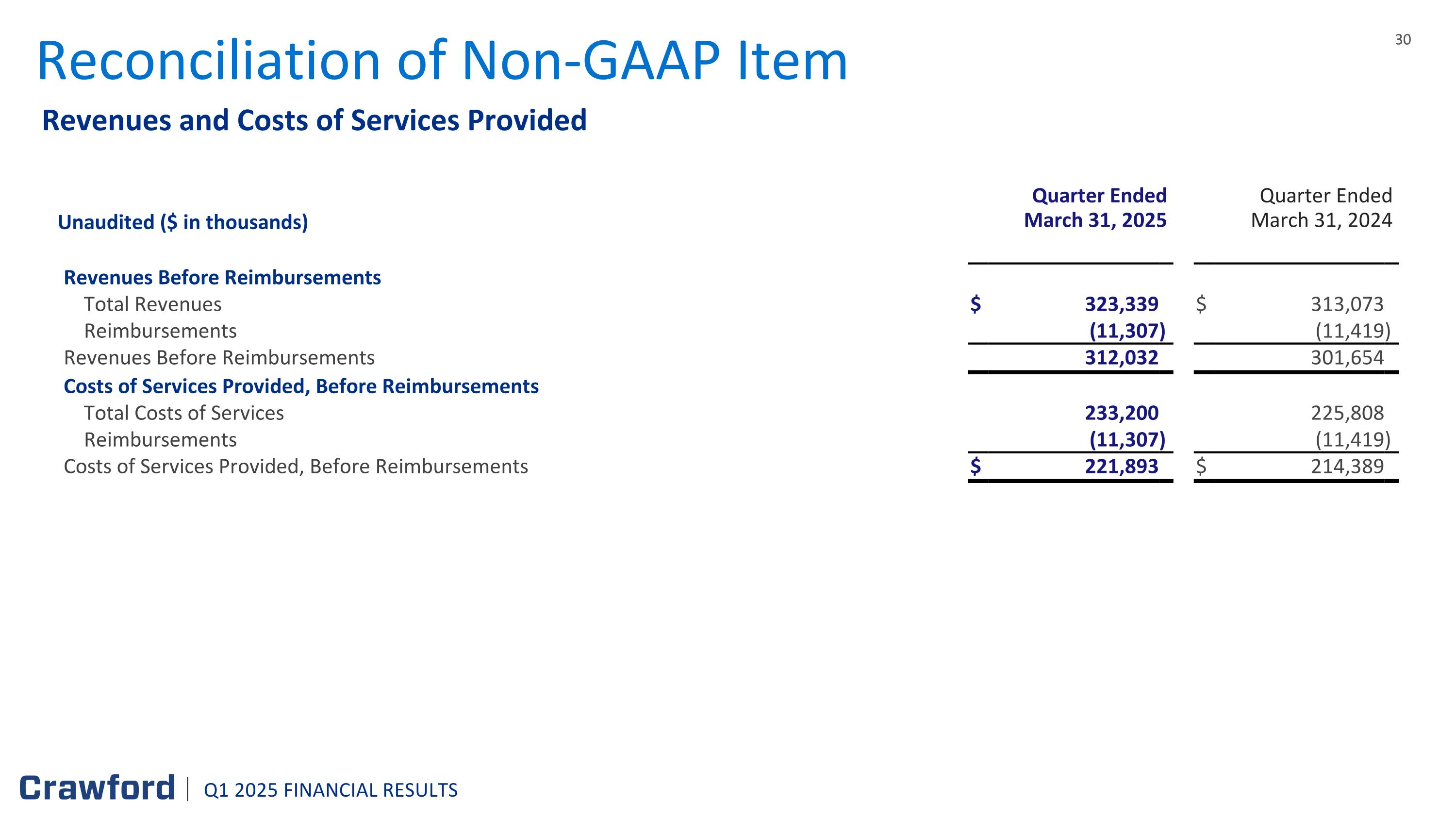
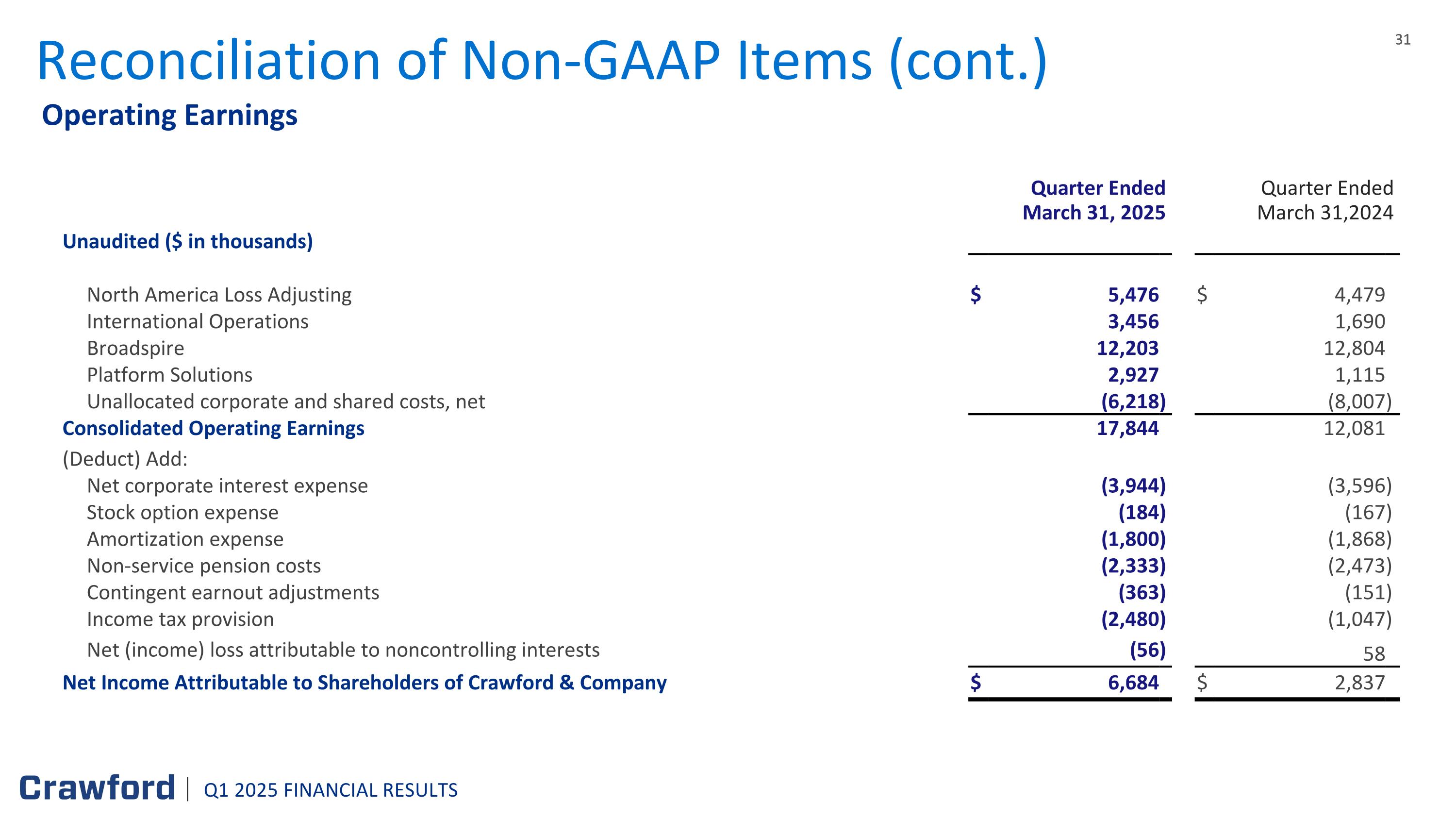
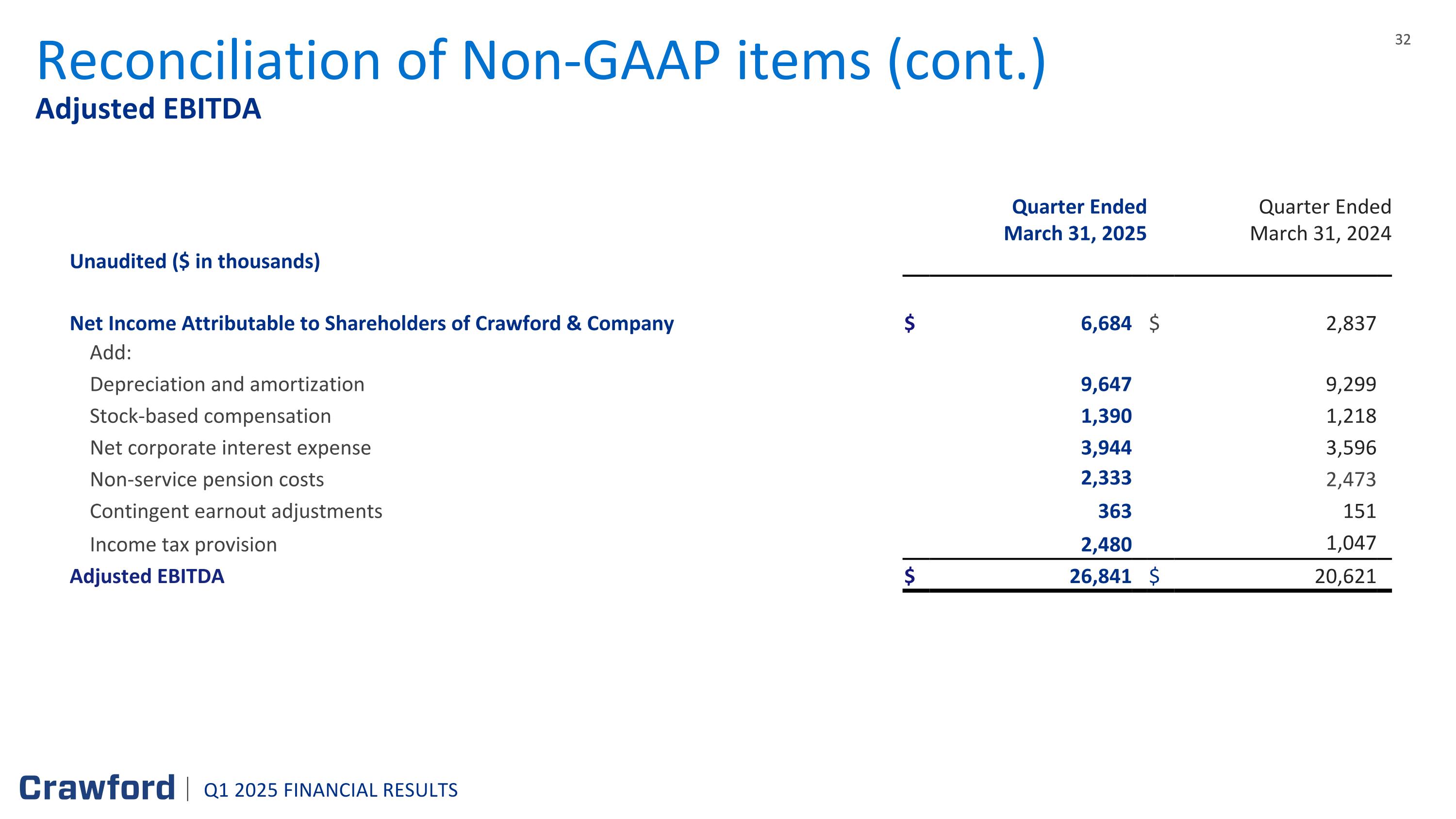
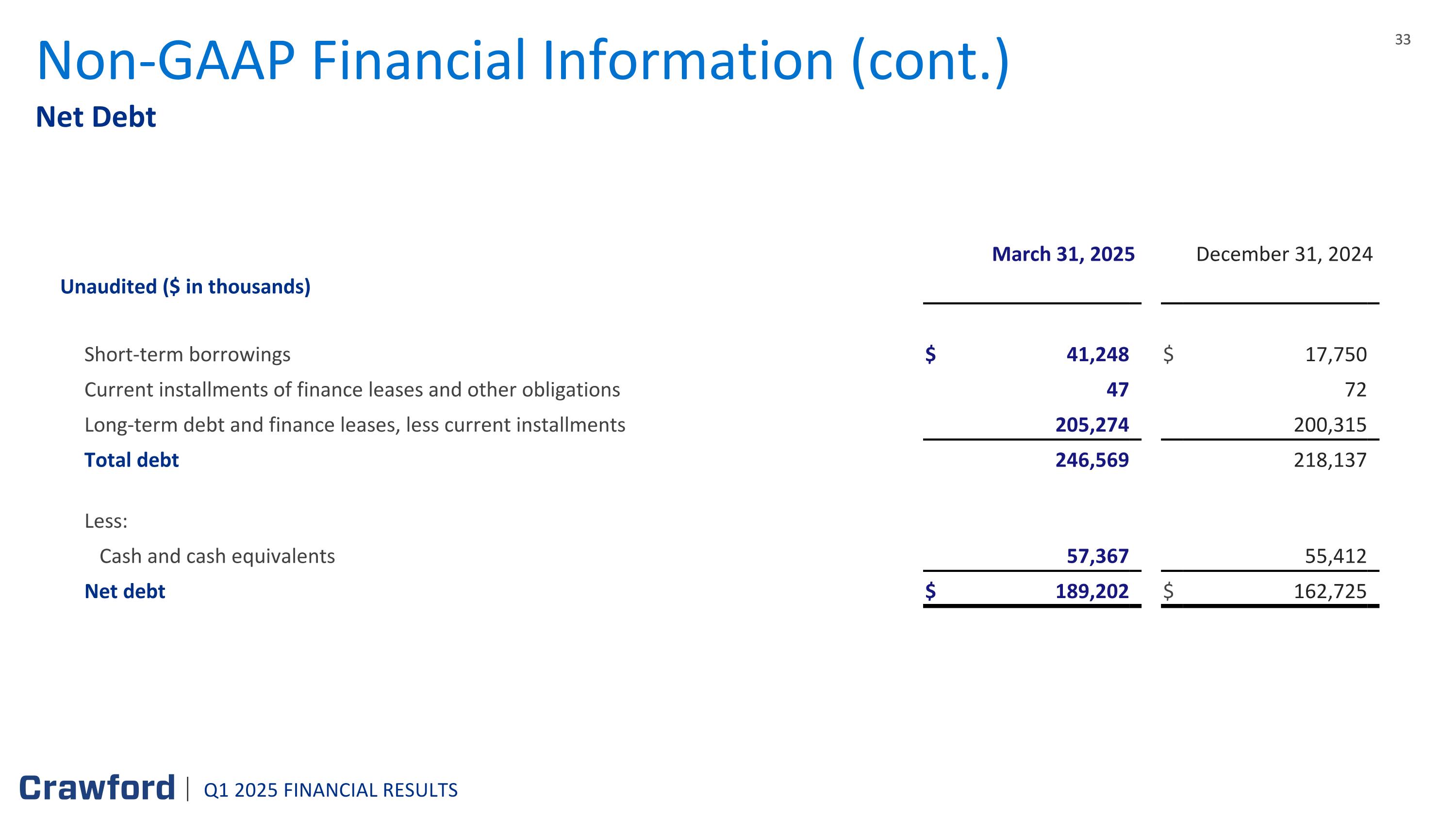
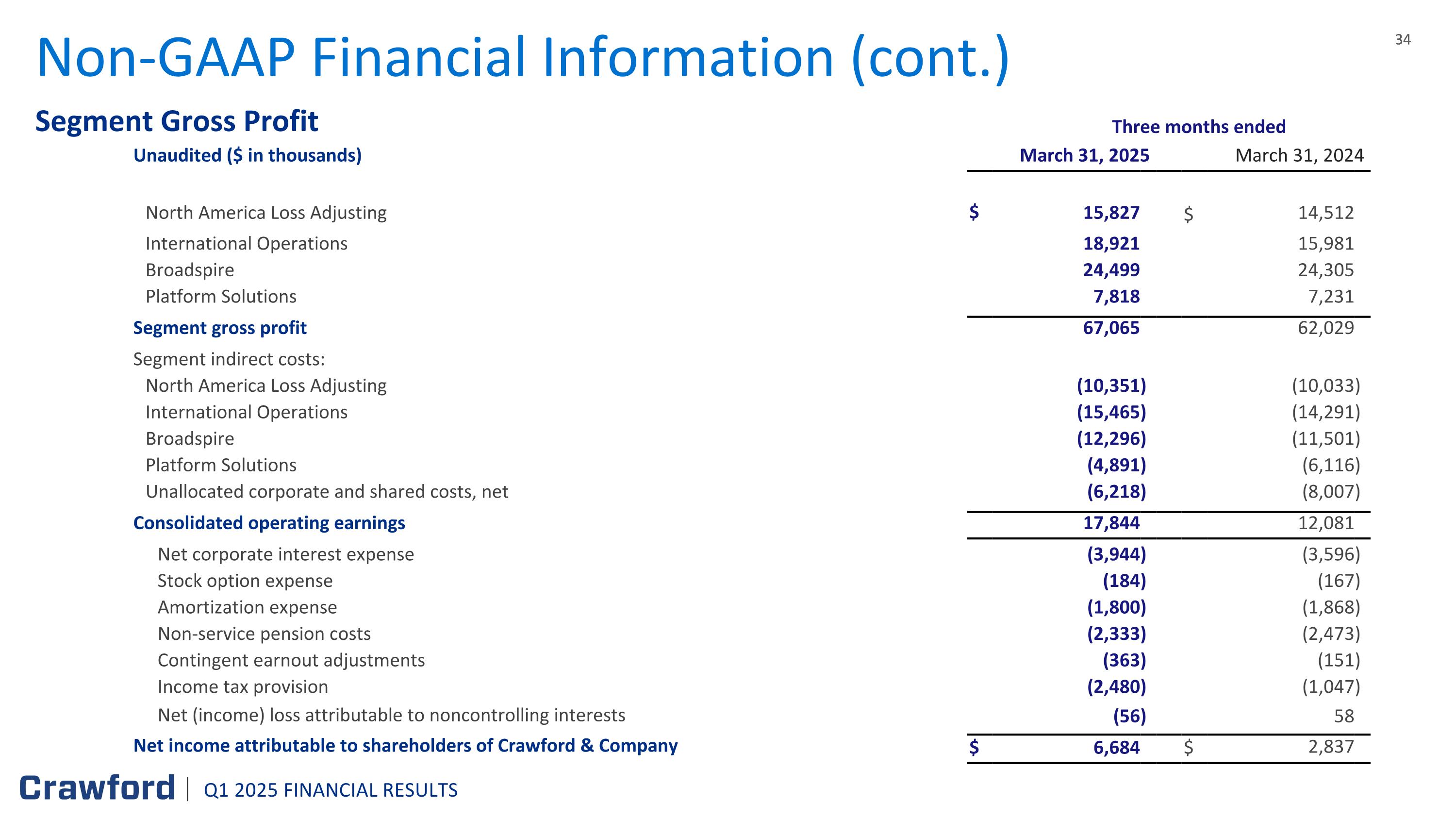
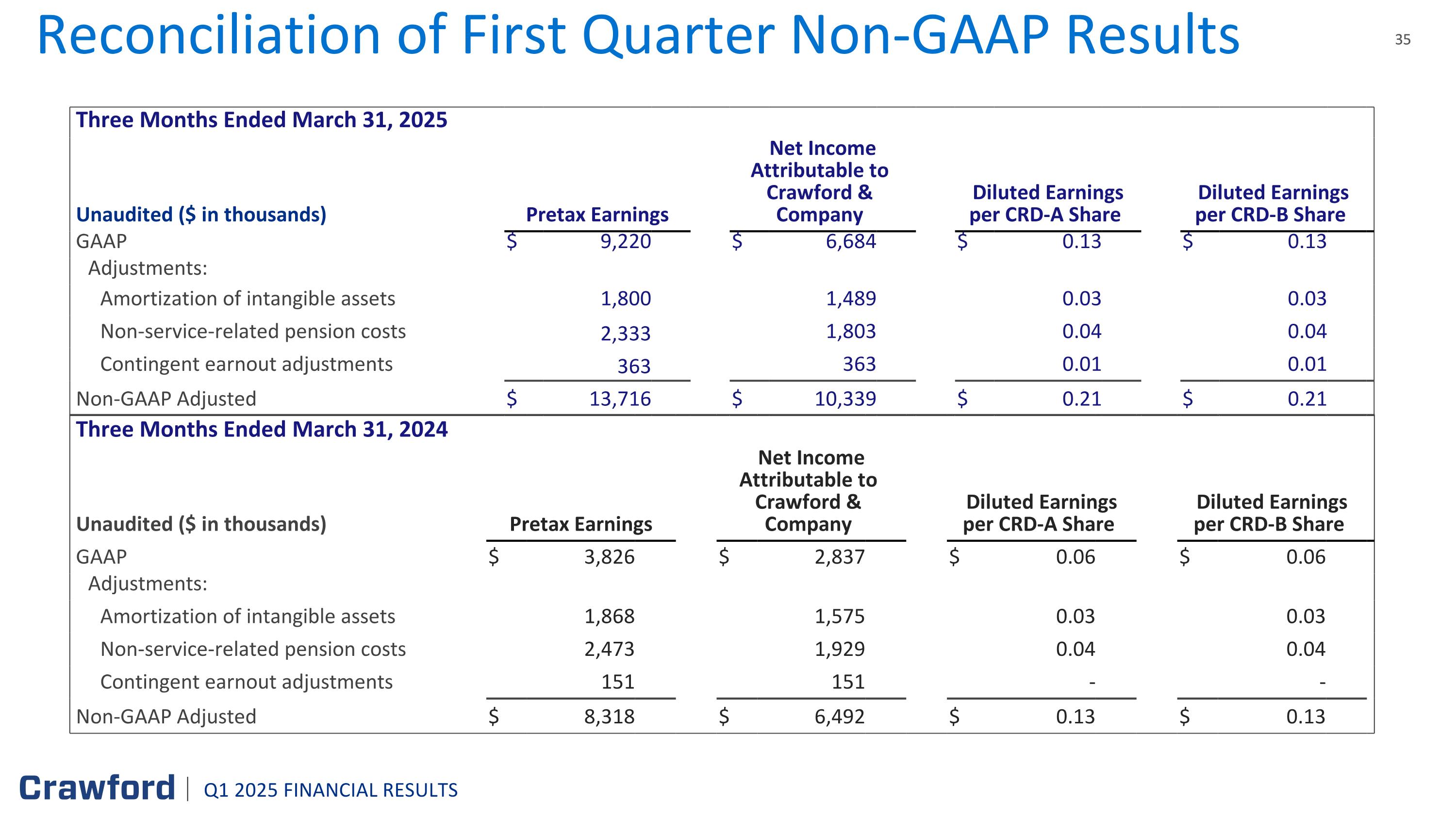
As most of you know, our business is diversified and is comprised of four segments. North America loss adjusting, which includes our loss adjusting operations in the U.S. and Canada, accounted for 26% of first quarter 2025 revenues. International operations covering all service lines outside North America contributed 33% of quarterly revenues, reflecting our strong global presence. Broadspire, our U.S.-based third-party administration business represents 31% of quarterly revenues. Platform solutions, which includes contractor connection, networks, and subrogation services, accounted for 10% of revenues, supporting our strategy of offering end-to-end claims management solutions. North America loss adjusting saw solid revenue growth in the 2025 first quarter, with revenues increasing 3% year-over-year to $79.7 million. Operating earnings increased by 22% to $5.5 million, driven primarily by new business wins and expansion in key clients from our GTS service line, which saw revenue growth of 12% year-over-year. This strong start to the year reflects continued momentum in our high-value, complex claims segment, as clients increasingly turn to Crawford for our technical expertise and trusted execution. We are seeing the benefits of targeted investments in talent and technology that have enhanced our ability to respond quickly and efficiently to client needs across North America. GTS in particular continues to be a growth engine supported by both new client wins and deeper engagements with existing accounts. International operations delivered another quarter of impressive growth with first quarter revenues of $104.4 million growing 6% year-over-year or 9% on a constant currency basis. This growth was driven by double-digit revenue growth across the UK, Europe, and Asia, reflecting strong client demand and the effectiveness of our global operating model. Operating earnings more than doubled to $3.5 million, and operating margin improved by 159 basis points compared to the prior year. We are seeing benefits from our disciplined execution across multiple regions, including improved pricing strategies, stronger operational efficiency, and a sharpened focus on higher-value services. Our results highlight the progress we've made in scaling our international platform while maintaining our established reputation and personal service. As we move through the year, we remain focused on capturing additional opportunities in both mature and emerging markets, while continuing to enhance profitability through targeted process improvements and technology enablement. Our Broadspire business delivered a solid first quarter, with revenues of $96.4 million, reflecting strong new business wins and sustained client momentum. Revenues increased by 2.2% over the prior year, driven primarily by these new client additions, with pricing improvements across all service lines. Operating earnings were $12.2 million, with a company-leading operating margin of 12.7%. As part of our strategic growth planning, we made proactive investments in talent to ensure we're well-positioned to support rising client demand. While these staffing additions modestly impacted operating earnings this quarter, they reflect our long-term commitment to service excellence and scalable growth. Our experienced team continues to perform well, securing many new client wins during the quarter. Combined with a client retention rate of 97.5%, Broadspire remains a leader in delivering high quality customized claim solutions platform solutions reported first quarter revenues of 31.5 million a slight year-over-year decline despite the modest revenue decline operating earnings rose 163 percent compared to the prior year with operating margin expanding by 579 basis points reflecting effective cost management improved operational efficiency and favorable mix shift towards higher margin assignments associated with storm activity in March. While revenues in this segment tend to vary quarter to quarter, we're encouraged by the meaningful improvement in profitability. These results underscore our focus on disciplined execution and our ability to deliver strong financial performance, particularly during periods of elevated catastrophe activity. Our response teams remain ready and well-positioned to deploy quickly in support of our clients and now a look at our consolidated financials in the 2025 first quarter company-wide revenues before reimbursements were 312 million an increase of 3.4 percent compared to the prior year period foreign exchange rates decreased revenues before reimbursements by 4.5 million or 1.4 percent gap net income attributable to shareholders totaled $6.7 million, compared to $2.8 million in the same period of 2024. GAAP diluted EPS in the 2025 first quarter was $0.13 for both CRDA and CRDB, increasing from $0.06 for both share classes in the 2024 period. On a non-GAAP basis, diluted EPS was $0.21 for both CRDA and CRDB, compared to $0.13 for both share classes in the prior year period. The company's non-GAAP operating earnings totaled $17.8 million in the 2025 first quarter, or 5.7% of revenues, increasing 47% from $12.1 million, or 4% of revenues in the prior year period. Consolidated adjusted EBITDA was $26.8 million in the 2025 first quarter, or 8.6% of revenues, increasing 30% from $20.6 million, or 6.8% of revenues in the 2024 quarter. The company's cash and cash equivalent position as of March 31, 2025 totaled $57.4 million, compared to $55.4 million at the 2024 year end. Our total receivables were $270.7 million as of March 31, 2025, down $2.4 million from the 2024 year end. The company's total debt outstanding as of March 31, 2025 totaled $246.6 million, up from $218.1 million as of December 31, 2024. Net debt stood at $189.2 million as of March 31, 2025, while our U.S. pension liability was $20.5 million, reflecting a funded ratio of 92.2%. We made no discretionary contributions to our U.S. Defined Benefit Pension Plan during the first quarter of 2025 and we do not intend to make contributions through the remainder of the year. Operating cash flow for the first quarter of 2025 was a use of $13.9 million with free cash flow of negative $23.2 million. This compares to a use of $19.8 million last year with free cash flow of negative $29.4 The improvement in operating in free cash flow in the 2025 first quarter was primarily due to improved earnings. It is not uncommon for us to report negative cash flow in the first quarter related to seasonal cash outflows to start the year. It is important to note that this is not a reflection of the company's long-term cash generating capabilities, and we expect cash flow will be healthy in 2025, improving over 2024 levels. Unallocated corporate costs were $6.2 million in the 2025 first quarter compared to cost of eight million in the 2024 period. The decrease was primarily due to lower self-insured expense and professional fees. During the 2025 first quarter, non-service pension costs were 2.3 million compared to 2.5 million in the 2024 period. We recognized pre-tax contingent earn-out costs of $363,000 in the 2025 first quarter compared to cost of $151,000 in the 2024 period. During the first quarter of 2025, the company did not repurchase any shares of CRDA or CRDB. As a reminder, approximately 1.1 million shares are eligible to be repurchased under our 2021 share repurchase authorization. With that, I'll turn the call back over to Rohith for concluding remarks.
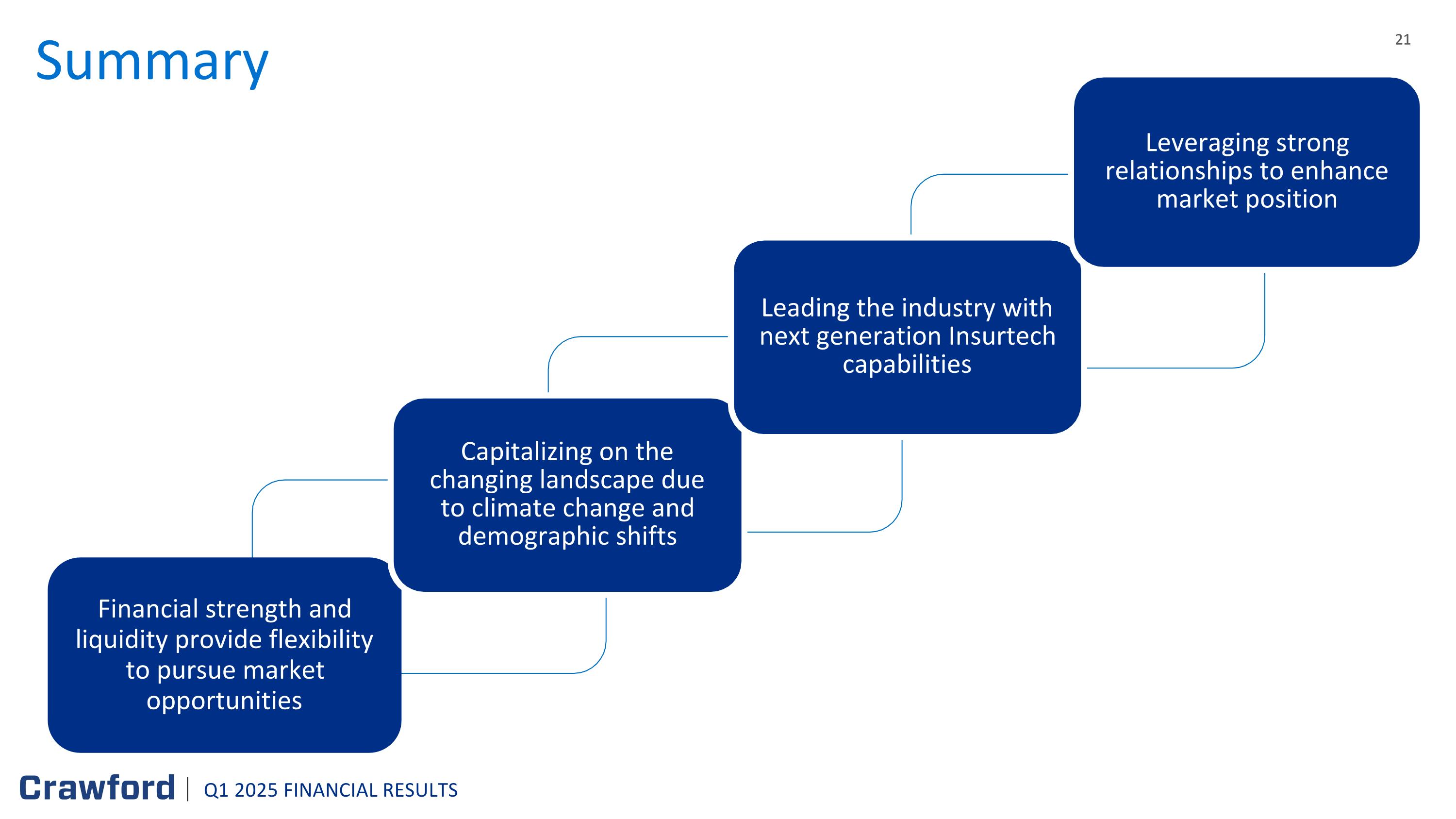
Thank you, Bruce. As we move through 2025, we're focused on continuing to drive revenue growth and profitability. Our balanced portfolio of weather and non-weather businesses, combined with investments in both our people and technology, position us well to deliver long-term value. We maintain a disciplined focus on cash generation and financial strength to ensure we are well prepared to endure potential economic headwinds while supporting our clients and delivering shareholder value. I want to take a moment to thank our partners and clients for their continued trust and collaboration. Most importantly, I'd like to recognize our dedicated team around the world. Your hard work and commitment to excellence continue to drive our success. Thank you for your time today. John, please open the call for questions.
Operator
Yes, sir. Thank you. Ladies and gentlemen, we will now begin the question and answer session. At this time, if you'd like to ask a question, please press the star, then the number one on your telephone keypad. To withdraw your question, please press the pound key. If you're using a speakerphone, please pick up the handset before asking your question. We'll pause for a moment to compile the Q&A roster. One moment, please. Thank you. And we now have our first question.
Operator
This comes from Mark Hughes from true is airline is now open please go ahead and ask your question yeah thank you good morning morning mark good morning mark the uh gts up 12 could you talk a little bit about the components of that growth how much was staff additions how much might be i think you mentioned more engagement and new wins. How is that market evolving?
Mark, as you know, that has been an area of growth for us for the last close to five years. And we've almost tripled that business in the last five years. We've had growth from both dimensions, both from getting more experts. As we get more experts, we win greater trust from our clients to win more business from them. And as a result, we get more nominations so it's sort of been a flywheel effect for us and as we continue to win more business it creates more eminence about our capabilities across the world and we attract even more business and we attract even more experts so it's kind of hard for me to break it down as to you know what percentage of that growth comes from one or the other because they're they're deeply interlinked now yeah what's your sense of how much more those sort of high value claims are being outsourced by insurers now versus a couple of years ago? Well, I definitely think that there is an increase, and I'll talk about it across sort of two axes. I think one axis of the increase comes from just the general, you know, increase in complexity of risk around the world. If you had, you know, $1,000 billion buildings in a certain country in Europe, that may be now you know 1100 right so so I think you're just seeing an increase in the complexity and level of risk that's one the second axis really is the complexity of risk placement so what used to be a single carrier placement so you know a carrier was completely open to taking a 25 or 50 million dollar TIV just on their books because of what's happening with with the loss profile and reinsurance rates there now it's now become a layered business and when it becomes a layered business or a shared business where you've got multiple participants, it tends to require some form of an independent adjuster. And we've certainly seen an increase in that because of what's happening in the property market. So those are probably the two axis on which we've seen the increase. And I expect that to continue for the foreseeable future.
Operator
Yeah, very good. How about in the broadspire, the top line growth opportunity, You had a very strong growth at this time last year. Are you seeing as much business coming up for bid in your – and how has your success been on that? Just sort of curious on what's influencing the growth rates in Broadspire.
Yeah, what I would say is that we've actually seen a pretty healthy round of new business that we won in the first quarter. As you know, there is a lag between winning that business and then actually the business starting to show up as we bring those clients on board. And that's remained pretty healthy. As a matter of fact, I think Bruce alluded to that, that we had a small downtick in the broadspire margin, and that was really because of advanced staffing. So we know that new business is coming. We've already won the business. So we are doing anticipatory staffing for that. So we don't see a slowdown in the growth of that business. We've had a pretty solid retention for the year as well, for the quarter as well, which was at 97.5%. So we feel that, you know, there's still a lot of growth to come in broad spot.
Operator
Very good. Anything there on workers' comp claims frequency or severity? Anything that might be happening on the medical front that you're seeing influencing the costs for your clients? Just always looking for any kind of inflection or change, and maybe some are suggesting a little bit of an inflection here. Anything in your book on workers' comp that points one way or the other?
You know, Mark, we haven't observed anything which has caught our eye in terms of a change. As you know, we've been growing, so we've just seen an increase in our activity from I think we had reported maybe a year ago, maybe a year and a half ago, that we had seen a slowdown in the medical management piece after COVID, but that's sort of come back and come back to the levels that I would say is in line with pre-COVID. We are absolutely seeing greater engagement with our clients on how to manage the outcomes better and how to manage costs better. And that's where our technology team has been spending quite a bit of time with clients in, you know, what can we do with the various predictive models, with AI analytics, things like that, with machine learning, to see how we can get better outcomes, whether it's in terms of return to work, medical payment management, or just other factors, as you know, that drive the workers' comp from claims costs. And then one more, if I might, you'd mention how weather activity picked up in March. that was helpful but kind of late in the quarter i think you talked about that within the context of platform solutions yeah um do you think that will that flow through into uh 2q yeah and mark we're seeing and sort of we're observing something and it's uh it's a hypothesis that we've tested with some clients and there seems to be some validity to that hypothesis um there is definitely a challenge with um with affordability of insurance um that's happening today in various States, and you're pretty familiar with that. What that's resulting in is the general under reporting of claims for what our hypothesis is for two reasons. One, the deductibles are higher, so because of insurance affordability, policyholders are taking higher deductibles as a result of that many claims during a storm season that we would have seen, were not seeing as much because of the high deductible. And then second, because of the potential macroeconomic headwinds, we believe a lot of policyholders don't want an increase in their insurance costs if they file claims or use their funds towards something that may have been cosmetic from a storm damage. So those sort of two or three things, we believe, are the big factors in which we're seeing underreporting of claims. I mean, what we would see is claims from a typical weather event like what we saw in March, we're not seeing the same level. And our carrier clients are telling us that, you know, they're seeing, you know, 20 to 30 percent drop in those reports as well.
Interesting. Okay. Thank you very much. Thank you.
Operator
Thank you. And the next question comes from Kevin Stink from Farrington Research. Your line is now open. Please go ahead.
I want to start off by asking about international continued revenue momentum there. You mentioned double-digit growth across several of your markets, and you mentioned pricing as well as higher value services. So maybe if you can delve a little bit more into the drivers there, and I was particularly interested in the comment about higher value services.
Yeah, the higher value services is more around the GTS kind of work that we've been doing, and that's been growing. I mean, we've seen, as you know, we've had some struggles in our Asia market. that has started to come back more because we've been investing there in GTS like talent or high complexity talent. Look, we feel very good about our international business. We've been through a transformation cycle. It took us a better part of three years, really, to transform that business. We've gone through management changes. We've gone through repricing of some of our client programs. We've gone through adding additional teams, as you know, in Netherlands and most recently in Spain and other parts of the world. So we believe that we've been on this transformation trajectory. Kevin, you will recall that our European business and our international business broadly was hit pretty severely after COVID because a big portion of our business was related to travel and entertainment. And since then, we've been working on diversifying that book. I'm really pleased to see the work that our TPA teams have done internationally and as well as our loss adjusting teams that have worked really hard to to win larger clients to get nominated on larger loss adjusting programs and then also on much better priced TPA programs so those have been the big factors that have been driving internationally and then I think the leadership change and the management changes that we've made, they've also had a pretty significant impact. I mean, we have a newer leader in Europe, we have a newer leader in the UK, we have a newer leader in Australia, a newer leader in LATAM, and then a newer leader in Asia. So you pick any of our regions, over the last three to five years, we've gone through leadership changes there, and Andrew Barth, who runs our international business, is doing a spectacular job of running the unit.
Okay, great. Yeah, that's helpful color. And you mentioned there GTS helping growth internationally. Yeah, I've always thought of GTS more as benefiting North America loss adjusting, but how meaningful has the addition of GTS adjusters been within international?
Yeah, look, the substantive growth in GTS has definitely come in the U.S. As you heard me talk to Mark about it, the business that we've tripled in the last five years has certainly been in the U.S. But, you know, that should not sort of suggest that we haven't made progress internationally. I would say that UK has done a great job bringing in more GTS and specialty business, same thing in Europe and same thing in Asia, as well as Latin America. So I would say that we benefit from GTS across the world for the factors that I was talking about earlier, which is the complexity of the risk continues to go up, complexity of the risk placement continues to go up. And as we establish ourselves as the destination for experts, we also then establish ourselves as a destination for complex claims to come through. So, you know, I don't have an exact number that I can give you right now in terms of what's been the growth for GTS internationally, because it's not something that we track that way, because we track things more at a country level. But I can tell you that, you know, GTS has played a pretty significant role for us, growing not just in North America, but across the world.
Okay, great. And so, you talked quite a bit in your prepared remarks about the focus on improving operating leverage for the company overall. So, maybe if you can touch on some of the initiatives there, and you also seem quite pleased with the improvement in the platform solutions, margins, and operational efficiencies there. So, just maybe if you can touch on some of the factors driving operating leverage.
The biggest factor driving operating leverage for us has been process improvements and then translating those process improvements into inter technology implementations we are as you know we've maintained you know anywhere from 25 to 35 million in capex over the last several years that has all been invested in improving our systems landscape we are slowly moving as an example on international operations to almost one or two loss adjusting systems from probably eight or 10 of them. Similarly, our TPA business, which has been running on several systems, we are slowly moving for our non-North America business, or I should say international business outside of North America, to one TPA system. Those are all things that we're doing. We're looking at our entire technology landscape, both from a IT simplification, but also from a process simplification lens. And I believe that, you know, that will start to show stronger results in terms of our operating leverage in months and in quarters to come.
Okay, great. I think that's all I have for now. I'll turn it back over. Thank you. Thank you, Kevin.
Operator
Thank you. And we don't have any further questions at this time, so I will turn the call over back to Mr. Rohit Verma for closing remarks. Please go ahead, sir.
Thank you, John, and thank you to all our employees, clients, and shareholders for your continued commitment to Crawford. Thank you, and God bless.
Operator
Thank you for participating in today's Crawford and Company Conference call. This call will be available for replay beginning at 11.30 a.m. EST today through 11.59 p.m. EST on May 13, 2025. The conference ID number for the replay is 27578-HASH, and the number to dial for the replay is 1-888-660-6264. Thank you. You may now disconnect.