Operator
Greetings, and welcome to the Digital Bridge Grouping Third Quarter Earnings Conference Call 2025. At this time, all participants are in a listen-only mode. A brief question and answer session will follow the formal presentation. If anyone should require operator assistance during the conference, please press star zero on your telephone keypad. As a reminder, this conference is being recorded. It is now my pleasure to introduce your host, Severn White, Managing Director, Head of Public Investor Relations. Thank you, sir. You may begin. Good morning,
everyone, and welcome to Digital Bridges' third quarter 2025 conference call. Speaking on the call today from the company is Mark Danzi, our CEO, and Tom Meroffer, our CFO. I'll quickly cover the safe harbor. Some of the statements that we make regarding our business operations and financial performance may be considered forward-looking, and such statements involve the number of risks and uncertainties that could cause actual results to differ materially. All information discussed on this call is as of today, October 30th, 2025, and Digital Bridge does not intend and undertakes no duty to update it for future events or circumstances. For information, please refer to the risk factors discussed in our most recent Form 10-K filed with the SEC for the year ending December 31st, 2024, and our Form 10-Q to be filed with the SEC for the quarter ending September 30, 2025. With that, let's get started. I'll turn the call over to Mark Anzi, our CEO. Mark. Thanks, Severn, and welcome everyone to our third quarter
2025 business update. We appreciate you joining us on the call and look forward to answering your
questions. Let's get to the quarter. So this quarter really exemplifies what we've been
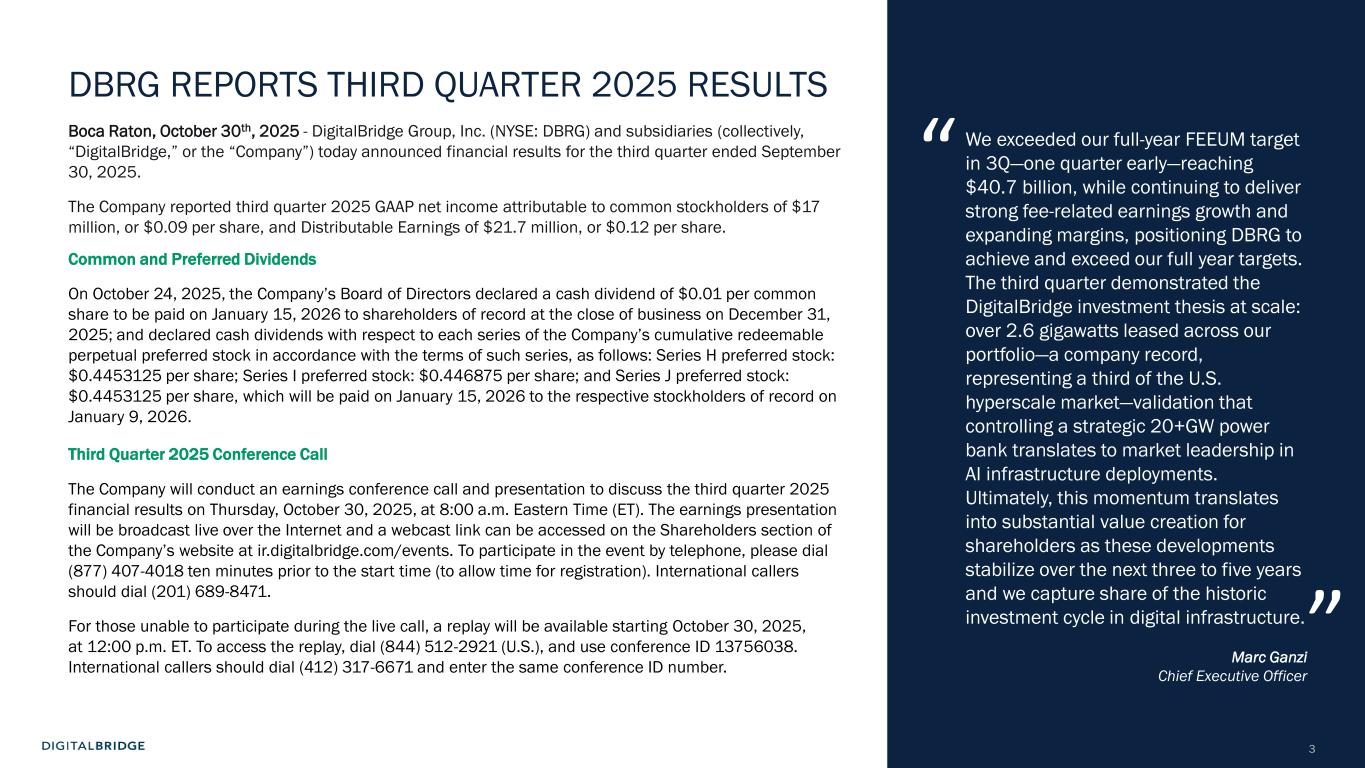
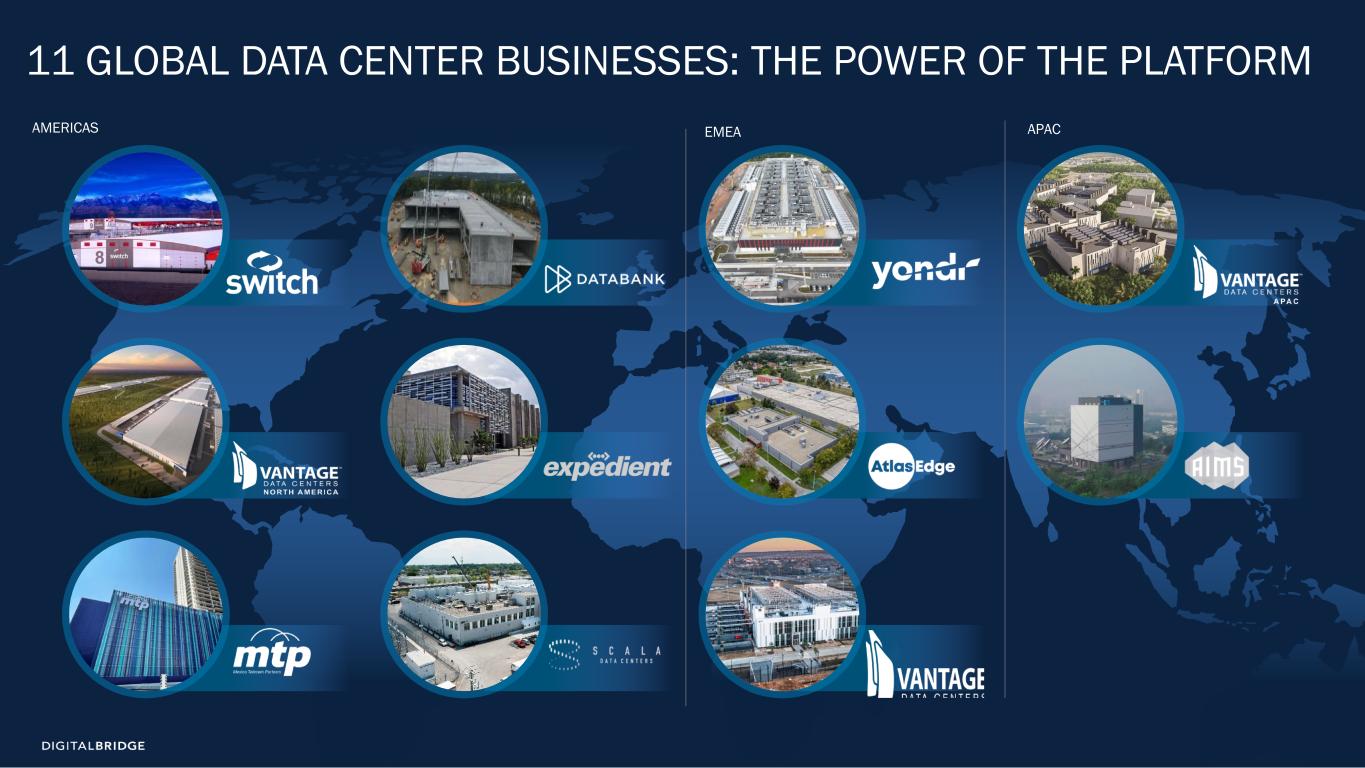
building towards at Gingerbridge. From our near-term financial goals to our longer-term strategic priorities. Let's get started with the key highlights that align with our strategic roadmap. First, financial performance. Digital Bridge delivered another quarter of our best growth with fee revenues reaching $94 million, up 22% year-over-year. Our fee-related earnings grew 43% to $37 million in the third quarter, reflected continued margin improvement as revenue growth continues to outpace expenses. Second, capital formation. It raised $1.6 billion in new capital during the quarter, bringing our year-to-date to $4.1 billion. And look, we're well-positioned thinking through the fourth quarter here as we remain on track to meet our full-year objectives. And as most of you know, the fourth quarter is historically our strongest quarter. Finally, and this is the most important story of the quarter, the relevance and strategic value of our power bank was on full display. We saw record data center leasing activity across our portfolio that will build and accrue significant value for you, our investors, over time. Our portfolio company, Vantage Data Centers, announced the Frontier Megacampus in Texas, a $25 billion, 1.4 gigawatt development, serving the leading AI infrastructure build-out. This was sold out by a second campus, dubbed Lighthouse in Wisconsin, a $15 billion-plus development to support the expanding OpenAI and Oracle Stargate project. These landmark transactions demonstrate that our years of securing power across the portfolio are now translating into the largest leasing commitments in data center history. I talked about it last quarter. Having a power bank that is ready to go for our customers is comparative advantage. Let me put this quarter's performance in a broader context. Continued financial performance in capital formation that advances us towards exceeding our full-year objectives. But what makes this quarter truly distinctive is how our strategic positioning around power is creating differentiated outcomes at the portfolio level. For years, we've talked about the importance of power as the critical constraint in the AI era. Today, we're seeing that thesis play out in real time, and DigitalBridge is leading from the front. Next page, please. As I've referenced, near-to-date capital formation of $4.1 billion positions the firm to surpass our financial targets. We achieved our $40 billion FEM target one quarter ahead of schedule, reaching $40.7 billion as of the third quarter. This milestone that reflects both the strength of demand for digital infrastructure and the execution capabilities of the DigitalBridge global platform. The record FEM today translates directly into revenue and earnings growth. we're seeing particularly robust activity in co-invest where third quarter few rates continue to expand relative to historic levels up to 70 basis points in q3 i talked about this earlier this year in multiple quarters we're very focused on expanding margins in our co-investment program and we're getting it done that's the key we're executing we're finalizing our flagship strategy capital formation targeting over 7 billion in the next few weeks as we head into the end of the year our focus has pivoted to the second credit strategy and our new offerings in power, stabilized data centers, and private wealth that will drive our 2026 capital formation. Having a new product pipeline that sets you up for success is really what it's about in terms of being an alternative asset manager where we have a multi-strategy platform. This is the full effect of DigitalBridge as a full alternative asset manager. This is on display for all of our investors as we push forward into 2026. Next slide, please. Now, I want to talk about a key component of our private wealth strategy, the partnership we announced with Franklin Templeton in the third quarter to launch our first programmatic private wealth distribution channel. At its heart, the partnership is about democratizing access to institutional quality, differentiated digital, and energy infrastructure investments that were previously reserved for institutions. Franklin Templeton is a $1.6 trillion global investment leader, and their CEO, Jenny Johnson, has prioritized this initiative as growing alternative investment portfolios. Importantly, Franklin Templeton are building a diversified, open-ended infrastructure solution that will have the ability to invest across all infrastructure subsectors. They intend to compete head-on with the mainstream supermarket asset managers. On our side, we're bringing our $100 billion-plus in assets under management, and our position is the leading digital infrastructure specialist across data centers, cell towers, fiber networks, digital energy, and edge infrastructure. We're partnering with our friends at Copenhagen Infrastructure Partner, the world's largest dedicated Greenfield Energy Fund Manager with $37 billion in AM, and Actis, backed by our friends at General Atlantic, with their deep, sustainable infrastructure expertise. And for their part, Franklin will focus their accredited investor product on the mass affluence segment in the market, a difficult segment to access without significant investment in sales infrastructure. They have a sales force of over 600 people, giving them strong distribution capabilities and reach. The strategic rationale here is compelling. Together, we're focused on a massive investment opportunity. There's a $94 trillion global infrastructure need by 2040. We're positioned at a pivotal inflection point as AI, electrification, and connectivity megatrends accelerate infrastructure demand. Now, why does this matter for you, our Digibit shareholders? Look, first, there's three reasons. One, evergreen capital. This is an incremental source of capital and FEM that layers over time in a long-duration structure. Second, it's an earnings contributor. Fee revenues convert to fee-related earnings as the platform scales. And then third, earlier carry realization. The potential private wealth carry is paid as accrued earlier than our traditional institutional structure. This partnership launches exactly at the right time and it supports our strategy of building a multi-channel approach to wealth sales. It enables us to reach multiple client segments across the broader wealth universe. There's a secular migration of wealth management allocations to private infrastructure. This is happening. The institutional quality solutions we're designed are meant to provide stable inflation-linked cash flows with resilience through economic cycles. We're capturing what we believe is a massive opportunity, and Franklin Templeton gives us distribution platform and private wealth client access to do it at scale, and that's the key component, that we're doing this at scale. Next slide, please. Let me bring this all together with what I believe is the defining characteristic of the Jeter Ridge portfolio today, our power bank. And to be credible and to be honest with our customers today, if you don't have a power bank, you really can't have a conversation in terms of leasing megawatts and gigawatts. Last quarter, I highlighted this. We have over 20 gigawatts of total secured power across our data center portfolio. That's not a projection. That's actual power that we can access. It's critical to understand that, that this is not a hope dividend or something that we're trying to accomplish. This is power that exists inside of existing land, existing facilities, existing campuses with our 11 existing platforms. In the third quarter, we put that power bank to work and leased a record 2.6 gigawatts across the Digibridge portfolio. To put that in perspective, that represents one-third of total record U.S. hyperscale leasing for the quarter, one-third. That's not market share. That's market dominance in the most important segment of the data center industry today. Here's what it means in practical terms. When the world's largest technology companies need to deploy AI infrastructure at scale, they come to our portfolio companies. They come because the portfolio companies have a long track record of delivering for them and because they've got the power. And in today's environment, power is everything. You cannot build a one gigawatt AI campus without one gigawatt of power. It's just that simple. Ultimately, the 2.6 gigawatts of third quarter leasing translates directly into new capital formation, fee revenues, and carried interest and long-term value creation. These are decade-plus contracts with investment-grade counterparties. The revenue visibility is exceptional, and the returns are improving relative to what we underwrote when the power was originally sourced. So, as you think about Digital Bridge's positioning today, think about it this way. One, we have the power. Two, we have the platforms. Three, we have the customer relationships. And four, we are executing. That combination is creating outcomes that very few firms in the world can deliver. I would argue we're actually the only firm that can deliver it on a global basis. and we're only in the early innings of this cycle. I cannot be more excited about this development. Again, this has been set up. This has been our conversation with you, our investors, for the last three quarters. How would we translate this 20-plus gigawatt power bank into comparative advantage? This is as easy as you can see it for investors today. We have the capability, we have the advantage, and we're executing. Next slide, please. Now, let me put the PowerBank into broader context of what we're building across the entire DigitRidge portfolio. Look, across our 11 data center platforms, we're deploying significant capital to support the growth of the AI ecosystem on a truly global scale, catalyzing development from hyperscale to private cloud to the edge, spanning North America, Europe, Asia Pacific, and Latin America. And the key to this is, it's a customer-driven investment model following the logos to where the hyperscale, enterprise, and cloud customers are demanding capacity. In North America, Switch, Vantage, Databank, and Expedient are each scaling to meet differentiated customer segments. From the largest hyperscale AI workloads to enterprise edge computing. In Europe, Vantage Amia and Yonder, our newest platform, is building out critical capacity across multiple markets. Vantage Asia PAC and Ames are positionings for rapid growth in Asia Pacific, while Scala continues to lead in Latin America. And Atlas Edge is capturing the emerging opportunities at the intersection of connectivity and compute in Europe, where inferencing will come into full focus in the next decade. We have the products for every type of workload. And we have the products for every type of workload in every geography. This is by far the most unique and differentiated data center platform in the world. What makes this powerful is the diversity and complementary of these platforms. We're not a one product shop. We have the right platform for hyperscale GPU compute, for private cloud workloads, for enterprise co-location, edge infrastructure, and of course, now we move to inferencing. That breadth means we can serve the full spectrum of AI infrastructure demands. And it means our customer relationships deepen as their core requirements evolve. And that's what I love. I love evolving with customers. Just like we did 30 years ago when we evolved with towers from analog to digital and to multiple different technologies over the last few decades. We're capturing that same business model with our customers today in data centers. The capital we're deploying across these platforms is measured in tens of billions of dollars over the next several years. It's directly tied to contracted customer demand and secured power positions. This is DigitBridge's competitive advantage at scale, a global platform with local expertise backed by institutional capital following customer demand and enabled by our market-leading power bank. So, with that exciting overview, let me turn over the call to Tom to walk you through the financial details, and I'll come back later to wrap it up. Tom?
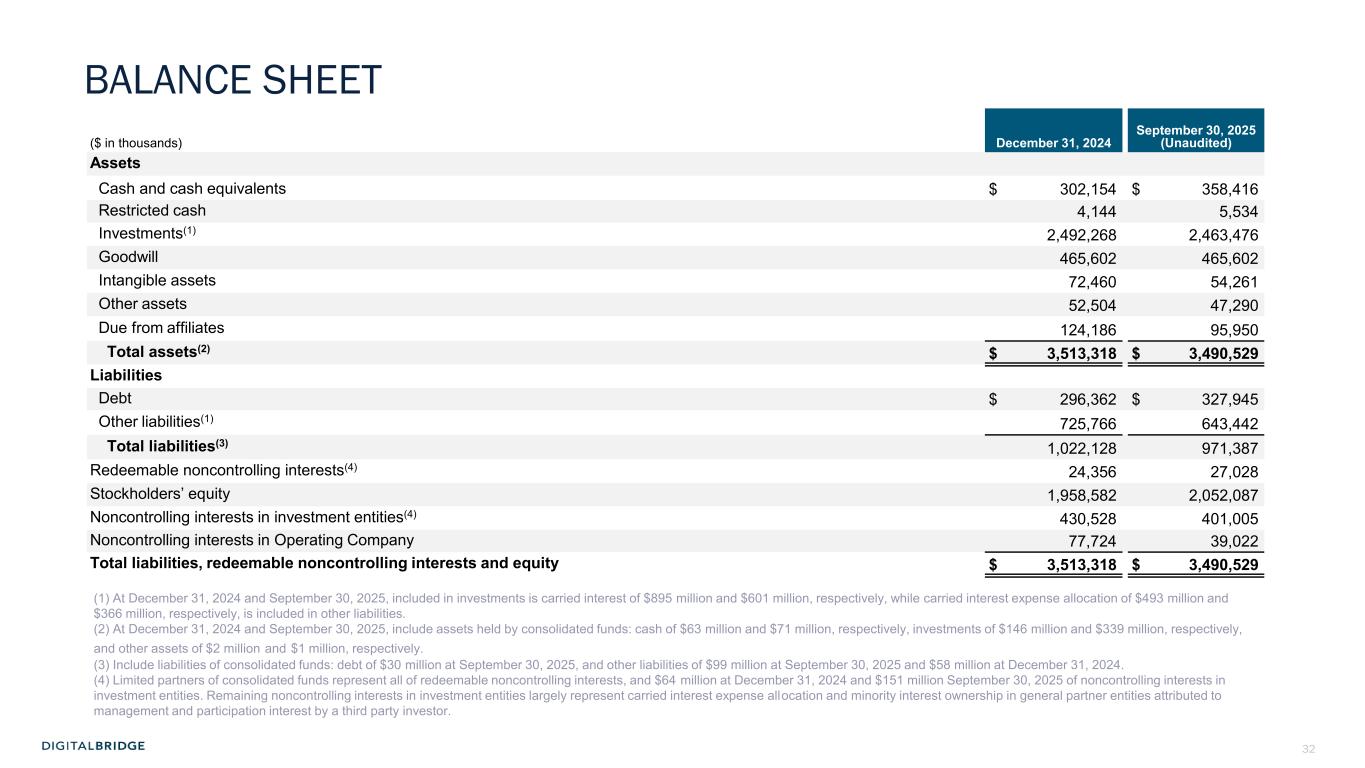
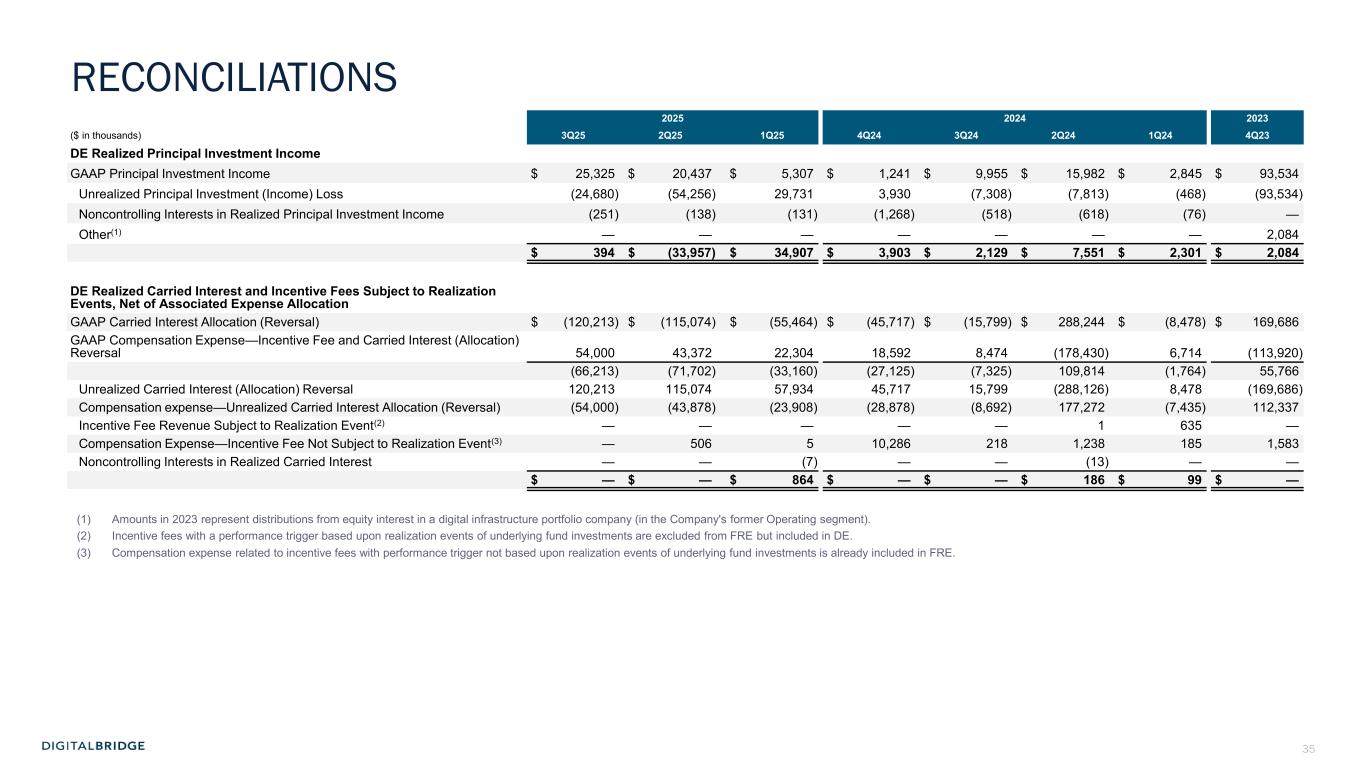
Thanks, Mark, and good morning, everyone. As a quick reminder, the full earnings presentation is available within the shareholders section of our website. As Mark discussed, we had an exceptionally strong third quarter, supported by continued capital formation in our flagship fund series, which generates high-margin catch-up fees. Throughout my remarks, I'll highlight the impact of these catch-up fees in order to provide a baseline for our prospective performance once we complete the fundraise for our current flagship fund in the fourth quarter. Starting with the financial highlights, in the third quarter, we recorded $93 million of fee revenue, representing an increase of 22% over the third quarter of 2024. Our fee revenue this quarter benefited from the cumulative effect of organic growth in our fellowship fund series and co-investments over the last 12 months, with an $8 million contribution from catch-up fees in the third quarter. This growth in fee revenue resulted in $37 million of FRE in the quarter, an increase of 43% over Q3 of last year, and putting us on track to hit or potentially exceed the top end of the range for our 2025 full-year FRE guidance. Excluding catch-up fees, FRE for the quarter would have been $29 million, an increase of 36% year-over-year. Growth in FRE resulted in distributable earnings of $22 million for the quarter, representing a double year-over-year. As of quarter end, our available corporate cash was $173 million, providing material liquidity and flexibility for us as we continue to evaluate both our capital structure and opportunities to invest in and grow our business. We also currently hold $54 million of warehouse investments on our balance sheet to support the launch of new power and private wealth strategies, which we expect to recycle over the next year as we raise third-party capital for these products. Moving to the next page, fee earning equity under management increased to $40.7 billion as of September 30th, representing a 19% increase from last year. This growth is primarily driven by capital formation in the DBP series and co-investments, as well as fees activated upon deployment of previously raised capital. We closed $1.6 billion in new fee earning commitments during the quarter, led by strong co-investment activity and new commitments to our latest DVP flagship fund. Turning to the next page, which summarizes our non-GAAP financial results. As mentioned earlier, we reported $93 million of fee revenue in the quarter, representing growth of 22% over the same quarter in the prior year. Our LTM FRE margin was 38% as of the third quarter. We expect FRE margins to remain elevated through the final close of our flagship fund in the fourth quarter of 2025, supported by the continued contribution from Catch-Up Bees. Moving to the next page, which summarizes our carried interest and principal investment income, we reported a $20 million reversal of carried interest during the quarter. As a reminder, the company accrues carried interest based on quarterly changes in the fair value of our fund investments. As discussed previously, many of our vehicles are in the early to middle stages of their life cycle and have not fully worked their way through the J-curve to be entirely clear of the preferred return. So at this point in their life cycle, small changes in the fair value of the fund assets can have an outsized impact on the quarterly accrued carry interest that we report, including causing reversals, as we've seen this quarter, in periods when the appreciation in the portfolio does not exceed the preferred return hurdle for the quarter. As we've discussed in prior quarters, carried interest compensation expense tracks these changes, and therefore there was a commensurate reversal of a portion of the unrealized carried interest compensation this quarter. Principal investment income, which represents the mark-to-market on the company's GP investments in our various funds, was $25 million. Turning to the next page, this chart continues to highlight the stability and consistency in growth, both in revenues and margin that we've experienced over the last two years. We've included this quarter FRE metrics, both gross and net of catch-up fees, given the more meaningful contribution from catch-up fees this year as we close out the fundraising period for our most recent DVP fund. LTM margin, excluding catch-up fees, has grown to 33% as of September 30. This quarter we saw $1.1 billion of FEM inflows, a significant portion of which was related to the activation of fees on previously raised co-investment capital. These inflows were partially offset by approximately $100 million of outflows. Finally, the company continues to maintain a strong balance sheet with approximately $1.7 billion of corporate assets, largely reflecting our material investments alongside our limited partners and available corporate cash. We're pleased with our results through the first three quarters of the year, and we're very excited about the opportunity set that we see ahead of us, both in our core business and some of the new initiatives that we're working on. With that, I'll turn the call back over to Mark.
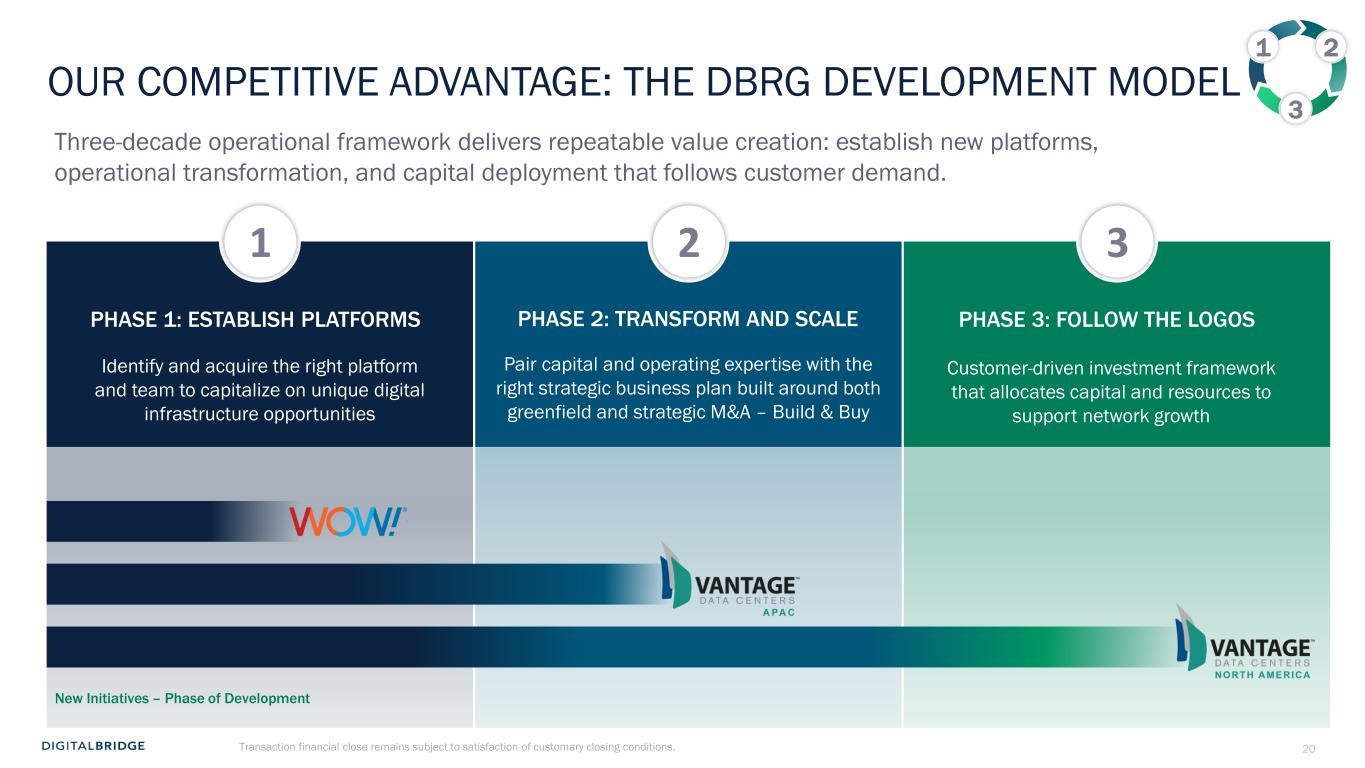
Thanks, Tom. Now I want to shift gears and talk about our investment activity and how we're creating value at our portfolio companies. As a reminder of the framework we outlined last quarter, our competitive advantage is built on a three-decade operational framework that delivers repeatable value creation. The Digit Ridge Development Model has three phases. Phase one, we establish platforms. We back great CEOs. We build great companies. we identify and acquire the right platform and the team to capitalize on unique digital infrastructure opportunities this is about pairing capital and operating expertise with the right strategic business plan around both greenfield development and strategic mna you've heard me call it before this is the build and buy we move to the second phase which is about transforming and scaling once we have that platform we have the right team we execute operational transformation to improve margins, grow the business, and scale it efficiently. And then phase three, follow the logos. This is our customer-driven investment framework. We allocate capital and resources to support network growth where our customers are demanding that capacity. We don't build data centers or cell towers or fiber networks on spec. Never have. Haven't done it in 32 years, we wouldn't start now. We follow the logos. We go to where Microsoft or Oracle, any of the hyperscalers, are telling us they need capacity, and we show up for them with strong intention and execution. This framework has delivered repeatable value creation for three decades, and it's what's driving the results you're seeing at Vantage, Databank Switch, and our other platforms today. We've been applying this playbook consistently, and it works. It's worked for a long time now. Let me take you through several new initiatives and transactions that demonstrate this model in action. Next slide, please. In September, we announced that GIC and Adia, both existing Vantage partners, are investing $1.6 billion to scale Vantage Asia-Pacific platform to one gigawatt of capacity. This investment supports the Johor campus acquisition and broader regional expansion across five markets. So, let me unpack that for you and why it really matters. Singapore used to be a traditional data center hub in Southeast Asia, but land, power, and regulatory constraints had led to a moratorium at one point, and that leads to limited growth. Now, along comes Johor, just across the border in Malaysia, has emerged as a natural overflow market, much like we executed that strategy in Reno, Nevada, when it became clear to us that Santa Clara had the same type of issues. So it offers lower cost, proximity to Singapore, less than one millisecond, and dark fiber connectivity to the Singapore hub. So from a customer's perspective, it functions almost like an extension of Singapore, but with better economics and available power. This sounds really familiar, doesn't it? This is exactly what we did with Switch and Reno, where we have today over 1.8 gigawatts of compute available for our customers in Reno. We're running that same playbook here in Johor. The APAC data center market is growing at double-digit growth rates and is expected to reach $77 billion by 2030. 72% of organizations tie their data strategy directly to AI initiatives, which means the demand for data center capacity in the region is only going to accelerate. So, again, using the same playbook, we brought in new leadership last year to position the region for growth. Jeremy Deutsch joined as the president of APAC in October 2024. He previously served as the president of APAC at Equinix, an organization that we have a lot of respect for, with over 20 years of operating experience. He expanded Equinix into five countries during his tenure and was the inaugural chair of the Asia-Pacific Data Center Association. Jeremy is exactly the kind of world-class operator I love partnering with, and I'm looking forward to building this platform with him. He's doing a great job for us. The strategic growth drivers here are clear. Singapore's spillover demand creates a natural customer base. AI fuel demand is accelerating across the region, and we're positioned with the right platform, the right leadership, the right capital partners in GIC and Adia. The investment's expected to close in the fourth quarter of 2025, and it represents another example of how we're following the logos in the key markets, not only in Johor, but of course, Kuala Lumpur, Melbourne, Sydney, Osaka. These are the growth markets for AI in Asia. Our hyperscale customers are telling us they need capacity in the region, and we're getting ready to set to deliver to that at scale. Next slide, please. Let me talk about two landmark developments that demonstrate the power of our strategic positioning. Manages Frontier and Lighthouse mega campuses representing a combined 40 billion investments and over 2.4 gigawatts of GPU compute capacity. What you're seeing here in Digibridge backing the build-out of an entirely new generation of compute infrastructure. The AI revolution requires fundamentally different infrastructure than what the cloud era demanded. Higher power density, different cooling technologies, and most importantly, access to power at gigascale. These campuses represent our response to that transformation. Both are long-term contracted. Pre-lease facilities, not speculative development. We have long-term commitments from Oracle, OpenAI, and leading cloud providers. The revenue visibility is exceptional, the returns are attractive, and the strategic importance to our customers is undeniable. This is DigiBridge enabling the infrastructure backbone for the most advanced AI workloads in the world. Frontiers in Texas, $25 billion across 1,200 acres in Shackleford County, delivering 1.4 gigawatts of ultra-high-density racks supporting 250 kilowatts and above. Lighthouse, up north in Wisconsin, represents $15 billion delivering one gigawatt, with potential for more for the Stargate program distinguished by the development of new renewable capacity, the largest behind-the-meter renewable commitment in the United States today. Together, these projects create over 9,000 jobs, represents billions in regional economic impact. But more importantly to our investors, they demonstrate that DigiRidge has the capital, the expertise, the customer relationships, and the power positions to support infrastructure development at scale, but very few platforms in the world can match. Construction is underway, with the first deliverables beginning in the second half of 2026. These are mission-critical facilities for some of the most important AI initiatives in They validate our thesis that controlling power and backing world-class operators creates differentiation and creates value in the AI area. We're very excited about these two developments, and it really catalyzes a lot of hard work. Congratulations to Surreal and the Team Advantage.
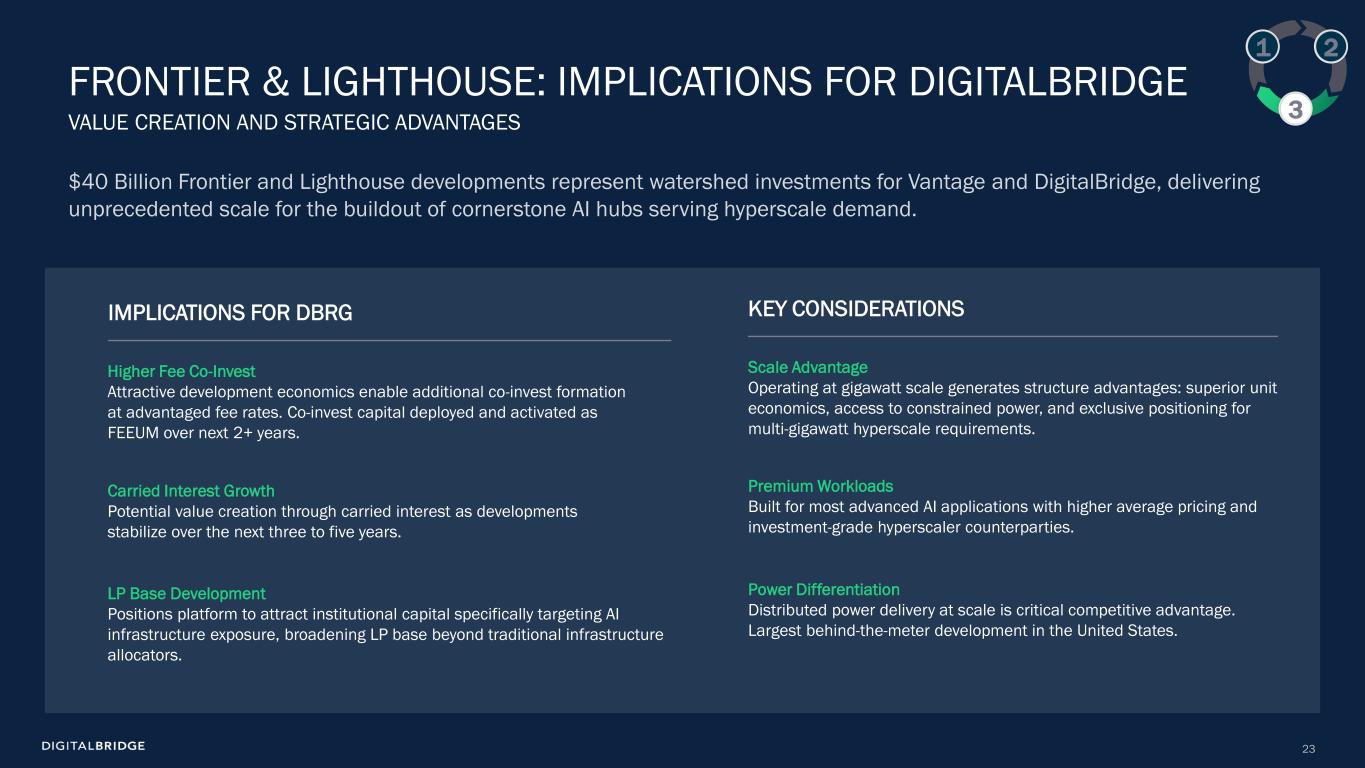
So what do Frontier and Lighthouse mean for Jitterbridge shareholders? Well, let me spell it out because this is where the value creation happens. First, IRF Co-Invest. The attractive development economics of these projects enabled us to raise additional Co-Invest capital at advantage fee rates. we're deploying and activating that co-invest capital as fiem over the next two plus years which means growing fee streams for the projects and for you our shareholders second carried interest generation we're expected to create significant value through carried interest as these developments stabilize for the next three to five years think about the math we're investing in these projects at development yields they're going to stabilize at much higher valuation and the appreciation flows has carried interest to DBRG and our shareholders over the next few years. Third, developing our LP base. These projects position our platform to attract institutional capital, specifically targeting AI infrastructure exposure. This broadens our LP base beyond traditional infrastructure allocators to include technology-focused investors, sovereign wealth funds focused on AI, and other pools of capital that are specifically interested in the sector that have not yet entered. Now, let me talk about the key strategic considerations because that's what creates our competitive advantage. First, scale advantage. Operating gigawatt scale generates structural advantages, superior unit economics, access to constrained power, and exclusive positioning for multi-gigawatt hyperscale requirements. Our customers cannot get this kind of scale from anybody else. Second, premium workloads. These campuses are built for the most advanced AI applications. That means higher average pricing and investment grade hyperscale counterpart. This is the best risk-adjusted business you can do in real estate today. Third, power differentiation. Distributed power delivery at scale is our critical advantage. Frontier represents the largest behind-the-meter power development in the United States today. That didn't happen by accident. That happened because we've been working on power for years. We talked about in our last earnings call the power of our partnership with Arclight, our digital power strategy, and what we're doing to ultimately put power back into the grid and base look. Together, these $40 billion developments represent watershed investments for Vantage and for Digital Ridge. They deliver unprecedented scale for the build-out of cornerstone AI hubs, serving hyperscale demand. And they demonstrate better than anything I could say in a prepared remark about our power bank strategy is working. I don't need to talk about it. This is the evidence. This is on display. Next slide, please. So, let me close by putting it all together in terms of our context for our 2025 priorities and where we stand heading into the final quarter of the year. And what we delivered year to date, we're achieving organic growth with management revenue and pre-related earnings, both up 20% year over year, even excluding the impact of catch-up fees. We achieved our FEM target one quarter early, seeding our 2025 target in the third quarter, and we're tracking to meet or exceed our 2025 metrics on FRE and margins. We launched new investment strategies and channels, specifically our programmatic private wealth strategy of Franklin Templeton. We've continued to maintain a strong balance sheet and liquidity with over $170 million in corporate cash and a growing asset base. And we've delivered breakthrough record leasing across our global data center portfolio with 2.6 gigawatts in the third quarter and $40 billion in new development contractors. Looking ahead to our year-end priorities for the fourth quarter, again, we're focused on delivering and exceeding our 2025 financial metrics with FRE achieving or exceeding our guidance. We're formally launching our new general energy and stabilized data center strategies, and we're working to secure initial anchor commitments for one or both. We're building on our early private wealth momentum with targeted asset-specific investment opportunities, and we continue to evaluate strategic and creative M&A opportunities centered on adjacent asset managers. So let me wrap it up with the final thoughts before we go into Q&A. This has been an exceptional quarter for Digital Bridge. What a change a year makes from where we were a year ago in terms of our inability to meet our guidance to where we are today, which is, to be honest, a little bit on the front foot versus our back foot. Yes, we delivered the strong financial results, but this is beyond the numbers. You have to look through what we're doing here. The quarter really proves out my strategic positioning around power and AI infrastructure. And what it's doing is it's creating real, substantial differentiated value for our portfolio, their customers, and our investor base. Advantage announcements, Frontier and Lighthouse, represent over $40 billion of committed developments. These are not speculative projects. These are contracted, pre-release facilities with the world's leading technology companies. They're generating fee streams today. They'll generate carried interest tomorrow, and they will demonstrate that we are having and we've created capabilities that cannot be replicated. The Franklin Templeton Partnership opens up a new distribution channel to Evergreen Capital. The APAC investment positions us to be one of the fastest-growing global data center markets where we can grow in Asia Pacific with our key customers.
Look, I've been in this business for three decades, and I've never seen a more compelling
structural advantage than controlling power in the AA era. The demand is massive. The supply is constrained. And we're positioned better than anyone in the world to capitalize on this dynamic. The value that will accrue to our shareholders from this positioning over the next five to 10 years will be substantial. And I want to preface this by saying we're literally in the early innings. So, let's wrap it up. Super simple quarter, strong financial performance, record leasing driven by our power bank advantage, continued capital formation momentum, strategic expansion of our distribution channels, and a clear path to delivering on our long-term value objectives. We're executing our plan. I'm excited about what's ahead, and I look forward to updating you on our continued progress. So, with that, let's open up the line for questions. Thank you very much.
Operator
Thank you. We will now be conducting a question and answer session. If you would like to ask a question, please press star 1 on your telethon keypad. A confirmation tone will indicate that your line is in the question queue. You may press star 2 if you would like to remove your question from the queue. For participants using speaker equipment, it may be necessary to pick up your handset before pressing the star keys. One moment, please, while we poll for questions. Our first question comes from Michael Elias with TD Cowan. Please proceed with your question.
Great. Thanks for taking the questions. And congrats to you and the team, including Surreal, on the massive leasing in the quarter. Great job. In the past, Mark, you've talked about $1.55 a share in carried interest for every gigawatt of data center leasing. Can you just help us understand when in the lifecycle of the data center that unrealized carried interest is recognized? Is it when it's leased or is it when it's delivered? And then also, I'm seeing more of these gigawatt scale deals on the market. I'm curious, as you think of your power bank, how would you describe your ability to take on more of these massive projects?
Thank you. Let's start with the last part of your question, then we'll come around to the front part. These gigawatt projects are really tough, Michael. And, you know, I don't think you're going to see tons and tons of them going forward. I think you're going to see more workloads kind of in that 350 to 800 megawatt, more bespoke, a bit more tailored. I think building these one-plus gigawatt campuses are really, really tough. I think it's tough from a capital information perspective. I think it's tough from a resource perspective. And I think a lot of the big, you know, gigawatt campuses for LLMs are being delivered now and will be delivered over the next three to five years. Because, remember, these things take about 24 to, you know, to 48 months to fully build them. What we are seeing an uptake in is in across all of our portfolio is this what I would call kind of 250 megawatt to sort of 500 megawatt workloads. You know, our sales funnel is is gotten a lot bigger in this quarter. We have over a seven gigawatt sales funnel right now. And so when you lease 2.6 gigawatts in a quarter and your sales funnel grows by seven, obviously you can start putting that math together that there's a lot of big, you know, chunky deals sitting in the pipeline. So our pipeline has gotten bigger. We delivered over a third of the leasing for the industry in terms of actual power delivered against our power bank. what was actually delivered by the industry, we probably delivered about 50% of actual delivery capacity in the quarter. So these metrics are important because we keep talking about the power bank and that 21 gigawatts of power. And so leasing another 2.6, delivering another two, I mean, this is hard to do. But again, when you start, we started over 10 years ago doing this. And so we've been able to really keep our pipeline moving and keep our delivery schedules moving. And that's what's giving us massive comparative advantage. So I think you'll see other really good quarters from us from a leasing perspective. I just think you're going to see more distributed compute. And as we move to inferencing, I think then you're going to see a whole generation of deals that are going to get done in that kind of 20 to 200 megawatt range, which will be in the sort of secondary markets, which follows what happened in public cloud. inferencing will really kick in and kind of, you know, 27 through 2032, as we're still building kind of big LLMs. So nothing kind of slows down. Actually, this quarter, we saw acceleration. So kind of the third time I've told you this is here, just when everyone thinks maybe there's a bit of a breather, we're not getting a breather, largely because we have this enormous, you know, power bank at these 11 portfolio companies that allows us to keep going. So, you know, for example, later last year, earlier this year, we were talking about some of the big deals that Switch was doing. Now we're talking about some of the big deals that Vantage is doing. Next quarter, maybe we're talking about Databank or Yonder or Scala. So we don't rely on one platform. I think that's what makes us pretty unique. And why investors need to own our stock is really simple because you don't have to hang your hat on one story. And there's a great, look, we have enormous respect for DLR and Equinix or great businesses, but those are, you're relying on one management team and you're relying on one pipeline. When you buy our shares, you got 11 teams crisscrossing the globe, focused on different types of workloads, different types of customer requirements, and most importantly, different designs in different locations. I like our bets when you play with 11 guys on the field versus one, it kind of gives you a really big leg up. And so that's why when you're looking at this 21 gigawatts and the 2.6 that we delivered, there's nobody even close in AI data centers to DigiBridge right now. We're playing the game at just a very different speed and at a very different scale. And this quarter really manifested that. And it will continue. I think you'll continue to see that out of us. Now, to your question around carried interest around the, you know, about 55 per gigawatt, you know, how do you realize that carry? to fully realize that carry takes anywhere from three years to five years. So, you know, some of that carry is accrued when you get the entitlements and you get the power. Some of that carry gets accrued when you sign the lease. Some of that carry gets accrued when you deliver the first data haul. Some of that carry gets accrued when you deliver the final data haul. And then some of that carry, well, all that carry gets realized if it ends up, if the data center ends up getting purchased, put into a continuation fund, gets acquired as part of a portfolio deal. And generally speaking, our modernization and our DPI track record in data centers goes back over four years ago. We started returning capital back to investors four or five years ago, whether it was our data bank continuation fund with Swiss Life, whether it was the North American Stabilized Data Center Co. or Valkyrie, the European Stabilized Data Center Co. We've been a consistent returner of capital to our investors, which then triggers carried interest. Now, the problem with DataBank and Vantage was those vehicles were outside of our funds and predated the colony mergers. So now as we get these other companies growing up, whether it's Scala, whether it's Switch, whether it's Vantage Asia Pack, these are now vehicles that sit in our funds. And as you know, Michael, roughly about 28% of the carry across our fund product sits with public investors. So that episodic nature of carried interest as we deliver these new facilities don't accrue just to the management teams, it now starts accruing to public shareholders. So all this hard work that we're doing now, we're accruing that carry, we're building it. But ultimately, we anticipate in the next 24 to 36 months to start delivering that carried interest out to our shareholders. In the meantime, the math is holding up. I think that's one of the key things that you could say with a straight face today is the arithmetic that we put in front of investors a year ago in terms of what a megawatt means, what a gigawatt means, that flow through to investors now is really quite clear. Really helpful caller. Congrats again,
Operator
guys. Thank you. Thank you. We're very happy, but not content. Our next question comes from Jade Ramani with KBW. Please proceed with your question. Thank you very much. What's your
overarching view on how the new data center projects achieve a stabilized capitalization given their size? Do you envision they will be owned long-term by a combination perhaps of large REITs, infrastructure funds, and hyperscalers themselves? It seems like the digital bridge structuring expertise could provide solutions to that eventuality. Yeah, thanks, Jay. Great to
hear from you, buddy. How are you? Look, we announced last quarter the formation of a strategy called the Data Center Income Fund. And now that strategy is in flight. And we're having a lot of great dialogue with a new set of investors, Jade, that are different from our investors that we had before. So remember, in our flagship funds, we're talking to infrastructure allocators. When we're sitting down on the decent product, Jade, we're talking to real estate allocators. So for example, last week was the PREA conference in Boston, you know, our new head of capital formation for the DCIP product. Wendy Price is up there with Rommel Marseille. We had over 60 meetings with real estate investors. And real estate investors are really eager to get allocation, Jade, to these amazing stabilized data centers that we have a deep pipeline in. And so we're excited about that because for us, it's an entirely new swim lane of capital. Every year, there's about $3 trillion of capital that's allocated to real estate change. That's bigger than the $1.7 trillion that's allocated infrastructure. So if we think about swimming pools, that's actually a bigger swimming pool than we swim in today in terms of general infrastructure. So we get kind of excited about that. And so real estate allocators today are looking at industrial properties. They're looking at shopping centers. They're looking at downtown office buildings, which, as you know, is a tough asset class. And along comes these 15-year investment-grade data centers. You know, low incremental CapEx going forward. The tenants rarely call you. It's a pretty hands-off real estate product. And most importantly, 95% of the cash flows that we're seeing are investment-grade. So this is a really hot new development for us. And so as we've launched that strategy, and we're really delighted to bring Wendy on the team. We've got Jean-Diev and John Mock help running the strategy. We've got a big team working on it. it's an entirely new opportunity for us. And it's a new set of investors. And it's another way that we're growing our FIEM, that we're growing our FRE, and we're growing our AUM at the same time in a discipline that we know incredibly well. And we have the advantage. We know all the developers out there. We know all the other GPs that need liquidity. And we're pretty excited about it. So I think the key to that is we do have the solution. We do have the team. We have the right pipeline of ideas and product, and we've already identified the right set of investors. And so everything is lining up to be really successful, similar to kind of what we've done in digital power, Jayden, a very similar type of approach, very focused, very surgical, and not competing with what we're doing. So as we look to the future, 2026 will be driven by this real estate product, our digital power strategy, and private wealth. We've lined up three new products for next year, and at the same time, as you can see, we'll always be in the market with some sort of co-invest vehicle. So, everything is setting up quite well for next year, and we love the
product set. Thank you. Can you, as a follow-up, give some insight into what fun outflows look like for DBP 1, 2, and InfraBridge, perhaps in 2026? I'm sorry, repeat the question again. What do fund outflows look like for DBP 1, 2, and InfraBridge? In other words, how much legacy
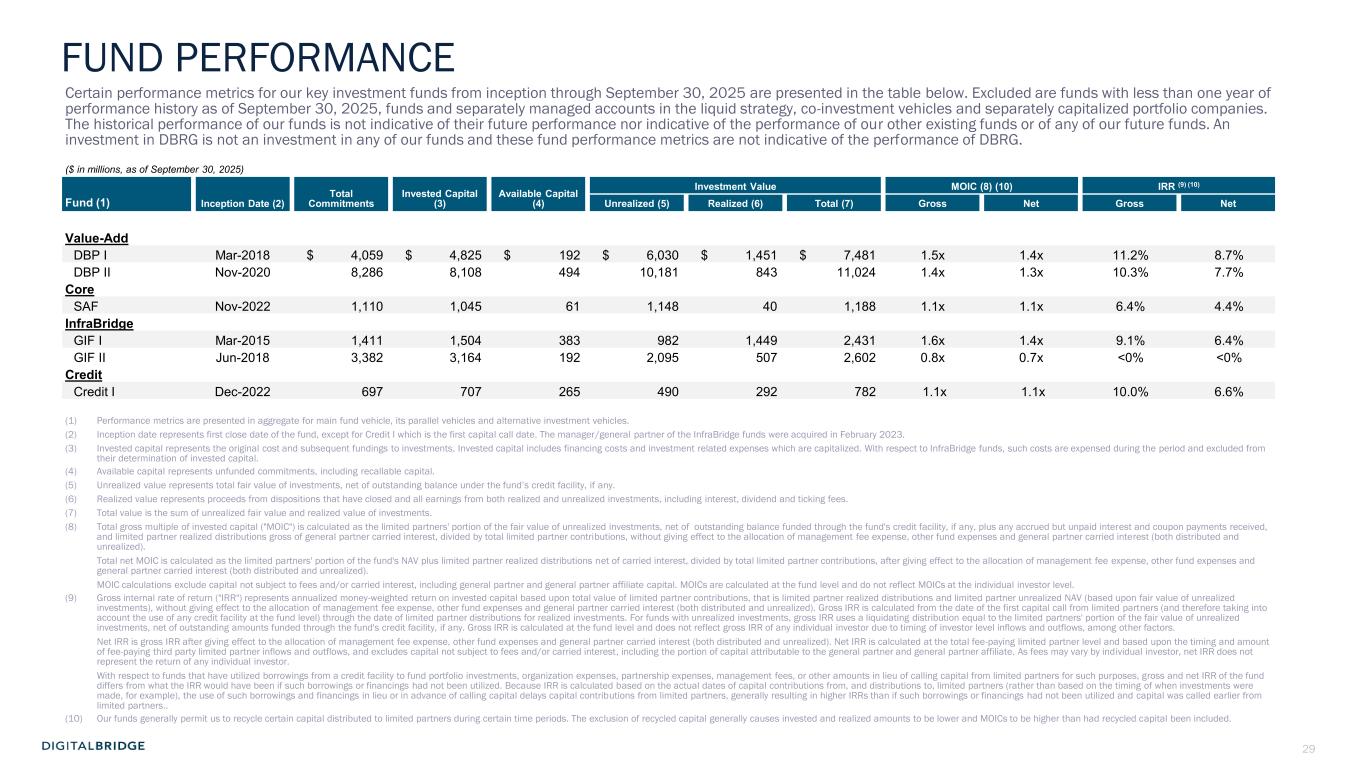
fund runoff should we expect in 2026? Yeah, thanks, Jay. We don't get into that exactly. We don't give guidance specifically on how we're realizing or monetizing assets. I think as we monetize those assets we'll report them in our normal cadence um you know i think obviously um fund one is is starting to to near its its natural turning point where you begin to think about monetization so we're thinking through that pretty carefully and at the right time and the right um speed we'll do that um credit is constantly turning over that that turnover is you know loans typically have a 24 to 36 month lifespan. So as we're turning over loans and returning capital, we're booking new loans in the, you know, in the second fund and our SMA strategy. And InfraBridge continues to do exactly what we think it should do. And, you know, in due course, we will continue to monetize assets in InfraBridge one. And then as we look forward in the coming years, we'll look at InfraBridge two. But again, as we monetize stuff, we'll share that with you in the quarter. But all of those fund products are moving at the speed at which you'd expect them to move. And so, we feel good about the speed and the cadence at which we're delivering DPI.
Operator
Okay. Thanks a lot. Our next question comes from Timothy D'Agostino with B. Riley Securities. Please proceed with your question.
Good morning. Thanks for taking the question. On the Franklin-Templeton Strategic Partnership, In the deck, you outline the $15 trillion opportunity through 2040 with wealth management allocations to private infrastructure. I was wondering if this strategic partnership is sort of a one-time partnership, or if we could see more of these down the road.
Sir, we lost the beginning of what you said. Could you repeat the beginning of your question?
Okay, yeah, sure. Sorry. So with wealth management allocations to private infrastructure estimated at $15 trillion through 2040, I was wondering if the Franklin Templeton strategic partnership is sort of like a one-time thing or if we could see more partnerships like this down the road.
Yeah, look, I mean, for for this particular product alongside of Actis and CIP and, you know, it's it's it's a strategy that they've launched on their platform. We have other partners in private wealth. We did a fantastic product offering last year with Goldman that was really successful. It was wildly oversubscribed. And we do intend to be on other platforms and have other partnerships. That is something that, you know, we'll reveal in due course. But we are not exclusive nor limited just to the Franklin Templeton platform. We are working with other allocators, and we agree with your arithmetic. It's a $15 trillion opportunity. It's really big, and there's a lot of great partnerships to be had. And, you know, we're excited about it. But for right now, we love what we're doing with Jenny and her team. They're fantastic partners. And so far, it's been a really successful launch. So great question, and, you know, we'll reveal more next year. But right now, my focus is supporting Franklin Templeton and making sure that that product is, you know, wildly successful and oversubscribed.
Great. And then as a quick follow-up, could you provide a little bit more color on the evergreen capital on the long term, on the long duration, and then kind of why the structure is so attractive to you all?
Well, look, I think, you know, we have both types of structures across our product set. So, we don't believe that you have to be all permanent capital, nor do we believe you have to have, you know, 10, 11-year closed-end funds. commingled funds work well for certain allocators, particularly pension funds and other types of sovereign wealth funds. They like that because there's a finite end to what they're doing. I think other allocators like the open-ended structure, for example, like real estate investors. That's something they're quite familiar with. And private wealth clients, they're very familiar with that structure as well. So our continuation funds, the things that we're doing around the real estate asset class, the stuff we're doing around private wealth can be open-ended and be permanent in nature. And then our flagship vehicles tend to be closed end in nature, along with our digital power strategy. That tends to be a strategy that you would lend itself to being closed end. So I think that the great thing about DigitalBridge today is that we're a multi-strap platform. We have multiple strategies really focused on allocators very specifically, and then pairing that allocation with the right products, the products that investors want. You know, whether it's a, you know, a data center platform, a tower platform, a stabilized asset, an energy project that's tethered to the AI economy, these are the things that investors really want today. And we have the right products and the right structures. So having that multi-strategy capability is really what differentiates DigitalBridge today.
Operator
Great. Thank you so much. Thank you. Our next question comes from
Operator
Our next question comes from Rick Prentice with Raymond James. Please proceed with your question.
Thanks, everybody. Hey, Rick. A couple of them. First, I want to follow up on Michael's question a little bit. I mean, Mark, you guys as an alt asset manager, but focused on digital infrastructure, AI. Good to see you communicate numbers, hit numbers, achieve numbers, maybe exceed numbers. The piece that seems to be missing from the stock price is really recognition of carried interest. You touched on it a little bit to Michael's question, but help us understand the pacing as your portfolio company is now ballpark 50 companies or so, I guess. How should we think about a stable, consistent kind of monetization path into the future to try and get some of this value realized? Because clearly, AI is hot. Power banks are hot. Data centers are hot. You're not getting the credit for that. So just trying to think through, how do we see that monetization path play out to help the realization of that? And I'll come back with a question for Tom on the bookend impact.
Yeah, I'll let Tom handle the bookend piece. I'll just stick to 50,000 feet and then flip it over to him. So he gets the hard part. I get to answer the easy part. He's smiling at me right now. So look, I would say, you know, Rick, what I said earlier with Michael, which is it's really important to note that we have certain fund products that have now turned the corner and they're entering into that phase where we begin to monetize. So you go back to a 2019 vintage fund where we invested that fund in 2020 and 2021, it's logical to assume that realizations begin happening in, you know, 26, 27, and 28. And that's really where our first flagship fund sits. And then logically, you know, you can start thinking about how we exit some stuff in fund two. I'm not going to, on a call, speculate which companies are going to have those realizations. But what I can tell you is we're now in a steady cadence where we have certain portfolio companies going through strategic reviews. So I think that we believe just by the timeline and nature of our original legacy flagship funds, you can begin to see a steady, you know, unwinding of those funds and return of capital. And along with that return of capital comes, you know, the realization of carried interest. Now, fund two has a little more carried interest for investors. The third flagship fund has a little more carried interest for our investors. And so I think as time goes on, you're going to see not only more frequency in carried interest, but you'll see more carried interest. And so, you know, we're going to work on that pretty hard next year. I think that'll be one of the differentiators about next year versus this year is that you are going to see more realizations next year than this year. The other thing that I would say is on our data center business, across the 11 platforms, we have been pretty creative around creating DPI and creating carried interest. So when you've got great vehicles that are in permanent capital vehicles like DataBank or now Managed North America and some of the growth metrics around some of these other businesses, we have to recycle capital, return capital. And when we do that, that also triggers carried interest as well. So data centers is an area where we think we can do quite well. And I think, you know, stay tuned. But we do believe that it's reasonable to assume that given the age and vintage of some of these fund products, that you can begin to count on carried interest instead of it being episodic. I don't know, Tom, if you want to add anything to that.
No, I mean, you really covered it. You know, I guess the only thing I'd add is sort of on the margins, if you had sort of backed up four years ago, you know, and projected a bell curve of where we would be distribution wise, you know, I would say probably over the last few years, there's been a more, you know, significant and extraordinary opportunity to continue investing in some of our portfolio companies than maybe you would have thought four or five years ago. And so, you know, that may have pushed out exits that you, you know, several years ago would have thought were happening in 25. Maybe, you know, we've continued to invest in some of those companies because the opportunity there is extraordinary. But, you know, I wouldn't add anything different than what Mark said in terms of the bell curve and the vintages.
And the way the book works, I think you touched on that in your prepared remarks a little bit about the J curve and where you're at on it, because it does confuse people. I think sometimes when they look at the book carrying value, you're not marketing it to market on transactions that are occurring or things in the marketplace. You're literally looking at your asset by asset. But some people, I think, look at it and go, well, how come the book doesn't show more? But maybe just elaborate a little bit more on that.
Yeah, look, I think there's, you know, there's sort of two main components to the performance and how we mark things. Mark talked a bit about, you know, kind of our investment playbook, making sure we make the right, you know, investments that we are focused on the customers, deliver for the customers, drive operating performance of the companies. And that, you know, is one significant contributor to the performance. And you've seen some of that to date, you know, and then I would say the second material contributor to performance and accrued carry or realized carry is the exit process. and, you know, selling the companies well. And that's where you capture kind of the second stage of value. And so I would say we're sort of in between those two kind of step functions right now, where we've achieved, you know, real value and real performance at the company level. And we will capture kind of, you know, the second step of value, you know, as we create distributions and liquidity and realize kind of the full value of the companies, if that makes sense.
Yeah, so you're not marking to what transactions might be. You're not marking to comps until you actually achieve a sale, basically.
Look, you think the valuations and performance are 100% quantitative, and there's always a bit of qualitative to them. So we do our best to mark to where we think, well, we think the asset's worth, but there's always a bit of uncertainty and how much of that will you actually realize in a sale. And so, you know, you're always including some sort of a contingency to address that.
Great. And Mark, one of the interesting things we saw this quarter was, you know, the story that Elon Musk is now following you. Can you give us a little background color? You know, did that happen? How did it happen? What's your kind of relationship with Elon?
Yeah, thanks, Rick. I don't comment about social media stuff. It's just kind of unfortunately becomes like water, water, cooler banter. What I will say is I've got a lot of respect for him. Yes, I do know him not particularly well, but we know each other and he's an important customer. He's a very important customer. So he he uses a lot of our different portfolio companies and we serve, you know, Starlink. We serve SpaceX. We serve Tesla. We serve XAI. And we use his batteries at some of our data centers for storage. And it's a really super important customer that we think can get bigger over time and that can be a lot more strategic. So anything we can do to work with him and support what he's doing, I'm very supportive of him. And I'm always happy to put capital into his businesses through infrastructure or side by side with him. So, a lot of deep respect there, and I think he's one of the great, great minds of our generation. So, you know, if he chose to follow me, that's great, but I'm super focused on servicing him and trying to figure out how we can help enable his businesses to go faster.
Makes sense. Thanks, guys. Thank you.
Operator
Our next question comes from Richard Cho with J.P. Morgan. Please proceed with your question.
hi um i know you spent a decent amount of time on it but i think it's important to kind of go through it a little bit more with vantage in these the frontier campus and lighthouse campuses these are two really big deals and over the past few months we've seen a lot of companies come out and say that they have a lot of power and that they have a lot of um capacity deliverable, but you've actually won these leases. Can you take us through the process a little bit and what gave Digital Bridge advantage over the other companies and winning
this deal? Yeah, look, I think that we continue to believe that this industry will be unfortunately
marked by a lot of amateurs and a lot of tourists in the next 24 to 36 months. You know, people that do certainly know how to buy land and how to get entitlements and certainly how to reflect that they have some source of power. I think it's a different level up when you actually build a data center and you're responsible for delivering something at a tier three, tier four, tier five standard and that you've done it for a decade plus customers know the difference between you know people that are new to the sector and someone that's a trusted set of hands that was you know has over 400 data centers and 11 different companies differentiation isn't about press releases differentiation is about execution and the ability to show up for a customer and deliver on time um again you know we don't get a lot of credit in our share price from being around for 30 plus years as executors um and so what we have to do is we have to go out we have to deliver a quarter like this you know we have to deliver a quarter where we clearly demonstrate um leasing volumes that are differentiated a power bank that's differentiated but most importantly to the metrics richard that you now know that we're judged on which is is FRE, VM, you know, distributed earnings, AUM, all of the things that we're being judged on. We know who our peer set is now. We're an alternative asset manager. And the most important thing that we now need to do is just like we've been executing for customers, we need now to need to execute for our public shareholders. And the framework and the prism that Tom and I are judged on is by other alternative asset managers. So, you know, when I said in the earnings call, what a difference a year makes. You know, we had a very tough last year third quarter. Tom and I thought long and hard about it. And what we tried to do this year was deliver something that is, you know, that we can, investors know they can count on us and that we're credible around the numbers that really matter. And so I think execution is critical. So executing for our public shareholders is critical. Executing for our customers like Oracle and OpenAI is important. And we're executing for hundreds of other customers this quarter. We just don't have enough time or pages in a deck, Tom, to sort of share all of those wins for all those customers. But, you know, we're delivering dark fiber routes. We're delivering towers. We're delivering small cell infrastructure. We're delivering Wi-Fi offload. There's so many things that we're delivering right now that we don't have time to talk about. We just got to keep delivering for our logos. That's really what is differentiating about us right now. And I think at the end of the day, you know, customers not only vote with their wallet, but they vote with their, you know, the integrity of their network. And I think one thing that we've proven to be for a long time is a very trusted set of hands. And hopefully that will work out well. And, you know, I think that, you know, few people are actually turning on capacity right now. And we are. We're turning on capacity. And that's because we started planning this 8, 10 years ago. We didn't start, we didn't say a year ago an investment committee because we thought it was a hot idea to get into data centers. That's not how we're built. We're built differently. And we'll be here. We'll be here tomorrow. We'll be here in 10 years. We were here 20 years ago. So I think it's that consistency is what customers really like and when it gets down to choosing having great teams you know like surreal who knows how to deliver for a customer that's that's what it is and we're very fortunate to have you know surreal and jeff tench and dana adams that entire team is just a bunch of pros adults that have been there been doing it for a long time and that is uh thankfully um surreal's our partner and so we're fortunate to have a great management team that was able to deliver for uh for the
the customer. And you mentioned it a little bit, but will these projects be meaningfully contributing to FIUM early in 26, or is it more later in 26 and into 27?
No, 100%. It'll be a big contributor in two years. We took in a lot of new capital, co-invest capital specifically to these two projects. We get paid on that capital, on that committed capital. And so there will be an immediate impact when you have really good co-invest. And look, Tom said it earlier in the year, we've got to improve our margins. And so both Tom and I committed to that. Tom's been working on the cost. I've been working on making sure we get our fees up and co-invest. And I think we can look at each other in that and say, we've delivered. Tom's done a great job on the cost side. We've done a great job in improving our margins on co-invest. And so when you put those two things together, you get a result like this in the third quarter, which is improved margins, incredible year-over-year growth, As you can see, I mean, just looking at fee-related earnings, we're up 43% year-over-year. I don't think there's another publicly traded alternative asset manager that's up 43% year-over-year. So this has been a lot of hard work, and we're not done. I think there's a sharp focus on what we've got to keep doing. And the fees build as we build. So as we keep leasing megawatts and we keep deploying capital, so does our fee raise go up, and so does our FRE go up. And, you know, we're heading into a historically strong fourth quarter, and I think Tom and I are excited to continue to work hard between now and the end of the year. I don't know, Tom, if you have any voiceover on that.
Operator
No, I think you covered it all.
Great. Thank you. Thank you, Richard. We'll see you soon.
Operator
Our next question comes from Eric Lubchow with Wells Fargo. Please proceed with your question.
Great. Thanks for squeezing me in. So, Mark, I'm curious about your data center power bank that you've been highlighting the last few quarters. Maybe you could talk about the split you're seeing between kind of behind the meter power solutions versus more direct grid connected power and perhaps how that behind the meter opportunity seems to be much bigger today kind of ties into the size and scope of the energy fund you're fundraising for.
So, look, the energy strategy is super important, and it's a big part of what we're doing in the back half of this year, but more importantly, Eric, what we're doing next year. So, you know, we've already closed a couple of deals in that strategy. TACNOC is one of them where we provide digital power solutions for our customers and to other data center developers. We've got another project where we're tethering, you know, some specific power solution to an existing digital-rich data center where we're adding, you know, 500 megawatts of power. So what I love about what we're doing in Digital Power Arc is these aren't ideas. These are very, very focused solutions in very specific locations tethered to very specific outcomes for customers. And so that's what makes it so unique, is that a lot like what we're doing in the data center space, we're doing in the power space. We're not taking risk. So we're entering into long-term contracts with counterparties, investment-grade counterparties. And so we know that the off-take is in place. I think what's interesting, Eric, as we've been doing this for about two years, we've also learned that the grid doesn't go away. And you have to learn how to use the grid. You've got to learn how to work with the grid. You've got to have battery storage capabilities inside your microgrids. You've got to be able to build up that power during the day, sell some of that into the grid. So you're basically an offtaker into the grid and putting power back into baseload, Eric. And then during the nighttime, when baseload is more available, you can buy back from the grid. And so it's a very fluid relationship in a microgrid. And the key to that is interconnection and being interconnected into that state's public utility commission grid and having an active relationship with the utilities. So, you know, what we're doing is not in contrast or in competition with our utility partners in each state. In fact, we are a trading partner with those utilities. And so a lot of like what we do in interconnection and fiber, we're doing the same thing actually in power. It's a really interesting business model. And we've had a lot of good early success so far. You know, someone once told me, I think it was, I was listening to another alternative asset manager, I think it was Brookfield that said it, but there's $7 trillion in AI. There's a $7 trillion CapEx AI spend. If you think about the power that's required, the incremental power to deliver 300 gigawatts, Eric, there's another $1.3 trillion in power to be built. So we look at that, again, that swimming pool is $1.3 trillion. And we look at the opportunity there. Investors are really excited about it. I've been on the road talking about digital power, talking about microgrids and how we're delivering these power solutions to customers, and as you can probably imagine, LPs get really excited. And if you look at the fundraising this year in infrastructure, Eric, infrastructure is having a record year in fundraising. I think there'll be over $200 billion of capital raised in infrastructure. And if you take a look at that, someone has their microphone on and needs to turn it off. I don't know who that is.
one eight one eight anyway yep eric can you hear us yeah i've got you mark
okay thank you sorry about that uh technical glitch um but anyway you know when you look at the total 200 plus billion dollars of fundraising and infrastructure this year over 50 of that is to energy transition, not data centers, not digital. It's really interesting to me that allocators are really focused on this issue of power. And so we really see that as a big opportunity because if we think about building large-scale campuses, and if you're going to spend 11 to 12 million dollars per megawatt, you know, building a data center, you could end up spending three to five million in grid-independent power to that data center. And so we really look at this is a $0.30 to $0.50 incremental spend on power because we're taking that risk and building the data center. We know how to build our microgrid infrastructure. We know how to source LNG, best solar, wind, hydro, and most importantly, use the grid. I think everyone gets obsessed a little bit, Eric, with, oh, you're either on the grid or you're off the grid. It's not that way, actually. It's that if you're going to really build at scale and you look, for example, at the last two big projects that we've done, we do use the grid. And at certain points of the day, we're putting power back into the grid. And then at certain points of the day, we're taking power from the grid. It's a fairly dynamic and fluid relationship between a microgrid and the actual grid itself. And so I think other people are finally figuring out what we're doing. It makes a lot of sense. We've got great industrial partners. We've got a big pipeline of projects that we're building. And we're excited to talk more about it next year. I mean, it'll be a big part of what we're doing in 2026. As I said, three new strategies for next year. And that's, you know, digital power is one of those strategies. So when you and I get together next time in person, Eric, we'll do a little bit of a digital power teaching whenever you're ready.
That would be great. I appreciate it. And I guess just one follow-up, Mark, you know, some of these mega deals we've seen, including the ones Advantage did, obviously there's a lot of kind of newer hyperscale tasks like LLMs that are directly or indirectly backing some of these new build. So how do you think about kind of the, you know, pricing, the lease terms, the credit risk of some of these newer players that are obviously not profitable today, but growing incredibly fast? There's certainly been a lot of industry chatter about, you know, some of the LLMs, their ability, you know, to pay for some of the future commitments they've made. And just curious how you guys think about it at the infrastructure level. Yeah, look, I think that
the, you know, there's different types of LLMs, Eric, right? And so, and there's different types of quality of credit tenants. And so, you know, we look at some of the NeoCloud business models and we've chosen not to put our equity capital to work there. We've been very selective about those types of credits. I think, again, you know, when you've got a really substantial power bank and you've got, you know, on-demand capacity ready to go, it does allow you to be a little selective about, you know, what we can do. And so I think it's pretty unique, our ability to choose customers we want to work with. And, you know, I do get a little worried about some of the credit profile risk around NeoCloud versus, you know, AI providers versus the hyperscalers. And so we've been very cautious about not overweighting one particular customer or one particular story. I think what's unique about our platform is given that the scale of our platform, we're invested across all these customers and all across these workloads so that we're not beholden to one customer or one technology or one LLM. I think that's where scale matters, Eric. We talk a lot about scale in the alternative asset management space. Well, in our specific swim lane, we have a lot of scale and we have a lot of customers. So that diversity in customers is what's really important. And we've been able to demonstrate that we can lease to a lot of different logos at the same time. So I think at the end of the day, you know, having a diverse set of cash flows and a diverse set of customers and a diverse set of data centers is really where you want to put your capital today. Again, same thing we talked about, you know, buying our stock as a proxy for that, right? You're not making one bet on one specific data center platform. You're making a bet on a global portfolio of 11 platforms, 21 gigawatts, and, you know, record leasing, and that that flow-through will come through in a function of, you know, FRE, FIEM, and carried interest.
I appreciate it, Mark. Thank you. Yeah, thanks, Eric.
Operator
There are no further questions at this time, so I would now like to turn the floor back over to Mark Gaines for closing comments.
Well, thank you. Appreciate all the thoughtful questions from the analyst community. We look forward to engaging with all of you over the next couple of days to bring more clarity to the quarter. But let me finish in thanking our team. We have an incredible team. Again, I want to bring focus back to third quarter last year against third quarter this year. Specifically, I want to thank my CFO, Tom Merhoffer, for delivering a very clean quarter and delivering on the promises that we made to you, our public investors. And again, you know, fee revenue up 22 percent. FRE up 43%. Distributable earnings up 102%. And fee equity under management, FIEM, up 19%. This was a clean quarter. This was a quarter that we, to be candid, we felt capable of delivering, and we owe it to our investors to deliver results like this in a quarter like this. We have strong liquidity. We're allocating capital. We're raising money. We've got a great suite of new products that we'll come to market with here in 26. and we're well positioned to be the leader in digital infrastructure and the power that's required to fuel it. Really looking forward to the end of this year, and looking forward to catching up with all of you on the road as we hit different investor conferences. Please follow up with Severn and our team to get access to the team. We're always happy to have a conversation with you, and thank you for your continued interest and your ownership in Digital Rich
Operator
shares. We appreciate it. Have a great day. This includes today's teleconference. You may disconnect your lines at this time. Thank you for your participation.