Operator
Good morning, ladies and gentlemen. Welcome to today's Encompass Health fourth quarter 2025 earnings conference call. At this time, I would like to inform all participants that their lines will be in a listen-only mode. After the speaker's remarks, there will be a question and answer period. If you would like to ask a question during this time, please press star 1 on your telephone. You will be limited to one question and one follow-up question. Just a reminder, today's call is being recorded, and if you have any objections, you may disconnect at this time. I will now turn the call over to Mr. Mark Miller, Encompass Health's Chief Invested Relations Officer. Mark, please go ahead.
Thank you, Operator, and good morning, everyone. Thank you for joining Encompass Health's fourth quarter 2025 earnings call. Before we begin, if you do not already have a copy, the fourth quarter earnings release supplemental information and related form 8K filed with the SEC are available on our website at encompasshealth.com. On page two of the supplemental information, you will find the safe harbor statements, which are also set forth in greater detail on the last page of the earnings release. During the call, we'll make forward-looking statements, such as guidance and growth projections, which are subject to risks and uncertainties, many of which are beyond our control. Certain risks and uncertainties, like those relating to regulatory developments, as well as volume, bad debt, and cost trends that could cause actual results to differ materially from our projections, estimates, and expectations are discussed in the company's SEC filings, including the earnings release and related Form 8K and the Form 10K for the year ended December 31, 2025, when filed. We encourage you to read them. Your caution not to place undue reliance on the estimates, projections, guidance, and other forward-looking information presented, which are based on current estimates of future events and speak only as of today. We do not undertake a duty to update these forward-looking statements. Our supplemental information and discussion on this call will include certain non-GAAP financial measures. For such measures, reconciliation to the most directly comparable GAAP measure is available at the end of the supplemental information, at the end of the earnings release and as part of the form 8K filed yesterday with the SEC, all of which are available on our website. I would like to remind everyone that we will adhere to the one question and one follow-up question rule to allow everyone to submit a question. If you have additional questions, please feel free to put yourself back in the queue. With that, I'll turn the call over to our President and Chief Executive Officer, Mark Tarr.
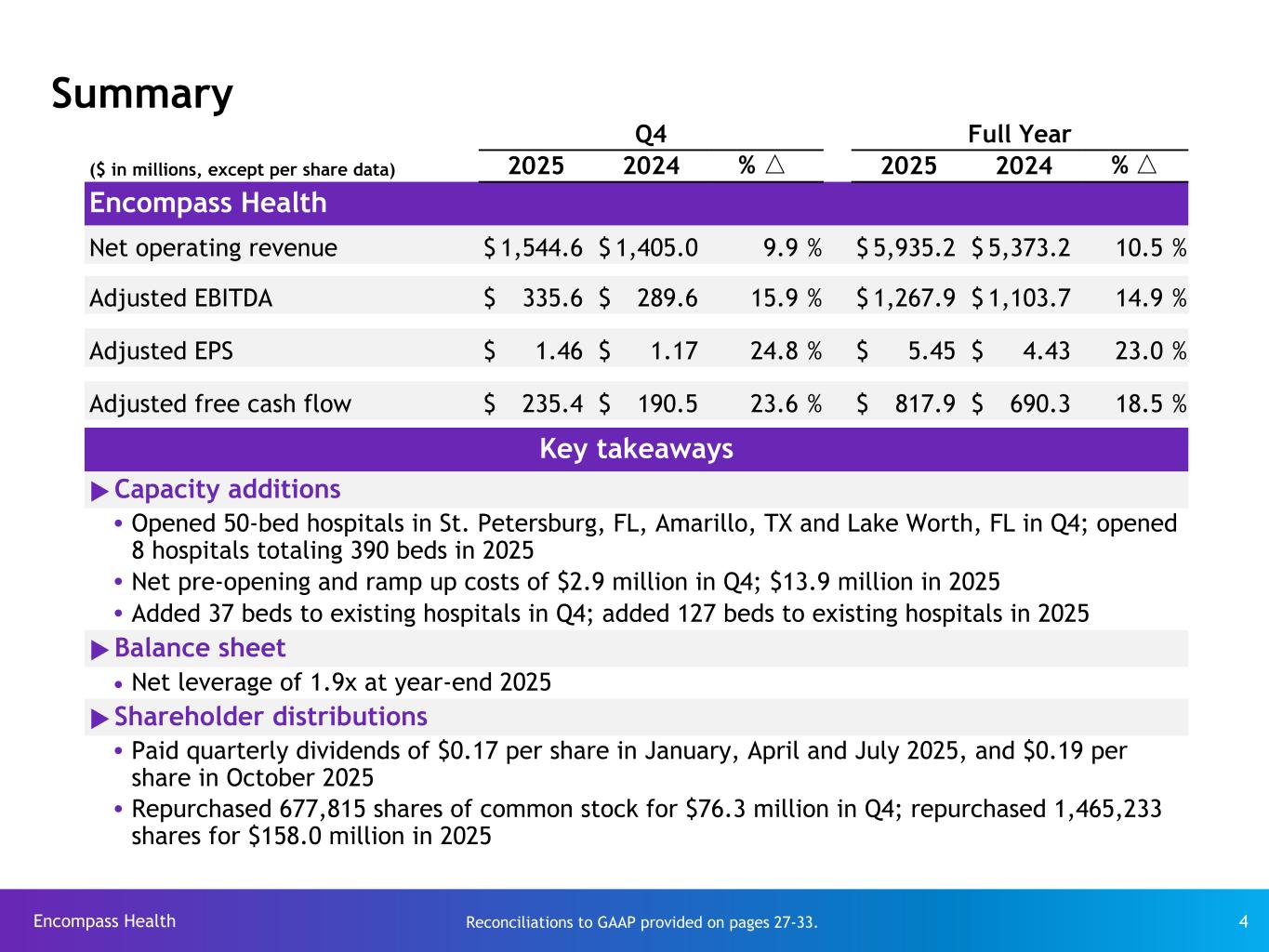
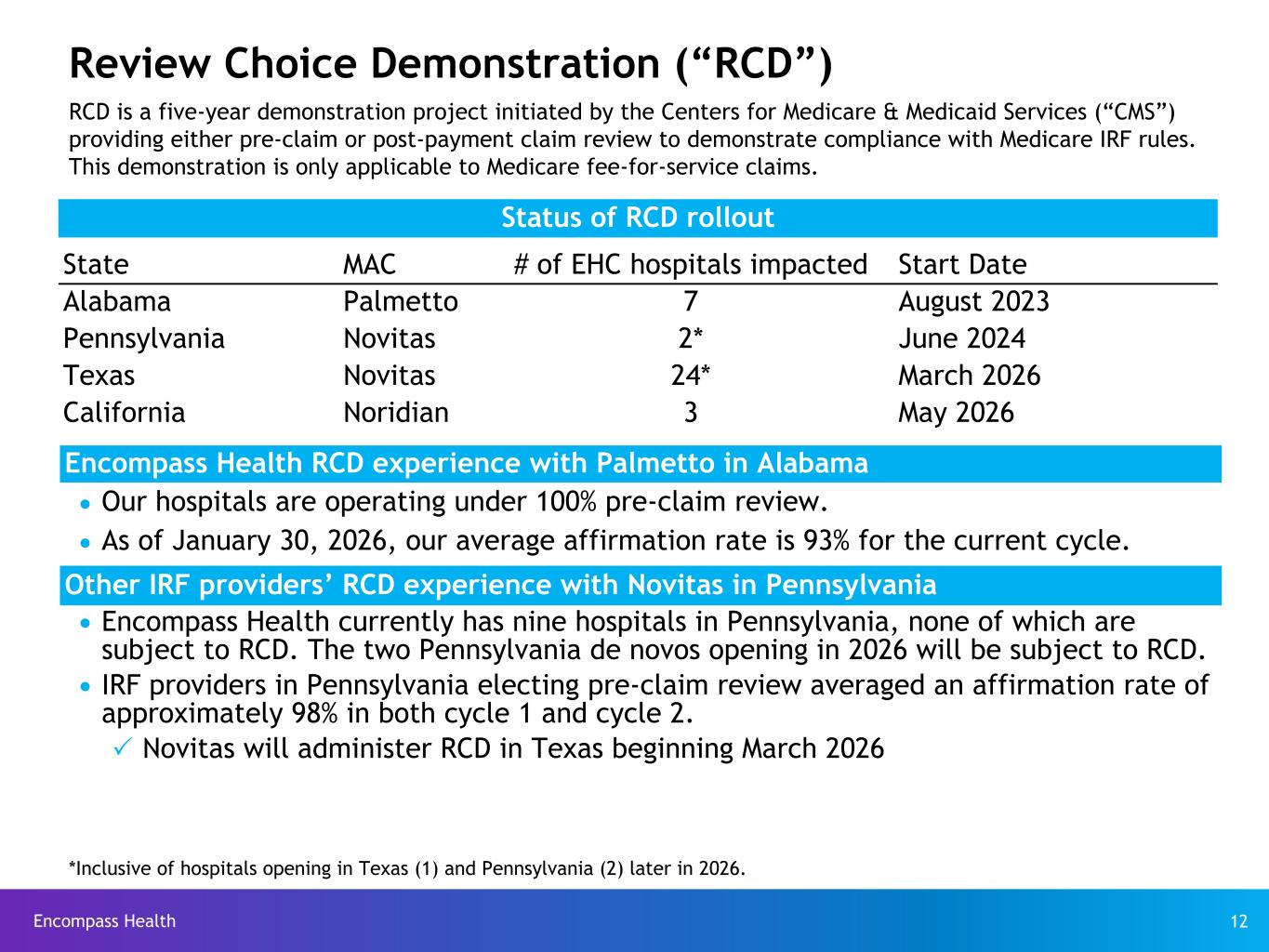
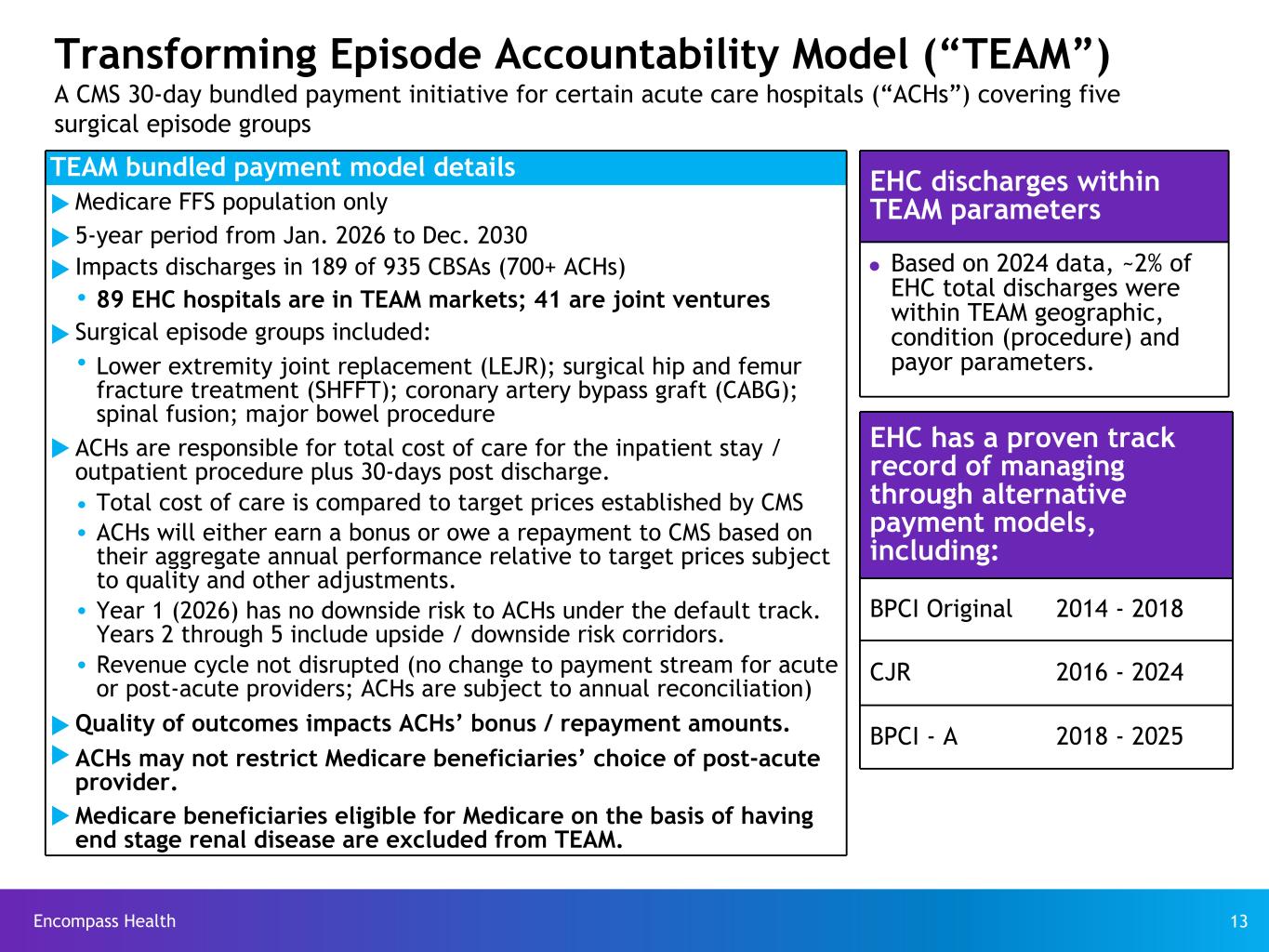
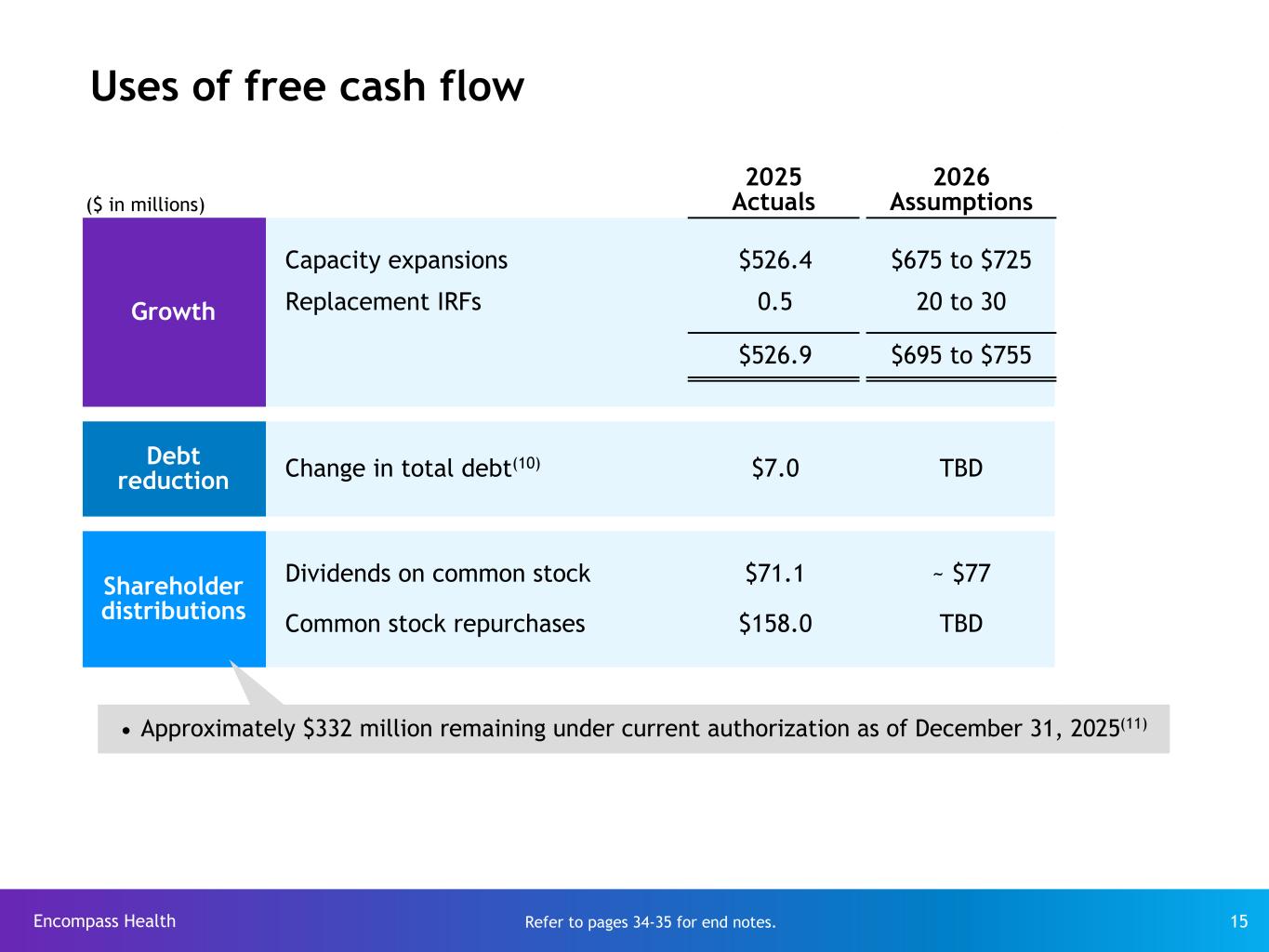
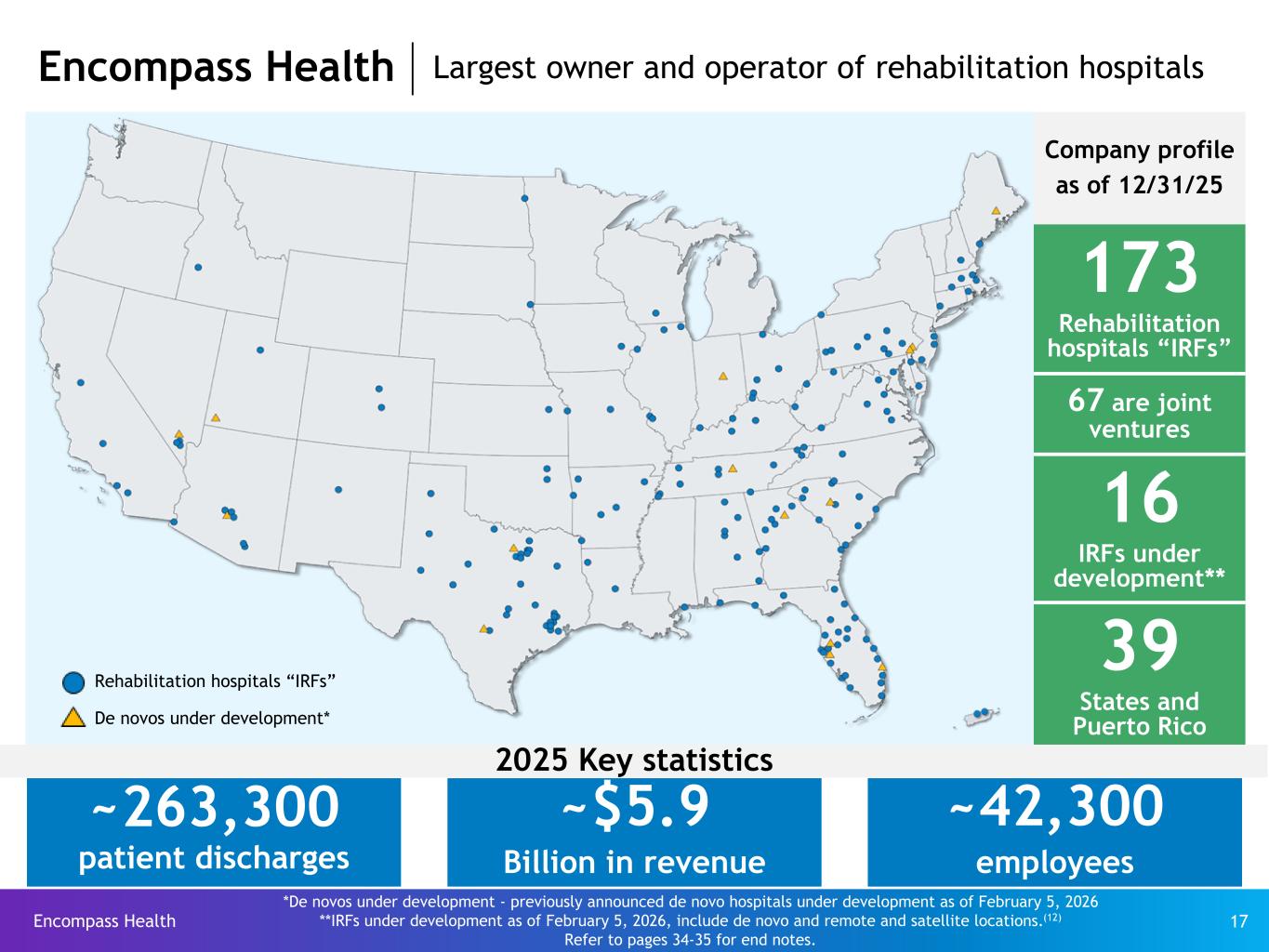
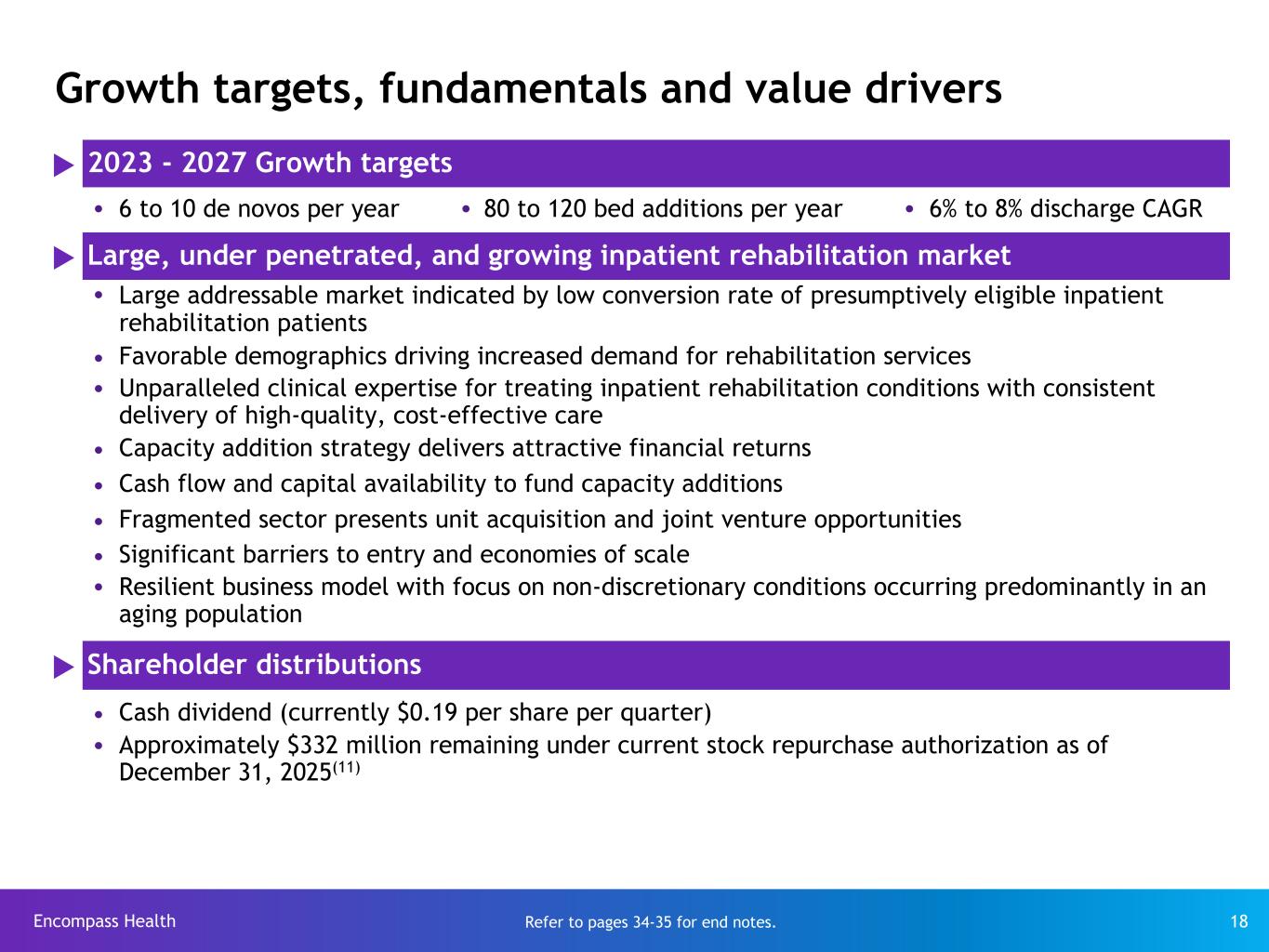
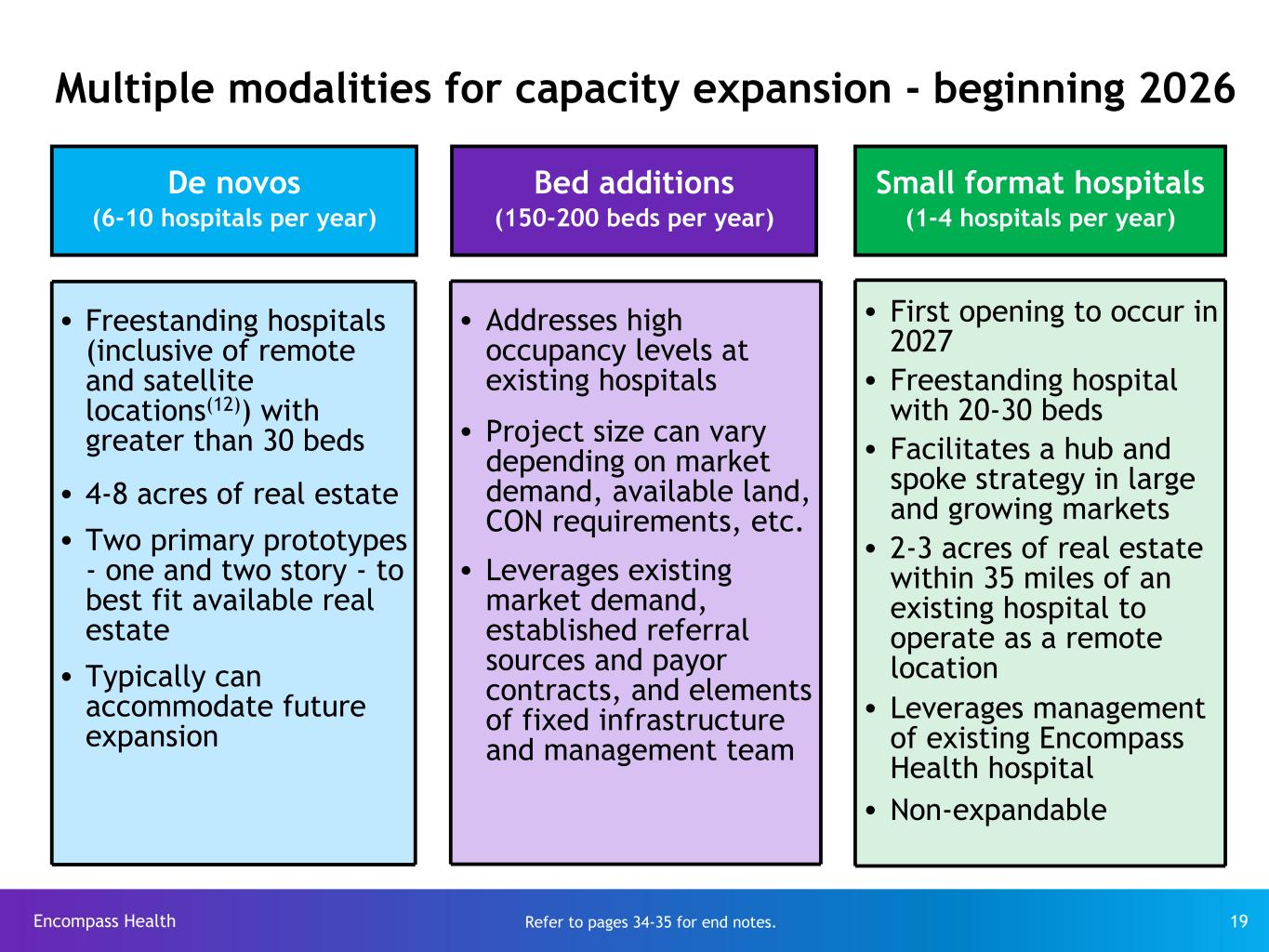
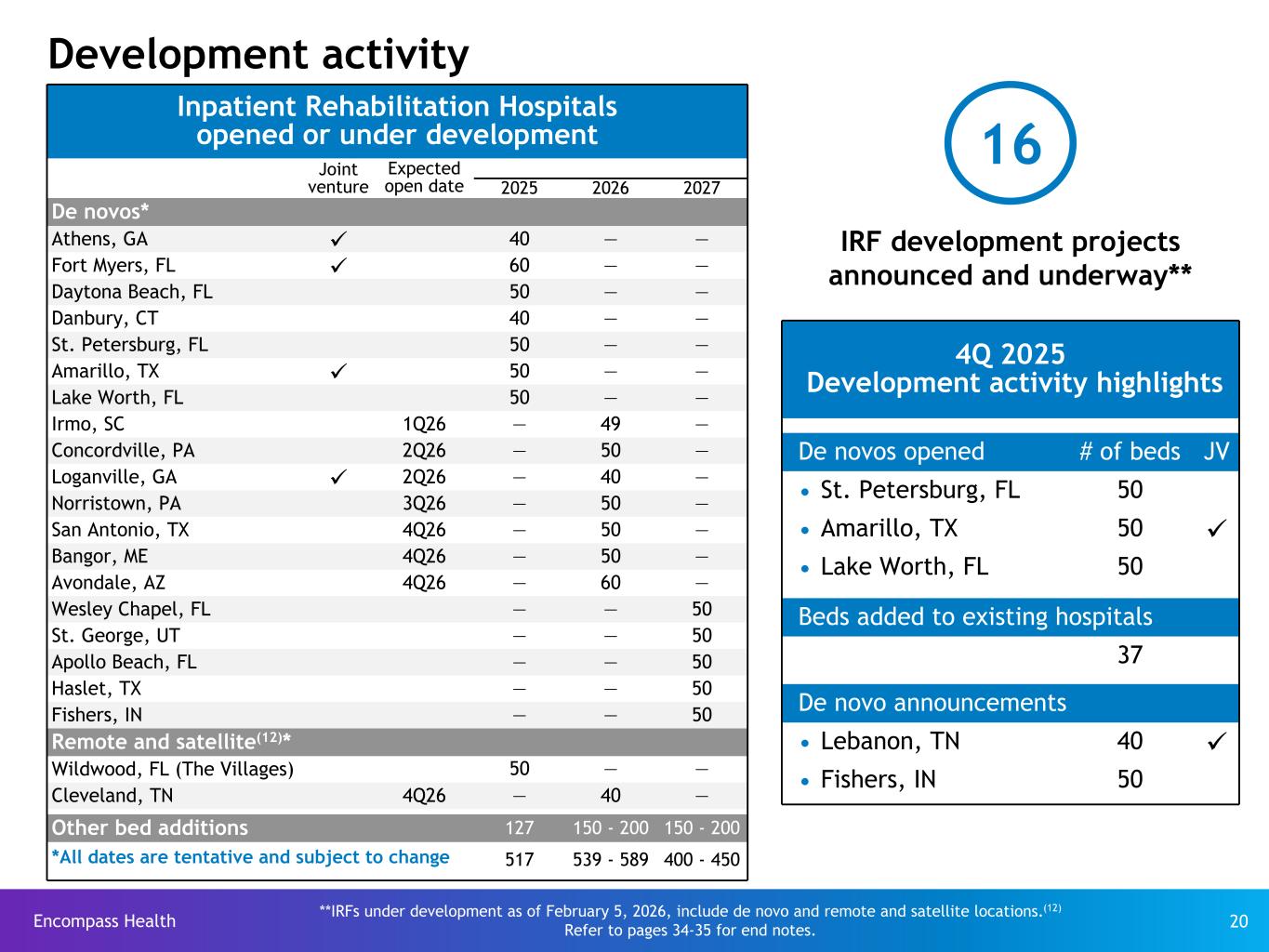
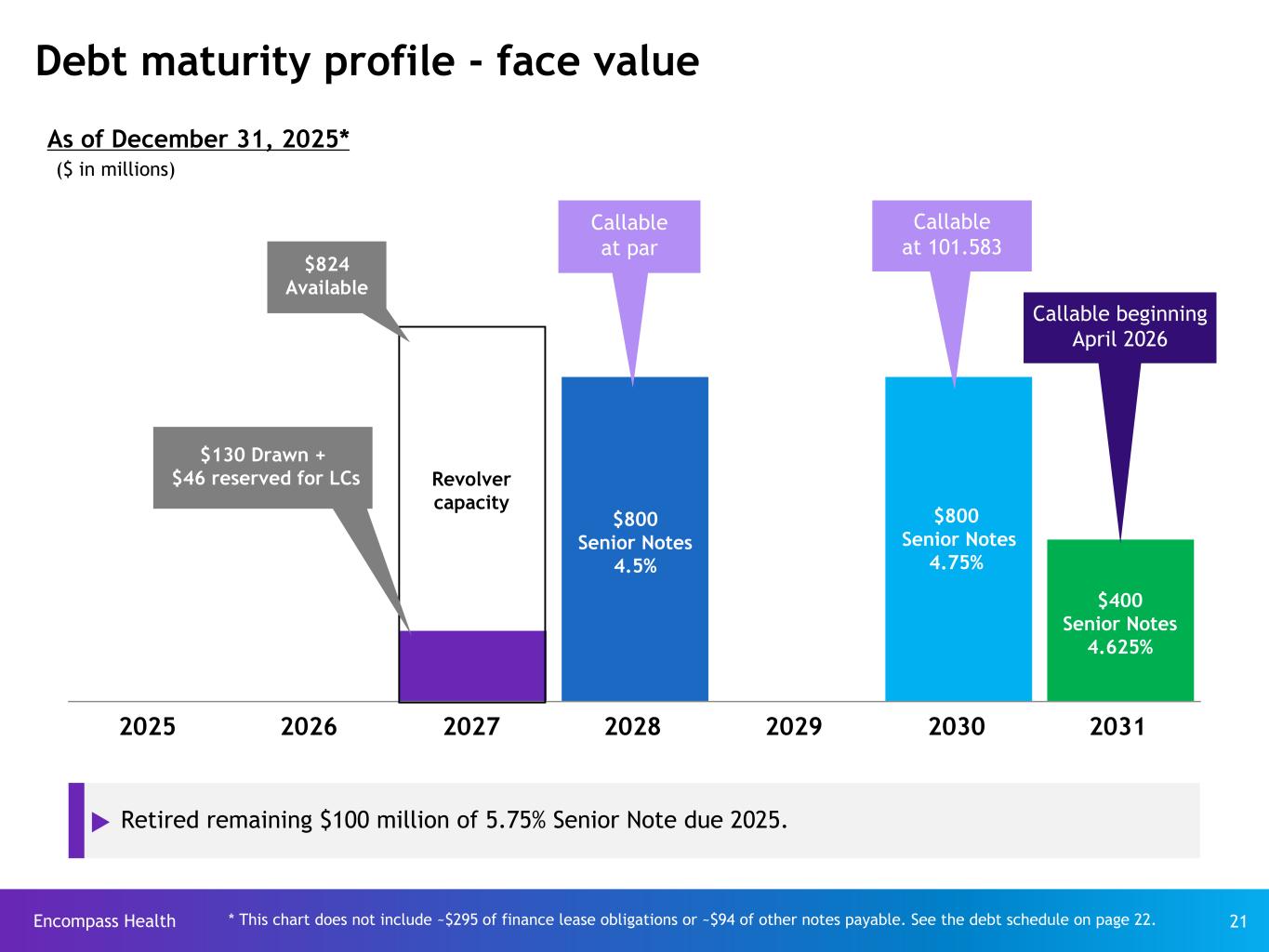
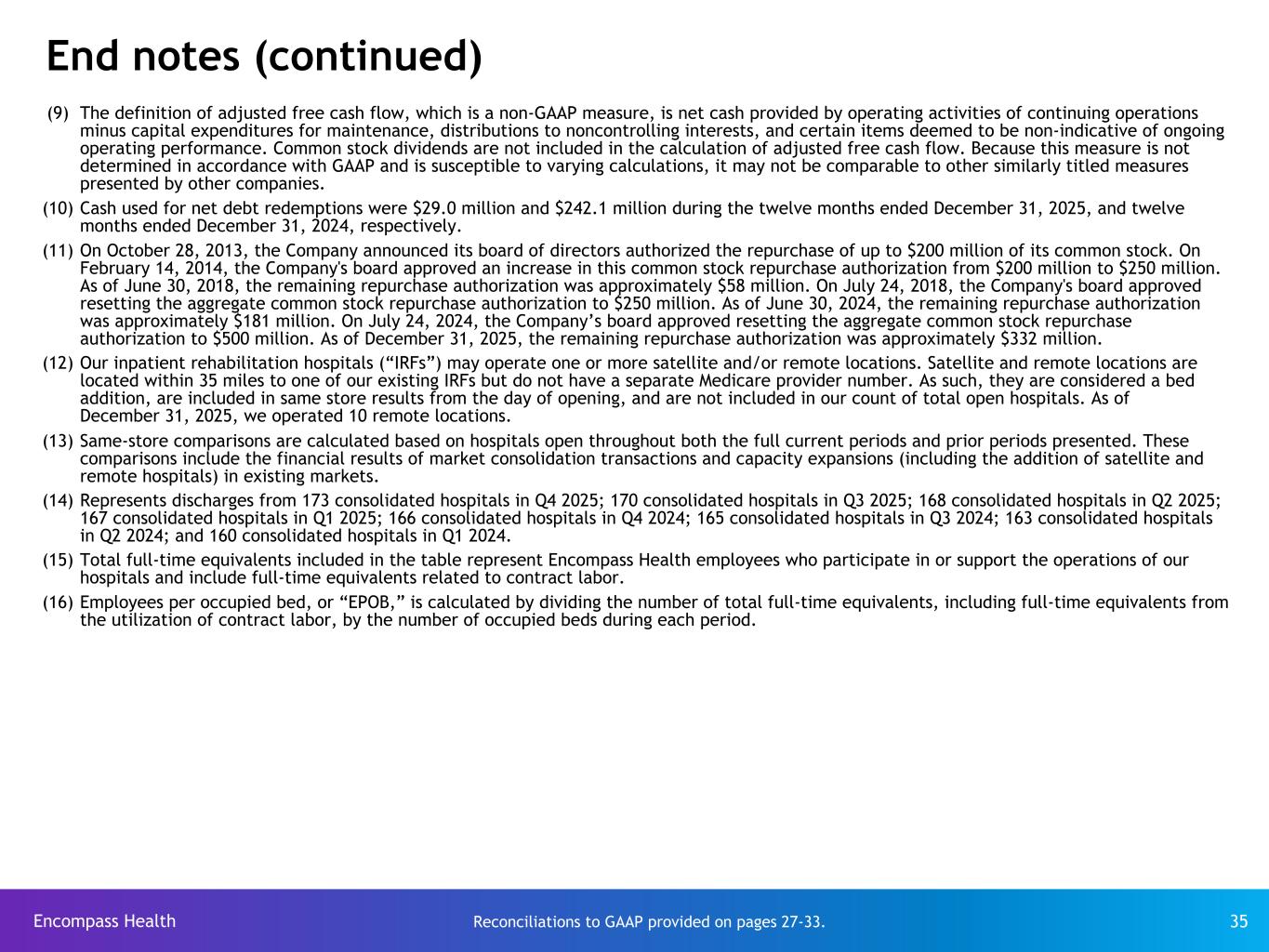
Thank you, Mark, and good morning, everyone. our Q4 performance was again very strong, capping a stellar 2025. Our 2025 revenue increased 10.5 percent, driven by 6 percent discharge growth and pricing growth, benefiting from patient mix and patient outcome quality. 2025 EBITDA grew 14.9 percent as we gained operating leverage and exercise disciplined expense management. Most notably, premium labor spend in 2025 declined by more than $21 million from 2024, even as we added capacity and significantly increased the number of patients we treated. Our quality and patient outcome scores for 2025 were outstanding. Our full year discharge to community rate was 84.6%, discharge to acute care was 8.6%, and discharge to SNP rate was 6.1%. Each of these quality metrics is favorable compared to the industry average. I'd like to recognize our clinicians and support staff who bring their expertise and compassion to our hospitals every day and deliver outstanding patient care. We continue to generate attractive returns from the investments we are making in capacity additions. In 2025 we added 517 beds, 390 via eight new hospitals and 127 through the addition of beds to existing hospitals. We will continue investing in capacity additions as the underlying growth in the target demographic remains at approximately 4% and the demand supply gap of licensed IRF beds continues to widen. We'll be augmenting our historical two-pronged approach to capacity expansion, de novos and bed additions with a third modality, small format hospitals, beginning in 2027. This will facilitate a hub and spoke strategy to larger and growing markets. In October, we converted our Enterprise Resource Planning, or ERP, system to Oracle Fusion without significant disruptions to our business. Fusion provides us a flexible and sustainable cloud-based IT infrastructure to support our growing business. We are keenly aware of market anxiety regarding IRF industry regulatory changes, specifically the extension of RCD and the initiation of the team model. Beginning with RCD, during 2025, we undertook significant engagement with Palmetto and CMS to ensure correct and consistent application of reimbursement criteria. area. Our seven hospitals in Alabama currently have an aggregate average affirmation rate of approximately 93% for cycle four, which we believe validates our admissions and documentation practices. Leveraging our experience in Alabama, we believe we are prepared for the expansion of RCD into Texas and California this year. The MACs responsible for our hospitals in these states are Novitas and Noridian. Novitas, the MAC responsible for most of our hospitals in Texas, has gained substantial expertise with RCD in Pennsylvania, where providers have achieved very favorable affirmation rates. As RCD extends to other states and we elect 100% prepayment review, affirmation of our claims should reduce our exposure to other Medicare claims audits. The team model implementation began on January 1st. Encompass has 89 hospitals in the initial team markets, 41 of which are joint ventures with acute care partners. As a reminder, there is no downside risk to the subject acute care hospitals in 2026 under the default track. As we have consistently done with all regulatory changes, we have prepared extensively for TEAM. It is another episodic payment pilot similar to previous models such as CJR and BPCI or BPSI, versions of which have been continuously in place since 2014. In those prior cases, concerns regarding the impact to our patient flows were greatly overstated. The presence of these models notwithstanding, with the exception of 2020 for obvious reasons, we have recorded positive total and same-store discharge growth every year. Regulatory change is a constant in our business, and we have a long track record of successfully adapting and continuing to grow as the underlying demand for IRF services continues to grow. Our strategic relationship with Palantir continues to bear fruit. In 2025, we focused on initiatives that streamlined admission documentation and enhanced our responses to claims denials. We recently extended and expanded our agreement with Palantir and look forward to additional successes in 2026 and beyond. In 2025, in addition to substantial investments we made in our operations, we allocated $158 million to share repurchases and returned in excess of $70 million in cash dividends. We maintain a strong balance sheet with year-end net financial leverage of 1.9 times. The need for the services we provide has never been greater and is growing. We are uniquely positioned to fill the void. We are incredibly proud of our recent historical performance, but we do not rest on our laurels or focus. Our focus is on the future, which for Encompass Health is very bright. Our company has never before been presented with greater opportunity, and we have never been better positioned to capitalize. Our expectation for continued growth is reflected in our initial 2026 guidance. I'll now turn it over to Doug to provide some additional details on Q4 and the specifics of our 2026 guidance.
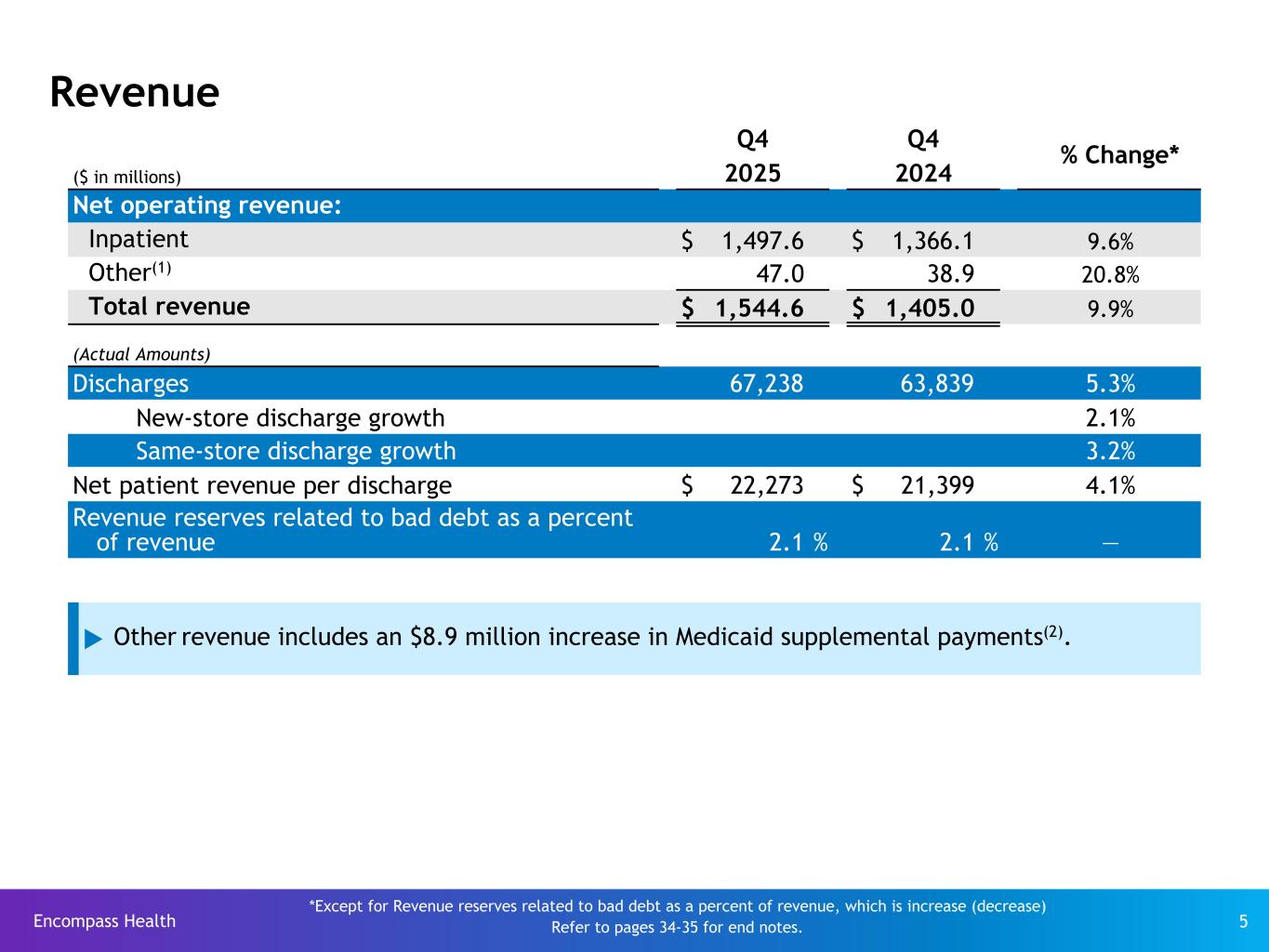
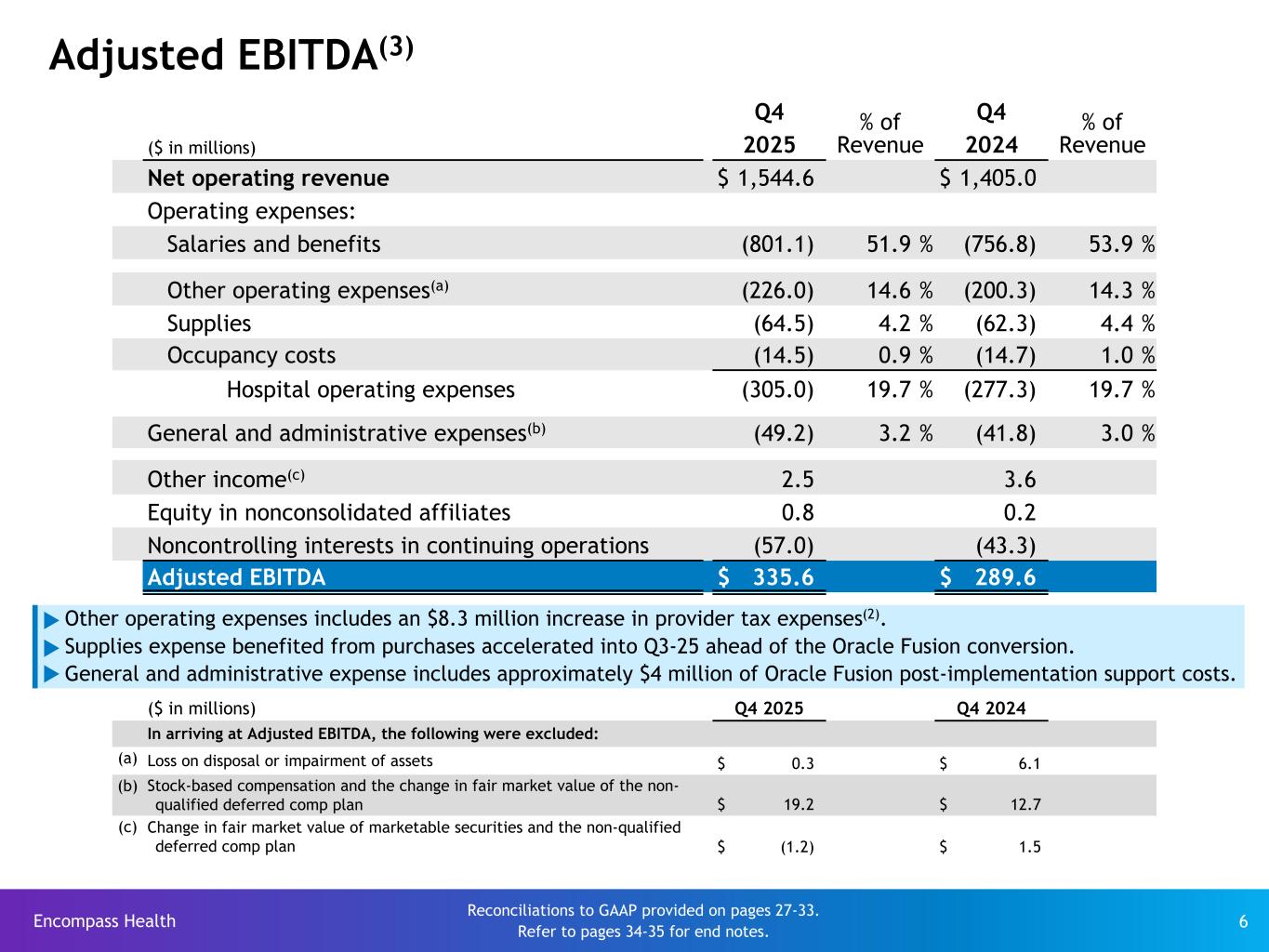
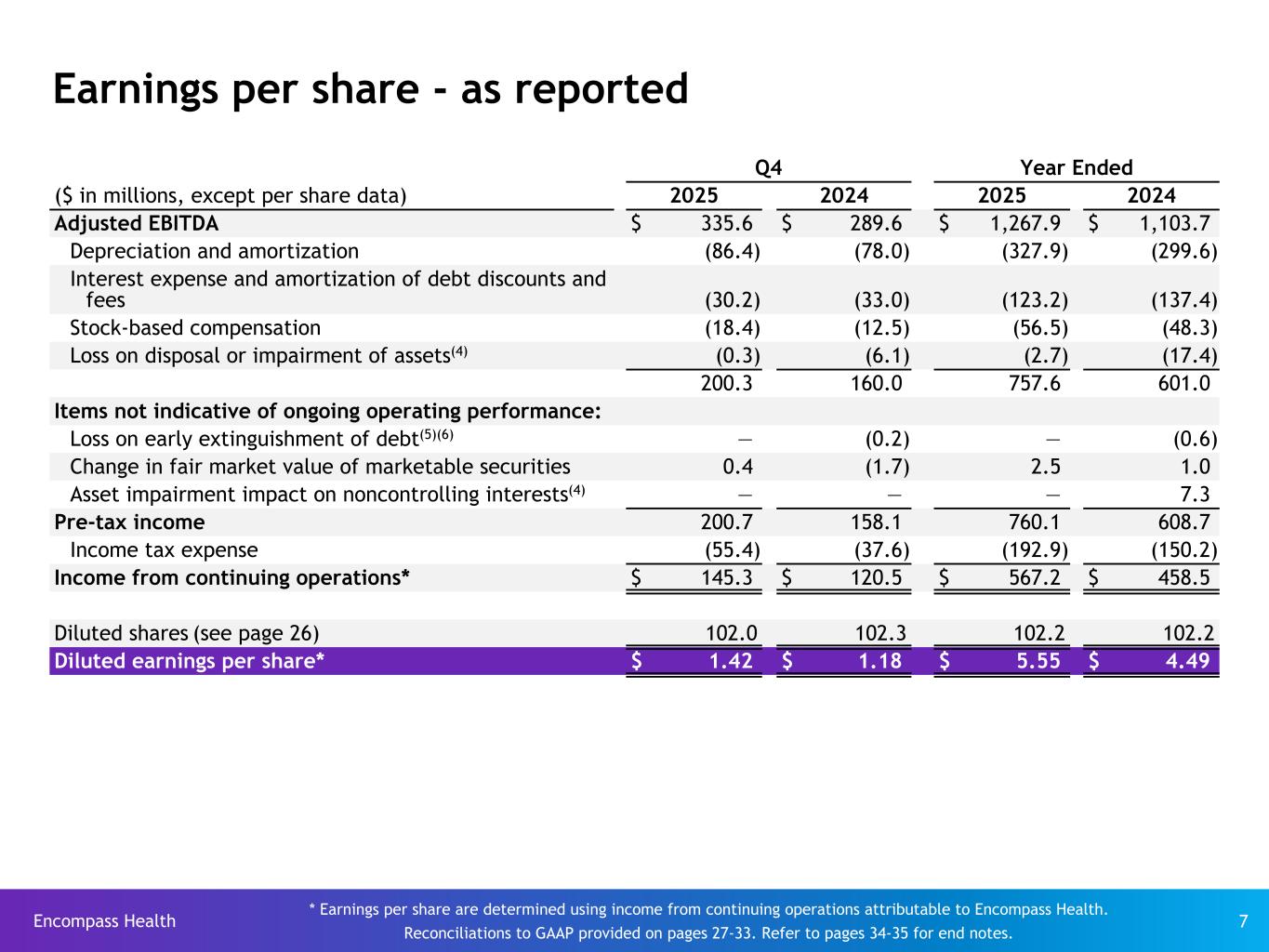
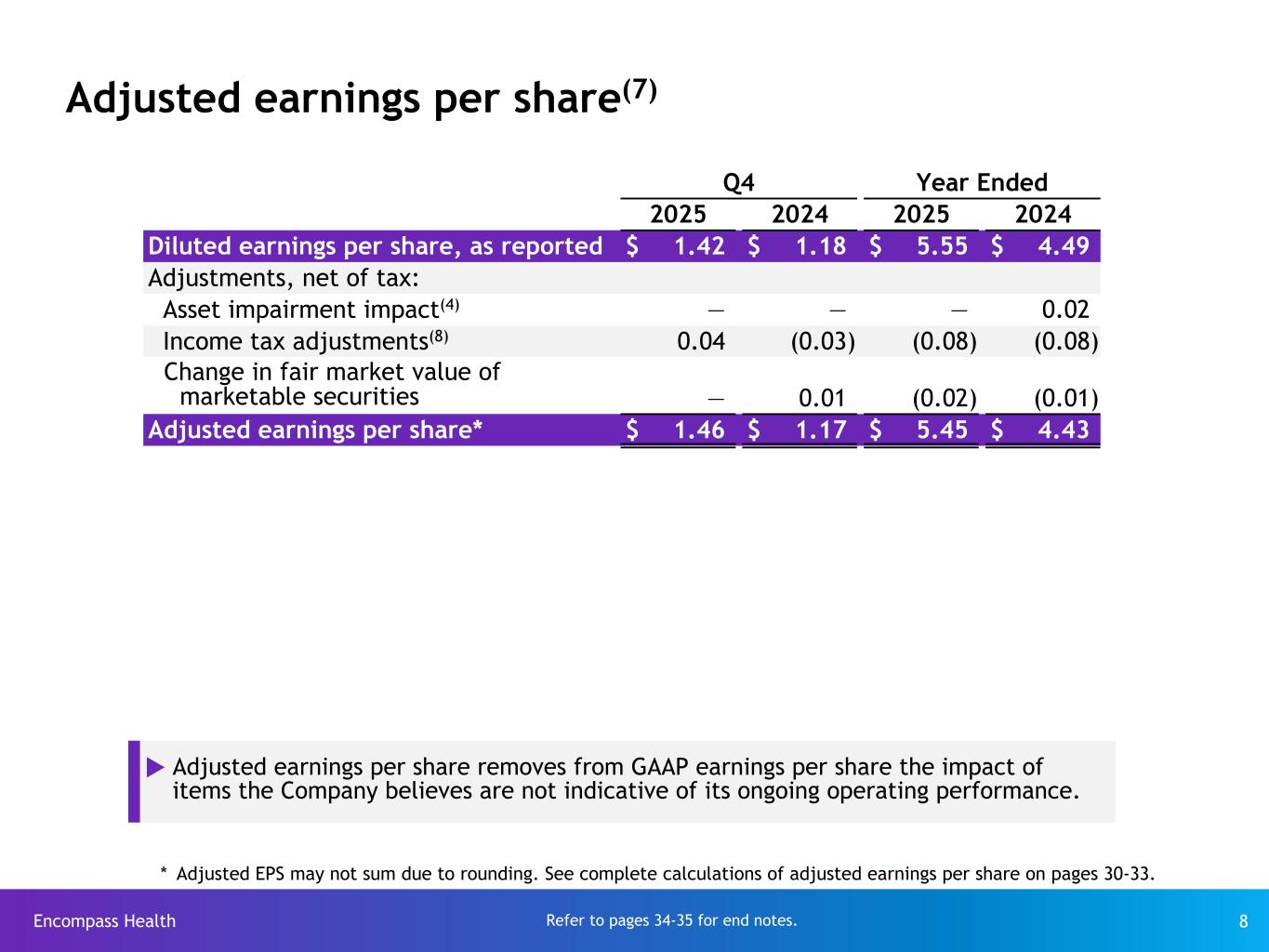
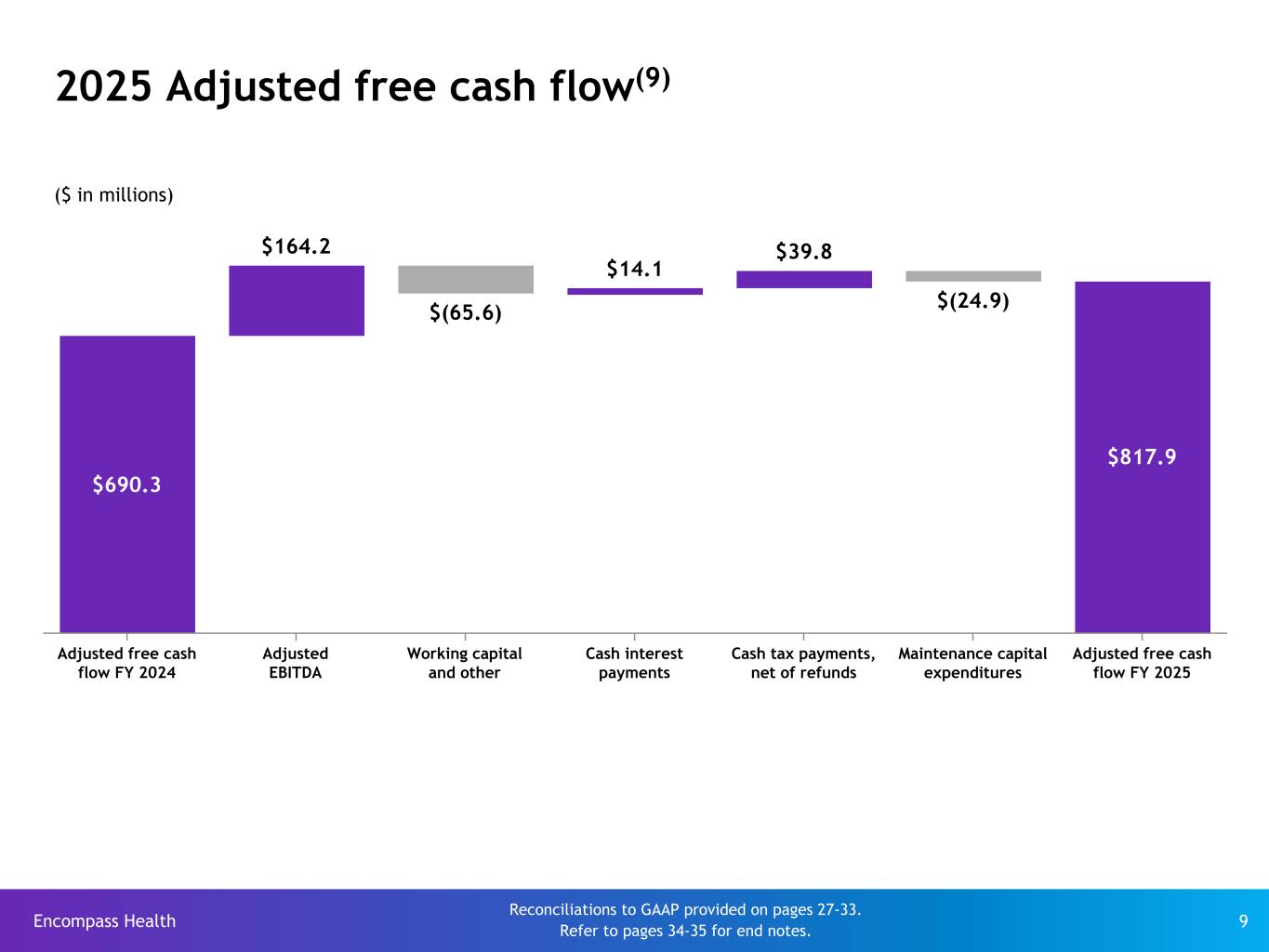
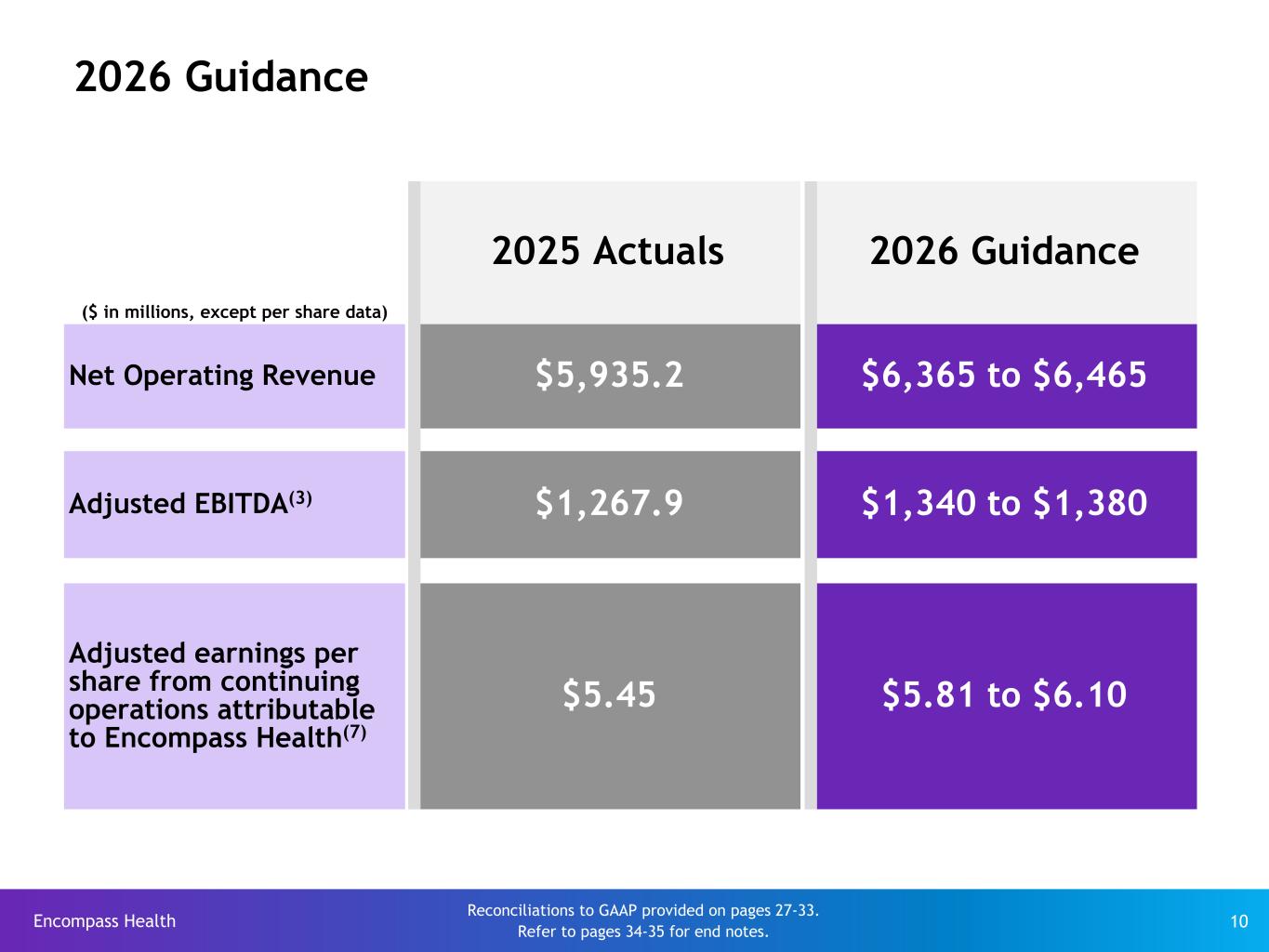
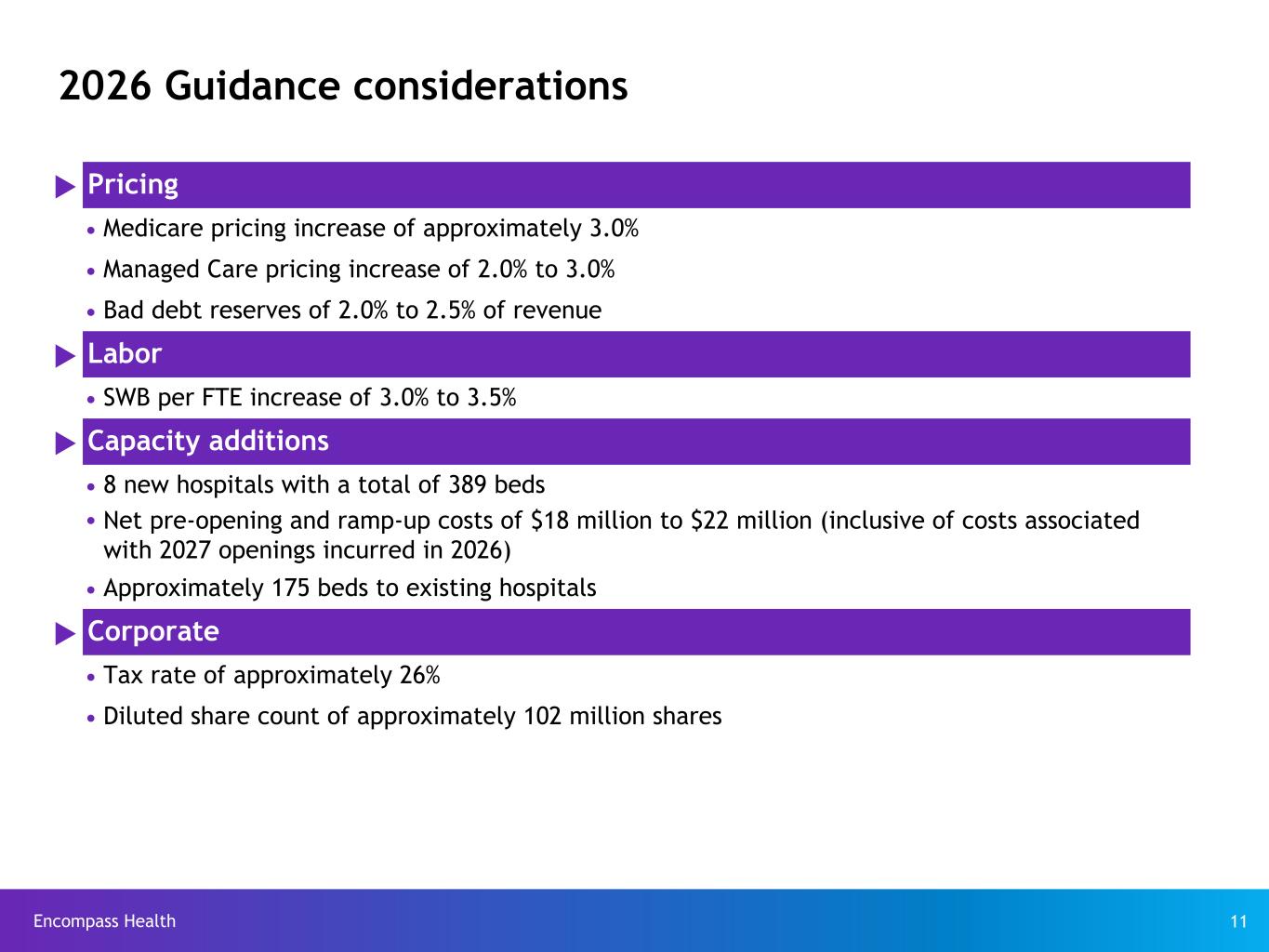
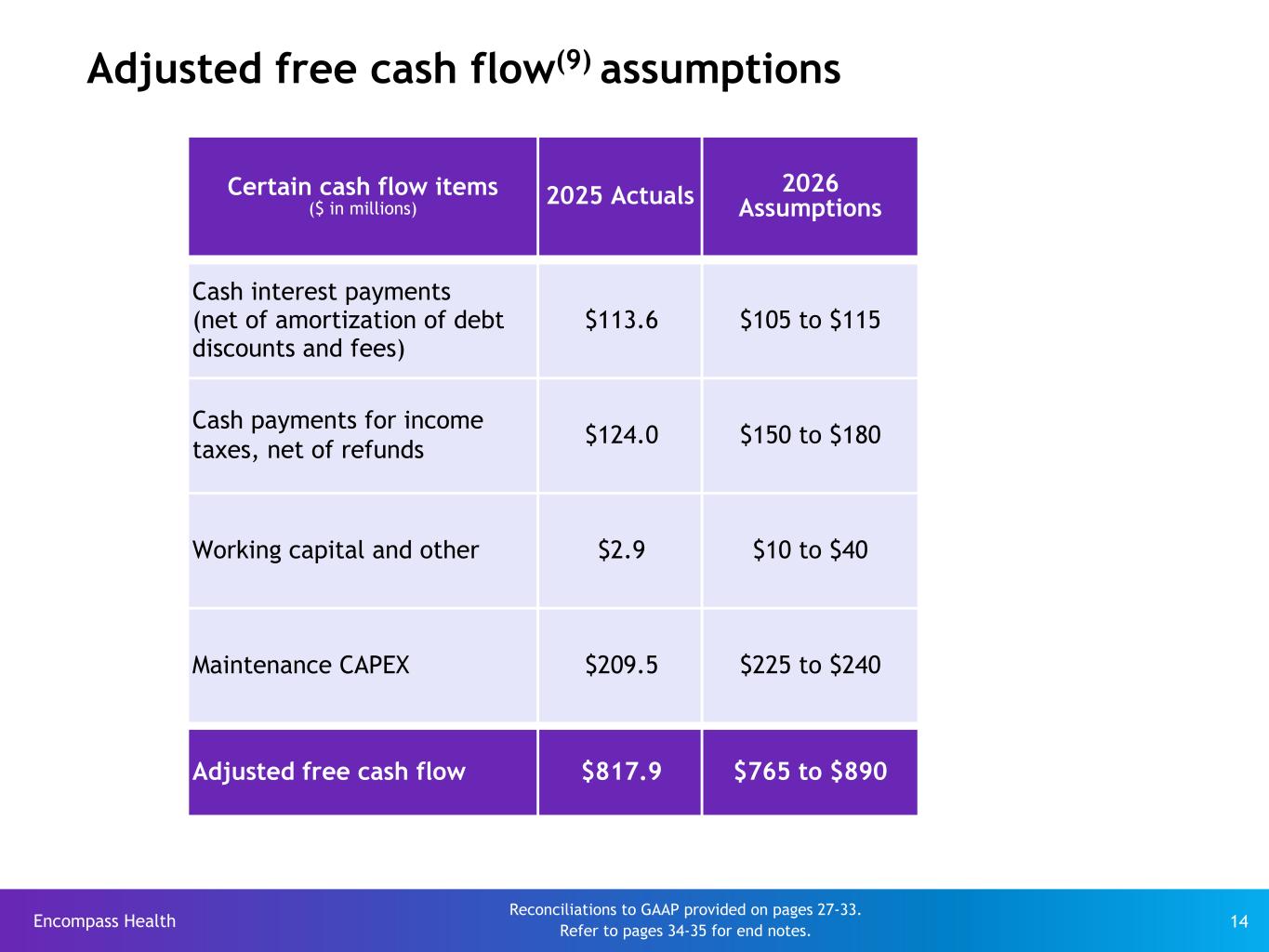
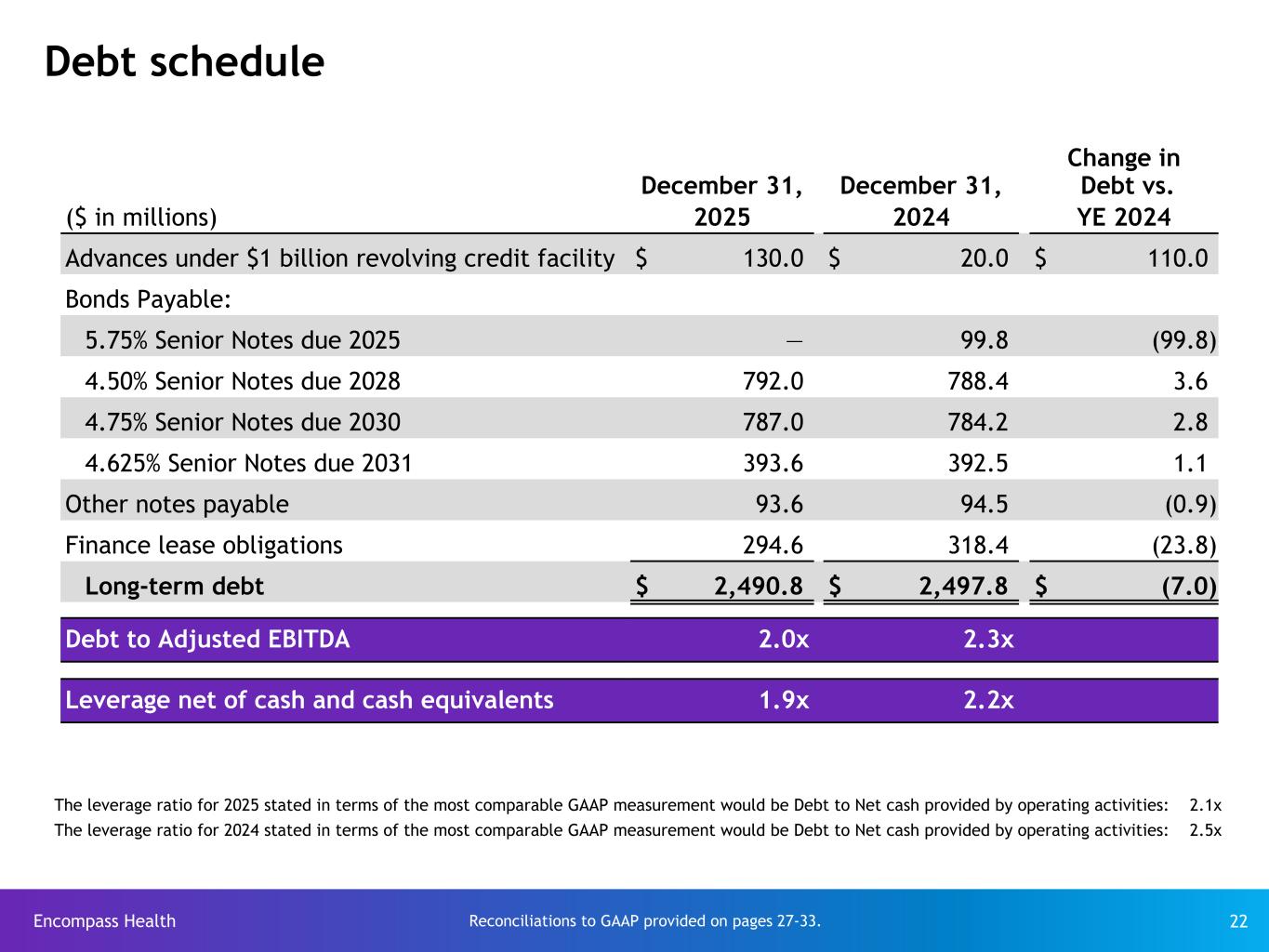
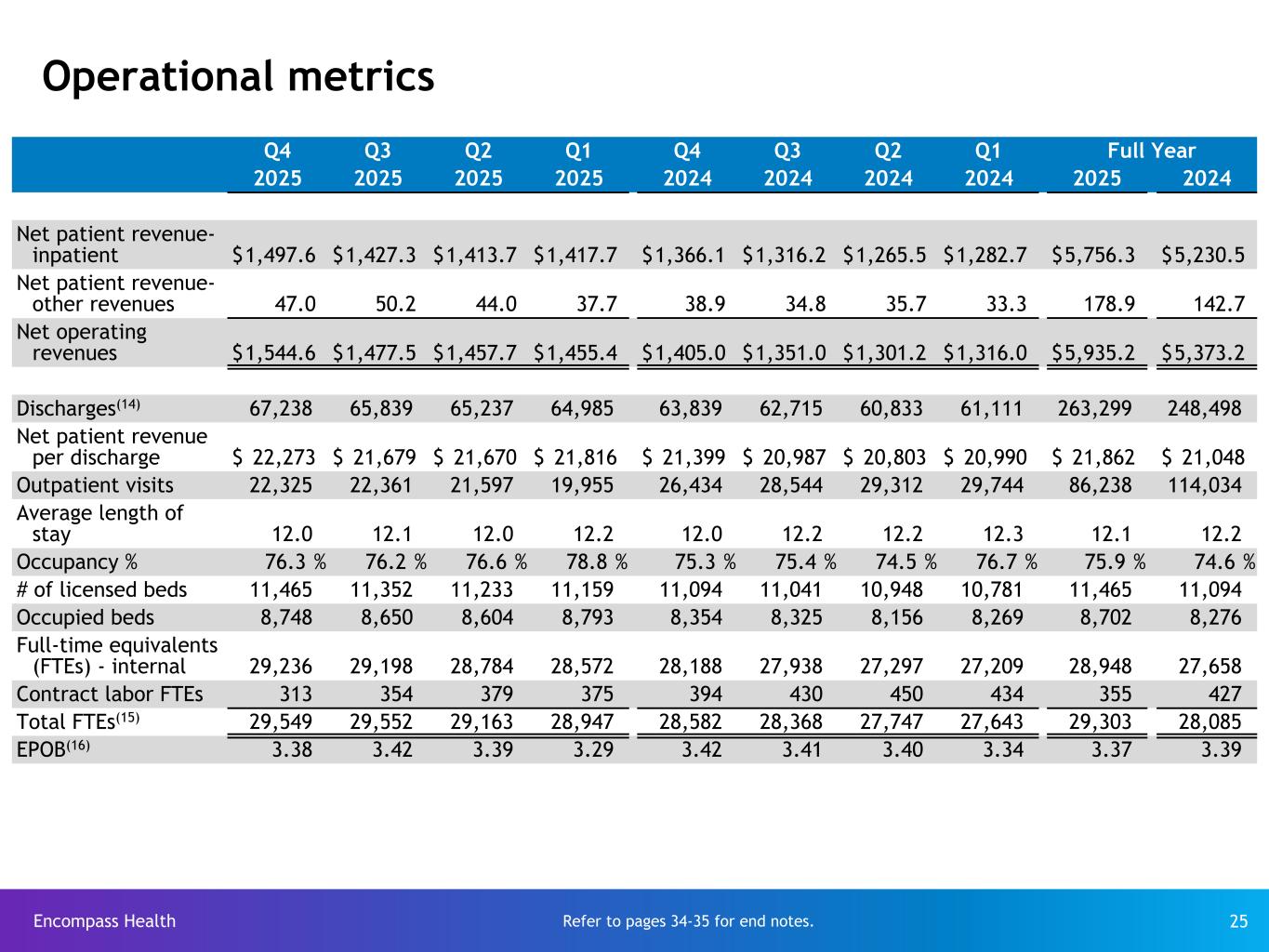
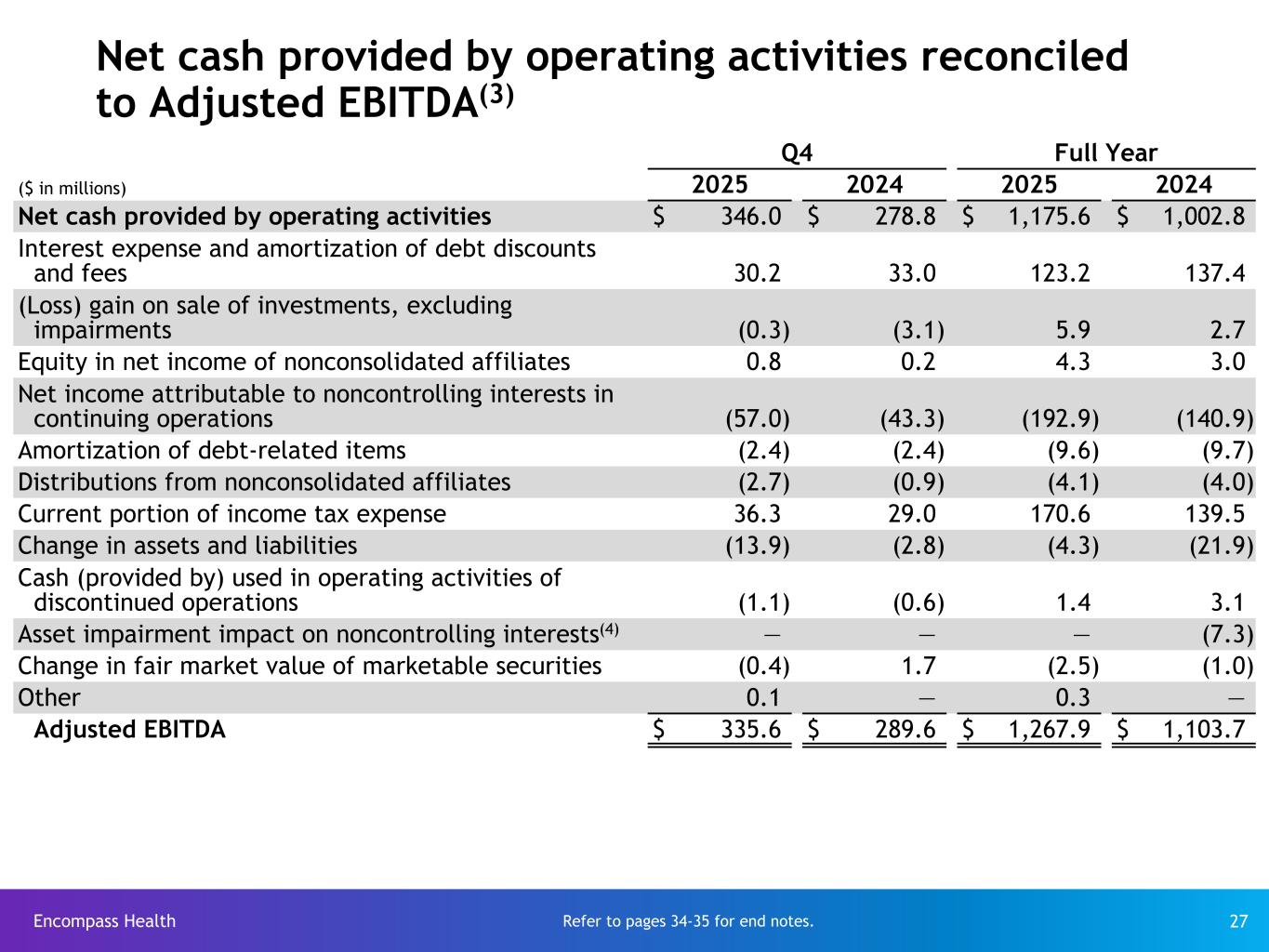
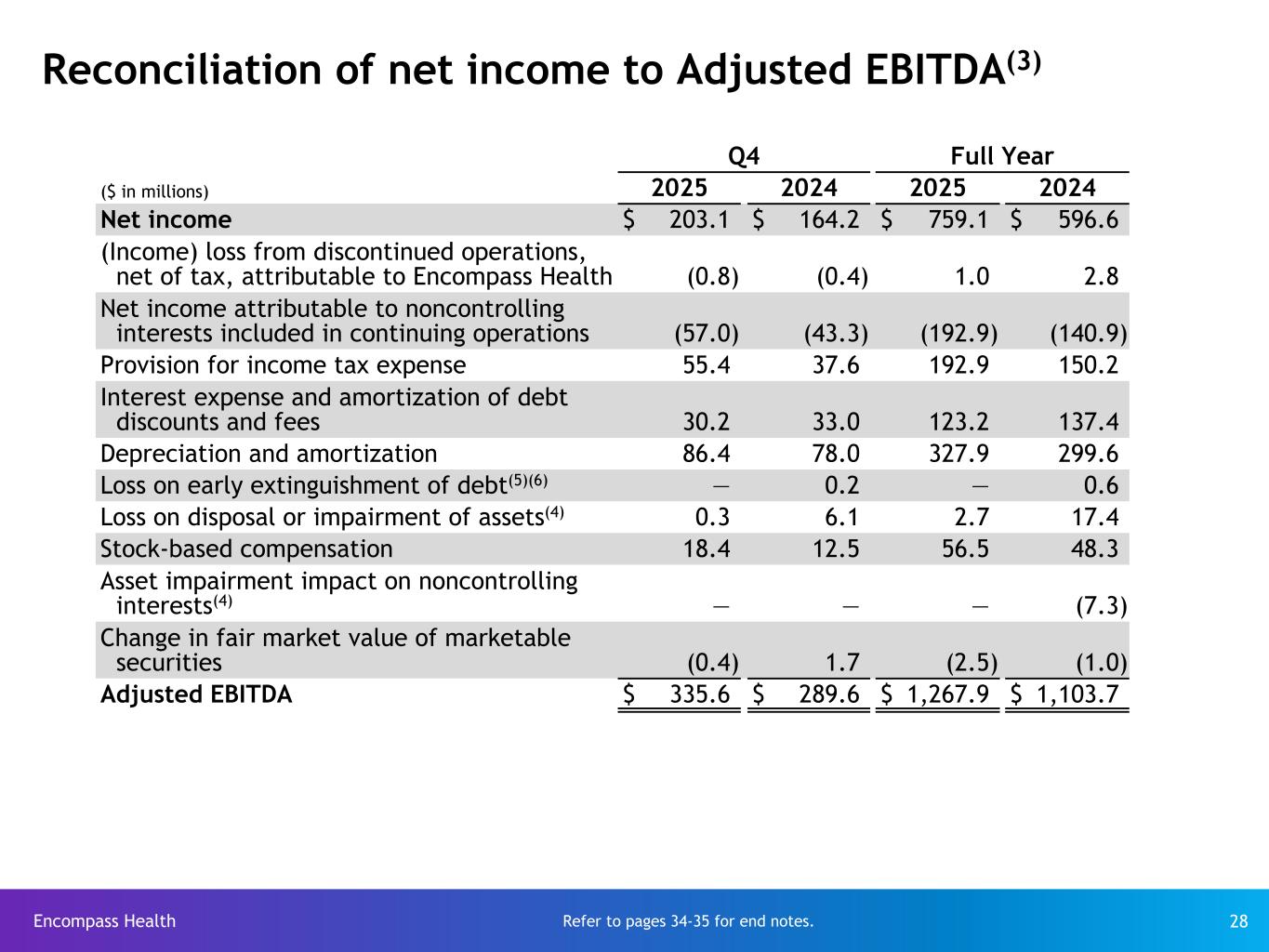
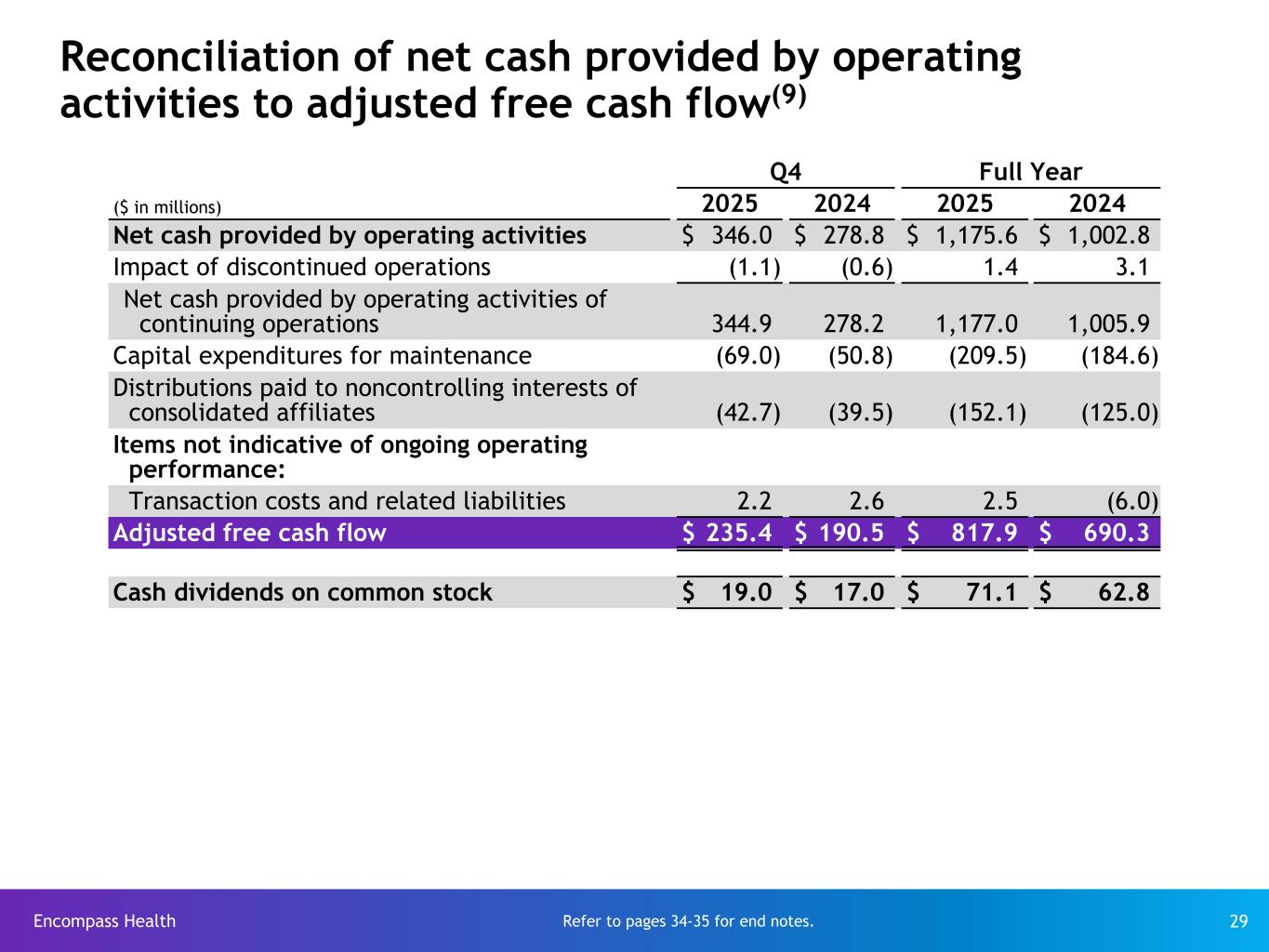
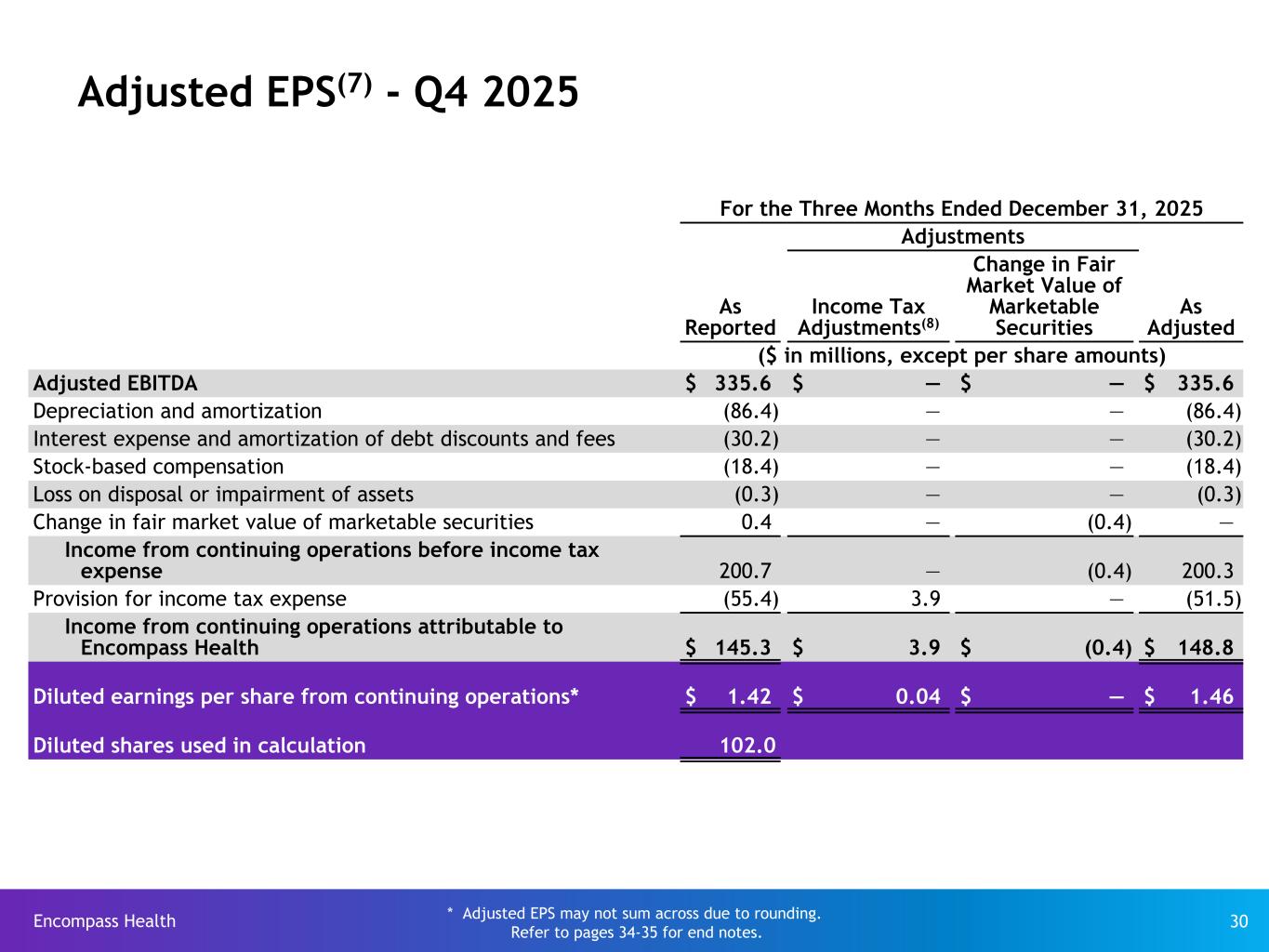
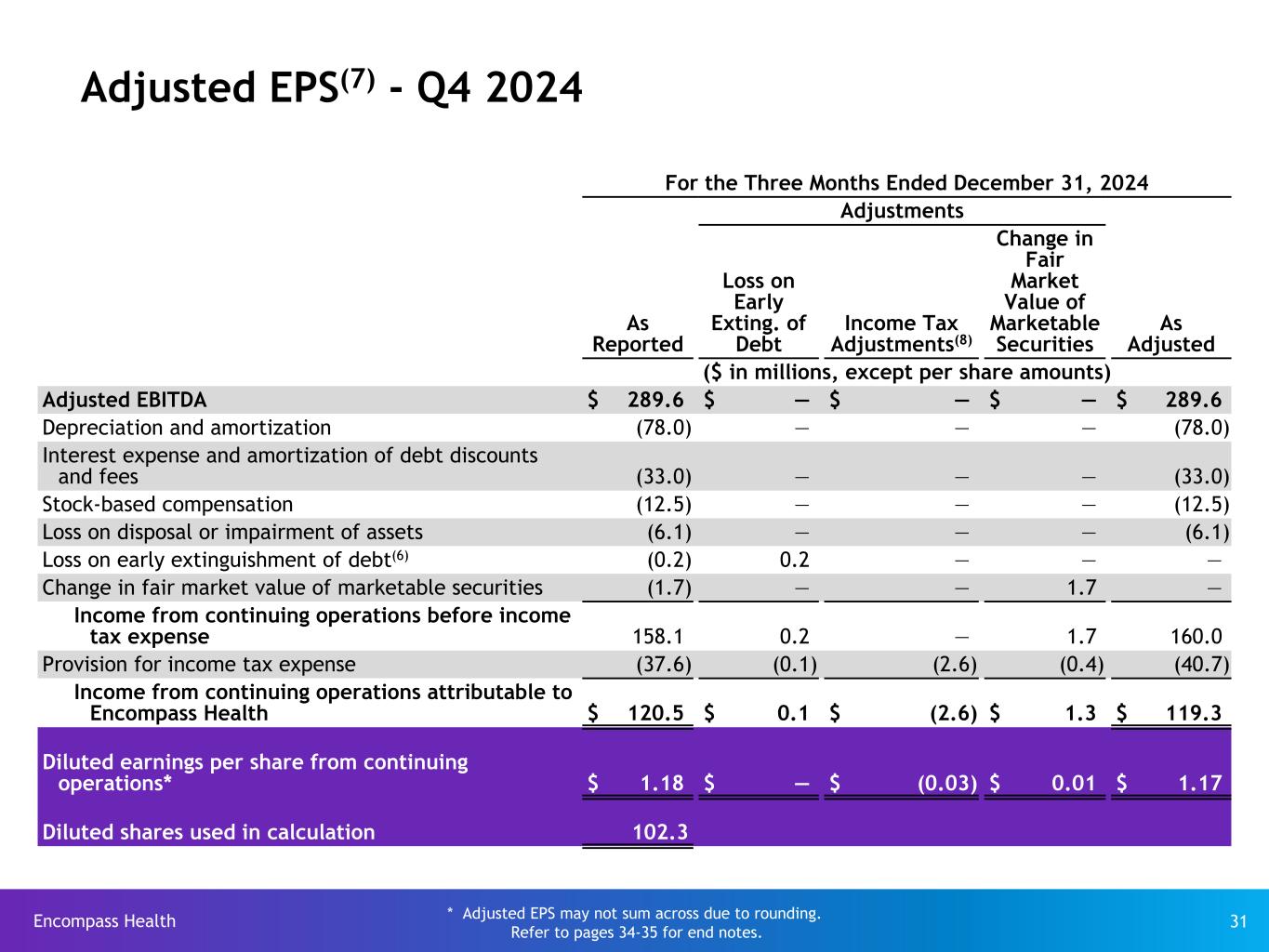
Thank you, Mark, and good morning, everyone. Q4 revenue increased 9.9% to $1.5 billion, and adjusted EBITDA increased 15.9% to $335.6 million. The revenue increase was comprised of 5.3% discharge growth and a 4.1% increase in net revenue for discharge. Net revenue for discharge benefited from a $2.7 million settlement with a managed care payer related to prior year claims. Bad debt expense for the quarter was 2.1 percent flat on a year-over-year basis. Q4 SWB per FTE increased 2.1 percent. Premium labor costs, comprised of contract labor and sign-on and shift bonuses, declined $5.8 million from Q424 to $23.8 million. This is the lowest since the first quarter of 2021. Contract labor FTEs as a percent of total FTEs was 1.1%, also the lowest since the first quarter of 2021. Benefits expense per FTE increased 2.9% as the anniversary of the large increase and group medical expense experienced in Q4 of last year. Net pre-opening and ramp-up costs were $2.9 million in Q425, bringing our full year total to $13.9 million. Q4 net costs were lower than expected as four of our eight hospitals opened during 2025 contributed positive adjusted EBITDA during the quarter, and the losses for our hospitals opened during Q4 were less than budgeted, in part due to faster Medicare certifications. We continue to generate significant free cash flow. Q4 adjusted free cash flow increased 23.6% to $235.4 million, bringing our 2025 full-year total to $818 million, an increase of 18.5% from 2024. The strength of our cash flow allowed us to fund $736 million of capital expenditures, $158 million in share repurchases, and $71 million in cash dividends, while holding long-term debt essentially flat on a year-over-year basis. Our year-end net leverage ratio of 1.9 times connotes substantial flexibility for continuing investments in our business augmented with shareholder distributions. Moving on to guidance, our 2026 guidance includes net operating revenue of $6.365 billion to $6.465 billion, adjusted EBITDA of $1.34 to $1.38 billion, and adjusted earnings per share of $5.81 to $6.10. The key considerations underlying our guidance can be found on page 11 of the supplemental slides. And with that, we'll now open the lines for Q&A.
Operator
Thank you. Ladies and gentlemen, at this time, if you do have any questions or comments, please press star one on your telephone if you find your question has been addressed you may remove yourself from the queue by pressing star two once again star one for questions we'll go first this morning to matthew gilmore of key bank matthew please go ahead your line is open hey good morning um i thought i might ask a couple questions on the um on the volume front you know the way volumes evolved this year was you know stronger in the first half and then um moderate a little bit in the back half.
I think there were some comp issues you talked about last call. I was curious if you could sort of flesh those out and then help us think through any comp issues we should be thinking about during 2026, especially the dynamic of the de novos rolling into the store base and that timing issue.
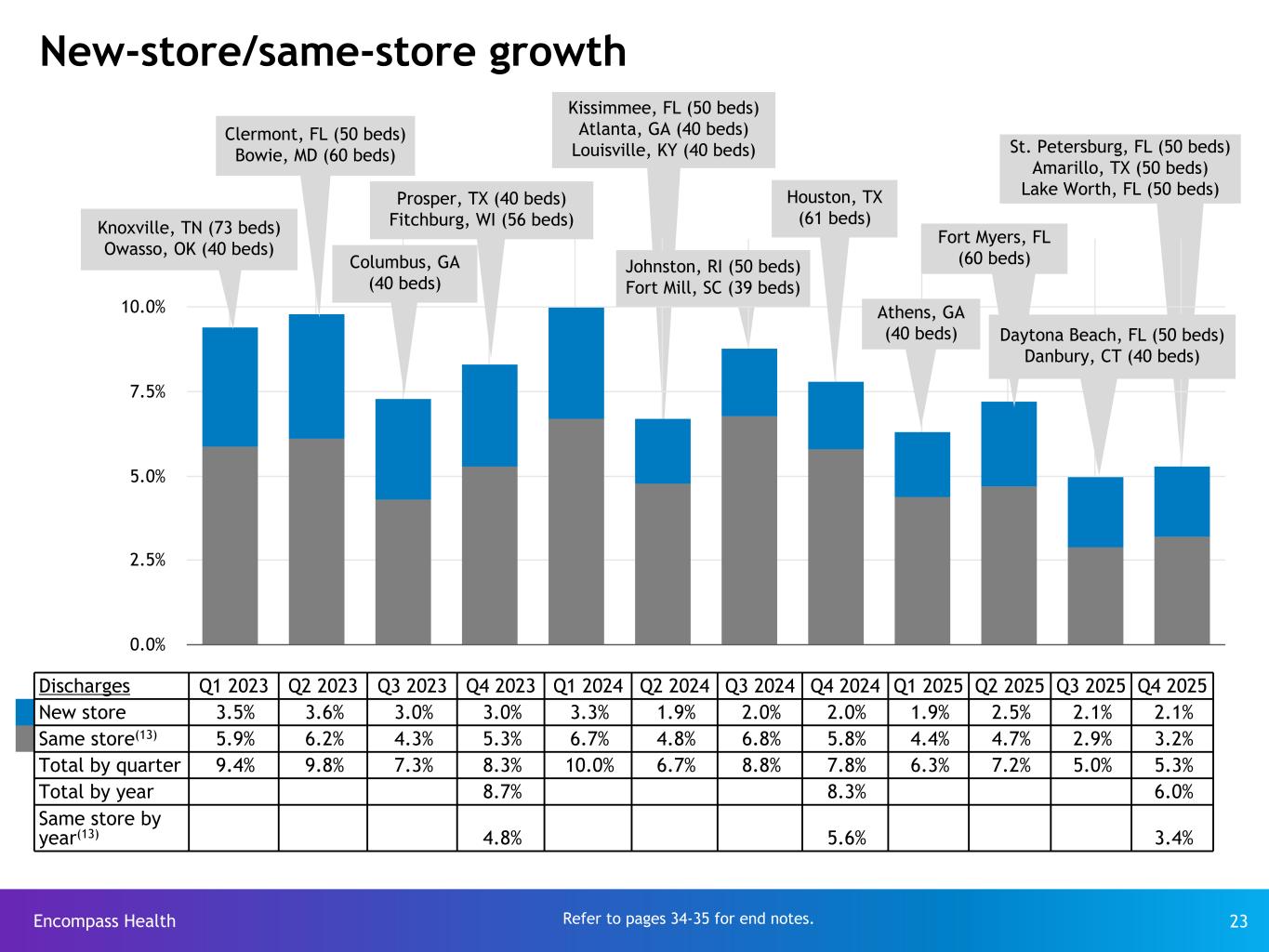
Yes, certainly in the back half of the year, we were up against some pretty challenging in comms, Q3 24 total discharges were up 8.8% and 6.8% of that was in same store. And then in similar fashion, when you moved into Q4 of last year, we were up 8.3% in terms of total discharges and 5.8% of that was in same store. It was also the case that with regard to contributions from new stores, we were more skewed towards the back end of this year with new hospitals coming on board. You may recall that we had one hospital that opened in the last week of the third quarter and then three hospitals that opened in the fourth quarter, one in each month. And then there was the issue of the unit consolidations and closers that we talked about last quarter. And so, as a reminder, we had two units, one in Cewickley, Pennsylvania and one in Cincinnati, Ohio. Those were spaces that were leased from a host acute care hospital. For various reasons, we terminated the lease, and we anticipate that we'll consolidate that volume into another hospital in the market, but there's a period of time in which that's not happening. We estimated that that was a headwind of about 30 basis points to total and same-store discharge in Q3. I think I made the comment in Q3 that we anticipated a similar level in Q4. What I failed to take account of when I made that statement was the fact that Cincinnati actually closed relatively late in Q3, so we had a full quarter impact in Q4, and so the impact in Q4 was probably closer to 45 basis points.
Matt, I think it's worth noting in terms of our track record on bringing on our de novos. You know, last year was a good example of how, if we can get the Medicare survey quicker than having a long drug out, a waiting period for them to come in and do the survey. It certainly benefits us. Our teams have done a great job getting these hospital staff, getting the word out in the marketplaces, our design and construction has done the same thing there are a lot of factors outside of our control as you go through these startup processes but our team's just done a really nice job in delivering these hospitals pretty much when uh when the due dates are uh are there so uh that has benefited from us uh and our continued planning and uh and execution got it understood and then as a follow-up um i thought i might get a comment or two on the mix it seemed like the medicare fee-for-service mix is a little bit higher in the fourth quarter.
Is there something you'd attribute that to? And if you had any comments on just sort of the growth across different payer classes, that would be great. Thanks.
Yeah, fee-for-service growth was strong in the fourth quarter. That's good because that's our best payer. We did experience some challenges with regard to Medicare Advantage in the fourth quarter, and it was specifically with one national payer where we saw the conversion rate drop, not insignificantly in the fourth quarter. I'm not going to name names right now. I will tell you that if this persists into next year, we may be inclined to name names. The referrals within that specific Medicare Advantage plan were actually up nicely, high single digits for the quarter, but the conversion rate, which is the ratio of admits to referrals, was down significantly, And there's no reason for that. Again, as we looked at the underlying nature of those referrals, they were consistent with the referrals we were getting across the system and across payers. And so what that translates into is, for whatever reason, that plan elected to start denying care to a segment of the Medicare beneficiary population, which we believe is in direct contravention of Medicare coverage requirements. We're going to be undertaking some specific actions to address that as we move into Q1. That includes maintaining active communication with the subject plan and also with CMS regarding what we've used as non-compliance with the Medicare coverage requirements. As we did in the fourth quarter, we think that this is going to be an opportunity to backfill with IRF appropriate patients covered by fee-for-service, other MA plans, and the continued growth in our Veterans Community Care Network. We will ensure, in terms of doing our own part, that our clinical liaisons are responding timely to all referrals and doing so with high quality medical necessity documentation. It's probably an opportunity to enhance that process with some AI tools. And we're going to be implementing an admit and appeal strategy on those MA denials that we believe are clearly in contravention of the Medicare coverage requirements. And then finally, we'll make sure that we continue to reinforce the value proposition for IRFs with the Medicare beneficiaries, making sure they understand the right of choice that they have, with referral sources, with respective patients, and also with families and caregivers.
Hey, Matt, this is Pat. Just to add a couple of points to what Doug said, So one of the call-outs he made was on the VA program. We've talked about that before. We continue to drive that initiative and have scaled up some best practices and education across our company and really pleased with the results. So that has now grown to represent 19% of our managed care volume. Our third consecutive quarter of discharge growth in that segment over 20% on the quarter finishing around 25% to bring the year to 22% growth. We continue to see a lot of upside in that segment and it's a great opportunity for us to provide IRF access to veterans. The other point that I'll make is on the MA admit and appeal strategy. We've never really undertaken such an effort before. And two of the major payers have Medicare, excuse me, have conversion rates below 20%. And what we're going to do in a couple of these markets is if the patient meets Medicare coverage criteria, we're going to admit those patients. And we're going to go through the different levels of appeal process. There's five levels of administrative appeal all the way to the ALJ and federal district court where we're going to advocate for access to care.
And these issues with this particular MA plan notwithstanding, and they're really not new, we see these pop up from time to time. There is a significant population of IRF appropriate patients who are still not being treated in IRFs, and so the pond for us to fish out of is plenty big.
Got it. Thanks for the details.
Operator
Thank you. We'll go next now to Anne Hines with Mizuho Securities. Anne, please go ahead.
Good morning, Anne. Yeah, good morning. Thank you for all the detail on some of the regulatory unknowns. That was very helpful. Can you tell us just, like, how these pilots usually play out? Like, I know the team pilots, five years, 2030, 2032. What typically happens after that pilot program? Like, do most of these pilots just kind of die out, or are they implemented nationally? If you can give us some examples, that would be great.
And if you go back and even back to 2016, 2015, with the plans I mentioned, the BIPC and CJR, there was a little bit of both in terms of people required to do it or voluntarily got into it. You saw some people really go into it strong, kind of what I would refer to on the bleeding edge. Then you saw a lot of systems kind of wait and see what happens and didn't want to get out there too far. I think it's the nice thing about our ability to work with our joint venture partners in these markets where a team will come out. We have a very collaborative approach. Pat and his team have been out talking to all the major systems in our markets impacted to see what their plans are and also to bring forth our value proposition because there's a big quality factor in teams where the acute care hospitals will be penalized for readmissions. So that's a big part of the value that we bring in to that. So I think that in large part, as I noted, there is typically an overreaction in terms of what people think will be the impact on our facilities. And with time, as noted, we just continue to grow through them because there are enough patients that would fall outside these plans that could benefit from the care that we provide. So I'll ask Pat just to talk a little bit about what he and his team have done, I think specifically in the Boston marketplace, where we have some team introductions.
Hey, Ian, this is Pat. Thanks, Mark. So, just to reinforce what Mark said around team and to get at part of your question. So, if you look back to BIPC and BIPC Advanced, both of them were five-year programs. They were not expanded after the five years. And if you look between those two models and then CJR, we added or acquired approximately 4,500 beds during that time. So, significant growth in spite of those models. So there's really three things that I'll point out to you, aside from the VA strategy, which is a nice opportunity for us to continue to backfill any potential impact, and aside from patient choice remaining. First is we've had a lot of conversations in our marketplaces. Mark mentioned Boston. Two of our largest potential impact hospitals are in the Boston marketplace. And frankly, we're not hearing a whole lot of chatter from them or our JV partners that they're going to handle patients differently. In fact, they remain very focused on quality, length of stay, capacity constraints, and readmissions. And those are all elements of our value proposition that we have executed on for decades to their benefit. Second, And, you know, and Doug touched on this, there's substantial opportunity for us to backfill potential volume with other diagnostic categories. So, if you think about stroke, brain injury, neuro, cardiac, and pulmonary, those are patient categories where people are still twice as likely to end up in a nursing home than in a patient rehab hospital. So, we've put a lot of effort into working to increase our market capture there. And then third, from a team perspective, patients on dialysis with end-stage renal disease are exempt from team. About 4% of our volume currently falls into this bucket, but through our investments in Tableau, where we have almost 70% of our hospitals covered with Tableau and then the remainder with external dialysis, we have the capacity to slightly more than double that volume across our portfolio based on current utilization so there's a lot of opportunity for us to backfill volume with earth appropriate patients across other diagnosis categories or within the team impacted groups as well and at the risk of piling on i'll just add a couple of things first our anecdotal evidence and this has been consistent for multiple months right now as we canvas
the acute care hospitals and the impacted markets is that there is very little focus on the team from those hospitals. And it's perhaps not surprising because they face substantially larger issues with regard to what's going to happen on Medicaid supplemental payments and what's going to happen with regard to the extension or the lack thereof of any ACA subsidies. Further, as we drilled down and looked at the target prices that have been set for these conditions in the impacted markets, in almost all cases, regardless of the patient's condition, those target prices cannot be achieved unless the patient bypasses a post-acute inpatient stay, IRF or SNF, altogether and goes directly to the home. The only way that that can be safely accomplished is if you increase the length of stay in the acute care hospital. And doing so by even a couple of days would completely erase any of the participation in the risk corridor. work.
And one last comment on this. We've done an analysis early. It's one month, but there's been no impact of team-associated diagnoses categories within our team-impacted market. So, it's really been no impact of volume.
Great. Thank you for all the detail.
Operator
Thank you. We'll go next now to Andrew Mock of Barclays. Andrew, please go ahead.
Hi. Good morning. There was a pretty meaningful beat on labor costs in the quarter. with improvements in both wage growth and EPOB. Can you help us understand the drivers of that in the context of moderating volume growth?
Andrew, just real quick, I think it's kind of twofold and honest, Pat, to talk specific about premium pay. But I think we're seeing some softening in the labor markets as a whole, which has been a positive thing for us for the last year or so. And then I think, secondly, while we've always been very disciplined around the use of premium pay and managing our staffing ratios, Pat has really dug in with his team to look at some of the outliers we had within our portfolio, and it's been meaningful. So, Pat, you want to get some detail?
Yeah, and I'll give credit to a few different groups here. So, first, our operators have done a tremendous job both bringing in excuse me bringing down turnover you know rn turnover continues to drop it's at pre-pandemic levels and at the same time our centralized talent acquisition team continues to do a tremendous job on the hiring front so we added from a same store perspective 300 net rns in 2025 and that brings our four-year total up to around 1700 so just a tremendous job to both of those groups there. We feel like there is, while the rate of improvement will slow, that we have an opportunity to potentially narrow the gap in variation in some of our higher utilizing markets on premium pay in particular. Our 10 most challenged markets, which represent a significant portion of our spend. We are substantially increasing our efforts from our recruiting team as well as recruitment marketing to try to get at those markets where hiring has been a little slower. In particular, I'll point out that all the growth that we've had and the de novo markets we have opened those without contract labor so we are taking some of the resources that we would use to open a hospital and staff a hospital and we're going to apply that approach to to these more challenged markets as well and then on the epob front you know there while there is some small timing impact of de novo's ramping you know we are relentless in our pursuit of operational discipline across our regions and in our local markets, and we do that in a way that does not sacrifice quality outcomes or clinical excellence. Mark talked about our discharge outcomes. We had records in 2025 of our discharge outcomes as well as patient satisfactions.
We were able to get at these additional efficiencies, and we'll continue to work towards those without sacrificing anything on the clinical front and then just to go through the specifics on the q4 labors as we mentioned uh total swb per fte and q4 was up 2.1 percent the composition of that core sw which does not include contract labor for fte was up 2.8 percent benefits again anniversary the substantial increase in q4 of last year was up 2.9 and and premium labor was down year-over-year $5.8 million. The EPOB came in at 3.38. That was better than our expectation, and that was largely attributable to the faster ramp-up of the de novos that opened in 2025. And as we cited during our comments previously, that was boosted in Q4 by the fact that we got our Medicare certifications on those openings faster than we had anticipated. We don't control that, so we can't guarantee it's going to happen on future openings, but it was a lift in Q4. Importantly, we were able to achieve all of these things with regard to our labor costs while holding nursing turnover at 20.2 percent for the year and therapy turnover at 7.8 percent.
One last comment here that I failed to mention is, you know, we have talked about this before, but we have made a substantial investment in the development of clinical ladders and tweaking those to increase participation. Because if we can get a clinician on the ladder, their turnover is about a third of what a non-laddered clinician is. And I'm really, again, proud of our operators. We have our nursing participation up to 32 percent, 36 percent of our therapists, and 47 percent of our nurse techs are participating on our clinical ladders. Again, And we still see upside here, but we're really pleased with our progress.
Great. And just to clarify, the better labor and pre-opening, the Medicare certifications coming in earlier, that's what's driving the better-than-expected pre-opening cost, correct? Is there anything else?
No. Again, you had not only that impact from Q4, which was predominantly where it was, but the performance of the de novos that opened in 2025 prior to Q4 in Q4 was favorable. And we cited a number of those. Four of those actually had positive four-wall EBITDA in Q4.
Operator
Great. Thank you. We'll go next now to Peto Chickering of Deutsche Bank. Peto, please go ahead.
Morning, Peto. Hey, guys. I think you're taking my questions here. So I'm going to apologize in advance for this one, but I want to go in the weeds and talk about the Alabama RTV experience. From a process perspective, can you explain with a 93 affirmation rate what happens with a 7% of claims that weren't affirmed? When you appeal at 7%, what percent of those are you winning? And when you appeal to the administrative law judge level, what percentage of those are you winning? So, at the end of the day, after you peel and go to the ALJ, what percent of these claims do you guys need to reserve for?
Well, you weren't lying. You are down in the weeds. Let me first kind of pull this up a little bit, and then I'll see if I can get down to that level. So, you know, first of all, there's a perception out there that both team and RCD represent new risk to IRFs. and and mark referred to some of this in our opinion they do not they are ordinary course of business we have lived continuously with episodic payment models since 2014 and cms has always had the right to audit 100 of herb medicare claims on both a prepayment and a post-payment basis, and they have done so under a series of programs such as TPE, ADR, RAC, SMERC, etc. RCD is just a new acronym for the same old thing. The Medicare coverage requirements under RCD have not changed. The documentation requirements under RCD have not changed, and the third parties performing the RCD audits have not changed. The potential upside to RCD is that if we choose to remain on 100% review, and Mark alluded to this in his comments, it potentially obviates the other audit programs. Moving specifically to Alabama, 93% is the current affirmation rate for the seven hospitals in Alabama, where we're dealing with a difficult MAC who continues to non-affirm claims for reasons that are in contravention of Medicare coverage requirements and guidelines. As a result, we appeal the overwhelming majority of non-affirm claims through the multiple levels available to us. And although it's still early to call the ultimate resolution rate because those claims are still pending and because the sample size is relatively small, we're having a good success reversing the denials. We continue to educate Palmetto, and we continue to involve CMS, and we believe that it is more likely than not that that 93% affirmation rate moves up. When we look at the Pennsylvania experience, it covers more hospitals, and we believe that that rate, 98 to 99%, is more representative of broadly adjudicated RCD program will land. And so all of that suggests to us that the go-forward bad debt expense rate that we experience is going to be consistent with our recent historical experience, thus the two to two and a half percent number that is included in our 2026 guidance.
Just one quick addition on RCD in Alabama, not necessarily on the bad debt front, but just on the volume and occupancy front. So virtually, again, no impact here. We have expansions that will be underway at three of our Alabama hospitals. We're going to be filing for the CON for three additional expansions. So that covers six of the seven hospitals in the state. So on the volume side, unimpacted.
Palmetto's a pain in the butt in Alabama. They were a pain in the but before RCD.
Okay, fair enough. That's a pretty honest response. A follow-up question that you talked about earlier. I think you said that the referrals were up high single digit, but emissions were way down. Can you talk about generally what you see from MA on conversion rates from where that went this quarter? And then from a legal perspective, how much layweight does MA have to deny those to keep care of?
Yeah, so I'll start and then maybe pass it over to Pat. so you know historically our our total ma conversion rates have run between 25 and 30 percent and that's going to compare to medicare fee for service which is the same patient population subject to the same medicare coverage requirements which is run in the mid 60 percent so that's been a problem all along the particular payer who shall remain nameless for at least this quarter has always been our lowest conversion rate, but they dropped by about 500 basis points. You know, this is, again, in contravention of Medicare requirements, so we do have the ability to take this directly to CMS. Because the change was so material in Q4, our first order of business is going to be to try to work directly with the plan itself and say, is there something different? Is there something that we can do better to try to do that in partnership? But we're not going to wait and see the effect of that before we get more aggressive with this admit and appeal strategy that Pat outlined just a bit earlier.
What I would add to that is MA is required to operate with the same coverage criteria as traditional fee-for-service Medicare. They're allowed to have a prior off requirement, which they do, but they are supposed to adhere to that same coverage criteria. And what we see on a daily basis, and this is not new, is the failure to adhere to that Medicare coverage criteria. So, you know, we have typically taken that in stride, and it's been a frustration for our referral sources. it's been a frustration for us, and most importantly, it's been a frustration for the seniors in this country that deserve our level of care. So, you know, we have decided that there's no teeth to the Medicare requirement right now that they have to do that. So, you know, we're in a position where we're going to pilot this, and we're going to take these claims that are in alignment with Medicare coverage criteria through the administrative appeal process, through the ALJ, and potentially beyond. And, you know, we're optimistic. You know, we feel like the facts are on our side here. And more importantly, we're really interested in making sure that seniors have access to our level of care in this country.
I think it's important to note as well, perhaps another silver lining out of RCD, is that the affirmation rates that we're seeing in Alabama and that the others are seeing in Pennsylvania suggest that under fee-for-service, which has that much higher conversion rate, the overwhelming majority of patients are appropriate for IRF care, which means that those that are being denied that access by Medicare Advantage are being done so, again, in contravention of Medicare coverage requirements.
Great. Thanks so much, guys.
Operator
We'll go next now to Whit Mayo of Leering Partners. Whit, please go ahead.
Morning, Whit. Hey, guys. Doug, just wanted to take your temperature on leverage and how you're thinking about the appropriate target. You're going to probably drift below one and a half times soon. Just any thoughts on upping the dividend more, stepping up buybacks on a permanent basis, maybe buying up leases, just any updated views would be helpful.
Yeah, so maybe what we can do is kind of use our guidance for 2026 as a proxy for what things might look like. And so if you look at our free cash flow assumptions, the midpoint of those assumptions is right at about $828 million. Again, using the midpoint of other ranges within our growth CapEx, that's at $725 million. The dividend at its current level is $77 million. So that would suggest, again, if we are achieving our midpoint of EBITDA guidance and our midpoint of the free cash flow, that we would fund those uses internally and still have about $25 million of cash. And that would leave us all other things equal at the end of 2026 with a leverage ratio of 1.83 times. And that implies even if you wanted to be conservative and leave leverage at, say, two times, that there would be capacity for another $230 to $250 million of buybacks or other distributions. There really aren't other opportunities to buy back leases, so I think to the extent that we generate excess cash and have capacity within the leverage ratio, the most likely utilization of that is going to be additional share repurchases and increases in the dividend. Okay.
And then heard much about malpractice from you guys. Some of the other providers have been talking about it more. Just how did that develop in 2025? Thoughts on 2026? You've got this new reasonable care standard change, I think, with malpractice. Does this change your views at all, how you're thinking about it?
Yeah, we've seen no significant change in our GPL activity from 2024 to 2025.
Operator
Thank you. We'll go next now to AJ Rice of UBS. AJ, please go ahead.
Hi, this is James on for AJ. Thank you for taking my question. I just wanted to see if you can give us some color on the rationale behind the changing development as you look to add these small format hospitals and what advantages this type of hospital provides versus the traditional de novos?
Yeah, so it's the confluence of design and opportunity, maybe with a dose of necessity tossed in. And so from a design perspective, historically, we had had trouble coming up with an economically feasible model that would be in the size range that we're talking about. But as we have ascended the learning curve with regard to our de novos really over the past five or so years and been able to incorporate more in the way of prefabricated construction, whether in a hybrid model or fully, it's helped us kind of crack the code on this 24-bed prototype. type it solves an issue for us where we've got one of two situations one is we've got a an existing hospital in a market that doesn't have any more physical ability to expand uh and yet the demand of the market suggests that more beds are needed and so this is an economically feasible way of adding more capacity into that market even on a chassis that can't be expanded it's also the case that is we find in a lot of larger metropolitan markets in dallas and houston and tampa are three that come immediately to mind that the overall market is growing but based on traffic patterns and based on these the growth in specific neighborhoods or geographies the additional beds might best be positioned elsewhere in the market as opposed to in the existing hospital So again, the standard format that we have come up with, and the first will open in 2027, is what we acquire two to two and a half acres based on specific topography. It is a single story, 24 bed chassis. It has got a smaller kitchen because there's no food preparation on site.
Obviously, the gym is smaller because we've got a fewer number of patients. and we're able to leverage the management team and the marketing resources associated with the with the host hospital so the returns are very favorable you know it's a market density is a big part of the strategy not only you get scale from staff but you get a brand recognition in the marketplace which helps us with staffing as you have employees in the workforce out there starts to become more and more familiar with Encompass Health. We've seen that in markets. It gives us an opportunity to provide growth opportunities for existing staff and management teams. So that helps with retention. It also decreases the risk as we add another location in the marketplace. So we think there are a lot of benefits from the small format hospital. And And as I noted, it's just yet another modality that we have to add capacity in a marketplace where the need is pointing out the required capacity. So we've got some strong plans going out in the future on this, and we think it's going to be really helpful as we expand that capacity.
And it's important to note that because all of these small format hospitals will be remote locations, meaning that they are tied to a host hospital, they operate under the same Medicare provider number, which in almost all cases means that managed care contracts and so forth can be extended and don't have to be renegotiated. It also means that you're not subject to another Medicare certification, and so you don't have to do the 30 free patients in the ramp up there.
This is Pat. I would also add that we do have three locations right now. They're not technically what we would consider a small format hospital, but they operate like it. And they are satellites of a main location. And they drive impressive results in return. And so we do have some experience with this operating model. This is a great way for us to scale this across the country. We have dozens of potential locations that we're going to be looking at for consideration. And, you know, we talked about growing or underserved, excuse me, larger growing markets. But underserved or fringe markets where we have a hospital are also candidates for this because you may have someone within 30 a location within 30 miles that it does not have the density of a new requirement for a new hospital but they could benefit from from a smaller location and we'd still be able to get the leverage that both mark and doug have talked about so we're really excited about this i think it's going to be a big part of our our strategy moving forward and a nice way for us to not only help patients but increase our returns as well great Thanks for taking my questions.
Operator
Thank you. We'll go next now to Joanna Gajic of Bank of America. Joanna, please go ahead.
Joanna? Oh, yes. Hi. Hey, how are you? Thanks for squeezing me in here. So, I guess I have two questions. So, one, I want to start a follow-up on the team discussion, and then I have a question on volume. So, first on the team, so thanks for sizing up the exposure here. So, 2% of volume seems very manageable, and you expect to be able to replace any loss volume, so that's good. But just a couple of questions as we try to sum up maybe in the future too. So are these procedures that are included in the team model, in the five categories, are those coming at average revenue per district that's much different than average? Any kind of direction would be helpful here? And it sounds like, I just want to clarify, you don't have so much of an impact, I guess, to the bottom line this year, but I just want to make sure, like, if there's some sort of a number, you know, in terms of EBITDA headwind that you included in your 26 guidance and with that comment around, you know, the acute hospitals are not taking risk in year one, but would you expect, you know, things to change dramatically over time as these hospitals, you know, take more risk in the future years? Thanks.
So, Joanna, this is Doug. I'm going to start with the margin, then I'm going to turn it over to Pat for the balance. So, there is no real stratification of margin or real diversion of margin across our patient categories. And so, it is true that reimbursement is tied to RIC and to patient acuity. But when you drill down to the specific patient level, you also have to factor in things like comorbidity, and whereas you may be getting a higher reimbursement for a more acute patient, that is in part due to the fact, or large part due to the fact, that that patient requires more intense care and typically comes with a longer length of stay. So, no real distinction between the margin profile of the patients that will be subject potentially to this demonstration and to our older patients.
Thanks, Doug. So, Joanna, this is Pat. I would say from a margin perspective, Doug's absolutely correct. No, we're not foreseeing any impact on margin. From a net revenue per discharge perspective, it's almost each of these are in line with our average net revenue per discharge. the only two that have slightly higher, and I mean slightly higher, are the ones associated with fractures. So lower extremity width fracture and then hip fracture. But again, we're not anticipating for this to be material. It's all reflected in our 2026 guidance, and we feel really good about our opportunities to backfill. The only other point that I'll make on team is the majority of our team impacted markets have less than well 39 of the 89 have less than 10 discharges tied to team diagnoses uh almost all of our team impact is tied to 50 markets and half of those are joint ventures so again we're we've reflected this in our guidance we're really uh we think we're prepared to mitigate this if if issues come up but we're really just not hearing of any changes in referrals or admissions in our markets.
I will note also just further on the margin issue, part of the reason that you get to that parity with our average revenue for discharge on those particular categories that are subject to TEAM is because those specific patients have more comorbidities. That would make them less likely to actually be a participant within the TEAM model in terms of diverting their care away from the IRF because they really need to be in that intense setting.
Okay, that makes sense. And if I may, one question on volumes. I don't think you talk about some breakdown in terms of just the categories. In the past, you would talk about, you know, sort of the cardiology, neurology, orthopedic cases in the quarter. So, if you can give us that color, that would be helpful.
Well, we provide patient mix every quarter, you know, and we've provided the 2%. percent, it's not a direct equation. It's convenient to try to look at this in isolation and just say, I'm going to pick those RICs and assume that that's an estimate for the volume that's in those categories. But that's missing two other things. One is the presence of comorbidities that is going to be an element that clinicians make in deciding the appropriate course of care. And the second is, let's say that you even had an acute care hospital that was extremely committed to all elements of team. Again, the only way that they would be able to achieve the target price in many instances is by increasing the length of stay so that they would have a patient who could safely bypass any inpatient, post-acute inpatient setting. If they do that, the likelihood is that they would be looking for non-team patients where they could reduce the length of stay, and that has been one of the key elements of our value proposition all along, which is the ability to take a more acute patient with a shorter length of stay in the acute care hospital, so there'd be offsetting volume there. So, the team is not something that will happen in isolation.
Joanna, if you're talking about overall volume and just on a RIC basis. We did see nice growth in brain injury up 8.7%, cardiac up 5.1%, neuro 4.5%, major trauma was up 5% and stroke was up 3.8%. So again, broad-based growth across diagnosis categories. From a mixed perspective, with brain injury being our third largest discharge RIP category, that was up 40 basis points to be our largest mover. So, again, that's something we're pretty excited about, especially given that it's not a team-impacted diagnosis.
Okay. Thank you so much, Bodecoa. Thanks.
Operator
Thank you. We'll go next now to Brian Tranquillet of Jefferies. Brian, please go ahead. Good morning. Congrats.
Good morning. Congrats on the quarter, and thanks for squeezing me in. Maybe, Mark, as I think about concerns that are emerging on Medicare Advantage rates and how that could potentially translate to payer pressure on providers. I mean, how are you thinking about that dynamic? And what are those discussions like with payers as you think about your scale and local market power?
You know, we always lead with our outcomes, Brian, and part of our value proposition. And I don't see that changing going forward. I think the concerns, particularly if you think about just team and certainly with payers, the quality aspect and concerns around readmission rates back to acute care hospitals, it really puts the premium on a post-acute provider that can take care of these higher acuity patients like we do and have a low readmission percentage. So we're very diligent about leading with our data and our outcomes. When we go and meet with the payer or the medical director for that payer, it's very helpful that we can show them the differences that we can have within Compass Health Hospital versus nursing homes or even other ERP providers. So I don't think our strategy on that changes.
If anything, we have more data and data sources now than what we did five or ten years ago just to help create that competitive advantage for us you know what what is happening out there is the rate of growth in terms of new MA beneficiaries has declined very substantially and if you listen to some of the dialogue in response to some of the rate updates and so forth coming out of the major plans they are stating that they're intending to exit more geographies with regard to their MA plans, which is going to shift those patients over to fee-for-service, and that's not a bad outcome for us.
Got it. I'll leave it there. I said that over the top of the hour. Thanks.
Operator
We'll go next now to Jared Haas of William Blair. Jared, please go ahead.
Good morning, Jared. Hello, Jared. Hey, good morning. Thanks for squeezing me in here at the end. Maybe I'll just stick to one as well. You mentioned the expanded relationship with Palantir, so I'll ask on the technology front. It sounds like you've had some wins around administrative work and revenue cycle management. I guess two questions. Number one, just be curious if there's any kind of quick ways to quantify sort of cost savings or other metrics that you track in terms of that deployment. And then as you think about expanding that initiative, is that still broadly around areas that I would bucket under, let's say revenue cycle management, or are you seeing other areas of the business to optimize maybe around clinical care or patient experience?
Yeah, so on the first, it is difficult to assign a specific ROI to the work that they're doing, but hopefully what it's going to mean is that our success on claims denials is going to continue to improve. The manpower that we need to process those denials is going to decrease and can be shifted elsewhere, so there are going to be some real tangible benefits. In terms of new projects that we're working on, we are going to be focusing on CRM market analysis, specifically to help us identify the optimal strategy for positioning in a market in terms of de novos, de novos with expansion capabilities, and the use of small format hospitals. Revenue cycle management is something that we'll be looking at later this year, and clinical staffing is another one that's on the table.
Just to add to that, we're looking for opportunities on the outside to enhance and elevate our clinicians. You talked about clinical care and patient experience in your question. I think that is certainly a goal of ours. You know, people don't go to medical school or nursing school or therapy school to become great at documenting and document for half of their shift. So we'll continue to evaluate opportunities to allow our clinicians to do what they do best, and that's to take care of patients.
Okay, great. I appreciate all the color, and I'll leave it there.
Operator
Thank you. We'll go next now to Raj Kumar of Stevens. Raj, please go ahead.
Hey, good morning, Raj. Hey, good morning. Thank you for squeezing me in. And just one quick one, as we kind of think about in the first quarter and, you know, maybe any potential impacts from the winter storm. I see that in your disclosures that one of the facilities that may have been slated for the first quarter was pushed back to the second quarter. So just curious, maybe if there's anything embedded in guidance related to any potential winter storm impact and how we should be thinking about that.
No significant impact from the storm. I do want to call out. We've got two other closures that are going to impact Q1 as well. So the first is that we have operated, since we acquired this facility in Lexington, Kentucky, Cardinal Hill, we've operated a 75-bed SNF unit. It's the only one, only SNF unit that we have had. It ran at a low ADC, 25 ADC. Both the beds and the ADC were included in our IRF bed count and discharge number, and that unit basically had zero profitability. We closed that at the end of December, so you're going to have some carryover impact from that. You'll have the continued impact, although lessening a bit, from Cincinnati and Sewickley. And then we've got one more unit consolidation that is taking place, and that is we have a unit in Bridgeport, West Virginia, which is in the Morgantown market, that is housed within an acute care hospital. It's at the end of its lease, so we are closing that effective February 28th. Unmitigated, meaning not picking up volume elsewhere in the markets, as we go into 2026, that creates about a 70 basis point headwind for 2026 discharge growth, all of which is in the same store. We think that we will mitigate somewhere between 35 and 40 basis points. Great. Thank you for the call.
Operator
Thank you. We'll go next now to Parker Schnur at Raymond James. Parker, please go ahead.
Hey, good morning. Hey, good morning, and thanks for squeezing me in. I was just wondering if you'd give some detail just on your outlook on provider taxes or supplemental payments. Maybe just remind us your total exposure there, and then just your outlook for 26, and then maybe some potential upside from the few pending programs, one particularly in Florida that you may get some benefit from? Maybe just talk broadly about supplemental payments and kind of your thoughts there.
Yeah, so the EBITDA impact from net provider taxes for this year was about $21 million and a little over $3 million of that was out of period. I think a core assumption is that that would stay relatively flat as we move into 2026.
Thank you. And by that way, that $21 million compared to an EBITDA contribution of 15 and a half last year, with a comparable amount being out of period.
Operator
Thank you. And gentlemen, it appears we've answered all the questions today. Mr. Miller, I'd like to turn things back to you, sir, for any closing comments.
Thank you, operator. If anyone has additional questions, please call me at 205-970-5860. Thank you again for joining today's call.
Operator
Thank you, everyone. Again, that does conclude Income Health's fourth quarter earnings conference call. Again, thanks so much for joining us, everyone, and we wish you all a great day.