Operator
Good morning, ladies and gentlemen. Welcome to Energizer Holdings, Inc. Third Quarter FY 2025 Results Conference Call. This call is being recorded on Monday, August 4, 2025. I would now like to turn the conference over to Jon Poldan. Please go ahead.
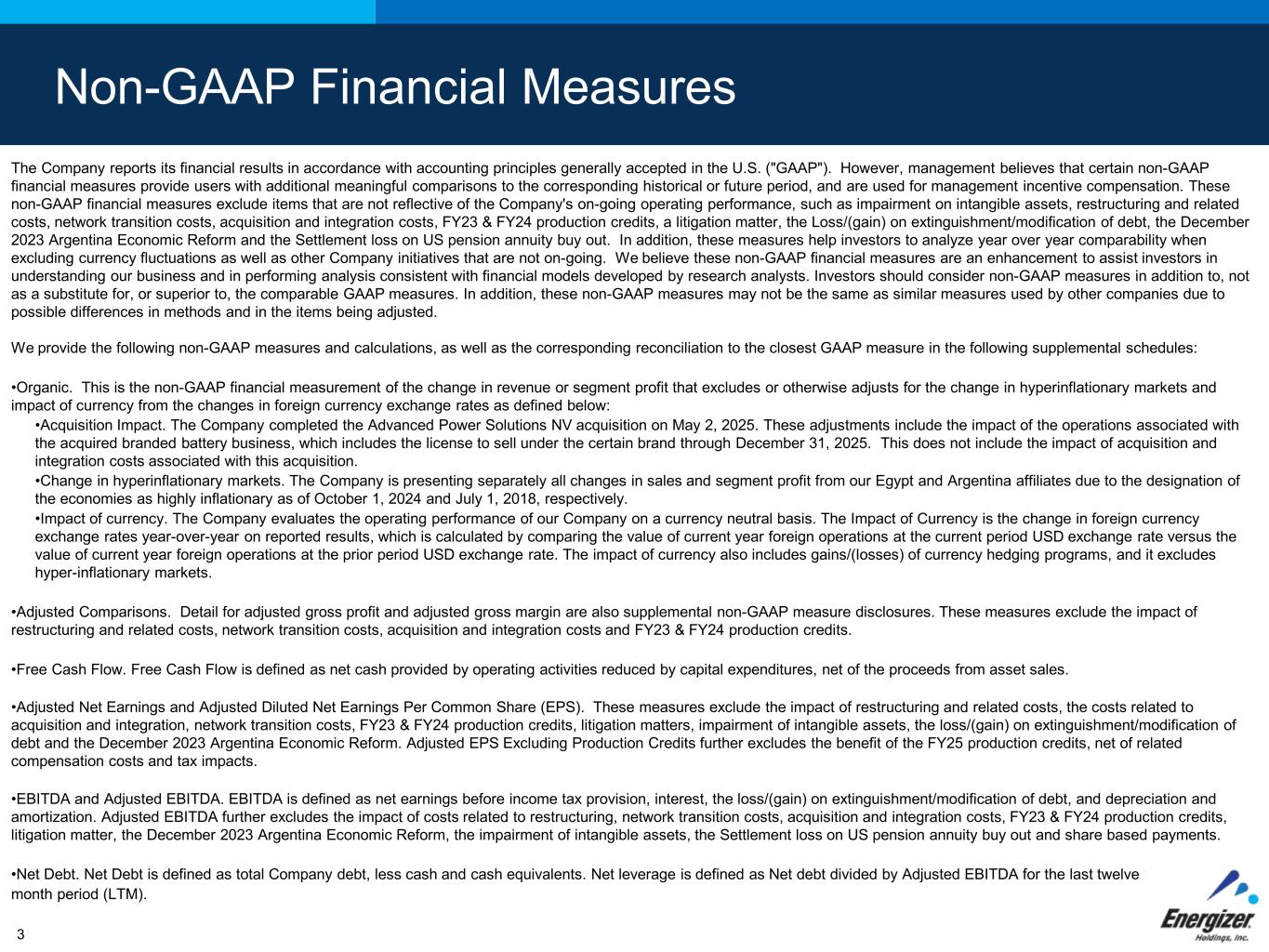
Good morning and welcome to Energizer's Third Quarter Fiscal 2025 Conference Call. Joining me today are Mark LaVigne, President and Chief Executive Officer; and John Drabik, Executive Vice President and Chief Financial Officer. In just a moment, Mark will share a few opening comments, and then we'll take your questions. A replay of this call will be available on the Investor Relations section of our website, energizerholdings.com. In addition, please note that our earnings release, prepared remarks, and the slide deck are also posted on our website. During the call, we will make forward-looking statements about the company's future business and financial performance, among other matters. These statements are based on management's current expectations and are subject to risks and uncertainties, which may cause actual results to differ materially from these statements. We do not undertake to update these forward-looking statements. Other factors that could cause actual results to differ materially from these statements are included in the reports we file with the SEC. We also refer to the presentation of non-GAAP financial measures. A reconciliation of non-GAAP financial measures to comparable GAAP measures is shown in our press release issued earlier today, which is available on our website. Information concerning our categories and estimated market share discussed on this call relates to the categories where we compete and is based on Energizer's internal data, data from industry analysis, and estimates we believe to be reasonable. The battery category information includes both brick-and-mortar and e-commerce retail sales. Unless otherwise noted, all comments regarding the quarter and year pertain to Energizer's current fiscal year and all comparisons to the prior year relate to the same period in fiscal 2024. With that, I would like to turn the call over to Mark.
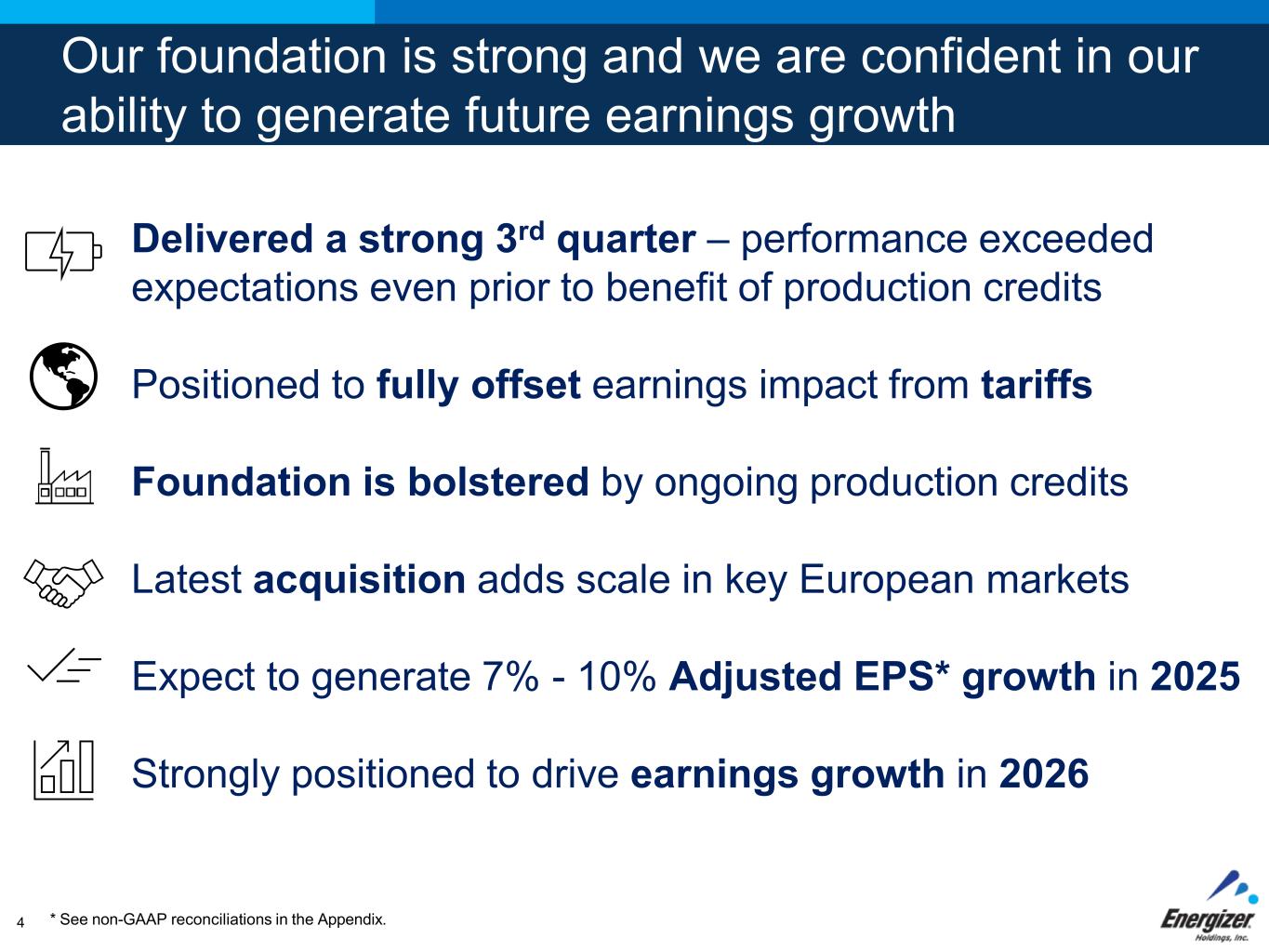
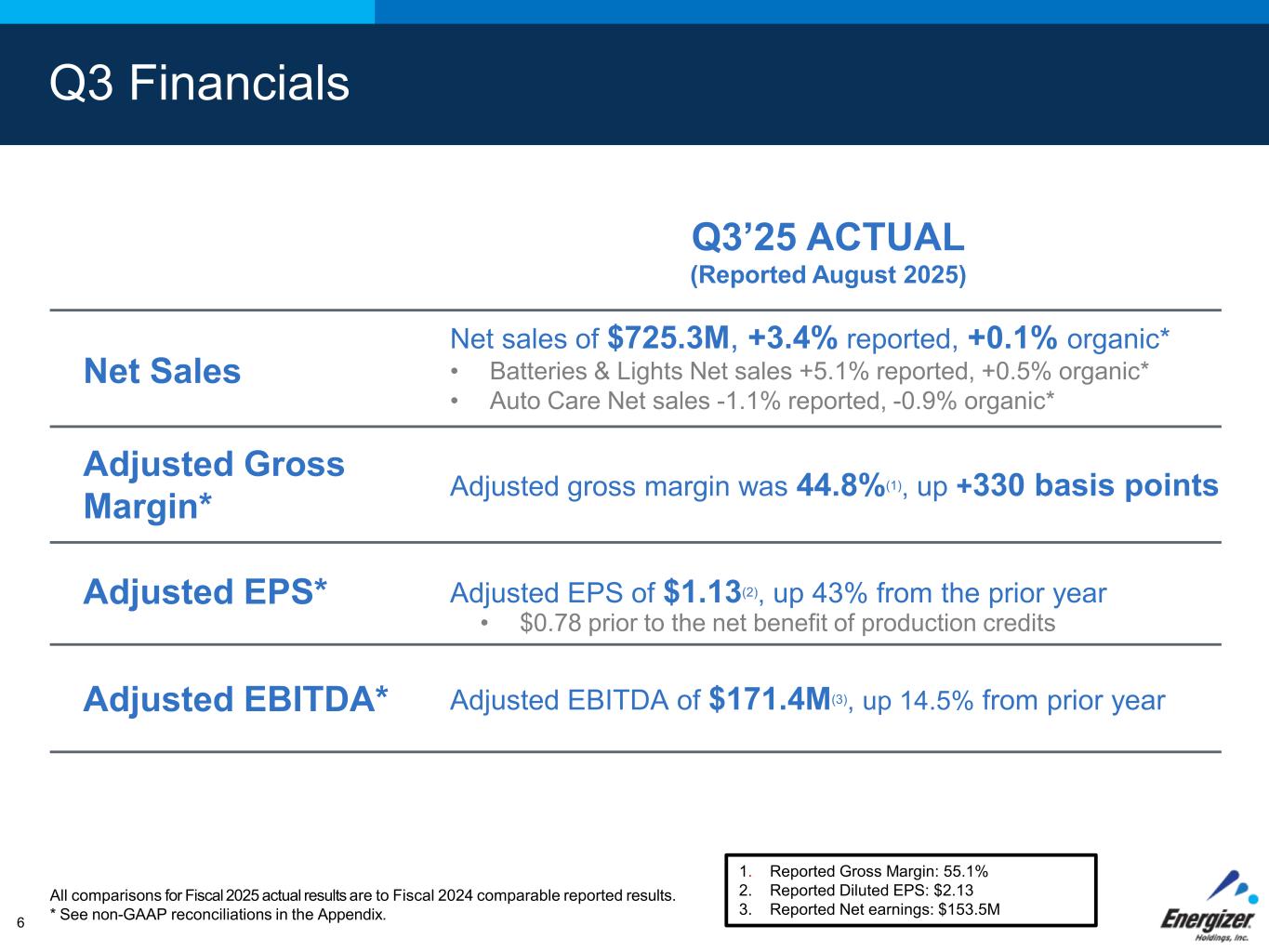
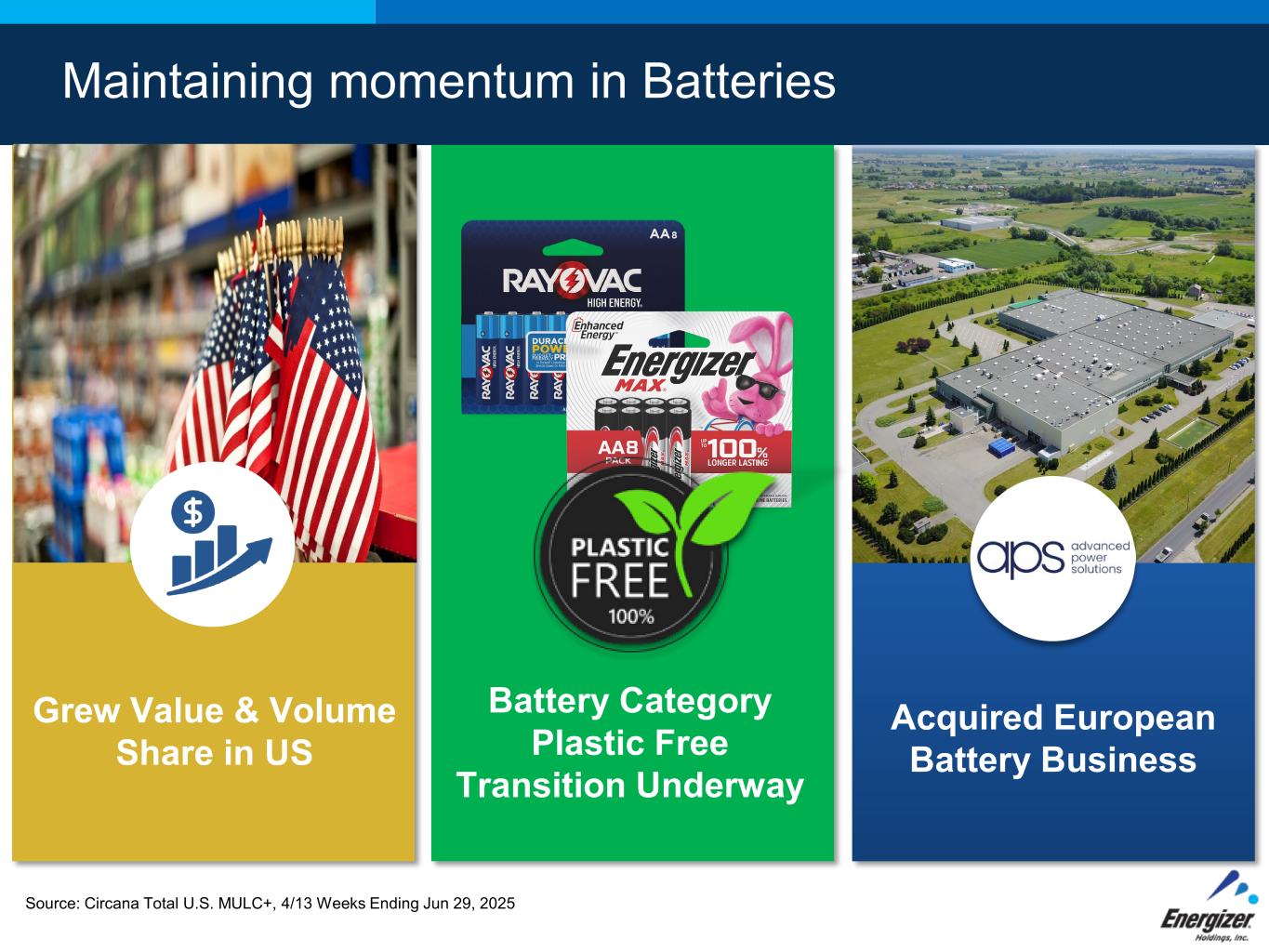
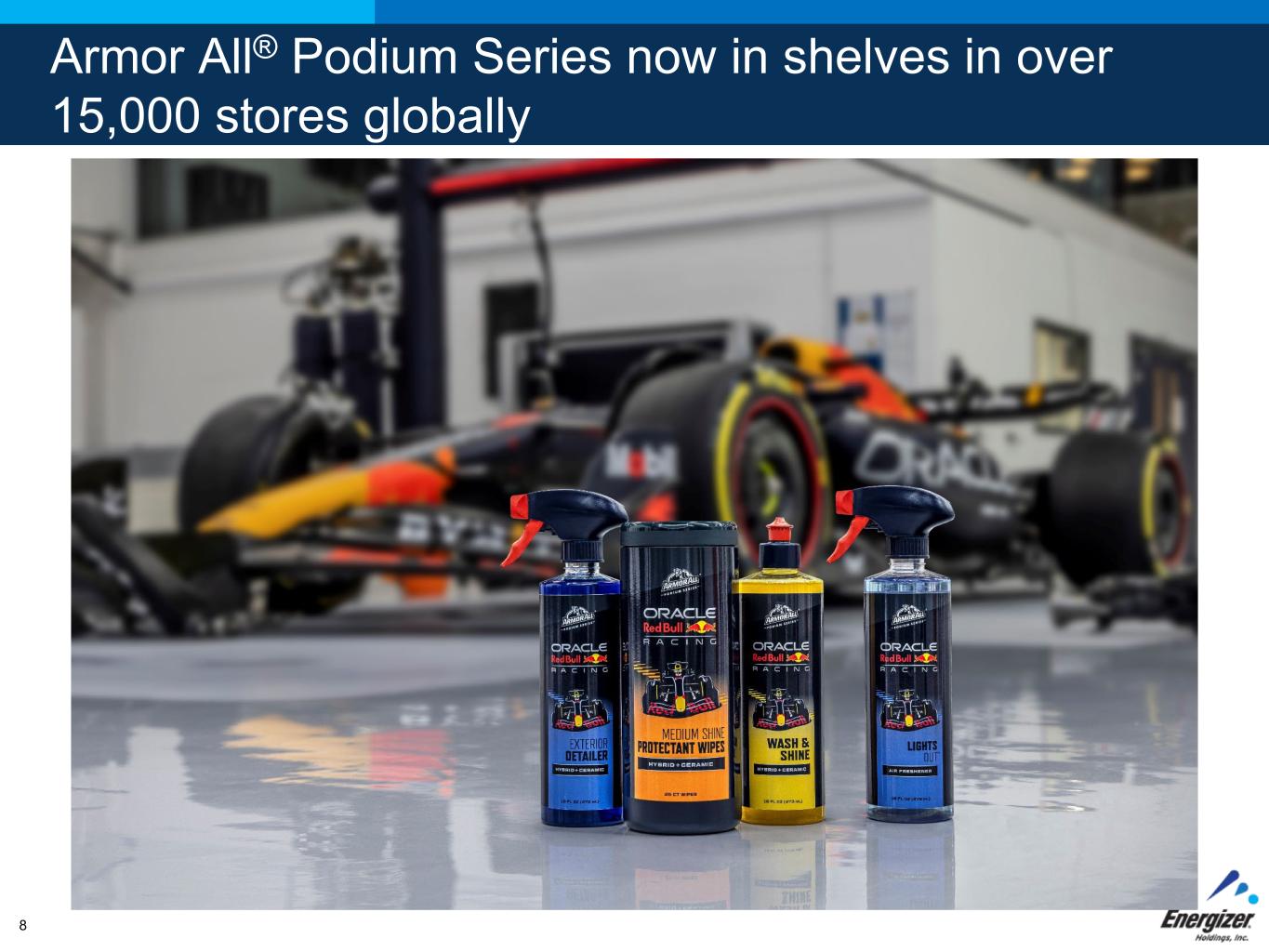
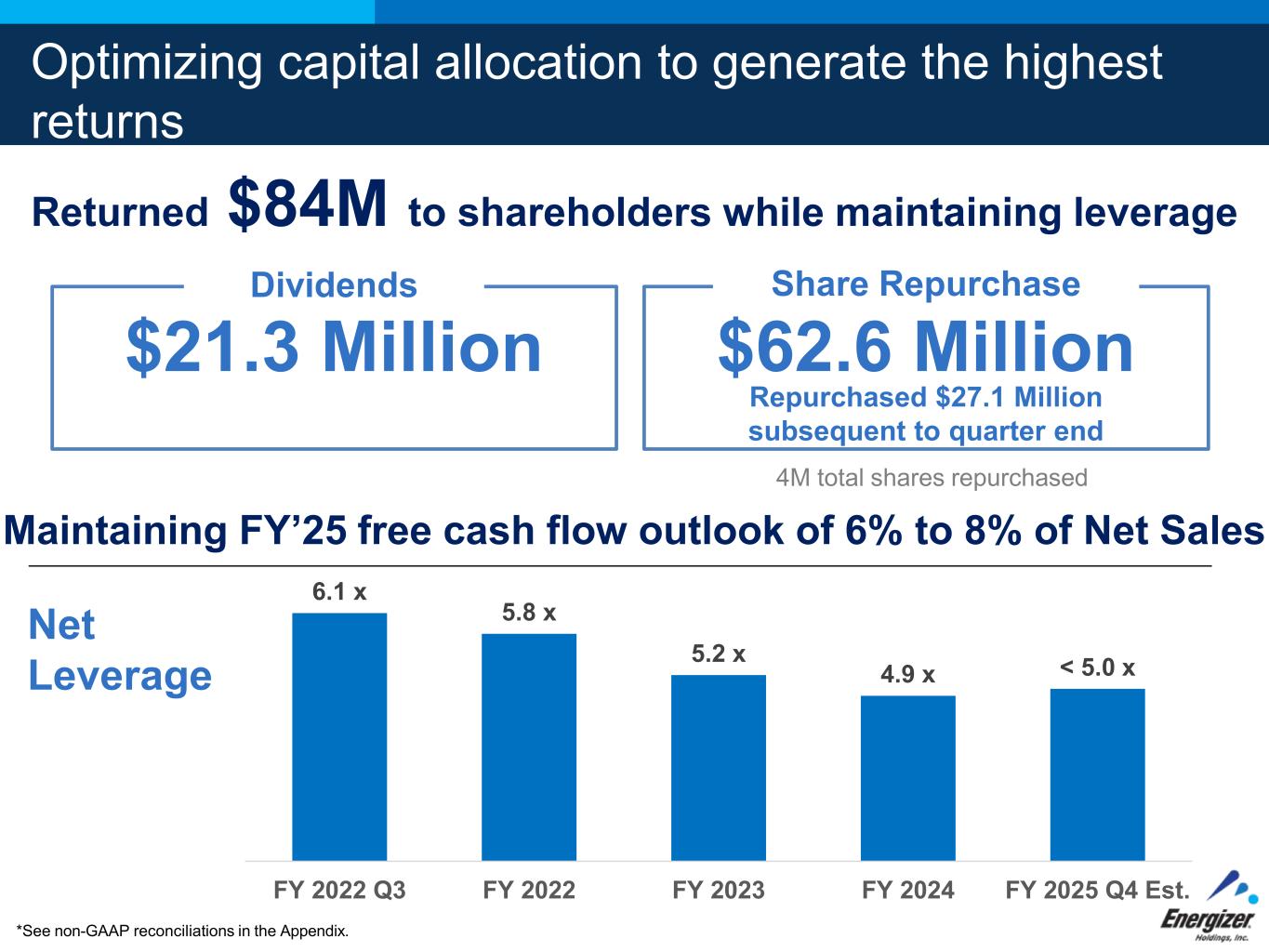
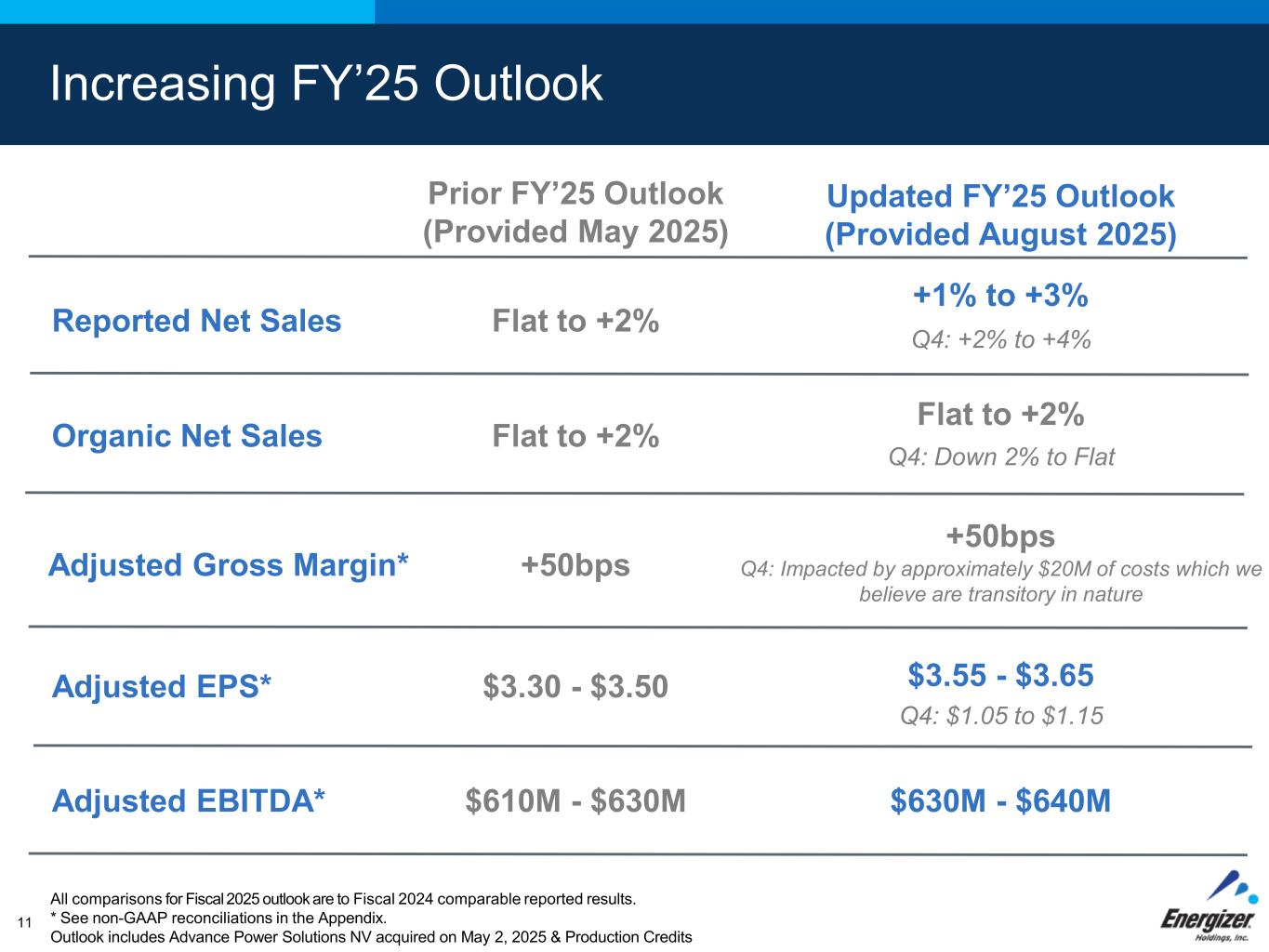
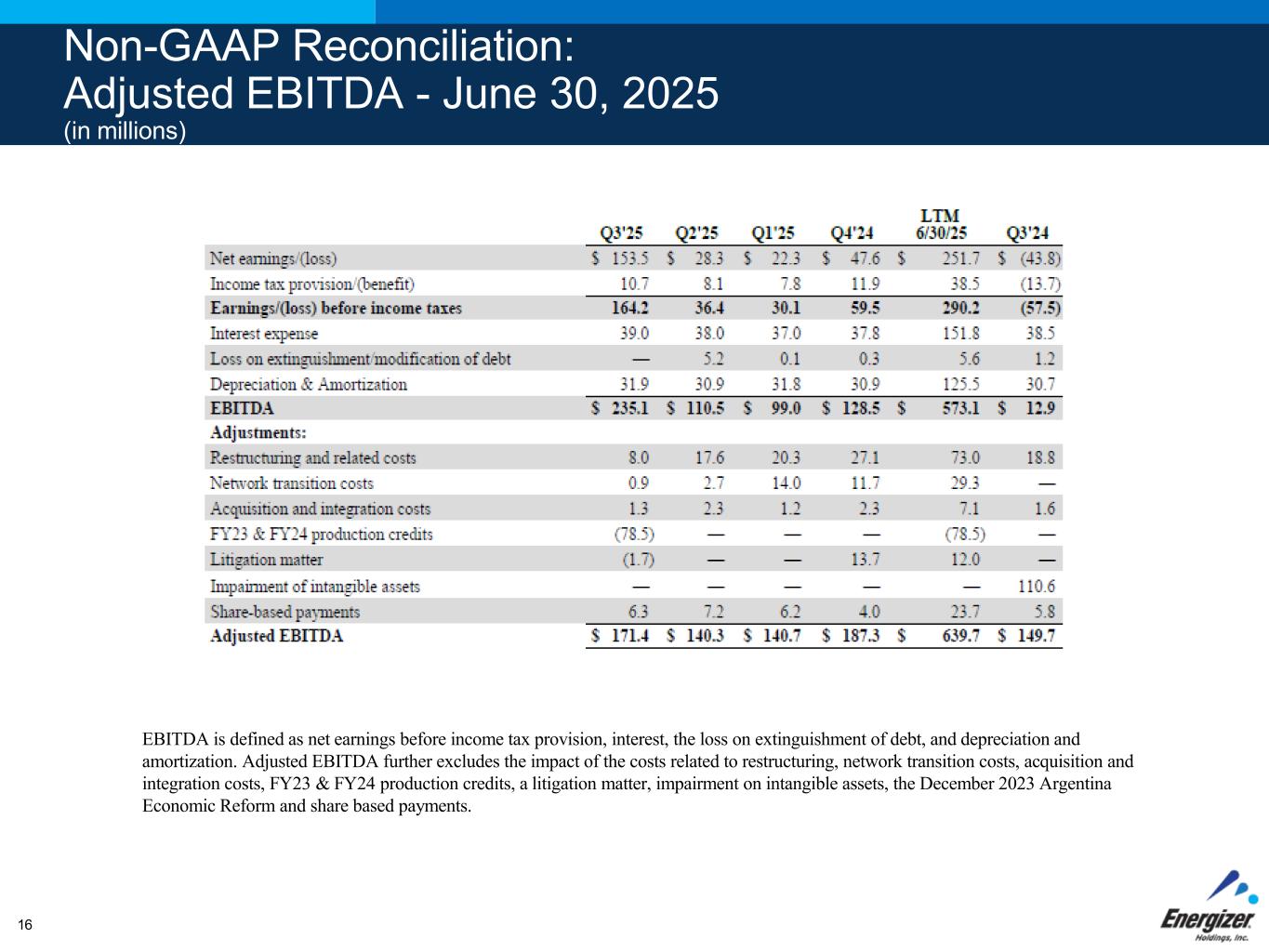
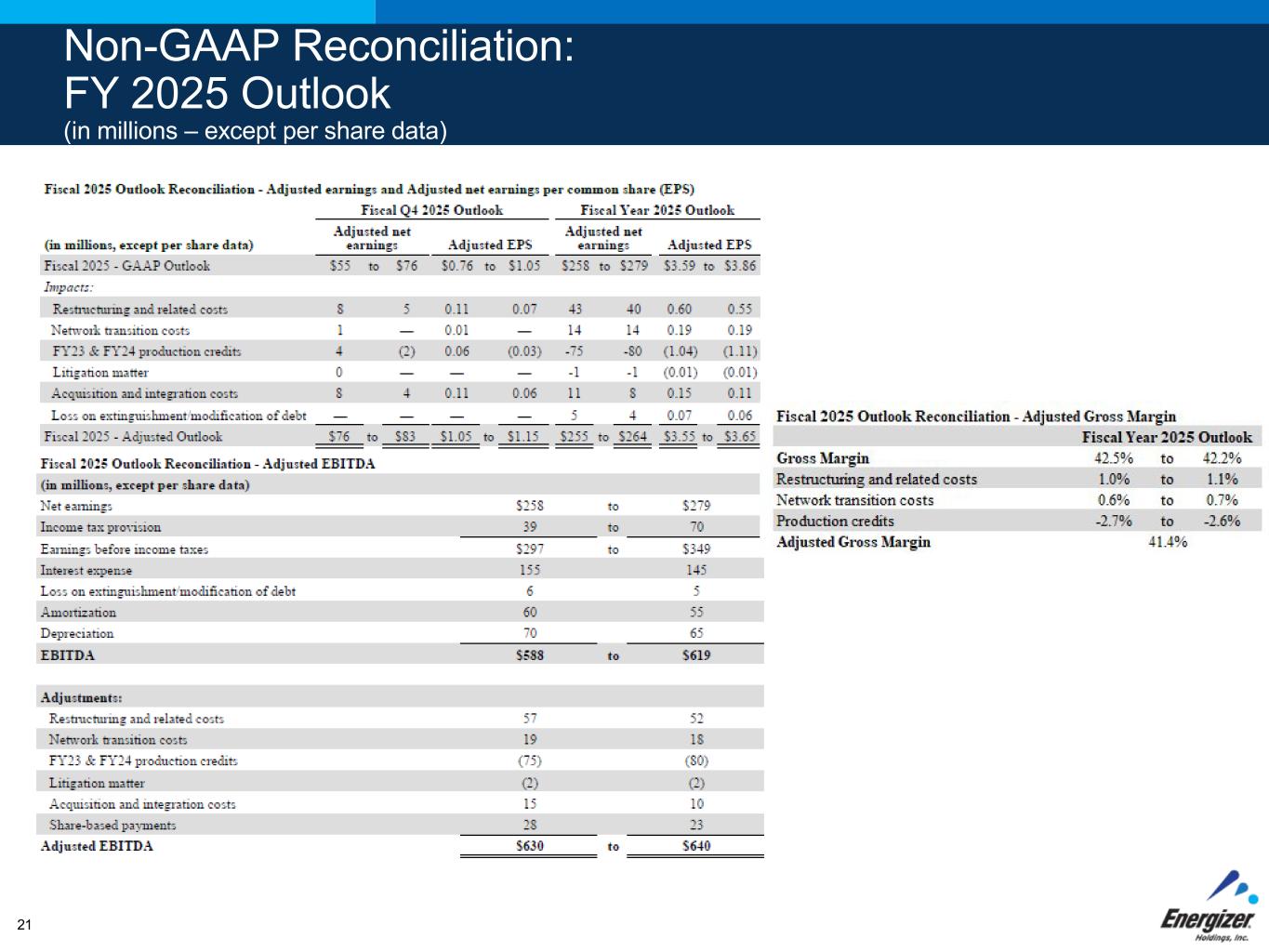
Good morning, everyone, and thanks for joining us today. As you can see, we have altered our approach for releasing earnings. I hope you've had a chance to review our press release, along with our prepared remarks posted on our website this morning. I'll open today's call with a high-level summary and then open it up for questions. We had a strong third quarter. Results came in ahead of expectations, and that's a direct reflection of the work we've done over the past few years to strengthen our business. We've been focused on restoring margins, investing in growth, and building a more agile operation, and it's paying off. Let me hit a few highlights. First, our categories remain resilient in spite of a cautious consumer. We had a solid performance in batteries and lights. And while Auto Care was a bit softer due to mild weather, our new Podium Series is off to a great start. Second, the projected impact of tariffs on our business has materially improved. Current tariff rates are significantly lower relative to our guidance last quarter, and we have a comprehensive plan under which we have already executed several initiatives to mitigate any remaining impact on earnings. Through a combination of pricing, cost initiatives, and production credits, we now expect to fully offset the earnings impact from tariffs in both fiscal 2025 and 2026. A big part of that is the production credits we're now receiving as a result of our continued investment in U.S. production. These credits are meaningful. We expect them to contribute $35 million to $40 million to gross margin, net earnings, and free cash flow on an annual basis prior to any reinvestment. We also completed the acquisition of Advanced Power Solutions in May. The acquisition further expands our ability to manufacture in-region-for-region and provides additional optionality to mitigate the impact of tariffs and supply chain disruption. The acquisition also provides greater scale to our European business and provides the opportunity to expand with key retailers in strategic markets. We expect the acquisition to contribute $40 million to $50 million of net sales in the current fiscal year. We returned $84 million to shareholders through dividends and share repurchases this quarter. We also repurchased an additional $27 million of shares in July while maintaining leverage, demonstrating our confidence in the business and our commitment to disciplined capital allocation. We are increasing our outlook to reflect the higher level of earnings generated by pricing, tariff mitigation efforts, and the inclusion of production credits. We now expect adjusted EPS of $3.55 to $3.65 and adjusted EBITDA between $630 million and $640 million. We have a high level of confidence in delivering our fiscal 2025 outlook and generating continued earnings growth in fiscal year 2026. With that, let's open the call for questions.
Operator
With that, our first question comes from the line of Lauren Lieberman with Barclays.
Speaker 3
There was a lot to digest this morning in the release and having the prepared remarks that earlier definitely helped explain all the moving pieces. But just to be clear, I wanted to know if you could first lay out for us kind of key fundamental underlying drivers for the quarter, this quarter and next and really just thinking about organic sales and profitability and kind of stepping away from the production credits. And then I have a follow-up question on the credits.
Sure, Lauren. Look, I'll start with kind of overall themes, and then I'll turn it over to John for a little more detail. I think key takeaways from this morning's release, we delivered a very good third quarter, and we're in a position of strength moving forward. For the quarter, we delivered organic growth, gross margin improvement, and earnings growth. For the fiscal year, we expect to deliver growth, gross margin improvement as well as 7% to 10% EPS growth. I think the most important and exciting part of this quarter is that we have done an exceptional job setting up to drive earnings growth not only this year but into fiscal 2026. And so John, I think if you just want to walk through a little bit more of those details.
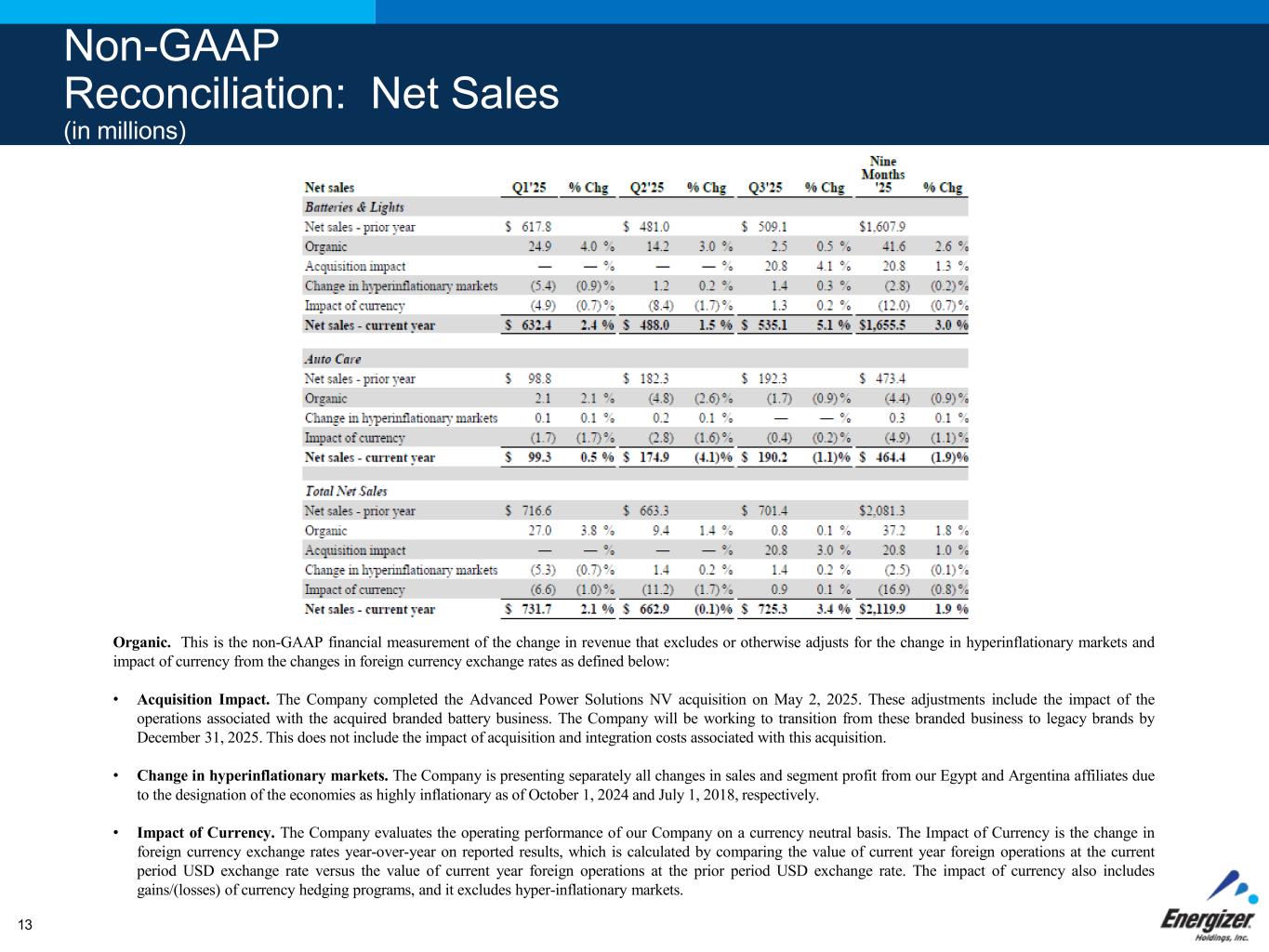
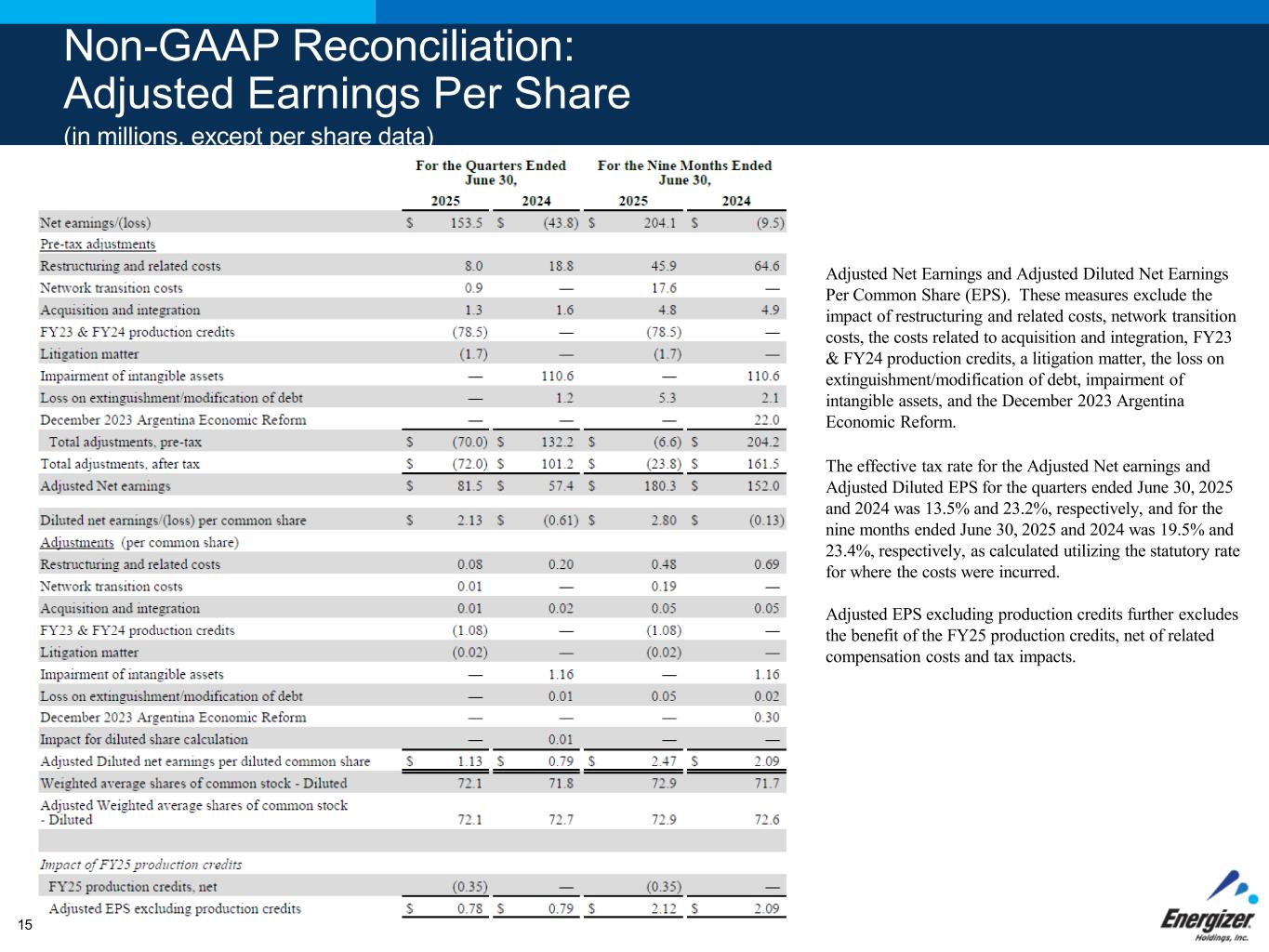
Sure, Lauren. The organic sales were strong in the quarter. That was very helpful. The battery category continues to perform well for us. Auto was a little bit lower, but the Podium Series has been launching very well. We're in 15,000 doors and beating the plan that we had set up. As we've called out, EPS for the quarter was at $0.78, excluding the credits. So that was well out of our outlook and the consensus. So even on that basis, it was a really strong operating quarter for us. As Mark mentioned, the tariff impact has really materially improved. So I think we're going to see a little bit of noise as we get through the fourth quarter. But heading into next year, we believe that the exposure is minimal, and we really have plans in place to fully offset the bottom line impact. And then the production credits as a domestic manufacturer of qualifying batteries and battery inputs, we qualify for production tax credits. So our expectation is that we're going to see about $35 million to $40 million in our base earnings now, and that's really going to come through gross margin, net earnings, and free cash flow, and that's through about 2032. So really bolster our earnings as we go forward. And then the other big thing is we acquired the legacy Panasonic Europe battery business. We're actively transitioning customers to the Energizer portfolio right now. We think for the full year, we're going to get about $40 million to $50 million in revenue, but there is no bottom line impact to earnings that we're expecting this year. So really strong quarter, really strong position heading into next year.
Speaker 3
Okay. Great. And then just on the production credits, maybe a little bit of a remedial question. But just if you could explain a little bit more the genesis of these, sort of why recognize it now because there's this retroactive piece as well as the go forward. And you mentioned investment, and I wasn't clear if that was before any like chosen reinvestment in the business that you would have maybe done otherwise or if there's a required level of continued investment domestically to maintain these credits going forward?
So there's no required investment required. This is a production credit. So we just need to continue producing the batteries and the inputs kind of as we have. And that should get us $35 million to $40 million. A little bit about the timing. So you do file for these credits with your tax returns. We just filed our '24 return. We're going to amend our '23. Those are the catch-ups that you're seeing that we're excluding from our normal ops, and that's the $78 million or so. We've got about $34 million coming through, which is the first 3 quarters of '25, and we're effectively accruing that. So we will file a return next year to get our '25 credits back. And then every year thereafter, you should be getting kind of 1 year of activity in the P&L and 1 year of cash back into the business.
Operator
And your next question comes from the line of Rob Ottenstein with Evercore.
Speaker 5
A couple of questions for me. So first, can you put the latest acquisition of basically capacity, Advanced Power Solutions within the framework of multiple initiatives to improve your overall manufacturing footprint? And maybe just talk about how that has been transformed over the last 3, 4, 5 years in terms of reliability, cost advantage, logistics and then present net that you'll be able to do local production in terms of the U.S.?
Yes. Sure, Rob. Great question. I think as we take a step back and look at all of the evolution of our network over the past 4 to 5 years, I think it starts during the pandemic. We made an acquisition of a facility in Indonesia in 2021. We followed up with an acquisition of a facility in Belgium in 2023 with the latest one with Advanced Power Solutions in May. Those were the acquisition-related elements of the network changes. But we also undertook for the past 3 years, Project Momentum, which was altering and optimizing our network across the globe, including in North America, where we've made significant investment in North America. We've made a $50 million investment to increase the workforce, increase innovation, increase automation and really been driving the in-region for-region attribute of our network that you mentioned. All of those pieces sort of click together and create a dynamic network for us to address tariffs, supply chain disruptions, optimize costs, and it's all starting to come together, and we're really well positioned from a network standpoint moving forward.
Speaker 5
Great. And then kind of maybe kind of veering off that, you bought back stock, which you hadn't for a little while. Can you talk about how we should be thinking about capital allocation over the next 1 to 2 years? Where are you thinking about in terms of taking the leverage down? Are there further capacity acquisitions that are on the radar screen? What does CapEx look like, dividend? Just kind of update us on the general outlook for cash flow and capital allocation over the next 1 to 2 years?
Yes, Rob. Let me start with the cash flow because we have invested a fair amount into inventory this year for 2 reasons. One is really the plastic-free packaging transition that we're undertaking in North America. And then we've got a fair amount of inventory that we built up as we were working to offset some of these tariff impacts. We really expect that to start coming out next quarter, our fourth quarter here. I think that's going to bolster the cash flow. And our expectation is that over the coming couple of years, we should be generating 10% to 12% free cash flow compared to sales. So I think that's going to put us in a good position. I'll turn it over to Mark to kind of talk about the capital allocation.
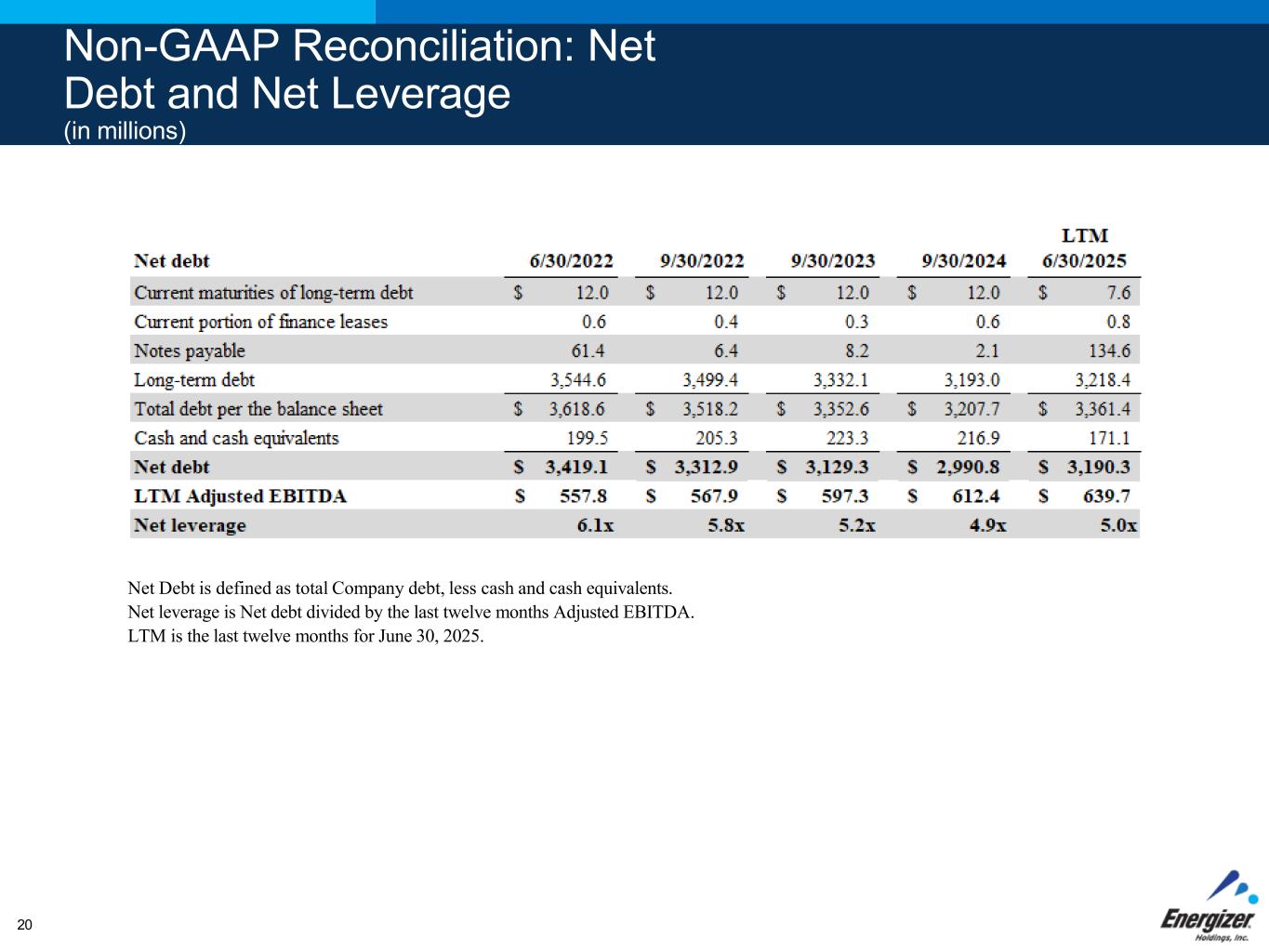
Yes, Robert, I think just a general capital allocation discussion. I mean, obviously, over the last couple of years, we prioritized debt reduction and felt that was really important to do. As we look at our debt capital structure, it is fixed at very favorable rates. And following the Q2 earnings, we saw a material decline in our equity value. And that created an opportunity to pivot and to create an outsized return through share repurchase. We've been able to repurchase about 5% of our outstanding shares over the last quarter. Going forward, I would expect us to continue to prioritize debt reduction. It is an important and a primary focus for us, but we also have to continue to evaluate all options to drive the highest return. So we're not going to be overly rigid in our approach, and we're going to pivot as opportunities present themselves from a capital allocation perspective.
Speaker 5
And just can you just help us model out kind of tying in a little bit with Lauren's question. Just help us model out CapEx over the next couple of years?
Yes. We've been running at, I'd say, a relatively elevated rate. Mark mentioned some of the production assets that we've invested in this year. We've also had a lot going into digital transformation. My expectation is that we'll run closer to 2% of net sales for the next couple of years.
Operator
And your next question comes from the line of Bill Chappell with Truist Securities.
Speaker 6
Mark, quite a journey. Question just on the competitive landscape because we can see the Energizer brand in the U.S. continues to do well, but maybe your largest competitor, Duracell, has lost some more of the share to private label to others. And so just as you're going in or currently, this is, I guess, the time frame where you're competing for holiday sets and stuff like that, do you see more competitive activity coming out of your main competitor? Do you see it staying fairly stable? Is that a concern at all?
Bill, as we assess the competitive environment both in the U.S. and internationally, we see that our market shares are stable and private label products are flat. We are well-positioned as a leading battery company, with a robust portfolio of brands and top-performing products. We've established a flexible network that allows us to navigate various macroeconomic conditions. This flexibility enables us to collaborate with our retail partners and implement their unique strategies effectively, allowing us to connect with consumers better. With these strengths, we anticipate achieving consistent year-over-year growth, which may take different forms depending on whether it's online or in-store and varies by retailer. Ultimately, we expect positive results. While consumers are exhibiting some caution in their spending—varying by category—when it comes to batteries, they are purchasing our brands. This solidifies our strong position, and we are committed to driving our business forward.
Speaker 6
What is your initial outlook for the upcoming holidays in terms of both category sets and your positioning with consumers?
I would say, right now, we're planning for a normal holiday season. And I think the one alteration you're starting to hear from retailers is that the holiday season is going to start a little bit earlier this year, and consumers are going to stretch out their shopping season. And so we need to be ready to address that and be ready to pivot from a timing standpoint. So as of now, we are planning for a basically normal holiday season.
Operator
And your next question comes from the line of Dara Mohsenian with Morgan Stanley.
Speaker 7
You've talked about investing to drive top line growth. You've talked about expansion in emerging markets, expanding Auto Care internationally, investing in innovation, digital, expanding distribution, etc., etc. I won't run through everything. But just curious, strategically, as you take a step back, as you think about these production credits coming in longer term, so looking beyond this year and even next year when you have the tariff impacts, does this allow you to spend incrementally behind the business? Where might those incremental investments be? And I guess, b, just are you actually spending some of this back? How do you think about that net amount as you look out longer term?
Dara, I think you mentioned the 5 growth areas we've mentioned in the past. And on those, we've mentioned distribution, and we're seeing $15 million of distribution wins in North America and international this quarter. In e-commerce, we grew 15% in Q3. We've grown 25% year-to-date. Market expansion, we continue to see strong growth in developing markets. Pricing, we have innovation-based pricing, and then innovation, you see Podium Series. So we have continued to leverage those sort of 5 key areas to drive growth going forward. And certainly, the production credits allow us to invest in our business, both from a network standpoint but also on a growth standpoint. But that production credit is only adding to what we've already done with Project Momentum. So we've driven $200 million of savings through Project Momentum over the last 3 years, which not only helped us restore margins but also allowed us to have greater ability to invest for growth. So all of these things add up to the ability to invest where we need to, to be able to drive the top line growth that you expect.
Speaker 7
Okay. But I guess, generally, it sounds like you feel like you've already been stepping up the investment. So it's not like most of this is reinvested back when you look out a couple of years, you could see a decent amount of the production credits drop to the bottom line. Is that a fair way to look at it?
Dara, what I'd say is we've called up our earnings for '25, and I would view that as kind of a new base. And I think as you head out over a longer period of time from here, we should expect to grow algorithmically off that. I think the credits will really help to drive it.
Speaker 7
Okay. Great. And that gets me to my next question, which is the comment about growing EPS and EBITDA in '26, is that just meant to communicate, look, we've got a higher base in '25, but we also think we can grow off that even with tariffs and giving us a little more insight given the various factors out there, including tariffs? Or are you signaling more that '26 could be a really outsized growth year? Just wanted to understand a bit more the motivation behind that. You opened up the window a bit to ask. I understand you won't be giving us a specific number, but there's also a lot of sort of puts and takes as we think about the production credit tariffs and reinvestment. So again, just trying to understand the motivation there and a bit how those 3 areas, some of which offset each other, some insight into how we should think about that next year?
I believe this relates to my earlier comments. We are focusing on earnings for 2025 and while we won't provide an outlook for 2026, we believe that it is reflected in our current base. After considering everything, we can manage the tariffs and continue to invest in the business. With this new higher level of earnings, we anticipate growth from that point. We will have more clarity and specific figures in November, but we wanted to indicate that we have mitigated many challenges we faced last quarter and expect to grow from this new level.
Operator
And your next question comes from the line of Andrea Teixeira with JPMorgan.
Speaker 8
I would like to revisit what you mentioned, Mark, about the underlying consumption trends in both batteries and automobiles worldwide. Specifically in the U.S., I understand there was some potential for a pull forward related to the Fourth of July and Prime Day events. Is there any reason why the anticipated Q4 might be a bit lower than expected? It seems we all believed it would be better given your strong third quarter. Could you elaborate on those factors? Also, I’d like a clarification regarding pricing. I understand that your tariff impact was more favorable than expected, with about half of the mitigation coming through pricing, as you noted in your prepared remarks. Could you provide details on the timing and execution of this pricing strategy? Has this been communicated to your retail partners in the U.S.? How should we approach this pricing action and its elasticity potential?
Andrea, let me discuss the third quarter briefly. To answer your question straightforwardly, we had shipments related to the Fourth of July and Prime Day that occurred in June instead of July. This led to some pull-forward in revenue for the quarter, which I believe explains the discrepancy between our U.S. consumption figures and our financials. Regarding your second question about pricing, we adjusted our prices earlier this year due to innovation and ongoing tariff challenges. We did not implement any further price increases related to Liberation Day tariffs. We have fully engaged with our retailers on these pricing matters, and you will start to see the impacts on store shelves. We expect to realize the benefits in the fourth quarter. As John mentioned, this positions us for earnings growth this year and sets us up for growth next year. From a tariff perspective, I want to emphasize that we have completely offset tariffs through various measures, and we expect to maintain this offset into 2025 and 2026.
Speaker 8
Thank you for your response, it's very helpful. Regarding private label pricing, I understand you've indicated that it has remained stable. Since much of their production is sourced internationally, do you have any insights on the price gaps that exist? It's challenging for us to analyze this only through channel data, particularly with platforms like Amazon Choice and Amazon Basics. Could you share your thoughts on the price gaps for e-commerce that may be reflected in your guidance?
Yes, Andrea. I think when we watch price gaps externally, we have seen some movement in private label pricing. One can only presume that has to do with some of the tariffs and the cost of the tariffs. I do think we're in the early days of kind of the impact of tariffs. It's only recently really started to become more settled ground where people can execute pricing against those tariffs. So we have seen some private label pricing move around. As I mentioned, shares have been largely flat in the latest reporting period. I think it goes back to what I said earlier; I think it was to Bill's question around we're the best positioned battery business out there. We have a portfolio of brands that we can leverage to meet the value needs of consumers, whether that's Energizer or whether that's Rayovac or Eveready. So we have the optionality as the environment settles from a post-tariff regime, and we can respond and leverage our portfolio to maximize the retailer strategy as well as our business with that retailer.
Speaker 8
Great. And then trends in Europe, if you can comment?
Yes. What I would say is U.S. has been a little bit softer than the rest of the world. The way I would break it up, Andrea, is sort of modern developed markets following roughly consistent with what you're seeing in the U.S. and then developing and distributor markets are a little bit healthier.
Operator
And your next question comes from the line of Peter Grom with UBS.
Speaker 9
Maybe just a few housekeeping. Maybe just to follow up on Andrea's question. Just the fourth quarter organic guidance, where I would imagine you have pretty good visibility. But just the step back that you're kind of talking to, is that really just a function of shipment timing? Or is that a sign around maybe underlying trends or category performance deteriorating a bit?
There is a shift from Q4 into Q3, which is one factor to consider. The POS trends are generally aligned with our expectations for the top line in the quarter. The category has shown resilience. Consumers may adjust their choices, alter their purchasing habits, switch channels, or change pack sizes. However, we anticipate steady trends in the battery category. Occasionally, you may notice some softness among consumers from quarter to quarter, but it typically doesn’t last long.
Yes. We haven't changed our full year view. So it's still flat to 2%. You're seeing that move a little bit between third and fourth quarter, but still relatively healthy.
Speaker 9
Okay. And then just on that point, just any thoughts in terms of how we should be thinking about the composition of growth between the 2 segments in the fourth quarter? You alluded to some unfavorable weather. I would imagine that's improved in auto. So just kind of curious how we should be thinking about that from a segment perspective.
Yes. I think the battery, you're going to see roughly in line with our call overall. And obviously, that's 75% to 80% of the business. So that should be pretty synced up. Auto, we expect to do a little better as they do some catching up in the fourth quarter. Both businesses or both segments should benefit from that pricing that we've taken for tariffs that you'll see come through in the fourth quarter. So I expect pricing to be a little bit of a driver in the quarter, a little bit better on the auto side than battery, though, kind of when you look at the numbers.
Operator
And your next question comes from the line of Brian McNamara with Canaccord Genuity.
Speaker 10
I'm interested in your perspective on the current battery inventories, both at the retail level and among consumers. We've heard that some companies have discussed retailer destocking in the first quarter of the calendar year, and I would like to know where things stand now.
Let's start with consumers first, Brian. I think as consumers sort of stretch out their purchase cycle, I think inventory levels tend to get a little bit lighter in these times. I think when you're looking at retailer inventory levels, I would say right now, they're slightly elevated, and that qualification changes retailer to retailer, but we took all that into account as we guided to Q4.
Speaker 10
Great. And then a quick follow-up. I guess, how would you characterize the overall health of the consumer that you guys serve? You mentioned private label shares are flat, which is a bit counterintuitive based on what we're hearing from other companies.
From a consumer standpoint, Brian, I think that's a tough question to answer with a succinct answer. I think consumers are certainly acting cautiously. They're seeking value. They're willing to make changes to get what they want. But how that manifests itself really does change category to category. And when you look at the battery category, as John mentioned, 75% of our business, it is a resilient category. Consumers need batteries. They may stretch out their purchase cycle. They may switch channels. They may trade down in pack size. But at the end of the day, our portfolio serves their needs and allows us to drive the growth that we need.
Speaker 10
If I could ask one last question about pricing, when will the tariff-related price increases actually affect consumers at the retail level? Has this happened yet? Are you expecting it to occur in the next few months? We've been hearing mixed messages from other companies.
Well, I mean, that's going to be a retailer-based decision. I mean, so we will negotiate our pricing with retailers, and then it's retail shelf pricing at their discretion. So that would be a question for retailers.
Operator
And we have no further questions at this time. I would like to turn it back to Mark LaVigne for closing remarks.
Thanks all for joining us today. Hope you have a great rest of the day.
Operator
Thank you. And ladies and gentlemen, this concludes today's conference call. Thank you all for joining. You may now disconnect.