Operator
Good day, and welcome to the Eve Holding, Inc. Third Quarter 2025 Earnings Conference Call. Please note, this event is being recorded. I would now like to turn the conference over to Lucio Aldworth, Director of Investor Relations at Eve. Please go ahead.
Thank you, operator. Good morning, everyone. This is Lucio Aldworth, the Director of Investor Relations at Eve, and I wanted to welcome everyone to our third quarter 2025 earnings conference call. Our CEO, Johann Bordais; and CFO, Eduardo Couto, are joining me on the call today. And after their prepared remarks, we will open the call for questions, at which point, Luiz Valentini, our Chief Technology Officer, will also join us for more technical questions. We have a deck with a few slides and additional pictures that show our achievements in the quarter as well as the testing phase of our full-scale prototype. The deck is on our site at ir.eveairmobility.com. So please feel free to download it and follow along. Let me first mention that today's conference call includes statements about events or circumstances that have not yet occurred. These are largely based on our current expectations and projections about future events and financial trends affecting our business and our future financial performance. These forward-looking statements are based on current expectations and involve risks and uncertainties that could cause financial results to differ substantially from those expressed or implied in this conference call, and we undertake no obligations to update publicly or revise any forward-looking statements because of new information, future events or other factors. For a more detailed list of these risks and uncertainties, please refer to our SEC filings available on our website. With that, I will now turn the presentation over to our CEO. Johann?
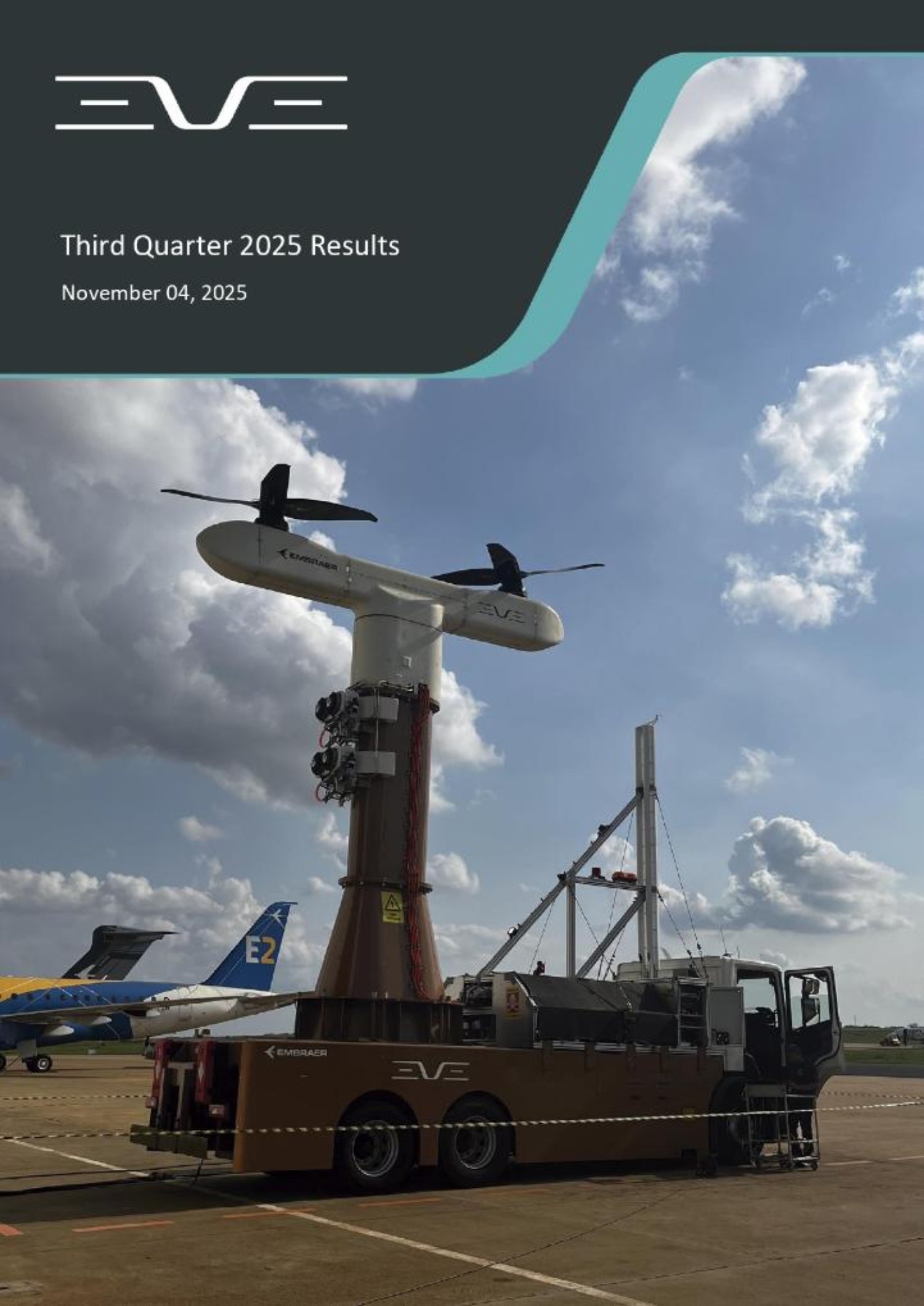
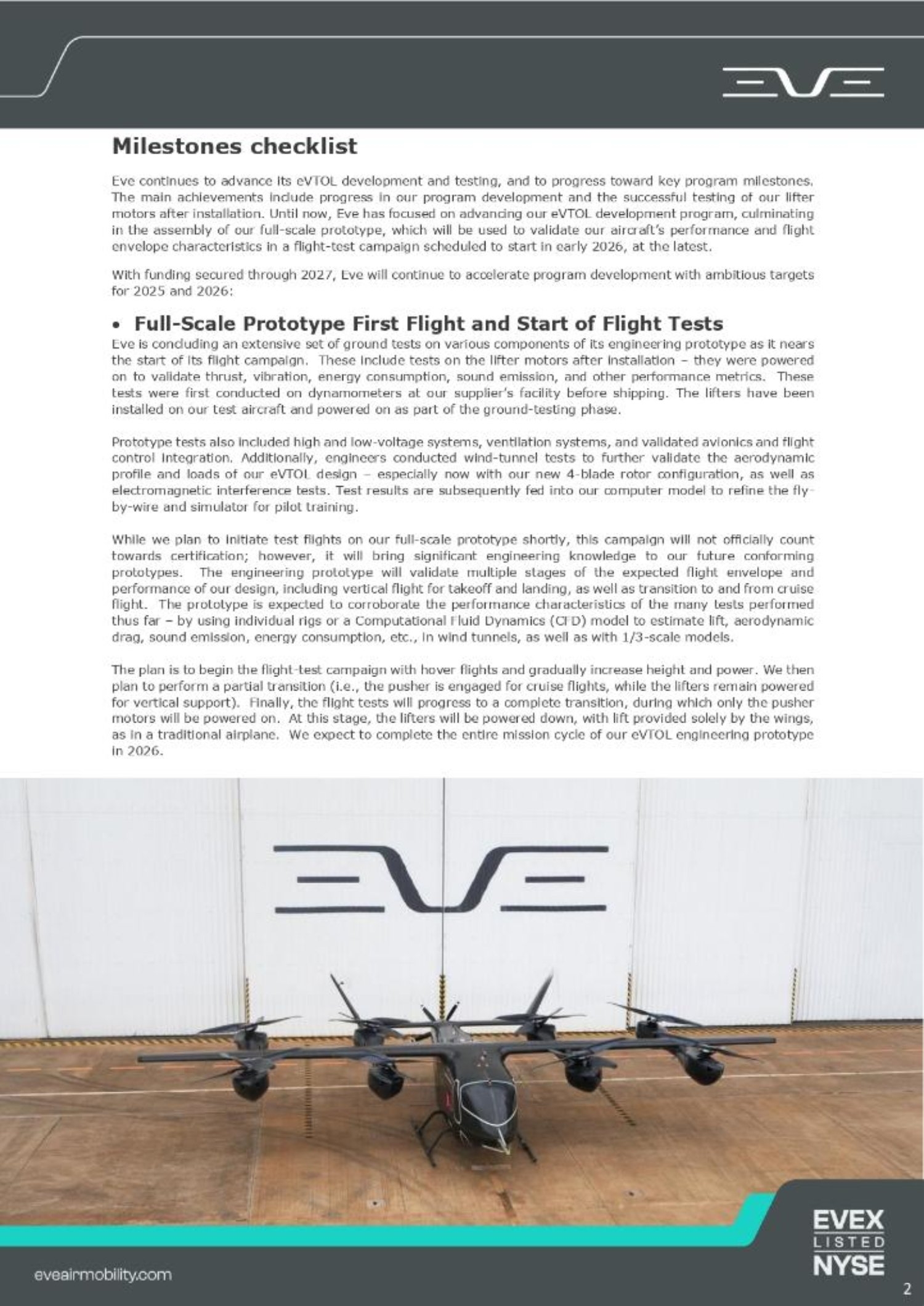
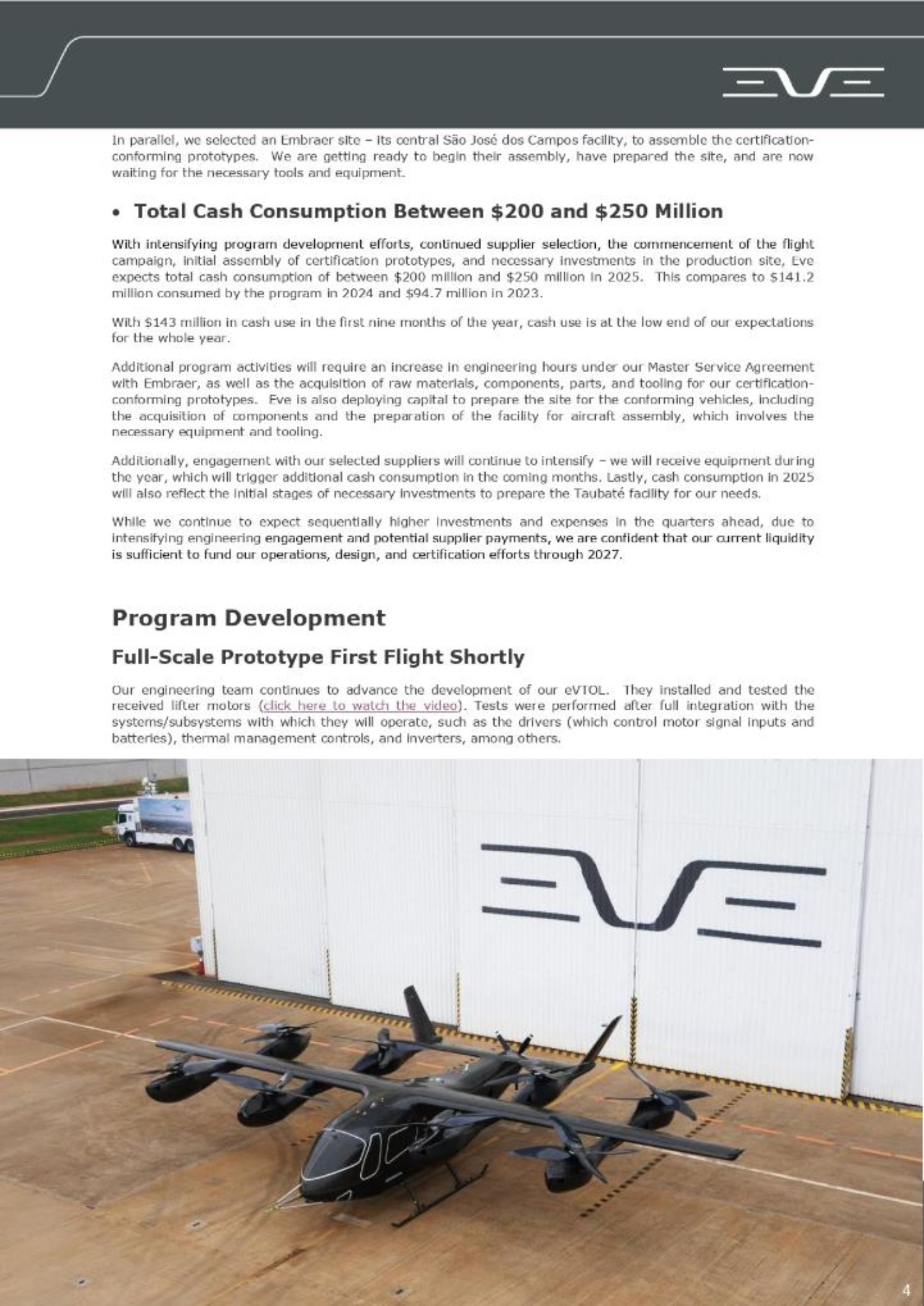
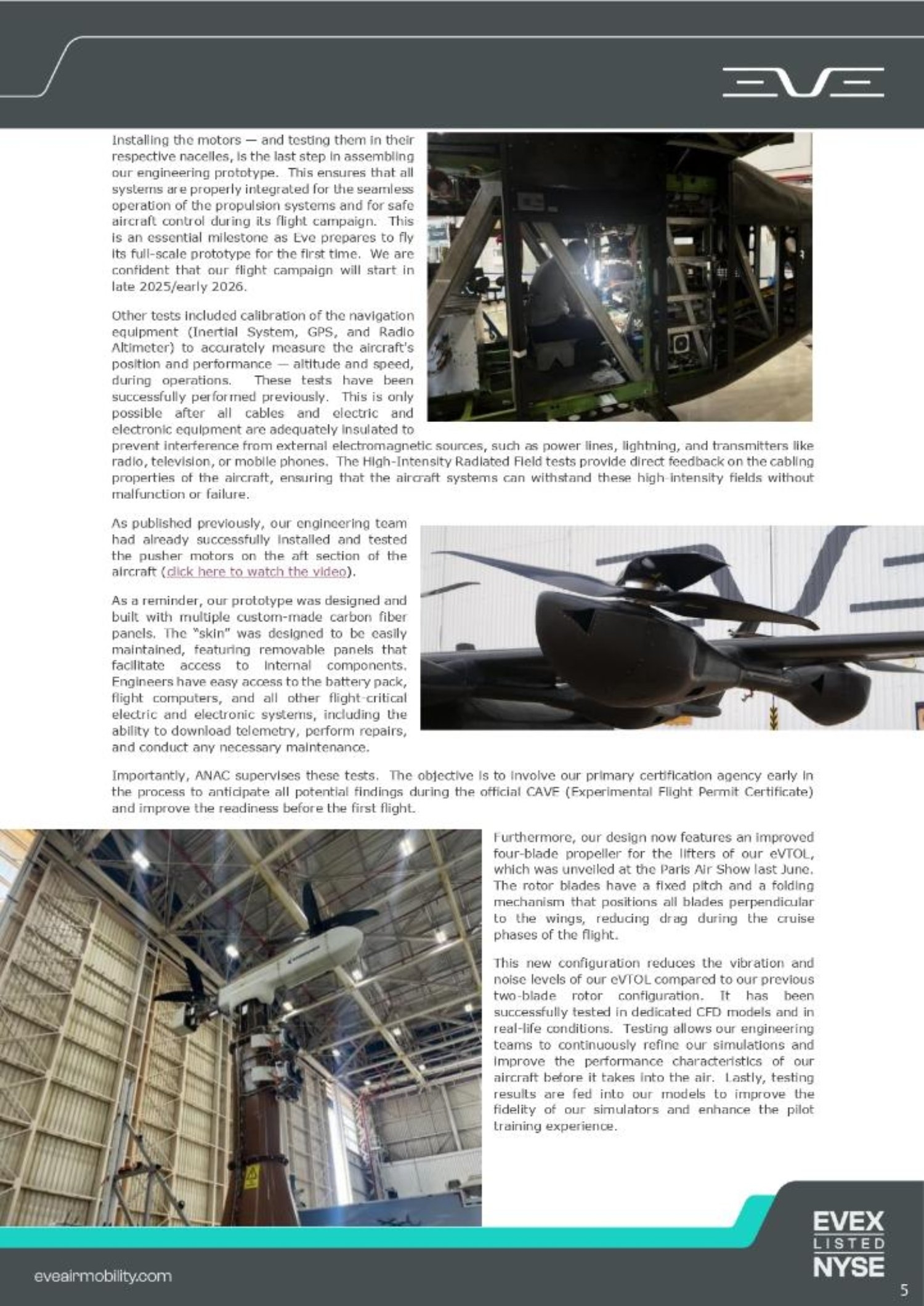
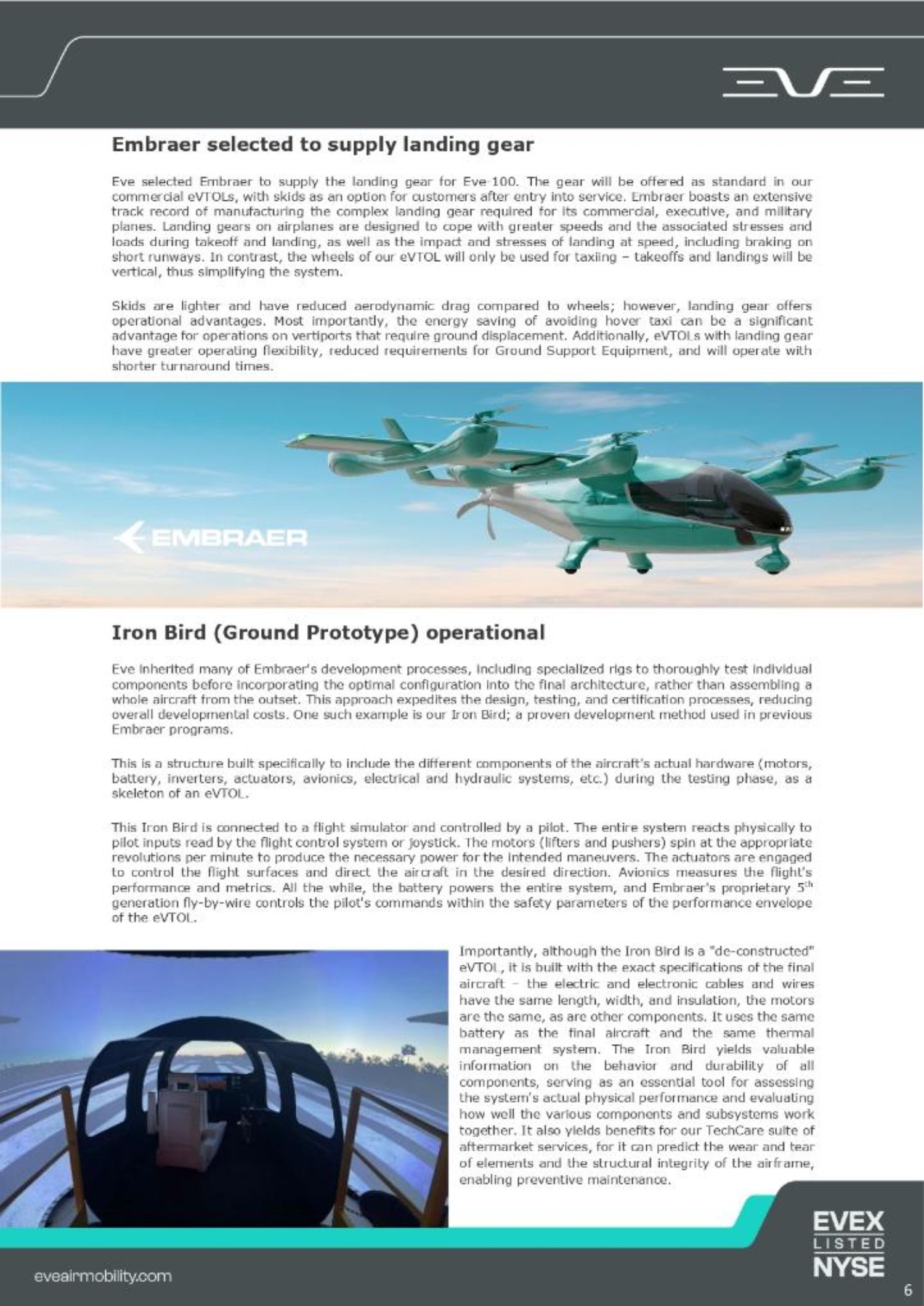
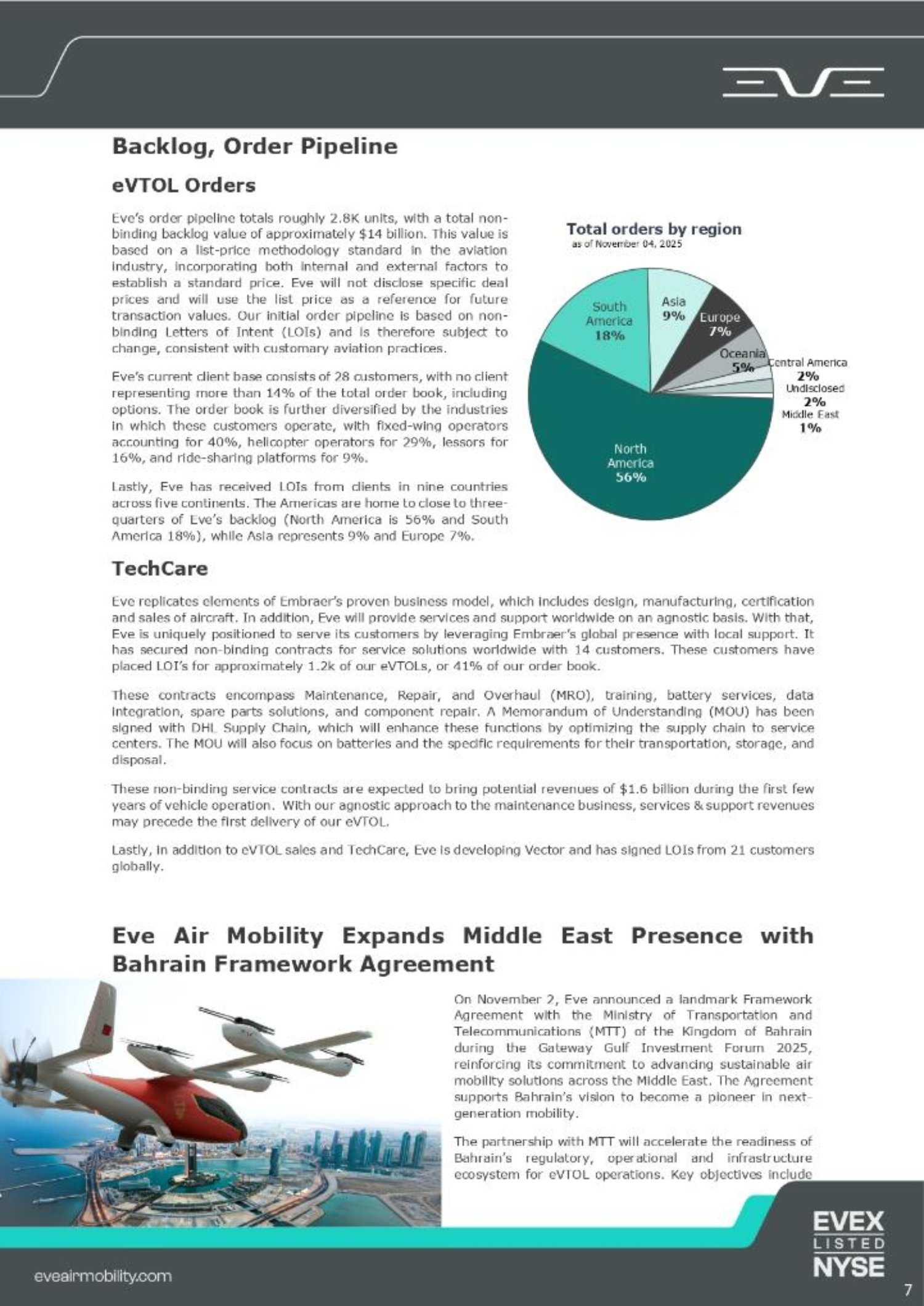
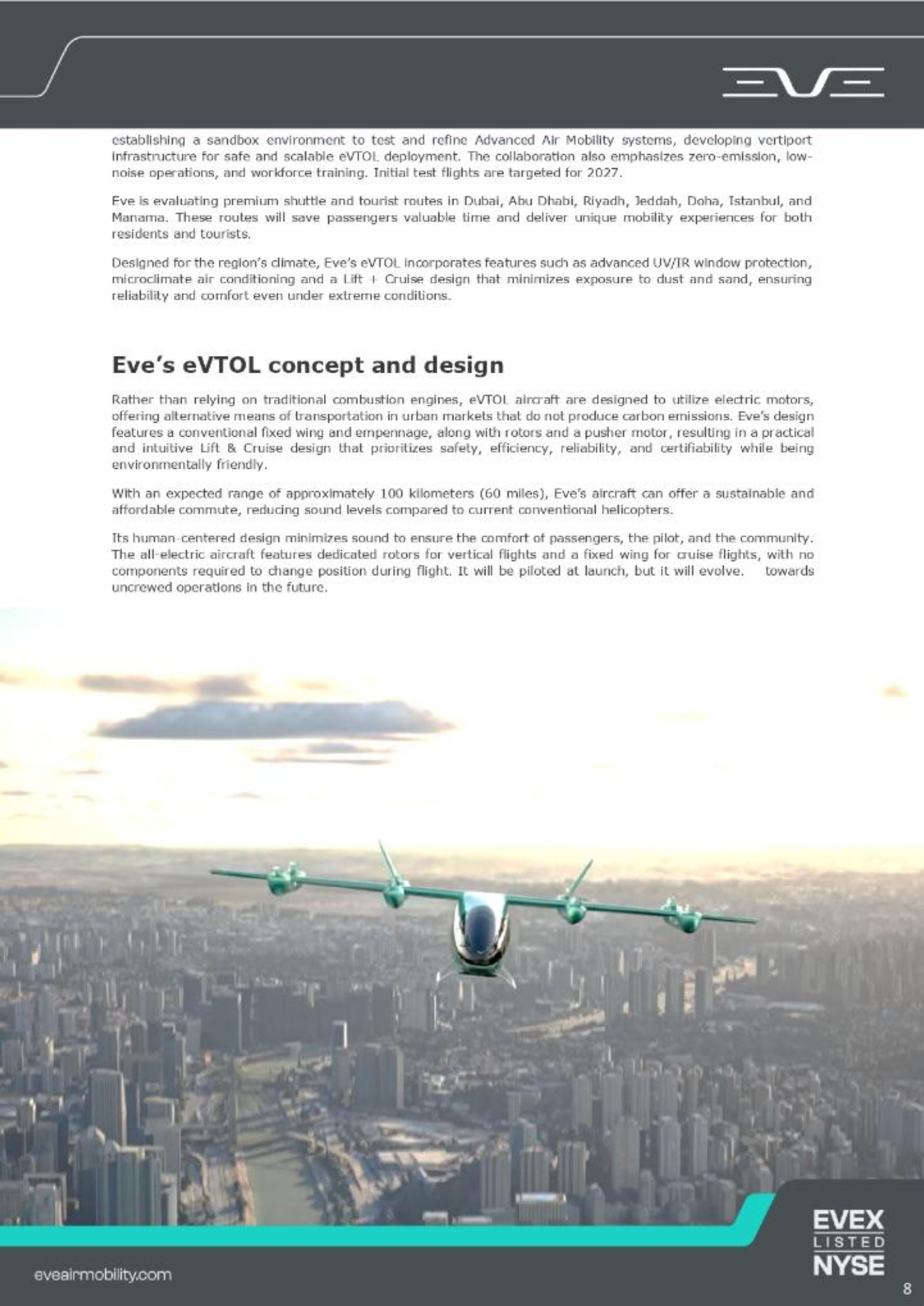
Thank you, Lucio. Good morning, everyone, and welcome to the 2025 third quarter conference call. We had a strong third quarter marked by several key achievements, and we continue to advance the program's development at a steady pace. We are in the final stages of testing our engineering prototype before its flight campaign starts. We announced an additional supplier for our commercial aircraft, the E100, with a contract with Embraer for their landing gear. Additionally, the Iron Bird has begun to operate and is already contributing to the testing of the actual hardware that will equip our aircraft. Our schedule remained unchanged with an expected Type certification and entry into service in 2027. Starting with Slide 3. We have now received from Beta Technology Company, all of the electrical motors for our engineering prototype. They have been previously tested in specially designed equipment and installed in their respective nacelles. As mentioned previously, we had already performed integration tests between the prototype and the remote pilot station that we also call the RPS, to make sure that there is a successful communication via the dedicated radio link. As a reminder, this prototype will be remotely controlled with a pilot sitting in the RPS, and this is the white track at the far end of the right picture. We are running the last set of tests to make sure that electrical power units were properly integrated with the inverters, battery and other systems and subsystems in the vehicle. Therefore, we're confident in starting soon our flight campaign with our first flight by the end of this year or early next year. Slide 4 is about the selection of our 22nd primary system supplier. Embraer will produce landing gear for our aircraft. Embraer comes with a strong landing gear manufacturing heritage for their commercial and executive jets as well as military aircraft. The landing gear was introduced as a result of a constant interaction between Eve and its customers, understanding how the aircraft will be operated. Now, the wheels on our eVTOL will be used for taxiing and repositioning the aircraft. This means greater energy efficiency when compared to hovering. The landing gears also provide the capability of maneuvering the aircraft on the ground, eliminating the use of ground support equipment for that purpose, facilitating operation and reducing time on the ground. The next Slide shows what is now our functional Iron Bird cockpit. As a reminder, the Iron Bird is a deconstructed eVTOL in which we integrate all the different actual components on our eVTOL into a physical system to make sure that all systems work together properly. This is the interface through which the pilot will control the entire system. As you can see, the simulator has approximately 270 degrees view and is connected with all the different rigs of the vehicle system and components. For instance, the joystick is connected to actuators and motors in another adjacent room, and they react physically to all pilots commands. All of these are connected to the avionics and the flight control computers with our fifth-generation fly-by-wire control laws. The motors are connected to the battery with its own thermal management system. As much as possible, all wires and cables replicate the composition, width and length of the actual harness that will be on our eVTOL. This assures a representative result of the simulation, allowing the Iron Bird to be used as a tool for vehicle development, flight test clearance of a new feature and product evolution as well as optimize the test campaign. Through this strategy, we maximize the number of prototypes, streamlining the flight test campaign and making the most efficient use of these assets. So, not only does the Iron Bird help us to better integrate and understand how all the systems work together and troubleshoot potential problems on the ground, but it also has an important role for the aftermarket benefit. The Iron Bird will help us improve the system and component maturity, and these are important inputs for successful entry into service and an efficient maintenance program. In total, we have logged more than 10,000 hours of testing in these rigs. Another advantage is that the Iron Bird has also helped us to expedite and reduce the costs related to our certification campaign. Keep in mind that some tests can be performed on the ground 24/7, such as electrical systems, circuit breakers, etc., and the Iron Bird becomes a very valuable development and certification tool. Moving on to Slide 6. Together with our customers and authorities, we are also developing a strong network of partners in different areas, such as infrastructure and energy, to address one of the many challenges ahead of the Urban Air Mobility: creating a whole new ecosystem besides simply developing an aircraft. On the certification side, we participated in ICAO Assembly in Canada, along with ANAC, the Brazilian Air Force and other government officials, along with representatives of several other certifying authorities throughout the world. This reinforces our confidence that we have the right approach to certify our aircraft with ANAC as the primary certifying authority. Besides that, we are increasing our presence in the Middle East with an agreement to support the adoption and growth of eVTOLs in the region with the Kingdom of Bahrain. The agreement positions Bahrain as a regional hub for electrical aviation and will accelerate its regulatory, operational and infrastructure ecosystem for eVTOLs. The agreement also calls for Eve to possibly conduct test flights in the region in 2027. Our total pre-order backlog stands around 2,800 aircraft for a total value close to $14 billion based on the list price of 2025. This includes nonbinding letters of intent from 28 different customers as well as Revo's firm order. Out of the 28 customers, we also have secured contracts with 14 different customers for Eve TechCare suite of aftermarket products and services, which could bring up to $1.6 billion in revenue to Eve over the first few years of operation. As you can see, we also have 21 different customers for our air traffic management solution, Vector, and I believe this reflects the market's leading value proposition we bring to our customers. Now I would like to invite our CFO, Eduardo, to review the financial results and the 2025 milestone checklist.
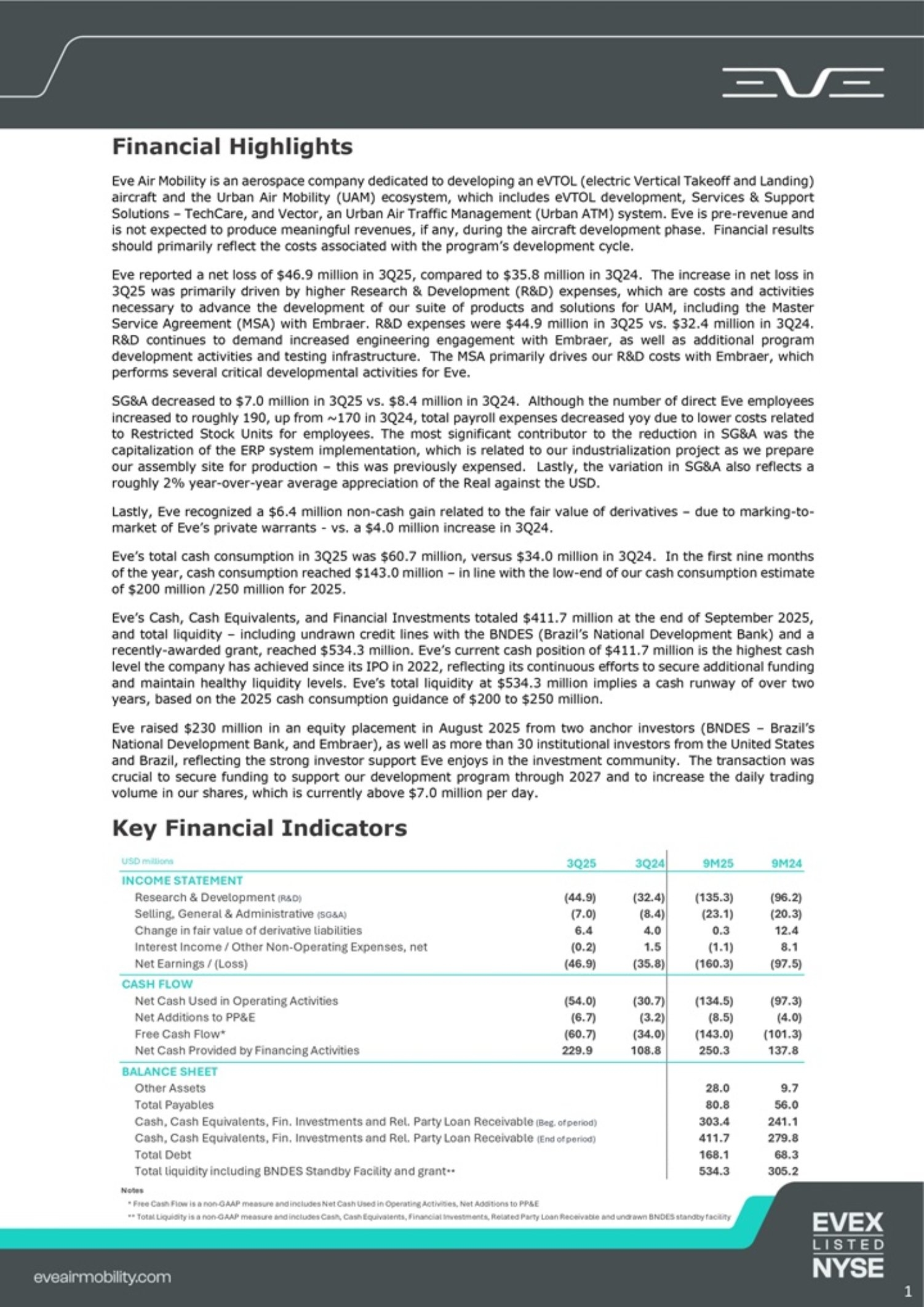
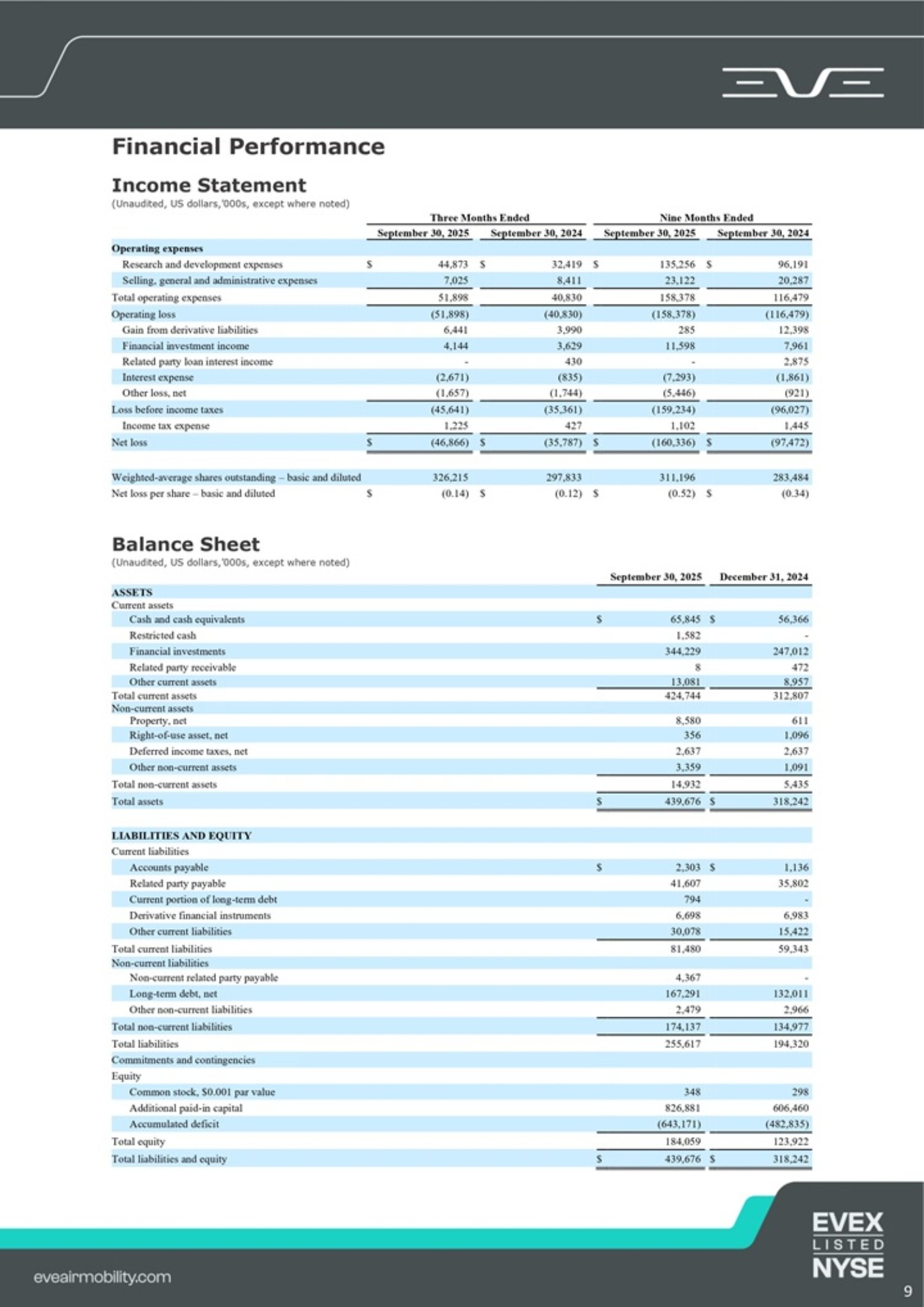
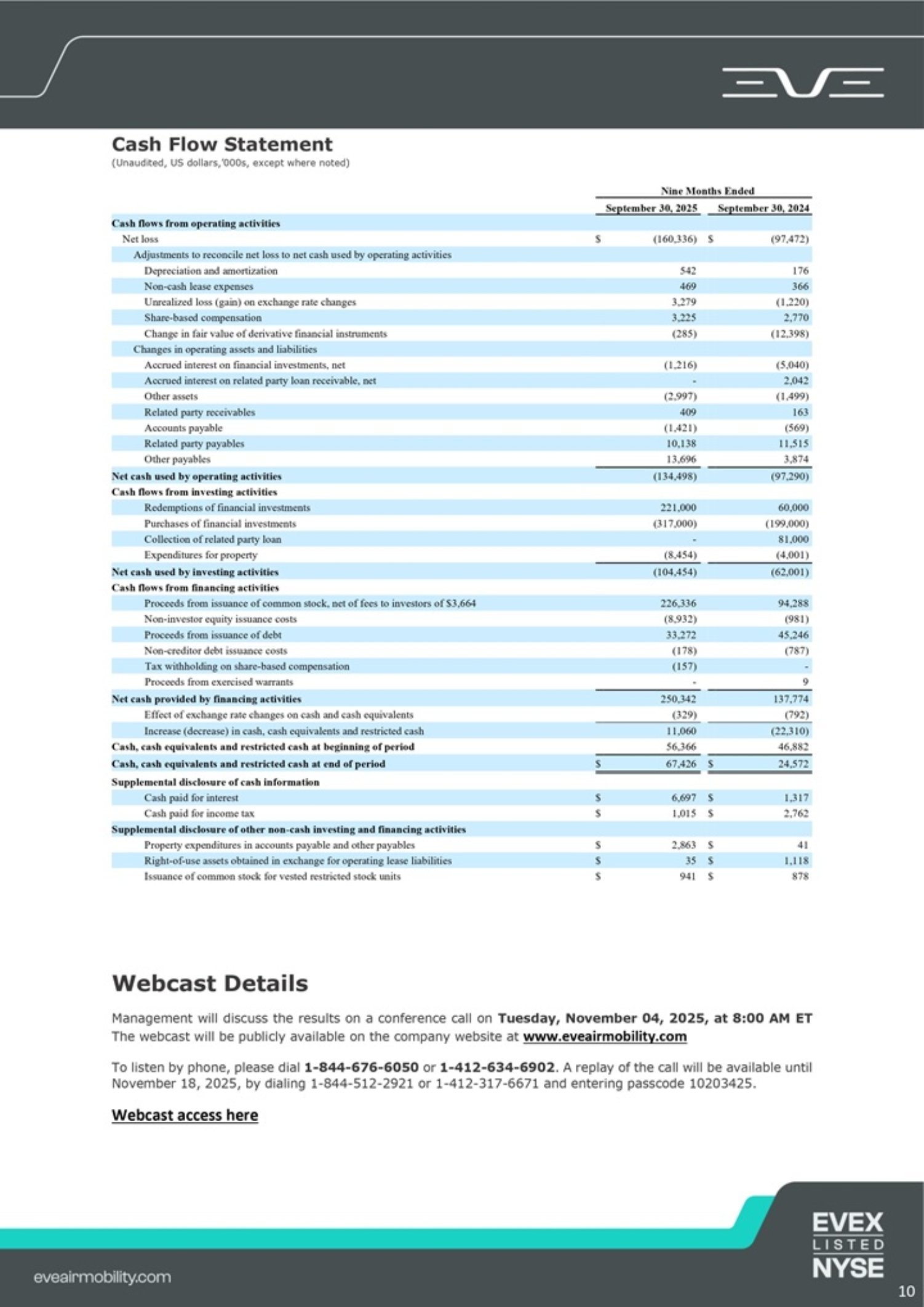
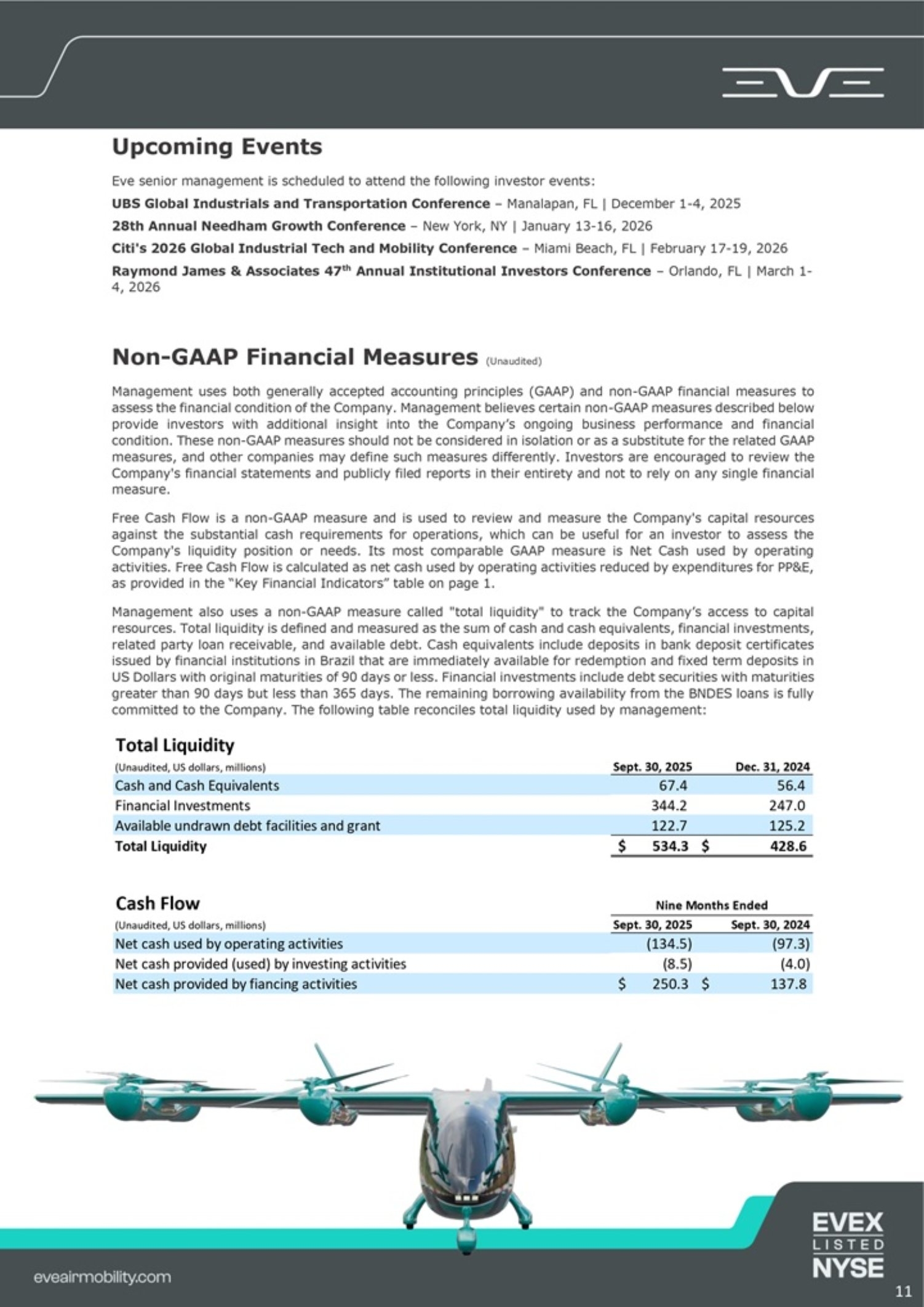
Thanks, Johann. Eve has successfully concluded a new funding raise of $230 million through a registered direct offering in August. This equity placement has not only improved our cash position to its highest level ever, but also extended our cash runway to about 2.5 years. We are very comfortable with our current liquidity and estimate it is sufficient to fund our operations and R&D expenses through 2027. The offering was anchored by two strategic and long-standing investors, the Brazilian Development Bank, BNDES, and our controller, Embraer, showing strong investor support and commitment to our project. Also, we had more than 30 U.S. and Brazilian institutional investors participating in this round. The strong institutional participation expanded our public float, and Embraer now has 72% of our total equity, down from 82%, and Eve's daily trading volume on the New York Stock Exchange is averaging $7 million per day. Now moving to Slide 9. Eve is a pre-operational company, and our financials reflect mostly the costs associated with our program development. That said, I would like to highlight some of our numbers. Eve invested $45 million during the third quarter '25 in our program development. We continue to accelerate our program development with more engineers from Eve and Embraer as well as higher engagement with suppliers. We also deployed about $7 million in SG&A during the third quarter, in line with previous quarters. Including R&D and SG&A, Eve reported a net loss of $47 million in the third quarter of 2025. We also recognized a gain related to the fair value of our outstanding warrants, which is a non-cash gain. Moving to cash flow. Our operations consumed around $60 million in the quarter, reflecting higher program activity and overall engagement with engineering and other R&D functions to progress our eVTOL development. With $143 million in cash consumed in the first nine months of the year, we are on track to hit the low end of our guidance of total cash consumption between $200 million and $250 million for the full year of 2025, reflecting our cost discipline, simple business model, and advantages of leveraging Embraer's capabilities. Finally, on liquidity, we ended the quarter with $412 million in cash, again, the highest ever cash level for Eve. Including an awarded grant and undrawn BNDES credit lines, total liquidity is now at $534 million. These standby facilities continue to help Eve preserve a solid cash position. Now going to Slide 10. We remain on track to deliver our milestones this year. As Johann detailed earlier, our first full-scale prototype is concluding final tests and installations to start to perform its initial flights in the upcoming months. In parallel, we continue talks with ANAC, Brazil's certification authority, to detail the certification plans. We expect it to be published by the end of the year to begin certification tests. We continue to engage with suppliers working on the initial parts of our conforming prototypes. And in parallel, we have started to receive the necessary equipment and tooling to produce the certification vehicles. Lastly, our cash consumption for the year is in good shape and in line to reach the low end of our guidance of $200 million to $250 million. With that, we conclude our remarks, and I would like to open the call for questions. Operator, please proceed.
Operator
And the first question comes from Savi Syth with Raymond James.
Speaker 4
Just -- congrats on the progress and financing deals. But I'm kind of curious about the Bahrain update yesterday. Just -- could you talk a little bit more about how that would work? It looks like 2027 you'll be doing work there. Is that flight testing using the engineering prototype or maybe the certification aircraft that you're building? And is that still part of that agreement?
Great, Savi. Thank you. Yes, we're thrilled about this announcement that we did with Bahrain, with the Ministry of Transportation & Telecommunications. It was also on Sunday, right? It was talked about at the Gateway Gulf Investment Forum. Very important. We've been in talks with the Middle East and the UAE for some time now. And I think this really proves that we're bringing the solution that they're looking for. This is a sandbox that will work to accelerate the readiness of the regulatory aspect, the operational, the infrastructure, also the ecosystem. We're going to be starting different fronts, like I mentioned, looking at the vertiports, looking at the operation. And when it comes to the testing, we're looking at the possibility of maybe starting some test flights in 2027. It's not defined yet, but this is what we're definitely working on, maybe using a prototype; this is something that we're thinking about, but definitely for the operation in '28 in the region.
Speaker 4
And does that come with any revenue stream? Or it's just kind of more of a demonstration?
Well, no, it will have a revenue stream. But definitely on the demonstration, we haven't defined exactly the scope and how it's going to be, right, at this stage.
No, we expect to get orders, right, Savi, as we start to fly and go to the region. We expect for more orders. PDP is the traditional type of sale with other customers.
Speaker 4
That makes sense. I appreciate that. On the cash flow side, I wanted to clarify congratulations on securing that deal last month or a couple of months ago. Is it still the case that this current spending reflects the planned level of spending for 2026 as well?
Yes, we're consuming around $60 million, right? We consumed that in the third quarter, $60 million. Probably fourth quarter should be around $60 million as well, and we may close the year around $200 million. For next year, if we keep that pace, which I think is reasonable, we may consume a little bit more, right, than $200 million, so something maybe around $250 million. We're still working on the details for 2026, and we still don't have guidance. We may provide something by the fourth quarter results, but I think it's reasonable to expect to keep that pace.
Operator
And the next question comes from Andres Sheppard with Cantor Fitzgerald.
Speaker 5
Congratulations on the quarter and all the great progress. I wanted to maybe follow up from Savi's first call just on the expansion to the Middle East. Hoping maybe you can give us a bit more detail there? So you're targeting commercial services in 2028 and then further expansion in 2029. But I'm curious, just given the region's maybe more leniency towards the certification process, is there an opportunity here perhaps to commercialize ahead of FAA certification? Is that something that's being explored? Or what's the overall strategy here in the region?
Thanks, Andres. That's a good question. Obviously, our primary authority is ANAC, and this will start for us with ANAC and then with the bilateral agreement that they have with FAA. Now ANAC has been also in contact and has agreements with all other authorities in the world. And it wouldn't be different, like we've done at Embraer for many, many years where they would accept the ANAC certification. So it's actually independent of what will happen at the FAA, right? But I'll let also Valentini give you a little bit more insight.
Thank you, Johann, and good question, Andres. This does not change our approach of first certifying with ANAC and then validating with other authorities. As Johann mentioned, we work to expedite this process by promoting alignment of vehicle characteristics and ensuring understanding among all authorities. We also support ANAC in their arrangements and agreements for their certification basis to be accepted by other authorities. Our goal is to facilitate the acceptance of ANAC's certification basis, which helps shorten the time for validation once we obtain the ANAC type certificate.
Speaker 5
Got it. Okay. That's super helpful. Appreciate it. And maybe just as a quick follow-up. Just on your test flight program, just to make sure I have it right. So we are targeting the first test flight, I think, before year-end and then to kind of ramp up the program all throughout next year, starting with hover flights and then heading towards a transition. Just can you break that down for us, just what does that flight path look like, just the timing again and just confirm what that looks like for this year and next year?
Sure. Yes. We'll start our engineering prototype flights, as we had mentioned, at the end of this year or at the beginning of next year. So that will start first with, let's say, simpler flights with hovering only, and then that will gradually expand what we call the flight test envelope. So increasing speeds, making maneuvers that cover, let's say, a more extended range of capabilities of the vehicle. And then from there, expand also to transition flight, which is what we call the phase of flight between hover and cruise flight, the fixed-wing part of the flight. So that's made to validate parameters of our analysis today. So we still have some calibration, some knowledge that we expect to gain from the hover flights themselves. So, for example, we believe that we'll be able to gain more insight on the noise of the vehicle once we start flying the hover. So even the hover test phase has significant information for us. But then evolving towards the transition is also important for us because even though it's a short phase of flight, it has significant physical phenomena happening. So it's important that we get that very well, not only for engineering and certification, but also for the comfort and user experience inside the vehicle. And then in the end, we'll also perform cruise flights or fixed-wing airplane flights with this engineering prototype. But that's the, let's say, the working of the vehicle in which we have more confidence from the background that we bring from previous Embraer programs. So that's the progress that we are expecting to make, all that to happen next year.
Operator
And the next question comes from Eegan McDermott with Jefferies.
Speaker 7
Maybe on the supplier with Embraer signing on to provide the landing gear, could you remind us of what other suppliers or component agreements you still need to secure? And maybe at a higher level, what kind of advantages does your extensive supplier network provide compared to peers who have a more vertically integrated approach?
Thank you for the question. This is the last major system we are introducing to the vehicle concerning new suppliers. We don’t anticipate bringing in any other suppliers for significant aspects of the vehicle from this point forward. Regarding the second part of your question, we are collaborating with suppliers who add value to our program due to their experience with aviation products and their expertise in certifying these products. For instance, our partnership with BAE for the battery supply is expected to help us on the path to certifying this critical system of the vehicle. As previously mentioned, we believe the suppliers we've selected enhance both the maturity of our project and their background with the vehicle while also optimizing the integration of these systems based on previous Embraer project experience. Does that answer your question?
Speaker 7
It does. Yes. And maybe one follow-up or slightly unrelated question. But in terms of the motor, when it comes to performance testing, could you provide an update on what you're monitoring there in terms of performance testing? And are you going to continue to dual source motors from Nidec and Beta? Or is there any intention to source both the lifter and pusher from one supplier? And what would be your priorities in making such a decision if so, whether it's cost performance, scale, or else?
Yes. As we mentioned previously, the flight test of the engineering prototype is part of our process to optimize vehicle characteristics. This involves selecting the right systems and components for the vehicle. We are still on the path we discussed in the last call to explore our options for sourcing motors, including both lifters and pushers. Based on our tests and the choices we make, we will then determine the final configuration. We evaluate these components based on several factors, with an emphasis on performance aspects like weight and controllability. Cost is also a significant consideration, as well as the ability of these companies to deliver a quality product throughout the vehicle's lifecycle, including production, support, and spare parts. Ultimately, we analyze a comprehensive set of parameters that will guide us in selecting the suppliers for these components.
Operator
And the next question comes from Sameer Joshi with H.C. Wainwright.
Speaker 8
I have a couple of questions. First, regarding the cash burn expectations for this year. I believe I heard that you expect to be closer to the lower end of the $200 million to $250 million range. Is there a specific reason for that? Were some programs slowed down, or were you more efficient than expected?
In terms of the cash for this year, you're right. We believe we're going to be closer to the low end of the guidance range of $200 million to $250 million, pretty much because we are trying to optimize our cash consumption all the time, right? We control expenses. We make sure we're spending money the right way. We try to increase payment terms and have some working capital gains. We are always discussing with suppliers about payment terms. There is a lot of work that is done by Embraer as well that we have on the service agreement. So there are different pockets of cash consumption that we're always trying to optimize. We leverage a lot of existing infrastructure, existing capabilities, things that the Embraer Group already has, in order to have this more optimized cash burn, and we're going to continue to do this way, okay?
Speaker 8
Okay. Understood. I have a broader question. You mentioned a backlog of orders worth $14 billion, including those from the Eve TechCare and Vector offerings. How are you maintaining engagement with these customers, especially since the commercial flights won't start until 2027? What kind of interactions do you have with them? Have you received any feedback regarding design aspects, like interior design?
Thank you for your question. This is Johann. The foundation of Eve is built on workshops with our customers. We conduct these workshops to understand how pilots interact with the human-machine interface and to gather insights on our various concepts, whether in Rio, Chicago, or London. This helps shape our vision for the Urban Air Mobility environment, influencing both the vehicle's development and its interior design. Over the past five years, you can see how the exterior and interior of the vehicle have evolved, particularly with our flexible cabin concepts that allow configuration changes in just a few hours, accommodating either full cargo or different seating arrangements. This approach has helped us secure 28 customers and the largest pre-order backlog. We offer more than just the vehicle; we provide a complete solution supported by our Embraer heritage and a global team of 4,000 professionals. Our customers appreciate our expertise in ensuring reliable operations, not just delivering the aircraft but also guaranteeing availability and competitive operating costs. These are our two main pillars. Eventually, as we deploy thousands of vehicles, we will need to establish suitable urban traffic management software, but for now, we can start operations using existing infrastructure and airspace management systems. This aviation expertise is what attracts our customers to Eve.
Operator
And the next question comes from Andre Madrid with BTIG.
Speaker 9
When you think about scaling production moving forward, where might you anticipate the largest bottlenecks forming? Or I guess, maybe put more broadly, are there any risks that you see throughout your supply chain currently?
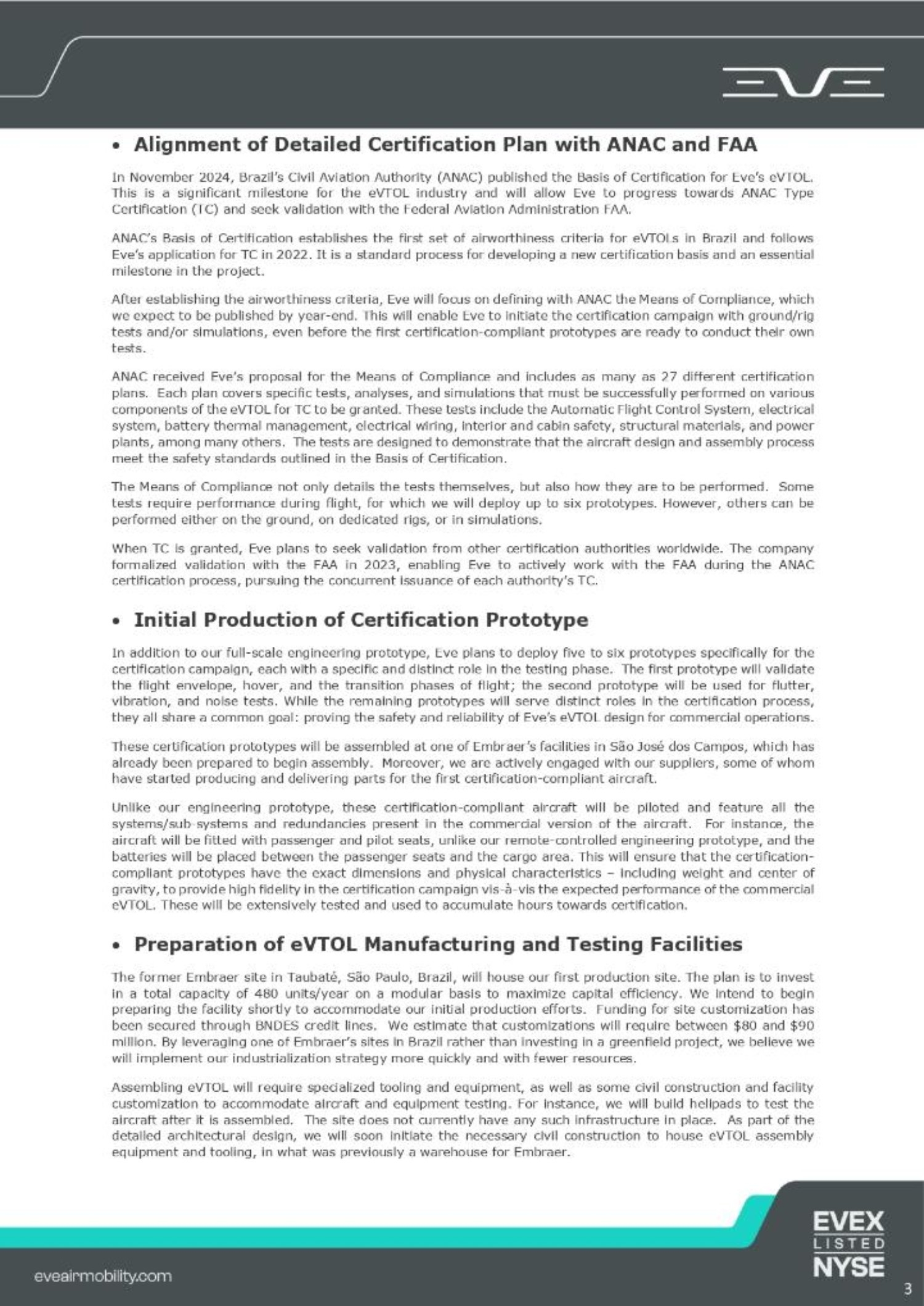
No, we believe that our approach to manufacturing the eVTOL will be modular. We will have three modules. Initially, we plan to produce 120 eVTOLs per year at our Brazilian factory. We can increase production from 120 to 240 with an additional shift, and then double that to 480 with additional tooling and equipment. For the increase to 240, we expect to invest around $100 million, and for 480, about $150 million. We have good relationships with our suppliers, who have ample production capacity, and we ensure they are aware of our production plans. As we increase our production, we are confident that our suppliers will also be prepared to meet demand. We do not foresee any significant challenges in achieving our goal of producing 500 eVTOLs per year. However, deploying these eVTOLs in the markets may require some local assembly. Overall, we are confident in our capability to produce the initial 500 eVTOLs annually.
I want to highlight another aspect of our relationship with our 22 primary suppliers. It took us one year to finalize the contracts, each of which is founded on the solid experience in supply chain management that Embraer provides. We understand that conventional aviation presents challenges, and we have learned a lot from those experiences. The contracts we established are lifetime agreements, not just for the prototype and production, but also for the aftermarket. We utilized the best practices in negotiation and learning from Embraer to secure these contracts. Notably, this is not a single-source program; these arrangements with the suppliers allow us to mitigate risks associated with ramping up production while accommodating various workflows. Additionally, we have elevated our role by directly engaging with customers in the aftermarket, ensuring consistent communication and support regarding dispatch availability and operating costs. These are significant advantages and lessons learned from our history, especially for a company that has been in the industry for 56 years.
Operator
And the next question comes from Austin Moeller with Canaccord.
Speaker 10
So based on your comments about Bahrain, is ANAC looking to form similar dual cert partnerships for eVTOLs with other countries similar to the relationship they have with the FAA once the means of compliance are published?
So Austin, the work we're doing with Bahrain with respect to certification is very similar to how we're working with other authorities. So we've been trying to, as much as we can, work on the certification basis so that if we don't have a full harmonization, we have good alignment of the requirements. So that means from early on, engaging with these authorities to understand their expectation in terms of the requirements for the vehicle and then developing the vehicle in a way that we will be able to show compliance with those requirements, right? So we start talking to these authorities, following what we believe will be important markets for our eVTOL, and then start building this alignment on the certification basis. That's something that Eve does. In parallel, as I mentioned earlier, we promote and we try to support as much as we can, work that is done directly between authorities, from ANAC to other authorities in the world, in bilateral agreements that they have with the authorities and also agreements that they have concerning validation of type certificates, for example. We support that, and we try to steer that, and we do that by giving information to the authorities, to steer that to where we believe we should focus concerning what markets are most important for our vehicles. So it's a very similar process to what we're doing with the Bahrain certification authority, is to connect with these authorities in the world, build early engagement and then also promote the connection between the authorities to, again, shorten the time that we have for validation once the TC from ANAC is issued.
Speaker 10
Great. And can we talk about what stage we're at on assembly for each of the conforming prototypes right now? And how close any of them might be to finishing assembly?
Yes. Currently, we are still defining much of the design for these prototypes. Some longer-lead parts are already being manufactured by the suppliers, which means they have drawings released and are in production. We expect to start receiving those parts next year and then assemble the prototypes in the same timeframe. At this point, we are not assembling yet; we are focused on the manufacturing of longer-lead items and designing the shorter-lead items, which we plan to start manufacturing next year.
Operator
And this concludes our question-and-answer session. I would like to turn the conference to Lucio Aldworth for any closing comments.
So we accomplished several important milestones this past quarter. We're fully engaged and moving fast, and there's much more to come. So we're going to continue updating you on our progress through the next few quarters, which will be very exciting, and we look forward to meeting you in the upcoming events we're going to attend. As always, if you have any questions, please don't hesitate to reach out to our team. Thanks, and have a good day.
Operator
Thank you. The conference has now concluded. Thank you for attending today's presentation. You may now disconnect your lines.