Speaker 0
Greetings and welcome to the EVE Holding Inc. first quarter 2026 earnings call. At this time, all participants are in a listen-only mode. A brief question and answer session will follow the formal presentation. Should anyone require operator assistance during the conference, please press star zero on your telephone keypad. As a reminder, this conference is being recorded. It is now my pleasure to introduce your host, Lucio Aldworth, Head of Investor Relations. Thank you. You may begin.
Thank you, operator. Good morning, everyone. This is Lucio Aldworth, the Director of Investor Relations at EVE, and I wanted to welcome everyone to our first quarter 2026 earnings conference call. Our CEO, Johan Bordet, and CFO, Eduardo Cotto, are joining me on the call today. After their prepared remarks, we will open the call for questions. At that point, Luis Valentini, our Chief Technology Officer, will also join in to address some more technical questions. We have a deck with a few slides and additional pictures that showcase our achievements in the quarter, including, of course, the more recent stages of the test flights and of our full-scale prototype. The deck is available on our site at ir.ethairmobility.com, so please feel free to download it and follow along. And in fact, we just published on our website today a video of one of the more recent flights that features some more complex on-air maneuvers. You might want to check that out as well. Let me first mention that today's conference call includes statements about events or circumstances that have not yet occurred. These are primarily based on our current expectations and projections regarding future events and financial trends that will affect our business and future economic performance. These forward-looking statements are based on current expectations and involve risks and uncertainties that could cause financial results to differ substantially from those expressed or implied in this conference call. We undertake no obligation to update publicly or revise any forward-looking statements because of new information, future events, or other factors. For a more detailed list of these risks and uncertainties, please refer to our SEC filings, which are available on our website. Now I'll turn it over to our CEO, Johan Bourdais. Johan?
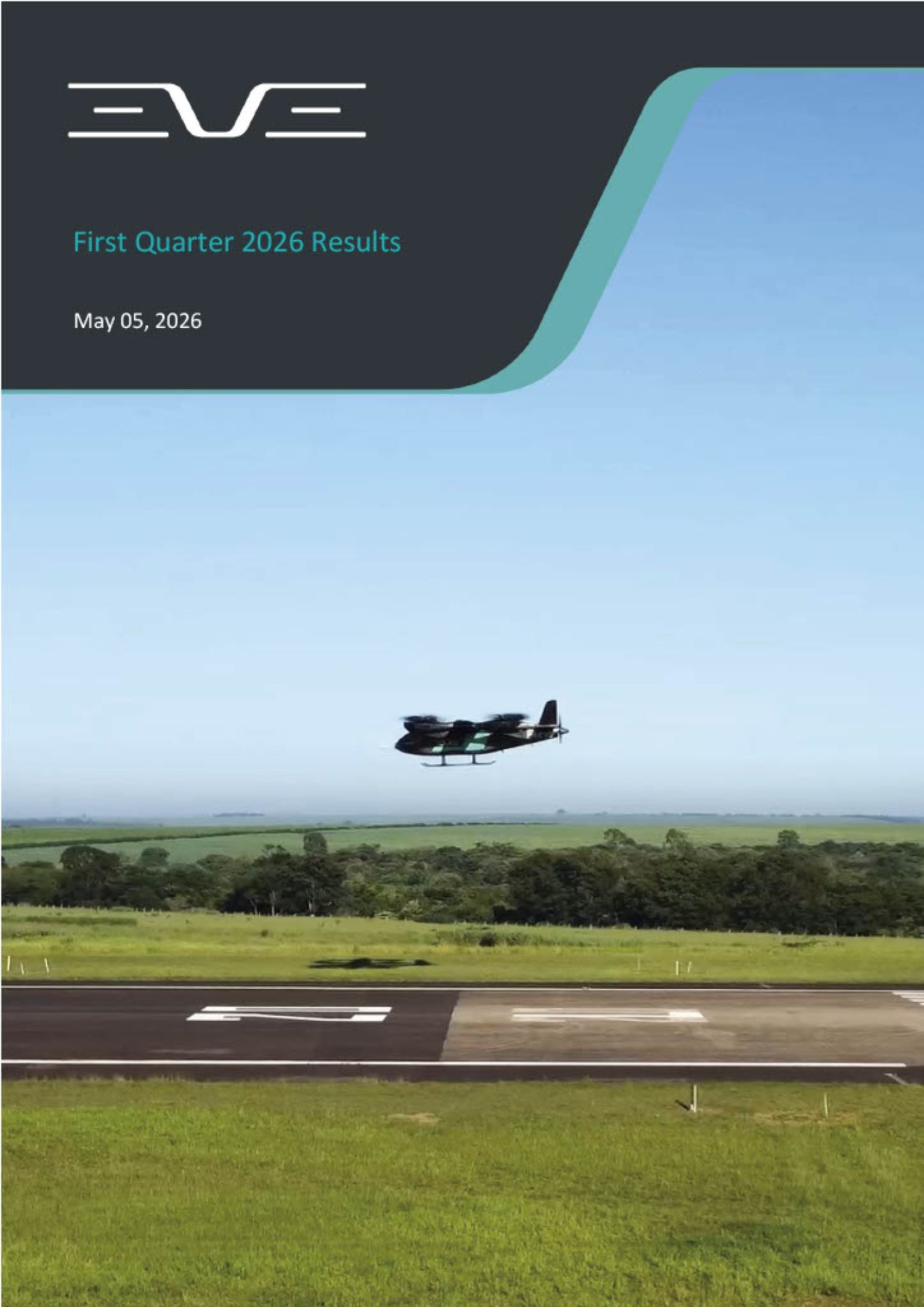
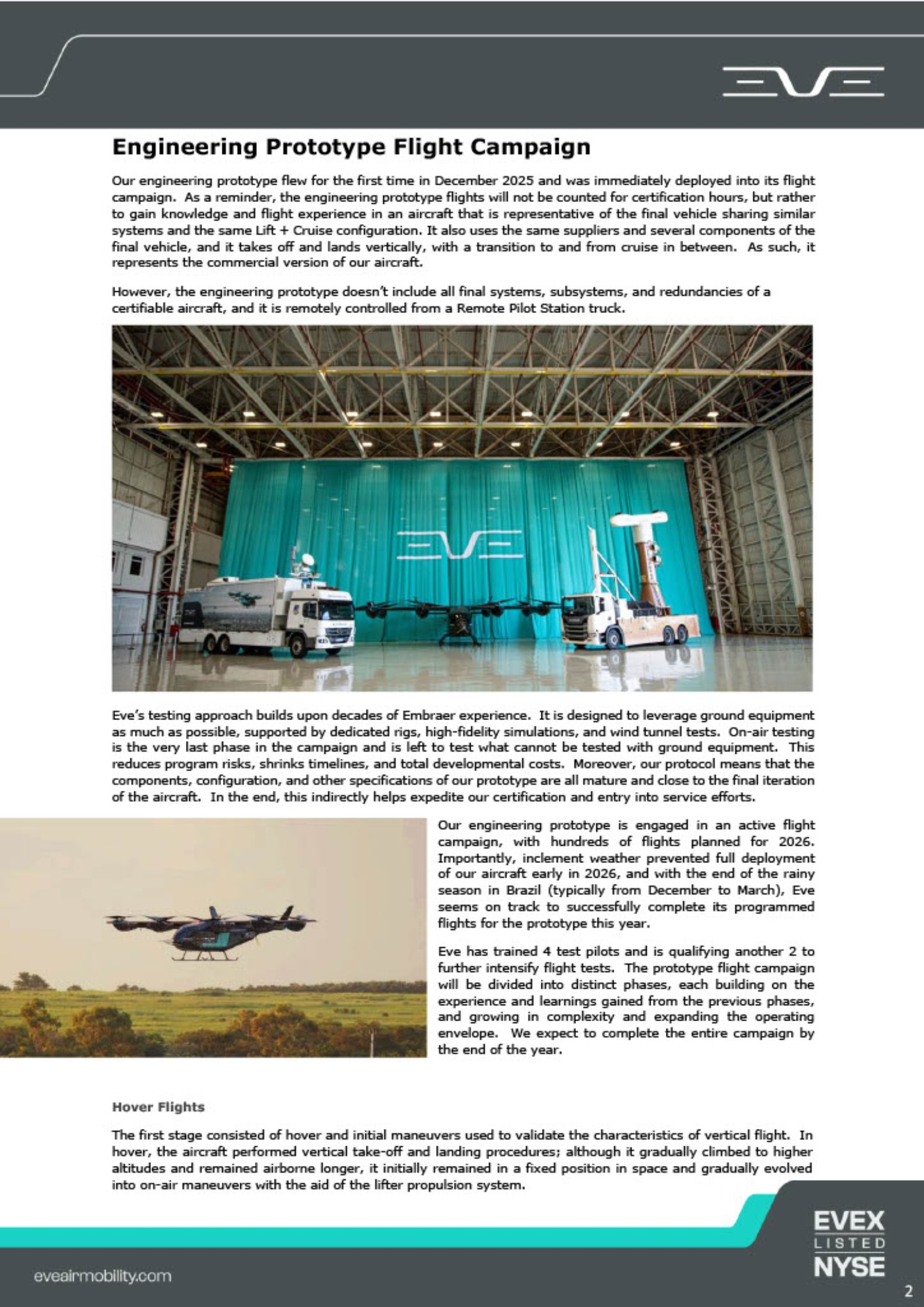
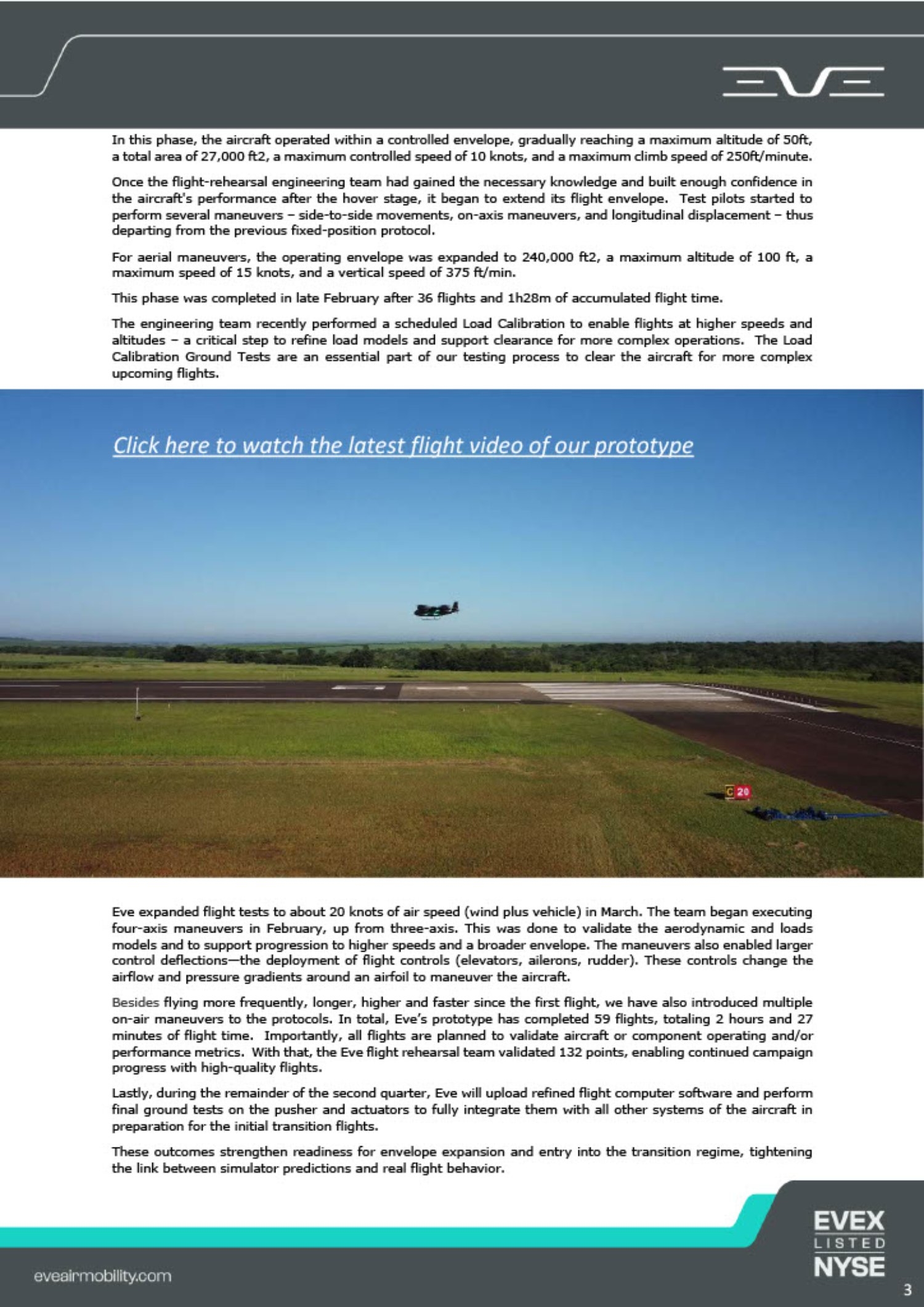
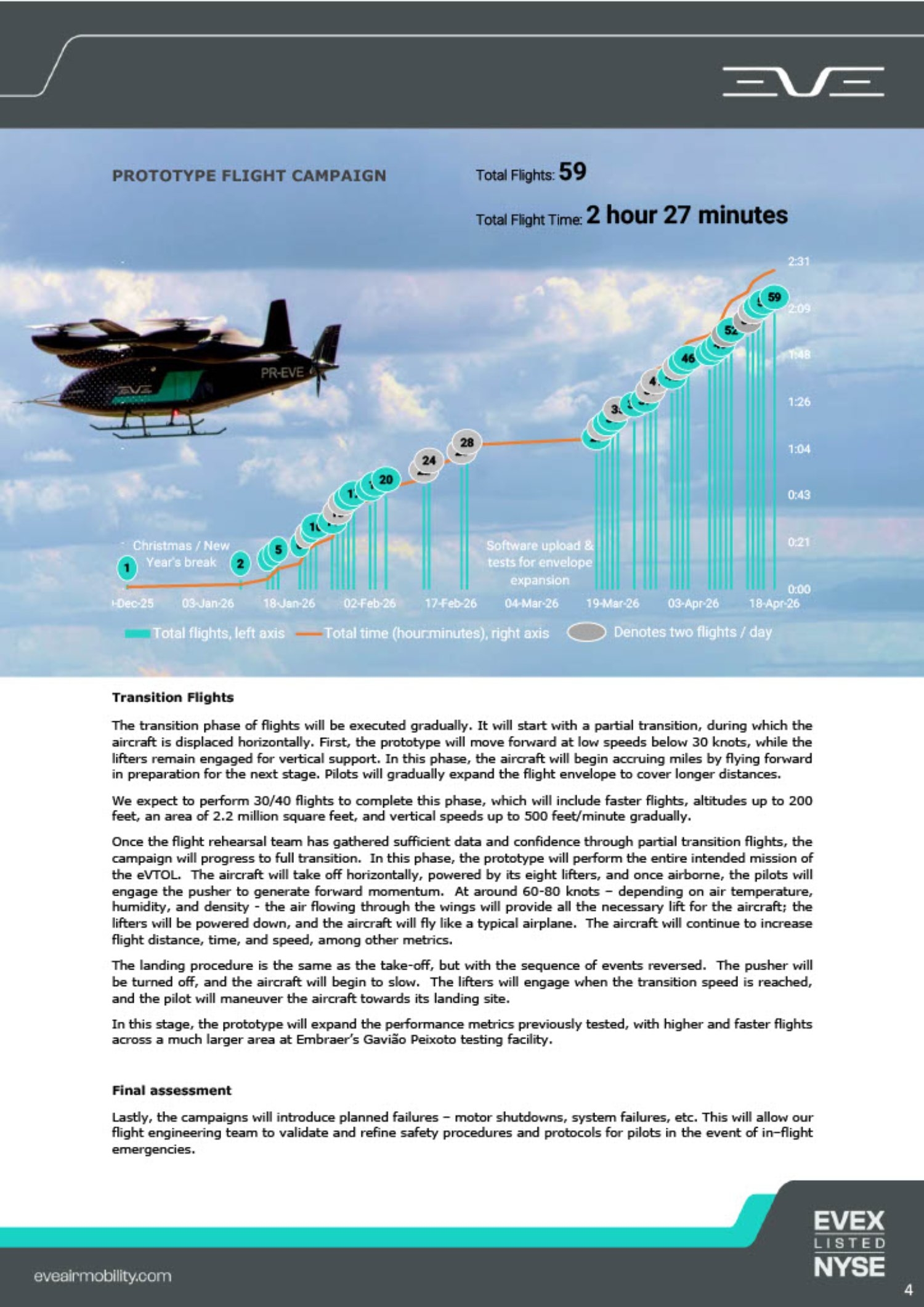
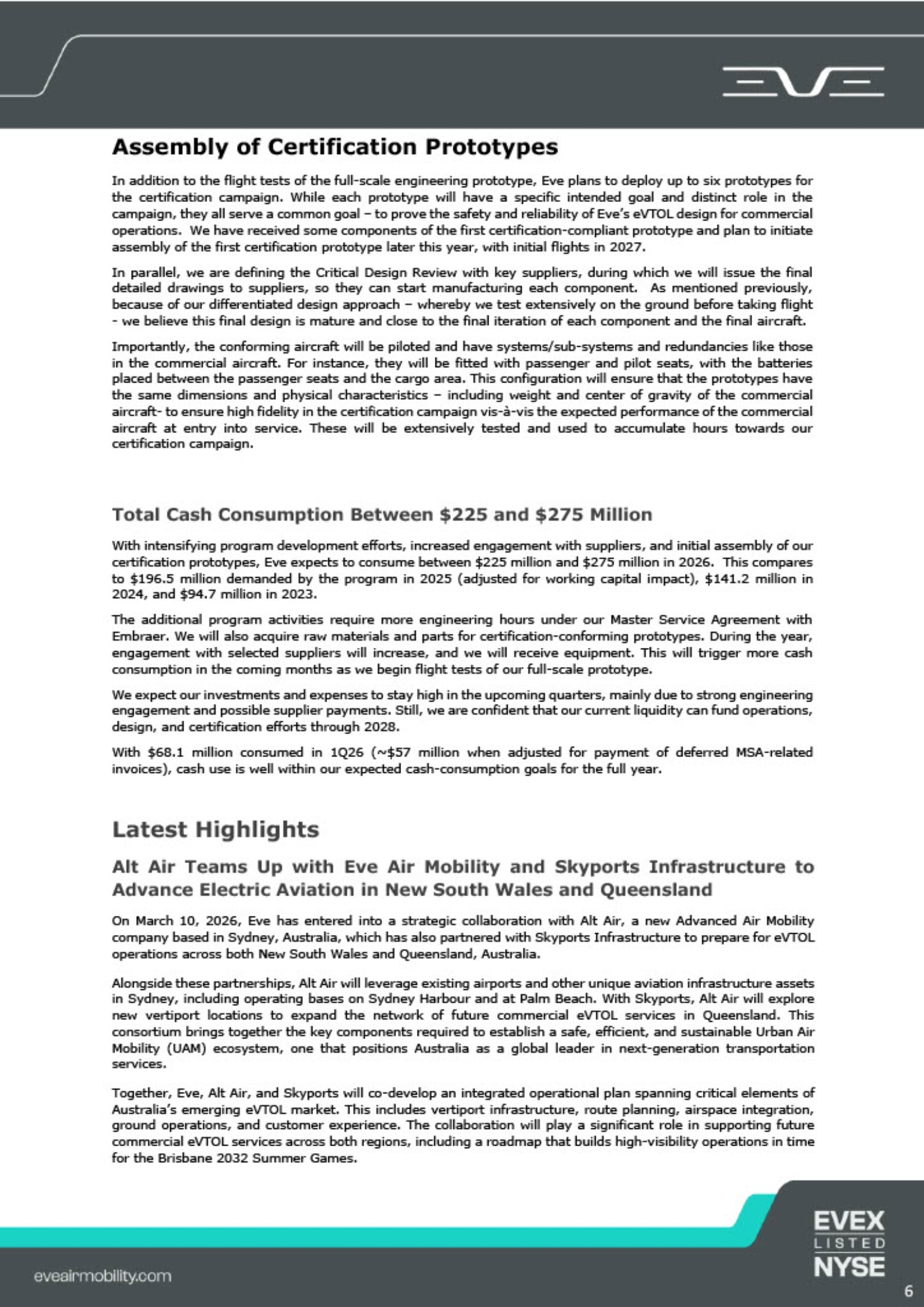
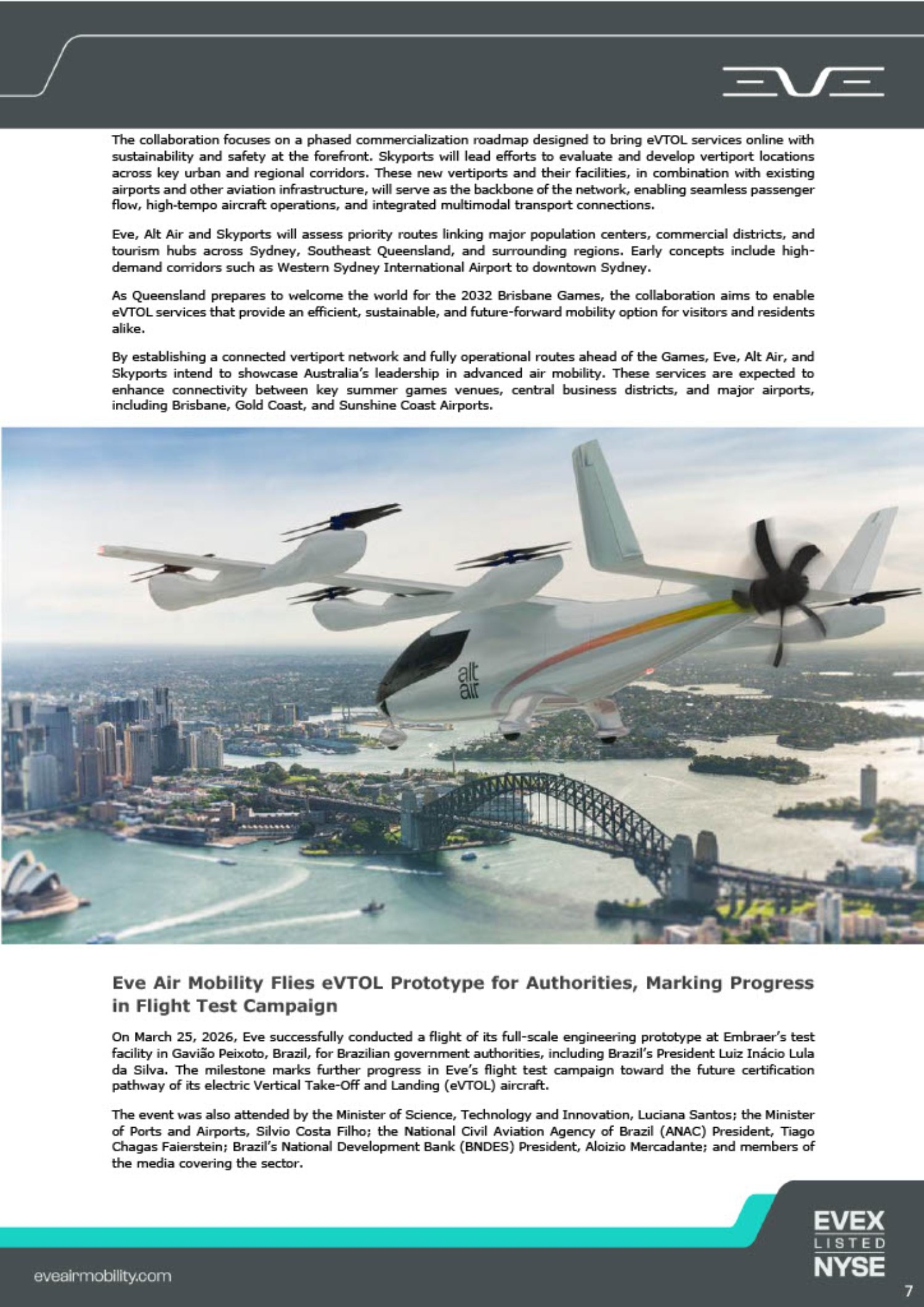
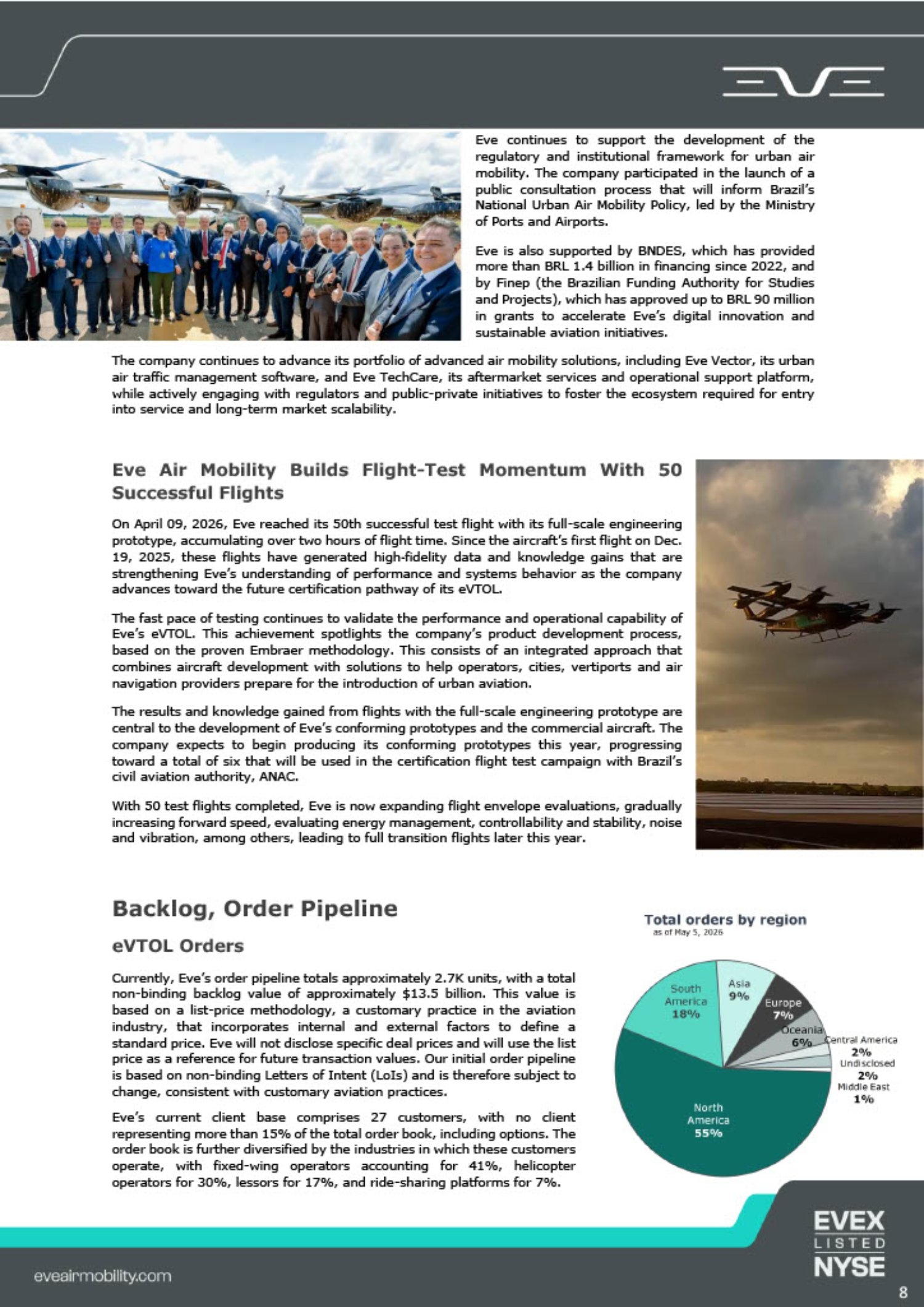
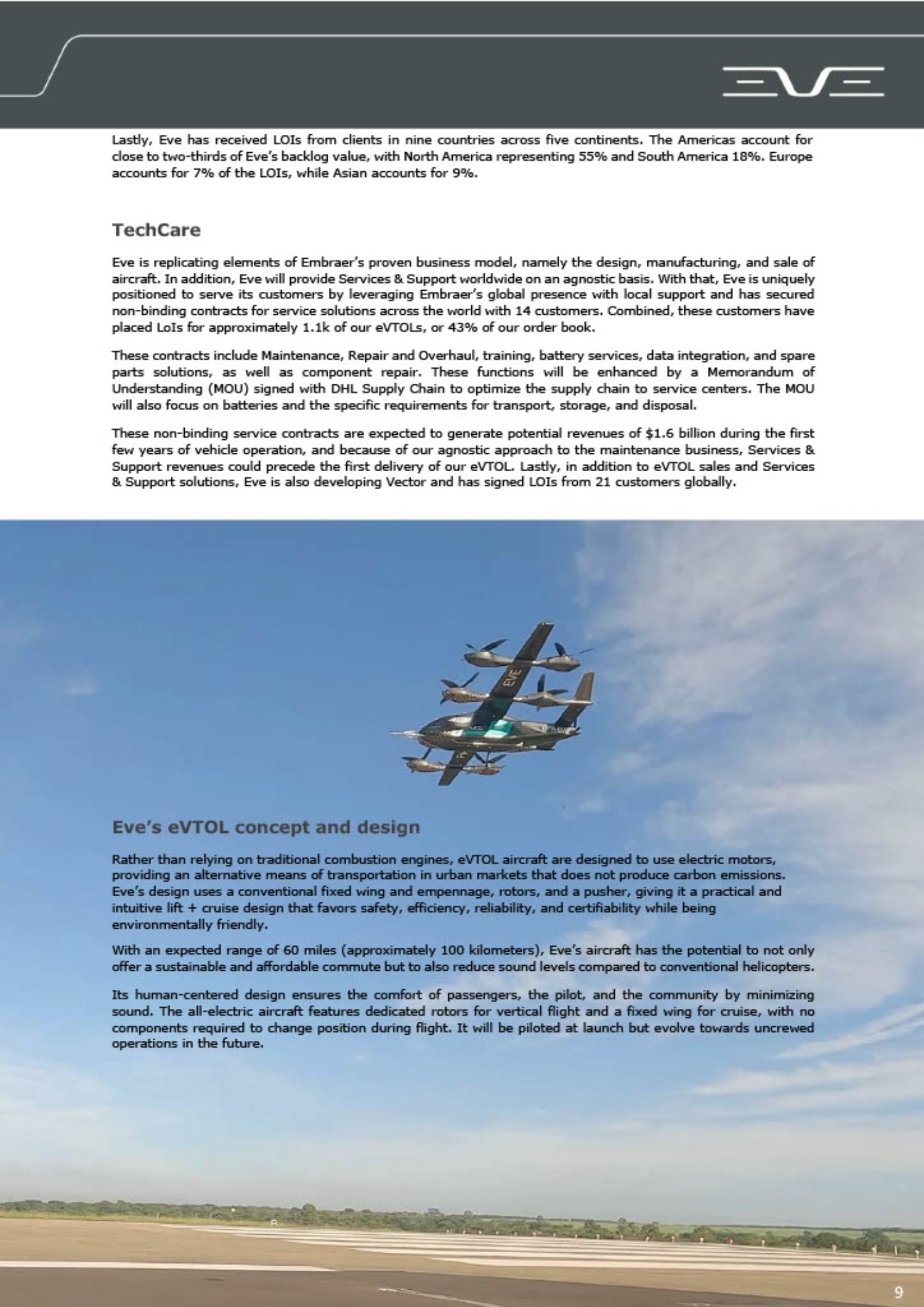
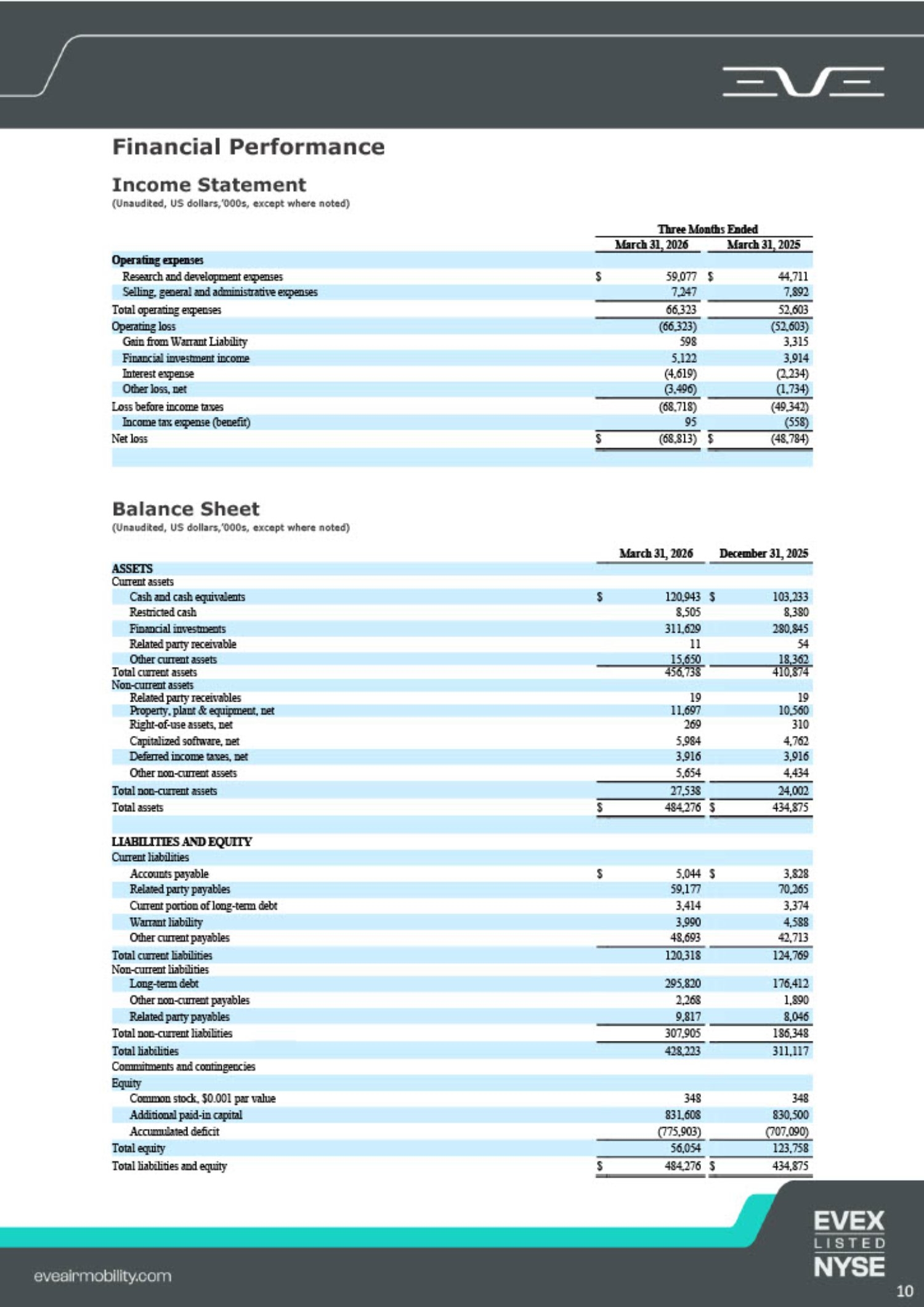
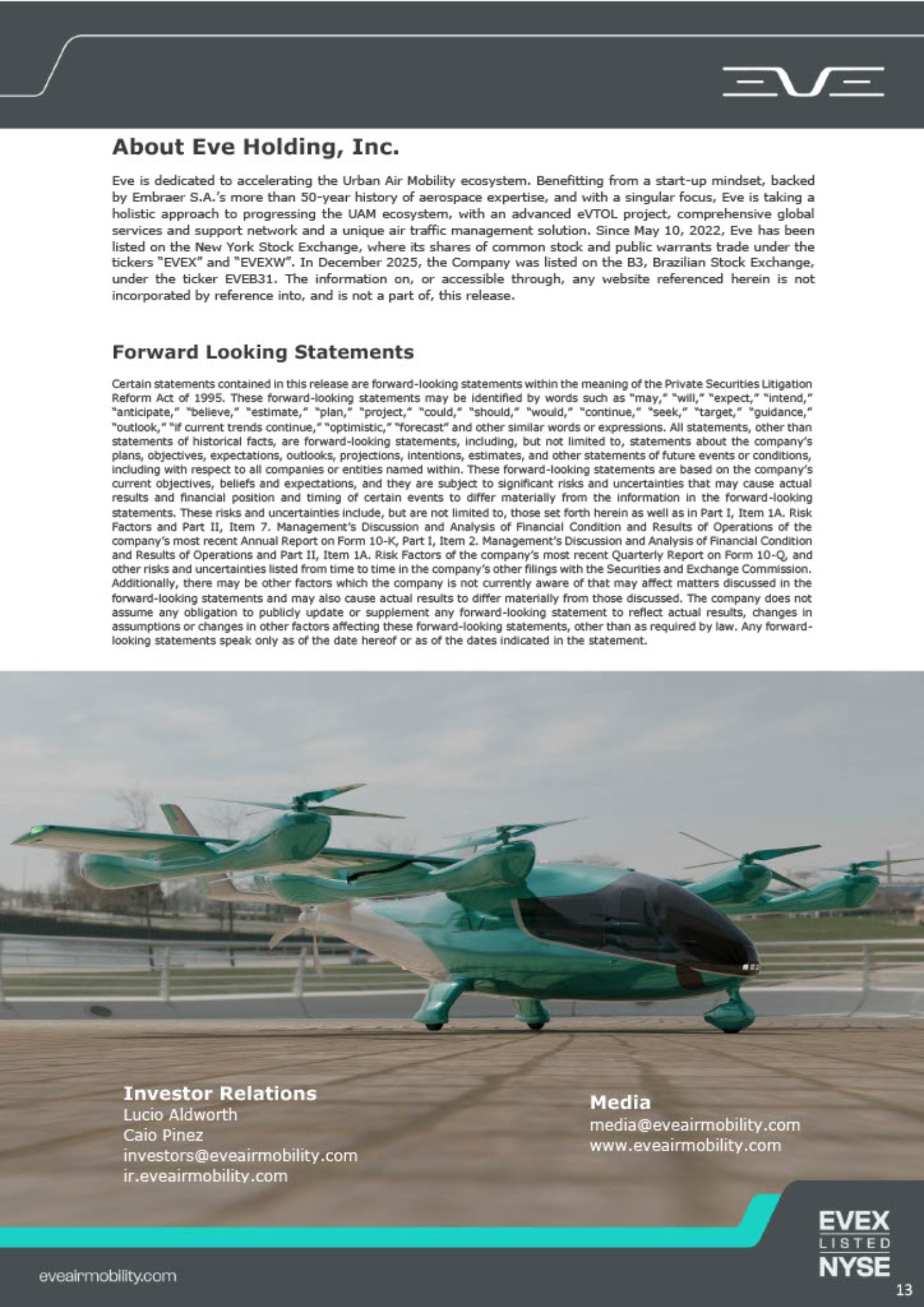
Thank you, Lucio. Good morning, everyone, and welcome to the first quarter 2026 conference call. This quarter was especially significant. As many of you know, we achieved the inaugural flight of our engineering prototype last December after thorough development and a series of rigs and ground tests. This major milestone validated not only our building block concept by extensively testing every part, but also the integration of critical systems, such as fly-by-wire and fixed-pitch lifter rotors. The successful first flight launched an intensive flight test campaign. Our prototype completed 59 flights and logged nearly two and a half hours in the air with multiple days of two flights and the completion of all planned hover phase objectives. Moving to slide three, more than quantity, our flight campaign has also excelled in quality. Every flight is planned to test and validate specific aircraft component or flight metrics. In total, our engineers have already validated 130 different performance points. The prototype has reached 215 feet above the ground and now moving forward at 30 knots. As an example of the envelope expansion, our first flight in December was stationary, with the aircraft climbing to 40 feet. Besides flying more frequently, longer, higher, and faster since the first flight, we have also introduced multiple on-air maneuvers to the protocols. We use a building block approach in both design and flight testing, which means we break complex systems into smaller parts, test each unit until it reaches the needed maturity, and then build on these components. Each test validates specific points and allows progression to next-level, more complex phases of the campaign. As such, the aircraft has tested and validated the Autoland feature, fully controlled by the fly-by-wire system. We have also performed difficult maneuvers in all four axes with consistent behavior, allowing continuous envelope expansion. On slide four, the flight campaign has delivered meaningful knowledge gained to date. Most importantly, we confirmed that our predictive models are reliable and precise, enabling safe and confident campaign advancement. Ground effect behaved somewhat differently, but loads remain within expectations. These common small deviations help us further refine and improve our engineering models. We have better than expected results for motor thrust and battery performance, with noise and vibration meeting our expectations. The key takeaway is that we remain on track for further envelope expansion and more complex flights. Speaking of which, slide 5 shows the next steps in the engineering prototype test campaign for this year. The flights up to now have been in hover mode up to 30 knots and all were completed successfully on schedule with approximately 60 flights. During the remainder of the second quarter, we will upload refined flight computer software and perform final ground tests on the pusher and actuators. This will ensure that they are fully integrated with all the other aircraft systems in preparation to initiate transition flights. Besides software upgrades, we will also perform military structural ground tests and layup activities that are required for the transition phase and that will last a few weeks. This is critical opportunity that will help us validate methods, setups, instrumentation, and test techniques to continue advancing. In a nutshell, this structural and software upload phase is an investment in the maturity, safety, and predictability of the coming transition and certification path. The transition phase will also be gradual. We will start with a partial transition, progressively increasing speed. The lifters will be engaged and to provide the aircraft with the necessary vertical support. At the end of this phase, we plan to accelerate the aircraft to a full transition speed above 85 knots. At this point, the entire lift of the aircraft will be provided by the wing, meaning that the aircraft will be wing-borne flight, with lifter's motors off. This is the aircraft ultimate mission. Take off vertically, transition to wing-borne flight, and then transition back to vertical flight for landing procedures. After transition testing, we will introduce controlled failures, such as motor shutdown, to observe system reaction and refine the safety procedures and the pilot's protocols. Meanwhile, we are concluding the critical design review with our suppliers for each component that will be featured in our coming conforming prototypes. This will allow us to release drawings and continue manufacturing components within the required specs to start testing our conforming vehicle in 2027. We continue to mature our flight test campaign, advance our engineering prototype this year, while gaining greater visibility into the certification plans for our conforming vehicles. This suggests that certification and entry to service are more likely in 2028, as we will need to fly our conforming vehicles for 12 months to complete all necessary certification tests. It is important to mention that this greater visibility gives us more confidence in a new schedule and lowers its risks. The new timeline is also important to incorporate knowledge gain from the engineering prototype to the conforming prototype and guaranteeing the maturity and performance level of our EVE 100 EVTOL, especially for range, noise, reliability, payload, and lower operating cost. We are now confident that we can deliver an aircraft that is very competitive and well-designed for urban air mobility missions. In parallel, on slide 6, we continue to engage with authorities worldwide to advance certification for our VVTL. We recently performed a demonstration at the Gavion Peixoto Embraider facility in Brazil for several Brazilian authorities, including the President of Brazil. We also met with both Brazil ANAC and the U.S. FAA Certification Authorities at our Melbourne, Florida office to continue discussing our certification timeline. We also met with Japan, JCAB, and ANAC to strengthen cooperation between the two agencies. Lastly, we formally applied for our eVTOL TAP certificate with YASA. Moving on to slide 7, we attend Inverticon in Atlanta. the world's largest helicopter conference. Our goal was to raise awareness to our eVTOL amongst helicopter operators. We believe that these operators will be very early adopters and see an attractive short-term commercial opportunity with them. Flight 8 shows our total pre-order backlog with approximately 2,700 aircraft valued at about $13.5 billion US dollars at the list price. Out of the 27 customers, we also have LOIs with 14 different customers for our eVTOL aftermarket services and support, as well as 21 different potential customers for our air traffic management solution called Vector. Now, I will hand over to our CFO, Edu, for the 2026 first quarter financial review.
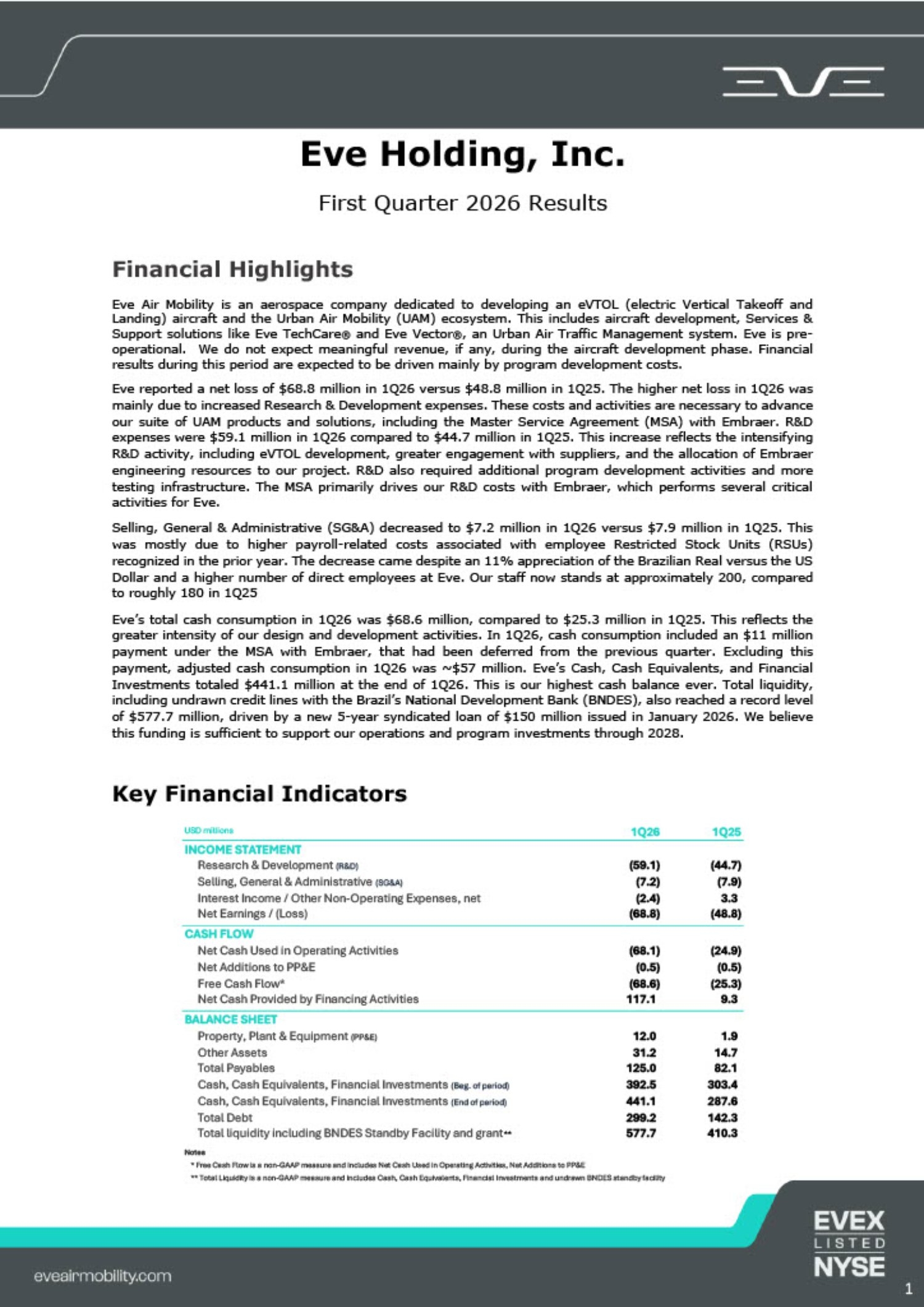
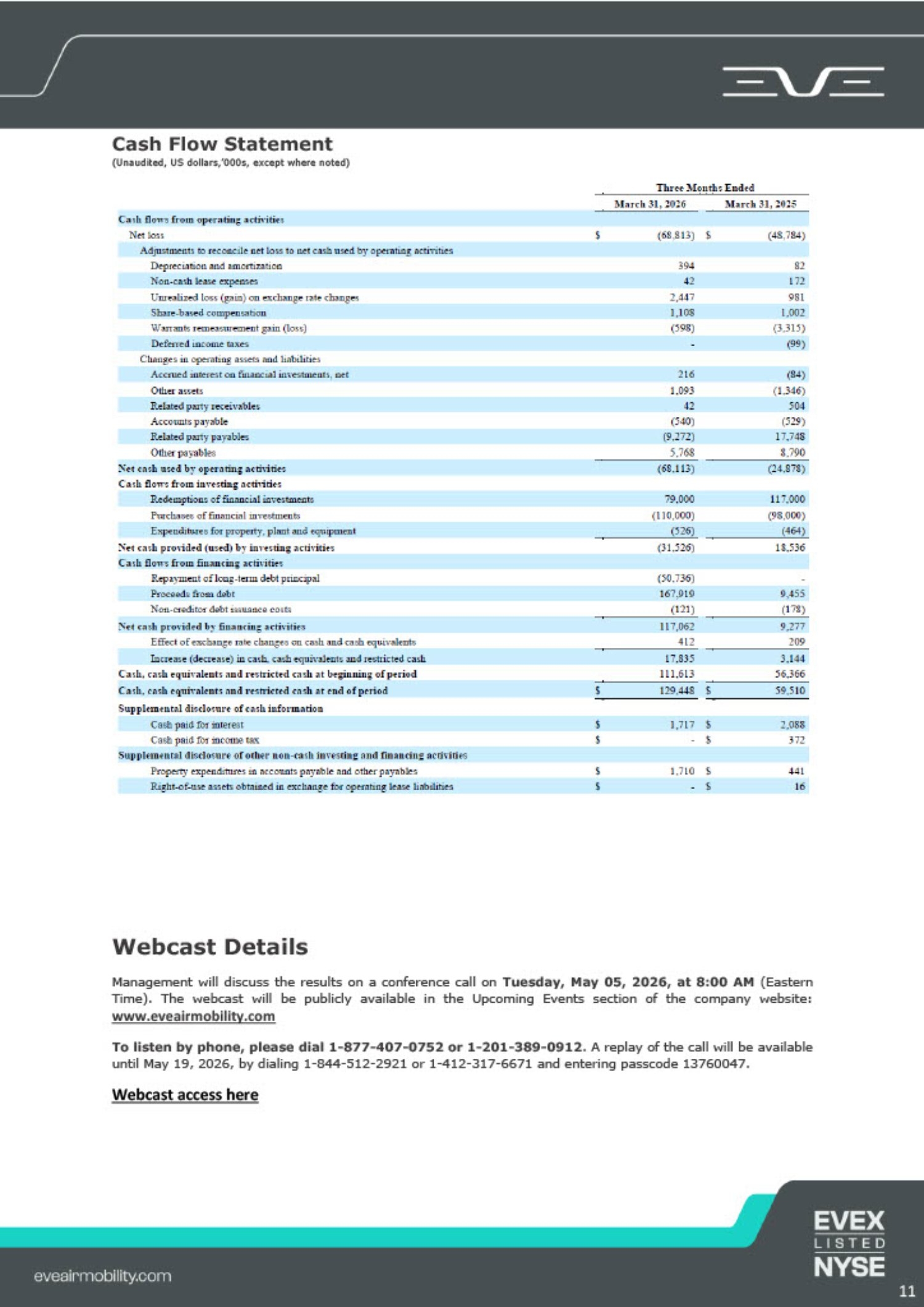
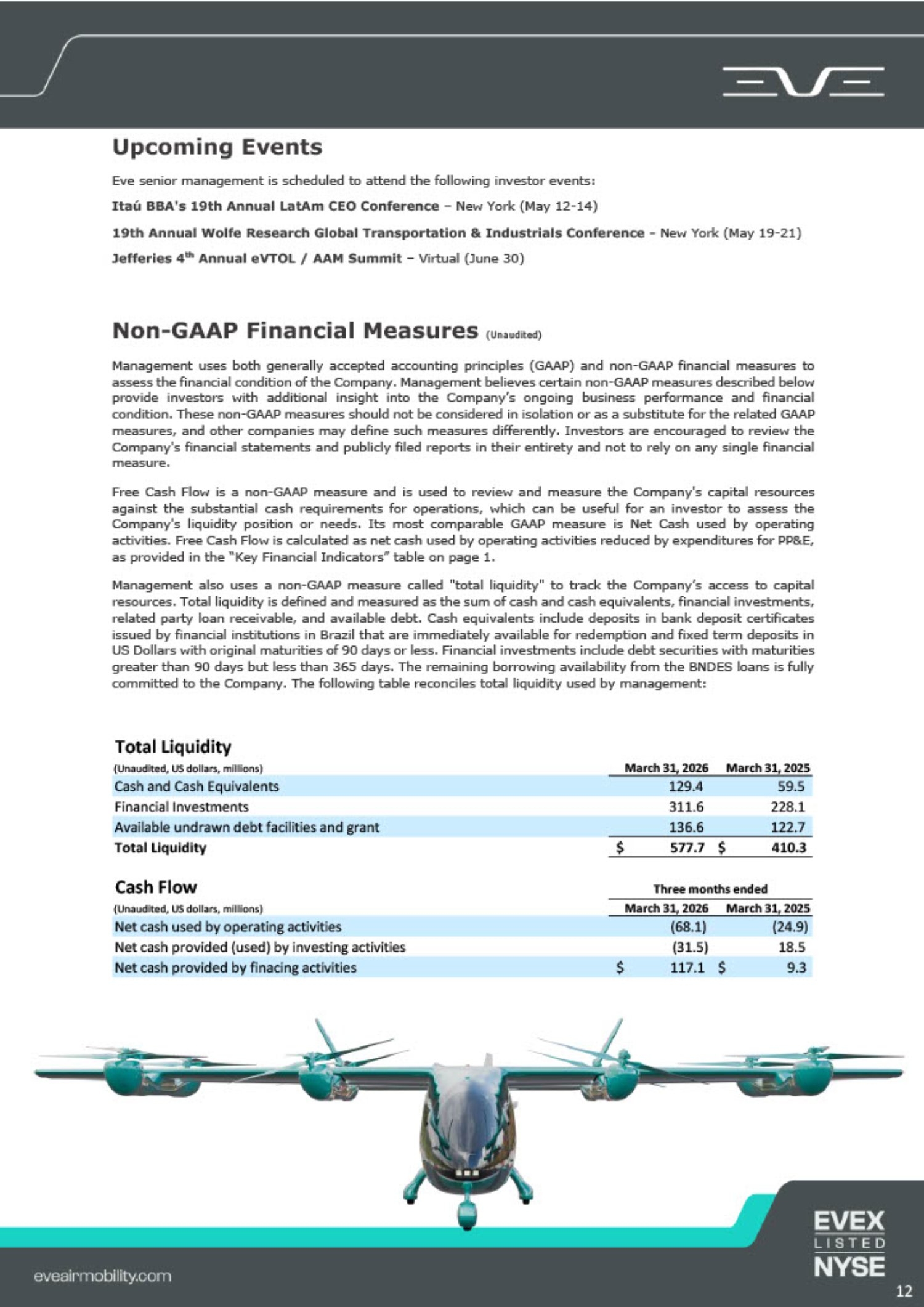
Thanks, Johan. Eve ended first quarter 2026 with a record cash position of $441 million and total liquidity of $578 million, including about $136 million in undraw credit from the Brazilian Development Bank. This is our highest cash level since the IPO, driven by a new five-year $150 million loan raised in January. This added liquidity should support operations through 2028 without new funding. We are also working with Embraer to find new synergies to reduce our cash burn from 2026 to 2028. Our initial review indicates that we can achieve $100 million to $150 million in incremental synergies in the next three years, likely reducing cash usage and extending our cash runway. We already started to implement these actions. Our 2026 expected cash burn remains at $225 to $275 million, excluding the new potential synergies under implementation. Now moving to slide 10, just to highlight some of our numbers, Eve invested $59 million in R&D during the first quarter of 2016, mainly for EVITOL development. SG&A expenses totaled $7 million for the quarter. Including R&D and SG&A, Eve's net loss for first quarter of 2016 was $69 million. Finally, as mentioned previously, we ended the quarter with $441 million in cash and $578 million in total liquidity. Cash consumption in the first quarter was $69 million, but this figure includes approximately $11 million in service expected to have been paid in the fourth quarter of 2025. Excluding this additional payment in the first quarter of 2016, our cash consumption was $57 million, and in line with the low end of our guidance.
Speaker 0
With that, we conclude our remarks, and I would like to open the call for questions. operator please proceed thank you we will now be conducting a question and answer session if you would like to ask a question please press star 1 on your telephone keypad a confirmation tone will indicate your line is in the question queue you may press star 2 if you would like to remove your question from the queue for participants using speaker equipment and may be necessary to pick up your handset before pressing the star keys one moment please while we pull for questions the first question is from Savvy Sites from Raymond James. Please go ahead. Hey, good morning, everyone.
Maybe if you first, just on the synergies, could you provide a little bit of color on what type of actions those are and just to make sure that the 100 to 150 million you're targeting over a three-year period, is that coming off of a base of like roughly 250 million per year over the next few years? Is that how we should think about it?
This meeting is being recorded.
This meeting is being transcribed. Yeah, you're correct. We did a big workshop in Brazil a couple of weeks ago. There was more than 200 people involved on that, from EVE and Embraer's side. We basically explore, I would say, four main areas. We explore, you know, the EVE structure, right? We have a lot of costs at EVE. We also explore all the service that Embraer provides to us. A third pocket was suppliers, right? And all activities we do with third-party suppliers. And the fourth one was industrialization. So after doing this big workshop, we were able to initially identify these 100 to 150 million that we expected to capture between 2026 to 2028. That would be a reduction, right, on the expected cash burn that we were planning for the next three years. And you're right, we believe these actions will help us to reduce the forecasted cash burn to the years ahead.
That's helpful. Thank you. And maybe if Valentina is there, just on the means of compliance, I know last kind of earnings call, you talked about working on two fronts. Just wondering if there's any kind of update on that. And just related to that, you noted that some suppliers have kind of already initiated performance certification rehearsal tests. Just wondering if you could elaborate a little bit more on that.
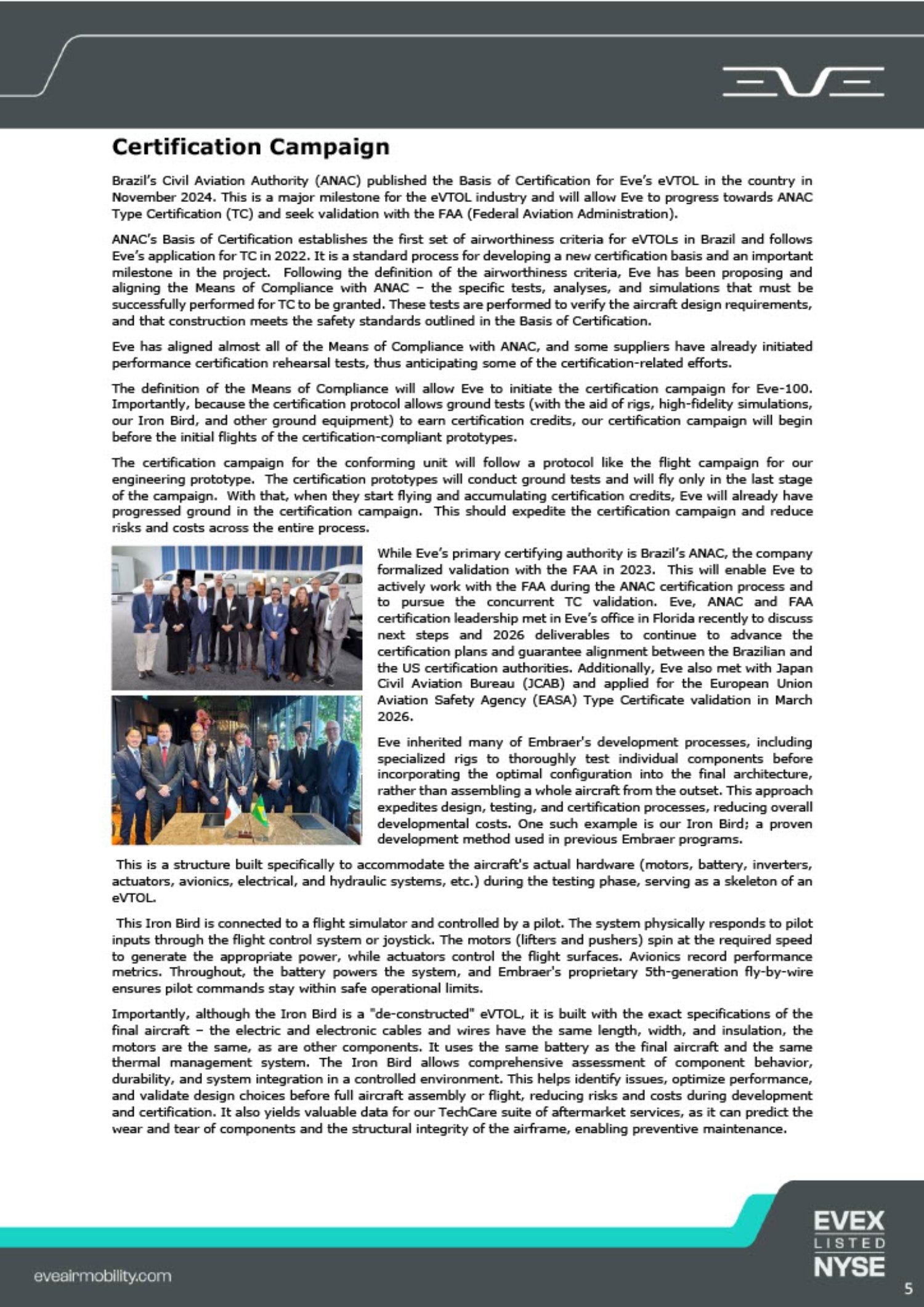
Good morning, Savvy. This is Luis Valentini. So, we continue to work with ANAC and also with EFA on the discussion on the means of compliance. I think we've had good progress recently. We've had all of the means of compliance proposed to ANAC. They are inside the certification plans, we call. But basically, we've been discussing them one by one, and we have all of them proposed. We believe that we are at around 90% of the means of compliance agreed, which puts us, we believe, in a good position, like you said, to start working on detail, the design of the test campaigns in order to show compliance with requirements. We also were able to find good agreement on the noise certification requirement, which is not part of the certification basis, but is an important part of the certification and operation of the vehicle. So we believe that it's still on par with the development of the vehicle itself. With respect to other authorities, we've also been engaging with the FAA, as we communicated previously, that most of the alignment work on the means of compliance is done directly with AMAC being the primary certification authority.
Speaker 0
The next question is from Andres Shepard from Cantor Fitzgerald. Please go ahead.
Hey, guys. Good morning. Thanks for taking our question, and congrats on the quarter. Sure. I wanted to touch on the flight campaign for a minute. So, just to be sure I have it right, so we're targeting first full transition flight in Q3. So, I guess just remind us what are the milestones leading up to it and, you know, how confident are we in that milestone in Q3?
Thank you hey Andres good morning this is Luis Valentini so we've been flying quite a bit as as we've shown all of the flights in the hover flight phase so we've been pretty excited not only with the pace of the campaign but also with the results that are coming out that makes us confident and moving forward with the tests right the next few weeks will be focused on testing some of the integration of the systems in the ground. So we've been planning shifting from a period of many flights to now a period of flight of tests on the ground and that again will focus on making sure that the flight control surfaces work well with the flight control laws connected with the pusher and so all of you know the lifters of course all of that connected. We also will have We have more tests in the ground that are focused on the structure, on the airframe of the vehicle to make sure that the vehicle is ready for the larger envelope of flight that we will start, you know, from the Q2 to Q3. Of course, there is a lot to be learned as we move on to this new transition flight phase. So, like I said, we're confident and we're excited on the way that the vehicle has been showing itself with respect, you know, as it compared to our expectations. But there is a lot to be found out still, you know, on this expansion and as we move forward. So, we are planning this preparation phase very carefully to increase the chances of doing the transition. And again, that's very important, not only for the transition itself, but on the way that it brings knowledge for us to increase the maturity of the E100 design as we progress to building the certification prototypes and moving to the certification flight test campaign.
Got it. Wonderful. Thank you. I really appreciate all that context. Very helpful. And maybe just one quick follow-up. Just on the backlog, can you remind us kind of the strategy for this year? Is the plan to continue to increase the backlog, or are we happy with the number and now will be, you know, more about converting those LOIs? Just kind of curious how you're thinking about it for this year.
Yeah, thanks, Andre. Piohan speaking. When it comes to the backlog, we still have the strongest pre-order boat with 2,700 aircraft at this stage. We understand the number of LOI and the spread of our customers and the customer profile is what we need. Really, it's a variety of first mile, last mile operation. It's also sightseeing. It's also Oregon transportation, different type of mission, which I think it's the right balance in different parts of the world. where it's Australia, it's Japan, it's Brazil, obviously, you know, and the United States. So we're very comfortable with our portfolio right now. We demonstrated that we have the right solution because we're very preoccupied based on our strong experience of Embraer, you know, how is, you know, the operation will be. So that's something that we work hard also to make sure that we have the ecosystem ready. And this is what's driven this big order book, let's say, right? And the strategy for, you know, since last year or this year is to engage the customers so they can go for firm contracts so then they can also engage with their local authority together with EVE, but also the stakeholders, and prepare the internet service. Certification is really the starting line, and the game will be on when they're going to be operating. We'll be delivering, certifying and delivering those aircraft, and then they'll be able to operate with the lowest operating costs with the highest utilization and this is how we're going to be starting via urban and mobility so first we'll be with Revo and then air access we announced this year you know at the Singapore air show in Japan but then we're working out with other customers in Brazil but also the United States wonderful thanks Johan thanks everyone congrats again we'll pass it on thank you appreciate it the next question is from sheila kawaglu from jeffries please go ahead hi everyone this is kira on for sheila thank you for taking
my question and i appreciate the added color on the flight test progress you mentioned greater engagement with suppliers with the pickup in r d could you maybe walk us through how conversations with suppliers have developed since flight tests began and how work is progressing on the supplier side at this point in the campaign.
Hi, Shayla. This is Luis Valentini. So what we've been doing with the suppliers is making sure that we have the parts and their systems in the most optimized way for the vehicle to meet its product requirements, right? So the flight test campaign helps us to gather data on the vehicle behavior in flight, on the behavior of the systems, for example. So one example, how the temperature of the battery behaves during flights, right? So with that, we can go back to the supplier and use this information to make sure that what they are developing will lead the E100 to meet its product goals. So the way that the interaction is going now is to make sure that, again, their products will lead us to reach our targets, and the flight test data helps us to bring more clarity and more confidence on the data that we are exchanging with them. So based on this, we are moving forward to finalizing their design of the systems, and again, making sure that it all integrates in a way that will satisfy the 100 goals. And once we are done with that, then we can go ahead and release the drawings for the manufacturing and then manufacture the production prototypes. So that's how the, let's say, the connection is with the flight test campaign and what we expect to do once we're past this phase.
Thank you. That's helpful.
Speaker 0
The next question is from Andre Midridge from BTIG.
Please go ahead. yeah good morning everyone thanks for taking my question i wanted to ask a bit more about the binding orders at the end of the year could you maybe just point to what dollar figure would be binding orders have to be for you to call it really a successful year how much how many of what's in backlog right now would you have to convert the binding to thanks andre um yeah the Binding orders, we have two right now.
The first one is Revo with 50 aircraft, up to 50 aircraft firm. And we also have AirX, right? Same type of operation for both customers. As you can also see, you know, like it's 500 million under a binding agreement right now. You know, there's some PDPs actually associated to it. There are some milestones, you know, associated to also the product development. and then this is how we've been, you know, setting up the whole deal. Now, we need to move the right time. As you understand, you know, since it's going to be a high-utilization aircraft and based also on the safety level, the standard, and of commercial aviation, this is what we are doing, strong from our experience. You know, there's some commitment that they expect from the vehicle, And as we move the testing campaign and the conforming prototype, also certification, then we'll define a bit better with the customers how it's going to work and how the operation will be.
Got it, got it. And if I could follow up on that, you mentioned the PDPs. I know you guys don't usually guide this, but is there any more colors you could point to as to the cadence of that flowing in?
Yeah, it's a do here. In terms of down payments, right, as we sign the binding agreements, we already receive an initial down payment, and we expect that those down payments will continue 18, 12, six months prior to the delivery. And in total, we're anticipating we can receive up to 30% or 40% of the total value of the vehicle before the delivery and then receive the balance at the delivery.
Very similar to what the industry is used to between the commercial aviation or executive aviation.
Got it. Very helpful. Thank you, gentlemen. I'll leave it there. Thank you.
Speaker 0
The next question is from Austin Muller from Canaccord Genuity. Please go ahead.
Hi, good morning, Johan, Edu, and Lucio. Just my first question on Vector. Is that being actively evaluated by ANAC for approval, and can that be integrated immediately into Brazil's national airspace system once your aircraft are delivered to customers for the first time?
Yeah, thank you, Austin, for your question. Yeah, Vector is definitely part of the ecosystem and the solution that we're providing for customers. Obviously, it comes with module. Just like for the air traffic management, and we can start today the urban air mobility operation using the current air traffic management system in place. The idea is, as we're going to be scaling up, then we will need to have a really robust solution eventually. And when we say we, it's not necessarily EVE, it's we're talking about the aerospace industry. It's going to be, you know, we're talking about 1,000, 100, and 1,000 of vehicles, whether it's drone, whether it's low altitude, you know, space, airspace. So that's something that's a journey. It goes along with the scale of the UAM. and the first module is really focused on how to manage your protocol, right, or Alipad still because our strategy is to start today. As a matter of fact, we delivered the first module to Revo and they already tested it at the Grand Prix of Sao Paulo end of last year and it was successful. And then we're going to go at a fleet level And then, you know, we go for a certifiable software together with ANAC and DCA, as a matter of fact, who takes care of the flying of the air traffic management in Brazil. Right. Our experience on Vector, we have a strong DNA and a strong right to play as, you know, I'd like to remind everyone that, you know, the software company that actually developed the air traffic management that is used in Brazil to control the whole airspace in Brazil is actually come from ATEC. It's a fully owned company from Embraer, and we're developing Vector together with them. Okay.
And if we think about the production schedule for the certification prototypes, I understand there will be one finished by the end of the year, but how should we think about the cadence of how many will be produced between now and 2028?
I think, as you say, we'll finish the prototype, no, we'll start assembling the prototype, and then we'll finish, you know, probably the first semester next year, and then we're looking at, you know, the first flight, which I think is a very important milestone for conforming prototype certification, is the first flight with the pilot on board. And so we're looking at, you know, mid-next year for the early second semester for the first flight of that prototype. And then we will be producing and delivering more or less once a month afterwards up to six prototypes.
Awesome. Congratulations on all the progress.
Speaker 0
The next question is from Marcela Mota from J.P. Morgan. Please go ahead.
Hey. Hi, everyone. Just two follow-ups here. The first, when we look at the release in the fourth quarter, you were talking about like a $21 million deferral payment to Embraer, and this quarter this was converting to $11 million. So I'm just wondering if this $10 million difference is for next quarter or if there was some readjustment on the amount. And the second question is regarding the test campaign. You mentioned to try to get to 300 testing flights this year. Just wondering if this is still the level or, you know, what are you expecting in terms of maybe number of testing or hours in the air, you know, whatever you can share with us.
Hi, Mota. How are you? I do here. In terms of the accounts payable, you're correct, right? We closed last year with 21 million that were supposed to be paid in fourth quarter. We paid 11. Actually, we paid the whole 21, but then on the invoices of the first quarter, There was 10 that slipped to the right, so we pretty much recovered more than half of what was a carryover from last year. But your math is correct.
Hey, Mota, this is Luis Valentini. With respect to the number of flights, yes, we are still considering the 300 flights as a reference for the test campaign of the engineering prototype. of course this is flexible as we may you know decide to test more things so maybe we have modifications on the vehicle for example we want to talk to test for example different propellers or different lifters things like that so the vehicle allows us to do that so there is there's a lot of flexibility on the campaign but 300 the 300 flights we are considering that is the the number of flights that allows us to bring the knowledge that we need for the development of the E100 and also to progress with the expansion of the envelope, as we have mentioned. So we believe that with that campaign, we can demonstrate the vehicle and its characteristics and also we can bring the knowledge to the development of the E100 in time, as we've been mentioning, for the production of the production prototypes, for the manufacturing of the production prototypes right but keep in mind that this number is is a reference and and we may change it as we progress with the test campaign and decide to test more things if we'd like to perfect super clear thank you very much the next question is from amit dial from hc wainwright please go ahead
thank you uh good morning everyone uh just going back to the embrayer um synergies does this can you clarify whether this includes technology or personnel like where are these synergies coming from uh if you could just maybe clarify that yeah no that's a good question i mean the you know it's um it's a broad range right we're looking a bunch of different things but uh you know we're looking how we can use existing assets better existing facilities uh how we can allocate the work between the different teams in a more efficient way. So, you know, there are different, also getting to more details of the flight test campaign, the CAPEX and OPEX associated with all of that, you know, was a very big work. As I mentioned, there was more than 200 people involved. It came with hundreds of actions and we are starting to implement that. that's the beauty right of being part of a big group as Embraer when you start to look things in more details and and we bring everybody together you are able to identify gains and synergies that you know you're not seen before so that's pretty much what we're doing we mapped this 100 to 150 to incorporate to capture right in three years and you know we are now moving forward with the plan.
Okay, just to follow up on that, Edu, will this impact more on the SG&A side or more on the R&D side, do you think, the cost synergies?
It's both. There are synergies in terms of being more efficient in the way that we are going to be assembling the vehicles, in the way that we're doing the development, be more efficient on the general expenses, more efficient with third-party consultants, third-party service. There's a lot of things. I would say it includes both pockets, R&D and SG&A, general expenses. And as I mentioned, also industrialization, how we can be more efficient, not only assembling the conforming prototypes that are coming, but also on the production going forward. So there are different areas, pockets, and it includes both.
Okay, some cappics is what it looks like. That's correct.
Yeah, no, it's, you know, I like the question, and it's something, you know, it's important to understand that, you know, within Embraer, and Eve is born as such, it's about the lean philosophy, and this is something that's dear to Embraer. This is a program that was implemented back in 2007. Now I think it really has to do with it's in the blood of all of the Embraer employees, but also the Evers is looking for being lean and looking at every efficiency that we can bring. So we do it through a whole philosophy, which is called the Kaizens, and then we go through. And that's something we do all the time. and I spent 25 years in Embraer and then we've done it over the last 20 years and it's just amazing how you keep improving and you keep working on your efficiency at all times and this is one of the benefits that also Eve is getting from being part of the group of Embraer it looks definitely like a little bit of a competitive edge you guys have versus some of the other players just one last one from me on the cost of the aircraft side roughly it's translating around 5 million per aircraft right now with the numbers you shared have any inflationary factors been
built into this given these trends all over the world where prices have been rising I'm just wondering, curious about how this may end up in the next few years in terms of pricing per aircraft Yeah, I can start here, Johan, but feel free, Valentino, to chime in.
Yeah, the lease price is $5 million, right? As we are progressing on the development of our vehicle, right, we're gaining not only confidence on the specs of the vehicle, right, in terms of range, noise, payload, and everything, but we are also getting more visibility on the cogs of the vehicle. We believe our vehicle, given the simplicity, right, and the design, the lift plus cruise design and the focus on the urban missions, we believe our vehicle is going to be extremely competitive in terms of COGS. we have been working also with our suppliers of the critical components to make sure that our cogs stay within the range that will allow us to sell the vehicle at the $5 million list price and be highly profitable things are going in this direction but we are the whole time challenging not only internally ourselves but our suppliers to make sure we have a lower cost vehicle and how we can leverage the supply chain of Embraer and the supply chain that our big suppliers also have to have a competitive vehicle. Nice.
Thank you, Du. Yeah. This is something how we build our program. We have the major systems covered by the suppliers. And this is also what we worked on at the very beginning. I mean, those contracts are lifetime contracts. So we don't look only just to develop the prototype or the production, but also make sure that the operation is covered to guarantee to our customers that they have a competitive aircraft. So we do have also on those long-term and lifetime, life cycle aircraft contracts, sorry, the inflation also formulas that allows us to control all this and including the up-to-market. So this is something that we have a good visibility. We brought, you know, from Embraer also experience, and then we're comfortable with what we have in our $5 million vehicle.
Understood, guys. Thank you for all the call. I appreciate it. That's all I have. Thank you.
Speaker 0
There are no further questions at this time. I would like to turn the floor back over to Lisieux Aldworth for closing comments.
Thank you, Sashi, and everyone who joined the call today. As you can see, we accomplished several important milestones this past quarter. There's much more to come, and our upcoming achievements will be more visible to the investment community from now on. So it's going to be very exciting next few months for EVE as a whole. We're going to keep you updated on our progress over the next few quarters, and we do look forward to meeting you in the upcoming event we're going to attend. If you have any questions, as always, please feel free to reach out. Thank you, and have a good day.
Speaker 0
This concludes today's teleconference. You may disconnect your lines at this time. Thank you for your participation.