Operator
Greetings. Welcome to Freshpet's First Quarter 2025 Earnings Call. At this time, all participants are in a listen-only mode. A question-and-answer session will follow the formal presentation. As a reminder, this conference is being recorded. It's now my pleasure to introduce Rachel Ulsh, Vice President, Investor Relations. Thank you. You may begin.
Good morning, and welcome to Freshpet's first quarter 2025 earnings call and webcast. On today's call are Billy Cyr, Chief Executive Officer; and Todd Cunfer, Chief Financial Officer. Scott Morris, President and Co-Founder, will also be available for Q&A. Before we begin, please remember that during the course of this call, management may make forward-looking statements within the meaning of the Private Securities Litigation Reform Act of 1995. These include statements related to our long-term strategy and targets, prospects and plans for growth, timing and adequacy of capacity, potential impact of tariffs and consumer sentiment, expectations to be free cash flow positive in 2026 and 2025 guidance. Please refer to the earnings press release and our most recent filings with the SEC, including our 2024 Annual Report on Form 10-K, all available on our website for a discussion of the factors that could cause actual results to differ materially from any forward-looking statements made today. Please note that on today's call, management will refer to certain non-GAAP financial measures such as EBITDA and adjusted EBITDA, among others. While the company believes these non-GAAP financial measures provide useful information for investors, the presentation of this information is not intended to be considered in isolation or as a substitute for the financial information presented in accordance with GAAP. Please refer to today's press release for how management defines such non-GAAP measures, why management believes such non-GAAP measures are useful, a reconciliation of the non-GAAP financial measures to the most comparable measures prepared in accordance with GAAP, and limitations associated with such non-GAAP measures. Finally, the company has produced a presentation that contains many of the key metrics that will be discussed on this call. That presentation can be found on the company's investor website. Management's commentary will not specifically walk through the presentation on the call; rather, it's a summary of the results and guidance they will discuss today. With that, I'd like to turn the call over to Billy Cyr, Chief Executive Officer.
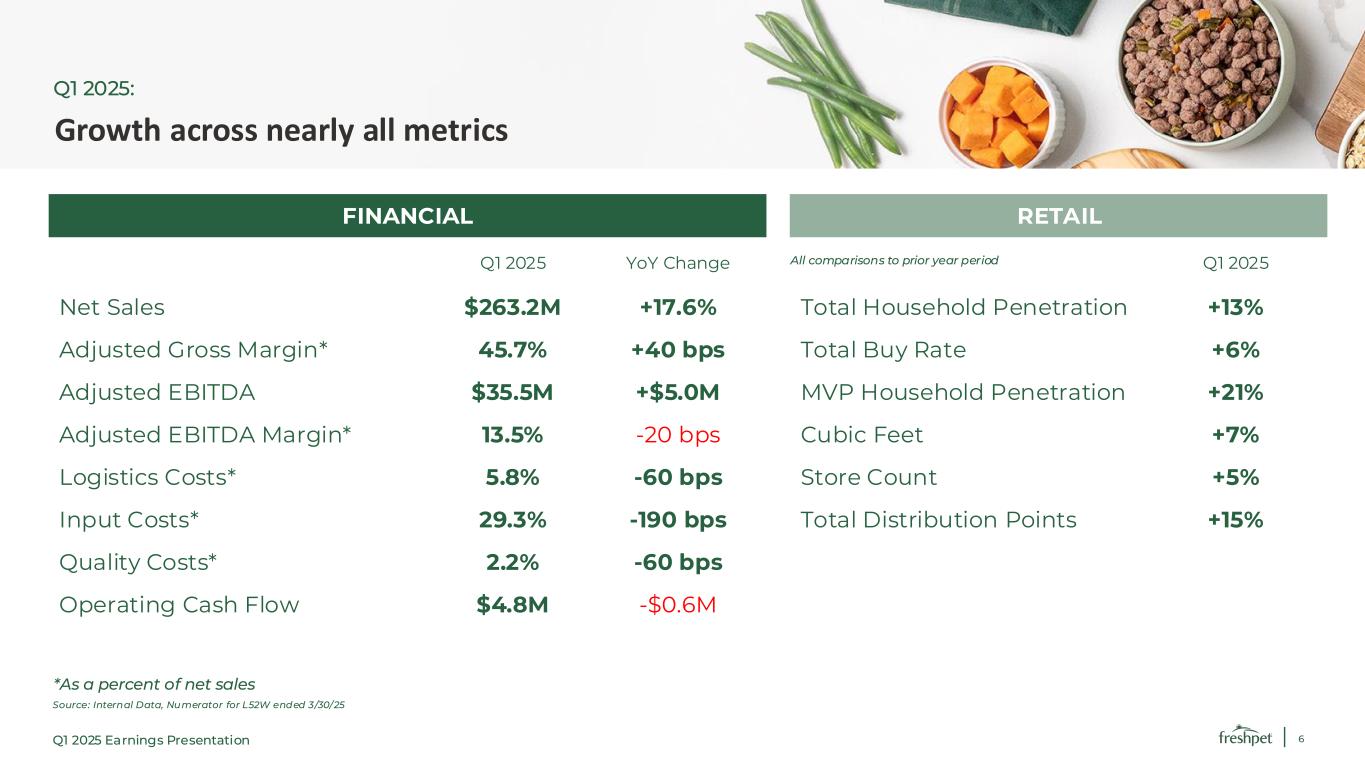
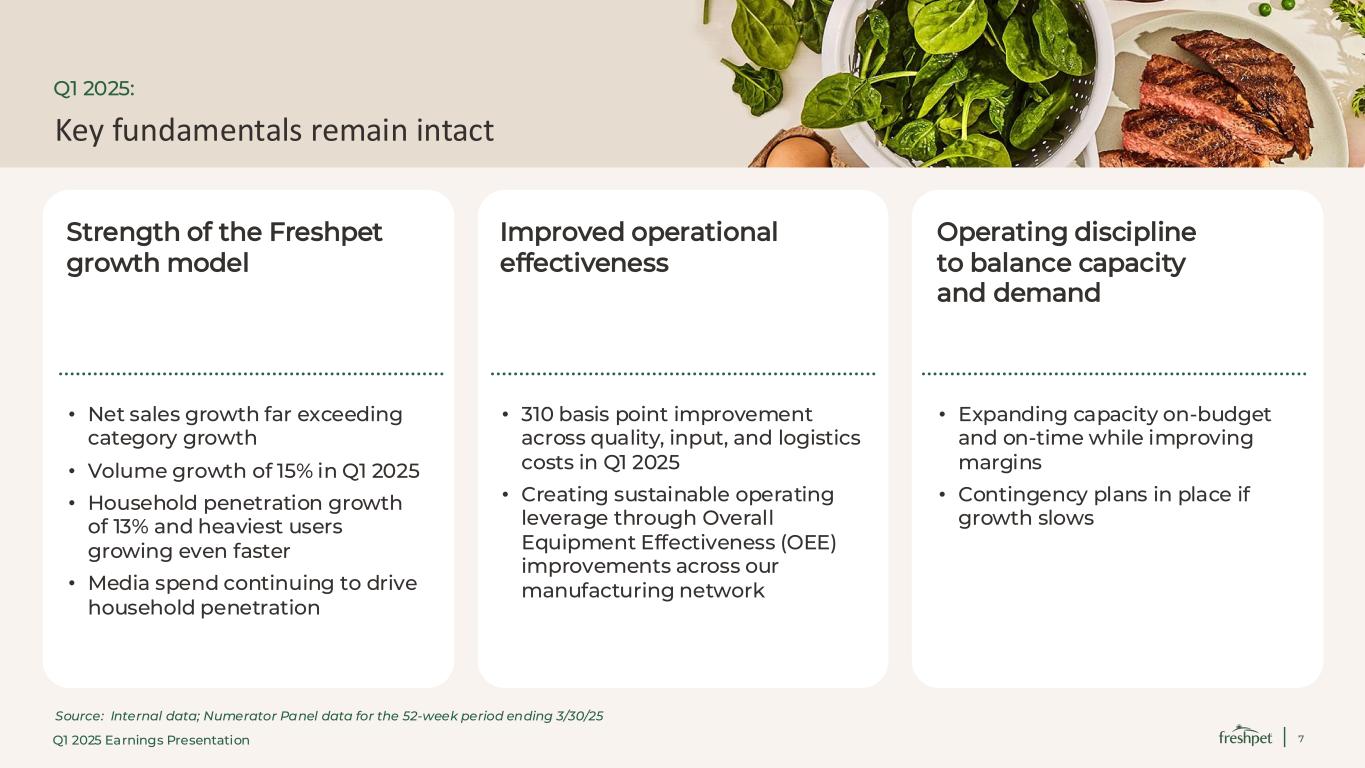
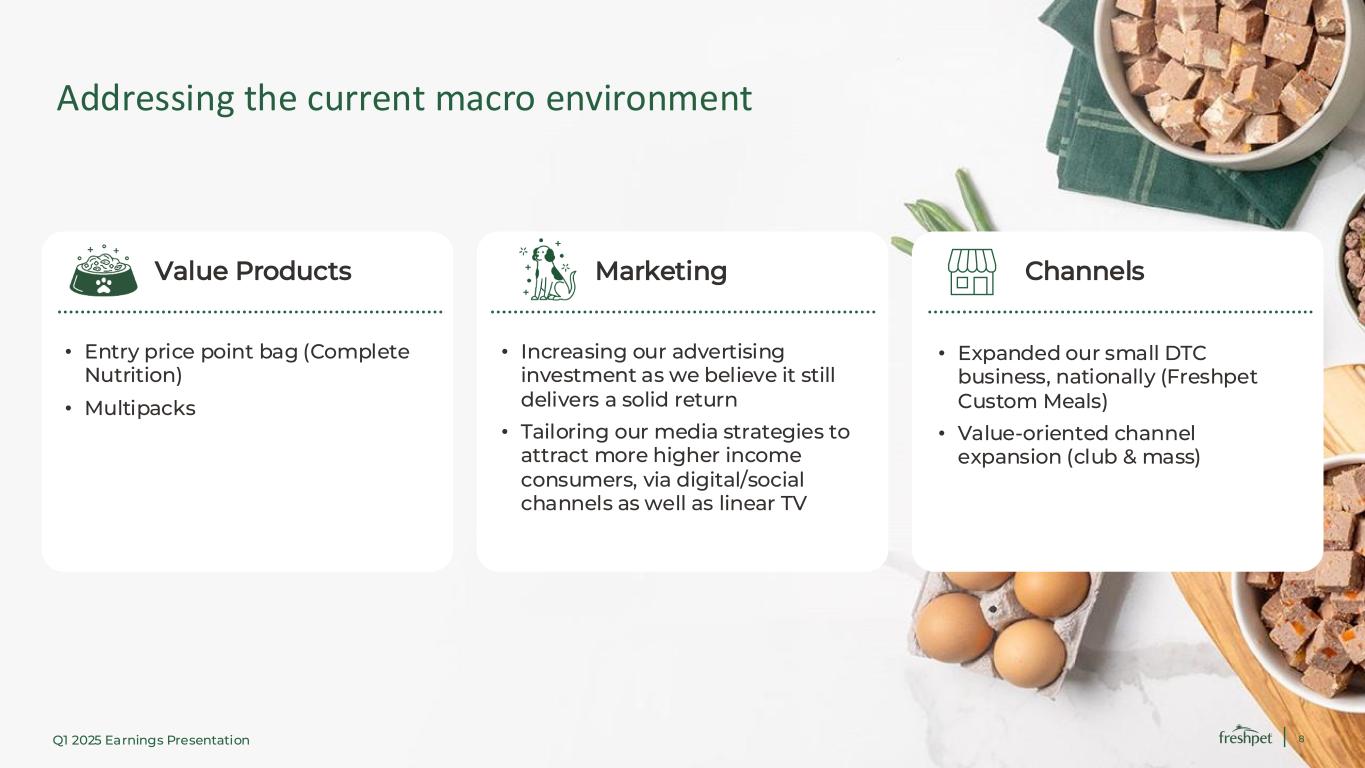
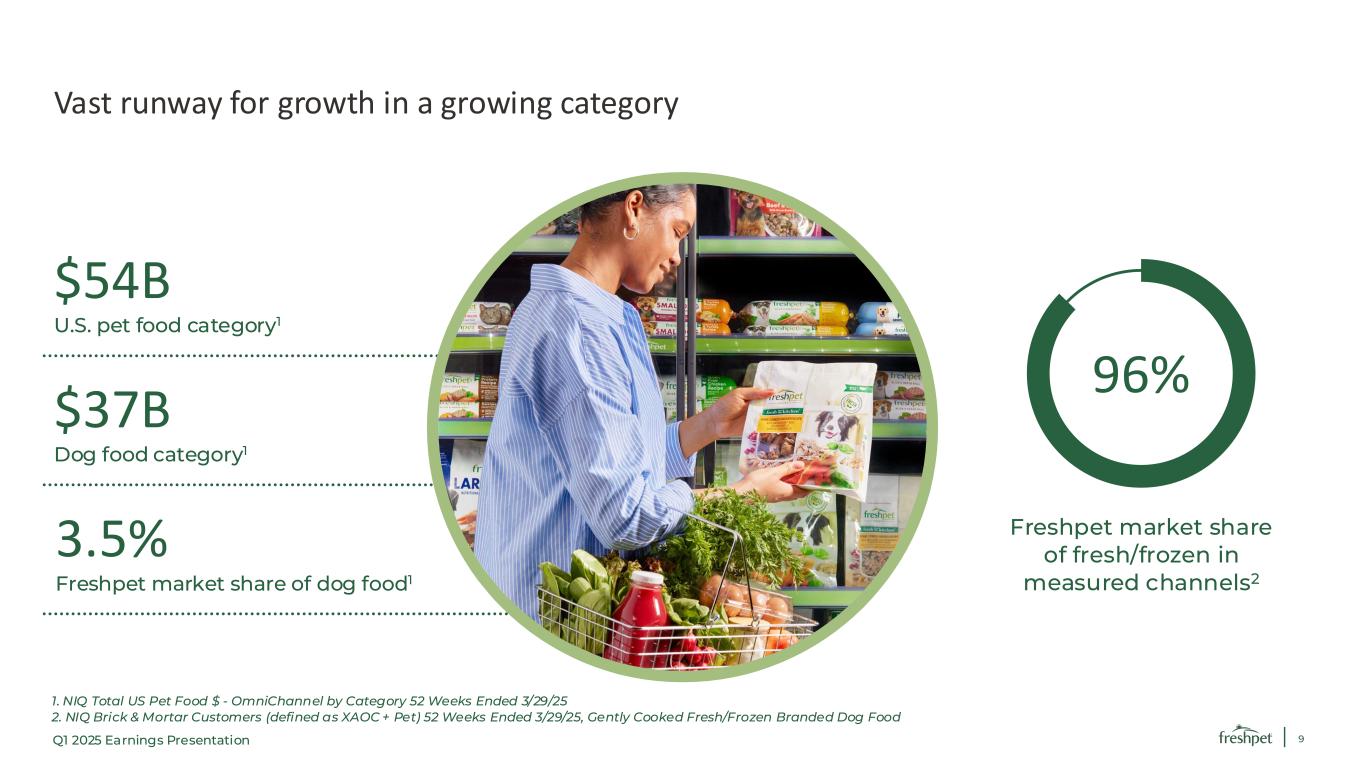
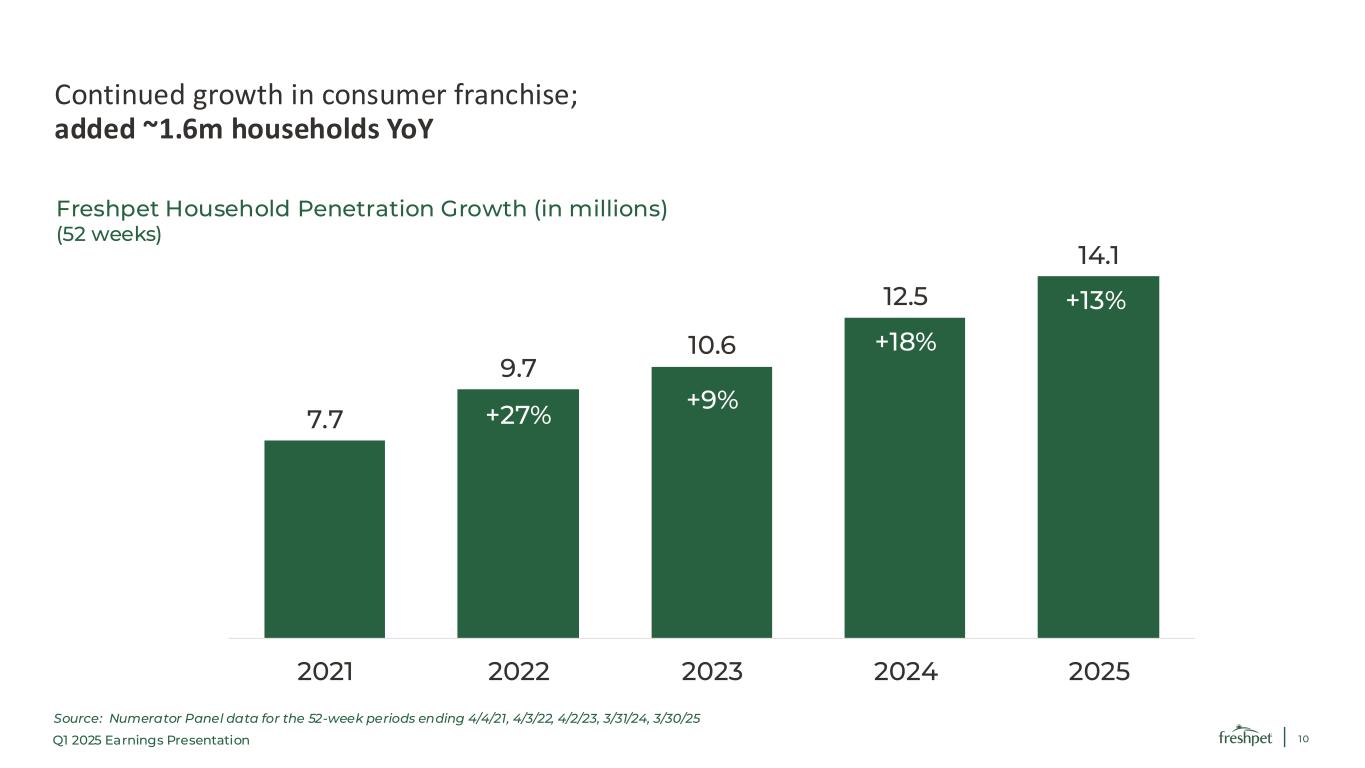
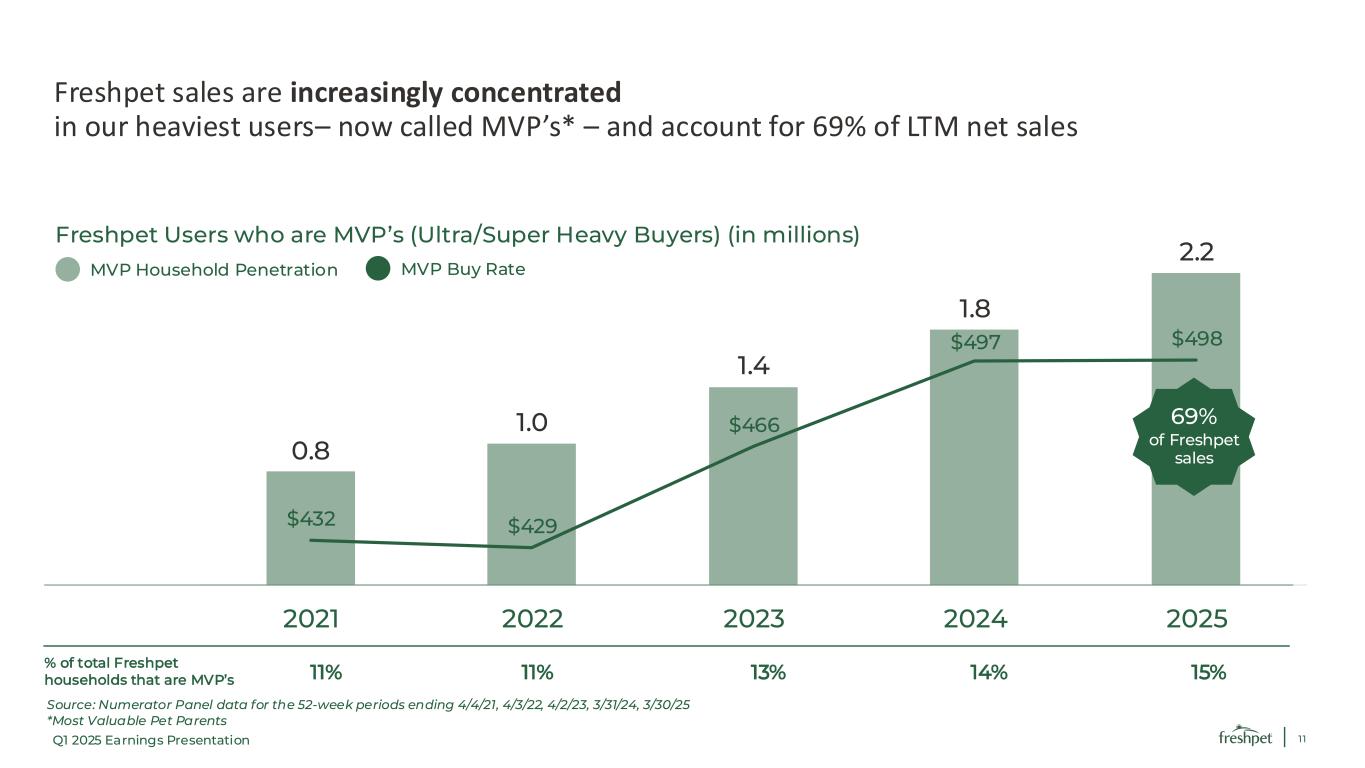
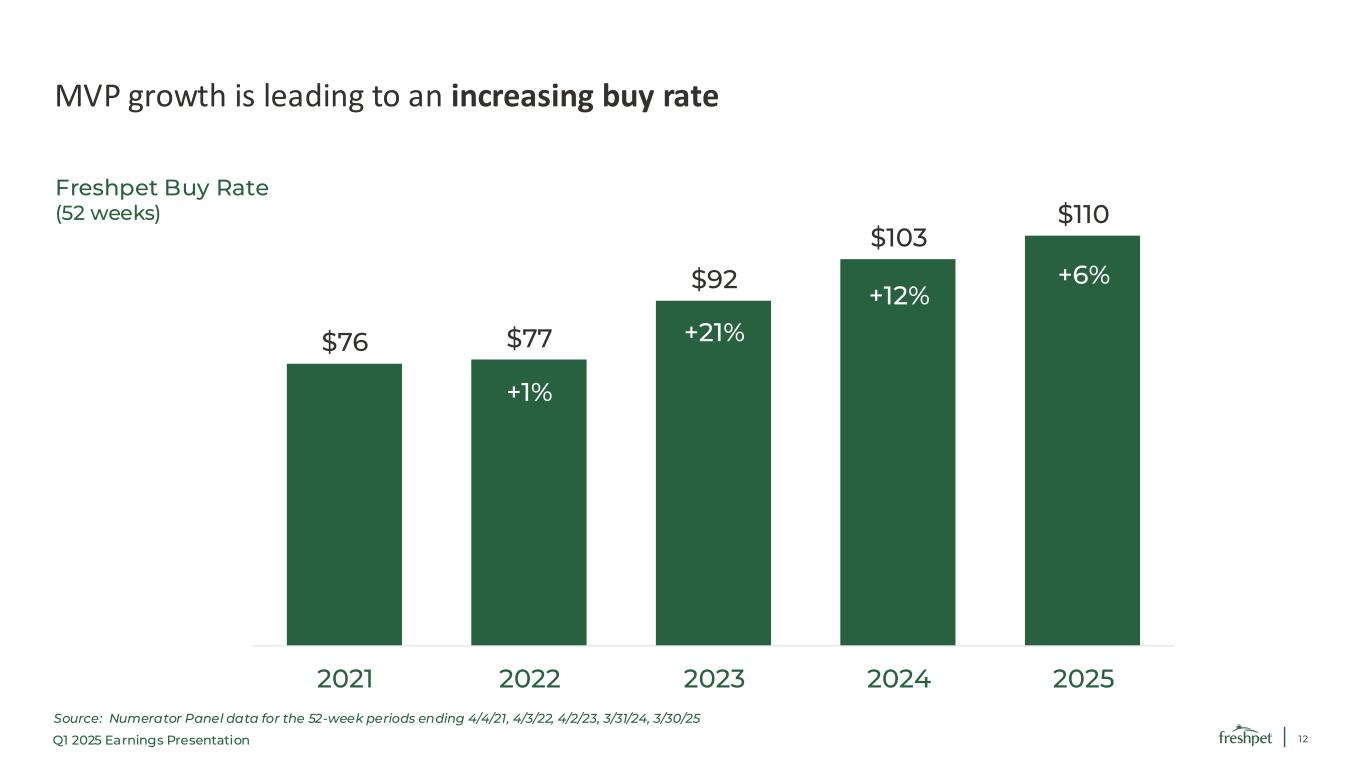
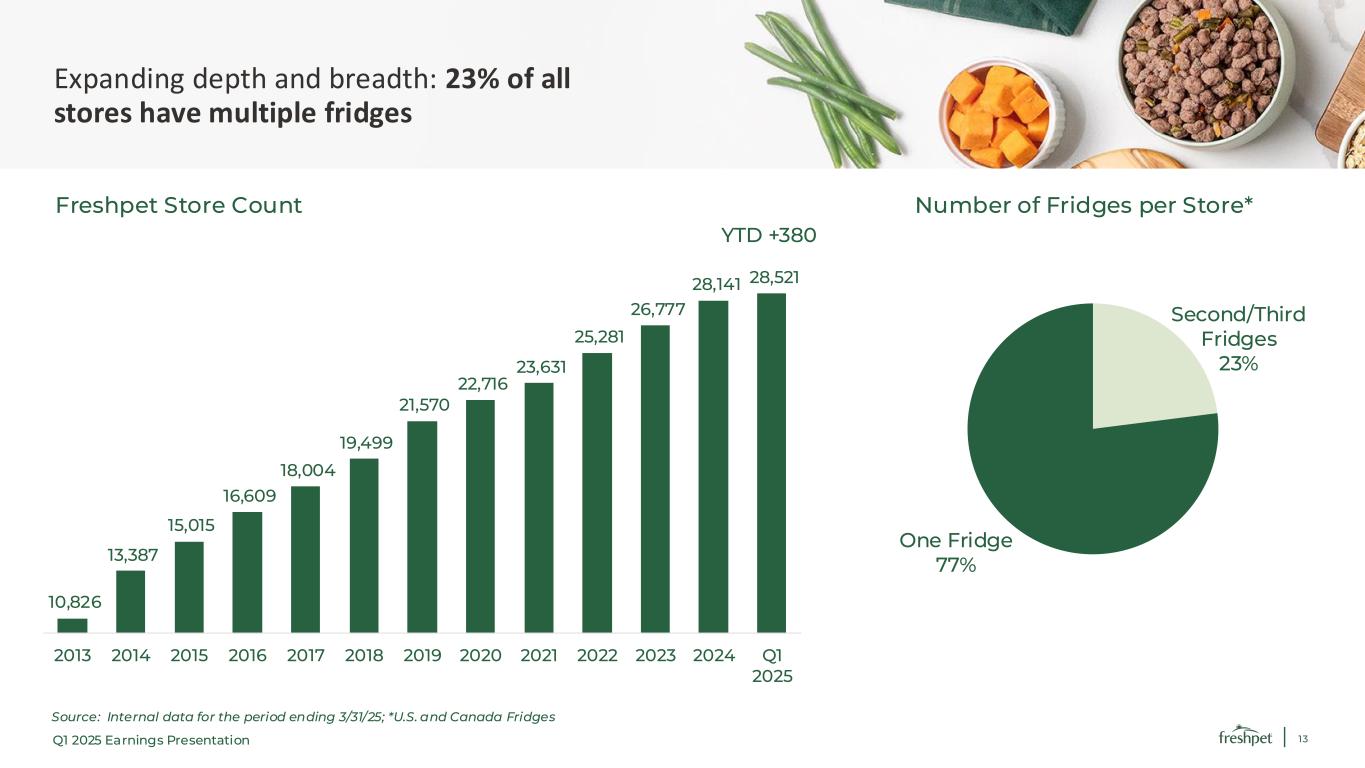
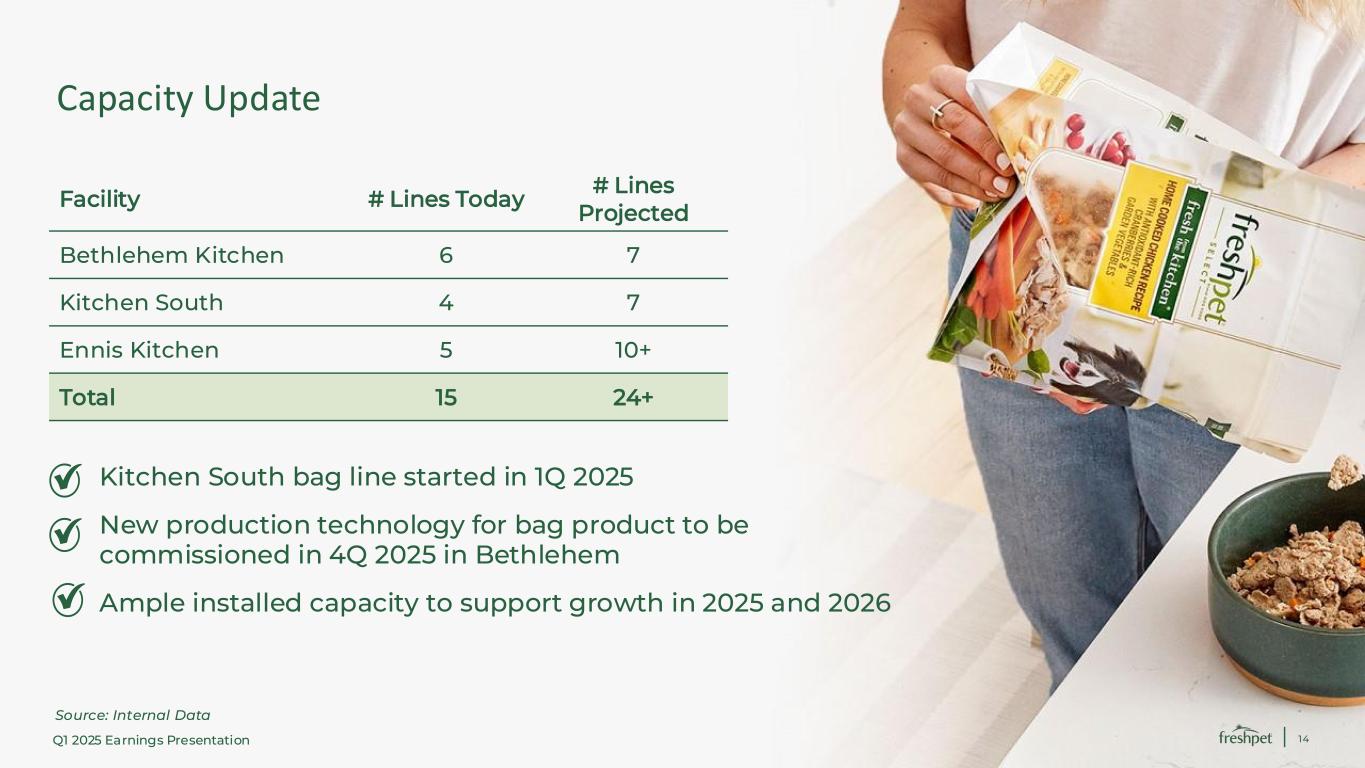
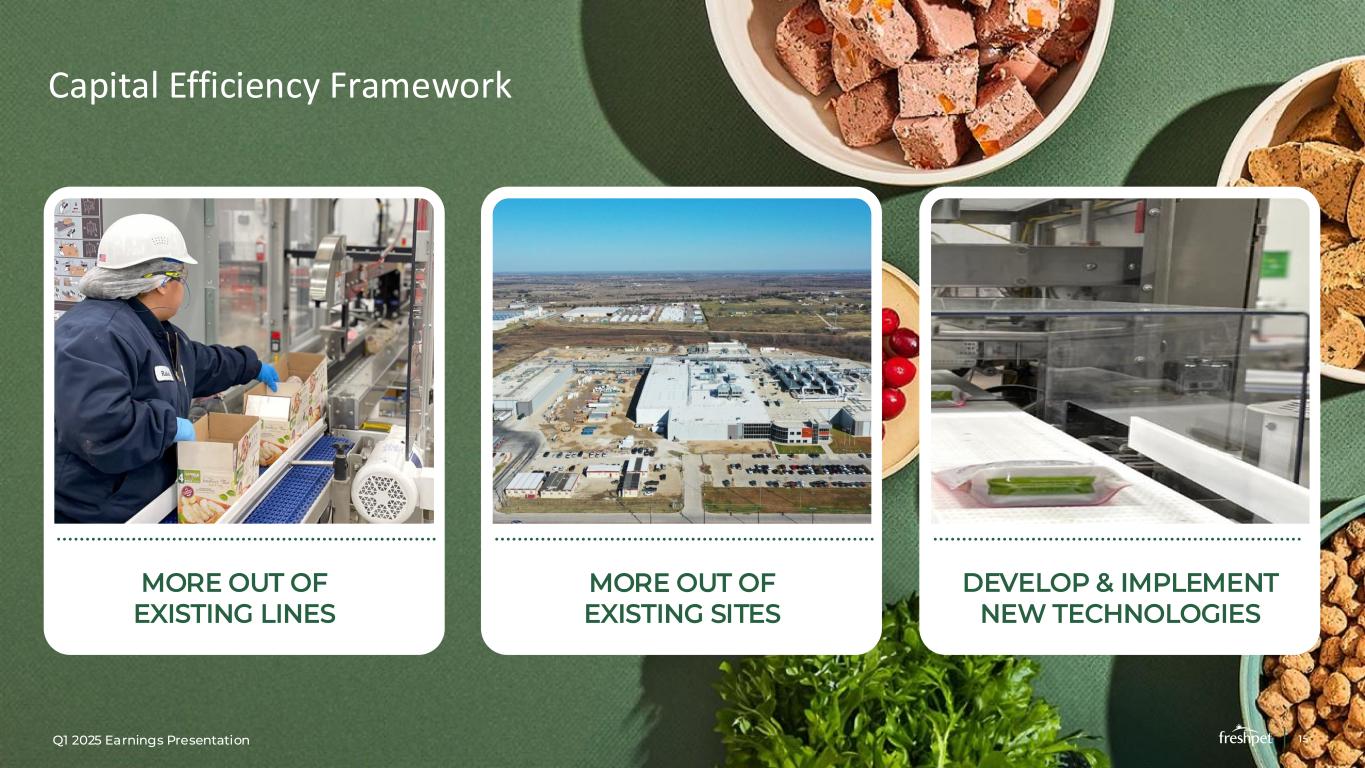
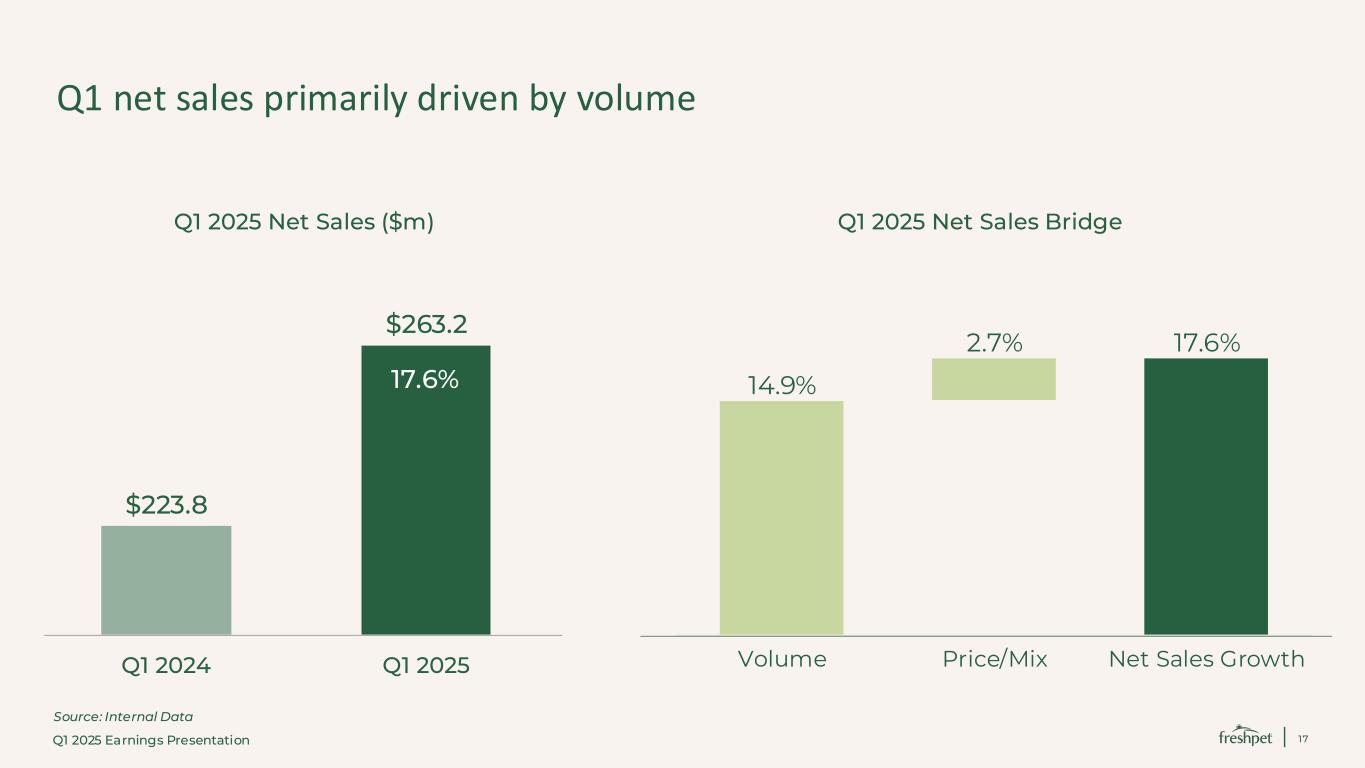
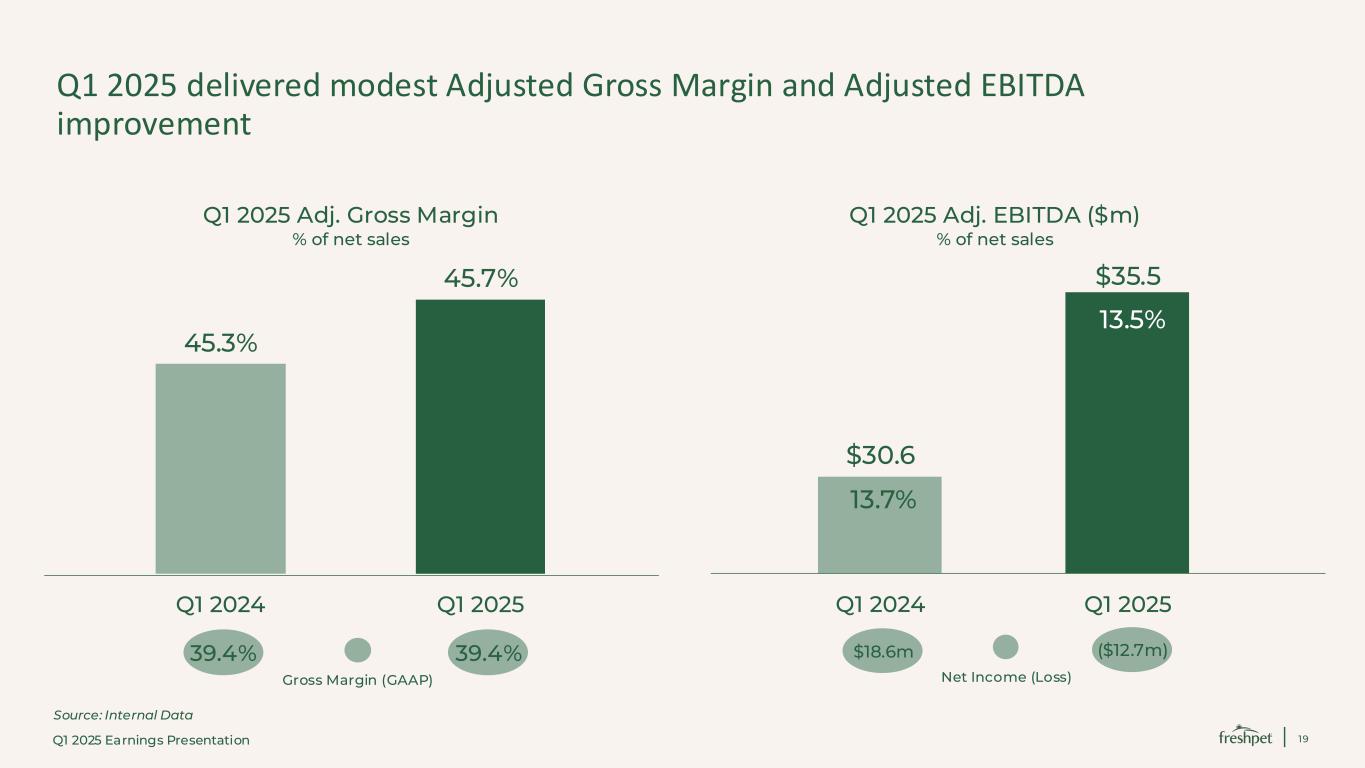
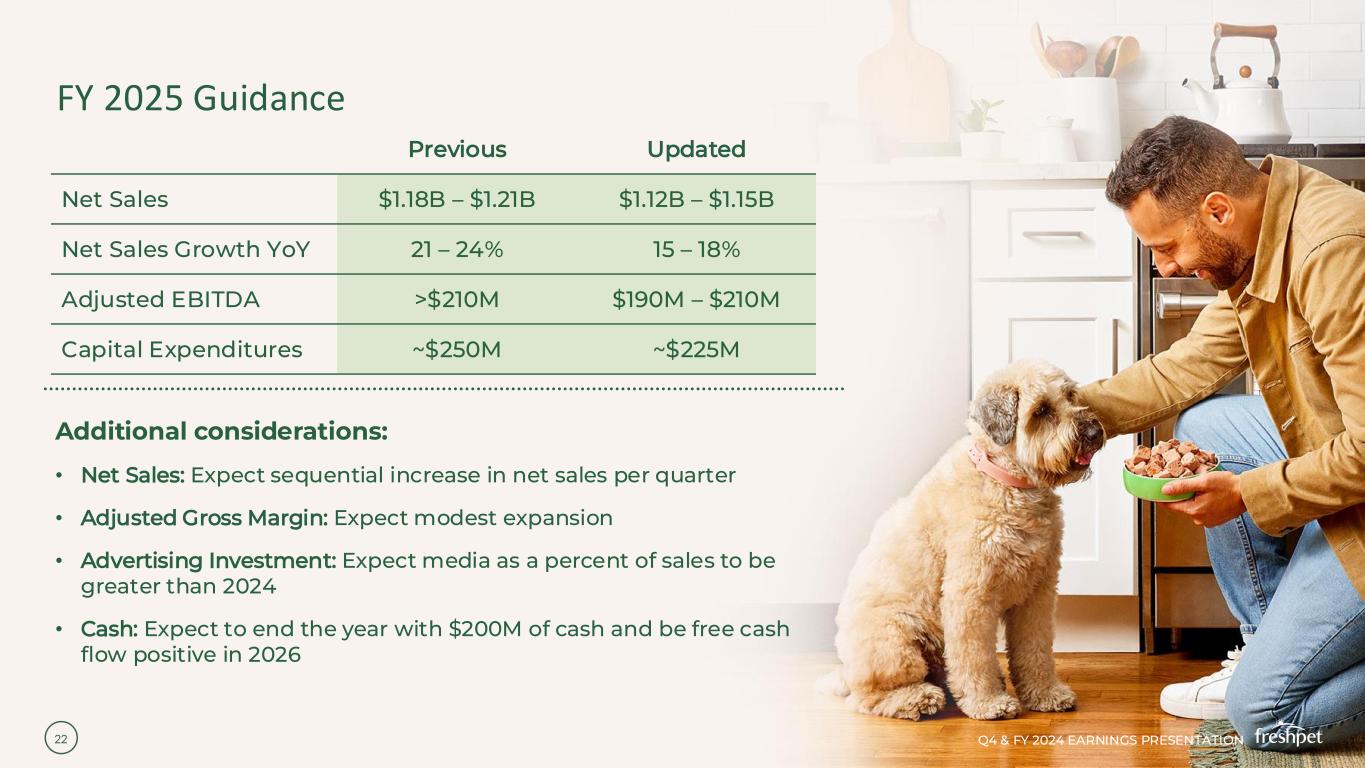
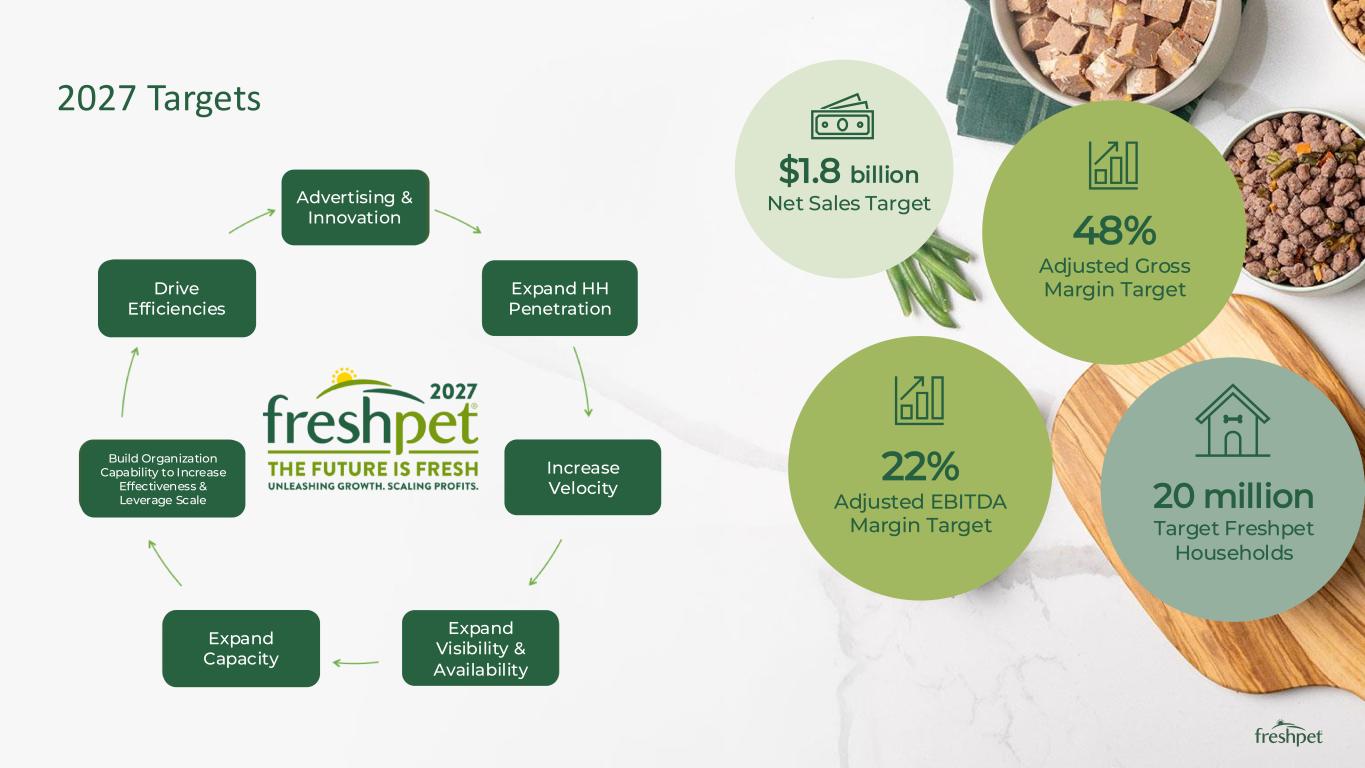
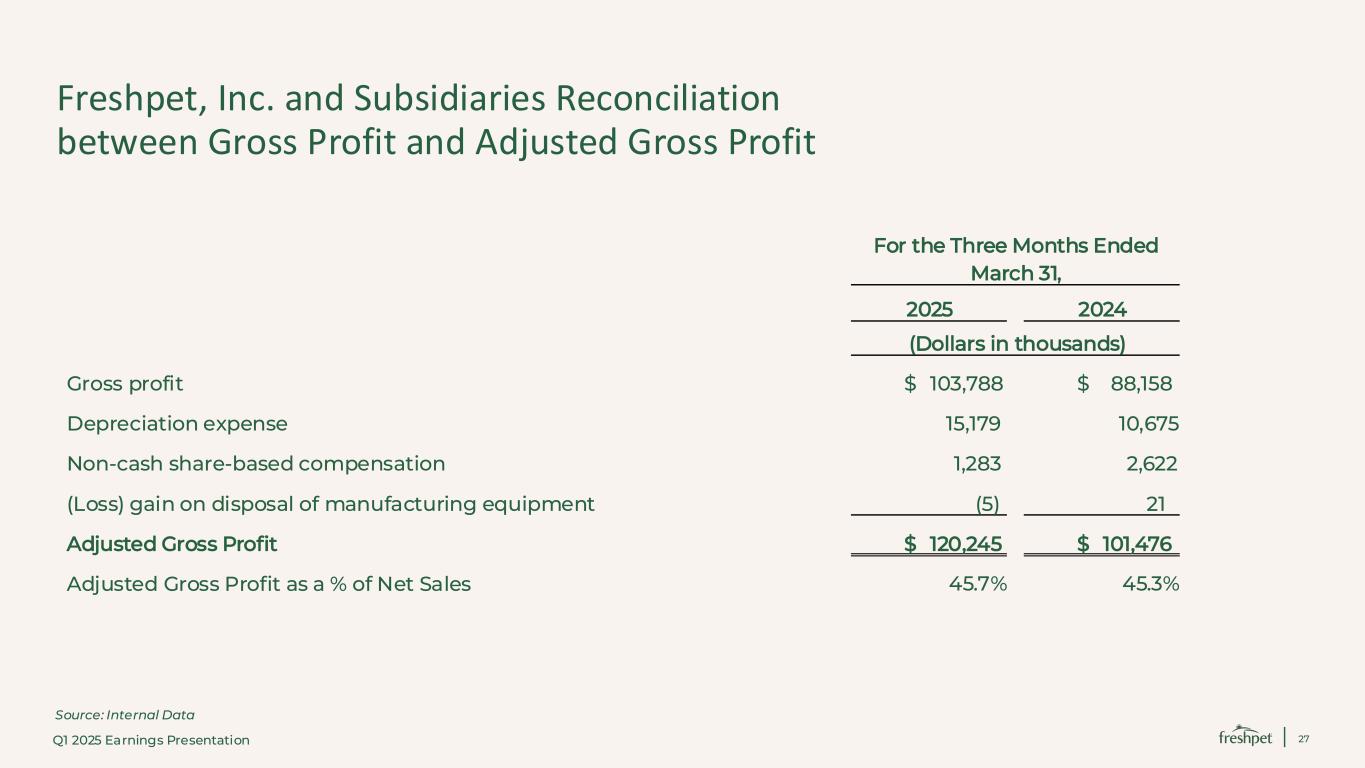
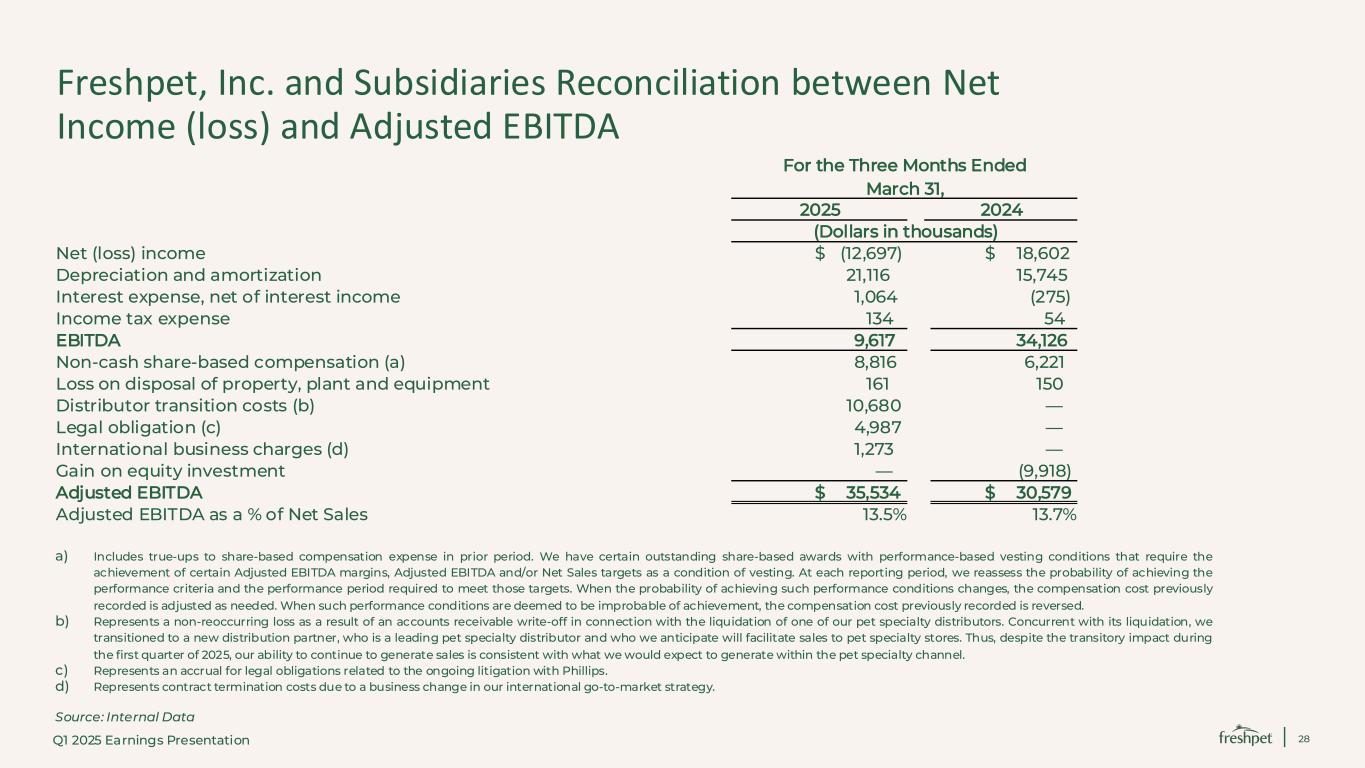
Thank you, Rachel, and good morning, everyone. Since our last earnings call in February, we have seen a significant shift in the macro-environment that has impacted our growth. The message I would like you to take away from this call is that despite the significant economic uncertainty facing consumers today, number one, Freshpet has continued to significantly outperform the category amongst every age and income group, and number two, Freshpet remains a structurally advantaged business with a long runway for growth in a category with meaningful long-term tailwinds. As we have done over and over again throughout our company's history, we will be nimble and adjust to this new macro environment, and we still expect to deliver outsized performance against a challenging backdrop. It just might not be the same magnitude of performance we've delivered over the past few years until there is greater economic certainty amongst the prospective consumers we are targeting to join the Freshpet franchise. As many of you have realized over the years, Freshpet is a very data-driven company. So we have been digging into what has changed year-to-date, assessing how that would impact our near-term strategies and identifying ways we can best address those changes. Our analysis suggests that the slowdown in our sales growth came on very quickly as the macroeconomic climate changed a few months ago and is due in part to the fact that Freshpet's consumer franchise spans all income and age groups, including consumers who are most economically insecure or uncertain today. Freshpet's consumer base is less defined by the income of our users and better defined by how someone loves their dog. For the last decade, Freshpet has been able to grow through all sorts of economic conditions. And we are still growing at an outsized rate versus other dog foods and consumer packaged goods brands. However, our model relies on an increasingly large number of consumers being in the position to reconsider their pet food and ultimately conclude that Freshpet is a better way to feed their pet. What we are seeing now is that consumer uncertainty makes them hesitant to get a new dog or replace a dog they recently lost and it also makes them more hesitant to try more expensive pet food until they have greater clarity on their economic fortunes. We do not expect this short-term change in consumer behavior to change the long-term desire for pets or premium pet food. As such, this does not change our view of the size of the long-term Freshpet opportunity. Identifying issues and developing solutions to short-term challenges is a core competency of our team. We are also very disciplined; that is, we will lean into our business model that focuses on advertising, retail availability, visibility, and product innovation to improve our near-term prospects and will not chase short-term activities that would undermine our business model. To continue to drive growth this year, we are adapting our plans to this economic backdrop to ensure we have the right proposition for consumers who are contemplating a new dog food today. One of the strengths of the Freshpet model is that we have the flexibility to target high-potential consumers across the age and income spectrum. So from a media standpoint, we are increasing our advertising investment and tailoring our media strategies to attract more higher-income consumers via digital/social channels as well as linear TV. From a product standpoint, we will be launching a new entry-price-point bag product under the Freshpet Complete Nutrition label that is similar to the roll product we launched two years ago amidst consumer concerns about inflation. The Complete Nutrition roll has driven trial with a lower price point, and ultimately, those households trade up within the portfolio, and we believe the same will happen for the bag product. We are also focusing on multipacks to give consumers better value and help stock up as they potentially space out their shopping trips. From a channel standpoint, we've expanded our small direct-to-consumer business nationally so that we can reach more consumers who place a high value on subscription service. And we are making progress on getting Freshpet into more value-oriented stores, including club outlets. I'm pleased to share that we are now in our first Sam's Club store, and the early results are encouraging. We are optimistic that this will lead to a greater expansion over time. We are also taking the necessary steps to balance our capacity and organizational capability investments with the anticipated demand so that we can meet our longer-term margin and cash generation targets even if we have lower levels of net sales. We've already taken some actions against those goals, and we'll take more if the current economic climate persists. To be clear, we continue to grow and add new users across all income and age groups, and Freshpet represents an outsized portion of the category household and net sales growth. Those new consumers we are attracting are just not a big enough group to support a growth rate above 20% right now. It is also important to note that we do not see consumers trading down or out of Freshpet. We just aren't adding new consumers at the same rate we've historically given the macro uncertainty. Despite the shift in consumer sentiment, there are demographics that continue to demonstrate resilience. Our analysis shows that higher-income consumers, particularly those who tend to buy online and via subscription, are continuing to drive sales for more premium offerings, and Freshpet is amongst those winning brands, as our total e-commerce business was up 43% in the quarter. Those consumers are the least economically sensitive and they continue to get dogs and trade up their dog food. And low-cost brands or private label are also winning, as consumers who find relatively little differentiation between the various kibble brands are trading down to lower-cost products when times are tight. I believe the consumer dynamic I just described explains the trends all of you have been seeing in the weekly Nielsen data. As we said last quarter, we would watch the growth trends very closely for any hint that our plan is not as effective as it has been in years past and that we have the tools and flexibility to drive incremental growth if it slows. Year-to-date, we've seen the impact of the increasing macroeconomic pressure and have increased our advertising investment. But we believe it's also prudent to assume the cost to acquire new households will remain elevated for the time being. As such, we are going to plan as if the conditions we saw in the first quarter continue for the balance of the year. For 2025, we now expect net sales of $1.12 billion to $1.15 billion, or approximately 15% to 18% growth year-over-year, adjusted EBITDA in the range of $190 million to $210 million, and capital expenditures of approximately $225 million. We believe this pragmatic approach will enable us to right-size our organization and capacity investments now so that we can deliver the cash and margin commitments we have made. If the environment improves, we'll add those investments back. If it gets worse, we'll take additional actions. Todd will walk through more details of our updated 2025 guidance in a few minutes. The obvious question is how this economic uncertainty impacts our long-term net sales target of $1.8 billion by 2027. Given that this economic uncertainty arrived so quickly in Q1 and the drivers of the uncertainty, for example, tariffs, government downsizing, and inflation, have not settled, it is hard to say how long the current trends will continue. As such, we are hesitant to update our long-term target until we have greater clarity on the magnitude of the impact and the duration, particularly since the underlying category and brand tailwinds have proven to be incredibly sustainable for such a long period of time and through so many economic challenges. And we believe that there will be pent-up demand for dogs when the conditions do improve, just as has happened during previous times of economic uncertainty. As you might imagine, we've done contingency planning so that we are prepared for a wide range of potential scenarios. As we do this planning, we are carefully balancing our long-term goals with our nearer-term need to demonstrate continued strong performance on some of the most critical metrics, such as margins and cash generation, that we worked so hard to restore over the past two years. In the end, we believe that Freshpet should, number one, be recognized as a best-in-class growth company with growth well in excess of most consumer packaged goods companies. We expect to deliver a disproportionate share of category growth and build market share at a healthy rate. Number two, sustain and expand our adjusted gross margin so that we have adequate dry powder to invest in both our growth and provide confidence that Freshpet is a structurally sound business with investable economics. As part of this, we will continue to develop and deploy our new production technologies and may, in fact, take advantage of any available production downtime to roll out new technologies that are capable of expanding our margins and improving quality more quickly once they are validated. Number three, continue to capture the benefits of increasing scale across the profit and loss statement. Even if we grow at a slower pace, we need to scale our organizational investments so that we can continue to capture scale benefits. Number four, deliver our commitment to be free cash flow positive in fiscal year '26. If we grow slower, we will slow our pace of capacity expansion to match our demand. This will enable us to demonstrate that Freshpet can self-fund its growth ambitions. If we do this well, we expect Freshpet will emerge stronger from the current period of uncertainty and with a large consumer franchise, healthy margins, strong cash generation, and ample capacity to meet our long-term growth needs. Finally, while all the focus is on the top line, and we continue to believe the top line is important, we don't want anyone to lose sight of the tremendous progress we've made on our operations. The strong performance we had last year continued into Q1, and we believe we are operating better today than at any point in the last five years. Our throughputs are up. Ennis is making tremendous progress on gaining operating efficiencies. Our quality costs continue to be low and our logistics costs are well below our previous long-term target. This will serve us well as we continue to grow, providing ample capacity to meet our expanding demand at very good margins. And it will provide ample dry powder to ensure that we can invest in high-return growth drivers. Now I'd like to briefly provide some highlights from the first quarter. First quarter net sales were $263.2 million, up approximately 18% year-over-year, primarily driven by volume growth. As we discussed in February, we changed our pet specialty distribution partner in the first quarter, which ultimately impacted our growth by approximately 1 point. We signed a new distribution agreement with a partner named Pet Food Experts and feel confident about our route-to-market moving forward. Adjusted gross margin in the first quarter was 45.7% compared to 45.3% in the prior-year period. Adjusted EBITDA in the first quarter was $35.5 million, up approximately $5 million or 16% year-over-year. We still have a very small share of a very large category and continue to expect sizable market share gains this year. Per Nielsen omnichannel data for the 52 weeks ending 3/29/25, we compete in the $54 billion US pet food category and we have only a 3.5% market share within the $37 billion US dog food and treat segment. In Nielsen brick-and-mortar customers, defined as XAOC plus pet, we have a 96% market share within the gently cooked fresh, frozen branded dog food segment. From a retail perspective, we are now in 28,521 stores, 23% of which have multiple fridges in the US and Canada. We ended the quarter with 37,044 fridges or approximately 1.9 million cubic feet and have an average of 20.8 SKUs in distribution. Our distribution in grocery is 78% ACV, and in XAOC, it is only 67%. Retailer discussions are going well, and we continue to expect 2025 to be a more normalized year in fridge expansions with a focus on second and third fridges. We remain very excited about the new store concepts we presented at CAGNY and we'll go into greater detail on that later this year or next year as customers begin to test or expand them. Household penetration as of March 30th was 14.1 million households, up 13% year-over-year, and total buy rate was $110, up 6% year-over-year. MVPs accounted for 2.2 million of those households, up 21% year-over-year and represented 69% of our sales in the last 12 months with an average buy rate of $498. Moving to capacity. Our new bag line in Kitchen South started on time and on budget in March, bringing us to a total of 15 lines across our manufacturing footprint. We have one additional bag line that is expected to commence production in the fourth quarter of this year in Bethlehem and it will be testing new production technology. We continue to find ways to drive greater capital efficiency and have been also working on other new technologies that can be retrofitted to existing lines. As a reminder, we commit to the incremental capacity from a new line about 18 to 24 months out. We have ample capacity today to support our growth for this year and next year and have contingency plans on future expansion projects if the macroeconomic environment worsens. In summary, this is clearly not where we expected to be when we rolled out our revised long-term plan at CAGNY a little more than two months ago. But the consumer dynamic has changed very quickly. We believe we are taking the right steps to address the current environment while not losing sight of our longer-term goals. We hope you agree. Now let me turn it over to Todd to walk through the details of the first quarter results and our updated 2025 guidance.
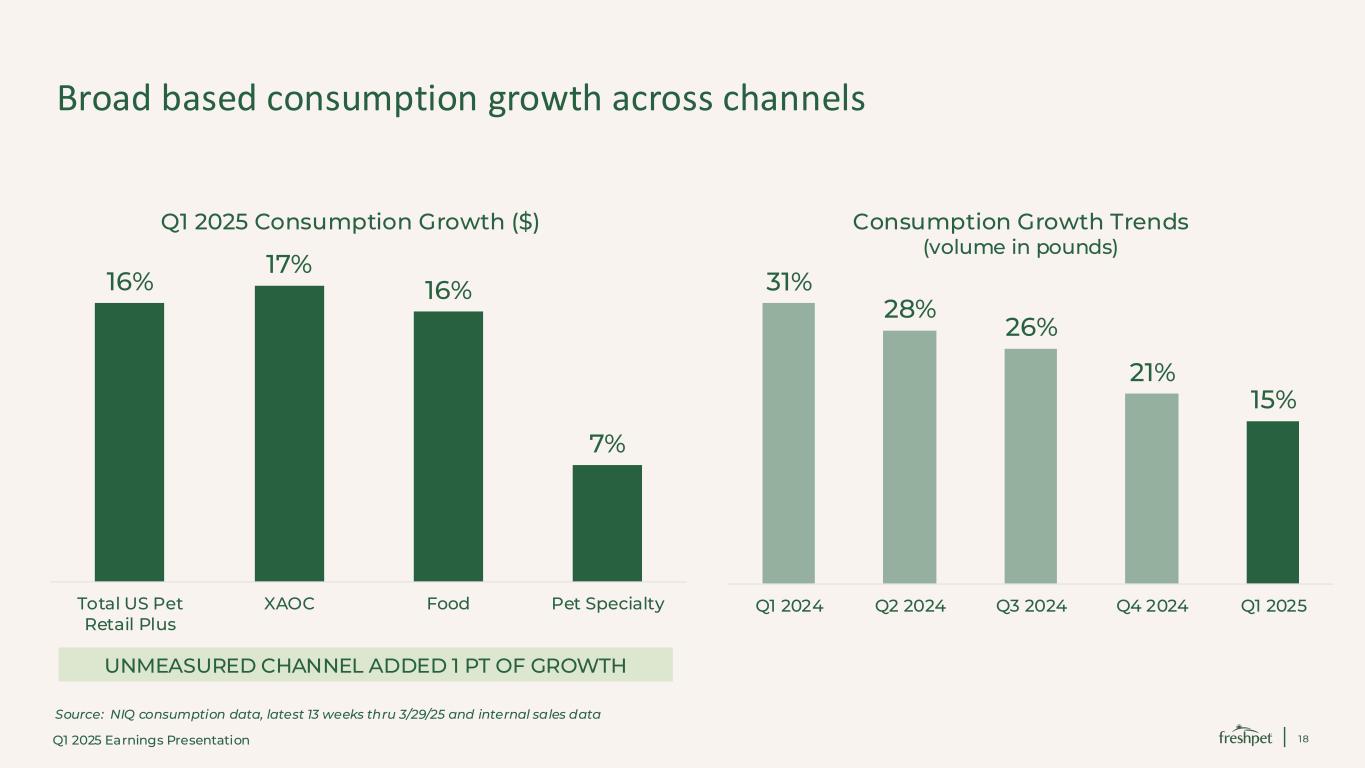
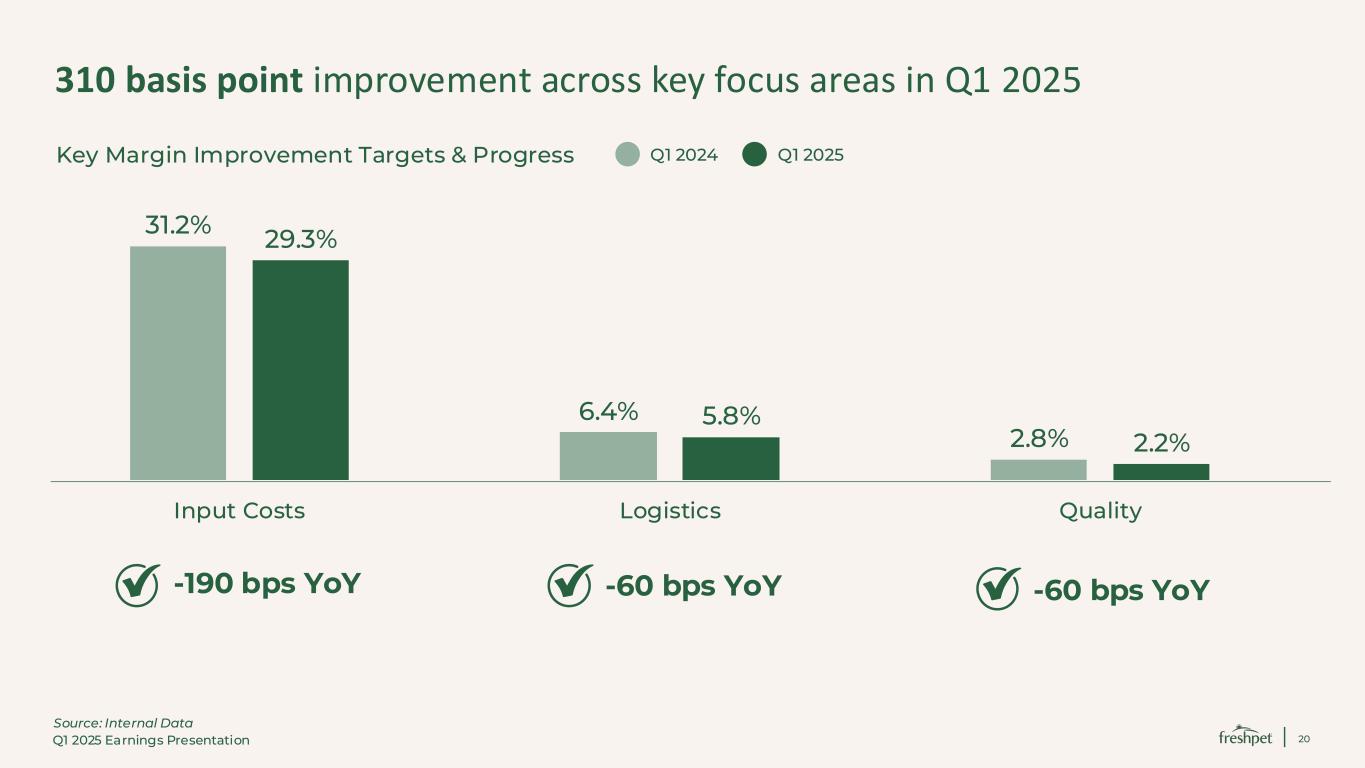
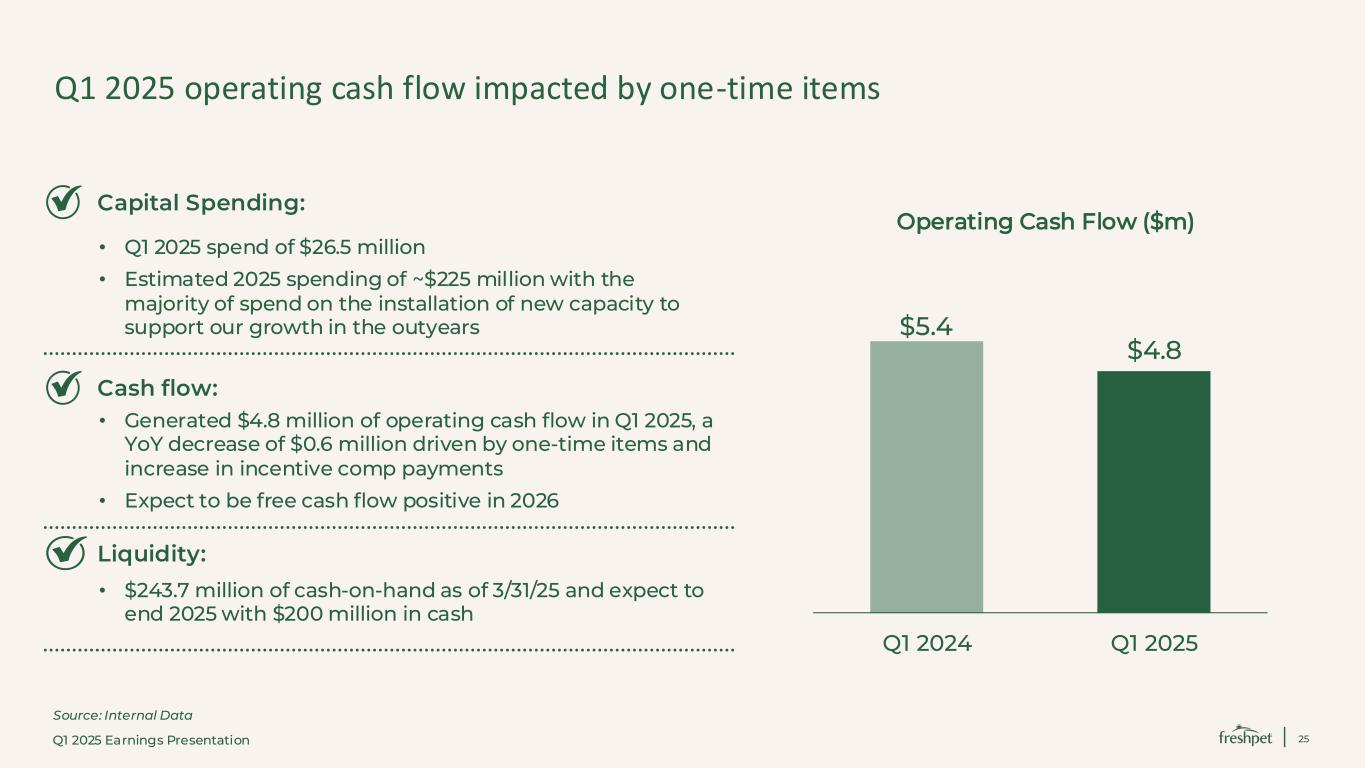
Thank you, Billy, and good morning, everyone. The first quarter results demonstrated growth across channels but fell below our expectations, leading us to revise our outlook. Now, I'll give you some more color on our financials and updated guidance for the year. First quarter net sales were $263.2 million, up approximately 18% year-over-year. Volume contributed 14.9% growth, and we had positive price/mix of 2.7%, primarily driven by mix. We saw broad-based consumption growth across channels. For Nielsen measured dollars, we saw 17% growth in XAOC, 16% in total US Pet Retail Plus, 16% in US Food, and 7% growth in pet specialty. The change in our pet specialty distributor impacted our net sales growth by about a point and was offset by unmeasured channel growth of about a point. First quarter adjusted gross margin was 45.7% compared to 45.3% in the prior-year period. This slight increase was driven by lower input costs and reduced quality costs. Please note that the fourth quarter gross margin had a one-time manufacturing benefit of 150 basis points that we gave back in the first quarter, as we had indicated when we reported the fourth quarter and full year results. First quarter adjusted SG&A was 32.2% of net sales compared to 31.7% in the prior-year period. This increase was primarily due to increased media as a percent of net sales, partially offset by reduced logistics as a percentage of net sales. Please note, we had a number of non-recurring charges in the quarter, including an accounts receivable write-off in connection with the liquidation of one of our pet specialty distributors, an accrual for legal obligations related to the ongoing litigation with Phillips, and termination costs due to a business change in our international go-to-market strategy. We spent 15.1% of net sales on media in the quarter, up from 14.3% of net sales in the prior-year period. Logistics costs were 5.8% of net sales in the quarter compared to 6.4% in the prior-year period. First quarter adjusted EBITDA was $35.5 million compared to $30.6 million in the prior-year period. The improvement was primarily driven by higher gross profit, partially offset by higher adjusted SG&A expenses. Capital spending for the first quarter was $26.5 million, operating cash flow was $4.8 million in the first quarter, and we had cash on hand of $243.7 million at the end of the quarter. We still expect to be free cash flow positive in 2026 and believe we have the ability to self-fund our growth going forward. Now turning to guidance for 2025. We now expect net sales of approximately $1.12 billion to $1.15 billion or approximately 15% to 18% growth year-over-year, compared to our previous guidance of approximately $1.18 billion to $1.21 billion or approximately 21% to 24% growth year-over-year. As Billy mentioned, we are now assuming the conditions we saw in the first quarter continue for the balance of the year. In terms of cadence, we expect a sequential increase in net sales per quarter. We are lapping tougher comparisons in the first half, plan to invest more heavily in media in the second quarter to drive household penetration growth, will be launching more value-oriented offerings in the second half, and expect to modestly increase distribution throughout the remainder of the year. We now expect adjusted EBITDA in the range of $190 million to $210 million compared to at least $210 million previously. Given the lower rate of net sales growth. For cadence, we expect adjusted EBITDA to be back-half weighted with sequential adjusted EBITDA dollar and margin improvement throughout the rest of the year. Media as a percent of sales is expected to be greater than in 2024. We anticipate modest adjusted gross margin expansion year-over-year, driven by operational improvements and do not anticipate any material inflation or pricing actions. In regards to tariffs, we are monitoring the announcements closely and have contingency plans in place if we need to make any changes to our supply chain. As a reminder, only 5% of our US cost of goods sold come from imported raw materials, and we do not have any US sales imported as finished goods, so the impact to our profit and loss statement should be minimal. We are still assessing the potential sales impact of any retaliatory tariffs, as we do export pet food from the US to Canada and the UK. Capital expenditures are now projected to be approximately $225 million this year compared to approximately $250 million previously. The majority of the spend is on the installation of new capacity to support our growth in the out years. We do expect to experience some impact from tariffs, particularly related to the increased cost of steel for new construction and new equipment. Our estimate of that impact is included in the updated capital spending projection. In summary, we are highly focused on continuing to drive top-line growth and profitability improvements despite the current economic uncertainty. And we believe we have taken the appropriate steps to be nimble and address the challenges based on what we know today. We remain very optimistic about the long-term potential for Freshpet and believe this will ultimately be viewed as another short-term headwind that we must overcome as we have overcome previous headwinds on our path to building an advantaged business in an attractive category.
Speaker 4
Thank you. I wanted to start by asking about the updated guidance range. Just in light of recent scanner data and also in light of some economists anticipating that the economy itself kind of slumps a little bit ahead from here. Was there any thought of assuming that the macro worsened ahead? It seems, and correct me if I'm wrong, that you're assuming that the situation kind of stays constant. I'm just curious if there's enough downside risk kind of baked in just given some of the lack of visibility ahead.
Yeah, Ken. We obviously looked at a wide range of scenarios. We really focused on where our business is and how it is performing right now. And we believe, based on what we're seeing in the consumption data and what we know about our marketing plans for the back half of the year and the new customer distribution gains that we'll have in the back half of the year, we feel like we're in the right spot. But as we said in the commentary, the assumption that we built here was that the consumer environment that we had in the first quarter would continue for the balance of the year. If it gets materially worse, obviously, that would have some impact and we would take some actions based on that. If it gets better, obviously, that would be good news for us. But we look at it on balance; we feel like we're in a fairly stable place right now, and we're projecting that moving forward.
Sure. I mean, most of it was mix. For example, our Homestyle Creations sub-brand is doing very, very well right now, which is one example of what's helping us there. We also had some favorable gross-to-net retailer returns, markdowns, things of that nature, which helped the pricing piece. There was no actual list price changes. Obviously, there's no intention to do that whatsoever. This was probably the high end for the year. We actually had some favorable price/mix in the back nine months of last year. So it will be a little bit harder to lap. So, I think we'll have a little bit of favorability, but not to the extent that we had in Q1.
Speaker 5
Oh, hey, guys. Good morning. Thanks for taking the question. First one, just curious what's kind of most incremental across the value product, the marketing, the channel strategies that you outlined for this year, just kind of relative to what you were thinking back on the last call. What's kind of the most meaningful or impactful change there?
Hey, Peter. It's Scott. Right now, we're taking everything we've been planning for a long time and speeding it up. If you look at our efforts around affordability, we're pushing that forward even more as we integrate the brand. We're adjusting the marketing strategy by focusing on media, targeting, and creative. These elements are what we are prioritizing to enhance the pace of our business. There are two key areas in media that are particularly important. One of them involves the creative aspect, which we began working on at the end of last year. We understand that slight modifications to our creative messaging can broaden our consumer base and enhance brand engagement. We are currently developing this creative, and it should be ready in the next few months, which gives us confidence in this effort. The second area of focus is on executing our media strategies more effectively. We are paying more attention to the MVP or HIPPO group, from which we are seeing remarkable growth. This growth not only increases household penetration but also boosts the buy rate, and we have evidence to support this. Additionally, we are becoming more productive in our e-commerce and direct-to-consumer initiatives. E-commerce, for instance, refers to platforms like Walmart.com, where we are experiencing strong productivity gains. We are witnessing rapid growth in both e-commerce and direct-to-consumer channels, and as we begin to invest more in these areas, we are seeing significant acceleration. Importantly, the buy rate from these efforts is improving even beyond that of the MVPs.
Speaker 7
Thank you. Good morning. I wanted to discuss your perspectives on the market. I know you previously mentioned that HIPPO's growth has slowed, and today you mentioned that the lower-income segment is part of your target market. How do you view the market's progression going forward? Has the overall market slowed down, or do you believe that some of the easier growth opportunities have already been taken, making it more challenging to achieve the 20%-plus growth over the next few years?
Yeah, there's a lot to unpack in there. Let me just start with when we look at the data, we see that Freshpet today is outperforming the category by about 10 points amongst every one of the income groups or age groups. So it speaks to the strength of the Freshpet proposition and its long-term value. Also, when we look at the data, we don't see any change in consumers' interest or desire to have a pet or to increasingly feed their pet higher-quality pet food. What we're seeing in this near term is we're really focusing on the uncertainty that consumers are seeing. The uncertainty is, if you don't know what's going to be right down the road for you, either from a job perspective, where you're going to be living and whatnot, all those things have put a little bit of a pause on consumers' interest in trading up in their pet food or maybe getting a dog to replace a dog that might have passed away. It's most pronounced amongst the consumers who are most economically insecure. We've seen that in the data. The low-income part of our franchise is certainly feeling that. But it's across income groups and across age groups. But over the long haul, the data strongly suggests that the consumer desire for pets and for higher-quality pet food has not waned. So we just need to gut our way through a tough economic environment for some period of time. We don't know how long it is, but we don't see any change in the long-term potential based on everything we're seeing today.
Hey, Bill. So I think Billy mentioned it in his prepared remarks, and I think we really want to reinforce this. We've never done any discounting; as you know, we've never done any discounting. We don't do any couponing. We feel like the correct model for this business is basically to stay really focused on the exact strategy that we've had for a very long time. Now, that being said, as mentioned, we want to modify the creative; we want to change the targeting. The other thing that we started to touch on and we've been working on for quite a while is this area of affordability, where we want to take a handful of very, very targeted stock-keeping units, create great opening price points, not only on some rolls but also on some bags. In addition, you're seeing some multipacks that create real great value perception. In addition, we want to make sure we're available at certain retailers that are really value-focused, right? So you start thinking about, like, where we are, whether it's Walmart, whether it's like a Costco like we're at and other opportunities. All of those really create a bigger opportunity for us to be seen as more affordable and accessible. So that's the way we're thinking about kind of executing the strategy. There won't be any couponing; there won't be any discounting. But we want to make sure that we have some really good opening price point products and stock-keeping units to make sure we bring people into Fresh. Once they're into the portfolio, many of those have actually become MVPs over time.
And we will continue to lean into media. It's an incredibly important part of our growth strategy. We were up 24% in Q1. We will have a similar amount of spend, about $40 million, in Q2. So that's well over 30% growth in the quarter. So we will lean into that versus any kind of trade down.
Speaker 8
Yeah, thanks. Good morning. So I guess, Bill, I think in the last response, Scott maybe got to what I was going to lean into. But just was curious how that Complete Nutrition line has performed since its '23 launch and how generally aware are consumers of the value that Freshpet offers? And if not, how much of that is part of the revised media strategy?
Let me address these points one at a time. Regarding the media aspect, to keep it straightforward, there are two components. The first is the creative element. Each time we've launched a new campaign with slightly different messaging, we've successfully reached a new segment of consumers. We are confident in our ability to attract another significant group of consumers, and we are actively working on this. Additionally, we are refining our media targeting. While much of our approach remains broad, we are increasingly focusing on precise targeting, which is benefiting our e-commerce and direct-to-consumer efforts as well. On the affordability front, if we examine the Complete Nutrition line, we can see that the introduction of the one-pound roll opened up a sizable new market of consumers. Even though the total volume remains in the single digits, this initiative has successfully attracted a new group of customers. When we launched the one-pound roll last time, it resulted in noticeable growth over the following two quarters as consumers returned to the brand. This strategy proved to be highly effective, and we plan to replicate it this year. While the impact may not be huge, it will be sufficient to draw in new customers and encourage them to try Freshpet food.
Speaker 9
Great. Thanks. So I actually wanted to drill in a bit into your DTC expansion, which is something you previewed at CAGNY. I guess a couple questions around that. First, I guess, is it your assessment that that subscription service channel has held up better over the past few months? And just what's the latest on how you see subscription demand interacting with consumption in your traditional channels and customers, number one? And then secondly, in terms of your own initiatives there, kind of how impactful is that likely to be in fiscal '25? Is that more of a test and build or have you done the testing and really are more fully jumping in at this point?
I always think of starting from zero as a point where rapid growth is possible. The reality is it’s still small, but it's encouraging that we're experiencing positive trends in customer acquisition cost and retention so far. This applies to the direct-to-consumer segment. However, I believe the larger opportunity lies in the e-commerce area we’ve discussed for a while, specifically the click-and-collect model. Customers can visit any of our retail partners to pick up orders or have them delivered to their homes. Retailers are becoming smarter and more proficient in this area, presenting a significant opportunity. Plus, it makes use of our fridge network effectively. We have 37,000 micro fulfillment centers across the US that enable us to deliver fresh food quickly. With 27,000 stores and 37,000 fridges to draw from, we have a highly efficient supply chain for consumer deliveries. We aim to continue developing this. The direct-to-consumer business is small but performing well, and we are very encouraged by the results we’re witnessing at this time.
Great. Thank you, everyone, for your attention and your interest. I'll leave you with this thought. It's from Nora Ephron. When your children are teenagers, it's important to have a dog so that someone in the house is happy to see you, to which I would add, reward that dog with Freshpet and your dog will forget about the teenagers too. Thank you very much.
Operator
Thank you. This will conclude today's conference. You may disconnect at this time, and thank you for your participation.