Operator
Thank you for standing by. My name is Carly, and I will be your conference operator today. At this time, I would like to welcome everyone to the Six Flags Entertainment Corporation 2025 third quarter earnings call. All lines have been placed on mute to prevent any background noise. After the speaker's remarks, there will be a question and answer session. If you would like to ask a question during this time, simply press star followed by the number one on your telephone keypad. If you would like to withdraw your question, press star 1 again. Thank you. I'll now like to turn the call over to Six Flags Management. Please go ahead.
Thank you, Carly. Good morning, everyone. My name is Michael Russell, Corporate Director of Investor Relations for Six Flags. Welcome to today's earnings call to review Six Flags Entertainment Corporation's 2025 third quarter financial results. Earlier this morning, we distributed via wire service our earnings press release, a copy of which is also available under the News tab of our Investor Relations website at Investors.Sixslags.com. We have also posted a presentation deck that can be accessed either on the webcast page for today's call or on our IR website's presentation page. The slides offer supplemental information specific to our consolidated results and PARC portfolio all of which will be discussed on today's call before we begin I need to remind you the comments made during this call will include forward-looking statements within the meaning of the federal securities laws these statements may involve risk and uncertainties that could cause actual results to differ from those described in such statements for a more detailed discussion of these risks you may refer the company's filings with the FCC in compliance with the FCC regulation FD this webcast is being made available to the media and the general public as well as analysts and investors because the webcast is open to all constituents and prior notification has been widely and unselectively disseminated all content on this call will be considered fully disclosed on the call with me this morning our six slides chief executive officer Richard Zimmerman and chief financial officer Brian Withera with that, I'll turn the call over to Richard. Thanks, Michael.
Good morning, everyone, and thanks for joining us. Today, as we discuss our third quarter results and our expectation for the remainder of the year, I want to acknowledge at the outset that our performance in 2025 has fallen short of our expectations. While we delivered year-over-year attendance growth during the critical third quarter and continue to make meaningful progress on our integration efforts, softer-than-expected demand in September offset much of the momentum we had built in July and August, leading to approximately flat third quarter EBITDA year over year. While the 2025 season has been defined by volatility, I remain encouraged by the underlying strength of our business and believe the lessons we're taking from this period help lay the foundation for future success. Even in a year like this one that has challenged our execution and tested our operating model, we have gained deeper clarity about where the portfolio is strongest, where it needs refinement, and how we can adapt to challenges and evolve our approach to unlock the full potential of the company. Before we dive into our operating results, and I turn things over to Brian, I want to discuss our ongoing constructive engagement with a group led by Janna Partners, which includes football superstar Travis Kelsey. Six Flags has always been open to discussing strategy and opportunities with shareholders, and in that regard, this situation is no different. What is different is the magnitude of consumer interest and response that we have seen following the announcement and that the group has invested in Six Flags. This reaction reinforces our confidence that Six Flags is as exciting and relevant as ever. Six Flags remains a beloved brand and we are pleased that it is part of the national conversation. We intend to build on that momentum and capitalize on the interest in the company for the 2026 season. We'll have more to say about that on future calls, so stay tuned. Now let me turn the call over to Brian to provide more context around our third quarter and year-to-date results.
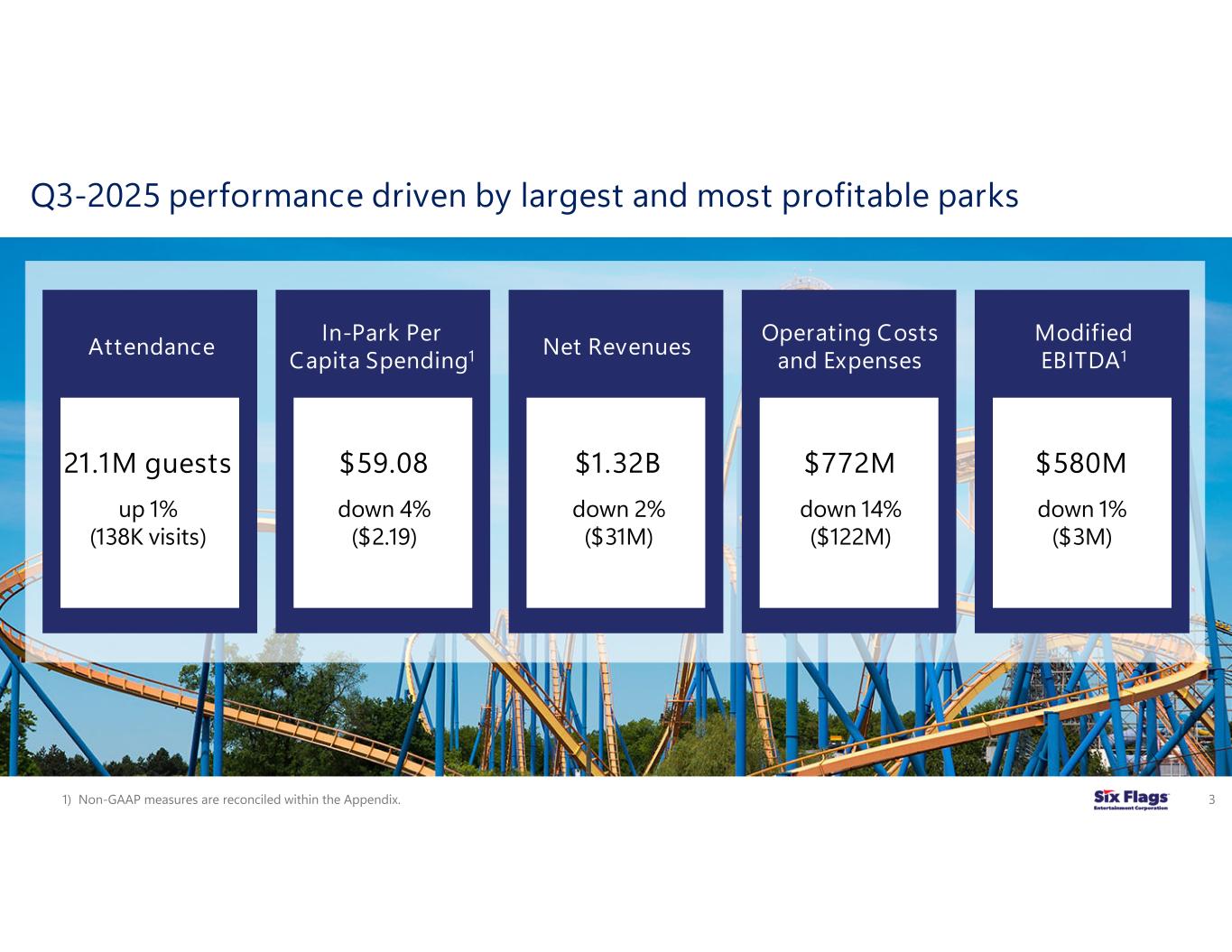
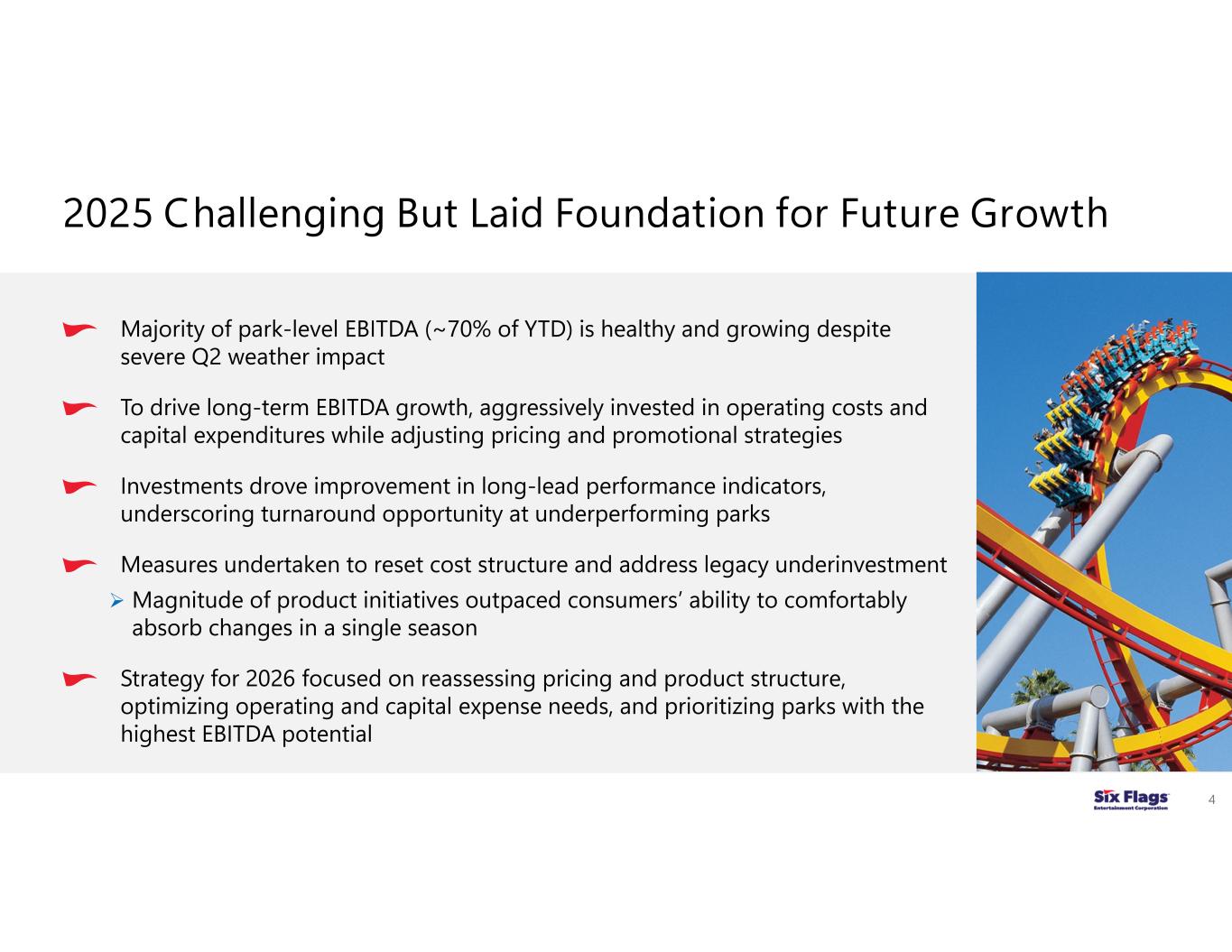
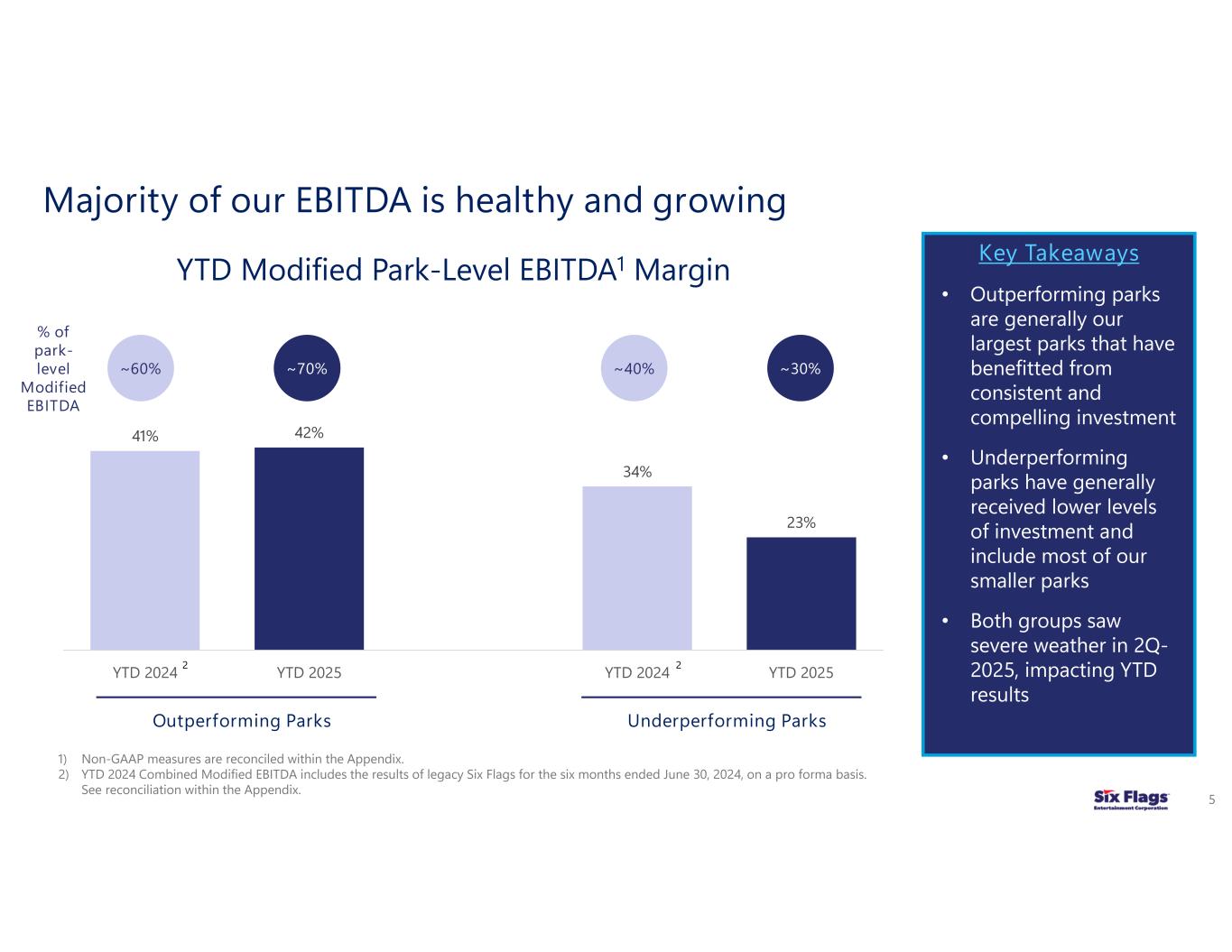
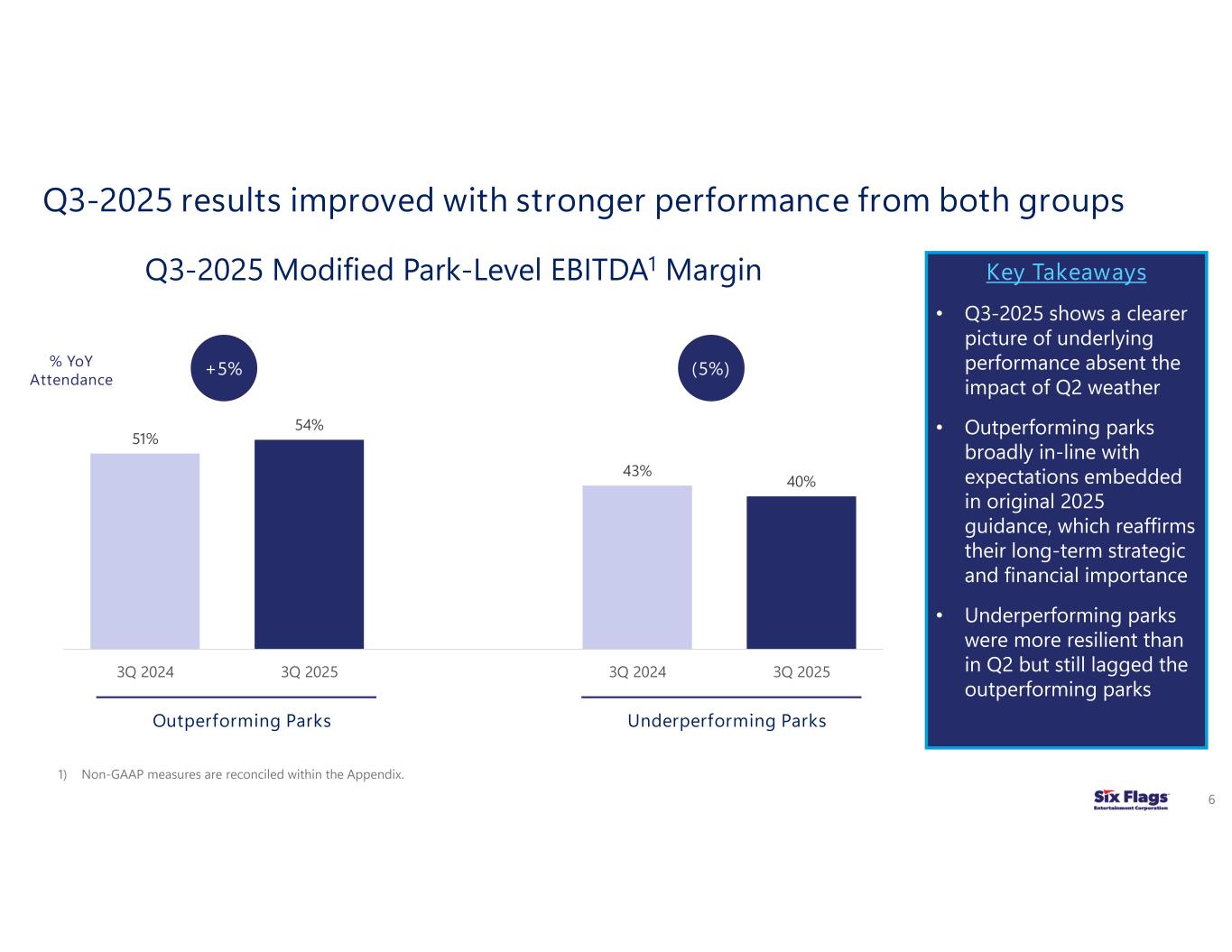
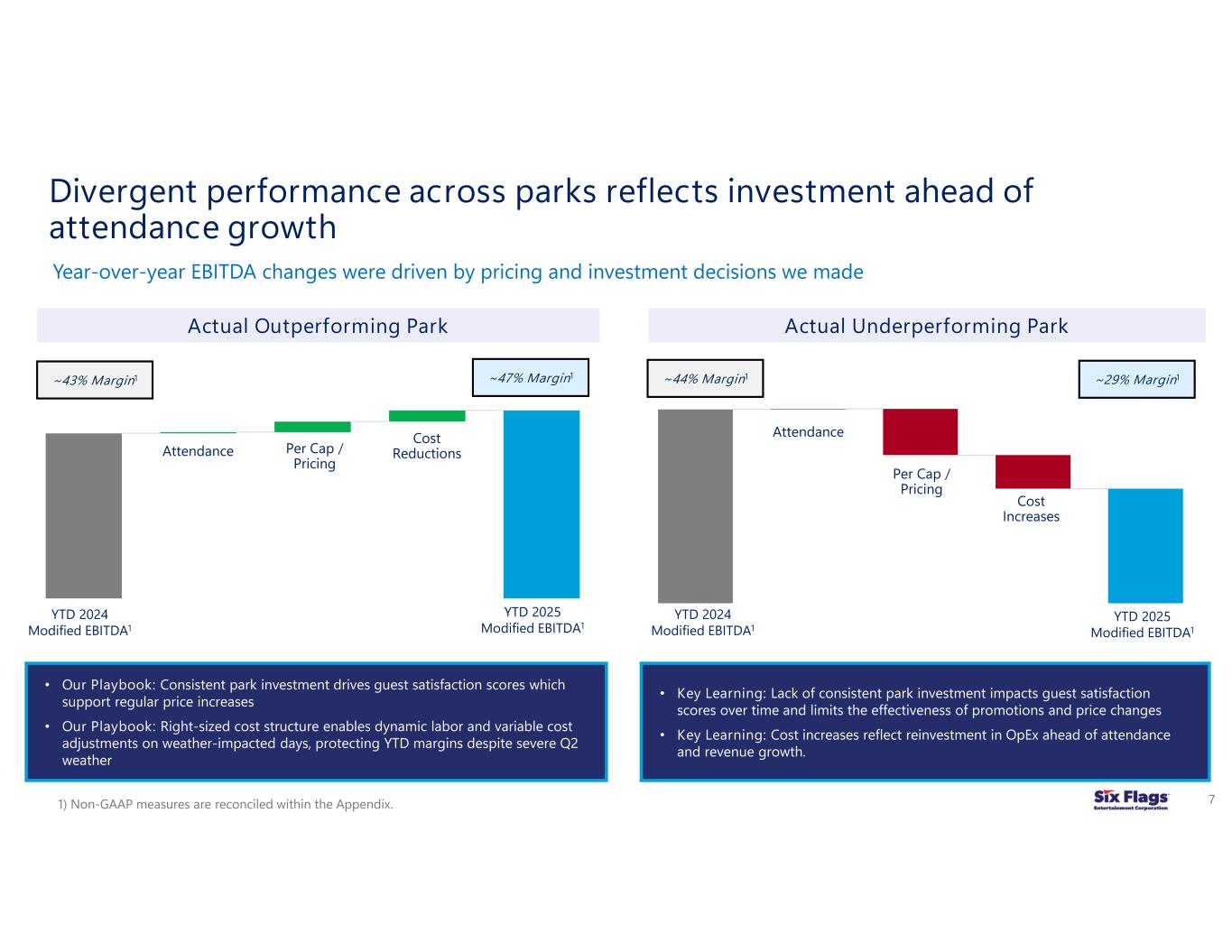
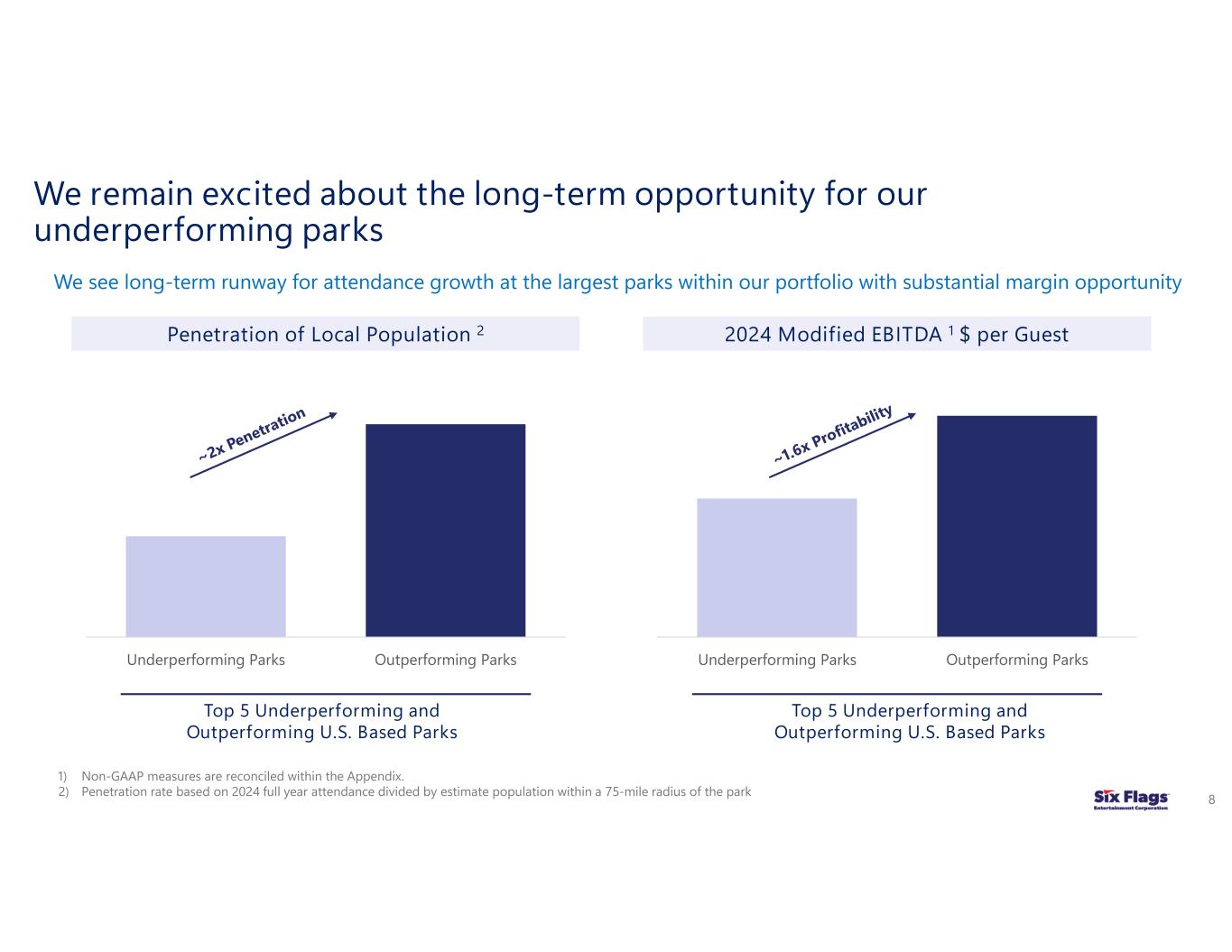
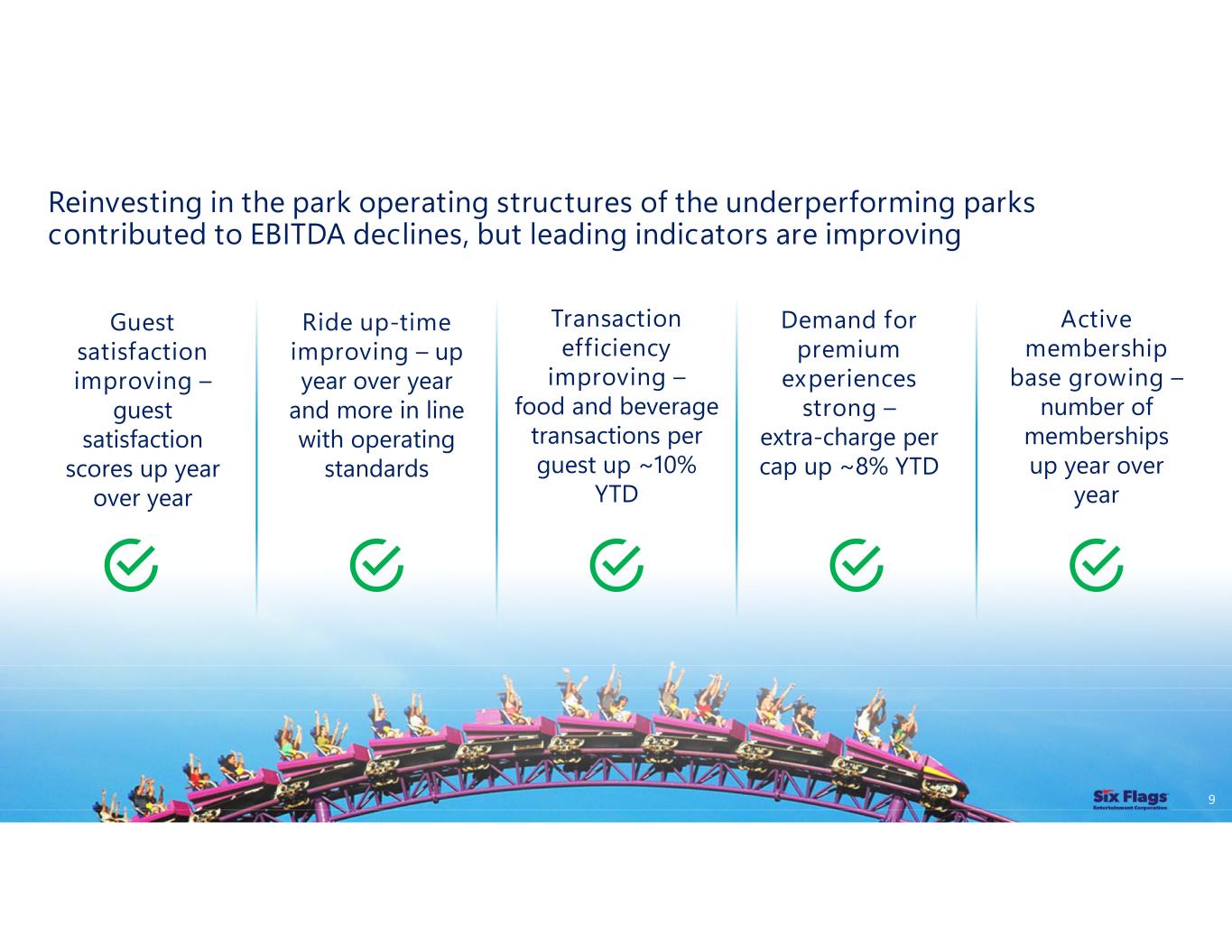
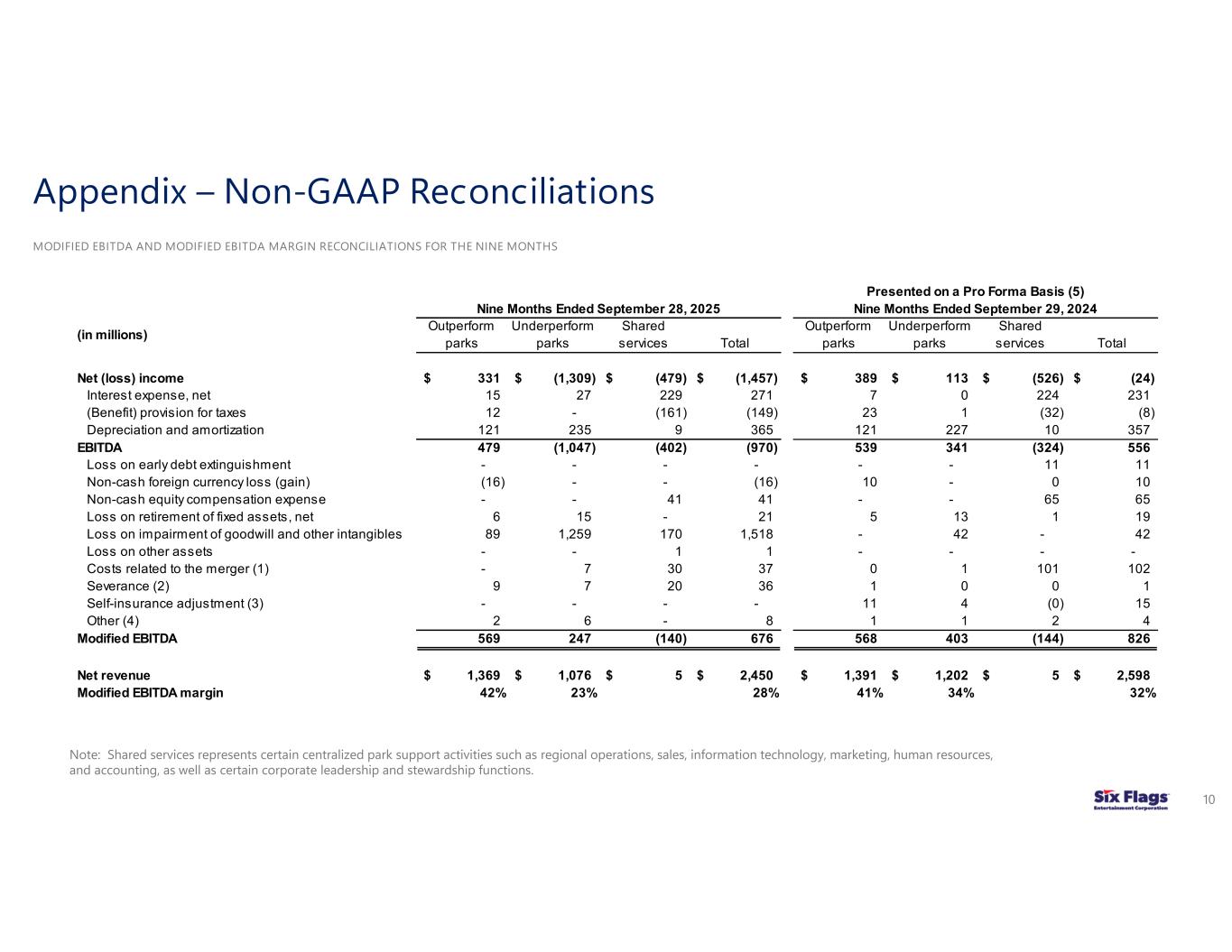
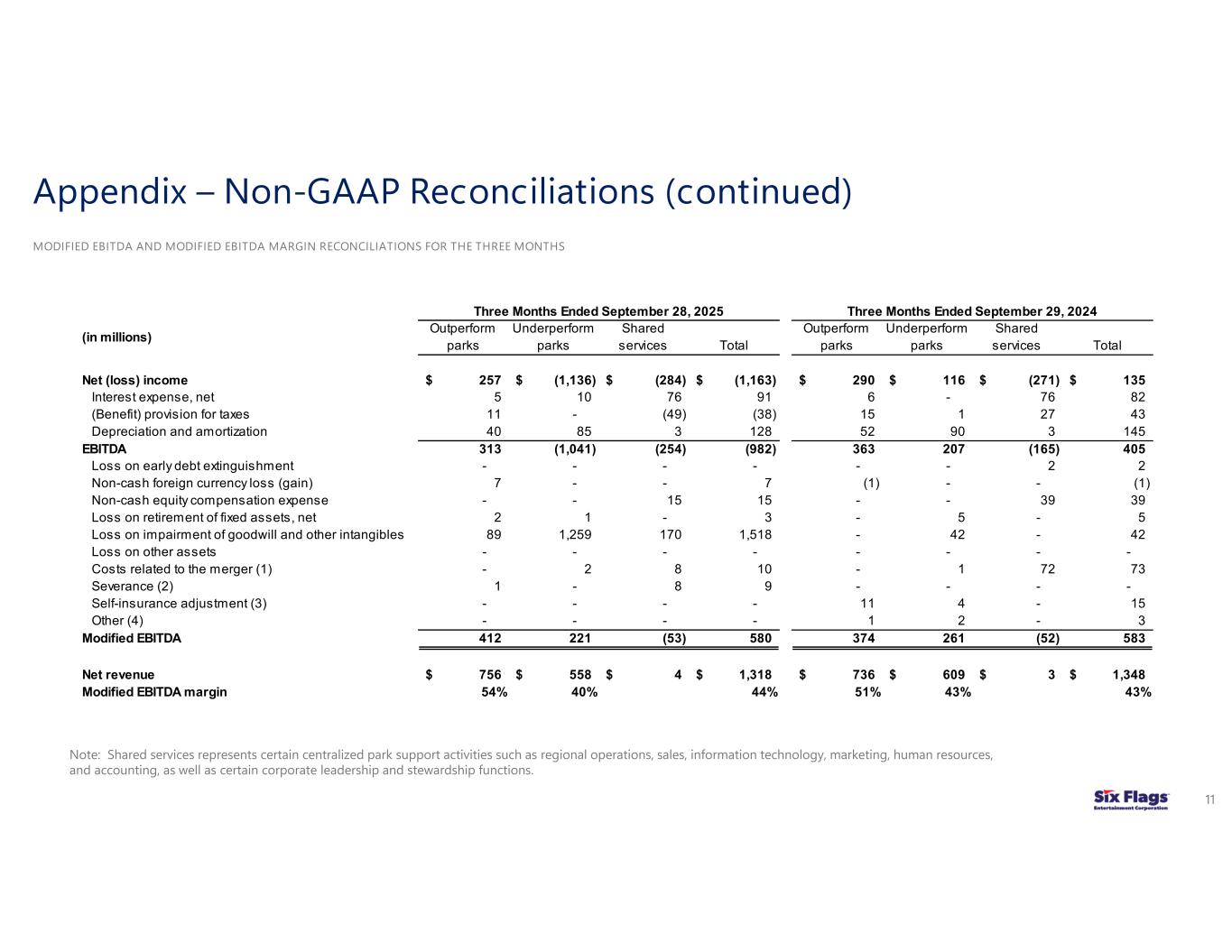
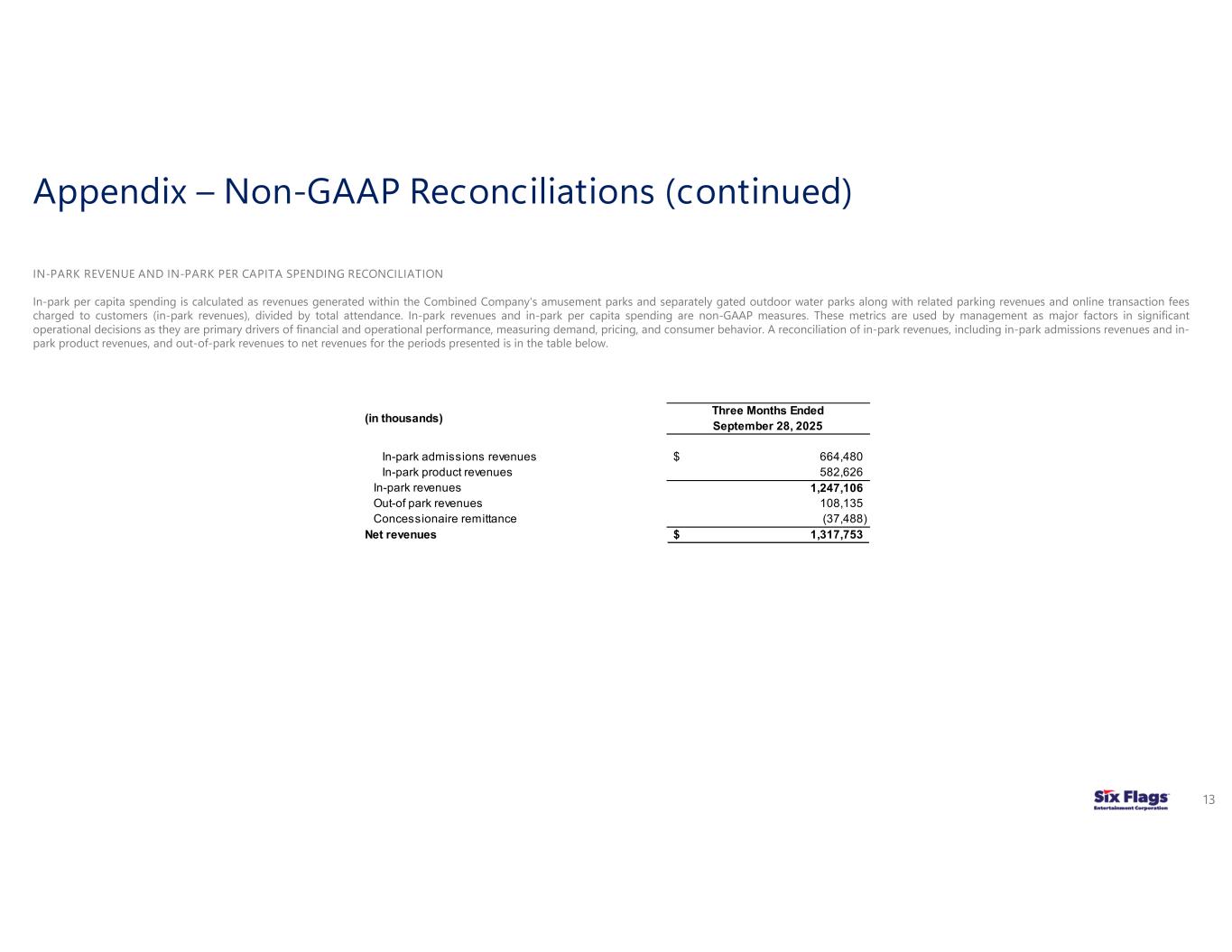
Thanks, Richard, and good morning, everyone. As Michael mentioned at the outset of the call, in addition to our earnings release, we posted a supplemental presentation on our website, which provides more context around our operating results and which I will reference during my prepared review. With that said, let me start with a review of our third quarter results. starting with slide three in the presentation. For the quarter, we delivered modified EBITDA of approximately $580 million and adjusted EBITDA of approximately $550 million on attendance of 21.1 million guests and revenues of $1.32 billion. The $555 million of adjusted EBITDA was essentially in line with the third quarter last year with attendance up 1% and revenues down two percent the quarter began on a strong note combined attendance in July and August increased approximately two percent or 300,000 visits and guest satisfaction scores continue to improve with our brand leading parks performing at a high level however following Labor Day weekend we saw a downturn in demand trends as attendance for the month of September declined approximately five percent or roughly 160,000 visits from so this resulted in a five percent decline in net revenues for the month despite the substantial change in attendance trends we stayed the course and maintained our initiatives and planned level of opex reinvestment in many of our parks combined with the shortfall in september revenues this negatively impacted third quarter ebitda by approximately 20 million dollars stepping back we believe the third quarter results offer a more relevant picture of the underlying business trends compared to the previous quarter. Third quarter results somewhat isolate the severe second quarter weather which impacted operations, negatively affected demand, and disrupted the pace of season pass sales and visitation over the entirety of the core season. Despite those challenges, the third quarter underscores the strength of our best performing strategic approach. Rob, please turn to slide four. During the 2025 season, we have learned an extraordinary amount about our individual parks it has in many ways been a tale of two cohorts year-to-date certain parks representing approximately 70% of property level EBITDA have continued to outperform while parks representing roughly 30% of property level EBITDA have underperformed as we've gathered more information and learn more about our underperforming parks we've gained a clear understanding as to what it takes to turn around most of these properties some of these underperforming parks have become non-core to our strategy and as we've discussed before we are looking to monetize them as we move forward if certain underperforming parts don't respond to our initiatives we will consider rationalizing our investments in those properties and deem them to be non-core the bifurcation of outperformers and underperformers is not simply a matter of geography or legacy ownership it speaks to differences in how our parts are perceived by consumers which we call brand strength as well as consumer affinity historical investment patterns and local competitive dynamics in 2025 we implemented our playbook aggressively in the underperforming parks and invested ahead of attendance growth our initiatives included increasing both operating expenses and select promotions including changes to ticket prices and bring a friend offers based on past experience these investments often yield immediate results in attendance growth unfortunately in other cases it can take time to see a change in consumer perception and growth in demand we've been actively reviewing each park in our portfolio as we work to optimize revenues operating costs and capital expenditures going forward turning to slide five through the first nine months of the year the outperforming parks in the portfolio have generated incremental modified EBITDA and essentially flat attendance year-over-year We believe the performance of these parks would be even stronger absent the significant impact of severe weather in the second quarter and the disruption in season pass sales during the critical May-June time frame. Through the first nine months of 2025, modified EBITDA declined as a result of lower attendance and increasing operating expenses. However, we deliberately increased operating expenses to reflect necessary maintenance investments to ensure ride-up times in these parks are up to our standards. We made significant progress in this area, but did not yet achieve the commensurate uplift in profits we were targeting. Going forward, we intend to be more nimble and strategic in allocating investment dollars, focusing only on our highest potential underperforming parks and the strongest opportunities to deliver near-term returns. Turning to slide six, performance of the outperforming group of parks was even better during the third quarter. Modified EBITDA for these parks increased double digits, driven in large part by a 5% increase in combined attendance. Third quarter resulted that these parks were broadly in line with the expectations embedded in our original 2025 guidance, and their performance reaffirms their long-term strategic and financial importance to the company. In the third quarter, our underperforming parks saw attendance decline 5%, although we were able to better protect margin erosion through critical adjustments to variable costs, thereby limiting the modified EBITDA declines. Finally, for all parks, third quarter results were also impacted by shifting advertising expenses. We reallocated ad spend from the third quarter to the first half of the year, which helped lower third quarter operating expenses, but most likely also affected demand and impaired our top line during the course. Turning to slide seven, you'll see a good example of a single outperforming park and an underperforming park. Note that both parks began the year with similar margins, and both experienced flat attendance year-to-date. Yet, as you can tell from the chart, profitability between the parks varied widely. The park on the left, the outperforming location, had been historically well-maintained with a loyal customer base that was able to withstand any adversity we faced throughout the season. Here, we were able to leverage our reputation and minimize costs without impacting consumer demand or the guest experience. The result is that EBITDA grew 14% and margin improved from 43% to 47%. The right is an underperforming location where we made significant investments in 2025 to address deferred investment needs and support multi-year attendance and EBITDA growth. The nature of the business is that we invest in maintenance and labor expenses in advance of top-line attendance and revenue growth to improve customer satisfaction and enhance brand perception. The result is that year-to-date EBITDA at this property fell significantly and margin contracted from 44% to 29%, an unacceptable long-term margin for a park of its scale. While profitability clearly remains challenged, we remain excited about the opportunity to drive long-term growth within the portfolio. Our parks are located in attractive high-population DMAs, which provide a substantial runway for future attendance growth. As reflected on slide eight, the largest properties in the underperforming cohort of our portfolio have room to double their penetration rates before reaching the levels we are currently achieving at the largest parks. And we also see similar opportunity to increase profitability at these underperforming properties. Turning to slide nine, despite not seeing the near-term economic return on every one of our 2025 initiatives, we are beginning to see leading indicators turn positive, and we are excited about the potential upside here. As we look ahead, our roadmap for the underperforming parks centers on two primary pathways, migrating those parks toward the performance profile of our best parks within the portfolio, or classifying them as non-core and divesting them where it makes strategic and financial sense. approaching this process with objectivity and discipline. We are re-evaluating pricing strategies, operating cost structures, capital allocation plans, and long-term market potential. These evaluations are underway with the full support of our board. We are committed to making decisions that strengthen the long-term health of the company, even when those decisions are difficult. This isn't new for us. Remember that we have already taken actions to monetize real state in northern california buoy maryland and richmond virginia let's quickly touch on october results and our most recent performance trends based on preliminary operating results attendance over the five-week period and november 2nd totaled 5.8 million guests this represents an 11 decline in attendance versus october last year however we think it's important to consider the comparison to 2023 as last year's results benefited from a five-week weather pattern that It was nearly perfect, and as a result, October attendance was up 20% in 2020. For we believe that 2023 offers a more relevant comparison to assess the current period performance. That same five-week period in 2023, we showed a 7% increase in attendance this October. We find it very encouraging that when compared to October of 2023, results at our outperforming parks were up 11%, and the underperforming parks were up 4%. One final note on October performance, in early September, based on the strong attendance trends coming out of July and August, we thought we were well positioned to match last year's October results, as we have seen consistent growth in demand for our fall events, and we added both incremental operating days and new IP-themed attractions to drive demand However, the difficult comparison to last year's record performance, coupled with our pullback in advertising spend made our October goals a bridge too far based on these results we are revising our full-year outlook our updated range reflects discipline transparency and a realistic assessment of the conditions affecting the business it also creates a more stable foundation as we refocus our efforts and reposition for the 2026 season based on our updated outlook for the last two months of the year we now expect to deliver full-year adjusted EBITDA of 780 to 805 million from a balance sheet perspective our priority is to enhance financial flexibility and improve free we intend to do this both through organic growth in our core properties and through potential strategic asset sales we have no meaningful debt maturities until early 2027 and we have adequate liquidity to address near-term cash obligations and despite this year's challenges we remain comfortably within our covenant requirements we currently sit at approximately three times secured leverage, giving a substantial cushion against our first lean leverage covenant, which steps down to five by the performance volatility over the course of this year, we believe the regional amusement park business remains fundamentally solid, as evidenced by the results of our high-performing parks this year. Several of these parks are on track to record record or near-record performances. These results underscore the long-term viability of the business model and reaffirm the central thesis behind our strategy. When we invest in product quality, operational reliability, and the guest experience, consumer demand follows. The approach coming into 2025 was rooted in a desire to drive recovery as quickly as possible in parts with long-standing demand challenges. We made strategic decisions based on the historical success of implementing our playbook across the portfolio. But in some markets, the pace of change exceeded what our consumers were prepare to absorb within a single season this reflects the evolving nature of guest behavior and the importance of calibrating change at a market-specific level as we move forward to 2026 this learning is already reshaping our approach around an understanding that pricing changes promotions and programming must be phased in sequence with greater precision looking ahead to 2026 we are focused on taking the learnings from this past season to a to inform our strategic initiatives and our priorities. We are reassessing our marketing approach with a focus on returning to fundamentals. That includes reevaluating the allocation of marketing spend by park and channel, improving the pacing of that spend to more effectively align with the seasonal demand curves, and sharpening messaging so that it resonates more precisely with consumers in each unique market. Additionally, our integration work remains on track and is yielding meaningful benefits. We have standardized core safety, security, and operational protocols across the portfolio, critical steps in the integration process. This week, we launched our new website, a single, unified, digital home that brings together what were once two separate companies and more than 15 different websites. The launch represents more than just a new look. It's a major step forward in how we present ourselves as one brand and one team. The new website offers a seamless experience for our guests, as well as an entirely new platform for the business. It's a platform built to grow with us, which is scalable, data-driven, and optimized for evolving needs of the enterprise. By year-end, all parts will be operating on a unified ticketing platform, an essential component of our future revenue and demand management strategies. And as we move into early 2026, we will complete the migration to a single Enterprise Resource Planning, or ERP system, which will deliver material administrative efficiencies and strengthen the infrastructure supporting our next phase of growth. As we tailor our operating plan for 2026, the long-term fundamentals of this business remain solid. We have a core set of highly competitive, top-performing parts, a valuable real estate base, and a clear understanding of where strategic focus and calibrated investment will have the greatest impact. We have strengthened our operating and technological foundation, and we are better equipped than at any point in the merger process to drive consistency, stability, and long-term value creation. Although 2025 has been a difficult year, it's also brought clarity and direction. The insights we gained are already shaping a more disciplined, data-driven, and market-specific strategy for 2026. And while the road ahead will require focus and execution, the building blocks for long-term success are firmly in place. We remain confident in the company's prospects for shareholder value creation. Before concluding my remarks, I'd just like to offer a note of thanks to Richard, whose leadership and discipline through this transformative period in our history has set the stage for the company's next. With that, I'll turn the call back over to Richard.
Thank you, Brian. As we conclude today's call, and I prepare to transition out of the CEO role, I want to speak directly to the realities of our performance and to the opportunities that lie ahead for this company. While we have not yet achieved all we set out to deliver following the merger, the underlying thesis has not changed. We've built a stronger foundation, modernized core capabilities, and positioned six flags to operate with greater discipline, better intelligence, and a clearer sense of where value will be created. That work is real, and it will endure. This year has challenged every assumption and tested every plan, but challenges tend to reveal the fundamentals, and the fundamentals here at Six Flags remain sound. I've spent four decades in this industry, and I've seen how quickly momentum can return when strategy, capital, and execution all align. Our assets are unique, our operating platform is improving, and the long-term demand profile for regional entertainment remains intact. We also know something else to be true. When we invest with focus and creativity, guests respond. This team has consistently demonstrated its ability to re-energize markets, elevate product quality, and deliver experiences that drive both attendance and pricing power. Those are muscles this organization knows how to use, and they will be central to its next era of growth. To our shareholders and investment partners, I understand the scrutiny and I understand the expectations. Over this past year, this management team has focused on addressing structural issues, prioritizing initiatives with the highest return, and positioning the company to translate that progress into sustained financial performance. Despite our short-term challenges, the core value proposition of this business remains durable, repeatable, and underpinned by assets that are not easily replicated. To our park teams and associates, you are the constant in this business. Your work, day in and day out, is the reason this company has outperformed, recovered quickly from downturns, and earned the trust of millions of guests. You are the differentiator. It has been the honor of a lifetime to be trusted to lead this great organization. Thank you for giving me that opportunity. And lastly, I'd also like to thank my wife, Carolyn, of 40 years, for her love and support. And with that, we'll open the lineup for questions.
Operator
At this time, I would like to remind everyone, in order to ask a question, press star, then the number one on your telephone keypad. We'll pause for just a moment to compile the Q&A roster. Your first question comes from Steve Wazinski with Stiefel.
Hey, guys. Good morning, Steve. So, good morning. So, a couple of questions here. I guess, first of all, when you guys talk about these outperforming parks versus the underperforming parks, can you actually – maybe help us and quantify how many of your parks you're considering you know these days outperforming versus underperforming and and if we think about some of those underperforming parks are any of those parks EBITDA negative right now yes steve it's brian we're not gonna to break out the number of properties that sit in each side other than as we said in in our prepared remarks and it was represented in the slide deck you know those outperforming parks represent 70 percent of of EBITDA year-to-date in 2025, closer to 60 percent last year.
The underperforming parks would contain the the lion's share of the small properties within the portfolio and some of those parks you know are maybe in low single digits when it comes to millions of dollars of EBITDA that they generate but beyond that we're not going to provide any more specifics on the names or the numbers of parts in each each cohort okay gotcha and then second question if we if we go back to February you know when you initially gave guidance for the year which was I think it was 1.1 billion at the midpoint and now we sit here it you know it's called close to 800 million at the midpoint you know obviously that's a 300 million dollar difference you know is there any
way you can bridge that that 300 million Delta meaning you know how much of that delta do you attribute the weather versus, you know, other factors, whether that's cost or just macro headwinds? You know, anything you could do to kind of bridge that would be helpful.
Yes, Steve. Listen, as we look at this year, I appreciate the question. There's been a lot of volatility in the year. This has been the year that seems like it's several years rolled into one. So, it seems like there's been a lot of challenges throughout that. I think as we look at that and i'll let brian weigh in here uh i'll go back to the point that brian just made as we've walked through this year we've tried to really calibrate what we needed to do to build a strong foundation for the future uh and start to see that demand come back and focus on that market penetration and the underperforming markets where we think the greatest opportunity is brian yeah without getting into specifics steve in terms of numbers we're not going to go to that level of detail but as you know you've been around the business a long time and this industry is all built around attendance I think our expectations coming in this year were for more potential then then clearly the business
was able to deliver this year which is why we need to take that we're taking a step back and we're reevaluating each one of these parks where they mean a current status what the potential is and what the what the effort is to get them up to where we know they can be long term, but the majority of this miss is in attendance driven.
Okay, gotcha. Thanks, guys. And Richard, enjoyed work with you, and best of luck. Thanks, Steve.
Operator
Your next question comes from Ian Sifino with Oppenheimer & Company.
Hi, great. You know, I wanted to also ask about the underperforming parks. I think initially we identified them as you know park parks didn't really contribute as much then they became underperforming it at what point do they then become i guess non-core you know are there like specific metrics or bogeys you're looking at um you know and how much time are you willing to you know spend on fixing these parks um before again they become maybe more non-core so um thank Yeah, Ian, I understand the question.
What I would say is that, as Brian said in his prepared remarks, this is an ongoing process. We're trying to factor in all the latest data. When you look at the overall portfolio, I think we're going through that evaluation, and it really depends on how fast we think we can ramp up the demand and what we see is demand in each market-by-market specific, but that's an ongoing process right now, and we're refining those criteria with the board. okay thanks and then just as a follow-up on um you know the the ceo search maybe give us an update there what type of qualities are you looking for um and then how would you maybe wrap that around uh one of your newest investors uh you know travis kelsey thanks oh well here's here's what i will say i got you know the the board has had a very diligent process ongoing uh headed by our non-gov committee, Eric Ruscham, and I've been encouraged by the quality of the candidates, the level of interest, and I think that, you know, as the board works through that process, they'll have more to say in the near future, but that's about all I can comment on at this point.
Operator
Your next question comes from Ben Shakin with Mizuho.
Hey, how's it going? Thanks for taking my question. I guess the first one is just maybe for within the year, the remaining of Q4, unless I'm mistaken, has around 60 less operating days than the prior year. You helped us with October. Can you maybe help us with the expectations for attendance for the remainder of the year that you've baked into guidance, maybe what the range of outcomes are for the low and high end of EBITDA?
Yeah, Ben, it's Brian. Based on what we've seen In September and October, and quite frankly, you know, in all honesty, you know, the miss in our expectations of what we could achieve in October, you know, we're trying to be as prudent as possible in our outlook for November and December as we want to live up to those obligations to, you know, to the street and these updated – November and December are smaller months in terms of predictability, but we've assumed anywhere from flat to down mid-single digits. You know, I think October the bar was very high last year. That's not so much the case in November, December. At mid-single digits, that would incorporate a little bit of those same kind of headwinds we saw in October playing out.
But maybe to put it into perspective for you, for each one percentage shift in attendance over that two-month window, that would equate to approximately $3 million in EBITDA over the last two months of the year. okay maybe just to follow up there because i think on the last call you mentioned and maybe i'm conflating or mixing up numbers but i think you said that there was a 500 000 attendance impact because of the operating days towards the end of the year and i'm just thinking like if you're yeah again maybe that's just like wrong but how if you're having 500 000 from removing operating days how would yeah yeah no my that's fair
question fair follow-up Ben the the 500 my comment on the flat to mid single digits was on the apples to apples comparable operating days you're exactly right there's a there's a little bit inside of 500,000 visits associated with four winter holiday events that were unplugging that sit on when we're looking at the operating days that we widgets there is another there is another loss of attendance associated with those up those winter events which will lead to closed days.
Understood. And then maybe back to the underperforming parks. I mean, what's the timeline that you need to make these decisions here? Like, you've kind of seen the performance this year. You guys are able to cut the data on what is weather or what is not. Like, is this something that you think within the next 12 months, you'll have an idea of what assets are staying and what assets are going? Or what's the expectation?
Yeah, well, I think we already have a real a pretty good idea of which are the low-hanging fruit when it comes to non-core versus you know strategic assets going forward we're moving with a sense of urgency on that process as we're building out our 2026 plans as we said in our prepared remarks as parks you know as we roll into 26 and we see how parks perform there may be a need to pivot and a part that we consider core right now if we're not seeing the returns on that we need to remain nimble and and and shift our thinking that a core part today could become a non-core part going forward but I think we have a really good idea of which parks fit into which bucket where we stand today and we'll continue to refine our thinking as as we see the business evolve okay if I can just sneak one quick one in I think legacy six flags highlighted for few 23 is having some weather in it um i know you guys gave that as a comparison period i just don't know if that was if the weather was in october or november clearly you guys think it's a better comp but just maybe a few comments there yeah i think as you as you look at and comparing any of these years right what you're highlighting that is that there's always those um those macro factors that are at play 24 was outstanding five weeks 23 did have a little bit of a disruption within the portfolio it was a bit more maybe meaningful for the standalone Six Flags entity than on a combined basis and so you know this year's weather was was probably fairly comparable we had issues this year with weather across the system again you're not going to hear us you know lean on that as an excuse but I'd say that you know 23 weather impact was certainly more impactful to Six Flags standalone than maybe the combined attendance of the of the new CO Six Flags Thanks a lot.
Operator
Your next question comes from Thomas Yeh with Morgan Stanley.
Thanks so much. Yeah, just following up on the underperforming parts piece, it appeared in that one example that price discounting and cost investments didn't really deliver on the attendance growth side. So what's the timeline on ROI that you would expect on OPEX investments before deeming it as non-core? And how should we think about maybe just the threshold on investment in an aggregate sense, if we can reframe that within the broader OPEX and CAPEX targets that you laid out at your investor day? I believe this year you had expected it to decline 3%, excluding COG.
Yeah, Thomas. I'll take the first part. I'll let Brian take the second part. When we think about demand in any specific market, we've always talked about the dynamic pricing. We really go in and look at where we see demand. And when we make these investments, what we've seen in the past in parks that we've sort of relaunched and reenergized is you start to get traction in year one, you see more impact in year two, and then by year three, you're really running. So as we think about the ramp of it, I go to the last page of the deck, which really showed the metrics that we're trying to monitor that speak to guest satisfaction, guests coming back. Part of this is making sure, as I've always said to the general managers and the folks that run our parks, the greatest measure of your success is not what you do this year, but it's whether your guest comes back next year and how you build a foundation of higher attendance in the future.
Yeah, I think, Thomas, specifically about the cost side of things. We are working through the process right now of building out our expectations. As I said in my prepared remarks on a park-by-park basis, we're going to focus on where those returns on those investments are the greatest and the opportunities are the highest. I do think we took a significant step in the right direction this year in right-sizing the cost structure, staying true to the strategy and the initiatives that we deployed at the beginning of the year despite some headwinds around demand. We didn't veer dramatically off course, and so that was a major step in the right direction. We'll assess park-by-park each park's capital and OPEX needs going forward and focus our earnings will be greatest. As it relates to our expectations for the full year in terms of costs, I think we've continued to deliver where we've had more control. A lot of progress made around labor costs, as an example. In other areas of the business, we've seen some more headwinds that were unanticipated, areas like self-insurance reserves, utility costs. Things are a little bit more out of our control. Property taxes, that's been a little bit more pressure on the business over the course of the year, particularly in the second half, than we had necessarily anticipated earlier.
Okay, understood. And can you dig into the drivers of September moderation and attendance? Any macro-level signs on consumer softness? I think last quarter you mentioned some low-end consumer weakness at the margin in addition to the weather, obviously. So how did that evolve over the course of the last few months?
Yeah, I think those macro factors are things that we're always focused on. I'm not going to blame the attendance shortfalls entirely on that. I think attribution is a little hard in the middle of any season. At the end of the season, it's a little bit easier to look back and see over time what might have been at play. There are some missteps. We have to own the decisions that we've made. Not all of our advertising program was as effective as it needed to be. Some of the pricing changes, as I said in my prepared remarks, we may have moved a little too fast and a little too far on some of trying to harmonize and bring some of the Six Flags parks in our system in line with the Cedar Fair pricing structure and program structure around things like season pass. So it's some missteps by management. Those are things that are very correctable and things that we'll be focused on. And we'll continue to just watch the broader macro backdrop. I think, you know, we said it on the second quarter call, we knew that the disruption of season pass sales because of the weather in May and June was going to be a bit of a headwind for us over the balance of the year. I think that does play out in these third quarter numbers a bit, September, and even a little bit in October as well.
Maybe last one, just on season pass adoption, to your point, the pricing that's pacing up 5%, is that a reflection of the harmonization that you just mentioned, or are you seeing maybe just higher uptake on some of the higher tiered pricing products? yeah it's a combination of those two things thomas it's it's a little bit of mix um folks uh through the promotions that we're that we have out there and the pricing structure in place people migrating up the stack a little bit um you know we're not satisfied with where season pass sales are at every one of our parks a lot of work being done by the team behind the scenes as we prepare for the next big sales window which is spring 2026 um i would expect that there'll be changes in how we're marketing those programs, as well as, you know, what the makeup and pricing structure is as we go forward and try and drive better over the balance of the And, Thomas, let me jump in here and say that I don't want to underplay in any way getting the entire portfolio on a single ticketing system.
You know, we've always talked about our CRM system and how we engage with our guests. That'll be available to us in the spring as we get them. the big spring sales cycle, so I'm really excited to see how the unified backbone of our technology will help us as we get into 26.
Thank you so much, and best of luck, Richard.
Operator
Your next question comes from Arpine Kajarian with UBS.
Hi. Thank you for taking my question. You talk about product initiatives sort of outpacing consumers' ability to really absorb those changes in your slides in a single season. What does that exactly mean? Is it mainly about pricing, and how does that change into 2026? And do you also expect a significant reduction in your CapEx for 2026?
Yeah, our penis, Brian, let me maybe take it backwards and work to that direction. In terms of CapEx, we had already talked about a skinneying up of the 26 capital program that was more so being driven by some challenges timeline-wise relative to a couple big projects. As we've, I think, talked about on previous calls, the lead time of some of these big attractions has gotten elongated for a lot of different reasons that complicate the process everything from permitting to getting your product from overseas in today's environment and so we had talked about you know pulling our capital program back by about a hundred million dollars thought maybe say 12 or 18 months ago so that no further changes beyond that we will continue to evaluate our capital programs for 26 and 27 always trying to be as efficient and optimized as possible but no other changes to note on that in terms of the comment about the consumer I think it's across a number of layers our peanuts it's not just pricing it's it's the structure it's how we communicate with the customers I think we take a step back and we evaluate 25 and the decisions we made we can be a little critical self-critical of the decisions that we made from a standpoint of markets get trained. And by that, I mean, you know, consumers get used to a certain structure of communication, when things go on sale, how we're even messaging in advertising, as well as the structure of the product. I think in some cases, not necessarily every part, but certainly some parts in the portfolio, we maybe went too fast too far and deviated from, you know, a lesson that we've learned in the past, which is, you know, you don't want to shock the market and you don't want to disrupt what they're used to. And so we're going back in and reviewing all that. I think, you know, there'll be adjustments, there'll be changes as we go into 2026, as we, as we attempt to, to right size some of those, some of those disruptions that we, that we saw this past year.
Great. That's helpful. And, you know, to go back to your strategic review of the portfolio, what are the big turtles?
Is it just deciding what is core versus non-core and just or just transaction market and ability to absorb kind of portfolio type sales or can you look at more alternative uses for these assets like what are some of the big hurdles um and where you are where how you're looking at that um at this point yeah i think when you look at the portfolio of parks and we we talked about this all the way back to when when we completed the merger that, you know, as a combined company of this scale, the ability to sell off and monetize parks that, you know, weren't going to contribute, you know, a great deal of growth, maybe nice parks from a standpoint of what we would consider a little mini cash cows, so to speak, parks that don't require a lot of capital, generates a nice amount of EBITDA and throw off cash flow. So those had a home, I think, in both standalone portfolios. In a bigger company where we're trying to narrow our focus and shrink our capital needs as well as our risk or our liability exposures, getting the portfolio smaller and more nimble is a priority. And so we're going to look at the parks where our returns are the greatest, where the opportunities for growth are the highest, and we're going to focus on those parks and the other parks we'll look to monetize and use those proceeds to reduce.
Thank you very much. and best of luck Richard.
Operator
Your next question comes from Chris Wuronka with Deutsche Bank.
Hey uh good morning guys thanks for taking the questions um hey yeah I guess I'm curious hey guys um I guess I'm curious to make him share with us how much uh I guess data collection or um survey work you do with your customers I guess maybe both kind of before and post visit And are you seeing any trends in terms of what they're telling you, whether it's a price value or whether it's a content issue? Just trying to get a sense as to, you know, how much you're interacting with those guests, if you think you're identifying any big holes in the feedback.
Yeah, Chris, you know, we really try and rely on research, both normal research that we do concurrent with our operations. So we always are paying our customers and getting that research back on a week-by-week basis. That gives us the NPS, the OSAT scores that we rely on. So we're always constantly getting feedback. On top of that, we do periodic research multiple times a year with our brand tracker and look at how things are evolving in each market. And that's a little more detailed feedback. On top of that, and you will have seen in the press over the last several days, we always go out to market and research what are the concepts that would most appeal to different consumers in different markets. And then lastly, even on top of that, we do waves of research that are specific to maybe some initiatives we have. So, we're constantly trying to get as much information back from our consumers. All of the points do the things that, We put in our prepared remarks, and again, I go back to that last slide that we showed, which shows leading indicators. We know when guests come, they want to be able to ride the rides that they come to the park for. We've really improved the uptime. We've got repeat visitors coming back, particularly at the stronger operating parks. So we're not seeing anything in this consumer research that doesn't validate everything that I think we talked about in our prepared remarks. Brian, anything you want to add?
Yeah, I just maybe add to Richard's comments, Chris, that, you know, the one theme that has been a constant, and maybe it's even echoing a little bit louder in the more recent research, is that the consumer is becoming increasingly more value conscious. In a world where out-of-home entertainment options has expanded greatly, while at the same time discretionary free time and maybe a little bit of discretionary dollars has shrunk, um you know consumers are putting a high priority on only doing those things where they see high value i think when you look at the mix of outperforming versus underperforming parks in our portfolio it supports that tail or or that narrative right the the parks where we have strong brand recognition strong uh consumer um uh strength in in terms of of the the perception of cost value, those parks have performed very well this year. The parks where the brand perception or the consumer perception of the park is not as strong, that we're working on right-sizing, those parks have been the ones that have struggled.
Okay, very helpful. Thanks, guys.
Then as a follow-up, a question on marketing. We used to talk not that long ago about the right percentage of capex that we need to think about as a percentage of revenue, and I'm kind of wondering Do you think we're now kind of asking that same question, but on marketing, is that number going up significantly, or do you think that's kind of more exogenous to 2025 in terms of weather issues and economic issues and such?
You know, it's one of the things we're looking at, Chris, as we go through this portfolio review is also, you know, what's the right media mix? As we said, we're going to really take a look at that in each market. How do the cost factors, you know, L.A. is a more – L.A. and New York, more expensive market than potentially someplace like Kansas City or Minneapolis. We're factoring all those things in to get to the optimal mix for each market, and it will be different by each market, but it's one of the things we're looking at.
Best of luck, Richard. Thank you. Thanks, Chris. Appreciate it.
Operator
Your next question comes from Lizzie Dove with Goldman Sachs.
Hi there. Thanks for taking the question. I just wanted to ask about the year ahead. I appreciate that we're still kind of ahead of a new CEO and this is a multi-year transition story. But as we look to the year ahead, what are the key kind of building blocks that you would kind of expect to achieve and any kind of early indicators? Maybe it's too early to ask this and just how you're kind of framing up what you can achieve next year in terms of attendance, broad strokes, per caps, anything like that. Thanks.
Yeah, Lizzie, it's Brian. I think it is a little early in terms of putting anything out there as to what we hope to achieve, you know, and even our long lead indicators, you know, the only one that really has any merit at this point is season pass sales. And as we disclosed in the call, we're up in sales, a little soft on units with pricing up. And as you would imagine, and as I think I commented before, the performance by park is a little mixed as well. And so more so what I would say as it relates to 26 is we need to take the learnings from 25, the things that worked at certain parks, the missteps that we made at other properties, and use that to drive what our focus is in 2026. So we're not letting the challenges and the missteps of 25 go wasted. I think we need to revise our outlook, and that's what the team's focus is on at this point.
That makes sense. And then I think based on where you're kind of guiding to for EBITDA for 4Q, it implies that the per-cap exit rate will still be down as well, kind of depends on your assumption on cost, but let's say somewhere similar in the low single digit range. Is that the kind of right exit rate? Was there a comp factor there too? Or maybe you can kind of broaden out of just like kind of what you're seeing broadly with the consumer in terms of, you know, willingness to spend on ticket or in-park. Thanks.
Yeah, I think, Lizzie, when you look at where the consumer is based on what we're seeing, I'll separate the two. Guest spending on in-park products, so food and beverage, extra charge, we've remained encouraged by what we've seen there. Of course, that is often influenced by attendance. And so the parks that have performed better at an attendance level, you know, you've heard us talk about the parks being comfortably crowded. You know, the parks that have been done better on that volume metric have also seen a little bit better in-park spend. relative to that. But even the parks that have underperformed have still seen, you know, good spending for those guests that are showing up. So I think in park, we remain encouraged by what we're seeing there. And our focus, you know, again, as it's been for most of the last year plus, is that it's less about taking price in the park, and it's more about transaction efficiency, better offerings, giving the consumer the options to buy up to higher price better. At the gate, it's a bit of a mixed bag, right? The parks that have, go back to the earlier question and my comment about the strong consumer perception and the strong brands, those parks that have the better reputation or perception with the consumer have the ability to be a bit more aggressive on price. Those that don't, we have to figure out what the right you know what the what the sweet spot is for those what we tried this past year with dynamic pricing didn't work in in every case we found that the consumer you know didn't respond it wasn't necessarily a price issue it was more a value uh proposition and so there's work to be done on that front your next question comes from patrick schultz with truest securities good morning um just wanted to be a little bit more granular on exact uh expectations for next year's capex spend i believe in the prior conference call you had said uh 400 million uh
is that still unchanged and then you know with your renewed emphasis uh of late on um outperforming parks versus underperforming parks um within that 400 million has there been at this point any major changes over the last couple months of how you expect to allocate that 400 million given that renewed emphasis.
Yeah, Patrick, it's Brian. Yes, for now, our projection still is cap-back spend in calendar year 2026 of approximately $400 million. The mix of that spend has not significantly changed. A lot of the big dollar projects, as I said earlier, are longer lead projects, so those have been in the pipeline and will continue. You know, as some of the smaller projects that have shorter lead times, we will always move those things around. But at this point in time, I wouldn't say that we've deviated dramatically from our plans coming into 25 in preparation for next year.
Operator
Your next question comes from James Hardiman with Citi.
Hey, good morning, guys, and thanks for taking my questions. But I did want to start by saying, Richard, it's really been a pleasure working with you and learning from your decades of work in the industry. And really, you know, good luck with what's next.
James, I appreciate that. I've always enjoyed all of our discussions.
Thank you. And so my first question, obviously, there's been a lot of conversation about core versus non-core parks, as well as sort of that non-core budget, breaking it down between high potential and low potential. I didn't know if there was any way to sort of overlay that conversation with the market value for some of those parks. I guess my question is, how correlated is the performance of the park with what you could get for the park, how you could monetize the park? I would assume that if you're selling it to be an amusement park, those two things are highly correlated. Whereas if you could find, you know, an alternative use for those parks, there could potentially be a mismatch, which could make those decisions a lot easier. Now, obviously, as we think about your D.C. park and your Northern California park, maybe you've already exploited those mismatches between performance and real estate value. But just curious how you would speak to, you know, the opportunity and how that impacts the decisions that fly ahead.
Yeah, James, Brian, I think you sort of answered your question there. The D.C. property and the Santa Clara property were exactly that, right? Parks where we felt that the underlying land outstripped any potential for growth and long-term cash flow generation of those parks based on a number of factors. Most notably, structural challenges or limitations on the ability to build out those properties. And so I think those were the two most obvious. You know, we'll continue to look for, you know, more opportunities like we have with the excess land in Richmond. But for the most part, most of that low-hanging fruit has already been plucked. There are always assets in the portfolio that we get inbounds from that are, you know, core, critical, top-performing parks in our system that have to sit in great markets with, you know, with high property values, Toronto, you know, Southern California. But those are parks that are critical to the long-term growth of the business. And, you know, I think from that perspective would not be something, at least where we sit today, that we would be interested in pursuing.
That makes a ton of sense. And then I'm not sure how much of this you're going to answer, and I certainly didn't think I'd be asking this question. But as we think about this Jana Partners announcement, obviously it really moved the needle in terms of the stock. I guess I'm trying to figure out how much it is likely to move the needle in terms of the business. You've had a number of activist investors involved with this story off and on for some time now. I think this is the first time maybe you've sort of called out one of them. And, you know, suffice it to say, there's a there's a significant brand associated as we think about Travis Kelsey. I guess the question is, do you actually think that Travis Kelsey would would consider lending his brand to the cause? Is that ultimately what we're talking about here? Because that, I think, pretty clearly could move the needle. And then to take it even further into the realm of you're probably not going to answer this question. But as we think about Travis Kelsey's silent partner, could that be part of, you know, the, you know, brand association, given that so much of the conversation is reinvigorating your brand and sort of making it more relevant in today's time?
James, it's Richard. Understand the question. I'll answer this as a guy that grew up in Kansas City and watched the Chiefs win their Super Bowl in 1970. listen I think we live in a different world now and you know Travis Kelsey influencers of that have tremendous followings and I think part of where all of society is going is figuring out what the new world looks like I'll go back to my prepared remarks we've had extremely constructive dialogues on this front and I think as we think about how to create shareholder value It starts with the performance of the parks. And listen, I would put any loyal fan that grew up going to our parks, you know, that's our bread and butter. Or you've heard me talk about the lifetime customer. You know, Travis Kelsey is somebody that's come to our parks in many of our locations and has an affinity for them. So we're going to work very closely with him and his team to make sure that we optimize that opportunity. And I will say, as you said, the interest was enormous, not just in the stock price shooting up, but I think it speaks to we live in a different world now. I've got trust in our team and his team to figure out how we work those things through.
That's helpful. Thanks, Richard, and good luck.
Operator
There are no further questions at this time. I'll now turn the call back over to Michael Russell for closing remarks.
Thanks, Carly, and we appreciate our sales side. Thanks for the good questions today. Feel free to contact our Investor Relations Department at 419-627-2233. Our next earnings call will be held in February of 2026 after the release of our 25 fourth quarter results. Carly, that concludes today's call. Thank you, everyone.
Operator
That concludes today's conference call. Thank you for participating. You may now disconnect.