
Gold Fields Ltd 20-F for FY2020
Gold Fields Ltd (GFI)
About this 20-F
Gold Fields Ltd filed this 20-F on March 31, 2021, covering the fiscal year ended December 31, 2020 (FY2020).
Headline figures
Fiscal year ended December 31, 2020, as reported in this filing, compared with the same period a year earlier where the filing states it.
- Revenue
- $3.89B
- up 31.2% from $2.97B a year earlier
- Net income
- $723M
- up 347.4% from net income of $161.6M a year earlier
- Diluted EPS
- $0.81
- up 326.3% from $0.19 a year earlier
Table of Contents
As filed with the Securities and Exchange Commission on 31 March 2021
UNITED STATES
SECURITIES AND EXCHANGE COMMISSION
Washington, D.C. 20549
Form 20-F
(Mark One)
| ☐ | REGISTRATION STATEMENT PURSUANT TO SECTION 12(b) OR 12(g) OF THE SECURITIES EXCHANGE ACT OF 1934 |
|---|
or
| ☒ | ANNUAL REPORT PURSUANT TO SECTION 13 OR 15(d) OF THE SECURITIES EXCHANGE ACT OF 1934 |
|---|
For the fiscal year ended 31 December 2020
or
| ☐ | TRANSITION REPORT PURSUANT TO SECTION 13 OR 15(d) OF THE SECURITIES EXCHANGE ACT OF 1934 |
|---|
or
| ☐ | SHELL COMPANY REPORT PURSUANT TO SECTION 13 OR 15(d) OF THE SECURITIES EXCHANGE ACT OF 1934 |
|---|
Date of event requiring this shell company report
For the transition period from to
Commission file number:1-31318
Gold FieldsLimited
(Exact name of registrant as specified in its charter)
Republic of South Africa
(Jurisdiction of incorporation or organisation)
150 Helen Road
Sandown,Sandton, 2196
South Africa
011-27-11-562-9700
(Address of principal executive offices)
with a copy to: ****
Taryn L. Harmse
ExecutiveVice-President: Group General Counsel
Tel: 011-27-11-562-9724
Fax: 011-27-86-720-2704
Taryn.Harmse@goldfields.com
150 Helen Road
Sandown,Sandton, 2196
South Africa
(Name, Telephone, E-mail and/or Facsimile number and Address of Company Contact Person)
and
Michael Z. Bienenfeld
Igor Rogovoy
Linklaters LLP
Tel: 011-44-20-7456-2000
Fax:011-44-20-7456-2222
One Silk Street
LondonEC2Y 8HQ
United Kingdom
Securities registered or to be registered pursuant to Section 12(b) of the Act
| Title of Each Class | Trading Symbol | Name of Each Exchange on Which Registered |
|---|---|---|
| American Depositary Shares, each representing one ordinary shareOrdinary shares of no par value each | GFI | New York Stock Exchange<br><br><br>New York Stock Exchange* |
| * | Not for trading, but only in connection with the registration of the American Depositary Shares pursuant to the<br>requirements of the Securities and Exchange Commission. | |
| --- | --- |
Securities registered or to be registered pursuant toSection 12(g) of the Act
None
(Title of Class)
Securities for which there is a reporting obligation pursuant to Section 15(d) of the Act
None
(Title of Class)
Indicate the number of outstanding shares of each of the issuer’s classes of capital or
common stock as of the close of the period covered by the Annual Report
883,333,518 ordinary shares of no par value
Indicate by check mark if the registrant is a well-known seasoned issuer, as defined in Rule 405 of the Securities Act: Yes ☒ No ☐
If this report is an annual or transition report, indicate by check mark if the registrant is not required to file reports pursuant to Section 13 or 15(d) of the Securities Exchange Act of 1934. ☐ Yes No ☒
Note - Checking the box above will not relieve any registrant required to file reports pursuant to Section 13 or 15(d) of the Securities Exchange Act of 1934 from their obligations under those Sections.
Indicate by check mark whether the registrant (1) has filed all reports required to be filed by Section 13 or 15(d) of the Securities Exchange Act of 1934 during the preceding 12 months (or for such shorter period that the registrant was required to file such reports), and (2) has been subject to such filing requirements for the past 90 days. ☒ Yes ☐ No
Indicate by check mark whether the registrant has submitted electronically every Interactive Data File required to be submitted pursuant to Rule 405 of Regulation S-T (§232.405 of this chapter) during the preceding 12 months
(or for such shorter period that the registrant was required to submit such files). ☒ Yes ☐ No
Indicate by check mark whether the registrant is a large accelerated filer, an accelerated filer, a non-accelerated filer, or an emerging growth company. See definition of “large accelerated filer,” “accelerated filer,” and “emerging growth company” in Rule 12b-2 of the Exchange Act.
Large accelerated filer ☒ Accelerated filer ☐ Non-accelerated filer ☐ Emerging growth company ☐
If an emerging growth company that prepares its financial statements in accordance with U.S. GAAP, indicate by check mark if the registrant has elected not to use the extended transition period for complying with any new or revised financial accounting standards† provided pursuant to Section 13(a) of the Exchange Act. ☐
† The term “new or revised financial accounting standard” refers to any update issued by the Financial Accounting Standards Board to its Accounting Standards Codification after April 5, 2012.
Indicate by check mark whether the registrant has filed a report on and attestation to its management’s assessment of the effectiveness of its internal control over financial reporting under Section 404(b) of the Sarbanes-Oxley Act (15 U.S.C. 7262(b)) by the registered public accounting firm that prepared or issued its audit report. ☒
Indicate by check mark which basis of accounting the registrant has used to prepare the financial statements included in this filing:
U.S. GAAP ☐ International Financial Reporting Standards as issued by the International Accounting Standards Board ☒ Other ☐
If “Other” has been checked in response to the previous question, indicate by check mark which financial statement item the registrant has elected to follow: Item 17 ☐ Item 18 ☐
If this is an annual report, indicate by check mark whether the registrant is a shell company (as defined in Rule 12b-2 of the Exchange Act). Yes ☐ No ☒
(APPLICABLE ONLY TO ISSUERS INVOLVED IN BANKRUPTCY PROCEEDINGS DURING THE PAST FIVE YEARS)
Indicate by check mark whether the registrant has filed all documents and reports required to be filed by Sections 12, 13 or 15(d) of the Securities Exchange Act of 1934 subsequent to the distribution of securities under a plan confirmed by a court. Yes ☐ No ☐
Table of Contents
Gold Fields’ Operations

Table of Contents
FORM 20-F CROSSREFERENCE GUIDE
| Item | Form 20-FCaption | Location in this document | Page |
|---|---|---|---|
| 1 | Identity of directors, senior management and advisers | NA | — |
| 2 | Offer statistics and expected timetable | NA | — |
| 3 | Key information | ||
| (a) Selected financial data | Further Information—Key Information—Selected Historical Consolidated Financial Data | 1-4 | |
| (b) Capitalisation and indebtedness | NA | — | |
| (c) Reasons for the offer and use of proceeds | NA | — | |
| (d) Risk factors | Further Information—Risk Factors | 5-42 | |
| 4 | Information on the Company | ||
| (a) History and development of the Company | Presentation of Financial Information | ix-x | |
| Further Information—Additional Information on the Company—Organisational Structure | 43-44 | ||
| Annual Financial Report—Accounting Policies | AFR 135-157 | ||
| Integrated Annual Report—Vision of the Chairperson | IAR 10-11 | ||
| Further Information—Additional Information on the Company—Memorandum of Incorporation—General | 123 | ||
| Integrated Annual Report—Administration and Corporate Information | IAR 112 | ||
| Annual Financial Report—Directors’ Report—Significant Announcements in 2020 | AFR 22-23 | ||
| Annual Financial Report—Management’s Discussion and Analysis of Financial Statements—Capital Expenditures | AFR 78-79 | ||
| Further Information—Description of Mining Business—Capital Expenditure | 81-82 | ||
| Integrated Annual Report—Chief Executive Officer’s Report | IAR 12-18 | ||
| Further Information—Additional Information—Documents on Display | 137-138 | ||
| (b) Business overview | Gold Fields’ Operations | Back of cover | |
| Further Information—Additional Information on the Company—Gold Fields’ Mining Operations | 44-54 | ||
| Further Information—Reserves of Gold Fields as at 31 December 2020 | 73-79 |
i
Table of Contents
| Item | Form 20-FCaption | Location in this document | Page |
|---|---|---|---|
| Integrated Annual Report—How We Operate | IAR 31-49 | ||
| Integrated Annual Report—Chief Executive Officer’s Report | IAR 12-18 | ||
| Integrated Annual Report—Creating a Global, Sustainable Portfolio | IAR 62-67 | ||
| Integrated Annual Report—Overview of Strategic Pillars | IAR 19-25 | ||
| Integrated Annual Report—Environmental Stewardship | IAR 96-104 | ||
| Annual Financial Report—Corporate Governance Report—Application of King IV within Gold Fields | AFR 16-17 | ||
| Annual Financial Report—Management’s Discussion and Analysis of the Financial Statements—Health and Safety Impact | AFR 62 | ||
| Annual Financial Report—Accounting Policies—Provision for Environmental Rehabilitation Costs | AFR 155 | ||
| Further Information—Additional Information on the Company—Property | 54-66 | ||
| Further Information—Description of Mining Business | 80-84 | ||
| Further Information—The Gold Mining Industry | 84-85 | ||
| Further Information—Environmental and Regulatory Matters | 86-108 | ||
| (c) Organisational structure | Further Information—Additional Information on the Company—Organisational Structure | 43-44 | |
| (d) Property, plant and equipment | Further Information—Additional Information on the Company—Property | 54-66 | |
| Further Information—Additional Information on the Company—Gold Fields’ Mining Operations | 44-54 | ||
| Annual Financial Report—Management’s Discussion and Analysis of the Financial Statements | AFR 57-130 | ||
| Annual Financial Report—Notes to the Consolidated Financial Statements—Note 14. Property, Plant and Equipment | AFR 175 | ||
| Integrated Annual Report—Chief Executive Officer’s Report | IAR 12-18 | ||
| Further Information—Reserves of Gold Fields as at 31 December 2020 | 73-79 | ||
| Integrated Annual Report—Environmental Stewardship | IAR 98-106 | ||
| Integrated Annual Report—Profitable Production and Sustainable Cash-flow | IAR 68-73 | ||
| Further Information—Environmental and Regulatory Matters | 86-108 |
ii
Table of Contents
| Item | Form 20-FCaption | Location in this document | Page |
|---|---|---|---|
| 4A | Unresolved staff comments | NA | — |
| 5 | Operating and financial review and prospects | ||
| (a) Operating results | Annual Financial Report—Management’s Discussion and Analysis of the Financial Statements | AFR 57-130 | |
| Annual Financial Report—Consolidated Income Statement | AFR 158 | ||
| Annual Financial Report—Consolidated Statement of Comprehensive Income | AFR 159 | ||
| Annual Financial Report—Consolidated Statement of Financial Position | AFR 160 | ||
| Annual Financial Report—Consolidated Statement of Cash Flows | AFR 162 | ||
| Annual Financial Report—Accounting Policies—Foreign Operations | AFR 148 | ||
| Annual Financial Report—Notes to the Consolidated Financial Statements—Note 38. Risk Management Activities—Foreign Currency Sensitivity | AFR 204 | ||
| Integrated Annual Report—Value Creation for Stakeholders—Government | IAR 92-93 | ||
| Further Information—Environmental and Regulatory Matters | 86-108 | ||
| (b) Liquidity and capital resources | Annual Financial Report—Management’s Discussion and Analysis of the Financial Statements | AFR 57-130 | |
| Integrated Annual Report—Capital Allocation and Sound Balance Sheet | IAR 74-80 | ||
| Annual Financial Report—Notes to the Consolidated Financial Statements—Note 24. Borrowings | AFR 186-188 | ||
| Annual Financial Report—Notes to the Consolidated Financial Statements—Note 34. Commitments | AFR 194 | ||
| Annual Financial Report—Notes to the Consolidated Financial Statements—Note 37. Financial Instruments | AFR 197-200 | ||
| Annual Financial Report—Notes to the Consolidated Financial Statements—Note 38. Risk Management Activities | AFR 201-210 | ||
| Annual Financial Report—Notes to the Consolidated Financial Statements—Note 39. Capital Management | AFR 211 | ||
| (c) Research and development, patents and licences, etc. | NA | — |
iii
Table of Contents
| Item | Form 20-FCaption | Location in this document | Page |
|---|---|---|---|
| (d) Trend information | Annual Financial Report—Management’s Discussion and Analysis of the Financial Statements—Trend and Outlook | AFR 129 | |
| Integrated Annual Report—Chief Executive Officer’s Report | IAR 12-18 | ||
| (e) Off-balance sheet<br>arrangements | Annual Financial Report—Management’s Discussion and Analysis of the Financial Statements—Off-Balance Sheet Items | AFR 127 | |
| (f) Tabular disclosure of contractual obligations | Annual Financial Report—Management’s Discussion and Analysis of the Financial Statements—Contractual Obligations, Commitments and Guarantees as at 31 December 2020 | AFR 127 | |
| (g) Safe harbour | Forward-Looking Statements | xiii-xiv | |
| 6 | Directors, senior management and employees | ||
| (a) Directors and senior management | Annual Financial Report—Corporate Governance Report—Directors | AFR 13-15 | |
| Integrated Annual Report—How We Operate—Our Board of Directors | IAR 32-34 | ||
| Further Information—Directors, Senior Management and Employees—Directors | 109-112 | ||
| Further Information—Directors, Senior Management and Employees—Executive Committee | 112-114 | ||
| Annual Financial Report—Directors’ Report | AFR 20-24 | ||
| (b) Compensation | Annual Financial Report—Remuneration Report | AFR 28-56 | |
| Annual Financial Report—Note 40. Related Parties | AFR 212-213 | ||
| (c) Board practices | Further Information—Directors, Senior Management and Employees | 109-115 | |
| Integrated Annual Report—How We Operate—Our Board of Directors | IAR 32-34 | ||
| Annual Financial Report—Corporate Governance Report—Directors | AFR 13-15 | ||
| Annual Financial Report—Remuneration Report | AFR 28-56 | ||
| Integrated Annual Report—How We Operate—Our Board of Directors—Our Board Committees | IAR 34 | ||
| Annual Financial Report—Audit Committee Report | AFR 25-27 | ||
| Annual Financial Report—Corporate Governance Report—Application of King IV within Gold Fields | AFR 16-17 |
iv
Table of Contents
| Item | Form 20-FCaption | Location in this document | Page |
|---|---|---|---|
| Annual Financial Report—Corporate Governance Report—Board Committees—Audit Committee | AFR 10 | ||
| Annual Financial Report—Corporate Governance Report—Board Committees—Remuneration Committee | AFR 10-11 | ||
| (d) Employees | Integrated Annual Report—Developing a Fit-for-Purpose Workforce | IAR 58-61 | |
| Further Information—Directors, Senior Management and Employees—Employees | 115 | ||
| Integrated Annual Report—Developing a Fit-for-Purpose Workforce—Organised Labour | IAR 61 | ||
| Integrated Annual Report—Safety and Wellbeing of Our People | IAR 52-57 | ||
| Further Information—Directors, Senior Management and Employees—TRIFR, Fatalities and Fatal Injury Frequency Rate | 115-119 | ||
| (e) Share ownership | Annual Financial Report—Directors’ Report—Share Ownership of Directors and Executive Officers | AFR 21 | |
| Annual Financial Report—Remuneration Report | AFR 28-56 | ||
| Annual Financial Report—Notes to the Consolidated Financial Statements—Note 5. Share-based Payments | AFR 164-166 | ||
| 7 | Major Shareholders and Related Party Transactions | ||
| (a) Major shareholders | Further Information—Major Shareholders and Related Party Transactions—Major Shareholders | 120 | |
| Annual Financial Report—Shareholder’s Information | AFR 224-225 | ||
| (b) Related party transactions | Further Information— Major Shareholders and Related Party Transactions—Related Party Transactions | 120-121 | |
| Annual Financial Report—Notes to the Consolidated Financial Statements—Note 40. Related Parties | AFR 212-213 | ||
| (c) Interests of experts and counsel | NA | — | |
| 8 | Financial information | ||
| (a) Consolidated statements and other financial information | Annual Financial Report—Management’s Discussion and Analysis of the Financial Statements | AFR 57-130 | |
| Annual Financial Report—Consolidated Income Statement | AFR 158 |
v
Table of Contents
| Item | Form 20-FCaption | Location in this document | Page |
|---|---|---|---|
| Annual Financial Report—Consolidated Statement of Comprehensive Income | AFR 159 | ||
| Annual Financial Report—Consolidated Statement of Financial Position | AFR 160 | ||
| Annual Financial Report—Consolidated Statement of Changes in Equity | AFR 161 | ||
| Annual Financial Report—Consolidated Statement of Cash Flows | AFR 162 | ||
| Annual Financial Report—Audit Committee Report | AFR 25-27 | ||
| Annual Financial Report—Accounting Policies—Basis of Preparation—Provision for Silicosis Settlement Costs | AFR 144 | ||
| Annual Financial Report—Accounting Policies—Basis of Preparation —Provision for Environmental Rehabilitation Costs | AFR 144 | ||
| Annual Financial Report—Notes to the Consolidated Financial Statements—Note 25. Provisions | AFR 189-190 | ||
| Annual Financial Report—Notes to the Consolidated Financial Statements—Note 35. Contingent Liabilities | AFR 195-196 | ||
| Annual Financial Report—Management’s Discussion and Analysis—Silicosis Settlement Costs | AFR 91-92 | ||
| Annual Financial Report—Directors’ Report—Financial Affairs—Dividend Policy | AFR 22 | ||
| Integrated Annual Report—Capital Allocation and Sound Balance Sheet Management | IAR 74-80 | ||
| (b) Significant changes | Annual Financial Report—Notes to the Consolidated Financial Statements—Note 36. Events After the Reporting Date | AFR 196 | |
| 9 | The Offer and listing | ||
| (a) Listing details | Further Information—The Listing | 122 | |
| (b) Plan of distribution | NA | — | |
| (c) Markets | Integrated Annual Report—About this Report | IAR 3 | |
| Annual Financial Report—Directors’ Report—Listings | AFR 20 | ||
| Annual Financial Report—Administration and Corporate Information | AFR 235 | ||
| (d) Selling shareholders | NA | — | |
| (e) Dilution | NA | — | |
| (f) Expenses of the issue | NA | — |
vi
Table of Contents
| Item | Form 20-FCaption | Location in this document | Page |
|---|---|---|---|
| 10 | Additional information | — | |
| (a) Share capital | NA | — | |
| (b) Memorandum and articles of association | Further Information—Additional Information—Memorandum of Incorporation | 123-128 | |
| Further Information—Additional Information—Corporate Governance | 143 | ||
| (c) Material contracts | Further Information—Additional Information—Material Contracts | 128-132 | |
| Annual Financial Report—Notes to the Consolidated Financial Statements—Note 24. Borrowings | AFR 186-188 | ||
| (d) Exchange controls | Further Information—Additional Information—South African Exchange Control Limitations Affecting Security Holders | 132 | |
| (e) Taxation | Further Information—Additional Information—Taxation | 132-137 | |
| (f) Dividends and paying agents | NA | — | |
| (g) Statement by experts | NA | — | |
| (h) Documents on display | Further Information—Additional Information—Documents On Display | 137-138 | |
| (i) Subsidiary information | NA | — | |
| 11 | Quantitative and qualitative disclosures about market risk | Annual Financial Report—Notes to the Consolidated Financial Statements—Note 38. Risk Management Activities | AFR 201-210 |
| 12 | Description of securities other than equity securities | ||
| (a) Debt securities | NA | — | |
| (b) Warrants and rights | NA | — | |
| (c) Other securities | NA | — | |
| (d) American depositary shares | Further Information—Additional Information—Deposit Agreement | 130-132 | |
| 13 | Defaults, dividend arrearages and delinquencies | NA | — |
| 14 | Material modifications to the rights of security holders and use of proceeds | NA | — |
| 15 | Controls and procedures | Further Information—Controls and Procedures | 139-140 |
| Annual Financial Report— Management’s Discussion and Analysis—Internal Control over Financial Reporting | AFR 129 | ||
| 16A | Audit Committee financial expert | Further Information—Audit Committee Financial Expert | 141 |
vii
Table of Contents
| Item | Form 20-FCaption | Location in this document | Page |
|---|---|---|---|
| 16B | Code of ethics | Annual Financial Report—Corporate Governance Report—Standards, Principles and Systems | AFR 5 |
| 16C | Principal accountant fees and services | Further Information—Principal Accountant Fees and Services | 142 |
| 16D | Exemptions from the listing standards for audit committees | NA | — |
| 16E | Purchase of equity securities by the issuer and affiliated purchasers | NA | — |
| 16F | Change in registrant’s certifying accountant | NA | — |
| 16G | Corporate governance | Further Information—Corporate Governance | 143 |
| 16H | Mine safety disclosure | NA | — |
| 17 | Financial statements | NA | — |
| 18 | Financial statements | Annual Financial Report—Reports of Independent Registered Public Accounting Firms | AFR 131-134 |
| Annual Financial Report—Consolidated Income Statement | AFR 158 | ||
| Annual Financial Report—Consolidated Statement of Comprehensive Income | AFR 159 | ||
| Annual Financial Report—Consolidated Statement of Financial Position | AFR 160 | ||
| Annual Financial Report—Consolidated Statement of Changes in Equity | AFR 161 | ||
| Annual Financial Report—Consolidated Statement of Cash Flows | AFR 162 | ||
| Annual Financial Report—Accounting Policies | AFR 135-157 | ||
| Annual Financial Report—Notes to the Consolidated Financial Statements | AFR 163-218 | ||
| 19 | Exhibits | Exhibits | 144-147 |
viii
Table of Contents
PRESENTATION OF FINANCIAL INFORMATION
Gold Fields Limited (Gold Fields or the Company) is a South African company and, in fiscal 2020, 10 per cent., 37 per cent., 44 per cent. and 9 per cent. of Gold Fields’ operations, based on managed gold-equivalent production, were located in South Africa, Ghana (including the Asanko JV (as defined below)), Australia and Peru, respectively. The Gold Fields consolidated financial statements are presented in U.S. dollar which is the Group’s presentation currency. The Group’s annual and interim financial statements are prepared in accordance with International Financial Reporting Standards (IFRS), as issued by the International Accounting Standards Board (IASB), and as prescribed by law (refer to the “Basis of preparation” section of the accounting policies to the consolidated financial statements).
Except as otherwise noted, the financial information included in this annual report has been prepared in accordance with IFRS and is presented in U.S. dollars, and for descriptions of critical accounting policies, refer to accounting policies under IFRS.
For Gold Fields’ consolidated financial statements, unless otherwise stated, statement of financial position item amounts are translated from Rand and A$ to U.S. dollars at the exchange rate prevailing on the statement of financial position date for fiscal 2020 (Rand 14.69 per U.S.$1.00 and U.S.$0.77 per A$1.00 as of 31 December 2020), except for specific items included within shareholders’ equity and the statement of cash flows that are translated at the rate prevailing on the date the relevant transaction was entered into, and income statement item amounts are translated from Rand and A$ to U.S. dollars at the weighted average exchange rate for each period (Rand 16.38 per U.S.$1.00 and U.S.$0.69 per A$1.00 for fiscal 2020).
In this annual report, Gold Fields presents the financial items “all-in sustaining costs” (AISC), “all-in sustaining costs per ounce”, “all-in costs” (AIC), and “all-in costs per ounce”, which have been determined using industry standards promulgated by the World Gold Council (WGC) and are non-IFRS measures. The WGC standard was released by the WGC on 27 June 2013. Gold Fields voluntarily adopted and implemented these metrics as from the quarter ended June 2013. On 14 November 2018, the WGC published an update to its guidance note on the interpretation of all-in sustaining and all-in costs. The note provided additional clarity on what constitutes growth capital expenditure. Gold Fields has considered the new guidance note to ensure the interpretation of the guidelines is consistent with the additional guidance now available and adopted the updated guidance prospectively from 1 January 2019. An investor should not consider these items in isolation or as alternatives to cost of sales, profit before tax, profit for the year, cash flows from operating activities or any other measure of financial performance presented in accordance with IFRS. While the WGC provided definitions for the calculation of AISC and AIC, the calculation of AISC, AISC per ounce, AIC and AIC per ounce may vary significantly among gold mining companies, and by themselves do not necessarily provide a basis for comparison with other gold mining companies. See “—Further Information—Key Information—Selected HistoricalConsolidated Financial Data”, “—Additional Information on the Company—Glossary of Mining Terms—All-in sustaining costs” and “—Additional Information on theCompany—Glossary of Mining Terms—All-in costs”. For the definitions and reconciliations of these non-IFRS measures to IFRS, see “—AnnualFinancial Report—Management’s Discussion and Analysis of the Financial Statements”.
Gold Fields also presents “net cash flow”, “net debt”, “adjusted free cash flow”, “adjusted free cash flow margin”, “adjusted EBITDA” and “normalised profit” in this annual report, which are non-IFRS measures. An investor should not consider these items in isolation or as alternatives to cash flow from operating activities, cash and cash equivalents or any other measure presented in accordance with IFRS. Net cash flow is defined as net cash flow from operations less the South Deep dividend, net capital expenditure (additions to property, plant and equipment less proceeds on disposal of property, plant and equipment), and environmental trust fund and rehabilitation payments, as per the consolidated statement of cash flows. Adjusted free cash flow is defined as revenue (excluding by-product revenue) less AIC adjusted for non-cash share-based payments, non-cash long-term employee benefits, exploration, feasibility and evaluation costs outside of existing operations, non-sustaining capital expenditure for growth projects only, realised gains or losses on revenue hedges, redemption
ix
Table of Contents
of Asanko preference shares and taxation paid (excluding royalties). Adjusted free cash flow margin is defined as adjusted free cash flow divided by revenue adjusted for by product revenue. Net debt (excluding lease liabilities) is defined as total borrowings less cash and cash equivalents and net debt is defined as total borrowings plus lease liabilities less cash and cash equivalents. Adjusted EBITDA is defined as profit or loss for the year adjusted for interest, taxation, amortisation and depreciation and certain other costs. Normalised profit is defined as profit excluding gains and losses on foreign exchange, financial instruments and non-recurring items after taxation and non-controlling interest effect. The definition for the calculation of net cash flow, adjusted free cash flow, adjusted free cash flow margin, adjusted EBITDA and normalised profit may vary significantly between companies, and by themselves do not necessarily provide a basis for comparison with other companies. See “—Additional Information on theCompany—Glossary of Mining Terms”. For the definitions and reconciliations of these non-IFRS measures to IFRS, see “—Annual Financial Report—Management’s Discussion andAnalysis of the Financial Statements”.
Market Information
This annual report includes industry data about Gold Fields’ markets obtained from industry surveys, industry publications, market research and other publicly available third-party information. Industry surveys and industry publications generally state that the information they contain has been obtained from sources believed to be reliable but that the accuracy and completeness of such information is not guaranteed. Gold Fields and its advisers have not independently verified this data.
In addition, in many cases, statements in this annual report regarding the gold mining industry and Gold Fields’ position in that industry have been made based on internal surveys, industry forecasts and market research, as well as Gold Fields’ own experiences. While these statements are believed by Gold Fields to be reliable, they have not been independently verified.
Websites
References in this document to information on websites (and/or social media sites) are included as an aid to their location and such information is not incorporated in, and does not form part of, this annual report on Form 20-F.
x
Table of Contents
DEFINED TERMS AND CONVENTIONS
In this annual report, all references to the “Group” are to Gold Fields and its subsidiaries.
In this annual report, all references to “fiscal 2016” are to the 12-month period ended 31 December 2016, all references to “fiscal 2017” are to the 12-month period ended 31 December 2017, all references to “fiscal 2018” are to the 12-month period ended 31 December 2018, all references to “fiscal 2019” are to the 12-month period ended 31 December 2019, all references to “fiscal 2020” are to the 12-month period ending 31 December 2020, all references to “fiscal 2021” are to the 12-month period ending 31 December 2021 and all references to “fiscal 2022” are to the 12-month period ending 31 December 2022. In this annual report, all references to “South Africa” are to the Republic of South Africa, all references to “Ghana” are to the Republic of Ghana, all references to “Australia” are to the Commonwealth of Australia, all references to “Chile” are to the Republic of Chile, all references to “Peru” are to the Republic of Peru, all references to the “Philippines” are to the Republic of the Philippines and all references to the “United States” and “U.S.” mean the United States of America, its territories and possessions and any state of the United States and the District of Columbia.
In this annual report, all references to the “DMRE” are references to the South African Department of Mineral Resources and Energy, the government body responsible for regulating the mining industry in South Africa.
This annual report contains descriptions of gold mining and the gold mining industry, including descriptions of geological formations and mining processes. In order to facilitate a better understanding of these descriptions, this annual report contains a glossary defining a number of technical and geological terms. See “—Additional Information on the Company—Glossary of Mining Terms”.
In this annual report, gold production figures are provided in troy ounces, which are referred to as “ounces” or “oz”, or in kilograms, which are referred as “kg”. Ore grades are provided in grams per metric tonne, which are referred to as “grams per tonne” or “g/t”. All references to “tonnes” or “t” in this annual report are to metric tonnes. All references to “gold” include gold and gold equivalent ounces, unless otherwise specified or where the context suggests otherwise. See “—Additional Information on the Company—Glossary of Mining Terms” for further information regarding units of measurement used in this annual report and a table providing rates of conversion between different units of measurement. AIC, net of by-product revenue, and AISC, net of by-product revenue, are calculated per ounce of gold sold, excluding gold equivalent ounces. See “—Annual Financial Report—Management’s Discussion and Analysis of the Financial Statements—All-in Sustaining and All-in Costs”.
This annual report contains references to the “total recordable injury frequency rate” (TRIFR) at each Gold Fields operation—which was introduced in 2013. The TRIFR at each operation includes the total number of fatalities, lost time injuries, medically treated injuries (MTI) and restricted work injuries (RWI) per million man hours. A lost time injury (LTI) is a work-related injury resulting in the employee or contractor being unable to attend work for a period of one or more days after the day of the injury (i.e. the employee or contractor is unable to perform any of his/her duties). An MTI is a work-related injury sustained by an employee or contractor which does not incapacitate that employee and who, after having received medical treatment, is deemed fit to immediately resume his/her normal duties on the next calendar day, immediately following the treatment or re-treatment. An RWI is a work-related injury sustained by an employee or contractor which results in the employee or contractor being unable to perform one or more of their routine functions for a full working day from the day after the injury occurred, but the employee or contractor can still perform some of his/her duties.
In this annual report, “R” and “Rand” refer to the South African Rand and “SA cents” refers to subunits of the South African Rand, “$”, “U.S.$” and “U.S. dollars” refer to United States dollars, “U.S. cents” refers to subunits of the U.S. dollar, “A$” and “Australian dollars” refer to Australian dollars, “GH” refers to Ghana Cedi, “S/.” refers to the Peruvian Nuevo Sol and “CAD” refers to Canadian dollars.
In this annual report, except where otherwise noted, all production and operating statistics are based on attribution of 100 per cent. of Gold Fields’ total operations, which include production from the Tarkwa and Damang mines in Ghana and from the Cerro Corona mine in Peru, a portion of which is attributable to the non-
xi
Table of Contents
controlling shareholders in those mines. In addition, production and operating statistics for Asanko (as defined below) are included on an attributable basis (based on Gold Fields’ 45 per cent. interest in Asanko). This annual report contains references to “gold equivalent ounces”, which are quantities of metals (such as copper) expressed as amounts of gold using the prevailing prices of gold and the other metals. To calculate this, the accepted total value of the metal based on its weight and value is divided by the accepted value of one troy ounce of gold.
xii
Table of Contents
FORWARD-LOOKING STATEMENTS
This annual report contains forward-looking statements within the meaning of Section 27A of the U.S. Securities Act of 1933 (the Securities Act) and Section 21E of the U.S. Securities Exchange Act of 1934 (the Exchange Act) with respect to Gold Fields’ financial condition, results of operations, business strategies, operating efficiencies, competitive position, growth opportunities for existing services, plans and objectives of management, markets for stock and other matters.
These forward-looking statements, including, among others, those relating to the future business prospects, revenues, income and 2020 production and operational guidance of Gold Fields, wherever they may occur in this annual report and the exhibits to the annual report, are necessarily estimates reflecting the best judgement of the senior management of Gold Fields and involve a number of risks and uncertainties that could cause actual results to differ materially from those suggested by the forward-looking statements. As a consequence, these forward-looking statements should be considered in light of various important factors, including those set forth in this annual report. Important factors that could cause actual results to differ materially from estimates or projections contained in the forward-looking statements include, without limitation:
| • | the impact from, and measures taken to address, the coronavirus<br>(COVID-19) pandemic; |
|---|---|
| • | changes in the market price of gold, and to a lesser extent copper and silver; |
| --- | --- |
| • | material changes in the value of Rand and non-U.S. dollar<br>currencies; |
| --- | --- |
| • | difficulties, operational delays, cost pressures and impact associated with the mine ramp-up post the organisational restructuring and supporting interventions at the South Deep operation in South Africa; |
| --- | --- |
| • | the ability of the Group to comply with expectations that it provide benefits to affected communities;<br> |
| --- | --- |
| • | the effect of relevant government regulations, particularly labour, environmental, tax, royalty, health<br>and safety, water, regulations and potential new legislation affecting mining and mineral rights; |
| --- | --- |
| • | court decisions affecting the South African mining industry, including, without limitation, regarding the<br>interpretation of mineral rights legislation and the treatment of health and safety claims; |
| --- | --- |
| • | the challenges associated with replacing annual mineral reserve and resource depletion as well as growing<br>its reserve and resource base to extend the life of operations; |
| --- | --- |
| • | the ability to achieve anticipated efficiencies and other cost savings in connection with past and future<br>acquisitions or joint ventures; |
| --- | --- |
| • | the success of the Group’s business strategy, development activities and other initiatives,<br>particularly at Damang and the Salares Norte project; |
| --- | --- |
| • | changes in technical and economic assumptions underlying Gold Fields’ mineral reserve estimates;<br> |
| --- | --- |
| • | supply chain shortages and increases in the prices of production imports; |
| --- | --- |
| • | changes in health and safety regulations that could lead to claims or liability for regulatory breaches;<br> |
| --- | --- |
| • | the occurrence of operational disruptions such as stoppages related to environmental and industrial<br>accidents and pollution incidents; |
| --- | --- |
| • | power cost increases as well as power stoppages, fluctuations and usage constraints;<br> |
| --- | --- |
| • | regulation of greenhouse gas emissions and climate change; |
| --- | --- |
| • | high debt levels posing a risk to viability and making the Group more vulnerable to adverse economic and<br>competitive conditions; |
| --- | --- |
xiii
Table of Contents
| • | the ability of the Group to protect its information technology and communication systems and the personal<br>data it retains as well as the failure of such systems; |
|---|---|
| • | loss of senior management or inability to hire or retain sufficiently skilled employees or sufficient<br>representation among Historically Disadvantaged Persons in management positions in South Africa; |
| --- | --- |
| • | the ability to obtain, renew and comply with, water use licences and water quality discharge standards;<br> |
| --- | --- |
| • | the occurrence of future acid mine drainage related pollution; |
| --- | --- |
| • | geotechnical challenges due to the ageing of certain mines and a trend toward mining deeper pits and more<br>complex, often deeper underground, deposits; |
| --- | --- |
| • | economic, political or social instability in the countries where Gold Fields operates;<br> |
| --- | --- |
| • | the continued status of South Africa’s credit rating as<br>non-investment grade and its impact on Gold Fields’ ability to secure financing; |
| --- | --- |
| • | ageing infrastructure, unplanned breakdowns and stoppages that may delay production, increase costs and<br>industrial accidents; |
| --- | --- |
| • | the inability to modernise operations and remain competitive within the mining industry;<br> |
| --- | --- |
| • | the effects of regional cessation of dewatering at South Deep; |
| --- | --- |
| • | the effects of a failure of a dam at a tailings facility and the closure of adjacent mines;<br> |
| --- | --- |
| • | reliance on outside contractors to conduct some of its operations; |
| --- | --- |
| • | actual or alleged breach or breaches in governance processes, fraud, bribery or corruption at Gold<br>Fields’ operations that leads to censure, penalties or negative reputational impacts; |
| --- | --- |
| • | the occurrence of labour disruptions and industrial actions; |
| --- | --- |
| • | fluctuations in insurance cost and availability and the adequacy of the Group’s insurance coverage;<br> |
| --- | --- |
| • | financial flexibility could be limited by South African exchange control regulations;<br> |
| --- | --- |
| • | difficulty controlling theft of gold and copper bearing materials and illegal mining on some Gold Fields<br>properties; |
| --- | --- |
| • | the costs and burdens associated with tenements in Australia which are subject to native title claims,<br>including any compensation payable to native title holders; |
| --- | --- |
| • | the impact of HIV/AIDS, tuberculosis and the spread of contagious diseases; |
| --- | --- |
| • | difficulty with participating in future issues of securities, or in bringing an action against Gold<br>Fields, for shareholders outside South Africa; |
| --- | --- |
| • | liquidity risks in trading ordinary shares on JSE Limited; |
| --- | --- |
| • | Gold Fields’ ability to pay dividends or make similar payments to its shareholders; and<br> |
| --- | --- |
| • | shareholders’ equity interests in Gold Fields becoming diluted upon the exercise of outstanding share<br>options. |
| --- | --- |
Gold Fields undertakes no obligation to update publicly or release any revisions to these forward-looking statements to reflect events or circumstances after the date of this annual report or to reflect the occurrence of unanticipated events.
xiv
Table of Contents
TABLE OF CONTENTS
| Page | ||
|---|---|---|
| FORM 20-F CROSS REFERENCE<br>GUIDE | i | |
| PRESENTATION OF FINANCIAL INFORMATION | ix | |
| DEFINED TERMS AND CONVENTIONS | xi | |
| FORWARD-LOOKING STATEMENTS | xiii | |
| INTEGRATED ANNUAL REPORT | IAR-1 | |
| ANNUAL FINANCIAL REPORT | AFR-1 | |
| FURTHER INFORMATION | 1 | |
| KEY INFORMATION | 1 | |
| RISK FACTORS | 5 | |
| ADDITIONAL INFORMATION ON THE COMPANY | 43 | |
| GLOSSARY OF TERMS | 67 | |
| RESERVES OF GOLD FIELDS AS AT 31 DECEMBER 2020 | 73 | |
| DESCRIPTION OF MINING BUSINESS | 80 | |
| ENVIRONMENTAL AND REGULATORY MATTERS | 86 | |
| DIRECTORS, SENIOR MANAGEMENT AND EMPLOYEES | 109 | |
| MAJOR SHAREHOLDERS AND RELATED PARTY TRANSACTIONS | 120 | |
| THE LISTING | 122 | |
| ADDITIONAL INFORMATION | 123 | |
| CONTROLS AND PROCEDURES | 139 | |
| AUDIT COMMITTEE FINANCIAL EXPERT | 141 | |
| PRINCIPAL ACCOUNTANT FEES AND SERVICES | 142 | |
| CORPORATE GOVERNANCE | 143 | |
| EXHIBITS | 144 | |
| SIGNATURES | 148 |
xv
Table of Contents
2020
INTEGRATED ANNUAL REPORT
| IAR-1 |
|---|
Table of Contents

GOLD FIELDS IS A GLOBALLY DIVERSIFIED GOLD PRODUCER WITH NINE OPERATING MINES IN AUSTRALIA, PERU, SOUTH AFRICAAND WEST AFRICA (INCLUDING THE ASANKO JOINT VENTURE (JV)) AND ONE PROJECT IN CHILE. WE HAVE TOTAL ATTRIBUTABLE ANNUAL GOLD-EQUIVALENT PRODUCTION OF 2.24MOZ AND ATTRIBUTABLE GOLD-EQUIVALENT MINERAL RESERVES OF 52.1MOZ. OUR SHARES ARE LISTED ON THEJOHANNESBURG STOCK EXCHANGE (JSE), WITH OUR AMERICAN DEPOSITARY SHARES TRADING ON THE NEW YORK STOCK EXCHANGE (NYSE).
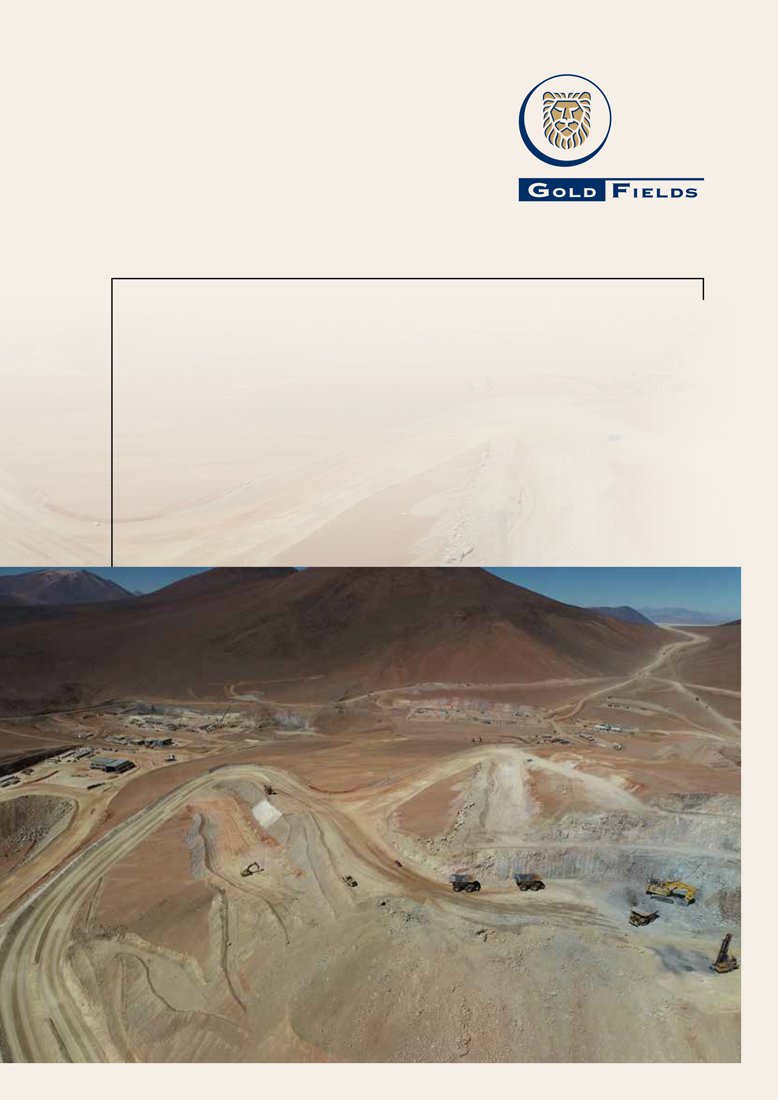
The cover photo of our 2020 Integrated Annual Report (IAR) shows our Salares Norte
project in the Atacama region in northern Chile. The project received the go ahead by
our Board of Directors in February 2020, and construction is progressing as per plan
and expected to be completed in Q1 2023.
| CONTENTS | ||
|---|---|---|
| INTRODUCTION<br><br><br>**** | This section introduces our IAR<br>and approach to reporting. It<br>also offers an overview of our<br>seven strategic pillars and<br>portfolio of operations.<br><br><br> <br>In this<br>section, our Chairperson<br>provides an overview of our<br>reporting year. This is followed<br>by a detailed report from our<br>Chief Executive Officer (CEO),<br>who also explains what each of<br>the seven strategic pillars<br>means to our business,<br>along<br>with key trends over the past<br>10 years.<br> <br><br><br><br><br> <br>This<br>section introduces our<br>Board of Directors and<br>explains how our governance<br>processes adds value to our<br>business. We explain our<br>business model and how we<br>create enduring value for our<br>stakeholders and we disclose<br>our top<br>risks and associated<br>opportunities arising from our<br>operating environment.<br> <br><br><br><br><br><br><br><br><br><br><br><br><br><br> <br>In this<br>section, we provide a<br>detailed account of our 2020<br>performance against our seven<br>strategic pillars.<br><br><br><br><br><br><br><br><br><br><br><br><br> <br>This<br>section provides internal<br>and external assurance over<br>selected sustainability data<br>included in this report. Our<br>independent auditor’s report,<br>which provides assurance on<br>our consolidated financial<br>statements, is included in<br>our<br>Annual Financial Report (AFR). | |
| About this report | 3 | |
| Where Gold Fields operates | 6 | |
| <br><br> <br>OUR LEADERSHIP AND STRATEGY | ||
| Vision of the Chairperson | 10 | |
| Chief Executive Officer’s report | 12 | |
| Overview of strategic objectives | 19 | |
| Group Balanced Scorecards | 26 | |
| <br><br> <br>HOW WE OPERATE | ||
| <br><br> <br>Our board of directors | 32 | |
| How we govern our business | 35 | |
| Our business model | 38 | |
| Stakeholders and value creation | 40 | |
| Material matters | 43 | |
| Risks and opportunities | 44 | |
| <br><br> <br>OUR PERFORMANCE | ||
| Safety and wellbeing of our people | 52 | |
| Developing a fit-for-purpose workforce | 58 | |
| Creating a global, sustainable portfolio | 62 | |
| Profitable production and sustainable cash | 68 | |
| Capital allocation and sound balance sheet management | 76 | |
| Value creation for stakeholders | 81 | |
| Environmental stewardship | 96 | |
| <br><br> <br>ASSURANCE | ||
| <br><br> <br>First Party: Internal Audit statement | 106 | |
| Independent assurance statement – sustainability information | 107 | |
| Assured sustainability performance indicators | 110 | |
| Independent assurance statement – South African Mining<br>Charter | 111 | |
| Administration and corporate information | 112 |
SEND US YOUR FEEDBACK
Your feedback on our reporting suite is important to us. To ensure that we report on the issues our stakeholders care about,
please provide any feedback and questions to investors@goldfields.com or sustainability@goldfields.com, or visit
www.goldfields.com to download the feedback form.
| IAR-2 |
|---|
Table of Contents
| Gold Fields Integrated<br><br><br><br><br><br>Annual Report | 2020 | INTRODUCTION |
|---|
ABOUT THIS REPORT
OUR REPORT’S STAKEHOLDER AND STRATEGY FOCUS
The aim of our integrated reporting suite is to enable our stakeholders, including capital providers, to make an informed assessment of Gold Fields’ long-term sustainability and ability to create enduring value. We embrace integrated thinking, and by structuring our 2020 IAR around our strategic pillars (p11), we concisely and transparently articulate how our material matters, risks and opportunities, operating environment, performance and prospects unlock value for stakeholders.
In compiling this IAR, we complied with the Global Reporting Initiative (GRI) Standards: Core option and the International Integrated Reporting Council’s (IIRC’s) International <IR> Framework. As detailed on p3 of our AFR, we have also aligned this report with a range of additional codes, frameworks and standards, including the King IV Report on Corporate Governance for South Africa 2016 (King IV^T^^M1^). On occasion, we use non-International Financial Reporting Standards (IFRS) measures in the IAR, as defined on p133 – 137 of the AFR.
| ^1^ | Copyright and trademarks are owned by the Institute of Directors in South Africa NPC and allof its rights are reserved. |
|---|
REPORTING SCOPE AND BOUNDARY
This IAR presents Gold Fields’ strategic pillars, business model, Group and regional risks and opportunities, stakeholder expectations and operational performance for the financial year 1 January 2020 to 31 December 2020. It includes material information relating to our nine operations in Peru, Australia, South Africa, West Africa (including our Asanko JV), and one project in Chile.
Any material events after year-end and up to the Board approval date of 31 March 2021 have also been included. Our geographical footprint is detailed on p4 – 5.
The term “attributable” as it relates to production and Mineral Reserves refers to 100% of our mines and projects, as well as Damang (90%), Tarkwa (90%), Gruyere (50%), Asanko (45%) and Far Southeast (FSE) (40%). The exception is attributable Mineral Reserves at South Deep (91%). The term “managed” relating to production and Mineral Reserves refers to 100% of our mines and projects, as well as Gruyere (50%), Asanko (50%) and FSE (40%). The net debt: EBITDA ratios mentioned in this report refer to adjusted EBITDA, while we present Group and mine All-in costs (AIC) and All-in sustaining costs (AISC) in terms of the original World Gold Council interpretation.
Non-financial data included in this IAR relates to our eight operating mines and excludes our non-managed Asanko JV and the Salares Norte project in Chile, unless stated. Where relevant, we include data from Darlot (sold in 2017) up to October 2017. Socio-economic development (SED) spend, includes the South Deep trusts and project spend.
We used average exchange rates for 2020 of R16.38/ US$1 and US$0.69/A$1 in this report (2019: R14.46/ US$1 and US$0.70/A$1; 2018: R13.20/US$1 and US$0.75/A$1). For 2021, we used forecast exchange rates of R17.50/US$1 and US$0.75/A$1.
IAR REPORTING BOUNDARY

FORWARD-LOOKING STATEMENTS
This IAR contains forward-looking statements within the meaning of section 27A of the U.S. Securities Act of 1933 (the Securities Act) and section 21E of the U.S. Securities Exchange Act of 1934 (the Exchange Act) with respect to Gold Fields’ financial condition, results of operations, business strategies, operating efficiencies, competitive position, growth opportunities for existing services, plans and objectives of management, markets for stock and other matters. Such forward-looking statements can be identified by the use of forward-looking terminology, including the terms “believes”, “estimates”, “plans”, “anticipates”, “aims”, “continues”, “expects”, “hopes”, “may”, “will”, “would” or “could” or, in each case, their negative or other various or comparable terminology.
These forward-looking statements, including, among others, those relating to Gold Fields’ future business prospects, revenues and income, wherever they may occur in this IAR, are necessary estimates reflecting the best judgement of Gold Fields’ senior management and involve a number of risks and uncertainties that could cause actual results to differ materially from those suggested by the forward-looking statements. Consequently, these forward-looking statements should be considered in light of various important factors, including those outlined in this IAR. Gold Fields undertakes no obligation to publicly update or release any revisions to these forward-looking statements to reflect events or circumstances after the date of this report or to reflect the occurrence of unanticipated events.
 Refer to the full forward-looking statements on www.goldfields.com |
|---|
| IAR-3 |
| --- |
Table of Contents
| Gold Fields Integrated<br><br><br><br><br><br>Annual Report | 2020 |
|---|
NAVIGATING OUR REPORT
ICMM, GRI AND UN SDG COMPLIANCE
The IAR forms part of our compliance with the GRI Standards, as well as the reporting requirements of the International Council on Mining & Metals (ICMM) Sustainable Development Framework, Principles and Position Statements (see p107 – 111 for the assurance hereof). Our compliance with the ICMM is addressed throughout this report and on our website, and details:
| ● | How our sustainable development policies align with the ICMM’s 10 Principles and mandatory<br>Position Statements |
|---|---|
| ● | How we identify specific sustainable development risks and opportunities |
| --- | --- |
| ● | The systems and approaches we implemented to manage the sustainable development risks and<br>opportunities identified |
| --- | --- |
| ● | Our performance across the identified material sustainable development risks and opportunities |
| --- | --- |
We present our self-assessment of adherence with the ICMM Principles and Position Statements online. We also align with the 10 Principles of the United Nations Global Compact (UNGC). We consider that this IAR, together with additional documents available on our website, complies with the requirements of the GRI Standards.
 Disclosures in accordance with the GRI Standards can be accessed at www.goldfields.com/sustainability-overview.php |
|---|
We aim to be the global leader in sustainable gold mining. In pursuit of this vision, Gold Fields positively contributes to the UN Sustainable Development Goals (SDGs). As part of our commitment to sustainable development, we actively seek out opportunities to collaborate with partners on a global level. In this way, we can support lasting social and economic progress to play our part in bringing an end to poverty, protecting the environment and ensuring growth in prosperity, where we operate
We identified the following 11 SDGs that we believe we can impact the most, thereby enabling meaningful change in co-operation with our peers in the mining and metals sector:

THE 2020 REPORTING SUITE

| IAR-4 |
|---|
Table of Contents
| Gold Fields Integrated<br><br><br><br><br><br>Annual Report | 2020 | INTRODUCTION |
|---|

| BOARD APPROVAL<br> <br>Gold Fields’ Board of Directors acknowledges its responsibility to ensure the integrity of this IAR. It is of the opinion that the 2020 IAR complies in all material respects with the relevant statutory and regulatory<br>requirements – particularly the International <IR> Framework, as updated in January 2021, IFRS and the South African Companies Act No 71 of 2008 (as amended). The Board further believes that the 2020 IAR addresses all material matters and<br>offers a comprehensive view of the Company’s strategic objectives, including how these enable Gold Fields to create value for stakeholders in the short, medium and long term. The Board unanimously approved the 2020 IAR – as well as the<br>2020 AFR, which includes our Annual Financial Statements – for release on 31 March 2021. |
|---|

Cheryl Carolus
ASSURANCE
ERM Southern Africa (ERM) provided independent reasonable assurance over key sustainability information in this report, which is prepared in accordance with the GRI Standards: Core option. As a member of the ICMM, we are committed to obtaining assurance in line with the ICMM Sustainable Development Framework: Assurance Procedure. ERM assured our statement on compliance with the ICMM Sustainable Development Framework, Principles and Reporting Requirements. The key sustainability performance data assured by ERM in 2020 is detailed on p107 – 111.
| IAR-5 |
|---|
Table of Contents
| Gold Fields Integrated<br><br><br><br><br><br>Annual Report | 2020 |
|---|
WHERE GOLD FIELDS OPERATES – 2020 PERFORMANCE
Gold Fields is a globally diversified gold producer with nine operating mines in Australia, Peru, South Africaand West Africa (including the Asanko JV), as well as one project in Chile. We have total attributable annual gold-equivalent production of 2.2Moz and attributable gold-equivalent Mineral Reserves of 52.1Moz. Our shares are listed on the JSE and ourAmerican depositary shares trade on the NYSE.

AMERICAS
Mines: Cerro Corona in Peru – copper, gold –
open pit mine
Project Salares Norte in Chile – gold, silver deposit
| Safety (TRIFR – Cerro Corona) | 0.58 |
|---|---|
| Workforce | |
| Employees | 568 |
| Contractors | 3,700 |
| Attributable gold-eq production(koz) | 206 |
| AIC (US$/eq-oz) | 1,119 |
| Net cash-flow (US$m)^1^ | 84 |
| Attr Gold Mineral Reserves (Moz) | 4.84 |

WEST AFRICA
Mines: Tarkwa, Damang and Asanko (50/50 JV) in
Ghana – open pit mines
| Safety (TRIFR)^2^ | 0.75 |
|---|---|
| Workforce^2^ | |
| Employees | 1,063 |
| Contractors | 5,940 |
| Attributable production (koz)^3^ | 787 |
| AIC (US$/oz)^3^ | 1,060 |
| Net cash-flow (US$m)^1,2^ | 290 |
| Attr Gold Mineral Reserves (Moz) | 6.41 |
^1^ Net cash-flow from operating activities less net capital expenditure (capex), environmental payments, lease payment and redemption of Asanko preference shares.
^2^ Excludes 45% of Asanko. ^3^Includes 45% of Asanko.
| IAR-6 |
|---|
Table of Contents
| Gold Fields Integrated<br><br><br><br><br><br>Annual Report | 2020 | INTRODUCTION |
|---|---|---|
| GROUP OVERVIEW<br> <br>Mines: Nine mines in Peru, South Africa, Australia and Ghana<br> <br>(incl. 45% of Asanko)<br><br><br><br> <br>Project: One project in Chile | CONTRIBUTION TO<br><br><br>GROUP ATTRIBUTABLE PRODUCTION<br> <br><br><br><br><br><br><br>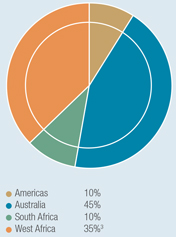 <br> |
|
| --- | --- | --- |
| Safety | ||
| Fatal incident | 1 | |
| TRIFR | 2.40 | |
| Workforce | ||
| Employees | 5,641 | |
| Contractors | 12,771 | |
| Attributable production (koz) | 2,236 | |
| AIC (US$/eq-oz) | 1,079 | |
| Net cash-flow (US$m)^1^ | 631 | |
| Attr Gold-eq Mineral Reserves(Moz) | 52.10 |

SOUTH AFRICA
Mines: South Deep – underground mine
| Safety | |
|---|---|
| Fatal incident | 1 |
| TRIFR | 3.51 |
| Workforce | |
| Employees | 2,342 |
| Contractors | 1,801 |
| Attributable production (koz) | 227 |
| AIC (US$/oz) | 1,260 |
| Net cash-flow (US$m)^1^ | 34 |
| Attr Gold Mineral Reserves (Moz) | 31.54 |

AUSTRALIA
Mines: St Ives, Granny Smith, Agnew and Gruyere (50/50 JV) – open pit and underground mines
| Safety (TRIFR) | 6.06 |
|---|---|
| Workforce | |
| Employees | 1,668 |
| Contractors | 1,330 |
| Attributable production (koz) | 1,017 |
| AIC (US$/oz) | 957 |
| Net cash-flow (US$m)^1^ | 498 |
| Attr Gold Mineral Reserves (Moz) | 7.49 |
| IAR-7 | |
| --- |
Table of Contents

| IAR-8 |
|---|
Table of Contents

| 2.1 | VISION OF THE CHAIRPERSON P10 – 11 |
|---|---|
| 2.2 | CHIEF EXECUTIVE OFFICER’S (CEO’S) REPORT. OUR VALUE-CREATION STRATEGY P12 – 18 |
| 2.3 | MESSAGE FROM THE INCOMING CEO P18 |
| 2.4 | OVERVIEW OF STRATEGIC PILLARS P19 – 25 |
| 2.5 | GROUP 2020 AND 2021 BALANCED SCORECARDS P26 – 29 |
| IAR-9 | |
| --- |
Table of Contents
| Gold Fields Integrated<br><br><br><br><br><br>Annual Report | 2020 |
|---|
VISION OF THE CHAIRPERSON
| “The Board has complete confidence in the ability of Gold Fields’ management team and its employees to continuedealing successfully with the ongoing impact of Covid-19”<br> <br><br><br><br>Cheryl Carolus |
|---|
DEAR STAKEHOLDERS
This past year has been a remarkable one for Gold Fields. Firstly, the outbreak of Covid-19 not only challenged our personal lives, but also business-as-usual across the regions where we operate. Secondly, despite the impact of the pandemic, Gold Fields had another year of impressive performance, with strong earnings, cash-flows and value creation for our stakeholders. Finally, 2020 was the last year that Nick Holland led the Company. He officially retired at the end of March. A memorable era in Gold Fields’ history has come to an end, and we are embarking on a new chapter with the appointment of Chris Griffith as Chief Executive Officer (CEO) from April onwards.
In last year’s report, I made initial reference to our management’s proactive and comprehensive approach to mitigating the early impacts of Covid-19 on our people and operations. None of us could have foreseen that, a year later, the pandemic would still be with us. Tragically, 10 of Gold Fields’ employees and contractors have lost their lives, as have many of our colleagues’ relatives. On behalf of the Board, I want to express our heartfelt condolences to the families and friends of those who have succumbed to Covid-19, as well as to our colleagues who have lost their loved ones.
In this Integrated Annual Report (IAR), we report extensively on how our teams managed to, first and foremost, protect our employees and contractors, assist our host communities and governments in mitigating the pandemic’s impact, and keep our mines and projects
operating strongly and safely. The Board receives regular updates, via its Risk Committee, of the actions taken by the Company.
We expect that the pandemic will remain a reality for months to come, perhaps even years, and could impact our operational plans in yet unforeseen ways. The Board has requested the Group’s management team to develop strategies on how we can assist in making vaccines available to our workforce, and, where appropriate, to families and communities, as well as prepare our people and business for this ‘new normal’. As such, we are exploring ways of supporting our employees who, for example, are now permanently working from home or are struggling as a result of the continued impact of Covid-19. At an operational level, we will continue to test our people, provide them with the necessary equipment and information to protect themselves, and help them in any possible way we can if they contract Covid-19.
The Board has complete confidence in the ability of Gold Fields’ management team and its workforce to continue dealing successfully with the ongoing impact of Covid-19. Our 2020 operational performance speaks for itself – despite the challenges and disruptions of the year, the Company delivered a strong set of results in 2020. The impact of Covid-19 was limited to approximately 3% of production (approximately 80koz) and, while our operations spent an additional US$30m to deal with the pandemic or donate to host governments, both costs and production were within revised market guidance.
The stable production and cost profile was supported by a record high gold price. Our financial results also benefited from the gold price, and included net cash-flow of US$631m and normalised earnings of US$879m – both more than double our performance in 2019. We reduced net debt by almost US$600m, placing our balance sheet in a very healthy position, and recorded a net debt:EBITDA ratio of 0.56x – the lowest it has been in almost a decade. Our shareholders received a total dividend of R4.80/ share, three times that of 2019. They also saw their shares hit record highs in 2020, though this has since retreated in line with the decline in the gold price from its record levels of over US$2,050/ oz in August last year.
In February 2020, our Board decided to go ahead with the US$860m Salares Norte project in Chile. Construction proceeded as planned during the year and is set for completion in Q1 2023. Salares Norte is the latest building block in the Company’s reinvestment programme of the past three years, during which we also effectively built two new mines, Gruyere in Australia and the Damang Pit Cutback in Ghana. Both mines contributed meaningfully to the Group’s cash-flow during 2020. I am also particularly pleased to report that South Deep again showed strong financial and operational improvements and contributed positive cash-flow during 2020.
Gold Fields continues to focus on maximising in-country and host community economic impact. The Group’s value distribution to national economies amounted to US$2.85bn in 2020 compared with US$2.58bn in 2019. Of this, US$676m, 28%
| IAR-10 |
|---|
Table of Contents
| Gold Fields Integrated<br><br><br><br><br><br>Annual Report | 2020 | OUR LEADERSHIP ANDSTRATEGY |
|---|
of the total, remained with our host communities. We achieved this by maximising the number of people we employ from our host communities, prioritising procurement from local enterprises and channelling our socioeconomic development (SED) spend to these communities. Over the past five years, we have created over US$3.54bn in community value, which, we believe, presents a significant investment in the economic wellbeing of our host communities and the estimated 435,000 people who reside there.
At the same time, we need to ensure that our mining activities do not adversely impact the environment around our operations or denude the natural resources both our Group and host communities depend on. Pleasingly, we again recorded zero serious environmental incidents for the second year in a row – a good yardstick of our success in this area. Similarly, our high levels of water recycling or reuse limited our uptake of freshwater from our catchment areas, while our continued investment in renewables is one of the ways we limit our carbon emissions. During 2020, we successfully commissioned two renewable microgrids at Agnew and Granny Smith in Australia. Furthermore, now that we have received the relevant approvals from the government, South Deep will be the next operation in our portfolio to build a solar plant, which, once operational, expected in Q2 2022, will provide about 20% of the mine’s electricity needs.
The most critical part of the Board’s duties undoubtedly relates to the safety, health and development of the Company’s workforce and the Board has always shared management’s commitment to eliminate all fatalities and serious injuries at our operations. Over the years, we have seen noticeable progress in this area emanating from our significant and continued investment in safety culture, systems and leadership. Tragically, however, we again recorded a fatal incident in 2020, that of Abel Magajane, a shaft timberman at South Deep, as well as six serious injuries. We owe it to Abel and the many other miners who have lost their lives, that we reaffirm our commitment to achieving zero harm.
The Board also seeks to further improve the diversity and inclusivity of the Company’s workforce. While we made some progress – with around 20% of our workforce and 21% of leadership teams now female – we still have a way to go to truly reflect the demographics
of the countries in which we operate. Our management team has developed a diversity and inclusion dashboard with several performance indicators, which are part of every manager’s scorecard, against which we can benchmark our improvements over the coming years. The Board will be closely tracking the Company’s performance in this regard.
With the rapid modernisation of our mines, we also need to ensure our workforce is appropriately skilled to meet the challenges of digitisation and automation. We are adapting training, skills development and recruitment policies accordingly to ensure our people can succeed in these new ways of working.
In recent years, managing environmental, social and governance (ESG) issues has become an increasingly critical consideration for our stakeholders – particularly investors. To date, Gold Fields has mostly relied on internal objectives to guide this ESG work; however, stakeholders expect that we report more publicly on progress in these areas. Together with management, the Board is developing a range of strategic ESG priorities, which we report on in this IAR. Before the end of the year, we will finalise and publish detailed targets for these priorities – ranging from safety to climate change, diversity and communities – for implementation by 2025.
Over the past few years, I have had the benefit of working with a consistent Board and Executive Committee (Exco) to govern, guide and manage the Company. This year, we saw some significant changes. At Board level, we accepted the resignation of Rick Menell, our Deputy Chairperson since 2015 and a director since 2008, with effect from 10 March 2021. Rick has been one of the most influential voices on the Board over this period and led the search for the new CEO this year. I want to thank Rick for his support and invaluable contribution.
We also accepted the resignation of Phuthi Mahanyele-Dabengwa due to her role as Naspers’ CEO. With the appointment of Philisiwe Sibiya, we found an equally well qualified leader with solid business experience. We wish Phuthi well in her leadership role and welcome Philisiwe to the Board. As always, I want to extend my gratitude to my fellow directors for their support and experience in providing Gold Fields with valuable strategic and governance oversight.
At executive level, we bid farewell to
Nick Holland after 24 years with the Company – first as Chief Financial Officer (CFO) and, from 2008, as CEO. Chris Griffith will assume the role of Gold Fields’ CEO from 1 April 2021. On behalf of the Board, we are delighted to have attracted a leader of Chris’ calibre. He has an extensive and successful leadership track record, amongst others, at Anglo American Platinum and Kumba Iron Ore, with many years’ experience as part of Anglo American’s global leadership teams. He has a strong track record of building and motivating successful teams to achieve corporate turnarounds and outstanding results. Chris is held in high regard for his strong ethical leadership and sound governance. We believe that under his leadership, Gold Fields will continue to grow, building on the solid foundation created by Nick, the leadership team and our entire workforce of 5,600 employees.
As Nick retires, he can certainly accept credit for a Company that has chartered its own course over the past decade, relying primarily on organic growth to become a global leader in mechanised and sustainable gold mining. As he set out to accomplish a few years ago, our portfolio of mines is now in a strong position to maintain production of 2.0Moz – 2.5Moz per year for the next 10 years without requiring expensive mergers or acquisitions.
More than just building a strong portfolio, Nick has established a Company that ensures its stakeholders share rightfully and meaningfully in the benefits of mining, while also delivering strong returns to the investors who have entrusted their capital to us. Gold Fields is an organisation with an unrelenting focus on the safety of its employees, its contractors and its communities. On his first day as CEO, Nick coined the phrase ‘If we cannot mine safely, we will not mine’. We have lived by this sentiment since then, ensuring it has become a mantra within Gold Fields and, perhaps, Nick’s most significant legacy.
Nick, you leave Gold Fields with the immense gratitude of the Board, your management colleagues and the Company’s employees. You truly deserve all the accolades bestowed upon you, and we wish you a well-deserved retirement.

Cheryl Carolus
Chairperson
| IAR-11 |
|---|
Table of Contents
| Gold Fields Integrated<br><br><br><br><br><br>Annual Report | 2020 |
|---|
CHIEF EXECUTIVE OFFICER’S REPORT
| “Our focus on organic growth, backed by consistent investment in near-mine exploration, has allowed us to map our owndestiny to the benefit of our stakeholders.”<br> <br><br> <br>Nick<br>Holland |
|---|
DEAR STAKEHOLDERS
This past year will always be remembered as a time when Covid-19 caused major losses and upheavals to our personal lives while disrupting business-as-usual for many companies worldwide. Our experience at Gold Fields was no different, and, tragically, the pandemic took the ultimate toll on many of our people. As at 29 March 2021, 10 of our colleagues had tragically passed away due to Covid-19-related illnesses. My condolences go out to their families, friends and colleagues. Other colleagues were ill for weeks, and all of us had our personal and professional lives severely disrupted by the stringent regulations and protocols implemented to mitigate the worst impacts of the pandemic.
Following a second wave of infections around the world in early 2021, it seems inevitable that these disruptions will continue for some time to come. We are currently looking at strategies on how we can continue keeping our people safe and how to ensure we make vaccines available to them as soon as is practical. We are seeking advice from medical experts and are working with governments, industry forums and our peers on the best solution for a vaccine roll-out and an eventual return to business-as-usual.
Covid-19 inevitably affected the Company’s 2020 operational performance, albeit marginally. Attributable gold-equivalent production of 2.236Moz in 2020 was 2% higher than 2019 production and
within the revised guidance range of 2.200Moz – 2.250Moz. However, we had to revise our original 2020 guidance of 2.275Moz – 2.315Moz in May to take into account the 78koz lost due to Covid-19-related shutdowns at South Deep (32koz) and Cerro Corona (46koz).
All-in costs (AIC) for 2020 were US$1,079/oz, 1% higher than 2019 (US$1,064/oz) and within the revised guidance range. All-in sustaining costs (AISC) for the year were US$977/oz (2019: US$897/oz), again within the revised guidance range. These costs were slightly above the original 2020 guidance as our operations spent approximately US$30m on Covid-19-related initiatives and interventions. This includes investments in testing
— GOLD FIELDS SHARE PRICE 2010 – 2020
| During 2020, our share price on both the JSE and NYSE improved by 46% and 42% respectively, on the back of respective increases of 94% and 88% during 2019. While the shares have retreated from their record<br>highs reached in August 2020, when the gold price hit its all-time high of US$2,070/oz, we are still offering shareholders substantive returns and healthy dividends. Shareholders who owned 1,000 Gold<br>Fields shares on 1 January 2010, held on to the 1,000 Sibanye Gold stocks (now Sibanye-Stillwater) they would have been awarded after its unbundling in February 2013, would have been rewarded with a total return of 105% by 31 December<br>2020. That is an annual return of 7% on their investment. |
|---|
| IAR-12 |
| --- |
Table of Contents
| Gold Fields Integrated<br><br><br><br><br><br>Annual Report | 2020 | OUR LEADERSHIP ANDSTRATEGY |
|---|---|---|
| equipment and facilities, specialised camp accommodation, additional labour costs and transport facilities. It also included<br>donations to governments and host communities to assist them in their fight against the pandemic.<br> <br><br><br><br>However, on the whole, Gold Fields managed these disruptions well and continued on its growth trajectory of the preceding years. The higher gold<br>price – a consequence, in part, of the economic fallout from the pandemic – certainly helped. The average gold price of US$1,768/oz during 2020 was 27% higher than the average price received in 2019. But, equally important, our management<br>teams dealt with the challenges of the pandemic extremely well, maintaining sustainable and profitable production while at the same time safeguarding the health and safety of our employees and contractors.<br><br><br><br> <br>Our mines in Western Australia, which did not report any positive Covid-19 cases, exceeded 1.0Moz of gold production for the first time since 2015. Our Ghanaian operations, including the Asanko JV, boosted output by 3%. Even South Deep and Cerro Corona, which had to close or<br>curtail mining and processing activities for several weeks due to government-imposed restrictions, reported stable production levels and lower costs during 2020.<br> <br><br><br><br>Our 2020 financial performance reflected these solid operational efforts and higher gold price. Our mines generated cash-flow of US$868m (2019:<br>US$552m), while net cash-flow reached a record US$631m (2019: US$249m). | OURVALUE-CREATION STRATEGY<br> <br><br> <br>Gold<br>Fields’ growth over the past 10 years has been driven by an integrated value-creation strategy aimed at delivering our vision of global leadership in sustainable gold mining. This strategy is captured in our BSC and comprises four<br>overarching focus areas – organisational capacity, internal business processes, stakeholders and financial performance.<br> <br><br><br><br>While our operating environment over the past decade saw some significant changes, we remained committed to these focus areas<br>regardless of the challenges we faced and, in doing so, unlocked the potential of our globally diversified business. With the Group BSC at the centre of our strategy, we subsequently identified seven strategic pillars that drive our performance<br>across the Company. Each pillar has specific key performance indicators linked to our BSC to ensure we create holistic and sustainable value for our stakeholders.<br> <br><br><br><br>On p17 – 21, we look at each of these pillars in our strategic journey and track the key operational, financial,<br>stakeholder and sustainability trends of the past 10 years.<br> <br><br> <br>The key corporate milestones in our strategic journey are highlighted in the share price graph below. | STRATEGIC PILLARS:<br><br><br><br> <br><br><br><br> <br> |
| --- | --- | --- |

| IAR-13 |
|---|
Table of Contents
| Gold Fields Integrated<br><br><br><br><br><br>Annual Report | 2020 |
|---|
CHIEF EXECUTIVE OFFICER’S REPORT CONTINUED ****
Net debt reduced by almost US$600m to US$1,069m, resulting in a net debt:EBITDA ratio of 0.56x at end-December 2020 (2019: 1.29x). Historically our target level for the net debt:EBITDA ratio has been around 1x. However, we have been opportunistically reducing our debt given higher gold price of late and could well be at or close to net zero within 18 months
Headline earnings increased more than four-fold to US$729m (2019: US$163m) and normalised profits more than doubled to US$879m (2019: US$343m). Shareholders received a total dividend of R4.80/ share, three times our distribution of R1.60/share in 2019. Our total value distribution to stakeholders increased to US$2,849m from US$2,577m in 2019.
The pandemic did not disrupt the continued improvements to the quality of our portfolio of mines and projects. Four years ago, and in contrast to the consolidation activities among our peers at the time, Gold Fields embarked on a US$1bn investment drive to ensure that our portfolio continued to generate cash sustainably by lowering AIC and extending mine life while preserving a sound balance sheet. In 2019, we saw the benefits of our investment programme for the first time in the form of improved profits and cash-flows, as well as lower costs. This trend continued strongly into 2020.
The key elements of the programme were essentially two new mines, Gruyere in Australia and the Damang Pit Cutback in Ghana, which contributed US$66m and US$76m respectively to Group net cash-flow in 2020. In 2018, we also acquired a 45% stake in the Asanko mine in Ghana for US$185m, with our JV partner Galiano Gold, which manages the mine, holding 45%, and the Ghanaian government the remaining 10%.
In February 2020, our Board decided to go ahead with the construction of the Salares Norte project in Chile, with construction proceeding as planned during the year, and set for completion in late 2022. Once operational, which is expected in 2023, Salares Norte is expected to add 450koz gold-
equivalent production per year for the first seven years at AIC of US$465/oz – one of the lowest in the industry. A successful equity raise of US$250m in February 2020 positions us to comfortably fund the project within our debt targets.
Another important element of our growth strategy was the continued investment in near-mine exploration at our Australian mines and, more recently, at Tarkwa and Damang in Ghana. As a result, we have been able to consistently replace and exceed the volumes of depleted Mineral Reserves. Over the past five years, since the December 2015 declaration, the Group has replaced 11.5Moz in depleted Reserves and added a further 4.5Moz through its successful exploration activities, technical studies and project investment. Gold Fields’ attributable gold-equivalent Mineral Reserves were 50.3Moz at the end of 2020, an increase of 2% from 2019, with our Australian mines replacing 8% of depleted Mineral Reserves.
The final pillar of our portfolio strategy was to set up our South Deep mine in South Africa for safe, sustainable and profitable production. While South Deep was the one in our portfolio hardest hit by Covid-19-related restrictions, it continues to report real progress and a strong financial and operational improvement. In 2019, South Deep stemmed its decade-long cash-burn by generating US$15m in net cash-flow. With 2020 production up 2% to 227koz and AIC unchanged at US$1,260/oz, net cash-flow improved even further, increasing by 123% to US$34m. My cautious optimism last year has been replaced by strong confidence that the mine is on the right track to generate long-term, sustainable cash-flows and profits.
I want to reiterate my statement from last year: Gold Fields is now a senior producer in the top 10 league of global gold miners both in terms of Reserves and production. We are in a strong position to maintain production of 2.0Moz – 2.5Moz per year for the
next 10 years, of which over 2.0Moz will be outside of our South African base. This is a level of production our mines in Ghana, Australia and Peru achieved in 2019 and 2020. Furthermore, once Salares Norte comes on stream, expected in 2023, we will have a portfolio of 10 mines – a size we consider optimal as it allows management to properly focus on operations.
As we have shown over the past few years, we do not require expensive mergers and acquisitions to achieve sustainable and profitable growth for our shareholders. Instead, our focus on organic growth, backed by consistent investment in near-mine exploration, has allowed us to map our own destiny to the benefit of our stakeholders.
ESG
Our commitment to safe production continues to underpin our operational performance. During 2020, we sought further improvements in terms of our safety leadership, processes, systems and culture. Tragically, we lost one employee at South Deep, Abel Magajane, after an underground mining incident. I would like to again express my condolences to his family.
We also reported six serious injuries (2019: four) across the Group. Our total recordable injury frequency rate (TRIFR) regressed to 2.40 per million hours worked (2019: 2.19). However, this remains below the industry norm of 3.20 (ICMM members – 2019 average). The physical distancing restrictions we imposed because of Covid-19 slowed down the roll-out of Courageous Safety Leadership (CSL) – our flagship safety programme – but we expect to complete this during 2021, having already trained over half of our employees.
One of the few positives emerging from the Covid-19 crisis has been the strong focus on the health of our employees and host communities. Safety has always been our number one value, but the pandemic forced us to give equal attention to the health and wellness of our people. Once the crisis is over, what we will retain going forward is the ability to test our workers for occupational and non-occupational diseases,
| IAR-14 |
|---|
Table of Contents
| Gold Fields Integrated<br><br><br><br><br><br>Annual Report | 2020 | OUR LEADERSHIP ANDSTRATEGY |
|---|
as well as understanding their mental wellbeing, and support them through any recovery processes.
Furthermore, the pandemic served as a catalyst to work more cooperatively with our key stakeholders — trade unions, communities, industry peers and governments. With Covid-19 threatening the livelihoods of employees and the tax income of governments, we found more common ground with these stakeholders. In most of the countries where we operate, governments declared mining an essential service, allowing us to continue operating when other sectors’ activities were curtailed. In return, we and other mining companies actively supported governments by providing facilities, health resources and much-needed funding. During 2020, our mines donated well over US$3m in medical and sanitary equipment and other services to host communities and governments.
In 2020, we continued to focus on driving our in-country and host community economic impact. Of the US$2.85bn in value created during 2020 (2019: US$2.58bn), US$676m, or 28%, remained in our host communities through wages, procurement spend and investments in socio-economic development. Approximately 53% of our workforce, 8,752 people, are employed from our host communities. In addition, we created 672 (2019: 504) non-mining jobs through our community investment programmes. Over the past five years, we have created between US$600m – US$800m in community value every year. Cumulatively, this amounts to over US$3.54bn which, we believe, presents a significant investment in the economic wellbeing of our host communities and their estimated 435,000 residents.
This year, we strengthened our commitment to diversity and inclusivity among our workforce. We aim to have a workforce profile that reflects the demographics of the countries and communities in which we operate. While we have made progress in this regard – particularly at South Deep, where Historically
Disadvantaged South Africans (HDSAs) now comprise 73% of the workforce, and women 23% – we are falling short when it comes to broader gender diversity across the Company. Only 20% of our Group workforce and leadership teams are women.
During 2020, we rolled out a Group diversity and inclusion dashboard that not only measures the representation of women at all levels in the Company but also evaluates lead indicators in the areas of inclusivity, recruitment, talent management, employee retention and corporate culture. As we improve these lead indicators, we believe that more women will join and remain at Gold Fields.
Climate change is undoubtedly one of the defining global challenges society is facing today. Gold Fields has made considerable progress in mitigating our contribution to climate change. Our efforts are led by energy savings and efficiency initiatives, which enabled us to save 804kt CO2e in emissions over the past six years – with the added benefit of cost savings for our operations.
Similarly, our recent investment in renewable energy projects not only secured stable and cost-effective energy supplies for our mines, but also reduced their carbon emissions. During 2020, we commissioned renewable microgrids, supported by battery storage, at our Agnew and Granny Smith mines in Australia. Agnew became the first gold mine in the world to derive over 50% of its power from renewable energy sources, mostly wind turbines supported by a solar plant and low-carbon gas. We have furthermore advanced plans to introduce renewables at Gruyere and St Ives, as well as Salares Norte when it starts operating in 2023.
In February 2021, South Africa’s national regulator approved the electricity generation licence for South Deep’s 40MW solar plant, following a three-year application process. Once approved by the Board, construction of the plant is set to take a year. The project will provide up to 20% of South Deep’s average electricity consumption and significantly reduce the mine’s carbon emissions.
Haulage diesel for our mining fleet accounts for half of the Group’s energy consumption. We are increasingly focusing on initiatives to reduce this, such as diesel-gas hybrid vehicles and, more ambitiously, looking at ways to introduce electric vehicles underground. Through the International Council on Mining & Metals (ICMM), we are working with our peers and equipment manufacturers to accelerate the development of electric vehicles for our primary fleet which, once rolled out, will have the added benefit of markedly reducing Diesel Particulate Matter (DPM) emissions from underground operations.
We have also improved our transparency around climate change issues by aligning our reporting with the recommendations of the Task Force on Climate-related Financial Disclosures (TCFD). We published our third TCFD-aligned Climate Change Report in conjunction with this IAR.
Sound management of water resources is another critical issue that has taken on renewed urgency as the climate changes, particularly in South Africa, Peru, Chile and Australia, which are water-stressed countries. Water is, of course, also a critical input for our processing activities. We have no option but to use water efficiently, which requires that we reduce our demand for freshwater from surrounding catchment areas. We set two key targets to ensure we efficiently manage our water usage. These are, firstly, reducing freshwater use by 3% – 5% a year and, secondly, recycling and reusing at least 70% of our water. We achieved both targets during 2020.
Our commitment to responsibly use our water resources is integral to sound environment stewardship at our operations. During 2020, for the second consecutive year, Gold Fields again recorded no serious environmental incidents. This is an important achievement, as environmental incidents could also potentially impact the communities around us and our social licence to operate.
The mining industry’s environmental practices have been in the spotlight
| IAR-15 |
|---|
Table of Contents
| Gold Fields Integrated<br><br><br><br><br><br>Annual Report | 2020 |
|---|
CHIEF EXECUTIVE OFFICER’S REPORT CONTINUED ****
following the catastrophic collapse of the tailings storage facility (TSF) at Vale’s Córrego do Feijão iron ore mine near Brumadinho, Brazil, in January 2019, which killed 270 people. Subsequent to this tragedy, ESG-focused investors and the United Nations (UN) Environment Programme engaged the industry through the ICMM to develop a new standard for managing tailings. In August 2020, the parties officially launched the Global Industry Standard on Tailings Management (GISTM), strengthening current practices by integrating social, environmental, economic and technical considerations. ICMM members have until August 2025 to fully implement the standard at all their TSFs, but all facilities that have high-potential consequences will have to conform to the standard two years earlier. Gold Fields is set to complete a gap analysis at its 37 TSFs by mid-
2021, after which we will commence work to close all identified gaps.
ESGCHARTER
Over the past decade, Gold Fields has integrated environmental, social and governance issues into the operational management of our mines and projects. Managing safety has always been an operational responsibility.
In recent years, successfully managing ESG issues has become a critical consideration for our stakeholders, particularly investors, who increasingly expect that we transparently disclose the impact of and how we manage ESG, as well as whether these align with Gold Fields’ strategy. Many of our peers have committed to performance targets, especially on climate change.
To date, Gold Fields has mostly used internal objectives to guide the
ESG work we do at our operations. We have decided to integrate high-level priorities into an ESG Charter to drive longer-term goals and are finalising detailed targets for implementation by 2025. These targets will be released later in 2021.
As we have for some time, we will again be including ESG-linked performance targets in the Group’s Balanced Scorecard (BSC) for this year (see p26) and in the long-term, three-year incentive plans for our senior employees (see our Remuneration Report in the AFR on p26 – 54).
Our ESG priorities are associated with wide-ranging objectives and strategic intents, including some previous public commitments. These are outlined in the table below, with details provided in the respective sections in this IAR:
GOLD FIELDS STRATEGIC ESGPRIORITIES
| Strategic priorities | Objectives | Strategic intents | Details |
|---|---|---|---|
| Partnering to ensure the safety, health and<br>wellbeing of our workforce and alleviating such impacts on our communities | Eliminating fatalities, serious injuries, illnesses and mental harm that could arise from our mining activities | 1. Zero<br>fatalities and serious injuries at our operations<br> <br><br><br><br>2. Eliminate vehicular incidents by implementing advanced collision avoidance<br>technologies<br> <br><br><br><br>3. Significantly reduce underground exposure to DPM<br><br><br><br> <br>4. Minimise health<br>and environmental impacts on our host communities | p51<br><br><br><br> <br>p52<br><br><br><br> <br><br><br><br>p54<br> <br><br><br><br>p89 |
| Build a diverse and inclusive workplace | Increase the proportion of women and Indigenous People in our workforce | 5. Increase the proportion of women in<br>our workforce, including women in leadership and women in mining in all our operating regions | p59 |
| Unlocking business, community and stakeholder<br>value | Maximise in-country and host community employment and procurement | 6. Maximise Group host community employment<br><br><br><br> <br>7. Maximise Group<br>host community procurement spend<br> <br><br> <br>8. Maximise Group in-country procurement | p85<br><br><br><br> <br>p84<br><br><br><br> <br>p84 |
| Pursuing decarbonisation and building resilience to climate change in line with<br>our commitment to the Paris Agreement for a just transition to net-zero carbon emissions | Reduce carbon emissions, freshwater use and exposure to climate-related risks to operations, stakeholders and the environment | 9. Continue pursuing carbon emissions<br>reductions at all our operations<br> <br><br> <br>10. Increase Group renewable energy use and include at least 20% renewables in all new projects<br> <br><br><br><br>11. Introduce electric vehicles in our underground operations<br><br><br><br> <br>12. Reduce freshwater use<br>and optimise Group water recycling and reuse levels | p100<br> <br><br><br><br>p101<br> <br><br><br><br><br> <br>p73<br><br><br><br> <br>p99 |
| Full compliance with the 2020 Global Industry<br>Standard on Tailings Management | Safe and responsible tailings management | 13. Achieve<br>and maintain compliance with the GISTM as committed to by ICMM members | p103 |
| IAR-16 | |||
| --- |
Table of Contents
| Gold Fields Integrated<br><br><br><br><br><br>Annual Report | 2020 | OUR LEADERSHIP ANDSTRATEGY |
|---|
EXTERNAL ENVIRONMENT
Of the external strategic dynamics that inform Gold Fields’ decision-making and influence our business performance, the gold price is the most significant. During 2020, the gold price continued the upturn that started early in 2019, when gold was trading at around US$1,300/oz. The metal traded at US$1,530/oz at the beginning of 2020, and hit an all-time high of US$2,070/oz in August before easing back to around US$1,800/oz at year-end and US$1,700/oz in March 2021. The average gold price received by our mines during 2020 amounted to US$1,768/oz, a 27% increase from the US$1,388/oz received in 2019.
The fluctuating gold price reflects the volatile external environment amid global economic and political uncertainties and, above all, the impact of Covid-19. Drivers supporting gold include increasing global debt, an expectation of higher inflation in key economies, continued low rates of interest, central bank support and continued geopolitical risks. This is tempered by reduced fabrication and jewellery demand for the metal.
While much of the gold price’s short-term movement is driven by market sentiment and geopolitical developments, gold’s role as an investment medium is still as relevant today as it has been for decades. Furthermore, primary supply appears to have peaked and years of underinvestment in the industry have set the scene for flat to lower gold production even in the face of higher prices. Mine supply, which in 2019 showed its first decline in 10 years, continued to decrease by 4% during 2020 according to the World Gold Council. Many gold market analysts are of the view that the industry has reached peak production levels given the limited number of new gold discoveries since the mid-1990s, together with the decreased levels of exploration spend over recent years. This could influence gold positively in the longer term.
We believe that capital expenditure in the industry has to increase, with companies needing to invest in new
projects and exploration activities to maintain current production levels. In our assessment, the recent spate of consolidation in the industry is a response to the under-investment in capex in recent years even in the wake of higher gold prices.
Gold Fields does not seek to predict the gold price. We expect volatility and structure our business accordingly to achieve a 15% FCF margin around a planning gold price of US$1,300/oz. Beyond that, we seek to maximise value by:
| ● | Prioritising cash-flow over production volumes |
|---|---|
| ● | Eliminating marginal mining |
| --- | --- |
| ● | Hedging a portion of our gold production in times of high capex and debt |
| --- | --- |
Therefore, we believe the Group is in a relatively strong state to weather a sustained lower gold price at just over US$1,000/oz, and well positioned to capture the upside of the higher price as we did in 2020.
Other external dynamics that impacted Gold Fields during 2020 were:
| ● | The Covid-19 pandemic – see p53, 57 and 87 |
|---|---|
| ● | Resource nationalism – see p92 |
| --- | --- |
| ● | Social licence to operate – see p82 |
| --- | --- |
OUTLOOK FOR 2021
This year will see another big capital investment for Gold Fields, with total capital expenditure (capex) guidance of US$1,177m for the year, of which US$538m is sustaining capital. Of the US$639m in project capital, US$508m will be allocated to Salares Norte, which is expected to be 70% complete by end-2021. Salares Norte will have a significant impact on Gold Fields’ long-term production and cost profile, as the mine will be producing 450koz gold-equivalent production per year for the first seven years at AIC of US$465/oz – one of the lowest in the industry.
In 2021, Group attributable production is expected to be higher at 2.30Moz – 2.35Moz. Given the high capital spend, AIC is set to be between US$1,310/oz – US$1,350/oz. Excluding capital spend on Salares Norte, we expect AIC of US$1,090/oz – US$1,130/oz. AISC is guided at US$1,020/oz – US$1,060/oz.
The main drivers behind production and cost guidance for 2021 are:
| ● | A 27% increase in production at South Deep to 290koz. The mine’s management team has a clear understanding of the operation and the different activities in the mining value chain. Looking<br>beyond 2021, we are confident that a further 20% – 30% can be added to production levels over the next four years |
|---|---|
| ● | Damang is moving into the heart of the Damang pit ore body. As such, the mine is guiding 23% higher production at 275koz and at significantly lower AIC of US$790/oz (2020: US$1,035/oz) |
| --- | --- |
| ● | Following its first full year of production during 2020, the Gruyere team is meeting production and processing targets. For 2021, the mine is guiding for production to increase by 9% to 280koz<br>(100% basis) |
| --- | --- |
The risk of stoppages due to Covid-19 has not been factored into any guidance estimates and the extent of Covid-19 impacts on either production or costs is indeterminable at this stage.
Gold Fields’ 2021 business plans are based on an average gold price of US$1,600/oz (A$2,100/oz, R900,000/kg).
NOTE OF THANKS
By the time you read this, I will have officially departed as Gold Fields’ CEO, and Chris Griffith would have stepped into the position on 1 April 2021. I want to welcome Chris to the Company and assure him that he is leading an organisation that is sound, sustainable and imbued with the right values. Above all, he will be working with a formidable group of people and can take comfort in the knowledge that this team will be behind him as he leads Gold Fields into the future.
I have been with Gold Fields in a leadership position since it was formed through the merger of Gold Fields of South Africa and Gencor’s gold assets in late 1997. My first 11 years were spent as CFO and, since 2008, I served as the Company’s CEO. It has been an eventful and sometimes tumultuous journey but, above all, enormously rewarding and humbling.
| IAR-17 |
|---|
Table of Contents
| Gold Fields Integrated<br><br><br><br><br><br>Annual Report | 2020 |
|---|
CHIEF EXECUTIVE OFFICER’S REPORT CONTINUED ****
The Gold Fields of today is unrecognisable from the company we founded 23 years ago. Most notably, the Company has expanded into a more global and modernised operation, while still retaining its roots in South Africa. I can honestly say with confidence that our current portfolio of mines is well positioned to create financial and economic benefits for its stakeholders on a standalone basis for years to come.
I am equally proud of the changes we instilled relating to our people, external stakeholders – particularly our host communities – and the environment we impact. The Company has an unshakable commitment to sustainability and our stakeholders are accruing real value from our mining activities. Environmental stewardship also enjoys a high priority among our management teams.
Our achievements would not have been possible without the full backing of the people of Gold Fields. I had the pleasure of meeting and getting to know as many of you as I could during my travels across the regions. Each and every one of you has made a valuable contribution to the success
of our Company. While we have jointly experienced some difficult times over the past few years, including wide-ranging restructuring initiatives and the Covid-19 pandemic, I believe we have emerged from them stronger. I extend my most sincere gratitude to you, my colleagues, recognising your commitment, resilience and expertise. ****
I have naturally worked more closely with some of you more than others. Paul Schmidt, our CFO, has been my right-hand man from the day I took over as CEO. He has always been a voice of financial reason, for which I continue to be extremely grateful. I also relied heavily on the members of the Company’s Executive Committee, who guided and advised me in managing a complex multinational organisation.
Finally, I would like to express my sincere gratitude to my fellow directors over the past 26 years. As CFO and CEO, I have had the privilege of working with a number of visionary Chairpersons: Brian Gilbertson, Alan Wright, Dr Mamphela Ramphele and, over the past eight years, Cheryl Carolus. They each provided valuable oversight and effective governance, while mapping
the strategy that led to Gold Fields’ successful transformation. I want to express a special note of gratitude to Rick Menell, who has been on the Board since I took over as CEO in 2008. His guidance on our corporate transactions and strategy in particular, has been invaluable over these years.
I leave Gold Fields with one major regret – that we still record fatalities and injuries at our operations. On the day I took office as CEO on 1 May 2008, nine miners at South Deep died when the cage they were being transported in plummeted down a shaft. At the end of that year, we reported an unfathomable 47 deaths. I have prioritised safe production by making safety our number one value. While our safety performance has significantly improved since then, even last year we still recorded one fatality and six serious injuries. Our goal of achieving zero harm proved to be elusive during my tenure, but I sincerely believe we have built the foundations to achieve this in the imminent future.

Nick Holland
CEO
MESSAGE FROM THE INCOMING CEO
As I step into the CEO role at Gold Fields, I want to first and foremost acknowledge the great work done by Nick Holland, his management team and all the employees at the Company.
It is a credit to Nick that, since he took over in 2008, the Company has been fundamentally transformed from a South Africa-centric and labour-intensive operation to one that is global, sustainable and ethical. It is a company I believe embodies global leadership in sustainable gold mining.
The strong performance and reputation of the Company is built on a number of pillars, and, together with the corporate and regional management teams, I plan to build on these successes.
These include the work Gold Fields has done in the area of sustainability, spearheaded by an uncompromising commitment to safety and health. But it also includes the Company’s
environmental stewardship, particularly its roll-out of renewable energy, and its ground-breaking work on community value creation through host community employment and procurement.
On the operational front, all the mines are at present contributing positively to the Group’s cash-flow and investing in their longevity by replacing depleted Mineral Reserves and Resources. The Group’s longer-term sustainability is ensured with the prospective, low-cost Salares Norte project in Chile, currently under construction.
There is clearly always room for improvement and I will be working with the teams on enhancing their financial and operational excellence, including further implementing innovation and digital technologies to improve safety, costs and efficiencies.
Not surprisingly, many stakeholders want to know if I will fundamentally change the strategy or portfolio of the Company. I will take my time to
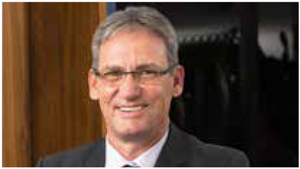
fully understand the business, its operations and the leadership team before taking a closer look at these wider strategic issues. Having said that, the gold market is very dynamic at the moment and it would be remiss of us not to be alert to opportunities that may add shareholder value.
Taking over the helm at Gold Fields is a great opportunity – and challenge. I look forward to working with one of the industry’s leading teams to build on the foundation laid by Nick. I want to thank him again for his leadership and wish him well in his retirement.
Chris Griffith
IncomingCEO
| IAR-18 |
|---|
Table of Contents
| Gold Fields Integrated<br><br><br><br><br><br>Annual Report | 2020 | <br><br> <br>OVERVIEW OF STRATEGIC PILLARS |
|---|
SAFETY AND WELLBEING OF OUR PEOPLE

Safety is Gold Fields’ number one value, and our operations continue to mine only as long as it is safe to do so. Over the past decade, we made significant progress in our efforts to eliminate all fatalities and serious injuries at our operations. Unbundling our labour-intensive legacy South African gold mines to Sibanye Gold (now Sibanye-Stillwater) in February 2013 immediately reduced both the number of fatalities at our operations and our TRIFR, the foremost indicator used in the global mining sector to measure safety performance. However, since then, we continue to record at least one fatality every year, as we did in 2020. We also recorded six serious injuries during 2020.
Over the past few years, all our mines have transitioned to the ISO 45001 safety management system that enables an integrated approach to health and safety management. Furthermore, safety management informs the annual performance bonuses of our executives, managers and the broader workforce.
In 2018, we formed a Group Safety Leadership forum and introduced
a range of programmes to drive the right behaviours across our business. First among them is our CSL programme, which aims to equip our employees with the practical tools needed to become safety leaders. Over 50% of our employees completed the CSL programme and, once this programme has been rolled out to all employees, we plan to extend our Australian behaviour-based programme, Vital Behaviours, throughout the Group. We are simultaneously implementing a range of new technology systems to enhance our employees’ safety, including people tracking, collision avoidance and traffic management.
Over the past 10 years, we have steadily intensified our efforts to prevent occupational diseases and health issues that impact our workforce. These include health risks associated with Noise-Induced Hearing Loss (NIHL), DPM, Silicosis and Tuberculosis (TB). We comply with all occupational health regulations and, in countries where regulations have not been promulgated, we follow industry best practice standards.
| 2020 PERFORMANCE<br><br><br><br> <br>Recorded one fatality (2019:<br>one)<br> <br>and six serious injuries (2019: four)<br><br><br><br> <br>TRIFR regressed to 2.40 per<br>million hours worked (2019: 2.19)<br> <br><br> <br>Recorded 10 Covid-19-related deaths among our employees<br> <br>(up to 29 March<br>2021)<br> <br><br> <br>Rolled out<br>extensive Covid-19 intervention programmes<br> <br><br> <br>CSL programme rolled out to 50% of employees<br> <br><br><br><br>First pay-outs to ex-mineworkers suffering from Silicosis in South Africa made from the Tshiamiso<br>Trust<br> <br><br> <br>Developed a Group<br>health guideline |
|---|
 For more details on our 2020 performance, refer to p50 – p55. |
The Covid-19 pandemic has further highlighted the impact of non-occupational diseases on our business. Our operations in Ghana and South Africa have long assisted our employees in dealing with Malaria and HIV/Aids, among others, and our approach to mitigating the effects of Covid-19 was no different. More recently, our operations have also introduced programmes to prevent and mitigate risks associated with mental health issues among our people.
SAFETY TRENDS FROM 2010 TO2020

| IAR-19 |
|---|
Table of Contents
| Gold Fields Integrated<br><br><br><br><br><br>Annual Report | 2020 |
|---|
DEVELOPING AFIT-FOR-PURPOSE WORKFORCE

As Gold Fields evolved over the past 10 years, so has our workforce profile. The most notable manifestation of the Sibanye Gold unbundling was the dramatic decrease in our workforce by about 30,000 people. Another feature of the past decade is increased modernisation at all our mines, which has required a change in the skills level of our employees. It has therefore become critical that we repositioned ourselves to build a pipeline of talent that will strengthen the sustainability of the Group.
Attracting and retaining the right skills starts with competitive, market-related and performance-based remuneration while also embracing modern working practices, such as flexible work arrangements. More than this, however, it also requires continued investment in training and development to meet the future needs of an increasingly mechanised, modernising and automated mining industry. We are also responsible for ensuring a safe and healthy workplace for our people, and for being a company they can be proud of by investing in the sustainability of our operations and the welfare of the communities we impact.
Our workforce profile has also changed in other ways. As at end-2020, contract workers across our regions accounted for about two-thirds of our total workforce. This necessitates close contractor management and ensuring that contractors align with Gold Fields’ values, policies and procedures – particularly those relating to safety, human rights and environmental management.
A second defining trend over the past decade has been the increased focus on host community employment. Members from our host communities now make up over half of our workforce, which aligns with our strategy of creating value for the communities in the regions where we operate.
Finally, our workforce has become more diverse and transformed – particularly in South Africa, where Historically Disadvantaged Persons (HDPs) are increasingly assuming a larger share of leadership positions. However, we recognise that we still have a long way to go before our workforce fully reflects the varying
| 2020 PERFORMANCE<br><br><br><br> <br>Improved gender diversity –<br>women comprise 20% of our global workforce, of which 50% are women in mining and 21% are in leadership<br> <br><br><br><br>86% of employees are nationals of the regions in which we operate<br><br><br><br> <br>US$676m of our value created<br>remained with our host communities<br> <br><br> <br>53% of our employees are from our host communities<br> <br><br><br><br>73% of the total workforce at South Deep are HDSAs |
|---|
 For more details on our 2020 performance, refer to p50 – p59. |
demographics of the countries in which we operate. To achieve this, we need to address unconscious bias in the workplace, capitalise on the value diverse perspectives bring to Gold Fields, and attract candidates from underrepresented backgrounds and host communities. While our definition of diversity extends beyond gender alone, we are aware that women only account for 20% of our employees across the Group and, therefore, enhancing gender diversity is a key focus area going forward.
WORKFORCE BY GROUP AND REGION (end-December)
| Total workforce | Employees | Contractors | Proportion of Nationals^1^ | ||||||||
|---|---|---|---|---|---|---|---|---|---|---|---|
| 2020 | 2010 | 2020 | 2020 | 2020 | |||||||
| Americas | **** | 4,268 | 346 | **** | 568 | **** | 3,700 | **** | 98% | ||
| Australia | **** | 2,998 | 562 | **** | 1,668 | **** | 1,330 | **** | 78% | ||
| South Africa | **** | 4,027 | 43,822 | ^2^ | **** | 2,226 | **** | 1,801 | **** | 84% | |
| West Africa | **** | 7,003 | 2,538 | **** | 1,063 | **** | 5,940 | **** | 99% | ||
| Corporate | **** | 116 | 98 | **** | 116 | **** | 0 | **** | 75% | ||
| Total | **** | 18,412 | 47,268 | **** | 5,641 | **** | 12,771 | **** | 86% |
^1^Employees only (not contractors)
^2^Workforce pre-Sibanye unbundling
| IAR-20 |
|---|
Table of Contents
| Gold Fields Integrated<br><br><br><br><br><br>Annual Report | 2020 | OVERVIEW OFSTRATEGIC PILLARS |
|---|
CREATING A GLOBAL, SUSTAINABLE PORTFOLIO
Gold Fields’ overriding strategic objective is to improve the quality of its portfolio by lowering Group AIC, thereby increasing our free cash-flow (FCF) to create value for our stakeholders. To achieve this, we employ various elements in the portfolio management process, including:
| ● | Acquiring or developing lower-cost (than Group average), longer-life assets |
|---|---|
| ● | Extending the life of current assets through near-mine brownfields exploration |
| --- | --- |
| ● | Focusing on in-country opportunities to leverage off our existing footprint, infrastructure and skills set |
| --- | --- |
| ● | Disposing of higher-cost, shorter-life assets |
| --- | --- |
All assets in our portfolio are subject to the Group’s annual strategic planning process, which assesses how each operation can best maximise cash-flow, life-of-mine and margin.
The composition and geographic distribution of Gold Fields’ portfolio
of assets fundamentally changed in 2013. The most significant changes were the unbundling of the legacy South African gold mines into Sibanye Gold in February 2013, as well as the acquisition of the Yilgarn South Assets (Darlot, Granny Smith and Lawlers) from Barrick Gold in Western Australia during October of that year. Before this, our South African assets accounted for 50% of total production. Now, our Australian mines comprise just under half of our portfolio.
We have been on an investment drive since 2017 to improve the sustainability of our production base. During this time, we invested US$347m into the Damang Reinvestment project, spent A$350m to acquire 50% of the Gruyere project and A$329m to build the mine, paid US$185m for a 45% interest in the Asanko mine in Ghana, and invested US$13m to restructure South Deep. Furthermore, in 2020, our Board gave the go-ahead for construction of the US$860m Salares Norte mine in Chile after spending US$161m in the preceding four years on project and exploration costs.
| 2020 PERFORMANCE<br><br><br><br> <br>Achieved the first full year of<br>production at Gruyere<br> <br><br><br><br>Damang Reinvestment project bearing fruit<br><br><br><br> <br>Commenced construction of the<br>Salares Norte project in Chile<br> <br><br> <br>Invested US$50m in near-mine exploration, mostly at our Australian mines<br> <br><br><br><br>South Deep recovery continues<br><br><br><br> <br>Increased Mineral Reserves to<br>52.1Moz |
|---|
| For more details on our 2020 performance, refer to p60 – p67. |
We promote the sustainability of our portfolio by investing in near-mine exploration, which averaged between US$50m – US$80m a year over the past five years. Since 2013, our Mineral Reserves position has remained relatively stable at around 50Moz as our successful exploration drives have replaced and exceeded the volumes of depleted Mineral Reserves.
Now, Gold Fields has a portfolio of nine mines and one project. We believe that a portfolio of no more than 10 mines is optimal, allowing management to properly focus on operations and maintain safe and profitable production of between 2.0Moz – 2.5Moz per year for the next 10 years.
| ATTRIBUTABLE GOLD-EQ PRODUCTION | ATTRIBUTABLE GOLD-EQ MINERAL RESERVES |
|---|---|
| IAR-21 | |
| --- |
Table of Contents
| Gold Fields Integrated<br><br><br><br><br><br>Annual Report | 2020 |
|---|
PROFITABLE PRODUCTION AND SUSTAINABLE CASH-FLOW

The core focus of Gold Fields’ strategy is to grow its FCF margin and sustain this in the long term. Therefore, when looking at growth within Gold Fields, we focus not on increasing our levels of production, but rather on reducing Group AIC, increasing the FCF margin per ounce of gold produced and sustainably extending the average reserve life per operation. The Group targets an FCF margin of at least 15% at a notional long-term planning gold price of US$1,300/oz. This provides a degree of downside resilience should the price decline below that level in the short term. At the same time, it means we can improve our margins should the gold price exceed that level – which has been the case for the last two years.
Our progress towards our target is supported by the gradual decline
of Group AIC to below US$1,100/ oz over the past few years. In Q4 2012 – the last quarter before the Sibanye Gold unbundling – Group AIC amounted to US$1,621/oz. All the while, our production levels held steady at around 2.20Moz.
The improved cost performance at stable production levels and the higher gold price received, as well as the gradual easing of our capex programme, ensured that net cash-flow from operating activities improved steadily over the past few years, culminating in inflows of US$631m in 2020. This translated into an FCF margin of 28% at a gold price of US$1,771/oz, meaning that we successfully exceeded our 15% target for four consecutive years. During 2021, our US$508m capex programme at Salares Norte will push up AIC temporarily.
| 2020 PERFORMANCE<br><br><br><br> <br>Achieved revised production and<br>cost guidance for the year<br> <br><br> <br>Limited the impact of Covid-19 on production to 3% of original guidance<br> <br><br><br><br>South Deep achieved record cash- flow of US$34m (2019: US$15m)<br><br><br><br> <br>Produced 1.0Moz at our Australian<br>mines, with Gruyere contributing for the full year for the first time<br> <br><br><br><br>Australian region tripled its net cash-inflow to US$498m<br><br><br><br> <br>Cerro Corona’s gold-equivalent<br>production declined by 29%<br> <br><br> <br>Damang continues to build-up production and lower AIC |
|---|
| For more details on our 2020 performance, refer to p68 – p73. |
GROUP AIC AND CASH-FLOW TRENDS FROM 2012 TO 2020
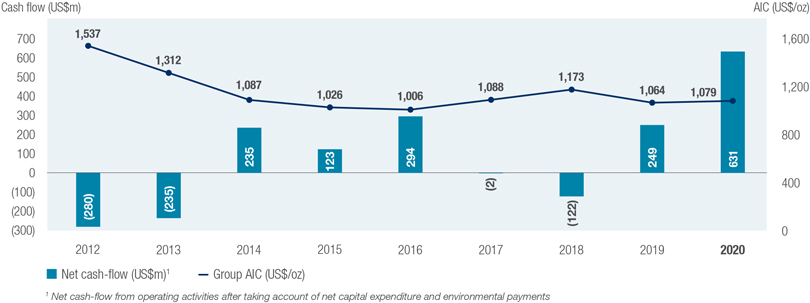
| IAR-22 |
|---|
Table of Contents
| Gold Fields Integrated<br><br><br><br><br><br>Annual Report | 2020 | OVERVIEW OFSTRATEGIC PILLARS |
|---|
CAPITAL ALLOCATION AND SOUND BALANCE SHEET MANAGEMENT

Our priorities for the free cash-flow (FCF) we generate are:
| ● | Strengthening the balance sheet: At the height of the growth capital cycle at the end of 2018, the Group’s net debt:EBITDA (excluding lease liabilities) peaked at 1.45x. With Gruyere<br>and Damang now at or approaching steady state, we have used the free cash generated in 2020 to reduce net debt further and strengthen our balance sheet |
|---|---|
| ● | Funding growth projects: Capex for the Salares Norte project in Chile is planned to total US$860m (in 2020 terms), a portion of which will be funded from cash-flow. Apart from the<br>Salares Norte project, there is no major growth capital budgeted for the medium term |
| --- | --- |
| ● | Returning dividends to shareholders: Gold Fields has a long and well-established Dividend Policy of paying out between 25% |
| --- | --- |
– 35% of normalised earnings to shareholders. During 2020, Gold Fields declared a total dividend of R4.80/share, which translates to 30% of normalised earnings
Gold Fields’ Hedging Policy allows for hedging to protect cash-flows, firstly, at times of significant capex, secondly, to address specific debt servicing requirements and, thirdly, to safeguard the viability of higher-cost operations. We do not enter into long-term systematic hedges, but do determine whether short-term hedging is appropriate.
Given the high levels of project capital incurred over the past three years, the Group has run an active hedging programme using short-term hedges to protect our cash-flow and balance sheet. These gold, copper, oil and foreign exchange hedges resulted in a net realised loss of US$417m in 2020.
| 2020 PERFORMANCE<br><br><br><br> <br>Continued reduction in net debt to<br>US$1,069m (2019: US$1,664m)<br> <br><br> <br>Excluding lease liabilities, net debt totalled US$640m at end-2020<br> <br><br><br><br>Net debt:EBITDA ratio of 0.56x (2019: 1.29)<br><br><br><br> <br>Total dividend payment of R4.80/<br>share (2019: R1.60/share)<br> <br><br><br><br>Loss on gold, copper, oil and foreign exchange hedges of US$239m<br><br><br><br> <br>Successful US$249m equity raise to<br>fund Salares Norte construction |
|---|
| For more details on our 2020 performance, refer to p74 – p80. |
With the project capital having largely been spent by mid-2019, the purpose of the hedging programme shifted to servicing debt, with management paying down almost US$600m during 2020 and the net debt:EBITDA ratio falling substantially below 1x. Gold Fields is generally active in the debt markets through a range of instruments to further improve the liquidity and profile of Group debt.
DEBT AND DIVIDEND TRENDS FROM 2010 TO 2020

| IAR-23 |
|---|
Table of Contents
| Gold Fields Integrated<br><br><br><br><br><br>Annual Report | 2020 |
|---|
VALUE CREATION FOR STAKEHOLDERS

The mining industry significantly impacts the countries and communities in which it operates. For Gold Fields, the stakeholders most material to our business are those who have a substantial influence on our ability to create value or secure our regulatory licenses, and those in our host communities who can influence our social licence to operate. We build relationships that are open, transparent and constructive, and actively engage with our key stakeholders on the issues they care about the most at the local level.
It is important that our local stakeholders receive material, real benefits from the mining activities taking place in their midst. Since 2013, our total value creation has ranked between US$2.4bn – US$3bn a year in the form of payments to suppliers, salaries and wages to employees, taxes and royalties to governments, dividend and interest payments to capital providers, as well as investments in socio-economic development (SED) in our host communities.
In addition, Gold Fields continues to focus on maximising in-country economic
impact. Of our procurement spend, 96% is to in-country suppliers, while, on average, 86% of our employees are in-country nationals.
In recent years, our host communities have emerged as the most critical stakeholder for our mines, and their success is essential for our operational sustainability. By creating jobs among our workforce for host community members, procuring goods and services from host community enterprises and investing in community projects, we deliver enduring value, while contributing to our communities’ social and economic growth and development. Our performance during 2020 illustrates this:
| ● | Along with our contractors, we employed 8,752 people, or 53% of our workforce, from host communities |
|---|---|
| ● | Host community procurement amounted to US$536m, or 29% of total spend |
| --- | --- |
| ● | Our investment in SED projects in our host communities totalled US$17m, and also created 672 non-mining jobs |
| --- | --- |
Our initiatives ensured that US$676m, or 28% of our total value creation, remained with our host communities in 2020. In 2015, before we commenced our
| 2020 PERFORMANCE<br><br><br><br> <br>Total value created for our<br>stakeholders amounted to US$2.85bn (2019: US$2.58bn)<br> <br><br><br><br>Provided over US$3.3m in support of governments’ and communities’<br>Covid-19 programmes<br> <br><br><br><br>Of our total value created, US$676m remained with our host communities<br><br><br><br> <br>Achieved a strong share price<br>performance, and paid R4.80/share in dividends<br> <br><br><br><br>Payments to governments amounted to US$381m (2019: US$254m) in the form of taxes and royalties<br><br><br><br> <br>Payments to business suppliers<br>totalled US$1,786m (2019: US$1,744m)<br> <br><br> <br>Paid a total of US$412m in wages and benefits to our employees (2019: US$395m)<br> <br><br><br><br>Published our first Report to Stakeholders |
|---|
| For more details on our 2020 performance, refer to p81 – p95. |
community value-creation programme the following year, total community value distribution amounted to a mere US$16m, as we did not actively promote or measure host community employment and procurement. Our cumulative host community value creation from 2016 – 2020 was US$3.54bn. This is a shift in approach from community contribution to delivering enduring value to our stakeholders.
| IN-COUNTRY EMPLOYEE AND HOST<br><br><br>COMMUNITY WORKFORCE | IN-COUNTRY AND HOST COMMUNITY<br><br><br>PROCUREMENT SPEND | HOST COMMUNITY VALUE CREATION<br> <br>RELATIVE TO SED SPEND |
|---|---|---|
| IAR-24 | ||
| --- |
Table of Contents
| Gold Fields Integrated<br><br><br><br><br><br>Annual Report | 2020 | OVERVIEW OFSTRATEGIC PILLARS |
|---|
ENVIRONMENTAL STEWARDSHIP

Gold Fields is committed to responsible environmental stewardship. The conservative use of water and energy resources by our mines is not only critical for them to remain effective, but also to limit the impact of our usage on the surrounding communities and environment. To facilitate this, Gold Fields strictly adheres to all local legislation and regulations, and is guided by a number of leading external standards. We have developed several Group environment-related policies – relating to environmental stewardship, climate change, materials and supply chain stewardship, water stewardship and tailings management – as well as a range of related guidelines.
Water is a key focus area of our environmental strategy. Not only is it becoming an increasingly scarce and expensive resource globally, but we also draw water from the same catchment areas as our local communities. In countries like Peru and Chile, for example, water management has become a key
source of friction and conflict between mines and their host communities.
A reliable and cost-efficient supply of energy is equally critical to our operations. Apart from labour, energy is the biggest operational cost at our mines. It is therefore critical that we use energy efficiently, as it is also a significant contributor to our carbon footprint in the form of Scope 1 and 2 emissions. The negative physical impacts of climate change are real and immediate, due to:
| ● | The long-term risks posed to our operations and surrounding communities because of extreme weather events, such as severe rainfalls and prolonged droughts |
|---|---|
| ● | Increasing efforts to regulate carbon emissions in most of our jurisdictions |
| --- | --- |
| ● | Taxes on non-renewable energy consumption increasingly being imposed by governments |
| --- | --- |
As such, Gold Fields’ climate change programme specifically focuses on energy management programmes to reduce emissions and energy costs, including the use of renewable
| 2020 PERFORMANCE<br><br><br><br> <br>Experienced no serious (Level<br>3 – 5) environmental incidents for the second consecutive year<br> <br><br><br><br>Ranked within the top five in the DJSI for the 10th straight year<br><br><br><br> <br>Spent US$257m on energy usage<br>(2019: US$300m)<br> <br><br><br><br>Increased energy consumption by 5% to 13,129TJ (2019: 12,498TJ)<br><br><br><br> <br>Achieved 80% of the 2017 to 2020<br>emissions reduction target of 800kt CO2e<br> <br><br><br><br>Launched renewable energy microgrids at Agnew and Granny Smith<br><br><br><br> <br>Started implementation of the new<br>GISTM to be completed by 2025<br> <br><br> <br>Recycled/reused 71% of our total water consumption, which is above ICMM targets<br> <br><br><br><br>93% of progressive rehabilitation plans implemented |
|---|
| For more details on our 2020 performance, refer to p96 – p103. |
energies and increasing the reuse and recycling of water. We integrate assessment of climate-related risks and opportunities in project studies, as well as operational and strategic planning.
| CO2 INTENSITY | ENVIRONMENTAL INCIDENTS |
|---|---|
| IAR-25 | |
| --- |
Table of Contents
| Gold Fields Integrated<br><br><br><br><br><br>Annual Report | 2020 |
|---|
GROUP SCORECARDS
WE ARE COMMITTED TO ACHIEVING OUR VISION OF BEING THE GLOBAL LEADER IN SUSTAINABLE GOLD MINING. OUR STRATEGY IS DESIGNED TOENABLE THE DELIVERY OF THIS VISION THROUGH AN INTEGRATED APPROACH. OUR STRATEGY, WHICH COMPRISES FOUR PILLARS – ORGANISATIONAL CAPACITY, INTERNAL BUSINESS PROCESSES, STAKEHOLDERS AND FINANCIAL PERFORMANCE – IS FURTHER INFORMED BY OURDEDICATION TO OPERATIONAL RESILIENCE, DEBT REDUCTION AND INTEGRATED THINKING. THE INFOGRAPHIC BELOW SHOWS HOW WE PERFORMED AGAINST OBJECTIVES SET IN THE GROUP 2020 SCORECARD.

| IAR-26 |
|---|
Table of Contents
| Gold Fields Integrated<br><br><br><br><br><br>Annual Report | 2020 | OUR LEADERSHIP ANDSTRATEGY |
|---|
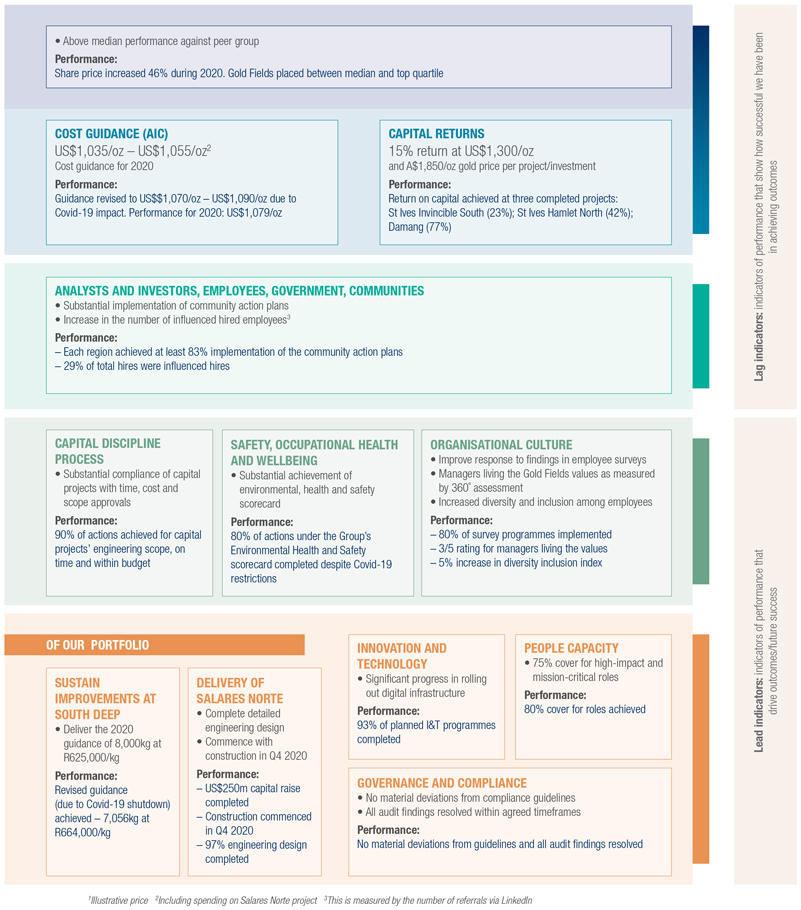
| IAR-27 |
|---|
Table of Contents
| Gold Fields Integrated<br><br><br><br><br><br>Annual Report | 2020 |
|---|
GROUP SCORECARDSCONTINUED ****
THE INFOGRAPHIC BELOW SHOWS THE KEY OBJECTIVES UNDER OUR GROUP 2021 SCORECARD

| IAR-28 |
|---|
Table of Contents
| Gold Fields Integrated<br><br><br><br><br><br>Annual Report | 2020 | OUR LEADERSHIP ANDSTRATEGY |
|---|

| IAR-29 |
|---|
Table of Contents

| IAR-30 |
|---|
Table of Contents

| 3.1 | OUR BOARD OF DIRECTORS P32 – 34 |
|---|---|
| 3.2 | HOW WE GOVERN OUR BUSINESS P35 – 37 |
| 3.3 | OUR BUSINESS MODEL P38 – 39 |
| 3.4 | STAKEHOLDERS AND VALUE CREATION P40 – 42 |
| 3.5 | MATERIAL MATTERS P43 |
| 3.6 | RISKS AND OPPORTUNITIES P44 – 46 |
| IAR-31 | |
| --- |
Table of Contents
| Gold Fields Integrated<br><br><br><br><br><br>Annual Report | 2020 |
|---|
OUR BOARD OF DIRECTORS
As the Company’s highest governing body, the Board of Directors assumes ultimate responsibility for Gold Fields’ adherence to sound corporate governance standards. The Board ensures that all business decisions are made with reasonable care, skill and diligence to maximise value for key stakeholders. Our Board comprises a diverse group of directors with the relevant knowledge, expertise, technical experience and business acumen to govern ethically and with honesty, transparency, responsibility, authenticity and impartiality. Below, we list our Directors as at 31 December 2020.
| VALUE-ADDINGEXPERIENCE | |
|---|---|
 CHERYL CAROLUS (62)<br> <br><br> <br>Chairperson<br> <br>BA Law; Bachelor of Education, University of the Western Cape; Honorary Doctorate in Law, University<br>of Cape Town (UCT)<br> <br>APPOINTED TO THE BOARD: Director, 2009<br><br><br>Chairperson, 2013 |
Governance and compliance, social<br>development, training and development, people management |
| RICHARD MENELL (65)<br> <br><br> <br>Deputy Chairperson<br> <br>BA (Hons), MA (Natural Sciences Geology), Cambridge; MSc (Mineral Exploration and<br>Management), Stanford University<br> <br>APPOINTED TO THE BOARD: Director, 2008, Deputy Chairperson, 2015, Lead independent director, 2017<br><br><br>Resigned with effect from 10 March 2021 |
Executive management, mining,<br>geology |
| NICK HOLLAND (62)<br> <br><br> <br>Chief Executive Officer (CEO)<br> <br>BCom; BAcc, University of the Witwatersrand (Wits); CA(SA)<br><br><br>APPOINTED TO THE BOARD: Executive director, 1998, CEO, 2008 Retired with effect from 31 March 2021 |
Finance, mining,<br>management |
| PAUL SCHMIDT (53)<br> <br><br> <br>Chief Financial Officer (CFO)<br> <br>BCom, Wits; BCompt (Hons),<br><br><br>University of South Africa (UNISA); CA(SA)<br><br><br>APPOINTED TO THE BOARD: Executive director, 2009, CFO, 2009 |
Finance, mining,<br>management |
| ALHASSAN ANDANI (59)<br> <br><br> <br>Independent non-executive director<br> <br>BSc (Agriculture), University of Ghana; MA (Banking and Finance), Finafrica<br>Institute in Italy<br> <br>APPOINTED TO THE BOARD: 2016 |
Mining management,<br>engineering |
| PETER BACCHUS (52)<br> <br><br> <br>Independent non-executive director<br> <br>MA (Economics) Cambridge University<br><br><br>APPOINTED TO THE BOARD: 2016 |
Investment banking, financing, mergers and<br>acquisitions |

| IAR-32 |
|---|
Table of Contents
| Gold Fields Integrated<br><br><br><br><br><br>Annual Report | 2020 | HOW WEOPERATE |
|---|
While we operate in contexts that are often driven by changing social and political trends, we believe our effective and ethical governance structures enable us to protect our reputation and social licence to operate while creating sustainable value for our stakeholders. We adhere to all relevant legislation and industry standards and are committed to upholding the principles of the King IV Report on Corporate Governance for South Africa 2016 (King IV) throughout our operations. We have also voluntarily aligned our business with several international standards and guidelines as detailed on p3 of our Annual Financial Report (AFR). Our King IV application register is detailed in our full Corporate Governance Report (p2 – 17 of our AFR). Our Board met four times during the year. Our 2020 Board and Board committee attendance was 99% (2019: 97%).
| VALUE-ADDINGEXPERIENCE | |
|---|---|
| TERENCE GOODLACE (61)<br> <br><br> <br>Independent non-executive director<br> <br>MBA (Business Administration),<br>University of Wales; BCom, UNISA; NHDip and NDip (Metalliferous Mining), Witwatersrand Technikon;<br> <br>MDP, UCT<br><br><br>APPOINTED TO THE BOARD: 2016 |
Mining, capital projects, commercial and<br>operational management, risk management, mineral resource management |
| CARMEN LETTON (55)<br> <br><br> <br>Independent non-executive director<br> <br>PhD (Mineral Economics), University<br>of Queensland; Bachelor Mining, Engineering, WASM<br> <br>APPOINTED TO THE BOARD: 2017 |
Mining engineering, corporate governance,<br>risk management, corporate strategy |
| PHUTHI MAHANYELE-DABENGWA (50)<br> <br><br><br><br>Independent NED<br><br><br>BA Economics, Rutgers, State University of New Jersey; MBA, De Montford University, Leicester<br><br><br>APPOINTED TO THE BOARD: 2018<br><br><br>Resigned with effect from 28 February 2021 |
Financial, infrastructure development, commercial |
| STEVEN REID (65)<br> <br><br> <br>Independent non-executive director<br> <br>BSc (Mineral Engineering), South<br>Australian Institute of Technology; MBA, Trium Global Executive; ICD.D, Institute of Corporate Directors<br> <br>APPOINTED TO THE BOARD:<br>2016 |
Mining engineering, risk management,<br>compensation management |
| YUNUS SULEMAN (63)<br> <br><br> <br>Independent non-executive director<br> <br>BCom, UKZN; BCompt (Hons), UNISA; CA(SA); CD(SA)<br><br><br>APPOINTED TO THE BOARD: 2016 |
Auditing, financial accounting,<br>governance |
NEW APPOINTMENTS SINCE 2020 YEAR-END
| PHILISIWE SIBIYA (44)<br> <br><br> <br>Independent non-executive director<br> <br>BCom (Hons), University of<br>KwaZulu-Natal (UKZN); CA(SA)<br> <br>APPOINTED TO THE BOARD: 2021 |
Executive management, finance,<br>telecommunications |
|---|---|
| CHRIS GRIFFITH (55)<br> <br><br> <br>CEO (with effect from 1 April 2021)<br> <br>BEng (Mining), University of Pretoria<br><br><br>APPOINTED TO THE BOARD: April 2021 |
Mining, executive management,<br>engineering |
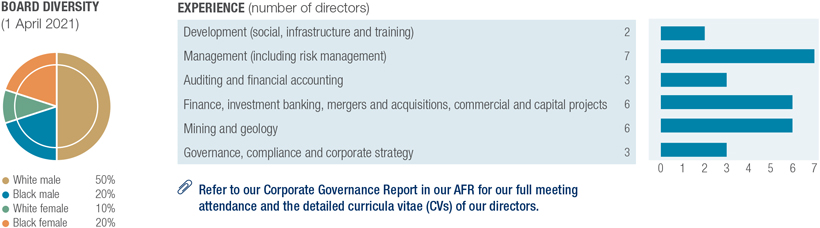
| IAR-33 |
|---|
Table of Contents
| Gold Fields Integrated<br><br><br><br><br><br>Annual Report | 2020 |
|---|
OUR BOARD COMMITTEES
as at 31 December 2020
| AUTHORITY ANDPURPOSE | |
|---|---|
 NOMINATING AND GOVERNANCE COMMITTEE<br> <br>Met seven times in<br>2020<br> <br>CHAIRPERSON: Cheryl Carolus<br><br><br>MEMBERS: Steven Reid, Rick Menell, Yunus Suleman |
Considers the composition and<br>effectiveness of the Board and its committees, as well as management as a whole. It is responsible for the succession of directors and key executives, and is involved in recruiting appropriately skilled directors. The Committee also ensures a robust<br>approach to the Company’s corporate governance. |
| REMUNERATION COMMITTEE<br> <br>Met five times in 2020<br><br><br>CHAIRPERSON: Steven Reid<br><br><br>MEMBERS: Cheryl Carolus, Alhassan Andani, Rick Menell, Peter Bacchus |
Assists the Board to ensure that the<br>Group’s remuneration practices are fair, responsible and equitable, and that it supports growth in stakeholder value. In particular, the Committee ensures that executive remuneration is directly linked to Gold Fields’ performance, thereby<br>protecting our key stakeholders’ interests by incentivising management to deliver value. |
| <br> SOCIAL, ETHICS AND<br><br><br>TRANSFORMATION (SET) COMMITTEE<br><br><br>Met four times in 2020<br><br><br>CHAIRPERSON: Carmen Letton<br><br><br>MEMBERS: Cheryl Carolus, Rick Menell, Alhassan Andani, Nick Holland, Phuthi |
Assists the Board to discharge its<br>oversight responsibilities relating to safety, security, health, environmental, social, ethics, human rights, sustainable development and stakeholder relationships. Furthermore, it holds the Company responsible for operating an ethical and<br>sustainable business in line with the principles of good corporate citizenship. |
| CAPITAL PROJECTS, CONTROL AND REVIEW COMMITTEE<br> <br>Met four times in<br>2020<br> <br>CHAIRPERSON: Rick Menell<br><br><br>MEMBERS: Peter Bacchus, Terence Goodlace, Yunus Suleman, Steven Reid, Cheryl Carolus, Phuthi Mahanyele-Dabengwa,<br>Carmen Letton |
Considers, reviews and approves new<br>capital projects exceeding US$200m and satisfies the Board that the Group has used correct, efficient methodologies in evaluating and implementing such projects. The Committee monitors progress throughout the project lifecycle and periodically<br>reports any findings to management and the Board. |
| RISK COMMITTEE<br> <br>Met seven times in 2020<br><br><br>CHAIRPERSON: Peter Bacchus<br><br><br>MEMBERS: Terence Goodlace, Carmen Letton, Yunus Suleman |
Assists the Board to establish Gold<br>Fields’ risks and opportunities. It also ensures that management identifies and implements appropriate risk management controls to ensure long-term value creation for stakeholders in a risk environment that continues to<br>evolve. |
| SAFETY, HEALTH AND SUSTAINABLE<br> <br>DEVELOPMENT (SHSD)COMMITTEE<br> <br>Met five times in 2020<br><br><br>CHAIRPERSON: Terence Goodlace<br><br><br>MEMBERS: Cheryl Carolus, Rick Menell, Steven Reid, Carmen Letton, Phuthi Mahanyele-Dabengwa |
Assists the Board to oversee the<br>effectiveness of the Group’s SHSD programmes and strategic plan. It also monitors the Company’s performance in this regard and ensures that it complies with relevant laws, regulations and external standards to ensure optimal safety, health<br>and environmental practices, contributing to the Group’s social licence to operate. |
| AUDIT COMMITTEE<br> <br>Met five times in 2020<br><br><br>CHAIRPERSON: Yunus Suleman<br><br><br>MEMBERS: Rick Menell, Alhassan Andani, Peter Bacchus |
Oversees the integrity and transparency of<br>Gold Fields’ corporate reporting and accounting practices, and considers risks that may affect external reports’ integrity. |
| AD-HOC INVESTMENT COMMITTEE<br> <br>Met once in 2020<br><br><br>CHAIRPERSON: Peter Bacchus<br><br><br>MEMBERS: Alhassan Andani, Yunus Suleman, Steven Reid, Cheryl Carolus, Rick Menell |
Considers and recommends, where<br>appropriate, strategic, organisational and structuring options for the Group to the Board, including investment and divestment opportunities, to maximise shareholder returns sustainably. |
 GROUP EXCO<br> <br>CHAIRPERSON: Nick Holland<br><br><br><br> <br>CEO: Chris Griffith<br><br><br>(with effect from 1 April 2021) |
Our Group Exco is responsible for<br>implementing the Group’s strategy and executing the Board’s mandate and directives. Exco meets at least every month to review Gold Fields’ performance against set strategic objectives, and develops strategies and policy proposals for<br>the Board’s consideration. It also assists the Board in the execution of the Company’s disclosure obligations. |
| Exco has 12 members in total, comprising the Company’s principal officers and executive directors. More information can be found on our website atwww.goldfields.com/our-leadership.php | |
| --- | |
| IAR-34 | |
| --- |
Table of Contents
| Gold Fields Integrated<br><br><br><br><br><br>Annual Report | 2020 | HOW WEOPERATE |
|---|
HOW WE GOVERN OUR BUSINESS
KEY DELIBERATIONS AND DECISIONS TAKEN BY THE BOARD IN 2020

| IAR-35 |
|---|
Table of Contents
| Gold Fields Integrated<br><br><br><br><br><br>Annual Report | 2020 |
|---|
HOW WE GOVERN OUR BUSINESS CONTINUED
HOW BOARD GOVERNANCE ADDS VALUE

| IAR-36 |
|---|
Table of Contents
| Gold Fields Integrated<br><br><br><br><br><br>Annual Report | 2020 | HOW WEOPERATE |
|---|
ENSURING WE DO BUSINESS ETHICALLY
THE STRUCTURES AND MECHANISMS USED TO DRIVE ETHICAL BUSINESS PRACTICE
The foundation of our business is based on strong ethics. Our Board and its committees are responsible for setting the ethical tone which, in turn, cultivates a culture of integrity and transparent reporting to our stakeholders. From this foundation, we build trust with our stakeholders, allowing us to strengthen our reputation and create sustainable value. We have numerous mechanisms in place to help to ensure we conduct our business ethically, adhere to compliance requirements and entrench good governance within the business.

| IAR-37 |
|---|
Table of Contents
| Gold Fields Integrated<br><br><br><br><br><br>Annual Report | 2020 |
|---|
OUR BUSINESS MODEL

| IAR-38 |
|---|
Table of Contents
| Gold Fields Integrated<br><br><br><br><br><br>Annual Report | 2020 | HOW WEOPERATE |
|---|
Gold Fields has firmly positioned itself as a global diversified gold producer with a quality portfolio of mechanised underground and open-pit mines. Our business model explains how we aim to fulfil our strategic objectives, as well as how we create, preserve or erode value for our stakeholders over time.

| IAR-39 |
|---|
Table of Contents
| Gold Fields Integrated<br><br><br><br><br><br>Annual Report | 2020 |
|---|
VALUE CREATION FOR OUR STAKEHOLDERS
The sustainability of our operations depends on mutually beneficial relationships with our key stakeholders. We therefore focus on constructive, transparent and open engagement which, we believe, will create enduring value for our stakeholders and the Company.
TOTAL AND NATIONAL VALUE DISTRIBUTION BY REGION AND TYPE 2020 (US$M)
| Employees | SED spend^1^ | Capital<br><br><br>providers | Business<br><br><br>partners | Governments | National valuedistribution | ||||||||
|---|---|---|---|---|---|---|---|---|---|---|---|---|---|
| Australia | 145 | 1 | 7 | 716 | 143 | 1,013 | |||||||
| Americas | 42 | 3 | 4 | 167 | 58 | 273 | |||||||
| South Africa | 86 | 3^2^ | 2 | 190 | 2^3^ | 283 | |||||||
| West Africa | 80 | 10 | 12 | 615 | 171 | 887 | |||||||
| Corporate | 60 | 0 | 229 | 98 | 7 | 394 | |||||||
| Total GoldFields | **** | 412 | ^4^ | **** | 17 | **** | 253 | **** | 1,786 | **** | 381 | **** | 2,849 |
| ^1^ | Socio-economic development spend in host communities | ||||||||||||
| --- | --- | ||||||||||||
| ^2^ | This includes US$1m from the South Deep trusts | ||||||||||||
| --- | --- | ||||||||||||
| ^3^ | South Deep does not yet pay income tax as it is in a loss-making position | ||||||||||||
| --- | --- | ||||||||||||
| ^4^ | This excludes benefits paid to employees working on capital projects | ||||||||||||
| --- | --- | ||||||||||||
 <br> Employees |
|||||||||||||
| --- | |||||||||||||
| VALUE DISTRIBUTION PER REGION | |||||||||||||
| --- | |||||||||||||
| PAYMENTS<br>INCLUDE | |||||||||||||
| salaries and wages, benefits and bonuses.<br> US412m | |||||||||||||
| paid in salaries and benefits<br> 53% | |||||||||||||
| host community employment |
All values are in US Dollars.
| IAR-40 |
|---|
Table of Contents
| Gold Fields Integrated<br><br><br><br><br><br>Annual Report | 2020 | HOW WEOPERATE |
|---|---|---|
 <br>Host Communities |
Number of engagements in 2020: 658 (2019: 364) | |
| --- | --- | |
| TOTAL COMMUNITY VALUE<br>DISTRIBUTION PER REGION1 | ||
| --- | ||
| PAYMENTS<br>INCLUDE | ||
| procurement, employee wages and investment in SED.<br> US17m | ||
| invested in SED<br> US536m | ||
| spent on host community procurement | ||
| US123m | ||
| spent on host community employee wages | ||
| Total: US676m |
All values are in US Dollars.
 <br>Capital providers |
Number of engagements in 2020: 508 (2019: 481) |
|---|---|
| VALUE DISTRIBUTION PER REGION | |
| --- | |
| PAYMENTS<br>INCLUDE | |
| interest and dividend payments.<br> US253m | |
| paid to the providers of debt<br>and equity capital <br>Reduced net debt by | |
| US595m |
All values are in US Dollars.
| IAR-41 |
|---|
Table of Contents
| Gold Fields Integrated<br><br><br><br><br><br>Annual Report | 2020 |
|---|
VALUE CREATION FOR OUR STAKEHOLDERS CONTINUED
| Business partners (contractors and suppliers) |
|---|
| VALUE DISTRIBUTION PER REGION |
| --- |
| PAYMENTS<br>INCLUDE |
| operations and capital procurement.<br> US1,786m |
| paid to suppliers and contractors<br> 29% |
| of mine operational and capital spend (excluding utilities) is with<br>host community firms |
All values are in US Dollars.
 Governments |
Number of engagements in 2020: 1,011 (2019: 899) |
|---|---|
| VALUE DISTRIBUTION PER REGION | |
| --- | |
| PAYMENTS<br>INCLUDE | |
| mining royalties and land-use payments, taxes,<br>duties and levies. <br>US381m | |
| paid in taxes and royalties | |
| US22m | |
| paid to the Ghana government in dividends relating to its 10% stake<br>in each of Damang and Tarkwa |
All values are in US Dollars.
| IAR-42 |
|---|
Table of Contents
| Gold Fields Integrated<br><br><br><br><br><br>Annual Report | 2020 | HOW WEOPERATE |
|---|
MATERIAL MATTERS
Our materiality analysis identifies the significant economic, environmental, social and governance factors that could substantively influence the decisions our capital providers and other stakeholders make about Gold Fields’ ability to deliver on its strategic objectives and create value over the short, medium and long term. This analysis contributes to the development of the Group’s business plans and strategies.
Gold Fields conducts an annual materiality analysis, which is informed by our strategic and risk management processes, among others. Our 2020 materiality analysis expands our 2019 build-up of material topics or matters. In the 2019 exercise we focused on revising and updating our scope and boundaries in line with our changing business footprint, confirmed our economic, environmental, social and governance-focused material matters, and prioritised and ranked those
topics that are most important to Gold Fields and our stakeholders.
During our 2020 analysis, we revisited our 2019 material topics to confirm their continued relevance to Gold Fields. The impact of Covid-19 – to both Gold Fields and our stakeholders – was a new material topic introduced to this year’s analysis, and has been rated as the most material matter during the year. We separated stakeholder engagement and relations from direct and indirect socio-economic benefits in 2020, mostly due to the significance of this topic to our stakeholders. The ranking of other material matters did not change in 2020, and there were no significant inclusions or exclusions from the overall matters identified previously.
We identified opportunities to diversify our stakeholder engagements and widen the number of interviewees from different stakeholder groups.
We were not able to have as many face-to-face stakeholder interactions as originally planned, but through electronic interviews and engagements, as appropriate, we could conduct and supplement our engagements while navigating Covid-19-related restrictions. This enabled us to receive input from material stakeholders across the Group, including employees, host communities, governments, industry associations, media, third parties and traditional authorities.
In line with our revised 2019 presentation of the material matters, we categorised our material matters as economic, environmental, social and governance. The 2020 materiality analysis is concluded with an internal validation process to confirm strategic alignment with our business.
The map below graphically represents the outcomes of the 2020 materiality assessment:
MATERIALITY ASSESSMENT

| IAR-43 |
|---|
Table of Contents
| Gold Fields Integrated<br><br><br><br><br><br>Annual Report | 2020 |
|---|
RISKS AND OPPORTUNITIES
Assessing the risks to Gold Fields’ sustainability is a collective effort by management at Group, regional and operational levels. This, along with identifying the appropriate mitigating actions, is a critical internal management tool to reduce the potential impacts of identified risks.
Risk mitigations are included in the annual Group performance scorecard and cascaded down to the performance scorecards of management employees at regional and operational levels. The formal risk review process starts during management’s annual strategic planning sessions, where strategic and emerging risks, as well as macro-trends, are analysed as part of developing the Company’s risk register and mitigating actions. These are reviewed and updated quarterly and presented to the Board’s Risk Committee twice a year for verification. As a global company, we continue to be shaped by the external dynamics in the regions where we operate. We discuss the impact of longer-term, emerging global trends in general and in Gold Fields on p45.
Top 20 Group risks in 2020
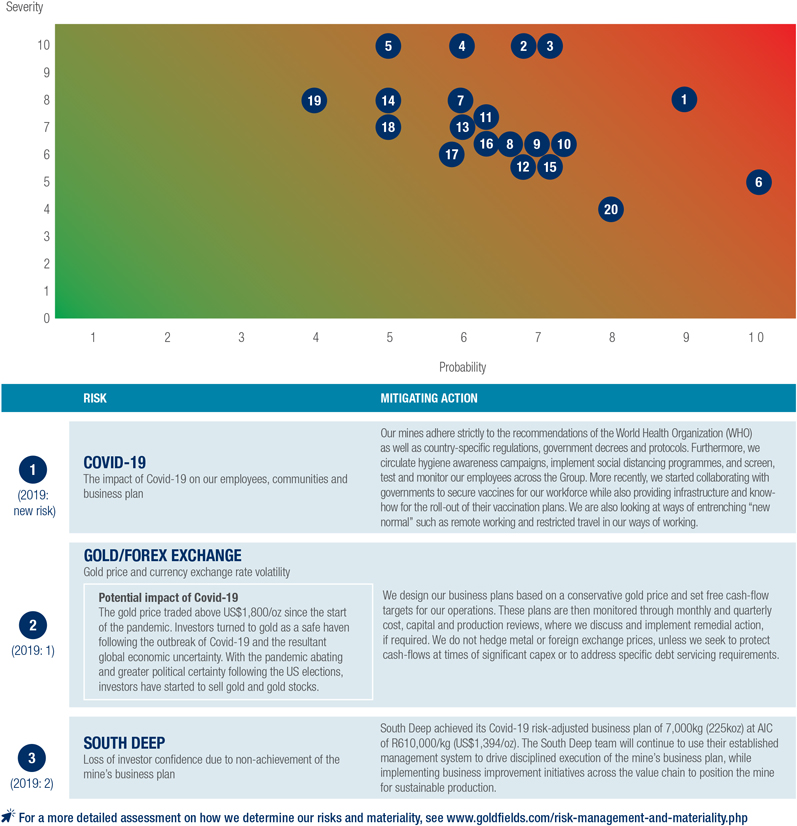
| IAR-44 |
|---|
Table of Contents
| Gold Fields Integrated<br><br><br><br><br><br>Annual Report | 2020 | HOW WEOPERATE |
|---|
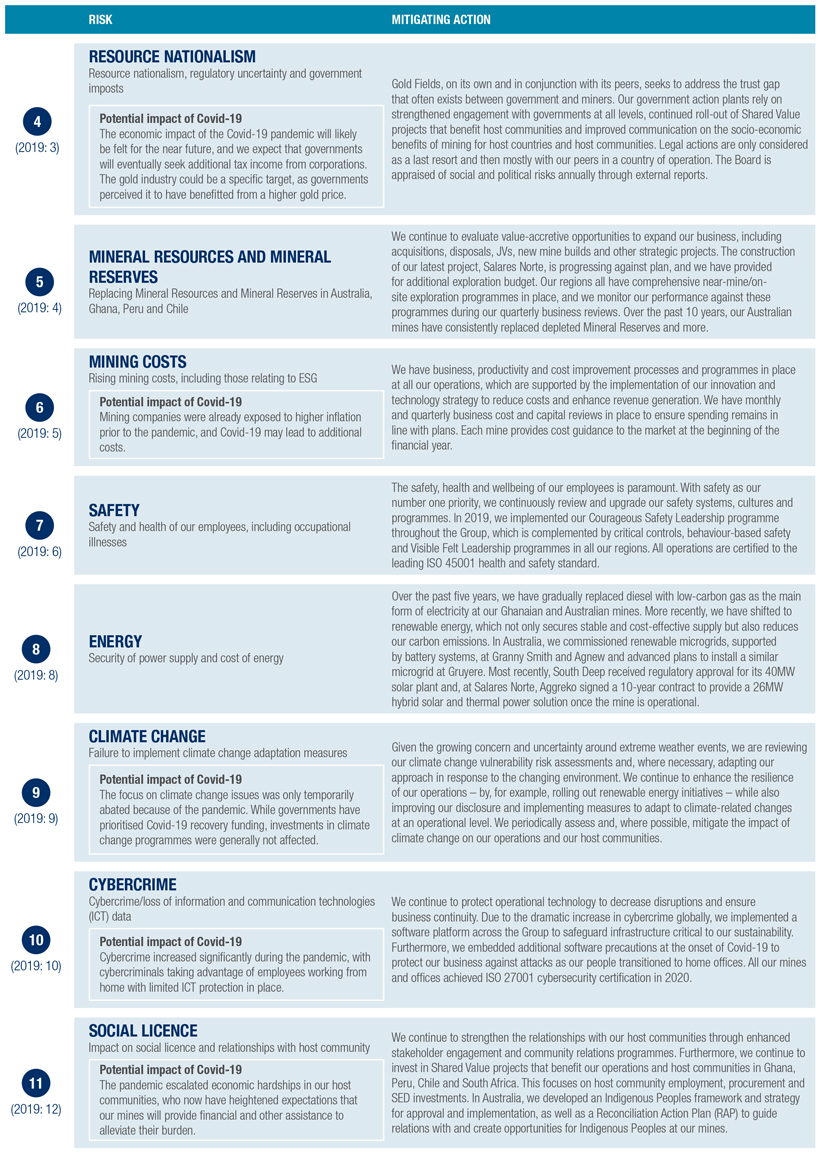
4 (2019: 3) 5 (2019: 4) 6 (2019: 5) 7 (2019: 6) 8 (2019: 8) 9 (2019: 9) 10 (2019: 10) 11 (2019: 12) RISK RESOURCE NATIONALISM Resource nationalism, regulatory uncertainty and government imposts Potential impact of Covid-19 The economic impact of the Covid-19 pandemic will likely be felt for the near future, and we expect that governments will eventually seek additional tax income from corporations. The gold industry could be a specific target, as governments perceived it to have benefitted from a higher gold price. MINERAL RESOURCES AND MINERAL RESERVES Replacing Mineral Resources and Mineral Reserves in Australia, Ghana, Peru and Chile MINING COSTS Rising mining costs, including those relating to ESG Potential impact of Covid-19 Mining companies were already exposed to higher inflation prior to the pandemic, and Covid-19 may lead to additional costs. SAFETY and health of our employees, including occupational illnesses ENERGY Security of power supply and cost of energy CLIMATE CHANGE Failure to implement climate change adaptation measures Potential impact of Covid-19 The focus on climate change issues was only temporarily abated because of the pandemic. While governments have prioritised Covid-19 recovery funding, investments in climate change programmes were generally not affected. CYBERCRIME Cybercrime/loss of information and communication technologies (ICT) data Potential impact of Covid-19 Cybercrime increased significantly during the pandemic, with cybercriminals taking advantage of employees working from home with limited ICT protection in place. SOCIAL LICENCE Impact on social licence and relationships with host community Potential impact of Covid-19 The pandemic escalated economic hardships in our host communities, who now have heightened expectations that our mines will provide financial and other assistance to alleviate their burden. MITIGATING ACTION Gold Fields, on its own and in conjunction with its peers, seeks to address the trust gap that often exists between government and miners. Our government action plants rely on strengthened engagement with governments at all levels, continued roll-out of Shared Value projects that benefit host communities and improved communication on the socio-economic benefits of mining for host countries and host communities. Legal actions are only considered as a last resort and then mostly with our peers in a country of operation. The Board is appointed of social and political risks annually through external reports. We continue to evaluate value-accretive opportunities to expand our business, including acquisitions, disposals, JVs, new mine builds and other strategic projects. The construction of our latest project, Salares Norte, is progressing against plan, and we have provided for additional exploration budget. Our regions all have comprehensive near-mine/on-site exploration programmes in place, and we monitor our performance against these programmes during our quarterly business reviews. Over the past 10 years, our Australian mines have consistently replaced depleted Mineral Reserves and more. We have business, productivity and cost improvement processes and programmes in place at all our operations, which are supported by the implementation of our innovation and technology strategy to reduce costs and enhance revenue generation. We have monthly and quarterly business cost and capital reviews in place to ensure spending remains in line with plans. Each mine provides cost guidance to the market at the beginning of the financial year. The safety, health and wellbeing of our employees is paramount. With safety as our number one priority, we continuously review and upgrade our safety systems, cultures and programmes. In 2019, we implemented our Courageous Safety Leadership programme throughout the Group, which is complemented by critical controls, behaviour-based safety and Visible Felt Leadership programmes in all our regions. All operations are certified to the leading ISO 45001 health and safety standard. Over the past five years, we have gradually replaced diesel with low-carbon gas as the main form of electricity at our Ghanaian and Australian mines. More recently, we have shifted to renewable energy, which not only secures stable and cost-effective supply but also reduces our carbon emissions. In Australia, we commissioned renewable microgrids, supported by battery systems, at Granny Smith and Agnew and advanced plans to install a similar microgrid at Gruyere. Most recently, South Deep received regulatory approval for its 40MW solar plant and, at Salares Norte, Aggreko signed a 10-year contract to provide a 26MW hybrid solar and thermal power solution once the mine is operational. Given the growing concern and uncertainty around extreme weather events, we are reviewing our climate change vulnerability risk assessments and, where necessary, adapting our approach in response to the changing environment. We continue to enhance the resilience of our operations – by, for example, rolling out renewable energy initiatives – while also improving our disclosure and implementing measures to adapt to climate-related changes at an operational level. We periodically assess and, where possible, mitigate the impact of climate change on our operations and our host communities. We continue to protect operational technology to decrease disruptions and ensure business continuity. Due to the dramatic increase in cybercrime globally, we implemented a software platform across the Group to safeguard infrastructure critical to our sustainability. Furthermore, we embedded additional software precautions at the onset of Covid-19 to protect our business against attacks as our people transitioned to home offices. All our mines and offices achieved ISO 27001 cybersecurity certification in 2020. We continue to strengthen the relationships with our host communities through enhanced stakeholder engagement and community relations programmes. Furthermore, we continue to invest in Shared Value projects that benefit our operations and host communities in Ghana, Peru, Chile and South Africa. This focuses on host community employment, procurement and SED investments. In Australia, we developed an Indigenous Peoples framework and strategy for approval and implementation, as well as a Reconciliation Action Plan (RAP) to guide relations with and create opportunities for Indigenous Peoples at our mines.
| IAR-45 |
|---|
Table of Contents
| Gold Fields Integrated<br><br><br><br><br><br>Annual Report | 2020 |
|---|
RISKS AND OPPORTUNITIES CONTINUED

12 (2019: 7) 13 (2019: 13) 14 (2019: 14) 15 (2019: 15) 16 (2019: not ranked) 17 (2019: not ranked) 18 (2019: 17) 19 (2019: 19) 20 (2019: 18) RISK SKILLS Attraction and retention of skills Potential impact of Covid-19 For now, the negative global financial and business impacts of Covid-19 resulted in a decrease in our turnover rate in most of the regions where we operate. The longer-term impacts of the pandemic, such as remote working and reduced travel, will fundamentally change the way we work. WATER pollution, security and reduction in freshwater consumption GEOTECHNICAL Increased geotechnical risk underground and in open pits associated with mining at depth, ageing pits and evolving mining operations GHANA CONTRACTORS Challenges with local mining contractors in Ghana CHILE Delays and cost overrun relating to the Salares Norte project POLITICAL RISKS Political uncertainty in the areas where we operate INFRASTRUCTURE Ageing infrastructure Potential impact of Covid-19 The pandemic illustrated that automation and digitisation are going to be major themes in mining – not just as a way to lower costs and improve productivity, but also to support remote workforces and reduce on-site presence. INFORMATION AND TECHNOLOGY Failure to modernise operations EZULWINI AND COOKE 3, 2 AND 1 Ezulwini and Cooke 3, 2 and 1 rewatering impact on South Deep MITIGATING ACTION Gold Fields’ business depends on fit-for-purpose human resource (HR) structures to meet operational requirements. We focus on developing a high-performance culture through our performance management system and by having the appropriate succession plans and talent reviews in place. Above all, we seek to provide competitive and incentive-focused remuneration packages that attract and retain sought after skills. We have also developed and implemented a diversity and inclusion dashboard, to track our progress in building a more diverse workforce. All our operations are certified to the ISO 14001 environmental standard, which require sound water management and disclosure. Furthermore, we developed and integrated three-year regional water management plans with our 2021 business plans at all our operations. Finally, water recycling, reuse and conservation practices are in place in all regions, with targets achieved for 2020. Work conducted by the Geotechnical Review Boards, consisting of independent and in-house industry experts, continued at South Deep for all major projects, the Australian underground operations, when necessary, and for all pit cutbacks at our other operations in Australia, Ghana and Peru. We are working closely with the two Ghanaian mining contractors at our Tarkwa and Damang operations to ensure that they meet their contractual obligations to the mines while at the same time remaining financially sound. This has required renegotiations of their contracts and bringing in OEMs to provide technical assistance for fleet maintenance, as well as financial support to provide debt relief and to procure additional fleet. With construction starting at Salares Norte during 2020, our team implemented robust project control systems. Performance against our project plan is monitored weekly and monthly and is tracking against plan. We continue to adhere to government-related Covid-19 restrictions, rules and laws, and have increased camp capacity to accommodate the required workforce. The team also maintains a close working relationships with authorities, environmentalists and local communities on the Chinchilla relocation project. Our strategy of geographic de-risking towards mining-friendly jurisdictions ensures that we operate in countries in which political risks are limited in the first place. Continuous engagement with our host communities and governments, either directly or through industry associations, is a primary tool in seeking to address emerging political risks. We conduct political risk assessments on a regular basis in all the countries in which we operate. Planned on-site maintenance and condition monitoring, which is conducted by third-party specialists, is key to ensuring the integrity of our fixed assets. Critical and long lead-time spares are kept on-site, and maintenance of critical spares is ongoing. To complement this, we instituted a process of independent risk management, fire prevention and infrastructure audits, which are conducted annually by insurance risk engineers and third parties. However, some of the inspections could not be carried out due to Covid-19 restrictions. We have sought in-country expertise to carry out independent assessments, where necessary. We continue to implement our innovation and technology strategy in pursuit of a Gold Fields Mine of the Future. As part of this, we have real-time software and telecommunications in place to track movement of equipment, people and production. We also work closely with original equipment manufacturers (OEMs) and suppliers to ensure that we are fast followers of new, beneficial mine technologies. A shift to renewable energies as well as the roll-out of electrical machinery and equipment also helps to modernise operations, while at the same time improving costs and safety. The reinforced concrete water plugs between South Deep and Ezulwini are subject to robust inspections, regularly planned maintenance and a condition-monitoring programme to ensure their integrity. There is a legal process for Ezulwini’s closure in place, in which we participate as an interested party backed by a robust legal strategy. South Deep is also seeking to work with Ezulwini to find alternative solutions to use the mine water.
| IAR-46 |
|---|
Table of Contents
| Gold Fields Integrated<br><br><br><br><br><br>Annual Report | 2020 | HOW WEOPERATE |
|---|
EMERGING GLOBAL TRENDS
As a global company, we continue to be shaped by the external dynamics in the regions where we operate. We closely observe these longer-term strategic and emerging risks, prioritising them as needed and adjusting our mitigating actions accordingly to protect the sustainability of our business. While many of our top 20 Group risks will remain relevant in the long term, we specifically monitor any developing any emerging trends that will inform adjustments to our strategy. This year we assessed, analysed and recommended ways to remediate the following five emerging (longer-term) trends that have been identified by the ICMM in partnership with Brodie Consulting:
| EMERGING<br><br><br>GLOBAL TREND | CONTEXT | STRATEGIC RESPONSES TO STRENGTHEN OUR FUTURE<br><br><br>MARKET POSITION |
|---|---|---|
<br><br><br> <br><br> <br>Ubiquity of<br><br><br>technology |
Tech-led mining will continue to disrupt business as we know it today, and while the expectation is that these disruptive<br>technologies could make our lives easier, it also leads to new and emerging risks to our business. | ● Investing in data innovation to enable real-time decision control and decision making<br><br><br>● Integrating data<br>across our value chain using real-time data platforms<br> <br>● Retraining and reskilling our workforce across the Group – including those employees from our host communities<br><br><br>● Implementing Gold<br>Fields’ innovation and technology (I&T) strategy to improve safety, productivity and lower cost<br> <br>● Leveraging the opportunity to transition to a virtual working environment to attract employees in the technology field without the need for<br>relocation |
<br><br><br> <br><br> <br>Extreme climate<br><br><br>change impacts |
The concern for<br>global environmental degradation continues to increase significantly. Our impact on the planet are becoming more evident – heat records across the world are broken regularly, the effects of which are detrimental to native fauna and flora. The<br>pressure to accelerate to a low-carbon economy is becoming increasingly important. Globally, 26 banks are no longer providing direct financing for new coal plant projects. Similarly, mining companies are<br>recognising the importance of reducing their carbon emissions to slow down climate change. | ● Setting time-bound (2030) targets with an accompanying roadmap for biodiversity<br><br><br>● Aligning<br>conservation efforts with climate resilience<br> <br>● Quantifying the financial value of natural resources, as well as our impact on them |
<br><br><br> <br><br> <br>New barometer<br><br><br>of ethics |
The Covid-19 pandemic, which led to high levels of joblessness, has substantially accelerated the erosion of trust around the world and raised increased attention on how companies treat their employees. Furthermore,<br>stakeholders increasingly link being a good employer to being a good business overall, with a company’s treatment of its employees as a barometer of trust. | ● Collaborating with key stakeholders to improve the general social perception of mining, and effectively applying the principles of a green and<br>circular economy<br><br><br>● Integrating our<br>social licence to operate and social performance into business decision-making, ensuring it becomes as important as protecting the health and safety of our employees |
<br><br><br> <br><br> <br>Capitalism reforms |
There is an<br>increased urgency for businesses to be more responsible than ever before. This requires a renewed focus on purpose and a move away from maximising shareholder value to solving the problems of people and planet profitably. Corporate action is<br>required to transform our current landscape into one that is more inclusive and cohesive by focusing on fairer market outcomes, investments that advance shared goals, and harnessing the innovations of the Fourth Industrial<br>Revolution. | ● Continue linking remuneration to environmental, social and governance (ESG) performance metrics to incentivise change<br><br><br>● More continuous<br>stakeholder interactions, including nongovernmental organisations (NGOs)<br> <br>● Open and transparent communication with our key stakeholders and the general public to further strengthen our reputation<br><br><br>● Enhancing the<br>compelling narrative on the importance of ESG to attract the next purpose-driven generation |
<br><br><br> <br><br> <br>Radical<br><br><br>transparency |
The importance of<br>risks relating to the regulatory landscape, including compliance, are expected to significantly increase over the next few years. Trust in all information sources is at a record low, and pressure from stakeholders is driving an enhanced focus on<br>transparency and ethical supply chains. It is essential that companies embrace digital technologies to keep up with increasingly stringent regulations, as well as customers’ expectations for transparency and disclosure. | ● Developing data platforms that provide real-time data accessible to outside stakeholders<br><br><br>● Reinforcing<br>confidence in Gold Fields as a mining company by complying with all regulatory requirements<br> <br>● Subscribing to transparency-focused initiatives, including EITI, Publish What you Pay (for taxation) and Transparency International<br><br><br>● Complying with best<br>practice disclosure practices, including the Global Industry Standard on Tailings Management (GISTM) |
| IAR-47 | ||
| --- |
Table of Contents
| Gold Fields Integrated<br><br><br><br><br><br>Annual Report | 2020 |
|---|
TOP FIVE RISKS PER REGION IN 2020
AMERICAS<br> <br><br><br><br><br><br><br> <br> |
AUSTRALIA<br> <br><br><br><br><br><br><br> <br> |
|---|

| IAR-48 |
|---|
Table of Contents
| Gold Fields Integrated<br><br><br><br><br><br>Annual Report | 2020 | HOW WEOPERATE |
|---|---|---|
SOUTH AFRICA<br> <br><br><br><br><br><br><br> <br> |
WEST AFRICA<br> <br><br><br><br><br><br><br> <br> |
|
| --- | --- |
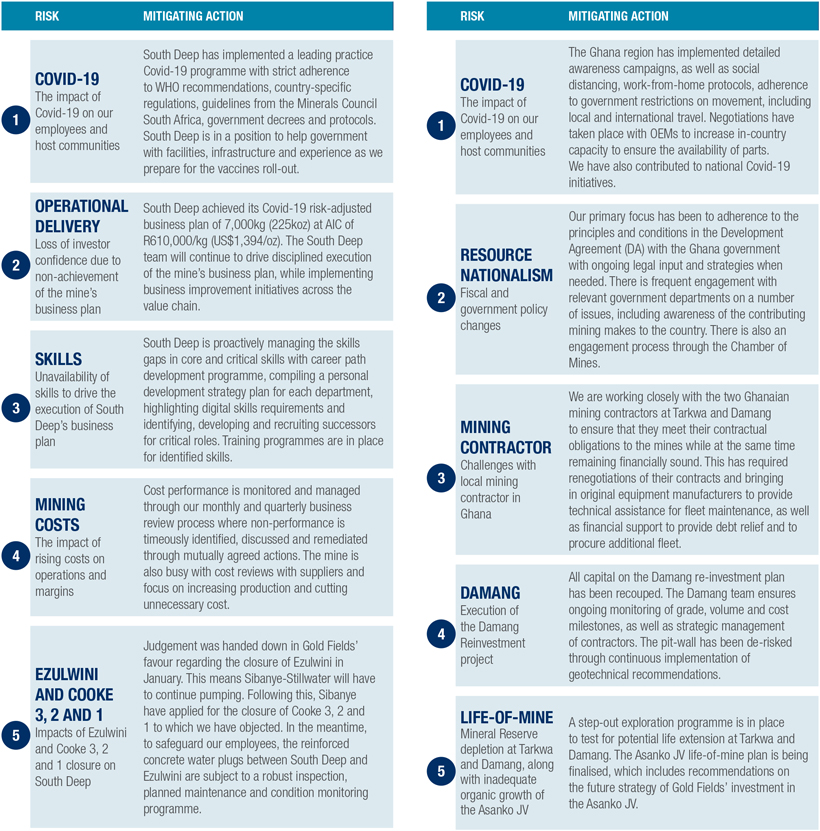
| IAR-49 |
|---|
Table of Contents

| IAR-50 |
|---|
Table of Contents

| 4.1 | SAFETY AND WELLBEING OF OUR PEOPLE P52 – 57 |
|---|---|
| 4.2 | DEVELOPING A FIT-FOR- PURPOSE WORKFORCE P58 – 61 |
| 4.3 | CREATING A GLOBAL, SUSTAINABLE PORTFOLIO P62 – 69 |
| 4.4 | PROFITABLE PRODUCTION AND SUSTAINABLE CASH-FLOW P70 – 75 |
| 4.5 | CAPITAL ALLOCATION AND SOUND BALANCE SHEET P76 – 82 |
| 4.6 | VALUE CREATION FOR STAKEHOLDERS P83 – 97 |
| 4.7 | ENVIRONMENTAL STEWARDSHIP P98 – 106 |
| IAR-51 | |
| --- |
Table of Contents
| Gold Fields Integrated<br><br><br><br><br><br>Annual Report | 2020 |
|---|

GOLD FIELDS 2021 BSC KPIs
| ● | Eliminate fatalities and serious injuries and remove people from risk | ||
|---|---|---|---|
| ● | Improve the health and wellbeing of our workforce | ||
| --- | --- | ||
| 2025 ESG CHARTER TARGETS | ASSOCIATED GROUP RISKS | ||
| --- | --- | --- | --- |
| Strategic priority | Strategic intents | No | Risk<br> <br><br><br><br>Covid-19<br> <br><br><br><br>The impact of Covid-19 on our employees, communities and business plan<br><br><br><br> <br>Safety<br><br><br><br> <br>Safety and health of our employees, including occupational<br>illnesses |
| Partnering to ensure the<br><br><br>safety, health and wellbeing<br><br><br>of our workforce and<br><br><br>alleviating such impacts on<br><br><br>our communities | Zero fatalities and serious injuries at<br>our operations | <br><br><br> <br><br> <br><br> <br><br> <br><br><br><br>  <br> |
|
| Eliminate vehicular incidents by<br>implementing advanced collision avoidance technologies | |||
| Significantly reduce underground exposure<br>to Diesel Particulate Matter (DPM) | |||
| Minimise health and environmental impacts on our host communities | RELATED SDG | ||
 |
Good health<br><br><br>and wellbeing |
TRADE-OFFS
Our trade-offs refer to the difficult decisions made during the year in the context of resource scarcity. Below are some of the significant actions taken during a difficult year to do so:
| ● | Funded Covid-19-related programmes and projects, which led to additional spend of about US$30m<br>AIC |
|---|---|
| ● | Invested substantially in environmental stewardship to mitigate any adverse environmental<br>impacts on our employees and communities |
| --- | --- |
| ● | Will invest significantly in implementing a gap analysis and aligning the Group with the GlobalIndustry Standard on Tailings Management (GISTM) to prevent potential future catastrophic failings by one of our tailings dams |
| --- | --- |
| IAR-52 | |
| --- |
Table of Contents
| Gold Fields Integrated<br><br><br><br><br><br>Annual Report | 2020 | OURPERFORMANCE |
|---|
SAFETY
Our number one value – safety – drives our goal of achieving zero harm, as well as our target of eliminating all fatalities and serious injuries at our operations. Safety is critical to enabling performance across the Group, and is therefore a significant component of the annual performance bonuses of our executives, managers and broader workforce.
Tragically, we recorded a fatal incident at our South Deep mine in South Africa. On 3 June 2020, Abel Magajane, a shaft timberman, fell down a shaft ore-pass chute while doing repair work and subsequently succumbed to his injuries. Following the incident, South Deep further strengthened its safety systems, leadership and processes. Our sincere condolences go out to Abel’s family, friends and colleagues.
The number of serious injuries recorded during 2020 increased to six (2019: four). Since 2019, we have applied Gold Fields’ definition in classifying serious injuries at Group level. Prior to that, at South Deep, we applied a regulated definition of
serious injuries, which we continue to use in our reports to the authorities. However, by applying Gold Fields’ definition of what constitutes a serious injury, we are able to focus on those injuries our operations can address with a greater sense of urgency.
While LTIs and the LTIFR declined year-on-year, serious injuries, total recordable injuries and the TRIFR, severity of incidents and their duration increased in 2020 when compared with 2019. Relying only on these reactive indicators to provide an overview of our safety performance may drive undesirable behaviours and affect the transparency of our reporting. As such, we moved away from using injury frequency rates as the sole indicators of our performance. Instead, we use a mix of leading and lagging indicators. We have structured the leading indicators around incentivising desired leadership behaviours, while the lagging indicators provide insight into the outcomes of our safety initiatives. The leading and lagging indicators are captured in each regions’ environment, health and
safety scorecards, which, in turn, are included in our incentive programmes for senior employees.
Leading indicators use proactive measures to pre-empt future incidents, such as near-miss incident reporting, timely close out of corrective actions on serious potential incidents (SPIs), and the Safety Engagement Rate (SER)^5^. Encouragingly, all leading indicators improved against or maintained their respective annual targets.
SER^5^
| 2020 | 2019 | 2018 | 2017 |
|---|---|---|---|
| 4.98 | 4.11 | 2.91 | 1.75 |
There has been a strong drive to encourage managers and employees to engage on safety matters, which, as seen in the continued increase in the SER, are having a positive impact despite social distancing and other Covid-19-related measures. We are confident that, over time, this behaviour will lead to further improvement in our safety culture and positively impact our performance.
GROUP SAFETY PERFORMANCE(EMPLOYEES AND CONTRACTORS)

| ^1^ | We also recorded non-occupational fatalities at our minesduring 2017 and 2018. In 2017, a member of the protection services team at South Deep was shot and killed during a robbery at the mine while, in 2018, a member of Tarkwa’s Community Security Task Force drowned in a settling pond on the mine |
|---|---|
| ^2^ | Since 2019, we have applied Gold Fields’ definition in classifying serious injuries. Interms of this definition, a serious injury is one that incurs 14 days or more of work lost and results in one of a range of injuries detailed at www.goldfields.com/safety.php |
| --- | --- |
| ^3^ | LTI is a work-related injury resulting in the employee or contractor being unable to attend workfor one or more days after the day of the injury. The employee or contractor is unable to perform any of his/her duties. LTIFR is per million hours worked |
| --- | --- |
| ^4^ | TRIFR = (fatalities + LTIs + restricted work injuries + medically treated injuries) x1,000,000/number of hours worked |
| --- | --- |
| ^5^ | SER = safety engagements x 1,000/number of hours worked. Safety engagements are conversationsbetween managers and the workforce to improve safety. Reporting of the SER commenced in 2017 |
| --- | --- |
| IAR-53 | |
| --- |
Table of Contents
| Gold Fields Integrated<br><br><br><br><br><br>Annual Report | 2020 |
|---|
SAFETY AND WELLBEING OF OUR PEOPLE CONTINUED ****
OUR APPROACH TO SAFETY
Group safety and health strategy
Our target of zero fatalities and serious incidents is supported by a Group safety and health strategy. The strategy – developed by the Group Safety Leadership forum, chaired by Stuart Mathews, Executive Vice-President: Australia, and approved by the Board Safety, Health and Sustainable Development Committee – rests on the following six core beliefs:
| ● | Our leadership is responsible and accountable for the Group’s health and safety performance |
|---|---|
| ● | Living the Gold Fields values is fundamental to our health and safety performance |
| --- | --- |
| ● | All employees should return home safe and healthy every day |
| --- | --- |
| ● | Prevention is better than cure and, therefore, risk management is a key component of all systems |
| --- | --- |
| ● | All injuries and incidents are preventable and rely on good leadership, practical systems and positive employee behaviours |
| --- | --- |
| ● | Safety management should be seamlessly integrated into all activities |
| --- | --- |
Furthermore, the strategy has three key objectives:
| ● | Develop a culture of safety leadership within the organisation and firmly embed safety management as a line management responsibility |
|---|---|
| ● | Provide appropriate mechanisms to engage employees on safety and equip them with the necessary skills to consistently achieve safe outcomes |
| --- | --- |
| ● | Ensure the deployment of fit-for-purpose management systems that are aligned with a critical control management<br>approach and are certified to ISO 45001 |
| --- | --- |
We continued to roll-out our Courageous Safety Leadership (CSL) programme in 2020, although Covid-19-related restrictions limited activities. The CSL programme equips our employees with practical tools to become safety leaders while also fostering an environment in which individuals feel empowered to speak out about unsafe behaviours. Improvements to our leading indicators are a positive sign of potential improvement. Training of employees and contractors in the Vital Behaviours programme, which entrenches the
right safety behaviours and choices, is planned for 2021 and beyond.
CSL training sessions were halted across all operations for much of Q2 2020. However, once Covid-19 restrictions eased in Q3 2020, sessions gradually started up again in Australia and West Africa. In South America, we transitioned to online CSL training sessions. Strict physical distancing measures in South Africa continued to affect the number of employees that could attend CSL training sessions. By year-end, 50% of our workforce had completed CSL training.
Improving safety management systems and controls
All our operations are now certified to ISO 45001, the leading health and safety management standard. South Deep was certified in February 2021, having previously operated under the OHSAS 18001 standard.
In 2017, we started to implement the ICMM’s critical control management approach, a process that is ongoing to date. After identifying and prioritising generic material unwanted events (MUEs), as well as the associated preventative controls and mitigating actions, regions identify the essential critical controls. External verification of the critical controls relating to the highest priority MUEs were completed in 2019, with the critical controls for lower priority MUEs being externally verified during 2020 and into 2021.
Innovation and technology to ensure greater employee safety
A key driver behind the further mechanisation of our operations is to improve the safety of employees. We have established dedicated innovation and technology leadership teams in all regions to drive initiatives that will improve safety, cost and productivity.
Gold Fields participates in the ICMM’s Innovation for Cleaner, Safer Vehicles (ICSV) programme, which was chaired until January 2021 by our CEO Nick Holland, to:
| ● | Reduce or eliminate any injury through vehicle interactions |
|---|---|
| ● | Ensure a healthier underground working environment free of diesel emissions |
| --- | --- |
| ● | Reduce greenhouse gasses (GHGs) through electrification |
| --- | --- |
The programme integrates with several of Gold Fields’ existing programmes that support this vision, including our:
| ● | Modernisation programme |
|---|---|
| ● | Group energy and carbon management strategy, with regional subcommittees and plans, aimed at reducing energy costs and GHG emissions |
| --- | --- |
| ● | Group occupational health and safety strategy, which is underpinned by regional plans aimed at improving safety and health at our operations |
| --- | --- |
| ● | Regional I&T roadmaps and programmes. |
| --- | --- |
Looking ahead, the following key initiatives are planned for 2021:
| ● | Deploying collision avoidance at South Deep: Deploying Level 9 collision avoidance systems in vehicles is equivalent to having adaptive cruise control on underground equipment, and<br>should enable pre-emptive accident avoidance between two vehicles and between machines and workers. It is also a legislative requirement in South Africa |
|---|---|
| ● | Improving wireless telecommunications: We are adopting wireless broadband telecommunication across our Australian surface operations, which enable real-time communication and data<br>transmission. Salares Norte similarly selected this telecommunication system as their preferred network. Tarkwa and Damang in Ghana are currently designing their wireless backbone. |
| --- | --- |
| ● | Operating equipment remotely: South Deep established surface remote rock breaking as a business-as-usual<br>practice. Tele-remote loading is also evolving into a standard operating practice. This is positive step in removing people from active mining areas and will be gradually rolled out at all operations |
| --- | --- |
| ● | Establishing remote operating centres: We are establishing integrated operating centres at South Deep, Granny Smith, Cerro Corona and Salares Norte. Importantly, these centres, which are<br>located in the office blocks at our sites, will enable real-time monitoring and control of the working environment and thus speedier decision-making |
| --- | --- |
| IAR-54 | |
| --- |
Table of Contents
| Gold Fields Integrated<br><br><br><br><br><br>Annual Report | 2020 | OURPERFORMANCE |
|---|
HEALTH AND WELLNESS
Covid-19 dominated the Group’s occupational health and wellness efforts in 2020. The pandemic challenged our people and our business in many ways, and is set to continue to do so throughout 2021.
Gold Fields’ workforce may be exposed to a range of occupational health and wellness risks associated with, among others, Silicosis, Tuberculosis (TB), Noise-Induced Hearing Loss (NIHL) and Diesel Particulate Matter (DPM). The extent to which our employees are exposed to these risks differ from mine to mine because of the diverse nature of our operations, which includes both underground and open-pit mines.
We comply with all occupational health regulations and, in countries where regulations have not yet been promulgated, follow industry best-practice standards. We are further guided by our goal of zero harm, and consider the protection of employee health and wellness a fundamental human right.
Health programmes remain a key focus area at South Deep also because of the prevalence of many chronic diseases due to the relatively poor socio-economic conditions in South Africa. We are seeking greater collaboration on health within Gold Fields and, to this end, developed a strategic framework for occupational health during 2020, which is supported by Group guidelines that are being rolled out across our operations.
COVID-19
The second wave of Covid-19 infections, which started in late 2020, has taken a terrible toll at Gold Fields. As at 29 March 2021, 3,127 of our employees or contractors tested positive for Covid-19, while 10 had passed away after being infected with the virus. In addition, Galiano Gold, our Asanko JV partner, reported one death due to Covid-19.
The large number of positive Covid-19 cases reflects the high prevalence rate of the pandemic in the communities neighbouring our operations in Peru, Ghana and
South Africa. There have been no cases to date at our Australian mines.
Since March 2020, a Group Exco-level Covid-19 crisis management team has met regularly to coordinate actions and strategies to mitigate the impact of the pandemic on operations. Throughout the year, we focused on supporting our employees and contractors, with particular attention to their health and wellness. The Board’s Risk Committee has also held regular meetings to provide governance oversight, while regional and site-level committees have performed similar roles.
The Group spent approximately US$30m on Covid-19-related initiatives and interventions, such as specialised camp accommodation, testing equipment and facilities, additional labour costs and transport facilities. Where our mines had to close down or curtail activities due to government-imposed regulations, we continued to pay, at a minimum, all employees’ monthly base pay. Furthermore, no employee was laid off except for non-attendance of their duties. In South Africa, we also continued to pay our contractors and small and medium-sized enterprises (SME) suppliers during the national lockdown. In addition, our operations and employees have actively supported host communities and governments’ efforts to control the pandemic and assist people in need. These donations totalled over US$3m across the Group.
Our management teams were able to maintain sustainable and profitable production while safeguarding the health and safety of our employees. Key activities to ensure safe operations included:
| ● | Strictly adhering to all government regulations and protocols |
|---|---|
| ● | Closing offices, implementing remote working arrangements and imposing travel restrictions |
| --- | --- |
| ● | Implementing standard operating procedures for those employees returning to work |
| --- | --- |
| ● | Implementing mandatory social distancing, sanitisation and mask-wearing practices |
| --- | --- |
| ● | Providing counselling and mental wellness support initiatives |
| --- | --- |
| ● | Regularly communicating to employees about Covid-19-related developments |
| --- | --- |
| ● | Maintaining a dedicated Covid-19 information portal |
| --- | --- |
| ● | Rolling out social media awareness and communication campaigns for employees, communities and others |
| --- | --- |
In all regions where we operate, except Australia, our mines have facilitated polymerase chain reaction (PCR) tests for our employees and contractors to enable us to swiftly isolate and assist those affected. (In Australia, the Covid-19 prevalence rates among the population have been so low that it has not been necessary to supplement government testing.)
COVID-19 TESTING AND RESULTS AT GOLD FIELDS
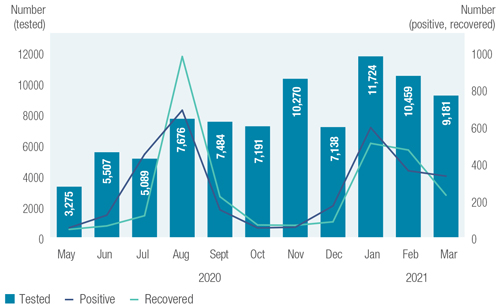
| IAR-55 |
|---|
Table of Contents
| Gold Fields Integrated<br><br><br><br><br><br>Annual Report | 2020 |
|---|
SAFETY AND WELLBEING OF OUR PEOPLE CONTINUED ****
Covid-19 will undoubtedly continue to disrupt our operations and people during 2021. Our teams are developing strategies to assist our employees in dealing with the impacts of a prolonged pandemic, particularly as it relates to mental wellness. We are also working with governments, industry forums and advisors on the best solution for vaccine roll-outs. For more details on how we are supporting our employees, see p57.
DIESELPARTICULATE MATTER
Employees working with machinery in confined underground spaces, as well as those operating diesel-powered vehicles, are at risk of being exposed to DPM.
The South African regulator has not yet promulgated an occupational exposure limit (OEL) for DPM, however, we align with an industry limit of 0.16mg/m^3^. At South Deep, measurements are undertaken over a time-weighted exposure as they impact nearby workers. We aim to have 95% of all samples measure below 0.16mg/m^3^ by 2024. Pleasingly, DPM levels exceeding this limit decreased to 10% in 2020 from 13% in 2019.
South Deep completed its evaluation of DPM filters, which are being
fitted to those vehicles that emit the highest levels of DPM – load haul dumpers (LHDs), dump trucks and utility vehicles. By year-end, the mine had fitted seven LHDs with DPM filters, with a further 25 LHDs and dump trucks scheduled for 2021. Furthermore, South Deep continuously reviews ventilation layouts to ensure optimal dilution in all working places.
In Australia, equipment filtration is a key part of our strategy to manage DPM in our underground mines. Our strategy also requires a number of additional controls to be in place, including maintenance schedules, ventilation requirements, operator training, monitoring protocols and corrective action processes for any exceedances of the OEL. Exceedances of the current OEL of 0.07mg/m^3^ per 12-hour shift in the Australian mines are rare, indicating the appropriateness and effectiveness of our current strategy.
Open-pit mines in Ghana and Peru pose a lower risk to DPM exposure. Sampling at these mines shows that the effects of DPM exposure to personell is insignificant, though it still has an environmental impact.
As part of our drive to improve how we manage DPM exposure, we are working with the ICMM and its member companies on the ICSV programme. This initiative engages original equipment manufacturers (OEMs) to accelerate the development of mining vehicles that minimise DPM, reduce GHG emissions and minimise vehicle incidents. For details see page 73.
NOISE-INDUCED HEARING LOSS
Noise from machinery and equipment puts employees at risk of developing NIHL. We did not record any cases of NIHL in Ghana, Australia or Peru during 2020. However, three new cases of NIHL were reported at South Deep (2019: six), and 1.5% (2019: 1.3%) of personal noise samples registered above the regulated occupational exposure limit of 85 dB(A). All new equipment has noise emissions below 107dB(A) to meet the 2024 industry targets.
To reduce the risk of NIHL, South Deep continued its programme of providing employees with personally moulded hearing protection. All new auxiliary fans purchased are sound attenuated and we continued to retrofit existing fans to ensure fan

| IAR-56 |
|---|
Table of Contents
| Gold Fields Integrated<br><br><br><br><br><br>Annual Report | 2020 | OURPERFORMANCE |
|---|
noise levels do not exceed 107dB(A). We continue to work through the Minerals Council of South Africa to encourage OEMs to produce quieter equipment.
HIV/AIDS
Managing HIV/Aids remains an important issue at our South Deep mine and, to a lesser extent, our Ghanaian operations.
At South Deep, the prevalence rate of those living with HIV/Aids increased to 17% of the workforce (2019: 6%). This increase is mainly due to employees and contractors self-declaring as part of the screening process following the reopening of the mine after the national Covid-19 lockdown during March and April 2020. Furthermore, the increased attention to chronic diseases and the risks they pose in combination with Covid-19 led to an increase in employees disclosing comorbidities. Voluntary counselling and testing (VCT) is offered to prospective and permanent employees, including contractors, and 70% of the workforce underwent VCT during 2020. Free highly active anti-retroviral therapy (HAART) is provided to HIV-infected employees, and there are currently 657 employees enrolled in this programme (2019: 204). Our employees’ dependants can also receive HAART via the Company’s medical aid schemes.
In Ghana, where the national HIV/Aids rate is approximately 2%, employees and contractors have access to a free, confidential VCT programme. During 2020, 21% of the workforce participated in this programme – the low participation was due to employee wellbeing resources being dedicated to fighting Covid-19. No new positive HIV/Aids cases were identified among employees. At year-end, Ghana had 10 employees on HAART (2019: 10).
DUST,SILICOSIS AND TUBERCULOSIS
South Africa’s mining industry regulations for silica dust exposure require that 95% of all personal silica dust samples taken must be below a time-weighted exposure of 0.05mg/m^3^ by 2024. By the end of 2020, 13% of the personal silica dust
samples at South Deep still exceeded this level, the same as in 2019. Although we saw an improvement at the start of 2020, the lockdown period caused a deterioration in underground conditions, as we were unable to maintain and sustain engineering controls. Following a thorough review, we installed automated dust suppression units in all high-risk areas.
During 2020, the number of Silicosis cases submitted to the health authorities increased to 10 from five in 2019. These employees have all been working in the mining industry between 20 and 40 years. All employees diagnosed with Silicosis are initiated on a six-month course of TB prophylaxis. No South Deep employee who joined the mine after 2008 and who had not been previously exposed to silica dust has contracted Silicosis. All employees with Silicosis are allocated restricted duties to ensure they are not exposed to dust. The mine’s medical team continues to educate our workforce and provide counselling during medical reviews and screening.
Since 2014, Gold Fields, along with five other companies in South Africa, had been involved in negotiations with the legal representatives of former mineworkers suffering from Silicosis and TB in the so-called ‘Silicosis class action case’. In May 2018, the companies and legal representatives reached an historic settlement in this matter, whereby the gold companies contributed over R5.2bn (US$400m) towards a settlement trust fund. Gold Fields provided an amount of R297m (US$21m) for its share of the settlement cost.
The settlement agreement came into effect on 10 December 2019, when a settlement trust – known as the Tshiamiso Trust – was established. The Tshiamiso Trust is responsible for ensuring that all eligible current and former mineworkers across southern Africa with Silicosis or work-related TB (or their dependants where the mineworker has passed away) are compensated. Over the course of 2020, the Tshiamiso Trust endeavoured to create the capacity and establish the systems needed to
begin the execution of its mandate. However, the Covid-19 pandemic has had a significant impact on its work. In December 2020, the trust made its first payments of R250,000 (US$15,000) each to six claimants.
During 2020, South Deep recorded 13 employees with cardio-respiratory tuberculosis (CRTB), compared with 20 in 2019. Three employees at South Deep were reported with chronic obstructive airways disease during 2020 (2019: four).
MENTAL WELLBEING OF EMPLOYEES IN AUSTRALIA
Against the backdrop of the Covid-19 pandemic, along with the remote nature of our operations in the region, we continued to focus on the mental wellbeing of our employees in Australia.
The programmes at our four Australian mines seek to encourage employees to identify and assist colleagues who may be at risk of mental health challenges. Our efforts this year included:
| ● | Ongoing participation in the national “R U OK?” programme, which provides practical tools on how to start a conversation with those who may be struggling mentally |
|---|---|
| ● | The “Mates in Mining” mental health and suicide prevention initiative |
| --- | --- |
| ● | The launch of a mental health movement at our Granny Smith mine |
| --- | --- |
| ● | Mental health first aid training across all operations, as well as the regional executive team. At Gruyere, over 20% of employees are trained mental health officers |
| --- | --- |
Additional mental health initiatives launched across the region include monthly on-site professional support, psychological fitness-for-work assessments, motivational speakers, internal training programmes, meditation, and additional on-site counselling support services. The Australian region also includes mental health in its business risk assessments to ensure adherence to controls designed to prevent and mitigate associated risks.
We are also strengthening our focus on mental health in other regions.
| IAR-57 |
|---|
Table of Contents
| Gold Fields Integrated<br><br><br><br><br><br>Annual Report | 2020 |
|---|

GOLD FIELDS 2021 BSC KPIs
| ● | Improve engagement levels of employees | |||
|---|---|---|---|---|
| ● | Increase the number of women in the workplace | |||
| --- | --- | |||
| ● | Deliver the people scorecard as per the plan | |||
| --- | --- | |||
| 2025 ESG CHARTER TARGETS | ASSOCIATED GROUP RISKS | |||
| --- | --- | --- | --- | --- |
| Strategic priority<br> <br><br><br><br>Build a diverse and inclusive workplace | Strategic intent<br> <br><br><br><br>Increase the proportion of women in our workforce, including women in leadership and women in mining in all our operating regions | No<br> <br><br><br><br><br><br><br><br><br> <br><br> <br><br> <br><br><br><br> <br> |
Risk<br> <br><br><br><br>Covid-19<br> <br><br><br><br>The impact of Covid-19 on our employees, communities and business<br> <br><br><br><br>Mining costs<br> <br><br><br><br>Rising mining costs, including those relating to ESG | |
<br><br><br><br><br> <br><br> <br><br><br><br> <br><br> <br><br> <br><br><br><br>  <br><br> <br><br> <br><br><br><br>  <br> |
Safety<br> <br><br><br><br>Safety and health of our employees, including occupational illnesses<br><br><br><br> <br>Skills<br><br><br><br> <br>Attraction and retention of skills<br><br><br><br> <br>Ghana contractors<br><br><br>Challenges with local mining contractors in Ghana<br> <br><br><br><br>I&T<br> <br><br><br><br>Failure to modernise operations | |||
| RELATED SDGs | ||||
|
Good health<br><br><br>and wellbeing | Decent work and<br><br><br>economic growth |
TRADE-OFFS
Our trade-offs refer to the difficult decisions made during the year in the context of resource scarcity. Below are some of the significant actions taken during a difficult year to do so:
| ● | Increased investment in training and development to meet our objectives of employing from our host<br>communities and targeted population groups |
|---|---|
| ● | Reduced employment levels over time as our mines become increasingly modernised and automated |
| --- | --- |
| ● | Increased spending to ensure the health and safety of our employees during Covid-19 |
| --- | --- |
| IAR-58 | |
| --- |
Table of Contents
| Gold Fields Integrated<br><br><br><br><br><br>Annual Report | 2020 | OURPERFORMANCE |
|---|
OVERVIEW
In a year dominated by the Covid-19 pandemic, keeping our people safe, healthy and productive was our driving focus. We also advanced our diversity and inclusion strategy, implemented new ways of working as part of our drive to attract, develop and retain top skills, and continued to maximise the number of employees from our host communities.
Gold Fields’ workforce of 18,412 people comprises over two-thirds (69%) contractors – significantly higher than 2019 as a result of the construction of our Salares Norte mine in Chile, which is almost exclusively carried out by contracted firms. Beyond this, the composition of
the key demographic groups among our workforce remained stable during 2020 when compared with previous years. Women make up 20% of our total Group workforce and 21% of our leadership positions. In total, 73% of employees in South Africa are Historically Disadvantaged Persons (HDPs) and just 2.8% of employees at our Ghanaian mines are expatriates.
One of the most significant restructuring exercises in Gold Fields over the past two years was the reduction of South Deep’s workforce in 2018 and 2019 following section 189 retrenchments. This significantly changed the workforce profile, and South Deep now has a leaner team in line with the requirements of a
mechanised mine. Furthermore, as we continue to build the required skills set for a mechanised mine, there has been a marked improvement in productivity per employee to 303 tonnes/employee from 286 tonnes/ employee in 2019.
The Group’s focus on host community employment also changed our workforce profile, and host community members comprise 53% of our workforce (2019: 55%). Importantly, this aligns with our strategy of creating value for the communities in the regions where we operate. More information on host community employment is detailed on p85 – 86.
WORKFORCE BY GROUP ANDREGION (END-DECEMBER)
| Total<br> <br>workforce | Employees | Contractors | Proportion of<br> <br>Nationals^1^ | |||||||||
|---|---|---|---|---|---|---|---|---|---|---|---|---|
| 2020 | 2020 | 2019 | 2020 | 2019 | 2020 | |||||||
| Americas | **** | 4,268 | **** | 568 | 545 | **** | 3,700 | 2,862 | **** | 98% | ||
| Australia | **** | 2,998 | **** | 1,668 | 1,657 | **** | 1,330 | 1,266 | **** | 78% | ||
| South Africa | **** | 4,027 | **** | 2,226 | 2,310 | **** | 1,801 | 1,674 | **** | 84% | ||
| West Africa | **** | 7,003 | **** | 1,063 | 1,046 | **** | 5,940 | 6,198 | **** | 99% | ||
| Corporate | **** | 116 | **** | 116 | 97 | **** | — | 1 | **** | 75% | ||
| Total | **** | 18,412 | **** | 5,641 | 5,655 | **** | 12,771 | 12,001 | **** | 86% |
^1^Employees only
KEY HUMAN RESOURCES (HR) METRICS (END-DECEMBER)
| Category | 2019 | 2018 | 2017 | 2016 | |||||
|---|---|---|---|---|---|---|---|---|---|
| Total workforce | 18,412 | 17,656 | 17,611 | 18,594 | 18,091 | ||||
| HDPs employees (%)1 | 73 | 59 | 72 | 71 | 72 | ||||
| HDPs employees – senior management (%)1 | 51 | 52 | 43 | 57 | 55 | ||||
| Minimum wage ratio2 | 1.71 | 1.97 | 2.40 | 2.43 | 1.97 | ||||
| Female employees (%) | 20 | 20 | 19 | 16 | 15 | ||||
| Ratio of basic salary men to women | 1.31 | 1.14 | 1.25 | 1.25 | 1.31 | ||||
| Employee wages and benefits (USm)3 | 412 | 395 | 442 | 506 | 482 | ||||
| Average training spend per employee<br>(US) | 1,211 | 1,912 | 2,469 | 2,258 | 1,896 | ||||
| Employee<br>turnover (%) | 6 | 16 | 354 | 6 | 12 |
All values are in US Dollars.
| ^1^ | Excluding foreign nationals but including white females. Percentages are of South Africanworkforce only |
|---|---|
| ^2^ | Entry level wage compared with local minimum wage. This ratio excludes Ghana, as the region onlyemploys management-level employees with the transition to contractor mining |
| --- | --- |
| ^3^ | This excludes benefits paid to employees working on capital projects |
| --- | --- |
SUPPORTING EMPLOYEES DURING COVID-19
The Covid-19 pandemic continued to challenge our people and operations, and is set to continue doing so during 2021. It has taken a terrible toll on our employees – as at mid-March 2021, almost 3,000 of our
colleagues have tested positive for Covid-19, and 10 employees or contractors unfortunately passed away after contracting the virus. We implemented an extensive testing programme at all but our Australian mines which, to date, have not reported a single positive case.
The high number of cases at our operations in South Africa, Peru, Chile and Ghana reflects the high prevalence rate of Covid-19 in our mines’ neighbouring communities. We detail the extensive health and educational programmes we put in place to test, protect and inform
| IAR-59 |
|---|
Table of Contents
| Gold Fields Integrated<br><br><br><br><br><br>Annual Report | 2020 |
|---|
DEVELOPING AFIT-FOR-PURPOSE WORKFORCE CONTINUED ****
our employees, as well as how we assisted those employees who did contract the virus, on our website at www.goldfields.com/covid-19.php.
During 2020, our operations spent approximately US$30m on Covid-19-related initiatives and interventions, such as specialised camp accommodation, testing equipment and facilities, additional labour costs to cover key positions, and transport facilities. Critically, Gold Fields paid all employees their salaries during Covid-19 pandemic. This includes employees who were unable to work during the various stages of lockdown at our Cerro Corona mine in Peru and South Deep in South Africa, which was completely closed for three weeks and only partially opened for a further three weeks.
Gold Fields responded quickly to the outbreak of Covid-19, closing offices and operations and implementing strict lockdown protocols in line with government-imposed regulations in all our jurisdictions. We already had a comprehensive Flexible Work Policy in place, enabling a relatively seamless shift as employees transitioned to remote working wherever possible. Once restrictions eased and employees could return to our sites, we ensured they followed our strict return-to-work policies and procedures, as well as on-site testing, social distancing and sanitation measures. In Peru and Chile, we introduced the concept of “team cells”, whereby employees worked within dedicated teams to limit their contact with other employees. This also made contact tracing easier in those cases were an employee became infected.
Communication was central to keeping employees safe, informed, connected and motivated. We set up a dedicated public Covid-19 portal on our website, which provided a central repository for all information and communication material. Leadership videos and virtual communication guides, published in multiple languages, helped employees to continue work remotely and productively. We also enhanced the Company’s information technology (IT) systems to make remote work easier while ensuring we effectively managed cybersecurity risks.
The mental health of our employees during lockdown and isolation was also a key consideration during the year. All employees have access to free, confidential counselling and support services all hours of the day. These services provided them with additional material on mental health issues during lockdown and isolation, as well as how to deal with balancing the dual demands of family and working from home. We augmented this messaging by additional mental health awareness communication distributed to our employees.
While some employees found remote work challenging, others embraced it. We updated Gold Fields’ Flexible Work Policy during the year to prepare the Company for an expected increase in flexible work applications.
Covid-19 will undoubtedly continue to disrupt our operations and people during 2021. Our teams are developing strategies to assist our employees in dealing with the impacts of a prolonged pandemic, particularly as it relates to mental wellness.
NEW WAYS OF WORKING
Human resources (HR) management is a key component of managing environmental, social and governance (ESG) issues, which have become an increasingly critical consideration for our stakeholders, including our capital providers. As part of developing Gold Fields’ nine ESG priorities – to be included in our ESG Charter with 2025 delivery targets, which will be made public later in 2021 – three relate directly to managing of our workforce. These are:
| ● | Building a diverse and inclusive workplace |
|---|---|
| ● | Adopting new ways of working |
| --- | --- |
| ● | Enabling cultural transformation |
| --- | --- |
Adopting to new ways of working is central to our ability to attract, retain and develop the right skills. While embracing new technology is an important part of this ESG priority, it is by no means our only focus area. Gold Fields embraces a broad definition of modernisation that also includes shifts in culture, processes and systems.
Our training and development efforts focus on equipping our people with the skills required by an evolving mechanised, modernised and automated mining industry. In 2020,
we invested US$1,211 per employee in training (2019: US$1,912). The decrease was the result of fewer face-to-face training sessions in light of Covid-19 lockdowns and social distancing regulations. In response to increased virtual working, we raised the number of online training courses to enable our employees to access learning content easily. We will continue to enhance this service offering in 2021.
Our leadership competency framework forms an important part of our talent attraction and leadership development strategy. It focuses on leadership’s ability to create an inclusive and enabling culture, demonstrating leadership excellence and building a credible brand.
Our recruitment process relies on comprehensive data and analytics, and utilises systems to track the time it takes to fill critical roles. Critical role turnover for the Group was 2.4% against a target of 5%. Attracting the next generation of workers to the mining industry is a key focus, and we therefore continue to track the age profile of our workforce. Competitive benefits, flexible work arrangements and opportunities for growth, development and mentorship are, inter alia, aimed at attracting a younger skills set.
At the moment, only 29% of our people are younger than 35. We see this changing as we modernise our operations.
We continued to move HR processes to digital platforms that allow for employee self-service, enhanced mobile systems for engagement and performance management, and e-learning and big data analytics to track people-related metrics.
ENHANCING ORGANISATIONAL CULTURE
Our ESG priority to enable culture transformation requires extensive employee engagement to ensure we build a culture of trust and leadership, while identifying what needs to change. We have completed around 80% of the programmes we initiated following employee climate surveys conducted in 2018 and 2019. These include initiatives to improve communications, learning and development, creating an enabling environment and recognition of employees.
| IAR-60 |
|---|
Table of Contents
| Gold Fields Integrated<br><br><br><br><br><br>Annual Report | 2020 | OURPERFORMANCE |
|---|
On the back of these programmes, the Company conducted several pulse surveys and focus groups to determine the efficacy of the plans we are implementing, and to gauge whether we improved the scores of previously low-ranking areas. These areas were leadership, communication, recognition, and learning and development. The outcome showed that engagement levels have improved over the past year. Employees also responded positively to Gold Fields’ prioritisation of the safety and wellbeing of its people during the current Covid-19 pandemic.
BUILDING A DIVERSE AND INCLUSIVE WORKFORCE
Our diversity and inclusion strategy includes three areas of focus – workforce diversity, workplace inclusion, and sustainability and accountability – and presents a roadmap for how we can achieve our business and people goals over a five-year period.
In setting targets for diversity and inclusion, Gold Fields focused on representation across all aspects of the employee lifecycle, including attraction, development, promotion and attrition. In doing this – as opposed to setting blanket targets across the business – we can ensure we identify our diversity gaps at a more comprehensive level. This allows us to target actions specifically at those areas and employee lifecycle points where we need to improve.
We have developed a diversity and inclusion dashboard that captures and measures all aspects of representation across the employee lifecycle, including:
| ● | Diversity workforce profile |
|---|---|
| ● | Retention |
| --- | --- |
| ● | Talent management |
| --- | --- |
| ● | Inclusive mindset (cultural aspects that foster a diverse and inclusive workplace) |
| --- | --- |
The dashboard seeks to encourage diversity and inclusivity beyond a focus on gender targets. We believe this is a more comprehensive approach towards achieving a workforce that reflects the demographics of the countries in which we operate, while at the same time addressing the skills needs of modern, automated gold mines.
We will continue to focus on increasing female representation during 2021. This decision is based primarily on the fact that we have sufficient baseline data in this area to accurately identify where we need to focus our attention, and to measure performance over time. In the year ahead, we will develop sufficient baseline data for diversity workforce profile, retention, talent management and inclusive mindset.
All our regions have been tasked with comprehensively reviewing and setting targets for:
| ● | Percentage of our workforce classified as women |
|---|---|
| ● | Percentage of women in leadership roles (D-band and above) |
| --- | --- |
| ● | Percentage of women in core mining roles |
| --- | --- |
Importantly, these targets will be used to determine long-term incentive awards.
Across our global workforce, 20% of Gold Fields’ employees are women (2019: 20%). Some 54% work in core mining activities, while 21% hold management positions (2019: 20%). The ratio of basic salary for men to women is 1.31 (2019: 1.14). Three out of our eight Board members are women, including the Chairperson. The turnover of women during the year was 22%, compared with the male turnover rate of 78%, both unchanged from 2019.
Gold Fields was also included in the Bloomberg Gender-Equality Index (GEI) for the third year in a row – achieving an average score of 69%, which exceeded the general 66% average achieved across other companies included in the index. We were one of 380 companies across 11 sectors included in the 2021 GEI. We believe that being included in this index reflects the appropriateness of our measures to, among others, promote female leadership, cultivate an inclusive culture and ensure gender pay parity, as well as our commitment to disclosure on these issues.
ORGANISED LABOUR
We remain committed to engaging with our workforce on all material issues that affect them. We uphold employees’ rights to freedom of association and collective bargaining,
and ensure that our contractors also abide by these standards.
Union membership among our employees is 73% at South Deep, and 0% in Ghana due to our transition to contractor mining at Tarkwa and Damang. Contractor union membership in Ghana is estimated to be 6%. In Australia, an estimated 3% of employees belong to unions, while in Peru 25% of our direct workforce and 29% of contractor workforce are unionised. In Chile, 9% of our workforce is unionised.
While union relationships have historically been strained at South Deep, we continue to foster a positive working relationship with union leaders and members since the completion of the section 189 retrenchment process in 2018. This is particularly evident in our joint efforts to mitigate the impacts of Covid-19 on our workforce.
REMUNERATION POLICY
Our remuneration structures are designed to stimulate and incentivise high performance through market-related base pay and benefits, attractive performance-driven incentives, as well as recognition and retention programmes. The core objective of our Remuneration Policy is to attract, retain and motivate top talent to deliver superior results.
The Company is acutely aware of the global concern around excessive executive remuneration, fair and responsible remuneration between management and junior-level employees, as well as pay disparities between genders. We believe that our approach to short and long-term remuneration is substantively fair and consistently applied throughout the Group.
Gold Fields’ Remuneration Policy drives and incentivises the achievement of our strategy, and continuously supports the creation of stakeholder value by aligning performance with commensurate levels of reward. In this way, we align stakeholder interests.
| For details of our Remuneration Policy and 2020 remuneration and incentive payments to executives and directors, refer to our Remuneration Report on p26 – 54 of our 2020 Annual Financial Report (AFR),which can be accessed at https://www.goldfields. com/integrated-annual-reports.php |
|---|
| IAR-61 |
| --- |
Table of Contents
| Gold Fields Integrated<br><br><br><br><br><br>Annual Report | 2020 |
|---|

GOLD FIELDS 2021 BSC KPIs
| ● | Improve the strategic planning process | |||
|---|---|---|---|---|
| ● | Future strategy decision with regard to the investment in Asanko to be made by August 2021 | |||
| --- | --- | |||
| ● | Improve our process as it relates to allocating and managing capital | |||
| --- | --- | |||
| ● | Advance Salares Norte Project | |||
| --- | --- | |||
| ● | Improve South Deep people and processes | |||
| --- | --- | |||
| ASSOCIATED GROUP RISKS | ||||
| --- | --- | --- | --- | --- |
No<br> <br><br><br><br><br><br><br> <br><br> <br><br> <br><br><br><br>  <br><br> <br><br> <br><br><br><br>  <br> |
Risk<br> <br><br><br><br>South Deep<br> <br>Loss of investor<br>confidence due to non-achievement of the mine’s business plan<br> <br><br> <br>Resource nationalism<br> <br>Resource nationalism, regulatory uncertainty and government imposts<br><br><br><br> <br>Mineral Resources and Mineral Reserves<br><br><br>Replacing Mineral Resources and Mineral Reserves in Australia, Ghana, Peru and Chile | <br><br><br><br><br> <br><br> <br><br><br><br> <br><br> <br><br> <br><br><br><br>  <br><br> <br><br> <br><br><br><br><br> |
Mining costs<br><br><br>Rising mining costs, including those relating to ESG<br> <br><br><br><br>Chile<br> <br>Delays and cost overrun<br>relating to the Salares Norte project<br> <br><br><br><br>Infrastructure<br> <br>Ageing<br>infrastructure<br> <br><br> <br>I&T<br><br><br>Failure to modernise operations | |
| RELATED SDGs | ||||
 |
Decent work and<br><br><br>economic growth | Industrial innovation<br><br><br>and infrastructure |
TRADE-OFFS
Our trade-offs refer to the difficult decisions made during the year in the context of resource scarcity. Below are some of the significant actions taken during a difficult year to do so:
| ● | Continued investment in near-mine exploration required to ensure life-of-mine extension at our operations |
|---|---|
| ● | Investments in less-risky geographies precludes Gold Fields from accessing potentially rich ore bodies<br>in other countries |
| --- | --- |
| ● | Focus on sustainable and organic growth without the need of expensive corporate activity, in<br>particular mergers and acquisitions |
| --- | --- |
| IAR-62 | |
| --- |
Table of Contents
| Gold Fields Integrated<br><br><br><br><br><br>Annual Report | 2020 | OURPERFORMANCE |
|---|
OVERVIEW
Despite the elevated gold price and buoyant gold market in 2020, we maintained our focus on delivering on the recent investments we made into our portfolio and, ultimately, increasing free cash-flow (FCF) per ounce of gold produced. Over the years, the Group has built a high quality, global production base by specifically focusing on low-cost, longer-life assets in a limited number of mining-friendly jurisdictions.
The Company employed various elements to refine our production base into one that will maintain production of 2.0Moz – 2.5Moz per year for the next 10 years at costs that are competitive with or lower than our global peers. Our approach to mergers and acquisitions focuses on acquiring or developing lower-cost (than Group average), longer-life assets and disposing of higher-cost, shorter-life assets that management believes can be better served by a company with more time and resources to commit. We continue to invest significant funds in near-mine brownfields exploration to extend the life of our current asset base and capitalise on in-country opportunities to leverage off our existing footprint, infrastructure and skills set.
Our overriding strategic objective is to generate an FCF margin of 15% at a gold price of US$1,300/oz. This is the principal criteria that drives our portfolio management process, and we will only invest in new assets if we meet this hurdle. In addition, we focus strongly on improving the longevity of our production base, and therefore endeavour to allocate our capital to projects or organic opportunities that will ultimately increase the life-of-mine across the Group. To this end, over the past three to four years, Gold Fields significantly invested in developing Gruyere in Western Australia and the major cutback of the Damang pit in Ghana. We will continue to invest heavily throughout 2021, with US$508m budgeted for the development of Salares Norte in Chile, which will materially improve Group AIC and extend mine life when it comes into production in 2023.
Gold Fields remains committed to its strategy of generating cash
to pay dividends to shareholders, reduce debt and share the value we create with our employees, host communities, governments and capital providers. Our capital allocation priorities will remain largely unchanged in 2021, namely:
| ● | De-gearing the balance sheet |
|---|---|
| ● | Funding the Salares Norte capital expenditure (capex) |
| --- | --- |
| ● | Maintain our policy of paying dividends between 25% – 35% of normalised earnings |
| --- | --- |
| ● | Increasing capex to sustain production at some of our key assets |
| --- | --- |
GROWING OUR GLOBAL FOOTPRINT
Over the years, Gold Fields has established an attractive, geographically diversified portfolio with nine mines and one project in five countries. While our strategy targeted expansion outside of South Africa since the unbundling of our legacy, conventional mines to Sibanye Gold in 2013, we remained very selective in choosing the countries in which to invest.
The Group continued to enhance its global footprint during 2020 by advancing the Salares Norte project in Chile to construction, with first production expected in Q1 2023. This project will add 450koz of gold-equivalent production per annum once it achieves steady state. Importantly, this production will come online at extremely competitive costs, further enhancing the quality of our portfolio.
With 20.5Moz of attributable gold-equivalent Mineral Reserves (excluding Asanko) being outside South Africa at 31 December 2020, our mines in Australia, Chile, Ghana and Peru are well positioned to produce 2Moz – 2.5Moz per year for eight to 10 years.
Encouragingly, the performance of our South Deep mine in South Africa continued to improve in 2020, despite the impacts of the Covid-19 pandemic and the government-imposed shutdowns during Q2 2020 – which effectively lost the mine 52 days of production. The mine took advantage of higher gold prices to generate R558m (US$34m) in net cash-flow even with Rand gold hedges that capped the upside at an average price of R727,000/kg.
DAMANG
INTO THE HEART OF THE ORE BODY
Gold Fields reinvested almost US$370m in our Damang mine in Ghana over the past four years to extend the life-of-mine to 2025. The Damang Reinvestment project commenced in December 2016 and entailed a major cutback to both the eastern and western walls of the Damang pit.
Since commencement, the project has steadily outperformed plan, with the Amoanda pit providing a high-grade source of ore during early production years. At the end of December 2020, 48 months into the project, total material mined amounted to 149Mt, 14% ahead of the project schedule. Gold produced for the same period amounted to 756koz, exceeding the planned 647koz by 17%. Total project capital incurred as at 31 December 2020 was US$367m versus a budgeted US$345m, largely driven by the additional capital waste tonnes mined.
Project capex continued to decrease in 2020 with the bulk of the capital incurred during the first three years of the project. Non-sustaining capex decreased to US$6m in 2020 from US$71m in 2019, US$125m in 2018 and US$117m in 2017, in line with the project schedule.
From a production perspective, 2020 was a year of two halves. During H1 2020, production was impacted by lower grades as mining transitioned through the Huni sandstone lithology, which exhibited more variable grades than anticipated. The bulk of the Huni sandstones were mined out by mid-year, at which point mining activities moved into the higher grade (and more consistent mineralised) Tarkwa phyllites deeper in the Damang pit. As a result, both production and costs improved markedly during H2 2020. We expect this trend to continue over the next three years.
Encouragingly, Damang generated net cash-flow of US$66m in 2020 after turning net cash-flow positive in 2019 (generating US$24m) for the first time since the start of the Reinvestment project. The mine is expected to produce 275koz in 2021 at AISC
| IAR-63 |
|---|
Table of Contents
| Gold Fields Integrated<br><br><br><br><br><br>Annual Report | 2020 |
|---|
CREATING A GLOBAL, SUSTAINABLE PORTFOLIO CONTINUED ****
of US$730/oz and AIC of US$790/oz. It is anticipated that Damang will maintain similar production levels with healthy cash-flows over the next three years to 2023, at which point production begins to tail off. As such, the team has commenced studies on a further pit cutback, which has the potential to extend the life-of-mine beyond 2025 by a further four years.
SALARES NORTE
PROGRESSING TO PLAN
The Salares Norte project is a 100% Gold Fields-owned, gold-silver deposit. It is located between 3,900m and 4,700m above sea level in the municipality of Diego de Almagro in the Atacama region of northern Chile. Mineralisation is contained within a high-sulphidation epithermal system, offering high-grade oxides. The project is currently in its construction phase, and is expected to meaningfully change the future profile of Gold Fields by accelerating growth in production and reducing Group AIC.
Land easement for the project was granted for 30 years on 30 May 2016. We obtained water rights in December 2016, with the regulator granting Gold Fields access to more than double the amount of water that the project requires. The Atacama Environmental Assessment Commission approved Salares Norte’s Environmental Impact Assessment (EIA) on 18 December 2019. As a result, an updated feasibility study (FS) was presented to the Board in February 2020, which subsequently approved the construction and development of the project.
The estimated project capex of US$860m (in 2020 terms), to be spent over the 33-month construction period, will be funded from a combination of the US$250m equity raised in February 2020, the strong operational cash generation of the Group and existing debt facilities, if required. First production is planned for Q1 2023, with life-of-mine production of 3.7Moz gold-equivalent over an 11.5-year period. Average annual production is forecast to be 450koz gold-equivalent for the first seven years, decreasing to 355koz
gold-equivalent for the next three years. AISC over the life-of-mine is anticipated to amount to US$552 per gold-equivalent ounce.
Construction activities were relatively unaffected by the Covid-19 pandemic during 2020, and the project remains on schedule. US$151m was spent on Salares Norte in 2020, including exploration and project expenses of US$30m, initial capex of US$97m and prepayments accounting for the majority of the balance. At the end of December 2020, engineering progress was 97% complete, construction progress 16% complete and total project progress 27%, all ahead of plan. The mining contractor began pioneering works on 1 October, as planned. Pre-stripping of the pit and construction of the processing plant commenced during January 2021, in line with the project’s construction schedule. At the end of December, 87% of the project’s scope of work had been committed to and priced, including 99% of plant and infrastructure orders and 95% of contracts, significantly reducing the risk of price escalations.
In addition to the Agua Amarga and Brecha Principal ore bodies, which will be mined over the initial 10-year period, there is significant exploration potential within the surrounding area. Salares Norte controls 84,000ha of mineral rights in the Salares Norte district and has carried out extensive district-wide exploration within a 20km radius of the plant site. During 2020, a total of 17,504m were drilled, focusing on the Horizonte Project, while additional work was done at the Agua Amarga North and Brecha West targets near the Salares Norte pit. We will continue to invest in exploration within the area to add to the production pipeline from 2025 onwards.
While there are no indigenous claims or community presence on the concession or the dedicated access routes, Salares Norte embarked on an extensive engagement programme with three indigenous communities within its wider vicinity and entered into long-term agreements with them. The project’s principal area of social influence – and potential
labour-sending area – is the Diego de Almagro municipality, approximately 125km away.
A critical element of the EIA approval was the relocation of endangered Short-tailed Chinchilla in the area. This work, which is carried out by independent environmental experts, is ongoing and we are in close contact with the regulator on the relocation programme. For details see p98.
SOUTH DEEP
CONTINUED IMPROVEMENT
South Deep continued to show operational improvements in 2020 despite the impacts of the Covid-19 pandemic, which included a government-imposed shutdown. In compliance with country-wide restrictions, we placed South Deep on care and maintenance during April 2020. While the mine operated well below its full labour complement for the remainder of the quarter, the workforce gradually ramped up to its full complement towards the end of Q3 2020.
Despite this interruption, South Deep continued to improve in most production metrics during 2020 as a result of several initiatives we implemented following the restructuring at the end of 2018, including:
| ● | Purposeful Visible Felt Leadership |
|---|---|
| ● | Reinvigorating our leadership system |
| --- | --- |
| ● | Improving face time and increasing the effectiveness thereof |
| --- | --- |
| ● | Enabling logistics |
| --- | --- |
| ● | Implementing innovation and technology |
| --- | --- |
The Siyaphambili intervention, a management and leadership programme focusing on the capacity and capability of our front-line supervisors and middle managers, continued to bear fruit during 2020. As a result, we reached the following key mining achievements during 2020:
| ● | Destress square metres mined increased by 34% to 35,545m² in 2020 from 26,606m² in 2019. Longhole stoping volumes mined increased by 11% to 697,501 tonnes in 2020 (2019: 631,281 tonnes)<br>as a result of improved stope availability, equipment |
|---|---|
| IAR-64 | |
| --- |
Table of Contents
| Gold Fields Integrated<br><br><br><br><br><br>Annual Report | 2020 | OURPERFORMANCE |
|---|
productivity and increased stope extraction quality. Encouragingly, stoping compliance to plan increased to an average of 90% in 2020 from 79% in 2019
| ● | After placing a record 426,338m^3^ of backfill in 2019, a total of 322,823m^3^ was placed in<br>2020 as the backlog was eroded. With this, we further improved stope turnaround time to an average of 4.8 months in 2020 from 5.5 months in 2019 and 7.8 months in 2018 |
|---|---|
| ● | The mine’s overall productivity improved to 303 tonnes per employee costed (TEC) in 2020 from 286 tonnes per TEC in 2019. |
| --- | --- |
Machine productivity decreased slightly to 72m/rig in 2020 from 78m/rig in 2019, but is still up from 59m/rig in 2018
The key improvements in production efficiencies over the past three years are depicted in the table below.
| Activity | 2020 | 2019 | 2018 | |||
|---|---|---|---|---|---|---|
| Development<br><br><br>(m/rig) | **** | 72 | 78 | 40 | ||
| De-stress<br><br><br>(m/rig) | **** | 72 | 40 | 23 | ||
| Longhole<br><br><br>stoping (t/rig) | **** | 12,968 | 11,966 | 6,708 |
Despite the impacts of Covid-19, South Deep’s gold production increased by 2% to 7,056kg (226.9koz) in 2020 from 6,907kg (222.1koz) in 2019. Encouragingly, the mine generated net cash of US$34m in 2020, which was more than double the US$15m generated during 2019. For 2021, we expect a strong increase in production (+28%) to 290koz. Furthermore, we are reasonably confident that we can increase production volumes between 15% – 20% over the next three to four years.
STRATEGIC INVESTMENTS
Over the years, Gold Fields has acquired strategic interests in a number of smaller mining companies. Taking advantage of favourable equity market conditions, we have steadily reduced these non-core equity holdings over the past two years. In 2019, we raised US$179m through these sales, with the proceeds being used to pay down a portion of our debt. In 2020, we sold our 16.4% stake in ASX-listed Cardinal Resources, which holds exploration rights in northern Ghana, to Norgold for A$37m (US$23m).
Gold Fields acquired a strategic 17% shareholding in Chakana Copper in 2019 for C$8m (US$6m). In February 2021, we participated in a rights offer that increased our holding to 19.9% for an additional C$3m (US$2m). Chakana Copper is currently advancing the prospective Soledad gold-silver project in central Peru.
Our current strategic shareholdings are shown in the table below.
GOLD FIELDS’ NON-CORE INVESTMENTS (31 DECEMBER 2020)
| Investment | Shareholding<br><br><br>% | Market value<br>(USm) | |
|---|---|---|---|
| Galiano Gold (formerly Asanko Gold) | 9.8 | ||
| Rusoro Mining | 25.7 | ||
| Chakana Copper^1^ | 16.8 | ||
| Magamatic Resources | 10.9 | ||
| Lefroy Exploration | 18.0 | ||
| Orsu Metals | 6.1 | ||
| Woodjam Copper | 16.3 | ||
| Maverix Metals<br>warrants | |||
| Totalvalue |
All values are in US Dollars.
| ^1^ | This shareholding was increased to 19.9% in February 2021 |
|---|
FAR SOUTHEAST
There were no material developments relating to the Far Southeast (FSE) project in the Philippines during 2020. The project is held by Far Southeast Gold Resources, in which Gold Fields has a 40% interest with an option to increase its stake to 60%, and is adjacent to an existing mining operation with established infrastructure. Lepanto Consolidated Mining Company of the Philippines holds the remaining 60% interest and manages the existing mining operation.
FSE’s mining licence was up for renewal for 25 years in 2015. The Philippine government ruled that Free Prior and Informed Consent was required for the renewal, however, this requirement was overturned during independent arbitration and, in 2018, by the country’s Court of Appeals. The government is appealing that ruling in the Supreme Court, where the case is currently pending.
Gold Fields reversed previous impairments of its investment in FSE, resulting in a carrying value of US$144m at end-2020, based on the fair value less cost of disposal of the investment, which was indirectly derived from Lepanto’s market value on the Philippine Stock Exchange. Gold Fields’ holding costs in FSE are approximately US$0.1m, related mainly to staff and administrative costs, managing existing drill core, environmental monitoring, community relations work, as well as activities to support the permitting process.
| IAR-65 |
|---|
Table of Contents
| Gold Fields Integrated<br><br><br><br><br><br>Annual Report | 2020 |
|---|
CREATING A GLOBAL, SUSTAINABLE PORTFOLIO CONTINUED ****
LIFE EXTENSION THROUGH NEAR-MINE EXPLORATION
Near-mine (brownfields) exploration is key to Gold Fields’ strategy as it offers one of the lowest-cost opportunities for adding ounces and growing cash-flow, particularly on a per share basis. The value in near-mine exploration lies in:
| ● | Knowledge of the ore bodies, which enables our exploration teams to identify extensions or additional ore sources housed within the mining tenement |
|---|---|
| ● | Operational capabilities, including Gold Fields’ proven ability to develop and mine orogenic ore bodies |
| --- | --- |
| ● | Regional and operational infrastructure, including existing processing plants and regional management teams |
| --- | --- |
We believe that brownfields exploration provides a robust platform for regional growth. In addition to growing Gold Fields’ Mineral Resource and Mineral Reserve base, near-mine exploration also extends the life of the Group’s existing assets and ensures that each region can continue leveraging its infrastructure.
In 2020, Gold Fields spent US$76m on near-mine exploration (2019: US$73m), which supported a total of 367,600m of near-mine drilling
(2019: 428,980m). We incurred the majority of this spending – US$50m (A$72m) (2019: US$58m (A$84m)) – at our Australian mines. We spent US$6m in Ghana, which is lower than the US$13m spent in 2019. Amid a renewed focus on extending Tarkwa’s life-of-mine, and further resource definition drilling at the Damang cutback project we have budgeted US$9m for the region (excluding Asanko) in 2021. Asanko is scheduled to spend US$5m on exploration in 2021.
Looking ahead, we have budgeted US$101m for near-mine exploration during 2021 (excluding Asanko), of which US$63m (A$84m) will be at our Australian operations, US$9m at Tarkwa and Damang, and US$27m at Salares Norte.
Following are details of the near-mine exploration activities at our Australian and Ghanaian mines during 2020. South Deep and Cerro Corona do not undertake exploration on their properties.
ST IVES
At St Ives, total 2020 exploration spend amounted to US$24m. A total of 130,625m were drilled during the year, increasing Mineral Reserves by 17% to 2.7Moz, net of depletion.
Key outcomes:
| ● | 17% increase in Mineral Reserves |
|---|---|
| ● | Extended Invincible complex both laterally and at depth |
| --- | --- |
ST IVESMINERAL RESERVES RECONCILIATON Gold (Moz) ****

AGNEW
We spent US$14m on exploration at Agnew during 2020, with a total of 59,967m drilled during the year. Encouragingly, Agnew managed to replace Mineral Reserves after depletion again. Mineral Reserves increased by 19% to 917koz. Agnew is now in the strongest position it has been since December 2013.

| IAR-66 |
|---|
Table of Contents
| Gold Fields Integrated<br><br><br><br><br><br>Annual Report | 2020 | OURPERFORMANCE |
|---|
The enhanced focus on exploration over the past few years is starting to yield extremely encouraging results, and Agnew’s outlook is increasingly positive. The Waroonga North ore body continued to grow laterally and at depth during 2020. We are also seeing further extensions of Genesis and Sheba at New Holland.
Key outcomes:
| ● | 19% increase in Mineral Reserves |
|---|---|
| ● | Waroonga North growing laterally and at depth |
| --- | --- |
AGNEW MINERALRESERVES RECONCILIATON Gold (Moz) ****

GRANNY SMITH
Total exploration spend at Granny Smith amounted to US$11m in 2020, with a total of 71,748m drilled during the year. Mineral Reserves increased by 4.3% post-depletion to 2.2Moz.
Key outcomes:
| ● | 4.3% increase in Mineral Reserves |
|---|
GRANNY SMITH MINERAL RESERVES RECONCILIATON Gold (Moz) ****

GRUYERE JV
Gold Fields’ exploration allocation to the Gruyere JV amounted to US$1m in 2020, with a total of 14,221m drilled during the year. Gold Fields’ total allocated Mineral Reserves decreased by 3% post-depletion to 1.7Moz.
Key outcomes:
| ● | 3.2% decrease in Mineral Reserves |
|---|
GRUYERE MINERAL RESERVES RECONCILIATON (Moz – 100% basis) ****

TARKWA
Gold Fields spent US$6m in near-mine exploration at Tarkwa during the year, drilling 27,969m. Encouragingly, and continuing a trend from 2019, Tarkwa again replaced depletion in 2020. Tarkwa’s Mineral Reserves
increased by 3% to 6.1Moz.
Key outcomes:
| ● | 3% increase in Mineral Reserves |
|---|
TARKWA MINERAL RESERVES RECONCILIATON (Moz) ****

DAMANG
While we focused on implementing the Damang Reinvestment project, Gold Fields also spent US$0.4m in near-mine exploration at Damang during the year. A total of 357m were drilled. Despite the exploration effort, Mineral Reserves decreased by 24% to 1.0Moz, net of depletion.
Key outcomes:
| ● | 24% decrease in Mineral Reserves |
|---|
DAMANG MINERAL RESERVES RECONCILIATON (Moz) ****

| IAR-67 |
|---|
Table of Contents
| Gold Fields Integrated<br><br><br><br><br><br>Annual Report | 2020 |
|---|

GOLD FIELDS 2021 BSC KPIs
| ● | Increase FCF per ounce at a set gold price | |||
|---|---|---|---|---|
| ● | Eliminate fatalities, serious injuries and environmental incidents in our business | |||
| --- | --- | |||
| ● | Improve innovation and technology | |||
| --- | --- | |||
| ● | Improve South Deep people and processes | |||
| --- | --- | |||
| ● | Future strategy decision with regard to Asanko to be made by August 2021 | |||
| --- | --- | |||
| ASSOCIATED GROUP RISKS | ||||
| --- | --- | --- | --- | --- |
| No | Risk | <br><br><br> <br><br> <br><br> <br><br><br><br>  <br><br> <br><br> <br><br><br><br>  <br><br> <br><br> <br><br><br><br><br><br> <br><br> <br><br><br><br><br><br> <br><br> <br><br><br><br><br> |
Water<br><br><br>Water pollution, security and reduction in freshwater consumption | |
<br><br><br> <br><br> <br><br> <br><br><br><br>  <br><br> <br><br> <br><br><br><br><br><br> <br><br> <br><br><br><br><br><br> <br><br> <br><br><br><br>  <br><br> <br><br> <br><br><br><br>  <br> |
Covid-19<br><br><br>The impact of Covid-19 on our employees, communities and business plan<br><br><br><br> <br>Gold/foreign exchange<br><br><br>Gold price and currency exchange rate volatility<br> <br><br><br><br>South Deep<br> <br>Loss of investor<br>confidence due to non-achievement of the mine’s business plan<br> <br><br><br><br>Mining costs<br> <br>Rising mining<br>costs, including those relating to ESG<br> <br><br> <br>Safety<br><br><br>Safety and health of our employees, including occupational illnesses<br><br><br><br> <br>Energy<br><br><br>Security of power supply and cost of energy | Geotechnical<br> <br>Increased<br>geotechnical risk underground and in open pits<br> <br><br> <br>Ghanacontractors<br> <br>Challenges with local mining contractors in Ghana<br><br><br><br> <br>Chile<br><br><br>Delays and cost overrun relating to the Salares Norte project<br> <br><br><br><br>Infrastructure<br> <br>Ageing<br>infrastructure<br> <br><br> <br>I&T<br><br><br>Failure to modernise operations | ||
| RELATED SDGs | ||||
|
Decent work and<br><br><br>economic growth | Industrial innovation<br><br><br>and infrastructure |
TRADE-OFFS
Our trade-offs refer to the difficult decisions made during the year in the context of resource scarcity. Below are some of the significant actions taken during a difficult year to do so:
| ● | We will not mine if we cannot mine safely, which means that occasionally we do not mine profitable ore<br>bodies |
|---|---|
| ● | Setting conservative gold prices for planning purposes restricts the scope of our operations |
| --- | --- |
| ● | Benefits of higher gold prices on our operations are, in part, offset by rising mining costs |
| --- | --- |
| ● | Increased investment in modernisation and automation will lead to declining employee numbers |
| --- | --- |
| ● | Ensuring the sustainability of South Deep requires constant focus on workforce optimisation |
| --- | --- |
| IAR-68 | |
| --- |
Table of Contents
| Gold Fields Integrated<br><br><br><br><br><br>Annual Report | 2020 | OURPERFORMANCE |
|---|
OVERVIEW
The gold mining industry was uniquely challenged during 2020. As the Covid-19 pandemic swept across the globe, we had to adapt and enforce substantial changes to our operating protocols. Spearheaded by our regional leadership teams, Gold Fields responded swiftly in establishing the necessary protocols, procedures and practices to mitigate the impacts of Covid-19 and keep our people safe. Strict adherence to government protocols and rigorous Covid-19 testing of all site-based employees were swiftly rolled out across the Group.
In Australia, we adjusted rosters and amended flight schedules to limit travel and reduce interaction between employees. At Cerro Corona in Peru, we initially extended shift cycles in response to a nationwide curfew, while also constructing additional accommodation facilities to enable social distancing.
Our Cerro Corona and South Deep operations were the most impacted by the pandemic during 2020. In compliance with the government-imposed lockdown towards the end of March, we placed South Deep on care and maintenance for the first four weeks of Q2 2020. At the end of April, as South Africa eased the lockdown restrictions, South Deep could resume mining activities, albeit at 50% of its full labour complement. This continued until the end of May, when our workforce gradually ramped up to its full complement. In all, South Deep lost approximately 52 days of operation.
In Peru, a curfew was imposed on 16 March, which entailed strict intra-provincial and international travel restrictions. Mining was declared an
essential industry, and Cerro Corona could continue to operate largely as normal until mid-April, when the mine was restricted to 30% of its workforce. The labour complement gradually increased from the end of April and was back at full capacity during October 2020. Lost production from Covid-19-related stoppages and restrictions during 2020 amounted to approximately 32koz at South Deep and 46koz at Cerro Corona. For more information on the impacts of Covid-19, refer to p57 and p87.
The combination of our strong operational performance and the higher gold price during the year enabled the Group to contain the impacts of Covid-19 and post a solid set of results in 2020, comfortably meeting our underlying goal of generating a FCF margin of 15% at a gold price of US$1,300/oz.
Despite the Covid-19 restrictions, Gold Fields’ attributable gold-equivalent production increased by 2% to 2.236Moz in 2020 (2019: 2.195Moz), within revised guidance of 2.200Moz – 2.250Moz. We revised original guidance of 2.275Moz – 2.315Moz in April 2020 to account for the impact of Covid-19 on our operations – particularly South Deep and Cerro Corona.
Group AIC increased marginally in 2020 to US$1,079/oz (2019: US$1,064/oz), which was within revised guidance of US$1,070/oz – US$1,090/oz. The year-on-year increase in AIC was driven by higher cost of sales before amortisation and depreciation, higher sustaining capex and higher royalties, partially offset by higher level of gold sold and lower non-sustaining capex. Group AISC for the year totalled US$977/oz (2019: US$897/oz), again within revised
guidance of US$960/oz – US$980/oz. Covid-19-related costs amounted to US$26m in 2020, equal of US$12/oz, and are included in Group AIC and AISC.
During 2020, Gold Fields maintained the capex levels we believe are important to ensure the longevity of our portfolio. Total capex (excluding Asanko) decreased to US$584m in 2020 from US$613m in 2019. This comprised sustaining capex of US$409m and project capex of US$175m.
Regional capex included:
| ● | Americas: At Cerro Corona, capex decreased by 11% to US$50m in 2020 from US$56m in 2019, mainly due to the impact of Covid-19 restrictions on construction<br>activities. We spent capex of US$97m on Salares Norte during 2020, as capitalisation of project spend began on 1 April 2020 |
|---|---|
| ● | Australia: Our Australian mines decreased capex to A$319m (US$220m) in 2020 from A$458m (US$319m) in 2019, with near-mine exploration amounting to A$72m (US$50m) in 2020 (2019: A$84m (US$58m)) |
| --- | --- |
| ● | South Africa: As previously guided, total capex at South Deep increased by 68% year-on-year to R804m (US$49m) in 2020<br>from R479m (US$33m) in 2019. This increase was driven by the purchase of new equipment and the recommencement of development in the new mine area |
| --- | --- |
| ● | West Africa: Total capex (excluding Asanko) decreased to US$167m in 2020 from US$202m in 2019, driven by a decrease in waste tonnes mined at Damang |
| --- | --- |
GROUP OPERATIONALPERFORMANCE
| 2021 Guidance | 2020 Guidance (revised) | |||||
|---|---|---|---|---|---|---|
| Prod | AIC | AIC | Prod | AIC | AIC | |
| Group | 2.30Moz – | US1,310/oz – | 2.20Moz – | US1,070/oz – | ||
| 2.35Moz | US1,350/oz | US$1,079/oz | 2.25Moz | US1,090/oz | US$1,064/oz |
All values are in US Dollars.
| IAR-69 |
|---|
Table of Contents
| Gold Fields Integrated<br><br><br><br><br><br>Annual Report | 2020 |
|---|
PROFITABLE PRODUCTION AND SUSTAINABLE CASH-FLOW CONTINUED ****
REGIONAL PERFORMANCES
SOUTH AFRICA REGION
| 2021 Guidance | 2020 Actual | 2020 Guidance | 2019 Actual | |||||
|---|---|---|---|---|---|---|---|---|
| Prod | AIC | Prod | AIC | Prod^1^ | AIC | Prod | AIC | |
| South Deep | 9,000kg | R660,000/kg | 7,056kg | R663,635/kg | 7,000 | R610,000/kg | 6,907kg | R585,482/kg |
| (289koz) | (US$1,320/oz) | (227koz) | (US$1,260/oz) | (225koz) | (US$1,394/oz) | (222koz) | (US$1,259/oz) | |
| ^1^ | Original guidance revised to take account of Covid-19lockdown | |||||||
| --- | --- |
After a good start to 2020, South Deep was placed on care and maintenance for the first four weeks of Q2 2020 in compliance with government-imposed Covid-19 restrictions. South Deep operated well below its full labour complement for the remainder of Q2 2020. Our workforce gradually ramped up to its full complement during Q3 2020 and early Q4 2020. As such, most of the impact of Covid-19 was felt during H1 2020, with the mine recovering well in H2 2020.
Gold production increased by 2% to 7,056kg (227koz) from 6,907kg (222koz) in 2019, which was marginally ahead of revised guidance
of 7,000kg (225koz). Had it not been for disruptions relating to Covid-19, South Deep would have exceeded its original production guidance of 8,000kg (257koz). It is estimated that South Deep lost approximately 32koz due to Covid-19-related stoppages in 2020, which was partially offset by 10 additional production days as a result of the change in production calendar.
AISC increased by 11% to R651,514/kg (US$1,237/oz) in 2020 from R585,482/kg (US$1,259/oz) the previous year, while AIC increased by 13% to R663,635/kg (US$1,260/ oz) from R585,482/kg (US$1,259/oz) due to higher cost of sales before
amortisation and depreciation, as well as higher capex, which was partially offset by higher gold sold.
Encouragingly, South Deep generated net cash-flow of R558m (US$34m) in 2020, more than double the R221m (US$15m) recorded in 2019.
2021 guidance:
| ● | Gold production: 9,000kg (289koz) |
|---|---|
| ● | Destress: 48,370m^2^ |
| --- | --- |
| ● | Development: 9,067m |
| --- | --- |
| ● | Capex: R1,234m (US$79m), of which R889m (US$57m) is sustaining capex and R345m (US$22m) is growth capex |
| --- | --- |
| ● | AISC: R620,000/kg (US$1,240/oz) |
| --- | --- |
| ● | AIC: R660,000/kg (US$1,320/oz) |
| --- | --- |
AMERICAS REGION
| Production overview | 2021Guidance | 2020 Actual | ||||
|---|---|---|---|---|---|---|
| Gold-only production | 130koz | **** | 119koz | 158koz | 156koz | |
| Copper production | 24.7kt | **** | 24.9kt | 27.5kt | 31kt | |
| Gold-equivalent production | 220koz | **** | 207koz | 275koz | 293koz | |
| AIC | US$ | 1,060/oz | **** | US715/oz | US575/oz | US$472/oz |
| AIC eq-oz | US$ | 1,190/oz | **** | US1,119/oz | US830/oz | US$810/oz |
All values are in US Dollars.
From a production perspective, our Cerro Corona mine in Peru was the most impacted by Covid-19 across the Group. Gold-equivalent production decreased by 29% to 207koz in 2020 from 293koz in 2019, due to lower copper grades processed, together with a lower price factor. The price factor was 3.5 in 2020 compared with 4.4 in 2019. It is estimated that Cerro Corona lost approximately 46koz due to Covid-19-related stoppages and 22koz due to the lower price factor, partially offset by 10 additional production days as a result of the change in the production calendar in 2020.
Consequently, total AIC on a gold-equivalent basis increased by 38% to US$1,119/oz from US$810/oz in 2019. This increase was primarily due to the lower equivalent ounces sold and additional Covid-19 related expenditure, partially offset by lower cost of sales before amortisation and depreciation and lower capital expenditure.
Despite the Covid-19 challenges, the region reported net cash-inflow of US$84m during 2020, in line with the US$86m generated in 2019.
2021 guidance:
| ● | Gold only production: 130koz |
|---|---|
| ● | Copper production: 24.7kt |
| --- | --- |
| ● | Gold-equivalent production: 220koz |
| --- | --- |
| ● | Capex: US$58m |
| --- | --- |
| ● | AISC (Au-eq): US$1,030/oz |
| --- | --- |
| ● | AIC (Au-eq): US$1,190/oz |
| --- | --- |
| ● | AISC: US$780/oz |
| --- | --- |
| ● | AIC: US$1,060/oz |
| --- | --- |
Details of the construction progress of our Salares Norte project are on p62.
| IAR-70 |
|---|
Table of Contents
| Gold Fields Integrated<br><br><br><br><br><br>Annual Report | 2020 | OURPERFORMANCE |
|---|
AUSTRALIA REGION
| 2021 Guidance | |||||||||||||
|---|---|---|---|---|---|---|---|---|---|---|---|---|---|
| Prod | AIC | AIC | AIC | AIC | |||||||||
| St Ives | 360koz | A1,410/oz | 385koz | **** | A1,266/oz | 360koz | **** | A1,320/oz | 371koz | A$1,385/oz | |||
| (US1,060/oz) | **** | (US873/oz) | **** | (US910/oz) | (US$963/oz) | ||||||||
| Agnew | 240koz | A1,625/oz | 233koz | **** | A1,528/oz | 225koz | **** | A1,440/oz | 219koz | A$1,656/oz | |||
| (US1,220/oz) | **** | (US1,053/oz) | **** | (US995/oz) | (US$1,152/oz) | ||||||||
| Granny Smith | 265koz | A1,600/oz | 270koz | **** | A1,465/oz | 265koz | **** | A1,415/oz | 275koz | A$1,325/oz | |||
| (US1,200/oz) | **** | (US1,010/oz) | **** | (US975/oz) | (US$922) | ||||||||
| Gruyere (50%) | 140koz | A1,330/oz | 129koz | **** | A1,350/oz | 135koz | **** | A1,150/oz | 50koz | A$4,170/oz | |||
| (US1,000/oz) | **** | (US931/oz) | **** | (US795/oz) | (US$2,900/oz) | ||||||||
| Region | 1,005koz | A1,500/oz | 1,017koz | **** | A1,388/oz | 985koz | **** | A1,350/oz | 914koz | A$1,418/oz | |||
| (US1,125/oz) | **** | (US957) | **** | (US932/oz) | (US$986/oz) |
All values are in US Dollars.
Gold Fields’ Australian operations delivered another strong operational performance in 2020, surpassing the 1Moz annual production level for the first time since 2015. Gold production increased by 11% to 1,017koz in 2020 from 914koz in 2019, with Gruyere contributing for the full year in 2020. AIC decreased by 2% to A$1,388/oz (US$957/oz) in 2020 from A$1,418/oz (US$986/oz) in 2019, but was slightly higher than guidance of A$1,350/oz (US$932/oz).
Capex decreased by 30% to A$319m (US$220m) in 2020 from A$458m (US$319m) in 2019, due to reduced spending on Gruyere, a decrease in development at the Invincible and Hamlet North underground operations at St Ives, and the high level of expenditure on the new accommodation village at Agnew in 2019. Capex includes near-mine exploration expenditure of A$72m (US$50m), lower than the A$84m (US$58m) spent in 2019.
The Australia region reported net cash-inflow of A$723m (US$498m) in 2020 compared with A$199m (US$139m) in 2019.
MINE PERFORMANCES
At StIves, Invincible Underground, Hamlet Underground and the Neptune open pit are now the main sources of ore. Production increased by 4% to 385koz in 2020 from 371koz in 2019, 7% above guidance of 360koz. AIC decreased by 9% to A$1,266/oz (US$873/oz) in 2020 from A$1,385/oz (US$963/oz) in 2019, mainly due to lower capex
and increased gold sold, partially offset by higher cost of sales before amortisation and depreciation and higher royalty tax.
Capex decreased by 25% to A$107m (US$74m) in 2020 from A$141m (US$98m) in 2019 due to reduced development of the Invincible South and Hamlet North underground mines during 2020.
St Ives generated net cash-flow of A$383m (US$264m) (pre-tax) for the year.
A review of the mine’s brownfields exploration activity in 2020 is on p64.
2021 guidance:
| ● | Gold production: 360koz |
|---|---|
| ● | Capex: A$129m (US$97m), of which A$110m (US$83m) is sustaining capex and A$19m (US$14m) non-sustaining capex |
| --- | --- |
| ● | AISC: A$1,360/oz (US$1,020/oz) |
| --- | --- |
| ● | AIC: A$1,410/oz (US$1,060/oz) |
| --- | --- |
At Agnew, gold production increased by 6% to 233koz in 2020 from 219koz in 2019 – 4% higher than guidance of 225koz. AIC decreased by 9% to A$1,528/oz (US$1,053/oz) in 2020 from A$1,656/oz (US$1,152/ oz) in 2019 due to lower capex and increased gold sold, partially offset by increased cost of sales before amortisation and depreciation and higher royalty tax.
Capex decreased by 31% to A$75m (US$52m) in 2020 (2019: A$109m (US$76m)) driven by a 79% decrease in non-sustaining capex to A$12m (US$9m) in 2020 from A$58m (US$41m) in 2019. Additional
capex of A$32m (US$22m) was incurred in 2019 to establish the new accommodation village, together with A$5m (US$3m) on the development of the Waroonga North decline. In addition, spending on exploration drilling reduced by A$6m (US$4m) from 2019.
We concluded the second stage of the electricity supply project, with EDL commissioning the 13MW battery plant in March 2020 and the 18MW wind farm in May 2020. More than 50% of Agnew’s energy needs are now generated from renewable and low-carbon sources. The microgrid consists of a 23MW power station which integrates solar with gas, diesel generation, a new battery plant and the wind farm. It is owned and operated by EDL, who will recoup its investment via an electricity supply agreement with Agnew.
Agnew generated net cash-flow of A$192m (US$132m) (pre-tax) in 2020 compared with A$16m (US$11m) in 2019.
A review of the mine’s brownfields exploration activity in 2020 is on p64.
2021 guidance:
| ● | Gold production: 240koz |
|---|---|
| ● | Capex: A$113m (US$85m), of which A$72m (US$54m) is sustaining capex and A$41m (US$31m) non-sustaining capex |
| --- | --- |
| ● | AISC: A$1,450/oz (US$1,090/oz) |
| --- | --- |
| ● | AIC: A$1,625/oz (US$1,220/oz) |
| --- | --- |
| IAR-71 | |
| --- |
Table of Contents
| Gold Fields Integrated<br><br><br><br><br><br>Annual Report | 2020 |
|---|
PROFITABLE PRODUCTION AND SUSTAINABLE CASH-FLOW
CONTINUED
At Granny Smith, production decreased by 2% to 270koz in 2020 from 275koz in 2019, but was 2% ahead of guidance for the year of 265koz.
AIC increased by 11% to A$1,465/ oz (US$1,010/oz) in 2020 from A$1,325/oz (US$922/oz) in 2019. With the mining of deeper ore zones, we incurred additional cost relating to paste fill, support and hauling. Furthermore, we incurred additional contractor labour costs, as well as employee flight and accommodation costs, during 2020 due to Covid-19-related restrictions. Royalty tax was also higher than 2019 as a result of the higher gold price received.
Capex decreased by 7% to A$96m (US$66m) in 2020 from A$104m (US$72m) in 2019 due to decreased exploration drilling costs during the year. The mine generated net cash-flow of A$224m (US$155m) (pre-tax) in 2020 compared with A$134m (US$93m) in 2019.
A review of the mine’s brownfields exploration activity in 2019 is on p65.
2021 guidance:
| ● | Gold production: 265koz |
|---|---|
| ● | Capex: A$147m (US$110m), of which A$116m (US$87m) is sustaining capex and A$31m (US$23m) non-sustaining capex |
| --- | --- |
| ● | AISC: A$1,475/oz (US$1,110/oz) |
| --- | --- |
| ● | AIC: A$1,600/oz (US$1,200/oz) |
| --- | --- |
At Gruyere, gold production increased by 161% to 258koz in 2020, the mine’s first full year of production, from 99koz in 2019. Gruyere commenced production in June 2019 and achieved commercial production at the end of September 2019.
AIC decreased by 68% to A$1,350/ oz (US$931/oz) in 2020 from A$4,170/oz (US$2,900/oz) in 2019. AIC for 2019 included construction capital up to the point of commercial production.
Capex (on a 50% basis) decreased by 61% to A$41m (US$28m) in 2020 from A$104m (US$72m) in 2019. The 2019 capex was primarily incurred to complete the Gruyere construction project and stripping activities at the Gruyere pit.
Gruyere generated net cash-flow (on a 50%-basis) of A$110m (US$76m) (pre-tax) in 2020 compared with a cash-outflow of A$80m (US$55m) in 2019.
2021 guidance (50% basis):
| ● | Gold production: 280koz (100% basis) |
|---|---|
| ● | Capex: A$57m (US$43m), of which A$54m (US$41m) is sustaining capex and A$3m (US$2m) non-sustaining capex |
| --- | --- |
| ● | AISC: A$1,310/oz (US$985/oz) |
| --- | --- |
| ● | AIC: A$1,330/oz (US$1,000/oz) |
| --- | --- |
WEST AFRICA REGION
| 2021 Guidance | |||||||||||||
|---|---|---|---|---|---|---|---|---|---|---|---|---|---|
| Prod | AIC | AIC | AIC | AIC | |||||||||
| Tarkwa | 510koz | US1,075/oz | 526koz | **** | US1,017/oz | 510koz | **** | US970/oz | 519koz | US$958/oz | |||
| Damang | 275koz | US790/oz | 223koz | **** | US1,035/oz | 215koz | **** | US1,030/oz | 208koz | US$1,147/oz | |||
| Asanko¹ | 106koz | US1,400/oz | 112koz | **** | US1,316/oz | 115koz | **** | US1,130/oz | 113koz | US$1,214/oz | |||
| Region | 891koz | US1,025/oz | 862koz | **** | US1,060/oz | 840koz | **** | US1,006/oz | 840koz | US$1,039/oz |
All values are in US Dollars.
¹ 45% stake, equity-accounted
The Ghanaian region is the second biggest producer in the Gold Fields portfolio. Gold Fields has a shareholding of 90% in both Tarkwa and Damang, with the Ghanaian government holding the remaining 10%. We hold a 45% stake in Asanko, with our JV partner Galiano Gold, which manages the project, holding 45% and the Ghanaian government the remaining 10%.
Total gold production for the region increased by 3% to 862koz in 2020, being 3% higher than guidance of 840koz. The increase in output was driven by the continued build-up in production at Damang, with the mine having a much-improved H2 2020 as it moved into the heart of the main
ore body. Total attributable production increased to 787koz in 2020 from 768koz in 2019.
Capex decreased to US$167m in 2020 from US$202m in 2019, mainly due to lower expenditure on capital waste stripping at Damang. AIC for the region was US$1,060/oz in 2020, 2% higher than the US$1,039/oz reported in 2019.
The region reported a material increase in net cash-flow in 2020 to US$252m (2019: US$174m). Gold Fields received US$38m on the redemption of preference shares from Asanko in 2020, which would have increased the total cash-flow for the region to US$290m.
MINE PERFORMANCES
Tarkwa’s production increased by 1% to 526koz in 2020 (2019: 519koz) and was slightly ahead of guidance of 510koz.
AISC and AIC increased by 6% to US$1,017/oz in 2020 from US$958/ oz in 2019, and were slightly higher than guidance of US$970/oz. The increase in costs was driven by increased royalties on the back of the higher gold price received, together with increased capex.
Tarkwa generated net cash-inflow of US$186m during 2020.
A review of the mine’s brownfields exploration activity in 2020 is on p65.
| IAR-72 |
|---|
Table of Contents
| Gold Fields Integrated<br><br><br><br><br><br>Annual Report | 2020 | OURPERFORMANCE |
|---|
2021 guidance:
| ● | Gold production: 510koz |
|---|---|
| ● | Capex: US$174m |
| --- | --- |
| ● | AISC/AIC: US$1,075/oz |
| --- | --- |
Damang produced 223koz in 2020, **** which is 7% higher than the 208koz produced in 2019 and 4% above guidance of 215koz. Damang had a year of two halves as the mine continued to transition through the Huni sandstone lithology during H1 2020, which exhibited more variable grades than anticipated. H2 2020 was much stronger as mining moved into the higher grade Tarkwa phyllites in the base of the pit.
AISC increased by 25% to US$1,008/oz in 2020 from US$809/oz in 2019 due to higher cost of sales before amortisation and depreciation, as well as higher royalties on the back of the elevated gold price.
AIC decreased by 10% to US$1,035/oz in 2020 from US$1,147/oz in 2019 due to higher gold sold and lower non-sustaining capex, which decreased by 91% to US$6m in 2020 (2019: US$71m).
Damang recorded net cash-inflow of US$66m in 2020 compared with US$24m in 2019.
A review of the mine’s brownfields exploration activity in 2020 is on p65.
2021 guidance:
| ● | Gold production: 275koz |
|---|---|
| ● | Capex: US$23m (sustaining capital: US$13m; project capital: US$10m) |
| --- | --- |
| ● | AISC: US$730/oz |
| --- | --- |
| ● | AIC: US$790/oz |
| --- | --- |
Asanko produced 250koz in 2020, **** of which 113koz was attributable to Gold Fields, which is in line with 2019. AISC remained flat at US$1,114/oz in 2020 (2019: US$1,112/oz), while AIC increased 8% to US$1,316/oz in 2020 from US$1,214/oz in 2019.
2021 guidance:
| ● | Gold production: 235koz |
|---|---|
| ● | AISC: US$1,235/oz |
| --- | --- |
| ● | AIC: US$1,400/oz |
| --- | --- |
| MODERNISATION AT GOLD FIELDS<br> <br>Gold companies with maturing mines face rising costs, dropping grades and remote ore bodies. One way of addressing these challenges is through modernisation, which can deliver a safer working environment, improve efficiencies and<br>production, reduce costs and limit their environmental impact. Ultimately, the ideal end state is a decarbonised, fully electric, sustainable mine, embracing innovative technology and providing a safe working environment for all.<br><br><br><br> <br>Gold Fields modernisation plan stretches across three horizons:<br><br><br>● Horizon 1 (H1)<br>– The foundational phase to visualise the operations through real time data, and using these business insights to plan the approach for Horizon 2<br><br><br>● Horizon 2 (H2)<br>– The transformational phase to integrate and optimise processes and systems over a three to seven-year period<br> <br>● Horizon 3 (H3) – The Gold Fields Mine of the Future, delivering the future state of Gold Fields<br><br><br><br> <br>Significant progress has been made in H1, with some operations already having<br>transitioned to H2. Some of the modernisation initiatives deployed include:<br> <br>● Major advancements in digital infrastructure at our mines. This is key as it provides the backbone required to run the technology for other modernisation<br>programmes | ● 3D visualisation to<br>measure key aspects of the production value stream<br> <br>● Improved two-way communication underground, which enhances safety and improves health response times<br><br><br>● Mobile devices that<br>provide real-time information to inform better business decisions<br> <br>● Open-pit drone technology to monitor blast locations<br><br><br>● Remote controlled<br>equipment, which allows operators to work safely away from active mining areas<br> <br>● Wind and solar power that have already helped to reduce energy costs and our environmental impact<br><br><br><br> <br>In working with our peers in the ICMM, we have also developed a Cleaner,<br>Safer, Vehicles (CSV) roadmap for underground and open pit operations, each with context-specific projects within the three horizons. The introduction of CSVs will mean step changes for the safety and health of our workforce and the environmental<br>impacts our operations have.<br> <br><br> <br>Modernisation extends beyond<br>technology, however. Perhaps most importantly it will mean introducing a diversity of new skills, specialists and technical role to our Company, reskilling and upskilling people to adapt in an agile environment and improving performance management<br>systems. Central to our people-focused modernisation plan is the development of a culture of diversity and agility to ready us for the new world of work. |
| --- | --- |

| IAR-73 |
|---|
Table of Contents
| Gold Fields Integrated<br><br><br><br><br><br>Annual Report | 2020 |
|---|

GOLD FIELDS 2021 BSC KPIs
| ● | Improve total shareholder return (TSR) through increased share price and dividend payouts | ||
|---|---|---|---|
| ● | Reduce debt to improve TSR, reduce risk and create financial flexibility | ||
| --- | --- | ||
| ● | Increase FCF per ounce at a set gold price | ||
| --- | --- | ||
| ● | Improve rate of return on capital invested | ||
| --- | --- | ||
| ● | Improve our process as it relates to allocating and managing capital | ||
| --- | --- | ||
| ASSOCIATED GROUP RISKS | |||
| --- | --- | --- | --- |
| No | Risk | RELATED SDG | |
 |
Gold/foreign exchange<br><br><br>Gold price and c urrency exchange rate volatility |  |
Industrial<br><br><br>innovation and<br><br><br>infrastructure |
<br><br><br> <br> |
Mining costs<br><br><br>Rising mining costs, including those relating to ESG |
TRADE-OFFS
Our trade-offs refer to the difficult decisions made during the year in the context of resource scarcity. Below are some of the significant actions taken during a difficult year to do so:
| ● | Priority for capital allocation is given to debt reduction and shareholder payments before considering<br>capital investments in our operations |
|---|---|
| ● | The finite nature of our mines requires consistent investment into the portfolio |
| --- | --- |
| ● | Even if gold prices are at high levels, hedging is only considered during periods of significant<br>expenditure or servicing high debt levels |
| --- | --- |
| IAR-74 | |
| --- |
Table of Contents
| Gold Fields Integrated<br><br><br><br><br><br>Annual Report | 2020 | OURPERFORMANCE |
|---|
OVERVIEW
Given the cyclical nature of the gold industry, along with the lack of control we have over key revenue and cost drivers – such as the gold price, currencies and the oil price – Gold Fields has adopted a prudent approach to managing its balance sheet. Historically our target level for the net debt:EBITDA ratio has been around 1x. However, we have been opportunistically reducing our debt given the higher gold price of late and could well be at or close to net zero within 18 months.
Gold Fields’ business strategy focuses on growing margin and FCF through the cycle, with our overriding aim of generating a FCF margin of at least 15% at a gold price of US$1,300/oz. In 2020, Gold Fields generated a FCF margin of 28% at an average gold price of US$1,771/oz, compared with 21% in 2019 and an average gold price of US$1,399/oz, and 16% in 2018 with an average gold price of US$1,266/oz. When converted to a price of US$1,300/oz, our FCF margin in 2020 would have been 27%.
However, given the finite nature of our assets, reinvestment into the portfolio is essential and the business has had to endure periods of increased capex. This was the case from 2017 to 2019, when the Group spent approximately US$1bn on building two new mines (Gruyere and Damang), buying into two new JVs (Gruyere and Asanko), and continuing to advance the Salares Norte project in Chile. Despite this increased capex, relatively strong gold prices enabled us to limit the increase in the Group’s net debt and ensure that we meet our target FCF margin. The 2021 financial year will again see a significant investment into the Group’s portfolio by developing the Salares Norte project in Chile, which will cost US$860m to construct.
FINANCIAL PERFORMANCE
Despite the impact of the Covid-19 pandemic on our operations, the significant increase in the gold price provided a welcome tailwind to Gold Fields’ financial results in 2020. The average gold price received increased across all relevant currencies during 2020, with the US Dollar gold price up
by 27% to US$1,768/oz, (taking into account the realised revenue hedge losses, the actual realised gold price was US$1,581/oz), the Australian Dollar gold price up by 27% to A$2,551/oz, and the average Rand gold price up by 41% to R928,707/ kg. With production levels stable, the higher gold price resulted in a 31% increase in Group revenue to US$3.89bn in 2020 from US$2.97bn in 2019.
During 2020, the Group decided to align the production month-end with the calendar month-end, which resulted in a once-off additional 10 production days in H1 2020. These added production days resulted in an extra 45koz in output, which was offset by lost production from Covid-19-related stoppages of c.78koz (32koz at South Deep and 46koz at Cerro Corona) during the year.
Cost of sales before amortisation and depreciation increased by 5% to US$1.49bn in 2020, while AIC and AISC were slightly above 2019 levels and in line with revised guidance. AIC of US$1,079/oz was marginally higher than the US$1,064/oz recorded in 2019, with US$12/oz relating to specific Covid-19-related costs and US$12/oz to higher royalties on the back of the increased gold price. AISC came in at US$977/oz in 2020 compared with US$897/oz in 2019, and was within the revised guidance range of US$960/oz – US$980/oz.
Other salient features during 2020 included the following:
| ● | Royalty expenses increased by 42% to US$105m |
|---|---|
| ● | The Group’s taxation charge increased to US$433m from US$176m in 2019, with normal taxation increasing to US$367m (2019: US$191m) in line with the higher profit before tax |
| --- | --- |
| ● | Total capex of US$584m was slightly lower than the US$613m spent during 2019 |
| --- | --- |
| ● | Losses from financial instruments amounted to US$239m (2019: US$238m), largely due to losses on our gold hedges |
| --- | --- |
Taking the above into account, earnings for 2020 totalled US$723m compared with US$162m in 2019, while normalised earnings more
than doubled to US$879m (2019: US$343m).
We provide a detailed analysis of our financial performance in the management’s discussion and analysis of the Group’s Annual Financial Statements on p55 – 128 of the 2020 AFR. The consolidated income statement, statement of financial position and cash-flow statement – extracted from the 2020 AFR – can be found on p78 – 80.
CAPITAL ALLOCATION AND MANAGING DEBT
Gold Fields’ capital allocation priorities during 2020 were to pay down a significant portion of debt while continuing to invest the necessary sustaining capex into our asset base and honouring our Dividend Policy. At the beginning of the year, we set a target of paying down up to US$400m of the Company’s debt and reducing our net debt:EBITDA ratio to below 1.0x by the end of December 2020. We met this target, with the Group reducing its net debt by US$595m to US$1,069m and achieving a net debt:EBITDA ratio of 0.56x (under the new IFRS 16 definition). This compares with net debt of US$1,664m and a net debt:EBITDA ratio of 1.29x as at 31 December 2019. Excluding lease liabilities, core net debt amounted to US$640m at the end of 2020.
Throughout the cycle, Gold Fields has maintained the capex levels we believe are essential to ensure the longevity of our portfolio. Group capex amounted to US$584m in 2020 compared with US$613m in 2019, comprising sustaining capex of US$409m (2019: US$323m) and growth capex of US$175m (2019: US$290m).
Looking ahead, our 2021 capital allocation priorities will again be informed by our strategy to improve the quality of our asset base and extend the life-of-mine of our portfolio while balancing returns to shareholders. As such, we will allocate the FCF we generate to:
| ● | Paying down more debt and strengthening the balance sheet: Although the Group significantly decreased<br>its net debt and net debt:EBITDA ratio during 2020, |
|---|---|
| IAR-75 | |
| --- |
Table of Contents
| Gold Fields Integrated<br><br><br><br><br><br>Annual Report | 2020 |
|---|
CAPITAL ALLOCATION AND SOUND BALANCE SHEET CONTINUED ****
| management believes that decreasing our debt levels even further would be favourable to the Group | |
|---|---|
| ● | Funding the Salares Norte project: Construction of Salares Norte began in earnest in December 2020, with US$508m budgeted for the project for 2021. Based on our internal planning prices, management<br>believes that we will likely be able to fund a large portion of this capital from cash generated by our operations |
| --- | --- |
| ● | Returning dividends to shareholders: Gold Fields has a long and well-established policy of paying out between 25% and 35% of normalised earnings to shareholders as dividends. During 2020, Gold<br>Fields declared a total dividend of R4.80/share, which translates to 30% of normalised earnings for the year – in line with the average pay-out over the past 10 years. We will continue to honour this<br>policy in 2021 |
| --- | --- |
We budgeted total capital of US$1,177m for 2021, comprising sustaining capital of US$538m and growth capital of US$639m. The vast portion of the growth capital will be spent at Salares Norte, with US$508m in project capital budgeted for what is set to be its peak capital year. In 2020, we spent US$112m of the total capital allocation of US$860m for Salares Norte.
Other specific projects include the development of a second decline at the Wallaby Underground mine at Granny Smith, plant modifications and increased development at Agnew to enhance the longer-term outlook and, finally, increased new mine development at South Deep.
DEBT PROFILE
Over the past two years, Gold Fields undertook various transactions to improve the liquidity and maturity profile of the Group’s debt.
During 2020, we focused on repaying and renewing our US Dollar,
Australian Dollar and Rand debt. In H1 2020, we renewed our two R500m (US$34m) revolving credit facilities (RCF) with improved interest rates and three-year maturities. In October 2020, Gold Fields repaid the outstanding US$600m of the 2020 bond from a combination of cash resources and by drawing on our US Dollar debt facilities. In addition, we renewed our Australian Dollar facility during Q4 2020 and extended its maturity from December 2021 to December 2023. As a result, the first sizeable maturity for the Group is now in December 2023.
In July 2020, Gold Fields exercised a one-year extension for the US$1.2bn bank syndicated RCFs. Of the US$600m three-year RCF, which terminates in July 2022, US$485m has been extended to July 2023. Of the US$600m five-year RCF, which terminates in July 2024, US$485m has been extended to July 2025.

| IAR-76 |
|---|
Table of Contents
| Gold Fields Integrated<br><br><br><br><br><br>Annual Report | 2020 | OURPERFORMANCE |
|---|
HEDGING
Given the cyclical nature of our business, along with the volatility of the gold price, Gold Fields has implemented an active hedging programme over the past four years. We do not enter into long-term systematic hedges but rather regularly evaluate the Company’s position and outlook to determine whether short-term hedging is appropriate. Our policy allows for hedging to protect cash-flows:
| ● | During times of significant expenditure |
|---|---|
| ● | For specific debt servicing requirements |
| --- | --- |
| ● | To safeguard the viability of higher-cost operations |
| --- | --- |
The hedges that were in place from 2017 to 2019 protected our cash-flows while capex levels were elevated during the Group’s reinvestment programme. During 2020, the purpose of our hedge book was to service our debt and, ultimately, enable management to achieve its debt reduction target. With the balance sheet in a much stronger position, management does not intend to put in place any more hedges that exclude our shareholders from the upside to the gold price.
However, given the sizeable capital budget for the Salares Norte project, the Group purchased downside protection for 2021 in the form of put
options on 1Moz of our Australian production at an average strike price of A$2,190/oz. In addition, we implemented a currency hedge on the Chilean Peso, as roughly two-thirds of the costs relating to the Salares Norte project are in the local currency. Finally, we hedged 24kt of copper using zero cost collars with a floor of US$6,525/Mt and a cap of US$7,382/Mt. For full details of our hedges, see the table below:
TABLE OF HEDGES
| 2020 | ||||
|---|---|---|---|---|
| Hedge | Country | Quantity hedged | Hedging instrument and price | Hedge term |
| Gold hedge | Australia | 210koz (21% of guidance) | Swaps; Ave strike price of A$1,957/oz | Jan 2020 –Dec 2020 |
| Australia | 270koz (27% of guidance) | Zero-cost collars; Ave floor price of A$1,933/oz,<br><br><br>Ave cap price of A$2,014/oz | Jan 2020 – Dec 2020 | |
| Ghana | 175koz (21% of guidance) | Zero-cost collars; Ave floor price of US$1,364/oz,<br><br><br>Ave cap price of US$1,449/oz | Jan 2020 – Dec 2020 | |
| Ghana | 100koz (12% of guidance) | Swaps; Ave strike price of US$1,382/oz | Jan 2020 – Dec 2020 | |
| Ghana | 100koz (12% of guidance) | Zero-cost collars; Ave floor price of US$1,400/oz,<br><br><br>Ave cap price of US$1,557/oz | Jan 2020 – Dec 2020 | |
| South Africa | 100koz (39% of guidance) | Swaps; Ave strike price of R681,400/kg | Jan 2020 – Dec 2020 | |
| South Africa | 100koz (39% of guidance) | Zero-cost collars; Ave floor price of R660,000/kg,<br><br><br>Ave cap price of R727,000/kg | Jan 2020 – Dec 2020 | |
| Oil hedge | Ghana | 123Mℓ (50% of annual<br><br><br>diesel consumption) | Swaps; Equivalent Brent crude swap price<br><br><br>US$59.20/bbl | Jan 2020 – Dec 2022 |
| Australia | 75Mℓ (50% of annual<br><br><br>diesel consumption) | Swaps; Equivalent Brent crude swap price<br><br><br>US$57.40/bbl | Jan 2020 – Dec 2022 | |
| 2021 | ||||
| Hedge | Country | Quantity hedged | Hedging instrument and price | Hedge term |
| Gold hedge | Australia | 1,000koz (100% of<br><br><br>guidance) | Put options; Ave strike price of A$2,190/oz | Jan 2021 – Dec 2021 |
| Copper hedge | Peru | 24kt (97% of guidance) | Zero-cost collars; Ave floor price of US$6,525/<br><br><br>Mt; Ave cap price of US$7,382/Mt | Jan 2021 – Dec 2021 |
| Chilean peso hedge | Chile | US$546m | Exchange rate of 836.45 CLP per US$ | July 2020 – Dec 2022 |
| Oil hedge | Ghana | 123Mℓ (50% of annual<br><br><br>diesel consumption) | Swaps; Equivalent Brent crude swap price<br><br><br>US$75.80/bbl | Jan 2020 – Dec 2022 |
| Australia | 75Mℓ (50% of annual<br><br><br>diesel consumption) | Swaps; Equivalent Brent crude swap price<br><br><br>US$74.00/bbl | Jan 2020 – Dec 2022 | |
| IAR-77 | ||||
| --- |
Table of Contents
| Gold Fields Integrated<br><br><br><br><br><br>Annual Report | 2020 |
|---|
Consolidated income statement
for the year ended 31 December 2020
| United States Dollar | |||||||||
|---|---|---|---|---|---|---|---|---|---|
| Figures in millions unless otherwise stated | 2020 | 2019 | 2018 | ||||||
| CONTINUING OPERATIONS | |||||||||
| Revenue | **** | 3,892.1 | **** | 2,967.1 | 2,577.8 | ||||
| Cost of sales | **** | (2,150.4 | ) | (2,033.5 | ) | (2,043.0 | ) | ||
| Investment income | **** | 8.7 | **** | 7.3 | 7.8 | ||||
| Finance expense | **** | (126.7 | ) | (102.2 | ) | (88.0 | ) | ||
| (Loss)/gain on financial instruments | **** | (238.9 | ) | (238.0 | ) | 21.0 | |||
| Foreign exchange gain/(loss) | **** | 8.6 | **** | (5.2 | ) | 6.4 | |||
| Other costs, net | **** | (11.5 | ) | (67.6 | ) | (44.8 | ) | ||
| Share-based payments | **** | (14.5 | ) | (20.5 | ) | (37.5 | ) | ||
| Long-term incentive plan | **** | (51.3 | ) | (9.1 | ) | (1.1 | ) | ||
| Exploration expense | **** | (49.7 | ) | (84.4 | ) | (104.2 | ) | ||
| Share of results of equity accounted investees, net of taxation | **** | (2.6 | ) | 3.1 | (13.1 | ) | |||
| Profit on disposal of Maverix Metals Incorporated | **** | – | **** | 14.6 | – | ||||
| Restructuring costs | **** | (2.0 | ) | (0.6 | ) | (113.9 | ) | ||
| Silicosis settlement costs | **** | (0.3 | ) | 1.6 | 4.5 | ||||
| Gain on acquisition of Asanko | **** | – | **** | – | 51.8 | ||||
| Impairment, net of reversal of impairment of investments and assets | **** | 50.6 | **** | (9.8 | ) | (520.3 | ) | ||
| Tarkwa expected credit loss | **** | (29.0 | ) | – | – | ||||
| (Loss)/profit on disposal of<br>assets | **** | (0.2 | ) | 1.2 | (51.6 | ) | |||
| Profit/(loss) before royalties and taxation | **** | 1,282.9 | **** | 424.0 | (348.2 | ) | |||
| Royalties | **** | (105.0 | ) | (73.7 | ) | (62.5 | ) | ||
| Profit/(loss) before taxation | **** | 1,177.9 | **** | 350.3 | (410.7 | ) | |||
| Mining and income taxation | **** | (432.5 | ) | (175.6 | ) | 65.9 | |||
| Profit/(loss) for theyear | **** | 745.4 | **** | 174.7 | (344.8 | ) | |||
| Profit/(loss) attributable to: | |||||||||
| – Owners of the parent | **** | 723.0 | **** | 161.6 | (348.2 | ) | |||
| –<br>Non-controlling interests | **** | 22.4 | **** | 13.1 | 3.4 | ||||
| **** | 745.4 | **** | 174.7 | (344.8 | ) | ||||
| Earnings/(loss) per share attributable to owners of the parent: | |||||||||
| Basic earnings/(loss) per share – cents | **** | 82 | **** | 20 | (42 | ) | |||
| Diluted earnings/(loss) per share –<br>cents | **** | 81 | **** | 19 | (42 | ) | |||
| IAR-78 | |||||||||
| --- |
Table of Contents
| Gold Fields Integrated<br><br><br><br><br><br>Annual Report | 2020 | OURPERFORMANCE |
|---|
Consolidated statement of financial position
for the year ended 31 December 2020
| United States Dollar | ||||||
|---|---|---|---|---|---|---|
| Figures in millions unless otherwise stated | 2020 | 2019 | ||||
| ASSETS | ||||||
| Non-currentassets | **** | 5,713.0 | **** | 5,460.2 | ||
| Property, plant and equipment | **** | 4,771. 2 | **** | 4,657.1 | ||
| Inventories | **** | 141.5 | **** | 141.0 | ||
| Equity accounted investees | **** | 233.3 | **** | 172.0 | ||
| Investments | **** | 147.9 | **** | 155.1 | ||
| Environmental trust funds | **** | 79.3 | **** | 69.5 | ||
| Loan advanced – contractor | **** | 68.4 | **** | – | ||
| Non-current derivative financial assets | **** | 31.4 | **** | – | ||
| Deferred taxation | **** | 240.0 | **** | 265.5 | ||
| Current assets | **** | 1,730.4 | **** | 1,069.9 | ||
| Inventories | **** | 521.6 | **** | 417.8 | ||
| Trade and other receivables | **** | 240.1 | **** | 136.0 | ||
| Derivative financial assets | **** | 81.9 | **** | 1.1 | ||
| Cash and cash equivalents | **** | 886.8 | **** | 515.0 | ||
| Assets held forsale | **** | 29.4 | **** | 31.2 | ||
| Totalassets | **** | 7,472.8 | **** | 6,561.3 | ||
| EQUITY AND LIABILITIES | ||||||
| Equity attributable to owners of the<br>parent | **** | 3,664.5 | **** | 2,777.0 | ||
| Stated capital | **** | 3,871.5 | **** | 3,622.5 | ||
| Other reserves | **** | (1,962.6 | ) | (2,035.5 | ) | |
| Retained earnings | **** | 1,755.6 | **** | 1,190.0 | ||
| Non-controlling interests | **** | 163.7 | **** | 131.7 | ||
| Total equity | **** | 3,828.2 | **** | 2,908.7 | ||
| Non-currentliabilities | **** | 2,728.1 | **** | 2,284.8 | ||
| Deferred taxation | **** | 499.9 | **** | 433.6 | ||
| Borrowings | **** | 1,443.4 | **** | 1,160.9 | ||
| Provisions | **** | 379.3 | **** | 391.1 | ||
| Lease liabilities | **** | 364.8 | **** | 287.7 | ||
| Long-term incentive plan | **** | 33.4 | **** | 11.5 | ||
| Non-current derivative financial liabilities | **** | 7.3 | **** | – | ||
| Current liabilities | **** | 916.5 | **** | 1,367.8 | ||
| Trade and other payables | **** | 550.6 | **** | 466.8 | ||
| Derivative financial liabilities | **** | 21.8 | **** | 127.6 | ||
| Royalties payable | **** | 17.7 | **** | 13.9 | ||
| Taxation payable | **** | 121.3 | **** | 24.8 | ||
| Current portion of borrowings | **** | 83.5 | **** | 684.9 | ||
| Current portion of lease liabilities | **** | 64.2 | **** | 45.2 | ||
| Current portion of provisions | **** | 23.6 | **** | 4.6 | ||
| Current portion of long-term incentive<br>plan | **** | 33.8 | **** | – | ||
| Totalliabilities | **** | 3,644.6 | **** | 3,652.6 | ||
| Total equity andliabilities | **** | 7,472.8 | **** | 6,561.3 | ||
| IAR-79 | ||||||
| --- |
Table of Contents
| Gold Fields Integrated<br><br><br><br><br><br>Annual Report | 2020 |
|---|
Consolidated statement of cash-flows
for the year ended 31 December 2020
| United States Dollar | |||||||||
|---|---|---|---|---|---|---|---|---|---|
| Figures in millions unless otherwise stated | 2020 | 2019 | 2018 | ||||||
| Cash-flows from operatingactivities | **** | 1,111.4 | **** | 845.0 | 568.7 | ||||
| Cash generated by operations | **** | 1,933.9 | **** | 1,302.8 | 998.0 | ||||
| Interest received | **** | 7.6 | **** | 6.6 | 6.8 | ||||
| Change in working<br>capital | **** | (171.8 | ) | (24.6 | ) | (31.9 | ) | ||
| Cash generated by operating activities | **** | 1,769.7 | **** | 1,284.8 | 972.9 | ||||
| Silicosis payment | **** | (3.5 | ) | (4.6 | ) | – | |||
| Interest paid | **** | (127.2 | ) | (132.0 | ) | (91.0 | ) | ||
| Royalties paid | **** | (102.5 | ) | (72.3 | ) | (65.5 | ) | ||
| Taxation<br>paid | **** | (278.7 | ) | (181.8 | ) | (190.7 | ) | ||
| Net cash from operations | **** | 1,257.8 | **** | 894.1 | 625.7 | ||||
| Dividends<br>paid | **** | (146.4 | ) | (49.1 | ) | (57.0 | ) | ||
| – Owners of the parent | **** | (137.7 | ) | (45.5 | ) | (45.5 | ) | ||
| –<br>Non-controlling interest holders | **** | (7.6 | ) | (2.2 | ) | (9.8 | ) | ||
| – South Deep BEE dividend | **** | (1.1 | ) | (1.4 | ) | (1.7 | ) | ||
| Cash-flows from investingactivities | **** | (607.4 | ) | (446.8 | ) | (886.8 | ) | ||
| Additions to property, plant and equipment | **** | (583.7 | ) | (612.5 | ) | (814.2 | ) | ||
| Capital expenditure – working capital | **** | (7.1 | ) | – | – | ||||
| Proceeds on disposal of property, plant and<br>equipment | **** | 0.7 | **** | 3.7 | 78.9 | ||||
| Purchase of Asanko Gold | **** | – | **** | (20.0 | ) | (165.0 | ) | ||
| Purchase of investments | **** | (0.6 | ) | (6.5 | ) | (19.3 | ) | ||
| Redemption of Asanko Preference Shares | **** | 37.5 | **** | 10.0 | – | ||||
| Proceeds on disposal of subsidiary | **** | – | **** | 6.2 | – | ||||
| Proceeds on disposal of Maverix | **** | – | **** | 66.8 | – | ||||
| Proceeds on disposal of investments | **** | 22.9 | **** | 112.6 | 0.5 | ||||
| Loan advanced – contractors | **** | (68.4 | ) | – | – | ||||
| Proceeds on disposal of Arctic Platinum | **** | – | **** | – | 40.0 | ||||
| Contributions to environmental trust funds | **** | (8.7 | ) | (7.1 | ) | (7.7 | ) | ||
| Cash-flows from financingactivities | **** | (139.8 | ) | (104.6 | ) | 151.6 | |||
| Loans raised | **** | 689.8 | **** | 1,538.0 | 690.0 | ||||
| Loans repaid | **** | (1,014.2 | ) | (1,604.3 | ) | (535.9 | ) | ||
| Payment of lease liabilities | **** | (64.4 | ) | (38.3 | ) | (2.5 | ) | ||
| Proceeds from the issue of shares | **** | 249.0 | **** | – | – | ||||
| Net cash generated/(utilised) | **** | 364.2 | **** | 293.6 | (166.5 | ) | |||
| Effect of exchange rate fluctuation on cash<br>held | **** | 7.6 | **** | 1.7 | (7.6 | ) | |||
| Cash and cash equivalents<br>at beginning of the year | **** | 515.0 | **** | 219.7 | 393.8 | ||||
| Cash and cashequivalents at end of the year | **** | 886.8 | **** | 515.0 | 219.7 | ||||
| IAR-80 | |||||||||
| --- |
Table of Contents
| Gold Fields Integrated<br><br><br><br><br><br>Annual Report | 2020 | OURPERFORMANCE |
|---|

GOLD FIELDS 2021 BSC KPIs
| ● | Eliminate environmental incidents in our business | |||||
|---|---|---|---|---|---|---|
| ● | Improve reputation with stakeholders | |||||
| --- | --- | |||||
| ● | Improve governance and compliance | |||||
| --- | --- | |||||
| 2025 ESG CHARTER TARGETS | ASSOCIATED GROUP RISKS | |||||
| --- | --- | --- | --- | --- | --- | --- |
| Strategic priority | Strategic intents | No | Risk<br> <br><br><br><br>Covid-19<br> <br>The impact of<br>Covid-19 on our employees, communities and business<br> <br><br> <br>Resourcenationalism<br> <br>Resource nationalism, regulatory uncertainty and government imposts<br><br><br><br> <br>Social licence<br><br><br>Impact on social licence and relationships with host community<br> <br><br><br><br>Political risks<br> <br>Political<br>uncertainty in the areas where we operate | |||
| Unlocking business,<br><br><br>community and stakeholder value |  |
Maximise Group host community employment<br><br><br><br> <br>Maximise Group host community procurement spend<br><br><br><br> <br>Maximise Group in-country procurement | <br><br><br> <br><br> <br><br> <br><br><br><br><br><br><br><br><br> <br><br> <br><br><br><br>  <br><br> <br><br> <br><br><br><br>  <br> |
|||
| RELATED SDGs | ||||||
 |
Good health and wellbeing | Clean water<br><br><br>and sanitation |  |
Decent work<br> <br>and economic<br> <br>growth | ||
|
Industrial innovation and infrastructure | Sustainable<br><br><br>cities and<br><br><br>communities |
TRADE-OFFS
We continue to balance the needs of our host communities and governments with long-term value creation for all our stakeholder groups. Below are some of the key decisions taken during the year:
| ● | Increased investment in communities to strengthen and maintain our social licence to operate |
|---|---|
| ● | Significant focus on host community employment and procurement comes at the expense of businesses and<br>workers in other regions of the countries in which we operate |
| --- | --- |
| ● | While our investment in local infrastructure is critical, this must not undermine the role of<br>government in community development and administration |
| --- | --- |
| ● | Our commitment to respectful relations with Indigenous communities in Australia will require<br>potentially forgoing mining in culturally sensitive areas |
| --- | --- |
| ● | Government and regulatory imposts and regulations that may impact the sustainability of our operations<br>may require legal strategies, often in conjunction with our peers |
| --- | --- |
| ● | Gold Fields is fully committed to the implementation of South Africa’s Mining Charter 3, but<br>through the Minerals Council of South Africa, we are engaging government on elements that are contentious |
| --- | --- |
| IAR-81 | |
| --- |
Table of Contents
| Gold Fields Integrated<br><br><br><br><br><br>Annual Report | 2020 |
|---|
VALUE CREATION FOR STAKEHOLDERS CONTINUED ****
COMMUNITIES
Our host communities are one of Gold Fields’ most important stakeholder groups – their support underpins our social licence to operate which, in turn, impacts our ability to generate and distribute enduring value. Our Group Community Policy Statement sets out our commitment to develop mutually beneficial relationships with our host communities through transparent and constructive engagements, which are based on shared respect and trust.
Host communities are defined as those people living within the vicinity of our operations who have been or could be directly affected by our exploration, construction or operational activities, and who have a reasonable expectation of our duties and obligations as the mining operator. Each operation within the Group identifies their host communities to secure both their legal mining and social licence to operate. In total, some 460,000 people live in 60 communities surrounding our eight mines.
At Gold Fields, a strong social licence to operate is embedded in our Group Societal Acceptance Charter. It is also a prerequisite for generating enduring value for stakeholders. This approach is underpinned by building strong relationships and trust, creating and sharing value, measuring our actions and input, and delivering against our commitments. In 2020, our regions successfully implemented government and community action plans – thereby ensuring delivery of the Group and regional Society Acceptance Charters.
In 2016, in addition to creating in-country economic impact, we also started an initiative aimed at creating benefits for our host communities. At that point, loss of our social licence to operate was ranked fifth among our Group top 10 risks. This risk dropped from our top 10 risks in 2018, which has remained the case due to the successful implementation of our host community procurement, job creation, socio-economic development (SED) and environmental management strategies. Loss of social licence is still considered a top mining industry risk.

| For details on our approach to community relations and stakeholder engagement, as well as our policies and guidelines, go to www.goldfields.com/sustainability.php |
|---|
The diagram below details the three community-focused levers available to us:
HOW WE CREATE VALUE FOR OURCOMMUNITIES

| IAR-82 |
|---|
Table of Contents
| Gold Fields Integrated<br><br><br><br><br><br>Annual Report | 2020 | OURPERFORMANCE |
|---|
CREATING SHARED VALUE IN OUR HOST COMMUNITIES
The outbreak of the Covid-19 pandemic has exacerbated economic hardships in our host communities, who now increasingly expect that our mines will help alleviate their burdens by providing economic or other assistance. The circumstances of this past year have reinforced our awareness of our communities’ priority needs. We believe that the greatest socio-economic benefit we can have on our host communities is to create value by addressing the following priority needs:
| ● | Employment, particularly for youth |
|---|---|
| ● | Skills and enterprise development |
| --- | --- |
| ● | Infrastructure, such as education, healthcare, water facilities and roads |
| --- | --- |
| ● | Environmental rehabilitation |
| --- | --- |
We aim to maximise the positive socio-economic and environmental benefits of mining on our host
communities while avoiding or minimising the adverse impacts thereof. Our social investment initiatives are guided by the principle of Shared Value, whereby we address business and social needs to create value for both communities and our mines.
Our most important Shared Value initiative focuses on host community procurement and job creation, as we believe this will support the economic development of communities and individuals while also meeting the needs of our business. As a global mining company, we can make a positive impact by localising procurement, creating jobs and upskilling workers. In addition, by using community investment spend to focus on SED, we can further address regional social needs as identified by the communities themselves.
Between 2016 and 2020, we significantly enhanced our
understanding of the value created through our SED investments, host community employment and host community procurement programmes by quantifying the impact thereof. Over the past five years, we have created between US$600m – US$800m in community value every year. Cumulatively, this amounts to over US$3.54bn which, we believe, presents a significant investment in the economic wellbeing of our host communities. Based on our analysis, of the US$2.85bn in value created during 2020, US$676m, 28% of the total, remained with our host communities as shown in the graph below.
We have incentivised our management teams with ESG targets since 2017, including host community value creation. From 2021 onwards, a larger portion of incentives will be allocated to ESG goals.
HOST COMMUNITY VALUECREATION

| IAR-83 |
|---|
Table of Contents
| Gold Fields Integrated<br><br><br><br><br><br>Annual Report | 2020 |
|---|
VALUE CREATION FOR STAKEHOLDERS CONTINUED ****
Host community procurement
Our host community procurement programme guides us as we support those areas in our operations’ supply chains where community-based enterprises can participate. Host community procurement, if implemented effectively, holds benefits for both the communities in which we operate and for our mines themselves. This aligns with our focus on driving Shared Value.
Benefits to the community:
| ● | Builds the capacity of local companies to take advantage of mining industry spend |
|---|---|
| ● | Provides employment and enhances the livelihoods of host communities through increased incomes |
| --- | --- |
| ● | Enhances the development of small and medium-scale business nodes in host communities |
| --- | --- |
| ● | Improves the skills of host community youths to meet the current and future skills needs of our mines |
| --- | --- |
Benefits to Gold Fields:
| ● | Increases supply base and reduces risks related to supply of critical inputs |
|---|---|
| ● | Reduces inventory and, as such, the locking up of capital |
| --- | --- |
| ● | Reduces cost and lead time in procuring inputs |
| --- | --- |
| ● | Develops a pipeline of skilled personnel in host communities |
| --- | --- |
| ● | Secures and enhances our social licence to operate |
| --- | --- |
Since 2016, we have actively increased host community procurement in Ghana, South Africa and Peru and, since 2018, in Australia. Our mines have annual targets that drive our host community procurement spend.
Our total procurement spend amounted to US$1.78bn in 2020, of which 96% was spent by our mines on businesses based in the countries where we operate (2019: US$1.74bn/96%). We spent US$536m, or 29%, on suppliers and contractors from our mines’ host communities against a target of 25% (2019: US$635m/34%). The decrease in spend was as a result of Covid-19 and the change in mining contractor at Damang. Our Salares Norte project, which was in pre-contraction during 2020, actively pursued procurement of goods and services from its host communities in line with the approved project plan. We are committed to further maximising our impacts going forward.
The table below outlines the progress made for both in-country and host community value creation between 2019 and 2020:
LOCAL AND HOST COMMUNITYPROCUREMENT
| Local(in-country)procurement | Local (in-country)<br><br><br>spend (% of total) | Hostcommunityprocurement | Host communityspend (% of total) | |||||||
|---|---|---|---|---|---|---|---|---|---|---|
| Country | 2020 (USm) | 2020 | 2019 | 2020 (USm) | 2020 | 2019 | ||||
| Peru | 96% | 96% | 14% | 15% | ||||||
| Australia | 99% | 99% | 23% | 21% | ||||||
| South Africa | 100% | 100% | 24% | 28% | ||||||
| Ghana | 91% | 91% | 42% | 56% | ||||||
| Group | 96% | 96% | 29% | 34% |
All values are in US Dollars.

| IAR-84 |
|---|
Table of Contents
| Gold Fields Integrated<br><br><br><br><br><br>Annual Report | 2020 | OURPERFORMANCE |
|---|
Host community employment
We continue to prioritise the employment of host community members at our operations, and encourage our contractors and suppliers to do the same. This is supported by education and skills development projects which build a local skills base.
In 2020, our operations set targets to maintain their host community employment. At the end of the year, 53% of our workforce, or 8,752 people, were employed from our host communities (2019: 55%/9,269 people). The decline from 2019 reflects the change in mining contractors at our Ghanaian mines, measures that were implemented to address the impact of Covid-19 at Cerro Corona, and an increase in Fly-In, Fly-Out (FIFO) workers due to employee turnover at our Australian mines.
We seek to maintain the current levels of host community employment during 2021 and beyond, as in most
of the countries in which we operate each job has a significant multiplier effect. As such these jobs are critical for the 460,000 residents that live in our host communities.
In the table below, we set out the number of national employees and host community members – including both employees and contractors – working in each of Gold Fields’ countries of operation in relation to our total workforce.
Beyond creating employment opportunities with our mines or contractors, or in the wider supply chain – which can only create a finite number of jobs – we are also seeking to create non-mining jobs, particularly those linked to SED projects. Non-mining jobs can continue to provide benefits to host communities beyond mine closure, thus assisting them with social transitioning.
In 2019 and 2020, we intensified our efforts to ensure that our SED projects – those focusing on agriculture, infrastructure
development, education and training, and economic diversification – also grow and sustain non-mining jobs. We are starting to see traction in this initiative and, during the year, created 672 non-mining jobs for host community members, with well over half of them in the agricultural sector (2019: 504). Due to their inherent nature, many of our SED projects do not provide long-term solutions, however, they do create income and a measure of skills transfer.
The following projects created significant and sustainable jobs:
| ● | 421 farming jobs at the Lima rural agricultural development projects in the Eastern Cape province of South Africa, which is home to about 16% of our workforce |
|---|---|
| ● | 16 farming jobs in communities surrounding our Cerro Corona mine in Peru |
| --- | --- |
| ● | 33 farming jobs in the Youth in Organic Horticulture Production (YouHoP) programme at our Damang and Tarkwa mines in Ghana |
| --- | --- |
LOCAL AND HOST COMMUNITYEMPLOYMENT
| Local (in-county) | Host community | |||||||||
|---|---|---|---|---|---|---|---|---|---|---|
| employees – | workforce^1^– | |||||||||
| Country | 2020 | 2020 | 2020 | 2020 | 2019 | |||||
| Peru | **** | 386 | 99% | 711 | **** | 27% | 28% | |||
| Australia | **** | 1,319 | 78% | 536 | **** | 19% | 23% | |||
| South Africa | **** | 1,873 | 84% | 2,703 | **** | 67% | 65% | |||
| Ghana | **** | 1,015 | 99% | 4,802 | **** | 69% | 72% | |||
| Group | **** | 4,885 | 87% | 8,752 | **** | 53% | 55% |
^1^Workforce comprises employees and contractors. Hostcommunity employment data excludes our corporate and regional offices, as well as our projects
| IAR-85 |
|---|
Table of Contents
| Gold Fields Integrated<br><br><br><br><br><br>Annual Report | 2020 |
|---|
VALUE CREATION FOR STAKEHOLDERS CONTINUED ****
SED investments
We invested US$17.2m in SED projects in our host communities during 2020 (2019: US$21.5m). The 22% decline in total SED spend during 2020 compared with 2019 is due to a delay in implementation of projects in Australia, Ghana and Peru because of Covid-19. Our mines have dedicated SED investment funds delivered directly or through our trusts and foundation. Our mines also partner with host governments, donors and NGOs.
Some of the significant Shared Value projects we implemented during the year include our ongoing investment in water provision in Hualgayoc near our Cerro Corona mine. This investment addresses one of the key needs of the community and, since we started operating in the area in 2006, we have provided the majority of community households in Hualgayoc with access to clean water. During 2020, we also implemented the first phase of a
three-year reforestation and water harvesting project together with the Ministry of Agriculture and the district municipality. The project will benefit 16,000 people by increasing crop production of subsistence farmers through the construction of 2,000 micro-reservoirs and irrigation systems.
GROUP SED SPEND

GROUP SED BY TYPE (2020)


| IAR-86 |
|---|
Table of Contents
| Gold Fields Integrated<br><br><br><br><br><br>Annual Report | 2020 | OURPERFORMANCE |
|---|---|---|
| Covid-19 support<br><br><br><br> <br>Our operations continue to actively support host communities and governments<br>in their efforts to control the Covid-19 pandemic and assist those that have been impacted<br> <br>by it.<br>We tailored the support we provided to each country’s unique circumstances while also collaborating with our business partners and peers. Our support to communities included:<br><br><br>● Donating to<br>well-managed and transparent government or industry response funds | ● Donating medical<br>and sanitising equipment<br><br><br>● Distributing meals<br>to vulnerable people<br><br><br>● Supporting local<br>government efforts, such as street sanitisation<br> <br>● Distributing masks, sanitisers, education leaflets and videos<br><br><br>● Contributing to<br>radio and television campaigns to educate, raise awareness, dispel myths and prevent stigmatisation and gender-based violence | |
| --- | --- |
COVID-19 SUPPORT TO HOST COMMUNITIES AND GOVERNMENTS
| Country | Government<br>donation US’000 | Community<br>spend US’000 | Total <br>US’000 |
|---|---|---|---|
| Chile | |||
| Peru | |||
| Australia | |||
| Ghana | |||
| South Africa^1^ | |||
| Corporate | |||
| Group |
All values are in US Dollars.
| ^1^ | Includes US$128,000 spent on communities by our business partners and US$43,500 by the South DeepCommunity Trust and the South Deep Education Trust |
|---|
Measuring our impact and relationships
Our regions regularly conduct independent assessments to measure the strength of our relationships with host communities.
Over the years, we have seen a positive upward trend in Company-community relationship at our operations, as reflected by the headline findings below. The findings of the independent assessments of our community support in Ghana,
which was delayed due to Covid-19, will be available in H1 2021.
We expanded our independent measure of our social return on investment (SROI) and Shared Value created to identify those investments that strengthen our social licence to operate which, in turn, inform future investment strategies. After a delay in 2020 due to Covid-19, Peru will undertake an SROI analysis on selected projects in 2021 using our Group methodology.
| Region | Description |
|---|---|
 |
Community acceptance improved from 5% in 2012 to 7% in 2014, 32% in 2016, and 48% in 2019 |
 |
Community support increased from 33% in 2015 to 52% in 2017, 62% in 2019 (three communities measured), and 61% in 2020 (five communities measured) |
 |
Strong community support with a relationship index of 73% at Damang and 78% at Tarkwa in 2015 |
WORKING WITH INDIGENOUS COMMUNITIES IN AUSTRALIA
In Australia, we recognise Aboriginal and Torres Strait Islander peoples as the traditional owners of the lands on which we operate, and acknowledge and respect their continuing culture.
In considering our strategy for engaging with Aboriginal and Torres Strait Islander peoples, we chose to partner with Reconciliation Australia (an independent, not-for-profit organisation) in 2018 to embark on its Reconciliation Action Plan (RAP) programme – a structured framework whereby organisations can support the national reconciliation movement by facilitating the development of respectful relationships with and creation of meaningful opportunities for Aboriginal and Torres Strait Islander peoples.
Gold Fields developed its Reflect RAP in 2019 and formally launched the programme in early 2020. Our efforts focused on building and strengthening relationships, raising awareness of the RAP process and the broader reconciliation effort, and finding opportunities to listen and learn from the lived experiences and aspirations of the Aboriginal and Torres Strait Islander people from our communities. This has enabled us to better understand the barriers to progress in key areas, such as employment and procurement, and the options available to effect change. Moving these strategies forward will be an important component of our second (Innovate) RAP, which will be finalised in 2021.
We continue to work closely with the Yilka and Sullivan Edwards people, the determined Native Title holders of the land on which Gruyere operates. In terms of our agreement with these parties, we continue to look for ways to sustain and grow employment and business opportunities, as well as support health, education and other programmes for the local Aboriginal community. It is particularly encouraging to see the Yilka Aboriginal Ranger programme come into fruition, and we welcome the opportunity to support and promote the group’s conservation and land management activities.
| IAR-87 |
|---|
Table of Contents
| Gold Fields Integrated<br><br><br><br><br><br>Annual Report | 2020 |
|---|
VALUE CREATION FOR STAKEHOLDERS CONTINUED ****
While our relationships at our other operations in Australia have traditionally been focused on Aboriginal cultural heritage awareness and management, the RAP broadened the scope of our engagements and provided opportunities for participation in important community events.
We support a range of activities and programmes that directly benefit our Aboriginal communities. In Leonora and Laverton, two communities near our mines, we are proud to support the Shooting Stars educational programme through the Gold Industry Group of Australian gold miners. This programme uses sport and other tools to encourage greater school engagement among Aboriginal girls and young women. We also participate in a local industry group based in Kalgoorlie, near our St Ives mine, to support greater economic development for Aboriginal and Torres Strait Islander people and businesses in the Goldfields region.
INDIGENOUS PEOPLE CULTURAL HERITAGE PROTECTION
Australia
Stakeholder engagement remains a key focus area for the Australian region. An important lesson from the tragic and irreversible destruction of ancient caves located at Juukan Gorge in Western Australia in 2020 is that ongoing and transparent stakeholder engagement must be closely aligned with legal approval and heritage management processes.
In response to the findings from the Parliamentary Inquiry into the Juukan Gorge incident, we are reviewing and updating our engagement plans and implementation guides to ensure we continue to cultivate strong relationships with traditional owners that support the early resolution of emerging concerns and priorities.
We are also updating our current processes for identifying, evaluating, and communicating risks associated with Aboriginal cultural heritage to ensure we embed cultural heritage risk assessment and management into our decision-making processes.
As part of this, we obtained independent advice on best practice approaches to conducting Aboriginal cultural heritage surveys, which will form the basis of a new Regional Aboriginal Cultural Heritage Standard in 2021.
We continue to support the building of capacity and understanding of Aboriginal cultural heritage at our operations through cultural awareness training, which is facilitated by Aboriginal and Torres Strait Islander people who share insights and knowledge of their country – the lands on which we operate.
We have extensive protocols in place for the recording, impact assessment and protection of identified Aboriginal cultural heritage sites, primarily through our ground disturbance permitting process. Where potential impacts to cultural heritage sites from mining activities could not be avoided or mitigated, we have complied with the Section 18 approvals prescribed by the legislation prior to any disturbance. We do not intend to action any existing approvals, nor apply for any new approvals at this stage.
Through the Chamber of Minerals and Energy (CME), we are participating in an extensive consultation process with respect to the reform of current heritage legislation, with the new Aboriginal Cultural Heritage Act expected to be implemented later this year. We agree that the current legislation requires modernisation to reflect the expectations of both Aboriginal and Torres Strait Islander people, broader society and land users (including mining companies), and welcome this long-awaited reform.
Consistent with our strategy, we support the current approach proposed by the Western Australia government, which seeks to embed agreement-making on Aboriginal cultural heritage matters into the legislation. We will continue to participate in the review and consultation process of the draft legislation and supporting
documents to ensure the legislation achieves improved outcomes for all stakeholders in this important area. We are also currently making progress in the negotiations with our Aboriginal stakeholders at several of our operations to formalise robust cultural heritage management protocols.
Chile
While no Indigenous Peoples have a relationship with our Salares Norte project site, as confirmed through the project’s environmental approval process, we have engaged with the Colla Indigenous communities located some 70km from the project since 2015. We have signed social development agreements with the key Colla communities, and we are holding regular meetings to present our progress against our project plan and to identify and address any concerns from these communities. Nine sites of cultural significance to the Colla communities have been identified near the project access road – none of which are declared national monuments. We have a community relations and heritage conservation plan in place to protect the identified sites.
POTENTIAL ENVIRONMENTAL IMPACTS
Our activities have the potential to adversely impact surrounding communities. We have policy statements and guidelines in place that provide the framework to enable us to avoid and, where we cannot avoid, manage the environmental impact on our host communities.
Grievance mechanisms
It is critical that we have a clear understanding of any issues raised by our communities. Community grievance management is therefore a key component of the community relations programme. All our operations have established grievance mechanisms in place that enable us to address and resolve any grievances that arise from our activities. These mechanisms encourage and enable community members to submit complaints to us. Our mines are then obligated to
| IAR-88 |
|---|
Table of Contents
| Gold Fields Integrated<br><br><br><br><br><br>Annual Report | 2020 | OURPERFORMANCE |
|---|
address these grievances within a specified period. Where necessary, members from local communities act as mediators should our teams not be able to resolve issues raised.
During 2020, our operations dealt with 139 grievances (2019: 77) lodged by our communities, of which 75 were related to jobs and procurement, along with 52 social and 12 environmental grievances. 80%
of these grievances were resolved within the agreed timeframes. The outstanding grievances are at Cerro Corona and relate mainly to delayed payments by contractors.
| Potential impacts from our<br><br><br>activities | Policies and guidelines |
|---|---|
| ● Water withdrawal<br>from catchment<br><br><br>● Water and soil<br>contamination or impacts on biodiversity from environmental incidents such as leaks or spillages of process water, sewage effluent, tailings, oil and fuel, and water discharge | ● Water Stewardship<br>Policy, which requires collaboration with stakeholders in our catchment areas to ensure responsible use of water resources<br><br><br>● Environment Policy,<br>which was updated in 2021 and commits Gold Fields to zero Level 3 to Level 5 environmental incidents and includes commitments to responsible environmental stewardship, sustainable use of resources, protection of biodiversity and<br>ecosystems, and pollution prevention. Our policy also commits us to effectively manage water and apply strong and transparent water governance to collaboratively achieve responsible and sustainable water use, and to engagement and communicate with<br>stakeholders on environmental matters |
| ● Tailings Storage<br>Facility Management Policy, which was updated in 2020 and commits Gold Fields to implementing the GISTM, which strives to achieve the ultimate goal of zero harm to people and the environment, with a zero tolerance for human<br>fatality | |
| ● Climate Change<br>Policy, which was updated in 2020 and commits Gold Fields to collaborating with governments, peers, investors, NGOs and host communities to develop effective climate change policies<br><br><br>● Water management<br>guideline | |
| ● Environmental<br>Incident Classification and Reporting Guideline which supports corrective and preventative management of environmental incidents or potential environmental incidents | |
| ● Biodiversity Guidelines which enables our Environmental Policy commitment to biodiversity and ecosystems | |
| ● Dust from tailings<br>facilities, waste rock dumps, blasting and roads<br> <br>● Noise and vibrations from blasting | ● Sustainable<br>Development Policy<br><br><br>● Environment Policy,<br>which was updated in 2021 and commits Gold Fields to managing significant environmental aspects (or risks), legal and regulatory compliance thus ensuring that dust, noise or blasting vibration are contained within legal limits where they may occur,<br>and zero Level 3 to Level 5 environmental incidents. Our policy also commits us to engaging and communicating with stakeholders on environmental matters |
| ● Tailings Storage<br>Facility Management Policy, which was updated in 2020 and commits Gold Fields to implementing the GISTM, which strives to achieve the ultimate goal of zero harm to people and the environment, with a zero tolerance for human<br>fatality | |
| ● Climate Change<br>Policy, which was updated in 2020 and commits Gold Fields to collaborating with governments, peers, investors, NGOs and host communities to develop effective climate change policies | |
| ● Materials and<br>Supply Chain Stewardship Policy | |
| ● Our Integrated<br>Mine Closure Management Guideline ensures that Gold Fields proactively plans and manages eventual mine closure to pursue zero harm to the environment and human health and enhances sustainable development. The guideline requires appropriate<br>engagement with stakeholders to identify, mitigate or manage significant risks associated with both operations and closures | |
| ● Environmental Incident Classification and Reporting Guideline, which supports corrective and preventative management of environmental incidents or potential<br>environmental incidents | |
| IAR-89 | |
| --- |
Table of Contents
| Gold Fields Integrated<br><br><br><br><br><br>Annual Report | 2020 |
|---|
VALUE CREATION FOR STAKEHOLDERS CONTINUED ****
HUMAN RIGHTS
Gold Fields is committed to upholding and protecting the human rights of its stakeholders, particularly our people and members of our host communities. We recognise that our mining activities have the potential to impact the human rights of these important stakeholder groups.
Our Human Rights Policy Statement, which is embedded in our Code of Conduct, applies to all directors, employees and third parties, including suppliers and contractors.
| The Code of Conduct can be found on our website at www.goldfields.com/code |
|---|
| -of-conduct.php |
| --- |
Under the Human Rights Policy Statement, Gold Fields commits to, among others:
| ● | Not interfering with or curtailing others’ enjoyment of their human rights |
|---|---|
| ● | Defending, where possible, employees and external Gold Fields stakeholders, such as community members, against human rights abuses by third parties |
| --- | --- |
| ● | Taking positive action to facilitate the entrenchment and enable the enjoyment of human rights and protecting the right to human dignity |
| --- | --- |
| ● | Protecting the right to freedom of conscience, religion, thought belief and opinion |
| --- | --- |
| ● | Encouraging diversity and inclusiveness |
| --- | --- |
| ● | Respecting cultural heritage of communities surrounding our mines |
| --- | --- |
The Human Rights Policy Statement is informed by and supports various international standards. These include the United Nations (UN) Guiding Principles on Business and Human Rights, the conventions of the International Labour Organisation, the UN Universal Declaration of Human Rights, the Voluntary Principles on Security and Human Rights (VPSHR), and the ICMM Mining Principles and Position Statements.
A Human Rights Steering Committee oversees the work by the various disciplines and regions, and feedback is provided to the Board’s Social, Ethics and Transformation (SET) Committee on a quarterly basis. A number of salient human rights
issues have been identified by the Steering Committee. These issues have particularly the most severe negative impacts because of the Company’s activities or business relationships and are the focus of work by our operational teams.
In December 2020, we launched our new e-learning human rights training to equip all Gold Fields employees with a sound understanding of human rights, how these rights affect our Company and stakeholders, as well as empower our people to uphold these rights. Also in 2020, we developed a human rights due diligence tool, which formalises identification and assessment of our actual and potential human rights impacts and aligns to our existing risk management process. Training and due diligence will be rolled out during 2021.
Gold Fields recognises that human rights are at risk from the impacts of Covid-19 and actively supported and continues to support its people, communities and government during the pandemic. Details of our programmes and interventions can be found on p57 and p87.
WORKFORCE
Our Human Rights Policy Statement commits Gold Fields to protecting the rights of our workforce and upholding freedom from child labour, freedom from forced or compulsory labour, freedom from discrimination while recognising the need to affirm previously disadvantaged groups, and freedom of association and collective bargaining.
Internal grievance mechanisms are in place to ensure employees and contractors can raise human rights concerns. Grievances are handled by the Gold Fields HR function in consultation with legal teams. Employees can also raise concerns via independent counsellors as part of the Gold Fields Employee Assistance Programme, and make use of Gold Fields’ confidential, third-party whistleblowing hotline. During the year, two grievances were raised by employees regarding harassment and sexual harassment, both of which were assessed internally, resulting in one dismissal.
Performance in 2020
| ● | Our Diversity Policy, approved by the Board in 2017, which outlines our commitment to equality and the zero tolerance approach we take to discrimination. In 2020, we developed a diversity and<br>inclusion dashboard that allows tracking of our diversity progress |
|---|---|
| ● | Approved an updated Harassment Policy |
| --- | --- |
| ● | Code of Conduct training, first rolled out to all employees in 2017, was updated and employees received refresher training, including on human rights, during 2020 |
| --- | --- |
| ● | Undertook training on human rights at Cerro Corona and Salares Norte, with weekly talks by an independent specialist |
| --- | --- |
COMMUNITY
Our host communities are one of Gold Fields’ most important stakeholder groups and we seek to develop mutually beneficial relationships with them, based on shared respect and trust. More than any other stakeholders, our operations have the potential to adversely impact the rights, traditions and cultures of local communities. As such due diligence on human rights is critical.
Performance in 2020
| ● | We continued the roll-out of our revised artisanal small-scale mining (ASM) strategy at our Ghanaian operations to sensitise community members on the<br>negative consequences of ASM and the regulatory penalties incurred when actively supporting illegal mining |
|---|---|
| ● | No resettlement was undertaken at our operations in 2020 |
| --- | --- |
| ● | We reviewed our Indigenous Peoples and cultural heritage safeguards and risks. This is most critical in the Australia region. Details of our strategy and actions are detailed on p88. In our other<br>regions, our sites have identified all sensitive, sacred and other sites of significance to Indigenous People (Chile) and host communities (Ghana, Peru and South Africa) in proximity to our operations, and ensured that these sites are subject to<br>adequate protection measures |
| --- | --- |
| IAR-90 | |
| --- |
Table of Contents
| Gold Fields Integrated<br><br><br><br><br><br>Annual Report | 2020 | OURPERFORMANCE |
|---|
SUPPLIERS
Our suppliers are required to comply with the Group Code of Conduct, the Gold Fields Supplier Code of Conduct and our Human Rights Policy Statement as a standard provision in all third-party contractual agreements. An external third-party screening system evaluates new and existing suppliers and contractors on a monthly basis for an array of pre-defined risk categories, including human rights and related violations and/or transgressions.
Gold Fields is committed to responsible materials stewardship. In this context, we support global efforts to prevent the use of newly mined gold to finance conflict. We have voluntarily adopted the Conflict-Free Gold Standard of the World Gold Council (WGC). Although we withdrew our WGC membership in 2014, we have and will continue to apply both the standard and its guidelines. No infraction was incurred in 2020.
| Further information is available at www. goldfields.com/sustainability-reporting.php |
|---|
Performance in 2020
| ● | In response to the 2018 implementation of the Modern Slavery Act in Australia, Gold Fields and a number of its formed |
|---|---|
| the West Australian Modern Slavery Collaborative, focused on the promotion of human rights best practices and elimination of potential modern slavery practices in the energy and extractives<br>sectors. Following the development of a supplier due diligence questionnaire focused on modern slavery risks, the Group is now focusing on sharing knowledge and learnings in the areas of supplier training and the remediation of identified slavery<br>practices | |
| --- | |
| ● | Key suppliers to our Australian mines have been provided with a toolkit to identify possible human rights contraventions |
| --- | --- |
| ● | Gold Fields commenced the drafting of its Modern Slavery Compliance Statement, which is due to be published and registered with the Australia Federal Government by the end of Q2 2021 |
| --- | --- |
SECURITY
Gold Fields’ protection services teams work with both private and public security providers for the effective and responsible protection of our workers and assets. All private security contractors receive human rights training during the induction process, and at least annually thereafter, including on the VPSHR. Security is managed at regional level, because each region has its own specific context.
Performance in 2020
| ● | There were 33 illegal mining incidents at our Ghana operations, mostly minor in nature, which were resolved peacefully and without human rights violations in accordance with our ASM strategy |
|---|---|
| ● | Presentations on the VPSHR were given to the police detachment and community consultative committees at our mines in Ghana |
| --- | --- |
| ● | Implementation of the VPSHR continued in Ghana, South Africa and Peru and is in preparation at our Salares Norte project |
| --- | --- |
GRIEVANCE MECHANISMS
We are committed to addressing community issues and concerns timeously and effectively. Therefore, we rely on an external grievance reporting system to maintain confidence and transparent communication with our stakeholders. Our grievance mechanism enables and encourages community members to freely put forward their complaints, while obligating our mines to address the grievances within an agreed period, before the grievance is escalated to independent mediation.
During 2020, 139 grievances were lodged at our operations (2019: 77). The increase in grievances was mainly due to restrictions enforced as a result of governments’ Covid-19 regulations and their impact on economic incomes of community members. See p88.

| IAR-91 |
|---|
Table of Contents
| Gold Fields Integrated<br><br><br><br><br><br>Annual Report | 2020 |
|---|
VALUE CREATION FOR STAKEHOLDERS CONTINUED ****
GOVERNMENT
As the issuers of mining licences, developers of policy and implementers of regulations, host governments are among Gold Fields’ most important stakeholders. This first and foremost requires our full adherence to all relevant legislation, including the payment of taxes and other levies. We are committed to working with governments at national, regional and local levels to establish sound and transparent working relationships that benefit the countries and host communities. This is particularly relevant during the Covid-19 pandemic, where our mines and project have actively assisted governments in managing and mitigating the impacts thereof.
Gold Fields does not provide financial contributions to political parties and lobby groups unless explicitly approved by the Board of Directors in accordance with the Company’s Code of Conduct. No political donations were made during 2020.
Gold Fields’ tax strategy is to proactively manage tax obligations in a transparent, responsible and sustainable manner, acknowledging the differing interests of all our stakeholders.
| Our full tax strategy and policy can be found at www.goldfields.com/integrated-annual-reports.php |
|---|
RESOURCE NATIONALISM
Many governments, particularly in developing countries, view the mining industry as an easy target for higher taxes and other fiscal and regulatory imposts, especially during tough economic times. This has been exacerbated during the current Covid-19 crisis, as governments have faced declining tax revenues while metal prices in general, and gold in particular, have recorded healthy gains over the past two years. Gold Fields, on its own and in conjunction with its peers, seeks to address the trust gap that exists between government and miners in a number of ways, including the following:
| ● | Consistently creating between US$2bn and US$3bn in total annual value for our wide range of stakeholders, including governments and communities |
|---|---|
| ● | Actively promoting host community value creation through host community employment, procurement and investment |
| --- | --- |
| ● | Working with our peers in the ICMM to promote industry-wide best practice and demonstrate the benefits of a responsible and fairly regulated industry |
| --- | --- |
During 2020, we conducted independent desktop resource nationalism assessments in Ghana, Australia, Peru and Chile, which provided valuable input on how to increase trust and confidence among governments and communities. The key proposals reinforce many of the key strategies already being implemented by our operations, namely strengthened engagement with governments at all levels, community value creation and improved communication on the socio-economic benefits of mining.
Our regions are acting on these recommendations through the implementation of government action plans, and are seeking to work with our mining peers in these countries on enacting others.
The Covid-19 pandemic has also served as a catalyst to work more cooperatively with governments. With Covid-19 threatening the tax income of governments, we found more common ground with them. In most of the countries where we operate, governments declared mining an essential service, allowing us to continue operating when other sectors’ activities were curtailed. At the same time, we and other mining companies actively supported governments by providing facilities, health resources and much-needed funding. During 2020, our mines donated well over US$3m in medical and sanitary equipment and other goods to host communities and governments.
AMERICAS REGION
Our engagement in Peru is focused at local, regional and national government levels to address operational, social and sustainability matters. Over the past two years, Peru has seen three changes in its national government. Still, the new administrations have by and large been business-friendly and respecting
private sector investment. Our engagement is largely carried out via the National Chamber of Mines, Oil and Energy, especially on regulatory matters.
The industry enjoys good working relationships with various ministries. Traditionally, regional and local-level officials in the Cajamarca province, where our Cerro Corona mine is located, have criticised extractive companies’ environmental and social standards and adopted anti-mining strategies and policies. We are seeking to build trust between mines and communities and have entered into a number of formal agreements with state entities.
As a result of the Covid-19 pandemic we have again intensified our engagement activities in our areas of influence, which is primarily the Hualgayoc community but extends to communities downstream of our mine, including the Bambamarca municipality. The extension of Cerro Corona’s life-of-mine to 2030 will also require more long-term community investment programmes and strategies.
In Chile, most political and social stakeholders have welcomed our decision to proceed with the construction of the Salares Norte mine in northern Chile. Albeit in a Covid-19 impacted low investment environment, Salares Norte was one of Chile’s largest investment projects during 2020 and was identified by the government as a key project for economic upturn in the Atacama province.
During 2020, engagement in Chile, focused on supporting communities, in coordination with regional and local governments to scope the economic and social impact of the pandemic, and on the implementation of a tight permitting plan for Salares Norte. We have been able to obtain all the permits required for construction of the mine as planned, and no delays were registered.
The decision to build the project was taken in the run-up to the constitutional referendum in October, where the large majority of voters decided to begin the process of drafting a new constitution, formally set to commence in April 2021 and
| IAR-92 |
|---|
Table of Contents
| Gold Fields Integrated<br><br><br><br><br><br>Annual Report | 2020 | OURPERFORMANCE |
|---|
lead to new elections later this year. This is not expected to result in policies that could potentially disrupt the construction of the mine.
AUSTRALIA REGION
Our engagements in Australia are primarily focused at state and local government levels to address economic and sustainability matters.
The Labor government in Western Australia, which increased its majority after state elections in March 2021, has pursued broad-ranging legislative reforms aimed at streamlining regulation to encourage investment in the region. A key component of this agenda is the 2020 reform of the Environmental Protection Act 1986. While not representing wholesale reform, the changes serve to modernise the Act and make its regulatory processes more “efficient, risk-based and flexible”.
The state government also progressed a comprehensive reform of workplace safety laws, with the new Work Health and Safety Act replacing the existing parallel regimes for general workplaces and mine sites. Specific regulations for general industry, mining and petroleum will supplement the Act, and are expected to be passed in late 2021. We continue to participate in the consultation process through the Chamber of Minerals and Energy.
The current framework for the protection of Aboriginal cultural heritage in Western Australia has also been the subject of an extensive review and public consultation process over the current term of the state government, with this framework subjected to intense scrutiny during the Parliamentary Inquiry into the destruction of ancient caves at Juukan Gorge in 2020. The new proposed legislation, which will replace the Aboriginal Heritage Act in its entirety, is expected to significantly expand existing protection for Aboriginal cultural heritage by introducing a risk-based, layered approach of due diligence and approvals for activities that may harm cultural heritage values, as well as significantly increasing the range of offences and penalties for any breaches. Gold Fields has provided feedback through its involvement
in the CME. The new legislation is expected to pass and come into effect during the course of 2021.
WEST AFRICA REGION
In March 2016, Gold Fields Ghana entered into a Development Agreement (DA) with the government of Ghana for both the Tarkwa and Damang mines. The highlights of the agreement, which comes into effect if we spend US$500m at each of the two mines – over an 11-year period for Tarkwa and a nine-year period for Damang – include a reduction in the corporate tax rate from 35% to 32.5% and a sliding scale royalty tax based on the gold price. The US$1,760/oz average gold price our mines received during 2021 attracted an average royalty of 4.1% in terms of the formula.
The DA does not apply to Asanko, in which Gold Fields acquired a 45% stake in 2018. However, this transaction and our US$340m investment in Damang illustrate the confidence we have in Ghana’s fiscal and regulatory framework.
The DA has cemented our status as one of the largest contributors to the country’s fiscus. In 2021, Gold Fields paid over US$215m in direct taxes, royalties and dividends to the government of Ghana (2020: US$171m). The government holds a 10% interest in the legal entities controlling the Tarkwa, Damang and Asanko mines.
We continue to engage the government, through the Ghana Chamber of Mines, on the proposed requirement to sell a portion of gold produced in Ghana to a local refinery for value-addition purposes. The Chamber has presented government with a number of options on how this could be implemented without financial detriment to local mining companies. These are being reviewed by the government.
The national elections held on 7 December 2020 were largely peaceful and the government under President Nana Addo Dankwa Akufo-Addo was returned by a slim majority, though the outcome has been formally contested by the opposition party. The outcome of the election has no material impact on Gold Fields.
SOUTH AFRICA REGION
From a regulatory perspective, Gold Fields’ South Deep mine is guided primarily by the Mineral and Petroleum Resources Development Act No 38 of 2002 (MPRDA). One of the key requirements of the MPRDA, which Gold Fields supports, is to facilitate meaningful and substantial participation of Historically Disadvantaged South Africans (HDSAs) in the mining industry. To provide guidance on this open-ended requirement, the Mining Charter provides for a range of empowerment actions and community investment programmes with a corollary timeframe and all mining rights holders are required to submit an annual compliance assessment on progress made against the annual targets in the Charter. Gold Fields continues to comply with this process.
The Department of Mineral Resources and Energy (DMRE) published Mining Charter 3 (MC3) in September 2018. The Minerals Council South Africa (MCSA), which represents the industry, considers most aspects of the Charter a framework within which the industry can operate. There are, however, critical areas over which Gold Fields and the industry have concerns, namely that the Charter does not fully recognise the Black Economic Empowerment (BEE) ownership credentials of previous BEE transactions. This is applicable to new mining rights applications, renewals and transfers.
The MCSA continues to engage with the DMRE to resolve the concerns around the MC3 and has filed an application in March 2019 for a judicial review and setting aside certain clauses of the Charter. The judicial proceedings are ongoing.
Gold Fields supports achieving a solution that is viable to support economic growth and transformation while, at the same time, fostering a sustainable mining industry in South Africa in which investment is encouraged and rewarded.
We believe that our current BEE ownership level of 35% meets the principles and spirit of the original Mining Charter, and has created the framework for the ongoing transformation of South Deep.
| IAR-93 |
|---|
Table of Contents
| Gold Fields Integrated<br><br><br><br><br><br>Annual Report | 2020 |
|---|
VALUE CREATION FOR STAKEHOLDERS CONTINUED ****
Mining Charter Scorecard
All mining rights holders in South Africa are required to submit an annual compliance assessment to the DMRE on progress made against the annual targets in the Mining Charter. South Deep’s performance against the Charter scorecard in 2020 scorecard is displayed on this page.
As part of its obligations under its mining licence, South Deep also submits a five-year Social and Labour Plan (SLP). The SLP includes projects benefiting employees and communities that are impacted by mining, both in host communities and labour sending areas. An SLP requires the mining industry to develop and implement comprehensive skills and human resource development, employment equity plans and facilitated home ownership as well as mine community development.
The SLP for the period 2018 to 2022 was submitted to the DMRE in December 2017 and approved for implementation in 2019. The SLP outlines financial commitments of over R283m (US$20m) over the five-year period, with the bulk of this – R258m (US$18m) – being dedicated to human resource development programmes, including learnerships, bursaries and skills development, for both the workforce and members of our host communities. Of the mine community development commitments, R17m (US$1.2m) is targeted at our host communities in Greater Westonaria and R8m (US$0.6m) at communities in labour-sending areas, particularly the Eastern Cape.
Our housing plan was resubmitted in Q4 2020 and allows for home ownership investment decisions to be driven by employees themselves. The housing policy is aimed at facilitating affordable home ownership and access to decent accommodation options by providing for a housing allowance, a living-out allowance, the provision of mine owned accommodation for rental, and financial support for home ownership. Home ownership can include purchasing new or existing homes, upgrading a home or purchasing houses from South Deep. Implementation of the new policy started in Q1 2021.
| The SLP is published on our website at www.goldfields.com/pdf/operations/<br><br><br>south-deep-spl/southdeep-spl.pdf. |
|---|
SOUTH DEEP MC3 2020 SCORECARD
| Element | Description | Compliance target |
|---|---|---|
| Ownership | Representation of HDPs | 26% |
| Inclusive procurement | Inclusive procurement | 70% of mining goods’ procurement spend must be on South African manufactured goods (60% local value = South African<br>manufactured goods) |
| 80% of service procurement spend must be sourced from South African-based companies | ||
| Research and development (R&D) | ||
| Sample analysis across the mining value chain | ||
| Employment equity | Board | % Black persons |
| % Black women | ||
| Executive management | % Black persons | |
| % Black women | ||
| Senior management | % Black persons | |
| % Black women | ||
| Middle management | % Black persons | |
| % Black women | ||
| Junior management | % Black persons | |
| % Black women | ||
| Employees with disabilities | 1.5% of all employees | |
| Core and critical skills | HDPs represented in core and critical skills pool | |
| Human resources development (HRD)^2^ | HRD expenditure as% of total annual leviable amount (excluding mandatory skills development levy) | 5% leviable amount |
| Mine community development (MCD) | Meaningful contribution towards MCD with bias towards mine communities both in terms of impact, and in keeping with the principles<br>of the social licence to operate | 100% compliance with approved SLP MCD commitments |
| Housing and living conditions^2^ | Improvement of the standard of housing and living conditions of mine employees | 100% compliance with commitments per the H&LCS |
BEE – Black Economic Empowerment
HDP – Historically Disadvantaged Person
H&LCS = Housing and Living Condition Standard
| IAR-94 |
|---|
Table of Contents
| Gold Fields Integrated<br><br><br><br><br><br>Annual Report | 2020 | OURPERFORMANCE | ||
|---|---|---|---|---|
| Year (2020) target^1^ | ||||
| --- | --- | --- | --- | --- |
| Five-year implementation plan requirement | Target | Gold Fields<br> <br>target | Measure | Year (2020) progress^1^ |
| Meaningful economic participation | 35% | |||
| Full shareholder rights | ||||
| 10% (local<br>content <br>verification not<br><br><br>required for<br>years 1-3) | 20% | The total mining goods procurement budget must be spent on South African manufactured goods produced by the following categories, per defined percentage: | ||
| 21% on HDSA-owned and controlled company | 31% | |||
| Yes | 5% on women or youth-owned and controlled company | 5% | ||
| 44% on BEE compliant company | 48% | |||
| 70% | 80% | The total services budget must be spent on services supplied by following categories, per defined percentage: | ||
| 50% by HDPs | 47% | |||
| 15% by women-owned and controlled company | 16.17% | |||
| 5% by youth-owned and controlled company | 0% | |||
| 10% by BEE compliant company | 85% | |||
| Minimum of 70% of the total R&D budget to be spent on South African-based R&D entities | 100%<br><br><br>(R2,437,080) | |||
| Utilise South African-based facilities or companies for the analysis of 100% of all mineral samples | 99.95%<br><br><br>(28,526 samples) | |||
| Yes | 67% | 50% | 67% | |
| 33% | 20% | 33% | ||
| 67% | 50% | 67% | ||
| 33% | 20% | 33% | ||
| 41% | 60% | 35% | ||
| 12% | 25% | 6% | ||
| 58% | 60% | 56% | ||
| 21% | 25% | 20% | ||
| 66% | 70% | 69% | ||
| 17% | 30% | 21% | ||
| 0.7% | 1.5% | 0.5% | ||
| 75% | 60% | 76% | ||
| Invest percentage of leviable amount as defined in the HRD element in proportion to applicable demographics | In 2020, South Deep spent 4% of its annual payroll on skills development programmes. This spend related to the provision of training and development initiatives for employees (permanent and contractors) and<br>members of the South Deep host communities. HRD spend was curtailed due to Covid-19. | |||
| Yes | N/A | Publish the SLP in two languages (dominant community language and English) | Yes | |
| Implement all approved commitments in the SLP^3^ | South Deep commenced with the following host community projects: | |||
| ● Provision of land<br>and construction of the Hillshaven Clinic and refurbishment of the Hillshaven sports complex | ||||
| ● Construction of<br>the Westonaria TVET | ||||
| ● Construction of<br>Zuurbekom Library | ||||
| ● Building and<br>equipping of a science lab at TM Letlhake Secondary School | ||||
| Two projects were implemented in the Eastern Cape labour sending area, namely the construction of a Flagstaff Transport Hub and an agricultural support project in Lusikisiki. Although the above projects were<br>impacted by Covid-19, the mine is on track to deliver these projects by 2022. | ||||
| Mine to submit<br>a Housing and<br>Living<br>Conditions<br>Plan, in terms<br>of Section 4 of<br>the new<br>H&LCS for the<br>mining<br>industry. | 1:1 person to<br>room ratio | Implement all commitments per the H&LCS | South Deep reviewed its home ownership support programme, identifying opportunities to enhance the performance of the home ownership scheme, amid increased take-up by employees. Following consultations with key<br>stakeholders, a comprehensive Housing and Living Conditions Plan was submitted to the DMRE on 11 December 2020. | |
| ^1^ | The column records the mining rights holder’s performance against the Mining Charterscorecard targets | |||
| --- | --- | |||
| ^2^ | The element has not been assured externally | |||
| --- | --- | |||
| ^3^ | Only the number of Community Development Commitments and its progress are externally assured | |||
| --- | --- | |||
| IAR-95 | ||||
| --- |
Table of Contents
| Gold Fields Integrated<br><br><br><br><br><br>Annual Report | 2020 |
|---|

| GOLD FIELDS 2021 BSC KPIs | ASSOCIATED GROUP RISKS | |||
|---|---|---|---|---|
| ● Improve tailings<br> management<br><br><br>● Improve the<br> security and efficiency of water use<br> <br>● Increase resilience to climate change<br><br><br>● Optimise<br> energy management | No<br> <br><br><br><br><br> <br><br><br><br> <br> |
Risk<br> <br><br><br><br>Safety<br> <br>Safety and health of<br>our employees, including occupational illnesses | ||
| 2025 ESG CHARTER TARGETS | <br><br><br><br> |
Energy<br><br><br>Security of power supply and cost of energy | ||
| Strategic priorities | Strategic intents<br><br><br><br> <br>Continue pursuing carbon emissions reductions at all our<br>operations | <br><br><br> <br> |
Climate change<br><br><br>Failure to implement climate change<br>adaptation measures | |
| Pursuing decarbonisation and building resilience toclimate change in line with our commitment to the Paris Agreement | Increase Group renewable energy use and include at least 20% renewables in all new projects<br><br><br><br> <br>Introduce electric vehicles in our underground operations<br><br><br><br> <br>Reduce freshwater use and optimise Group water recycling and reuse<br>levels | <br><br><br><br><br> <br><br> <br><br><br><br> <br> |
Water<br><br><br>Water pollution, security and reduction in freshwater consumption<br> <br><br><br><br>Ezulwini and Cooke 3, 2 and 1<br> <br>Ezulwini and Cooke 3, 2 and 1 rewatering impact on South Deep | |
| Full compliance with the 2020 Global Industry Standard on Tailings Management | Achieve and maintain compliance with the GISTM as committed to by ICMM members | RELATED SDGs | ||
 |
Clean water and<br>sanitation | Affordable and<br>clean energy | ||
 |
Climate action | Life on land | ||
 |
Responsible consumption<br>and production |
TRADE-OFFS
Our trade-offs refer to the difficult decisions made during the year in the context of resource scarcity. Below are some of the significant actions taken during a difficult year to do so:
| ● | Our mines depend on natural resources, particularly energy and water, and our use of these resources<br>could potentially impact the neighbouring environment and communities |
|---|---|
| ● | Significant investment is required to transition our mines to renewable energy sources, though there<br>are energy security, costs and reduced carbon emissions benefits |
| --- | --- |
| ● | We focus on water recycling and conservation to ensure sufficient supply of quality water to other<br>stakeholders in the same catchment area |
| --- | --- |
| ● | Our mines produce tailings and waste rock, which require responsible storage and recycling solutions |
| --- | --- |
| IAR-96 | |
| --- |
Table of Contents
| Gold Fields Integrated<br><br><br><br><br><br>Annual Report | 2020 | OURPERFORMANCE |
|---|
OVERVIEW
Gold Fields is committed to sound environmental stewardship, and we aim to responsibly use the natural resources our business depends on, care for the environment in our operational and surrounding areas and limit the impact of our operations on our host communities. To guide this commitment, we developed five Group environment-related policy statements – on environmental stewardship, water stewardship, tailings management, materials and supply chain stewardship and climate change – which, together with mine closure, highlight our key focus areas. Our policy statements are further supported by six guidelines relating to environmental incident reporting, biodiversity, water management, tailings management, integrated mine closure, and energy and carbon management. Our Stakeholder Relationship and Engagement Policy Statement also commits us to engagement with communities and governments on environmental matters that could potentially impact them.
Our approach to environmental stewardship requires that we first and foremost consider local legislation and regulations, as well as relevant external standards. Additional local priorities are identified through stakeholder consultations. Our overriding policy guide is the Group Environment Policy Statement, which was updated and approved by the Board in February 2021.
All our operations are certified to the ISO 14001 (2015) environmental management standard. Our newest mine, Gruyere in Western Australia, obtained certification to both the ISO 14001 standard and the
International Cyanide Management Code (ICMC) during 2020. In South Africa, South Deep expanded the scope of its ISO 14001 certification to include underground operations in 2020. All our managed mines – except for Cerro Corona, which does not use cyanide – are currently certified to the ICMC, which assures their responsible handling and transportation of cyanide. While our operations are recertified every three years, as required by the code, we identify and address potential gaps on a continuous basis.
In August 2020, Gold Fields formally committed to implementing the GISTM over a five-year period (see p103).
During 2020, we launched our inaugural Company-wide EHS scorecard to ensure that our Group, regional and operational management teams are held accountable for successfully managing EHS issues. The scorecard includes both leading and lagging performance indicators to improve performance at an operational level. Pleasingly, all regions exceeded their target of an 80% score – a substantial achievement for the Group in 2020.
Gold Fields recorded no serious environmental incidents (Level 3 – 5) during 2020. This is the second consecutive year we achieved this, signalling not only our sound environmental stewardship, but also the limited impact of our operations on neighbouring communities. Recording zero serious environmental incidents is a strategic priority for the Group and is included as a key target our management teams’ performance scorecards.

| Details of our energy management and<br><br><br>climate change approach, policies and<br> <br>guidelines can also be found at<br><br><br>https://www.goldfields.com/energy-and-<br><br><br>climate-change.php |
|---|
| For details of our environmental<br> <br>management approach, policies and<br> <br>guidelines go to www.goldfields.com/<br><br><br>sustainability.php. |
In addition to the above, and continuing a downward trend from 2019, the number of Level 2 environmental incidents decreased significantly by 68% to 12 in 2020 (2019: 37). Of these incidents, eight related to loss of containment or spillage-type incidents (2019: 12), and three related to blasting and vibration (2019: 23). We managed to contain these incidents to our immediate mining footprint or vicinity, and the mitigating actions taken ensured the incidents resulted in limited to no environmental impact.
| IAR-97 |
|---|
Table of Contents
| Gold Fields Integrated<br><br><br><br><br><br>Annual Report | 2020 |
|---|
ENVIRONMENTAL STEWARDSHIP CONTINUED
GROUP ENVIRONMENTAL PERFORMANCE
| 2019 | 2018 | 2017 | 2016 | ||||||
|---|---|---|---|---|---|---|---|---|---|
| Environmental incidents (Level 3 – 5)1 | — | — | 2 | 2 | 3 | ||||
| Environmental incidents (Level 2)1 | 12 | 37 | 68 | 83 | 131 | ||||
| Water withdrawal<br>(Gℓ) | 21.7 | 22.3 | 21.2 | 33.0 | 30.3 | ||||
| Freshwater withdrawal<br>(Gℓ) | 10.00 | 14.2 | 14.5 | 14.8 | 10.2 | ||||
| Water recycled/reused (% of total) | 71 | 68 | 66 | 57 | 59 | ||||
| Electricity purchased (TWh) | 1.20 | 1.25 | 1.28 | 1.37 | 1.40 | ||||
| Diesel consumption (TJ) | 6,788 | 6,973 | 6,599 | 6,765 | 6,608 | ||||
| Scope 1 – 3 CO2 emissions<br>(kt)2, 3 | 1,969 | 1,941 | 1,852 | 1,959 | 1,964 | ||||
| Mining waste and tailings (Mt) | 200 | 189 | 190 | 212 | 187 | ||||
| Gross closure cost estimate<br>(USm) | 467 | 436 | 400 | 381 | 381 |
All values are in US Dollars.
| ^1^ | Level 1 and 2 environmental incidents involve minor incidents or non-conformances, with negligible or short-term limited impact. A Level 3 incident results in limited non-conformance ornon-compliance with ongoing but limited environmental impact. Level 4 and 5 incidents include major non-conformances ornon-compliances, which could result in long-term environmental harm, with company or operation-threatening implications and potential damage to company reputation. Our operations also align with all regulatoryenvironmental reporting requirements in their countries of operation |
|---|---|
| ^2^ | The CO2 emission numbers include headoffices and comprise Scope 1, 2 and 3 emissions |
| --- | --- |
| ^3^ | Scope 1 emissions are those arising directly from sources managed by the Company, Scope 2emissions are indirect emissions generated in the production of electricity used by the Company, and Scope 3 emissions arise as a consequence of the activities of the Company |
| --- | --- |
ESG PRIORITIES
During 2020, we initiated the process of developing our Group ESG Charter, which is driven by a cross-functional and multi-disciplinary team. Our strategic ESG priorities act as a guiding framework to creating impact in line with the Company’s vision of global leadership in sustainable gold mining. Environmental management is a critical component of this work.
Our key strategic priorities are to pursue decarbonisation in line with our commitment to the Paris Agreement (which commits us to carbon neutrality by 2050), build resilience to climate change and reduce our consumption of water. We aim to reduce our carbon emissions and freshwater use, as well as our exposure to climate-related risks to operations, stakeholders and the environment. The strategic intent underpinning these priorities are:
| ● | Continue pursuing reductions in carbon emissions at all our operations |
|---|---|
| ● | Increase Group renewable energy use and include at least 20% renewables in all new projects |
| --- | --- |
| ● | Introduce electric vehicles in our underground operations |
| --- | --- |
| ● | Reduce freshwater use and optimise Group water recycling and reuse levels |
| --- | --- |
We expect to disclose our 2025 ESG Charter targets during H2 2021.
BIODIVERSITY MANAGEMENT
Our teams seek to address any potentially adverse impacts on the fauna and flora from our operations through specific mitigation measures,
as well as integrated land and water management practices. Our efforts to mitigate the impact of climate change will also benefit the local environment.
Strict adherence to all relevant legal and permit requirements is a prerequisite, as is engagement with relevant local stakeholders.
We continue to contribute to the conservation of biodiversity, by:
| ● | Neither mining nor exploring in World Heritage sites |
|---|---|
| ● | Designing and operating our mines in a way that does not compromise the biodiversity values of any protected area |
| --- | --- |
| ● | Striving for zero net loss of biodiversity for all new projects or major expansions on existing sites |
| --- | --- |
Our commitment to biodiversity is evident at our Salares Norte project in the Andes Mountains in Chile’s Atacama region, where construction commenced during 2020. We are working with environmental specialists and biologists to ensure the protection of the Short-tailed Chinchillas, which is a protected species in Chile. We are doing so by establishing a compensation and conservation area away from the planned active mining and exploration zones, declaring no-go zones where we cannot operate or actively explore, and relocating a small fraction of the population of Chinchillas that live in future mining zones to a new location 5km away. At the same time, as part of government’s programme for protected species, we are using tools, such as camera traps, permanent electronic monitoring and
genetic studies, to enhance baseline information and scientific knowledge of the Chinchilla.
The Chinchilla capture and relocation process, which began in August 2020, is a key aspect of the environmental approval for Salares Norte and requires that we capture and relocate the animals from future mining areas to temporary relocation zones before full release. Two of the four Chinchillas moved passed away at the relocation area, prior to their full release.
The post-mortem analysis by independent experts recommended changes to future capture and relocation practices, which we are implementing together with environmental experts and in consultation with the regulator.
As part of these improvements, the possibility of shortening the adaptation time in the temporary enclosures and releasing the animals when they are in optimum physical condition is being examined. The implementation of the new measures will allow for better preventive controls during the programme once the relocation activities resume.
Should the regulator lift the temporary halt to all relocations in H1 2021, we expect to resume relocation only later in 2021 as the programme is paused during winter. While the 2021 and 2022 construction progress will not be impacted by delays in the relocation programme beyond 2021, it could make longer-term planning of the project beyond those dates more complex.
| IAR-98 |
|---|
Table of Contents
| Gold Fields Integrated<br><br><br><br><br><br>Annual Report | 2020 | OURPERFORMANCE |
|---|
WATER MANAGEMENT
Managing our water resources is critical to our Group, as water is not only a vital resource for our ore processing activities but is also essential to our host communities. Our Ghanaian operations and the Cerro Corona mine in Peru have ample water supply through rainfall in the country, while the four other countries in which we operate – South Africa, Chile and Australia – are water stressed.
This is exacerbated by climate change, which affects our operations and communities in several ways – severe rainfall, shifts in rainfall patterns and prolonged droughts, among others. Apart from this, water scarcity or excessive rainfall can adversely impact our host communities, particularly where agriculture is an important economic activity. Managing our impacts on water catchment areas – by ensuring that we do not reduce the quality or volume of water in the areas surrounding our mines – is therefore key to maintaining our social licence to operate.
During 2020, we started implementing the Group’s 2020 – 2025 Water Stewardship Strategy, which is supported by detailed regional water management plans. Our strategy comprises the following key pillars:
| ● | Security of supply: We focus on understanding and securing water resources for the life-of-mine, as well as embedding<br>water planning into operational management – thereby enabling informed management decisions – and updating water security risk profiles to support the sourcing of water |
|---|---|
| ● | Water efficiency: We aim to minimise demand for freshwater and optimise the use of water resources to prevent water supply shortfalls and prioritise supply to communities. We have made good<br>progress to reduce freshwater withdrawal in Ghana, Peru and South Africa |
| --- | --- |
| ● | Catchment area management: It is critical that Gold Fields manages external water risks to the business and our stakeholders in the water catchment areas in which we operate. In 2020, all regions<br>assessed their impacts on catchment stakeholders in relation to water withdrawal, water discharges and potential sources of pollution. These assessments indicated that our operations do not have significant negative impacts on these stakeholders.<br>Our operations are implementing formal water stewardship partnerships with stakeholders in their catchments, which we hope to complete by 2025 |
| --- | --- |
GROUP PERFORMANCE
Gold Fields spent US$25m on water management and projects during 2020, compared with US$27m in 2019. Of this, we spent just over US$10m (2019: US$12m) on maintenance and investments in water infrastructure. Our operations continue to invest in methods to improve their water management practices, including pollution prevention, recycling and water conservation initiatives.
In line with our approach to catchment management, we also invest in water infrastructure that benefits our host communities. This is most pronounced at our Cerro Corona mine in Peru where, since 2010, the mine has invested over US$5m in water-related projects, mostly in the nearby city of Hualgayoc. Last year, the local government initiated a US$6m programme to build almost 2,000 micro-reservoirs to benefit 39 villages and provide approximately 5,000 small-scale farmers in the district with access to water. Gold Fields, supported by a number of government organisations, is the main funder of this programme and managing the construction activities. During 2020, 19 micro-reservoirs at the Cortaderas hamlet were completed as part of a successful pilot project for the programme.
WATER WITHDRAWAL

WATER WITHDRAWAL PER TONNE
PROCESSED

WATER RECYCLED/REUSED AS
PERCENTAGE OF TOTAL

| ^1^ | Water withdrawal is the sum of all water drawn into Gold Fields’ operations from all sources(including surface water, groundwater, rainwater, water from another organisation or state/municipal provider) for any use at the mine |
|---|---|
| ² | Recycled water is water/wastewater that is treated before being reused |
| --- | --- |
| ^3^ | Reused water is water/wastewater that is reused without treatment at the same operation |
| --- | --- |
| IAR-99 | |
| --- |
Table of Contents
| Gold Fields Integrated<br><br><br><br><br><br>Annual Report | 2020 |
|---|
ENVIRONMENTAL STEWARDSHIP CONTINUED ****
| Our water performance was a significant highlight for the Group during 2020. Not only did our total water withdrawal1<br>decline to 21.7GL (2019: 22.3GL), the Group also met its two key targets for the year:<br> <br>● Reducing freshwater withdrawal by 3% (0.4GL) from projected 2020 demand (as per business plan) to 14.9GL: Total freshwater withdrawal amounted to 9.97GL,<br>a 35% reduction from 2019<br><br><br>● Recycling<br> or reusing at least to 66% of our total water consumption: In 2020, total water recycled or reused amounted to 54.2GL (2019: 47.6GL), or 71%, which was well ahead of our target<br><br><br><br> <br>We met both targets largely due to improvements implemented at Tarkwa, Cerro<br>Corona and South Deep. At Tarkwa, process water is now reused for cooling at the power plant and for mixing explosives and certain chemicals. At Cerro Corona, which reuses more water during the dry season, water recycling or reuse increased because<br>of lower rainfall during the year. At South Deep, treated sewage effluent, which was previously discharged into the Leeuspruit river, is now rerouted to a return water dam and used in the mining process. The mine also upgraded its potable water<br>pipeline to reduce water losses.<br> <br><br> <br>We benchmark our water usage<br>by participating in the CDP Water Disclosure programme, whose score is an indicator of a company’s commitment to transparency around its water risks and mitigating actions. During the 2020 assessment, we achieved an A ranking for the first time<br>– one of only 106 high-performing companies out of the more than 5,800 that were scored. Our previous rankings ranged from B to A-.<br><br><br><br> <br> For details of our water management approach, policies and guidelines, as well as our adoption of the ICMM Water Stewardship Position Statement, go towww.goldfields.com/sustainability.php |
ENERGY MANAGEMENT AND CLIMATE CHANGE<br><br><br>CLIMATE CHANGE<br> <br>Gold Fields is<br>acutely aware of the severity of climate-related risks. Furthermore, we also understand the value of the opportunities available in a low-carbon future. The impacts of climate change are real and immediate,<br>due to:<br><br><br>● The<br>long-term risks posed by climate change to the Group’s operations and surrounding communities<br> <br>● Increasing efforts to regulate carbon emissions in most of our jurisdictions<br><br><br>● Taxes<br>on non-renewable energy consumption increasingly imposed by governments<br> <br><br><br><br>We are committed to the Paris Agreement and the journey towards a net-zero carbon future by limiting global<br>warming to well below 2°C, preferably 1.5°C, by 2050. In 2018, Gold Fields became the first South African mining company to endorse the recommendations of the Financial Services Board’s TCFD. We published our first TCFD Report in 2019,<br>which serves as our baseline to monitor our climate change-related performance. This report replaced previous submissions to the CDP (formerly the Carbon Disclosure Project), while we continue to submit an annual CDP Water report.<br><br><br><br> <br>We reviewed and updated our Climate Change Policy Statement in 2020 and<br>confirmed our compliance with both the 2019 ICMM Position Statement on Climate Change and the 2017 ICMM Position Statement on Water Stewardship. | The risk of failure to implement climate adaptation measures remains among Gold Fields’ top 10 Group risks. We review our<br>vulnerability to climate change every five years, and update Group-wide strategies and programmes in response. The next review is scheduled for 2021.<br> <br><br><br><br>ENERGY AND CARBON MANAGEMENT<br><br><br>Gold Fields’ operations are highly dependent on consistent energy supply. Our total energy spend during 2020 amounted to 16% of our Group<br>operating costs. Appreciating the importance of energy security and cost management, in 2017 our updated Energy Management Strategy set out a number of aspirational goals for 2020.<br><br><br><br> <br>Gold Fields has an Energy and Carbon Management Strategy in place, supported<br>by operational plans and targets that are aligned with the global ISO 50001 energy management standard. The purpose of these plans is to reduce energy consumption, energy costs and carbon emissions by, among others:<br><br><br>● Switching<br> from diesel-generated to cleaner gas-generated electricity<br> <br>● Increasing the use of renewables by our operations<br><br><br>● Improving<br> energy efficiencies and eliminating wastage<br> <br>● Rolling-out training and awareness programmes<br><br><br><br> <br>By March 2020, our Cerro Corona, Damang and Tarkwa mines were certified to<br>the ISO 50001 standard. We aim to have all our operations certified during 2021. |
|---|---|---|
| 2020 energy andcarbon<br> <br>emission targets | Performance | |
| Ensure that energy security is not one of the top 10<br>Group risks | Security of power supply and cost of energy is risk number<br>eight in our Group risks | |
| Realise 5% – 10% energy savings off our annual energy plans each year | 2,077TJ of energy savings for the period 2017 to 2020, equal to 4% of energy consumption for the period | |
| Achieve 80% of 800kt CO2e of cumulative carbon emission^^reductions between 2017 and 2020, equivalent to a 17% reduction in carbon emissions each year | 639kt CO2e in carbon emissions reductions^^from 2017 to<br>2020 | |
| IAR-100 | ||
| --- |
Table of Contents
| Gold Fields Integrated<br><br><br><br><br><br>Annual Report | 2020 | OURPERFORMANCE |
|---|
While energy efficiency initiatives have a dual benefit of improving energy productivity and reducing our carbon footprint, a number of our initiatives reduce our carbon footprint significantly without necessarily reducing our energy usage, such as fuel switching from diesel to gas, or from gas to renewable sources. We continue to implement energy efficiency initiatives, including:
| ● | Switching from diesel electricity to gas-generated and renewable energy |
|---|---|
| ● | Optimising processes and systems |
| --- | --- |
| ● | Optimising compressed air systems and new ventilation fans and controls |
| --- | --- |
| ● | Using high precision drill rigs to minimise rework |
| --- | --- |
| ● | Using fuel additives and other business improvement initiatives to optimise equipment energy consumption |
| --- | --- |
| ● | Using larger trucks to move more material with better fuel efficiencies |
| --- | --- |
| ● | Retrofitting old light fittings with light-emitting diodes (LEDs) |
| --- | --- |
RENEWABLE ENERGY
In our quest to strengthen security of affordable energy supply, reduce costs and decarbonise our energy sources, we successfully started integrating renewable energy into our energy supply mix. Two of our Australian mines, Agnew and Granny Smith, installed renewable microgrids and storage solutions during 2020. Our other mines are also exploring options to increase the renewable energy portion of their energy consumption.
Gold Fields has a long-term commitment of 20% renewables at all its new projects. This is being realised at our most recent mine, Gruyere, and the Salares Norte project in Chile, both of which signed contracts with independent power producers to provide solar energy.
The percentage electricity from renewable sources for the Group was 3% at the end of 2020 (10% including a portion of hydro power at Cerro Corona). Based on our current estimates, we expect this to increase to 15% (21% including hydro power) by 2025, with renewables coming on stream at St Ives, South Deep, Gruyere and Salares Norte by then.
Most of our renewable plants are, or will be managed, by independent power producers, who recoup their capital investment via a longterm supply agreement with our mines. Where funding from Gold Fields is required this is largely from operational cash-flow.
Australia
Agnew is our flagship renewables mine, and one of the first gold mines in the world to generate over half of its energy requirements from renewable sources. The mine completed its hybrid electricity plant during Q2 2020 after the commissioning of five wind turbines. The A$113m (US$85m) microgrid – which comprises a 3.5MW solar, 18MW wind and 13MW battery energy storage system – provides, on average, 55% of Agnew’s energy requirements. However, this can increase to 70%
on a day with favourable weather conditions. We are in the process of evaluating further energy storage systems.
Granny Smith’s hybrid storage system, comprising 8MW on-site solar, 2MW battery power systems and a gas power plant, is fully operational with 10% of the energy supply sourced from renewables. We made good progress on Gruyere’s 12MW solar plant, with commissioning scheduled for the end of 2021. At St Ives, we commenced a scoping study to evaluate supply alternatives once the current power agreement lapses in 2024.
During 2020, about 8% of the region’s electricity requirements were met through renewables, with that percentage set to rise significantly over the next few years. Our investment in renewables was mostly responsible for the region’s 2020 carbon emissions savings of 75kt CO2e, which was well ahead of target.
South Africa
In February 2021, the National Energy Regulator of South Africa approved an electricity generation licence for a 40MW solar plant at South Deep. Once approved by the Board, construction of the plant is set to take a year. The solar plant will provide approximately 20% of South Deep’s electricity needs and could save the mine an estimated R120m a year.
GROUP ENERGY CONSUMPTION

GROUP ENERGY SPEND AND SAVINGS

GROUP SCOPE 1 – 3 CO2e EMISSIONS

| IAR-101 |
|---|
Table of Contents
| Gold Fields Integrated<br><br><br><br><br><br>Annual Report | 2020 |
|---|
ENVIRONMENTAL STEWARDSHIP CONTINUED ****
Chile
We are developing a 26MW hybrid solar and thermal power solution for the Salares Norte project. We aim to have this functional once the operation starts production in early 2023. Diesel generators will provide 16MW and the solar unit 10MW of power, which is set to save the mine over US$7m in energy costs over the first 10 years, as well as US$1m in carbon tax offsets.
ENERGY AND CLIMATE CHANGE PERFORMANCE
Overall energy spend reduced by 15% during 2020 to US$257m (2019: US$300m), mainly due to lower oil prices in response to decreased demand. Total energy spend, which combines the Group’s electricity and fuel spend, amounted to 16% of total operating costs in 2020, down from 20% in 2019. This represents 12% of AISC (2019: 17%) and translates to AISC of US$110/oz (US$136/ oz). Gold Fields made a net loss of US$12m on oil price hedges during 2020, as the price of oil on international markets decreased more than anticipated.
Total energy consumption increased by 5% to 13,129TJ compared with 12,498TJ in 2019. This is mainly due to increased on-site electricity generation in Australia, with Gruyere operating for a full year for the first time, higher gas consumption in Ghana and increased renewable energy generation in Australia. The
energy mix is made up of 52% haulage diesel, 48% electricity and less than 1% of other fuels. Energy intensity remained largely unchanged at 5.64GJ/oz (2019: 5.67GJ/oz).
We achieved energy savings of 1,085TJ in 2020 (2019: 405TJ), resulting in long-term cost savings of US$25m, equivalent to US$11/ oz. Since the launch of our Energy and Carbon Management Strategy in 2017, Gold Fields has realised cumulative energy savings of 2,077TJ (4% of energy consumption during this period), resulting in a cost saving of US$144m.
Emissions performance
Our carbon emissions performance mirrors our operations’ energy use trends. Total Scope 1 – 3 CO2e emissions during 2020 amounted to 1.969Mt, an increase from 1.941Mt in 2019 – reflecting higher production at our Australian operations as a result of the inclusion of Gruyere for a full year. Emission intensity, which is measured using only Scope 1 and 2 emissions, remained static at 0.66t CO2e/oz for 2017 to 2019, and reduced to 0.62t CO2e/oz in 2020.
In 2016, we set ourselves an aspirational target of reducing cumulative carbon emission by 800kt CO2e between 2017 and 2020. We reached 80% of this target by the end of 2020, of which 230kt CO2e were achieved in 2020 as a result of the above mentioned energy savings initiatives.
TAILINGS MANAGEMENT
At end-2020, our 11 operations – including our three JV sites, being Asanko in Ghana, Gruyere in Australia and FSE in the Philippines – contained 37 TSFs, of which 12 were active and one under construction. Of the 12 active TSFs, we have two in-pit TSFs (Agnew and St Ives), six downstream/centre-line TSFs, and four upstream TSFs.
Our mines in Australia and South Africa are located in relatively dry regions, and limited amounts of supernatant water are stored in the facilities. This significantly improves their overall performance and integrity. In Ghana, the Tarkwa and Damang TSFs are designed in line with industry best practices. We have implemented critical controls and performance objectives to ensure that the TSF embankments remain stable throughout both the wet and dry seasons and over the life of the facilities. Our technical teams continue to work with Galiano Gold, which manages Asanko, to maintain the good operational performance of the lined and downstream-raised TSF.
The Lepanto TSF located in the Philippines is well managed, with no visible signs of instability and adequate freeboard. No safety incidents associated with the project have occurred to date. The TSF is located in a region prone to high seismic activity and frequent typhoons. As a result, Gold Fields and Lepanto Mining commissioned external consultants to develop

| IAR-102 |
|---|
Table of Contents
| Gold Fields Integrated<br><br><br><br><br><br>Annual Report | 2020 | OURPERFORMANCE |
|---|
a more reliable risk profile of the Lepanto TSF, along with potential risk control measures that could further improve the facility’s risk profile. We expect an independent summary from the consultant in Q1 2021.
Total tailings depositions increased by 20% in 2020 from 2019, totalling 59Mt. This increase is mostly due to our Gruyere mine producing for a full year for the first time.
| A detailed profile of Gold Fields’ TSFs can be found on our website at www.goldfields.com/environment-tsf.php |
|---|
GISTM
The global mining industry’s TSFs are in the spotlight following several tailings dam failures over the past few years – particularly the catastrophic tailings collapse at Vale’s Feijão iron ore mine in Brumadinho, Brazil, in January 2019, which resulted in the deaths of 270 people.
After the Brumadinho tragedy, ICMM members, along with the UN Environment Programme and UN Principles for Responsible Investment, convened an independent panel of experts to develop a new international standard for TSFs. Accordingly, the GISTM was launched on 5 August 2020, thereby establishing a widely accepted global standard on tailings management that can be applied to both existing and future TSFs. The GISTM covers the entire tailings facility lifecycle – from project conception to post-closure – and strengthens current mining industry practices by integrating social, environmental, local economic and technical considerations.
All ICMM members, including Gold Fields, have committed to ensure that all TSFs with “extreme” or “very high” consequence category ratings comply with the GISTM by 5 August 2023. All other tailings facilities that are not in a state of safe closure will conform to the GISTM by 5 August 2025. Soon after the launch in August 2020, we commenced a detailed, site-specific analysis of each TSF against the GISTM to identify gaps and confirm our compliance
roadmap. We expect to complete this work by mid-2021 and will then start towards closing any identified gaps.
TSF GOVERNANCE AND TECHNICAL OVERSIGHT
As required by the GISTM, Gold Fields’ Board approved a new TSF Management Policy Statement in 2020. We believe this policy statement demonstrates our commitment to:
| ● | Safe and responsible management of tailings with the aim of zero fatalities and catastrophic failures |
|---|---|
| ● | Allocate appropriate resources to support tailings management activities |
| --- | --- |
| ● | Implement effective governance over tailings management |
| --- | --- |
| ● | Cultivate an organisational culture that promotes learning, communication and early recognition of problems relating to TSFs |
| --- | --- |
| ● | Emergency preparedness and post-incident recovery should a failure occur |
| --- | --- |
| ● | Implement a tailings safety review process, including independent reviews |
| --- | --- |
All Gold Fields’ active TSFs are subject to a comprehensive third-party review every three years, covering operational and legal aspects, as well as sustainable development. These reviews are also used to ensure ongoing compliance of our operations with our Group TSF Management Guideline and applicable design guidelines. As required, facilities that have an “extreme” consequence rating are subject to annual third-party operational reviews.
We retain an Engineer of Record (EoR) for all of our active sites. The role of EoR is filled by a suitably qualified external engineer, who is supported by the consulting engineering company they work for. EoRs are responsible for reviewing and approving all engineering and design data, associated operating
and monitoring procedures, as-built drawings and facility inspections to confirm physical integrity, safety, and ancillary structures’ performance.
The most recent round of independent external audits commenced at the end of 2019 and was completed by mid-2020. These reviews, the most comprehensive external audit of our TSFs, concluded that the operations and management of all TSFs are in line with recognised industry tailings management and safety practices.
Gold Fields’ Board continued to strengthen its oversight of the Group’s TSFs by introducing quarterly TSF management reports, progressive implementation of real-time environmental and geotechnical monitoring, and increased external and independent verification. We also embarked on a programme to further improve the operational safety of our TSFs including, where practical, consideration of filtered and dry-stacked tailings, improved water management and in-pit tailings disposal. These initiatives are also the subject of work at the ICMM to improve critical TSF controls and reduce tailings water content.
Gold Fields has been progressively implementing several technical improvements to its TSFs and is increasingly using tools linked to cloud-based dashboard systems that enable real-time monitoring and analysis of responses and measurements.
| IAR-103 |
|---|
Table of Contents
| Gold Fields Integrated<br><br><br><br><br><br>Annual Report | 2020 |
|---|
ENVIRONMENTAL STEWARDSHIP CONTINUED ****
WASTE MANAGEMENT
Process plant tailings waste and waste rock are two of the most significant by-products produced by mines. By responsibly managing these waste streams, we can minimise their impact on the environment and our host communities.
In terms of general waste, we have an internal target to limit waste generated for disposal at landfill sites to 2015 levels, which totalled 11.2kt. In 2020, we generated 9.5kt in non-hazardous waste and 1.7kt in hazardous waste – 11.2kt in total, thereby meeting our target. During 2020, Gold Fields recycled 60% of all non-mineralised waste generated in 2020, compared with 50% in 2019. Waste such as plastic, scrap metal, oils and hydrocarbons are recycled off-site by specialist recyclers.
GROUP MINING WASTE

| ^¹^ | The increase in tailings from 2019 is due to Gruyere operating for the full year for the firsttime |
|---|
MINE CLOSURE
As the closure landscape changes, regulations relating to mine closure are increasingly stringent, with governments becoming more risk averse. Stakeholder expectations, as well as scrutiny from regulators and NGOs, are also increasing. This is particularly relevant for the industry’s closure performance and how companies disclose costs associated with mine closure.
The ability of mining companies to responsibly close their operations is critical to their social licence to operate, both individually and collectively. To this end, Gold Fields has strengthened its approach to closure liabilities over time by requiring operations to:
| ● | Regularly review and update their closure plans in accordance with ICMM-aligned Group closure guidance |
|---|---|
| ● | Develop rigorous closure cost estimates, which are then internally and externally reviewed annually |
| --- | --- |
| ● | Set annual performance targets for their progressive rehabilitation plans |
| --- | --- |
During 2020, the Group maintained its focus on progressive rehabilitation – the implementation of closure activities during the construction and operation of a mine – although some activities were materially disrupted by Covid-19-related restrictions. Progressive rehabilitation includes remediation of contaminated areas, decommissioning and removal of redundant infrastructure, landform reshaping, rehabilitation, revegetation and in-pit tailings disposal. The Group achieved an average of 93% of the measures set in the rehabilitation plans for 2020, ahead of target.
Substantive rehabilitation projects undertaken during 2020 included the rehabilitation of the Damang TSF, backfilling the St Ives Diana pit and rehabilitation trials at Gruyere.
Gold Fields’ total gross mine closure liability increased by 7% to US$467m in 2020, largely due to the impact of currency fluctuations (US$19m) and additional closure requirements at Cerro Corona (US$10m). The regional breakdown is provided in the table below:
| Group closure<br><br><br>estimates<br><br><br>(US$m) | 2020 | 2019 | ||
|---|---|---|---|---|
| Australia^1, 2, 3^ | 219 | 198 | ||
| West Africa | 104 | 106 | ||
| Americas^4^ | 100 | 87 | ||
| South Africa | 44 | 46 | ||
| Grouptotal | **** | 467 | **** | 436 |
| ^1^ | Due to legislative changes introduced in Western Australia, there is no longer a legal obligationto have unconditional performance bonds in place for mine closure liabilities. Such liabilities for continuing operations are now self-funding. In addition, companies are now required to pay a levy to the state based on the total mine closureliability. This levy is 1% of the total liability per mine, paid annually. This levy goes into a state administered fund known as the Mine Rehabilitation Fund. Capital and interest from the fund will be used to rehabilitate legacy sites or sitesthat have prematurely closed or been abandoned | |||
| --- | --- | |||
| ^2^ | Includes 50% of the total Gruyere closure cost estimate | |||
| --- | --- | |||
| ^3^ | Exchange rate fluctuations between 2019 and 2020 resulted in a material change in the Australiaclosure cost estimate. In Australian Dollar terms, the actual year-on-year increase was marginal (A$282m to A$284m) | |||
| --- | --- | |||
| ^4^ | Includes US$2m Salares Norte footprint disturbance cost estimate | |||
| --- | --- |
The funding methods used in each region to make provision for the mine closure cost estimates are:
| ● | Peru – bank guarantees |
|---|---|
| ● | Australia – existing cash and resources^1^ |
| --- | --- |
| ● | Ghana – reclamation security agreements and bonds underwritten by banks, along with restricted cash |
| --- | --- |
| ● | South Africa – contributions into environmental trust funds and guarantees |
| --- | --- |
| IAR-104 | |
| --- |
Table of Contents

| 5.1 | FIRST PARTY: INTERNAL AUDIT STATEMENT P108 |
|---|---|
| 5.2 | INDEPENDENT ASSURANCE STATEMENT TO THE BOARD OF DIRECTORS AND STAKEHOLDERS OF GOLD FIELDS LIMITED P109 – 111 |
| 5.3 | ASSURED SUSTAINABILITY PERFORMANCE INDICATORS P112 |
| 5.4 | ASSURED SOUTH AFRICAN MINING CHARTER PERFORMANCE INDICATORS P113 |
| 5.5 | ADMINISTRATION AND CORPORATE INFORMATION P114 |
| IAR-105 | |
| --- |
Table of Contents
| Gold Fields Integrated<br><br><br><br><br><br>Annual Report | 2020 |
|---|
FIRST PARTY: INTERNAL AUDIT STATEMENT
Gold Fields Internal Audit (GFIA) provides independent assurance on the effectiveness of the governance, risk management and control processes within Gold Fields to the Group Audit Committee.
The internal audit activities performed during the year were identified through a combination of the Gold Fields risk management and combined assurance framework, as well as the risk-based methodology adopted by GFIA. Internal Audit complies with the Institute of Internal Auditors’ International Standards for the Professional Practice of Internal Auditing, in the execution of its assurance function. Furthermore, GFIA operates a quality assurance programme that involves performing detailed quality review assessments. In 2020, GFIA underwent an External Quality Assurance and was found to be generally complaint with the International Professional Practices Framework as well as the Code of Ethics as prescribed by the Institute of Internal Auditors.
Annually, the risk-based annual audit plan is approved by the Audit Committee. The internal audit activities are executed by a team of appropriately qualified and experienced internal auditors, or through the engagement of external practitioners on specified and agreed terms. The Vice-President and Group Head of Internal Audit has a functional reporting line to the Audit Committee, to which quarterly feedback is provided.
The Covid-19 pandemic resulted in travel restrictions to Gold Fields’ operations, which led to GFIA adjusting its approach, objectives and scope on a number of audit activities, to continue meeting its audit mandate.
Based on the work performed by GFIA during the year, the Vice-President and Group Head of Internal Audit has presented the Audit Committee with an assessment on the effectiveness of the Company’s governance, risk management and system of internal control. It is GFIA’s opinion that the governance, risk management and internal control environment are effective within the Gold Fields business and provide reasonable assurance that the objectives of Gold Fields will be achieved. This GFIA assessment forms one of the basis for the Audit Committee’s recommendation in this regard to the Board.

Shyam Jagwanth
Vice-President and Group Head of Internal Audit
Johannesburg, South Africa
31 March 2021
| IAR-106 |
|---|
Table of Contents
| Gold Fields Integrated<br><br><br><br><br><br>Annual Report | 2020 | ASSURANCE |
|---|
INDEPENDENT ASSURANCE STATEMENT TO THEBOARD OF DIRECTORS AND STAKEHOLDERS OF GOLD FIELDS LIMITED
ERM Southern Africa (Pty) Ltd (ERM) was engaged by Gold Fields to provide reasonable assurance in relation to selected sustainability information set out below and presented in Gold Fields’ 2020 Integrated Annual Report for the year ended 31 December 2020 (the Report).
| Engagement summary | |
|---|---|
| Engagementscope (subjectmatters): | 1. Whether the 2020 data, for the<br>period 1 January 2020 to 31 December 2020, for the selected performance indicators listed in Tables 1 and 2 overleaf, are fairly presented, in all material respects, with the reporting criteria<br><br><br>2. Whether the Directors’ statement in the “About this Report” section of the Report<br>that Gold Fields has complied with the International Council on Mining & Metals (ICMM) Sustainable Development Framework, Principles, Position Statements and reporting requirements is, in all material respects, fairly<br>stated |
| Reportingcriteria: | For environmental, health and safety and social indicators:<br><br><br>● GRI Standards<br>(‘Core’ in-accordance option) and the GRI’s Mining and Metals Sector Disclosure (2013)<br><br><br>● Gold Fields GRI<br>Standards Sustainability Reporting Guideline, V26 (November 2020)<br> <br>● Gold Fields Group Protocol for Energy and Carbon Performance Data Management, V3 (October 2020)<br><br><br>● Gold Fields Group<br>Health and Safety Reporting Guideline, V6 (January 2019)<br> <br>● Guidance on Host Community Procurement Spend and Job Creation, V1.2 (January 2020)<br><br><br>● ICMM Sustainable<br>Development Framework Reporting Requirements (2008)<br> <br><br> <br>For Mining Charter-related indicators:<br> <br>● Gold Fields Limited South Deep Gold Mine Non-Financial Data Assurance Reporting Guidelines, V6 (January 2021)<br><br><br>● Gold Fields Limited<br>South Deep Gold Mine Procurement Mining Charter 2018 Reporting Guideline, V2 (January 2021)<br> <br>● Gold Fields Limited South Deep Gold Mine Local Economic Development Progress Monitoring Procedure, V0 (April 2020)<br><br><br>● Broad-Based<br>Socio-Economic Empowerment Charter (BBSEEC) for the South African Mining and Minerals Industry (2018) and the related scorecard (2018)<br><br><br>● Implementation<br>Guidelines for the BBSEEC for the South African Mining and Minerals Industry (2018) |
| Assurancestandard used: | ERM CVS’ assurance methodology based on the<br>International Standard on Assurance Engagements (ISAE) 3000 (Revised) and ISAE 3410 (for GHG Statements) |
| Assurance level: | Reasonable assurance for all subject matters |
| Respectiveresponsibilities: | Gold Fields is responsible<br>for preparing the Report, including the collection and presentation of the selected sustainability information within it, in accordance with the reporting criteria, the design, implementation and maintenance of related internal controls, and for the<br>integrity of its website. ERM’s responsibility is to provide an opinion on the selected information based on the evidence we have obtained and exercising our professional judgement. |
| IAR-107 | |
| --- |
Table of Contents
| Gold Fields Integrated<br><br><br><br><br><br>Annual Report | 2020 |
|---|
INDEPENDENT ASSURANCE STATEMENT TO THE BOARD OF DIRECTORS AND STAKEHOLDERS OF GOLD FIELDSLIMITED CONTINUED ****
OUR ASSURANCE ACTIVITIES
We planned and performed our work to obtain all the information and explanations that we believe were necessary to reduce the risk of material misstatement to low, and therefore provide a basis for our assurance opinion. Using the ICMM Sustainable Development Framework: Assurance Procedure (2008) as a guide, a multi-disciplinary team of sustainability, Mining Charter and assurance specialists performed the assurance activities, including, among others:
| ● | Reviewing external media reporting relating to Gold Fields, peer company annual reports and industry<br>standards to identify issues relevant to the assurance scope in the reporting period |
|---|---|
| ● | Interviews with relevant corporate-level staff to understand Gold Fields’ sustainability<br>strategy, policies and management systems, including stakeholder engagement and materiality assessment |
| --- | --- |
| ● | Interviews with a selection of staff and management, including senior executives, to gain an<br>understanding of: |
| --- | --- |
| – | The status of implementation of the ICMM Sustainable Development Principles in Gold Fields’<br>strategy and policies |
| --- | --- |
| – | Gold Fields’ identification and management of sustainable development risks and opportunities<br>as determined through its review of the business and the views and expectations of its stakeholders |
| --- | --- |
| ● | Reviewing supporting evidence related to external stakeholder engagement on material issues facing the<br>business |
| --- | --- |
| ● | Reviewing policies and procedures and assessing alignment with ICMM’s 10 Sustainable Development<br>Principles and other mandatory requirements set out in the ICMM’s Position Statements in effect as at 31 December 2020 |
| --- | --- |
| ● | Testing the processes and systems, including internal controls, used to generate, consolidate and<br>report the selected sustainability and Mining Charter information |
| --- | --- |
| ● | Reviewing the suitability of the internal reporting guidelines, including conversion factors used |
| --- | --- |
| ● | Physical visit to interview responsible staff and verify source data and other evidence at the<br>following site: |
| --- | --- |
| – | Gruyere, Australia |
| --- | --- |
| ● | Remote reviews to verify source data for the following sites: |
| --- | --- |
| – | Damang, Ghana |
| --- | --- |
| – | Tarkwa, Ghana |
| --- | --- |
| – | Agnew, Australia |
| --- | --- |
| – | Granny Smith, Australia |
| --- | --- |
| – | St Ives, Australia |
| --- | --- |
| – | Cerro Corona, Peru |
| --- | --- |
| – | South Deep, South Africa |
| --- | --- |
| ● | An analytical review of the year-end data submitted by the<br>sites listed above, and testing of the accuracy and completeness of the consolidated 2020 Group data for the selected indicators |
| --- | --- |
| ● | Reviewing the presentation of information relevant to the scope of our work in the Report to ensure<br>consistency with our findings |
| --- | --- |
OUR ASSURANCE OPINION
In our opinion:
| ● | The selected sustainability performance information set out in Tables 1 and 2 for the year ended<br>31 December 2020 is prepared, in all material respects, in accordance with the Gold Fields reporting criteria |
|---|---|
| ● | The Directors’ statement in the “About this Report” section of the Report that Gold<br>Fields has complied with the ICMM Sustainable Development Framework, Principles, Position Statements and reporting requirements is, in all material respects, fairly stated |
| --- | --- |
THE LIMITATIONS OF OUR ENGAGEMENT
The reliability of the assured data is subject to inherent uncertainties given the methods for determining, calculating or estimating the underlying information. It is important to understand our assurance opinions in this context. Our independent assurance statement provides no assurance on the maintenance and integrity of the Gold Fields’ website, including controls used to achieve this integrity, and in particular, whether any changes may have occurred to the information since it was first published.
FORCE MAJEURE – COVID-19
As a result of travel restrictions arising from the current global pandemic, we were unable to carry out our assurance activities as originally planned and agreed with Gold Fields. In-person visits to operations and the head office were replaced with remote reviews via teleconference and video calls for this year’s assurance engagement. While we believe these changes do not affect our reasonable assurance opinions above, we draw attention to the possibility that if we had undertaken in-person visits we may have identified errors and omissions in the assured information that we did not discover through the alternative approach.
| IAR-108 |
|---|
Table of Contents
| Gold Fields Integrated<br><br><br><br><br><br>Annual Report | 2020 | ASSURANCE |
|---|
OUR OBSERVATIONS
We have provided Gold Fields with a separate detailed management report. Without affecting the opinion presented above, we have the following observations:
| ● | Operations across all regions were found to have improved adherence to the measurement, verification<br>and reporting requirements for energy saving initiatives, as recommended by ERM in last year’s Assurance Statement, although there is an opportunity to improve the accuracy of site-level information for selected Australian operations by<br>consistently applying the most updated local energy conversion and emission factors used to calculate energy savings initiatives |
|---|---|
| ● | There have been improvements in strengthening documentation and formalising the consolidation and<br>reporting process of selected social performance information across the Australian region, although consistent with ERM’s recommendation in last year’s Assurance Statement, we recommend giving attention to strengthening the documentation<br>and consolidation of host community workforce employment information, specifically for contractors, at selected Australian operations |
| --- | --- |
| Clémence McNulty | Beth Wyke |
| --- | --- |
| Engagement Partner, ERM Southern Africa | Review Partner, ERM CVS, Philadelphia |
| 30 March 2021 | 30 March 2021 |
ERM Southern Africa (Pty) Ltd, Johannesburg, South Africa
www.erm.com
Email: clemence.mcnulty@erm.com
ERM Southern Africa (Pty) Ltd and ERM Certification and Verification Services (CVS) are members of the ERM Group. Our work complies with the requirements of ERM’s Global Code of Business Conduct and Ethics (available at https://erm.com/global-code). Further, ERM CVS is accredited by the United Kingdom Accreditation Service and its operating system is designed to comply with ISO 17021:2011. Our assurance processes are designed and implemented to ensure that the work we undertake with clients is free from bias and conflict of interest (refer to both the abovementioned Code of Business Conduct and Ethics, and the ERM CVS Independence and Impartiality Policy available at http://www.ermcvs.com/our-services/policies/independence/). The ERM and ERM CVS staff that have undertaken work on this assurance engagement provide no consultancy related services to Gold Fields in any respect related to the subject matter assured.
| IAR-109 |
|---|
Table of Contents
| Gold Fields Integrated<br><br><br><br><br><br>Annual Report | 2020 |
|---|
ASSURED SUSTAINABILITY PERFORMANCEINDICATORS
Table 1. Selected sustainability performance indicators for the 2020 reporting year presented for reasonable assurancein accordance with the reporting criteria.
| Parameter | Unit | |
|---|---|---|
| Environment | ||
| Total CO2 equivalent emissions, Scope 1 – 3 | Tonnes | 1,969,305 |
| Electricity purchased | MWh | 1,196,585 |
| Diesel | Kl | 184,701 |
| Total energy consumed | GJ | 13,128,575 |
| Total water consumed (withdrawal – discharge) | Ml | 19,780 |
| Total water recycled/re-used per annum | Ml | 54,207 |
| Number of environmental incidents: Level 3 and above | Number of incidents | 0 |
| Total CO2 equivalent emissions avoided from initiatives | tCO2e saved | 229,986 |
| Total energy saved from initiatives | GJ saved | 1,085,328 |
| Occupational health | ||
| Number of cases of Silicosis reported | Number of cases | 10 |
| Number of cases of Noise-induced Hearing Loss (NIHL) reported | Number of cases | 3 |
| Number of new cases of Cardio Respiratory Tuberculosis (CRTB) reported | Number of new cases reported | 13 |
| Number of cases of Chronic Obstructive Airways Disease (COAD) | Number of cases | 3 |
| Health | ||
| Number of cases of Malaria tested positive per annum (employees and contractors) | Number of positive cases | 412 |
| Number of South African employees in the HAART programme (cumulative) | Number of employees | 657 |
| Number of West African employees in the highly-active anti-retroviral therapy (HAART) programme (cumulative) | Number of employees | 10 |
| Percentage of South African workforce on the voluntary counselling and testing (VCT) programme | Percentage of workforce | 70% |
| Percentage of West African workforce on the VCT programme | Percentage of workforce | 21% |
| Safety | ||
| Employees: 2.91<br><br><br>(45 TRIs/15,446,600<br> <br>manhours) | ||
| Total recordable injury frequency rate (TRIFR) – employees, contractors, total | Number of TRIs/manhours | Contractors: 2.13<br> <br>(62 TRIs/29,117,748<br> <br>manhours) |
| Total: 2.40 | ||
| (107 TRIs/44,564,347<br>manhours) | ||
| Serious injuries:<br>As per Gold Fields Group Health and Safety Reporting requirements | Number of injuries | 6 (including 2 at<br> <br>South Deep) |
| Serious injuries: | ||
| As per the South African Department of Mineral Resources and Energy requirements (applicable to South Deep mine only) | Number of injuries | 9 |
| Near-miss incidents | Number of incidents | 475 |
| Social | ||
| Total socio-economic development (SED) spend | US | $17,189,125 |
| Percentage of host community workforce employment | % | 53% |
| Percentage of host community procurement spend | % | 29% |
All values are in US Dollars.
| IAR-110 |
|---|
Table of Contents
| Gold Fields Integrated<br><br><br><br><br><br>Annual Report | 2020 | ASSURANCE |
|---|
ASSURED SOUTH AFRICAN MINING CHARTERPERFORMANCE INDICATORS
Table 2. Selected South African Mining Charter performance indicators for the 2020 reporting yearpresented for reasonable assurance in accordance with reporting criteria.
| Parameter | Unit | Gold Fields reported 2020 data | |
|---|---|---|---|
| Mine community development | |||
| Number of projects | Total: 9 | ||
| Active: 7 | |||
| Percentage implementation of Mine Community Development Projects in approved and published Social and Labour Plan (SLP) (“Table S”^1^)^2^ | Progress to date | Average progress for 9 projects: 48%<br>Average progress for 7 active<br>projects: 59% | |
| Employment equity | |||
| HDSAs^3^in management (in proportion to applicable demographics) made up of: | |||
| Board: 50% black persons with exercisable voting rights, | Board: Percentage black persons | 67% | |
| of which 20% must be black women | Board: Percentage black | ||
| women | 33% | ||
| Executive/top management: 50% black persons | Exec: Percentage black | ||
| of which 15% must be black women | persons | 67% | |
| Exec: Percentage black women | 33% | ||
| Senior: Percentage black | |||
| persons | 35% | ||
| Senior: 50% black persons of which 15% must be black women | Senior: Percentage black | ||
| women | 6% | ||
| Middle: Percentage black | |||
| persons | 56% | ||
| Middle: 60% black persons of which 20% must be black women | Middle: Percentage black | ||
| women | 20% | ||
| Junior: Percentage black | |||
| persons | 69% | ||
| Junior: 70% black persons of which 25% must be black women | Junior: Percentage black | ||
| women | 21% | ||
| Employees with disabilities: 1.5% as a percentage of all employees | Disabilities: Percentage | 0.49% | |
| Core/critical skills: 50% black persons | Core skills: Percentage | 76% | |
| Inclusive procurement | |||
| Mining goods | |||
| 70% of procurement spend on goods (excluding non-discretionary spend) must be on South African manufactured goods, proportioned as follows regarding the<br>manufacturing entity: | |||
| Percentage procured from | |||
| 21% by HDPs^4^ owned and controlled company | HDPs owned and controlled | ||
| company | 31% | ||
| Percentage women OR by | |||
| 5% by women or by young owned and controlled company | young owned and controlled | ||
| company | 5% | ||
| 44% by BEE-compliant company | Percentage procured from | ||
| BEE-compliant company | 48% | ||
| Mining services | |||
| 80% of procurement spend on services (excluding non-discretionary spend) must be sourced from South African companies, proportioned as follows: | |||
| Percentage discretionary spend | |||
| 50% on HDP-owned and controlled company | on HDPs owned and controlled | ||
| company | 47% | ||
| Percentage discretionary | |||
| 15% on women-owned and controlled company | spend on women owned and | ||
| controlled company | 16% | ||
| 5% on youth | Percentage discretionary spend | ||
| on youth | 0% | ||
| 10% on BEE-compliant company | Percentage discretionary spend | ||
| on BEE compliant company | 85% | ||
| Research and Development (R&D) budget spent of which 70% must be spent on South African-based R&D entities | % of spend on R&D entities | 100% | |
| R-value of spend | R2,437,080 | ||
| Mineral sampling to be done by South African-based companies (Target of 100%) | Number of samples analysed | 28,526 | |
| % analysed by South African-based companies | 99.95% | ||
| ^1^ | As per the Implementation Guidelines for the BBSEEC for the South African Mining and MineralsIndustry (2018) | ||
| --- | --- | ||
| ^2^ | Only seven of the nine projects were active for the 2020 reporting period | ||
| --- | --- | ||
| ^3^ | Historically Disadvantaged South African | ||
| --- | --- | ||
| ^4^ | Historically Disadvantaged Persons | ||
| --- | --- | ||
| ^5^ | Black Economic Empowerment | ||
| --- | --- | ||
| IAR-111 | |||
| --- |
Table of Contents
| Gold Fields Integrated<br><br><br><br><br><br>Annual Report | 2020 |
|---|
ADMINISTRATION AND CORPORATE INFORMATION
| CORPORATE SECRETARY<br><br><br>Anré Weststrate<br><br><br>Tel: +27 11 562 9719<br> <br>Fax:<br>+086 720 2704<br> <br>email: anré.weststrate@goldfields.com<br><br><br><br> <br>REGISTERED OFFICE<br><br><br>Johannesburg<br> <br>Gold Fields Limited<br> <br>150 Helen Road<br><br><br>Sandown<br> <br>Sandton<br><br><br>2196<br> <br><br><br><br>Postnet Suite 252<br> <br>Private Bag<br>X30500<br> <br>Houghton<br><br><br>2041<br> <br><br><br><br>Tel: +27 11 562 9700<br> <br>Fax: +27 11 562<br>9829<br> <br><br> <br>OFFICE OF THEUNITED KINGDOM SECRETARIES<br> <br>London<br> <br>St James’s Corporate Services Limited<br> <br>Suite 31, Second Floor<br><br><br>107 Cheapside<br> <br>London<br><br><br>EC2V 6DN<br> <br>United Kingdom<br><br><br><br> <br>Tel: +44 (0) 20 7796 8644<br><br><br>email: general@corpserv.co.uk<br> <br><br><br><br>AMERICAN DEPOSITORY RECEIPTS TRANSFER AGENT<br><br><br>Shareholder correspondence should be mailed to:<br> <br>BNY Mellon<br> <br>PO Box 505000<br> <br>Louisville, KY 40233 – 5000<br> <br><br> <br>Overnightcorrespondence should be sent to:<br> <br>BNY Mellon<br><br><br>462 South 4th Street, Suite 1600<br><br><br>Louisville, KY40202<br> <br>email:<br>shrrelations@cpushareownerservices.com<br> <br><br> <br>Phone numbers<br><br><br>Tel: 888 269 2377 Domestic<br> <br>Tel: 201<br>680 6825 Foreign<br> <br><br> <br>SPONSOR<br> <br>J.P. Morgan Equities South Africa Proprietary Limited<br><br><br>1 Fricker Road<br> <br>Illovo, Johannesburg<br>2196<br> <br>South Africa<br> <br><br><br><br>Gold Fields Limited<br> <br>Incorporated in<br>the Republic of South Africa<br> <br>Registration number 1968/004880/06<br><br><br>Share code: GFI<br> <br>Issuer code:<br>GOGOF<br> <br>ISIN: ZAE 000018123 | INVESTOR ENQUIRIES<br><br><br>Avishkar Nagaser<br> <br>Tel: +27 11 562 9775<br> <br>Mobile: +27 82 312 8692<br><br><br>email: avishkar.nagaser@goldfields.com<br> <br><br><br><br>Thomas Mengel<br> <br>Tel: +27 11 562 9849<br> <br>Mobile: +27 72 493 5170<br><br><br>email: thomas.mengel@goldfields.com<br> <br><br><br><br>MEDIA ENQUIRIES<br><br><br>Sven Lunsche<br> <br>Tel: +27 11 562<br>9763<br> <br>Mobile: +27 83 260 9279<br> <br>email: sven.lunsche@goldfields.com<br> <br><br><br><br>TRANSFER SECRETARIES<br><br><br>South Africa<br> <br>Computershare Investor Services (Proprietary) Limited<br> <br>Rosebank Towers<br><br><br>15 Biermann Avenue<br><br><br>Rosebank<br> <br>Johannesburg<br><br><br>2196<br> <br>PO Box 61051<br><br><br>Marshalltown<br> <br>2107<br><br><br><br> <br>Tel: +27 11 370 5000<br><br><br>Fax: +27 11 688 5248<br> <br><br><br><br>United Kingdom<br> <br>Link Asset<br>Services<br> <br>The Registry<br> <br>34<br>Beckenham Road<br> <br>Beckenham<br><br><br>Kent BR3 4TU<br> <br>England<br><br><br><br> <br>Tel: 0371 664 0300<br><br><br><br> <br>If you are outside the United Kingdom please call<br><br><br>(0) 371 664 0300<br> <br><br><br><br>Calls are charged at the standard geographic rate and will vary by provider. Calls outside the United Kingdom will be charged at the applicable<br>international rate. Business is open between 09:00 – 17:30, Monday to Friday excluding public holidays in England and Wales.<br> <br><br><br><br>email: shareholderenquiries@linkgroup.co.uk<br> <br><br><br><br>LISTINGS<br> <br>JSE/NYSE/GFI<br> <br><br> <br>Directors: C A Carolus (Chair), N J Holland†** (Chief Executive Officer –<br> <br>retired as from 31 March 2021), P A<br>Schmidt** (Chief Financial Officer),<br> <br>A Andani^#^, P J Bacchus^†^, T P Goodlace, C E Letton^^^,<br><br><br>S P Reid^^^, P G Sibiya, Y G H Suleman.<br><br><br><br> <br>C I Griffith** (Chief Executive Officer – as from 1 April<br>2021).<br> <br><br><br><br>^^^Australian, ^†^British, ^#^Ghanaian, **Executive Director |
|---|
www.goldfields.com
| IAR-112 |
|---|
Table of Contents

www.goldfields.com
| IAR-113 |
|---|
Table of Contents

AFR-1
Table of Contents

GOLD FIELDS IS A GLOBALLY DIVERSIFIED GOLD PRODUCER WITH NINE OPERATING MINES IN AUSTRALIA, PERU, SOUTH AFRICA AND WEST AFRICA(INCLUDING THE ASANKO JOINT VENTURE (JV)) AND ONE PROJECT IN CHILE. WE HAVE TOTAL ATTRIBUTABLE ANNUAL GOLD-EQUIVALENT PRODUCTION OF 2.24MOZ AND ATTRIBUTABLE GOLD-EQUIVALENT MINERAL RESERVES OF 52.1MOZ. OUR SHARES ARE LISTED ON THE JOHANNESBURG STOCKEXCHANGE (JSE), WITH OUR AMERICAN DEPOSITARY SHARES TRADING ON THE NEW YORK EXCHANGE (NYSE).
| CONTENTS | |
|---|---|
| Governance Report | |
| Statement of Responsibility by the Board of Directors | 3 |
| Company Secretary’s Certificate | 3 |
| Corporate Governance Report | 4 |
| Director’s Report | 20 |
| Audit Committee Report | 25 |
| Remuneration Report | 28 |
| Annual Financial Statements | |
| Management’s Discussion and Analysis of the Financial Statements | 57 |
| Independent Auditor’s Report | 131 |
| Accounting Policies | 135 |
| Consolidated Income Statement | 158 |
| Consolidated Statement of Comprehensive Income | 159 |
| Consolidated Statement of Financial Position | 160 |
| Consolidated Statement of Changes in Equity | 161 |
| Consolidated Statement of Cash-Flows | 162 |
| Notes to the Consolidated Financial Statements | 163 |
| Operating and Financial Information by Mine (unaudited) | 219 |
| Shareholders’ Information (unaudited) | 224 |
| Glossary of Terms (unaudited) | 226 |
| Administration and Corporate Information (unaudited) | 235 |
NOTES
The Audited Financial Statements for the year ended 31 December 2020 were prepared by the corporate accounting staff of Gold Fields headed by Tzvet Ilarionova, the Group Financial Controller. This process was supervised by Paul Schmidt, the Group’s Chief Financial Officer (CFO).
SEND US YOUR FEEDBACK
We value your feedback. To ensure that we report on issues that matter to our stakeholders please provide any feedback and questions to investors@goldfields.com or sustainability@goldfields.com, or visit www.goldfields.com to download the feedback form.
AFR-2
Table of Contents
| Gold Fields Annual Financial Report including <br> Governance Report | 2020 |
|---|
STATEMENT OF RESPONSIBILITY BY THE BOARD OF DIRECTORS
The directors are responsible for the preparation, integrity and fair presentation of the Annual Financial Statements of Gold Fields Limited (Gold Fields) and its subsidiaries (together referred to as the Group or the Company), comprising the Consolidated Statement of Financial Position at 31 December 2020, the Consolidated Income Statement and Consolidated Statement of Comprehensive Income, Changes in Equity and Cash-Flows for the year then ended, the accounting policies and the notes to the Consolidated Financial Statements, as well as the Directors’ Report. These financial statements presented on p133 – 216 were prepared in accordance with the International Financial Reporting Standards (IFRS) and the requirements of the South African Companies Act No 71 of 2008 (as amended) (Companies Act), and include amounts based on judgements and estimates made by management.
The directors consider that, in preparing the financial statements, they have used the most appropriate accounting policies, consistently applied and supported by reasonable and prudent judgements and estimates, and that all IFRS that they consider to be applicable have been followed. The directors are satisfied that the information contained in the Annual Financial Statements fairly presents the results of operations and cash-flows for the year and the financial position of the Group at year-end. The directors also prepared the other information included in the Annual Financial Report (AFR) and are responsible for both its accuracy and its consistency with the financial statements.
The directors have responsibility for ensuring that accounting records are kept. The accounting records should disclose with reasonable accuracy the financial position of the Group to enable the directors to ensure that the financial statements comply with the relevant legislation.
The directors are also responsible for such internal controls as they deem necessary to enable the preparation of financial statements that are free from material misstatement, whether due to fraud or error, and for maintaining adequate accounting records and an effective system of risk management.
The auditors are responsible for reporting on whether the consolidated financial statements are fairly presented in accordance with the applicable financial reporting framework.
The going concern basis has been adopted in preparing the financial statements. The directors have no reason to believe that the Group, or any company within the Group, will not be a going concern in the foreseeable future, based on forecasts and available cash resources. These financial statements support the viability of the Group.
Gold Fields has adopted a Code of Ethics which is available on the Gold Fields website and which is adhered to by the Group.
The Group’s external auditors, PwC Inc., audited the financial statements, and their report is presented on p129 – 132.
APPROVAL OF CONSOLIDATED ANNUAL FINANCIAL STATEMENTS
The consolidated Annual Financial Statements of Gold Fields, as identified in the first paragraph, were approved by the Board of Directors on 31 March 2021 and are signed on its behalf by:
| Nick Holland | Paul Schmidt |
|---|---|
| Chief Executive Officer (CEO) | Chief Financial Officer (CFO) |
| Authorised director | Authorised director |
COMPANY SECRETARY’S CERTIFICATE
In terms of section 88(2)(e) of the Companies Act, I certify that the Company has lodged with the Companies and Intellectual Property Commission (CIPC) all such returns required to be lodged by a public company in terms of the Companies Act, and that all such returns are true, correct and up to date.

Anré Weststrate
Company Secretary
31 March 2021
AFR-3
Table of Contents
| Gold Fields Annual Financial Report including <br> Governance Report | 2020 |
|---|
CORPORATE GOVERNANCE REPORT
OVERVIEW
Gold Fields’ Board of Directors has always been and remains committed to the highest standards of business integrity, ethical values and corporate governance, which form the foundation of our vision of global leadership in sustainable gold mining. The Board recognises its responsibility to conduct its affairs ethically, transparently, with honesty and accountability, fairly, and socially responsible. In this way, we can ensure that we operate a sustainable business that creates value and certainty for our stakeholders.
Our capital providers increasingly consider non-financial environmental, social and governance (ESG) factors during their analysis to identify material risks and growth opportunities. Their approach is understandable given the long-term, capital-intensive nature of our mining operations and project, as well as the often challenging social and political environments in which we operate. Shareholders not only expect that our business remains profitable in these operating environments, but that we also deliver economic, social and environmental benefits to them.
Our management approach is supported by our commitment to sound and robust corporate governance standards, which is critical for operational and strategic success and, ultimately, the sustainability of our business. A key element is to ensure that Gold Fields complies with all applicable laws and regulations relevant to the Group and its operations. As such, we regularly review corporate governance systems and frameworks to ensure we align with the ever-changing regulatory landscape in the regions where we operate.
During 2020, the Board continued to ensure compliance and uphold governance principles, particularly those set out in the King IV Report on Corporate Governance for South Africa, 2016 (King IV^TM1^). Our compliance with the principles of King IV is detailed on p14 – 15.
^1^ Copyright and trademarks are owned by the Institute of Directors in South Africa NPC and all of its rights are reserved
AFR-4
Table of Contents
| Gold Fields Annual Financial Report including <br> Governance Report | 2020 |
|---|
STANDARDS, PRINCIPLES AND SYSTEMS
Material internal and external standards and principles
| Internal standards and<br><br><br>principles | Listings requirements | Sustainability standards | Business ethics standards |
|---|---|---|---|
| Gold Fields has a<br>comprehensive set of internal standards and principles in place that form the foundation of how we do business. These include:<br> <br><br><br><br>Our vision and values: Our values support our vision of global leadership in sustainable gold mining. Furthermore, they serve to guide our<br>directors and employees at every level of the Group.<br> <br><br> <br>Board ofDirectors’ Charter: Our Board Charter details the terms of reference of the Board and its committees, while also articulating the objectives, powers and responsibilities of the Board. Similarly, each Board committee operates in accordance<br>with written terms of references, which are reviewed at least annually to align with the provisions of applicable statutory and regulatory requirements.<br> <br><br><br><br>Group Governance Framework: Our Group Governance Framework, approved by the Board in 2020, provides an overview of how governance is<br>applied across the Company.<br> <br><br> <br>Sustainable DevelopmentFramework: Gold Fields’ Sustainable Development Framework is based on good practice, ESG requirements, as well as our operational requirements. The framework is governed by an overall sustainable development policy statement.<br><br><br><br> <br>The Group has developed a range of policy statements that direct business<br>conduct.<br> <br><br> <br> These are available online at www.goldfields.com/policies.php.<br> <br><br><br><br>Code of Conduct:<br> <br>Gold<br>Fields’ Code of Conduct commits and binds every employee, officer and director of the Company to conduct business in a manner that is ethical and fair. Both the Audit and Social, Ethics and Transformation (SET) Committees of the Board are<br>tasked with ensuring the consistent application of, and adherence to, the Code.<br> <br><br><br><br> The Code is available on our website at https://www.goldfields.com/ Code-of-Conduct. |
Our primary listing is on the JSE Limited (JSE), and we are therefore subject to the JSE<br>Listings Requirements<br> <br><br> <br>Gold Fields has a secondary listing on the<br>New York Stock Exchange (NYSE) and, as a foreign private issuer, is subject to the NYSE Listings Requirements and United States (US) federal securities laws and regulations (including the Sarbanes-Oxley Act (2002)).<br><br><br><br> <br>The Board is committed to the principles and recommended practices of King<br>IV, which are entrenched across the Group. The Board is satisfied that every effort was made to comply with all aspects of King IV and, to this end, ensured compliance during 2020.<br><br><br><br> <br>As per King IV, 48 non-binding rules, codes and standards have been adopted<br>by the Audit Committee. | Our Sustainable Development Framework is guided by the International<br>Council on Mining & Metals’ (ICMM) 10 principles on sustainable development, their supporting position statements and external assurance thereof.<br> <br><br><br><br>Despite not being a direct participant in the United Nations Global Compact (UNGC), we are guided by and adhere to its 10 principles. Accordingly,<br>we have incorporated its management model into our business activities.<br> <br><br> <br>All of our eligible operations conform to the World Gold Council (WGC) Conflict-Free Gold Standard. A copy of our Conflict-Free Gold Report and Statement of Conformance, together with the limited assurance opinion.<br><br><br><br> <br> Can be viewed online at www.goldfields.com/sustainability-reporting.php.<br> <br><br><br><br>Our reporting is guided by the updated International Integrated Reporting Council’s Integrated Reporting Framework (International <IR><br>Framework), as well as the Global Reporting Initiative (GRI) Standards. Our 2020 GRI Content Index also cross-references to the UN Sustainable Development Goals (SDGs) and the Sustainability Accounting Standards Board.<br><br><br><br> <br> It can be viewed at www.goldfields.com/sustainability-reporting.php.<br> <br><br><br><br>The Group’s operations are certified in terms of the International Cyanide Management Code (ICMC), except for Cerro Corona in Peru, which<br>does not use cyanide in its processes. Our operations are also certified in terms of the ISO 45001 occupational health and safety management standard, except for South Deep, which is certified in terms of the OHSAS 18001 standard and planning to<br>migrate to ISO 45001 during 2021.<br> <br><br> <br>Cerro Corona in Peru, as well<br>as Tarkwa and Damang in Ghana, are certified in terms of the ISO 50001 energy management standard. All our other mines will follow suit.<br> <br><br><br><br>All our mines and regional offices are certified in terms of the ISO 27001 information security management systems standard, except Gruyere, which<br>has undertaken a readiness assessment and will target full certification in 2021, as well as our corporate office and Salares Norte project in Chile. |
Our Code of Conduct is aligned with national and international business ethics and<br>anti-corruption standards, including the UN Convention against Corruption (2003) and the Organisation for Economic Co-operation and Development (OECD) Convention on Combating Bribery of Foreign Public<br>Officials in International Business Transactions (1997).<br> <br><br> <br>We<br>support the principles and processes of the Extractive Industry Transparency Initiative (EITI) through our membership of the ICMM. Ghana and Peru are the EITI-compliant countries in which we operate.<br><br><br><br> <br>We comply with the following legislation and codes:<br><br><br>● King<br> IV<br><br><br>● The Prevention<br> and Combating of Corrupt Activities Act 4 of 2004<br> <br>● The US Sarbanes-Oxley Act (2002), Dodd-Frank Act (2010) and Foreign Corrupt Practices Act (1977)<br><br><br>● All other<br> relevant regulatory requirements in the jurisdictions in which Gold Fields operates |
AFR-5
Table of Contents
| Gold Fields Annual Financial Report including <br> Governance Report | 2020 |
|---|
CORPORATE GOVERNANCE REPORTcontinued ****
BOARD OF DIRECTORS
Board overview
As the highest governing authority of the Group, Gold Fields’ Board of Directors assumes ultimate responsibility for the Company’s adherence to sound corporate governance standards, and ensures that all business decisions and judgements are made with integrity, reasonable care, skill and diligence. The Board’s objectives and responsibilities are articulated in its Charter. Similarly, each of the Board’s committees operates in accordance with its written terms of reference, which are reviewed and approved on an annual basis.
In terms of Gold Fields’ Memorandum of Incorporation (MoI), which can be accessed at www.goldfields.com/standards-and-principles.php, the Board must have a minimum of four and a maximum of 15 directors. Currently, the Board comprises of 10 directors – two executive directors and eight independent non-executive directors (NEDs). Gold Fields’ Board has had a majority of independent NEDs since the Company was founded in 1998. Upon advisement by the Nominating and Governance Committee, the Board ensures that reputable persons of well-known competence and experience, who are willing to devote a sufficient part of their time to the Company, are elected as independent directors. Each director offers a range of relevant knowledge, expertise, technical experience and business acumen, enabling them to exercise independent judgement during Board deliberations and decision-making.
The Nominating and Governance Committee also ensures that the Board has adequate diversity in respect of race, gender, culture, age, field of knowledge, skills, experience, business expertise, geographic and academic backgrounds. This is in line with the Company’s commitment to inclusivity and diversity. The composition of the Board’s committees was reviewed and approved at the November 2020 Board meeting.
The role of NEDs, who act independently of management, is to guide the Company, provide independent oversight, contribute to effective governance, and protect the interests of both the Company and its shareholders, including those of minority shareholders.
The roles of the Board Chairperson and Chief Executive Officer (CEO) are kept separate. Cheryl Carolus, a NED, serves as our Board Chairperson while Rick Menell served as Gold Fields’ Deputy Chairperson and lead independent director until his resignation with effect from 10 March 2021. Nick Holland was Gold Fields’ CEO for the entire period under review. He retired with effect from 31 March 2021.
The Board is kept informed of all developments relating to the Group, primarily through its executive directors, executive management and the Company Secretary. Furthermore, the Board stays up to date through a number of other mechanisms, including employee climate surveys, newsletters and internal staff communication.
NEDs have unrestricted access to the Group’s management and access to the external auditors, when necessary, and are entitled to seek independent professional advice, at the Group’s expense, on any matters pertaining to Gold Fields. A brief curriculum vitae (CV) for each Board member is detailed on p11 – 13 of this report.
Chief Financial Officer
Paul Schmidt has served as Gold Fields’ Chief Financial Officer (CFO) since his appointment to the position on 1 January 2009. In accordance with the JSE Listings Requirements, the Audit Committee considered and unanimously agreed that Mr Schmidt executed his duties satisfactorily and with the required levels of expertise and experience during 2020.
The Audit Committee is of the opinion that Mr Schmidt, together with other members of his financial management team, managed the Group’s financial affairs effectively during the 2020 financial year.
Board appointments, rotation and retirement
The appointment of directors is governed by a formal process. The Nominating and Governance Committee assists the Board in identifying suitable candidates, as well as evaluating such candidates from time to time. The Board Chairperson and Deputy Chairperson are appointed on an annual basis by the Board after a review of their performance and independence. In line with recommendations by King IV, the Board conducts a thorough annual evaluation of the independence of directors, and specifically where directors have served on the Board for nine or more years. The Board was satisfied that all its NEDs met its criteria for the 2020 financial year.
Together with management, the Nominating and Governance Committee develops and facilitates an induction programme for new Board members to ensure their understanding of Gold Fields and the business environment in which it operates. The Committee also assesses the commitments of non-executive candidates to ensure their availability to fulfil their responsibilities.
In accordance with Gold Fields’ MoI, one-third of all directors (including executive directors) shall retire from office at each Annual General Meeting (AGM). The first to retire are those directors appointed as additional members of the Board during the year, followed by the longest-serving members. The Board, assisted by the Nominating and Governance Committee, recommends the eligibility of retiring directors (subject to availability and their contribution to the business) for reappointment. Retiring directors can be re-elected immediately by the shareholders at the AGM.
AFR-6
Table of Contents
| Gold Fields Annual Financial Report including <br> Governance Report | 2020 |
|---|
Term limit of non-executive directors
In terms of the Board Charter, a director is required to retire at the AGM following the year in which they turn 70 years of age, unless the retirement age is extended by a fixed period at the discretion of the Board. A director may continue to serve longer than nine years, provided the Board in its entire discretion and unanimous decision determines that it is in the best interest of the Company and its shareholders to extend the director’s service for the additional period.
Directors’ dealings in sharesof Gold Fields
Gold Fields’ Board members and employees are informed of closed and prohibited periods for share dealings by the Company Secretary, as prescribed by the Gold Fields share dealing policy, which is in line with listings requirements and applicable legislation. Closed and prohibited periods remain in force until quarterly, biannual and annual results are published. This was done on a quarterly basis during 2020. Closed periods will also be in place should the Company trade under a cautionary announcement. Any directors’ dealings (including executive directors) require the pre-approval of the Chairperson. The Company Secretariat keeps a register of such dealings.
Boardremuneration
NEDs are remunerated for their services as members of the Board, including the respective subcommittees they attend annually, ad-hoc committees officially approved by the Board and, where applicable, travel expenses to attend Board meetings. Shareholders approve these fees annually at the Company’s AGM. Further details of NEDs’ and executive directors’ remuneration can be found on p40 – 54 of the Remuneration Report.
Board ofDirectors’ Charter
During the year, the Board reviewed the Board of Directors’ Charter and subcommittees’ terms of reference to ensure it aligns with the recommendations of King IV. A summary of how Gold Fields applied the principles of King IV is detailed on p14 – 15.
Company Secretary
The Company Secretary provides company secretarial services and oversees Board governance processes in accordance with applicable regulation, including the Companies Act, King IV, and the JSE and NYSE Listings Requirements. The Company Secretary attends all meetings held by the Board and its subcommittee. The Board has access to the Company Secretary, who guides the directors in the execution of their duties and responsibilities. The Company Secretary is not a director of the Group and has an arm’s-length relationship with the Board.
During the year under review, the Company Secretary oversaw relevant Board governance matters and assisted the Board and its committees with annual plans, agendas, minutes and terms of references.
Taryn Harmse, Executive Vice President (EVP): Group Legal and Compliance, held the position of interim Company Secretary from 1 July 2019 to 31 May 2020. Anré Weststrate was appointed Company Secretary, effective 1 June 2020. The Board is satisfied that Ms Weststrate is competent, qualified and has the necessary expertise and experience to fulfil the role.
Application of King IV within Gold Fields
The Board aligns its processes, practices and structures with King IV and continued to review and refine the Group’s approach to ensure and enhance compliance with King IV during 2020. A full register of the King IV principles, and the extent of the Company’s compliance therewith, is available on p14 – 15, and will also be placed on the website at www.goldfields.com/standards-and-principles.php.
Board attendance
The Board is required to meet at least four times a year. The Board Charter allows the Board to conduct its meetings by electronic communication. Therefore, as a result of Covid-19 restrictions imposed in March 2020, the Board conducted its meetings electronically during 2020. In addition, the Company held a virtual AGM in August 2020, after it had been postponed from May 2020 because of Covid-19 restrictions. The Board convened seven times during 2020, as three special Board meetings were held to deliberate on urgent substantive matters. Regular special Risk Committee meetings were held during 2020 to consider the ongoing impacts of Covid-19 on the Company’s operations and employees, as well as the measures applied to mitigate these. The Nominating and Governance Committee held five special meetings to consider the CEO succession process.
To prepare for Board meetings, all directors are provided with the necessary information needed in the form of comprehensive Board packs, which are collated in advance by management in preparation for each Board or subcommittee meeting. These packs enable our directors to discharge their responsibilities effectively and efficiently during meetings. The Board agenda and meeting structure focus on strategy, sustainable development, finance, performance monitoring, governance and other related matters. During the year under review, Board meetings and some subcommittee meetings were preceded by closed-session meetings by NEDs. The Chairperson of the Audit Committee attends the closed sessions of the SET Committee to receive the fraud and hotline reports, as these are further reported on during Audit Committee meetings. Directors are asked to recuse themselves from meetings on any matters in which they may be conflicted.
AFR-7
Table of Contents
| Gold Fields Annual Financial Report including <br> Governance Report | 2020 |
|---|
CORPORATE GOVERNANCE REPORTcontinued ****
Number of Board meetings, Board committee meetings and directors’ attendance during theyear
| Safety, | Capital | |||||||||||||||||||
|---|---|---|---|---|---|---|---|---|---|---|---|---|---|---|---|---|---|---|---|---|
| Health and | Projects, | Nominating | ||||||||||||||||||
| Special | Ad-hoc | Sustainable | Control and | and | ||||||||||||||||
| Board | Board | Investment | Audit | Development | Review | Remuneration | SET | Governance | Risk | |||||||||||
| Directors | meetings | meetings | Committee | Committee | Committee | Committee | Committee | Committee | Committee | Committee | ||||||||||
| Number of meetings per year | 4 | 3 | 1 | 5 | 5 | 4 | 5 | 4 | 7 | 7 | ||||||||||
| CA Carolus | 4 | 3 | 1 | – | 5 | 4 | 5 | 4 | 6^A^ | – | ||||||||||
| A Andani | 4 | 3 | 1 | 5 | – | – | 5 | 4 | – | – | ||||||||||
| PJ Bacchus | 4 | 3 | 1 | 5 | – | 4 | 5 | – | – | 7 | ||||||||||
| TP Goodlace | 4 | 3 | – | – | 5 | 4 | – | – | – | 7 | ||||||||||
| C Letton | 4 | 3 | – | – | 5 | 4 | – | 4 | – | 7 | ||||||||||
| NJ Holland | 4 | 3 | 1 | 5 | 5 | 4 | 5 | 4 | 7 | 7 | ||||||||||
| RP Menell | 4 | 3 | 1 | 5 | 5 | 4 | 5 | 4 | 7 | – | ||||||||||
| P Mahanyele-Dabengwa | 3^A^ | 2^A^ | – | – | 5 | 4 | – | 4 | – | – | ||||||||||
| SP Reid | 4 | 3 | 1 | – | 5 | 4 | 5 | – | 7 | – | ||||||||||
| PA Schmidt | 4 | 3 | 1 | 5 | – | 2^I^ | – | – | – | 7 | ||||||||||
| YGH Suleman | 4 | 3 | 1 | 5 | – | 4 | – | 4^C^ | 7 | 7 |
A – Apology
C – Closed session only
I – By invitation
The full Directors’ Report is on p18 – 22.
AFR-8
Table of Contents
| Gold Fields Annual Financial Report including <br> Governance Report | 2020 |
|---|
BOARD COMMITTEES
The Board has eight standing committees, established in compliance with the Companies Act and JSE Listings Requirements. These committees have delegated authority from the Board. Members of the committees are all independent NEDs, and the CEO, CFO and various members of management are permanent invitees to these meetings. Each Board committee is chaired by an independent NED. The Board also establishes ad-hoc committees to deal with matters deemed critical by the Board.

| The Board’s committees operate in accordance with written terms of reference and have a set<br>list of responsibilities, which can be accessed at www.goldfields.com/standard-and-principles.php. In line with King IV recommendations, the Board reviews the<br>terms of reference of all subcommittees every year and, if necessary, adopts any approved changes. Subcommittees are required to evaluate their effectiveness and performance annually, and to report findings to the Board for consideration. |
|---|
The written terms of reference and responsibilities of the Board and its committees are set out below.
Board
The Board consists of two executive directors and eight NEDs.
The Board is responsible for developing Gold Fields strategy, and subsequently monitors the Group’s performance against this strategy. The Board annually reviews its governance practices, and is satisfied that all aspects of King IV principles were met in 2020. The Board Charter compels directors to promote the vision of the Company, while upholding sound principles of corporate governance. Certain responsibilities are delegated to Board subcommittees without abdicating the Board’s ultimate accountability. The delegation of authority to the Board’s subcommittees is formalised in Board-approved terms of references for each committee.
| The terms of reference for the Board and its subcommittees, as well as directors’responsibilities in terms of the Board Charter, can be accessed on the Company website at www.goldfields.com/standards-and-principles.php. |
|---|
Key focus areas during 2020
| ● | The impacts of Covid-19 on the Group, its employees and<br>stakeholders, as well as the appropriate mitigating measures |
|---|---|
| ● | Commencing the CEO succession process |
| --- | --- |
| ● | Monitoring South Deep’s performance |
| --- | --- |
| ● | Review and approval of the remuneration philosophy and policy, taking into consideration the impacts<br>of Covid-19 |
| --- | --- |
| ● | Approving the capital raising to fund the Salares Norte project |
| --- | --- |
| ● | Continued focus on capital allocation and the approval of the Group’s capital framework |
| --- | --- |
| ● | Approved bonds and debt restructuring |
| --- | --- |
The Board performed an internal assessment of its performance and effectiveness during the period under review and was found to be functioning and discharging its duties satisfactorily.
Nominating and Governance Committee
The Nominating and Governance Committee consists of four independent directors.
This Committee develops the Group’s robust approach to corporate governance and recommends sound governance principles to the Board. The Committee reviews and recommends, if necessary, changes to the structure, composition and size of the Board, its committees and management to improve its effectiveness. It considers the rotation of directors and makes appropriate recommendations on succession, whereupon it identifies and evaluates nominees, making recommendations for the appointment of suitable candidates. The Committee identifies successors for the Board’s Chairperson, Deputy Chairperson or lead independent NEDs, as well as the CEO, and makes recommendations on these successors to the Board. It considers the Board subcommittees’ mandates, the selection and rotation of committee Chairpersons and members, and makes recommendations to the Board. The Committee reviews the suitability of committee members and conducts annual performance evaluations with recommendations to the Board.
AFR-9
Table of Contents
| Gold Fields Annual Financial Report including <br> Governance Report | 2020 |
|---|
CORPORATE GOVERNANCE REPORTcontinued ****
To ensure risk management oversight within the Nominating and Governance Committee’s scope, it provides assurance to the Risk Committee on those risks apportioned to it as mandated by the Board.
Key focus areas during 2020
| ● | Board skills, diversity and composition assessment |
|---|---|
| ● | Succession planning for directors and senior executives |
| --- | --- |
| ● | Succession for the CEO |
| --- | --- |
| ● | Board training and evaluation |
| --- | --- |
| ● | Governance compliance matters |
| --- | --- |
The Nominating and Governance Committee assessed its performance and effectiveness internally during the period under review and was found to be functioning and discharging its duties satisfactorily.
Audit Committee
The Audit Committee consists of four independent directors.
The Audit Committee contributes to Gold Fields’ value creation by overseeing the Company’s financial affairs and integrated reporting on financial statements and sustainability, as well as public announcements on financial data. The Committee monitors the suitability and independence of external auditors, including their scope and effectiveness. It has oversight of combined assurance, the effectiveness of the Group’s internal audit controls and function. To ensure risk management oversight within the Audit Committee, it provides assurance to the Risk Committee Chairperson on those risks apportioned to it as mandated by the Board.
The Committee’s formal terms of reference are reviewed annually and included in its Board-approved Charter. The Board is satisfied that the Committee complied with these terms, as well as the legal and regulatory responsibilities as set out in the Companies Act, King IV, JSE Listings Requirements, and the relevant NYSE Listed Company Manual rules.
Key focus areas during 2020
| ● | The impacts of Covid-19 on the duties of the Committee and<br>appropriate mitigation measures |
|---|---|
| ● | Reviewed PwC’s independence and performance as external auditors, finalised their audit and non-audit fees, and resolved to recommend its reappointment as the Company’s auditors to the Board and shareholders |
| --- | --- |
| ● | Ensured the external assurance of non-financial data |
| --- | --- |
| ● | Reviewed interim and final dividend proposals |
| --- | --- |
| ● | Oversaw the statutory financial and integrated reporting process, as well as the Form 20–F |
| --- | --- |
| ● | Reviewed the IAR, Annual Financial Report (AFR) and Form 20-F |
| --- | --- |
| ● | Reviewed Group funding and refinancing matters |
| --- | --- |
Disclosures
| ● | Systems are in place to ensure combined assurance |
|---|---|
| ● | Systems are in place to govern information and technology (IT) and its effectiveness |
| --- | --- |
| ● | Adoption of a responsible and transparent tax policy and strategy |
| --- | --- |
| ● | Systems are in place to govern and manage compliance |
| --- | --- |
The Committee internally assessed its performance and effectiveness during the period under review and was found to be functioning and discharging its duties satisfactorily.
The 2020 Audit Committee Report can be found on p23 – 25.
Remuneration Committee
The Remuneration Committee consists of five independent directors.
The Company’s remuneration policies, as well as details of directors’ fees and equity-settled instruments, are contained in the Remuneration Report on p26 – 54.
This Committee contributes to value creation by overseeing the Company’s Remuneration Policy and how this links to performance outcomes against the Group’s strategy, encouraging alignment with shareholders’ expectations and the principles of fairness and responsibility. It ensures that contractual terms relating to any potential termination of the Group’s executive directors and Executive Committee (Exco) members, and any payments made, are fair to both parties and that failure is not rewarded to ensure that the duty to mitigate any loss is fully recognised. It further provides oversight and management of remuneration-related risks. To ensure risk management oversight within the Remuneration Committee, it provides assurance to the Risk Committee on those risks apportioned to it as mandated by the Board.
Key focus areas during 2020
| ● | Deliberated on the approach to Covid-19 in terms of assessing<br>remuneration objectives |
|---|---|
| ● | Initiated the process of increasingly linking components of ESG to remuneration |
| --- | --- |
| ● | Reviewed specific conditions related to the regional cash-settled long-term incentive plan (LTIP)<br>awards |
| --- | --- |
| ● | Oversaw all remuneration processes for the Group, with a focus on enhancing the link between<br>performance and reward |
| --- | --- |
AFR-10
Table of Contents
| Gold Fields Annual Financial Report including <br> Governance Report | 2020 |
|---|---|
| ● | Ensured strategic alignment between Group, regional and personal scorecards |
| --- | --- |
| ● | Engaged with and responded to shareholder remuneration questions and reports from proxy advisers |
| --- | --- |
| ● | Approved a malus policy to complement the already-implemented clawback policy, and continued to<br>conduct market evaluation and benchmarking in relation to minimum shareholding requirements and anti-hedging policies for executives |
| --- | --- |
| ● | Commissioned an independent benchmarking study of NED fees and subsequently recommended a 4% increase<br>in these fees, which 99% of shareholders voted in favour of at the AGM held in August 2020 |
| --- | --- |
The Committee internally assessed its performance and effectiveness during the period under review and was found to be functioning and discharging its duties satisfactorily.
Safety, Health and Sustainable Development Committee
The Safety, Health and Sustainable Development (SHSD) Committee consists of six independent directors.
This Committee contributes to value creation by monitoring all matters of safety, health and sustainable development, including the consideration of investigations into any relevant incidents, and makes recommendations to the Board on policies and guidelines on these matters. The Committee assesses and approves sustainable development policies that are applicable to the Group’s operations. It monitors the Group’s operations against regulations, policies and standards and makes specific recommendations regarding the investigation of incidents. The SHSD Committee further considers national and international regulatory and technical developments that relate to sustainable development when making recommendations to the Board. It also offers recommendations to the Board on the engagement of external assurance partners with the requisite credentials.
To ensure risk management oversight within the SHSD Committee, it provides assurance to the Risk Committee on those risks apportioned to it as mandated by the Board.
Key focus areas during 2020
| ● | The impacts of Covid-19 on the duties of the Committee and<br>appropriate mitigation measures |
|---|---|
| ● | Reviewed the fatal incident at South Deep and developed learnings |
| --- | --- |
| ● | Benchmarked Gold Fields’ ESG reporting and performance relative to its peers |
| --- | --- |
| ● | Reviewed the causes of major internal and industry incidents to prevent their occurrence at Gold<br>Fields |
| --- | --- |
| ● | Reviewed emergency drill procedures at mines |
| --- | --- |
| ● | Approved the updated Group health and safety strategy |
| --- | --- |
| ● | Monitored the implementation of the Courageous Safety Leadership training programme |
| --- | --- |
| ● | Reviewed quarterly tailings and geotechnical management updates |
| --- | --- |
| ● | Reviewed and recommended to the Board updated Environmental, Climate Change, Sustainable Development<br>policy statements |
| --- | --- |
| ● | Reviewed SHSD risks and the mitigation actions on a quarterly basis |
| --- | --- |
The SHSD Committee internally assessed its performance and effectiveness during the period under review and was found to be functioning and discharging its duties satisfactorily.
Capital Projects, Control and Review Committee
The Capital Projects, Control and Review Committee consists of six independent directors.
This Committee considers and evaluates new capital projects and assures the Board that the Company has used appropriate and efficient methodologies in evaluating and implementing capital projects valued at more than US$200m. The Committee reviews the results attained in completion of each project against the work undertaken. It monitors progress throughout the project cycle and periodically reports its findings to management and the Board.
Key focus areas during 2020
| ● | The impacts of Covid-19 on the duties of the Committee and<br>appropriate mitigation measures |
|---|---|
| ● | Implementation of South Deep capital project |
| --- | --- |
| ● | Reviewed and approved the Group capital report |
| --- | --- |
| ● | Implementation of the Gruyere project |
| --- | --- |
| ● | Implementation of the Damang Reinvestment project |
| --- | --- |
| ● | Implementation of Tarkwa contractor mining |
| --- | --- |
| ● | Monitoring progress of the Salares Norte project |
| --- | --- |
The Committee continues to review the results attained on completion of each project against the authorised work undertaken.
The Committee internally assessed its performance and effectiveness during the period under review and was found to be functioning and discharging its duties satisfactorily.
SET Committee
The SET Committee consists of six independent directors and one executive director, as required by the Companies Act. The Audit Committee Chairperson, who is one of the six independent directors, only attends the closed session of the SET Committee to receive a report on hotline, fraud, as well as governance and ethics matters.
AFR-11
Table of Contents
| Gold Fields Annual Financial Report including <br> Governance Report | 2020 |
|---|
CORPORATE GOVERNANCE REPORTcontinued ****
The SET Committee performs its role as contemplated in the Companies Act and its regulations, with oversight responsibilities on matters of social, ethics, security, labour, transformation, community, corruption, land (within the social context), human rights and stakeholder relationships, and ensures that the Company upholds the principles of good corporate citizenship in dealing with these matters. The Committee adds to value creation by contributing to socio-economic development (SED) by adhering to relevant legislation and regulations. It ensures adherence to fair labour and employment policies and practices by offering oversight over ethics management, transformation, localisation and compliance with laws and regulations. It also reviews and monitors stakeholder engagements and provides strategic guidance on these matters.
To ensure risk management oversight within the SET Committee, it provides assurance to the Risk Committee on those risks apportioned to it as mandated by the Board.
Key focus areas during 2020
| ● | The impacts of Covid-19 on the duties of the Committee and<br>appropriate mitigation measures |
|---|---|
| ● | Oversight of social and transformation initiatives at the corporate office and regions in which Gold<br>Fields operates |
| --- | --- |
| ● | Oversight of social and economic development in our host communities, sound corporate citizenship,<br>labour and employment practices, employment equity, diversity and inclusion, stakeholder relations and value creation, human rights, branding and reputation, and ethics and governance |
| --- | --- |
| ● | Oversight of the regions’ foundations and trusts, including the South Deep Education Trust and<br>the South Deep Community Trust |
| --- | --- |
The SET Committee internally assessed its performance and effectiveness during the period under review and was found to be functioning and discharging its duties satisfactorily.
Risk Committee
The Risk Committee consists of four independent directors.
The Risk Committee ensures that effective risk management policies and strategies are in place and recommended to the Board for approval. The Committee reviews the adequacy of the risk management charter, policy and plan. The Committee regularly considers the Company’s key risks, especially from a materiality perspective. The Chairperson, as mandated by the Board, receives assurances from the Chairpersons of other Board subcommittees regarding oversight assurance of risk management within their respective scopes.
Key focus areas during 2020
| ● | The impacts of Covid-19 on the duties of the Committee and<br>appropriate mitigation measures |
|---|---|
| ● | Cybersecurity risk assessments |
| --- | --- |
| ● | Consideration and approval of combined assurance |
| --- | --- |
| ● | Consideration and approval of Group and regional risk registers |
| --- | --- |
The Risk Committee internally assessed its performance and effectiveness during the period under review and was found to be functioning and discharging its duties satisfactorily.
Ad-hoc Investment Committee
The objective of the ad-hoc Investment Committee is to consider and, where appropriate, make recommendations to the Board on strategic, organisational and structuring options, including investment and divestment opportunities, to achieve the Company’s strategic objective of maximising shareholder returns sustainably.
It is the responsibility of this Committee to:
| ● | Consider strategic alternative corporate organisational options and structures |
|---|---|
| ● | Assess new material investment or divestment opportunities, on the basis set out in the paragraph<br>above |
| --- | --- |
| ● | Review the outcomes of all options or opportunities against specified work plans identified among the<br>Committee members and management |
| --- | --- |
| ● | Monitor progress throughout the process of material corporate transactions |
| --- | --- |
| ● | Periodically report its findings and recommendations to the Board |
| --- | --- |
Executive Committee
Gold Fields’ Exco is not a Board subcommittee. It is primarily responsible for implementing the Company’ strategy, as well as carrying out the Board’s mandates and directives. Exco meets monthly to review the Company’s performance against set objectives and develops Company strategy and policy proposals for consideration by the Board. Exco also assists the Board in executing the Company’s disclosure obligations, and a series of guidelines on disclosure has been disseminated throughout the Company. Exco consists of the principal officers and executive directors of Gold Fields – 12 members in total.
Each of Gold Fields’ regional operating subsidiaries has Board and regional Exco structures in place to ensure sound corporate governance practices and standards. At least one of the Company’s executive directors serves on the boards of the operating subsidiaries.
AFR-12
Table of Contents
| Gold Fields Annual Financial Report including <br> Governance Report | 2020 |
|---|
DIRECTORS
Independent non-executive directors
Cheryl Carolus (62)
Chairperson of the Board and Chairperson of the Nominating and Governance Committee
BA Law; Bachelor of Education, University of the Western Cape; Honorary Doctorate in Law, University of Cape Town (UCT)
Appointed to the Board: Director 2009, Chairperson 2013
Experience and expertise: Governance and compliance, social development, training and development, people management, biodiversity and environment
Ms Carolus has served on the boards of numerous listed companies, including De Beers and Investec. She is a Board member of many not-for-profit organisations, including the International Crisis Group, Soul City, The British Museum (appointed by Her Majesty Queen Elizabeth) and the CyberPeace Institute, and is Chairperson of the SA Constitution Hill Education Trust.
Previously, Ms Carolus served as Chairperson for South African Airways and the South African National Parks Board, and served on the boards of numerous public and private partnerships that address socio-economic challenges, including the WWF International and WWF South Africa. Additionally, she served as South Africa’s High Commissioner to the United Kingdom (UK) from 2001 to 2004.
Ms Carolus played a role in the liberation struggle of South Africa and the constitution-making process. She was awarded an honorary doctorate in law from UCT for her contribution to freedom and human rights. In 2014, she was awarded the French National Order of Merit by the Government of France.
Rick Menell (65)
Deputy Chairperson of the Board and Chairperson of the Capital Projects, Control and Review Committee
BA (Hons), MA (Natural Sciences Geology), Cambridge University; MSc (Mineral Exploration and Management), Stanford University
Appointed to theBoard: Director 2008, Deputy Chairperson 2015 (Resigned 10 March 2021)
Experience and expertise: Executive management, geology
Mr Menell became an NED of Sibanye Gold in 2013. He has over 41 years’ experience in the mining industry, including serving as the President of the Chamber of Mines of South Africa, President and CEO of Teal Exploration & Mining, as well as executive Chairperson of Anglovaal Mining and Avgold. Mr Menell retired from both Weir Group Plc and Credit Suisse Securities International during 2020, where he served as a senior independent NED and Senior Adviser, respectively. He also serves as a director for a number of unlisted companies and not-for-profit organisations. Mr Menell resigned from the Board effective 10 March 2021. Mr Menell resigned from the Board effective 10 March 2021.
Peter Bacchus (52)
Chairperson of the Risk Committee
MA (Economics), Cambridge University
Appointed to the Board: 2016
Experience and expertise: Investment banking, financing, mergers and acquisitions
Mr Bacchus is Chairperson of independent merchant bank, Bacchus Capital Advisers. He has acted as the Global Head of Mining and Metals and Joint Head of European Investment Banking at Investment Bank Jefferies, and served as Global Head of Mining and Metals at Morgan Stanley. Prior to that, he was Head of Investment Banking, Industrials and Natural Resources at Citigroup in Australia.
Mr Bacchus has spent more than 25 years in investment and corporate banking with a focus on the global natural resources sector, and is a member of the Institute of Chartered Accountants, England and Wales. He is also an NED of UK-listed mining group Kenmare Resources, Australian-listed Galaxy Resources, and Chairperson of Space for Giants, an African-focused conservation charity.
Alhassan Andani (60)
BSc (Agriculture), University of Ghana; MA (Banking and Finance), Finafrica Institute in Italy
Appointed to the Board: 2016
Experience and expertise: Investment banking, financing
Mr Andani is currently CEO and executive director of Stanbic Bank Ghana, the Board Chairperson of the Ghana Council for Scientific and Industrial Research and a director of SOS Villages Ghana. He has held various other corporate directorships in the past.
AFR-13
Table of Contents
| Gold Fields Annual Financial Report including <br> Governance Report | 2020 |
|---|
CORPORATE GOVERNANCE REPORTcontinued ****
Carmen Letton (55)
Chairperson of the SET Committee
PhD in Mineral Economics (UQ); Bachelor Mining Engineering (WASM)
Appointed to the Board: 2017
Experience and expertise: Mining engineering, corporate governance, risk management, corporate strategy
Dr Letton is a mining engineer and mineral economist (PhD), with 34 years of global mining exposure, working for major and mid-tier mining houses in senior management and leadership roles, with experience in operations, corporate strategy development, engineering and design, asset and business development, continuous improvement, and mergers and acquisitions.
Currently, Dr Letton is the Head Open Resource Development Planning and Life of Asset Planning for the Technical and Sustainability Group in Anglo American. She has experience in large and medium-sized mining assets in both the Australian and international mining environment, challenging operations leadership, complex technical roles, and expertise in due diligence, corporate governance, risk management, corporate strategy and asset development.
Core skills and accountabilities include operations executive general management and leadership of all key mine engineering disciplines associated technical services areas (mine engineering, metallurgy and geology).
Yunus Suleman (63)
Chairperson of the Audit Committee
BCom, University of KwaZulu-Natal (formerly Durban Westville); BCompt (Hons), University of South Africa (UNISA); CA(SA); CD(SA)
Appointed to the Board: 2016
Experience and expertise: Auditing, financial accounting, governance
Mr Suleman serves as an independent NED of Liberty Holdings Limited, Liberty Group Limited and Albaraka Bank Limited. He has been appointed lead independent director of Liberty with effect from May 2020. He was an independent NED of Tiger Brands until November 2018.
Mr Suleman has over 35 years’ experience in the auditing and accounting profession – first at Arthur Andersen and then at KPMG when the two companies merged in 2002. He was Chairperson of KPMG South Africa until February 2015. He also chaired the KPMG Foundation. Since leaving KPMG, Mr Suleman has served as executive Chairperson of Sulfam Holdings.
Terence Goodlace (61)
Chairperson of the SHSD Committee
MBA (Business Administration), University of Wales; BCom, UNISA; NHDip and NDip (Metalliferous Mining), Witwatersrand Technikon; MDP, UCT
Appointed to the Board: 2016
Experience and expertise: Mining, capital projects, commercial and operational management, risk management, mineral resource management
Mr Goodlace’s mining career commenced in 1977, spanning more than 42 years. He spent the majority of his career at Gengold, which merged with Gold Fields of South Africa in 1998 to form Gold Fields. He became Chief Operating Officer (COO) in 2008. He has significant experience in leading underground and open pit operations in Australia, Africa and South America. He then spent three years as the CEO of Metorex and served on the Impala Platinum Board for two years as an independent NED, and four and a half years as CEO. Mr Goodlace was appointed Chairman of Southern Palladium Limited on 29 March 20201 and is also currently an independent NED of Kumba Iron Ore Limited and AfriTin Mining Limited.
Steven Reid (65)
Chairperson of the Remuneration Committee
BSc (Mineral Engineering), South Australian Institute of Technology; MBA, Trium Global Executive; ICD.D, Institute of Corporate Directors
Appointed to the Board: 2016
Experience and expertise: Mining engineering, risk management, compensation management
Mr Reid has 43 years of international mining experience and has held senior leadership roles in numerous countries. He served as a director of SSR Mining from January 2013 to September 2020 and as a director of Eldorado Gold since May 2013, where he is currently the Chairperson. He served as COO of Goldcorp from January 2007 until his retirement in September 2012, and prior to that was the Company’s EVP in Canada and the USA. Before joining Goldcorp, Mr Reid spent 13 years at Placer Dome in numerous corporate, mine management and operating roles. He also held leadership positions at Kingsgate Consolidated and Newcrest Mining, where he was responsible for the Asian and Australian operations.
AFR-14
Table of Contents
| Gold Fields Annual Financial Report including <br> Governance Report | 2020 |
|---|
Phuthi Mahanyele-Dabengwa (50)
BA Economics, Rutgers, State University of New Jersey; MBA, De Montford University, Leicester; Executive Development Programme, Kennedy School of Government, Harvard University
Appointed to the Board: 2018
Experience and expertise: Financial, infrastructure development, commercial
Ms Mahanyele-Dabengwa joined Naspers South Africa in 2019 as CEO. She previously ran a private equity business, Sigma Capital, which she founded in 2016 after spending 12 years with the Shanduka Group. At Shanduka, she first managed Shanduka Energy before becoming CEO of the group of companies. Prior to Shanduka she worked at the Development Bank of Southern Africa as Head of Project Finance. Prior to that, she worked at an international investment banking firm, Fieldstone Private Capital Group for six years.
Ms Mahanyele-Dabengwa is an NED at Vodacom and Discovery Insure. She is also on the advisory board of Stellenbosch University’s Business School. In 2019, she was chosen as Forbes/CNBC Africa Businesswoman of the Year. Ms Mahanyele-Dabengwa resigned from the Board effective 28 February 2021.
Executive directors
Nick Holland (62)
Outgoing CEO
BCom, BAcc, University of the Witwatersrand (Wits); CA(SA)
Appointed to the Board: Executive director 1997, CEO 2008 (Retired 31 March 2021)
Experience and expertise: Finance, mining, management
Prior to his appointment as Gold Fields’ CEO, Mr Holland was the Company’s CFO. He has more than 39 years’ experience in financial management, of which 30 years were in the mining industry. Before joining Gold Fields, he was Financial Director and Senior Manager of Corporate Finance at Gencor. Mr Holland retired as CEO and executive director on 31 March 2021.
Paul Schmidt (53)
CFO
BCom, Wits; BCompt (Hons), UNISA; CA(SA)
Appointed to the Board: 2009
Experience and expertise: Finance, mining, management
Prior to his appointment as CFO of Gold Fields, Mr Schmidt held the positions of acting CFO from May 2008 and Financial Controller from April 2003. He has more than 23 years’ experience in the mining industry.
Board appointment since 2020year-end
Chris Griffith (55)
Incoming CEO
BEng (Mining) (Hons), University of Pretoria, Business Leader Programme, Duke University; Leadership Development Programme, UNISA
Appointed to theBoard: Executive director and CEO 1 April 2021
Experience and expertise: Mining, management, engineering
Prior to his appointment as Gold Fields’ CEO, Mr Griffith served as the CEO of Anglo American Platinum between September 2012 and April 2020. He was previously CEO of Kumba Iron Ore from 2008 to 2012. Prior to that, he served as Anglo American’s Head of Operations for joint ventures. He joined Anglo American Platinum in 1990 and held various management positions at two of its mines before being moved into the wider leadership team at Anglo American.
Philisiwe Sibiya (44)
BCom (Hons), University of KwaZulu-Natal (UKZN); CA(SA)
Appointed to the Board: March 2021
Experience and expertise: Executive management, finance, telecommunications
Ms Sibiya, a seasoned business executive, has nearly 20 years of management experience across Africa. After holding various senior financial roles, including CFO at MTN South Africa, she successfully transitioned into the role of CEO for MTN Cameroon – the first female appointed into a CEO position within the MTN Group. She is the founder and CEO of Shingai Group, and a non-executive board member of JSE-listed AECI Limited, Investec PLC and Investec Ltd.
AFR-15
Table of Contents
| Gold Fields Annual Financial Report including <br> Governance Report | 2020 |
|---|
CORPORATE GOVERNANCE REPORTcontinued ****
APPLICATION OF KING IV WITHIN GOLD FIELDS
The Board is committed to the principles and recommended practices of King IV and, to this end, ensured material compliance during 2020. The table below provides an overview of Gold Fields’ compliance with the principles. Should gaps be identified, the Board instructs management to address these as work in progress.
| Principles | Principle application |
|---|---|
| Part 5.1: Leadership, ethics and corporate citizenship | |
| Leadership | |
| Principle 1: The governing body should lead ethically and<br>effectively. | The Board, Gold Fields’ governing body, through its various subcommittees is confident on a prospective basis that the combined inputs of its committees produce conformity with<br>this principle. The Board exhibits the requisite levels of integrity, competence, responsibility, accountability, fairness and transparency. |
| Organisational ethics | |
| Principle 2: The governing body should govern the ethics of the organisation in<br>a way that supports the establishment of an ethical culture. | The SET Committee comprises of five non-executive members and one executive member. The majority of the members are independent. The<br>Committee ensures conformity with this principle through the Code of Ethics and the Group Disciplinary Code that set out sanctions to be followed. |
| Responsible corporate citizenship | |
| Principle 3: The governing body should ensure that the organisation is and is<br>seen to be a responsible corporate citizen. | The Board, through the SET and the SHSD Committees, ensures conformity with this principle. The SHSD Committee is committed to the 10 principles of the ICMM and the UNGC’s 10<br>sustainable development principles, and ensures compliance therewith. |
| Part 5.2: Strategy performance and reporting | |
| Strategy and performance | |
| Principle 4: The governing body should appreciate that the organisation’s<br>core purposes, its risks and opportunities, strategy and business model, performance and sustainable development are all inseparable elements of the value creation process. | The Board conforms to this principle. The Board oversees strategy formulation and execution, and sets performance targets which are agreed upon with management. Annually, the Board,<br>together with management, reviews the strategy. |
| Reporting | |
| Principle 5: The governing body should ensure that reports issued by the<br>organisation enable stakeholders to make informed assessments of the organisation’s performance and short, medium and long-term prospects. | The Board keeps its shareholders updated in line with the JSE Listings Requirements, and ensures the integrity of external reports in so far as dealing with assurance thereof.<br>Before the AGM, the Board engages major shareholders to address any concerns they may have. |
| Part 5.3: Governing structures and delegation | |
| Primary role and responsibilities of the governing body | |
| Principle 6: The governing body should serve as the focal point and custodian<br>of corporate governance in the organisation. | The Board adheres to the requirements of King IV. The Board receives external advice as and when required or necessary, and keeps abreast of best corporate governance practices both<br>locally and abroad, making recommendations where appropriate, for Board participation in continuing education programmes. |
| Composition of the governing body | |
| Principle 7: The governing body should comprise the appropriate balance of<br>knowledge, skills, experience, diversity and independence for it to discharge its governance role and responsibilities objectively and effectively. | The Board has delegated to the Nominating and Governance Committee the nomination, election and the appointment processes having set the criteria for the selection of candidates to<br>serve on the Board. The JSE Listings Requirements require that race diversity disclosure be made effective 1 June 2018. |
| Committees of the governing body | |
| Principle 8: The governing body should ensure that its arrangements for<br>delegation within its own structures promote independent judgement, and assist with balance of power and the effective discharge of its duties. | The Board conforms to this principle. Through the Nominating and Governance Committee, the Board ensures that the structures of the Board are well resourced with a balance of skills<br>and expertise. The subcommittees of the Board include the following: Audit Committee, Risk Committee, Nominating and Governance Committee, SET Committee, Remuneration Committee, SHSD Committee, Capital Projects Control and Review Committee and ad-hoc Investment Committee. |
AFR-16
Table of Contents
| Gold Fields Annual Financial Report including <br> Governance Report | 2020 |
|---|---|
| Principles | Principle application |
| --- | --- |
| Committees of the governing body | |
| Principle 8: The governing body should ensure that its arrangements for<br>delegation within its own structures promote independent judgement, and assist with balance of power and the effective discharge of its duties. | The Board conforms to this principle. Through the Nominating and Governance Committee, the Board ensures that the structures of the Board are well resourced with a balance of skills<br>and expertise. The subcommittees of the Board include the following: Audit Committee, Risk Committee, Nominating and Governance Committee, SET Committee, Remuneration Committee, SHSD Committee, Capital Projects Control and Review Committee and ad-hoc Investment Committee. |
| Evaluations of the performance of the governing body | |
| Principle 9: The governing body should ensure that the evaluation of its own<br>performance and that of its committees, its Chairperson and its individual members support continued improvement in its performance and effectiveness. | The Board conforms to this principle. The Board regularly monitors and appraises its own performance, those of its subcommittees and individual NEDs. The Board further evaluates the<br>independence of its independent NEDs, which evaluation is rigorously tested in respect of the independent NEDs who have served on the Board for an aggregate term exceeding nine years. The Board has scheduled in its yearly work plan an opportunity<br>for consideration, reflection and discussion of its performance and that of its subcommittees, its Chairperson and its members as a whole. |
| Appointment and delegation to management | |
| Principle 10: The governing body should ensure that the appointment of, and<br>delegation to, management contribute to role clarity and the effective exercise of authority and responsibilities. | The Board conforms to this principle. Board authority is conferred on management through the CEO. The approval of the Board is required to the levels of the subdelegation<br>immediately below the CEO. |
| Part 5.4 Governance functional areas | |
| Principle 11: The governing body should govern risk in a way that supports the<br>organisation in setting and achieving its strategic objectives. | The Board conforms to this principle. The Board has delegated this authority to the Risk Committee, who has oversight of the integrity and effectiveness of the risk management<br>processes. A comprehensive strategic and operational risk management process is in place throughout the Group. |
| Technology and information governance | |
| Principle 12: The governing body should govern technology and information in a<br>way that supports the organisation setting and achieving its strategic objectives. | The Board conforms to this principle. The Board has delegated this authority to the Audit Committee who, together with the Risk Committee, ensures that an IT framework is in place<br>and that the IT Charter and policies are established and implemented. A detailed information, communication and technology (ICT) risk assessment is performed on a yearly basis across the Group, with key strategic risk themes highlighted in the risk<br>enterprise register. |
| Compliance governance | |
| Principle 13: The governing body should govern compliance with applicable laws<br>and adopted, non-binding rules, codes and standards in a way that supports the organisation being ethical and a good corporate citizen. | The Board conforms to this principle. The Board has delegated this authority to the Audit Committee. The Board approves policies that articulate and give effect to its direction on<br>compliance. The following policies apply: anti-bribery and corruption governance framework, and management guidelines in relation to the Group governance and compliance framework and portal. |
| Remuneration governance | |
| Principle 14: The governing body should ensure that the organisation<br>remunerates fairly, responsibly and transparently so as to promote the achievement of strategic objectives and positive outcomes in the short, medium and long term. | The Board conforms to this principle. The Board has delegated this authority to the Remuneration Committee. The Remuneration Committee assists the Board in overseeing all aspects of<br>remuneration practices for the Group to ensure employees are remunerated fairly, responsibly and transparently. Fair and competitive reward processes are embedded in the organisation. These processes encourage and result in the achievement of the<br>Group’s strategic objectives and positive outcomes in the short, medium and long term. |
| Assurance | |
| Principle 15: The governing body should ensure that assurance services and<br>functions enable an effective control environment, and that these support the integrity of information for internal decision-making and of the organisation’s external reports. | The Board conforms to this principle. The combined assurance guideline for the Group provides an analysis of all the assurance activities within the Group. The Board, executive<br>management and senior management identify additional areas that may require assurance on an ongoing basis. |
| Stakeholders | |
| Principle 16: In the execution of its governance roles and responsibilities,<br>the governing body should adopt a stakeholder-inclusive approach that balances the needs, interests and expectations of material stakeholders in the best interests of the organisation over time. | The Board conforms to this principle. A stakeholder relationship and engagement policy statement has<br>been aligned with King IV and approved by the Board. The policy was revised to be inclusive of business-wide stakeholders that are material and not just those relevant to sustainable development, particularly employees and shareholders.<br><br><br><br> <br>The governance framework addresses relationships within the Group’s<br>companies and shareholder relationships. |
AFR-17
Table of Contents
| Gold Fields Annual Financial Report including <br> Governance Report | 2020 |
|---|
CORPORATE GOVERNANCE REPORTcontinued ****
Application of section 3.84 of the JSE Listings Requirements on Board governance processes
| Requirement | Principle | Gold Fields’ approach and compliance |
|---|---|---|
| 3.84(a) | There must be a policy evidencing a clear balance of power and authority at Board of Directors’ level to ensure that no one director has unfettered powers of<br>decision-making. | The Board Charter shows that there is clear balance of power and authority at Board level and that no one director has unfettered powers. |
| 3.84(b) | Issuers must have an appointed CEO and a Chairperson, and the same person must not hold these<br>positions.<br> <br><br> <br>The Chairperson must either be an independent director,<br>or the issuer must appoint a lead director in accordance with King IV. | Gold Fields’ CEO and Chairperson positions are held by different people, and the Chairperson is an independent NED. |
| 3.84(c) | All issuers must, in compliance with King IV, appoint an Audit Committee.<br><br><br><br> <br>Issuers must appoint a Remuneration Committee, and issuers must appoint a<br>Social and Ethics Committee.<br> <br><br> <br>The composition of such committees, a<br>brief description of their mandate, the number of meetings held and any other relevant information must be disclosed in the annual report. | The Board appointed an Audit Committee that is chaired by an independent NED. Audit Committee members<br>are all independent NEDs.<br> <br><br> <br>Gold Fields’ Remuneration Committee<br>comprises independent NEDs and has an independent Chairperson that is not the Chairperson of the Board.<br> <br><br><br><br>Gold Fields’ SET Committee is aligned with King IV and the Companies Act. The Committee comprises independent NEDs and one executive director,<br>the majority being NEDs.<br> <br><br> <br>Each committee provides a brief<br>description in the IAR of its mandate, number of meetings held in a year and any other relevant information. |
| 3.84(d) | Brief CVs of each director standing for election or re-election must accompany the relevant notice of the meeting. | Brief CVs of our directors are listed on p11 – 13. |
| 3.84(e) | The capacity of each director must be categorised as executive, non-executive or independent. | The CVs of our directors include information on whether a director is an independent NED or an<br>executive director.<br> <br><br> <br>The composition of committees is in accordance<br>with the requirements of the Companies Act and King IV. |
| 3.84(f) | Issuers must have a full-time executive Financial Director. | Gold Fields has a full-time Financial Director. |
| 3.84(g) | The Audit Committee must, on an annual basis, consider and satisfy itself of the appropriateness of<br>the expertise and experience of the Financial Director and report same in the annual report.<br> <br><br><br><br>The Audit Committee must ensure that the issuer has established appropriate financial reporting procedures and that those procedures are<br>operating. | Gold Fields’ Audit Committee considers and satisfies itself of the appropriateness of the<br>expertise and experience of the Company’s Financial Director on an annual basis and reports the findings to the Board.<br> <br><br><br><br>The Audit Committee has established appropriate financial reporting procedures, which are reviewed from time to time to ensure they are operating<br>effectively. |
| 3.84(h) | The Board of Directors appoints the Company Secretary in accordance with the Companies Act and<br>applies the recommended practices in King IV.<br> <br><br> <br>The Board must<br>consider and satisfy itself, on an annual basis, on the competence, qualifications and experience of the Company Secretary. | The Company Secretary is appointed in accordance with the Companies Act.<br><br><br><br> <br>The Board considered the Company Secretary’s competence, qualifications<br>and experience during the meeting held in August 2020, and is satisfied that she is competent and has appropriate qualifications and experience to serve as the Company Secretary. |
| 3.84(i) | The Board of Directors or the Nominating Committee must have a policy on the promotion of gender<br>diversity at Board level.<br> <br><br> <br>The issuer must confirm this by<br>reporting to shareholders in its annual report on how the Board of Directors or the Nominating Committee have considered and applied the policy of gender diversity in the nomination and appointment of directors. | The Board approved a Company-wide diversity policy in November 2017. |
AFR-18
Table of Contents
| Gold Fields Annual Financial Report including <br> Governance Report | 2020 | |
|---|---|---|
| Requirement | Principle | Gold Fields’ approach and compliance |
| --- | --- | --- |
| 3.84(j) | The Board of Directors or the Nominating Committee must have a policy on the promotion of race diversity at<br>Board level.<br> <br><br> <br>If applicable, the Board of Directors or the<br>Nominating Committee must further report progress in respect thereof on agreed voluntary targets. | The Board approved a Company-wide diversity policy in November 2017, and progress against set targets had been considered during 2020. |
| 3.84(k) | The Remuneration Policy and Implementation Report must be tabled every year for separate<br>non-binding advisory votes by shareholders of the issuer at the AGM.<br> <br><br><br><br>The Remuneration Policy must record the measures that the Board of Directors of the issuers commits to take in the event that either the<br>Remuneration Policy or the Implementation Report, or both, are voted against by 25% or more of the votes exercised.<br> <br><br><br><br>In the event that either the Remuneration Policy or the Implementation Report, or both, are voted against by shareholders exercising 25% or more of<br>the voting rights exercised, the issuer must in its voting results announcement provide for the following: | The Board approved the Group Remuneration Policy to be presented at the AGM for a non-binding advisory vote. |
| ● An invitation to dissenting shareholders to engage with the issuer<br><br><br>● The<br>manner and timing of such engagement |
AFR-19
Table of Contents
| Gold Fields Annual Financial Report including <br> Governance Report | 2020 |
|---|
DIRECTORS’ REPORT
The directors have pleasure in submitting their report and the Annual Financial Statements (AFS) of Gold Fields and its subsidiaries (the Group) for the year ended 31 December 2020.
PROFILE
Gold Fields is a globally diversified producer of gold and copper with nine operating mines (including our Asanko joint venture (JV)) in Australia, Ghana, Peru and South Africa, as well as one project in Chile, with total attributable gold-equivalent annual production of approximately 2.24Moz and Mineral Reserves of 52.1Moz. Gold Fields has a primary listing on the JSE Limited (JSE), and an additional listing on the New York Stock Exchange (NYSE).
REVIEW OF OPERATIONS
The activities of the various Gold Fields operations are detailed in our 2020 Integrated Annual Report (IAR).
FINANCIAL RESULTS
The information on the financial position of the Group for the period ended 31 December 2020 is set out on p133 – 216 of this Annual Financial Report (AFR). The income statement for the Group shows a profit attributable to Gold Fields’ shareholders of US$723m for the year ended 31 December 2020, compared with a loss of US$162m for the year ended 31 December 2019.
COMPLIANCE WITH FINANCIAL REPORTING STANDARDS
The Group’s AFS were prepared in accordance with the International Financial Reporting Standards (IFRS) as issued by the International Accounting Standards Board (IASB), the South African Institute of Chartered Accountants (SAICA) Financial Reporting Guides as issued by the Accounting Practices Committee, Financial Reporting Pronouncements as issued by the Financial Reporting Standards Council, the JSE Listings Requirements and the South African Companies Act No 71 of 2008 (as amended) (Companies Act).
LISTINGS
The abbreviated name under which the Company is listed on the JSE is GFIELDS, and the short code is GFI. The Company also has an additional listing on the NYSE.
At 31 December 2020, the Company had in issue, through The Bank of New York Mellon on the NYSE, 352,518,473 (31 December 2019: 416,389,794) American Depository Shares (ADS). Each ADS is equal to one ordinary share.
DIRECTORATE
Composition of the Board
The Board currently consists of two executive directors and eight non-executive directors (NEDs).
Rotation of directors
Directors retiring in terms of the Company’s Memorandum of Incorporation (MoI) are Cheryl Carolus, Steven Reid and Carmen Letton, all of whom are eligible and offer themselves for re-election. The following changes were made to the Board from 1 January 2021: Nick Holland retired as executive director with effect from 31 March 2021. His position is taken over by Chris Griffith, who joined Gold Fields as Chief Executive Officer (CEO) and executive director from 1 April 2021. Phuthi Mahanyele-Dabengwa stepped down as NED on 28 February 2021, while Philisiwe Sibiya joined the Board as NED on 1 March 2021. Rick Menell resigned as Deputy Chairperson, Lead Independent Director and NED on 10 March 2021.
The Board of Directors of Gold Fields’ various subsidiaries comprise some of the executive officers and one or both of the executive directors, where appropriate, as well as NEDs of the Group.
AFR-20
Table of Contents
| Gold Fields Annual Financial Report including <br> Governance Report | 2020 |
|---|
Directors’ and officers’ disclosure of interests in contracts
During the period under review, no contracts were entered into in which directors and officers of the Company had an interest, and which significantly affected the business of the Group.
For the year ended 31 December 2020, the directors’ beneficial interest in the issued share capital and listed share capital of the Company (see table below) was 0.32%. No one director individually exceeded 1% of the issued share capital or voting control of the Company.
Share ownership of directors and executive officers
| Beneficial | ||||||||
|---|---|---|---|---|---|---|---|---|
| Direct^1^ | Indirect^2^ | |||||||
| 31-Dec-20 | 31-Dec-19 | 31-Dec-20 | 31-Dec-19 | |||||
| Director | ||||||||
| Nick Holland | **** | 2,188,708 | 767,003 | **** | — | 916,090 | ||
| Paul Schmidt | **** | 122,549 | 122,549 | **** | — | — | ||
| Cheryl Carolus | **** | — | 3,129 | **** | — | — | ||
| Rick Menell | **** | — | 5,850 | **** | — | — | ||
| Steven Reid | **** | — | — | **** | — | — | ||
| Alhassan Andani | **** | — | — | **** | — | — | ||
| Carmen Letton | **** | — | — | **** | — | — | ||
| Terence Goodlace | **** | — | — | **** | — | — | ||
| Peter Bacchus | **** | — | — | **** | — | — | ||
| Yunus Suleman | **** | — | — | **** | — | — | ||
| Phuthi Mahanyele-Dabengwa | **** | — | — | **** | — | — | ||
| Prescribed officer | ||||||||
| Naseem Chohan | **** | 105,307 | 73,404 | **** | 16,298 | 16,298 | ||
| Brett Mattison | **** | 41,103 | 31,103 | **** | 36,498 | 16,498 | ||
| Taryn Harmse | **** | — | — | **** | 50,000 | 10,000 | ||
| Alfred Baku | **** | 40,404 | 40,404 | **** | — | — | ||
| Avishkar Nagaser | **** | — | — | **** | 56,223 | 46,623 | ||
| Martin Preece | **** | 77,405 | 63,500 | **** | 82,327 | — | ||
| Luis Rivera | **** | — | — | **** | — | — | ||
| Richard Butcher | **** | 21,882 | — | **** | — | — | ||
| Stuart Mathews | **** | 11,500 | — | **** | — | — | ||
| Rosh Bardien | **** | 2,480 | — | **** | 10,023 | — | ||
| Total | **** | 2,611,338 | 1,106,942 | **** | 251,369 | 1,005,509 | ||
| ^1^ | Direct ownership – shares owned outright; includes personal investment shares (excluding<br>Nick Holland). Subject to tax gross up at top marginal rate of individual taxation for minimum shareholder requirement purposes | |||||||
| --- | --- | |||||||
| ^2^ | Indirect ownership – restricted shares, not<br>grossed-up for taxes | |||||||
| --- | --- |
Related-party information is disclosed on p210 – 211 of the AFR.
AFR-21
Table of Contents
| Gold Fields Annual Financial Report including <br> Governance Report | 2020 |
|---|
DIRECTORS’ REPORTcontinued ****
FINANCIAL AFFAIRS
Dividend policy
The Company’s dividend policy is to declare an interim and final dividend of 25% – 35% of its normalised earnings. On 18 February 2021, the Company declared a final cash dividend number 93 of 320 South African cents per ordinary share (2020: 100 South African cents) to shareholders reflected in the register of the Company on 15 March 2021. This dividend was paid on 15 March 2021. The dividend resulted in a total dividend of 480 South African cents per share for the year ended 31 December 2020 (2019: 160 South African cents), with the final dividend being accounted for in 2021.
Borrowing powers
In terms of the provisions of section 19(1) of the Companies Act, read together with clause 4 of the Company’s MoI, the borrowing powers of the Company are unlimited. As at 31 December 2020, the Company’s borrowings totalled US$1,527m, compared with total borrowings of US$1,846m at 31 December 2019.
Capital expenditure
Capital expenditure (capex) for the year ended 31 December 2020 amounted to US$584m compared with US$613m for 2019. Estimated capex for 2021 is US$1,175m, and is intended to be funded from internal sources and, to the extent necessary, borrowings.
SIGNIFICANT ANNOUNCEMENTS IN 2020
Gold Fields included in 2020 Bloomberg Gender-Equality Index
21 January 2020
Gold Fields is one of only 325 companies globally included in the 2020 Bloomberg Gender-Equality Index (GEI). This is the second year running that Gold Fields is included in the GEI, which tracks the performance of public companies committed to supporting gender equality through policy development, representation and transparency. Across Gold Fields’ global workforce, 20% of employees are women.
Gold Fields announces first round of measures amid Covid-19
17 March 2020
Gold Fields announces a range of measures amid the escalating Covid-19 pandemic in all its operating countries, guided by the principle of prioritising the safety and wellbeing of its people. Measures include strict adherence to country-specific regulations, government decrees and protocols, and an international travel ban for all employees.
GoldFields announces shutdown of South Deep mine and curfew at Cerro Corona
24 March 2020
Gold Fields supports the measures and policies to curb the Covid-19 pandemic implemented by the countries in which it operates. The South Deep mine in South Africa is placed on care and maintenance as from 27 March 2020, with only essential services continuing. The majority of employees are sent home but continue to receive their base pay during the 21-day lockdown period. Peru imposed a 15-day curfew on 16 March 2020, with Cerro Corona continuing operations as the workforce stays in a self-contained camp on-site. Just over 700 employees run the mine during the curfew period.
Gold Fields’ Agnewmine commissions 56MW hybrid renewable project
18 May 2020
Global energy producer EDL successfully completes the 56MW Agnew hybrid renewable project for Gold Fields’ Agnew gold mine in remote Western Australia. All five wind turbines are up and running and successfully integrated into Australia’s largest hybrid renewable microgrid, and the first in the country to power a mine with wind-generated electricity. In favourable weather conditions, the project delivers up to 70% of Agnew’s power requirements with renewable energy.
Fatal accident at South Deepmine
4 June 2020
It is with deep sadness that Gold Fields announces that an employee at its South Deep mine in South Africa, Abel Magajane, a shaft timberman, succumbed from injuries sustained after falling down a reef ore-pass. He leaves behind a wife and three children.
Gold Fields endorses global standardon tailings management
5 August 2020
The Global Industry Standard on Tailings Management is launched by the United Nations Environment Programme, the Principles for Responsible Investment and the International Council on Mining & Metals (ICMM). As a member of the ICMM, Gold Fields helped formulate the standard, fully endorses it and will now commence with its implementation. The standard establishes the first global standard on tailings management that can be applied to existing and future tailings storage facilities.
AFR-22
Table of Contents
| Gold Fields Annual Financial Report including <br> Governance Report | 2020 |
|---|
Gold Fields’ Granny Smith mine’s renewable resource
7 October 2020
Gold Fields reinforced its commitment to lower carbon operations with the completion of one of the world’s largest renewable energy microgrids for the Granny Smith gold mine in Western Australia. The new hybrid power system, which has been integrated with an existing gas-fired power station, is powered by more than 20,000 solar panels and supported by a 2MW/1MWh battery system. Once fully operational, it will reduce the mine’s fuel consumption by 10% – 13%.
Gold Fields ranked top South African mining company on the 2020 Dow Jones Sustainability Index
17 November 2020
Gold Fields was again ranked as the top South African mining company on the prestigious Dow Jones Sustainability Index (DJSI) database. In the 2020 DJSI scorecard, Gold Fields is ranked fourth among the 75 mining companies assessed, and the second best global gold company. Gold Fields is also an index component of the DJSI.
Gruyere to expand with renewable energy microgrid
8 December 2020
Gold Fields and Gold Road Resources, the JV partners at Gruyere in Australia, announce that the APA Group have been contracted to install an additional 4MW reciprocating gas-fired engine by mid-2021 and build, own and operate a 13MW solar farm and 4.4MW battery energy storage system by the end of 2021. The total cost of the expansion will be between A$32m – A$38m.
Gold Fields leads in water stewardship
11 December 2020
Gold Fields has been recognised for leadership in water stewardship and reporting transparency by the CDP. The CDP placed Gold Fields on its ‘A-list’ for tackling water security – one of 106 high-performing companies out of the 5,800-plus that were scored. This is the first time Gold Fields has achieved an A ranking. Its ranking in previous years ranged from B to A-.
Gold Fields appoints Chris Griffith as Chief Executive Officer-designate
21 January 2021
Gold Fields’ Board announces the appointment of Chris Griffith as the CEO-designate and executive director of the Company. Chris will succeed Nick Holland on 1 April 2021. Nick, who was due to retire on 30 September 2021 after 13 years as Gold Fields’ CEO, has agreed to retire six months earlier to facilitate the leadership transition. Chris, 55, was previously CEO of Anglo American Platinum.
GOING CONCERN
The AFS were prepared using appropriate accounting policies, supported by reasonable judgements and estimates. The directors have reasonable belief that the Company and the Group have adequate resources to continue as a going concern for the foreseeable future.
DEMATERIALISATION OF THE SHARES
Shareholders are reminded that, as a result of the clearing and settlement of trades through STRATE, the Company’s share certificates are no longer good for delivery for trading. Dematerialisation of the Company’s share certificates is a prerequisite when dealing in the Company’s shares.
PROPERTY
The register of property and mineral rights is available for inspection at the registered office of the Company during normal business hours.
ENVIRONMENTAL OBLIGATIONS
The Company’s total gross closure liability for environmental rehabilitation costs amounted to US$467m at 31 December 2020 compared with US$436m at 31 December 2019. The regional gross closure liabilities are as follows:
| ● | Americas: US$99m |
|---|---|
| ● | Australia: US$219m |
| --- | --- |
| ● | South Africa: US$44m |
| --- | --- |
| ● | West Africa: US$104m |
| --- | --- |
The funding methods used by each region to make provision for the mine closure cost estimates are:
| ● | Americas - bank guarantees |
|---|---|
| ● | Australia - self-funding, using existing cash resources |
| --- | --- |
| ● | South Africa - contributions into environmental trust funds and guarantees |
| --- | --- |
| ● | West Africa - reclamation security agreement bonds underwritten by banks and restricted cash |
| --- | --- |
AFR-23
Table of Contents
| Gold Fields Annual Financial Report including <br> Governance Report | 2020 |
|---|
DIRECTORS’ REPORTcontinued ****
CONTINGENT LIABILITIES AND LITIGATION
A material Group Litigation Report is presented at each Audit Committee meeting for discussion and consideration on whether the matter remains contingent or whether a provision has to be recognised. Details of Gold Fields’ contingent liabilities and litigation matters can be found in note 35 to the AFS, p193 – 194.
ADMINISTRATION
Taryn Harmse, Executive Vice President (EVP): Group Legal and Compliance, held the position of interim Company Secretary from 1 July 2019 to 31 May 2020. Anré Weststrate was appointed Company Secretary, effective 1 June 2020.
Computershare Investor Services Proprietary Limited is the Company’s South African transfer secretaries and Link Asset Services is the registrars of the Company in the United Kingdom (UK).
AUDITORS
The Audit Committee has recommended to the Board that PwC be appointed as the external auditors of the Company, until the conclusion of the next Annual General Meeting (AGM), in accordance with section 90(1) of the Companies Act.
SUBSIDIARY COMPANIES
Details of major subsidiary companies in which the Company has a direct or indirect interest are set out on p215 – 216.
AFR-24
Table of Contents
| Gold Fields Annual Financial Report including <br> Governance Report | 2020 |
|---|
AUDIT COMMITTEE REPORT
for the year ended 31 December 2020
The members of Gold Fields’ Audit Committee (the Committee) were appointed by our shareholders at the Annual General Meeting (AGM) in August 2020. Yunus Suleman was reappointed as Chairperson of the Committee on the same day. No new members were appointed to the Committee subsequent to the 2020 AGM. The Committee members are all independent non-executive directors (NEDs).
Details of the number of meetings held during the year, as well as the attendance thereof by Committee members, are on p6 of this Annual Financial Report (AFR). Gold Fields’ Board continues to believe that, as a collective, the Committee members have the necessary skills to carry out their duties effectively and with due care.
The Committee has certain reporting responsibilities to both the shareholders and the Board and is accountable to them. Its duties, as set out in the Committee Charter, are reviewed annually and incorporate the Committee’s statutory obligations as set out in the South African Companies Act No 71 of 2008 (as amended) (Companies Act) and King IV Report on Governance Principles for South Africa, 2016 (King IV). A work plan is drawn up every year, encompassing all these duties, and progress is monitored continually to ensure that these obligations are fulfilled by the Committee.
Among other things, the Committee monitors and reviews:
| ● | The preparation of the Annual Financial Statements (AFS), ensuring fair presentation and compliance<br>with the International Financial Reporting Standards (IFRS) and the Companies Act, and recommending same to the Board for approval |
|---|---|
| ● | The integrity of the Integrated Annual Report (IAR), by ensuring that its content is reliable and<br>includes all relevant operational, financial and other non-financial information, risks and other relevant factors |
| --- | --- |
| ● | Quarterly, interim and operational reports and all other widely distributed documents |
| --- | --- |
| ● | Filing of the Form 20-F with the United States (US) Securities<br>and Exchange Commission (SEC) |
| --- | --- |
| ● | Accounting policies of the Group and proposed revisions, and significant and unusual transactions,<br>estimates and accounting judgements |
| --- | --- |
| ● | The effectiveness of the internal control environment |
| --- | --- |
| ● | The effectiveness of both the internal and external audit functions |
| --- | --- |
| ● | The recommendation and appointment of Gold Fields’ external auditors, and approves their<br>remuneration, reviews the scope of their audit, their reports and findings, and pre-approves non-audit services in line with Company policy |
| --- | --- |
| ● | The evaluation of the performance of the Chief Financial Officer (CFO) |
| --- | --- |
| ● | The adequacy and effectiveness of the Group’s enterprise-wide risk management policies, processes<br>and mitigating strategies |
| --- | --- |
| ● | The governance of information communication technology (ICT) and the effectiveness of the Group’s<br>information systems |
| --- | --- |
| ● | The cash/debt position of the Group to determine that the going concern basis of reporting is<br>appropriate |
| --- | --- |
| ● | The combined assurance model, and provides independent oversight of the effectiveness of the<br>Group’s assurance functions and services, with particular focus on combined assurance arrangements |
| --- | --- |
| ● | Compliance with applicable legislation, requirements of appropriate regulatory authorities and the<br>Company’s Code of Conduct |
| --- | --- |
| ● | Policies and procedures for mitigating fraud |
| --- | --- |
| ● | Approval of hedging activities as mandated by the Board |
| --- | --- |
| ● | Consideration of JSE monitoring activities reports in 2020 including: |
| --- | --- |
– Reviewed Findings of Proactive Monitoring of Financial Statements
– Activities of the Financial Reporting Investigation Panel
– IFRS 9/15 Thematic Report
EXTERNAL AUDIT
The Committee is responsible for recommending the appointment or reappointment of a firm of external auditors to the Board that, in turn, will recommend the appointment to shareholders. Upon this recommendation, the Committee is responsible for determining that the designated appointee firm and audit partner have the necessary independence, experience, qualifications and skills, and that the audit fee is adequate.
An external audit fee of R46m (US$2.7m) for 2020 was approved, as well as R1.0m (US$0.1m) for other fees.
The Committee reviewed the annual external audit plan presented at its meeting in August 2020, including the scope, materiality levels and significant risk areas, and established that the approach would appropriately respond to organisational and regulatory changes, as well as any other applicable requirements and risks. The audit plan forms the basis of providing the Committee with the necessary assurances on risk management, the internal control environment and information technology (IT) governance. The plan was approved by the Committee.
PwC had direct access to the Committee throughout the year, and met with the Chairperson of the Committee before each meeting and, when required, on an ad-hoc basis. PwC reported to the Committee at each quarterly meeting, as well as at the year-end meeting. In addition, the Committee regularly met with PwC separately without other invitees present. The Committee is satisfied that PwC is independent of the Group.
AFR-25
Table of Contents
| Gold Fields Annual Financial Report including <br> Governance Report | 2020 |
|---|
AUDIT COMMITTEE REPORTcontinued ****
SIGNIFICANT ACCOUNTING JUDGEMENTS AND ESTIMATES
Significant areas requiring the use of management estimates and assumptions are detailed in note 1 to the accounting policies. Management presented position papers to the Committee which detailed estimates and assumptions used, the external sources and experts consulted, and the basis on which they were applied in the calculations.
INTERNAL AUDIT
Gold Fields Internal Audit (GFIA) is an independent department within the Company, headed by a Vice President: Internal Audit (VP: IA) who is appointed and, if necessary, dismissed by the Committee. The VP: IA reports directly to the Committee, and has direct access to the Chairperson and members of the Committee, as well as the Chairperson of the Board. The Committee Chairperson meets with the VP: IA once a quarter and on an ad-hoc basis, as required. The VP: IA also meets with the Committee, without management, at least annually and whenever deemed necessary by either the VP: IA or the Committee.
The Committee is satisfied that the resources available to GFIA, along with the skills and experience of the department, will allow the team to fulfil its mandate.
The Committee determines the purpose, authority and responsibility of GFIA in an Internal Audit Charter, which is reviewed and approved annually. The Committee assesses the performance of GFIA every year. GFIA operates in accordance with the International Standards for the Professional Practice of Internal Auditing as prescribed by the Institute of Internal Auditors. The internal audit activities carried out during the year were identified through a combination of the Gold Fields risk management framework, which includes the combined assurance framework, and the risk-based methodologies adopted by GFIA. The Committee approves the annual internal audit assurance plan presented by GFIA and monitors progress against the plan reported to the Committee each quarter.
GFIA ensured that its framework is aligned with the Committee of Sponsoring Organizations of the Treadway Commission’s (COSO) 2013 internal control framework.
The Group’s internal control systems are designed to provide reasonable assurance on the maintenance of proper accounting records and the reliability of financial information. It also covers operational areas, compliance with the Gold Fields Code of Conduct and the sustainability records. These systems are monitored by GFIA and its findings and recommendations are reported to the Committee and senior management.
GFIA reports deficiencies to the Committee every quarter, together with recommended remedial actions, which are then followed up to ensure the necessary action has been taken.
GFIA provided the Committee with a written assurance statement on the adequacy and effectiveness of governance, risk management and controls. No significant events occurred, nor has any been brought to GFIA’s attention, to believe that governance, risk management and the control environment are inadequate or ineffective.
INFORMATION COMMUNICATION AND TECHNOLOGY GOVERNANCE
ICT governance remains a key focus area for the Group, the responsibility of which was delegated to the Committee by the Board. The Committee also works with the Risk Committee on related ICT matters.
Gold Fields’ ICT Charter defines the overall direction and governance for ICT across the Group. The VP and Group Head of ICT is responsible for executing ICT governance procedures in line with this Charter, and reports to the Committee at each meeting. The Committee reviews his report, which includes the results of all review and testing conducted by management and GFIA.
Gold Fields adopted the Control Objectives for Information Technology (COBIT) as a governance framework, and regular assessments are conducted to determine the maturity of ICT governance processes. Gold Fields’ ICT at its various operations is operating at an overall maturity level of between three and four out of five, indicating that the Group’s ICT governance framework and processes are established and predictable. Areas of ICT risks across the Group were defined as part of the Group’s overall risk management framework, and formal policies and procedures are documented and updated regularly for these areas.
Given the nature of cybersecurity and the rising global cyber risk, cybersecurity has now become a key component of the Group’s ICT governance and risk agenda. Gold Fields further enhanced its cybersecurity management controls, by achieving the ISO 27001 information security management system certification for all its mines and corporate offices.
The ICT Governance, Risk, Architecture, Standards, and Security Compliance (GRASSC) Committee is responsible for ensuring compliance and adherence to the Group’s ICT policies and procedures. The ICT GRASSC Committee reviews compliance to the governance framework quarterly and recommends improvements as appropriate.
CHIEF FINANCIAL OFFICER
The Committee evaluated the expertise and performance of the CFO, Paul Schmidt, and continues to be satisfied that he has the appropriate expertise and experience to carry out his duties as CFO of the Company and the Group, and is supported by highly qualified and competent senior staff. This conclusion is supported by input from both internal and external auditors.
GROUPGOVERNANCE AND COMPLIANCE
The Committee is also responsible for monitoring governance and compliance for the Group – a key focus area for the Board and management as a whole.
AFR-26
Table of Contents
| Gold Fields Annual Financial Report including <br> Governance Report | 2020 |
|---|
The Group Compliance Officer has a detailed, systemic and risk-based framework in place which are overseen, managed and maintained by an online and interactive Group Governance and Compliance Portal. The framework is applied to identify all statutes, rules, codes and standards applicable to Gold Fields in all jurisdictions in which the Group operates. Updates on regulatory changes are sourced from external legal sources and internally assessed for application and impact. Changes are recorded and monitored on a monthly basis. The assessment of potential and/or actual risk exposure of non-compliance regarding the identified applicable statutes per jurisdiction, includes potential exposure to financial loss, as well as operational and reputational risks, and the adequacy of recorded controls. Mitigating controls designed to manage the risks are identified, documented and maintained proactively. GFIA carries out a review of the effectiveness (in terms of design and operating effectiveness) of the control procedures and reports on the level of compliance. The results are reported to the Committee in detailed schedules and an annual compliance index is calculated for the Group.
Also, under the ambit of risk exposure assessment, all active suppliers and contractors are screened on a monthly basis, based on an array of predefined risk criteria and adverse media exposure. A screening risk calculator is applied to those assessed entities posing a risk to Gold Fields, based on the outcome of the screening due diligence.
| The Committee also ensures that Gold Fields’ Code of Conduct is effective and implementeddiligently throughout the Group (available on the Gold Fields website at www.goldfields.com/code-of-conduct.php). |
|---|
The Committee is also responsible for ensuring that all calls to the Gold Fields tip-offs line – administered by an independent external party – are proactively dealt with. The Chairperson of the Committee, together with GFIA, are custodians of the formalised and documented investigation procedure in place and, where appropriate and necessary, will make use of external advisers and experts to investigate matters or follow up on processes. The number and nature of these calls are reported at the quarterly Committee meetings. The details of the investigations, including details on any action taken, are also reported by the Committee Chairperson to the Social, Ethics and Transformation (SET) Committee.
RISKMANAGEMENT
The Group’s Risk Committee deals with Group operational and financial risks, as well as the requisite reporting as required annually. While there is ongoing interaction between the Risk and Audit Committees, the management of financial risk remains a key focus of the Committee, management and GFIA. Gold Fields’ Group and regional risk disclosures are on p40 – 47 of the IAR.
INTERNAL CONTROL STATEMENT
In terms of the SEC’s listing requirements, Gold Fields has to comply with the requirement of the Sarbanes-Oxley Act of 2002 which requires management to establish and maintain adequate internal control over financial reporting using a recognised internal controls framework.
Management is accountable to the Board for the design, implementation, monitoring and integrating of internal financial controls for the day-to-day running of the Group, focusing on the efficiency and effectiveness of operations, safeguarding the Group’s assets, legal and regulatory compliance, business sustainability and reliable reporting, including financial reporting.
The Committee believes that Gold Fields’ internal controls are effective, and that the financial records can be relied upon as a reasonable basis for the preparation of the AFS.
AUDITCOMMITTEE STATEMENT
The Committee considered and discussed the AFR, including the Corporate Governance Report, and IAR with both management and the external auditors.
During this process, the Committee:
| ● | Reviewed the Annual Financial Statements included in the AFR for consistency, fair presentation and<br>compliance with IFRS |
|---|---|
| ● | Evaluated significant estimates and judgements and reporting decisions |
| --- | --- |
| ● | Reviewed the documentation supporting the going concern basis of accounting and concluded that it<br>is appropriate |
| --- | --- |
| ● | Evaluated the material factors and risks that could impact the AFR and IAR |
| --- | --- |
| ● | Evaluated the completeness of the financial and sustainability disclosures |
| --- | --- |
| ● | Discussed the treatment of significant and unusual transactions with management and the external<br>auditors |
| --- | --- |
| ● | Reviewed and discussed the sustainability information disclosed in the IAR and is satisfied, based<br>on discussions, that the information is reliable |
| --- | --- |
The Committee considers that the AFR and the IAR comply with the statutory requirements of the various regulations governing disclosure and reporting in all material respects, and that the AFS comply in all material respects with the Companies Act and IFRS.
The Committee recommended to the Board that the AFS included in the AFR be adopted and approved.

Yunus Suleman
Chairperson: Audit Committee
31 March 2021
AFR-27
Table of Contents
| Gold Fields Annual Financial Report including <br> Governance Report | 2020 |
|---|---|
| REMUNERATION REPORT<br><br><br>**** |
Preamble to the Remuneration Report
We present our 2020 Remuneration Report in three sections:
| ● | Section 1: Message from the Chairperson of the Remuneration Committee (RemCo), which includes a background statement and context for 2020 |
|---|---|
| ● | Section 2: Overview of Gold Fields’ Remuneration Policy |
| --- | --- |
| ● | Section 3: Outcomes and implementation of the Remuneration Policy in 2020 |
| --- | --- |
Gold Fields’ Board is responsible for ensuring that the Group’s remuneration arrangements are fair, responsible and aligned with the long-term interests of Gold Fields and its capital providers. In doing so, it is critical that the Board remains independent of management when making decisions affecting the remuneration of our Chief Executive Officer (CEO), Chief Financial Officer (CFO), other executives and the Group’s employees. With this in mind, the RemCo – as a constituted committee of the Board comprising only independent non-executive directors (NEDs) – has been delegated responsibility for overseeing the Group’s remuneration activities. The qualifications and experience of our RemCo members, as well as the number of meetings held and the attendance thereof, are detailed in our full Governance Report on p6 – 13.
| The RemCo Charter and terms of reference are available on www.goldfields.com/standards-and-principles.php. |
|---|
In summary, the role of RemCo is to oversee the Group’s approach to remuneration and ensure fair, compliant, sustainable and competitive pay to support delivery of the Group’s strategy. RemCo is further responsible for overseeing the implementation of remuneration to ensure consistent process delivery, aligned with the Group’s Remuneration Policy. In so doing, RemCo enables the Group to access and appropriately incentivise its employees to drive value creation and support the Group’s business strategy.
To ensure that it remains fully informed on developments and performance, RemCo invites the CEO and Executive Vice President (EVP): People and Organisational Effectiveness to attend meetings to provide reports and updates. These executives are not present when matters associated with their own remuneration are considered by the Committee. RemCo can draw on services from a range of external sources, including remuneration advisers.
The following table contains a summary of how our shareholders have supported remuneration policies and implementation practices over the last three years.
Annual General Meeting (AGM) shareholder voting record on remuneration resolutions^1^
| 2020^2^ | 2019^3^ | 2018^4^ | |
|---|---|---|---|
| Remuneration Policy | 91% | 90% | 96% |
| Implementation of policy | 99% | 91% | —% |
| NEDs’<br>fees | 99% | 99% | 98% |
^1^ The rounded percentage of “votes for” are reflected in the table
^2^ AGM dated 17 August 2020
^3^ AGM dated 21 May 2019
^4^ AGM dated 22 May 2018
RemCo also oversees and manages compensation-related risks. As part of its mandate, RemCo annually, and when considered necessary, reviews risks associated with the remuneration philosophy, structure, policies and practices. RemCo is satisfied that the current executive compensation structure does not create undue risks or promote inappropriate risk-taking behaviour.
The following are key risk mitigation features of our remuneration policies and practices:
| ● | RemCo, together with management, is actively involved in the structuring and preparation of the Remuneration Policy to ensure it aligns with the Group strategy of sustainably improving total<br>shareholder returns (TSR) |
|---|---|
| ● | RemCo makes use of external experts and carries out external benchmarking, as and when required, to ensure that its Remuneration Policy is in line with best global practices, and that incentive<br>plans are aligned with Group strategy |
| --- | --- |
| ● | Executive remuneration is disclosed annually in this Remuneration Report’s Section 3: Implementation Report, and in accordance with the Remuneration Policy. Executives are not involved in<br>any approval process relating to their own remuneration |
| --- | --- |
RemCo approves the remuneration of the Executive Committee (Exco) taking into account recommendations from the CEO and independent external advisers, who have done the necessary benchmarking to ensure there is alignment with the appropriate industry peer group in the jurisdictions in which we operate.
AFR-28
Table of Contents
| Gold Fields Annual Financial Report including <br> Governance Report | 2020 |
|---|
Section 1: Message from the RemCo Chairperson

INTRODUCTION
Gold Fields’ 2020 Remuneration Report is presented herewith on behalf of RemCo. The Board-approved RemCo Charter and its terms of reference govern the activities of RemCo, which include the release of this report, and is reviewed by the Board annually.
No annual message for 2020 can ignore the deep impact the Covid-19 pandemic has and continues to afflict across the world. While we have always prioritised safety, 2020 required additional measures to protect the safety, health and wellness of our people across all operations. Remote work, stringent hygiene protocols, the wearing of facemasks and social distancing rapidly became integrated as business-as-usual across the business.
Despite the challenges and disruptions brought on by the Covid-19 pandemic, we maintained the integrity of our operations while placing the safety, health and wellbeing of our people and communities first. We are proud of the resilience shown by everyone at Gold Fields and how our people lived the Company’s values in these most-trying times.
The Covid-19 pandemic continues to challenge our lives and business in many ways. The second wave of Covid-19 infections, which started in late 2020, took a terrible toll at Gold Fields. As at 29 March 2021, 10 of our employees or contractors have passed away as a result of Covid-19.
On the safety front, we recorded one fatality during 2020 at our South Deep mine. These are all tragic losses and my deep-felt condolences go out to the family members, friends and colleagues of our team members who passed away.
KEY OPERATIONAL AND FINANCIAL HIGHLIGHTS
Amid these challenges, Gold Fields delivered a strong set of results for 2020, including the following:
| ● | Attributable gold-equivalent production for 2020 was 2,236koz, a 2% increase year-on-year (2019: 2,195koz) |
|---|---|
| ● | All-in costs (AIC) for 2020 amounted to US$1,079/oz, marginally higher than 2019 (US$1,064/oz). Similarly, All-in<br>sustaining costs (AISC) for the year were US$977/oz (2019: US$897/oz) |
| --- | --- |
| ● | Headline earnings for 2020 increased more than four-fold to US$729m, while normalised earnings more than doubled to US$879m |
| --- | --- |
| ● | We declared a total dividend of R4.80/share (2019: R1.60/share) |
| --- | --- |
| ● | Mine cash-flow amounted to US$868m in comparison with US$552m in 2019 |
| --- | --- |
| ● | Net debt decreased to US$1,069m (2019: US$1,664m) and the net debt:EBITDA ratio to 0.56x (2019: 1.29x) |
| --- | --- |
During 2020, RemCo began the process of increasing the linkage between environmental, social and governance (ESG) issues and remuneration. While maintaining the overall framework of our Remuneration Policy and the remuneration mix for our executives, RemCo approved the principle that 25% of the performance conditions underpinning long-term incentives (LTIs) should focus on ESG metrics. This will be applicable for both equity and cash-settled LTI awards from 2021 onwards. RemCo believes it is appropriate to build on the extensive work carried out on sustainability and long-term value creation with future incentivisation through financial rewards. The 2021 awards will include performance metrics for carbon emission reductions, as well as diversity and inclusion.
RemCo met five times during 2020 – February, May, June, August and November with full attendance at all meetings – and dealt with the following items:
| ● | Oversight of all remuneration processes for the Group, with a focus on enhancing the link between performance and reward |
|---|---|
| ● | Ensured strategic alignment between Group, regional and personal scorecards |
| --- | --- |
| ● | Engaged with and responded to shareholder remuneration questions and reports from proxy advisers (further details below) |
| --- | --- |
| ● | Approved a Malus Policy to complement the already-implemented Clawback Policy, and continued market evaluation and benchmarking in relation to minimum shareholding requirements, as well as<br>anti-hedging policies for executives |
| --- | --- |
| ● | Reviewed the performance criteria for cash-settled LTI awards for non-executive employees |
| --- | --- |
| ● | Commissioned an independent benchmarking study of NED fees |
| --- | --- |
| ● | Approved the NED Supplementary Work policy |
| --- | --- |
| ● | Developed the proposed remuneration package for the incoming CEO |
| --- | --- |
| ● | Approved the Group scorecard and personal scorecards for the executives for 2021 |
| --- | --- |
RemCo is satisfied that it fulfilled its responsibilities in accordance with its mandate for the 2020 financial year and that the Group’s Remuneration Policy achieved its
AFR-29
Table of Contents
| Gold Fields Annual Financial Report including <br> Governance Report | 2020 |
|---|---|
| REMUNERATION REPORT continued<br> <br>**** |
stated objectives. RemCo notes that it has worked closely with management and external advisers to continue improving the Group’s remuneration practices.
It believes that its work not only meets its own objectives, but also ensures the alignment of interests across Gold Fields’ diverse set of stakeholders. Overall, we are satisfied that the performance-linked pay received by the Group’s executives aligns with the approved framework for linking variable pay with performance.
During the year, Gold Fields’ 2019 Remuneration Report was placed second by the South African Reward Association in the South African Annual Remuneration Report Awards. This award recognises companies who clearly and concisely disclose their remuneration philosophy and strategy, as well as the application thereof, to their stakeholders. The award adjudicators assessed Gold Fields’ 2019 Remuneration Report through the lens of the King IV Report on Corporate Governance for South Africa, 2016 (King IV), and considered how transparency, fairness and responsible pay decisions were demonstrated. Furthermore, they focused on how remuneration detail, including fixed and variable pay, was reported.
Our report was commended for the link it demonstrated from reward to human resources (HR) and business strategy, the clear indication of what we do and do not do in terms of our remuneration practices, and for its use of graphics.
Advisers
Khokhela Remuneration Advisors were RemCo’s independent remuneration advisors during 2020 and were present at all regular committee meetings.
Shareholder engagement
Representatives from RemCo periodically engaged with shareholders to receive their input and comments on the Group’s Remuneration Policy and outcomes.
Overall, shareholders backed NEDs fees (99%), the Remuneration Policy (91%) and the implementation thereof (99%), at the AGM held on 17 August 2020. On behalf of RemCo, I would like to express my thanks to shareholders for their ongoing support and engagement.
We will continue to seek and incorporate shareholder feedback as appropriate to refine and enhance our remuneration programmes on an ongoing basis, consistent with our corporate objectives and strategy.
Conclusion
RemCo concludes that the Company’s employee remuneration policies and practices do not create undue risks or promote inappropriate risk-taking behaviour. RemCo will continue to ensure that fair, equitable and responsible remuneration processes are in place to drive the promotion and implementation of Gold Fields’ strategy, thereby boosting stakeholder value creation.

Steven Reid
Chairperson of RemCo
On behalf of RemCo, which approved the report on
31 March 2021.
| Key features<br> <br>● 75% of CEO’s pay is at risk<br><br><br>● 65%<br> of the CEO and executive team’s short-term incentives (STIs) are linked to Group performance<br><br><br>● 100%<br> of the CEO and executive team’s LTIs consist entirely of performance shares, which measure absolute and relative TSR, free cash-flow (FCF) margin, and ESG metrics<br><br><br>● The<br> CEO’s minimum shareholding requirement (MSR) is two times his annual salary, while other executives’ MSR is equal to their annual salary, with Clawback and Malus policies in place<br><br><br>● Two<br> times annual salary as severance payments for executive directors’ upon change of control and termination of employment<br><br><br>● 100%<br> of RemCo are independent NEDs<br> <br><br> <br>GoldFields does not:<br> <br>● Reprice underwater shares<br><br><br>● Pay<br> dividends for performance shares<br> <br>● Provide guaranteed bonuses<br><br><br>● Grant<br> shares to NEDs<br><br><br>● Allow<br> the use of unvested LTI awards as collateral, or protect the value of any unvested awards, or the value of shares and securities held as part of meeting MSR provisions<br><br><br>● Provide<br> financial assistance to directors or prescribed officers |
|---|
AFR-30
Table of Contents
| Gold Fields Annual Financial Report including <br> Governance Report | 2020 |
|---|
Section 2: Remuneration Policy
Our Remuneration Policy and philosophy, which apply to the CEO and CFO (in their capacity as executive directors), and Exco members (as prescribed officers), is included in this section of our Remuneration Report. We also include related principles that are relevant across the Group.
INTRODUCTION
One of our competitive people advantages is our strong culture. Our people are driven by passion, guided by values, and committed to stakeholder partnerships that help us succeed – on both Group and individual levels.
We have designed our remuneration structures to support this culture by stimulating and incentivising high performance. We aim to create partnerships with our people on their journey of continued growth through market-related base pay and benefits, attractive performance-driven STIs and LTIs, as well as recognition and retention programmes.
The core objective of our Remuneration Policy is to attract, retain and motivate top talent to deliver superior results. To ensure we provide remuneration that is fair, appropriate and responsible, we conduct our own internal benchmarking exercise annually and, every second year, make use of external remuneration data to confirm our objectivity in achieving this goal.
RemCo is acutely aware of the global concern around fair and responsible remuneration between management and junior level employees, as well as remuneration disparities between genders. We believe that our approach to short and long-term remuneration is substantively fair and consistently applied throughout the organisation in line with the approved design frameworks.
Gold Fields’ total reward programme and policy starts with and flows from our Group strategy and values as illustrated in the 2021 Group Balanced Scorecard (BSC) on the next page. The Group’s BSC process forms part of the day-to-day management of the business, the quarterly business review process and the performance management process. It is not simply an input to reward related decision-making, but fundamentally supports our delivery-based culture.
For all executive scorecards, we ensure that cascaded objectives are outcomes-focused and that targets are appropriately set, with stretch targets in place to take account of incremental reward. Each year, management and the Board establish the Group’s key objectives for the year ahead to ensure the Group achieves its medium-term targets. The incentives under the Group BSC are then cascaded to executive, regional and individual scorecards.
The Group’s HR key focus areas are depicted in the graphic below, while the 2021 BSC goals are captured on the next page.
Gold Fields Group HR focus areas

AFR-31
Table of Contents
| Gold Fields Annual Financial Report including <br> Governance Report | 2020 |
|---|
REMUNERATION REPORTCONTINUED****
THE INFOGRAPHIC BELOW SHOWS THE KEY OBJECTIVES UNDER OUR GROUP 2021 SCORECARD

AFR-32
Table of Contents
| Gold Fields Annual Financial Report including <br> Governance Report | 2020 |
|---|

AFR-33
Table of Contents
| Gold Fields Annual Financial Report including<br><br><br>Governance Report | 2020 |
|---|
REMUNERATION REPORTCONTINUED ****
The incentives under the Group BSC are then cascaded to executive, regional and individual scorecards.
REMUNERATION FRAMEWORK
Gold Fields is committed to ensuring fair, equitable, sustainable and responsible remuneration practices. We believe in compensating our people in relation to sustained value creation, delivered consistently, in a fair and transparent manner. Our values, ethics and beliefs underpin this philosophy, which aims to attract, retain and motivate top talent.
Gold Fields’ Remuneration Policy drives and incentivises the achievement of Gold Fields’ strategy, and continuously supports the creation of shareholder value by aligning performance with commensurate levels of reward. In this way, there is stakeholder interest alignment. The principles of King IV guide the fair and responsible application of the Remuneration Policy across all operations. In addition, compliance with all relevant laws and regulations in the various jurisdictions in which we operate is non-negotiable
and strictly enforced. A key design principle of the Remuneration Policy is to ensure a clear link between the Gold Fields strategy and our employees’ work-related efforts.
PAY FOR PERFORMANCE
Our remuneration practices are competitive in the jurisdictions in which we operate, balanced with our pay-for-performance philosophy and overall strategy to sustainably maximise TSR.
Our annual benchmarking efforts reflect this and translate to comparisons at the market median of our comparator peer group. Final pay decisions consider benchmarking results in combination with performance, affordability and economic conditions.
These confirm degree of alignment of the target pay mix with that of local and international mining peers with a comparative market capitalisation and provide information to RemCo in assessing Gold Fields’ executive remuneration levels.
GOLD FIELDS OVERALLREMUNERATION CONCEPT

AFR-34
Table of Contents
| Gold Fields Annual Financial Report including<br><br><br>Governance Report | 2020 |
|---|
Key reward components of the Remuneration Policy
Remuneration Policy
| Guaranteed remuneration package<br><br><br>(GRP), or base rate of pay (BRP) | Variable pay<br><br><br>STIs and LTIs designed to align performance<br><br><br>with strategy and value creation | |||
|---|---|---|---|---|
| Base pay | Benefits | STIs | LTIs | MSR |
| Market-related salaries, dependent on performance, roles and responsibilities | Market-related benefits guided by local legislation and internal policies | Performance-based Group annual incentive scheme | Longer-term plans that<br>instil a sense of ownership and strategic alignment<br> <br>- Share plans<br><br><br>- Cash-settled plan^1^ | Encourages executives to hold shares in Gold Fields, in line with best practice |
| ^1^ | Not applicable to executives | |||
| --- | --- |
Gold Fields’ Employee Value Proposition (EVP) balances financial rewards with non-financial rewards to drive the desired levels of performance. The financial reward component of our EVP includes:
| ● | GRP or BRP, being the total of base pay, allowances and benefits |
|---|---|
| ● | Variable pay, which includes STI, LTI and MSR |
| --- | --- |
Guaranteed remuneration package
| Base pay (either GRP/BRP) | |||
|---|---|---|---|
| Objective and link to<br><br><br>strategy | Operation | Policy and practice | Performance measures |
| A competitive salary provided to executives to ensure that their experience, contribution and appropriate market comparisons are fairly reflected. It also allows us to<br>attract and retain the skills required to deliver on our strategic goals. | Base pay for all employees is reviewed annually after<br>considering benchmarks against comparator groups, Group performance, economic circumstances, affordability, individual performance, changes in responsibility and inflation levels. Changes are effective from 1 March each year.<br><br><br><br> <br>The CEO makes recommendations on Exco base pay - excluding his own base<br>salary - to RemCo for approval by the Board. | We seek close alignment between executive salary increases and increases for all non-bargaining<br>unit employees, where practical. This is informed by inflation, which can be matched directly or set above/below changes in the consumer price index (CPI). The guaranteed pay benchmark is the market median. | Both Group and individual performances in line with the BSC inform the individual base salary review. This is in addition to economic circumstances, affordability,<br>changes in job responsibility and alignment across employee groups. |
| Benefits and allowances | |||
| Benefits and allowances | |||
| Objective and link to<br><br><br>strategy | Operation | Policy and practice | Performance measures |
| Provided to ensure local market competitiveness benefits are provided based on affordability to both the employees and the Group. | Based on local market trends and can include items such as<br>group life insurance, disability and accidental death insurance. Our Expatriate Policy provides that special allowances may be made for expatriate employees in respect of, among others, relocation costs, cost of living, and the cost of education for<br>children and their families. | In line with approved policy, the provision of benefits complies with legislation across the jurisdictions in which we operate.<br>Benchmarking ensures that there are competitive benefits aimed at attracting and retaining key employees. | Not applicable. |
AFR-35
Table of Contents
| Gold Fields Annual Financial Report including<br><br><br>Governance Report | 2020 |
|---|
REMUNERATION REPORTcontinued ****
Remuneration scenarios at different levels of performance^1^

| ^1^ | For theoretical purposes of displaying the pay policy remuneration mix. Assumes LTI award at target<br>levels. “Below” assumes no annual LTI; “On-target” assumes 100% vesting; “Stretch” assumes 200% vesting |
|---|
Remuneration mix
| ● | Gold Fields’ total reward model links financial reward to a combination of job type and performance, therefore the mix of GRP and variable pay differs according to level of performance and the<br>grade of the job held. To entrench a high-performance culture, and in line with international best practice, the more senior the role, the higher the proportion of variable pay (at-risk pay) and the greater<br>the focus on longer-term performance in the remuneration package. Pay-at-risk comprises 75% of our CEO’s total reward of which 38% is long-term incentives |
|---|---|
| ● | For exceptional performance, the Group aims to position overall remuneration, including STIs and LTIs, at the 75^th^percentile of our comparator<br>market. This aligns with our total reward strategy of ensuring a market-competitive reward mix, rewarding employees for exceptional performance, and the retention of high-performing employees. RemCo retains the discretion to determine whether, and<br>to what extent, specific performance levels warrant total pay at the 75^th^percentile |
| --- | --- |
| ● | The adjacent graphs illustrate different scenarios of performance achievement of the total remuneration for the CEO, CFO and Exco members, on a single total figure basis, based on the 2020<br>Remuneration Policy |
| --- | --- |
SHORT-TERM INCENTIVES
Our STI is a performance-based Group annual incentive scheme that supports value creation and motivates our people to achieve success for the Group.
All Group executives, regional executives and management-level employees (Paterson D-band and above categories) are eligible to participate in the STI, subject to the achievement of applicable performance conditions.
| Company performance conditions (bonusparameters) | |||||||
|---|---|---|---|---|---|---|---|
| – Safety (20%) | |||||||
| – Gold production (20%) | |||||||
| Individual performance (BSC) | – AIC (40%) | ||||||
| – Linked to team/department strategy | – Development and waste stripping(20%) | ||||||
| Category | Individual | Group | Region | Operation | |||
| --- | --- | --- | --- | --- | --- | --- | --- |
| CEO | 35% | 65% | 0% | 0% | |||
| CFO | 35% | 65% | 0% | 0% | |||
| Group executive | 35% | 65% | 0% | 0% | |||
| Regional executive | 35% | 20% | 45% | 0% | |||
| General manager | 35% | 0% | 20% | 45% | |||
| Regional office | 35% | 0% | 65% | 0% | |||
| Mines | 35% | 0% | 0% | 65% |
AFR-36
Table of Contents
| Gold Fields Annual Financial Report including<br><br><br>Governance Report | 2020 | ||
|---|---|---|---|
| ● | Target performance for bonus parameters links to the annual business plan approved by the Board | ||
| --- | --- | ||
| ● | Operational objectives for each mine are measured against plans approved by RemCo and comprise safety, production, costs and physical mine development (ore and waste) goals | ||
| --- | --- | ||
| ● | The operational objectives form the basis of the regional objectives and subsequently feed into the Group objectives | ||
| --- | --- | ||
| ● | If individual, operational, regional or Group objectives do not exceed threshold targets, no bonus is payable | ||
| --- | --- | ||
| ● | Based on the above, RemCo approves annual payments of STI in February of every year | ||
| --- | --- | ||
| ● | Where applicable, production bonuses are paid to employees at mine level | ||
| --- | --- | ||
| ● | We consider regional and on-mine schemes, for example, in Peru, we apply a statutory bonus scheme in compliance with legislation, and pay the difference between a higher calculated STI and<br>legislated bonus, if applicable | ||
| --- | --- | ||
| ● | Threshold, on-target and stretch bonus amounts expressed as a percentage of GRP (or BRP) are as below: | ||
| --- | --- | ||
| Bonus target incentive as % | |||
| --- | --- | ||
| Job grade | of GRP | ||
| Threshold | On-target | Stretch | |
| --- | --- | --- | --- |
| CEO | 0% | 65% | 130% |
| CFO | 0% | 60% | 120% |
| EVP | 0% | 55% | 110% |
| ● | Achievement falling between threshold and on-target and stretch is calculated on a straight-line basis between the two reference points | ||
| --- | --- | ||
| ● | In advance of the STI outcome, executives may elect to defer some or all of their STI by converting a portion of their cash into shares towards their<br>MSR-related commitments | ||
| --- | --- |
GROUP PERFORMANCE MEASURES
This is made up of the following bonus parameters:
| ● | Safety (20%) |
|---|
The safety performance measure comprises a mix of leading and lagging indicators listed below.
In addition, a fatal accident acts as a negative modifier; a fatality results in a forfeiture of the entire safety element (20%) for bonus purposes for the operation, region and corporate office participants.
| ● | Serious injuries |
|---|---|
| ● | Safety engagement rate (SER) |
| --- | --- |
| ● | Near-miss reporting |
| --- | --- |
| ● | Timely close-out of corrective actions on serious potential injuries |
| --- | --- |
| ● | Gold production (20%) |
| --- | --- |
| ● | All-in-cost (40%) |
| --- | --- |
| ● | Development and waste stripping (20%) |
| --- | --- |
INDIVIDUAL PERFORMANCEMEASURES
We continued our journey to align performance management processes with our Group strategy. This included the addition of a balance between leading and lagging indicators into all scorecards and ensuring that we set appropriate stretch targets for all management-level employees. While this new approach builds on our previous BSC process, it also ensures a stronger alignment between our strategy and scorecards. This ensures that our strategy is cascaded into measurable objectives that we track through our performance management process.
The chart below shows how performance rating scores on the five-point scale translate to percentages used for bonus calculation purposes. A score of up to 2 results in 0%, and a score between 4.7 and the maximum of 5 results in the capped achievement of 200%.
PERSONAL PERFORMANCERATING CORRELATION TO PERCENTAGE ACHIEVEMENT (%) ****

AFR-37
Table of Contents
| Gold Fields Annual Financial Report including<br><br><br>Governance Report | 2020 |
|---|
REMUNERATION REPORTcontinued ****
LONG-TERM INCENTIVES
Gold Fields’ Amended 2012 Share Plan
Gold Fields’ Amended 2012 Share Plan (Share Plan) is a conditional share plan that provides for annual awards of performance shares, which vest after three years subject to performance conditions. Participants receive shares under the Share Plan to instil a sense of ownership among executives, therefore enabling:
| ● | Alignment of executive rewards with shareholder interests |
|---|---|
| ● | Retention of key people |
| --- | --- |
| ● | Alignment of people costs with business results |
| --- | --- |
The participants in the Share Plan are:
| ● | Exco members: 100% of LTI participation through the Share Plan |
|---|---|
| ● | Regional Exco members: 30% of LTI awards through the Share Plan and 70% through the cash-settled LTIP (p37) |
| --- | --- |
Other employees who are eligible for LTI awards receive 100% of their LTIs through the cash-settled LTIP.
By only awarding shares to Group and regional executives, Gold Fields ensures the future sustainability of the share scheme by limiting the issuance of shares under the plan and appropriately aligning LTI. The use of Company shares also aligns executive management interests with those of shareholders.
Performance share awards are determined by job grade, performance and guaranteed remuneration. The award profile is set out below, expressed as a percentage of an individual’s GRP or BRP as applicable:
| Individual<br> <br>performance rating | 1.0 to 2.7: 0% | 2.8 to 3.2: 50% | 3.3 to 3.7: 100% | 3.8 to 4.2: 150% | 4.3 to 5: 200% |
|---|---|---|---|---|---|
| CEO | — | 52 | 104 | 156 | 208 |
| CFO | — | 48 | 96 | 144 | 192 |
| Exco | — | 44 | 88 | 132 | 176 |
| Regional Exco^1^ | — | 9 - 10 | 18 | 27 - 30 | 36 - 40 |
| ^1^ | This represents 30% of their LTI participation, as 70% of their LTI is under the cash-settled<br>LTIP | ||||
| --- | --- |
AFR-38
Table of Contents
| Gold Fields Annual Financial Report including<br><br><br>Governance Report | 2020 |
|---|
These awards in monetary value are used to calculate an equivalent number of shares based on the three-day volume weighted average price (VWAP) preceding 1 March annually. The vesting of these shares is subject to the following performance conditions:
| Performance condition | Weighting | Threshold (0%<br><br><br>vesting) | Target (100% vesting) | Stretch (200%<br><br><br>vesting) |
|---|---|---|---|---|
| Absolute TSR | 33% | N/A – no vesting below target | The US Dollar (nominal) cost of equity^1^over the three-year<br>performance period | US Dollar cost of equity<br><br><br>+ 6% over the three-<br><br><br>year performance period |
| Relative TSR | 33% | Below median of the peer group^2^ | Median of the peer group | Upper quartile of<br>the<br> <br>peer group |
| FCF margin | 34% | Average FCF margin over the three-year performance period of 5% at a gold price of US$1,300/oz | Average FCF margin over the three-year performance period of 15% at a gold price of US$1,300/oz | Average FCF<br>margin<br> <br>over the three-year<br><br><br>performance period of<br><br><br>20% at a gold price of<br><br><br>US$1,300/oz |
| ^1^ | Cost of equity is validated by an external consultant | |||
| --- | --- | |||
| ^2^ | For the 2020 awards, the peer group consisted of AngloGold Ashanti, Barrick, Eldorado Gold, Yamana,<br>Agnico Eagle, Kinross, Newmont, Newcrest, Northern Star and Endeavour | |||
| --- | --- | |||
| ● | Vesting occurs after three years from award and is dependent on the extent to which the Group has met the above performance conditions over the three-year period. Vesting is capped at 200% of the<br>award | |||
| --- | --- | |||
| ● | In advance of the vesting date, executives also have the option to elect to defer some or all of their vested share awards towards the achievement of their MSR | |||
| --- | --- | |||
| ● | Linear interpolation is applied between threshold and target and target to stretch performance | |||
| --- | --- |
Cash-settled long-term incentives
The cash-settled long-term incentive plan (LTIP) ensures alignment between regional contributions and the Group’s long-term business strategy. The use of cash as opposed to shares also reduces the number of shares required, while still ensuring a longer-term focus for participants.
During 2020, a comprehensive review of the LTIP awards was carried out. As a result, RemCo determined that cash-settled LTIP awards made in 2018 and 2019 would use the final year regional scorecard ratings (2020 and 2021 respectively) as performance criteria on vesting of these awards. Cash-settled LTIP awards made in 2020 would use the average of the three years’ regional scorecard ratings (2020, 2021 and 2022) to determine the performance outcome. Executive directors or prescribed officers of the Company do not participate in this cash-settled LTIP.
The cash-settled LTIP’s design links regional long-term strategic objectives with Group objectives, regional performance conditions and targets are set and agreed with RemCo through the BSC process and BSC ratings are used to determine vesting outcomes for 2018, 2019 and 2020 awards. While awards are made in March each year, and settled in March three years later, the measurement periods are from 1 January of the year of the award to 31 December of the third year of award. RemCo approves the performance conditions for each set
of awards based on management recommendations.
From 2021, RemCo supports the use of a framework that aligns performance conditions for the Share Plan and the cash-settled LTIP as follows:
| ● | Group absolute TSR (25%) |
|---|---|
| ● | Group relative TSR (25%) |
| --- | --- |
| ● | Group FCF margin (25%) |
| --- | --- |
| ● | ESG (25%), measured at Group level for Share Plan and corporate participants in the cash-settled LTIP, and at regional level for regional participants in the cash-settled LTIP |
| --- | --- |
OTHER KEY FEATURES OF OUR REMUNERATION POLICY
Executive minimum shareholding requirements
Alignment between executives and shareholders’ interests is critical to sustained value creation. As such, we encourage executives to hold shares in Gold Fields in line with international and South African best practice.
Our MSR Policy, which was implemented in 2017, requires that Exco members hold shares in Gold Fields equivalent to multiples of their GRP as follows:
| ● | CEO: 200% by 31 December 2020, however, this will be increased to 300% with effect from April 2021 |
|---|---|
| ● | All other members of Exco: 100% within five years of date of entry |
| --- | --- |
RemCo makes an award of matching shares at a ratio of 1:3 (one share for every three committed towards the MSR, capped at the matching share limit). The value of the ultimate number of matching shares that will vest is limited to 67% of GRP in the case of the CEO, and 33% of GRP or BRP for the other executives. The matching shares vest at the end of the five-year period if the participant remains in the employment of the Group and has retained the committed shares.
AFR-39
Table of Contents
| Gold Fields Annual Financial Report including<br><br><br>Governance Report | 2020 |
|---|
REMUNERATION REPORTcontinued ****
Retention and sign-on bonuses
RemCo has the discretion to approve management-proposed sign-on payments and/or retention payments to recruit and/or retain individuals at certain levels for specific business reasons. Below these levels, management has the discretion to approve such payments. The typical minimum work-back period for retention payments is two years. No such payments were made to executives during 2020.
Malus and clawback
The Board is entitled to seek repayment of remuneration amounts that were made in error and subsequently restated. The policy gives RemCo the right to recover all forms of remuneration from executives. This is applicable, but not limited to: remuneration relating to base pay, the achievement of financial or performance goals or similar conditions for any award, or payment under the annual incentive plan or LTIP, or any bonus payment, whether vesting is based on the achievement of performance conditions, the passage of time, or both.
The right of recovery may be exercised within three years from the restatement date and the policy sets out the procedures to be followed depending on whether the remuneration has been paid, transferred or otherwise made available to the executive, as well as the steps to take if the amount is not immediately recoverable.
Our Malus Policy, approved during 2020, will permit the Board to withhold yet-to-be awarded remuneration in the event of certain trigger events.
Executive Committee service contracts and termination provisions
Gold Fields can terminate an executive’s employment summarily for any reason recognised by law in the respective jurisdictions.
The general principles governing the settlement of employment benefits and rewards is that employees who resign voluntarily or are dismissed for disciplinary reasons forfeit all unvested benefits and awards. Employees who separate from the Group for reasons of death, disability, retirement or redundancy for operational reasons, retain a portion of unvested benefits and awards. This portion is based on the principles of time (pro-rata) and performance testing at on-target levels and in line with the principles of King IV.
Executive directors have employment agreements in place with Gold Fields Group Services (Pty) Ltd (GFGS), Gold Fields Ghana Holdings BVI Limited (GF Ghana) and Gold Fields Orogen BVI Limited (Orogen). The EVP: Strategy, Planning and Group Development also has employment agreements with GFGS and Orogen.
In terms of the South African employment contracts with Group Exco, employment continues until terminated upon notice by either party or retirement age, which is currently 63 years. Orogen and GF Ghana have substantially similar terms.
The notice period is 24 months for the CEO, 12 months for the CFO and six months for other Group Exco members.
Change of control provisions for CEO, CFO and EVP: Sustainable Development
In 2012, RemCo resolved to discontinue the remuneration entitlement in the event of a change of control for senior executives appointed after 1 January 2013. Senior executives appointed before this date are entitled to the change of control remuneration benefits and retained their rights under the previous policy. Therefore, the only members of the executive with a change of control provisions are the CEO, CFO and EVP: Sustainable Development.
A change of control is defined as a third party or concert parties holding 30% or more of Gold Fields’ ordinary shares. In the event of the finalisation of an acquisition, merger, consolidation, scheme of arrangement or other reorganisation, whether or not there is a change of control and if the executive directors’ services are terminated, the change of control provisions also apply. For these employees, their employment contracts provide that, in the event of their employment being terminated within 12 months of the change of control, the executive is entitled to:
| ● | Payment of an amount equal to two-and-a-half times annual GRP in the case of<br>the CEO, and two times the annual GRP in the case of the CFO and the EVP: Sustainable Development, plus an amount equal to the average of the incentive bonuses paid during the previous two completed financial years. |
|---|---|
| ● | A bonus payment in respect of the year in which termination occurs, determined on the basis of the bonus targets being deemed to have been achieced |
| --- | --- |
| ● | Full vesting of all LTI awards |
| --- | --- |
Their employment contracts also provide that these payments cover any compensation or damages the executive directors may have under applicable employment legislation.
SharePlan
The Share Plan provides for pro-rata vesting of LTI awards in the event of a change of control.
A change of control as defined for the purpose of Share Plan includes (in summary) an acquirer obtaining: (i) ownership or voting control of 50% of the Company’s issued share capital; (ii) the right to control the management of the Company or the composition of the board; or (iii) the approval by the Company’s shareholders of, or the consummation of, a merger or consolidation of the Company with another business entity.
The treatment of LTI awards on a change of control is subject to any pre-existing employment conditions, which take precedence in the event of a conflict.
NON-BINDING ADVISORY VOTE – REMUNERATION POLICY
As set out in King IV, shareholders are required to cast non-binding advisory votes on the Remuneration Policy and Implementation Report at Gold Fields’ AGM on 6 May 2021.
Should there be a 25% or higher vote against either of the above, we will engage with shareholders to understand the drivers of the dissenting votes, and to discuss potential remedial measures.
AFR-40
Table of Contents
| Gold Fields Annual Financial Report including<br><br><br>Governance Report | 2020 |
|---|
NON-EXECUTIVE DIRECTORS
Non-executive directors’ Remuneration Policy
NEDs are not eligible to receive any STIs or LTIs. Gold Fields pays NEDs based solely on their role within the Board and/or committees, with differentiation only between international directors and those based in South Africa. We apply the policy using the following principles:
| ● | Payment of a Board fee for the Board meetings attended during the year |
|---|---|
| ● | Board committee members receive annual committee fees for participation |
| --- | --- |
| ● | The Chairperson and Deputy Chairperson receive<br>all-inclusive annual fees for all Board and committee participation |
| --- | --- |
| ● | We review fees annually and implement any increases in June of each year |
| --- | --- |
| ● | Travel expenses are paid to NEDs for travel for site visits and Board meetings |
| --- | --- |
Non-executive directors’ fee review
We intend to seek approval for increases to be applied to the prevailing fees of NEDs, effective from 1 June 2021, of 3.4% for Rand-based fees and of 1.4% for US Dollar-based fees.
The following fixed annual fees shall be payable to NED’s with effect from 1 June 2021 (excluding value-added tax (VAT)) if approved by shareholders at the AGM on 6 May 2021.
| NEDs’ fees | ||||||
|---|---|---|---|---|---|---|
| Per annum unless specified | Approved 2020/2021fees in<br><br><br>Rand | Proposed 2021/2022fees in<br><br><br>Rand | Approved 2020/2021fees in<br>US | Proposed 2021/2022fees in<br>US | ||
| The Chairperson of the Board (all-inclusive fee) | 3,244,800 | 3,355,123 | ||||
| The Deputy Chairperson of the Board (all-inclusive fee)^1^ | 2,112,240 | 2,184,056 | ||||
| The Chairperson of the Audit<br>Committee | 386,880 | 400,034 | ||||
| The Chairpersons of the Capital Projects,<br>Control and Review Committee, Nominating and Governance Committee, RemCo, Risk Committee, Social, Ethics and Transformation (SET) Committee and SHSD Committee (excluding the Chairperson and Deputy Chairperson of the Board) | 238,118 | 246,214 | ||||
| Members of the Board (excluding the Chairperson<br>and Deputy Chairperson of the Board) | 1,065,043 | 1,101,254 | ||||
| Members of the Audit Committee (excluding the<br>Chairperson of the Audit Committee and the Deputy Chairperson of the Board) | 199,555 | 206,340 | ||||
| Members of the Capital Projects, Control and Review Committee, Nominating and Governance Committee, RemCo, Risk Committee, SET Committee and SHSD<br>Committee (excluding the Chairpersons of the relevant committees, Chairperson and Deputy Chairperson of the Board) | 150,259 | 155,368 | ||||
| Chairperson of an ad-hoc committee (per meeting) | 60,320 | 62,371 | ||||
| Member of an ad-hoc committee (per meeting) | 37,440 | 38,713 |
All values are in US Dollars.
| ^1^ | The Deputy Chairperson is also the Group’s lead independent director and assumes the role of<br>Chairperson when the Chairperson is not able to act, unavailable or if she has to recuse herself when her independence may be compromised. This fee is all-inclusive and covers the Deputy Chairperson’s<br>membership of six subcommittees, in addition to his Board membership |
|---|
AFR-41
Table of Contents
| Gold Fields Annual Financial Report including<br><br><br>Governance Report | 2020 |
|---|
REMUNERATION REPORTcontinued ****
Section 3: Implementation Report
This section of the Remuneration Report explains the implementation of our Remuneration Policy by providing details of the remuneration paid to executives and NEDs for the financial year ended 31 December 2020.
Our STIP and LTIP targets comprise objectives that are deliberately and rigorously evaluated and selected based on their importance to the Company’s success. Therefore, in a year dominated by the Covid-19 pandemic, we elected not to modify or eliminate any of our chosen objectives. Instead, we requested that our people place an overarching priority on their safety and those of our neighbouring communities, and to maintain the integrity and long-term value of our operations and assets. As described elsewhere in this report, our people diligently responded to these additional priorities, and achieved a strong annual performance with improved results from those of 2019.
Guaranteed remuneration package
Guaranteed pay (GRP and BRP) adjustments
| Key facts | Policy application |
|---|---|
| ● All eligible employees received a salary increase on 1 March 2019. The average increase for executives during 2020 was 4.7%<br><br><br>● The overall<br>increase in employment costs during 2020 was within the approved mandate of RemCo<br> <br>● Executive packages were increased only by country-specific inflation rates for the 2020 review period | ● Across the Group, salary increase mandates were set at the prevailing country-specific inflation rate, with an additional percentage for internal and/or external<br>parity, where applicable<br><br><br>● Salaries in Ghana<br>are determined in US Dollar<br><br><br>● For South Deep, we<br>applied an increase of 5.9%, to address retention of critical skills |
SHORT-TERM INCENTIVES
Key facts
| ● | Bonus parameters for 2020 were approved as detailed in Section 2 and the introduction to<br>Section 3 |
|---|---|
| ● | The total 2020 annual incentive award payment amounted to US$27m (2019: US$24m), with 656 (2019:<br>558) eligible employees participating |
| --- | --- |
| ● | The incentive is based on an average individual performance rating of 3.8 (2019: 3.6) out of a<br>maximum of 5.0 against performance measures set at the beginning of the year |
| --- | --- |
Policy application
| ● | Incentive bonus parameters and targets are agreed and approved at the beginning of each cycle |
|---|---|
| ● | Bonus parameter performance achievement is peer reviewed internally and by independent external<br>advisers prior to approval and payment |
| --- | --- |
| ● | There is calibration between individual performance ratings and Group or Company performance as<br>applicable |
| --- | --- |
| ● | Regional incentives are aligned with operation and regional performance achievements |
| --- | --- |
| ● | Adjustments were made to 2020 outcomes as described in the introduction to Section 3 |
| --- | --- |
| ● | Operational objectives form the basis of the regional objectives and subsequently feed into Group<br>objectives |
| --- | --- |
| ● | Actual performance achievement is confirmed by the Group’s external auditors |
| --- | --- |
| ● | Performance calculations are formulaic, however, RemCo does have the discretion to adjust the<br>outcome deemed appropriate |
| --- | --- |
Against the backdrop of a strong performance in 2020, and by assessing the results of the Group against our annual objectives, RemCo and the Board believed that the outcome of two of our operations was unfair. South Deep in South Africa and Cerro Corona in Peru were impacted by government-mandated shutdowns, and therefore fell short of their production targets. Both operations are located in countries which were heavily impacted by the pandemic, and with vulnerable populations in close proximity to the mines. RemCo considered:
| ● | South Deep’s continued multi-year improvement process, and its focus on and achievement of<br>positive cash-flow |
|---|---|
| ● | The fairness and equity aspect of having continually paid our hourly workforce throughout the<br>shutdown periods |
| --- | --- |
| ● | The operations’ outstanding results in maintaining the safety of our people and communities |
| --- | --- |
| ● | South Deep’s ability to maintain underground development rates above that required for<br>long-term development of the mine |
| --- | --- |
Consequently, RemCo modified the evaluation system for both South Deep and Cerro Corona by eliminating the quarters which were heavily impacted by the mandated shutdowns from the calculation of their performance. South Deep and Cerro Corona represent 20% of the Company’s annual production. The resultant performance achievement for the Group was assessed by using the actual production-weighted average of each regional outcome on a gold-equivalent basis. This resulted in the Group outcome of 95% for STIP purposes.
As a reasonableness check RemCo also noted the following resultant outcomes:
AFR-42
Table of Contents
| Gold Fields Annual Financial Report including<br><br><br>Governance Report | 2020 |
|---|
Comparable regional outcomes for 2020
| Percentage<br> <br>achievement<br> <br>of target | |
|---|---|
| Americas | 79% |
| South Deep | 86% |
| West Africa | 94% |
| Australia | 102% |
Comparable prior year Group results
| Percentage<br> <br>achievement<br> <br>of target | |
|---|---|
| 2016 | 198% |
| 2017 | 130% |
| 2018 | 71% |
| 2019 | 92% |
| 2020 | 95% |
The remaining 80% of the Company performance was not adjusted in any way.
No changes were made to any components of the LTIPs because of the pandemic.
Average exchange rates of US$1: R16.38 (2019: R14.46) and A$1: R11.29 (2019: R10.05) were applied for calculation purposes in this section.
Group objectives
For the year ended 31 December 2020, the Group performance was 95%, with targets and achievements below:
| Region | 2020 production in koz | Weight | Achievement | Weighted achievement | ||
|---|---|---|---|---|---|---|
| West Africa | 862 | 36% | } | 80% | 94% | 35% |
| Australia | 1,016 | 44% | 102% | 44% | ||
| Americas | 228 | 10% | 79%^1^ | 8% | ||
| South Deep | 226 | 10% | 86%^2^ | 8% | ||
| Group | 2,334 | 100% | 95%^3^ | |||
| ^1^ | Modified the evaluation system for Cerro Corona by eliminating the quarters which were heavily<br>impacted by the mandated shutdowns from the calculation of their performance. Cerro Corona represents 10% of the Company’s annual production | |||||
| --- | --- | |||||
| ^2^ | Modified the evaluation system for South Deep by eliminating the quarters which were heavily<br>impacted by the mandated shutdowns from the calculation of their performance. South Deep represents 10% of the Company’s annual production | |||||
| --- | --- | |||||
| ^3^ | The resultant performance achievement for the Group was assessed by using the actual rounded<br>production-weighted average of each regional outcome on a gold-equivalent basis. This resulted in the Group outcome of 95% for STIP purposes | |||||
| --- | --- |
The unadjusted achievement levels against the original targets for 2020 approved prior to the onset of Covid-19 is below.
| Objectives 2020 | Target | Achieved | ||
|---|---|---|---|---|
| Safety | ||||
| ● Safety Engagement Rate (SER) | 5 | % | 5.74 | 4.89 |
| ● Increase in near-miss reporting | 5 | % | 448 | 475 |
| ● Timely close-out of corrective actions on serious potential incidents | 5 | % | 95% | 98% |
| ● Reduction in serious injuries | 5 | % | 11 | 13 |
| Gold (equivalent) production - (koz) | 20 | % | 2,369 | 2,334 |
| AIC (US/oz)1 | 40 | % | 1,058 | 1,081 |
| Development and waste | ||||
| ● Development at South Deep (metres) | 4 | % | 3,992 | 4,005 |
| ● De-stress at South Deep (metres) | 4 | % | 44,377 | 35,545 |
| ● Open-pit waste mined (ktonnes) | 6 | % | 128,607 | 128,288 |
| ● Underground development (metres) | 6 | % | 40,396 | 41,047 |
All values are in US Dollars.
| ^1^ | Every year-end, AIC is adjusted for STIP purposes by<br>measuring in local currency and converting to US Dollar at budgeted exchange rate, excluding worker’s participation at Cerro Corona, and calculating the related royalty charge based on budgeted gold prices |
|---|
AFR-43
Table of Contents
| Gold Fields Annual Financial Report including<br><br><br>Governance Report | 2020 |
|---|
REMUNERATION REPORTcontinued ****
| CEO 2020 BSC | ||||
|---|---|---|---|---|
| Weight | Objective | Target | Results | Overall<br><br><br>rating<br> <br>3.9 |
| Financial | ||||
| 20% | Reduce debt to improve TSR, reduce risk and create financial flexibility | Target<br><br><br>● Gross cash-flow<br>generation: US$420m<br><br><br>● Reduce net debt by<br>US$300m<br> <br>Stretch target<br><br><br>● Gross cash-flow<br>generation: US$560m<br><br><br>● Reduce net debt by<br>US$400m | Achieved stretchtarget<br><br><br>● Cash-flow<br>generation amounted to US$518m<br><br><br>● Net debt reduced by<br>US$578m | 4 |
| 10% | Improve rate of return on capital deployed | Target<br><br><br>● 15% return on<br>capital deployed at US$1,300 and A$1,850 gold price per project that require Exco and Board approval<br> <br>Stretch target<br><br><br>● 20% return on<br>capital deployed at US$1,300 and A$1,850 gold price per project that require Exco approval | Achieved stretch target<br><br><br>● 92% of capital<br>spent as per plan (actual spend of US$509m against planned US$536m)<br> <br>● Invincible South: 23% return on capital<br><br><br>● Hamlet North: 42%<br>return on capital<br><br><br>● Damang: 77% return<br>on capital | 4 |
| Internal business processes | ||||
| 20% | Continued improvement in South Deep’s mining performance | Target<br><br><br>● Development<br>(m/rig/month): 41.2m/rig<br><br><br>● De-stress<br> (m/rig/month): 49.5m/rig<br><br><br>● LHS (t/rig/month):<br>9,755t/rig<br><br><br>● m³ placed<br>backfill (cubes placed/ month): 16,500m^3^<br> <br>● To achieve total tonnes broken 865,092t, and gold broken 5,757kg<br><br><br>● 90% compliance to<br>schedule<br> <br>Stretch target<br><br><br>● Development<br>(m/rig/month): 47.2m/rig<br><br><br>● De-stress<br> (m/rig/month): 55.3m/rig<br><br><br>● LHS (t/rig/month):<br>10,976t/rig<br><br><br>● m³ placed<br>backfill (cubes placed/ month): 25,600m^3^<br> <br>● To achieve total tonnes broken 1,049,616t, and gold broken 7,000kg<br><br><br>● 95% compliance to<br>schedule | Achieved between target and stretch target<br><br><br>● Achieved 62m<br>development per rig per month – exceeded stretch target<br> <br>● Achieved 64m de-stress per rig per month – exceeded stretch target<br><br><br>● LHS final figure<br>amounted to 12,968 average tonnes for the year<br> <br>● Achieved 26,902m^3^backfill - exceeded stretch target<br><br><br>● Broken total<br>1,221,357t - exceeded stretch target<br><br><br>● Broken 7,161kg gold<br>– achieved between target and stretch target<br> <br>● 90% compliance to schedule - achieved target | 3.5 |
| Organisational capacity | ||||
| 10% | Improve portfolio management | Target<br><br><br>● Funding<br>recommendations motivated to Board, along with execution strategy<br> <br>Stretch target<br><br><br>● Clear growth plan<br>for the West African and Australian regions, as well as Peru, including recommendations for all key internal and external opportunities approved by the Board | Achieved between target and stretchtarget<br><br><br>● West Africa:<br>Internal growth opportunities completed and supported by Exco after presentation of strategic plan. Regional growth strategy completed (4 rating)<br><br><br>● Americas: Completed<br>2031 life-of-mine conceptual studies, potential better NPV than current life-of-mine 2030<br>(3 rating)<br><br><br>● Australia:<br>Delivered both Agnew and Granny Smith strategic projects close to stretch targets on schedule and inclusion in both approved strategic plans and 2021 business plans (5 rating for Mineral Reserve replacement) | 3.8 |
| 10% | Improve quality of the Americas portfolio - advance Salares Norte project | Target<br><br><br>● Recommendation and<br>execution of Salares Norte funding options<br> <br>Stretch target<br><br><br>● Funding<br>recommendations motivated to Board, along with execution strategy | Exceeded stretchtarget<br><br><br>● Achieved full Board<br>approval<br><br><br>● Completed US$250m<br>capital raise, priced at a 3% discount to previous close and compared with South African accelerated book build average discount of 5% - 6% | 5 |
| 10% | Improve business processes, operational efficiencies and productivity by implementing innovation and technologyinitiatives | Target<br><br><br>● 80% of Horizon 1<br>2020 business plan programme completed<br> <br>Stretch target<br><br><br>● 90% of Horizon 1<br>technology programmes delivered according to 2020 business plan, and define Horizon 2 programmes and complete detailed planning | Achieved between target and stretchtarget<br><br><br>● Achieved 93%<br>progress overall on innovation and technology programmes:<br> <br>● South Deep: 80% complete, with US$5.1m spent. Great progress made despite difficult circumstances brought on by<br>Covid-19<br> <br>● West Africa: 93% complete, with US$2.3m spent<br><br><br>● Australia: 92%<br>complete, with US$3.9m spent<br><br><br>● Americas: 93%<br>complete on plan, with US$2.8m spent<br><br><br>● Horizon 2<br>programmes completed with detailed planning | 3.5 |
AFR-44
Table of Contents
| Gold Fields Annual Financial Report including<br><br><br>Governance Report | 2020 | |||
|---|---|---|---|---|
| CEO 2020 BSC continued | ||||
| --- | --- | --- | --- | --- |
| Weight | Objective | Target | Results | Overall<br><br><br>rating<br> <br>3.9 |
| Organisational capacity continued | ||||
| 10% | Continued improvement at South Deep | Target<br><br><br>● 84% of roles on D<br>and E-band level are filled with capable employees<br> <br>Stretch target<br><br><br>● 88% of roles on D<br>and E-band levels are filled with capable employees | Effectively achieved stretchtarget<br><br><br>● Currently 87% of<br>employees on D-band and above are regarded as capable, as rated by both the talent management and BSC processes | 4 |
| 10% | Living the Gold Fields values | Target<br><br><br>● Average rating of<br>3.0 on values 360° assessment<br> <br>Stretch target<br><br><br>● Average rating of<br>4.0 or above on values 360° assessment | Achieved stretchtarget<br><br><br>● Achieved a score of<br>4.0 on values 360° assessment | 4 |
| CFO 2020 BSC | ||||
| Weight | Objective | Target | Results | Overall rating 4.1 |
| Financial | ||||
| 25% | Sustainable funding plan for Salares Norte | Target<br><br><br>● Funding<br>recommendations motivated to the Board, along with execution strategy<br> <br>Stretch target<br><br><br>● Full funding of<br>Salares Norte executed to align with development decision | Exceeded stretchtarget<br><br><br>● Board approval<br>fully supported US$250m capital raise, which was completed on 13 February. Offer was priced at a 3% discount in comparison with previous close | 5 |
| 25% | Refinance the Australian A$500m revolving credit facility (RCF) | Target<br><br><br>● Issue as a<br>market-related spread with reference to our credit rating and sector<br> <br>Stretch target<br><br><br>● Issue at better<br>than market-related spread with reference to our credit rating and sector | Achieved target<br><br><br>● Completed<br>refinancing at 2.20% over the Bank Bill Swap Bid Rate (BBSY) compared with 2.25% over BBSY on the existing loan | 3 |
| 20% | Reduce net debt | Target<br><br><br>● Gross cash-flow<br>generation: US$420m<br><br><br>● Reduce net debt by<br>US$300m at US$1,500/oz (A$2,150/oz)<br> <br>Stretch target<br><br><br>● Gross cash-flow<br>generation: US$560m<br><br><br>● Reduce net debt by<br>US$400m at US$1,500/oz (A$2,150/oz) | Achieved between target and stretchtarget overall<br><br><br>● Net cash-flow<br>before dividends and loan repayments for the year amounted to US$630.7m at an average realised price of US$1,582/oz (after taking into account the impact of hedges). At the target gold price of US$1,500/oz, this amounts to US$518.0m – a<br>difference of US$112.7m<br><br><br>● Net debt (excluding<br>leases) amounted to US$640.1m at 31 December 2020, resulting in a decrease of US$690.7m from the balance of US$1,330.8m at 31 December 2019. | 3.5 |
| 20% | Increase dividend payments | Target<br><br><br>● Dividend payments<br>of US$120m at US$1,500/oz (A$2,150/oz)<br> <br>Stretch target<br><br><br>● Dividend payments<br>of US$160m at US$1,500/oz (A$2,150/oz) | Exceeded stretchtarget<br><br><br>● In 2020, Gold<br>Fields declared and paid an interim dividend of 160 South African cents, with a final dividend declared and paid in March 2021 of 320 South African cents – a 30% pay out<br><br><br>● In total, Gold<br>Fields’ 2020 dividends declared amounted to 480 South African cents, compared with the 160 South African cents declared in 2019 | 5 |
| Organisational capacity | ||||
| 10% | Live the Gold Fields Values | Target<br><br><br>● Average rating of<br>3.0 on values 360° assessment<br> <br>Stretch target<br><br><br>● Average rating of<br>4.0 or above on values 360° assessment | Achieved stretchtarget<br><br><br>● Achieved a score of<br>4.0 on values 360° assessment | 4 |
AFR-45
Table of Contents
| Gold Fields Annual Financial Report including<br><br><br>Governance Report | 2020 |
|---|
REMUNERATION REPORTcontinued ****
In line with their BSC performance, RemCo awarded the CEO and CFO bonuses equal to 75.2% and 71.9% of their annual GRP, respectively. The following chart shows the historical performance outcomes for the CEO and CFO over a five-year period through the percentage of GRP paid as bonus.
CEO AND CFO FIVE-YEAR BONUS PAYOUT HISTORY AS A PERCENTAGE OF GRP

| Performance<br>rating | Label | Descriptor |
|---|---|---|
| 5.0 | Exceptional performer | Exceptional performer - far exceeded expectations by making a unique<br>business contribution |
| 4.5 | Top performer | Top performer - consistently exceeds expectations in all<br>areas |
| 4.0 | High performer | High performer - high standard achieved with expectations notably<br>exceeded in some areas |
| 3.5 | Great performer | Great performer - consistently meets expectations with some great<br>achievements |
| 3.0 | Good performer | Good performer - meets expectations |
| 2.5 | Moderate performer | Moderate performer - achieved most objectives set but not<br>all |
| 2.0 | Low performer | Low performer - meets a few of the objectives set |
| 1.0 | Non-performer | Non-performer - did not<br>achieve objectives set |
LONG-TERM INCENTIVES
The Group currently has the following LTIP in place:
| ● | Equity-settled Share Plan awards for executives governed by Gold Fields’ Share Plan (amended),<br>details of which are provided in notes to the Annual Financial Statements (AFS) |
|---|---|
| ● | The cash-settled plans for all other eligible LTI participants in the regions and corporate offices |
| --- | --- |
In addition, the Minimum Shareholding Requirement (MSR) Policy applies to shares held by executives.
Performance share awards
Performance conditions
Awards made in terms of the Share Plan were subject to the following performance conditions:
Absolute and relative TSR
This has a 66% weighting broken down as below and measured over the three-year measurement period.
Absolute TSR – 33% of the initial award value will vest on the following
| Target | TSR performance | TSR factor |
|---|---|---|
| Below target | 0% | N/A |
| Target | Average US Dollar cost of equity as measured over a three-year period and independently assessed | 100% |
| Stretch | Target +6% per annum | 200% |
| Above stretch | Capped at 200% | 200% |
Relative TSR – 33% of the initial award value will vest on the following basis:
| Target | TSR performance | TSR factor |
|---|---|---|
| Below target | 0% | N/A |
| Target | Median of the peer group | 100% |
| Stretch | Upper quartile of the peer group | 200% |
| Above stretch | Capped at 200% | 200% |
AFR-46
Table of Contents
| Gold Fields Annual Financial Report including<br><br><br>Governance Report | 2020 |
|---|
Free cash-flow margin
This has a 34% weighting and targets an average FCF margin of 15% with an average FCF margin of 20% for stretch for the three-year measurement period, calculated at a gold price of US$1,300/oz. The FCF margin is expressed as a percentage and defined as revenue less: AIC, excluding share-based payments and LTIP charges (AIC, subject to any add-backs on exploration and projects), the realised portion of revenue hedges, taxation paid and LTIP payments divided by revenue (greenfields exploration, acquisitions, projects, dividends and debt service costs are excluded).
The use of a constant gold price benchmark over the period allows us to measure those elements within our control only, since gold price is outside of our control.
| Target | FCF margin performance | FCF margin factor |
|---|---|---|
| Threshold | Average FCF margin over the performance period of 5% at a gold price of US$1,300/oz - margin to be adjusted relative to actual gold price for the performance<br>period | 0% |
| Target | Average FCF margin over the performance period of 15% at a gold price of US$1,300/oz - margin to be adjusted relative to actual gold price for the performance<br>period | 100% |
| Stretch | Average FCF margin over the performance period of 20% at a gold price of US$1,300/oz - margin to be adjusted relative to actual gold price for the performance<br>period | 200% |
In terms of the provisions of the Share Plan, eligible employees were awarded performance shares on 1 March of each year, which vest in mid-February three years later. The performance of these awards since 2018 is illustrated in the following tables.
2018 performance share award
Performance period: 1 January 2018 to 31 December 2020
Vesting date: 19 February 2021
| Relative TSR - 33% | Absolute TSR -33% | FCF margin - 34% | |||
|---|---|---|---|---|---|
| Achieved | Vesting | Achieved | Vesting | Achieved | Vesting |
| 200% | 66% | 200% | 66% | 21.2% | 200% |
Overall achievement: 200%
| Executive | Numberof sharesawarded | US$mvalue onaward date | EstimatedUSm fairvalue atyear-end | |
|---|---|---|---|---|
| NJ Holland | 380,207 | 1.33 | ||
| PA Schmidt | 278,594 | 0.98 | ||
| A Baku | 305,617 | 1.07 | ||
| R Butcher | 98,523 | 0.35 | ||
| S Mathews | 161,520 | 0.57 | ||
| L Rivera | 196,218 | 0.69 | ||
| TL Harmse | 150,434 | 0.53 | ||
| BJ Mattison | 242,291 | 0.85 | ||
| NA Chohan | 149,513 | 0.52 | ||
| A Nagaser | 102,633 | 0.36 | ||
| M Preece | 75,153 | 0.26 | ||
| R Bardien | 81,760 | 0.29 | ||
| 2,222,463 | 7.79 |
All values are in US Dollars.
The 2018 performance share award vested at 200% of initial award as detailed above, and the share price appreciation over the three-year period was more than threefold from an award price of R46.28.
AFR-47
Table of Contents
| Gold Fields Annual Financial Report including<br><br><br>Governance Report | 2020 |
|---|
REMUNERATION REPORTcontinued ****
2019 performance share award
Performance period: 1 January 2019 to 31 December 2021
Vesting date: 15 February 2022
| Executive | Title | Number ofsharesawarded | USmvalue onaward date | USm fairvalue atyear-end | |
|---|---|---|---|---|---|
| NJ Holland | CEO | 163,966 | |||
| PA Schmidt | CFO | 238,268 | |||
| A Baku | EVP: West Africa | 275,653 | |||
| R Butcher | EVP: Technical | 81,368 | |||
| S Mathews | EVP: Australasia | 109,577 | |||
| L Rivera | EVP: Americas | 176,981 | |||
| TL Harmse | EVP: Group Head of Legal and Compliance | 127,171 | |||
| BJ Mattison | EVP: Strategy, Planning and Group Development | 155,412 | |||
| NA Chohan | EVP: Sustainable Development | 126,392 | |||
| A Nagaser | EVP: Investor Relations and Group Affairs | 57,841 | |||
| M Preece | EVP: South Africa | 60,276 | |||
| R Bardien | EVP: People and Organisational Effectiveness | 69,117 | |||
| 1,642,022 |
All values are in US Dollars.
2020 performance share award
Performance period: 1 January 2020 to 31 December 2022
Vesting date: 15 February 2023
| Executive | Title | Number ofsharesawarded | USmvalue onaward date | EstimatedUSm fairvalue atyear-end | |
|---|---|---|---|---|---|
| NJ Holland | CEO | 282,734 | |||
| PA Schmidt | CFO | 182,429 | |||
| A Baku | EVP: West Africa | 106,176 | |||
| R Butcher | EVP: Technical | 46,937 | |||
| S Mathews | EVP: Australasia | 90,471 | |||
| L Rivera | EVP: Americas | 102,253 | |||
| TL Harmse | EVP: Group Head of Legal and Compliance | 72,926 | |||
| BJ Mattison | EVP: Strategy, Planning and Group Development | 89,250 | |||
| NA Chohan | EVP: Sustainable Development | 72,478 | |||
| A Nagaser | EVP: Investor Relations and Group Affairs | 53,222 | |||
| M Preece | EVP: South Africa | 69,130 | |||
| R Bardien | EVP: People and Organisational Effectiveness | 63,597 | |||
| 1,231,603 |
All values are in US Dollars.
AFR-48
Table of Contents
| Gold Fields Annual Financial Report including<br><br><br>Governance Report | 2020 |
|---|
Cash-settled long-term incentive plan
The Group executives do not participate in the cash-settled LTIP. The 2018 cash-settled LTIP is a three-year performance plan intended to provide alignment between employee’s performance and Group strategy. Each performance cycle starts on 1 January of the first year and ends on 31 December of the third year. Participants include employees from level DL to EU, and regional Exco members participate 70% in the cash plan and 30% in the Share Plan. The cash plan has approximately 608 participants.
Minimumshareholding requirement
As explained on p37 of this report, executives are encouraged to hold shares in Gold Fields in accordance with the MSR Policy. The MSR achievement in the table below is for the period up to 31 December 2020. Subsequent to this, the CEO increased his personal shareholding further through a share vesting in December 2020. The CEO is required to hold two times his annual salary in terms of the policy. The achievement level of 1,026% above means that, at end-2020, Nick Holland held shares valued at more than 10 times his annual target salary, in tranches valued at R45.15/share (in 2017), R57.38/share (in 2019) and R104.76/share (in 2020).
Some executives pledged restricted shares towards their MSR commitments by December 2020, which were actioned in February 2021 after the lifting of the closed period from 1 January 2021 to 17 February 2021.
During 2018, the Company entered a self-imposed special closed period for executive management to, inter alia, trade in shares, which slowed down the rate of achievement of the MSR Policy targets for some individuals. Furthermore, this closed period resulted in an extension in the MSR holding target date by an equivalent period of one year unless the executive reached their target level prior to the end of the holding period inclusive of the additional year.
Executives may elect to defer certain cash or equity awards to increase their MSR holdings. Any contribution purchased using post-tax income is grossed-up for taxes at the top prevailing marginal rate of individual tax when determining the contribution. Also refer to the share ownership table on p19 for full share ownership details. The number of shares subject to tax gross-up for the following executives are presented in the following table:
| Name and title | Actual holdings(number of shares)^1^ | MSRachievement | Holding periodend date | |
|---|---|---|---|---|
| NJ Holland, CEO^2^ | 3,896,003 | 1,026% | 31 December 2020 | |
| PA Schmidt, CFO | 204,248 | 107% | 17 May 2021 | |
| M Preece, EVP: South Africa | 216,032 | 230% | 14 May 2023 | |
| A Nagaser, EVP: Investor Relations and Group Affairs | 141,716 | 357% | 17 May 2022 | |
| NA Chohan, EVP: Sustainable Development | 192,529 | 190% | 17 May 2022 | |
| TL Harmse, EVP: Group Head of Legal and Compliance | 50,000 | 95% | 17 May 2022 | |
| BJ Mattison, EVP: Strategy, Planning and Group Development | 106,518 | 109% | 17 May 2022 | |
| R Bardien, EVP: People and Organisational Effectiveness | 14,532 | 45% | 31 January 2024 | |
| A Baku, EVP: West Africa | 53,872 | 22% | 17 May 2022 | |
| R Butcher, EVP: Technical | 41,287 | 83% | 17 May 2022 | |
| L Rivera, EVP: Americas | — | —% | 31 October 2022 | |
| S Mathews, EVP: Australasia | 21,698 | 47% | 31 January 2023 | |
| ^1^ | 2020 committed shares included for all executives for indicative purposes, with personal holdings<br>grossed-up for tax | |||
| --- | --- | |||
| ^2^ | NJ Holland completed his holding period on 31 December 2020 in line with the provisions of<br>the Executive MSR policy. His holdings above includes restricted shares (916,090) and matching shares (244,574) that vested and settled to him effective 31 December 2020 at a total value of U$10,759,355 at a vwap of U$9.27 per share as at<br>31 December 2020 | |||
| --- | --- |
Executive directors’ and prescribed officers’ remuneration
The table of remuneration for executive directors and prescribed officers based on the total single-figure remuneration prescribed by King IV is included in this section. King IV requires the disclosure of a total single figure of remuneration, received and receivable for the reporting period that ties remuneration to the performance for the period.
The definitions used in the adoption of these remuneration reporting requirements under King IV follow. These should assist in a clearer understanding of the values and related terminology used in the table of remuneration.
In respect of the LTIPs, remuneration is reflected when performance conditions were met during the reporting period. If the only remaining vesting condition is continued employment, the remuneration is reflected in the period when all other performance conditions have been met. Remuneration included may not have legally transferred to the individual, and the individual may not yet have the unconditional right to enjoy the benefits thereof.
In line with King IV remuneration reporting guidelines, remuneration related to performance in the 2020 measurement period and the 2020 financial reporting year is disclosed in table on the next page. Other measurement and reporting period remuneration, cash flow and vesting restrictions may be found in the table Unvested Award and Cash Flow on Settlement on p50-53; Note 40 to Annual Financial Statements and other sections in this Remuneration Report.
AFR-49
Table of Contents
| Gold Fields Annual Financial Report including<br><br><br>Governance Report | 2020 |
|---|
REMUNERATION REPORTcontinued ****
Remuneration for executive directors and prescribed officers - all figures US$’000
| Pension | ||||||
|---|---|---|---|---|---|---|
| fund | ||||||
| Name | Status | Salary^1^ | contribution | |||
| N Holland | Executive director | 2020 | 1,174.2 | 21.7 | ||
| 2019 | 1,226.8 | 24.2 | ||||
| P Schmidt | Executive director | 2020 | 574.3 | 42.6 | ||
| 2019 | 608.3 | 46.1 | ||||
| L Rivera^6^ | Prescribed officer | 2020 | 708.6 | 130.4 | ||
| 2019 | 553.5 | 58.5 | ||||
| A Baku^7^ | Prescribed officer | 2020 | 859.3 | 197.7 | ||
| 2019 | 839.7 | 193.1 | ||||
| R Butcher | Prescribed officer | 2020 | 382.8 | 38.3 | ||
| 2019 | 363.4 | 36.3 | ||||
| N Chohan | Prescribed officer | 2020 | 318.7 | 27.0 | ||
| 2019 | 352.8 | 24.2 | ||||
| B Mattison^8^ | Prescribed officer | 2020 | 416.8 | 22.2 | ||
| 2019 | 441.4 | 24.2 | ||||
| T Harmse^9^ | Prescribed officer | 2020 | 327.5 | 23.1 | ||
| 2019 | 354.3 | 25.1 | ||||
| A Nagaser | Prescribed officer | 2020 | 229.5 | 23.8 | ||
| 2019 | 234.2 | 24.6 | ||||
| S Mathews^10^ | Prescribed officer | 2020 | 493.6 | 56.9 | ||
| 2019 | 472.1 | 54.5 | ||||
| M Preece^11^ | Prescribed officer | 2020 | 475.4 | 23.2 | ||
| 2019 | 514.3 | 25.1 | ||||
| R Bardien^12^ | Prescribed officer | 2020 | 279.0 | 23.6 | ||
| 2019 | 285.0 | 24.2 |
Exchange rates used: US$1 = R16.38 (FY2019) and US$1 = R14.46 ( FY2019). No termination payments in the year
| ^1^ | N Holland, P Schmidt and B Mattison have contracts in ZAR and US$. The 2020 US$ contract amounts<br>included above are: N Holland US$424,550 P Schmidt US$129,600 and B Mattison US$92,100 |
|---|
The 2019 US$ amounts included in the 2019 reporting were: N Holland US$416,670, P Schmidt US$127,190 and B Mattison US$90,370
| ^2^ | The annual bonus accruals for the year ended 31 December 2019 were paid in February/March 2020.<br>The annual bonus accruals for the year ended 31 December 2020 were paid in February/ March 2021 |
|---|---|
| ^3^ | The values of the 2018 Performance Shares with a performance period ending 31 December 2020 is<br>reflected in the 2020 figures. The value of the 2017 performance shares with a performance period ending 31 December 2019 is reflected in the 2019 figures. Values reported are as at 31 December 2020, calculated using forecasted 192%<br>vesting and vwap of US$9.27. Actual inputs calculated as at vesting date 15 February 2021 were 200% vesting and vwap of US$7.67 |
| --- | --- |
| ^4^ | The cash equivalent value of matching shares awarded in 2020 under the terms of MSR Policy are<br>reflected in 2020, and 2019 includes awards due in 2018 but made in 2019 due to a self-imposed special closed period |
| --- | --- |
| ^5^ | Other includes business-related expense reimbursements and incidental payments unless otherwise<br>stated; For NJ Holland – other includes long-service award of US$2,800 for 30 years’ service |
| --- | --- |
| ^6^ | L Rivera – other payments include advance payment of portion of estimated Utilidades for 2019<br>and 2020. Benefit includes use of a company-owned vehicle |
| --- | --- |
| ^7^ | A Baku – other payments for 2019 relate to leave encashment for 2019 and approved profit share<br>bonus, leave encashment and leave travel allowance for 2020. Benefit includes use of a company-owned vehicle |
| --- | --- |
| ^8^ | B Mattison – other payments for 2020 relate to business-related expense reimbursements |
| --- | --- |
| ^9^ | T Harmse – other payments for 2020 relate to an approved bonus for handover to newly appointed<br>Company Secretary, for her role as acting Company Secretary |
| --- | --- |
| ^10^ | S Mathews – other payments for 2019 and 2020 relate to bonus payment for most improved and best<br>operation bonus scheme. May avail of company-provided local transportation at operations, on non-exclusive basis |
| --- | --- |
| ^11^ | M Preece may avail of company-provided local transportation at operations, on non-exclusive basis |
| --- | --- |
| ^12^ | R Bardien – Elected prior to the determination of the annual performance bonus for 2019 and<br>2020, in line with the rules of the MSR Policy, to defer 40% of her 2019 cash bonus (US$77,955) and 2020 cash bonus (US$78,398) into Restricted Shares. Prior to such election her full calculated annual performance bonus for 2019 was US$194,888 and<br>for 2020, US$195,995 |
| --- | --- |
AFR-50
Table of Contents
| Gold Fields Annual Financial Report including<br><br><br>Governance Report | 2020 | |||||||
|---|---|---|---|---|---|---|---|---|
| Matching | Total single | |||||||
| --- | --- | --- | --- | --- | --- | --- | --- | --- |
| Cash | LTIP | shares | figure of | |||||
| incentives^2^ | reflected^3^ | reflected^4^ | Other^5^ | remuneration | ||||
| 904.3 | 6,767,1 | – | 3.1 | **** | 8,870.3 | |||
| 913.4 | 4,411.0 | – | 0.1 | **** | 6,575.6 | |||
| 446.6 | 4,958.5 | – | 1.7 | **** | 6,023.8 | |||
| 499.4 | 2,131.4 | – | 1.9 | **** | 3,287.2 | |||
| – | 3,492.4 | – | 389.4 | **** | 4,720.8 | |||
| 142.6 | 800.8 | – | 241.8 | **** | 1,797.2 | |||
| 564.1 | 5,439.5 | – | 184.3 | **** | 7,244.8 | |||
| 533.3 | 2,753.9 | 43.5 | 103.8 | **** | 4,467.3 | |||
| 235.4 | 1,753.6 | 102.9 | – | **** | 2,513.0 | |||
| 218.0 | 1,172.8 | – | – | **** | 1,790.6 | |||
| 227.4 | 2,661.1 | 23.4 | 1.8 | **** | 3,259.3 | |||
| 242.0 | 845.2 | 53.6 | 1.6 | **** | 1,519.4 | |||
| 281.1 | 4,312.4 | 54.1 | 0.05 | **** | 5,086.7 | |||
| 298.6 | 1,390.4 | 31.4 | – | **** | 2,186.1 | |||
| 224.7 | 2,677.5 | 108.3 | 53.0 | **** | 3,414.2 | |||
| 243.5 | 1,133.9 | 12.8 | 5.4 | **** | 1,775.0 | |||
| 158.1 | 1,826.7 | 26.0 | 0.4 | **** | 2,264.4 | |||
| 160.1 | 580.2 | 58.5 | 1.9 | **** | 1,059.4 | |||
| 333.6 | 2,874.8 | – | 25.1 | **** | 3,784.1 | |||
| 311.6 | 1,281.8 | – | 7.3 | **** | 2,127.3 | |||
| 302.6 | 81.7 | 222.8 | 2.9 | **** | 1,108.6 | |||
| 271.8 | 44.1 | 136.1 | – | **** | 991.4 | |||
| 117.6 | 88.8 | 39.3 | – | **** | 548.4 | |||
| 116.9 | – | – | – | **** | 426.2 |
AFR-51
Table of Contents
| Gold Fields Annual Financial Report including<br><br><br>Governance Report | 2020 |
|---|
REMUNERATION REPORT continued****
Unvested award and cash-flow on settlement
| Executive | Opening number | Granted/ | Forfeited/lapsed | Vested | Closing | Cash value on | |||||
|---|---|---|---|---|---|---|---|---|---|---|---|
| of awards | enhanced | during 2019 | during 2019 | number on | settlement during | ||||||
| on 1 January | vesting during | 31 Dec 2019 | 2019 US | ||||||||
| 2019 | 2019 | ||||||||||
| NJ Holland | |||||||||||
| 2016 Performance shares PS9 | 272,735 | 19,091 | – | 291,826 | – | ||||||
| 2017 Performance shares PS10 | 370,042 | – | – | – | 370,042 | ||||||
| 2017 MSR Matching Shares | 244,574 | – | – | – | 244,574 | ||||||
| 2018 Performance Shares PS11 | – | 380,207 | – | – | 380,207 | ||||||
| 2019 Performance Shares PS12 | – | 163,966 | – | – | 163,966 | ||||||
| 2020 Performance Shares PS13 | – | – | – | – | – | ||||||
| TOTAL | |||||||||||
| PA Schmidt | |||||||||||
| 2016 Performance shares PS9 | 171,619 | 12,013 | – | 183,632 | – | ||||||
| 2017 Performance shares PS10 | 178,808 | – | – | – | 178,808 | ||||||
| 2017 MSR Matching Shares | 40,850 | – | – | – | 40,850 | ||||||
| 2018 Performance Shares PS11 | – | 278,594 | – | – | 278,594 | ||||||
| 2018 MSR Matching Shares | – | 24,285 | – | – | 24,285 | ||||||
| 2019 Performance Shares PS12 | – | 238,268 | – | – | 238,268 | ||||||
| 2020 Performance Shares PS13 | – | – | – | – | – | ||||||
| TOTAL | |||||||||||
| L Rivera | |||||||||||
| 2017 Performance shares PS10 | 67,182 | – | – | – | 67,182 | ||||||
| 2018 Performance Shares PS11 | – | 196,218 | – | – | 196,218 | ||||||
| 2019 Performance Shares PS12 | – | 176,981 | – | – | 176,981 | ||||||
| 2020 Performance Shares PS13 | – | – | – | – | – | ||||||
| TOTAL | |||||||||||
| A Baku | |||||||||||
| 2016 Performance shares PS9 | 165,123 | 11,558 | – | 176,681 | – | ||||||
| 2017 Performance shares PS10 | 156,967 | – | – | – | 156,967 | ||||||
| 2017 Restricted Share PS10 – | 133,311 | – | – | – | 133,311 | ||||||
| Damang | 13,468 | ||||||||||
| 2017 MSR Matching Shares | 13,468 | – | – | – | |||||||
| 2018 Performance Shares PS11 | – | 305,617 | – | – | 305,617 | ||||||
| 2018 MSR Matching Shares | – | 4,489 | – | – | 4,489 | ||||||
| 2019 Performance Shares PS12 | – | 275,653 | – | – | 275,653 | ||||||
| 2020 Performance Shares PS13 | – | – | – | – | – | ||||||
| TOTAL | |||||||||||
| NA Chohan | |||||||||||
| 2016 Performance shares PS9 | 66,035 | 4,622 | – | 70,657 | – | ||||||
| 2017 Performance shares PS10 | 70,907 | – | – | – | 70,907 | ||||||
| 2017 MSR Matching Shares | 14,008 | – | – | – | 14,008 | ||||||
| 2018 Performance Shares PS11 | – | 149,513 | – | – | 149,513 | ||||||
| 2018 MSR Matching Shares* | – | 10,770 | – | – | 10,770 | ||||||
| 2019 Performance Shares PS12 | – | 126,392 | – | – | 126,392 | ||||||
| 2019 MSR Matching Shares* | – | 4,000 | – | – | 4,000 | ||||||
| 2020 MSR Matching Shares | – | – | – | – | – | ||||||
| 2020 Performance Shares PS13 | – | – | – | – | – | ||||||
| TOTAL | |||||||||||
| A Nagaser | |||||||||||
| 2016 Performance shares PS9 | 33,136 | 2,319 | – | 35,455 | – | ||||||
| 2017 Performance shares PS10 | 48,673 | – | – | – | 48,673 | ||||||
| 2018 Performance Shares PS11 | – | 102,633 | – | – | 102,633 | ||||||
| 2018 MSR Matching Shares* | – | 3,722 | – | – | 3,722 | ||||||
| 2019 Performance Shares PS12 | – | 57,841 | – | – | 57,841 | ||||||
| 2019 Matching Shares | – | 11,818 | – | – | 11,818 | ||||||
| 2020 Matching Shares | – | – | – | – | – | ||||||
| 2020 Performance Shares PS13 | – | – | – | – | – | ||||||
| TOTAL | |||||||||||
| T Harmse^1^ | |||||||||||
| 2016 Performance shares PS9 | 88,048 | 6,163 | – | 94,211 | – | ||||||
| 2017 Performance shares PS10 | 95,126 | – | – | – | 95,126 | ||||||
| 2017 MSR Matching Shares | 2,592 | – | 2,592 | – | – | ||||||
| 2018 Performance Shares PS11 | – | 150,434 | – | – | 150,434 | ||||||
| 2019 Performance Shares PS12 | – | 127,171 | – | – | 127,171 | ||||||
| 2019 MSR Matching Shares | – | 3,333 | – | – | 3,333 | ||||||
| 2020 MSR Matching Shares | – | – | – | – | – | ||||||
| 2020 Performance Shares PS13 | – | – | – | – | – | ||||||
| TOTAL |
All values are in US Dollars.
AFR-52
Table of Contents
| Gold Fields Annual Financial Report including<br><br><br>Governance Report | 2020 | ||||||||||
|---|---|---|---|---|---|---|---|---|---|---|---|
| Closing | Granted/ | Fair value at | Forfeited/lapsed | Vested | Closing | Cash value on | Closing | ||||
| --- | --- | --- | --- | --- | --- | --- | --- | --- | --- | --- | --- |
| estimated fair | enhanced | grant date | during 2020 | during 2020 | number on | settlement | estimated fair | ||||
| value at 31 Dec | vesting during | US | 31 Dec 2020 | during 2020 | value at 31 Dec | ||||||
| 2019 US | 2020 | US | 2020 US | ||||||||
| – | – | – | – | ||||||||
| 296,034 | – | 666,076 | – | ||||||||
| – | – | 244,574 | – | ||||||||
| – | – | – | 380,207 | ||||||||
| – | – | – | 163,966 | ||||||||
| 282,734 | – | – | 282,734 | ||||||||
| – | – | – | – | ||||||||
| 143,046 | – | 321,854 | – | ||||||||
| – | – | – | 40,850 | ||||||||
| – | – | – | 278,594 | ||||||||
| – | – | – | 24,285 | ||||||||
| – | – | – | 238,268 | ||||||||
| 182,429 | – | – | 182,429 | ||||||||
| 53,746 | – | 120,928 | – | ||||||||
| – | – | – | 196,218 | ||||||||
| – | – | – | 176,981 | ||||||||
| 102,253 | – | – | 102,253 | ||||||||
| – | – | – | – | ||||||||
| 125,574 | – | 282,541 | – | ||||||||
| – | – | 133,311 | – | ||||||||
| – | – | – | 13,468 | ||||||||
| – | – | – | 305,617 | ||||||||
| – | – | – | 4,489 | ||||||||
| 106,176 | – | – | 275,653 | ||||||||
| – | – | – | 106,176 | ||||||||
| – | – | – | – | ||||||||
| 56,726 | – | 127,633 | – | ||||||||
| – | – | – | 14,008 | ||||||||
| – | – | – | 149,513 | ||||||||
| – | – | – | 10,770 | ||||||||
| – | – | – | 126,392 | ||||||||
| – | – | – | 4,000 | ||||||||
| 2,878 | – | – | 2,878 | ||||||||
| 72,478 | – | – | 72,478 | ||||||||
| – | – | – | – | ||||||||
| 38,938 | – | 87,611 | – | ||||||||
| – | – | – | 102,633 | ||||||||
| – | – | – | 3,722 | ||||||||
| – | – | – | 57,841 | ||||||||
| – | – | – | 11,818 | ||||||||
| 3,200 | – | – | 3,200 | ||||||||
| 53,222 | – | – | 53,222 | ||||||||
| – | – | – | – | ||||||||
| 76,101 | – | 171,227 | – | ||||||||
| – | – | – | – | ||||||||
| – | – | – | 150,434 | ||||||||
| – | – | – | 127,171 | ||||||||
| – | – | – | 3,333 | ||||||||
| 13,333 | – | – | 13,333 | ||||||||
| 72,926 | – | – | 72,926 | ||||||||
All values are in US Dollars.
AFR-53
Table of Contents
| Gold Fields Annual Financial Report including<br><br><br>Governance Report | 2020 |
|---|
REMUNERATION REPORTcontinued ****
Unvested award and cash-flow on settlement continued
| Executive | Opening number | Granted/ | Forfeited/lapsed | Vested | Closing | Cash value on | |||||
|---|---|---|---|---|---|---|---|---|---|---|---|
| of awards | enhanced | during 2019 | during 2019 | number on | settlement during | ||||||
| on 1 January | vesting during | 31 Dec 2019 | 2019 US | ||||||||
| 2019 | 2019 | ||||||||||
| B Mattison | |||||||||||
| 2016 Performance shares PS9 | 108,877 | 7,621 | – | 116,498 | – | ||||||
| 2017 Performance shares PS10 | 116,641 | – | – | – | 116,641 | ||||||
| 2017 MSR Matching Shares | 14,368 | – | – | – | 14,368 | ||||||
| 2018 Performance Shares PS11 | – | 242,291 | – | – | 242,291 | ||||||
| 2018 MSR Matching Shares* | – | 2,911 | – | – | 2,911 | ||||||
| 2019 Performance Shares PS12 | – | 155,412 | – | – | 155,412 | ||||||
| 2019 MSR Matching Shares | – | 5,499 | – | – | 5,499 | ||||||
| 2020 MSR Matching Shares | – | – | – | – | – | ||||||
| 2020 Performance Shares PS13 | – | – | – | – | – | ||||||
| TOTAL | |||||||||||
| M Preece | |||||||||||
| 2017 Performance shares PS10 | 53,462 | – | – | – | 53,462 | ||||||
| 2018 Performance Shares PS11 | – | 75,153 | – | – | 75,153 | ||||||
| 2019 Performance Shares PS12 | – | 60,276 | – | – | 60,276 | ||||||
| 2020 MSR Matching Shares | – | – | – | – | – | ||||||
| 2020 Performance Shares PS13 | – | – | – | – | – | ||||||
| TOTAL | |||||||||||
| R Butcher | |||||||||||
| 2016 Performance shares PS9 | 23,964 | 1,677 | – | 25,641 | 23,964 | ||||||
| 2017 Performance shares PS10 | 98,389 | – | – | – | 98,389 | ||||||
| 2018 Performance Shares PS11 | – | 98,523 | – | – | 98,523 | ||||||
| 2019 Performance Shares PS12 | – | 81,368 | – | – | 81,368 | ||||||
| 2020 MSR Matching Shares | – | – | – | – | – | ||||||
| 2020 Performance Shares PS13 | – | – | – | – | – | ||||||
| TOTAL | |||||||||||
| S Mathews | |||||||||||
| 2016 Performance shares PS9 | 72,802 | 5,096.00 | – | 77,898 | 72,802 | ||||||
| 2017 Performance shares PS10 | 107,533 | – | – | – | 107,533 | ||||||
| 2018 Performance Shares PS11 | – | 161,520 | – | – | 161,520 | ||||||
| 2019 Performance Shares PS12 | – | 109,577 | – | – | 109,577 | ||||||
| 2020 Performance Shares PS13 | – | – | – | – | – | ||||||
| TOTAL | |||||||||||
| R Bardien | |||||||||||
| 2018 Performance Shares PS11 | 81,760 | – | – | 81,760 | |||||||
| 2019 Performance Shares PS12 | 69,117 | – | – | 69,117 | |||||||
| 2020 MSR Matching Shares | – | – | – | – | |||||||
| 2020 Performance Shares PS13 | – | – | – | – | |||||||
| TOTAL |
All values are in US Dollars.
| a. | The 2017 Performance Shares awarded on 1 March 2017, vesting on 1 March 2020 were valued<br>at the share price noted below with an estimated and actual vesting 180% in 2019 and 2020 |
|---|---|
| b. | The 2018 Performance Shares awarded on February 2019 (effective 1 March 2018), vesting in<br>February 2021 were valued at the share price noted below with an estimated vesting in 2019 of 168% and in 2020 of 192% |
| --- | --- |
| c. | The 2018 Matching shares awarded in February 2019 (effective 1 March 2018) were valued at the<br>share prices noted below with an estimated vesting of 100% |
| --- | --- |
| d. | The 2019 Performance Shares awarded effective 1 March 2019 vesting in February 2022 were valued<br>at the share price noted below with an estimated vesting in 2019 of 158% and in 2020 of 189% |
| --- | --- |
| e. | The 2019 Matching shares awarded 1 March 2019 were valued at the share prices (fair value at<br>grant for 2019 and 20day 2020 vwap in 2020) with an estimated vesting of 100% |
| --- | --- |
| f. | The 2020 Performance Shares awarded effective 1 March 2020 vesting in February 2023 were valued<br>at the share price noted below with an estimated vesting of 157% in 2020 |
| --- | --- |
| g. | The 2020 Matching shares awarded effective 1 March 2020 were valued at the share prices noted<br>below with an estimated vesting of 100% |
| --- | --- |
| h. | The 20 day VWAP, for determining the value of the unvested awards as at 31 December 2019 is<br>US$6.03 |
| --- | --- |
| i. | The 20 day VWAP, for determining the value of the unvested awards as at 31 December 2020 is<br>US$9.22 |
| --- | --- |
| j. | Share prices used are based on the ADR share price |
| --- | --- |
¹ T Harmse – matching shares initially awarded in line with MSR Policy were forfeited due to a personal share transaction and has been replaced in 2020
AFR-54
Table of Contents
| Gold Fields Annual Financial Report including<br><br><br>Governance Report | 2020 | ||||||||||
|---|---|---|---|---|---|---|---|---|---|---|---|
| Closing | Granted/ | Fair value at | Forfeited/lapsed | Vested | Closing | Cash value on | Closing | ||||
| --- | --- | --- | --- | --- | --- | --- | --- | --- | --- | --- | --- |
| estimated fair | enhanced | grant date | during 2020 | during 2020 | number on | settlement | estimated fair | ||||
| value at 31 Dec | vesting during | US | 31 Dec 2020 | during 2020 | value at 31 Dec | ||||||
| 2019 US | 2020 | US | 2020 US | ||||||||
| – | – | – | – | ||||||||
| 93,313 | – | 209,954 | – | ||||||||
| – | – | – | 14,368 | ||||||||
| – | – | – | 242,291 | ||||||||
| – | – | – | 2,911 | ||||||||
| – | – | – | 155,412 | ||||||||
| – | – | – | 5,499 | ||||||||
| 6,666 | – | – | 6,666 | ||||||||
| 89,250 | – | – | 89,250 | ||||||||
| 42,770 | – | 96,232 | – | ||||||||
| – | – | – | 75,153 | ||||||||
| – | – | – | 60,276 | ||||||||
| 27,442 | – | – | 27,442 | ||||||||
| 69,130 | – | – | 69,130 | ||||||||
| – | – | – | – | ||||||||
| 78,711 | – | 177,100 | – | ||||||||
| – | – | – | 98,523 | ||||||||
| – | – | – | 81,368 | ||||||||
| 12,675 | – | – | 12,675 | ||||||||
| 46,937 | – | – | 46,937 | ||||||||
| – | – | – | – | ||||||||
| 86,026 | – | 193,559 | – | ||||||||
| – | – | – | 161,520 | ||||||||
| – | – | – | 109,577 | ||||||||
| 90,471 | – | – | 90,471 | ||||||||
| – | – | – | 81,760 | ||||||||
| – | – | 69,117 | |||||||||
| 4,844 | – | – | 4,844 | ||||||||
| 63,597 | – | – | 63,597 | ||||||||
All values are in US Dollars.
AFR-55
Table of Contents
| Gold Fields Annual Financial Report including<br><br><br>Governance Report | 2020 |
|---|
REMUNERATION REPORTcontinued ****
Non-binding advisory vote – Implementation Report
As set out in King IV, shareholders are required to cast a non-binding advisory vote on the Implementation Report at Gold Fields’ AGM on 6 May 2021.
Should there be a 25% or higher vote against the adoption of the above, we will embark upon a process of shareholder engagement to understand the drivers of the dissenting votes, and to discuss potential remedial measures.
Non-executive director fees
NEDs were paid the following committee and Board fees as approved by shareholders on 21 May 2019 for the period 1 January 2020 to 31 May 2020; and on the 22 August 2020 for the period 1 June 2020 to 31 December 2020.
| Subsidiary Board fees<br>2020 | ||||||||||
|---|---|---|---|---|---|---|---|---|---|---|
| Board fees 2020 compared with 2019 (US’000) | compared with 2019 (US’000) | |||||||||
| 2020 fees for | ||||||||||
| Total | subsidiary | |||||||||
| Directors’ | Committee | 2020 total | received for | Boards and | Total received | |||||
| Name | fees | fees | Board fees | 2019 | committees | for 2019 | ||||
| Cheryl Carolus | – | **** | 194.92 | 215.77 | – | |||||
| Rick Menell | – | **** | 126.89 | 140.46 | – | |||||
| Yunus Suleman | 64.31 | **** | 127.66 | 136.48 | – | |||||
| Peter Bacchus | 84.20 | **** | 164.55 | 152.19 | – | |||||
| Steve Reid^1^ | 56.43 | **** | 136.78 | 142.22 | 14.35 | |||||
| Terence Goodlace | 44.15 | **** | 107.50 | 106.64 | – | |||||
| Alhassan Andani^2^ | 42.01 | **** | 122.36 | 125.30 | 70.02 | |||||
| Carmen Letton | 67.99 | **** | 148.35 | 130.88 | – | |||||
| Phuthi<br>Mahanyele-Dabengwa | 27.70 | **** | 91.06 | 100.80 | – |
All values are in US Dollars.
| ^1^ | Steven Reid – director of subsidiary entities in Netherlands and Isle of Man. Annual fees of<br>€12,000 and £16,645 (2019: US$14,351) – paid by Gold Fields Netherlands Services BV and Gold Fields Orogen Holding (BVI) Limited, respectively |
|---|---|
| ^2^ | Alhassan Andani – director of GF Ghana Ltd and Gold Fields Abosso Ltd. He received US$69,681<br>(2019: US$70,021) for duties performed on behalf of these entities |
| --- | --- |
AFR-56
Table of Contents
| Gold Fields Annual Financial Report including Governance Report | 2020 |
|---|
MANAGEMENT’S DISCUSSION AND ANALYSIS
OF THE FINANCIAL STATEMENTS
The following management’s discussion and analysis of the financial statements should be read together with the Gold Fields consolidated financial statements, including the notes accompanying these financial statements.
OVERVIEW
Gold Fields is a significant producer of gold and a major holder of gold reserves and resources in South Africa, Ghana, Australia and Peru. In Peru, Gold Fields also produces copper. In addition, Gold Fields has completed a feasibility study on the Salares Norte deposit in Chile and the final notice to proceed (“FNTP”) was provided by the Board in February 2020 and construction commenced in April 2020. In Chile, Gold Fields will produce silver and gold. Gold Fields is primarily involved in underground and surface gold and surface copper mining and related activities, including exploration, extraction, processing and smelting.
In 2020, the South African, Ghanaian (including Asanko), Peruvian and Australian operations produced 10%, 37%, 9% and 44% of its total gold production, respectively.
Gold Fields’ economic interest in the South Deep mine in South Africa is 96.43%. Gold Fields also owns a 100% of the St Ives, Agnew, Granny Smith mines and 50% of the Gruyere gold mine in Australia, 90.0% of the Tarkwa and Damang mines in Ghana and 45% of the Asanko mine in Ghana. Gold Fields also owns 99.5% of the Cerro Corona mine in Peru.
Salares Norte project
The Environmental Impact Assessment for the project was approved on 18 December 2019 and the final notice to proceed (“FNTP”) was provided by the Board and construction commenced in 2020.
Construction activities at Salares Norte were relatively unaffected by the Covid-19 pandemic during 2020 and the project remained largely on schedule. US$151 million was spent on Salares Norte in 2020, including district exploration of****US$30 million, initial capex of US$97 million and prepayments accounting for the majority of the balance. At the end of December 2020, engineering progress was 97% complete, ahead of the planned 90%.
At 31 December 2020, construction progress stood at 16% versus plan of 10%, contributing towards total project progress of 27% coming in slightly ahead of plan of 24%. Camp phase I construction was completed during Q3 2020 while phase II construction was three months ahead of schedule at year-end. The mass earthworks contract was awarded at the end of May, with the contractor commencing activities on 21 September and completing the diversion channel earthworks and precast installation by year-end. The mining contractor completed mobilisation and began pioneering works on 1 October, as planned. Pre stripping of the pit and construction of the processing plant commenced during January 2021, in line with the project’s construction schedule.
At the end of December 2020, 87% of the project estimate at completion (“EAC”) budget (excluding remaining contingency) had a fixed and firm price (excluding inflation factors) through contracts and purchase orders awarded, significantly reducing the risk of price differences.
Salares Norte controls 84,000ha of mineral rights in the Salares Norte district and has carried out extensive district-wide exploration within a 20km radius of the plant site. During 2020, a total of 17,504 district exploration metres were drilled, focusing on the Horizonte Project, while more work was also done on step-out potential at Agua Amarga North and Brecha West targets near the Salares Norte project.
Placing of ordinary shares
On 12 February 2020, Gold Fields successfully completed the placing of 41,431,635 new ordinary, no par value shares with existing and new institutional investors at a price of R90.20 per share. Gross proceeds of approximately R3.7 billion **** (US$249 million) were raised through the placing. The net proceeds from the placing will be used to continue pre-development work and commence construction of the Salares Norte project.
Reserves
As of 31 December 2020, Gold Fields reported attributable proved and probable gold and copper reserves of approximately 50 million ounces of gold and 563 million pounds of copper, as compared to the 49 million ounces of gold and 616 million pounds of copper reported as of 31 December 2019.
AFR-57
Table of Contents
| Gold Fields Annual Financial Report including Governance Report | 2020 |
|---|
MANAGEMENT’S DISCUSSION AND ANALYSIS
OF THE FINANCIAL STATEMENTS continued ****
Gold production
| 2020 | 2019 | 2018 | ||||||||||
|---|---|---|---|---|---|---|---|---|---|---|---|---|
| Figures in thousands unless otherwise stated | Goldproduced –ozManaged | Goldproduced –oz<br><br><br>Attributable | Gold<br>produced –<br>oz<br>Managed | Gold<br>produced –<br>oz<br>Attributable | Gold<br>produced –<br>oz<br>Managed | Gold<br>produced –<br>oz<br>Attributable | ||||||
| South Deep | **** | 226.9 | **** | 226.9 | 222.1 | 222.1 | 157.1 | 157.1 | ||||
| South Africa region | **** | 226.9 | **** | 226.9 | 222.1 | 222.1 | 157.1 | 157.1 | ||||
| Tarkwa | **** | 526.3 | **** | 473.7 | 519.1 | 467.2 | 524.9 | 472.4 | ||||
| Damang | **** | 223.0 | **** | 200.7 | 208.4 | 187.6 | 180.8 | 162.7 | ||||
| Asanko – 45% | **** | 112.5 | **** | 112.5 | 113.0 | 113.0 | 44.5 | 44.5 | ||||
| Ghanaian region (including Asanko) | **** | 861.7 | **** | 786.9 | 840.5 | 767.8 | 750.2 | 679.6 | ||||
| Ghanaian region (excluding Asanko) | **** | 749.3 | **** | 674.4 | 727.5 | 654.8 | 705.7 | 635.1 | ||||
| Cerro Corona | **** | 207.1 | **** | 206.1 | 292.7 | 291.3 | 314.1 | 312.6 | ||||
| South America region | **** | 207.1 | **** | 206.1 | 292.7 | 291.3 | 314.1 | 312.6 | ||||
| St Ives | **** | 384.9 | **** | 384.9 | 370.6 | 370.6 | 366.9 | 366.9 | ||||
| Agnew | **** | 233.3 | **** | 233.3 | 219.4 | 219.4 | 239.1 | 239.1 | ||||
| Granny Smith | **** | 269.6 | **** | 269.6 | 274.8 | 274.8 | 280.4 | 280.4 | ||||
| Gruyere – 50% | **** | 129.1 | **** | 129.1 | 49.5 | 49.5 | – | – | ||||
| Australia region | **** | 1,016.8 | **** | 1,016.8 | 914.3 | 914.3 | 886.4 | 886.4 | ||||
| Total Group (including Asanko) | **** | 2,312.4 | **** | 2,236.7 | 2,269.5 | 2,195.4 | 2,107.8 | 2,035.7 | ||||
| Total Group (excluding Asanko) | **** | 2,200.0 | **** | 2,124.2 | 2,156.5 | 2,082.4 | 2,063.2 | 1,991.2 |
Managed gold production for the Group (including Asanko) was 2,312 million ounces (2019: 2,270 million ounces and 2018: 2,108 million ounces) of gold equivalents in 2020, 2,237 million ounces (2019: 2,195 million ounces and 2018: 2,036 million ounces) of which were attributable to Gold Fields with the remainder attributable to non-controlling shareholders in Ghana **** and Peru.
Managed gold production for the Group (excluding Asanko) was 2,200 million ounces (2019: 2,157 million ounces and 2018: 2,063 million ounces) of gold equivalents in 2020, 2,124 million ounces (2019: 2,082 million ounces and 2018: 1,991 million ounces) of which were attributable to Gold Fields with the remainder attributable to non-controlling shareholders in Ghana **** and Peru.
During 2020, a decision was taken to align the production month-end with the calendar month-end, which resulted in a once-off addition of 10 production days in H1 2020. The impact of the extra production days is estimated at 45,000 ounces produced and sold during 2020, while the lost production from Covid-19 related stoppages is approximately 78,000 ounces, comprising South Deep at 32,000 ounces and Cerro Corona at 46,000 ounces.
At South Deep in South Africa, production increased by 2% from 6,907 kilograms (222,100 ounces) in 2019 to 7,056 kilograms (226,900 ounces) in 2020. The increase was due to the productivity improvement programmes introduced in 2019 starting to bear fruit, despite the operation being negatively impacted by Covid-19 restrictions. It is estimated that South Deep lost approximately 32,000 ounces due to Covid-19 related stoppages in 2020, partially offset by 10 additional production days as a result of the change in the production calendar.
At the Ghanaian operations (including Asanko), gold production increased by 3% from 840,500 ounces in 2019 to 861,700 ounces in 2020, mainly due to increased production at Damang as mining progressed into the main ore body at the Damang Pit Cutback. At the Ghanaian operations (excluding Asanko), gold production increased by 3% from 727,500 ounces in 2019 to 749,300 ounces in 2020, mainly due to increased production at Damang as mining progressed into the main ore body at the Damang Pit Cutback. At Tarkwa, gold production increased by 1% from 519,100 ounces in 2019 to 526,300 ounces in 2020 mainly due to higher tonnes milled due to the 10 additional production days as a result of the change in the production calendar. At Damang, gold production increased by 7% from 208,400 ounces in 2019 to 223,000 ounces in 2020 mainly due to higher yield and mill throughput due to the 10 additional production days as a result of the change in the production calendar. At Asanko, gold production attributable to Gold Fields decreased marginally from 113,000 ounces in 2019 to 112,500 ounces in 2020 mainly due to lower yield.
AFR-58
Table of Contents
| Gold Fields Annual Financial Report including Governance Report | 2020 |
|---|
Gold equivalent production at Cerro Corona decreased by 29% from 292,700 ounces in 2019 to 207,100 ounces in 2020 mainly due to lower gold and copper grades processed, together with a lower price factor. The price factor was 3.5 in 2020 compared to 4.4 in 2019. It is estimated that Cerro Corona lost approximately 46,000 ounces due to Covid-19 related stoppages and 22,000 ounces due to the lower price factor, partially offset by 10 additional production days as a result of the change in the production calendar in 2020.
At the Australian operations, gold production increased by 11% from 914,300 ounces in 2019 to 1,016,800 ounces in 2020 mainly due to the inclusion of Gruyere for a full year in 2020 with the operation reaching commercial levels of production at the end of September 2019. St Ives’ gold production increased by 4% from 370,600 ounces in 2019 to 384,900 ounces in 2020 with an 8% increase in tonnes milled, partially offset by a 4% decrease in yield. The higher tonnes milled were mainly due to the 10 additional production days as a result of the change in the production calendar. At Agnew, gold production increased by 6% from 219,400 ounces in 2019 to 233,000 ounces in 2020 due to increased ore tonnes processed mainly due to the 10 additional production days as a result of the change in the production calendar. At Granny Smith, gold production decreased by 2% from 274,800 ounces in 2019 to 269,600 ounces in 2020 due to 2% reduction in tonnes milled compared to 2019. **** At Gruyere, gold production attributable to Gold Fields increased by 161% from 49,500 ounces in 2019 to 129,100 ounces in 2020 due to production commencing in July 2019, with commercial production achieved by the end of September 2019.
NON-IFRS MEASURES
The Annual Financial Report contains certain non-IFRS financial measures in respect of the Group’s financial performance, the statement of financial position and cash flows presented in order to provide users with relevant information and measures used by the Group to assess performance. Non-IFRS financial measures are financial measures other than those defined or specified under all relevant accounting standards. They are presented for illustrative purposes only and due to their nature may not fairly present Gold Fields’ financial position, changes in equity, results of operations or cash flows. In addition, these measures may not be comparable to similarly titled measures used by other companies.
The following table sets out the non-IFRS financial measures disclosed throughout the Annual Financial Report and where they are reconciled to IFRS:
| Non-IFRS measure | Purpose of measure | Referenceto wherereconciled to IFRS |
|---|---|---|
| All-in sustaining costs (“AISC”) | Intended to provide transparency into the costs associated with producing and selling an ounce of gold. | p62 |
| All-in costs (“AIC”) | Intended to provide transparency into the costs associated with producing and selling an ounce of gold (including growth<br>capital). | p62 |
| Adjusted EBITDA; | p209 and<br> <br>p122 | |
| Net debt; | ||
| Net debt; (excluding lease liabilities); and | Used in the ratio to monitor the capital of the Group. | |
| Net debt to adjusted<br>EBITDA | ||
| Cash flow from operating activities less net capital expenditure, environmental payments, lease payments and redemption of Asanko<br>preference shares | Used to measure the cash generated by the core business. | p114 |
| Adjusted free cash flow and adjusted free cash flow margin | Used as a key metric in the determination of the long-term incentive plan. | p72 |
| Sustaining and non-sustaining capital expenditure | Used in the determination of AISC and AIC. | p63 |
| Normalised profit and normalised profit per share | Forms the basis of the dividend pay-out policy. | p92 |
AFR-59
Table of Contents
| Gold Fields Annual Financial Report including Governance Report | 2020 |
|---|
MANAGEMENT’S DISCUSSION AND ANALYSIS
OF THE FINANCIAL STATEMENTS continued ****
REVENUES
Substantially all of Gold Fields’ revenues are derived from the sale of gold and copper. As a result, Gold Fields’ revenues are directly related to the prices of gold and copper. Historically, the prices of gold and copper have fluctuated widely. The gold and copper prices are affected by numerous factors over which Gold Fields does not have control. The volatility of gold and copper prices is illustrated in the following tables, which show the annual high, low and average of the London afternoon fixing price of gold and the London Metal Exchange (“LME”) cash settlement price for copper in US Dollar for the past 12 calendar years (2009 to 2020):
| Price per ounce1 | |||||
|---|---|---|---|---|---|
| High | Low | Average | |||
| Gold | (US/oz) | ||||
| 2009 | 810 | 972 | |||
| 2010 | 1,058 | 1,224 | |||
| 2011 | 1,319 | 1,571 | |||
| 2012 | 1,540 | 1,669 | |||
| 2013 | 1,192 | 1,409 | |||
| 2014 | 1,142 | 1,266 | |||
| 2015 | 1,060 | 1,167 | |||
| 2016 | 1,077 | 1,250 | |||
| 2017 | 1,151 | 1,257 | |||
| 2018 | 1,178 | 1,269 | |||
| 2019 | 1,270 | 1,393 | |||
| 2020 | **** | 1,474 | **** | 1,770 |
All values are in US Dollars.
Source: I-Net
^1^ Rounded to the nearest US Dollar.
On 17 March 2021, the London afternoon fixing price of gold was US$1,730/oz.
| Price per tonne1 | |||||
|---|---|---|---|---|---|
| High | Low | Average | |||
| Copper | (US/t) | ||||
| 2009 | 3,051 | 5,164 | |||
| 2010 | 6,091 | 7,539 | |||
| 2011 | 7,062 | 8,836 | |||
| 2012 | 7,252 | 7,951 | |||
| 2013 | 6,638 | 7,324 | |||
| 2014 | 6,306 | 6,861 | |||
| 2015 | 4,347 | 5,376 | |||
| 2016 | 4,311 | 4,863 | |||
| 2017 | 5,466 | 6,166 | |||
| 2018 | 5,823 | 6,539 | |||
| 2019 | 5,537 | 6,000 | |||
| 2020 | **** | 4,618 | **** | 6,175 |
All values are in US Dollars.
Source: I-Net
^1^ Rounded to the nearest US Dollar.
On 17 March 2021, the LME cash settlement price for copper was US$9,027/t.
As a general rule, Gold Fields sells the gold it produces at market prices to obtain the maximum benefit from prevailing gold prices and does not enter into hedging arrangements such as forward sales or derivatives which establish a price in advance for the sale of its future gold production. Hedges can be undertaken in one or more of the following circumstances: to protect cash flows at times of significant capital expenditures, for specific debt servicing requirements and to safeguard the viability of higher cost operations. Significant changes in the prices of gold and copper over a sustained period of time may lead Gold Fields to increase or decrease its production in the near term, which could have a material impact on Gold Fields’ revenues.
AFR-60
Table of Contents
| Gold Fields Annual Financial Report including Governance Report | 2020 |
|---|
Sales of copper concentrate are “provisionally priced” – that is, the selling price is subject to final adjustment at the end of a period normally ranging from 30 to 90 days after delivery to the customer, based on market prices at the relevant quotation points stipulated in the contract.
Revenue on provisionally priced copper concentrate sales is recorded on the date of shipment, net of refining and treatment charges, using the forward LME price to the estimated final pricing date, adjusted for the specific terms of the agreements. Variations between the price used to recognise revenue and the actual final price received can be caused by changes in prevailing copper and gold prices. Changes in the fair value as a result of changes in forward metal prices are classified as provisional price adjustments and included as a component of revenue.
Gold Fields’ realised gold and copper prices
The following table sets out the average, the high and the low London afternoon fixing price per ounce of gold and Gold Fields’ average US Dollar realised gold price during the past three years.
| Realised gold price^1^ | 2020 | 2019 | 2018 | |||
|---|---|---|---|---|---|---|
| Average | **** | 1,770 | 1,393 | 1,269 | ||
| High | **** | 2,067 | 1,546 | 1,355 | ||
| Low | **** | 1,474 | 1,270 | 1,178 | ||
| Gold Fields’ average realised gold price^2^ | **** | 1,768 | 1,388 | 1,252 |
^1^ Prices stated per ounce.
^2^ Gold Fields’ average realised gold price may differ from theaverage gold price due to the timing of its sales of gold within each year.
The following table sets out the average, the high and the low LME cash settlement price per tonne for copper and Gold Fields’ average US Dollar realised copper price during the past three years.
| Realised copper price^1^ | 2020 | 2019 | 2018 | |||
|---|---|---|---|---|---|---|
| Average | **** | 6,175 | 6,000 | 6,539 | ||
| High | **** | 7,964 | 6,572 | 7,263 | ||
| Low | **** | 4,618 | 5,537 | 5,823 | ||
| Gold Fields’ average realised copper price^2^ | **** | 6,184 | 5,996 | 6,547 |
^1^ Prices stated per tonne.
^2^ Gold Fields’ average realised copper price may differ from theaverage copper price due to the timing of its sales of copper within each year.
PRODUCTION
Gold Fields’ revenues are primarily driven by its production levels and the price it realises on the sale of gold. Production levels are affected by a number of factors, some of which are described below. Total managed production for the Group (including Asanko) increased by 2% from 2.270 million ounces in 2019 to 2.312 million ounces in 2020. Total managed production (excluding Asanko) increased by 2% from 2.157 million ounces in 2019 to 2.200 million ounces in 2020.
LABOURIMPACT
In recent years, Gold Fields has experienced union activity in some of the countries in which it operates, specifically South Africa and Ghana.
A critical element of delivering safe production is a workforce that is appropriately structured and skilled to achieve the required results. Apart from focused recruitment and training programmes and setting up the right culture at the operations, it also means rightsizing the number of employees and contractors when conditions require this. In early 2018, Gold Fields announced a move by Tarkwa to contractor mining. The restructuring was completed successfully and the contractors started operations on 24 March 2018.
South Deep has a relatively well-educated labour force with a component of skilled and semi-skilled employees who receive remuneration packages that are competitive and highly incentivised. The National Union of Mineworkers (“NUM”) is the dominant union.
AFR-61
Table of Contents
| Gold Fields Annual Financial Report including Governance Report | 2020 |
|---|
MANAGEMENT’S DISCUSSION AND ANALYSIS
OF THE FINANCIAL STATEMENTS continued ****
South Deep embarked on a restructuring process on 14 August 2018. The prescribed consultation process was concluded on 28 October 2018 culminating in the retrenchment of 1,092 permanent employees and 420 contractors. The majority union, the NUM, obtained a certificate of non-resolution from the Commission for Conciliation, Mediation and Arbitration (“CCMA”) and issued a notice of intended industrial action on 31 October 2018. The protected industrial action commenced on 2 November 2018 and lasted six weeks. Employees participating in the industrial action blocked all roads to the mine, limiting access and the ability to continue with any mining operations. Production was therefore suspended and essential services continued on an intermittent basis when access was possible. Negotiations with all levels of the union (branch, regional and national) concluded on 18 December 2018 with the signing of a new agreement that ended the industrial action. The mine gradually resumed operations from 15 December 2018. The process had a profound impact on production with the operations suspended for 41 days with a preceding “go slow” and acts of sabotage as from the announcement of restructuring. It took an additional eight days to start up the underground sections post-15 December 2018.
Over the years, Gold Fields has sought to develop relationships with trade unions that are supportive of the delivery of our business objectives, and the Group remains committed to this engagement.
There were no work stoppages as a result of strikes during 2019 and 2020 at any of the Gold Fields operations.
HEALTH AND SAFETY IMPACT
Gold Fields’ operations are also subject to various health and safety laws and regulations that impose various duties on Gold Fields’ mines while granting the authorities broad powers to, among other things, close or suspend operations at unsafe mines and order corrective action relating to health and safety matters. Additionally, it is Gold Fields’ policy to halt production at its operations when serious accidents occur in order to rectify dangerous situations and, if necessary, retrain workers. During 2020, Gold Fields’ operations suffered four work safety-related stoppages at South Deep, one related to unsafe conditions and three related to improvement of practices. In South Africa, Gold Fields has actively engaged with the Department of Mineral Resources (“DMR”) on the protocols applied to safety-related mine closures.
Amid the Covid-19 pandemic, the Group strengthened its efforts to protect the workforce and assist the communities and governments in mitigating the impact of the pandemic. During 2020 the operations spent approximately US$30 million on Covid-19 related initiatives and interventions such as specialised camp accommodation, testing equipment and facilities, additional labour costs and transport facilities. A further US$3 million was spent on donations to assist governments and communities in their fight against the pandemic.
Gold Fields expects that should the above factors continue, production levels and costs in the future will be impacted.
COSTS
Over the last three years, Gold Fields’ production costs consisted primarily of labour and contractor costs, power, water and consumable stores, which include explosives, diesel fuel, other petroleum products and other consumables. Gold Fields expects that its total costs, particularly the input costs noted above, are likely to continue to increase in the near future driven by general economic trends, market dynamics and other regulatory changes.
In order to counter the effect of increasing costs in the mining industry, the Group rationalised and prioritised capital expenditure without undermining the sustainability of its operations and continued prioritisation of cash generation over production volumes. The Group also undertook further reductions in labour costs.
South Africa region
The Gold Fields’ South African operation is labour intensive due to the use of deep level underground mining methods. As a result, over the last three fiscal years labour has represented on average 33% of AIC, as defined on page 62, at the South African operation. In 2020, labour represented 30% of AIC at the South African operation.
At the South African operation, power and water made up on average 10% of AIC over the last three years. In 2020, power and water costs made up 10% of AIC.
Gold Fields’ South Deep mining operation depends on electrical power generated by the state-owned power provider Eskom which is regulated by the National Energy Regulator of South Africa (“NERSA”). Eskom tariffs are determined through a consultative multi-year price determination (“MYPD”) process, with occasional tariff increase adjustments under the NERSA regulated Regulatory Clearing Account (“RCA”) mechanism. Eskom financial years are from April to March. During 2018, Eskom submitted their three-year MYPD application to NERSA for 17%, 15% and 15%, applicable to periods 2019 to 2020, 2020 to 2021 and 2021 to 2022, respectively. NERSA then allowed Eskom tariff increases of 9.41%, 8.1% and 5.2%, for Eskom respective financial years 2019 to 2020, 2020 to 2021 and 2021 to 2022. Through the RCA mechanism, Eskom was granted another 4.41% for 2018 to 2019 and 0.66% for 2019 to 2020, thus the total applicable tariff increases were 13.82% for 2019 to 2020 and 8.76% for 2020 to 2021.
AFR-62
Table of Contents
| Gold Fields Annual Financial Report including Governance Report | 2020 |
|---|
Eskom is saddled with an approximate debt of R450 billion and is struggling to generate enough revenue to service this debt and sustainably cover operations. In 2019, Government, as the Eskom shareholder, allocated an additional R23 billion per annum (over a three-year period, for 2019, 2020 and 2021) to Eskom, which NERSA treated as Eskom revenue from operations instead of an equity injection for balance sheet stability, effectively implying the bailout was a tariff subsidy by general taxpayers for the benefit of consumers. Eskom challenged the MYPD, RCA and NERSA’s treatment of the bailout as a tariff subsidy in court, which ruled in favour of Eskom, allowing it to recover the additional R69 billion in a phased manner over a three-year period via future tariff increases. Having accepted the decision, NERSA appealed the remedy. Further, Eskom obtained a judgment to recover an additional shortfall of R35 billion for the periods from 2014 to 2015, 2015 to 2016 and 2016 to 2017, where NERSA had initially determined the RCA amount for those periods to be R32 billion when Eskom had applied for an amount of R67 billion. Eskom is also assessing its options with respect to NERSA’s determination of a R13 billion RCA amount for the period from 2018 to 2019, instead of the R27 billion that Eskom had applied for. Eskom has been granted a 15.63% tariff increase for implementation in April 2021 following the approval of the liquidation of the R13 billion RCA amount for the 2018 to 2019 period; the approval of an additional R6 billion in revenue for the RCA applications for year 2 (2014/2015), year 3 (2015/2016) and year 4 (2016/2017) in the 2018 to 2019 period in February 2021 and the approval of an additional R10 billion of R23 billion in revenue as per court order which ruled on a phased recovery of the R69 billion equity support from government over a three year period in the 2019 to 2021 period.
At the same time, Eskom coal-fired power stations’ performance continues to deteriorate. The underperformance is due to operating old power stations with delayed critical mid-life refurbishments, maintenance budgets diversion, allegations of corruption that saw construction of the new power station delayed, significant overspend and loss of critical skills at the generation business unit. During load shedding periods, Eskom burns significant amounts of diesel to run their gas turbines and calls on large power users to curtail power demand. The extended use of these gas turbines will lead to Eskom requesting further tariff increases. Current inflation is approximately 4.5%, thus Eskom’s request is three times CPI tariff increases. Further tariff increases may lead to lower power demand as consumers switch to alternate electricity and energy sources, such as renewable energy sources, gas for domestic cooking and solar for water heating. This may further place a significant tariff burden to those remaining on the grid. Government has now acknowledged that Eskom is the single biggest risk to the economy and that the Eskom business model is obsolete. In February 2019, the President of South Africa announced the vertical unbundling of Eskom. This unbundling, while maintaining full-state ownership, is expected to result in the separation of Eskom’s generation, transmission and distribution functions, which will require legislative and possibly policy reform. The unbundling is currently under way and is expected to be completed by December 2021 for the legal separation of the transmission function, and December 2022 for the generation and distribution functions. Eskom is also in the process of setting up 12 renewable energy projects, expected to be complete by the end of 2021. It is expected that these processes will take time to implement, causing continued poor reliability of the supply of electricity, instability in prices and a possible increase in the tariff in the future.
West Africa region
In Ghana, Tarkwa and Damang mines are primarily supplied power by an independent power producer with on-site gas turbines through a long-term power purchase agreement. Prior to installation of the on-site turbines, Tarkwa and Damang were supplied power by Volta River Authority (“VRA”) and Electricity Company of Ghana (“ECG”), respectively. The supply provided by the VRA and ECG was unreliable and in order to reduce their reliance on power supplied by the VRA and ECG, Tarkwa and Damang entered into a power purchasing agreement with the above independent power producer. Both VRA and ECG now serve as back supply for the Tarkwa and Damang mines, respectively. The independent power supply accounts for some 95% of the electricity consumed at Tarkwa mine and 100% at Damang mine with a 27.5 megawatt power plant at Damang and a 44 megawatt power plant at Tarkwa mine.
While Tarkwa has electricity supplied by an independent power producer, it experienced challenges with frequent power surges from the grid, which caused some delays in the process plant. During 2019, the independent power producer commissioned a 77km buried gas pipeline to supply Tarkwa and Damang with natural gas, instead of trucking in liquid petroleum gas via national roads.
Power and water costs represented on average 6% of AIC at Tarkwa over the last three years, and 4% of AIC during 2020. Over the last three years, power and water costs represented on average 7% of AIC at Damang with 6% in 2020.
Contractor costs represented on average 27% of AIC at Tarkwa over the last three years, and 26% of AIC during 2020. Over the last three years, contractor costs represented on average 33% of AIC at Damang with 57% in 2020. Following the restructuring concluded in the first half of 2016 in Damang and first quarter of 2018 for Tarkwa, the direct labour cost decreased as all mining and development is performed by outside contractors. Direct labour costs represent on average a further 10% of AIC at Tarkwa over the last three years and 10% in 2020. Over the last three years, direct labour costs represented on average 10% at Damang and 12% in 2020.
AFR-63
Table of Contents
| Gold Fields Annual Financial Report including Governance Report | 2020 |
|---|
MANAGEMENT’S DISCUSSION AND ANALYSIS
OF THE FINANCIAL STATEMENTS continued ****
South American region
At Cerro Corona, contractor costs represented on average 26% of AIC over the last three years and 26% of AIC during 2020. Direct labour costs represent on average a further 18% of AIC over the last three years and 18% in 2020. Power and water made up on average a further 5% of AIC over the last three years and 5% in 2020.
Australia region
At the Australian operations, mining operations were historically conducted by outside contractors. However, at Agnew, owner mining is conducted at the underground operations, while development is conducted by outside contractors. At St Ives, owner mining is conducted at the underground and surface operations, but development is still conducted by contractors. Over the last three years, total contractor costs represented on average 24% at St Ives and 28% at Agnew of AIC and direct labour costs represented on average a further 13% at St Ives and 13% at Agnew of AIC. In 2020, contractors and direct labour costs represented 28% and 14% at St Ives and 29% and 14% at Agnew, respectively. Power and water made up, on average, a further 5% and 3% of AIC over the last three years and 5% and 2% of AIC in 2020 at St Ives and Agnew, respectively. At Granny Smith, mining operations and development are conducted through owner mining. Over the last three years, contractors and direct labour costs represented, on average, 11% and 21%, respectively, at Granny Smith. In 2020, contractors and direct labour costs represented 12% and 21% at Granny Smith. Power and water made up, on average, a further 6% of AIC over the last three years and 5% of AIC in 2020 at Granny Smith. At Gruyere, mining operations and development are conducted through owner mining. In 2020, contractors and direct labour costs represented 14% and 7% at Gruyere. Power and water made up a further 9% of AIC in 2020. No three year average is presented for Gruyere as the mine was only in commercial levels from quarter four of 2019.
The remainder of Gold Fields’ total costs consists primarily of amortisation and depreciation, exploration costs and selling, administration and general and corporate charges.
ALL-IN SUSTAINING AND ALL-IN COSTS
The World Gold Council has worked closely with its member companies to develop definitions for AISC and AIC. The World Gold Council is not a regulatory industry organisation and does not have the authority to develop accounting standards or disclosure requirements. Gold Fields ceased being a member of the World Gold Council in 2014. AISC and AIC are non-IFRS measures. These non-IFRS measures are intended to provide further transparency into the costs associated with producing and selling an ounce of gold. The new standard was released by the World Gold Council on 27 June 2013. It is expected that these metrics will be helpful to investors, governments, local communities and other stakeholders in understanding the economics of gold mining. The AISC incorporates costs related to sustaining current production. The AIC include additional costs which relate to the growth of the Group. AISC, as defined by the World Gold Council, are operating costs plus all costs not already included therein relating to sustaining current production, including sustaining capital expenditure. The value of by-product revenues such as silver and copper is deducted from operating costs as it effectively reduces the cost of gold production. AIC starts with AISC and adds additional costs which relate to the growth of the Group, including non-sustaining capital expenditure and exploration, evaluation and feasibility costs not associated with current operations.
On 14 November 2018, the World Gold Council published an update to its guidance note on the interpretation of all-in sustaining and all-in costs. The note provided additional clarity on what constitutes growth capital expenditure. Gold Fields has considered the new guidance note to ensure the interpretation of the guidelines is consistent with the additional guidance now available and has adopted it prospectively from 1 January 2019. One of the benefits of adopting the new standard is closer alignment of our cost reporting with existing practices in our sector.
AISC and AIC are reported on a per ounce of gold basis, net of by-product revenues (as per the World Gold Council definition) as well as on a per ounce of gold equivalent basis, gross of by-product revenues.
An investor should not consider AISC and AIC or operating costs in isolation or as alternatives to operating costs, cash flows from operating activities or any other measure of financial performance presented in accordance with International Financial Reporting Standards (“IFRS”). AISC and AIC as presented in this Annual Financial Report may not be comparable to other similarly titled measures of performance of other companies.
The following tables set out a reconciliation of Gold Fields’ cost of sales before gold inventory change and amortisation and depreciation, as calculated in accordance with IFRS (refer to the consolidated financial statements), to its AISC (new interpretation) and AIC (new interpretation) net of by-product revenues per ounce of gold sold for 2020 and 2019. The following tables also set out AISC (new interpretation) and AIC (new interpretation) gross of by-product revenue on a gold equivalent ounce basis for 2020 and 2019.
AFR-64
Table of Contents
| Gold Fields Annual Financial Report including Governance Report | 2020 | ||||||||||||||||||||||||||||||||||
|---|---|---|---|---|---|---|---|---|---|---|---|---|---|---|---|---|---|---|---|---|---|---|---|---|---|---|---|---|---|---|---|---|---|---|---|
| --- | --- | --- | --- | --- | --- | --- | --- | --- | --- | --- | --- | --- | --- | --- | --- | --- | --- | --- | --- | --- | --- | --- | --- | --- | --- | --- | --- | --- | --- | --- | --- | --- | --- | --- | --- |
| Figures in millions unless otherwise stated | Tarkwa | Damang | Asanko^1^45% | St Ives | Agnew | GrannySmith | Gruyere50% | CerroCorona | Corporateandprojects | TotalGroupincludingequity-accountedjointventure | TotalGroupexcludingequity-accountedjointventure | ||||||||||||||||||||||||
| Cost of sales before gold inventory change and amortisation and depreciation | (227.2 | ) | **** | (294.5 | ) | **** | (233.1 | ) | **** | (107.1 | ) | **** | (240.7 | ) | **** | (157.3 | ) | **** | (170.2 | ) | **** | (73.4 | ) | **** | (158.3 | ) | **** | – | **** | **** | (1,661.9 | ) | **** | (1,554.6 | ) |
| Gold inventory change | (1.8 | ) | **** | (2.4 | ) | **** | 61.2 | **** | **** | 13.0 | **** | **** | 6.6 | **** | **** | (5.4 | ) | **** | 3.1 | **** | **** | 0.3 | **** | **** | 3.9 | **** | **** | – | **** | **** | 78.5 | **** | **** | 65.5 | **** |
| Royalties | (2.0 | ) | **** | (37.1 | ) | **** | (16.0 | ) | **** | (9.4 | ) | **** | (17.1 | ) | **** | (10.1 | ) | **** | (11.5 | ) | **** | (5.5 | ) | **** | (5.6 | ) | **** | – | **** | **** | (114.4 | ) | **** | (105.0 | ) |
| Realised gains or losses on commodity cost hedges | – | **** | **** | (4.7 | ) | **** | (2.1 | ) | **** | – | **** | **** | (1.6 | ) | **** | (1.1 | ) | **** | (0.7 | ) | **** | – | **** | **** | – | **** | **** | – | **** | **** | (10.2 | ) | **** | (10.2 | ) |
| Community/social responsibility costs7 | (0.7 | ) | **** | (5.9 | ) | **** | (2.0 | ) | **** | – | **** | **** | – | **** | **** | – | **** | **** | – | **** | **** | – | **** | **** | (3.9 | ) | **** | – | **** | **** | (12.4 | ) | **** | (12.4 | ) |
| Non-cash remuneration (share-based payments) | 0.6 | **** | **** | (2.9 | ) | **** | – | **** | **** | – | **** | **** | (0.8 | ) | **** | (0.6 | ) | **** | (0.8 | ) | **** | (0.6 | ) | **** | (1.5 | ) | **** | (7.8 | ) | **** | (14.3 | ) | **** | (14.3 | ) |
| Cash remuneration (long-term employee benefits) | (6.1 | ) | **** | (8.8 | ) | **** | (3.9 | ) | **** | – | **** | **** | (6.4 | ) | **** | (4.5 | ) | **** | (5.0 | ) | **** | (1.7 | ) | **** | (5.3 | ) | **** | (7.5 | ) | **** | (49.2 | ) | **** | (49.2 | ) |
| Other6,7 | – | **** | **** | – | **** | **** | (1.0 | ) | **** | – | **** | **** | – | **** | **** | – | **** | **** | – | **** | **** | – | **** | **** | – | **** | **** | – | **** | **** | (1.0 | ) | **** | (1.0 | ) |
| By-product revenue2,7 | 0.6 | **** | **** | 1.3 | **** | **** | 0.1 | **** | **** | 0.4 | **** | **** | 0.9 | **** | **** | 0.3 | **** | **** | 0.2 | **** | **** | 0.4 | **** | **** | 144.1 | **** | **** | – | **** | **** | 148.3 | **** | **** | 147.9 | **** |
| Rehabilitation, amortisation and interest | (0.1 | ) | **** | (6.2 | ) | **** | (2.1 | ) | **** | (0.2 | ) | **** | (3.6 | ) | **** | (1.7 | ) | **** | (2.1 | ) | **** | (1.6 | ) | **** | (6.7 | ) | **** | – | **** | **** | (24.6 | ) | **** | (24.4 | ) |
| Sustaining capital expenditure3,7 | (43.9 | ) | **** | (147.2 | ) | **** | (13.8 | ) | **** | (12.9 | ) | **** | (61.9 | ) | **** | (43.5 | ) | **** | (47.3 | ) | **** | (26.8 | ) | **** | (23.6 | ) | **** | (1.1 | ) | **** | (422.0 | ) | **** | (409.1 | ) |
| Lease payments | (0.1 | ) | **** | (26.5 | ) | **** | (11.9 | ) | **** | (5.9 | ) | **** | (7.5 | ) | **** | (13.6 | ) | **** | (14.3 | ) | **** | (8.9 | ) | **** | (1.1 | ) | **** | (1.9 | ) | **** | (91.8 | ) | **** | (85.9 | ) |
| All-in sustaining costs4 | (280.7 | ) | **** | (535.0 | ) | **** | (224.7 | ) | **** | (122.2 | ) | **** | (332.1 | ) | **** | (237.4 | ) | **** | (248.7 | ) | **** | (117.9 | ) | **** | (58.1 | ) | **** | (18.2 | ) | **** | (2,175.0 | ) | **** | (2,052.8 | ) |
| Realised gains/losses on capital cost hedges | – | **** | **** | – | **** | **** | – | **** | **** | – | **** | **** | – | **** | **** | – | **** | **** | – | **** | **** | – | **** | **** | – | **** | **** | 5.2 | **** | **** | 5.2 | **** | **** | 5.2 | **** |
| Non-cash remuneration (share-based payments) | – | **** | **** | – | **** | **** | – | **** | **** | – | **** | **** | – | **** | **** | – | **** | **** | – | **** | **** | – | **** | **** | – | **** | **** | (0.2 | ) | **** | (0.2 | ) | **** | (0.2 | ) |
| Cash remuneration (long-term employee benefits) | – | **** | **** | – | **** | **** | – | **** | **** | – | **** | **** | – | **** | **** | – | **** | **** | – | **** | **** | – | **** | **** | – | **** | **** | (2.1 | ) | **** | (2.1 | ) | **** | (2.1 | ) |
| Lease Payments | – | **** | **** | – | **** | **** | – | **** | **** | – | **** | **** | – | **** | **** | – | **** | **** | – | **** | **** | – | **** | **** | – | **** | **** | (0.9 | ) | **** | (0.9 | ) | **** | (0.9 | ) |
| Exploration, feasibility and evaluation costs5 | – | **** | **** | – | **** | **** | – | **** | **** | (3.9 | ) | **** | – | **** | **** | – | **** | **** | – | **** | **** | – | **** | **** | (1.4 | ) | **** | (31.4 | ) | **** | (36.8 | ) | **** | (32.9 | ) |
| Non-sustaining capital expenditure3,7 | (5.2 | ) | **** | – | **** | **** | (6.1 | ) | **** | (18.2 | ) | **** | (11.5 | ) | **** | (8.5 | ) | **** | (19.1 | ) | **** | (1.2 | ) | **** | (26.3 | ) | **** | (96.7 | ) | **** | (192.9 | ) | **** | (174.7 | ) |
| All-in costs4 | (285.9 | ) | **** | (535.0 | ) | **** | (230.8 | ) | **** | (144.4 | ) | **** | (343.6 | ) | **** | (245.9 | ) | **** | (267.9 | ) | **** | (119.1 | ) | **** | (85.9 | ) | **** | (144.3 | ) | **** | (2,402.7 | ) | **** | (2,258.3 | ) |
| Gold only ounces sold (’000oz) | 226.9 | **** | **** | 526.3 | **** | **** | 223.0 | **** | **** | 109.7 | **** | **** | 393.8 | **** | **** | 233.5 | **** | **** | 265.2 | **** | **** | 128.0 | **** | **** | 120.2 | **** | **** | – | **** | **** | 2,226.4 | **** | **** | 2,116.7 | **** |
| All-in sustaining costs | (280.7 | ) | **** | (535.0 | ) | **** | (224.7 | ) | **** | (122.2 | ) | **** | (332.1 | ) | **** | (237.4 | ) | **** | (248.7 | ) | **** | (117.9 | ) | **** | (58.1 | ) | **** | (18.2 | ) | **** | (2,175.0 | ) | **** | (2,052.8 | ) |
| All-in sustaining costs net of by-product revenue per ounce of gold sold<br>(US/oz) | 1,237 | **** | **** | 1,017 | **** | **** | 1,008 | **** | **** | 1,114 | **** | **** | 843 | **** | **** | 1,017 | **** | **** | 938 | **** | **** | 921 | **** | **** | 484 | **** | **** | – | **** | **** | 977 | **** | **** | 970 | **** |
| All-in costs | (285.9 | ) | **** | (535.0 | ) | **** | (230.8 | ) | **** | (144.4 | ) | **** | (343.6 | ) | **** | (245.9 | ) | **** | (267.9 | ) | **** | (119.1 | ) | **** | (85.9 | ) | **** | (144.3 | ) | **** | (2,402.7 | ) | **** | (2,258.3 | ) |
| All-in costs net of by-product revenue per ounce of gold sold (US) | 1,260 | **** | **** | 1,017 | **** | **** | 1,035 | **** | **** | 1,316 | **** | **** | 873 | **** | **** | 1,053 | **** | **** | 1,010 | **** | **** | 931 | **** | **** | 715 | **** | **** | – | **** | **** | 1,079 | **** | **** | 1,067 | **** |
All values are in US Dollars.
| ^1^ | Equity-accounted joint venture. ^^ |
|---|---|
| ^2^ | By-product revenue at Cerro Corona relates tocopper. For all the other operations, by-product revenue relates to silver. ^^ |
| --- | --- |
| ^3^ | Sustaining capital expenditure represents the majority of capital expenditures at existingoperations, including underground mine development costs, ongoing replacement of mine equipment and other capital facilities and other capital expenditures at existing operations and is calculated as total capital expenditure ofUS$583.7 million per note 41 to the consolidated financial statements, less non-sustaining capital expenditures. Non-sustaining capital expenditures (or growthcapital) represent capital expenditures for major growth projects as well as enhancement capital for significant infrastructure improvements at existing operations. ^^ |
| --- | --- |
| ^4^ | This total may not reflect the sum of the line items due to rounding. ^^ |
| --- | --- |
| ^5^ | Includes exploration, feasibility and evaluation and share of equity-accounted losses of FarSoutheast Gold Resources Incorporated (“FSE”). ^^ |
| --- | --- |
| ^6^ | Other includes offshore structure costs and management fees. ^^ |
| --- | --- |
| ^7^ | Based on information underlying the audited consolidated annual financial statements of GoldFields Limited for the year ended 31 December 2020. |
| --- | --- |
AFR-65
Table of Contents
| Gold Fields Annual Financial Report including Governance Report | 2020 |
|---|
MANAGEMENT’S DISCUSSION AND ANALYSIS
OF THE FINANCIAL STATEMENTS continued ****
| Figures in millions unless otherwise stated | Tarkwa | Damang | Asanko^1^45% | St Ives | Agnew | GrannySmith | Gruyere50% | CerroCorona | Corporateandprojects | TotalGroupincludingequity-<br><br><br>accountedjointventure | TotalGroupexcludingequity-accountedjointventure | ||||||||||||||||||||||||
| All-in sustaining costs (per table above) | (280.7 | ) | **** | (535.0 | ) | **** | (224.7 | ) | **** | (122.2 | ) | **** | (332.1 | ) | **** | (237.4 | ) | **** | (248.7 | ) | **** | (117.9 | ) | **** | (58.1 | ) | **** | (18.2 | ) | **** | (2,175.0 | ) | **** | (2,052.8 | ) |
| Add back by-product revenue2,4 | (0.6 | ) | **** | (1.3 | ) | **** | (0.1 | ) | **** | (0.4 | ) | **** | (0.9 | ) | **** | (0.3 | ) | **** | (0.2 | ) | **** | (0.4 | ) | **** | (144.1 | ) | **** | – | **** | **** | (148.3 | ) | **** | (147.8 | ) |
| All-in sustaining costs gross of by-product revenue3 | (281.2 | ) | **** | (536.3 | ) | **** | (224.8 | ) | **** | (122.6 | ) | **** | (333.0 | ) | **** | (237.8 | ) | **** | (248.9 | ) | **** | (118.3 | ) | **** | (202.2 | ) | **** | (18.2 | ) | **** | (2,323.3 | ) | **** | (2,200.7 | ) |
| All-in costs (per table above) | (285.9 | ) | **** | (535.0 | ) | **** | (230.8 | ) | **** | (144.4 | ) | **** | (343.6 | ) | **** | (245.9 | ) | **** | (267.9 | ) | **** | (119.1 | ) | **** | (85.9 | ) | **** | (144.3 | ) | **** | (2,402.7 | ) | **** | (2,258.3 | ) |
| Add back by-product revenue2, 4 | (0.6 | ) | **** | (1.3 | ) | **** | (0.1 | ) | **** | (0.4 | ) | **** | (0.9 | ) | **** | (0.3 | ) | **** | (0.2 | ) | **** | (0.4 | ) | **** | (144.1 | ) | **** | – | **** | **** | (148.3 | ) | **** | (147.8 | ) |
| All-in costs gross of by-product revenue3 | (286.5 | ) | **** | (536.3 | ) | **** | (230.8 | ) | **** | (144.8 | ) | **** | (344.5 | ) | **** | (246.2 | ) | **** | (268.0 | ) | **** | (119.5 | ) | **** | (230.0 | ) | **** | (144.3 | ) | **** | (2,551.0 | ) | **** | (2,406.2 | ) |
| Gold equivalent ounces sold | 226.9 | **** | **** | 526.3 | **** | **** | 223.0 | **** | **** | 109.7 | **** | **** | 393.8 | **** | **** | 233.5 | **** | **** | 265.2 | **** | **** | 128.0 | **** | **** | 205.5 | **** | **** | – | **** | **** | 2,311.8 | **** | **** | 2,202.1 | **** |
| All-in sustaining costs gross of by-product revenue (US/<br>equivalent oz) | 1,240 | **** | **** | 1,019 | **** | **** | 1,008 | **** | **** | 1,118 | **** | **** | 846 | **** | **** | 1,018 | **** | **** | 938 | **** | **** | 925 | **** | **** | 984 | **** | **** | – | **** | **** | 1,005 | **** | **** | 999 | **** |
| All-in costs gross of by-product revenue (US equivalent<br>oz) | 1,263 | **** | **** | 1,019 | **** | **** | 1,035 | **** | **** | 1,320 | **** | **** | 875 | **** | **** | 1,055 | **** | **** | 1,010 | **** | **** | 934 | **** | **** | 1,119 | **** | **** | – | **** | **** | 1,103 | **** | **** | 1,093 | **** |
All values are in US Dollars.
| ^1^ | Equity-accounted joint venture. ^^ |
|---|---|
| ^2^ | By-product revenue at Cerro Corona relates tocopper. For all the other operations, by-product revenue relates to silver. ^^ |
| --- | --- |
| ^3^ | This total may not reflect the sum of the line items due to rounding. ^^ |
| --- | --- |
| ^4^ | Based on information underlying the audited consolidated annual financial statements of GoldFields Limited for the year ended 31 December 2020. |
| --- | --- |
AFR-66
Table of Contents
| Gold Fields Annual Financial Report including Governance Report | 2020 | ||||||||||||||||||||||||||||||||||
|---|---|---|---|---|---|---|---|---|---|---|---|---|---|---|---|---|---|---|---|---|---|---|---|---|---|---|---|---|---|---|---|---|---|---|---|
| --- | --- | --- | --- | --- | --- | --- | --- | --- | --- | --- | --- | --- | --- | --- | --- | --- | --- | --- | --- | --- | --- | --- | --- | --- | --- | --- | --- | --- | --- | --- | --- | --- | --- | --- | --- |
| Figures in millions unless otherwise stated | Tarkwa | Damang | Asanko^1^<br>45% | St Ives | Agnew | Granny<br>Smith | Gruyere<br>50% | Cerro<br>Corona | Corporate<br>and<br>projects | Total<br>Group<br>including<br>equity-<br>accounted<br>joint<br>venture | Total<br>Group<br>excluding<br>equity-<br><br><br>accounted<br>joint<br>venture | ||||||||||||||||||||||||
| Cost of sales before gold inventory change and amortisation and depreciation | (245.9 | ) | (329.8 | ) | (150.4 | ) | (87.0 | ) | (231.2 | ) | (164.5 | ) | (156.9 | ) | (19.1 | ) | (168.4 | ) | – | (1,553.4 | ) | (1,466.4 | ) | ||||||||||||
| Gold inventory change | 3.7 | 14.4 | 8.8 | (1.4 | ) | 2.5 | 2.6 | (0.3 | ) | 5.4 | 6.0 | – | 41.6 | 43.0 | |||||||||||||||||||||
| Royalties | (1.6 | ) | (25.8 | ) | (10.3 | ) | (7.7 | ) | (12.5 | ) | (7.3 | ) | (9.5 | ) | (1.3 | ) | (5.5 | ) | – | (81.4 | ) | (73.7 | ) | ||||||||||||
| Realised gains or losses on commodity cost hedges | – | 3.9 | 1.5 | – | 1.9 | 0.6 | 0.5 | – | – | – | 8.5 | 8.5 | |||||||||||||||||||||||
| Community/social responsibility costs7 | (1.7 | ) | (11.7 | ) | (1.2 | ) | (0.1 | ) | – | – | – | – | (3.4 | ) | – | (18.2 | ) | (18.0 | ) | ||||||||||||||||
| Non-cash remuneration (share-based payments) | 0.8 | (3.4 | ) | (1.8 | ) | – | (1.7 | ) | (1.2 | ) | (1.3 | ) | (0.1 | ) | (1.1 | ) | (10.7 | ) | (20.5 | ) | (20.5 | ) | |||||||||||||
| Cash remuneration (long-term employee benefits) | (1.8 | ) | (1.5 | ) | (0.7 | ) | – | (0.9 | ) | (0.6 | ) | (0.7 | ) | (0.1 | ) | (0.4 | ) | (2.4 | ) | (9.1 | ) | (9.1 | ) | ||||||||||||
| Other6,7 | – | – | – | – | – | – | – | – | (2.6 | ) | (0.9 | ) | (3.5 | ) | (3.5 | ) | |||||||||||||||||||
| By-product revenue2,7 | 0.3 | 1.6 | 0.1 | 0.4 | 0.6 | 0.3 | 0.1 | 0.1 | 165.1 | – | 168.5 | 168.2 | |||||||||||||||||||||||
| Rehabilitation, amortisation and interest | (0.2 | ) | (4.2 | ) | (1.4 | ) | (0.4 | ) | (4.0 | ) | (1.8 | ) | (1.6 | ) | (0.6 | ) | (5.8 | ) | (0.3 | ) | (20.3 | ) | (19.9 | ) | |||||||||||
| Sustaining capital expenditure3,7 | (33.1 | ) | (125.5 | ) | (5.8 | ) | (19.6 | ) | (45.6 | ) | (35.5 | ) | (25.5 | ) | (5.2 | ) | (43.8 | ) | (1.4 | ) | (341.2 | ) | (321.6 | ) | |||||||||||
| Lease payments | (0.1 | ) | (15.4 | ) | (7.3 | ) | (8.7 | ) | (6.3 | ) | (4.6 | ) | (11.3 | ) | (2.2 | ) | (1.0 | ) | (8.6 | ) | (65.7 | ) | (57.0 | ) | |||||||||||
| All-in sustaining costs4 | (279.7 | ) | (497.2 | ) | (168.6 | ) | (124.5 | ) | (297.2 | ) | (212.4 | ) | (206.5 | ) | (23.0 | ) | (60.8 | ) | (24.1 | ) | (1,894.3 | ) | (1,769.8 | ) | |||||||||||
| Exploration, feasibility and evaluation costs5 | – | – | – | (4.2 | ) | – | – | – | – | (2.2 | ) | (50.0 | ) | (56.4 | ) | (52.2 | ) | ||||||||||||||||||
| Non-sustaining capital expenditure3,7 | – | – | (70.5 | ) | (7.2 | ) | (52.8 | ) | (40.5 | ) | (46.7 | ) | (0.1 | ) | (12.4 | ) | (68.1 | ) | (298.2 | ) | (291.0 | ) | |||||||||||||
| All-in costs4 | (279.7 | ) | (497.2 | ) | (239.0 | ) | (136.0 | ) | (350.0 | ) | (252.8 | ) | (253.3 | ) | (23.1 | ) | (75.4 | ) | (142.2 | ) | (2,248.9 | ) | (2,112.9 | ) | |||||||||||
| Gold only ounces sold (’000oz) | 222.1 | 519.1 | 208.4 | 112.0 | 363.3 | 219.6 | 274.8 | 33.7 | 159.7 | – | 2,112.6 | 2,000.6 | |||||||||||||||||||||||
| All-in sustaining costs | (279.7 | ) | (497.2 | ) | (168.6 | ) | (124.5 | ) | (297.2 | ) | (212.4 | ) | (206.5 | ) | (23.0 | ) | (60.8 | ) | (24.1 | ) | (1,894.3 | ) | (1,769.8 | ) | |||||||||||
| All-in sustaining costs net of by-product revenue per ounce of gold sold<br>(US/oz) | 1,259 | 958 | 809 | 1,112 | 818 | 967 | 752 | 683 | 381 | – | 897 | 885 | |||||||||||||||||||||||
| All-in costs | (279.7 | ) | (497.2 | ) | (239.0 | ) | (136.0 | ) | (350.0 | ) | (252.8 | ) | (253.3 | ) | (23.1 | ) | (75.4 | ) | (142.2 | ) | (2,248.9 | ) | (2,112.9 | ) | |||||||||||
| All-in costs net of by-product revenue per ounce of gold sold (US) | 1,259 | 958 | 1,147 | 1,214 | 963 | 1,152 | 922 | 684 | 472 | – | 1,064 | 1,056 |
All values are in US Dollars.
| ^1^Equity-accountedjoint venture.<br><br><br>^2^By-product revenue at Cerro Corona relates to copper. For all the other operations, by-product revenue relates to silver.<br><br><br>^3^ Sustaining capitalexpenditure represents the majority of capital expenditures at existing operations, including underground mine development costs, ongoing replacement of mine equipment and other capital facilities and other capital expenditures at existingoperations and is calculated as total capital expenditure of US$612.5 million per note 41 to the consolidated financial statements, less non-sustaining capital expenditures.Non-sustaining capital expenditures (or growth capital) represent capital expenditures for major growth projects as well as enhancement capital for significant infrastructure improvements at existingoperations.<br><br><br>^4^This total may notreflect the sum of the line items due to rounding.<br> <br>^5^Includes exploration, feasibility and evaluation and share of equity-accounted losses of Far Southeast Gold Resources Incorporated (“FSE”).<br><br><br>^6^Other includesoffshore structure costs and management fees.<br> <br>^7^Based on information underlying the audited consolidated annual financial statements of Gold Fields Limited for the year ended 31 December 2020. |
|---|
AFR-67
Table of Contents
| Gold Fields Annual Financial Report including Governance Report | 2020 |
|---|
MANAGEMENT’S DISCUSSION AND ANALYSIS
OF THE FINANCIAL STATEMENTS continued ****
| Figures in millions unless otherwise stated | Tarkwa | Damang | Asanko^1^45% | St Ives | Agnew | Granny<br>Smith | Gruyere<br>50% | Cerro<br>Corona | Corporate<br>and<br>projects | Total<br>Group<br>including<br>equity-<br>accounted<br>joint<br>venture | Total<br>Group<br>excluding<br>equity-<br>accounted<br>joint<br>venture | ||||||||||||||||||||||||
| All-in sustaining costs (per table above) | (279.7 | ) | (497.2 | ) | (168.6 | ) | (124.5 | ) | (297.2 | ) | (212.4 | ) | (206.5 | ) | (23.0 | ) | (60.8 | ) | (24.1 | ) | (1,894.3 | ) | (1,769.8 | ) | |||||||||||
| Add back by-product revenue2,4 | (0.3 | ) | (1.6 | ) | (0.1 | ) | (0.4 | ) | (0.6 | ) | (0.3 | ) | (0.1 | ) | (0.1 | ) | (165.1 | ) | – | (168.5 | ) | (168.2 | ) | ||||||||||||
| All-in sustaining costs gross of by-product revenue3 | (280.0 | ) | (498.8 | ) | (168.7 | ) | (124.9 | ) | (297.8 | ) | (212.7 | ) | (206.6 | ) | (23.1 | ) | (225.9 | ) | (24.1 | ) | (2,062.8 | ) | (1,937.9 | ) | |||||||||||
| All-in costs (per table above) | (279.7 | ) | (497.2 | ) | (239.0 | ) | (136.0 | ) | (350.0 | ) | (252.8 | ) | (253.3 | ) | (23.1 | ) | (75.4 | ) | (142.2 | ) | (2,248.9 | ) | (2,112.9 | ) | |||||||||||
| Add back by-product revenue2,<br>4 | (0.3 | ) | (1.6 | ) | (0.1 | ) | (0.4 | ) | (0.6 | ) | (0.3 | ) | (0.1 | ) | (0.1 | ) | (165.1 | ) | – | (168.5 | ) | (168.2 | ) | ||||||||||||
| All-in costs gross of by-product revenue3 | (280.0 | ) | (498.8 | ) | (239.1 | ) | (136.4 | ) | (350.6 | ) | (253.1 | ) | (253.4 | ) | (23.1 | ) | (240.4 | ) | (142.2 | ) | (2,417.4 | ) | (2,281.0 | ) | |||||||||||
| Gold equivalent ounces sold | 222.1 | 519.1 | 208.4 | 112.0 | 363.3 | 219.6 | 274.8 | 33.7 | 296.9 | – | 2,249.8 | 2,137.8 | |||||||||||||||||||||||
| All-in sustaining costs gross of by-product revenue (US/ equivalent<br>oz) | 1,261 | 961 | 810 | 1,115 | 820 | 969 | 752 | 685 | 761 | – | 917 | 905 | |||||||||||||||||||||||
| All-in costs gross of by-product revenue (US equivalent oz) | 1,261 | 961 | 1,148 | 1,218 | 965 | 1,153 | 922 | 685 | 810 | – | 1,074 | 1,067 |
All values are in US Dollars.
| ^1^ | Equity-accounted joint venture. ^^ |
|---|---|
| ^2^ | By-product revenue at Cerro Corona relates tocopper. For all the other operations, by-product revenue relates to silver. ^^ |
| --- | --- |
| ^3^ | This total may not reflect the sum of the line items due to rounding. ^^ |
| --- | --- |
| ^4^ | Based on information underlying the audited consolidated annual financial statements of GoldFields Limited for the year ended 31 December 2020. |
| --- | --- |
AFR-68
Table of Contents
| Gold Fields Annual Financial Report including Governance Report | 2020 |
|---|
AISC AND AIC (NEW INTERPRETATION)
AISC net of by-product revenues (including Asanko) increased by 9% from US$897 per ounce of gold in 2019 to US$977 per ounce of gold in 2020, mainly due to higher sustaining capital expenditure, higher cost of sales before amortisation and depreciation and higher royalties (due to higher gold price realised), partially offset by higher gold sold. AIC net of by-product revenues (including Asanko) increased by 1% from US$1,064 per ounce of gold in 2019 to US$1,079 per ounce of gold in 2020 due to higher cost of sales before amortisation and depreciation, higher sustaining capital expenditure and higher royalties, partially offset by higher gold sold and lower non-sustaining capital expenditure.
AISC net of by-product revenues (excluding Asanko) increased by 10% from US$885 per ounce of gold in 2019 to US$970 per ounce of gold in 2020, mainly due to higher sustaining capital expenditure, higher cost of sales before amortisation and depreciation and higher royalties (due to higher gold price realised), partially offset by higher gold sold. AIC net of by-product revenues (excluding Asanko) increased by 1% from US$1,056 per ounce of gold in 2019 to US$1,067 per ounce of gold in 2020 due to higher cost of sales before amortisation and depreciation, higher sustaining capital expenditure and higher royalties, partially offset by higher gold sold and lower non-sustaining capital expenditure.
AISC gross of by-product revenues (including Asanko) increased by 10% from US$917 per ounce of gold in 2019 to US$1,005 per ounce of gold in 2020, mainly due to higher sustaining capital expenditure, higher cost of sales before amortisation and depreciation and higher royalties (due to higher gold price realised), partially offset by higher gold sold. AIC gross of by-product revenues (including Asanko) increased by 3% from US$1,074 per ounce of gold in 2019 to US$1,103 per ounce of gold in 2020 due to higher cost of sales before amortisation and depreciation, higher sustaining capital expenditure and higher royalties, partially offset by higher gold sold and lower non-sustaining capital expenditure.
AISC gross of by-product revenues (excluding Asanko) increased by 10% from US$905 per ounce of gold in 2019 to US$999 per ounce of gold in 2020, mainly due higher sustaining capital expenditure, higher cost of sales before amortisation and depreciation and higher royalties (due to higher gold price realised), partially offset by higher gold sold. AIC gross of by-product revenues (excluding Asanko) increased by 3% from US$1,067 per ounce of gold in 2019 to US$1,093 per ounce of gold in 2020 due to higher cost of sales before amortisation and depreciation, higher sustaining capital expenditure and higher royalties, partially offset by higher gold sold and lower non-sustaining capital expenditure.
Royalties paid increased by US$12 per ounce or 31% from US$39 per ounce in 2019 to US$51 per ounce in 2020. Covid-19 related costs (such as specialised camp accommodation, testing equipment and facilities, additional labour costs and transport facilities) are estimated at approximately US$12 per ounce for 2020 and are included in the AISC and AIC.
The following tables set out a reconciliation of Gold Fields’ cost of sales before gold inventory change and amortisation and depreciation, as calculated in accordance with IFRS (refer to the consolidated financial statements), to its AISC (original interpretation) and AIC (original interpretation) net of by-product revenues per ounce of gold sold for 2019 and 2018. The following tables also set out AISC (original interpretation) and AIC (original interpretation) gross of by-product revenue on a gold equivalent ounce basis for 2019 and 2018.
AFR-69
Table of Contents
| Gold Fields Annual Financial Report including Governance Report | 2020 |
|---|
MANAGEMENT’S DISCUSSION AND ANALYSIS
OF THE FINANCIAL STATEMENTS continued ****
| Figures in millions unless otherwise stated | Tarkwa | Damang | Asanko^1^ | St Ives | Agnew | Granny<br>Smith | Gruyere<br>50% | Cerro<br>Corona | Corporate<br>and<br>projects | Total<br>Group<br>including<br>equity-<br>accounted<br>joint<br>venture | Total<br>Group<br>excluding<br>equity-<br><br><br>accounted<br>joint<br>venture | ||||||||||||||||||||||||
| Cost of sales before gold inventory change and amortisation and depreciation | (245.9 | ) | (329.8 | ) | (150.4 | ) | (87.0 | ) | (231.2 | ) | (164.5 | ) | (156.9 | ) | (19.1 | ) | (168.4 | ) | – | (1,553.4 | ) | (1,466.4 | ) | ||||||||||||
| Gold inventory change | 3.7 | 14.4 | 8.8 | (1.4 | ) | 2.5 | 2.6 | (0.3 | ) | 5.4 | 6.0 | – | 41.6 | 43.0 | |||||||||||||||||||||
| Royalties | (1.6 | ) | (25.8 | ) | (10.3 | ) | (7.7 | ) | (12.5 | ) | (7.3 | ) | (9.5 | ) | (1.3 | ) | (5.5 | ) | – | (81.4 | ) | (73.7 | ) | ||||||||||||
| Realised gains or losses on commodity cost hedges | – | 3.9 | 1.5 | – | 1.9 | 0.6 | 0.5 | – | – | – | 8.5 | 8.5 | |||||||||||||||||||||||
| Community/social responsibility costs7 | (1.7 | ) | (11.7 | ) | (1.2 | ) | (0.1 | ) | – | – | – | – | (3.4 | ) | – | (18.2 | ) | (18.0 | ) | ||||||||||||||||
| Non-cash remuneration (share-based payments) | 0.8 | (3.4 | ) | (1.8 | ) | – | (1.7 | ) | (1.2 | ) | (1.3 | ) | (0.1 | ) | (1.1 | ) | (10.7 | ) | (20.5 | ) | (20.5 | ) | |||||||||||||
| Cash remuneration (long-term employee benefits) | (1.8 | ) | (1.5 | ) | (0.7 | ) | – | (0.9 | ) | (0.6 | ) | (0.7 | ) | (0.1 | ) | (0.4 | ) | (2.4 | ) | (9.1 | ) | (9.1 | ) | ||||||||||||
| Other6,7 | – | – | – | – | – | – | – | (4.4 | ) | (0.9 | ) | (5.3 | ) | (5.3 | ) | ||||||||||||||||||||
| By-product revenue2,7 | 0.3 | 1.6 | 0.1 | 0.4 | 0.6 | 0.3 | 0.1 | 0.1 | 165.1 | – | 168.5 | 168.2 | |||||||||||||||||||||||
| Rehabilitation, amortisation and interest | (0.2 | ) | (4.2 | ) | (1.4 | ) | (0.4 | ) | (4.0 | ) | (1.8 | ) | (1.6 | ) | (0.6 | ) | (5.8 | ) | (0.3 | ) | (20.3 | ) | (19.9 | ) | |||||||||||
| Sustaining capital expenditure3,7 | (33.1 | ) | (125.5 | ) | (5.8 | ) | (19.6 | ) | (98.3 | ) | (76.1 | ) | (72.2 | ) | (5.2 | ) | (56.3 | ) | (2.5 | ) | (494.7 | ) | (475.1 | ) | |||||||||||
| Lease payments | (0.1 | ) | (15.4 | ) | (7.3 | ) | (8.7 | ) | (6.3 | ) | (4.6 | ) | (11.3 | ) | (2.2 | ) | (1.0 | ) | (8.6 | ) | (65.7 | ) | (57.0 | ) | |||||||||||
| All-in sustaining costs4 | (279.7 | ) | (497.2 | ) | (168.6 | ) | (124.5 | ) | (350.0 | ) | (252.8 | ) | (253.3 | ) | (23.0 | ) | (75.4 | ) | (25.3 | ) | (2,050.0 | ) | (1,925.5 | ) | |||||||||||
| Exploration, feasibility and evaluation costs5 | – | – | – | (4.2 | ) | – | – | – | – | – | (50.0 | ) | (54.2 | ) | (50.0 | ) | |||||||||||||||||||
| Non-sustaining capital expenditure3,7 | – | – | (70.5 | ) | (7.2 | ) | – | – | – | – | – | (66.9 | ) | (144.6 | ) | (137.4 | ) | ||||||||||||||||||
| All-in costs4 | (279.7 | ) | (497.2 | ) | (239.0 | ) | (136.0 | ) | (350.0 | ) | (252.8 | ) | (253.3 | ) | (23.1 | ) | (75.4 | ) | (142.2 | ) | (2,248.9 | ) | (2,112.9 | ) | |||||||||||
| Gold only ounces sold (’000oz) | 222.1 | 519.1 | 208.4 | 112.0 | 363.3 | 219.6 | 274.8 | 33.7 | 159.7 | – | 2,112.6 | 2,000.6 | |||||||||||||||||||||||
| All-in sustaining costs | (279.7 | ) | (497.2 | ) | (168.6 | ) | (124.5 | ) | (350.0 | ) | (252.8 | ) | (253.3 | ) | (23.0 | ) | (75.4 | ) | (25.3 | ) | (2,050.0 | ) | (1,925.5 | ) | |||||||||||
| All-in sustaining costs net of by-product revenue per ounce of gold sold<br>(US/oz) | 1,259 | 958 | 809 | 1,112 | 963 | 1,152 | 922 | 683 | 472 | – | 970 | 962 | |||||||||||||||||||||||
| All-in costs | (279.7 | ) | (497.2 | ) | (239.0 | ) | (136.0 | ) | (350.0 | ) | (252.8 | ) | (253.3 | ) | (23.1 | ) | (75.4 | ) | (142.2 | ) | (2,248.9 | ) | (2,112.9 | ) | |||||||||||
| All-in costs net of by-product revenue per ounce of gold sold (US) | 1,259 | 958 | 1,147 | 1,214 | 963 | 1,152 | 922 | 684 | 472 | – | 1,064 | 1,056 |
All values are in US Dollars.
| ^1^ | Equity-accounted joint venture. |
|---|---|
| ^2^ | By-product revenue at Cerro Corona relates tocopper. For all the other operations, by-product revenue relates to silver. ^^ |
| --- | --- |
| ^3^ | Sustaining capital expenditure represents the majority of capital expenditures at existingoperations, including underground mine development costs, ongoing replacement of mine equipment and other capital facilities and other capital expenditures at existing operations and is calculated as total capital expenditure ofUS$612.5 million per note 41 to the consolidated financial statements, less non-sustaining capital expenditures. Non-sustaining capital expenditures (or growthcapital) represent capital expenditures for major growth projects as well as enhancement capital for significant infrastructure improvements at existing operations. ^^ |
| --- | --- |
| ^4^ | This total may not reflect the sum of the line items due to rounding. |
| --- | --- |
| ^5^ | Includes exploration, feasibility and evaluation and share of equity-accounted losses of FarSoutheast Gold Resources Incorporated (“FSE”). ^^ |
| --- | --- |
| ^6^ | Other includes offshore structure costs and management fees. ^^ |
| --- | --- |
| ^7^ | Based on information underlying the audited consolidated annual financial statements of GoldFields Limited for the year ended 31 December 2020. |
| --- | --- |
AFR-70
Table of Contents
| Gold Fields Annual Financial Report including Governance Report | 2020 | ||||||||||||||||||||||||||||||||||
|---|---|---|---|---|---|---|---|---|---|---|---|---|---|---|---|---|---|---|---|---|---|---|---|---|---|---|---|---|---|---|---|---|---|---|---|
| --- | --- | --- | --- | --- | --- | --- | --- | --- | --- | --- | --- | --- | --- | --- | --- | --- | --- | --- | --- | --- | --- | --- | --- | --- | --- | --- | --- | --- | --- | --- | --- | --- | --- | --- | --- |
| Figures in millions unless otherwise stated | Tarkwa | Damang | Asanko^1^ | St Ives | Agnew | Granny<br>Smith | Gruyere<br>50% | Cerro<br>Corona | Corporate<br>and<br>projects | Total<br>Group<br>including<br>equity-<br>accounted<br>joint<br>venture | Total<br>Group<br>excluding<br>equity-<br>accounted<br>joint<br>venture | ||||||||||||||||||||||||
| All-in sustaining costs (per table above) | (279.7 | ) | (497.2 | ) | (168.6 | ) | (124.5 | ) | (350.0 | ) | (252.8 | ) | (253.3 | ) | (23.0 | ) | (75.4 | ) | (25.3 | ) | (2,050.0 | ) | (1,925.5 | ) | |||||||||||
| Add back by-product revenue2,4 | (0.3 | ) | (1.6 | ) | (0.1 | ) | (0.4 | ) | (0.6 | ) | (0.3 | ) | (0.1 | ) | (0.1 | ) | (165.1 | ) | – | (168.5 | ) | (168.2 | ) | ||||||||||||
| All-in sustaining costs gross of by-product revenue3 | (280.0 | ) | (498.8 | ) | (168.7 | ) | (124.9 | ) | (350.6 | ) | (253.1 | ) | (253.4 | ) | (23.1 | ) | (240.4 | ) | (25.3 | ) | (2,218.5 | ) | (2,093.6 | ) | |||||||||||
| All-in costs (per table above) | (279.7 | ) | (497.2 | ) | (239.0 | ) | (136.0 | ) | (350.0 | ) | (252.8 | ) | (253.3 | ) | (23.1 | ) | (75.4 | ) | (142.2 | ) | (2,248.9 | ) | (2,112.9 | ) | |||||||||||
| Add back by-product revenue2,<br>4 | (0.3 | ) | (1.6 | ) | (0.1 | ) | (0.4 | ) | (0.6 | ) | (0.3 | ) | (0.1 | ) | (0.1 | ) | (165.1 | ) | – | (168.5 | ) | (168.2 | ) | ||||||||||||
| All-in costs gross of by-product revenue3 | (280.0 | ) | (498.8 | ) | (239.1 | ) | (136.4 | ) | (350.6 | ) | (253.1 | ) | (253.4 | ) | (23.1 | ) | (240.4 | ) | (142.2 | ) | (2,417.4 | ) | (2,281.0 | ) | |||||||||||
| Gold equivalent ounces sold | 222.1 | 519.1 | 208.4 | 112.0 | 363.3 | 219.6 | 274.8 | 33.7 | 296.9 | – | 2,249.8 | 2,137.8 | |||||||||||||||||||||||
| All-in sustaining costs gross of by-product revenue (US/ equivalent<br>oz) | 1,261 | 961 | 809 | 1,115 | 965 | 1,153 | 922 | 685 | 810 | – | 986 | 979 | |||||||||||||||||||||||
| All-in costs gross of by-product revenue (US equivalent oz) | 1,261 | 961 | 1,148 | 1,218 | 965 | 1,153 | 922 | 685 | 810 | – | 1,074 | 1,067 |
All values are in US Dollars.
| ^1^ | Equity-accounted joint venture. |
|---|---|
| ^2^ | By-product revenue at Cerro Corona relates tocopper. For all the other operations, by-product revenue relates to silver. ^^ |
| --- | --- |
| ^3^ | This total may not reflect the sum of the line items due to rounding. ^^ |
| --- | --- |
| ^4^ | Based on information underlying the audited consolidated annual financial statements of GoldFields Limited for the year ended 31 December 2020. |
| --- | --- |
AFR-71
Table of Contents
| Gold Fields Annual Financial Report including Governance Report | 2020 |
|---|
MANAGEMENT’S DISCUSSION AND ANALYSIS
OF THE FINANCIAL STATEMENTS continued ****
| Figures in millions unless otherwise stated | Tarkwa | Damang | Asanko^1^ | St Ives | Agnew | Granny<br>Smith | Cerro<br>Corona | Corporate<br>and<br>projects | Total<br>Group<br>including<br>equity-<br>accounted<br>joint<br>venture | Total<br>Group<br>excluding<br>equity-<br>accounted<br>joint<br>venture | ||||||||||||||||||||||
| Cost of sales before gold inventory change and amortisation and depreciation | (262.0 | ) | (298.7 | ) | (143.5 | ) | (41.6 | ) | (200.9 | ) | (159.7 | ) | (166.3 | ) | (160.3 | ) | 0.6 | (1,432.4 | ) | (1,390.8 | ) | |||||||||||
| Gold inventory change | (9.6 | ) | (10.1 | ) | 19.1 | 4.2 | 14.9 | (1.7 | ) | (1.8 | ) | 5.5 | – | 20.4 | 16.2 | |||||||||||||||||
| Royalties | (1.0 | ) | (21.2 | ) | (7.3 | ) | (2.8 | ) | (11.6 | ) | (7.4 | ) | (8.8 | ) | (5.1 | ) | – | (65.2 | ) | (62.5 | ) | |||||||||||
| Realised gains or losses on commodity cost hedges | – | 5.5 | 2.1 | – | 2.9 | 0.9 | 0.8 | – | – | 12.2 | 12.2 | |||||||||||||||||||||
| Community/social responsibility costs7 | (1.3 | ) | (6.7 | ) | (0.4 | ) | – | – | – | – | (6.3 | ) | – | (14.6 | ) | (14.6 | ) | |||||||||||||||
| Non-cash remuneration (share-based payments) | (4.7 | ) | (6.7 | ) | (2.1 | ) | – | (3.5 | ) | (2.6 | ) | (3.1 | ) | (4.3 | ) | (10.6 | ) | (37.5 | ) | (37.5 | ) | |||||||||||
| Cash remuneration (long-term employee benefits) | (0.9 | ) | – | (0.2 | ) | – | (0.4 | ) | (0.1 | ) | (0.3 | ) | 0.4 | 0.5 | (1.1 | ) | (1.1 | ) | ||||||||||||||
| Other6,7 | – | – | – | (1.0 | ) | – | – | – | (1.1 | ) | (7.9 | ) | (10.0 | ) | (9.0 | ) | ||||||||||||||||
| By-product revenue2,7 | 0.3 | 0.7 | 0.2 | 0.2 | 0.5 | 0.3 | 0.1 | 169.2 | – | 171.4 | 171.2 | |||||||||||||||||||||
| Rehabilitation, amortisation and interest | (0.2 | ) | (5.5 | ) | (1.3 | ) | (0.2 | ) | (4.4 | ) | (1.5 | ) | (1.3 | ) | (3.7 | ) | – | (18.1 | ) | (17.9 | ) | |||||||||||
| Sustaining capital expenditure3,7 | (40.0 | ) | (156.1 | ) | (13.5 | ) | (7.9 | ) | (127.2 | ) | (72.8 | ) | (78.8 | ) | (33.2 | ) | (2.2 | ) | (531.5 | ) | (523.6 | ) | ||||||||||
| Lease payments | – | – | – | – | (1.4 | ) | – | – | (0.9 | ) | – | (2.3 | ) | (2.3 | ) | |||||||||||||||||
| All-in sustaining costs4 | (319.4 | ) | (498.9 | ) | (147.0 | ) | (49.1 | ) | (331.0 | ) | (244.7 | ) | (259.6 | ) | (39.8 | ) | (19.6 | ) | (1,908.9 | ) | (1,859.8 | ) | ||||||||||
| Exploration, feasibility and evaluation costs5 | – | – | (0.4 | ) | – | – | – | – | – | (77.8 | ) | (78.2 | ) | (78.2 | ) | |||||||||||||||||
| Non-sustaining capital expenditure3,7 | (18.3 | ) | – | (125.0 | ) | (4.9 | ) | – | – | – | – | (147.1 | ) | (295.3 | ) | (290.4 | ) | |||||||||||||||
| All-in costs4 | (337.7 | ) | (498.9 | ) | (272.3 | ) | (54.0 | ) | (331.0 | ) | (244.7 | ) | (259.6 | ) | (39.8 | ) | (244.6 | ) | (2,282.3 | ) | (2,228.3 | ) | ||||||||||
| Gold only ounces sold (’000oz) | 167.8 | 524.9 | 180.8 | 45.9 | 367.0 | 238.5 | 280.5 | 141.0 | – | 1,946.4 | 1,900.5 | |||||||||||||||||||||
| All-in sustaining costs | (319.4 | ) | (498.9 | ) | (147.0 | ) | (49.1 | ) | (331.0 | ) | (244.7 | ) | (259.6 | ) | (39.8 | ) | (19.6 | ) | (1,908.9 | ) | (1,859.8 | ) | ||||||||||
| All-in sustaining costs net of by-product revenue per ounce of gold sold<br>(US/oz) | 1,903 | 951 | 813 | 1,069 | 902 | 1,026 | 925 | 282 | – | 981 | 979 | |||||||||||||||||||||
| All-in costs | (337.7 | ) | (498.9 | ) | (272.3 | ) | (54.0 | ) | (331.0 | ) | (244.7 | ) | (259.6 | ) | (39.8 | ) | (244.6 | ) | (2,282.3 | ) | (2,228.3 | ) | ||||||||||
| All-in costs net of by-product revenue per ounce of gold sold (US) | 2,012 | 951 | 1,506 | 1,175 | 902 | 1,026 | 925 | 282 | – | 1,173 | 1,172 |
All values are in US Dollars.
| ^1^ | Equity-accounted joint venture. |
|---|---|
| ^2^ | By-product revenue at Cerro Corona relates tocopper. For all the other operations, by-product revenue relates to silver. ^^ |
| --- | --- |
| ^3^ | Sustaining capital expenditure represents the majority of capital expenditures at existingoperations, including underground mine development costs, ongoing replacement of mine equipment and other capital facilities and other capital expenditures at existing operations and is calculated as total capital expenditure ofUS$814.2 million per note 41 to the consolidated financial statements, less non-sustaining capital expenditures. Non-sustaining capital expenditures (or growthcapital) represent capital expenditures for major growth projects as well as enhancement capital for significant infrastructure improvements at existing operations. |
| --- | --- |
| ^4^ | This total may not reflect the sum of the line items due to rounding. |
| --- | --- |
| ^5^ | Includes exploration, feasibility and evaluation and share of equity-accounted losses of FarSoutheast Gold Resources Incorporated (“FSE”). ^^ |
| --- | --- |
| ^6^ | Other includes offshore structure costs and management fees. ^^ |
| --- | --- |
| ^7^ | Based on information underlying the audited consolidated annual financial statements of GoldFields Limited for the year ended 31 December 2020. |
| --- | --- |
AFR-72
Table of Contents
| Gold Fields Annual Financial Report including Governance Report | 2020 | |||||||||||||||||||||||||||||||
|---|---|---|---|---|---|---|---|---|---|---|---|---|---|---|---|---|---|---|---|---|---|---|---|---|---|---|---|---|---|---|---|---|
| --- | --- | --- | --- | --- | --- | --- | --- | --- | --- | --- | --- | --- | --- | --- | --- | --- | --- | --- | --- | --- | --- | --- | --- | --- | --- | --- | --- | --- | --- | --- | --- | --- |
| Figures in millions unless otherwise stated | Tarkwa | Damang | Asanko^1^ | St Ives | Agnew | Granny<br>Smith | Cerro<br>Corona | Corporate<br>and<br>projects | Total<br>Group<br>including<br>equity-<br>accounted<br>joint<br>venture | Total<br>Group<br>excluding<br>equity-<br>accounted<br>joint<br>venture | ||||||||||||||||||||||
| All-in sustaining costs (per table above) | (319.4 | ) | (498.9 | ) | (147.0 | ) | (49.1 | ) | (331.0 | ) | (244.7 | ) | (259.6 | ) | (39.8 | ) | (19.6 | ) | (1,908.9 | ) | (1,859.8 | ) | ||||||||||
| Add back by-product revenue2,4 | (0.3 | ) | (0.7 | ) | (0.2 | ) | (0.2 | ) | (0.5 | ) | (0.3 | ) | (0.1 | ) | (169.2 | ) | – | (171.4 | ) | (171.2 | ) | |||||||||||
| All-in sustaining costs gross of by-product revenue3 | (319.7 | ) | (499.6 | ) | (147.2 | ) | (49.3 | ) | (331.5 | ) | (245.0 | ) | (259.7 | ) | (209.0 | ) | (19.6 | ) | (2,080.3 | ) | (2,031.0 | ) | ||||||||||
| All-in costs (per table above) | (337.7 | ) | (498.9 | ) | (272.3 | ) | (54.0 | ) | (331.0 | ) | (244.7 | ) | (259.6 | ) | (39.8 | ) | (244.6 | ) | (2,282.3 | ) | (2,228.3 | ) | ||||||||||
| Add back by-product revenue2,4 | (0.3 | ) | (0.7 | ) | (0.2 | ) | (0.2 | ) | (0.5 | ) | (0.3 | ) | (0.1 | ) | (169.2 | ) | – | (171.4 | ) | (171.2 | ) | |||||||||||
| All-in costs gross of by-product revenue3 | (338.0 | ) | (499.6 | ) | (272.5 | ) | (54.2 | ) | (331.5 | ) | (245.0 | ) | (259.7 | ) | (208.9 | ) | (244.6 | ) | (2,453.7 | ) | (2,399.5 | ) | ||||||||||
| Gold equivalent ounces sold | 167.8 | 524.9 | 180.8 | 45.9 | 367.0 | 238.5 | 280.5 | 299.1 | – | 2,104.5 | 2,058.6 | |||||||||||||||||||||
| All-in sustaining costs gross of by-product revenue (US/ equivalent<br>oz) | 1,905 | 952 | 812 | 1,073 | 903 | 1,027 | 926 | 699 | – | 988 | 987 | |||||||||||||||||||||
| All-in costs gross of by-product revenue (US equivalent oz) | 2,014 | 952 | 1,506 | 1,179 | 903 | 1,027 | 926 | 699 | – | 1,166 | 1,166 |
All values are in US Dollars.
| ^1^ | Equity-accounted joint venture. |
|---|---|
| ^2^ | By-product revenue at Cerro Corona relates tocopper. For all the other operations, by-product revenue relates to silver. |
| --- | --- |
| ^3^ | This total may not reflect the sum of the line items due to rounding. |
| --- | --- |
| ^4^ | Based on information underlying the audited consolidated annual financial statements of GoldFields Limited for the year ended 31 December 2020 |
| --- | --- |
AISC AND AIC (ORIGINAL INTERPRETATION)
AISC net of by-product revenues (including Asanko) decreased by 1% from US$981 per ounce of gold in 2018 to US$970 per ounce of gold in 2019, mainly due to higher gold sold and lower sustaining capital expenditure, partially offset by higher cost of sales before amortisation and depreciation. AIC net of by-product revenues (including Asanko) decreased by 9% from US$1,173 per ounce of gold in 2018 to US$1,064 per ounce of gold in 2019 due to the same reasons as for all-in sustaining costs as well as lower non-sustaining capital expenditure and lower exploration, feasibility and evaluation costs.
AISC net of by-product revenues (excluding Asanko) decreased by 2% from US$979 per ounce of gold in 2018 to US$962 per ounce of gold in 2019, mainly due to higher gold sold and lower sustaining capital expenditure, partially offset by higher cost of sales before amortisation and depreciation. AIC net of by-product revenues (including Asanko) decreased by 10% from US$1,172 per ounce of gold in 2018 to US$1,056 per ounce of gold in 2019 due to the same reasons as for all-in sustaining costs as well as lower non-sustaining capital expenditure and lower exploration, feasibility and evaluation costs.
AISC gross of by-product revenues (including Asanko) decreased marginally from US$988 per ounce of gold in 2018 to US$986 per ounce of gold in 2019, mainly due to higher gold sold and lower sustaining capital expenditure, partially offset by higher cost of sales before amortisation and depreciation. AIC gross of by-product revenues (including Asanko) decreased by 8% from US$1,166 per ounce of gold in 2018 to US$1,074 per ounce of gold in 2019 due to the same reasons as for all-in sustaining costs as well as lower non-sustaining capital expenditure and lower exploration, feasibility and evaluation costs.
AISC gross of by-product revenues (excluding Asanko) decreased by 1% from US$987 per ounce of gold in 2018 to US$979 per ounce of gold in 2019, mainly due to higher gold sold and lower sustaining capital expenditure, partially offset by higher cost of sales before amortisation and depreciation. AIC gross of by-product revenues (excluding Asanko) decreased by 8% from US$1,166 per ounce of gold in 2018 to US$1,067 per ounce of gold in 2019 due to the same reasons as for all-in sustaining costs as well as lower non-sustaining capital expenditure and lower exploration, feasibility and evaluation costs.
AFR-73
Table of Contents
| Gold Fields Annual Financial Report including Governance Report | 2020 |
|---|
MANAGEMENT’S DISCUSSION AND ANALYSIS
OF THE FINANCIAL STATEMENTS continued ****
Adjusted free cash flow and adjusted free cash flow margin (“free cash flow” or“free cash flow margin”)
Adjusted free cash flow under the existing LTIP scheme is defined as revenue (excluding by-product revenue) less AIC adjusted for non-cash share-based payments, non-cash long-term employee benefits, exploration, feasibility and evaluation costs outside of existing operations, non-sustaining capital expenditure for growth projects only, realised gains or losses on revenue hedges, redemption of Asanko preference shares and taxation paid (excluding royalties).
Adjusted free cash flow margin under the existing LTIP scheme is adjusted free cash flow divided by revenue adjusted for by-product revenue.
The adjusted FCF margin is calculated as follows:
| Figures in millions unless otherwise stated | 2020 | 2019 | 2018 | ||||||
|---|---|---|---|---|---|---|---|---|---|
| Revenue^1^ | **** | 3,748.0 | **** | 2,798.9 | 2,406.6 | ||||
| Less: Cash outflow | **** | (2,710.8 | ) | (2,208.4 | ) | (2,032.6 | ) | ||
| AIC^2^ | **** | (2,258.3 | ) | (2,112.9 | ) | (2,228.3 | ) | ||
| Adjusted for: | |||||||||
| Share-based payments^3^ | **** | 14.5 | **** | 20.5 | 37.5 | ||||
| Long-term employee benefits^3^ | **** | 51.3 | **** | 9.1 | 1.1 | ||||
| Exploration outside of existing operations^2^ | **** | 31.4 | **** | 50.0 | 78.2 | ||||
| Non-sustaining<br>capital expenditure^4^ | **** | 102.8 | **** | 137.4 | 272.1 | ||||
| Revenue<br>hedge^5^ | **** | (411.3 | ) | (140.6 | ) | 41.7 | |||
| Redemption of Asanko preference shares | **** | 37.5 | **** | 10.0 | – | ||||
| Long-term employee benefits payment | **** | – | **** | – | (17.8 | ) | |||
| Tax paid | **** | (278.7 | ) | (181.9 | ) | (217.1 | ) | ||
| Adjusted FCF | **** | 1,037.2 | **** | 590.5 | 374.0 | ||||
| Adjusted FCF margin | **** | 28% | **** | 21% | 16% | ||||
| ^1^ | Revenue less revenue from by-product revenue per AICcalculation (pages 63 to 71), being US$3,892.1 million less US$144.1 million, US$2,967.1 million less US$168.2 million and US$2,577.8 million less US$171.2 million, for 2020, 2019 and 2018 respectively. | ||||||||
| --- | --- | ||||||||
| ^2^ | Per AIC calculation in management discussion and analysis (per pages 63 to 71). | ||||||||
| --- | --- | ||||||||
| ^3^ | Per note 41 of the consolidated financial statements. | ||||||||
| --- | --- | ||||||||
| ^4^ | Includes non-sustaining capital expenditure forgrowth projects only at Damang and Salares Norte (2019 and 2018: Damang and Gruyere). | ||||||||
| --- | --- | ||||||||
| ^5^ | Represents realised hedges on revenue only, excludes unrealised revenue hedges as well ascost hedges. | ||||||||
| --- | --- | ||||||||
| ^6^ | Based on information underlying the audited consolidated annual financial statements of GoldFields Limited for the year ended 31 December 2020. | ||||||||
| --- | --- |
ROYALTIES
South Africa
The Royalty Act was promulgated on 24 November 2008 and came into operation on 1 March 2010. The Royalty Act imposes a royalty on refined and unrefined minerals payable to the South African government.
The royalty in respect of refined minerals (which include gold and platinum) is calculated by dividing earnings before interest and taxes (“EBIT”), as defined by the Royalty Act, by the product of 12.5 times gross revenue calculated as a percentage, plus an additional 0.5%. EBIT refers to taxable mining income (with certain exceptions such as no deduction for interest payable and foreign exchange losses) before assessed losses but after capital expenditure. A maximum royalty of 5% is levied on refined minerals.
The royalty in respect of unrefined minerals (which include uranium) is calculated by dividing EBIT by the product of nine times gross revenue calculated as a percentage, plus an additional 0.5%. A maximum royalty of 7% is levied on unrefined minerals.
Where unrefined mineral resources (such as uranium) constitute less than 10% in value of the total composite mineral resources, the royalty rate in respect of refined mineral resources may be used for all gross sales and a separate calculation of EBIT for each class of mineral resources is not required. For Gold Fields, this means that currently it will pay a royalty based on the refined minerals royalty calculation as applied to its gross revenue. The rate of royalty tax payable for 2020, 2019 and 2018 was 0.5% of revenue.
AFR-74
Table of Contents
| Gold Fields Annual Financial Report including Governance Report | 2020 |
|---|
Ghana
Minerals are owned by the Republic of Ghana and held in trust by the President. Under the terms of the March 2016 Development Agreement (“DA”) entered into with the government of Ghana, Tarkwa and Damang have been subject to a sliding scale for royalty rates, linked to the prevailing gold price from 1 January 2021. The royalty sliding scale is as follows:
| Average gold price | |||
|---|---|---|---|
| Low value | High value | Royalty rate | |
| US$0.00 | – | US$1,299.99 | 3.0% |
| US$1,300.00 | – | US$1,449.99 | 3.5% |
| US$1,450.00 | – | US$2,299.99 | 4.1% |
| US$2,300.00 | – | Unlimited | 5.0% |
The average rate of royalty tax payable for 2020, 2019 and 2018 based on the above sliding scale was 4.1%. 3.5% and 3.0% on revenue, respectively. Asanko does not have a DA with the government and was subject to a 5% royalty tax rate for 2020, 2019 and 2018.
Australia
Royalties are payable to the state based on the amount of gold produced from a mining tenement. Royalties are payable quarterly at a fixed rate of 2.5% of the royalty value of gold sold. The royalty value of gold is the amount of gold produced during the month multiplied by the average gold spot price for the month.
Peru
Royalties and Special Mining Tax are both calculated with reference to the operating margin and ranging from 1% (for operating margins less than 10%) to 12% (for operating margins of more than 80%), or 1% of revenue, the highest of both amounts. Cerro Corona’s effective royalty and Special Mining Tax rate for 2020, 2019 and 2018 was 3.9%, 3.6% and 4.0% of operating profit, respectively.
Chile
Chile levies a royalty (referred to as the special mining income tax) on all medium to large scale mining operations in Chile. Gold Fields anticipates that its Chilean subsidiary will be treated as a large scale mineral producer. This is because it will produce annual gold equivalent ounces in excess of 50,000 metric tonnes of fine copper. The applicable mining tax percentage is calculated on a sliding scale with reference to the mining operational profit margin. The tax rate is from 5% (for operating margins equal to or less than 35%) to 14% (for operating margins of 85% or more). The mining tax payable is calculated at the applicable tax rate on the net operating income of the Chilean subsidiary. The mining tax is a deductible expense in the calculation of the Chilean corporate tax.
INCOME AND MINING TAXES
Gold Fields tax strategy and policy
The Gold Fields tax strategy is to proactively manage its tax obligations in a transparent, responsible and sustainable manner, acknowledging the differing interests of all stakeholders.
Gold Fields has invested and allocated appropriate resources in the Group tax department to ensure compliance with global tax obligations. The Group does not engage in aggressive tax planning and seeks to maintain professional real-time relationships with the relevant tax authorities. In material or complex matters, the Group would generally seek advance tax rulings, or alternatively obtain external counsel opinion.
Gold Fields has appropriate controls and procedures in place to ensure compliance with relevant tax legislation in all the jurisdictions in which it operates. This includes compliance with transfer pricing (“TP”) legislation and associated TP documentation requirements, which is governed by the Group TP policy. The Group TP policy is fully compliant with OECD guidelines and is regularly updated and benchmarked by independent experts. Uncertain tax positions are properly evaluated, and reported in terms of IFRIC 23 Uncertainty over Income Tax Treatments.
The Group is subject to South African Controlled Foreign Companies (“CFC”) tax legislation which is aimed at taxing passive income and capital gains realised by its foreign subsidiaries (to the extent that it was not taxed in the foreign jurisdiction). Therefore, tax avoidance on passive income or capital gains cannot be achieved by shifting such passive income to low or tax haven jurisdictions. The active business income from mining is taxed at source in the relevant jurisdiction where the mining operations are located.
The Group does not embark on intra-group gold sales and only sells its gold (or gold-equivalent product) directly to independent third parties at arm’s-length prices – generally at the prevailing gold (or gold-equivalent) spot price.
AFR-75
Table of Contents
| Gold Fields Annual Financial Report including Governance Report | 2020 |
|---|
MANAGEMENT’S DISCUSSION AND ANALYSIS
OF THE FINANCIAL STATEMENTS continued ****
The Group has reported its key financial figures on a country-by-country basis from 2017 as required by the South African Revenue Service (“SARS”), such requirement being aligned with OECD guidelines. The country-by-country reports are filed with SARS, which will exchange the information with all the relevant jurisdictions with which it has concluded or negotiated exchange of information agreements.
South Africa
Generally, South Africa imposes tax on the worldwide income (including capital gains) of all of Gold Fields’ South African incorporated and tax resident entities. Certain classes of passive income such as interest and royalties, and certain capital gains, derived by Controlled Foreign Companies (“CFC”) could be subject to South African tax on a notional imputation basis. CFCs generally constitute a foreign company in which Gold Fields owns or controls more than 50% of the shareholding.
Gold Fields pays taxes on its taxable income generated by its mining and non-mining tax entities. Under South African law, gold mining companies and non-gold mining companies are taxed at different rates. Companies in the Group not carrying on direct gold mining operations are taxed at a statutory rate of 28%.
Gold Fields Operations Limited (“GFO”), and GFI Joint Venture Holdings Proprietary Limited (“GFIJVH”), jointly own the South Deep mine and constitute gold mining companies for South African taxation purposes. These companies are subject to the gold formula on their mining income.
The applicable formula takes the form Y = 34 – 170/x
Where:
Y = the tax rate to be determined
x = the ratio of taxable income to the total income (expressed as a percentage)
The effective mining tax rate for GFO and GFIJVH, owners of the South Deep mine, has been calculated at 29% (2019: 29% and 2018: 29%).
Ghana
Ghanaian resident entities are subject to tax on a worldwide income basis however, general source based tax principles are applied. Where income has a source in Ghana, it accrues in or is derived from Ghana. Under the terms of the Development Agreement (“DA”) entered into with the government of Ghana, Tarkwa and Damang are liable to a 32.5% corporate income tax rate. Asanko does not have a DA with the government and is subject to a 35% corporate income tax rate.
Dividends paid by Tarkwa and Damang are subject to an 8% withholding tax rate, reduced if terms and conditions of an applicable Double Tax Agreement are met.
Tarkwa and Damang are allowed to deduct 20% on a straight-line basis for capital allowances on depreciable assets (i.e. over five years). Any capital allowances which are not utilised in a particular year are added to operating losses (if any), thereby increasing operating losses and then carried forward for five years. Any operating losses carried forward are extinguished if not utilised within five years on a first in, first out basis.
The Revenue Administration Act, 2016 (Act 915) became effective on 1 January 2017. Act 915 consolidates the tax administration provisions from the various tax laws (income tax, value added tax, customs) into a single Act and introduces a more stringent tax compliance framework. Act 915 enables taxpayers to offset surpluses and liabilities arising from different tax types. It should be noted that the tax authorities are again expected to release guidance notes to allow taxpayers to fully utilise the offset mechanism.
Eight years after the introduction of TP regulations in Ghana, the Government has repealed and replaced the TP regulations with new TP regulations in 2020. The new TP rules are intended to ease the compliance burden and provide additional clarity. The tax authorities are yet to release guidance notes or updated return templates to aid in implementation and administration.
Australia
Generally, Australia imposes tax on the worldwide income (including capital gains) of all of Gold Fields’ Australian incorporated and tax resident entities. The current income tax rate for companies with turnover of A$50 million or more is 30%. Exploration expenditure is deductible in full as incurred. The Australian Uniform Capital Allowance regime allows tax deductions for the decline in value of depreciable assets and certain other capital expenditures over the effective lives of the assets acquired or constructed.
Gold Fields Australia and its eligible related Australian sister companies, together with all wholly owned Australian subsidiaries, have elected to be treated as a tax consolidated group for income taxation purposes. As a tax consolidated group, a single income tax return is lodged for the Group based on the consolidated results of all companies within the Group.
AFR-76
Table of Contents
| Gold Fields Annual Financial Report including Governance Report | 2020 |
|---|
Withholding tax is payable on dividends, interest and royalties paid by Australian residents to non-residents. In the case of dividend payments to non-residents, withholding tax at a rate of 30% will apply. However, where the recipient of the dividend is a resident of a country with which Australia has concluded a double taxation agreement, the rate of withholding tax is generally limited to between 0% and 15%, depending on the applicable agreement and shareholding percentage. Where dividends are paid out of profits that have been subject to Australian corporate tax there is no withholding tax, regardless of whether a double taxation agreement is in place.
Peru
Peruvian taxes for resident individuals and domiciled corporations are based on their worldwide income, and for non-resident individuals and non-domiciled corporations are based on their Peruvian income source. The general income tax rate applicable to domiciled corporations is 29.5% on taxable income and to non-resident corporations is 30%. The income tax applied to interest paid to non-residents is 4.99%. The dividends tax rate (to residents and non-residents) is 5%. Capital gains are also taxed as ordinary income for domiciled corporations.
Chile
Gold Fields anticipates that its Chilean subsidiary will be subject to the 27% corporate tax rate, and that dividends paid by **** the Chilean subsidiary to the parent company will be subject to a 35% withholding tax rate, but that the 27% corporate tax paid will fully count as a credit against the withholding tax levied, so that the effective dividend withholding tax rate will approximate 8%.
EXCHANGE RATES
Gold Fields’ Australian and South African revenues and costs are very sensitive to the Australian Dollar/US Dollar exchange rate and the Rand/US Dollar exchange rate, because revenues are generated using a gold price denominated in US Dollar, while the costs of the Australian and South African operations are incurred principally in Australian Dollar and Rand, respectively. Depreciation of the Australian Dollar and Rand against the US Dollar reduces Gold Fields’ average costs when they are translated into US Dollar, thereby increasing the operating margin of the Australian and South African operations. Conversely, appreciation of the Australian Dollar and Rand results in Australian and South African operating costs being translated into US Dollar at a lower Australian Dollar/US Dollar exchange rate and Rand/US Dollar exchange rate, resulting in higher costs in US Dollar terms and in lower operating margins. The impact on profitability of any change in the value of the Australian Dollar and Rand against the US Dollar can be substantial. Furthermore, the exchange rates obtained when converting US Dollar to Australian Dollar and Rand are set by foreign exchange markets, over which Gold Fields has no control. In 2020, the Rand weakened by 13% against the US Dollar, from an average of R14.46 per US$1.00 in 2019 to R16.38 per US$1.00 in 2020. The Australian Dollar weakened by 1% at an average of A$1.00 per US$0.70 in 2019 to A$1.00 per US$0.69 in 2020.
With respect to its operations in Ghana and Peru, a substantial portion of Gold Fields’ operating costs (including wages) are either directly incurred in US Dollar or are translated to US Dollar. Accordingly, fluctuations in the Ghanaian Cedi and Peruvian Nuevo Soles do not materially impact operating results for the Ghana and Peru operations.
A portion of the Salares Norte project’s capital expenditure is denominated in Chilean pesos. Depreciation or appreciation of the Chilean peso against the US dollar will reduce or increase their capital expenditure when translating into US dollars. In 2020, Gold Fields entered into a foreign currency hedge to mitigate the full exchange rate exposure.
Gold Fields entered into the following currency forward contracts:
Australia foreign currency hedge
In May 2018, the Australian operations entered into Australian Dollar/US Dollar average rate forwards for a total notional **** US$96 million for the period January 2019 to December 2019 at an average strike price of A$/US$ 0.7517. In June 2018, further hedges were taken out for a total notional US$60 million for the same period January 2019 to December 2019 at an average strike price of A$/US$ 0.7330. In September 2018, further hedges were taken out for a total notional US$100 million for the same period January 2019 to December 2019 at an average strike price of A$/US$ 0.7182. In October 2018, further hedges were taken out for the period January 2019 to December 2019 for a notional US$60 million at an average strike price of A$/US$ 0.7075. In December 2018, further hedges were taken out for the period January 2019 to December 2019 for a notional US$50 million at an average strike price of A$/US$ 0.715.
At 31 December 2020, the mark-to-market value on the hedges was A$nil (US$nil) (2019: US$nil (US$nil)) with a realised loss of A$nil (US$nil million) (2019: A$22 million (US$14 million)), partially offset by an unrealised gain of A$nil (US$nil) (2019: **** A$12 million (US$7 million) for the year ended 31 December 2020.
Salares Norte foreign currency hedge
In March 2020, a total notional amount of US$544.5 million was hedged at a rate of CLP/US$836.45 for the period July 2020 to December 2022.
At 31 December 2020, the mark-to-market value on the hedge was a positive US$86 million (2019: US$nil) with a realised gain of US$5 million (2019: US$nil) and an unrealised gain of US$86 million (2019: US$nil) for the year ended 31 December 2020.
AFR-77
Table of Contents
| Gold Fields Annual Financial Report including Governance Report | 2020 |
|---|
MANAGEMENT’S DISCUSSION AND ANALYSIS
OF THE FINANCIAL STATEMENTS continued ****
INFLATION
A period of significant inflation could adversely affect Gold Fields’ results and financial condition. Further, over the past several years, production costs, especially wages and electricity costs, have increased considerably. The effect of these increases has adversely affected, and may continue to adversely affect, the profitability of Gold Fields’ South Deep operations.
To ensure sustainability and free cash flow generation, reinvesting in and upgrading the Gold Fields portfolio is essential. To achieve this, Gold Fields embarked on a period of reinvestment in 2017 and 2018. 2019 marked the end of the reinvestment programme and having reinvested close to US$1 billion in the business over this period, the Group managed to limit the cash outflow, with minimal impact on the statement of financial position. Given the high levels of capital expenditure, the Group undertook short-term hedging. For further details, refer to pages 203 to 205.
The Group continued rationalising and prioritising capital expenditure without undermining the sustainability of its operations and continued prioritisation of cash generation over production volumes.
Further, the majority of Gold Fields’ costs at the South African operations are in Rand and revenues from gold sales are in **** US Dollar. Generally, when inflation is high, the Rand potentially devalues thereby increasing Rand revenues and potentially offsetting the increase in costs. However, there can be no guarantee that any cost-saving measures or the effects of any potential devaluation will offset the effects of increased inflation and production costs.
The same applies to the Australian operations with regard to the link between the Australian Dollar and US Dollar. The Peruvian and Ghanaian operations, on the other hand, are affected by inflation without a potential similar effect on revenue proceeds, thereby increasing the impact of inflation on the operating margins.
CAPITAL EXPENDITURES
Gold Fields will continue to be required to make capital investments in both new and existing infrastructure and opportunities and, therefore, management will be required to continue to balance the demands for capital expenditure in the business and allocate Gold Fields’ resources in a focused manner to achieve its sustainable growth objectives. Gold Fields expects that its use of available capital resources and allocation of its capital expenditures may shift in future periods as it increases investment in certain of its exploration projects.
Gold Fields adopted the new Interpretation of the World Gold Council prospectively from 1 January 2019. To ensure comparability in 2019, capital for 2019 and 2018 was presented only using the original method. In 2020, capital expenditure for 2020 and 2019 is presented according to the new Interpretation. Only the split between sustaining and non-sustaining capital is amended. Total capital expenditure remains the same under both methods.
Group
Capital expenditure for the Group (excluding Asanko) decreased by 5%, from US$613 million in 2019 (comprising sustaining capital expenditure of US$324 million and growth capital expenditure of US$289 million) to US$584 million in 2020 (comprising sustaining capital expenditure of US$409 million and growth capital expenditure of US$175 million). Set out below are the capital expenditures made by Gold Fields during 2020. Also, refer to “Cash flows from investing activities” section.
The growth capital expenditure (excluding Asanko) of US$175 million in 2020 comprised South Deep of R86 million **** (US$5 million), Damang of US$6 million, Cerro Corona of US$26 million, St Ives of A$17 million (US$12 million), Agnew of **** A$12 million (US$9 million), Granny Smith of A$28 million (US$19 million), Gruyere of A$2 million (US$1 million) and Salares Norte of US$97 million. The growth capital expenditure of US$289 million in 2019 comprised Damang of US$71 million, Cerro Corona of US$12 million, St Ives of A$75 million (US$52 million), Agnew of A$58 million (US$41 million), Granny Smith of **** A$67 million (US$46 million) and Gruyere of A$96 million (US$67 million).
South African operation
Gold Fields spent R804 million (US$49 million) on capital expenditure at South Deep in 2020 and has budgeted approximately R1,234 million (US$71 million) for capital expenditure at South Deep in 2021. The capital expenditure of R804 million **** (US$49 million) in 2020 comprised sustaining capital expenditure of R718 million (US$44 million) and growth capital expenditure of R86 million (US$5 million). The budgeted capital expenditure of R1,234 million (US$79 million) comprises sustaining capital expenditure of R889 million (US$57 million) and growth capital expenditure of R345 million (US$22 million).
Ghanaian operations
Gold Fields spent US$147 million on capital expenditure at Tarkwa in 2020 and has budgeted US$174 million for capital expenditure at Tarkwa for 2021. The total spend relates to sustaining capital expenditure.
Gold Fields spent US$20 million on capital expenditure at Damang in 2020 and has budgeted US$23 million of capital expenditure at Damang for 2021. The expenditure of US$20 million in 2020 comprised sustaining capital expenditure of****US$14 million and growth capital expenditure of US$6 million. The budgeted capital expenditure of US$23 million comprises sustaining capital expenditure of US$13 million and growth capital expenditure of US$10 million.
AFR-78
Table of Contents
| Gold Fields Annual Financial Report including Governance Report | 2020 |
|---|
The capital expenditure at Asanko for 2020 was US$31 million. The capital expenditure of US$31 million in 2020 comprised sustaining capital expenditure of US$13 million and growth capital expenditure of US$18 million. Budgeted capital expenditure for Asanko will be updated later in the year when a new and approved business plan is provided by Galiano Gold Inc. to the Group.
Peruvian operation
Gold Fields spent US$50 million on capital expenditure at Cerro Corona in 2020 and has budgeted US$58 million for capital expenditure at Cerro Corona for 2021. The capital expenditure of US$50 million in 2020 comprised US$24 million sustaining capital expenditure and US$26 million growth capital. The budgeted capital expenditure of US$58 million comprises sustaining capital expenditure of US$30 million and growth capital expenditure of US$28 million.
Australianoperations
Gold Fields spent A$107 million (US$74 million) on capital expenditure at St Ives in 2020 and has budgeted A$129 million (US$97 million) for capital expenditure at St Ives in 2021. The capital expenditure of A$107 million (US$74 million) in 2020 comprised A$90 million (US$62 million) sustaining capital expenditure and A$17 million (US$12 million) growth capital. The budgeted capital expenditure of A$129 million (US$97 million) comprises sustaining capital expenditure of A$110 million (US$83 million) and growth capital expenditure of A$19 million (US$14 million).
Gold Fields spent A$75 million (US$52 million) on capital expenditure at Agnew in 2020 and has budgeted A$113 million (US$85 million) for capital expenditure at Agnew for 2021. The capital expenditure of A$75 million (US$52 million) in 2020 comprised A$63 million (US$43 million) sustaining capital expenditure and A$12 million (US$9 million) growth capital. The budgeted capital expenditure of A$113 million (US$85 million) comprises sustaining capital expenditure of A$72 million **** (US$54 million) and growth capital expenditure of A$41 million (US$31 million).
Gold Fields spent A$96 million (US$66 million) on capital expenditure at Granny Smith in 2020 and has budgeted A$147 million (US$110 million) for capital expenditure at Granny Smith for 2021. The capital expenditure of A$96 million (US$66 million) in 2020 comprised A$69 million (US$47 million) sustaining capital expenditure and A$28 million (US$19 million) growth capital. The budgeted capital expenditure of A$147 million (US$110 million) comprises sustaining capital expenditure of A$116 million (US$87 million) and growth capital expenditure of A$31 million (US$23 million).
Gold Fields spent A$41 million (US$28 million) on capital expenditure at the Gruyere Gold project in 2020 and has budgeted A$57 million (US$43 million) for capital expenditure for 2021. The capital expenditure of A$41 million (US$28 million) in 2020 comprised A$39 million (US$27 million) sustaining capital and A$2 million (US$1 million) growth capital. The budgeted capital expenditure of A$57 million (US$43 million) comprises sustaining capital expenditure of A$54 million (US$41 million) and growth capital of A$3 million (US$2 million).
Chilean operation
Gold Fields spent US$97 million on capital expenditure at Salares Norte in 2020 and has budgeted US$508 million for capital expenditure at Salares Norte for 2021. Total spend in 2020 and budgeted capital expenditure for 2021 relate to growth capital.
The actual capital expenditure for the future periods noted above may be different from the amounts set out above and the amount of actual capital expenditure will depend on a number of factors, such as production volumes, the price of gold, copper and other minerals mined by Gold Fields and general economic conditions. Some of the factors are outside of the control of Gold Fields.
SIGNIFICANT ACCOUNTING JUDGEMENTS AND ESTIMATES
Gold Fields’ significant accounting policies are more fully described in the accounting policies to its consolidated financial statements included in this Annual Financial Report. Some of Gold Fields’ accounting policies require the application of significant judgements and estimates by management that can affect the amounts reported in the consolidated financial statements. By their nature, these judgements are subject to a degree of uncertainty and are based on Gold Fields’ historical experience, terms of existing contracts, management’s view on trends in the gold mining industry, information from outside sources and other assumptions that Gold Fields considers to be reasonable under the circumstances. Actual results could differ from these estimates under different assumptions or conditions. Refer to the accounting policies, pages 133 to 155, to the consolidated financial statements included elsewhere in this Annual Financial Report for the more significant areas requiring the use of management judgements and estimates.
RESULTS FOR THE PERIOD – YEARS ENDED 31 DECEMBER 2020 AND 31 DECEMBER 2019
Profit attributable to owners of the parent for the Group increased by 346% from US$162 million (or US$0.20 per share) in 2019 to US$723 million (or US$0.82 per share) in 2020.
The reasons for this increase are discussed on the following page.
AFR-79
Table of Contents
| Gold Fields Annual Financial Report including Governance Report | 2020 |
|---|
MANAGEMENT’S DISCUSSION AND ANALYSIS
OF THE FINANCIAL STATEMENTS continued ****
Revenue
Revenue increased by 31% from US$2,967 million in 2019 to US$3,892 million in 2020. The increase in revenue of****US$925 million was due to the higher gold price and higher gold sold.
The average US Dollar gold price achieved by the Group increased by 27% from US$1,388 per equivalent ounce in 2019 to US$1,768 per equivalent ounce in 2020. The average Rand gold price increased by 41% from R659,111 per kilogram in **** 2019 to R928,707 per kilogram in 2020. The average Australian Dollar gold price increased by 27% from A$2,007 per ounce in 2019 to A$2,551 per ounce in 2020. The average US Dollar gold price for the Ghanaian operations (including Asanko) increased by 28% from US$1,384 per ounce in 2019 to US$1,766 per ounce in 2020 and the average US Dollar gold price for the Ghanaian operations (excluding Asanko) increased by 28% from US$1,387 per ounce in 2019 to US$1,773 per ounce in 2020. The average equivalent US Dollar gold price, net of treatment and refining charges, for Cerro Corona increased by 34% from US$1,344 per equivalent ounce in 2019 to US$1,795 per equivalent ounce in 2020. The average US Dollar/Rand exchange rate weakened by 13% from R14.46 in 2019 to R16.38 in 2020. The average Australian/US Dollar exchange rate weakened by 1% from A$1.00 = US$0.70 in 2018 to A$1.00 = US$0.69 in 2019.
Gold sales from operations (excluding Asanko) increased by 3% from 2,137,800 equivalent ounces in 2019 to 2,202,100 equivalent ounces in 2020. Gold sales at the South African operation increased by 2% from 6,907 kilograms (222,100 ounces) in 2019 to 7,056 kilograms (226,900 ounces) in 2020. Gold sales at the Ghanaian operations (excluding Asanko) increased by 3% from 727,400 ounces in 2019 to 749,200 ounces in 2020. Gold equivalent sales at the Peruvian operation (Cerro Corona) decreased by 31% from 296,900 equivalent ounces in 2019 to 205,500 equivalent ounces in 2020. At the Australian operations, gold sales increased by 14% from 891,400 ounces in 2019 to 1,020,500 ounces in 2020. As a general rule, Gold Fields sells all the gold it produces.
| 2020 | 2019 | |||||||||
|---|---|---|---|---|---|---|---|---|---|---|
| Revenue<br> US million | Gold sold<br><br><br>’000oz | Gold<br><br><br>produced<br><br><br>’000oz | Revenue<br> US million | Gold sold<br><br><br>’000oz | Gold<br><br><br>produced<br><br><br>’000oz | |||||
| South Deep | **** | 226.9 | **** | 226.9 | 222.1 | 222.1 | ||||
| Tarkwa | **** | 526.3 | **** | 526.3 | 519.1 | 519.1 | ||||
| Damang | **** | 223.0 | **** | 223.0 | 208.4 | 208.4 | ||||
| Asanko^1^ | **** | 109.7 | **** | 112.5 | 112.0 | 113.0 | ||||
| Cerro Corona | **** | 205.5 | **** | 207.1 | 296.9 | 292.7 | ||||
| St Ives | **** | 393.8 | **** | 384.9 | 363.3 | 370.6 | ||||
| Agnew | **** | 233.5 | **** | 233.3 | 219.6 | 219.4 | ||||
| Granny Smith | **** | 265.2 | **** | 269.6 | 274.8 | 274.8 | ||||
| Gruyere – 50% | **** | 128.0 | **** | 129.1 | 33.7 | 49.5 | ||||
| Total Group<br><br><br>(including Asanko) | **** | 2,311.8 | **** | 2,312.4 | 2,249.8 | 2,269.5 | ||||
| Total Group<br><br><br>(excluding Asanko) | **** | 2,202.1 | **** | 2,200.0 | 2,137.8 | 2,156.5 |
All values are in US Dollars.
| ^1^ | Equity-accounted joint venture. Included above for information only, not included in revenuefor the Group. |
|---|
At South Deep in South Africa, gold sales increased by 2% from 6,907 kilograms (222,100 ounces) in 2019 to 7,056 kilograms (226,900 ounces) in 2020 due to the productivity improvement programmes introduced in 2019 starting to bear fruit, despite the operation being negatively impacted by Covid-19 restrictions. It is estimated that South Deep lost approximately 32,000 ounces due to Covid-19 related stoppages in 2020, partially offset by 10 additional production days as a result of the change in the production calendar.
At the Ghanaian operations, gold sales at Tarkwa increased by 1% from 519,100 ounces in 2019 to 526,300 ounces in 2020 mainly due to higher tonnes milled. The higher tonnes milled were mainly due to the 10 additional production days as a result of the change in the production calendar. Damang’s gold sales increased by 7% from 208,400 ounces in 2019 to 223,000 ounces in 2020 mainly due to higher yield and mill throughput due to the 10 additional production days as a result of the change in the production calendar. Gold sales at Asanko decreased by 2% from 112,000 ounces in 2019 to 109,700 ounces in 2020 mainly due to lower yield (Asanko is an equity-accounted joint venture and not included in the Group or Ghanaian operation’s figures).
AFR-80
Table of Contents
| Gold Fields Annual Financial Report including Governance Report | 2020 |
|---|
At Cerro Corona in Peru, copper sales decreased by 23% from 31,452 tonnes in 2019 to 24,114 tonnes in 2020, while gold sales decreased by 25% from 159,706 ounces in 2019 to 120,176 ounces in 2020 both mainly explained by lower head grades processed as lower grade stockpiles were used to supplement fresh ore mined due to the Covid-19 restrictions. As a consequence, gold equivalent sales decreased by 31% from 296,900 ounces in 2019 to 205,500 ounces in 2020 mainly due to lower gold and copper grades processed, together with a lower price factor. The price factor was 3.5 in 2020 compared to 4.4 in 2019. It is estimated that Cerro Corona lost approximately 46,000 ounces due to Covid-19 related stoppages and 22,000 ounces due to the lower price factor, partially offset by 10 additional production days as a result of the change in the production calendar in 2020.
At the Australian operations, gold sales at St Ives increased by 8% from 363,300 ounces in 2019 to 393,800 ounces in 2020 with an 8% increase in tonnes milled, partially offset by a 4% decrease in yield. The higher tonnes milled were mainly due to the 10 additional production days as a result of the change in the production calendar. At Agnew, gold sales increased by 6% from 219,600 ounces in 2019 to 233,500 ounces in 2020 due to increased ore tonnes processed mainly due to the 10 additional production days as a result of the change in the production calendar. At Granny Smith, gold sales decreased by 3% from 274,800 ounces in 2019 to 265,200 ounces in 2020 due to 2% reduction in tonnes milled compared to 2019. At Gruyere, gold sales increased by 280% from 33,700 ounces in 2019 to 128,000 in 2020. Production commenced in July 2019, with commercial levels of production achieved by the end of September 2019.
Cost of sales
Cost of sales, which comprises cost of sales before gold inventory change and amortisation and depreciation, gold inventory change and amortisation and depreciation, increased by 6% from US$2,034 million in 2019 to US$2,150 million in 2020. The reasons for this increase are described below.
Cost of sales before gold inventory change and amortisation and depreciation
Cost of sales before gold inventory change and amortisation and depreciation increased by 6% from US$1,467 million in 2019 to US$1,555 million in 2020.
At South Deep in South Africa, cost of sales before gold inventory change and amortisation and depreciation increased by 5% from R3,556 million (US$246 million) in 2019 to R3,722 million (US$227 million) in 2020. This increase of R166 million was mainly due to increased volumes mined and processed as well as inflationary increases.
At the Ghanaian operations (excluding Asanko), cost of sales before gold inventory change and amortisation and depreciation increased by 10% from US$480 million in 2019 to US$528 million in 2020. At Tarkwa, cost of sales before gold inventory change and amortisation and depreciation decreased by 11% from US$330 million in 2019 to US$295 million in 2019 mainly due to a reduction in ore mined (3Mt) and operational waste tonnes mined (13Mt) as the focus was on capital waste stripping. At Damang, cost of sales before gold inventory change and amortisation and depreciation increased by 55% from **** US$150 million in 2019 to US$233 million in 2020 mainly due to a 10Mt increase in operational waste tonnes mined (capital waste tonnes decreased by 17Mt) following the intersection of the main orebody. At Asanko, cost of sales before gold inventory change and amortisation and depreciation increased by 20% from US$89 million in 2019 to US$107 million in 2020 mainly due to an increase in ore mined (1Mt) and operational waste tonnes mined (17Mt).
At Cerro Corona in Peru, cost of sales before gold inventory change and amortisation and depreciation decreased by 6% from US$168 million in 2019 to US$158 million in 2020 mainly due to a 4Mt decrease in operational tonnes mined.
At the Australian operations, cost of sales before gold inventory change and amortisation and depreciation increased by 13% from A$822 million (US$572 million) in 2019 to A$931 million (US$642 million) in 2020 mainly due to the inclusion of Gruyere for a full year in 2020 with the mine reaching commercial levels of production at the end of September 2019, increased costs of operating at depth at Granny Smith and increased underground volumes at St Ives. At St Ives, cost of sales before gold inventory change and amortisation and depreciation increased by 5% from A$333 million (US$232 million) in 2019 to****A$349 million (US$241 million) in 2020 mainly due to increased volume mined at the underground mines, partially offset by decreased volume mined at the open pit as the transition to underground mining continued. At Agnew, cost of sales before gold inventory change and amortisation and depreciation decreased by 4% from A$237 million (US$165 million) in 2019 to A$228 million (US$157 million) in 2020 mainly due to reduced underground mining costs at Waroonga as mining activities transitioned to the Kath and Waroonga North ore bodies located higher in the mine. At Granny Smith, cost of sales before gold inventory change and amortisation and depreciation increased by 9% from A$226 million (US$157 million) in 2019 to **** A$247 million (US$170 million) in 2020. With the mining of deeper ore zones additional cost was incurred for paste fill, support and hauling. Furthermore, additional contractor labour cost and employee flight and accommodation cost were incurred in 2020 due to the Covid-19 pandemic. Cost of sales before gold inventory change and amortisation and depreciation for Gruyere increased by 282% from A$28 million (US$19 million) in 2019 to A$107 million (US$73 million) in 2020. Gold production at Gruyere commenced in July 2019, with commercial production achieved by the end of September 2019. Net costs after gold sales prior to commercial levels of production were capitalised.
AFR-81
Table of Contents
| Gold Fields Annual Financial Report including Governance Report | 2020 |
|---|
MANAGEMENT’S DISCUSSION AND ANALYSIS
OF THE FINANCIAL STATEMENTS continued ****
Gold inventory change
The gold inventory credit to costs increased by 53% from US$43 million in 2019 to US$66 million in 2020.
At South Deep, the gold inventory credit to costs of R54 million (US$4 million) in 2019 compared with a charge to costs of****R29 million (US$2 million) in 2020, due to a buildup of gold in circuit in 2020 compared with a drawdown of gold in circuit at the end of 2019.
At Tarkwa, the gold inventory credit to costs of US$14 million in 2019 compared with a charge to costs of US$2 million in 2020. In 2020, Tarkwa supplemented ore feed to the plant with lower grade stockpile material. In 2019, higher ore volumes were mined and more medium grade ore was stockpiled.
At Damang, the gold inventory credit to costs increased by 578% from US$9 million in 2019 to US$61 million in 2020, due to more lower grade ore added to the stockpile in 2020 compared to 2019.
At Asanko, the gold inventory charge to costs of US$2 million in 2019 compared with a credit to costs of US$13 million in 2020, due to a buildup of stockpiles in 2020 as a result of additional lower grade ore tonnes mined.
At Cerro Corona, the gold inventory credit to costs decreased by 33% from US$6 million in 2019 to US$4 million In 2020, both due to a lower buildup of stockpiles in line with the new life extension plan in which ore will be stockpiled for the first few years until the in-pit tailings process commences.
At St Ives, the credit to costs increased by 150% from A$4 million (US$3 million) in 2019 to A$10 million (US$7 million) in 2020, both due to a buildup of stockpiles.
At Agnew, the credit to costs of A$4 million (US$3 million) in 2019 compared with a charge to costs of A$8 million (US$5 million) in 2020, due to a buildup of stockpiles in 2019 compared to a drawdown of stockpiles in 2020.
At Granny Smith, the charge to costs of A$1 million (US$nil) in 2019 compared to a credit to costs of A$5 million (US$3 million) in 2020, due to a drawdown of stockpiles in 2019 compared to a buildup of stockpiles in 2020.
At Gruyere, the credit to costs decreased by 100% from A$8 million (US$5 million) in 2019 to A$nil (US$nil) in 2020. This was due to ore tonnes mined being in line with tonnes processed in 2020 compared to a buildup of stockpiles in 2019 while construction was completed.
Amortisation and depreciation
Amortisation and depreciation is calculated on the units-of-production method and is based on current gold production as a percentage of total expected gold production over the lives of the different mines based on proved and probable reserves.
The table on the following page depicts the changes from 31 December 2019 to 31 December 2020 for proved and probable managed gold and equivalent reserves and for the life-of-mine for each operation and the resulting impact on the amortisation charge in 2020. The amortisation in 2020 was based on the reserves as at 31 December 2019. The life-of-mine information is based on the operations’ strategic plans, adjusted for proved and probable reserve balances. In basic terms, amortisation is calculated using the life-of-mine for each operation, which is based on: (1) the proved and probable reserves for the operation at the start of the relevant year (which are taken to be the same as at the end of the prior fiscal year and using reserves); and (2) the amount of gold produced by the operation during the year. The ore reserve statement as at 31 December 2020 became effective on 1 January 2021.
AFR-82
Table of Contents
| Gold Fields Annual Financial Report including Governance Report | 2020 | |||||||||||
|---|---|---|---|---|---|---|---|---|---|---|---|---|
| Proved andprobable<br> <br>mineral reserves as of | Life-of-mine | Amortisation for the year ended | ||||||||||
| --- | --- | --- | --- | --- | --- | --- | --- | --- | --- | --- | --- | --- |
| 31 December<br><br><br>2020<br> <br>’000oz | 31 December<br><br><br>2019<br><br><br>’000oz | 31 December<br><br><br>2018<br><br><br>’000oz | 31 December<br><br><br>2020<br> <br>years | 31 December<br><br><br>2019<br><br><br>years | 31 December<br>2020 US million | 31 December <br>2019 US million | ||||||
| South Africa region | ||||||||||||
| South Deep^1^ | **** | 34,800 | 32,800 | 32,800 | **** | 86 | 75 | |||||
| West Africa region | ||||||||||||
| Tarkwa^2^ | **** | 6,100 | 5,900 | 5,800 | **** | 14 | 14 | |||||
| Damang^3^ | **** | 1,000 | 1,300 | 1,600 | **** | 5 | 6 | |||||
| South America region | ||||||||||||
| Cerro Corona^4^ | **** | 2,586 | 3,000 | 3,400 | **** | 10 | 13 | |||||
| Salares Norte | **** | 4,049 | 4,049 | 4,049 | **** | 12 | 11.5 | |||||
| Australia region | ||||||||||||
| St Ives | **** | 2,700 | 2,300 | 1,700 | **** | 8 | 9 | |||||
| Agnew | **** | 900 | 800 | 600 | **** | 5 | 4 | |||||
| Granny Smith | **** | 2,200 | 2,100 | 2,200 | **** | 10 | 13 | |||||
| Gruyere^5^ | **** | 1,700 | 1,800 | 1,900 | **** | 9 | 11 | |||||
| Corporate and other | **** | – | – | – | **** | – | – | |||||
| Total reserves^6^ | **** | 56,035 | 54,049 | 54,049 |
All values are in US Dollars.
| ^1^ | As of 31 December 2018, 31 December 2019 and 31 December 2020, 90.8%, 90.7%and 90.5% of mineral reserves amounting to 29.772 million ounces, 29.763 million ounces and 31.538 million ounces of gold, respectively, were attributable to Gold Fields, with the remainder attributable to future non-controlling shareholders in the South Deep operation in terms of the South Deep BEE transaction. |
|---|---|
| ^2^ | As of 31 December 2018, 31 December 2019 and 31 December 2020, 90% of mineralreserves amounting to 5.200 million ounces, 5.305 million ounces and 5.486 million ounces of gold, respectively, were attributable to Gold Fields, with the remainder attributable tonon-controlling shareholders in the Tarkwa operation. |
| --- | --- |
| ^3^ | As of 31 December 2018, 31 December 2019 and 31 December 2020, 90% of mineralreserves amounting to 1.454 million ounces, 1.214 million ounces and 0.928 million ounces of gold, respectively, were attributable to Gold Fields, with the remainder attributable tonon-controlling shareholders in the Damang operation. Damang has commenced studies on a further Damang pit cutback, which has the potential to extend the life-of-mine beyond 2025 by a further four years. |
| --- | --- |
| ^4^ | As of 31 December 2018, 31 December 2019 and 31 December 2020, 99.53% ofmineral reserves amounting to 3.342 million ounces, 2.984 million ounces and 2.574 million ounces of equivalent gold were attributable to Gold Fields, with the remainder attributable tonon-controlling shareholders in the Cerro Corona operation. |
| --- | --- |
| ^5^ | As of 31 December 2018, 31 December 2019 and 31 December 2020, mineralreserves at Gruyere represent the 50% portion attributable to Gold Fields only. |
| --- | --- |
| ^6^ | As of 31 December 2018, 31 December 2019 and 31 December 2020, reserves of50.258 million ounces, 52.384 million ounces and 52.061 million ounces of equivalent gold, respectively, were attributable to Gold Fields, with the remainder attributable to non-controllingshareholders in the Ghanaian and Peruvian operations. |
| --- | --- |
Amortisation and depreciation increased by 8% from US$610 million in 2019 to US$661 million in 2020.
At South Deep in South Africa, amortisation and depreciation remained flat at R476 million (2020: US$29 million and 2019: US$33 million).
At the Ghanaian operations (excluding Asanko), amortisation and depreciation increased by 3% from US$236 million in 2019 to US$244 million in 2020. Tarkwa decreased by 8% from US$182 million in 2019 to US$168 million in 2020 mainly due to lower ounces mined. Damang increased by 41% from US$54 million in 2019 to US$76 million in 2020 mainly due to the higher ounces mined in the Damang Pit Cutback in 2020.
At Cerro Corona in Peru, amortisation and depreciation decreased by 16% from US$93 million in 2019 to US$78 million in 2020. This decrease was mainly due to lower ounces mined.
At the Australian operations, amortisation and depreciation increased by 27% from A$342 million (US$238 million) in 2019 to A$433 million (US$299 million) in 2020. At St Ives, amortisation and depreciation increased by 9% from A$151 million **** (US$105 million) in 2019 to A$165 million (US$113 million) in 2020 mainly due to increased ounces mined at the Hamlet and Invincible underground mines. At Agnew, amortisation and depreciation increased by 6% from A$90 million (US$63 million) in 2019 to A$95 million (US$66 million) in 2020 mainly due to increased amortisation on the power facility, gas pipeline and camp as a result of a full year depreciation included In 2020. At Granny Smith, amortisation and depreciation increased by 11% from A$80 million (US$55 million) in 2019 to A$89 million (US$61 million) in 2020 mainly due to an increased cost base with a lower reserve base at the Wallaby underground mine. At Gruyere, amortisation and depreciation increased by 305% from **** A$21 million (US$15 million) in 2019 to A$85 million (US$59 million) in 2020. Gold production commenced in July 2019, with commercial levels of production achieved by the end of September 2019.
AFR-83
Table of Contents
| Gold Fields Annual Financial Report including Governance Report | 2020 |
|---|
MANAGEMENT’S DISCUSSION AND ANALYSIS
OF THE FINANCIAL STATEMENTS continued ****
All-in sustaining and total all-in costs
The following table sets out for each operation and the Group, total gold sales in ounces, all-in sustaining costs and total all-in costs, net of by-product revenue, in US$/oz for 2020 and 2019:
| 2020 | 2019 | |||||||
|---|---|---|---|---|---|---|---|---|
| Figures in thousands unless<br>otherwise stated | Gold only<br><br><br>ounces sold | All-in<br> sustaining<br>costs – US/oz | Total<br>all-in<br>costs – US/oz | Gold only<br><br><br>ounces sold | All-in<br> sustaining<br>costs<br>– US/oz | Total<br>all-in<br>costs<br> – US/oz | ||
| South Deep | **** | 226.9 | 222.1 | |||||
| South African operation | **** | 226.9 | 222.1 | |||||
| Tarkwa | **** | 526.3 | 519.1 | |||||
| Damang | **** | 223.0 | 208.4 | |||||
| Asanko^1^ | **** | 109.7 | 112.0 | |||||
| Ghanaian operations | **** | 858.9 | 839.5 | |||||
| Cerro Corona^2^ | **** | 120.2 | 159.7 | |||||
| Peruvian operation | **** | 120.2 | 159.7 | |||||
| St Ives | **** | 393.8 | 363.3 | |||||
| Agnew | **** | 233.5 | 219.6 | |||||
| Granny Smith | **** | 265.2 | 274.8 | |||||
| Gruyere – 50% | **** | 128.0 | 33.7 | |||||
| Australian operations | **** | 1,020.5 | 891.4 | |||||
| Total Group<br><br><br>(including Asanko) | **** | 2,226.4 | 2,112.6 | |||||
| Total Group<br><br><br>(excluding Asanko) | **** | 2,116.7 | 2,000.6 |
All values are in US Dollars.
All-in costs are calculated in accordance with theWorld Gold Council Industry standard. Refer to pages 63 to 71 for detailed calculations and discussion of AIC.
| ^1^ | Equity-accounted joint venture. |
|---|---|
| ^2^ | Gold sold at Cerro Corona excludes copper equivalents of 137,194 ounces in 2019 and 85,324ounces in 2020. |
| --- | --- |
Figures above may not add as they are rounded independently.
AISC and AIC (NEW INTERPRETATION)
AISC net of by-product revenues (including Asanko) increased by 9% from US$897 per ounce of gold in 2019 to US$977 per ounce of gold in 2020, mainly due to higher sustaining capital expenditure, higher cost of sales before amortisation and depreciation and higher royalties (due to higher gold price realised), partially offset by higher gold sold. AIC net of by-product revenues (including Asanko) increased by 1% from US$1,064 per ounce of gold in 2019 to US$1,079 per ounce of gold in 2020 due to higher cost of sales before amortisation and depreciation, higher sustaining capital expenditure and higher royalties, partially offset by higher gold sold and lower non-sustaining capital expenditure.
AISC net of by-product revenues (excluding Asanko) increased by 10% from US$885 per ounce of gold in 2019 to US$970 per ounce of gold in 2020, mainly due to higher sustaining capital expenditure, higher cost of sales before amortisation and depreciation and higher royalties (due to higher gold price realised), partially offset by higher gold sold. AIC net of by-product revenues (excluding Asanko) increased by 1% from US$1,056 per ounce of gold in 2019 to US$1,067 per ounce of gold in 2020 due to higher cost of sales before amortisation and depreciation, higher sustaining capital expenditure and higher royalties, partially offset by higher gold sold and lower non-sustaining capital expenditure.
At South Deep in South Africa, all-in sustaining costs increased by 11% from R585,482 per kilogram (US$1,259 per ounce) in 2019 to 651,514 per kilogram (US$1,237 per ounce) in 2020 due to higher cost of sales before amortisation and depreciation and higher sustaining capital expenditure, partially offset by higher gold sold. The total all-in cost increased by 13% from R585,482 per kilogram (US$1,259 per ounce) in 2019 to R663,635 per kilogram (US$1,260 per ounce) in 2020 due to the same reasons as for all-in sustaining costs as well as higher non-sustaining capital expenditure.
At the Ghanaian operations, all-in sustaining costs increased by 9% from US$942 per ounce in 2019 to US$1,027 per ounce in 2020 and total all-in cost increased by 2% from US$1,039 per ounce in 2019 to US$1,060 per ounce in 2020. At Tarkwa,
AFR-84
Table of Contents
| Gold Fields Annual Financial Report including Governance Report | 2020 |
|---|
all-in sustaining costs and total all-in costs increased by 6% from US$958 per ounce in 2019 to US$1,017 per ounce in 2020 due to higher royalty tax (related to the higher gold price received) and higher capital expenditure, partially offset by higher gold sold and lower cost of sales before amortisation and depreciation. At Damang, all-in sustaining costs increased by 25% from US$809 per ounce in 2019 to US$1,008 per ounce in 2020 due to higher sustaining capital expenditure, higher cost of sales before amortisation and depreciation and higher royalty tax (related to the higher gold price received), partially offset by higher gold sold. All-in costs decreased by 10% from US$1,147 per ounce in 2019 to US$1,035 per ounce in 2020 due to lower non-sustaining capital and higher gold sold partially offset by higher sustaining capital expenditure, higher cost of sales before amortisation and depreciation and higher royalty tax (related to the higher gold price received). At Asanko, all-in sustaining costs increased marginally from US$1,112 in 2019 to US$1,114 in 2020. All-in costs increased by 8% from US$1,214 in **** 2019 to US$1,316 in 2020 due to an increase in cost of sales before amortisation and depreciation (driven by the **** 44% higher tonnes mined in 2020) and higher non-sustaining capital.
At Cerro Corona in Peru, all-in sustaining costs increased by 27% from US$381 per ounce in 2019 to US$484 per ounce in 2020 mainly due to lower by-product credits as a result of lower copper sold, lower gold sold and additional Covid-19-related expenditure, partially offset by lower cost of sales before amortisation and depreciation and lower sustaining capital expenditure. All-in cost per ounce increased by 51% from US$472 per equivalent ounce in 2019 to US$715 per equivalent ounce in 2020 mainly due to the same reasons for all-in sustaining cost and higher non-sustaining capital. All-in cost per equivalent ounce increased by 38% from US$810 per equivalent ounce in 2019 to US$1,119 per equivalent ounce in 2020 due to lower equivalent ounces sold, partially offset by lower cost of sales before amortisation and depreciation and lower capital expenditure.
At the Australian operations, all-in sustaining costs increased by 12% from A$1,192 per ounce (US$829 per ounce) in 2019 **** to A$1,331 per ounce (US$917 per ounce) in 2020. All-in costs decreased by 2% from A$1,418 per ounce (US$986 per ounce) in 2019 to A$1,388 per ounce (US$957 per ounce) in 2020. At St Ives, all-in sustaining costs increased by 4% from A$1,176 per ounce (US$818 per ounce) in 2019 to A$1,223 per ounce (US$843 per ounce) in 2020 mainly due to higher sustaining capital expenditure, higher cost of sales before amortisation and depreciation and higher royalty tax (related to the higher gold price received), partially offset by increased gold sold. All-in costs decreased by 9% from A$1,385 per ounce (US$963 per ounce) in 2019 to A$1,266 per ounce (US$873 per ounce) in 2020 mainly due to lower capital expenditure and increased gold sold, partially offset by higher cost of sales before amortisation and depreciation and higher royalty tax (related to the higher gold price received). At Agnew, all-in sustaining costs increased by 6% from A$1,391 per ounce (US$967 per ounce) in 2019 to A$1,475 per ounce (US$1,017 per ounce) in 2020 due to higher sustaining capital expenditure, higher cost of sales before amortisation and depreciation and higher royalty tax (related to the higher gold price received), partially offset by increased gold sold. All-in costs decreased by 8% from A$1,656 per ounce (US$1,152 per ounce) in 2019 to A$1,528 per ounce (US$1,053 per ounce) in 2020 due to lower capital expenditure and increased gold sold, partially offset by increased cost of sales before amortisation and depreciation and higher royalty tax (related to the higher gold price received). At Granny Smith, all-in sustaining costs increased by 26% from A$1,081 per ounce (US$752 per ounce) in 2019 to A$1,360 per ounce (US$938 per ounce) in 2020. With the mining of deeper ore zones additional cost was incurred for paste fill, support and hauling. Furthermore, additional contractor labour cost and employee flight and accommodation cost were incurred in 2020 due to the Covid-19 pandemic. In addition to the production cost increases, royalty tax was also higher as a result of the higher gold price received. The gold sold was lower and sustaining capital expenditure was higher. All-in costs increased by 11% from A$1,325 per ounce (US$922 per ounce) in 2019 to A$1,465 per ounce (US$1,010 per ounce) in 2020 mainly due to the same reasons for all-in sustaining cost, partially offset by lower non-sustaining capital. At Gruyere, all-in sustaining costs increased by 37% from A$976 per ounce (US$683 per ounce) in 2019 to A$1,337 per ounce (US$921 per ounce) in 2020 due to higher cost of sales before amortisation and depreciation and higher sustaining capital, partially offset by higher gold sold. All-in costs increased by 38% from A$977 per ounce (US$684 per ounce) in 2019 to A$1,350 per ounce (US$931 per ounce) in 2020 due to the same reasons as all-in sustaining costs.
Investment income
Income from investments increased by 29% from US$7 million in 2019 to US$9 million in 2020. The increase was mainly due to higher cash balances in 2020.
The investment income in 2020 of US$9 million comprised US$1 million interest on monies invested in the South African rehabilitation trust fund and US$8 million interest on other cash and cash equivalent balances.
The investment income in 2019 of US$7 million comprised US$1 million interest on monies invested in the South African rehabilitation trust fund and US$6 million interest on other cash and cash equivalent balances.
Interest received on the South African rehabilitation trust fund remained flat at US$1 million.
Interest on other cash balances increased by 33% from US$6 million in 2019 to US$8 million in 2020 mainly due to higher cash balances in 2020.
AFR-85
Table of Contents
| Gold Fields Annual Financial Report including Governance Report | 2020 |
|---|
MANAGEMENT’S DISCUSSION AND ANALYSIS
OF THE FINANCIAL STATEMENTS continued ****
Finance expense
Finance expense increased by 25% from US$102 million in 2019 to US$127 million in 2020.
The finance expense of US$127 million in 2020 comprised US$11 million relating to the accretion of the environmental rehabilitation liability, US$2 million relating to the unwinding of the silicosis provision, US$22 million lease interest and **** US$105 million on various Group borrowings, partially offset by borrowing costs capitalised of US$13 million.
The finance expense of US$102 million in 2019 comprised US$12 million relating to the accretion of the environmental rehabilitation liability, US$1 million relating to the unwinding of the silicosis provision, US$18 million lease interest and **** US$114 million on various Group borrowings, partially offset by borrowing costs capitalised of US$43 million.
The environmental rehabilitation liability accretion expense decreased by 8% from US$12 million in 2019 to US$11 million **** in 2020.
The unwinding of the silicosis provision increased by 50% from US$1 million in 2019 to US$2 million in 2020 due to a change in the expected timing of the cash flows, as well as a decrease in the discount rate.
The interest expense on lease liability increased by 22% from US$18 million in 2019 to US$22 million in 2020 due to additional leases capitalised in 2020.
Below is an analysis of the components making up the interest on the various Group borrowings, stated on a comparative basis:
| Figures in millions unless otherwise stated | 2019 | ||
| Interest on borrowings to fund capital expenditure and operating costs at the South African operation | 2 | 7 | |
| Interest on US1 billion notes issue | 24 | 36 | |
| Interest on US500 million 5-year notes issue | 27 | 16 | |
| Interest on US500 million 10-year notes issue | 32 | 18 | |
| Interest on US100 million revolving senior secured credit facility | 2 | 3 | |
| Interest on US150 million revolving senior secured credit facility | 3 | 4 | |
| Interest on A500 million syndicated revolving credit facility | 7 | 12 | |
| Interest on US1,290 million term loan and revolving credit facilities | – | 15 | |
| Interest on US1,200 million term loan and revolving credit facilities | 8 | 2 | |
| Other interest charges | – | 1 | |
| 105 | 114 |
All values are in US Dollars.
Interest on borrowings to fund capital expenditure and operating costs at the South African operation decreased by 71% from US$7 million in 2019 to US$2 million in 2020 due to total repayment of South African borrowings in 2019. The US$2 million in 2020 relates to commitment fees incurred.
Interest on the US$1 billion notes issue decreased by 33% from US$36 million in 2019 to US$24 million in 2020 due to the repayment of the US$1 billion notes on 7 October 2020, the date of maturity of the notes.
On 9 May 2019, Gold Fields successfully concluded the raising of two new bonds, a US$500 million five-year notes issue and a US$500 million 10-year notes issue, raising a total of US$1 billion. Interest on the US$500 million five-year notes issue and US$500 million 10-year notes issue increased by 69% and 78% from US$16 million and US$18 million in 2019 to **** US$27 million and US$32 million in 2020, respectively. The increase is due to interest paid for 12 months in 2020 compared to eight months in 2019.
Interest on the US$100 million term revolving senior secured credit facility decreased by 50% from US$3 million in 2019 to US$2 million in 2020. The facility was repaid in full in 2019 and the expense in 2020 relates to commitment fees.
Interest on the US$150 million revolving senior secured credit facility decreased by 25% from US$4 million in 2019 to **** US$3 million in 2020.
AFR-86
Table of Contents
| Gold Fields Annual Financial Report including Governance Report | 2020 |
|---|
Interest on the A$500 million syndicated revolving credit facility decreased by 42% from US$12 million in 2019 to US$7 million in 2020 due to lower borrowings in 2020.
Interest on the US$1,290 million term loan and revolving credit facilities decreased by 100% from US$15 million in 2019 to US$nil in 2020 due to repayment of the facilities in 2019.
Interest on the US$1,200 million term loan and revolving credit facilities increased by 300% from US$2 million in 2019 to **** US$8 million in 2020 due to drawdowns of the facilities in 2020.
Capitalised interest decreased by 70% from US$43 million in 2019 to US$13 million in 2020 due to capitalisation of borrowing costs ceasing for both the Damang reinvestment project in 2020 and the Gruyere project in 2019, partially offset by capitalised interest on the Salares Norte project in 2020. The Damang reinvestment project reached commercial levels of production in 2020 and the Gruyere project was in production for the full 2020 financial year. The Salares Norte project was approved by the Board and capital expenditure commenced in April 2020, resulting in capitalised interest from that date. The interest was capitalised in terms of IAS 23 Borrowing Costs. IAS 23 requires capitalisation of borrowing costs whenever general or specific borrowings are used to finance qualifying projects. The qualifying projects in 2020 were the Damang reinvestment project (US$12 million) and the Salares Norte project (US$1 million). The qualifying projects in 2019 were the Damang reinvestment project (US$20 million) and the Gruyere project (US$23 million). An average interest capitalisation rate of 4.4% (2019: 6.2%) was applied.
Loss onfinancial instruments
The loss on financial instruments increased marginally from US$238 million in 2019 to US$239 million in 2020.
The loss on financial instrument of US$239 million in 2020 comprised:
| United States Dollar | ||||||||
|---|---|---|---|---|---|---|---|---|
| Figures in millions unless otherwise stated | Realised<br><br><br>(losses)/<br> <br>gains | Total<br><br><br>(losses)/<br><br><br>gains | ||||||
| South Deep gold hedge | 11 | **** | **** | (96 | ) | **** | (85 | ) |
| Ghana gold hedge | 36 | **** | **** | (114 | ) | **** | (78 | ) |
| Ghana oil hedge | (10 | ) | **** | (7 | ) | **** | (17 | ) |
| Peru copper hedge | (14 | ) | **** | – | **** | **** | (14 | ) |
| Australia gold hedge | 71 | **** | **** | (201 | ) | **** | (130 | ) |
| Australia oil hedge | (6 | ) | **** | (3 | ) | **** | (9 | ) |
| Salares Norte foreign currency hedge | 86 | **** | **** | 5 | **** | **** | 91 | **** |
| Maverix warrants – gain on fair value | 1 | **** | **** | – | **** | **** | 1 | **** |
| Other | 2 | **** | **** | – | **** | **** | 2 | **** |
| 177 | **** | **** | (416 | ) | **** | (239 | ) | |
| The loss on financial instrument of US238 million in 2019 comprised: | ||||||||
| United States Dollar | ||||||||
| Figures in millions unless otherwise stated | Realised<br><br><br>(losses)/<br><br><br>gains | Total<br><br><br>(losses)/<br><br><br>gains | ||||||
| South Deep gold hedge | (11 | ) | (15 | ) | (26 | ) | ||
| Ghana gold hedge | (39 | ) | 2 | (37 | ) | |||
| Ghana oil hedge | (2 | ) | 5 | 3 | ||||
| Australia gold hedge | (66 | ) | (113 | ) | (179 | ) | ||
| Australia oil hedge | (1 | ) | 3 | 2 | ||||
| Australia foreign currency hedge | 7 | (14 | ) | (7 | ) | |||
| Maverix warrants – gain on fair value | 4 | – | 4 | |||||
| Gain on fair value on disposal of Maverix | 3 | – | 3 | |||||
| Other | (1 | ) | – | (1 | ) | |||
| (106 | ) | (132 | ) | (238 | ) |
All values are in US Dollars.
AFR-87
Table of Contents
| Gold Fields Annual Financial Report including Governance Report | 2020 |
|---|
MANAGEMENT’S DISCUSSION AND ANALYSIS
OF THE FINANCIAL STATEMENTS continued ****
South Deep gold hedge
Between October 2018 and January 2019, South Deep entered into cash-settled average rate forwards for a total of **** 112,613 ounces for the period June 2019 to December 2019 at an average strike rate of R617,000 per kilogram.
In June 2019, a total of 200,000 ounces of the expected production for 2020 for South Deep was hedged for the period January 2020 to December 2020 using cash-settled zero cost collars (100,000 ounces) and average rate forwards **** (100,000 ounces). The average strike price is R660,000 per kilogram on the floor and R727,000 per kilogram on the cap. The average strike price is R681,400 per kilogram on the forwards.
At 31 December 2020, the mark-to-market value on the hedge was Rnil (US$nil) (2019: negative R176 million (US$13 million) as all instruments had matured with a realised loss of R1,563 million (US$96 million) (2019: R220 million (US$15 million), partially offset by an unrealised gain and prior year mark-to-market reversals of R176 million (US$11 million) (2019: unrealised loss of R153 million (US$11 million)) for the year ended 31 December 2020.
Ghana gold hedge
In January 2018 and April 2018, a total of 488,900 ounces of the expected production for the Ghanaian region was hedged for the period January 2018 to December 2018 using zero-cost collars. The average strike prices are US$1,300 per ounce on the floor and US$1,418 per ounce on the cap.
In June 2019, a total of 275,000 ounces of the expected production for 2020 for the Ghanaian region was hedged for the period January 2020 to December 2020 using cash-settled zero-cost collars (175,000 ounces) and average rate forwards (100,000 ounces). The average strike prices are US$1,364 per ounce on the floor and US$1,449 per ounce on the cap. The average strike price on the forwards is US$1,382 per ounce.
Subsequent to 30 June 2019, 100,000 ounces of the expected production for the Ghanaian region was hedged for the period January 2020 to December 2020 using cash-settled zero cost collars. The average strike prices are US$1,400 per ounce on the floor and US$1,557 per ounce on the cap.
At 31 December 2020, the mark-to market value on the hedge was US$nil (2019: negative US$36 million) as all the instruments matured, with a realised loss of US$114 million (2019: a realised gain of US$2 million), partially offset by an unrealised gain **** and prior year mark-to-market reversals of US$36 million (2019: a unrealised loss of US$39 million) for the year ended **** 31 December 2020.
Ghana oil hedge
In May 2017 and June 2017, the Ghanaian operations entered into fixed price ICE Gasoil cash-settled swap transaction for a total of 125.8 million litres of diesel for the period June 2017 to December 2019. The average swap price is US$457.2 per metric tonne (equivalent US$61.4 per barrel). At the time of the transactions, the average Brent swap equivalent over the tenure was US$49.8 per barrel.
In June 2019, fixed price ICE Gasoil cash-settled swap transactions were entered into for a total of 123.2 million litres of diesel for the period January 2020 to December 2022 based on 50% of usage over the specified period. The average swap price is US$575 per metric tonne (equivalent to US$75.8 per barrel). At the time of the transactions, the average Brent swap equivalent over the tenor was US$59.2 per barrel.
At 31 December 2020, the mark-to-market value on the hedge was a negative US$10 million (2019: US$nil) with a realised loss of R7 million (2019: a gain of US$5 million) and an unrealised loss of US$10 million (2019: US$2 million).
Peru copper hedge
In November 2017, zero-cost collars were entered into for the period January 2018 to December 2018. A total volume of 29,400 tonnes was hedged, at an average floor price of US$6,600 per tonne and an average cap price of US$7,431 per tonne.
In October and November 2020, a total of 24,000 metric tonnes of copper were hedged using cash-settled zero cost collars. The hedges are for the period January 2021 to December 2021 and represent the total planned production for 2021. **** The average strike price is US$6,525 per metric tonnes on the floor and US$7,382 per metric tonnes on the cap.
At 31 December 2020 the mark-to-market valuation of the hedge was a negative US$14 million (2019: US$nil), with a realised gain of US$nil (2019: US$nil million), offset by an unrealised loss of US$14 million (2019: US$nil).
Australia gold hedge
In February 2018, the Australian operations entered into Asian swaps (Asian swaps are options where the payoff is determined by the average monthly gold price over the option period) for the period June 2018 to December 2018 for a total of 221,000 ounces of gold. The average strike price on the swaps was A$1,714 per ounce. In March 2018, the Australian operations entered into zero-cost collars for the period April 2018 to December 2018 for a total of 452,800 ounces of gold. The average strike prices are A$1,703 per ounce on the floor and US$1,767 per ounce on the cap.
AFR-88
Table of Contents
| Gold Fields Annual Financial Report including Governance Report | 2020 |
|---|
In December 2018, additional Asian swaps were entered into for the period January 2019 to December 2019 for a notional 283,000 ounces of gold at an average strike price of A$1,751 per ounce. In December 2018, additional zero-cost collars were executed for the period January 2019 to December 2019 for a notional 173,000 ounces of gold with a strike price on the floor at A$1,720 per ounce and the strike price on the cap at A$1,789 per ounce.
In January 2019, zero-cost collars were executed for the period January 2019 to December 2019 for a notional **** 456,000 ounces of gold with a strike price on the floor at A$1,800 per ounce and the strike price on the cap at A$1,869 **** per ounce.
In June 2019, a total of 480,000 ounces of the expected production for 2020 for the Australian region was hedged for the period January 2020 to December 2020 using cash-settled zero-cost collars (270,000 ounces) and average rate forwards (210,000 ounces). The average strike prices are A$1,933 per ounce on the floor and A$2,014 on the cap. The average strike price on the forwards is A$1,957 per ounce.
In the first six months of 2020, 400,000 ounces of the expected production for 2021 was hedged for the period January 2021 to December 2021 using bought puts. Between July and October 2020, an additional 600,000 ounces of the expected production for 2021 was hedged for the period January 2021 to December 2021 using bought puts. The average strike price of the total 1,000,000 ounces hedged is A$2,190 per ounce.
At 31 December 2020, the mark-to-market value on the hedges was positive A$36 million (US$27 million) (2019: negative A$112 million (US$78 million)) with a realised loss of A$292 million (US$201 million) (2019: A$163 million (US$113 million)), partially offset by an unrealised gain and prior year mark-to-market reversals of A$104 million (US$71 million) (2019: unrealised loss of A$93 million (US$66 million)) for the year ended 31 December 2020.
Australia oil hedge
In May 2017 and June 2017, the Australian operations entered into fixed price Singapore 10ppm Gasoil cash-settled swap transactions for a total of 77.5 million litres of diesel for the period June 2017 to December 2019. The average swap price is US$61.2 per barrel. At the time of the transactions, the average Brent swap equivalent over the tenure was US$49.9 per barrel.
In June 2019, fixed price Singapore 10ppm Gasoil cash-settled swap transactions were entered into for a total of 75.0 million litres of diesel for the period January 2020 to December 2022 based on 50% of usage over the specified period. The average swap price is US$74.0 per barrel. At the time of the transactions, the average Brent swap equivalent over the tenor was US$57.4 per barrel.
At 31 December 2020, the mark-to-market value on the hedge was a negative A$7 million (US$5 million) (2019: a positive **** A$1 million (US$1 million)) with a realised loss of A$5 million (US$3 million) (2019: a realised gain of A$5 million (US$3 million)) and an unrealised loss of A$8 million (A$6 million) (2019: A$1 million (US$1 million)) for the year ended 31 December 2020).
Australia foreign currency hedge
In May 2018, the Australian operations entered into Australian Dollar/US Dollar average rate forwards for a total notional **** US$96 million for the period January 2019 to December 2019 at an average strike price of A$/US$ 0.7517. In June 2018, further hedges were taken out for a total notional US$60 million for the same period January 2019 to December 2019 at an average strike price of A$/US$ 0.7330. In September 2018, further hedges were taken out for a total notional US$100 million for the same period January 2019 to December 2019 at an average strike price of A$/US$ 0.7182. In October 2018, further hedges were taken out for the period January 2019 to December 2019 for a notional US$60 million at an average strike price of A$/US$ 0.7075. In December 2018, further hedges were taken out for the period January 2019 to December 2019 for a notional US$50 million at an average strike price of A$/US$ 0.715.
At 31 December 2020, the mark-to-market value on the hedges was A$nil (US$nil) (2019: US$nil (US$nil)) with a realised loss of A$nil (US$nil) (2019: A$22 million (US$14 million)), partially offset by an unrealised gain of A$nil (US$nil) (2019: **** A$12 million (US$7 million) for the year ended 31 December 2020.
Salares Norte
In March 2020, a total notional amount of US$544.5 million was hedged at a rate of CLP/US$836.45 for the period July 2020 to December 2022.
At 31 December 2020, the mark-to-market value on the hedge was a positive US$86 million (2019: US$nil) with a realised gain of US$5 million (2019: US$nil) and an unrealised gain of US$86 million (2019: US$nil) for the year ended 31 December 2020.
Foreign exchange gain/(loss)
The foreign exchange gain of US$9 million in 2020 compared with a loss of US$5 million in 2019.
These gains or losses on foreign exchange related to the conversion of offshore cash holdings into their functional currencies. The exchange gain of US$9 million in 2020 was mainly due to the weakening of the Ghanaian Cedi, while the loss of **** US$5 million in 2019 was mainly due to the release of the foreign exchange reserve on disposal of subsidiary.
AFR-89
Table of Contents
| Gold Fields Annual Financial Report including Governance Report | 2020 |
|---|
MANAGEMENT’S DISCUSSION AND ANALYSIS
OF THE FINANCIAL STATEMENTS continued ****
Other costs, net
Other costs, net decreased by 82% from US$68 million in 2019 to US$12 million in 2020.
The costs in 2020 are mainly made up of:
| ● | Social contributions and sponsorships of US$14 million; |
|---|---|
| ● | Offshore structure costs of US$14 million; |
| --- | --- |
| ● | Donations of US$3 million made to various bodies in response to<br>Covid-19; |
| --- | --- |
| ● | US$5 million related to the capital raising in February 2020; |
| --- | --- |
| ● | Damang contract termination costs of US$1 million; and |
| --- | --- |
| ● | Rehabilitation expense of US$2 million as a result of changes in estimates relating to the<br>provision for environmental rehabilitation costs recognised in profit or loss. |
| --- | --- |
The above were partially offset by the following:
| ● | US$24 million income related to a submission of VAT claims for expenses incurred from 2010 to<br>June 2020 at Salares Norte to the Chilean tax authority which become claimable from the commencement of construction in 2020. |
|---|
The costs in 2019 are mainly made up of:
| ● | Social contributions and sponsorships of US$18 million; |
|---|---|
| ● | Offshore structure costs of US$17 million; |
| --- | --- |
| ● | Loss on buy-back on notes of US$5 million: |
| --- | --- |
| ● | Damang contract termination costs of US$13 million; and |
| --- | --- |
| ● | Rehabilitation expense of US$13 million as a result of changes in estimates relating to the<br>provision for environmental rehabilitation costs recognised in profit or loss. |
| --- | --- |
Share-based payments
Gold Fields recognises the cost of share options granted (share-based payments) in terms of IFRS 2 Share-basedPayment.
The Group grants share options and restricted shares to Executive Committee members (including regional Executive Committee members) under the Gold Fields Limited 2012 share plan amended. Gold Fields has adopted appropriate valuation models (Black-Scholes and Monte Carlo simulation) to fair value share-based payments. The value of the equity-settled instruments is determined at the grant date of the options and depending on the rules of the plan expensed on a straight-line basis over a three-year vesting period, adjusted for forfeitures as appropriate.
From 2018 onwards, only Executive Committee members (including regional Executive Committee members) receive awards under the Gold Fields Limited 2012 share plan amended, while senior and middle management receive awards under the revised long-term incentive plan (“LTIP”).
Share-based payments decreased by 29% from US$21 million in 2019 to US$15 million in 2020 mainly due to the awards from 2018 onwards being granted to the Executive Committee members only and the vesting of the 2020 awards in early 2020. The corresponding entry for the share-based payment expense was the share-based payment reserve within shareholders’ equity.
Long-term incentive plan expense
Gold Fields recognises the long-term incentive plan expense in terms of IAS 19 Employee Benefits.
On 1 March 2014, the Remuneration Committee approved the Gold Fields Limited long-term incentive plan (“LTIP”). The plan provided for Executive Directors, certain officers and employees to receive a cash award, conditional on the achievement of specified performance conditions relating to total shareholder return and free cash flow margin. The conditions were assessed over the performance cycle which runs over three calendar years. The expected timing of the cash outflows in respect of each grant was at the end of three years after the original award was made. The last award under this plan was made in 2015.
From 2018 onwards, Executive Committee members (including regional Executive Committee members) receive awards under the Gold Fields Limited 2012 share plan amended, while senior and middle management receive awards under the revised LTIP. The performance conditions of the revised LTIP are approved annually by the Remuneration Committee. The expected timing of the cash outflows in respect of each grant is at the end of three years after the original award was made.
The LTIP expense increased by 467% from US$9 million in 2019 to US$51 million in 2020 due to the current mark-to-market valuation of the plan reflecting current performance as well as the allocation in 2020.
AFR-90
Table of Contents
| Gold Fields Annual Financial Report including Governance Report | 2020 |
|---|
Exploration expense
The exploration expense decreased by 40% from US$84 million in 2019 to US$50 million in 2020.
| United States Dollar | ||||
|---|---|---|---|---|
| Figures in millions unless otherwise stated | 2020 | 2019 | ||
| Australia | **** | 17 | 30 | |
| Salares Norte | **** | 30 | 49 | |
| Peru | **** | 1 | 4 | |
| Exploration office costs | **** | 2 | 1 | |
| Total exploration expense | **** | 50 | 84 |
In 2020, Australia spent US$50 million on exploration of which US$17 million was expensed in the income statement.
In 2019, Australia spent US$59 million on exploration of which US$30 million was expensed in the income statement.
Share of results of equity-accounted investees, net of taxation
Share of results of equity-accounted investees, net of taxation was a profit of US$3 million in 2019 compared to a loss of****US$3 million in 2020.
During 2020, Gold Fields equity-accounted for Far South East Resources Incorporated (“FSE”) and Asanko Gold Inc (“Asanko”) (2019: FSE, Asanko and Maverix Metals Incorporated (“Maverix”)).
FSE’s share of results of equity-accounted investees, net of taxation increased marginally from a loss of US$1 million in 2019 to a loss of US$2 million in 2020.
Asanko’s share of results of equity-accounted investees, net of taxation was a profit of US$4 million in 2019 compared to a loss of US$1 million in 2020. The loss of US$1 million in 2020 comprised Gold Fields’ share of Asanko’s profits before impairment of US$49 million, offset by impairment of mining assets at the Asanko Gold Mine of US$50 million. The profit of US$4 million in 2019 comprised only Asanko’s share of profits. The increase in Asanko’s profit before impairment is mainly due to the higher gold price in 2020. The share of results of equity-accounted investees – impairment of Asanko related to an impairment of US$50m of the Asanko gold mine following the identification of an impairment trigger. Due to the re-evaluation of the geological modelling by our JV partner, Galiano, Gold Fields is not in a position to provide a reserve and resource estimate for Asanko as at 31 December 2020. Taking this into consideration, management has modelled various scenarios for the Asanko Life of Mine (“LOM”) in order to determine their best estimates of the future cash flows of the Asanko gold mine. The various LoM scenario runs were undertaken in an attempt to model Asanko’s future cash flows in the absence of a revised Resource and Reserve for 31 December 2020. These scenarios are based on the pre-feasibility study completed in 2019, in order to declare a Reserve at 31 December 2019, but were modified where appropriate to reflect prevailing circumstances.
Maverix’s share of results of equity-accounted investees, net of taxation decreased from a profit of US$0.4 million in 2019 to US$nil in 2020. The decrease is due to the sale of Maverix during 2019 (refer below for further details).
Profit on disposal of Maverix Metals Incorporated
Profit on disposal of Maverix Metals amounted to US$15 million in 2019.
In line with its key strategic objective of paying down its debt, Gold Fields Limited disposed of its shareholding in Maverix during the year ended 31 December 2019. The sale of the shares, processed through a series of private market transactions, raised US$67 million in cash. After the first transaction, Maverix no longer met the definition of an associate and it was reclassified as a listed investment. A profit on disposal of US$15 million was recognised comprising a profit on disposal of associate of **** US$34 million, partially offset by a loss on derecognition of the investment in Maverix designated at fair value through profit or loss of US$19 million.
Restructuring costs
Restructuring costs increased by 100% from US$1 million in 2019 to US$2 million in 2020. The cost in 2020 relates mainly to separation packages at St Ives and Tarkwa and the cost in 2019 relates mainly to separation packages at South Deep and Tarkwa.
Silicosis settlement costs
Silicosis settlement costs reversal of US$2 million in 2019 compared to US$nil in 2020.
A consolidated application was brought against several South African mining companies, including Gold Fields, for certification of a class action on behalf of current or former mineworkers (and their dependants) who have allegedly contracted silicosis and/or tuberculosis while working for one or more of the mining companies listed in the application (refer to notes 25.2 and 35 of the consolidated financial statements for further details).
AFR-91
Table of Contents
| Gold Fields Annual Financial Report including Governance Report | 2020 |
|---|
MANAGEMENT’S DISCUSSION AND ANALYSIS
OF THE FINANCIAL STATEMENTS continued ****
During 2019, reversal of costs of US$2 million, related to a change in the expected timing of the cash flows and an increase in the discount rate.
Impairment, net of reversal of impairment of investments andassets
Impairment, net of reversal of impairment of investments and assets was an impairment charge of US$10 million in 2019 compared to a net reversal of impairment of US$51 million in 2020.
| United States Dollar | |||||
|---|---|---|---|---|---|
| Figures in millions unless otherwise stated | 2020 | 2019 | |||
| Cerro Corona redundant assets | **** | 1 | **** | – | |
| Damang drilling costs | **** | 10 | **** | – | |
| Reversal of impairment – FSE | **** | (62 | ) | 10 | |
| **** | (51 | ) | 10 |
The net reversal of impairment of US$51 million in 2020 comprised of:
| ● | net reversal of impairment of FSE of US$62 million which is limited to previous impairments<br>recognised. The reversal of impairment of FSE was based on the fair value less cost of disposal of the investment which was indirectly derived from the market value of Lepanto Consolidated Mining Company; partially offset by: |
|---|---|
| – | US$1 million impairment of redundant assets at Cerro Corona; and |
| --- | --- |
| – | US$10 million impairment of drilling costs at Damang. Based on technical and economic<br>parameters of various studies, all assets related to the Amoanda-Tomento corridor were impaired. |
| --- | --- |
The impairment charge of US$10 million in 2019 related mainly to the net impairment of FSE. The impairment of FSE was based on the fair value less cost of disposal of the investment which was indirectly derived from the market value of Lepanto Consolidated Mining Company.
Tarkwa expected credit loss
An expected credit loss provision of US$29 million was raised against a receivable at 31 December 2020. The receivable relates to the sale of mining fleet to a contractor at Tarkwa as part of the transition to contractor mining.
Profit on disposal ofassets
Loss on disposal of assets of US$nil million in 2020 compared to a profit of US$1 million in 2019. The profit in 2019 related mainly to the sale of redundant assets at South Deep, Ghana and Australia.
Royalties
Royalties increased by 42% from US$74 million in 2019 to US$105 million in 2020 and are made up as follows:
| United States Dollar | ||||
|---|---|---|---|---|
| Figures in millions unless otherwise stated | 2020 | 2019 | ||
| South Africa | **** | 2 | 2 | |
| Ghana | **** | 53 | 36 | |
| Peru | **** | 6 | 5 | |
| Australia | **** | 44 | 31 | |
| **** | 105 | 74 |
The royalty in South Africa remained flat at US$2 million.
The royalty in Ghana increased by 47% from US$36 million in 2019 to US$53 million in 2020 due to an increase in revenue in 2020, as well as a higher royalty rate on the sliding scale as a result of the higher gold price in 2020.
The royalty in Peru increased by 20% from US$5 million in 2019 to US$6 million in 2020 due to an increase in operating profit in 2020.
The royalty in Australia increased by 42% from US$31 million in 2019 to US$44 million in 2020 due to an increase in revenue in 2020.
AFR-92
Table of Contents
| Gold Fields Annual Financial Report including Governance Report | 2020 |
|---|
Mining and income tax
The mining and income tax charge increased by 146% from US$176 million in 2019 to US$433 million in 2020.
The table below indicates Gold Fields’ effective tax rate in 2020 and 2019:
| Figures in millions unless otherwise stated | 2019 | ||||
| Income and mining tax credit/(charge) (US million) | (433 | ) | (176 | ) | |
| Effective tax rate (%) | 36.8 | **** | 50.3 |
All values are in US Dollars.
In 2020, the effective tax rate of 36.8% was higher than the maximum South African mining statutory tax rate of 34% mainly due to the tax effect of the following:
| ● | US$46 million adjustment to reflect the actual realised company tax rates in South Africa and<br>offshore; |
|---|---|
| ● | US$21 million recognised on reversal of FSE impairment; |
| --- | --- |
| ● | US$1 million deferred tax on unremitted earnings at Tarkwa and Cerro Corona; and |
| --- | --- |
| ● | US$13 million deferred tax assets recognised at Salares Norte. |
| --- | --- |
The above were offset by the following tax effected charges:
| ● | US$5 million non-deductible share-based payments; |
|---|---|
| ● | US$31 million non-deductible interest paid; |
| --- | --- |
| ● | US$1 million of non-taxable share of results of<br>equity-accounted investees, net of taxation; |
| --- | --- |
| ● | US$6 million dividend withholding tax; |
| --- | --- |
| ● | US$1 million of net non-deductible expenditure and non-taxable income; |
| --- | --- |
| ● | US$8 million deferred tax movement on Peruvian Nuevo Sol devaluation against US Dollar; |
| --- | --- |
| ● | US$6 million of various Peruvian non-deductible<br>expenses; and |
| --- | --- |
| ● | US$51 million deferred tax assets not recognised at Tarkwa and Damang. |
| --- | --- |
In 2019, the effective tax rate of 50.3% was higher than the maximum South African mining statutory tax rate of 34% mainly due to the tax effect of the following:
| ● | US$18 million adjustment to reflect the actual realised company tax rates in South Africa and<br>offshore; |
|---|---|
| ● | US$1 million of non-taxable share of results of<br>equity-accounted investees, net of taxation; |
| --- | --- |
| ● | US$1 million non-taxable fair value gain on Maverix<br>warrants; and |
| --- | --- |
| ● | US$5 million non-taxable profit on disposal of<br>Maverix. |
| --- | --- |
The above were offset by the following tax effected charges:
| ● | US$24 million non-deductible charges comprising<br>share-based payments (US$7 million) and exploration expense (US$17 million); |
|---|---|
| ● | US$3 million recognised on impairment of FSE; |
| --- | --- |
| ● | US$30 million non-deductible interest paid; |
| --- | --- |
| ● | US$3 million dividend withholding tax; |
| --- | --- |
| ● | US$11 million of net non-deductible expenditure and non-taxable income; |
| --- | --- |
| ● | US$5 million deferred tax on unremitted earnings at Tarkwa and Cerro Corona; |
| --- | --- |
| ● | US$7 million of various Peruvian non-deductible<br>expenses; and |
| --- | --- |
| ● | US$3 million deferred tax assets not recognised at Cerro Corona. |
| --- | --- |
Profit for the year
As a result of the factors discussed above, the profit increased by 326% from US$175 million in 2019 to US$745 million **** in 2020.
Profit attributable to owners of the parent
Profit attributable to owners of the parent increased by 346% from US$162 million in 2019 to US$723 million in 2020.
Profit attributable to non-controlling interests
Profit attributable to non-controlling interests increased by 69% from US$13 million in 2019 to US$22 million in 2019.
The non-controlling interest consists of Gold Fields Ghana Limited (Tarkwa) and Abosso Goldfields Limited (Damang) at 10% each at the end of 2020 and 2019, Gold Fields La Cima S.A. (Cerro Corona) at 0.47% at the end of 2020 and 2019 and Newshelf 899 (Proprietary) Limited (South Deep) at 3.57% at the end of 2020.
On 6 December 2020, per the South Deep BEE transaction an economic interest of 3.57% in the South Deep mine vested to the BEE non-controlling interest holders.
AFR-93
Table of Contents
| Gold Fields Annual Financial Report including Governance Report | 2020 |
|---|
MANAGEMENT’S DISCUSSION AND ANALYSIS
OF THE FINANCIAL STATEMENTS continued ****
The amount making up the non-controlling interest is shown below:
| 2020 | 2019 | 2020 | 2019 | |||
|---|---|---|---|---|---|---|
| Non-<br><br><br>controlling<br><br><br>interest<br> <br>Effective* | Non-<br><br><br>controlling<br><br><br>interest<br> <br>Effective* | US million | US million | |||
| Gold Fields Ghana – Tarkwa | **** | 10.0% | 10.0% | |||
| Abosso Goldfields – Damang | **** | 10.0% | 10.0% | |||
| Gold Fields La Cima – Cerro Corona | **** | 0.47% | 0.47% | |||
| Newshelf 899 – South Deep | **** | 0.78% | – | |||
All values are in US Dollars.
| * | Average for the year. |
|---|
Basic earnings per share
As a result of the above, Gold Fields earnings increased by 310% from US$0.20 per share in 2019 to earnings of US$0.82 per share in 2020.
Normalised profit
Normalised profit is considered an important measure by Gold Fields of the profit realised by the Group in the ordinary course of operations. In addition, it forms the basis of the dividend pay-out policy. Normalised profit is defined as profit excluding gains and losses on foreign exchange, financial instruments and non-recurring items after taxation and non-controlling interest effect.
Normalised profit for the Group of US$879 million or US$1.00 per share in 2020 compared with US$343 million or US$0.42 per share in 2019.
Normalised profit reconciliation for the Group is calculated as follows:
| United States Dollar | ||||||
|---|---|---|---|---|---|---|
| Figures in millions unless otherwise stated | 2020 | 2019 | ||||
| Profit for the year attributable to owners of the parent | **** | 723 | **** | 162 | ||
| Non-recurring items^1^ | **** | (34 | ) | 24 | ||
| Tax effect of non-recurring items | **** | (6 | ) | (8 | ) | |
| Non-controlling interest effect of non-recurring items | **** | (4 | ) | (1 | ) | |
| Share of results of equity-accounted investees – Asanko impairment | **** | 50 | **** | – | ||
| (Gain)/loss on foreign exchange | **** | (9 | ) | 5 | ||
| Tax effect of gain on foreign exchange | **** | 2 | **** | – | ||
| Non-controlling interest effect of gain on foreign exchange | **** | 1 | **** | – | ||
| Loss on financial instruments | **** | 239 | **** | 238 | ||
| Tax effect of loss on financial instruments | **** | (76 | ) | (74 | ) | |
| Non-controlling interest effect of loss on financial instruments | **** | (7 | ) | (3 | ) | |
| Normalised profit attributable to owners of the parent | **** | 879 | **** | 343 | ||
| ^1^ | Non-recurring items are considered unusual and notexpected during regular business operations such as gains or loss on the sale of assets, impairment costs or reversal of impairments, restructuring costs, inventory write-offs, rehabilitation adjustments and others. | |||||
| --- | --- |
AFR-94
Table of Contents
| Gold Fields Annual Financial Report including Governance Report | 2020 |
|---|
RESULTS FOR THE PERIOD – YEARS ENDED 31 DECEMBER 2019 AND 31 DECEMBER 2018
Profit/(loss) attributable to owners of the parent for the Group was a profit of US$162 million (or US$0.20 per share) in 2019 compared to a loss of US$348 million (or US$0.42 per share) for 2018.
The reasons for this increase are discussed below.
Revenue
Revenue increased by 15% from US$2,578 million in 2018 to US$2,967 million in 2019. The increase in revenue of****US$389 million was due to the higher gold price and higher gold sold.
The average US Dollar gold price achieved by the Group increased by 11% from US$1,252 per equivalent ounce in 2018 to US$1,388 per equivalent ounce in 2019. The average Rand gold price increased by 24% from R531,253 per kilogram in 2018 to R659,111 per kilogram in 2019. The average Australian Dollar gold price increased by 18% from A$1,694 per ounce in 2018 to A$2,007 per ounce in 2019. The average US Dollar gold price for the Ghanaian operations (including Asanko) increased by 9% from US$1,265 per ounce in 2018 to US$1,384 per ounce in 2019 and the average US Dollar gold price for the Ghanaian operations (excluding Asanko) increased by 9% from US$1,270 per ounce in 2018 to US$1,387 per ounce in 2019. The average equivalent US Dollar gold price, net of treatment and refining charges, for Cerro Corona increased by 14% from US$1,174 per equivalent ounce in 2018 to US$1,344 per equivalent ounce in 2019. The average US Dollar/Rand exchange rate weakened by 10% from R13.20 in 2018 to R14.46 in 2019. The average Australian/US Dollar exchange rate weakened by 7% from A$1.00 = US$0.75 in 2018 to A$1.00 = US$0.70 in 2019.
Gold sales from operations (excluding Asanko) increased by 4% from 2,058,600 equivalent ounces in 2018 to 2,137,800 equivalent ounces in 2019. Gold sales at the South African operation increased by 32% from 5,220 kilograms **** (167,800 ounces) in 2018 to 6,907 kilograms (222,100 ounces) in 2019. Gold sales at the Ghanaian operations (excluding Asanko) increased by 3% from 705,700 ounces in 2018 to 727,500 ounces in 2019. Gold equivalent sales at the Peruvian operation (Cerro Corona) decreased by 1% from 299,100 equivalent ounces in 2018 to 296,900 equivalent ounces in 2019. At the Australian operations, gold sales increased by 1% from 885,900 ounces in 2018 to 891,400 ounces in 2019. **** As a general rule, Gold Fields sells all the gold it produces.
| 2019 | 2018 | |||||||||
|---|---|---|---|---|---|---|---|---|---|---|
| Revenue<br> US million | Gold sold<br><br><br>’000oz | Gold<br><br><br>produced<br><br><br>’000oz | Revenue<br> US million | Gold sold<br><br><br>’000oz | Gold<br><br><br>produced<br><br><br>’000oz | |||||
| South Deep | 222.1 | 222.1 | 167.8 | 157.1 | ||||||
| Tarkwa | 519.1 | 519.1 | 524.9 | 524.9 | ||||||
| Damang | 208.4 | 208.4 | 180.8 | 180.8 | ||||||
| Asanko^1^ | 112.0 | 113.0 | 45.9 | 44.5 | ||||||
| Cerro Corona | 296.9 | 292.7 | 299.1 | 314.1 | ||||||
| St Ives | 363.3 | 370.6 | 367.0 | 366.9 | ||||||
| Agnew | 219.6 | 219.4 | 238.5 | 239.1 | ||||||
| Granny Smith | 274.8 | 274.8 | 280.5 | 280.4 | ||||||
| Gruyere – 50% | 33.7 | 49.5 | – | – | ||||||
| Total Group<br><br><br>(including Asanko) | 2,249.8 | 2,269.5 | 2,104.5 | 2,107.8 | ||||||
| Total Group<br><br><br>(excluding Asanko) | 2,137.8 | 2,156.5 | 2,058.6 | 2,063.2 |
All values are in US Dollars.
| ^1^ | Equity-accounted joint venture. Included above for information only, not included in revenuefor the Group. |
|---|
At South Deep in South Africa, gold sales increased by 32% from 5,220 kilograms (167,800 ounces) in 2018 to **** 6,907 kilograms (222,100 ounces) in 2019 due to an increase in both volumes and grade mined.
At the Ghanaian operations, gold sales at Tarkwa decreased by 1% from 524,900 ounces in 2018 to 519,100 ounces in 2019. Damang’s gold sales increased by 15% from 180,800 ounces in 2018 to 208,400 ounces in 2019 mainly due to higher grade and tonnes treated. Gold sales at Asanko amounted to 45,900 ounces for the five months ended December 2018 compared to 112.0 ounces for the 12 months ended December 2019 (Asanko is an equity-accounted joint venture and not included in the Group or Ghanaian operation’s figures).
AFR-95
Table of Contents
| Gold Fields Annual Financial Report including Governance Report | 2020 |
|---|
MANAGEMENT’S DISCUSSION AND ANALYSIS
OF THE FINANCIAL STATEMENTS continued ****
At Cerro Corona in Peru, copper sales increased by 2% from 30,742 tonnes in 2018 to 31,452 tonnes in 2019 mainly due to timing of shipments. Gold sales increased by 13% from 141,041 ounces in 2018 to 159,706 ounces in 2019 due to higher gold production and timing of shipments. Gold equivalent sales decreased by 1% from 299,100 ounces in 2018 to 296,900 ounces in 2019 mainly due to lower copper/gold price ratio.
At the Australian operations, gold sales at St Ives decreased by 1% from 367,000 ounces in 2018 to 363,300 ounces in 2019. At Agnew, gold sales decreased by 8% from 238,500 ounces in 2018 to 219,600 ounces in 2019 due to decreased grade of ore mined and processed. At Granny Smith, gold sales decreased by 2% from 280,500 ounces in 2018 to 274,800 ounces in 2019 due to a decrease in tonnes mined and processed. Gruyere commenced production during 2019, with first gold produced in June 2019 and sold in July 2019. Commercial levels of production were achieved at the end of September, with gold sold prior to this date being capitalised to the construction capital. Gold sales for Gruyere amounted to 33,700 ounces for the three months (October to December 2019) in which Gruyere was in commercial levels of production.
Cost of sales
Cost of sales, which comprises cost of sales before gold inventory change and amortisation and depreciation, gold inventory change and amortisation and depreciation, decreased marginally from US$2,043 million in 2018 to US$2,034 million in 2019. The reasons for this decrease are described below.
Cost of sales before gold inventory change and amortisation and depreciation
Cost of sales before gold inventory change and amortisation and depreciation increased by 5% from US$1,391 million in 2018 to US$1,467 million in 2019.
At South Deep in South Africa, cost of sales before gold inventory change and amortisation and depreciation increased by **** 3% from R3,459 million (US$262 million) in 2018 to R3,556 million (US$246 million) in 2019. This increase of R97 million was mainly due to higher production.
At the Ghanaian operations (excluding Asanko), cost of sales before gold inventory change and amortisation and depreciation increased by 9% from US$442 million in 2018 to US$480 million in 2019. At Tarkwa, cost of sales before gold inventory change and amortisation and depreciation increased by 10% from US$299 million in 2018 to US$330 million in 2019 due to higher mining costs in line with higher operational tonnes mined. At Damang, cost of sales before gold inventory change and amortisation and depreciation increased by 4% from US$144 million in 2018 to US$150 million in 2019 mainly due to higher operating tonnes mined. At Asanko, cost of sales before gold inventory change and amortisation and depreciation amounted to US$42 million for the five months ended December 2018 compared to US$89 million for the 12 months ended December 2019 (Asanko is an equity-accounted joint venture and not included in the Group or Ghanaian regional figures).
At Cerro Corona in Peru, cost of sales before gold inventory change and amortisation and depreciation increased by 5% from US$160 million in 2018 to US$168 million in 2019. The higher cost was due to higher process plant maintenance cost due to ageing and ore hardness, higher workers’ participation due to higher profit and higher labour expenses resulting from the close-out of the union labour agreement.
At the Australian operations, cost of sales before gold inventory change and amortisation and depreciation increased by 17% from A$705 million (US$527 million) in 2018 to A$822 million (US$572 million) in 2019. At St Ives, cost of sales before gold inventory change and amortisation and depreciation increased by 24% from A$269 million (US$201 million) in 2018 to **** A$333 million (US$232 million) in 2019 mainly due to increased mining cost as a result of increased ore tonnes mined at Invincible underground mine and Neptune open pit and increased processing maintenance cost. At Agnew, cost of sales before gold inventory change and amortisation and depreciation increased by 11% from A$214 million (US$160 million) in 2018 to A$237 million (US$165 million) in 2019 mainly due to increased mining cost at Waroonga as a result of increased tonnes mined. At Granny Smith, cost of sales before gold inventory change and amortisation and depreciation increased by 1% from A$223 million (US$166 million) in 2018 to A$226 million (US$157 million) in 2019. Cost of sales before gold inventory change and amortisation and depreciation for Gruyere amounted to A$28 million (US$19 million) for the three months (October to December 2019) in which Gruyere was in commercial levels of production.
AFR-96
Table of Contents
| Gold Fields Annual Financial Report including Governance Report | 2020 |
|---|
Gold inventory change
The gold inventory credit to costs of US$43 million in 2019 compared with US$16 million in 2018.
At South Deep, the gold inventory credit to costs of R54 million (US$4 million) in 2019 compared with a charge to costs of R127 million (US$10 million) in 2018, due to a buildup of gold in circuit in 2019 compared with a drawdown of gold in circuit at the end of 2018.
At Tarkwa, the gold inventory credit to costs of US$14 million in 2019 compared with a charge to costs of US$10 million in 2018. In 2018 more lower grade ore was stockpiled and medium grade ore was processed. In 2019, higher ore volumes were mined and more medium grade ore was stockpiled compared to 2018.
At Damang, the gold inventory credit to costs of US$9 million in 2019 compared with US$19 million in 2018, due to a lower buildup of stockpiles in 2019 compared to 2018.
At Asanko, the gold inventory charge to costs of US$2 million for the 12 months ended December 2019 compared with a credit to costs of US$4 million for the five months ended December 2018 (Asanko is an equity-accounted joint venture and not included in the Group or Ghanaian operation’s figures).
At Cerro Corona, the gold inventory credit to costs remained flat at US$6 million in 2019, due to a continued buildup of stockpiles in line with the new life extension plan in which ore will be stockpiled for the first few years until the in-pit tailings process commences.
At St Ives, the credit to costs of A$4 million (US$3 million) in 2019 compared with A$20 million (US$15 million) in 2018, both due to a buildup of stockpiles.
At Agnew, the credit to costs of A$4 million (US$3 million) in 2019 compared with a charge to costs of A$2 million (US$2 million) in 2018, due to a buildup of stockpiles in 2019 compared to a drawdown of stockpiles in 2018.
At Granny Smith, the charge to costs of A$1 million (US$nil) in 2019 compared to A$3 million (US$2 million) in 2018, both due to a drawdown of stockpiles.
At Gruyere, the credit to costs amounted to A$8 million (US$5 million) for the three months (October to December 2019) in which Gruyere was in commercial levels of production. This was due to a buildup of gold in circuit.
Amortisation and depreciation
Amortisation and depreciation is calculated on the units-of-production method and is based on current gold production as a percentage of total expected gold production over the lives of the different mines based on proved and probable reserves.
The table on the following page depicts the changes from 31 December 2018 to 31 December 2019 for proved and probable managed gold and equivalent reserves and for the life-of-mine for each operation and the resulting impact on the amortisation charge in 2019. The amortisation in 2019 was based on the reserves as at 31 December 2018. The life-of-mine information is based on the operations’ strategic plans, adjusted for proved and probable reserve balances. In basic terms, amortisation is calculated using the life-of-mine for each operation, which is based on: (1) the proved and probable reserves for the operation at the start of the relevant year (which are taken to be the same as at the end of the prior fiscal year and using reserves); and (2) the amount of gold produced by the operation during the year. The ore reserve statement as at 31 December 2019 became effective on 1 January 2020.
AFR-97
Table of Contents
| Gold Fields Annual Financial Report including Governance Report | 2020 |
|---|
MANAGEMENT’S DISCUSSION AND ANALYSIS
OF THE FINANCIAL STATEMENTS continued ****
| Proved andprobable<br> <br>mineral reserves as of | Life-of-mine | Amortisation<br> <br>for the year ended | ||||||||
|---|---|---|---|---|---|---|---|---|---|---|
| Figures in million unless<br><br><br>otherwise stated | 31 December<br>2019<br><br><br>’000oz | 31 December<br>2018<br><br><br>’000oz | 31 December<br>2017<br><br><br>’000oz | 31 December<br>2019<br><br><br>years | 31 December<br>2018<br><br><br>years | 31 December<br>2019<br><br><br>US$ million | 31 December<br>2018<br><br><br>US$ million | |||
| South Africa region | ||||||||||
| South Deep^1^ | 32,800 | 32,800 | 37,400 | 75 | 75 | 32.9 | 48.9 | |||
| West Africa region | ||||||||||
| Tarkwa^2^ | 5,900 | 5,800 | 5,900 | 14 | 14 | 181.8 | 168.3 | |||
| Damang^3^ | 1,300 | 1,600 | 1,700 | 6 | 7 | 53.9 | 99.9 | |||
| South America region | ||||||||||
| Cerro Corona^4^ | 3,000 | 3,400 | 3,700 | 13 | 12 | 92.6 | 81.8 | |||
| Salares Norte | 4,049 | 4,049 | — | 11.5 | 11.5 | — | — | |||
| Australia region | ||||||||||
| St Ives | 2,300 | 1,700 | 1,600 | 9 | 7 | 105.0 | 146.2 | |||
| Agnew | 800 | 600 | 500 | 4 | 4 | 62.9 | 75.0 | |||
| Granny Smith | 2,100 | 2,200 | 2,200 | 13 | 12 | 55.4 | 44.6 | |||
| Gruyere^5^ | 1,800 | 1,900 | 1,900 | 11 | 12 | 14.5 | — | |||
| Corporate and other | — | — | — | — | — | 11.0 | 3.7 | |||
| Total reserves^6^ | 54,049 | 54,049 | 54,900 | 610.0 | 668.4 | |||||
| ^1^ | As of 31 December 2017, 31 December 2018 and 31 December 2019, 91.0%, 90.8%and 90.7% of mineral reserves amounting to 34.023 million ounces, 29.772 million ounces and 29.763 million ounces of gold, respectively, were attributable to Gold Fields, with the remainder attributable to future non-controlling shareholders in the South Deep operation in terms of the South Deep BEE transaction. | |||||||||
| --- | --- | |||||||||
| ^2^ | As of 31 December 2017, 31 December 2018 and 31 December 2019, 90% of mineralreserves amounting to 5.315 million ounces, 5.200 million ounces and 5.305 million ounces of gold, respectively, were attributable to Gold Fields, with the remainder attributable tonon-controlling shareholders in the Tarkwa operation. | |||||||||
| --- | --- | |||||||||
| ^3^ | As of 31 December 2017, 31 December 2018 and 31 December 2019, 90% of mineralreserves amounting to 1.555 million ounces, 1.454 million ounces and 1.214 million ounces of gold, respectively, were attributable to Gold Fields, with the remainder attributable tonon-controlling shareholders in the Damang operation. | |||||||||
| --- | --- | |||||||||
| ^4^ | As of 31 December 2017, 31 December 2018 and 31 December 2019, 99.53% ofmineral reserves amounting to 3.710 million ounces, 3.342 million ounces and 2.984 million ounces of equivalent gold were attributable to Gold Fields, with the remainder attributable tonon-controlling shareholders in the Cerro Corona operation. | |||||||||
| --- | --- | |||||||||
| ^5^ | As of 31 December 2017, 31 December 2018 and 31 December 2019, mineralreserves at Gruyere represent the 50% portion attributable to Gold Fields only. | |||||||||
| --- | --- | |||||||||
| ^6^ | As of 31 December 2017, 31 December 2018 and 31 December 2019, reserves of50.787 million ounces, 50.258 million ounces and 52.384 million ounces of equivalent gold, respectively, were attributable to Gold Fields, with the remainder attributable to non-controllingshareholders in the Ghanaian and Peruvian operations. | |||||||||
| --- | --- |
Amortisation and depreciation decreased by 9% from US$668 million in 2018 to US$610 million in 2019.
At South Deep in South Africa, amortisation and depreciation decreased by 26% from R646 million (US$49 million) in 2018 to R476 million (US$33 million) in 2019 mainly due to the impairment of the South Deep cash-generating unit in June 2018, as well as lower capital expenditure in 2019.
At the Ghanaian operations (excluding Asanko), amortisation and depreciation decreased by 12% from US$268 million in 2018 to US$236 million in 2019. Tarkwa increased by 8% from US$168 million in 2018 to US$182 million in 2019 mainly due to an increase in ounces mined. Damang decreased by 46% from US$100 million in 2018 to US$54 million in 2019 mainly due to the completion of the Amoanda pit in H1 2019. Amortisation and depreciation at the Amoanda pit decreased from **** US$68 million in 2018 to US$4 million in 2019. At Asanko, the amortisation and depreciation amounted US$43 million for the 12 months ended December 2019 compared to US$16 million for the five months ended December 2018 (Asanko is an equity-accounted joint venture and not included in the Group or Ghanaian operation’s figures).
At Cerro Corona in Peru, amortisation and depreciation increased by 13% from US$82 million in 2018 to US$93 million in 2019. This increase was mainly due to higher capital expenditure and higher ounces mined.
AFR-98
Table of Contents
| Gold Fields Annual Financial Report including Governance Report | 2020 |
|---|
At the Australian operations, amortisation and depreciation decreased by 4% from A$356 million (US$266 million) in 2018 to A$342 million (US$238 million) in 2019. At St Ives, amortisation and depreciation decreased by 23% from A$196 million (US$146 million) in 2018 to A$151 million (US$105 million) in 2019 due to a decrease in ounces mined. At Agnew, amortisation and depreciation decreased by 10% from A$100 million (US$75 million) in 2018 to A$90 million (US$63 million) in 2019 due to an increase in ore reserves in 2019, resulting in a lower amortisation rate per ounce. At Granny Smith, amortisation and depreciation increased by 33% from A$60 million (US$45 million) in 2018 to A$80 million (US$55 million) in 2019 mainly due to depreciation of assets capitalised in line with the adoption of IFRS 16. At Gruyere, amortisation and depreciation amounted to A$21 million (US$15 million) for the three months (October to December 2019) in which Gruyere was in commercial levels of production.
All-in sustaining and total all-in costs
The following table sets out for each operation and the Group, total gold sales in ounces, all-in sustaining costs and total all-in costs, net of by-product revenue, in US$/oz for 2019 and 2018:
| 2019 | |||||||
|---|---|---|---|---|---|---|---|
| Figures in thousands unless<br><br><br>otherwise stated | Gold only<br>ounces sold | All-in<br> sustaining<br>costs<br><br><br>– US$/oz | Total all-in costs – US/oz | Gold only<br>ounces sold | All-in<br> sustaining<br>costs<br>– US$/oz | Total<br>all-in<br>costs<br> – US$/oz | |
| South Deep | 222.1 | 1,259 | 1,259 | 167.8 | 1,903 | 2,012 | |
| South African operation | 222.1 | 1,259 | 1,259 | 167.8 | 1,903 | 2,012 | |
| Tarkwa | 519.1 | 958 | 958 | 524.9 | 951 | 951 | |
| Damang | 208.4 | 809 | 1,147 | 180.8 | 813 | 1,506 | |
| Asanko^1^ | 112.0 | 1,112 | 1,214 | 45.9 | 1,069 | 1,175 | |
| Ghanaian operations | 839.5 | 942 | 1,039 | 751.6 | 926 | 1,098 | |
| Cerro Corona^2^ | 159.7 | 472 | 472 | 141.0 | 282 | 282 | |
| Peruvian operation | 159.7 | 472 | 472 | 141.0 | 282 | 282 | |
| St Ives | 363.3 | 963 | 963 | 367.0 | 902 | 902 | |
| Agnew | 219.6 | 1,152 | 1,152 | 238.5 | 1,026 | 1,026 | |
| Granny Smith | 274.8 | 922 | 922 | 280.5 | 925 | 925 | |
| Gruyere – 50% | 33.7 | 683 | 684 | – | – | – | |
| Australian operations | 891.4 | 986 | 986 | 885.9 | 943 | 943 | |
| Total Group<br>(including Asanko) | 2,112.9 | 970 | 1,064 | 1,946.4 | 981 | 1,173 | |
| Total Group(excluding Asanko) | 2,000.6 | 962 | 1,056 | 1,900.5 | 979 | 1,172 |
All values are in US Dollars.
All-in costs are calculated in accordance with theWorld Gold Council Industry standard. Refer to pages 63 to 71 for detailed calculations and discussion of AIC.
| ^1^ | Equity-accounted joint venture. |
|---|---|
| ^2^ | Gold sold at Cerro Corona excludes copper equivalents of 137,194 ounces in 2018 and 158,100ounces in 2018. |
| --- | --- |
Figures above may not add as they are rounded independently.
AISC and AIC (ORIGINAL INTERPRETATION)
AISC net of by-product revenues (including Asanko) decreased by 1% from US$981 per ounce of gold in 2018 to US$970 per ounce of gold in 2019, mainly due to higher gold sold and lower sustaining capital expenditure, partially offset by higher cost of sales before amortisation and depreciation. AIC net of by-product revenues (including Asanko) decreased by 9% from US$1,173 per ounce of gold in 2018 to US$1,064 per ounce of gold in 2019 due to the same reasons as for all-in sustaining costs as well as lower non-sustaining capital expenditure and lower exploration, feasibility and evaluation costs.
AISC net of by-product revenues (excluding Asanko) decreased by 2% from US$979 per ounce of gold in 2018 to US$962 per ounce of gold in 2019, mainly due to higher gold sold and lower sustaining capital expenditure, partially offset by higher cost of sales before amortisation and depreciation. AIC net of by-product revenues (excluding Asanko) decreased by 10% from US$1,172 per ounce of gold in 2018 to US$1,056 per ounce of gold in 2019 due to the same reasons as for all-in sustaining costs as well as higher non-sustaining capital expenditure and higher exploration, feasibility and evaluation costs.
AFR-99
Table of Contents
| Gold Fields Annual Financial Report including Governance Report | 2020 |
|---|
MANAGEMENT’S DISCUSSION AND ANALYSIS
OF THE FINANCIAL STATEMENTS continued ****
At South Deep in South Africa, all-in sustaining costs decreased by 28% from R807,688 per kilogram (US$1,903 per ounce) in 2018 to R585,482 per kilogram (US$1,259 per ounce) in 2019 mainly due to higher gold sold, lower sustaining capital expenditure and lower cost of sales before amortisation and depreciation. The total all-in cost decreased by 31% from R854,049 per kilogram (US$2,012 per ounce) in 2018 to R585,482 per kilogram (US$1,259 per ounce) in 2019 due to the same reasons as for all-in sustaining costs as well as temporary postponement of non-sustaining capital expenditure.
At the Ghanaian operations, all-in sustaining costs increased by 2% from US$926 per ounce in 2018 to US$942 per ounce in 2019 and total all-in cost decreased by 5% from US$1,098 per ounce in 2018 to US$1,039 per ounce in 2019 as the project capital at Damang rolled off. Asanko was included for 12 months in 2019 and five months in 2018. At Tarkwa, all-in sustaining costs and total all-in costs increased by 1% from US$951 per ounce in 2018 to US$958 per ounce in 2019 due to lower gold sold, partially offset by lower capital expenditure. At Damang, all-in sustaining costs decreased marginally from US$813 per ounce in 2018 to US$809 per ounce in 2019 due to higher gold sold, partially offset by higher cost of sales before amortisation and depreciation. All-in costs decreased by 24% from US$1,506 per ounce in 2018 to US$1,147 per ounce in 2018 due to the same reasons as for all-in sustaining cost and lower non-sustaining capital. At Asanko, all-in sustaining costs and total all-in cost for the five months ended December 2018 was US$1,069 per ounce and US$1,175 per ounce, respectively and for the 12 months ended December 2019 was US$1,112 per ounce and US$1,214 per ounce, respectively.
At Cerro Corona in Peru, all-in sustaining costs and total all-in costs increased by 67% from US$282 per ounce in 2018 to US$472 per ounce in 2019 mainly due to lower by-product credits, higher capital expenditures and higher cost of sales before amortisation and depreciation. All-in sustaining costs and total all-in cost per equivalent ounce increased by 16% from **** US$699 per equivalent ounce in 2018 to US$810 per equivalent ounce in 2019 mainly due to the same reasons as above, as well as lower equivalent ounces sold.
At the Australian operations, all-in sustaining costs and total all-in costs increased by 12% from A$1,262 per ounce **** (US$943 per ounce) in 2018 to A$1,418 per ounce (US$986 per ounce) in 2019 due to lower ounces sold (part of Gruyere production for the year was capitalised) and higher cost of sales before amortisation and depreciation, partially offset by lower sustaining capital expenditure. At St Ives, all-in sustaining costs and total all-in costs increased by 15% from A$1,207 per ounce (US$902 per ounce) in 2018 to A$1,385 per ounce (US$963 per ounce) in 2019 due to higher cost of sales before amortisation and depreciation, partially offset by lower capital expenditure. At Agnew, all-in sustaining costs and total all-in costs increased by 21% from A$1,374 per ounce (US$1,026 per ounce) in 2018 to A$1,656 per ounce (US$1,152 per ounce) in 2019 due to lower gold sold, higher cost of sales before amortisation and depreciation and higher capital expenditure. **** At Granny Smith, all-in sustaining costs and total all-in costs increased by 7% from A$1,239 per ounce (US$925 per ounce) **** in 2018 to A$1,325 per ounce (US$922 per ounce) in 2019, mainly due to lower gold sold. At Gruyere, all-in sustaining costs and total all-in cost for the three months (October to December 2019) in which Gruyere was in commercial levels of production was A$983 per ounce (US$683 per ounce) and A$983 per ounce (US$684 per ounce), respectively.
Investment income
Income from investments decreased by 13% from US$8 million in 2018 to US$7 million in 2019. The decrease was mainly due to lower interest rates in 2019.
The investment income in 2019 of US$7 million comprised US$1 million interest on monies invested in the South African rehabilitation trust fund and US$6 million interest on other cash and cash equivalent balances.
The investment income in 2018 of US$8 million comprised US$1 million interest on monies invested in the South African rehabilitation trust fund and US$7 million interest on other cash and cash equivalent balances.
Interest received on the South African rehabilitation trust fund remained flat at US$1 million.
Interest on other cash balances decreased by 14% from US$7 million in 2018 to US$6 million in 2019 mainly due to lower interest rates in 2019.
Finance expense
Finance expense increased by 16% from US$88 million in 2018 to US$102 million in 2019.
The finance expense of US$102 million in 2019 comprised US$12 million relating to the accretion of the environmental rehabilitation liability, US$1 million relating to the unwinding of the silicosis provision, US$18 million lease interest and **** US$114 million on various Group borrowings, partially offset by borrowing costs capitalised of US$43 million.
The finance expense of US$88 million in 2018 comprised US$12 million relating to the accretion of the environmental rehabilitation liability, US$2 million relating to the unwinding of the silicosis provision and US$92 million on various Group borrowings, partially offset by borrowing costs capitalised of US$18 million.
The environmental rehabilitation liability accretion expense remained flat at US$12 million in 2018.
AFR-100
Table of Contents
| Gold Fields Annual Financial Report including Governance Report | 2020 |
|---|
The unwinding of the silicosis provision decreased by 50% from US$2 million in 2018 to US$1 million in 2019 due to a change in the expected timing of the cash flows, as well as an increase in the discount rate.
The interest expense on lease liability of US$18 million relates to the adoption of IFRS 16 Leases in 2019.
Below is an analysis of the components making up the interest on the various Group borrowings, stated on a comparative basis:
| Figures in millions unless otherwise<br>stated | 2019 | 2018 |
| Interest on borrowings to fund capital expenditure and operating costs at the South African operation | 7 | 9 |
| Interest on US1 billion notes issue | 36 | 43 |
| Interest on US500 million five-year notes issue | 16 | – |
| Interest on US500 million 10-year notes issue | 18 | – |
| Interest on US100 million revolving senior secured credit facility | 3 | 4 |
| Interest on US150 million revolving senior secured credit facility | 4 | 3 |
| Interest on A500 million syndicated revolving credit facility | 12 | – |
| Interest on US1,290 million term loan and revolving credit facilities | 17 | 31 |
| Other interest charges | 1 | 2 |
| 114 | 92 |
All values are in US Dollars.
Interest on borrowings to fund capital expenditure and operating costs at the South African operation decreased from **** US$9 million in 2018 to US$7 million in 2019 due to repayments of South African borrowings in 2019.
Interest on the US$1 billion notes issue decreased from US$43 million in 2018 to US$36 million in 2019 due to the buy-back of US$250 million of the outstanding notes on 24 May 2019.
On 9 May 2019, Gold Fields successfully concluded the raising of two new bonds, a US$500 million five-year notes issue and a US$500 million 10-year notes issue, raising a total of US$1 billion. Interest on the US$500 million five-year notes issue and US$500 million 10-year notes issue amounted to US$16 million and US$18 million in 2019, respectively.
Interest on the US$100 million term revolving senior secured credit facility decreased from US$4 million in 2018 to US$3 million in 2019 due to the repayment of the facility during 2019.
Interest on the US$150 million revolving senior secured credit facility increased marginally from US$3 million in 2018 to **** US$4 million in 2019.
Interest on the A$500 million syndicated revolving credit facility was US$12 million in 2019.
Interest on the US$1,290 million term loan and revolving credit facilities decreased from US$31 million in 2018 to US$17 million in 2019 due to the repayment of the facilities in 2019.
Capitalised interest increased by 139% from US$18 million in 2018 to US$43 million in 2019 due to higher interest capitalised as a result of higher carrying values at Damang and Gruyere. This interest was capitalised in terms of IAS 23 Borrowing Costs. IAS 23 requires capitalisation of borrowing costs whenever general or specific borrowings are used to finance qualifying projects. The qualifying projects in 2019 were the Damang reinvestment project (US$20 million) and the Gruyere project (US$23 million). The qualifying projects in 2018 were the Damang reinvestment project (US$10 million) and the Gruyere project (US$8 million). An average interest capitalisation rate of 6.2% (2018: 5.9%) was applied.
AFR-101
Table of Contents
| Gold Fields Annual Financial Report including Governance Report | 2020 |
|---|
MANAGEMENT’S DISCUSSION AND ANALYSIS
OF THE FINANCIAL STATEMENTS continued ****
(Loss)/gain on financial instruments
The loss on financial instruments of US$238 million in 2019 compared with a gain of US$21 million in 2018.
| United States Dollar | |||||
|---|---|---|---|---|---|
| Figures in millions unless otherwisestated | 2019 | 2018 | |||
| South Deep gold hedge | (26 | ) | (3 | ) | |
| Ghana gold hedge | (37 | ) | 22 | ||
| Ghana oil hedge | 2 | 2 | |||
| Peru copper hedge | – | 9 | |||
| Australia gold hedge | (179 | ) | (5 | ) | |
| Australia oil hedge | 2 | 1 | |||
| Australia foreign currency hedge | (7 | ) | (9 | ) | |
| Maverix warrants – gain on fair value | 4 | 4 | |||
| Gain on fair value on disposal of Maverix | 3 | – | |||
| (238 | ) | 21 |
In 2019, the US$238 million comprised US$245 million losses on hedges and a US$7 million gain on the mark-to-market of Maverix warrants. The US$245 million included US$132 million realised losses and US$113 million unrealised losses. The realised losses of US$132 million comprised losses realised on the South Deep gold hedge of R220 million (US$15 million), the Australian gold hedge of A$163 million (US$113 million) and the Australian currency hedge of A$22 million (US$14 million), partially offset by gains made on the Ghana oil hedge of US$5 million, Ghana gold hedge of US$2 million and Australian oil hedge of A$4 million (US$3 million).
The unrealised losses of US$113 million comprised losses on the South Deep gold hedge of R153 million (US$11 million), the Ghana gold hedge US$39 million, the Australian gold hedge of A$94 million (US$66 million), the Ghana oil hedge of **** US$3 million and Australian oil hedge of A$1 million (US$1 million), partially offset by a gain on Australian currency hedge of A$12 million (US$7 million).
South Deep gold hedge
Between October 2018 and January 2019, South Deep entered into cash-settled average rate forwards for a total of **** 112,613 ounces for the period June 2019 to December 2019 at an average strike rate of R617,000 per kilogram.
In June 2019, a total of 200,000 ounces of the expected production for 2020 for South Deep was hedged for the period January 2020 to December 2020 using cash-settled zero cost collars (100,000 ounces) and average rate forwards **** (100,000 ounces). The average strike price is R660,000 per kilogram on the floor and R727,000 per kilogram on the cap.
The average strike price is R681,400 per kilogram on the forwards.
At 31 December 2019, the mark-to-market value on the hedge was negative R176 million (US$13 million) (2018: R23 million (US$2 million)) with a realised loss of R220 million (US$15 million) (2018: gain of R117 million (US$9 million) for the year ended 31 December 2019.
Ghana gold hedge
In January 2018 and April 2018, a total of 488,900 ounces of the expected production for the Ghanaian region was hedged for the period January 2018 to December 2018 using zero-cost collars. The average strike prices are US$1,300 per ounce on the floor and US$1,418 per ounce on the cap.
In June 2019, a total of 275,000 ounces of the expected production for 2020 for the Ghanaian region was hedged for the period January 2020 to December 2020 using cash-settled zero-cost collars (175,000 ounces) and average rate forwards (100,000 ounces). The average strike prices are US$1,364 per ounce on the floor and US$1,449 per ounce on the cap. The average strike price on the forwards is US$1,382 per ounce.
Subsequent to 30 June 2019, 100,000 ounces of the expected production for the Ghanaian region was hedged for the period January 2020 to December 2020 using cash-settled zero cost collars. The average strike prices are US$1,400 per ounce on the floor and US$1,557 per ounce on the cap.
At 31 December 2019, the mark-to market value on the hedge was negative US$36 million (2018: positive US$2 million) with a realised gain of US$2 million (2018: US$20 million) for the year ended 31 December 2019.
AFR-102
Table of Contents
| Gold Fields Annual Financial Report including Governance Report | 2020 |
|---|
Ghana oil hedge
In May 2017 and June 2017, the Ghanaian operations entered into fixed price ICE Gasoil cash-settled swap transaction for a total of 125.8 million litres of diesel for the period June 2017 to December 2019. The average swap price is US$457.2 per metric tonne (equivalent US$61.4 per barrel). At the time of the transactions, the average Brent swap equivalent over the tenure was US$49.8 per barrel.
In June 2019, fixed price ICE Gasoil cash-settled swap transactions were entered into for a total of 123.2 million litres of diesel for the period January 2020 to December 2022 based on 50% of usage over the specified period. The average swap price is US$575 per metric tonne (equivalent to US$75.8 per barrel). At the time of the transactions, the average Brent swap equivalent over the tenor was US$59.2 per barrel.
At 31 December 2019, the mark-to-market value on the hedge was a US$nil (2018: US$3 million) with a realised gain of **** US$5 million (2018: US$8 million).
Peru copper hedge
In November 2017, zero-cost collars were entered into for the period January 2018 to December 2018. A total volume of 29,400 tonnes was hedged, at an average floor price of US$6,600 per tonne and an average cap price of US$7,431 per tonne.
At 31 December 2019, the mark-to-market valuation of the hedge was a US$nil (2018: positive of US$1 million), with a realised gain of US$nil (2018: US$5 million).
Australia gold hedge
In February 2018, the Australian operations entered into Asian swaps (Asian swaps are options where the payoff is determined by the average monthly gold price over the option period) for the period June 2018 to December 2018 for a total of 221,000 ounces of gold. The average strike price on the swaps was A$1,714 per ounce. In March 2018, the Australian operations entered into zero-cost collars for the period April 2018 to December 2018 for a total of 452,800 ounces of gold. The average strike prices are A$1,703 per ounce on the floor and US$1,767 per ounce on the cap.
In December 2018, additional Asian swaps were entered into for the period January 2019 to December 2019 for a notional 283,000 ounces of gold at an average strike price of A$1,751 per ounce. In December 2018, additional zero-cost collars were executed for the period January 2019 to December 2019 for a notional 173,000 ounces of gold with a strike price on the floor at A$1,720 per ounce and the strike price on the cap at A$1,789 per ounce.
In January 2019, zero-cost collars were executed for the period January 2019 to December 2019 for a notional **** 456,000 ounces of gold with a strike price on the floor at A$1,800 per ounce and the strike price on the cap at A$1,869 per ounce.
In June 2019, a total of 480,000 ounces of the expected production for 2020 for the Australian region was hedged for the period January 2020 to December 2020 using cash-settled zero-cost collars (270,000 ounces) and average rate forwards (210,000 ounces). The average strike prices are A$1,933 per ounce on the floor and A$2,014 on the cap. The average strike price on the forwards is A$1,957 per ounce.
At 31 December 2019, the mark-to-market value on the hedges was negative A$111 million (US$78 million) (2018: **** A$18 million (US$12 million)) with a realised loss of A$163 million (US$113 million) (2018: gain of A$11 million (US$8 million)) for the year ended 31 December 2019.
Australia oil hedge
In May 2017 and June 2017, the Australian operations entered into fixed price Singapore 10ppm Gasoil cash-settled swap transactions for a total of 77.5 million litres of diesel for the period June 2017 to December 2019. The average swap price is US$61.2 per barrel. At the time of the transactions, the average Brent swap equivalent over the tenure was US$49.9 per barrel.
In June 2019, fixed price Singapore 10ppm Gasoil cash-settled swap transactions were entered into for a total of 75.0 million litres of diesel for the period January 2020 to December 2022 based on 50% of usage over the specified period. The average swap price is US$74.0 per barrel. At the time of the transactions, the average Brent swap equivalent over the tenor was US$57.4 per barrel.
At 31 December 2019, the mark-to-market value on the hedge was a positive A$1 million (US$1 million) (2018: A$3 million (US$2 million)) with a realised gain of A$4 million (US$3 million) (2018: A$6 million (US$5 million)).
AFR-103
Table of Contents
| Gold Fields Annual Financial Report including Governance Report | 2020 |
|---|
MANAGEMENT’S DISCUSSION AND ANALYSIS
OF THE FINANCIAL STATEMENTS continued ****
Australia foreign currency hedge
In May 2018, the Australian operations entered into Australian Dollar/US Dollar average rate forwards for a total notional****US$96 million for the period January 2019 to December 2019 at an average strike price of A$/US$ 0.7517. In June 2018, further hedges were taken out for a total notional US$60 million for the same period January 2019 to December 2019 at an average strike price of A$/US$ 0.7330. In September 2018, further hedges were taken out for a total notional US$100 million for the same period January 2019 to December 2019 at an average strike price of A$/US$ 0.7182. In October 2018, further hedges were taken out for the period January 2019 to December 2019 for a notional US$60 million at an average strike price of A$/US$ 0.7075. In December 2018, further hedges were taken out for the period January 2019 to December 2019 for a notional US$50 million at an average strike price of A$/US$ 0.715.
At 31 December 2019, the mark-to-market value on the hedges was A$nil (US$nil) (2018: A$12 million (US$9 million)) with a realised loss of A$22 million (US$14 million) (2018: A$nil (US$nil)) for the year ended 31 December 2019.
Foreign exchange (loss)/gain
The foreign exchange loss of US$5 million in 2019 compared with a gain of US$6 million.
These gains or losses on foreign exchange related to the conversion of offshore cash holdings into their functional currencies. The exchange loss of US$5 million was mainly due to the release of the foreign exchange reserve on disposal of subsidiary, while the exchange gain of US$6 million was due to the strengthening of the Ghanaian Cedi and the weakening of the Australian Dollar.
Other costs, net
Other costs, net increased by 51% from US$45 million in 2018 to US$68 million in 2019.
The costs in 2019 are mainly made up of:
| ● | Social contributions and sponsorships of US$18 million; |
|---|---|
| ● | Offshore structure costs of US$17 million; |
| --- | --- |
| ● | Loss on buy-back on notes of US$5 million; |
| --- | --- |
| ● | Damang contract termination costs of US$13 million; and |
| --- | --- |
| ● | Rehabilitation expense of US$13 million as a result of changes in estimates relating to the<br>provision for environmental rehabilitation costs recognised in profit or loss. |
| --- | --- |
The costs in 2018 are mainly made up of:
| ● | Social contributions and sponsorships of US$15 million; |
|---|---|
| ● | Offshore structure costs of US$16 million; |
| --- | --- |
| ● | Corporate-related costs of US$5 million; |
| --- | --- |
| ● | Loss on sale of inventory of US$9 million; and |
| --- | --- |
| ● | Rehabilitation income of US$1 million as a result of changes in estimates relating to the<br>provision for environmental rehabilitation costs recognised in profit or loss. |
| --- | --- |
Share-based payments
Gold Fields recognises the cost of share options granted (share-based payments) in terms of IFRS 2 Share-basedPayment.
The Group grants share options and restricted shares to Executive Directors, certain officers and employees under the Gold Fields Limited 2012 share plan amended. Gold Fields has adopted appropriate valuation models (Black-Scholes and Monte Carlo simulation) to fair value share-based payments. The value of the equity-settled instruments is determined at the grant date of the options and depending on the rules of the plan expensed on a straight-line basis over a three-year vesting period, adjusted for forfeitures as appropriate.
From 2018 onwards, only Executive Committee members (including regional Executive Committee members) receive awards under the Gold Fields Limited 2012 share plan amended, while senior and middle management receive awards under the revised long-term incentive plan (“LTIP”).
Share-based payments decreased by 45% from US$38 million in 2018 to US$21 million in 2019 mainly due to the awards from 2018 onwards being granted to the Executive Committee members only. The corresponding entry for the share-based payment expense was the share-based payment reserve within shareholders’ equity.
AFR-104
Table of Contents
| Gold Fields Annual Financial Report including Governance Report | 2020 |
|---|
Long-term incentive plan expense
Gold Fields recognises the long-term incentive plan expense in terms of IAS 19 Employee Benefits.
On 1 March 2014, the Remuneration Committee approved the Gold Fields Limited long-term cash incentive plan (“LTIP”). The plan provided for Executive Directors, certain officers and employees to receive a cash award, conditional on the achievement of specified performance conditions relating to total shareholder return and free cash flow margin. The conditions were assessed over the performance cycle which runs over three calendar years. The expected timing of the cash outflows in respect of each grant was at the end of three years after the original award was made. The last award under this plan was made in 2015.
From 2018 onwards, Executive Committee members (including regional Executive Committee members) receive awards under the Gold Fields Limited 2012 share plan amended, while senior and middle management receive awards under the revised LTIP. The performance conditions of the revised LTIP are approved annually by the Remuneration Committee. The expected timing of the cash outflows in respect of each grant is at the end of three years after the original award was made.
The LTIP expense increased by 800% from US$1 million in 2018 to US$9 million in 2019 due to awards being granted to senior and middle management from 2018 onwards.
Exploration expense
The exploration expense decreased by 19% from US$104 million in 2018 to US$84 million in 2019.
| United States Dollar | |||
|---|---|---|---|
| Figures in millions unless otherwisestated | 2019 | 2018 | |
| Australia | 30 | 38 | |
| Salares Norte | 49 | 61 | |
| Exploration office costs | 5 | 5 | |
| Total exploration expense | 84 | 104 |
In 2019, Australia spent US$59 million on exploration of which US$30 million was expensed in the income statement.
In 2018, Australia spent US$64 million on exploration of which US$38 million was expensed in the income statement.
Share of results of equity-accounted investees, net of taxation
Share of results of equity-accounted investees, net of taxation was a loss of US$13 million in 2018 compared to a profit of US$3 million in 2019.
During 2019 and 2018, Gold Fields equity-accounted for Far South East Resources Incorporated (“FSE”), Maverix Metals Incorporated (“Maverix”) and Asanko Gold Inc (“Asanko”).
FSE’s share of results of equity-accounted investees, net of taxation decreased from a loss of US$13 million in 2018 to a loss of US$1 million in 2019, mainly due to the US$12 million write-off of deferred costs and other non-recoverable amounts **** in 2018.
In March 2018, Gold Fields entered into an agreement to form an incorporated joint venture with Asanko Gold. In the deal which became unconditional on 31 July 2018, Gold Fields acquired 45% of Asanko Gold Ghana Limited (“AGGL”), the former Asanko subsidiary that owns the Asanko Gold mine, with the government of Ghana continuing to retain a 10% free carried interest in AGGL. The share of results of equity-accounted investees, net of taxation for Asanko, was a profit of US$4 million in 2019 compared to a loss of US$1 million in 2018.
Maverix’s share of results of equity-accounted investees, net of taxation decreased from a profit of US$1 million in 2018 to US$nil in 2019, representing nil% (2018: 19.9%) shareholding. The decrease is due to the sale of Maverix during 2019 (refer below for further details).
Profit on disposal of Maverix Metals Incorporated
Profit on disposal of Maverix Metals amounted to US$15 million in 2019.
In line with its key strategic objective of paying down its debt, Gold Fields Limited disposed of its shareholding in Maverix during the year ended 31 December 2019. The sale of the shares, processed through a series of private market transactions, raised US$67 million in cash. After the first transaction, Maverix no longer met the definition of an associate and it was reclassified as a listed investment. A profit on disposal of US$15 million was recognised comprising a profit on disposal of associate of **** US$34 million, partially offset by a loss on derecognition of the investment in Maverix designated at fair value through profit or loss of US$19 million.
AFR-105
Table of Contents
| Gold Fields Annual Financial Report including Governance Report | 2020 |
|---|
MANAGEMENT’S DISCUSSION AND ANALYSIS
OF THE FINANCIAL STATEMENTS continued ****
Restructuring costs
Restructuring costs decreased by 99% from US$114 million in 2018 to US$1 million in 2019. The cost in 2019 relates mainly to separation packages at South Deep and Tarkwa and the cost in 2018 relates mainly to separation packages at South Deep (US$11 million), Damang (US$14 million) and Tarkwa (US$89 million) (related to the conversion from owner to contractor mining implemented in 2018).
Silicosis settlement costs
Silicosis settlement costs decreased by 60% from a reversal of costs of US$5 million in 2018 and to a reversal of costs of US$2 million in 2019.
A consolidated application was brought against several South African mining companies, including Gold Fields, for certification of a class action on behalf of current or former mineworkers (and their dependants) who have allegedly contracted silicosis and/or tuberculosis while working for one or more of the mining companies listed in the application (refer to notes 25.2 and 35 of the consolidated financial statements for further details).
During 2019 and 2018, reversal of costs of US$2 million and US$5 million, respectively, related to a change in the expected timing of the cash flows and an increase in the discount rate.
Gain on acquisition of Asanko
On 29 March 2018, the Group entered into certain definitive agreements (the “JV Transaction”) with Asanko Gold Inc. pursuant to which, among other things:
| ● | Gold Fields and Asanko will each own a 45% interest in Asanko Gold Ghana Limited<br>(“AGGL”), the former Asanko subsidiary that owns the Asanko Gold mine, with the government of Ghana continuing to retain a 10% free-carried interest in AGGL (the “Joint Arrangement”); |
|---|---|
| ● | Gold Fields and Asanko will each own a 50% interest in Adansi Gold Company Ghana Limited<br>(“Adansi Ghana”), the Asanko subsidiary that currently owns a number of the Company’s exploration licences; and |
| --- | --- |
| ● | Gold Fields and Asanko will each acquire a 50% interest in a newly formed entity (Shika Group<br>Finance Limited (“JV Finco”)). |
| --- | --- |
On 20 June 2018, Gold Fields and Asanko received approval of the JV Transaction from the Ghanaian Minister of Lands and Natural Resources and the JV transaction closed on 31 July 2018 once all conditions precedent were met.
In consideration for its interests in the Joint Arrangement, Gold Fields contributed US$165 million in 2018, representing its initial US$165 million redeemable share investment in JV Finco, as well as its initial US$nil equity investments in AGGL, Adansi Ghana and JV Finco, respectively. An additional US$20 million was invested in the redeemable preference shares during 2019.
Recognition and measurement
Gold Fields and Asanko have joint control and the Asanko transaction is structured as a separate vehicle and the Group has a residual interest in the net assets of Asanko. Accordingly, the Group has classified its interest in Asanko as a joint venture.
Fairvalue measured
There were no changes in 2019 to the provisional purchase price allocation performed at the time of acquisition of Asanko, therefore the purchase price allocation is considered final.
Consideration transferred
The following table summarises the acquisition date fair value of the consideration transferred:
| Figures in millions unless otherwisestated | United<br>States<br>Dollar |
|---|---|
| 2018 | |
| Cash for Asanko redeemable preference shares and equity | 165 |
| Total consideration paid | 165 |
An additional US$20 million was invested in the redeemable preference shares in 2019.
AFR-106
Table of Contents
| Gold Fields Annual Financial Report including Governance Report | 2020 |
|---|
Gain on acquisition of Asanko
The gain on acquisition was determined as follows:
| Figures in millions unless otherwise stated | United<br>States<br>Dollar | ||
|---|---|---|---|
| 2018 | |||
| Total fair value of assets acquired | 217 | ||
| Consideration transferred | (165 | ) | |
| Gain on acquisition | 52 |
The redeemable preference shares have the following conditions:
| ● | Redeemable at the option of the issuer at par value; and |
|---|---|
| ● | Non-interest-bearing. |
| --- | --- |
The redeemable preference shares were recognised as an investment in an equity financial instrument measured at fair value through other comprehensive income. The key assumptions used to determine the fair value of the redeemable preference shares of US$130 million at acquisition were as follows:
| Par value of the preference shares | US$ | /165.0 million |
|---|---|---|
| Market-related interest rate | 7.85% | |
| Expected redemption period – 2020 to 2023 | 5 years | |
| ● | The key assumptions used to determine the fair value of the net identifiable assets acquired were<br>as follows: | |
| --- | --- | |
| US$ gold price – 2018 to 2019 | US$ | 1,200/oz |
| --- | --- | --- |
| US$ gold price – 2020 onwards | US$ | 1,300/oz |
| Discount rate | 10.27% | |
| Life-of-mine – 2019 to 2030 | 12 years | |
| ● | The excess of the fair value of the identifiable net assets acquired over the consideration is<br>recognised immediately in profit or loss as a gain on acquisition. The injection of capital into Asanko Gold Mine for an equity stake represented a favourable deal for Gold Fields, as Asanko needed to refinance the debt of Asanko Gold Mine,<br>resulting in a gain on acquisition. | |
| --- | --- |
Impairment, net of reversal of impairment of investments and assets
Impairment, net of reversal of impairment of investments and assets decreased by 98% from US$520 million in 2018 to **** US$10 million in 2019.
| United States Dollar | |||
|---|---|---|---|
| Figures in millions unless otherwisestated | 2019 | 2018 | |
| Cerro Corona redundant assets | – | 2 | |
| South Deep cash-generating unit – goodwill | – | 72 | |
| South Deep cash-generating unit – other assets | – | 410 | |
| FSE | 10 | 37 | |
| 10 | 520 |
AFR-107
Table of Contents
| Gold Fields Annual Financial Report including Governance Report | 2020 |
|---|
MANAGEMENT’S DISCUSSION AND ANALYSIS
OF THE FINANCIAL STATEMENTS continued ****
The impairment charge of US$10 million in 2019 relate mainly to the net impairment of FSE. The impairment of FSE was based on the fair value less cost of disposal of the investment which was indirectly derived from the market value of Lepanto Consolidated Mining Company.
The impairment charge of US$520 million in 2018 comprises:
| ● | US$2 million impairment of redundant assets at Cerro Corona; |
|---|---|
| ● | US$482 million cash-generating unit impairment at South Deep. US$72 million of the<br>impairment was firstly allocated to goodwill and the remainder of US$410 million to other assets. The impairment calculation was performed in June 2018 and given that impairment indicators still existed at 31 December 2018, a further<br>assessment was performed. The recoverable amount at 31 December 2018 is R21.2 billion (US$1.4 billion). There were no further impairments at 31 December 2018 using the following assumptions: |
| --- | --- |
– Gold price of R525,000 per kilogram for 2019 and R550,000 per kilogram thereafter;
– Life-of-mine of 75 years; and
– Discount rate of 13.5% nominal.
| ● | US$37 million impairment of FSE. The impairment of FSE was based on the fair value less cost<br>of disposal of the investment which was indirectly derived from the market value of Lepanto Consolidated Mining Company. |
|---|
Profit/(loss) on disposal of assets
Loss of US$52 million in 2018 compared to a profit on disposal of assets was US$1 million in 2019.
Profit on disposal of assets of US$1 million in 2019 related mainly to the sale of redundant assets at South Deep, Ghana and Australia.
Loss on disposal of assets of US$52 million in 2018 related mainly to the losses of US$38 million on the sale of mining fleet and heavy machinery equipment and inventory at Tarkwa as part of the transition to contractor mining and a loss of **** US$15 million on the sale of APP.
Royalties
Royalties increased by 17% from US$63 million in 2018 to US$74 million in 2019 and are made up as follows:
| United States Dollar | |||
|---|---|---|---|
| Figures in millions unless otherwisestated | 2019 | 2018 | |
| South Africa | 2 | 1 | |
| Ghana | 36 | 29 | |
| Peru | 5 | 5 | |
| Australia | 31 | 28 | |
| 74 | 63 |
The royalty in South Africa increased by 100% from US$1 million in 2018 to US$2 million in 2019 due to an increase in revenue in 2019.
The royalty in Ghana increased by 24% from US$29 million in 2018 to US$36 million in 2019 due to an increase in revenue and an increase in the royalty rate in 2019.
The royalty in Peru remained flat at US$5 million.
The royalty in Australia increased by 11% from US$28 million in 2018 to US$31 million in 2019 due to an increase in revenue in 2019.
AFR-108
Table of Contents
| Gold Fields Annual Financial Report including Governance Report | 2020 |
|---|
Mining and income tax
Mining and income tax was an income of US$66 million in 2018 compared to a charge of US$176 million in 2019.
The table below indicates Gold Fields’ effective tax rate in 2019 and 2018:
| Figures in millions unless otherwise stated | 2018 | |||
| Income and mining tax credit/(charge) (US million) | (176 | ) | 66 | |
| Effective tax rate (%) | 50.3 | 16.0 |
All values are in US Dollars.
In 2019, the effective tax rate of 50.3% was higher than the maximum South African mining statutory tax rate of 34% mainly due to the tax effect of the following:
| ● | US$18 million adjustment to reflect the actual realised company tax rates in South Africa and<br>offshore; |
|---|---|
| ● | US$1 million of non-taxable share of results of equity-accounted investees, net of taxation; |
| --- | --- |
| ● | US$1 million non-taxable fair value gain on Maverix warrants; and |
| --- | --- |
| ● | US$5 million non-taxable profit on disposal of Maverix. |
| --- | --- |
The above were offset by the following tax effected charges:
| ● | US$24 million non-deductible charges comprising share-based payments (US$7 million) and exploration<br>expense (US$17 million); |
|---|---|
| ● | US$3 million recognised on impairment of FSE; |
| --- | --- |
| ● | US$30 million non-deductible interest paid; |
| --- | --- |
| ● | US$3 million dividend withholding tax; |
| --- | --- |
| ● | US$11 million of net non-deductible expenditure and non-taxable income; |
| --- | --- |
| ● | US$5 million deferred tax on unremitted earnings at Tarkwa and Cerro Corona; |
| --- | --- |
| ● | US$7 million of various Peruvian non-deductible expenses; and |
| --- | --- |
| ● | US$3 million deferred tax assets not recognised at Cerro Corona. |
| --- | --- |
In 2018, the effective tax rate of 16.0% was lower than the maximum South African mining statutory tax rate of 34% mainly due to the tax effect of the following:
| ● | US$18 million non-taxable gain on acquisition of Asanko; |
|---|---|
| ● | US$1 million non-taxable fair value gain on Maverix warrants; |
| --- | --- |
| ● | US$1 million non-taxable profit on dilution of Gold Fields’ interest in Maverix warrants; |
| --- | --- |
| ● | US$7 million deferred tax assets recognised at Damang; and |
| --- | --- |
| ● | US$70 million additional capital allowances recognised at South Deep. |
| --- | --- |
The above were offset by the following tax effected charges:
| ● | US$7 million adjustment to reflect the actual realised company tax rates in South Africa and<br>offshore; |
|---|---|
| ● | US$35 million non-deductible charges comprising share-based payments (US$13 million) and<br>exploration expense (US$22 million); |
| --- | --- |
| ● | US$13 million and US$24 million deferred tax assets not recognised on impairment of FSE and South<br>Deep goodwill, respectively; |
| --- | --- |
| ● | US$26 million non-deductible interest paid; |
| --- | --- |
| ● | US$5 million of non-deductible share of results of equity-accounted investees, net of taxation; |
| --- | --- |
| ● | US$16 million dividend withholding tax; |
| --- | --- |
| ● | US$15 million deferred tax assets not recognised at Cerro Corona; |
| --- | --- |
| ● | US$8 million of net non-deductible expenditure and non-taxable income; |
| --- | --- |
| ● | US$1 million deferred tax raised on unremitted earnings at Tarkwa and Cerro Corona; |
| --- | --- |
| ● | US$1 million deferred tax movement on Peruvian Nuevo Sol devaluation against US Dollar; |
| --- | --- |
| ● | US$8 million of various Peruvian non-deductible expenses; and |
| --- | --- |
| ● | US$11 million deferred tax release on change of tax rate at South Deep. |
| --- | --- |
Profit/(loss) for the year
As a result of the factors discussed above, a profit of US$175 million in 2019 compared to a loss of US$345 million in 2018.
Profit/(loss) attributable to owners of the parent
A profit attributable to owners of the parent of US$162 million in 2019 compared to a loss of US$348 million in 2018.
AFR-109
Table of Contents
| Gold Fields Annual Financial Report including Governance Report | 2020 |
|---|
MANAGEMENT’S DISCUSSION AND ANALYSIS
OF THE FINANCIAL STATEMENTS continued ****
Profit attributable to non-controlling interests
Profit attributable to non-controlling interests increased by 333% from US$3 million in 2018 to US$13 million in 2019.
The non-controlling interest consists of Gold Fields Ghana (Tarkwa) and Abosso Goldfields (Damang) at 10% each at the end of 2019 and 2018 and Gold Fields La Cima (Cerro Corona) at 0.47% at the end of 2019 and 2018.
The amount making up the non-controlling interest is shown below:
| 2019 | 2018 | 2019 | |||||||
|---|---|---|---|---|---|---|---|---|---|
| Minority<br><br><br>interest<br><br><br>Effective | * | Minority<br><br><br>interest<br><br><br>Effective | * | US million | US million | ||||
| Gold Fields Ghana Limited – Tarkwa | 10.0% | 10.0% | 10 | 4 | |||||
| Abosso Goldfields – Damang | 10.0% | 10.0% | 3 | (1 | |||||
| Gold Fields La Cima – Cerro Corona | 0.47% | 0.47% | – | – | |||||
| 13 | 3 |
All values are in US Dollars.
| * | Average for the year. |
|---|
Basic earnings/(loss) per share
As a result of the above, Gold Fields earnings of US$0.20 per share in 2019 compared to a loss per share of US$0.42 in 2018.
LIQUIDITY AND CAPITAL RESOURCES – YEARS ENDED 31 DECEMBER 2020 AND 31 DECEMBER 2019 CASH RESOURCES
Cash flows from operating activities
Cash inflows from operating activities increased by 31% (US$266 million) from US$845 million in 2019 to US$1,111 million in 2020. The items comprising these are discussed below.
The increase of US$266 million was due to:
| Figures in millions unless otherwise stated | UnitedStatesDollar | ||
|---|---|---|---|
| Increase in cash generated from operations due to higher gold sold and higher gold price | **** | 631 | **** |
| Increase in interest received | **** | 1 | **** |
| Increase in investment in working capital due to an increase in prepayments, buildup of<br>gold-in-process and fifth creditor cycle payment as a result of the change to a calendar month end | **** | (147 | ) |
| Decrease in silicosis payment | **** | 1 | **** |
| Decrease in interest paid due to lower borrowings | **** | 5 | **** |
| Increase in royalties paid due to higher gold sold and higher gold price | **** | (31 | ) |
| Increase in taxes paid due to higher gold sold and higher gold price | **** | (97 | ) |
| Increase in dividends paid due to higher normalised earnings and higher dividends paid to non-controlling<br>interest | **** | (97 | ) |
| **** | 266 | **** |
Dividends paid increased from US$49 million in 2019 to US$146 million in 2020. The dividends paid of US$146 million in 2020 comprised dividends paid to ordinary shareholders of US$138 million, dividends paid to non-controlling interests in Ghana and Peru of US$7 million and South Deep BEE dividend of US$1 million.
The dividends paid of US$49 million in 2019 comprised dividends paid to ordinary shareholders of US$46 million, dividends paid to non-controlling interests in Ghana and Peru of US$2 million and South Deep BEE dividend of US$1 million.
AFR-110
Table of Contents
| Gold Fields Annual Financial Report including Governance Report | 2020 |
|---|
Cash flows from investing activities
Cash outflows from investing activities increased by 36% (US$160 million) from US$447 million in 2019 to US$607 million****in 2020.
The increase of US$160 million was due to:
| Figures in millions unless otherwise stated | United<br><br><br>States<br> <br>Dollar | ||
|---|---|---|---|
| Decrease in additions to property, plant and equipment | **** | 29 | **** |
| Increase in capital expenditure – working capital | **** | (7 | ) |
| Decrease in proceeds on disposal of property, plant and equipment | **** | (3 | ) |
| Purchase of Asanko Gold – 2019 | **** | 20 | **** |
| Decrease in purchase of investments | **** | 6 | **** |
| Increase in redemption of Asanko preference shares | **** | 28 | **** |
| Proceeds on disposal of subsidiary – 2019 | **** | (6 | ) |
| Proceeds on disposal of Maverix – 2019 | **** | (67 | ) |
| Decrease in proceeds on disposal of investments | **** | (90 | ) |
| Loan advanced to contractor – 2020 | **** | (68 | ) |
| Increase in environmental trust funds and rehabilitation payments | **** | (2 | ) |
| **** | 160 | **** |
Additions to property, plant and equipment
Capital expenditure decreased by 5% from US$613 million in 2019 to US$584 million in 2020.
Gold Fields adopted the new Interpretation of the World Gold Council prospectively from 1 January 2019. In 2020, capital expenditure for 2020 and 2019 is presented according to the new Interpretation. Only the split between sustaining and non-sustaining capital is amended. Total capital expenditure remains the same under both methods.
AFR-111
Table of Contents
| Gold Fields Annual Financial Report including Governance Report | 2020 |
|---|
MANAGEMENT’S DISCUSSION AND ANALYSIS
OF THE FINANCIAL STATEMENTS continued ****
| United States Dollar | ||||||||||||
|---|---|---|---|---|---|---|---|---|---|---|---|---|
| 2020 | 2019 | |||||||||||
| Figures in million unless otherwise stated | Sustaining<br><br><br>capital | Growth<br><br><br>capital | Total<br><br><br>capital | Sustaining<br><br><br>capital | Growth<br><br><br>capital | Total<br><br><br>capital | ||||||
| South Deep | **** | 44 | **** | 5 | **** | 49 | 33 | — | 33 | |||
| South African region | **** | 44 | **** | 5 | **** | 49 | 33 | — | 33 | |||
| Tarkwa | **** | 147 | **** | — | **** | 147 | 126 | — | 126 | |||
| Damang | **** | 14 | **** | 6 | **** | 20 | 5 | 71 | 76 | |||
| Asanko^1^ | **** | 13 | **** | 18 | **** | 31 | 20 | 7 | 27 | |||
| Ghanaian region(including Asanko) | **** | 174 | **** | 24 | **** | 198 | 151 | 78 | 229 | |||
| Ghanaian region(excluding Asanko) | **** | 161 | **** | 6 | **** | 167 | 131 | 71 | 202 | |||
| Cerro Corona | **** | 24 | **** | 26 | **** | 50 | 44 | 12 | 56 | |||
| South American region | **** | 24 | **** | 26 | **** | 50 | 44 | 12 | 56 | |||
| St Ives | **** | 62 | **** | 12 | **** | 74 | 46 | 52 | 98 | |||
| Agnew | **** | 43 | **** | 9 | **** | 52 | 35 | 41 | 76 | |||
| Granny Smith | **** | 47 | **** | 19 | **** | 66 | 26 | 46 | 72 | |||
| Gruyere – 50% | **** | 27 | **** | 1 | **** | 28 | 5 | 67 | 72 | |||
| Australian operations | **** | 179 | **** | 41 | **** | 220 | 112 | 206 | 318 | |||
| Salares Norte | **** | — | **** | 97 | **** | 97 | — | — | — | |||
| Other | **** | 1 | **** | — | **** | 1 | 4 | — | 4 | |||
| Capital expenditure<br>(including Asanko) | **** | 422 | **** | 193 | **** | 615 | 344 | 296 | 640 | |||
| Capital expenditure(excluding Asanko) | **** | 409 | **** | 175 | **** | 584 | 324 | 289 | 613 | |||
| ^1^ | Equity-accounted joint venture. Asanko capital expenditure not included in the Group capitalexpenditure per the cash flow statement. | |||||||||||
| --- | --- |
Capital expenditure at South Deep in South Africa increased by 68% from R479 million (US$33 million) in 2019 to R804 million (US$49 million) in 2020. The capital expenditure of R804 million (US$49 million) in 2020 comprised R718 million (US$44 million) sustaining capital and R86 million (US$5 million) growth capital. The capital expenditure of R479 million (US$33 million) in 2019 comprised only sustaining capital expenditure.
| ● | This increase in sustaining capital was mainly due to the purchase of new TM3 equipment<br>(R124 million (US$8 million)), the refurbishment of existing fleet (R47 million (US$3 million)), phase 1 of the Newtrax equipment conditioning monitoring and tracking system implementation and IT infrastructure upgrades (R53 million<br>(US$3 million; and |
|---|---|
| ● | The growth capital in 2020 was due to the recommencement of the new mine development. |
| --- | --- |
Capital expenditure at the Ghanaian operations (excluding Asanko) decreased by 17% from US$202 million in 2019 to **** US$167 million in 2020:
| ● | Tarkwa increased by 17% from US$126 million in 2019 to US$147 million in 2020 mainly due<br>to the higher capital waste mined. All capital related to sustaining capital; |
|---|---|
| ● | Damang decreased by 74% from US$76 million in 2019 to US$20 million in 2020 due to lower<br>capital waste tonnes mined. The capital expenditure of US$20 million in 2020 comprised US$14 million sustaining capital and US$6 million growth capital. The capital expenditure of US$76 million in 2019 comprised US$5 million<br>sustaining capital and **** US$71 million growth capital; and |
| --- | --- |
| ● | Asanko increased by 15% from US$27 million in 2019 to US$31 million in 2020. The capital<br>expenditure of **** US$31 million in 2020 comprised US$13 million sustaining capital expenditure and US$18 million growth capital. The capital expenditure of US$27 million in 2019 comprised US$20 million sustaining capital<br>expenditure and US$7 million growth capital. The increase was due to increased expenditure on the Tetrem relocation project (RAP), exploration at Miridani North and Akwasiso Cut 3. (Asanko is an equity-accounted joint venture and not included<br>in the Group or Ghanaian operation’s figures). |
| --- | --- |
AFR-112
Table of Contents
| Gold Fields Annual Financial Report including Governance Report | 2020 |
|---|
Capital expenditure at Cerro Corona in Peru decreased by 11% from US$56 million in 2019 to US$50 million in 2020. The capital expenditure of US$50 million in 2020 comprised US$24 million sustaining capital expenditure and US$26 million growth capital. The capital expenditure of US$56 million in 2019 comprised US$44 million sustaining capital expenditure and **** US$12 million growth capital. The decrease was due to the quarantine decreed by the government relating to Covid-19, which restricted the construction activities at the tailings dam and Arpon’s waste storage facility. Additional camp and dining room facilities were constructed during 2020 at a cost of US$6 million in order to increase capacity at site as a result of the Covid-19 regulations implemented.
Capital expenditure at the Australian operations decreased by 30% from A$458 million (US$318 million) in 2019 to****A$319 million (US$220 million) in 2020:
| ● | St Ives decreased by 25% from A$141 million (US$98 million) in 2019 to A$107 million (US$74<br>million) in 2020 mainly due to the Invincible South and Hamlet North underground mines which were being developed in 2019. The capital expenditure of A$107 million (US$74 million) in 2020 comprised A$90 million (US$62 million) sustaining capital<br>expenditure and **** A$17 million (US$12 million) growth capital. The capital expenditure of A$141 million (US$98 million) in 2019 comprised A$66 million (US$46 million) sustaining capital expenditure and A$75 million (US$52 million) growth<br>capital. The increase in sustaining capital expenditure and decrease in non-sustaining capital expenditure was due to the reclassification **** of development cost at Invincible South and Hamlet North Mines. Invincible South turned cash flow<br>positive in quarter four **** of 2019 and Hamlet North in quarter 1 of 2020, which resulted in capital costs moving from non-sustaining to sustaining in accordance with World Gold Council guidelines; |
|---|---|
| ● | Agnew decreased by 31% from A$109 million (US$76 million) in 2019 to A$75 million (US$52 million)<br>in 2020. The capital expenditure of A$75 million (US$52 million) in 2020 comprised A$63 million (US$43 million) sustaining capital expenditure and A$12 million (US$9 million) growth capital. The capital expenditure of A$109 million (US$76 million)<br>in 2019 comprised A$51 million (US$35 million) sustaining capital expenditure and A$58 million (US$41 million) growth capital. The decreased was driven by a decrease in non-sustaining capital expenditure. Additional expenditure was incurred in 2019<br>to establish the new accommodation village A$32 million (US$22 million) and development of the Waroonga North decline A$5 million **** (US$3 million). In addition non-sustaining exploration drilling reduced by A$6 million (US$4 million) from 2019.<br>Sustaining capital expenditure increased due to increased mine development at Waroonga; |
| --- | --- |
| ● | Granny Smith decreased by 8% from A$104 million (US$72 million) in 2019 to A$96 million (US$66<br>million) in 2020 due to decreased capitalised drilling cost in 2020. The capital expenditure of A$96 million (US$66 million) in 2020 comprised **** A$69 million (US$47 million) sustaining capital expenditure and A$28 million (US$19 million) growth<br>capital. The capital expenditure of A$104 million (US$72 million) in 2019 comprised A$37 million (US$26 million) sustaining capital expenditure and A$67 million (US$46 million) growth capital. The increase in sustaining capital expenditure and<br>decrease in **** non-sustaining capital expenditure was due to the reclassification of the Zone 110/120 areas which turned cash flow positive during the first six months of 2020 which resulted in capital costs moving from non-sustaining to<br>sustaining in accordance with World Gold Council guidelines; and |
| --- | --- |
| ● | Capital expenditure at Gruyere decreased by 61% from A$104 million (US$72 million) in 2019 to A$41<br>million (US$28 million) in 2020. The 2019 capital expenditure was primarily incurred to complete the Gruyere construction project and stripping activities at the Gruyere pit. The capital expenditure of A$41 million (US$28 million) in 2020 comprised<br>A$39 million **** (US$27 million) sustaining capital and A$2 million (US$1 million) growth capital. The capital expenditure of A$104 million (US$72 million) in 2019 comprised A$8 million (US$5 million) sustaining capital and A$96 million (US$67<br>million) **** growth capital. |
| --- | --- |
At Salares Norte, capital expenditure increased by 100% to US$97 million in 2020 from US$ nil million in 2019 due to the approval of the feasibility study and commencement of capitalisation of the project from 1 April 2020.
Proceeds on disposal of property, plant and equipment
Proceeds on the disposal of property, plant and equipment decreased by 75% from US$4 million in 2019 to US$1 million in 2020. In both 2020 and 2019, the proceeds related mainly to the disposal of various redundant assets.
Purchase of Asanko Gold
Purchase of Asanko Gold was US$20 million in 2019 and related to the additional purchase of preference shares in accordance with the JV transaction with Asanko Gold Inc. which was completed on 31 July 2018.
Purchase of investments
Investment purchases decreased by 86% from US$7 million in 2019 to US$1 million in 2020. Purchase of investments of **** US$1 million in 2020 related to a purchase of 3.4 million shares in Lefroy Exploration Limited. Purchase of investments of **** US$7 million in 2019 related to Chakana Copper.
AFR-113
Table of Contents
| Gold Fields Annual Financial Report including Governance Report | 2020 |
|---|
MANAGEMENT’S DISCUSSION AND ANALYSIS
OF THE FINANCIAL STATEMENTS continued ****
Redemption of Asanko preference shares
Redemption of Asanko preference shares amounted to US$10 million in 2019 and US$38 million in 2020.
Proceeds on disposal of subsidiary
Proceeds on disposal of subsidiary amounted to US$6 million in 2019 and related to the sale of Norperuana.
Proceeds on disposal of Maverix
Proceeds on disposal of Maverix amounted to US$67 million in 2019 and related to the sale of the Group’s 19.9% holding in the Toronto-listed gold and royalty streaming company Maverix.
Proceeds on disposal of investments
Proceeds on the disposal of investments decreased by 80% from US$113 million in 2019 to US$23 million in 2020.
The proceeds on disposal of investments of US$23 million in 2020 related to the disposal of 81 million shares in ASX-listed Cardinal Resources Limited.
The proceeds on disposal of investments of US$113 million in 2019 comprised:
| Figures in millions unless otherwise stated | United States Dollar | |
|---|---|---|
| Red 5 Limited | **** | 21 |
| Gold Road Resources Limited | **** | 85 |
| Hummingbird Resources PLC | **** | 6 |
| **** | 113 |
Loan advanced – contractors
Loan advanced to contractors in Ghana for fleet replacement in 2020 amounted to US$68 million. These loans are interest bearing, secured and are recoupable over three years (2021 to 2024).
Contributions to environmental trust funds
The contributions to environmental trust fund increased by 29% from US$7 million in 2019 to US$9 million in 2020.
The contributions to environmental trust funds of US$9 million in 2020 comprised:
| Figures in millions unless otherwise stated | United States Dollar | |
|---|---|---|
| South Deep mine environmental trust fund | **** | 1 |
| Tarkwa mine environmental trust fund | **** | 6 |
| Damang mine environmental trust fund | **** | 2 |
| **** | 9 |
The contributions to environmental trust funds of US$7 million in 2019 comprised:
| Figures in millions unless otherwise stated | United <br>States <br>Dollar | |
|---|---|---|
| South Deep mine environmental trust fund | 1 | |
| Tarkwa mine environmental trust fund | 6 | |
| 7 |
AFR-114
Table of Contents
| Gold Fields Annual Financial Report including Governance Report | 2020 |
|---|
Cash flows from financing activities
Cash outflows from financing activities increased by 33% (US$35 million) from US$105 million in 2019 to US$140 million in 2020. The items comprising these numbers are discussed below.
The movement of US$35 million was due to:
| Figures in millions unless otherwise stated | UnitedStatesDollar | ||
|---|---|---|---|
| Decrease in loans raised | **** | (848 | ) |
| Decrease in loans repaid | **** | 590 | **** |
| Increase in payment of lease liability | **** | (26 | ) |
| Proceeds from the issue of shares – 2020 | **** | 249 | **** |
| **** | (35 | ) |
Loans raised
Loans raised decreased by 55% from US$1,538 million in 2019 to US$690 million in 2020.
The US$690 million loans raised in 2020 comprised:
| Figures in millions unless otherwise stated | |
|---|---|
| A500 million syndicated revolving credit facility – old1 | 86 |
| A500 million syndicated revolving credit facility – new1 | 191 |
| US1,200 million term loan and revolving credit facilities | 413 |
| 690 |
All values are in US Dollars.
Credit facilities financing and refinancing
| ^1^ | On 19 November 2020, Gruyere Holdings Proprietary Limited entered into a newA$500 million syndicated revolving credit facility. On 23 November 2020, the old A$500 million syndicated revolving credit facility was refinanced with the new A$500 million syndicated revolving credit facility and cancelled. |
|---|
The US$1,538 million loans raised in 2019 comprised:
| Figures in millions unless otherwise stated | |
|---|---|
| US500 million five-year notes issue1 | 496 |
| US500 million 10-year notes issue1 | 496 |
| US1,290 million term loan and revolving credit facilities | 434 |
| R500 million Standard Bank revolving credit facility | 21 |
| Short-term Rand uncommitted credit facilities | 91 |
| 1,538 |
All values are in US Dollars.
Credit facilities financing and refinancing
| ^1^ | On 9 May 2019, Gold Fields successfully concluded the raising of two new bonds, aUS$500 million five-year notes issue with a coupon of 5.125% and a US$500 million 10-year notes issue with a coupon of 6.125%, raising a total of US$1 billion at an average coupon of 5.625%. |
|---|
AFR-115
Table of Contents
| Gold Fields Annual Financial Report including Governance Report | 2020 |
|---|
MANAGEMENT’S DISCUSSION AND ANALYSIS
OF THE FINANCIAL STATEMENTS continued ****
Loans repaid
Loans repaid decreased by 37% from US$1,604 million in 2019 to US$1,014 million in 2020.
The US$1,014 million loans repaid in 2020 comprised:
| Figures in millions unless otherwise stated | |
|---|---|
| US1 billion notes issue | 602 |
| A500 million syndicated revolving credit facility – old | 249 |
| US1,200 million term loan and revolving credit facility | 163 |
| 1,014 |
All values are in US Dollars.
The US$1,604 million loans repaid in 2019 comprised:
| Figures in millions unless otherwise stated | |
|---|---|
| US1 billion notes issue – buy-back of US250 million notes1 | 255 |
| US100 million revolving credit facility | 45 |
| A500 million syndicated revolving credit facility | 144 |
| US1,290 million term loan and revolving credit facility | 906 |
| R500 million Standard Bank revolving credit facility | 35 |
| R500 million Absa Bank revolving credit facility | 35 |
| Short-term Rand uncommitted credit facilities | 184 |
| 1,604 |
All values are in US Dollars.
| ^1^ | On 27 May 2019, Gold Fields announced the successful buy back of US$250 million ofthe outstanding 2020 notes at 102% of par as compared with a premium of 101.73% of par at the close of business on 24 May 2019. The buy-back of the notes was financed with the proceeds of the raising oftwo new bonds, the five-year notes and the 10-year notes. The Group recognised a loss of US$5.0 million on the buy-back of the 2020 notes. |
|---|
Payment of lease liabilities
Payment of lease liabilities increased by 68% from US$38 million in 2019 to US$64 million in 2020. The increase related mainly to additional leases entered into during 2020.
Proceeds from the issue of shares
On 12 February 2020 Gold Fields successfully completed the placing of 41,431,635 new ordinary, no par value shares with existing and new institutional investors at a price of ZAR 90.20 per share. The placing issued represented, in aggregate, approximately 5% of the Company’s issued ordinary share capital prior to the placing. The placing price represented a discount of 3.8% to the 30 day VWAP prior to 12 February 2020. Gross proceeds of approximately R4 billion (US$249 million) were raised through the placing.
Net cash generated
As a result of the above, net cash generated increased by 24% from US$294 million in 2019 to US$364 million in 2020.
Cash and cash equivalents increased by 72% from US$515 million at 31 December 2019 to US$887 million at****31 December 2020.
Cash flow from operating activities less net capital expenditure, environmental payments, lease paymentsand redemption of Asanko preference shares (“net cash flow”)
This is a measure that management uses to measure the cash generated by the core business. Cash flow from operating activities less net capital expenditure, environmental payments, lease payments and redemption of Asanko preference shares is defined as net cash from operations adjusted for South Deep BEE dividend, additions to property, plant and equipment, proceeds on disposal of property, plant and equipment, environmental trust funds payments, lease payments and redemption of Asanko preference shares per the statement of cash flows.
AFR-116
Table of Contents
| Gold Fields Annual Financial Report including Governance Report | 2020 |
|---|
The cash inflow increased by 153% from US$249 million in 2019 to US$631 million in 2020. The main reasons for the increase was that net cash from operating activities increased by 41% from US$894 million in 2019 to US$1,258 million in 2020 mainly due to higher gold sold and higher gold prices. Additions to property, plant and equipment decreased by 5% from **** US$613 million in 2019 to US$584 million in 2020 due to the reasons discussed on pages 109 to 111.
Below is a table reconciling the cash flow from operating activities less net capital expenditure, environmental payments, lease payments and redemption of Asanko preference shares to the statement of cash flows.
| United States Dollar | ||||||
|---|---|---|---|---|---|---|
| Figures in millions unless otherwise stated | 2020 | 2019 | ||||
| Net cash from<br>operations | **** | 1,258 | **** | 894 | ||
| South Deep BEE dividend | **** | (1 | ) | (1 | ) | |
| Additions to property, plant and equipment | **** | (584 | ) | (613 | ) | |
| Capital expenditure – working capital | **** | (7 | ) | – | ||
| Proceeds on disposal of property, plant and equipment | **** | 1 | **** | 4 | ||
| Environmental trust funds and rehabilitation payments | **** | (9 | ) | (7 | ) | |
| Lease payments | **** | (65 | ) | (38 | ) | |
| Redemption of Asanko preference shares | **** | 38 | **** | 10 | ||
| Cash flow from operating activities less net capital expenditure, environmental payments, lease payments and redemption of Asanko preferenceshares | **** | 631 | **** | 249 |
Below is a table providing a breakdown of how the cash was generated by the Group.
| United States Dollar | ||||||
|---|---|---|---|---|---|---|
| Figures in millions unless otherwise stated | 2020 | 2019 | ||||
| Net cash generated by<br>mines | **** | 868 | **** | 414 | ||
| Salares Norte^1^ | **** | (151 | ) | (55 | ) | |
| Interest paid by corporate entities^2^ | **** | (92 | ) | (86 | ) | |
| Redemption of Asanko preference shares | **** | 38 | **** | 10 | ||
| Other corporate costs | **** | (32 | ) | (34 | ) | |
| Cash flow from operating activities less net capital expenditure, environmental payments, lease payments and redemption of Asanko preferenceshares | **** | 631 | **** | 249 | ||
| ^1^ | The Salares Norte expenditure of US$151 million comprises exploration expenditure ofUS$30 million, capital expenditure of US$97 million and investment into working capital of US$24 million. | |||||
| --- | --- | |||||
| ^2^ | Does not agree to interest paid per the cash flow of US$127 million (2019: US$132million) due to interest paid by the mines reflected under net cash generated by mines before growth capital. | |||||
| --- | --- |
AFR-117
Table of Contents
| Gold Fields Annual Financial Report including Governance Report | 2020 |
|---|
MANAGEMENT’S DISCUSSION AND ANALYSIS
OF THE FINANCIAL STATEMENTS continued ****
LIQUIDITY AND CAPITAL RESOURCES – YEARS ENDED 31 DECEMBER 2019 AND 31 DECEMBER2018 CASH RESOURCES
Cash flows from operating activities
Cash inflows from operating activities increased by 49% (US$276 million) from US$569 million in 2018 to US$845 million in 2019. The items comprising these are discussed below.
The increase of US$276 million was due to:
| Figures in millions unless otherwise stated | United<br>States<br>Dollar | ||
|---|---|---|---|
| Increase in cash generated from operations due to higher gold sold and higher gold price | 305 | ||
| Decrease in investment in working capital | 7 | ||
| Silicosis payment | (5 | ) | |
| Increase in interest paid mainly due to adoption of IFRS 16 Leases | (41 | ) | |
| Increase in royalties paid | (7 | ) | |
| Decrease in taxes paid | 9 | ||
| Decrease in dividends paid due to lower dividends paid to non-controlling interests | 8 | ||
| 276 |
Dividends paid decreased from US$57 million in 2018 to US$49 million in 2019. The dividends paid of US$49 million in 2019 comprised dividends paid to ordinary shareholders of US$46 million, dividends paid to non-controlling interests in Ghana and Peru of US$2 million and South Deep BEE dividend of US$1 million.
The dividends paid of US$57 million in 2018 comprised dividends paid to ordinary shareholders of US$45 million, dividends paid to non-controlling interests in Ghana and Peru of US$10 million and South Deep BEE dividend of US$2 million.
Cash flows from investing activities
Cash outflows from investing activities decreased by 50% (US$440 million) from US$887 million in 2018 to US$447 million****in 2019.
The decrease of US$440 million was due to:
| Figures in millions unless otherwise stated | United<br>States<br>Dollar | ||
|---|---|---|---|
| Decrease in additions to property, plant and equipment | 201 | ||
| Decrease in proceeds on disposal of property, plant and equipment | (75 | ) | |
| Purchase of Asanko Gold | 145 | ||
| Decrease in purchase of investments | 13 | ||
| Redemption of Asanko preference shares – 2019 | 10 | ||
| Proceeds on disposal of subsidiary – 2019 | 6 | ||
| Proceeds on disposal of Maverix – 2019 | 67 | ||
| Increase in proceeds on disposal of investments | 112 | ||
| Proceeds on disposal of APP – 2018 | (40 | ) | |
| Decrease in environmental trust funds and rehabilitation payments | 1 | ||
| 440 |
AFR-118
Table of Contents
| Gold Fields Annual Financial Report including Governance Report | 2020 |
|---|
Additions to property, plant and equipment
Capital expenditure decreased by 25% from US$814 million in 2018 to US$613 million in 2019.
| United States Dollar | ||||||||||||
|---|---|---|---|---|---|---|---|---|---|---|---|---|
| 2019 | 2018 | |||||||||||
| Figures in million unless<br>otherwise stated | Sustaining<br>capital | Growth<br>capital | Total<br> capital | Sustaining<br>capital | Growth<br>capital | Total<br> capital | ||||||
| South Deep | 33 | — | 33 | 40 | 18 | 58 | ||||||
| South African region | 33 | — | 33 | 40 | 18 | 58 | ||||||
| Tarkwa | 126 | — | 126 | 156 | — | 156 | ||||||
| Damang | 5 | 71 | 76 | 14 | 125 | 139 | ||||||
| Asanko^1^ | 20 | 7 | 27 | 8 | 5 | 13 | ||||||
| Ghanaian region | 151 | 78 | 229 | 178 | 130 | 308 | ||||||
| Cerro Corona | 56 | — | 56 | 33 | — | 33 | ||||||
| South American region | 56 | — | 56 | 33 | — | 33 | ||||||
| St Ives | 98 | — | 98 | 127 | — | 127 | ||||||
| Agnew | 76 | — | 76 | 73 | — | 73 | ||||||
| Granny Smith | 72 | — | 72 | 79 | — | 79 | ||||||
| Gruyere – 50% | 5 | 67 | 72 | — | 134 | 134 | ||||||
| Australian operations | 251 | 67 | 318 | 279 | — | 413 | ||||||
| Other | 4 | — | 4 | 2 | 13 | 15 | ||||||
| Capital expenditure | ||||||||||||
| (including Asanko) | 495 | 145 | 640 | 532 | 295 | 827 | ||||||
| Capital expenditure | ||||||||||||
| (excluding Asanko) | 475 | 138 | 613 | 524 | 290 | 814 | ||||||
| ^1^ | Equity-accounted joint venture. | |||||||||||
| --- | --- |
Capital expenditure at South Deep in South Africa decreased by 38% from R770 million (US$58 million) in 2018 to R479 million (US$33 million) in 2019. The capital expenditure of R479 million (US$33 million) in 2019 comprised only sustaining capital expenditure. The capital expenditure of R770 million (US$58 million) in 2018 comprised R528 million (US$40 million) sustaining capital and R242 million (US$18 million) growth capital.
| ● | This decrease was driven by the decrease in non-sustaining<br>capital expenditure, which was communicated as part of the restructuring at the end of 2018 with the temporary suspension of New Mine development in 2019. |
|---|
Capital expenditure at the Ghanaian operations (excluding Asanko) decreased by 32% from US$295 million in 2018 to****US$202 million in 2019:
| ● | Tarkwa decreased by 19% from US$156 million in 2018 to US$126 million in 2019 mainly due<br>to the lower capital waste stripping expenditure in line with the 2019 plan. All capital related to sustaining capital; |
|---|---|
| ● | Damang decreased by 45% from US$139 million in 2018 to US$76 million in 2019 due to lower<br>capital waste tonnes mined. The capital expenditure of US$76 million in 2019 comprised US$5 million sustaining capital and US$71 million growth capital. The capital expenditure of US$139 million in 2018 comprised<br>US$14 million sustaining capital and US$125 million growth capital; and |
| --- | --- |
| ● | Asanko incurred total capital expenditure of US$13 million for the five months ended December<br>2018 compared to **** US$27 million for the 12 months ended December 2019. The capital expenditure of US$27 million in 2019 comprised US$20 million sustaining capital expenditure and US$7 million growth capital. The capital<br>expenditure of US$13 million in 2018 comprised sustaining capital expenditure of US$8 million and non-sustaining capital expenditure of US$5 million. (Asanko is an equity-accounted joint venture<br>and not included in the Group or Ghanaian operation’s figures.) |
| --- | --- |
Capital expenditure at Cerro Corona in Peru increased by 70% from US$33 million in 2018 to US$56 million in 2019. All capital related to sustaining capital:
| ● | The increase was due to higher expenditure resulting from the new waste storage facility<br>construction and infrastructure relocation (access roads, blasting supplies warehouse, general warehouse, etc) expenses for the life extension plan. |
|---|
AFR-119
Table of Contents
| Gold Fields Annual Financial Report including Governance Report | 2020 |
|---|
MANAGEMENT’S DISCUSSION AND ANALYSIS
OF THE FINANCIAL STATEMENTS continued ****
Capital expenditure at the Australian operations decreased by 17% from A$553 million (US$413 million) in 2018 to A$458 million (US$318 million) in 2019:
| ● | St Ives decreased by 17% from A$170 million (US$127 million) in 2018 to A$141 million<br>(US$98 million) in 2019 due to reduced stripping at the open pits combined with lower spend on mining infrastructure in 2019. All capital related to sustaining capital; |
|---|---|
| ● | Agnew increased by 11% from A$98 million (US$73 million) in 2018 to A$109 million (US$76<br>million) in 2019. Additional expenditure was incurred in 2019 to establish the new accommodation village with A$32 million spent on the village in 2019 compared to A$8 million in 2018. The additional expenditure was partially offset by<br>lower capital development in 2019 following the completion of the first phase of development of the Waroonga North complex early in the year. All capital related to sustaining capital; |
| --- | --- |
| ● | Granny Smith decreased by 1% from A$105 million (US$79 million) in 2018 to A$104 million<br>(US$72 million) in 2019. The majority of capital expenditure related to development and infrastructure at the Wallaby mine, exploration and the development of a paste plant and associated infrastructure. All capital related to sustaining capital;<br>and |
| --- | --- |
| ● | Capital expenditure at Gruyere decreased by 42% from A$180 million (US$134 million) in 2018 to<br>A$104 million **** (US$72 million) in 2019 due to the completion of the construction project. The capital expenditure of A$104 million **** (US$72 million) in 2019 comprised A$8 million (US$5 million) sustaining capital and<br>A$96 million (US$67 million) growth capital. The capital expenditure of A$180 million (US$134 million) in 2018 related only to growth capital. |
| --- | --- |
Proceeds on disposal of property, plant and equipment
Proceeds on the disposal of property, plant and equipment decreased by 95% from US$79 million in 2018 to US$4 million in 2019. In 2019, the proceeds related mainly to the disposal of various redundant assets. In 2018, the proceeds related mainly to the disposal of fleet in Tarkwa of US$73 million as part of the conversion to contractor mining and the balance related to the sale of various redundant assets.
Purchase of Asanko Gold
Purchase of Asanko decreased by 88% from US$165 million in 2018 to US$20 million in 2019. Purchase of Asanko of****US$165 million in 2018 related to the JV transaction with Galiano (previously Asanko) which was completed on 31 July 2018. Gold Fields acquired a 50% stake in Asanko’s 90% interest in the Asanko Gold Mine in Ghana. Purchase of Asanko of **** US$20 million in 2019 related to the additional purchase of preference share in accordance with the JV transaction.
Purchase of investments
Investment purchases decreased by 63% from US$19 million in 2018 to US$7 million in 2019.
The purchase of investments of US$7 million in 2019 comprised:
| Figures in millions unless otherwise stated | |
|---|---|
| Chakana Copper | 7 |
| The purchase of investments of<br>US19 million in 2018 comprised: | |
| Figures in millions unless otherwise stated | |
| Asanko Gold Inc | 18 |
| Lefroy Exploration Limited | 1 |
| 19 |
All values are in US Dollars.
Redemption of Asanko preference shares
Redemption of Asanko preference shares amounted to US$10 million in 2019.
Proceeds on disposal of subsidiary
Proceeds on disposal of subsidiary amounted to US$6 million in 2019 and related to the sale of Norperuna.
Proceeds on disposal of Maverix
Proceeds on disposal of Maverix amounted to US$67 million in 2019 and related to the sale of the Group’s 19.9% holding in the Toronto-listed gold and royalty streaming company Maverix.
AFR-120
Table of Contents
| Gold Fields Annual Financial Report including Governance Report | 2020 |
|---|
Proceeds on disposal of investments
Proceeds on the disposal of investments increased by 112% from US$1 million in 2018 to US$113 million in 2019.
The proceeds on disposal of investments of US$113 million in 2019 comprised:
| Figures in millions unless otherwise stated | United <br>States <br>Dollar | |
|---|---|---|
| Red 5 Limited | 21 | |
| Gold Road Resources Limited | 85 | |
| Hummingbird Resources PLC | 6 | |
| 113 |
The proceeds on disposal of investments of US$1 million in 2018 related to the disposal of various investments.
Proceeds on disposal of APP
On 24 January 2018, Gold Fields sold APP to a Finnish subsidiary of private equity fund CD Capital Natural Resources****Fund III for US$40 million.
Contributions to environmental trust funds
The contributions to environmental trust fund decreased by 13% from US$8 million in 2018 to US$7 million in 2019.
The contributions to environmental trust funds of US$7 million in 2019 comprised:
| Figures in millions unless otherwise stated | United <br>States <br>Dollar | |
|---|---|---|
| South Deep mine environmental trust fund | 1 | |
| Tarkwa mine environmental trust fund | 6 | |
| 7 |
The contributions to environmental trust funds of US$8 million in 2018 comprised:
| Figures in millions unless otherwise stated | United <br>States <br>Dollar | |
|---|---|---|
| South Deep mine environmental trust fund | 1 | |
| Tarkwa mine environmental trust fund | 7 | |
| 8 |
Cash flows from financing activities
Cash inflows from financing activities was an outflow of US$105 million in 2019 compared to an inflow of US$152 million in 2018. The items comprising these numbers are discussed below.
The movement of US$257 million was due to:
| Figures in millions unless otherwise stated | United <br>States <br>Dollar | ||
|---|---|---|---|
| Increase in loans raised | 848 | ||
| Increase in loans repaid | (1,069 | ) | |
| Increase in payment of lease liability | (36 | ) | |
| 257 |
AFR-121
Table of Contents
| Gold Fields Annual Financial Report including Governance Report | 2020 |
|---|
MANAGEMENT’S DISCUSSION AND ANALYSIS
OF THE FINANCIAL STATEMENTS continued ****
Loans raised
Loans raised increased by 123% from US$690 million in 2018 to US$1,538 million in 2019.
The US$1,538 million loans raised in 2019 comprised:
| Figures in millions unless otherwise stated | |
|---|---|
| US500 million five-year notes issue1 | 496 |
| US500 million 10-year notes issue1 | 496 |
| US1,290 million term loan and revolving credit facilities | 434 |
| R500 million Standard Bank revolving credit facility | 21 |
| Short-term Rand uncommitted credit facilities | 91 |
| 1,538 |
All values are in US Dollars.
Credit facilities financing and refinancing:
| ^1^ | On 9 May 2019, Gold Fields successfully concluded the raising of two new bonds, aUS$500 million five-year notes issue with a coupon of 5.125% and a US$500 million 10-year notes issue with a coupon of 6.125%, raising a total of US$1 billion at an average coupon of 5.625%. |
|---|
The US$690 million loans raised in 2018 comprised:
| Figures in millions unless otherwise stated | |
|---|---|
| A500 million syndicated revolving credit facility | 120 |
| US1,290 million term loan and revolving credit facilities | 383 |
| R1,500 million Nedbank revolving credit facility | 21 |
| R500 million Standard Bank revolving credit facility1 | 14 |
| R500 million Absa Bank revolving credit facility2 | 36 |
| Short-term Rand uncommitted credit facilities | 116 |
| 690 |
All values are in US Dollars.
Credit facilities financing and refinancing:
| ^1^ | On 27 March 2017, Gold Fields Operations Limited and GFI Joint Venture HoldingsProprietary Limited entered into a R500 million revolving credit facility with the Standard Bank of South Africa Limited which became available on 31 March 2017. The purpose of this facility was to fund (i) capital expenditure of theGold Fields Group, and (ii) general corporate and working capital requirements of the Gold Fields Group. The final maturity date of this facility is three years from the financial close date, namely 31 March 2020. The Group only drew downunder this facility in 2018. |
|---|---|
| ^2^ | On 27 March 2017, Gold Fields Operations Limited and GFI Joint Venture HoldingsProprietary Limited entered into a R500 million revolving credit facility with Absa Bank Limited which became available on 31 March 2017. The purpose of this facility was to fund (i) capital expenditure of the Gold Fields Group, and(ii) general corporate and working capital requirements of the Gold Fields Group. The final maturity date of this facility is three years from the financial close date, namely 31 March 2020. The Group only drew down under this facility in2018. |
| --- | --- |
Loans repaid
Loans repaid increased by 199% from US$536 million in 2018 to US$1,604 million in 2019.
The US$1,604 million loans repaid in 2019 comprised:
| Figures in millions unless otherwise stated | |
|---|---|
| US1 billion notes issue – buy-back of US250 million notes1 | 255 |
| US100 million revolving credit facility | 45 |
| A500 million syndicated revolving credit facility | 144 |
| US1,290 million term loan and revolving credit facility | 906 |
| R500 million Standard Bank revolving credit facility | 35 |
| R500 million Absa Bank revolving credit facility | 35 |
| Short-term Rand uncommitted credit facilities | 184 |
| 1,604 |
All values are in US Dollars.
| ^1^ | On 27 May 2019, Gold Fields announced the successful buy back of US$250 million ofthe outstanding 2020 notes at 102% of par as compared with a premium of 101.73% of par at the close of business on 24 May 2019. The buy-back of the notes was financed with the proceeds of the raising oftwo new bonds, the five-year notes and the 10-year notes. The Group recognised a loss of US$5.0 million on the buy-back of the 2020 notes. |
|---|
AFR-122
Table of Contents
| Gold Fields Annual Financial Report including Governance Report | 2020 |
|---|
The US$536 million loans repaid in 2018 comprised:
| Figures in millions unless otherwise stated | |
|---|---|
| US1,290 million term loan and revolving credit facility | 291 |
| R1,500 million Nedbank revolving credit facility | 108 |
| Short-term Rand uncommitted credit facilities | 137 |
| 536 |
All values are in US Dollars.
Payment of lease liabilities
Payment of lease liabilities increased by 1167% from US$3 million in 2018 to US$38 million in 2019. The increase related to the adoption of IFRS 16 Leases in 2019.
Net cash generated/(utilised)
As a result of the above, net cash generated of US$294 million in 2019 compared to net cash utilised of US$167 million****in 2018.
Cash and cash equivalents increased by 134% from US$220 million at 31 December 2018 to US$515 million at **** 31 December 2019.
Cash flow from operating activities less net capital expenditure, environmentalpayments, lease payments and redemption of Asanko preference shares (“net cash flow”)
This is a measure that management uses to measure the cash generated by the core business. Cash flow from operating activities less net capital expenditure, environmental payments, lease payments and redemption of Asanko preference shares is defined as net cash from operations adjusted for South Deep BEE dividend, additions to property, plant and equipment, proceeds on disposal of property, plant and equipment, environmental trust funds payments, lease payments and redemption of Asanko preference shares per the statement of cash flows.
The cash inflow of US$249 million in 2019 compared to an outflow of US$122 million in 2018. The main reasons for the increase was that net cash from operations increased by 43% from US$626 million in 2018 to US$894 million in 2019 mainly due to higher gold sold and higher gold prices. Additions to property, plant and equipment decreased by 25% from **** US$814 million in 2018 to US$613 million in 2019 due to a decrease in capital across all operations.
Below is a table reconciling the cash flow from operating activities less net capital expenditure, environmental payments, lease payments and redemption of Asanko preference shares to the statement of cash flows.
| United States Dollar | ||||||
|---|---|---|---|---|---|---|
| Figures in millions unless otherwise stated | 2019 | 2018 | ||||
| Net cash from operations | 894 | 626 | ||||
| South Deep BEE dividend | (1 | ) | (2 | ) | ||
| Additions to property, plant and equipment | (613 | ) | (814 | ) | ||
| Proceeds on disposal of property, plant and equipment | 4 | 79 | ||||
| Environmental trust funds and rehabilitation payments | (7 | ) | (8 | ) | ||
| Lease payments | (38 | ) | (3 | ) | ||
| Redemption of Asanko preference shares | 10 | – | ||||
| Cash flow from operating activities less net capital expenditure, environmental payments, lease payments and redemption of Asanko preferenceshares | 249 | (122 | ) |
AFR-123
Table of Contents
| Gold Fields Annual Financial Report including Governance Report | 2020 |
|---|
MANAGEMENT’S DISCUSSION AND ANALYSIS
OF THE FINANCIAL STATEMENTS continued ****
Below is a table providing a breakdown of how the cash was generated/(utilised) by the Group.
| United States Dollar | ||||||
|---|---|---|---|---|---|---|
| Figures in millions unless otherwise stated | 2019 | 2018 | ||||
| Net cash generated by mines before growth capital | 552 | 345 | ||||
| Damang growth capital | (71 | ) | (125 | ) | ||
| South Deep growth capital | – | (18 | ) | |||
| Gruyere growth capital^1^ | (67 | ) | – | |||
| Net cash generated after growth capital | 414 | 202 | ||||
| Gruyere project capital^1^ | – | – | ||||
| Salares Norte | (55 | ) | – | |||
| Other exploration | (5 | ) | (5 | ) | ||
| Interest paid by corporate entities^2^ | (86 | ) | (77 | ) | ||
| Other corporate costs and South Deep BEE dividend | (19 | ) | (31 | ) | ||
| Cash flow from operating activities less net capital expenditure, environmental payments, lease payments and redemption of Asanko preferenceshares | 249 | (122 | ) | |||
| ^1^ | The Gruyere project was successfully completed during 2019, with first gold produced in June2019. Commercial levels of production were achieved at the end of September 2019 and was included in the Australian operations from that date. | |||||
| --- | --- | |||||
| ^2^ | Does not agree to interest paid per the cash flow of US$132 million (2018: US$91million) due to interest paid by the mines reflected under net cash generated by mines before growth capital. | |||||
| --- | --- |
STATEMENT OF FINANCIAL POSITION
Borrowings
Total borrowings (short and long-term borrowings) decreased from US$1,846 million at 31 December 2019 to **** US$1,527 million at 31 December 2020. Net debt is defined as total borrowing plus lease liabilities less cash and cash equivalents. Net debt decreased from US$1,664 million at 31 December 2019 to US$1,069 million at 31 December 2020 due to lower borrowings and higher cash and cash equivalents. Net debt (excluding lease liabilities) decreased from **** US$1,331 million at 31 December 2019 to US$640 million at 31 December 2020 for the same reasons discussed above.
The Group monitors capital using the ratio of net debt to adjusted EBITDA. Adjusted EBITDA is defined as profit or loss for the year adjusted for interest, taxation, amortisation and depreciation and certain other costs. The definition of adjusted EBITDA is as defined in the US$1,200 million term loan and revolving credit facilities agreement. The Group’s long-term target is a ratio of net debt to adjusted EBITDA of one times or lower. The bank covenants on external borrowings require a net debt to adjusted EBITDA ratio of 3.5 or below and the ratio is measured based on amounts in United States Dollar. Net debt to adjusted EBITDA at 31 December 2020 was 0.56 (2019: 1.29). Refer to note 39 of the consolidated financial statements for further details including the reconciliation of profit for the year to adjusted EBITDA.
Provisions
Total provisions increased by 2% from US$396 million in 2019 to US$403 million in 2020 and included the following:
| United States Dollar | ||||||
|---|---|---|---|---|---|---|
| Figures in millions unless otherwise stated | 2020 | 2019 | ||||
| Provision for environmental rehabilitation costs | **** | 382 | **** | 370 | ||
| Silicosis settlement costs | **** | 18 | **** | 21 | ||
| Other provisions | **** | 3 | **** | 4 | ||
| Total provisions | **** | 403 | **** | 396 | ||
| Current portion of provision^1^ | **** | (24 | ) | (5 | ) | |
| Non-current portion of provisions | **** | 379 | **** | 391 | ||
| ^1^ | Current portion of provision comprises US$20 million (2019: US$nil) of the currentportion of the environmental rehabilitation costs and US$4 million (2019: US$5 million) of the current portion of the silicosis settlement costs. | |||||
| --- | --- |
AFR-124
Table of Contents
| Gold Fields Annual Financial Report including Governance Report | 2020 |
|---|
Provision for environmental rehabilitation costs
The amount provided for environmental rehabilitation costs increased by 3% from US$370 million at 31 December 2019 to US$382 million at 31 December 2020. The increase is due to the increase of the gross environmental rehabilitation costs at all the operations in 2020. This provision represents the present value of closure, rehabilitation and other environmental obligations up to 31 December 2020. This provision is updated annually to take account of inflation, the time value of money and any new environmental obligations incurred.
The inflation and range of discount rates applied in 2020 and 2019 for each region are shown in the table below:
| South Africa | Ghana | Australia | Peru | Chile | ||||||
|---|---|---|---|---|---|---|---|---|---|---|
| Inflation rates | ||||||||||
| 2020 | **** | 4.8% | **** | 2.2% | **** | 2.5% | **** | 2.2% | **** | 2.2% |
| 2019 | 5.4% | 2.5% | 2.5% | 2.5% | 2.5% | |||||
| Discount rates | ||||||||||
| 2020 | **** | 10.8% | **** | 6.7% – 7.2% | **** | 2.5% | **** | 2.2% | **** | 2.2% |
| 2019 | 10.3% | 7.7% – 7.9% | 1.2% – 1.6% | 3.0% | 2.6% |
The interest charge decreased marginally from US$12 million in 2019 to US$11 million in 2020.
Adjustments for new disturbances and changes in environmental legislation during 2020 and 2019, after applying the above inflation and discount rates were:
| United States Dollar | |||||
|---|---|---|---|---|---|
| Figures in millions unless otherwise stated | 2020 | 2019 | |||
| South Africa | **** | (1 | ) | – | |
| Ghana | **** | (4 | ) | 22 | |
| Australia | **** | (16 | ) | 41 | |
| Peru | **** | 13 | **** | 17 | |
| Chile | **** | 2 | **** | – | |
| Total | **** | (5 | ) | 80 |
The South African and Ghanaian operations contribute to a dedicated environmental trust fund and a dedicated bank account, respectively, to provide financing for final closure and rehabilitation costs. The amount invested in the fund is shown as a non-current asset in the financial statements and increased from US$70 million at 31 December 2019 to US$79 million at 31 December 2020. The increase is mainly as a result of contributions amounting to US$9 million and interest income of US$1 million. The South African and Ghanaian operations are required to contribute annually to the trust fund over the remaining lives of the mines, to ensure that sufficient funds are available to discharge commitments for future rehabilitation costs.
Silicosis settlement costs provision
The principal health risks associated with Gold Fields’ mining operations in South Africa arise from occupational exposure to silica dust, noise, heat and certain hazardous chemicals. The most significant occupational diseases affecting Gold Fields’ workforce include lung diseases (such as silicosis, tuberculosis, a combination of the two and chronic obstructive airways disease (“COAD”) as well as noise-induced hearing loss (“NIHL”)).
A consolidated application was brought against several South African mining companies, including Gold Fields, for certification of a class action on behalf of current or former mineworkers (and their dependants) who have allegedly contracted silicosis and/or tuberculosis while working for one or more of the mining companies listed in the application.
The Settlement Agreement in the silicosis and tuberculosis class action litigation became operational on 10 December 2019. A settlement trust, known as the Tshiamiso Trust, has been established to carry out the terms of the Settlement Agreement and is responsible for ensuring that all eligible current and former mineworkers across southern Africa with silicosis or work-related TB (or their dependants where the mineworker has passed away) are compensated. The board of trustees is chaired by Professor May Hermanus as an independent trustee.
Over the course of 2020, the Tshiamiso Trust worked to create the capacity and establish the systems to begin to deliver on its mandate. However, the Covid-19 pandemic has had a significant impact on the work of the Trust. During October 2020, the Trust identified a test group of potential claimants. On 3 December 2020, the Trust made its first payments to six of these claimants. Each recipient received R250 000.
AFR-125
Table of Contents
| Gold Fields Annual Financial Report including Governance Report | 2020 |
|---|
MANAGEMENT’S DISCUSSION AND ANALYSIS
OF THE FINANCIAL STATEMENTS continued ****
Gold Fields has provided for the estimated cost of the class action settlement based on actuarial assessments and the provisions of the Settlement Agreement. At 31 December 2020, the total provision for Gold Fields’ share of the settlement of the class action claims and related costs amounts to US$18 million (R269 million) (2019: US$21 million (R297 million)) of which US$4 million (R58 million) (2019: US$5 million (R64 million)) was classified as current and US$14 million (US$211 million) **** (2019: US$17 million (R233 million)) as non-current. The nominal value of this provision is US$23 million (R339 million) at **** 31 December 2020.
The assumptions that were made in the determination of the provision include silicosis prevalence rates, estimated settlement per claimant, benefit take-up rates and disease progression rates. A discount rate of 6.67% (2019: 10.08%) was used, based on government bonds with similar terms to the anticipated settlements.
The ultimate outcome of this matter however remains uncertain, with the number of eligible workers successfully submitting claims and receiving compensation being uncertain. The provision is consequently subject to adjustment in the future. Refer to notes 25.2 and 35 of the consolidated financial statements for further details.
Other long-term provisions
Other long-term provisions decreased from US$4 million at 31 December 2019 to US$3 million at 31 December 2020.
Credit facilities
At 31 December 2020, the Group had unutilised committed banking facilities available under the following facilities, details of which are discussed in note 24:
| ● | US$950 million available under the US$1,200 million revolving credit facilities; |
|---|---|
| ● | US$67 million available under the US$150 million revolving senior secured credit<br>facility; |
| --- | --- |
| ● | US$100 million available under the US$100 million senior secured revolving credit<br>facility; |
| --- | --- |
| ● | A$240 million (US$185 million) under the A$500 million syndicated revolving credit<br>facility; |
| --- | --- |
| ● | R1,500 million (US$102 million) available under the R1,500 million Nedbank revolving<br>credit facility; |
| --- | --- |
| ● | R500 million (US$34 million) available under the R500 million Absa Bank revolving credit<br>facility; and |
| --- | --- |
| ● | R500 million (US$34 million) available under the R500 million Rand Merchant Bank<br>revolving credit facility. |
| --- | --- |
Substantial contractual arrangements for uncommitted borrowing facilities are maintained with several banking counterparties to meet the Group’s normal contingency funding requirements.
As of the date of this report, the Group was not in default under the terms of any of its outstanding credit facilities.
AFR-126
Table of Contents
| Gold Fields Annual Financial Report including Governance Report | 2020 |
|---|
Contractual obligations, commitments and guarantees at 31 December 2020
| Figures in millions unless otherwise stated | Within one year | Betweenone and five years | After five years | ||||
| Borrowings | |||||||
| US500 million 5-year notes issue | |||||||
| Capital1 | 500.0 | **** | — | **** | 500.0 | **** | — |
| Interest | 86.5 | **** | 25.6 | **** | 60.9 | **** | — |
| US500 million 10-year notes issue | |||||||
| Capital1 | 500.0 | **** | — | **** | — | **** | 500.0 |
| Interest | 256.5 | **** | 30.6 | **** | 122.5 | **** | 103.4 |
| US150 million revolving senior secured credit facility | |||||||
| Capital | 83.5 | **** | 83.5 | **** | — | **** | — |
| Interest | 1.8 | **** | 1.8 | **** | — | **** | — |
| A500 million syndicated revolving credit facility | |||||||
| Capital | 200.0 | **** | — | **** | 200.0 | **** | — |
| Interest | 13.1 | **** | 4.5 | **** | 8.6 | **** | — |
| US1,200 million revolving credit facilities | |||||||
| Capital | 250.0 | **** | — | **** | 250.0 | **** | — |
| Interest | 9.2 | **** | 4.0 | **** | 5.2 | **** | — |
| Other obligations | |||||||
| Finance lease liability | 578.3 | **** | 88.5 | **** | 228.7 | **** | 261.1 |
| Environmental obligations2 | 466.6 | **** | 19.6 | **** | 34.3 | **** | 412.7 |
| Trade and other payables | 452.0 | **** | 452.0 | **** | — | **** | — |
| Gold, copper and foreign exchange derivatives | 29.1 | **** | 29.1 | **** | — | **** | — |
| South Deep dividend | 6.8 | **** | 0.9 | **** | 3.6 | **** | 2.3 |
| Total contractual obligations | 3,433.4 | **** | 740.1 | **** | 1,413.8 | **** | 1,279.5 |
All values are in US Dollars.
| ^1^ | The capital amounts of the US$500 million5-year notes issue and the US$500 10-year notes issue in the table above represent the principal amounts to be repaid and differ from the carrying values presented inthe statement of financial position due to the unwinding of transaction costs capitalised at inception. | |||||||
|---|---|---|---|---|---|---|---|---|
| ^2^ | Gold Fields makes full provision for all environmental obligations based on the net presentvalue of the estimated cost of restoring the environmental disturbance that has occurred up to the reporting date. Management believes that the provisions made for environmental obligations are adequate to cover the expected volume of suchobligations. | |||||||
| --- | --- | |||||||
| United States Dollar | ||||||||
| --- | --- | --- | --- | --- | --- | --- | --- | --- |
| Amounts of commitments expiring by period | ||||||||
| Figures in millions unless otherwise stated | Total | Within one year | Betweenone and five years | After five years | ||||
| Commitments | ||||||||
| Capital expenditure | **** | 514.7 | **** | 514.7 | **** | — | — | |
| Total commitments | **** | 514.7 | **** | 514.7 | **** | — | — |
Guarantees
Guarantees consist of numerous obligations. Guarantees consisting of US$191.8 million committed to guarantee Gold Fields’ environmental and other obligations with respect to its South African, Peruvian, Ghanaian and Australian operations are fully provided for under the provision for environmental rehabilitation and certain lease liabilities and are not included in the amount above.
Working capital
Following its going concern assessment performed, which takes into account the 2020 operational plan, net debt position and unutilised loan facilities, management believes that Gold Fields’ working capital resources, by way of internal sources and banking facilities, are sufficient to fund Gold Fields’ currently foreseeable future business requirements.
Off-balance sheet items
At 31 December 2020, Gold Fields had no material off-balance sheet items except for as disclosed under guarantees and capital commitments.
AFR-127
Table of Contents
| Gold Fields Annual Financial Report including Governance Report | 2020 |
|---|
MANAGEMENT’S DISCUSSION AND ANALYSIS
OF THE FINANCIAL STATEMENTS continued ****
INFORMATION COMMUNICATION AND TECHNOLOGY (“ICT”)
ICT at Gold Fields is a strategic enablement partner to the Group. ICT is focused on ensuring that the technology adopted remains relevant in enabling the business to execute the strategy and the operational plans while ensuring that all the Group information and technology assets are adequately protected.
During the course of 2020, ICT was focused on the following key objectives:
| ● | Establishing a suitable response programme to the Covid-19<br>pandemic and supporting the business to enable the respective Covid-19 protocols; |
|---|---|
| ● | Implementing the necessary tools and technologies to enable a seamless transition to work remotely; |
| --- | --- |
| ● | Enforcing a more robust cybersecurity posture to deal with the increase in cyberattacks; |
| --- | --- |
| ● | Maintaining an improved ICT governance environment and achieving operational targets; |
| --- | --- |
| ● | Ensuring key systems and infrastructure availability and performance; |
| --- | --- |
| ● | Prioritising and implementing key components of the approved ICT digital strategy, specifically<br>accelerating those initiatives that support the Group’s Covid-19 response; and |
| --- | --- |
| ● | Maintaining sound financial management and sustaining cost savings. |
| --- | --- |
Gold Fields’ vision to be the global leader in sustainable gold mining requires the adaptability to respond to the rapidly changing technology environment. This was achieved through ensuring that the foundational technology and digital elements of the mine of the future are in place across the various operations. As a result of the Covid-19 pandemic, ICT focused on prioritising initiatives from the strategy, based on Gold Fields response to the Covid-19 pandemic, and continued to maintain its focus and attention on the execution of the required activities to achieve successful outcomes following a three-phase plan, being Respond, Recover and Thrive.
The Covid-19 global pandemic has continued to evolve the way we work, and each of the regions in which we operate have experienced varying levels of virus spread and associated restrictions on business. Some regions have experienced a relaxation of the lockdowns, while others have had increased restrictions based on the resurgence of infections. Our sites have established suitable protocols that include social distancing, tracking and tracing as well as health screening and many of these protocols are enabled by Gold Fields ICT Systems.
The Respond phase was initiated through the following activities:
Established a Covid-19 ICT Emergency Management Committee which consisted of regional ICT leadership as well as critical business partners and service providers:
| ● | Reviewed the risk assessment that was previously completed, in accordance with the four ICT Risk<br>Themes (Disruption of service, Loss of Data, Compliance and Cyber Security) to ensure that relevant risks were consistently mitigated; |
|---|---|
| ● | Enabled and continued to support remote working systems and processes; |
| --- | --- |
| ● | Ensured that critical spares are available for emergency deployment in the event of an<br>infrastructure failure; and |
| --- | --- |
| ● | Maintained an enhanced focus on cybersecurity. |
| --- | --- |
Remote working and collaborating utilising virtual platforms has been relatively seamless and the adoption of technology has increased significantly.
The Covid-19 ICT Emergency Management Committee began the execution of the Recovery phase which includes:
| ● | Accelerating the adoption of more robust business continuity mechanisms; |
|---|---|
| ● | Reviewing ICT projects and initiatives and identifying possible impactful business initiatives. The<br>identified impactful initiatives include the enhancement of the Gold Fields network architecture as well as the migration of critical systems to the cloud; |
| --- | --- |
| ● | Reviewing ICT budgets and maintaining alignment to the financial plan; |
| --- | --- |
| ● | Assessing the Gold Fields ICT Digital Strategy for relevance to a post Covid-19 world of business; |
| --- | --- |
| ● | Redefining the ICT delivery model and the conceptualising of ICT 2.0 reflecting the new normal; |
| --- | --- |
| ● | Continuing to monitor the changing ICT Risk landscape and implementing necessary mitigating<br>actions; and |
| --- | --- |
| ● | Maintaining a level of vigilance and threat readiness to respond to cyberattacks. |
| --- | --- |
The Covid-19 ICT Emergency Management Committee conducted the planning of the Thrive phase including:
| ● | Assessing the ICT Delivery Model and redesigning ICT to ICT 2.0 which aligns to the Digital<br>Strategy and the future of work. ICT 2.0 focuses on recalibrating the internal ICT Operations and Processes to thrive in the new normal, ensuring improved efficiency and productivity. The focus of ICT 2.0 will be on making ICT more digitally<br>focused, highly governed, cyber-resilient and enhancing automation across the ICT processes. |
|---|
AFR-128
Table of Contents
| Gold Fields Annual Financial Report including Governance Report | 2020 |
|---|
Following the establishment of the Innovation and Technology vision and the approval of the Gold Fields ICT digital strategy, ICT conducted various strategic programmes across the Group with the following themes:
| ● | Digital infrastructure: Laying the foundation of an infrastructure to enable a connected mine and<br>facilitate the successful flow of data. The implementation of advanced digital infrastructure, is ongoing across each operation; |
|---|---|
| ● | Information technology (“IT”) and operational technology (“OT”) convergence:<br>Enabling the convergence of information and operational technology under a unified architecture, standards, governance and cybersecurity framework. An assessment of the OT environment was completed and a roadmap with identified areas for Convergence<br>was established; |
| --- | --- |
| ● | Data analytics: Creating the platform for the use of data to move from a data driven to an insights<br>driven organisation. Selected data analytics initiatives were concluded with further use case being defined for each of the regions; |
| --- | --- |
| ● | Cybersecurity: Ensuring the protection of information and assets. The Security Event and Incident<br>Management (“SEIM”) system as well as associated cybersecurity monitoring was implemented and embedded across the Group and was enhanced to remain relevant to the changing threat landscape; |
| --- | --- |
| ● | Digital Value Office (“DVO”): Establishing a suitably governed delivery mechanism for the<br>execution of initiatives that forms part of the digital strategy. The design of the DVO was concluded with all regions having provided their input into the design. The DVO will continue to ramp up as projects and initiatives are checked into the<br>DVO; |
| --- | --- |
| ● | People Management: implementing suitable people related platforms to enhance the future of work:<br>The initial implementation of a baseline people platform facilitated remote working and an enhanced employee experience. Ongoing improvements and the adoption of new functionality progressed since the initial implementation; and |
| --- | --- |
| ● | ICT 2.0: Gold Fields’ ICT operating and delivery model, which is based on industry best<br>practice, was enhanced to position ICT to effectively deliver on the digital strategy. This operating model enables ICT to focus on business imperatives and business support, while the non-core services are<br>outsourced. The operating model enhancements and delivery against key strategic targets for 2020 mitigated key technology risks and exposed technology opportunities to enable the rapid deployment of digital technologies. |
| --- | --- |
INTERNAL CONTROL OVER FINANCIAL REPORTING
Gold Fields’ management is responsible for establishing and maintaining adequate internal control over financial reporting. The Securities Exchange Act of 1934 defines internal control over financial reporting in Rule 13a-15(f) and 15d-15(f) as a process designed by, or under the supervision of, the company’s principal executive and principal financial officers, and effected by the Company’s Board of Directors, management and other personnel, to provide reasonable assurance regarding the reliability of financial reporting and the preparation of financial statements for external purposes in accordance with IFRS, as issued by the IASB, and includes those policies and procedures that:
| ● | Pertain to the maintenance of records that in reasonable detail accurately and fairly reflect the<br>transactions and dispositions of the assets of the Company; |
|---|---|
| ● | Provide reasonable assurance that transactions are recorded as necessary to permit preparation of<br>financial statements in accordance with IFRS, as issued by the IASB, and that receipts and expenditures of the Company are being made only in accordance with authorisations of management and Directors of the Company; and |
| --- | --- |
| ● | Provide reasonable assurance regarding prevention or timely detection of unauthorised acquisition,<br>use or disposition of the company’s assets that could have a material effect on the consolidated financial statements. |
| --- | --- |
Because of its inherent limitations, internal control over financial reporting may not prevent or detect misstatements. Also, projections of any evaluation of effectiveness to future periods are subject to risk that controls may become inadequate because of changes in conditions, or that the degree of compliance with the policies or procedures may deteriorate.
Gold Fields’ management assessed the effectiveness of its internal control over financial reporting as of 31 December 2020. In making this assessment, Gold Fields’ management used the criteria established in Internal Control-Integrated Framework (2013) issued by the Committee of Sponsoring Organizations of the Treadway Commission (COSO). Based upon its assessment, Gold Fields’ management concluded that, as of 31 December 2020, its internal control over financial reporting is effective based upon those criteria.
TREND AND OUTLOOK
As previously guided, 2021 is going to be a big capital expenditure year for Gold Fields, given the peak spending at Salares Norte as well as the increase in sustaining capital for the Group. This increase in sustaining capital will enable the Group to spend on key projects that will allow us to sustain production base of 2.00 million ounces to 2.50 million ounces for the next eight to 10 years.
The Covid-19 pandemic is expected to continue to impact our lives and businesses in 2021, with many parts of the world experiencing second waves. The effective roll-out of the vaccine creates additional uncertainty.
AFR-129
Table of Contents
| Gold Fields Annual Financial Report including Governance Report | 2020 |
|---|
MANAGEMENT’S DISCUSSION AND ANALYSIS
OF THE FINANCIAL STATEMENTS continued ****
For 2021, attributable gold equivalent production is expected to be between 2.30 million ounces and 2.35 million ounces. AISC is expected to be between US$1,020 per ounce and US$1,060 per ounce, with AIC expected to be US$1,310 per ounce to US$1,350 per ounce. If we exclude the very significant project capex at Salares Norte, AIC is expected to be US$1,090 per ounce to US$1,130 per ounce. The exchange rates used for our 2021 guidance are: R/US$15.50 and US$/A$0.75.
Total capex for the Group for the year is expected to be US$1.177 billion. Sustaining capital is expected to be US$538 million, with non-sustaining capital expected to be US$639 million. The largest component of the capital expenditure budget for the year is Salares Norte, with the US$508 million expected to be spent. We expect Salares Norte to be at 70% completion by the end of 2021.
The other increases are driven by specific projects at some of our core operations. These include the development of a second decline at the Wallaby Underground mine at Granny Smith (A$51 million), plant modifications and increased development at Agnew to enhance the longer-term outlook (A$38 million), and finally increased new mine development, tailings facility expansion and underground infrastructure expenditure at South Deep (US$22 million).
COVID-19 IMPACT ON PRODUCTION
Group production and costs have been flexed for inherent operating risks which relate to all or some of the mines. The risk of stoppages due to Covid-19 has not been factored into any guidance estimates in the Group. The extent to which Covid-19 impacts on either production or costs is indeterminable at this stage.
The above is subject to safety performance which limits the impact of safety-related stoppages and the forward looking statement on page 1 of the Integrated Annual Report.

Paul Schmidt
Chief Financial Officer
31 March 2021
AFR-130
Table of Contents
Report of Independent RegisteredPublic Accounting Firm
To the Board of Directors and Shareholders of Gold Fields Limited
Opinions on the Financial Statements and Internal Control over Financial Reporting
We have audited the accompanying consolidated statements of financial position of Gold Fields Limited and its subsidiaries (the “Company”) as of 31 December 2020 and 31 December 2019, and the related consolidated income statements and consolidated statements of comprehensive income, changes in equity and cash flows for each of the two years in the period ended 31 December 2020, including the related notes (collectively referred to as the “consolidated financial statements”). We also have audited the Company’s internal control over financial reporting as of 31 December 2020, based on criteria established in Internal Control - Integrated Framework (2013) issued by the Committee of Sponsoring Organizations of the Treadway Commission (COSO).
In our opinion, the consolidated financial statements referred to above present fairly, in all material respects, the financial position of the Company as of 31 December 2020 and 31 December 2019, and the results of its operations and its cash flows for each of the two years in the period ended 31 December 2020 in conformity with International Financial Reporting Standards as issued by the International Accounting Standards Board. Also in our opinion, the Company maintained, in all material respects, effective internal control over financial reporting as of 31 December 2020, based on criteria established in Internal Control - Integrated Framework (2013) issued by the COSO.
Change in Accounting Principle
As described in Note 33, LeaseLiabilities to the consolidated financial statements, the Company changed the manner in which it accounts for leases in 2019.
Basis for Opinions
The Company’s management is responsible for these consolidated financial statements, for maintaining effective internal control over financial reporting, and for its assessment of the effectiveness of internal control over financial reporting, included in Management’s Report on Internal Control over Financial Reporting appearing under Item 15b. Our responsibility is to express opinions on the Company’s consolidated financial statements and on the Company’s internal control over financial reporting based on our audits. We are a public accounting firm registered with the Public Company Accounting Oversight Board (United States) (PCAOB) and are required to be independent with respect to the Company in accordance with the U.S. federal securities laws and the applicable rules and regulations of the Securities and Exchange Commission and the PCAOB.
We conducted our audits in accordance with the standards of the PCAOB. Those standards require that we plan and perform the audits to obtain reasonable assurance about whether the consolidated financial
AFR-131
Table of Contents
statements are free of material misstatement, whether due to error or fraud, and whether effective internal control over financial reporting was maintained in all material respects.
Our audits of the consolidated financial statements included performing procedures to assess the risks of material misstatement of the consolidated financial statements, whether due to error or fraud, and performing procedures that respond to those risks. Such procedures included examining, on a test basis, evidence regarding the amounts and disclosures in the consolidated financial statements. Our audits also included evaluating the accounting principles used and significant estimates made by management, as well as evaluating the overall presentation of the consolidated financial statements. Our audit of internal control over financial reporting included obtaining an understanding of internal control over financial reporting, assessing the risk that a material weakness exists, and testing and evaluating the design and operating effectiveness of internal control based on the assessed risk. Our audits also included performing such other procedures as we considered necessary in the circumstances. We believe that our audits provide a reasonable basis for our opinions.
Definition and Limitations of Internal Control over Financial Reporting
A company’s internal control over financial reporting is a process designed to provide reasonable assurance regarding the reliability of financial reporting and the preparation of financial statements for external purposes in accordance with generally accepted accounting principles. A company’s internal control over financial reporting includes those policies and procedures that (i) pertain to the maintenance of records that, in reasonable detail, accurately and fairly reflect the transactions and dispositions of the assets of the company; (ii) provide reasonable assurance that transactions are recorded as necessary to permit preparation of financial statements in accordance with generally accepted accounting principles, and that receipts and expenditures of the company are being made only in accordance with authorizations of management and directors of the company; and (iii) provide reasonable assurance regarding prevention or timely detection of unauthorized acquisition, use, or disposition of the company’s assets that could have a material effect on the financial statements.
Because of its inherent limitations, internal control over financial reporting may not prevent or detect misstatements. Also, projections of any evaluation of effectiveness to future periods are subject to the risk that controls may become inadequate because of changes in conditions, or that the degree of compliance with the policies or procedures may deteriorate.
Critical Audit Matters
The critical audit matter communicated below is a matter arising from the current period audit of the consolidated financial statements that was communicated or required to be communicated to the audit committee and that (i) relates to accounts or disclosures that are material to the consolidated financial statements and (ii) involved our especially challenging, subjective, or complex judgments. The communication of critical audit matters does not alter in any way our opinion on the consolidated financial statements, taken as a whole, and we are not, by communicating the critical audit matter below, providing a separate opinion on the critical audit matter or on the accounts or disclosures to which it relates.
Impairment assessment of the South Deep cash-generating unit
As described in Note 1 of the accounting policies (Basis of Preparation - Significant accounting judgements and estimates) and Note 7 to the consolidated financial statements (Impairment, net of reversal of impairment of investments and assets), the Company reviews and tests the carrying value of long-lived
AFR-132
Table of Contents
assets for impairment annually or when events or changes in circumstances suggest the carrying amount of each cash generating unit may not be recoverable. The carrying value of the South Deep cash-generating unit amounts to US$1.4 billion at 31 December 2020. The recoverable amount for cash-generating units is generally estimated based on fair value less cost of disposal (“FVLCOD”). Management’s estimates related to future cash flows in relation to the South Deep cash-generating unit include significant judgements and assumptions related to the life-of-mine (based on reserves and production estimates), together with economic factors such as the forecasted Rand gold prices, discount rate, inflation rate, long-term foreign exchange rate, resource valuation – with infrastructure (determined based on comparable market transactions with reference to value per ounce and used to calculate the value beyond proven and probable reserves), and estimates of costs to produce reserves and future capital expenditure. No impairment, or reversal of impairment of the South Deep cash-generating unit was recorded in 2020.
The principal considerations for our determination that performing procedures relating to the impairment assessment of the South Deep cash-generating unit is a critical audit matter are that there were significant judgments made by management when determining the recoverable amount of the South Deep cash-generating unit. This in turn led to a high degree of auditor judgement, subjectivity and effort in evaluating management’s future cash flows and significant assumptions related to the forecasted Rand gold price per kilogram, discount rate, inflation rate, life-of-mine, long-term foreign exchange rate and resource value per ounce (with infrastructure). In addition, the audit effort involved the use of professionals with specialised skill and knowledge to assist in performing these procedures and evaluating the audit evidence obtained from these procedures.
Addressing the matter involved performing procedures and evaluating audit evidence in connection with forming our overall opinion on the consolidated financial statements. These procedures included testing the effectiveness of controls relating to management’s cash-generating unit impairment assessment, including controls over the estimate of the recoverable amount range of the South Deep cash-generating unit. These procedures also included, amongst others, testing management’s process for developing their estimate of the recoverable amount range of the South Deep cash-generating unit, evaluating the appropriateness of the discounted cash flow model and resource valuation, testing the completeness and accuracy and relevance of the underlying data used in the discounted cash flow model and resource valuation, and evaluating the reasonableness of the significant assumptions used by management. Evaluating management’s assumptions related to the forecasted Rand gold prices per kilogram, discount rate, inflation rate, life-of-mine, long-term foreign exchange rate and resource value per ounce (with infrastructure) involved evaluating whether the assumptions used by management were reasonable considering (i) economic factors such as forecasted gold prices, foreign exchange rate, inflation rate and discount rate used in the impairment calculations against external market and third-party data, (ii) comparison of cash flow forecasts to current and historical operational results, mineral reserves approved by the Company’s Competent Person as part of the Mineral Resources and Reserves declaration and agreeing these to final approved long-term business plans, (iii) performing a retrospective comparison of forecasted cash flows to actual past performance and previous forecasts, and (iv) evaluating the reasonableness of the resource valuation by applying an independently determined resource value per ounce to the resources included as part of the Mineral Resources and Reserves declaration. Professionals with specialised skill and knowledge were used to assist in the evaluation of the impairment assessment and significant assumptions, such as the forecasted gold prices, foreign exchange rate, resource valuation, inflation rate and discount rate.
/s/ PricewaterhouseCoopers Inc.
Johannesburg, South Africa
31 March 2021
We have served as the Company’s auditor since 2019.
AFR-133
Table of Contents
Report of Independent Registered Public Accounting Firm
To the Shareholders and Board of Directors
Gold Fields Limited:
Opinion on the Consolidated Financial Statements
We have audited the accompanying consolidated income statement and statements of comprehensive income, changes in equity, and cash flows of Gold Fields Limited and subsidiaries (the Company) for the year ended December 31, 2018 and the related notes (collectively, the consolidated financial statements). In our opinion, the consolidated financial statements present fairly, in all material respects, the results of operations of the Company and its cash flows for the year ended December 31, 2018, in conformity with International Financial Reporting Standards as issued by the International Accounting Standards Board.
Basis for Opinion
These consolidated financial statements are the responsibility of the Company’s management. Our responsibility is to express an opinion on these consolidated financial statements based on our audit. We are a public accounting firm registered with the Public Company Accounting Oversight Board (United States) (PCAOB) and are required to be independent with respect to the Company in accordance with the U.S. federal securities laws and the applicable rules and regulations of the Securities and Exchange Commission and the PCAOB.
We conducted our audit in accordance with the standards of the PCAOB. Those standards require that we plan and perform the audit to obtain reasonable assurance about whether the consolidated financial statements are free of material misstatement, whether due to error or fraud. Our audit included performing procedures to assess the risks of material misstatement of the consolidated financial statements, whether due to error or fraud, and performing procedures that respond to those risks. Such procedures included examining, on a test basis, evidence regarding the amounts and disclosures in the consolidated financial statements. Our audit also included evaluating the accounting principles used and significant estimates made by management, as well as evaluating the overall presentation of the consolidated financial statements. We believe that our audit provides a reasonable basis for our opinion.
/s/ KPMG Inc.
We served as the Company’s auditor from 2010 to 2019.
Johannesburg, South Africa
29 March 2019, except for Note 43, as to which the date is 6 April 2020.
AFR-134
Table of Contents
| Gold Fields Annual Financial Report including Governance Report | 2020 |
|---|
ACCOUNTING POLICIES
The principal accounting policies applied in the preparation of these financial statements (referred to as the “consolidated financial statements” or “financial statements”) are set out below. These policies have been consistently applied to all the years presented, except for the adoption of new and revised standards and interpretations.
Gold Fields Limited (the “Company” or “Gold Fields”) is a company domiciled in South Africa. The registration number of the Company is 1968/004880/06. The address of the Company is 150 Helen Road, Sandton, Johannesburg. The consolidated financial statements of the Company as at 31 December 2020 and 2019 and for each of the years in the three-year period ended 31 December 2020 comprise the Company and its subsidiaries (together referred to as the “Group” and individually as “Group entities”) as well as the Group’s share of the assets, liabilities, income and expenses of its joint operations and the Group’s interest in associates and its joint ventures. The Group is primarily involved in gold mining.
| 1. | BASIS OF PREPARATION |
|---|
The financial statements of the Group have been prepared in accordance with International Financial Reporting Standards (“IFRS”) as issued by the International Accounting Standards Board (“IASB”).
As required by the United States Securities and Exchange Commission, the financial statements include the consolidated statements of financial position as at 31 December 2020 and 2019 and the consolidated income statements and statements of comprehensive income, changes in equity and cash flows for the years ended 31 December 2020, 2019 and 2018 and the related notes.
The consolidated financial statements were authorised for issue by the Board of Directors on 31 March 2021.
Standards, interpretations and amendments to published standards effective for the year ended 31 December 2020or early adopted by the Group
During the financial year, the following new and revised accounting standards, amendments to standards and new interpretations were adopted by the Group:
| Standard(s) Amendment(s) Interpretation(s) | Nature of the change | Salient features of the changes | Impact on<br><br><br>financial<br><br><br>position<br><br><br>or<br><br><br>performance |
|---|---|---|---|
| IFRS 3 BusinessCombinations | Amendments | ● These<br> amendments make it easier for companies to decide whether activities and assets they acquire are a business or merely a group of assets. The amendments:<br> <br><br><br><br>– Confirm that a business must include inputs and a process, and clarified that:<br>(i) the process must be substantive and (ii) the inputs and process must together significantly contribute to creating outputs;<br> <br><br><br><br>– Narrow the definitions of a business by focusing the definition of outputs on goods and<br>services provided to customers and other income from ordinary activities, rather than on providing dividends or other economic benefits directly to investors or lowering costs; and<br><br><br><br> <br>– Add a test that<br>makes it easier to conclude that a company has acquired a group of assets, rather than a business, if the value of the assets acquired is substantially all concentrated in a single asset or group of similar assets.<br><br><br><br> <br>● The Group adopted the amendments on 1 January 2020. | No impact |
AFR-135
Table of Contents
| Gold Fields Annual Financial Report including Governance Report | 2020 |
|---|
ACCOUNTING POLICIEScontinued ****
| Standard(s) Amendment(s) Interpretation(s) | Nature of the change | Salient features of the changes | Impact on<br><br><br>financial<br><br><br>position<br><br><br>or<br><br><br>performance |
|---|---|---|---|
| IAS 1 Presentation of Financial Statements and<br><br><br>IAS 8 Accounting Policies, Changes in Accounting Estimates and Errors | Amendments | ● The IASB refined its definition of material to make it easier to understand. It is now aligned across IFRS and the Conceptual<br>Framework;<br> <br><br> <br>● The revised definition of material is:<br> <br><br><br><br>– Information is material if omitting, misstating or obscuring it could reasonably be<br>expected to influence decisions that the primary users of general purpose financial statements make on the basis of those financial statements, which provide financial information about a specific reporting entity;<br><br><br><br> <br>● The Board has also removed the definition of material omissions or misstatements from IAS 8 Accounting Policies, Changes in AccountingEstimates and Errors; and<br> <br><br> <br>● The Group adopted the amendments on 1 January 2020. | No impact |
| IFRS 7 Financial Instruments: Disclosures,<br><br><br>IFRS 9 Financial Instruments and<br><br><br>IAS 39 Financial Instruments: Recognition and Measurement | Amendments | ● The<br> amendments to IFRS 7, IFRS 9 and IAS 39 provide certain reliefs in relation to interest rate benchmark reforms. The reliefs relate to hedge accounting and have the effect that the reforms should not generally cause hedge accounting to terminate.<br>However, any hedge ineffectiveness should continue to be recorded in profit or loss; and<br> <br><br><br><br>● The<br> Group adopted the amendments on 1 January 2020. | No impact |
| Revised Conceptual Framework for Financial Reporting | Revised Framework | ● The<br> IASB has issued a revised Conceptual Framework which will be used in standard-setting decisions with immediate effect. Key changes include:<br> <br><br><br><br>– Increasing the prominence of stewardship in the objective of financial<br>reporting;<br> <br>– Reinstating prudence as a component of neutrality;<br><br><br>– Defining a reporting entity, which may be a legal entity, or a portion of an<br>entity;<br> <br>– Revising the definitions of an asset and a liability;<br><br><br>– Removing the probability threshold for recognition and adding guidance on<br>derecognition;<br> <br>– Adding guidance on different measurement basis;<br>and<br> <br>– Stating that profit or loss is the primary performance indicator and<br>that, in principle, income and expense in other comprehensive income should be recycled where this enhances the relevance or faithful representation of the financial statements.<br><br><br>● No<br> changes will be made to any of the current accounting standards. However, entities that rely on the Framework in determining their accounting policies for transactions, events or conditions that are not otherwise dealt with under the accounting<br>standards will need to apply the revised Framework; and<br> <br><br><br><br>● The<br> Group adopted the revised Framework on 1 January 2020. | No impact |
AFR-136
Table of Contents
| Gold Fields Annual Financial Report including Governance Report | 2020 |
|---|
Standards, interpretations and amendments to published standards that are notyet effective
Certain new standards, amendments and interpretations to existing standards have been published that apply to the Group’s accounting periods beginning on 1 January 2021 or later periods but have not been early adopted by **** the Group.
These standards, amendments and interpretations that are relevant to the Group are:
| Standard(s) Amendment(s) Interpretation(s) | Nature of the change | Salient features of the changes | Effective date* |
|---|---|---|---|
| IFRS 17 Insurance Contracts | New Standard | ● IFRS 17 supersedes IFRS 4 Insurance Contracts and aims to increase comparability and transparency about profitability. The new<br>standard introduces a new comprehensive model (“general model”) for the recognition and measurement of liabilities arising from insurance contracts;<br> <br><br><br><br>● In<br> addition, it includes a simplified approach and modifications to the general measurement model that can be applied in certain circumstances and to specific contracts, such as:<br><br><br><br> <br>– Reinsurance<br>contracts held;<br> <br><br><br><br>– Direct participating contracts; and<br><br><br><br> <br>– Investment<br>contracts with discretionary participation features.<br> <br><br><br><br>● Under<br> the new standard, investment components are excluded from insurance revenue and service expenses. Entities can also choose to present the effect of changes in discount rates and other financial risks in profit or loss or OCI;<br><br><br><br> <br>● The new standard includes various new disclosures and requires additional granularity in disclosures to assist users to assess the effects<br>of insurance contracts on the entity’s financial statements; and<br> <br><br><br><br>● The<br> Group is in the process of evaluating whether IFRS 17 will have an impact on the Group and will provide more detailed disclosure on the impact in future financial statements. | 1 January 2023 |
| IFRS 16 Leases | Amendments | ● As<br> a result of the Covid-19 pandemic, rent concessions have been granted to lessees. Such concessions might take a variety of forms, including payment holidays and deferral of lease payments;<br><br><br><br> <br>● The amendment to IFRS 16 provides lessees with an option to treat qualifying rent concessions in the same way as they would if they were<br>not lease modifications. In many cases, this will result in accounting for the concessions as variable lease payments in the period in which they are granted;<br> <br><br><br><br>● Entities<br> applying the practical expedients must disclose this fact, whether the expedient has been applied to all qualifying rent concessions or, if not, information about the nature of the contracts to which it has been applied, as well as the amount<br>recognised in profit or loss arising from the rent concessions; and<br> <br><br><br><br>● The<br> amendment will not have a material impact on the Group. | 1 June 2020 |
| IAS 8 Accounting Policies, Changes in Accounting Estimates and Errors | Amendment | ● This<br> amendment to IAS 8 clarifies how companies should distinguish between changes in accounting policies and changes in accounting estimates; and<br> <br><br><br><br>● The<br> amendment is not expected to have a material impact on the Group. | 1 January 2023 |
AFR-137
Table of Contents
| Gold Fields Annual Financial Report including Governance Report | 2020 |
|---|
ACCOUNTING POLICIEScontinued ****
| Standard(s) Amendment(s) Interpretation(s) | Nature of the change | Salient features of the changes | Effective date* |
|---|---|---|---|
| IAS 1 Presentation of FinancialStatements and IFRS Practice Statement 2 | Amendments | ● This amendment to IAS 1 requires companies to disclose their material accounting policy information rather than<br>their significant accounting policies;<br> <br><br> <br>● This amendment also provides a definition of material accounting policy information;<br><br><br><br> <br>● Further, the amendment clarifies that immaterial accounting policy information need not be disclosed;<br><br><br><br> <br>● To support this amendment, the Board also amended IFRS Practice Statement 2 Making Materiality Judgements, to provide guidance on how to<br>apply the concept of materiality to accounting policy disclosures; and<br> <br><br><br><br>● The<br> amendment is not expected to have a material impact on the Group | 1 January 2023 |
| IAS 1 Presentation of Financial Statements | Amendments | ● The<br> amendments to IAS 1 clarify that liabilities are classified as either current or noncurrent, depending on the rights that exist at the end of the reporting period. Classification is unaffected by the expectations of the entity or events after the<br>reporting date;<br> <br><br> <br>● The amendments also clarify what IAS 1 means when it refers to the ‘settlement’ of a liability; and<br><br><br><br> <br>● The amendments are not expected to have a material impact on the Group. | 1 January 2022 (possibly deferred to 1 January 2023) |
| IAS 16 Property, plant and equipment | Amendment | ● The amendment to IAS 16 prohibits an entity from deducting from the cost of an item of property, plant and<br>equipment any proceeds received from selling items produced while the entity is preparing the asset for its intended use;<br> <br><br><br><br>● It<br> also clarifies that an entity is ‘testing whether the asset is functioning properly’ when it assesses the technical and physical performance of the asset. The financial performance of the asset is not relevant to this assessment;<br>and<br> <br><br> <br>● The Group is in the process of evaluating whether the amendment to IAS 16 will have an impact on the Group and will provide more detailed<br>disclosure on the impact in future financial statements. | 1 January 2022 |
| IFRS 3 Business Combinations | Amendment | ● The<br> amendments to IFRS 3 Business Combinations updates the references to the Conceptual Framework for Financial Reporting and adds an exception for the recognition of liabilities and contingent liabilities within the scope of IAS 37<br>Provisions, Contingent Liabilities and Contingent Assets and Interpretation 21 Levies;<br> <br><br><br><br>● The<br> amendments also confirm that contingent assets should not be recognised at the acquisition date; and<br> <br><br><br><br>● The<br> amendments will not have a material impact on the Group. | 1 January 2022 |
AFR-138
Table of Contents
| Gold Fields Annual Financial Report including Governance Report | 2020 |
|---|
| Standard(s) Amendment(s) Interpretation(s) | Nature of the change | Salient features of the changes | Effective date* |
|---|---|---|---|
| IAS 37 Provisions, Contingent Liabilities and ContingentAssets | Amendment | ● The<br> amendment to IAS 37 clarifies that the direct costs of fulfilling a contract include both the incremental costs of fulfilling the contract and an allocation of other costs directly related to fulfilling contracts. Before recognising a separate<br>provision for an onerous contract, the entity recognises any impairment loss that has occurred on assets used in fulfilling the contract; and<br> <br><br><br><br>● The<br> amendment will not have a material impact on the Group | 1 January 2022 |
| Annual Improvements | Amendment | The following improvements were finalised:<br> <br><br><br><br>● IFRS<br> 9 Financial Instruments – clarifies which fees should be included in the 10% test for derecognition of financial liabilities;<br> <br><br><br><br>● IFRS<br> 16 Leases – amendment of illustrative example 13 to remove the illustration of payments from the lessor relating to leasehold improvements, to remove any confusion about the treatment of lease incentives;<br><br><br><br> <br>● IFRS 1 First-time Adoption of International Financial Reporting Standards – allows entities that have measured their assets<br>and liabilities at carrying amounts recorded in their parent’s books to also measure any cumulative translation differences using the amounts reported by the parent. This amendment will also apply to associates and joint ventures that have<br>taken the same IFRS 1 exemption; and<br> <br><br> <br>● The annual improvements will not have a material Impact on the Group. | 1 January 2022 |
| * | Effective date refers to annual period beginning on or after said date. | ||
| --- | --- |
Significant accounting judgements and estimates
Use of estimates: The preparation of the financial statements in accordance with IFRS requires the Group’s management to make estimates and assumptions that affect the reported amounts of assets and liabilities and disclosure of contingent assets and liabilities at the date of the financial statements, and the reported amounts of revenues and expenses during the reporting period. The determination of estimates requires the exercise of judgement based on various assumptions and other factors such as historical experience, current and expected economic conditions, and in some cases actuarial techniques. Actual results could differ from those estimates.
The more significant areas requiring the use of management estimates and assumptions relate to the following:
| ● | Mineral reserves and resources estimates (this forms the basis of future cash flow estimates used<br>for impairment assessments and units-of-production depreciation and amortisation calculations); |
|---|---|
| ● | Carrying value of property, plant and equipment; |
| --- | --- |
| ● | Production start date; |
| --- | --- |
| ● | Estimates of recoverable gold and other materials in heap leach and stockpiles, gold in process<br>and product inventories including write-downs of inventory to net realisable value; |
| --- | --- |
| ● | Carrying value of equity-accounted investees; |
| --- | --- |
| ● | Provision for environmental rehabilitation costs; |
| --- | --- |
| ● | Provision for silicosis settlement costs; |
| --- | --- |
| ● | Income taxes; |
| --- | --- |
| ● | Share-based payments; |
| --- | --- |
| ● | Long-term incentive plan; |
| --- | --- |
| ● | The fair value and accounting treatment of financial instruments; and |
| --- | --- |
| ● | Contingencies. |
| --- | --- |
AFR-139
Table of Contents
| Gold Fields Annual Financial Report including Governance Report | 2020 |
|---|
ACCOUNTING POLICIEScontinued ****
Estimates and judgements are continually evaluated and are based on historical experience and other factors, including expectations of future events that are believed to be reasonable under the circumstances.
Due to the negligible impact that Covid-19 had on the group, no specific Covid-19 adjustments were made to any significant estimates and judgements. The impact of Covid-19 on macro-economic assumptions, such as gold price and exchange rate forecasts, is included in management’s forecasts.
The estimates and assumptions that have a significant risk of causing a material adjustment to the carrying amounts of assets and liabilities within the financial year are discussed below.
Mineral reserves and resources estimates
Mineral reserves are estimates of the amount of product, inclusive of diluting materials and allowances for losses, which can be economically and legally extracted from the Group’s properties, as determined by life-of-mine schedules or pre-feasibility studies.
Mineral resources are estimates, based on specific geological evidence and knowledge, including sampling, of the amount of product in situ, for which there is a reasonable prospect for eventual legal and economic extraction.
In order to calculate the reserves and resources, estimates and assumptions are required about a range of geological, technical and economic factors, including but not limited to quantities, grades, production techniques, recovery rates, production costs, capital expenditure, transport costs, commodity demand, commodity prices and exchange rates.
Estimating the quantity and grade of the mineral reserves and resources is based on exploration and sampling information gathered through appropriate techniques (primarily diamond drilling, reverse circulation drilling, air-core and sonic drilling), surface three-dimensional reflection seismics, ore body faces modelling, structural modelling, geological mapping, detailed ore zone wireframes and geostatistical estimation. This process may require complex and difficult geological judgements and calculations to interpret the data.
The Group is required to determine and report on the mineral reserves and resources in accordance with the South African Mineral Resource Committee (“SAMREC”) code on an annual basis. The Mineral Reserves and Resources were approved by the Competent Person.
Estimates of mineral reserves and resources may change from year to year due to the change in economic, regulatory, infrastructural or social assumptions used to estimate ore reserves and resources, and due to additional geological data becoming available.
Changes in reported proved and probable reserves may affect the Group’s financial results and position in a number of ways, including the following:
| ● | The recoverable amount used in the impairment calculations may be affected due to changes in<br>estimated cash flows or timing thereof (refer to note 7); |
|---|---|
| ● | Amortisation and depreciation charges to profit or loss may change as these are calculated on the<br>units-of-production method, or where the useful economic lives of assets change (refer to note 2); |
| --- | --- |
| ● | Provision for environmental rehabilitation costs may change where changes in ore reserves affect<br>expectations about the timing or cost of these activities (refer to note 25.1); and |
| --- | --- |
| ● | The carrying value of deferred tax assets may change due to changes in estimates of the likely<br>recovery of the tax benefits (refer to note 23). |
| --- | --- |
Changes in reported measured and indicated resources may affect the Group’s financial results and position in a number of ways, including the following:
| ● | The recoverable amount used in the impairment calculations may be affected due to changes in<br>estimated market value of resources exclusive of reserves (refer to note 7); and |
|---|---|
| ● | Amortisation and depreciation charges for the mineral rights asset at the Australian operations<br>may change as a result of the change in the portion of mineral rights asset being transferred from the non-depreciable component to the depreciable component (refer to note 2). |
| --- | --- |
AFR-140
Table of Contents
| Gold Fields Annual Financial Report including Governance Report | 2020 |
|---|
Carrying value of property, plant and equipment
All mining assets are amortised using the units-of-production method where the mine operating plan calls for production from proved and probable mineral reserves.
Mobile and other equipment are depreciated over the shorter of the estimated useful life of the asset or the estimate of mine life based on proved and probable mineral reserves.
The calculation of the units-of-production rate of amortisation could be impacted to the extent that actual production in the future is different from current forecast production based on proved and probable mineral reserves. This would generally result from the extent that there are significant changes in any of the factors or assumptions used in estimating mineral reserves. These factors could include:
| ● | Changes in proved and probable mineral reserves; |
|---|---|
| ● | Differences between actual commodity prices and commodity price assumptions; |
| --- | --- |
| ● | Unforeseen operational issues at mine sites; |
| --- | --- |
| ● | Changes in capital, operating, mining, processing and reclamation costs, discount rates and foreign<br>currency exchange rates; and |
| --- | --- |
| ● | Changes in mineral reserves could similarly impact the useful lives of assets depreciated on a<br>straight-line basis, where those lives are limited to the life of the mine. |
| --- | --- |
The Group reviews and tests the carrying value of long-lived assets annually or when events or changes in circumstances suggest that the carrying amount may not be recoverable by comparing the recoverable amounts to these carrying values. Assets are grouped at the lowest level for which identifiable cash flows are largely independent of cash flows of other assets and liabilities. If there are indications that impairment or reversal of impairment may have occurred, estimates are prepared of recoverable amounts of each group of assets. The recoverable amounts of cash-generating units (“CGU”) and individual assets have been determined based on the higher of value in use and fair value less cost of disposal (“FVLCOD”) calculations. Expected future cash flows used to determine the value in use or FVLCOD of property, plant and equipment and goodwill are inherently uncertain and could materially change over time. They are significantly affected by a number of factors including reserves and production estimates, together with economic factors such as the gold and copper prices, discount rates, foreign currency exchange rates, resource valuations (determined based on comparable market transactions), estimates of costs to produce reserves and future capital expenditure.
The Group generally used FVLCOD to determine the recoverable amount of each CGU.
AFR-141
Table of Contents
| Gold Fields Annual Financial Report including Governance Report | 2020 |
|---|
ACCOUNTING POLICIEScontinued ****
Significant assumptions used in the Group’s impairment assessments (FVLCOD calculations) include:
| US Gold price per ounce – year 1 | US1,600 | US1,500 | US$1,200 |
| US Gold price per ounce – year 2 | US1,700 | US1,400 | US$1,300 |
| US Gold price per ounce – year 3 | US1,600 | US1,400 | US$1,300 |
| US Gold price per ounce – year 4 onwards | US1,500 | US1,350 | US$1,300 |
| Rand Gold price per kilogram – year 1 | R900,000 | R700,000 | R525,000 |
| Rand Gold price per kilogram – year 2 | R850,000 | R650,000 | R550,000 |
| Rand Gold price per kilogram – year 3 | R800,000 | R650,000 | R550,000 |
| Rand Gold price per kilogram – year 4 onwards | R750,000 | R630,000 | R550,000 |
| A Gold price per ounce – year 1 | A2,190 | A2,150 | A$1,600 |
| A Gold price per ounce – year 2 | A2,300 | A1,970 | A$1,700 |
| A Gold price per ounce – year 3 | A2,200 | A1,970 | A$1,700 |
| A Gold price per ounce – year 4 onwards | A2,000 | A1,850 | A$1,700 |
| US Copper price per tonne – year 1 | US5,797 | US5,730 | US$5,951 |
| US Copper price per tonne – year 2 onwards | US6,612 | US6,612 | US$6,612 |
| Resource value per ounce (used to calculate the value beyond proved and probable reserves) | |||
| ● South Africa (with infrastructure) | US6 | US16 | US$17 |
| ● Ghana (with infrastructure) | US76 | US70 | US$44 |
| ● Peru (with infrastructure) | US34 | US34 | US$70 |
| ● Australia (with infrastructure) | US88 | US77 | US$28 |
| ● Chile (without infrastructure) | US4 | – | – |
| Discount rates | |||
| ● South Africa – nominal | 14.5% | 14.1% | 13.5% |
| ● Ghana – real | 8.4% | 8.5% | 9.5% |
| ● Peru – real | 4.5% | 5.0% | 4.9% |
| ● Australia – real | 3.5% | 3.5% | 3.4% |
| ● Chile – real | 6.0% | – | – |
| Inflation rate – South Africa1 | 4.7% | 5.3% | 5.5% |
| Life-of-mine | |||
| ● South Deep | 86 years | 75 years | 75 years |
| ● Tarkwa | 14 years | 14 years | 14 years |
| ● Damang | 5 years | 6 years | 7 years |
| ● Cerro Corona | 10 years | 13 years | 12 years |
| ● St Ives | 8 years | 9 years | 7 years |
| ● Agnew | 5 years | 4 years | 4 years |
| ● Granny Smith | 10 years | 13 years | 12 years |
| ● Gruyere | 9 years | 11 years | 12 years |
| ● Salares Norte | 12 years | – | – |
| Long-term exchange rates | |||
| US/ZAR – year 1 | 17.50 | 14.50 | 13.61 |
| US/ZAR – year 2 onwards | 15.55 | 14.50 | 13.16 |
| A/US – year 1 | 0.76 | 0.70 | 0.75 |
| A/US – year 2 | 0.74 | 0.71 | 0.76 |
| A/US – year 3 | 0.73 | 0.71 | 0.76 |
| A/US – year 4 onwards | 0.75 | 0.73 | 0.76 |
All values are in US Dollars.
| ^1^ | Due to the availability of unredeemed capital for tax purposes over several years into thelife of the South Deep mine, nominal cash flows are used for South Africa. In order to determine nominal cash flows in South Africa, costs are inflated by the current South African inflation rate. Cash flows for all other operations are in realterms and as a result are not inflated. |
|---|
AFR-142
Table of Contents
| Gold Fields Annual Financial Report including Governance Report | 2020 |
|---|
The FVLCOD calculations are sensitive to the gold price assumptions and an increase or decrease in the gold price could materially change the FVLCOD.
Should there be a significant decrease in the gold or copper price, the Group would take actions to assess the implications on the life-of-mine plans, including the determination of reserves and resources and the appropriate cost structure for the CGUs.
Refer to notes 2, 7 and 14 for further details.
The carrying amount of property, plant and equipment at 31 December 2020 was US$4,771.2 million (2019: **** US$4,657.1 million).
An impairment of US$481.5 million was recognised in respect of the South Deep CGU for the year ended 31 December 2018. US$71.7 million of the total impairment was firstly allocated against goodwill and the remainder of **** US$409.8 million against other assets.
South Deep is still in the “ramp-up” phase to steady state production. The first five years of the “ramp-up” phase is the “at risk” period at South Deep, as there is not a long-term track record of achieving these ramp up levels consistently. In addition, there is a risk that further Covid-19 waves could severely impact the production build up profile. These risks were modelled in various life of mine scenarios for the South Deep mine. Based on these scenarios, Gold Fields concluded that no impairment or reversal of impairment should be processed at South Deep in 2020 or 2019.
The carrying value of the South Deep CGU amounts to US$1.4 billion (R21.1 billion) (2019: US$1.5 billion (R21.1 billion) and 2018: US$1.4 billion (R21.2 billion)) at 31 December 2020.
Production start date
The Group assesses the stage of each mine construction project to determine when a mine moves into the production stage. The criteria used to assess the start date are determined based on the unique nature of each mine construction project. The Group considers various relevant criteria to assess when the mine is substantially complete, ready for its intended use and moves into the production stage. Some of the criteria would include, but are not limited to the following:
| ● | The level of capital expenditure compared to the construction cost estimates; |
|---|---|
| ● | Ability to produce metal in saleable form (within specifications); and |
| --- | --- |
| ● | Ability to sustain commercial levels of production of metal. |
| --- | --- |
When a mine construction project moves into the production stage, the capitalisation of certain mine construction costs ceases and costs are either regarded as inventory or expensed, except for capitalisable costs related to mining asset additions or improvements, underground mine development, deferred stripping activities or ore reserve development.
Refer to note 16.2 for details of the Gruyere Gold project.
Stockpiles, gold in process and product inventories
Costs that are incurred in or benefit the productive process are accumulated as stockpiles, gold in process, ore on leach pads and product inventories. Net realisable value tests are performed on a monthly basis for short-term stockpiles, gold in process and product inventories and at least annually for long-term stockpiles and represent the estimated future sales price of the product based on prevailing spot metals prices at the reporting date, less estimated costs to complete production and bring the product to sale. If any inventories are expected to be realised in the long term, estimated future sales prices are used for valuation purposes.
Stockpiles are measured by estimating the number of tonnes added and removed from the stockpile, the number of contained gold ounces based on assay data, and the estimated recovery percentage based on the expected processing method. Stockpile tonnages are verified by periodic surveys.
Although the quantities of recoverable metal are reconciled by comparing the grades of ore to the quantities of metals actually recovered (metallurgical balancing), the nature of the process inherently limits the ability to precisely monitor the recoverability levels. As a result, the metallurgical balancing process is constantly monitored and engineering estimates are refined based on actual results over time.
Variations between actual and estimated quantities resulting from changes in assumptions and estimates that do not result in write downs to net realisable value are accounted for on a prospective basis.
Refer to note 19 for further details.
The carrying amount of total gold in process and stockpiles (non-current and current) at 31 December 2020 was US$450.2 million (2019: US$375.1 million).
AFR-143
Table of Contents
| Gold Fields Annual Financial Report including Governance Report | 2020 |
|---|
ACCOUNTING POLICIEScontinued ****
Carrying value of equity-accounted investees
The Group reviews and tests the carrying value of equity-accounted investees annually or when events or changes in circumstances suggest that the carrying amount may not be recoverable by comparing the recoverable amounts to these carrying values. If there are indications that impairment may have occurred, estimates are prepared of the recoverable amount of the equity-accounted investee. The recoverable amounts are determined based on the higher of value in use or FVLCOD. The FVLCOD is determined using the following methods:
| ● | A combination of the income and market approach. The income approach is based on the expected<br>future cash flows of the operations and the market approach is used to determine the value beyond proved and probable reserves for the operation, using comparable market transactions; and |
|---|---|
| ● | Using quoted market prices of other investors in the equity-accounted investee with appropriate<br>adjustments in order to derive the fair value. |
| --- | --- |
Expected future cash flows used to determine the FVLCOD of equity-accounted investees are inherently uncertain and could materially change over time. They are significantly impacted by a number of factors including reserves and production estimates, together with economic factors such as gold and copper prices, discount rates, foreign currency exchange rates, resource valuations (determined based on comparable market transactions), estimates of costs to produce reserves and future capital expenditure. The key assumptions used in the income and market approach are as follows:
| US Gold price per ounce – year 1 to 3 | US1,600 – US1,800 | US$1,400 – US$1,500 |
| US Gold price per ounce – year 4 onwards | US1,500 | US$1,350 |
| Resource value per ounce (with infrastructure) | US76 | US$70 |
| Discount rates – real | 8.4% | 8.5% |
| Life-of-mine | 7 years | 10 years |
All values are in US Dollars.
The FVLCOD calculations are sensitive to the gold price assumption and the quoted market prices, a decrease or increase in these two assumptions could materially change the FVLCOD.
Refer to note 16.1 for further details.
The carrying amount of equity-accounted investees at 31 December 2020 was US$233.3 million (2019:****US$172.0 million).
Provision for environmental rehabilitation costs
The Group’s mining and exploration activities are subject to various laws and regulations governing the protection of the environment. The Group recognises management’s best estimate for the provision of environmental rehabilitation costs in the period in which they are incurred. Actual costs incurred in future periods could differ materially from the estimates. Additionally, future changes to environmental laws and regulations, life-of-mine estimates and discount rates could affect the carrying amount of this provision.
Refer to note 25.1 for details of key assumptions used to estimate the provision.
The carrying amounts of the provision for environmental rehabilitation costs at 31 December 2020 was **** US$381.5 million (2019: US$370.3 million) of which US$19.6 million (2019: US$nil) was classified as current and US$361.9 million (2019: US$370.3 million) as non-current.
Provision for silicosis settlement costs
The Group has an obligation in respect of a settlement of the silicosis class action claims and related costs. The Group recognises management’s best estimate for the provision of silicosis settlement costs.
The ultimate outcome of this matter however remains uncertain, with the number of eligible workers successfully submitting claims and receiving compensation being uncertain. The provision is consequently subject to adjustment in the future.
Refer to notes 25.2 and 35 for further details.
The carrying amounts of the provision for silicosis settlement costs at 31 December 2020 was US$18.3 million (2019: US$21.2 million) of which US$4.0 million (2019: US$4.6 million) was classified as current and US$14.3 million (2019: US$16.6 million) as non-current.
AFR-144
Table of Contents
| Gold Fields Annual Financial Report including Governance Report | 2020 |
|---|
Income taxes
The Group is subject to income taxes in numerous jurisdictions. Significant judgement is required in determining the liability for income taxes due to the complexity of legislation. There are many transactions and calculations for which the ultimate tax determination is uncertain during the ordinary course of business. The Group recognises liabilities for anticipated tax audit issues based on estimates of whether additional taxes will be due. Where the final tax outcome of these matters is different from the amounts that were initially recorded, such differences will impact income tax and deferred tax in the period in which such determination is made.
The Group recognises the future tax benefits related to deferred income tax assets to the extent that it is probable that the deductible temporary differences will reverse in the foreseeable future. Assessing the recoverability of deferred income tax assets requires the Group to make significant estimates related to expectations of future taxable income. Estimates of future taxable income are based on forecast cash flows from operations and the application of existing tax laws in each jurisdiction. To the extent that future cash flows and taxable income differ significantly from estimates, the ability of the Group to realise the net deferred tax assets recorded at the reporting date could be impacted.
Additionally, future changes in tax laws in the jurisdictions in which the Group operates could limit the ability of the Group to obtain tax deductions in future periods.
Refer to notes 23 and 31 for further details.
Carrying values at 31 December 2020:
| ● | Deferred taxation liability: US$499.9 million (2019: US$433.6 million); |
|---|---|
| ● | Deferred taxation asset: US$240.0 million (2019: US$265.5 million); and |
| --- | --- |
| ● | Taxation payable: US$121.3 million (2019: US$24.8 million). |
| --- | --- |
Refer to note 10 for details of unrecognised deferred tax assets.
Share-based payments
The Group issues equity-settled share-based payments to Executive Directors, certain officers and employees. The fair value of these instruments is measured at grant date, using the Black-Scholes and Monte Carlo simulation valuation models, which require assumptions regarding the estimated term of the option, share price volatility and expected dividend yield. While Gold Fields’ management believes that these assumptions are appropriate, the use of different assumptions could have a material impact on the fair value of the option granted and the related recognition of the share-based payments expense in the consolidated income statement. Gold Fields’ options have characteristics significantly different from those of traded options and therefore fair values may also differ.
Refer to note 5 for further details.
The income statement charge for the year ended 31 December 2020 was US$14.5 million (2019: US$20.5 million and 2018: US$37.5 million).
Long-term incentive plan
The Group issues awards relating to its long-term incentive plan to certain employees. These awards are measured on the date the award is made and re-measured at each reporting period. A portion of the award is measured using the Monte Carlo simulation valuation model, which requires assumptions regarding the share price volatility and expected dividend yield. The assumptions, supporting the estimated amount expected to be paid, are reviewed at each reporting date. While Gold Fields’ management believes that these assumptions are appropriate, the use of different assumptions could have a material impact on the measurement of the awards and the related recognition of the compensation expense in profit or loss.
Refer to note 26 for further details.
The charge for the year ended 31 December 2020 was US$51.3 million (2019: US$9.1 million and 2018:****US$1.1 million) and the balance at 31 December 2020 of the long-term cash incentive provision was US$67.2 million (2019: US$11.5 million) of which US$33.8 million (2019: US$nil) was classified as current and US$33.4 million **** (2019: US$11.5 million) as non-current.
AFR-145
Table of Contents
| Gold Fields Annual Financial Report including Governance Report | 2020 |
|---|
ACCOUNTING POLICIEScontinued ****
Financial instruments
Derivative financial instruments
The estimated fair value of financial instruments is determined at discrete points in time, based on the relevant market information. The fair value is calculated with reference to market rates using industry valuation techniques and appropriate models. The carrying values of derivative financial instruments at 31 December 2020 was US$113.3 million (2019: US$1.1 million) of which US$81.9 million (2019: US$1.1 million) was classified as current and US$31.4 million (2019: US$nil) as non-current. The carrying values of derivative financial instruments at 31 December 2020 was US$29.1 million (2019: US$127.6 million) of which US$21.8 million (2019: US$127.6 million) was classified as current and US$7.3 million (2019: US$nil) as non-current. Refer to notes 20, 27 and 38 for further details.
Asankoredeemable preference shares
Significant judgement is required in estimating life-of-mine cash flows used in determining the expected timing of the cash flows for the repayment of the redeemable preference shares.
In order to estimate the life-of-mine model used in the valuation, estimates and assumptions are required about a range of geological, technical and economic factors, including but not limited to quantities, grades, production techniques, recovery rates, production costs, capital expenditure, transport costs, commodity demand, commodity prices and exchange rates. Refer to note 17 for key assumptions used.
The life-of-mine cash flows are sensitive to the gold price assumptions and an increase or decrease in the gold price could materially change the valuations.
The fair value of the Asanko redeemable preference shares at 31 December 2020 was US$92.6 million (2019: **** US$95.5 million).
Contingencies
By their nature, contingencies will only be resolved when one or more future events occur or fail to occur. The assessment of such contingencies inherently involves the exercise of significant judgement and estimates of the outcome of future events. Such contingencies include, but are not limited to, environmental obligations, litigation, regulatory proceedings, tax matters and losses resulting from other events and developments.
When a loss is considered probable and reasonably estimable, a liability is recorded based on the best estimate of the ultimate loss. The likelihood of a loss with respect to a contingency can be difficult to predict and determining a meaningful estimate of the loss or a range of losses may not always be practicable based on the information available at the time and the potential effect of future events and decisions by third parties that will determine the ultimate resolution of the contingency. It is not uncommon for such matters to be resolved over many years, during which time relevant developments and new information is continuously evaluated to determine both the likelihood of any potential loss and whether it is possible to reasonably estimate a range of possible losses. When a loss is probable but a reasonable estimate cannot be made, disclosure is provided.
Refer to note 35 for details on contingent liabilities.
| 2. | CONSOLIDATION |
|---|---|
| 2.1 | Business combinations |
| --- | --- |
The acquisition method of accounting is used to account for business combinations by the Group. The consideration transferred for the acquisition of a business is the fair value of the assets transferred, the liabilities incurred and the equity interests issued by the Group. The consideration transferred includes the fair value of any asset or liability resulting from a contingent consideration arrangement. Acquisition-related costs are expensed as incurred, other than those associated with the issue of debt or equity securities. Identifiable assets acquired and liabilities and contingent liabilities assumed in a business combination are measured initially at their fair values at the acquisition date. On an acquisition-by-acquisition basis, the Group recognises any non-controlling interest in the acquiree either at fair value or at the non-controlling interest’s proportionate share of the acquiree’s net assets. Subsequently, the carrying amount of non-controlling interest is the amount of the interest at initial recognition plus the non-controlling interest’s share of the subsequent changes in equity.
The excess of the consideration transferred, the amount of any non-controlling interest in the acquiree and the acquisition date fair value of any previous equity interest in the acquiree over the fair value of the identifiable net assets acquired is recorded as goodwill. If this is less than the fair value of the net assets of the subsidiary acquired, the difference is recognised directly in profit or loss.
AFR-146
Table of Contents
| Gold Fields Annual Financial Report including Governance Report | 2020 |
|---|
If a transaction does not meet the definition of a business under IFRS, the transaction is recorded as an asset acquisition. Accordingly, the identifiable assets acquired and liabilities assumed are measured at the fair value of the consideration paid, based on their relative fair values at the acquisition date. Acquisition-related costs are included in the consideration paid and capitalised. Any contingent consideration payable that is dependent on the purchaser’s future activity is not included in the consideration paid until the activity requiring the payment is performed. Any resulting future amounts payable are recognised in profit or loss when incurred. No goodwill and no deferred tax asset or liability arising from the assets acquired and liabilities assumed are recognised upon the acquisition of assets.
| 2.2 | Subsidiaries |
|---|
Subsidiaries are all entities controlled by the Group. The Group controls an entity when it is exposed to, or has rights to, variable returns from its involvement with the entity and has the ability to affect those returns through its power over the relevant activities of the entity. Subsidiaries are fully consolidated from the date on which control is transferred to the Group until the date on which control ceases.
Inter-company transactions, balances and unrealised gains and losses on transactions between Group companies are eliminated. Accounting policies of subsidiaries have been changed where necessary to ensure consistency with the policies adopted by the Group.
| 2.3 | Transactions with non-controlling interests |
|---|
The Group treats transactions with non-controlling interests that do not result in loss of control as transactions with equity owners of the Group. For purchases from non-controlling interests, the difference between any consideration paid and the relevant share acquired of the carrying value of net assets of the subsidiary is recorded in equity. Gains or losses on disposals to non-controlling interests are also recorded in equity.
| 2.4 | Equity-accounted investees |
|---|
The Group’s interests in equity-accounted investees comprise interests in associates and joint ventures.
Associates are those entities in which the Group has significant influence, but not control or joint control, over the financial and operating policies. Joint ventures are arrangements in which the Group has joint control, whereby the Group has rights to the net assets of the arrangement, rather than rights to its assets and obligations for its liabilities.
Interests in associates and joint ventures are accounted for using the equity method. They are recognised initially at cost, which includes transaction costs. Subsequent to initial recognition, the consolidated financial statements include the Group’s share of the profit or loss and the other comprehensive income of equity-accounted investees, until the date on which significant influence or joint control ceases.
Results of associates and joint ventures are equity-accounted using the results of their most recent financial information. Any losses from associates or joint ventures are brought to account in the consolidated financial statements until the interest in such associates or joint ventures is written down to zero. Thereafter, losses are accounted for only insofar as the Group is committed to providing financial support to such associates or joint ventures.
The carrying value of an investment in associate and joint ventures represents the cost of the investment, including goodwill, a share of the post-acquisition retained earnings and losses, any other movements in reserves and any accumulated impairment losses. The Group applies IFRS 9 to long-term interests in an associate or joint venture that form part of the net investment in the associate or joint venture but to which the equity method is not applied. The carrying value is assessed annually for existence of indicators of impairment and if such exist, the carrying amount is compared to the recoverable amount, being the higher of value in use or fair value less cost of disposal. If an impairment in value has occurred, it is recognised in profit or loss in the period in which the impairment arose.
| 2.5 | Joint operations |
|---|
A joint operation is a joint arrangement whereby the parties that have joint control of the arrangement have rights to the use of assets and obligations for the liabilities of the arrangement. The Group accounts for activities under joint operations by recognising in relation to the joint operation, the assets it controls and the liabilities it incurs, the expenses it incurs and the revenue from the sale or use of its share of the joint operations’ output.
AFR-147
Table of Contents
| Gold Fields Annual Financial Report including Governance Report | 2020 |
|---|
ACCOUNTING POLICIEScontinued ****
| 3. | FOREIGN CURRENCIES |
|---|---|
| 3.1 | Functional and presentation currency |
| --- | --- |
Items included in the financial statements of each of the Group entities are measured using the currency of the primary economic environment in which the entity operates (“the functional currency”). The consolidated financial statements are presented in US Dollar, which is the Group’s presentation currency. The functional currency of the parent company is South African Rand.
| 3.2 | Transactions and balances |
|---|
Foreign currency transactions are translated into the functional currency using the exchange rates prevailing at the dates of the transactions. Foreign exchange gains and losses resulting from the settlement of such transactions, and from the translation of monetary assets and liabilities denominated in foreign currencies, are recognised in profit or loss.
| 3.3 | Foreign operations |
|---|
The results and financial position of all the Group entities (none of which has the currency of a hyperinflationary economy) that have a functional currency different from the presentation currency are translated into the presentation currency as follows:
Assets and liabilities are translated at the exchange rate ruling at the reporting date (ZAR/US$: 14,69; US$/A$: 0.77 (2019: ZAR/US$: 14.00; US$/A$: 0.70 and 2018: ZAR/US$: 14.63; US$/A$: 0.70)). Equity items are translated at historical rates. The income and expenses are translated at the average exchange rate for the year (ZAR/US$: 16.38; US$/A$: 0.69 (2019: ZAR/US$: 14.46; US$/A$: 0.70 and 2018: ZAR/US$: 13.20; US$/A$: 0.75)), unless this average was not a reasonable approximation of the rates prevailing on the transaction dates, in which case these items were translated at the rate prevailing on the date of the transaction. Exchange differences on translation are accounted for in other comprehensive income. These differences will be recognised in profit or loss upon realisation of the underlying operation.
On consolidation, exchange differences arising from the translation of the net investment in foreign operations (i.e. the reporting entity’s interest in the net assets of that operation), and of borrowings and other currency instruments designated as hedges of such investments, are taken to other comprehensive income. When a foreign operation is sold, exchange differences that were recorded in other comprehensive income are recognised in profit or loss as part of the gain or loss on disposal. If the Group disposes of part of its interest in a subsidiary but retains control, then the relevant proportion of the cumulative amount is reattributed to non-controlling interests. When the Group disposes of only part of an associate or joint venture while retaining significant influence or joint control, the relevant proportion of the cumulative amount is reclassified to profit or loss.
Goodwill and fair value adjustments arising on the acquisition of a foreign operation are treated as assets and liabilities of the foreign operation and are translated at each reporting date at the closing rate.
| 4. | PROPERTY, PLANT AND EQUIPMENT |
|---|---|
| 4.1 | Mine development and infrastructure |
| --- | --- |
Mining assets, including mine development and infrastructure costs and mine plant facilities, are recorded at cost less accumulated depreciation and accumulated impairment losses.
Expenditure incurred to evaluate and develop new orebodies, to define mineralisation in existing orebodies and to establish or expand productive capacity, is capitalised until commercial levels of production are achieved, at which times the costs are amortised as set out below.
Development of orebodies includes the development of shaft systems and waste rock removal that allows access to reserves that are economically recoverable in the future. Subsequent to this, costs are capitalised if the criteria for recognition as an asset are met.
| 4.2 | Borrowing costs |
|---|
Borrowing costs incurred in respect of assets requiring a substantial period of time to prepare for their intended future use are capitalised to the date that the assets are substantially completed.
| 4.3 | Mineral and surface rights |
|---|
Mineral and surface rights are recorded at cost less accumulated amortisation and accumulated impairment losses. When there is little likelihood of a mineral right being exploited, or the fair value of mineral rights has diminished below cost, an impairment loss is recognised in profit or loss in the year that such determination is made.
AFR-148
Table of Contents
| Gold Fields Annual Financial Report including Governance Report | 2020 |
|---|---|
| 4.4 | Land |
| --- | --- |
Land is shown at cost and is not depreciated.
| 4.5 | Other assets |
|---|
Non-mining assets are recorded at cost less accumulated depreciation and accumulated impairment losses. These assets include the assets of the mining operations not included in mine development and infrastructure, borrowing costs, mineral and surface rights and land and all the assets of the non-mining operations.
| 4.6 | Amortisation and depreciation of mining assets |
|---|
Amortisation and depreciation is determined to give a fair and systematic charge to profit or loss taking into account the nature of a particular ore body and the method of mining that ore body. To achieve this, the following calculation methods are used:
| ● | Mining assets, including mine development and infrastructure costs, mine plant facilities and<br>evaluation costs, are amortised over the life of the mine using the units-of-production method, based on estimated proved and probable ore reserves; |
|---|---|
| ● | Stripping activity assets are amortised on a units-of-production method, based on the estimated proved and probable ore reserves of the ore body to which the assets relate; and |
| --- | --- |
| ● | The mineral rights asset at the Australian operations are divided at the respective operations into<br>a depreciable and a non-depreciable component. The mineral rights asset is initially capitalised to the mineral rights asset as a non-depreciable component. |
| --- | --- |
Subsequently, and on an annual basis, as part of the preparation of the updated reserve and resource statement and preparation of the updated life-of-mine plan, a portion of resources will typically be converted to reserves as a result of ongoing resource definition drilling, resultant geological model updates and subsequent mine planning. Based on this conversion of resources to reserves a portion of the historic cost is allocated from the non-depreciable component of the mineral rights asset to the depreciable component of the mineral rights asset. Therefore, the category of non-depreciable mineral rights asset is expected to reduce and will eventually be fully allocated within the depreciable component of the mineral rights asset.
Each operation typically comprises a number of mines and the depreciable component of the mineral rights asset is therefore allocated on a mine-by-mine basis at the operation and is transferred at this point to mine development and infrastructure and is then amortised over the estimated proved and probable ore reserves of the respective mine on the units-of-production method. The remaining non-depreciable component of the mineral rights asset is not amortised but, in combination with the depreciable component of the mineral rights asset and other assets included in the CGU, is evaluated for impairment when events and changes in circumstances indicate that the carrying amount may not be recoverable.
Proved and probable ore reserves reflect estimated quantities of economically recoverable reserves, which can be recovered in future from known mineral deposits.
Certain mining plant and equipment included in mine development and infrastructure is depreciated on a straight-line basis over the lesser of their estimated useful lives or life-of-mine.
| 4.7 | Depreciation of non-mining assets |
|---|
Non-mining assets are recorded at cost and depreciated on a straight-line basis over their current expected useful lives to their residual values.
The assets’ useful lives, depreciation methods and residual values are reassessed at each reporting date and adjusted if appropriate.
| 4.8 | Depreciation ofright-of-use assets |
|---|
The right-of-use assets are depreciated using the straight-line method from the commencement date to the end of the lease term, unless the lease transfers ownership of the underlying asset to the Group by the end of the lease term or the cost of the right-of-use asset reflects that the Group will exercise a purchase option. In that case the right-of-use assets are depreciated over the useful life of the underlying asset. In addition, the right-of-use asset is periodically reduced by impairment losses, if any, and adjusted for certain re-measurements of the lease liability.
AFR-149
Table of Contents
| Gold Fields Annual Financial Report including Governance Report | 2020 |
|---|
ACCOUNTING POLICIEScontinued ****
| 4.9 | Mining exploration |
|---|
Expenditure on advances solely for exploration activities is charged against profit or loss until the viability of the mining venture has been proven. Expenditure incurred on exploration “farm-in” projects is written off until an ownership interest has vested. Exploration expenditure to define mineralisation at existing ore bodies is considered mine development costs and is capitalised until commercial levels of production are achieved.
Exploration activities at certain of the Group’s non-South African operations are broken down into defined areas within the mining lease boundaries. These areas are generally defined by structural and geological continuity. Exploration costs in these areas are capitalised to the extent that specific exploration programmes have yielded targets and/or results that warrant further exploration in future years.
| 4.10 | Impairment |
|---|
Recoverability of the carrying values of long-term assets or CGUs of the Group are reviewed annually or whenever events or changes in circumstances indicate that such carrying values may not be recoverable. To determine whether a long-term asset or CGU may be impaired, the higher of “value in use” (defined as: “the present value of future cash flows expected to be derived from an asset or CGU”) or “fair value less costs of disposal” (defined as “the price that would be received to sell an asset or paid to transfer a liability in an orderly transaction between market participants at the measurement date”) is compared to the carrying value of the asset/CGU. Impairment losses are recognised in profit or loss.
A CGU is defined by the Group as the smallest identifiable group of assets that generates cash inflows that are largely independent of the cash inflows from other assets or groups of assets. Generally for the Group this represents an individual operating mine, including mines which are part of a larger mine complex. The costs attributable to individual shafts of a mine are impaired if the shaft is closed.
Exploration targets in respect of which costs have been capitalised at certain of the Group’s international operations are evaluated on an annual basis to ensure that these targets continue to support capitalisation of the underlying costs. Those that do not are impaired.
When any infrastructure is closed down during the year, any carrying value attributable to that infrastructure is impaired.
| 4.11 | Gain or loss on disposal of property, plant and equipment |
|---|
Any gain or loss on disposal of property, plant and equipment (calculated as the net proceeds from disposal less the carrying amount of the item) is recognised in profit or loss.
| 4.12 | Leases |
|---|
The Group applied IFRS 16 from 1 January 2019.
Leases recognition under IFRS 16 (applicable from 1 January 2019)
At inception of a contract, the Group assesses whether a contract is, or contains, a lease. A contract is, or contains, a lease if the contract conveys the right to control the use of an identified asset for a period of time in exchange for a consideration.
The Group recognises a right-of-use asset and a lease liability at the lease commencement date. The right-of-use asset is initially measured at cost, which comprises the initial amount of the lease liability adjusted for any lease payments made at or before the commencement date, plus any initial direct costs incurred and an estimate of costs to dismantle and remove the underlying asset or to restore the underlying asset or the site on which it is located, less any lease incentives received. Subsequent to initial recognition, the right-of-use asset is accounted for in accordance with the accounting policy applicable to that asset.
The lease liability is initially measured at the present value of the lease payments that are not paid at the commencement date, discounted using the interest rate implicit in the lease or, if that rate cannot be readily determined, the Group’s incremental borrowing rate. Generally, the Group uses its incremental borrowing rate as the discount rate.
The Group determines its incremental borrowing rate by obtaining interest rates from various external financing sources and makes certain adjustments to reflect the terms of the lease and type of the asset leased.
Subsequent to initial recognition, the lease liability is measured at amortised cost using the effective interest rate method. It is re-measured when there is a change in future lease payments:
| ● | If there is a change in the Group’s estimate of the amount expected to be payable under a<br>residual value guarantee; |
|---|---|
| ● | If the Group changes its assessment of whether it will exercise a purchase, extension or<br>termination option; |
| --- | --- |
| ● | If there is a revised in-substance fixed lease payment; and |
| --- | --- |
| ● | If there is a change in future lease payments resulting from a change in an index or a rate used to<br>determine these payments. |
| --- | --- |
AFR-150
Table of Contents
| Gold Fields Annual Financial Report including Governance Report | 2020 |
|---|
When the lease liability is re-measured in this way, a corresponding adjustment is made to the carrying amount of the right-of-use asset, or is recorded in profit or loss if the carrying amount of the right-of-use asset has been reduced to zero.
The Group has elected not to recognise right-of-use assets and lease liabilities for leases of low-value assets and short-term leases. The Group recognises the lease payments associated with these leases as an expense on a straight-line basis over the lease term. Low-value assets relate mainly to cellphones, computer equipment and photocopiers.
The Group has elected not to apply the practical expedient to grandfather the assessment of which transactions are leases and applied IFRS 16 to all contracts.
Leases recognition under IAS 17 (applicable before 1 January 2019)
At the inception of an arrangement, the Group determined whether the arrangement contained a lease. Leases that transfer to the Group substantially all of the risks and rewards of ownership were classified as finance leases. Leased assets were measured initially at an amount equal to the lower of their fair value and the present value of the minimum lease payments. Subsequent to initial recognition, the assets were accounted for in accordance with the accounting policy applicable to that asset.
All other leases were classified as operating leases and were not recognised in the statement of financial position. Operating lease costs were charged against profit or loss on a straight-line basis over the period of the lease.
| 4.13 | Deferred stripping |
|---|
Production stripping costs in a surface mine are capitalised to property, plant and equipment if, and only if, all of the following criteria are met:
| ● | It is probable that the future economic benefit associated with the stripping activity will flow to<br>the entity; |
|---|---|
| ● | The entity can identify the component of the ore body for which access has been improved; and |
| --- | --- |
| ● | The costs relating to the stripping activity associated with that component can be measured<br>reliably. |
| --- | --- |
If the above criteria are not met, the stripping costs are recognised directly in profit or loss.
The Group initially measures the stripping activity asset at cost, this being the accumulation of costs directly incurred to perform the stripping activity that improves access to the identified component of ore.
After initial recognition, the stripping activity asset is carried at cost less accumulated amortisation and accumulated impairment losses.
| 5. | TAXATION |
|---|
Income tax expense comprises current and deferred tax. Current tax and deferred tax are recognised in profit or loss except to the extent that it relates to a business combination, or items recognised directly in equity or in other comprehensive income.
Current tax is measured on taxable income at the applicable statutory rate substantively enacted at the reporting date.
Interest and penalties are accounted for in current tax.
Deferred taxation is provided on temporary differences existing at each reporting date between the tax values of assets and liabilities and their carrying amounts. Substantively enacted tax rates are used to determine future anticipated tax rates which in turn are used in the determination of deferred taxation.
Deferred taxation is not recognised for temporary differences on the initial recognition of assets or liabilities in a transaction that is not a business combination and that affects neither accounting nor taxable profit or loss and taxable temporary differences arising on the initial recognition of goodwill.
The measurement of deferred tax reflects the tax consequences that would follow the manner in which the Group expects, at the end of the reporting period, to recover or settle the carrying amount of its assets and liabilities.
These temporary differences are expected to result in taxable or deductible amounts in determining taxable profits for future periods when the carrying amount of the asset is recovered or the liability is settled.
Deferred tax liabilities are generally recognised for all taxable temporary differences. Deferred tax liabilities are recognised for taxable temporary differences arising on investments in subsidiaries and equity-accounted investees except where the reversal of the temporary difference can be controlled and it is probable that the difference will not reverse in the foreseeable future.
Deferred tax assets relating to the carry forward of unutilised tax losses and/or deductible temporary differences are recognised to the extent it is probable that future taxable profit will be available against which the unutilised tax losses and/or deductible temporary differences can be recovered. Deferred tax assets are reviewed at each reporting date and are adjusted if recovery is no longer probable.
AFR-151
Table of Contents
| Gold Fields Annual Financial Report including Governance Report | 2020 |
|---|
ACCOUNTING POLICIEScontinued ****
Deferred tax assets and liabilities are offset if there is a legally enforceable right to offset current tax liabilities and assets, and they relate to taxes levied by the same tax authority on the same taxable entity, or on different tax entities, but they intend to settle current tax liabilities and assets on a net basis or their tax assets and liabilities will be realised simultaneously.
When assessing uncertain tax positions, the Group considers whether it is probable that the relevant authority will accept each tax treatment, or group of tax treatments, that the Group used or plans to use in its income tax filing.
Except for Tarkwa and Cerro Corona, no provision is made for any potential taxation liability on the distribution of retained earnings by Group companies as it is probable that the related taxable temporary differences will not reverse in the foreseeable future.
| 6. | INVENTORIES |
|---|
Inventories are valued at the lower of cost and net realisable value. Gold on hand represents production on hand after the smelting process.
Cost is determined on the following basis:
| ● | Gold on hand and gold in process is valued using weighted average cost. Cost includes production,<br>amortisation and related administration costs; |
|---|---|
| ● | Heap leach and stockpile inventories are valued using weighted average cost. Cost includes<br>production, amortisation and direct administration costs. The cost of materials on the heap leach and stockpiles, from which metals are expected to be recovered in a period longer than 12 months is classified as<br>non-current assets; and |
| --- | --- |
| ● | Consumable stores are valued at weighted average cost, after appropriate provision for redundant<br>and slow-moving items. |
| --- | --- |
Net realisable value is determined with reference to relevant market prices or the estimated future sales price of the product if it is expected to be realised in the long term.
| 7. | FINANCIAL INSTRUMENTS |
|---|---|
| 7.1 | Non-derivative financial instruments |
| --- | --- |
Recognition and initial measurement
Trade receivables are initially recognised when they are originated. All other financial assets and financial liabilities are initially recognised when the Group becomes a party to the contractual provisions of the instrument. A financial asset or financial liability is initially measured at fair value plus, for an item not at fair value through profit or loss (“FVTPL”), transaction costs that are directly attributable to its acquisition or issue. A trade receivable without a significant financing component is initially measured at the transaction price.
Classification and subsequent measurement
Financial assets – Classification policy
On initial recognition, an equity instrument is either classified as fair value through other comprehensive income (“FVOCI”) if an irrevocable election is made or FVTPL.
On initial recognition, a debt instrument is classified as:
| ● | Amortised cost; |
|---|---|
| ● | FVOCI; and |
| --- | --- |
| ● | FVTPL. |
| --- | --- |
A financial asset is measured at amortised cost if it meets both of the following conditions and is not designated as **** at FVTPL:
| ● | It is held with a business model whose objective is to collect contractual cash flows; and |
|---|---|
| ● | Its contractual terms give rise on specified dates to cash flows that are solely payments of<br>principal and interest on the principal amount outstanding. |
| --- | --- |
An investment is measured at FVOCI if it meets both of the following conditions and is not designated as at FVTPL:
| ● | It is held with a business model whose objective is achieved by both collecting contractual cash<br>flows and selling financial assets; and |
|---|---|
| ● | Its contractual terms give rise on specified dates to cash flows that are solely payments of<br>principal and interest on the principal amount outstanding. |
| --- | --- |
All financial assets not classified as measured at amortised cost or FVOCI as described above are measured at FVTPL. This includes all derivative financial assets.
AFR-152
Table of Contents
| Gold Fields Annual Financial Report including Governance Report | 2020 |
|---|
Financial assets – Measurement policy
| Financial asset<br>category | Description |
|---|---|
| Financial assets at<br><br><br>amortised cost | These assets are subsequently<br>measured at amortised cost using the effective interest method. The amortised cost is reduced by impairment losses. Interest income, foreign exchange gains and losses and impairment are recognised in profit or loss. Any gain or loss on derecognition<br>is recognised in profit or loss. |
| Equity investments<br><br><br>at FVOCI | These assets are subsequently<br>measured at fair value. Dividends are recognised as income in profit or loss unless the dividend clearly represents a recovery of part of the cost of the investment. Other net gains and losses are recognised in OCI and are never reclassified to<br>profit or loss. |
| Financial assets<br><br><br>at FVTPL | These assets are subsequently<br>measured at fair value. Net gains and losses, including any interest or dividend income, are recognised in profit or loss. |
Financial assets – Classification of financial assets
The following information is considered by the Group in determining the classification of financial assets:
| ● | The Group’s business model for managing financial assets; and |
|---|---|
| ● | The contractual cash flow characteristics of the financial assets. |
| --- | --- |
The business model assessment of the financial assets is based on the Group’s strategy and rationale for holding the financial assets on a portfolio level. When considering the strategy, the following is considered:
| ● | Whether the financial assets are held to collect contractual cash flows; |
|---|---|
| ● | Whether the financial assets are held for sale; and |
| --- | --- |
| ● | Whether the financial assets are held for both collecting contractual cash flows and to be sold. |
| --- | --- |
Financial assets – Assessment of contractual cash flows
In assessing whether the contractual cash flows are solely payments of principal and interest, the Group considers the contractual terms of the instrument. This includes assessing whether the financial asset contains a contractual term that could change the timing or amount of contractual cash flows such that it would not meet this condition.
Financial liabilities – Classification, subsequent measurement and gains and losses
Financial liabilities are classified as measured at amortised cost or FVTPL. A financial liability is classified as at FVTPL if it is classified as held-for-trading, it is a derivative or it is designated as such on initial recognition. Financial liabilities at FVTPL are measured at fair value and net gains and losses, including any interest expense, are recognised in profit or loss. Other financial liabilities are subsequently measured at amortised cost using the effective interest method. Interest expense and foreign exchange gains and losses are recognised in profit or loss. Any gain or loss on derecognition is also recognised in profit or loss.
Impairment
The Group recognises loss allowances for expected credit losses (“ECLs”) on financial assets measured at amortised cost. When determining whether the credit risk of a financial asset has increased significantly since initial recognition and when estimating ECLs, the Group considers reasonable and supportable information that is relevant and available without undue cost or effort. This includes both quantitative and qualitative information and analysis, based on the Group’s historical experience and informed credit assessment and including forward-looking information. The maximum period considered when estimating ECLs is the maximum contractual period over which the Group is exposed to credit risk.
ECLs are a probability-weighted estimate of credit losses. Credit losses are measured as the present value of all cash shortfalls (i.e. the difference between the cash flows due to the entity in accordance with the contract and the cash flows that the Group expects to receive). At each reporting date, the Group assesses whether financial assets carried at amortised cost are credit impaired. A financial asset is “credit impaired” when one or more events that have a detrimental impact on the estimated future cash flows of the financial asset have occurred.
Derecognition of financial instruments
The Group derecognises a financial asset when the contractual rights to the cash flows from the financial asset expire, or it transfers the rights to receive the contractual cash flows in a transaction in which substantially all of the risks and rewards of ownership of the financial asset are transferred or in which the Group neither transfers nor retains substantially all of the risks and rewards of ownership and it does not retain control of the financial asset.
AFR-153
Table of Contents
| Gold Fields Annual Financial Report including Governance Report | 2020 |
|---|
ACCOUNTING POLICIEScontinued ****
The Group derecognises a financial liability when its contractual obligations are discharged or cancelled, or expire. The Group also derecognises a financial liability when its terms are modified and the cash flows of the modified liability are substantially different, in which case a new financial liability based on the modified terms is recognised at fair value. On derecognition of a financial liability, the difference between the carrying amount extinguished and the consideration paid (including any non-cash assets transferred or liabilities assumed) is recognised in profit or loss.
| 7.1.1 | Investments |
|---|
Investments comprise listed and unlisted equity instruments which are designated at FVOCI and are accounted for at fair value, with unrealised gains and losses subsequent to initial recognition recognised in other comprehensive income and included in other reserves. Profit or loss realised when investments are sold or impaired are never reclassified to profit****or loss.
Purchases and sales of investments are recognised on the trade date, which is the date that the Group commits to purchase or sell the asset. Cost of purchase includes transaction costs. The fair value of listed investments is based on quoted bid prices.
On disposal or impairment of financial assets classified at FVOCI, cumulative unrealised gains and losses previously recognised in other comprehensive income are included in determining the profit or loss on disposal, or the impairment charge relating to, that financial asset, respectively, which is recognised in other comprehensive income.
| 7.1.2 | Cash and cash equivalents |
|---|
Cash and cash equivalents comprise cash on hand, demand deposits and short-term, highly liquid investments readily convertible to known amounts of cash and subject to insignificant risk of changes in value and are measured at amortised cost which is deemed to be fair value as they have a short-term maturity.
Bank overdrafts are included within current liabilities in the statement of financial position and within cash and cash equivalents in the statement of cash flows.
| 7.1.3 | Trade receivables |
|---|
Trade receivables are carried at amortised cost less ECLs using the Group’s business model for managing its financial assets, except for trade receivables from provisional copper and gold concentrate. The trade receivables from provisional copper and gold concentrate sales are carried at fair value through profit or loss and are marked-to-market at the end of each period until final settlement occurs, with changes in fair value classified as provisional price adjustments and included as a component of revenue.
| 7.1.4 | Environmental trust funds |
|---|
The environmental trust funds comprise mainly term deposits which are recognised at amortised cost less ECLs using the Group’s business model for managing its financial assets.
| 7.1.5 | Trade payables |
|---|
Trade payables are recognised at amortised cost using the effective interest method.
| 7.1.6 | Borrowings |
|---|
Borrowings are recognised initially at fair value, net of transaction costs incurred, where applicable and subsequently measured at amortised cost using the effective interest method.
Borrowings are classified as current liabilities unless the Group has an unconditional right to defer settlement of the liability for at least 12 months after the reporting date.
Interest payable on borrowings is recognised in profit or loss over the term of the borrowings using the effective interest method. Finance expense comprises interest on borrowings and environmental rehabilitation costs offset by interest capitalised on qualifying assets.
Cash flows from interest paid are classified under operating activities in the statement of cash flows.
| 7.2 | Derivative financial instruments |
|---|
The Group may from time to time establish currency and/or interest rate and/or commodity financial instruments to protect underlying cash flows.
Derivative financial instruments are initially recognised at fair value and subsequently re-measured to their fair value with changes therein recognised in profit or loss.
| 8. | PROVISIONS |
|---|
Provisions are recognised when the Group has a present legal or constructive obligation resulting from past events and it is probable that an outflow of resources embodying economic benefits will be required to settle the obligation and a reliable estimate can be made of the amount of the obligation.
AFR-154
Table of Contents
| Gold Fields Annual Financial Report including Governance Report | 2020 |
|---|---|
| 9. | PROVISION FOR ENVIRONMENTAL REHABILITATION COSTS |
| --- | --- |
Long-term provisions for environmental rehabilitation costs are based on the Group’s environmental management plans, in compliance with applicable environmental and regulatory requirements.
Rehabilitation work can include facility decommissioning and dismantling, removal or treatment of waste materials, site and land rehabilitation, including compliance with and monitoring of environmental regulations, security and other site-related costs required to perform the rehabilitation work and operations of equipment designed to reduce or eliminate environmental effects.
Full provision is made based on the net present value of the estimated cost of restoring the environmental disturbance that has occurred up to the reporting date. The unwinding of the obligation is accounted for in profit or loss.
The estimated costs of rehabilitation are reviewed annually and adjusted as appropriate for changes in legislation, technology or other circumstances. Cost estimates are not reduced by the potential proceeds from the sale of assets or from plant clean up at closure.
Changes in estimates are capitalised or reversed against the relevant asset, except where a reduction in the provision is greater than the remaining net book value of the related asset, in which case the value is reduced to nil and the remaining adjustment is recognised in profit or loss. In the case of closed sites, changes in estimates and assumptions are recognised in profit or loss. Estimates are discounted at the pre-tax risk-free rate in the jurisdiction of the obligation.
Increases due to additional environmental disturbances are capitalised and amortised over the remaining lives of the mines. These increases are accounted for on a net present value basis.
For the South African and Ghanaian operations, annual contributions are made to a dedicated rehabilitation trust fund and dedicated bank account, respectively, to fund the estimated cost of rehabilitation during and at the end of the life-of-mine. The amounts contributed to this trust fund/bank account are included under non-current assets. Interest earned on monies paid to rehabilitation trust fund/bank account is accrued on a time proportion basis and is recorded as interest income.
In respect of the South African, Ghanaian and Peruvian operations, bank and other guarantees are provided for funding of the environmental rehabilitation obligations. Refer to financial instruments accounting policy 7.1.4 Environmental trust fund and note 34 of the consolidated financial statements.
| 10. | EMPLOYEE BENEFITS |
|---|---|
| 10.1 | Short-term employee benefits |
| --- | --- |
Short-term employee benefits are expensed as the related service is provided. A liability is recognised for the amount expected to be paid if the Group has a present legal or constructive obligation to pay this amount as a result of past service provided by the employee and the obligation can be estimated reliably.
| 10.2 | Pension and provident funds |
|---|
The Group operates a defined contribution retirement plan and contributes to a number of industry-based defined contribution retirement plans. The retirement plans are funded by payments from employees and Group companies.
Contributions to defined contribution funds are recognised as an employee benefit expense in profit or loss in the periods during which related services are rendered by employees.
| 10.3 | Share-based payments |
|---|
The Group operates an equity-settled compensation plan. The fair value of the equity-settled instruments is measured by reference to the fair value of the equity instrument granted which in turn is determined using the Black-Scholes and Monte Carlo simulation models on the date of grant.
Fair value is based on market prices of the equity-settled instruments granted, if available, taking into account the terms and conditions upon which those equity-settled instruments were granted. Fair value of equity-settled instruments granted is estimated using appropriate valuation models and appropriate assumptions at grant date. Non-market vesting conditions (service period prior to vesting) are not taken into account when estimating the fair value of the equity-settled instruments at grant date. Market conditions are taken into account in determining the fair value at grant date.
The fair value of the equity-settled instruments is recognised as an employee benefit expense over the vesting period based on the Group’s estimate of the number of instruments that will eventually vest, with a corresponding increase in equity. Vesting assumptions for non-market conditions are reviewed at each reporting date to ensure they reflect current expectations.
AFR-155
Table of Contents
| Gold Fields Annual Financial Report including Governance Report | 2020 |
|---|
ACCOUNTING POLICIEScontinued ****
Where the terms of an equity-settled award are modified, the originally determined expense is recognised as if the terms had not been modified. In addition, an expense is recognised for any modification, which increases the total fair value of the share-based payment arrangement, or is otherwise beneficial to the participant as measured at the date of the modification.
| 10.4 | Long-term incentive plan |
|---|
The Group operates a long-term incentive plan.
The Group’s net obligation in respect of the long-term incentive plan is the amount of future benefit that employees have earned in return for their services in the current and prior periods. That benefit is estimated using appropriate assumptions and is discounted to determine its present value at each reporting date. Re-measurements are recognised in profit or loss in the period in which they arise.
| 10.5 | Termination benefits |
|---|
Termination benefits are payable when employment is terminated by the Group before the normal retirement date, or whenever an employee accepts voluntary redundancy in exchange for these benefits. Termination benefits are expensed at the earlier of the date the Group can no longer withdraw the offer of those benefits or the date the Group recognises costs for a restructuring. Benefits falling due more than 12 months after the reporting date are discounted to **** present value.
| 11. | STATED CAPITAL |
|---|---|
| 11.1 | Ordinary share capital |
| --- | --- |
Ordinary shares are classified as equity. Incremental costs directly attributable to the issue of ordinary shares are recognised as a deduction from equity, net of any tax effects.
| 11.2 | Repurchase and reissue of share capital |
|---|
When share capital recognised as equity is repurchased, the amount of the consideration paid, which includes directly attributable costs, net of any tax effects, is recognised as a deduction from equity. Repurchased shares are classified as treasury shares and are deducted from equity. When treasury shares are sold or reissued subsequently, the amount received is recognised as an increase in equity, and the resulting surplus or deficit on the transaction is presented in share premium.
| 12. | REVENUE FROM CONTRACTS WITH CUSTOMERS |
|---|
The Group recognises revenue when control over its gold, copper and silver is transferred to the customer. The price is determined by market forces (gold price and exchange rates). Revenue is measured based on the consideration specified in a contract with the customer.
Customers obtain control of gold, copper and silver on the settlement date and there are no payment terms except for copper and gold concentrate sales in Peru. In Peru, customers obtain control of copper and gold concentrate on the shipment date. Copper and gold concentrate revenue is calculated, net of refining and treatment charges, on a best estimate basis on shipment date, using forward metal prices to the estimated final pricing date, adjusted for the specific terms of the agreements. Variations between the price recorded at the shipment date and the actual final price received are caused by changes in prevailing copper and gold prices. Changes in the fair value as a result of changes in the forward metal prices are classified as provisional price adjustments and included as a component of revenue.
| 13. | INVESTMENT INCOME |
|---|
Investment income comprises interest income on funds invested and dividend income from listed and unlisted investments.
Investment income is recognised to the extent that it is probable that economic benefits will flow to the Group and the amount of investment income can be reliably measured. Investment income is stated at the fair value of the consideration received or receivable.
| 13.1 | Dividend income |
|---|
Dividends are recognised in profit or loss when the right to receive payment is established
| 13.2 | Interest income |
|---|
Interest income is recognised in profit or loss using the effective interest rate method. The effective interest rate is the rate that exactly discounts estimated future cash payments or receipts through the expected life of the financial instrument to the gross carrying amount of the financial asset or amortised cost of the financial liability.
Cash flows from dividends and interest received are classified under operating activities in the statement of cash flows.
AFR-156
Table of Contents
| Gold Fields Annual Financial Report including Governance Report | 2020 |
|---|---|
| 14. | DIVIDENDS DECLARED |
| --- | --- |
Dividends and the related taxation thereon are recognised only when such dividends are declared.
Dividends withholding tax is a tax on shareholders receiving dividends and is applicable to all dividends paid. The Group withholds dividends tax on behalf of its shareholders at a rate of 20% on dividends paid. Amounts withheld are not recognised as part of the Group’s tax charge but rather as part of the dividend paid recognised directly in equity.
Cash flows from dividends paid are classified under operating activities in the statement of cash flows.
| 15. | EARNINGS PER SHARE |
|---|
The Group presents basic and diluted earnings per share. Basic earnings per share is calculated based on the profit attributable to ordinary shareholders divided by the weighted average number of ordinary shares in issue during the period. Diluted earnings per share is determined by adjusting the profit attributable to ordinary shareholders, if applicable, and the weighted average number of ordinary shares in issue for ordinary shares that may be issued in the future.
| 16. | NON-CURRENT ASSETS HELD FOR SALE |
|---|
Non-current assets (or disposal groups) comprising assets and liabilities, are classified as held for sale if it is highly probable they will be recovered primarily through sale rather than through continuing use. These assets may be a component of an entity, a disposal group or an individual non-current asset.
Non-current assets held for sale are stated at the lower of carrying amount and fair value less costs to sell. Once classified as held for sale or distribution, property, plant and equipment is no longer amortised or depreciated.
| 17. | SEGMENTAL REPORTING |
|---|
Operating segments are reported in a manner consistent with the internal reporting provided to the chief operating decision-maker (“CODM”) and is based on individual mining operations. The CODM, who is responsible for allocating resources and assessing performance of the operating segments, has been identified as the Executive Committee that makes strategic decisions.
| 18. | HEADLINE EARNINGS |
|---|
Headline earnings is an additional earnings number that is permitted by IAS 33 Earnings per Share (“IAS 33”) as set out in the SAICA Circular 1/2019 (“Circular”). The starting point is earnings as determined in IAS 33, excluding separately identifiable re-measurements net of related tax (both current and deferred) and related non-controlling interest, other than re-measurements specifically included in headline earnings. A re-measurement is an amount recognised in profit or loss relating to any change (whether realised or unrealised) in the carrying amount of an asset or liability that arose after the initial recognition of such asset or liability. Included re-measurement items are included in section C of the Circular.
AFR-157
Table of Contents
| Gold Fields Annual Financial Report including Governance Report | 2020 |
|---|
CONSOLIDATED INCOME STATEMENT
for the year ended 31 December 2020
| United States Dollar | |||||||||||
|---|---|---|---|---|---|---|---|---|---|---|---|
| Figures in millions unless otherwise stated | Notes | 2020 | 2019 | 2018 | |||||||
| Revenue | 1 | **** | 3,892.1 | **** | 2,967.1 | 2,577.8 | |||||
| Cost of sales | 2 | **** | (2,150.4 | ) | (2,033.5 | ) | (2,043.0 | ) | |||
| Investment income | 3 | **** | 8.7 | **** | 7.3 | 7.8 | |||||
| Finance expense | 4 | **** | (126.7 | ) | (102.2 | ) | (88.0 | ) | |||
| (Loss)/gain on financial instruments | 38 | **** | (238.9 | ) | (238.0 | ) | 21.0 | ||||
| Foreign exchange gain/(loss) | **** | 8.6 | **** | (5.2 | ) | 6.4 | |||||
| Other costs, net | **** | (11.5 | ) | (67.6 | ) | (44.8 | ) | ||||
| Share-based payments | 5 | **** | (14.5 | ) | (20.5 | ) | (37.5 | ) | |||
| Long-term incentive plan | 26 | **** | (51.3 | ) | (9.1 | ) | (1.1 | ) | |||
| Exploration expense | 6 | **** | (49.7 | ) | (84.4 | ) | (104.2 | ) | |||
| Share of results of equity-accounted investees, net of taxation | 16.1 | **** | (2.6 | ) | 3.1 | (13.1 | ) | ||||
| Profit on disposal of Maverix Metals Incorporated | 16.1 | **** | – | **** | 14.6 | – | |||||
| Restructuring costs | **** | (2.0 | ) | (0.6 | ) | (113.9 | ) | ||||
| Silicosis settlement costs | 25.2 | **** | (0.3 | ) | 1.6 | 4.5 | |||||
| Gain on acquisition of Asanko | 15 | **** | – | **** | – | 51.8 | |||||
| Impairment, net of reversal of impairment of investments and assets | 7 | **** | 50.6 | **** | (9.8 | ) | (520.3 | ) | |||
| Tarkwa expected credit loss | 20.1 | **** | (29.0 | ) | – | – | |||||
| (Loss)/profit on disposal of assets | **** | (0.2 | ) | 1.2 | (51.6 | ) | |||||
| Profit/(loss) before royalties and taxation | 8 | **** | 1,282.9 | **** | 424.0 | (348.2 | ) | ||||
| Royalties | 9 | **** | (105.0 | ) | (73.7 | ) | (62.5 | ) | |||
| Profit/(loss) before taxation | **** | 1,177.9 | **** | 350.3 | (410.7 | ) | |||||
| Mining and income taxation | 10 | **** | (432.5 | ) | (175.6 | ) | 65.9 | ||||
| Profit/(loss) for the year | **** | 745.4 | **** | 174.7 | (344.8 | ) | |||||
| Profit/(loss) attributable to: | |||||||||||
| – Owners of the parent | **** | 723.0 | **** | 161.6 | (348.2 | ) | |||||
| – Non-controlling interests | **** | 22.4 | **** | 13.1 | 3.4 | ||||||
| **** | 745.4 | **** | 174.7 | (344.8 | ) | ||||||
| Earnings/(loss) per share attributable to owners of the parent: | |||||||||||
| Basic earnings/(loss) per share – cents | 11.1 | **** | 82 | **** | 20 | (42 | ) | ||||
| Diluted earnings/(loss) per share – cents | 11.2 | **** | 81 | **** | 19 | (42 | ) | ||||
| The accompanying notes form an integral part of these financial statements. |
AFR-158
Table of Contents
| Gold Fields Annual Financial Report including Governance Report | 2020 |
|---|
CONSOLIDATED STATEMENT OF COMPREHENSIVE INCOME
for the year ended 31 December 2020
| United States Dollar | |||||||||
|---|---|---|---|---|---|---|---|---|---|
| Figures in millions unless otherwise stated | 2020 | 2019 | 2018 | ||||||
| Profit/(loss) for the year | **** | 745.4 | **** | 174.7 | (344.8 | ) | |||
| Other comprehensive income, net of tax | **** | 58.4 | **** | 54.3 | (330.0 | ) | |||
| Items that will not be reclassified to profit or loss | **** | 49.6 | **** | (14.2 | ) | (4.2 | ) | ||
| Equity investments at FVOCI – net change in fair value | **** | 50.8 | **** | 8.9 | (8.2 | ) | |||
| Taxation on above item | **** | (1.2 | ) | (23.1 | ) | 4.0 | |||
| Items that may be reclassified subsequently to profit or loss | **** | 8.8 | **** | 68.5 | (325.8 | ) | |||
| Foreign currency translation adjustments | **** | 8.8 | **** | 68.5 | (325.8 | ) | |||
| Total comprehensive income for the year | **** | 803.8 | **** | 229.0 | (674.8 | ) | |||
| Attributable to: | |||||||||
| – Owners of the parent | **** | 781.4 | **** | 215.9 | (678.2 | ) | |||
| – Non-controlling interests | **** | 22.4 | **** | 13.1 | 3.4 | ||||
| **** | 803.8 | **** | 229.0 | (674.8 | ) | ||||
| The accompanying notes form an integral part of these financialstatements. |
AFR-159
Table of Contents
| Gold Fields Annual Financial Report including Governance Report | 2020 |
|---|
CONSOLIDATED STATEMENT OF FINANCIAL POSITION
at 31 December 2020
| United States Dollar | ||||||||
|---|---|---|---|---|---|---|---|---|
| Figures in millions unless otherwise stated | Notes | 2020 | 2019 | |||||
| ASSETS | ||||||||
| Non-currentassets | **** | 5,713.0 | **** | 5,460.2 | ||||
| Property, plant and equipment | 14 | **** | 4,771.2 | **** | 4,657.1 | |||
| Inventories | 19 | **** | 141.5 | **** | 141.0 | |||
| Equity-accounted investees | 16.1 | **** | 233.3 | **** | 172.0 | |||
| Investments | 17 | **** | 147.9 | **** | 155.1 | |||
| Environmental trust funds | 18 | **** | 79.3 | **** | 69.5 | |||
| Loan advanced – contractor | 13.1 | **** | 68.4 | **** | – | |||
| Non-current<br>derivative financial assets | 20.2 | **** | 31.4 | **** | – | |||
| Deferred taxation | 23 | **** | 240.0 | **** | 265.5 | |||
| Current assets | **** | 1,730.4 | **** | 1,069.9 | ||||
| Inventories | 19 | **** | 521.6 | **** | 417.8 | |||
| Trade and other receivables | 20.1 | **** | 240.1 | **** | 136.0 | |||
| Derivative financial assets | 20.2 | **** | 81.9 | **** | 1.1 | |||
| Cash and cash equivalents | 21 | **** | 886.8 | **** | 515.0 | |||
| Assets held forsale | 13.2 | **** | 29.4 | **** | 31.2 | |||
| Totalassets | **** | 7,472.8 | **** | 6,561.3 | ||||
| EQUITY AND LIABILITIES | ||||||||
| Equity attributable to owners of the<br>parent | **** | 3,664.5 | **** | 2,777.0 | ||||
| Stated capital | 22 | **** | 3,871.5 | **** | 3,622.5 | |||
| Other reserves | **** | (1,962.6 | ) | (2,035.5 | ) | |||
| Retained earnings | **** | 1,755.6 | **** | 1,190.0 | ||||
| Non-controlling interests | **** | 163.7 | **** | 131.7 | ||||
| Total equity | **** | 3,828.2 | **** | 2,908.7 | ||||
| Non-currentliabilities | **** | 2,728.1 | **** | 2,284.8 | ||||
| Deferred taxation | 23 | **** | 499.9 | **** | 433.6 | |||
| Borrowings | 24 | **** | 1,443.4 | **** | 1,160.9 | |||
| Provisions | 25 | **** | 379.3 | **** | 391.1 | |||
| Lease liabilities | 33 | **** | 364.8 | **** | 287.7 | |||
| Long-term incentive plan | 26 | **** | 33.4 | **** | 11.5 | |||
| Non-current<br>derivative financial liabilities | 27.2 | **** | 7.3 | **** | – | |||
| Current liabilities | **** | 916.5 | **** | 1,367.8 | ||||
| Trade and other payables | 27.1 | **** | 550.6 | **** | 466.8 | |||
| Derivative financial liabilities | 27.2 | **** | 21.8 | **** | 127.6 | |||
| Royalties payable | 30 | **** | 17.7 | **** | 13.9 | |||
| Taxation payable | 31 | **** | 121.3 | **** | 24.8 | |||
| Current portion of borrowings | 24 | **** | 83.5 | **** | 684.9 | |||
| Current portion of lease liabilities | 33 | **** | 64.2 | **** | 45.2 | |||
| Current portion of provisions | 25 | **** | 23.6 | **** | 4.6 | |||
| Current portion of long-term incentive<br>plan | 26 | **** | 33.8 | **** | – | |||
| Totalliabilities | **** | 3,644.6 | **** | 3,652.6 | ||||
| Total equity andliabilities | **** | 7,472.8 | **** | 6,561.3 | ||||
| The accompanying notes form an integral part of these financialstatements. |
AFR-160
Table of Contents
| Gold Fields Annual Financial Report including Governance Report | 2020 |
|---|
CONSOLIDATED STATEMENT OF CHANGES IN EQUITY
for the year ended 31 December 2020
| United States Dollar | ||||||||||||||
|---|---|---|---|---|---|---|---|---|---|---|---|---|---|---|
| Figures in millions unless otherwisestated | Stated<br> <br>capital | Accumulated<br> <br>other<br><br><br>comprehensive<br><br><br>income | ¹ | Other<br><br><br>reserves | ² | Retained<br><br><br>earnings | Equity<br><br><br>attributable<br><br><br>to owners<br> <br>of the<br> <br>parent | **** <br> <br><br><br><br><br><br><br><br><br><br> | Non-<br><br><br>controlling<br> <br>interests | Total<br><br><br>equity | **** <br> <br>**** | |||
| Balance at 1 January 2018 | **** | 3,622.5 | (2,000.8 | ) | 183.0 | **** | 1,467.6 | **** | 3,272.3 | **** | 127.2 | **** | 3,399.5 | **** |
| (Loss)/profit for the year | – | – | – | (348.2 | ) | (348.2 | ) | 3.4 | (344.8 | ) | ||||
| Other comprehensive income | – | (330.0 | ) | – | – | (330.0 | ) | – | (330.0 | ) | ||||
| Total comprehensive income | – | (330.0 | ) | – | (348.2 | ) | (678.2 | ) | 3.4 | (674.8 | ) | |||
| Transactions with owners of the Company | ||||||||||||||
| Dividends declared | – | – | – | (45.5 | ) | (45.5 | ) | (9.8 | ) | (55.3 | ) | |||
| Share-based payments | – | – | 37.5 | – | 37.5 | **** | – | 37.5 | **** | |||||
| Balance at 31 December 2018 | **** | 3,622.5 | (2,330.8 | ) | 220.5 | **** | 1,073.9 | **** | 2,586.1 | **** | 120.8 | **** | 2,706.9 | **** |
| Profit for the year | – | – | – | 161.6 | 161.6 | **** | 13.1 | 174.7 | **** | |||||
| Other comprehensive income | – | 54.3 | – | – | 54.3 | **** | – | 54.3 | **** | |||||
| Total comprehensive income | – | 54.3 | – | 161.6 | 215.9 | **** | 13.1 | 229.0 | **** | |||||
| Transactions with owners of the Company | ||||||||||||||
| Dividends declared | – | – | – | (45.5 | ) | (45.5 | ) | (2.2 | ) | (47.7 | ) | |||
| Share-based payments | – | – | 20.5 | – | 20.5 | **** | – | 20.5 | **** | |||||
| Balance at 31 December 2019 | **** | 3,622.5 | (2,276.5 | ) | 241.0 | **** | 1,190.0 | **** | 2,777.0 | **** | 131.7 | **** | 2,908.7 | **** |
| Profit for the year | **** | – | – | **** | – | **** | 723.0 | **** | 723.0 | **** | 22.4 | **** | 745.4 | **** |
| Other comprehensive income | **** | – | 58.4 | **** | – | **** | – | **** | 58.4 | **** | – | **** | 58.4 | **** |
| Total comprehensive income | **** | – | 58.4 | **** | – | **** | 723.0 | **** | 781.4 | **** | 22.4 | **** | 803.8 | **** |
| Transactions with owners of the Company | ||||||||||||||
| Dividends declared | **** | – | – | **** | – | **** | (137.7 | ) | (137.7 | ) | (10.1 | ) | (147.8 | ) |
| Share issue^3^ | **** | 249.0 | – | **** | – | **** | – | **** | 249.0 | **** | – | **** | 249.0 | **** |
| Transaction with non-controlling | ||||||||||||||
| interest holders^4^ | **** | – | – | **** | – | **** | (19.7 | ) | (19.7 | ) | 19.7 | **** | – | **** |
| Share-based payments | **** | – | – | **** | 14.5 | **** | – | **** | 14.5 | **** | – | **** | 14.5 | **** |
| Balance at 31 December 2020 | **** | 3,871.5 | (2,218.1 | ) | 255.5 | **** | 1,755.6 | **** | 3,664.5 | **** | 163.7 | **** | 3,828.2 | **** |
The accompanying notes form an integral part of these financial statements.
| ^1^ | Accumulated other comprehensive income mainly comprises foreign currency translation. |
|---|---|
| ^2^ | Other reserves include share-based payments and share of equity-accounted investee’sother comprehensive income. The aggregate of accumulated other comprehensive income and other reserves in the consolidated statement of changes in equity is disclosed in the Consolidated statement of financial position as other reserves. |
| --- | --- |
| ^3^ | On 12 February 2020 Gold Fields successfully completed the placing of 41,431,635 newordinary, no par value shares with existing and new institutional investors at a price of R90.20 per share. The placing issued represented, in aggregate, approximately 5% of the Company’s issued ordinary share capital prior to the placing.Gross proceeds of approximately R3.7 billion (US$249.0 million) were raised through the placing. |
| --- | --- |
| ^4^ | On 6 December 2020, per the South Deep BEE transaction an economic interest of 3.57% inNewshelf 899 (Proprietary) Limited vested to the BEE non-controlling interest holders. Refer to note 42 for further details. |
| --- | --- |
AFR-161
Table of Contents
| Gold Fields Annual Financial Report including Governance Report | 2020 |
|---|
CONSOLIDATED STATEMENT OF CASH FLOWS
for the year ended 31 December 2020
| United States Dollar | |||||||||||
|---|---|---|---|---|---|---|---|---|---|---|---|
| Figures in millions unless otherwise stated | Notes | 2020 | 2019 | 2018 | |||||||
| Cash flows from operatingactivities | **** | 1,111.4 | **** | 845.0 | 568.7 | ||||||
| Cash generated by operations | 28 | **** | 1,933.9 | **** | 1,302.8 | 998.0 | |||||
| Interest received | **** | 7.6 | **** | 6.6 | 6.8 | ||||||
| Change in working capital | 29 | **** | (171.8 | ) | (24.6 | ) | (31.9 | ) | |||
| Cash generated by operating activities | **** | 1,769.7 | **** | 1,284.8 | 972.9 | ||||||
| Silicosis payment | 25.2 | **** | (3.5 | ) | (4.6 | ) | – | ||||
| Interest paid | **** | (127.2 | ) | (132.0 | ) | (91.0 | ) | ||||
| Royalties paid | 30 | **** | (102.5 | ) | (72.3 | ) | (65.5 | ) | |||
| Taxation paid | 31 | **** | (278.7 | ) | (181.8 | ) | (190.7 | ) | |||
| Net cash from operations | **** | 1,257.8 | **** | 894.1 | 625.7 | ||||||
| Dividends paid | **** | (146.4 | ) | (49.1 | ) | (57.0 | ) | ||||
| – Owners of the parent | **** | (137.7 | ) | (45.5 | ) | (45.5 | ) | ||||
| –<br>Non-controlling interest holders | **** | (7.6 | ) | (2.2 | ) | (9.8 | ) | ||||
| – South Deep BEE dividend | **** | (1.1 | ) | (1.4 | ) | (1.7 | ) | ||||
| Cash flows from investingactivities | **** | (607.4 | ) | (446.8 | ) | (886.8 | ) | ||||
| Additions to property, plant and<br>equipment | **** | (583.7 | ) | (612.5 | ) | (814.2 | ) | ||||
| Capital expenditure – working<br>capital | **** | (7.1 | ) | – | – | ||||||
| Proceeds on disposal of property, plant and<br>equipment | **** | 0.7 | **** | 3.7 | 78.9 | ||||||
| Purchase of Asanko Gold | 15 | **** | – | **** | (20.0 | ) | (165.0 | ) | |||
| Purchase of investments | **** | (0.6 | ) | (6.5 | ) | (19.3 | ) | ||||
| Redemption of Asanko Preference Shares | **** | 37.5 | **** | 10.0 | – | ||||||
| Proceeds on disposal of subsidiary | **** | – | **** | 6.2 | – | ||||||
| Proceeds on disposal of Maverix | **** | – | **** | 66.8 | – | ||||||
| Proceeds on disposal of investments | **** | 22.9 | **** | 112.6 | 0.5 | ||||||
| Loan advanced – contractors | **** | (68.4 | ) | – | – | ||||||
| Proceeds on disposal of Arctic Platinum<br>(“APP”) | **** | – | **** | – | 40.0 | ||||||
| Contributions to environmental trust<br>funds | **** | (8.7 | ) | (7.1 | ) | (7.7 | ) | ||||
| Cash flows from financingactivities | **** | (139.8 | ) | (104.6 | ) | 151.6 | |||||
| Loans raised | **** | 689.8 | **** | 1,538.0 | 690.0 | ||||||
| Loans repaid | **** | (1,014.2 | ) | (1,604.3 | ) | (535.9 | ) | ||||
| Payment of principal lease liabilities | **** | (64.4 | ) | (38.3 | ) | (2.5 | ) | ||||
| Proceeds from the issue of shares | **** | 249.0 | **** | – | – | ||||||
| Net cash generated/(utilised) | **** | 364.2 | **** | 293.6 | (166.5 | ) | |||||
| Effect of exchange rate fluctuation on cash<br>held | **** | 7.6 | **** | 1.7 | (7.6 | ) | |||||
| Cash and cash equivalents at beginning of the year | **** | 515.0 | **** | 219.7 | 393.8 | ||||||
| Cash and cash equivalents at end of the year | 21 | **** | 886.8 | **** | 515.0 | 219.7 | |||||
| The accompanying notes form an integral part of these financial statements. |
AFR-162
Table of Contents
| Gold Fields Annual Financial Report including Governance Report | 2020 |
|---|
NOTES TO THE CONSOLIDATED FINANCIAL STATEMENTS
for the year ended 31 December 2020
| United States Dollar | ||||||||
|---|---|---|---|---|---|---|---|---|
| Figures in millions unless otherwise stated | 2020 | 2019 | 2018 | |||||
| 1. | REVENUE | |||||||
| Revenue from contracts with customers | **** | 3,892.1 | **** | 2,967.1 | 2,577.8 | |||
| – Gold^1^ | **** | 3,748.0 | **** | 2,802.0 | 2,408.6 | |||
| – Copper^2^ | **** | 144.1 | **** | 165.1 | 169.2 | |||
| Disclosure of disaggregated revenue from contracts with customers | ||||||||
| The Group generates revenue primarily from the sale of gold bullion and copper concentrate to refineries and banks. All revenue from contracts with customers is recognised at a<br>point in time. The Group also produces silver which is an insignificant by-product. | ||||||||
| The disaggregation of revenue from contracts with customers by primary geographical market and product is described in the segment note (note 41). | ||||||||
| 2. | COST OF SALES | |||||||
| Salaries and wages | **** | (352.5 | ) | (334.8 | ) | (392.8) | ||
| Consumable stores | **** | (267.4 | ) | (270.4 | ) | (280.0) | ||
| Utilities | **** | (121.3 | ) | (131.5 | ) | (148.3) | ||
| Mine contractors | **** | (575.3 | ) | (511.0 | ) | (365.3) | ||
| Other | **** | (238.1 | ) | (218.8 | ) | (204.4) | ||
| Cost of sales before gold inventory change and amortisation and depreciation | **** | (1,554.6 | ) | (1,466.5 | ) | (1,390.8) | ||
| Gold inventory change | **** | 65.5 | **** | 43.0 | 16.2 | |||
| Cost of sales before amortisation and depreciation | **** | (1,489.1 | ) | (1,423.5 | ) | (1,374.6) | ||
| Amortisation and depreciation | **** | (661.3 | ) | (610.0 | ) | (668.4) | ||
| Total cost of sales | **** | (2,150.4 | ) | (2,033.5 | ) | (2,043.0) | ||
| 3. | INVESTMENT INCOME | |||||||
| Dividends received | **** | 0.4 | **** | – | 0.4 | |||
| Interest received – environmental trust funds | **** | 0.7 | **** | 0.7 | 0.6 | |||
| Interest received – cash balances | **** | 7.6 | **** | 6.6 | 6.8 | |||
| Total investment income | **** | 8.7 | **** | 7.3 | 7.8 | |||
| 4. | FINANCE EXPENSE | |||||||
| Interest expense – environmental rehabilitation | **** | (10.7 | ) | (11.7 | ) | (11.7) | ||
| Unwinding of discount rate on silicosis settlement costs | **** | (1.5 | ) | (1.3 | ) | (2.0) | ||
| Interest expense – lease liabilities (2018: finance lease liabilities) | **** | (22.4 | ) | (18.6 | ) | (0.2) | ||
| Interest expense – borrowings | **** | (105.3 | ) | (114.0 | ) | (91.6) | ||
| Borrowing costs capitalised^3^ | **** | 13.2 | **** | 43.4 | 17.5 | |||
| Total finance expense | **** | (126.7 | ) | (102.2 | ) | (88.0) | ||
| ^1^ | All regions. | |||||||
| --- | --- | |||||||
| ^2^ | Only Peru region (Cerro Corona). | |||||||
| --- | --- | |||||||
| ^3^ | Borrowing costs capitalised of US$13.2 million (2019: US$43.4 million) compriseborrowing costs relating to general borrowings of **** US$13.2 million (2019: US$31.0 million) and specific borrowings of US$nil (2019: US$12.4 million). The specific borrowings of US$nil **** (2019: US$12.4 million) relate tothe Gruyere project and are included in additions to property, plant and equipment of US$nil (2019: US$612.5 million) (refer note 14). | |||||||
| --- | --- |
AFR-163
Table of Contents
| Gold Fields Annual Financial Report including Governance Report | 2020 |
|---|
NOTES TO THE CONSOLIDATED FINANCIAL STATEMENTS continued ****
for the year ended 31 December 2020
| 5. | SHARE-BASED PAYMENTS |
|---|
The Group granted equity-settled instruments comprising share options and restricted shares to Executive Directors, certain officers and employees. During the year ended 31 December 2020, the Gold Fields Limited 2012 share plan as amended in 2016 was in place. Allocations under this plan were made during 2018, 2019 and 2020.
Gold Fields Limited 2012 share plan amended – awards after 1 March 2016
At the Annual General Meeting on 18 May 2016, shareholders approved the adoption of the revised Gold Fields Limited 2012 share plan to replace the long-term incentive scheme (“LTIP”). The plan provides for four types of participation, namely performance shares (“PS”), retention shares (“RS”), restricted shares (“RSS”) and matching shares (“MS”). This plan is in place to attract, retain, motivate and reward participating employees on a basis which seeks to align **** the interests of such employees with those of the Company’s shareholders. Currently, the last vesting date is **** 31 January 2024.
The expense is as follows:
| United States Dollar | |||||||||
|---|---|---|---|---|---|---|---|---|---|
| Figures in millions unless otherwise stated | 2020 | 2019 | 2018 | ||||||
| Share-based payments | **** | (14.5 | ) | (20.5 | ) | (37.5 | ) | ||
| Total included in profit or loss for the year | **** | (14.5 | ) | (20.5 | ) | (37.5 | ) |
The salient features of the plan are:
| ● | PS are offered to participants annually from March. PS are performance-related shares, granted at<br>zero cost (the shares are granted in exchange for the rendering of service by participants to the Group during the three-year restricted period prior to the share vesting period); | |||
|---|---|---|---|---|
| ● | Based on the rules of the plan, the actual number of PS which will be settled to a participant<br>three years after the original award date is determined by the following performance conditions: | |||
| --- | --- | |||
| Performance<br><br><br>condition | Weighting | Threshold | Target | Stretch and cap |
| --- | --- | --- | --- | --- |
| Absolute total shareholder return (“TSR”) | 33% | N/A – No vesting below target | Compounded cost of equity in real terms over three-year performance period | Compounded cost of equity in real terms over three-year performance period +6% per annum |
| Relative TSR | 33% | Median of the peer group | Linear vesting to apply between median and upper quartile performance and capped at upper quartile performance | |
| Free cash flow margin, as defined in the share plan (“FCFM”) | 34% | Average FCFM over performance period of 5% at a gold price of US$1,300/oz for the 2020 and 2018 allocation (2019<br>allocations: US$1,200/oz) – margin to be adjusted relative to the actual gold price for the three-year period | Average FCFM over performance period of 15% at a gold price of US$1,300/oz for the 2020 and 2018 allocation (2019<br>allocations: US$1,200/oz) – margin to be adjusted relative to the actual gold price for the three-year period | Average FCFM over performance period of 20% at a gold price of US$1,300/oz for the 2020 and 2018 allocation (2019 allocations: US$1,200/oz) –<br>margin to be adjusted relative to the actual gold price for the three-year period |
AFR-164
Table of Contents
| Gold Fields Annual Financial Report including Governance Report | 2020 |
|---|---|
| 5. | SHARE-BASED PAYMENTS (continued) **** |
| --- | --- |
Gold Fields Limited 2012 share plan amended – awards after 1 March 2016 (continued)
The vesting profile will be as follows:
| Performance condition | Threshold | Target | Stretch and cap | |||
|---|---|---|---|---|---|---|
| Absolute TSR^1,4^ | 0% | 100% | 200% | |||
| Relative TSR^1,3,4^ | 0% | 100% | 200% | |||
| FCFM^2^ | 0% | 100% | 200% | |||
| ^1^ | Absolute TSR and relative TSR: Linear vesting will occur between target and stretch (novesting occurs for performance below target). | |||||
| --- | --- | |||||
| ^2^ | FCFM: Linear vesting will occur between threshold, target and stretch. | |||||
| --- | --- | |||||
| ^3^ | The peer group for the 2018 and 2019 allocations consists of 10 companies: AnglogoldAshanti, Goldcorp, Barrick, Eldorado Gold, Randgold, Yamana, Agnico Eagle, Kinross, Newmont and Newcrest. During 2019, Randgold merged with Barrick and Goldcorp merged with Newmont. | |||||
| --- | --- | |||||
| The peer group will remain at 10 companies by maintaining phantom share tracking forRandgold and Goldcorp based on their respective merger ratios at the date of the merger. The peer group for the 2020 allocation consists of 10 companies: Anglogold Ashanti, Barrick, Eldorado Gold, Yamana, Agnico Eagle, Kinross, Newmont, Newcrest,Northern Star and Endeavour Mining. | ||||||
| --- | ||||||
| ^4^ | TSR will be calculated as the compounded annual growth rate (“CAGR”) of the TSRindex between the average of the 60 trading days up to the first day of the performance period and the average of the 60 trading days up to the last day of the performance period. TSR will be defined as the return on investing in ordinary shares inthe Company at the start of the performance period, holding the shares and reinvesting the dividends received on the portfolio in Gold Fields shares over the performance period. The US$ TSR index, provided by external service providers will be basedon the US$ share price. | |||||
| --- | --- | |||||
| ● | RSS: In 2016, Gold Fields implemented a minimum shareholding requirement (“MSR”) where<br>executives are required to build and to hold a percentage of their salary in Gold Fields shares over a period of five years. Executives will be given the opportunity (as at the approval date of the MSR), prior to the annual bonus being communicated<br>or the upcoming vesting date of the LTIP award or PS, to elect to receive all or a portion of their annual bonus or cash LTIP in restricted shares or to convert all or a portion of their unvested PS into restricted shares towards fulfilment of the<br>MSR. These shares are subject to the holding period as set out below: | |||||
| --- | --- |
This holding period will mean that the restricted shares may not be sold or disposed of and that the beneficial interest must be retained therein until the earlier of:
| – | Notice given by the executive, provided that such notice may only be given after five years from<br>the start of the holding period; |
|---|---|
| – | Termination of employment of that employee, i.e. retirement, retrenchment, ill health, death,<br>resignation or dismissal; |
| --- | --- |
| – | Abolishment of the MSR; or |
| --- | --- |
| – | In special circumstances such as proven financial hardship or compliance with the MSR, upon<br>application by the employee and approval by the Remuneration Committee. |
| --- | --- |
| ● | MS: To facilitate the introduction of the MSR policy and to compensate executives for participating<br>in RSS and holding their shares for an additional five years, thus exposing themselves to further market volatility, the Company intends to make a matching award. This is intended to entail a conditional award of shares of one share for every three<br>shares committed towards the MSR (matching shares), rounded to the nearest full share. The matching shares will vest on a date that corresponds with the end of the holding period of the shares committed towards the MSR provided the executive is<br>still in the employment of the Company and has met the MSR requirements of the MSR policy, including having sustainably accumulated shares to reach the MSR over the five year holding period. |
| --- | --- |
At 31 December 2020, the maximum number of matching shares that could vest, based on shares already committed to MSR, at the end of five years was 469,133 (2019: 441,604 and 2018: 407,223) shares.
Thefollowing table summarises the movement of share options under the Gold Fields Limited 2012 share plan as amended in 2016 during the years ended 31 December 2020, 2019 and 2018:
| 2020 | 2019 | 2018 | |||||||
|---|---|---|---|---|---|---|---|---|---|
| Performance<br><br><br>Shares<br> <br>(“PS”) | Performance<br><br><br>Shares<br><br><br>(“PS”) | Performance<br><br><br>Shares<br><br><br>(“PS”) | |||||||
| Outstanding at beginning of the year | **** | 14,833,390 | **** | 18,361,977 | 18,279,130 | ||||
| Movement during the year: | |||||||||
| Granted | **** | 1,581,749 | **** | 4,558,177 | 811,829 | ||||
| Exercised and released | **** | (7,825,571 | ) | (6,611,023 | ) | – | |||
| Forfeited | **** | (1,606,730 | ) | (1,475,741 | ) | (728,982 | ) | ||
| Outstanding at end of the year | **** | 6,982,838 | **** | 14,833,390 | 18,361,977 |
At 31 December 2020, none of the outstanding options of 6,982,838 had vested.
AFR-165
Table of Contents
| Gold Fields Annual Financial Report including Governance Report | 2020 |
|---|
NOTES TO THE CONSOLIDATED FINANCIAL STATEMENTS continued ****
for the year ended 31 December 2020
| 5. | SHARE-BASED PAYMENTS (continued) **** |
|---|
Gold Fields Limited 2012 share plan amended – awards after 1 March 2016 (continued)
The fair value of equity instruments granted during the year ended 31 December 2020, 2019 and 2018 were valued using the Monte Carlo simulation model:
| 2020 | 2019 | 2018 | ||||
|---|---|---|---|---|---|---|
| Monte Carlo simulation | ||||||
| Performance shares | ||||||
| The inputs to the model for options granted during the<br>year were as follows: | ||||||
| – weighted average historical volatility (based on<br>a statistical analysis of the share price on a weighted moving average basis for the expected term of the option) | **** | 58.4% | 44.7% | 58.6% | ||
| – expected term (years) | **** | 3 years | 3 years | 3 years | ||
| – dividend yield^1^ | **** | n/a | n/a | n/a | ||
| – weighted average three-year risk free interest rate<br>(based on US interest rates) | **** | 0.3% | 1.4% | 2.0% | ||
| – weighted average fair value (United States Dollars) | **** | 6.4 | 5.7 | 5.0 | ||
| ^1^ | There is no dividend yield applied to the Monte Carlo simulation model as the performanceconditions follow a total shareholder return method. | |||||
| --- | --- |
The weighted average share price for the year ended 31 December 2020 on the Johannesburg Stock Exchange (US$) was US$9.25 (2019: US$4.82 and 2018: US$3.46).
The compensation costs related to awards not yet recognised under the above plans at 31 December 2020, 2019****and 2018 amount to US$19.7 million, US$17.5 million and US$20.8 million, respectively, and are to be recognised over four years.
The Directors were authorised to issue and allot all or any of such shares required for the plans, but in aggregate all plans may not exceed 44,166,676 of the total issued ordinary stated capital of the Company. An individual participant may also not be awarded an aggregate of shares from all or any such plans exceeding 4,416,668 of the Company’s total issued ordinary stated capital. The unexercised options and shares under all plans represented 0.8% of the total issued stated capital at 31 December 2020.
AFR-166
Table of Contents
| Gold Fields Annual Financial Report including Governance Report | 2020 | |||||||
|---|---|---|---|---|---|---|---|---|
| United States Dollar | ||||||||
| --- | --- | --- | --- | --- | --- | --- | --- | --- |
| Figures in millions unless otherwise stated | 2020 | 2019 | 2018 | |||||
| 6. | EXPLORATION EXPENSE | |||||||
| Australia | **** | (16.9 | ) | (30.0 | ) | (37.7) | ||
| Ghana | **** | – | **** | – | (0.4) | |||
| Peru | **** | (1.4 | ) | (4.4 | ) | (1.1) | ||
| Chile | **** | (30.1 | ) | (49.1 | ) | (61.5) | ||
| Other | **** | (1.3 | ) | (0.9 | ) | (3.5) | ||
| Total exploration expense | **** | (49.7 | ) | (84.4 | ) | (104.2) | ||
| 7. | IMPAIRMENT, NET OF REVERSAL OF IMPAIRMENT<br><br><br>OF INVESTMENTS AND ASSETS | |||||||
| Investments | **** | 62.3 | **** | (9.6 | ) | (36.9) | ||
| Equity-accounted investees | ||||||||
| – Far Southeast Gold Resources Incorporated (“FSE”)^1^ | **** | 62.3 | **** | (9.6 | ) | (36.9) | ||
| Property, plant and equipment | **** | (11.7 | ) | (0.2 | ) | (411.7) | ||
| Impairment of property, plant and equipment – other^2^ | **** | (11.7 | ) | (0.2 | ) | (1.9) | ||
| South Deep cash-generating unit^3^ | **** | – | **** | – | (409.8) | |||
| Goodwill | **** | – | **** | – | (71.7) | |||
| South Deep goodwill^3^ | **** | – | **** | – | (71.7) | |||
| Impairment, net of reversal of impairment of investments and assets | **** | 50.6 | **** | (9.8 | ) | (520.3) | ||
| ^1^ | Following the identification of impairment indicators during 2018 and 2019, FSE was valuedat its recoverable amount which resulted in a net impairment of US$36.9 million and US$9.6 million, respectively. During 2020, FSE’s recoverable amount was determined to be higher than the carrying value due to an increase incommodity prices that resulted in an increase in Lepanto Consolidated Mining Company’s share price and a net reversal of US$62.3 million was recorded. The net reversal is limited to previous impairments recognised. The recoverable amountwas based on the fair value less cost of disposal (“FVLCOD”) of the investment (level 2 in the fair value hierarchy). The FVLCOD was indirectly derived from the market value of Lepanto Consolidated Mining Company, being the 60% shareholderof FSE. The impairment/ reversal of impairment is included in the “Corporate and other” segment. | |||||||
| --- | --- | |||||||
| ^2^ | The US$11.7 million in 2020 comprise US$9.8 million (2019: US$nil and 2018:US$nil) impairment of drilling costs at Damang (based on technical and economic parameters of various studies, all assets related to the Amoanda-Tomento corridor were impaired) and **** US$1.9 million (2019: US$0.2 million and2018: US$1.9 million) impairment of redundant assets in Peru. | |||||||
| --- | --- | |||||||
| ^3^ | For the year ended 31 December 2018, the Group recognised an impairment ofR6,470.9 million (US$481.5 million) in respect of the South Deep cash-generating unit due to the deferral of production. R963.9 million (US$71.7 million) of the total impairment was firstly allocated against goodwill and the remainder ofR5,507.0 million (US$409.8 million) against other assets. The recoverable amount was based on its FVLCOD calculated using a combination of the market and the income approach (level 3 of the fair value hierarchy). No impairment or reversal ofimpairment was recognised in 2020 or 2019. | |||||||
| --- | --- |
AFR-165
Table of Contents
| Gold Fields Annual Financial Report including Governance Report | 2020 |
|---|
NOTES TO THE CONSOLIDATED FINANCIAL STATEMENTS continued ****
for the year ended 31 December 2020
| United States Dollar | ||||||||
|---|---|---|---|---|---|---|---|---|
| Figures in millions unless otherwise stated | 2020 | 2019 | 2018 | |||||
| 8. | INCLUDED IN PROFIT/(LOSS) BEFORE ROYALTIES<br><br><br>AND TAXATION ARE THE FOLLOWING: | |||||||
| Operating lease charges^1^ | **** | – | **** | – | (2.3) | |||
| Damang – contract termination^1,2^ | **** | (1.1 | ) | (13.1 | ) | – | ||
| Loss on buy-back<br>of notes^1^ | **** | – | **** | (5.0 | ) | – | ||
| Social contributions and sponsorships^1^ | **** | (13.7 | ) | (18.0 | ) | (15.1) | ||
| Loss on sale of inventory^1,3^ | **** | – | **** | – | (8.9) | |||
| Rehabilitation (expense)/income^1^ | **** | (1.5 | ) | (13.4 | ) | 0.9 | ||
| Restructuring costs^4^ | **** | (2.0 | ) | (0.6 | ) | (113.9) | ||
| Salares<br>VAT^5^ | **** | 23.9 | **** | – | – | |||
| 9. | ROYALTIES | |||||||
| South Africa | **** | (2.0 | ) | (1.6 | ) | (1.0) | ||
| Foreign | **** | (103.0 | ) | (72.1 | ) | (61.5) | ||
| Total royalties | **** | (105.0 | ) | (73.7 | ) | (62.5) | ||
| Royalty rates | ||||||||
| South Africa (effective rate)^6^ | **** | 0.5% | **** | 0.5% | 0.5% | |||
| Australia^7^ | **** | 2.5% | **** | 2.5% | 2.5% | |||
| Ghana^8^ | **** | 4.1% | **** | 3.5% | 3.0% | |||
| Peru^9^ | **** | 3.9% | **** | 3.6% | 4.0% | |||
| ^^^1^ | Included under “Other costs, net” in the consolidated income statement. | |||||||
| --- | --- | |||||||
| ^2^ | Refer note 13.2 for further details. | |||||||
| --- | --- | |||||||
| ^3^ | The loss on sale of inventory related to the sale of inventory at Tarkwa as part of thetransition to contractor mining. | |||||||
| --- | --- | |||||||
| ^4^ | The restructuring costs in 2020 comprise mainly separation packages at Tarkwa amounting toUS$1.2 million (2019: US$0.3 million and 2018: US$88.8 million), St Ives of US$0.8 million (2019: US$nil and 2018: US$nil), South Deep amounting to US$nil (2019: US$0.3 million and 2018: US$11.2 million) and Damang amounting toUS$nil (2019: US$nil and 2018: US$13.9 million). The restructuring costs of US$88.8 million at Tarkwa in 2018 related to the transition to contractor mining. | |||||||
| --- | --- | |||||||
| ^5^ | The US$23.9 million income related to a submission of VAT claims for expenses incurredfrom 2010 to June 2020 at Salares Norte to the Chilean tax authority which become claimable from the commencement of construction in 2020. | |||||||
| --- | --- | |||||||
| ^6^ | The Mineral and Petroleum Resource Royalty Act 2008 (“Royalty Act”) waspromulgated on 24 November 2008 and became effective from 1 March 2010. The Royalty Act imposes a royalty on refined (mineral resources that have undergone a comprehensive level of beneficiation such as smelting and refining as defined inSchedule 1 of the Royalty Act) and unrefined (mineral resources that have undergone limited beneficiation as defined in Schedule 2 of the Royalty Act) minerals payable to the state. The royalty in respect of refined minerals (which include goldrefined to 99.5% and above and platinum) is calculated by dividing earnings before interest and taxes (“EBIT”) by the product of 12.5 times gross revenue calculated as a percentage, plus an additional 0.5%. EBIT refers to taxable miningincome (with certain exceptions such as no deduction for interest payable and foreign exchange losses) before assessed losses but after capital expenditure. A maximum royalty of 5% has been introduced on refined minerals. The effective rate ofroyalty tax payable for the year ended 31 December 2020 was 0.5% of mining revenue (2019: 0.5% and 2018: 0.5%) equalling the minimum charge per the formula. | |||||||
| --- | --- | |||||||
| ^7^ | The Australian operations are subject to a 2.5% (2019: 2.5% and 2018: 2.5%) gold royalty onrevenue as the mineral rights are owned by the state. | |||||||
| --- | --- | |||||||
| ^8^ | Minerals are owned by the Republic of Ghana and held in trust by the President. During 2016,Gold Fields signed a Development Agreement (“DA”) with the Government of Ghana for both the Tarkwa and Damang mines. This agreement stated that the Ghanaian operations will be subject to a sliding scale for royalty rates, linked to theprevailing gold price (effective 1 January 2017). The sliding scale is as follows: | |||||||
| --- | --- | |||||||
| Average gold price | ||||||||
| --- | --- | --- | --- | |||||
| Low value | High value | |||||||
| US$0.00 | – | US1,299.99 | 3.0% | |||||
| US$1,300.00 | – | US1,449.99 | 3.5% | |||||
| US$1,450.00 | – | US2,299.99 | 4.1% | |||||
| US$2,300.00 | – | Unlimited | 5.0% | |||||
| ^9^The Peruvianoperations are subject to a mining royalty calculated on a sliding scale with rates ranging from 1% to 12% of the value of operating profit. |
All values are in US Dollars.
AFR-168
Table of Contents
| Gold Fields Annual Financial Report including Governance Report | 2020 | |||||
|---|---|---|---|---|---|---|
| United States Dollar | ||||||
| --- | --- | --- | --- | --- | --- | --- |
| Figures in millions unless otherwise stated | 2020 | 2019 | 2018 | |||
| 10. | MINING AND INCOME TAXATION | |||||
| The components of mining and income tax are the following: | ||||||
| South African taxation | ||||||
| – Company and capital gains taxation | **** | (4.5 | ) | (2.9) | (1.1) | |
| – prior year adjustment – current taxation | **** | (0.5 | ) | 0.2 | 0.7 | |
| – deferred taxation | **** | (25.8 | ) | (0.3) | 208.5 | |
| Foreign taxation | ||||||
| – current taxation | **** | (356.2 | ) | (184.1) | (127.9) | |
| – dividend withholding tax | **** | (5.2 | ) | (2.7) | (13.7) | |
| – prior year adjustment – current taxation | **** | (0.1 | ) | (1.1) | (3.7) | |
| – deferred taxation | **** | (40.2 | ) | 15.3 | 3.1 | |
| Total mining and income taxation | **** | (432.5 | ) | (175.6) | 65.9 | |
| Major items causing the Group’s income taxation to differ from the maximum<br>South | ||||||
| African statutory mining tax rate of 34.0% (2019: 34.0% and 2018: 34.0%)<br>were: | ||||||
| Taxation on profit before taxation at maximum South African statutory mining tax<br>rate | **** | (400.5 | ) | (119.1) | 139.6 | |
| Rate adjustment to reflect the actual realised company tax rates in South Africa<br>and | ||||||
| offshore | **** | 45.6 | **** | 17.9 | (6.7) | |
| Non-deductible share-based<br>payments | **** | (4.9 | ) | (7.0) | (12.8) | |
| Non-deductible exploration<br>expense | **** | (0.4 | ) | (17.0) | (22.1) | |
| Deferred tax assets not recognised on reversal of impairment of<br>investments | ||||||
| (2019 and 2018: deferred tax assets not recognised on impairment of investments)^1^ | **** | 21.2 | **** | (3.3) | (12.5) | |
| Impairment of South Deep goodwill | **** | – | **** | – | (24.4) | |
| Non-deductible interest paid | **** | (31.2 | ) | (29.9) | (25.5) | |
| Share of results of equity-accounted investees, net of taxation | **** | (0.9 | ) | 1.1 | (4.5) | |
| Non-taxable gain on acquisition of<br>Asanko | **** | – | **** | – | 17.6 | |
| Non-taxable fair value gain on Maverix<br>warrants | **** | 0.4 | **** | 1.4 | 1.3 | |
| Non-taxable profit on disposal of Maverix<br>(2018: dilution of Gold Fields’ interest | ||||||
| in Maverix) | **** | – | **** | 5.0 | 1.4 | |
| Dividend withholding tax | **** | (5.9 | ) | (2.9) | (15.5) | |
| Net non-deductible expenditure and non-taxable income | **** | (0.7 | ) | (10.5) | (7.6) | |
| Deferred tax on unremitted earnings at Tarkwa and Cerro Corona | **** | 1.3 | **** | (4.5) | (1.1) | |
| Deferred taxation movement on Peruvian Nuevo Sol devaluation against US Dollar^2^ | **** | (7.5 | ) | 0.1 | (1.2) | |
| Various Peruvian non-deductible<br>expenses | **** | (5.8 | ) | (6.6) | (7.5) | |
| Deferred tax assets not recognised at Cerro Corona^3^ | **** | (0.1 | ) | (3.3) | (14.9) | |
| Deferred tax assets not recognised at Damang and Tarkwa (2018:<br>recognised | ||||||
| at Damang)^4^ | **** | (50.9 | ) | – | 6.5 | |
| Deferred tax assets recognised at Salares Norte^5^ | **** | 12.8 | **** | – | – | |
| Additional capital allowances recognised at South Deep^6^ | **** | – | **** | – | 69.8 | |
| Deferred tax charge on change of tax rate at South Deep | **** | – | **** | – | (10.9) | |
| Prior year adjustments | **** | (0.2 | ) | (1.0) | (3.0) | |
| Other | **** | (4.8 | ) | 4.0 | (0.1) | |
| Total mining and income taxation | **** | (432.5 | ) | (175.6) | 65.9 | |
| ^1^ | Deferred tax assets not recognised on reversal of impairment of investments relate to thereversal of impairment of FSE (2019 and 2018: impairment of FSE). Refer to note 7 for details of impairments. | |||||
| --- | --- | |||||
| ^2^ | The functional currency of Cerro Corona is US Dollar, however, the Peruvian tax base isbased on values in Peruvian Nuevo Sol. | |||||
| --- | --- | |||||
| ^3^ | Deferred tax assets amounting to US$0.1 million (2019: US$3.3 million and 2018:US$14.9 million) were not recognised during the year at Cerro Corona to the extent that there is insufficient future taxable income available. Deferred tax assets were not recognised during the year related to deductible temporary differences onadditions to fixed assets in the current financial year that would only reverse after the end of the life-of-mine (“LoM”) of Cerro Corona. In making thisdetermination, the Group analysed, among others, forecasts of future earnings and the nature and timing of future deductions and benefits represented by deferred tax assets. | |||||
| --- | --- | |||||
| ^4^ | At the Ghanaian operations, deferred tax assets of US$50.9 million were not recognisedduring the year to the extent that there is insufficient future taxable income available. The US$50.9 million comprised US$41.0 million deferred tax assets relating to losses on financial instruments of US$120.6 million (these lossesare ring-fenced for tax purposes and there are no expected future gains on financial instruments to utilise against these losses) and US$9.9 million relating to the Tarkwa expected credit loss provision of US$29.0 million. (2018: Due to year-end assessments, deferred tax assets amounting to US$6.5 million were recognised at Damang in 2018, to the extent that there was sufficient future taxable income available. The LoM indicated that the minewould make taxable profits in the future that would support the write back of a portion of the deferred tax asset amounting to US$6.5 million in 2018. In making this determination, the Group analysed, among others, forecasts of future earningsand the nature and timing of future deductions and benefits represented by deferred tax assets.) | |||||
| --- | --- | |||||
| ^5^ | Deferred tax assets of US$12.8 million relating to assessed losses were recognisedduring the year at Salares Norte, to the extent that there was sufficient taxable income available in 2020 to offset against these losses. The taxable income in 2020 related mainly to gains on the Salares Norte foreign currency hedge. | |||||
| --- | --- | |||||
| ^6^ | During 2014, the South African Revenue Services (“SARS”) issued a Finalisation ofAudit Letter (“the Audit Letter”) stating that SARS had disallowed US$182.2 million of GFIJVH’s gross recognised capital allowance of US$925.5 million. On 30 May 2018, GFIJVH and SARS entered into a confidentialsettlement agreement (as provided for in the Tax Administration Act) in full and final settlement of this matter. As a result of the settlement GFIJVH recognised an additional US$185.1 million of capital allowances with a tax effect on thisamount of US$53.7 million. | |||||
| --- | --- |
AFR-169
Table of Contents
| Gold Fields Annual Financial Report including Governance Report | 2020 |
|---|
NOTES TO THE CONSOLIDATED FINANCIAL STATEMENTS continued ****
for the year ended 31 December 2020
| 10. | MINING AND INCOME TAXATION (continued) **** | |||||
|---|---|---|---|---|---|---|
| United States Dollar | ||||||
| --- | --- | --- | --- | --- | --- | --- |
| 2020 | 2019 | 2018 | ||||
| South Africa – current tax rates | ||||||
| Mining tax^1^ | **** | Y = 34 –170/X | Y = 34 –170/X | Y = 34 –170/X | ||
| Non-mining tax^2^ | **** | 28.0% | 28.0% | 28.0% | ||
| Company tax rate | **** | 28.0% | 28.0% | 28.0% | ||
| International operations – current tax rates | ||||||
| Australia | **** | 30.0% | 30.0% | 30.0% | ||
| Ghana | **** | 32.5% | 32.5% | 32.5% | ||
| Peru | **** | 29.5% | 29.5% | 29.5% | ||
| ^1^ | South African mining tax on mining income is determined according to a formula which takesinto account the profit and revenue from mining operations. South African mining taxable income is determined after the deduction of all mining capital expenditure, with the proviso that this cannot result in an assessed loss. Capital expenditureamounts not deducted are carried forward as unredeemed capital expenditure to be deducted from future mining income. Accounting depreciation is ignored for the purpose of calculating South African mining taxation. The effective mining tax rate forGold Fields Operations Limited (“GFO”) and GFI Joint Venture Holdings (Proprietary) Limited (“GFIJVH”), owners of the South Deep mine, has been calculated at 29% (2019: 29% and 2018: 29%). | |||||
| --- | --- | |||||
| In the formula above, Y is the percentage rate of tax payable and X is the ratio of miningprofit, after the deduction of redeemable capital expenditure, to mining revenue expressed as a percentage. | ||||||
| --- | ||||||
| ^2^ | Non-mining income of South African mining operationsconsists primarily of interest income. | |||||
| --- | --- |
Deferred tax is provided at the expected future rate for mining operations arising from temporary differences between the carrying values and tax values of assets and liabilities.
At 31 December 2020, the Group had the following estimated amounts available for set-off against future income **** (pre-tax):
| South African Rand | ||||||||||||
|---|---|---|---|---|---|---|---|---|---|---|---|---|
| 2020 | 2019 | |||||||||||
| GrossunredeemedcapitalexpenditureRand million | Gross taxlossesRand million | Gross taxlosses notrecognisedRand million | Gross<br>unredeemed<br>capital<br>expenditure<br>Rand million | Gross tax<br>losses<br> Rand million | Gross tax<br>losses not<br>recognised<br> Rand million | |||||||
| South Africa^1^ | ||||||||||||
| Gold Fields Operations Limited | **** | 9,927.8 | **** | 2,213.8 | **** | – | 9,536.8 | 2,747.0 | – | |||
| GFI Joint Venture Holdings | ||||||||||||
| Proprietary Limited | **** | 14,251.0 | **** | 768.0 | **** | – | 14,877.0 | 304.0 | – | |||
| Gold Fields Holdings Company Limited | **** | – | **** | 19.8 | **** | 19.8 | – | 14.0 | 14.0 | |||
| **** | 24,178.8 | **** | 3,001.6 | **** | 19.8 | 24,413.8 | 3,065.0 | 14.0 | ||||
| ^1^ | These deductions are available to be utilised against income generated by the relevant taxentity and do not expire unless the tax entity concerned ceases to operate for a period of longer than one year. Under South African mining tax ring-fencing legislation, each tax entity is treated separately and as such these deductions can only beutilised by the tax entities in which the deductions have been generated. South African tax losses and unredeemed capital expenditure have no expiration date. | |||||||||||
| --- | --- |
AFR-170
Table of Contents
| Gold Fields Annual Financial Report including Governance Report | 2020 | |||||
|---|---|---|---|---|---|---|
| 10. | MINING AND INCOME TAXATION (continued) **** | |||||
| --- | --- | |||||
| United States Dollar | ||||||
| --- | --- | --- | --- | --- | --- | --- |
| 2020 | 2019 | |||||
| GrossunredeemedcapitalexpenditureUS million | Gross taxlossesUS$ million | Gross taxlosses notrecognisedUS$ million | Gross<br>unredeemed<br>capital<br>expenditure<br>US$ million | Gross tax<br>losses<br> US$ million | Gross tax <br>losses not <br>recognised <br> US$ million | |
| South Africa^1^ | ||||||
| Gold Fields Operations Limited | 150.7 | – | 681.2 | 196.2 | – | |
| GFI Joint Venture Holdings | ||||||
| Proprietary Limited | 52.3 | – | 1,062.6 | 21.7 | – | |
| Gold Fields Holdings Company Limited | 1.3 | 1.3 | – | 1.0 | 1.0 | |
| 204.3 | 1.3 | 1,743.8 | 218.9 | 1.0 | ||
| International operations | ||||||
| Exploration entities^2^ | 231.2 | 231.2 | – | 125.7 | 125.7 | |
| Minera Gold Fields Salares Norte^3^ | 205.8 | 205.8 | 212.0 | 212.0 | ||
| Abosso Goldfields Limited^4,5^ | 44.5 | 35.6 | – | 176.7 | – | |
| Gold Fields Ghana Limited^4,6^ | 85.0 | 85.0 | – | – | – | |
| 566.5 | 557.6 | – | 514.4 | 337.7 |
All values are in US Dollars.
| ^1^ | These deductions are available to be utilised against income generated by the relevant taxentity and do not expire unless the tax entity concerned ceases to operate for a period of longer than one year. Under South African mining tax ring-fencing legislation, each tax entity is treated separately and as such these deductions can only beutilised by the tax entities in which the deductions have been generated. South African tax losses and unredeemed capital expenditure have no expiration date. |
|---|---|
| ^2^ | The total tax losses of US$231.2 million (2019: US$125.7 million) compriseUS$3.8 million (2019: US$8.8 million) tax losses that expire between one and two years, US$1.9 million (2019: US$15.2 million) tax losses that expire between two and five years, US$2.6 million (2019: US$16.5 million) tax losses thatexpire between five and 10 years, US$180.4 million (2019: US$33.0 million) tax losses that expire after 10 years and US$42.5 million (2019: US$52.2 million) tax losses that have no expiry date. |
| --- | --- |
| ^3^ | The total tax losses of US$205.8 million (2019: US$212.0 million) have no expiry date. |
| --- | --- |
| ^4^ | Tax losses may be carried forward for five years. These losses expire on a first-in-first-out basis. Tax losses of US$nil (2019: US$84.5 million) expire in two years, tax losses of US$8.9 million (2019:US$46.2 million) expire in three years, tax losses of US$35.1 million (2019: US$46.0 million) expire in four years and tax losses of US$85.5 million (2019: US$nil) expire in five years. |
| --- | --- |
| ^5^ | Tax losses at Damang of US$44.5 million comprise a deferred tax asset recognised for anassessed loss of US$8.9 million and deferred tax assets not recognised relating to financial instruments losses of US$35.6 million. |
| --- | --- |
| ^6^ | Deferred tax assets at Tarkwa of US$85.0 million not recognised relating to losses onfinancial instruments. |
| --- | --- |
AFR-171
Table of Contents
| Gold Fields Annual Financial Report including Governance Report | 2020 |
|---|
NOTES TO THE CONSOLIDATED FINANCIAL STATEMENTS continued ****
for the year ended 31 December 2020
| Figures in millions unless otherwise stated | 2019 | 2018 | |||
| 11. | EARNINGS PER SHARE | ||||
| 11.1 | Basic earnings/(loss) per share – cents | 82 | **** | 20 | (42) |
| Basic earnings/(loss) per share is calculated by dividing the | |||||
| profit attributable to owners of the parent of US723.0 million | |||||
| (2019: profit of US161.6 million and 2018: loss of | |||||
| US348.2 million) by the weighted average number of ordinary | |||||
| shares in issue during the year of 878,661,474 (2019: | |||||
| 827,386,603 and 2018: 821,532,707). | |||||
| 11.2 | Diluted earnings/(loss) per share – cents | 81 | **** | 19 | (42) |
| Diluted earnings/(loss) per share is calculated by dividing the | |||||
| diluted profit attributable to owners of the parent of | |||||
| US719.3 million (2019: profit of US161.6 million and 2018: | |||||
| loss of US348.2 million) by the diluted weighted average | |||||
| number of ordinary shares in issue during the year of | |||||
| 889,841,717 (2019: 839,234,102 and 2018: 832,465,491). | |||||
| Net profit/(loss) attributable to owners of the parent has been | |||||
| adjusted by the following to arrive at the diluted profit/(loss) | |||||
| attributable to owners of the parent: | |||||
| Profit/(loss) attributable to owners of the parent | 723.0 | **** | 161.6 | (348.2) | |
| South Deep<br>non-controlling interest at 10% | (3.7 | ) | – | – | |
| Diluted profit/(loss) attributable to owners of the<br>parent | 719.3 | **** | 161.6 | (348.2) | |
| The weighted average number of shares has been adjusted by | |||||
| the following to arrive at the diluted number of ordinary shares: | |||||
| Weighted average number of ordinary shares | 878,661,474 | **** | 827,386,603 | 821,532,707 | |
| Share options in issue | 11,180,243 | **** | 11,847,499 | 10,932,784 | |
| Diluted weighted average number of ordinary<br>shares | 889,841,717 | **** | 839,234,102 | 832,465,491 |
All values are in US Dollars.
AFR-172
Table of Contents
| Gold Fields Annual Financial Report including Governance Report | 2020 | ||||
|---|---|---|---|---|---|
| --- | --- | --- | --- | --- | --- |
| Figures in millions unless otherwise stated | 2019 | 2018 | |||
| 11. | EARNINGS PER SHARE (continued) | ||||
| 11.3 | Headline earnings per share – cents | 83 | **** | 20 | 7 |
| Headline earnings per share is calculated by dividing headline | |||||
| earnings of US729.3 million (2019: US162.7 million and | |||||
| 2018: US60.6 million) by the weighted average number of | |||||
| ordinary shares in issue during the year of 878,661,474 | |||||
| (2019: 827,386,603 and 2018: 821,532,707). | |||||
| Net profit/(loss) attributable to owners of the parent is | |||||
| reconciled to headline earnings as follows: | |||||
| Long-form headline earnings reconciliation | |||||
| Profit/(loss) attributable to owners of the parent | 723.0 | **** | 161.6 | (348.2) | |
| Loss/(profit) on disposal of assets, net | 0.1 | **** | (0.8) | 37.0 | |
| Gross | 0.2 | **** | (1.2) | 51.6 | |
| Taxation effect | (0.1 | ) | 0.4 | (12.0) | |
| Non-controlling interest effect | – | **** | – | (2.6) | |
| Impairment, reversal of impairment and write-off ofinvestments and assets and other, net | 6.2 | **** | 1.9 | 371.8 | |
| Impairment, net of reversal of impairment of investments and assets | (50.6 | ) | 9.8 | 520.3 | |
| Write-off of exploration and evaluation assets | 16.9 | **** | 30.0 | 37.7 | |
| Gold Fields’ share of Asanko Gold mine impairment | 49.5 | **** | – | – | |
| Profit on disposal of Maverix (2018: profit on dilutionof Gold Fields’ interest in<br>Maverix) | – | **** | (33.8) | (4.0) | |
| Gain on acquisition of Asanko | – | **** | – | (51.8) | |
| Release of foreign exchange reserve on disposal of subsidiary | – | **** | 4.6 | – | |
| Loss on disposal of subsidiary | – | **** | 0.3 | – | |
| Taxation effect | (8.9 | ) | (9.0) | (130.4) | |
| Non-controlling interest effect | (0.7 | ) | – | – | |
| Headline earnings | 729.3 | **** | 162.7 | 60.6 | |
| 11.4 | Diluted headline earnings per share – cents | 82 | **** | 19 | 7 |
| Diluted headline earnings per share is calculated by | |||||
| dividing diluted headline earnings of US725.6 million | |||||
| (2019: US162.7 million and 2018: US60.6 million) by the | |||||
| diluted weighted average number of ordinary shares in issue | |||||
| during the year of 889,841,717 (2019: 839,234,102 and | |||||
| 2018: 832,465,491). | |||||
| Headline earnings has been adjusted by the following to | |||||
| arrive at dilutive headline earnings: | |||||
| Headline earnings | 729.3 | **** | 162.7 | 60.6 | |
| South Deep non-controlling interest at<br>10% | (3.7 | ) | – | – | |
| Diluted headline earnings | 725.6 | **** | 162.7 | 60.6 | |
| 12. | DIVIDENDS | ||||
| 2019 final dividend of 100 SA cents per share (2018: 20 SAcents and 2017: 50 SA cents) declared on 12 February 2020. | 84.7 | **** | 11.5 | 34.7 | |
| 2020 interim dividend of 160 SA cents was declared during2020 (2019: 60 SA cents and 2018: 20 SA cents). | 53.0 | **** | 34.0 | 10.8 | |
| A final dividend in respect of the financial year ended31 December 2020 of 320 SA cents per share was approvedby the Board of Directors on 17 February 2021. This dividendpayable is not<br>reflected in these financial statements.Dividends are subject to Dividend Withholding Tax | |||||
| Total dividends | 137.7 | **** | 45.5 | 45.5 | |
| Dividends per share – cents | 16 | **** | 5 | 6 |
All values are in US Dollars.
AFR-173
Table of Contents
| Gold Fields Annual Financial Report including Governance Report | 2020 |
|---|
NOTES TO THE CONSOLIDATED FINANCIAL STATEMENTS continued ****
for the year ended 31 December 2020
| 13.1 | LOAN ADVANCED – CONTRACTOR |
|---|
Due to issues with fleet availability at both Tarkwa and Damang, an agreement was entered into between Gold Fields and Engineers and Planners (“E&P”) to provide financial assistance to E&P in order to procure new fleet. The loan amounts to US$68.4 million, is repayable over a period commencing in February 2021 and ending in October 2023 and bears interest at a market related interest rate.
| 13.2 | ASSETS HELD FOR SALE |
|---|
Gold Fields served BCM Ghana Limited (the Company providing the contractor mining service to its Damang mine) a termination notice on 24 September 2019 and the contract was effectively terminated on 23 December 2019. As a result of the termination, the following obligations arose in terms of the early termination clauses in the contract:
| ● | Purchase of mining fleet from the contractor at the higher of market value plus a 25% premium or<br>the finance pay-out value plus a premium of 25%; |
|---|---|
| ● | Demobilisation costs; |
| --- | --- |
| ● | Early termination payment; and |
| --- | --- |
| ● | Purchase of stores inventory. |
| --- | --- |
As part of the transition process to engage another contractor to continue mining, Damang obtained commitment from the new contractor to purchase the mining fleet from Damang at their market values in a back-to-back arrangement. As a result, the assets purchased from BCM as per the termination clauses of the contract have been recognised as held for sale in line with IFRS 5 Non-current Assets Held for Sale and Discontinued Operations.
The costs associated with the termination of the contract include:
| United States Dollar | |||||||
|---|---|---|---|---|---|---|---|
| Figures in millions unless otherwise stated | Notes | 2020 | 2019 | ||||
| Amount recognised as assets held for sale: | |||||||
| Mining fleet^1^ | **** | 29.4 | **** | 31.2 | |||
| **** | 29.4 | **** | 31.2 | ||||
| Amount recognised in profit or loss: | |||||||
| Premium payable on mining fleet – 25%^1^ | **** | (0.5 | ) | 7.8 | |||
| Demobilisation costs | **** | (0.2 | ) | 1.3 | |||
| Early termination payment (paid before 31 December 2019) | **** | – | **** | 4.0 | |||
| Non-mobile fleet | **** | 1.8 | **** | – | |||
| 8 | **** | 1.1 | **** | 13.1 | |||
| Amount recognised in trade and other payables: | |||||||
| Mining fleet | **** | 29.4 | **** | 31.2 | |||
| Premium payable on mining fleet – 25%^1^ | **** | 7.3 | **** | 7.8 | |||
| Demobilisation costs | **** | 1.0 | **** | 1.3 | |||
| Non-mobile fleet | **** | 1.8 | **** | – | |||
| 27 | **** | 39.5 | **** | 40.3 | |||
| ^1^ | This is based on the market value of the fleet. | ||||||
| --- | --- |
No amount has been recognised for the inventory as the value has not yet been determined.
The above termination of contract became the subject of a dispute between BCM and Gold Fields. The BCM dispute may result in protracted litigation. Gold Fields could incur significant costs as a result of such potential litigation. However, the alternative of leaving the matter unresolved, may be more costly. The dispute between Gold Fields and BCM is ongoing and the outcome of the dispute remains uncertain.
Despite the sale not being completed within one year, management has concluded that the classification as assets held for sale is still appropriate. This is as a result of the extension of the sale period due to factors out of management’s control and management remaining committed to the plan.
AFR-174
Table of Contents
| Gold Fields Annual Financial Report including Governance Report | 2020 | |||||||||||||||||||||||
|---|---|---|---|---|---|---|---|---|---|---|---|---|---|---|---|---|---|---|---|---|---|---|---|---|
| United States Dollar | ||||||||||||||||||||||||
| --- | --- | --- | --- | --- | --- | --- | --- | --- | --- | --- | --- | --- | --- | --- | --- | --- | --- | --- | --- | --- | --- | --- | --- | --- |
| 31 December 2019 | 31 December 2020 | |||||||||||||||||||||||
| Land,<br>Mineral<br>Rights and<br> rehabilitation<br>assets | Mine<br>development,<br>infrastructure<br>and other<br>assets | Right-of-use<br>assets<br>relating<br><br><br>to mine<br>development,<br>infrastructure<br>and other<br>assets | Total | Figures in millions unless otherwise stated | Total | Right-of-useassetsrelating<br><br><br>to minedevelopment,infrastructureand otherassets | Minedevelopment,<br><br><br>infrastructureand otherassets | Land,MineralRights andrehabilitationassets | ||||||||||||||||
| 14. | PROPERTY, PLANT AND EQUIPMENT | |||||||||||||||||||||||
| Cost | ||||||||||||||||||||||||
| 614.0 | 9,662.3 | – | 10,276.3 | Balance at beginning of the year | **** | 10,972.4 | **** | **** | 373.0 | **** | **** | 10,167.1 | **** | **** | 432.3 | **** | ||||||||
| (272.1) | 271.7 | 0.4 | – | Reclassifications | **** | (0.3 | ) | **** | (0.1 | ) | **** | 12.6 | **** | **** | (12.8 | ) | ||||||||
| 30.4 | 582.1 | – | 612.5 | Additions | **** | 583.7 | **** | **** | – | **** | **** | 583.3 | **** | **** | 0.4 | **** | ||||||||
| – | – | – | – | Salares Norte project costs capitalised | **** | 1.3 | **** | **** | – | **** | **** | 1.3 | **** | **** | – | **** | ||||||||
| – | (88.6 | ) | 88.6 | – | Reclassification of finance lease assets to right-of-use assets on adoption of IFRS 16 | **** | – | **** | **** | – | **** | **** | – | **** | **** | – | **** | |||||||
| – | – | 209.6 | 209.6 | Right-of-use assets capitalised on adoption of IFRS 16 (refer note 33) | **** | – | **** | **** | – | **** | **** | – | **** | **** | – | **** | ||||||||
| – | – | 67.3 | 67.3 | Right-of-use assets capitalised during the year (refer note 33) | **** | 127.2 | **** | **** | 127.2 | **** | **** | – | **** | **** | – | **** | ||||||||
| – | – | 5.9 | 5.9 | Remeasurements of right-of-use assets capitalised (refer note 33)^1^ | **** | 12.8 | **** | **** | 12.8 | **** | **** | – | **** | **** | – | **** | ||||||||
| – | 31.0 | – | 31.0 | General borrowing costs capitalised^2^ | **** | 13.2 | **** | **** | – | **** | **** | 13.2 | **** | **** | – | **** | ||||||||
| (3.3) | (11.0 | ) | – | (14.3 | ) | Disposals | **** | (8.7 | ) | **** | – | **** | **** | (8.7 | ) | **** | – | **** | ||||||
| – | (10.0 | ) | – | (10.0 | ) | Disposal of subsidiary | **** | – | **** | **** | – | **** | **** | – | **** | **** | – | **** | ||||||
| (6.2) | (381.6 | ) | (0.3 | ) | (388.1 | ) | Scrapping of assets | **** | (101.7 | ) | **** | (12.8 | ) | **** | (88.1 | ) | **** | (0.8 | ) | |||||
| 66.1 | – | – | 66.1 | Changes in estimates of rehabilitation assets | **** | (6.6 | ) | **** | – | **** | **** | – | **** | **** | (6.6 | ) | ||||||||
| 3.4 | 111.2 | 1.5 | 116.1 | Translation adjustment | **** | 208.3 | **** | **** | 26.4 | **** | **** | 170.1 | **** | **** | 11.8 | **** | ||||||||
| 432.3 | 10,167.1 | 373.0 | 10,972.4 | Balance at end of the year | **** | 11,801.6 | **** | **** | 526.5 | **** | **** | 10,850.8 | **** | **** | 424.3 | **** | ||||||||
| Accumulated depreciation and impairment | ||||||||||||||||||||||||
| 35.5 | 5,981.6 | – | 6,017.1 | Balance at beginning of the year | **** | 6,315.3 | **** | **** | 44.0 | **** | **** | 6,227.7 | **** | **** | 43.6 | **** | ||||||||
| – | – | – | – | Reclassifications | **** | (0.3 | ) | **** | – | **** | **** | (0.1 | ) | **** | (0.2 | ) | ||||||||
| 12.9 | 555.1 | 42.0 | 610.0 | Charge for the year | **** | 661.3 | **** | **** | 59.2 | **** | **** | 581.9 | **** | **** | 20.2 | **** | ||||||||
| – | – | – | – | Salares Norte depreciation capitalised | **** | 0.6 | **** | **** | 0.6 | **** | **** | – | **** | **** | – | **** | ||||||||
| – | (1.3 | ) | 1.3 | – | Reclassification of finance lease assets to right-of-use assets on adoption of IFRS 16 | **** | – | **** | **** | – | **** | **** | – | **** | **** | – | **** | |||||||
| – | – | 0.2 | 0.2 | Impairment | **** | 11.7 | **** | **** | – | **** | **** | 11.7 | **** | **** | – | **** | ||||||||
| – | 30.0 | – | 30.0 | Write-off of exploration and evaluation assets^3^ | **** | 16.9 | **** | **** | – | **** | **** | 16.9 | **** | **** | – | **** | ||||||||
| (3.1) | (8.7 | ) | – | (11.8 | ) | Disposals | **** | (7.8 | ) | **** | – | **** | **** | (7.8 | ) | **** | – | **** | ||||||
| – | (4.1 | ) | – | (4.1 | ) | Disposal of subsidiary | **** | – | **** | **** | – | **** | **** | – | **** | **** | – | **** | ||||||
| (6.2) | (381.6 | ) | (0.3 | ) | (388.1 | ) | Scrapping of assets | **** | (101.7 | ) | **** | (12.8 | ) | **** | (88.1 | ) | **** | (0.8 | ) | |||||
| 4.5 | 56.7 | 0.8 | 62.0 | Translation adjustment | **** | 134.4 | **** | **** | 6.9 | **** | **** | 117.9 | **** | **** | 9.6 | **** | ||||||||
| 43.6 | 6,227.7 | 44.0 | 6,315.3 | Balance at end of the year | **** | 7,030.4 | **** | **** | 97.9 | **** | **** | 6,860.1 | **** | **** | 72.4 | **** | ||||||||
| 388.7 | 3,939.4 | 329.0 | 4,657.1 | Carrying value at end of the year | **** | 4,771.2 | **** | **** | 428.6 | **** | **** | 3,990.7 | **** | **** | 351.9 | **** | ||||||||
| ^1^ | The re-measurements relate mainly to leases at theGroup’s Australian operations that have variable payments linked to the Australian consumer price index (“CPI”). | |||||||||||||||||||||||
| --- | --- | |||||||||||||||||||||||
| ^2^ | General borrowing costs of US$13.2 million (2019: US$31.0 million) arising on Groupgeneral borrowings were capitalised during the period and comprised US$12.1 million (2019: US$20.0 million) borrowings costs related to the Damang reinvestment project, US$nil (2019: US$11.0 million) borrowings costs related to the Gruyereproject and US$1.1 million (2019: US$nil) related to the Salares Norte project. An average interest capitalisation rate of 4.4% (2019: 6.2%) was applied. During 2020, capitalisation of borrowing costs ceased for the Damang reinvestment projectand the Gruyere project due to both projects reaching commercial levels of production. In February 2020, the Salares Norte project was approved by the Board and capital expenditure commenced in April 2020, resulting in capitalisation of borrowingcosts from that date. | |||||||||||||||||||||||
| --- | --- | |||||||||||||||||||||||
| ^3^ | The write-off of exploration and evaluation assetsis due to specific exploration programmes not yielding results to warrant further exploration at the Group’s Australian operations and the US$16.9 million (2019: US$30.0 million) is included in the US$49.7 million (2019: US$84.4million) “Exploration expense” in the consolidated income statement. | |||||||||||||||||||||||
| --- | --- |
AFR-175
Table of Contents
| Gold Fields Annual Financial Report including Governance Report | 2020 |
|---|
NOTES TO THE CONSOLIDATED FINANCIAL STATEMENTS continued ****
for the year ended 31 December 2020
| 15. | ACQUISITION OF ASANKO GOLD |
|---|
Background
On 29 March 2018, Gold Fields entered into certain definitive agreements (the “JV Transaction”) with Galiano Gold Inc., previously named Asanko Gold Inc., (“Asanko”) pursuant to which:
| ● | Gold Fields and Asanko would each own a 45% interest in Asanko Gold Ghana Limited<br>(“AGGL”), the former Asanko subsidiary that owns the Asanko Gold Mine, with the Government of Ghana continuing to retain a 10% free carried interest in AGGL (the Joint Arrangement). |
|---|---|
| ● | Gold Fields and Asanko would each own a 50% interest in Adansi Gold Company Limited<br>(“Adansi”), the Asanko subsidiary that currently owns a number of exploration licences. |
| --- | --- |
| ● | Gold Fields and Asanko would each acquire a 50% interest in the newly formed financing entity<br>(Shika Group **** Finance Limited). |
| --- | --- |
On 20 June 2018, Gold Fields and Asanko received approval of the JV Transaction from the Ghanaian Minister of Lands and Natural Resources and the JV Transaction closed on 31 July 2018 once all conditions precedent were met.
Recognition and measurement
Gold Fields and Asanko have joint control and the Asanko operation is structured as a separate vehicle and the Group has a residual interest in the net assets of Asanko. Accordingly, the Group has classified its interest in Asanko as a joint venture.
Fair value measured
There were no changes in 2019 to the provisional purchase price allocation performed at the time of acquisition of Asanko, therefore the purchase price allocation is considered final.
Consideration transferred
The following table summarises the acquisition date fair value of the consideration transferred:
| Figures in millions unless otherwise stated | 2018 | ||
| Cash – Asanko redeemable preference shares and equity | 165.0 | ||
| Total consideration transferred | **** | 165.0 | **** |
| An additional US20 million was invested in the redeemable preference<br>shares in 2019. Refer to note 17 for further details. | |||
| Gain on acquisition of Asanko | |||
| The gain on acquisition was determined as follows: | |||
| Figures in millions unless otherwise stated | 2018 | ||
| Total fair value of assets acquired | 216.8 | ||
| Redeemable preference share equity financial asset acquired1 | 129.9 | ||
| Fair value of identifiable net assets acquired2 | 86.9 | ||
| Consideration transferred | (165.0 | ) | |
| Gain on acquisition3 | **** | 51.8 | **** |
All values are in US Dollars.
| ^1^ | The redeemable preference shares have the following conditions: |
|---|---|
| ● | Redeemable at the option of the issuer at parvalue. |
| --- | --- |
| ● | Non-interest-bearing. |
| --- | --- |
The redeemable preference shares were recognised as aninvestment in an equity financial instrument measured at fair value through other comprehensive income. The key assumptions used to determine the fair value of the redeemable preference shares of US$129.9 million at acquisition were as follows:
| Par value of the preference shares | US$ | 165.0 million |
|---|---|---|
| Market-related interest rate | 7.85% | |
| Expected redemption period – 2020 to 2023 | 5 years | |
| ^2^ | The key assumptions used to determine the fair value of the net identifiable assets acquiredwere as follows: | |
| --- | --- | |
| US$ gold price – 2018 to 2019 | US$ | 1,200/oz |
| --- | --- | --- |
| US$ gold price – 2020 onwards | US$ | 1,300/oz |
| Discount rate | 10.27% | |
| Life-of-mine – 2019 to 2030 | 12 years | |
| ^3^ | The excess of the fair value of the identifiable net assets acquired over the considerationis recognised immediately in profit or loss as a gain on acquisition. The injection of capital into Asanko Gold Mine for an equity stake represented a favourable deal for Gold Fields, as Asanko needed to refinance the debt of Asanko Gold Mine,resulting in a gain on acquisition. | |
| --- | --- |
AFR-176
Table of Contents
| Gold Fields Annual Financial Report including Governance Report | 2020 | ||||||
|---|---|---|---|---|---|---|---|
| United States Dollar | |||||||
| --- | --- | --- | --- | --- | --- | --- | --- |
| Figures in millions unless otherwise stated | 2020 | 2019 | 2018 | ||||
| 16.1 | EQUITY-ACCOUNTED INVESTEES | ||||||
| Investment in joint ventures | **** | 233.3 | **** | 172.0 | |||
| (a) | Far Southeast Gold Resources Incorporated (“FSE”) | **** | 144.4 | **** | 82.1 | ||
| (b) | Asanko Gold | **** | 88.9 | **** | 89.9 | ||
| Investment in associates | **** | – | **** | – | |||
| (c) | Maverix Metals Incorporated (“Maverix”)^1^ | **** | – | **** | – | ||
| (d) | Other associates | **** | – | **** | – | ||
| Total equity-accounted investees | **** | 233.3 | **** | 172.0 | |||
| Share of results of equity-accounted investees, net of taxation recognised in the consolidated income statement are made up as follows: | |||||||
| (a) | FSE | **** | (1.6 | ) | (1.4) | (12.9) | |
| (b) | Asanko Gold – earnings | **** | 48.5 | **** | 4.1 | (1.1) | |
| (b) | Asanko Gold – impairment | **** | (49.5 | ) | – | – | |
| (c) | Maverix Metals Incorporated (“Maverix”)^1^ | **** | – | **** | 0.4 | 0.9 | |
| (d) | Other associates | **** | – | **** | – | – | |
| Total share of results of equity investees, net of taxation | **** | (2.6 | ) | 3.1 | (13.1) | ||
| ^1^Maverix wasderecognised as an associate on 9 May 2019. | |||||||
| (a) | FSE | ||||||
| --- | --- |
Gold Fields interest in FSE, an unlisted entity incorporated in the Philippines, was 40% (2019: 40% and 2018: 40%) at 31 December 2020. Lepanto Consolidated Mining Company owns the remaining 60% shareholding in FSE.
A remaining 20% option is not currently exercisable until such time as FSE obtains a Foreign Technical Assistance Agreement (“FTAA”) which allows for direct majority foreign ownership and control.
FSE has a 31 December year-end and has been equity accounted since 1 April 2012. FSE’s equity accounting is based on results to 31 December 2020.
Investment in joint venture consists of:
| United States Dollar | |||||
|---|---|---|---|---|---|
| Figures in millions unless otherwisestated | **** | 2020 | **** | 2019 | |
| Unlisted shares at cost | **** | 230.0 | **** | 230.0 | |
| Equity contribution | **** | 95.2 | **** | 93.6 | |
| Cumulative impairment^1^ | **** | (85.6 | ) | (147.9 | ) |
| Share of accumulated losses brought forward | **** | (93.6 | ) | (92.2 | ) |
| Share of loss after taxation^2^ | **** | (1.6 | ) | (1.4 | ) |
| Total investment in joint venture^3^ | **** | 144.4 | **** | 82.1 | |
| ^1^ | Refer to note 7 for details of impairment. | ||||
| --- | --- | ||||
| ^2^ | Gold Fields’ share of loss after taxation represents exploration and other costs,including work completed on a scoping study, which is fully funded by Gold Fields as part of their equity contribution. | ||||
| --- | --- | ||||
| ^3^ | FSE has no revenues or significant assets or liabilities. Assets included in FSE representthe rights to explore and eventually mine the FSE project. | ||||
| --- | --- |
AFR-177
Table of Contents
| Gold Fields Annual Financial Report including Governance Report | 2020 |
|---|
NOTES TO THE CONSOLIDATED FINANCIAL STATEMENTS continued ****
for the year ended 31 December 2020
| 16.1 | EQUITY-ACCOUNTED INVESTEES (continued) **** |
|---|---|
| (b) | Asanko Gold |
| --- | --- |
The Asanko Gold joint venture entities comprise the following:
| ● | A 45% interest in Asanko Gold Ghana Limited (“AGGL”), incorporated in Ghana, which owns<br>the Asanko Gold Mine. The Government of Ghana continues to retain a 10% free carried interest in AGGL; |
|---|---|
| ● | A 50% interest in Adansi Gold Company Limited (“Adansi”), incorporated in Ghana; and |
| --- | --- |
| ● | A 50% interest in Shika Group Finance Limited (“Shika”), incorporated in the Isle of<br>Man. |
| --- | --- |
Refer to note 15 for further information on the acquisition of this investment.
Gold Fields and Asanko have joint control and the Asanko operation is structured as a separate vehicle and the **** Group has a residual interest in the net assets of Asanko. Accordingly, the Group has classified its interest in Asanko as a joint venture.
Asanko has a 31 December year-end and has been equity accounted since 31 July 2018. Asanko’s equity accounting is based on results to 31 December 2020.
The following table summarises the financial information and the carrying amount of the Group’s interest in Asanko:
| United States Dollar | ||||||
|---|---|---|---|---|---|---|
| Figures in millions unless otherwise stated | 2020 | 2019 | ||||
| Investment in joint venture at cost consists of: | ||||||
| Initial investment at cost | **** | 86.9 | **** | 86.9 | ||
| Share of accumulated profit/(losses) brought forward | **** | 3.0 | **** | (1.1 | ) | |
| Share of profit after taxation before impairment | **** | 48.5 | **** | 4.1 | ||
| Impairment^3^ | **** | (49.5 | ) | – | ||
| Carrying value at 31 December | **** | 88.9 | **** | 89.9 |
The Group’s interest in the summarised financial statements of Asanko on a combined basis after fair value adjustments as determined at acquisition is as follows:
| United States Dollar | ||||||
|---|---|---|---|---|---|---|
| Figures in millions unless otherwise stated | 2020 | 2019 | ||||
| Statement of financial position – Asanko | ||||||
| Non-current assets^1^ | **** | 392.9 | **** | 474.6 | ||
| Current assets^2^ | **** | 170.6 | **** | 120.0 | ||
| Non-current liabilities | **** | (71.8 | ) | (79.4 | ) | |
| Current liabilities | **** | (109.7 | ) | (62.2 | ) | |
| Net assets | **** | 382.0 | **** | 453.0 | ||
| Less: Shika redeemable preference shares | **** | (196.4 | ) | (271.4 | ) | |
| Net assets attributable to owners of the parent | **** | 185.6 | **** | 181.6 | ||
| Group’s share of net assets | **** | 88.9 | **** | 89.9 | ||
| Reconciled as follows: | ||||||
| Cash consideration paid | **** | 165.0 | **** | 165.0 | ||
| Less: Consideration allocated to the redeemable preference shares | **** | (129.9 | ) | (129.9 | ) | |
| Consideration paid for equity portion | **** | 35.1 | **** | 35.1 | ||
| Gain on acquisition | **** | 51.8 | **** | 51.8 | ||
| Share of accumulated losses brought forward | **** | 3.0 | **** | (1.1 | ) | |
| Share of profit after taxation before impairment | **** | 48.5 | **** | 4.1 | ||
| Impairment^3^ | **** | (49.5 | ) | – | ||
| Carrying amount of interest in joint venture | **** | 88.9 | **** | 89.9 | ||
| ^1^ | Includes impact of fair value adjustment, amounting to US$39.6 million, to property,plant and equipment of the Asanko Gold mine as determined at acquisition and impairment as discussed below. | |||||
| --- | --- | |||||
| ^2^ | Current assets includes cash and cash equivalents amounting of US$64.3 million (2019:US$43.7 million). | |||||
| --- | --- | |||||
| ^3^ | Following the identification of an impairment trigger during 2020, an impairment ofUS$49.5 million of the Asanko Gold Mine was recognised. Due to the re-evaluation of the geological modelling by our JV partner, Galiano, Gold Fields is not in a position to provide a reserve and resourceestimate for Asanko as at 31 December 2020. Taking this into consideration, management has modelled various scenarios for the Asanko Life of Mine (“LoM”) in order to determine their best estimates of the future cash flows of theAsanko gold mine. The various LoM scenario runs were undertaken in an attempt to model Asanko’s future cash flows in the absence of a revised Resource and Reserve at 31 December 2020. These scenarios are based on the pre-feasibility study completed in 2019, in order to declare a Reserve at 31 December 2019, but were modified where appropriate to reflect prevailing circumstances. | |||||
| --- | --- |
AFR-178
Table of Contents
| Gold Fields Annual Financial Report including Governance Report | 2020 | ||||
|---|---|---|---|---|---|
| United States Dollar | |||||
| --- | --- | --- | --- | --- | --- |
| Figures in millions unless otherwise stated | 2020 | 2019 | |||
| 16.1 | EQUITY-ACCOUNTED INVESTEES (continued) | ||||
| (b) | Asanko Gold (continued) | ||||
| Income statement – Asanko | |||||
| Revenue | **** | 418.1 | **** | 341.0 | |
| Production costs | **** | (222.5 | ) | (199.2) | |
| Depreciation and amortisation | **** | (50.9 | ) | (95.4) | |
| Other expenses | **** | (16.0 | ) | (20.1) | |
| Royalties | **** | (20.9 | ) | (17.2) | |
| Profit for the year beforeimpairment | **** | 107.8 | **** | 9.1 | |
| Group’s share of profit before impairment | **** | 48.5 | **** | 4.1 | |
| Group’s share of impairment^3^ | **** | (49.5 | ) | – | |
| Group’s share of total comprehensive income afterimpairment | **** | (1.0 | ) | 4.1 | |
| ^1^ | Includes impact of fair value adjustment, amounting to US$39.6 million, to property,plant and equipment of the Asanko Gold mine as determined at acquisition and impairment as discussed below. | ||||
| --- | --- | ||||
| ^2^ | Current assets includes cash and cash equivalents amounting of US$64.3 million (2019:US$43.7 million). | ||||
| --- | --- | ||||
| ^3^ | Following the identification of an impairment trigger during 2020, an impairment ofUS$49.5 million of the Asanko Gold Mine was recognised. Due to the re-evaluation of the geological modelling by our JV partner, Galiano, Gold Fields is not in a position to provide a Reserve and Resourceestimate for Asanko as at 31 December 2020. Taking this into consideration, management has modelled various scenarios for the Asanko Life of Mine (“LoM”) in order to determine their best estimates of the future cash flows of theAsanko gold mine. The various LoM scenario runs were undertaken in an attempt to model Asanko’s future cash flows in the absence of a revised Resource and Reserve at **** 31 December 2020. These scenarios are based on the pre-feasibility study completed in 2019, in order to declare a Reserve at 31 December 2019, but were modified where appropriate to reflect prevailing circumstances. | ||||
| --- | --- | ||||
| (c) | Maverix Metals Incorporated (“Maverix”) | ||||
| --- | --- |
Gold Fields’ interest in Maverix, listed on the Toronto Stock Exchange, was nil% at 31 December 2020 and 2019.
On 23 December 2016, Gold Fields sold a portfolio of 11 producing and non-producing royalties to Maverix in exchange for 42.85 million common shares and 10.0 million common share purchase warrants of Maverix, realising a profit on disposal of US$48.0 million.
In 2018, Maverix purchased a portfolio of royalties from Newmont (the “Transaction”). As part of the consideration for the Transaction, Maverix issued Newmont 60,000,000 common shares and 10,000,000 common share purchase warrants. The Transaction resulted in the dilution of Gold Fields’ interest in Maverix from 28% to 20% at 31 December 2018. The Transaction resulted in Gold Fields recognising a profit on the deemed disposal of its interest in Maverix of US$4.0 million.
In line with its key strategic objective of paying down its debt, Gold Fields Limited sold its shareholding in Maverix during the year ended 31 December 2019. The sale of the shares, processed through a series of private market transactions, raised US$66.8 million in cash. After the first transaction, Maverix no longer met the definition of an associate and it was reclassified as a listed investment and a profit on disposal of US$14.6 million was recognised comprising a profit on disposal of associate of US$33.8 million, partially offset by a loss on derecognition of the investment in Maverix designated at fair value through profit or loss of US$19.2 million.
Gold Fields retained 4,125,000 Maverix warrants, equivalent to a 3.68% interest in the company on a partially diluted basis. The warrants are classified as derivative instruments and are included in investments (refer note 17).
Maverix has a 31 December year-end and was equity-accounted since 23 December 2016. Equity accounting **** for Maverix was based on the published results to 9 May 2019, being the date on which Maverix was derecognised as an associate.
AFR-179
Table of Contents
| Gold Fields Annual Financial Report including Governance Report | 2020 |
|---|
NOTES TO THE CONSOLIDATED FINANCIAL STATEMENTS continued ****
for the year ended 31 December 2020
| 16.1 | EQUITY-ACCOUNTED INVESTEES (continued) **** |
|---|---|
| (c) | Maverix Metals Incorporated (“Maverix”) continued**** |
| --- | --- |
Investment in associate consists of:
| United States Dollar | ||||
|---|---|---|---|---|
| Figures in millions unless otherwise stated | 2020 | 2019 | ||
| Listed shares at cost | **** | – | 42.1 | |
| Profit on dilution of Gold Fields’ interest in Maverix | **** | – | 4.0 | |
| Transaction costs capitalised | **** | – | 0.3 | |
| Share of accumulated profits brought forward | **** | – | 1.2 | |
| Share of profit after taxation | **** | – | 0.4 | |
| Derecognition of associate | **** | – | (48.0) | |
| Investment in associate – Maverix | **** | – | – | |
| (d) | Other | |||
| Investment in associate | **** | – | – | |
| Rusoro Mining Limited<br>(“Rusoro”)^1^ | **** | – | – | |
| ^1^ | Represents a holding of 25.7% (2019: 25.7%) in Rusoro. | |||
| --- | --- | |||
| The carrying value of Rusoro was written down to US$nil at 31 December 2010 due tolosses incurred by the entity. The fair value, based on the quoted market price of the investment, in Rusoro at 31 December 2020 is US$4.4 million (2019: US$6.5 million).The unrecognised share of loss of Rusoro for the year amounted toUS$5.0 million (2019: unrecognised shares of loss of US$4.2 million). The cumulative unrecognised share of losses of Rusoro at 31 December 2020 amounted to US$207.8 million (2019: US$202.8 million). | ||||
| --- | ||||
| On 22 August 2016, the Arbitration Tribunal, operating under the Additional FacilityRules of the World Bank’s International Centre for the Settlement of Investment Disputes, awarded Rusoro damages of US$967.8 million plus pre- and post-award interest which currently equates to inexcess of US$1.2 billion in the arbitration brought by Rusoro against the Bolivarian Republic of Venezuela (“Venezuela”). | ||||
| --- | ||||
| Venezuela has not complied with the arbitration award terms, which were issued on22 August 2016. On 6 December 2017, Rusoro obtained a judgment against Venezuela in the Superior Court of Justice in Ontario, Canada, in excess of US$1.3 billion. The judgment, which was issued on default as a result ofVenezuela’s failure to appear before the Ontario court, arose out of Rusoro’s ongoing dispute with Venezuela over the South American nation’s seizure of its gold mining properties in the country. The Canadian judgment, which confirmedan arbitration award issued in Rusoro’s favour in the same amount, was issued on 25 April 2017. Venezuela did not appeal or seek to vacate the judgment, and its time to do so expired. | ||||
| --- | ||||
| Rusoro further filed a suit in the Supreme Court of the State of New York, seekingrecognition of the Canadian judgment. Rusoro brought the New York lawsuit in addition to an action it filed in the U.S. District Court for the District of Columbia, which seeks recognition of and the entry of judgment on the original arbitrationaward. A favourable ruling from either the New York or D.C. court will entitle Rusoro to use all legal procedures – including broad discovery from both Venezuela and third parties – that U.S. law provides judgment creditors. Any judgmentissued in New York will also accrue interest at 9% per annum until the judgment is fully paid. On 19 October 2018, Rusoro announced that it had reached a settlement agreement with Venezuela by which the Venezuela government agreed to pay RusoroUS$1.28 billion to acquire the company’s mining data and full release of the judgment issued in favour of the company. In a decision dated 29 January 2019, the Paris Court of Appeals partially annulled the arbitral award issued infavour of the Company in August 2016. Rusoro continues to vigorously pursue all available remedies to reinstate such award. | ||||
| --- | ||||
| Management have not recognised this amount due to the uncertainty over its recoverability. | ||||
| --- |
AFR-180
Table of Contents
| Gold Fields Annual Financial Report including Governance Report | 2020 |
|---|---|
| 16.2 | INTEREST IN JOINT OPERATION |
| --- | --- |
On 13 December 2016, Gold Fields purchased 50% of the Gruyere Gold Project and entered into a 50:50 unincorporated joint operation with Gold Road Resources Limited (“Gold Road”) for the development and operation of the Gruyere Gold Project in Western Australia, which comprises the Gruyere gold deposit as well as additional resources including Central Bore and Attila/Alaric.
Gold Fields acquired 50% interest in the Gruyere Gold Project for a total purchase consideration of A$350.0 million payable in cash and a 1.5% royalty on Gold Fields’ share of production after total mine production exceeds 2 million ounces. The cash consideration is split with A$250.0 million payable on the effective date and A$100.0 million payable according to an agreed construction cash call schedule. Transaction costs of A$18.5 million (US$13.3 million) were incurred. Of the A$100.0 million payable, A$7.0 million was paid in 2016, A$78.0 million in 2017 and A$15.0 million **** in 2018.
The Gruyere project was successfully completed during 2019, with first gold produced in June 2019. Commercial levels of production were achieved at the end of September 2019.
Below is a summary of Gold Fields’ share of the joint operation and includes inter-company transactions and balances:
| 2020 | 2019 | |||||
|---|---|---|---|---|---|---|
| Figures in millions unless otherwise stated | US | A | US | A | ||
| Statement of financial position | ||||||
| Non-current assets | ||||||
| Property, plant and equipment | ||||||
| Current assets | ||||||
| Cash and cash equivalents | ||||||
| Inventories | ||||||
| Other receivables | ||||||
| Total assets | ||||||
| Total equity | ||||||
| Retained earnings | ) | ) | ||||
| Non-current liabilities | ||||||
| Deferred taxation | ||||||
| Finance lease liability | ||||||
| Environmental rehabilitation costs | ||||||
| Long-term incentive plan | ||||||
| Current liabilities | ||||||
| Related entity loans payable | ||||||
| Trade and other payables | ||||||
| Current portion of finance lease liability | ||||||
| Total equity and liabilities |
All values are in US Dollars.
AFR-181
Table of Contents
| Gold Fields Annual Financial Report including Governance Report | 2020 |
|---|
NOTES TO THE CONSOLIDATED FINANCIAL STATEMENTS continued ****
for the year ended 31 December 2020
| United States Dollar | ||||
|---|---|---|---|---|
| Figures in millions unless otherwise stated | 2020 | 2019 | ||
| 17. | INVESTMENTS | |||
| Listed | ||||
| At fair value through OCI¹ | **** | 42.4 | 47.9 | |
| Unlisted | ||||
| Asanko redeemable preference shares^2^ | **** | 92.6 | 95.5 | |
| Derivative instruments | ||||
| Warrants^3^ | **** | 12.9 | 11.7 | |
| Total investments | **** | 147.9 | 155.1 | |
| 18. | ENVIRONMENTAL TRUST FUNDS | |||
| Balance at beginning of the year | **** | 69.5 | 60.8 | |
| Contributions | **** | 8.7 | 7.1 | |
| Interest earned | **** | 0.7 | 0.7 | |
| Translation adjustment | **** | 0.4 | 0.9 | |
| Balance at end of the year^4^ | **** | 79.3 | 69.5 | |
| ^1^ | The listed investments comprise mainly investments in Galiano Gold Inc. (formerly AsankoGold Inc.) of US$24.7 million (2019: US$21.2 million), Cardinal Resources Limited of US$nil (2019: US$17.1 million), Magmatic Resources Limited of US$2.5 million (2019: US$3.0 million), Chakana Copper Corp of US$7.4 million (2019:US$3.0 million) and Lefroy Exploration Limited of US$3.8 million (2019: US$2.4 million). Refer note 42 for further details of listed investments. The decrease in value of the listed investments was mainly due to the disposal of CardinalResources Limited. | |||
| --- | --- | |||
| ^2^ | Consists of 137,439,999 (2019: 174,939,999) redeemable preference shares at par value forUS$137,439,999 (2019: US$174,939,999). | |||
| --- | --- | |||
| The following table shows a reconciliation from the fair value at the beginning of the yearto the fair value of the redeemable preference shares at the end of the year (level 3 financial instrument): | ||||
| --- | ||||
| 2020 | 2019 | |||
| --- | --- | --- | --- | --- |
| Fair value at beginning of the year | 95.5 | 132.9 | ||
| Purchase of preference shares | – | 20.0 | ||
| Redemption of preference shares | (37.5 | ) | (10.0) | |
| Net change in fair value (recognised in OCI) | 34.6 | (47.4) | ||
| Fair value at end of the year | 92.6 | 95.5 | ||
| The fair value is based on the expected cash flows of the Asanko Gold Mine and this resultedin an upward fair value adjustment through other comprehensive income of US$34.6 million (2019: downward adjustment of US$47.4 million) in 2020, due to the change in the timing of the expected cash flows. | ||||
| --- | ||||
| The key inputs used in the valuation of the fair value are the discount rate of 8.4% (2019:8.5%) and the timing of the cash flows. | ||||
| --- | ||||
| Any reasonable change in the timing of the cash flows or market related discount rate couldmaterially change the fair value of the redeemable preference shares (refer to note 38 for sensitivity analysis performed). | ||||
| --- | ||||
| Refer to notes 15 and 16.1 (b) for further details. | ||||
| --- | ||||
| ^3^ | Consists of 4.125 million (2019: 4.125 million) common share purchase warrants ofMaverix. Refer to note 16.1 (c) for further details. | |||
| --- | --- | |||
| ^4^ | The trust funds consist of term deposits amounting to US$17.6 million (2019: US$16.8million) in South Africa, as well as secured cash deposits amounting to US$61.7 million (2019: US$52.7 million) in Ghana. | |||
| --- | --- | |||
| These funds are intended to fund environmental rehabilitation obligations of theGroup’s South African and Ghanaian mines and are not available for general purposes of the Group. All income earned in these funds is re-invested or spent to meet these obligations. The funds are investedin money market and fixed deposits. The obligations which these funds are intended to fund are included in environmental rehabilitation costs under non-current provisions (refer to note 25.1). Refer to note 34for details on environmental obligation guarantees. | ||||
| --- |
AFR-182
Table of Contents
| Gold Fields Annual Financial Report including Governance Report | 2020 | ||||
|---|---|---|---|---|---|
| United States Dollar | |||||
| --- | --- | --- | --- | --- | --- |
| Figures in millions unless otherwise stated | 2020 | 2019 | |||
| 19. | INVENTORIES | ||||
| Gold-in-process and<br>stockpiles | **** | 450.2 | **** | 375.1 | |
| Consumable stores | **** | 212.9 | **** | 183.7 | |
| Total inventories | **** | 663.1 | **** | 558.8 | |
| Heap leach and stockpiles inventories included in non-current assets^1^ | **** | (141.5 | ) | (141.0) | |
| Total current inventories^2^ | **** | 521.6 | **** | 417.8 | |
| 20.1 | TRADE AND OTHER RECEIVABLES | ||||
| Trade receivables – gold sales and copper concentrate | **** | 40.7 | **** | 23.6 | |
| Trade receivables – other | **** | 9.1 | **** | 18.1 | |
| Receivables due from the sale of Tarkwa mining fleet^3^ | **** | – | **** | 26.5 | |
| Deposits | **** | 0.1 | **** | 0.1 | |
| Payroll receivables | **** | 5.3 | **** | 2.4 | |
| Prepayments | **** | 106.4 | **** | 42.5 | |
| Value added tax and import duties | **** | 74.3 | **** | 16.0 | |
| Diesel rebate | **** | 0.9 | **** | 0.9 | |
| Other | **** | 3.3 | **** | 5.9 | |
| Trade and other receivables | **** | 240.1 | **** | 136.0 | |
| 20.2 | DERIVATIVE FINANCIAL ASSETS | ||||
| Australian gold derivative contracts | **** | 27.3 | **** | – | |
| Salares Norte foreign currency derivative contracts | **** | 86.0 | **** | – | |
| Australian oil derivative contracts | **** | – | **** | 1.0 | |
| Ghanaian oil derivative contracts | **** | – | **** | 0.1 | |
| Total derivative financial assets^4^ | **** | 113.3 | **** | 1.1 | |
| Non-current<br>derivative financial assets^5^ | **** | (31.4 | ) | – | |
| Derivative financial assets | **** | 81.9 | **** | 1.1 | |
| 21. | CASH AND CASH EQUIVALENTS | ||||
| Cash at bank and on hand | **** | 886.8 | **** | 515.0 | |
| Total cash and cash equivalents | **** | 886.8 | **** | 515.0 | |
| ^1^ | Heap leach and stockpiles inventories will only be processed at the end of life-of-mine. | ||||
| --- | --- | ||||
| ^2^ | The cost of consumable stores consumed during the year and included in cost of salesamounted to US$267.4 million (2019: US$270.4 million). | ||||
| --- | --- | ||||
| ^3^ | Relates to the sale of mining fleet at Tarkwa as part of the transition to contractormining. An expected credit loss provision of US$29.0 million was raised against the receivable at 31 December 2020. | ||||
| --- | --- | ||||
| ^4^ | Derivative financial assets of US$1.1 million at 31 December 2019 were previouslydisclosed as part of the trade and other receivables balance. | ||||
| --- | --- | ||||
| ^5^ | Relates to the Salares Norte foreign exchange derivative contract which is for the periodJanuary 2022 to December 2022. | ||||
| --- | --- |
AFR-183
Table of Contents
| Gold Fields Annual Financial Report including Governance Report | 2020 |
|---|
NOTES TO THE CONSOLIDATED FINANCIAL STATEMENTS continued ****
for the year ended 31 December 2020
| United States Dollar | ||||
|---|---|---|---|---|
| Figures in millions unless otherwise stated | 2020 | 2019 | ||
| 22. | STATED CAPITAL | |||
| Balance at beginning of the year | **** | 3,622.5 | 3,622.5 | |
| Share<br>issue^1^ | **** | 249.0 | – | |
| Balance at end of the year | **** | 3,871.5 | 3,622.5 | |
| Number of<br><br><br>shares in<br> <br>issue | Number of<br><br><br>shares in<br> <br>issue | |||
| In issue at 1 January | **** | 828,632,707 | 821,532,707 | |
| Placing of ordinary shares^1^ | **** | 41,431,635 | – | |
| Exercise of employee share options | **** | 13,269,176 | 7,100,000 | |
| In issue at 31 December | **** | 883,333,518 | 828,632,707 | |
| Authorised | **** | 2,000,000,000 | 2,000,000,000 | |
| ^1^ | On 12 February 2020 Gold Fields successfully completed the placing of 41,431,635 newordinary, no par value shares with existing and new institutional investors at a price of ZAR 90.20 per share. The placing issued represented, in aggregate, approximately 5% of the Company’s issued ordinary share capital prior to the placing.Gross proceeds of approximately R3.7 billion (US$249.0 million) were raised through the placing. | |||
| --- | --- |
Authorised and issued
Holders of shares are entitled to dividends as declared from time to time and are entitled to one vote per share at general meetings of the Company.
In terms of the general authority granted by shareholders at the AGM on 20 August 2020, the authorised but unissued ordinary stated capital of the Company representing not more than 5% of the issued stated capital of the Company from time to time at that date, after setting aside so many ordinary shares as may be required to be allotted and issued pursuant to the share incentive schemes, was placed under the control of the Directors. This authority expires at the next Annual General Meeting where shareholders will be asked to place under the control of the Directors the authorised but unissued ordinary stated capital of the Company representing not more than 5% of the issued stated capital of the Company from time to time.
In terms of the JSE Listings Requirements, shareholders may, subject to certain conditions, authorise the Directors to issue the shares held under their control for cash, other than by means of a rights offer, to shareholders. In order that the Directors of the Company may be placed in a position to take advantage of favourable circumstances which may arise for the issue of such shares for cash, without restriction, for the benefit of the Company, shareholders will be asked to consider a special ordinary resolution to this effect at the forthcoming AGM.
Repurchase of shares
The Company has not exercised the general authority granted to buy back shares from its issued ordinary stated capital granted at the AGM held on 20 August 2020. Currently, the number of ordinary shares that may be bought back in any one financial year may not exceed 20% of the issued ordinary share capital as of 20 August 2020. At the next AGM, shareholders will be asked to renew the general authority for the acquisition by the Company, or a subsidiary of the Company, of its own shares.
Beneficial shareholding
The following beneficial shareholders hold 5% or more of the Company’s listed ordinary shares at 31 December 2020:
| Number<br><br><br>of shares | % of issued<br><br><br>ordinary<br> <br>shares | |||
|---|---|---|---|---|
| Government Employees Pension Fund | **** | 82,103,978 | 9.29% | |
| Van Eck Vectors Gold Miners ETF | **** | 52,019,222 | 5.89% |
AFR-184
Table of Contents
| Gold Fields Annual Financial Report including Governance Report | 2020 |
|---|---|
| 23. | DEFERRED TAXATION |
| --- | --- |
The detailed components of the net deferred taxation liability which results from the differences between the****carrying amounts of assets and liabilities recognised for financial reporting and taxation purposes in different accounting periods are:
| United States Dollar | ||||||
|---|---|---|---|---|---|---|
| Figures in millions unless otherwise stated | 2020 | 2019 | ||||
| Liabilities | ||||||
| – Mining assets | **** | 893.2 | **** | 908.3 | ||
| – Right-of-use assets | **** | 134.0 | **** | 101.5 | ||
| – Investment in environmental trust<br>funds | **** | 4.0 | **** | 3.7 | ||
| – Inventories | **** | 16.4 | **** | 13.3 | ||
| – Unremitted earnings | **** | 12.6 | **** | 13.3 | ||
| –<br>Other | **** | 9.0 | **** | 13.0 | ||
| Liabilities | **** | 1,069.2 | **** | 1,053.1 | ||
| Assets | ||||||
| – Provisions | **** | (131.9 | ) | (117.4 | ) | |
| – Tax losses^1^ | **** | (61.8 | ) | (120.6 | ) | |
| – Unredeemed capital expenditure^1^ | **** | (477.3 | ) | (505.7 | ) | |
| – Lease liabilities | **** | (130.9 | ) | (103.0 | ) | |
| – Unrealised loss<br>on financial instruments | **** | (7.4 | ) | (38.3 | ) | |
| Assets | **** | (809.3 | ) | (885.0 | ) | |
| Net deferredtaxation liabilities | **** | 259.9 | **** | 168.1 | ||
| Included in the statement of financial position as<br>follows: | ||||||
| Deferred taxation assets | **** | (240.0 | ) | (265.5 | ) | |
| Deferred taxation<br>liabilities | **** | 499.9 | **** | 433.6 | ||
| Net deferredtaxation liabilities | **** | 259.9 | **** | 168.1 | ||
| Balance at beginning of the year | **** | 168.1 | **** | 185.4 | ||
| Recognised in profit or loss | **** | 66.0 | **** | (15.0 | ) | |
| Recognised in OCI | **** | 1.2 | **** | 8.4 | ||
| Translation<br>adjustment | **** | 24.6 | **** | (10.7 | ) | |
| Balance at end ofthe year | **** | 259.9 | **** | 168.1 | ||
| ^1^ | Tax losses and unredeemed capital expenditure have been recognised, as disclosed in note 10,to the extent that the tax paying entities will have taxable profits in the foreseeable future (per the life-of-mine models of the respective operations) in order toutilise the unused tax losses and unredeemed capital expenditure before they expire. This was particularly assessed with reference to the South Deep and Damang life-of-mine models. | |||||
| --- | --- |
AFR-185
Table of Contents
| Gold Fields Annual Financial Report including Governance Report | 2020 |
|---|
NOTES TO THE CONSOLIDATED FINANCIAL STATEMENTS continued ****
for the year ended 31 December 2020
| 24. | BORROWINGS |
|---|
The terms and conditions of outstanding loans are as follows:
| United States Dollar | |||||||||||||||
|---|---|---|---|---|---|---|---|---|---|---|---|---|---|---|---|
| Facility Figures in millions unless otherwise stated | 2020 | 2019 | Borrower | Nominal<br><br><br>interest rate | Commitment<br><br><br>fee | Maturity<br><br><br>date | |||||||||
| US1 billion notes issue (the 2020 notes)1 | (a) | **** | – | **** | 601.4 | Orogen | 4.875% | – | 7 October 2020 | ||||||
| US500 million 5-year notes issue (the 5-year notes)2 | (b) | **** | 497.0 | **** | 496.3 | Orogen | 5.125% | – | 15 May 2024 | ||||||
| US500 million 10-year notes issue (the 10-year notes)2 | (c) | **** | 496.4 | **** | 496.1 | Orogen | 6.125% | – | 15 May 2029 | ||||||
| US150 million revolving senior secured credit facility3 | (d) | **** | 83.5 | **** | 83.5 | La Cima | LIBOR plus 2.80% | 0.50% | 19 September 2021 | ||||||
| US100 million revolving credit facility4 | (e) | **** | – | **** | – | Ghana | LIBOR plus 3.50% | 1.40% | 30 November 2021 | ||||||
| A500 million syndicated revolving credit facility – old5 | (f) | **** | – | **** | 168.5 | Gruyere | BBSY plus 2.175% | 0.87% | 24 May 2021 | ||||||
| A500 million syndicated revolving credit facility – new5 | (g) | **** | 200.0 | **** | – | Gruyere | BBSY plus 2.200% | 0.88% | 19 November 2023 | ||||||
| US1,290 million term loan and revolving credit facilities6 | (h) | **** | – | **** | – | ||||||||||
| – Facility A (US380 million) | **** | – | **** | **** | – | **** | Orogen | LIBOR plus 2.25% | – | 6 June 2020 | |||||
| – Facility B (US360 million) | **** | – | **** | **** | – | **** | Orogen | LIBOR plus 1.95% | 0.68% | 6 June 2021 | |||||
| – Facility C (US550 million) | **** | – | **** | **** | – | **** | Orogen | LIBOR plus 2.20% | 0.77% | 6 June 2021 | |||||
| US1,200 million revolving credit facilities7 | (i) | **** | 250.0 | **** | **** | – | **** | ||||||||
| – Facility A (US600 million 3-year revolving credit facility) | **** | 250.0 | **** | **** | – | **** | Orogen/Ghana | LIBOR plus 1.45% | 0.51% | 25 July 2022 | |||||
| – Facility B (US600 million 5-year revolving credit facility) | **** | – | **** | **** | – | **** | Orogen/Ghana | LIBOR plus 1.70% | 0.60% | 25 July 2024 | |||||
| R1,500 million Nedbank revolving credit facility8 | **** | – | **** | – | GFIJVH/GFO | JIBAR plus 2.80% | 0.90% | 8 May 2023 | |||||||
| R500 million Rand Merchant Bank revolving credit facility9 | (j) | **** | – | **** | – | GFIJVH/GFO | JIBAR plus 2.15% | 0.71% | 15 April 2023 | ||||||
| R500 million Absa Bank revolving credit facility10 | (k) | **** | – | **** | – | GFIJVH/GFO | JIBAR plus 2.20% | 0.77% | 15 April 2023 | ||||||
| Short-term Rand uncommitted credit facilities11 | (l) | **** | – | **** | – | – | – | – | – | ||||||
| Total borrowings | **** | 1,526.9 | **** | 1,845.8 | |||||||||||
| Current<br>borrowings | **** | (83.5 | ) | (684.9 | ) | ||||||||||
| Non-current borrowings | **** | 1,443.4 | **** | 1,160.9 |
All values are in US Dollars.
| ^1^ | The 2020 notes was unconditionally and irrevocably guaranteed by Gold Fields Limited(“Gold Fields”), Gold Fields Operations Limited (“GFO”) and Gold Fields Holdings Company (BVI) Limited (“GF Holdings”) (collectively “the Guarantors”), on a joint and several basis. |
|---|---|
| During 2016, Gold Fields Australasia (BVI) Limited (“GFA”) offered and acceptedthe purchase of an aggregate principal amount of notes equal to US$147.6 million at the purchase price of US$880 per US$1,000 in principal amount of notes. GFA held the notes until their maturity on 7 October 2020. The Group recognised aprofit of US$17.7 million in 2016 on the buy back of the 2020 notes. | |
| --- | |
| On 27 May 2019, Gold Fields announced the successful buy back of $250 million ofthe outstanding 2020 notes at 102% of par as compared with a premium of 101.73% of par at the close of business on 24 May 2019. The buy-back of the notes was financed with the proceeds of the raising oftwo new bonds, the 5-year notes and the 10-year notes. The Group recognised a loss of US$5.0 million in 2019 on the buy-backof the 2020 notes. | |
| --- | |
| On 7 October 2020, the 2020 notes matured and the outstanding balance was repaid. | |
| --- | |
| ^2^ | On 9 May 2019, Gold Fields successfully concluded the raising of two new bonds, aUS$500 million 5-year notes issue with a coupon of 5.125% and a US$500 million 10-year notes issue with a coupon of 6.125%, raising a total ofUS$1 billion at an average coupon of 5.625%. The proceeds of the raising were used to repay amounts outstanding under the US$1,290 million term loan and revolving credit facilities and to repurchase of a portion of the 2020 notes. |
| --- | --- |
| The balances of the five-year notes and the 10-yearnotes are net of unamortised transaction costs amounting to US$3.0 million (2019: US$3.7 million) and US$3.6 million (2019: US$3.9 million), respectively. | |
| --- | |
| The payments of all amounts due in respect of the5-year and 10-year notes are unconditionally and irrevocably guaranteed by Gold Fields Limited (“Gold Fields”), Gold Fields Ghana Holdings (BVI) Limited(“GF Ghana”) and Gold Fields Holdings Company (BVI) Limited (“GF Holdings”) (collectively “the Guarantors”), on a joint and several basis. | |
| --- | |
| ^3^ | Borrowings under the revolving senior secured credit facility are secured by first-rankingassignments of all rights, title and interest in all of La Cima’s concentrate sale agreements. In addition, the offshore and onshore collection accounts of La Cima are subject to an account control agreement and a first-ranking charge in favourof the lenders. This facility is non-recourse to the rest of the Group. |
| --- | --- |
| On 21 July 2020, La Cima and the Facility Agent entered into an Amendment Agreement toextend the termination date of the facility agreement by one year to 19 September 2021. | |
| --- | |
| ^4^ | Borrowings under the facility are guaranteed by Gold Fields Ghana Limited (“GF GhanaLimited”) and Abosso Goldfields Limited (“Abosso”). This facility is non-recourse to the rest of the Group. |
| --- | --- |
| ^5^ | On 19 November 2020, Gruyere Holdings Proprietary Limited entered into a newA$500 million syndicated revolving credit facility. On 23 November 2020, the old A$500 million syndicated revolving credit facility was refinanced with the new A$500 million syndicated revolving credit facility and cancelled. |
| --- | --- |
| Borrowings under the original facility were guaranteed by Gold Fields, GF Holdings, Orogen,GFO, GFIJVH and GF Ghana. | |
| --- | |
| Borrowings under the facility are guaranteed by Gold Fields, GF Holdings, Orogen and GFGhana. | |
| --- | |
| ^6^ | On 25 July 2019, the US$1,290 million term loan and revolving credit facilitieswere refinanced with the new US$1,200 million revolving credit facilities and cancelled. |
| --- | --- |
| Borrowings under this facility were guaranteed by Gold Fields, GF Holdings, Orogen, GFO,GFIJVH and GF Ghana. | |
| --- | |
| ^7^ | On 25 July 2019, Gold Fields Orogen Holding (BVI) Limited and Gold Fields GhanaHoldings (BVI) Limited entered into a US$1,200 million revolving credit facilities agreement which became effective on the same day, with a syndicate of international banks and financial institutions. The new facilities comprise two tranches, aUS$600 million 3 year revolving credit facility (with an option to extend to up to 2 years subject to lender consent) and a US$600 million 5 year revolving credit facility (with an option to extend to up to 2 years subject to lenderconsent). The purpose of the new facilities is to refinance the US$1,290 million term loan and revolving credit facilities, to repay the 2020 notes and to fund general corporate and working capital requirements of the Gold Fields Group. |
| --- | --- |
| In July 2020, US$870 million of the US$1,200 million revolving credit facilitieswere extended by one year. The facilities will run as follows: | |
| --- | |
| ● | Facility A: US$600 million up to 25 July 2022 then US$435 million from26 July 2022 to 25 July 2023; |
| --- | --- |
| ● | Facility B: US$600 million up to 25 July 2024 then US$435 million from26 July 2024 to 25 July 2025. |
| --- | --- |
| Borrowings under this facility are guaranteed by Gold Fields, GF Holdings, Orogen, GF Ghanaand Gruyere Holdings Proprietary Limited (“Gruyere”) | |
| --- | |
| ^8^ | Borrowings under this facility are guaranteed by Gold Fields, GFO, GF Holdings, Orogen,GFIJVH, GF Ghana and Gruyere. |
| --- | --- |
| ^9^ | On 15 April 2020, GFIJVH and GFO entered into a new R500 million Rand MerchantBank revolving credit facility. The old facility matured on 31 March 2020. Borrowings under the new facility are guaranteed by Gold Fields, GFO, GF Holdings, Orogen, GFIJVH and GF Ghana. |
| --- | --- |
| ^10^ | On 15 April 2020, GFIJVH and GFO entered into a new R500 million ABSA Bankrevolving credit facility. The old facility matured on 31 March 2020. Borrowings under the new facility are guaranteed by Gold Fields, GFO, GF Holdings, Orogen, GFIJVH and GF Ghana. |
| --- | --- |
| ^11^ | During 2019 the Group utilised uncommitted loan facilities from some of the major banks tofund the capital expenditure and working capital requirements of the South African operation. These facilities have no fixed terms, are short-term in nature and interest rates are market related. Borrowings under these facilities are guaranteed byGold Fields. |
| --- | --- |
AFR-186
Table of Contents
| Gold Fields Annual Financial Report including Governance Report | 2020 | |||
|---|---|---|---|---|
| --- | --- | --- | --- | --- |
| Figures in millions unless otherwise stated | 2019 | |||
| 24. | BORROWINGS (continued) | |||
| (a) | US1 billion notes issue | |||
| Balance at beginning of the year | 601.4 | **** | 849.4 | |
| Buy-back of<br>US250 million notes | – | **** | (255.0) | |
| Loss on buy-back<br>of notes | – | **** | 5.0 | |
| Unwinding of transaction costs | 0.9 | **** | 2.0 | |
| Repayment | (602.3 | ) | – | |
| Balance at end of the year | – | **** | 601.4 | |
| (b) | US500 million five-year notes<br>issue | |||
| Balance at beginning of the year | 496.3 | **** | – | |
| Loans advanced | – | **** | 500.0 | |
| Transaction costs | – | **** | (4.1) | |
| Unwinding of transaction costs | 0.7 | **** | 0.4 | |
| Balance at end of the year | 497.0 | **** | 496.3 | |
| (c) | US500 million<br>10-year notes issue | |||
| Balance at beginning of the year | 496.1 | **** | – | |
| Loans advanced | – | **** | 500.0 | |
| Transaction costs | – | **** | (4.1) | |
| Unwinding of transaction costs | 0.3 | **** | 0.2 | |
| Balance at end of the year | 496.4 | **** | 496.1 | |
| (d) | US150 million revolving senior secured credit<br>facility | |||
| Balance at beginning of the year | 83.5 | **** | 83.5 | |
| Balance at end of the year | 83.5 | **** | 83.5 | |
| (e) | US100 million revolving credit<br>facility | |||
| Balance at beginning of the year | – | **** | 45.0 | |
| Repayments | – | **** | (45.0) | |
| Balance at end of the year | – | **** | – | |
| (f) | A500 million syndicated revolving credit facility<br>– old | |||
| Balance at beginning of the year | 168.5 | **** | 316.5 | |
| Loans advanced | 85.8 | **** | – | |
| Repayments | (248.9 | ) | (143.6) | |
| Translation adjustment | (5.4 | ) | (4.4) | |
| Balance at end of the year | – | **** | 168.5 | |
| (g) | A500 million syndicated revolving credit facility<br>– new | |||
| Loans advanced | 191.0 | **** | – | |
| Translation adjustment | 9.0 | **** | – | |
| Balance at end of the year | 200.0 | **** | – | |
| (h) | US1,290 million term loan and revolving credit<br>facilities | |||
| Balance at beginning of the year | – | **** | 472.0 | |
| Loans advanced | – | **** | 434.4 | |
| Repayments | – | **** | (906.4) | |
| Balance at end of the year | – | **** | – | |
| (i) | US1,200 million revolving credit<br>facilities | |||
| Balance at beginning of the year | – | **** | – | |
| Loans advanced | 413.0 | **** | – | |
| Repayments | (163.0 | ) | – | |
| Balance at end of the year | 250.0 | **** | – | |
| (j) | R500 million Standard Bank revolving credit<br>facility | |||
| Balance at beginning of the year | – | **** | 13.7 | |
| Loans advanced | – | **** | 21.2 | |
| Repayments | – | **** | (35.1) | |
| Translation adjustment | – | **** | 0.2 | |
| Balance at end of the year | – | **** | – |
All values are in US Dollars.
AFR-187
Table of Contents
| Gold Fields Annual Financial Report including Governance Report | 2020 |
|---|
NOTES TO THE CONSOLIDATED FINANCIAL STATEMENTS continued ****
for the year ended 31 December 2020
| United States Dollar | ||||
|---|---|---|---|---|
| Figures in millions unless otherwise stated | 2020 | 2019 | ||
| 24. | BORROWINGS (continued) | |||
| (k) | R500 million Absa revolving credit facility | |||
| Balance at beginning of the year | **** | – | 34.2 | |
| Repayments | **** | – | (34.5) | |
| Translation adjustment | **** | – | 0.3 | |
| Balance at end of the year | **** | – | – | |
| (l) | Short-term Rand uncommitted credit facilities | |||
| Balance at beginning of the year | **** | – | 92.5 | |
| Loans advanced | **** | – | 90.6 | |
| Repayments | **** | – | (184.7) | |
| Translation adjustment | **** | – | 1.6 | |
| Balance at end of the year | **** | – | – | |
| Total borrowings | **** | 1,526.9 | 1,845.8 | |
| The exposure of the Group’s borrowings to interest rate changes and the contractual repricing dates at the reporting dates are as follows: | ||||
| Variable rate with exposure to repricing (six months or less) | **** | 533.5 | 252.0 | |
| Fixed rate with no exposure to repricing | **** | 993.4 | 1,593.8 | |
| **** | 1,526.9 | 1,845.8 | ||
| The carrying amounts of the Group’s borrowings are denominated in the following<br>currencies: | ||||
| US Dollar | **** | 1,326.9 | 1,677.3 | |
| Australian Dollar | **** | 200.0 | 168.5 | |
| Rand | **** | – | – | |
| **** | 1,526.9 | 1,845.8 | ||
| The Group has the following undrawn borrowing facilities: | ||||
| Committed | **** | 1,471.3 | 1,727.6 | |
| Uncommitted | **** | 104.5 | 116.8 | |
| **** | 1,575.8 | 1,844.4 | ||
| All of the above undrawn committed facilities have floating rates. The uncommitted facilities have no expiry dates and are open ended. Undrawn committed facilities have the following expiry dates: | ||||
| – within one year | **** | 166.5 | 137.9 | |
| – later than one year and not later than two years | **** | 96.2 | 282.5 | |
| – later than two years and not later than three years | **** | 608.6 | 600.0 | |
| – later than three years and not later than five<br>years | **** | 600.0 | 707.1 | |
| **** | 1,471.3 | 1,727.6 |
AFR-188
Table of Contents
| Gold Fields Annual Financial Report including Governance Report | 2020 | ||||
|---|---|---|---|---|---|
| United States Dollar | |||||
| --- | --- | --- | --- | --- | --- |
| Figures in millions unless otherwise stated | 2020 | 2019 | |||
| 25. | PROVISIONS | ||||
| 25.1 | Environmental rehabilitation costs | **** | 381.5 | **** | 370.3 |
| 25.2 | Silicosis settlement costs | **** | 18.3 | **** | 21.2 |
| Other | **** | 3.1 | **** | 4.2 | |
| Total provisions | **** | 402.9 | **** | 395.7 | |
| Current portion of provisions | **** | (23.6 | ) | (4.6) | |
| Non-current portion ofprovisions | **** | 379.3 | **** | 391.1 | |
| 25.1 | Environmental rehabilitation costs | ||||
| Balance at beginning of the year | **** | 370.3 | **** | 289.6 | |
| Changes in estimates^1^ | **** | (5.1 | ) | 79.5 | |
| Interest expense | **** | 10.7 | **** | 11.7 | |
| Payments | **** | (12.9 | ) | (10.7) | |
| Translation adjustment | **** | 18.5 | **** | 0.2 | |
| Balance at end of the year^2^ | **** | 381.5 | **** | 370.3 | |
| Current portion of environmental rehabilitation<br>costs | **** | (19.6 | ) | – | |
| Non-current portion of environmentalrehabilitation costs | **** | 361.9 | **** | 370.3 | |
| The provision is calculated using the following gross<br>closure cost estimates: | |||||
| South Africa | **** | 43.9 | **** | 45.9 | |
| Ghana | **** | 104.4 | **** | 105.6 | |
| Australia | **** | 218.8 | **** | 198.2 | |
| Peru | **** | 97.4 | **** | 86.2 | |
| Chile | **** | 2.1 | **** | 0.4 | |
| Total gross closure cost estimates | **** | 466.6 | **** | 436.3 | |
| The provision is calculated using the following assumptions: | Inflationrate | Discount<br><br><br>rate | |||
| 2020 | |||||
| South Africa | **** | 4.8% | **** | 10.8% | |
| Ghana | **** | 2.2% | **** | 6.7% – 7.2% | |
| Australia | **** | 2.5% | **** | 2.5% | |
| Peru | **** | 2.2% | **** | 2.2% | |
| Chile | **** | 2.2% | **** | 2.2% | |
| 2019 | |||||
| South Africa | 5.4% | 10.3% | |||
| Ghana | 2.5% | 7.7% – 7.9% | |||
| Australia | 2.5% | 1.2% – 1.6% | |||
| Peru | 2.5% | 3.0% | |||
| Chile | 2.5% | 2.6% | |||
| ^1^ | Changes in estimates are defined as changes in reserves and corresponding changes in life ofmine as well as changes in laws and regulations governing environmental matters, closure cost estimates and discount rates. | ||||
| --- | --- | ||||
| ^2^ | South African, Ghanaian, Australian and Peruvian mining companies are required by law toundertake rehabilitation as part of their ongoing operations. These environmental rehabilitation costs are funded as follows: | ||||
| --- | --- | ||||
| ● | Ghana – reclamation bonds underwritten by banks and restricted cash (refer to note 18); | ||||
| --- | --- | ||||
| ● | South Africa – contributions into environmental trust funds (refer to note 18) andguarantees (refer to note 34); | ||||
| --- | --- | ||||
| ● | Australia – mine rehabilitation fund levy; and | ||||
| --- | --- | ||||
| ● | Peru – bank guarantees (refer to note 34). | ||||
| --- | --- |
AFR-189
Table of Contents
| Gold Fields Annual Financial Report including Governance Report | 2020 |
|---|
NOTES TO THE CONSOLIDATED FINANCIAL STATEMENTS continued ****
for the year ended 31 December 2020
| United States Dollar | |||||
|---|---|---|---|---|---|
| Figures in millions unless otherwise stated | 2020 | 2019 | |||
| 25. | PROVISIONS (continued) | ||||
| 25.2 | Silicosis settlement costs^1^ | ||||
| Balance at beginning of the year | **** | 21.2 | **** | 25.1 | |
| Changes in estimates | **** | 0.3 | **** | (1.6) | |
| Unwinding of provision recognised as finance<br>expense | **** | 1.5 | **** | 1.3 | |
| Payments | **** | (3.5 | ) | (4.6) | |
| Translation | **** | (1.2 | ) | 1.0 | |
| Balance at end of the year | **** | 18.3 | **** | 21.2 | |
| Current portion of silicosis settlement costs | **** | (4.0 | ) | (4.6) | |
| Non-currentportion of silicosis settlement costs | **** | 14.3 | **** | 16.6 | |
| 26. | LONG-TERM INCENTIVE PLAN | ||||
| Opening balance | **** | 11.5 | **** | 2.1 | |
| Charge to income statement | **** | 51.3 | **** | 9.1 | |
| Salares Norte project costs capitalised | **** | 0.6 | **** | – | |
| Translation adjustment | **** | 3.8 | **** | 0.3 | |
| Balance at end of the year^2^ | **** | 67.2 | **** | 11.5 | |
| Current portion of long-term incentive<br>plan | **** | (33.8 | ) | – | |
| Non-currentportion of long-term incentive plan | **** | 33.4 | **** | 11.5 | |
| ^1^ | The principal health risks associated with Gold Fields’ mining operations in SouthAfrica arise from occupational exposure to silica dust, noise, heat and certain hazardous chemicals. The most significant occupational diseases affecting Gold Fields’ workforce include lung diseases (such as silicosis, tuberculosis, acombination of the two and chronic obstructive airways disease (“COAD”) as well as noise induced hearing loss (“NIHL”)). | ||||
| --- | --- | ||||
| A consolidated application was brought against several South African mining companies,including Gold Fields, for certification of a class action on behalf of current or former mineworkers (and their dependants) who have allegedly contracted silicosis and/or tuberculosis while working for one or more of the mining companies listed inthe application. | |||||
| --- | |||||
| This matter was previously disclosed as a contingent liability as the amount could not beestimated reliably. As a result of the ongoing work of the Gold Working Group (comprising African Rainbow Minerals, Anglo American SA, AngloGold Ashanti, Gold Fields, Harmony and Sibanye-Stillwater) (the “GWG Parties”) and engagements withaffected stakeholders since 31 December 2016, Gold Fields was able to reliably estimate its share in the estimated cost in relation to the GWG Parties of a possible settlement of the class action claims and related costs during 2017. As aresult, Gold Fields provided an amount of US$18.3 million (R268.6 million) (2019: US$21.2 million (R297.1 million)) for this obligation in the statement of financial position at 31 December 2020. The nominal amount of this provisionis US$23.1 million (R339.3 million). Gold Fields believes that this remains a reasonable estimate of its share of the settlement of the class action claims and related costs. | |||||
| --- | |||||
| The assumptions that were made in the determination of the provision include silicosisprevalence rates, estimated settlement per claimant, benefit take-up rates and disease progression rates. A discount rate of 6.67% (2019: 10.08%) was used, based on government bonds with similar terms to theanticipated settlements. | |||||
| --- | |||||
| Refer to note 35 for further details. | |||||
| --- | |||||
| ^2^ | Senior and middle management receive awards under the LTIP. The performance conditions ofthe LTIP are approved annually by the Remuneration Committee. For the 2018, 2019 and 2020 allocations, regional performance conditions are based on regional specific targets and performance conditions for corporate employees are based on the sameconditions as the share-based payments plan, refer note 5. The expected timing of the cash outflows in respect of each grant is at the end of three years after the original award was made. | ||||
| --- | --- |
AFR-190
Table of Contents
| Gold Fields Annual Financial Report including Governance Report | 2020 | |||||
|---|---|---|---|---|---|---|
| United States Dollar | ||||||
| --- | --- | --- | --- | --- | --- | --- |
| Figures in millions unless otherwise stated | 2020 | 2019 | 2018 | |||
| 27.1 | TRADE AND OTHER PAYABLES | |||||
| Trade payables | **** | 133.4 | **** | 138.1 | ||
| Accruals and other payables | **** | 271.6 | **** | 195.4 | ||
| Payroll payables | **** | 43.0 | **** | 36.8 | ||
| Leave pay accrual | **** | 55.6 | **** | 44.7 | ||
| Interest payable on loans | **** | 7.5 | **** | 11.5 | ||
| Damang – contract termination^1^ | **** | 39.5 | **** | 40.3 | ||
| Trade and other payables | **** | 550.6 | **** | 466.8 | ||
| 27.2 | DERIVATIVE FINANCIAL LIABILITIES | |||||
| Ghanaian oil derivative contracts | **** | 10.0 | **** | – | ||
| Australian oil derivative contracts | **** | 5.1 | **** | – | ||
| Peruvian copper derivative contracts | **** | 14.0 | **** | – | ||
| Australian gold derivative contracts | **** | – | **** | 78.3 | ||
| South Deep gold derivative contracts | **** | – | **** | 12.6 | ||
| Ghanaian gold derivative contracts | **** | – | **** | 36.4 | ||
| Australian foreign currency derivative<br>contracts | **** | – | **** | 0.3 | ||
| Total derivative financial liabilities^2^ | **** | 29.1 | **** | 127.6 | ||
| Non-current<br>derivative financial liabilities^3^ | **** | (7.3 | ) | – | ||
| Derivative financial liabilities | **** | 21.8 | **** | 127.6 | ||
| 28. | CASH GENERATED BY OPERATIONS | |||||
| Profit/(loss) for the year | **** | 745.4 | **** | 174.7 | (344.8) | |
| Mining and income taxation | **** | 432.5 | **** | 175.6 | (65.9) | |
| Royalties | **** | 105.0 | **** | 73.7 | 62.5 | |
| Interest expense | **** | 127.7 | **** | 132.6 | 91.8 | |
| Interest received | **** | (7.6 | ) | (6.6) | (6.8) | |
| Amortisation and depreciation | **** | 661.3 | **** | 610.0 | 668.4 | |
| Interest expense – environmental<br>rehabilitation | **** | 10.7 | **** | 11.7 | 11.7 | |
| Non-cash<br>rehabilitation expense/(income) | **** | 1.5 | **** | 13.4 | (0.9) | |
| Interest received – environmental trust<br>funds | **** | (0.7 | ) | (0.7) | (0.6) | |
| Impairment, net of reversal of impairment of investments<br>and assets | **** | (50.6 | ) | 9.8 | 520.3 | |
| Write-off of<br>exploration and evaluation assets | **** | 16.9 | **** | 30.0 | 37.7 | |
| (Profit)/loss on disposal of assets | **** | 0.2 | **** | (1.2) | 51.6 | |
| Gain on acquisition of Asanko | **** | – | **** | – | (51.8) | |
| Unrealised (gain)/loss and prior year mark-to-market reversals on | ||||||
| derivative contracts | **** | (176.4 | ) | 112.6 | 36.6 | |
| Fair value gain on Maverix warrants | **** | (1.3 | ) | (4.2) | (3.8) | |
| Profit on disposal of Maverix | **** | – | **** | (14.6) | (4.0) | |
| Silicosis settlement costs | **** | 0.3 | **** | (1.6) | (4.5) | |
| Share-based payments | **** | 14.5 | **** | 20.5 | 37.5 | |
| Long-term incentive plan expense | **** | 51.3 | **** | 9.1 | 1.1 | |
| Payment of long-term incentive plan | **** | – | **** | – | (17.8) | |
| Borrowing costs capitalised | **** | (13.2 | ) | (43.4) | (17.5) | |
| Share of results of equity-accounted investees, net of<br>taxation | **** | 1.0 | **** | (4.5) | 0.2 | |
| Tarkwa expected credit loss | **** | 29.0 | **** | – | – | |
| Other | **** | (13.6 | ) | 5.9 | (3.0) | |
| Total cash generated by operations | **** | 1,933.9 | **** | 1,302.8 | 998.0 | |
| ^1^ | Refer note 13 for further details. | |||||
| --- | --- | |||||
| ^2^ | Derivative financial liabilities of US$127.6 million at 31 December 2019 werepreviously disclosed as part of the trade and other payables balance. | |||||
| --- | --- | |||||
| ^3^ | Relates to the Australian (US$2.6 million) and Ghanaian (US$4.7 million) oil derivativecontracts which are for the period January 2022 to December 2022. | |||||
| --- | --- |
AFR-191
Table of Contents
| Gold Fields Annual Financial Report including Governance Report | 2020 |
|---|
NOTES TO THE CONSOLIDATED FINANCIAL STATEMENTS continued ****
for the year ended 31 December 2020
| United States Dollar | ||||||
|---|---|---|---|---|---|---|
| Figures in millions unless otherwise stated | 2020 | 2019 | 2018 | |||
| 29. | CHANGE IN WORKING CAPITAL | |||||
| Inventories | **** | (89.9 | ) | (56.2) | 0.8 | |
| Trade and other receivables | **** | (88.0 | ) | (5.6) | (0.5) | |
| Trade and other payables | **** | 6.1 | **** | 37.2 | (32.2) | |
| Total change in working capital | **** | (171.8 | ) | (24.6) | (31.9) | |
| 30. | ROYALTIES PAID | |||||
| Amount owing at beginning of the year | **** | (13.9 | ) | (12.5) | (16.3) | |
| Royalties | **** | (105.0 | ) | (73.7) | (62.5) | |
| Amount owing at end of the year | **** | 17.7 | **** | 13.9 | 12.5 | |
| Translation | **** | (1.3 | ) | – | 0.8 | |
| Total royalties paid | **** | (102.5 | ) | (72.3) | (65.5) | |
| 31. | TAXATION PAID | |||||
| Amount owing at beginning of the year | **** | (24.8 | ) | (0.9) | (46.7) | |
| SA and foreign current taxation recognised in profit or<br>loss | **** | (366.5 | ) | (190.6) | (145.7) | |
| SA and foreign current taxation recognised in<br>OCI | **** | – | **** | (14.7) | – | |
| Amount owing at end of the year | **** | 121.3 | **** | 24.8 | 0.9 | |
| Translation | **** | (8.7 | ) | (0.4) | 0.8 | |
| Total taxation paid | **** | (278.7 | ) | (181.8) | (190.7) | |
| 32. | RETIREMENT BENEFITS | |||||
| All employees are members of various defined contribution<br>retirement schemes. | ||||||
| Contributions to the various retirement schemes are fully expensed during the period in which they are incurred. | ||||||
| Retirement benefit costs | **** | 28.8 | **** | 27.0 | 32.8 |
AFR-192
Table of Contents
| Gold Fields Annual Financial Report including Governance Report | 2020 | ||||
|---|---|---|---|---|---|
| United States Dollar | |||||
| --- | --- | --- | --- | --- | --- |
| Figures in millions unless otherwise stated | 2020 | 2019 | |||
| 33. | LEASE LIABILITIES | ||||
| Balance at beginning of the year (2018: finance lease<br>liabilities) | **** | 332.9 | **** | 88.6 | |
| Leases recognised on adoption of IFRS 16^3^ | **** | – | **** | 209.6 | |
| Additions during the year^1^ | **** | 127.2 | **** | 67.3 | |
| Remeasurements of leases during the year^2^ | **** | 12.8 | **** | 5.9 | |
| Interest expense | **** | 22.4 | **** | 18.6 | |
| Repayments | **** | (86.8 | ) | (56.9) | |
| Translation adjustment | **** | 20.5 | **** | (0.2) | |
| Balance at end of the year | **** | 429.0 | **** | 332.9 | |
| Current portion of lease liability | **** | (64.2 | ) | (45.2) | |
| Non-current<br>portion of lease liability | **** | 364.8 | **** | 287.7 | |
| Lease liabilities are payable as follows: | |||||
| Future minimum lease payments | |||||
| – within one year | **** | 88.4 | **** | 63.9 | |
| – later than one and not later than five<br>years | **** | 228.7 | **** | 178.2 | |
| – later than five years | **** | 261.2 | **** | 205.3 | |
| Total | **** | 578.3 | **** | 447.4 | |
| Interest | |||||
| – within one year | **** | 24.2 | **** | 18.7 | |
| – later than one and not later than five<br>years | **** | 71.5 | **** | 55.2 | |
| – later than five years | **** | 53.6 | **** | 40.6 | |
| Total | **** | 149.3 | **** | 114.5 | |
| Present value of minimum leasepayments | |||||
| – within one year | **** | 64.2 | **** | 45.2 | |
| – later than one and not later than five<br>years | **** | 157.2 | **** | 123.0 | |
| – later than five years | **** | 207.6 | **** | 164.7 | |
| Total | **** | 429.0 | **** | 332.9 | |
| ^1^ | The additions in 2020 relate mainly to additional assets in terms of the power purchaseagreements at Tarkwa, Agnew and Granny Smith (2019: Gas fired power plant and solar farm portion of the power purchase agreement at Agnew). | ||||
| --- | --- | ||||
| ^2^ | The remeasurements in 2020 and 2019 relate mainly to leases at the Group’s Australianoperations that have variable payments linked to the Australian consumer price index (“CPI”). | ||||
| --- | --- | ||||
| ^3^ | The Group applied IFRS 16 Leases from 1 January 2019 using the modified retrospectiveapproach. Accordingly, the comparative information presented for 2018 was not restated. | ||||
| --- | --- | ||||
| On transition to IFRS 16, the Group elected to recognise theright-of-use assets at an amount equal to the lease liability at 1 January 2019 and applied the following practical expedients: | |||||
| --- | |||||
| ● | Relying on previous assessments on whether leases are onerous as an alternative to performingan impairment review. There were no onerous contracts as at 1 January 2019; and | ||||
| --- | --- | ||||
| ● | Accounting for operating leases with a remaining lease term of less than 12 months as at1 January 2019 as short-term leases. | ||||
| --- | --- | ||||
| On transition to IFRS 16, the Group recognised additional right-of-use assets and lease liabilities amounting to US$209.6 million. | |||||
| --- |
AFR-193
Table of Contents
| Gold Fields Annual Financial Report including Governance Report | 2020 |
|---|
NOTES TO THE CONSOLIDATED FINANCIAL STATEMENTS continued ****
for the year ended 31 December 2020
| United States Dollar | |||||
|---|---|---|---|---|---|
| Figures in millions unless otherwise stated | 2020 | 2019 | |||
| 34. | COMMITMENTS | ||||
| Capital expenditure | |||||
| Contracted for^1^ | **** | 514.7 | 47.9 | ||
| Leases | |||||
| Contracted for^2^ | **** | – | 33.4 | ||
| United States Dollar | |||||
| --- | --- | --- | --- | --- | --- |
| Lease contracts<br><br><br>Figures in millions unless otherwise stated | Undiscounted<br><br><br>lease<br> <br>liabilities^3^ | Non-lease<br><br><br>elements^4^ | Fully variable<br><br><br>lease<br> <br>payments^5^ | Total | |
| 2020 | |||||
| – within one year | **** | 88.4 | 126.0 | 583.0 | 797.4 |
| – later than one and not later than five years | **** | 228.7 | 296.3 | 1,506.3 | 2,031.3 |
| – later than five years | **** | 261.2 | 75.9 | – | 337.1 |
| **** | 578.3 | 498.2 | 2,089.3 | 3,165.8 | |
| 2019 | |||||
| – within one year | 63.9 | 98.7 | 502.3 | 664.9 | |
| – later than one and not later than five years | 178.2 | 290.1 | 1,410.3 | 1,878.6 | |
| – later than five years | 205.3 | 83.3 | 21.7 | 310.3 | |
| 447.4 | 472.1 | 1,934.3 | 2,853.8 |
Guarantees
The Group provides environmental obligation guarantees and other guarantees with respect to its South African, Peruvian, Ghanaian and Australian operations. These guarantees amounted to US$191.8 million at 31 December 2020 (2019: US$154.3 million) (refer note 25.1).
| ^1^ | Contracted for capital expenditure of US$514.7 million in 2020 includesUS$454.0 million for Salares Norte. Gold Fields has completed a feasibility study on the Salares Norte deposit in Chile and the final notice to proceed (“FNTP”) was provided by the Board in February 2020 and construction commenced inApril 2020. |
|---|---|
| ^2^ | Leases amounting to US$33.4 million were entered into during 2019 but the use of theassets has not yet commenced at 31 December 2019. These relates mainly to wind farm and battery storage portion of the power purchase agreement at Agnew. |
| --- | --- |
| ^3^ | The undiscounted lease liabilities relate to the gross cashflows used to determine the leaseliabilities in terms of IFRS 16 Leases and will not agree to the leases recognised in note 33. |
| --- | --- |
| ^4^ | The non-lease elements are the amounts in the leasecontracts that are not accounted for as part of the lease liabilities. |
| --- | --- |
| ^5^ | These are the total commitments per lease contracts where the payments have been determinedto be fully variable, as a result no lease liability has been recorded. Included in these amounts are payment for non-lease elements of the arrangement. |
| --- | --- |
AFR-194
Table of Contents
| Gold Fields Annual Financial Report including Governance Report | 2020 |
|---|---|
| 35. | CONTINGENT LIABILITIES |
| --- | --- |
Randgold and Exploration summons
On 21 August 2008, Gold Fields Operations Limited, or GFO, formerly known as Western Areas Limited, a subsidiary of Gold Fields, received a summons from Randgold and Exploration Company Limited, or R&E, and African Strategic Investment (Holdings) Limited. The summons claims that during the period that GFO was under the control of Brett Kebble, Roger Kebble and others, GFO assisted in the unlawful disposal of shares owned by R&E in Randgold Resources Limited, or Resources, and Afrikander Lease Limited, now Uranium One.
The claims have been computed in various ways. The highest claims have been computed on the basis of the highest prices of Resources and Uranium One shares between the dates of the alleged thefts and May 2017 (approximately R43.7 billion). The alternative claims are computed based on the value of the shares as at the date of judgment (which is not yet calculable), plus dividend amounts that would have been received and based on the market value of the shares at the time they were allegedly misappropriated, plus dividends that would have been received (cumulatively equating to approximately R26.9 billion).
Simultaneously with delivering its plea, GFO joined certain third parties to the action (namely JCI Limited, JC Lamprecht, RAR Kebble and the deceased and insolvent estate of BK Kebble), in order to enable it to claim compensation against such third parties in the event that the plaintiffs are successful in one or more of their claims. In addition, notices in terms of section 2(2)(b) of the Apportionment of Damages Act, 1956 were served on various parties by GFO, in order to enable it to make a claim for a contribution against such parties in terms of the Apportionment of Damages Act, should the plaintiffs be successful in one or more of its claims.
The matter has been allocated to the commercial court of the Gauteng Local Division, Johannesburg, as a result of which it will be case managed by the Judge assigned to the matter, in order to ensure that it progresses expeditiously to trial.
GFO’s assessment is that it has sustainable defences to these claims and, accordingly, GFO’s attorneys have been instructed to vigorously defend the claims.
The ultimate outcome of the claims cannot presently be determined and, accordingly, no adjustment for any effects on the Group that may result from these claims, if any, has been made in the consolidated financial statements.
Silicosis
Class action ****
The Settlement Agreement in the silicosis and tuberculosis class action litigation has become operational on****10 December 2019. A settlement trust, known as the Tshiamiso Trust, has been established to carry out the terms of the Settlement Agreement and is responsible for ensuring that all eligible current and former mineworkers across southern Africa with silicosis or work-related TB (or their dependants where the mineworker has passed away) are compensated. The board of trustees is chaired by Professor May Hermanus as an independent trustee.
Over the course of 2020, the Tshiamiso Trust worked to create the capacity and establish the systems to begin to deliver on its mandate. However, the Covid-19 pandemic has had a significant impact on the work of the Trust. During October 2020, the Trust identified a test group of potential claimants. On 3 December 2020, the Trust made its first payments to six of these claimants. Each recipient received R250 000.
Financial provision ****
Gold Fields has provided for the estimated cost of the class action settlement based on actuarial assessments and the provisions of the Settlement Agreement. At 31 December 2020, the provision for Gold Fields’ share of the settlement of the class action claims and related costs amounts to US$18.3 million (R268.6 million) (2019: US$21.2 million (R297.1 million)). The nominal value of this provision is US$23.1 million (R339.3 million).
The ultimate outcome of this matter however remains uncertain, with the number of eligible workers successfully submitting claims and receiving compensation being uncertain. The provision is consequently subject to adjustment in the future.
Acid mine drainage
Acid mine drainage (“AMD”) or acid rock drainage (“ARD”), collectively called acid drainage (“AD”) is formed when certain sulphide minerals in rocks are exposed to oxidising conditions (such as the presence of oxygen, combined with water). AD can occur under natural conditions or as a result of the sulphide minerals that are encountered and exposed to oxidation during mining or during storage in waste rock dumps, ore stockpiles or tailings dams. The acidic water that forms usually contains iron and other metals if they are contained in the host rock.
Gold Fields has identified incidences of AD, and the risk of potential short-term and long-term AD issues, specifically at its Cerro Corona, South Deep and St Ives mines and, at currently immaterial levels, its Tarkwa and Damang mines.
AFR-195
Table of Contents
| Gold Fields Annual Financial Report including Governance Report | 2020 |
|---|
NOTES TO THE CONSOLIDATED FINANCIAL STATEMENTS continued ****
for the year ended 31 December 2020
| 35. | CONTINGENT LIABILITIES (continued) **** |
|---|
Acid mine drainage (continued)
Gold Fields commissioned additional technical studies during 2015 to 2021 to identify the steps required to prevent or mitigate the potentially material AD impacts at Cerro Corona but none of these studies have allowed Gold Fields to generate a reliable estimate of the total potential impact on the Group. South Deep have concluded technical studies which have indicated that, subject to the implementation of targeted mitigation measures (such as landfill removal and specialised cover on the Doornpoort tailings landforms) and no regional hydrogeological changes, AD generation will be mitigated and/or contained thus resulting in no potential residual environmental risk. St Ives has initiated technical investigations into potential AD generation, identified as part of progressive rehabilitation activities, at the Cave Rocks landform and open pit. Damang is not currently mining at the Rex Open Pit, which has resulted in groundwater rebounding to natural groundwater levels within the Pit. This has inundated the reactive AD zone at Rex Pit and water quality monitoring data has shown no current AD generation. Gold Fields’ mine closure cost estimates for 2020 contain costs for the aspects of AD management which the Group has reliably been able to estimate.
Gold Fields continues to investigate technical solutions at Cerro Corona, to better inform appropriate short- and long-term mitigation strategies for AD management and to work towards a reasonable cost estimate of potential issues. Further studies are planned for 2021. South Deep continues to implement required mitigation measures to prevent AD, which have been included in their 2020 closure cost estimates and or business plans. There is an inherent uncertainty on the outcome of the re-watering of Cooke 4 (Ezulwini) and also other possible hydrogeological influences, over which South Deep do not have control. Gold Fields is investigating the AD potential and risk at St Ives (Cave Rocks) and water quality monitoring programmes continue at South Deep and Damang.
No adjustment for any effects on the Group that may result from AD, if any, has been made in the consolidated financial statements other than through the Group’s normal environmental rehabilitation costs provision (refer note 25.1).
| 36. | EVENTS AFTER THE REPORTING DATE |
|---|
Final dividend
On 18 February 2021, Gold Fields declared a final dividend of 320 SA cents per share.
AFR-196
Table of Contents
| Gold Fields Annual Financial Report including Governance Report | 2020 |
|---|---|
| 37. | FINANCIAL INSTRUMENTS |
| --- | --- |
Accounting classifications and fair values
The following tables show the carrying amounts and fair values of financial assets and financial liabilities.
| United States Dollar | |||||||
|---|---|---|---|---|---|---|---|
| Carrying amount | Carryingamount | Fair<br> <br>value | |||||
| Figures in millions<br><br><br>unless otherwise stated | Fairvaluethroughprofitor loss | FairvaluethroughOCI | Financialassetsmeasured atamortisedcost | Otherfinancialliabilitiesmeasured atamortisedcost | Total | Total | |
| 2020 | |||||||
| Financial assets measured at fairvalue | |||||||
| – Environmental trust funds | **** | 7.4 | – | – | – | 7.4 | 7.4 |
| – Trade receivables from provisional copper<br>sales | **** | 23.7 | – | – | – | 23.7 | 23.7 |
| – Investments | **** | – | 42.4 | – | – | 42.4 | 42.4 |
| – Asanko redeemable preference shares | **** | – | 92.6 | – | – | 92.6 | 92.6 |
| – Warrants | **** | 12.9 | – | – | – | 12.9 | 12.9 |
| – Gold and foreign currency derivatives<br>contracts | **** | 113.3 | – | – | – | 113.3 | 113.3 |
| Total | **** | 157.3 | 135.0 | – | – | 292.3 | 292.3 |
| Financial assets not measured at fairvalue | **** | ||||||
| – Environmental trust funds | **** | – | – | 71.9 | – | 71.9 | 71.9 |
| – Loan advanced – contractor | **** | – | – | 68.4 | – | 68.4 | 68.4 |
| – Trade and other receivables | **** | – | – | 29.5 | – | 29.5 | 29.5 |
| – Cash and cash equivalents | **** | – | – | 886.8 | – | 886.8 | 886.8 |
| Total | **** | – | – | 1,056.6 | – | 1,056.6 | 1,056.6 |
| Financial liabilities measured at fairvalue | |||||||
| – Copper and oil derivative contracts | **** | 29.1 | – | – | – | 29.1 | 29.1 |
| Total | **** | 29.1 | – | – | – | 29.1 | 29.1 |
| Financial liabilities not measured at fairvalue | |||||||
| – Borrowings | **** | – | – | – | 1,526.9 | 1,526.9 | 1,689.8 |
| – Trade and other payables | **** | – | – | – | 452.0 | 452.0 | 452.0 |
| – Lease liabilities | **** | – | – | – | 429.0 | 429.0 | 429.0 |
| Total | **** | – | – | – | 2,407.9 | 2,407.9 | 2,570.8 |
AFR-197
Table of Contents
| Gold Fields Annual Financial Report including Governance Report | 2020 |
|---|
NOTES TO THE CONSOLIDATED FINANCIAL STATEMENTS continued ****
for the year ended 31 December 2020
| 37. | FINANCIAL INSTRUMENTS (continued) **** |
|---|
Accounting classifications and fair values (continued) ****
| United States Dollar | ||||||||||||
|---|---|---|---|---|---|---|---|---|---|---|---|---|
| Carrying amount | Carrying<br>amount | Fair <br>value | ||||||||||
| Figures in millions unless otherwise stated | Fair<br>value<br>through<br>profit or<br>loss | Fair<br>value<br>through<br>OCI | Financial<br>assets<br>measured<br>at<br>amortised<br>cost | Other<br>financial<br>liabilities<br>measured<br>at<br>amortised<br>cost | Total | Total | ||||||
| 2019 | ||||||||||||
| Financial assets measured at fairvalue | ||||||||||||
| – Environmental trust funds | 7.2 | – | – | – | 7.2 | 7.2 | ||||||
| – Trade receivables from provisional copper<br>sales | 22.8 | – | – | – | 22.8 | 22.8 | ||||||
| – Investments | – | 47.9 | – | – | 47.9 | 47.9 | ||||||
| – Asanko redeemable preference shares | – | 95.5 | – | – | 95.5 | 95.5 | ||||||
| – Warrants | 11.7 | – | – | – | 11.7 | 11.7 | ||||||
| – Oil derivatives<br>contracts | 1.1 | – | – | – | 1.1 | 1.1 | ||||||
| Total | 42.8 | 143.4 | – | – | 186.2 | 186.2 | ||||||
| Financial assets not measured at fairvalue | ||||||||||||
| – Environmental trust funds | – | – | 62.3 | – | 62.3 | 62.3 | ||||||
| – Trade and other receivables | – | – | 51.4 | – | 51.4 | 51.4 | ||||||
| – Cash and cash<br>equivalents | – | – | 515.0 | – | 515.0 | 515.0 | ||||||
| Total | – | – | 628.7 | – | 628.7 | 628.7 | ||||||
| Financial liabilities measured at fairvalue | ||||||||||||
| – Gold and foreign<br>exchange derivative contracts | 127.6 | – | – | – | 127.6 | 127.6 | ||||||
| Total | 127.6 | – | – | – | 127.6 | 127.6 | ||||||
| Financial liabilities not measured at fairvalue | ||||||||||||
| – Borrowings | – | – | – | 1,845.8 | 1,845.8 | 1,952.4 | ||||||
| – Trade and other payables | – | – | – | 385.3 | 385.3 | 385.3 | ||||||
| – Lease<br>liabilities | – | – | – | 332.9 | 332.9 | 332.9 | ||||||
| Total | – | – | – | 2,564.0 | 2,564.0 | 2,670.6 |
The following methods and assumptions were used to estimate the fair value of each class of financial instrument:
Trade and other receivables, trade and other payables and cash and cashequivalents
The carrying amounts approximate fair values due to the short maturity of these instruments.
Loan advanced – contractor
The fair value of the loan advanced to contractor approximates the carrying amount, determined using the discounted cash flow method using market related interest rates.
Investments and redeemable preference shares
The fair value of publicly traded instruments (listed investments) is based on quoted market values. Asanko redeemable preference shares are accounted for at fair value based on the expected cash flows as set out in note 17.
Warrants
Warrants are measured at fair value, using a standard European call option format based on a standard option theory model, with adjustments to the fair value being recognised in profit or loss.
Oil, gold, copper and foreign exchangederivative contracts
The fair values of these contracts are determined by using the applicable valuation models for each instrument type with the key inputs being forward prices, interest rates and volatilities.
Environmental trust funds
The environmental trust funds are measured at fair value through profit or loss and amortised cost which approximates fair value based on the nature of the fund’s underlying investments.
Borrowings
The five-year notes and the 10-year notes (2019: 2020 notes, the five-year notes and the 10-year notes) are issued at a fixed interest rate. The fair values of these notes are based on listed market prices. The fair value of the remaining borrowings approximates their carrying amount, determined using the discounted cash flow method using market related interest rates.
AFR-198
Table of Contents
| Gold Fields Annual Financial Report including Governance Report | 2020 |
|---|---|
| 37. | FINANCIAL INSTRUMENTS (continued) **** |
| --- | --- |
Fair value hierarchy
The Group has the following hierarchy for measuring the fair value of assets and liabilities at the reporting date:
Level 1
Unadjusted quoted prices in active markets for identical assets or liabilities;
Level 2
Inputs other than quoted prices in level 1 that are observable for the asset or liability, either directly (as prices) or indirectly (derived from prices); and
Level 3
Inputs for the asset or liability that are not based on observable market data (unobservable inputs).
The Group recognises transfers between levels of the fair value hierarchy at the end of the reporting period during which the change has occurred. There were no transfers during the years ended 31 December 2020 and 2019.
The following table sets out the Group’s financial assets and financial liabilities by level within the fair value hierarchy at the reporting date:
| United States Dollar | ||||||||||||||||
|---|---|---|---|---|---|---|---|---|---|---|---|---|---|---|---|---|
| 2020 | 2019 | |||||||||||||||
| Figures in millions unless otherwise stated | Total | Level 1 | Level 2 | Level 3 | Total | Level 1 | Level 2 | Level 3 | ||||||||
| Financial assets measured at fair value | ||||||||||||||||
| Environmental trust funds | **** | 7.4 | **** | – | **** | 7.4 | **** | – | 7.2 | – | 7.2 | – | ||||
| Trade receivables from provisional copper sales | **** | 23.7 | **** | – | **** | 23.7 | **** | – | 22.8 | – | 22.8 | – | ||||
| Investments – listed | **** | 42.4 | **** | 42.4 | **** | – | **** | – | 47.9 | 47.9 | – | – | ||||
| Asanko redeemable preference shares | **** | 92.6 | **** | – | **** | – | **** | 92.6 | 95.5 | – | – | 95.5 | ||||
| Warrants | **** | 12.9 | **** | – | **** | 12.9 | **** | – | 11.7 | – | 11.7 | – | ||||
| Gold derivative contracts | **** | 27.3 | **** | – | **** | 27.3 | **** | – | – | – | – | – | ||||
| Foreign currency derivative contracts | **** | 86.0 | **** | – | **** | 86.0 | **** | – | – | – | – | – | ||||
| Oil derivative contracts | **** | – | **** | – | **** | – | **** | – | 1.1 | – | 1.1 | – | ||||
| Financial assets not measured at fair value | ||||||||||||||||
| Environmental trust funds | **** | 71.9 | **** | – | **** | 71.9 | **** | – | 62.3 | – | 62.3 | – | ||||
| Loan advanced – contractor | **** | 68.4 | **** | – | **** | 68.4 | ||||||||||
| Financial liabilities measured at fair value | ||||||||||||||||
| Copper derivative contracts | **** | 14.0 | **** | – | **** | 14.0 | **** | – | – | – | – | – | ||||
| Oil derivative contracts | **** | 15.1 | **** | – | **** | 15.1 | **** | – | – | – | – | – | ||||
| Gold derivative contracts | **** | – | **** | – | **** | – | **** | – | 127.3 | – | 127.3 | – | ||||
| Foreign currency derivative contracts | **** | – | **** | – | **** | – | **** | – | 0.3 | – | 0.3 | – | ||||
| Financial liabilities not measured at fair value | ||||||||||||||||
| Borrowings | **** | 1,689.8 | **** | 1,156.3 | **** | – | **** | 533.5 | 1,952.4 | 1,700.4 | – | 252.0 |
AFR-199
Table of Contents
| Gold Fields Annual Financial Report including Governance Report | 2020 |
|---|
NOTES TO THE CONSOLIDATED FINANCIAL STATEMENTS continued ****
for the year ended 31 December 2020
| 37. | FINANCIAL INSTRUMENTS (continued) **** |
|---|
Environmental trust funds
The environmental trust funds are measured at fair value through profit or loss and amortised cost which approximates fair value based on the nature of the fund’s underlying investments.
Trade receivables fromprovisional copper sales
Valued using quoted market prices based on the forward London Metal Exchange (“LME”) and, as such, is classified within level 2 of the fair value hierarchy.
Listed investments
Comprise equity investments in listed entities and are therefore valued using quoted market prices in active markets.
Asanko redeemable preference shares
The fair value is based on the expected cash flows of the Asanko Gold Mine based on the life-of-mine model. Refer to note 17 for key inputs.
Warrants
Warrants are measured at fair value through profit or loss. The fair value is determined using a standard European call option format based on a standard option theory model.
Oil, gold,copper and foreign exchange derivative contracts
The fair values of these contracts are determined by using the applicable valuation models for each instrument type with the key inputs being forward prices, interest rates, volatilities and exchange rates.
Borrowings
The five-year notes and the 10-year notes (2019: 2020 notes, the five-year notes and the 10-year notes) are issued at a fixed interest rate. The fair values of these notes are based on listed market prices and are classified within level 1 of the fair value hierarchy. The fair value of the remaining borrowings approximates their carrying amount, determined using the discounted cash flow method and market related interest rates and are classified within level 3 of the fair value hierarchy.
Loan advanced – contractor
The fair value of the contractor loan approximates its carrying amount, determined using the discounted cash flow method and market related interest rates and is classified within level 3 of the fair value hierarchy.
AFR-200
Table of Contents
| Gold Fields Annual Financial Report including Governance Report | 2020 |
|---|---|
| 38. | RISK MANAGEMENT ACTIVITIES |
| --- | --- |
In the normal course of its operations, the Group is exposed to commodity price, currency, interest rate, liquidity, equity price and credit risk. In order to manage these risks, the Group has developed a comprehensive risk management process to facilitate control and monitoring of these risks.
Controlling and managing risk in the Group
Gold Fields has policies in areas such as counterparty exposure, hedging practices and prudential limits which have been approved by Gold Fields’ Board of Directors. Management of financial risk is centralised at Gold Fields’ treasury department (“Treasury”), which acts as the interface between Gold Fields’ operations and counterparty banks. Treasury manages financial risk in accordance with the policies and procedures established by the Gold Fields’ Board of Directors and Executive Committee.
Gold Fields’ Board of Directors has approved dealing limits for money market, foreign exchange and commodity transactions, which Gold Fields’ Treasury is required to adhere to. Among other restrictions, these limits describe which instruments may be traded and demarcate open position limits for each category as well as indicating counterparty credit related limits. The dealing exposure and limits are checked and controlled each day and reported to the Chief Financial Officer.
The objective of Treasury is to manage all financial risks arising from the Group’s business activities in order to protect profit and cash flows. Treasury activities of Gold Fields Limited and its subsidiaries are guided by the Treasury Framework and the Treasury Process Control Manual, as well as domestic and international financial market regulations. Treasury activities are currently performed within the Treasury Framework with appropriate resolutions from the Board of Gold Fields Limited, which are reviewed and approved annually by the Audit Committee.
The financial risk management objectives of the Group are defined as follows:
| Riskmanagement objectives | Description |
|---|---|
| Credit risk | |
| Counterparty exposure | The objective is to only deal with approved<br>counterparts that are of a sound financial standing and who have an official credit rating. The Group is limited to a maximum investment of 2.5% of the financial institutions’ equity, which is dependent on the institutions’ credit rating.<br>The credit rating used is Fitch Ratings’ short-term credit rating for financial institutions. |
| Investment risk management | The objective is to achieve optimal returns on surplus funds. |
| Liquidity risk | |
| Liquidity risk management | The objective is to ensure that the Group is able to<br>meet its short-term commitments through the effective and efficient usage of credit facilities and cash resources. |
| Funding risk management | The objective is to meet funding requirements timeously and at competitive rates by<br>adopting reliable liquidity management procedures. |
| Market risk | |
| Currency risk management | The objective is to maximise the Group’s<br>profits by minimising currency fluctuations. |
| Interest rate riskmanagement | The objective is to identify opportunities to<br>prudently manage interest rate exposures. |
| Commodity price risk management | Commodity price risk management takes place within limits and with counterparts as<br>approved in the Treasury Framework. |
| Other risks | |
| Operational riskmanagement | The objective is to implement controls to adequately<br>mitigate the risk of error and/or fraud. |
| Banking relationsmanagement | The objective is to maintain relationships with<br>credible financial institutions and ensure that all contracts and agreements related to risk management activities are coordinated and consistent throughout the Group and that they comply where necessary with all relevant regulatory and statutory<br>requirements. |
AFR-201
Table of Contents
| Gold Fields Annual Financial Report including Governance Report | 2020 |
|---|
NOTES TO THE CONSOLIDATED FINANCIAL STATEMENTS continued ****
for the year ended 31 December 2020
| 38. | RISK MANAGEMENT ACTIVITIES (continued) **** |
|---|
Credit risk
Credit risk is the risk of financial loss to the Group if a customer or counterparty to a financial instrument fails to meet its contractual obligations, and arises principally from the Group’s receivables from customers, cash and cash equivalents as well as environmental trust funds.
The Group has reduced its credit exposure by dealing with a number of counterparties. The Group approves these counterparties according to its risk management policy and ensures that they are of good credit quality.
The combined maximum credit risk exposure of the Group is as follows:
| United States Dollar | ||||
|---|---|---|---|---|
| Figures in millions unless otherwise stated | 2020 | 2019 | ||
| Environmental trust funds | **** | 79.3 | 69.5 | |
| Trade and other receivables^1^ | **** | 53.2 | 74.2 | |
| Loan advanced – contractor | **** | 68.4 | – | |
| Derivative financial assets | **** | 113.3 | 1.1 | |
| Cash and cash<br>equivalents | **** | 886.8 | 515.0 | |
| ^1^ | Trade and other receivables above exclude VAT, import duties, prepayments, payrollreceivables and diesel rebates amounting to **** US$186.9 million (2019: US$61.8 million). | |||
| --- | --- |
Expected credit loss assessment for customers
The Group determines each exposure to credit risk based on data that is determined to be predictive of the risk of loss and past experienced credit judgement.
Trade and other receivables
The Group’s exposure to credit risk is influenced mainly by the individual characteristics of each customer. The Group also considers other factors that might impact on the credit risk of its customer base including default risk and the country in which the customer operates.
Impairment of trade receivables, carried at amortised cost, has been determined using the simplified expected credit loss (“ECL”) approach and reflects the short term maturities of the exposures. Gold revenue is recognised at the same time as receipt of the cash, except in Ghana where the cash is received one day after revenue recognition. In Peru, for the sale of copper concentrate, 90% of the cash is received when the revenue is recognised and the remaining 10% cash is received at the end of the quotational period.
Receivables due from the sale of the Tarkwa mining fleet were assessed using the simplified ECL approach. The ECL was based on the Group’s understanding of the financial position of the counterparty, including the consideration of their credit risk grade.
Concentration risk
At 31 December 2020, the exposure to credit risk for trade receivables by geographic region was as follows:
| United States Dollar | ||||
|---|---|---|---|---|
| Figures in millions unless otherwise stated | 2020 | 2019 | ||
| South Africa | **** | – | – | |
| Ghana | **** | 14.3 | 0.8 | |
| Australia | **** | 2.7 | – | |
| Peru | **** | 23.7 | 22.8 | |
| Total tradereceivables | **** | 40.7 | 23.6 |
Loan advanced – contractor
The loan advanced to contractor of US$68.4 million was assessed using the lifetime ECL approach as a result of an increase in credit risk since initial recognition. The ECL was based on the Group’s understanding of the financial position of the counterparty, including the consideration of their credit risk grade. The credit risk is managed through Gold Fields’ offsetting rights of invoices against the loan advanced to the contractor.
Derivative financial assets
The derivative financial assets are held with reputable banks and financial institutions. The Group considers that its derivate financial assets have low credit risk based on the external credit ratings of the counterparties.
Cash and cash equivalents
The Group held cash and cash equivalents of US$886.8 million (2019: US$515.0 million).
The cash and cash equivalents are held with reputable banks and financial institutions. The loss allowance for cash and cash equivalents is measured at an amount equal to the 12-month ECL. The Group considers that its cash and cash equivalents have low credit risk based on the external credit ratings of the counterparties.
AFR-202
Table of Contents
| Gold Fields Annual Financial Report including Governance Report | 2020 |
|---|---|
| 38. | RISK MANAGEMENT ACTIVITIES (continued) **** |
| --- | --- |
Credit risk (continued) ****
Environmental trust funds
The Group held environmental trust funds of US$79.3 million (2019: US$69.5 million).
The environmental trust funds are held with reputable banks and financial institutions. The loss allowance for environmental trust funds is measured at an amount equal to the 12-month ECL. The Group considers that its environmental trust funds have low credit risk based on the external credit ratings of the counterparties with which the funds are deposited.
Concentration of credit risk on cash and cash equivalents and environmental trust funds is considered minimal due to the Group’s investment risk management and counterparty exposure risk management policies.
Liquidity risk
In the ordinary course of business, the Group receives cash proceeds from its operations and is required to fund working capital and capital expenditure requirements. The cash is managed to ensure surplus funds are invested to maximise returns while ensuring that capital is safeguarded to the maximum extent possible by investing only with top financial institutions.
Uncommitted borrowing facilities are maintained with several banking counterparties to meet the Group’s normal and contingency funding requirements.
The following are the contractually due undiscounted cash flows resulting from maturities of all financial liabilities, including interest payments:
| United States Dollar | |||||||
|---|---|---|---|---|---|---|---|
| Figures in millions unless otherwise stated | Betweenone and five years | After five years | Total | ||||
| 2020 | |||||||
| Trade and other payables | 452.0 | **** | – | **** | – | **** | 452.0 |
| Oil and copper derivative contracts | 21.8 | **** | 7.3 | **** | – | **** | 29.1 |
| Borrowings1 | |||||||
| – US borrowings2 | |||||||
| – Capital3 | 83.5 | **** | 750.0 | **** | 500.0 | **** | 1,333.5 |
| – Interest | 62.0 | **** | 188.6 | **** | 103.4 | **** | 354.0 |
| – A borrowings4 | |||||||
| – Capital | – | **** | 200.0 | **** | – | **** | 200.0 |
| – Interest | 4.5 | **** | 8.6 | **** | – | **** | 13.1 |
| Environmental rehabilitation costs5 | 19.6 | **** | 34.3 | **** | 412.7 | **** | 466.6 |
| Finance lease liabilities | 88.4 | **** | 228.7 | **** | 261.2 | **** | 578.3 |
| South Deep dividend | 0.9 | **** | 3.6 | **** | 2.3 | **** | 6.8 |
| Total | 732.7 | **** | 1,421.1 | **** | 1,279.6 | **** | 3,433.4 |
| 2019 | |||||||
| Trade and other payables | 385.3 | – | – | 385.3 | |||
| Gold and foreign exchange derivative contracts | 127.6 | – | – | 127.6 | |||
| Borrowings1 | |||||||
| – US borrowings2 | |||||||
| – Capital3 | 685.9 | 500.0 | 500.0 | 1,685.9 | |||
| – Interest | 81.0 | 209.1 | 134.0 | 424.1 | |||
| – A borrowings4 | |||||||
| – Capital | – | 168.5 | – | 168.5 | |||
| – Interest | 5.5 | 2.2 | – | 7.7 | |||
| Environmental rehabilitation costs5 | 11.9 | 28.4 | 396.0 | 436.3 | |||
| Finance lease liabilities | 63.9 | 178.2 | 205.3 | 447.4 | |||
| South Deep dividend | 1.4 | 3.8 | 3.3 | 8.5 | |||
| Total | 1,362.5 | 1,090.2 | 1,238.6 | 3,691.3 |
All values are in US Dollars.
| ^1^ | Spot Rate: R14.69 = US$1.00 (2019: R14.00 = US$1.00). |
|---|---|
| ^2^ | US$ borrowings – Spot LIBOR (one month fix) rate adjusted by specific facilityagreement: 0.14388% (2019: 1.7625% (one month fix)). |
| --- | --- |
| ^3^ | The capital amounts of the five-year notes issue and the US$500 10-year notes issue (2019: US$1 billion notes issue, US$500 million five-year notes issue and the US$500 10-year notes issue) in the table above represent theprincipal amounts to be repaid and differ from the carrying values presented in the statement of financial position due to the unwinding of transaction costs capitalised at inception. |
| --- | --- |
| ^4^ | AU$ borrowings – Spot Bank Bill Swap Bid Rate (BBSY) (one month fix) rate adjusted byspecific facility agreement: 0.06% (2019: 0.92%). |
| --- | --- |
| ^5^ | Although environmental rehabilitation costs do not meet the definition of a financialliability, the Group included the gross closure cost **** estimate in the undiscounted cash flows as it represents a future cash outflow (refer to note 25.1). In South Africa and Ghana, **** US$79.3 million (2019: US$69.5million) of the environmental rehabilitation costs is funded through the environmental trust funds. |
| --- | --- |
AFR-203
Table of Contents
| Gold Fields Annual Financial Report including Governance Report | 2020 |
|---|
NOTES TO THE CONSOLIDATED FINANCIAL STATEMENTS continued ****
for the year ended 31 December 2020
| 38. | RISK MANAGEMENT ACTIVITIES (continued) **** |
|---|
Market risk
Gold Fields is exposed to market risks, including foreign currency, commodity price, equity securities price and interest rate risk associated with underlying assets, liabilities and anticipated transactions. Following periodic evaluation of these exposures, Gold Fields may enter into derivative financial instruments to manage some of these exposures.
The following table summarises the (loss)/gain on financial instruments recognised in profit or loss for the derivative financial instruments entered into by Gold Fields:
| United States Dollar | |||||||||
|---|---|---|---|---|---|---|---|---|---|
| Figures in millions unless otherwise stated | 2020 | 2019 | 2018 | ||||||
| South Deep gold hedge | **** | (84.7 | ) | (25.8 | ) | (3.2 | ) | ||
| Ghana gold hedge | **** | (78.1 | ) | (36.6 | ) | 22.0 | |||
| Ghana oil hedge | **** | (16.9 | ) | 2.5 | 1.5 | ||||
| Peru copper hedge | **** | (14.0 | ) | – | 9.2 | ||||
| Australia gold hedge | **** | (129.6 | ) | (178.8 | ) | (4.6 | ) | ||
| Australia oil hedge | **** | (8.9 | ) | 2.3 | 1.4 | ||||
| Australia foreign currency hedge | **** | (0.3 | ) | (7.2 | ) | (9.1 | ) | ||
| Salares Norte foreign currency hedge | **** | 91.2 | **** | – | – | ||||
| Maverix warrants – gain on fair value | **** | 1.3 | **** | 4.2 | 3.8 | ||||
| Gain on fair value on disposal of Maverix | **** | – | **** | 2.5 | – | ||||
| Other | **** | 1.1 | **** | (1.1 | ) | – | |||
| (Loss)/gain onfinancial instruments | **** | (238.9 | ) | (238.0 | ) | 21.0 | |||
| Comprised of: | |||||||||
| Unrealised gain/(loss) and prior year mark-to-market reversal on derivative contracts | **** | 176.4 | **** | (112.6 | ) | (36.6 | ) | ||
| Realised (loss)/gain on derivative contracts | **** | (416.6 | ) | (132.1 | ) | 53.8 | |||
| Maverix warrants – gain on fair value | **** | 1.3 | **** | 4.2 | 3.8 | ||||
| Gain on fair value on disposal of<br>Maverix | **** | – | **** | 2.5 | – | ||||
| (Loss)/gain onfinancial instruments | **** | (238.9 | ) | (238.0 | ) | 21.0 |
Foreign currency sensitivity
General and policy
In the ordinary course of business, Gold Fields enters into transactions, such as gold sales, denominated in foreign currencies, primarily US Dollars. In addition, Gold Fields has investments and indebtedness in US Dollars, South African Rands and Australian Dollars.
Gold Fields may from time to time establish currency financial instruments to protect underlying cash flows.
Gold Fields’ revenues and costs are very sensitive to the Australian Dollar/US Dollar and South African Rand/US Dollar exchange rates because revenues are generated using a gold price denominated in US Dollars, while costs of the Australian and South African operations are incurred principally in Australian Dollar and South African Rand, respectively. Depreciation of the Australian Dollar and/or South African Rand against the US Dollar reduces Gold Fields’ average costs when they are translated into US Dollars, thereby increasing the operating margin of the Australian and/or South African operations. Conversely, appreciation of the Australian Dollar and/or South African Rand results in Australian and/or South African operating costs increasing when translated into US Dollars, resulting in lower operating margins. The impact on profitability of changes in the value of the Australian Dollar and South African Rand against the US Dollar could be substantial.
A portion of the Salares Norte project’s capital expenditure is denominated in Chilean pesos. Depreciation or appreciation of the Chilean peso against the US dollar will decrease or increase their capital expenditure when translating into **** US Dollars. In 2020, Gold Fields entered into a foreign currency hedge to mitigate the full exchange rate exposure.
Although this exposes Gold Fields to transaction and translation exposure from fluctuations in foreign currency exchange rates, Gold Fields does not generally hedge its foreign currency exposure, although it may do so in specific circumstances, such as financing projects or acquisitions. Also, Gold Fields on occasion undertakes currency hedging to take **** advantage of favourable short-term fluctuations in exchange rates when management believes exchange rates are at unsustainable levels.
Currency risk only exists on account of financial instruments being denominated in a currency that is not the functional currency and being of a monetary nature. The Group had no significant exposure to currency risk relating to financial instruments at 31 December 2020. Differences resulting from the translation of financial statements into the Group’s presentation currency are not taken into account.
AFR-204
Table of Contents
| Gold Fields Annual Financial Report including Governance Report | 2020 |
|---|---|
| 38. | RISK MANAGEMENT ACTIVITIES (continued) **** |
| --- | --- |
Foreign currency hedging experience
Salares Norte
In March 2020, a total notional amount of US$544.5 million was hedged at a rate of CLP/US$836.45 for the period July 2020 to December 2022.
At 31 December 2020, the mark-to-market value on the hedge was a positive US$86.0 million (2019: US$nil) with a realised gain of US$5.2 million (2019: US$nil) and an unrealised gain of US$86.0 million (2019: US$nil) for the year ended 31 December 2020.
Australia
In May 2018, the Australian operations entered into Australian Dollar/US Dollar average rate forwards for a total notional US$96.0 million for the period January 2019 to December 2019 at an average strike price of A$/US$ 0.7517.
In June 2018, further hedges were taken out for a total notional US$60.0 million for the same period January 2019 to December 2019 at an average strike price of A$/US$ 0.7330.
In September 2018, further hedges were taken out for a total notional US$100 million for the same period January 2019 to December 2019 at an average strike price of A$/US$ 0.7182.
In October 2018, further hedges were taken out for the period January 2019 to December 2019 for a notional US$60 million at an average strike price of A$/US$ 0.7075.
In December 2018, further hedges were taken out for the period January 2019 to December 2019 for a notional US$50 million at an average strike price of A$/US$ 0.715.
At 31 December 2020, the mark-to-market value on the hedges was A$nil (US$nil) (2019: negative A$0.4 million (US$0.3 million)) with a realised loss of A$0.4 million (US$0.3 million) (2019: A$22.3 million (US$15.5 million)), partially offset by an unrealised gain of A$nil (US$nil) (2019: A$11.9 million (US$8.3 million) for the year ended 31 December 2020.
Commodity price hedging policy
Gold and copper
The market prices of gold and to a lesser extent copper have a significant effect on the results of operations of Gold Fields, the ability of Gold Fields to pay dividends and undertake capital expenditures, and the market price of Gold Fields’ ordinary shares. Gold and copper prices have historically fluctuated widely and are affected by numerous industry factors over which Gold Fields does not have any control. The aggregate effect of these factors on the gold and copper price, all of which are beyond the control of Gold Fields, is impossible for Gold Fields to predict.
Oil
The market price of oil has a significant effect on the results of the offshore operations of Gold Fields. The offshore operations consume large quantities of diesel in the running of their mining fleets. Oil prices have historically fluctuated widely and are affected by numerous factors over which Gold Fields does not have any control.
Commodity price hedging experience
The Group’s policy is to remain unhedged to the gold and copper price. However, hedges are sometimes undertaken as follows:
| ● | to protect cash flows at times of significant expenditure; |
|---|---|
| ● | for specific debt servicing requirements; and |
| --- | --- |
| ● | to safeguard the viability of higher cost operations. |
| --- | --- |
To the extent that it enters into commodity hedging arrangements, Gold Fields seeks to use different counterparty banks consisting of local and international banks to spread risk. None of the counterparties is affiliated with, or related parties of, Gold Fields.
Gold and copper
Australia
In February 2018, the Australian operations entered into Asian swaps (Asian swaps are options where the payoff is determined by the average monthly gold price over the option period) for the period June 2018 to December 2018 for a total of 221,000 ounces of gold. The average strike price on the swaps was A$1,714 per ounce.
In March 2018, the Australian operations entered into zero cost collars for the period April 2018 to December 2018 for a total of 452,800 ounces of gold. The average strike prices are A$1,703 per ounce on the floor and US$1,767 per ounce on the cap.
In December 2018, additional Asian swaps were entered into for the period January 2019 to December 2019 for a notional 283,000 ounces of gold at an average strike price of A$1,751 per ounce.
AFR-205
Table of Contents
| Gold Fields Annual Financial Report including Governance Report | 2020 |
|---|
NOTES TO THE CONSOLIDATED FINANCIAL STATEMENTS continued ****
for the year ended 31 December 2020
| 38. | RISK MANAGEMENT ACTIVITIES (continued) **** |
|---|
Commodity price hedging experience (continued) ****
In December 2018, additional zero cost collars were executed for the period January 2019 to December 2019 for a notional 173,000 ounces of gold with a strike price on the floor at A$1,720 per ounce and the strike price on the cap at A$1,789 per ounce.
In January 2019, zero cost collars were executed for the period January 2019 to December 2019 for a notional****456,000 ounces of gold with a strike price on the floor at A$1,800 per ounce and the strike price on the cap at **** A$1,869 per ounce.
In June 2019, a total of 480,000 ounces of the expected production for 2020 for the Australian region was hedged for the period January 2020 to December 2020 using cash-settled zero cost collars (270,000 ounces) and average rate forwards (210,000 ounces). The average strike prices are A$1,933 per ounce on the floor and A$2,014 on the cap. The average strike price on the forwards is A$1,957 per ounce.
In the first six months of 2020, 400,000 ounces of the expected production for 2021 was hedged for the period January 2021 to December 2021 using bought puts. Between July and October 2020, an additional 600,000 ounces of the expected production for 2021 was hedged for the period January 2021 to December 2021 using bought puts. The average strike price of the total 1,000,000 ounces hedged is A$2,190 per ounce.
At 31 December 2020, the mark-to-market value on the hedges was positive A$35.5 million (US$27.3 million) (2019: negative A$111.5 million (US$78.3 million)) with a realised loss of A$292.2 million (US$201.4 million) (2019: **** A$163.0 million (US$113.4 million)), partially offset by an unrealised gain and prior year mark-to-market reversals of A$104.0 million (US$71.8 million) (2019: unrealised loss of A$93.4 million (US$65.4 million)) for the year ended****31 December 2020.
Peru
In November 2017, zero-cost collars were entered into for the period January 2018 to December 2018. A total volume of 29,400 tonnes was hedged, at an average floor price of US$6,600 per tonne and an average cap price of **** US$7,431 per tonne.
In October and November 2020, a total of 24,000 metric tonnes of copper were hedged using cash-settled zero cost collars. The hedges are for the period January 2021 to December 2021 and represent the total planned production for 2021. The average strike price is US$6,525 per metric tonnes on the floor and US$7,382 per metric tonnes on the cap.
At 31 December 2020 the mark-to-market valuation of the hedge was a negative US$14.0 million (2019: US$nil), with a realised gain of US$nil (2019: US$1.2 million), offset by an unrealised loss of US$14.0 million (2019 US$1.2 million).
South Africa
Between October 2018 and January 2019, South Deep entered into cash-settled average rate forwards for a total of 112,613 ounces for the period June 2019 to December 2019 at an average strike rate of R617,000 per kilogram.
In June 2019, a total of 200,000 ounces of the expected production for 2020 for South Deep was hedged for the period January 2020 to December 2020 using cash-settled zero cost collars (100,000 ounces) and average rate forwards (100,000 ounces). The average strike price is R660,000 per kilogram on the floor and R727,000 per kilogram on the cap. The average strike price is R681,400 per kilogram on the forwards.
At 31 December 2020, the mark-to-market value on the hedge was Rnil (US$nil) (2019: R176.0 million (US$12.6 million) as all instruments had matured with a realised loss of R1,562.6 million (US$95.4 million) (2019: R219.8 million (US$15.2 million), partially offset by an unrealised gain and prior year mark-to-market reversals of R176.0 million (US$10.7 million) (2019: unrealised loss of R152.7 million (US$10.6 million)) for the year ended 31 December 2020.
Ghana
In January 2018 and April 2018, a total of 488,900 ounces of the expected production for the Ghanaian region****was hedged for the period January 2018 to December 2018 using zero-cost collars. The average strike prices are US$1,300 per ounce on the floor and US$1,418 per ounce on the cap.
In June 2019, a total of 275,000 ounces of the expected production for 2020 for the Ghanaian region was hedged for the period January 2020 to December 2020 using cash-settled zero-cost collars (175,000 ounces) and average rate forwards (100,000 ounces). The average strike prices are US$1,364 per ounce on the floor and US$1,449 per ounce on the cap. The average strike price on the forwards is US$1,382 per ounce.
Subsequent to 30 June 2019, 100,000 ounces of the expected production for the Ghanaian region was hedged for****the period January 2020 to December 2020 using cash-settled zero cost collars. The average strike prices are **** US$1,400 per ounce on the floor and US$1,557 per ounce on the cap.
At 31 December 2020, the mark-to market value on the hedge was US$nil (2019: negative US$36.4 million) as all the instruments matured, with a realised loss of US$114.5 million (2019: a realised gain of US$2.3 million), partially offset by an unrealised gain and prior year mark-to-market reversals of US$36.4 million (2019: an unrealised loss of **** US$38.9 million) for the year ended 31 December 2020.
AFR-206
Table of Contents
| Gold Fields Annual Financial Report including Governance Report | 2020 |
|---|---|
| 38. | RISK MANAGEMENT ACTIVITIES (continued) **** |
| --- | --- |
Commodity price hedging experience (continued) ****
Oil
Australia
In May 2017 and June 2017, the Australian operations entered into fixed price Singapore 10ppm Gasoil cash-settled swap transactions for a total of 77.5 million litres of diesel for the period June 2017 to December 2019. The average swap price is US$61.2 per barrel. At the time of the transactions, the average Brent swap equivalent over the tenor was US$49.9 per barrel.
In June 2019 fixed price Singapore 10ppm Gasoil cash-settled swap transactions were entered into for a total of 75.0 million litres of diesel for the period January 2020 to December 2022 based on 50 per cent of usage over the specified period. The average swap price is US$74.0 per barrel. At the time of the transactions, the average Brent swap equivalent over the tenor was US$57.4 per barrel.
At 31 December 2020, the mark-to-market value on the hedge was a negative A$6.6 million (US$5.1 million) (2019: a positive A$1.4 million (US$1.0 million)) with a realised loss of A$4.9 million (US$3.4 million) (2019: a realised gain of A$4.5 million (US$3.1 million)) and an unrealised loss of A$8.0 million (A$5.5 million) (2019: A$1.1 million (US$0.8 million)) for the year ended 31 December 2020.
Ghana
In May 2017 and June 2017, the Ghanaian operations entered into fixed price ICE Gasoil cash-settled swap transactions for a total of 125.8 million litres of diesel for the period June 2017 to December 2019. The average swap price is US$457.2 per metric tonne (equivalent US$61.4 per barrel). At the time of the transactions, the average Brent swap equivalent over the tenor was US$49.8 per barrel.
In June 2019 fixed price ICE Gasoil cash-settled swap transactions were entered into for a total of 123.2 million litres of diesel for the period January 2020 to December 2022 based on 50 per cent of usage over the specified period. The average swap price is US$575 per metric tonne (equivalent to US$75.8 per barrel). At the time of the transactions, the average Brent swap equivalent over the tenor was US$59.2 per barrel.
At 31 December 2020, the mark-to-market value on the hedge was a negative US$10.0 million (2019: a positive US$0.1 million) with a realised a realised loss of R6.8 million (2019: a gain of US$5.4 million) and an unrealised loss of US$10.1 million (2019: US$2.9 million).
The gains and losses on the above hedges were recognised in profit or loss and are included in the gain on financial instruments line item. The Group has not designated the instruments for hedge accounting.
IFRS 7 sensitivity analysis
IFRS 7 requires sensitivity analysis that shows the effects of reasonably possible changes of relevant risk variables on profit or loss or shareholders’ equity. The Group is exposed to commodity price, currency, interest rate and equity price risks. The effects are determined by relating the reasonably possible change in the risk variable to the balance of financial instruments at reporting date.
The amounts generated from the sensitivity analysis on the next page are forward-looking estimates of market risks assuming certain adverse or favourable market conditions occur. Actual results in the future may differ materially from those projected results and therefore should not be considered a projection of likely future events and gains/losses.
AFR-207
Table of Contents
| Gold Fields Annual Financial Report including Governance Report | 2020 |
|---|
NOTES TO THE CONSOLIDATED FINANCIAL STATEMENTS continued ****
for the year ended 31 December 2020
| 38. | RISK MANAGEMENT ACTIVITIES (continued) **** |
|---|
Commodity price hedging experience (continued) ****
Commodity price hedging sensitivity
The tables below summarise the effect of a change in the loss on financial instruments on the Group’s profit or loss in case of changes in the key inputs used to value the gold derivative contracts. The first analysis is based on the assumption that the gold forward prices have increased/decreased with all other variables held constant. The second analysis is based on the assumption that the interest rates increased/decreased with all other variables held constant.
| United States Dollar | ||||||||||
|---|---|---|---|---|---|---|---|---|---|---|
| Sensitivity to gold forward prices<br>Figures in millions unless otherwisestated | (Decrease)/increase in gold forward prices | |||||||||
| **** | (US$150 | ) | (US$100 | ) | (US$50 | ) | US50 | US100 | US150 | |
| 2020 | ||||||||||
| (Increase)/decrease in loss on financial<br>instruments | **** | 35.4 | **** | 20.1 | **** | 8.6 | **** | (6.5 | (11.4 | (15.0 |
| 2019 | ||||||||||
| (Increase)/decrease in loss on financial<br>instruments | 120.8 | 85.7 | 45.4 | (48.7 | (99.4 | (151.1 | ||||
| United States Dollar | ||||||||||
| Sensitivity to interest rates^1^<br>Figures in millions unless otherwise stated | (Decrease)/increase in interest rates | |||||||||
| **** | (1.5% | ) | (1.0% | ) | (0.5% | ) | 0.5% | 1.0% | 1.5% | |
| 2020 | ||||||||||
| (Increase)/decrease in loss on financial<br>instruments | **** | (5.2 | ) | (2.9 | ) | (0.8 | ) | 3.0 | 4.8 | 6.4 |
| 2019 | ||||||||||
| (Increase)/decrease in loss on financial<br>instruments | 5.9 | 4.0 | 2.0 | (2.1 | (4.2 | (6.3 |
All values are in US Dollars.
| ^1^ | In determining the interest rate sensitivity of the AUD XAU Puts only the impact of thespecified interest rate change on the risk-free interest rate as used in the Black-Scholes Option pricing was considered. |
|---|
Foreign currency hedging sensitivity
The tables below summarise the effect of a change in the loss on financial instruments on the Group’s profit or loss in case of changes in the key inputs used to value the Salares Norte foreign currency contracts. The first analysis is based on the assumption that the Chilean Peso exchange rates have increased/decreased with all other variables held constant. The second analysis is based on the assumption that the interest rates increased/decreased with all other variables held constant.
| United States Dollar | |||||||||||||
|---|---|---|---|---|---|---|---|---|---|---|---|---|---|
| Sensitivity to exchange rate<br>Figures in millions unless otherwisestated | (Decrease)/increase in Chilean peso exchange rate | ||||||||||||
| **** | (15.0% | ) | (10.0% | ) | (5.0% | ) | 5.0% | **** | 10.0% | **** | 15.0% | **** | |
| 2020 | |||||||||||||
| (Increase)/decrease in loss on financial<br>instruments | **** | 74.2 | **** | 49.5 | **** | 24.7 | **** | (24.7 | ) | (49.5 | ) | (74.2 | ) |
| United States Dollar | |||||||||||||
| Sensitivity to interest rates<br>Figures in millions unless otherwisestated | (Decrease)/increase in interest rates | ||||||||||||
| **** | (1.5% | ) | (1.0% | ) | (0.5% | ) | 0.5% | **** | 1.0% | **** | 1.5% | **** | |
| 2020 | |||||||||||||
| (Increase)/decrease in loss on financial<br>instruments | **** | (7.3 | ) | (4.8 | ) | (2.4 | ) | 2.4 | **** | 4.8 | **** | 7.1 | **** |
AFR-208
Table of Contents
| Gold Fields Annual Financial Report including Governance Report | 2020 |
|---|
| 38. | RISK MANAGEMENT ACTIVITIES (continued) **** |
|---|
Equity securities price risk
The Group is exposed to equity securities price risk because of investments held by the Group which are designated at fair value through OCI. To manage its price risk arising from investments in equity securities, the Group diversifies its portfolio. Diversification of the portfolio is done in accordance with limits set by the Group.
The Group’s equity investments are publicly traded and are listed on one of the following exchanges:
| ● | JSE Limited |
|---|---|
| ● | Toronto Stock Exchange |
| --- | --- |
| ● | Australian Stock Exchange |
| --- | --- |
| ● | London Stock Exchange |
| --- | --- |
The table below summarises the impact of increases/decreases of the equity prices of listed investments at fair value through OCI on the Group’s shareholders’ equity. The analysis is based on the assumption that the share prices quoted on the exchange have increased/decreased with all other variables held constant and the Group’s investments moved according to the historical correlation with the index.
| United States Dollar | ||||||||
|---|---|---|---|---|---|---|---|---|
| Sensitivity to equity security price<br>Figures in millions unlessotherwise stated | (Decrease)/increase in equity price | |||||||
| (10.0%) | (5.0%) | 5.0% | 10.0% | |||||
| 2020 | ||||||||
| (Decrease)/increase in OCI^1^ | **** | (4.2) | **** | (2.1) | **** | 2.1 | **** | 4.2 |
| 2019 | ||||||||
| (Decrease)/increase in<br>OCI^1^ | (4.8) | (2.4) | 2.4 | 4.8 | ||||
| ^1^ | Spot rate: R14.69 = US$1.00 (2019: R14.00 = US$1.00). | |||||||
| --- | --- |
Preference shares price risk
The Group is exposed to preference shares price risk because of the Asanko preference shares which are designated at fair value through OCI. The fair value of the redeemable preference shares is based on the expected cash flows of the Asanko Gold Mine based on the life-of-mine model. Refer to note 17 for further details.
The tables below summarise the impact of increases/decreases on the Group’s shareholders’ equity in case of changes in the key inputs used to value the preference shares. The first analysis is based on the assumption that the market related discount rate have increased/decreased with all other variables held constant. The second analysis is based on the assumption that the timing of the cash flows used in the life-of-mine model increased/decreased with all other variables held constant.
| United States Dollar | |||||||||
|---|---|---|---|---|---|---|---|---|---|
| Sensitivity to preference share price risk<br>Figures in millions unless otherwisestated | (Decrease)/increase in discount rate | ||||||||
| **** | (1.0% | ) | (2.0% | ) | 2.0% | **** | 1.0% | **** | |
| 2020 | |||||||||
| Increase/(decrease) in OCI | **** | 4.1 | **** | 8.4 | **** | (7.4 | ) | (3.8 | ) |
| 2019 | |||||||||
| Increase/(decrease) in<br>OCI | 3.7 | 7.6 | (6.7 | ) | (3.4 | ) | |||
| United States Dollar | |||||||||
| --- | --- | --- | --- | --- | --- | ||||
| Sensitivity to preference share price risk<br>Figures in millions unless otherwisestated | (Decrease)/increasein timing of<br><br><br>cash flows | ||||||||
| 1 year<br><br><br>earlier | 1 year<br><br><br>later | ||||||||
| 2020 | |||||||||
| Increase/(decrease) in OCI | **** | 6.4 | **** | (7.2 | ) | ||||
| 2019 | |||||||||
| Increase/(decrease) in<br>OCI | 4.9 | (7.5 | ) |
AFR-209
Table of Contents
| Gold Fields Annual Financial Report including Governance Report | 2020 |
|---|
NOTES TO THE CONSOLIDATED FINANCIAL STATEMENTS continued ****
for the year ended 31 December 2020
| 38. | RISK MANAGEMENT ACTIVITIES (continued) **** |
|---|
Interest rate sensitivity
General
As Gold Fields has no significant interest-bearing assets, the Group’s income and operating cash flows are substantially independent of changes in market interest rates. Gold Fields’ interest rate risk arises from borrowings.
As of 31 December 2020, Gold Fields’ borrowings amounted to US$1,526.9 million (2019: US$1,845.8 million). Gold Fields generally does not undertake any specific action to cover its exposure to interest rate risk, although it may do so in specific circumstances.
LIBOR developments
Developments in respect of the proposed reform/cessation of US dollar LIBOR and the impact thereof on our LIBOR linked borrowing facilities are actively monitored. Changes to the interest rate benchmark will be considered in conjunction with the surrounding facts and circumstances at the time and appropriate changes and resetting/ replacement of rates with counterparties will be negotiated and agreed. Gold Fields does not believe that LIBOR reform will have a material impact on the Group’s finance cost.
Interest rate sensitivity analysis
The portion of Gold Fields’ interest-bearing borrowings at year-end that is exposed to interest rate fluctuations is US$533.5 million (2019: US$252.0 million). These borrowings are normally rolled for periods between one and three months and are therefore exposed to the rate changes in this period. The remainder of the borrowings bear interest at a fixed rate.
US$333.5 million (2019: US$83.5 million) of the total borrowings at reporting date is exposed to changes in the LIBOR rate and US$200.0 million (2019: US$168.5 million) is exposed to the BBSY rate. The relevant interest rates for each facility are described in note 24.
Interest rate sensitivity analysis
The table below summarises the effect of a change in finance expense on the Group’s profit or loss had LIBOR, JIBAR, Prime and BBSY differed as indicated. The analysis is based on the assumption that the applicable interest rate increased/decreased with all other variables held constant and is calculated on the weighted average borrowings for the year. All financial instruments with fixed interest rates that are carried at amortised cost are not subject to the interest rate sensitivity analysis.
| United States Dollar | ||||||||||
|---|---|---|---|---|---|---|---|---|---|---|
| Sensitivity to interest rates<br>Figures in millions unless otherwisestated | Change in interest expense for a nominal change in interest rates | |||||||||
| **** | (1.5% | ) | (1.0% | ) | (0.5% | ) | 0.5% | 1.0% | 1.5% | |
| 2020 | ||||||||||
| Sensitivity to LIBOR interest rates | **** | (1.5 | ) | (1.0 | ) | (0.5 | ) | 0.5 | 1.0 | 1.5 |
| Sensitivity to BBSY interest rates^1^ | **** | (2.1 | ) | (1.4 | ) | (0.7 | ) | 0.7 | 1.4 | 2.1 |
| Sensitivity to JIBAR and prime interest rates^2^ | **** | – | **** | – | **** | – | **** | – | – | – |
| Change in financeexpense | **** | (3.6 | ) | (2.4 | ) | (1.2 | ) | 1.2 | 2.4 | 3.6 |
| 2019 | ||||||||||
| Sensitivity to LIBOR interest rates | (5.1 | ) | (3.4 | ) | (1.7 | ) | 1.7 | 3.4 | 5.1 | |
| Sensitivity to BBSY interest rates^1^ | (0.7 | ) | (0.4 | ) | (0.2 | ) | 0.2 | 0.4 | 0.7 | |
| Sensitivity to JIBAR and prime interest rates^2^ | (0.8 | ) | (0.5 | ) | (0.3 | ) | 0.3 | 0.5 | 0.8 | |
| Change in financeexpense | (6.6 | ) | (4.3 | ) | (2.2 | ) | 2.2 | 4.3 | 6.6 |
^1^ Average rate: A$0.69= US$1.00 (2019: A$0.70 = US$1.00).
^2^ Average rate: R16.38 = US$1.00 (2019: R14.46= US$1.00)
AFR-210
Table of Contents
| Gold Fields Annual Financial Report including Governance Report | 2020 |
|---|
| 39. | CAPITAL MANAGEMENT |
|---|
The primary objective of managing the Group’s capital is to ensure that there is sufficient capital available to support the funding requirements of the Group, including capital expenditure, in a way that:
● optimises the cost of capital
● maximises shareholders’ returns, and
● ensures that the Group remains in a sound financial position.
There were no changes to the Group’s overall capital management approach during the current year.
The Group manages and makes adjustments to the capital structure as and when borrowings mature or as and when funding is required. This may take the form of raising equity, market or bank debt or hybrids thereof. Opportunities in the market are also monitored closely to ensure that the most efficient funding solutions are implemented.
The Group monitors capital using the ratio of net debt to adjusted EBITDA. Adjusted EBITDA is defined as profit or loss for the year adjusted for interest, taxation, amortisation and depreciation and certain other costs. For external borrowings, the definition of adjusted EBITDA is as defined in the US$1,200 million term loan and revolving credit facilities agreement. Net debt is defined as total borrowing plus lease liabilities less cash and cash equivalents. The Group’s long-term target is a ratio of net debt to adjusted EBITDA of one times or lower. The bank covenants on external borrowings entered into after 1 January 2019 require a net debt to adjusted EBITDA ratio of 3.5 or below and the ratio is measured based on amounts in United States Dollar.
| United States Dollar | ||||||||
|---|---|---|---|---|---|---|---|---|
| Figures in millions unless otherwise stated | Notes | 2020 | 2019 | |||||
| Total borrowings | 24 | **** | 1,526.9 | **** | 1,845.8 | |||
| Add: Lease liability | **** | 429.0 | **** | 332.9 | ||||
| Less: Cash and cash equivalents | 21 | **** | 886.8 | **** | 515.0 | |||
| Net debt | **** | 1,069.1 | **** | 1,663.7 | ||||
| Adjusted EBITDA | **** | 1,910.2 | **** | 1,290.2 | ||||
| Net debt to adjusted EBITDA ratio | **** | 0.56 | **** | 1.29 | ||||
| Reconciliation of profit for the year to adjusted EBITDA: | ||||||||
| Profit for the year | **** | 745.4 | **** | 174.7 | ||||
| Mining and income taxation | **** | 432.5 | **** | 175.6 | ||||
| Royalties | **** | 105.0 | **** | 73.7 | ||||
| Finance expense | **** | 126.7 | **** | 102.2 | ||||
| Investment income | **** | (8.7 | ) | (7.3 | ) | |||
| Loss on financial instruments | **** | 238.9 | **** | 238.0 | ||||
| Foreign exchange (gain)/loss | **** | (8.6 | ) | 5.2 | ||||
| Amortisation and depreciation | 2 | **** | 661.3 | **** | 610.0 | |||
| Share-based payments | **** | 14.5 | **** | 20.5 | ||||
| Long-term incentive plan | **** | 51.3 | **** | 9.1 | ||||
| Restructuring costs | **** | 2.0 | **** | 0.6 | ||||
| Silicosis settlement costs | **** | 0.3 | **** | (1.6 | ) | |||
| Impairment, net of reversal of impairment of investments and assets | **** | (50.6 | ) | 9.8 | ||||
| Loss/(profit) on disposal of assets | **** | 0.2 | **** | (1.2 | ) | |||
| Share of results of equity-accounted investees, net of taxation | **** | 2.6 | **** | (3.1 | ) | |||
| Rehabilitation expense | 8 | **** | 1.5 | **** | 13.4 | |||
| Realised loss on derivative contracts | **** | (416.6 | ) | (132.1 | ) | |||
| Tarkwa expected credit loss | **** | 29.0 | **** | – | ||||
| Salares VAT | **** | (23.9 | ) | – | ||||
| Other | **** | 7.4 | **** | 2.7 | ||||
| Adjusted EBITDA | **** | 1,910.2 | **** | 1,290.2 |
AFR-211
Table of Contents
| Gold Fields Annual Financial Report including Governance Report | 2020 |
|---|
NOTES TO THE CONSOLIDATED FINANCIAL STATEMENTS continued ****
for the year ended 31 December 2020
| 40. | RELATED PARTIES |
|---|---|
| (a) | Subsidiaries, associates and joint ventures |
| --- | --- |
The subsidiaries, associates and joint ventures of the Company are disclosed in note 42.
All transactions and balances with these related parties have been eliminated in accordance with and to the extent required by IFRS 10 Consolidated Financial Statements, IFRS 11 Joint Arrangements and IAS 28 Investments in Associates and Joint Ventures.
| (b) | Key management remuneration |
|---|
Key management personnel include Executive Directors and prescribed officers (“Executive Committee”). The total key management remuneration amounted to US$23.6 million (2019: US$21.3 million) for 2020.
The details of key management personnel, including remuneration and participation in the Gold Fields Limited share scheme and LTIP are disclosed in note 40 (c).
| (c) | Directors’ and prescribed officers’ remuneration |
|---|
None of the Directors and officers of Gold Fields or, to the knowledge of Gold Fields, their families, had any interest, direct or indirect, in any transaction during the last three fiscal periods or in any proposed transaction which has affected or will materially affect Gold Fields or its investment interests or subsidiaries, other than as stated below.
None of the Directors or officers of Gold Fields or any associate of such Director or officer is currently or has been at any time during the past three fiscal periods indebted to Gold Fields.
At 31 December 2020, the Executive Committee and Non-executive Directors’ beneficial interest in the issued and listed stated capital of the Company was 0.3% (2019: 0.1% and 2018: 0.1%). No one Director’s interest individually exceeds 1% of the issued stated capital or voting control of the Company.
Non-executive Directors (“NEDs”)
NEDs’ fees reflect their services as Directors and services on various subcommittees on which they serve.
NEDs do not participate in any of the short- or long-term incentive plans and there are no arrangements in place for compensation to be awarded in the case of loss of office.
The Remuneration Committee seeks to align NEDs’ fees to the median of an appropriate peer group and reviews fee structures for NEDs on an annual basis. Approval is sought from shareholders after recommendation by the Board at the Annual General Meeting.
The following table summarises the remuneration for NEDs for the years ended 31 December 2020 and 2019:
| Directors’<br>fees US’000 | Board fees<br> Committee<br>fees US’000 | Total<br> US’000 | |
|---|---|---|---|
| C Carolus | |||
| R Menell | |||
| Y Suleman | |||
| P Bacchus | |||
| S Reid^1^ | |||
| T Goodlace | |||
| A Andani^2^ | |||
| C Letton | |||
| P Mahanyele | |||
| Total – 2020 | |||
| C Carolus | |||
| R Menell | |||
| Y Suleman | |||
| P Bacchus | |||
| S Reid^1^ | |||
| T Goodlace | |||
| A Andani^2^ | |||
| C Letton | |||
| P Mahanyele | |||
| Total – 2019 |
All values are in US Dollars.
| ^1^ | Steven Reid is a director of Gold Fields Netherlands Services BV and Gold Fields OrogenHoldings (BVI) Limited. He received US$34,960 (2019: US$14,351 earned effectively 1 August 2019) for duties performed on behalf of these entities. |
|---|---|
| ^2^ | Alhassan Andani is a director of GF Ghana Limited and Abosso Goldfields Limited. He receivedUS$69,682 (2019: US$70,021) for duties performed on behalf of these entities. |
| --- | --- |
AFR-212
Table of Contents
| Gold Fields Annual Financial Report including Governance Report | 2020 |
|---|---|
| 40. | RELATED PARTIES (continued) **** |
| --- | --- |
Executive Committee
The following table summarises the remuneration for Executive Directors and prescribed officers for the years ended 31 December 2020 and 2019:
| Salary<br><br><br>US$’000 | ^1^ <br><br><br>**** | Pension<br><br><br>fund<br> <br>contribution<br> <br>US$’000 | Cash<br><br><br>incentive<br> <br>US$’000 | **** <br> <br>^2^<br> <br>**** | Other<br><br><br>US$’000 | ^3^ <br><br><br>**** | Share-<br><br><br>based<br> <br>payment<br> <br>expense<br><br><br>US$’000 | **** <br> <br><br><br><br><br> <br>^4^<br> <br>**** | Total<br><br><br>US$’000 | |
|---|---|---|---|---|---|---|---|---|---|---|
| Executive Directors | ||||||||||
| N Holland | 1,174.2 | **** | 21.7 | 904.3 | **** | 3.1 | **** | 1,976.1 | **** | 4,079.4 |
| P Schmidt | 574.3 | **** | 42.6 | 446.6 | **** | 1.7 | **** | 1,690.2 | **** | 2,755.4 |
| 1,748.5 | **** | 64.3 | 1,350.9 | **** | 4.8 | **** | 3,666.3 | **** | 6,834.8 | |
| Prescribed officers | ||||||||||
| L Rivera^5^ | 708.6 | **** | 130.4 | – | **** | 389.4 | **** | 1,147.1 | **** | 2,375.5 |
| A Baku^6^ | 859.3 | **** | 197.7 | 564.1 | **** | 184.3 | **** | 1,635.9 | **** | 3,441.3 |
| R Butcher | 382.8 | **** | 38.3 | 235.4 | **** | – | **** | 559.4 | **** | 1,215.9 |
| N Chohan | 318.7 | **** | 27.0 | 227.4 | **** | 1.8 | **** | 823.0 | **** | 1,397.9 |
| B Mattison | 416.8 | **** | 22.2 | 281.1 | **** | 0.1 | **** | 1,150.0 | **** | 1,870.2 |
| T Harmse^7^ | 327.5 | **** | 23.1 | 224.7 | **** | 53.0 | **** | 856.6 | **** | 1,484.9 |
| A Nagaser | 229.5 | **** | 23.8 | 158.1 | **** | 0.4 | **** | 526.2 | **** | 938.0 |
| S Mathews^8^ | 493.6 | **** | 56.9 | 333.6 | **** | 25.1 | **** | 906.1 | **** | 1,815.3 |
| M Preece^9^ | 475.4 | **** | 23.2 | 302.6 | **** | 2.9 | **** | 508.4 | **** | 1,312.5 |
| R Bardien^10^ | 279.0 | **** | 23.6 | 117.6 | **** | – | **** | 539.8 | **** | 960.0 |
| 4,491.2 | **** | 566.2 | 2,444.6 | **** | 657.0 | **** | 8,652.5 | **** | 16,811.5 | |
| Total – 2020 | 6,239.7 | **** | 630.5 | 3,795.5 | **** | 661.8 | **** | 12,318.8 | **** | 23,646.3 |
| Executive Directors | ||||||||||
| N Holland | 1,226.8 | 24.2 | 913.4 | 0.1 | 1,936.5 | 4,101.0 | ||||
| P Schmidt | 608.3 | 46.1 | 499.4 | 1.9 | 1,331.7 | 2,487.4 | ||||
| 1,835.1 | 70.3 | 1,412.8 | 2.0 | 3,268.2 | 6,588.4 | |||||
| Prescribed officers | ||||||||||
| L Rivera^5^ | 553.5 | 58.5 | 142.6 | 241.8 | 780.9 | 1,777.3 | ||||
| A Baku^6^ | 839.7 | 193.1 | 533.3 | 103.8 | 1,573.1 | 3,243.0 | ||||
| R Butcher | 363.4 | 36.3 | 218.0 | – | 501.1 | 1,118.8 | ||||
| N Chohan | 352.8 | 24.2 | 242.0 | 1.6 | 649.7 | 1,270.3 | ||||
| B Mattison | 441.4 | 24.2 | 298.6 | – | 969.8 | 1,734.0 | ||||
| T Harmse | 354.3 | 25.1 | 243.5 | 5.4 | 680.5 | 1,308.8 | ||||
| A Nagaser | 234.2 | 24.6 | 160.1 | 1.9 | 405.2 | 826.0 | ||||
| S Mathews^8^ | 472.1 | 54.5 | 311.6 | 7.3 | 697.0 | 1,542.5 | ||||
| M Preece^9^ | 514.3 | 25.1 | 271.8 | – | 362.7 | 1,173.9 | ||||
| R Bardien^10^ | 285.0 | 24.2 | 116.9 | – | 268.4 | 694.5 | ||||
| 4,410.7 | 489.8 | 2,538.4 | 361.8 | 6,888.4 | 14,689.1 | |||||
| Total – 2019 | 6,245.8 | 560.1 | 3,951.2 | 363.8 | 10,156.6 | 21,277.5 | ||||
| ^1^ | The total US$ amounts paid for 2020 and included in salary were as follows: NJ HollandUS$424,550 (2019: US$416,670), P Schmidt US$129,600 (2019: US$127,190) and B Mattison US$92,100 (2019: US$90,370). | |||||||||
| --- | --- | |||||||||
| ^2^ | The annual bonuses for the year ended 31 December 2019 and 31 December 2020 werepaid in February/March 2020 and February/March 2021, respectively. | |||||||||
| --- | --- | |||||||||
| ^3^ | Other payments include business related reimbursements and incidental payments unlessotherwise stated. | |||||||||
| --- | --- | |||||||||
| ^4^ | The share-based payment expense is calculated in terms of IFRS and are not the cash amountspaid. | |||||||||
| --- | --- | |||||||||
| ^5^ | Other payments for other payments for 2019 and 2020 include advance payment of portion ofestimated Utilidades. Benefit includes use of a company-owned vehicle. | |||||||||
| --- | --- | |||||||||
| ^6^ | Other payments for 2019 relate to leave encashment and for 2020 approved profit share bonus,leave encashment and leave travel allowances. Benefit includes use of a company-owned vehicle. | |||||||||
| --- | --- | |||||||||
| ^7^ | Other payments for 2020 relate to an approved bonus for handover to the newly appointedCompany Secretary, for her role as acting Company Secretary. | |||||||||
| --- | --- | |||||||||
| ^8^ | Other payments for 2019 and 2020 relate to bonus payment for most improved and bestoperation bonus scheme. May avail of company-provided local transportation at operations, on non-exclusive basis. | |||||||||
| --- | --- | |||||||||
| ^9^ | M Preece may avail of company-provided local transportation at operations, on a non-exclusive basis. | |||||||||
| --- | --- | |||||||||
| ^10^ | Elected prior to the determination of the annual performance bonus for 2019 and 2020, inline with the rules of the MSR policy, to defer 40% of her 2019 cash bonus (US$77,955) and 2020 cash bonus (US$78,398) into Restricted Shares. Prior to such election her full calculated annual performance bonus for 2019 was US$194,888 and for 2020was US$195,995. | |||||||||
| --- | --- |
AFR-213
Table of Contents
| Gold Fields Annual Financial Report including Governance Report | 2020 |
|---|
NOTES TO THE CONSOLIDATED FINANCIAL STATEMENTS (continued) ****
for the year ended 31 December 2020
| 41. | SEGMENT REPORT |
|---|
Financial summary
| SouthAfrica | Ghana | Peru | Australia | |||||||||||||||||||||||||||||
|---|---|---|---|---|---|---|---|---|---|---|---|---|---|---|---|---|---|---|---|---|---|---|---|---|---|---|---|---|---|---|---|---|
| Figures in millions unless otherwise<br><br><br>stated | **** | SouthDeep | ^1^ | Tarkwa | **** | **** | Damang | **** | Asanko^2^ | **** | TotalGhana | **** | **** | Cerro Corona | **** | St Ives | **** | **** | Agnew | **** | GrannySmith | **** | Gruyere | **** | Total Australia | **** | Corporateandother | ^3^ | GroupincludingAsankoproportionately<br> <br>consolidated | **** <br><br><br>**** | GroupincludingAsankoequity accounted | **** |
| INCOME STATEMENT | ||||||||||||||||||||||||||||||||
| for the year ended 31 December 2020 | ||||||||||||||||||||||||||||||||
| Revenue | **** | 400.1 | **** | 927.7 | 400.8 | 188.2 | 1,516.7 | **** | **** | 368.8 | ^7^ | 691.4 | 411.5 | 466.4 | 225.4 | 1,794.7 | **** | – | 4,080.3 | **** | 3,892.1 | **** | ||||||||||
| Cost of sales | **** | (258.1 | ) | (465.1 | ) | (247.5 | ) | (117.0 | ) | (829.6 | ) | **** | (232.0 | ) | (347.5 | ) | (228.3 | ) | (228.3 | ) | (131.6 | ) | (935.9 | ) | (11.9 | ) | (2,267.4 | ) | (2,150.4 | ) | ||
| Cost of sales before gold inventory change and amortisation and depreciation | **** | (227.2 | ) | (294.5 | ) | (233.1 | ) | (107.1 | ) | (634.7 | ) | **** | (158.3 | ) | (240.7 | ) | (157.3 | ) | (170.2 | ) | (73.4 | ) | (641.6 | ) | 0.1 | (1,661.7 | ) | (1,554.6 | ) | |||
| Gold inventory change | **** | (1.8 | ) | (2.4 | ) | 61.2 | 13.0 | 71.8 | **** | **** | 3.9 | **** | 6.6 | (5.4 | ) | 3.1 | 0.3 | 4.5 | **** | – | 78.5 | **** | 65.5 | **** | ||||||||
| Amortisation and depreciation | **** | (29.1 | ) | (168.2 | ) | (75.6 | ) | (22.9 | ) | (266.7 | ) | **** | (77.6 | ) | (113.4 | ) | (65.6 | ) | (61.2 | ) | (58.5 | ) | (298.8 | ) | (12.0 | ) | (684.2 | ) | (661.3 | ) | ||
| Other costs | **** | (1.5 | ) | (1.7 | ) | (2.7 | ) | (2.3 | ) | (6.7 | ) | **** | (4.8 | ) | (3.3 | ) | (1.7 | ) | (2.6 | ) | (0.1 | ) | (7.8 | ) | 13.0 | ^4^ | (67.2 | ) | (5.5 | ) | ||
| Investment income | **** | 1.7 | **** | 9.6 | 0.8 | – | 10.4 | **** | **** | – | **** | 0.2 | 0.1 | 0.1 | – | 0.4 | **** | (3.8 | ) | 8.7 | **** | 8.7 | **** | |||||||||
| Finance expense | **** | (2.0 | ) | (14.7 | ) | (11.7 | ) | – | (26.4 | ) | **** | (5.6 | ) | (1.7 | ) | (5.1 | ) | (2.4 | ) | (10.0 | ) | (19.2 | ) | (73.5 | ) | (126.7 | ) | (126.7 | ) | |||
| Loss on financial instruments | **** | (84.7 | ) | (67.2 | ) | (26.7 | ) | – | (93.9 | ) | **** | (14.0 | ) | (80.1 | ) | (48.0 | ) | (51.6 | ) | (25.4 | ) | (205.1 | ) | 158.8 | (238.9 | ) | (238.9 | ) | ||||
| Share-based payments | **** | 0.6 | **** | (2.9 | ) | – | – | (2.9 | ) | **** | (1.5 | ) | (0.8 | ) | (0.6 | ) | (0.8 | ) | (0.6 | ) | (2.8 | ) | (7.9 | ) | (14.5 | ) | (14.5 | ) | ||||
| Long-term incentive plan | **** | (5.0 | ) | (8.1 | ) | (3.1 | ) | – | (11.2 | ) | **** | (5.3 | ) | (6.0 | ) | (4.1 | ) | (4.6 | ) | (1.5 | ) | (16.2 | ) | (13.6 | ) | (51.3 | ) | (51.3 | ) | |||
| Exploration expense | **** | – | **** | – | – | – | – | **** | **** | (1.4 | ) | (7.5 | ) | (2.0 | ) | (6.2 | ) | (1.2 | ) | (16.9 | ) | (31.4 | ) | (49.7 | ) | (49.7 | ) | |||||
| Restructuring costs | **** | – | **** | (1.2 | ) | – | – | (1.2 | ) | **** | – | **** | (0.8 | ) | – | – | – | (0.8 | ) | – | (2.0 | ) | (2.0 | ) | ||||||||
| Tarkwa ECL | **** | – | **** | (29.0 | ) | – | – | (29.0 | ) | **** | – | **** | – | – | – | – | – | **** | – | (29.0 | ) | (29.0 | ) | |||||||||
| Silicosis settlement costs | **** | – | **** | – | – | – | – | **** | **** | – | **** | – | – | – | – | – | **** | (0.3 | ) | (0.3 | ) | (0.3 | ) | |||||||||
| Impairment and reversal of impairment of investments and assets, net | **** | – | **** | – | (9.8 | ) | – | (9.8 | ) | **** | (1.9 | ) | – | – | – | – | – | **** | 62.3 | 50.6 | **** | 50.6 | **** | |||||||||
| Profit/(loss) on disposal of assets | **** | 0.1 | **** | – | – | – | – | **** | **** | – | **** | – | 0.2 | (0.5 | ) | – | (0.3 | ) | – | (0.2 | ) | (0.2 | ) | |||||||||
| Royalties | **** | (2.0 | ) | (37.1 | ) | (16.0 | ) | (9.4 | ) | (62.5 | ) | **** | (5.6 | ) | –^5^ | –^5^ | –^5^ | –^5^ | (44.3 | ) | – | (114.4 | ) | (105.0 | ) | |||||||
| Mining and income tax | **** | (13.9 | ) | (136.8 | ) | (38.9 | ) | – | (175.7 | ) | **** | (42.8 | ) | –^5^ | –^5^ | –^5^ | –^5^ | (164.7 | ) | (35.4 | ) | (432.5 | ) | (432.5 | ) | |||||||
| Current taxation | **** | – | **** | (129.6 | ) | – | – | (129.6 | ) | **** | (52.2 | ) | –^5^ | –^5^ | –^5^ | –^5^ | (166.0 | ) | (18.7 | ) | (366.5 | ) | (366.5 | ) | ||||||||
| Deferred taxation | **** | (13.9 | ) | (7.2 | ) | (38.9 | ) | – | (46.1 | ) | **** | 9.4 | **** | –^5^ | –^5^ | –^5^ | –^5^ | 1.3 | **** | (16.7 | ) | (66.0 | ) | (66.0 | ) | |||||||
| Profit for the year | **** | 35.3 | **** | 173.5 | 45.2 | 59.4 | 278.1 | **** | **** | 53.9 | **** | –^5^ | –^5^ | –^5^ | –^5^ | 381.2 | **** | 56.3 | 745.4 | **** | 745.4 | **** | ||||||||||
| Profit attributable to: | ||||||||||||||||||||||||||||||||
| – Owners of the parent | **** | 35.0 | **** | 156.2 | 40.7 | 59.4 | 256.3 | **** | **** | 53.6 | **** | –^5^ | –^5^ | –^5^ | –^5^ | 381.2 | **** | 56.3 | 723.0 | **** | 723.0 | **** | ||||||||||
| – Non-controlling<br>interest holders | **** | 0.3 | **** | 17.3 | 4.5 | – | 21.8 | **** | **** | 0.3 | **** | –^5^ | –^5^ | –^5^ | –^5^ | – | **** | – | 22.4 | **** | 22.4 | **** | ||||||||||
| STATEMENT OF FINANCIAL POSITION | ||||||||||||||||||||||||||||||||
| at 31 December 2020 | ||||||||||||||||||||||||||||||||
| Total assets (excluding deferred taxation) | **** | 881.2 | **** | 2,035.1 | 534.0 | – | ^2^ | 2,569.1 | **** | **** | 771.8 | **** | 802.5 | 755.4 | 367.6 | 682.7 | 2,608.2 | **** | 402.5 | 7,232.8 | **** | 7,232.8 | **** | |||||||||
| Total liabilities (excluding deferred taxation) | **** | 1,287.2 | **** | 359.7 | 375.6 | – | ^2^ | 735.3 | **** | **** | 318.1 | **** | 171.9 | 173.4 | 222.4 | 583.5 | 1,151.2 | **** | (347.0 | ) | 3,144.7 | **** | 3,144.7 | **** | ||||||||
| Net deferred taxation (assets)/liabilities | **** | (176.0 | ) | 248.9 | 38.8 | – | ^2^ | 287.7 | **** | **** | 57.0 | **** | –^5^ | –^5^ | –^5^ | –^5^ | 124.1 | **** | (32.8 | ) | 259.9 | **** | 259.9 | **** | ||||||||
| Capital expenditure^6^ | **** | 49.1 | **** | 147.2 | 19.9 | 31.2 | 198.3 | **** | **** | 49.9 | **** | 73.5 | 51.9 | 66.4 | 28.0 | 219.8 | **** | 97.8 | 614.9 | **** | 583.7 | **** |
The above is a geographical analysis presented by location of assets.
The Group’s operations are primarily involved in gold mining, exploration and relatedactivities. Activities are conducted and investments held both inside and outside South Africa. The segment results have been prepared and presented based on management’s reporting format. Gold mining operations are managed and internallyreported based on the following geographical areas: in South Africa, South Deep mine, in Ghana, Tarkwa, Damang and Asanko mines, in Australia, St Ives, Agnew, Granny Smith and Gruyere and in Peru, the Cerro Corona mine. The Group also hasexploration interests which are included in the “Corporate and other” segment. Refer to accounting policies on segment reporting on page 155.
Figures may not add as they are rounded independently.
| ^1^ | The income statement and statement of financial position of South Deep is that of theoperating mine and does not include any of the adjustments made in respect of the purchase price allocation relating to the acquisition of South Deep. South Deep Gold mine, being an unincorporated joint venture, is not liable for taxation. Taxationincluded in South Deep is indicative, as tax is provided in the holding companies at a rate of 29%. |
|---|---|
| ^2^ | For the purpose of the review of the segment by the CODM, Asanko’s income statement isproportionately consolidated in the Ghana segment. Equity Accounted Joint Venture carried at US$88.9 million. |
| --- | --- |
| ^3^ | “Corporate and other” represents the items to reconcile segment data toconsolidated financial statement totals, including the elimination of intercompany transactions and balances as well as the Group’s exploration interests. This does not represent a separate segment as it does not generate revenue. Included in“Corporate and other” is the adjustment made in respect of the purchase price allocation of South Deep. |
| --- | --- |
| ^4^ | Other costs “Corporate and other” comprise share of losses of equity-accountedinvestees, net of taxation of US$2.6 million, (which include the impairment of mining assets at Asanko Gold Mine of US$49.5 million), Salares VAT income of US$23.9 million (refer note 8 for details), offset by US$8.3 million expenseswhich consists mainly of corporate related costs. |
| --- | --- |
| ^5^ | The Australian operations are entitled to transfer andoff-set profits and losses from one company to another, therefore it is not meaningful to split the royalties, income or deferred taxation. |
| --- | --- |
| ^6^ | Capital expenditure for the year ended 31 December 2020. |
| --- | --- |
| ^7^ | Includes revenue from the sale of copper amounting to US$144.1 million. |
| --- | --- |
AFR-214
Table of Contents
| Gold Fields Annual Financial Report including Governance Report | 2020 |
|---|---|
| 41. | SEGMENT REPORT (continued) **** **** |
| --- | --- |
Financial summary
| SouthAfrica | Ghana | Peru | Australia | |||||||||||||||||||||||||||||
|---|---|---|---|---|---|---|---|---|---|---|---|---|---|---|---|---|---|---|---|---|---|---|---|---|---|---|---|---|---|---|---|---|
| Figures in millions unless otherwise<br><br><br>stated | **** | SouthDeep | ^1^ | Tarkwa | **** | **** | Damang | **** | Asanko^2^ | **** | Total Ghana | **** | **** | Cerro Corona | **** | St Ives | **** | **** | Agnew | **** | GrannySmith | **** | Gruyere | **** | Total Australia | **** | Corporateandother | ^3^ | Group includingAsanko | **** | Group<br><br><br>excluding<br> <br>Asanko | **** <br> <br><br><br><br> |
| INCOME STATEMENT | ||||||||||||||||||||||||||||||||
| for the year ended 31 December 2019 | ||||||||||||||||||||||||||||||||
| Revenue | **** | 314.8 | **** | 720.4 | 288.3 | 153.3 | 1,162.0 | **** | **** | 399.0 | ^7^ | 505.0 | 304.6 | 383.8 | 51.2 | 1,244.6 | **** | – | 3,120.4 | **** | 2,967.1 | **** | ||||||||||
| Cost of sales | **** | (275.1 | ) | (497.2 | ) | (195.5 | ) | (133.4 | ) | (826.1 | ) | **** | (255.0 | ) | (333.8 | ) | (224.9 | ) | (212.7 | ) | (28.2 | ) | (799.7 | ) | (10.9 | ) | (2,166.9 | ) | (2,033.5 | ) | ||
| Cost of sales before gold inventory change and amortisation and depreciation | **** | (245.9 | ) | (329.8 | ) | (150.4 | ) | (88.7 | ) | (568.9 | ) | **** | (168.4 | ) | (231.3 | ) | (164.6 | ) | (157.0 | ) | (19.1 | ) | (572.1 | ) | 0.1 | (1,555.2 | ) | (1,466.5 | ) | |||
| Gold inventory change | **** | 3.7 | **** | 14.4 | 8.8 | (1.7 | ) | 21.5 | **** | **** | 6.0 | **** | 2.5 | 2.6 | (0.3 | ) | 5.4 | 10.2 | **** | – | 41.3 | **** | 43.0 | **** | ||||||||
| Amortisation and depreciation | **** | (32.9 | ) | (181.8 | ) | (53.9 | ) | (43.0 | ) | (278.7 | ) | **** | (92.6 | ) | (105.0 | ) | (62.9 | ) | (55.4 | ) | (14.5 | ) | (237.8 | ) | (11.0 | ) | (653.0 | ) | (610.0 | ) | ||
| Other costs | **** | (3.0 | ) | (12.8 | ) | (14.3 | ) | (8.0 | ) | (35.1 | ) | **** | (4.7 | ) | (5.4 | ) | (0.4 | ) | (7.9 | ) | (0.4 | ) | (14.1 | ) | (20.8 | )^4^ | (77.7 | ) | (69.7 | ) | ||
| Investment income | **** | 1.0 | **** | 10.1 | – | – | 10.1 | **** | **** | – | **** | 0.4 | 0.3 | 0.3 | – | 1.0 | **** | (4.8 | ) | 7.3 | **** | 7.3 | **** | |||||||||
| Finance expense | **** | (6.6 | ) | (12.9 | ) | (14.3 | ) | – | (27.2 | ) | **** | (7.0 | ) | (2.7 | ) | (2.1 | ) | (2.7 | ) | (3.2 | ) | (10.7 | ) | (50.7 | ) | (102.2 | ) | (102.2 | ) | |||
| Loss on financial instruments | **** | (25.8 | ) | (23.8 | ) | (11.3 | ) | – | (35.1 | ) | **** | – | **** | (49.3 | ) | (28.7 | ) | (39.3 | ) | (8.5 | ) | (125.8 | ) | (51.3 | ) | (238.0 | ) | (238.0 | ) | |||
| Share-based payments | **** | 0.8 | **** | (3.4 | ) | (1.8 | ) | – | (5.2 | ) | **** | (1.1 | ) | (1.7 | ) | (1.2 | ) | (1.3 | ) | (0.3 | ) | (4.5 | ) | (10.5 | ) | (20.5 | ) | (20.5 | ) | |||
| Long-term incentive plan | **** | (1.0 | ) | (0.7 | ) | (0.3 | ) | – | (1.0 | ) | **** | (0.4 | ) | (0.5 | ) | (0.4 | ) | (0.4 | ) | (0.1 | ) | (1.4 | ) | (5.3 | ) | (9.1 | ) | (9.1 | ) | |||
| Exploration expense | **** | – | **** | – | – | – | – | **** | **** | (4.4 | ) | (10.0 | ) | (2.8 | ) | (17.0 | ) | (0.2 | ) | (30.0 | ) | (50.0 | ) | (84.4 | ) | (84.4 | ) | |||||
| Profit on disposal of Maverix Metals Incorporated | **** | – | **** | – | – | – | – | **** | **** | – | **** | – | – | – | – | – | **** | 14.6 | 14.6 | **** | 14.6 | **** | ||||||||||
| Restructuring costs | **** | (0.3 | ) | (0.3 | ) | – | – | (0.3 | ) | **** | – | **** | – | – | – | – | – | **** | – | (0.6 | ) | (0.6 | ) | |||||||||
| Silicosis settlement costs | **** | – | **** | – | – | – | – | **** | **** | – | **** | – | – | – | – | – | **** | 1.6 | 1.6 | **** | 1.6 | **** | ||||||||||
| Impairment and reversal of impairment of investments and assets, net | **** | – | **** | – | – | – | – | **** | **** | (0.2 | ) | – | – | – | – | – | **** | (9.6 | ) | (9.8 | ) | (9.8 | ) | |||||||||
| Profit/(loss) on disposal of assets | **** | 0.7 | **** | 0.2 | 0.1 | – | 0.3 | **** | **** | – | **** | (0.4 | ) | 0.3 | 0.3 | – | 0.2 | **** | – | 1.2 | **** | 1.2 | **** | |||||||||
| Royalties | **** | (1.6 | ) | (25.8 | ) | (10.3 | ) | (7.7 | ) | (43.8 | ) | **** | (5.5 | ) | –^5^ | –^5^ | –^5^ | –^5^ | (30.5 | ) | – | (81.4 | ) | (73.7 | ) | |||||||
| Mining and income tax | **** | 3.4 | **** | (52.4 | ) | (15.1 | ) | 0.2 | (67.3 | ) | **** | (37.6 | ) | –^5^ | –^5^ | –^5^ | –^5^ | (69.9 | ) | (4.0 | ) | (175.4 | ) | (175.6 | ) | |||||||
| Current taxation | **** | – | **** | (72.5 | ) | – | – | (72.5 | ) | **** | (56.3 | ) | –^5^ | –^5^ | –^5^ | –^5^ | (55.7 | ) | (6.1 | ) | (190.6 | ) | (190.6 | ) | ||||||||
| Deferred taxation | **** | 3.4 | **** | 20.1 | (15.1 | ) | 0.2 | 5.2 | **** | **** | 18.7 | **** | –^5^ | –^5^ | –^5^ | –^5^ | (14.2 | ) | 2.1 | 15.2 | **** | 15.0 | **** | |||||||||
| Profit/(loss) for the year | **** | 7.2 | **** | 101.3 | 25.5 | 4.3 | 131.1 | **** | **** | 83.1 | **** | –^5^ | –^5^ | –^5^ | –^5^ | 159.3 | **** | (201.7 | ) | 179.1 | **** | 174.7 | **** | |||||||||
| Profit/(loss) attributable to: | ||||||||||||||||||||||||||||||||
| – Owners of the parent | **** | 7.2 | **** | 91.2 | 22.9 | 4.3 | 118.4 | **** | **** | 82.7 | **** | –^5^ | –^5^ | –^5^ | –^5^ | 159.3 | **** | (201.7 | ) | 166.0 | **** | 161.6 | **** | |||||||||
| – Non-controlling<br>interest holders | **** | – | **** | 10.1 | 2.6 | – | 12.7 | **** | **** | 0.4 | **** | –^5^ | –^5^ | –^5^ | –^5^ | – | **** | – | 13.1 | **** | 13.1 | **** | ||||||||||
| STATEMENT OF FINANCIAL POSITION | ||||||||||||||||||||||||||||||||
| at 31 December 2019 | ||||||||||||||||||||||||||||||||
| Total assets (excluding deferred taxation) | **** | 875.0 | **** | 1,773.8 | 440.5 | –^2^ | 2,214.3 | **** | **** | 744.4 | **** | 792.7 | 567.0 | 419.2 | 650.4 | 2,429.3 | **** | 32.8 | 6,295.8 | **** | 6,295.8 | **** | ||||||||||
| Total liabilities (excluding deferred taxation) | **** | 1,357.9 | **** | 276.9 | 361.6 | –^2^ | 638.5 | **** | **** | 232.1 | **** | 160.1 | 114.9 | 122.0 | 600.8 | 997.8 | **** | (7.3 | ) | 3,219.0 | **** | 3,219.0 | **** | |||||||||
| Net deferred taxation (assets)/liabilities | **** | (201.0 | ) | 241.6 | (0.1 | ) | –^2^ | 241.5 | **** | **** | 66.4 | **** | –^5^ | –^5^ | –^5^ | –^5^ | 114.7 | **** | (53.4 | ) | 168.1 | **** | 168.1 | **** | ||||||||
| Capital expenditure^6^ | **** | 33.1 | **** | 125.5 | 76.3 | 26.8 | 228.6 | **** | **** | 56.1 | **** | 98.3 | 76.1 | 72.2 | 72.1 | 318.7 | **** | 2.8 | 639.3 | **** | 612.5 | **** |
The above is a geographical analysis presented by location of assets.
The Group’s operations are primarily involved in gold mining, exploration and relatedactivities. Activities are conducted and investments held both inside and outside South Africa. The segment results have been prepared and presented based on management’s reporting format. Gold mining operations are managed and internallyreported based on the following geographical areas: in South Africa, South Deep mine, in Ghana, Tarkwa, Damang and Asanko mines, in Australia, St Ives, Agnew, Granny Smith and Gruyere and in Peru, the Cerro Corona mine. The Group also hasexploration interests which are included in the “Corporate and other” segment. Refer to accounting policies on segment reporting on page 155.
Figures may not add as they are rounded independently.
| ^1^ | The income statement and statement of financial position of South Deep is that of theoperating mine and does not include any of the adjustments made in respect of the purchase price allocation relating to the acquisition of South Deep. South Deep Gold mine, being an unincorporated joint venture, is not liable for taxation. Taxationincluded in South Deep is indicative, as tax is provided in the holding companies at a rate of 29%. |
|---|---|
| ^2^ | For the purpose of the review of the segment by the CODM, Asanko’s income statement isproportionately consolidated in the Ghana segment. Equity Accounted Joint Venture carried at US$89.9 million. |
| --- | --- |
| ^3^ | “Corporate and other” represents the items to reconcile segment data toconsolidated financial statement totals, including the elimination of intercompany transactions and balances as well as the Group’s exploration interests. This does not represent a separate segment as it does not generate revenue. Included in“Corporate and other” is the adjustment made in respect of the purchase price allocation of South Deep. |
| --- | --- |
| ^4^ | Other costs “Corporate and other” comprise share of profit of equity-accountedinvestees, net of taxation of US$3.1 million, loss on buy-back of US$1 billion notes of US$5.0 million and the balance of US$18.9 million consists mainly of corporate related costs. |
| --- | --- |
| ^5^ | The Australian operations are entitled to transfer andoff-set profits and losses from one company to another, therefore it is not meaningful to split the royalties, income or deferred taxation. |
| --- | --- |
| ^6^ | Capital expenditure for the year ended 31 December 2019. |
| --- | --- |
| ^7^ | Includes revenue from the sale of copper amounting to US$165.1 million. |
| --- | --- |
AFR-215
Table of Contents
| Gold Fields Annual Financial Report including Governance Report | 2020 |
|---|
NOTES TO THE CONSOLIDATED FINANCIAL STATEMENTS (continued) ****
for the year ended 31 December 2020
| 41. | SEGMENT REPORT (continued) **** **** |
|---|
Financial summary
| SouthAfrica | Ghana | Peru | Australia | |||||||||||||||||||||||||||||
|---|---|---|---|---|---|---|---|---|---|---|---|---|---|---|---|---|---|---|---|---|---|---|---|---|---|---|---|---|---|---|---|---|
| Figures in millions unless otherwise<br><br><br>stated | **** | SouthDeep | ^1^ | Tarkwa | **** | **** | Damang | **** | Asanko^2^ | ^^ | Total Ghana | **** | **** | Cerro Corona | **** | St Ives | **** | **** | Agnew | **** | Granny<br><br><br>Smith | **** <br> <br>**** | Total Australia | **** | Gruyere | **** | Corporateandother | ^3^ | Group includingAsanko | **** | Group<br><br><br>excluding<br> <br>Asanko | **** <br> <br><br><br><br> |
| INCOME STATEMENT | ||||||||||||||||||||||||||||||||
| for the year ended 31 December 2018 | ||||||||||||||||||||||||||||||||
| Revenue | **** | 210.1 | **** | 666.9 | 229.0 | 54.9 | 950.8 | **** | **** | 351.0 | ^7^ | 464.7 | 301.1 | 355.0 | 1,120.8 | **** | – | – | 2,632.7 | **** | 2,577.8 | **** | ||||||||||
| Cost of sales | **** | (320.5 | ) | (477.1 | ) | (224.3 | ) | (52.9 | ) | (754.3 | ) | **** | (236.6 | ) | (332.2 | ) | (236.4 | ) | (212.7 | ) | (781.3 | ) | – | (3.1 | ) | (2,095.9 | ) | (2,043.0 | ) | |||
| Cost of sales before gold inventory change and amortisation and depreciation | **** | (262.0 | ) | (298.7 | ) | (143.5 | ) | (41.6 | ) | (483.8 | ) | **** | (160.3 | ) | (200.9 | ) | (159.7 | ) | (166.3 | ) | (526.9 | ) | – | 0.6 | (1,432.4 | ) | (1,390.8 | ) | ||||
| Gold inventory change | **** | (9.6 | ) | (10.1 | ) | 19.1 | 4.2 | 13.2 | **** | **** | 5.5 | **** | 14.9 | (1.7 | ) | (1.8 | ) | 11.4 | **** | – | – | 20.4 | **** | 16.2 | **** | |||||||
| Amortisation and depreciation | **** | (48.9 | ) | (168.3 | ) | (99.9 | ) | (15.5 | ) | (283.7 | ) | **** | (81.8 | ) | (146.2 | ) | (75.0 | ) | (44.6 | ) | (265.8 | ) | – | (3.7 | ) | (683.9 | ) | (668.4 | ) | |||
| Other (costs)/income | **** | (6.3 | ) | (0.9 | ) | 8.4 | (0.3 | ) | 7.2 | **** | **** | 1.5 | **** | 4.5 | 9.1 | 1.1 | 14.8 | **** | (3.5 | ) | (44.5 | )^4^ | (30.8 | ) | (30.5 | ) | ||||||
| Share-based payments | **** | (4.7 | ) | (6.8 | ) | (2.1 | ) | – | (8.9 | ) | **** | (4.3 | ) | (3.5 | ) | (2.6 | ) | (3.1 | ) | (9.2 | ) | – | (10.4 | ) | (37.5 | ) | (37.5 | ) | ||||
| Long-term incentive plan | **** | 0.1 | **** | 0.4 | – | – | 0.4 | **** | **** | 0.4 | **** | (0.2 | ) | – | (0.2 | ) | (0.4 | ) | – | (1.6 | ) | (1.1 | ) | (1.1 | ) | |||||||
| Exploration expense | **** | – | **** | – | (0.4 | ) | – | (0.4 | ) | **** | (1.1 | ) | (18.2 | ) | (8.0 | ) | (11.0 | ) | (37.2 | ) | (0.5 | ) | (65.0 | ) | (104.2 | ) | (104.2 | ) | ||||
| Restructuring costs | **** | (11.2 | ) | (88.8 | ) | (13.9 | ) | – | (102.7 | ) | **** | – | **** | – | – | – | – | **** | – | – | (113.9 | ) | (113.9 | ) | ||||||||
| Silicosis settlement costs | **** | – | **** | – | – | – | – | **** | **** | – | **** | – | – | – | – | **** | – | 4.5 | 4.5 | **** | 4.5 | **** | ||||||||||
| Impairment and reversal of impairment of investments and assets, net | **** | (246.2 | ) | – | – | – | – | **** | **** | (1.9 | ) | – | – | – | – | **** | – | (272.2 | ) | (520.3 | ) | (520.3 | ) | |||||||||
| Profit/(loss) on disposal of assets | **** | 1.0 | **** | (38.0 | ) | – | – | (38.0 | ) | **** | – | **** | (0.3 | ) | (0.1 | ) | – | (0.4 | ) | – | (14.2 | ) | (51.6 | ) | (51.6 | ) | ||||||
| Investment income | **** | 0.9 | **** | 8.3 | – | – | 8.3 | **** | **** | – | **** | 0.4 | 0.2 | 0.3 | 0.9 | **** | – | (2.3 | ) | 7.8 | **** | 7.8 | **** | |||||||||
| Finance expense | **** | (9.6 | ) | (4.3 | ) | (9.8 | ) | – | (14.1 | ) | **** | (5.0 | ) | (2.5 | ) | (1.0 | ) | (1.0 | ) | (4.6 | ) | (0.2 | ) | (54.5 | ) | (88.0 | ) | (88.0 | ) | |||
| Gain on acquisition of Asanko | **** | – | **** | – | – | – | – | **** | **** | – | **** | – | – | – | – | **** | – | 51.8 | 51.8 | **** | 51.8 | **** | ||||||||||
| Royalties | **** | (1.0 | ) | (21.2 | ) | (7.3 | ) | (2.8 | ) | (31.3 | ) | **** | (5.1 | ) | –^5^ | –^5^ | –^5^ | (27.9) | **** | – | – | (65.3 | ) | (62.5 | ) | |||||||
| Mining and income tax | **** | 162.7 | **** | 1.8 | 12.1 | – | 13.9 | **** | **** | (56.4 | ) | –^5^ | –^5^ | –^5^ | (85.3) | **** | 1.2 | 29.8 | 65.9 | **** | 65.9 | **** | ||||||||||
| Current taxation | **** | – | **** | (19.6 | ) | – | – | (19.6 | ) | **** | (52.1 | ) | –^5^ | –^5^ | –^5^ | (89.6) | **** | 29.5 | (13.9 | ) | (145.7 | ) | (145.7 | ) | ||||||||
| Deferred taxation | **** | 162.7 | **** | 21.4 | 12.1 | – | 33.5 | **** | **** | (4.3 | ) | –^5^ | –^5^ | –^5^ | 4.3 | **** | (28.3 | ) | 43.7 | 211.6 | **** | 211.6 | **** | |||||||||
| (Loss)/profit for the year | **** | (224.7 | ) | 40.1 | (8.3 | ) | (1.1 | ) | 30.9 | **** | **** | 42.6 | **** | –^5^ | –^5^ | –^5^ | 190.2 | **** | (3.0 | ) | (381.8 | ) | (345.9 | ) | (344.8 | ) | ||||||
| (Loss)/profit attributable to: | ||||||||||||||||||||||||||||||||
| – Owners of the parent | **** | (224.7 | ) | 36.1 | (7.5 | ) | (1.1 | ) | 27.5 | **** | **** | 42.4 | **** | –^5^ | –^5^ | –^5^ | 190.2 | **** | –^5^ | (381.8 | ) | (349.3 | ) | (348.2 | ) | |||||||
| – Non-controlling<br>interest holders | **** | – | **** | 4.0 | (0.8 | ) | – | 3.2 | **** | **** | 0.2 | **** | –^5^ | –^5^ | –^5^ | – | **** | –^5^ | – | 3.4 | **** | 3.4 | **** | |||||||||
| STATEMENT OF FINANCIAL POSITION | ||||||||||||||||||||||||||||||||
| at 31 December 2018 | ||||||||||||||||||||||||||||||||
| Total assets (excluding deferred taxation) | **** | 807.6 | **** | 1,530.6 | 159.2 | –^2^ | 1,689.8 | **** | **** | 707.0 | **** | 702.4 | 492.6 | 306.7 | 1,501.7 | **** | 127.2 | 806.9 | 5,640.2 | **** | 5,640.2 | **** | ||||||||||
| Total liabilities (excluding deferred taxation) | **** | 1,272.7 | **** | 116.4 | 122.7 | –^2^ | 239.1 | **** | **** | 209.9 | **** | 135.2 | 66.5 | 75.1 | 276.8 | **** | 101.6 | 647.8 | 2,747,9 | **** | 2,747,9 | **** | ||||||||||
| Net deferred taxation (assets)/liabilities | **** | (189.0 | ) | 261.7 | (15.2 | ) | –^2^ | 246.5 | **** | **** | 85.1 | **** | –^5^ | –^5^ | –^5^ | 71.4 | **** | 30.5 | (59.1 | ) | 185.4 | **** | 185.4 | **** | ||||||||
| Capital expenditure^6^ | **** | 58.3 | **** | 156.1 | 138.5 | 12.8 | 307.4 | **** | **** | 33.2 | **** | 127.2 | 72.8 | 78.8 | 278.7 | **** | 134.3 | 15.1 | 827.0 | **** | 814.2 | **** |
The above is a geographical analysis presented by location of assets.
The Group’s continuing operations are primarily involved in gold mining, exploration andrelated activities. Activities are conducted and investments held both inside and outside South Africa. The segment results have been prepared and presented based on management’s reporting format. Gold mining operations are managed andinternally reported based on the following geographical areas: in South Africa, South Deep mine, in Ghana, Tarkwa and Damang mines, in Australia, St Ives, Agnew, Granny Smith and Gruyere Gold project and in Peru, the Cerro Corona mine. While theGruyere Gold project does not meet the quantitative criteria for disclosure as a separate segment, it is expected to become a significant contributor to the Group’s performance in future years as the project is being developed. The Group alsohas exploration interests which are included in the “Corporate and other” segment. Refer to accounting policies on segment reporting on page 155.
Figures may not add as they are rounded independently.
| ^1^ | The income statement and statement of financial position of South Deep is that of theoperating mine and does not include any of the adjustments made in respect of the purchase price allocation relating to the acquisition of South Deep. South Deep Gold mine, being an unincorporated joint venture, is not liable for taxation. Taxationincluded in South Deep is indicative, as tax is provided in the holding companies at a rate of 29%. |
|---|---|
| ^2^ | For the purpose of the review of the segment by the CODM, Asanko’s income statement isproportionately consolidated in the Ghana segment. Equity accounted joint venture carried at US$85.8 million. |
| --- | --- |
| ^3^ | “Corporate and other” represents the items to reconcile segment data toconsolidated financial statement totals, including the elimination of intercompany transactions and balances as well as the Group’s exploration interests. This does not represent a separate segment as it does not generate revenue. Included in“Corporate and other” is the adjustment made in respect of the purchase price allocation of South Deep. |
| --- | --- |
| ^4^ | Other costs “Corporate and other” comprise share of loss of equity-accountedinvestees, net of taxation of US$13.1 million and the balance of US$31.4 million consists mainly of corporate-related costs. |
| --- | --- |
| ^5^ | The Australian operations are entitled to transfer andoff-set profits and losses from one company to another, therefore it is not meaningful to split the royalties, income or deferred taxation. |
| --- | --- |
| ^6^ | Capital expenditure for the year ended 31 December 2018. |
| --- | --- |
| ^7^ | Includes revenue from the sale of copper amounting to US$169.2 million. |
| --- | --- |
AFR-216
Table of Contents
| Gold Fields Annual Financial Report including Governance Report | 2020 | |||||||||
|---|---|---|---|---|---|---|---|---|---|---|
| 42. | MAJOR GROUP INVESTMENTS – DIRECT AND INDIRECT | |||||||||
| --- | --- | |||||||||
| Shares held | Group beneficial interest | |||||||||
| --- | --- | --- | --- | --- | --- | --- | --- | --- | --- | --- |
| Notes | 2020 | 2019 | 2020 | 2019 | ||||||
| Subsidiaries | ||||||||||
| Unlisted | ||||||||||
| Abosso Goldfields Limited^6^ | ||||||||||
| – Class “A” shares | 1 | **** | 49,734,000 | 49,734,000 | **** | 90.0% | 90.0% | |||
| – Class “B” shares | 1 | **** | 4,266,000 | 4,266,000 | **** | 90.0% | 90.0% | |||
| Agnew Gold Mining Company Proprietary Limited | 2 | **** | 54,924,757 | 54,924,757 | **** | 100.0% | 100.0% | |||
| Beatrix Mines Limited^11^ | 3 | **** | – | 96,549,020 | **** | – | 100.0% | |||
| Beatrix Mining Ventures Limited^11^ | 3 | **** | – | 9,625,001 | **** | – | 100.0% | |||
| Darlot Mining Company (Proprietary) Limited | 2 | **** | 1 | 1 | **** | 100.0% | 100.0% | |||
| Driefontein Consolidated (Proprietary) Limited^11^ | 3 | **** | – | 1,000 | **** | – | 100.0% | |||
| GFI Joint Venture Holdings (Proprietary) Limited | 3 | **** | 311,668,564 | 311,668,564 | **** | 100.0% | 100.0% | |||
| GFL Mining Services Limited | 3 | **** | 235,676,387 | 235,676,387 | **** | 100.0% | 100.0% | |||
| Gold Fields Ghana Limited^7^ | 1 | **** | 900 | 900 | **** | 90.0% | 90.0% | |||
| Gold Fields Group Services (Proprietary) Limited | 3 | **** | 1 | 1 | **** | 100.0% | 100.0% | |||
| Gold Fields Holdings Company Limited | 5 | **** | 4,084 | 4,084 | **** | 100.0% | 100.0% | |||
| Gold Fields La Cima S.A.^8^ | 4 | **** | 1,426,050,205 | 1,426,050,205 | **** | 99.5% | 99.5% | |||
| Gold Fields Operations Limited | 3 | **** | 156,279,947 | 156,279,947 | **** | 100.0% | 100.0% | |||
| Gold Fields Orogen Holding (BVI) Limited | 5 | **** | 356 | 356 | **** | 100.0% | 100.0% | |||
| Gruyere Mining Company (Proprietary Limited) | 2 | **** | 1 | 1 | **** | 100.0% | 100.0% | |||
| GSM Mining Company Proprietary Limited | 2 | **** | 1 | 1 | **** | 100.0% | 100.0% | |||
| Kloof Gold Mining Company Limited^11^ | 3 | **** | – | 138,600,000 | **** | – | 100.0% | |||
| Newshelf 899 (Proprietary) Limited | 3 | |||||||||
| – Class “A” shares^9^ | **** | 90,000,000 | 90,000,000 | **** | 100.0% | 100.0% | ||||
| – Class “B” shares^10^ | **** | 10,000,000 | 10,000,000 | **** | – | – | ||||
| St Ives Gold Mining Company Proprietary Limited | 2 | **** | 281,051,329 | 281,051,329 | **** | 100.0% | 100.0% | |||
| ^1^ | Incorporated in Ghana. | |||||||||
| --- | --- | |||||||||
| ^2^ | Incorporated in Australia. | |||||||||
| --- | --- | |||||||||
| ³ | Incorporated in the Republic of South Africa. | |||||||||
| --- | --- | |||||||||
| ^4^ | Incorporated in Peru. | |||||||||
| --- | --- | |||||||||
| ^5^ | Incorporated in the British Virgin Islands. | |||||||||
| --- | --- | |||||||||
| ^6^ | Abosso Goldfields Limited (“Abosso”) owns the Damang operation in Ghana. Theaccumulated non-controlling interest of Abosso at 31 December 2020 amounts to US$12.0 million (2019: US$7.9 million). A dividend of US$4.5 million was advanced tonon-controlling interest during 2020 (2019: US$nil). Refer to the segment reporting, note 41, for summarised financial information of Damang. | |||||||||
| --- | --- | |||||||||
| ^7^ | Gold Fields Ghana Limited (“GFG”) owns the Tarkwa operation in Ghana. Theaccumulated non-controlling interest of GFG at 31 December 2020 amounts to US$142.7 million (2019: US$125.5 million). A dividend of US$5.1 million was advanced tonon-controlling interest during 2020 (2019: US$2.0 million). Refer to the segment reporting, note 41, for summarised financial information of Tarkwa. | |||||||||
| --- | --- | |||||||||
| ^8^ | Gold Fields La Cima S.A. (“La Cima”) owns the Cerro Corona operation in Peru. Theaccumulated non-controlling interest of La Cima at 31 December 2020 amounts to US$1.9 million (2019: US$2.1 million). A dividend of US$0.5 million was paid tonon-controlling interest during 2020 (2019: US$0.2 million). Refer to the segment reporting, note 41, financial information of Cerro Corona. | |||||||||
| --- | --- | |||||||||
| ^9^ | The South Deep Joint Venture (“SDJV”) owns and operates the South Deep Gold Mine.The SDJV is an unincorporated joint venture between Gold Fields Operations Limited (“GFO”) and GFI Joint Venture Holdings Proprietary Limited (“GFIJVH”). GFO and GFIJVH are wholly owned subsidiaries of Newshelf 899 ProprietaryLimited (“Newshelf”). The share capital of Newshelf comprises of: | |||||||||
| --- | --- | |||||||||
| ● | 90 000 000 “A” shares, representing 90% of Newshelf’s equity. Gold FieldsLimited is the holder of the “A” shares; and | |||||||||
| --- | --- | |||||||||
| ● | 10 000 000 “B” shares, representing 10% of Newshelf’s equity. SouthDeep’s BEE shareholders are the holders of the “B” shares. | |||||||||
| --- | --- | |||||||||
| ^10^ | The “B” shares entitle the BEE shareholders to a cumulative preferential dividendof R20.0 million per annum for the first 10 years (expired in December 2020), R13.3 million per annum for the next five years and R6.7 million for the five years thereafter. After 20 years, this preferential dividend will cease. The“B” shares’ rights to participate in the profits of Newshelf over and above the cumulative preferred dividend were initially suspended. The suspension will be lifted over a 20 year period on aphased-in basis as follows: | |||||||||
| --- | --- | |||||||||
| ● | after 10 years, in respect of one-third of the“B” shares; | |||||||||
| --- | --- | |||||||||
| ● | after 15 years, in respect of another one-third ofthe “B” shares; and | |||||||||
| --- | --- | |||||||||
| ● | after 20 years, in respect of the remainingone-third of the “B” shares. | |||||||||
| --- | --- |
After 20 years, all of the “B” shares will substantially have the same rights as the “A”shares. The BEE shareholders must retain ownership of the “B” shares for 30 years.
| ^11^ | These subsidiaries were in the process of voluntary liquidation at 31 December 2020. |
|---|
AFR-217
Table of Contents
| Gold Fields Annual Financial Report including Governance Report | 2020 |
|---|
NOTES TO THE CONSOLIDATED FINANCIAL STATEMENTS (continued) ****
for the year ended 31 December 2020
| 42. | MAJOR GROUP INVESTMENTS – DIRECT AND INDIRECT (continued)**** | |||||||
|---|---|---|---|---|---|---|---|---|
| Shares held | Group beneficial interest | |||||||
| --- | --- | --- | --- | --- | --- | --- | --- | --- |
| 2020 | 2019 | 2020 | 2019 | |||||
| Other^1^ | ||||||||
| Listed associates | ||||||||
| Rusoro Mining Limited | **** | 140,000,001 | 140,000,001 | **** | 25.7% | 25.7% | ||
| Joint venture | ||||||||
| Far Southeast Gold Resources Incorporated | **** | 1,737,699 | 1,737,699 | **** | 40.0% | 40.0% | ||
| Asanko Gold Ghana Limited | **** | 450,000,000 | 450,000,000 | **** | 45.0% | 45.0% | ||
| Adansi Gold Company Limited | **** | 100,000 | 100,000 | **** | 50.0% | 50.0% | ||
| Shika Group Finance Limited | **** | 10,000 | 10,000 | **** | 50.0% | 50.0% | ||
| Listed equity investments | ||||||||
| Galiano Gold Inc. (formerly Asanko Gold Inc.) | **** | 21 971 657 | 22 354 657 | **** | 9.8% | 9.9% | ||
| Bezant Resources PLC | **** | 17,945,922 | 17,945,922 | **** | 0.6% | 1.8% | ||
| Cardinal Resources Limited^2^ | **** | – | 81,038,233 | **** | – | 16.4% | ||
| RareX Limited | **** | 710,592 | 710,592 | **** | 0.2% | 0.2% | ||
| Consolidated Woodjam Copper Corporation^3^ | **** | 16,115,740 | 16,115,740 | **** | 16.3% | 19.9% | ||
| Lefroy Exploration Limited^3^ | **** | 21,613,910 | 18,214,535 | **** | 18.0% | 18.4% | ||
| Magmatic Resources Limited | **** | 19,200,000 | 19,200,000 | **** | 10.9% | 12.5% | ||
| Orsu Metals Corp | **** | 2,613,491 | 2,613,491 | **** | 6.1% | 6.2% | ||
| Chakana Copper Corp^3^ | **** | 15,686,275 | 15,686,275 | **** | 16.8% | 16.8% | ||
| Amarc Resources Limited | **** | 5,000,000 | – | **** | 2.8% | – | ||
| ^1^ | Only major investments are listed individually. | |||||||
| --- | --- | |||||||
| ² | Cardinal Resources PLC was disposed of during 2020. | |||||||
| --- | --- | |||||||
| ^3^ | An assessment has been performed and the Group does not have significantinfluence. | |||||||
| --- | --- | |||||||
| 43. | CORRECTION OF ERROR RELATING TO YEAR-END CUT-OFF IN RESPECT OF THE 2018 FINANCIAL YEAR END | |||||||
| --- | --- |
During the Group’s 2019 financial year, management identified that transactions between cost close (the date the general ledger was closed for reporting purposes) and calendar year-end had not been recorded in respect of the 2018 financial year. Its previously reported, this resulted in restatements to a number of financial statement captions within the 2018 statement of financial position and statement of cash flows. The error was corrected by restating each of the affected financial statement line items for prior periods.
No adjustments were made to the 2018 consolidated income statement, statement of changes in equity and statement of comprehensive income. There was no impact on the Group’s basic, headline or diluted earnings per share for the year ended 31 December 2018.
AFR-218
Table of Contents
| Gold Fields Annual Financial Report including Governance Report | 2020 |
|---|
OPERATING AND FINANCIAL INFORMATION BY MINE (UNAUDITED) ****
for the year ended 31 December 2020
SOUTH AFRICA REGION
| South Deep | |||||||||||||
|---|---|---|---|---|---|---|---|---|---|---|---|---|---|
| Gold produced | Net earnings | ||||||||||||
| **** | TonnesMilled | Yield<br> <br>g/tonne | *<br><br><br>**** | **** | Kilograms | ’000ounces | All-in<br><br><br>costsUS$/oz | **** <br><br><br>** | **** | SA Rand<br> <br>million | **** <br><br><br>**** | USmillion | |
| Year to 30 June | |||||||||||||
| 2007^#^ | 1,104,000 | 4.6 | 5,076 | 163 | 595 | (46.8 | ) | (6.5 | |||||
| 2008 | 1,367,000 | 5.3 | 7,220 | 232 | 727 | (143.1 | ) | (19.7 | |||||
| 2009 | 1,241,000 | 4.4 | 5,434 | 175 | 717 | (10.9 | ) | (1.2 | |||||
| 2010 | 1,681,000 | 4.9 | 8,236 | 265 | 811 | (81.0 | ) | (10.7 | |||||
| Six months to December 2010 | 1,101,000 | 4.1 | 4,547 | 146 | 939 | (96.5 | ) | (13.5 | |||||
| Year to 31 December | |||||||||||||
| 2011 | 2,440,000 | 3.5 | 8,491 | 273 | 1,073 | 146.4 | 20.3 | ||||||
| 2012 | 2,106,000 | 4.0 | 8,411 | 270 | 1,105 | 122.1 | 14.9 | ||||||
| 2013 | 2,347,000 | 4.0 | 9,397 | 302 | 1,045 | (206.9 | ) | (21.6 | |||||
| 2014 | 1,323,000 | 4.7 | 6,236 | 200 | 1,732 | (897.7 | ) | (83.0 | |||||
| 2015 | 1,496,000 | 4.1 | 6,160 | 198 | 1,559 | (700.5 | ) | (55.2 | |||||
| 2016 | 2,248,000 | 4.0 | 9,032 | 290 | 1,234 | 191.1 | 13.0 | ||||||
| 2017 | 2,081,000 | 4.2 | 8,748 | 281 | 1,400 | (337.6 | ) | (25.3 | |||||
| 2018 | 1,320,000 | 3.7 | 4,885 | 157 | 2,012 | (3,009.2 | ) | (224.7 | |||||
| 2019 | 1,666,000 | 4.1 | 6,907 | 222 | 1,259 | 104.4 | 7.2 | ||||||
| 2020 | 2,258,000 | 3.1 | 7,056 | 227 | 1,259 | 578.6 | 35.3 | ||||||
| Total | **** | 25,779,000 | 4.1 | **** | **** | 105,836 | 3,403 |
All values are in US Dollars.
| ^#^ | For the seven months ended 30 June 2007, since acquisition control. |
|---|---|
| * | Combined surface and underground yield. |
| --- | --- |
| ** | All-in costs: as from 2014 per the new World GoldCouncil Standard issued on 27 June 2013. Up to 2014, cash cost was the key metric. |
| --- | --- |
WEST AFRICA REGION
| Tarkwa mine – total managed | |||||||||
|---|---|---|---|---|---|---|---|---|---|
| Gold produced | Netearnings(beforeminorities) | ||||||||
| **** | Tonnestreated | Yield<br> <br>g/tonne | Kilograms | ’000<br> <br>ounces | All-in<br><br><br>costs<br> <br>US$/oz | **** <br><br><br>**<br><br><br>**** | **** | USmillion | |
| Year to 30 June | |||||||||
| 1994 – 2005 | 91,612,600 | 1.2 | 108,546 | 3,490 | n/a | 210.9 | |||
| 2006 | 21,487,000 | 1.0 | 22,060 | 709 | 292 | 97.8 | |||
| 2007 | 22,639,000 | 1.0 | 21,684 | 697 | 333 | 116.9 | |||
| 2008 | 22,035,000 | 0.9 | 20,095 | 646 | 430 | 147.8 | |||
| 2009 | 21,273,000 | 0.9 | 19,048 | 612 | 521 | 100.0 | |||
| 2010 | 22,716,000 | 1.0 | 22,415 | 721 | 536 | 187.9 | |||
| Six months to December 2010 | 11,496,000 | 1.0 | 11,261 | 362 | 562 | 135.6 | |||
| Year to 31 December | |||||||||
| 2011 | 23,138,000 | 1.0 | 22,312 | 717 | 556 | 401.4 | |||
| 2012 | 22,910,000 | 1.0 | 22,358 | 719 | 673 | 263.7 | |||
| 2013 | 19,275,000 | 1.0 | 19,664 | 632 | 816 | (16.2 | |||
| 2014 | 13,553,000 | 1.3 | 17,363 | 558 | 1,068 | 83.7 | |||
| 2015 | 13,520,000 | 1.3 | 18,229 | 586 | 970 | 87.5 | |||
| 2016 | 13,608,000 | 1.3 | 17,669 | 568 | 959 | 116.9 | |||
| 2017 | 13,527,000 | 1.3 | 17,617 | 566 | 940 | 85.4 | |||
| 2018 | 13,791,000 | 1.2 | 16,330 | 525 | 951 | 40.1 | |||
| 2019 | 13,749,000 | 1.2 | 16,146 | 519 | 958 | 101.3 | |||
| 2020 | 14,234,000 | 1.1 | 16 370 | 526 | 1,017 | 173.5 | |||
| Total | **** | 374,563,600 | 1.0 | 392,798 | 13,155 |
All values are in US Dollars.
Surface operation from F1999.
| ** | All-in costs: as from 2014 per the new World GoldCouncil Standard issued on 27 June 2013. Up to 2014, cash cost was the key metric. |
|---|
AFR-219
Table of Contents
| Gold Fields Annual Financial Report including Governance Report | 2020 |
|---|
OPERATING AND FINANCIAL INFORMATION BY MINE (UNAUDITED) (continued) ****
for the year ended 31 December 2020
| Damang mine – total managed | |||||||||||
|---|---|---|---|---|---|---|---|---|---|---|---|
| Goldproduced | Net earnings (before minorities) | ||||||||||
| Tonnestreated | Yieldg/tonne | Kilograms | ’000ounces | All-in costs**US/oz | US million | ||||||
| Year to 30 June | |||||||||||
| 2002^#^– 2005 | 17,279,000 | 1.8 | 30,994 | 996 | |||||||
| 2006 | 5,328,000 | 1.4 | 7,312 | 235 | |||||||
| 2007 | 5,269,000 | 1.1 | 5,843 | 188 | |||||||
| 2008 | 4,516,000 | 1.3 | 6,041 | 194 | |||||||
| 2009 | 4,991,000 | 1.2 | 6,233 | 200 | |||||||
| 2010 | 5,028,000 | 1.3 | 6,451 | 207 | |||||||
| Six months to December 2010 | 2,491,000 | 1.5 | 3,637 | 117 | |||||||
| Year to 31 December | |||||||||||
| 2011 | 4,942,000 | 1.4 | 6,772 | 218 | |||||||
| 2012 | 4,416,000 | 1.2 | 5,174 | 166 | |||||||
| 2013 | 3,837,000 | 1.2 | 4,760 | 153 | ) | ||||||
| 2014 | 4,044,000 | 1.4 | 5,527 | 178 | |||||||
| 2015 | 4,295,000 | 1.2 | 5,220 | 168 | ) | ||||||
| 2016 | 4,268,000 | 1.1 | 4,594 | 148 | ) | ||||||
| 2017 | 4,590,000 | 1.0 | 4,467 | 144 | |||||||
| 2018 | 4,205,000 | 1.3 | 5,630 | 181 | ) | ||||||
| 2019 | 4,645,000 | 1.4 | 6,482 | 208 | |||||||
| 2020 | 4,798,000 | 1.4 | 6,936 | 223 | |||||||
| Total | **** | 88,942,000 | **** | 1.4 | **** | 122,073 | **** | 3,924 |
All values are in US Dollars.
| ^#^^^ | F2002 – For the five months ended 30 June, sinceacquisition. | ||||||||||
|---|---|---|---|---|---|---|---|---|---|---|---|
| ** | All-in costs: as from 2014 per the new World GoldCouncil Standard issued on 27 June 2013. Up to 2014, cash cost was the key metric. | ||||||||||
| --- | --- | ||||||||||
| Asanko mine^#^–45% | |||||||||||
| --- | --- | --- | --- | --- | --- | --- | --- | --- | --- | --- | --- |
| Goldproduced | Net earnings (before minorities) | ||||||||||
| Tonnestreated | Yieldg/tonne | Kilograms | ’000ounces | All-in costs**US/oz | US million | ||||||
| Year to 31 December | |||||||||||
| 2018* | 944,000 | 1.5 | 1,400 | 45 | ) | ||||||
| 2019* | 2,474,000 | 1.4 | 3,513 | 113 | |||||||
| 2020* | 2,674,350 | 1.3 | 3,498 | 112 | |||||||
| Total | **** | 6,092,350 | **** | 1.4 | **** | 8,411 | **** | 270 |
All values are in US Dollars.
| ^#^^^ | Equity accounted joint venture. For the purpose of the review of the Group results by theChief Operating Decision Maker (“CODM”), in terms of IFRS 8 Operating Segments, Asanko is proportionately consolidated. As a result, the operating and financial information by mine includes analysis of Asanko’s results. |
|---|---|
| * | Asanko has been equity accounted since 31 July 2018. |
| --- | --- |
| ** | All-in costs: as from 2014 per the new World GoldCouncil Standard issued on 27 June 2013. Up to 2014, cash cost was the key metric. |
| --- | --- |
AFR-220
Table of Contents
| Gold Fields Annual Financial Report including Governance Report | 2020 |
|---|
AUSTRALIA REGION
| St Ives mine | ||||||||||
|---|---|---|---|---|---|---|---|---|---|---|
| Gold produced | ||||||||||
| Tonnestreated | Yield<br><br><br>g/tonne | Kilograms | ’000ounces | All-in <br>costs**US/oz | All-in costs**A/oz | |||||
| Year to 30 June | ||||||||||
| 2002^#^– 2005 | 21,960,000 | 2.7 | 59,838 | 1,924 | ||||||
| 2006 | 6,690,000 | 2.3 | 15,440 | 496 | ||||||
| 2007 | 6,759,000 | 2.2 | 15,146 | 487 | ||||||
| 2008 | 7,233,000 | 1.8 | 12,992 | 418 | ||||||
| 2009 | 7,262,000 | 1.8 | 13,322 | 428 | ||||||
| 2010 | 6,819,000 | 1.9 | 13,097 | 421 | ||||||
| Six months to December 2010 | 3,284,000 | 2.3 | 7,557 | 243 | ||||||
| Year to 31 December | ||||||||||
| 2011 | 6,745,000 | 2.1 | 14,449 | 465 | ||||||
| 2012 | 7,038,000 | 2.0 | 13,992 | 450 | ||||||
| 2013 | 4,763,000 | 2.6 | 12,525 | 403 | ||||||
| 2014 | 4,553,000 | 2.5 | 11,246 | 362 | ||||||
| 2015 | 3,867,000 | 3.0 | 11,566 | 372 | ||||||
| 2016 | 4,046,000 | 2.8 | 11,290 | 363 | ||||||
| 2017 | 4,198,000 | 2.7 | 11,319 | 364 | ||||||
| 2018 | 4,251,000 | 2.7 | 11,415 | 367 | ||||||
| 2019 | 4,466,000 | 2.6 | 11,527 | 371 | ||||||
| 2020 | 4,817,000 | 2.5 | 11,972 | 385 | ||||||
| Total | **** | 108,751,000 | **** | 2.4 | **** | 258,693 | **** | 8,317 |
All values are in US Dollars.
| ^#^ | F2002 – For the seven months ended 30 June, sinceacquisition. | |||||||||
|---|---|---|---|---|---|---|---|---|---|---|
| ** | All-in costs: as from 2014 per the new World GoldCouncil Standard issued on 27 June 2013. Up to 2014, cash cost was the key metric. | |||||||||
| --- | --- | |||||||||
| Agnew mine | ||||||||||
| --- | --- | --- | --- | --- | --- | --- | --- | --- | --- | --- |
| Gold produced | ||||||||||
| Tonnestreated | Yieldg/tonne | Kilograms | ’000ounces | All-in costs**US/oz | All-in costs**A/oz | |||||
| Year to 30 June | ||||||||||
| 2002^#^– 2005 | 4,299,000 | 4.6 | 19,911 | 640 | ||||||
| 2006 | 1,323,000 | 5.2 | 6,916 | 222 | ||||||
| 2007 | 1,323,000 | 5.0 | 6,605 | 212 | ||||||
| 2008 | 1,315,000 | 4.8 | 6,336 | 204 | ||||||
| 2009 | 1,066,000 | 5.6 | 5,974 | 192 | ||||||
| 2010 | 883,000 | 5.8 | 5,140 | 165 | ||||||
| Six months to December 2010 | 417,000 | 5.9 | 2,477 | 80 | ||||||
| Year to 31 December | ||||||||||
| 2011 | 935,000 | 6.5 | 6,035 | 194 | ||||||
| 2012 | 943,000 | 5.8 | 5,494 | 177 | ||||||
| 2013 | 974,000 | 6.9 | 6,705 | 216 | ||||||
| 2014 | 1,246,000 | 6.8 | 8,419 | 271 | ||||||
| 2015 | 1,218,000 | 6.0 | 7,360 | 237 | ||||||
| 2016 | 1,176,000 | 6.1 | 7,134 | 229 | ||||||
| 2017 | 1,235,000 | 6.1 | 7,502 | 241 | ||||||
| 2018 | 1,178,000 | 6.3 | 7,434 | 239 | ||||||
| 2019 | 1,231,000 | 5.5 | 6,824 | 219 | ||||||
| 2020 | 1,357,000 | 5.3 | 7,257 | 233 | ||||||
| Total | **** | 22,119,000 | **** | 5.6 | **** | 123,523 | **** | 3,971 |
All values are in US Dollars.
| ^#^ | For the seven months ended 30 June, since acquisition. |
|---|---|
| ** | All-in costs: as from 2014 per the new World GoldCouncil Standard issued on 27 June 2013. Up to 2014, cash cost was the key metric. |
| --- | --- |
AFR-221
Table of Contents
| Gold Fields Annual Financial Report including Governance Report | 2020 |
|---|
OPERATING AND FINANCIAL INFORMATION BY MINE (UNAUDITED) (continued) ****
for the year ended 31 December 2020
| Darlot mine | |||||||||
|---|---|---|---|---|---|---|---|---|---|
| Gold produced | |||||||||
| **** | Tonnestreated | Yield<br><br><br>g/tonne | Kilograms | ’000<br><br><br>ounces | All-in<br> <br>costs<br> <br>US$/oz | **** <br> <br>**<br><br><br>**** | All-in<br> <br>costs<br> <br>A$/oz | **** <br> <br>**<br><br><br>**** | |
| Year to 31 December | |||||||||
| 2013 from October | 158,000 | 3.9 | 613 | 20 | 1,025 | 1,059 | |||
| 2014 | 525,000 | 5.0 | 2,601 | 84 | 1,222 | 1,353 | |||
| 2015 | 457,000 | 5.3 | 2,440 | 78 | 1,057 | 1,403 | |||
| 2016 | 454,000 | 4.6 | 2,066 | 66 | 1,238 | 1,662 | |||
| 2017^#^ | 338,000 | 3.6 | 1,219 | 39 | 1,432 | 1,874 | |||
| Total | **** | 1,932,000 | 4.6 | 8,940 | 287 | ||||
| ^#^ | Sale completed on 2 October 2017. | ||||||||
| --- | --- | ||||||||
| ** | All-in costs: as from 2014 per the new World GoldCouncil Standard issued on 27 June 2013. Up to 2014, cash cost was the key metric. | ||||||||
| --- | --- | ||||||||
| Granny Smith mine | |||||||||
| --- | --- | --- | --- | --- | --- | --- | --- | --- | --- |
| Gold produced | |||||||||
| **** | Tonnes<br><br><br>treated | Yield<br><br><br>g/tonne | Kilograms | ’000<br><br><br>ounces | All-in<br> <br>costs<br> <br>US$/oz | **** <br> <br>**<br><br><br>**** | All-in<br> <br>costs<br> <br>A$/oz | **** <br> <br>**<br><br><br>**** | |
| Year to 31 December | |||||||||
| 2013 from October | 330,000 | 5.9 | 1,935 | 62 | 786 | 812 | |||
| 2014 | 1,472,000 | 6.7 | 9,804 | 315 | 809 | 896 | |||
| 2015 | 1,451,000 | 6.5 | 9,365 | 301 | 764 | 1,017 | |||
| 2016 | 1,446,000 | 6.1 | 8,827 | 284 | 834 | 1,119 | |||
| 2017 | 1,726,000 | 5.2 | 9,030 | 290 | 896 | 1,171 | |||
| 2018 | 1,778,000 | 4.9 | 8,709 | 280 | 925 | 1,239 | |||
| 2019 | 1,753,000 | 4.9 | 8,547 | 275 | 922 | 1,325 | |||
| 2020 | 1,719,000 | 4.9 | 8,386 | 270 | 1,010 | 1,465 | |||
| Total | **** | 11,675,000 | 5.5 | 64,603 | 2,077 | ||||
| ** | All-in costs: as from 2014 per the new World GoldCouncil Standard issued on 27 June 2013. Up to 2014, cash cost was the key metric. | ||||||||
| --- | --- | ||||||||
| Gruyere mine^#^– 50% | |||||||||
| --- | --- | --- | --- | --- | --- | --- | --- | --- | --- |
| Gold produced | |||||||||
| **** | Tonnes<br><br><br>treated | Yield<br><br><br>g/tonne | Kilograms | ’000<br><br><br>ounces | All-in<br> <br>costs<br> <br>US$/oz | **** <br> <br>**<br><br><br>**** | All-in<br> <br>costs<br> <br>A$/oz | **** <br> <br>**<br><br><br>**** | |
| Year to 31 December | **** | ||||||||
| 2019 | 1,639,000 | 0.9 | 1,541 | 50 | 2,900 | 4,170 | |||
| 2020 | 4,054,000 | 1.0 | 4,016 | 129 | 931 | 1,350 | |||
| Total | **** | 5,693,000 | 1.0 | 5,557 | 179 | ||||
| ^#^ | The Gruyere project was successfully completed during 2019, with first gold produced in June2019. Commercial levels of production were achieved at the end of September 2019. | ||||||||
| --- | --- | ||||||||
| ** | All-in costs: as from 2014 per the new World GoldCouncil Standard issued on 27 June 2013. Up to 2014, cash cost was the key metric. | ||||||||
| --- | --- |
AFR-222
Table of Contents
| Gold Fields Annual Financial Report including Governance Report | 2020 | |||
|---|---|---|---|---|
| Australia region | ||||
| --- | --- | --- | --- | --- |
| Net earnings | ||||
| US million | A million | |||
| Year to 30 June | ||||
| 2002^#^– 2005 | ||||
| 2006 | ||||
| 2007 | ||||
| 2008 | ||||
| 2009 | ||||
| 2010 | ||||
| Six months to December 2010 | ||||
| Year to 31 December | ||||
| 2011 | ||||
| 2012 | ||||
| 2013 | ) | ) | ||
| 2014 | ||||
| 2015 | ||||
| 2016 | ||||
| 2017 | ||||
| 2018 | ||||
| 2019 | ||||
| 2020 | ||||
| Total | **** | **** |
All values are in US Dollars.
| ^#^ | F2002 – For the seven months ended 30 June 2002, since acquisition. |
|---|
SOUTH AMERICA REGION – PERU DIVISION
| Cerro Corona – total managed | ||||||||
|---|---|---|---|---|---|---|---|---|
| Gold produced* | ||||||||
| **** | Tonnes<br> <br>treated | Yield<br> <br>g/tonne | Kilograms | ’000<br> <br>ounces | All-in<br><br><br>costs<br> <br>US$/eq oz | **** <br> <br>**<br><br><br>**** | Net earnings<br>(before minorities) US million | |
| Year to 30 June | **** | |||||||
| 2009^#^ | 4,547,000 | 1.5 | 6,822 | 219 | 369 | 25.4 | ||
| 2010 | 6,141,000 | 2.0 | 12,243 | 394 | 348 | 90.8 | ||
| Six months to December 2010 | 3,102,000 | 2.0 | 6,206 | 200 | 395 | 93.3 | ||
| Year to 31 December | **** | |||||||
| 2011 | 6,593,000 | 1.8 | 11,915 | 383 | 437 | 208.5 | ||
| 2012 | 6,513,000 | 1.6 | 10,641 | 342 | 492 | 217.6 | ||
| 2013 | 6,571,000 | 1.5 | 9,851 | 317 | 491 | 80.5 | ||
| 2014 | 6,797,000 | 1.5 | 10,156 | 327 | 702 | 66.5 | ||
| 2015 | 6,710,000 | 1.4 | 9,196 | 296 | 777 | (93.4 | ||
| 2016 | 6,977,000 | 1.2 | 8,405 | 270 | 762 | (73.1 | ||
| 2017 | 6,796,000 | 1.4 | 9,540 | 307 | 673 | 97.4 | ||
| 2018 | 6,644,000 | 1.5 | 9,767 | 314 | 699 | 42.6 | ||
| 2019 | 6,718,000 | 1.4 | 9,104 | 293 | 810 | 83.1 | ||
| 2020 | 6,796,000 | 0.9 | 6,442 | 207 | 1,119 | 53.9 | ||
| Total | **** | 80,905,000 | 1.5 | 120,288 | 3,867 |
All values are in US Dollars.
| ^#^ | Transition from project to operation from September 2008. |
|---|---|
| * | Cerro Corona is a gold and copper mine. As such, gold produced and all-in costs are based on gold equivalent ounces. |
| --- | --- |
| ** | All-in costs: as from 2014 per the new World GoldCouncil Standard issued on 27 June 2013. Up to 2014, cash cost was the key metric. |
| --- | --- |
AFR-223
Table of Contents
| Gold Fields Annual Financial Report including Governance Report | 2020 |
|---|
SHAREHOLDERS’ INFORMATION
Register date: 31 December 2020
Issued Share Capital: 883,333,518 shares
| No. ofshareholders | % | No. ofshares | % | |||||
|---|---|---|---|---|---|---|---|---|
| SHAREHOLDER SPREAD | ||||||||
| 1 - 1000 shares | 13,547 | 84.21 | 1,663,479 | 0.19 | ||||
| 1001 - 10 000 shares | 1,417 | 8.81 | 4,703,811 | 0.53 | ||||
| 10 001 - 100 000 shares | 755 | 4.69 | 27,373,079 | 3.10 | ||||
| 100 001 - 1 000 000 shares | 286 | 1.78 | 82,498,216 | 9.34 | ||||
| Over 1 000 000 shares | 82 | 0.51 | 767,094,933 | 86.84 | ||||
| Total | **** | 16,087 | **** | 100.00 | **** | 883,333,518 | **** | 100.00 |
| DISTRIBUTION OF SHAREHOLDERS | ||||||||
| American Depositary Receipts | 1 | 0.01 | 352,518,473 | 39.91 | ||||
| Banks | 236 | 1.47 | 190,883,239 | 21.61 | ||||
| Brokers | 97 | 0.60 | 52,143,916 | 5.90 | ||||
| Close Corporations | 69 | 0.43 | 46,237 | 0.01 | ||||
| Control Account | 1 | 0.01 | 886,161 | 0.10 | ||||
| Endowment Funds | 39 | 0.24 | 688,825 | 0.08 | ||||
| Individuals | 13,828 | 85.96 | 7,632,514 | 0.86 | ||||
| Insurance Companies | 23 | 0.14 | 13,225,118 | 1.50 | ||||
| Investment Companies | 11 | 0.07 | 8,610,090 | 0.97 | ||||
| Medical Aid Schemes | 17 | 0.11 | 287,612 | 0.03 | ||||
| Mutual Funds | 721 | 4.48 | 104,107,424 | 11.79 | ||||
| Nominees and Trusts | 381 | 2.37 | 26,865,212 | 3.04 | ||||
| Other Corporations | 38 | 0.24 | 463,790 | 0.05 | ||||
| Own Holdings | 4 | 0.02 | 2,795,441 | 0.32 | ||||
| Pension Funds | 452 | 2.81 | 107,822,652 | 12.21 | ||||
| Private Companies | 162 | 1.01 | 780,057 | 0.09 | ||||
| Public Companies | 6 | 0.04 | 51,363 | 0.01 | ||||
| Share Trust | 1 | 0.01 | 13,525,394 | 1.53 | ||||
| Total | **** | 16,087 | **** | 100.00 | **** | 883,333,518 | **** | 100.00 |
| PUBLIC/NON-PUBLIC SHAREHOLDERS | ||||||||
| Non - Public Shareholders | **** | 8 | **** | 0.05 | **** | 17,477,278 | **** | 1.98 |
| Directors of the company | 3 | 0.02 | 1,156,443 | 0.13 | ||||
| Share Trust | 1 | 0.01 | 13,525,394 | 1.53 | ||||
| Own Holdings | 4 | 0.02 | 2,795,441 | 0.32 | ||||
| Public Shareholders | **** | 16,079 | **** | 99.95 | **** | 865,856,240 | **** | 98.02 |
| Total | **** | 16,087 | **** | 100.00 | **** | 883,333,518 | **** | 100.000 |
AFR-224
Table of Contents
| Gold Fields Annual Financial Report including Governance Report | 2020 | |||
|---|---|---|---|---|
| Beneficial shareholders holding of 3% or more | Number ofshares | % | ||
| --- | --- | --- | --- | --- |
| Public Investment Corporation (Government Employees Pension Fund) | 82,103,978 | 9.29 | ||
| VanEck Vectors Gold Miners ETF | 52,019,222 | 5.89 | ||
| VanEck Vectors Junior Gold Miners ETF | 34,652,715 | 3.92 | ||
| Total | **** | 168,775,915 | **** | 19.11 |
| Fund managers holding of 3% or more | Number ofshares | % | ||
| BlackRock Inc | 101,989,436 | 11.55 | ||
| VanEck Global | 93,115,202 | 10.54 | ||
| Public Investment Corporation | 73,800,189 | 8.35 | ||
| Vanguard Group, Inc | 30,614,431 | 3.47 | ||
| Total | **** | 299,519,258 | **** | 33.91 |
| Foreign custodian holding of 3% or more | Number ofshares | % | ||
| State Street Bank And Trust | 80,258,395 | 9.09 | ||
| JPMorgan Chase Bank, National Association | 58,392,745 | 6.61 | ||
| The Bank of New York Mellon | 53,308,271 | 6.03 | ||
| Total | **** | 91,959,411 | **** | 21.73 |
AFR-225
Table of Contents
| Gold Fields Annual Financial Report including Governance Report | 2020 |
|---|
GLOSSARY OF TERMS
| ABET | Adult Basic Education and<br>Training |
|---|---|
| AISC | All-in sustaining costs. AISC comprises on-site mining costs (on a sales basis); on-site general and administrative costs; royalties and production taxes; realised gains/losses on hedges due to operating costs;<br>community costs related to current operations; permitting costs related to current operations; third-party smelting, refining and transport costs; non-cash remuneration (site-based); stock-piles/product<br>inventory write-down; operational stripping costs; by-product credits; corporate general and administrative costs (including share-based remuneration); reclamation and remediation – accretion and<br>amortisation (operating sites); exploration and study costs (sustaining); and capital exploration (sustaining) |
| AIC | All-in costs. AIC is AISC plus community costs not related to current<br>operations; community costs not related to current operations; reclamation and remediation costs not related to current operations; exploration and study costs (non-sustaining); capital exploration (non-sustaining); capitalised stripping & underground mine development (non-sustaining); and capital expenditure<br>(non-sustaining) |
| AS/NZ4801 | Australian occupational health<br>and safety management standards |
| Backfill | Material generally sourced from<br>processing plant mine residues and utilised for the filling of mined voids, to ensure long-term stability of excavations and minimise the effects of seismic activity |
| BEE | Black Economic Empowerment. BEE<br>seeks to ensure that black persons within South Africa gain a significant degree of control in the economy through the possession of equity stakes and the holding of management positions within an institution |
| Blasthole | The hole into which a blasting<br>charge is inserted in order to blast loose a quantity of rock |
| Borehole or drillhole | Hole bored or drilled in rock,<br>usually to obtain representative samples (see diamond drill) |
| Box-hole | A cross raise, normally from<br>the access cross-cut to the reef horizon, for the purpose of drawing broken rock and ore from the reef horizon into a conveyance in the cross-cut |
| Bulkmining | Any large-scale, mechanised<br>method of mining involving many thousands of tonnes of ore being blasted or caved and transported to a processing plant |
| BVQI | Bureau Veritas Quality<br>International is a leading global and independent certification body that audits and certifies whether company systems meet the requirements of ISO standards |
| Carbon-in-leach (“CIL”) | The recovery process in which<br>gold is leached from gold-bearing ore pulp by cyanide and simultaneously adsorbed onto activated carbon granules in the same tanks. The loaded carbon is then separated from the pulp for subsequent gold removal by elution. |
| Capital expenditure (orcapex) | Specific project or ongoing<br>expenditure for replacement or additional equipment, materials or infrastructure |
| Carbon-in-pulp (“CIP”) | The recovery process in which<br>gold is first leached to close to maximum extent from gold-bearing ore pulp by cyanide and then adsorbed onto activated carbon granules in separate and subsequent tanks. The loaded carbon is then separated from the pulp for subsequent gold removal<br>by elution |
| Channel | Historic water course into<br>which sediments consisting of gravel and sand are/have been deposited |
| Collective BargainingAgreement | Collective Bargaining Agreement<br>means a written agreement concerning terms and conditions of employment or any other matter of mutual interest concluded by a trade union(s) and the Company |
AFR-226
Table of Contents
| Gold Fields Annual Financial Report including Governance Report | 2020 |
|---|---|
| Comminution | The term used to describe the<br>process by which ore is reduced in size in order to liberate the desired mineral from the gangue material in preparation for further processing |
| --- | --- |
| Co-morbidity | Medical term for diseases that<br>commonly co-exist, which increase the risk of morbidity |
| Concentrate | A metal-rich product resulting<br>from a mineral enrichment process such as gravity concentration or flotation, in which most of the desired mineral has been separated from the waste material in the ore |
| Conglomerate | Sedimentary rocks comprising<br>eroded subangular to rounded pebbles within a finer-grained matrix |
| Cross-cut | A horizontal underground drive<br>developed perpendicular to the strike direction of the stratigraphy and reef |
| Cut-off grade | The lowest grade of mineralised<br>ore, which determines whether or not it is economic to mine and send to the processing plant |
| Decline | An excavation from surface or<br>subsurface, in the form of a tunnel, which is developed downwards |
| Depletion | The decrease in quantity of<br>ore, in a deposit or property resulting from extraction or mining |
| Development | Is any tunnelling operation<br>that is developed for either exploration, exploitation or both |
| Diamonddrill | A rotary type of rock drill<br>that cuts a core of rock by diamond bits and is recovered in long cylindrical sections |
| Dilution | Waste or material below the cut-off grade that contaminates the ore during the course of mining operations and thereby reduces the average grade mined |
| Dip | Angle of inclination (of a<br>geological feature/rock) from the horizontal |
| Dyke | Tabular, vertical or near<br>vertical body of igneous rock formed by the intrusion of magma generally into planar structural zones of weakness |
| Elution | The chemical process of<br>desorbing gold from activated carbon |
| Facies | The characteristics of a rock<br>unit defined by its composition, lithology, physical properties and geochemical parameters, usually reflecting the conditions of its origin |
| Fatalityrate | Number of deaths normally<br>expressed as a ratio per million man-hours worked |
| Fault | The surface or plane of a<br>fracture along which movement has occurred |
| Feasibilitystudy | A comprehensive design and<br>costing study of the selected option for the development of a mineral project in which appropriate assessments have been made of realistically assumed geological, mining, metallurgical, economic, marketing, legal, environmental, social,<br>governmental, engineering, operational and all other modifying factors, which are considered in sufficient detail to demonstrate at the time of reporting that extraction is reasonably justified (economically mineable) and the factors reasonably<br>serve as the basis for a final decision by a proponent or financial institution to proceed with, or finance, the development of the project. The overall confidence of the study should be stated |
| Filtration | Process of separating usually<br>valuable solid material from a liquid |
AFR-227
Table of Contents
| Gold Fields Annual Financial Report including Governance Report | 2020 |
|---|
GLOSSARY OF TERMS(continued) ****
| Flotation | The process by which the<br>surface chemistry of the desired mineral particles is chemically modified such that they preferentially attach themselves to bubbles and float to the surface of the pulp in specially designed aerated and agitated vessels. The gangue or waste<br>minerals may be chemically depressed to not float, thus allowing the valuable minerals to be concentrated and separated from the undesired material |
|---|---|
| Footwall | The underlying side of an ore<br>body or stope |
| Free cash flowmargin | The free cash flow<br>(“FCF”) margin is revenue less cash outflow divided by revenue expressed as a percentage |
| Goldequivalent | A quantity of metal (such as<br>copper) converted to an amount of gold in ounces, based on accepted gold and other metal prices, i.e. the accepted total value of the metal based on its weight and value thereof divided by the accepted value of one troy ounce of<br>gold |
| Grade | The quantity of gold or other<br>metal contained within a unit weight of one metric tonne, generally expressed in grams per metric tonne (“g/t”) or percent metal per metric tonne (%) |
| Hangingwall | The overlying side of an ore<br>body or slope |
| Haulage | A horizontal underground<br>excavation which is used to transport mined ore |
| Headgrade | The grade of the material<br>delivered to the processing facility (such as heap leach pad, mill, etc.)<br> <br>The Mineral Reserve<br>declaration is for material as delivered to the processing facility |
| Hedging | Taking a buy or sell position<br>in futures market opposite to a position held in the cash/spot market to minimise the risk of financial loss from an adverse price change |
| Hydrothermal | Process of injection of hot,<br>aqueous, generally mineral-rich solutions into existing rocks or geological features |
| ICVCT | Informed Consented Voluntary<br>Counselling and Testing |
| Indicated MineralResources | That part of a Mineral Resource<br>for which tonnage, densities, shape, physical characteristics, grade and mineral content can be estimated with a reasonable level of confidence. It is based on exploration, sampling and testing information gathered through appropriate techniques<br>from locations such as outcrops, trenches, pits, workings and drill holes. The locations are too widely or inappropriately spaced to confirm geological and/or grade continuity but are spaced closely enough for continuity to be<br>assumed |
| Inferred MineralResource | That part of a Mineral Resource<br>for which tonnage, grade and mineral content can be estimated with a low level of confidence. It is inferred from geological evidence and assumed but not verified geological and/or grade continuity. It is based on information gathered through<br>appropriate techniques from locations such as outcrops, trenches, pits, workings and drill-holes which may be limited or of uncertain quality and reliability |
| ISO14000 | International standards for<br>organisations to implement sound environmental management systems |
| Lock-up gold | Gold trapped as a temporary<br>inventory within a processing plant, or sections thereof, typically milling circuits |
| LTIFR | Lost-Time Injury Frequency<br>Rate, expressed in million man-hours worked |
AFR-228
Table of Contents
| Gold Fields Annual Financial Report including Governance Report | 2020 |
|---|---|
| Measured MineralResource | That part of a Mineral Resource<br>for which tonnage, densities, shape, physical characteristics, grade and mineral content can be estimated with a high level of confidence. It is based on detailed and reliable exploration, sampling and testing information gathered through<br>appropriate techniques from locations such as outcrops, trenches, pits, workings and drill holes. The locations are spaced closely enough to confirm geological and grade continuity |
| --- | --- |
| Milling | A general term used to describe<br>the material size reduction process in which crushed ore is ground in a rotating grinding mill, using some form of grinding media (e.g. steel balls) prior to being subjected to physical or chemical treatment to extract the valuable metals to a<br>concentrate or finished product |
| Mine Health and Safety Act(“MHSA”) | The South African Mine Health<br>and Safety Act, No 29 of 1996 |
| Mineralised | Rock in which minerals have<br>been naturally introduced |
| MineralReserve | A ‘‘Mineral<br>Reserve’’ is the economically mineable material derived from a Measured or Indicated Mineral Resource or both. It includes diluting and contaminating materials and allows for losses that are expected to occur when the material is mined.<br>Appropriate assessments to a minimum of a pre-feasibility study for a project and a life-of-mine plan for an operation must have<br>been completed, including consideration of, and modification by, realistically assumed mining, metallurgical, economic, marketing, legal, environmental, social and governmental factors (the modifying factors). Such modifying factors must be<br>disclosed |
| MineralResource | A ‘Mineral Resource’<br>is a concentration or occurrence of material of economic interest in or on the earth’s crust in such form, quality and quantity that there are reasonable and realistic prospects for eventual economic extraction. The location, quantity, grade,<br>continuity and other geological characteristics of a Mineral Resource are known, or estimated from specific geological evidence, sampling and knowledge interpreted from an appropriately constrained and portrayed geological model. Mineral Resources<br>are subdivided, and must be so reported, in order of increasing confidence in respect of geoscientific evidence, into Inferred, Indicated or Measured categories |
| MiningFace | The end of a development end,<br>drift, cross-cut or stope at which work is taking place |
| Net cashflow | Cash flow from operating<br>activities less net capital expenditure and environmental payments |
| Normalfault | Fault in which the hanging wall<br>moves downward relative to the footwall, under extensional tectonic conditions |
| Nuggeteffect | A measure of the randomness of<br>the grade distribution within a mineralised zone |
| NUM | National Union of Mine<br>Workers |
| OHSAS | Management system standards,<br>developed in order to facilitate the integration of quality and occupational health and safety management systems by organisations |
| Payshoot | Linear to sublinear zone within<br>a reef for which gold grades or accumulations are predominantly above the cut-off grade |
| Pillar | Rock left behind to help<br>support the excavations in an underground mine |
| Pre-Feasibility Study | A preliminary design and<br>costing study of the short-listed preferred mining and processing option(s) for the development of a mineral project in which appropriate assessments have been made of realistically assumed geological, mining, metallurgical, economic, marketing,<br>legal, environmental, social, governmental, engineering, operational and all other modifying factors, which are considered in sufficient detail to demonstrate at the time of reporting that extraction is reasonably justified (economically mineable)<br>and the determined assumptions and parameters reasonably serve as the basis for potential declaration of Mineral Reserves |
| Probable MineralReserve | The economically mineable<br>material derived from a Measured and/or Indicated Mineral Resource. It is estimated with a lower level of confidence than a Proved Mineral Reserve. It is inclusive of diluting materials and allows for losses that may occur when the material is<br>mined. Appropriate assessments, to a minimum of a Pre-feasibility Study (PFS) for a project, have typically been carried out, including consideration of and modification by realistically assumed mining,<br>metallurgical, economic, marketing, legal, environmental, social and governmental factors. These assessments demonstrate at the time of reporting that extraction is reasonably<br>justified |
AFR-229
Table of Contents
| Gold Fields Annual Financial Report including Governance Report | 2020 |
|---|
GLOSSARY OF TERMS(continued) ****
| Projectcapital | Capital expenditure that is<br>associated with specific projects |
|---|---|
| Proved MineralReserve | The economically mineable<br>material derived from a Measured Mineral Resource. It is estimated with a high level of confidence. It is inclusive of diluting materials and allows for losses that may occur when the material is mined. Appropriate assessments, to a minimum of a Pre-Feasibility Study (PFS) for a project, have been typically carried out, including consideration of and modification by realistically assumed mining, metallurgical, economic, marketing, legal, environmental,<br>social and governmental factors. These assessments demonstrate at the time of reporting that extraction is reasonably justified |
| Reef | A general term for<br>metalliferous mineral deposit (gold) within a geological zone or unit |
| Remuneration Report | The term Executive Directors refers to the CEO and the CFO, who are members of the Board of<br>Gold Fields Limited |
| The term Executive Committee or Executives refers to the Gold Fields Limited Executive<br>Committee, which for purposes of King IV^™^ is the executive management of the Company. The Executive Committee is made up of the CEO, CFO, the Corporate Executive Vice Presidents<br>(“EVPs”) and the Regional EVPs | |
| Corporate EVPs refers to those members of the Executive Committee who are based at the<br>Corporate Office of the Company based in Sandton, Johannesburg, South Africa<br> <br>Regional EVPs are those<br>members of the Executive Committee who are heads of their respective regions, namely South Africa, West Africa, Americas and Australia | |
| LTIP – Long-Term Incentive Plan LTI – Long-Term Incentive | |
| MSR – Minimum Shareholding Requirements STI – Short Term Incentive<br>Plan | |
| RemCo – Remuneration Committee BSC – Balance Scorecard | |
| GRP – Gross Remuneration Package BRP – Base Rate of Pay | |
| MSR – Minimum Shareholding Requirement RexCo – Regional Executive Committee EVP<br>– Executive Vice President | |
| ROE – Rate of exchange CEO – Chief Executive Officer CFO – Chief Financial<br>Officer | |
| TSR – Absolute and Relative Total Shareholder Return FCFM – Free Cash-Flow<br>Margin | |
| ExCo – Executive Committee<br>NED – Non-Executive Director | |
| SADC | Southern African Development<br>Community |
| SAMRECCode | The South African code for the<br>Reporting of Exploration results, Mineral Resources and Mineral Reserves (the SAMREC Code) 2016 Edition |
| Seismic | Earthquake or earth vibration<br>including from sources occurring naturally and artificially induced by mining operations |
| Shaft | An opening cut downwards from<br>the surface for transporting personnel, equipment, supplies, ore and waste |
| Shear | A deformation resulting from<br>stresses that cause contiguous parts of a body of rock to slide relative to each other in a direction parallel to their plane of contact |
| Stope | The working area from which ore<br>is extracted in an underground mine |
| Stripping | The process of removing<br>overburden or waste rock to expose ore |
| Strippingratio | The ratio of waste tonnes to<br>ore tonnes mined, calculated as total tonnes mined less ore tonnes mined, divided by ore tonnes mined |
| Stratigraphy | The science of rock strata,<br>including arrangement according to geographical location lithological composition, geophysical and geochemical and chronological order of sequence |
| Strike | Direction or trend of<br>geological structures such as bedding or fault planes defined by the intersection with the horizontal plane and is always perpendicular to the dip direction |
AFR-230
Table of Contents
| Gold Fields Annual Financial Report including Governance Report | 2020 |
|---|---|
| Subverticalshaft | An opening cut below the<br>surface downwards from an established surface shaft |
| --- | --- |
| Surfacesources | Ore sources, usually dumps,<br>tailings dams and stockpiles, located at the surface |
| TEBA | The Employment Bureau of<br>Africa |
| Tertiaryshaft | An opening cut below the<br>surface downwards from an established subvertical shaft |
| Tradeunion | An association of employees<br>whose principal purpose is to regulate relations between employees and the Company, which has been registered; whose officials have been elected to represent the interests of employees within the workplace; and which is recognised for collective<br>bargaining by the Company |
| Abbreviations andunits | |
| ABET | Adult Basic Education and<br>Training |
| ADS | American Depository<br>Shares |
| AIDS | Acquired Immune Deficiency<br>Syndrome |
| ARC | Assessment and Rehabilitation<br>Centres |
| ART | Antiretroviral<br>therapy |
| A$ | Australian<br>Dollar |
| CBO | Community-based<br>organisation |
| CIL | Carbon-in-leach |
| CIP | Carbon-in-pulp |
| CIS | Carbon-in-solution |
| CN | Cyanide |
| DCF | Discounted cash<br>flow |
| ETF | Exchange-traded<br>fund |
| GFHS | Gold Fields Health<br>Service |
| GFLC | Gold Fields La<br>Cima |
| GRI | Global Reporting<br>Initiative |
| HBC | Home-based<br>care |
| HDSA | Historically disadvantaged<br>South African |
| HIV | Human immunodeficiency<br>virus |
| LoMplan | Life-of-mine<br>plan |
| LTIFR | Lost-Time Injury Frequency<br>Rate, quoted in million man-hours |
| MCF | Mine Call<br>Factor |
| NGO | Non-governmental organisation |
| NUM | National Union of<br>Mineworkers |
| NYSE | New York Stock<br>Exchange |
| OHC | Occupational Health<br>Centre |
| OT | Occupational<br>therapy |
AFR-231
Table of Contents
| Gold Fields Annual Financial Report including Governance Report | 2020 |
|---|
GLOSSARY OF TERMS(continued) ****
| PFS | Pre-Feasibility Study |
|---|---|
| PHC | Primary health<br>clinic |
| PPI | Producer price<br>index |
| SABC | SAG Milling (with pebble<br>crushing) followed by Ball Milling (with hydrocyclones) |
| SAG | Semi-Autogenous<br>Grinding |
| SAMREC | South African code for<br>Reporting of Exploration Results, Mineral Resources and Mineral Reserves |
| SEC | United States Securities<br>Exchange Commission |
| STI | Sexually transmitted<br>infection |
| TB | Tuberculosis |
| TEC | Total employees<br>costed |
| UASA | United Association of South<br>Africa (a labour organisation) |
| VCT | Voluntary counselling and<br>testing (for HIV) |
| WAD CN | Weak acid dissociable<br>cyanide |
| cm | centimetre |
| cm.g/t | gold<br>accumulation |
| g | gram |
| g/t | grams per metric tonne –<br>gold or silver grade |
| ha | hectare |
| kg | kilogram |
| km | kilometre |
| koz | thousand<br>ounces |
| kt | thousand metric<br>tonnes |
| ktpa | thousand metric tonnes per<br>annum |
| ktpm | thousand metric tonnes per<br>month |
| m^2^ | square<br>metre |
| Moz | million<br>ounces |
| oz | fine troy ounce equalling<br>31.10348 grams |
| R | South African<br>Rand |
| R/kg | South African Rand per<br>kilogram |
| Rm | million South African<br>Rand |
| R/t | South African Rand per metric<br>tonne |
| t | metric<br>tonne |
| US$ | United States<br>Dollar |
| US$m | million United States<br>Dollar |
| US$/oz | United States Dollar per<br>ounce |
AFR-232
Table of Contents
| Gold Fields Annual Financial Report including Governance Report | 2020 |
|---|
GLOSSARY OF TERMS – SUSTAINABLE DEVELOPMENT
SUSTAINABLE DEVELOPMENT
| ● | United Nations Global Compact – is a United Nations initiative to encourage businesses<br>worldwide to adopt sustainable and socially responsible policies, and to report on their implementation. The Global Compact is a principle-based framework for businesses, stating 10 principles in the areas of human rights, labour, the environment<br>and anti-corruption. www.unglobalcompact.org |
|---|---|
| ● | Global Reporting Initiative (“GRI”) – produces one of the world’s most<br>prevalent standards for sustainability reporting. www.globalreporting.org |
| --- | --- |
| ● | International Council on Mining and Metals (“ICMM”) – CEO-led organisation of mining companies that seeks to continually entrench best practice with regard to sustainable development and to provide a platform for member companies to share experiences. www.icmm.com |
| --- | --- |
| ● | Dow Jones Sustainability Indices (“DJSI”) – are a family of benchmarks for<br>investors who have recognised that sustainable business practices are critical to generating long-term shareholder value and who wish to reflect their sustainability convictions in their investment portfolios.<br>www.robecosam.com/csa/indices/djsi-index-family.html |
| --- | --- |
| ● | Johannesburg Stock Exchange (“JSE”) – was formed in 1887. It offers five<br>financial markets: Equities, Bonds, Financial, Commodity and Interest Rate Derivatives. web.jse.co.za |
| --- | --- |
HEALTH,SAFETY AND WELLBEING
| ● | Total Recordable Injury Frequency Rate (“TRIFR”) TRIFR = (Fatalities + Lost Time<br>Injuries + Restricted Work Injuries + Medically Treated Injuries) x 1,000,000/number of hours worked. |
|---|---|
| ● | A Lost Time Injury (“LTI”) is a work-related injury resulting in the employee or<br>contractor being unable to attend work for a period of one or more days after the day of the injury. The employee or contractor is unable to perform any of his/her duties. |
| --- | --- |
| ● | A Restricted Work Injury (“RWI”) is a work-related injury sustained by an employee<br>or contractor which requires medical treatment and results in the employee or contractor being unable to perform one or more of their routine functions for a full working day, from the day after the injury occurred. The employee or contractor can<br>still perform some of his/her duties. |
| --- | --- |
| ● | A Medically Treated Injury (“MTI”) is a work-related injury sustained by an<br>employee or contractor which does not incapacitate that employee and who, after having received medical treatment, is deemed fit to immediately resume his/her normal duties on the next calendar day, immediately following the treatment or re-treatment. |
| --- | --- |
| ● | A Serious Injury is an injury that incurs 14 or more days lost and results in: |
| --- | --- |
| – | A fracture of any bone (excluding hairline fractures and fractures of fingers, toes or nose); |
| --- | --- |
| – | Internal haemorrhage; |
| --- | --- |
| – | Head trauma (including concussion, loss of consciousness) requiring hospitalisation; |
| --- | --- |
| – | Loss of all or part of a limb (excluding bone dressing to facilitate medical treatment of injured<br>fingers and toes); |
| --- | --- |
| – | Permanent loss of function and/or permanent disability such as hearing loss or damage to lung<br>function; |
| --- | --- |
| – | Permanent disfigurement where the injury has resulted in the appearance of a person being deeply<br>and persistently harmed medically and that is likely to lead to psychosocial problems |
| --- | --- |
| ● | A Serious Potential Incident (“SPI”) is any workplace related incident that has<br>the potential for the maximum credible outcome to result in: |
| --- | --- |
| – | a Fatality, or |
| --- | --- |
| – | is Reportable to the Regulator, or |
| --- | --- |
| – | is a Serious Injury, or |
| --- | --- |
| – | a Chronic Illness. |
| --- | --- |
| ● | Duration Rate is the average days lost per LTI. Duration Rate = Days Lost / Number of Lost<br>Time Injuries. |
| --- | --- |
| ● | Severity Rate is a measure of the severity of LTIs. Severity Rate = (Days lost to LTIs) *<br>1,000,000/hours worked |
| --- | --- |
| ● | Safety Engagement Rate (“SER”) is the number of safety engagements per 1,000 hours<br>worked. Safety engagements are defined by each region and include defined safety conversations between a leader and a worker or a group of workers in the workplace and observation and testing in the field of a system or process designed to prevent<br>fatalities. |
| --- | --- |
| ● | OHSAS 18001 is an international voluntary standard for occupational health and safety<br>management systems. As with other standards, it is based on the identification and control of risks and monitoring of business performance against these. |
| --- | --- |
| ● | ISO 45001 is an international standard for occupational health and safety management<br>systems. It is replacing OHSAS 18001 over the period 2018-2021. |
| --- | --- |
| ● | Noise-Induced Hearing Loss (“NIHL”) is a disorder that results from exposure to<br>high-intensity sound, especially over a long period of time. |
| --- | --- |
| ● | Diesel particulate matter (“DPM”) is a<br>complex mixture of solids and liquids. The particles in diesel exhaust are of special concern because, due to their respirable size, they can penetrate deep into human lungs. The composition of DPM includes many species that are known for their<br>adverse health effects, including several carcinogens. There is no global consensus on diesel particulate exposure regulations. |
| --- | --- |
| ● | Silicosis is a form of occupational lung disease caused by inhalation of crystalline silica<br>dust, and is marked by inflammation and scarring in the form of nodular lesions in the upper lobes of the lungs. |
| --- | --- |
| ● | Chronic Obstructive Airway Disease (“COAD”) refers to chronic bronchitis and<br>emphysema, a pair of commonly co-existing diseases of the lungs in which the airways become narrowed. |
| --- | --- |
| ● | Highly active antiretroviral therapy (“HAART”) – Treatment of people infected<br>with HIV, to suppress the growth of HIV, the retrovirus responsible for AIDS. The standard treatment consists of a combination of at least three drugs. |
| --- | --- |
ENVIRONMENT
| ● | ISO 14001 is an international voluntary standard for environmental management systems. This<br>is one standard in the ISO 14000 series of international standards on environmental management. |
|---|---|
| ● | ISO 50001 is an international standard for energy management systems. |
| --- | --- |
AFR-233
Table of Contents
| Gold Fields Annual Financial Report including Governance Report | 2020 |
|---|
GLOSSARY OF TERMS – SUSTAINABLE DEVELOPMENT (continued) ****
| ● | Environmental incidents – these are incidents that are classified in accordance with a<br>system designed by Gold Fields (based on the GRI definition) that classifies the incident based on its severity. Incidents are classified as follows: |
|---|---|
| – | Not classified – Incidents below the level 1 classification threshold and with no<br>environmental impact: No classification or administrative action required, but it can be logged. |
| --- | --- |
| – | Level 1 environmental incident – Incident that involves minor non-conformance that results in minimal or no environmental impact. |
| --- | --- |
| – | Level 2 environmental incident – Incident that involves minor non-conformance that results in short-term, limited and non-ongoing adverse environmental impacts. |
| --- | --- |
| – | Level 3 environmental incident – Incident that results in limited non-conformance or non-compliance. The non-compliance results in ongoing (as per the timeframes defined in Gold Fields Guidelines), but<br>limited environmental impact. |
| --- | --- |
| – | Level 4 environmental incident – Incident resulting in significant non-conformance or non-compliance with significant short-term or medium-term environmental impact. Such events are likely to be operation-threatening in isolation and<br>cumulatively (i.e. if the incidents are repeated) is very likely to threaten a licence to operate or social licence to operate. In addition, such incidents also have the potential to cause reputational damage. |
| --- | --- |
| – | Level 5 environmental incident – Incident that results in major non-conformance or non-compliance. The non-compliance or non-conformance results in either<br>catastrophic short-term impact or medium to long-term environmental impact. Company or operation threatening implications and potential major damage to the Company’s reputation are almost inevitable. |
| --- | --- |
WATER MANAGEMENT
| ● | Water withdrawal: The sum of all water drawn into Gold Fields’ operations from all<br>sources for any use/impact. |
|---|---|
| ● | Recycled water: Processing used water/waste water through the same or another cycle at the<br>same facility. The water/ waste water is treated before being recycled and reused. |
| --- | --- |
| ● | Reused water: Water/waste water that is reused without treatment at the same facility or at<br>another of Gold Fields’ operations. |
| --- | --- |
| ● | Percentage of water recycled or reused: Water recycled/reused/total water used in process 5<br>x 100. |
| --- | --- |
| ● | Total water used in process: Water withdrawal + water recycled/reused. |
| --- | --- |
| ● | Acid mine drainage (“AMD”) or acid rock drainage (“ARD”), collectively<br>called acid drainage (“AD”) is formed when certain sulphide minerals in rocks are exposed to oxidising conditions, such as the presence of oxygen, combined with water. AD can occur under natural conditions or as a result of the<br>sulphide minerals that are exposed to oxidation during mining or during storage in waste rock dumps, ore stockpiles or tailings dams. The acidic water that forms usually contains iron and other metals if they are contained in the host rock. |
| --- | --- |
SUPPLY CHAIN MANAGEMENT AND MATERIAL STEWARDSHIP
International Cyanide Management Code (“ICMC”) – is a voluntary industry programme for the manufacture, transport and use of cyanide in gold production. It focuses on the safe management of cyanide and cyanidation mill tailings and leach solutions. Companies that adopt the Code must have their mining operations that use cyanide to recover gold audited by an independent third party to determine the status of Code implementation, and must use certified manufacturers and transporters.
SOCIAL RESPONSIBILITIES
Socio-economic development spend (“SED”) – Payments made to communities and community investments that are not inherent to the functioning of the operation. This may include payments related to infrastructure, health and well-being, education and training, local environment, scholarships and donations. This definition is aligned to the World Gold Council (“WGC”) definition.
Host communities – are identified by each operation for the purpose of securing our mining licences – both legal and social. These communities are directly affected by and have an expectation regarding our activities.
LocalEconomic Development (“LED”) – refers to initiatives and monies disbursed to uplift socio-economic conditions in the communities in which we operate, in particular job creation and enterprise development.
OUR PEOPLE
HDSA – Historically disadvantaged South Africans.
ENERGY AND CARBON MANAGEMENT
Greenhouse gas emission (“GHG emission”) – Gas which absorbs outgoing terrestrial radiation, such as methane, CFCs and carbon dioxide.
Scope 1 carbon dioxide equivalent (“CO2e”) emissions – are those directly occurring from sources that are owned or controlled by the institution, including: on-site stationary combustion of fossil fuels; mobile combustion of fossil fuels by company-owned/controlled vehicles; and fugitive emissions. Fugitive emissions result from intentional or unintentional releases of GHGs.
Scope 2 CO2e emissions – are indirect emissions generated in the production of electricity purchased by the company.
Scope 3 CO2e emissions – are all the other indirect emissions that are a consequence of the activities of the institution, but occur from sources not owned or controlled by the institution such as commuting, air travel, waste disposal; embodied emissions from extraction, production and transportation of purchased goods; outsourced activities; contractor-owned vehicles; and line loss from electricity transmission and distribution.
Equivalent carbon dioxide (“CO2e”) – measures for describing how much global warming a given type and amount of greenhouse gas may cause, using the functionally equivalent amount or concentration of carbon dioxide (“CO2”) as the reference.
AFR-234
Table of Contents
| Gold Fields Annual Financial Report including Governance Report | 2020 |
|---|
ADMINISTRATION AND CORPORATE INFORMATION
CORPORATE SECRETARY
Anré Weststrate
Tel: +27 11 562 9719
Fax: +086 720 2704
email: anré.weststrate@goldfields.com
REGISTERED OFFICE
Johannesburg
Gold Fields Limited
150 Helen Road
Sandown
Sandton
2196
Postnet Suite 252
Private Bag X30500
Houghton
2041
Tel: +27 11 562 9700
Fax: +27 11 562 9829
OFFICE OF THE UNITED KINGDOM SECRETARIES
London
St James’s Corporate Services Limited
Suite 31, Second Floor
107 Cheapside
London
EC2V 6DN
United Kingdom
Tel: +44 (0) 20 7796 8644
email: general@corpserv.co.uk
AMERICAN DEPOSITORY RECEIPTS TRANSFER AGENT
Shareholder correspondence should be mailed to:
BNY Mellon
PO Box 505000
Louisville, KY 40233 – 5000
OVERNIGHT CORRESPONDENCE SHOULD BE SENT TO:
BNY Mellon
462 South 4th Street, Suite 1600
Louisville, KY40202
email: shrrelations@cpushareownerservices.com
Phone numbers
Tel: 888 269 2377 Domestic
Tel: 201 680 6825 Foreign
SPONSOR
J.P. Morgan Equities South Africa Proprietary Limited
1 Fricker Road
Illovo, Johannesburg 2196
South Africa
Gold Fields Limited
Incorporated in the Republic of South Africa
Registration number 1968/004880/06
Share code: GFI
Issuer code: GOGOF
ISIN: ZAE 000018123
INVESTOR ENQUIRIES
Avishkar Nagaser
Tel: +27 11 562 9775
Mobile: +27 82 312 8692
email: avishkar.nagaser@goldfields.com
Thomas Mengel
Tel: +27 11 562 9849
Mobile: +27 72 493 5170
email: thomas.mengel@goldfields.com
MEDIA ENQUIRIES
Sven Lunsche
Tel: +27 11 562 9763
Mobile: +27 83 260 9279
email: sven.lunsche@goldfields.com
TRANSFER SECRETARIES
South Africa
Computershare Investor Services (Proprietary) Limited
Rosebank Towers
15 Biermann Avenue
Rosebank
Johannesburg
2196
PO Box 61051
Marshalltown
2107
Tel: +27 11 370 5000
Fax: +27 11 688 5248
United Kingdom
Link Asset Services
The Registry
34 Beckenham Road
Beckenham
Kent BR3 4TU
England
Tel: 0371 664 0300
If you are outside the United Kingdom please call
(0) 371 664 0300
Calls are charged at the standard geographic rate and will vary by provider. Calls outside the United Kingdom will be charged at the applicable international rate. Business is open between 09:00 – 17:30, Monday to Friday excluding public holidays in England and Wales.
email: shareholderenquiries@linkgroup.co.uk
Website
www.goldfields.com
Listings
JSE / NYSE / GFI
Directors: C A Carolus (Chair), N J Holland^†^** (Chief Executive Officer – retired as from 31 March 2021), P A Schmidt** (Chief Financial Officer),
A Andani^#^, P J Bacchus^†^, T P Goodlace, C E Letton^, S P Reid^, P G Sibiya, Y G H Suleman.
C I Griffith** (Chief Executive Officer – as from 1 April 2021).
^Australian, ^†^British, ^#^Ghanaian, **Executive Director
AFR-235
Table of Contents
FURTHER INFORMATION
KEY INFORMATION
Selected Historical Consolidated Financial Data
The selected historical consolidated financial data for fiscal 2016 and as at 31 December 2016, which includes amounts which have been restated for the correction of the error relating to the year-end cut-off, has been derived from Gold Fields’ audited consolidated financial statements for fiscal 2016, except for such restated amounts. See “Annual Financial Report—Notes to the consolidated financial statements—Note 43. Correction of Error Relating to Year-end Cut-off inrespect of the 2018 Financial Year End”. The fiscal 2016 financial statements are not included in this annual report. The selected historical consolidated financial data for fiscal 2017 and 2018 and as at 31 December 2017 and 2018 , which includes amounts which have been restated for the correction of the error relating to the year-end cut off, has been derived from Gold Fields’ audited consolidated financial statements for fiscal 2018, except for such restated amounts. See “Annual Financial Report—Notes to the consolidated financial statements—Note 43. Correction of Error Relating to Year-end Cut-off in respect of the 2018 Financial Year End”. The fiscal 2017 financial statements and the 2018 consolidated statement of financial position data are not included in this annual report. The selected historical consolidated financial data presented below have been derived from consolidated financial statements which have been prepared in accordance with IFRS as issued by the International Accounting Standards Board. The Other Operating Data presented has been calculated as described in the footnotes to the table below.
Consolidated Income Statement Data
| Fiscal Period Ended 31 December | ||||||||||||||
|---|---|---|---|---|---|---|---|---|---|---|---|---|---|---|
| 2020 | 2019 | 2018 | 2017 | 2016 | ||||||||||
| (U.S. million, unless otherwise stated) | ||||||||||||||
| Revenue | 2,967.1 | 2,577.8 | 2,761.8 | 2,666.4 | ||||||||||
| Cost of sales | ) | (2,033.5 | ) | (2,043.0 | ) | (2,105.1 | ) | (2,001.2 | ) | |||||
| Investment income | 7.3 | 7.8 | 5.6 | 8.3 | ||||||||||
| Finance expense | ) | (102.2 | ) | (88.0 | ) | (81.3 | ) | (78.1 | ) | |||||
| (Loss)/gain on financial instruments | ) | (238.0 | ) | 21.0 | 34.4 | 14.4 | ||||||||
| Foreign exchange gain/(loss) | (5.2 | ) | 6.4 | (3.5 | ) | (6.4 | ) | |||||||
| Other costs, net | ) | (67.6 | ) | (44.8 | ) | (19.0 | ) | (16.8 | ) | |||||
| Share-based payments | ) | (20.5 | ) | (37.5 | ) | (26.8 | ) | (14.0 | ) | |||||
| Long-term incentive plan | ) | (9.1 | ) | (1.1 | ) | (5.0 | ) | (10.5 | ) | |||||
| Exploration expense | ) | (84.4 | ) | (104.2 | ) | (109.8 | ) | (86.1 | ) | |||||
| Share of results of equity-accounted investees net of taxation | ) | 3.1 | (13.1 | ) | (1.3 | ) | (2.3 | ) | ||||||
| Profit on disposal of Maverix Metals Inc | 14.6 | — | — | — | ||||||||||
| Restructuring costs | ) | (0.6 | ) | (113.9 | ) | (9.2 | ) | (11.7 | ) | |||||
| Silicosis settlement costs | ) | 1.6 | 4.5 | (30.2 | ) | — | ||||||||
| Gain on acquisition of Asanko | — | 51.8 | — | — | ||||||||||
| Impairment, net of reversal of impairment of investments and assets | (9.8 | ) | (520.3 | ) | (200.2 | ) | (76.5 | ) | ||||||
| Tarkwa expected credit loss | ) | — | — | — | — | |||||||||
| Profit on disposal of investments | — | — | — | 2.3 | ||||||||||
| (Loss)/profit on disposal of assets | ) | 1.2 | (51.6 | ) | 4.0 | 48.0 | ||||||||
| Profit/(loss) before royalties and taxation | 424.0 | (348.2 | ) | 214.4 | 435.8 | |||||||||
| Royalties | ) | (73.7 | ) | (62.5 | ) | (62.0 | ) | (78.4 | ) |
All values are in US Dollars.
1
Table of Contents
| 2019 | 2018 | 2017 | 2016 | ||||||||||
| Profit/(loss) before taxation | 350.3 | (410.7 | ) | 152.4 | 357.4 | ||||||||
| Mining and income taxation | ) | (175.6 | ) | 65.9 | (173.2 | ) | (189.5 | ) | |||||
| Profit/(loss) from continuing operations | 174.7 | (344.8 | ) | (20.8 | ) | 167.9 | |||||||
| Profit/(loss) from discontinued operations, net of taxation | — | — | 13.1 | 1.2 | |||||||||
| Profit/(loss) for the year | 174.7 | (344.8 | ) | (7.7 | ) | 169.1 | |||||||
| Profit/(loss) attributable to: | |||||||||||||
| Owners of the parent | 161.6 | (348.2 | ) | (18.7 | ) | 158.2 | |||||||
| Continuing operations | 161.6 | (348.2 | ) | (31.8 | ) | 157.0 | |||||||
| Discontinued operations | — | — | 13.1 | 1.2 | |||||||||
| Non-controlling interests | 13.1 | 3.4 | 11.0 | 10.9 | |||||||||
| Continuing operations | 13.1 | 3.4 | 11.0 | 10.9 | |||||||||
| 174.7 | (344.8 | ) | (7.7 | ) | 169.1 | ||||||||
| Earnings/(loss) per share attributable to owners of the parent: | |||||||||||||
| Basic earnings/(loss) per share from continuing operations - cents | 20 | (42 | ) | (4 | ) | 19 | |||||||
| Basic earnings/(loss) per share from discontinued operations - cents | — | — | 2 | — | |||||||||
| Diluted earnings/(loss) per share from continuing operations - cents | 19 | (42 | ) | (4 | ) | 19 | |||||||
| Diluted earnings/(loss) per share from discontinued operations - cents | — | — | 2 | — | |||||||||
| Dividends per share (Rand) | 0.80 | 0.70 | 1.00 | 0.71 | |||||||||
| Dividends per share (U.S.) | 0.05 | 0.06 | 0.08 | 0.05 | |||||||||
| Other Operating Data (Non-IFRS<br>measures-unaudited)—Continuing Operations | |||||||||||||
| All-in-sustaining<br>costs net of by-product revenue per ounce of gold sold(1) | 970 | 981 | 945 | 972 | |||||||||
| All-in-sustaining<br>costs net of by-product revenue per ounce of gold sold (revised interpretation)(1) | 897 | — | — | — | |||||||||
| All-in-cost net of<br>by-product revenue per ounce of gold sold(1) | 1,064 | 1,173 | 1,081 | 998 |
All values are in US Dollars.
Note:
| (1) | Gold Fields has calculated AISC net of by-product revenue per ounce of<br>gold sold by dividing total AISC net of by-product revenue, as determined using the guidance provided by the WGC, by only gold ounces sold. Total AISC costs, as defined by the WGC, are cost of sales before<br>gold inventory change and amortisation and depreciation (See “Annual Financial Report—Notes to the consolidated financial statements—Note 2. Cost of sales”) excluding amortisation and depreciation plus all costs not<br>included therein relating to sustaining current production including sustaining capital expenditure. The value of by-product revenues (i.e. silver and copper) is deducted from cost of sales excluding<br>amortisation and depreciation as it effectively reduces the cost of gold production. The AIC net of by-product revenue starts with |
|---|
2
Table of Contents
| AISC costs net of by-product revenue and adds additional costs which relate to the growth of the Group, including<br>non-sustaining capital expenditure and exploration, evaluation and feasibility costs not associated with current operations. AISC costs and AIC are reported on a per ounce of gold basis, net of by-product revenues (as per the WGC definition), as well as on a per ounce of gold equivalent basis, gross of by-product revenues. Changes in total AISC and AIC per ounce are<br>affected by operational performance, as well as changes in the currency exchange rate between the Rand and the Australian dollar compared with the U.S. dollar. Total AISC and all-in cost per ounce are non-IFRS measures which are reconciled to IFRS in management’s discussion and analysis of the financial statements. Management, however, believes that total AISC cost and total<br>all-in cost per ounce will be helpful to investors, governments, local communities and other stakeholders in understanding the economics of gold mining. For fiscal 2020, only the revised interpretation has<br>been presented. For fiscal 2019, both the original and revised interpretations are presented. |
|---|
Consolidated Statement of FinancialPosition Data
| Fiscal Period Ended 31 December | ||||||||||||||
|---|---|---|---|---|---|---|---|---|---|---|---|---|---|---|
| 2020 | 2019 | 2018 | 2017 | 2016 | ||||||||||
| (U.S. million, unless otherwise stated) | ||||||||||||||
| Assets | ||||||||||||||
| Non-current assets | 5,460.2 | 5,183.2 | 5,505.7 | 5,258.8 | ||||||||||
| Property, plant and equipment | 4,657.1 | 4,259.2 | 4,892.9 | 4,524.6 | ||||||||||
| Goodwill | — | — | 76.6 | 317.8 | ||||||||||
| Inventories | 141.0 | 133.3 | 132.8 | 132.8 | ||||||||||
| Equity accounted investees | 172.0 | 225.1 | 171.3 | 170.7 | ||||||||||
| Investments | 155.1 | 235.3 | 104.6 | 19.7 | ||||||||||
| Environmental trust funds | 69.5 | 60.8 | 55.5 | 44.5 | ||||||||||
| Loan advanced – contractor | — | — | — | — | ||||||||||
| Non-current derivative financial assets | — | — | — | — | ||||||||||
| Deferred taxation | 265.5 | 269.5 | 72.0 | 48.7 | ||||||||||
| Current assets | 1,069.9 | 726.5 | 959.1 | 923.0 | ||||||||||
| Inventories | 417.8 | 368.2 | 393.5 | 329.4 | ||||||||||
| Trade and other receivables | 136.0 | 130.3 | 146.8 | 122.6 | ||||||||||
| Derivative financial assets | 1.1 | 8.3 | 25.0 | — | ||||||||||
| Cash and cash equivalents | 515.0 | 219.7 | 393.8 | 471.0 | ||||||||||
| Assets held for sale | 31.2 | — | 40.0 | 26.4 | ||||||||||
| Total assets | 6,561.3 | 5,909.7 | 6,504.8 | 6,208.2 | ||||||||||
| Equity and liabilities | ||||||||||||||
| Equity attributable to owners of the parent | 2,777.0 | 2,586.1 | 3,275.8 | 3,050.7 | ||||||||||
| Stated capital | 3,622.5 | 3,622.5 | 3,622.5 | — | ||||||||||
| Share capital | — | — | — | 59.6 | ||||||||||
| Share premium | — | — | — | 3,562.9 | ||||||||||
| Other reserves | ) | (2,035.5 | ) | (2,110.3 | ) | (1,817.8 | ) | (2,124.4 | ) | |||||
| Retained earnings | 1,190.0 | 1,073.9 | 1,471.1 | 1,552.6 | ||||||||||
| Non-controlling interest | 131.7 | 120.8 | 127.2 | 122.6 | ||||||||||
| Total equity | 2,908.7 | 2,706.9 | 3,403.0 | 3,173.3 | ||||||||||
| Non-current liabilities | 2,284.8 | 2,670.9 | 2,363.1 | 2,278.8 | ||||||||||
| Deferred taxation | 433.6 | 454.9 | 453.9 | 458.6 | ||||||||||
| Borrowings | 1,160.9 | 1,814.3 | 1,587.9 | 1,504.9 | ||||||||||
| Provisions | 391.1 | 319.5 | 321.3 | 291.7 |
All values are in US Dollars.
3
Table of Contents
| Fiscal Period Ended 31 December | |||||||||
|---|---|---|---|---|---|---|---|---|---|
| 2020 | 2019 | 2018 | 2017 | 2016 | |||||
| (U.S. million, unless otherwise stated) | |||||||||
| Lease liabilities (2018. Finance lease liabilities) | 287.7 | 80.1 | — | — | |||||
| Long-term incentive plan | 11.5 | 2.1 | — | 23.6 | |||||
| Non-current derivative financial liabilities | — | — | — | — | |||||
| Current liabilities | 1,367.8 | 531.9 | 738.7 | 756.1 | |||||
| Trade and other payables | 466.8 | 394.9 | 459.8 | 461.0 | |||||
| Derivative financial liabilities | 127.6 | 22.6 | 3.3 | — | |||||
| Royalties payable | 13.9 | 12.5 | 16.3 | 20.2 | |||||
| Taxation payable | 24.8 | 0.9 | 46.7 | 86.9 | |||||
| Current portion of borrowings | 684.9 | 92.5 | 194.5 | 188.0 | |||||
| Current portion of lease liabilities (2018. Finance lease liabilities) | 45.2 | 8.5 | — | — | |||||
| Current portion of provisions | 4.6 | — | — | — | |||||
| Current portion of long-term incentive plan | — | — | 18.1 | — | |||||
| Total liabilities | 3,652.6 | 3,202.8 | 3,101.8 | 3,034.9 | |||||
| Total equity and liabilities | 6,561.3 | 5,909.7 | 6,504.8 | 6,208.2 | |||||
| Equity attributable to owners of the parent | 2,777.0 | 2,586.1 | 3,275.8 | 3,050.7 | |||||
| Non-IFRS measures | |||||||||
| Net debt (excluding lease liabilities) | 1,330.8 | 1,687.1 | 1,388.6 | 1,221.9 | |||||
| Net debt | 1,663.7 | — | — | — | |||||
| Number of ordinary shares | 828,632,707 | 821,532,707 | 820,614,217 | 820,606,945 |
All values are in US Dollars.
4
Table of Contents
RISK FACTORS
In addition to the other information included in this annual report, the considerations listed below could have a material adverse effect on GoldFields’ business, financial condition or results of operations, resulting in a decline in the trading price of Gold Fields’ ordinary shares or ADSs. The risks set forth below comprise all material risks currently known to Gold Fields.These factors should be considered carefully, together with the information and financial data set forth in this document.
Risk Factors Summary
There are four categories of risks which could have a material effect on Gold Fields. The following is an outline of the key risks within the four categories:
Risks related to Gold Fields’ operations and industry
| • | The impact from, and measures taken to address, the COVID-19<br>pandemic have, and may continue to, adversely affect Gold Fields’ people, and may impact its business continuity, operating results, cash flows and financial condition. |
|---|---|
| • | Changes in the market price for gold, and to a lesser extent copper and silver, which in the past have<br>fluctuated widely, affect the profitability of Gold Fields’ operations and the cash flows generated by those operations. |
| --- | --- |
| • | Because gold is sold in U.S. dollars, while a significant portion of Gold Fields’ production costs<br>are in Australian dollars, Rand and other non-U.S. dollar currencies, Gold Fields’ operating results and financial condition could be materially harmed by a material change in the value of these non-U.S. dollar currencies. |
| --- | --- |
| • | Gold Fields has experienced, and may continue to experience, difficulties, operational delays, cost<br>pressures and impact associated with the mine ramp-up post the organisational restructuring and supporting interventions at the South Deep operation in South Africa. |
| --- | --- |
| • | To the extent that Gold Fields seeks to replace its annual mineral reserve and resource depletion and grow<br>its reserve and resource base to extend the life of operations through exploration and project development, it may experience challenges associated with its mining projects. Gold Fields’ mineral reserves are estimates based on a number of<br>technical and economic assumptions, which, if proven inaccurate or changed, may require Gold Fields to lower its estimated mineral reserves. |
| --- | --- |
| • | Gold Fields may experience unforeseen difficulties, delays or costs in implementing its business strategy<br>and projects (particularly at Damang and Salares Norte), including any strategic projects, cost-cutting initiatives, divestments and other initiatives and any such strategy or project may not result in the anticipated benefits.<br> |
| --- | --- |
| • | Actual and potential supply chain shortages and increases in the prices of production inputs may have a<br>material adverse effect on Gold Fields operations and profits. |
| --- | --- |
| • | Power cost increases; power stoppages, fluctuations and usage constraints may adversely affect Gold<br>Fields’ business, operating results and financial condition. |
| --- | --- |
| • | Our high debt levels pose risks to our viability and may make us more vulnerable to adverse economic and<br>competitive conditions, as well as other adverse developments. |
| --- | --- |
| • | The continued status of South Africa’s credit rating as<br>non-investment grade may have an adverse effect on Gold Fields’ ability to secure financing. |
| --- | --- |
5
Table of Contents
| • | Gold Fields may suffer material adverse consequences as a result of its reliance on outside contractors to<br>conduct some of its operations. |
|---|
Risks related to environmental, social and corporate governance
| • | Mining companies are increasingly expected to provide benefits to affected communities. Failure to comply<br>with these requirements can result in legal suits, additional operational costs, investor divestment and impact our “social licence to operate”, which could adversely impact Gold Fields’ business, operating results and financial<br>condition. |
|---|---|
| • | Gold Fields’ operations are subject to environmental, health and safety regulations, which could<br>impose additional costs and compliance requirements and Gold Fields may face claims and liability for breaches, or alleged breaches, of such regulations and other applicable laws. |
| --- | --- |
| • | Due to the nature of mining and the extensive environmental footprint of the operations, environmental and<br>industrial accidents and pollution may result in operational disruptions such as stoppages which could result in increased production costs as well as financial and regulatory liabilities. |
| --- | --- |
| • | Regulation of greenhouse gas emissions and climate change issues may materially adversely affect Gold<br>Fields’ operations. |
| --- | --- |
| • | If Gold Fields loses senior management or is unable to hire and retain sufficient technically skilled<br>employees or sufficient representation among Historically Disadvantaged Persons in management positions, its business in South Africa may be materially adversely affected. |
| --- | --- |
| • | Economic, political or social instability in the countries or regions where Gold Fields operates may have<br>a material adverse effect on Gold Fields’ operations and profits. |
| --- | --- |
| • | The failure of a dam at a tailings storage facility could negatively impact Gold Fields’ business,<br>reputation and results of operations. |
| --- | --- |
| • | Gold Fields’ tenements in Australia are subject to native title claims and include Aboriginal<br>heritage sites, which could impose significant costs and burdens. Compensation may be payable to native title holders in respect of Gold Fields’ Australian operations. |
| --- | --- |
Legal, regulatory and compliance risks
| • | Gold Fields is subject to various regulatory costs, such as mining taxes and royalties, changes to which<br>may have a material adverse effect on Gold Fields’ operations and profits. |
|---|---|
| • | Gold Fields’ mineral rights are subject to legislation, which could impose significant costs and<br>burdens and which impose certain ownership requirements, the interpretation of which is the subject of dispute. |
| --- | --- |
| • | An actual or alleged breach or breaches in governance processes, or fraud, bribery and corruption may lead<br>to public and private censure, regulatory penalties, fines and/or sanctions and loss of licences or permits and may impact negatively upon our empowerment status and may damage Gold Fields’ reputation. |
| --- | --- |
| • | Gold Fields’ financial flexibility could be materially constrained by South African exchange control<br>regulations. |
| --- | --- |
Risks related to our shares and ADSs
| • | Shareholders outside South Africa face risks related to participating in future issues of shares,<br>enforcing judgments, currency exchange rate fluctuations |
|---|---|
| • | Gold Fields may not pay dividends in the future and any dividend payment may be subject to withholding tax<br> |
| --- | --- |
6
Table of Contents
Risk Factors
Risks related to Gold Fields’ operations and industry
The impact from, and measures taken to address, the COVID-19 pandemic have, and may continue to, adversely affectGold Fields’ people, and may impact its business, operating results, cash flows and financial condition.
Gold Fields’ operations have been and may continue to be impacted by COVID-19, which has spread globally, including to each of the countries where we operate, and has been declared a pandemic by the World Health Organization. The continued spread of the COVID-19 pandemic has resulted, and could continue to result, in serious illness (including incapacity) and death, or quarantine of Gold Fields’ employees and contractors. These effects have been exacerbated by employees and contractors working in close proximity to each other in underground and surface mines and living in close quarters. In addition, certain underlying health conditions including conditions which compromise the immune system, such as HIV/AIDS, which is prevalent in South Africa, have worsened the outcomes among the individuals infected with COVID-19. As of 17 March 2021, Gold Fields recorded 2943 positive COVID-19 cases across its operations, which have resulted in ten deaths to our employees and contractors. Employee or contractor absences, and constraints on our ability to hire qualified staff (either locally or from overseas) resulting from the COVID-19 pandemic has led to, and could result in further, labour shortages or instability, which resulted in disruptions to Gold Fields’ production (including potential temporary cessation) and increased operational costs. Although COVID-19 vaccines are being rolled out globally, including in the regions where we operate, it is too early to determine how effective these vaccines will be, including in relation to new strains of COVID-19 such as the variant that emerged in South Africa in December 2020.
In addition, actions taken by governments or regulators in response to the COVID-19 pandemic have impacted and may continue to have a further material impact, on our operations and lead to an increase in our costs. For example, many countries, including the countries where we operate, have imposed strict travel-related measures such as travel restrictions and have introduced border closures, lockdowns, bans on public gatherings, curfews and business shutdowns following the global spread of the COVID-19 pandemic. Our South Deep mine was significantly impacted by the COVID-19 pandemic during fiscal 2020, resulting in the closure of the mine for 21 days following a national lockdown in South Africa. Similarly, in Peru, our Cerro Corona mine was severely impacted by the COVID-19 pandemic, which led to the mine temporarily operating with a reduced workforce for several months during fiscal 2020.
Our operational costs have increased as a resulted of the wide-ranging protective measures which we have adopted across our operations, including, among others, screening, testing and contact tracing of our employees, closing our offices, increased spending on infrastructure investment (such as camp expansions and hospital upgrades), and increased sanitation. Furthermore, the adoption of other measures, such as strict adherence to all government regulations and protocols, the imposition of travel restrictions, establishing a COVID-19 crisis management committee, launching a COVID-19 information portal, working in small work groups to contain infections, mandating social distancing, and required mask wearing, initially interfered, resulting in time delays, and has altered the way our management and employees perform their activities. If further measures are required, this may result in additional costs incurred or interference with managements’ and/or employees’ productivity.
The continuation of existing measures, the delayed rollout and effectiveness of vaccination programmes or the introduction of additional restrictions or any other measures, could result in the inability of Gold Fields’ suppliers to deliver components or raw materials on a timely basis and may limit or prevent Gold Fields’ management and employees and other important third-parties from traveling to, or visiting, Gold Fields’ operations. Further, any lockdowns or mandatory business shutdowns could result in further suspensions of Gold Fields’ operations, similar to the suspensions described above, and could bring its business to a standstill.
7
Table of Contents
Gold Fields’ property and business interruption insurance and liability may not cover or be sufficient to fully cover any of Gold Fields’ losses resulting from public health emergencies and other events that could disrupt our operations, such as COVID-19. See “—Fluctuations in insurance cost and availability could adversely affect Gold Fields’ operating results and itsinsurance coverage may not adequately satisfy all potential claims in the future”.
Further, the COVID-19 pandemic has led to increased unemployment and poverty rates in many of the communities where our mines are located. This may result in heightened social tensions and economic and welfare demands as communities look to the mining industry for job creation opportunities and other resources and benefits. Similarly, governments may increase taxes, royalties and introduce other compensation methods applicable to mining companies in the future to assist with the rehabilitation of communities, which would result in increased operational costs.
The full extent to which COVID-19 will impact Gold Fields’ operational and financial performance, whether directly or indirectly, will depend on future developments, which are highly uncertain and cannot be predicted. Any disruption to production or increased operational costs as a result of COVID-19 could have a material adverse effect on Gold Fields’ business, operating results and financial condition.
Changes in the market price for gold, and to a lesser extent copper and silver, which in the past have fluctuated widely, affect the profitability ofGold Fields’ operations and the cash flows generated by those operations.
Gold Fields’ revenues are primarily derived from the sale of gold that it produces. The Group’s policy is not to engage in long-term systemic gold price hedging, though hedges are sometimes undertaken to protect cash flows at times of significant expenditure, for specific debt servicing requirements and to safeguard the viability of higher cost operations. For example, during 2018, the Company undertook short-term hedging of the oil price, the copper price and the U.S. dollar and Australian dollar gold prices to protect cash-flow primarily due to the high levels of project capital expenditure incurred during 2018 and the volatility in commodity prices and exchange rates. The Company continued with the gold hedging policies in Australia, Ghana and South Africa during 2019 and 2020. Altogether, approximately 1 million oz of gold production were hedged in each of 2019, 2020 and 2021. In addition, approximately 24,000 metric tonnes of copper were hedged in 2021. There can be no assurance that the use of hedging techniques will always be to our benefit. Hedging instruments that protect against the market price volatility of commodities, for example, oil, may prevent us from realising the full benefit from subsequent decreases in market prices with respect to oil, which would cause us to record a mark-to-market loss, thus decreasing our profits. Similarly, gold hedging instruments may prevent us from realising the full benefit of subsequent increases in the gold price, which would cause us to record a mark-to-market loss, thereby decreasing our profits. The total realised hedging loss for 2020 was U.S.$416.6 million. Gold Fields’ net hedge asset as at 31 December 2020 was U.S.$84.2 million. In addition, hedging contracts are subject to the risk that the other party may be unable or unwilling to perform its obligations under these contracts. Any significant non-performance could have a material adverse effect on our financial condition, results of operations and cash flows.
Where no hedges are in place, despite various put options in place for fiscal 2021, Gold Fields is exposed to changes in the gold price, which could lead to reduced revenue should the gold price decline. After falling 45 per cent. between September 2011 and December 2015, when it hit a low of U.S.$1,060 per ounce, the gold price has generally recovered, reaching U.S.$1,517 per ounce at the end of fiscal 2019 before experiencing a substantial increase, to U.S.$1,891 per ounce in fiscal 2020 following the outbreak of the COVID-19 pandemic. As at 17 March 2021, it was U.S.$1,730 per ounce, as trading in the metal remains volatile amid global political, social, health-related (including the COVID-19 pandemic) and economic uncertainties. **** See “Annual FinancialReport—Management’s Discussion and Analysis of the Financial Statements—Revenues”. The market price for gold has historically been volatile and is affected by numerous factors over which Gold Fields has no control, such as general supply and demand, speculative trading activity, political uncertainties and global economic drivers. The price of gold may decrease in the future in the event that the COVID-19 pandemic declines.
8
Table of Contents
Should the gold price decline below Gold Fields’ production costs, it may experience losses and should this situation continue for an extended period, Gold Fields may be forced to curtail or suspend some or all of its growth projects, operations and/or reduce operational capital expenditures. Gold Fields might not be able to recover any losses it incurred during, or after, such events. A sustained period of significant gold price volatility may impact Gold Fields’ ability to continue with existing operations or make other long-term strategic decisions. Furthermore, while depressed gold prices generally provide an opportunity to acquire assets at lower prices, the few quality in-production assets then demand premium prices, adversely affecting Gold Fields’ ability to undertake new capital projects. The use of lower gold prices in reserve calculations and life of mine (LoM) plans could also result in material impairments of Gold Fields’ investment in mining properties or a reduction in its reserve estimates and corresponding restatements of its reserves and increased amortisation, reclamation and closure charges.
In Peru, copper accounts for a significant proportion of the revenues at Gold Fields’ Cerro Corona mine, although copper is not a major element of Gold Fields’ overall revenues. Over the period from 2011 to 2020, the price of copper has declined from an average price of U.S.$8,836 per tonne to an average price of U.S.$6,184 per tonne in 2020. As at 17 March 2021, the price of copper was U.S.$9,027 per tonne. In addition, when Gold Fields’ Salares Norte project becomes operational, silver will be expected to contribute approximately 10 per cent. of the revenues at the Salares Norte project, despite silver not being expected to become a major contributor to Gold Fields’ overall revenues. Between 2011 and 2020, the price of silver has declined from an average of U.S.$35.32 per ounce to an average of U.S.$20.51 per ounce in 2020. As at 17 March 2021, the price of silver was U.S.$25.94 per ounce. A variety of factors have and may depress global copper and silver prices and a decline in copper and silver prices, which have also fluctuated widely, would adversely affect the revenues, profit and cash flows of the Cerro Corona mine and the Salares Norte project, respectively.
Because gold is sold in U.S. dollars, while a significant portion of Gold Fields’ production costs are in Australian dollars, Rand and other non-U.S. dollar currencies, Gold Fields’ operating results and financial condition could be materially harmed by a material change in the value of these non-U.S. dollarcurrencies.
Gold is sold throughout the world in U.S. dollars. Gold Fields’ costs of production are incurred principally in U.S. dollars, Australian dollars, Rand and other currencies. Recent volatility in the Rand (including depreciating in fiscal 2018 and 2019, followed by strengthening in fiscal 2020) and the Australian dollar against the U.S. dollar (including depreciating in fiscal 2018 and 2019, followed by a strengthening in fiscal 2020) made our reported costs in South Africa and Australia and results of operations less predictable than when exchange rates are more stable. As a result, any significant and sustained appreciation of any of these non-U.S. dollar currencies against the U.S. dollar may materially increase Gold Fields’ costs in U.S. dollar terms, which could materially adversely affect Gold Fields’ business, operating results and financial condition.
Conversely, inflation in any of the countries in which it operates could increase the prices Gold Fields pays for products and services and could have a material adverse effect on Gold Fields’ business, operating results and financial condition if not offset by increased gold prices.
Gold Fields has experienced, and may continue to experience, difficulties, operational delays, cost pressures and impact associated with the mine ramp-up post the organisational restructuring and supporting interventions at the South Deep operation in South Africa.
South Deep has had a number of operational challenges since Gold Fields acquired it in 2006. The key challenge has been the difficulty in transitioning the mine from a conventional mining operation and mindset to a low grade, bulk, deep level mechanised mining operation. South Deep (which represented 64 per cent. of Gold Fields’ managed gold mineral reserves as at 31 December 2020)****is a complex and unique mine, that has faced persistent issues that needed to be addressed in a holistic manner, which include:
| • | ensuring the health and safety of our people; |
|---|
9
Table of Contents
| • | labour productivity; |
|---|---|
| • | a maturing management operating system and associated execution tactics which impact the attainment of<br>mining and production targets; |
| --- | --- |
| • | maturing equipment requiring increased maintenance and difficult operating conditions which affect<br>equipment reliability; |
| --- | --- |
| • | extensive and aging infrastructure and support services required to underpin mining activities, which<br>require substantial management intervention; |
| --- | --- |
| • | a unique and complex mining method, including long hole stoping mining at between 2,500 and 3,000 metre<br>depth with attendant challenging geotechnical and ground conditions requiring extensive support; and |
| --- | --- |
| • | alignment of output levels with the commensurate operating and overhead costs for the profile of a low<br>grade, bulk mechanised mining operation. |
| --- | --- |
In addition, structural inflation in South Africa continues to cause operating costs to rise.
Since 2006, there have been numerous interventions to address these challenges, including optimising the mining method, extensive training and skills development, changing shift and work configurations, and outsourcing functions, the mine continued to make losses. Given the extensive investment that Gold Fields made through to 2018 (approximately R34.56 billion, including R22.3 billion in acquisition costs), management determined that the mine could no longer sustain these cash losses and that the cost structure and operating model needed to be realigned with the lower level of production.
During late 2017 and 2018, South Deep completed its organisational restructuring plan through a series of restructuring interventions commencing with a 25 per cent. reduction in management (47 employees) followed by a voluntary retrenchment programme (261 employees) and culminating with a retrenchment exercise impacting 1,102 employees and 460 contractors. This retrenchment exercise resulted in a six-week strike action by the South Deep branch of the National Union of Mineworkers (NUM) in late 2018, which resulted in the signing of a formal settlement agreement between Gold Fields and NUM on 21 December 2018. As part of the settlement agreement, the parties agreed to renegotiate and modernise the collective and other agreements, which govern the working relationship between the two parties. Despite the progress achieved with respect to Gold Fields’ relationship with organised labour at South Deep, there can be no guarantee that labour relations at South Deep will not deteriorate in the future.
A key component of the restructuring exercise was to build the leadership and managerial capacity and capability of our front-line and middle manager leaders and embed a top to bottom management operating system. As a result, the “Siyhapambili” programme was developed and implemented during 2019 and continued to be supported during 2020. While we have seen improvement in the capability and performance of our front-line and middle management at South Deep, there can be no guarantee that this programme will lead to the expected improvements in operations or that these improvements will be sustained. Additionally, our South Deep mine was significantly impacted by the COVID-19 pandemic during fiscal 2020, resulting in the closure of the mine for 21 days following a national lockdown in South Africa. See “—The impact from, andmeasures taken to address, the COVID-19 pandemic have, and may continue to, adversely affect Gold Fields’ people, and may impact its business continuity, operating results, cash flows and financialcondition”.
The restructuring initiated in 2018 and aligned to delivering the seven-year ramp-up plan was further embedded in 2019 and 2020, incorporating a reduced workforce and mobile equipment levels in line with the overall mining activity which increased focus on core productivity and supported the cost improvements. Sustaining traction on the mine’s core strategic project themes, key performance indicators and enablers is integral to facilitating delivery on the production ramp-up over the next five years and delivering LoM steady state volumes and projected financial metrics.
10
Table of Contents
Failure by South Deep to maintain focus on the issues noted above in an increasingly complex social-political landscape may result in the operation not achieving its expected production level or the reduced costs contemplated by the restructuring in a timely manner or at all. The actions taken by South Deep to address the above issues may not yield the expected results. In addition, further labour destabilisation, poor labour relations and low morale may have a negative impact on production levels and costs. Any of the above could have a material adverse effect on Gold Fields’ business, operating results and financial condition.
To the extent that Gold Fields seeks to replace its annual mineral reserve and resourcedepletion and grow its reserve and resource base to extend the life of operations through exploration and project development, it may experience challenges associated with its mining projects.
In fiscal 2020, four out of Gold Fields’ seven non-South African mines (excluding Salares Norte and the Asanko JV (as defined below)) reported higher mineral reserves after accounting for annual production depletion and all other influencing factors. See “—Additional Information on the Company—Reserves of Gold Fields as at31 December 2020—Methodology”.
In order to replace its mineral reserves and resources at its international operations or expand its operations and reserve and resource base, Gold Fields expects to rely, in part, on discovery from exploration for gold, and other metals associated with gold, as well as its ability to develop mining projects. Exploration for gold and other metals associated with gold is speculative in nature, involves many risks and is frequently unsuccessful. In some locations such as Western Australia, the rights to explore nearby locations are held by other mining companies, and therefore, exploration may be significantly restricted, or not possible. In addition, the existence of cultural heritage sites may restrict or prevent access to certain areas, or require lengthy consultation and/or approval processes to be undertaken. Gold Fields’ exploration strategy is based on maintaining exploration momentum at relevant operations with appropriate annual funding which ensures programmes retain traction and that high potential targets are advanced timeously. To the extent that ore bodies are to be developed, it can take a number of years and substantial expenditures from the initial phases of drilling and discovery until production commences, during which time the economic feasibility of production may change. In addition, to the extent Gold Fields participates in the development or operation of a project through a joint venture or any other multi-party commercial structure, such as the Gruyere Gold Mine (Gruyere) in Western Australia in which Gold Fields holds a 50 per cent. interest (through Gold Fields’ subsidiary) or the Asanko JV in Ghana where Gold Fields holds a 45 per cent. attributable interest, there could be disagreements, technical, legal or otherwise, or divergent interests or goals among the parties, which could jeopardise the success of the project. There can be no assurances that Gold Fields will be able to replace its reserves and resources through exploration, project development or otherwise and, if Gold Fields is unable to replace its reserves and resources, this could erode future planned cash flow and have a material adverse effect on its business, operating results and financial condition.
Furthermore, significant capital investment is required to achieve commercial production from exploration efforts. There is no assurance that Gold Fields will have, or be able to raise, the required funds to engage in these activities or to meet its obligations with respect to the exploration properties in which it has or may acquire an interest.
To the extent that Gold Fields makes acquisitions, enters into other business combination transactions or enters into joint ventures, it may experienceproblems in executing the acquisitions, combinations or joint ventures or managing and integrating the acquisitions, combinations or joint ventures with its existing operations.
In order to maintain or expand its operations and reserve and resource base, Gold Fields may seek to enter into joint ventures, enter into other business combination transactions or to make acquisitions of selected precious metal producing companies or assets. For example, in November 2016, Gold Fields entered into a 50:50
11
Table of Contents
unincorporated joint venture with Gold Road Resources (Gold Road) for the development and operation of the Gruyere operation in Western Australia. See “—Additional Information on theCompany—Gold Fields ’ Mining Operations—Australasia—Gruyere”. In addition, in 2018, Gold Fields entered into a joint venture under which Gold Fields’ subsidiary acquired a 45 per cent. stake in Asanko Gold Ghana Limited (the Asanko JV), which holds a 100 per cent. interest in Asanko. Pursuant to the joint venture, Galiano Gold, Inc., formerly Asanko Gold Inc. (Galiano) holds a 45 per cent. interest in the Asanko JV and the Ghanaian government holds 10 per cent. of the Asanko JV as a free carried interest. See “—Additional Information on the Company — Gold Fields ’ MiningOperations — West Africa Operations — Asanko JV”. Any such acquisitions, combinations or joint ventures may change the scale of the Company’s business and operations and may expose it to new geographic, geological, political, social, strategic, operating, financial, legal, third-party, counterparty, regulatory and contractual risks. Gold Fields could also be subject to termination and/or buy-out rights in the event that it breaches its joint venture contractual obligations. There can be no assurance that any acquisition, combination or joint venture will achieve the results intended, and, as such, could have a material adverse effect on Gold Fields’ business, operating results and financial condition.
Gold Fields may experience unforeseen difficulties, delays or costs inimplementing its business strategy and projects (particularly at Damang and Salares Norte), including any strategic projects, cost-cutting initiatives, divestments and other initiatives and any such strategy or project may not result in theanticipated benefits.
The ability to grow the business will depend on the successful implementation of Gold Fields’ existing and proposed strategic initiatives, such as the reinvestment of Damang, the achievement of a 15 per cent. adjusted free cash flow margin at a gold price of U.S.$1,300 per ounce and the successful construction of the Salares Norte project. See “Integrated Annual Report—CEO’s Report”. The Damang reinvestment and the Salares Norte Project, are exposed to all of the risks described in “—To the extent that Gold Fields seeks to replace its annual mineralreserve and resource depletion and grow its reserve and resource base to extend the life of operations through exploration and project development, it may experience challenges associated with its mining projects”.
The successful implementation of the Company’s strategic initiatives depends upon many factors, including those outside its control. For example, the successful achievement of a 15 per cent. adjusted free cash flow margin at a gold price of U.S.$1,300 per ounce will depend on, among other things, prevailing market prices for input costs.
Gold Fields may also prove unable to deliver on production targets and other strategic initiatives. Unforeseen difficulties, delays or costs may adversely affect the successful implementation of Gold Fields’ business strategy and projects, and such strategy and projects may not result in the anticipated benefits. For example, the reinvestment in the Damang mine may not yield the extension of reserves or life of mine expected. Any such difficulties, delays or costs could prevent Gold Fields from fully implementing its business strategy, which could have a material adverse effect on its business, operating results and financial condition.
Gold Fields is in the process of implementing initiatives, notably in relation to its Damang mine which include its strategic restructuring, including the reduction of marginal mining, cost-efficiency initiatives, increased brownfield exploration, production planning and cost-cutting. Any future contribution of these measures to profitability will be influenced by the actual benefits and savings achieved and by Gold Fields’ ability to sustain these ongoing efforts. Strategic restructuring and cost-cutting initiatives may involve various risks, including, for example, labour unrest and operating licence withdrawal. The risk is elevated in South Africa and Ghana, given Gold Fields’ mining rights obligations. See “—Gold Fields’ mineral rights are subject to legislation, which could impose significant costs and burdens and which impose certain ownershiprequirements, the interpretation of which is the subject of dispute”.
With respect to the Salares Norte project, Gold Fields may face cost overrun, such as costs relating to environmental approvals, delays to its planned commencement date, including delays due to the COVID-19 pandemic uncertainty, or difficulties in achieving the expected technical parameters once operational, any of which could have a material adverse effect on Gold Fields’ business, operating results and financial condition.
12
Table of Contents
In addition, these initiatives may not be implemented as planned; turn out to be less effective than anticipated; only become effective later than anticipated; or not be effective at all. Depending on the nature of the outcomes of the initiatives, they, individually or in combination, may have a material adverse effect on Gold Fields’ business, operating results and financial condition.
As part of its strategy, Gold Fields has disposed of certain of its exploration and development assets, such as the Arctic Platinum Project, which was sold to CD Capital Management in 2018. With respect to any further dispositions, Gold Fields may not be able to obtain prices that it expects for assets it seeks to dispose of or to complete the contemplated disposals in the timeframe contemplated or at all.
Any of the above could have a negative impact on Gold Fields’ business, operating results and financial condition.
Gold Fields’ mineral reserves are estimates based on a number of technical and economic assumptions, which,if proven inaccurate or changed, may require Gold Fields to lower its estimated mineral reserves.
The mineral reserves stated in this annual report are estimates based on assumptions regarding, among other things, Gold Fields’ costs, expenditures, commodity prices, exchange rates, geology models, resource estimation models, mining methods, mining equipment, mining rates and metallurgical and mining recovery assumptions, which may prove inaccurate due to a number of factors, many of which are beyond Gold Fields’ control. The mineral reserves are also based on reasonable assumptions related to the availability of power and water and also on the ability to maintain the licensing and permitting required to support the LoM plans. In the event of Gold Fields adversely revises any of the assumptions that underlie its mineral reserves reporting, Gold Fields may need to revise its mineral reserves. See “—Additional Information on the Company—Reserves of Gold Fields as at 31 December 2020”.
In 2020, South Deep continued to execute its short-term and long-term plan, in line with the key improvement themes it had identified pursuant to the 2018 restructuring, which are leadership changes, production efficiency improvements, and technology modernisation. South Deep’s 2021 performance will continue to be assessed on the same criteria to enable productivity and cost improvements. See “—Additional Information on the Company—Gold Fields’ Mining Operations—South African Operations—South Deep” for information on South Deep’s 2020 performance. Despite the 2018 restructuring and implementation of the initiatives supporting the key improvement themes for the mine, there can be no assurance that the ongoing implementation of the restructuring will not result in lower than expected long-term steady state production volumes, cost fluctuations, reduced reported mineral reserves and life of mine, or other associated issues at South Deep.
The reduction of reserves held by the Company, including due to any of the above could have a material adverse effect on Gold Fields’ business, operating results and financial condition. See “—Additional Information on the Company—Reserves of Gold Fields asat 31 December 2020— Methodology”.
Actual and potential supply chain shortages and increases in the pricesof production inputs may have a material adverse effect on Gold Fields operations and profits.
Gold Fields’ operating results may be affected by the availability and pricing of raw materials and other essential production inputs, including fuel, steel and cyanide and other reagents. The price and quality of raw materials may be substantially affected by changes in global supply and demand, the impact from the COVID-19 pandemic, along with weather conditions, governmental controls and other factors. See “—The impact from, and measures taken to address, the COVID-19 pandemic have, and may continue to, adversely affect Gold Fields’ people, and may impact its business continuity, operating results, cash flows and financial condition”. A sustained interruption in the supply of any of these materials would require Gold Fields to find acceptable substitute suppliers and could require it to pay higher prices for such materials. Any significant increase in the prices of these materials will increase the Company’s operating costs and affect production considerations.
13
Table of Contents
The price of oil has been volatile, fluctuating between U.S.$74.57 and U.S.$54.91 per barrel of Brent Crude in 2019, and between U.S.$68.66 and U.S.$19.33 per barrel of Brent Crude in 2020. As at 17 March 2021, the price of oil was at U.S.$68.00 per barrel of Brent Crude.
In June 2019, the Ghanaian operations entered into fixed price ICE Gasoil cash settled swap transaction for a total of 123.2 million litres of diesel, representing 50 per cent. of annual fuel consumption, for the period January 2020 to December 2022. The average swap price is U.S.$575 per metric tonne (equivalent U.S.$75.8 per barrel). At the time of the transactions, the average Brent swap equivalent over the tenor was U.S.$59.2 per barrel. At 31 December 2020, the mark-to-market value on the hedge was negative U.S.$10.0 million.
In June 2019, the Australian operations entered into fixed price Singapore 10ppm Gasoil cash settled swap transactions for a total of 75.0 million litres of diesel, representing 50 per cent. of annual fuel consumption, for the period January 2020 to December 2022. The average swap price is U.S.$74.0 per barrel. At the time of the transactions, the average Brent swap equivalent over the tenor was U.S.$57.4 per barrel. At 31 December 2020, the mark-to-market value on the hedge was negative U.S.$5.1 million (A$6.6 million).
There can be no assurance that the use of hedging techniques will always be to our benefit. Hedging instruments that protect against the market price volatility of commodities, in this case oil, may prevent us from realising the full benefit from subsequent decreases in market prices with respect to oil, which would cause us to record a mark-to-market loss, thus decreasing our profits. Hedging contracts also are subject to the risk that the other party may be unable or unwilling to perform its obligations under these contracts. Any significant non-performance could have a material adverse effect on our financial condition, results of operations and cash flows.
Furthermore, the price of steel has also been volatile. Steel is used in the manufacture of most forms of fixed and mobile mining equipment, which is a relatively large contributor to the operating costs and capital expenditure of a mine.
Fluctuations in oil and steel prices may have a significant impact on operating costs and capital expenditure estimates and, in the absence of other economic fluctuations, could result in significant changes in the total expenditure estimates for new mining projects or render certain projects non-viable.
Power cost increases may adversely affect Gold Fields’ business, operating results and financialcondition.
Gold Fields’ South Deep mining operation depends upon electrical power generated by the state-owned power provider, Eskom Limited (Eskom). See “Annual Financial Report—Management ’ s Discussion and Analysis of the Financial Statements — Overview —Costs—South Africa region”. Eskom holds a monopoly on power supply in the South African market, supplying nearly 95 per cent. of the country’s electricity needs. Eskom’s tariffs are regulated by the National Energy Regulator of South Africa (NERSA) and are determined through a consultative multi-year price determination (MYPD) process, with occasional tariff increase adjustments under the Regulatory Clearing Account (RCA) mechanism. In the most recent MYPD process, NERSA granted Eskom tariff increases of 9.42 per cent. (later adding an additional 4.4 per cent.) for the period 2019 to 2020, 8.1 per cent. for the period 2020 to 2021 (later adding an additional 0.66 per cent.) and 5.22 per cent. for the period 2021 to 2022.
In June 2020, Eskom obtained a judgment to recover an additional shortfall of R35 billion for 2014 to 2017 period, as NERSA had initially set the RCA for such period at R32 billion. In July 2020, the South African government provided Eskom with an additional R69 billion bailout for the 2019 to 2021 period, which, pursuant to a South African court order, permitted Eskom to recover the amount over a three-year period through future tariff increases. NERSA has agreed to provisionally add R10 billion of the R69 billion to electricity tariffs, which may result in a 15.63 per cent. tariff increase for the 2021 to 2022 period (instead of the anticipated 5.22
14
Table of Contents
per cent.). Eskom is also assessing its options with respect to NERSA’s determination of a R13 billion RCA amount for the 2018 to 2019 period, instead of the R27.3 billion that Eskom had applied for. This would impact the tariff increase scheduled for implementation on 1 April 2021. As a result of the judgments rendered in favour of Eskom, and the potential for further reassessment of the 2018 to 2019 period, it is likely that Eskom’s electricity tariffs will increase significantly.
Eskom is currently undergoing a vertical unbundling to separate the company’s transmission, generation and distribution functions, which is expected to be completed by 2022. The unbundling may cause continued poor reliability of the supply of electricity, price instability and a possible tariff increase in the future. Eskom’s coal fired power plants have not performed well for a number of years, with national rotational power cuts (load shedding) having been implemented in late 2019 through early 2021, which are expected to continue through at least September 2021. Gold Fields recognises the problems with Eskom and is therefore looking for alternative energy sources in South Africa. For example, South Deep had a 40MW solar power plant approved in February 2021. Despite these measures, Gold Fields may continue to be reliant on Eskom, and should Gold Fields experience further power tariff increases or power cuts (load shedding), its business, operating results and financial condition may be adversely impacted.
In Australia, Gold Fields’ Agnew, Granny Smith and Gruyere mines receive their electricity supply primarily from an 18MW, 35MW and 45MW, respectively, gas-fired power station. The St. Ives operation obtains electricity pursuant to a contract with BHP Nickel-West that expires in January 2024, which requires St. Ives to procure its own supply of natural gas. Considering the reliance on gas transmission pipelines, if any of Gold Fields’ Australian operations were to lose their supply, replacement of this supply at the quantities required (through alternatives such as diesel or greater reliance on existing renewable energy infrastructure) may not be possible, or at the very least may entail a significant increase in costs in the medium and long term. Any such increase in costs could have a material adverse impact on Gold Fields’ business and operating results.
In Ghana, Gold Fields’ mines are supplied primarily by power plants operated by Genser Energy Ghana Limited (Genser Energy), which supplies Damang’s total power requirements from a 27.5MW power plant and approximately 95 per cent. of Tarkwa’s power requirements from a 57MW power plant. If either of these plants fail or supply insufficient power, Tarkwa and Damang may be required to source additional power from the national grid providers Volta River Authority (VRA) and the Electricity Company of Ghana (ECG), respectively, or may be subject to power disruptions.
Changes in the cost or availability of electricity could increase Gold Fields’ cost of operations and cause production stoppages, which could impact existing profit margins and have a material adverse effect on Gold Fields’ business, operating results and financial condition. See “—Additional Information on the Company—Environmental and Regulatory Matters”.
Power stoppages, fluctuations and usage constraints may force Gold Fields to halt or curtail operations.
Eskom reintroduced national rotational power cuts (load shedding) in December 2018. The load shedding rose to Stage 4 (the national grid was short of approximately 4,000MW) in February 2019 and again in March 2019. In December 2019, due to heavy rains and unprecedented number of coal power station failures, load shedding Stage 4 rose to Stage 6 (the national grid was short of approximately 6,000MW). Load shedding continued throughout 2020. During January and February 2021, due to the breakdown of generation units, Eskom repeatedly implemented, then suspended, Stage 2 (the national grid was short of approximately 2,000MW) load shedding. Eskom has warned that there is a risk of load shedding lasting for at least another five years. Eskom’s inability to fully meet the country’s demand has led to, and is expected to continue to lead to, rolling blackouts and unscheduled power cuts. There is no assurance that Eskom’s efforts to protect the national electrical grid will prevent a complete national blackout, which would have a material adverse effect on Gold Fields’ operations in South Africa.
In addition, as noted above, Eskom has commenced its vertical unbundling process, which should result in the legal separation of the company’s transmission function (expected by December 2021), and generation and distribution functions (expected by December 2022). Poor reliability of the supply of electricity and instability in prices are expected to continue through the unbundling process.
15
Table of Contents
Gold Fields has a voluntary load curtailment agreement with Eskom. Under this agreement, Gold Fields is required to reduce demand by up to 50 per cent. of load, depending on the severity of the shortage, for a specified period of time during which the national grid is unable to maintain its load. During February 2019, Gold Fields was required to reduce demand by 10 per cent. three times, 15 per cent. twice and by 20 per cent. once. During 2020, Gold Fields was required to reduce demand by 10 per cent. 17 times, 15 per cent. once and by 20 per cent. three times. Any further disruption or decrease in the electrical power supply available to Gold Fields’ South Deep operation could have a material adverse effect on its business, operating results and financial condition.
In Ghana, although approximately 95 per cent. of Tarkwa’s electricity is supplied by an independent power producer, Tarkwa has experienced challenges with frequent power surges from the national grid, which caused some delays in the process plant. On 31 January 2020, Genser Energy expanded the energy supply by an additional 15MW of capacity, with the aim to provide Tarkwa with its total power supply needs. While Damang has been insulated from the national grid’s power interruptions due to receiving its total power requirements from an independent power producer, there can be no guarantee that this source of power will not fail or be interrupted. While Gold Fields has taken steps to source power from an independent power producer through on-site gas turbines to complement its self-generated sources, any gas supply chain-related risk specific to the regions where Gold Fields operates could affect Gold Fields’ business, operating results and financial condition.
Should Gold Fields continue to experience power fluctuations or usage constraints at any of its operations, then its business, operating results and financial condition may be materially adversely impacted.
Our high debt levels pose risks to our viability and may make us more vulnerable to adverseeconomic and competitive conditions, as well as other adverse developments.
Gold Fields carries significant debt relative to its shareholder equity. As of 31 December 2020, Gold Fields’ consolidated debt was U.S.$1.53 billion. U.S.$0.1 billion of Gold Fields’ consolidated debt becomes due over the 12 months following 31 December 2020.
Gold Fields’ significant levels of debt can adversely affect it in several respects, including:
| • | limiting its ability to access the capital markets; |
|---|---|
| • | exposing it to the risk of credit rating downgrades, which would raise its borrowing costs and could limit<br>its access to capital; |
| --- | --- |
| • | hindering its flexibility to plan for or react to changing market, industry or economic conditions;<br> |
| --- | --- |
| • | making it more vulnerable to economic or industry downturns, including interest rate increases;<br> |
| --- | --- |
| • | increasing the risk that it will need to sell assets, possibly on unfavourable terms, to meet payment<br>obligations; |
| --- | --- |
| • | increasing the risk that it may not meet the financial covenants contained in its debt agreements or<br>timely make all required debt payments; or |
| --- | --- |
| • | affecting its ability to service the interest on its debt. |
| --- | --- |
The effects of each of these factors could be further intensified if Gold Fields increases its borrowings. As Gold Fields continuously reviews its funding and maturity profile, it expects to consider additional opportunities to access the international U.S. dollar bond markets primarily to refinance its debt facilities. A sustained and negative movement in the price of gold will negatively impact Gold Fields’ ability to repay its debt. Any failure to make required debt payments could, among other things, adversely affect Gold Fields’ ability to conduct operations or raise capital, which could have a material adverse effect on Gold Fields’ business, operating results or financial condition.
16
Table of Contents
Gold Fields utilises information, communication and technology systems on which it records personaldata. Failure of these systems, or the failure to protect personal data, could significantly impact Gold Fields’ operations and business.
Gold Fields utilises and is reliant on various internal and external information, communication and technology system applications to support its business activities, in particular SAP, mining activity applications and other applications. Damage or interruption of Gold Fields’ information, communication and technology systems, whether due to accidents, human error, natural events or malicious acts, may lead to important data being irretrievably lost, exposed or damaged, thereby adversely affecting Gold Fields’ business, prospects and operating results.
The information security management system protecting Gold Fields’ information, communication and technology infrastructure and network may be subject to security breaches (e.g. cyber-crime or activists) or other incidents that can result in misappropriation of funds, increased health and safety risks to people, disruption to our operations (as a result of the increasing interface between operational technology and information technology), environmental damage, loss of intellectual property, disclosure of commercially or personally sensitive information, legal or regulatory breaches and liability, other costs and reputational damage.
Although Gold Fields has been following the established best practices in relation to cyber security (e.g. having attained the ISO 27001 cyber security certification for corporate and regional offices and mining operations in 2019), two cyber security breaches occurred in fiscal 2020. One in Ghana as a result of a phishing attack, and the second in Peru from a ransomware attack. While no material losses related to the cyber security breaches resulted, given the increasing sophistication and evolving nature of this threat, Gold Fields cannot rule out the possibility of them occurring in the future. An extended failure of critical system components, caused by accidental, or malicious actions, including those resulting from a cyber security attack, could result in a significant environmental incident, commercial loss or interruption to operations.
In addition, the interpretation and application of consumer, privacy and data protection laws in South Africa, the United States and elsewhere are uncertain and evolving. It is possible that regulators may interpret and apply these laws in a manner that is inconsistent with Gold Fields’ data processes and practices. Complying with these various laws is complex and could cause Gold Fields to incur substantial costs or require it to change its business practices in a manner adverse to its business. For example, on 25 May 2018 the General Data Protection Regulation (GDPR) came into force. The GDPR is a European Union-wide framework for the protection of personal data being processed in, or outside, the EU, based on certain application criterion. The GDPR enhances existing legal requirements through several new rules, including stronger rights for data subjects, cross-border transfer of information, mandatory data breach notification requirements, and an increase in penalties and fines for non-compliance. Failure to comply with the GDPR may lead to substantial penalties and fines. Confidentiality breaches have historically been a great risk for the mining sector.
In Australia, Gold Fields’ data practices must comply with the Privacy Act 1998 (Cth) (Australian Privacy Act) and state-based surveillance laws. The Australian Privacy Act regulates the way an individual’s personal information is handled. Under the Australian Privacy Act, there is a mandatory scheme requiring entities to report data breaches to the Office of the Australian Information Commissioner (OAIC) and affected individuals if the breach is likely to result in serious harm to an individual whose personal information is involved. In 2019, the Commonwealth Attorney-General and Minister for Communications in Australia announced plans to amend the Australian Privacy Act to provide a new regime of increased penalties for privacy breaches and giving the OAIC greater enforcement powers. In October 2020, the Australian Government requested public feedback on various privacy issues. After reviewing the input received, the Australian Government is expected to prepare a discussion paper outlining possible reform options in 2021. These proposed amendments have not yet been enacted.
17
Table of Contents
South Africa’s data protection legislation, the Protection of Personal Information Act, 2013 (POPI), has become effective as of 1 July 2020. All processing of personal information must conform with POPI’s provisions by 1 July 2021. As with the GDPR, failure to comply with POPI may lead to significant penalties, fines and/or imprisonment, depending on the severity of the infraction.
Gold Fields faces continued geotechnical challenges, which could adversely impact itsproduction and profitability.
Gold Fields and the mining industry are facing continued geotechnical challenges due to ageing of certain mines and a trend toward mining deeper pits and more complex, often deeper underground deposits. This leads to higher pit walls, more complex underground environments, increased exposure to geotechnical instability, and increased propensity for seismic damage and hydrological impacts. As Gold Fields’ operations are maturing, the open pits at many of its sites are getting deeper and it has experienced certain geotechnical failures at some of its mines.
For Gold Fields’ open pit operations, no assurances can be given that unanticipated adverse geotechnical and hydrological conditions, such as landslides and pit wall failures, which could result in potential ore loss and/or prevent or limit pit access, will not occur in the future or that such events will be detected in advance. Further, Gold Fields’ underground operations are also maturing, and mining is at deeper levels which may be more prone to seismicity. This is of particular concern at South Deep and the Wallaby underground operation at Granny Smith. At South Deep, there were 21 damaging seismic incidents in 2020 (a 22 per cent. decrease from 2019), which resulted the injury of 6 other employees. **** Gold Fields endeavours to use industry best practices in seismological monitoring and analysis in addition to the use of dynamic capable ground support in these operations. However, in Gold Fields’ underground operations, no assurances can be given that unanticipated adverse geotechnical and hydrological conditions, such as mine seismicity and inrushes, will not occur in the future or that such events will be detected in advance.
Gold Fields has appointed external geotechnical review boards (the Geotechnical Review Boards) to help implement industry best practice geotechnical design, monitoring, mine design, extraction sequencing, and ground support implementation, specifically at Cerro Corona, South Deep and the Wallaby mine at Granny Smith. Gold Fields also cannot guarantee that any recommendations by the Geotechnical Review Boards will be implemented effectively or that the ongoing monitoring of Gold Fields’ mines will not be interrupted. Geotechnical instabilities and mine induced seismicity can be difficult to predict and are often affected by risks and hazards outside of Gold Fields’ control, such as severe weather and rainfall, which may lead to periodic floods, mudslides, and wall instability, which may result in slippage of material with respect to geotechnical conditions and, in relation to seismicity, the regional extraction rate or mining on the same geological structure as the neighbouring mine, which may lead to higher than anticipated seismic activity, which may result in damage to infrastructure and prevent access to the affected mining areas.
Geotechnical failures and seismic activity could result in limited or restricted access to mine sites, suspension of operations, government investigations, increased monitoring costs, remediation costs, loss of ore and other impacts, which could have a material adverse impact on Gold Fields’ reputation, business, operating results and financial condition.
The continued status of South Africa’s credit rating as non-investment grademay have an adverse effect on Gold Fields’ ability to secure financing.
Prior to 2018, the challenges facing the mining industry and other sectors, among other factors, had resulted in the downgrading of South Africa’s sovereign credit rating to non-investment grade by Standard & Poor’s and Fitch Ratings. Since 2018, on 23 March 2018, Moody’s affirmed its Baa3 sovereign credit rating for South Africa and upgraded its outlook to stable, listing the beginning of reform under president Ramaphosa. On 26 May 2018, Standard & Poor’s affirmed its non-investment sovereign credit rating for South Africa of BB with a stable outlook and on 23 November 2018 kept South Africa’s sovereign credit ratings unchanged at non-investment grade. On 26 July 2019, Fitch Ratings affirmed its sub-investment grade sovereign credit rating of
18
Table of Contents
BB+ for South Africa and downgraded its outlook from stable to negative. On 27 March 2020, Moody’s downgraded South Africa’s sovereign credit rating to the non-investment grade rating of Ba1 with a negative outlook, citing the continuing deterioration in fiscal strength and structurally very weak growth. On 3 April 2020, Fitch Ratings downgraded South Africa’s sovereign credit rating to BB, maintaining a negative outlook. On 29 April 2020, Standard & Poor’s downgraded South Africa’s sovereign credit rating to BB-, with a stable outlook. On 20 November 2020, each of Moody’s and Fitch downgraded South Africa’s sovereign credit rating further to Ba2 with a negative outlook, and BB- with a negative outlook, respectively.
The continued status of South Africa’s sovereign credit rating as non-investment grade by Standard & Poor’s, Moody’s or Fitch Ratings may adversely affect the South African gold mining industry and Gold Fields’ business, operating results and financial condition by making it more difficult to obtain external financing or could result in any such financing being available only at greater cost or on more restrictive terms than might otherwise be available. The recent downgrades of South Africa’s sovereign credit rating could also have a material adverse effect on the South African economy as many pension funds and other large investors are required by internal rules to sell bonds once two separate agencies rate them as non-investment grade. Any such negative impact on the South African economy may adversely affect the South African gold mining industry and Gold Fields’ business, operating results and financial condition.
The failure to modernise operations may have a material adverse effect on Gold Fields’ business.
Gold Fields’ business is increasingly dependent on its ability to modernise its operations, including operating models, safer vehicles, IT systems and digital technology. Improvements to these systems are necessary for Gold Fields to increase its resource to reserve conversion, improve productivity and efficiency, reduce costs, decrease power consumption, improve safety and reduce environmental impact, among other things.
Modernisation of its operations require Gold Fields to adopt new technologies, new organisational structures and new skills. It also requires Gold Fields to manage its technology development and costs. Among other things, Gold Fields will likely have to form partnerships with original equipment manufacturers over whom Gold Fields does not have operational control.
Implementation of new technologies and systems is capital intensive and there is no guarantee that the use of new technologies and systems will deliver the intended benefits. Initiatives to modernise Gold Fields’ operations may cause operational disruptions, IT failures, safety system failures, increased costs, lower productivity and other challenges.
Gold Fields’ competitors are also undertaking modernisation initiatives which may result in it becoming more difficult for Gold Fields to compete if it fails to update its operations. Failure to modernise its operations may also make it more difficult for Gold Fields to effectively convert resources to reserves, reduce costs and attract employees with critical skills. This may also have negative effects on the reputation of the company.
Any of the above could have a material adverse effect on Gold Fields’ business, operating results or financial condition.
Gold Fields may suffer material adverse consequences as a result of its reliance on outside contractors to conduct some of itsoperations.
A portion of Gold Fields’ operations in South Africa, Australia and Peru are currently conducted by outside contractors, and in Ghana, Gold Fields relies on contract mining at the Damang and Tarkwa mines. Gold Fields’ operations at sites utilising contractors or contract mining are subject to a number of risks, some that are outside Gold Fields’ control, including contract risk, execution risk, dispute and litigation risk, regulatory risk and labour risk, which could result in additional costs and liabilities. For example, in December 2019, Gold Fields terminated its contract with BCM Ghana Limited (BCM) in respect of mining services at the Damang mine, and the termination became the subject of a dispute between BCM and Gold Fields. Under the terms of its agreement with BCM, Gold Fields expected to purchase certain fleet and inventory from BCM. As at 31 December 2020 and 31 December 2019, Gold Fields recognised U.S.$39.5 million and U.S.$40.3 million in trade
19
Table of Contents
and other payables in connection with such mining equipment. See “Annual Financial Report—Notes to the consolidated financial statements—Note 13. Assets held for sale”. As a result, to continue mining operations at Damang, Gold Fields had to hire third party mining equipment at a cost of approximately U.S.$18 million for use by the new mining contractor. The BCM dispute may result in protracted litigation. Gold Fields could incur significant costs as a result of such potential litigation. However, the alternative of leaving the matter unresolved, may be more costly. The dispute between Gold Fields and BCM is ongoing and the outcome of the dispute remains uncertain.
Mining contractors are also vulnerable to issues relating to commerciality, liquidity and solvency, which may result in mining operators such as Gold Fields providing additional financial support to mining contractors. For example, in February 2020, Gold Fields approved an advance payment, recoverable over 36 months, of approximately U.S.$68.3 million to one of the mining contractors at its operations in Ghana for the purchase of mining equipment. However, the local mining contractors in Ghana continue to experience financial difficulties. In addition to being significantly less expensive than owner mining, the current contract mining model is still preferred to owner mining in Ghana due to a number of factors, including the large capital outlay for fleet replacement as well as the labour inflexibility and liabilities associated with owner mining. Gold Fields is taking steps to adopt and implement a comprehensive strategy to ensure contract mining sustainability in our West Africa operations.
The occurrence of one or more of these risks could have a material adverse effect on Gold Fields’ business, operating results and financial condition. ****
Theft of gold and copper bearing materials and production inputs, as well as illegal and artisanal mining, occur on some of Gold Fields’properties, are difficult to control, can disrupt Gold Fields’ business and can expose Gold Fields to liability.
A number of Gold Fields’ properties have experienced illegal and artisanal mining activities and theft of gold and copper bearing materials and copper cables (which may be by employees or third parties). These activities could lead to future interference with Gold Fields’ operations and result in conflict situations that present a security threat to human life and property. Most recently, in December 2019, a group armed with assault weapons carried out an attack at the South Deep operation in South Africa, resulting in the theft of approximately U.S.$500,000 in gold concentrate.
Illegal and artisanal mining is associated with a number of negative impacts, including environmental degradation and human rights abuse. Effective local government administration is often lacking in the locations where illegal and artisanal miners operate because of rapid population growth and the lack of functioning structures which can create a complex and unstable social environment. In Ghana, the government lifted its ban on small scale mining, effective 17 December 2018. The ban was imposed at the beginning of 2017 in an attempt to regularise the small-scale mining sub-sector. The government also indicated its intention to withdraw military personnel who were deployed to mining concessions to provide security and help prevent encroachment by illegal miners. The withdrawal was to be effective at the end of January 2019. To fill the void that would be created by the absence of the military, the Ghanaian Chamber is negotiating a security agreement with the Ghana Police Service, on behalf of its members, but no security agreements have yet been signed.
The activities of illegal and artisanal miners could lead to depletion of mineral reserves, potentially affecting the economic viability of mining certain areas and shortening the lives of the operations as well as causing possible operational disruption, project delays, disputes with illegal miners and communities, pollution, damage to property, personal injury or death. It is possible that mine owners may be held responsible for the actions of such illegal miners or for any damages, injuries or fatalities that occur due to their actions.
Furthermore, the environmental, social, safety and health impacts of illegal and artisanal mining are frequently attributed to formal mining activities, and it is often assumed that illegal and artisanal-mined gold is channelled through large-scale mining operators. These misconceptions negatively impact the reputation of Gold Fields and of the industry. The occurrence of any of these events could have a material adverse effect on Gold Fields’ business, operating results and financial condition.
20
Table of Contents
HIV/AIDS, tuberculosis and the spread of contagious diseases pose risks to Gold Fields in terms oflost productivity and increased costs.
The prevalence of HIV/AIDS in South Africa poses risks to Gold Fields in terms of potentially reduced productivity and increased medical and other costs. Compounding this are the concomitant infections, such as tuberculosis, that can accompany AIDS, particularly at the end stages, and cause additional healthcare-related costs. Further, certain underlying health conditions including conditions which compromise the immune system, such as HIV/AIDS, have worsened the outcomes among the individuals infected with COVID-19. See “—The impactfrom, and measures taken to address, the COVID-19 pandemic have, and may continue to, adversely affect Gold Fields’ people, and may impact its business, operating results, cash flows and financialcondition”.
If there is a significant increase in the incidence of HIV/AIDS infection and related diseases among the workforce, this may have a material adverse effect on Gold Fields’ business, operating results and financial condition. See “Integrated Annual Report—Safety and Wellbeing of our People—Health and Wellness—HIV/Aids”.
Risks related to environmental, social and corporate governance
Mining companies are increasingly expected to provide benefits to affected communities. Failure to comply with these requirements can result in legalsuits, additional operational costs, investor divestment and impact our “social licence to operate”, which could adversely impact Gold Fields’ business, operating results and financial condition.
We, like many mining companies face increasing pressure over the “social licence to operate”, meaning the acceptance by local stakeholders of a company and its activities. While formal permission to operate is ultimately controlled by host governments, many mining activities require social permission from host communities and influential stakeholders to carry out operations effectively, sustainably and profitably.
There is increasing pressure to demonstrate that, while a satisfactory return on investment for shareholders is sought, the environment, human rights and other key sustainability issues must be responsibly managed and stakeholders, such as employees and contractors, host communities and the governments of the countries in which they operate, also benefit from their commercial activities. There is also increasing action by members of the general financial and investment communities, such as asset managers, sovereign wealth funds, public pension funds, universities and other groups, to promote improvements in environment, social and governance (ESG) performance by us and others.
The potential consequences of these pressures and the adverse publicity in cases where companies are believed not to be creating sufficient social and economic benefit or are perceived to not be responsibly managing other sustainability issues may result in additional operating costs, higher capital expenditures, reputational damage, active stakeholder opposition (possibly resulting in delays, disruptions and stoppages), allegations of human rights abuses, legal suits, regulatory intervention and investor withdrawal.
In order to maintain its social licence to operate, Gold Fields may need to design or redesign parts of its mining operations to minimise their impact on such communities and the environment, either by changing mining plans to avoid such impact, by modifying operations, by changing planned capital expenditures or by relocating the affected people to an agreed location. Anti-mining sentiments in some of the communities in which Gold Fields operates have been exacerbated by high unemployment and violent crime rates, land acquisition and involuntary resettlement, artisanal and small-scale mining, rights of indigenous peoples and respect for cultural heritage, government service delivery failure, environmental incidents and blasting incidents. If any of our operations are halted or projects delayed as a result of Gold Fields failing to attain and maintain community support, or
21
Table of Contents
due to any other community-related disruptions, including the impact from the COVID-19 pandemic, such operations or projects could decrease in value or we may be unable to maintain our operations or bring such projects into production.
Responsive measures may require Gold Fields to take costly and time-consuming remedial measures, including providing compensation for land and contributing to the restoration of livelihoods of those impacted. In addition, Gold Fields is obliged to comply with the terms and conditions of all the mining rights it holds in South Africa. To this end, the Social and Labour Plan (SLP) provisions of our mining rights must take into account local economic development, among other obligations. See “—Gold Fields’ mineral rights are subject tolegislation, which could impose significant costs and burdens and which impose certain ownership requirements, the interpretation of which are the subject of dispute—South Africa”. Gold Fields also undertakes social and economic development spending in Australia, Chile, Ghana and Peru, either voluntarily and/or as a condition of its mining rights. See “Integrated Annual Report—Value Creation For Stakeholders—Communities”. In addition, as Gold Fields has a long history of mining operations in certain regions or has purchased operations which have a long history, issues may arise regarding historical as well as potential future environmental or health impacts in those areas.
The cost of measures and other issues relating to the sustainable development of mining operations has placed significant demands on our resources and could increase capital and operating costs and have a material adverse impact on Gold Fields’ reputation, business, operating results and financial condition.
Gold Fields’ operations are subject to environmental, health and safety regulations, which could impose additional costs and compliancerequirements and Gold Fields may face claims and liability for breaches, or alleged breaches, of such regulations and other applicable laws.
Gold Fields’ operations are subject to various environmental, health and safety laws, regulations, permitting requirements and standards. For example, Gold Fields is required to secure estimated mine closure liabilities. In 2020, Gold Fields’ total gross mine closure liability was approximately U.S.$467 million. The funding methods used to make provision for the required portion of these mine closure cost liabilities, in accordance with in-country legislation, are as follows:
| • | South Africa: contributions to environmental trust funds and guarantees; |
|---|---|
| • | Ghana: reclamation bonds underwritten by banks, and restricted cash; |
| --- | --- |
| • | Australia: while there is an annual levy payable to the state of Western Australia of 1 per cent. of<br>the total mine closure liability, this goes into a State-administered fund known as the Mine Rehabilitation Fund, which is used to rehabilitate legacy sites or sites that have been prematurely closed or abandoned. As a consequence, Gold Fields’<br>Australian operations self-fund all mine closure liabilities; and |
| --- | --- |
| • | Peru: based on Peruvian legislation, management expects mine operations to obtain yearly bank guarantee<br>letters that represent a percentage of the total mine closure liability, in order to support compliance with legal obligations related to closure activities. |
| --- | --- |
Gold Fields may in the future incur significant costs to comply with such environmental, health and safety requirements imposed under existing or new legislation, regulations or permit requirements or to comply with changes in existing laws and regulations or the manner in which they are applied. If there is a breach of laws, Gold Fields may also be subject to litigation and other costs as well as actions by authorities relating to environmental, health and safety matters, including mine closures, the suspension of operations and prosecution for industrial accidents as well as significant penalties and fines for non-compliance. These costs could have a material adverse effect on Gold Fields’ business, results of operations and financial condition. See “—Additional Information on theCompany—Environmental and Regulatory Matters”.
Gold Fields’ South African operations are subject to numerous environmental, health and safety laws and regulations, which establish certain operational requirements and standards. The principal health risks
22
Table of Contents
associated with Gold Fields’ mining operation in South Africa arise from occupational exposure and potential community environmental exposure to silica dust, noise and certain hazardous substances, including toxic gases and radioactive particles. The most significant occupational diseases affecting Gold Fields’ workforce include lung diseases, such as silicosis, tuberculosis, a combination of the two and chronic obstructive airways disease (COAD), as well as noise-induced hearing loss (NIHL). Employees have sought and may continue to seek compensation for certain illnesses, such as silicosis, from their employer under workers’ compensation legislation and also, at the same time, in civil actions under common law (either as individuals or as a class) as is the case with the silicosis individual and class action lawsuits. Such actions may also arise in connection with the alleged incidence of such diseases in communities proximate to Gold Fields’ mines.
In 2014, a consolidated application was brought against several South African mining companies, including Gold Fields, for certification of a class action on behalf of current or former mineworkers (and their dependants) who had allegedly contracted silicosis and/or tuberculosis while working for one or more of the mining companies listed in the application. In May 2016, the South African South Gauteng High Court (the High Court) ordered, among other things, the certification of a silicosis class and a tuberculosis class. The High Court ruling did not represent a ruling on the merits of the cases brought against the mining companies.
On 3 May 2018, a group of the above South African mining companies, including Gold Fields, (the Gold Working Group) concluded a settlement agreement with the attorneys representing claimants in the silicosis and tuberculosis class action litigation (the Settlement Agreement). The Settlement Agreement provides meaningful compensation to eligible workers (or their dependants) suffering from silicosis and/or tuberculosis and who worked in the Gold Working Group’s mines between March 1965 and December 2019. The High Court, Gauteng Local Division, approved the Settlement Agreement on 26 July 2019 and it became effective on 10 December 2019.
Gold Fields has provided for the estimated cost of the above settlement based on actuarial assessments and the provisions of the Settlement Agreement. At 31 December 2020, the provision for Gold Fields’ share of the settlement of the class action claims and related costs amounts to U.S.$18.3 million (R268.6 million. The nominal value of this provision is U.S.$23.1 million (R339.3 million), however, the ultimate outcome of this matter remains uncertain, with the number of eligible workers successfully submitting claims and receiving compensation being uncertain. The provision is consequently subject to adjustment in the future. See “Annual Financial Report—Notes to the consolidated financial statements—Note 35. Contingent liabilities”. The payment of compensation for the claims could have a material adverse effect on Gold Fields’ business, reputation, results of operations and financial condition. In addition, Gold Fields may incur significant additional costs arising out of these issues, including costs relating to the payment of fees, increased levies or other contributions in respect of statutory compensation funds or other funds established and expenditures arising out of its efforts to remediate these matters or to resolve any outstanding claims or other potential action.
The DMRE can and does issue, in the ordinary course of its operations, instructions following safety incidents or accidents to partially or completely halt operations at affected mines. It is also Gold Fields’ policy to halt production at its operations when serious incidents occur in order to rectify hazardous situations and, if necessary, retrain workers. In 2020, South Deep recorded one fatality of a shaft timberman who fell into an underground reef ore-pass, and South Deep and Cerro Corona recorded two fatalities, and one fatality, respectively, relating to the COVID-19 pandemic. In fiscal 2020, the DMRE issued four instructions relating to transgressions of the Mine and Health and Safety Act, 1996, though no penalties or fines were imposed. However, there is no guarantee that any financial or operational consequences will similarly be avoided in the case of any future instructions. In addition, there can be no assurance that the unions will not take industrial action in response to such incidents which could lead to losses in Gold Fields’ production. Any additional stoppages in production, or increased costs associated with such incidents, could have a material adverse effect on Gold Fields’ business, operating results and financial condition. Such incidents may also negatively affect Gold Fields’ reputation with, among others, employees and unions, South African regulators and regulators in other jurisdictions in which Gold Fields operates.
23
Table of Contents
In Western Australia, significant increases in monetary and criminal penalties for breaches of existing workplace health and safety legislation were introduced in 2018. In addition, in 2020, the Work Health and Safety Bill (WHS Act) received royal decree after being passed by the Western Australian Parliament. It is expected to become operational by 2022, with an appropriate transitional period. Once operational it will apply to a number of industries, including the mining industry, and will replace the existing provisions of the occupational safety legislation, together with the Mines Safety and Inspection Act and its counterpart in the petroleum industry. The new legislation will be supported by a number of industry specific regulations that are yet to be drafted, including those specific to the mining industry. In addition, the new laws are expected to impose more extensive workplace health and safety obligations on Gold Fields’ operations in Western Australia, including introducing personal responsibility on directors and officers to ensure the Company is complying with its health and safety obligations. Breaches of any such obligations by the Company or its directors or officers may result in criminal liabilities. The new laws also introduce a new offence of industrial manslaughter for workplace fatalities, which, in the event of a conviction, carries a penalty of up to 20 years’ imprisonment for individuals and fines of up to A$10 million for corporate entities.
Gold Fields could incur significant costs as a result of pending or threatened litigation, which could have a material adverse effect on Gold Fields’ business, operating results and financial condition. See “Annual Financial Report—Notes to the consolidated financial statements—Note 35. Contingent liabilities”. Further, any new regulations, potential litigation or any changes to the health and safety laws which increase the burden of compliance or the penalties for non-compliance may cause Gold Fields to incur further significant costs and could have a material adverse effect on Gold Fields’ business, operating results and financial condition. See “—Additional Information on the Company—Environmental and Regulatory Matters”.
Due to the nature of mining and the extensive environmental footprint of the operations, environmental and industrial accidents and pollution may resultin operational disruptions such as stoppages which could result in increased production costs as well as financial and regulatory liabilities.
Gold mining by its nature involves significant risks and hazards, including environmental hazards and industrial and mining accidents. These may include, for example, seismic events, explosions, fires, cave-ins and blockages, flooding, discharges of gases and toxic substances, contamination of water, air or soil resources, radioactivity and other incidents or conditions resulting from mining activities including, among other things, blasting and the transport, storage and handling of hazardous materials. While Gold Fields did not experience any level 3 (or above) environmental incidents during either 2020 or 2019, there were 12 and 37 level 2 environmental incidents during 2020 and 2019, respectively. In 2018, Gold Fields experienced two level 3 environmental incidents, including in Peru when in December 2018, water containing tailings from the Cerro Corona Tailing Storage Facility (TSF) flowed through an authorised diversion pipe to La Hierba creek reaching the Tingo river. The flow to La Hierba creek was stopped three hours after Gold Fields became aware of it and the remediation process, including clean-up of the area, commenced on 17 December 2018. The cleaning process was formally completed on 6 January 2019 and the rest of the remediation works were completed in at the end of 2019. The National Water Authority (ANA) assessed Gold Fields with fines of approximately U.S.$1.4 million, in connection with this incident. On the other hand, the Assessment and Environmental Control Agency (OEFA) proposed a fine against Gold Fields of approximately U.S.$1.7 million. However, the OEFA closed this procedure as it exceeded the term allowed by law to issue a sanction, and commenced a new procedure in fiscal 2020 for the same allegations to impose a fine, which has not yet been proposed nor imposed. Gold Fields has challenged the decisions of both OEFA and ANA in the administrative procedures and, as the matters are ongoing, it is difficult to predict the outcome and ultimate amount of the fines, if any, that Gold Fields will be required to pay. See “—Additional Information on the Company—Environmental and Regulatory Matters—Peru—Level 3 Environmental Incident”.
The occurrence of any of these hazards or risks could delay or halt production, increase production costs and result in financial and regulatory liability for Gold Fields (including as a result of the occurrence of hazards that took place at operations which were previously owned by Gold Fields), which could have a material adverse effect on Gold Fields’ business, operating results and financial condition.
24
Table of Contents
Regulation of greenhouse gas emissions and climate change issues may materially adversely affect GoldFields’ operations.
Energy is a significant input and cost to Gold Fields’ mining and processing operations, with its principal energy sources being electricity, purchased petroleum products, and increasingly, renewable energy sources. A number of governments or governmental bodies, including the United Nations Framework Convention on Climate Change, have introduced or are contemplating regulatory changes in response to the potential impact of climate change. Many of these contemplate restricting emissions of greenhouse gases in jurisdictions in which Gold Fields operates.
The South African government introduced a carbon tax under the South African Carbon Tax Act (South African Carbon Tax Act) with effect from 1 June 2019.
The South African Carbon Tax is designed to fix liability on the person who conducts an activity in South Africa that results in greenhouse gas emissions above a certain threshold. The carbon tax design requires the calculation of liability to be based on the sum of “scope 1” greenhouse gas emissions, which result from fuel combustion, industrial processes and fugitive emissions. With respect to South Deep, the applicable greenhouse emitting activities include direct emissions from diesel fired generators and vehicles. The carbon tax for emissions resulting from liquid fuels such as diesel and petrol is included in the fuel tax regime. Consequently, these emissions are excluded from the greenhouse gas emissions on which carbon tax under the South African Carbon Tax is calculated.
Taxpayers must determine emissions in accordance with the reporting methodology approved by the Department of Environment, Forestry and Fisheries (DEFF).
The first phase of the South African Carbon Tax Act applies to scope 1 emissions from 1 June 2019 to 31 December 2022. Under the first phase, for the period 1 January 2020 to 31 December 2020, the carbon tax rate for tax liable entities is R120 per tonne of the carbon dioxide equivalent (CO2e) of their net greenhouse gas emissions. However, pursuant to certain allowances under the South African Carbon Tax Act, the effective carbon tax rate will vary from R6 to R48 per tonne of CO2e emitted. Such allowances include a basic tax-free allowance, an increased tax-free threshold for trade exposed sectors, the recognition of emission reduction efforts, an additional allowance for participating in the national carbon budgeting system and the use of carbon offsets against a carbon tax liability. The South African Carbon Tax Act allows mining companies such as Gold Fields to reduce their carbon tax liability by using offset credits up to a maximum of 10 per cent. of greenhouse emissions. **** The rate of carbon tax will increase by the consumer prices index (CPI) plus 2 per cent. per year until December 2022. The South African government indicated that a review of the impact of the carbon tax will be conducted before the second phase of the South African Carbon Tax Act is implemented.
In fiscal 2020, South Deep’s eligible scope 1 emissions were from liquid fuels and the mine had no carbon tax liability beyond that which was included in fuel prices. The carbon tax has not had an impact on the price of electricity. However, should Eskom be required to pass on the cost of the tax from its emissions to customers, electricity tariffs may rise significantly. Further, other commodities that South Deep consumes may see price increases as the tax is passed through the market.
In August 2015, through its nationally determined contribution, the Australian government committed to reduce greenhouse gas emissions by 26 to 28 per cent. below 2005 levels by 2030 (the Target). In December 2017, the Australian government conducted a review into national climate change policies and concluded that it was on track to meet the Target through policies such as: the voluntary carbon abatement scheme known as the “Emissions Reduction Fund” and accompanying ‘Safeguard Mechanism’ which compels large emitters to keep their scope 1 emissions below prescribed baselines; and the Renewable Energy Target, which is designed to deliver 33,000 gigawatt hours of additional renewable electricity generation by 2020. This was supplemented
25
Table of Contents
in 2019 by the Australian government’s “Climate Solutions Package”, directing further funding towards existing and new initiatives to ensure that Australian meets its 2030 emissions reduction targets. In September 2020, the Australian government announced a further A$1.9 billion investment in new and emerging energy technologies, effectively extending the funding for the “Emissions Reduction Fund”. Subsequently, in December 2020, the Australian government conducted a further review on climate change, and reaffirmed that it is on track to meet the Target through policies such as: a “Future Fuels Package” which encourages businesses to integrate new vehicle technologies; a “Carbon Capture, Use and Storage Development Fund” which supports investment in pilot carbon capture projects; a “Technology Co-Investment Fund” which supports adoption of new efficient technologies, in addition to the policies outlined during the December 2017 review. There remains ongoing political uncertainty regarding future climate change policy and emissions target levels in Australia.
In addition, a number of other regulatory initiatives are underway in countries in which Gold Fields operates that seek to reduce or limit industrial greenhouse gas emissions. These regulatory initiatives will be either voluntary or mandatory and are likely to impact Gold Fields’ operations directly or by affecting the cost of doing business, for example by increasing the costs of its suppliers. Inconsistency of regulations may affect both Gold Fields’ decision to pursue opportunities in certain countries and its costs of operations. Furthermore, additional, new and/or different regulations in this area, such as the imposition of stricter limits than those currently contemplated, could be enacted, all of which could have a material adverse effect on Gold Fields’ business, financial condition, results of operations and prospects.
In April 2018, Peru released a climate change framework law seeking collaboration between the government and the private sector, which regulation was approved in 2019 (the Climate Change Framework). The Climate Change Framework is intended to realise Peru’s nationally determined contribution by reducing emissions by up to 30 per cent. by 2030. The Climate Change Framework also seeks to meet a 20 per cent. carbon reduction goal through the energy, industry, and waste sectors. In July 2020, a climate change committee was established which is expected to work on proposing actions to implement Peru’s goals. Additionally, in October 2020, Peru launched the “National Registry of Mitigation Measures”, a virtual platform to register and monitor greenhouse gas emission reductions and monitor Peru’s compliance under the Paris Agreement, a legally binding international treaty on climate change. Assessments of the potential impact of this and other future climate change regulations are uncertain, given the wide scope of potential regulatory change in countries in which Gold Fields operates.
Furthermore, the high variability in local weather patterns and extreme weather events caused by climate change have led to the higher risk of inundation from pits flooding, lack of water supply from extended droughts and extreme temperatures. Each of these potential physical impacts of climate change could disrupt Gold Fields’ operations and adversely impact its business, operating results and financial condition.
If Gold Fields loses senior management or is unable to hire and retain sufficient technically skilled employees or sufficientrepresentation among Historically Disadvantaged Persons in management positions, its business in South Africa may be materially adversely affected.
Gold Fields’ ability to operate or expand effectively depends largely on the experience, skills and performance of its senior management team and technically skilled employees. However, the mining industry, including Gold Fields, continues to experience a global shortage of qualified senior management and technically skilled employees. In particular, there is a shortage of mechanised mining skills in the South African gold mining industry. Gold Fields may be unable to hire or retain appropriate senior management, technically skilled employees or other management personnel, or may have to pay higher levels of remuneration than it currently intends in order to do so. Additionally, as a condition of the mining rights at South Deep and in accordance with the employment equity Historically Disadvantaged Persons targets under the 2018 Mining Charter, Gold Fields must ensure that there is sufficient participation among Historically Disadvantaged Persons (including women and employees with disabilities) at the board and all other relevant management levels, and failure to do so could result in fines or the loss or suspension of its mining rights. See “—Gold Fields’ mineral rights are subject
26
Table of Contents
to legislation, which could impose significant costs and burdens and which impose certain ownership requirements, the interpretation of which is the subject of dispute”. Gold Fields is also required to take proactive steps to achieve an equitable representation of Historically Disadvantaged Persons at all occupational levels and to report on the extent to which its plan is being achieved. If Gold Fields is not able to hire and retain appropriate management and technically skilled personnel or is unable to obtain sufficient representation of Historically Disadvantaged Persons at the board level and in management positions or if there are not sufficient succession plans in place, this could have a material adverse effect on its business (including resulting in the imposition of fines and having a negative effect on production levels), operating results and financial position.
Gold Fields’ operations are subject to water use licences, which could impose significant costs and burdens.
Gold Fields operations are subject to water use licences and regulations that govern each operation’s water usage and that require, among other things, mining operations to achieve and maintain certain water quality limits regarding all water discharges. Gold Fields is required to comply with these regulations under its permits and licences and any failure to do so could result in the curtailment or halting of production at the affected locations. Gold Fields continues to use measures to remove underground water to permit the routine safe functioning of South Deep.
An amended Water Use Licence was issued to South Deep by the Department of Human Settlements, Water and Sanitation (DWS) in December 2018. South Deep has implemented a water and environmental management strategy in an effort to satisfy the conditions of its water use licence and other relevant water and environmental regulatory requirements. However, there can be no assurance that Gold Fields will be able to meet all of its water and environmental regulatory requirements, primarily due to the inherent uncertainties related to certain requirements of the legislation, which are subject to ongoing discussions between government and the mining industry through the MCSA. Any constraint on the water supply to South Deep could result in delays on the ramp-up of that operation.
Gold Fields is also required to obtain a water licence from the Western Australian Department of Water and Environmental Regulation (DWER) to extract water for its mining activities. A water licence is granted subject to conditions and limitations with which the licence holder must comply. Contravening the conditions of a water licence is an offence and can lead to the licence being cancelled or suspended. A water licence can also be cancelled or suspended in various other circumstances, including where the Minister for Water of Western Australia is of the opinion that the cancellation or suspension is necessary or desirable to protect the water resource or associated environment from unacceptable damage. Gold Fields has obtained the necessary water extractions licences (or have alternative supply arrangements in place) to support its operations in Australia.
Further, a water quality discharge standard was introduced in Peru, which contained several stringent requirements and mines were given three years to submit their plans for adaption. La Cima’s plan is currently under assessment. Once approved, the plan must be implemented within three years. See “Environmental and Regulatory Matters—Peru—Water Quality Standards”.
While Gold Fields continues to conduct diligence to comply with the water use and water quality discharge standards, there is no guarantee that it will always be compliant. For example, discharge from the water treatment plant at the Tarkwa mine contains salts which are required to be disposed of. In spite of Gold Fields’ efforts to treat the salts, there is no guarantee that an environmental incident will not occur, which could result in fines, penalties and sanctions by the competent authorities. There is no guarantee that Gold Fields will be able to successfully treat these or other issues, which could result in fines, sanctions and penalties from the component authorities. Any failure on Gold Fields’ part to achieve or maintain compliance with the requirements of its water use licences with respect to any of its operations could result in Gold Fields being subject to substantial claims, penalties, fees and expenses; significant delays in operations; or the loss of the relevant water use licence, which could curtail or halt production at the affected operation and have a material adverse effect on Gold Fields’ business, operating results and financial condition.
27
Table of Contents
Gold Fields has experienced and may experience further acid mine drainage related pollution, which maycompromise its ability to comply with legislative requirements or result in additional operating or closure cost liabilities.
Acid mine drainage (AMD) and acid rock drainage (ARD, together with AMD, Acid Drainage or AD) are caused when certain sulphide minerals in rocks are exposed to oxidising conditions (such as the presence of oxygen, combined with water). AD can occur under natural conditions or as a result of the sulphide minerals that are encountered and exposed to oxidation during mining or during storage in waste rock dumps, ore stockpiles or tailings dams. The acidic water that forms usually contains iron and other metals if they are contained in the host rock.
Gold Fields has experienced incidences of AD at the Cerro Corona, South Deep and St. Ives mines, with immaterial levels of surface AD generation also occurring at other operations. As a result, Gold Fields has investigated technical solutions to manage AD impacts, while updating the relevant regulatory authorities on its progress. Despite undertaking such measures, it is difficult to predict the total impact that the AD-related issues may have on the Group and there can be no assurance that Gold Fields will be successful in preventing or managing long-term potential AD issues at its operations.
Gold Fields’ mine closure cost estimate (namely environmental rehabilitation cost provisions) for fiscal 2020 contains those aspects of AD management (namely tailings facilities, waste rock dumps, ore stockpiles and other surface infrastructure), which management has been able to reliably estimate. However, there could be no guarantee that Gold Fields’ current cost estimate, including the cost of AD treatment and other types of post-closure water treatment, reflects all relevant factors and, as such, the actual closure costs may be higher.
No adjustment for any effects on the Company that may result from potentially material (mainly post-closure) AD impacts at Cerro Corona, South Deep and St. Ives, has been made in the consolidated financial statements, other than through the Group’s normal environmental rehabilitation cost provisions.
The existence of material long-term AD issues at any of Gold Fields’ operations could cause it to fail to comply with its water use licence requirements and could expose Gold Fields to fines, additional operating costs and other liabilities. In certain areas where Gold Fields operates, AD could also cause scarcity of water which can affect the continued process of mining and cause production curtailment and mine closures, any of which could have a material adverse effect on Gold Fields’ business, production, operating results and financial condition.
Economic, political or social instability in the countries or regions where Gold Fields operates may have a material adverse effect on Gold Fields’operations and profits.
In fiscal 2020, 10.1 per cent., 35.2 per cent., 45.5 per cent. and 9.2 per cent. of Gold Fields’ gold-equivalent production was in South Africa, Ghana, Australia and Peru, respectively. In fiscal 2020, Gold Fields began construction on the Salares Norte project in Chile. Changes or instability in the economic, political or social environment in any of these countries or in neighbouring countries could affect investment in Gold Fields.
High levels of unemployment, particularly among the youth, and a shortage of critical skills in South Africa, despite increased government expenditure on education and training, remain issues and deterrents to foreign investment. The volatile and uncertain labour and political environments, which severely impacts the local economy and investor confidence, has led, and may lead, to further downgrades in national credit ratings, making investment more expensive and difficult to secure. See “—Gold Fields’ operations and profits havebeen and may continue to be adversely affected by union activity and new and existing labour laws” and “—The continued status of South Africa’s credit rating as non-investment grademay have an adverse effect on Gold Fields’ ability to secure financing”. This may restrict Gold Fields’ future access to international financing and could have a material adverse effect on Gold Fields’ business, operating results and financial condition.
Furthermore, while the South African government has stated that it does not intend to nationalise mining assets or mining companies, certain political parties have stated publicly and in the media that the government should embark on a programme of nationalisation. Any threats of, or actual proceedings to, nationalise any of Gold
28
Table of Contents
Fields’ assets, could halt or curtail operations, resulting in a material adverse effect on Gold Fields’ business, operating results and financial condition and could cause the value of Gold Fields’ securities to decline rapidly and dramatically, possibly causing investors to lose the entirety of their respective investments.
Following a general election in 2019, Cyril Ramaphosa was re-elected as President of South Africa. In 2019, Australia held a federal election as a result of which Scott Morrison was elected as Prime Minister of Australia. The next federal elections in Australia are due to be held in 2022, but may be held in late 2021. In addition, in 2020, Francisco Sagasti became the President of Peru after Martin Vizcarra was impeached. The next Peruvian general election is scheduled for April 2021. In Ghana, following a general election, Nana Akufo-Addo was re-elected for a second four-year term as president in 2020. It is not certain what if any other political, economic or social impacts the newly elected, appointed or re-elected governments will have on South Africa, Australia, Peru or Ghana, respectively, or on Gold Fields specifically. National elections are scheduled to take place in Peru, Chile and Australia in 2021 or 2022, with state elections also due to take place in Western Australia in 2021. It is not certain what, if any, political, economic or social impacts the upcoming elections will have on Peru, Chile or Australia (including Western Australia), respectively, or on Gold Fields specifically.
Peru’s local authorities (the regional governor, the provincial mayor and the district mayor) have previously expressed concern regarding the lack of clean and values-based mining within their communities. In addition, engagement with community stakeholders, including in Peru and South Africa, can pose challenges to local management and any inability to properly manage these relationships may have a negative impact on our production or associated costs. There is also the potential for social instability, protests or organised criminal activity in the communities near Gold Fields’ South Deep, Cerro Corona, Damang and Tarkwa mines relating to, among other things, community investment, unemployment, environmental concerns, service delivery by local government or other issues.
In addition, several parts of Chile, including Santiago, experienced extended civil unrest between late 2019 and early 2020. Further smaller scale protests occurred in late 2020, and there is a possibility of further demonstrations in 2021 arising in connection with the upcoming constitutional referendum vote, scheduled for April 2021. As Gold Fields commenced construction on the Salares Norte project in Chile, any unrest may delay or halt such construction which could have a material adverse effect on Gold Fields’ business, operating results and financial condition.
Occurrence of any of the above mentioned developments could result in Gold Fields experiencing opposition or disruptions in connection with any of its operations. Such opposition or disruptions to any of Gold Fields’ operations, in particular if it has an adverse impact or costs or causes any stoppages (including as a result of any protests aimed at government and other mining operations that affect operations) could have a material adverse effect on Gold Fields’ business, operating results and financial condition.
Due to ageing infrastructure at our operations, unplanned breakdowns and stoppages may result in production delays, increased costs and industrialaccidents.
Once shafts or processing plants reach the end of their planned lifespan and begin operating under extended life of mine conditions, additional maintenance, condition monitoring and care is required. The infrastructure in all of our operating regions fall into this category. Although Gold Fields has comprehensive strategies in place to address these issues, incidents resulting in production delays, increased costs or industrial accidents may occur. Such incidents may have a material adverse effect on Gold Fields’ business, operating results and financial condition.
The effects of the regional cessation of dewatering may have a material adverse effect on Gold Fields’ South Deep operation.
On 31 August 2016, Sibanye Stillwater Limited (formerly Sibanye Gold Limited) announced that it would be closing its Cooke 4 shaft. As a part of this process, Sibanye-Stillwater filed an application for closure and the cessation of dewatering from the mine with the DMRE. There have been various iterations of Sibanye-
29
Table of Contents
Stillwater’s application since 2017, with the most recent submission for authorisation to the DMRE made on September 2019 which Gold Fields has objected. On 3 December 2020, the DMRE refused the application for closure and the cessation of dewatering from the mine.
Concurrently, in 2019, Sibanye-Stillwater, through its subsidiary, Ezulwini Mining Company (Pty) Ltd, brought an application in a South African court against seven respondents, including South Deep, in relation to the cessation of dewatering from Cooke 4. Gold Fields opposed this application and filed a counter application seeking to ensure that Ezulwini remains responsible for the pumping and dewatering of Cooke 4 water until the DMRE has issued a closure certificate (or until such longer period as required by statute). On 15 January 2021, the South African court decided against Ezulwini on the counter application, requiring it to continue to operate Cooke 4 until the DMRE has issued a closure certificate or such longer period as provided for under section 24R of the National Environmental Management Act (NEMA). Ezulwini filed a notice for leave to appeal which was granted based on the novelty of the issue in the counter application and the public interest in the environment. Ezulwini filed an appeal against the judgement and requested that the counter application that was granted, be dismissed. The appeal is expected to be heard no earlier than the end of 2021. Both the original application and the counter application remain outstanding, with their outcomes uncertain.
Furthermore, in October 2020, a subsidiary of Sibanye-Stillwater, Rand Uranium, submitted a basic environmental assessment process to the DMRE for the closure of the Cooke 3, 2 and 1 shafts, to which Gold Fields filed an objection.
To the extent Sibanye-Stillwater, or any of its subsidiaries, is ultimately successful on any of these applications, claims or appeals, the closure of the Ezulwini shafts, the cessation of pumping and/or the dewatering of Cooke 4 could result in an increased risk of fluid induced seismicity to South Deep posing a risk to the mine’s safety, which may, in turn, have a material adverse effect on Gold Fields’ business, operating results and financial condition.
The failure of a dam at a tailings storage facility could negatively impact Gold Fields’ business, reputation and results of operations.
Mining companies face inherent risks in their operation of tailings storage facilities. Tailings storage facilities are structures built for the containment of fine mining waste, known as tailings. This waste, which consists mainly of material that is extracted during mining but not used in the production of metals, must be disposed of in an appropriate manner so as not to impact the safety of the workforce and communities or cause environmental damage. However, the use of tailings storage facilities exposes Gold Fields to certain risks, among them seepage of decanted tailings water or AMD (as discussed in “—Gold Fieldshas experienced and may experience further acid mine drainage related pollution, which may compromise its ability to comply with legislative requirements or results in additional operating or closure cost liabilities”) and the failure of a dam at a tailings storage facility. Tailings storage facilities designed with upstream constructed embankments may present greater risk, particularly where the facility is located in a high seasonal rainfall area and where the embankments are constructed using reclaimed tailings materials. For example, in January 2019, the dam of a Brazilian mining company’s tailings storage facility (not associated with Gold Fields) failed, releasing muddy tailings downstream, reaching and flooding certain communities, causing multiple deaths and extensive property and environmental damage in the surrounding area. This dam failure followed another similar incident in Brazil in 2015 and in Canada in 2014. The dam failure in 2019 resulted in the immediate stoppage of that company’s mining operations pursuant to an order by government authorities. The occurrence of a dam failure at one of Gold Fields’ tailings storage facilities could also lead to the loss of human life and/or extensive property and permanent environmental damage, leading to the need for a large expenditure on contingencies and on recovering the regions and people affected and the payment of penalties, fines or other monetary damages.
Gold Fields maintains measures to manage its dams’ safety, including compliance with the International Council on Mining and Metals’ Tailings Governance Position Statement, adoption of new safety measures such as the planned implementation of dry (filtered) tailings processes at its Salares Norte project, and undertakes routine reviews by independent international consulting companies. However, Gold Fields cannot guarantee the effectiveness of its designs, construction quality or regular monitoring throughout its operations or that these
30
Table of Contents
measures will prevent the failure of one or more of its tailings dams or that such potential failure will be detected in advance. Gold Fields also cannot guarantee that its partners maintain similar safety precautions or monitoring systems on their tailings storage facilities. For example, Gold Fields is working with Lepanto Mining on the Far Southeast project in the Philippines, which has a tailings storage facility located in a region with high seismic activity and frequent typhoons. There is no assurance that the safety measures will prevent the failure of the dam at the tailings storage facility.
The failure of a dam at a tailings storage facility could lead to multiple legal proceedings and investigations, which could include securities class actions, criminal proceedings and public civil actions (against the company and/or individuals) for significant amounts of damages. Furthermore, the elimination of the “conventional” practice of storing wet tailings (e.g. alternatively filtering, “dry” stacking and compacting the tailings) could require the research, development and deployment of new technologies, which could lead to additional large expenditures. As a result of the recent dam failures or as a result of future dam failures, additional environmental, health and safety laws and regulations may be forthcoming globally, including in jurisdictions where Gold Field operates, which may ban or curtail any storage of wet tailings or the construction or use of upstream tailings dams. In addition, changes in industry standards, laws and regulations may impose more stringent conditions in connection with the licensing process of projects and operations and increased criminal and civil liability for companies, officers and contractors. For example, on 5 August 2020, the ICMM, the United Nations Environment Programme (UNEP) and the Principles for Responsible Investment (PRI) established an international tailings standard, the Global Industry Standard on Tailing Management (Global Tailings Standard). While, Gold Fields has committed to being fully compliant to the Global Tailing Standard by 2025 and implementation protocols are currently being developed, there is no guarantee that Gold Fields will achieve full compliance in this timeframe, or at all.
The occurrence of any of the above mentioned such risks could have a material adverse effect on Gold Fields’ business, operating results and financial condition.
Gold Fields’ tenements in Australia are subject to native titleclaims and include Aboriginal heritage sites, which could impose significant costs and burdens.
Native title and Aboriginal cultural heritage legislation aims to protect the claims, determined rights and cultural heritage sites of Aboriginal people in relation to land and waters throughout Australia in certain circumstances. To the extent that agreements are not already in place, native title claims (including any subsequent determinations of such claims) could require costly negotiations with the registered claimants or native title holders and could have implications for Gold Fields’ access to or use of its tenements and, as a result, have a material adverse effect on Gold Fields’ business, operating results and financial condition. Similarly, there are risks that Gold Fields’ exploration and mining activities could be delayed or prevented due to the presence or potential presence of Aboriginal cultural heritage sites.
Furthermore, if Aboriginal cultural heritage sites are damaged or materially altered as a result of current or future operations, Gold Fields could be subject to criminal and/or civil penalties under relevant legislation and may suffer reputational damage. In 2020, despite having certain authorisations under the relevant legislation, a mining company operating in Western Australia company was subject to a federal inquiry after an Aboriginal cultural heritage site was destroyed on their mining tenure, which resulted in a significant adverse reaction from the community and the company’s shareholders and led to extensive reputational damage.
The Western Australian Government has proposed wholesale reform to the legislation governing the identification and protection of Aboriginal cultural heritage. Such legislation, if ratified, is expected to significantly increase the consultation, engagement and authorisation obligations of mining companies, and impose higher financial penalties for offences involving interference with relevant sites or objects, all of which could have a material adverse effect on Gold Fields’ business, operating results and/or financial condition. See “—AdditionalInformation on the Company—Environmental and Regulatory Matters—Australia—Cultural Heritage”.
31
Table of Contents
Compensation may be payable to native title holders in respect of Gold Fields’ Australianoperations.
The Native Title Act 1993 (Cth) allows native title holders (i.e. Aboriginal people who have secured a determination of native title) to seek compensation for any extinguishment or impairment of their native title rights and interests which occurred following the commencement of the Racial Discrimination Act (1975) (Cth). The Commonwealth of Australia, its states and territories are generally responsible for any native title compensation for acts (such as the granting of land and mining tenures) attributable to them. However, this liability may be passed on to third parties (including the holders and former holders of mining tenure) either contractually or by legislation.
A number of compensation claims in various states and territories across Australia have resulted following the High Court’s decision on 13 March 2019 to award compensation of approximately A$2.5 million to native title holders in Timber Creek in the Northern Territory (Timber Creek Decision). However, the Timber Creek Decision did not address how compensation was to be assessed where the impact on native title is caused by interests (such as mining leases) which impair native title rights without extinguishing them.
With respect to the lands related to Gold Fields’ mines, native title has been recognised in part or in whole over the St. Ives, Gruyere and Agnew mines. Consequently, the native title holders for each of these areas are entitled to commence compensation claims (to the extent that such rights have not been waived). Accordingly, in June 2020, the Tjiwarl People, who have native title claims over part of the lands upon which Agnew is situated, brought two compensation claims against the state of Western Australia for damage and loss of access to land (Tjiwarl Claims). Unlike the Timber Creek Decision, this claim may address issues such as the “pass on” provisions contained in the Mining Act 1978 (WA) (through which the State of Western Australia seeks to pass on any compensation liability to mining tenure holders), and the assessment of compensation payable in relation to the grant of resources interests. Gold Fields has joined as a party to the proceedings to preserve the ability to participate to the extent its interests are potentially impacted, but the state of Western Australia may seek to apply to remove Gold Fields as a party if it finds that Gold Fields does not have sufficient interest to justify its participation. Furthermore, in 2020, some members of the broader Yilka Sullivan Edwards group commenced a native title compensation claim in the federal court, although it is anticipated that the claim will likely be dismissed.
Aside from the Tjiwarl People and the Yilka Sullivan Edwards group, the remaining determined native title holders have not yet commenced compensation claims, but there is a reasonable prospect that they will occur in the future. Similarly, if the native title claims that are currently progressing through the determination process in the federal court in relation to the Granny Smith mine and part of the St. Ives mine are determined, the native title holders would obtain a right to commence a compensation claim.
To the extent that it is ultimately determined that the compensation liability of the State of Western Australia may be passed on to Gold Fields as a holder (or former holder) of mining tenure in a determined native title claim area, and Gold Fields does not have the benefit or a release from liability in any contractual agreement, Gold Fields may be liable for any native title compensation determined in relation to those tenements. However, until a sufficient body of compensation claims have worked their way through the Australian courts, the allocation, quantum and timing of this liability will remain uncertain. Gold Fields is monitoring this issue and the various compensation claims being brought by native title holders, including the Tjiwarl Claims, and will assess any potential risks associated as the claims are resolved in the various courts.
Legal, regulatory and compliance risk factors
Gold Fields is subject to various regulatory costs, such as mining taxes and royalties, changes to which may have a material adverse effect on GoldFields’ operations and profits.
In recent years, governments (often with support from communities, non-governmental organisations (NGOs) and/or trade unions) in several jurisdictions have sought and, in some cases, have implemented greater cost imposts on the mining industry, including through the imposition of additional taxes and royalties. Such
32
Table of Contents
resource nationalism, whether in the form of cost imposts, interference in project management, mandatory social investment requirements, local content requirements or creeping expropriation, could impact the global mining industry and Gold Fields’ business, operating results and financial condition.
In December 2017, the African National Congress (ANC) resolved to pursue a policy of expropriating land without compensation, provided, among other things, that such expropriation does not undermine economic growth and job creation. On 27 February 2018, the National Assembly of South Africa (National Assembly) assigned the Constitutional Review Committee (CRC) to review section 25 of South Africa’s Constitution and other relevant clauses to enable the state to expropriate land in the public interest without compensation. On 15 November 2018, the CRC issued a report which recommended amending section 25 of South Africa’s Constitution to make explicit that the expropriation of land without compensation is a legitimate option for land reform.
The CRC’s report was adopted by South Africa’s Parliament (Parliament) on 4 December 2018 and in December 2019, the draft South African Constitution Eighteenth Amendment Bill (Draft Constitution Eighteenth Amendment Bill), which introduced legislation to amend section 25 of South Africa’s Constitution, was published for public comment. The Draft Constitution Eighteenth Amendment Bill authorises the state to expropriate land for the purposes of land reform, including any improvements to land, without the need of providing compensation. It further provides that national legislation must be enacted to establish the specific circumstances under which a court may determine that land may be expropriated without compensation. In order to adopt the Draft Constitution Eighteenth Amendment Bill, two-thirds of the National Assembly must vote in favour of the amendment and it must also be approved by at least six out of the nine provinces of the National Council of Provinces. The provincial hearings commenced in February 2020. The ad-hoc committee, tasked with initiating and introducing the legislation required to amend Section 25 of the South African Constitution, was re-established in 2020 and is currently in the process of holding public hearings. It is expected to report its findings to the National Assembly during 2021.
In 2019, prior to the introduction of the Draft Constitution Eighteenth Amendment Bill, a draft expropriation bill (Draft Expropriation Bill) was published for public comment by the South African Minister for Public Works (Minister for Public Works), which would allow the state to expropriate land without compensation where doing so would be for a public purpose or in the public interest. In determining to expropriate land without compensation, this legislation would also require the consideration of “all relevant circumstances”, which include, among other things, whether the land is held purely for speculative purposes, is owned by the state or is abandoned. In October 2020, a new draft expropriation bill (New Draft Expropriation Bill) was introduced by the Minister for Public Works of South Africa. The New Draft Expropriation Bill is currently in the public consultation process in South Africa.
The Mineral and Petroleum Resources Development Act, 2002 (MPRDA) provides a statutory right of access for the mining right holder to the mining area for the purposes of conducting mining operations and does not require the holder to own the land on which it conducts operations. Once a mining right is granted, a landowner cannot refuse a lawful mining right holder the right to conduct its mining operations. In addition, the landowner is not entitled to compensation from the mining right holder for the use of the land for mining operations conducted in terms of the MPRDA.
The Draft Constitution Eighteenth Amendment Bill or any related expropriation legislation resulting in the expropriation of land, including the Draft Expropriation Bill, on which Gold Fields operates or relies on would disrupt operations, which could have a material adverse effect on Gold Fields’ business, operating results and financial condition.
In South Africa, on 31 July 2020, the Draft Taxation Laws Amendments Bill (2020 Draft Taxation Laws Amendments Bill) was published which proposed, amongst others, amendments to disallow contract miners from benefitting from the accelerated capital expenditure allowance and the elimination of the Minister of Finance’s discretion to uplift the ring-fencing of capital expenditure per mine, with a proposed effective date of
33
Table of Contents
1 January 2021. Various stakeholders raised issues with the draft bill during the public consultation period. Consequently, in October 2020, the South African National Treasury decided to postpone the adoption of the amendments until the 2021 legislative cycle as it continues to review the comments raised. It is not clear at this stage which, if any, of the recommendations or proposals will be adopted as legislation.
In Ghana, the ownership of land on which there are mineral deposits is separate from the ownership of the minerals as minerals are the property of the Ghanaian Republic and are vested in the Ghanaian president in trust for the people of Ghana. On 1 January 2017, in line with the development agreements concluded between Gold Fields and the government of Ghana (the Development Agreements), Gold Fields’ royalty rate changed from a flat 5 per cent. of revenue to a sliding scale royalty based on the price of gold, starting at a rate of 3 per cent. on a gold price below U.S.$1,300 per ounce. From 2016, the Development Agreements also reduced the corporate tax rate from 35 per cent. to 32.5 per cent. The Asanko Gold Mine, which includes its associated properties and exploration rights in Ghana (Asanko), does not have a development agreement with the government of Ghana.
The government of Ghana has a right to a 10 per cent. free carried interest in the rights and obligations of the mineral operations. In addition, stool/land rents of approximately U.S.$3 to U.S.$3.2 per acre are (depending on the exchange rate) payable to the government of Ghana. Further, under the Ghanaian Minerals and Mining Act, the Ghanaian Minister of Lands and Natural Resources (Ghanaian Minister of Lands and Natural Resources) has the right of pre-emption over all minerals obtained in Ghana and products derived from the refining or treatment of these minerals. On 31 July 2018, the Ghanaian Minister of Lands and Natural Resources informed the Ghanaian Chamber of Mines (the Ghanaian Chamber) of the government of Ghana’s intention to exercise its right of pre-emption to acquire up to 30 per cent. of all gold mined in Ghana. The discussions between the Ghanaian Chamber and the government of Ghana are ongoing and it is unclear what effect this action will have at this stage. See “—Environmental and Regulatory Matters—Ghana—Mineral Rights”.
In Peru, the general corporate income tax rate was increased from 28 per cent. to 29.5 per cent. with effect from 1 January 2017. In turn, the dividends income tax rate applicable to non-resident shareholders has reduced from 6.8 per cent. to 5 per cent. Since July 2012, mining companies have also been required to pay an annual supervisory contribution to the Supervisory Body of Investment in Energy and Mining (Organismo Supervisor de laInversion en Energia y Mineria, or the OSINERGMIN), as well as to the Assessment and Environment Supervising Agency (Organismo de Evaluacion y Fiscalizacion Ambiental, or the OEFA). See “—Environmental and RegulatoryMatters—Peru—Mining Royalty and Other Special Mining Taxes and Charges’’. In addition, a consultation law was enacted on 7 September 2011, requiring the government to consult with indigenous or native populations on legislative or administrative proposals that may have an impact on their collective rights. See “—Environmental and Regulatory Matters—Peru—Mining Royalty and Other Special Mining Taxes and Charges”. The effect of any further changes to the regulatory system in Peru on Gold Fields cannot be predicted at this stage.
In Chile, following an outbreak of social unrest, in February 2020, the Chilean Congress approved a tax reform bill aimed at raising an additional U.S.$2.2 billion per year. The majority of the tax increases apply to individuals and do not impact Gold Fields directly. In 2019, Gold Fields entered into a stability agreement with the Chilean government, pursuant to which a special investment regime applies such that Salares Norte is not subject to any new tax, royalty, fee or similar encumbrance over mining activities, but is subject to the general tax regime. Unless there is further taxation reform, Gold Fields expects that the Salares Norte project will be subject to the current 27 per cent. corporate tax rate in Chile, and that any dividends paid by the Salares Norte project to Gold Fields will be subject to the current 35 per cent. withholding tax rate in Chile. Further, it is anticipated that the 27 per cent. corporate tax paid will fully count as a credit against the withholding tax levied, resulting in an effective dividend withholding tax rate of approximate 8 per cent. The Chilean government has also announced a review of all exemptions and special tax regimes in Chile as part of an upcoming constitutional reform referendum scheduled for 2022. Accordingly, with further changes to the Chilean tax system expected, it is unclear at this stage what effect such changes will have on Gold Fields.
34
Table of Contents
Australia operates a state-based royalty regime, and a federal income tax regime. Each of Gold Fields’ Australian mines are located in the state of Western Australia, which imposes a 2.5 per cent. royalty on the value of gold produced. In the 2017 budget of the state of Western Australia, the Western Australian government announced a proposed increase to the mineral royalty rate for gold to 3.75 per cent. This proposal was met with significant co-ordinated opposition by the gold industry and was not successfully passed by the Western Australian Legislative Council in either the first or second attempt by the government of Western Australia. The 2018-2019, 2019-2020 and 2020-2021 budgets of the state of Western Australia did not provide for an increase in the royalty on gold, maintaining the existing rate of 2.5 per cent. While the current Treasurer of Western Australia has signalled in July 2020 that the state government of Western Australia does not intend to further pursue royalty changes and has not included any provision for an increase to the royalty on gold in the budget forward estimates (which covers the period through to 2023), the risk remains that the government of Western Australia will seek to impose royalty increases in the future.
The Australian federal government levies corporate income tax at the rate of 30 per cent., or 27.5 per cent. for base rate entities. Additionally, integrity measures have been passed by the Australian Parliament effective from 1 July 2017 to ensure that the lower corporate tax rate will be limited to only those companies with aggregated turnover less than A$50 million and no more than 80 per cent. passive income. Furthermore, for base rate entities, the corporate tax rate decreases to 26 per cent. for the income year ending in 2021 and decreases further to 25 per cent. for the income year ending in 2022 and later. The Australian federal government has abandoned its proposal to reduce the corporate tax rate from 30 per cent. to 25 per cent. for other corporate entities.
The effect of these, or impositions of additional restrictions, obligations, operational costs, taxes or royalty payments could have a material adverse effect on Gold Fields’ business, operating results and financial condition.
Gold Fields’ mineral rights are subject to legislation, which couldimpose significant costs and burdens and which impose certain ownership requirements, the interpretation of which is the subject of dispute.
Gold Fields’ right to own and exploit mineral reserves and deposits is governed by the laws and regulations of the jurisdictions in which the mineral properties are located. Currently, a significant portion of Gold Fields’ reserves and deposits are located in countries where mining rights could be suspended or cancelled should it breach its obligations in respect of the acquisition and exploitation of these rights.
In all of the countries where Gold Fields operates, the formulation or implementation of governmental policies on certain issues may be unpredictable. This may include changes in laws relating to mineral rights and ownership of mining assets and the right to prospect and mine, and, in extreme cases, nationalisation, expropriation or nullification of existing rights, concessions, licences, permits, agreements and contracts.
South Africa
Gold Fields’ operations in South Africa are subject to legislation regulating the exploitation of mineral resources through the granting of rights required to prospect and mine for minerals. This includes broad-based black economic empowerment (BBBEE) legislation designed to effect the entry of Historically Disadvantaged Persons, as defined in the MPRDA (Historically Disadvantaged Persons), into the mining industry and to increase their participation in the South African economy.
The MPRDA requires, among other things, that mining companies submit SLPs, which set out their commitments relating to human resource development, labour planning and socio-economic development planning to the DMRE. Gold Fields submitted an SLP for the 2018 to 2022 period in December 2017 and it was approved by the DMRE in June 2019.
In particular, South Africa’s changing black economic empowerment (BEE) policies may adversely affect Gold Fields’s mining rights and its ability to conduct operations. Mining rights are linked to compliance with various empowerment obligations, including the Broad-Based Socio-Economic Empowerment Charter for the South African Mining and Minerals Industry, 2018 (2018 Mining Charter) which was published and became effective
35
Table of Contents
on 27 September 2018, as amended by the notice published in the South African Government Gazette (South African Government Gazette) on 19 December 2018 and read with the Implementation Guidelines for the 2018 Mining Charter (Implementation Guidelines) published on the same date.
Some of the salient features of the 2018 Mining Charter are:
| • | Existing right holders who have achieved a minimum of 26 per cent. BEE shareholding shall be<br>recognised as compliant for the duration of the mining right. |
|---|---|
| • | Existing right holders whose BEE partners exited prior to the commencement of the 2018 Mining Charter<br>shall be recognised as compliant for the duration of the mining right (the once empowered, always empowered principle). |
| --- | --- |
| • | The once empowered, always empowered principle will not be applicable to the renewal and transfer of a<br>mining right. |
| --- | --- |
| • | A new mining right must have a minimum of 30 per cent. BEE shareholding distributed in the following<br>manner: |
| --- | --- |
| • | a minimum of 5 per cent. non-transferable carried interest to<br>qualifying employees; |
| --- | --- |
| • | a minimum of 5 per cent. non-transferable carried interest or<br>“equity equivalent benefit” to host communities; and |
| --- | --- |
| • | a minimum of 20 per cent. effective ownership in the form of shares to a BEE entrepreneur, 5 per<br>cent. of which must preferably be for women. |
| --- | --- |
| • | Employment equity targets for Historically Disadvantaged Persons are prescribed at board: 50 per<br>cent. (20 per cent. women); executive management: 50 per cent. (20 per cent. women); senior management: 60 per cent. (25 per cent. women); middle management: 60 per cent. (25 per cent. women); junior management:<br>70 per cent. (30 per cent. women) and a minimum 1.5 per cent. of all employees must be employees with disabilities. |
| --- | --- |
| • | 70 per cent. of total mining goods procurement spend must be on South African manufactured goods<br>(defined as goods with a minimum of 60 per cent. local content during the assembly or manufacturing of the product in South Africa). The 70 per cent. must be distributed as follows: |
| --- | --- |
| • | 21 per cent. must be procured from a Historically Disadvantaged Person-owned or controlled company<br>(defined as an entity in which Historically Disadvantaged Persons hold at least 51 per cent. of exercisable voting rights and economic interest); |
| --- | --- |
| • | 5 per cent. must be procured from women or youth owned and controlled company; and<br> |
| --- | --- |
| • | 44 per cent. must be procured from a BEE Compliant Company (defined as a company with a minimum of<br>BBBEE level 4 status in terms of the BBBEE Codes of Good Practice (the BBBEE Codes), and a minimum 25 per cent. plus one vote ownership by Historically Disadvantaged Persons). |
| --- | --- |
| • | 80 per cent. of the total spend on services by mining companies must be sourced from South African<br>companies. The 80 per cent. total services procurement spend must be apportioned as follows: |
| --- | --- |
| • | 50 per cent. must be spent on services supplied by Historically Disadvantaged Person-owned and<br>controlled companies; |
| --- | --- |
| • | 15 per cent. must be spent on services supplied by women and controlled companies;<br> |
| --- | --- |
| • | 10 per cent. must be spent on services supplied by a<br>BEE-compliant company; and |
| --- | --- |
36
Table of Contents
| • | 5 per cent. must be spent on services supplied by youth. |
|---|
On 26 March 2019, the Mineral Council of South Africa (MCSA) filed an application in the Gauteng Division High Court of South Africa (the Gauteng Division High Court) for the judicial review and setting aside of certain clauses of the 2018 Mining Charter. The application aligns with the MCSA’s previously stated view that most aspects of the 2018 Mining Charter represent a reasonable and workable framework. However, the MCSA’s application contends that the 2018 Mining Charter does not fully recognise the continuing consequences of previous empowerment transactions, particularly in relation to mining right renewals and transfers of such rights. According to the MCSA, this constitutes a breach of the declaratory order on the matter issued by the North Gauteng High Court in April 2018. Although Gold Fields continues to support the collaborative and consultative process of engagement with the South African Minister of Mineral Resources and Energy and other stakeholders in this regard, the ultimate outcome of the review application and ongoing discussions with the South African Minister of Mineral Resources and Energy remain uncertain. The matter remains pending. See “—Environmental and Regulatory Matters—South Africa— The BBBEE Act and the BBBEE Amendment Act”.
Gold Fields cannot guarantee that it will meet all the targets set out by the 2018 Mining Charter. For example, if the 2018 Mining Charter were to remain in its current form, there is no assurance that the goods, services and supplies in South Africa would be sufficient to allow Gold Fields to meet the targets. More specifically, Gold Fields may not be able to meet the requirement that 70 per cent. of total mining goods procurement spend be on South African-manufactured goods due to an insufficient number of suppliers in South Africa with heavy equipment. Gold Fields may be required to increase participation by Historically Disadvantaged Persons in senior positions, upgrade housing and accommodation and allocate additional resources for the development of the mine community, human resources, sustainability, procurement and enterprise. Gold Fields may also be required to make further adjustment to the ownership structure of its South African mining assets, including increasing the ownership of Historically Disadvantaged Persons, in order to meet the 2018 Mining Charter requirements, particularly for purposes of obtaining the successful renewal of its existing mining rights or otherwise. Any such additional measures could have a material adverse effect on Gold Fields’ business, operating results and/or financial condition. For an overview of the Group’s performance against the 2018 Mining Charter in 2019, see “Integrated Annual Report—Value Creation for Stakeholders—Government—Mining Charter Scorecard”.
If the DMRE were to determine that Gold Fields is not in compliance with the MPRDA, for any reason, including ownership by Historically Disadvantaged Persons, Gold Fields may challenge such a decision in court. Any such court action may be expensive and there is no guarantee that Gold Fields’ challenge would be successful.
Ghana
Gold Fields Ghana Limited (Gold Fields Ghana) has two major mining leases in respect of its mining operations, namely the Tarkwa property lease and the Teberebie property lease. There are three mining leases under the Tarkwa property lease, all of which were granted in 1997 and will expire in 2027, and two mining leases under the Teberebie property lease, which were granted between 1988 and 1992, and expired in 2018. The Ghanaian Minerals Commission approved Gold Fields Ghana’s application for an extension of the Teberebie leases to 2036 and the Ghanaian Minister of Lands and Natural Resources approved the extension of the lease to 2036 on 12 November 2018. Abosso Goldfields Limited (Abosso) holds the mining lease in respect of the Damang mine which was granted in 1995 and expires in 2025, as well as the mining lease in respect of the Lima South pit that expired in 2017 and was extended on 16 July 2020 for another 10 years by the Ghanaian Minister of Lands and Natural Resources on the recommendation of the Ghanaian Minerals Commission For further information, see “—Environmental and Regulatory Matters—Ghana—Mineral Rights”.
37
Table of Contents
Failure by Gold Fields to comply with mineral rights legislation or to renew mining leases in any of the jurisdictions in which it operates may cause it to lose the right to mine, fail to acquire new rights to mine and may have a material adverse effect on Gold Fields’ business, operating results and financial condition.
An actual or alleged breach or breaches in governance processes, or fraud, bribery and corruption may lead to public and private censure, regulatorypenalties, fines and/or sanctions and loss of licences or permits and may impact negatively upon our empowerment status and may damage Gold Fields’ reputation.
Gold Fields operates globally in multiple jurisdictions and with numerous and complex frameworks, and its governance and compliance processes may not prevent potential breaches of law or accounting or other governance practices. Gold Fields’ operating and ethical codes, among other rules, codes, standards and guidance, may not prevent instances of fraudulent behaviour and dishonesty, (internally or by associated third-parties), nor guarantee compliance with legal and regulatory requirements.
For example, legislation in Peru effective as of 1 January 2018 created criminal liabilities for companies in connection with crimes of transnational active bribery and active bribery of domestic public officials or servants. Pursuant to this legislation, companies must establish a criminal compliance system, which Gold Fields has already implemented.
To the extent that Gold Fields suffers from any actual or alleged breach or breaches of relevant laws, including South African anti-bribery and corruption legislation or the U.S. Foreign Corrupt Practices Act of 1977 (the FCPA) under any circumstances, they may lead to investigations and examinations, regulatory and civil penalties, fines and/or sanctions, litigation, public and private censure and loss of operating licences or permits and may impact negatively upon our empowerment status and may damage Gold Fields’ reputation. The occurrence of any of these events could have a material adverse effect on Gold Fields’ business, operating results and financial condition.
Gold Fields’ operations and profitshave been and may continue to be adversely affected by union activity and new and existing labour laws.
Over recent periods, there has been an increase in union activity in some of the countries in which Gold Fields operates. Any union activity that affects Gold Fields could have a material adverse impact on its operations, production and financial performance.
In South Africa, a recent increase in labour unrest has resulted in more frequent industrial disputes and extended negotiations that have negatively affected South Africa’s sovereign debt rating and subsequently the credit ratings of a number of the country’s leading mining companies, including Gold Fields. In 2018, the trade unions at Gold Fields’ South Deep mine in South Africa undertook a strike action in response to a proposed restructuring at the mine. See “—Gold Fields has experienced, and may continue to experience, difficulties, operational delays, cost pressures and impact associated with the mine ramp-up post the organisational restructuring and supporting interventions at the South Deep operation in South Africa”. There can be no guarantee that future negotiations will not be accompanied by further strikes, work stoppages or other disruptions.
Furthermore, guidelines and targets have been provided to facilitate compliance with the open-ended broad- based socio-economic empowerment requirements espoused in Section 2 of the MPRDA and in the 2018 Mining Charter. See “—Gold Fields’ mineral rights are subject to legislation, which could impose significant costs and burdensand which impose certain ownership requirements, the interpretation of which is the subject of dispute”. The ongoing implementation and enforcement of these requirements, including as a result of any changes thereto following the announced review, may be contentious.
In Peru, Gold Fields’ operations recently have been, and may in the future be, impacted by increased union activities, often resulting from restructurings, and new labour laws. In June 2019, a three-year deal labour agreement was concluded for fiscal 2019 to fiscal 2022 at Cerro Corona, which included an average salary increase of 5 per cent. over the period.
38
Table of Contents
While Gold Fields seeks to strengthen its relationship with the labour unions in the regions where it operates, there can be no guarantee that labour unions will not undertake strikes or “go-slow” actions during periods of resistance to Gold Fields’ operational decisions, impacting the Group’s operations and those of other related industries and suppliers.
Gold Fields’ direct employees in Ghana are currently not unionised, however, this may change should employees decide to join a union pursuant to the Ghanaian Labour Act and related labour laws or if Gold Fields shifts its direct employees to a contract mining model. Approximately 19 per cent. of our contractors in Ghana are unionised.
In Australia, Gold Fields concluded a new enterprise agreement with their employees in July 2018, which expires in April 2022 (the Enterprise Agreement). During the term of the Enterprise Agreement, Gold Fields is not exposed to lawful industrial action, including strike activity, though unlawful industrial action remains a possibility.
There are also a number of current legal disputes before the High Court in Australia in relation to labour laws. These include matters regarding “casual” employees and calculation of personal leave entitlements. Additionally, the Australian Parliament has introduced legislation that is expected to be passed in 2021, which affords casual employees the right to convert to permanent employment after 12 months, and introduces criminal and regulatory penalties for underpayment of employee entitlements. Furthermore, on 31 August 2020, the Australian Law Reform Commission recommended to impose criminal penalties on companies engaged in conduct or patterns of behaviour that result in multiple breaches of civil penalty provisions. Depending on the decisions in these matters and/or the enactment of pending legislation, Gold Fields may have an unanticipated liability to its employees in respect of these issues and/or regulations. See “—Gold Fields’ operations are subject to environmental, health and safety regulations, which could impose additional costs and compliance requirements and Gold Fields mayface claims and liability for breaches, or alleged breaches, of such regulations and other applicable laws”.
In the event that Gold Fields experiences further industrial relations related interruptions at any of its operations or in other industries that impact its operations, or increased employment-related costs due to union or employee activity, these may have a material adverse effect on its business, production levels, operating costs, production targets, operating results, financial condition, reputation and future prospects. In addition, lower levels of mining activity can have a longer term impact on production levels and operating costs, which may affect operating life. Mining conditions can deteriorate during extended periods without production, such as during and after strikes, and Gold Fields will not re-commence mining until health and safety conditions are considered appropriate to do so.
Existing labour laws (including those that impose obligations on Gold Fields regarding worker rights) and any new or amended labour laws may increase Gold Fields’ labour costs and have a material adverse effect on Gold Fields’ business, operating results and financial condition.
Fluctuations in insurance cost and availability could adversely affect Gold Fields’ operating results and its insurance coverage may not adequatelysatisfy all potential claims in the future.
Gold Fields has global insurance policies covering general liability, directors’ and officers’ liability, accidental loss or material damage to its property, business interruption in the form of fixed operating costs or standing charges and other losses. The costs of maintaining adequate insurance coverage, most notably directors’ and officers’ liability insurance, have increased significantly recently and may continue to do so in the future, thereby adversely affecting our operating results. If such costs continue to increase, we may be forced to accept lower coverage and higher deductibles, which, in the event of a claim, could require significant, unplanned expenditures of cash and inhibit our ability to recruit qualified directors and officers.
39
Table of Contents
In addition, Gold Fields may become subject to liability against potential claims which it has not insured, cannot insure or has insufficiently insured, or be able to insure the amount needed due to lack of capacity by insurers in the market, including those in respect of past mining activities. Gold Fields’ property and business interruption insurance and liability may not cover a particular event at all or be sufficient to fully cover Gold Fields’ losses, including, without limitation, as a result of natural disasters, public health emergencies and other events that could disrupt our operations, such as COVID-19. See “—The impact from, and measures taken to address, the COVID-19 pandemic have, and may continue to, adversely affectGold Fields’ people, and may impact its business continuity, operating results, cash flows and financial condition”. Further, Gold Fields’ existing property and liability insurance contains exclusions and limitations on coverage. For example, should Gold Fields be subject to any regulatory or criminal fines or penalties, these amounts would not be covered under its insurance programme, either due to exclusions or limitations, or because it is prohibited by legislation in some jurisdiction. Should Gold Fields suffer a major loss, future earnings could be affected. In addition, Gold Fields’ insurance does not cover loss of profits. As a result, in the future, Gold Fields’ insurance coverage may not cover the extent of claims against it or any cross-claims made.
Gold Fields’ financial flexibility could be materially constrained by South Africanexchange control regulations.
South Africa’s exchange control regulations (the Exchange Control Regulations) restrict the export of capital from South Africa, the Republic of Namibia, and the Kingdoms of Lesotho and Eswatini, known collectively as the Common Monetary Area (the CMA). Transactions between South African residents (including companies) and non-residents of the CMA are subject to exchange controls administered by the Financial Surveillance Department of the South African Reserve Bank (SARB). While South African exchange controls have been relaxed in recent years, South African companies remain subject to restrictions on their ability to deploy capital outside of the CMA. As a result, Gold Fields’ ability to raise and deploy capital outside the CMA is restricted. These restrictions could hinder Gold Fields’ financial and strategic flexibility, particularly its ability to fund acquisitions, capital expenditures and exploration projects outside South Africa. See “—Additional Information on theCompany—Environmental and Regulatory Matters—South Africa—Exchange Controls”.
Risks related to ourshares and ADSs
Shareholders outside South Africa may not be able to participate in future issues of securities (including ordinary shares)carried out by or on behalf of Gold Fields.
Securities laws of certain jurisdictions may restrict Gold Fields’ ability to allow participation by certain shareholders in future issues of securities (including ordinary shares) carried out by or on behalf of Gold Fields. In particular, holders of Gold Fields securities who are located in the United States (including those who hold ordinary shares or ADSs) may not be able to participate in securities offerings by or on behalf of Gold Fields unless a registration statement under the Securities Act is effective with respect to such securities or an exemption from the registration requirements of the Securities Act is available thereunder.
Securities laws of certain other jurisdictions may also restrict Gold Fields’ ability to allow the participation of all holders in such jurisdictions in future issues of securities carried out by Gold Fields. Holders who have a registered address or are resident in, or who are citizens of, countries other than South Africa should consult their professional advisers as to whether they require any governmental or other consents or approvals or need to observe any other formalities to enable them to participate in any offering of Gold Fields securities.
Investors in the United States and other jurisdictions outside South Africa may have difficulty bringing actions, and enforcing judgments, against GoldFields, its directors and its executive officers based on the civil liabilities provisions of the federal securities laws or other laws of the United States or any state thereof or under the laws of other jurisdictions outside South Africa.
Gold Fields is incorporated in South Africa. All of Gold Fields’ directors and executive officers reside outside the United States. Substantially all of the assets of these persons and substantially all of the assets of Gold Fields
40
Table of Contents
are located outside the United States. As a result, it may not be possible for investors to enforce against these persons or Gold Fields a judgment obtained in a United States court predicated upon the civil liability provisions of the federal securities or other laws of the United States or any state thereof. In addition, investors in other jurisdictions outside South Africa may face similar difficulties.
Investors should be aware that it is the policy of South African courts to award compensation for the loss or damage actually sustained by the person to whom the compensation is awarded. Although the award of punitive damages is generally unknown to the South African legal system, it does not mean that such awards are necessarily contrary to public policy. South African courts cannot enter into the merits of a foreign judgment and cannot act as a court of appeal or review over the foreign court where the recognition and enforcement of a foreign judgement is sought. South African courts will usually implement their own procedural laws. It is doubtful whether an original action based on United States federal securities laws or the laws of other jurisdictions outside South Africa may be brought before South African courts. Further, a plaintiff who is not resident in South Africa may be required to provide security for costs in the event of proceedings being initiated in South Africa. In addition, the Rules of the High Court of South Africa require that documents executed outside South Africa must be authenticated for the purpose of use in South Africa.
Investors should also be aware that a foreign judgment is not directly enforceable in South Africa, but constitutes a cause of action which will be enforced by South African courts only if certain conditions are met.
Investors may face liquidity risk in trading GoldFields’ ordinary shares on JSE Limited.
Historically, trading volumes and liquidity of shares listed on the JSE have been low in comparison with other major markets. The ability of a holder to sell a substantial number of Gold Fields’ ordinary shares on the JSE in a timely manner, especially in a large block trade, may be restricted by this limited liquidity.
Gold Fields may not pay dividends or make similar payments to its shareholders in the future and any dividend payment may be subject to withholding tax.
Gold Fields pays cash dividends only if funds are available for that purpose. Whether funds are available depends on a variety of factors, including the amount of cash available and Gold Fields’ capital expenditures (on both existing infrastructure as well as on exploration and other projects) and other cash requirements existing at the time. Under South African law, Gold Fields will be entitled to pay a dividend or similar payment to its shareholders only if it meets the solvency and liquidity tests set out in the Companies Act No. 71 of 2008 (the Companies Act) and Gold Fields’ Memorandum of Incorporation (MOI). Given these factors and the Board of Directors’ discretion to declare cash dividends or other similar payments, dividends may not be paid in the future. A 20 per cent. withholding tax is applicable on dividends declared by South African resident companies to non-resident shareholders or non-resident ADS holders. See “—Additional Information—Taxation—Certain SouthAfrican Tax Considerations—Tax on Dividends”.
Gold Fields’ non-South Africanshareholders face additional investment risk from currency exchange rate fluctuations since any dividends will be paid in Rand.
Dividends or distributions with respect to Gold Fields’ ordinary shares have historically been paid in Rand. The U.S. dollar or other currency equivalent of future dividends or distributions with respect to Gold Fields’ ordinary shares, if any, will be adversely affected by potential future reductions in the value of the Rand against the U.S. dollar or other currencies. While South African exchange controls have been relaxed in recent years, in the future, it is possible that there will be further changes in South African exchange control regulations, such that dividends paid out of trading profits will not be freely transferable outside South Africa to shareholders who are not residents of the CMA. See “—AdditionalInformation—South African Exchange Control Limitations Affecting Security Holders”.
41
Table of Contents
Gold Fields’ ordinary shares are subject to dilution upon the exercise of Gold Fields’outstanding share options.
Shareholders’ equity interests in Gold Fields will be diluted to the extent of future exercises or settlements of rights under the Gold Fields 2012 Share Plan (the 2012 Plan), the Gold Fields 2005 Share Plan (the 2005 Plan), the revised Gold Fields Limited 2012 share plan, (the revised Gold Fields Limited 2012 Share Plan), or the Gold Fields 2018 Long-term Incentive (LTI) Plan (the 2018 LTI Plan) and any additional rights. See “Annual Financial Report—Remuneration Report—Remuneration policy—Cash-settled Long-term incentive plan” and “AnnualFinancial Report—Notes to the consolidated financial statements—Note 5. Share-based payments”. Gold Fields shares are also subject to dilution in the event that the Board is required to issue new shares in compliance with BBBEE legislation.
42
Table of Contents
ADDITIONAL INFORMATION ON THE COMPANY
Organisational Structure^(1),(2)^
Gold Fields is a holding company with its significant ownership interests organised as set forth below.

Notes:
| (1) | As of 31 March 2021, unless otherwise stated, all subsidiaries in this organisational chart are, directly or<br>indirectly, wholly owned by Gold Fields. |
|---|
43
Table of Contents
| (2) | Not all other subsidiaries and investments are wholly owned. |
|---|
Gold Fields is a public limited company incorporated in South Africa, with its registered office located at 150 Helen Road, Sandown, Sandton, 2196, South Africa, telephone number +27-11-562-9700. Gold Fields was incorporated and registered as a public limited company in South Africa under registration number 1968/004880/06 on 3 May 1968 and operates under Gold Fields Limited. Gold Fields is the ultimate holding company of the Gold Fields group.
Gold Fields’ Mining Operations
Gold Fields has nine producing mines located in South Africa, Ghana, Australia and Peru, as well as an open pit mine it is developing in in the Atacama region of northern Chile. Gold Fields conducts underground and surface mining operations at St. Ives, underground-only operations at Agnew, Granny Smith and South Deep and surface-only open pit mining at Damang, Tarkwa and Cerro Corona. Some processing of surface rock dump material occurs at Damang, while some tailings material is processed at South Deep to assist with the supply of backfill material for underground placement and scope support. Material processed intermittently, and as prescribed by a processing schedule, from production stockpiles occurs at Tarkwa, Agnew, Granny Smith, Gruyere and St. Ives.
South African Operations
Gold Fields’ South African region consists solely of the South Deep gold mine.
South Deep Mine
Introduction
South Deep is situated 45 kilometres southwest of Johannesburg, in the Gauteng Province of South Africa. South Deep has historically been a capital project and a developing mine where the majority of the permanent infrastructure to support expanded production has now been installed. South Deep recalibrated its operating model and reset the production ramp-up phase, which is expected to result in an initial steady state production profile being achieved in approximately five years. South Deep uses trackless mechanised mining methods comprising an array of techniques and mobile machines to achieve the most efficient extraction system for any given area in the ore body. South Deep converted its old order mining right to new order mining rights in July 2010, as required by the MPRDA. Under the new order mining rights, South Deep operates under a mining lease with a total area of approximately 4,268 **** hectares, including the area known as “Uncle Harry’s”.
The underground workings are accessed from the surface through three shaft systems, the Twin Shaft Complex (main and ventilation shafts), of which the main shaft comprises a single-drop to 110A level, a depth of 2,998 metres, the vent shaft to 110 level and the South Shaft Complex, which is a sub vertical system to 95 level. South Deep’s workings are at a significant depth and therefore require major cooling infrastructure, backfilling to support mined out voids and comprehensive ground support mechanisms to mitigate the risk of production interruptions from potential seismicity. The South Deep operation has access to the national electricity grid, water, and road infrastructure and is located near regional urban centres where it can obtain needed supplies and services. South Deep is divided into three principal areas, comprising:
| • | the “Current Mine”, which is characterised by selective mining methods scattered over a large<br>area and is accessed from four active levels from both the South Shaft and Twin Shaft complexes; |
|---|---|
| • | the “North of Wrench” area, which is directly south of the “Current Mine”, and<br>comprises six mining corridors separated by regional pillars. A bulk mining less selective mining method is applied in this area, resulting in a higher resource to reserve conversion ratio; and |
| --- | --- |
44
Table of Contents
| • | the “South of Wrench” area, which is situated south of “North of Wrench”, will be<br>mined in the same manner as the latter. |
|---|
South Deep’s total reserve base comprises the Upper Elsburg orebody at 71 per cent. located in South of Wrench, 25.5 per cent. in North of Wrench and 3.5 per cent. in Current Mine which is attributable to the impact of the enhanced mine design and production logistics characterising the North and South of Wrench areas compared to the legacy and historically mining constrained areas in Current Mine.
For additional information, see “—Risk Factors—GoldFields has experienced, and may continue to experience, difficulties, operational delays, cost pressures and impact associated with the mine ramp-up post the organisational restructuring and supportinginterventions at the South Deep operation in South Africa”.
History
The current South Deep operations derive from the Barrick—Western Areas Joint Venture, which Gold Fields acquired in a series of transactions in the second half of fiscal 2007. The Barrick—Western Areas Joint Venture was named the South Deep Joint Venture (South Deep Joint Venture). In 2011, Newshelf 899 (Pty) Ltd (Newshelf) was established as the holding company of South Deep. Newshelf is a 90 per cent. subsidiary of Gold Fields and the remaining 10 per cent. is held by outside shareholders as part of the black economic empowerment transactions. The current LoM of South Deep extends to 2106.
Geology
South Deep is a deep-level underground gold mine located along the northern and western margins of the Witwatersrand Basin, which has been the primary contributor to South Africa’s production and a significant portion of the world’s recorded gold output since 1886.
The Witwatersrand Basin comprises a 6,000 metre vertical thickness of sedimentary rocks, extending laterally for some 350 kilometres northeast to southwest by some 1,200 kilometres northwest to southeast, generally dipping at shallow angles toward the centre of the basin. The basin outcrops at its northern extent near Johannesburg, but to the west, south and east it is overlaid by up to 4,000 metres of volcanic and sedimentary rocks. The Witwatersrand Basin is Archaean in age, meaning the sedimentary rocks are of the order of 2.8 billion years old.
Regionally, gold mineralisation occurs within laterally extensive quartz pebble conglomerate horizons called reefs, which are developed above unconformable surfaces near the basin margin. As a result of faulting and primary controls on mineralisation processes, the goldfields are not continuous and are characterised by the presence or dominance of different reef units. The individual reefs that make up the stacked Upper Elsburg reef package that defines the South Deep ore body are generally less than two metres in thickness and are widely considered to represent laterally extensive braided fluvial deposits or unconfined flow deposits, which formed along the flanks of alluvial fan systems around the edge of an inland sea. Dykes and sills of diabase or dolerite composition are developed within the Witwatersrand Basin and are associated with several intrusive and extrusive events.
Gold generally occurs in native form, often associated with pyrite, carbon and uranium. Pyrite and gold within the reefs display a variety of forms, some obviously indicative of detrital transport within the depositional system and others suggesting crystallisation within the reef itself.
The most fundamental controls of gold distribution are the primary sedimentary features such as facies variation and channel directions. Consequently, the modelling of sedimentary features within the reefs and the correlation of payable grades within certain facies is key to in situ reserve estimation as well as effective reef definition drilling programmes, operational mine planning and grade control.
45
Table of Contents
Gold mineralisation at South Deep is hosted by conglomerates of the Upper Elsburg reefs and the Ventersdorp Contact Reef (VCR). The Upper Elsburg reefs sub-crop against the VCR in a north-easterly trend, which defines their western limits. To the east of the sub-crop, the Upper Elsburg reefs are preserved in an easterly diverging sedimentary wedge attaining a total thickness of approximately 120 metres, which is subdivided into the lower “Individuals” and the overlying “Massives”. To the west of the sub-crop, only the VCR is preserved.
The stratigraphic units at South Deep generally dip southward at approximately 12 to 15 degrees and the gold-bearing reefs occur at depths of 1,500 metres to 3,500 metres below surface. In general, the gold mineralisation hosted by the conglomerates is laterally continuous with long range predictability and clear patterns of predictable mineralisation governed by sedimentary characteristics.
Production at South Deep is currently derived from the Upper Elsburg Reefs. In general terms, the Upper Elsburg succession represents an easterly prograding sedimentary sequence, with the Massives containing higher gold grades and showing more proximal sedimentological attributes in the eastern sector of the mining authorisation than the underlying Individuals. The sedimentary parameters of the Upper Elsburg reef units influence the overall tenor of the reefs with gold grade displaying a gradual, general decrease toward the east, away from the sub crop.
The North-South trending “normal” West Rand and Panvlakte faults, which converge on the Western side of the lease area, are the most significant large-scale faults in the area and form the western limit to gold mineralisation for the mine.
West Africa Operations
The West Africa operations comprise the Tarkwa, Damang and the Asanko (through the Asanko JV) gold mines in Ghana. Gold Fields Ghana, which holds the interest in the Tarkwa mine, and Abosso, which owns the interest in the Damang mine, are 90 per cent. owned by Gold Fields and 10 per cent. by the Ghanaian government (as a free carried interest). Through its subsidiary, Gold Fields holds a 45 per cent. interest in the Asanko JV, which holds a 100 per cent. stake in Asanko (comprising the Asanko Gold Mine and its associated properties and exploration rights in Ghana). Pursuant to the joint venture, Galiano holds 45 per cent. interest in the Asanko JV and the Ghanaian government holds 10 per cent. of the Asanko JV as a free carried interest.
Tarkwa Mine
Introduction
The Tarkwa mine is located in southwestern Ghana, about 300 kilometres by road, west of Accra. The Tarkwa mine consists of several open pit operations on the original Tarkwa property and the adjacent southern portion of the property, which was formerly referred to as the Teberebie property and was acquired by Gold Fields in August 2000. Mining is done by open pit using conventional drill and blast and truck and shovel methods using contractor mining. Gold Fields operates the mine with a conventional carbon-in-leach (CIL) plant, with a gyratory crusher feeding a semi-autogenous (SAG) mill and ball mill. Gold Fields processes the ex-pit mined ores through a conventional gold recovery plant, that consists of two parallel crushing circuits (a single primary gyratory crusher and a separate gyratory/cone tertiary crushing circuit), both feeding a single SAG, ball mill and pebble crusher (SABC) grinding circuit, together with gravity and CIL gold recovery circuits. The current plant capacity is 13.5Mtpa.
The Tarkwa mine operates under mining leases with a total area of approximately 20,825 hectares, the entirety of which are for surface operations, excluding the overlapping area between Tarkwa and Damang. Adjustments to the licensed area are the result of the cadastral system revisions. The Tarkwa mine completed its transition from the national grid to an independent power producer, Genser Energy, during 2018. Genser Energy commissioned the last of the units at its Tarkwa gas plant in February 2018 and now supplies 42MW of energy at Tarkwa, which accounts for 95 per cent. of its total electricity consumption, with additional capacity available as a back-up. The remaining 5 per cent. is supplied by GRIDCO/VRA. The Tarkwa mine has access to water, road and railway infrastructure, although rail service has been non-operational for many years. Most supplies are trucked in from either the nearest seaport, which is approximately 90 kilometres away by road in Takoradi, or from Tema, near Accra, which is approximately 300 kilometres away by road.
46
Table of Contents
History
Investment in large-scale mining in the Tarkwa area commenced in the last quarter of the nineteenth century. In 1993, Gold Fields of South Africa took over an area previously operated by the State Gold Mining Corporation (SGMC). SGMC had, in turn, acquired the property from private companies owned by European investors. Mining operations by Gold Fields commenced in 1997 following initial drilling, feasibility studies and project development (which included the removal of overburden and the resettlement of approximately 22,000 people). In 2018, Tarkwa reverted to a contractor mining model after a comprehensive trade-off analysis indicated cash-flow and all-in-cost benefits.
Geology
Gold mineralisation at Tarkwa is hosted by Proterozoic Tarkwaian metasediments, which overlie but do not conform to a Birimian greenstone belt sequence. Gold mineralisation is concentrated in conglomerate reefs and has some similarities to deposits in the Witwatersrand Basin in South Africa. The deposit comprises a succession of stacked, tabular palaeoplacer units consisting of quartz pebble conglomerates. Approximately 10 such separate economic units occur in the concession area within a sedimentary package ranging from 40 metres to 110 metres in thickness. Low-grade to barren quartzite units are interlayered between the separate reef units. The Tarkwaian belt has been subject to moderate folding and at least five episodes of deformation have been recognised. In 2019 and 2020, exploration scoped to target extensions to the existing pits and to define palaeoplacer extensions, specifically in the Akontansi Underlap area, has successfully extended Tarkwa’s LoM to 2034.
Damang Mine
Introduction
The Damang deposits are located in the Wassa West District in southwestern Ghana approximately 300 kilometres by road west of Accra and approximately 30 kilometres by road northeast of the Tarkwa mine.
The mine now exclusively exploits hydrothermal-style gold deposits but historically has also produced from Witwatersrand-style palaeoplacer ore bodies. The Damang mine currently consists of the Damang Main pit cut back which is pivotal to the Damang reinvestment plan (comprising an investment in Damang to extend the LoM to 2025) and utilises a SAG and ball mill and CIL processing plant with pebble crusher and gravity recovery. Damang holds mining and prospecting leases with a total area of approximately 24,265 hectares. Adjustments to the licensed area are the result of the cadastral system revisions. The Damang mine completed its transition from the national grid to an independent power producer, Genser Energy, during 2017. Genser Energy commissioned the last of the units at its Damang gas plant in February 2017 and now supplies 27.5MW of energy, which accounts for Damang’s total electricity consumption. The mine still has access to the ECG, a national grid energy provider, as a back-up. The Damang mine also has access to water and road infrastructure. Most supplies are brought in by road from the nearest seaport, Takoradi, which is approximately 90 kilometres to the south east, or from Accra, which is approximately 300 kilometres away by road.
History
Mining on the Abosso concession began with underground mining in the early twentieth century. Surface mining at Damang commenced in August 1997 and Gold Fields assumed control of operations on 23 January 2002. Historically, the underground mine was in operation from 1878 until 1956.
In 2016, Gold Fields commenced the Damang reinvestment plan, which comprises an investment in Damang to extend the LoM to 2025. Damang began to achieve full ore production from 2020. The Damang reinvestment plan targets significant cut-backs in the main pit to access the primary higher-grade ore body at the bottom of the current Damang pit. Gold Fields has entered into a development agreement with the government of Ghana
47
Table of Contents
to support the Damang reinvestment plan. Delivery on the Damang reinvestment plan is on track, with improved cash flows and gold production goals achieved in 2020. Assessment of a mini cut-back to the existing pit and ongoing exploration near the mine have the potential to further extend the LoM, which currently extends to 2025.
Geology
Damang is located on the Damang Anticline, which is marked by Tarkwaian metasediments on the east and west limbs, around a core of Birimian metasediments and volcanics. Gold in the Tarkwaian metasediments and volcanics is predominantly found in the conglomerates of the Banket Formation and is similar to the Witwatersrand in South Africa; however, at Damang, hydrothermal processes have enriched this palaeoplacer deposit and the adjacent metasediments within the Banket formation. Within the region, the contact between the Birimian and Tarkwaian metasediments and volcanics is commonly marked by zones of intense shearing and is host to a number of significant shear hosted gold deposits, including Prestea, Bogoso, and Obuasi.
Palaeoplacer mineralisation occurs on the west limb of the anticline at Abosso, Chida and Tomento, and on the east limb of the anticline at the Kwesie, Lima South and Bonsa North locations. Hydrothermal enrichment of the Tarkwaian palaeoplacer and metasediments also occur at the Rex, Amoanda and Nyame areas on the west limb and the Damang and Bonsa areas on the east limb.
Asanko JV
Introduction
The Asanko concessions are located in the Amansie West District of the Ashanti Region of Ghana, approximately 250 kilometres northwest of the capital Accra, and about 50 kilometres to 80 kilometres southwest of the regional capital of Kumasi.
Asanko holds seven valid mining leases as well as prospecting and reconnaissance licences, which spans 30 kilometres strike length of the Asankrangwa Gold Belt. The Asanko processing plant was commissioned in 2015 and has a name plate capacity throughput of 5.4Mtpa and is currently achieving recoveries averaging 94.2 per cent. in 2020, primarily due to improved leach kinetics. Asanko consists of a number of open pit operations with a SAG and ball mill and CIL processing plant. Asanko holds a total area of approximately 21,320 hectares under mining and prospecting leases and has access to the national electricity grid and water and road infrastructure.
History
Asanko is a collective term for the significant Nkran and Esaase gold deposits plus nine other satellite deposits. Nkran was previously exploited by Resolute (1997-2001) and produced approximately 730koz Au. The Nkran pit was dewatered and reopened by Asanko in 2015-2016. Since restarting the operation, Asanko has produced approximately 903koz gold from the Nkran pit and approximately 214koz gold from nearby pits (which are within eight kilometres of the Obotan Milling Complex).
In 2018, Gold Fields entered into a joint venture with Galiano, under which Gold Fields’ subsidiary acquired a 45 per cent. stake in the Asanko JV, which holds a 100 per cent. interest in Asanko (comprising the Asanko Gold Mine and its associated properties and exploration rights in Ghana). Pursuant to the joint venture, Galiano holds a 45 per cent. interest in the Asanko JV and the Ghanaian government holds 10 per cent. of the Asanko JV as a free carried interest. In the same year, preliminary development of the Esaase deposit, which comprises the bulk of the ore reserve, was completed to allow for bulk sampling and test mining to begin in 2019. Mining uses contract miners and is done by conventional open pit truck and shovel operations. As part of Asanko’s operational plan for 2020, predominantly oxide and transitional ore is currently being mined at the Esaase deposit.
48
Table of Contents
Geology
Although each gold occurrence within Asanko has its own local mineralisation style, geological and geophysical studies have profiled a similar mine scale setting for all the deposits discovered to date. There is an underlying structural relationship between reactivated WNW basement structures and the dominant NE-SW shears that have juxtaposed the sandstone, siltstone and lesser shale metasedimentary packages, coupled by N-S structures that may control flexures in the steeply dipping sediments. All deposits have intrusive tonalitic-porphyritic granite dykes.
Gold mineralisation has occurred at least twice during distinct deformational events. Gold occurs largely as free particles. It is deposited in economic concentrations predominantly around zones of rheological contrast between sandstone (porous) and siltstone facies (non-porous) that are sub-vertical shear zones, as well as in late, shallow dipping conjugate quartz vein arrays that transgress rheologically contrasting metasedimentary units and the later granite intrusives.
Reporting
Although Gold Fields previously reported Asanko’s reserves as at 31 December 2019, our reserve statement as at 31 December 2020 excludes our 45 per cent. interest in the Asanko JV. This is because Gold Fields’ JV partner, Galiano, has informed Gold Fields that Asanko’s updated mineral resource and reserve estimate is expected to be available only in the second half of 2021. This mineral resource and reserve estimate is expected to incorporate new exploration and infill drilling, updated modifying factors, and updated geological modelling. Gold Fields believes that the reserves attributable to Asanko are not material to the reserves of the Group. Gold Fields will assess Asanko’s updated mineral resource and reserve estimate when it is completed by Galiano in order to determine whether, an updated reserve will be reported in the second half of 2021 or at the end of 2021 in accordance with Gold Fields’ usual reporting cycle.
Australasia Operations
St. Ives
Introduction
St. Ives is located 80 kilometres south of Kalgoorlie and 20 kilometres south of Kambalda, straddling Lake Lefroy in Western Australia. It holds exploration licences, prospecting licences, miscellaneous licences and mining leases covering a total area of approximately 184,717****hectares (inclusive of forty-five non-managed leases totalling 6,263 hectares and thirteen JV leases totalling 37,213 hectares, where St. Ives is currently earning an interest). St. Ives is currently both a surface and underground operation, with several open pits and operating underground mines incorporated into its LoM plan. Open pits are mined using conventional drill and blast with truck and shovel and the underground mines deploy long-hole stoping and paste/rock fill. St. Ives is transitioning to becoming a fully underground operation, with the majority of the production expected to come from underground mines. The St. Ives plant includes a gravity circuit and consists of a primary gyratory crusher, followed by a single-stage SAG mill (with pebble crusher), gravity, leaching and CIP. The mine utilises a metallurgical CIP plant with a 4.7Mtpa name plate throughput capacity. The St. Ives operation obtains electricity pursuant to a contract with BHP Nickel-West that expires in January 2023 and has access to water, rail, air and road infrastructure. Consumables and supplies are trucked in locally from both Perth and Kalgoorlie.
History
Gold was discovered in the St. Ives area in 1897, with intermittent production until Western Mining Corporation (WMC) commenced nickel and gold mining operations at St. Ives. Gold Fields acquired the St. Ives gold mining operation from WMC in November 2001. Ongoing exploration near the mine and extensional areas continue to replace mining depletion and extend the LoM, which is typical of the Archaean orogenic greenstone gold hosted gold camps, where St. Ives is located. The current LoM extends to 2028.
49
Table of Contents
Geology
The gold deposits of St. Ives are located at the southern end of the Norseman-Wiluna greenstone belt of the West Australian Goldfields Province. In the St. Ives area, the belt consists of Kalgoorlie Group volcanic rocks, Black Flag group felsic volcanic rocks and sediments and a variety of intrusive and overlying post-tectonic sediments. The area is structurally complex, with metamorphism ranging from lower greenschist and lower amphibolite facies. Shear hosted gold mineralisation has been discovered in all stratigraphic units. Deposit styles and ore controls are varied ranging from minor structures, including vein arrays, breccia zones and central, to quartz-rich and mylonitic parts of shear zones. There are several styles of mineralisation at St. Ives including lode, supergene and palaeoplacer mineralisation and individual deposits may contain more than one of these styles.
Agnew
Introduction
The Agnew Gold Mining Company Proprietary Limited (AGMC) was incorporated in 2001, comprises the Agnew and Lawlers mines and is located 23 kilometres west of Leinster, approximately 375 kilometres north of Kalgoorlie and 870 kilometres northeast of Perth, Western Australia. Agnew holds exploration licences, prospecting licences and mining leases covering a total area of approximately 74,872 hectares, inclusive of four non-managed tenements.
Agnew has one metallurgical plant in operation and is serviced by sealed road infrastructure to the mine gate. Supplies are generally trucked in from Perth or Kalgoorlie. Agnew is a fly-in fly-out operation with local services and external accommodation including air transport with a sealed runway. A new mine owned camp and runway upgrade was completed in 2019, which accommodates the mine employees and contractors. The bulk of the water is supplied from the mining operations and recovered from the in-pit tailings facility and previously mined pits. Extensional and near mine exploration continues to generate new ore reserves and extend the LoM which is currently to 2025.
History
Gold was discovered at the Agnew mine in 1895 and production was intermittent until WMC acquired the operation in the early 1980s and constructed the current mill in 1986. Since that time, numerous open pits and underground operations have been mined. During 2001, Gold Fields acquired the Agnew mine from WMC.
Gold was discovered around the same time at the Lawlers mine. In 1984, Forsayth NL purchased the Great Eastern lease and constructed the Lawlers mine’s processing plant (the Lawlers Mill). Mechanised open pit mining commenced in 1986. The New Holland underground mine opened in 1998 and in 2001 Barrick acquired the Lawlers mine as part of its merger with Homestake. In 2013, Gold Fields purchased Lawlers from Barrick and the Lawlers Mill was placed on care and maintenance.
Geology
Agnew’s gold deposits are located within the northwest portion of the Norseman-Wiluna greenstone belt of the Western Australian Goldfields. This greenstone belt consists of an older sequence of ultramafic flows, gabbro’s, basalts, felsic volcanic and related sedimentary rocks. The rocks are folded about the large, moderately north plunging Lawlers Anticline. The Agnew mine’s deposits are located on the western limb of this anticline, and major deposits discovered to date lie on sheared contacts between stratigraphic units. The anticline is cut by north-northeast trending faults such as the Waroonga and East Murchison Unit shear zones. The Lawlers mine deposits occur along the eastern limb of the Lawlers Anticline with the main Genesis-New Holland deposit located within the Scotty Creek Sediments west of Waroonga.
50
Table of Contents
Granny Smith
Introduction
Granny Smith is owned by GSM Mining Company (Pty) Ltd., a wholly owned subsidiary of Gold Fields. The mine is located 27 kilometres southwest of the town of Laverton in the Northern Goldfields of Western Australia and is accessible via the Mt. Weld Road. Laverton has a sealed road to Perth, 950 kilometres to the southwest, and Kalgoorlie, 400 kilometres to the south.
Granny Smith holds exploration licences, prospecting licences and mining leases covering a total area of approximately 96,698 hectares, including miscellaneous and non-managed tenements.
The site operates on a fly-in fly-out basis with variable rosters. A well-maintained unsealed airstrip located approximately eight kilometres northeast of the camp provides air access from Perth for most employees and contractors. Flights are typically made four days per week under normal circumstances.
History
The Granny Smith deposits were discovered in 1987. In 1989, mining at Granny Smith commenced in the Granny Smith pit and continued in subsequent years, with the development of a series of open pits. In 1998, the Wallaby deposit was discovered 11 kilometres southwest of Granny Smith. In November 2001, the first Wallaby ore was delivered to the mill.
The Wallaby Open Pit was mined from October 2001 until December 2006. Underground mining at Wallaby commenced in December 2005 and is ongoing. As noted above, Gold Fields acquired the mine in October 2013. Extensional exploration continues to define new ore reserves, and based on current underground ore reserves from the Wallaby area, the LoM extends to 2030.
Geology
Granny Smith is located in the Eastern Yilgarn Craton. At a regional scale, the geological terrain around the Laverton area is dominated by the Mt. Margaret Dome in the northwest and the Kirgella Dome in the southeast. These domes are flanked to the east and west by north-northwest-striking shear zones, and the central zone between the two domes is dominated by north to north-northeast-striking sigmoidal shear zones. These distinctly different strikes to the shear zones developed early in the tectonic evolution of the area and resulted in a favourable architecture for late-stage orogenic gold mineralisation. The Granny Smith lodes comprise vein stock works localised by a northerly trending shear at the margin of a granodiorite. The Wallaby lodes are flat lying alteration zones hosted within magnetite amphibole altered conglomerate.
Gruyere
Introduction
The Gruyere deposit is located within the Yamarna Terrane of the eastern Yilgarn, Western Australia. Gruyere is located 200 kilometres east of Laverton and 1,000 kilometres north-east of Perth and is accessible by road and by air, with a sealed airstrip near the camp. The operation runs on a fly-in fly-out basis with variable rosters.
The project was granted tenements for mining, exploration and miscellaneous use of 138,893 hectares in 2016 for a period of twenty-one years, and is wholly within the Yamarna Pastoral Lease. The current LoM extends to 2029.
History
Gold Road discovered the primary mineralisation at Gruyere in 2013. The Gruyere operation is 50 per cent. owned and operated by Gold Fields after forming a joint venture with Gold Road Resources in November 2016. Pursuant to the joint venture with Gold Road Resources, Gold Fields holds a 50 per cent. interest (through its subsidiary) in the Gruyere Mining Co Pty, which has a 100 per cent. interest in Gruyere. Gold Road Resources also holds a 50 per cent. interest in the Gruyere Mining Co Pty. Gruyere’s first gold was poured in 2019.
51
Table of Contents
Geology
Gruyere is an Archaean orogenic gold deposit. Mineralisation is hosted within the Gruyere Monzonite Porphyry. Gold is associated with varying intensity albite-sericite-chlorite-biotite-calcite alteration of the host rock. The Gruyere deposit is located on a flexure point of the regional scale Dorothy Hills Greenstone Belt, where the shear zone changes in direction. The entire Gruyere porphyry is variably altered and gold grade is related to variations in style and intensity of alteration, structure, veining and sulphide content.
Gold mineralisation within the Attila-Alaric trend (Attila, Alaric, Montagne, Argos and Orleans satellite projects), known as the Golden Highway area, comprises steeply dipping shear hosted gold in volcanoclastic sequences, with gold associated with zones of alteration and pyrite mineralisation.
Americas Operations
Gold Fields Corona (BVI) Limited, a wholly owned subsidiary of Gold Fields, owns a 99.53 per cent. economic interest in Cerro Corona through its shareholding in Gold Fields La Cima (GFLC).
Cerro Corona
Introduction
The Cerro Corona mine, which operates one open pit and one copper-gold plant, became operational in fiscal 2008. It mines a porphyry copper-gold deposit situated within the Hualgayoc Mining District in northern Peru. It is located in the highest part of the Western Cordillera of the Andes, at elevations ranging from 3,600 metres to 4,000 metres above mean sea level, close to the headwaters of the Atlantic continental basin. Cerro Corona is located approximately 80 kilometres by road north of the departmental capital of Cajamarca. Contract mining is deployed in the open pit applying conventional drill, blast, load and haul methods. Cerro Corona’s electricity is supplied through a long-term contract with a Peruvian power supplier and transported through the national power transmission system and a 34 kilometre transmission line constructed by the mine. Cerro Corona’s water requirements are provided primarily by retention of rainfall and pit dewatering; water is continuously recycled.
History
In December 2003, Gold Fields, through a subsidiary, signed a definitive agreement to purchase an 80.7 per cent. economic and 92 per cent. voting interest in the Cerro Corona deposit and adjoining mining concessions from a Peruvian family-owned company, Sociedad Minera Corona S.A. The agreement called for a reorganisation whereby the assets of Cerro Corona were transferred to La Cima, in July 2004. Following the approval of an Environmental Impact Assessment (EIA) on 2 December 2005, Gold Fields completed the purchase of the 92 per cent. voting interest (80.7 per cent. economic interest) in La Cima in January 2006, for a total consideration of U.S.$40.5 million. In 2011, Gold Fields increased its economic interest in La Cima to 98.5 per cent. and in December 2013, Gold Fields further increased its economic interest in La Cima to 99.53 per cent. through a reduction in capital transaction. The mine has been in production since 2008 and the current LoM extends to 2030. The current 2030 feasibility study for Cerro Corona incorporates the placement of tailing material in the pit (in-pit tailings disposal) from 2025, when the stockpile balance peaks. Cerro Corona’s LoM plan is based on ore processed from the stockpiles with the in-pit tailings disposal initiated in 2025.
Geology
The Cerro Corona copper-gold deposit is hosted by a 600- to 700-metre diameter sub-vertical cylindrical- shaped quartz diorite porphyry stock dated at mid-Miocene age emplaced into mid-Cretaceous limestone and marls and siliclastic rocks. Within the porphyry, copper-gold mineralisation is primarily hosted by extensive zones of stockwork veining. There are at least two phases of diorite placement, only one of which is mineralised. The non-mineralised diorite is generally regarded as the last phase and is referred to as “barren core”. The latest re-modelling suggests that the Cerro Corona porphyry is probably composed of four or five satellite stocks with the last two being barren. The intrusive has been emplaced at the intersection of Andean-parallel and Andean-normal (transandean) structures. Natural supergene oxidation and leaching processes at Cerro Corona have led
52
Table of Contents
to the development of a weak to moderate copper enrichment blanket, allowing for the subdivision of the deposit, from the surface downward, into an oxide zone, a mixed oxide-sulphide zone, a secondary enriched (supergene) sulphide zone and a primary (hypogene) sulphide zone.
Salares Norte Project
Introduction
The Salares Norte project is 100 per cent. owned by Gold Fields through its shareholding in Minera Gold Fields Salares Norte SpA (MGFSN) and is a high grade, open pit, gold-silver project located in the Atacama region of northern Chile, with elevations between 4,200 metres and 4,900 metres above mean sea level. The nearest town is Diego de Almagro, about 183 kilometres by road to the west of the project. Mineralisation is contained within a high-sulphidation epithermal system hosted by a breccia complex, and most of the mineralisation known to date is oxidised. MGFSN holds 1,800 hectares of exploitation concessions (mining rights), with definitive title granted. MGFSN holds 82,030 hectares of additional exploration and an option agreement with Pan Pacific Copper Exploration Chile Ltda. covering 2,200 hectares to the northwest of Salares Norte. The engineering process as well as the camp construction were well advanced in 2020. Various construction activities were initiated in 2020, including construction of the HME workshop and fabrication of the Crusher, CIP tanks, SAG and Ball mills and construction of the diversion channels earthworks. All major permits required to commence mining have been approved and the project remains on track for the expected timeline to facilitate gold production during the first quarter of 2023.
History
Gold Fields discovered the mineralisation at the Salares Norte project in March 2011. Follow-up diamond drilling in late 2011 confirmed the presence of a high-grade oxide deposit of sufficient size and quality to warrant aggressive resource delineation drilling. In 2016, a land easement for 30 years and water rights for the project were both granted.
Between 2017 and 2018, Gold Fields completed pre-feasibility and interim feasibility studies at the Brecha Principal and Agua Amarga deposits. Gold Fields spent U.S.$50 million on feasibility study work and U.S.$20 million in further in-fill drilling in fiscal 2018, following on from pre-feasibility study work and drilling in fiscal 2017 (U.S.$49 million). Preliminary indications suggested the Salares Norte project could be an open pit mine, while metallurgical test work suggested that hybrid carbon-in-leach processing could deliver recovery rates of around 91 per cent. for gold. A definitive feasibility study was completed in 2018, including advancement of an optimised mine plan for the combined Brecha Principal and Agua Amarga deposits.
The EIA was approved in December 2019, together with an environmental mitigation plan, comprising studies and specific protection measures of the endangered short-tailed chinchilla in the area. As a part of the EIA, among other things, the Salares Norte project will have to mitigate its impact on the habitat of the chinchilla through the relocation of a small fraction of the chinchilla population that lives in future mining zones to a new location five kilometres away, within the mining concessions.
Relocation of four chinchilla began in August 2020, in accordance with the environmental permit requirements and methodologies. Two of the chinchilla did not survive the 30-day adaptation process, and relocation activities were temporarily suspended. The remaining two chinchilla were successfully released in the new location. Monitoring and evaluation continue as the relocated chinchilla settle into their new habitat. Salares Norte plans to resume chinchilla relocation once the new measures have been approved by the regulator. The construction schedule has not been affected by the disrupted relocation activities. Loss of chinchilla was a risk identified in the EIA because they are a poorly understood species owing to their low numbers and remote location.
Geology
The Salares Norte project is located in the northern part of the Maricunga Belt, an area with a predominance of Cenozoic volcanic rocks, comprising eroded strato-volcanos, volcanic domes and pyroclastic rocks.
53
Table of Contents
Mineralisation at the Salares Norte project is contained in a high-sulphidation epithermal system, hosted mainly by a breccia complex along the contact of two volcanic domes of andesitic and dacitic composition. Mineral resources have been delineated by drilling in two separate deposits, Brecha Principal and Agua Amarga, which are located about 500 metres apart. Most of the mineralisation known to date is oxidised. The sulphide mineralisation contains mainly pyrite. Gold Fields continues to explore the area around the Salares Norte project, including at the Brecha West and Agua Amarga North deposits and in the Horizonte satellite area for potential new ore sources to supplement or extend the current twelve-year LoM.
Insurance
Gold Fields has insurance policies to protect against catastrophic events which could have significant adverse effects on its operations and profitability, subject to the availability and cost of such insurance. Gold Fields maintains its philosophy of placing coverage with secure underwriters that offer programmes to suit Gold Fields’ specific needs.
Gold Fields has global insurance policies covering general liability, directors’ and officers’ liability, accidental loss or material damage to its property, business interruption in the form of fixed operating costs or standing charges and other losses. Gold Fields does not insure all potential losses associated with its operations as some insurance premiums are prohibitively expensive, some risks are considered too remote to insure and some types of insurance cover are not available. For example, Gold Fields does not insure against loss of profits. Should an event occur for which there is no or limited insurance cover, this could affect Gold Fields’ cash flows and profitability. In addition, Gold Fields’ property and business interruption insurance and liability may not cover a particular event at all or be sufficient to fully cover Gold Fields’ losses, including, without limitation, as a result of natural disasters, public health emergencies and other events that could disrupt our operations, such as COVID-19. Gold Fields is not covered for losses resulting from the COVID-19 pandemic. See “—The impact from, and measures taken to address, the COVID-19 pandemic have, and may continue to, adversely affect GoldFields’ people, and may impact its business continuity, operating results, cash flows and financial condition”. In addition, Gold Fields may be unable to attain insurance coverage for such disruptions.
Management believes that the scope and amount of insurance coverage is adequate, taking into account the probability and potential severity of each identified risk. Gold Fields’ insurance coverage is consistent with customary practice for a gold mining company of its size with multinational operations. See “—Risk Factors— Fluctuations in insurance cost and availability couldadversely affect Gold Fields’ operating results and its insurance coverage may not adequately satisfy all potential claims in the future”.
Property
As of 31 December 2020, Gold Fields held rights over the following mining and exploration areas/tenements, including those held as joint ventures:
Gold Fields’ operative mining areas,including the Salares Norte project, as of 31 December 2020
| Operation | Size | |
|---|---|---|
| (hectares) | ||
| South Africa | ||
| South Deep | 4,268 | |
| Ghana | ||
| Tarkwa | 20,825 | |
| Damang | 24,265 | |
| Asanko | 21,320 |
54
Table of Contents
| Operation | Size | |
|---|---|---|
| (hectares) | ||
| Australia^(1)^ | ||
| St. Ives | 184,717 | |
| Agnew | 74,872 | |
| Granny Smith | 96,698 | |
| Gruyere | 138,893 | |
| Peru | ||
| Cerro Corona | 6,175 | |
| Chile | ||
| Salares Norte | 86,030 |
Note:
| (1) | Tenement areas include: prospecting, exploration, mining, miscellaneous and<br>non-managed or JV. |
|---|
Gold Fields leases its corporate headquarters in Sandton, Johannesburg, South Africa.
According to the MPRDA, the mineral resources of South Africa belong to the nation and to the state (as custodian of the nation’s resources, which is entitled to grant prospecting and mining rights). The MPRDA provides a statutory right of access for the mining right holder to the mining area for the purposes of conducting mining operations and does not require the holder to own the land on which it conducts operations. Once a mining right is granted, a landowner cannot refuse a lawful mining right holder the right to conduct its mining operations. In addition, the landowner is not entitled to compensation from the mining right holder for the use of the land for mining operations conducted in terms of the MPRDA. In May 2010, the DMRE approved the conversion of the South Deep old order mining right into a new order mining right. Included in this approval was an additional area called Uncle Harry’s which is contiguous to South Deep. The durations of the South Deep and Uncle Harry’s mining rights are both 30 years.
Gold Fields owns most of the properties in respect of its South African mining operation, and where it does not own such property, it does so in accordance with applicable mining and property laws. In addition, Gold Fields owns prospecting and surface rights contiguous to its operations in South Africa. As required under the MPRDA, Gold Fields has registered its surface rights utilised for mining purposes. Gold Fields has received prospecting rights on properties which it has identified as being able to contribute, now or in the future, to its business and will apply to convert those prospecting rights to mining rights under the MPRDA, when appropriate. See “—Risk Factors—Gold Fields’ mineral rights are subject to legislation, which could impose significant costs and burdens and which impose certain ownership requirements, the interpretation of which is thesubject of dispute—South Africa”.
Gold Fields’ West Africa operations comprise three legally registered entities, namely Tarkwa mine (Gold Fields Ghana), Damang mine (Abosso) and a 45 per cent. stake in the Asanko JV, which holds a 100 per cent. interest in Asanko (comprising the Asanko Gold Mine and its associated properties and exploration rights in Ghana). Pursuant to the joint venture, Galiano (formerly Asanko Gold) holds 45 per cent. interest in the Asanko JV and the Ghanaian government holds 10 per cent. of the Asanko JV as a free carried interest. Gold Fields Ghana obtained the mining rights for the Tarkwa property from the government of Ghana in 1993. In August 2000, with the consent of the government of Ghana, Gold Fields Ghana was assigned the mining rights for the northern
55
Table of Contents
portion of the Teberebie property. The Tarkwa rights expire in 2027 and the Ghanaian Minister of Lands and Natural Resources has approved the extension of the Teberebie Leases to 2036. Abosso holds the right to mine at the Damang property under the Damang and Lima South mining leases from the government of Ghana. The Damang lease expires in 2025. The Lima South lease, which expired in 2017 has been extended for another 10 years by the Ghanaian Minister of Lands and Natural Resources on the recommendation of the Ghanaian Minerals Commission.
Gold Fields and the Asanko JV may respectively exploit all surface and underground gold at all three sites until the rights expire, provided that Gold Fields pays the government of Ghana a quarterly royalty. See “—Environmental and RegulatoryMatters—Ghana—Mineral Rights”.
In Western Australia, land that is the subject of mining rights is leased from the state. West Australian mining leases have an initial term of 21 years with one automatic 21-year renewal period and thereafter an indefinite number of 21-year renewals with government approval. In relation to gold produced from the mining leases at St. Ives, Agnew, and Granny Smith, Gold Fields pays an annual royalty to the state of 2.5 per cent. of revenue. Pursuant to its joint venture with Gold Road Resources, Gold Fields holds a 100 per cent. interest (through its subsidiary) in the Gruyere Mining Co Pty, which has a 50 per cent. interest in Gruyere. Gold Road Resources also holds a 50 per cent. interest in Gruyere. Gruyere’s first gold was poured in 2019.
In Peru, exploration and extraction activities can only be performed in duly authorised areas. Authorisation is granted by the Peruvian government when a mining concession is issued. Mining concessions expire if the titleholder does not exploit the concessions for a period of 15 years, unless the titleholder demonstrates to the authorities that this was through no fault of its own, in which case the authorities may allow the titleholder to begin to exploit the concession within the next five years that follow. The titleholder must comply with specific obligations, such as paying annual fees of U.S.$3.00 per hectare, meeting minimum investment requirements, paying a monthly royalty according to the value of the produced concentrates and other requirements. The mining concessions owned by Cerro Corona cover an area of approximately 6,175 hectares, while the surface rights cover approximately 1,300 hectares. See “—Environmental and Regulatory Matters—Peru—Concessions—Mining Concessions”.
56
Table of Contents
The maps presented below show the location of Gold Fields’ operations.
South Africa Operation
General location of thematerial assets—South Deep Gold Mine

57
Table of Contents
West Africa Operations
General location of the material assets—Tarkwa Gold Mine

58
Table of Contents
General location of the material assets—Damang Gold Mine

59
Table of Contents
General location of the material assets—Asanko Gold Mine

60
Table of Contents
Australian Operations
General location of the material assets—St. Ives Gold Mine

61
Table of Contents
General location of the material assets—Agnew Gold Mine

62
Table of Contents
General location of the material assets—Granny Smith Gold Mine

63
Table of Contents
General location of the material assets—Gruyere Gold Mine

64
Table of Contents
Americas Operations
General location of the material assets—Cerro Corona Gold Mine

65
Table of Contents
General location of the material assets—Salares Norte project

66
Table of Contents
GLOSSARY OF TERMS
The following explanations are not intended as technical definitions, but rather are intended to assist the reader in understanding some of the terms used in this annual report. For additional terms, please see “Annual Financial Report—Glossary of Terms”.
“AdjustedEBITDA” is a non-IFRS measure which means profit or loss for the year adjusted for interest, taxation, amortisation and depreciation and certain other costs. For external borrowings entered into before 1 January 2019, the definition of adjusted EBITDA is as defined in the U.S.$1,290 million term loan and revolving credit facilities agreement. For external borrowings entered into after 1 January 2019, the definition of adjusted EBITDA is as defined in the U.S.$1,200 million term loan and revolving credit facilities agreement. For the calculation of adjusted EBITDA, refer to “Annual Financial Report—Notes to the consolidated financialstatements—Note 39. Capital management”.
“Adjusted free cash flow and adjusted free cash flow margin”, in terms of the existing long-term incentive plan scheme, means AIC adjusted for non-cash share-based payments, non-cash long-term employee benefits, exploration, feasibility and evaluation costs outside of existing operations, non-sustaining capital expenditure for growth projects only, realised gains or losses on revenue hedges, redemption of Asanko preference shares and taxation paid (excluding royalties).
Adjusted free cash flow margin is adjusted free cash flow divided by revenue adjusted for by-product revenue.
The adjusted free cash flow margin is calculated as follows:
| Revenue (gold only = revenue as per the income statement less<br>by-product revenue as per AIC) | xxx | |
|---|---|---|
| Less: Cash outflow | (xxx | ) |
| AIC | (xxx | ) |
| Adjusted for | ||
| Share-based payments (as non-cash) | xx | |
| Long-term employee benefits (non-cash) | xx | |
| Exploration, feasibility and evaluation costs outside of existing operations | xx | |
| Non-sustaining capital expenditure | xx | |
| Revenue hedges | xx | |
| Redemption of Asanko preference shares | xx | |
| Long-term incentive plan payment | (xx | ) |
| Tax paid (excluding royalties) | (xx | ) |
| Adjusted Free cash flow | xx | |
| Adjusted Free cash flow margin | x | % |
| Gold sold only—ounces | xxx |
“All-in costs” or “AIC” is a non-IFRS measure which means all-in sustaining costs plus additional costs relating to growth, including non-sustaining capital expenditure and exploration, evaluation and feasibility costs not associated with current operations. For the calculation of all-in costs, see “Annual Financial Report—Management’s discussion and analysis of the financial statements”.
“All-in sustaining costs” or “AISC” is a non-IFRS measure which means operating costs excluding amortisation and depreciation, plus all costs not included therein relating to sustaining current production including sustaining capital expenditure. For the calculation of all-in sustaining costs, see “Annual Financial Report—Management’s discussion and analysis of the financial statements”.
67
Table of Contents
“Brownfield” means exploration conducted in areas where mineral deposits have already previously been discovered and is also termed near mine or extensional exploration.
“Cut-offgrade” means the lowest grade of mineralised rock which determines whether it is economic to recover its gold content by further concentration.
“Destress” means that by mining a two-metre slice through the ore body package an optimal position is achieved to ensure a destressed window of 50 to 60 metres above or below the associates stope to provide the necessary safe geotechnical stress conditions for extraction.
“Dilution” means low or zero grade (waste) material that is mined during the course of mining operations and forms part of the reserve.
“Dissolution” means the process whereby a metal is dissolved and becomes amenable to separation from the gangue material.
“Electrowinning” means the process of removing mineral from solution by the action of electric currents, known as electrolysis.
“Exploration” means activities associated with ascertaining the existence, location, extent or quality of mineralisation, including economic and technical evaluations of mineralisation.
“Gangue” means commercially valueless or waste material remaining after ore extraction from rock.
“Gold reserves” means the gold contained within “proved and probable reserves” on the basis of recoverable material (reported as mill delivered tonnes, head grade and ounces).
“Grinding” means reducing rock to the consistency of fine sand by crushing and abrading in a rotating steel grinding mill.
“Hypogene” means ore or mineral deposits formed by ascending fluids occurring deep below the earth’s surface, which tend to form deposits of primary minerals, as opposed to supergene processes that occur at or near the surface, and tend to form secondary minerals.
“In situ” means within unbroken rock or still in the ground.
“Kriging” means a geostatistical estimation technique used in the evaluation of ore reserves.
“Leaching” means dissolution of gold from the crushed and milled material, including reclaimed slime, for adsorption and concentration onto the activated carbon.
“Level” means the horizontal tunnels of an underground mine used to access the workings or ore body.
“Life of mine”, or “LoM” means the expected remaining years of production, based on production schedules and proved and probable ore reserves.
“Life of mine Plan”, or “LoM Plan” means a design and financial/economic study of an existing operation in which appropriate assessments have been made of existing geological, mining, metallurgical, economic, marketing, legal, environmental, social, governmental, engineering, operational and all other modifying factors, which are considered in sufficient detail to demonstrate that continued extraction is reasonably justified. This is completed to a minimum pre-feasibility level of study.
“London afternoon fixing price” means the afternoon fixing by the new electronic London Bullion Market Association, or LBMA price-discovery process. The price continues to be set twice daily, at 10:30 and 15:00 London time.
68
Table of Contents
“Mark-to-market” means the current fair value of a derivative based on current market prices, or to calculate the current fair value of a derivative based on current market prices, as the case may be.
“Measures” means conversion factors from metric units to U.S. units are provided below.
| Metric unit | U.S. equivalent |
|---|---|
| 1 tonne (1 t) | 1.10231 short tons |
| 1 gram (1 g) | 0.03215 ounces |
| 1 gram per tonne (1 g/t) | 0.02917 ounces per short ton |
| 1 kilogram (1 kg) | 2.2046 pounds (lb) |
| 1 kilogram per tonne (1 kg/t) | 29.16642 ounces per short ton |
| 1 kilometre (1 km) | 0.62137 miles |
| 1 metre (1 m) | 3.28084 feet |
| 1 centimetre (1 cm) | 0.39370 inches |
| 1 millimetre (1 mm) | 0.03937 inches |
| 1 hectare (1 ha) | 2.47104 acres |
“Metallurgical plant” means a processing plant used to treat ore and extract the contained minerals.
“Metallurgical recovery factor” means the proportion of metal in the ore delivered to the mill that is recovered by the metallurgical process or processes.
“Metallurgy” means, in the context of this document, the science of extracting metals from ores and preparing them for sale.
“Mill delivered tonnes” means a quantity, expressed in tonnes, of ore delivered to the metallurgical plant.
“Mine call factor” means the ratio, expressed as a percentage, of the specific product accounted for at the mill (including residue), compared to the corresponding specific product ‘called for’ based on an operation’s measuring and valuation methods.
“Mineralisation” means the presence of a target mineral in a mass of host rock. A concentration (or occurrence) of material of possible economic interest, in or on the earth’s crust, for which quantity and quality cannot be estimated with sufficient confidence to be defined as a mineral resource. Mineralisation is not classified as a mineral resource or mineral reserve and can only be reported under exploration results. The data and information relating to it must be sufficient to allow a considered and balanced judgement of its significance and the process or processes by which a mineral or minerals are introduced into rock, resulting in a potentially valuable deposit. Mineralisation generally incorporates various terms, including fissure filling, impregnation and replacement, among others.
“Mineral Reserve” means the economically mineable part of a measured and/or indicated mineral resource converted into proved and probable reserves. It includes diluting minerals and allowances for losses, which may occur when the material is mined or extracted and is defined by studies at pre-feasibility or feasibility level as appropriate that include application of modifying factors. Such studies demonstrate that, at the time of reporting, extraction could reasonably be justified. The reference point at which mineral reserves are defined, usually the point where the ore is delivered to the processing plant, must be stated. It is important that, in all situations where the reference point is different, such as for a saleable product, a clarifying statement is included to clarify what is being reported.
69
Table of Contents
“MPa” means a unit measurement of stress or pressure within the earth’s crust used to profile tectonic stress, which can impact ground stability and ground support requirements in underground mining.
“Net cash flow” is defined as net cash flow from operations less the South Deep dividend, net capital expenditure (additions to property, plant and equipment less proceeds on disposal of property, plant and equipment), environmental trust fund and rehabilitation payments, lease payments and redemption of Asanko preference shares, as per the consolidated statements of cash flows which is a non-IFRS measure. An investor should not consider this item in isolation or as an alternative to cash flow from operating activities, cash and cash equivalents or any other measure presented in accordance with IFRS. The definition for the calculation of net cash flow may vary significantly between companies, and by itself does not necessarily provide a basis for comparison with other companies. The following table sets out a reconciliation of Gold Fields’ “net cash flow from operations” in accordance with IFRS (refer to the consolidated statement of cash flows) to “net cash flows”. For a reconciliation, see “Annual Financial Report—Management’s discussion and analysis of the financial statements”.
| Net cash flow from operations^(1)^ | xx |
|---|---|
| Less: | |
| South Deep dividend^(1)^ | xx |
| Additions to property, plant and<br>equipment^(1)^ | xx |
| Proceeds on disposal of property, plant and<br>equipment^(1)^ | xx |
| Environmental and rehabilitation<br>payments^(1)^ | xx |
| Lease payments | xx |
| Redemption of Asanko preference<br>shares^(1)^ | xx |
| Net cash flow | xx |
Note:
| (1) | As per the consolidated statement of cash flows. |
|---|
“Net debt” is a non-IFRS measure which means total borrowings and lease liabilities less cash and cash equivalents.
“Net debt (excluding lease liabilities)” is a non-IFRS measure which means total borrowings less cash and cash equivalents.
“Net smelter return”, or “NSR” means the volume of refined mineral sold during the relevant period multiplied by the average spot mineral price and the average exchange rate for the period, less refining, transport and insurance costs.
“Normalised profit” is a non-IFRS measure which means profit excluding gains and losses on foreign exchange, financial instruments and non-recurring items after taxation and non-controlling interest effect.
“Open pit” means mining where the ore is extracted from a surface mining operation or “pit”. The geometry of the pit may vary with the characteristics of the ore body.
“Ore” means a mixture of material containing minerals from which at least one of the minerals can be mined and processed profitably.
“Ore body” means a well-defined mass of material of sufficient mineral content to make extraction economically viable.
“Ore grade” means the average amount of mineral contained in a tonne of mineral-bearing ore expressed in grams per tonne, or per cent. per tonne.
70
Table of Contents
“Ore reserves”, or “reserves” means that part of a mineral deposit which could be economically and legally extracted or produced at the time of the reserve determination. Reserves are based on the conversion of measured and indicated resources to proved and probable reserves, respectively.
“Ounce” means one troy ounce, which equals 31.1035 grams.
“Overburden” means the soil and rock that must be removed in order to expose an ore body.
“Paste filling”, or “back fill” means a technique whereby cemented paste fill is placed in mined-out voids to improve and maintain ground stability, minimise waste dilution and maximise extraction of the ore.
“Porphyry” means an igneous rock of any composition that contains larger, well-formed mineral grains in a finer-grained groundmass.
“Probable Mineral Reserve” means the economically mineable part of an indicated, and in some circumstances, a measured mineral resource. The confidence in the modifying factors applying to a probable mineral reserve is lower than that applying to a proved mineral reserve.
“Productionstockpile” means the selective accumulation of unprocessed ore which is actively managed as part of the current mining and processing operations. Material resulting from mining or processing operations.
“Prospect” means to investigate a site with insufficient data available on mineralisation to determine if minerals are economically recoverable.
“Prospecting right” means permission to explore an area for minerals.
“Proved Mineral Reserve” means the economically mineable part of a measured mineral resource. A proved mineral resource implies a high degree of confidence in the modifying factors.
“Refining” means the final stage of metal production in which final impurities are removed from the molten metal by introducing air and fluxes. The impurities are removed as gases or slag.
“Rehabilitation” means the process of restoring mined land to a condition approximating its original state.
“Rock dump” means the historical accumulation of waste or low grade material derived in the course of mining which could be processed in order to take advantage of spare processing capacity.
“Run ofMine”, or “RoM” when used with regard to grade, is a term to describe the average grade of the ore mined.
“Sampling” means taking small pieces of rock at intervals along exposed mineralisation for assay (to determine the mineral content).
“Seismicity” means a sudden movement within a given volume of rock that radiates detectable seismic waves. The amplitude and frequency of seismic waves radiated from such a source depend, in general, on the strength and state of stress of the rock, the size of the source of seismic radiation, and the magnitude and the rate at which the rock moves during the fracturing process.
“Semi-autogenous grinding”, or “SAG mill”, means a piece of machinery used to crush and grind ore which uses a mixture of steel balls and the ore itself to achieve comminution. The mill is shaped like a cylinder causing the grinding media and the ore itself to impact upon the ore.
“Shotcrete” means a sprayed concrete or specialist cement type product applied through a hose or similar device and pneumatically projected at high velocity on the surface of excavations, as a geotechnical ground support technique to reinforce the stability of underground faces.
“Slimes” means the finer fraction or tailings discharged from a processing plant after the valuable minerals have been recovered. Also see ‘Tailings’.
71
Table of Contents
“Slurry” means a fluid comprising fine solids suspended in a solution (generally water containing additives).
“Smelting” means thermal processing whereby mineral is liberated from molten beneficiated ore or concentrate, with impurities separating as lighter slag.
“Spot price” means the current price of a metal for immediate delivery.
“Stockpile” means a store of unprocessed ore, which is material resulting from mining or processing operations.
“Stope” means the underground excavation within the ore body where the main mineral production takes place.
“Stratigraphic” means the study of rock layers (strata) and layering (stratification) and is primarily used in the study of sedimentary and layered volcanic rocks. Stratigraphic modelling is often important in profiling the regional and local geology that has played a controlling role in mineralisation and ore body generation.
“Stripping” means the process of removing overburden (waste material) to expose the ore for mining.
“Sulphide” means a mineral characterised by the linkages of sulphur with a metal or semi-metal, such as pyrite (iron sulphide). Also a zone in which sulphide minerals occur.
“Supergene” means ores or ore minerals formed where descending surface water oxidises the primary (hypogene) mineralised rock and redistributes the ore minerals, often concentrating them in zones. Supergene enrichment occurs at the base of the oxidised portion of the ore deposit.
“Tailings” means finely ground rock from which the bulk of valuable minerals have been extracted by metallurgical processes. Also see ‘Slimes’.
“Tailings storage facility” or “TSF” typically means a dam used to store by-products or tailing from mining operations after separating the ore from the gangue.
“Tonne” means one tonne and is equal to 1,000 kilograms (also known as a “metric” tonne).
“Tonnage” means the quantity of material where the tonne is an appropriate unit of measure. Typically used to measure reserves of mineral-bearing material, or quantities of ore and waste material mined, transported or milled.
“Waste” means rock mined with an insufficient mineral content to justify processing.
“Yield” means the actual grade of ore realised after the mining and metallurgical treatment process.
72
Table of Contents
RESERVES OF GOLD FIELDS AS AT 31 DECEMBER 2020
Methodology
While there are some differences between the definition of the South African Code for Reporting of Exploration Results, Mineral Resources and Mineral Reserves (the SAMREC Code 2016 edition) and that of the SEC’s Industry Guide 7, only the reserves at each of Gold Fields’ operations and advanced projects as at 31 December 2020 which qualify as reserves for purposes of the SEC’s Industry Guide 7 are presented in the table below. See “— Glossary of Mining Terms”. In accordance with the requirements imposed by the JSE, Gold Fields reports its reserves using the terms and definitions of the SAMREC Code (2016 edition). Mineral reserves (ore reserves), as defined under the SAMREC Code, are divided into categories of proved and probable reserves and are expressed in terms of tonnes to be processed at mill feed head grades, allowing for application of cut-off grades, estimated mining dilution, ore loss, mining recovery and other modifying factors.
All of Gold Fields’ operations report reserves using cut-off grades or net smelter return cut-offs (NSR), in the case of multi-metal deposits. Cut-off grade is the grade that distinguishes the economic material within an ore body that is to be extracted and treated from the remaining material. Cut-off grade is typically calculated using an appropriate metal price plus the development, stoping, processing, general and administration and sustaining capital costs to derive a total cost per tonne. NSR cut-off is the net revenue (total revenue less production costs) that the owner of a mining property receives from the sale of the mine’s metal products. Costs include transportation and refining costs. Modifying factors applied in estimating reserves are primarily based on historical empirical information, but commonly incorporate adjustments for planned operational improvements. Tonnage and grade may include some mineralisation below the selected cut-off grade to ensure that the reserve comprises blocks of adequate size and continuity to facilitate practical mining but is limited in extent and typically less than 5 per cent. contribution by metal. Reserves also take into account operating cost levels as well as necessary capital and sustaining capital provisions required at each operation, and are supported by detailed engineered LoM plans.
South Africa
The restructuring of South Deep, aimed at implementing a new operating model designed to improve operational efficiency, reduce operating costs and leverage cash flow, was completed at the end of 2018 and has continued to show positive results in 2019 and 2020.
In 2020, South Deep continued to execute its short- and long-term plan, in line with the key improvement themes it had identified, which are leadership changes, production efficiency improvements, and technology modernisation. South Deep’s 2021 performance will continue to be assessed on the same criteria to enable productivity and cost improvements. See “Additional Information on theCompany—Gold Fields’ Mining Operations—South African Operations—South Deep” for more information on the mines 2020 performance.
South Deep’s operational performance in 2019 and 2020 has demonstrated traction on the mine’s core strategic project themes, key performance indicators and enablers which are integral to facilitating delivery on the production ramp-up over the next five years. The mine’s 2019 and 2020 production and cost performance trends continue to support the view that South Deep has the capacity to execute and deliver the production ramp-up in the LoM plan, which in turn is core to underpinning the mineral reserve statement and anticipated operating volumes and cost metrics.
Traction on the production ramp-up phase to full production will continue to be monitored and if a recalibration of the LoM plan is warranted based on performance and trajectory, this will be addressed as part of the annual strategic and business planning process for South Deep.
South Deep’s LoM plan and notably the production ramp-up, which forms the basis for South Deep’s mineral reserves, will continue to be refined and enhanced as operational outcomes are delivered and as the mine evolves to steady state production with its associated cost performance. The current LoM Plan incorporates the
73
Table of Contents
recalibration of the labour force and related adjustments to the cost base, all recent improvements in mine design and scheduling, enhanced fleet management, updated geotechnical parameters, and all infrastructure required to support the production plan. The latter includes ventilation, refrigeration, water, backfill, shotcreting, equipment maintenance and ore handling.
At South Deep, the estimation of reserves is based on surface drilling, underground infill and grade control (Mine Definition) diamond drilling, structural volume models derived from surface three-dimensional reflection seismics, ore body facies modelling, structural modelling, underground mapping, detailed ore zone wireframes and geostatistical estimation. The reefs, which are sedimentary in nature, are laterally strongly continuous with long-range predictability, and reflect extensive intra-basinal fluvial deposits. Initially exploration was by drilling from the surface on an approximate 500-metre to 2,000-metre grid. Once underground access is available, underground mapping and Mine Definition diamond drilling is undertaken on an approximate 30-metre to 90-metre grid, to provide the necessary ore body definition to support detailed mine design and production scheduling.
The following sets out the drill spacing ranges used to classify the different categories of reserves at South Deep.
| Reserve Classification | SampleSpacingRangeMin/Max | MaximumDistanceData isProjected | ||
|---|---|---|---|---|
| (metres) | ||||
| Proved | 0 to 60 | 90 | ||
| Probable | 60 to 650 | 650 |
For proved reserves, the planned grade control or Mine Definition diamond drilling must be designed at an approximate 30-metre by 30-metre grid spacing, depending on the accessibility for the diamond drill rigs. Due to accessibility underground and other logistical constraints resulting from the production environment, the grid spacing can extend to 60 metres in limited areas. The high profile destress mining consists of 5.5-metre high cuts that are generally mined horizontally at 17- to 20-metre vertical intervals, and it reduces the in situ rock stress from approximately 80 MPa to 30 to 40 MPa to facilitate bulk mechanised mining. Estimation is constrained within both geologically homogeneous structural and defined facies zones, and is generally derived from either ordinary or simple kriged small-scale grids.
For probable reserves, the estimates access a significant number of samples on spacing greater than the spacing for development and stoping bordering these areas. In addition, borehole spacing ranges from tens to hundreds of metres are used in conjunction with 3D seismic survey results that confirm certain structural reef elevations and key stratigraphic surfaces. Reserves classified as probable are generally adjacent to those classified as proved. Estimation is constrained within geologically homogeneous structural and sedimentary facies zones, and is derived using a localised direct conditioning technique (LDC), used to derive recoverable block estimates, based on simple kriging.
The primary assumptions of continuity for the geologically homogeneous zones are driven by the geological model, which is updated when new information arises from drilling and underground mapping. Any changes to the geological and resource estimation models are subject to peer and internal technical corporate review and external independent consultant review when deemed necessary. Historically, mining at South African deep-level gold mines has shown significant geological continuity, so that new mines were started based on limited surface borehole information. Customarily, geological models are primarily based on the definition of different sedimentary facies within each conglomerate horizon. These facies are extrapolated along paleocurrent and
74
Table of Contents
grade trends into new, undeveloped areas taking into account inherent proximal to distal depositional relationships and any surface borehole data in those areas. Normally, these facies are continuous, supported by extensive historical sample databases, and can be incorporated in the kriging and estimation of large blocks.
Ghana
For the Tarkwa open pit operation, estimation of probable reserves is based on a combination of an initial 100- or 200-metre grid of diamond and reverse circulation (RC) drilling and proved reserves are typically based on drilling a 12.5-metre to 25-metre grid of RC drill holes. For the Damang open pit operation, estimation of probable reserves is based on a 40 metre to 80 metre grid of combined RC and diamond drilling and proved reserves on a five- metre by eight-metre grid up to a 20-metre grid, depending on the ore body type and geometry. Advance grade control drilling is employed in certain areas to provide detailed estimation to greater depths than normal grade control drilling (typically two to three times the normal GC depth) where information is required to confirm structural and grade trends. For the Asanko open pit operations, estimation of probable reserves is based on a nominal 40 metre grid of combined RC and diamond drilling and proved reserves on an average grid of five metres by 10 metres, taking into consideration the geological and grade continuity of the ore body.
Diamond drilling provides continuous (solid) core from diamond drill bits, using water and chemicals for lubrication. Consequently, diamond drilling provides greater resolution of geological parameters such as lithologies, alterations, mineralisation, rock hardness and structures.
In surface drilling programmes, RC drilling provides chip samples from percussion hammers powered by compressed air. The chips are transferred to the surface up a central tube within the rods to eliminate contamination from the outer hole. Sampling is generally conducted at intervals relevant to the ore body block model and mining dimensions. RC drilling is generally quicker and less expensive than diamond drilling. However, there is a depth limitation to RC drilling and consequently all deep holes are conducted by diamond drilling.
Generally, exploration and infill drilling programmes will consist of a mix of RC and diamond drilling in order to provide the necessary geological resolution, as well as bulk analytical data for evaluation, geotechnical and geometallurgical purposes. Grade control drilling programmes use RC.
Australia
At the Australian operations, the estimation of reserves for both underground and open pit operations is based on exploration and sampling information gathered through appropriate techniques, primarily from diamond drilling, RC drilling, air-core and sonic drilling techniques. The locations of sample points are spaced close enough to deduce or confirm geological and grade continuity. Generally, drilling is undertaken on grids, which range between 10 metres by 25 metres for proved reserves and up to 40 metres by 60 metres typically for probable reserves, although this may vary depending on the continuity of the ore body. In underground operations mapping and sampling of development facies is used to supplement drilling information. Due to the variety and diversity of mineralisation at the Australian operations, sample spacing may also vary depending on each particular ore type.
Peru
For the Cerro Corona operation, estimation is based on diamond drill and RC holes. The spacing of holes at Cerro Corona is generally on a grid ranging from 40 metres to 60 metres for probable reserves with some areas approximating a 25-metre grid where geology becomes more complex. The blast hole rock chips are used as grade control samples and are drilled on an average 5.5-metre by 4.8-metre grid.
Chile
For the Salares Norte project, estimation is mostly based on diamond drill holes with a small number of RC drill holes. The average spacing of holes in the indicated resource and probable reserve is less than 25 metres
75
Table of Contents
and in the Inferred Resource is less than 40 metres. Some closer spaced drilling of about 10 to 15 metres has been completed on a few sections to test short-range variability of geology and gold grade domains to assist with production design and scheduling.
Reserve Statement
As at 31 December 2020, Gold Fields had aggregate attributable proved and probable reserves of approximately 50.3 million ounces of gold, 563 million pounds of copper and 39.3 million ounces of silver, as set forth in the following table:
| Gold ore reserve statement as at 31 December 2020^(1)^ | ||||||||||||||||||||
|---|---|---|---|---|---|---|---|---|---|---|---|---|---|---|---|---|---|---|---|---|
| Proved reserves | Probable reserves | Total reserves | Attributablegoldproductionin fiscal2020^(2)^ | |||||||||||||||||
| Tonnes | Head<br>Grade | Gold | Tonnes | Head<br>Grade | Gold | Tonnes | Head<br>Grade | Gold | ||||||||||||
| (million) | (g/t) | (M oz) | (million) | (g/t) | (M oz) | (million) | (g/t) | (M oz) | (M oz) | |||||||||||
| Underground (UG) | ||||||||||||||||||||
| South Africa | ||||||||||||||||||||
| South Deep^(3)(4)^ | 14.57 | 5.8 | 2.70 | 171.65 | 5.5 | 28.84 | 186.22 | 5.3 | 31.54 | 0.21 | ||||||||||
| Australia | ||||||||||||||||||||
| St. Ives | 0.73 | 5.4 | 0.13 | 11.80 | 4.8 | 1.80 | 12.53 | 4.8 | 1.93 | 0.27 | ||||||||||
| Granny Smith | 2.22 | 5.0 | 0.36 | 10.37 | 5.4 | 1.80 | 12.58 | 5.3 | 2.16 | 0.27 | ||||||||||
| Agnew^(5)^ | 0.01 | 5.4 | 0.00 | 3.92 | 6.5 | 0.82 | 3.93 | 6.5 | 0.82 | 0.23 | ||||||||||
| Total Underground | 17.52 | 5.7 | 3.18 | 197.74 | 5.2 | 33.27 | 215.26 | 5.3 | 36.45 | 0.97 | ||||||||||
| Surface (Production Stockpile) | ||||||||||||||||||||
| South Africa | ||||||||||||||||||||
| South Deep | — | — | — | — | — | — | — | — | — | — | ||||||||||
| Ghana | ||||||||||||||||||||
| Tarkwa^(5)^ | 11.61 | 0.8 | 0.31 | 53.96 | 0.4 | 0.69 | 65.57 | 0.5 | 1.00 | — | ||||||||||
| Asanko^(6)^ | — | — | — | — | — | — | — | — | — | — | ||||||||||
| Damang^(5)^ | 4.08 | 0.9 | 0.12 | — | — | — | 4.08 | 0.9 | 0.12 | — | ||||||||||
| Australia | ||||||||||||||||||||
| St. Ives^(5)^ | 3.21 | 1.4 | 0.14 | — | — | — | 3.21 | 1.4 | 0.14 | — | ||||||||||
| Gruyere | 1.66 | 0.8 | 0.04 | — | — | — | 1.66 | 0.8 | 0.04 | — | ||||||||||
| Granny Smith | 0.03 | 4.8 | 0.00 | — | — | — | 0.03 | 4.8 | 0.00 | — | ||||||||||
| Agnew | 0.11 | 2.1 | 0.01 | — | — | — | 0.11 | 2.1 | 0.01 | — | ||||||||||
| Peru | ||||||||||||||||||||
| Cerro Corona | 5.46 | 0.7 | 0.13 | — | — | — | 5.46 | 0.7 | 0.13 | — | ||||||||||
| Surface (Open Pit) Ghana | ||||||||||||||||||||
| Tarkwa^(4)^ | 34.13 | 1.3 | 1.40 | 78.21 | 1.2 | 3.09 | 112.35 | 1.2 | 4.49 | 0.47 | ||||||||||
| Asanko^(6)^ | — | — | — | — | — | — | — | — | — | 0.11 | ||||||||||
| Damang^(4)^ | 2.98 | 1.3 | 0.13 | 11.99 | 1.8 | 0.68 | 14.96 | 1.7 | 0.81 | 0.20 | ||||||||||
| Australia | ||||||||||||||||||||
| St Ives^(4)^ | 0.81 | 2.3 | 0.06 | 8.93 | 1.9 | 0.53 | 9.74 | 1.9 | 0.59 | 0.12 | ||||||||||
| Gruyere | 6.39 | 1.1 | 0.22 | 35.37 | 1.3 | 1.47 | 41.76 | 1.3 | 1.70 | 0.13 | ||||||||||
| Granny Smith | — | — | — | — | — | — | — | — | — | — | ||||||||||
| Agnew | — | — | — | 1.26 | 2.2 | 0.09 | 1.26 | 2.2 | 0.09 | — | ||||||||||
| Chile | ||||||||||||||||||||
| Salares Norte | — | — | — | 21.08 | 5.1 | 3.48 | 21.08 | 5.1 | 3.48 | — | ||||||||||
| Peru | ||||||||||||||||||||
| Cerro Corona | 52.92 | 0.6 | 1.09 | 8.31 | 0.5 | 0.14 | 61.23 | 0.6 | 1.24 | 0.12 | ||||||||||
| Total Surface | 123.39 | 0.9 | 3.65 | 219.12 | 1.4 | 10.18 | 342.50 | 1.3 | 13.83 | 1.15 | ||||||||||
| Grand Total | 140.91 | 1.5 | 6.83 | 416.85 | 3.2 | 43.45 | 557.76 | 2.8 | 50.28 | 2.13 | ||||||||||
| Totals by Mine | ||||||||||||||||||||
| South Deep | 14.57 | 5.8 | 2.70 | 171.65 | 5.2 | 28.84 | 186.22 | 5.3 | 31.54 | 0.21 | ||||||||||
| Tarkwa | 45.74 | 1.2 | 1.70 | 132.18 | 0.9 | 3.78 | 177.92 | 1.0 | 5.49 | 0.47 | ||||||||||
| Asanko^(6)^ | — | — | — | — | — | — | — | — | — | 0.11 | ||||||||||
| Damang | 7.05 | 1.1 | 0.25 | 11.99 | 1.8 | 0.68 | 19.04 | 1.5 | 0.93 | 0.20 |
76
Table of Contents
| Gold ore reserve statement as at 31 December 2020^(1)^ | ||||||||||||||||||||
|---|---|---|---|---|---|---|---|---|---|---|---|---|---|---|---|---|---|---|---|---|
| Proved reserves | Probable reserves | Total reserves | Attributablegoldproductionin fiscal2020^(2)^ | |||||||||||||||||
| Tonnes | Head<br>Grade | Gold | Tonnes | Head<br>Grade | Gold | Tonnes | Head<br>Grade | Gold | ||||||||||||
| (million) | (g/t) | (M oz) | (million) | (g/t) | (M oz) | (million) | (g/t) | (M oz) | (M oz) | |||||||||||
| St. Ives | 4.75 | 2.1 | 0.33 | 20.73 | 3.5 | 2.34 | 25.48 | 3.3 | 2.66 | 0.38 | ||||||||||
| Granny Smith | 2.25 | 5.0 | 0.36 | 10.37 | 5.4 | 1.8 | 12.61 | 5.3 | 2.17 | 0.27 | ||||||||||
| Agnew | 0.11 | 2.3 | 0.01 | 5.18 | 5.5 | 0.91 | 5.29 | 5.4 | 0.92 | 0.23 | ||||||||||
| Gruyere | 8.05 | 1.0 | 0.26 | 35.37 | 1.3 | 1.47 | 43.43 | 1.2 | 1.74 | 0.13 | ||||||||||
| Salares Norte | — | — | — | 21.08 | 5.13 | 3.48 | 21.08 | 5.1 | 3.48 | — | ||||||||||
| Cerro Corona | 58.38 | 0.6 | 1.22 | 8.31 | 0.5 | 0.14 | 66.69 | 0.6 | 1.36 | 0.12 | ||||||||||
| Grand Total | 140.91 | 1.5 | 6.83 | 416.85 | 3.2 | 43.45 | 557.76 | 2.8 | 50.28 | 2.13 |
Notes:
| (1) | (a) | Quoted as mill delivered metric tonnes and Run of Mine (RoM) grades, inclusive of all mining dilutions and gold losses except mill recovery.<br>Metallurgical recovery factors have not been applied to the reserve figures. The approximate metallurgical recovery factors are as follows: (i) South Deep 96.3%; (ii) Tarkwa 97.2%; (iii) Damang 92%; (iv) St. Ives 66% to 96%; (v) Agnew 93.3%;<br>(vi) Granny Smith 92.3%; (vii) Gruyere 88% to 91%; (viii) Cerro Corona 68% for gold and 86.4% for copper; and (ix) Salares Norte 92.7% for gold and 67.5% for silver (planned). The metallurgical recovery is the ratio, expressed as a percentage,<br>of the mass of the specific mineral product actually recovered from ore treated at the plant to its total specific mineral content before treatment. The South African operations have a consistent metallurgical recovery, while the recoveries on the<br>international operations vary according to the mix of the source material (e.g. oxide, transitional and fresh) and method of treatment. |
|---|---|---|
| (b) | The metal prices used for the 2020 LoM plans were as follows: for the Ghana operations, ore reserve figures are<br>based on an optimised pit at a gold price of U.S.$1,300 per ounce. For the Australian operations, ore reserve figures are based on a gold price of A$1,750 per ounce (at an exchange rate of A$1.35 per U.S.$1.00). Open pit ore reserves at the<br>Australian operations are similarly based on optimised pits and the underground operations on appropriate mine design and extraction schedules. At South Deep, a gold price of R650,000 per kilogram (at an exchange rate of R16.08 per U.S.$1.00 ) was<br>applied in valuing the ore reserve. The gold price used for reserves approximates the three-year trailing average (U.S.$1,477 per oz) to end December 2020, calculated on a monthly basis, of the London afternoon fixing price of gold. For the Cerro<br>Corona gold reserves, the optimised pit is based on a gold price of U.S.$1,300 per ounce and a copper price of U.S.$2.80 per pound. Due to the nature of the deposit and the importance of net smelter returns, the gold and copper prices need to be<br>considered together. The Salares Norte reserve used a gold price of U.S.$1,200 per ounce and silver price of U.S.$17.50 per ounce as per the feasibility study. | |
| --- | --- | |
| (c) | Dilution relates to planned and unplanned waste and/or low-grade<br>material being mined and delivered to the mill. Ranges are given for those operations that have multiple ore body styles and mining methodologies. The mine dilution factors are as follows: (i) South Deep 13.5%; (ii) Tarkwa 30cm hanging wall and<br>20cm footwall skins; (iii) Damang 17% to 25% (hydrothermal) and 50cm (hanging wall and foot wall skins) (palaeoplacer); (iv) St. Ives 5% to 52% (open pits) and 11% to 25% (underground); (v) Agnew 2% to 39% (open pit) and 14% to 29%<br>(underground); (vi) Granny Smith 12% to 20%; (vii) Gruyere 7% to 20%; and (viii) Cerro Corona 0% and (ix) Salares Norte 3%. | |
| --- | --- | |
| (d) | The mining recovery factor relates to the proportion or percentage of ore mined from the defined ore body at<br>the gold price used for the declaration of reserves. This percentage will vary from mining area to mining area and reflects planned and scheduled reserves against actual tonnes, grade and metal mined (at the gold price used for the declaration of<br>reserves), with all modifying factors, mining constraints and pillar discounts applied. The mining recovery factors are as follows: (i) Tarkwa 100%; (ii) Damang 95%; (iii) St. Ives 91% to 100% (open pits) and 90% to 97% (underground); (iv)<br>Agnew 70% to 93% (underground) and 87% to 96% (open pit); (v) Granny Smith 90% to 92%; (vi) South Deep 87%; (vii) Gruyere 94% to 98%; and (viii) Cerro Corona 98% mining recovery factor and (ix) Salares Norte 100%. | |
| --- | --- | |
| (e) | The cut-off grade may vary per shaft, open pit or underground mine,<br>depending on the respective costs, depletion schedule, ore type and dilution. The following are the average or range of cut-off grade values applied in the planning process: (i) South Deep 3.8 g/t to 4.2<br>g/t; (ii) Tarkwa 0.36g/t for mill feed; (iii) Damang 0.66 g/t to 0.73 g/t for fresh ore and 0.51 g/t to 0.59 g/t for oxide ore; (iv) St. Ives 0.35 g/t to 0.45 g/t for mill feed (open pit), and 1.9 g/t to 2.7 g/t for mill feed<br>(underground); (v) Agnew 2.6 g/t to 4.4 g/t mill feed (underground) and 0.9 g/t to 1.1 g/t (open pit); (vi) Granny Smith 2.5 g/t to 3.2 g/t; (vii) Gruyere 0.4 g/t to 0.6 g/t; (viii) Cerro Corona U.S.$ 14.97/t net smelter return (combined<br>copper and gold) and (ix) Salares Norte U.S.$ 43.16/t net smelter return (combined gold and silver). | |
| --- | --- | |
| (f) | Totals may not sum due to rounding. Where this occurs, it is not deemed significant. | |
| --- | --- | |
| (g) | An ounces-based Mine Call Factor (metal called for over metal accounted for) determined primarily on historic<br>performance but also on realistic planned improvements where appropriate is applied to the reserves. The following Mine Call Factors have been applied: Damang 95%, Tarkwa 97%, with Agnew, Granny Smith, St. Ives, Gruyere, South Deep, Salares Norte<br>and Cerro Corona at 100%. | |
| --- | --- | |
| (2) | Actual gold/copper produced after metallurgical recovery. | |
| --- | --- | |
| (3) | Based on life of mine ownership share due to step-up of minority<br>interest over time. | |
| --- | --- | |
| (4) | In line with other international operations, all South Deep reserves are classed as above infrastructure, as<br>the reserves will be accessed by means of ongoing declines from current infrastructure. | |
| --- | --- | |
| (5) | Includes some gold produced from stockpile material, which cannot be separately measured.<br> | |
| --- | --- | |
| (6) | For the reasons explained in “—Additional Information on the Company—Gold Fields’ MiningOperations—West Africa Operations—Asanko JV”, Gold Fields has not reported the reserves of Asanko as at 31 December 2020. | |
| --- | --- |
77
Table of Contents
The following table sets forth the proved and probable copper reserves of the Cerro Corona mine as at 31 December 2020 that are attributable to Gold Fields:
| Copper ore reserve statement as at 31 December 2020^(1)(2)^ | ||||||||||||||||||||
|---|---|---|---|---|---|---|---|---|---|---|---|---|---|---|---|---|---|---|---|---|
| Proved reserves | Probable reserves | Total reserves | Attributablecopperproductionin fiscal2020^(2)^ | |||||||||||||||||
| Tonnes | Grade | Cu | Tonnes | Grade | Cu | Tonnes | Grade | Cu | ||||||||||||
| (million) | (%) | (M lb) | (million) | (%) | (M lb) | (million) | (%) | (M lb) | (M lb) | |||||||||||
| Surface (Open Pit & Stockpiles) Peru | 5.5 | 0.3 | 37.5 | — | — | — | 5.5 | 0.3 | 37.5 | — | ||||||||||
| Cerro Corona | 52.9 | 0.4 | 457.9 | 8.3 | 0.4 | 67.1 | 61.2 | 0.4 | 525.1 | 55 |
Notes:
| (1) | Metallurgical recovery factors have not been applied to the reserve figures. The approximate metallurgical<br>recovery factor for copper at Cerro Corona is 86.4%. |
|---|---|
| (2) | For the copper reserves, the optimised pit is based on a gold price of U.S.$1,300 per ounce and a copper price<br>of U.S.$2.8 per pound, which, due to the nature of the deposit, need to be considered together. |
| --- | --- |
The following table sets forth the proved and probable silver reserves of the Salares Norte project as at 31 December 2020 that are attributable to Gold Fields:
| Silver ore reserve statement as at 31 December 2020^(1)(2)^ | ||||||||||||||||||||
|---|---|---|---|---|---|---|---|---|---|---|---|---|---|---|---|---|---|---|---|---|
| Proved reserves | Probable reserves | Total reserves | Attributablesilverproductionin fiscal2019^(2)^ | |||||||||||||||||
| Tonnes | Head<br>Grade | Silver | Tonnes | Head<br>Grade | Silver | Tonnes | Head<br>Grades | Silver | ||||||||||||
| (million) | (g/t) | (M oz) | (million) | (g/t) | (M oz) | (million) | (g/t) | (M oz) | (M lb) | |||||||||||
| Surface (Open Pit & Stockpiles) Chile | — | — | — | — | — | — | — | — | — | — | ||||||||||
| Salares Norte | — | — | — | 21.1 | 57.9 | 39.26 | 21.1 | 57.9 | 39.26 | — |
Notes:
| (1) | Metallurgical recovery factors have not been applied to the reserve figures. The planned metallurgical recovery<br>factors are 92.7% for gold and 67.5% for silver at Salares Norte. |
|---|---|
| (2) | For the silver reserves, the optimised pit is based on a gold price of U.S.$1,200 per ounce and a silver price<br>of U.S.$17.50 per ounce, which, due to the nature of the deposit, need to be considered together. |
| --- | --- |
Gold Price Sensitivity
The amount of gold mineralisation that Gold Fields can economically extract, and therefore can classify as reserves, is sensitive to fluctuations in the price of gold. The following table indicates Gold Fields’ attributable gold reserves at different gold prices that are 10 per cent. above and below the base case presented in the “gold reserve statement” table above for operating mines. The reserve sensitivities are, however, not based on detailed depletion schedules and should be considered on a relative and indicative basis only.
| -10% | Base | +10% | ||||
|---|---|---|---|---|---|---|
| (Moz) | ||||||
| South Deep^(1)^ | 29.52 | 31.54 | 32.89 | |||
| Tarkwa | 4.41 | 5.49 | 6.12 | |||
| Damang | 0.75 | 0.93 | 1.88 | |||
| St. Ives^(2)^ | 2.31 | 2.66 | 3.02 | |||
| Agnew^(2)^ | 0.81 | 0.92 | 0.97 | |||
| Granny Smith^(2)^ | 2.05 | 2.17 | 2.26 | |||
| Cerro Corona | 1.30 | 1.36 | 1.40 | |||
| Salares Norte | 3.48 | 3.48 | 3.64 | |||
| Gruyere | 1.70 | 1.74 | 2.39 |
Notes:
| (1) | The equivalent gold prices used for the sensitivities in South Africa are R585,000/kg, R650,000/kg and<br>R715,000/kg. |
|---|---|
| (2) | The equivalent gold prices used for the sensitivities in Australia are A$1,575/oz, A$1,750/oz and A$1,925/oz.<br> |
| --- | --- |
78
Table of Contents
The London afternoon fixing price for gold on 31 December 2020 was U.S.$1,887.60 per ounce. Gold Fields’ attributable gold reserves increased from 49.3 million ounces at 31 December 2019 to 50.3 million ounces at 31 December 2020. This increase is due to the net impact of annual mining depletion at all operations, a higher gold price for planning, updated geology and resource models, near mine exploration discovery and resource conversion, mine design and scheduling enhancements and completion of new studies across the Group. The mines with year-on-year reserve increases compared to fiscal 2020, are Agnew (19 per cent.), St Ives (17 per cent.), Granny Smith (4 per cent.) and Tarkwa (3 per cent.). Compared to fiscal 2020, South Deep also increased by 6 per cent. in reserves post annual production depletion, while Damang and Cerro Corona decreased in reserves, due to execution of their respective LoM plans. The Salares Norte project, which is currently under construction, and is expected to facilitate first gold production during the first quarter of 2023, has not received a reserve update. The Asanko JV reserves have been removed from the Gold Fields’ annual reporting For the reasons explained in “—Additional Information on the Company—Gold Fields’ Mining Operations—West Africa Operations—Asanko JV”, Gold Fields has not reported the reserves of the Asanko JV as at 31 December 2020.
The London Metal Exchange (LME) cash settlement price for copper on 31 December 2020 was U.S.$7,741.50 per tonne.
Gold Fields’ methodology for determining its reserves is subject to change and is based upon estimates and assumptions made by management regarding a number of factors as noted above under “—Additional Information on the Company—Reserves of Gold Fields as at 31 December 2020—Methodology”. Accordingly, the sensitivity analysis of Gold Fields’ reserves provided above should not be relied upon as indicative of what the estimate of Gold Fields’ reserves would actually be or have been at the gold or copper prices indicated, or at any other gold or copper price, and neither should it be relied upon as a basis for estimating Gold Fields’ ore reserves based on the current gold or copper price or what Gold Fields’ reserves will be at any time in the future. See “—Risk Factors—Gold Fields’ mineralreserves are estimates based on a number of technical and economic assumptions, which, if proven inaccurate or changed, may require Gold Fields to lower its estimated mineral reserves”.
79
Table of Contents
DESCRIPTION OF MINING BUSINESS
The discussion below provides a general overview of the mining business as it applies to Gold Fields.
Exploration
Exploration activities are focused on discovery and resource development aimed at replacing production depletion and growth in ore reserves to maintain operational flexibility and sustainability. The Group focuses on the extension of existing ore bodies and the discovery and delineation of new ore bodies both at existing sites and at undeveloped sites. Once a potential ore body has been discovered, exploration is extended and intensified in conjunction with comprehensive infill drilling, in order to enable clearer definition of the ore body and its technical and economic characteristics to profile the potential portions to be mined. Geological, geochemical, geophysical, geostatistical, geotechnical and geometallurgical techniques are constantly refined to improve effectiveness and the economic viability of prospecting and mining activities. A multi-year budget is established at the respective mining operations to ensure traction on exploration strategies to secure strong exploration project pipelines.
Mining
Gold Fields currently mines only gold, with copper and silver as by-products. The mining process comprises two principal activities: (i) developing access to the ore body; and (ii) extracting the ore body once accessed. These two processes apply to both surface and underground mines.
Underground Mining
Developing access to the ore body
For Gold Fields’ South African underground mine, primary access to the ore body is provided through vertical shaft systems, while access is through single or multiple decline haulages extended from surface portals at the Australian operations. Horizontal and decline development at various intervals of the shaft or main decline, known as levels, extend laterally and provide access to the ore horizon. Ore drives open up the ore body for mining.
Extracting the ore body
Once an ore body has been accessed and opened up for mining, production activities consisting of drilling, blasting, cleaning, supporting and transporting rock are carried out on a daily basis.
At South Deep, the broken ore is loaded from either the stope, development or destress excavations into trucks using mechanical loaders and hauled along corridors to ore pass systems which connect the corridors to the cross cuts below. The broken ore from the development ends is loaded and hauled to ore pass systems by means of Load Haul Dumpers. The ore is then transported by rail or conveyor and tipped into the shaft rock transfer system, after which it is hoisted to surface. Mining methods employed include destress mining (to provide the appropriate geotechnical conditions for subsequent development stoping), long hole open stoping (for reef targets greater than 15 metres in height) and drifting and benching (for reef targets less than 15 metres in height). The mining voids generated once the ore is removed are filled with treated tailings product termed backfill, which provides ground support for the mined-out areas.
At the Australian underground operations, the broken ore is loaded straight from the stope face into trucks, using mechanical loaders, and hauled to the surface by underground dump trucks via the decline. Application of backfill to the mined-out areas is based on local conditions and is not always required in shallow underground mining areas.
80
Table of Contents
Open Pit Mining
Opening up the ore body
In open pit mining, access to the ore body is achieved by stripping the overburden in benches of fixed height to expose the ore below. This is most typically achieved by drilling and blasting an area, loading the broken rock with excavators into dump trucks and hauling the rock and/or soil to dumps. The overburden material is placed on designated waste rock dumps.
Extracting the ore body
Extraction of the ore body in open pit mining involves the same activity as in stripping the overburden. Lines are established on the pit floor demarcating ore from waste material and the rock is then drilled and blasted. Post blasting, the ore is loaded into dump trucks and hauled to interim stockpiles or directly to the crusher at the metallurgical plant, while the waste is hauled to waste rock dumps.
Rock Dump and Production Stockpile Mining
Gold Fields mines surface rock dumps and production stockpiles using mechanised earth-moving equipment.
Mine Planning and Management
Operational and longer-term planning management on the mines receives support from regional technical support functions as well as from corporate, which includes the corporate technical services, head office finance and the sustainable development functions. The current philosophy is one of top-down/bottom-up management, with the operational and commercial objectives at each mine defined by the personnel at the mine based on parameters, objectives and guidelines provided by Gold Fields’ corporate office. This is based on the premise that the people on the ground have the best understanding of the local business and what is realistically achievable.
Each operation identifies and confirms a preferred strategic option on an annual basis, which, once approved by Gold Fields’ Executive Committee (the Executive Committee), is used to inform how the detailed one year operational plan and budget is configured, which is rolled out into a life of mine plan, prior to the commencement of each fiscal year. The plans are based on financial parameters determined by the Executive Committee. See “Annual Financial Report—Corporate Governance Report—Board committees—ExecutiveCommittee”. The operational plan is presented to the Executive Committee, which takes it to the Board for approval before the commencement of each fiscal year. The planning process is anchored by a Group planning calendar, and is sequential and based upon geological models, evaluation models, resource models, metal prices, mine design, depletion schedules and, ultimately, financial analysis. Capital planning is formalised pursuant to Gold Fields’ capital investment and approvals process. Projects are categorised and reviewed in terms of total expenditure, return on investment, net present value and impact on AIC per ounce and all projects involving amounts exceeding R360 million (South Africa), A$40 million (Australia) and U.S.$40 million (Ghana/Peru) are submitted to the Board for approval. Material changes to the plans have to be referred back to the Executive Committee and the Board. Post-investment reviews are conducted to assess the effectiveness of the capital approvals process and to leverage continuous improvement opportunities going forward.
Capital Expenditure
Gold Fields spent U.S.$583.7 million, U.S.$612.5 million, and U.S.$814.2 million in capital expenditure during fiscal 2020, 2019, and 2018, respectively. The major expenditure items in fiscal 2020 were U.S.$96.8 million on the construction of Salares Norte, U.S.$7.6 million on the purchase of TM3 equipment at the South Deep mine, U.S.$136.2 million on capital waste stripping at Tarkwa, U.S.$6.0 million on the construction of the Far East Tailings Storage Facility at Damang, U.S.$19.6 million on the Arpon waste storage facility at Cerro Corona, U.S.$36.2 million on underground and open pit development at St. Ives, U.S.$29.4 million on the development of the Waroonga and New Holland underground complexes at Agnew, U.S.$25.4 million on development of the Wallaby underground mine at Granny Smith and U.S.$10.7 million on capital waste stripping at Gruyere.
81
Table of Contents
The major expenditure items in fiscal 2019 were U.S.$4.8 million on secondary support at the South Deep mine, U.S.$102.2 million on capital waste stripping at Tarkwa, U.S.$65.9 million on capital waste stripping at Damang, U.S.$29.4 million on tailings storage facility at Cerro Corona, U.S.$58.9 million on underground and open pit development at St. Ives (U.S.$23.8 million specifically, on the development of the Waroonga and New Holland underground complexes at Agnew, U.S.$31.4 million on development of the Wallaby underground mine at Granny Smith and U.S.$72.6 million on the Gruyere project).
The major expenditure items in fiscal 2018 were U.S.$58.3 million on development and equipping of the South Deep mine, U.S.$38.5 million on development of the Waroonga and New Holland underground complexes at Agnew, U.S.$113.6 million on capital waste stripping at Damang, U.S.$26.4 million on tailings storage facility at Cerro Corona, U.S.$36.5 million on development of the Wallaby underground mine at Granny Smith, U.S.$133.3 million on capital waste stripping at Tarkwa, U.S.$76.2 million on underground and open pit development at St. Ives and U.S.$134.3 million on the Gruyere project.
For more information regarding Gold Fields’ capital expenditure, see “Annual FinancialReport—Management’s discussion and analysis of the financial statements—Capital Expenditures”, “Annual Financial Report—Management’s Discussion and Analysis of the Financial Statements—Liquidityand Capital Resources—Years Ended 31 December 2020 and 31 December 2019” and “Annual Financial Report—Management’s discussion and analysis of the financialstatements—Liquidity and Capital Resources—Years Ended 31 December 2019 and 31 December 2018”.
For a discussion of growth and sustaining capital expenditures, please see “Annual Financial Report —Management’s Discussion andAnalysis of the Financial Statements —All-in Sustaining and All-in Costs”.
AIC
Please see “Integrated Annual Report—Profitable Production and Sustainable Cash-flow” for the Company’s historical AIC.
Processing
Gold Fields has nine active gold processing facilities (one in South Africa, three in Ghana (including Asanko), four in Australia (including Gruyere) and one in Peru). An additional gold and silver processing facility at Salares Norte is currently under construction, which is expected to facilitate first gold production during the first quarter of 2023. A typical processing plant includes two stages: comminution (crushing and grinding the ore) and then gold recovery (typically flotation, leaching, carbon adsorption, carbon stripping/EW and/or smelting).
Comminution
Comminution is the process of crushing and breaking up the ore to expose and liberate the gold and make it available for treatment. Conventionally, this process occurs in multi-stage crushing and milling circuits, which include the use of jaw and gyratory or cone crushers followed by rod, semi-autogenous grinding (SAG) and/or ball mills. For the milling step most of Gold Fields’ processing plants utilise both SAG and ball mills where the ore itself and steel balls are used as the primary grinding media. Through the comminution process, ore is ground to a pre-determined size before proceeding to the gold recovery stage.
Gold Recovery
In most of the Gold Fields’ processing plants, gold is extracted into solution by leaching with cyanide in agitated slurry tanks. The gold is then adsorbed onto activated carbon from the solution using either the carbon in leach (CIL) process or the carbon in pulp (CIP) process. The activated carbon is removed from the tanks, eluted in pressurised columns and the gold then recovered by electrowinning.
82
Table of Contents
Most of the Gold Fields’ plants also utilise gravity recovery circuits that use a centrifugal concentrator to recover coarse free gold based on density differences. This gravity gold recovery step is usually undertaken within the grinding stage of the processing plant before the ore progresses to CIL or CIP.
As the final recovery step, the gold recovered by the electrowinning cells is smelted in a furnace to produce gold ore bars. These gold bars are transported to a refinery that is responsible for further refining.
At Cerro Corona, gold/copper concentrate is recovered using a standard flotation process. The concentrate is shipped to a third-party smelter for further processing. The Cerro Corona processing plant therefore does not have a CIL or CIP circuit.
Refining and Marketing
South Africa
The South Deep Joint Venture entered into a refining agreement with Rand Refinery Proprietary Limited (Rand Refinery) in 2013. Rand Refinery is a non-listed private company in which Gold Fields holds a 2.8 per cent. interest, with the remaining interests held by other South African gold producers.
This refining agreement superseded and replaced any and all previous refining agreements between the South Deep Joint Venture and Rand Refinery. Pursuant to this refining agreement, Rand Refinery undertook, among other things, to: (i) refine all unrefined gold produced by South Deep; (ii) on each delivery date of unrefined gold to Rand Refinery, notify Gold Fields’ treasury department in writing of the estimated gold and/or silver content of the unrefined gold so delivered, expressed in troy ounces; and (iii) retain the refined gold and the refined silver for South Deep pending written instructions from Gold Fields’ treasury department that the refined gold and/or refined silver have been sold and may be delivered to the buyer in accordance with the buyer’s instructions. Rand Refinery assumes responsibility for the unrefined gold upon arrival of the unrefined gold at the Rand Refinery premises in Johannesburg, South Africa. Rand Refinery invoices South Deep with the refining charges, who then arranges for direct settlement to Rand Refinery. The refining agreement will continue indefinitely until either party terminates it upon at least 12 months’ written notice.
Gold Fields’ treasury department sells all the refined gold produced by South Deep to authorised counterparties at a price benchmarked against the LBMA Gold PM Auction Price (or the LBMA Gold AM Auction Price).
Silver is accumulated and sold on a quarterly basis by Gold Fields, treasury to either Rand Refinery, or to an authorised counterpart at a price benchmarked against the LBMA silver price.
Ghana
Gold produced at the Tarkwa and Damang mines is refined by MKS (Switzerland) S.A. (MKS) pursuant to refining agreements entered into by Gold Fields Ghana (in respect of the Tarkwa mine) and Abosso (in respect of the Damang mine) with MKS. Under these agreements, MKS collects the gold from either the Tarkwa or Damang mine and transports it either to its Switzerland refinery or to its Indian refinery where the gold is then refined. The MKS refinery in India will be the default designated refinery unless either party provides the other party with notice to the effect that a shipment of gold must be transported to MKS’s refinery in Switzerland, provided that MKS shall only be entitled to provide Gold Fields Ghana (Tarkwa and Damang operations) with such notice if (i) the arrival date of the gold at the refinery will fall on a day other than a business day in India or during a period of weak physical demand for gold in India; or (ii) the Indian import regulations for the gold have materially and adversely changed.
Once the gold has been refined, the Tarkwa and Damang operations shall be entitled to (i) sell the refined gold through Gold Fields’ treasury department, acting as agent for and on their behalf; or (ii) require MKS to purchase the refined gold; or (iii) request a prepayment in respect of the refined gold. All sales are benchmarked against the afternoon LBMA Gold PM Auction Price. The LBMA Gold Price is operated and administered by an independent third-party provider, ICE Benchmark Administration (the IBA), who were chosen following consultation with market participants. IBA provides the price platform, methodology as well as the overall
83
Table of Contents
administration and governance for the LBMA Gold Price. The IBA’s platform provides an electronic, auction-based, tradeable, auditable and fully IOSCO-compliant solution for the London bullion market. MKS assumes responsibility for the gold upon collection at either the Tarkwa or Damang mines.
Silver is accumulated and sold on a quarterly basis to MKS, at the LBMA silver price on the date of sale.
The termination date for the MKS refining agreements, which were executed on 6 February 2019, is 31 December 2021.
Australia
In Australia, all gold produced by St. Ives, Agnew, Granny Smith and Gruyere, each owned by an Australian operating company, is refined by the Perth Mint in Western Australia. The Perth Mint applies competitive charges for the collection, transport and refining services. The Perth Mint takes responsibility for the unrefined gold at collection from each of the operations where they engage a sub-contractor, Brinks Australia. Brinks delivers the unrefined gold to the Perth Mint where it is refined and the refined ounces of gold and silver are credited to the relevant metal accounts held by each Australian Operating Company with the Perth Mint. The arrangement with the Western Australian Mint continues indefinitely until terminated by either party upon 90 days’ written notice.
Gold Fields’ treasury department in the corporate office in Johannesburg, South Africa sells all the refined gold produced by the Australian Operating Companies. On collection of the unrefined gold from an Australian Operating Company’s mine site, the relevant Australian Operating Company will notify Gold Fields’ treasury department of the estimated refined gold content, expressed in troy ounces, available for sale. After such confirmation, Gold Fields’ treasury department will sell the refined gold to authorised counterparties at a price benchmarked against the LBMA Gold PM Auction Price. All silver is sold to the Perth Mint at the LBMA silver price on the last business day of each month.
Peru
Gold Fields La Cima S.A. (La Cima) has two main long-term contracts for the sale of approximately 70 per cent. of concentrate from the Cerro Corona mine, one with a Japanese refinery and one with a European refinery. All production in excess of the amounts sold under long-term contracts is sold locally to globally trading entities.
Risk is transferred to the client when the concentrate is loaded at the port of Salaverry, Peru for international sales (cost, insurance and freight (CIF) intercom) or at a Salaverry warehouse for local sales (based on ex works (EXW) or carriage paid to (CPT) incoterms). Pricing for copper under each of the contracts is based on the daily LME settlement price for copper. Pricing for gold under each of the contracts is based on the daily average of the LBMA morning and afternoon fixing price. As in previous years, La Cima’s strategy is based on building strong business relationships with smelters and traders, which allows for a regular destination for its concentrate. Uncommitted production is expected to be delivered locally in the spot market to allow for production variances and inventory management.
The Gold Mining Industry
Background
Gold is a dense, relatively soft and rare precious metal which occurs in natural form as nuggets or grains in ore, underground veins and alluvial deposits. Gold mining operations include both underground and open pit operations with gold currently able to be commercially extracted from ore grades based on cut-off grade or net smelter return calculations updated annually using the planning metal price deck approved by Gold Fields the physical and cost base for the mine’s respective plans. The majority of gold production is used for jewellery production and for investment purposes, in the latter case because some investors view it as a store of value against inflation. In addition, certain physical properties of gold, including its malleability, ductility, electric conductivity, resistance to corrosion and reflectivity, make it the metal of choice in a number of industrial applications.
84
Table of Contents
Global Markets
Demand
See “Integrated AnnualReport—CEO’s Report—External Environment”.
Supply
Supply of gold consists of new production from mining, the recycling of gold scrap and releases from existing stocks of bullion. Mine production represents the most important source of supply, typically comprising 75 per cent. each year. Annual demand requires more gold than is newly mined and the shortfall is made up from recycling. Management believes that long-term gold supply issues will act to support a recovery in the gold price. According to the WGC, total gold supply decreased by 4 per cent. from 4,776.1 tonnes in fiscal 2019 to 4,633 tonnes in fiscal 2020. The decrease in gold supply between fiscal 2019 and fiscal 2020 is attributable to COVID-19 related mine shutdowns resulting in production disruptions.
Price
The market for gold is relatively liquid compared to other commodity markets, with London being the world’s largest gold trading market. Gold is also actively traded via futures and forward contracts. The price of gold has historically been significantly affected by macroeconomic factors, such as inflation, exchange rates, reserves policy and by global political and economic events, rather than simple supply/demand dynamics. Gold is often purchased as a store of value in periods of price inflation and weakening currency. The price of gold has historically been less volatile than that of most other commodities. In 2015, the price of gold fell by 10 per cent. but recovered by 8.5 per cent. in 2016 and improved further by 1 per cent. in 2017, falling again by 2 per cent. in 2018, improved by 18 per cent. in 2019, and improved again by 27 per cent. in 2020. The closing gold price on 31 December 2020 was U.S.$1,891 per ounce. In 2020, the spot gold price was as high as U.S.$2,067 and as low as U.S.$1,474 per ounce.
Top Producers
Based on fiscal 2020 production, the first, second, third and fourth largest gold producers in the world were Newmont, Barrick, AngloGold Ashanti and Polyus, respectively. According to publicly available sources, at 31 December 2020, Newmont had 12 operations in eight countries, Barrick had 14 operations in twelve countries, AngloGold Ashanti had 14 operations in nine countries and Polyus had 6 operations in one country. In fiscal 2020, Gold Fields was the sixth largest gold producer in the world.
Guidance for 2021
For 2021, attributable gold equivalent production is expected to be between 2.30Moz and 2.35Moz. AISC is expected to be between U.S.$1,020/oz and U.S.$1,060/oz., with AIC expected to be U.S.$1,310/oz to U.S.$1,350/oz. Excluding the Salares Norte project (which is a significant capital expenditure), AIC is expected to be U.S.$1,090/oz and U.S.$1,130/oz. The exchange rates used for our 2021 guidance are Rand 15.50 per U.S.$1.00 and U.S.$ 0.75 per A$1.00.
The Group’s total capital expenditure for 2021 is expected to be U.S.$1.175 billion. Sustaining and non-sustaining capital expenditure is expected to be U.S.$538 million and U.S.$636 million, respectively. Salares Norte is expected to be the largest expenditure, currently budgeted at U.S.$508 million. Salares Norte is expected to be at 70 per cent. completion by the end of 2021.
The Group’s production and costs have been adjusted for the inherent operating risks which relate to all or some of the Group’s mines. The risk of stoppages due to the COVID-19 pandemic has not been factored into any the Group’s guidance estimates. The extent to which COVID-19 will impact on either production or costs in the future cannot be accurately estimated at this stage. See “—Risk Factors—The impact from, and measurestaken to address, the COVID-19 pandemic have, and may continue to, adversely affect Gold Fields’ people, and may impact its business, operating results, cash flows and financialcondition”.
85
Table of Contents
ENVIRONMENTAL AND REGULATORY MATTERS
South Africa
Environmental
Gold Fields’ South African operation is subject to various laws relevant to its activities that relate to the protection of the environment. South Africa’s Constitution grants the people of South Africa the right to an environment that is not harmful to human health or wellbeing and to the protection of that environment for the benefit of present and future generations through reasonable legislative and other measures. The South African Constitution and the National Environmental Management Act (NEMA), No. 107 of 1998, as well as various other related pieces of legislation enacted, grant legal standing to a wide range of interest groups to bring legal proceedings to enforce their environmental rights, which are enforceable against private entities as well as the South African government.
South African environmental legislation commonly requires businesses whose operations may have an impact on the environment to obtain permits, authorisations and other approvals for those operations. The applicable environmental legislation also imposes general compliance requirements and incorporates environmental principles including the “polluter pays” principle.
The South African Government has initiated the “One Environmental System” to streamline the licensing processes for mining, environmental authorisations and water use. Under the One Environmental System, the DMRE is the competent authority to grant environmental authorisations under NEMA. The Department of Environment, Forestry and Fisheries (the DEFF) is the appeal authority for these authorisations. NEMA has been amended to provide that every holder of a mining right will remain responsible for any environmental liability due to pollution or ecological degradation. They will also remain responsible for the pumping and treatment of polluted or extraneous water and the management and sustainable closure thereof. If these obligations are contravened, the holder of a mining right and its directors may be held criminally liable under the provisions of NEMA for any environmental degradation and/or the remediation thereof.
South African mining companies are required by law to undertake rehabilitation work as part of their ongoing operations in accordance with an approved environmental management plan (EMP), which includes a mine closure plan. Gold Fields funds its ongoing environmental rehabilitation costs as part of its operating cash flows. Gold Fields’ long-term closure costs are funded by making cash contributions into an environmental trust fund. The difference between the cash closure contributions made to the environmental trust fund to date and the final closure cost estimate are funded through insurance guarantees. These costs are collectively referred to as the “financial provision”. In fiscal 2020, an EMP performance assessment was undertaken at South Deep, with no major findings raised. A final report has been submitted to the DMRE. South Deep is required to perform its next environmental management programme performance assessment in 2022.
The South African Environmental Minister has published Proposed Amendments to the Regulations Pertaining to the Financial Provision for Prospecting, Exploration, Mining or Production Operations (the Financial Provision Regulations), which were published in terms of NEMA on 20 November 2015. The mining industry has been engaging the DEFF regarding the Financial Provision Regulations and the proposed amendments. Further revisions and proposed amendments to the Financial Provision Regulations have since been published.
On 17 January 2020, the Environmental Minister of South Africa published an amendment to the Financial Provision Regulations relating to the extension of the deadline for compliance with the Financial Provision Regulations to 19 June 2021.
The Financial Provision Regulations apply to holders of mining rights and require such holders to “review and align” their approved financial provision by undertaking a review of the provisioning in accordance with the Financial Provision Regulations by June 2021. In addition, the proposed amendments published in May 2019 require the addition of CPI plus 2 per cent. and value added tax (VAT) to the financial provision calculation,
86
Table of Contents
which would substantially increase the financial provision from the baseline. Another notable proposed amendment contemplates a regulated withdrawal process in respect of funds that the holder wishes to withdraw prior to the issuance of a closure certificate. These changes have been opposed by the MCSA. Holders will be regarded as having complied with the provisions of the Financial Provision Regulations until 19 June 2021, provided that these holders have complied with the financial provisioning obligations imposed by the MPRDA.
Historically, Gold Fields’ post closure water liabilities at South Deep were considered a contingent liability due to insufficient information. Pursuant to studies undertaken by an independent firm from 2015 which prepared a report compiling post-closure water management studies, South Deep now has sufficient information to enable reliable estimation of the post closure water liability. Due to the inherent uncertainty on the outcome of the cessation of dewatering of Cooke 4 (Ezulwini) over which South Deep does not have control, along with other possible hydrogeological influences unrelated to South Deep in the future, the post closure water liability continues to be a contingent liability.
In line with the “One Environmental System”, the National Water Act, No. 36 of 1998 (the NWA) requires the DWS to align and integrate the process for consideration of a water use licence with the timeframes of applications for prospecting and mining rights under the MPRDA and environmental authorisations under NEMA. A water use licence is required before mining operations can commence and the NWA includes a provision which gives a third party the right to appeal directly to the Minister of Water and Sanitation regarding such an application. An appeal by a third party may therefore delay a mining project despite the grant of a mining right and environmental authorisation.
Under the NWA, all water in the hydrological cycle is under the custodianship of the South African government held in trust for the people of South Africa. Water users are required to re-register their existing lawful water uses and apply for any new water uses to be licenced under the NWA. In addition, the NWA governs waste and waste water discharges that may affect a water resource. The South African government uses various policy instruments and mechanisms, such as the water use licence regime and the proposed waste discharge charge system, to ensure compliance with prescribed standards and water management practices according to the “user pays” and “polluter pays” principles and to shift some of the treatment and clean-up cost back to the polluters. Gold Fields continues to use all reasonable and practical measures to remove underground water to permit the routine safe functioning of South Deep. South Deep was issued with a water use licence in November 2011 by the DWS. Certain conditions and other aspects of the approved licence were identified as requiring modification and an application to address these was submitted to the DWS. The amendment application was processed and approved by the DWS in December 2018.
Under the Air Quality Act, the South African government has established minimum emission standards for certain activities which result in air emissions and for which atmospheric emissions licences (AELs) must be held. Non-compliance with the minimum emissions standards under the Air Quality Act is an offence. South Deep mine undertakes activities which result in atmospheric emissions, as provided for by the Air Quality Act. Having held a registration certificate authorising such activities under the statute repealed by the Air Quality Act, South Deep was granted an AEL in January 2016 by the Rand West City Local Municipality, authorising South Deep to undertake smelting activities under the National Environmental Air Quality Act. Gold Fields developed an Air Quality Management Plan in 2015 in an effort to ensure it complies with the applicable requirements of the Air Quality Act, including the new minimum emissions standards.
The South African government introduced a carbon tax under the South African Carbon Tax Act with effect from 1 June 2019. The South African Carbon Tax Act (together with the South African Customs and Excise Act, which contains provisions related to the administrative arrangements for the collection of carbon tax revenues by the South African Revenue Service) aims to reduce greenhouse gas emissions. For more information regarding the Carbon Tax Act, see “—Risk Factors—Regulation of greenhouse gas emissions and climate change issues maymaterially adversely affect Gold Fields ’ operations”.
87
Table of Contents
In South Africa, the National Environmental Management Waste Act, No. 59 of 2008 (the Waste Act) is the principal legislation that governs waste management, including waste management facilities. South Deep has a one waste disposal facility, which is currently dormant, consisting of different waste streams, including waste with radiation levels slightly above background levels (which are the naturally occurring levels in geology). Under the Waste Act, there is a duty to rehabilitate this dormant site. South Deep has included the site in its rehabilitation plan and rehabilitation commenced during fiscal 2018 and continued in 2020. In 2015, South Deep applied for a waste licence in respect of two additional facilities: a waste transfer station and a salvage yard. In April 2017, Gold Fields received a confirmation of compliance with the licensing requirements in terms of the transitional arrangements.
On 2 June 2014, amendments to the Waste Act were published, pursuant to which, as of 8 December 2014, residue deposits and residue stockpiles were brought within the Waste Act’s scope. Accordingly, as of 8 December 2014, in terms of the “One Environmental System”, residue stockpiles and residue deposits became subject to regulation under the Waste Act and the related regulations regarding the planning and management of residue stockpiles and residue deposits from a prospecting, mining, exploration or production operation (Residue Mining Regulations). The Waste Act requires waste management licences for activities relating to their establishment and reclamation to be obtained, subject to the transitional provisions in the amendments which were published in 24 July 2015. Such licences will need to be obtained from the DMRE, which is the competent authority to issue such licences for mining operations. Existing residue stockpiles and residue deposits must continue to be managed in accordance with a mine’s approved environmental management program.
The Regulations regarding the Planning and Management of Residue Stockpiles and Residue Deposits which were published on 24 July 2015 impose various classifications and associated liner requirements for new residue stockpiles and deposits. This is a fundamental shift in regulation as the Waste Act previously excluded residue deposits and residue stockpiles from its ambit. These regulations apply where a new residue stockpile is being commissioned, or when a mine is being decommissioned and closed, but it is uncertain at this stage whether they apply to existing residue stockpiles. The National Environmental Management Laws Amendment Bill (NEMA Amendment) aims to bring the establishment and management of “residue stockpiles” and “residue deposits” within the scope of NEMA, the impact of which is uncertain at this stage.
Gold Fields also undertakes activities which are regulated by the National Nuclear Regulator Act, No. 47 of 1999 (the NNR Act). The NNR Act requires Gold Fields to obtain authorisation from the National Nuclear Regulator (NNR) and undertake activities in accordance with the conditions of such authorisation. Prior to the disposal of certain operations, Gold Fields’ South African mining operations possessed and maintained Certificates of Registration issued by the NNR. South Deep continues to possess and maintain its Certificate of Registration (CoR) as required under the NNR Act.
Health and Safety
The principal objective of the South African Mine Health and Safety Act No. 29 of 1996 (the Health and Safety Act) is to provide for the protection of the health and safety of employees and other persons at mines. The Mine Health and Safety Act requires employers and others to ensure their operating and non-operating mines provide a safe and healthy working environment, as far as reasonably practicable. The Mine Health and Safety Act provides for penalties and a system of administrative fines for non-compliance with the provisions thereof. The Mine Health and Safety Act further provides for employee participation through the establishment of health and safety committees and by requiring the appointment of health and safety representatives. It also provides for an employee’s right to refuse dangerous work. Finally, it describes the powers and functions of the Mine Health and Safety Inspectorate (MHSI), which inspectorate is part of the DMRE and the process of enforcement. The Mine Health and Safety Act authorises the MHSI to restrict or stop work at any mine and requires an employer to take steps to minimise health and safety risks at any mine. Under the Mine Health and Safety Act, an employer is obliged, among other things, to ensure, as far as reasonably practicable, that its mines are designed, constructed and equipped to provide conditions for safe operation and a healthy working environment. The
88
Table of Contents
employer is also required to ensure, as far as reasonably practicable, that its mines are commissioned, operated, maintained and decommissioned in such a way that employees can perform their work without endangering their health and safety or that of any other person. Every employer must ensure, as far as reasonably practicable, that persons who are not employees, but who may be directly affected by the activities at a mine, are not exposed to any hazards to their health and safety. The MHSI also has the power to impose administrative fines on an employer in the event of a breach of the Mine Health and Safety Act. The maximum administrative fine that may be imposed is R1 million per offence. Any person, which may include an employer, who fails to comply with a provision of the Mine Health and Safety Act commits an offence and may be charged and, if successfully prosecuted, fined or imprisoned, or both.
The principal health risks associated with Gold Fields’ mining operations in South Africa arise from occupational exposure and community environmental exposure to silica dust, noise, heat and certain hazardous substances, including toxic gases, water, soil or air contamination and radioactive particulates. The most significant occupational diseases affecting Gold Fields’ workforce include lung diseases (such as silicosis, tuberculosis, a combination of the two and COAD) as well as NIHL. The Occupational Diseases in Mines and Works Act, No. 78 of 1973 (the ODMWA) governs the payment of compensation and medical costs related to certain occupational diseases, such as silicosis, contracted by persons employed in mines or at sites where activities ancillary to mining are conducted. See “—Risk Factors—Gold Fields’ operations are subject to environmental,health and safety regulations, which could impose additional costs and compliance requirements and Gold Fields may face claims and liability for breaches, or alleged breaches, of such regulations and other applicable laws”.
In 2011, the South African Constitutional Court ruled that a claim for compensation under ODMWA does not prevent an employee from seeking to recover damages from the employer under common law. While issues, such as negligence and causation, need to be proved by the claimant on a case-by-case basis, such a ruling could expose Gold Fields to claims related to certain occupational diseases (including silicosis), which may be in the form of an individual claim for damages, a class action or similar group claim. Although risks associated with alleged occupational exposure are likely to be greater, such actions may also arise in connection with the alleged incidence of such diseases in communities proximate to Gold Fields’ mines.
In 2014, a consolidated application was brought against several South African mining companies, including Gold Fields, for certification of a class action on behalf of current or former mineworkers (and their dependants) who had allegedly contracted silicosis or tuberculosis while working for one or more of the mining companies listed in the application. In May 2016, the Court ordered, among other things, the certification of a silicosis class and a tuberculosis class. The Court ruling did not represent a ruling on the merits of the cases brought against the mining companies.
Silicosis and Tuberculosis Settlement Agreement
On 3 May 2018, the group of South African mining companies, including Gold Fields, (the Gold Working Group) concluded a settlement agreement with the attorneys representing the claimants in the silicosis and tuberculosis class action litigation (the Settlement Agreement). The Settlement Agreement provides meaningful compensation to eligible workers (or their dependents) suffering from silicosis and/or tuberculosis and who worked in the Gold Working Group’s mines between March 1965 and December 2019. The High Court, Gauteng Local Division, approved the Settlement Agreement on 26 July 2019 and it became effective on 10 December 2019.
Gold Fields has provided for the estimated cost of the above settlement based on actuarial assessments and the provisions of the Settlement Agreement. At 31 December 2020, the provision for Gold Fields’ share of the settlement of the class action claims and related costs amounts to U.S.$18.3 million (R268.6 million). The nominal value of this provision is U.S.$23.1 million (R339.3 million). The ultimate outcome of this matter however remains uncertain, with the number of eligible workers successfully submitting claims and receiving compensation being uncertain. The provision is consequently subject to adjustment in the future. See “Annual Financial Report—Notes to the consolidated financial statements—Note 35. Contingent liabilities”.
89
Table of Contents
The payment of compensation under the Settlement Agreement could have a material adverse effect on Gold Fields’ business, reputation, results of operations and financial condition. In addition, Gold Fields may incur significant additional costs arising out of these issues, including costs relating to the payment of fees, increased levies or other contributions in respect of compensatory or other funds established and expenditures arising out of its efforts to remediate these matters or to resolve any outstanding claims or other potential action.
Mineral Rights
The MPRDA
See “—Risk Factors—Gold Fields’ mineral rights are subject to legislation, which could impose significant costs and burdens andwhich impose certain ownership requirements, the interpretation of which is the subject of dispute—South Africa”.
The 2018 MiningCharter
See “—Risk Factors—Gold Fields’ mineral rights are subject to legislation, which could impose significant costsand burdens and which impose certain ownership requirements, the interpretation of which is the subject of dispute—South Africa”.
The BBBEE Act and the BBBEE Amendment Act
The BBBEE Act, 2003 (the BBBEE Act) established a national policy on broad-based black economic empowerment with the objective of increasing the participation of Historically Disadvantaged Persons (as defined in the MPRDA) in the economy. The BBBEE Act provides for various measures to promote black economic empowerment, including empowering the Minister of Trade and Industry to issue the BBBEE Codes with which organs of state and public entities and parties interacting with them or obtaining rights and licences from them would be required to comply. There has been some debate as to whether or to what extent the mining industry was subject to the BBBEE Act and the policies and codes provided for thereunder. On 24 October 2014, the BBBEE Amendment Act No. 46 of 2013 was brought into operation. The BBBEE Amendment Act inserts a new provision in the BBBEE Act, whereby the BBBEE Act would trump the provisions of any other law in South Africa which conflicts with the provisions of the BBBEE Act, provided such conflicting law was in force immediately prior to the effective date of the BBBEE Amendment Act. The BBBEE Amendment Act also stipulates that this provision would only be effective one year after the BBBEE Amendment Act is brought into effect. This provision came into effect on 24 October 2015 and, on 27 October 2015, the Minister for Trade and Industry published a government gazette notice declaring an exemption, in favour of the DMRE, from applying the requirements contained in section 10(1) of the BBBEE Act for a period of 12 months, ending 27 October 2016. The Minister of Trade and Industry has not published any further notices since this date to provide clarity on his position but the exemption and its expiry can be read as confirmation that the South African Department of Trade and Industry sees the BBBEE codes as “applicable” to the Mining Industry. In any event, it is not clear whether the DMRE is likely to continue implementing the Mining Charter in its current form or whether it will apply the BBBEE Act or whether it would follow the BBBEE Codes.
This raises the question of whether the BBBEE Act and the BBBEE Codes may overrule the Mining Charter in the future. There is no clarity on this point at this stage. The revised Broad-Based Black Economic Empowerment Codes of Good Practice (the Revised BBBEE Codes) became available for voluntary use on 11 October 2013 and became effective on 1 May 2015. Both the BBBEE Amendment Act and the Revised BEE Codes expressly stipulate that, where an economic sector in South Africa has a sector code (Sector Code) in place for BEE purposes, companies in that sector must comply with the Sector Code. For purposes of the BBBEE Act, the Mining Charter is not a Sector Code. On 17 February 2016, the Minister of Trade and Industry published a gazette notice which repealed or confirmed the validity of a number of Sector Codes. The omission of the Mining Charter from the notice can be interpreted as confirmation that the Mining Charter is not
90
Table of Contents
contemplated as a Sector Code. This supports the interpretation that the BBBEE Act did not intend to trump the Mining Charter. While it remains to be seen how this will be interpreted, it appears that the BBBEE Act and the BBBEE Codes will not overrule the Mining Charter in the future. Although the Mining Charter is not a Sector Code, Gold Fields regularly reviews its status against the provisions and obligations of the Revised BEE Code (Codes) to internally measure what its compliance would be if it were subject to the Codes. To date, we believe we would be compliant with the Codes; however, there is no certainty as to whether the current obligations would supersede the Mining Charter or whether there will be alignment with the revised Mining Charter III. See “—Risk Factors—Gold Fields’ mineral rights are subject to legislation, which could impose significant costs and burdens and which imposecertain ownership requirements, the interpretation of which is the subject of dispute”.
The 2018 Mining Charter purports to align the Mining Charter with the BBBEE Act and the BBBEE Codes, which apply generally to other industries in South Africa. Despite major improvements in the published 2018 Mining Charter, the industry does not consider the licence renewal clause acceptable as it could invalidate previous empowerment deals and the implementation guidelines potentially create further uncertainty. See “—Risk Factors—Gold Fields’ mineral rights are subject to legislation, which could impose significantcosts and burdens and which impose certain ownership requirements, the interpretation of which is the subject of dispute—South Africa”. The MCSA has reserved its right to proceed with a pending High Court legal review of the 2018 Mining Charter, including in relation to the renewal of licences, in the event the impasse continues.
The Royalty Act and Income Tax Act
The Mineral and Petroleum Resources Royalty Act, No. 28 of 2008 (the Royalty Act) imposes a royalty on refined and unrefined minerals payable to the South African government.
The royalty in respect of refined minerals (which include gold and platinum) is calculated by dividing earnings before interest and taxes (EBIT) by the product of 12.5 times gross revenue calculated as a percentage, plus an additional 0.5 per cent. EBIT refers to taxable mining income (with certain exceptions such as no deduction for interest payable and foreign exchange losses) before assessed losses but after capital expenditure. A maximum royalty of 5 per cent. of revenue has been introduced for refined minerals. Gold Fields currently pays a royalty based on the refined minerals royalty calculation as applied to its gross revenue.
On 31 July 2020, the South African National Treasury published for public comment the 2020 Draft Taxation Laws Amendments Bill which proposed, amongst others, amendments to disallow contract miners from benefitting from the accelerated capital expenditure allowance and the elimination of the Minister of Finance’s discretion to uplift the ring-fencing of capital expenditure per mine, with a proposed effective date of 1 January 2021. Various stakeholders raised issues with the draft bill during the public consultation period. Consequently, in October 2020, the South African National Treasury decided to postpone the adoption of the amendments until the 2021 legislative cycle as it continues to review the comments raised. These amendments thus did not form part of the enacted legislative amendments to the Income Tax Act, which amendments were promulgated on 20 January 2021.
Exchange Controls
South African law provides for Exchange Control Regulations which, among other things, restrict the outward flow of capital from the Common Monetary Area (CMA) consisting of South Africa, Namibia, Lesotho and Eswatini. The Exchange Control Regulations, which are administered by the Financial Surveillance Department of SARB, are applied throughout the CMA and regulate international transactions involving South African residents, including companies. The South African government has committed itself to gradually relaxing exchange controls and various relaxations have occurred in recent years. In 2020, SARB requested public comment on certain reforms intended to encourage foreign investment in South Africa. The existing exchange control system in South Africa is principally used to control capital movements. South African companies are not permitted to maintain foreign bank accounts without SARB approval.
91
Table of Contents
SARB approval is required for Gold Fields and its South African subsidiaries to receive and/or repay loans to non-residents of the CMA.
Funds raised outside of the CMA by Gold Fields’ non-South African resident subsidiaries (whether through debt or equity) can be used for overseas expansion, subject to any conditions imposed by the SARB. Gold Fields and its South African subsidiaries would, however, require SARB approval in order to provide guarantees for the obligations of any of Gold Fields’ subsidiaries with regard to funds obtained from non-residents of the CMA. Debt raised outside the CMA by Gold Fields’ non-South African subsidiaries must be repaid or serviced by those foreign subsidiaries. Absent SARB approval, income earned in South Africa by Gold Fields and its South African subsidiaries cannot be used to repay or service such foreign debts. Unless specific SARB approval has been obtained, income earned by one of Gold Fields’ foreign subsidiaries cannot be used to finance the operations of another foreign subsidiary.
Transfers of funds from South Africa for the purchase of shares in offshore entities or for the creation or expansion of business ventures offshore require exchange control approval. However, if the investment is a new outward foreign direct investment where the total cost does not exceed R1 billion per company per calendar year, the investment application may, without specific SARB approval, be processed by an Authorised Dealer, subject to all existing criteria and reporting obligations. If the investment exceeds R1 billion, the Authorised Dealer must refer the request to the Financial Surveillance Department. Gold Fields must, for statistical purposes, acquire at least 10 per cent. of the foreign target entity’s voting rights. Should this reduce to below 10 per cent. such information must be reported to the Financial Surveillance Department.
Historically, certain restrictions were imposed on the creation of so-called “loop structures”. A loop structure will be created where a South African exchange control resident (such as Gold Fields) sets up an offshore structure which re-invests into the Common Monetary Area (CMA) by acquiring shares or other interests (e.g. loans) in a CMA company or CMA asset. The full ‘loop structure’ restriction has been lifted with effect from 1 January 2021, on the conditions that the ‘loop structure’ be placed on record with the Financial Surveillance Department subsequent to the finalisation of the transaction and that, where South African assets are acquired through the ‘loop structure’, that this takes place on an arm’s length basis. Annual reporting to the Financial Surveillance Department will also be required as concerns the ‘loop structure’.
Gold Fields must obtain approval from the SARB regarding any capital raising involving a currency other than the Rand. In connection with its approval, it is possible that the SARB may impose conditions on Gold Fields’ use of the proceeds of any such capital raising, such as limits on Gold Fields’ ability to retain the proceeds of the capital raising outside South Africa or requirements that Gold Fields seeks further SARB approval prior to applying any such funds to a specific use.
The proceeds from the sale of ordinary shares on the JSE by shareholders who are not residents of the CMA are freely remittable to such shareholders. Share certificates held by non-residents will be endorsed with the words “non-resident”, unless dematerialised.
Dividends declared in respect of shares held by a non-resident are freely remittable, due to Gold Fields being a listed company on the JSE.
Ghana
Environmental
The laws and regulations relating to the environment in Ghana have their roots in the 1992 Ghanaian Constitution (Ghanaian Constitution) which charges both the state and others with a duty to take appropriate measures to protect and safeguard the natural environment. Mining companies are required, under the Ghanaian Minerals and Mining Act, 2006 (Act 703) (Ghanaian Minerals and Mining Act), Ghanaian Environmental Assessment Regulations 1999 (L.I. 1652) and Ghanaian Water Use Regulations, 2001 (L.I. 1692), to obtain all necessary approvals from the Ghanaian Environmental Protection Agency (Ghanaian EPA), a body set up under
92
Table of Contents
the Ghanaian Environmental Protection Agency Act, 1994 (Act 490), and, where applicable, the Ghanaian Water Resources Commission and/or the Ghanaian Minerals Commission before undertaking mining operations. There are further requirements under the Ghanaian Minerals and Mining (Health, Safety and Technical) Regulations, 2012 (L.I. 2182) to obtain the necessary permits from the Inspectorate Division of the Ghanaian Minerals Commission for the operation of mines. The Ghanaian Minerals and Mining Act also requires that mining operations in Ghana comply with all laws for the protection of the environment. Non-compliance with the provisions of these laws could result in the imposition of fines and in some cases a term of imprisonment.
Under the relevant environmental laws and regulations, mining operations are required to undergo an EIA process and obtain approval for an environmental permit prior to commencing operations. Environmental Management Plans (EMPs) are prepared and submitted to the Ghanaian EPA 18 months after the initial issuance of the permit and then every three years thereafter. The plan must include details of the likely impacts of the operation on the environment and local communities, as well as a comprehensive plan and timetable for actions to lessen and remediate adverse impacts. Approval of the management plan results in the issuance of an environmental certificate. Tarkwa submitted a revised EMP to the Ghanaian EPA in 2018 (for the 2017-2020 period) and Damang submitted an EMP to the Ghanaian EPA in 2020 (for the 2020-2023 period). The environmental certificates have not yet been issued by the Ghanaian EPA. The EMPs both cover a period of three years each.
The laws also require mining operations to rehabilitate land disturbed as a result of mining operations pursuant to an environmental cost reclamation plan agreed with the Ghanaian regulatory authorities. The environmental cost reclamation plan includes two cost estimates, namely; the cost of rehabilitating the mining area at the end of the life of the mine as well as the cost of rehabilitating the mine as at the date of the reclamation plan. These estimates are reviewed annually and updated every two years. The Environmental Assessment Regulations, 1999 (L.I. 1652) requires each mining company to post a reclamation bond. The terms of each reclamation bond are determined by a Reclamation Security Agreement between that company and the Ghanaian EPA. Mining companies are typically required to secure a percentage (typically between 50 per cent. and 100 per cent.) of the current estimated rehabilitation costs by posting reclamation bonds underwritten by banks and restricted cash. Gold Fields Ghana and Abosso maintain reclamation bonds underwritten by banks and restricted cash in order to secure a percentage of their total mine closure liability.
Health and Safety
A mining company is statutorily obliged to, among other things, take steps to ensure that the mine is managed in accordance with applicable legislation, including the Ghanaian Minerals and Mining (Health, Safety and Technical) Regulations, 2012 (L.I 2182), to ensure the safety and wellbeing of its employees. Additionally, both the Tarkwa and Damang mines are required, under the terms of their respective mining leases, to comply with the reasonable instructions of the Chief Inspector of Mines regarding health and safety at the mines. A violation of the provisions of the health and safety regulations or failure to comply with the reasonable instructions of the Chief Inspector of Mines could lead to, among other things, a shutdown of all or a portion of the mine or the imposition of more stringent compliance procedures. The Tarkwa and Damang mines have potential liability arising from injuries to, or deaths of, workers, including, in some cases, workers employed by their contractors. Although Ghanaian law provides statutory workers’ compensation for injuries or fatalities to workers, it is not the exclusive means by which workers or their personal representatives may claim compensation. Both companies’ allotted insurance for health and safety claims and the relevant workers’ compensation may not fully cover them in respect of all liability arising from any future health and safety claims, since employees may still resort to other claims through the Ghanaian courts and/or legal system. Both Tarkwa and Damang mines operate under an ISO 45001 certified Safety and Health Management System, designed to identify, control and decrease the safety and health risks within the workplace.
93
Table of Contents
Mineral Rights
Gold Fields Ghana has two major mining leases in respect of its mining operations, namely the Tarkwa property lease and the Teberebie property lease. There are three mining leases under the Tarkwa property lease, all of which were granted in 1997 and will expire in 2027, and two mining leases under the Teberebie property lease, which were granted between 1988 and 1992, and initially expired in 2018, and then were extended by the Ghanaian Minister of Lands and Natural Resources in 2018 to 2036. On 22 December 2020, the Ghanaian Parliament ratified the Teberebie mining lease. All of Gold Fields’ existing mining leases in Ghana have been ratified by the Ghanaian government.
Abosso holds the mining lease in respect of the Damang mine which was granted in 1995 and expires in 2025, as well as the mining lease in respect of the Lima South pit that was granted in 2006 and expired in 2017 but remains valid until the application for the extension of the term is determined. As with the Tarkwa and Teberebie mining leases, these leases are renewable under their terms and the provisions of the Ghanaian Minerals and Mining Law (Ghanaian Minerals and Mining Law) by agreement between Abosso and the government of Ghana. Gold Fields submitted an application for renewal of Lima South in the last quarter of 2016 following which the Ghanaian Minerals Commission made a favourable recommendation to the Ghanaian Minister of Lands and Natural Resources for the extension of the Lima South lease for 10 years. The Ghanaian Minister of Land and Natural Resources on 12 November 2018 approved the extension of the lease to 2036. On 16 July 2020, the Ghanaian Parliament ratified the mining lease for the Lima South pit.
The Ghanaian Minerals and Mining Act came into force on 31 March 2006. Although the Ghanaian Minerals and Mining Act repealed the Ghanaian Minerals and Mining Law, and the amendments to it, the Ghanaian Minerals and Mining Act provides that leases, permits and licences granted or issued under the repealed laws will continue under those laws unless the Minister responsible for minerals provides otherwise by regulation. It also provides that the Minister responsible for minerals shall grant the extension of the term of a lease on conditions specified in writing as long as the holder of mineral rights has materially complied with its obligations under the Act. Management believes that all of Gold Fields’ operations in Ghana are materially compliant with the relevant legislative requirements. Therefore, unless and until any new regulations are passed in respect of Gold Fields’ mineral rights, the Ghanaian Minerals and Mining Law will continue to apply to Gold Fields’ current operations in Ghana.
The major provisions of the Ghanaian Minerals and Mining Act include:
| • | the government of Ghana’s right to a free carried interest in mineral operations of 10 per cent.<br>and the right to a special share (discussed below); and |
|---|---|
| • | mining companies which have invested or intend to invest at least U.S.$500 million (as Gold Fields<br>has) may benefit from stability and development agreements, relating to both existing and new operations, which will serve to protect holders of current and future mining leases for a period not exceeding 15 years against changes in laws and<br>regulations generally and, in particular, relating to customs and other duties, levels of payment of taxes, royalties and exchange control provisions, transfer of capital and dividend remittances. A development agreement may contain further<br>provisions relating to the mineral operations and environmental issues. Each stability and development agreement is subject to the ratification of Parliament. |
| --- | --- |
In 2010, the Ghanaian Minerals and Mining Act was amended to provide for a fixed royalty rate of 5 per cent. of the total revenue earned from minerals obtained, with effect from 17 March 2010. Although payment of the royalty rate became effective in March 2010, Gold Fields did not begin submitting the required payment until 1 April 2011 due to a moratorium on the tax burden for mining leases in place prior to commencement of the Minerals and Mining Act, which ended on 31 March 2011.
The Ghanaian Parliament passed an Act that, effective 9 March 2012, increased taxes on mining companies. These changes included introducing a separate tax category for companies engaged in mining, which raised the
94
Table of Contents
applicable corporate tax rate from 25 per cent. to 35 per cent. and reduced the capital allowance regime from 80 per cent. for the first year with reductions to a uniform regime of 20 per cent. over five years. Under a new Income Tax Act enacted in 2015 (Act 896 as amended), unutilised capital allowance cannot be deferred if not used in the tax year. Further, a draft bill was proposed which sought to impose a windfall profit tax of 10 per cent. of the cash balance of a company engaged in mining activities. The planned windfall tax has, however, been on hold indefinitely since January 2014.
On 17 March 2016, the Parliament of Ghana ratified development agreements between Gold Fields Ghana, Abosso and the government of Ghana. Parliamentary proceedings leading to the ratification were officially published on Parliament’s website on 21 March 2016. The Development Agreements provide for, among other things, a fixed corporate tax rate of 32.5 per cent., beginning on 17 March 2016, and exemption from certain import duties. In addition, from 1 January 2017, Gold Fields pays royalties on a sliding scale, replacing the fixed rate, which it paid prior to 1 January 2017.
Under the Development Agreements, Gold Fields committed to pay compensation for assets used at Tarkwa since the divestiture of the Ghanaian State Gold Mining Company and, in years where a dividend is not declared and paid, to make a payment of 5 per cent. of profits after tax in the relevant year to the government (which will be offset against the eventual dividend payment).
In December 2018, two members of the Ghanaian Parliament filed a lawsuit against the Ghanaian Attorney General, the Ghanaian Minerals Commission and 35 mining and cement manufacturing companies including Gold Fields (the “Ratification Case”) seeking a declaration that all transactions, contracts and undertakings between mining companies and the government of Ghana which have not been ratified by the Ghanaian Parliament constitute a violation of the Ghanaian Constitution. In addition, the plaintiffs have sought an order for the recovery of such mineral resources (or their cash equivalent) from mining companies for carrying out mining operations when their transactions with the government of Ghana had not been ratified by the Ghanaian Parliament. Gold Fields and the other defendant mining companies have filed their response in the Ratification Case. The case is still ongoing.
Under the Ghanaian Constitution, any transaction, contract or undertaking involving the grant of a right or concession for the exploitation of any mineral, water or other natural resource of Ghana is subject to ratification by the Ghanaian Parliament. Gold Fields’ position is that it is the duty of the Ghanaian Minister of Lands and Natural Resources to present mining leases to the Ghanaian Parliament for ratification, and Gold Fields has complied with all statutory requirements leading to the execution of the mining leases. In addition, Gold Fields has argued that the economic ramifications of granting the relief sought by the plaintiffs is incalculable and would impact jobs, community development and revenue. The Supreme Court of Ghana has yet to set a date for the hearing of the case, and as such, it is difficult to predict the outcome of this litigation, including its impact on Gold Fields, at this stage. However, as noted above, all of Gold Fields’ existing mining leases have now been ratified by the Ghanaian government.
Fiscal Regime
Several regulatory/statutory changes were made to Ghana’s fiscal regime in 2018, 2019 and 2020, including, among others:
| • | The Energy Sector Levies (Amendment) Act, 2019 (Act 997), which increased the rates at which the energy<br>debt recovery levy, road fund levy and the price stabilisation and recovery levy are charged. |
|---|---|
| • | The Communication Service Tax (Amendment) Act, 2019 (Act 998), which amended the principal Act, Act 754 to<br>increase the tax from 6 per cent. to 9 per cent. |
| --- | --- |
| • | The Special Import Levy (Amendment) Act, 2019 (Act 1004), which extended the application of the 2 per cent.<br>levy on the cost, insurance and flight value of all imported goods into Ghana other than petroleum, fertilizer, machinery and certain equipment until 2024. |
| --- | --- |
95
Table of Contents
| • | The Income Tax (Amendment) Act 2020 (Act 1017), which exempts withdrawals from pension and other schemes as a<br>result of loss of employment or capital due to the COVID-19 pandemic. |
|---|
In April and July 2018, after field audits, the Ghana Revenue Authority (GRA) imposed customs penalties of approximately U.S.$3.2 million and U.S.$14.4 million on Gold Fields Ghana and Abosso, respectively. The GRA alleged that both mines had breached provisions of Ghana’s customs laws by not giving the GRA notification prior to transferring assets originally imported on concessionary import duty rates. Similar penalties were imposed on other mining companies.
Gold Fields contested the penalties and assessments on the basis that: (i) there had been no loss of revenue to Ghana; and (ii) there were no express provisions in Ghana’s customs laws requiring notification prior to transferring assets. Gold Fields received a legal opinion from external counsel agreeing with Gold Fields’ legal position. An appeal was made to Ghana’s Minister of Finance who directed the GRA to immediately suspend enforcement while Ghana’s Ministry of Finance reviewed the relevant documents that Gold Fields and other affected companies agreed to submit.
Ghana’s Deputy Minister for Finance responded to the appeals directing Gold Fields to pay the penalties as they were originally imposed. However, Ghana’s Deputy Minister of Finance failed to address the audit findings of the GRA. As a result, Gold Fields and Abosso appealed this decision. An independent audit firm engaged by Gold Fields has confirmed that, because there were no express provisions in Ghana’s custom laws requiring notification prior to transferring assets (as noted by Gold Fields in its appeals), the penalties imposed by the GRA should not be upheld. This matter is currently ongoing.
Procurement
Under the Ghanaian Minerals and Mining Regulations 2020 (L.I. 2431), holders of mineral rights are required to comply with specified procurement rules which require such holders to purchase goods and services from Ghanaian companies. Among other things, L.I. 2431, requires mineral right holders to utilise companies owned by Ghanaian citizens for engineering services and limits their ability to employ foreign technical and engineering consultants. In addition, this legislation requires Gold Fields to publish a procurement plan setting out the goods and services that will be procured in Ghana.
On 4 October 2018, the Ghanaian Minerals Commission imposed penalties of U.S.$2,567,390.71 and U.S.$380,983.51 on Gold Fields Ghana and Abosso, respectively, alleging that both mines had breached their procurement plans by purchasing some key items, which are available on the local market, from overseas. In 2017, the Ghanaian Minerals Commission imposed penalties of U.S.$4,242,808.74 on the Tarkwa mine and U.S.$7,462.75 on the Damang mine for similar reasons. Gold Fields contested the penalties on both occasions, and submitted documents showing it complied with the local procurement regulations. Gold Fields maintained that the items purchased from overseas were not available on the local market as alleged by the Ghanaian Minerals Commission. Similar penalties were imposed by the Ghanaian Minerals Commission on other mining companies operating in Ghana. In connection with these penalties, the Ghanaian Chamber engaged with the Ghanaian Minerals Commission on behalf of its members with the aim of resolving the matter. The Ghanaian Chamber advised its members not to pay the penalties pending the final resolution of the matter as it has previously engaged with the Ghanaian Minerals Commission and other state institutions to resolve measures taken towards the enforcement of policies, directives and penalties against mining companies.
However, on 13 December 2019, the Ghanaian Minerals Commission imposed additional fines of approximately U.S.$1.9 million and approximately U.S.$1.2 million on Gold Fields Ghana and Abosso respectively, for alleged breaches of their procurement plan for 2018. Gold Fields contested the penalties and is actively engaging with the Ghanaian Minerals Commission in an attempt to overturn the penalties. In addition, Gold Fields has received an independent legal opinion supporting its position under the Ghanaian Minerals and Mining Act.
96
Table of Contents
Government Option to Acquire Shares of Mining Companies
Under Ghanaian law, the government is entitled to a 10 per cent. interest in any Ghanaian company which holds a mining lease in Ghana, without the payment of consideration for the shares therein. The government of Ghana has already received this 10 per cent. interest in each of Gold Fields Ghana and Abosso. The government also has the option, under PNDCL 153, to acquire an additional 20 per cent. interest in the share capital of mining companies whose rights were granted under PNDCL 153. The government of Ghana exercised this option in respect of Gold Fields Ghana and subsequently transferred the interest back to Gold Fields. The government of Ghana retains the option to purchase an additional 20 per cent. of the share capital of Abosso. As far as management is aware, the government of Ghana has not exercised this option for any other gold mining company in the past, other than Gold Fields Ghana.
Under the Ghanaian Minerals and Mining Law, which continues to apply to Gold Fields’ operations in Ghana, and under the Ghanaian Minerals and Mining Act, the government of Ghana has a further option to acquire a “special share” in a mining company for no consideration or in exchange for agreed upon consideration. This special share, if acquired, would entitle the government to attend and speak at any general meeting of shareholders, but does not carry any voting rights. In addition, the special share does not entitle the government of Ghana to distributions of profits of the company which issues it to the government. The written consent of the government of Ghana is required to make any amendment to a company’s regulations relating to the government of Ghana’s option to acquire a special share. Although the government of Ghana has agreed not to exercise this option in respect of Gold Fields Ghana, it has retained this option for Abosso.
Right ofPre-emption
Under the Ghanaian Minerals and Mining Act, the Ghanaian Minister of Lands and Natural Resources has the right of pre-emption over all minerals obtained in Ghana and products derived from the refining or treatment of these minerals. Pursuant to the Ghanaian Minerals and Mining Act, the government of Ghana may, by an executive instrument, appoint a statutory body to act as its agent to exercise this right of pre-emption. This provides the government of Ghana the right to compulsorily purchase the minerals or gold produced by mining companies in Ghana. On 31 July 2018, the Ghanaian Minister of Lands and Natural Resources informed the Ghanaian Chamber of the government of Ghana’s intention to exercise its right of pre-emption to acquire up to 30 per cent. of all gold mined in Ghana. The Ghanaian Chamber is engaging with the government of Ghana to explore the most appropriate means of addressing this matter to minimise any potential negative impact on mining companies. To that end, the government of Ghana and the Ghanaian Chamber have established a joint committee to work collaboratively with the industry.
Notwithstanding the right of pre-emption, the Ghanaian Constitution provides protection from the deprivation of property and requires the government of Ghana to make prompt payment of fair and adequate compensation where the government of Ghana acquires private property on a compulsory basis.
Local Refinement
The government of Ghana has signalled its intention to undertake various interventions in relation to gold mining, including establishing a gold refinery in Ghana. On 14 June 2019, the Ghanaian Minister of Lands and Natural Resources released a statement reiterating the government of Ghana’s plans to locally refine 30 per cent. of the gold produced in the country.
Subsequently, as a result of discussions between the Ghanaian Chamber and the government of Ghana’s economic management team (Ghanaian EMT) in 2019, the Ghanaian Chamber agreed to consider the government of Ghana’s proposal for members of the Ghanaian Chamber to contribute part of their production to enable a local refinery to meet a minimum 10-ton requirement. Both sides agreed to discuss procedures to ensure that a move to locally refined gold does not become detrimental to the mining industry.
97
Table of Contents
Exchange Controls
Under Ghana’s mining laws, the Bank of Ghana or the Minister for Finance may permit the holder of a mining lease to retain a percentage of its foreign exchange earnings for certain expenses in bank accounts in Ghana. Under a foreign exchange retention account agreement with the government of Ghana, and in line with the Development Agreements, Gold Fields Ghana and Abosso are required to repatriate 30 per cent. of their revenues derived from the Tarkwa and Damang mines to Ghana and use the repatriated revenues in Ghana or maintain them in a Ghanaian bank account.
The Bank of Ghana issued notices on 4 February 2014 and 13 June 2014 that imposed further restrictions on the operation of Foreign Exchange Accounts and Foreign Currency Accounts. However, on 8 August 2014, it reversed virtually all the restrictions that it had imposed through these notices.
Additionally, effective fiscal 2020, there is a new exchange controls regulation which is applicable if certain capital expenditure limits are exceeded. At this stage, it is uncertain what the limits are, or the impact, if any, this regulation could have on Gold Fields.
Other Regulatory Changes
| • | Imposition of Restrictions Act 2020 (Act 1012), imposed during the<br>COVID-19 outbreak, and which grants the Ghanaian president the power to impose restrictions on persons in the event or imminence of an emergency, disaster or similar circumstance to ensure public safety,<br>public health and protection. |
|---|---|
| • | Land Act 2020 (Act 1036) which revises and consolidates the laws on land, with the view to harmonising<br>those laws to ensure sustainable land administration and management and effective land tenure. |
| --- | --- |
| • | Minerals Income Investment Fund (Amendment) Act, 2020 (Act 1024), which amends the Investment Fund Act,<br>2018 (Act 978) to maximise the value of income due to Ghana from its mineral resources by monetising the minerals income in a beneficial, responsible, transparent, accountable and sustainable manner. |
| --- | --- |
| • | The Public Private Partnership Act, 2020 (Act 1039), which provides for the development, implementation<br>and regulation of public private partnership arrangements between contracting authorities and private parties for the provision of infrastructure and services to establish institutional arrangements for the regulation of public private partnerships.<br> |
| --- | --- |
Australia
Environmental
Gold Fields’ gold operations in Australia are primarily subject to the environmental laws and regulations of the State of Western Australia which require, among other things, that Gold Fields obtains necessary environmental approvals, environmental licences, works approvals and mining approvals to implement and carry out its mining operations. In addition, under the Environment Protection and Biodiversity Conservation Act 1999 (Cth) (EPBC Act) it may be necessary to obtain separate approval from the federal government if any new project (including some expansions of existing facilities) has, will have or is likely to have a significant impact on “matters of national environmental significance” under the EPBC Act.
At the state level, Gold Fields is subject to the Environmental Protection Act 1986 (WA) (EP Act), under which it is obliged to prevent and abate pollution and environmental harm. The EP Act also prescribes sanctions and penalties for a range of environmental offences, including orders which may effectively suspend certain operations or activities.
Under Part IV of the EP Act, a proposal (including an expansion of an existing development) that is likely to have a significant effect on the environment must be referred to the Western Australian Environmental Protection Authority (the Western Australian EPA), which will determine whether or not to assess the proposal
98
Table of Contents
and if so, what level of assessment is required. Where an EIA is required, the Western Australian EPA will undertake an evaluation of a new proposal and its impact on the environment. After completing its assessment of a proposal, the Western Australian EPA prepares a report for the Western Australian Minister for the Environment who must decide whether or not to approve the proposal and, if approved, what conditions are appropriate to regulate the implementation of the proposal and its impact on the environment.
In addition to this approval, under Part V of the EP Act, a works approval and environmental licence must be obtained from the DWER for the construction and operation of facilities with significant potential to cause pollution, such as the ore processing facility, tailings storage facility and the landfill and waste water treatment plant.
Gold Fields is also required to obtain a water licence from the DWER to extract water for its mining activities. A water licence is granted subject to conditions and limitations with which the licence holder must comply. Contravening the conditions of a water licence is an offence and can lead to the licence being cancelled or suspended. A water licence can also be cancelled or suspended in various other circumstances, including where the Minister for Water of Western Australia is of the opinion that the cancellation or suspension is necessary or desirable to protect the water resource or associated environment from unacceptable damage. Gold Fields has obtained the necessary water extraction licences (or has alternative water supply arrangements in place) to support its operations.
The environmental impacts of mining activities are also regulated by conditions imposed on Gold Fields’ mining tenements under the Mining Act 1978 (WA) (Western Australia Mining Act). If a tenement holder fails to comply with a condition of a mining tenement, the Minister for Mines or Warden appointed under the Mining Act may impose a fine or order that the relevant mining tenement subject to forfeiture.
It is a condition of its mining leases that prior to the commencement or expansion of any mining operations, Gold Fields is obliged to prepare a mining proposal in accordance with published guidance material and submit the mining proposal to the Department of Mining, Industry Regulation and Safety (DMIRS) for approval under the Western Australia Mining Act. Once approved by the DMIRS, the requirement to comply with the mining proposal becomes a condition of the underlying mining tenement.
Gold Fields is also required to prepare and submit an Annual Environmental Report to the DWER and DMIRS under the conditions attached to its environmental approvals, licences and mining tenements.
During the operational life of its mines, Gold Fields is required by the conditions of its tenements and approvals to prepare a Mine Closure Plan which is to make provisions for the ongoing rehabilitation of its mines and to estimate the cost of closure obligations and post-closure rehabilitation and monitoring once mining operations cease. Under the Mining Rehabilitation Fund Act 2012 (WA), Gold Fields is required to pay an annual levy into a mining rehabilitation fund administered by the DMIRS. The annual levy payable by Gold Fields is 1 per cent. of an estimate of the cost per hectare to rehabilitate the land disturbed by Gold Fields’ operations. The funds held by the DMIRS in the mining rehabilitation fund are used to rehabilitate abandoned mines and are not refundable or reimbursable to the contributing entities for their own rehabilitation liabilities.
Under the National Greenhouse and Energy Reporting scheme, Gold Fields has operational control over the four Australian operations which have combined emissions exceeding 50kt CO2e each fiscal year. Accordingly, Gold Fields is required to report as the registered “controlling corporation” for the purposes of the scheme.
In December 2014, the Emissions Reduction Fund (ERF) came into effect. The ERF is a voluntary scheme that aims to provide financial incentives for emitters to reduce, abate or sequester greenhouse gas emissions. Gold Fields registered the Granny Smith Gas Power Station Project with the ERF for carbon abatement in May 2015 under the Industrial Fuel and Energy Efficiency Method. **** Gold Fields entered a reverse auction with the Clean Energy Regulator in April 2016 under the Emissions Reduction Fund in order to sell the project’s carbon abatement to the Australian government. This bid was successful and on 5 May 2016, Gold Fields entered into a seven-year contract with the Emissions Reduction Fund for the sale of its abatement credits.
99
Table of Contents
Health and Safety
The Mines Safety and Inspection Act 1994 (WA) (the Safety and Inspection Act) and the Mines Safety and Inspection Regulations 1995 (WA) together regulate the duties of employers and employees in the mining industry with regard to occupational health and safety and outline offences and penalties for breach. Resources Safety, a division of the DMIRS, administers this legislation. Under the approach utilised by Resources Safety, it is the responsibility of each employer to manage safety (i.e. a general duty of care exists in mines located in Western Australia). A violation of the safety laws or failure to comply with the instructions of the relevant health and safety authorities is a regulatory offence that could lead to, among other things, a temporary shutdown of all or a portion of the mine, a loss of the right to mine, or the imposition of costly compliance procedures and/or financial penalties.
In 2020, the new WHS Act received royal decree after being passed by the Western Australian Government. It is expected to become operational by 2022, with an appropriate transitional period. Once operational, the WHS Act will apply to a number of industries, including the mining industry, and will replace the existing provisions of the occupational safety legislation, together with the Mines Safety and Inspection Act and its counterpart in the petroleum industry. The new legislation will be supported by a number of industry specific regulations that are yet to be drafted, including those specific to the mining industry. In addition, the WHS Act will impose more extensive workplace health and safety obligations on Gold Fields’ operations in Western Australia, including introducing personal responsibility on directors and officers to ensure Gold Fields is complying with its health and safety obligations. Breaches of any such obligations by Gold Fields or its directors or officers may result in criminal liabilities. The new laws also introduce a new offence of industrial manslaughter for workplace fatalities, which, in the event of a conviction, carries a significant penalty of up to 20 years’ imprisonment for individuals and fines of up to A$10 million for corporate entities.
Mineral Rights
In Australia, the ownership of land is separate from the ownership of most minerals (including gold), which are the property of the states and are thus regulated by the state governments. The Mining Act is the principal piece of legislation governing exploration and mining on land in Western Australia. Licences and leases for, among other things, prospecting, exploration and mining must be obtained pursuant to the requirements of the Mining Act before the relevant activity can begin.
The grant of a mining tenement is generally at the discretion of the Minister or a Mining Registrar appointed under the Mining Act, and the conditions imposed on the grant of tenements relate to matters including the environment, payment of annual rent and, for prospecting licences, exploration licences and mining leases, meeting the prescribed minimum annual expenditure commitments. If a tenement holder fails to comply with a condition of a mining tenement, the Minister or Warden may impose a fine or order that the relevant mining tenement is subject to forfeiture.
Royalties are payable to the state based on the amount of ore produced or obtained from a mining tenement. A quarterly production report must be filed and royalties are calculated ad valorem at a fixed rate of 2.5 per cent. of royalty value in respect of gold, and at other rates (depending on the relevant mineral) in respect of ore produced or obtained from a mining tenement in excess of 2,500 ounces of gold metal. The royalty value of gold is the amount of gold produced during each month in a relevant quarter multiplied by the average gold spot price for that month.
Land Claims
In 1992, the High Court of Australia recognised a form of native title which protects the rights of indigenous people in relation to land and waters according to their traditional law and customs in certain circumstances. As a result of this decision, the Native Title Act 1993 (Cth) (Native Title Act) was enacted to recognise and protect existing native title by providing a mechanism for the determination of native title claims and a statutory right for Aboriginal groups or persons to negotiate, object, and/or be consulted when, among other things, there is an expansion of, or change to, the rights and interests in the land which affects native title and which constitutes a “future act” under the Native Title Act.
100
Table of Contents
The existence of these claims does not necessarily prevent continued mining under existing tenements. Tenements granted prior to 1 January 1994 are not “future acts” and do not need to comply with the aforementioned consultation or negotiation procedures.
As a general rule, tenements granted (or in some cases re-granted) after 1 January 1994 need to comply with this process. However, in Western Australia, some tenements were granted without complying with this consultation or negotiation process on the basis of the then prevailing Western Australian legislation. This legislation was subsequently found to be invalid as it conflicted with the Native Title Act which is Commonwealth legislation. Subsequent legislation was passed (Titles Validation Amendment Act 1999 (WA)) validating the grant of tenements between 1 January 1994 and 23 December 1996, provided certain conditions were met under the Native Title Act.
Most of Gold Fields’ tenements are currently subject to native title claims and/or a determination of native title. However, most of Gold Fields’ tenements were granted prior to 1 January 1994. Where tenements were granted between 1 January 1994 and 23 December 1996, Gold Fields believes it has complied with the conditions set out by the Native Title Act for those tenements to be validly granted. Of those tenements granted after 23 December 1996 (or to be applied for in the future), Gold Fields has either entered into (or will enter into) agreements with the claimant parties which provide the Company with security of tenure or which has utilised or will utilise a valid exemption from the consultation and negotiation process under the Native Title Act. Therefore, any existing or future recognition of native title over any of these tenements will not have a material effect on Gold Fields’ tenure during the operation of these agreements.
Cultural Heritage
Aboriginal cultural heritage sites, which refer to places and objects of cultural and/or spiritual significance, or which have archaeological, ethnographic or historical significance, are protected under the Western Australian Aboriginal Heritage Act 1972 (WA) (the AHA). Under the AHA, consent is required from the Minister for Aboriginal Affairs for any activity that impacts an Aboriginal cultural heritage site, and it is a criminal offence to disturb a cultural heritage site or object.
The Western Australian State Government has proposed the wholesale replacement of the AHA, with the new Aboriginal Cultural Heritage Bill 2020 (WA) (the ACH Bill), which was released for public comment in late 2020. The ACH Bill fundamentally shifts the approach and expectation of industry proponents with respect to Aboriginal cultural heritage management, with a focus on agreement-making with indigenous stakeholders on matters relating to cultural heritage identification and protection, and which also expands criminal offences and increases penalties (which can be up to A$10 million for corporations). The ACH Bill is expected to be introduced into the Western Australian Parliament in 2021. The current AHA will continue to operate for at least one year after the ACH Bill has been enacted to allow for the transition from the AHA to the new legislation.
Additionally, the Federal Aboriginal and Torres Strait Islander Heritage Protection Act 1984 (Cth) enables government to intervene to preserve and protect Aboriginal cultural heritage sites of particular significance, but to date, has been rarely used.
Gold Fields is aware of the existence of actual and potential Aboriginal cultural heritage sites throughout its area of operations in Western Australia. Aboriginal cultural heritage surveys, conducted with indigenous stakeholders and experts, are used by Gold Fields to identify places that contain cultural heritage values so that disturbance to these places can be avoided where possible. In all other cases, relevant approvals are obtained from the Minister for Aboriginal Affairs in accordance with the AHA. Gold Fields has no planned applications for approval under the AHA, or planned activities in areas where approvals have been previously granted, for the foreseeable future.
101
Table of Contents
Peru
Regulatory
The regulatory framework governing the development of mining activities in Peru mainly consists of the General Mining Act (Ley General de Mineria) (the LGM) and regulations relating to mining procedures, health and safety, environmental protection, and mining investment and guarantees. Mining activities as defined by the LGM include surveying, prospecting, exploration, exploitation, general workings, beneficiation, trading and transportation of ore.
In addition to general taxation, mining companies are also subject to a special tax regime established in 2011 through the amendment of the Mining Royalty Law and enactment of the Special Mining Tax Law and the Special Mining Charge Law.
Regulatory and Supervisory Entities
In general terms, the principal regulator of mining activities in Peru is MEM through its General Bureau of Mining (Direccion General de Mineria) (DGM). The MEM also regulates mining exploration activities through its General Bureau of Mining and Environmental Affairs (Direccion General de Asuntos Ambientales Mineros) (DGAAM).
Additionally, since 28 December 2015, the National Environmental Certification Service for Sustainable Investment (SENACE) has been authorised to review and approve mining activities (through a detailed EIA) for studies of projects that have a national or multi-regional influence, and that may generate significant environmental impacts. Mine closure plans are still reviewed and approved by MEM.
Other relevant regulatory institutions include:
| • | the Instituto Geologico, Minero y Metalurgico (INGEMMET),which is responsible for granting the<br>title to concession of mineral rights; |
|---|---|
| • | the Supervisory Agency for Investment in Energy and Mining (OSINERGMIN), which is responsible for health<br>and safety related to infrastructure of mining activities; |
| --- | --- |
| • | the OEFA, which is responsible for the supervision of environmental affairs; |
| --- | --- |
| • | the National Water Authority (ANA), which is responsible for granting water rights; |
| --- | --- |
| • | the Ministry of Culture, which is responsible for approving archaeological studies; |
| --- | --- |
| • | the National Superintendence of Labour Inspection (SUNAFIL), which is responsible for the oversight of<br>worker health and safety; and |
| --- | --- |
| • | the National Superintendence for the Supervision of Security Services, Weapons, Ammunitions and Explosives<br>for Civil Use (SUCAMEC), which is responsible for authorising the use of explosives. |
| --- | --- |
Concessions
In accordance with the LGM, mining activities (except surveying, prospecting and trading) must be performed exclusively under the concession system. A concession confers upon its holder the exclusive right to develop a specific mining activity within a defined area. The LGM establishes four types of concessions:
Mining Concessions
A mining concession is a real property interest independent and separate from surface land located within the co-ordinates of the concession. Holders of large and medium scale mining concessions or of any pending claims for mining concessions must comply with payment of an annual mining good standing fee (Mining Good Standing Fee) of U.S.$3.00 per year per hectare in order to maintain the concessions in good standing. The payment starts from the year in which the claim was filed and must be paid for as long as the concessions are
102
Table of Contents
held. Holders of mining concessions are also required to meet minimum annual production targets prescribed by law, by no later than the end of the tenth year from the date of the grant, which have to be filed with the MEM. Otherwise, a penalty will be levied. The minimum annual production targets are currently set at one fiscal payment unit (the UIT) per hectare per year. The UIT is fixed on a yearly basis and, for large and medium scale mining holders, it was set to equal S/.4,300, or approximately U.S.$1,280, in 2020 and S/. 4,400, or approximately U.S.$1,215, in 2021. Titleholders are entitled to group multiple concessions into administrative economic units to comply with the minimum production requirement, provided certain conditions are met. Failure to attain the minimum production targets may result in certain penalties ranging from a monetary fine based on the percentage of minimum production up to the forfeiture of the mining concession. La Cima owns mining concessions acquired before and after October 2008 and therefore is subject to both production target requirements.
Beneficiation Concessions
Beneficiation or process concessions confer the right to extract or concentrate the valuable substances of an aggregate of minerals and/or to smelt, purify or refine metals through a set of physical, chemical and/or physicochemical processes. As with mining concessions, holders of beneficiation concessions are required to pay the Mining Good Standing Fee, which is calculated on the basis of the production capacity of the processing plant. La Cima was granted a permit for a processing plant with a capacity of 18,600 tonnes per day by MEM which was later modified to increase the capacity of the processing plant to 22,320 tonnes per day. The current installed capacity of the processing plant is 19,920 tonnes per day. In fiscal 2020, La Cima paid S/.42,647, or approximately U.S.$11,778, Mining Good Standing Fee in connection with its beneficiation concessions.
General Working Concessions
General working concessions confer the right to render ancillary services to two or more mining concession holders. The following are considered ancillary services: ventilation, drainage, hoisting or extraction in favour of two or more concessions of different concessionaires.
Ore TransportationConcessions
Ore transportation concessions confer the right to install and operate a system for the continuous massive transportation of mineral products between one or more mining centres and a port or beneficiation plant, or a refinery, or along one or more stretches of these routes. The ore transportation system must be non-conventional, such as conveyor belts, pipelines or cable cars, among others. Conventional transportation systems are authorised by the Ministry of Transport and Communications.
Mining Royalty and Other Special Mining Taxes and Charges
In addition to general taxation, mining companies are subject to a special tax regime established, in its current form, in September 2011. With respect to the general taxation regime, relevant changes have been introduced with effect from 1 January 2017 to corporate and dividends income tax rates. From fiscal 2017, the corporate tax rate has been increased from 28 per cent. to 29.5 per cent. In turn, the dividends tax rate applicable to non-resident shareholders of Peruvian companies has reduced from 6.8 per cent. to 5 per cent.
The special tax regime is structured around the Mining Royalty Law, the Special Mining Tax Law and the Special Mining Charge Law. The Mining Royalty Law established payment of a mining royalty by owners of mining concessions for the exploitation of metallic and non-metallic resources. This mining royalty was originally calculated on the basis of revenues obtained from the sales of minerals. However, in September 2011, an amendment to the Mining Royalty Law was approved establishing that, as of October 2011, the mining royalty will be determined by applying a sliding scale rate (ranging from 1 per cent. to 12 per cent., previously 1 per cent. to 3 per cent. of sales) based on the quarterly operating profits of mining companies. Mining royalties are deductible for income tax purposes.
Also, in September 2011, the Special Mining Tax Law and the Special Mining Charge Law were enacted. The Special Mining Tax is payable by mining companies that have not executed a Mining Tax Stability Agreement
103
Table of Contents
with the MEM. The Special Mining Tax is calculated by applying a sliding scale of rates (ranging from 2 per cent. to 8.4 per cent.) based on the quarterly operating profits of the mining company and is deductible for income tax purposes. This Special Mining Tax applies to La Cima as the company has not executed a Mining Tax Stability Agreement with the MEM. While the Company has not executed a Mining Tax Stability Agreement, Gold Fields concluded an Investor Stability Agreement (ISA) with the Private Investment Promotion Agency (PROINVERSION), which was valid for 10 years and expired in October 2017.
The Special Mining Charge is similar to the Special Mining Tax but applies to mining companies that have executed a Mining Tax Stability Agreement with the MEM and the sliding scale of rates ranges from 4 per cent. to 13.12 per cent. based on the quarterly operating profits of mining companies. The Special Mining Charge does not apply to La Cima.
In addition to the above, beginning with their annual income in calendar 2012, mining companies must contribute an amount equivalent to 0.5 per cent. of their annual income before taxes to fund the Complementary Retirement Fund for Mining, Metal and Iron and Steel.
Also, currently mining companies are required to pay an annual supervisory contribution to the OSINERGMIN and the OEFA to fund safety and environmental inspections. The rates for these contributions are set by supreme decree. The sum of both contributions may not exceed an amount equivalent to 1 per cent. of the total value of annual invoicing for concentrate sales, after deducting VAT. For fiscal 2020, the contributions to OSINERGMIN and OEFA were equivalent to 0.14 per cent. and 0.10 per cent. of the annual invoicing, respectively. In fiscal 2020, La Cima paid a total of approximately U.S.$858,475 in such contributions. La Cima has paid these contributions under protest and has filed two constitutional actions against OSINERGMIN and OEFA questioning the constitutionality and legality of these contributions. These actions are still in progress.
Environmental
The environmental impact of mining activities in Peru is regulated by the Regulation on Environmental Protection and Management for Mining Exploitation, Beneficiation, General Labour, Transportation and Storage Activities, which entered into force on 14 March 2015 and the Regulation on Environmental Protection for Mining Exploration, which entered into force on 22 March 2018. These regulations require the following environmental instruments to be produced in order to perform mining activities:
| • | Technical Environmental File (FTA), Environmental Impact Declaration (DIA) and Semi-Detailed Environmental<br>Impact Assessment (SD-EIA): FTA, DIAs and SD-EIAs are required for mining exploration projects, depending on the magnitude and impact that the activities intended to be<br>carried out may have on the environment. FTA, DIAs and SD-EIAs contain detailed environmental and social information on the area where exploration activities will be carried out, on the project and works to be<br>performed, and on the measures that will be taken to control and mitigate any environmental impacts caused. |
|---|---|
| • | EIA: EIAs are required for new projects, expansions or changes to existing operations and projects moving<br>from the exploration stage to development. EIAs must evaluate the physical, biological, socio-economic and cultural impacts on the environment resulting from the operation of mining projects. The initiation of exploitation activities needs to have<br>been previously authorised by the DGM. |
| --- | --- |
In addition, for the modification of mining projects with an insignificant environmental impact, a Supporting Technical Report (STR), which is a simplified amendment to an EIA with a significantly shorter period of evaluation and approval, must be submitted to the authority. The number of STRs is restricted to three per mining unit, for those STRs related to main mining components (pits, tailings storage facilities, waste rock storage facilities, concentrator plant, among others). This restriction will continue to apply until a new update of the EIA is approved. Two STRs were approved in fiscal 2020.
104
Table of Contents
In 2019, La Cima received approval of its eighth EIA update for Cerro Corona. This update included the expansion of the pit, expansion of the waste rock storage facility and the raising of the TSF dam. In 2020, Gold Fields commenced the process for the ninth EIA update, including submitting the public participation plan, which was executed in early 2021.
Furthermore, a law regulating mine closure (Mine Closure Act) required mining companies to ensure the availability of the resources necessary for the execution of an adequate mine closure plan, including a mine closure cost estimate. The law obligates holders of mining concessions to furnish guarantees (such as stand-by letters of credit) in favour of the MEM to ensure that they will carry out their mine closure plans in accordance with the environmental protection regulations and to ensure that the MEM has the necessary funds to execute the mine closure plan in the event of non-compliance. La Cima’s mine closure plan for Cerro Corona was approved in 2008 and subsequently amended in 2010, 2011, 2013, 2014 and 2017. In 2020, the sixth update of the mine closure plan was submitted to the MEM, and is currently under assessment. This mine closure plan is guaranteed by a bond letter of approximately U.S.$61.8 million, issued by Credit Bank Peru and Scotiabank Peru.
Water Quality Standards
In December 2015, the Ministry of Environment passed Supreme Decree No. 15-2015-MINAM (the 2015 Supreme Decree), which modified the Peruvian Environmental Quality Standards (Peruvian ECA) applicable to water courses. The 2015 Supreme Decree was binding from the date of its publication. This regulation established less stringent new parameters for physical and chemical, inorganic, organic, microbiological and parasitological compounds, compared to the previous Peruvian ECA. Under the 2015 Supreme Decree, holders of mining activities that were conducting environmental studies had to report to the MEM by 17 February 2016 on whether such instruments complied with the amended ECA, or if they required an adjustment. In line with this requirement, La Cima reported that its environmental study needed to be adjusted to the 2015 Supreme Decree and submitted a response plan to the MEM on 14 March 2017. On 29 December 2017, the MEM approved the citizen participation plan contained in the Cerro Corona’s response plan with regards to the 2015 Supreme Decree. The citizen participation plan, which is aimed at informing the settlers of the area about Cerro Corona’s response plan, is being implemented by La Cima. There is no legal requirement that the community issues a document for approval of the response plan.
In both December 2019 and March 2020, the MEM and the ANA provided La Cima with comments on its response plan and Gold Fields subsequently submitted a reply for approval. During fiscal 2020, the water authority requested additional information from Gold Fields, which we provided in September. The approved plan must be implemented by La Cima to comply with the 2015 Supreme Decree within three years of approval.
In the response plan, La Cima proposed management activities to be conducted during the remaining operational stage only and does not consider nor propose actions for the closure and post-closure phases. Detailed mine closure activities, including post closure water treatment plans, must be submitted two years before mine closure, as required by Peruvian legislation. Based on the current LoM for La Cima, the detailed mine closure plan will be submitted in 2028 as operations are planned to end in 2030.
Based on currently available information including geohydrological studies, geochemical landform cover analysis and reactive material mitigation studies, initiated in 2016 and continuing through 2020, it has been concluded that Cerro Corona is not in a position to calculate a reasonable and defensible cost estimate of the post-closure liability in relation to the management and, if required, treatment, of surface water run-off.
One of the studies being performed to provide a reliable, reasonable and defensible estimate of the post closure liabilities is the pilot testing of Tecnosoles, a technology consisting of a mix of organic and inorganic materials to cover the waste storage facility (WSF), tailings storage facility (TSF) beaches and pit walls in order to control the generation of acid rock drainage with the primary aim of mitigating the risk of long-term liability. In addition, Cerro Corona developed a trade-off study to compare different closure alternatives for the WSF. The study compares the alternatives based on economic, environmental, social and operation criteria. The trade-off
105
Table of Contents
study was done during 2018. The Group evaluated preferred options in line with its requirements through a pre-feasibility study in 2021. The current 2030 feasibility study for Cerro Corona incorporates the placement of tailing material in the pit (in-pit tailings disposal) from 2025, when the stockpile balance peaks. Cerro Corona’s LoM plan is based on ore processed from the stockpiles with the in-pit tailings disposal initiated in 2025.
Other Permits andRegulations
Another issue at Cerro Corona is that on 23 May 2014, La Cima received formal authorisation from the Manuel Vasquez Association to relocate the Tomas Spring and to start the permit application process regarding the relocation. On 6 March 2015, La Cima obtained authorisation to relocate the water source of the Tomas Spring, which is located inside the final footprint of the tailings storage facility for Cerro Corona, to a higher elevation above the final footprint, in order to continue with the planned expansion of the facility. The construction programme and mitigation measures have been implemented. The Tomas Spring was sealed and its water catchment relocated to a higher elevation called TCB-25. The remaining flow of Las Tomas Spring under the seal has been diverted outside the footprint of the TSF to La Hierba creek under the authorisation of the competent authority. In 2019, as an environmental and safety measure, the pipe that discharged the remaining flow of the spring was sealed with shotcrete and the flow diverted to the TSF (for which La Cima has a water use licence). See “—Additional Information on the Company—Environmental and Regulatory Matters—Peru—Level 3 Environmental Incident”.
Other matters subject to regulation include, but are not limited to, transportation of ore or hazardous substances, water use and discharges, power use and generation, use and storage of explosives, housing and other facilities for workers, reclamation, labour standards and mine safety and occupational health.
Soil Quality Standards
In April 2013, by Supreme Decree No. 2-2013-MINAM (the 2013 Supreme Decree), the government of Peru approved soil quality standards for all industries, including extractive sectors. These standards established that all companies that caused an impact on soil as a consequence of their activities had to submit a report to the MEM by April 2015 with the characterisation of soil quality in their areas of influence and, if applicable, a remediation plan within two years from the date of approval of such report.
On December 2017, La Cima obtained the MEM’s approval of the submitted report with the results of soil sampling in Cerro Corona and nearby areas. La Cima was not required to continue with the next steps established by the soil quality standards regulation.
In December 2017, Peru’s environmental authority approved new soil quality standards for all industries by Supreme Decree No. 11-2017-MINAM, replacing the 2013 Supreme Decree. The new regulation requires project holders to conduct the remediation of contaminated sites if the environmental quality standards for soil pollution associated with production and extraction activities are exceeded. This obligation does not apply when the environmental quality standards for soil pollution are lower than the initial concentrations of natural origin chemicals present in the soil.
Environmental Sanctioning Regime
Environmental compliance in Peru is mainly supervised by OEFA, as the governing body of the National System of Environmental Assessment (Sistema Nacional de Evaluacion y Fiscalizacion Ambiental, or SINEFA) and the Environmental Supervisory Entity (Entidad de Fiscalización Ambiental, or EFA). According to the current environmental regulation, there can be three types of EFA:
| • | National EFA: Some departments and technical specialised organisations exercise functions of environmental<br>supervision through their departments, areas or environmental offices. |
|---|---|
| • | Regional EFA: The regional governments exercise functions of environmental supervision through the areas<br>of natural resources, energy, mines and hydrocarbons, environmental health, fish farming and handcrafted fishing. |
| --- | --- |
106
Table of Contents
| • | Local EFA: The provincial and local municipalities exercise functions of environmental supervision through<br>their environmental units. |
|---|
In addition, specific licence or permit non-compliance is supervised by other specialised competent EFAs, such as the ANA.
Level 3 Environmental Incident
In December 2018, Gold Fields experienced a level 3 environmental incident in Peru when water containing tailings from the Cerro Corona TSF flowed through an authorised diversion pipe to La Hierba creek reaching the Tingo river. The flow to La Hierba creek was stopped three hours after Gold Fields became aware of it and the remediation process, including clean-up of the area, commenced on 17 December 2018 and was formally completed on 6 January 2019. The related rehabilitative works, which comprised further cleaning of La Hierba creek and the Tingo river, top soil placement, revegetation and the reconfiguration of the La Hierba creek watercourse. In addition, the pipe that discharged water from Las Tomas spring to La Hierba creek was sealed with shotcrete as an environmental protection and safety measure. The ANA assessed Gold Fields with fines of approximately U.S.$1.4 million in connection with this incident . The OEFA proposed a fine against Gold Fields of approximately U.S.$1.7 million. However, the OEFA closed this procedure as it exceeded the term allowed by law to issue a sanction, and commenced a new procedure in fiscal 2020 for the same allegations to impose a fine, which has not yet been proposed nor imposed. Gold Fields has challenged the decisions of both OEFA and ANA in the administrative procedures and, as the matters are ongoing, it is difficult to predict the outcome and ultimate amount of the fines, if any, that Gold Fields will be required to pay.
Socio-environmental Matters
According to the Environmental Act, every individual is entitled to take part in a responsible manner in decision-making processes related to, and in the establishment and application of, environmental policies and measures. Such participation includes:
| • | Citizen participation: The mining industry in Peru is governed by citizen participation regulations that<br>ensure the responsible participation of individuals in the definition and application of measures, actions and decisions made by competent authorities regarding sustainable operation of mining activities in the country. Mining operators must<br>establish citizen participation mechanisms throughout the life of their projects from initial exploration to mine closure. The legislation contemplates different mechanisms for citizen participation, such as public hearings, informational workshops,<br>opinion surveys, suggestion boxes, technical panels, roundtables, participatory monitoring and permanent office information services, among others. |
|---|---|
| • | Right to prior consultation*:* Certain recognised indigenous or tribal populations have the right<br>(through the Law of Prior Consultation of Indigenous or Recognised Tribal Populations). |
| --- | --- |
| • | Convention 169 of the International Labour Organisation*:* This law establishes that the Peruvian<br>government must consult in advance with indigenous or tribal populations on legislative or administrative measures (including pending claims for mining concessions) that may directly affect the collective rights related to their physical existence,<br>cultural identity, quality of life or development. This duty of consultation is owed by the Peruvian government, not Gold Fields or investors. |
| --- | --- |
While the final decision to move forward with legislative or administrative measures on which consultation is sought rests with the Peruvian government, even in the absence of agreement, the Peruvian government still has an obligation to take all necessary measures to ensure that the collective rights of indigenous or tribal populations are protected. Accordingly, the approval of an EIA (or an update to an EIA) must take into consideration the indigenous or tribal populations located in a project’s impact area. In connection with the approval of La Cima’s ninth EIA update for Cerro Corona, a citizen participation mechanism under the Environmental Act will be conducted.
107
Table of Contents
Climate change regulation
Between 2015 and 2016, the following legislation was approved by the Peruvian Ministry of Environment in relation to climate change mitigation and adaptation:
| • | Peru’s Action Plan on Gender and Climate Change, 2016; |
|---|---|
| • | the Peruvian National Forestry and Climate Change Strategy, 2016; |
| --- | --- |
| • | the Peruvian 2017-2021 Multiyear Sectoral Strategic Plan of the Environment Sector, 2016; and<br> |
| --- | --- |
| • | the Peruvian National Strategy on Climate Change (ENCC), 2015. |
| --- | --- |
Furthermore, on April 18, 2018, the Peruvian Ministry of Environment approved the Climate Change Framework Act, regulating multilevel governmental measures for Peru’s adaption to and mitigation of climate change impacts. Subsequently, on 31 December 2019, through Supreme Decree No. 13-2019-MINAM (the 2019 Supreme Decree), the Peruvian Ministry of Environment approved the Regulation of the Climate Change Framework Act. Although the 2019 Supreme Decree does not have a material impact on La Cima’s mining operations and environmental obligations, as a result of this legislation, La Cima is required to consider mitigation and adaptation measures on the EIA’s and mine closure plans presented to MEM and SENACE for assessment, updating, and approval.
108
Table of Contents
DIRECTORS, SENIOR MANAGEMENT AND EMPLOYEES
Directors
| Name | Age | Position | Term Expires^(1)^ |
|---|---|---|---|
| Cheryl A. Carolus | 62 | Non-executive Chair | May 2021 |
| Nicholas J. Holland^(2)^ | 62 | Executive Director and Chief Executive Officer^(2)^ | March 2021 |
| Paul A. Schmidt | 53 | Executive Director and Chief Financial Officer | May 2022 |
| Alhassan Andani | 59 | Non-executive Director | May 2022 |
| Peter J. Bacchus | 52 | Non-executive Director | May 2022 |
| Terence P. Goodlace | 61 | Non-executive Director | May 2023 |
| Carmen Letton | 55 | Non-executive Director | May 2022 |
| Steven P. Reid | 65 | Non-executive Director | May 2021 |
| Philisiwe G. Sibiya^(3)^ | 44 | Non-executive Director | May 2021 |
| Yunus G.H. Suleman | 63 | Non-executive Director | May 2023 |
Notes:
| (1) | Terms expire on the date of the annual general meeting in that year for newly appointed directors and, the<br>other directors, within a three-year period after their first election. |
|---|---|
| (2) | Effective 1 April 2021, Chris Griffith will succeed Nicholas J. Holland as Gold Fields’ Chief<br>Executive Officer. |
| --- | --- |
| (3) | Philisiwe Sibiya was appointed as Non-executive Director on<br>1 March 2021. Phuthi Mahanyele-Dabengwa resigned as Non-executive Director on 28 February 2021. |
| --- | --- |
Executive Directors
Nicholas J. HollandBCom, BAcc, Witwatersrand; CA (SA)
Executive Director and Chief Executive Officer. Mr. Holland has been an Executive Director of Gold Fields since 14 April 1998 and became Chief Executive Officer on 1 May 2008. He served as Executive Director of Finance from April 1997. On 15 April 2002, his title changed to Chief Financial Officer until 30 April 2008. Mr. Holland has more than 41 years’ experience in financial management and over 31 years of experience in the mining industry. Prior to joining Gold Fields, he was Financial Director and Senior Manager of Corporate Finance of Gencor Limited and a Director of Rand Refinery from 12 July 2000 until 30 September 2008. He remained an alternate director until February 2013.
Paul A. Schmidt BCom, Witwatersrand; BCompt (Hons), UNISA; CA (SA)
Executive Director and Chief Financial Officer. Mr. Schmidt was appointed Chief Financial Officer on 1 January 2009 and joined the Board on 6 November 2009. Prior to this, Mr. Schmidt was acting Chief Financial Officer from 1 May 2008. Prior to this appointment, Mr. Schmidt was financial controller for Gold Fields from 1 April 2003. He has more than 25 years’ experience in the mining industry. Mr. Schmidt holds no other directorships.
109
Table of Contents
Non-Executive Directors
Cheryl A. Carolus BA Law; Bachelor of Education, University of the Western Cape; Honorary Doctorate in Law, University of Cape Town
Chair of the Board. Ms. Carolus has been a director of Gold Fields since 10 March 2009. She was appointed the Non-executive Chair effective 14 February 2013. Ms. Carolus serves as a board member for many not-for-profit organisations, including the International Crisis Group, Soul City, World Wildlife Fund (South Africa and internationally), The British Museum (appointed by HM Queen Elizabeth), and is Chairperson of the South African Constitution Hill Education Trust. Previously, Ms. Carolus has served on the boards of numerous listed companies, including De Beers and Investec. In addition, she was the Chairperson of South African Airways and of the South African National Parks Board and has served on the boards of numerous public and private partnerships that address socio-economic challenges. Additionally, she served as South Africa’s High Commissioner to the United Kingdom from 2001 to 2004. Ms. Carolus played a role in the liberation struggle of South Africa and the constitution-making process. She was awarded an honorary doctorate in law from the University of Cape Town for her contribution to freedom and human rights. In 2014, she was awarded the French National Order of Merit by the Government of France.
Alhassan Andani BSc Agriculture, University of Ghana; MA Banking and Finance,Finafrica Institute, Italy
Mr. Andani was appointed as a director of Gold Fields on 1 August 2016. He is currently Chief Executive and Executive Director of Stanbic Bank Ghana; the Board Chairman of the Ghana CSIR (Council for Scientific & Industrial Research) and a director of SOS Villages Ghana and has held other corporate directorships in the past.
Peter J. Bacchus MA Economics, Cambridge University
Mr. Bacchus was appointed as a director of Gold Fields with effect from 1 September 2016. Mr. Bacchus is chairman of the independent merchant banking boutique, Bacchus Capital Advisers. He has acted as the global head of Mining and Metals and is joint head of European Investment Banking at investment bank Jefferies, a position he held until 2016. Before this he served as global head of Mining and Metals at Morgan Stanley, and prior to that, he was head of Investment Banking, Industrials and Natural Resources at Citigroup. Mr. Bacchus has spent 26 years in investment and corporate banking with a focus on the global natural resources sector and is a member of the Institute of Chartered Accountants, England and Wales.
He is also a director of Kenmare Resources, Galaxy Resources as well as Chairman of 308 Services Limited and a trustee of Space for Giants, an African-focused conservation charity. He was a non-executive director of UK-listed mining group NordGold.
Terence P. Goodlace MBA Business Administration,University of Wales; BCom, University of South Africa; NHDip (Metalferrous Mining) Witwatersrand, Witwatersrand Technikon
Mr. Goodlace was appointed as a director of Gold Fields with effect from 1 July 2016. Mr. Goodlace’s mining career commenced in 1977, spanning more than 42 years working with different organisations. He has previously served as both an Executive Vice-President and the Chief Operating Officer for Gold Fields, having returned to the Company to serve as an independent non-executive director. He has experience serving as chief executive officer at Impala Platinum Holdings Limited and Metorex Limited. He served on the Impala Platinum Holdings Limited board for two years as an independent non-executive director and four and a half years as an executive director. He spent three years as an executive director of Metorex Limited. Mr. Goodlace is currently a non-executive director at Kumba Iron, as well as AfriTin Mining Limited. Effective 29 March 2021, Mr Goodlace assumed the position of Chair of Southern Palladium Limited.
Carmen Letton PhD in Mineral Economics (UQ) and Degree inEngineering (Mining —WASM)
Dr. Letton’s has been appointed to the Board effective 1 May 2017. Dr. Letton has experience and expertise in mining engineering, corporate governance, risk management and corporate strategy. She is a mining engineer
110
Table of Contents
and mineral economist (PhD) with 35 years of global mining exposure, working for major and mid-tier mining houses in senior management and leadership roles, with experience in operations, corporate strategy development, engineering and design, asset and business development, continuous improvement, mergers and acquisitions. Currently, Dr. Letton is the Head, Open Resource Development Planning and Life of Asset Planning for the Technical and Sustainability Group in Anglo American. Dr. Letton has experience in large and medium sized mining assets in both the Australian and international mining environment; challenging operations leadership, complex technical roles; expertise in due diligence, corporate governance, risk management, corporate strategy and asset development. Core skills and accountabilities include operations executive general management and leadership of all key mine engineering disciplines associated technical services areas.
Steven P. Reid Bachelor of AppliedScience in Mineral Engineering (Mining), South Australian Institute of Technology; MBA, Trium Global Executive NYU/LSE/HEC; Accredited Director, Institute of Corporate Directors
Mr. Reid was appointed as a director of Gold Fields on 1 February 2016. He has over 43 years’ international mining experience and has held senior leadership roles in numerous countries. He served as a director of SSR Mining Inc. from January 2013 until September 2020 and has served as a director of Eldorado Gold since May 2013 where he is currently the Chairman. He served as Chief Operating Officer of Goldcorp from January 2007 until his retirement in September 2012 and prior to that was Goldcorp’s Executive Vice President in Canada and the USA. Before joining Goldcorp, Steven spent 13 years at Placer Dome in numerous corporate, mine-management and operating roles. He also held leadership positions at Kingsgate Consolidated and Newcrest Mining, where he was responsible for the Asian and Australian operations.
Philisiwe Sibiya BCom (Hons) CA University of Natal
Ms. Sibiya was appointed as director of Gold Fields on 1 March 2021. Ms. Sibiya, a seasoned business executive, has nearly 20 years of management experience within Africa. After holding various senior financial roles, including the role of CFO at MTN South Africa, she successfully transitioned into the role of CEO for MTN Cameroon, the first female appointed into a CEO position by the MTN Group. During her tenure as CFO at MTN South Africa, she played a leading role in navigating the business through a time of intense change for the turnaround strategy of the business. As the CEO of MTN Cameroon, she led the largest network rollout in the history of the company, launching 3G and 4G simultaneously. Philisiwe also led the launch of Mobile Money in Cameroon, an innovative product that grew from 10 000 users in 2016 to over a million users in 2017. Ms. Sibiya is currently a non-executive board member of the JSE-listed company AECI Limited, Investec PLC and Investec Ltd. She has received many accolades, including Global Telecoms Business “Top 50 Women to Watch for 2017”, The Africa Report’s “Top 50 Star Dealmakers 2017”, Jeune Afrique’s “Top 50 businesswomen in Africa” and Capacity Media “Top 20 to watch in Telecoms 2018”.
Yunus G.H. Suleman BCom, University of Kwa-Zulu Natal (formerly Durban Westville); BCompt(Hons), University of South Africa, CA (SA); CD (SA)
Mr. Suleman was appointed as an independent non-executive director of Gold Fields with effect from 1 September 2016 and serves as the Chair of Gold Fields’ Audit Committee. Mr. Suleman also serves as the lead independent director of Liberty Holdings Ltd, Liberty Group Limited and Albaraka Bank Limited. He is also the executive chairman of Sulfam Holdings (Pty) Ltd. He has over 36 years’ experience in the accounting and auditing profession and, in the last five years, as an independent non-executive director. He is a chartered accountant and member of the South African Institute of Chartered Accountants and a chartered director and member of the Institute of Directors South Africa. Previously, he has been chairman of KPMG – South Africa and KPMG Foundation, chairman of Enactus, South Africa, chairman of the Association for the Advancement of Black Accountants of Southern Africa in the Western Cape and deputy chairman of the Independent Regulatory Board of Auditors. Mr. Suleman was also a partner at Arthur Andersen for 11 years before joining KPMG in 2002, after its merger with Arthur Andersen. Mr. Suleman held various roles at Arthur Andersen, including managing partner of its Audit and Consulting practice in Nigeria and managing partner of South Africa’s audit practice. Mr. Suleman was a director of Tiger Brands Limited until November 2018.
111
Table of Contents
Former Non-executive Directors
Richard P. Menell MA (Natural Sciences, Geology), Trinity College, Cambridge, United Kingdom; M.Sc. (Mineral Exploration andManagement), Stanford University, California, United States of America
Mr. Menell was appointed Deputy Chair of the Board in August 2015 and resigned on 10 March 2021. Mr. Menell had been a Director of Gold Fields since 8 October 2008. He has over 41 years’ experience in the mining industry. Previously, he has been the President and Member of the Chamber of Mines, President and Chief Executive Officer of TEAL Exploration & Mining Inc., Executive Chairman of Anglovaal Mining Limited and Avgold Limited, Chairman of Bateman Engineering and Deputy Chairman of Harmony Gold Limited and African Rainbow Minerals. Director of Rockwell Diamonds Inc, the National Business Initiative and the Tourism Enterprise Partnership. Mr. Menell served as a senior independent non-executive director of Weir Group Plc and a Senior Advisor to Credit Suisse Securities International. Mr. Menell became a director of Sibanye-Stillwater with effect from 1 January 2013 and is currently the lead independent non-executive director of Sibanye-Stillwater Limited. Mr. Menell is a Council Member of Business Leadership South Africa. He is also Chairman of the City Year South Africa Citizen Service Organisation, the Carrick Foundation and the Palaeo Anthropological Scientific Trust. Mr. Menell became a Council Member of the University of the Western Cape with effect from 31 October 2018.
Phuthi Mahanyele-Dabengwa BA Economics, Rutgers, the State University of New Jersey, US; MBA, De Montford University, Leicester, UK;Executive Development Programme, Kennedy School of Government, Harvard University, United States of America
Ms. Mahanyele-Dabengwa was appointed to the Board of Gold Fields on 1 September 2018, and resigned on 28 February 2021. Ms. Mahanyele-Dabengwa joined Naspers SA in 2019 as CEO. She previously ran a private equity business, Sigma Capital, which she founded in 2016 after spending 12 years with the Shanduka Group. At Shanduka, she first managed Shanduka Energy before becoming CEO of the group of companies. Prior to Shanduka, she worked at the Development Bank of Southern Africa (DBSA) as head of project finance. Prior to the DBSA she worked at an international investment banking firm, Fieldstone Private Capital Group for six years.
Ms. Mahanyele-Dabengwa currently holds non-executive directorships at Vodacom and Discovery Insure. She is also on the advisory board of Stellenbosch University’s Business School. In 2019, she was chosen as Forbes/CNBC Africa Business Woman of the Year.
Executive Committee
Alfred Baku (54) Executive Education, University of Virginia, Darden School of Business, USA, MSc (Mining Engineering), Universityof Mines and Technology, Statutory Mines Manager certificate, Ghana Mines Department of Minerals Commission, First Vice President, Ghana Chamber of Mines and member of the Australasian Institute of Mining Metallurgy (AusIMM)
Executive Vice President and Head of West Africa. Mr. Baku has over two decades of mining experience, mostly in senior management positions at Gold Fields. He joined the Damang Mine in 2002 as a mining engineer. In 2004, he was transferred to Gold Fields’ Agnew Mine in Western Australia as a senior mining engineer and in 2005, worked at Gold Fields’ St Ives Mine in Australia. Mr Baku returned to Ghana in 2007 to head the Mining Department of the Damang Mine, and was appointed General Manager of the mine in 2008. He became the General Manager of the Tarkwa Mine in 2010 and subsequently, Vice President of Operations for both mines. In 2013, he was promoted to Senior Vice President for West Africa, becoming a member of the Group’s Executive Committee. In February 2014, he was appointed the Executive Vice President and Head of West Africa. Prior to joining Gold Fields, Mr Baku worked in Australia for Billiton and Ranger Minerals in production and mine planning engineering capacities. As the First Vice President of the Ghana Chamber of Mines, he serves on the Advisory Board of the Ministry of Lands and Natural Resources.
112
Table of Contents
Rosh Bardien (49) BCom (Honours), University of KwaZulu-Natal, Advanced LabourRelations and Strategic Management Diploma, University of Pretoria
Executive Vice President: People and Organisational Effectiveness. Ms. Bardien joined Gold Fields as Executive Vice President, People and Organisational Effectiveness on 1 February 2018. She has over 23 years’ global experience as a senior human resource professional, both in the public and private sectors. Prior to joining Gold Fields, Ms Bardien was the General Manager: Human Resources and Transformation at ArcelorMittal South Africa from April 2016. Prior to that, Ms. Bardien worked for ArcelorMittal in the UK from March 2015. She held the position of Group Head of HR at London Mining Plc from January 2012 to February 2015. She also held senior and executive positions at Kraft International, First National Bank, Riversdale Mining Ltd, Mvelaphanda Resources and the South African National Department of Labour.
Richard J Butcher (57) Diploma Coal Mining Engineering Advanced Rock Engineering Certificate GraduateDiploma in Mining Engineering (Mineral economics); MSc (Eng) Mining Engineering & CEng (UK) / FAusIMM (CP) WA First Class (Mine Managers) Cert No: 766 General Managers Course Cert—AGSM / UNSW
Executive Vice President: Technical. Mr Butcher has around 40 years of experience in more than 10 countries with a multi-discipline knowledge of gold, coal, diamond, copper, uranium, nickel and poly-metallic base metals. Mr. Butcher’s experience includes 17 years’ experience in the gold sector, which has been obtained globally with companies that include Gencor, Anglo-American and Barrick. He has held a broad range of technical and operational positions including General Manager/Mine Manager, Head of Mining & Geotechnical Engineering, Technical Director, Alternate Chief Operating Officer and Company Prescribed Officer. His Organisational experience includes large tier 1 mining companies, mid-tier corporations and junior miner start-up companies in both the operational and corporate leadership capacity.
Naseem A. Chohan (60) BE (Electronic), University of Limerick
Executive Vice President: Sustainable Development. Mr. Chohan was appointed to the position of Senior Vice President: Sustainable Development on 13 September 2010. Mr. Chohan was previously self-employed as a consultant to various companies and, prior to that, spent 25 years in various management and leadership roles at De Beers. When he left De Beers in 2009, he was acting as Group Consultant, Sustainability and ECOHS (Environment, Community, Occupational Health and Hygiene and Safety).
Taryn L. Harmse*(48) BCom & LLB, University of Johannesburg, Advanced Corporate Law, University of Witwatersrand*
Executive Vice-President: Group General Counsel. Ms. Harmse was appointed Executive Vice-President: Group General Counsel and member of Gold Fields’ Executive Committee on 1 May 2014. Ms. Harmse also took on the role of interim Company Secretary following the resignation of Ms Mokoka on 28 June 2019. This appointment came to an end on 1 April 2020, following the permanent appointment of Ms. Anré Weststrate as the Company Secretary. Ms. Harmse was appointed as Assistant General Counsel and Company Secretary on 1 August 2013 and resigned from the position of Company Secretary on 15 September 2014. She previously served as Assistant General Counsel and Vice President, Group Legal. Before joining Gold Fields, Ms. Harmse worked at Linklaters LLP in London for a number of years having completed her articles at Hofmeyr Herbstein Gihwala (now Cliffe Dekker Hofmeyr). She was admitted as an attorney to the High Court of South Africa in 2000.
Stuart J. Mathews (60) Master of Science (Geology) from University of Canterbury, New Zealand
Executive Vice-President: Australasia. Stuart Mathews is an international mining professional with 28 years’ experience having worked in Australia (Queensland, NSW, WA), Mexico and New Zealand. He has progressed through geology ranks to Geology Manager level and in the last 14 years worked in project development and
113
Table of Contents
general operations management to COO level. Stuart joined Gold Fields in mid-2013 initially at St. Ives, and then General Manager at Granny Smith Mine after which he became Vice President Operations: Australia. From 1 February 2017, Stuart took over the position of Executive Vice President: Australasia.
Brett J. Mattison (42) BCom (Hons) Law, BAcc, University of Stellenbosch; Masters in Law, Higher Tax Diploma, University ofJohannesburg; Exec. MBA (PLD), Harvard Business School
Executive Vice-President: Strategy, Planning and Corporate Development. Mr. Mattison was appointed Executive Vice-President: Strategy, Planning and Corporate Development effective 1 May 2013. He began his career with Gold Fields in 2001 as part of the Global Legal team providing commercial, legal and tax structuring advice in relation to various global transactions. He subsequently joined the Corporate Development team in 2005 where he worked for six years in South Africa, Peru and Australia until 2010. In late 2010, Mr. Mattison was appointed as the Country Manager of the Philippines tasked with the mandate of setting up Gold Fields’ activities in the Philippines. In 2013, he returned to South Africa to take up his current position and drive growth and strategy for the Group.
Avishkar Nagaser (37) BBusSc Finance and Economics, University of KwaZulu-Natal
Executive Vice President: Investor Relations and Corporate Affairs. Mr. Nagaser joined Gold Fields as Executive Vice President: Investor Relations and Corporate Affairs in January 2015. Before joining Gold Fields, he was with Merrill Lynch from 2012 to 2014 and Macquarie from 2007 to 2012, where he held the position of gold and platinum equity research analyst.
Martin Preece (56) Tech in Mining, Witwatersrand Technicon, South Africa; Executive Development Programme, Gordon Institute ofBusiness Science (GIBS); Accelerated Development Programme, London Business School
Executive Vice President: South Africa. Martin joined Gold Fields as Executive Vice President: South Africa in May 2017. He previously held the position of Chief Operating Officer at De Beers South Africa. Mr. Preece has 36 years of mining experience, starting his career as a learner miner and held a number of operational and technical roles before taking up mine manager positions at various operations both locally and internationally. After moving to group level at De Beers, he held positions as mine strategist and business development manager before becoming Chief Operating Officer.
Luis A. Rivera (55) Bachelor Degree in Geology, the Title of Geological Engineer, both bythe Universidad de San Marcos
Executive Vice-President of the Americas Region for Gold Fields La Cima S.A. Mr. Rivera joined Gold Fields in October 2016. Prior to joining Gold Fields, Mr. Rivera was, since 2014, the General Manager and Vice-President of Operations for MMG Las Bambas and before that, since 2013, was the General Manager of Copper Operations for Glencore Peru and, since 2012, Executive General Manager for all Xstrata Copper Operations in Peru. His career also includes five years as General Manager of the large Copper Tintaya and Antapaccay operations, as well as 11 years of experience in the Xstrata Copper Operations of Minera Alumbrera, a large gold—copper operation in North Argentina, where he became Tech Services Manager after servicing as Chief Engineer and Senior Geologist. Mr. Rivera has over 30 years’ experience in the copper and gold mining industry, in large open pit copper project and operations in Peru and Argentina, including his direct involvement and leadership in the merge & acquisition of Falconbridge Inc. and BHP Tintaya S.A. by Xstrata Copper as well as the sale of Las Bambas Project by Glencore to the Chinese JV led by MMG.
Company Secretary
Anré Weststrate (56) BJuris, University of Northwest and LLB degree, University of Northwest
Company Secretary. Ms. Weststrate joined the Company on 1 April 2020 and became Company Secretary of Gold Fields on 1 June 2020. Prior to joining Gold Fields, Ms. Weststrate was company secretary for SekelaXabiso CA Inc. from 2016 to 2020, and legal advisor and company secretary for EVRAZ Highveld Steel
114
Table of Contents
and Vanadium Limited from 2006 to 2016. Ms. Weststrate is an admitted advocate in the High Court of South Africa and her role as a Company Secretary and Legal Advisor was preceded by a career in the public sector as public prosecutor in the Departments of Justice and National Prosecuting Authority of South Africa.
Employees
The total number of employees, excluding employees of outside contractors who are not on Gold Fields’ payroll, as of the end of fiscal 2020 at each of the operations owned by Gold Fields as of those dates was:
| As of<br>31 December2020^(1)(2)^ | |||
|---|---|---|---|
| Americas | 568 | ||
| Australia | 1,668 | ||
| South Africa | 2,226 | ||
| West Africa | 1,063 | ||
| Corporate office | 116 | ^(3)^ | |
| Total | 5,641 |
Notes:
| (1) | For the total number of employees as of the end of fiscal 2020 and 2019, see “Integrated AnnualReport—Developing a Fit-for-Purpose Workforce”. |
|---|---|
| (2) | The employee numbers presented do not include contractors who are not on the payroll. For the number of<br>contractors at Gold Fields’ operations as of the end of fiscal 2020 and 2019, see “Integrated Annual Report—Developing a Fit-for-PurposeWorkforce—Workforce by Group and Region”. |
| --- | --- |
| (3) | Includes the Gold Fields off-shore team reporting to the Corporate<br>office, and excludes 9 non-executive directors. |
| --- | --- |
TRIFR, Fatalities and Fatal Injury FrequencyRate
In fiscal 2020, Gold Fields continued to focus on implementing its Group Safety Reporting Guideline, which is based on ICMM guidelines. Since fiscal 2013, Gold Fields has aligned its health and safety metrics with those of the ICMM, headed by the TRIFR. As Gold Fields’ peer companies tend to use the TRIFR metric, this alignment assists with benchmarking of Group performance against the wider sector.
The following tables set out the TRIFR data for Gold Fields’ mining operations for the periods indicated. The tables also provide the number of fatalities and fatal injury frequency rate data for Gold Fields’ South African, West African, Australian and Americas operation.
115
Table of Contents
South Africa


West Africa

116
Table of Contents

Australia


117
Table of Contents

South America


118
Table of Contents
Table of Contents
MAJOR SHAREHOLDERS AND RELATED PARTY TRANSACTIONS
Major Shareholders
To the knowledge of management: (1) Gold Fields is not directly or indirectly owned or controlled (a) by another corporation or (b) by any foreign government; and (2) there are no arrangements the operation of which may at a subsequent date result in a change in control of Gold Fields. To the knowledge of Gold Fields’ management, there is no controlling shareholder of Gold Fields.
A list of the individuals and organisations holding, to the knowledge of management, directly or indirectly, 5 per cent. or more of its issued share capital as of 26 February 2021 is set forth below.
| Ordinaryshares | Percentage | ||||
|---|---|---|---|---|---|
| Beneficial owner | |||||
| VanEck Global | 89,388,983 | 10.07 | % | ||
| Public Investment Corporation | 73,925,159 | 8.33 | % | ||
| BlackRock Investment Mgt | 48,422,697 | 5.46 | % |
To the knowledge of management, none of the above shareholders hold voting rights which are different from those held by Gold Fields’ other shareholders.
The table below shows the significant changes in the percentage of ownership by Gold Fields’ major shareholders, to the knowledge of Gold Fields’ management, during the past three fiscal years.
| Beneficial ownership<br>as of 31 December | ||||||
|---|---|---|---|---|---|---|
| 2020 | 2019 | 2018 | ||||
| (%) | ||||||
| Beneficial owner | ||||||
| Van Eck Global | 10.54 | 11.06 | 13.16 | |||
| Public Investment Corporation | 8.35 | 6.34 | 7.35 | |||
| Dimensional Fund Advisors | 2.59 | 5.54 | 5.77 | |||
| BlackRock Investment Mgt – Index | 4.26 | 4.27 | 4.55 | |||
| Donald Smith & Co | 0.88 | 4.11 | 3.76 | |||
| BlackRock Investment Management – London | 5.24 | 1.61 | 2.49 |
As of 17 March 2021, the issued share capital of Gold Fields consisted of 887,564,061 ordinary shares.
As of 26 February 2021, 491 record holders of Gold Fields’ ordinary shares, holding an aggregate of 502,049,014 ordinary shares (56.56 per cent.), including shares underlying Gold Fields’ ADRs, were listed as having addresses in the United States.
Related Party Transactions
Between 1 January 2021 and 31 March 2021, none of the directors, officers or major shareholders of Gold Fields or, to the knowledge of Gold Fields’ management, their families, had any interest, direct or indirect, in
120
Table of Contents
any transaction or in any proposed transaction which has affected or will materially affect Gold Fields or its investment interests or subsidiaries, except as disclosed in “AnnualFinancial Report—Notes to the consolidated financial statements—Note 40. Related Parties”, as required by IFRS, including for fiscal 2020.
121
Table of Contents
THE LISTING
The Company’s shares trade on the Johannesburg Stock Exchange Limited (JSE) under the abbreviated name “GFIELDS” and the short code “GFI”. The Company’s ADSs trade on the New York Stock Exchange (NYSE) under the trading symbol “GFI”.
122
Table of Contents
ADDITIONAL INFORMATION
Memorandum of Incorporation
General
Gold Fields is a public company registered in South Africa under the Companies Act, which limits the liability of its shareholders, and is governed by its memorandum of incorporation, the Companies Act and the JSE Listings Requirements. Gold Fields’ registration number is 1968/004880/06.
On 8 April 2009, South Africa passed the Companies Act, which came into force on 1 May 2011. At the annual general meeting held on 14 May 2012, Gold Fields adopted a new memorandum of incorporation (the Gold Fields MOI) to replace its memorandum of association and articles of association adopted under the previous Companies Act, or the Companies Act 61 of 1973. Gold Fields amended the Gold Fields MOI at its annual general meetings on 9 May 2013 and on 24 May 2017. The amended Gold Fields MOI conforms to the requirements of the Companies Act and the amended JSE Listings Requirements.
Clause 4 of the Gold Fields MOI provides that Gold Fields has the powers and capacity of a natural person and is not subject to any special conditions.
Dividends and Payments toShareholders
Gold Fields may make distributions (including the payment of dividends) from time to time in accordance with provisions of the Companies Act, the JSE Listings Requirements and the Gold Fields MOI. In terms of the Companies Act, a company may only make a distribution (including the payment of any dividend) if:
| • | it reasonably appears that the company will satisfy the solvency and liquidity test immediately after<br>completing the proposed distribution; |
|---|---|
| • | the board of the company, by resolution, has acknowledged that it has applied the solvency and liquidity<br>test and reasonably concluded that the company will satisfy the solvency and liquidity test immediately after completing the proposed distribution. |
| --- | --- |
In terms of the Companies Act, a company satisfies the solvency and liquidity test at a particular time if, considering all reasonably foreseeable financial circumstances of the company at that time:
| • | the assets of the company, fairly valued, equal or exceed the liabilities of the company, as fairly<br>valued; and |
|---|---|
| • | it appears that the company will be able to pay its debts as they become due in the ordinary course of<br>business for a period of: |
| --- | --- |
| • | 12 months after the date on which the test is considered; or |
| --- | --- |
| • | in the case of a distribution (including the payment of dividends), 12 months following that distribution.<br> |
| --- | --- |
Subject to the above requirements, the directors of Gold Fields may from time to time declare a dividend or any other distribution to shareholders in proportion to the number of shares held by them.
The Company must hold all monies due to the shareholders in trust indefinitely, subject to the laws of prescription. The Company shall be entitled at any time to delegate its obligations in respect of unclaimed dividends, or other unclaimed distributions, to any one of the Company’s bankers.
Voting Rights
Every shareholder of Gold Fields, or representative of a shareholder, who is present at a shareholders meeting has one vote on a show of hands, irrespective of the number of shares he or she holds or represents, provided
123
Table of Contents
that a representative of a shareholder shall, irrespective of the number of shareholders he or she represents, have only one vote. At a shareholders meeting, a resolution put to the vote shall be decided on a show of hands, unless a poll is demanded by not less than five persons having the right to vote on that matter, a person or persons entitled to exercise not less than one tenth of the total voting rights entitled to vote on that matter or the chairperson. Every Gold Fields shareholder is, on a poll, entitled to one vote per ordinary share held. Neither the Companies Act nor the Gold Fields MOI provide for cumulative voting.
A shareholder entitled to attend and vote at a shareholders meeting shall be entitled to appoint a proxy to attend, participate in, speak and vote at such shareholders meeting in the place of such shareholder. The proxy need not be a shareholder. However, the proxy may not delegate the authority granted to him or her as a proxy.
Issue of Additional Shares
In accordance with the provisions of the JSE Listings Requirements and the Gold Fields MOI, the Board shall not have the power to issue authorised shares other than:
| • | the issue of capitalisation shares or the offer of a cash payment in lieu of awarding capitalisation<br>shares; |
|---|---|
| • | issues in respect of a rights offer; and |
| --- | --- |
| • | issues which do not require the approval of shareholders in terms of the Companies Act or the JSE Listings<br>Requirements, |
| --- | --- |
without shareholder approval.
In accordance with the provisions of the Companies Act:
| • | an issue of shares must be approved by a special resolution of the shareholders of a company if the shares<br>are issued to a director or officer of the company or any other person related or inter-related to the company, save for certain exceptions, including an issue pursuant to an employee share scheme; and |
|---|---|
| • | an issue of shares in a transaction requires approval of the shareholders by special resolution if the<br>voting power of the shares that are issued as a result of the transaction will be equal to or exceed 30 per cent. of the voting power of all the shares held by shareholders immediately before the transaction. |
| --- | --- |
Issues for Cash
In accordance with the provisions of the JSE Listings Requirements and the Gold Fields MOI, shareholders may either convey a:
| • | special authority to issue shares for cash on terms that are specifically approved by shareholders in a<br>shareholders meeting in respect of a particular issue (Specific Issue for Cash); or |
|---|---|
| • | general authority to issue shares for cash on terms generally approved by shareholders in a shareholders<br>meeting by granting the Board the authority to issue a specified number of securities for cash, which authority will be valid until the next annual general meeting or for 15 months from the date on which the resolution was passed, whichever period<br>is shorter (General Issue for Cash). |
| --- | --- |
In terms of the JSE Listings Requirements, a company may only undertake:
| • | a Specific Issue for Cash or a General Issue for Cash on the basis that a 75 per cent. majority of<br>votes cast by shareholders at a shareholders meeting must approve the granting of such authority to the directors; |
|---|---|
| • | a General Issue for Cash is subject to satisfactory compliance with certain requirements, including:<br> |
| --- | --- |
| • | the shares that are the subject of a General Issue for Cash may not exceed 5 per cent, of the<br>company’s listed shares; and |
| --- | --- |
124
Table of Contents
| • | the maximum discount at which shares may be issued is 10 per cent. of the weighted average traded<br>price of such shares measured over the 30 business days prior to the date that the price of the issue is agreed between the company and the party subscribing for the shares. |
|---|
Pre-emptive Rights
The Companies Act, the JSE Listings Requirements and the Gold Fields MOI require that any new issue of shares by Gold Fields must first be offered to existing shareholders in proportion to their shareholding in the Company, unless, among other things, the issuance to new shareholders is:
| • | the necessary shareholder approvals have been obtained; |
|---|---|
| • | a capitalisation issue, an issue for an acquisition of assets (including another company) or an<br>amalgamation or merger is to be undertaken; or |
| --- | --- |
| • | the shares are to be issued in terms of option or conversion rights. |
| --- | --- |
At the annual general meeting held on 20 August 2020, Gold Fields’ shareholders authorised, subject to certain conditions, Gold Fields’ directors to allot and issue (as they in their discretion think fit) or grant options over shares representing not more than 5 per cent. of the number of ordinary shares in the issued share capital of the Company, which constituted 44,166,676 ordinary shares (excluding any shares approved to be allotted and issued by the Company in terms of any share plan or incentive scheme for the benefit of employees).
Transfer of Shares
The transfer of any Gold Fields certificated shares must be implemented in accordance with the provisions of the Companies Act, using the then common form of transfer. Dematerialised shares, which have been traded on the JSE, are transferred on the STRATE system and delivered five business days after each trade. The transferor of any share is deemed to remain the holder of that share until the name of the transferee is entered in Gold Fields’ register for that share. Since Gold Fields shares are traded through STRATE, only shares that have been dematerialised may be traded on the JSE. Accordingly, Gold Fields shareholders who hold shares in certificated form must dematerialise their shares in order to trade on the JSE.
Disclosure of Beneficial Interest in Shares
The Companies Act requires a registered holder of Gold Fields shares who is not the beneficial owner of such shares to disclose to Gold Fields, within five business days of the end of every month during which a change has occurred in the beneficial ownership, the identity of the beneficial owner and the number and class of securities held on behalf of the beneficial owner. Moreover, Gold Fields may, by notice in writing, require a person who is a registered shareholder, or whom Gold Fields knows or has reasonable cause to believe has a beneficial interest in Gold Fields ordinary shares, to confirm or deny whether or not such person holds the ordinary shares or beneficial interest and, if the ordinary shares are held for another person, to disclose to Gold Fields the identity of the person on whose behalf the ordinary shares are held. Gold Fields may also require the person to give particulars of the extent of the beneficial interest held during the three years preceding the date of the notice. Gold Fields is obliged to establish and maintain a register of the disclosures described above and to publish in its annual financial statements a list of the persons who hold a beneficial interest equal to or in excess of 5 per cent. of the total number of ordinary shares issued by Gold Fields, together with the extent of those beneficial interests.
GeneralMeetings of Shareholders
The shareholders and/or directors may convene Gold Fields shareholders meetings in accordance with the requirements of the Companies Act and the Gold Fields MOI. Gold Fields is obliged to hold an annual general meeting for each fiscal year prior to 15 months after the date of the last annual general meeting.
Shareholders meetings, including annual general meetings, require at least 15 business days’ notice in writing of the place, day and time of the meeting to shareholders.
125
Table of Contents
Business may be transacted at any shareholders meeting only while a quorum of shareholders is present. The quorum for the commencement of a shareholders meeting shall be sufficient persons present to exercise, in aggregate, at least 25 per cent. of all the voting rights that are entitled to be exercised, but the shareholders meeting may not begin unless, in addition, at least three shareholders entitled to vote are present at the meeting.
The annual general meeting deals with and disposes of all matters prescribed by the Gold Fields MOI and the Companies Act, including:
| • | the presentation of the directors’ report, the audited financial statements for the immediately<br>preceding financial year and the audit committee report; |
|---|---|
| • | the election of directors; and |
| --- | --- |
| • | the appointment of an auditor and an audit committee. |
| --- | --- |
Accounting Records and Financial Statements
Gold Fields is required to keep the accounting records and books of accounts as are necessary to present the state of affairs of the Company and to explain the financial position of the Company as prescribed by the Companies Act.
The directors shall from time to time determine at what times and places and under what conditions, subject to the requirements of the Companies Act, shareholders are entitled to inspect and take copies of certain documents, including the Gold Fields MOI, accounting records required to be maintained by the Company and annual financial statements. Apart from the shareholders, no other person shall be entitled to inspect any of the documents of the Company (other than the share register) unless expressly authorised by the directors or in accordance with the Promotion of Access to Information Act, No 2 of 2000, as amended.
The directors of Gold Fields will cause to be prepared annual financial statements and an annual report as required by the Companies Act and the JSE Listings Requirements. Gold Fields will send by mail to the registered address of every shareholder a copy of the annual report and annual financial statements. Not later than three months after the first six months of its financial year, Gold Fields will mail to every shareholder an interim report for the previous six-month period.
Amendments to Gold Fields’Memorandum of Incorporation
The Gold Fields shareholders may, by the passing of a special resolution in accordance with the provisions of the Companies Act and the Gold Fields MOI, amend the Gold Fields MOI, including:
| • | the creation of any class of shares; |
|---|---|
| • | the variation of any preferences, rights, limitations and other terms attaching to any class of shares;<br> |
| --- | --- |
| • | the conversion of one class of shares into one or more other classes; |
| --- | --- |
| • | an increase in Gold Fields’ authorised share capital; |
| --- | --- |
| • | a consolidation of Gold Fields’ equity securities; |
| --- | --- |
| • | a sub-division of Gold Fields’ equity securities; and/or<br> |
| --- | --- |
| • | the change of Gold Fields’ name. |
| --- | --- |
Variation of Rights
All or any of the rights, privileges or conditions attached to Gold Fields’ ordinary shares may be varied by a special resolution of Gold Fields passed in accordance with the provisions of the Companies Act and the Gold Fields MOI.
126
Table of Contents
Distribution of Assets on Liquidation
In the event of a voluntary or compulsory liquidation, dissolution or winding-up, the assets remaining after payment of all the debts and liabilities of Gold Fields, including the costs of liquidation, shall be dealt with by a liquidator who may, with the sanction of a special resolution, among other things, divide among the shareholders any part of the assets of Gold Fields, and may vest any part of the assets of Gold Fields as the liquidator deems fit in trust for the benefit of shareholders. The division of assets is not required to be done in accordance with the legal rights of shareholders of Gold Fields. In particular, any class may be given preferential or special rights or may be partly or fully excluded.
Employee Share Scheme
The Companies Act permits the establishment of employee share schemes, whether by means of a trust or otherwise, for the purpose of offering participation therein solely to employees, including salaried directors, officers and other persons closely involved in the business of the Company or a subsidiary of the Company, either by means of the issue of shares in the Company or by the grant of options for shares in the Company.
Purchase of Shares
Gold Fields or any subsidiary of Gold Fields may, if authorised by special resolution by way of a general approval, acquire ordinary shares in the capital of Gold Fields in accordance with the Companies Act and the JSE Listings Requirements, provided among other things that:
| • | the number of its own ordinary shares acquired by Gold Fields in any one financial year shall not exceed<br>10 per cent. of the ordinary shares in issue at the date on which this resolution is passed; |
|---|---|
| • | this authority shall lapse on the earlier of the date of the next annual general meeting or the date 15<br>months after the date on which the special resolution is passed; |
| --- | --- |
| • | the Board has resolved to authorise the acquisition and that the Group will satisfy the solvency and<br>liquidity test immediately after the acquisition and that since the test was done there have been no material changes to the financial position of the Group; |
| --- | --- |
| • | the price paid per ordinary share may not be greater than 10 per cent. above the weighted average of<br>the market value of the ordinary shares for the five business days immediately preceding the date on which an acquisition is made; |
| --- | --- |
| • | the number of shares acquired by subsidiaries of Gold Fields shall not exceed 10 per cent. in the<br>aggregate of the number of issued shares in Gold Fields. |
| --- | --- |
Borrowing Powers
In terms of the provisions of Section 19(1) of the Companies Act, read together with Clause 4 of the Gold Fields MOI, the borrowing powers of the Company are unlimited.
Non-South African Shareholders
There are no limitations imposed by South African law or by the Memorandum of Incorporation of Gold Fields on the rights of non-South African shareholders to hold or vote Gold Fields’ ordinary shares.
Rights of MinorityShareholders and Directors’ Duties
The Companies Act provides instances in which a minority shareholder may seek relief from the courts if he, she or it has been unfairly prejudiced by the Company.
In South Africa, a director of a company, when acting in that capacity, must exercise the powers and perform the functions of a director:
| • | in good faith and for a proper purpose; |
|---|
127
Table of Contents
| • | in the best interests of the company; and |
|---|---|
| • | with the degree of care, skill and diligence that may reasonably be expected of a person:<br> |
| --- | --- |
| • | carrying out the same functions in relation to the company as those carried out by that director; and<br> |
| --- | --- |
| • | having the general knowledge, skill and experience of that director. |
| --- | --- |
Material Contracts
2019 Notes
On 9 May 2019, Gold Fields Orogen Holding (BVI) Limited (a wholly owned subsidiary of Gold Fields (Orogen) issued U.S.$1 billion guaranteed notes consisting of U.S.$500 million 5.125 per cent. guaranteed notes due 2024 and U.S.$500 million 6.125 per cent. guaranteed notes due 2029 (collectively the 2019 Notes). The 2019 Notes are unconditionally and irrevocably guaranteed, on a joint and several, by Gold Fields and certain of its subsidiaries.
The outstanding balance under the 2019 Notes was U.S.$497.0 million and U.S.$496.3 million for the notes due 2024 as at 31 December 2020 and 31 December 2019, respectively; and U.S.$496.4 million and U.S.$496.1 million for the notes due 2029 as at 31 December 2020 and 31 December 2019, respectively.
2019 Credit Facilities Agreement
On 25 July 2019, MUFG Bank, LTD., Orogen, GF Ghana and certain other subsidiaries of Gold Fields entered into a U.S.$1,200 million credit facilities agreement (the 2019 Credit Facilities Agreement). The 2019 Credit Facilities Agreement comprises of a:
| • | U.S.$600 million revolving loan facility with a tenor of three years with the option to extend by two<br>years, bearing interest at LIBOR plus margin of 1.45 per cent. per annum based on the current long-term credit rating of Gold Fields; and |
|---|---|
| • | U.S.$600 million revolving loan facility (Facility B) with a tenor of five years with the option to<br>extend by two years, bearing interest at LIBOR plus margin of 1.70 per cent. per annum based on the current long-term credit rating of Gold Fields. |
| --- | --- |
The margin shall be adjusted to the following percentages dependent on the long-term credit rating assigned from to time to Gold Fields by either Moody’s or Standard & Poor’s:
| Rating | Facility A margin<br>per annum | Facility B margin<br>per annum | ||||
|---|---|---|---|---|---|---|
| Standard & Poor’s | Moody’s | (%) | ||||
| BBB+ | Baa1 | 0.90 | 1.15 | |||
| BBB | Baa2 | 1.00 | 1.30 | |||
| BBB- | Baa3 | 1.25 | 1.50 | |||
| BB+ | Ba1 | 1.65 | 1.90 | |||
| BB | Ba2 | 2.15 | 2.40 | |||
| BB- | Ba3 | 2.65 | 2.90 |
The borrowers are required to pay a quarterly commitment fee of 35 per cent. of the applicable margin per annum on the undrawn and uncancelled amounts of the facilities. The borrowers must apply all amounts borrowed by them under the 2019 Credit Facilities Agreement first towards the repayment of the U.S.$1,290 million credit facilities agreement entered into in 2016 and thereafter to their general corporate and working capital purposes. The guarantors under the 2019 Facilities Agreement are Gold Fields and certain of its subsidiaries.
128
Table of Contents
The outstanding borrowings under the 2019 Credit Facilities Agreement as at 31 December 2020 and 31 December 2019 was U.S.$250.0 million and nil, respectively.
Gruyere Syndicated Facility
On 19 November 2020, Gruyere Holdings Pty Ltd, a subsidiary of Gold Fields (Gruyere), a syndicated group of lenders and certain subsidiaries of Gold Fields entered into an A$500 million revolving loan facility (the Gruyere Syndicated Facility).
The purpose of the facility is to fund capital calls under the Gruyere Gold joint venture agreement and Gold Fields’ general corporate and working capital purposes.
Subject to a one-year extension option, the termination date of this facility is 19 May 2023.
The facility bears interest at the BBSY Bid plus the margin. The margin for all loans will be adjusted to the percentage rate set out opposite the relevant long term credit rating assigned to Gold Fields in the table below.
| Rating | Margin | |
|---|---|---|
| (%) | ||
| Standard & Poor’s / Moody’s | ||
| BBB / Baa2 | 1.75 | |
| BBB- / Baa3 | 2.05 | |
| BB+ / Ba1 | 2.35 | |
| BB / Ba2 | 2.60 | |
| BB- / Ba3 | 3.00 |
The borrowers are required to pay a quarterly commitment fee of 40% of the applicable margin per annum on the undrawn portion of the facility. Borrowings under the facility are guaranteed by Gold Fields and certain of its subsidiaries.
The outstanding borrowings under the Gruyere Syndicated Facility as at 31 December 2020 was U.S.$200.0 million.
Ghana Revolving Credit Facility
Gold Fields Ghana and Abosso (collectively the Ghana Borrowers) entered into a revolving credit facility agreement originally dated 22 December 2010, as amended and restated on 6 May 2014, 28 October 2016, 12 June 2017, 22 March 2018 and 23 November 2018, pursuant to which The Standard Bank of South Africa Limited (Standard Bank) agreed to make available to the Ghana Borrowers a revolving credit facility in a maximum aggregate principal amount of U.S.$100 million (the Ghana Revolving Credit Facility).
Under the Ghana Revolving Credit Facility, each Ghana Borrower must apply all amounts borrowed by it under the facility towards general corporate purposes, working capital purposes and/or capital expenditure purposes. Borrowings under this facility are guaranteed by the Ghana Borrowers.
The Ghana Revolving Credit Facility bears interest at LIBOR plus a margin of 3.50 per cent. per annum. The Ghana Borrowers are required to pay a quarterly commitment fee of 1.40 per cent. per annum.
The final maturity date of the Ghana Revolving Credit Facility is 30 November 2021.
129
Table of Contents
The outstanding borrowings under the Ghana Revolving Credit Facility was nil on each of 31 December 2020 and 31 December 2019, and was U.S.$45.0 million on 31 December 2018.
R1.0 billion Revolving Credit Facilities
On 15 April 2020, GFI Joint Venture Holdings Proprietary Limited and Gold Fields Operations Limited (ZAR Borrowers) entered into two ZAR revolving credit facilities with ABSA Bank Limited and FirstRand Bank Limited (acting through its Rand Merchant Bank division), respectively. The purpose of these facilities is to fund capital expenditure and general corporate and working capital requirements of the Gold Fields group.
The key terms of these facilities are as follows:
| • | a R500.0 million (U.S.$34.0 million) revolving credit facility entered into by the ZAR Borrowers<br>and ABSA Bank Limited, bearing interest at JIBAR plus a margin of 2.2% per annum, with a semi-annual commitment fee of 0.77% per annum on the undrawn and uncanceled amounts of the facility (ABSA RCF). The outstanding borrowings under the ABSA RCF as<br>at 31 December 2020 was nil; and |
|---|---|
| • | a R500.0 million (U.S.$34.0 million) revolving credit facility entered into by the ZAR Borrowers<br>and FirstRand Bank Limited (acting through its Rand Merchant Bank division), bearing interest at JIBAR plus a margin of 2.15% per annum, with a semi-annual commitment fee of 0.71% per annum on the undrawn and uncanceled amounts of the facility (RMB<br>RCF). The outstanding borrowings under the RMB RCF as at 31 December 2020 was nil. |
| --- | --- |
Borrowings under these facilities are guaranteed by Gold Fields and certain of its subsidiaries. The ABSA RCF and the RMB RCF will mature on 14 April 2023.
La Cima Credit Facility
Gold Fields La Cima S.A. (La Cima), a subsidiary of Gold Fields, entered into a U.S.$150 million revolving senior secured credit facility agreement with, among others, Banco de Crédito del Perú and Scotiabank Perú S.A.A. on 19 September 2017, as amended on 21 July 2020 (La Cima Credit Facility). Borrowings under the La Cima Credit Facility are secured by first-ranking assignments of all rights, title and interest in all of La Cima’s concentrate sale agreements. This facility is non-recourse to the rest of the Gold Fields group.
All proceeds under the La Cima Credit Facility need to be applied to finance the working capital and general corporate requirements of La Cima. The maturity date of this facility is 19 September 2021.
The facility bears interest at LIBOR plus a margin of 2.80% per annum. La Cima is required to pay a quarterly commitment fee of 0.50% per annum.
The outstanding borrowings under the La Cima Credit Facility as at 31 December 2020 and 31 December 2019 was U.S.$83.5 million and U.S.$83.5 million, respectively.
Other Credit Facilities
For more information on Gold Fields’ other credit facilities, see “Annual Financial Report—Notes to the Consolidated FinancialStatements—Note 24. Borrowings”.
Management and Other Compensatory Plans and Arrangements
See “Annual Financial Report—Remuneration Report—Remuneration policy—Long-term incentives”, “Annual FinancialReport—Remuneration Report—Remuneration policy—Other Key Features of our Remuneration Policy—Executive Minimum Shareholding Requirements” and “Annual Financial Report—Notes to the consolidated financialstatements—Note 5. Share-based payments”.
Deposit Agreement
Gold Fields has an American Depositary Receipt (ADR) facility. In connection with this facility, Gold Fields is party to a Deposit Agreement, dated as of 2 February 1998, as amended and restated as of 21 May 2002 among
130
Table of Contents
Gold Fields, The Bank of New York Mellon (The Bank of New York, BNYM, or the Depositary), as Depositary, and all owners and holders from time to time of ADRs issued thereunder. For more information on the Deposit Agreement, see “Exhibits—2.7 Description of securities registered under Section 12 of the Exchange Act”.
Fees and Expenses
BNYM, as Depositary, will charge any party depositing or withdrawing ordinary shares or any party surrendering ADRs or to whom ADRs are issued:
| For: | Gold Fields ADS holders must pay: |
|---|---|
| each issuance of a Gold Fields American Depositary Shares (ADSs), including as a result of a distribution of ordinary shares or rights or other property or upon exercise of a warrant to purchase an ADS | U.S.$5.00 or less per 100 Gold Fields ADSs or portion thereof |
| each distribution of securities distributed to holders of Gold Fields’ ordinary shares which are distributed by BNYM to Gold Fields’ ADS holders | any fees that would be payable if the securities had been ordinary shares and those ordinary shares had been deposited for the issuance of ADSs |
| each cancellation of a Gold Fields ADS, including if the Deposit Agreement terminates | U.S.$5.00 or less per 100 Gold Fields ADSs or portion thereof |
| each cash distribution pursuant to the Deposit Agreement | not more than U.S.$0.02 per ADS (or portion thereof) |
| annual depositary services | not more than U.S.$0.02 per ADS (or portion thereof) paid annually, provided that this fee will not be charged if the U.S.$0.02 fee for cash distributions described above was charged during the calendar year |
| transfer and registration of ordinary shares on the Gold Fields’ share register from your name to the name BNYM or its agent when you deposit or withdraw ordinary shares | registration or transfer fees |
| conversion of foreign currency to U.S. dollars | expenses of BNYM |
| cable, telex and facsimile transmission expenses, if expressly provided in the Deposit Agreement | expenses of BNYM |
| as necessary | certain taxes and governmental charges BNYM or the custodian has to pay on any Gold Fields ADS or ordinary share underlying a Gold Fields ADS |
In fiscal 2020, BNYM paid U.S.$1.7 million to Gold Fields as reimbursement for costs incurred over the year in connection with the ADR program.
Payment of Taxes
Gold Fields’ ADS holders will be responsible for any taxes or other governmental charges payable on their ADSs or on the deposited securities underlying their ADSs. BNYM may deduct the amount of any taxes owed from any payments to Gold Fields’ ADS holders. It may also restrict or refuse the transfer of their ADSs or restrict or refuse the withdrawal of their underlying deposited securities until Gold Fields’ ADS holders pay any taxes owed on their Gold Fields’ ADSs or underlying securities. It may also sell deposited securities to pay any taxes owed. Gold Fields’ ADS holders will remain liable if the proceeds of the sale are not enough to pay the
131
Table of Contents
taxes. If BNYM sells deposited securities, it will, if appropriate, reduce the number of Gold Fields ADSs held by Gold Fields’ ADS holders to reflect the sale and pay to them any proceeds, or send to them any property, remaining after it has paid the taxes.
South African Exchange Control Limitations Affecting Security Holders
The discussion below relates to exchange controls in force as of the date of this annual report. These controls are subject to change at any time without notice. It is not possible to predict whether existing exchange controls will be abolished, continued or amended by the South African government in the future. Investors are urged to consult a professional adviser as to the exchange control implications of their particular investments.
Acquisitions of shares or assets of South African companies by non-South African purchasers solely for a cash consideration equal to the fair value of the shares, will generally be permitted by the SARB pursuant to South African exchange control regulations. An acquisition of shares or assets of a South African company by a non-South African purchaser may be refused by the SARB in other circumstances, such as:
| • | where the consideration for the acquisition is shares in a<br>non-South African company; or |
|---|---|
| • | where the acquisition is financed by a loan from a South African lender. |
| --- | --- |
Denial of SARB approval for an acquisition of shares or assets of a South African company may result in the transaction not being able to be completed. Subject to this limitation, there are no restrictions on equity investments in South African companies and a foreign investor may invest freely in the ordinary shares and ADSs of Gold Fields.
There are no exchange control restrictions on the remittance in full of dividends declared out of trading profits to non-residents of the CMA (comprising South Africa, the Kingdoms of Lesotho and Eswatini and the Republic of Namibia) by Gold Fields.
Under South African exchange control regulations, the ordinary shares and ADSs of Gold Fields are freely transferable outside South Africa between persons who are not residents of the CMA. Additionally, where ordinary shares are sold on the JSE on behalf of shareholders of Gold Fields who are not residents of the CMA, the proceeds of such sales will be freely exchangeable into foreign currency and remitted to them.
Any share certificates held by non-resident Gold Fields shareholders will be endorsed with the words “non-resident”. The same endorsement, however, will not be applicable to ADSs of Gold Fields held by non-resident shareholders.
Taxation
Certain South African Tax Considerations
The discussion in this section sets forth the material South African tax consequences of the purchase, ownership and disposition of Gold Fields’ ordinary shares or ADSs under current South African law. Changes in the law may alter the tax treatment of Gold Fields’ ordinary shares or ADSs, possibly on a retroactive basis.
The following summary is not a comprehensive description of all of the tax considerations that may be relevant to a decision to purchase, own or dispose of Gold Fields’ ordinary shares or ADSs and does not cover tax consequences that depend upon your particular tax circumstances. In particular, the following summary addresses tax consequences for holders of ordinary shares or ADSs who are not residents of, or who do not carry on business in, South Africa and who hold ordinary shares or ADSs as capital assets (that is, for investment purposes). For the purposes of the income tax treaty between South Africa and the United States (the Treaty) and South African tax law, a United States resident that owns Gold Fields ADSs will be treated as the owner of the Gold Fields ordinary shares represented by such ADSs. Gold Fields recommends that you consult your own tax adviser about the consequences of holding Gold Fields’ ordinary shares or ADSs, as applicable, in your particular situation.
132
Table of Contents
A non-resident investor generally does not pay any South African taxes other than securities transfer tax when it purchases Gold Fields’ ordinary shares or ADSs. During the period that the non-resident investor owns the Gold Fields’ ordinary shares or ADSs the non-resident investor may receive dividends. For information on the tax consequences of the receipt of dividends, see “—Additional Information—Taxation—Certain South African TaxConsiderations—Tax on Dividends”. Where the non-resident investor sells the Gold Fields’ ordinary shares or ADSs then capital gains tax may be applicable. See “—Additional Information—Taxation—Certain South African Tax Considerations—Capital Gains Tax” and “—Additional Information—Taxation—Certain South African Tax Considerations—SecuritiesTransfer Tax”.
Tax on Dividends
It should be noted that a 20 per cent. dividend tax is levied on dividends declared by South African resident companies to non-resident shareholders or non-resident ADS holders, which was increased from 15 per cent. with effect from 22 February 2017.
Generally, under the Treaty, the dividend tax is reduced to:
| • | 5 per cent. of the gross amount of the dividends if the beneficial owner of the shares is a company<br>holding directly at least 10 per cent. of the voting stock of the South African resident company paying the dividends; and |
|---|---|
| • | 15 per cent. of the gross amount of the dividends in all other cases |
| --- | --- |
provided that the non-resident shareholder or non-resident ADS holder provides the South African resident company with certain tax confirmations that it qualifies for the reduced rate of dividends tax.
The above reduced dividends tax rate provisions shall not apply if the beneficial owner of the dividends carry on business in South Africa through a permanent establishment situated in South Africa or performs in South Africa independent personal services from a fixed base situated in South Africa, and the dividends are attributable to such permanent establishment or fixed base. In such case, the provisions of Article 7 (Business Profits) or Article 14 (Independent Personal Services) of the Treaty, as the case may be, shall apply.
Income Tax
Non-residents will pay income tax on any amounts received by or accrued to them from a source within (or deemed to be within) South Africa.
Interest earned by a non-resident on a debt instrument issued by a South African company will be regarded as being derived from a South African source but will be regarded as exempt from taxation in terms of
Section 10(1)(h) of the South African Income Tax Act, 1962 (as amended) (ITA) unless that non-resident is a natural person who was physically present in South Africa for a period exceeding 183 days in aggregate during the 12-month period preceding the date on which the interest is received or accrued, or where the interest arises from debt which is effectively connected to a permanent establishment of that person in South Africa. However, under the Treaty, the non-resident investor is exempt from tax in South Africa in respect of interest.
Under South African domestic tax law, South African resident companies must withhold interest withholding tax at the rate of 15 per cent. from interest payments to non-resident investors. Under the Treaty, the interest is exempt from the South African interest withholding tax. In order to qualify for the exemption from interest withholding tax, the non-resident investor must provide the South African resident company with certain tax confirmations that it qualifies for the exemption from interest withholding tax.
Capital Gains Tax
Under South African domestic tax law, non-resident holders of ordinary shares or ADSs will not be subject to capital gains tax in South Africa with respect to any capital gains derived from the disposal of those ordinary shares or ADSs. There are two exceptions to this rule. The first is that the non-resident holders will be subject
133
Table of Contents
to capital gains tax if 80 per cent. or more of the market value of the ordinary shares or ADSs relate to immovable property held in South Africa. The second exception is if the ordinary shares or ADSs are effectively connected with the non-resident’s permanent establishment in South Africa. A permanent establishment is generally a fixed place of business in South Africa through which the business of a non-South African resident’s enterprise is wholly or partly carried on.
SecuritiesTransfer Tax
No Securities Transfer Tax (STT) is payable in South Africa with respect to the issue of a security.
STT is charged at a rate of 0.25 per cent. on the taxable amount of the transfer of every security issued by a company or a close corporation incorporated in South Africa, or a company incorporated outside South Africa but listed on an exchange in South Africa, subject to certain exemptions.
The word “transfer” is broadly defined and includes the transfer, sale, assignment or cession or disposal in any other manner of a security. The cancellation or redemption of a security is also regarded as a transfer unless the company is being liquidated. However, the issue of a security that does not result in a change in beneficial ownership is not regarded as a transfer.
STT is levied on the taxable amount of a security. The taxable amount of a listed security is the greater of:
| • | the consideration for the security declared by the transferee; or |
|---|---|
| • | the closing price of that security. |
| --- | --- |
The taxable amount of an unlisted security is the greater of:
| • | the consideration given for the acquisition of the security; or |
|---|---|
| • | the market value of the unlisted security. |
| --- | --- |
In the case of a transfer of a listed security, either the member or the participant or the person to whom the security is transferred is liable for the tax. The tax must be paid within a period of 14 days from the transfer. The liability for tax with respect to the transfer of listed securities lies with the party facilitating the transfer or the recipient of the security.
The liability for STT with respect to the transfer of unlisted securities is that of the company that issued the unlisted security. The STT must be paid by the company issuing the unlisted security within two months from the date of the transfer of such security.
U.S. Federal Income Tax Considerations
The following discussion summarises the material U.S. federal income tax consequences of the ownership and disposition of ordinary shares and ADSs by a U.S. Holder. As used herein, the term “U.S. Holder” means a beneficial owner of ordinary shares or ADSs that is for U.S. federal income tax purposes:
| • | a citizen or resident of the United States; |
|---|---|
| • | a corporation created or organised under the laws of the United States, any state within the United States<br>or the District of Columbia; |
| --- | --- |
| • | an estate the income of which is subject to U.S. federal income tax without regard to its source; or<br> |
| --- | --- |
| • | a trust if a court within the United States is able to exercise primary supervision over the<br>administration of the trust and one or more U.S. persons have the authority to control all substantial decisions of the trust, or the trust has validly elected to be treated as a domestic trust for U.S. federal income tax purposes.<br> |
| --- | --- |
134
Table of Contents
This summary only applies to U.S. Holders that hold ordinary shares or ADSs as capital assets. This summary is based upon:
| • | the current federal income tax laws of the United States, including the Internal Revenue Code of 1986, as<br>amended (the Code), its legislative history, and existing and proposed regulations thereunder; |
|---|---|
| • | current U.S. Internal Revenue Service (IRS) practice and applicable U.S. court decisions; and<br> |
| --- | --- |
| • | the income tax treaty between the United States and South Africa |
| --- | --- |
all as of the date hereof and all subject to change at any time, possibly with retroactive effect.
This summary assumes that the obligations of the Depositary under the Deposit Agreement and any related agreements will be performed in accordance with their terms.
This summary is of a general nature and does not address all U.S. federal income tax consequences that may be relevant to you in light of your particular situation (including consequences under the alternative minimum tax or the net investment income tax), and does not address state, local, non-U.S. or other tax laws (such as estate and gift tax laws). For example, this summary does not apply to:
| • | investors that own (directly, indirectly or by attribution) 5 per cent. or more of Gold Fields’<br>stock by vote or value; |
|---|---|
| • | financial institutions; |
| --- | --- |
| • | insurance companies; |
| --- | --- |
| • | individual retirement accounts and other tax-deferred accounts;<br> |
| --- | --- |
| • | tax-exempt organisations; |
| --- | --- |
| • | dealers in securities or currencies; |
| --- | --- |
| • | investors that hold ordinary shares or ADSs as part of straddles, hedging transactions or conversion<br>transactions for U.S. federal income tax purposes; |
| --- | --- |
| • | investors whose functional currency is not the U.S. dollar; |
| --- | --- |
| • | persons that have ceased to be U.S. citizens or lawful permanent residents of the United States;<br> |
| --- | --- |
| • | investors holding the ordinary shares or ADSs in connection with a trade or business conducted outside the<br>United States; and |
| --- | --- |
| • | U.S. citizens or lawful permanent residents living abroad. |
| --- | --- |
The U.S. federal income tax treatment of a partner in an entity or arrangement treated as a partnership for U.S. federal income tax purposes that holds ordinary shares or ADSs will depend upon the status of the partner and the activities of the partnership. If you are an entity or arrangement treated as a partnership for U.S. federal income tax purposes, you should consult your tax adviser concerning the U.S. federal income tax consequences to you and your partners of the acquisition, ownership and disposition of ordinary shares or ADSs by you.
Gold Fields does not believe that it was a PFIC within the meaning of Section 1297 of the Code for its 2020 taxable year and does not expect to be a PFIC for its current taxable year or in the foreseeable future. However, Gold Fields’ possible status as a PFIC must be determined annually and therefore may be subject to change. If Gold Fields were to be treated as a PFIC, U.S. Holders of ordinary shares or ADSs would be required (i) to pay a special U.S. addition to tax on certain distributions and gains on sale and (ii) to pay tax on any gain from the sale of ordinary shares or ADSs at ordinary income (rather than capital gains) rates in addition to paying the special addition to tax on this gain. Additionally, dividends paid by Gold Fields would not be eligible for the special reduced rate of tax for non-corporate U.S. Holders described below under “—Additional Information—
135
Table of Contents
Taxation—U.S. Federal Income Tax Considerations—Taxation of Dividends”. The remainder of this discussion assumes that Gold Fields is not a PFIC for U.S. federal income tax purposes. You should consult your own tax advisers regarding the potential application of the PFIC regime.
The summary of U.S. federalincome tax consequences set out below is for general information only. You are urged to consult your tax advisers as to the particular tax consequences to you of acquiring, owning and disposing of the ordinary shares or ADSs, including youreligibility for the benefits of the income tax treaty between the United States and South Africa, the applicability and effect of state, local, non-U.S. and other tax laws and possible changes in tax law.
U.S. Holders of ADSs
For U.S. federal income tax purposes, a U.S. Holder of ADSs generally will be treated as the owner of the corresponding number of underlying ordinary shares held by the Depositary for the ADSs, and references to ordinary shares in the following discussion refer also to ADSs representing the ordinary shares.
Deposits and withdrawals of ordinary shares by U.S. Holders in exchange for ADSs will not result in the realisation of gain or loss for U.S. federal income tax purposes. Your tax basis in withdrawn ordinary shares will be the same as your tax basis in the ADSs surrendered, and your holding period for the ordinary shares will include the holding period of the ADSs.
However, the U.S. Treasury has expressed concern that U.S. holders of depositary receipts (such as U.S. Holders of Gold Fields ADSs) may be claiming foreign tax credits in situations where an intermediary in the chain of ownership between such holders and the issuer of the security underlying the depositary receipts, or a party to whom depositary receipts or deposited shares are delivered by the depositary prior to the receipt by the depositary of the corresponding securities, has taken actions inconsistent with the ownership of the underlying security by the person claiming the credit, such as a disposition of such security. Such actions may also be inconsistent with the claiming of the reduced tax rates that may be applicable to certain dividends received by certain non-corporate holders, as described below. Accordingly, (i) the ability to offset any South African taxes and (ii) the availability of the reduced tax rates for any dividends received by certain non-corporate U.S. Holders, each as described below, could be affected by actions taken by such parties or intermediaries.
Taxation of Dividends
Distributions paid out of Gold Fields’ current or accumulated earnings and profits (as determined for U.S. federal income tax purposes), before reduction for any South African withholding tax paid by Gold Fields with respect thereto, will generally be taxable to you as foreign source dividend income, and will not be eligible for the dividends received deduction allowed to corporations. Distributions that exceed Gold Fields’ current and accumulated earnings and profits will be treated as a non-taxable return of capital to the extent of your basis in the ordinary shares and thereafter as capital gain. However, Gold Fields does not maintain calculations of its earnings and profits in accordance with U.S. federal income tax accounting principles. You should therefore assume that any distribution by Gold Fields with respect to the ordinary shares will be reported as ordinary dividend income. You should consult your own tax advisers with respect to the appropriate U.S. federal income tax treatment of any distribution received from Gold Fields. For purposes of determining limitations on any foreign tax credits, dividends paid by Gold Fields will generally constitute “passive income”.
Dividends paid by Gold Fields generally will be taxable to non-corporate U.S. Holders at the reduced rate normally applicable to long-term capital gains, provided that either (i) Gold Fields qualifies for the benefits of the income tax treaty between the United States and South Africa, or (ii) the ADSs are considered to be “readily tradable” on the NYSE, and, in each case, certain other requirements are met.
For U.S. federal income tax purposes, the amount of any dividend paid in Rand will be included in income in a U.S. dollar amount calculated by reference to the exchange rate in effect on the date the dividends are received by you (in the case of ordinary shares) or the Depositary (in the case of ADSs) regardless of whether they are converted into U.S. dollars at that time. If you or the Depositary, as the case may be, convert dividends received in Rand into U.S. dollars on the day they are received, you generally will not be required to recognise foreign currency gain or loss in respect of this dividend income.
136
Table of Contents
Effect of South African Withholding Taxes
As discussed in “—Additional Information—Taxation—Certain South African Tax Considerations—Tax onDividends”, under current law, South Africa imposes a withholding tax of 20 per cent. on dividends paid by Gold Fields. A U.S. Holder will generally be entitled, subject to certain limitations, to a foreign tax credit against its U.S. federal income tax liability, or a deduction in computing its U.S. federal taxable income, for South African income taxes withheld by Gold Fields.
U.S. Holders that receive payments subject to this withholding tax will be treated, for U.S. federal income tax purposes, as having received the amount of South African taxes withheld by Gold Fields, and as then having paid over the withheld taxes to the South African taxing authorities. As a result of this rule, the amount of dividend income included in gross income for U.S. federal income tax purposes by a U.S. Holder with respect to a payment of dividends may be greater than the amount of cash actually received (or receivable) by the U.S. Holder from Gold Fields with respect to the payment.
The rules governing foreign tax credits are complex. You should consult your tax adviser concerning the foreign tax credit implications of the payment of South African withholding taxes.
Taxation of aSale or Other Disposition
Upon a sale or other disposition of ordinary shares or ADSs, other than an exchange of ADSs for ordinary shares and vice versa, you will generally recognise capital gain or loss for U.S. federal income tax purposes equal to the difference between the amount realised and your adjusted tax basis in the ordinary shares or ADSs, in each case as determined in U.S. dollars. This capital gain or loss will be long-term capital gain or loss if your holding period in the ordinary shares or ADSs exceeds one year. However, regardless of your actual holding period, any loss may be treated as long-term capital loss to the extent you receive a dividend that qualifies for the reduced rate described above under “—Additional Information—Taxation—U.S. Federal Income Tax Considerations—Taxation of Dividends” and also exceeds 10 per cent. of your basis in the ordinary shares. Any gain or loss will generally be U.S. source. You should consult your tax adviser about how to account for proceeds received on the sale or other disposition of ordinary shares that are not paid in U.S. dollars.
To the extent you incur Securities Transfer Tax in connection with a transfer or withdrawal of ordinary shares as described under “—Additional Information—Taxation—Certain South African Tax Considerations—Securities Transfer Tax” above, such securities transfer tax will not be a creditable tax for U.S. foreign tax credit purposes.
Backup Withholding and Information Reporting
Payments of dividends and other proceeds with respect to ordinary shares or ADSs by U.S. persons will be reported to you and to the IRS as may be required under applicable regulations. Backup withholding may apply to these payments if you fail to provide an accurate taxpayer identification number or certification of exempt status or fail to report all interest and dividends required to be shown on your U.S. federal income tax returns. Some holders are not subject to backup withholding. You should consult your tax adviser about these rules and any other reporting obligations that may apply to the ownership and disposition of the ordinary shares, including requirements relating to the holding of certain “specified foreign financial assets”.
Documents on Display
Gold Fields files annual and special reports and other information with the SEC. You may read and copy any reports or other information on file at the SEC’s public reference room at the following location:
100 F Street, N.E.
Washington, D.C. 20549
137
Table of Contents
Please call the SEC at 1-800-SEC-0330 for further information on the public reference room. The SEC filings are also available to the public from commercial document retrieval services. Gold Fields’ SEC filings may also be obtained electronically via the EDGAR system on the website maintained by the SEC at http://www.sec.gov. Gold Fields’ website is http://www.goldfields.com.
138
Table of Contents
CONTROLS AND PROCEDURES
| (a) | Disclosure Controls and Procedures |
|---|
Gold Fields has carried out an evaluation, under the supervision and with the participation of management, including the Chief Executive Officer and Chief Financial Officer of Gold Fields, of the effectiveness of the design and operation of Gold Fields’ disclosure controls and procedures (as defined in Exchange Act Rule 13a-15(e)) as of the end of the period covered by this annual report. Based upon that evaluation, Gold Fields’ Chief Executive Officer and Chief Financial Officer concluded that, as of 31 December 2020, Gold Fields’ disclosure controls and procedures were effective.
| (b) | Management’s Report on Internal Control over Financial Reporting |
|---|
Gold Fields’ management is responsible for establishing and maintaining adequate internal control over financial reporting. The Securities Exchange Act of 1934 defines internal control over financial reporting in Rule 13a-15(f) and 15d-15(f) as a process designed by, or under the supervision of, the company’s principal executive and principal financial officers, and effected by the company’s board of directors, management and other personnel, to provide reasonable assurance regarding the reliability of financial reporting and the preparation of financial statements for external purposes in accordance with IFRS, as issued by the IASB, and includes those policies and procedures that:
| • | pertain to the maintenance of records that in reasonable detail accurately and fairly reflect the<br>transactions and dispositions of the assets of the company; |
|---|---|
| • | provide reasonable assurance that transactions are recorded as necessary to permit preparation of<br>financial statements in accordance with IFRS, as issued by the IASB, and that receipts and expenditures of the company are being made only in accordance with authorisations of management and directors of the company; and |
| --- | --- |
| • | provide reasonable assurance regarding prevention or timely detection of unauthorised acquisition, use or<br>disposition of the company’s assets that could have a material effect on the consolidated financial statements. |
| --- | --- |
Because of its inherent limitations, internal control over financial reporting may not prevent or detect misstatements. Also, projections of any evaluation of effectiveness to future periods are subject to risk that controls may become inadequate because of changes in conditions, or that the degree of compliance with the policies or procedures may deteriorate.
Gold Fields’ management assessed the effectiveness of its internal control over financial reporting as of 31 December 2020. In making this assessment, Gold Fields’ management used the criteria established in Internal Control-Integrated Framework (2013) issued by the Committee of Sponsoring Organizations of the Treadway Commission (COSO). Based upon its assessment, Gold Fields’ management concluded that, as of 31 December 2020, its internal control over financial reporting is effective based upon those criteria.
| (c) | Attestation Report of the Registered Public Accounting Firm: |
|---|
PricewaterhouseCoopers, Inc. (PwC), an independent registered public accounting firm that audited the consolidated financial statements included in this annual report on Form 20-F, has issued an attestation report on management’s assessment of Gold Fields’ internal control over financial reporting as of 31 December 2020.
See “Annual Financial Report—Reports of Independent Registered Public Accounting Firm s”.
139
Table of Contents
| (d) | Changes in Internal Control Over Financial Reporting |
|---|
There has been no change in our internal control over financial reporting (as such term is defined in Rules 13a-15(f) and 15d-15(f) under the Exchange Act) that occurred during fiscal 2020 that has materially affected, or is reasonably likely to materially affect, our internal control over financial reporting.
140
Table of Contents
AUDIT COMMITTEE FINANCIAL EXPERT
The Board of Directors has determined that Gold Fields’ Audit Committee does not have an “audit committee financial expert”, as defined in the rules promulgated by the Securities and Exchange Commission. Although a person with such qualifications does not serve on the Audit Committee, the Board of Directors believes that the members of the Audit Committee collectively possess the knowledge and experience to oversee and assess the performance of Gold Fields’ management and auditors, the quality of Gold Fields’ disclosure controls, the preparation and evaluation of Gold Fields’ financial statements and Gold Fields’ financial reporting. Gold Fields’ Board of Directors also believes that the members of the Audit Committee collectively possess the understanding of audit committee functions necessary to diligently execute their responsibilities. For biographical information on each member of the Audit Committee, see “Annual Financial Report—Corporate Governance Report—Directors” and “—Directors, Senior Management andEmployees—Directors”.
141
Table of Contents
PRINCIPAL ACCOUNTANT FEES AND SERVICES
PwC served as Gold Fields’ principal accountant for 2020 and 2019, and KPMG, Inc. served as principal accountant for 2018. Set forth below are the fees for audit and other services for fiscal 2020, 2019 and 2018.
| Year ended 31 December | |||||||
|---|---|---|---|---|---|---|---|
| 2020 | 2019 | 2018 | |||||
| (U.S. million) | |||||||
| Audit fees | 2.8 | ^(1)^ | 2.7 | ||||
| Audit-related fees | 0.2 | 0.6 | |||||
| Tax fees | — | ^(2)^ | — | ^(2)^ | |||
| All other fees | — | ^(2)^ | — | ||||
| Total | 3.0 | 3.3 |
All values are in US Dollars.
Notes:
| (1) | Audit fees for services rendered by KPMG, Inc. amounted to U.S.$0.3 million and is excluded from the audit<br>fees for fiscal 2019. |
|---|---|
| (2) | Nominal amount due to rounding to U.S.$ million. |
| --- | --- |
Audit fees include fees for audit services rendered for Gold Fields’ annual consolidated financial statements filed with regulatory organisations.
Audit-related fees include fees for related services by the principal accountant that are reasonably related to the performance of the audit or review of the registrant’s financial statements.
Tax fees include fees for tax compliance, tax advice, tax planning and other tax-related services.
All other fees consist of fees for all other services not included in any of the other categories noted above. All of the above fees were pre-approved by the Audit Committee.
Audit Committee’sPolicies and Procedures
In accordance with the Securities and Exchange Commission rules regarding auditor independence, the Audit Committee has established Policies and Procedures for Audit and Non-Audit Services Provided by an Independent Auditor. The rules apply to Gold Fields and its consolidated subsidiaries engaging any accounting firms for audit services and the auditor who audits the accounts filed with the Securities and Exchange Commission, or the external auditor, for permissible non-audit services.
When engaging the external auditor for permissible non-audit services (audit-related services, tax services, and all other services), pre-approval is obtained prior to the commencement of the services.
142
Table of Contents
CORPORATE GOVERNANCE
Gold Fields’ home country corporate governance practices are regulated by the Listing Requirements of the JSE (the JSE Listing Requirements). The following is a summary of the significant ways in which Gold Fields’ home country corporate governance standards and its corporate governance practices differ from those followed by domestic companies under the NYSE Listing Standards.
| • | The NYSE Listing Standards require that the non-management<br>directors of U.S. listed companies meet at regularly scheduled non-executive sessions without management. The JSE Listing Requirements do not require such meetings of listed company non-executive directors. Gold Fields’ non-management directors do however meet regularly without management. |
|---|---|
| • | The NYSE Listing Standards require U.S. listed companies to have a nominating/corporate governance<br>committee composed entirely of independent directors. The JSE Listing Requirements also require the appointment of such a committee, and stipulate that all members of this committee must be non-executive<br>directors, the majority of whom must be independent. Gold Fields has a Nominating and Governance Committee which currently comprises four non-executive directors, all of whom are independent under the NYSE<br>Listing Standards and the JSE Listing Requirements which is chaired by the Chair of Gold Fields, as required by the JSE Listing Requirements. |
| --- | --- |
| • | The NYSE Listing Standards require U.S. listed companies to have a compensation committee composed<br>entirely of independent directors. The JSE Listing Requirements merely require the appointment of such a committee. Gold Fields has appointed a Remuneration Committee, currently comprising five board members, all of whom are independent under both<br>the JSE Listing Requirements and the NYSE Listing Standards. |
| --- | --- |
| • | The NYSE Listings Standards require U.S. listed companies to have an audit committee composed entirely of<br>independent directors. The South African Companies Act requires that the audit committee be approved by shareholders on an annual basis at a company’s annual general meeting. The JSE Listings Requirements also require an audit committee<br>composed entirely of independent directors. Gold Fields has appointed an Audit Committee, currently comprised of four board members, all of whom are non-executive and independent, as defined under both the JSE<br>Listings Requirements and the NYSE Listing Requirements. |
| --- | --- |
143
Table of Contents
EXHIBITS
The following instruments and documents are included as Exhibits to this annual report.
144
Table of Contents
145
Table of Contents
146
Table of Contents
| 101.CAL | XBRL Taxonomy Extension Calculation Linkbase Document |
|---|---|
| 101.DEF | XBRL Taxonomy Extension Definition Linkbase Document |
| 101.LAB | XBRL Taxonomy Extension Label Linkbase Document |
| 101.PRE | XBRL Taxonomy Extension Presentation Linkbase Document |
147
Table of Contents
SIGNATURES
The registrant hereby certifies that it meets all of the requirements for filing on Form 20-F and that it has duly caused and authorised the undersigned to sign this annual report on its behalf.
| GOLD FIELDS LIMITED |
|---|
| /s/ Nicholas J. Holland |
| Name: Nicholas J. Holland<br> <br>Title: Chief<br>Executive Officer<br> <br>Date: 31 March 2021 |
148
EX-2.7
Exhibit 2.7
DESCRIPTION OF SECURITIES
REGISTERED UNDER SECTION 12 OF THE EXCHANGE ACT
As of 31 December 2020, Gold Fields Limited (the Company, Gold Fields, we, us, and our) had the following securities registered pursuant to Section 12(b) of the Securities Exchange Act of 1934 (the Exchange Act):
| Title of Each Class | Trading<br><br><br>Symbol | Name of Each Exchange on<br><br><br>Which Registered |
|---|---|---|
| American Depositary Shares, each representing one ordinary share | GFI | New York Stock Exchange |
| Ordinary shares of no par value each | New York Stock Exchange* | |
| * | Not for trading, but only in connection with the registration of the American Depositary Shares pursuant to the<br>requirements of the Securities and Exchange Commission. | |
| --- | --- |
Capitalised terms used but not defined herein have the meanings given to them in Gold Fields’ annual report on Form 20-F for the fiscal year ended 31 December 2020.
Ordinaryshares
Item 9.A.3 Pre-emptive rights
Issue of additional shares
In accordance with the provisions of the JSE Listings Requirements and the Gold Fields MOI, the Board shall not have the power to issue authorised shares other than:
| • | the issue of capitalisation shares or the offer of a cash payment in lieu of awarding capitalisation shares;<br> |
|---|---|
| • | issues in respect of a rights offer; and |
| --- | --- |
| • | issues which do not require the approval of shareholders in terms of the Companies Act or the JSE Listings<br>Requirements, without shareholder approval. |
| --- | --- |
In accordance with the provisions of the Companies Act:
| • | an issue of shares must be approved by a special resolution of the shareholders of a company if the shares are<br>issued to a director or officer of the company or any other person related or inter-related to the company, save for certain exceptions, including an issue pursuant to an employee share scheme; and |
|---|---|
| • | an issue of shares in a transaction requires approval of the shareholders by special resolution if the voting<br>power of the shares that are issued as a result of the transaction will be equal to or exceed 30 per cent. of the voting power of all the shares held by shareholders immediately before the transaction. |
| --- | --- |
1
Issues for Cash
In accordance with the provisions of the JSE Listings Requirements and the Gold Fields MOI, shareholders may either convey a:
| • | special authority to issue shares for cash on terms that are specifically approved by shareholders in a<br>shareholders meeting in respect of a particular issue (Specific Issue for Cash); or |
|---|---|
| • | general authority to issue shares for cash on terms generally approved by shareholders in a shareholders meeting<br>by granting the Board the authority to issue a specified number of securities for cash, which authority will be valid until the next annual general meeting or for 15 months from the date on which the resolution was passed, whichever period is<br>shorter (General Issue for Cash). |
| --- | --- |
In terms of the JSE Listings Requirements, a company may only undertake:
| • | a Specific Issue for Cash or a General Issue for Cash on the basis that a 75 per cent. majority of votes<br>cast by shareholders at a shareholders meeting must approve the granting of such authority to the directors; |
|---|---|
| • | a General Issue for Cash is subject to satisfactory compliance with certain requirements, including:<br> |
| --- | --- |
| • | the shares that are the subject of a General Issue for Cash may not exceed 5 per cent, of the company’s<br>listed shares; and |
| --- | --- |
| • | the maximum discount at which shares may be issued is 10 per cent. of the weighted average traded price of<br>such shares measured over the 30 business days prior to the date that the price of the issue is agreed between the company and the party subscribing for the shares. |
| --- | --- |
Pre-emptive rights
The Companies Act, the JSE Listings Requirements and the Gold Fields MOI require that any new issue of shares by Gold Fields must first be offered to existing shareholders in proportion to their shareholding in the Company, unless, among other things:
| • | the necessary shareholder approvals have been obtained; |
|---|---|
| • | a capitalisation issue, an issue for an acquisition of assets (including another company) or an amalgamation or<br>merger is to be undertaken; or |
| --- | --- |
| • | the shares are to be issued in terms of option or conversion rights. |
| --- | --- |
Purchase of Shares
Gold Fields or any subsidiary of Gold Fields may, if authorised by special resolution by way of a general approval, acquire ordinary shares in the capital of Gold Fields in accordance with the Companies Act and the JSE Listings Requirements, provided among other things that:
| • | the number of its own ordinary shares acquired by Gold Fields in any one financial year shall not exceed<br>10 per cent. of the ordinary shares in issue at the date on which this resolution is passed; |
|---|---|
| • | this authority shall lapse on the earlier of the date of the next annual general meeting or the date 15 months<br>after the date on which the special resolution is passed; |
| --- | --- |
2
| • | the Board has resolved to authorise the acquisition and that the Group will satisfy the solvency and liquidity<br>test immediately after the acquisition and that since the test was done there have been no material changes to the financial position of the Group; |
|---|---|
| • | the price paid per ordinary share may not be greater than 10 per cent. above the weighted average of the<br>market value of the ordinary shares for the five business days immediately preceding the date on which an acquisition is made; |
| --- | --- |
| • | the number of shares acquired by subsidiaries of Gold Fields shall not exceed 10 per cent. in the aggregate<br>of the number of issued shares in Gold Fields. |
| --- | --- |
Item 9.A.5 Type and class of securities
Gold Fields’ ordinary shares are listed on the Johannesburg Stock Exchange Limited (JSE) and have no par value. As of 31 December 2020, the total number of outstanding ordinary shares was 883,333,518. Gold Fields’ ordinary shares are issued in registered (dematerialised) form. In addition, some of Gold Fields’ shareholders hold a limited number of the shares in certificated form.
The transfer of any Gold Fields certificated shares must be implemented in accordance with the provisions of the Companies Act, using the then common form of transfer. Dematerialised shares, which have been traded on the JSE, are transferred on the STRATE system and delivered five business days after each trade. The transferor of any share is deemed to remain the holder of that share until the name of the transferee is entered in Gold Fields’ register for that share. Since Gold Fields shares are traded through STRATE, only shares that have been dematerialised may be traded on the JSE. Accordingly, Gold Fields shareholders who hold shares in certificated form must dematerialise their shares in order to trade on the JSE.
Item 9.A.6 Limitations or qualifications
Not applicable.
Item 9.A.7 Other rights
Not applicable.
Item 10.B.3 Shareholder rights
Dividends and payments to shareholders
Gold Fields may make distributions (including the payment of dividends) from time to time in accordance with provisions of the Companies Act, the JSE Listings Requirements and the Gold Fields MOI. In terms of the Companies Act, a company may only make a distribution (including the payment of any dividend) if:
| • | it reasonably appears that the company will satisfy the solvency and liquidity test immediately after completing<br>the proposed distribution; |
|---|---|
| • | the board of the company, by resolution, has acknowledged that it has applied the solvency and liquidity test and<br>reasonably concluded that the company will satisfy the solvency and liquidity test immediately after completing the proposed distribution. |
| --- | --- |
In terms of the Companies Act, a company satisfies the solvency and liquidity test at a particular time if, considering all reasonably foreseeable financial circumstances of the company at that time:
| • | the assets of the company, fairly valued, equal or exceed the liabilities of the company, as fairly valued; and<br> |
|---|
3
| • | it appears that the company will be able to pay its debts as they become due in the ordinary course of business<br>for a period of: |
|---|---|
| • | 12 months after the date on which the test is considered; or |
| --- | --- |
| • | in the case of a distribution (including the payment of dividends), 12 months following that distribution.<br> |
| --- | --- |
Subject to the above requirements, the directors of Gold Fields may from time to time declare a dividend or any other distribution to shareholders in proportion to the number of shares held by them.
The Company must hold all monies due to the shareholders in trust indefinitely, subject to the laws of prescription. The Company shall be entitled at any time to delegate its obligations in respect of unclaimed dividends, or other unclaimed distributions, to any one of the Company’s bankers.
Voting Rights
Every shareholder of Gold Fields, or representative of a shareholder, who is present at a shareholders meeting has one vote on a show of hands, irrespective of the number of shares he or she holds or represents, provided that a representative of a shareholder shall, irrespective of the number of shareholders he or she represents, have only one vote. At a shareholders meeting, a resolution put to the vote shall be decided on a show of hands, unless a poll is demanded by not less than five persons having the right to vote on that matter, a person or persons entitled to exercise not less than one tenth of the total voting rights entitled to vote on that matter or the chairperson. Every Gold Fields shareholder is, on a poll, entitled to one vote per ordinary share held. Neither the Companies Act nor the Gold Fields MOI provide for cumulative voting.
A shareholder entitled to attend and vote at a shareholders meeting shall be entitled to appoint a proxy to attend, participate in, speak and vote at such shareholders meeting in the place of such shareholder. The proxy need not be a shareholder. However, the proxy may not delegate the authority granted to him or her as a proxy.
Rights to share in the company’s profits
See “—Dividends and payments to shareholders”.
Rights to share in any surplus in the event of liquidation
In the event of a voluntary or compulsory liquidation, dissolution or winding-up, the assets remaining after payment of all the debts and liabilities of Gold Fields, including the costs of liquidation, shall be dealt with by a liquidator who may, with the sanction of a special resolution, among other things, divide among the shareholders any part of the assets of Gold Fields, and may vest any part of the assets of Gold Fields as the liquidator deems fit in trust for the benefit of shareholders. The division of assets is not required to be done in accordance with the legal rights of shareholders of Gold Fields. In particular, any class may be given preferential or special rights or may be partly or fully excluded.
Redemption provisions
Not applicable.
Sinking fund provisions
Not applicable.
Liability to further capital calls by theCompany
Not applicable.
4
Any provision discriminating against any existing or prospective holder of the ordinary shares as aresult of such shareholder owning a substantial number of shares
Not applicable.
Item 10.B.4. Changes to shareholder rights
Amendments to Gold Fields’ Memorandum of Incorporation
The Gold Fields shareholders may, by the passing of a special resolution in accordance with the provisions of the Companies Act and the Gold Fields MOI, amend the Gold Fields MOI, including:
| • | the creation of any class of shares; |
|---|---|
| • | the variation of any preferences, rights, limitations and other terms attaching to any class of shares;<br> |
| --- | --- |
| • | the conversion of one class of shares into one or more other classes; |
| --- | --- |
| • | an increase in Gold Fields’ authorised share capital; |
| --- | --- |
| • | a consolidation of Gold Fields’ equity securities; |
| --- | --- |
| • | a sub-division of Gold Fields’ equity securities; and/or<br> |
| --- | --- |
| • | the change of Gold Fields’ name. |
| --- | --- |
Variation of Rights
All or any of the rights, privileges or conditions attached to Gold Fields’ ordinary shares may be varied by a special resolution of Gold Fields passed in accordance with the provisions of the Companies Act and the Gold Fields MOI.
Item 10.B.6 Limitations
There are no limitations imposed by South African law or by the Memorandum of Incorporation of Gold Fields on the rights of non-South African shareholders to hold or vote Gold Fields’ ordinary shares.
Item 10.B.7 Change in control
The MOI does not contain any provisions that would have the effect of delaying, deferring or preventing a change in control of the company and that would operate only with respect to a merger, acquisition or corporate restructuring involving the company (or any of its subsidiaries).
Item 10.B.8 Disclosure of shareholdings
The Companies Act requires a registered holder of Gold Fields shares who is not the beneficial owner of such shares to disclose to Gold Fields, within five business days of the end of every month during which a change has occurred in the beneficial ownership, the identity of the beneficial owner and the number and class of securities held on behalf of the beneficial owner. Moreover, Gold Fields may, by notice in writing, require a person who is a registered shareholder, or whom Gold Fields knows or has reasonable cause to believe has a beneficial interest in Gold Fields ordinary shares, to confirm or deny whether or not such person holds the ordinary shares or beneficial interest and, if the ordinary shares are held for another person, to disclose to Gold Fields the identity of the person on whose behalf the ordinary shares are held. Gold Fields may also require the person to give particulars of the extent of the beneficial interest held during the three years preceding the date of the notice. Gold Fields is obliged to establish and maintain a register of the disclosures described above and to publish in its annual financial statements a list of the persons who hold a beneficial interest equal to or in excess of 5 per cent. of the total number of ordinary shares issued by Gold Fields, together with the extent of those beneficial interests.
5
Item 10.B.9 Differences in the law
With respect to Items 10.B.2-10.B.8, there are no significant differences between the South African law and U.S. federal law.
American Depositary Shares (12.D.1 and 12.D.2)
Deposit Agreement
Gold Fields has an American Depositary Receipt facility. In connection with this facility, Gold Fields is party to a Deposit Agreement, dated as of 2 February 1998, as amended and restated as of 21 May 2002 among Gold Fields, The Bank of New York (The Bank of New York Mellon, or BNYM), as Depositary, and all owners and holders from time to time of American Depositary Receipts issued thereunder.
This summary is subject to and qualified in its entirety by reference to the Deposit Agreement, including the form of ADRs attached thereto. Terms used in this section and not otherwise defined will have the meanings set forth in the Deposit Agreement. Copies of the Deposit Agreement are available for inspection at the Corporate Trust Office of the Depositary, located at 240 Greenwich Street, New York, New York 10286. The Depositary’s principal executive office is also located at 240 Greenwich Street, New York, New York 10286.
American Depositary Shares
An ADR is a receipt evidencing a specific number of American Depositary Shares (ADSs). Each Gold Fields ADS represents ownership interests in one Gold Fields ordinary share and the rights attributable to one Gold Fields ordinary share that Gold Fields will deposit with one of the custodians, which currently are Standard Bank of South Africa, First National Bank of South Africa and Societe Generale. Each Gold Fields ADS also represents securities, cash or other property deposited with BNYM but not distributed to holders of Gold Fields ADSs.
As BNYM will actually be the holder of the underlying ordinary shares, Gold Fields will not treat you as one of its shareholders. As a holder of ADSs, you will have ADS holder rights. A Deposit Agreement among Gold Fields, BNYM and you, as a Gold Fields ADS holder, sets out the ADR holders’ rights and obligations of BNYM, as depositary. New York state law governs the Deposit Agreement and the ADRs evidencing the Gold Fields ADSs.
You may hold ADRs either directly or indirectly through your broker or financial institution. If you hold ADRs directly, you are an ADR holder. This description assumes you hold your ADRs directly. If you hold the ADRs indirectly, you must rely on the procedures of your broker or financial institution to assert the rights of ADR holders described in this section. You should consult with your broker or financial institution to find out what those procedures are.
Share Dividends and Other Distributions
How willyou receive dividends and other distributions on the ordinary shares?
BNYM will pay to you the cash dividends or other distributions it or the custodian receives on the ordinary shares or other deposited securities, after deducting its fees and expenses. You will receive these distributions in proportion to the number of ordinary shares your Gold Fields ADSs represent.
6
Cash
BNYM will convert any cash dividend or distribution Gold Fields pays on the ordinary shares, other than any dividend or distribution paid in U.S. dollars, into U.S. dollars. If that is not possible on a reasonable basis, or if any approval from any government is needed and cannot be obtained, the Deposit Agreement allows BNYM to distribute the foreign currency only to those ADS holders to whom it is possible to do so or to hold the foreign currency it cannot convert for the account of the ADS holders who have not been paid. It will not invest the foreign currency and it will not be liable for any interest.
Before making a distribution, BNYM will deduct any withholding taxes that must be paid under applicable laws. It will distribute only whole U.S. dollars and U.S. cents and will round any fractional amounts to the nearest whole cent. If the exchange rates fluctuate during a time when BNYM cannot convert the foreign currency, you may lose some or all of the value of the distribution.
Ordinary shares
BNYM will distribute new ADRs representing any ordinary shares Gold Fields distributes as a dividend or free distribution, if Gold Fields requests that BNYM make this distribution and if Gold Fields furnishes BNYM promptly with satisfactory evidence that it is legal to do so. BNYM will only distribute whole ADRs. It will sell ordinary shares, which would require it to issue a fractional ADS and distribute the net proceeds to the holders entitled to those ordinary shares. If BNYM does not distribute additional cash or ADSs, each ADS will also represent the new ordinary shares.
Right to purchase additional ordinary shares
If Gold Fields offers holders of securities any rights, including rights to subscribe for additional ordinary shares, BNYM may take actions necessary to make these rights available to you. Gold Fields must first instruct BNYM to do so and furnish it with satisfactory evidence that it is legal to do so. If Gold Fields does not furnish this evidence and/or give these instructions, and BNYM determines that it is practical to sell the rights, BNYM may sell the rights and allocate the net proceeds to holders’ accounts. BNYM may allow rights that are not distributed or sold to lapse. In that case, you will receive no value for them.
If BNYM makes rights available to you, upon instruction from you it will exercise the rights and purchase the ordinary shares on your behalf. BNYM will then deposit the ordinary shares and deliver ADSs to you. It will only exercise rights if you pay BNYM the exercise price and any charges the rights require you to pay. U.S. securities laws may restrict the sale, deposit, cancellation and transfer of the ADSs issued after exercise of rights. In this case, BNYM may deliver the ADSs under a separate restricted deposit agreement, which will contain the same provisions as the Deposit Agreement, except for changes needed to put the restrictions in place. BNYM will not offer you rights unless those rights and the securities to which the rights relate are either exempt from registration or have been registered under the Securities Act with respect to a distribution to you.
Other distributions
BNYM will send to you anything else Gold Fields distributes on deposited securities by any means BNYM thinks is legal, fair and practical. If it cannot make the distribution in that way, BNYM may decide to sell what Gold Fields distributed—for example by public or private sale—and distribute the net proceeds, in the same way as it does with cash, or it may decide to hold what Gold Fields distributed, in which case the ADSs will also represent the newly distributed property.
BNYM is not responsible if it decides that it is unlawful or impractical to make a distribution available to any ADR holder. Gold Fields will have no obligation to take any other action to permit the distribution of ADSs, ordinary shares, rights or anything else to ADS holders. This means that you may not receive the distribution Gold Fields makes on its ordinary shares or any value for them if it is illegal or impractical for Gold Fields to make them available to you.
7
Deposit, Withdrawal and Cancellation
How does the Depositary issue ADSs?
BNYM will deliver the ADSs that you are entitled to receive in the offer against deposit of the underlying ordinary shares. BNYM will deliver additional ADSs if you or your broker deposit ordinary shares with the custodian. You must also deliver evidence satisfactory to BNYM of any necessary approvals of the governmental agency in South Africa, if any, which is responsible for regulating currency exchange at that time. If required by BNYM, you must in addition deliver an agreement transferring your rights as a shareholder to receive dividends or other property. Upon payment of its fees and of any taxes or charges, BNYM will register the appropriate number of ADSs in the names you request and will deliver the ADRs at its Corporate Trust Office to the persons you request.
How do ADS holders cancel an ADS and obtain ordinary shares?
You may submit a written request to withdraw ordinary shares and turn in your ADRs evidencing your ADSs at the Corporate Trust Office of BNYM. Upon payment of its fees and of any taxes or charges, such as stamp taxes or stock transfer taxes, BNYM will deliver the deposited securities underlying the ADSs to an account designated by you at the office of the custodian. At your request, risk and expense, BNYM may deliver at its Corporate Trust Office any dividends or distributions with respect to the deposited securities represented by the ADSs, or any proceeds from the sale of any dividends, distributions or rights, which may be held by BNYM.
Record Dates
Whenever any distribution of cash or rights, change in the number of ordinary shares represented by ADSs or notice of a meeting of holders of ordinary shares or ADSs is made, BNYM will fix a record date for the determination of the owners entitled to receive the benefits, rights or notice.
Voting of Deposited Securities
How doyou vote?
If you are an ADS holder on a record date fixed by BNYM, you may exercise the voting rights of the same class of securities as the ordinary shares represented by your ADSs, but only if Gold Fields asks BNYM to ask for your instructions. Otherwise, you will not be able to exercise your right to vote unless you withdraw the ordinary shares.
However, you may not know about the meeting enough in advance to withdraw the ordinary shares. If Gold Fields asks for your instructions, BNYM will notify you of the upcoming meeting and arrange to deliver certain materials to you. The materials will (1) include all information included with the meeting notice sent by Gold Fields to BNYM, (2) explain how you may instruct BNYM to vote the ordinary shares or other deposited securities underlying your ADSs as you direct if you vote by mail or by proxy and (3) include a voting instruction card and any other information required under South African law that Gold Fields and BNYM will prepare. For instructions to be valid, BNYM must receive them on or before the date specified in the instructions. BNYM will try, to the extent practical, subject to applicable law and the provisions of the by-laws of Gold Fields, to vote or have its agents vote the underlying shares as you instruct. BNYM will only vote, or attempt to vote, as you instruct. However, if BNYM does not receive your voting instructions, it will give a proxy to vote your ordinary shares to a designated representative of Gold Fields, unless Gold Fields informs BNYM that either: (1) it does not want the proxy issued, (2) substantial opposition exists or (3) the matter materially and adversely affects the rights of holders of ordinary shares.
Gold Fields cannot assure that you will receive the voting materials in time to ensure that you can instruct BNYM to vote your ordinary shares. In addition, BNYM and its agents are not responsible for failing to carry out voting instructions or for the manner of carrying out voting instructions. This means that you may not be able to exercise your right to vote and there may be nothing you can do if your ordinary shares are not voted as you requested.
8
Inspection of Transfer Books
BNYM will keep books for the registration and transfer of ADRs. These books will be open at all reasonable times for inspection by you, provided that you are inspecting the books for a purpose related to Gold Fields or the Deposit Agreement or the ADRs.
Reports and Other Communications
BNYM will make available for your inspection at its Corporate Trust Office any reports or communications, including any proxy material, received from Gold Fields, as long as these materials are received by BNYM as the holder of the deposited securities and generally available to Gold Fields shareholders. At Gold Fields’ written request, BNYM will also send copies of reports, notices and communications to you.
Reclassifications, Recapitalisations and Mergers
If Gold Fields:
| • | changes the par value of any of the Gold Fields ordinary shares; |
|---|---|
| • | reclassifies, splits or consolidates any of the Gold Fields ordinary shares; |
| --- | --- |
| • | distributes securities on any of the Gold Fields ordinary shares that are not distributed to you; or<br> |
| --- | --- |
| • | recapitalises, reorganises, merges, consolidates, sells its assets, or takes any similar action, then:<br> |
| --- | --- |
the cash, ordinary shares or other securities received by BNYM will become new deposited securities under the Deposit Agreement, and each Gold Fields ADS will automatically represent the right to receive a proportional interest in the new deposited securities; and BNYM may and will, if Gold Fields asks it to, distribute some or all of the cash, ordinary shares or other securities it received. It may also issue new Gold Fields ADSs or ask you to surrender your outstanding Gold Fields ADSs in exchange for new Gold Fields ADSs identifying the new deposited securities.
Amendment and Termination of the Deposit Agreement
How may the Deposit Agreement be amended?
Gold Fields may agree with BNYM to amend the Deposit Agreement and the Gold Fields ADRs without your consent for any reason. If the amendment adds or increases fees or charges, except for taxes and governmental charges, or prejudices an important right of Gold Fields ADS holders, it will only become effective 30 days after BNYM notifies you of the amendment. At the time an amendment becomes effective, you are considered, by continuing to hold your ADSs, to agree to the amendment and to be bound by the agreement as amended. However, no amendment will impair your right to receive the deposited securities in exchange for your Gold Fields ADSs.
How may the Deposit Agreement be terminated?
BNYM will terminate the Deposit Agreement if Gold Fields asks it to do so, in which case it must notify you at least 30 days before termination.
BNYM may also terminate the agreement after notifying you if BNYM informs Gold Fields that it would like to resign and Gold Fields does not appoint a new depositary bank within 90 days.
9
If any Gold Fields ADSs remain outstanding after termination, BNYM will stop registering the transfer of Gold Fields ADSs, will stop distributing dividends to Gold Fields ADS holders, and will not give any further notices or do anything else under the Deposit Agreement other than:
| • | collect dividends and distributions on the deposited securities; |
|---|---|
| • | sell rights and other property offered to holders of deposited securities; and |
| --- | --- |
| • | deliver ordinary shares and other deposited securities upon cancellation of Gold Fields ADSs.<br> |
| --- | --- |
At any time after one year after termination of the Deposit Agreement, BNYM may sell any remaining deposited securities by public or private sale. After that, BNYM will hold the money it received on the sale, as well as any cash it is holding under the Deposit Agreement, for the pro rata benefit of the Gold Fields ADS holders that have not surrendered their Gold Fields ADSs. It will not invest the money and has no liability for interest. BNYM’s only obligations will be to account for the money and cash. After termination, Gold Fields’ only obligations will be with respect to indemnification of, and to pay specified amounts to, BNYM.
Your Right to Receive the Ordinary Shares Underlying Your Gold Fields ADSs
You have the right to cancel your Gold Fields ADSs and withdraw the underlying ordinary shares at any time except:
| • | due to temporary delays caused by BNYM or Gold Fields closing its transfer books, the transfer of ordinary shares<br>being blocked in connection with voting at a shareholders meeting, or Gold Fields paying dividends; |
|---|---|
| • | when you or other ADS holders seeking to withdraw ordinary shares owe money to pay fees, taxes and similar<br>charges; or |
| --- | --- |
| • | when it is necessary to prohibit withdrawals in order to comply with any laws or governmental regulations that<br>apply to Gold Fields ADSs or to the withdrawal of ordinary shares or other deposited securities. |
| --- | --- |
This right of withdrawal may not be limited by any provision of the Deposit Agreement.
Limitations on Obligations and Liability to Gold Fields ADS Holders
The Deposit Agreement expressly limits the obligations of Gold Fields and BNYM. It also limits the liability of Gold Fields and BNYM. Gold Fields and BNYM:
| • | are only obliged to take the actions specifically set forth in the Deposit Agreement without negligence or bad<br>faith; |
|---|---|
| • | are not liable if either of them is prevented or delayed by law, any provision of the Gold Fields by-laws or circumstances beyond their control from performing their obligations under the agreement; |
| --- | --- |
| • | are not liable if either of them exercises, or fails to exercise, discretion permitted under the agreement;<br> |
| --- | --- |
| • | have no obligation to become involved in a lawsuit or proceeding related to the ADSs or the Deposit Agreement on<br>your behalf or on behalf of any other party unless they are indemnified to their satisfaction; and |
| --- | --- |
10
| • | may rely upon any advice of or information from any legal counsel, accountants, any person depositing ordinary<br>shares, any Gold Fields ADS holder or any other person whom they believe in good faith is competent to give them that advice or information. |
|---|
In the Deposit Agreement, Gold Fields and BNYM agree to indemnify each other under specified circumstances.
Requirements for Depositary Actions
Before BNYM will deliver or register the transfer of a Gold Fields ADS, make a distribution on a Gold Fields ADS, or permit withdrawal of ordinary shares, BNYM may require:
| • | payment of taxes, including stock transfer taxes or other governmental charges, and transfer or registration fees<br>charged by third parties for the transfer of any ordinary shares or other deposited securities, as well as the fees and expenses of BNYM; |
|---|---|
| • | production of satisfactory proof of the identity of the person presenting ordinary shares for deposit or Gold<br>Fields ADSs upon withdrawal, and of the genuineness of any signature; and |
| --- | --- |
| • | compliance with regulations BNYM may establish consistent with the Deposit Agreement, including presentation of<br>transfer documents. |
| --- | --- |
BNYM may refuse to deliver, transfer, or register transfer of Gold Fields ADSs generally when the transfer books of BNYM are closed or at any time if BNYM or Gold Fields thinks it advisable to do so.
Pre-Release of Gold FieldsADSs
In certain circumstances, subject to the provisions of the Deposit Agreement, BNYM may deliver Gold Fields ADSs before deposit of the underlying ordinary shares. This is called a pre-release of Gold Fields ADSs. BNYM may also deliver ordinary shares prior to the receipt and cancellation of pre-released Gold Fields ADSs (even if those Gold Fields ADSs are cancelled before the pre-release transaction has been closed out). A pre-release is closed out as soon as the underlying ordinary shares are delivered to BNYM. BNYM may receive Gold Fields ADSs instead of the ordinary shares to close out a pre-release. BNYM may pre-release Gold Fields ADSs only under the following conditions:
| • | before or at the time of the pre-release, the person to whom the pre-release is being made must represent to BNYM in writing that it or its customer, as the case may be, owns the ordinary shares or Gold Fields ADSs to be deposited; |
|---|---|
| • | the pre-release must be fully collateralised with cash or collateral that<br>BNYM considers appropriate; and |
| --- | --- |
| • | BNYM must be able to close out the pre-release on not more than five<br>business days’ notice. |
| --- | --- |
The pre-release will be subject to whatever indemnities and credit regulations BNYM considers appropriate. In addition, BNYM will limit the number of Gold Fields ADSs that may be outstanding at any time as a result of pre-release.
Governing Law
The Deposit Agreement is governed by the law of the State of New York.
11
EX-4.20
Exhibit 4.20
DATED 19 November 2020
GRUYERE HOLDINGS PTY LTD
Arranged by
THE FINANCIALINSTITUTIONS LISTED HEREIN
with
COMMONWEALTH BANK OF AUSTRALIA
Acting as Agent
SYNDICATED FACILITY AGREEMENT

CONTENTS
| CLAUSE | PAGE | ||
|---|---|---|---|
| 1. | Definitions and Interpretation | 4 | |
| 2. | The Facility | 30 | |
| 3. | Purpose | 30 | |
| 4. | Conditions of Utilisation | 31 | |
| 5. | Utilisation | 32 | |
| 6. | Repayment | 33 | |
| 7. | Prepayment and Cancellation | 35 | |
| 8. | Interest | 39 | |
| 9. | Interest Periods | 41 | |
| 10. | Changes to the Calculation of Interest | 41 | |
| 11. | Fees | 43 | |
| 12. | Tax Gross-up and Indemnities | 44 | |
| 13. | Increased Costs | 48 | |
| 14. | Other Indemnities | 50 | |
| 15. | Mitigation by the Lenders | 51 | |
| 16. | Costs and Expenses | 51 | |
| 17. | Guarantee and Indemnity | 52 | |
| 18. | Representations | 55 | |
| 19. | Information Undertakings | 60 | |
| 20. | Financial Covenants | 65 | |
| 21. | General Undertakings | 67 | |
| 22. | Events of Default | 70 | |
| 23. | Changes to the Lenders | 75 | |
| 24. | Changes to the Obligors | 80 | |
| 25. | Role of the Agent, the Arranger and the Reference Banks | 82 | |
| 26. | Conduct of Business by the Finance Parties | 91 | |
| 27. | Sharing among the Finance Parties | 91 | |
| 28. | Payment Mechanics | 93 | |
| 29. | Public Offer | 96 | |
| 30. | Set-off | 97 | |
| 31. | Notices | 98 | |
| 32. | Calculations and Certificates | 101 | |
| 33. | Partial Invalidity | 101 | |
| 34. | Remedies and Waivers | 101 | |
| 35. | Amendments and Waivers | 101 | |
| 36. | Confidential Information | 106 | |
| 37. | Confidentiality of Funding Rates and Reference Bank Quotations | 110 | |
| 38. | Counterparts | 111 | |
| 39. | Governing Law | 112 | |
| 40. | Enforcement | 112 | |
| 41. | Contractual recognition of Bail-In | 112 | |
| 42. | US QFC Rules | 113 |
2
THE SCHEDULES
| SCHEDULE | PAGE | |
|---|---|---|
| SCHEDULE 1 The Original Parties | 115 | |
| SCHEDULE 2 Conditions Precedent | 119 | |
| SCHEDULE 3 Utilisation Request | 126 | |
| SCHEDULE 4 Form of Transfer Certificate | 127 | |
| SCHEDULE 5 Form of Assignment Agreement | 129 | |
| SCHEDULE 6 Form of Accession Letter | 132 | |
| SCHEDULE 7 Form of Resignation Letter | 133 | |
| SCHEDULE 8 Form of Compliance Certificate | 134 | |
| SCHEDULE 9 Timetable | 135 | |
| SCHEDULE 10 LMA Form of Confidentiality Undertaking | 136 |
3
THIS AGREEMENT is dated 19 November 2020 and made between:
| (1) | GOLD FIELDS LIMITED (the “Parent”); |
|---|---|
| (2) | GRUYERE HOLDINGS PTY LTD ABN 65 615 728 491 (the “Original Borrower”); |
| --- | --- |
| (3) | THE SUBSIDIARIES of the Parent listed in Part I of Schedule 1 (The Original Parties) as guarantors<br>(together with the Parent, the “Original Guarantors”); |
| --- | --- |
| (4) | THE FINANCIAL INSTITUTIONS listed in Part II of Schedule 1 (The Original Parties) as mandated lead<br>arrangers and bookrunners (together the “Mandated Lead Arrangers and Bookrunners” and individually a “Mandated Lead Arranger and Bookrunner”); |
| --- | --- |
| (5) | THE FINANCIAL INSTITUTIONS listed in Part III of Schedule 1 (The Original Parties) as mandated lead<br>arrangers (together the “Mandated Lead Arrangers” and individually a “Mandated Lead Arranger” and, together with the Mandated Lead Arrangers and Bookrunners, and whether **** acting individually or together, the<br>“Arranger”); |
| --- | --- |
| (6) | THE FINANCIAL INSTITUTIONS listed in Part IV of Schedule 1 (The Original Parties) as lenders (the<br>“Original Lenders”); and |
| --- | --- |
| (7) | COMMONWEALTH BANK OF AUSTRALIA ABN 48 123 123 124 as agent of the other Finance Parties (the<br>“Agent”). |
| --- | --- |
IT IS AGREED as follows:
SECTION 1
INTERPRETATION
| 1. | Definitions and Interpretation |
|---|---|
| 1.1 | Definitions |
| --- | --- |
In this Agreement:
“Accession Letter” means a document substantially in the form set out in Schedule 6 (Form of Accession Letter).
“Additional Borrower” means a company which becomes an Additional Borrower in accordance with Clause 24 (Changes tothe Obligors).
“Additional Guarantor” means a company which becomes an Additional Guarantor in accordance with Clause 24 (Changes to the Obligors).
“Additional Obligor” means an Additional Borrower or an Additional Guarantor.
“Affiliate” means, in relation to any person, a Subsidiary of that person or a Holding Company of that person or any other Subsidiary of that Holding Company.
“Agreement” means this agreement.
“Anti-Corruption Laws” means:
| (a) | the OECD Convention on Combating Bribery of Foreign Public Officials in International Business Transactions,<br>1997 (the “OECD Convention”); |
|---|
4
| (b) | the US Foreign Corrupt Practices Act of 1977 (as amended by the Foreign Corrupt Practices Act Amendments of<br>1988 and 1998, and as may be further amended and supplemented from time to time) or the rules and regulations thereunder (the “ FCPA”); |
|---|---|
| (c) | the Bribery Act 2010; |
| --- | --- |
| (d) | the following South African laws: |
| --- | --- |
| (i) | the South African Prevention and Combating of Corrupt Activities Act, 2004; and |
| --- | --- |
| (ii) | the South African Prevention of Organised Crime Act, 1998; and |
| --- | --- |
| (iii) | the South African Protection of Constitutional Democracy Against Terrorist Related Activities Act, 2004;<br> |
| --- | --- |
| (e) | any other applicable law in any applicable jurisdiction (including any (i) statute, ordinance, rule or<br>regulation; (ii) order of any court, tribunal or any other judicial body; and (iii) rule, regulation, guideline or order of any public body, or any other administrative requirement) which: |
| --- | --- |
| (i) | prohibits the conferring of any gift, payment or other benefit on any person or any officer, employee, agent or<br>adviser of such person; and/or |
| --- | --- |
| (ii) | is broadly equivalent to the FCPA and/or the Bribery Act 2010 or was intended to enact the provisions of the<br>OECD Convention or which has as its objective the prevention of corruption. |
| --- | --- |
“APLMA” means the Asia Pacific Loan Market Association.
“Article 55 BRRD” means Article 55 of Directive 2014/59/EU establishing a framework for the recovery and resolution of credit institutions and investment firms.
“Assignment Agreement” means an agreement substantially in the form set out in Schedule 5 (Form of Assignment Agreement) or any other form agreed between the relevant assignor and assignee.
“Associate” has the meaning given to such term in Clause 20.1 (Financial definitions) of this Agreement.
“Auditors” means, at any time, the auditors of the Parent at that time, being as at the date of this Agreement, PricewaterhouseCoopers and any replacement for those auditors appointed by the Parent.
“Australian Banking Code ofPractice” means the Banking Code of Practice published by the Australian Bankers’ Association, as amended, revised or amended and restated from time to time.
“Australian Withholding Tax” means any Australian Tax required to be withheld or deducted from any interest or other payment under Division 11A of Part III of the Tax Act or Subdivision 12F of Schedule 1 to the Taxation Administration Act 1953 (Cth).
“Availability Period” means the period from and including the date of this Agreement to and including the date which is one (1) Month prior to the Termination Date.
“Available Commitment” means a Lender’s Commitment minus:
5
| (a) | the amount of its participation in any outstanding Loans; and |
|---|---|
| (b) | in relation to any proposed Utilisation, the amount of its participation in any Loans that are due to be made<br>on or before the proposed Utilisation Date, |
| --- | --- |
other than that Lender’s participation in any Loans that are due to be repaid or prepaid on or before the proposed Utilisation Date.
“Available Facility” means the aggregate for the time being of each Lender’s Available Commitment.
“Bail-In Action” means the exercise of any Write-down and Conversion Powers.
“Bail-In Legislation” means:
| (a) | in relation to an EEA Member Country which has implemented, or which at any time implements, Article 55 BRRD,<br>the relevant implementing law or regulation as described in the EU Bail-In Legislation Schedule from time to time; and |
|---|---|
| (b) | in relation to any state other than such an EEA Member Country or (to the extent that the United Kingdom is not<br>such an EEA Member Country) the United Kingdom, any analogous law or regulation from time to time which requires contractual recognition of any Write-down and Conversion Powers contained in that law or regulation. |
| --- | --- |
“Bank Guarantee Facility Agreement” means the bank guarantee facility agreement dated 24 May 2017 between the Parent, the Original Borrower, the subsidiaries of the Parent listed in part I of schedule 1 to that agreement and the financial institutions listed in part II of schedule 1 to that agreement.
“Basel III” has the meaning set out in paragraph (b) of Clause 13.1 (Increased costs).
“BBSY Bid” means in relation to any Loan:
| (a) | the applicable Screen Rate as of the Specified Time on the Quotation Day for Australian dollars and for a<br>period equal in length to the Interest Period of that Loan; or |
|---|---|
| (b) | as otherwise determined pursuant to Clause 10.1 (Unavailability of Screen Rate). |
| --- | --- |
and if, in either case, that rate is less than zero, BBSY Bid shall be deemed to be zero.
“Blocking Law” means:
| (a) | any provision of Council Regulation (EC) No 2271/1996 of 22 November 1996 (or any law or regulation<br>implementing such Regulation in any member state of the European Union or the United Kingdom); |
|---|---|
| (b) | section 7 of the German Foreign Trade Regulation (Außenwirtschaftsverordnung); or<br> |
| --- | --- |
| (c) | any similar blocking or anti-boycott law (in the United Kingdom). |
| --- | --- |
“Borrower” means the Original Borrower or an Additional Borrower unless it has ceased to be a Borrower in accordance with Clause 24 (Changes to the Obligors).
“Break Costs” means the amount (if any) by which:
6
| (a) | the interest (excluding the Margin) which a Lender should have received for the period from the date of receipt<br>of all or any part of its participation in a Loan or Unpaid Sum to the last day of the current Interest Period in respect of that Loan or Unpaid Sum, had the principal amount or Unpaid Sum received been paid on the last day of that Interest Period;<br> |
|---|
exceeds:
| (b) | the amount which that Lender would be able to obtain by placing an amount equal to the principal amount or<br>Unpaid Sum received by it on deposit with a leading bank in the Relevant Interbank Market for a period starting on the Business Day following receipt or recovery and ending on the last day of the current Interest Period. |
|---|
“Business Day” means a day (other than a Saturday or Sunday) on which banks are open for general business in Sydney, Perth and Johannesburg and where it relates to a requirement for a Lender to make its participation in a Loan available under this Agreement, it also includes Singapore.
“Cerro Corona Operation” means the gold and copper mine in Peru owned and operated by the Cerro Corona Subsidiary.
“Cerro Corona Subsidiary” means Gold Fields La Cima S.A.
“Code” means the US Internal Revenue Code of 1986.
“Commitment” means:
| (a) | in relation to an Original Lender, the amount set opposite its name under the heading “Commitment” in<br>Part III of Schedule 1 (The Original Parties) and the amount of any other Commitment transferred to it under this Agreement; and |
|---|---|
| (b) | in relation to any other Lender, the amount of any Commitment transferred to it under this Agreement,<br> |
| --- | --- |
to the extent not cancelled, reduced or transferred by it under this Agreement.
“Compliance Certificate” means a certificate substantially in the form set out in Schedule 8 (Form of ComplianceCertificate).
“Confidential Information” means all information relating to the Parent, any Obligor, the Group, the Finance Documents or a Facility of which a Finance Party becomes aware in its capacity as, or for the purpose of becoming, a Finance Party or which is received by a Finance Party in relation to, or for the purpose of becoming a Finance Party under, the Finance Documents or a Facility from either:
| (a) | any member of the Group or any of its advisers; or |
|---|---|
| (b) | another Finance Party, if the information was obtained by that Finance Party directly or indirectly from any<br>member of the Group or any of its advisers, |
| --- | --- |
in whatever form, and includes information given orally and any document, electronic file or any other way of representing or recording information which contains or is derived or copied from such information but excludes:
| (a) | information that: |
|---|
7
| (i) | is or becomes public information other than as a direct or indirect result of any breach by that Finance Party<br>of Clause 36 (Confidential Information); or |
|---|---|
| (ii) | is identified in writing at the time of delivery as non-confidential by<br>the Parent; or |
| --- | --- |
| (iii) | is known by that Finance Party before the date the information is disclosed to it in accordance with sub-paragraph (i) or (ii) above or is lawfully obtained by that Finance Party after that date, from a source which is, as far as that Finance Party is aware, unconnected with the Group and which, in either<br>case, as far as that Finance Party is aware, has not been obtained in breach of, and is not otherwise subject to, any obligation of confidentiality; and |
| --- | --- |
| (b) | any Funding Rate or Reference Bank Quotation. |
| --- | --- |
“Confidentiality Undertaking” means a confidentiality undertaking substantially in a recommended form of the LMA as set out in Schedule 10 (LMA Form of Confidentiality Undertaking) or in any other form agreed between the Parent and the Agent.
“Consolidated EBITDA” has the meaning set out in Clause 20.1 (Financial Definitions).
“Consolidated Tangible Net Worth” means, at any time, the “Total equity”, as reported in the “Statement of financial position” in the last set of annual consolidated financial statements of the Parent delivered to the Agent pursuant to this Agreement.
“Constitutional Documents” means, in respect of any person at any time, the then current and up-to-date constitutional documents of such person at such time (including, without limitation, such person’s memorandum of incorporation and articles of association, certificate of incorporation, articles of incorporation or commercial registration certificate).
“Corporations Act” means Corporations Act 2001 (Cth).
“Default” means an Event of Default or any event or circumstance specified in Clause 22 (Events of Default) which would (with the expiry of a grace period, the giving of notice, the making of any determination under the Finance Documents or any combination of any of the foregoing) be an Event of Default.
“Defaulting Lender” means any Lender:
| (a) | which has failed to make its participation in a Loan available or has notified the Agent that it will not make<br>its participation in a Loan available by the Utilisation Date of that Loan i n accordance with Clause 5.4 (Lenders’ participation); |
|---|---|
| (b) | which has otherwise rescinded or repudiated a Finance Document; or |
| --- | --- |
| (c) | with respect to which an Insolvency Event has occurred and is continuing, |
| --- | --- |
unless, in the case of paragraph (a) above:
| (i) | its failure to pay is caused by: |
|---|---|
| (A) | administrative or technical error; or |
| --- | --- |
| (B) | a Disruption Event, and |
| --- | --- |
8
payment is made within five (5) Business Days of its due date; or:
| (ii) | the Lender is disputing in good faith whether it is contractually obliged to make the payment in question.<br> |
|---|
“Designated Website” has the meaning given to it in paragraph (a) of Clause 19.8 (Use of websites).
“Disruption Event” means either or both of:
| (a) | a material disruption to those payment or communications systems or to those financial markets which are, in<br>each case, required to operate in order for payments to be made in connection with a Facility (or otherwise in order for the transactions contemplated by the Finance Documents to be carried out) which disruption is not caused by, and is beyond the<br>control of, any of the Parties; or |
|---|---|
| (b) | the occurrence of any other event which results in a disruption (of a technical or system-related nature) to<br>the treasury or payments operations of a Party preventing that, or any other Party: |
| --- | --- |
| (i) | from performing its payment obligations under the Finance Documents; or |
| --- | --- |
| (ii) | from communicating with other Parties in accordance with the terms of the Finance Documents,<br> |
| --- | --- |
and which (in either such case) is not caused by, and is beyond the control of, the Party wh ose operations are disrupted.
“EEA Member Country” means any member state of the European Union, Iceland, Liechtenstein and Norway.
“Eligible Institution” means any Lender or other bank, financial institution, trust, fund or other entity (other than a member of the Group) selected by the Parent.
“Encumbrance” means any mortgage, pledge, lien, assignment or cession conferring security, hypothecation, a security interest, preferential right or trust arrangement or other encumbrance of the like securing any obligation of any person, provided that this term shall not include a PPSA Deemed Security Interest.
“Environmental Claim” means any claim, proceeding or investigation by any person in respect of any Environmental Law.
“Environmental Law” means any law applicable to the business conducted by a Material Group Company at the relevant time in any jurisdiction in which that Material Group Company conducts business which relates to the pollution, degradation or protection of the environment or harm to or the protection of human health or the health of animals or plants.
“Environmental Permits” means any permit, licence, consent, approval and other authorisation and the filing of any notification, report or assessment required under any Environmental Law for the operation of the business of any Material Group Company conducted on or from the properties owned or used by that Material Group Company.
9
“EU Bail-In Legislation Schedule” means the document described as such and published by the Loan Market Association (or any successor person) from time to time.
“Event of Default” means any event or circumstance specified as such in Clause 22 (Events of Default).
“Existing Facility Agreement” means the A$500,000,000 syndicated facility agreement dated 24 May 2017 between, among others, the Parent and the financial institutions listed therein, as amended from time to time.
“Existing Lender” has the meaning given to it in Clause 23.1 (Assignments and transfers by the Lenders).
“Facility” means the revolving loan facility made available under this Agreement as described in Clause 2.1 (The Facility).
“FacilityOffice” means the office(s) notified by a Lender to the Agent in writing on or before the date it becomes a Lender (or, following that date, by not less than five (5) Business Days’ written notice) as the office(s) through which it will perform its obligations under this Agreement.
“FATCA” means:
| (a) | sections 1471 to 1474 of the Code and any associated regulations; |
|---|---|
| (b) | any treaty, law or regulation of any other jurisdiction, or relating to an intergovernmental agreement between<br>the US and any other jurisdiction, which (in either case) facilitates the implementation of any law or regulation referred to in paragraph (a) above; or |
| --- | --- |
| (c) | any agreement pursuant to the implementation of any treaty, law or regulation referred to in paragraphs<br>(a) or (b) above with the US Internal Revenue Service, the US government or any governmental or taxation authority in any other jurisdiction. |
| --- | --- |
“FATCA Application Date” means:
| (a) | in relation to a “withholdable payment” described in section 1473(1)(A)(i) of the Code (which relates<br>to payments of interest and certain other payments from sources within the US), 1 July 2014; or |
|---|---|
| (b) | in relation to a “passthru payment” described in section 1471(d)(7) of the Code not falling within<br>paragraph (a) above, the first date from which such payment may become subject to a deduction or withholding required by FATCA. |
| --- | --- |
“FATCA Deduction” means a deduction or withholding from a payment under a Finance Document required by FATCA.
“FATCA Exempt Party” means a Party that is entitled to receive payments free from any FATCA Deduction.
“Fee Letter” means any letter or letters dated on or about the date of this Agreement between the Arranger and the Original Borrower (or the Agent and the Original Borrower) setting out any of the fees referred to in Clause 11 (Fees).
“Finance Document” means this Agreement, any Fee Letter, any Accession Letter, any Resignation Letter and any other document designated as such by the Agent and the Parent.
10
“Finance Party” means the Agent, the Arranger or a Lender.
“Financial Indebtedness” means (without double counting) any indebtedness for or in respect of:
| (a) | moneys borrowed; |
|---|---|
| (b) | any amount raised by acceptance under any acceptance credit facility or dematerialised equivalent;<br> |
| --- | --- |
| (c) | any amount raised pursuant to any note purchase facility or the issue of bonds, notes, debentures, loan stock<br>or any similar instrument; |
| --- | --- |
| (d) | the amount of any liability in respect of any lease or hire purchase contract which would, in accordance with<br>GAAP, be treated as a balance sheet liability; |
| --- | --- |
| (e) | receivables sold or discounted (other than any receivables to the extent they are sold on a non-recourse basis); |
| --- | --- |
| (f) | the amount of liability in respect of any purchase price for assets or services the payment of which is<br>deferred where the deferral of such price is either: |
| --- | --- |
| (i) | used primarily as a method of raising credit; or |
| --- | --- |
| (ii) | not made in the ordinary course of business; |
| --- | --- |
| (g) | any agreement or option to re-acquire an asset if one of the primary<br>reasons for entering into such agreement or option is to raise finance; |
| --- | --- |
| (h) | any amount raised under any other transaction (including any forward sale or purchase agreement) having the<br>commercial effect of a borrowing; |
| --- | --- |
| (i) | any derivative transaction entered into in connection with protection against or benefit from fluctuation in<br>any rate or price (and, when calculating the value of any derivative transaction, only the marked to market value shall be taken into account); |
| --- | --- |
| (j) | any counter-indemnity obligation in respect of a guarantee, indemnity, bond, standby or documentary letter of<br>credit or any other instrument issued by a bank or financial institution; |
| --- | --- |
| (k) | any amount raised by the issue of redeemable shares to the extent such shares are redeemable prior to the<br>Termination Date; and |
| --- | --- |
| (l) | the amount of any liability in respect of any guarantee or indemnity for any of its items referred to in<br>paragraphs (a) to (k) above. |
| --- | --- |
“Financial Year” means, at any time, the financial year of the Group ending on 31 December in each calendar year.
“Fourth Anniversary” has the meaning given to it in clause 6.2 (Extension option).
“Funding Rate” means any individual rate notified by a Lender to the Agent pursuant to paragraph (a)(ii) of Clause 10.4 (Cost of funds).
“GAAP” means the generally accepted accounting principles set out in IFRS.
“Ghanaian Companies” means Gold Fields Ghana Limited and Abosso Goldfields Limited.
11
“GMC” means Gruyere Mining Company Pty Ltd ABN 11 615 729 005 (a wholly owned Subsidiary of the Original Borrower).
“GRL” means Gold Road Resources Limited ABN 13 109 289 527.
“Group” means the Parent and each of its Subsidiaries from time to time.
“Group Company” means a member of the Group.
“Gruyere Gold JV” means the 50:50 unincorporated joint venture between GMC and GRL for the development and operation of the Gruyere Gold Project, established pursuant to the Gruyere Gold JV Agreement.
“Gruyere Gold JV Agreement” means the joint venture agreement dated 6 December 2016 between GMC, GRL and others.
“Gruyere Gold Project” means the Gruyere gold mineral resource project in Western Australia including Central Bore, the Attila and Alaric deposits and the YAM14 and Toto prospects located approximately 200 kilometres east of Laverton.
“GST” has the meaning given in the GST Act.
“GST Act” means the A New Tax System (Goods and Services Tax) Act 1999 (Cth).
“Guarantor” means an Original Guarantor or an Additional Guarantor unless, in the case of an Additional Guarantor, it has ceased to be a Guarantor in accordance with Clause 24 (Changes to the Obligors).
“Holding Company” means, in relation to a company or corporation, any other company or corporation in respect of which it is a Subsidiary.
“IFRS” means international accounting standards within the meaning of the IAS Regulation 1606/2002 to the extent applicable to the relevant financial statements.
“Impaired Agent” means the Agent at any time when:
| (a) | it has failed to make (or has notified a Party that it will not make) a payment required to be made by it under<br>the Finance Documents by the due date for payment; |
|---|---|
| (b) | the Agent otherwise rescinds or repudiates a Finance Document; |
| --- | --- |
| (c) | (if the Agent is also a Lender) it is a Defaulting Lender under paragraph (a) or (b) of the definition of<br>“Defaulting Lender”; or |
| --- | --- |
| (d) | an Insolvency Event has occurred and is continuing with respect to the Agent; |
| --- | --- |
unless, in the case of paragraph (a) above:
| (i) | its failure to pay is caused by: |
|---|---|
| (A) | administrative or technical error; or |
| --- | --- |
| (B) | a Disruption Event; and |
| --- | --- |
12
payment is made within five (5) Business Days of its due date; or
| (ii) | the Agent is disputing in good faith whether it is contractually obliged to make the payment in question.<br> |
|---|
“Increased Costs” has the meaning given to it in paragraph (b) of Clause 13.1 (Increasedcosts).
“Indebtedness for Borrowed Money” means Financial Indebtedness save for any indebtedness for or in respect of paragraphs (i) and (j) of the definition of “Financial Indebtedness”.
“Indirect Tax” means any goods and services tax, consumption tax, value added tax or any tax of a similar nature.
“Information” has the meaning given to such term in paragraph (a) of Clause 18.11 (No misleading information).
“Information Package” means the presentation dated 7 October 2020 entitled Gold Fields – Gruyere Bank Presentation in the form approved and identified as such by the Parent, and at the Parent’s request and on its behalf, has been posted on Debtdomain by Commonwealth Bank of Australia in connection with the syndication of the Facility.
“Insolvency Event” means, in relation to an entity, that:
| (a) | any receiver, administrative receiver, administrator, liquidator, compulsory manager or other similar officer<br>is appointed in respect of that entity or all or substantially all of its assets; |
|---|---|
| (b) | that entity is subject to any event which has an analogous effect to any of the events specified in paragraph<br>(a) above under the applicable laws of any jurisdiction; or |
| --- | --- |
| (c) | that entity suspends making payments on all or substantially all of its debts or publicly announces an<br>intention to do so. |
| --- | --- |
“Interest Period” means, in relation to a Loan, each period determined in accordance with Clause 9 (Interest Periods) and, in relation to an Unpaid Sum, each period determined in accordance with Clause 8.5 (Default interest).
“Interpolated Screen Rate” means, in relation to any Loan, the rate (rounded to the same number of decimal places as the two (2) relevant Screen Rates) which results from interpolating on a linear basis between:
| (a) | the applicable Screen Rate for the longest period (for which that Screen Rate is available) which is less than<br>the Interest Period of that Loan; and |
|---|---|
| (b) | the applicable Screen Rate for the shortest period (for which that Screen Rate is available) which exceeds the<br>Interest Period of that Loan, |
| --- | --- |
each as of the Specified Time on the Quotation Day for the currency of that Loan.
“Legal Opinion” means any legal opinion delivered to the Agent under Clause 4 (Conditions of Utilisation) or Clause 24 (Changes to the Obligors).
“Legal Reservations” means:
13
| (c) | the principle that equitable remedies may be granted or refused at the discretion of a court and the limitation<br>of enforcement by laws relating to insolvency, reorganisation and other laws generally affecting the rights of creditors; |
|---|---|
| (d) | the time barring of claims, the possibility that an undertaking to assume liability for or indemnify a person<br>against non-payment of stamp duty may be void and defences of set-off or counterclaim; |
| --- | --- |
| (e) | similar principles, rights and defences under the laws of any jurisdiction in which an Obligor is incorporated;<br>and |
| --- | --- |
| (f) | any other matters which are set out as qualifications or reservations as to matters of law of general<br>application in the Legal Opinions. |
| --- | --- |
“Lender” means:
| (a) | any Original Lender; and |
|---|---|
| (b) | any bank or financial institution which has become a Party in accordance with Clause 23 (Changes to theLenders), |
| --- | --- |
which in each case has not ceased to be a Lender in accordance with the terms of this Agreement.
“LMA” means the Loan Market Association.
“Loan” means a loan made or to be made under the Facility or the principal amount outstanding for the time being of that loan.
“Majority Lenders” means:
| (a) | at any time there are only three (3) Lenders, a Lender or Lenders whose Commitments aggregate 66 per<br>cent. or more of the Total Commitments (or, if the Total Commitments have been reduced to zero, aggregated 66 per cent. or more of the Total Commitments immediately prior to the reduction); and |
|---|---|
| (b) | at any other time a Lender or Lenders whose Commitments aggregate more than<br>66^2^⁄3 per cent. of the Total Commitments (or, if the Total Commitments have been reduced to zero, aggregated more than<br>66^2^⁄3 per cent. of the Total Commitments immediately prior to the reduction). |
| --- | --- |
“Margin” means the percentage rate per annum determined in accordance with Clause 8.3 (Margin).
“Market Capitalisation” means the product obtained as a result of multiplying (A) by (B), where
(A) is the average closing price for the issued shares of the Parent on the Johannesburg Stock Exchange during the 30 day period prior to the date the relevant Obligor or Material Group Company has entered into a legally binding commitment to make the relevant acquisition or investment or the relevant sale, lease, transfer or other disposal (as applicable) and (B) is the total number of shares (including, without double counting those represented by American depository receipts) issued by the Parent.
“MaterialAdverse Effect” means a material adverse effect on:
| (a) | the business or financial condition of the Group taken as a whole; |
|---|
14
| (b) | the ability of an Obligor to perform its payment obligations or financial covenant obligations under any<br>Finance Document to which it is a party; or |
|---|---|
| (c) | the validity or enforceability of the Finance Documents or any of them. |
| --- | --- |
“Material Group Company” means:
| (a) | the Obligors; and |
|---|
(b) any member of the Group from time to time that is not a Non-Material Group Company;
and “Material Group Companies” means, as the context requires, all of them.
“Mining Charter” has the meaning given to it in Clause 22.9 (Creditors’ process).
“Month” means a period starting on one (1) day in a calendar month and ending on the numerically corresponding day in the next calendar month, except that:
| (a) | (subject to paragraph (c) below) if the numerically corresponding day is not a Business Day, that period<br>shall end on the next Business Day in that calendar month in which that period is to end if there is one, or if there is not, on the immediately preceding Business Day; |
|---|---|
| (b) | if there is no numerically corresponding day in the calendar month in which that period is to end, that period<br>shall end on the last Business Day in that calendar month; and |
| --- | --- |
| (c) | if an Interest Period begins on the last Business Day of a calendar month, that Interest Period shall end on<br>the last Business Day in the calendar month in which that Interest Period is to end. |
| --- | --- |
Paragraphs (a), (b) and (c) above will only apply to the last Month of any period.
“Moody’s” means Moody’s Investor Services Inc., or any successor to its rating agency function.
“MPRDA” has the meaning given to it in Clause 22.9 (Creditors’Process).
“New Lender” has the meaning given to it in Clause 23.1 (Assignments and transfers by the Lenders).
“Newshelf” means Newshelf 899 Proprietary Limited, a company incorporated under the laws of South Africa.
“Non-Material Group Company” means, at any time, a member of the Group (other than an Obligor) which had EBITDA (determined on the same basis as Consolidated EBITDA) and gross assets in its most recently ended Financial Year (on a consolidated basis taking into account it and its Subsidiaries only) less than 10 per cent. of Consolidated EBITDA (but including, for these purposes only, the net income of any Project Finance Subsidiaries) and gross assets of the Group (calculated according to the most recent set of audited consolidated financial statements delivered pursuant to Clause 18.12 (Financial Statements)). Compliance with the aforementioned condition shall be determined by reference to the latest audited financial statements of such member of the Group (consolidated in the case of a member of the Group which itself has Subsidiaries), provided that:
15
| (a) | if, in the case of any member of the Group which itself has Subsidiaries, no consolidated financial statements<br>are prepared and audited, its consolidated EBITDA and gross assets shall be determined on the basis of pro forma consolidated financial statements of the relevant member of the Group and its Subsidiaries, prepared for this purpose by the Parent;<br> |
|---|---|
| (b) | if any intra-Group transfer or re-organisation takes place, the audited<br>financial statements of the Group Company and all relevant members of the Group shall be adjusted by the Parent in order to take into account such intra-Group transfer or re-organisation; and<br> |
| --- | --- |
| (c) | the audited financial statements of the Group and any relevant member of the Group shall be adjusted in such a<br>manner as the Auditors think fair and appropriate to take account of the acquisition or disposal of any member of the Group or any business of any member of the Group, after the date or at which the audited financial statements of the Group are made<br>up. |
| --- | --- |
Should there be any dispute regarding whether any member of the Group is or is not a Non-Material Group Company such dispute shall be referred, at the request of the Agent, to the Auditors and a report by the Auditors that a member of the Group is or is not a Non-Material Group Company shall, in the absence of manifest error, be conclusive and binding on all Parties. The costs of obtaining the report by the Auditors will be borne by the unsuccessful party to the dispute.
“Obligor” means a Borrower or a Guarantor.
“Offshore Associate” means a Tax Associate:
| (a) | which is a non-resident of Australia and does not become a Lender or<br>receive a payment in carrying on a business in Australia at or through a permanent establishment of the Tax Associate in Australia; or |
|---|---|
| (b) | which is a resident of Australia and which becomes a Lender or receives a payment in carrying on a business in<br>a country outside Australia at or through a permanent establishment of the Tax Associate in that country; and |
| --- | --- |
which does not become a Lender and receive payment in the capacity of a clearing house, custodian, funds manager or responsible entity of a registered scheme.
“Original Financial Statements” means the audited consolidated financial statements of the Parent for the Financial Year ended 31 December 2019.
“Paper Form Lender” has the meaning given to it in paragraph (a) of Clause 19.8 (Useof websites).
“Party” means a party to this Agreement.
“Permitted Disposal” means any sale, lease, transfer or other disposal:
| (a) | by an Obligor or any member of the Group of obsolete or redundant assets which are no longer required for the<br>efficient operation of the business of such Obligor or such member of the Group; |
|---|
16
| (b) | by an Obligor or any member of the Group in the ordinary course of its day-to-day business if that sale, lease, transfer or other disposal is not otherwise restricted by a term of any Finance Document; |
|---|---|
| (c) | by an Obligor to another Obligor (other than to an Additional Obligor); |
| --- | --- |
| (d) | by an Obligor to an Additional Obligor or to a member of the Group that is not an Obligor if such sale, lease,<br>transfer or other disposal is concluded at arm’s length; |
| --- | --- |
| (e) | by a member of the Group that is not an Obligor to another member of the Group; |
| --- | --- |
| (f) | which is a Permitted Transaction to the extent that the higher of the market value or consideration receivable<br>when aggregated with the higher of the market value or consideration receivable for any other sale, lease, transfer or other disposal constituting a Permitted Transaction (other than a sale, lease, transfer or other disposal referred to in any other<br>paragraph of this definition of “Permitted Disposal”) (the “Aggregate PT Value”) does not exceed, in aggregate, 10 per cent. of the Market Capitalisation of the Parent (the “PT Disposal Basket”);<br> |
| --- | --- |
| (g) | for which the Agent has given its prior written consent (acting on the instructions of the Majority Lenders);<br>or |
| --- | --- |
| (h) | by any member of the Group to any other person where the higher of the market value or consideration receivable<br>when aggregated with the higher of the market value or consideration receivable for any other sale, lease, transfer or other disposal by any Material Group Company (other than a sale, lease, transfer or other disposal referred to in the preceding<br>paragraphs) does not exceed (at the time of the relevant disposal) 20 per cent. of Market Capitalisation in any Financial Year (the “Annual Disposal Basket”) and does not exceed (at the time of the relevant disposal), in<br>aggregate during the period from the date of this Agreement to the Termination Date, 30 per cent. of Market Capitalisation (the “Life Disposal Basket”). For the avoidance of doubt, if any Permitted Transaction is carried out<br>and would result in the Aggregate PT Value exceeding the PT Disposal Basket, the amount of such excess shall (except to the extent that such excess would be permitted under one of the preceding paragraphs of this definition) reduce the then<br>available Annual Disposal Basket and the then available Life Disposal Basket by an amount equal to such excess. |
| --- | --- |
“Permitted Encumbrance” means:
| (a) | any Encumbrance created prior to the date of this Agreement which (i) is disclosed in the Original<br>Financial Statements and (ii) in all circumstances secures only indebtedness outstanding or a facility available at the date of this Agreement if the principal amount or original facility thereby secured is not increased after the date of this<br>Agreement; |
|---|---|
| (b) | any title transfer or retention arrangement entered into by any member of the Group in the normal course of its<br>trading activities and on terms no worse for that member of the Group than the standard terms of the relevant supplier; |
| --- | --- |
17
| (c) | any netting or set-off arrangement entered into by any member of the<br>Group in the ordinary course of its banking arrangements (which shall include, for the avoidance of doubt, those pursuant to hedging arrangements in relation to gold, silver, copper and other commodity prices, foreign exchange rates and interest<br>rates where such arrangements are entered into for the purposes of providing protection against fluctuation in such rates or prices in the ordinary course of business), for the purpose of netting debit and credit balances; |
|---|---|
| (d) | any lien arising by operation of law and in the ordinary course of trading and not by reason of any default<br>(whether in payments or otherwise), of any member of the Group; |
| --- | --- |
| (e) | any Encumbrance over or affecting (or transaction described in paragraph (b) of Clause 21.3 (Negativepledge) (“Quasi-Encumbrance”) affecting) any asset acquired by a member of the Group after the date of this Agreement if: |
| --- | --- |
| (i) | the Encumbrance or Quasi-Encumbrance was not created in contemplation of the acquisition of that asset by a<br>member of the Group; |
| --- | --- |
| (ii) | the principal amount secured has not been increased in contemplation of, or since the acquisition of that asset<br>by a member of the Group; and |
| --- | --- |
| (iii) | the Encumbrance or Quasi-Encumbrance is (other than an Encumbrance or Quasi-Encumbrance otherwise permitted<br>pursuant to paragraph (b), (c) or (d) above or, (f), (g), (i), (j) or (k) below) removed or discharged within six (6) months of the date of acquisition of such asset; |
| --- | --- |
| (f) | any Encumbrance or Quasi-Encumbrance over or affecting any asset of any company which becomes a member of the<br>Group after the date of this Agreement, where the Encumbrance or Quasi-Encumbrance is created prior to the date on which that company becomes a member of the Group, if: |
| --- | --- |
| (i) | the Encumbrance or Quasi-Encumbrance was not created in contemplation of the acquisition of that company;<br> |
| --- | --- |
| (ii) | the principal amount secured has not increased in contemplation of or since the acquisition of that company;<br>and |
| --- | --- |
| (iii) | the Encumbrance or Quasi-Encumbrance is (other than an Encumbrance or Quasi-Encumbrance otherwise permitted<br>pursuant to paragraph (b), (c), (d) or (e) above or (g), (i), (j) or (k) below) removed or discharged within six (6) months of that company becoming a member of the Group; |
| --- | --- |
| (g) | any Encumbrance or Quasi-Encumbrance granted in respect of Project Finance Borrowings over assets of, or the<br>shares in, a Project Finance Subsidiary (other than the Cerro Corona Subsidiary); |
| --- | --- |
| (h) | any Encumbrance or Quasi-Encumbrance resulting from the rules and regulations of any clearing system or stock<br>exchange over shares and/or other securities held in that clearing system or stock exchange; |
| --- | --- |
| (i) | in respect of Encumbrances or Quasi-Encumbrances over or affecting any asset of any Material Group Company<br>(other than the Cerro Corona Subsidiary), any Encumbrance or Quasi-Encumbrance securing Financial Indebtedness the principal amount of which (when aggregated with the principal amount of any other indebtedness which has the |
| --- | --- |
18
benefit of any Encumbrance or Quasi-Encumbrance other than any permitted under paragraphs (a) to (h) above and (k) and (l) below), does not at any time exceed 12 per cent. of Consolidated Tangible Net Worth (or its equivalent in another currency) (but adjusted to include the net value of new assets acquired since the last date of the latest set of consolidated annual financial statements of the Group);
| (j) | any Encumbrance granted in favour of GRL by way of cross-security for performance of obligations under the<br>Gruyere Gold JV Agreement; |
|---|---|
| (k) | any other Encumbrance or Quasi-Encumbrance as agreed by the Agent (acting on the instructions of the Majority<br>Lenders) in writing; or |
| --- | --- |
| (l) | any Encumbrance or Quasi-Encumbrance granted in respect of Financial Indebtedness incurred in connection with<br>the Cerro Corona Operation over the business or assets of the Cerro Corona Subsidiary or over the Ownership Interests in the Cerro Corona Subsidiary provided that the amount of Financial Indebtedness secured by all such Encumbrances or<br>Quasi-Encumbrances permitted by this paragraph (l) does not at any time in aggregate exceed two hundred million US dollars (US$200,000,000) (or its equivalent). In this paragraph (l) “Ownership Interests” means (i) the<br>shares issued by the Cerro Corona Subsidiary, (ii) any shareholder loans made to the Cerro Corona Subsidiary (iii) to the extent required by Peruvian law, the shares in the Holding Company which directly owns the shares issued by the Cerro<br>Corona Subsidiary provided that such Holding Company’s sole assets are shares issued by, and any loans made by it to, the Cerro Corona Subsidiary and its sister company, Minera Gold Fields S.A. |
| --- | --- |
“Permitted Financial Indebtedness” means any Financial Indebtedness:
| (a) | arising under the Finance Documents; |
|---|---|
| (b) | arising under the Bank Guarantee Facility Agreement; |
| --- | --- |
| (c) | arising under any environmental bond which any member of the Group is required to issue by any applicable law;<br> |
| --- | --- |
| (d) | arising in connection with the Cerro Corona Operation provided that, the aggregate amount of all such Financial<br>Indebtedness does not at any time exceed two hundred million US dollars (US$200,000,000) (or its equivalent); |
| --- | --- |
| (e) | arising under any derivative transaction entered into in connection with protection against or benefit from<br>fluctuation in any rate or price but not for speculative purposes; |
| --- | --- |
| (f) | of the Group existing and available on the date of this Agreement (or, of any person that becomes a member of<br>the Group from time to time, provided that, such Financial Indebtedness existed at the time such person became a member of the Group and was not created in anticipation thereof); |
| --- | --- |
| (g) | between Group Companies to the extent incurred for the purposes of financing general corporate and working<br>capital requirements; |
| --- | --- |
19
| (h) | incurred by Gold Fields Operations Limited or GFI Joint Venture Operation Limited to the extent that that the<br>aggregate amount of all such Financial Indebtedness does not at any time exceed ZAR 2,500,000,000; |
|---|---|
| (i) | in respect of any lease or hire purchase contract entered into at any time which: |
| --- | --- |
| (i) | would, in accordance with GAAP immediately after the adoption of IFRS 16, be treated as a balance sheet<br>liability; and |
| --- | --- |
| (ii) | would not, in accordance with GAAP in force immediately before the adoption of IFRS 16, have been treated as a<br>balance sheet liability; |
| --- | --- |
| (j) | incurred pursuant to any counter-indemnity obligation in respect of any guarantee, indemnity, bond, standby or<br>documentary letter of credit or any other instrument issued by a bank or financial institution in favour of Tshiamiso Trust to the extent that the aggregate amount of all such Financial Indebtedness does not at any time exceed ZAR 357,500,000; or<br> |
| --- | --- |
| (k) | not falling within the preceding paragraphs above provided that the aggregate amount of all Financial<br>Indebtedness (excluding, for the avoidance of doubt, any Financial Indebtedness incurred by a Guarantor or a Project Finance Subsidiary) permitted under this paragraph (k) does not at any time exceed three hundred million US dollars<br>(US$300,000,000) (or its equivalent). |
| --- | --- |
“Permitted Guarantee” means:
| (a) | any guarantee of any Financial Indebtedness of any member of the Group; |
|---|---|
| (b) | any guarantee given in respect of the netting or set-off arrangements<br>permitted pursuant to paragraph (c) of the definition of “Permitted Encumbrance”; |
| --- | --- |
| (c) | any guarantees or indemnities outstanding on the date of this Agreement; |
| --- | --- |
| (d) | any guarantee constituting Financial Indebtedness which is not prohibited by Clause 21.11 (FinancialIndebtedness); or |
| --- | --- |
| (e) | any guarantees not falling within the preceding paragraphs above so long as the aggregate amount of such<br>guarantees outstanding at any time when aggregated with the amount of any loans permitted pursuant to paragraph (f) of “Permitted Loan” does not exceed US$300,000,000 (or its equivalent) at any time. |
| --- | --- |
“Permitted Loan” means:
| (a) | any trade credit extended by any member of the Group to its customers on normal commercial terms and in the<br>ordinary course of its trading activities; |
|---|---|
| (b) | Financial Indebtedness which is referred to in the definition of, or otherwise constitutes, Permitted Financial<br>Indebtedness (except under paragraph (e) of that definition); |
| --- | --- |
| (c) | a loan made by an Obligor to another Obligor or made by a Material Group Company which is not an Obligor to<br>another Material Group Company; |
| --- | --- |
| (d) | any loan between Group Companies to the extent made for the purposes of financing general corporate and working<br>capital requirements; |
| --- | --- |
20
| (e) | any loan made by an Obligor or Material Group Company which is outstanding on the date of this Agreement; or<br> |
|---|---|
| (f) | any loan not falling within the preceding paragraphs so long as the aggregate amount of the Financial<br>Indebtedness under any such loans when aggregated with the amount of any guarantees permitted pursuant to paragraph (e) of “Permitted Guarantee” does not exceed US$300,000,000 (or its equivalent) at any time. |
| --- | --- |
“Permitted Transaction” means:
| (a) | any sale, lease, transfer or other disposal: |
|---|---|
| (i) | by GFI Joint Venture Holdings Proprietary Limited or Gold Fields Operations Limited of all or part of its<br>business, assets or undertaking including, without limitation, all or part of its ownership or operational interests in the South Deep Mine; |
| --- | --- |
| (ii) | by Newshelf of its shares in GFI Joint Venture Holdings Proprietary Limited; |
| --- | --- |
| (iii) | by Newshelf of its shares in Gold Fields Operations Limited; and/or |
| --- | --- |
| (iv) | by the Parent of its shares in Newshelf; and/or |
| --- | --- |
| (b) | any distribution of: |
| --- | --- |
| (i) | the share capital held by the Parent in Newshelf; and/or |
| --- | --- |
| (ii) | the share capital held by Newshelf in GFI Joint Venture Holdings Proprietary Limited or Gold Fields Operations<br>Limited, |
| --- | --- |
to the shareholders of the Parent or the shareholders of any other member of the Group.
“PPSA” means the Personal Property Securities Act 2009 (Cth).
“PPSA Deemed Security Interest” means an interest of the kind referred to in section 12(3) of the PPSA where the transaction concerned does not, in substance, secure payment or performance of an obligation.
“Prime Bank” means a bank determined by ASX Benchmarks Pty Limited ACN 616 075 417 (or any other person which takes over the administration of the Screen Rate for Australian dollars) as being a Prime Bank or an acceptor or issuer of bills of exchange or negotiable certificates of deposit for the purposes of calculating that Screen Rate. If ASX Benchmarks Pty Limited ACN 616 075 417 or such other person ceases to make such determination, the Prime Banks shall be the Prime Banks last so appointed.
“Project Finance Borrowings” means:
| (a) | any indebtedness to finance (or re-finance) a project comprised of the<br>ownership, development, construction, refurbishment, commissioning and/or operation of assets which is incurred by a Project Finance Subsidiary in connection with such project and in respect of which the recourse of the person(s) making any such<br>finance (or re-finance) available to that Project Finance Subsidiary for the payment, repayment and prepayment of such indebtedness is limited to (i) the Project Finance Subsidiary and its assets and/or the shares in that Project Finance<br>Subsidiary and/or (ii) during the period prior to successful completion of the relevant completion tests applicable to such project guarantees from any one or more members of the Group; or |
|---|
21
| (b) | any indebtedness the terms and conditions of which have been approved by the Agent and which the Agent has<br>agreed in writing (acting on the instructions of the Majority Lenders) to treat as a “Project Finance Borrowing” for the purposes of the Finance Documents. |
|---|
“Project Finance Subsidiary” means a single purpose company or other entity (excluding the Obligors) whose sole business is a project comprised of the ownership, development, construction, refurbishment, commissioning and/or operation of an asset which has incurred Project Finance Borrowings.
“Qualifying Lender” has the meaning given to it in Clause 12 (Tax Gross-up andIndemnities).
“Quotation Day” means, in relation to any period for which an interest rate is to be determined, the first day of that period.
“Recovered Amount” has the meaning given to it in Clause 27.1 (Payments to FinanceParties).
“Recovering Finance Party” has the meaning given to it in Clause 27.1 (Payments to Finance Parties).
“Redistributed Amount” has the meaning given to it in Clause 27.4 (Reversal of redistribution).
“Reference Bank Quotation” means any quotation supplied to the Agent by a Reference Bank.
“Reference Bank Rate” means the sum of the following rates:
| (a) | the following rates: |
|---|---|
| (i) | the arithmetic mean of the rates (rounded upwards to four decimal places) as supplied to the Agent at its<br>request by the Reference Banks as the mid discount rate (expressed as a yield percent to maturity) observed by the relevant Reference Bank for marketable parcels of Australian dollar denominated bank accepted bills and negotiable certificates of<br>deposit accepted or issued by Prime Banks, and which mature on the last day of the relevant period; or |
| --- | --- |
| (ii) | (if there is no observable market rate for marketable parcels of Prime Bank Australian dollar securities<br>referred to in paragraph (i) above), the arithmetic mean of the rates (rounded upwards to four decimal places) as supplied to the Agent at its request by the Reference Banks as the rate at which the relevant Reference Bank could borrow funds in<br>Australian dollars in the Australian interbank market for the relevant period were it to do so by asking for and then accepting interbank offers for deposits in reasonable market sizes and for that period; and |
| --- | --- |
| (b) | 0.05% per annum. |
| --- | --- |
“Reference Banks” means the principal Sydney offices of Australia and New Zealand Banking Group Limited, Commonwealth Bank of Australia and Westpac Banking Corporation or such other entities as may be appointed by the Agent in consultation with the Parent at the relevant time.
22
“Related Fund” in relation to a fund (the “first fund”), means a fund which is managed or advised by the same investment manager or investment adviser as the first fund or, if it is managed by a different investment manager or investment adviser, a fund whose investment manager or investment adviser is an Affiliate of the investment manager or investment adviser of the first fund.
“Relevant Interbank Market” means the Australian interbank market for bank accepted bills and negotiable certificates of deposit.
“Relevant Nominating Body” means any applicable central bank, regulator or other supervisory authority or a group of them, or any working group or committee sponsored or chaired by, or constituted at the request of, any of them or the Financial Stability Board.
“Repeating Representations” means each of the representations set out in Clause 18.1 (Status) to Clause 18.24 (Sanctions) inclusive, other than Clause 18.3 (Binding Obligations), Clause 18.6 (Governing law and enforcement), Clause 18.7 (Deduction of Tax), Clause 18.8 (No filing or stamp taxes), paragraphs (a) and (b) of Clause 18.11 (No misleading information), Clause 18.14 (No proceedings pending or threatened), Clause 18.18 (Insurance), Clause 18.21 (Taxation) and paragraph (b) of Clause 18.24 (Sanctions).
“Replacement Benchmark” means a benchmark rate which is:
| (a) | formally designated, nominated or recommended as the replacement for a Screen Rate by: |
|---|---|
| (i) | the administrator of that Screen Rate (provided that the market or economic reality that such benchmark rate<br>measures is the same as that measured by the Screen Rate); or |
| --- | --- |
| (ii) | any Relevant Nominating Body, |
| --- | --- |
and if replacements have, at the relevant time, been formally designated, nominated or recommended under both paragraphs, the “Replacement Benchmark” will be the replacement under paragraph (ii) above;
| (b) | in the opinion of the Majority Lenders and the Parent, generally accepted in the international or any relevant<br>domestic syndicated loan markets as the appropriate successor to a Screen Rate; or |
|---|---|
| (c) | in the opinion of the Majority Lenders and the Parent, an appropriate successor to a Screen Rate.<br> |
| --- | --- |
“Replacement Lender” has the meaning given to it in paragraph (a) of Clause 35.6 (Replacement of a Defaulting Lender).
“Representative” means any delegate, agent, manager, administrator, nominee, attorney, trustee or custodian.
“Resignation Letter” means a letter substantially in the form set out in Schedule 7 (Form of Resignation Letter).
“Resolution Authority” means any body which has authority to exercise any Write-down and Conversion Powers.
23
“Retiring Guarantor” has the meaning given to it in Clause 17.8 (Releaseof Guarantors’ right of contribution).
“Rollover Loan” means one (1) or more Loans:
| (a) | made or to be made on the same day that a maturing Loan is due to be repaid; |
|---|---|
| (b) | the aggregate amount of which is equal to or less than the amount of the maturing Loan; and<br> |
| --- | --- |
| (c) | made or to be made to the same Borrower for the purpose of refinancing a maturing Loan. |
| --- | --- |
| “Sanctioned | Country” means a country, territory or region that is the target of Sanctions.<br> |
| --- | --- |
“Sanctions” means any economic, financial or trade sanctions laws, regulations, embargoes or restrictive measures administered, enacted or enforced by the United States government (including, without limitation, the Office of Foreign Assets Control of the U.S. Department of the Treasury or the U.S. Department of State and including, without limitation, the designation as a “specially designated national” or “blocked person”), the United Nations Security Council, the European Union, Her Majesty’s Treasury, the government of Australia, the government of Canada, the government of Japan, the government of South Africa or any other relevant sanctions authority which replaces, or is a successor to, any of the foregoing.
“Screen Rate” means:
| (a) | the Australian Bank Bill Swap Reference Rate (Bid) administered by ASX Benchmarks Pty Limited ACN 616 075 417<br>(or any other person which takes over the administration of that rate) for the relevant period displayed on page BBSY of the Thomson Reuters Screen (or any replacement Thomson Reuters page which displays that rate) or on the appropriate page of such<br>other information service which publishes that rate from time to time in place of Thomson Reuters. If such page or service ceases to be available, the Agent may specify another page or service displaying the relevant rate after consultation with the<br>Parent; and |
|---|---|
| (b) | if the rate described in sub-paragraph (a) above is not available,<br>the sum of: |
| --- | --- |
| (i) | the Australian Bank Bill Swap Reference Rate administered by ASX Benchmarks Pty Limited ACN 616 075 417 (or any<br>other person which takes over the administration of that rate) for the relevant period and displayed on page BBSW of the Thomson Reuters Screen (or any replacement Thomson Reuters page which displays that rate). If such page or service ceases to be<br>available, the Agent may specify another page or service displaying the relevant rate after consultation with the Parent; and |
| --- | --- |
| (ii) | 0.05% per annum. |
| --- | --- |
“Screen Rate Replacement Event” means, in relation to a Screen Rate:
| (a) | the methodology, formula or other means of determining that Screen Rate has, in the opinion of the Majority<br>Lenders and the Parent materially changed; |
|---|
24
(b)
| (i) | |
|---|---|
| (A) | the administrator of that Screen Rate or its supervisor publicly announces that such administrator is<br>insolvent; or |
| --- | --- |
| (B) | information is published in any order, decree, notice, petition or filing, however described, of or filed with<br>a court, tribunal, exchange, regulatory authority or similar administrative, regulatory or judicial body which reasonably confirms that the administrator of that Screen Rate is insolvent, |
| --- | --- |
provided that, in each case, at that time, there is no successor administrator to continue to provide that Screen Rate;
| (ii) | the administrator of that Screen Rate publicly announces that it has ceased or will cease, to provide that<br>Screen Rate permanently or indefinitely and, at that time, there is no successor administrator to continue to provide that Screen Rate; |
|---|---|
| (iii) | the supervisor of the administrator of that Screen Rate publicly announces that such Screen Rate has been or<br>will be permanently or indefinitely discontinued; or |
| --- | --- |
| (iv) | the administrator of that Screen Rate or its supervisor announces that that Screen Rate may no longer be used;<br>or |
| --- | --- |
| (c) | the administrator of that Screen Rate determines that that Screen Rate should be calculated in accordance with<br>its reduced submissions or other contingency or fallback policies or arrangements and either: |
| --- | --- |
| (i) | the circumstance(s) or event(s) leading to such determination are not (in the opinion of the Majority Lenders<br>and the Parent) temporary; or |
| --- | --- |
| (ii) | that Screen Rate is calculated in accordance with any such policy or arrangement for a period no less than one<br>month; or |
| --- | --- |
| (d) | in the opinion of the Majority Lenders and the Parent, that Screen Rate is otherwise no longer appropriate for<br>the purposes of calculating interest under this Agreement. |
| --- | --- |
“Sharing Finance Parties” has the meaning given to it in Clause 27.2 (Redistribution of payments).
“Sharing Payment” has the meaning given to it in Clause 27.1 (Payments to Finance Parties).
“South Africa” means the Republic of South Africa.
“South African Obligor” means:
| (a) | Gold Fields Limited; or |
|---|---|
| (b) | any Additional Obligor incorporated in South Africa. |
| --- | --- |
“South Deep Mine” means the South Deep underground gold mine owned and operated by the South Deep joint venture, an unincorporated joint venture established pursuant to a joint venture agreement entered into on 31 March 1999 (and as amended from time to time) between Gold Fields Operations Limited and GFI Joint Venture Holdings Proprietary Limited.
“Specified Time” means a time determined in accordance with Schedule 9 (Timetable).
25
“Standard & Poor’s” means Standard & Poor’s, a division of the McGraw-Hill Companies Inc., or any successor to its rating agency function.
“Subsidiary” means, in relation to any company or corporation, a company or corporation:
| (a) | which is controlled, directly or indirectly, by the first mentioned company or corporation;<br> |
|---|---|
| (b) | more than half the issued share capital of which is beneficially owned, directly or indirectly by the first<br>mentioned company or corporation; or |
| --- | --- |
| (c) | which is a Subsidiary of another Subsidiary of the first mentioned company or corporation,<br> |
| --- | --- |
and for this purpose, a company or corporation shall be treated as being controlled by another if that other company or corporation is able to direct its affairs and/or to control the composition of its board of directors or equivalent body.
“Tax” means any tax, levy, impost, duty or other charge or withholding of a similar nature (including, without limitation, any penalty or interest payable in connection with any failure to pay or any delay in paying any of the same).
“Tax Act” means the Income Tax Assessment Act 1936.
“Tax Associate” has the meaning given to “Associate” in Section 128F(9) of the Tax Act.
“Tax Credit” has the meaning given to it in Clause 12 (Tax Gross-up and Indemnities).
“Tax Deduction” means a deduction or withholding for or on account of Tax from a payment under a Finance Document, other than a FATCA Deduction.
“Tax Payment” means either the payment of an additional amount by an Obligor to a Finance Party under Clause 12.2 (Tax gross-up) or a payment under Clause 12.3 (Tax Indemnity).
“Termination Date” means, subject to clause 6.2 (Extension option), the third anniversary of the date of this Agreement.
“Total Commitments” means the aggregate of the Commitments, being A$500,000,000 at the date of this Agreement.
“Transfer Certificate” means a certificate substantially in the form set out in Schedule 4 (Form of TransferCertificate) or any other form agreed between the Agent and the Parent.
“Transfer Date” means, in relation to an assignment or a transfer:
| (a) | the proposed Transfer Date specified in the relevant Assignment Agreement or Transfer Certificate; or<br> |
|---|---|
| (b) | in the event that no Transfer Date is specified in the relevant Assignment Agreement or Transfer Certificate,<br>the date on which the Agent executes the relevant Assignment Agreement or Transfer Certificate. |
| --- | --- |
“TreatyLender” has the meaning given to it in Clause 12 (Tax Gross-up and Indemnities).
“Treaty State” has the meaning given to it in Clause 12 (Tax Gross-up andIndemnities).
26
“UK Bail-In Legislation” means (to the extent that the United Kingdom is not an EEA Member Country which has implemented, or implements, Article 55 BRRD) Part I of the United Kingdom Banking Act 2009 and any other law or regulation applicable in the United Kingdom relating to the resolution of unsound or failing banks, investment firms or other financial institutions or their affiliates (otherwise than through liquidation, administration or other insolvency proceedings).
“Unpaid Sum” means any sum due and payable but unpaid by an Obligor under the Finance Documents.
“US” means the United States of America.
“Utilisation” means a utilisation of a Facility.
“Utilisation Date” means the date of a Utilisation, being the date on which the relevant Loan is to be made.
“Utilisation Request” means a notice substantially in the form set out in Schedule 3 (Utilisation Request).
“Website Lenders” has the meaning given to it in paragraph (a) of Clause 19.8 (Use of websites).
“Write-down and Conversion Powers” means:
| (c) | in relation to any Bail-In Legislation described in the EU Bail-In Legislation Schedule from time to time, the powers described as such in relation to that Bail-In Legislation in the EU Bail-In<br>Legislation Schedule; |
|---|---|
| (d) | in relation to any other applicable Bail-In Legislation:<br> |
| --- | --- |
| (i) | any powers under that Bail-In Legislation to cancel, transfer or dilute<br>shares issued by a person that is a bank or investment firm or other financial institution or affiliate of a bank, investment firm or other financial institution, to cancel, reduce, modify or change the form of a liability of such a person or any<br>contract or instrument under which that liability arises, to convert all or part of that liability into shares, securities or obligations of that person or any other person, to provide that any such contract or instrument is to have effect as if a<br>right had been exercised under it or to suspend any obligation in respect of that liability or any of the powers under that Bail-In Legislation that are related to or ancillary to any of those powers; and<br> |
| --- | --- |
| (ii) | any similar or analogous powers under that Bail-In Legislation; and<br> |
| --- | --- |
| (e) | in relation to any UK Bail-In Legislation: |
| --- | --- |
| (i) | any powers under that UK Bail-In Legislation to cancel, transfer or<br>dilute shares issued by a person that is a bank or investment firm or other financial institution or affiliate of a bank, investment firm or other financial institution, to cancel, reduce, modify or change the form of a liability of such a person or<br>any contract or instrument under which that liability arises, to convert all or part of that liability into shares, securities or obligations of that person or any other person, to provide that any such contract or instrument is to have effect as if<br>a right had been exercised under it or to suspend any obligation in respect of that liability or any of the powers under that UK Bail-In Legislation that are related to or ancillary to any of those powers; and<br> |
| --- | --- |
27
| (ii) | any similar or analogous powers under that UK Bail-In Legislation.<br> |
|---|---|
| 1.2 | Construction |
| --- | --- |
| (a) | Unless a contrary indication appears any reference in this Agreement to: |
| --- | --- |
| (i) | the “Agent”, the “Arranger”, any “Finance Party”, any<br>“Lender”, any “Obligor” or any “Party” shall be construed so as to include its successors in title, permitted assigns and permitted transferees; |
| --- | --- |
| (ii) | “arm’s length” means terms that are fair and reasonable to the counterparty of a<br>transaction and no more or less favourable to the other party to the relevant transaction as could reasonably be expected to be obtained in a comparable arm’s length transaction with a person that is not the ultimate Holding Company of such<br>counterparty or an entity of which such counterparty or its ultimate Holding Company has direct or indirect control, or owns directly or indirectly more than 20 per cent. of the share capital or similar rights of ownership;<br> |
| --- | --- |
| (iii) | “assets” includes present and future properties, revenues and rights of every description;<br> |
| --- | --- |
| (iv) | “audited” means, in respect of any financial statement, those financial statements as audited<br>by the Auditors; |
| --- | --- |
| (v) | “authorisations” mean any authorisation, consent, registration, filing agreement,<br>notarisation, certificate, licence, approval, resolution, permit and/or authority or any exemption from any of the aforesaid, by, with or from any authority (including, without limitation, any approvals required from the South African Reserve Bank<br>in relation to any Finance Document or any transaction contemplated under any Finance Document); |
| --- | --- |
| (vi) | a “Finance Document” or any other agreement or instrument is a reference to that Finance<br>Document or other agreement or instrument as amended, novated, supplemented, extended, replaced or restated; |
| --- | --- |
| (vii) | a “group of Lenders” includes all the Lenders; |
| --- | --- |
| (viii) | a “guarantee” means (other than in Clause 17 (Guarantee and Indemnity)), any guarantee,<br>letter of credit, bond, indemnity or similar assurance against loss, or any obligation, direct or indirect, actual or contingent to purchase or assume any indebtedness of any person or to make any investment in or loan to any person or to purchase<br>assets of any person where, in each case, such obligation is assumed in order to maintain or assist the ability of such person to meet its indebtedness; |
| --- | --- |
| (ix) | “indebtedness” shall be construed so as to include any obligation (whether incurred as<br>principal or as surety) for the payment or repayment of money, whether present or future, actual or contingent; |
| --- | --- |
| (x) | “law” shall be construed as any law (including statutory, common or customary law), statute,<br>constitution, decree, judgment, treaty, regulation, directive, by-law, order, other legislative measure, requirement, request or guideline (whether or not having the force of law but, if not having the force<br>of law, is generally complied with by the persons to whom it is addressed or applied) of any government, supranational, local government, statutory or regulatory or self-regulatory or similar body or authority or court and the common law, as<br>amended, replaced, re-enacted, restated or reinterpreted from time to time; |
| --- | --- |
28
| (xi) | a “person” includes any individual, firm, company, corporation, government, state or agency of<br>a state or any association, trust, joint venture, consortium, partnership or other entity (whether or not having separate legal personality); |
|---|---|
| (xii) | a “regulation” includes any regulation, rule, official directive, request or guideline<br>(whether or not having the force of law but complied with generally) of any governmental, intergovernmental or supranational body, agency, department or regulatory, self-regulatory or other authority or organisation; |
| --- | --- |
| (xiii) | in relation to a South African Obligor, “business rescue” means proceedings commenced under<br>Chapter 6 of the Companies Act 2008 of South Africa to rehabilitate a company that is financially distressed (as defined therein) and “business rescue practitioner” means any person appointed to oversee such company during the<br>business rescue proceedings; |
| --- | --- |
| (xiv) | “signed”, “signing” or “signature” shall, notwithstanding<br>anything to the contrary in this Agreement, be read and construed as including any form of electronic signature, as contemplated by the Electronic Communications and Transactions Act, 2002; |
| --- | --- |
| (xv) | a provision of law is a reference to that provision as amended or re-enacted; and |
| --- | --- |
| (xvi) | a time of day is a reference to Sydney time. |
| --- | --- |
| (b) | The determination of the extent to which a rate is “for a period equal in length” to an<br>Interest Period shall disregard any inconsistency arising from the last day of that Interest Period being determined pursuant to the terms of this Agreement. |
| --- | --- |
| (c) | Section, Clause and Schedule headings are for ease of reference only. |
| --- | --- |
| (d) | Unless a contrary indication appears, a term used in any other Finance Document or in any notice given under or<br>in connection with any Finance Document has the same meaning in that Finance Document or notice as in this Agreement. |
| --- | --- |
| (e) | A Default is “continuing” if it has not been remedied or waived. |
| --- | --- |
| 1.3 | Currency Symbols and Definitions |
| --- | --- |
| (a) | “A$” and “Australian dollars” denote lawful currency of Australia.<br> |
| --- | --- |
| (b) | “US$” and “US dollars” denote lawful currency of the United States of<br>America. |
| --- | --- |
| (c) | “ZAR” denotes the lawful currency of South Africa. |
| --- | --- |
| 1.4 | Australian Banking Code of Practice |
| --- | --- |
The Parties agree that the Australian Banking Code of Practice does not apply to the Finance Documents and the transactions under them.
29
SECTION 2
THE FACILITY
| 2. | The Facility |
|---|---|
| 2.1 | The Facility |
| --- | --- |
Subject to the terms of this Agreement, the Lenders make available to the Borrowers an Australian dollar revolving loan facility in an aggregate amount equal to the Total Commitments.
| 2.2 | Finance Parties’ rights and obligations |
|---|---|
| (a) | The obligations of each Finance Party under the Finance Documents are several. Failure by a Finance Party to<br>perform its obligations under the Finance Documents does not affect the obligations of any other Party under the Finance Documents. No Finance Party is responsible for the obligations of any other Finance Party under the Finance Documents.<br> |
| --- | --- |
| (b) | The rights of each Finance Party under or in connection with the Finance Documents are separate and independent<br>rights and any debt arising under the Finance Documents to a Finance Party from an Obligor is a separate and independent debt in respect of which a Finance Party shall be entitled to enforce its rights in accordance with paragraph (c) below.<br>The rights of each Finance Party include any debt owing to that Finance Party under the Finance Documents and, for the avoidance of doubt, any part of a Loan or any other amount owed by an Obligor which relates to a Finance Party’s<br>participation in the Facility or its role under a Finance Document (including any such amount payable to the Agent on its behalf) is a debt owing to that Finance Party by that Obligor. |
| --- | --- |
| (c) | A Finance Party may, except as specifically provided in the Finance Documents, separately enforce its rights<br>under or in connection with the Finance Documents. |
| --- | --- |
| 3. | Purpose |
| --- | --- |
| 3.1 | Purpose |
| --- | --- |
| (a) | The Original Borrower shall apply all amounts borrowed by it under the Facility towards: |
| --- | --- |
| (i) | the repayment of the Existing Facility Agreement; |
| --- | --- |
| (ii) | meeting capital calls under the Gruyere Gold JV Agreement; |
| --- | --- |
| (iii) | payment of any fees under Clauses 11.2 to 11.4 or any costs or expenses payable under Clause 16.1; and/or<br> |
| --- | --- |
| (iv) | the general corporate and working capital purposes of the Group. |
| --- | --- |
| (b) | Each Additional Borrower shall apply all amounts borrowed by it under a Facility towards the purposes specified<br>in the Accession Letter to which it is a party as Additional Borrower. |
| --- | --- |
| 3.2 | Monitoring |
| --- | --- |
No Finance Party is bound to monitor or verify the application of any amount borrowed pursuant to this Agreement.
30
| 4. | Conditions of Utilisation |
|---|---|
| 4.1 | Initial conditions precedent |
| --- | --- |
| (a) | No Borrower may deliver a Utilisation Request unless the Agent has received all of the documents and other<br>evidence listed in Part I of Schedule 2 (Conditions Precedent to Initial Utilisation) in form and substance satisfactory to the Agent. The Agent shall notify the Parent and the Lenders promptly upon being so satisfied. |
| --- | --- |
| (b) | Other than to the extent that the Majority Lenders notify the Agent in writing to the contrary before the Agent<br>gives the notification described in paragraph (a) above, the Lenders authorise (but do not require) the Agent to give that notification. The Agent shall not be liable for any damages, costs or losses whatsoever as a result of giving any such<br>notification. |
| --- | --- |
| 4.2 | Further conditions precedent |
| --- | --- |
Subject to Clause 4.1 (Initial Conditions Precedent), the Lenders will only be obliged to comply with Clause 5.4 (Lenders’participation) if on the date of the Utilisation Request and on the proposed Utilisation Date:
| (a) | in the case of a Rollover Loan, no Event of Default is continuing or would result from the proposed Rollover<br>Loan, and in the case of any other Loan, no Default is continuing or would result from the proposed Loan; and |
|---|---|
| (b) | the Repeating Representations to be made by each Obligor are true in all material respects.<br> |
| --- | --- |
| 4.3 | Maximum number of Loans |
| --- | --- |
A Borrower may not deliver a Utilisation Request if as a result of the proposed Utilisation more than 8 Loans would be outstanding.
31
SECTION 3
UTILISATION
| 5. | Utilisation |
|---|---|
| 5.1 | Delivery of a Utilisation Request |
| --- | --- |
A Borrower may utilise the Facility by delivery to the Agent of a duly completed Utilisation Request not later than the Specified Time.
| 5.2 | Completion of a Utilisation Request |
|---|---|
| (a) | Each Utilisation Request is irrevocable and will not be regarded as having been duly completed unless:<br> |
| --- | --- |
| (i) | the proposed Utilisation Date is a Business Day within the Availability Period; |
| --- | --- |
| (ii) | in respect of the first Utilisation Request, the proposed Utilisation Date is the date on which the Existing<br>Facility Agreement is to be repaid or prepaid in full; |
| --- | --- |
| (iii) | the currency and amount of the Utilisation comply with Clause 5.3 (Currency and amount); and<br> |
| --- | --- |
| (iv) | the proposed Interest Period complies with Clause 9 (Interest Periods). |
| --- | --- |
| (b) | Only one (1) Loan may be requested in each Utilisation Request. |
| --- | --- |
| 5.3 | Currency and amount |
| --- | --- |
| (a) | The currency specified in a Utilisation Request must be Australian dollars. |
| --- | --- |
| (b) | The amount of the proposed Loan must be an amount which is not more than the Available Facility and which is a<br>minimum of five million Australian dollars (A$5,000,000) or, if less, the Available Facility. |
| --- | --- |
| 5.4 | Lenders’ participation |
| --- | --- |
| (a) | If the conditions set out in this Agreement have been met and subject to Clause 6.1 (Repayment<br>Loans), each Lender shall make its participation in each Loan available by the Utilisation Date through its Facility Office. |
| --- | --- |
| (b) | The amount of each Lender’s participation in each Loan will be equal to the proportion borne by its<br>Available Commitment to the Available Facility immediately prior to making that Loan. |
| --- | --- |
| (c) | The Agent shall notify each Lender of the amount of each Loan, the amount of its participation in that Loan and<br>if different the amount of that participation to be made available in accordance with Clause 28.1 (Payments to the Agent), in each case by the Specified Time. |
| --- | --- |
| 5.5 | Cancellation of Commitment |
| --- | --- |
The Commitments which, at that time, are unutilised shall be immediately cancelled at the end of the Availability Period for the Facility.
32
SECTION 4
REPAYMENT, PREPAYMENT AND CANCELLATION
| 6. | Repayment |
|---|---|
| 6.1 | Repayment of Loans |
| --- | --- |
| (a) | Each Borrower which has drawn a Loan shall repay that Loan on the last day of its Interest Period.<br> |
| --- | --- |
| (b) | Without prejudice to each Borrower’s obligation under paragraph (a) above, if: |
| --- | --- |
| (i) | one (1) or more Loans are to be made available to a Borrower: |
| --- | --- |
| (A) | on the same day that a maturing Loan is due to be repaid by that Borrower; and |
| --- | --- |
| (B) | in whole or in part for the purpose of refinancing the maturing Loan; and |
| --- | --- |
| (ii) | the proportion borne by each Lender’s participation in the maturing Loan to the amount of that maturing<br>Loan is the same as the proportion borne by that Lender’s participation in the new Loans to the aggregate amount of those new Loans, |
| --- | --- |
the aggregate amount of the new Loans shall, unless the Parent notifies the Agent to the contrary in the relevant Utilisation Request, be treated as if applied in or towards repayment of the maturing Loan so that:
| (A) | if the amount of the maturing Loan exceeds the aggregate amount of the new Loans: |
|---|---|
| (1) | the relevant Borrower will only be required to make a payment under Clause 28.1 (Payments to the Agent)<br>in an amount in the relevant currency equal to that excess; and |
| --- | --- |
| (2) | each Lender’s participation (if any) in the new Loans shall be treated as having been made available and<br>applied by the Borrower in or towards repayment of that Lender’s participation (if any) in the maturing Loan and that Lender will not be required to make a payment under Clause 28.1 (Payments to the Agent) in respect of its participation<br>in the new Loans; and |
| --- | --- |
| (B) | if the amount of the maturing Loan is equal to or less than the aggregate amount of the new Loans:<br> |
| --- | --- |
| (1) | the relevant Borrower will not be required to make a payment under Clause 28.1 (Payments to the Agent);<br>and |
| --- | --- |
| (2) | each Lender will be required to make a payment under Clause 28.1 (Payments to the Agent) in respect of<br>its participation in the new Loans only to the extent that its participation in the new Loans exceeds that Lender’s participation in the maturing Loan and the remainder of that Lender’s participation in the new Loans shall be treated as<br>having been made available and applied by the Borrower in or towards repayment of that Lender’s participation in the maturing Loan. |
| --- | --- |
33
| 6.2 | Extension option |
|---|---|
| (a) | The Parent may request that the Termination Date be extended subject to the terms of this Clause 6.2 by giving<br>notice to the Agent not less than 30 days (and not more than 60 days) before the date which is one (1) year after the date of this Agreement with the effect that the Termination Date shall be the fourth anniversary of the date of this Agreement<br>(the “Fourth Anniversary”) with respect to the Commitment of and participation in the Loans of each Lender which agrees to such extension. |
| --- | --- |
| (b) | A notice served by the Parent pursuant to paragraph (a) of this Clause 6.2 above shall be irrevocable.<br> |
| --- | --- |
| (c) | The Agent shall promptly notify each Lender of any such request. |
| --- | --- |
| (d) | Each Lender shall notify the Agent of its decision (which shall be in its sole discretion) whether or not to<br>agree to the request by the date falling not later than 15 days after the date on which the relevant Lender received the request (the “Response Deadline”) and the Agent shall promptly notify the Parent whether or not each Lender has<br>agreed to the request. If a Lender does not respond to a request by the Response Deadline, it will be deemed to have refused that request. |
| --- | --- |
| (e) | In the event that one (1) or more (but not all) of the Lenders agree to a request, the Parent may,<br>promptly following receipt of notification from the Agent pursuant to paragraph (d) above, elect by notice to the Agent to accept the extension offered by all the relevant Lender(s), in which case the Termination Date shall be extended in<br>relation to the Commitments and participations of such Lender(s). |
| --- | --- |
| (f) | In the event that all of the Lenders agree to a request, the Termination Date shall be extended in relation to<br>the Commitments and participations of all such Lenders. |
| --- | --- |
| (g) | Notwithstanding any other provision in this Agreement: |
| --- | --- |
| (i) | no request for a further extension under this Clause 6.2 shall extend the Termination Date beyond the Fourth<br>Anniversary; and |
| --- | --- |
| (ii) | the Lenders will only be obliged to comply with the provisions of this Clause 6.2 if on the date of any<br>extension request and the date falling on the third anniversary of the date of this Agreement: |
| --- | --- |
| (A) | no Default is continuing or would result from the proposed extension; and |
| --- | --- |
| (B) | the Repeating Representations to be made by each Obligor are true in all material respects.<br> |
| --- | --- |
| (h) | If any Lender does not agree to any extension request, the Termination Date applicable to its Commitments shall<br>remain that Termination Date which applied to it immediately prior to the service of the relevant request and its participation in any outstanding Loan shall be repaid in accordance with Clause 6.1 (Repayment of Loans). |
| --- | --- |
34
| (i) | If any extension is agreed in accordance with this Clause 6.2, the Original Borrower shall pay to the Agent<br>(for the account of each Lender that is, at that time, agreeing to that extension (an “Extending Lender”)) a fee (at a flat percentage rate to be agreed between the Original Borrower and the relevant Extending Lenders at the time of<br>the extension) on the amount of Commitment of each Extending Lender whose Commitment is extended. Any such fee shall be payable on the third Business Day after (i) the Parent notifies the Agent of its decision to proceed with the relevant<br>extension in accordance with paragraph (e) above or (ii) the date on which the Agent notifies the Parent that all of the Lenders have agreed to a request (as applicable). |
|---|---|
| 7. | Prepayment and Cancellation |
| --- | --- |
| 7.1 | Illegality |
| --- | --- |
If it becomes unlawful in any applicable jurisdiction for a Lender to perform any of its obligations as contemplated by this Agreement or to fund or maintain its participation in any Loan (or if it becomes unlawful for any Affiliate of a Lender for that Lender to do so):
| (a) | that Lender shall promptly notify the Agent upon becoming aware of that event; |
|---|---|
| (b) | upon the Agent notifying the Parent, the Available Commitment of that Lender will be immediately cancelled; and<br> |
| --- | --- |
| (c) | to the extent that the Lender’s participation has not been transferred pursuant to paragraph (d) of<br>Clause 7.5 (Right of replacement or repayment and cancellation in relation to a single Lender), each Borrower shall repay that Lender’s participation in the Loans made to that Borrower on the last day of the Interest Period<br>for each Loan occurring after the Agent has notified the Parent or, if earlier, the date specified by the Lender in the notice delivered to the Agent (being no earlier than the last day of any applicable grace period permitted by law) and that<br>Lender’s corresponding Commitments shall be cancelled in the amount of the participations repaid. |
| --- | --- |
| 7.2 | Change of control |
| --- | --- |
| (a) | If any person or group of persons acting in concert gains control of the Parent: |
| --- | --- |
| (i) | the Parent shall promptly notify the Agent upon becoming aware of that event; |
| --- | --- |
| (ii) | a Lender shall not be obliged to fund a Utilisation (except for a Rollover Loan) and the Agent and the Parent<br>shall consult about the change of control; |
| --- | --- |
| (iii) | if the Majority Lenders so require after a period of forty-five (45) days from receipt of the notice<br>referred to in sub-paragraph (i) above (provided, for the avoidance of doubt, failure of the Parent to provide such notice shall not prevent the Lenders from taking the following actions), the Agent shall<br>by notice to the Parent, (such notice to be delivered no later than sixty (60) days from receipt of the notice referred to in sub-paragraph (i) above), cancel the Total Commitments and declare all<br>outstanding Loans, together with accrued interest and all other amounts accrued under the Finance Documents immediately due and payable, whereupon the Total Commitments will be cancelled and all such outstanding amounts will become immediately due<br>and payable; |
| --- | --- |
| (iv) | if the Majority Lenders do not require cancellation and prepayment in accordance with paragraph<br>(iii) above, a Lender may by notice to the Agent which shall be delivered not earlier than forty-five (45) days nor later than sixty (60) days from receipt of the notice referred to in<br>sub-paragraph (i) above, whereupon the Agent shall by notice to the Parent (such notice to be delivered promptly after receipt of such Lender notification), cancel the Commitment of that Lender and<br>declare the participation of that Lender in all outstanding Loans, together with accrued interest thereon and all other amounts due to such Lender under the Finance Documents immediately due and payable, whereupon the Commitment of that Lender will<br>be cancelled and all such outstanding amounts will become immediately due and payable. |
| --- | --- |
35
| (b) | For the purpose of paragraph (a) above “control” means: |
|---|---|
| (i) | the power (whether by way of ownership of shares, proxy, contract, agency or otherwise) to:<br> |
| --- | --- |
| (A) | cast, or control the casting of, more than one-half of the maximum<br>number of votes that might be cast at a general meeting of the Parent; |
| --- | --- |
| (B) | appoint or remove all, or the majority, of the directors or other equivalent officers of the Parent; or<br> |
| --- | --- |
| (C) | give directions with respect to the operating and financial policies of the Parent which the directors or other<br>equivalent officers of the Parent are obliged to comply with; or |
| --- | --- |
| (ii) | the holding of more than one-half of the issued share capital of the<br>Parent (excluding any part of that issued share capital that carries no right to participate beyond a specified amount in a distribution of either profits or capital). |
| --- | --- |
| (c) | For the purpose of paragraph (a) above “acting in concert” means, a group of persons who,<br>pursuant to an agreement or understanding (whether formal or informal), actively co-operate, through the acquisition by any of them, either directly or indirectly, of shares in the Parent, to obtain or consolidate control of the Parent.<br> |
| --- | --- |
| 7.3 | Voluntary cancellation |
| --- | --- |
During the Availability Period, the Parent may, if it gives the Agent not less than five (5) Business Days’ (or such shorter period as the Majority Lenders may agree) prior notice, cancel the whole or any part (being a minimum amount of A$10,000,000) of the Available Facility. Any cancellation under this Clause 7.3 shall reduce the Commitments of the Lenders rateably.
| 7.4 | Voluntary Prepayment |
|---|
The Borrower to which a Loan has been made may, if it gives the Agent not less than five (5) Business Days’ (or such shorter period as the Majority Lenders may agree) prior notice, prepay the whole or any part of a Loan (but if in part, being an amount that reduces the amount of the Loan by a minimum amount of A$5,000,000).
| 7.5 | Right of replacement or repayment and cancellation in relation to a single Lender |
|---|---|
| (a) | If: |
| --- | --- |
| (i) | an Obligor is required to pay an additional amount to a Lender under paragraph (c) of Clause 12.2 (Tax gross-up); or |
| --- | --- |
| (ii) | any Lender claims indemnification from the Parent under Clause 12.3 (Tax indemnity) or Clause 13.1<br>(Increased costs), |
| --- | --- |
the Parent may, whilst the circumstance giving rise to the requirement for that increase or indemnification continues, give the Agent notice of cancellation of the Commitment of that Lender and its intention to procure the repayment of that Lender’s participation in the Loans or give the Agent notice of its intention to replace that Lender in accordance with paragraph (d) below.
36
| (b) | On receipt of a notice of cancellation referred to in paragraph (a) above, the Commitment of that Lender<br>shall immediately be reduced to zero whereupon the Total Commitments shall be reduced by the same amount. |
|---|---|
| (c) | On the last day of each Interest Period which ends after the Parent has given notice of cancellation under<br>paragraph (a) above (or, if earlier, the date specified by the Parent in that notice), each Borrower to which a Loan is outstanding shall repay that Lender’s participation in that Loan. |
| --- | --- |
| (d) | The Parent may, in the circumstances set out in paragraph (a) above to a Lender or if an Obligor becomes<br>obliged to pay any amount in accordance with Clause 7.1 (Illegality) to any Lender, on five (5) Business Days’ prior notice to the Agent and that Lender, replace that Lender by requiring that Lender to (and, to the extent permitted<br>by law, that Lender shall) transfer pursuant to Clause 23 (Changes to the Lenders) all (and not part only) of its rights and obligations under this Agreement to an Eligible Institution which confirms its willingness to assume and does assume<br>all the obligations of the transferring Lender in accordance with Clause 23 (Changes to the Lenders) for a purchase price in cash or other cash payment payable at the time of the transfer equal to the outstanding principal amount of such<br>Lender’s participation in the outstanding Loans and all accrued interest (to the extent that the Agent has not given a notification under Clause 23.9 (Pro rata interest settlement)), Break Costs and other amounts payable in<br>relation thereto under the Finance Documents. |
| --- | --- |
| (e) | The replacement of a Lender pursuant to paragraph (d) above shall be subject to the following conditions:<br> |
| --- | --- |
| (i) | the Parent shall have no right to replace the Agent; |
| --- | --- |
| (ii) | neither the Agent nor any Lender shall have any obligation to find a replacement Lender; |
| --- | --- |
| (iii) | in no event shall the Lender replaced under paragraph (d) above be required to pay or surrender any of the<br>fees received by such Lender pursuant to the Finance Documents; and |
| --- | --- |
| (iv) | the Lender shall only be obliged to transfer its rights and obligations pursuant to paragraph<br> |
| --- | --- |
(d) above once it is satisfied that it has complied with all necessary “know your customer” or other similar checks under all applicable laws and regulations in relation to that transfer and the Lender shall perform such “know your customer” or other similar checks as soon as reasonably practicable following delivery of a notice referred to in paragraph (d) above and shall notify the Agent and the Parent when it is satisfied that it has complied with those checks.
| 7.6 | Restrictions |
|---|---|
| (a) | Any notice of cancellation or prepayment given by any Party under this Clause 7 shall be irrevocable and,<br>unless a contrary indication appears in this Agreement, shall specify the date or dates upon which the relevant cancellation or prepayment is to be made and the amount of that cancellation or prepayment. |
| --- | --- |
37
| (b) | Any prepayment under this Agreement shall be made together with accrued interest on the amount prepaid and,<br>subject to any Break Costs, without premium or penalty. |
|---|---|
| (c) | Unless a contrary indication appears in this Agreement any part of the Facility which is prepaid or repaid may<br>be reborrowed in accordance with the terms of this Agreement. |
| --- | --- |
| (d) | The Borrowers shall not repay or prepay all or any part of the Loans or cancel all or any part of the<br>Commitments except at the times and in the manner expressly provided for in this Agreement. |
| --- | --- |
| (e) | No amount of the Total Commitments cancelled under this Agreement may be subsequently reinstated.<br> |
| --- | --- |
| (f) | If the Agent receives a notice under this Clause 7 it shall promptly forward a copy of that notice to either<br>the Parent or the affected Lender, as appropriate. |
| --- | --- |
| (g) | If all or part of any Lender’s participation in a Loan is repaid or prepaid and is not available for<br>redrawing (other than by operation of Clause 4.2 (Further conditions precedent)), an amount of that Lender’s Commitment (equal to the amount of the participation which is repaid or prepaid) in respect of the Facility will be deemed to be<br>cancelled on the date of repayment or prepayment. |
| --- | --- |
| 7.7 | Application of prepayments |
| --- | --- |
Any prepayment of a Loan pursuant to paragraph (a)(iii) of Clause 7.2 (Change of control), Clause 7.4 (Voluntary Prepayment) shall be applied pro rata to each Lender’s participation in that Loan.
| 7.8 | Right of cancellation in relation to a Defaulting Lender |
|---|---|
| (a) | If any Lender becomes a Defaulting Lender, the Parent may, at any time whilst the Lender continues to be a<br>Defaulting Lender, give the Agent five (5) Business Days’ notice of cancellation of the Available Commitment of that Lender. |
| --- | --- |
| (b) | On the notice referred to in paragraph (a) above becoming effective, the Available Commitment of the<br>Defaulting Lender shall immediately be reduced to zero. |
| --- | --- |
| (c) | The Agent shall as soon as practicable after receipt of a notice referred to in paragraph (a) above,<br>notify all the Lenders. |
| --- | --- |
38
SECTION 5
COSTS OF UTILISATION
| 8. | Interest |
|---|---|
| 8.1 | Calculation of interest |
| --- | --- |
The rate of interest on each Loan for each Interest Period is the percentage rate per annum which is the aggregate of the applicable:
| (a) | Margin; and |
|---|---|
| (b) | BBSY Bid. |
| --- | --- |
| 8.2 | Payment of interest |
| --- | --- |
Each Borrower to which a Loan has been made shall pay accrued interest on that Loan on the last day of each Interest Period (and, if the Interest Period is longer than six (6) months, on the dates falling at six (6) Monthly intervals after the first day of the relevant Interest Period).
| 8.3 | Margin |
|---|
Subject to Clause 8.4 (Margin Adjustments), the Margin in relation to each Loan is 2.20 per cent.
per annum.
| 8.4 | Margin Adjustments | |||
|---|---|---|---|---|
| (a) | The Margin for all Loans shall be adjusted to the percentage rate set out opposite the relevant long term<br>credit rating assigned to the Parent in the table below if the Parent notifies the Agent that a revised long term credit rating assigned to the Parent by either Moody’s or Standard & Poor’s is published or withdrawn.<br> | |||
| --- | --- | |||
| Rating (Standard & Poor’s ) | Rating (Moody’s) | Margin p.a. | ||
| --- | --- | --- | --- | --- |
| BBB | Baa2 | 1.75 | % | |
| BBB- | Baa3 | 2.05 | % | |
| BB+ | Ba1 | 2.35 | % | |
| BB | Ba2 | 2.60 | % | |
| BB- | Ba3 | 3.00 | % | |
| (b) | Any adjustment to the Margin (whether upwards or downwards) referred to in paragraph (a) will take effect<br>on and from the date on which the Parent notifies the Agent of the publication of the relevant change to, or to the extent applicable, the withdrawal of the long term credit rating assigned to the Parent by Moody’s or Standard &<br>Poor’s. | |||
| --- | --- | |||
| (c) | If at any time there is a difference in the long term credit ratings assigned to the Parent by each of<br>Standard & Poor’s and Moody’s, the applicable Margin will be the average of the Margins applicable to the relevant ratings. | |||
| --- | --- | |||
| (d) | If at any time only one of Standard & Poor’s or Moody’s assigns a long term credit rating to<br>the Parent or if either Standard & Poor’s or Moody’s ceases to assign a long term credit rating to the Parent: | |||
| --- | --- |
39
| (i) | the applicable Margin will be the average of (x) the Margin applicable to the rating assigned by the<br>remaining rating agency or the rating agency that has issued a rating (as applicable) and (y) the applicable Margin set out in the table above opposite the ratings BB- in the case of Standard &<br>Poor’s and Ba3 in the case of Moody’s; or |
|---|---|
| (ii) | the Parent may obtain a substitute rating from another statistical rating agency acceptable to the Agent,<br>acting reasonably, but until such time as a substitute rating agency is appointed by the Parent and has assigned a long term credit rating to the Parent, the Margin shall be determined in accordance with<br>sub-paragraph (i) above. |
| --- | --- |
| (e) | Following any substitution under paragraph (d)(ii) above, references in this Clause 8.4 to Moody’s or<br>Standard & Poor’s as the case may be shall be to such substitute rating agency. |
| --- | --- |
| (f) | If none of Moody’s, Standard & Poor’s or any other statistical ratings agency appointed by<br>the Parent under paragraph (d)(ii) above, assign a long term credit rating to the Parent, the Margin set out in the table above opposite the ratings BB- in the case of Standard & Poor’s and Ba3<br>in the case of Moody’s will apply. |
| --- | --- |
| (g) | Notwithstanding any other provision, if at any time an Event of Default is continuing the Margin will be<br>3.00 per cent. per annum. |
| --- | --- |
| (h) | If the relevant Event of Default ceases to be continuing, the Margin will be calculated in accordance with<br>paragraph (a) above, and shall take effect in relation to each Loan from the next Business Day after the date on which the relevant Event of Default ceases to be continuing. |
| --- | --- |
| (i) | The Parent shall notify the Agent promptly upon (and in any event within three (3) Business Days) becoming<br>aware that Moody’s, and/or Standard & Poor’s and/or any other statistical ratings agency as appointed by the Parent under paragraph (d)(ii) above has published or withdrawn a long term credit rating assigned to the Parent.<br> |
| --- | --- |
| (j) | If at any time Moody’s or Standard & Poor’s, as the case may be, assigns a long term credit<br>rating to the Parent which is not set out in the table referred to in paragraph (a) above, then the Parent and the Agent agree to discuss in good faith and to agree the Margin for all Loans in those circumstances. |
| --- | --- |
| 8.5 | Default interest |
| --- | --- |
| (a) | If an Obligor fails to pay any amount payable by it under a Finance Document on its due date, interest shall<br>accrue on the overdue amount from the due date up to the date of actual payment (both before and after judgment) at a rate which, subject to paragraph (b) below, is 1 per cent. per annum higher than the rate which would have been payable<br>if the overdue amount had, during the period of non-payment, constituted a Loan in the currency of the overdue amount for successive Interest Periods, each of a duration selected by the Agent (acting<br>reasonably). Any interest accruing under this Clause 8.5 shall be immediately payable by that Obligor on demand by the Agent. |
| --- | --- |
| (b) | If any overdue amount consists of all or part of a Loan which became due on a day which was not the last day of<br>an Interest Period relating to that Loan: |
| --- | --- |
| (i) | the first Interest Period for that overdue amount shall have a duration equal to the unexpired portion of the<br>current Interest Period relating to that Loan; and |
| --- | --- |
40
| (ii) | the rate of interest applying to the overdue amount during that first Interest Period shall be 1 per cent.<br>per annum higher than the rate which would have applied if the overdue amount had not become due. |
|---|---|
| (c) | Default interest (if unpaid) arising on an overdue amount will be compounded with the overdue amount at the end<br>of each Interest Period applicable to that overdue amount but will remain immediately due and payable. |
| --- | --- |
| 8.6 | Notification of rates of interest |
| --- | --- |
The Agent shall promptly notify the Lenders and the relevant Borrower of the determination of a rate of interest under this Agreement.
| 9. | Interest Periods |
|---|---|
| 9.1 | Selection of Interest Periods |
| --- | --- |
| (a) | A Borrower (or the Parent on behalf of a Borrower) may select an Interest Period for a Loan in the Utilisation<br>Request for that Loan. |
| --- | --- |
| (b) | Subject to this Clause 9, a Borrower may select an Interest Period of one (1), two (2), three (3) or six<br>(6) months or any other period agreed between the Borrower (or the Parent) and the Agent (acting on the instructions of all the Lenders) in relation to the relevant Loan. |
| --- | --- |
| (c) | An Interest Period for a Loan shall not extend beyond the earliest Termination Date that applies to a Lender<br>participating in that Loan. |
| --- | --- |
| (d) | A Loan has one (1) Interest Period only. |
| --- | --- |
| 9.2 | Non-Business Days |
| --- | --- |
If an Interest Period would otherwise end on a day which is not a Business Day, that Interest Period will instead end on the next Business Day in that calendar month (if there is one) or the preceding Business Day (if there is not).
| 10. | Changes to the Calculation of Interest |
|---|---|
| 10.1 | Unavailability of Screen Rate |
| --- | --- |
| (a) | Interpolated Screen Rate: If no Screen Rate is available for BBSY Bid for the Interest Period of a<br>Loan, the applicable BBSY Bid shall be the Interpolated Screen Rate for a period equal in length to the Interest Period of that Loan. |
| --- | --- |
| (b) | Reference Bank Rate: If no Screen Rate is available for BBSY Bid for: |
| --- | --- |
| (i) | the currency of a Loan; or |
| --- | --- |
| (ii) | the Interest Period of a Loan and it is not possible to calculate the Interpolated Screen Rate,<br> |
| --- | --- |
the applicable BBSY Bid shall be the Reference Bank Rate as of the Specified Time for the currency of that Loan and for a period equal in length to the Interest Period of that Loan.
| (c) | Cost of funds: If paragraph (b) above applies but no Reference Bank Rate is available for the<br>relevant currency or Interest Period there shall be no BBSY Bid for that Loan and Clause 10.4 (Cost of funds) shall apply to that Loan for that Interest Period. |
|---|
41
| 10.2 | Calculation of Reference Bank Rate |
|---|---|
| (a) | Subject to paragraph (b) below, if BBSY Bid is to be determined on the basis of a Reference Bank Rate but<br>a Reference Bank does not supply a quotation by the Specified Time, the Reference Bank Rate shall be calculated on the basis of the quotations of the remaining Reference Banks. |
| --- | --- |
| (b) | If at or about noon on the Quotation Day none or only one of the Reference Banks supplies a quotation, there<br>shall be no Reference Bank Rate for the relevant Interest Period. |
| --- | --- |
| 10.3 | Market Disruption |
| --- | --- |
If, before 5.00pm in Sydney on the Business Day after the Quotation Day for the relevant Interest Period, the Agent receives notifications from a Lender or Lenders (whose participations in a Loan exceed 35 per cent. of that Loan) that as a result of market circumstances not limited to it (whether or not those circumstances, or their effect on the Lender’s cost of funds, subsist on the date it becomes a Lender), the cost to it of funding its participation in that Loan from the wholesale market for Australian dollars would be in excess of BBSY Bid (in which case an “Affected Lender” will be a Lender which gives such a notification), then Clause 10.4 (Cost of funds) shall apply to the participation in that Loan of each Affected Lender for the relevant Interest Period.
| 10.4 | Cost of funds |
|---|---|
| (a) | If this Clause 10.4 applies, the rate of interest on each Lender’s share of the relevant Loan for the<br>relevant Interest Period shall be the percentage rate per annum which is the sum of: |
| --- | --- |
| (i) | the Margin; and |
| --- | --- |
(ii)
| (A) | in the circumstances described in Clause 10.3 (Market Disruption), the rate notified to the Agent by the<br>relevant Affected Lender; and |
|---|---|
| (B) | in the circumstances described in Clause 10.1 (Unavailability of Screen Rate), the rate of interest<br>notified to the Agent by that Lender, |
| --- | --- |
to be that which expresses as a percentage rate per annum, the cost to the Lender of funding its participation in that Loan from whatever source it may reasonably select. The rate is to be notified as soon as practicable and in any event within 10 Business Days after the first day of that Interest Period.
| (b) | If this Clause 10.4 applies and the Agent or the Parent so requires, the Agent and the Parent shall enter into<br>negotiations (for a period of not more than thirty (30) days) with a view to agreeing a substitute basis for determining the rate of interest. |
|---|---|
| (c) | Any alternative basis agreed pursuant to paragraph (b) above shall, with the prior consent of all the<br>Lenders and the Parent, be binding on all Parties. |
| --- | --- |
| 10.5 | Break Costs |
| --- | --- |
| (a) | Each Borrower shall, within three (3) Business Days of demand by a Finance Party, pay to that Finance<br>Party its Break Costs attributable to all or any part of a Loan or Unpaid Sum being paid by that Borrower on a day other than the last day of an Interest Period for that Loan or Unpaid Sum. |
| --- | --- |
| (b) | Each Lender shall, as soon as reasonably practicable after a demand by the Agent, provide a certificate<br>confirming the amount of its Break Costs for any Interest Period in which they accrue. |
| --- | --- |
42
| 11. | Fees |
|---|---|
| 11.1 | Commitment fee |
| --- | --- |
| (a) | The Original Borrower shall pay to the Agent (for the account of each Lender) a fee (in Australian dollars)<br>computed at the rate of 40 per cent. of the applicable Margin per annum on that Lender’s Available Commitment accruing from the earlier of: |
| --- | --- |
| (i) | the first Utilisation Date; and |
| --- | --- |
| (ii) | 20 Business Days from the date of this Agreement. |
| --- | --- |
| (b) | The accrued commitment fee is payable on: |
| --- | --- |
| (i) | the last day of each successive period of three (3) Months commencing from the earlier of:<br> |
| --- | --- |
| (A) | the first Utilisation Date; and |
| --- | --- |
| (B) | 20 Business Days from the date of this Agreement; |
| --- | --- |
| (ii) | on the last day of the Availability Period; and |
| --- | --- |
| (iii) | if cancelled in full, on the cancelled amount of the relevant Lender’s Commitment at the time the<br>cancellation is effective. |
| --- | --- |
| (c) | No commitment fee is payable to the Agent (for the account of a Lender) on any Available Commitment of that<br>Lender for any day on which that Lender is a Defaulting Lender. |
| --- | --- |
| 11.2 | Arrangement fee |
| --- | --- |
The Original Borrower shall pay to the Agent (for the account of the Arranger) an arrangement fee in the amount and at the times agreed in a Fee Letter.
| 11.3 | Agency fee |
|---|
The Original Borrower shall pay to the Agent (for its own account) an agency fee in the amount and at the times agreed in a Fee Letter.
| 11.4 | Participation fee |
|---|
The Original Borrower shall pay to the Agent (for the account of the Original Lenders) a participation fee in the amount and at the times agreed in a Fee Letter.
43
SECTION 6
ADDITIONAL PAYMENT OBLIGATIONS
| 12. | Tax Gross-up and Indemnities |
|---|---|
| 12.1 | Definitions |
| --- | --- |
In this Clause 12:
| (a) | “Qualifying Lender” means a Lender which is beneficially entitled to interest payable to that<br>Lender in respect of an advance under a Finance Document and is: |
|---|---|
| (i) | a resident of Australia that does not become a Lender as part of a business carried on by it at or through a<br>Facility Office located outside Australia; |
| --- | --- |
| (ii) | a non-resident of Australia that becomes a Lender as part of a business<br>carried on by it at or through a Facility Office located in Australia; or |
| --- | --- |
| (iii) | a Treaty Lender. |
| --- | --- |
“Tax Credit” means a credit or offset against, relief or remission for, or repayment of any Tax.
“Treaty Lender” means a Lender which:
| (i) | is treated as a resident of a Treaty State for the purposes of a Treaty; |
|---|---|
| (ii) | does not carry on a business in Australia through a permanent establishment with which that Lender’s<br>participation in the Loan is effectively connected; and |
| --- | --- |
| (iii) | otherwise satisfies the requirements under that Treaty for a full exemption from tax imposed by Australia on<br>interest. |
| --- | --- |
“Treaty State” means a jurisdiction having an international tax agreement within the meaning of the Income Tax Assessment Act 1997 (Cth) (a “Treaty”) which makes provision for full exemption from tax imposed by Australia on interest.
| (b) | Unless this Clause 12 expressly provides to the contrary, a reference to “determines” or<br>“determined” means a determination made in the absolute discretion of the person making the determination. |
|---|---|
| 12.2 | Tax gross-up |
| --- | --- |
| (a) | Each Obligor shall make all payments to be made by it under the Finance Documents without any Tax Deduction,<br>unless a Tax Deduction is required by law. |
| --- | --- |
| (b) | An Obligor shall promptly upon becoming aware that it must make a Tax Deduction (or that there is any change in<br>the rate or the basis of a Tax Deduction) notify the Agent accordingly. Similarly, a Lender shall notify the Agent on becoming so aware in respect of a payment payable to that Lender. If the Agent receives such notification from a Lender it shall<br>notify the Parent and, if applicable, that Obligor. |
| --- | --- |
| (c) | If a Tax Deduction, other than a Tax Deduction in respect of a Tax covered by paragraph (b)(i) of Clause 12.3<br>(Tax Indemnity), is required by law to be made by an Obligor from a payment, that Obligor shall pay any additional amounts as may be necessary, together with a payment, so that the recipient of that payment receives, in aggregate, an amount<br>which (after making any Tax Deduction) equals the payment which would have been received by it if no Tax Deduction had been required. |
| --- | --- |
44
| (d) | No additional amounts shall be payable under paragraph (c) above by reason of a Tax Deduction on account<br>of Tax imposed by Australia, if on the date on which the payment falls due the payment could have been made to the relevant Lender without a Tax Deduction if the Lender had been a Qualifying Lender, but on that date that Lender is not or has ceased<br>to be a “Qualifying Lender” other than as a result of any change after the date it became a Lender under this Agreement in (or in the interpretation, administration, or application of) any law or Treaty or any published practice or<br>published concession of any relevant taxing authority. |
|---|---|
| (e) | If an Obligor is required to make a Tax Deduction, that Obligor shall make that Tax Deduction and any payment<br>required in connection with that Tax Deduction within the time allowed and in the minimum amount required by law. |
| --- | --- |
| (f) | Within thirty (30) days of making either a Tax Deduction or any payment required in connection with that<br>Tax Deduction, the Obligor making that Tax Deduction shall deliver to the Agent for the Finance Party entitled to the payment evidence reasonably satisfactory to that Finance Party that the Tax Deduction has been made or (as applicable) any<br>appropriate payment paid to the relevant taxing authority. |
| --- | --- |
| (g) | A Qualifying Lender and each Obligor which makes a payment to which that Qualifying Lender is entitled shall co-operate in completing any procedural formalities necessary for that Obligor to obtain authorisation to make that payment without a Tax Deduction. |
| --- | --- |
| 12.3 | Tax indemnity |
| --- | --- |
| (a) | An Obligor shall (within three (3) Business Days of demand by the Agent) pay to a Finance Party an amount<br>equal to the loss, liability or cost which that Finance Party determines will be or has been (directly or indirectly) suffered for or on account of Tax by that Finance Party in respect of a Finance Document. |
| --- | --- |
| (b) | Paragraph (a) above shall not apply: |
| --- | --- |
| (i) | with respect to any Tax assessed on a Finance Party: |
| --- | --- |
| (A) | under the law of the jurisdiction in which that Finance Party is incorporated or, if different, the<br>jurisdiction (or jurisdictions) in which that Finance Party is treated as resident for tax purposes; or |
| --- | --- |
| (B) | under the law of the jurisdiction in which that Finance Party’s Facility Office is located in respect of<br>amounts received or receivable in that jurisdiction, |
| --- | --- |
if that Tax is imposed on or calculated by reference to the net income received or receivable (but not any sum deemed to be received or receivable) by that Finance Party;
| (ii) | with respect to Australian Withholding Tax in respect of any interest paid to an Offshore Associate of the<br>relevant Obligor; or |
|---|
45
| (iii) | to the extent a loss, liability or cost: |
|---|---|
| (A) | is compensated for by the payment of an additional amount under Clause 12.2 (Tax gross-up); |
| --- | --- |
| (B) | would have been compensated for by the payment of an additional amount under Clause 12.2 (Tax gross-up) but was not so compensated solely because the exclusion in paragraph (d) of Clause 12.2 (Tax gross-up) applied; or |
| --- | --- |
| (C) | relates to a FATCA Deduction required to be made by a Party. |
| --- | --- |
| (c) | A Finance Party making, or intending to make a claim under paragraph (a) above shall promptly notify the<br>Agent of the event which will give, or has given, rise to the claim, following which the Agent shall notify the Obligor. |
| --- | --- |
| (d) | A Finance Party shall, on receiving a payment from an Obligor under this Clause 12.3, notify the Agent.<br> |
| --- | --- |
| 12.4 | Tax Credit |
| --- | --- |
If an Obligor makes a Tax Payment and the relevant Finance Party determines that:
| (a) | a Tax Credit is attributable either to the payment of an additional amount of which that Tax Payment forms<br>part, to that Tax Payment or to a Tax Deduction in consequence of which that Tax Payment was required; and |
|---|---|
| (b) | that Finance Party has obtained and utilised that Tax Credit, |
| --- | --- |
the Finance Party shall pay an amount to such Obligor which that Finance Party determines will leave it (after that payment) in the same after-Tax position as it would have been in had the Tax Payment not been required to be made by such Obligor.
| 12.5 | Lender status confirmation |
|---|---|
| (a) | Each Lender which becomes a Party after the date of this Agreement shall indicate, in the Transfer Certificate<br>or Assignment Agreement which it executes on becoming a Party, and for the benefit of the Agent and without liability to any Obligor, which of the following categories it falls in: |
| --- | --- |
| (i) | not a Qualifying Lender; |
| --- | --- |
| (ii) | a Qualifying Lender (other than a Treaty Lender); or |
| --- | --- |
| (iii) | a Treaty Lender. |
| --- | --- |
| (b) | If a New Lender fails to indicate its status in accordance with this Clause 12.5 then such New Lender shall be<br>treated for the purposes of this Agreement (including by each Obligor) as if it is not a Qualifying Lender until such time as it notifies the Agent which category applies (and the Agent, upon receipt of such notification, shall inform the Obligors).<br>For the avoidance of doubt, a Transfer Certificate or Assignment Agreement shall not be invalidated by any failure of a Lender to comply with this Clause 12.5. |
| --- | --- |
| 12.6 | Stamp taxes |
| --- | --- |
The Original Borrower shall pay and, within three (3) Business Days of demand, indemnify each Finance Party against any cost, loss or liability that Finance Party incurs in relation to all stamp duty, registration and other similar Taxes payable in respect of any Finance Document except Transfer Certificates.
46
| 12.7 | Indirect tax |
|---|---|
| (a) | All payments to be made by an Obligor under or in connection with any Finance Document have been calculated<br>without regard to Indirect Tax. If all or part of any such payment is the consideration for a taxable supply or chargeable with Indirect Tax then, when the Obligor makes the payment: |
| --- | --- |
| (i) | it must pay to the Finance Party an additional amount equal to that payment (or part) multiplied by the<br>appropriate rate of Indirect Tax; and |
| --- | --- |
| (ii) | the Finance Party will promptly provide to the Obligor a tax invoice complying with the relevant law relating<br>to that Indirect Tax. |
| --- | --- |
| (b) | Where a Finance Document requires an Obligor to reimburse a Finance Party for any costs or expenses, that<br>Obligor shall also at the same time pay and indemnify that Finance Party against all Indirect Tax incurred by that Finance Party in respect of the costs or expenses save to the extent that that Finance Party is entitled to repayment or credit in<br>respect of the Indirect Tax. The Finance Party will promptly provide to the Obligor a tax invoice complying with the relevant law relating to that Indirect Tax. |
| --- | --- |
| 12.8 | FATCA Information |
| --- | --- |
| (a) | Subject to paragraph (c) below, each Party shall, within ten (10) Business Days of a reasonable<br>request by another Party: |
| --- | --- |
| (i) | confirm to that other Party whether it is: |
| --- | --- |
| (A) | a FATCA Exempt Party; or |
| --- | --- |
| (B) | not a FATCA Exempt Party; |
| --- | --- |
| (ii) | supply to that other Party such forms, documentation and other information relating to its status under FATCA<br>as that other Party reasonably requests for the purposes of that other Party’s compliance with FATCA; and |
| --- | --- |
| (iii) | supply to that other Party such forms, documentation and other information relating to its status as that other<br>Party reasonably requests for the purposes of that other Party’s compliance with any other law, regulation, or exchange of information regime. |
| --- | --- |
| (b) | If a Party confirms to another Party pursuant to paragraph (a)(i) above that it is a FATCA Exempt Party and it<br>subsequently becomes aware that it is not, or has ceased to be a FATCA Exempt Party, that Party shall notify that other Party reasonably promptly. |
| --- | --- |
| (c) | Paragraph (a) above shall not oblige any Finance Party to do anything, and paragraph (a)(iii) above shall<br>not oblige any other Party to do anything, which would or might in its reasonable opinion constitute a breach of: |
| --- | --- |
| (i) | any law or regulation; |
| --- | --- |
| (ii) | any fiduciary duty; or |
| --- | --- |
| (iii) | any duty of confidentiality. |
| --- | --- |
47
| (d) | If a Party fails to confirm whether or not it is a FATCA Exempt Party or to supply forms, documentation or<br>other information requested in accordance with paragraph (a)(i) or (a)(ii) above (including, for the avoidance of doubt, where paragraph (c) above applies), then such Party shall be treated for the purposes of the Finance Documents (and<br>payments under them) as if it is not a FATCA Exempt Party until such time as the Party in question provides the requested confirmation, forms, documentation or other information. |
|---|---|
| 12.9 | FATCA Deduction |
| --- | --- |
| (a) | Each Party may make any FATCA Deduction it is required to make by FATCA, and any payment required in connection<br>with that FATCA Deduction, and no Party shall be required to increase any payment in respect of which it makes such a FATCA Deduction or otherwise compensate the recipient of the payment for that FATCA Deduction. |
| --- | --- |
| (b) | Each Party shall promptly, upon becoming aware that it must make a FATCA Deduction (or that there is any change<br>in the rate or the basis of such FATCA Deduction) notify the Party to wh om it is making the payment and, in addition, shall notify the Parent, the Agent and the other Finance Parties. |
| --- | --- |
| 13. | Increased Costs |
| --- | --- |
| 13.1 | Increased costs |
| --- | --- |
| (a) | Subject to Clause 13.3 (Exceptions) the Original Borrower shall, within twenty (20) Business Days<br>of a demand by the Agent, pay for the account of a Finance Party the amount of any Increased Costs incurred by that Finance Party or any of its Affiliates as a result of: |
| --- | --- |
| (i) | the introduction of or any change in (or in the interpretation, administration or application of) any law or<br>regulation after the date of this Agreement; or |
| --- | --- |
| (ii) | compliance with any law or regulation made after the date of this Agreement. |
| --- | --- |
| (b) | In this Agreement: |
| --- | --- |
| (i) | “Basel III” means: |
| --- | --- |
| (A) | the agreements on capital requirements, a leverage ratio and liquidity standards contained in “Basel III:<br>A global regulatory framework for more resilient banks and banking systems”, “Basel III: International framework for liquidity risk measurement, standards and monitoring” and “Guidance for national authorities operating the<br>countercyclical capital buffer” published by the Basel Committee on Banking Supervision on 16 December 2010, each as amended, supplemented or restated; |
| --- | --- |
| (B) | the rules for global systemically important banks contained in “Global systemically important banks;<br>assessment methodology and the additional loss absorbency requirement—Rules text” published by the Basel Committee on Banking Supervision in November 2011, as amended, supplemented or restated; and |
| --- | --- |
| (C) | any further guidance or standards published by the Basel Committee on Banking Supervision relating to<br>“Basel III”. |
| --- | --- |
| (ii) | “Increased Costs” means: |
| --- | --- |
| (A) | a reduction in the rate of return from the Facility or on a Finance Party’s (or its Affiliate’s)<br>overall capital; |
| --- | --- |
48
| (B) | an additional or increased cost; or |
|---|---|
| (C) | a reduction of any amount due and payable under any Finance Document, |
| --- | --- |
which is incurred or suffered by a Finance Party or any of its Affiliates to the extent that it is attributable to that Finance Party having entered into its Commitment or funding or performing its obligations under any Finance Document.
| 13.2 | Increased cost claims |
|---|---|
| (a) | A Finance Party intending to make a claim pursuant to Clause 13.1 (Increased costs) shall notify the<br>Agent of the event giving rise to the claim (provided that the relevant Finance Party will not be obliged to divulge any confidential or price-sensitive information), following which the Agent shall promptly notify the Original Borrower.<br> |
| --- | --- |
| (b) | Each Finance Party shall, together with the notification in paragraph (a) above, provide a certificate to<br>the Agent: |
| --- | --- |
| (i) | confirming the amount of its Increased Costs; |
| --- | --- |
| (ii) | outlining the basis of its calculation (in reasonable detail) (provided that the relevant Finance Party will<br>not be obliged to divulge any confidential or price-sensitive information or information or detail that the Finance Party is not legally allowed to disclose (even if the recipient has given appropriate confidentiality undertakings)); and<br> |
| --- | --- |
| (iii) | confirming that it is the policy of that Finance Party to make claims from similar borrowers under similar<br>facilities (provided that the relevant Finance Party will not be obliged to divulge any confidential or price-sensitive information or information or detail that the Finance Party is not legally allowed to disclose (even if the recipient has given<br>appropriate confidentiality undertakings)), (for the avoidance of doubt, a written statement by a Finance Party confirming that it is the policy of that Finance Party to make claims from similar borrowers under similar facilities will be sufficient<br>evidence and no Finance Party will be required to provide any further evidence or otherwise substantiate its position concerning Basel III), |
| --- | --- |
following which the Agent shall promptly forward that certificate to the Original Borrower.
| 13.3 | Exceptions |
|---|
Clause 13.1 (Increased costs) does not apply to the extent any Increased Cost is:
| (a) | attributable to a Tax Deduction required by law to be made by an Obligor; |
|---|---|
| (b) | attributable to a FATCA Deduction required to be made by a Party; |
| --- | --- |
| (c) | compensated for by Clause 12.3 (Tax indemnity) (or would have been compensated for under Clause 12.3<br>(Tax indemnity) but was not so compensated solely because any of the exclusions in paragraph (b) of Clause 12.3 (Tax indemnity) applied); |
| --- | --- |
| (d) | attributable to the wilful breach by the relevant Finance Party or its Affiliates of any law or regulation;<br> |
| --- | --- |
49
| (e) | attributable to the implementation or application of or compliance with the bank levy imposed by the United<br>Kingdom government under the Finance Act 2011 in the form existing on the date of this Agreement (the “UK Bank Levy”) or any other law or regulation which implements the UK Bank Levy (whether such implementation, application or<br>compliance is by a government, regulator, Finance Party or any of its Affiliates); or |
|---|---|
| (f) | attributable to the implementation or application of, or compliance with, Basel III or any law or regulation<br>that implements or applies Basel III. |
| --- | --- |
| 14. | Other Indemnities |
| --- | --- |
| 14.1 | Currency indemnity |
| --- | --- |
| (a) | If any sum due from an Obligor under the Finance Documents (a “Sum”), or any order, judgment<br>or award given or made in relation to a Sum, has to be converted from the currency (the “First Currency”) in which that Sum is payable into another currency (the “Second Currency”) for the **** purpose of:<br> |
| --- | --- |
| (i) | making or filing a claim or proof against that Obligor; |
| --- | --- |
| (ii) | obtaining or enforcing an order, judgment or award in relation to any litigation or arbitration proceedings,<br> |
| --- | --- |
that Obligor shall as an independent obligation, within five (5) Business Days of demand, indemnify each Finance Party to whom that Sum is due against any cost, loss or liability arising out of or as a result of the conversion including any discrepancy between (A) the rate of exchange used to convert that Sum from the First Currency into the Second Currency and (B) the rate or rates of exchange available to that person at the time of its receipt of that Sum.
| (b) | Each Obligor waives any right it may have in any jurisdiction to pay any amount under the Finance Documents in<br>a currency or currency unit other than that in which it is expressed to be payable. |
|---|---|
| 14.2 | Other indemnities |
| --- | --- |
The Original Borrower shall, within five (5) Business Days of demand, indemnify each Finance Party against any cost, loss or liability incurred by that Finance Party as a result of:
| (a) | the occurrence of any Event of Default; |
|---|---|
| (b) | a failure by an Obligor to pay any amount due under a Finance Document on its due date, including without<br>limitation, any cost, loss or liability arising as a result of Clause 27 (Sharing among the Finance Parties); |
| --- | --- |
| (c) | funding, or making arrangements to fund, its participation in a Loan requested by a Borrower in a Utilisation<br>Request but not made by reason of the operation of any one o r more of the provisions of this Agreement (other than by reason of default or negligence by that Finance Party alone); or |
| --- | --- |
| (d) | a Loan (or part of a Loan) not being prepaid in accordance with a notice of prepayment given by a Borrower or<br>the Parent. |
| --- | --- |
| 14.3 | Indemnity to the Agent |
| --- | --- |
The Parent shall promptly indemnify the Agent against any cost, loss or liability incurred by the Agent (acting reasonably) as a result of:
| (a) | investigating any event which it reasonably believes is a Default; |
|---|
50
| (b) | acting or relying on any notice, request or instruction which it reasonably believes to be genuine, correct and<br>appropriately authorised; or |
|---|---|
| (c) | instructing lawyers, accountants, tax advisers, surveyors or other professional advisers or experts as<br>permitted under this Agreement. |
| --- | --- |
| 15. | Mitigation by the Lenders |
| --- | --- |
| 15.1 | Mitigation |
| --- | --- |
| (a) | Each Finance Party shall, in consultation with the Parent, take all reasonable steps to mitigate any<br>circumstances which arise and which would result in any amount becoming payable under or pursuant to, or cancelled pursuant to, any of Clause 7.1 (Illegality), Clause 12 (Tax Gross-up and<br>Indemnities) or Clause 13 (Increased Costs) including (but not limited to) transferring its rights and obligations under the Finance Documents to another Affiliate or Facility Office. |
| --- | --- |
| (b) | Paragraph (a) above does not in any way limit the obligations of any Obligor under the Finance Documents.<br> |
| --- | --- |
| 15.2 | Limitation of liability |
| --- | --- |
| (a) | The Parent shall indemnify each Finance Party for all costs and expenses reasonably incurred by that Finance<br>Party as a result of steps taken by it under Clause 15.1 (Mitigation). |
| --- | --- |
| (b) | A Finance Party is not obliged to take any steps under Clause 15.1 (Mitigation) if, in the opinion of<br>that Finance Party (acting reasonably), to do so might be prejudicial to it. |
| --- | --- |
| 16. | Costs and Expenses |
| --- | --- |
| 16.1 | Transaction expenses |
| --- | --- |
The Original Borrower shall, promptly within five (5) Business Days of demand, pay the Agent and the Arrangers the amount of all costs and expenses (including legal fees but subject to any separately agreed cap) reasonably incurred by any of them in connection with the negotiation, preparation, printing and execution of:
| (a) | this Agreement and any other documents referred to in this Agreement; and |
|---|---|
| (b) | any other Finance Documents executed after the date of this Agreement, |
| --- | --- |
subject to a cap of ten thousand Australian dollars (A$10,000) (provided, however, that such cap shall not include the legal fees, which shall be subject to a separately agreed cap).
| 16.2 | Amendment costs |
|---|
If (a) an Obligor requests an amendment, waiver or consent or (b) an amendment is required pursuant to Clause 28.10 (Change ofcurrency), the Original Borrower shall, within five (5) Business Days of demand, reimburse the Agent for the amount of all costs and expenses (including legal fees) reasonably incurred by the Agent in responding to, evaluating, negotiating or complying with that request or requirement.
| 16.3 | Enforcement costs |
|---|
The Original Borrower shall, within five (5) Business Days of demand, pay to each Finance Party the amount of all costs and expenses (including legal fees) incurred by that Finance Party in connection with the enforcement of, or the preservation of any rights under, any Finance Document.
51
SECTION 7
GUARANTEE
| 17. | Guarantee and Indemnity |
|---|---|
| 17.1 | Guarantee and indemnity |
| --- | --- |
Each Guarantor irrevocably and unconditionally jointly and severally:
| (a) | guarantees to each Finance Party punctual performance by each Borrower and the Parent of all that<br>Borrower’s and the Parent’s obligations under the Finance Documents; |
|---|---|
| (b) | undertakes with each Finance Party that whenever a Borrower or the Parent does not pay any amount when due<br>under or in connection with any Finance Document, that Guarantor shall immediately on demand pay that amount as if it was the principal obligor; and |
| --- | --- |
| (c) | agrees with each Finance Party that if any obligation guaranteed by it is or becomes unenforceable, invalid or<br>illegal, it will, as an independent and primary obligation, indemnify that Finance Party immediately on demand (and shall make the relevant payment within five (5) Business Days of demand) against any cost, loss or liability it incurs as a<br>result of a Borrower or the Parent not paying any amount which would, but for such unenforceability, invalidity or illegality, have been payable by it under any Finance Document on the date when it would have been due. The amount payable by a<br>Guarantor under this indemnity will not exceed the amount it would have had to pay under this Clause 17 if the amount claimed had been recoverable on the basis of a guarantee. |
| --- | --- |
| 17.2 | Continuing guarantee |
| --- | --- |
This guarantee is a continuing guarantee and will extend to the ultimate balance of sums payable by any Obligor under the Finance Documents, regardless of any intermediate payment or discharge in whole or in part.
| 17.3 | Reinstatement |
|---|
If any discharge, release or arrangement (whether in respect of the obligations of any Obligor or any security for those obligations or otherwise) is made by a Finance Party in whole or in part on the basis of any payment, security or other disposition which is avoided or must be restored in insolvency, business rescue proceedings, liquidation, administration or otherwise, without limitation, then the liability of each Guarantor under this Clause 17 will continue or be reinstated as if the discharge, release or arrangement had not occurred.
| 17.4 | Waiver of defences |
|---|
The obligations of each Guarantor under this Clause 17 will not be affected by an act, omission, matter or thing which, but for this Clause 17, would reduce, release or prejudice any of its obligations under this Clause 17 (without limitation and whether or not known to it or any Finance Party) including:
| (a) | any time, waiver or consent granted to, or composition with, any Obligor or other person;<br> |
|---|---|
| (b) | the release of any other Obligor or any other person under the terms of any composition or arrangement with any<br>creditor of any member of the Group; |
| --- | --- |
52
| (c) | the taking, variation, compromise, exchange, renewal or release of, or refusal or neglect to perfect, take up<br>or enforce, any rights against, or security over assets of, any Obligor or other person or any non-presentation or non-observance of any formality or other requirement<br>in respect of any instrument or any failure to realise the full value of any security; |
|---|---|
| (d) | any incapacity or lack of power, authority or legal personality of or dissolution or change in the members or<br>status of an Obligor or any other person; |
| --- | --- |
| (e) | any amendment, novation, supplement, extension, restatement (however fundamental and whether or not more<br>onerous) or replacement of any Finance Document or any other document or security including without limitation any change in the purpose of, any extension of or any increase in any facility or the addition of any new facility under any Finance<br>Document or other document or security; |
| --- | --- |
| (f) | any unenforceability, illegality or invalidity of any obligation of any person under any Finance Document or<br>any other document or security; or |
| --- | --- |
| (g) | any insolvency, business rescue or similar proceedings. |
| --- | --- |
| 17.5 | Immediate recourse |
| --- | --- |
Each Guarantor waives any right it may have of first requiring any Finance Party (or any trustee or agent on its behalf) to proceed against or enforce any other rights or security or claim payment from any person before claiming from that Guarantor under this Clause 17. This waiver applies irrespective of any law or any provision of a Finance Document to the contrary.
| 17.6 | Appropriations |
|---|
Until all amounts which may be or become payable by the Obligors under or in connection with the Finance Documents have been irrevocably paid in full, each Finance Party (or any trustee or agent on its behalf) may:
| (a) | refrain from applying or enforcing any other moneys, security or rights held or received by that Finance Party<br>(or any trustee or agent on its behalf) in respect of those amounts, or apply and enforce the same in such manner and order as it sees fit (whether against those amounts or otherwise) and no Guarantor shall be entitled to the benefit of the same;<br>and |
|---|---|
| (b) | hold in an interest-bearing suspense account any moneys received from any Guarantor or on account of any<br>Guarantor’s liability under this Clause 17. |
| --- | --- |
| 17.7 | Deferral of Guarantors’ rights |
| --- | --- |
Until all amounts which may be or become payable by the Obligors under or in connection with the Finance Documents have been irrevocably paid in full and unless the Agent otherwise directs, no Guarantor will exercise any rights which it may have by reason of performance by it of its obligations under the Finance Documents or by reason of any amount being payable, or liability arising, under this Clause 17:
| (a) | to be indemnified by an Obligor; |
|---|---|
| (b) | to claim any contribution from any other guarantor of any Obligor’s obligations under the Finance<br>Documents; |
| --- | --- |
53
| (c) | to take the benefit (in whole or in part and whether by way of subrogation or otherwise) of any rights of the<br>Finance Parties under the Finance Documents or of any other guarantee or security taken pursuant to, or in connection with, the Finance Documents by any Finance Party; |
|---|---|
| (d) | to bring legal or other proceedings for an order requiring any Obligor to make any payment, or perform any<br>obligation, in respect of which any Guarantor has given a guarantee, undertaking or indemnity under Clause 17.1 (Guarantee and indemnity); |
| --- | --- |
| (e) | to exercise any right of set-off against any Obligor; and/or<br> |
| --- | --- |
| (f) | to claim or prove as a creditor of any Obligor in competition with any Finance Party. |
| --- | --- |
If a Guarantor receives any benefit, payment or distribution in relation to such rights it shall hold that benefit, payment or distribution to the extent necessary to enable all amounts which may be or become payable to the Finance Parties by the Obligors under or in connection with the Finance Documents to be repaid in full on trust for the Finance Parties and shall promptly pay or transfer the same to the Agent or as the Agent may direct for application in accordance with Clause 28 (Payment Mechanics)
| 17.8 | Release of Guarantors’ right of contribution |
|---|
If any Guarantor (a “Retiring Guarantor”) ceases to be a Guarantor in accordance with the terms of the Finance Documents for the purpose of any sale or other disposal of that Retiring Guarantor then on the date such Retiring Guarantor ceases to be a Guarantor:
| (a) | that Retiring Guarantor is released by each other Guarantor from any liability (whether past, present or future<br>and whether actual or contingent) to make a contribution to any other Guarantor arising by reason of the performance by any other Guarantor of its obligations under the Finance Documents; and |
|---|---|
| (b) | each other Guarantor waives any rights it may have by reason of the performance of its obligations under the<br>Finance Documents to take the benefit (in whole or in part and whether by way of subrogation or otherwise) of any rights of the Finance Parties under any Finance Document or of any other security taken pursuant to, or in connection with, any Finance<br>Document where such rights or security are granted by or in relation to the assets of the Retiring Guarantor. |
| --- | --- |
| 17.9 | Additional security |
| --- | --- |
This guarantee is in addition to and is not in any way prejudiced by any other guarantee or security now or subsequently held by any Finance Party.
54
SECTION 8
REPRESENTATIONS, UNDERTAKINGS AND EVENTS OF DEFAULT
| 18. | Representations |
|---|
Each Obligor makes the representations and warranties set out in this Clause 18 to each Finance Party.
| 18.1 | Status |
|---|---|
| (a) | It is a limited liability company, duly incorporated and validly existing under the law of its jurisdiction of<br>incorporation. |
| --- | --- |
| (b) | It has the power to own its assets and carry on its business as it is being conducted or is contemplated to be<br>conducted. |
| --- | --- |
| 18.2 | Power and authority |
| --- | --- |
Subject to the Legal Reservations, it has the power to enter into and perform, and has taken all necessary action to authorise its entry into, and performance of, the Finance Documents to which it is party and the transactions contemplated by those Finance Documents.
| 18.3 | Binding obligations |
|---|
Subject to the Legal Reservations, the obligations expressed to be assumed by it in each Finance Document to which it is a party are legal, valid, binding and enforceable obligations.
| 18.4 | Non-conflict with other obligations |
|---|
The entry into and performance by it of, and the transactions contemplated by, the Finance Documents to which it is a party do not and will not conflict with:
| (a) | any applicable law of its jurisdiction of incorporation; |
|---|---|
| (b) | its Constitutional Documents; or |
| --- | --- |
| (c) | any material agreement or instrument binding upon it or any of its assets. |
| --- | --- |
| 18.5 | Validity and admissibility in evidence |
| --- | --- |
Subject to the Legal Reservations, all authorisations required:
| (a) | to enable it lawfully to enter into, exercise its rights and comply with its obligations under the Finance<br>Documents to which it is a party and to ensure that the obligations expressed to be assumed by it thereunder are legal, valid, binding and enforceable; and |
|---|---|
| (b) | to make the Finance Documents to which it is a party admissible in evidence in its jurisdiction of<br>incorporation, |
| --- | --- |
have been obtained or effected and are in full force and effect, other than the registration of any security interest created under a Finance Document on the register held under the PPSA.
| 18.6 | Governing law and enforcement |
|---|
Subject to the Legal Reservations:
| (a) | the choice of the laws of Western Australia as the governing law of the Finance Documents will be recognised<br>and enforced in its jurisdiction of incorporation; and |
|---|
55
| (b) | any judgment obtained in the courts of Western Australia in relation to a Finance Document will be recognised<br>and enforced in its jurisdiction of incorporation. |
|---|---|
| 18.7 | Deduction of Tax |
| --- | --- |
It is not required under the law of its jurisdiction of incorporation to make any Tax Deduction from any payment it may make under any Finance Document, other than:
| (a) | in the case of a South African Obligor and Gold Fields Holdings Company Limited (in relation to its<br>jurisdiction of tax residency), the withholding tax on interest required to be withheld in respect of payments of interest to Lenders that are not Qualifying Lenders; and |
|---|---|
| (b) | in the case of an Obligor incorporated in Australia, the withholding tax on interest required to be withheld in<br>respect of payments of interest to Lenders. |
| --- | --- |
| 18.8 | No filing or stamp taxes |
| --- | --- |
Subject to the Legal Reservations, under the law of its jurisdiction of incorporation it is not necessary that the Finance Documents be filed, recorded or enrolled with any court or other authority in that jurisdiction or that any stamp, registration or similar tax be paid on or in relation to the Finance Documents or the transactions contemplated by the Finance Documents.
| 18.9 | BVI Tax and Licencing |
|---|---|
| (a) | No Obligor incorporated under the laws of the British Virgin Islands or any of their Subsidiaries owns any<br>interest in any land in the British Virgin Islands. |
| --- | --- |
| (b) | No Obligor incorporated under the laws of the British Virgin Islands is carrying on any business or carrying on<br>any other activity in or from within the British Virgin Islands requiring a licence, approval or authorisation, including without limitation under the Business, Professions and Trade Licenses Act 1990. |
| --- | --- |
| 18.10 | No default |
| --- | --- |
| (a) | No Event of Default is continuing or might reasonably be expected to result from the making of any Utilisation.<br> |
| --- | --- |
| (b) | It is not, nor is it likely to be as a result of entering into and performing its obligations under the Finance<br>Documents, in violation of any law or in breach of or in default under any agreement to which it is a party or which is binding on it or any of its assets to an extent or in a manner which could reasonably be expected to have a Material Adverse<br>Effect. |
| --- | --- |
| 18.11 | No misleading information |
| --- | --- |
| (a) | All written factual information supplied by it to the Finance Parties and the Agent in connection with the<br>Finance Documents, (and the information contained in the Information Package, excluding any equity analysts reports and the reports from the credit rating agencies) (the “Information”) was true and accurate in all material respects<br>as at the date it was given or as at the date (if any) at which it was stated and was not misleading in any material respect at such date. |
| --- | --- |
| (b) | The financial projections and forecasts contained in the Information have been prepared in good faith on the<br>basis of recent historical information and on the basis of reasonable assumptions. |
| --- | --- |
56
| (c) | It has not knowingly withheld any information which, if disclosed, could reasonably be expected materially and<br>adversely to affect the decision of the Finance Parties in considering whether or not to provide finance to each Borrower. |
|---|---|
| 18.12 | Financial statements |
| --- | --- |
| (a) | The Original Financial Statements were prepared in accordance with GAAP. |
| --- | --- |
| (b) | The Original Financial Statements fairly represent the Group’s financial condition and its results of<br>operations during the relevant financial year. |
| --- | --- |
| 18.13 | Pari passu ranking |
| --- | --- |
Its payment obligations under the Finance Documents rank at least pari passu with the claims of all its other unsecured and unsubordinated creditors, except for obligations mandatorily preferred by law applying to companies generally in the jurisdiction of its incorporation.
| 18.14 | No proceedings pending or threatened |
|---|
Other than as disclosed in the financial statements most recently delivered to the Agent pursuant to paragraph (a) of Clause 19.1 (Financial statements), no litigation, arbitration or administrative proceedings of or before any court, arbitral body or government agency which is reasonably expected to be adversely determined, and if so determined, could reasonably be expected to have a Material Adverse Effect have (to the best of its knowledge and belief) been started or threatened against it or any Material Group Company.
| 18.15 | No winding-up |
|---|
No Material Group Company has taken any corporate action, nor have any other steps been taken or legal proceedings started or (to the best of its knowledge and belief, after due enquiry) threatened against any Material Group Company, for its winding-up, dissolution, business rescue, administration or re-organisation or for the enforcement of any Encumbrance over all or any of its revenues or assets or for the appointment of a receiver, administrator, administrative receiver, business rescue practitioner, conservator, custodian, trustee or similar officer of it or of all or any of its assets which could reasonably be expected to have a Material Adverse Effect.
| 18.16 | No encumbrances |
|---|---|
| (a) | No Encumbrance exists over all or any of the assets of any Material Group Company except for Permitted<br>Encumbrances. |
| --- | --- |
| (b) | No Encumbrance would arise as a result of the execution of and performance of its rights and obligations under<br>the Finance Documents. |
| --- | --- |
| 18.17 | Assets |
| --- | --- |
It and each Material Group Company has good title to or validly leases or licences all of the assets necessary and has all consents and/or authorisations necessary to carry on its business as conducted to the extent that failure to comply with this Clause 18.17 could reasonably be expected to have a Material Adverse Effect.
| 18.18 | Insurance |
|---|
Each Material Group Company maintains insurances on and in relation to its business and assets against those risks and to the extent as is usual for companies in the jurisdiction in which it conducts its business carrying on substantially similar business in such jurisdiction.
57
| 18.19 | Environmental Compliance |
|---|
Each Material Group Company has adopted and complies with an environmental policy which requires monitoring of and compliance with all applicable Environmental Law and Environmental Permits applicable to it from time to time unless non-compliance with such policy could not reasonably be expected to cause a Material Adverse Effect.
| 18.20 | Environmental Claims |
|---|
No Environmental Claim (not of a frivolous or vexatious nature) has been commenced or (to the best of its knowledge and belief) is threatened against any Material Group Company where that claim would be reasonably likely, if determined against that Material Group Company, to have a Material Adverse Effect.
| 18.21 | Taxation |
|---|---|
| (a) | It and each Material Group Company has duly and punctually paid and discharged all Taxes imposed upon it or its<br>assets within the time period allowed without incurring penalties except to the extent that: |
| --- | --- |
| (i) | payment is being contested in good faith, it has maintained adequate reserves for those Taxes and payment can<br>be lawfully withheld; or |
| --- | --- |
| (ii) | the aggregate amount of Taxes being withheld does not exceed US$30,000,000 (or its equivalent).<br> |
| --- | --- |
| (b) | It is not and no Material Group Company is materially overdue in the filing of any Tax returns.<br> |
| --- | --- |
| 18.22 | Ownership of Material Group Companies |
| --- | --- |
| (a) | Each existing Material Group Company on the date of this Agreement (other than the Cerro Corona Subsidiary,<br>Newshelf, the Ghanaian Companies, Gold Fields Operations Limited and GFI Joint Venture Holdings Proprietary Limited) is a wholly-owned Subsidiary of the Parent and any member of the Group which becomes a Material Group Company after the date of this<br>Agreement will be a wholly or partially owned Subsidiary of the Parent and the members of the Group holding the shares in such Material Group Company have not reduced their shareholding in such Subsidiary below the level of their shareholding at the<br>time such Subsidiary became a Material Group Company. |
| --- | --- |
| (b) | Subject to no sale, lease transfer or other disposal falling under the definition of Permitted Transaction<br>having occurred, the Parent holds at least 74 per cent. of the issued share capital of Newshelf. |
| --- | --- |
| (c) | Subject to no sale, lease transfer or other disposal falling under the definition of Permitt ed Transaction<br>having occurred, Newshelf holds at least 74 per cent. of the issued share capital of each of Gold Fields Operations Limited and GFI Joint Venture Holdings Proprietary Limited. |
| --- | --- |
| (d) | The Parent indirectly holds at least 90 per cent. of the issued share capital of each Ghanaian Company.<br> |
| --- | --- |
| (e) | The Parent indirectly holds at least 99 per cent. of the common shares in the share capital of the Cerro<br>Corona Subsidiary (which equates to 98.5 per cent. of the issued and outstanding shares in the share capital of the Cerro Corona Subsidiary). |
| --- | --- |
58
| 18.23 | No Material Adverse Effect |
|---|
There has been no change in the business, condition (financial or otherwise), operations, performance or properties of the Obligors or the Group (taken as a whole) since the date of the Original Financial Statements which could reasonably be expected to have a Material Adverse Effect.
| 18.24 | Sanctions |
|---|---|
| (a) | Neither the Parent nor any Subsidiary of the Parent, nor any director or officer of the Parent or any<br>Subsidiary of the Parent, nor to the best of the Parent’s knowledge and belief, any employee, agent, affiliate or representative of the Parent or any Subsidiary is an individual or entity currently the subject or target of any Sanctions (in<br>place as at the date of this Agreement) nor is the Parent or any Subsidiary of the Parent located, organised, resident or operating in any Sanctioned Country (designated as such as at the date of this Agreement). |
| --- | --- |
| (b) | For the past five (5) years, neither the Parent nor any Subsidiary has knowingly engaged in, nor is now<br>knowingly engaged in any dealings or transactions with any person that at the time of the dealing or transaction is or was the subject or the target of Sanctions or with any Sanctioned Country. |
| --- | --- |
| (c) | Any provision of this Clause 18.24 shall not apply to any person if and to the extent that it is or would be<br>unenforceable by or in respect of that person, by reason of breach of any applicable Blocking Law. |
| --- | --- |
| 18.25 | Anti-corruption |
| --- | --- |
Each member of the Group has conducted its businesses in compliance with applicable Anti-Corruption Laws and has instituted policies and procedures designed to promote and achieve compliance with such laws.
| 18.26 | Times when representation made |
|---|---|
| (a) | All the representations and warranties in this Clause 18 are made by each Obligor on the date of this Agreement<br>and, in the case of each Additional Obligor, on the date of accession of such Additional Obligor (by reference to the facts and circumstances then existing) (other than the representations in paragraph (a) of Clause 18.11 (No misleadinginformation) which are deemed to be made on the date the Information is provided by the relevant Obligor and in the case of the information contained in the Information Package, on the date on which the Information Package is posted on<br>Debtdomain by Commonwealth Bank of Australia in connection with the syndication of the Facility). |
| --- | --- |
| (b) | The Repeating Representations are deemed to be made by each Obligor (by reference to the facts and<br>circumstances then existing) on: |
| --- | --- |
| (i) | the date of each Utilisation Request; |
| --- | --- |
| (ii) | on each Utilisation Date; |
| --- | --- |
| (iii) | on the first day of each Interest Period; and |
| --- | --- |
| (iv) | in relation to an extension request made pursuant to Clause 6.2 (Extension option) of this Agreement,<br>the date of such extension request and the date falling on the third anniversary of the date of this Agreement, |
| --- | --- |
59
| save that the references in Clause 18.12 (Financial statements) to “the Original Financial Statements” shall, for the purposes of the Repeating Representations, be construed as<br>references to the most recent audited consolidated financial statements of the Parent delivered to the Agent under Clause 19.1 (Financial statements). | |
|---|---|
| 19. | Information Undertakings |
| --- | --- |
The undertakings in this Clause 19 are given in favour of each Finance Party and remain in force from the date of this Agreement for so long as any amount is outstanding under the Finance Documents or any Commitment is in force.
| 19.1 | Financial statements |
|---|
The Parent shall supply to the Agent:
| (a) | as soon as the same become available, but in any event within one hundred and twenty (120) days after the<br>end of each of its Financial Years the audited consolidated financial statements of the Parent for that Financial Year; |
|---|---|
| (b) | as soon as the same become available, but in any event within one hundred and fifty (150) days after the<br>end of each of its Financial Years: |
| --- | --- |
| (i) | the audited financial statements of each Obligor (other than Gruyere Holdings Pty Ltd, Gold Fields Holdings<br>Company Limited, Gold Fields Orogen Holding (BVI) Limited and Gold Fields Ghana Holdings (BVI) Limited, unless there is a legal requirement to audit its financial statements and any other Obligor which is not legally required to audit its financial<br>statements) for that Financial Year; and |
| --- | --- |
| (ii) | if the audited financial statements of Gruyere Holdings Pty Ltd, Gold Fields Holdings Company Limited, Gold<br>Fields Orogen Holding (BVI) Limited and/or Gold Fields Ghana Holdings (BVI) Limited and/or any other Obligor which is not legally required to audit its financial statements (as the case may be) are not delivered under paragraph (i) above, the<br>unaudited financial statements of Gruyere Holdings Pty Ltd, Gold Fields Holdings Company Limited, Gold Fields Orogen Holding (BVI) Limited and/or Gold Fields Ghana Holdings (BVI) Limited and/or any other Obligor which is not legally required to<br>audit its financial statements (as the case may be) for that Financial Year; and |
| --- | --- |
| (c) | as soon as the same become available, but in any event within sixty (60) days after the first six<br>(6) months of each of its Financial Years: |
| --- | --- |
| (i) | the unaudited financial statements of each Obligor (other than the Original Borrower) for the first six<br>(6) month period of that Financial Year; |
| --- | --- |
| (ii) | the unaudited balance sheet and profit and loss statement of the Original Borrower for the first six<br>(6) month period of that Financial Year; and |
| --- | --- |
| (iii) | the unaudited consolidated financial statements of the Parent for the first six (6) month period of that<br>Financial Year. |
| --- | --- |
60
| 19.2 | Compliance Certificate |
|---|---|
| (a) | The Parent shall supply to the Agent, with each set of consolidated financial statements delivered pursuant to<br>paragraphs (a) and (c) of Clause 19.1 (Financial statements), a Compliance Certificate setting out (in reasonable detail) computations as to compliance with Clause 20 (Financial Covenants) as at the date as at which those<br>financial statements were drawn up. |
| --- | --- |
| (b) | Each Compliance Certificate shall be signed by two (2) directors or executive officers of the Parent and,<br>if required to be delivered with the audited consolidated financial statements delivered pursuant to paragraph (a) of Clause 19.1 (Financial statements), reported on by the Auditors. |
| --- | --- |
| 19.3 | Requirements as to financial statements |
| --- | --- |
| (a) | Each set of financial statements delivered by the Parent pursuant to Clause 19.1 (Financial<br>statements) shall be certified by a director of the relevant company as fairly representing its financial condition as at the date as at which those financial statements were drawn up. This Clause 19.3 shall not apply to those financial<br>statements delivered pursuant to paragraph (a) of Clause 19.1 (Financial statements). |
| --- | --- |
| (b) | Subject to paragraph (c) below, the Parent shall procure that each set of financial statements delivered<br>pursuant to Clause 19.1 (Financial statements) is prepared in accordance with GAAP, the requirements of its jurisdiction of incorporation and accounting practices and financial reference periods, in each case consistent with those applied in<br>the preparation of the Original Financial Statements, unless the Parent notifies the Agent that in relation to any sets of financial statements, there has been a change in GAAP or the accounting practices or reference periods and its Auditors (in<br>the case of its annual audited financial statements) or the Parent (in the case of any of its other financial statements) delivers to the Agent: |
| --- | --- |
| (i) | a description of any change necessary for those financial statements to reflect GAAP, accounting practices and<br>reference periods upon which the Original Financial Statements were prepared; and |
| --- | --- |
| (ii) | sufficient information, in form and substance as may be reasonably required by the Agent, to enable the Agent<br>to determine whether Clause 20 (Financial Covenants) has been complied with and make an accurate comparison between the financial position indicated in those financial statements and the Original Financial Statements. |
| --- | --- |
| (c) | There shall be no requirement for the Parent to notify the Agent pursuant to paragraph (b) above that<br>there has been a change in GAAP as a result of the implementation of IFRS 16 since the date of the Original Financial Statements nor to provide any of the items referred to in paragraphs (b)(i) or (b)(ii) above in relation to the implementation of<br>IFRS 16 and each set of financial statements delivered pursuant to Clause 19.1 (Financial statements) shall, subject to Clause 19.4 (IFRS 16 treatment), be prepared taking into account the implementation of IFRS 16.<br> |
| --- | --- |
| (d) | If the Parent notifies the Agent of a change in accordance with paragraph (b) above, then the Parent and<br>the Agent shall enter into negotiations in good faith with a view to agreeing: |
| --- | --- |
| (i) | whether or not the change might result in material alteration in the commercial effect of any of the terms of<br>this Agreement or any other Finance Document; and |
| --- | --- |
61
| (ii) | if so, any amendments to this Agreement or any other Finance Document which may be necessary to ensure that the<br>change does not result in any material alteration in the commercial effect of those terms, and if any amendments are agreed they shall take effect and be binding on each of the Parties in accordance with their terms. |
|---|---|
| (e) | Any reference in the Finance Documents to “financial statements” shall be construed as a<br>reference to those financial statements as the same may be adjusted under this Clause 19.3 to reflect the basis upon which the Original Financial Statements were prepared. |
| --- | --- |
| 19.4 | IFRS 16 treatment |
| --- | --- |
| (a) | The Parent may, at any time, deliver to the Agent a notice (the “IFRS 16 Notice”) stating:<br> |
| --- | --- |
| (i) | that it wishes to amend this Agreement and/or any other Finance Document in order to ensure compliance with any<br>financial covenant; basket; de-minimis amount; threshold; calculation; and/or other requirement, representation or undertaking in connection with the adoption of IFRS 16 or its application to the terms of this<br>Agreement; and |
| --- | --- |
| (ii) | the changes it wishes to make to this Agreement and/or any other Finance Document in connection therewith.<br> |
| --- | --- |
| (b) | If the Parent delivers an IFRS 16 Notice in accordance with paragraph (a) above, then the Parent and the<br>Agent (acting on the instructions of the Majority Lenders) shall negotiate in good faith for a period of 20 Business Days (commencing on the date falling 3 Business Days after the date of the IFRS 16 Notice) or such other period as the Parent and<br>the Agent may agree (the “IFRS 16 Negotiation Period”) with a view to agreeing any amendments to this Agreement or any other **** Finance Document in connection with the adoption of IFRS 16 or its application to the terms<br>of this Agreement. |
| --- | --- |
| (c) | If, pursuant to paragraph (b) above, amendments to this Agreement and/or the Finance Documents are agreed<br>by the Parent and the Agent (acting on the instructions of the Majority Lenders) by the end of the IFRS 16 Negotiation Period, the Parent and the Agent shall, as soon as reasonably practicable, execute all necessary documentation in order to<br>implement such changes and such changes shall take effect and be binding on each of the Parties in accordance with their terms. |
| --- | --- |
| 19.5 | Access to records |
| --- | --- |
At any time after the occurrence of an Event of Default and for so long as it is continuing, upon the request of the Agent or a Finance Party each Obligor shall (at that Obligor’s expense) provide to the Agent or any of its representatives and professional advisors such access to that Obligor’s records (including its general ledger), books and assets as that person may require at reasonable times and upon reasonable notice.
| 19.6 | Information: miscellaneous |
|---|
Each Obligor shall supply to the Agent:
| (a) | if the Agent so requests, all documents dispatched by that Obligor to its shareholders (or any class of them)<br>or its creditors generally at the same time as they are dispatched; |
|---|
62
| (b) | the details of any litigation, arbitration or administrative proceedings which are current, threatened or<br>pending against any member of the Group which, if adversely determined against it, would be reasonably likely to have a Material Adverse Effect; and |
|---|---|
| (c) | promptly, such further information regarding the financial condition, business and operations of any Material<br>Group Company as any Finance Party (through the Agent) may reasonably request. |
| --- | --- |
| 19.7 | Notification of default |
| --- | --- |
| (a) | Each Obligor shall notify the Agent, of any Default (and the steps, if any, being taken to remedy it) promptly<br>upon becoming aware of its occurrence (unless that Obligor is aware that a notification has already been provided by another Obligor). |
| --- | --- |
| (b) | Promptly upon a request by the Agent, each Borrower shall supply to the Agent, a certificate signed by two<br>(2) of its directors or senior officers on its behalf certifying that no Default is continuing (or if a Default is continuing specifying the Default and the steps, if any, being taken to remedy it). |
| --- | --- |
| 19.8 | Use of websites |
| --- | --- |
| (a) | The Parent may satisfy its obligation under the Finance Documents to deliver any information in relation to<br>those Lenders (the “Website Lenders”) who accept this method of communication by posting this information onto an electronic website designated by the Parent and the Agent (the “Designated Website”) if:<br> |
| --- | --- |
| (i) | the Agent expressly agrees (after consultation with each of the Lenders) that it will accept communication of<br>the information by this method; |
| --- | --- |
| (ii) | both the Parent and the Agent are aware of the address of and any relevant password specifications for the<br>Designated Website; and |
| --- | --- |
| (iii) | the information is in a format previously agreed between the Parent and the Agent. |
| --- | --- |
If any Lender (a “Paper Form Lender”) does not agree to the delivery of information electronically then the Agent shall notify the Parent accordingly and the Parent shall supply the information to the Agent (in sufficient copies for each Paper Form Lender) in paper form. In any event the Parent shall supply the Agent with at least one (1) copy in paper form of any information required to be provided by it.
| (b) | The Agent shall supply each Website Lender with the address of and any relevant password specifications for the<br>Designated Website following designation of that website by the Parent and the Agent. |
|---|---|
| (c) | The Parent shall promptly upon becoming aware of its occurrence notify the Agent if: |
| --- | --- |
| (i) | the Designated Website cannot be accessed due to technical failure; |
| --- | --- |
| (ii) | the password specifications for the Designated Website change; |
| --- | --- |
| (iii) | any new information which is required to be provided under the Finance Documents is posted onto the Designated<br>Website; |
| --- | --- |
| (iv) | any existing information which has been provided under the Finance Documents and posted onto the Designated<br>Website is amended; or |
| --- | --- |
63
| (v) | the Parent becomes aware that the Designated Website or any information posted onto the Designated Website is<br>or has been infected by any electronic virus or similar software. |
|---|
If the Parent notifies the Agent under paragraph (c)(i) or (c)(v) above, all information to be provided by the Parent under the Finance Documents after the date of that notice shall be supplied in paper form unless and until the Agent and each Website Lender is satisfied that the circumstances giving rise to the notification are no longer continuing.
Any Website Lender may request, through the Agent, one (1) paper copy of any information required to be provided under the Finance Documents which is posted onto the Designated Website. The Parent shall comply with any such request within ten (10) Business Days.
| 19.9 | “Know your customer” checks |
|---|---|
| (a) | If: |
| --- | --- |
| (i) | the introduction of or any change in (or in the interpretation, administration or application of) any law or<br>regulation made after the date of this Agreement; |
| --- | --- |
| (ii) | any change in the status of an Obligor or the composition of the shareholders of an Obligor after the date of<br>this Agreement; or |
| --- | --- |
| (iii) | a proposed assignment or transfer by a Lender of any of its rights and obligations under the Finance Documents<br>to a party that is not a Lender prior to such assignment or transfer, |
| --- | --- |
obliges the Agent or any Lender (or, in the case of sub-paragraph (iii) above, any prospective new Lender) to comply with “know your customer” or similar identification procedures in circumstances where the necessary information is not already available to it, each Obligor shall promptly upon the request of the Agent or any Lender supply, or procure the supply of, such documentation and other evidence as is reasonably requested by the Agent (for itself or on behalf of any Lender) or any Lender (for itself or, in the case of the event described in sub-paragraph (iii) above, on behalf of any prospective new Lender) in order for the Agent, such Lender or, in the case of the event described in sub-paragraph (iii) above, any prospective new Lender to carry out and be satisfied it has complied with all necessary “know your customer” or other similar checks under all applicable laws and regulations pursuant to the transactions contemplated in the Finance Documents.
| (b) | Each Lender shall promptly upon the request of the Agent supply, or procure the supply of, such documentation<br>and other evidence as is reasonably requested by the Agent (for itself) in order for the Agent to carry out and be satisfied it has complied with all necessary “know your customer” or other similar checks under all applicable laws and<br>regulations pursuant to the transactions contemplated in the Finance Documents. |
|---|---|
| (c) | The Parent shall, by not less than ten (10) Business Days’ prior written notice to the Agent, notify<br>the Agent (which shall promptly notify the Lenders) of its intention to request that one of its Subsidiaries becomes an Additional Obligor pursuant to the terms of the Finance Documents. |
| --- | --- |
| (d) | Following the giving of any notice pursuant to paragraph (c) above, if the accession of such Additional<br>Obligor obliges the Agent or any Lender to comply with “know your customer” or similar identification procedures in circumstances where the necessary information is not readily available |
| --- | --- |
64
to it, the Parent shall promptly upon the request of the Agent or any Lender supply, or procure the supply of, such documentation and other evidence as is reasonably requested by the Agent (for itself or on behalf of any Lender) or any Lender (for itself or on behalf of any prospective Lender) in order for the Agent or such Lender or any prospective new Lender to carry out and be satisfied it has complied with all necessary “know your customer” or other similar checks under all applicable laws and regulations pursuant to the accession of such Subsidiary to the Finance Documents as an Additional Obligor.
| 20. | Financial Covenants |
|---|---|
| 20.1 | Financial definitions: |
| --- | --- |
| (a) | In this Clause 20: |
| --- | --- |
“Consolidated EBITDA” means, in respect of any Measurement Period, the consolidated net income of the Group (less the net income of any Project Finance Subsidiaries but including any dividends received in cash by any member of the Group (other than a Project Finance Subsidiary) from a Project Finance Subsidiary), before, without duplication and all as calculated in accordance with GAAP, the requirements of its jurisdiction of incorporation and accounting practices and financial reference periods, in each case consistent with those applied in preparation of the applicable financial statements delivered pursuant to Clause 19.1 (Financial statements):
| (i) | any provision on account of normal, deferred and royalty taxation; |
|---|---|
| (ii) | any interest, commission, discounts or other fees incurred or payable, received or receivable by any member of<br>the Group in respect of Indebtedness for Borrowed Money; |
| --- | --- |
| (iii) | any other interest received or receivable by any member of the Group on any deposit or bank account;<br> |
| --- | --- |
| (iv) | any non-cash adjustments to the environment rehabilitation and/or<br>reclamation expenses; |
| --- | --- |
| (v) | any amount attributable to the amortisation of intangible assets and depreciation of tangible assets;<br> |
| --- | --- |
| (vi) | any non-cash gains or losses relating to and resulting from the marked<br>to market valuation of derivative and/or financial instruments; |
| --- | --- |
| (vii) | any losses from (or gains on the reversal of previously recognised) write-downs or impairments of assets and/or<br>investments; |
| --- | --- |
| (viii) | any gains or losses recognised on the attributable share of results of associates after tax, but including any<br>dividends received in cash by any member of the Group from such an associate; |
| --- | --- |
| (ix) | any share-based payments; |
| --- | --- |
| (x) | any other extraordinary or exceptional items; and |
| --- | --- |
| (xi) | any other material non-cash gain or loss that needs to be accounted for<br>under GAAP, the requirements of its jurisdiction of incorporation and accounting practices and financial reference periods, in each case consistent with those applied in preparation of the applicable financial statements delivered pursuant to Clause<br>19.1 (Financial statements). |
| --- | --- |
65
For any company that is not a Subsidiary of the Group but in which any member of the Group directly or indirectly owns an equity interest of more than 20 per cent. of the issued share capital (an “Associate”), the Parent may include in the Consolidated EBITDA the percentage of the equity interest of the amount that would be the EBITDA of the Associate.
“Consolidated Net Borrowings” means, at any time, the aggregate amount of all obligations of the members of the Group, other than Project Finance Subsidiaries (but including, for the avoidance of doubt, any guaranteed obligations of any other member of the Group in respect of the obligations of a Project Finance Subsidiary), for or in respect of Indebtedness for Borrowed Money but excluding any such obligation to any member of the Group, adjusted to take account of the aggregate amount of freely available cash and cash equivalents held by any member of the Group, other than Project Finance Subsidiaries, and so that no amount shall be included or excluded more than once, provided that, if a percentage of the EBITDA of any Associate is included in the Consolidated EBITDA then the same percentage of such Associate’s Consolidated Net Borrowings (but as if references in such definition to “Group” were references to the Associate and its Subsidiaries) will be included in the calculation of Consolidated Net Borrowings;
“Consolidated Net Finance Charges” means, in respect of any Measurement Period, the aggregate amount of the interest (including the interest element of leasing and hire purchase payments and capitalised interest), commission, fees, discounts and other finance payments payable by any member of the Group, other than Project Finance Subsidiaries, (including any commission, fees, discounts and other finance payment payable by any member of the Group under any interest rate hedging arrangement but deducting any commission, fees, discounts and other finance payments receivable by any member of the Group under any interest rate hedging instrument) but deducting any other interest receivable by any member of the Group, other than Project Finance Subsidiaries, on any deposit or bank account, provided that, if a percentage of the EBITDA of any Associate is included in the Consolidated EBITDA then the same percentage of such Associate’s Consolidated Net Finance Charges (but as if references in such definition to “Group” were references to the Associate and its Subsidiaries) will be included in the calculation of Consolidated Net Finance Charges; and
“Measurement Period” means each period of twelve (12) months ending on the last day of the Parent’s Financial Year and each period of twelve (12) months ending on the last day of the first half of the Parent’s Financial Year.
| (b) | For the purposes of this Clause 20, if at any time the Cerro Corona Subsidiary is (or is deemed to be) a<br>Material Group Company it shall be deemed to not be a Project Finance Subsidiary. |
|---|---|
| 20.2 | Financial condition |
| --- | --- |
| (a) | Subject to Clause 19.4 (IFRS 16 treatment), the Parent shall ensure that: |
| --- | --- |
| (i) | the ratio of Consolidated EBITDA to Consolidated Net Finance Charges in respect of any Measurement Period shall<br>be or shall exceed 4:1; and |
| --- | --- |
| (ii) | the ratio of Consolidated Net Borrowings to Consolidated EBITDA shall not in respect of any Measurement Period<br>exceed 3.5:1. |
| --- | --- |
66
| (b) | The undertakings in paragraph (a) above remain in force from the date of this Agreement for so long as any<br>amount is outstanding under a Finance Document or a Commitment is in force. |
|---|---|
| 20.3 | Financial testing |
| --- | --- |
The financial covenants set out in Clause 20.2 (Financial condition) shall be tested by reference to each of the financial statements and/or each Compliance Certificate delivered pursuant to Clauses 19.1 (Financial statements) and 19.2 (Compliance Certificate).
| 21. | General Undertakings |
|---|
The undertakings in this Clause 21 are given in favour of each Finance Party and remain in force from the date of this Agreement for so long as any amount is outstanding under the Finance Documents or any Commitment is in force.
| 21.1 | Authorisations |
|---|
Each Obligor shall promptly:
| (a) | obtain, comply with and do all that is necessary to maintain in full force and effect; and<br> |
|---|---|
| (b) | upon written request by the Agent or a Finance Party, supply certified copies to the Agent and/or a Finance<br>Party, as the case may be, of, |
| --- | --- |
any authorisation required under any applicable law to enable it to perform its obligations under the Finance Documents to which it is a party and to ensure the legality, validity, enforceability or admissibility in evidence of any Finance Document.
| 21.2 | Compliance with laws |
|---|
Each Obligor shall comply in all respects with all laws and regulations to which it may be subject (including, but not limited to, Environmental Law), if failure so to comply would materially impair its ability to perform its obligations under the Finance Documents to which it is a party.
| 21.3 | Negative pledge |
|---|---|
| (a) | No Obligor shall (and the Parent shall procure that no other Material Group Company shall) create or permit to<br>subsist any Encumbrance over any of its assets. |
| --- | --- |
| (b) | No Obligor shall (and the Parent shall ensure that no other Material Group Company will):<br> |
| --- | --- |
| (i) | sell, transfer or otherwise dispose of any of its assets on terms whereby they are or may be leased to or re-acquired by it or by an Obligor or any other member of the Group; |
| --- | --- |
| (ii) | sell, transfer or otherwise dispose of any of its receivables on recourse terms; |
| --- | --- |
| (iii) | enter into any arrangement under which money or the benefit of a bank or other account may be applied, set-off or made subject to a combination of accounts; or |
| --- | --- |
| (iv) | enter into any other preferential arrangement having a similar effect, |
| --- | --- |
in circumstances where the arrangement or transaction is entered into primarily as a method of raising Financial Indebtedness or of financing the acquisition of an asset.
| (c) | Paragraphs (a) and (b) above do not apply to Permitted Encumbrances and paragraph (b) above does not<br>apply to Permitted Transactions. |
|---|
67
| 21.4 | Disposals and Mergers |
|---|---|
| (a) | No Obligor shall (and the Parent shall ensure that no other Material Group Company will):<br> |
| --- | --- |
| (i) | enter into a single transaction or a series of transactions (whether related or not) and whether voluntarily or<br>involuntarily to sell, lease, transfer or otherwise dispose of any assets; or |
| --- | --- |
| (ii) | enter into any amalgamation, demerger, merger or corporate reconstruction. |
| --- | --- |
| (b) | Paragraph (a) above does not apply to: |
| --- | --- |
| (i) | Permitted Disposals; or |
| --- | --- |
| (ii) | any amalgamation, demerger, merger or corporate reconstruction of any member of the Group, without insolvency,<br>if: |
| --- | --- |
| (A) | in respect of the Obligors or the<br>successors-in-title or assignees of the Obligors, the Finance Documents are preserved as binding upon the amalgamated, demerged, merged and/or reconstructed members of<br>the Group; |
| --- | --- |
| (B) | the amalgamated, demerged, merged and/or reconstructed companies will be members of the Group; and<br> |
| --- | --- |
| (C) | such amalgamation, demerger, merger and/or corporate reconstruction will not have a Material Adverse Effect.<br> |
| --- | --- |
| 21.5 | Change of business |
| --- | --- |
The Parent shall procure that no substantial change is made to the general nature of its business or the business of the Group taken as a whole from that carried on at the date of this Agreement.
| 21.6 | Insurance |
|---|
Each Obligor shall (and the Parent shall ensure that each Material Group Company will) maintain insurances on and in relation to its business, properties and assets with reputable underwriters or insurance companies against those risks and to the extent as is usual for companies carrying on the same or substantially similar business.
| 21.7 | Environmental Compliance |
|---|
Each Obligor shall (and the Parent shall ensure that each Material Group Company will) substantially comply in all material respects with all Environmental Law and obtain and maintain any Environmental Permits and take all reasonable steps in anticipation of known or expected future changes to or obligations under the same.
| 21.8 | Environmental Claims |
|---|
The Parent shall inform the Agent, in writing as soon as reasonably practical upon becoming aware of the same:
| (a) | if any Environmental Claim (not of a frivolous or vexatious nature) has been commenced or (to the best of its<br>knowledge and belief) threatened against any Material Group Company; or |
|---|
68
| (b) | of any facts or circumstances which will or are reasonably likely to result in any Environmental Claim (not of<br>a frivolous or vexatious nature) being commenced or threatened against any Material Group Company, |
|---|
where the claim would be reasonably likely, if determined against that Material Group Company, to have a Material Adverse Effect.
| 21.9 | Claims Pari Passu |
|---|
Subject to the Legal Reservations, each Obligor shall ensure that at all times the claims of the Finance Parties against it under the Finance Documents rank at least pari passu with the claims of all its other unsecured and unsubordinated creditors save those whose claims are preferred by any bankruptcy, insolvency, liquidation or other similar laws of general application in its jurisdiction of incorporation.
| 21.10 | Acquisitions |
|---|
No Obligor shall (and the Parent shall ensure that no Material Group Company will), acquire any assets or business or make any investments if such acquisition or investment would be classed as a “Category 1” transaction under the Listing Requirements of the JSE Limited.
| 21.11 | Financial Indebtedness |
|---|
The Parent shall ensure that no member of the Group (other than a Guarantor or a Project Finance Subsidiary) shall incur, create or permit to subsist or have outstanding any Financial Indebtedness other than Permitted Financial Indebtedness.
| 21.12 | Ownership of Material Group Companies |
|---|
Subject to applicable law, the Parent shall ensure that:
| (a) | each existing Material Group Company on the date of this Agreement (other than the Cerro Corona Subsidiary,<br>Newshelf, the Ghanaian Companies, Gold Fields Operations Limited and GFI Joint Venture Holdings Proprietary Limited) is and continues to be a wholly-owned Subsidiary of the Parent and each member of the Group which becomes a Material Group Company<br>after the date of this Agreement is a wholly or partially owned Subsidiary of the Parent and that members of the Group will hold and continue to hold at least the same percentage of the issued share capital of such Material Group Company as was held<br>by members of the Group at the time such Subsidiary became a Material Group Company; |
|---|---|
| (b) | unless a sale, lease or other disposal falling under the definition of Permitted Transaction has occurred, the<br>Parent holds and continues to hold at least 74 per cent. of the issued share capital of Newshelf; |
| --- | --- |
| (c) | unless a sale, lease or other disposal falling under the definition of Permitted Transaction has occurred,<br>Newshelf holds and continues to hold at least 74 per cent. of the issued share capital of each of Gold Fields Operations Limited and GFI Joint Venture Holdings Proprietary Limited; |
| --- | --- |
| (d) | the Parent indirectly holds and continues to indirectly hold at least 90 per cent. of the issued share<br>capital of each Ghanaian Company; and |
| --- | --- |
| (e) | the Parent indirectly holds and continues to indirectly hold at least 99 per cent. of the common shares in<br>the share capital of the Cerro Corona Subsidiary (which equates to 98.5 per cent. of the issued and outstanding shares in the share capital of the Cerro Corona Subsidiary). |
| --- | --- |
69
| 21.13 | Loans or credit |
|---|---|
| (a) | Except as permitted under paragraph (b) below, no Obligor shall (and the Parent shall ensure that no other<br>Material Group Company will) be a creditor in respect of any Financial Indebtedness, or incur, grant or allow to remain outstanding any guarantees (except as required under the Finance Documents) in respect of any Financial Indebtedness.<br> |
| --- | --- |
| (b) | Paragraph (a) above does not apply to: |
| --- | --- |
| (i) | a Permitted Loan; |
| --- | --- |
| (ii) | a Permitted Guarantee; or |
| --- | --- |
| (iii) | for the avoidance of doubt, any performance or similar bond guaranteeing performance by a member of the Group<br>under any contract entered into in the ordinary course of trade, including any environmental bond which a member of the Group is required to issue under any applicable law. |
| --- | --- |
| 21.14 | Sanctions |
| --- | --- |
| (a) | The Parent shall not (and shall procure that no Subsidiary will) engage in any dealings or transactions<br>occurring in a Sanctioned Country or with any person that at the time of the dealing or transaction is the subject or the target of Sanctions or located in any Sanctioned Country. |
| --- | --- |
| (b) | The Parent shall not (and shall procure that no Subsidiary will): |
| --- | --- |
| (i) | knowingly use, contribute or otherwise make available the proceeds of any Facility for the purpose of financing<br>or making funds available directly; or |
| --- | --- |
| (ii) | use, contribute or otherwise make available the proceeds of any Facility for the purpose of financing or making<br>funds available indirectly, |
| --- | --- |
to any person which is the subject or target of any Sanctions or located in a Sanctioned Country, to the extent such financing or provision of funds is prohibited by Sanctions.
| (c) | Any provision of this Clause 21.14 shall not apply to any person if and to the extent that it is or would be<br>unenforceable by or in respect of that person, by reason of breach of any applicable Blocking Law. |
|---|---|
| 21.15 | Anti-corruption |
| --- | --- |
| (a) | No Obligor shall (and the Parent shall ensure that no Subsidiary will) directly or indirectly use the proceeds<br>of the Facility for any purpose which would breach any applicable Anti-Corruption Laws. |
| --- | --- |
| (b) | The Parent shall (and shall ensure that each of its Subsidiaries will) maintain and enforce, policies and<br>procedures designed to promote and ensure compliance with all applicable Anti-Corruption Laws. |
| --- | --- |
| 22. | Events of Default |
| --- | --- |
Each of the events or circumstances set out in this Clause 22 is an Event of Default (whether or not caused by any reason whatsoever outside the control of a Borrower or the Parent or any other person) save for Clause 22.16 (Acceleration) and Clause 22.17 (Remedy).
70
| 22.1 | Non-payment |
|---|
An Obligor does not pay on the due date any amount payable pursuant to a Finance Document at the place and in the currency in which it is expressed to be payable unless payment is made within three (3) Business Days of its due date.
| 22.2 | Financial covenants |
|---|
Any requirement of Clause 20 (Financial Covenants) is not satisfied.
| 22.3 | Other obligations |
|---|
Subject to Clause 22.17 (Remedy), an Obligor does not comply with any provision of the Finance Documents (other than those referred to in Clause 22.1 (Non-Payment) and Clause 20 (Financial Covenants)).
| 22.4 | Misrepresentation |
|---|---|
| (a) | Subject to Clause 22.17 (Remedy), any representation or statement made or deemed to be made by any<br>Obligor in the Finance Documents or any other document delivered by or on behalf of any Obligor under or in connection with any Finance Document is or proves to have been incorrect or misleading in any material and adverse respect when made or<br>deemed to be made. |
| --- | --- |
| (b) | No Event of Default will occur under paragraph (a) above in respect of the representation contained in<br>paragraph (a) of Clause 18.21 (Taxation) unless the unpaid Taxes (which do not fall within paragraphs (a)(i) and (a)(ii) of Clause 18.21 (Taxation)) exceed US$50,000,000 (or its equivalent). |
| --- | --- |
| 22.5 | Cross-default |
| --- | --- |
| (a) | Any Financial Indebtedness of a Material Group Company is not paid when due, nor where there is an applicable<br>grace period, within the originally applicable grace period. |
| --- | --- |
| (b) | Any Financial Indebtedness of a Material Group Company is declared to be or otherwise becomes due and payable<br>prior to its specified maturity as a result of an event of default (however described). |
| --- | --- |
| (c) | Any commitment for any Financial Indebtedness of a Material Group Company is cancelled or suspended by a<br>creditor of a Material Group Company as a result of an event of default (however described). |
| --- | --- |
| (d) | Any creditor of a Material Group Company becomes entitled to declare any Financial Indebtedness of a Material<br>Group Company due and payable prior to its specified maturity as a result of an event of default (however described). |
| --- | --- |
| (e) | No Event of Default will occur under this Clause 22.5 if the aggregate amount of Financial Indebtedness or<br>commitment for Financial Indebtedness, falling within paragraphs (a) to (d) of this Clause 22.5 above is less than US$50,000,000 (or its equivalent). |
| --- | --- |
| 22.6 | Insolvency |
| --- | --- |
| (a) | Any Material Group Company is unable or admits inability to pay its debts as they fall due, suspends making<br>payments on any of its debts or, by reason of actual or anticipated financial difficulties, commences negotiations with one or more of its classes of creditors with a view to rescheduling any of its Financial Indebtedness which in the case of a<br>Material Group Company (other than an Obligor) could reasonably be expected to have a Material Adverse Effect. |
| --- | --- |
71
| (b) | The value of the assets of any Material Group Company, fairly valued, is less than its liabilities (taking into<br>account contingent and prospective liabilities) which in the case of a Material Group Company (other than an Obligor) could reasonably be expected to have a Material Adverse Effect. |
|---|---|
| (c) | A moratorium is declared in respect of any Financial Indebtedness of any Material Group Company.<br> |
| --- | --- |
| 22.7 | Insolvency proceedings |
| --- | --- |
Any corporate action, legal proceedings or other similar procedure or step is taken in relation to:
| (a) | the suspension of payments, a moratorium of any Financial Indebtedness,<br>winding-up, dissolution, administration, business rescue or reorganisation (by way of voluntary arrangement, scheme of arrangement or otherwise) of any Material Group Company; |
|---|---|
| (b) | a composition, compromise, assignment or arrangement with any creditor or class of creditors of any Material<br>Group Company; |
| --- | --- |
| (c) | the appointment of a liquidator, receiver, administrator, administrative receiver, judicial manager, compulsory<br>manager, business rescue practitioner or other similar officer in respect of any Material Group Company or any of its assets; |
| --- | --- |
| (d) | enforcement of any Encumbrance over any assets of any Material Group Company; or |
| --- | --- |
| (e) | any analogous procedure or step is taken in any jurisdiction and any such procedure or proceedings are not<br>contested in good faith nor discharged within thirty (30) days (or such shorter period provided for contesting such procedure or proceedings under the laws of the relevant jurisdiction). |
| --- | --- |
| 22.8 | Failure to comply with final judgment |
| --- | --- |
Any Material Group Company fails within five (5) Business Days of the due date to comply with or pay any sum due from it under any material final judgment or any final order made or given by any court that is located in the Commonwealth of Australia or the United States of America or is otherwise located in, or whose judgement would be recognised or enforceable in, a jurisdiction in which a member of the Group is located, incorporated or carries on business. For the purposes of this Clause 22.8, a “material final judgment” shall be any judgment for the payment of a sum of money in excess of fifty million US dollars (US$50,000,000) (or its equivalent).
| 22.9 | Creditors’ process |
|---|
Any expropriation (other than an expropriation where fair compensation is received) or the operation of the attachment, sequestration, distress or execution affects any material asset of a Material Group Company and is not discharged within twenty-one (21) days. For the purposes of this Clause 22.9 a “material asset” is any single income producing asset of the relevant Material Group Company which contributes not less than 5 per cent. towards the Consolidated EBITDA or gross assets of the Group (calculated according to the most recent set of audited consolidated financial statements delivered pursuant to Clause 19.1 (Financial statements)) provided that any loss of mineral rights arising as a result of the operation of the Mineral and Petroleum Resources Development Act, No. 28 of 2002 (the “MPRDA”) (including the broad-based socio-economic empowerment charter for the mining and minerals industry, as amended, revised and/or restated (the “Mining Charter”), the Codes of Good Practice for the
72
Minerals Industry and the Housing and Living Conditions Standard for the Minerals Industry published in accordance with the MPRDA) substantially in its current form as at the date of this Agreement and/or the operation of the Mineral and Petroleum Resources Royalty Act, No. 28 of 2008, substantially in its current form as at the date of this Agreement shall not constitute an expropriation for the purposes of this Clause 22.9.
| 22.10 | Unlawfulness |
|---|
It is or becomes unlawful for an Obligor to perform any of its obligations under the Finance Documents or such obligations cease to be legal, valid, binding or enforceable obligations.
| 22.11 | Repudiation and Unenforceability |
|---|
An Obligor repudiates a Finance Document or any Finance Document is declared to be or is otherwise unenforceable against an Obligor by a court of the jurisdiction of incorporation of the relevant Obligor.
| 22.12 | Governmental Intervention |
|---|
By or under the authority of any government:
| (a) | the management of any Material Group Company is wholly or partially displaced or the authority of any Material<br>Group Company in the conduct of its business is wholly or partially taken over; or |
|---|---|
| (b) | all or a majority of the issued shares of any Material Group Company or material part of its revenues or assets<br>is seized, nationalised, expropriated or compulsorily acquired. For the purposes of this Clause 22.12 “material part of its revenues or assets” shall in relation to the relevant Material Group Company be construed as revenues comprising<br>not less than 5 per cent. of the Consolidated EBITDA or gross assets of the Group calculated mutatis mutandis in accordance with the provisions of Clause 22.9 (Creditors’ process) or assets which contribute not less than 5 per<br>cent. towards the Consolidated EBITDA or gross assets of the Group calculated mutatis mutandis accordance with the provisions of Clause 22.9 (Creditors’ process), provided that neither the implementation of the MPRDA (including<br>the Mining Charter, the Codes of Good Practice for the Minerals Industry and the Housing and Living Conditions Standard for the Minerals Industry published in accordance with the MPRDA) substantially in its current form as at the date of this<br>Agreement nor the implementation of the Mineral and Petroleum Resources Royalty Act, No. 28 of 2008, in each case substantially in its current form as at the date of this Agreement, shall constitute a seizure, nationalisation, expropriation or<br>compulsory acquisition as contemplated by this Clause 22.12. |
| --- | --- |
| 22.13 | Material Adverse Effect |
| --- | --- |
Any change occurs in the business, condition (financial or otherwise), operations, performance or properties of the Obligors or the Group taken as a whole since the date of the Original Financial Statements which could be reasonably likely to have a Material Adverse Effect.
| 22.14 | Cessation of Business |
|---|
Any Material Group Company ceases to carry on the business which it undertakes at the date of this Agreement.
73
| 22.15 | Litigation |
|---|
Any litigation, arbitration, administrative proceedings or governmental or regulatory investigations or proceedings against any Material Group Company or its respective assets or revenues is reasonably expected to be adversely determined, and if so determined, could reasonably be expected to have a Material Adverse Effect.
| 22.16 | Acceleration |
|---|
On and at any time after the occurrence of an Event of Default which is continuing the Agent may, and shall if so directed by the Majority Lenders, by notice to the Borrowers and the Parent:
| (a) | cancel the Total Commitments whereupon they shall immediately be cancelled; |
|---|---|
| (b) | declare that all or part of the Loans, together with accrued interest, and all other amounts accrued or<br>outstanding under the Finance Documents be immediately due and payable, whereupon they shall become immediately due and payable; and/or |
| --- | --- |
| (c) | declare that all or part of the Loans be payable on demand, whereupon they shall immediately become payable on<br>demand by the Agent on the instructions of the Majority Lenders. |
| --- | --- |
| 22.17 | Remedy |
| --- | --- |
| (a) | No Event of Default under this Clause 22 (other than those referred to in Clauses 22.1 (Non-payment), 22.2 (Financial covenants), 22.3 (Other obligations) (in respect of a failure by an Obligor to comply with Clause 21.14 (Sanctions) or Clause 21.15 (Anti-corruption))<br>and 22.4 (Misrepresentation) (in respect of a representation or statement made by an Obligor under Clause 18.24 (Sanctions) or Clause 18.25 (Anti-corruption))) will occur if the failure to comply or circumstance giving rise to<br>the same is capable of remedy and is remedied by an Obligor within ten (10) days of the earlier of the Agent giving notice to the Obligors or any Obligor becoming aware of the failure to comply. |
| --- | --- |
| (b) | For the purposes of paragraph (a) above, the events or circumstances referred to in Clause 22.5<br>(Cross-default), Clause 22.6 (Insolvency), Clause 22.7 (Insolvency proceedings), Clause 22.8 (Failure to comply with final judgment), Clause 22.9 (Creditors’ process), Clause 22.10 (Unlawfulness), Clause 22.11<br>(Repudiation and Unenforceability), Clause 22.13 (Material Adverse Effect) and Clause 22.14 (Cessation of Business) shall be deemed to be incapable of remedy save to the extent set out therein unless the Agent determines<br>otherwise. |
| --- | --- |
74
SECTION 9
CHANGES TO PARTIES
| 23. | Changes to the Lenders |
|---|---|
| 23.1 | Assignments and transfers by the Lenders |
| --- | --- |
Subject to this Clause 23, a Lender (the “Existing Lender”) may:
| (a) | assign any of its rights; or |
|---|---|
| (b) | transfer by novation any of its rights and obligations, |
| --- | --- |
to another bank or financial institution or to a trust, fund or other entity which is regularly engaged in or established for the purpose of making, purchasing or investing in loans, securities or other financial assets (the “New Lender”).
| 23.2 | Conditions of assignment or transfer |
|---|---|
| (a) | The consent of the Parent is required for an assignment or transfer by an Existing Lender, unless the<br>assignment or transfer: |
| --- | --- |
| (i) | is to another Lender or an Affiliate of a Lender; or |
| --- | --- |
| (ii) | takes effect at a time when an Event of Default has occurred and is continuing. |
| --- | --- |
| (b) | The consent of the Parent to an assignment or transfer (if required) must not be unreasonably withheld or<br>delayed. The Parent will be deemed to have given its consent five (5) Business Days after the Existing Lender has requested it unless consent is expressly refused by the Parent within that time. |
| --- | --- |
| (c) | A Lender shall not assign or transfer rights to a person whom the officers of the relevant Existing Lender<br>involved on a day-to-day basis in the administration of the Facility know to be an Offshore Associate of the relevant Borrower. |
| --- | --- |
| (d) | An assignment will only be effective on: |
| --- | --- |
| (i) | receipt by the Agent (whether in the Assignment Agreement or otherwise) of written confirmation from the New<br>Lender (in form and substance satisfactory to the Agent) that the New Lender will assume the same obligations to the other Finance Parties as it would have been under if it had been an Original Lender; and |
| --- | --- |
| (ii) | performance by the Agent of all necessary “know your customer” or other similar checks under all<br>applicable laws and regulations in relation to such assignment to a New Lender, the completion of which the Agent shall promptly notify to the Existing Lender and the New Lender. |
| --- | --- |
| (e) | A transfer will only be effective if the procedure set out in Clause 23.5 (Procedure for transfer) is<br>complied with. |
| --- | --- |
| (f) | If: |
| --- | --- |
| (i) | a Lender assigns or transfers any of its rights or obligations under the Finance Documents or changes its<br>Facility Office; and |
| --- | --- |
75
| (ii) | as a result of circumstances existing at the date the assignment, transfer or change occurs, an Obligor would<br>be obliged to make a payment to the New Lender or Lender acting through its new Facility Office under Clause 12 (Tax Gross-up and Indemnities) or Clause 13 (Increased Costs),<br> |
|---|
then the New Lender or Lender acting through its new Facility Office is only entitled to receive payment under those Clauses to the same extent as the Existing Lender or Lender acting through its previous Facility Office would have been if the assignment, transfer or change had not occurred. This paragraph (f) shall not apply where the payment is in relation to Australian Withholding Tax and there are at least two (2) Lenders after the assignment, transfer or change, and the New Lender, or Lender acting through its new Facility Office, is not an Offshore Associate of the Borrower. In such instances, the New Lender, or Lender acting through its new Facility Office, will be entitled to full payment under Clause 12 (Tax Gross-up and Indemnities).
| (g) | Each New Lender, by executing the relevant Transfer Certificate or Assignment Agreement, confirms, for the<br>avoidance of doubt, that the Agent has authority to execute on its behalf any amendment or waiver that has been approved by or on behalf of the requisite Lender or Lenders in accordance with this Agreement on or prior to the date on which the<br>transfer or assignment becomes effective in accordance with this Agreement and that it is bound by that decision to the same extent as the Existing Lender would have been had it remained a Lender. |
|---|---|
| (h) | A Lender may not assign or transfer any of its rights or obligations under the Finance Documents or change its<br>Facility Office, if the New Lender or the Lender acting through its new Facility Office would be entitled to exercise any rights under Clause 7.1 (Illegality) as a result of circumstances existing as at the date the assignment, transfer or<br>change is proposed to occur. |
| --- | --- |
| 23.3 | Assignment or transfer fee |
| --- | --- |
The New Lender shall, on the date upon which an assignment or transfer takes effect, pay to the Agent (for its own account) a fee of five thousand Australian dollars (A$5,000) plus GST (if applicable).
| 23.4 | Limitation of responsibility of Existing Lenders |
|---|---|
| (a) | Unless expressly agreed to the contrary, an Existing Lender makes no representation or warranty and assumes no<br>responsibility to a New Lender for: |
| --- | --- |
| (i) | the legality, validity, effectiveness, adequacy or enforceability of the Finance Documents or any other<br>documents; |
| --- | --- |
| (ii) | the financial condition of any Obligor; |
| --- | --- |
| (iii) | the performance and observance by any Obligor of its obligations under the Finance Documents or any other<br>documents; or |
| --- | --- |
| (iv) | the accuracy of any statements (whether written or oral) made in or in connection with any Finance Document or<br>any other document, |
| --- | --- |
and any representations or warranties implied by law are excluded.
76
| (b) | Each New Lender confirms to the Existing Lender and the other Finance Parties that it: |
|---|---|
| (i) | has made (and shall continue to make) its own independent investigation and assessment of the financial<br>condition and affairs of each Obligor and its related entities in connection with its participation in this Agreement and has not relied exclusively on any information provided to it by the Existing Lender in connection with any Finance Document;<br>and |
| --- | --- |
| (ii) | will continue to make its own independent appraisal of the creditworthiness of each Obligor and its related<br>entities whilst any amount is or may be outstanding under the Finance Documents or any Commitment is in force. |
| --- | --- |
| (c) | Nothing in any Finance Document obliges an Existing Lender to: |
| --- | --- |
| (i) | accept a re-transfer or<br>re-assignment from a New Lender of any of the rights and obligations assigned or transferred under this Clause 23; or |
| --- | --- |
| (ii) | support any losses directly or indirectly incurred by the New Lender by reason of the non-performance by any<br>Obligor of its obligations under the Finance Documents or otherwise. |
| --- | --- |
| 23.5 | Procedure for transfer |
| --- | --- |
| (a) | Subject to the conditions set out in Clause 23.2 (Conditions of assignment or transfer) a transfer is<br>effected in accordance with paragraph (e) below when the Agent executes an otherwise duly completed Transfer Certificate delivered to it by the Existing Lender and the New Lender. The Agent shall, subject to paragraph (b) below, as soon as<br>reasonably practicable after receipt by it of a duly completed Transfer Certificate appearing on its face to comply with the terms of this Agreement and delivered in accordance with the terms of this Agreement, execute that Transfer Certificate.<br> |
| --- | --- |
| (b) | The Agent shall only be obliged to execute a Transfer Certificate delivered to it by the Existing Lender and<br>the New Lender once it is satisfied it has complied with all necessary “know your customer” or other similar checks under all applicable laws and regulations in relation to the transfer to such New Lender. |
| --- | --- |
| (c) | The Agent may refrain from executing a Transfer Certificate pending satisfaction of Clause 23.2(d)(ii) and<br>acting reasonably, may delay executing a Transfer Certificate pending a payment, distribution or Utilisation under or in respect of the Finance Documents. |
| --- | --- |
| (d) | Each Party other than the Existing Lender irrevocably authorises the Agent to execute any Transfer Certificate<br>on its behalf. |
| --- | --- |
| (e) | Subject to Clause 23.9 (Pro rata interest settlement), on the Transfer Date: |
| --- | --- |
| (i) | to the extent that in the Transfer Certificate the Existing Lender seeks to transfer by novation its rights and<br>obligations under the Finance Documents each of the Obligors and the Existing Lender shall be released from further obligations towards one another under the Finance Documents and their respective rights against one another under the Finance<br>Documents shall be cancelled (being the “Discharged Rights and Obligations”); |
| --- | --- |
| (ii) | each of the Obligors and the New Lender shall assume obligations towards one another and/or acquire rights<br>against one another which differ from the Discharged Rights and Obligations only insofar as that Obligor and the New Lender have assumed and/or acquired the same in place of that Obligor and the Existing Lender; |
| --- | --- |
77
| (iii) | the Agent, the Arranger, the New Lender and other Lenders shall acquire the same rights and assume the same<br>obligations between themselves as they would have acquired and assumed had the New Lender been an Original Lender with the rights and/or obligations acquired or assumed by it as a result of the transfer and to that extent the Agent, the Arranger and<br>the Existing Lender shall each be released from further obligations to each other under the Finance Documents; and |
|---|---|
| (iv) | the New Lender shall become a Party as a “Lender”; and |
| --- | --- |
| (v) | for purposes of this Agreement, rights and obligations will be taken to have been transferred under a Transfer<br>Certificate even though it operates as a novation and rights and obligations are replaced rather than transferred. |
| --- | --- |
| 23.6 | Procedure for assignment |
| --- | --- |
| (a) | Subject to the conditions set out in Clause 23.2 (Conditions of assignment or transfer) an assignment<br>may be effected in accordance with paragraph (c) below when the Agent executes an otherwise duly completed Assignment Agreement delivered to it by the Existing Lender and the New Lender. The Agent shall, subject to paragraph (b) below, as<br>soon as reasonably practicable after receipt by it of a duly completed Assignment Agreement appearing on its face to comply with the terms of this Agreement and delivered in accordance with the terms of this Agreement, execute that Assignment<br>Agreement. |
| --- | --- |
| (b) | The Agent shall only be obliged to execute an Assignment Agreement delivered to it by the Existing Lender and<br>the New Lender once it is satisfied it has complied with all necessary “know your customer” or other similar checks under all applicable laws and regulations in relation to the assignment to such New Lender. |
| --- | --- |
| (c) | Subject to Clause 23.9 (Pro rata interest settlement), on the Transfer Date: |
| --- | --- |
| (i) | the Existing Lender will assign absolutely to the New Lender the rights under the Finance Documents expressed<br>to be the subject of the assignment in the Assignment Agreement; |
| --- | --- |
| (ii) | the Existing Lender will be released by each Obligor and the other Finance Parties from the obligations owed by<br>it (the “Relevant Obligations”) and expressed to be the subject of the release in the Assignment Agreement; and |
| --- | --- |
| (iii) | the New Lender shall become a Party as a “Lender” and will be bound by obligations equivalent to the<br>Relevant Obligations. |
| --- | --- |
| (d) | Lenders may utilise procedures other than those set out in this Clause 23.6 to assign their rights under the<br>Finance Documents (but not, without the consent of the relevant Obligor or unless in accordance with Clause 23.5 (Procedure for transfer), to obtain a release by that Obligor from the obligations owed to that Obligor by the Lenders nor the<br>assumption of equivalent obligations by a New Lender) provided that they comply with the conditions set out in Clause 23.2 (Conditions of assignment or transfer). |
| --- | --- |
78
| 23.7 | Copy of Transfer Certificate or Assignment Agreement to Parent |
|---|
The Agent shall, as soon as reasonably practicable after it has executed a Transfer Certificate or Assignment Agreement, send to the Parent a copy of that Transfer Certificate or Assignment Agreement.
| 23.8 | Security over Lenders’ rights |
|---|---|
| (a) | In addition to the other rights provided to Lenders under this Clause 23, each Lender may without consulting<br>with or obtaining consent from any Obligor, at any time charge, assign or otherwise create an Encumbrance in or over (whether by way of collateral or otherwise) all or any of its rights under any Finance Document to secure obligations of that Lender<br>including, without limitation: |
| --- | --- |
| (i) | any charge, assignment or other Encumbrance to secure obligations to a federal reserve or central bank; and<br> |
| --- | --- |
| (ii) | in the case of any Lender which is a fund, any charge, assignment or other Encumbrance granted to any holders<br>(or trustee or representatives of holders) of obligations owed, or securities issued, by that Lender as security for those obligations or securities, |
| --- | --- |
except that no such charge, assignment or Encumbrance shall:
| (A) | release a Lender from any of its obligations under the Finance Documents or substitute the beneficiary of the<br>relevant charge, assignment or Encumbrance for the Lender as a party to any of the Finance Documents; or |
|---|---|
| (B) | require any payments to be made by an Obligor other than or in excess of, or grant to any person any more<br>extensive rights than, those required to be made or granted to the relevant Lender under the Finance Documents. |
| --- | --- |
| 23.9 | Pro rata interest settlement |
| --- | --- |
| (a) | If the Agent has notified the Lenders that it is able to distribute interest payments on a “prorata basis” to Existing Lenders and New Lenders then (in respect of any transfer pursuant to Clause 23.5 (Procedure for transfer) or any assignment pursuant to Clause 23.6 (Procedure for assignment) the Transfer Date of<br>which, in each case, is after the date of such notification and is not on the last day of an Interest Period): |
| --- | --- |
| (i) | any interest or fees in respect of the relevant participation which are expressed to accrue by reference to the<br>lapse of time shall continue to accrue in favour of the Existing Lender up to but excluding the Transfer Date (“Accrued Amounts”) and shall become due and payable to the Existing Lender (without further interest accruing on them) on<br>the last day of the current Interest Period (or, if the Interest Period is longer than six (6) Months, on the next of the dates which falls at six (6) Monthly intervals after the first day of that Interest Period); and<br> |
| --- | --- |
| (ii) | the rights assigned or transferred by the Existing Lender will not include the right to the Accrued Amounts so<br>that, for the avoidance of doubt: |
| --- | --- |
| (i) | when the Accrued Amounts become payable, those Accrued Amounts will be payable for the account of the Existing<br>Lender; and |
| --- | --- |
79
| (ii) | the amount payable to the New Lender on that date will be the amount which would, but for the application of<br>this Clause 23.9, have been payable to it on that date, but after deduction of the Accrued Amounts. |
|---|---|
| (b) | In this Clause 23.9, references to “Interest Period” shall be construed to include a reference to any<br>other period for the accrual of fees. |
| --- | --- |
| (c) | An Existing Lender which retains the right to the Accrued Amounts pursuant to this Clause 23.9 but which does<br>not have a Commitment shall be deemed not to be a Lender for the purposes of ascertaining whether the agreement of any specified group of Lenders has been obtained to approve any request for a consent, waiver, amendment or other vote of Lenders<br>under the Finance Documents. |
| --- | --- |
| 24. | Changes to the Obligors |
| --- | --- |
| 24.1 | Assignment and transfer by Obligors |
| --- | --- |
No Obligor may assign any of its rights or transfer any of its rights or obligations under the Finance Documents.
| 24.2 | Additional Borrowers |
|---|---|
| (a) | Subject to compliance with the provisions of paragraphs (c) and (d) of Clause 19.9 (“Know your<br>customer” checks), the Parent may request that any of its Subsidiaries become an Additional Borrower. That Subsidiary shall become an Additional Borrower if: |
| --- | --- |
| (i) | either: |
| --- | --- |
| (A) | that Subsidiary is a wholly-owned Subsidiary incorporated in the same jurisdiction as an existing Borrower; or<br> |
| --- | --- |
| (B) | all the Lenders, acting reasonably, approve the addition of that Subsidiary; |
| --- | --- |
| (ii) | the Parent delivers to the Agent a duly completed and executed Accession Letter; |
| --- | --- |
| (iii) | the Parent confirms that no Default is continuing or would occur as a result of that Subsidiary becoming an<br>Additional Borrower; |
| --- | --- |
| (iv) | the Subsidiary is an existing Guarantor or will accede as an Additional Guarantor in accordance with Clause<br>24.2 (Additional Guarantors) at the same time as becoming an Additional Borrower; |
| --- | --- |
| (v) | the Agent has received all of the documents and other evidence listed in Part II of Schedule 2 (Conditionsprecedent) in relation to that Additional Borrower, each in form and substance satisfactory to the Agent. |
| --- | --- |
| (b) | The Agent shall notify the Parent and the Lenders promptly upon being satisfied that it has received (in form<br>and substance satisfactory to it) all the documents and other evidence listed in Part II of Schedule 2 (Conditions precedent). |
| --- | --- |
| (c) | Other than to the extent that the Majority Lenders notify the Agent in writing to the contrary before the Agent<br>gives the notification described in paragraph (b) above, the Lenders authorise (but do not require) the Agent to give that notification. The Agent shall not be liable for any damages, costs or losses whatsoever as a result of giving any such<br>notification. |
| --- | --- |
80
| 24.3 | Resignation of an Additional Borrower |
|---|---|
| (a) | The Parent may request that a Borrower (other than the Original Borrower) ceases to be a Borrower by delivering<br>to the Agent a Resignation Letter. |
| --- | --- |
| (b) | The Agent shall accept a Resignation Letter and notify the Parent and the Lenders of its acceptance if:<br> |
| --- | --- |
| (i) | no Default is continuing or would result from the acceptance of the Resignation Letter (and the Parent has<br>confirmed to the Agent that this is the case); and |
| --- | --- |
| (ii) | the Borrower is under no actual or contingent obligations as a Borrower under any Finance Documents,<br> |
| --- | --- |
whereupon that company shall cease to be a Borrower and shall have no further rights or obligations under the Finance Documents.
| 24.4 | Additional Guarantors |
|---|---|
| (a) | Subject to compliance with the provisions of paragraphs (c) and (d) of Clause 19.9 (“Know your<br>customer” checks), the Parent may request that any of its Subsidiaries become an Additional Guarantor. That Subsidiary shall become an Additional Guarantor if; |
| --- | --- |
| (i) | the Parent delivers to the Agent a duly completed and executed Accession Letter; and |
| --- | --- |
| (ii) | the Agent has received all of the documents and other evidence listed in Part III of Schedule 2 (Conditionsprecedent) in relation to that Additional Guarantor, each in form and substance satisfactory to the Agent. |
| --- | --- |
| (b) | The Agent shall notify the Parent and the Lenders promptly upon being satisfied that it has received (in form<br>and substance satisfactory to it) all the documents and other evidence listed in Part III of Schedule 2 (Conditions precedent). |
| --- | --- |
| (c) | Other than to the extent that the Majority Lenders notify the Agent in writing to the contrary before the Agent<br>gives the notification described in paragraph (b) above, the Lenders authorise (but do not require) the Agent to give that notification. The Agent shall not be liable for any damages, costs or losses whatsoever as a result of giving any such<br>notification. |
| --- | --- |
| 24.5 | Repetition of Representations |
| --- | --- |
Delivery of an Accession Letter constitutes confirmation by the relevant Subsidiary that the Repeating Representations and the representations in Clause 18.3 (Binding obligations), Clause 18.6 (Governing law and enforcement) and paragraph (b) of Clause 18.24 (Sanctions) are true and correct in relation to it as at the date of delivery as if made by reference to the facts and circumstances then existing.
| 24.6 | Resignation of an Additional Guarantor |
|---|---|
| (a) | The Parent may request that a Guarantor (other than an Original Guarantor) ceases to be a Guarantor by<br>delivering to the Agent a Resignation Letter. |
| --- | --- |
| (b) | The Agent shall accept a Resignation Letter and notify the Parent and the Lenders of its acceptance if no<br>Default is continuing and the Parent has confirmed to the Agent that this is the case. |
| --- | --- |
81
SECTION 10
THE FINANCE PARTIES
| 25. | Role of the Agent, the Arranger and the Reference Banks |
|---|---|
| 25.1 | Appointment of the Agent |
| --- | --- |
| (a) | Each other Finance Party appoints the Agent to act as its agent under and in connection with the Finance<br>Documents. |
| --- | --- |
| (b) | Each other Finance Party authorises the Agent to perform the duties, obligations and responsibilities and to<br>exercise the rights, powers, authorities and discretions specifically given to the Agent under or in connection with the Finance Documents together with any other incidental rights, powers, authorities and discretions. |
| --- | --- |
| 25.2 | Instructions |
| --- | --- |
| (a) | The Agent shall: |
| --- | --- |
| (i) | unless a contrary indication appears in a Finance Document, exercise or refrain from exercising any right,<br>power, authority or discretion vested in it as Agent in accordance with any instructions given to it by: |
| --- | --- |
| (A) | all Lenders if the relevant Finance Document stipulates the matter is an all Lender decision; and<br> |
| --- | --- |
| (B) | in all other cases, the Majority Lenders; and |
| --- | --- |
| (ii) | not be liable for any act (or omission) if it acts (or refrains from acting) in accordance with sub-paragraph (i) above. |
| --- | --- |
| (b) | The Agent shall be entitled to request instructions, or clarification of any instruction, from the Majority<br>Lenders (or, if the relevant Finance Document stipulates the matter is a decision for any other Lender or group of Lenders, from that Lender or group of Lenders) as to whether, and in what manner, it should exercise or refrain from exercising any<br>right, power, authority or discretion. The Agent may refrain from acting unless and until it receives any such instructions or clarification that it has requested. |
| --- | --- |
| (c) | Save in the case of decisions stipulated to be a matter for any other Lender or group of Lenders under the<br>relevant Finance Document and unless a contrary indication appears in a Finance Document, any instructions given to the Agent by the Majority Lenders shall override any conflicting instructions given by any other Parties and will be binding on all<br>Finance Parties. |
| --- | --- |
| (d) | The Agent may refrain from acting in accordance with any instructions of any Lender or group of Lenders until<br>it has received any indemnification and/or security that it may in its discretion require (which may be greater in extent than that contained in the Finance Documents and which may include payment in advance) for any cost, loss or liability which it<br>may incur in complying with those instructions. |
| --- | --- |
| (e) | In the absence of instructions, the Agent may act (or refrain from acting) as it considers to be in the best<br>interest of the Lenders. |
| --- | --- |
82
| (f) | The Agent is not authorised to act on behalf of a Lender (without first obtaining that Lender’s consent)<br>in any legal or arbitration proceedings relating to any Finance Document. |
|---|---|
| 25.3 | Duties of the Agent |
| --- | --- |
| (a) | The Agent’s duties under the Finance Documents are solely mechanical and administrative in nature.<br> |
| --- | --- |
| (b) | Subject to paragraph (c) below, the Agent shall promptly forward to a Party the original or a copy of any<br>document which is delivered to the Agent for that Party by any other Party. |
| --- | --- |
| (c) | Without prejudice to Clause 23.7 (Copy of Transfer Certificate or Assignment Agreement to<br>Parent), paragraph (a) above shall not apply to any Transfer Certificate or to any Assignment Agreement. |
| --- | --- |
| (d) | Except where a Finance Document specifically provides otherwise, the Agent is not obliged to review or check<br>the adequacy, accuracy or completeness of any document it forwards to another Party. |
| --- | --- |
| (e) | If the Agent receives notice from a Party referring to this Agreement, describing a Default and stating that<br>the circumstance described is a Default, it shall promptly notify the other Finance Parties. |
| --- | --- |
| (f) | If the Agent is aware of the non-payment of any principal, interest,<br>commitment fee or other fee payable to a Finance Party (other than the Agent or the Arranger) under this Agreement it shall promptly notify the other Finance Parties. |
| --- | --- |
| (g) | The Agent shall have only those duties, obligations and responsibilities expressly specified in the Finance<br>Documents to which it is expressed to be a party (and no others shall be implied). |
| --- | --- |
| (h) | The Agent shall provide to the Parent within five (5) Business Days of a request by the Parent (but no<br>more frequently than once per calendar month), a list (which may be in electronic form) setting out the names of the Lenders as at the date of that request, their respective Commitments, the address (and the department or officer, if any, for whose<br>attention any communication is to be made) of each Lender for any communication to be made or document to be delivered under or in connection with the Finance Documents, the electronic mail address and/or any other information required to enable the<br>sending and receipt of information by electronic mail or other electronic means to and by each Lender to whom any communication under or in connection with the Finance Documents may be made by that means and the account details of each Lender for<br>any payment to be distributed by the Agent to that Lender under the Finance Documents. |
| --- | --- |
| 25.4 | Role of the Arranger |
| --- | --- |
Except as specifically provided in the Finance Documents, the Arranger has no obligations of any kind to any other Party under or in connection with any Finance Document.
| 25.5 | No fiduciary duties |
|---|---|
| (a) | Nothing in any Finance Document constitutes the Agent or the Arranger as a trustee or fiduciary of any other<br>person. |
| --- | --- |
| (b) | Neither the Agent nor the Arranger shall be bound to account to any Lender for any sum or the profit element of<br>any sum received by it for its own account. |
| --- | --- |
83
| 25.6 | Business with the Group |
|---|
The Agent and the Arranger may accept deposits from, lend money to and generally engage in any kind of banking or other business with any member of the Group.
| 25.7 | Rights and discretions |
|---|---|
| (a) | The Agent may: |
| --- | --- |
| (i) | rely on any representation, communication, notice or document believed by it to be genuine, correct and<br>appropriately authorised; |
| --- | --- |
| (ii) | assume that: |
| --- | --- |
| (A) | any instructions received by it from the Majority Lenders, any Lenders or any group of Lenders are duly given<br>in accordance with the terms of the Finance Documents; and |
| --- | --- |
| (B) | unless it has received notice of revocation, that those instructions have not been revoked; and<br> |
| --- | --- |
| (iii) | rely on a certificate from any person: |
| --- | --- |
| (A) | as to any matter of fact or circumstance which might reasonably be expected to be within the knowledge of that<br>person; or |
| --- | --- |
| (B) | to the effect that such person approves of any particular dealing, transaction, step, action or thing,<br> |
| --- | --- |
as sufficient evidence that that is the case and, in the case of paragraph (A) above, may assume the truth and accuracy of that certificate.
| (b) | The Agent may assume (unless it has received notice to the contrary in its capacity as agent for the Lenders)<br>that: |
|---|---|
| (i) | no Default has occurred (unless it has actual knowledge of a Default arising under Clause 22.1 (Non-payment)); |
| --- | --- |
| (ii) | any right, power, authority or discretion vested in any Party or any group of Lenders has not been exercised;<br>and |
| --- | --- |
| (iii) | any notice or request made by the Parent (other than a Utilisation Request) is made on behalf of and with the<br>consent and knowledge of all the Obligors. |
| --- | --- |
| (c) | The Agent may engage and pay for the advice or services of any lawyers, accountants, tax advisers, surveyors or<br>other professional advisers or experts. |
| --- | --- |
| (d) | Without prejudice to the generality of paragraph (c) above or paragraph (e) below, the Agent may at<br>any time engage and pay for the services of any lawyers to act as independent counsel to the Agent (and so separate from any lawyers instructed by the Lenders) if the Agent in its reasonable opinion deems this to be necessary. |
| --- | --- |
| (e) | The Agent may rely on the advice or services of any lawyers, accountants, tax advisers, surveyors or other<br>professional advisers or experts (whether obtained by the Agent or by any other Party) and shall not be liable for any damages, costs or losses to any person, any diminution in value or any liability whatsoever arising as a result of its so relying.<br> |
| --- | --- |
84
| (f) | The Agent may act in relation to the Finance Documents through its officers, employees and agents.<br> |
|---|---|
| (g) | Unless a Finance Document expressly provides otherwise, the Agent may disclose to any other Party any<br>information it reasonably believes it has received as agent under this Agreement. |
| --- | --- |
| (h) | Notwithstanding any other provision of any Finance Document to the contrary, neither the Agent nor the Arranger<br>is obliged to do or omit to do anything if it would or might in its reasonable opinion constitute a breach of any law or regulation or a breach of a fiduciary duty or duty of confidentiality. |
| --- | --- |
| (i) | Notwithstanding any provision of any Finance Document to the contrary, the Agent is not obliged to expend or<br>risk its own funds or otherwise incur any financial liability in the performance of its duties, obligations or responsibilities or the exercise of any right, power, authority or discretion if it has grounds for believing the repayment of such funds<br>or adequate indemnity against, or security for, such risk or liability is not reasonably assured to it. |
| --- | --- |
| (j) | Without prejudice to the generality of paragraph (h) above, the Agent may disclose the identity of a<br>Defaulting Lender to the other Finance Parties and the Parent and shall disclose the same upon the written request of the Parent or the Majority Lenders. |
| --- | --- |
| 25.8 | Responsibility for documentation |
| --- | --- |
Neither the Agent nor the Arranger is responsible or liable for:
| (a) | the adequacy, accuracy and/or completeness of any information (whether oral or written) supplied by the Agent,<br>the Arranger, an Obligor or any other person in or in connection with any Finance Document or the transactions contemplated in the Finance Documents or any other agreement, arrangement or document entered into, made or executed in anticipation of,<br>under or in connection with any Finance Document; |
|---|---|
| (b) | the legality, validity, effectiveness, adequacy or enforceability of any Finance Document or any other<br>agreement, arrangement or document entered into, made or executed in anticipation of or in connection with any Finance Document; or |
| --- | --- |
| (c) | any determination as to whether any information provided or to be provided to any Finance Party is non-public information the use of which may be regulated or prohibited by applicable law or regulation relating to insider dealing or otherwise. |
| --- | --- |
| 25.9 | No duty to monitor |
| --- | --- |
The Agent shall not be bound to enquire:
| (a) | whether or not any Default has occurred; |
|---|---|
| (b) | as to the performance, default or any breach by any Party of its obligations under any Finance Document; or<br> |
| --- | --- |
| (c) | whether any other event specified in any Finance Document has occurred. |
| --- | --- |
| 25.10 | Exclusion of liability |
| --- | --- |
| (a) | Without limiting paragraph (b) below (and without prejudice to any other provision of any Finance Document<br>excluding or limiting the liability of the Agent), the Agent will not be liable for: |
| --- | --- |
85
| (i) | any damages, costs or losses to any person, any diminution in value, or any liability whatsoever arising as a<br>result of taking or not taking any action under or in connection with any Finance Document, unless directly caused by its gross negligence or wilful misconduct; |
|---|---|
| (ii) | exercising, or not exercising, any right, power, authority or discretion given to it by, or in connection with,<br>any Finance Document or any other agreement, arrangement or document entered into, made or executed in anticipation of, under or in connection with, any Finance Document, other than by reason of its gross negligence or wilful misconduct; or<br> |
| --- | --- |
| (iii) | without prejudice to the generality of paragraphs (i) and (ii) above, any damages, costs or losses to any<br>person, any diminution in value or any liability whatsoever (including, without limitation, for negligence or any other category of liability whatsoever but not including any claim based on the fraud of the Agent) arising as a result of:<br> |
| --- | --- |
| (A) | any act, event or circumstance not reasonably within its control; or |
| --- | --- |
| (B) | the general risks of investment in, or the holding of assets in, any jurisdiction, |
| --- | --- |
including (in each case and without limitation) such damages, costs, losses, diminution in value or liability arising as a result of: nationalisation, expropriation or other governmental actions; any regulation, currency restriction, devaluation or fluctuation; market conditions affecting the execution or settlement of transactions or the value of assets (including any Disruption Event); breakdown, failure or malfunction of any third party transport, telecommunications, computer services or systems; natural disasters or acts of God; war, terrorism, insurrection or revolution; or strikes or industrial action.
| (b) | No Party (other than the Agent) may take any proceedings against any officer, employee or agent of the Agent in<br>respect of any claim it might have against the Agent or in respect of any act or omission of any kind by that officer, employee or agent in relation to any Finance Document and any officer, employee or agent of the Agent may rely on this Clause<br>25.10. |
|---|---|
| (c) | The Agent will not be liable for any delay (or any related consequences) in crediting an account with an amount<br>required under the Finance Documents to be paid by the Agent if the Agent has taken all necessary steps as soon as reasonably practicable to comply with the regulations or operating procedures of any recognised clearing or settlement system used by<br>the Agent for that purpose. |
| --- | --- |
| (d) | Nothing in this Agreement shall oblige the Agent or the Arranger to carry out: |
| --- | --- |
| (i) | any “know your customer” or other checks in relation to any person; or |
| --- | --- |
| (ii) | any check on the extent to which any transaction contemplated by this Agreement might be unlawful for any<br>Lender, |
| --- | --- |
on behalf of any Lender and each Lender confirms to the Agent and the Arranger that it is solely responsible for any such checks it is required to carry out and that it may not rely on any statement in relation to such checks made by the Agent or the Arranger.
86
| (e) | Without prejudice to any provision of any Finance Document excluding or limiting the Agent’s liability,<br>any liability of the Agent arising under or in connection with any Finance Document shall be limited to the amount of actual loss which has been suffered (as determined by reference to the date of default of the Agent or, if later, the date on which<br>the loss arises as a result of such default) but without reference to any special conditions or circumstances known to the Agent at any time which increase the amount of that loss. In no event shall the Agent be liable for any loss of profits,<br>goodwill, reputation, business opportunity or anticipated saving, or for special, punitive, indirect or consequential damages, whether or not the Agent has been advised of the possibility of such loss or damages. |
|---|---|
| 25.11 | Lenders’ indemnity to the Agent |
| --- | --- |
Each Lender shall (in proportion to its share of the Total Commitments or, if the Total Commitments are then zero, to its share of the Total Commitments immediately prior to their reduction to zero) indemnify the Agent, within three (3) Business Days of demand, against any cost, loss or liability (including, without limitation, for negligence or any other category of liability whatsoever) incurred by the Agent (otherwise than by reason of the Agent’s gross negligence or wilful miscon duct) (or, in the case of any cost, loss or liability pursuant to Clause 28.10 (Disruption to payment systems etc.), notwithstanding the Agent’s negligence, gross negligence or any other category of liability whatsoever but not including any claim based on the fraud of the Agent) in acting as Agent under the Finance Documents (unless the Agent has been reimbursed by an Obligor pursuant to a Finance Document).
| 25.12 | Resignation of the Agent |
|---|---|
| (a) | The Agent may resign and appoint one (1) of its Affiliates acting through an office as successor by giving<br>notice to the other Finance Parties and the Parent. |
| --- | --- |
| (b) | Alternatively the Agent may resign by giving notice to the other Finance Parties and the Parent, in which case<br>the Majority Lenders (after consultation with the Parent) may appoint a successor Agent. |
| --- | --- |
| (c) | If the Majority Lenders have not appointed a successor Agent in accordance with paragraph (b) above within<br>thirty (30) days after notice of resignation was given, the Agent (after consultation with the Parent) may appoint a successor Agent. |
| --- | --- |
| (d) | If the Agent wishes to resign because (acting reasonably) it has concluded that it is no longer appropriate for<br>it to remain as agent and the Agent is entitled to appoint a successor Agent under paragraph (c) above, the Agent may (if it concludes (acting reasonably) that it is necessary to do so in order to persuade the proposed successor Agent to become<br>a party to this Agreement as Agent) agree with the proposed successor Agent amendments to this Clause 25 consistent with then current market practice for the appointment and protection of corporate trustees (which shall be determined by reference to<br>the then standard documents published by APLMA and, to the extent practicable, following consultation by the Agent with the Lenders) and those amendments will bind the Parties. |
| --- | --- |
| (e) | The retiring Agent shall, at its own cost, make available to the successor Agent such documents and records and<br>provide such assistance as the successor Agent may reasonably request for the purposes of performing its functions as Agent under the Finance Documents. |
| --- | --- |
87
| (f) | The Agent’s resignation notice shall only take effect upon the appointment of a successor.<br> |
|---|---|
| (g) | Upon the appointment of a successor, the retiring Agent shall be discharged from any further obligation in<br>respect of the Finance Documents (other than its obligations under paragraph (e) above) but shall remain entitled to the benefit of Clause 14.3 (Indemnity to the Agent) and this Clause 25 (and any agency fees for the account of the<br>retiring Agent shall cease to accrue from (and shall be payable on) that date). Any successor and each of the other Parties shall have the same rights and obligations amongst themselves as they would have had if such successor had been an original<br>Party. |
| --- | --- |
| (h) | After consultation with the Parent, the Majority Lenders may, by notice to the Agent, require it to resign in<br>accordance with paragraph (b) above. In this event, the Agent shall resign in accordance with paragraph (b) above. |
| --- | --- |
| (i) | The Agent shall resign in accordance with paragraph (b) above (and, to the extent applicable, shall use<br>reasonable endeavours to appoint a successor Agent pursuant to paragraph (c) above) if on or after the date which is three (3) months before the earliest FATCA Application Date relating to any payment to the Agent under the Finance<br>Documents, either: |
| --- | --- |
| (i) | the Agent fails to respond to a request under Clause 12.8 (FATCA Information) and the Parent or a Lender<br>reasonably believes that the Agent will not be (or will have ceased to be) a FATCA Exempt Party on or after that FATCA Application Date; |
| --- | --- |
| (ii) | the information supplied by the Agent pursuant to Clause 12.8 (FATCA Information) indicates that the<br>Agent will not be (or will have ceased to be) a FATCA Exempt Party on or after that FATCA Application Date; or |
| --- | --- |
| (iii) | the Agent notifies the Parent and the Lenders that the Agent will not be (or will have ceased to be) a FATCA<br>Exempt Party on or after that FATCA Application Date; |
| --- | --- |
and (in each case) the Parent or a Lender reasonably believes that a Party will be required to make a FATCA Deduction that would not be required if the Agent were a FATCA Exempt Party, and the Parent or that Lender, by notice to the Agent, requires it to resign.
| 25.13 | Replacement of the Agent |
|---|---|
| (a) | At any time the Agent is an Impaired Agent, the Majority Lenders may, by giving notice to the Agent replace the<br>Agent by appointing a successor Agent (acting through an office in Australia). |
| --- | --- |
| (b) | The retiring Agent shall (at its own cost) make available to the successor Agent such documents and records and<br>provide such assistance as the successor Agent may reasonable request for the purposes of performing its functions as Agent under the Finance Documents. |
| --- | --- |
| (c) | The appointment of the successor Agent shall take effect on the date specified in the notice from the Majority<br>Lenders to the retiring Agent. As from this date, the retiring Agent shall be discharged from any further obligation in respect of the Finance Documents but shall remain entitled to the benefit of this Clause 25 (and any agency fees for the account<br>of the retiring Agent shall cease to accrue from (and shall be payable on) that date). |
| --- | --- |
| (d) | Any successor Agent and each of the other Parties shall have the same rights and obligations amongst themselves<br>as they would have had if such successor had been an original Party. |
| --- | --- |
88
| 25.14 | Confidentiality |
|---|---|
| (a) | In acting as agent for the Finance Parties, the Agent shall be regarded as acting through its agency division<br>which shall be treated as a separate entity from any other of its divisions or departments. |
| --- | --- |
| (b) | If information is received by another division or department of the Agent, it may be treated as confidential to<br>that division or department and the Agent shall not be deemed to have notice of it. |
| --- | --- |
| 25.15 | Relationship with the Lenders |
| --- | --- |
| (a) | Subject to Clause 23.9 (Pro rata interest settlement), the Agent may treat the person shown in its<br>records as Lender at the opening of business (in the place of the Agent’s principal office as notified to the Finance Parties from time to time) as the Lender acting through its Facility Office: |
| --- | --- |
| (i) | entitled to or liable for any payment due under any Finance Document on that day; and |
| --- | --- |
| (ii) | entitled to receive and act upon any notice, request, document or communication or make any decision or<br>determination under any Finance Document made or delivered on that day, |
| --- | --- |
unless it has received not less than five (5) Business Days’ prior notice from that Lender to the contrary in accordance with the terms of this Agreement.
| (b) | Any Lender may by notice to the Agent appoint a person to receive on its behalf all notices, communications,<br>information and documents to be made or despatched to that Lender under the Finance Documents. Such notice shall contain the address and (where communication by electronic mail or other electronic means is permitted under Clause 31.6<br>(Electronic communication)) electronic mail address and/or any other information required to enable the sending and receipt of information by that means (and, in each case, the department or officer, if any, for whose attention<br>communication is to be made) and be treated as a notification of a substitute address, electronic mail address, department and officer by that Lender for the purposes of Clause 31.2 (Addresses) and paragraph (a)(iii) of Clause 31.6<br>(Electronic communication) and the Agent shall be entitled to treat such person as the person entitled to receive all such notices, communications, information and documents as though that person were that Lender. |
|---|---|
| 25.16 | Credit appraisal by the Lenders |
| --- | --- |
Without affecting the responsibility of any Obligor for information supplied by it or on its behalf in connection with any Finance Document, each Lender confirms to the Agent and the Arranger that it has been, and will continue to be, solely responsible for making its own independent appraisal and investigation of all risks arising under or in connection with any Finance Document including but not limited to:
| (a) | the financial condition, status and nature of each member of the Group; |
|---|---|
| (b) | the legality, validity, effectiveness, adequacy or enforceability of any Finance Document and any other<br>agreement, arrangement or document entered into, made or executed in anticipation of, under or in connection with any Finance Document; |
| --- | --- |
| (c) | whether that Lender has recourse, and the nature and extent of that recourse, against any Party or any of its<br>respective assets under or in connection with any Finance Document, the transactions contemplated by the Finance Documents or any other agreement, arrangement or document entered into, made or executed in anticipation of, under or in connection with<br>any Finance Document; and |
| --- | --- |
89
| (d) | the adequacy, accuracy and/or completeness of any information provided by the Agent, any Party or by any other<br>person under or in connection with any Finance Document, the transactions contemplated by the Finance Documents or any other agreement, arrangement or document entered into, made or executed in anticipation of, under or in connection with any<br>Finance Document. |
|---|---|
| 25.17 | Deduction from amounts payable by the Agent |
| --- | --- |
If any Party owes an amount to the Agent under the Finance Documents the Agent may, after giving notice to that Party, deduct an amount not exceeding that amount from any payment to that Party which the Agent would otherwise be obliged to make under the Finance Documents and apply the amount deducted in or towards satisfaction of the amount owed. For the purposes of the Finance Documents that Party shall be regarded as having received any amount so deducted.
| 25.18 | Role of Reference Banks |
|---|---|
| (a) | No Reference Bank is under any obligation to provide a quotation or any other information to the Agent.<br> |
| --- | --- |
| (b) | No Reference Bank will be liable for any action taken by it under or in connection with any Finance Document,<br>or for any Reference Bank Quotation, unless directly caused by its gross negligence or wilful misconduct. |
| --- | --- |
| (c) | No Party (other than the relevant Reference Bank) may take any proceedings against any officer, employee or<br>agent of any Reference Bank in respect of any claim it might have against that Reference Bank or in respect of any act or omission of any kind by that officer, employee or agent in relation to any Finance Document, or to any Reference Bank<br>Quotation, and any officer, employee or agent of each Reference Bank may rely on this Clause 25.18. |
| --- | --- |
| 25.19 | Third party Reference Banks |
| --- | --- |
| (a) | A Reference Bank which is not a Party may rely on Clause 25.18 (Role of Reference Banks), Clause 35.2<br>(Exceptions) and Clause 37 (Confidentiality of Funding Rates and Reference Bank Quotations). |
| --- | --- |
| (b) | If a Reference Bank (or, if a Reference Bank is not a Lender, the Lender of which it is an Affiliate) ceases to<br>be a Lender, the Agent may (in consultation with the Parent) appoint another Lender or an Affiliate of a Lender to replace that Reference Bank. |
| --- | --- |
| 25.20 | Reliance and engagement letters |
| --- | --- |
Each Finance Party confirms that the Arranger and the Agent has authority to accept on its behalf (and ratifies the acceptance on its behalf of any letters or reports already accepted by the Arranger or Agent) the terms of any reliance letter or engagement letters relating to any reports or letters provided by accountants in connection with the Finance Documents or the transactions contemplated in the Finance Documents and to bind it in respect of those reports or letters and to sign such letters on its behalf and further confirms that it accepts the terms and qualifications set out in such letters.
90
| 26. | Conduct of Business by the Finance Parties No provision of this Agreement will: |
|---|---|
| (a) | interfere with the right of any Finance Party to arrange its affairs (tax or otherwise) in whatever manner it<br>thinks fit; |
| --- | --- |
| (b) | oblige any Finance Party to investigate or claim any credit, relief, remission or repayment available to it or<br>the extent, order and manner of any claim; or |
| --- | --- |
| (c) | oblige any Finance Party to disclose any information relating to its affairs (tax or otherwise) or any<br>computations in respect of Tax. |
| --- | --- |
| 27. | Sharing among the Finance Parties |
| --- | --- |
| 27.1 | Payments to Finance Parties |
| --- | --- |
If a Finance Party (a “Recovering Finance Party”) receives or recovers any amount from an Obligor other than in accordance with Clause 28 (Payment Mechanics) (a “Recovered Amount”) and applies that amount to a payment due under the Finance Documents then:
| (a) | the Recovering Finance Party shall, within three (3) Business Days, notify details of the receipt or<br>recovery to the Agent; |
|---|---|
| (b) | the Agent shall determine whether the receipt or recovery is in excess of the amount the Recovering Finance<br>Party would have been paid had the receipt or recovery been received or made by the Agent and distributed in accordance with Clause 28 (Payment Mechanics), without taking account of any Tax which would be imposed on the Agent in<br>relation to the receipt, recovery or distribution; and |
| --- | --- |
| (c) | the Recovering Finance Party shall, within three (3) Business Days of demand by the Agent, pay to the<br>Agent an amount (the “Sharing Payment”) equal to such receipt or recovery less any amount which the Agent determines may be retained by the Recovering Finance Party as its share of any payment to be made, in accordance with Clause<br>28.6 (Partial payments). |
| --- | --- |
| 27.2 | Redistribution of payments |
| --- | --- |
The Agent shall treat the Sharing Payment as if it had been paid by the relevant Obligor and distribute it between the Finance Parties (other than the Recovering Finance Party) (the “Sharing Finance Parties”) in accordance with Clause 28.6 (Partial payments) towards the obligations of that Obligor to the Sharing Finance Parties.
| 27.3 | Recovering Finance Party’s rights |
|---|
On a distribution by the Agent under Clause 27.2 (Redistribution of payments) of a payment received by a Recovering Finance Party from an Obligor, as between the relevant Obligor and the Recovering Finance Party, an amount of the Recovered Amount equal to the Sharing Payment will be treated as not having been paid by that Obligor.
| 27.4 | Reversal of redistribution |
|---|
If any part of the Sharing Payment received or recovered by a Recovering Finance Party becomes repayable and is repaid by that Recovering Finance Party, then:
91
| (a) | each Sharing Finance Party shall, upon request of the Agent, pay to the Agent for the account of that<br>Recovering Finance Party an amount equal to the appropriate part of its share of the Sharing Payment (together with an amount as is necessary to reimburse that Recovering Finance Party for its proportion of any interest on the Sharing Payment which<br>that Recovering Finance Party is required to pay) (the “Redistributed Amount”); and |
|---|---|
| (b) | as between the relevant Obligor and each relevant Sharing Finance Party, an amount equal to the relevant<br>Redistributed Amount will be treated as not having been paid by that Obligor. |
| --- | --- |
| 27.5 | Exceptions |
| --- | --- |
| (a) | This Clause 27 shall not apply to the extent that the Recovering Finance Party would not, after making any<br>payment pursuant to this Clause 27, have a valid and enforceable claim against the relevant Obligor. |
| --- | --- |
| (b) | A Recovering Finance Party is not obliged to share with any other Finance Party any amount which the Recovering<br>Finance Party has received or recovered as a result of taking legal or arbitration proceedings, if: |
| --- | --- |
| (i) | it notified that other Finance Party of the legal or arbitration proceedings; and |
| --- | --- |
| (ii) | that other Finance Party had an opportunity to participate in those legal or arbitration proceedings but did<br>not do so as soon as reasonably practicable having received notice and did not take separate legal or arbitration proceedings. |
| --- | --- |
92
SECTION 11
ADMINISTRATION
| 28. | Payment Mechanics |
|---|---|
| 28.1 | Payments to the Agent |
| --- | --- |
| (a) | On each date on which an Obligor or a Lender is required to make a payment under a Finance Document, that<br>Obligor or Lender shall make the same available to the Agent (unless a contrary indication appears in a Finance Document) for value on the due date at the time and in such funds specified by the Agent as being customary at the time for settlement of<br>transactions in the relevant currency in the place of payment. |
| --- | --- |
| (b) | Payment shall be made to such account in the principal financial centre of the country of that currency with<br>such bank as the Agent specifies. |
| --- | --- |
| 28.2 | Distributions by the Agent |
| --- | --- |
Each payment received by the Agent under the Finance Documents for another Party shall, subject to Clause 28.3 (Distributions to anObligor), Clause 28.4 (Clawback) and Clause 25.17 (Deduction from amounts payable by the Agent) be made available by the Agent as soon as practicable after receipt to the Party entitled to receive payment in accordance with this Agreement (in the case of a Lender, for the account of its Facility Office), to such account as that Party may notify to the Agent by not less than five (5) Business Days’ notice with a bank in the principal financial centre of the country of that currency.
| 28.3 | Distributions to an Obligor |
|---|
The Agent may (with the consent of the Obligor or in accordance with Clause 30 (Set-off)) apply any amount received by it for that Obligor in or towards payment (on the date and in the currency and funds of receipt) of any amount due from that Obligor under the Finance Documents or in or towards purchase of any amount of any currency to be so applied.
| 28.4 | Clawback |
|---|---|
| (a) | Where a sum is to be paid to the Agent under the Finance Documents for another Party, the Agent is not obliged<br>to pay that sum to that other Party (or to enter into or perform any related exchange contract) until it has been able to establish to its satisfaction that it has actually received that sum. |
| --- | --- |
| (b) | Unless paragraph (c) below applies, if the Agent pays an amount to another Party and it proves to be the<br>case that the Agent had not actually received that amount, then (i) the Party to whom that amount (or the proceeds of any related exchange contract) was paid by the Agent shall on demand refund the same to the Agent together with interest on<br>that amount from the date of payment to the date of receipt by the Agent, calculated by the Agent to reflect its cost of funds . |
| --- | --- |
| (c) | If the Agent has notified the Lenders that it is willing to make available amounts for the account of a<br>Borrower before receiving funds from the Lenders then if and to the extent that the Agent does so but it proves to be the case that it does not then receive funds from a Lender in respect of a sum which it paid to a Borrower: |
| --- | --- |
| (i) | the Agent shall notify the Parent of that Lender’s identity and the Borrower to whom that sum was made<br>available shall on demand refund it to the Agent; and |
| --- | --- |
93
| (ii) | the Lender by whom those funds should have been made available or, if that Lender fails to do so, the Borrower<br>to whom that sum was made available, shall on demand pay to the Agent the amount (as certified by the Agent) which will indemnify the Agent against any funding cost incurred by it as a result of paying out that sum before receiving those funds from<br>that Lender. |
|---|---|
| 28.5 | Impaired Agent |
| --- | --- |
| (a) | If, at any time, the Agent becomes an Impaired Agent, an Obligor or a Lender which is required to make a<br>payment under the Finance Documents to the Agent in accordance with Clause 28.1 (Payments to the Agent) may instead either pay that amount direct to the required recipient or pay that amount to an interest-bearing account held with a bank or<br>financial institution which has a rating for its long-term unsecured and non credit-enhanced debt obligations of A- or higher by Standard & Poor’s Rating Services or Fitch Ratings Ltd or A3 or<br>higher by Moody’s Investor Services Limited or a comparable rating from an internationally recognised credit rating agency and in relation to which no Insolvency Event has occurred and is continuing, in the name of the Obligor or the Lender<br>making the payment and designated as a trust account for the benefit of the Party or Parties beneficially entitled to that payment under the Finance Documents. In each case such payments must be made on the due date for payment under the Finance<br>Documents. |
| --- | --- |
| (b) | All interest accrued on the amount standing to the credit of the trust account shall be for the benefit of the<br>beneficiaries of that trust account pro rata to their respective entitlements. |
| --- | --- |
| (c) | A Party which has made a payment in accordance with this Clause 28.5 shall be discharged of the relevant<br>payment obligation under the Finance Documents and shall not take any credit risk with respect to the amounts standing to the credit of the trust account. |
| --- | --- |
| (d) | Promptly upon the appointment of a successor Agent in accordance with Clause 25.13 (Replacement of theAgent), each Party which has made a payment to a trust account in accordance with this Clause 28.5 shall give all requisite instructions to the bank with whom the trust account is held to transfer the amount (together with any accrued interest)<br>to the successor Agent for distribution in accordance with Clause 28.2 (Distributions by the Agent). |
| --- | --- |
| 28.6 | Partial payments |
| --- | --- |
| (a) | If the Agent receives a payment that is insufficient to discharge all the amounts then due and payable by an<br>Obligor under the Finance Documents, the Agent shall apply that payment towards the obligations of that Obligor under the Finance Documents in the following order: |
| --- | --- |
| (i) | first, in or towards payment pro rata of any unpaid amount owing to the Agent and the<br>Arranger under the Finance Documents; |
| --- | --- |
| (ii) | secondly, in or towards payment pro rata of any accrued interest, fee or commission due<br>but unpaid under this Agreement; |
| --- | --- |
| (iii) | thirdly, in or towards payment pro rata of any principal due but unpaid under this<br>Agreement; and |
| --- | --- |
| (iv) | fourthly, in or towards payment pro rata of any other sum due but unpaid under the Finance<br>Documents. |
| --- | --- |
94
| (b) | The Agent shall, if so directed by the Majority Lenders, vary the order set out in paragraphs (a)(ii) to<br>(a)(iv) above. |
|---|---|
| (c) | Paragraphs (a) and (b) above will override any appropriation made by an Obligor. |
| --- | --- |
| 28.7 | No set-off by Obligors |
| --- | --- |
All payments to be made by an Obligor under the Finance Documents shall be calculated and be made without (and free and clear of any deduction for) set-off or counterclaim.
| 28.8 | Business Days |
|---|---|
| (a) | Any payment which is due to be made on a day that is not a Business Day shall be made on the next Business Day<br>in the same calendar month (if there is one) or the preceding Business Day (if there is not). |
| --- | --- |
| (b) | During any extension of the due date for payment of any principal or Unpaid Sum under this Agreement interest<br>is payable on the principal or Unpaid Sum at the rate payable on the original due date. |
| --- | --- |
| 28.9 | Currency of account |
| --- | --- |
| (a) | Subject to paragraphs (b) and (c) below, Australian dollars is the currency of account and payment for any sum<br>due from an Obligor under any Finance Document. |
| --- | --- |
| (b) | Each payment in respect of costs, expenses or Taxes shall be made in the currency in which the costs, expenses<br>or Taxes are incurred. |
| --- | --- |
| (c) | Any amount expressed to be payable in a currency other than Australian dollars shall be paid in that other<br>currency. |
| --- | --- |
| 28.10 | Change of currency |
| --- | --- |
| (a) | Unless otherwise prohibited by law, if more than one (1) currency or currency unit are at the same time<br>recognised by the central bank of any country as the lawful currency of that country, then: |
| --- | --- |
| (i) | any reference in the Finance Documents to, and any obligations arising under the Finance Documents in, the<br>currency of that country shall be translated into, or paid in, the currency or currency unit of that country designated by the Agent (after consultation with the Parent); and |
| --- | --- |
| (ii) | any translation from one currency or currency unit to another shall be at the official rate of exchange<br>recognised by the central bank for the conversion of that currency or currency unit into the other, rounded up or down by the Agent (acting reasonably). |
| --- | --- |
| (b) | If a change in any currency of a country occurs, this Agreement will, to the extent the Agent (acting<br>reasonably and after consultation with the Parent) specifies to be necessary, be amended to comply with any generally accepted conventions and market practice in the Relevant Interbank Market and otherwise to reflect the change in currency.<br> |
| --- | --- |
95
| 28.11 | Disruption to payment systems etc. |
|---|
If either the Agent determines (in its discretion) that a Disruption Event has occurred or the Agent is notified by the Parent that a Disruption Event has occurred:
| (a) | the Agent may, and shall if requested to do so by the Parent, consult with the Parent with a view to agreeing<br>with the Parent such changes to the operation or administration of the Facility as the Agent may deem necessary in the circumstances; |
|---|---|
| (b) | the Agent shall not be obliged to consult with the Parent in relation to any changes mentioned in paragraph<br>(a) above if, in its opinion, it is not practicable to do so in the circumstances and, in any event, shall have no obligation to agree to such changes; |
| --- | --- |
| (c) | the Agent may consult with the Finance Parties in relation to any changes mentioned in paragraph (a) above<br>but shall not be obliged to do so if, in its opinion, it is not practicable to do so in the circumstances; |
| --- | --- |
| (d) | any such changes agreed upon by the Agent and the Parent shall (whether or not it is finally determined that a<br>Disruption Event has occurred) be binding upon the Parties as an amendment to (or, as the case may be, waiver of) the terms of the Finance Documents notwithstanding the provisions of Clause 35 (Amendments and Waivers); |
| --- | --- |
| (e) | the Agent shall not be liable for any damages, costs or losses to any person, any diminution of value or<br>liability whatsoever (including, without limitation for negligence, gross negligence or any other category of liability whatsoever but not including any claim based on the fraud of the Agent) arising as a result of its taking, or failing to take,<br>any actions pursuant to or in connection with this Clause 28.10; and |
| --- | --- |
| (f) | the Agent shall notify the Finance Parties of all changes agreed pursuant to paragraph (d) above.<br> |
| --- | --- |
| 29. | Public Offer |
| --- | --- |
| 29.1 | Arranger’s representations, warranties and undertakings |
| --- | --- |
Each Arranger undertakes, represents and warrants to the Borrower as follows:
| (a) | On behalf of the Borrower it has made invitations to become a Lender under this Agreement:<br> |
|---|---|
| (i) | in the form agreed with the Borrower to at least ten (10) parties, each of whom, as at the date the<br>relevant invitation is made, that Arranger’s relevant officers involved in the transaction on a day to day basis believe carries on the business of providing finance or investing or dealing in securities in the course of operating in financial<br>markets, for the purposes of Section 128F(3A)(a)(i) of the Tax Act, and each of whom has been disclosed to the Borrower; or |
| --- | --- |
| (ii) | in an electronic form that is used by financial markets for dealing in debentures (as defined in<br>Section 128F(9) of the Tax Act) or debt interests (as defined in Sections 974-15 and 974-20 of the Income Tax Assessment Act 1997) such as Reuters or Bloomberg.<br> |
| --- | --- |
96
| (b) | At least 10 of the parties to whom the Arranger has made invitations referred to in paragraph (a)(i) are not,<br>as at the date the invitations are made, to the knowledge of the relevant officers of the Arranger involved in the transaction, Tax Associates of any of the others of those 10 invitees. |
|---|---|
| (c) | It has not made and will not make offers or invitations referred to in paragraph (a)(i) to parties whom its<br>relevant officers involved in the transaction on a day to day basis are aware are Offshore Associates of the Borrower. |
| --- | --- |
| 29.2 | Borrower’s confirmation |
| --- | --- |
The Borrower confirms that none of the potential invitees whose names were disclosed to it by the Arranger before the date of this Agreement were known or suspected by it to be an Offshore Associate of that Borrower or a Tax Associate of any other such invitees.
| 29.3 | Lenders’ representations and warranties |
|---|
Each Original Lender represents and warrants to the Borrower that if it received an invitation under Clause 29.1(a)(i) at the time it received an invitation to become a Lender under this Agreement it was carrying on the business of providing finance, or investing or dealing in securities, in the course of operating in financial markets.
| 29.4 | Information |
|---|
Each of the Arranger and each Lender will provide to the Borrower when reasonably requested by the Borrower any factual information in its possession or which it is reasonably able to provide to assist the Borrower to demonstrate (based upon tax advice received by the Borrower) that Section 128F of the Tax Act has been satisfied where to do so will not in the Arranger’s or Lender’s reasonable opinion breach any law or regulation or any duty of confidence.
| 29.5 | Co-operation if Section 128F requirements notsatisfied |
|---|
If, for any reason, the requirements of Section 128F of the Tax Act have not been satisfied in relation to interest payable on Loans (except to an Offshore Associate of a Borrower), then on request by the Agent, the Arranger or the Borrower, each Party shall co-operate and take steps reasonably requested with a view to satisfying those requirements:
| (a) | where a Finance Party breached Clause 29.1 (Arranger’s representations, warranties and<br>undertakings) or Clause 29.3 (Lenders’ representations and warranties), at the cost of that Finance Party; or |
|---|---|
| (b) | in all other cases, at the cost of the Borrower. |
| --- | --- |
| 30. | Set-off |
| --- | --- |
Following an Event of Default which is continuing, a Finance Party may set off any matured obligation due from an Obligor under the Finance Documents (to the extent beneficially owned by that Finance Party) against any matured obligation owed by that Finance Party to that Obligor, regardless of the place of payment, booking branch or currency of either obligation. If the obligations are in different currencies, the Finance Party may convert either obligation at a market rate of exchange in its usual course of business for the purpose of the set-off.
97
| 31. | Notices |
|---|---|
| 31.1 | Communications in writing |
| --- | --- |
Any communication to be made under or in connection with the Finance Documents shall be made in writing and, unless otherwise stated, may be made by e-mail or letter.
| 31.2 | Addresses |
|---|
The address and electronic mail address (and the department or officer, if any, for whose attention the communication is to be made) of each Party for any communication or document to be made or delivered under or in connection with the Finance Documents is:
| (a) | in the case of the Parent: | |
|---|---|---|
| Address: | 150 Helen Road | |
| Sandown Sandton 2196 | ||
| South Africa | ||
| E-mail address: | Taryn.Harmse@goldfields.com | |
| Attn: | Executive Vice President, General Counsel | |
| (b) | in the case of each Lender or any other Obligor, that notified in writing to the Agent on or | |
| prior to the date on which it becomes a Party; and | ||
| (c) | in the case of the Agent: | |
| Address: | Level 21, Tower One, 727 Collins Street | |
| Melbourne VIC 3008 | ||
| E-mail address: | loshitha.pather@cba.com.au | |
| Attn: | Losh Pather, Senior Associate, Agency Origination | |
| and all Utilisation Requests issued by the Borrower to the Agent in relation to Clause 5 (Utilisation) must be delivered to the following address or email (as applicable): | ||
| Address: | Commonwealth Bank of Australia | |
| Level 21, 201 Sussex Street, Sydney NSW 2000 Australia | ||
| E-mail address: | AgencyGroup@cba.com.au | |
| Attn: | Senior Associate, Agency |
or any substitute address or electronic mail address or department or officer as the Party may notify to the Agent (or the Agent may notify to the other Parties, if a change is made by the Agent) by not less than five (5) Business Days’ notice.
| 31.3 | Delivery |
|---|---|
| (a) | Any communication or document made or delivered by one person to another under or in connection with the<br>Finance Documents will only be effective: |
| --- | --- |
| (i) | if by way of electronic mail address, when received in legible form; or |
| --- | --- |
98
| (ii) | if by way of letter, when it has been left at the relevant address or five (5) Business Days after being<br>deposited in the post postage prepaid in an envelope addressed to it at that address, |
|---|
and, if a particular department or officer is specified as part of its address details provided under Clause 31.2 (Addresses), if addressed to that department or officer.
| (b) | Any communication or document to be made or delivered to the Agent will be effective only when actually<br>received by the Agent and then only if it is expressly marked for the attention of the department or officer identified in paragraph (c) of Clause 31.2 (Addresses) (or any substitute department or officer as the Agent shall specify for<br>this purpose). |
|---|---|
| (c) | All notices from or to an Obligor shall be sent through the Agent. |
| --- | --- |
| (d) | Any communication or document made or delivered to the Parent in accordance with this Clause will be deemed to<br>have been made or delivered to each of the Obligors. |
| --- | --- |
| 31.4 | Notification of address and electronic mail address |
| --- | --- |
Promptly upon receipt of notification of an address and electronic mail address or change of address or electronic mail address pursuant to Clause 31.2 (Addresses) or changing its own address or electronic mail address, the Agent shall notify the other Parties.
| 31.5 | Communication when Agent is Impaired Agent |
|---|
If the Agent is an Impaired Agent the Parties may, instead of communicating with each other through the Agent, communicate with each other directly and (while the Agent is an Impaired Agent) all the provisions of the Finance Documents which require communications to be made or notices to be given to or by the Agent shall be varied so that communications may be made and notices given to or by the relevant Parties directly. This provision shall not operate after a replacement Agent has been appointed.
| 31.6 | Electronic communication |
|---|---|
| (a) | Any communication to be made between the Agent and a Lender under or in connection with the Finance Documents<br>may be made by electronic mail or other electronic means (including, without limitation, by way of posting to a secure website) if the Agent and the relevant Lender: |
| --- | --- |
| (i) | agree that, unless and until notified to the contrary, this is to be an accepted form of communication;<br> |
| --- | --- |
| (ii) | notify each other in writing of their electronic mail address and/or any other information required to enable<br>the sending and receipt of information by that means; and |
| --- | --- |
| (iii) | notify each other of any change to their address or any other such information supplied by them.<br> |
| --- | --- |
| (b) | Any electronic communication made between the Agent and a Lender will be effective only when actually received<br>in readable form and in the case of any electronic communication made by a Lender to the Agent only if it is addressed in such a manner as the Agent shall specify for this purpose. |
| --- | --- |
| (c) | In accordance with paragraph (a) above, each of the Agent and the Lender agree, for the purposes of the<br>delivery by any Borrower of a Utilisation Request pursuant to Clause 5.1 (Deliver of a Utilisation Request) (and without prejudice to any of the requirements of Clause 5.2 (Completion of a Utilisation Request)): |
| --- | --- |
99
| (i) | electronic mail is unless and until notified to the contrary, an accepted form of communication; and<br> |
|---|---|
| (ii) | the electronic email address of the Agent for this purpose is AgencyGroup@cba.com.au. |
| --- | --- |
| (d) | Any communication (including notices) to be made by the Agent under or in connection with the Finance Documents<br>that is generated by Loan IQ or other system software shall not need signature by the Agent. |
| --- | --- |
| 31.7 | English language |
| --- | --- |
| (a) | Any notice given under or in connection with any Finance Document must be in English. |
| --- | --- |
| (b) | All other documents provided under or in connection with any Finance Document must be: |
| --- | --- |
| (i) | in English; or |
| --- | --- |
| (ii) | if not in English, and if so required by the Agent, accompanied by a certified English translation and, in this<br>case, the English translation will prevail unless the document is a constitutional, statutory or other official document. |
| --- | --- |
| 31.8 | Obligor agent |
| --- | --- |
| (a) | Each Obligor (other than the Parent) by its execution of this Agreement or an Accession Letter (as the case may<br>be) irrevocably appoints the Parent to act on its behalf as its agent in relation to the Finance Documents and irrevocably authorises: |
| --- | --- |
| (i) | the Parent on its behalf to supply all information concerning itself contemplated by this Agreement to the<br>Finance Parties and to give all notices and instructions (including, in the case of a Borrower, Utilisation Requests), to execute on its behalf any documents required hereunder and to make such agreements capable of being given, made or effected by<br>any Obligor notwithstanding that they may affect the Obligor, without further reference to or the consent of that Obligor; and |
| --- | --- |
| (ii) | each Finance Party to give any notice, demand or other communication to that Obligor pursuant to the Finance<br>Documents to the Parent on its behalf, |
| --- | --- |
and in each case the Obligor shall be bound as though the Obligor itself had given the notices and instructions (including, without limitation, any Utilisation Requests) or executed or made such agreements or received the relevant notice, demand or other communication.
| (b) | Every act, agreement, undertaking, settlement, waiver, notice or other communication given or made by the<br>Parent or given to the Parent under any Finance Document on behalf of another Obligor or in connection with any Finance Document (whether or not known to any other Obligor and whether occurring before or after such other Obligor became an Obligor<br>under any Finance Document) shall be binding for all purposes on that Obligor as if that Obligor had expressly made, given or concurred with it. In the event of any conflict between any notices or other communications of the Parent and any other<br>Obligor, those of the Parent shall prevail. |
|---|
100
| 32. | Calculations and Certificates |
|---|---|
| 32.1 | Accounts |
| --- | --- |
In any litigation or arbitration proceedings arising out of or in connection with a Finance Document, the entries made in the accounts maintained by a Finance Party are prima facie evidence of the matters to which they relate.
| 32.2 | Certificates and Determinations |
|---|
Any certification or determination by a Finance Party of a rate or amount under any Finance Document is, in the absence of manifest error, conclusive evidence of the matters to which it relates.
| 32.3 | Day count convention |
|---|
Any interest, commission or fee accruing under a Finance Document will accrue from day to day and is calculated on the basis of the actual number of days elapsed and a year of three hundred and sixty five (365) days or, in any case where the practice in the Relevant Interbank Market differs, in accordance with that market practice.
| 33. | Partial Invalidity |
|---|
If, at any time, any provision of the Finance Documents is or becomes illegal, invalid or unenforceable in any respect under any law of any jurisdiction, neither the legality, validity or enforceability of the remaining provisions nor the legality, validity or enforceability of such provision under the law of any other jurisdiction will in any way be affected or impaired.
| 34. | Remedies and Waivers |
|---|
No failure to exercise, nor any delay in exercising, on the part of any Finance Party, any right or remedy under the Finance Documents shall operate as a waiver, nor shall any single or partial exercise of any right or remedy prevent any further or other exercise or the exercise of any other right or remedy. The rights and remedies provided in each Finance Document are cumulative and not exclusive of any rights or remedies provided by law.
| 35. | Amendments and Waivers |
|---|---|
| 35.1 | Required consents |
| --- | --- |
| (a) | Subject to Clause 35.2 (Exceptions) any term of the Finance Documents may be amended or waived only with<br>the consent of the Majority Lenders and the Parent and any such amendment or waiver will be binding on all Parties. |
| --- | --- |
| (b) | The Agent may effect, on behalf of any Finance Party, any amendment or waiver permitted by this Clause 35.<br> |
| --- | --- |
| (c) | Paragraph (c) of Clause 23.9 (Pro rata interest settlement) shall apply to this Clause 35.<br> |
| --- | --- |
| 35.2 | Exceptions |
| --- | --- |
| (a) | Subject to Clause 35.7 (Replacement of Screen Rate), an amendment or waiver that has the effect of<br>changing or which relates to: |
| --- | --- |
| (i) | the definition of “Majority Lenders” in Clause 1.1 (Definitions); |
| --- | --- |
| (ii) | an extension to the date of payment of any amount under the Finance Documents; |
| --- | --- |
101
| (iii) | a reduction in the Margin or a reduction in the amount of any payment of principal, interest, fees or<br>commission payable; |
|---|---|
| (iv) | an increase in any Commitment or an extension of any Availability Period or any requirement that a cancellation<br>of Commitments reduces the commitments of the lenders rateably under the relevant Facility; |
| --- | --- |
| (v) | a change to the Borrowers or Guarantors (other than in accordance with Clause 24 (Changes to theObligors)); |
| --- | --- |
| (vi) | any provision which expressly requires the consent of all the Lenders; or |
| --- | --- |
| (vii) | Clause 2.2 (Finance Parties’ rights and obligations), Clause 7.7 (Application of<br>prepayments), Clause 17 (Guarantee and Indemnity), Clause 23 (Changes to the Lenders) or this Clause 35, |
| --- | --- |
shall not be made without the prior consent of all the Lenders.
| (b) | An amendment or waiver which relates to the rights or obligations of the Agent or the Arranger or a Reference<br>Bank may not be effected without the consent of (as applicable) the Agent, the Arranger or the Reference Bank. |
|---|---|
| (c) | Any amendments made pursuant to paragraph (c) of Clause 19.4 (IFRS 16 treatment) may be made with<br>the consent of the Parent and the Agent (acting on the instructions of the Majority Lenders) only. |
| --- | --- |
| 35.3 | Excluded Commitments |
| --- | --- |
If:
| (a) | any Defaulting Lender fails to respond to a request for a consent, waiver, amendment of or in relation to any<br>term of any Finance Document or any other vote of Lenders under the terms of this Agreement within 10 Business Days of that request being made; or |
|---|---|
| (b) | any Lender which is not a Defaulting Lender fails to respond to such a request or such a vote within 10<br>Business Days of that request being made, |
| --- | --- |
(unless, in either case, the Parent and the Agent agree to a longer time period in relation to any request):
| (i) | its Commitment(s) shall not be included for the purpose of calculating the Total Commitments under the Facility<br>when ascertaining whether any relevant percentage (including, for the avoidance of doubt, unanimity) of Total Commitments has been obtained to approve that request; and |
|---|---|
| (ii) | its status as a Lender shall be disregarded for the purpose of ascertaining whether the agreement of any<br>specified group of Lenders has been obtained to approve that request. |
| --- | --- |
| 35.4 | Replacement of Lender |
| --- | --- |
| (a) | If any Lender becomes a Non-Consenting Lender (as defined in below)<br>then the Parent may, on 10 Business Days’ prior written notice to the Agent and such Lender, replace such Lender by requiring such Lender to (and, to the extent permitted by law, such Lender shall) transfer pursuant<br> |
| --- | --- |
102
| to Clause 23 (Changes to the Lenders) all (and not part only) of its rights and obligations under this Agreement to an Eligible Institution which is regularly engaged in or established for<br>the purpose of making, purchasing or investing in loans, securities or other financial assets (a “Replacement Lender”), which confirms its willingness to assume and does assume all the obligations of the transferring Lender in<br>accordance with Clause 23 (Changes to the Lenders) for a purchase price in cash payable at the time of transfer in an amount equal to the outstanding principal amount of such Lender’s participation in the outstanding Utilisations and all<br>accrued interest (to the extent that the Agent has not given a notification under Clause 23.9 (Pro rata interest settlement)), Break Costs and other amounts payable in relation thereto under the Finance Documents. | |
|---|---|
| (b) | The replacement of a Lender pursuant to this Clause 35.4 shall be subject to the following conditions:<br> |
| --- | --- |
| (i) | the Parent shall have no right to replace the Agent; |
| --- | --- |
| (ii) | neither the Agent nor the Lender shall have any obligation to the Parent to find a Replacement Lender;<br> |
| --- | --- |
| (iii) | such replacement must take place no later than 60 days after the date on which that Lender is deemed a Non-Consenting Lender; |
| --- | --- |
| (iv) | in no event shall the Lender replaced under this Clause 35.4 be required to pay or surrender to such<br>Replacement Lender any of the fees received by such Lender pursuant to the Finance Documents; and |
| --- | --- |
| (v) | the Lender shall only be obliged to transfer its rights and obligations pursuant to paragraph<br> |
| --- | --- |
(a) above once it is satisfied that it has complied with all necessary “know your customer” or other similar checks under all applicable laws and regulations in relation to that transfer and the Lender shall perform such “know your customer” or other similar checks as soon as reasonably practicable following delivery of a notice referred to in paragraph (a) above and shall notify the Agent and the Parent when it is satisfied that it has complied with those checks.
| (c) | In the event that: |
|---|---|
| (i) | the Parent or the Agent (at the request of the Parent) has requested the Lenders to give a consent in relation<br>to, or to agree to a waiver or amendment of, any provisions of the Finance Documents; |
| --- | --- |
| (ii) | the consent, waiver or amendment in question requires the approval of all the Lenders; and<br> |
| --- | --- |
| (iii) | Lenders whose Commitments aggregate more than 85 per cent. of the Total Commitments (or, if the Total<br>Commitments have been reduced to zero, aggregated more than 85 per cent. of the Total Commitments prior to that reduction) have consented or agreed to such waiver or amendment, |
| --- | --- |
then any Lender who does not and continues not to consent or agree to such waiver or amendment shall be deemed a “Non-Consenting Lender”.
103
| 35.5 | Disenfranchisement of Defaulting Lenders |
|---|---|
| (a) | For so long as a Defaulting Lender has any Available Commitment, in ascertaining the Majority Lenders or<br>whether any given percentage (including, for the avoidance of doubt, unanimity) of the Total Commitments has been obtained to approve any request for a consent, waiver, amendment or other vote under the Finance Documents, that Defaulting<br>Lender’s Commitments will be reduced by the amount of its Available Commitments. |
| --- | --- |
| (b) | For the purposes of this Clause 35.3, the Agent may assume that the following Lenders are Defaulting Lenders:<br> |
| --- | --- |
| (i) | any Lender which has notified the Agent that it has become a Defaulting Lender; |
| --- | --- |
| (ii) | any Lender in relation to which it is aware that any of the events or circumstances referred to in paragraph<br>(a), (b), or (c) of the definition of “Defaulting Lender” has occurred, |
| --- | --- |
unless it has received notice to the contrary from the Lender concerned (together with any supporting evidence reasonably requested by the Agent) or the Agent is otherwise aware that the Lender has ceased to be a Defaulting Lender.
| 35.6 | Replacement of a Defaulting Lender |
|---|---|
| (a) | The Parent may, at any time a Lender has become and continues to be a Defaulting Lender, by giving five<br>(5) Business Days’ prior written notice to the Agent and such Lender: |
| --- | --- |
| (i) | replace such Lender by requiring such Lender to (and, to the extent permitted by law, such Lender shall)<br>transfer pursuant to Clause 23 (Changes to the Lenders) all (and not part only) of its rights and obligations under this Agreement; or |
| --- | --- |
| (ii) | require such Lender to (and, to the extent permitted by law, such Lender shall) transfer pursuant to Clause 23<br>(Changes to the Lenders) all (and not part only) of the undrawn Commitment of the Lender, |
| --- | --- |
to an Eligible Institution which is regularly engaged in or established for the purpose of making, purchasing or investing in loans, securities or other financial assets (a “Replacement Lender”), and which (unless the Agent is an Impaired Agent) is acceptable to the Agent (acting reasonably), which confirms its willingness to assume and does assume all the obligations or all the relevant obligations of the transferring Lender (including the assumption of the transferring Lender’s participations or unfunded participations (as the case may be) on the same basis as the transferring Lender), for a purchase price in cash payable at the time of the transfer equal to the outstanding principal amount of such Lender’s participation in the outstanding Utilisations and all accrued interest (subject to any notice having been given by the Agent under Clause 23.9 (Pro rata interest settlement)), Break Costs and other amounts payable in relation thereto under the Finance Documents.
| (b) | Any transfer of rights and obligations of a Defaulting Lender pursuant to this Clause 35 shall be subject to<br>the following conditions: |
|---|---|
| (i) | the Parent shall have no right to replace the Agent; |
| --- | --- |
| (ii) | neither the Agent nor the Defaulting Lender shall have any obligation to the Parent to find a Replacement<br>Lender; |
| --- | --- |
104
| (iii) | the transfer must take place no later than five (5) days after the notice referred to in paragraph<br>(a) above; |
|---|---|
| (iv) | in no event shall the Defaulting Lender be required to pay or surrender to the Replacement Lender any of the<br>fees received by the Defaulting Lender pursuant to the Finance Documents; and |
| --- | --- |
| (v) | the Lender shall only be obliged to transfer its rights and obligations pursuant to paragraph<br> |
| --- | --- |
(a) above once it is satisfied that it has complied with all necessary “know your customer” or other similar checks under all applicable laws and regulations in relation to that transfer and the Lender shall perform such “know your customer” or other similar checks as soon as reasonably practicable following delivery of a notice referred to in paragraph (a) above and shall notify the Agent and the Parent when it is satisfied that it has complied with those checks.
| 35.7 | Replacement of Screen Rate |
|---|---|
| (a) | Subject to Clause 35.2 (Exceptions), if a Screen Rate Replacement Event has occurred in relation to any<br>Screen Rate for a currency which can be selected for a Loan, any amendment or waiver which relates to: |
| --- | --- |
| (i) | providing for the use of a Replacement Benchmark in relation to that currency in place of that Screen Rate; and<br> |
| --- | --- |
(ii)
| (A) | aligning any provision of any Finance Document to the use of that Replacement Benchmark; |
|---|---|
| (B) | enabling that Replacement Benchmark to be used for the calculation of interest under this Agreement (including,<br>without limitation, any consequential changes required to enable that Replacement Benchmark to be used for the purposes of this Agreement); |
| --- | --- |
| (C) | implementing market conventions applicable to that Replacement Benchmark; |
| --- | --- |
| (D) | providing for appropriate fallback (and market disruption) provisions for that Replacement Benchmark; or<br> |
| --- | --- |
| (E) | adjusting the pricing to reduce or eliminate, to the extent reasonably practicable, any transfer of economic<br>value from one Party to another as a result of the application of that Replacement Benchmark (and if any adjustment or method for calculating any adjustment has been formally designated, nominated or recommended by the Relevant Nominating Body, the<br>adjustment shall be determined on the basis of that designation, nomination or recommendation), |
| --- | --- |
may be made with the consent of the Agent (acting on the instructions of the Majority Lenders) and the Parent.
| (b) | If any Lender fails to respond to a request for an amendment or waiver described in paragraph (a) above<br>within 10 Business Days (or such longer time period in relation to any request which the Parent and the Agent may agree) of that request being made: |
|---|
105
| (i) | its Commitment(s) shall not be included for the purpose of calculating the Total Commitments under the Facility<br>when ascertaining whether any relevant percentage of Total Commitments has been obtained to approve that request; and |
|---|---|
| (ii) | its status as a Lender shall be disregarded for the purpose of ascertaining whether the agreement of any<br>specified group of Lenders has been obtained to approve that request. |
| --- | --- |
| 36. | Confidential Information |
| --- | --- |
| 36.1 | Confidentiality |
| --- | --- |
Each Finance Party agrees to keep all Confidential Information confidential and not to disclose it to anyone, save to the extent permitted by Clause 36.2 (Disclosure of Confidential Information) and Clause 36.3 (Disclosure to numbering service providers), and to ensure that all Confidential Information is protected with security measures and a degree of care that would apply to its own confidential information. To the extent that Confidential Information comprises personal information of any officer, director or employee of an Obligor, each Finance Party agrees to hold that personal information in accordance with the Australian Privacy Principles set out in the Privacy Act 1988 (Cth).
| 36.2 | Disclosure of Confidential Information |
|---|
Any Finance Party may disclose:
| (a) | to any of its Affiliates and Related Funds, and any of its or their officers, directors, employees,<br>professional advisers, auditors, partners and Representatives such Confidential Information as that Finance Party shall consider appropriate if any person to whom the Confidential Information is to be given pursuant to this paragraph (a) is<br>informed in writing of its confidential nature and that some or all of such Confidential Information may be price-sensitive information except that there shall be no such requirement to so inform if the recipient is subject to professional<br>obligations to maintain the confidentiality of the information or is otherwise bound by requirements of confidentiality in relation to the Confidential Information; |
|---|---|
| (b) | to any person: |
| --- | --- |
| (i) | to (or through) whom it assigns or transfers (or may potentially assign or transfer) all or any of its rights<br>and/or obligations under one or more Finance Documents or which succeeds (or may potentially succeed) it as Agent and, in each case, to any of that person’s Affiliates, Related Funds, Representatives and professional advisers;<br> |
| --- | --- |
| (ii) | with (or through) whom it enters into (or may potentially enter into), whether directly or indirectly, any sub-participation in relation to, or any other transaction under which payments are to be made or may be made by reference to, one or more Finance Documents and/or one or more Obligors and to any of that<br>person’s Affiliates, Related Funds, Representatives and professional advisers; |
| --- | --- |
| (iii) | appointed by any Finance Party or by a person to whom paragraph (b)(i) or (b)(ii) above applies to receive<br>communications, notices, information or documents delivered pursuant to the Finance Documents on its behalf (including, without limitation, any person appointed under paragraph (b) of Clause 25.15 (Relationship with the Lenders));<br> |
| --- | --- |
106
| (iv) | who invests in or otherwise finances (or may potentially invest in or otherwise finance), directly or<br>indirectly, any transaction referred to in paragraph (b)(i) or (b)(ii) above; |
|---|---|
| (v) | to whom information is required or requested to be disclosed by any court of competent jurisdiction or any<br>governmental, banking, taxation or other regulatory authority or similar body, the rules of any relevant stock exchange or pursuant to any applicable law or regulation (except that this paragraph does not permit the disclosure of any information<br>under section 275(4) of the PPSA unless section 275(7) of the PPSA applies); |
| --- | --- |
| (vi) | to whom or for whose benefit that Finance Party charges, assigns or otherwise creates any Encumbrance (or may<br>do so) pursuant to Clause 23.8 (Security over Lenders’ rights); |
| --- | --- |
| (vii) | to whom information is required to be disclosed in connection with, and for the purposes of, any litigation,<br>arbitration, administrative or other investigations, proceedings or disputes (except that this paragraph does not permit the disclosure of any information under section 275(4) of the PPSA unless section 275(7) of the PPSA applies);<br> |
| --- | --- |
| (viii) | who is a Party; or |
| --- | --- |
| (ix) | with the consent of the Parent; |
| --- | --- |
in each case, such Confidential Information as that Finance Party shall consider appropriate if:
| (A) | in relation to paragraphs (b)(i) or (b)(ii) and (b)(iii) above, the person to whom the Confidential Information<br>is to be given has entered into a Confidentiality Undertaking except that there shall be no requirement for a Confidentiality Undertaking if the recipient is a professional adviser and is subject to professional obligations to maintain the<br>confidentiality of the Confidential Information; |
|---|---|
| (B) | in relation to paragraph (b)(iv) above, the person to whom the Confidential Information is to be given has<br>entered into a Confidentiality Undertaking or is otherwise bound by requirements of confidentiality in relation to the Confidential Information they receive and is informed that some or all of such Confidential Information may be price-sensitive<br>information; |
| --- | --- |
| (C) | in relation to paragraphs (b)(v), (b)(vi) and (b)(vii) above, the person to whom the Confidential Information<br>is to be given is informed of its confidential nature and that some or all of such Confidential Information may be price-sensitive information except that there shall be no requirement to so inform if, in the opinion of that Finance Party, it is not<br>practicable so to do in the circumstances; |
| --- | --- |
107
| (c) | to any person appointed by that Finance Party or by a person to whom paragraphs (b)(i) or (b)(ii) above applies<br>to provide administration or settlement services in respect of one or more of the Finance Documents including without limitation, in relation to the trading of participations in respect of the Finance Documents, such Confidential Information as may<br>be required to be disclosed to enable such service provider to provide any of the services referred to in this paragraph (c) if the service provider to whom the Confidential Information is to be given has entered into a confidentiality<br>agreement substantially in the form of the LMA Master Confidentiality Undertaking for Use With Administration/Settlement Service Providers or such other form of confidentiality undertaking agreed between the Parent and the relevant Finance Party;<br> |
|---|---|
| (d) | to any rating agency (including its professional advisers) such Confidential Information as may be required to<br>be disclosed to enable such rating agency to carry out its normal rating activities in relation to the Finance Documents and/or the Obligors. |
| --- | --- |
| 36.3 | Disclosure to numbering service providers |
| --- | --- |
| (a) | Any Finance Party may disclose to any national or international numbering service provider appointed by that<br>Finance Party to provide identification numbering services in respect of this Agreement, the Facility and/or one or more Obligors the following information: |
| --- | --- |
| (i) | names of Obligors; |
| --- | --- |
| (ii) | country of domicile of Obligors; |
| --- | --- |
| (iii) | place of incorporation of Obligors; |
| --- | --- |
| (iv) | date of this Agreement; |
| --- | --- |
| (v) | the names of the Agent and the Arranger; |
| --- | --- |
| (vi) | date of each amendment and restatement of this Agreement; |
| --- | --- |
| (vii) | the amount and name of the Facility (and any tranches); |
| --- | --- |
| (viii) | amount of Total Commitments; |
| --- | --- |
| (ix) | currency of the Facility; |
| --- | --- |
| (x) | type of Facility; |
| --- | --- |
| (xi) | Clause 39 (Governing Law); |
| --- | --- |
| (xii) | ranking of the Facility; |
| --- | --- |
| (xiii) | Termination Date for the Facility; |
| --- | --- |
| (xiv) | changes to any of the information previously supplied pursuant to paragraphs (i) to (xiii) above; and<br> |
| --- | --- |
| (xv) | such other information agreed between such Finance Party and the Parent, |
| --- | --- |
to enable such numbering service provider to provide its usual syndicated loan numbering identification services.
108
| (b) | The Parties acknowledge and agree that each identification number assigned to this Agreement, the Facility<br>and/or one or more Obligors by a numbering service provider and the information associated with each such number may be disclosed to users of its services in accordance with the standard terms and conditions of that numbering service provider.<br> |
|---|---|
| (c) | Each Obligor represents that none of the information set out in paragraphs (a)(i) to (a)(xv) above is, nor will<br>at any time be, unpublished price-sensitive information. |
| --- | --- |
| (d) | The Agent shall notify the Parent and the other Finance Parties of: |
| --- | --- |
| (i) | the name of any numbering service provider appointed by the Agent in respect of this Agreement, the Facility<br>and/or one or more Obligors; and |
| --- | --- |
| (ii) | the number or, as the case may be, numbers assigned to this Agreement, the Facility and/or one or more Obligors<br>by such numbering service provider. |
| --- | --- |
| 36.4 | Entire agreement |
| --- | --- |
This Clause 36 constitutes the entire agreement between the Parties in relation to the obligations of the Finance Parties under the Finance Documents regarding Confidential Information and supersedes any previous agreement, whether express or implied, regarding Confidential Information.
| 36.5 | Inside Information |
|---|
Each of the Finance Parties acknowledges that some or all of the Confidential Information is or may be price-sensitive information and that the use of such information may be regulated or prohibited by applicable legislation including securities law relating to insider dealing and market abuse and each of the Finance Parties undertakes not to use any Confidential Information for any unlawful purpose.
| 36.6 | Notification of disclosure |
|---|
Each of the Finance Parties agrees (to the extent permitted by law and regulation) to inform the
Parent:
| (a) | of the circumstances of any disclosure of Confidential Information made pursuant to paragraph (b)(v) of Clause<br>36.2 (Disclosure of Confidential Information) except where such disclosure is made to any of the persons referred to in that paragraph during the ordinary course of its supervisory or regulatory function; and |
|---|---|
| (b) | upon becoming aware that Confidential Information has been disclosed in breach of this Clause 36.6.<br> |
| --- | --- |
| 36.7 | Continuing obligations |
| --- | --- |
The obligations in this Clause 36.7 are continuing and, in particular, shall survive and remain binding on each Finance Party for a period of twelve (12) months from the earlier of:
| (a) | the date on which all amounts payable by the Obligors under or in connection with this Agreement have been paid<br>in full and all Commitments have been cancelled or otherwise cease to be available; and |
|---|---|
| (b) | the date on which such Finance Party otherwise ceases to be a Finance Party. |
| --- | --- |
109
| 37. | Confidentiality of Funding Rates and Reference Bank Quotations |
|---|---|
| 37.1 | Confidentiality and disclosure |
| --- | --- |
| (a) | The Agent and each Obligor agree to keep each Funding Rate (and, in the case of the Agent, each Reference Bank<br>Quotation) confidential and not to disclose it to anyone, save to the extent permitted by paragraphs (b), (c) and (d) below. |
| --- | --- |
| (b) | The Agent may disclose: |
| --- | --- |
| (i) | any Funding Rate (but not, for the avoidance of doubt, any Reference Bank Quotation) to the relevant Borrower<br>pursuant to Clause 8.6 (Notification of rates of interest); and |
| --- | --- |
| (ii) | any Funding Rate or any Reference Bank Quotation to any person appointed by it to provide administration<br>services in respect of one or more of the Finance Documents to the extent necessary to enable such service provider to provide those services if the service provider to whom that information is to be given has entered into a confidentiality<br>agreement substantially in the form of the LMA Master Confidentiality Undertaking for Use With Administration/Settlement Service Providers or such other form of confidentiality undertaking agreed between the Agent and the relevant Lender or<br>Reference Bank, as the case may be. |
| --- | --- |
| (c) | The Agent may disclose any Funding Rate or any Reference Bank Quotation, and each Obligor may disclose any<br>Funding Rate, to: |
| --- | --- |
| (i) | any of its Affiliates and any of its or their officers, directors, employees, professional advisers, auditors,<br>partners and Representatives if any person to whom that Funding Rate or Reference Bank Quotation is to be given pursuant to this sub-paragraph (i) is informed in writing of its confidential nature and<br>that it may be price-sensitive information except that there shall be no such requirement to so inform if the recipient is subject to professional obligations to maintain the confidentiality of that Funding Rate or Reference Bank Quotation or is<br>otherwise bound by requirements of confidentiality in relation to it; |
| --- | --- |
| (ii) | any person to whom information is required or requested to be disclosed by any court of competent jurisdiction<br>or any governmental, banking, taxation or other regulatory authority or similar body, the rules of any relevant stock exchange or pursuant to any applicable law or regulation if the person to whom that Funding Rate or Reference Bank Quotation is to<br>be given is informed in writing of its confidential nature and that it may be price-sensitive information except that there shall be no requirement to so inform if, in the opinion of the Agent or the relevant Obligor, as the case may be, it is not<br>practicable to do so in the circumstances; |
| --- | --- |
| (iii) | any person to whom information is required to be disclosed in connection with, and for the purposes of, any<br>litigation, arbitration, administrative or other investigations, proceedings or disputes if the person to whom that Funding Rate or Reference Bank Quotation is to be given is informed in writing of its confidential nature and that it may be<br>price-sensitive information except that there shall be no requirement to so inform if, in the opinion of the Agent or the relevant Obligor, as the case may be, it is not practicable to do so in the circumstances; and |
| --- | --- |
110
| (iv) | any person with the consent of the relevant Lender or Reference Bank, as the case may be.<br> |
|---|---|
| (d) | The Agent’s obligations in this Clause 37 relating to Reference Bank Quotations are without prejudice to<br>its obligations to make notifications under Clause 8.6 (Notification of rates of interest) provided that (other than pursuant to paragraph (b)(i) above) the Agent shall not include the details of any individual Reference Bank Quotation as<br>part of any such notification. |
| --- | --- |
| 37.2 | Related obligations |
| --- | --- |
| (a) | The Agent and each Obligor acknowledge that each Funding Rate (and, in the case of the Agent, each Reference<br>Bank Quotation) is or may be price-sensitive information and that its use may be regulated or prohibited by applicable legislation including securities law relating to insider dealing and market abuse and the Agent and each Obligor undertake not to<br>use any Funding Rate or, in the case of the Agent, any Reference Bank Quotation for any unlawful purpose. |
| --- | --- |
| (b) | The Agent and each Obligor agree (to the extent permitted by law and regulation) to inform the relevant Lender<br>or Reference Bank, as the case may be: |
| --- | --- |
| (i) | of the circumstances of any disclosure made pursuant to paragraph (c)(ii) of Clause 37.1 (Confidentialityand disclosure) except where such disclosure is made to any of the persons referred to in that paragraph during the ordinary course of its supervisory or regulatory function; and |
| --- | --- |
| (ii) | upon becoming aware that any information has been disclosed in breach of this Clause 37. |
| --- | --- |
| 37.3 | No Event of Default |
| --- | --- |
No Event of Default will occur under Clause 22.3 (Other obligations) by reason only of an Obligor’s failure to comply with this Clause 37.
| 38. | Counterparts |
|---|---|
| (a) | Each Finance Document may be executed in any number of counterparts, each of which: |
| --- | --- |
| (i) | may be executed by one or more parties; |
| --- | --- |
| (ii) | may be executed electronically or in handwriting; and |
| --- | --- |
| (iii) | will be deemed an original whether kept in electronic or paper form, and all of which taken together will<br>constitute one and the same document. |
| --- | --- |
Without liming the foregoing, if the signatures on behalf of one party are on more than one of a Finance Document, this shall be taken to be the same as, and having the same effect as, if all those signatures were on the same counterpart of that Finance Document.
| (b) | Each of the Parent and the Guarantors (as applicable) consent to electronic execution of this Agreement (in<br>whole or in part), and represent that they hold the position or are the person named with respect to their execution and authorises any other director, secretary or attorney (as applicable) to produce a copy of this Agreement bearing their signature<br>for the purpose of signing the copy to complete its execution as required under all applicable laws and regulations in relation to that entity. |
|---|
111
SECTION 12
GOVERNING LAW AND ENFORCEMENT
| 39. | Governing Law |
|---|
This Agreement and any non-contractual obligations arising out of or in connection with it are governed by laws of Western Australia.
| 40. | Enforcement |
|---|---|
| 40.1 | Jurisdiction |
| --- | --- |
| (a) | The courts of Western Australia have exclusive jurisdiction to settle any dispute arising out of or in<br>connection with this Agreement (including a dispute regarding the existence, validity or termination of this Agreement or any non-contractual obligation arising out of or in connection with it) (a<br>“Dispute”). |
| --- | --- |
| (b) | The Parties agree that the courts of Western Australia are the most appropriate and convenient courts to settle<br>Disputes and accordingly no Party will argue to the contrary. |
| --- | --- |
| (c) | Notwithstanding paragraph (a) above, no Finance Party shall be prevented from taking proceedings relating<br>to a Dispute in any other courts with jurisdiction. To the extent allowed by law, the Finance Parties may take concurrent proceedings in any number of jurisdictions. |
| --- | --- |
| 40.2 | Service of process |
| --- | --- |
Without prejudice to any other mode of service allowed under any relevant law, each Obligor (other than an Obligor incorporated in Australia):
| (a) | irrevocably appoints the Original Borrower as its agent for service of process (in the case of an Obligor<br>incorporated in South Africa, domicilium citandi et executandi) in relation to any proceedings before the courts of Western Australia in connection with any Finance Document; and |
|---|---|
| (b) | agrees that failure by an agent for service of process to notify the relevant Obligor of the process will not<br>invalidate the proceedings concerned. |
| --- | --- |
| 41. | Contractual recognition of Bail-In |
| --- | --- |
Notwithstanding any other term of any Finance Document or any other agreement, arrangement or understanding between the Parties, each Party acknowledges and accepts that any liability of any Party to any other Party under or in connection with the Finance Documents may be subject to Bail-In Action by the relevant Resolution Authority and acknowledges and accepts to be bound by the effect of:
| (a) | any Bail-In Action in relation to any such liability, including<br>(without limitation): |
|---|---|
| (i) | a reduction, in full or in part, in the principal amount, or outstanding amount due (including any accrued but<br>unpaid interest) in respect of any such liability; |
| --- | --- |
| (ii) | a conversion of all, or part of, any such liability into shares or other instruments of ownership that may be<br>issued to, or conferred on, it; and |
| --- | --- |
| (iii) | a cancellation of any such liability; and |
| --- | --- |
112
| (b) | a variation of any term of any Finance Document to the extent necessary to give effect to any Bail-In Action in relation to any such liability. |
|---|---|
| 42. | US QFC Rules |
| --- | --- |
To the extent that the Finance Documents provide support, through a guarantee or otherwise, for any hedging agreement or any other agreement or instrument that is a QFC (such support, “QFC Credit Support”, and each such QFC, a “Supported QFC”), the parties acknowledge and agree **** as follows with respect to the resolution power of the Federal Deposit Insurance Corporation under the Federal Deposit Insurance Act and Title II of the Dodd-Frank Wall Street Reform and Consumer Protection Act (together with the regulations promulgated thereunder, the “U.S. Special ResolutionRegimes”) in respect of such Supported QFC and QFC Credit Support:
| (a) | In the event a Covered Entity that is party to a Supported QFC (each, a “Covered Party”)<br>becomes subject to a proceeding under a U.S. Special Resolution Regime, the transfer of such Supported QFC and the benefit of such QFC Credit Support (and any interest and obligation in or under such Supported QFC and such QFC Credit Support, and<br>any rights in property securing such Supported QFC or such QFC Credit Support) from such Covered Party will be effective to the same extent as the transfer would be effective under the U.S. Special Resolution Regime if the Supported QFC and such QFC<br>Credit Support (and any such interest, obligation and rights in property) were governed by the laws of the United States or a state of the United States. In the event a Covered Party or a BHC Act Affiliate of a Covered Party becomes subject to a<br>proceeding under a U.S. Special Resolution Regime, Default Rights under the Finance Documents that might otherwise apply to such Supported QFC or any QFC Credit Support that may be exercised against such Covered Party are permitted to be exercised<br>to no greater extent than such Default Rights could be exercised under the U.S. Special Resolution Regime if the Supported QFC and the Finance Documents were governed by the laws of the United States or a state of the United States. Without<br>limitation of the foregoing, it is understood and agreed that rights and remedies of the parties with respect to a Defaulting Lender shall in no event affect the rights of any Covered Party with respect to a Supported QFC or any QFC Credit Support.<br> |
|---|---|
| (b) | As used in this Clause 42, the following terms have the following meanings: |
| --- | --- |
“BHC Act Affiliate” of a party means an “affiliate” (as such term is defined under, and interpreted in accordance with, 12 U.S.C. 1841(k)) of such party.
“Covered Entity” means any of the following:
| (i) | a “covered entity” as that term is defined in, and interpreted in accordance with, 12 C.F.R. §<br>252.82(b); |
|---|---|
| (ii) | a “covered bank” as that term is defined in, and interpreted in accordance with, 12 C.F.R. §<br>47.3(b); or |
| --- | --- |
| (iii) | a “covered FSI” as that term is defined in, and interpreted in accordance with, 12 C.F.R. §<br>382.2(b). |
| --- | --- |
113
“Default Right” has the meaning assigned to that term in, and shall be interpreted in accordance with, 12 C.F.R. §§ 252.81, 47.2 or 382.1, as applicable.
“QFC” has the meaning assigned to the term “qualified financial contract” in, and shall be interpreted in accordance with, 12 U.S.C. 5390(c)(8)(D).
THIS AGREEMENT has been entered into on the date stated at the beginning of this Agreement.
114
SCHEDULE 1
THE ORIGINAL PARTIES
PART I
THE OBLIGORS
| Name of Original Borrower | Registration number<br><br><br>(or equivalent, if any) |
|---|---|
| Gruyere Holdings Pty Ltd, incorporated in Australia | 65 615 728 491 |
| Name of Original Guarantors | Registration number<br><br><br>(or equivalent, if any) |
| Gold Fields Limited, incorporated in South Africa | 1968/004880/06 |
| Gold Fields Holdings Company Limited, continued under the laws of the British Virgin Islands | 651406 |
| Gold Fields Orogen Holding (BVI) Limited, incorporated under the laws of the British Virgin Islands | 184982 |
| Gold Fields Ghana Holdings (BVI) Limited, continued under the laws of the British Virgin Islands | 651405 |
115
SCHEDULE 2
CONDITIONS PRECEDENT
PART I
CONDITIONS PRECEDENT TO INITIAL UTILISATION
| 1. | Obligors |
|---|---|
| (a) | A copy of the Constitutional Documents of each Obligor. |
| --- | --- |
| (b) | A copy of a good standing certificate with respect to Gold Fields Holdings Company Limited, Gold Fields Orogen<br>Holding (BVI) Limited and Gold Fields Ghana Holdings (BVI) Limited, issued as of a recent date by the Registrar of Corporate Affairs in the British Virgin Islands. |
| --- | --- |
| (c) | A copy of a resolution of the board of directors (and, if necessary under the laws of its jurisdiction of<br>incorporation, the shareholders): |
| --- | --- |
| (i) | of each Obligor: |
| --- | --- |
| (A) | approving the terms of, and the transactions contemplated by, the Finance Documents to which it is a party and<br>resolving that it execute the Finance Documents to which it is a party; |
| --- | --- |
| (B) | authorising a specified person or persons to execute the Finance Documents to which it is a party on its<br>behalf; and |
| --- | --- |
| (C) | authorising a specified person or persons, on its behalf, to sign and/or dispatch all documents and notices<br>(including, if relevant, any Utilisation Request) to be signed and/or dispatched by it under or in connection with the Finance Documents to which it is a party; |
| --- | --- |
| (ii) | of the Parent, confirming that any financial assistance provided by it in terms of this Agreement has been<br>authorised under section 45(3)(b) of the Companies Act 2008 of South Africa and any payment made under Clause 17 (Guarantee and Indemnity) of this Agreement has been authorised under section 46(1)(a)(ii) of the Companies Act 2008 of South<br>Africa; and |
| --- | --- |
| (iii) | of each Obligor incorporated in Australia, including confirmations that the entry into the Finance Documents to<br>which it is party and the transactions contemplated therein: |
| --- | --- |
| (A) | will not cause that Obligor to go insolvent; |
| --- | --- |
| (B) | are for that Obligor’s benefit; and |
| --- | --- |
| (C) | will not breach that Obligor’s constitution or the Corporations Act. |
| --- | --- |
| (d) | A specimen of the signature of each person authorised by the resolution referred to in paragraph<br>(c) above. |
| --- | --- |
| (e) | A certificate of incumbency from the registered agent for Gold Fields Holdings Company Limited, Gold Fields<br>Orogen Holding (BVI) Limited and Gold Fields Ghana Holdings (BVI) Limited. |
| --- | --- |
119
| (f) | A copy of the resolution of the shareholders of Gold Fields Holdings Company Limited, Gold Fields Orogen<br>Holding (BVI) Limited and Gold Fields Ghana Holdings (BVI) Limited approving the relevant resolutions of the board of directors and the transactions contemplated thereby and, in the case of the Parent, any financial assistance provided by it in<br>terms of this Agreement. |
|---|---|
| (g) | A certificate of the Obligors (signed by a director) confirming that borrowing or guaranteeing, as appropriate,<br>the Total Commitments and any and all accrued interest would not cause any borrowing, guaranteeing or similar limit binding on any Obligor to be exceeded and that in respect of each Obligor to whom the Companies Act 2008 of South Africa applies the<br>requirements of section 45 of such Act has been complied with and each certificate shall have annexed to it the copies of the relevant resolutions, notices and statements. |
| --- | --- |
| (h) | A certificate of an authorised signatory of the relevant Obligor certifying that each copy document relating to<br>it specified in this Part I of Schedule 2 is correct, complete and in full force and effect as at a date no earlier than the date of this Agreement. |
| --- | --- |
| (i) | In the case of an Obligor incorporated in Australia, a certificate of a director of that Obligor confirming<br>that: |
| --- | --- |
| (i) | the Obligor is solvent; and |
| --- | --- |
| (ii) | it is not prevented by Chapter 2E or 2J of the Corporations Act from entering into and performing the Finance<br>Documents to which it is a party. |
| --- | --- |
| 2. | Legal opinions |
| --- | --- |
| (a) | A legal opinion of Conyers Dill & Pearman, legal advisers to the Arranger and Agent in the British<br>Virgin Islands, substantially in the form distributed to the Original Lenders prior to signing this Agreement. |
| --- | --- |
| (b) | A legal opinion of Edward Nathan Sonnenbergs Inc. (trading as ENSafrica), legal advisers to the Arranger and<br>Agent in South Africa, substantially in the form distributed to the Original Lenders prior to signing this Agreement. |
| --- | --- |
| (c) | A legal opinion of Clifford Chance, legal advisers to the Arranger and Agent in Australia, substantially in the<br>form distributed to the Original Lenders prior to signing this Agreement. |
| --- | --- |
| 3. | Other documents and evidence |
| --- | --- |
| (a) | Evidence that any agent for service of process referred to in Clause 40.2 (Service of process) has<br>accepted its appointment. |
| --- | --- |
| (b) | The Original Financial Statements of the Parent. |
| --- | --- |
| (c) | Evidence that the fees then due from the Original Borrower pursuant to Clause 11 (Fees) have been paid<br>or will be paid by the first Utilisation Date (it being agreed that the Original Borrower shall be able to satisfy this condition precedent by authorising the Agent to deduct these from the proceeds of the first Utilisation). |
| --- | --- |
| (d) | A copy of the prepayment notice issued by the Original Borrower to the agent under the Existing Facility<br>Agreement specifying that the Existing Facility Agreement will be fully repaid or prepaid on the proposed first Utilisation Date. |
| --- | --- |
120
| (e) | Evidence that the Existing Facility Agreement will be prepaid and cancelled in full on or prior to the first<br>Utilisation Date. The parties agree that this condition precedent will be satisfied by the Original Borrower authorising the Agent to deduct from the proceeds of the first Utilisation an amount to be applied in or towards the full prepayment of the<br>Existing Facility Agreement. |
|---|---|
| (f) | A copy of the application submitted to and the approval obtained from the Financial Surveillance Department of<br>the South African Reserve Bank confirming that the Parent may enter into and provide the guarantee as contemplated by this Agreement. If such approval is granted conditionally, this condition precedent shall not be considered to have been fulfilled,<br>unless both the Lenders and the South African Obligors acknowledge in writing to each other that such conditions are acceptable. |
| --- | --- |
| (g) | Completion by each Lender of all applicable “know your customer” checks. |
| --- | --- |
121
| 9. | A copy of any other authorisation or other document, opinion or assurance which the Agent considers to be<br>necessary or desirable in connection with the entry into and performance of the transactions contemplated by the Accession Letter or for the validity and enforceability of any Finance Document. |
|---|---|
| 10. | If appropriate, a copy of the approval of the Financial Surveillance Department of the South African Reserve<br>Bank confirming that the Additional Borrower may enter into and provide the guarantee as contemplated by this Agreement and that the Additional Borrower may enter into and implement the provisions of this Agreement. If such approval is granted<br>conditionally, this condition precedent shall not be considered to have been fulfilled, unless both the Lenders and the Additional Borrower acknowledge in writing to each other that such conditions are acceptable. |
| --- | --- |
| 11. | If available, the latest audited financial statements of the Additional Borrower. |
| --- | --- |
| 12. | A legal opinion from legal advisers to the Agent in Australia. |
| --- | --- |
| 13. | If the Additional Borrower is incorporated in a jurisdiction other than Australia, a legal opinion of the legal<br>advisers to the Arranger and the Agent in the jurisdiction in which the Additional Borrower is incorporated. |
| --- | --- |
| 14. | If the proposed Additional Borrower is incorporated in a jurisdiction other than Australia, evidence that the<br>agent for service of process specified in Clause 40.2 (Service of process) has accepted its appointment in relation to the proposed Additional Borrower. |
| --- | --- |
| 15. | If the Additional Borrower is incorporated in Australia, a certificate of a director of the Additional Borrower<br>confirming that: |
| --- | --- |
| (ii) | the Additional Borrower is solvent; and |
| --- | --- |
| (iii) | it is not prevented by Chapter 2E or 2J of the Corporations Act from entering into and performing the Accession<br>Letter and the Finance Documents to which it is a party. |
| --- | --- |
123
| 8. | A certificate of the Additional Guarantor (signed by a director) confirming that guaranteeing the Total<br>Commitments would not cause any borrowing, guaranteeing or similar limit binding on it to be exceeded and that in respect of each Additional Guarantor to whom the Companies Act 2008 of South Africa applies the requirements of section 45 of such Act<br>has been complied with and each certificate shall have annexed to it the copies of the relevant resolutions, notices and statements. |
|---|---|
| 9. | A certificate of an authorised signatory of the Additional Guarantor certifying that each copy document listed<br>in this Part III of Schedule 2 is correct, complete and in full force and effect as at a date no earlier than the date of the Accession Letter. |
| --- | --- |
| 10. | A copy of any other authorisation or other document, opinion or assurance which the Agent considers to be<br>necessary or desirable in connection with the entry into and performance of the transactions contemplated by the Accession Letter or for the validity and enforceability of any Finance Document. |
| --- | --- |
| 11. | If available, the latest audited financial statements of the Additional Guarantor. |
| --- | --- |
| 12. | A legal opinion from legal advisers to the Agent in Australia. |
| --- | --- |
| 13. | If the Additional Guarantor is incorporated in a jurisdiction other than Australia, a legal opinion of the<br>legal advisers to the Agent in the jurisdiction in which the Additional Guarantor is incorporated. |
| --- | --- |
| 14. | If the Additional Guarantor is incorporated in a jurisdiction other than Australia, evidence that the agent for<br>service of process specified in Clause 40.2 (Service of process) has accepted its appointment in relation to the proposed Additional Guarantor. |
| --- | --- |
| 15. | A copy of the approval of the Financial Surveillance Department of the South African Reserve Bank confirming<br>that any Additional Guarantor incorporated in South Africa may enter into and provide the guarantees as contemplated by this Agreement and that the Additional Guarantor may enter into and implement the provisions of this Agreement. If such approval<br>is granted conditionally, this condition precedent shall not be considered to have been fulfilled, unless both the Lenders and the Additional Guarantor acknowledge in writing to each other that such conditions are acceptable. |
| --- | --- |
| 16. | If the Additional Guarantor is incorporated in Australia, a certificate of a director of the Additional<br>Guarantor confirming that: |
| --- | --- |
| (i) | the Additional Guarantor is solvent; and |
| --- | --- |
| (ii) | it is not prevented by Chapter 2E or 2J of the Corporations Act from entering into and performing the Accession<br>Letter and the Finance Documents to which it is a party. |
| --- | --- |
125
SCHEDULE 3
UTILISATION REQUEST
| From: | [The Borrower] |
|---|---|
| To: | [•] as Agent |
| --- | --- |
Dated:
Dear Sirs
Gruyere Holdings Pty Ltd – Syndicated Facility Agreement dated ___________ 2020 (the “Agreement”)
| 1. | We refer to the Agreement. This is a Utilisation Request. Terms defined in the Agreement have the same meaning<br>in this Utilisation Request unless given a different meaning in this Utilisation Request. |
|---|---|
| 2. | We wish to borrow a Loan on the following terms: |
| --- | --- |
| Proposed Utilisation Date: | [•] (or, if that is not a Business Day, the next Business Day) |
| --- | --- |
| Currency of Loan: | Australian dollars |
| Amount: | [•], if less the Available Facility |
| Interest Period: | [•] |
| 3. | We confirm that each condition specified in Clause 4.2 (Further conditions precedent) of the Agreement<br>is satisfied on the date of this Utilisation Request. |
| --- | --- |
| 4. | [This Loan is to be made in [whole]/[part] for the purpose of refinancing [identify maturing Loan]/[The<br>proceeds of this Loan should be credited to [account].] |
| --- | --- |
| 5. | This Utilisation Request is irrevocable. |
| --- | --- |
| Yours faithfully | |
| --- | |
| authorised signatory for<br><br><br>[name of relevant Borrower] |
126
SCHEDULE 4
FORM OF TRANSFER CERTIFICATE
To: [•] as Agent
From: [The Existing Lender] (the “Existing Lender”) and [The New Lender] (the “NewLender”)
Dated:
GruyereHoldings Pty Ltd – Syndicated Facility Agreement dated ___________ 2020 (the “Agreement”)
| 1. | We refer to the Agreement. This is a Transfer Certificate. Terms defined in the Agreement have the same meaning<br>in this Transfer Certificate unless given a different meaning in this Transfer Certificate. |
|---|---|
| 2. | We refer to Clause 23.5 (Procedure for transfer) of the Agreement: |
| --- | --- |
| (a) | The Existing Lender and the New Lender agree to the Existing Lender transferring to the New Lender by novation<br>all or part of the Existing Lender’s Commitment, rights and obligations referred to in the Schedule in accordance with Clause 23.5 (Procedure for transfer) of the Agreement. |
| --- | --- |
| (b) | The proposed Transfer Date is [•]. |
| --- | --- |
| (c) | The Facility Office and address, email address and attention details for notices of the New Lender for the<br>purposes of Clause 31.2 (Addresses) of the Agreement are set out in the Schedule. |
| --- | --- |
| 3. | The New Lender expressly acknowledges the limitations on the Existing Lender’s obligations set out in<br>paragraph (c) of Clause 23.4 (Limitation of responsibility of Existing Lenders). |
| --- | --- |
| 4. | The New Lender confirms, for the benefit of the Agent and without liability to any Obligor, that it is:<br> |
| --- | --- |
| (a) | [a Qualifying Lender (other than a Treaty Lender);] |
| --- | --- |
| (b) | [a Treaty Lender;] |
| --- | --- |
| (c) | [not a Qualifying Lender]^1^. |
| --- | --- |
| 5. | This Transfer Certificate may be executed in any number of counterparts and this has the same effect as if the<br>signatures on the counterparts were on a single copy of this Transfer Certificate. |
| --- | --- |
| 6. | This Transfer Certificate, and any non-contractual obligations arising<br>out of or in connection with it, is governed by the laws of Western Australia. |
| --- | --- |
| ^1^ | Delete as applicable – each New Lender is required to confirm which of these three categories it falls<br>within. |
| --- | --- |
127
THE SCHEDULE
Commitment/rights and obligations to be transferred
[insert relevant details]
[Facility Office address, email address and attention details for notices and account details for payments,]
| [Existing Lender] | [New Lender] |
|---|---|
| By: | By: |
| Market Entity Identifier: | Market Entity Identifier: |
This Transfer Certificate is accepted by the Agent and the Transfer Date is confirmed as [•].
[•]
By:
128
SCHEDULE 5
FORM OF ASSIGNMENT AGREEMENT
| To: | [•] as Agent and [•] as Parent, for and on behalf of each Obligor |
|---|---|
| From: | [the Existing Lender] (the “Existing Lender”) and [the New Lender] (the “New Lender”) |
| Dated: |
Gruyere Holdings Pty Ltd – Syndicated Facility Agreement dated ___________ 2020 (the“Agreement”)
| 1. | We refer to the Agreement. This is an Assignment Agreement. Terms defined in the Agreement have the same<br>meaning in this Assignment Agreement unless given a different meaning in this Assignment Agreement. |
|---|---|
| 2. | We refer to Clause 23.6 (Procedure for assignment) of the Agreement: |
| --- | --- |
| (a) | The Existing Lender assigns absolutely to the New Lender all the rights of the Existing Lender under the<br>Agreement and the other Finance Documents which relate to that portion of the Existing Lender’s Commitments and participations in Loans under the Agreement as specified in the Schedule. |
| --- | --- |
| (b) | The Existing Lender is released from all the obligations of the Existing Lender which correspond to that<br>portion of the Existing Lender’s Commitments and participations in Loans under the Agreement specified in the Schedule. |
| --- | --- |
| (c) | The New Lender becomes a Party as a Lender and is bound by obligations equivalent to those from which the<br>Existing Lender is released under paragraph (b) above. |
| --- | --- |
| 3. | The proposed Transfer Date is [•]. |
| --- | --- |
| 4. | On the Transfer Date the New Lender becomes Party to the Finance Documents as a Lender. |
| --- | --- |
| 5. | The Facility Office and address, electronic mail address and attention details for notices of the New Lender<br>for the purposes of Clause 31.2 (Addresses) of the Agreement are set out in the Schedule. |
| --- | --- |
| 6. | The New Lender expressly acknowledges the limitations on the Existing Lender’s obligations set out in<br>paragraph (c) of Clause 23.4 (Limitation of responsibility of Existing Lenders) of the Agreement. |
| --- | --- |
| 7. | The New Lender confirms, for the benefit of the Agent and without liability to any Obligor, that it is:<br> |
| --- | --- |
| (a) | [a Qualifying Lender (other than a Treaty Lender);] |
| --- | --- |
| (b) | [a Treaty Lender;] |
| --- | --- |
| (c) | [not a Qualifying Lender]^2^. |
| --- | --- |
| 8. | This Assignment Agreement acts as notice to the Agent (on behalf of each Finance Party) and, upon delivery in<br>accordance with Clause 23.7 (Copy of Transfer Certificate or Assignment Agreement to Parent) of the Agreement, to the Parent (on behalf of each Obligor) of the assignment referred to in this Assignment Agreement.<br> |
| --- | --- |
| ^2^ | Delete as applicable – each New Lender is required to confirm which of these three categories it falls<br>within. |
| --- | --- |
129
| 9. | This Assignment Agreement may be executed in any number of counterparts and this has the same effect as if the<br>signatures on the counterparts were on a single copy of this Assignment Agreement. |
|---|---|
| 10. | This Assignment Agreement, and any non-contractual obligations arising<br>out of or in connection with it, is governed by the laws of Western Australia. |
| --- | --- |
| 11. | This Assignment Agreement has been entered into on the date stated at the beginning of this Assignment<br>Agreement. |
| --- | --- |
130
THE SCHEDULE
Commitment/rights to be assigned
[insert relevant details]
[Facility Office address, email address and attention details for notices and account details for payments]
| [Existing Lender] | [New Lender] |
|---|---|
| By: | By: |
| Market Entity Identifier: | Market Entity Identifier: |
This Assignment Agreement is accepted by the Agent and the Transfer Date is confirmed as [•].
[•]
By:
131
SCHEDULE 6
FORM OF ACCESSION LETTER
| To: | [•] as Agent |
|---|---|
| From: | [Subsidiary] and Gold Fields Limited |
| Dated: |
Dear Sirs
Gruyere Holdings Pty Ltd – Syndicated Facility Agreement dated ___________ 2020 (the “Agreement”)
| 1. | We refer to the Agreement. This is an Accession Letter. Terms defined in the Agreement have the same meaning in<br>this Accession Letter unless given a different meaning in this Accession Letter. |
|---|---|
| 2. | [Subsidiary] agrees to become an Additional [Borrower]/[Guarantor] and to be bound by the terms of the<br>Agreement as an Additional [Borrower]/[Guarantor] pursuant to Clause [24.2 (Additional Borrowers)]/[24.4 (Additional Guarantors)] of the Agreement. [Subsidiary] is a wholly owned Subsidiary of the Parent duly incorporated under<br>the laws of [name of relevant jurisdiction]. |
| --- | --- |
| 3. | [Specify purpose of the Loan]. |
| --- | --- |
| 4. | [Subsidiary’s] administrative details are as follows: Address: |
| --- | --- |
E-mail address:
Attention:
| 5. | This Accession Letter, and any non-contractual obligations arising out<br>of or in connection with it, is governed by the laws of Western Australia. |
|---|
[This Accession Letter is entered into by deed.]
| Gold Fields Limited | [Subsidiary] |
|---|---|
| By: | By: |
132
SCHEDULE 7
FORM OF RESIGNATION LETTER
| To: | [•] as Agent |
|---|---|
| From: | [resigning Obligor] and Gold Fields Limited |
| Dated: |
Dear Sirs
Gruyere Holdings Pty Ltd – Syndicated Facility Agreement dated ___________ 2020 (the “Agreement”)
| 1. | We refer to the Agreement. This is a Resignation Letter. Terms defined in the Agreement have the same meaning<br>in this Resignation Letter unless given a different meaning in this Accession Letter. |
|---|---|
| 2. | Pursuant to [Clause 24.3 (Resignation of an Additional Borrower)]/[Clause 24.6 (Resignation of<br>an Additional Guarantor)] of the Agreement, we request that [resigning Obligor] be released from its obligations as a [Borrower]/[Guarantor] under the Agreement. |
| --- | --- |
| 3. | We confirm that no Default is continuing or would result from the acceptance of this request.<br> |
| --- | --- |
| 4. | This Resignation Letter, and any non-contractual obligations arising<br>out of or in connection with it, is governed by the laws of Western Australia and the Commonwealth of Australia. |
| --- | --- |
| Gold Fields Limited | [Subsidiary] |
| --- | --- |
| By: | By: |
133
SCHEDULE 8
FORM OF COMPLIANCE CERTIFICATE
| To: | [•] as Agent |
|---|---|
| From: | Gold Fields Limited |
| Dated: | |
| Dear Sirs |
Gruyere Holdings Pty Ltd – Syndicated Facility Agreement dated ___________ 2020 (the“Agreement”)
| 1. | We refer to the Agreement. This is a Compliance Certificate. Terms defined in the Agreement have the same<br>meaning when used in this Compliance Certificate unless given a different meaning in this Compliance Certificate. |
|---|---|
| 2. | We confirm that as at [•]: |
| --- | --- |
| (a) | Consolidated EBITDA to Consolidated Net Finance Charges the ratio of Consolidated EBITDA to Consolidated Net<br>Finance Charges in respect of the Measurement Period ending on [•] was: [•]:1; and |
| --- | --- |
| (b) | Consolidated Net Borrowings to Consolidated EBITDA the ratio of Consolidated Net Borrowings to Consolidated<br>EBITDA in respect of the Measurement Period ending on [•] was: [•]:1, |
| --- | --- |
and attach calculations showing how these figures were calculated.
| 3. | We confirm that no Default is continuing. |
|---|---|
| Signed: | |
| --- | --- |
| [Director]/[Executive Officer] | [Director]/[Executive Officer] |
| of | of |
| Gold Fields Limited | Gold Fields Limited |
| [insert applicable certification language] | |
| [for and on behalf of | |
| [name of auditors of the Parent] |
134
SCHEDULE 9
TIMETABLE
| “U” | = | date of utilisation |
|---|---|---|
| “U –X” | = | X Business Days prior to date of Utilisation |
| Delivery of a duly completed Utilisation Request (Clause 5.1 (Delivery of a Utilisation Request)) | U-3<br><br><br>10.00 a.m. | |
| --- | --- | |
| Agent notifies the Lenders of the Loan in accordance with Clause 5.4 (Lenders’ participation) | U-3<br><br><br>3.00 p.m. | |
| BBSY Bid is fixed | U | |
| 11:00 a.m. |
135
SCHEDULE 10
LMA FORM OF CONFIDENTIALITY UNDERTAKING
[Letterhead of Seller]
| To: | Date: [•] |
|---|---|
| [insert name of Potential | |
| --- | |
| ……………………………………………………………………………………………………………………………………….<br>Purchaser] | |
| --- |
Re: The Agreement
Parent:(the “ Parent ”)
Date:
Amount:
Agent:
Dear Sirs
We understand that you are considering acquiring an interest in the Agreement which, subject to the Agreement, may be by way of novation, assignment, the entering into, whether directly or indirectly, of a sub-participation or any other transaction under which payments are to be made or may be made by reference to one or more Finance Documents and/or one or more Obligors or by way of investing in or otherwise financing, directly or indirectly, any such novation, assignment, sub-participation or other transaction (the “Acquisition”). In consideration of us agreeing to make available to you certain information, by your signature of a copy of this letter you agree as follows:
| 1. | CONFIDENTIALITY UNDERTAKING |
|---|
You undertake (a) to keep all Confidential Information confidential and not to disclose it to anyone, save to the extent permitted by paragraph 2 (Permitted Disclosure) below and to ensure that all Confidential Information is protected with security measures and a degree of care that would apply to your own confidential information, and (b) until the Acquisition is completed to use the Confidential Information only for the Permitted Purpose.
| 2. | PERMITTED DISCLOSURE |
|---|
We agree that you may disclose:
| 2.1 | to any of your Affiliates and any of your or their officers, directors, employees, professional advisers and<br>auditors such Confidential Information as you shall consider appropriate if any person to whom the Confidential Information is to be given pursuant to this paragraph 2.1 is informed in writing of its confidential nature and that some or all of such<br>Confidential Information may be price-sensitive information, except that there shall be no such requirement to so inform if the recipient is subject to professional obligations to maintain the confidentiality of the information or is otherwise bound<br>by requirements of confidentiality in relation to the Confidential Information; |
|---|
136
| 2.2 | subject to the requirements of the Agreement, to any person: |
|---|---|
| (a) | to (or through) whom you assign or transfer (or may potentially assign or transfer) all or any of your rights<br>and/or obligations which you may acquire under the Agreement such Confidential Information as you shall consider appropriate if the person to whom the Confidential Information is to be given pursuant to this<br>sub-paragraph 2.2(a) has delivered a letter to you in equivalent form to this letter; |
| --- | --- |
| (b) | with (or through) whom you enter into (or may potentially enter into) any sub-participation in relation to, or<br>any other transaction under which payments are to be made or may be made by reference to the Agreement or any Obligor such Confidential Information as you shall consider appropriate if the person to whom the Confidential Information is to be given<br>pursuant to this sub—paragraph 2.2(b) has delivered a letter to you in equivalent form to this letter; |
| --- | --- |
| (c) | to whom information is required or requested to be disclosed by any governmental, banking, taxation or other<br>regulatory authority or similar body, the rules of any relevant stock exchange or pursuant to any applicable law or regulation such Confidential Information as you shall consider appropriate; and |
| --- | --- |
| 2.3 | notwithstanding paragraphs 2.1 and 2.2 above, Confidential Information to such persons to whom, and on the same<br>terms as, a Finance Party is permitted to disclose Confidential Information under the Agreement, as if such permissions were set out in full in this letter and as if references in those permissions to Finance Party were references to you.<br> |
| --- | --- |
| 3. | NOTIFICATION OF DISCLOSURE |
| --- | --- |
You agree (to the extent permitted by law and regulation) to inform us:
| 3.1 | of the circumstances of any disclosure of Confidential Information made pursuant to sub-paragraph 2.2(c) above except where such disclosure is made to any of the persons referred to in that paragraph during the ordinary course of its supervisory or regulatory function; and |
|---|---|
| 3.2 | upon becoming aware that Confidential Information has been disclosed in breach of this letter.<br> |
| --- | --- |
| 4. | RETURN OF COPIES |
| --- | --- |
If you do not enter into the Acquisition and we so request in writing, you shall return or destroy all Confidential Information supplied to you by us and destroy or permanently erase (to the extent technically practicable) all copies of Confidential Information made by you and use your reasonable endeavours to ensure that anyone to whom you have supplied any Confidential Information destroys or permanently erases (to the extent technically practicable) such Confidential Information and any copies made by them, in each case save to the extent that you or the recipients are required to retain any such Confidential Information by any applicable law, rule or regulation or by any competent judicial, governmental, supervisory or regulatory body or in accordance with internal policy, or where the Confidential Information has been disclosed under sub-paragraph 2.2(c) above.
137
| 5. | CONTINUING OBLIGATIONS |
|---|
The obligations in this letter are continuing and, in particular, shall survive and remain binding on you until (a) if you become a party to the Agreement as a lender of record, the date on which you become such a party to the Agreement; (b) if you enter into the Acquisition but it does not result in you becoming a party to the Agreement as a lender of record, the date falling [twelve (12)] months after the date on which all of your rights and obligations contained in the documentation entered into to implement that Acquisition have terminated; or (c) in any other case the date falling [twelve (12)] months after the date of your final receipt (in whatever manner) of any Confidential Information.
| 6. | NO REPRESENTATION; CONSEQUENCES OF BREACH, ETC. |
|---|
You acknowledge and agree that:
| 6.1 | neither we, nor any member of the Group nor any of our or their respective officers, employees or advisers<br>(each a “Relevant Person”) (i) make any representation or warranty, express or implied, as to, or assume any responsibility for, the accuracy, reliability or completeness of any of the Confidential Information or any other<br>information supplied by us or the assumptions on which it is based or (ii) shall be under any obligation to update or correct any inaccuracy in the Confidential Information or any other information supplied by us or be otherwise liable to you<br>or any other person in respect of the Confidential Information or any such information; and |
|---|---|
| 6.2 | we or members of the Group may be irreparably harmed by the breach of the terms of this letter and damages may<br>not be an adequate remedy; each Relevant Person may be granted an injunction or specific performance for any threatened or actual breach of the provisions of this letter by you. |
| --- | --- |
| 7. | ENTIRE AGREEMENT: NO WAIVER; AMENDMENTS, ETC |
| --- | --- |
| 7.1 | This letter constitutes the entire agreement between us in relation to your obligations regarding Confidential<br>Information and supersedes any previous agreement, whether express or implied, regarding Confidential Information. |
| --- | --- |
| 7.2 | No failure to exercise, nor any delay in exercising, any right or remedy under this letter will operate as a<br>waiver of any such right or remedy or constitute an election to affirm this letter. No election to affirm this letter will be effective unless it is in writing. No single or partial exercise of any right or remedy will prevent any further or other<br>exercise or the exercise of any other right or remedy under this letter. |
| --- | --- |
| 7.3 | The terms of this letter and your obligations under this letter may only be amended or modified by written<br>agreement between us. |
| --- | --- |
| 8. | INSIDE INFORMATION |
| --- | --- |
You acknowledge that some or all of the Confidential Information is or may be price-sensitive information and that the use of such information may be regulated or prohibited by applicable legislation including securities law relating to insider dealing and market abuse and you undertake not to use any Confidential Information for any unlawful purpose.
138
| 9. | NATURE OF UNDERTAKINGS |
|---|
The undertakings given by you under this letter are given to us and are also given for the benefit of the Parent and each other member of the Group.
| 10. | GOVERNING LAW AND JURISDICTION |
|---|---|
| 10.1 | This letter (including the agreement constituted by your acknowledgement of its terms) (the<br>“Letter”) and any non-contractual obligations arising out of or in connection with it (including any non-contractual obligations arising out of the<br>negotiation of the transaction contemplated by this Letter) are governed by Western Australian law. |
| --- | --- |
| 10.2 | The courts of Western Australia have non-exclusive jurisdiction to<br>settle any dispute arising out of or in connection with this Letter (including a dispute relating to any non-contractual obligation arising out of or in connection with either this Letter or the negotiation of the transaction contemplated by this<br>Letter). |
| --- | --- |
| 11. | DEFINITIONS |
| --- | --- |
In this letter (including the acknowledgement set out below) terms defined in the Agreement shall, unless the context otherwise requires, have the same meaning and:
“Confidential Information” means all information relating to the Parent, any Obligor, the Group, the Finance Documents, the Facility and/or the Acquisition which is provided to you in relation to the Finance Documents or the Facility by us or any of our affiliates or advisers, in whatever form, and includes information given orally and any document, electronic file or any other way of representing or recording information which contains or is derived or copied from such information but excludes information that:
| (a) | is or becomes public information other than as a direct or indirect result of any breach by you of this letter;<br>or |
|---|---|
| (b) | is identified in writing at the time of delivery as non-confidential by<br>us or our advisers; or |
| --- | --- |
| (c) | is known by you before the date the information is disclosed to you by us or any of our affiliates or advisers<br>or is lawfully obtained by you after that date, from a source which is, as far as you are aware, unconnected with the Group and which, in either case, as far as you are aware, has n ot been obtained in breach of, and is not otherwise subject to, any<br>obligation of confidentiality. |
| --- | --- |
“Group” means the Parent and its subsidiaries for the time being (as such term is defined in the Corporations Act 2001 (Cth)).
“Permitted Purpose” means considering and evaluating whether to enter into the Acquisition.
Please acknowledge your agreement to the above by signing and returning the enclosed copy.
Yours faithfully
…................................
For and on behalf of
[Seller]
139
To: [Seller]
The Parent and each other member of the Group
We acknowledge and agree to the above:
…................................
For and on behalf of
[Potential Purchaser]
140
SIGNATURES
| THE PARENT | ||
|---|---|---|
| For and on behalf of | ||
| GOLD FIELDS LIMITED | ||
| By: | /s/ Nicholas John Holland | |
| Nicholas John Holland | ||
| THE ORIGINAL BORROWER | ||
| --- | --- | --- |
| Executed in accordance with section 127 of<br>the Corporations Act 2001 by GRUYEREHOLDINGS PTY LTD ACN 615 728 491: | ||
| /s/ Cornelus W Du Toit | /s/ Kelly M Carter | |
| Director Signature | Director/Secretary Signature | |
| Cornelus W Du Toit | Kelly M Carter | |
| Print Name | Print Name | |
| THE ORIGINAL GUARANTORS | ||
| --- | --- | |
| For and on behalf of | ||
| GOLD FIELDS LIMITED | ||
| By: | /s/ Nicholas John Holland | |
| Nicholas John Holland | ||
| THE ORIGINAL GUARANTORS | ||
| --- | --- | |
| For and on behalf of | ||
| GOLD FIELDS HOLDINGS COMPANY LIMITED | ||
| By: | /s/ Nicholas John Holland | |
| Nicholas John Holland | ||
| THE ORIGINAL GUARANTORS | ||
| --- | --- | |
| For and on behalf of | ||
| GOLD FIELDS OROGEN HOLDING (BVl) LIMITED | ||
| By: | /s/ Colin Bird | |
| Colin Bird |
THE ORIGINAL GUARANTORS
For and on behalf of
GOLD FIELDS GHANA HOLDINGS (BVI)LIMITED
| By: | /s/ Colin Bird | ||
|---|---|---|---|
| Colin Bird | |||
| THE MANDATED LEAD ARRANGERS AND BOOKRUNNERS | |||
| --- | |||
| Executed for and behalf of Commonwealth Bank<br><br><br>of Australia ACN 123 123 124 by its attorney<br> <br>under power<br>of attorney<br> <br>dated 24 June 2013<br> <br>in the presence of: | |||
| (X) | /s/ Theresa Tran | (X) | /s/ Michelle Woolhouse |
| --- | --- | --- | --- |
| Signature of Witness | Signature of Attorney | ||
| (X) | THERESA TRAN | (X) | Michelle Woolhouse — Executive Director |
| Print name | Print name and title of Attorney | ||
| THE MANDATED LEAD ARRANGERS | |||
| --- | --- | --- | |
| EXECUTED by | ) | ||
| as attorney for BANK OF AMERICA, | ) | ||
| N.A. Australian Branch under power | ) | ||
| of attorney dated 23 July 2020 | ) | ||
| in the presence of: | ) | ||
| ) | <br><br><br> <br> |
||
| ) | |||
| ) | |||
| ) | |||
| /s/ Alayne Cooney | ) | ||
| Signature of witness | ) | ||
| )<br><br><br>) | By executing this deed the attorney<br><br><br>states that the attorney has received no<br> <br>notice of revocation of<br>the power of<br> <br>attroney | ||
| ALAYNE COONEY | ) | ||
| Name of witness (block letters) | ) |
THE MANDATED LEAD ARRANGERS
For and on behalf of
BANK OF CHINA (HONG KONG) LIMITED
| By: | /s/ Chan Hoi Man | /s/ Chin Lai ngan |
|---|---|---|
| Chan Hoi Man | Chin Lai ngan | |
| THE MANDATED LEAD ARRANGERS | ||
| --- | --- | |
| Signed for Bank of China Limited, Sydney<br><br><br>Branch ABN 29 002 979 955 by its attorney<br> <br>under power of<br>attorney dated 1/5/18 in the<br> <br>presence of: | ||
| /s/ Chi Ji | /s/ Zhibin Xie | |
| Witness Signature | Attorney Signature | |
| Print Name | Print Name | |
| Chi Ji | Zhibin Xie | |
| Bank of China Limited, Sydney Branch | Assistant General Manager | |
| Bank of China Limited,Sydney Branch | ||
| THE MANDATED LEAD ARRANGERS | ||
| --- | --- | |
| For and on behalf of | ||
| CANADIAN IMPERIAL BANK OF COMMERCE | ||
| /s/ Jens Paterson | /s/ Kazim Mehdi | |
| Jens Paterson | Kazim Mehdi | |
| Executive Director | Executive Director | |
| THE MANDATED LEAD ARRANGERS | ||
| --- | --- | |
| SIGNED for and behalf of CITIBANK N.A., | ||
| SYDNEY BRANCH by its authorised signatories: | ||
| /s/ BRETT HANMER | /s/ Tim Robinson | |
| Authorised Signatory | Authorised Signatory | |
| BRETT HANMER | Tim Robinson | |
| MANAGING DIRECTOR | Head of GSG | |
| Name and title of Authorised Signatory | Name and title of Authorised Signatory | |
| THE MANDATED LEAD ARRANGERS | ||
| --- | --- | --- |
| SIGNED for and on behalf of ING | ) | |
| BANK (AUSTRALIA) LIMITED | ) | |
| (ABN 24 000 893 292) by its Attorneys: | ) | |
| /s/ Wouter Mijnen | ) | /s/ Stefan Ben |
| Signature of Attorney | ) | Signature of Attorney |
| ) | ||
| ) | Stefan Ben - Head of Infrastructure | |
| Name of Attorney (block letters) | ) | Name of Attorney (block letters) |
| Wouter Mijnen | ) | |
| Head or Real Estate | ) | |
| Title (block letters) | Title (block letters) | |
| THE MANDATED LEAD ARRANGERS | ||
| --- | --- | |
| Signed, sealed and delivered for and on | ||
| behalf of MUFG Bank, Ltd. ABN 75 103 | ||
| 418 882 by its attorney under power of | ||
| attorney in the presence of: | ||
| /s/ JIA TSENE | /s/ ARIEL WALTERS | |
| Signature of witness | Signature of attorney | |
<br><br><br> <br> |
ARIEL WALTERS | |
| Name of witness (BLOCK LETTERS) | Name of attorney (BLOCK LETTERS) | |
| THE MANDATED LEAD ARRANGERS | ||
| --- | --- | |
| Executed on behalf of the National | ||
| Australia Bank Limited by its Attorney, | ||
| PAUL SCOTT, who holds the | ||
| position of Level 2 Attorney under Power of | ||
| Attorney dated 1 March 2007 in the presence | ||
| of: | ||
| /s/ Garrick Condren | /s/ PAUL SCOTT | |
| Witness Signature | Attorney Signature | |
| Garrick Condren | PAUL SCOTT | |
| Senior Associate | ||
| NAB Institutional Banking WA | DIRECTOR | |
| Print Name | Print Name | |
| THE MANDATED LEAD ARRANGERS | ||
| --- | --- | |
| Signed Sealed and Delivered for Royal | ||
| Bank of Canada by its attorney under power | ||
| of attorney dated 25th August 2020 | ||
| in the presence of: | ||
| /s/ KEVIN SCHINBEIN | /s/ MARCUS RAYMENT | |
| Witness Signature | Attorney Signature | |
| KEVIN SCHINBEIN | MARCUS RAYMENT | |
| Print Name | Print Name |
THE MANDATED LEAD ARRANGERS
| Signed for: | ) |
|---|---|
| The Bank of Nova Scotia, Australia | ) |
| Branch | ) |
| by its attorneys / authorised signatories in<br><br><br>the presence of: | |
| /s/ Antonette Hipolito | /s/ Jay Hipolito |
| Witness | Attorney / Authorised Signatory |
| Antonette Hipolito | Jay Hipolito |
| Name | Name |
THE MANDATED LEAD ARRANGERS
SIGNED for WESTPAC BANKING
CORPORATION under power of attorney:
| Trevor Connell | /s/ Trevor Connell |
|---|---|
| Full name of attorney | Signature of attorney who declares that the<br><br><br>attorney has not received any notice of the<br> <br>revocation of the<br>power of attorney |
| Tier 3 Attorney |
THE ORIGINAL LENDERS
| EXECUTED by | ) | |
|---|---|---|
| as attorney for BANK OF AMERICA, | ) | |
| N.A. Australian Branch under power | ) | |
| of attorney dated 23 July 2020 | ) | |
| in the presence of: | ) | |
| ) | ||
| /s/ Alayne Cooney | ) | <br><br><br> <br> |
| Signature of witness | ) | |
| ) | ||
| /s/ ALAYNE COONEY | ) | By executing this deed the attorney<br><br><br>states that the attorney has received no<br> <br>notice of revocation of<br>the power of<br> <br>attorney |
| Name of witness (block letters) |
THE ORIGINAL LENDERS
For and on behalf of
| BANK OF CHINA (HONG KONG) LIMITED | ||
|---|---|---|
| By: | /s/ Chan Hoi Man | /s/ Chin Lai Ngan |
| Chan Hoi Man | Chin Lai Ngan<br> <br>(8851006) |
THE ORIGINAL LENDERS
| Signed for Bank of China Limited, Sydney Branch ABN 29 002 979 955 by its attorney under power of attorney dated 1/5/18 in the presence of: | |
|---|---|
| /s/ Chi Ji | /s/ Zhibin Xie |
| Witness Signature | Attorney Signature |
| Chi Ji<br><br><br>Bank of China Limited, Sydney Branch | Zhibin Xie<br> <br>Assistant General<br>Manager<br> <br>Bank of China Limited, Sydney Branch |
| Print Name | Print Name |
THE ORIGINAL LENDERS
For and on behalf of
CANADIAN IMPERIAL BANK OF COMMERCE
| /s/ Jens Paterson | /s/ Kazim Mehdi |
|---|---|
| Jens Paterson<br> <br>Executive Director | Kazim Mehdi<br> <br>Executive Director |
THE ORIGINAL LENDERS
SIGNED for and behalf of CITIBANK N.A.,
SYDNEYBRANCH by its authorised signatories:
| /s/ Brett Hanmer | /s/ Tim Robinson |
|---|---|
| Authorised Signatory | Authorised Signatory |
| BRETT HANMER<br><br><br>MANAGING DIRECTOR | Tim Robinson<br><br><br>Head of GSG |
| Name and title of Authorised Signatory | Name and title of Authorised Signatory |
THE ORIGINAL LENDERS
Executed for and behalf of Commonwealth Bank
of Australia ACN 123 123 124 by its attorney
under power of attorney
dated 24 June 2013
in the presence of:
| (X) /s/ Theresa Tran | (X) /s/ Michelle Woolhouse |
|---|---|
| Signature of Witness | Signature of Attorney |
| (X) THERESA TRAN | (X) Michelle Woolhouse, Executive Director |
| Print name | Print name and title of Attorney |
THE ORIGINAL LENDERS
| SIGNED for and on behalf of ING | ) | |
|---|---|---|
| BANK (AUSTRALIA) LIMITED | ) | |
| (ABN 24 000 893 292) by its Attorneys: | ) | |
| ) | ||
| ) | ||
| ) | ||
| ) | ||
| /s/ Wouter Mijnen | ) | /s/ Stefan Ben |
| Signature of Attorney | ) | Signature of Attorney |
| ) | ||
| ) | ||
| Name of Attorney (block letters) | ) | Name of Attorney (block letters) |
| Wouter Mijnen | ) | Stefan Ben - Head of Infrastructure |
| Head or Real Estate | ||
| Title (block letters) | Title (block letters) |
THE ORIGINAL LENDERS
Signed, sealed and delivered for and on
behalf of MUFG Bank,Ltd. ABN 75 103
418 882 by its attorney under power of
attorney in the presence of:
<br><br><br> <br> |
/s/ Ariel Walters |
|---|---|
| Signature of witness | Signature of attorney |
| JIA TSENG | ARIEL WALTERS |
| Name of witness (BLOCK LETTERS) | Name of attorney (BLOCK LETTERS) |
THE ORIGINAL LENDERS
Executed on behalf of the National ****
Australia Bank Limited by its Attorney,
PAUL SCOTT, who holds the
position of Level 2 Attorney under Power of
Attorney dated 1 March 2007 in the presence
of:
| /s/ Garrick Condren | /s/ Paul Scott |
|---|---|
| Witness Signature | Attorney Signature |
| Garrick Condren<br><br><br>Senior Associate<br><br><br>NAB Institutional Banking WA | PAULSCOTT<br> <br>DIRECTOR |
| Print Name | Print Name |
THE ORIGINAL LENDERS
Signed Sealed and Delivered for Royal
Bank ofCanada by its attorney under power
of attorney dated 25th August 2020
in the presence of:
| /s/ kevin schinbein | /s/ marcus rayment |
|---|---|
| Witness Signature | Attorney Signature |
| KEVIN SCHINBEIN | MARCUS RAYMENT |
| Print Name | Print Name |
THE ORIGINAL LENDERS
| Signed for:<br><br><br>The Bank of Nova Scotia, Australia<br><br><br>Branch<br><br><br>by its attorneys / authorised signatories in<br><br><br>the presence of: | )<br><br><br>)<br> <br>) |
|---|---|
| /s/ Antonette Hipolito | /s/ Jay Hipolito |
| --- | --- |
| Witness | Attorney / Authorised Signatory |
| Antonette Hipolito | Jay Hipolito |
| Name | Name |
THE ORIGINAL LENDERS
SIGNED for WESTPAC BANKING
CORPORATION under power of attorney:
| Trevor Connell <br> | /s/ Trevor Connell |
|---|---|
| Full name of attorney<br> <br><br><br><br>Tier 1 Attorney | Signature of attorney who declares that the<br>attorney has not received any notice of the<br>revocation of the power of attorney |
THE AGENT
Executed for and behalf of Commonwealth Bank
of Australia ACN 123 123 124 by its attorney
under power of attorney
dated 24 June 2013
in the presence of:
| DocuSigned by: | DocuSigned by: |
|---|---|
| (X) /s/Tony Di Paolo | (X)/s/ Loshitha Pather |
| Signature of Witness | Signature of Attorney |
| (X) Tony Di Paolo | (X)Loshitha Pather |
| Print name | Print name and title of Attorney |
This document was witnessed by audio visual link in accordance with the COVID-19 Omnibus (Emergency Measures) (Electronic Signing and Witnessing) Regulations 2020 (Vic).
EX-4.21
Exhibit 4.21
REVOLVING CREDIT FACILITY AGREEMENT
amongst
ABSA BANKLIMITED
GOLD FIELDS OPERATIONS LIMITED
GFI JOINT VENTURE HOLDINGS PROPRIETARY LIMITED
and
THE ORIGINALGUARANTORS LISTED IN SCHEDULE 1
TABLE OF CONTENTS
| 1. | PARTIES | 1 |
|---|---|---|
| 2. | DEFINITIONS AND INTERPRETATION | 1 |
| 3. | INTRODUCTION | 33 |
| 4. | THE FACILITY | 33 |
| 5. | CONDITIONS OF UTILISATION | 34 |
| 6. | UTILISATION OF FACILITY | 36 |
| 7. | INTEREST | 37 |
| 8. | INTEREST PERIODS | 42 |
| 9. | REPAYMENTS | 44 |
| 10. | PREPAYMENTS | 44 |
| 11. | FEES | 48 |
| 12. | TAX GROSS UP AND INDEMNITIES | 48 |
| 13. | INCREASED COSTS | 54 |
| 14. | COSTS AND EXPENSES | 57 |
| 15. | GUARANTEE AND INDEMNITY | 58 |
| 16. | WARRANTIES AND REPRESENTATIONS | 62 |
| 17. | INFORMATION UNDERTAKINGS | 70 |
| 18. | FINANCIAL COVENANTS | 76 |
| 19. | GENERAL UNDERTAKINGS | 79 |
| 20. | EVENTS OF DEFAULT | 85 |
| 21. | CHANGE OF PARTY | 91 |
| 22. | CHANGES TO THE OBLIGORS | 95 |
| 23. | PAYMENT MECHANICS | 97 |
| 24. | CONFIDENTIAL INFORMATION | 98 |
| 25. | SET-OFF | 103 |
| 26. | NOTICES AND DOMICILIA | 103 |
| 27. | GENERAL | 106 |
| SCHEDULE 1: ORIGINAL GUARANTORS | 114 | |
| --- | --- | |
| SCHEDULE 2: FINANCIAL CLOSE DOCUMENTS | 115 | |
| SCHEDULE 3: FORM OF UTILISATION REQUEST | 117 | |
| SCHEDULE 4: FORM OF ACCESSION UNDERTAKING | 119 | |
| SCHEDULE 5: FORM OF RESIGNATION LETTER | 121 | |
| SCHEDULE 6: FORM OF COMPLIANCE CERTIFICATE | 123 | |
| SCHEDULE 7: PERMITTED TRANSFEREES | 125 |
REVOLVING CREDIT FACILITY AGREEMENT
| 1. | PARTIES |
|---|---|
| 1.1 | The Parties to this Agreement are: |
| --- | --- |
| 1.1.1 | ABSA BANK LIMITED (acting through its Corporate and Investment Banking division) (as OriginalLender); |
| --- | --- |
| 1.1.2 | GOLD FIELDS OPERATIONS LIMITED (as Original Borrower); |
| --- | --- |
| 1.1.3 | GFI JOINT VENTURE HOLDINGS PROPRIETARY LIMITED (as Original Borrower); and |
| --- | --- |
| 1.1.4 | THE ORIGINAL GUARANTORS LISTED IN SCHEDULE 1 (as Original Guarantors). |
| --- | --- |
| 1.2 | The Parties agree as set out below. |
| --- | --- |
| 2. | DEFINITIONS AND INTERPRETATION |
| --- | --- |
| 2.1 | In this Agreement and in the other Finance Documents, unless the context dictates otherwise or unless otherwise<br>defined in a Finance Document, the words and expressions set forth below shall bear the following meanings and cognate expressions shall bear corresponding meanings: |
| --- | --- |
| 2.1.1 | “ABSA” means ABSA Bank Limited (Registration No. 1986/004794/06), a public company and<br>registered bank duly incorporated according to the company and banking laws of South Africa; |
| --- | --- |
| 2.1.2 | “Accession Undertaking” means: |
| --- | --- |
| 2.1.2.1 | in relation to any Additional Borrower, an undertaking substantially in the form set out in Schedule 4<br>delivered or to be delivered to the Facility Agent and by which an Additional Borrower will become a Party to this Agreement; and |
| --- | --- |
| 2.1.2.2 | in relation to any Additional Guarantor, an undertaking substantially in the form set out in Schedule 4<br>delivered or to be delivered to the Facility Agent and by which an Additional Guarantor will become a Party to this Agreement; |
| --- | --- |
Page 1.
| 2.1.3 | “Additional Borrower” means a company which becomes an Additional Borrower in accordance with<br>clause 22.2; |
|---|---|
| 2.1.4 | “Additional Guarantor” means a company which becomes an Additional Guarantor in accordance<br>with clause 22.4; |
| --- | --- |
| 2.1.5 | “Agreement” means this Revolving Credit Facility Agreement and its Schedules;<br> |
| --- | --- |
| 2.1.6 | “Applicable Anti-Corruption Law” means: |
| --- | --- |
| 2.1.6.1 | the OECD Convention on Combating Bribery of Foreign Public Officials in International Business Transactions,<br>1997 (the “OECD Convention”); |
| --- | --- |
| 2.1.6.2 | the US Foreign Corrupt Practices Act of 1977 (as amended by the Foreign Corrupt Practices Act Amendments of<br>1988 and 1998, and as may be further amended and supplemented from time to time) or the rules and regulations thereunder (the “FCPA”); |
| --- | --- |
| 2.1.6.3 | the Bribery Act 2010; |
| --- | --- |
| 2.1.6.4 | the following South African laws: |
| --- | --- |
| 2.1.6.4.1 | the South African Prevention and Combating of Corrupt Activities Act, 2004; |
| --- | --- |
| 2.1.6.4.2 | the South African Prevention of Organised Crime Act, 1998; and |
| --- | --- |
| 2.1.6.4.3 | the South African Protection of Constitutional Democracy Against Terrorist Related Activities Act, 2004; and<br> |
| --- | --- |
Page 2.
| 2.1.6.5 | any other applicable law in any applicable jurisdiction (including any (i) statute, ordinance, rule or<br>regulation; (ii) order of any court, tribunal or any other judicial body; and (iii) rule, regulation, guideline or order of any public body, or any other administrative requirement) which: |
|---|---|
| 2.1.6.5.1 | prohibits the conferring of any gift, payment or other benefit on any person or any officer, employee, agent or<br>adviser of such person; and/or |
| --- | --- |
| 2.1.6.5.2 | is broadly equivalent to the FCPA and/or the Bribery Act 2010 or was intended to enact the provisions of the<br>OECD Convention or which has as its objective the prevention of corruption; |
| --- | --- |
| 2.1.7 | “Arranger” means ABSA; |
| --- | --- |
| 2.1.8 | “Associate” has the meaning given to such term in clause 18.1.1.1 of this **** Agreement;<br> |
| --- | --- |
| 2.1.9 | “Auditors” means, at any time, the auditors of the Parent at that time, being as at the<br>Signature Date, PricewaterhouseCoopers, and any replacement for those auditors appointed by the Parent; |
| --- | --- |
| 2.1.10 | “Availability Period” means the period commencing on the CP Satisfaction Date and ending on<br>the date which is 1 (one) Month prior to the Final Maturity Date; |
| --- | --- |
| 2.1.11 | “Available Commitment” means a **** Lender’s Commitment minus: |
| --- | --- |
| 2.1.11.1 | the amount of its participation in any outstanding Loans; and |
| --- | --- |
| 2.1.11.2 | in relation to any proposed Utilisation, the amount of its participation in any Loans that are due to be made<br>on or before the proposed Utilisation Date, other than that Lender’s participation in any Loans that are due to be repaid or prepaid on or before the proposed Utilisation Date; |
| --- | --- |
| 2.1.12 | “Available Facility” means the aggregate for the time being of each Lender’s Available<br>Commitment; |
| --- | --- |
Page 3.
| 2.1.13 | “Base Rate” means, subject to clause 8.1.3, JIBAR or where it is not **** possible to<br>determine JIBAR on any Reset Date, the ZAR-JIBAR-Reference Banks Rate; |
|---|---|
| 2.1.14 | “Basel III” has the meaning set out in clause 13.1.2; |
| --- | --- |
| 2.1.15 | “Borrowers” means the Original Borrowers and each Additional Borrower, unless it has ceased to<br>be a Borrower in accordance with clause 22.3 and a reference to “Borrower” shall be any one of them as the context requires; |
| --- | --- |
| 2.1.16 | “Break Costs” means the amount (if any) by which: |
| --- | --- |
| 2.1.16.1 | the interest (excluding the Margin) which a Lender should have received for the period from the date of receipt<br>of all or any part of its participation in a Loan or Unpaid Sum to the last day of the current Interest Period in respect of that Loan or Unpaid Sum, had the principal amount or Unpaid Sum received been paid on the last day of that Interest Period;<br>exceeds: |
| --- | --- |
| 2.1.16.2 | the amount which that Lender would be able to obtain by placing an amount equal to the principal amount or<br>Unpaid Sum received by it on deposit with a leading bank in the Johannesburg interbank market for a period starting on the Business Day following receipt or recovery and ending on the last day of the current Interest Period; |
| --- | --- |
| 2.1.17 | “Business Day” means any day (other than a Saturday, Sunday or an official public holiday in<br>South Africa within the meaning of the Public Holidays Act, 1994) on which banks generally are open for business in Johannesburg; |
| --- | --- |
| 2.1.18 | “Cerro Corona Operation” means the gold and copper mine in Peru owned and operated by the<br>Cerro Corona Subsidiary; |
| --- | --- |
Page 4.
| 2.1.19 | “Cerro Corona Subsidiary” means Gold Fields La Cima S.A.; |
|---|---|
| 2.1.20 | “Commitment” means: |
| --- | --- |
| 2.1.20.1 | in relation to the Original Lender, R500 000 000 (Five Hundred Million Rand); and |
| --- | --- |
| 2.1.20.2 | in relation to any other Lender, the amount of any Commitment transferred to it under this Agreement, in each<br>case, (a) to the extent not cancelled, reduced or transferred by it under this Agreement, and (b) exclusive of any accrued and unpaid or capitalised interest; |
| --- | --- |
| 2.1.21 | “Companies Act” means the Companies Act, 71 of 2008; |
| --- | --- |
| 2.1.22 | “Compliance Certificate” means a certificate substantially in the form set out in Schedule 6;<br> |
| --- | --- |
| 2.1.23 | “Confidential Information” means all information relating to any Obligor, the Group or the<br>Finance Documents of which a Finance Party becomes aware in its capacity as a Finance Party or which is received by a Finance Party in relation to the Finance Documents from any member of the Group or any of its advisers, in whatever form, and<br>includes information given orally and any document, electronic file or any other way of representing or recording information which contains or is derived or copied from such information but excludes information that: |
| --- | --- |
| 2.1.23.1 | is or becomes public information other than as a direct or indirect result of any breach by that Finance Party<br>of clause 24; or |
| --- | --- |
| 2.1.23.2 | is identified in writing at the time of delivery as non-confidential by<br>the Parent; or |
| --- | --- |
| 2.1.23.3 | is known by that Finance Party before the date the information is disclosed to it as contemplated above or is<br>lawfully obtained by that Finance Party after that date, from a source which is, as far as that Finance Party is aware, unconnected with the Group and which, in either case, as far as that Finance Party is aware, has not been obtained in breach of,<br>and is not otherwise subject to, any obligation of confidentiality; |
| --- | --- |
Page 5.
| 2.1.24 | “Confidentiality Undertaking” means a confidentiality undertaking substantially in a<br>recommended form of the Loan Markets Association or in any other form agreed between the Parent and the Facility Agent; |
|---|---|
| 2.1.25 | “Consolidated EBITDA” has the meaning set out in 18.1; |
| --- | --- |
| 2.1.26 | “Consolidated Tangible Net Worth” at any time, the “Total equity”, as<br>reported in the “Statement of financial position” in the last set of annual consolidated financial statements of the Parent delivered to the Facility Agent pursuant to this Agreement; |
| --- | --- |
| 2.1.27 | “Constitutional Documents” means, in respect of any person at any time, the then current and up-to-date constitutional documents of such person at such time (including, without limitation, such person’s memorandum of incorporation, certificate of incorporation,<br>articles of incorporation or commercial registration certificate); |
| --- | --- |
| 2.1.28 | “CP Satisfaction Date” means the date upon which the conditions set out in clause 5.1 have<br>been fulfilled or, where capable of waiver, waived, as the case may be; |
| --- | --- |
| 2.1.29 | “Default” means an Event of Default or any event or circumstances specified in clause 20 which<br>would (with the expiry of a grace period, the giving of notice or the making of any determination under the Finance Documents or any combination of the foregoing) be an Event of Default; |
| --- | --- |
| 2.1.30 | “Encumbrance” means any mortgage, pledge, lien, assignment or cession conferring security,<br>hypothecation, a security interest,preferential right or trust arrangement or other encumbrance of the like securing any obligation of any person; |
| --- | --- |
Page 6.
| 2.1.31 | “Environmental Claim” means any claim, proceeding or investigation by any person in respect of<br>any Environmental Law; |
|---|---|
| 2.1.32 | “Environmental Law” means any law applicable to the business conducted by a Material Group<br>Company at the relevant time in any jurisdiction in which that Material Group Company conducts business which relates to the pollution, degradation or protection of the environment or harm to or the protection of human health or the health of<br>animals or plants; |
| --- | --- |
| 2.1.33 | “Environmental Permits” means any permit, licence, consent, approval and other authorisation<br>and the filing of any notification, report or assessment required under any Environmental Law for the operation of the business of any Material Group Company conducted on or from the properties owned or used by that Material Group Company;<br> |
| --- | --- |
| 2.1.34 | “Event of Default” means any event or circumstance specified as such in clause 20;<br> |
| --- | --- |
| 2.1.35 | “Facility” means the revolving credit facility made available to the Borrowers under this<br>Agreement as described in clause 4; |
| --- | --- |
| 2.1.36 | “Facility Agent” means ABSA; |
| --- | --- |
| 2.1.37 | “Fee Letter” means any letter or letters between the Arranger and the Original Borrowers or<br>the Facility Agent and the Original Borrowers setting out any of the fees referred to in clause 11; |
| --- | --- |
| 2.1.38 | “Final Maturity Date” means the 3^rd^****anniversary of the CP Satisfaction Date; |
| --- | --- |
| 2.1.39 | “Finance Documents” means: |
| --- | --- |
| 2.1.39.1 | this Agreement; |
| --- | --- |
| 2.1.39.2 | any Fee Letter; |
| --- | --- |
| 2.1.39.3 | any Utilisation Request; |
| --- | --- |
Page 7.
| 2.1.39.4 | any Accession Undertaking; |
|---|---|
| 2.1.39.5 | any other agreement or document at any time designated a Finance Document by written agreement between the<br>Facility Agent and the Borrowers; and |
| --- | --- |
| 2.1.39.6 | any amendment agreement to any of the Finance Documents referred to in clauses 2.1.39.1 to 2.1.39.5 above;<br> |
| --- | --- |
and “Finance Document” means, as the context requires, any of them;
| 2.1.40 | “Finance Party” means: |
|---|---|
| 2.1.40.1 | each Lender; |
| --- | --- |
| 2.1.40.2 | the Arranger; and |
| --- | --- |
| 2.1.40.3 | the Facility Agent; and “Finance Parties” means, as the context requires, all of them;<br> |
| --- | --- |
| 2.1.41 | “Financial Close Documents” means all of the documents and other evidence listed in Schedule<br>2; |
| --- | --- |
| 2.1.42 | “Financial Indebtedness” means (without double counting) any indebtedness for or in respect<br>of: |
| --- | --- |
| 2.1.42.1 | moneys borrowed; |
| --- | --- |
| 2.1.42.2 | any amount raised by acceptance under any acceptance credit facility or dematerialised equivalent;<br> |
| --- | --- |
| 2.1.42.3 | any amount raised pursuant to any note purchase facility or the issue of bonds, notes, debentures, loan stock<br>or any similar instrument; |
| --- | --- |
| 2.1.42.4 | the amount of any liability in respect of any lease or hire purchase contract which would, in accordance with<br>GAAP, be treated as a balance sheet liability; |
| --- | --- |
Page 8.
| 2.1.42.5 | receivables sold or discounted (other than any receivables to the extent they are sold on a non-recourse basis); |
|---|---|
| 2.1.42.6 | the amount of liability in respect of any purchase price for assets or services the payment of which is<br>deferred where the deferral of such price is either: |
| --- | --- |
| 2.1.42.6.1 | used primarily as a method of raising credit; or |
| --- | --- |
| 2.1.42.6.2 | not made in the ordinary course of business; |
| --- | --- |
| 2.1.42.7 | any agreement or option to re-acquire an asset if one of the primary<br>reasons for entering into such agreement or option is to raise finance; |
| --- | --- |
| 2.1.42.8 | any amount raised under any other transaction (including any forward sale or purchase agreement) having the<br>commercial effect of a borrowing; |
| --- | --- |
| 2.1.42.9 | any derivative transaction entered into in connection with protection against or benefit from fluctuation in<br>any rate or price (and, when calculating the value of any derivative transaction, only the marked to market value shall be taken into account); |
| --- | --- |
| 2.1.42.10 | any counter-indemnity obligation in respect of a guarantee, indemnity, bond, standby or documentary letter of<br>credit or any other instrument issued by a bank or financial institution; |
| --- | --- |
| 2.1.42.11 | any amount raised by the issue of redeemable shares to the extent such shares are redeemable prior to the Final<br>Maturity Date; and |
| --- | --- |
| 2.1.42.12 | the amount of any liability in respect of any guarantee or indemnity for any of its items referred to in<br>clauses 2.1.42.1 to 2.1.42.11 above; |
| --- | --- |
| 2.1.43 | “Financial Year” means at any time, the financial year of the Group ending on 31 December<br>in each calendar year; |
| --- | --- |
Page 9.
| 2.1.44 | “GAAP” the generally accepted accounting principles set out in IFRS; |
|---|---|
| 2.1.45 | “GFIJVH” means GFI Joint Venture Holdings Proprietary Limited (Registration<br>No. 1998/023354/07), a private company duly incorporated according to the company laws of South Africa; |
| --- | --- |
| 2.1.46 | “GF Ghana” means Gold Fields Ghana Holdings (BVI) Limited (Registration No. 651405), a<br>limited liability company duly incorporated according to the company laws of the British Virgin Islands; |
| --- | --- |
| 2.1.47 | “GF Holdings” means Gold Fields Holdings Company Limited (Registration No. 651406), a<br>limited liability company duly incorporated according to the company laws of the British Virgin Islands; |
| --- | --- |
| 2.1.48 | “GFO” means Gold Fields Operations Limited (Registration No. 1959/003209/06), a public<br>company duly incorporated according to the company laws of South Africa; |
| --- | --- |
| 2.1.49 | “GF Orogen” means Gold Fields Orogen Holding (BVI) Limited (Registration No. 184982), a<br>limited liability company duly incorporated according to the company laws of the British Virgin Islands; |
| --- | --- |
| 2.1.50 | “Ghanaian Companies” means Gold Fields Ghana Limited and Abosso Goldfields Limited and<br>“Ghanaian Company” means either of them as required by the context; |
| --- | --- |
| 2.1.51 | “Group” means the Parent, the Borrowers, the Guarantors and their Subsidiaries from time to<br>time; |
| --- | --- |
| 2.1.52 | “Group Company” means any member of the Group and “Group **Companies”**means, as the context requires, all of them; |
| --- | --- |
| 2.1.53 | “Guarantors” means the Original Guarantors and each Additional Guarantor, unless it has ceased<br>to be a Guarantor in accordance with clause 22.6, and a reference to “Guarantor” shall be to any one of them as the context requires; |
| --- | --- |
Page 10.
| 2.1.54 | “IFRS” means international accounting standards within the meaning of the IAS Regulation<br>1606/2002 to the extent applicable to the relevant financial statements; |
|---|---|
| 2.1.55 | “Income Tax Act” has the meaning given to it in clause 12; |
| --- | --- |
| 2.1.56 | “Increased Costs” has the meaning given to it in clause 13.1.2; |
| --- | --- |
| 2.1.57 | “Indebtedness for Borrowed Money” means Financial Indebtedness save for any indebtedness for<br>or in respect of 2.1.42.9 and 2.1.42.10 of the definition of “Financial Indebtedness”; |
| --- | --- |
| 2.1.58 | “Information” has the meaning given to such term in clause 16.11.1; |
| --- | --- |
| 2.1.59 | “Interest Period” means, in relation to a Loan, each period determined in accordance with<br>clause 8 and, in relation to an Unpaid Sum, each period determined in accordance with clause 7.4; |
| --- | --- |
| 2.1.60 | “JIBAR” means, in relation to any Interest Period, the rate for the period which most closely<br>approximates such Interest Period which appears on the Reuters Screen SAFEY Page as at 11h00 Johannesburg time on the first day of such Interest Period; |
| --- | --- |
| 2.1.61 | “JSE Listings Requirements” means the listings requirements for public listed companies<br>published by JSE Limited in accordance with the provisions of the Financial Markets Act, 2012; |
| --- | --- |
| 2.1.62 | “Legal Opinion” means any legal opinion delivered to the Facility Agent under clause 5.1;<br> |
| --- | --- |
| 2.1.63 | “Legal Reservations” means: |
| --- | --- |
| 2.1.63.1 | the principle that equitable remedies may be granted or refused at the discretion of a court and the limitation<br>of enforcement by laws relating to insolvency, reorganisation and other laws generally affecting the rights of creditors; |
| --- | --- |
| 2.1.63.2 | the Prescription Act, 1969; |
| --- | --- |
Page 11.
| 2.1.63.3 | similar principles, rights and defences under the laws of any jurisdiction in which an Obligor is incorporated;<br>and |
|---|---|
| 2.1.63.4 | any other matters which are set out as qualifications or reservations as to matters of law of general<br>application in the Legal Opinions; |
| --- | --- |
| 2.1.64 | “Lender” means: |
| --- | --- |
| 2.1.64.1 | the Original Lender; and |
| --- | --- |
| 2.1.64.2 | any bank or financial institution which has become a Party in accordance with clause 21, |
| --- | --- |
which in each case has not ceased to be a Lender in accordance with the terms of this Agreement;
| 2.1.65 | “Loan” means a loan made or to be made under the Facility or (as the context may require) the<br>principal amount outstanding for the time being of that loan; |
|---|---|
| 2.1.66 | “Majority Lenders” means: |
| --- | --- |
| 2.1.66.1 | if there are no Loans then outstanding, a Lender or Lenders whose Commitments aggregate more than 66^2^/3% of the Total Commitments (or, if the Total Commitments have been reduced to zero, aggregated more than 66^2^/3% of the Total Commitments<br>immediately prior to the reduction); or |
| --- | --- |
| 2.1.66.2 | at any other time, a Lender or Lenders whose participations in the Loans then outstanding aggregate more than<br>66^2^/3% of all the Loans then outstanding; |
| --- | --- |
| 2.1.67 | “Margin” means 2.20% (which includes, subject to clause 13, all **** statutory, liquid and<br>reserve costs, the Lenders’ credit margin and all other regulatory costs); |
| --- | --- |
Page 12.
| 2.1.68 | “Market Capitalisation” means the product obtained as a result of multiplying (A) by (B),<br>where (A) is the average closing price for the issued shares of the Parent on the Johannesburg Stock Exchange during the 30 day period prior to the date the relevant Obligor or Material Group Company has entered into a legally binding<br>commitment to make the relevant acquisition or investment or the relevant sale, lease, transfer or other disposal (as applicable) and (B) is the total number of shares (including, without double counting those represented by American depository<br>receipts) issued by the Parent; |
|---|---|
| 2.1.69 | “Material Adverse Effect” means a material adverse effect on: |
| --- | --- |
| 2.1.69.1 | the business or financial condition of the Group taken as a whole; |
| --- | --- |
| 2.1.69.2 | the ability of an Obligor to perform its payment obligations or financial covenant obligations under any<br>Finance Document to which it is a party; or |
| --- | --- |
| 2.1.69.3 | the validity or enforceability of the Finance Documents or any of them; |
| --- | --- |
| 2.1.70 | “Material Group Companies” means: |
| --- | --- |
| 2.1.70.1 | each Obligor; and |
| --- | --- |
| 2.1.70.2 | any Group Company from time to time that is not a Non-Material Group<br>Company, |
| --- | --- |
and “Material Group Company” means, as the context requires, any one of them;
| 2.1.71 | “Month” means a reference to a period starting on one day in a calendar month and ending on<br>the numerically corresponding day but one in the next calendar month, except that: |
|---|---|
| 2.1.71.1 | subject to clause 2.1.71.3, if the numerically corresponding day is not a Business Day, that period shall end<br>on the next Business Day in that calendar month in which that period is to end if there is one, or if there is not, on the immediately preceding Business Day; |
| --- | --- |
Page 13.
| 2.1.71.2 | if there is no numerically corresponding day in the calendar month in which that period is to end, that period<br>shall end on the last Business Day in that calendar month; and |
|---|---|
| 2.1.71.3 | if an Interest Period begins on the last Business Day of a calendar month, that Interest Period shall end on<br>the last Business Day in the calendar month in which that Interest Period is to end; |
| --- | --- |
provided that clauses 2.1.71.1, 2.1.71.2 and 2.1.71.3 will only apply to the last Month of any period;
| 2.1.72 | “Newshelf” means Newshelf 899 Proprietary Limited (Registration No. 2007/019941/07), a<br>private company duly incorporated according to the company laws of South Africa; |
|---|---|
| 2.1.73 | “Non-Material Group Company” means, at any time, a<br>member of the Group (other than an Obligor) which had EBITDA (determined on the same basis as Consolidated EBITDA) or gross assets in its most recently ended Financial Year (on a consolidated basis taking into account it and its Subsidiaries only)<br>less than or equal to 10% of Consolidated EBITDA (but including, for these purposes only, the net income of any Project Finance Subsidiaries) or gross assets of the Group (calculated according to the most recent set of audited consolidated financial<br>statements delivered pursuant to clause 17.1). Compliance with the aforementioned condition shall be determined by reference to the latest audited financial statements of such member of the Group (consolidated in the case of a member of the Group<br>which itself has Subsidiaries), provided that: |
| --- | --- |
| 2.1.73.1 | if in the case of any member of the Group, which itself has Subsidiaries, no consolidated financial statements<br>are prepared and audited, its consolidated EBITDA and gross assets shall be determined on the basis of pro forma consolidated financial statements of the relevant member of the Group and its Subsidiaries, prepared for this purpose by the<br>Parent; |
| --- | --- |
Page 14.
| 2.1.73.2 | if any intra-Group transfer or re-organisation takes place, the audited<br>financial statements of the Group Company and all relevant members of the Group shall be adjusted by the Parent in order to take into account such intra-Group transfer or re-organisation; and<br> |
|---|---|
| 2.1.73.3 | the audited financial statements of the Group and any relevant member of the Group shall be adjusted in such a<br>manner as the Auditors think fair and appropriate to take account of the acquisition or disposal of any member of the Group or any business of any member of the Group, after the date or at which the audited financial statements of the Group are made<br>up. |
| --- | --- |
Should there be any dispute regarding whether any member of the Group is or is not a Non-Material Group Company such dispute shall be referred, at the request of the Facility Agent, to the Auditors and a report by the Auditors that a member of the Group is or is not a Non-Material Group Company shall, in the absence of manifest error, be conclusive and binding on all Parties. The costs of obtaining the report by the Auditors will be borne by the unsuccessful party to the dispute;
| 2.1.74 | “Obligor” means: |
|---|---|
| 2.1.74.1 | a Borrower; or |
| --- | --- |
| 2.1.74.2 | a Guarantor; |
| --- | --- |
and “Obligors” means, as the context requires, any combination of them;
| 2.1.75 | “Original Borrowers” means: |
|---|---|
| 2.1.75.1 | GFIJVH; and |
| --- | --- |
| 2.1.75.2 | GFO; |
| --- | --- |
and “Original Borrower” means, as the context requires, any of them;
| 2.1.76 | “Original Financial Statements” means the audited consolidated annual financial statements of<br>the Parent for the Financial Year ended 31 December 2019; |
|---|
Page 15.
| 2.1.77 | “Original Guarantors” means the parties listed in Schedule 1; |
|---|---|
| 2.1.78 | “Original Lender” means ABSA; |
| --- | --- |
| 2.1.79 | “Parent” means Gold Fields Limited (Registration No. 1968/004880/06), a public company<br>duly incorporated according to the company laws of South Africa; |
| --- | --- |
| 2.1.80 | “Parties” means: |
| --- | --- |
| 2.1.80.1 | the Lenders; |
| --- | --- |
| 2.1.80.2 | the Borrowers; |
| --- | --- |
| 2.1.80.3 | the Guarantors |
| --- | --- |
| 2.1.80.4 | the Arranger; and |
| --- | --- |
| 2.1.80.5 | the Facility Agent, |
| --- | --- |
and “Party” means, as the context requires, any one of them;
| 2.1.81 | “Permitted Disposal” means any sale, lease, transfer or other disposal: |
|---|---|
| 2.1.81.1 | by an Obligor or any member of the Group of obsolete or redundant assets which are no longer required for the<br>efficient operation of the business of such Obligor or such member of the Group; |
| --- | --- |
| 2.1.81.2 | by an Obligor or any member of the Group in the ordinary course of its day-to-day business if that sale, lease, transfer or other disposal is not otherwise restricted by a term of any Finance Document; |
| --- | --- |
| 2.1.81.3 | by an Obligor to another Obligor; |
| --- | --- |
| 2.1.81.4 | by an Obligor to a member of the Group that is not an Obligor if such sale, lease, transfer or other disposal<br>is concluded at arm’s length; |
| --- | --- |
Page 16.
| 2.1.81.5 | by a member of the Group that is not an Obligor to another member of the Group; |
|---|---|
| 2.1.81.6 | for which the Facility Agent has given its prior written consent (acting on the instructions of the Majority<br>Lenders); or |
| --- | --- |
| 2.1.81.7 | by any member of the Group to any other person where the higher of the market value or consideration receivable<br>when aggregated with the higher of the market value or consideration receivable for any other sale, lease, transfer or other disposal by any Material Group Company (other than a sale, lease, transfer or other disposal referred to in the preceding<br>clauses) does not exceed (at the time of the relevant disposal) 20% of Market Capitalisation in any Financial Year and does not exceed (at the time of the relevant disposal), in aggregate during the period from the Signature Date to the Final<br>Maturity Date, 30% of Market Capitalisation; |
| --- | --- |
| 2.1.82 | “Permitted Encumbrance” means: |
| --- | --- |
| 2.1.82.1 | any Encumbrance created prior to the Signature Date which (i) is disclosed in the Original Financial<br>Statements, and (ii) in all circumstances secures only indebtedness outstanding or a facility available at the Signature Date if the principal amount or original facility thereby secured is not increased after the Signature Date;<br> |
| --- | --- |
| 2.1.82.2 | any title transfer or retention arrangement entered into by any member of the Group in the normal course of its<br>trading activities and on terms no worse for that member of the Group than the standard terms of the relevant supplier; |
| --- | --- |
| 2.1.82.3 | any netting or set-off arrangement entered into by any member of the<br>Group in the ordinary course of its banking arrangements (which shall include, for the avoidance of doubt, those pursuant to hedging arrangements in relation to gold, silver, copper and other commodity prices, foreign exchange rates and interest<br>rates where such arrangements are entered into for the purposes of providing protection against fluctuation in such rates or prices in the ordinary course of business), for the purpose of netting debit and credit balances; |
| --- | --- |
Page 17.
| 2.1.82.4 | any lien arising by operation of law and in the ordinary course of trading and not by reason of any default<br>(whether in payments or otherwise), of any member of the Group; |
|---|---|
| 2.1.82.5 | any Encumbrance over or affecting (or transaction described in 19.3.2 of 19.3<br>(“Quasi-Encumbrance”)) any asset acquired by a member of the Group after the Signature Date if: |
| --- | --- |
| 2.1.82.5.1 | the Encumbrance or Quasi-Encumbrance was not created in contemplation of the acquisition of that asset by a<br>member of the Group; |
| --- | --- |
| 2.1.82.5.2 | the principal amount secured has not been increased in contemplation of, or since the acquisition of that asset<br>by a member of the Group; and |
| --- | --- |
| 2.1.82.5.3 | the Encumbrance or Quasi-Encumbrance is (other than an Encumbrance or Quasi-Encumbrance otherwise permitted<br>pursuant to 2.1.82.2, 2.1.82.3 or 2.1.82.4 above or, 2.1.82.6, 2.1.82.7, 2.1.82.9, or 2.1.82.10 below) removed or discharged within 6 (six) Months of the date of acquisition of such asset; |
| --- | --- |
| 2.1.82.6 | any Encumbrance or Quasi-Encumbrance over or affecting any asset of any company which becomes a member of the<br>Group after the Signature Date, where the Encumbrance or Quasi-Encumbrance is created prior to the date on which that company becomes a member of the Group, if: |
| --- | --- |
| 2.1.82.6.1 | the Encumbrance or Quasi-Encumbrance was not created in contemplation of the acquisition of that company;<br> |
| --- | --- |
Page 18.
| 2.1.82.6.2 | the principal amount secured has not increased in contemplation of or since the acquisition of that company;<br>and |
|---|---|
| 2.1.82.6.3 | the Encumbrance or Quasi-Encumbrance is (other than an Encumbrance or Quasi-Encumbrance otherwise permitted<br>pursuant to 2.1.82.2, 2.1.82.3, 2.1.82.4 or 2.1.82.5 above or 2.1.82.7, 2.1.82.9, or 2.1.82.10 below) removed or discharged within 6 (six) Months of that company becoming a member of the Group; |
| --- | --- |
| 2.1.82.7 | any Encumbrance or Quasi-Encumbrance granted in respect of Project Finance Borrowings over assets of, or the<br>shares in, a Project Finance Subsidiary (other than the Cerro Corona Subsidiary); |
| --- | --- |
| 2.1.82.8 | any Encumbrance or Quasi-Encumbrance resulting from the rules and regulations of any clearing system or stock<br>exchange over shares and/or other securities held in that clearing system or stock exchange; |
| --- | --- |
| 2.1.82.9 | in respect of Encumbrances or Quasi-Encumbrances over or affecting any asset of any Material Group Company<br>(other than the Cerro Corona Subsidiary), any Encumbrance or Quasi- Encumbrance securing Financial Indebtedness the principal amount of which (when aggregated with the principal amount of any other indebtedness which has the benefit of any<br>Encumbrance or Quasi-Encumbrance other than any permitted under 2.1.82.1 to 2.1.82.8 above and 2.1.82.10 and 2.1.82.11 below), does not at any time exceed 12% of Consolidated Tangible Net Worth (or its equivalent in another currency) (but adjusted<br>to include the net value of new assets acquired since the last date of the latest set of consolidated annual financial statements of the Group); |
| --- | --- |
| 2.1.82.10 | any other Encumbrance or Quasi-Encumbrance as agreed by the Facility Agent (acting on the instructions of the<br>Majority Lenders) in writing; or |
| --- | --- |
Page 19.
| 2.1.82.11 | any Encumbrance or Quasi-Encumbrance granted in respect of Financial Indebtedness incurred in connection with<br>the Cerro Corona Operation over the business or assets of the Cerro Corona Subsidiary or over the Ownership Interests in the Cerro Corona Subsidiary provided that the amount of Financial Indebtedness secured by all such Encumbrances or<br>Quasi-Encumbrances permitted by this 2.1.82.11 does not at any time in aggregate exceed US$200,000,000 (or its equivalent). In this 2.1.82.11, “Ownership Interests” means (i) the shares issued by the Cerro Corona<br>Subsidiary, (ii) any shareholder loans made to the Cerro Corona Subsidiary (iii) to the extent required by Peruvian law, the shares in the Holding Company which directly owns the shares issued by the Cerro Corona Subsidiary provided that<br>such Holding Company’s sole assets are shares issued by, and any loans made by it to, the Cerro Corona Subsidiary and its sister company, Minera Gold Fields S.A.; |
|---|---|
| 2.1.83 | “Permitted Financial Indebtedness” means any Financial Indebtedness: |
| --- | --- |
| 2.1.83.1 | arising under the Finance Documents; |
| --- | --- |
| 2.1.83.2 | rising under any environmental bond which any member of the Group is required to issue by any applicable law;<br> |
| --- | --- |
| 2.1.83.3 | arising in connection with the Cerro Corona Operation provided that, the aggregate amount of all such Financial<br>Indebtedness does not at any time exceed US$200,000,000 (or its equivalent); |
| --- | --- |
| 2.1.83.4 | arising under any derivative transaction entered into in connection with protection against or benefit from<br>fluctuation in any rate or price but not for speculative purposes; |
| --- | --- |
Page 20.
| 2.1.83.5 | of the Group existing and available on the Signature Date (or, of any person that becomes a member of the Group<br>from time to time, provided that, such Financial Indebtedness existed at the time such person became a member of the Group and was not created in anticipation thereof); |
|---|---|
| 2.1.83.6 | between Group Companies to the extent incurred for the purposes of financing general corporate and working<br>capital requirements; |
| --- | --- |
| 2.1.83.7 | incurred by Gruyere Holdings Pty Ltd to the extent that the aggregate amount of all such Financial Indebtedness<br>does not at any time exceed A$600,000,000; |
| --- | --- |
| 2.1.83.8 | in respect of any lease or hire purchase contract entered into at any time which: |
| --- | --- |
| 2.1.83.8.1 | would, in accordance with GAAP immediately after the adoption of IFRS 16, be treated as a balance sheet<br>liability; and |
| --- | --- |
| 2.1.83.8.2 | would not, in accordance with GAAP in force immediately before the adoption of IFRS 16, have been treated as a<br>balance sheet liability; |
| --- | --- |
| 2.1.83.9 | incurred pursuant to any counter-indemnity obligation in respect of any guarantee, indemnity, bond, standby or<br>documentary letter of credit or any other instrument issued by a bank or financial institution in favour of Tshiamiso Trust to the extent that the aggregate amount of all such Financial Indebtedness does not at any time exceed R357,500,000; or<br> |
| --- | --- |
| 2.1.83.10 | not falling within the preceding clauses provided that the aggregate amount of all Financial Indebtedness<br>(excluding, for the avoidance of doubt, any Financial Indebtedness incurred by a Guarantor or a Project Finance Subsidiary permitted under this 2.1.83.10) does not at any time exceed three hundred million dollars (US$300,000,000) (or its<br>equivalent); |
| --- | --- |
Page 21.
| 2.1.84 | “Permitted Guarantee” means: |
|---|---|
| 2.1.84.1 | any guarantee of any Financial Indebtedness of any member of the Group; |
| --- | --- |
| 2.1.84.2 | any guarantee given in respect of the netting or set-off arrangements<br>permitted pursuant to 2.1.82.3 of the definition of “Permitted Encumbrance”; |
| --- | --- |
| 2.1.84.3 | any guarantees or indemnities outstanding on the Signature Date; |
| --- | --- |
| 2.1.84.4 | any guarantee constituting Financial Indebtedness which is not prohibited by 19.11; or |
| --- | --- |
| 2.1.84.5 | any guarantees not falling within the preceding clauses so long as the aggregate amount of such guarantees<br>outstanding at any time when aggregated with the amount of any loans permitted pursuant to 2.1.85.6 of “Permitted Loan” does not exceed US$300,000,000 (or its equivalent) at any time; |
| --- | --- |
| 2.1.85 | “Permitted Loan” means: |
| --- | --- |
| 2.1.85.1 | any trade credit extended by any member of the Group to its customers on normal commercial terms and in the<br>ordinary course of its trading activities; |
| --- | --- |
| 2.1.85.2 | Financial Indebtedness which is referred to in the definition of, or otherwise constitutes, Permitted Financial<br>Indebtedness (except under 2.1.83.4 of that definition); |
| --- | --- |
| 2.1.85.3 | a loan made by an Obligor to another Obligor or made by a Material Group Company which is not an Obligor to<br>another Material Group Company; |
| --- | --- |
| 2.1.85.4 | any loan between Group Companies to the extent made for the purposes of financing general corporate and working<br>capital requirements; |
| --- | --- |
Page 22.
| 2.1.85.5 | any loan made by an Obligor or Material Group Company which is outstanding on the Signature Date; or<br> |
|---|---|
| 2.1.85.6 | any loan not falling within the preceding clauses so long as the aggregate amount of the Financial Indebtedness<br>under any such loans when aggregated with the amount of any guarantees permitted pursuant to 2.1.84.5 of “Permitted Guarantee” does not exceed US$300,000,000 (or its equivalent) at any time; |
| --- | --- |
| 2.1.86 | “Permitted Transferees” means, subject to clause 21.2.3, any person **** listed in Schedule<br>7; |
| --- | --- |
| 2.1.87 | “Project Finance Borrowings” means: |
| --- | --- |
| 2.1.87.1 | any indebtedness to finance (or refinance) a project comprised of the ownership, development, construction,<br>refurbishment, commissioning and/or operation of assets which is incurred by a Project Finance Subsidiary in connection with such project and in respect of which the recourse of the person(s) making any such finance (or re-finance) available to that Project Finance Subsidiary for the payment, repayment and prepayment of such indebtedness is limited to (i) the Project Finance Subsidiary and its assets and/or the shares in that<br>Project Finance Subsidiary and/or (ii) during the period prior to successful completion of the relevant completion tests applicable to such project guarantees from any one or more members of the Group; |
| --- | --- |
| 2.1.87.2 | any indebtedness the terms and conditions of which have been approved by the Facility Agent and which the<br>Facility Agent has agreed in writing (acting on the instructions of the Majority Lenders) to treat as a “Project Finance Borrowing” for the purposes of this Agreement; |
| --- | --- |
Page 23.
| 2.1.88 | “Project Finance Subsidiary” means a single purpose company or other entity (excluding the<br>Obligors) whose sole business is a project comprised of the ownership, development, construction, refurbishment, commissioning and/or operation of an asset which has incurred Project Finance Borrowings; |
|---|---|
| 2.1.89 | “Qualifying Lender” has the meaning given to it in clause 12; |
| --- | --- |
| 2.1.90 | “Rand” and “R” means South African Rand, the lawful currency of South Africa;<br> |
| --- | --- |
| 2.1.91 | “Reference Banks” means Nedbank Limited, FirstRand Bank Limited, Standard Bank of South Africa<br>Limited and ABSA Bank Limited; |
| --- | --- |
| 2.1.92 | “Repeating Representations” means each of the representations set out in 16.1 to 16.24<br>inclusive, other than 16.3, 16.6, 16.7, 16.8, 16.11.1, 16.11.2, 16.14, 16.18, 16.21 and 16.24.2; |
| --- | --- |
| 2.1.93 | “Reset Date” means the first day of each Interest Period, being the date in each case upon<br>which the relevant Base Rate is to be determined for such Interest Period, provided the first Reset Date shall be the first Utilisation Date; |
| --- | --- |
| 2.1.94 | “Resignation Letter” means a letter substantially in the form of the letter set out in<br>Schedule 5; |
| --- | --- |
| 2.1.95 | “Rollover Loans” means one or more Loans: |
| --- | --- |
| 2.1.95.1 | made or to be made on the same day that a maturing Loan is due to be repaid; |
| --- | --- |
| 2.1.95.2 | the aggregate amount of which is equal to or less than the maturing Loan; and |
| --- | --- |
| 2.1.95.3 | made or to be made for the purpose of refinancing a maturing Loan; |
| --- | --- |
| 2.1.96 | “SAFEX Overnight Deposit Rate” means: |
| --- | --- |
| 2.1.96.1 | on the relevant Reset Date, the overnight deposit rate designated as (“SFXROD”) which appears<br>on the Reuters SAFEX Money Market Screen as of 11h00 Johannesburg time on that date, rounded to the third decimal point; or |
| --- | --- |
Page 24.
| 2.1.96.2 | where the SAFEX Overnight Deposit Rate cannot be determined on account of the relevant rate not appearing on<br>the Reuters SAFEX Money Market Screen, an equivalent rate determined by the Facility Agent, acting in a commercially reasonable manner; |
|---|---|
| 2.1.97 | “Sanctions” means any economic sanctions laws, regulations, embargoes or restrictive measures<br>administered, enacted or enforced by the United States government (including, without limitation, the Office of Foreign Assets Control of the U.S. Department of the Treasury or the U.S. Department of State and including, without limitation, the<br>designation as a “specially designated national” or “blocked person”), the United Nations Security Council, the European Union, Her Majesty’s Treasury, the government of the Republic of South Africa or any other relevant<br>sanctions authority which replaces, or is a successor to, any of the foregoing; |
| --- | --- |
| 2.1.98 | “Sanctioned Country” means a country, territory or region that is the target of Sanctions;<br> |
| --- | --- |
| 2.1.99 | “Signature Date” means the date of the signature of this Agreement by the Party signing last<br>in time, provided that all the Parties have signed this Agreement; |
| --- | --- |
| 2.1.100 | “South Africa” means the Republic of South Africa as constituted from time to time;<br> |
| --- | --- |
| 2.1.101 | “Subsidiary” means a “subsidiary” as defined in the Companies Act and shall include<br>any person who would, but for not being a “company” under the Companies Act, qualify as a “subsidiary” as defined in the Companies Act; |
| --- | --- |
| 2.1.102 | “Tax” means any tax, levy, impost, duty or other charge or withholding of a similar nature<br>(including, without limitation, any penalty or interest payable in connection with any failure to pay or delay in paying any of the same); |
| --- | --- |
Page 25.
| 2.1.103 | “Tax Credit” has the meaning given to it in clause 12.1; |
|---|---|
| 2.1.104 | “Tax Declaration” has the meaning given to it in clause 12.1; |
| --- | --- |
| 2.1.105 | “Tax Deduction” means a deduction or withholding for or on account of Tax from a payment under<br>a Finance Document; |
| --- | --- |
| 2.1.106 | “Tax Payment” means either the increase in a payment made by an Obligor to a Finance Party<br>under clause 12.2 or a payment under clause 12.3; |
| --- | --- |
| 2.1.107 | “Total Commitments” means the aggregate of all the Lenders’ Commitments at any time;<br> |
| --- | --- |
| 2.1.108 | “Treaty Lender” has the meaning given to it in clause 12.1; |
| --- | --- |
| 2.1.109 | “Treaty State” has the meaning given to it in clause 12.1; |
| --- | --- |
| 2.1.110 | “Unpaid Sum” means any sum due and payable but unpaid by an Obligor under the Finance<br>Documents; |
| --- | --- |
| 2.1.111 | “Utilisation” means a utilisation of the Facility; |
| --- | --- |
| 2.1.112 | “Utilisation Date” means the date of a Utilisation, being the date on which the relevant Loan<br>is to be made; |
| --- | --- |
| 2.1.113 | “Utilisation Request” means a notice substantially in the form set out in Schedule 3;<br> |
| --- | --- |
| 2.1.114 | “VAT” means value added tax leviable in terms of the Value Added Tax Act, 1991; and<br> |
| --- | --- |
Page 26.
| 2.1.115 | “ZAR-JIBAR-Reference Banks Rate” means the mid-market rate between deposits and loans in Rand for an Interest Period quoted by the Reference Banks at approximately 11am Johannesburg time on the relevant Reset Date. The Facility Agent will request the<br>principal Johannesburg office of each of the Reference Banks to provide a quotation of its rate. If at least two quotations are provided, the rate for that Reset Date will be the arithmetic means of the quotations. If fewer than two quotations are<br>provided, the rate for that Reset Date will be determined by the Facility Agent in accordance with clauses 7.7 and 7.8. |
|---|---|
| 2.2 | Interpretation and Construction |
| --- | --- |
| 2.2.1 | A document in an “agreed form” is a document which has been initialled as such on or before<br>the relevant date for the purposes of identification by or on behalf of the Borrower and the Facility Agent or, if not so initialled, is in form and substance reasonably satisfactory to the Facility Agent. |
| --- | --- |
| 2.2.2 | Any reference in any Finance Document to: |
| --- | --- |
| 2.2.2.1 | an “affected person” shall have the meaning ascribed thereto in section 128 of the Companies<br>Act; |
| --- | --- |
| 2.2.2.2 | an “affiliate” means, in relation to any person, a Subsidiary of that person or a holding<br>company of that person or any other Subsidiary of that holding company; |
| --- | --- |
| 2.2.2.3 | an “amendment” includes a supplement, novation or<br>re-enactment and “amended” is to be construed accordingly; |
| --- | --- |
| 2.2.2.4 | “arm’s length” means terms that are fair and reasonable to the counterparty of a<br>transaction and no more or less favourable to the other party to the relevant transaction as could reasonably be expected to be obtained in a comparable arm’s length transaction with a person that is not the ultimate holding company of such<br>counterparty or an entity of which such counterparty or its ultimate holding company has direct or indirect control, or owns directly or indirectly more than 20% of the share capital or similar rights of ownership; |
| --- | --- |
Page 27.
| 2.2.2.5 | “assets” includes properties, revenues and rights of every description; |
|---|---|
| 2.2.2.6 | “audited” means, in respect of any financial statement those financial statements as audited<br>by the Auditors; |
| --- | --- |
| 2.2.2.7 | “authorisations” mean any authorisation, consent, registration, filing, agreement,<br>notarisation, certificate, licence, approval, resolution, permit and/or authority or any exemption from any of the aforesaid, by, with or from any authority (including, without limitation, any approvals required from the South African Reserve Bank<br>in relation to any Finance Document or any transaction contemplated under any Finance Document); |
| --- | --- |
| 2.2.2.8 | “authority” means any government or governmental, administrative, fiscal or judicial<br>authority, body, court, department, commission, tribunal, registry or any stated owned or controlled authority which principally performs governmental functions; |
| --- | --- |
| 2.2.2.9 | “business rescue” shall have the meaning ascribed thereto in section 128 of the Companies Act;<br> |
| --- | --- |
| 2.2.2.10 | a “calendar month” shall be construed as a named month, i.e. January, February, March, April,<br>May, June, July, August, September, October, November and December; |
| --- | --- |
| 2.2.2.11 | a “clause” shall, subject to any contrary indication, be construed as a reference to a clause<br>hereof; |
| --- | --- |
| 2.2.2.12 | a Default is “continuing” if it has not been remedied (where such default is capable of<br>remedy) or waived; |
| --- | --- |
| 2.2.2.13 | a “holding company” shall be construed in accordance with the Companies Act;<br> |
| --- | --- |
| 2.2.2.14 | the words “including” and “in particular” are used by way of illustration or<br>emphasis only and shall not be construed as, nor shall they take effect as, limiting the generality of any of the preceding words; |
| --- | --- |
Page 28.
| 2.2.2.15 | “indebtedness” shall be construed so as to include any obligation (whether incurred as<br>principal or as surety or as guarantor) for the payment or repayment of money, whether present or future, actual or contingent; |
|---|---|
| 2.2.2.16 | “law” shall be construed as any law (including statutory, common or customary law), statute,<br>constitution, decree, judgment, treaty, regulation, directive, by-law, order, other legislative measure, directive, requirement, request or guideline (whether or not having the force of law but, if not having<br>the force of law, is generally complied with by the persons to whom it is addressed or applied) of any government, supranational, local government, statutory or regulatory or self-regulatory or similar body or authority or court and the common law,<br>as amended, replaced, re-enacted, restated or reinterpreted from time to time; |
| --- | --- |
| 2.2.2.17 | the words “other” and “otherwise” shall not be construed eiusdem<br>generis with any foregoing words where a wider construction is possible; |
| --- | --- |
| 2.2.2.18 | a “person” shall be construed as a reference to any person, firm, company, corporation,<br>government, state or agency of a state or any association or partnership (whether or not having separate legal personality) of two or more of the foregoing; |
| --- | --- |
| 2.2.2.19 | a “regulation” means any regulation, rule, official directive, request or guideline (whether<br>or not having the force of law but complied with generally) of any governmental, inter-governmental or supranational body, agency, department or regulatory, self-regulatory or other authority or organisation; |
| --- | --- |
| 2.2.2.20 | “repay” (or any derivative form of that word) includes “prepay” (or any<br>derivative form of that word); |
| --- | --- |
Page 29.
| 2.2.2.21 | “security interest” means any mortgage, pledge, lien, charge, assignment, cession,<br>hypothecation or security interest or any other agreement or arrangement having the effect of conferring security; |
|---|---|
| 2.2.2.22 | a “Schedule” shall, subject to any contrary indication, be construed as a reference to a<br>schedule hereof or a schedule of a Finance Document; |
| --- | --- |
| 2.2.3 | Unless inconsistent with the context or save where the contrary is expressly indicated in any Finance Document:<br> |
| --- | --- |
| 2.2.3.1 | if any provision in a definition is a substantive provision conferring rights or imposing obligations on any<br>Party, notwithstanding that it appears only in an interpretation clause, effect shall be given to it as if it were a substantive provision of the relevant Finance Document; |
| --- | --- |
| 2.2.3.2 | when any number of days is prescribed in any Finance Document, same shall be reckoned inclusively of the first<br>and exclusively of the last day unless the last day falls on a day which is not a Business Day, in which case the last day shall be the next succeeding Business Day; |
| --- | --- |
| 2.2.3.3 | in the event that the day for payment of any amount due in terms of any Finance Document should fall on a day<br>which is not a Business Day, the relevant day for payment shall be the preceding Business Day; |
| --- | --- |
| 2.2.3.4 | in the event that the day for performance of any obligation to be performed in terms of any Finance Document<br>should fall on a day which is not a Business Day, the relevant day for performance shall be the succeeding Business Day; |
| --- | --- |
| 2.2.3.5 | any reference in any Finance Document to an enactment is to that enactment as at the Signature Date and as<br>amended or re-enacted from time to time; |
| --- | --- |
Page 30.
| 2.2.3.6 | any reference in any Finance Document to this Agreement or any other agreement or document shall be construed<br>as a reference to this Agreement or, as the case may be, such other agreement or document as same may have been, or may from time to time be, amended, varied, novated or supplemented; |
|---|---|
| 2.2.3.7 | except as expressly provided for in any Finance Document, no provision of any Finance Document constitutes a<br>stipulation for the benefit of any person who is not a Party to the relevant Finance Document; |
| --- | --- |
| 2.2.3.8 | references to day/s, calendar month/s or year/s shall be construed as Gregorian calendar day/s, calendar<br>month/s or year/s; |
| --- | --- |
| 2.2.3.9 | a reference to a Party includes that Party’s successors-in-title and permitted assigns; |
| --- | --- |
| 2.2.3.10 | where any Party is required to provide any consent or approval or agree to the actions of any other Party, the<br>request for such consent or approval or agreement shall be in writing and such consent or approval or agreement shall be in writing and shall not be unreasonably withheld or delayed having regard to the financial condition of the Borrower and the<br>Group and the ability of the Obligors to perform their financial or other material obligations under the Finance Documents. |
| --- | --- |
| 2.2.4 | The headings to the clauses and schedules of any Finance Document are for reference purposes only and shall in<br>no way govern or affect the interpretation of nor modify nor amplify the terms of any Finance Document nor any clause or schedule thereof. |
| --- | --- |
| 2.2.5 | Unless inconsistent with the context, an expression in any Finance Document which denotes:<br> |
| --- | --- |
| 2.2.5.1 | any one gender includes the other genders; |
| --- | --- |
Page 31.
| 2.2.5.2 | a natural person includes a juristic person and vice versa; and |
|---|---|
| 2.2.5.3 | the singular includes the plural and vice versa. |
| --- | --- |
| 2.2.6 | The Schedules to any Finance Document form an integral part thereof and words and expressions defined in any<br>Finance Document shall bear, unless the context otherwise requires, the same meaning in such Schedules. To the extent that there is any conflict between the Schedules to any Finance Document and the provisions of the relevant Finance Document, the<br>provisions of the relevant Finance Document shall prevail. |
| --- | --- |
| 2.2.7 | Where any term is defined within the context of any particular clause in any Finance Document, the term so<br>defined, unless it is clear from the clause in question that the term so defined has limited application to the relevant clause, shall bear the same meaning as ascribed to it for all purposes in terms of the relevant Finance Document,<br>notwithstanding that that term has not been defined in any interpretation clause. |
| --- | --- |
| 2.2.8 | The expiration or termination of any Finance Documents shall not affect such of the provisions of the Finance<br>Documents as expressly provide that they will operate after any such expiration or termination or which of necessity must continue to have effect after such expiration or termination, notwithstanding that the clauses themselves do not expressly<br>provide for this. |
| --- | --- |
| 2.2.9 | The Finance Documents shall be binding on and enforceable by the administrators, trustees, permitted assigns or<br>liquidators of the Parties as fully and effectually as if they had signed the Finance Documents in the first instance and reference to any Party shall be deemed to include such Party’s administrators, trustees, permitted assigns or liquidators,<br>as the case may be. |
| --- | --- |
| 2.2.10 | The use of any expression in any Finance Document covering a process available under South African law such as winding-up (without limitation eiusdem generis) shall, if any of the Parties to the Finance Documents is subject to the law of any other jurisdiction, be construed as including any equivalent or<br>analogous proceedings under the law of such other jurisdiction. |
| --- | --- |
Page 32.
| 2.2.11 | Where figures are referred to in numerals and in words in any Finance Document, if there is any conflict<br>between the two, the words shall prevail. |
|---|---|
| 3. | INTRODUCTION |
| --- | --- |
| 3.1 | The Borrowers require the Facility for the purpose of funding (i) capital expenditure of the Group, and<br>(ii) general corporate and working capital requirements of the Group. |
| --- | --- |
| 3.2 | The Lenders have agreed to make the Facility available to the Borrowers in accordance with the terms and<br>conditions of this Agreement. |
| --- | --- |
| 4. | THE FACILITY |
| --- | --- |
| 4.1 | The Facility |
| --- | --- |
The Lenders agree to make available to the Borrowers a revolving credit facility in an aggregate amount equal to the Total Commitments, subject to the terms and conditions of this Agreement.
| 4.2 | Purpose of the Facility |
|---|
The Borrowers shall utilise the Facility for the purpose of funding (i) capital expenditure of the Group, and (ii) general corporate and working capital requirements of the Group.
| 4.3 | Monitoring |
|---|
No Finance Party is bound to monitor or verify the application of any amount borrowed pursuant to this Agreement.
| 4.4 | Finance Parties’ Rights and Obligations |
|---|---|
| 4.4.1 | The obligations of each Finance Party under the Finance Documents are several. Failure by a Finance Party to<br>perform its obligations under the Finance Documents does not affect the obligations of any other Party under the Finance Documents. No Finance Party is responsible for the obligations of any other Finance Party under the Finance Documents.<br> |
| --- | --- |
Page 33.
| 4.4.2 | The rights of each Finance Party under or in connection with the Finance Documents are separate and independent<br>rights and any debt arising under the Finance Documents to a Finance Party from an Obligor shall be a separate and independent debt. |
|---|---|
| 4.4.3 | A Finance Party may, except as otherwise stated in the Finance Documents, separately enforce its rights under<br>the Finance Documents. |
| --- | --- |
| 4.5 | Facility Agent |
| --- | --- |
While ABSA is the only Lender under the Facility, all references to the Facility Agent in this Agreement shall be construed as references to ABSA in its capacity as a Lender.
| 5. | CONDITIONS OF UTILISATION |
|---|---|
| 5.1 | Initial Conditions Precedent |
| --- | --- |
The Lenders shall not be obliged to make any Loan to any Borrower under the Facility unless:
| 5.1.1 | all of the Financial Close Documents have been delivered to the Facility Agent in a form and in substance<br>satisfactory to the Facility Agent. The Facility Agent shall notify the Parent and the Lenders promptly on being so satisfied; or |
|---|---|
| 5.1.2 | to the extent that any Financial Close Documents are not in a form and in substance satisfactory to the<br>Facility Agent or have not been delivered, the Facility Agent has, upon written notice to all of the Parties, waived or deferred delivery of those Financial Close Documents which are not in a form and in substance satisfactory to it or which have<br>not been delivered pursuant to clause 5.3; |
| --- | --- |
Page 34.
| 5.1.3 | the Facility Agent being satisfied that no business rescue proceedings have commenced in respect of any<br>Material Group Company, which in the case of a Material Group Company (other than an Obligor) could reasonably be expected to have a Material Adverse Effect. |
|---|---|
| 5.2 | Further Conditions to Utilisation of Facility |
| --- | --- |
The Lenders shall not be obliged to make any Loan to any Borrower under the Facility unless on the proposed Utilisation Date:
| 5.2.1 | in the case of a Rollover Loan, no Event of Default is continuing or would result from the proposed Rollover<br>Loan, and in the case of any other Loan, no Default is continuing or would result from the proposed Loan; |
|---|---|
| 5.2.2 | the Repeating Representations are true, accurate and complete in all material respects. |
| --- | --- |
| 5.3 | Waiver or Deferral of Conditions Precedent |
| --- | --- |
| 5.3.1 | Satisfaction of any of the conditions set out in: |
| --- | --- |
| 5.3.1.1 | clause 5.1 may be waived or deferred by the Facility Agent acting on the instructions of the Majority Lenders;<br> |
| --- | --- |
| 5.3.1.2 | clause 5.2 may be waived or deferred by the Facility Agent acting on the instructions of the Majority Lenders.<br> |
| --- | --- |
| 5.3.2 | Waiver or deferral of delivery of any of the Financial Close Documents either at all or in a form and in<br>substance satisfactory to the Facility Agent or waiver of any of the further conditions set out in clause 5.2 shall not prejudice the right of the Facility Agent to require subsequent fulfilment of such condition in a written notice to this effect<br>delivered at the time of such waiver or deferral and, unless otherwise specified in any written notice waiving fulfilment of the relevant condition, the relevant condition shall be fulfilled by the Obligors within 5 (five) Business Days of the date<br>of the written notice waiving fulfilment of such condition. |
| --- | --- |
Page 35.
| 5.4 | Termination |
|---|
If the CP Satisfaction Date has not occurred before the date falling 60 (sixty) days after the Signature Date then the Facility Agent shall be entitled, acting on the instructions of the Majority Lenders to cancel the Facility by written notice to the Borrowers. Such cancellation shall be without prejudice to the Borrowers’ obligation under clause 14 to pay any costs, fees, expenses or taxes then due and payable.
| 6. | UTILISATION OF FACILITY |
|---|---|
| 6.1 | Subject to clause 5, a Borrower may utilise the Facility during the Availability Period by delivering to the<br>Facility Agent a duly completed Utilisation Request not later than 11h00 not less than 3 (three) Business Days prior to the proposed Utilisation Date. |
| --- | --- |
| 6.2 | Each Utilisation Request is irrevocable and will not be regarded as having been duly completed unless:<br> |
| --- | --- |
| 6.2.1 | the proposed Utilisation Date is a Business Day within the Availability Period; |
| --- | --- |
| 6.2.2 | the currency of the proposed Loan is Rand; |
| --- | --- |
| 6.2.3 | the amount of the proposed Loan is a minimum amount of R10,000,000 (Ten Million Rand) (or, if less, the<br>Available Facility); |
| --- | --- |
| 6.2.4 | it specifies an Interest Period applicable to the proposed Loan; |
| --- | --- |
| 6.2.5 | it specifies a bank account in South Africa to which the Borrower wishes the proceeds of the Loan to be<br>credited; and |
| --- | --- |
| 6.2.6 | the proposed Loan together with the aggregate of the Loans still outstanding on the proposed Utilisation Date<br>shall not exceed the Available Facility. |
| --- | --- |
| 6.3 | Only one Loan may be requested in each Utilisation Request. |
| --- | --- |
Page 36.
| 6.4 | Only one Utilisation Request may be outstanding at any point in time, provided that a joint request by GFO and<br>GFIJVH will be deemed to be one Utilisation Request and one Loan. |
|---|---|
| 6.5 | A maximum of two Utilisation Requests may be delivered in any calendar month during the Availability Period.<br> |
| --- | --- |
| 6.6 | A Borrower may not deliver a Utilisation Request if as a result of the proposed Utilisation more than 10 (ten)<br>Loans would be outstanding at any point in time and to this effect, the Lender will consolidate 2 (two) or more outstanding Loans made to the same Borrower maturing on the same date, such that the relevant Rollover Loan made to refinance such<br>maturing Loans will be in respect of such outstanding Loans as consolidated into 1 (one) Loan. |
| --- | --- |
| 6.7 | The Borrower acknowledges and agrees that any Utilisation Request signed by an authorised signatory (as<br>designated in terms of clause 1.2.2 of Schedule 2) on behalf of a Borrower shall be deemed to be a valid Utilisation Request issued by that Borrower and any Loan made pursuant to such Utilisation Request to that Borrower shall constitute a valid<br>Loan to that Borrower. |
| --- | --- |
| 6.8 | If the conditions set out in this Agreement have been met, each Lender shall make its participation in each<br>Loan available on the Utilisation Date. |
| --- | --- |
| 6.9 | The amount of each Lender’s participation in each Loan will be equal to the proportion borne by its<br>Available Commitment to the Available Facility immediately prior to making the Loan. |
| --- | --- |
| 7. | INTEREST |
| --- | --- |
| 7.1 | Calculation of interest |
| --- | --- |
The rate of interest on each Loan for each Interest Period is the percentage rate per annum which is the aggregate of the applicable:
| 7.1.1 | Base Rate; and |
|---|---|
| 7.1.2 | Margin. |
| --- | --- |
Page 37.
| 7.2 | Payment of interest |
|---|
Each Borrower to which a Loan has been made shall pay accrued interest on that Loan on the last day of each Interest Period (and, if the Interest Period is longer than 6 (six) Months, on the dates falling at 6 (six) Monthly intervals after the first day of the relevant Interest Period).
| 7.3 | Margin Adjustments | ||||
|---|---|---|---|---|---|
| 7.3.1 | The Margin for all Loans shall, on each date on which the Parent notifies the Facility Agent that a revised<br>long term credit rating assigned to the Parent by either Moody’s or Standard & Poor’s is published or withdrawn, be adjusted to the percentage rate set out opposite the relevant long term credit rating assigned to the Parent in<br>the table below. | ||||
| --- | --- | ||||
| Rating (Standard & Poor’s) | Rating(Moody’s) | Marginp.a. | |||
| --- | --- | --- | --- | --- | --- |
| BBB- | Baa3 | 1.95 | % | ||
| BB+ | Ba1 | 2.45 | % | ||
| BB | Ba2 | 2.95 | % | ||
| 7.3.2 | Any adjustment to the Margin (whether upwards or downwards) will apply from the date on which the Parent<br>notifies the Facility Agent of the publication of the relevant change to, or to the extent applicable, the withdrawal of the long term credit rating assigned to the Parent by Moody’s or Standard & Poor’s. | ||||
| --- | --- | ||||
| 7.3.3 | If at any time there is a difference in the long term credit ratings assigned to the Parent by each of<br>Standard & Poor’s and Moody’s, the applicable Margin will be the average of the Margins applicable to the relevant ratings. | ||||
| --- | --- |
Page 38.
| 7.3.4 | If at any time only one of Standard & Poor’s or Moody’s assigns a long term credit rating to<br>the Parent or if either Standard & Poor’s or Moody’s ceases to assign a long term credit rating to the Parent: |
|---|---|
| 7.3.4.1 | the applicable Margin will be the average of (x) the Margin applicable to the rating assigned by the<br>remaining rating agency or the rating agency that has issued a rating (as applicable) and (y) the applicable Margin set out in the table above opposite the ratings BB- in the case of Standard &<br>Poor’s and Ba3 in the case of Moody’s; or |
| --- | --- |
| 7.3.4.2 | the Parent may obtain a substitute rating from another statistical rating agency acceptable to the Facility<br>Agent, acting reasonably, but until such time as a substitute rating agency is appointed by the Parent and has assigned a long term credit rating to the Parent, the Margin shall be determined in accordance with clause 7.3.4.1 above.<br> |
| --- | --- |
| 7.3.5 | Following any substitution under clause 7.3.4.2 above, references in this clause 7.3 to Moody’s or<br>Standard & Poor’s as the case may be shall be to such substitute rating agency. |
| --- | --- |
| 7.3.6 | If none of Moody’s, Standard & Poor’s or any other statistical ratings agency appointed by<br>the Parent under clause 7.3.4.2 above, assign a long term credit rating to the Parent, the Margin set out in the table above opposite the ratings BB- in the case of Standard & Poor’s and Ba3 in<br>the case of Moody’s will apply. |
| --- | --- |
| 7.3.7 | Notwithstanding any other provision, if at any time an Event of Default is continuing, the Margin will be 3.50%<br>per annum. |
| --- | --- |
| 7.3.8 | If the relevant Event of Default ceases to be continuing, the Margin will be calculated in accordance with<br>clause 7.3.1 above, and shall take effect in relation to each Loan from the next Business Day after the date on which the relevant Event of Default ceases to be continuing. |
| --- | --- |
| 7.3.9 | The Parent shall notify the Facility Agent promptly upon (and in any event within three (3) Business Days)<br>becoming aware that Moody’s, and/or Standard & Poor’s and/or any other statistical ratings agency as appointed by the Parent under clause 7.3.4.2 above has published or withdrawn a long term credit rating assigned to the Parent.<br> |
| --- | --- |
Page 39.
| 7.4 | Default interest |
|---|---|
| 7.4.1 | If an Obligor fails to pay any amount payable by it under a Finance Document on its due date, interest shall<br>accrue on the overdue amount from the due date up to the date of actual payment (both before and after judgment) at a rate which, subject to clause 7.4.2 below, is 2% per annum higher than the rate which would have been payable if the overdue amount<br>had, during the period of non-payment, constituted a Loan for successive Interest Periods, each of a duration selected by the Facility Agent (acting reasonably). Any interest accruing under this clause 7.4<br>shall be immediately payable by that Obligor on demand by the Facility Agent. |
| --- | --- |
| 7.4.2 | If any overdue amount consists of all or part of a Loan which became due on a day which was not the last day of<br>an Interest Period relating to that Loan: |
| --- | --- |
| 7.4.2.1 | the first Interest Period for that overdue amount shall have a duration equal to the unexpired portion of the<br>current Interest Period relating to that Loan; and |
| --- | --- |
| 7.4.2.2 | the rate of interest applying to the overdue amount during that first Interest Period shall be 2% per annum<br>higher than the rate which would have applied if the overdue amount had not become due. |
| --- | --- |
| 7.4.3 | Default interest (if unpaid) arising on an overdue amount will be compounded with the overdue amount at the end<br>of each Interest Period applicable to that overdue amount but will remain immediately due and payable. |
| --- | --- |
| 7.5 | Notification of rates of interest |
| --- | --- |
The Facility Agent shall promptly notify the Lenders and the relevant Borrower of the determination of a rate of interest under this Agreement.
| 7.6 | Absence of quotations |
|---|
Subject to clause 7.7, if the Base Rate is to be determined by reference to the Reference Banks but a Reference Bank does not supply a quotation by 11h00 (Johannesburg time) on the Reset Date, the applicable Base Rate shall be determined on the basis of the quotations of the remaining Reference Banks.
Page 40.
| 7.7 | Market disruption |
|---|---|
| 7.7.1 | If a Market Disruption Event occurs in relation to a Loan for any Interest Period, then the rate of interest on<br>each Lender’s share of that Loan for the Interest Period shall be the percentage rate which is the sum of: |
| --- | --- |
| 7.7.1.1 | the Margin; and |
| --- | --- |
| 7.7.1.2 | the rate notified to the Facility Agent by that Lender as soon as practicable and in any event before interest<br>is due to be paid in respect of that Interest Period, to be that which expresses as a percentage rate per annum the cost to that Lender of funding its participation in that Loan from whatever source it may reasonably select. |
| --- | --- |
| 7.7.2 | In this Agreement “Market Disruption Event” means: |
| --- | --- |
| 7.7.2.1 | at or about noon on the Reset Date for the relevant Interest Period JIBAR is not available on the relevant<br>screen and none or only one of the Reference Banks supplies a rate to the Facility Agent to determine the Base Rate for the relevant Interest Period; or |
| --- | --- |
| 7.7.2.2 | before close of business in Johannesburg on the Reset Date for the relevant Interest Period, the Facility Agent<br>receives notifications from any Lender that there have been changes to the market rates and/or conditions (whether in South Africa or in the international debt markets which may affect lenders generally), which result in the cost to it of obtaining<br>matching deposits in the Johannesburg interbank market be in excess of the Base Rate. |
| --- | --- |
| 7.8 | Alternative basis of interest or funding |
| --- | --- |
| 7.8.1 | Without prejudice to the generality of clause 7.7.1, if a Market Disruption Event occurs and the Facility Agent<br>or the Parent so requires, the Facility Agent and the Parent shall enter into negotiations for a period of not more than 30 (thirty days) with a view to agreeing a substitute basis for determining the rate of interest. |
| --- | --- |
Page 41.
Any alternative basis agreed pursuant to clause 7.8.1 above shall, with the prior consent of all the Lenders and the Parent, be binding on all Parties.
| 8. | INTEREST PERIODS |
|---|---|
| 8.1 | Selection of Interest Periods |
| --- | --- |
| 8.1.1 | A Borrower shall select an Interest Period for a Loan in the Utilisation Request for that Loan.<br> |
| --- | --- |
| 8.1.2 | Subject to this clause 8, a Borrower may select an Interest Period of: |
| --- | --- |
| 8.1.2.1 | 3 (three) or 6 (six) Months; or |
| --- | --- |
| 8.1.2.2 | any other period (including 1 (one), 2 (two) or 12 (twelve) Months) agreed between the Borrower (or the Parent)<br>and the Facility Agent. |
| --- | --- |
| 8.1.3 | An Interest Period for a Loan shall not extend beyond the Final Maturity Date. If an Interest Period for a Loan<br>selected by a Borrower would, but for this clause 8.1.3, extend beyond the Final Maturity Date (such Interest Period, a “Broken Period”), then for that Broken Period the Base Rate shall be determined in accordance with the following<br>formula: |
| --- | --- |
r = r1 + (t- t1) x (r2-r1) / (t2-t1)
where:
r = the Base Rate to be determined,
r1 = the Base Rate for the period closest to but less than that Broken Period, provided that if this would result in r1 being less than 1 Month, then r1 shall be equal to JIBAR Overnight Deposit Rate plus 0,01%;
r2 = the Base Rate for the period closest to but greater than that Broken Period;
Page 42.
t1 = the number of days applicable to the period for which r1 is quoted on the first day of that Broken Period;
t2 = the number of days applicable to the period for which r2 is quoted on the first day of that Broken Period;
t = the number of days in that Broken Period.
| 8.1.4 | Each Interest Period for a Loan shall start on the relevant Utilisation Date. |
|---|---|
| 8.1.5 | A Loan has 1 (one) Interest Period only. |
| --- | --- |
| 8.1.6 | Subject to this clause 8, a Borrower may select a different Interest Period for a Rollover Loan than the<br>Interest Period of the Loan being refinanced by that Rollover Loan in the Utilisation Request delivered for that Rollover Loan. |
| --- | --- |
| 8.1.7 | If a Borrower fails to select an Interest Period for a Loan in the Utilisation Request for that Loan, the<br>Interest Period for the applicable Loan shall be 3 (three) Months. |
| --- | --- |
| 8.2 | Non-Business Days |
| --- | --- |
If an Interest Period would otherwise end on a day which is not a Business Day, that Interest Period will instead end on the next Business Day in that calendar month (if there is one) or the preceding Business Day (if there is not).
| 8.3 | Consolidation of Loans |
|---|
If two or more Interest Periods relate to Loans made to the same Borrower and end on the same date, those Loans will be consolidated into, and treated as, a single Loan on the last day of the Interest Period.
| 8.4 | Day Count Convention |
|---|
Any interest or fee accruing under a Finance Document will accrue from day to day and is calculated inclusive of the first day but exclusive of the last day of an Interest Period, as the case may be, on the basis of the actual number of days elapsed and a year of 365 days (irrespective of whether the year is a leap year) or, in any case where the practice in the Johannesburg interbank market differs, in accordance with that market practice.
Page 43.
| 9. | REPAYMENTS |
|---|
Each Borrower shall repay each Loan made to it on the last day of its Interest Period such that all Loans outstanding under the Facility (including accrued and unpaid interest thereon) shall be repaid in full by no later than the Final Maturity Date.
| 10. | PREPAYMENTS |
|---|---|
| 10.1 | Illegality |
| --- | --- |
If it becomes unlawful in any applicable jurisdiction for a Lender to perform any of its obligations as contemplated by this Agreement or to fund or maintain its participation in any Loan (or if it becomes unlawful for any Affiliate of a Lender for that Lender to do so):
| 10.1.1 | that Lender shall promptly notify the Facility Agent upon becoming aware of that event; |
|---|---|
| 10.1.2 | upon the Facility Agent notifying the Parent, the Available Commitment of that Lender will be immediately<br>cancelled; and |
| --- | --- |
| 10.1.3 | each Borrower shall repay that Lender’s participation in the Loans made to that Borrower on the last day<br>of the Interest Period for each Loan occurring after the Facility Agent has notified the Parent or, if earlier, the date specified by the Lender in the notice delivered to the Facility Agent (being no earlier than the last day of any applicable<br>grace period permitted by law) and that Lender’s corresponding Commitments shall be cancelled in the amount of the participations repaid. |
| --- | --- |
Page 44.
| 10.2 | Change of control |
|---|---|
| 10.2.1 | If any person or group of persons acting in concert gains control of the Parent: |
| --- | --- |
| 10.2.1.1 | the Parent shall promptly notify the Facility Agent upon becoming aware of that event; |
| --- | --- |
| 10.2.1.2 | a Lender shall not be obliged to fund a Utilisation (except for a Rollover Loan) and the Facility Agent and the<br>Parent shall consult about the change of control; |
| --- | --- |
| 10.2.1.3 | if the Majority Lenders so require after a period of forty-five (45) days from receipt of the notice<br>referred to in 10.2.1.1 above (provided, for the avoidance of doubt, failure of the Parent to provide such notice shall not prevent the Lenders from taking the following actions), the Facility Agent shall by notice to the Parent, (such notice to be<br>delivered no later than sixty (60) days from receipt of the notice referred to in clause 10.2.1.1 above), cancel the Total Commitments and declare all outstanding Loans, together with accrued interest and all other amounts accrued under the<br>Finance Documents immediately due and payable, whereupon the Total Commitments will be cancelled and all such outstanding amounts will become immediately due and payable; |
| --- | --- |
| 10.2.1.4 | if the Majority Lenders do not require cancellation and prepayment in accordance with clause 10.2.1.3 above, a<br>Lender may by notice to the Facility Agent which shall be delivered not earlier than forty-five (45) days nor later than sixty (60) days from receipt of the notice referred to in clause 10.2.1.1 above, whereupon the Facility Agent shall by<br>notice to the Parent (such notice to be delivered promptly after receipt of such Lender notification), cancel the Commitment of that Lender and declare the participation of that Lender in all outstanding Loans, together with accrued interest thereon<br>and all other amounts due to such Lender under the Finance Documents immediately due and payable, whereupon the Commitment of that Lender will be cancelled and all such outstanding amounts will become immediately due and payable.<br> |
| --- | --- |
Page 45.
| 10.2.2 | For the purpose of clause 10.2.1 above “control” means: |
|---|---|
| 10.2.2.1 | the power (whether by way of ownership of shares, proxy, contract, agency or otherwise) to:<br> |
| --- | --- |
| 10.2.2.1.1 | cast, or control the casting of, more than one-half of the maximum<br>number of votes that might be cast at a general meeting of the Parent; |
| --- | --- |
| 10.2.2.1.2 | appoint or remove all, or the majority, of the directors or other equivalent officers of the Parent; or<br> |
| --- | --- |
| 10.2.2.1.3 | give directions with respect to the operating and financial policies of the Parent which the directors or other<br>equivalent officers of the Parent are obliged to comply with; or |
| --- | --- |
| 10.2.2.2 | the holding of more than one-half of the issued share capital of the<br>Parent (excluding any part of that issued share capital that carries no right to participate beyond a specified amount in a distribution of either profits or capital). |
| --- | --- |
| 10.2.3 | For the purpose of clause 10.2.1 above “acting in concert” means, a group of persons who,<br>pursuant to an agreement or understanding (whether formal or informal), actively co-operate, through the acquisition by any of them, either directly or indirectly, of shares in the Parent, to obtain or<br>consolidate control of the Parent. |
| --- | --- |
| 10.3 | Voluntary cancellation |
| --- | --- |
During the Availability Period, the Parent may, if it gives the Facility Agent not less than five (5) Business Days’ (or such shorter period as the Majority Lenders may agree) prior notice, cancel the whole or any part (being a minimum amount of R10,000,000 (Ten Million Rand)) of an Available Facility. Any cancellation under this clause 10.3 shall reduce the Commitments of the Lenders rateably under that Facility.
Page 46.
| 10.4 | Voluntary Prepayment of Loans |
|---|
The Borrower to which a Loan has been made may, if it gives the Facility Agent not less than five (5) Business Days’ (or such shorter period as the Majority Lenders may agree) prior notice, prepay the whole or any part of a Loan (but if in part, being an amount that reduces the amount of the Loan by a minimum amount of R10,000,000 (Ten Million Rand)).
| 10.5 | Restrictions |
|---|---|
| 10.5.1 | Any notice of cancellation or prepayment given by any Party under this clause 10 shall be irrevocable and,<br>unless a contrary indication appears in this Agreement, shall specify the date or dates upon which the relevant cancellation or prepayment is to be made and the amount of that cancellation or prepayment. |
| --- | --- |
| 10.5.2 | Any prepayment under this Agreement shall be made together with accrued interest on the amount prepaid and,<br>subject to any Break Costs, without premium or penalty. |
| --- | --- |
| 10.5.3 | Unless a contrary indication appears in this Agreement any part of a Facility which is prepaid or repaid may be<br>reborrowed in accordance with the terms of this Agreement. |
| --- | --- |
| 10.5.4 | The Borrowers shall not repay or prepay all or any part of the Loans or cancel all or any part of the<br>Commitments except at the times and in the manner expressly provided for in this Agreement. |
| --- | --- |
| 10.5.5 | No amount of the Total Commitments cancelled under this Agreement may be subsequently reinstated.<br> |
| --- | --- |
| 10.5.6 | If the Facility Agent receives a notice under this clause 10 it shall promptly forward a copy of that notice to<br>either the Parent or the affected Lender, as appropriate. |
| --- | --- |
| 10.6 | Break Costs |
| --- | --- |
| 10.6.1 | Each Borrower shall, within three (3) Business Days of demand by a Finance Party, pay to that Finance<br>Party its Break Costs attributable to all or any part of a Loan or Unpaid Sum being paid by that Borrower on a day other than the last day of an Interest Period for that Loan or Unpaid Sum. |
| --- | --- |
Page 47.
| 10.6.2 | Each Lender shall, as soon as reasonably practicable after a demand by the Agent, provide a certificate<br>confirming the amount of its Break Costs for any Interest Period in which they accrue. |
|---|---|
| 11. | FEES |
| --- | --- |
| 11.1 | Commitment Fees |
| --- | --- |
| 11.1.1 | The Borrowers shall pay to the Facility Agent (for the account of each Lender) a commitment fee in Rand which<br>shall be computed daily at the rate of 35% of the applicable Margin per annum on that Lender’s Available Commitment. |
| --- | --- |
| 11.1.2 | The accrued commitment fee is payable on the last day of each successive period of 6 (six) Months which ends<br>during the Availability Period, on the last day of the Availability Period and, if cancelled in full, on the cancelled amount of the relevant Lender’s Commitment at the time the cancellation is effective. |
| --- | --- |
| 11.2 | Arranging Fee |
| --- | --- |
The Original Borrowers shall pay to the Arranger an arranging fee in the amount and at the times agreed in a Fee Letter.
| 11.3 | Agency Fee |
|---|
The Borrowers shall pay to the Facility Agent (for its own account) an agency fee in the amount and at the times agreed in a Fee Letter.
| 12. | TAX GROSS UP AND INDEMNITIES |
|---|---|
| 12.1 | Definitions |
| --- | --- |
In this clause 12:
| 12.1.1 | “Income Tax Act” means the Income Tax Act no 58 of 1962, as amended of South Africa;<br> |
|---|
Page 48.
| 12.1.2 | “Qualifying Lender” means a Lender which is beneficially entitled to interest (as defined in<br>section 24J(1) of the Income Tax Act) payable to that Lender in respect of an advance under a Finance Document and is: |
|---|---|
| 12.1.2.1 | a Lender which is tax resident in South Africa; |
| --- | --- |
| 12.1.2.2 | a Lender which is not tax resident in South Africa if: |
| --- | --- |
| 12.1.2.2.1 | such advance in respect of which that interest is paid is effectively connected with or attributable to a<br>permanent establishment of that Lender in South Africa; |
| --- | --- |
| 12.1.2.2.2 | that Lender is registered as a taxpayer in terms of Chapter 3 of the Tax Administration Act, 2011 of South<br>Africa; and |
| --- | --- |
| 12.1.2.2.3 | that Lender has by the due date for payment of that interest submitted to the Borrower a Tax Declaration; or<br> |
| --- | --- |
| 12.1.2.3 | a Treaty Lender that has by the due date for payment of that interest submitted to the relevant Borrower a Tax<br>Declaration; |
| --- | --- |
| 12.1.3 | “Tax Credit” means a credit against, relief or remission for, or repayment of any Tax;<br> |
| --- | --- |
| 12.1.4 | “Tax Declaration” means, in respect of a Qualifying Lender and a payment of interest from a<br>South African Obligor to that Qualifying Lender: |
| --- | --- |
| 12.1.4.1 | in the case of a Qualifying Lender referred to in clause 12.1.2.2, a declaration in such form as may be<br>prescribed by the Commissioner for the South African Revenue Service pursuant to section 50E(2) of the Income Tax Act that that Lender is, in terms of section 50D(3) of the Income Tax Act, exempt from the withholding tax on interest in respect of<br>that payment; and |
| --- | --- |
Page 49.
| 12.1.4.2 | in the case of a Qualifying Lender referred to in clause 12.1.2.3, a declaration in such form as may be<br>prescribed by the Commissioner for the South African Revenue Service pursuant to section 50E(3) of the Income Tax Act that that payment of interest is, in terms of section 50E(3) of the Income Tax Act, subject to a rate of withholding tax reduced to<br>zero as a result of any applicable Treaty; |
|---|---|
| 12.1.5 | “Treaty Lender” means a Lender which **** – |
| --- | --- |
| 12.1.5.1 | is treated as a resident of a Treaty State for the purposes of a Treaty; |
| --- | --- |
| 12.1.5.2 | does not carry on a business in South Africa through a permanent establishment, as defined in the Income Tax<br>Act, with which that Lender’s participation in the Loan is effectively connected; and |
| --- | --- |
| 12.1.5.3 | otherwise qualifies under the terms of a Treaty for full exemption from tax imposed by South Africa on<br>interest; |
| --- | --- |
| 12.1.6 | “Treaty State” means a jurisdiction having an agreement for the avoidance of double taxation<br>and the prevention of fiscal evasion with respect to taxes on income (a “Treaty”) with South Africa which makes provision for full exemption from Tax imposed by South Africa on interest; |
| --- | --- |
Unless this clause 12expressly provides to the contrary a reference to “determines” or “determined” means a determination made in the absolute discretion of the person making the determination;
| 12.2 | Tax gross-up |
|---|---|
| 12.2.1 | Each Obligor shall make all payments to be made by it without any Tax Deduction, unless a Tax Deduction is<br>required by law. |
| --- | --- |
| 12.2.2 | An Obligor shall promptly upon becoming aware that it must make a Tax Deduction (or that there is any change in<br>the rate or the basis of a Tax Deduction) notify the Lender accordingly. Similarly, a Lender shall notify the Borrower on becoming so aware in respect of a payment payable to that Lender. |
| --- | --- |
Page 50.
| 12.2.3 | If a Tax Deduction is required by law to be made by an Obligor, the amount of the payment due from that Obligor<br>shall be increased to an amount which (after making any Tax Deduction) leaves an amount equal to the payment which would have been due if no Tax Deduction had been required. |
|---|---|
| 12.2.4 | A payment shall not be increased under 12.2.3 above by reason of a Tax Deduction on account of Tax imposed by<br>South Africa if, on the date on which the payment falls due the payment could have been made to the relevant Lender without a Tax Deduction if the Lender had been a Qualifying Lender, but on that date that Lender is not or has ceased to be a<br>Qualifying Lender other than as a result of any change after the date it became a Lender under this Agreement in (or in the interpretation, administration, or application of) any law or Treaty or any published practice or published concession of any<br>relevant taxing authority. |
| --- | --- |
| 12.2.5 | If an Obligor is required to make a Tax Deduction, that Obligor shall make that Tax Deduction and any payment<br>required in connection with that Tax Deduction within the time allowed and in the minimum amount required by Applicable Law. |
| --- | --- |
| 12.2.6 | Within 30 days of making either a Tax Deduction or any payment required in connection with that Tax Deduction,<br>the Obligor making that Tax Deduction shall deliver to the Lender evidence reasonably satisfactory to the Lender that the Tax Deduction has been made or (as applicable) any appropriate payment paid to the relevant taxing authority.<br> |
| --- | --- |
| 12.2.7 | A Qualifying Lender (or a Lender who would be a Qualifying Lender but for the fact that it has not submitted a<br>Tax Declaration) and each Obligor which makes a payment to which that Qualifying Lender (or a Lender who would be a Qualifying Lender but for the fact that it has not submitted a Tax Declaration) is entitled shall<br>co-operate in completing any procedural formalities necessary for that Obligor to obtain authorisation to make that payment without a Tax Deduction (including the submission of any Tax Declaration to the<br>relevant Borrower required to benefit from an exemption from withholding tax on interest). |
| --- | --- |
Page 51.
| 12.3 | Tax indemnity |
|---|---|
| 12.3.1 | An Obligor shall (within three Business Days of demand by the Lender) pay to the Lender an amount equal to the<br>loss, liability or cost which the Lender determines will be or has been (directly or indirectly) suffered for or on account of Tax by the Lender in respect of a Finance Document. |
| --- | --- |
| 12.3.2 | Clause 12.3.1 above shall not apply – |
| --- | --- |
| 12.3.2.1 | with respect to any Tax assessed on the Lender – |
| --- | --- |
| 12.3.2.1.1 | under the law of the jurisdiction in which the Lender is incorporated or, if different, the jurisdiction (or<br>jurisdictions) in which the Lender is treated as resident for tax purposes; or |
| --- | --- |
| 12.3.2.1.2 | under the law of the jurisdiction in which the Lender’s Facility Office is located in respect of amounts<br>received or receivable in that jurisdiction, |
| --- | --- |
| 12.3.2.2 | if that Tax is imposed on or calculated by reference to the net income received or receivable (but not any sum<br>deemed to be received or receivable) by the Lender; or |
| --- | --- |
| 12.3.2.3 | to the extent a loss, liability or cost: |
| --- | --- |
| 12.3.2.3.1 | is compensated for by an increased payment under 12.2; or |
| --- | --- |
| 12.3.2.3.2 | would have been compensated for by an increased payment under 12.2 but was not so compensated solely because<br>the exclusion in 12.2.4 of 12.2 applied. |
| --- | --- |
| 12.3.3 | The Lender making, or intending to make a claim under 12.3.1 shall promptly notify the Obligors of the event<br>which will give, or has given, rise to the claim. |
| --- | --- |
Page 52.
| 12.4 | Tax Credit |
|---|---|
| 12.4.1 | If an Obligor makes a Tax Payment and the Lender determines that – |
| --- | --- |
| 12.4.1.1 | a Tax Credit is attributable either to an increased payment of which that Tax Payment forms part, to that Tax<br>Payment or to a Tax Deduction in consequence of which that Tax Payment was required; and |
| --- | --- |
| 12.4.1.2 | the Lender has obtained and utilised that Tax Credit, the Lender shall pay an amount to such Obligor which the<br>Lender determines will leave it (after that payment) in the same after-Tax position as it would have been in had the Tax Payment not been required to be made by such Obligor. |
| --- | --- |
| 12.5 | Value added tax |
| --- | --- |
| 12.5.1 | All amounts set out or expressed in a Finance Document to be payable by an Obligor to the Lender which (in<br>whole or in part) constitute the consideration for a supply or supplies for VAT purposes shall be deemed to be exclusive of any VAT which is chargeable on such supply or supplies, and accordingly, subject to 12.5.2 below, if VAT is or becomes<br>chargeable on any supply made by the Lender to an Obligor under a Finance Document, the Obligor shall pay to the Lender (in addition to and at the same time as paying any other consideration for such supply) an amount equal to the amount of such VAT<br>(and the Lender shall promptly provide an appropriate VAT invoice to the Obligor). |
| --- | --- |
| 12.5.2 | Where a Finance Document requires an Obligor to reimburse or indemnify the Lender for any cost or expense, that<br>Obligor shall reimburse or indemnify (as the case may be) the Lender for the full amount of such cost or expense, including such part thereof as represents VAT, save to the extent that the Lender reasonably determines that it is entitled to credit<br>or repayment in respect of such VAT from the relevant tax authority. |
| --- | --- |
Page 53.
| 13. | INCREASED COSTS |
|---|---|
| 13.1 | Increased costs |
| --- | --- |
| 13.1.1 | Subject to clause 13.3, the Borrowers shall, within twenty (20) Business Days of a demand by the Facility<br>Agent, pay for the account of a Finance Party the amount of any Increased Costs incurred by that Finance Party or any of its Affiliates as a result of: |
| --- | --- |
| 13.1.1.1 | the introduction of or any change in (or in the interpretation, administration or application of) any law or<br>regulation after the Signature Date; |
| --- | --- |
| 13.1.1.2 | compliance with any law or regulation made after the Signature Date; or |
| --- | --- |
| 13.1.1.3 | the implementation or application of, or compliance with, Basel III or any law or regulation that implements or<br>applies Basel III (except, in each case, to the extent that any such costs were reasonably capable of being calculated by the relevant Finance Party as at the Signature Date or the date on which it became a party to this Agreement).<br> |
| --- | --- |
| 13.1.2 | In this Agreement: |
| --- | --- |
| 13.1.2.1 | “Basel III” means |
| --- | --- |
| 13.1.2.1.1 | the agreements on capital requirements, a leverage ratio and liquidity standards contained in “Basel III:<br>A global regulatory framework for more resilient banks and banking systems”, “Basel III: International framework for liquidity risk measurement, standards and monitoring” and “Guidance for national authorities operating the<br>countercyclical capital buffer” published by the Basel Committee on Banking Supervision on 16 December 2010, each as amended, supplemented or restated; |
| --- | --- |
Page 54.
| 13.1.2.1.2 | the rules for global systemically important banks contained in “Global systemically important banks;<br>assessment methodology and the additional loss absorbency requirement - Rules text” published by the Basel Committee on Banking Supervision in November 2011, as amended, supplemented or restated; and |
|---|---|
| 13.1.2.1.3 | any further guidance or standards published by the Basel Committee on Banking Supervision relating to<br>“Basel III”. |
| --- | --- |
| 13.1.2.2 | “Increased Costs” means: |
| --- | --- |
| 13.1.2.2.1 | a reduction in the rate of return from the Facility or on a Finance Party’s (or its Affiliate’s)<br>overall capital; |
| --- | --- |
| 13.1.2.2.2 | an additional or increased cost; or |
| --- | --- |
| 13.1.2.2.3 | a reduction of any amount due and payable under any Finance Document, which is incurred or suffered by a<br>Finance Party or any of its Affiliates to the extent that it is attributable to that Finance Party having entered into its Commitment or funding or performing its obligations under any Finance Document. |
| --- | --- |
| 13.2 | Increased cost claims |
| --- | --- |
| 13.2.1 | A Finance Party intending to make a claim pursuant to clause 13.1 shall notify the Facility Agent of the event<br>giving rise to the claim (provided that the relevant Finance Party will not be obliged to divulge any confidential or price-sensitive information), following which the Facility Agent shall promptly notify the Borrowers. |
| --- | --- |
| 13.2.2 | Each Finance Party shall, together with the notification in clause 13.2.1, provide a certificate to the<br>Facility Agent: |
| --- | --- |
| 13.2.2.1 | confirming the amount of its Increased Costs; |
| --- | --- |
Page 55.
| 13.2.2.2 | outlining the basis of its calculation (in reasonable detail) (provided that the relevant Finance Party will<br>not be obliged to divulge any confidential or price-sensitive information or information or detail that the Finance Party is not legally allowed to disclose (even if the recipient has given appropriate confidentiality undertakings)); and<br> |
|---|---|
| 13.2.2.3 | confirming that it is the policy of that Finance Party to make claims from similar borrowers under similar<br>facilities (provided that the relevant Finance Party will not be obliged to divulge any confidential or price-sensitive information or information or detail that the Finance Party is not legally allowed to disclose (even if the recipient has given<br>appropriate confidentiality undertakings)), (for the avoidance of doubt, a written statement by a Finance Party confirming that it is the policy of that Finance Party to make claims from similar borrowers under similar facilities will be sufficient<br>evidence and no Finance Party will be required to provide any further evidence or otherwise substantiate its position concerning Basel III), following which the Facility Agent shall promptly forward that certificate to the Borrowers.<br> |
| --- | --- |
| 13.3 | Exceptions Clause 13.1 does not apply to the extent any Increased Cost is: |
| --- | --- |
| 13.3.1 | attributable to a Tax Deduction required by law to be made by an Obligor; |
| --- | --- |
| 13.3.2 | compensated for by clause 12.3 (or would have been compensated for under clause 12.3) but was not so<br>compensated solely because any of the exclusions in clause 12.3.2 applied); or |
| --- | --- |
| 13.3.3 | attributable to the wilful breach by the relevant Finance Party or its Affiliates of any law or regulation.<br> |
| --- | --- |
Page 56.
| 14. | COSTS AND EXPENSES |
|---|---|
| 14.1 | Transaction Expenses |
| --- | --- |
The Original Borrowers shall promptly within 5 (five) Business Days of demand pay the Facility Agent the amount of all reasonable or necessary costs and expenses, including reasonable and agreed legal fees payable up to an aggregate maximum amount of R10,000 (Ten Thousand Rand) excluding VAT and disbursements, reasonably incurred by the Facility Agent and the Lenders in connection with:
| 14.1.1 | the negotiation, preparation, printing and execution of: |
|---|---|
| 14.1.1.1 | this Agreement, the other Finance Documents and the Financial Close Documents; and |
| --- | --- |
| 14.1.1.2 | any other Finance Documents executed after the Signature Date; provided that no Obligor shall be liable for any<br>cost or expense so incurred (other than the legal fees referred to above) in excess of R20,000 (Twenty Thousand Rand) unless the incurral of that cost or expense has been approved in writing by the Parent in advance of its incurral.<br> |
| --- | --- |
| 14.2 | Amendment Costs |
| --- | --- |
An Obligor shall within 5 (five) Business Days of demand reimburse the Facility Agent for the amount of all costs, fees and expenses reasonably incurred by the Facility Agent in connection with any amendment, waiver or consent requested by that Obligor in relation to any Finance Document.
| 14.3 | Enforcement Costs |
|---|
The Obligors shall be jointly and severally liable for payment, within 5 (five) Business Days of demand of the amount of all costs and expenses (including legal fees on the scale as between attorney and own client whether incurred before or after judgement) incurred by any Finance Party in connection with the enforcement of, or the preservation of any rights under, any Finance Document.
Page 57.
| 15. | GUARANTEE AND INDEMNITY |
|---|---|
| 15.1 | Guarantee and indemnity |
| --- | --- |
Each Guarantor irrevocably and unconditionally jointly and severally:
| 15.1.1 | guarantees to each Finance Party punctual performance by each Borrower and the Parent of all that<br>Borrower’s and the Parent’s obligations under the Finance Documents; |
|---|---|
| 15.1.2 | undertakes with each Finance Party that whenever a Borrower or the Parent does not pay any amount when due<br>under or in connection with any Finance Document, that Guarantor shall immediately on demand pay that amount as if it was the principal obligor; and |
| --- | --- |
| 15.1.3 | agrees with each Finance Party that if any obligation guaranteed by it is or becomes unenforceable, invalid or<br>illegal, it will, as an independent and primary obligation, indemnify that Finance Party immediately on demand (and shall make the relevant payment within five (5) Business Days of demand) against any cost, loss or liability it incurs as a<br>result of a Borrower or the Parent not paying any amount which would, but for such unenforceability, invalidity or illegality, have been payable by it under any Finance Document on the date when it would have been due. The amount payable by a<br>Guarantor under this indemnity will not exceed the amount it would have had to pay under this clause 15 if the amount claimed had been recoverable on the basis of a guarantee. |
| --- | --- |
| 15.2 | Continuing guarantee |
| --- | --- |
This guarantee is a continuing guarantee and will extend to the ultimate balance of sums payable by any Obligor under the Finance Documents, regardless of any intermediate payment or discharge in whole or in part.
Page 58.
| 15.3 | Reinstatement |
|---|
If any discharge, release or arrangement (whether in respect of the obligations of any Obligor or any security for those obligations or otherwise) is made by a Finance Party in whole or in part on the basis of any payment, security or other disposition which is avoided or must be restored in insolvency, liquidation, administration or otherwise, without limitation, then the liability of each Guarantor under this clause 15 will continue or be reinstated as if the discharge, release or arrangement had not occurred.
| 15.4 | Waiver of defences |
|---|
The obligations of each Guarantor under this clause 15 will not be affected by an act, omission, matter or thing which, but for this clause 15, would reduce, release or prejudice any of its obligations under this clause 15 (without limitation and whether or not known to it or any Finance Party) including:
| 15.4.1 | any time, waiver or consent granted to, or composition with, any Obligor or other person;<br> |
|---|---|
| 15.4.2 | the release of any other Obligor or any other person under the terms of any composition or arrangement with any<br>creditor of any member of the Group; |
| --- | --- |
| 15.4.3 | the taking, variation, compromise, exchange, renewal or release of, or refusal or neglect to perfect, take up<br>or enforce, any rights against, or security over assets of, any Obligor or other person or any non-presentation or non-observance of any formality or other requirement in respect of any instrument or any<br>failure to realise the full value of any security; |
| --- | --- |
| 15.4.4 | any incapacity or lack of power, authority or legal personality of or dissolution or change in the members or<br>status of an Obligor or any other person; |
| --- | --- |
Page 59.
| 15.4.5 | any amendment, novation, supplement, extension, restatement (however fundamental and whether or not more<br>onerous) or replacement of any Finance Document or any other document or security including without limitation any change in the purpose of, any extension of or any increase in any facility or the addition of any new facility under any Finance<br>Document or other document or security; |
|---|---|
| 15.4.6 | any unenforceability, illegality or invalidity of any obligation of any person under any Finance Document or<br>any other document or security; or |
| --- | --- |
| 15.4.7 | any insolvency or similar proceedings. |
| --- | --- |
| 15.5 | Immediate recourse |
| --- | --- |
Each Guarantor waives any right it may have of first requiring any Finance Party (or any trustee or agent on its behalf) to proceed against or enforce any other rights or security or claim payment from any person before claiming from that Guarantor under this clause 15. This waiver applies irrespective of any law or any provision of a Finance Document to the contrary.
| 15.6 | Appropriations |
|---|
Until all amounts which may be or become payable by the Obligors under or in connection with the Finance Documents have been irrevocably paid in full, each Finance Party (or any trustee or agent on its behalf) may:
| 15.6.1 | refrain from applying or enforcing any other moneys, security or rights held or received by that Finance Party<br>(or any trustee or agent on its behalf) in respect of those amounts, or apply and enforce the same in such manner and order as it sees fit (whether against those amounts or otherwise) and no Guarantor shall be entitled to the benefit of the same;<br>and |
|---|---|
| 15.6.2 | hold in an interest-bearing suspense account any moneys received from any Guarantor or on account of any<br>Guarantor’s liability under this clause 15. |
| --- | --- |
Page 60.
| 15.7 | Deferral of Guarantors’ rights |
|---|
Until all amounts which may be or become payable by the Obligors under or in connection with the Finance Documents have been irrevocably paid in full and unless the Facility Agent otherwise directs, no Guarantor will exercise any rights which it may have by reason of performance by it of its obligations under the Finance Documents or by reason of any amount being payable, or liability arising, under this clause 15:
| 15.7.1 | to be indemnified by an Obligor; |
|---|---|
| 15.7.2 | to claim any contribution from any other guarantor of any Obligor’s obligations under the Finance<br>Documents; |
| --- | --- |
| 15.7.3 | to take the benefit (in whole or in part and whether by way of subrogation or otherwise) of any rights of the<br>Finance Parties under the Finance Documents or of any other guarantee or security taken pursuant to, or in connection with, the Finance Documents by any Finance Party; |
| --- | --- |
| 15.7.4 | to bring legal or other proceedings for an order requiring any Obligor to make any payment, or perform any<br>obligation, in respect of which any Guarantor has given a guarantee, undertaking or indemnity under clause 15; |
| --- | --- |
| 15.7.5 | to exercise any right of set-off against any Obligor; and/or<br> |
| --- | --- |
| 15.7.6 | to claim or prove as a creditor of any Obligor in competition with any Finance Party. |
| --- | --- |
If a Guarantor receives any benefit, payment or distribution in relation to such rights it shall hold that benefit, payment or distribution to the extent necessary to enable all amounts which may be or become payable to the Lender by the Obligors under or in connection with the Finance Documents to be repaid in full on trust for the Lender.
Page 61.
| 15.8 | Release of Guarantors’ right of contribution |
|---|
If any Guarantor (a “Retiring Guarantor”) ceases to be a Guarantor in accordance with the terms of the Finance Documents for the purpose of any sale or other disposal of that Retiring Guarantor, then on the date such Retiring Guarantor ceases to be a Guarantor:
| 15.8.1 | that Retiring Guarantor is released by each other Guarantor from any liability (whether past, present or future<br>and whether actual or contingent) to make a contribution to any other Guarantor arising by reason of the performance by any other Guarantor of its obligations under the Finance Documents; and |
|---|---|
| 15.8.2 | each other Guarantor waives any rights it may have by reason of the performance of its obligations under the<br>Finance Documents to take the benefit (in whole or in part and whether by way of subrogation or otherwise) of any rights of the Finance Parties under any Finance Document or of any other security taken pursuant to, or in connection with, any Finance<br>Document where such rights or security are granted by or in relation to the assets of the Retiring Guarantor. |
| --- | --- |
| 15.9 | Additional security |
| --- | --- |
This guarantee is in addition to and is not in any way prejudiced by any other guarantee or security now or subsequently held by any Finance Party.
| 16. | WARRANTIES AND REPRESENTATIONS |
|---|
Each Obligor makes the representations and warranties set out in this clause 16 to the Lender.
| 16.1 | Status |
|---|---|
| 16.1.1 | It is a limited liability company, duly incorporated and validly existing under the law of its jurisdiction of<br>incorporation. |
| --- | --- |
| 16.1.2 | It has the power to own its assets and carry on its business as it is being conducted or is contemplated to be<br>conducted. |
| --- | --- |
Page 62.
| 16.2 | Power and authority |
|---|
Subject to the Legal Reservations, it has the power to enter into and perform, and has taken all necessary action to authorise its entry into, and performance of, the Finance Documents to which it is party and the transactions contemplated by those Finance Documents.
| 16.3 | Binding obligations |
|---|
Subject to the Legal Reservations, the obligations expressed to be assumed by it in each Finance Document to which it is a party are, legal, valid, binding and enforceable obligations.
| 16.4 | Non-conflict with other obligations |
|---|
The entry into and performance by it of, and the transactions contemplated by, the Finance Documents to which it is a party do not and will not conflict with:
| 16.4.1 | any Applicable Law of its jurisdiction of incorporation; |
|---|---|
| 16.4.2 | its Constitutional Documents; or |
| --- | --- |
| 16.4.3 | any material agreement or instrument binding upon it or any of its assets. |
| --- | --- |
| 16.5 | Validity and admissibility in evidence |
| --- | --- |
Subject to the Legal Reservations, all authorisations required:
| 16.5.1 | to enable it lawfully to enter into, exercise its rights and comply with its obligations under the Finance<br>Documents to which it is a party and to ensure that the obligations expressed to be assumed by it thereunder are legal, valid, binding and enforceable; and |
|---|---|
| 16.5.2 | to make the Finance Documents to which it is a party admissible in evidence in its jurisdiction of<br>incorporation, |
| --- | --- |
have been obtained or effected and are in full force and effect.
Page 63.
| 16.6 | Governing law and enforcement |
|---|
Subject to the Legal Reservations:
| 16.6.1 | the choice of South African law as the governing law of the Finance Documents will be recognised and enforced<br>in its jurisdiction of incorporation; and |
|---|---|
| 16.6.2 | any judgment obtained in South Africa in relation to a Finance Document will be recognised and enforced in its<br>jurisdiction of incorporation. |
| --- | --- |
| 16.7 | Deduction of Tax |
| --- | --- |
It is not required under the law of its jurisdiction of incorporation to make any Tax Deduction from any payment it may make under any Finance Document, other than in the case of a South African Obligor, the withholding tax on interest required to be withheld in respect of payments of interest to Lenders that are not Qualifying Lenders.
| 16.8 | No filing or stamp taxes |
|---|
Subject to the Legal Reservations, under the law of its jurisdiction of incorporation it is not necessary that the Finance Documents be filed, recorded or enrolled with any court or other authority in that jurisdiction or that any stamp, registration or similar tax be paid on or in relation to the Finance Documents or the transactions contemplated by the Finance Documents.
| 16.9 | BVI Tax and Licencing |
|---|---|
| 16.9.1 | No Obligor incorporated under the laws of the British Virgin Islands or any of their Subsidiaries owns any<br>interest in any land in the British Virgin Islands. |
| --- | --- |
| 16.9.2 | No Obligor incorporated under the laws of the British Virgin Islands is carrying on any business or carrying on<br>any other activity in or from within the British Virgin Islands requiring a licence, approval or authorisation, including without limitation under the Business, Professions and Trade Licenses Act 1990. |
| --- | --- |
Page 64.
| 16.10 | No default |
|---|---|
| 16.10.1 | No Event of Default is continuing or might reasonably be expected to result from the making of any Utilisation.<br> |
| --- | --- |
| 16.10.2 | It is not, nor is it likely to be as a result of entering into and performing its obligations under the Finance<br>Documents, in violation of any law or in breach of or in default under any agreement to which it is a party or which is binding on it or any of its assets to an extent or in a manner which could reasonably be expected to have a Material Adverse<br>Effect. |
| --- | --- |
| 16.11 | No misleading information |
| --- | --- |
| 16.11.1 | All written factual information supplied by it to the Lender in connection with the Finance Documents (the<br>“Information”) was true and accurate in all material respects as at the date it was given or as at the date (if any) at which it was stated and was not misleading in any material respect at such date. |
| --- | --- |
| 16.11.2 | The financial projections and forecasts contained in the Information have been prepared in good faith on the<br>basis of recent historical information and on the basis of reasonable assumptions. |
| --- | --- |
| 16.11.3 | It has not knowingly withheld any information which, if disclosed, could reasonably be expected materially and<br>adversely to affect the decision of the Lender in considering whether or not to provide the Facility to the Borrower. |
| --- | --- |
| 16.12 | Financial statements |
| --- | --- |
| 16.12.1 | The Original Financial Statements were prepared in accordance with GAAP. |
| --- | --- |
| 16.12.2 | The Original Financial Statements fairly present the Group’s financial condition and its results of<br>operations during the relevant financial year. |
| --- | --- |
Page 65.
| 16.13 | Pari passu ranking |
|---|
Its payment obligations under the Finance Documents rank at least pari passu with the claims of all its other unsecured and unsubordinated creditors, except for obligations mandatorily preferred by law applying to companies generally in the jurisdiction of its incorporation.
| 16.14 | No proceedings pending or threatened |
|---|
Other than as disclosed in the financial statements most recently delivered to the Lender pursuant to clause 17.1, no litigation, arbitration or administrative proceedings of or before any court, arbitral body or government agency which is reasonably expected to be adversely determined, and if so determined, could reasonably be expected to have a Material Adverse Effect have (to the best of its knowledge and belief) been started or threatened against it or any Material Group Company.
| 16.15 | No winding-up |
|---|
No Material Group Company has taken any corporate action, nor have any other steps been taken or legal proceedings started or (to the best of its knowledge and belief, after due enquiry) threatened against any Material Group Company, for its winding-up, dissolution, administration or re-organisation or for the enforcement of any Encumbrance over all or any of its revenues or assets or for the appointment of a receiver, administrator, administrative receiver, conservator, custodian, trustee or similar officer of it or of all or any of its assets which could reasonably be expected to have a Material Adverse Effect.
| 16.16 | No encumbrances |
|---|---|
| 16.16.1 | No Encumbrance exists over all or any of the assets of any Material Group Company except for Permitted<br>Encumbrances. |
| --- | --- |
| 16.16.2 | No Encumbrance would arise as a result of the execution of and performance of its rights and obligations under<br>the Finance Documents. |
| --- | --- |
Page 66.
| 16.17 | Assets |
|---|
It and each Material Group Company has good title to or validly leases or licences all of the assets necessary and has all consents and/or authorisations necessary to carry on its business as conducted to the extent that failure to comply with this clause 16.17 could reasonably be expected to have a Material Adverse Effect.
| 16.18 | Insurance |
|---|
Each Material Group Company maintains insurances on and in relation to its business and assets against those risks and to the extent as is usual for companies in the jurisdiction in which it conducts its business carrying on substantially similar business in such jurisdiction.
| 16.19 | Environmental Compliance |
|---|
Each Material Group Company has adopted and complies with an environmental policy which requires monitoring of and compliance with all applicable Environmental Law and Environmental Permits applicable to it from time to time unless non-compliance with such policy could not reasonably be expected to cause a Material Adverse Effect.
| 16.20 | Environmental Claims |
|---|
No Environmental Claim (not of a frivolous or vexatious nature) has been commenced or (to the best of its knowledge and belief) is threatened against any Material Group Company where that claim would be reasonably likely, if determined against that Material Group Company, to have a Material Adverse Effect.
| 16.21 | Taxation |
|---|---|
| 16.21.1 | It and each Material Group Company has duly and punctually paid and discharged all Taxes imposed upon it or its<br>assets within the time period allowed without incurring penalties except to the extent that: |
| --- | --- |
Page 67.
| 16.21.1.1 | payment is being contested in good faith, it has maintained adequate reserves for those Taxes and payment can<br>be lawfully withheld; or |
|---|---|
| 16.21.1.2 | the aggregate amount of Taxes being withheld does not exceed US$30,000,000 (or its equivalent).<br> |
| --- | --- |
| 16.21.2 | It is not and no Material Group Company is materially overdue in the filing of any Tax returns.<br> |
| --- | --- |
| 16.22 | Ownership of Material Group Companies |
| --- | --- |
| 16.22.1 | Each existing Material Group Company on the Signature Date (other than the Cerro Corona Subsidiary, Newshelf,<br>the Ghanaian Companies, GFO and GFIJVH) is a wholly-owned Subsidiary of the Parent and any member of the Group which becomes a Material Group Company after the Signature Date will be a wholly or partially owned Subsidiary of the Parent and the<br>members of the Group holding the shares in such Material Group Company have not reduced their shareholding in such Subsidiary below the level of their shareholding at the time such Subsidiary became a Material Group Company. |
| --- | --- |
| 16.22.2 | the Parent holds at least 74% of the issued share capital of Newshelf. |
| --- | --- |
| 16.22.3 | Newshelf holds at least 74% of the issued share capital of each of GFO and GFIJVH. |
| --- | --- |
| 16.22.4 | the Parent indirectly holds at least 90% of the issued share capital of each Ghanaian Company.<br> |
| --- | --- |
| 16.22.5 | the Parent indirectly holds at least 99% of the common shares in the share capital of the Cerro Corona<br>Subsidiary (which equates to 98.5% of the issued and outstanding shares in the share capital of the Cerro Corona Subsidiary). |
| --- | --- |
Page 68.
| 16.23 | No Material Adverse Effect |
|---|
There has been no change in the business, condition (financial or otherwise), operations, performance or properties of the Obligors or the Group (taken as a whole) since the date of the Original Financial Statements which could reasonably be expected to have a Material Adverse Effect.
| 16.24 | Sanctions |
|---|---|
| 16.24.1 | Neither the Parent nor any Subsidiary of the Parent, nor any director or officer of the Parent or any<br>Subsidiary of the Parent, nor to the best of the Parent’s knowledge and belief, any employee, agent, affiliate or representative of the Parent or any Subsidiary is an individual or entity currently the subject or target of any Sanctions (in<br>place as at the Signature Date) nor is the Parent or any Subsidiary of the Parent located, organised, resident or operating in any Sanctioned Country (designated as such as at the Signature Date). |
| --- | --- |
| 16.24.2 | For the past 5 (five) years, neither the Parent nor any Subsidiary has knowingly engaged in, nor is now<br>knowingly engaged in any dealings or transactions with any person that at the time of the dealing or transaction is or was the subject or the target of Sanctions or with any Sanctioned Country. |
| --- | --- |
| 16.25 | Anti-corruption |
| --- | --- |
Each member of the Group has conducted its businesses in compliance with Applicable Anti-Corruption Laws and has instituted policies and procedures designed to promote and achieve compliance with such laws.
| 16.26 | Times when representation made |
|---|---|
| 16.26.1 | All the representations and warranties in this 16 are made by each Obligor on the Signature Date (by reference<br>to the facts and circumstances then existing) (other than the representations in clause 16.11.1 which are deemed to be made on the date the Information was provided by the relevant Obligor). |
| --- | --- |
Page 69.
| 16.26.2 | The Repeating Representations are deemed to be made by each Obligor (by reference to the facts and<br>circumstances then existing) on: |
|---|---|
| 16.26.2.1 | CP Satisfaction Date; |
| --- | --- |
| 16.26.2.2 | on each Utilisation Date; |
| --- | --- |
| 16.26.2.3 | on the first day of each Interest Period, |
| --- | --- |
save that the references in 16.12 to the “Original Financial Statements” shall, for the purposes of the Repeating Representations, be construed as references to the most recent audited consolidated financial statements of the Parent delivered to the Lender pursuant to clause 17.1.
| 17. | INFORMATION UNDERTAKINGS |
|---|
The undertakings in this clause 17 are given in favour of the Lender and remain in force from the Signature Date for so long as any amount is outstanding under the Finance Documents or the Facility is in existence.
| 17.1 | Financial statements |
|---|
The Parent shall supply to the Lender:
| 17.1.1 | as soon as the same become available, but in any event within 120 days after the end of each of its Financial<br>Years the audited consolidated financial statements of the Parent for that Financial Year; |
|---|---|
| 17.1.2 | as soon as the same become available, but in any event within 150 days after the end of each of its Financial<br>Years: |
| --- | --- |
| 17.1.2.1 | the audited financial statements of each Obligor (other than GF Holdings, GF Orogen and GF Ghana unless there<br>is a legal requirement to audit its financial statements and any other Obligor which is not legally required to audit its financial statements) for that Financial Year; and |
| --- | --- |
Page 70.
| 17.1.2.2 | if the audited financial statements of GF Holdings, GF Orogen and/or GF Ghana and/or any other Obligor which is<br>not legally required to audit its financial statements (as the case may be) are not delivered under 17.1.2.1 above, the unaudited financial statements of GF Holdings, GF Orogen and/or GF Ghana and/or any other Obligor which is not legally required<br>to audit its financial statements (as the case may be) for that Financial Year; |
|---|---|
| 17.1.3 | as soon as the same become available, but in any event within 60 days after the first 6 (six) Months of each of<br>its Financial Years: |
| --- | --- |
| 17.1.4 | the unaudited financial statements of each Obligor for the first 6 (six) Month period of that Financial Year;<br>and |
| --- | --- |
| 17.1.5 | the unaudited consolidated financial statements of the Parent for the first 6 (six) Month period of that<br>Financial Year. |
| --- | --- |
| 17.2 | Compliance Certificate |
| --- | --- |
| 17.2.1 | The Parent shall supply to the Lender, with each set of consolidated financial statements delivered pursuant to<br>17.1.1 and 17.1.3 of 17.1, a Compliance Certificate setting out (in reasonable detail) computations as to compliance with 18 as at the date as at which those financial statements were drawn up. |
| --- | --- |
| 17.2.2 | Each Compliance Certificate shall be signed by two directors or executive officers of the Parent and, if<br>required to be delivered with the audited consolidated financial statements delivered pursuant to 17.1.1 of 17.1, reported on by the Auditors. |
| --- | --- |
| 17.3 | Requirements as to financial statements |
| --- | --- |
| 17.3.1 | Each set of financial statements delivered by the Parent pursuant to 17.1 shall be certified by a director of<br>the relevant company as fairly presenting its financial condition as at the date as at which those financial statements were drawn up. |
| --- | --- |
Page 71.
| 17.3.2 | Subject to 17.3.3 below, the Parent shall procure that each set of financial statements delivered pursuant to<br>17.1 is prepared in accordance with GAAP, the requirements of its jurisdiction of incorporation and accounting practices and financial reference periods, in each case consistent with those applied in the preparation of the Original Financial<br>Statements, unless the Parent notifies the Lender that in relation to any sets of financial statements, there has been a change in GAAP or the accounting practices or reference periods and its Auditors (in the case of its annual audited financial<br>statements) or the Parent (in the case of any of its other financial statements) delivers to the Lender – |
|---|---|
| 17.3.2.1 | a description of any change necessary for those financial statements to reflect GAAP, accounting practices and<br>reference periods upon which the Original Financial Statements were prepared; and |
| --- | --- |
| 17.3.2.2 | sufficient information, in form and substance as may be reasonably required by the Lender, to enable the Lender<br>to determine whether 18 has been complied with and make an accurate comparison between the financial position indicated in those financial statements and the Original Financial Statements. |
| --- | --- |
| 17.3.3 | There shall be no requirement for the Parent to notify the Lender pursuant to 17.3.2 above that there has been<br>a change in GAAP as a result of the implementation of IFRS 16 since the date of the Original Financial Statements nor to provide any of the items referred to in 17.3.2.1 or 17.3.2.2 above in relation to the implementation of IFRS 16 and each set of<br>financial statements delivered pursuant to 17.1 shall, subject to 17.4, be prepared taking into account the implementation of IFRS 16. |
| --- | --- |
| 17.3.4 | If the Parent notifies the Lender of a change in accordance with 17.3.2 above, then the Parent and the Lender<br>shall enter into negotiations in good faith with a view to agreeing – |
| --- | --- |
| 17.3.4.1 | whether or not the change might result in material alteration in the commercial effect of any of the terms of<br>this Agreement or any other Finance Document; and |
| --- | --- |
Page 72.
| 17.3.4.2 | if so, any amendments to this Agreement or any other Finance Document which may be necessary to ensure that the<br>change does not result in any material alteration in the commercial effect of those terms, and if any amendments are agreed they shall take effect and be binding on each of the Parties in accordance with their terms. |
|---|---|
| 17.3.5 | Any reference in the Finance Documents to “financial statements” shall be construed as a<br>reference to those financial statements as the same may be adjusted under this 17.3 to reflect the basis upon which the Original Financial Statements were prepared. |
| --- | --- |
| 17.4 | IFRS 16 treatment |
| --- | --- |
| 17.4.1 | The Parent may, at any time, deliver to the Lender a notice (the “IFRS 16 Notice”)<br>stating **** – |
| --- | --- |
| 17.4.1.1 | that it wishes to amend this Agreement and/or any other Finance Document in order to ensure compliance with any<br>financial covenant, basket, de-minimis amount, threshold, calculation and/or other requirement, representation or undertaking in connection with the adoption of IFRS 16 or its application to the terms of this<br>Agreement; and |
| --- | --- |
| 17.4.1.2 | the changes it wishes to make to this Agreement and/or any other Finance Document in connection therewith.<br> |
| --- | --- |
| 17.4.2 | If the Parent delivers an IFRS 16 Notice in accordance with 17.4.1 above, then the Parent and the Lender shall<br>negotiate in good faith for a period of 20 Business Days (commencing on the date falling three Business Days after the date of the IFRS 16 Notice) or such other period as the Parent and the Lender may agree (the “IFRS 16 NegotiationPeriod”) with a view to agreeing any amendments to this Agreement or any other Finance Document in connection with the adoption of IFRS 16 or its application to the terms of this Agreement. |
| --- | --- |
Page 73.
| 17.4.3 | If, pursuant to 17.4.2 above, amendments to this Agreement and/or the Finance Documents are agreed by the<br>Parent and the Lender by the end of the IFRS 16 Negotiation Period, the Parent and the Lender shall, as soon as reasonably practicable, execute all necessary documentation in order to implement such changes and such changes shall take effect and be<br>binding on each of the Parties in accordance with their terms. |
|---|---|
| 17.5 | Access to records |
| --- | --- |
| At | any time after the occurrence of an Event of Default and for so long as it is continuing, upon the request of<br>the Lender, each Obligor shall (at that Obligor’s expense) provide to the Lender or any of its representatives and professional advisors such access to that Obligor’s records (including its general ledger), books and assets as that person<br>may require at reasonable times and upon reasonable notice. |
| --- | --- |
| 17.6 | Information: miscellaneous |
| --- | --- |
Each Obligor shall supply to the Lender:
| 17.6.1 | if the Lender so requests, all documents dispatched by that Obligor to its shareholders (or any class of them)<br>or its creditors generally at the same time as they are dispatched; |
|---|---|
| 17.6.2 | the details of any litigation, arbitration or administrative proceedings which are current, threatened or<br>pending against any member of the Group which, if adversely determined against it, would be reasonably likely to have a Material Adverse Effect; and promptly, such further information regarding the financial condition, business and operations of any<br>Material Group Company as the Lender may reasonably request. |
| --- | --- |
| 17.7 | Notification of default |
| --- | --- |
| 17.7.1 | Each Obligor shall notify the Lender, of any Default (and the steps, if any, being taken to remedy it) promptly<br>upon becoming aware of its occurrence (unless that Obligor is aware that a notification has already been provided by another Obligor). |
| --- | --- |
Page 74.
| 17.7.2 | Promptly upon a request by the Lender, the Borrower shall supply to the Lender, a certificate signed by two of<br>its directors or senior officers on its behalf certifying that no Default is continuing (or if a Default is continuing specifying the Default and the steps, if any, being taken to remedy it). |
|---|---|
| 17.8 | “Know your customer” checks |
| --- | --- |
If:
| 17.8.1 | the introduction of or any change in (or in the interpretation, administration or application of) any law or<br>regulation made after the Signature Date; |
|---|---|
| 17.8.2 | any change in the status of an Obligor or of a Holding Company of an Obligor or the composition of the<br>shareholders of an Obligor after the Signature Date; or |
| --- | --- |
| 17.8.3 | a proposed assignment or transfer by a Lender of any of its rights and obligations under the Finance Documents<br>to a party that is not a Lender prior to such assignment or transfer, |
| --- | --- |
| 17.8.4 | obliges the Lender (or, in the case of 17.8.3 above, any prospective new Lender) to comply with “know your<br>customer” or similar identification procedures in circumstances where the necessary information is not already available to it, each Obligor shall promptly upon the request of the Lender supply, or procure the supply of, such documentation and<br>other evidence as is reasonably requested by the Lender, in order for the Lender or, in the case of the event described in 17.8.3 above, any prospective new Lender to carry out and be satisfied it has complied with all necessary “know your<br>customer” or other similar checks under all applicable laws and regulations pursuant to the transactions contemplated in the Finance Documents. |
| --- | --- |
Page 75.
| 18. | FINANCIAL COVENANTS |
|---|---|
| 18.1 | Financial definitions |
| --- | --- |
| 18.1.1 | In this 18: |
| --- | --- |
| 18.1.1.1 | “Consolidated EBITDA” means, in respect of any Measurement Period, the consolidated net income<br>of the Group (less the net income of any Project Finance Subsidiaries but including any dividends received in cash by any member of the Group (other than a Project Finance Subsidiary) from a Project Finance Subsidiary), before, without duplication<br>and all as calculated in accordance with GAAP, the requirements of its jurisdiction of incorporation and accounting practices and financial reference periods, in each case consistent with those applied in preparation of the applicable financial<br>statements delivered pursuant to 17.1 – |
| --- | --- |
| 18.1.1.1.1 | any provision on account of normal, deferred and royalty taxation; |
| --- | --- |
| 18.1.1.1.2 | any interest, commission, discounts or other fees incurred or payable, received or receivable by any member of<br>the Group in respect of Indebtedness for Borrowed Money; |
| --- | --- |
| 18.1.1.1.3 | any other interest received or receivable by any member of the Group on any deposit or bank account;<br> |
| --- | --- |
| 18.1.1.1.4 | any non-cash adjustments to the environment rehabilitation and/or<br>reclamation expenses; |
| --- | --- |
| 18.1.1.1.5 | any amount attributable to the amortisation of intangible assets and depreciation of tangible assets;<br> |
| --- | --- |
| 18.1.1.1.6 | any non-cash gains or losses relating to and resulting from the marked<br>to market valuation of derivative and/or financial instruments; |
| --- | --- |
Page 76.
| 18.1.1.1.7 | any losses from (or gains on the reversal of previously recognised) write-downs or impairments of assets and/or<br>investments; |
|---|---|
| 18.1.1.1.8 | any gains or losses recognised on the attributable share of results of associates after tax, but including any<br>dividends received in cash by any member of the Group from such an associate; |
| --- | --- |
| 18.1.1.1.9 | any share-based payments; |
| --- | --- |
| 18.1.1.1.10 | any other extraordinary or exceptional items; and |
| --- | --- |
| 18.1.1.1.11 | any other material non-cash gain or loss that needs to be accounted for<br>under GAAP, the requirements of its jurisdiction of incorporation and accounting practices and financial reference periods, in each case consistent with those applied in preparation of the applicable financial statements delivered pursuant to 17.1;<br> |
| --- | --- |
For any company that is not a Subsidiary of the Group but in which any member of the Group directly or indirectly owns an equity interest of more than 20% of the issued share capital (an “Associate”), the Parent may include in the Consolidated EBITDA the percentage of the equity interest of the amount that would be the EBITDA of the Associate;
| 18.1.1.2 | “Consolidated Net Borrowings” means, at any time, the aggregate amount of all obligations of<br>the members of the Group, other than Project Finance Subsidiaries (but including, for the avoidance of doubt, any guaranteed obligations of any other member of the Group in respect of the obligations of a Project Finance Subsidiary), for or in<br>respect of Indebtedness for Borrowed Money but excluding any such obligation to any member of the Group, adjusted to take account of the aggregate amount of freely available cash and cash equivalents held by any member of the |
|---|
Page 77.
Group, other than Project Finance Subsidiaries, and so that no amount shall be included or excluded more than once, provided that, if a percentage of the EBITDA of any Associate is included in the Consolidated EBITDA then the same percentage of such Associate’s Consolidated Net Borrowings (but as if references in such definition to “Group” were references to the Associate and its Subsidiaries) will be included in the calculation of Consolidated Net Borrowings;
| 18.1.1.3 | “Consolidated Net Finance Charges” means, in respect of any Measurement Period, the aggregate<br>amount of the interest (including the interest element of leasing and hire purchase payments and capitalised interest), commission, fees, discounts and other finance payments payable by any member of the Group, other than Project Finance<br>Subsidiaries, (including any commission, fees, discounts and other finance payment payable by any member of the Group under any interest rate hedging arrangement but deducting any commission, fees, discounts and other finance payments receivable by<br>any member of the Group under any interest rate hedging instrument) but deducting any other interest receivable by any member of the Group, other than Project Finance Subsidiaries, on any deposit or bank account, provided that, if a percentage of<br>the EBITDA of any Associate is included in the Consolidated EBITDA then the same percentage of such Associate’s Consolidated Net Finance Charges (but as if references in such definition to “Group” were references to the Associate and<br>its Subsidiaries) will be included in the calculation of Consolidated Net Finance Charges; and |
|---|---|
| 18.1.1.4 | “Measurement Period” means each period of 12 (twelve) Months ending on the last day of the<br>Parent’s Financial Year and each period of 12 (twelve) Months ending on the last day of the first half of the Parent’s Financial Year. |
| --- | --- |
Page 78.
| 18.1.2 | For the purposes of this 18, if at any time the Cerro Corona Subsidiary is (or is deemed to be) a Material<br>Group Company it shall be deemed to not be a Project Finance Subsidiary. |
|---|---|
| 18.2 | Financial condition |
| --- | --- |
| 18.2.1 | Subject to 17.4, the Parent shall ensure that: |
| --- | --- |
| 18.2.1.1 | the ratio of Consolidated EBITDA to Consolidated Net Finance Charges in respect of any Measurement Period shall<br>be or shall exceed 4:1; and |
| --- | --- |
| 18.2.1.2 | the ratio of Consolidated Net Borrowings to Consolidated EBITDA shall not in respect of any Measurement Period<br>exceed 3.5:1. |
| --- | --- |
| 18.2.2 | The undertakings in 18.2.1 above remain in force from the Signature Date for so long as any amount is<br>outstanding under a Finance Document or a Commitment is in force. |
| --- | --- |
| 18.3 | Financial testing |
| --- | --- |
The financial covenants set out in 18.2 shall be tested by reference to each of the financial statements and/or each Compliance Certificate delivered pursuant to 17.1 and 17.2.
| 19. | GENERAL UNDERTAKINGS |
|---|
The undertakings in this 19 are given in favour of the Lender and remain in force from the Signature Date for so long as any amount is outstanding under the Finance Documents or the Facility is in existence.
| 19.1 | Authorisations |
|---|
Each Obligor shall promptly:
| 19.1.1 | obtain, comply with and do all that is necessary to maintain in full force and effect; and<br> |
|---|---|
| 19.1.2 | upon written request by the Lender, supply certified copies to the Lender of, any authorisation required under<br>any applicable law to enable it to perform its obligations under the Finance Documents to which it is a party and to ensure the legality, validity, enforceability or admissibility in evidence of any Finance Document. |
| --- | --- |
Page 79.
| 19.2 | Compliance with laws |
|---|
Each Obligor shall comply in all respects with all laws and regulations to which it may be subject (including, but not limited to, Environmental Law), if failure so to comply would materially impair its ability to perform its obligations under the Finance Documents to which it is a party.
| 19.3 | Negative pledge |
|---|---|
| 19.3.1 | No Obligor shall (and the Parent shall procure that no other Material Group Company shall) create or permit to<br>subsist any Encumbrance over any of its assets. |
| --- | --- |
| 19.3.2 | No Obligor shall (and the Parent shall ensure that no other Material Group Company will):<br> |
| --- | --- |
| 19.3.2.1 | sell, transfer or otherwise dispose of any of its assets on terms whereby they are or may be leased to or re-acquired by it or by an Obligor or any other member of the Group; |
| --- | --- |
| 19.3.2.2 | sell, transfer or otherwise dispose of any of its receivables on recourse terms; |
| --- | --- |
| 19.3.2.3 | enter into any arrangement under which money or the benefit of a bank or other account may be applied, set-off or made subject to a combination of accounts; or |
| --- | --- |
| 19.3.2.4 | enter into any other preferential arrangement having a similar effect, |
| --- | --- |
in circumstances where the arrangement or transaction is entered into primarily as a method of raising Financial Indebtedness or of financing the acquisition of an asset.
Page 80.
| 19.3.3 | Clauses 19.3.1 and 19.3.2 above do not apply to Permitted Encumbrances. |
|---|---|
| 19.4 | Disposals and Mergers |
| --- | --- |
| 19.4.1 | No Obligor shall (and the Parent shall ensure that no other Material Group Company will):<br> |
| --- | --- |
| 19.4.1.1 | enter into a single transaction or a series of transactions (whether related or not) and whether voluntarily or<br>involuntarily to sell, lease, transfer or otherwise dispose of any assets; or |
| --- | --- |
| 19.4.1.2 | enter into any amalgamation, demerger, merger or corporate reconstruction. |
| --- | --- |
| 19.4.2 | Clause 19.4.1 above does not apply to – |
| --- | --- |
| 19.4.2.1 | Permitted Disposals; or |
| --- | --- |
| 19.4.2.2 | any amalgamation, demerger, merger or corporate reconstruction of any member of the Group, without insolvency,<br>if: |
| --- | --- |
| 19.4.2.2.1 | in respect of the Obligors or the<br>successors-in-title or assignees of the Obligors, the Finance Documents are preserved as binding upon the amalgamated, demerged, merged and/or reconstructed members of<br>the Group; |
| --- | --- |
| 19.4.2.2.2 | the amalgamated, demerged, merged and/or reconstructed companies will be members of the Group; and<br> |
| --- | --- |
| 19.4.2.2.3 | such amalgamation, demerger, merger and/or corporate reconstruction will not have a Material Adverse Effect.<br> |
| --- | --- |
| 19.5 | Change of business |
| --- | --- |
Each Obligor shall procure that no substantial change is made to the general nature of its business or the business of the Group taken as a whole from that carried on at the Signature Date.
Page 81.
| 19.6 | Insurance |
|---|
Each Obligor shall (and the Parent shall ensure that each Material Group Company will) maintain insurances on and in relation to its business, properties and assets with reputable underwriters or insurance companies against those risks and to the extent as is usual for companies carrying on the same or substantially similar business.
| 19.7 | Environmental Compliance |
|---|
Each Obligor shall (and the Parent shall ensure that each Material Group Company will) substantially comply in all material respects with all Environmental Law and obtain and maintain any Environmental Permits and take all reasonable steps in anticipation of known or expected future changes to or obligations under the same.
| 19.8 | Environmental Claims |
|---|
Each Obligor shall inform the Lender, in writing as soon as reasonably practical upon becoming aware of the same:
| 19.8.1 | if any Environmental Claim (not of a frivolous or vexatious nature) has been commenced or (to the best of its<br>knowledge and belief) threatened against any Material Group Company; or |
|---|---|
| 19.8.2 | of any facts or circumstances which will or are reasonably likely to result in any Environmental Claim (not of<br>a frivolous or vexatious nature) being commenced or threatened against any Material Group Company, |
| --- | --- |
where the claim would be reasonably likely, if determined against that Material Group Company, to have a Material Adverse Effect.
Page 82.
| 19.9 | Claims Pari Passu |
|---|
Subject to the Legal Reservations, each Obligor shall ensure that at all times the claims of the Lender against it under the Finance Documents rank at least pari passu with the claims of all its other unsecured and unsubordinated creditors save those whose claims are preferred by any bankruptcy, insolvency, liquidation or other similar laws of general application in its jurisdiction of incorporation.
| 19.10 | Acquisitions |
|---|
No Obligor shall (and the Parent shall ensure that no Material Group Company will), acquire any assets or business or make any investments if such acquisition or investment would be classed as a “Category 1” transaction under the Listing Requirements of the JSE Limited.
| 19.11 | Financial Indebtedness |
|---|
No member of the Group (other than a Guarantor or a Project Finance Subsidiary) shall incur, create or permit to subsist or have outstanding any Financial Indebtedness other than Permitted Financial Indebtedness.
| 19.12 | Ownership of Material Group Companies |
|---|
Subject to Applicable Law, the Parent shall ensure that –
| 19.12.1 | each existing Material Group Company on the Signature Date (other than the Cerro Corona Subsidiary, Newshelf,<br>the Ghanaian Companies, GFO and GFIJVH) is and continues to be a wholly-owned Subsidiary of the Parent and each member of the Group which becomes a Material Group Company after the Signature Date is a wholly or partially owned Subsidiary of the<br>Parent and that members of the Group will hold and continue to hold at least the same percentage of the issued share capital of such Material Group Company as was held by members of the Group at the time such Subsidiary became a Material Group<br>Company; |
|---|---|
| 19.12.2 | the Parent holds and continues to hold at least 74% of the issued share capital of Newshelf;<br> |
| --- | --- |
| 19.12.3 | Newshelf holds and continues to hold at least 74% of the issued share capital of each of GFO and GFIJVH;<br> |
| --- | --- |
Page 83.
| 19.12.4 | the Parent indirectly holds and continues to indirectly hold at least 90% of the issued share capital of each<br>Ghanaian Company; and |
|---|---|
| 19.12.5 | the Parent indirectly holds and continues to indirectly hold at least 99% of the common shares in the share<br>capital of the Cerro Corona Subsidiary (which equates to 98.5% of the issued and outstanding shares in the share capital of the Cerro Corona Subsidiary). |
| --- | --- |
| 19.13 | Loans or credit |
| --- | --- |
| 19.13.1 | Except as permitted under 19.13.2 below, no Obligor shall (and the Parent shall ensure that no other Material<br>Group Company will) be a creditor in respect of any Financial Indebtedness, or incur, grant or allow to remain outstanding any guarantees (except as required under the Finance Documents) in respect of any Financial Indebtedness.<br> |
| --- | --- |
| 19.13.2 | Clause 19.13.1 above does not apply to: |
| --- | --- |
| 19.13.2.1 | a Permitted Loan; |
| --- | --- |
| 19.13.2.2 | a Permitted Guarantee; or |
| --- | --- |
| 19.13.2.3 | for the avoidance of doubt, any performance or similar bond guaranteeing performance by a member of the Group<br>under any contract entered into in the ordinary course of trade, including any environmental bond which a member of the Group is required to issue under any applicable law. |
| --- | --- |
| 19.14 | Sanctions |
| --- | --- |
| 19.14.1 | The Parent shall not (and shall procure that no Subsidiary will) engage in any dealings or transactions<br>occurring in a Sanctioned Country or with any person that at the time of the dealing or transaction is the subject or the target of Sanctions or located in any Sanctioned Country. |
| --- | --- |
Page 84.
| 19.14.2 | The Parent shall not (and shall procure that no Subsidiary will): |
|---|---|
| 19.14.2.1 | knowingly use, contribute or otherwise make available the proceeds of any Facility for the purpose of financing<br>or making funds available directly; or |
| --- | --- |
| 19.14.2.2 | use, contribute or otherwise make available the proceeds of any Facility for the purpose of financing or making<br>funds available indirectly, to any person which is the subject or target of any Sanctions or located in a Sanctioned Country, to the extent such financing or provision of funds is prohibited by Sanctions. |
| --- | --- |
| 19.15 | Anti-corruption |
| --- | --- |
| 19.15.1 | No Obligor shall (and the Parent shall ensure that no Subsidiary will) directly or indirectly use the proceeds<br>of the Facility for any purpose which would breach any Applicable Anti-Corruption Laws. |
| --- | --- |
| 19.15.2 | the Parent shall (and shall ensure that each of its Subsidiaries will) maintain and enforce, policies and<br>procedures designed to promote and ensure compliance with all Applicable Anti-Corruption Laws. |
| --- | --- |
| 20. | EVENTS OF DEFAULT |
| --- | --- |
Each of the events or circumstances set out in this 20 is an Event of Default (whether or not caused by any reason whatsoever outside the control of the Borrower or the Parent or any other person) save for clauses 20.16 and 20.17.
| 20.1 | Non-payment |
|---|
An Obligor does not pay on the due date any amount payable pursuant to a Finance Document at the place and in the currency in which it is expressed to be payable unless payment is made within three Business Days of its due date.
| 20.2 | Financial covenants |
|---|
Any requirement of clause 18 is not satisfied.
Page 85.
| 20.3 | Other obligations |
|---|
Subject to clause 20.17, an Obligor does not comply with any provision of the Finance Documents (other than those referred to in clauses 20.1 and 18).
| 20.4 | Misrepresentation |
|---|---|
| 20.4.1 | Subject to clause 20.17, any representation or statement made or deemed to be made by any Obligor in the<br>Finance Documents or any other document delivered by or on behalf of any Obligor under or in connection with any Finance Document is or proves to have been incorrect or misleading in any material and adverse respect when made or deemed to be made.<br> |
| --- | --- |
| 20.4.2 | No Event of Default will occur under clause 20.4.1 above in respect of the representation contained in 16.21.1<br>unless the unpaid Taxes (which do not fall within clauses 16.21.1.1 and 16.21.1.2) exceed US$50,000,000 (or its equivalent). |
| --- | --- |
| 20.5 | Cross-default |
| --- | --- |
| 20.5.1 | Any Financial Indebtedness of a Material Group Company is not paid when due, nor where there is an applicable<br>grace period, within the originally applicable grace period. |
| --- | --- |
| 20.5.2 | Any Financial Indebtedness of a Material Group Company is declared to be or otherwise becomes due and payable<br>prior to its specified maturity as a result of an event of default (however described). |
| --- | --- |
| 20.5.3 | Any commitment for any Financial Indebtedness of a Material Group Company is cancelled or suspended by a<br>creditor of a Material Group Company as a result of an event of default (however described). |
| --- | --- |
| 20.5.4 | Any creditor of a Material Group Company becomes entitled to declare any Financial Indebtedness of a Material<br>Group Company due and payable prior to its specified maturity as a result of an event of default (however described). |
| --- | --- |
Page 86.
| 20.5.5 | No Event of Default will occur under this 20.5 if the aggregate amount of Financial Indebtedness or commitment<br>for Financial Indebtedness, falling within 20.5.1 to 20.5.4 above is less than US$50,000,000 (or its equivalent). |
|---|---|
| 20.6 | Insolvency |
| --- | --- |
| 20.6.1 | Any Material Group Company is unable or admits inability to pay its debts as they fall due, suspends making<br>payments on any of its debts or, by reason of actual or anticipated financial difficulties, commences negotiations with one or more of its classes of creditors with a view to rescheduling any of its Financial Indebtedness which in the case of a<br>Material Group Company (other than an Obligor) could reasonably be expected to have a Material Adverse Effect. |
| --- | --- |
| 20.6.2 | The value of the assets of any Material Group Company, fairly valued, is less than its liabilities (taking into<br>account contingent and prospective liabilities) which in the case of a Material Group Company (other than an Obligor) could reasonably be expected to have a Material Adverse Effect. |
| --- | --- |
| 20.6.3 | A moratorium is declared in respect of any Financial Indebtedness of any Material Group Company.<br> |
| --- | --- |
| 20.7 | Insolvency proceedings |
| --- | --- |
Any corporate action, legal proceedings or other similar procedure or step is taken in relation to:
| 20.7.1 | the suspension of payments, a moratorium of any Financial Indebtedness,<br>winding-up, dissolution, administration or reorganisation (by way of voluntary arrangement, scheme of arrangement or otherwise) of any Material Group Company; |
|---|---|
| 20.7.2 | a composition, compromise, assignment or arrangement with any creditor or class of creditors of any Material<br>Group Company; |
| --- | --- |
| 20.7.3 | the appointment of a liquidator, receiver, administrator, administrative receiver, judicial manager, compulsory<br>manager or other similar officer in respect of any Material Group Company or any of its assets; or |
| --- | --- |
Page 87.
| 20.7.4 | enforcement of any Encumbrance over any assets of any Material Group Company, |
|---|
or any analogous procedure or step is taken in any jurisdiction and any such procedure or proceedings are not contested in good faith nor discharged within 30 days (or such shorter period provided for contesting such procedure or proceedings under the laws of the relevant jurisdiction).
| 20.8 | Failure to comply with final judgment |
|---|
Any Material Group Company fails within five Business Days of the due date to comply with or pay any sum due from it under any material final judgment or any final order made or given by any court that is located in South Africa or is otherwise located in, or whose judgement would be recognised or enforceable in, a jurisdiction in which a member of the Group is located, incorporated or carries on business. For the purposes of this 20.8, a “material final judgment” shall be any judgment for the payment of a sum of money in excess of US$50,000,000 (or its equivalent).
| 20.9 | Creditors’ process |
|---|
Any expropriation (other than an expropriation where fair compensation is received) or the operation of the attachment, sequestration, distress or execution affects any material asset of a Material Group Company and is not discharged within 21 days. For the purposes of this 20.9 a “material asset” is any single income producing asset of the relevant Material Group Company which contributes not less than 5% towards the Consolidated EBITDA or gross assets of the Group (calculated according to the most recent set of audited consolidated financial statements delivered pursuant to 17.1) provided that any loss of mineral rights arising as a result of the operation of the Mineral and Petroleum Resources Development Act, No. 28 of 2002 (the “MPRDA”) (including the broad-based socio-economic empowerment charter for the mining and minerals industry, as amended, revised and/or restated (the
Page 88.
“Mining Charter”), the Codes of Good Practice for the Minerals Industry and the Housing and Living Conditions Standard for the Minerals Industry published in accordance with the MPRDA) substantially in its current form as at the Signature Date and/or the operation of the Mineral and Petroleum Resources Royalty Act, No. 28 of 2008, substantially in its current form as at the Signature Date shall not constitute an expropriation for the purposes of this 20.9.
| 20.10 | Unlawfulness |
|---|
It is or becomes unlawful for an Obligor to perform any of its obligations under the Finance Documents or such obligations cease to be legal, valid, binding or enforceable obligations.
| 20.11 | Repudiation and Unenforceability |
|---|
An Obligor repudiates a Finance Document or any Finance Document is declared to be or is otherwise unenforceable against an Obligor by a court of the jurisdiction of incorporation of the relevant Obligor.
| 20.12 | Governmental Intervention |
|---|
By or under the authority of any government:
| 20.12.1 | the management of any Material Group Company is wholly or partially displaced or the authority of any Material<br>Group Company in the conduct of its business is wholly or partially taken over; or |
|---|---|
| 20.12.2 | all or a majority of the issued shares of any Material Group Company or material part of its revenues or assets<br>is seized, nationalised, expropriated or compulsorily acquired. For the purposes of this clause 20.12 “material part of its revenues or assets” shall in relation to the relevant Material Group Company be construed as revenues comprising<br>not less than 5% of the Consolidated EBITDA or gross assets of the Group calculated mutatis mutandis in accordance with the provisions of clause 20.9 or assets which contribute not less than 5% towards the Consolidated |
| --- | --- |
Page 89.
| EBITDA or gross assets of the Group calculated mutatis mutandis accordance with the provisions of clause 20.9, provided that neither the implementation of the MPRDA (including the Mining<br>Charter, the Codes of Good Practice for the Minerals Industry and the Housing and Living Conditions Standard for the Minerals Industry published in accordance with the MPRDA) substantially in its current form as at the Signature Date nor the<br>implementation of the Mineral and Petroleum Resources Royalty Act, No. 28 of 2008, in each case substantially in its current form as at the Signature Date, shall constitute a seizure, nationalisation, expropriation or compulsory acquisition as<br>contemplated by this clause 20.12. | |
|---|---|
| 20.13 | Material Adverse Effect |
| --- | --- |
Any change occurs in the business, condition (financial or otherwise), operations, performance or properties of the Obligors or the Group taken as a whole since the date of the Original Financial Statements which could be reasonably likely to have a Material Adverse Effect.
| 20.14 | Cessation of Business |
|---|
Any Material Group Company ceases to carry on the business which it undertakes at the Signature Date.
| 20.15 | Litigation |
|---|
Any litigation, arbitration, administrative proceedings or governmental or regulatory investigations or proceedings against any Material Group Company or its respective assets or revenues is reasonably expected to be adversely determined, and if so determined, could reasonably be expected to have a Material Adverse Effect.
Page 90.
| 20.16 | Acceleration |
|---|
On and at any time after the occurrence of an Event of Default which is continuing the Facility Agent may, and shall if so directed by the Majority Lenders, by notice to the Borrowers and the Parent:
| 20.16.1 | cancel the Total Commitments whereupon they shall immediately be cancelled; |
|---|---|
| 20.16.2 | declare that all or part of the Loans, together with accrued interest, and all other amounts accrued or<br>outstanding under the Finance Documents be immediately due and payable, whereupon they shall become immediately due and payable; and/or |
| --- | --- |
| 20.16.3 | declare that all or part of the Loans be payable on demand, whereupon they shall immediately become payable on<br>demand by the Facility Agent on the instructions of the Majority Lenders. |
| --- | --- |
| 20.17 | Remedy |
| --- | --- |
| 20.17.1 | No Event of Default under this clause 20 (other than those referred to in clauses 20.1, 20.1, 20.3 (in respect<br>of a failure by an Obligor to comply with clause 19.14 or clause 19.15) and 20.4 (in respect of a representation or statement made by an Obligor under clause 16.24 or clause 16.25)) will occur if the failure to comply or circumstance giving rise to<br>the same is capable of remedy and is remedied by an Obligor within ten (10) days of the earlier of the Facility Agent giving notice to the Obligors or any Obligor becoming aware of the failure to comply. 20.17.2 For the purposes of paragraph<br>20.17.1 above, the events or circumstances referred to in clause 20.5, clause 20.6, clause 20.7, clause 20.8, clause 20.9, clause 20.10, clause 20.11, clause 20.13 and clause 20.14 shall be deemed to be incapable of remedy save to the extent set out<br>therein unless the Facility Agent determines otherwise. |
| --- | --- |
| 21. | CHANGE OF PARTY |
| --- | --- |
| 21.1 | Cession and Delegation by the Lenders |
| --- | --- |
| 21.1.1 | Subject to this clause, any Lender (the “Existing Lender”) may: |
| --- | --- |
| 21.1.1.1 | cede any of its rights; or |
| --- | --- |
Page 91.
| 21.1.1.2 | delegate any of its obligations, |
|---|
under this Agreement and any corresponding rights or obligations under any other Finance Document to another bank or financial institution, any one of whom shall be a new lender (the “New Lender”).
| 21.2 | Consent of Parent to Cession and Delegation by the Lenders |
|---|---|
| 21.2.1 | The consent of the Parent is required for any cession or delegation by an Existing Lender, unless the cession<br>or delegation is to (a) a Permitted Transferee, (b) another Lender, or (c) an affiliate of a Lender. |
| --- | --- |
| 21.2.2 | The consent of the Parent to a cession or delegation must not be unreasonably withheld or delayed. The Parent<br>will be deemed to have given its consent 5 (five) Business Days after the Existing Lender has requested it unless consent is expressly refused by the Parent within that time. |
| --- | --- |
| 21.2.3 | Notwithstanding clause 21.2.1, the Parent (acting reasonably) shall at any time (other than during the 15<br>(fifteen) Business Day notice period referred to in clause 21.6) be entitled to deliver a written notice to the Facility Agent specifying that it wishes to remove a Permitted Transferee from the list set out in Schedule 7*.* Such written notice<br>shall set out reasonable grounds for the Parent’s request to remove such Permitted Transferee from the list set out in Schedule 7*.* If the Facility Agent is satisfied (acting on the instructions of the Majority Lenders) that the Parent<br>has reasonable grounds for such removal, the Facility Agent shall notify the Parent in writing accordingly and such Permitted Transferee shall thereupon cease to be a Permitted Transferee; provided that, to the extent that such Permitted Transferee<br>is already a Lender as at the date of such removal, such removal shall not obligate any Finance Party to acquire or re-acquire such Permitted Transferee’s participation in any Loans.<br> |
| --- | --- |
Page 92.
| 21.3 | New Lender to become Bound |
|---|
In the event an Existing Lender cedes any of its rights or delegates any of its obligations as contemplated under clause 21.1, the Existing Lender shall procure that the New Lender agrees to become bound by all the terms and conditions of this Agreement and the other Finance Documents to which the Existing Lender is a party as a party thereto.
| 21.4 | Limitation of responsibility of Existing Lenders |
|---|---|
| 21.4.1 | Unless expressly agreed to the contrary, an Existing Lender makes no representation or warranty and assumes no<br>responsibility to a New Lender for: |
| --- | --- |
| 21.4.1.1 | the legality, validity, effectiveness, adequacy or enforceability of the Finance Documents or any other<br>documents; |
| --- | --- |
| 21.4.1.2 | the financial condition of any Obligor; |
| --- | --- |
| 21.4.1.3 | the performance and observance by any Obligor of its obligations under the Finance Documents or any other<br>documents; or |
| --- | --- |
| 21.4.1.4 | the accuracy of any statements (whether written or oral) made in or in connection with any Finance Document or<br>any other document, |
| --- | --- |
and any representations or warranties implied by law are excluded.
| 21.4.2 | Each New Lender confirms to the Existing Lender and the other Finance Parties that it: |
|---|---|
| 21.4.2.1 | has made (and shall continue to make) its own independent investigation and assessment of the financial<br>condition and affairs of each Obligor and its related entities in connection with its participation in this Agreement and has not relied exclusively on any information provided to it by the Existing Lender in connection with any Finance Document;<br>and |
| --- | --- |
Page 93.
| 21.4.2.2 | will continue to make its own independent appraisal of the creditworthiness of each Obligor and its related<br>entities whilst any amount is or may be outstanding under the Finance Documents or any Commitment is in force. |
|---|---|
| 21.4.3 | Nothing in any Finance Document obliges an Existing Lender to: |
| --- | --- |
| 21.4.3.1 | accept a re-transfer from a New Lender of any of the rights and<br>obligations assigned or transferred under this clause 21.4; or |
| --- | --- |
| 21.4.3.2 | support any losses directly or indirectly incurred by the New Lender by reason of the non-performance by any Obligor of its obligations under the Finance Documents or otherwise. |
| --- | --- |
| 21.5 | Disclosure of Information |
| --- | --- |
A Lender may disclose to any of its affiliates and/or any other person:
| 21.5.1 | to (or through) whom that the Lender cedes, assigns or transfers (or may potentially assign or transfer) all or<br>any of its rights and obligations under the Finance Documents; |
|---|---|
| 21.5.2 | with (or through) whom that Lender enters into (or may potentially enter into) any sub-participation in relation to, or any other transaction under which payments are to be made by reference to, the Finance Documents or any Obligor; or |
| --- | --- |
| 21.5.3 | to whom, and to the extent that, information is required to be disclosed by any applicable law or regulation,<br> |
| --- | --- |
any information about an Obligor, the Group and the Finance Documents as that Lender shall consider appropriate if, in relation to clauses 21.5.1 and 21.5.2 above, the person to whom the information is to be given has agreed to maintain such information as confidential information and has executed a Confidentiality Undertaking.
| 21.6 | Notification |
|---|
A Lender proposing to effect any cession, assignment or transfer occurring pursuant to this clause 21 shall give the Parent and each other Finance Party 15 (fifteen) Business Days’ prior written notice of any such proposed cession, assignment or transfer.
Page 94.
| 21.7 | Additional Parties |
|---|
Each of the Lenders appoints the Facility Agent to receive on its behalf each Accession Undertaking delivered to the Facility Agent and to accept and sign it if, in the Facility Agent’s opinion, it is complete and appears on its face to be authentic and duly executed by the relevant acceding party and until accepted and signed by the Facility Agent that document shall not be effective.
| 22. | CHANGES TO THE OBLIGORS |
|---|---|
| 22.1 | Assignment and transfer by Obligors |
| --- | --- |
No Obligor may cede any of its rights or delegate any of its obligations under the Finance Documents without the prior written consent of the Facility Agent.
| 22.2 | Additional Borrowers |
|---|---|
| 22.2.1 | The Parent may request that any of its subsidiaries become an Additional Borrower. That Subsidiary shall become<br>an Additional Borrower (and consequently an Additional Guarantor) if: |
| --- | --- |
| 22.2.1.1 | either: |
| --- | --- |
| 22.2.1.1.1 | that Subsidiary is a wholly-owned Subsidiary incorporated in the same jurisdiction as an existing Borrower; or<br> |
| --- | --- |
| 22.2.1.1.2 | all the Majority Lenders, acting reasonably, approve the addition of that Subsidiary; |
| --- | --- |
| 22.2.1.2 | the Parent delivers to the Facility Agent a duly completed and executed Accession Undertaking;<br> |
| --- | --- |
| 22.2.1.3 | the Parent confirms that no Default is continuing or would occur as a result of that Subsidiary becoming an<br>Additional Borrower; and |
| --- | --- |
Page 95.
| 22.2.1.4 | the Facility Agent has received all of the documents and other evidence listed in clauses 1, 3, 4 and 6 of<br>Schedule 2 mutatis mutandis in relation to that Additional Borrower, each in form and substance satisfactory to the Facility Agent. |
|---|---|
| 22.2.2 | The Facility Agent shall notify the Parent and the Lenders promptly upon being satisfied that it has received<br>(in form and substance satisfactory to it) all the documents and other evidence listed in clauses 1, 3, 4 and 6 of Schedule 2 mutatis mutandis in relation to that Additional Borrower. |
| --- | --- |
| 22.3 | Resignation of an Additional Borrower |
| --- | --- |
| 22.3.1 | The Parent may request that a Borrower (other than the Original Borrowers) ceases to be a Borrower by<br>delivering to the Facility Agent a Resignation Letter. |
| --- | --- |
| 22.3.2 | The Facility Agent shall accept a Resignation Letter and notify the Parent and the Lenders of its acceptance<br>if: |
| --- | --- |
| 22.3.2.1 | no Default is continuing or would result from the acceptance of the Resignation Letter (and the Parent has<br>confirmed to the Facility Agent that this is the case); and |
| --- | --- |
| 22.3.2.2 | the Borrower is under no actual or contingent obligations as a Borrower under any Finance Documents, whereupon<br>that company shall cease to be a Borrower and shall have no further rights or obligations under the Finance Documents. |
| --- | --- |
| 22.4 | Additional Guarantors |
| --- | --- |
| 22.4.1 | The Parent may request that any of its Subsidiaries become an Additional Guarantor. That Subsidiary shall<br>become an Additional Guarantor if; |
| --- | --- |
| 22.4.1.1 | the Parent delivers to the Facility Agent a duly completed and executed Accession Undertaking; and<br> |
| --- | --- |
Page 96.
| 22.4.1.2 | the Facility Agent has received all of the documents and other evidence listed in clauses 1, 3, 4 and 6 of<br>Schedule 2 mutatis mutandis in relation to that Additional Guarantor, each in form and substance satisfactory to the Facility Agent. |
|---|---|
| 22.4.2 | The Facility Agent shall notify the Parent and the Lenders promptly upon being satisfied that it has received<br>(in form and substance satisfactory to it) all the documents and other evidence listed in clauses 1, 3, 4 and 6 of Schedule 2 mutatis mutandis in relation to that Additional Guarantor. |
| --- | --- |
| 22.5 | Repetition of Representations |
| --- | --- |
Delivery of an Accession Undertaking constitutes confirmation by the relevant Subsidiary that the representations in clause 16 are true and correct in relation to it as at the date of delivery as if made by reference to the facts and circumstances then existing.
| 22.6 | Resignation of an Additional Guarantor |
|---|---|
| 22.6.1 | The Parent may request that a Guarantor (other than an Original Guarantor) ceases to be a Guarantor by<br>delivering to the Facility Agent a Resignation Letter. |
| --- | --- |
| 22.6.2 | The Facility Agent shall accept a Resignation Letter and notify the Parent and the Lenders of its acceptance if<br>no Default is continuing or would result from the acceptance of the Resignation Letter and the Parent has confirmed to the Facility Agent that this is the case. |
| --- | --- |
| 23. | PAYMENT MECHANICS |
| --- | --- |
| 23.1 | All payments to be made by the Obligors under any of the Finance Documents shall be governed by the following<br>provisions: |
| --- | --- |
| 23.1.1 | all payments shall be made to the Facility Agent on the due date for such payment into the bank account<br>nominated by the Facility Agent; |
| --- | --- |
| 23.1.2 | all payments shall be made for value by no later than 15h00 on the due date for such payment; and<br> |
| --- | --- |
Page 97.
| 23.1.3 | all payments shall be made in immediately available, freely transferable, cleared funds free and clear of set-off, deduction or counterclaim. |
|---|---|
| 23.2 | Partial payments |
| --- | --- |
| 23.2.1 | If the Facility Agent receives a payment that is insufficient to discharge all the amounts then due and payable<br>by an Obligor under the Finance Documents, the Facility Agent shall apply that payment towards the obligations of that Obligor under the Finance Documents in the following order: |
| --- | --- |
| 23.2.1.1 | first, in or towards payment pro rata of any due but unpaid fees, costs and expenses of the Facility<br>Agent under the Finance Documents; |
| --- | --- |
| 23.2.1.2 | secondly, in or towards payment pro rata of any accrued interest, fee or commission due but unpaid under<br>the Finance Documents; |
| --- | --- |
| 23.2.1.3 | thirdly, in or towards payment pro rata of any principal due but unpaid under this Agreement; and<br> |
| --- | --- |
| 23.2.1.4 | fourthly, in or towards payment pro rata of any other sum due but unpaid under the Finance Documents.<br> |
| --- | --- |
| 23.2.2 | The Facility Agent shall, if so directed by the Majority Lenders, vary the order set out in clauses 23.2.1.2 to<br>23.2.1.4. |
| --- | --- |
| 23.2.3 | Clauses 23.2.1 and 23.2.2 will override any appropriation made by an Obligor. |
| --- | --- |
| 24. | CONFIDENTIAL INFORMATION |
| --- | --- |
| 24.1 | Confidentiality |
| --- | --- |
The Lender agrees to keep all Confidential Information confidential and not to disclose it to anyone, save to the extent permitted by 24.2, and to ensure that all Confidential Information is protected with security measures and a degree of care that would apply to its own confidential information.
Page 98.
| 24.2 | Disclosure of Confidential Information |
|---|
The Lender may disclose –
| 24.2.1 | to any of its Affiliates and Related Funds and any of its or their officers, directors, employees, professional<br>advisers, auditors, partners and Representatives such Confidential Information as the Lender shall consider appropriate if any person to whom the Confidential Information is to be given pursuant to this 24.2.1 is informed in writing of its<br>confidential nature and that some or all of such Confidential Information may be price-sensitive information except that there shall be no such requirement to so inform if the recipient is subject to professional obligations to maintain the<br>confidentiality of the information or is otherwise bound by requirements of confidentiality in relation to the Confidential Information; |
|---|---|
| 24.2.2 | to any person: |
| --- | --- |
| 24.2.2.1 | to (or through) whom it assigns or transfers (or may potentially assign or transfer) all or any of its rights<br>and/or obligations under one or more Finance Documents and to any of that person’s Affiliates, Related Funds, Representatives and professional advisers; |
| --- | --- |
| 24.2.2.2 | with (or through) whom it enters into (or may potentially enter into), whether directly or indirectly, any sub-participation in relation to, or any other transaction under which payments are to be made or may be made by reference to, one or more Finance Documents and/or one or more Obligors and to any of that<br>person’s Affiliates, Related Funds, Representatives and professional advisers; |
| --- | --- |
| 24.2.2.3 | appointed by the Lender or by a person to whom 24.2.2.1 or 24.2.2.2 above applies to receive communications,<br>notices, information or documents delivered pursuant to the Finance Documents on its behalf; |
| --- | --- |
Page 99.
| 24.2.2.4 | who invests in or otherwise finances (or may potentially invest in or otherwise finance), directly or<br>indirectly, any transaction referred to in 24.2.2.1 or 24.2.2.2 above; |
|---|---|
| 24.2.2.5 | to whom information is required or requested to be disclosed by any court of competent jurisdiction or any<br>governmental, banking, taxation or other regulatory authority or similar body, the rules of any relevant stock exchange or pursuant to any applicable law or regulation; |
| --- | --- |
| 24.2.2.6 | to whom or for whose benefit the Lender charges, assigns or otherwise creates any Encumbrance (or may do so);<br> |
| --- | --- |
| 24.2.2.7 | to whom information is required to be disclosed in connection with, and for the purposes of, any litigation,<br>arbitration, administrative or other investigations, proceedings or disputes; |
| --- | --- |
| 24.2.2.8 | who is a Party; or |
| --- | --- |
| 24.2.2.9 | with the consent of the Parent; |
| --- | --- |
| 24.2.3 | in each case, such Confidential Information as the Lender shall consider appropriate if: |
| --- | --- |
| 24.2.3.1 | in relation to 24.2.2.1 or 24.2.2.2 and 24.2.2.3 above, the person to whom the Confidential Information is to<br>be given has entered into a Confidentiality Undertaking except that there shall be no requirement for a Confidentiality Undertaking if the recipient is a professional adviser and is subject to professional obligations to maintain the confidentiality<br>of the Confidential Information; |
| --- | --- |
| 24.2.3.2 | in relation to 24.2.2.4 above, the person to whom the Confidential Information is to be given has entered into<br>a Confidentiality Undertaking or is otherwise bound by requirements of confidentiality in relation to the Confidential Information they receive and is informed that some or all of such Confidential Information may be price-sensitive information;<br> |
| --- | --- |
Page 100.
| 24.2.3.3 | in relation to 24.2.2, 24.2.2.6 and 24.2.2.7 above, the person to whom the Confidential Information is to be<br>given is informed of its confidential nature and that some or all of such Confidential Information may be price-sensitive information except that there shall be no requirement to so inform if, in the opinion of the Lender, it is not practicable so<br>to do in the circumstances; |
|---|---|
| 24.2.4 | to any person appointed by the Lender or by a person to whom 24.2.2 or 24.2.2 above applies to provide<br>administration or settlement services in respect of one or more of the Finance Documents including without limitation, in relation to the trading of participations in respect of the Finance Documents, such Confidential Information as may be required<br>to be disclosed to enable such service provider to provide any of the services referred to in this 24.2.4 if the service provider to whom the Confidential Information is to be given has entered into a confidentiality agreement substantially in the<br>form of the “LMA Master Confidentiality Undertaking for Use With Administration/Settlement Service Providers” or such other form of confidentiality undertaking agreed between the Parent and the Lender; |
| --- | --- |
| 24.2.5 | to any rating agency (including its professional advisers) such Confidential Information as may be required to<br>be disclosed to enable such rating agency to carry out its normal rating activities in relation to the Finance Documents and/or the Obligors. |
| --- | --- |
| 24.3 | Entire agreement |
| --- | --- |
This 24 constitutes the entire agreement between the Parties in relation to the obligations of the Lender under the Finance Documents regarding Confidential Information and supersedes any previous agreement, whether express or implied, regarding Confidential Information.
Page 101.
| 24.4 | Inside Information |
|---|
The Lender acknowledges that some or all of the Confidential Information is or may be price-sensitive information and that the use of such information may be regulated or prohibited by applicable legislation including securities law relating to insider dealing and market abuse and the Lender undertakes not to use any Confidential Information for any unlawful purpose.
| 24.5 | Notification of disclosure |
|---|
The Lender agrees (to the extent permitted by law and regulation) to inform the Parent:
| 24.5.1 | of the circumstances of any disclosure of Confidential Information made pursuant to 24.2.2.5 of 24.2 except<br>where such disclosure is made to any of the persons referred to in that clause during the ordinary course of its supervisory or regulatory function; and |
|---|---|
| 24.5.2 | upon becoming aware that Confidential Information has been disclosed in breach of this 24.<br> |
| --- | --- |
| 24.6 | Continuing obligations |
| --- | --- |
The obligations in this 24 are continuing and, in particular, shall survive and remain binding on the Lender for a period of 12 (twelve) Months from the earlier of the date on which all amounts payable by the Obligors under or in connection with this Agreement have been paid in full and the Facility has been cancelled or otherwise ceases to be available.
| 24.7 | Event of Default |
|---|
No Event of Default will occur under 20.3 by reason only of an Obligor’s failure to comply with this 24.
Page 102.
| 25. | SET-OFF |
|---|---|
| 25.1 | A Finance Party may set-off any due and payable obligation owed by an<br>Obligor under the Finance Documents to that Finance Party against any obligation owed by that Finance Party to that Obligor. Each Finance Party shall notify the relevant Obligor (giving full details) promptly after the exercise or purported exercise<br>of any right under this clause 25; |
| --- | --- |
| 25.2 | Without derogating from any right or entitlement of the Finance Party, upon the commencement of business rescue<br>proceedings, or the taking of any steps contemplated under the Companies Act in anticipation of business rescue proceedings, all amounts due and payable by the Obligor to the Finance Party, will at the option of the Finance Party (and without prior<br>notice to the Obligor being required), be reduced by set-off against any other amounts (“Other Amounts”) due and payable by the Finance Party to the Obligor (whether or **** not<br>arising under this Agreement). To the extent that any Other Amounts are so set-off, those Other Amounts will be discharged promptly in all respects. The Finance Party shall give notice to the Obligors of any set-off effected under this clause. Nothing in this clause will be effective to create a security interest. This clause will be without prejudice and in addition to any other right of<br>set-off, offset, combination of accounts, lien, right of retention or withholding or similar right or requirement to which any party is at any time otherwise entitled or subject (whether by operation of law,<br>contract or otherwise). |
| --- | --- |
| 26. | NOTICES AND DOMICILIA |
| --- | --- |
| 26.1 | Notices |
| --- | --- |
| 26.1.1 | Each Party chooses the addresses set out opposite its name below as its addresses to which any written notice<br>in connection with the Finance Documents may be addressed. |
| --- | --- |
| 26.1.1.1 | Original Lender: |
| --- | --- |
Absa Bank Limited (acting through its Corporate and Investment Banking division)
15 Alice Lane
Sandown
Page 103.
Sandton
2196
Attention: CIB Africa PM Client
E-mail: CIBAfricaPMClient@absa.africa
| 26.1.1.2 | Facility Agent: |
|---|
Absa Bank Limited (acting through its Corporate and Investment Banking Division
15 Alice Lane
Sandown
Sandton
2196
Attention: Abcap Agency
E-mail: xraAbcapAgency@absa.africa
| 26.1.1.1 | Arranger: |
|---|
Absa Bank Limited (acting through its Corporate and Investment Banking division)
15 Alice Lane
Sandown
Sandton
2196
Attention: CIB Africa PM Client
E-mail: CIBAfricaPMClient@absa.africa
Page 104.
| 26.1.1.2 | Obligors: |
|---|
150 Helen Road
SANDTON
2196
Attention: Executive Vice President: Group General Counsel
E-mail: Taryn.Harmse@goldfields.com
| 26.1.2 | Any notice or communication required or permitted to be given in terms of the Finance Documents shall be valid<br>and effective only if in writing but it shall be competent to give notice by telefax transmitted to its telefax number set out opposite its name above. |
|---|---|
| 26.1.3 | Any Party may by written notice to the other Parties change its chosen physical addresses and/or telefax number<br>for the purposes of clause 26.1.1 to any other address(es) and/or telefax number, provided that the change shall become effective on the 14^th^ (fourteenth) day after the receipt of the notice by<br>the addressee. |
| --- | --- |
| 26.1.4 | Any notice given in terms of this Agreement shall: |
| --- | --- |
| 26.1.4.1 | if sent by a courier service be deemed to have been received by the addressee on the 7^th^ (seventh) Business Day following the date of such sending; |
| --- | --- |
| 26.1.4.2 | if delivered by hand be deemed to have been received by the addressee on the date of delivery;<br> |
| --- | --- |
| 26.1.4.3 | if transmitted by facsimile be deemed to have been received by the addressee on the 1^st^ (first) Business Day after the date of transmission, |
| --- | --- |
unless the contrary is proved.
Page 105.
| 26.1.5 | Notwithstanding anything to the contrary herein contained, a written notice or communication actually received<br>by a Party shall be an adequate written notice or communication to it, notwithstanding that it was not sent to or delivered at its chosen address and/or telefax number. |
|---|---|
| 26.2 | Domicilia |
| --- | --- |
| 26.2.1 | Each of the Parties chooses its physical address referred to in clause 26.1.1 as its domicilium citandi etexecutandi at which documents in legal proceedings in connection with this Agreement may be served. |
| --- | --- |
| 26.2.2 | Any Party may by written notice to the other Party change its domicilium from time to time to another<br>address, not being a post office box or a poste restante, in South Africa; provided that any such change shall only be effective on the 14^th^ (fourteenth) day after deemed<br>receipt of the notice by the other Party pursuant to clause 26.1.5. |
| --- | --- |
| 27. | GENERAL |
| --- | --- |
| 27.1 | Renunciation of Benefits |
| --- | --- |
Each Obligor renounces, to the extent permitted under applicable law, the benefits of each of the legal exceptions of excussion, division, revision of accounts, no value received, errore calculi, non causa debiti, non numeratae pecuniae and cession of actions, and declares that it understands the meaning of each such legal exception and the effect of such renunciation.
| 27.2 | Accounts and Certificates |
|---|
The entries made in the accounts maintained by the Lenders in connection with the Facility and/or any certificate and/or notice issued, and signed by any manager or director (whose appointment, designation and authority as such it shall not be necessary to prove) of the Lenders or the Facility Agent, save for manifest error, be prima facie proof of the amounts from time to time owing by any Obligor under the Finance Documents.
Page 106.
| 27.3 | Sole Agreement |
|---|
The Finance Documents constitute the sole record of the agreement between the Parties in regard to the subject matter thereof.
| 27.4 | No Implied Terms |
|---|
No Party shall be bound by any express or implied term, representation, warranty, promise or the like, not recorded in any Finance Document.
| 27.5 | No Variation |
|---|
No addition to, variation or consensual cancellation of any Finance Document and no extension of time, waiver or relaxation or suspension of any of the provisions or terms of any Finance Document shall be of any force or effect unless in writing and signed by or on behalf of all the parties thereto.
| 27.6 | Extensions and Waivers |
|---|
No latitude, extension of time or other indulgence which may be given or allowed by any Party to any other Party in respect of the performance of any obligation hereunder or enforcement of any right arising from any Finance Document and no single or partial exercise of any right by any Party shall under any circumstances be construed to be an implied consent by such Party or operate as a waiver or a novation of, or otherwise affect any of that Party’s rights in terms of or arising from any Finance Document or estop such Party from enforcing, at any time and without notice, strict and punctual compliance with each and every provision or term of any Finance Document.
| 27.7 | Further Assurances |
|---|
The Parties undertake at all times to do all such things, to perform all such acts and to take all such steps and to procure the doing of all such things, the performance of all such actions and the taking of all such steps as may be open to them and necessary for or incidental to the putting into effect or maintenance of the terms, conditions and import of any Finance Document.
Page 107.
| 27.8 | Waiver of Defences |
|---|
The provisions of the Finance Documents will not be affected by an act, omission, matter or thing which, but for this clause 27.8, would reduce, release or prejudice the subordination and priorities in this Agreement including:
| 27.8.1 | any time, waiver or consent granted to, or composition with any person; |
|---|---|
| 27.8.2 | the taking, variation, compromise, exchange, renewal or release of, or refusal or neglect to perfect, take up<br>or enforce, any rights against, or security over assets of, any Obligor or any non-presentation or non-observance of any formality or other requirement in respect of any instrument; |
| --- | --- |
| 27.8.3 | any incapacity or lack of power, authority or legal personality of or dissolution or change in the members or<br>status of any person; |
| --- | --- |
| 27.8.4 | any amendment (however fundamental) or replacement of a Finance Document or any other document or security;<br> |
| --- | --- |
| 27.8.5 | any unenforceability, illegality or invalidity of any obligation of any person under any Finance Document or<br>any other document or security; or |
| --- | --- |
| 27.8.6 | any intermediate payment or discharge of any of the Secured Obligations in whole or in part.<br> |
| --- | --- |
| 27.9 | Independent Advice |
| --- | --- |
Each of the Parties acknowledges that they have been free to secure independent legal and other advice as to the nature and effect of all of the provisions of the Finance Documents and that they have either taken such independent legal and other advice or dispensed with the necessity of doing so. Further, each of the Parties acknowledges that all of the provisions of each Finance Document and the restrictions therein contained are fair and reasonable in all the circumstances and are part of the overall intention of the Parties in connection with the Finance Documents.
Page 108.
| 27.10 | Counterparts |
|---|
Any Finance Document may be executed in any number of counterparts and by different parties thereto in separate counterparts, each of which when so executed shall be deemed to be an original and all of which when taken together shall constitute one and the same agreement.
| 27.11 | Waiver of Immunity |
|---|
Each Obligor waives generally all immunity it or its assets or revenues may otherwise have in any jurisdiction, including immunity in respect of:
| 27.11.1 | the giving of any relief by way of interdict or order for specific performance or for the recovery of assets or<br>revenues; and |
|---|---|
| 27.11.2 | the issue of any process against its assets or revenues for the enforcement of a judgement or, in an action in<br>rem, for the arrest, detention or sale of any of its assets and revenues. |
| --- | --- |
| 27.12 | Governing Law |
| --- | --- |
The entire provisions of each Finance Document shall be governed by and construed in accordance with the laws of South Africa.
| 27.13 | Jurisdiction |
|---|
The Parties hereby irrevocably and unconditionally consent to the non-exclusive jurisdiction of the High Court of South Africa (South Gauteng High Court, Johannesburg division) (or any successor to that division) in regard to all matters arising from the Finance Documents.
| 27.14 | Severability |
|---|
Each provision in each Finance Document is severable from all others, notwithstanding the manner in which they may be linked together or grouped grammatically, and if in terms of any judgment or order, any provision, phrase, sentence, paragraph or clause is found to be defective or unenforceable for any reason, the remaining provisions, phrases, sentences, paragraphs and clauses
Page 109.
shall nevertheless continue to be of full force. In particular, and without limiting the generality of the aforegoing, the Parties acknowledge their intention to continue to be bound by each Finance Document notwithstanding that any provision may be found to be unenforceable or void or voidable, in which event the provision concerned shall be severed from the other provisions, each of which shall continue to be of full force.
Page 110.
SIGNED at on this the 15 day of April 2020.
| For and on behalf of | |
|---|---|
| ABSA BANK LIMITED | |
| /s/ Andrew Sprenger | |
| Name: | Andrew Sprenger |
| Capacity: | Authorised |
| Who warrants his authority hereto | |
| /s/ Collin Talenga | |
| Name: | Collin Talenga |
| Capacity: | Authorised |
| Who warrants his authority hereto |
SIGNED at Sandton on this the 15 day of April 2020.
| For and on behalf of | |
|---|---|
| GFI JOINT VENTURE HOLDINGS<br><br><br>PROPRIETARY LIMITED | |
| /s/ Nicholas John Holland | |
| Name: | Nicholas John Holland |
| Capacity: | Director |
| Who warrants his authority hereto |
Page 111.
SIGNED at Sandton on this the 15 day of April 2020.
| For and on behalf of | |
|---|---|
| GOLD FIELDS OPERATIONS LIMITED | |
| /s/ Nicholas John Holland | |
| Name: | NJ Holland |
| Capacity: | Director |
| Who warrants his authority hereto |
SIGNED at Sandton on this the 15 day of April 2020.
| For and on behalf of | |
|---|---|
| GOLD FIELDS LIMITED | |
| /s/ Paul Schmidt, | |
| Name: | PA Schmidt |
| Capacity: | Director |
| Who warrants his authority hereto |
SIGNED at Sandton on this the 15 day of April 2020.
| For and on behalf of | |
|---|---|
| GOLD FIELDS HOLDING COMPANY LIMITED | |
| /s/ Nicholas John Holland | |
| Name: | NJ Holland |
| Capacity: | Director |
| Who warrants his authority hereto |
Page 112.
SIGNED at DOUGLAS on this the 15 day of APRIL 2020.
| For and on behalf of | |
|---|---|
| GOLD FIELDS OROGEN HOLDING<br><br><br>(BVI) LIMITED | |
| /S/ COLIN BIRD | |
| Name: | COLIN BIRD |
| Capacity: | DIRECTOR |
| Who warrants his authority hereto |
SIGNED at DOUGLAS on this the 15 days of APRIL 2020.
| For and on behalf of | |
|---|---|
| GOLD FIELDS GHANA HOLDINGS<br><br><br>(BVI) LIMITED | |
| /S/ COLIN BIRD | |
| Name: | COLIN BIRD |
| Capacity: | DIRECTOR |
| Who warrants his authority hereto |
Page 113.
SCHEDULE 1
ORIGINAL GUARANTORS
| NO. | ORIGINAL GUARANTORS |
|---|---|
| 1. | Gold Fields Limited, incorporated in South Africa |
| (Registration No. 1968/004880/06) | |
| 2. | Gold Fields Operations Limited, incorporated in South Africa |
| (Registration No. 1959/003209/06) | |
| 3. | Gold Fields Holdings Company Limited, incorporated in the British Virgin Islands |
| (Registration No. 651406) | |
| 4. | Gold Fields Orogen Holding (BVI) Limited, incorporated in the British Virgin Islands |
| (Registration No. 184982) | |
| 5. | GFI Joint Venture Holdings Proprietary Limited, incorporated in South Africa |
| (Registration No. 1998/023354/07) | |
| 6. | Gold Fields Ghana Holdings (BVI) Limited, incorporated in the British Virgin Islands |
| (Registration No. 651405) |
Page 114.
SCHEDULE 2
FINANCIAL CLOSE DOCUMENTS
| 1. | The Obligors |
|---|---|
| 1.1 | A copy of the Constitutional Documents of each Obligor. |
| --- | --- |
| 1.2 | A copy of a resolution of the board of directors of each Obligor: |
| --- | --- |
| 1.2.1 | approving the terms of, and the transactions contemplated by, the Finance Documents to which it is a party and<br>resolving to execute those Finance Documents, including as applicable, such resolutions approving the terms of, and the transactions contemplated by, the Finance Documents to which the Guarantors are a party, as may be required pursuant to sections<br>45 and 46 of the Companies Act; |
| --- | --- |
| 1.2.2 | authorising a specified person or persons to execute the Finance Documents to which it is a party on its<br>behalf; and |
| --- | --- |
| 1.2.3 | authorising a specified person or persons, on its behalf, to sign and/or despatch all documents and notices to<br>be signed and/or despatched by it under or in connection with the Finance Documents to which it is a party. |
| --- | --- |
| 1.3 | A copy of a special resolution duly passed by the holders of the issued shares of each Original Guarantor<br>incorporated in South Africa authorising it, for all purposes required under section 45 of the Companies Act, to provide the “financial assistance” that may arise as a result of its entry into the Finance Documents to which it is a<br>party. |
| --- | --- |
| 1.4 | A specimen of the signature of each person authorised by the resolution referred to in paragraphs 1.2above. |
| --- | --- |
| 1.5 | In respect of each BVI domiciled Obligor: |
| --- | --- |
| 1.5.1 | a certificate of Good Standing issued by the Registrar of Corporate Affairs; and |
| --- | --- |
Page 115.
| 1.5.2 | a certificate of the registered agent of each company. |
|---|---|
| 2. | Finance Documents |
| --- | --- |
A duly executed original of this Agreement and all the Fee Letters.
| 3. | Financial Intelligence Centre Act, 2001 |
|---|
All information and documentation required by the Original Lender in relation to each Obligor to enable it to comply with its obligations under, and the requirements of, the Financial Intelligence Centre Act, 2001 and its own “know your customer” procedures.
| 4. | Legal Opinions |
|---|
A legal opinion of the Parent’s legal counsel in a form reasonably satisfactory to the Original Lender dealing with the capacity and authority of the Obligors, which opinion will include, but will not be limited to, confirmation that the limit on each
Obligor’s respective powers will not be exceeded as a result of the borrowings or giving of guarantees or indemnities contemplated by the Finance Documents and (ii) that the choice of governing law of the Finance Documents by the BVI domiciled Obligors is valid and any judgment of a South African court will be enforceable against the BVI Domiciled Obligors without retrial.
| 5. | Original Financial Statements |
|---|
The Original Financial Statements.
| 6. | Authorisations and Consents |
|---|
A copy of any authorisation or consent (to include any relevant corporate, regulatory and shareholder consent) which the Agent, acting reasonably, considers to be necessary in connection with the entry into and performance of the transactions contemplated by this Agreement or for the validity and enforceability of any Finance Document.
Page 116.
SCHEDULE 3
FORM OF UTILISATION REQUEST
| To: | Absa Bank Limited (as Facility Agent) |
|---|---|
| Date: | |
| --- | |
| Attention: | |
| --- |
Dear Sirs
Facility Agreement between Absa Bank Limited,Gold Fields Limited and others dated [insert] (the “Facility Agreement”)
| 1. | We refer to the Facility Agreement. |
|---|---|
| 2. | This is an Utilisation Request. |
| --- | --- |
| 3. | The terms defined in the Facility Agreement shall have the same meanings where used in this Utilisation<br>Request. |
| --- | --- |
| 4. | This Utilisation Request is irrevocable. |
| --- | --- |
| 5. | We hereby give you notice that, pursuant to the Facility Agreement and on [insert date], we wish<br>to borrow a Loan in an amount of R**[insert]** ([insert] Rand) upon the **** terms and subject to the conditions contained therein. |
| --- | --- |
| 6. | We elect an Interest Period of [insert] Months. |
| --- | --- |
| 7. | We confirm that as of the date hereof: |
| --- | --- |
| 7.1 | the Repeating Representations set out in the Facility Agreement are true and correct in all material respects;<br>and |
| --- | --- |
| 7.2 | no Default has occurred and/or is continuing. |
| --- | --- |
| 8. | The proceeds of the Loan must be credited to the following bank account: |
| --- | --- |
| 8.1 | Bank: [insert]; |
| --- | --- |
Page 117.
| 8.2 | Branch: | [insert]; |
|---|---|---|
| 8.3 | Account Name: | [insert]; |
| 8.4 | Account Number: | [insert]; |
| 8.5 | Branch Code: | [insert]. |
Yours faithfully
[BORROWER]
Page 118.
SCHEDULE 4
FORM OF ACCESSION UNDERTAKING
| To: | Absa Bank Limited (as Facility Agent) |
|---|---|
| From: | Gold Fields Limited; and |
| --- | --- |
[Insert full name of new Borrower/Guarantor] (the “Acceding Party”)
| Date: |
|---|
Dear Sirs
Facility Agreement between Absa Bank Limited,Gold Fields Limited and others dated [insert] (the “Facility Agreement”)
| 1. | We refer to the Facility Agreement. This is an Accession Undertaking. Terms defined in the Agreement have the<br>same meaning in this Accession Undertaking unless given a different meaning in this Accession Undertaking. |
|---|---|
| 2. | The Acceding Party agrees to become an Additional [Borrower/Guarantor] and to be bound by the<br>terms of the Facility Agreement as an Additional [Borrower/Guarantor] pursuant to clause 22(Change to the Obligors) of the Facility Agreement. The Acceding Party is a company duly incorporated under the<br>laws of [insert name of relevant jurisdiction]. |
| --- | --- |
| 3. | The Acceding Party’s administrative details are as follows: |
| --- | --- |
Address:
Fax No:
Attention:
| 4. | This Accession Undertaking shall be governed by and construed in accordance with the laws of South Africa.<br> |
|---|
Page 119.
For and on behalf of
| GOLD FIELDS LIMITED |
|---|
| Name: |
| Capacity: |
Who warrants his authority hereto
For and on behalf of
[insert actual name of Acceding Party]
| Name: |
|---|
| Capacity: |
| Who warrants his authority hereto |
Page 120.
SCHEDULE 5
FORM OF RESIGNATION LETTER
| To: | Absa Bank Limited (as Facility Agent) |
|---|---|
| From: | Gold Fields Limited (the “Parent”); and |
| --- | --- |
[insert full name of resigning Obligor]
| Date: |
|---|
Dear Sirs
Facility Agreement between Absa Bank Limited,Gold Fields Limited and others dated [insert] (the “Facility Agreement”)
| 1 | We refer to the Facility Agreement. This is a Resignation Letter. Terms defined in the Agreement have the same<br>meaning in this Resignation Letter unless given a different meaning in this Accession Letter. |
|---|---|
| 2. | Pursuant to [clause 22.3 ( Resignation of an AdditionalBorrower )]/[clause 22.6 (Resignation of an Additional Guarantor )], we request that [resigning Obligor] be **** released from its obligations as a [Borrower]/[Guarantor] under the<br>Facility Agreement. |
| --- | --- |
| 3 | We confirm that no default is continuing or would result from the acceptance of this request:<br> |
| --- | --- |
| 4. | This Resignation Letter shall be governed by and construed in accordance with the laws of South Africa.<br> |
| --- | --- |
For and on behalf of
GOLD FIELDSLIMITED
Page 121.
| Name: |
|---|
| Capacity: |
| Who warrants his authority hereto |
Page 122.
SCHEDULE 6
FORM OF COMPLIANCE CERTIFICATE
| To: | Absa Bank Limited (as Facility Agent) |
|---|---|
| [Date] | |
| --- |
Dear Sirs
Facility Agreement between Absa Bank Limited,Gold Fields Limited and others dated [insert] (the “Facility Agreement”)
| 1. | We refer to the Facility Agreement. This is a Compliance Certificate, and terms used in this Compliance<br>Certificate have the same meaning as in the Facility Agreement. |
|---|---|
| 2. | We confirm that as at [INSERT]: |
| --- | --- |
| 2.1 | Consolidated EBITDA to Consolidated Net Finance Charges |
| --- | --- |
the ratio of Consolidated EBITDA to Consolidated Net Finance Charges in respect of the Measurement Period ending on [INSERT] was: [ ] : 1; and
| 2.2 | Consolidated Net Borrowings to Consolidated EBITDA |
|---|
the ratio of Consolidated Net Borrowings to Consolidated EBITDA in respect of the Measurement Period ending on [INSERT] was: [ ] : 1,
and attach calculations showing how these figures were calculated.
| 3 | We confirm that no Default is continuing.* |
|---|
For and on behalf of
Gold Fields Limited
* If this statement cannot be made, the Certificate should identify any Default that is continuing and the steps, if any, being taken to remedy it.
Page 123.
| Name: |
|---|
| Capacity: |
| Who warrants his authority hereto |
| Attachment: Auditor’s letter of<br>confirmation of compliance with financial ratios. |
Page 124.
SCHEDULE 7
PERMITTED TRANSFEREES
PART 1: LocalBanks
| 1. | ABSA Bank Limited |
|---|---|
| 2. | FirstRand Limited |
| --- | --- |
| 3. | The Standard Bank of South Africa Limited |
| --- | --- |
| 4. | Nedbank Limited |
| --- | --- |
| 5. | Investec Bank Limited |
| --- | --- |
PART 2: Financial institutions
| 6. | Absa Asset Managers |
|---|---|
| 7. | Allan Gray Proprietary Limited |
| --- | --- |
| 8. | Aluwani |
| --- | --- |
| 9. | Ashburton Investments (Proprietary) Limited |
| --- | --- |
| 10. | Coronation Fund Managers Limited |
| --- | --- |
| 11. | Futuregrowth Asset Management (Pty) Ltd |
| --- | --- |
| 12. | Investec Asset Management (Proprietary) Limited |
| --- | --- |
| 13. | Liberty Group Limited |
| --- | --- |
| 14. | MMI Holdings Limited |
| --- | --- |
| 15. | Old Mutual Life Assurance Company (South Africa) Limited |
| --- | --- |
| 16. | Old Mutual Specialised Finance (Proprietary) Limited |
| --- | --- |
| 17. | Prescient Investment Management Limited |
| --- | --- |
Page 125.
| 18. | Prudential Portfolio Managers South Africa (Proprietary) Limited |
|---|---|
| 19. | Public Investment Corporation Limited |
| --- | --- |
| 20. | Sanlam Capital Markets Limited |
| --- | --- |
| 21. | Sanlam Emerging Markets Limited |
| --- | --- |
| 22. | Sanlam Life Insurance Limited |
| --- | --- |
| 23. | Stanlib Limited |
| --- | --- |
| 24. | Taquanta Asset Management |
| --- | --- |
PART 3: Affiliates
Any bona fide and established affiliates, subsidiaries or holding companies of or funds managed by any of the banks or financial institutions listed in this Schedule 7 which are regulated and regularly engaged in or established for the purpose of making, purchasing or investing in loans, securities or other financial assets and that are not hedge funds.
Page 126.
EX-4.22
Table of Contents

Exhibit 4.22
Execution Version
ZAR REVOLVING CREDIT FACILITYAGREEMENT
GFI JOINT VENTURE HOLDINGS PROPRIETARY LIMITED
and
GOLD FIELDS OPERATIONSLIMITED
(as Original Borrowers)
GOLD FIELDS LIMITED
(as Parent)
THE SUBSIDIARIES OF THE PARENT LISTED IN SCHEDULE 1
(as Original Guarantors)
FIRSTRAND BANK LIMITED (ACTING THROUGH ITS RAND MERCHANT BANK DIVISION)
(as Mandated Lead Arranger)
FIRSTRAND BANK LIMITED (ACTING THROUGH ITS RAND MERCHANT BANK DIVISION)
(as Original Lender)
and
FIRSTRAND BANK LIMITED (ACTING THROUGH ITS RAND MERCHANT BANK DIVISION)
(as Facility Agent) ****
Table of Contents
CONTENTS
| 1. | DEFINITIONS AND INTERPRETATION | 2 |
|---|---|---|
| 2. | THE FACILITY | 26 |
| 3. | PURPOSE | 29 |
| 4. | CONDITIONS OF UTILISATION | 29 |
| 5. | UTILISATION | 30 |
| 6. | REPAYMENT | 31 |
| 7. | PREPAYMENT AND CANCELLATION | 32 |
| 8. | INTEREST | 36 |
| 9. | INTEREST PERIODS | 37 |
| 10. | CHANGES TO THE CALCULATION OF INTEREST | 37 |
| 11. | FEES | 38 |
| 12. | TAX GROSS-UP AND INDEMNITIES | 39 |
| 13. | INCREASED COSTS | 45 |
| 14. | OTHER INDEMNITIES | 47 |
| 15. | MITIGATION BY THE LENDERS | 48 |
| 16. | COSTS AND EXPENSES | 49 |
| 17. | GUARANTEE AND INDEMNITY | 49 |
| 18. | REPRESENTATIONS | 53 |
| 19. | INFORMATION UNDERTAKINGS | 58 |
| 20. | FINANCIAL COVENANTS | 63 |
| 21. | GENERAL UNDERTAKINGS | 65 |
| 22. | EVENTS OF DEFAULT | 69 |
| 23. | CHANGES TO THE LENDERS | 74 |
| 24. | CHANGES TO THE OBLIGORS | 78 |
| 25. | ROLE OF THE FACILITY AGENT, THE MANDATED LEAD ARRANGER AND THE REFERENCE BANKS | 80 |
| 26. | CONDUCT OF BUSINESS BY THE FINANCE PARTIES | 90 |
| 27. | SHARING AMONG THE FINANCE PARTIES | 91 |
| 28. | PAYMENT MECHANICS | 92 |
| 29. | SET-OFF | 96 |
| 30. | NOTICES | 96 |
| 31. | CALCULATIONS AND CERTIFICATES | 100 |
| 32. | PARTIAL INVALIDITY | 100 |
| 33. | REMEDIES AND WAIVERS | 100 |
| 34. | AMENDMENTS AND WAIVERS | 100 |
| 35. | CONFIDENTIAL INFORMATION | 104 |
| 36. | CONFIDENTIALITY OF FUNDING RATES AND REFERENCE BANK QUOTATIONS | 108 |
| 37. | RENUNCIATION OF BENEFITS | 110 |
| 38. | COUNTERPARTS | 110 |
| 39. | WAIVER OF IMMUNITY | 110 |
| 40. | SOLE AGREEMENT | 110 |
| 41. | NO IMPLIED TERMS | 110 |
| 42. | EXTENSIONS AND WAIVERS | 110 |
| 43. | INDEPENDENT ADVICE | 110 |
| 44. | GOVERNING LAW | 111 |
| 45. | JURISDICTION | 111 |
| SCHEDULE 1 THE ORIGINAL PARTIES | 117 | |
| SCHEDULE 2: PART I CONDITIONS PRECEDENT TO INITIAL UTILISATION | 118 | |
| PART II: CONDITIONS PRECEDENT REQUIRED TO BE DELIVERED BY AN ADDITIONALBORROWER | 121 | |
| PART III: CONDITIONS PRECEDENT REQUIRED TO BE DELIVERED BY AN ADDITIONALGUARANTOR | 123 | |
| SCHEDULE 3 UTILISATION REQUEST | 125 | |
| SCHEDULE 4 FORM OF TRANSFER CERTIFICATE | 126 | |
| SCHEDULE 5 FORM OF ACCESSION LETTER | 128 | |
| SCHEDULE 6 FORM OF RESIGNATION LETTER | 129 | |
| SCHEDULE 7 FORM OF COMPLIANCE CERTIFICATE | 130 | |
| SCHEDULE 8 TIMETABLE | 131 | |
| SCHEDULE 9 LMA FORM OF CONFIDENTIALITY UNDERTAKING | 132 | |
| SCHEDULE 10 FORM OF INCREASE CONFIRMATION | 137 |
Gold Fields_ RCF
-i-
Table of Contents
PARTIES:
This Agreement is made between:
| (1) | GOLD FIELDS LIMITED, a public company incorporated under the laws of South Africa with registration<br>number 1968/004880/06 (the Parent); |
|---|---|
| (2) | GFI JOINT VENTURE HOLDINGS PROPRIETARY LIMITED, a private company incorporated under the laws of South<br>Africa with registration number 1998/023354/07, as borrower (GFI Joint Venture); |
| --- | --- |
| (3) | GOLD FIELDS OPERATIONS LIMITED, a public company incorporated under the laws of South Africa with<br>registration number 1959/003209/06, as borrower (Gold Fields Operations, together with GFI Joint Venture, the Original Borrowers); |
| --- | --- |
| (4) | THE SUBSIDIARIES of the Parent listed in Schedule 1 (The Original Parties) as guarantors<br>(together with the Parent, the Original Guarantors); |
| --- | --- |
| (5) | FIRSTRAND BANK LIMITED (ACTING THROUGH ITS RAND MERCHANT BANK DIVISION), a registered bank and public<br>company incorporated under the laws of South Africa with registration number 1929/001225/06, as mandated lead arranger (the Mandated Lead Arranger); |
| --- | --- |
| (6) | FIRSTRAND BANK LIMITED (ACTING THROUGH ITS RAND MERCHANT BANK DIVISION), a registered bank and public<br>company incorporated under the laws of South Africa with registration number 1929/001225/06, as lender (the Original Lender); and |
| --- | --- |
| (7) | FIRSTRAND BANK LIMITED (ACTING THROUGH ITS RAND MERCHANT BANK DIVISION), a registered bank and public<br>company incorporated under the laws of South Africa with registration number 1929/001225/06, as facility agent (the Facility Agent). |
| --- | --- |
Gold Fields_ RCF
- 1 -
Table of Contents
IT IS AGREED AS FOLLOWS:
| 1. | DEFINITIONS AND INTERPRETATION |
|---|---|
| 1.1 | Definitions |
| --- | --- |
In this Agreement:
| 1.1.1 | Accession Letter means a document substantially in the form set out in Schedule 5 (Form of Accession Letter); |
|---|---|
| 1.1.2 | Additional Borrower means a company which becomes an Additional Borrower in accordance with Clause 24<br>(Changes to the Obligors); |
| --- | --- |
| 1.1.3 | Additional Guarantor means a company which becomes an Additional Guarantor in accordance with Clause 24<br>(Changes to the Obligors); |
| --- | --- |
| 1.1.4 | Additional Obligor means an Additional Borrower or an Additional Guarantor; |
| --- | --- |
| 1.1.5 | Affiliate means, in relation to any person, a Subsidiary of that person or a Holding Company of that<br>person or any other Subsidiary of that Holding Company; |
| --- | --- |
| 1.1.6 | Agreement means this agreement and the Schedules annexed hereto; |
| --- | --- |
| 1.1.7 | Anti-Corruption Laws means: |
| --- | --- |
| 1.1.7.1 | the OECD Convention on Combating Bribery of Foreign Public Officials in International Business Transactions,<br>1997 (the OECD Convention); |
| --- | --- |
| 1.1.7.2 | the US Foreign Corrupt Practices Act of 1977 (as amended by the Foreign Corrupt Practices Act Amendments of<br>1988 and 1998, and as may be further amended and supplemented from time to time) or the rules and regulations thereunder (the FCPA); |
| --- | --- |
| 1.1.7.3 | the Bribery Act 2010; |
| --- | --- |
| 1.1.7.4 | the following South African laws: |
| --- | --- |
| 1.1.7.4.1 | the South African Prevention and Combating of Corrupt Activities Act, 2004; |
| --- | --- |
| 1.1.7.4.2 | the South African Prevention of Organised Crime Act 1998; and |
| --- | --- |
| 1.1.7.4.3 | the South African Protection of Constitutional Democracy Against Terrorist Related Activities Act, 2004; and<br> |
| --- | --- |
| 1.1.7.4.4 | any other applicable law in any applicable jurisdiction (including any (i) statute, ordinance, rule or<br>regulation; (ii) order of any court, tribunal or any other judicial body; and (iii) rule, regulation, guideline or order of any public body, or any other administrative requirement) which: |
| --- | --- |
| 1.1.7.4.4.1 | prohibits the conferring of any gift, payment or other benefit on any person or any officer, employee, agent or<br>adviser of such person; and/or |
| --- | --- |
Gold Fields_ RCF
- 2 -
Table of Contents
| 1.1.7.4.4.2 | is broadly equivalent to the FCPA and/or the Bribery Act 2010 or was intended to enact the provisions of the<br>OECD Convention or which has as its objective the prevention of corruption; |
|---|---|
| 1.1.8 | Associate has the meaning given to such term in Clause 20.1 (Financial definitions) of this<br>Agreement; |
| --- | --- |
| 1.1.9 | Auditors means, at any time, the auditors of the Parent at that time, being as at the Signature Date,<br>PricewaterhouseCoopers, and any replacement for those auditors appointed by the Parent; |
| --- | --- |
| 1.1.10 | Availability Period means the period commencing on the CP Satisfaction Date and ending on the date which<br>is 1 (one) Month prior to the Termination Date; |
| --- | --- |
| 1.1.11 | Available Commitment means a Lender’s Commitment minus: |
| --- | --- |
| 1.1.11.1 | the amount of its participation in any outstanding Loans; and |
| --- | --- |
| 1.1.11.2 | in relation to any proposed Utilisation, the amount of its participation in any Loans that are due to be made<br>on or before the proposed Utilisation Date, |
| --- | --- |
other than that Lender’s participation in any Loans that are due to be repaid or prepaid on or before the proposed Utilisation Date;
| 1.1.12 | Available Facility means the aggregate for the time being of each Lender’s Available Commitment;<br> |
|---|---|
| 1.1.13 | Base Rate means: |
| --- | --- |
| 1.1.13.1 | in respect of each Interest Period (other than a Broken Interest Period) for the Loan, JIBAR;<br> |
| --- | --- |
| 1.1.13.2 | in respect of each Broken Interest Period of the Loan, the Base Rate determined in accordance with the<br>following formula: |
| --- | --- |
R = R1 + [T – T1] * [R2 – R1] / [T2 – T1] ****
where:
| R = | the Base Rate to be determined in respect of that Broken Interest Period; |
|---|---|
| R1 = | JIBAR for the period closest to, but less than, that Broken Interest Period plus, if this would result in R1 being equal to the JIBAR Overnight Deposit Rate, 0.10%; |
| --- | --- |
| R2 = | JIBAR for the period closest to, but greater than, that Broken Interest Period; |
| --- | --- |
| T = | the total number of days in that Broken Interest Period; |
| --- | --- |
| T1 = | the number of days in the period for which R1 is quoted<br>on the first day of that Broken Interest Period; and |
| --- | --- |
Gold Fields_ RCF
- 3 -
Table of Contents
| T2 = | the number of days in the period for which R2 is quoted<br>on the first day of that Broken Interest Period; |
|---|---|
| 1.1.14 | Basel III has the meaning set out in Clause 13.1.3.1 of Clause 13.1 (Increased costs); |
| --- | --- |
| 1.1.15 | Borrower means an Original Borrower or an Additional Borrower unless it has ceased to be a Borrower in<br>accordance with Clause 24 (Changes to the Obligors); |
| --- | --- |
| 1.1.16 | Break Costs means the amount (if any) by which: |
| --- | --- |
| 1.1.16.1 | the interest (excluding the Margin) which a Lender should have received for the period from the date of receipt<br>of all or any part of its participation in a Loan or Unpaid Sum to the last day of the current Interest Period in respect of that Loan or Unpaid Sum, had the principal amount or Unpaid Sum received been paid on the last day of that Interest Period;<br> |
| --- | --- |
exceeds:
| 1.1.16.2 | the amount which that Lender would be able to obtain by placing an amount equal to the principal amount or<br>Unpaid Sum received by it on deposit with a leading bank in the Johannesburg Interbank Market for a period starting on the Business Day following receipt or recovery and ending on the last day of the current Interest Period; |
|---|---|
| 1.1.17 | Broken Interest Period means a period that is less than the relevant Interest Period;<br> |
| --- | --- |
| 1.1.18 | Business Day means a day (other than a Saturday or Sunday) on which banks are open for general business<br>in Johannesburg; |
| --- | --- |
| 1.1.19 | Cerro Corona Operation means the gold and copper mine in Peru owned and operated by the Cerro Corona<br>Subsidiary; |
| --- | --- |
| 1.1.20 | Cerro Corona Subsidiary means Gold Fields La Cima S.A.; |
| --- | --- |
| 1.1.21 | Code means the US Internal Revenue Code of 1986; |
| --- | --- |
| 1.1.22 | Commitment means: |
| --- | --- |
| 1.1.22.1 | in relation to the Original Lender, ZAR500,000,000 (five hundred million Rand) and the amount of any other<br>Commitment transferred to it under this Agreement or assumed by it in accordance with Clause 2.2 (Increase); and |
| --- | --- |
| 1.1.22.2 | in relation to any other Lender, the amount of any Commitment transferred to it under this Agreement or assumed<br>by it in accordance with Clause 2.2 (Increase), |
| --- | --- |
to the extent not cancelled, reduced or transferred by it under this Agreement;
| 1.1.23 | Companies Act means the Companies Act, 2008 and all regulations promulgated under that Act;<br> |
|---|---|
| 1.1.24 | Compliance Certificate means a certificate substantially in the form set out in Schedule 7 (Form of Compliance Certificate); |
| --- | --- |
Gold Fields_ RCF
- 4 -
Table of Contents
| 1.1.25 | Confidential Information means all information relating to the Parent, any Obligor, the Group, the<br>Finance Documents or the Facility of which a Finance Party becomes aware in its capacity as, or for the purpose of becoming, a Finance Party or which is received by a Finance Party in relation to, or for the purpose of becoming a Finance Party<br>under, the Finance Documents or the Facility from either: |
|---|---|
| 1.1.25.1 | any member of the Group or any of its advisers; or |
| --- | --- |
| 1.1.25.2 | another Finance Party, if the information was obtained by that Finance Party directly or indirectly from any<br>member of the Group or any of its advisers, |
| --- | --- |
in whatever form, and includes information given orally and any document, electronic file or any other way of representing or recording information which contains or is derived or copied from such information but excludes:
| 1.1.25.3 | information that: |
|---|---|
| 1.1.25.3.1 | is or becomes public information other than as a direct or indirect result of any breach by that Finance Party<br>of Clause 35 (Confidential Information); or |
| --- | --- |
| 1.1.25.3.2 | is identified in writing at the time of delivery as non-confidential by<br>the Parent; or |
| --- | --- |
| 1.1.25.3.3 | is known by that Finance Party before the date the information is disclosed to it in accordance with Clauses<br>1.1.25.3.1 and 1.1.25.3.2 above or is lawfully obtained by that Finance Party after that date, from a source which is, as far as that Finance Party is aware, unconnected with the Group and which, in either case, as far as that Finance Party is<br>aware, has not been obtained in breach of, and is not otherwise subject to, any obligation of confidentiality; and |
| --- | --- |
| 1.1.25.4 | any Funding Rate or Reference Bank Quotation; |
| --- | --- |
| 1.1.26 | Confidentiality Undertaking means a confidentiality undertaking substantially in a recommended form of<br>the LMA as set out in Schedule 9 (LMA Form of Confidentiality Undertaking) or in any other form agreed between the Parent and the Facility Agent; |
| --- | --- |
| 1.1.27 | Consolidated EBITDA has the meaning set out in Clause 20.1 (Financial Definitions);<br> |
| --- | --- |
| 1.1.28 | Consolidated Tangible Net Worth means, at any time, the Total equity, as reported in the Statement of<br>financial position in the last set of annual consolidated financial statements of the Parent delivered to the Facility Agent pursuant to this Agreement; |
| --- | --- |
| 1.1.29 | Constitutional Documents means, in respect of any person at any time, the then current and up-to-date constitutional documents of such person at such time (including, without limitation, such person’s memorandum of incorporation and articles of association,<br>certificate of incorporation, articles of incorporation or commercial registration certificate); |
| --- | --- |
| 1.1.30 | CP Satisfaction Date means the date on which the Facility Agent issues a notice pursuant to<br>Clause 4.1 (Initial conditions precedent) to the Original Borrowers; |
| --- | --- |
Gold Fields_ RCF
- 5 -
Table of Contents
| 1.1.31 | Default means an Event of Default or any event or circumstance specified in Clause 22 (Eventsof Default) which would (with the expiry of a grace period, the giving of notice, the making of any determination under the Finance Documents or any combination of any of the foregoing) be an Event of Default; |
|---|---|
| 1.1.32 | Defaulting Lender means any Lender: |
| --- | --- |
| 1.1.32.1 | which has failed to make its participation in a Loan available or has notified the Facility Agent that it will<br>not make its participation in a Loan available by the Utilisation Date of that Loan in accordance with Clause 5.4.1 (Lenders’ participation); |
| --- | --- |
| 1.1.32.2 | which has otherwise rescinded or repudiated a Finance Document; or |
| --- | --- |
| 1.1.32.3 | with respect to which an Insolvency Event has occurred and is continuing, unless, in the case of Clause<br>1.1.32.1 above: |
| --- | --- |
| 1.1.32.4 | its failure to pay is caused by: |
| --- | --- |
| 1.1.32.4.1 | administrative or technical error; or |
| --- | --- |
| 1.1.32.4.2 | a Disruption Event, and |
| --- | --- |
| 1.1.32.4.3 | payment is made within 5 (five) Business Days of its due date; or: |
| --- | --- |
| 1.1.32.4.4 | the Lender is disputing in good faith whether it is contractually obliged to make the payment in question;<br> |
| --- | --- |
| 1.1.33 | Designated Website has the meaning given to it in Clause 19.8.1 of Clause 19.8 (Use of websites);<br> |
| --- | --- |
| 1.1.34 | Disruption Event means either or both of: |
| --- | --- |
| 1.1.34.1 | a material disruption to those payment or communications systems or to those financial markets which are, in<br>each case, required to operate in order for payments to be made in connection with the Facility (or otherwise in order for the transactions contemplated by the Finance Documents to be carried out) which disruption is not caused by, and is beyond the<br>control of, any of the Parties; or |
| --- | --- |
| 1.1.34.2 | the occurrence of any other event which results in a disruption (of a technical or system-related nature) to<br>the treasury or payments operations of a Party preventing that, or any other Party: |
| --- | --- |
| 1.1.34.2.1 | from performing its payment obligations under the Finance Documents; or |
| --- | --- |
| 1.1.34.2.2 | from communicating with other Parties in accordance with the terms of the Finance Documents,<br> |
| --- | --- |
| and which (in either such case) is not caused by, and is beyond the control of, the Party whose operations are disrupted; | |
| --- |
Gold Fields_ RCF
- 6 -
Table of Contents
| 1.1.35 | Eligible Institution means any Lender or other bank, financial institution, trust, fund or other entity<br>(other than a member of the Group) selected by the Parent; |
|---|---|
| 1.1.36 | Encumbrance means any mortgage, pledge, lien, assignment or cession conferring security, hypothecation,<br>a security interest, preferential right or trust arrangement or other encumbrance of the like securing any obligation of any person; |
| --- | --- |
| 1.1.37 | Environment means humans, animals, plants and all other living organisms including the ecological<br>systems of which they form part and the following media: |
| --- | --- |
| 1.1.37.1 | air (including, without limitation, air within natural or man-made<br>structures, whether above or below ground); |
| --- | --- |
| 1.1.37.2 | water (including, without limitation, territorial, coastal and inland waters, water under or within land and<br>water in drains and sewers); and |
| --- | --- |
| 1.1.37.3 | land (including, without limitation, land under water); |
| --- | --- |
| 1.1.38 | Environmental Claim means any claim, proceeding or investigation by any person in respect of any<br>Environmental Law; |
| --- | --- |
| 1.1.39 | Environmental Law means any law applicable to the business conducted by a Material Group Company at the<br>relevant time in any jurisdiction in which that Material Group Company conducts business which relates to the pollution, degradation or protection of the Environment or harm to or the protection of human health or the health of animals or plants;<br> |
| --- | --- |
| 1.1.40 | Environmental Permits means any permit, licence, consent, approval and other authorisation and the<br>filing of any notification, report or assessment required under any Environmental Law for the operation of the business of any Material Group Company conducted on or from the properties owned or used by that Material Group Company;<br> |
| --- | --- |
| 1.1.41 | Event of Default means any event or circumstance specified as such in Clause 22 (Events of Default); |
| --- | --- |
| 1.1.42 | Existing Lender has the meaning given to it in Clause 23.1 (Transfers by the Lenders);<br> |
| --- | --- |
| 1.1.43 | Facility means the revolving credit facility made available to the Borrowers under this Agreement as<br>described in Clause 2 (The Facility); |
| --- | --- |
| 1.1.44 | Facility Office means the office(s) notified by a Lender to the Facility Agent in writing on or before<br>the date it becomes a Lender (or, following that date, by not less than 5 (five) Business Days’ written notice) as the office(s) through which it will perform its obligations under this Agreement; |
| --- | --- |
| 1.1.45 | FATCA means: |
| --- | --- |
| 1.1.45.1 | sections 1471 to 1474 of the Code and any associated regulations; |
| --- | --- |
| 1.1.45.2 | any treaty, law or regulation of any other jurisdiction, or relating to an intergovernmental agreement between<br>the US and any other jurisdiction, which (in either case) facilitates the implementation of any law or regulation referred to in Clause 1.1.45.1 above; and |
| --- | --- |
Gold Fields_ RCF
- 7 -
Table of Contents
| 1.1.45.3 | any agreement pursuant to the implementation of any treaty, law or regulation referred to in Clauses 1.1.45.1<br>or 1.1.45.2 above with the US Internal Revenue Service, the US government or any governmental or taxation authority in any other jurisdiction; |
|---|---|
| 1.1.46 | FATCA Application Date means: |
| --- | --- |
| 1.1.46.1 | in relation to a “withholdable payment” described in section 1473(1)(A)(i) of the Code (which relates<br>to payments of interest and certain other payments from sources within the US), 1 July 2014; or |
| --- | --- |
| 1.1.46.2 | in relation to a “passthru payment” described in section 1471(d)(7) of the Code not falling within<br>Clause 1.1.46.1 above, the first date from which such payment may become subject to a deduction or withholding required by FATCA; |
| --- | --- |
| 1.1.47 | FATCA Deduction means a deduction or withholding from a payment under a Finance Document required by<br>FATCA; |
| --- | --- |
| 1.1.48 | FATCA Exempt Party means a Party that is entitled to receive payments free from any FATCA Deduction;<br> |
| --- | --- |
| 1.1.49 | Fee Letter means any letter or letters dated on or about the Signature Date between the Mandated Lead<br>Arranger or the Facility Agent and the Original Borrowers setting out any of the fees referred to in Clause 11 (Fees); |
| --- | --- |
| 1.1.50 | Finance Document means: |
| --- | --- |
| 1.1.50.1 | this Agreement; |
| --- | --- |
| 1.1.50.2 | any Fee Letter; |
| --- | --- |
| 1.1.50.3 | any Accession Letter; |
| --- | --- |
| 1.1.50.4 | any Resignation Letter; and |
| --- | --- |
| 1.1.50.5 | any other document designated as such by the Facility Agent and the Parent; |
| --- | --- |
| 1.1.51 | Finance Party means the Facility Agent, the Mandated Lead Arranger or a Lender; |
| --- | --- |
| 1.1.52 | Financial Indebtedness means (without double counting) any indebtedness for or in respect of:<br> |
| --- | --- |
| 1.1.52.1 | moneys borrowed; |
| --- | --- |
| 1.1.52.2 | any amount raised by acceptance under any acceptance credit facility or dematerialised equivalent;<br> |
| --- | --- |
| 1.1.52.3 | any amount raised pursuant to any note purchase facility or the issue of bonds, notes, debentures, loan stock<br>or any similar instrument; |
| --- | --- |
| 1.1.52.4 | the amount of any liability in respect of any lease or hire purchase contract which would, in accordance with<br>GAAP, be treated as a balance sheet liability; |
| --- | --- |
Gold Fields_ RCF
- 8 -
Table of Contents
| 1.1.52.5 | receivables sold or discounted (other than any receivables to the extent they are sold on a non-recourse basis); |
|---|---|
| 1.1.52.6 | the amount of liability in respect of any purchase price for assets or services the payment of which is<br>deferred where the deferral of such price is either: |
| --- | --- |
| 1.1.52.6.1 | used primarily as a method of raising credit; or |
| --- | --- |
| 1.1.52.6.2 | not made in the ordinary course of business; |
| --- | --- |
| 1.1.52.7 | any agreement or option to re-acquire an asset if one of the primary<br>reasons for entering into such agreement or option is to raise finance; |
| --- | --- |
| 1.1.52.8 | any amount raised under any other transaction (including any forward sale or purchase agreement) having the<br>commercial effect of a borrowing; |
| --- | --- |
| 1.1.52.9 | any derivative transaction entered into in connection with protection against or benefit from fluctuation in<br>any rate or price (and, when calculating the value of any derivative transaction, only the marked to market value shall be taken into account); |
| --- | --- |
| 1.1.52.10 | any counter-indemnity obligation in respect of a guarantee, indemnity, bond, standby or documentary letter of<br>credit or any other instrument issued by a bank or financial institution; |
| --- | --- |
| 1.1.52.11 | any amount raised by the issue of redeemable shares to the extent such shares are redeemable prior to the<br>Termination Date; and |
| --- | --- |
| 1.1.52.12 | the amount of any liability in respect of any guarantee or indemnity for any of its items referred to in<br>Clauses 1.1.52.1 to 1.1.52.11 above; |
| --- | --- |
| 1.1.53 | Financial Year means, at any time, the financial year of the Group ending on 31 December in each<br>calendar year; |
| --- | --- |
| 1.1.54 | Funding Rate means any individual rate notified by a Lender to the Facility Agent pursuant to Clause<br>10.2 (Market Disruption); |
| --- | --- |
| 1.1.55 | GAAP means the generally accepted accounting principles set out in IFRS; |
| --- | --- |
| 1.1.56 | GF Holdings means Gold Fields Holdings Company Limited, a company incorporated with limited liability<br>under the laws of the British Virgin Islands with company number 651406; |
| --- | --- |
| 1.1.57 | GF Orogen means Gold Fields Orogen Holding (BVI) Limited, a company incorporated with limited liability<br>under the laws of the British Virgin Islands with company number 184982; |
| --- | --- |
| 1.1.58 | GF Ghana means Gold Fields Ghana Holdings (BVI) Limited**,** a company incorporated with limited<br>liability under the laws of the British Virgin Islands with company number 651405; |
| --- | --- |
| 1.1.59 | Ghanaian Companies means Gold Fields Ghana Limited and Abosso Goldfields Limited; |
| --- | --- |
| 1.1.60 | Group means the Parent and each of its Subsidiaries from time to time; |
| --- | --- |
| 1.1.61 | Group Company means a member of the Group; |
| --- | --- |
Gold Fields_ RCF
- 9 -
Table of Contents
| 1.1.62 | Guarantor means an Original Guarantor or an Additional Guarantor unless, in the case of an Additional<br>Guarantor, it has ceased to be a Guarantor in accordance with Clause 24 (Changes to the Obligors); |
|---|---|
| 1.1.63 | Holding Company means, in relation to a company or corporation, any other company or corporation in<br>respect of which it is a Subsidiary; |
| --- | --- |
| 1.1.64 | IFRS means international accounting standards within the meaning of the IAS Regulation 1606/2002 to the<br>extent applicable to the relevant financial statements; |
| --- | --- |
| 1.1.65 | Impaired Facility Agent means the Facility Agent at any time when: |
| --- | --- |
| 1.1.65.1 | it has failed to make (or has notified a Party that it will not make) a payment required to be made by it under<br>the Finance Documents by the due date for payment; |
| --- | --- |
| 1.1.65.2 | the Facility Agent otherwise rescinds or repudiates a Finance Document; |
| --- | --- |
| 1.1.65.3 | (if the Facility Agent is also a Lender) it is a Defaulting Lender under Clauses 1.1.32.1 and 1.1.32.2 of the<br>definition of Defaulting Lender; or |
| --- | --- |
| 1.1.65.4 | an Insolvency Event has occurred and is continuing with respect to the Facility Agent; |
| --- | --- |
| unless, in the case of Clause 1.1.65.1 above: | |
| --- | |
| 1.1.65.5 | its failure to pay is caused by: |
| --- | --- |
| 1.1.65.5.1 | administrative or technical error; or |
| --- | --- |
| 1.1.65.5.2 | a Disruption Event; and |
| --- | --- |
| 1.1.65.5.3 | payment is made within 5 (five) Business Days of its due date; or |
| --- | --- |
| 1.1.65.6 | the Facility Agent is disputing in good faith whether it is contractually obliged to make the payment in<br>question; |
| --- | --- |
| 1.1.66 | Increase Confirmation means a confirmation substantially in the form set out in Schedule 10 (Form ofIncrease Confirmation); |
| --- | --- |
| 1.1.67 | Increased Costs has the meaning given to it in Clause 13.1.4 of Clause 13.1 (Increased costs);<br> |
| --- | --- |
| 1.1.68 | Increase Lender has the meaning given to that term in Clause 2.2 (Increase);<br> |
| --- | --- |
| 1.1.69 | Indebtedness for Borrowed Money means Financial Indebtedness save for any indebtedness for or in respect<br>of Clauses 1.1.52.1 and 1.1.52.10 of the definition of Financial Indebtedness; |
| --- | --- |
| 1.1.70 | Information has the meaning given to such term in Clause 18.11.1 of Clause 18.11 (No misleadinginformation); |
| --- | --- |
| 1.1.71 | Insolvency Event in relation to an entity, means that entity: |
| --- | --- |
| 1.1.71.1 | is dissolved (other than pursuant to a consolidation, amalgamation or merger); |
| --- | --- |
Gold Fields_ RCF
- 10 -
Table of Contents
| 1.1.71.2 | becomes insolvent or is unable to pay its debts or fails or admits in writing its inability generally to pay<br>its debts as they become due; |
|---|---|
| 1.1.71.3 | makes a general assignment, arrangement or composition with or for the benefit of its creditors;<br> |
| --- | --- |
| 1.1.71.4 | institutes or has instituted against it, by a regulator, supervisor or any similar official with primary<br>insolvency, rehabilitative or regulatory jurisdiction over it in the jurisdiction of its incorporation or organisation or the jurisdiction of its head or home office, a proceeding seeking a judgment of insolvency or bankruptcy or any other relief<br>under any bankruptcy or insolvency law or other similar law affecting creditors’ rights, or a petition is presented for its winding-up or liquidation by it or such regulator, supervisor or similar<br>official; |
| --- | --- |
| 1.1.71.5 | has instituted against it a proceeding seeking placement into business rescue, a judgment of insolvency or<br>bankruptcy or any other relief under any bankruptcy or insolvency law or other similar law affecting creditors’ rights, or a petition is presented for its winding-up or liquidation, and, in the case of<br>any such proceeding or petition instituted or presented against it, such proceeding or petition is instituted or presented by a person or entity not described in Clause 1.1.71.4 above and: |
| --- | --- |
| 1.1.71.5.1 | results in a judgment of insolvency or bankruptcy or the entry of an order for relief or the making of an order<br>for its winding-up or liquidation; or |
| --- | --- |
| 1.1.71.5.2 | is not dismissed, discharged, stayed or restrained in each case within 30 (thirty) days of the institution or<br>presentation thereof; |
| --- | --- |
| 1.1.71.6 | seeks or becomes subject to the appointment of a curator pursuant to Chapter V of the Banks Act 1990 and/or has<br>instituted against it a bank insolvency proceeding pursuant to that act; |
| --- | --- |
| 1.1.71.7 | has a resolution passed for its business rescue, winding-up, official<br>management or liquidation (other than pursuant to a consolidation, amalgamation or merger); |
| --- | --- |
| 1.1.71.8 | seeks or becomes subject to the appointment of an administrator, provisional liquidator, conservator, receiver,<br>trustee, custodian, business rescue practitioner or other similar official for it or for all or substantially all its assets (other than, for so long as it is required by law or regulation not to be publicly disclosed, any such appointment which is<br>to be made, or is made, by a person or entity described in Clause 1.1.71.4 above); |
| --- | --- |
| 1.1.71.9 | has a secured party take possession of all or substantially all its assets or has a distress, execution,<br>attachment, sequestration or other legal process levied, enforced or sued on or against all or substantially all its assets and such secured party maintains possession, or any such process is not dismissed, discharged, stayed or restrained, in each<br>case within 30 (thirty) days thereafter; |
| --- | --- |
| 1.1.71.10 | causes or is subject to any event with respect to it which, under the applicable laws of any jurisdiction, has<br>an analogous effect to any of the events specified above; or |
| --- | --- |
Gold Fields_ RCF
- 11 -
Table of Contents
| 1.1.71.11 | takes any action in furtherance of, or indicating its consent to, approval of, or acquiescence in, any of the<br>foregoing acts; |
|---|---|
| 1.1.72 | Interest Period means, in relation to a Loan, each period determined in accordance with Clause 9<br>(Interest Periods) and, in relation to an Unpaid Sum, each period determined in accordance with Clause 8.3 (Default interest); |
| --- | --- |
| 1.1.73 | JIBAR means, for the relevant Interest Period of any Loan or Unpaid Sum: |
| --- | --- |
| 1.1.73.1 | the applicable Screen Rate; or |
| --- | --- |
| 1.1.73.2 | if no Screen Rate is available for the Interest Period of that Loan or Unpaid Sum, the arithmetic mean of the<br>rates (rounded upwards to four decimal places) as supplied to the Facility Agent, at its request, quoted by the Reference Banks to leading banks in the Johannesburg Interbank Market, |
| --- | --- |
as of 11.00 a.m. on the Quotation Day for the offering of deposits in Rand for a period comparable to that Interest Period;
| 1.1.74 | JIBAR Overnight Deposit Rate means, for a Broken Interest Period in relation to any Loan or an Unpaid<br>Sum: |
|---|---|
| 1.1.74.1 | the applicable Screen Rate; or |
| --- | --- |
| 1.1.74.2 | (if no Screen Rate is available for the Broken Interest Period of the Loan or Unpaid Sum) the arithmetic mean<br>of the rates (rounded upwards to four decimal places), as supplied to the Lender at its request, quoted by the Reference Banks to leading banks in the Johannesburg Interbank Market, |
| --- | --- |
as of 11.00 a.m. on the Quotation Day for the offering of overnight deposits in Rand;
| 1.1.75 | Johannesburg Interbank Market means the South African interbank market; |
|---|---|
| 1.1.76 | Legal Opinion means any legal opinion delivered to the Facility Agent under Clause 4.1 (Initialconditions precedent) or Clause 24 (Changes to the Obligors); |
| --- | --- |
| 1.1.77 | Legal Reservations means: |
| --- | --- |
| 1.1.77.1 | the principle that equitable remedies may be granted or refused at the discretion of a court and the limitation<br>of enforcement by laws relating to insolvency, reorganisation and other laws generally affecting the rights of creditors; |
| --- | --- |
| 1.1.77.2 | the Prescription Act, 1969; |
| --- | --- |
| 1.1.77.3 | similar principles, rights and defences under the laws of any jurisdiction in which an Obligor is incorporated;<br>and |
| --- | --- |
| 1.1.77.4 | any other matters which are set out as qualifications or reservations as to matters of law of general<br>application in the Legal Opinions; |
| --- | --- |
Gold Fields_ RCF
- 12 -
Table of Contents
| 1.1.78 | Lender means: |
|---|---|
| 1.1.78.1 | the Original Lender; and |
| --- | --- |
| 1.1.78.2 | any bank or financial institution which has become a Party as a Lender in accordance with Clause 2.2<br>(Increase) or Clause 23 (Changes to the Lenders), |
| --- | --- |
| which in each case has not ceased to be a Lender as such in accordance with the terms of this Agreement; | |
| --- | |
| 1.1.79 | LMA means the Loan Market Association; |
| --- | --- |
| 1.1.80 | Loan means a loan made or to be made under the Facility or the principal amount outstanding for the time<br>being of that loan; |
| --- | --- |
| 1.1.81 | Majority Lenders means: |
| --- | --- |
| 1.1.81.1 | at any time there are only three Lenders, a Lender or Lenders whose Commitments aggregate 66^2^⁄3% or more of the Total Commitments (or, if the Total Commitments have been reduced to zero, aggregated 66^2^⁄3% or more of the Total Commitments immediately prior to the reduction); and |
| --- | --- |
| 1.1.81.2 | at any other time a Lender or Lenders whose Commitments aggregate more than<br>66^2^⁄3% of the Total Commitments (or, if the Total Commitments have been reduced to zero, aggregated more than 66^2^⁄3% of the Total Commitments immediately prior to the reduction); |
| --- | --- |
| 1.1.82 | Margin means 2.15% per annum; |
| --- | --- |
| 1.1.83 | Market Capitalisation means the product obtained as a result of multiplying (A) by (B), where<br>(A) is the average closing price for the issued shares of the Parent on the Johannesburg Stock Exchange during the 30 (thirty) day period prior to the date the relevant Obligor or Material Group Company has entered into a legally binding<br>commitment to make the relevant acquisition or investment or the relevant sale, lease, transfer or other disposal (as applicable) and (B) is the total number of shares (including, without double counting those represented by American depository<br>receipts) issued by the Parent; |
| --- | --- |
| 1.1.84 | Material Adverse Effect means a material adverse effect on: |
| --- | --- |
| 1.1.84.1 | the business or financial condition of the Group taken as a whole; |
| --- | --- |
| 1.1.84.2 | the ability of an Obligor to perform its payment obligations or financial covenant obligations under any<br>Finance Document to which it is a party; or |
| --- | --- |
| 1.1.84.3 | the validity or enforceability of the Finance Documents or any of them; |
| --- | --- |
| 1.1.85 | Material Group Company means: |
| --- | --- |
| 1.1.85.1 | the Obligors; and |
| --- | --- |
| 1.1.85.2 | any member of the Group from time to time that is not a Non-Material<br>Group Company; |
| --- | --- |
Gold Fields_ RCF
- 13 -
Table of Contents
and Material Group Companies means, as the context requires, all of them;
| 1.1.86 | Mining Charter has the meaning given to it in Clause 22.9 (Creditors’ process);<br> |
|---|---|
| 1.1.87 | Moody’s means Moody’s Investor Services Inc., or any successor to its rating agency function;<br> |
| --- | --- |
| 1.1.88 | Month means a period starting on one day in a calendar month and ending on the numerically corresponding<br>day in the next calendar month, except that: |
| --- | --- |
| 1.1.88.1 | (subject to Clause 1.1.88.3 below) if the numerically corresponding day is not a Business Day, that period<br>shall end on the next Business Day in that calendar month in which that period is to end if there is one, or if there is not, on the immediately preceding Business Day; |
| --- | --- |
| 1.1.88.2 | if there is no numerically corresponding day in the calendar month in which that period is to end, that period<br>shall end on the last Business Day in that calendar month; and |
| --- | --- |
| 1.1.88.3 | if an Interest Period begins on the last Business Day of a calendar month, that Interest Period shall end on<br>the last Business Day in the calendar month in which that Interest Period is to end; |
| --- | --- |
Clauses 1.1.88.1, 1.1.88.2 and 1.1.88.3 above will only apply to the last Month of any period; ****
| 1.1.89 | MPRDA has the meaning given to it in Clause 22.9 (Creditors’ Process); **** |
|---|---|
| 1.1.90 | New Lender has the meaning given to it in Clause 23.1 (Transfers by the Lenders);<br> |
| --- | --- |
| 1.1.91 | Newshelf means Newshelf 899 Proprietary Limited, a company incorporated under the laws of South Africa;<br> |
| --- | --- |
| 1.1.92 | Non-Material Group Company means, at any time, a member of the<br>Group (other than an Obligor) which had EBITDA (determined on the same basis as Consolidated EBITDA) and gross assets in its most recently ended Financial Year (on a consolidated basis taking into account it and its Subsidiaries only) less than 10%<br>of Consolidated EBITDA (but including, for these purposes only, the net income of any Project Finance Subsidiaries) and gross assets of the Group (calculated according to the most recent set of audited consolidated financial statements delivered<br>pursuant to Clause 19.1 (Financial Statements)). Compliance with the aforementioned condition shall be determined by reference to the latest audited financial statements of such member of the Group (consolidated in the case of a member of the<br>Group which itself has Subsidiaries), provided that: |
| --- | --- |
| 1.1.92.1 | if, in the case of any member of the Group which itself has Subsidiaries, no consolidated financial statements<br>are prepared and audited, its consolidated EBITDA and gross assets shall be determined on the basis of pro forma consolidated financial statements of the relevant member of the Group and its Subsidiaries, prepared for this purpose by the<br>Parent; |
| --- | --- |
| 1.1.92.2 | if any intra-Group transfer or re-organisation takes place, the audited financial statements of the Group<br>Company and all relevant members of the Group shall be adjusted by the Parent in order to take into account such intra-Group transfer or re-organisation; and |
| --- | --- |
Gold Fields_ RCF
- 14 -
Table of Contents
| 1.1.92.3 | the audited financial statements of the Group and any relevant member of the Group shall be adjusted in such a<br>manner as the Auditors think fair and appropriate to take account of the acquisition or disposal of any member of the Group or any business of any member of the Group, after the date or at which the audited financial statements of the Group are made<br>up; |
|---|
Should there be any dispute regarding whether any member of the Group is or is not a Non-Material Group Company such dispute shall be referred, at the request of the Facility Agent, to the Auditors and a report by the Auditors that a member of the Group is or is not a Non-Material Group Company shall, in the absence of manifest error, be conclusive and binding on all Parties. The costs of obtaining the report by the Auditors will be borne by the unsuccessful party to the dispute;
| 1.1.93 | Obligor means a Borrower or a Guarantor; |
|---|---|
| 1.1.94 | Original Financial Statements means the audited consolidated financial statements of the Parent for the<br>Financial Year ended 31 December 2019; |
| --- | --- |
| 1.1.95 | Paper Form Lender has the meaning given to it in Clause 19.8.1 of Clause 19.8 (Use of websites);<br> **** |
| --- | --- |
| 1.1.96 | Party means a party to this Agreement; **** |
| --- | --- |
| 1.1.97 | Permitted Disposal means any sale, lease, transfer or other disposal: |
| --- | --- |
| 1.1.97.1 | by an Obligor or any member of the Group of obsolete or redundant assets which are no longer required for the<br>efficient operation of the business of such Obligor or such member of the Group; |
| --- | --- |
| 1.1.97.2 | by an Obligor or any member of the Group in the ordinary course of its day-to-day business if that sale, lease, transfer or other disposal is not otherwise restricted by a term of any Finance Document; |
| --- | --- |
| 1.1.97.3 | by an Obligor to another Obligor (other than to an Additional Obligor); |
| --- | --- |
| 1.1.97.4 | by an Obligor to an Additional Obligor or to a member of the Group that is not an Obligor if such sale, lease,<br>transfer or other disposal is concluded at arm’s length; |
| --- | --- |
| 1.1.97.5 | by a member of the Group that is not an Obligor to another member of the Group; |
| --- | --- |
| 1.1.97.6 | for which the Facility Agent has given its prior written consent (acting on the instructions of the Majority<br>Lenders); or |
| --- | --- |
| 1.1.97.7 | by any member of the Group to any other person where the higher of the market value or consideration receivable<br>when aggregated with the higher of the market value or consideration receivable for any other sale, lease, transfer or other disposal by any Material Group Company (other than a sale, lease, transfer or other disposal referred to in the preceding<br>Clauses) does not exceed (at the time of the relevant disposal) 20% of Market Capitalisation in any Financial Year and does not exceed (at the time of the relevant disposal), in aggregate during the period from the Signature Date to the Termination<br>Date, 30% of Market Capitalisation; |
| --- | --- |
Gold Fields_ RCF
- 15 -
Table of Contents
| 1.1.98 | Permitted Encumbrance means: |
|---|---|
| 1.1.98.1 | any Encumbrance created prior to the Signature Date which (i) is disclosed in the Original Financial<br>Statements and (ii) in all circumstances secures only indebtedness outstanding or a facility available at the Signature Date if the principal amount or original facility thereby secured is not increased after the Signature Date;<br> |
| --- | --- |
| 1.1.98.2 | any title transfer or retention arrangement entered into by any member of the Group in the normal course of its<br>trading activities and on terms no worse for that member of the Group than the standard terms of the relevant supplier; |
| --- | --- |
| 1.1.98.3 | any netting or set-off arrangement entered into by any member of the<br>Group in the ordinary course of its banking arrangements (which shall include, for the avoidance of doubt, those pursuant to hedging arrangements in relation to gold, silver, copper and other commodity prices, foreign exchange rates and interest<br>rates where such arrangements are entered into for the purposes of providing protection against fluctuation in such rates or prices in the ordinary course of business), for the purpose of netting debit and credit balances; |
| --- | --- |
| 1.1.98.4 | any lien arising by operation of law and in the ordinary course of trading and not by reason of any default<br>(whether in payments or otherwise), of any member of the Group; |
| --- | --- |
| 1.1.98.5 | any Encumbrance over or affecting (or transaction described in Clauses 21.3.2 of Clause 21.3 (Negativepledge) (Quasi-Encumbrance) affecting) any asset acquired by a member of the Group after the Signature Date if: |
| --- | --- |
| 1.1.98.5.1 | the Encumbrance or Quasi-Encumbrance was not created in contemplation of the acquisition of that asset by a<br>member of the Group; |
| --- | --- |
| 1.1.98.5.2 | the principal amount secured has not been increased in contemplation of, or since the acquisition of that asset<br>by a member of the Group; and |
| --- | --- |
| 1.1.98.5.3 | the Encumbrance or Quasi-Encumbrance is (other than an Encumbrance or Quasi-Encumbrance otherwise permitted<br>pursuant to Clauses 1.1.98.2, 1.1.98.3 and 1.1.98.4 above or, 1.1.98.6, 1.1.98.7, 1.1.98.8, 1.1.98.9 or 1.1.98.10 below) removed or discharged within 6 (six) Months of the date of acquisition of such asset; |
| --- | --- |
| 1.1.98.6 | any Encumbrance or Quasi-Encumbrance over or affecting any asset of any company which becomes a member of the<br>Group after the Signature Date, where the Encumbrance or Quasi-Encumbrance is created prior to the date on which that company becomes a member of the Group, if: |
| --- | --- |
| 1.1.98.6.1 | the Encumbrance or Quasi-Encumbrance was not created in contemplation of the acquisition of that company;<br> |
| --- | --- |
| 1.1.98.6.2 | the principal amount secured has not increased in contemplation of or since the acquisition of that company;<br>and |
| --- | --- |
Gold Fields_ RCF
- 16 -
Table of Contents
| 1.1.98.6.3 | the Encumbrance or Quasi-Encumbrance is (other than an Encumbrance or Quasi-Encumbrance otherwise permitted<br>pursuant to Clauses 1.1.98.2, 1.1.98.3, 1.1.98.4 or 1.1.98.5 above or 1.1.98.7, 1.1.98.9 or 1.1.98.10 below) removed or discharged within six (6) Months of that company becoming a member of the Group; |
|---|---|
| 1.1.98.7 | any Encumbrance or Quasi-Encumbrance granted in respect of Project Finance Borrowings over assets of, or the<br>shares in, a Project Finance Subsidiary (other than the Cerro Corona Subsidiary); |
| --- | --- |
| 1.1.98.8 | any Encumbrance or Quasi-Encumbrance resulting from the rules and regulations of any clearing system or stock<br>exchange over shares and/or other securities held in that clearing system or stock exchange; |
| --- | --- |
| 1.1.98.9 | in respect of Encumbrances or Quasi-Encumbrances over or affecting any asset of any Material Group Company<br>(other than the Cerro Corona Subsidiary), any Encumbrance or Quasi-Encumbrance securing Financial Indebtedness the principal amount of which (when aggregated with the principal amount of any other indebtedness which has the benefit of any<br>Encumbrance or Quasi-Encumbrance other than any permitted under Clauses 1.1.98.1 to 1.1.98.8 above and 1.1.98.10 and 1.1.98.11 below), does not at any time exceed 12% of Consolidated Tangible Net Worth (or its equivalent in another currency) (but<br>adjusted to include the net value of new assets acquired since the last date of the latest set of consolidated annual financial statements of the Group); |
| --- | --- |
| 1.1.98.10 | any other Encumbrance or Quasi-Encumbrance as agreed by the Facility Agent (acting on the instructions of the<br>Majority Lenders) in writing; or |
| --- | --- |
| 1.1.98.11 | any Encumbrance or Quasi-Encumbrance granted in respect of Financial Indebtedness incurred in connection with<br>the Cerro Corona Operation over the business or assets of the Cerro Corona Subsidiary or over the Ownership Interests in the Cerro Corona Subsidiary provided that the amount of Financial Indebtedness secured by all such Encumbrances or<br>Quasi-Encumbrances permitted by this Clause 1.1.98.11 does not at any time in aggregate exceed $200,000,000 (Two Hundred Million Dollars) (or its equivalent). In this Clause 1.1.98.11 Ownership Interests means (i) the shares issued by<br>the Cerro Corona Subsidiary, (ii) any shareholder loans made to the Cerro Corona Subsidiary (iii) to the extent required by Peruvian law, the shares in the Holding Company which directly owns the shares issued by the Cerro Corona<br>Subsidiary provided that such Holding Company’s sole assets are shares issued by, and any loans made by it to, the Cerro Corona Subsidiary and its sister company, Minera Gold Fields S.A.; |
| --- | --- |
| 1.1.99 | Permitted Financial Indebtedness means any Financial Indebtedness: |
| --- | --- |
| 1.1.99.1 | arising under the Finance Documents; |
| --- | --- |
| 1.1.99.2 | arising under any environmental bond which any member of the Group is required to issue by any applicable law;<br> |
| --- | --- |
Gold Fields_ RCF
- 17 -
Table of Contents
| 1.1.99.3 | arising in connection with the Cerro Corona Operation provided that, the aggregate amount of all such Financial<br>Indebtedness does not at any time exceed $200,000,000 (Two Hundred Million Dollars) (or its equivalent); |
|---|---|
| 1.1.99.4 | arising under any derivative transaction entered into in connection with protection against or benefit from<br>fluctuation in any rate or price but not for speculative purposes; |
| --- | --- |
| 1.1.99.5 | incurred by Gruyere Holdings Pty Ltd to the extent that the aggregate amount of all such Financial Indebtedness<br>does not at any time exceed A$600,000,000; |
| --- | --- |
| 1.1.99.6 | of the Group existing and available on the Signature Date (or, of any person that becomes a member of the Group<br>from time to time, provided that, such Financial Indebtedness existed at the time such person became a member of the Group and was not created in anticipation thereof); |
| --- | --- |
| 1.1.99.6.1 | between Group Companies to the extent incurred for the purposes of financing general corporate and working<br>capital requirements; |
| --- | --- |
| 1.1.99.6.2 | in respect of any lease or hire purchase contract entered into at any time which: |
| --- | --- |
| 1.1.99.6.2.1 | would, in accordance with GAAP immediately after the adoption of IFRS 16, be treated as a balance sheet<br>liability; and |
| --- | --- |
| 1.1.99.6.2.2 | would not, in accordance with GAAP in force immediately before the adoption of IFRS 16, have been treated as a<br>balance sheet liability; |
| --- | --- |
| 1.1.99.6.3 | incurred pursuant to any counter-indemnity obligation in respect of any guarantee, indemnity, bond, standby or<br>documentary letter of credit or any other instrument issued by a bank or financial institution in favour of Tshiamiso Trust to the extent that the aggregate amount of all such Financial Indebtedness does not at any time exceed ZAR357,500,000 (Three<br>Hundred and Fifty Seven Million Five Hundred Thousand Rand); or |
| --- | --- |
| 1.1.99.6.4 | not falling within the preceding Clauses provided that the aggregate amount of all Financial Indebtedness<br>(excluding, for the avoidance of doubt, any Financial Indebtedness incurred by a Guarantor or a Project Finance Subsidiary permitted under this Clause1.1.99 does not at any time exceed $300,000,000 (Three Hundred Million Dollars) (or its<br>equivalent)); |
| --- | --- |
| 1.1.100 | Permitted Guarantee means: |
| --- | --- |
| 1.1.100.1 | any guarantee of any Financial Indebtedness of any member of the Group; |
| --- | --- |
| 1.1.100.2 | any guarantee given in respect of the netting or set-off arrangements<br>permitted pursuant to Clause 1.1.98.3 of the definition of Permitted Encumbrance; |
| --- | --- |
| 1.1.100.3 | any guarantees or indemnities outstanding on the Signature Date; |
| --- | --- |
| 1.1.100.4 | any guarantee constituting Financial Indebtedness which is not prohibited by Clause 21.11 (FinancialIndebtedness); or |
| --- | --- |
Gold Fields_ RCF
- 18 -
Table of Contents
| 1.1.100.5 | any guarantees not falling within the preceding Clauses so long as the aggregate amount of such guarantees<br>outstanding at any time when aggregated with the amount of any loans permitted pursuant to Clause 1.1.101.6 of Permitted Loan does not exceed $300,000,000 (Three Hundred Million Dollars) (or its equivalent) at any time; |
|---|---|
| 1.1.101 | Permitted Loan means: |
| --- | --- |
| 1.1.101.1 | any trade credit extended by any member of the Group to its customers on normal commercial terms and in the<br>ordinary course of its trading activities; |
| --- | --- |
| 1.1.101.2 | Financial Indebtedness which is referred to in the definition of, or otherwise constitutes, Permitted Financial<br>Indebtedness (except under Clause 1.1.99.4 of that definition); |
| --- | --- |
| 1.1.101.3 | a loan made by an Obligor to another Obligor or made by a Material Group Company which is not an Obligor to<br>another Material Group Company; |
| --- | --- |
| 1.1.101.4 | any loan between Group Companies to the extent made for the purposes of financing general corporate and working<br>capital requirements; |
| --- | --- |
| 1.1.101.5 | any loan made by an Obligor or Material Group Company which is outstanding on the Signature Date; or<br> |
| --- | --- |
| 1.1.101.6 | any loan not falling within the preceding Clauses so long as the aggregate amount of the Financial Indebtedness<br>under any such loans when aggregated with the amount of any guarantees permitted pursuant to Clause 1.1.101.5 of Permitted Guarantee does not exceed $300,000,000 (Three Hundred Million Dollars) (or its equivalent) at any time; |
| --- | --- |
| 1.1.102 | Project Finance Borrowings means: |
| --- | --- |
| 1.1.102.1 | any indebtedness to finance (or re-finance) a project comprised of the<br>ownership, development, construction, refurbishment, commissioning and/or operation of assets which is incurred by a Project Finance Subsidiary in connection with such project and in respect of which the recourse of the person(s) making any such<br>finance (or re-finance) available to that Project Finance Subsidiary for the payment, repayment and prepayment of such indebtedness is limited to (i) the Project Finance Subsidiary and its assets and/or<br>the shares in that Project Finance Subsidiary and/or (ii) during the period prior to successful completion of the relevant completion tests applicable to such project guarantees from any one or more members of the Group; or<br> |
| --- | --- |
| 1.1.102.2 | any indebtedness the terms and conditions of which have been approved by the Facility Agent and which the<br>Facility Agent has agreed in writing (acting on the instructions of the Majority Lenders) to treat as a Project Finance Borrowing for the purposes of the Finance Documents; |
| --- | --- |
| 1.1.103 | Project Finance Subsidiary means a single purpose company or other entity (excluding the Obligors) whose<br>sole business is a project comprised of the ownership, development, construction, refurbishment, commissioning and/or operation of an asset which has incurred Project Finance Borrowings; |
| --- | --- |
Gold Fields_ RCF
- 19 -
Table of Contents
| 1.1.104 | Qualifying Lender has the meaning given to it in Clause 12 (TaxGross-up and Indemnities); |
|---|---|
| 1.1.105 | Quotation Day means, in relation to any period for which an interest rate is to be determined, the first<br>day of that period, unless market practice differs in the Johannesburg Interbank Market, in which case the Quotation Day will be determined by the Facility Agent in accordance with market practice in the Johannesburg Interbank Market (and if<br>quotations would normally be given by leading banks in the Johannesburg Interbank Market on more than one day, the Quotation Day will be the last of those days); |
| --- | --- |
| 1.1.106 | Recipient has the meaning given to it in Clause 12.2.1 of Clause 12.7 (Value added tax);<br> |
| --- | --- |
| 1.1.107 | Recovered Amount has the meaning given to it in Clause 27.1 (Payments to Finance Parties);<br> |
| --- | --- |
| 1.1.108 | Recovering Finance Party has the meaning given to it in Clause 27.1 (Payments to Finance Parties); |
| --- | --- |
| 1.1.109 | Redistributed Amount has the meaning given to it in Clause 27.4 (Reversal of redistribution);<br> |
| --- | --- |
| 1.1.110 | Reference Bank Quotation means any quotation supplied to the Facility Agent by a Reference Bank;<br> |
| --- | --- |
| 1.1.111 | Reference Bank Rate means the arithmetic mean of the rates (rounded upwards to four decimal places) as<br>supplied to the Facility Agent at its request by the Reference Banks as either: |
| --- | --- |
| 1.1.111.1 | if: |
| --- | --- |
| 1.1.111.1.1 | the Reference Bank is a contributor to the Screen Rate; and |
| --- | --- |
| 1.1.111.1.2 | it consists of a single figure, |
| --- | --- |
the rate (applied to the relevant Reference Bank and the relevant currency and period) which contributors to the Screen Rate are asked to submit to the relevant administrator; or
| 1.1.111.2 | in any other case, the rate at which the relevant Reference Bank could fund itself in ZAR for the relevant<br>period with reference to the unsecured wholesale funding market; |
|---|---|
| 1.1.112 | Reference Banks means the principal Johannesburg offices of such banks as may be appointed by the<br>Facility Agent in consultation with the Parent at the relevant time and provided that such banks have accepted such appointment; |
| --- | --- |
| 1.1.113 | Related Fund in relation to a fund (the first fund), means a fund which is managed or advised by<br>the same investment manager or investment adviser as the first fund or, if it is managed by a different investment manager or investment adviser, a fund whose investment manager or investment adviser is an Affiliate of the investment manager or<br>investment adviser of the first fund; |
| --- | --- |
| 1.1.114 | Repeating Representations means each of the representations set out in Clause 18.1 (Status) to<br>Clause 18.24 (Sanctions) inclusive, other than Clause 18.3 (Binding obligations), Clause 18.6 (Governing law and enforcement), Clause 18.7 (Deduction of Tax), Clause 18.8 (No filing or stamp taxes), Clauses 18.11.1<br>and 18.11.2 of Clause 18.11 (No misleading information), Clause 18.14 (No proceedings pending or threatened), Clause 18.18 (Insurance), Clause 18.21 (Taxation) and Clause 18.24.2 of Clause 18.24 (Sanctions);<br> |
| --- | --- |
Gold Fields_ RCF
- 20 -
Table of Contents
| 1.1.115 | Replacement Lender has the meaning given to it in Clause 34.6.1 of Clause 34.6 (Replacement of aDefaulting Lender); |
|---|---|
| 1.1.116 | Representative means any delegate, agent, manager, administrator, nominee, attorney, trustee or<br>custodian; |
| --- | --- |
| 1.1.117 | Resignation Letter means a letter substantially in the form set out in Schedule 6 (Form of Resignation Letter); |
| --- | --- |
| 1.1.118 | Retiring Guarantor has the meaning given to it in Clause 17.8 (Release of Guarantors’ right ofcontribution); |
| --- | --- |
| 1.1.119 | Rollover Loan means one or more Loans: |
| --- | --- |
| 1.1.119.1 | made or to be made on the same day that a maturing Loan is due to be repaid; |
| --- | --- |
| 1.1.119.2 | the aggregate amount of which is equal to or less than the amount of the maturing Loan; and<br> |
| --- | --- |
| 1.1.119.3 | made or to be made to the same Borrower for the purpose of refinancing a maturing Loan; |
| --- | --- |
| 1.1.120 | Sanctions means any economic, financial or trade sanctions laws, regulations, embargoes or restrictive<br>measures administered, enacted or enforced by the United States government (including, without limitation, the Office of Foreign Assets Control of the U.S. Department of the Treasury or the U.S. Department of State and including, without limitation,<br>the designation as a specially designated national or blocked person), the United Nations Security Council, the European Union, the government of Australia, the government of Canada, the government of Japan, the government of the United Kingdom<br>(including, without limitation Her Majesty’s Treasury), the government of the Republic of France, the government of the Republic of South Africa or any other relevant sanctions authority which replaces, or is a successor to, any of the<br>foregoing; |
| --- | --- |
| 1.1.121 | Sanctioned Country means a country, territory or region that is the target of Sanctions;<br> |
| --- | --- |
| 1.1.122 | Screen Rate means the mid-market rate for deposits in ZAR for<br>the relevant period which appears on the Reuters Screen SAFEY Page alongside the caption YIELD at the applicable time (or any replacement Reuters page which displays that rate, or on the appropriate page of such other information service<br>which publishes that rate from time to time in place of Reuters). If such page or service ceases to be available, the Facility Agent may specify another page or service displaying the appropriate rate after consultation with the Parent;<br> |
| --- | --- |
| 1.1.123 | Sharing Finance Parties has the meaning given to it in Clause 27.2 (Redistribution of payments);<br> |
| --- | --- |
| 1.1.124 | Sharing Payment has the meaning given to it in Clause 27.1 (Payments to Finance Parties);<br> |
| --- | --- |
| 1.1.125 | Signature Date means the date of the signature of the Party last signing this Agreement in time,<br>provided that all Parties have signed this Agreement; |
| --- | --- |
Gold Fields_ RCF
- 21 -
Table of Contents
| 1.1.126 | South African Obligors means: |
|---|---|
| 1.1.126.1 | the Parent; |
| --- | --- |
| 1.1.126.2 | the Original Borrowers; or |
| --- | --- |
| 1.1.126.3 | any Additional Obligor incorporated in South Africa; |
| --- | --- |
| 1.1.127 | Specified Time means a time determined in accordance with Schedule 8 (Timetable);<br> |
| --- | --- |
| 1.1.128 | Standard & Poor’s means Standard & Poor’s, a division of the McGraw-Hill<br>Companies Inc., or any successor to its rating agency function; |
| --- | --- |
| 1.1.129 | Subject Party has the meaning given to it in Clause 12.2.2 of Clause 12.7 (Value added tax);<br> |
| --- | --- |
| 1.1.130 | Subsidiary means, in relation to any company or corporation, a company or corporation:<br> |
| --- | --- |
| 1.1.130.1 | which is controlled, directly or indirectly, by the first mentioned company or corporation;<br> |
| --- | --- |
| 1.1.130.2 | more than half the issued share capital of which is beneficially owned, directly or indirectly by the first<br>mentioned company or corporation; or |
| --- | --- |
| 1.1.130.3 | which is a Subsidiary of another Subsidiary of the first mentioned company or corporation,<br> |
| --- | --- |
and for this purpose, a company or corporation shall be treated as being controlled by another if that other company or corporation is able to direct its affairs and/or to control the composition of its board of directors or equivalent body;
| 1.1.131 | Supplier has the meaning given to it in Clause 12.2.2 of Clause 12.7 (Value added tax);<br> |
|---|---|
| 1.1.132 | Tax means any tax, levy, impost, duty or other charge or withholding of a similar nature (including,<br>without limitation, any penalty or interest payable in connection with any failure to pay or any delay in paying any of the same); |
| --- | --- |
| 1.1.133 | Tax Credit has the meaning given to it in Clause 12 (TaxGross-up and Indemnities); |
| --- | --- |
| 1.1.134 | Tax Declaration has the meaning given to it in Clause 12 (TaxGross-up and Indemnities); |
| --- | --- |
| 1.1.135 | Tax Deduction means a deduction or withholding for or on account of Tax from a payment under a Finance<br>Document, other than a FATCA Deduction; |
| --- | --- |
| 1.1.136 | Tax Payment means either the increase in a payment made by an Obligor to a Finance Party under Clause<br>12.2 (Tax gross-up) or a payment under Clause 12.3 (Tax Indemnity); |
| --- | --- |
| 1.1.137 | Termination Date means the third anniversary of the CP Satisfaction Date; |
| --- | --- |
| 1.1.138 | Total Commitments means the aggregate of the Commitments, being ZAR500,000,000 (Five Hundred Million<br>Rand) at the Signature Date; |
| --- | --- |
| 1.1.139 | Transfer Certificate means a certificate substantially in the form set out in Schedule 4 (Form ofTransfer Certificate) or any other form agreed between the Facility Agent and the Parent; |
| --- | --- |
Gold Fields_ RCF
- 22 -
Table of Contents
| 1.1.140 | Transfer Date means, in relation to a transfer: |
|---|---|
| 1.1.140.1 | the proposed Transfer Date specified in the relevant Transfer Certificate; or |
| --- | --- |
| 1.1.140.2 | in the event that no Transfer Date is specified in the relevant Transfer Certificate, the date on which the<br>Facility Agent executes the relevant Transfer Certificate; |
| --- | --- |
| 1.1.141 | Treaty Lender has the meaning given to it in Clause 12 (TaxGross-up and Indemnities); |
| --- | --- |
| 1.1.142 | Treaty State has the meaning given to it in Clause 12 (TaxGross-up and Indemnities); |
| --- | --- |
| 1.1.143 | Unpaid Sum means any sum due and payable but unpaid by an Obligor under the Finance Documents;<br> |
| --- | --- |
| 1.1.144 | US means the United States of America; |
| --- | --- |
| 1.1.145 | Utilisation means a utilisation of the Facility; |
| --- | --- |
| 1.1.146 | Utilisation Date means the date of a Utilisation, being the date on which the relevant Loan is to be<br>made; |
| --- | --- |
| 1.1.147 | Utilisation Request means a notice substantially in the form set out in Schedule 3 (Utilisation Request); |
| --- | --- |
| 1.1.148 | VAT means any value added tax as provided for in the South African Value Added Tax Act, 1991 and any<br>other tax of a similar nature; and |
| --- | --- |
| 1.1.149 | Website Lenders has the meaning given to it in Clause 19.8.1 of Clause 19.8 (Use of websites).<br> |
| --- | --- |
| 1.2 | Construction |
| --- | --- |
| 1.2.1 | Unless a contrary indication appears any reference in this Agreement to: |
| --- | --- |
| 1.2.1.1 | the Facility Agent, the Mandated Lead Arranger, any Finance Party, any Lender, any<br>Obligor or any Party shall be construed so as to include its successors in title, permitted assigns and permitted transferees to, or of, its rights and/or obligations under the Finance Documents; |
| --- | --- |
| 1.2.1.2 | arm’s length means terms that are fair and reasonable to the counterparty of a transaction and no<br>more or less favourable to the other party to the relevant transaction as could reasonably be expected to be obtained in a comparable arm’s length transaction with a person that is not the ultimate Holding Company of such counterparty or an<br>entity of which such counterparty or its ultimate Holding Company has direct or indirect control, or owns directly or indirectly more than 20% of the share capital or similar rights of ownership; |
| --- | --- |
| 1.2.1.3 | an amendment includes an amendment, modification, supplement, novation,<br>re-enactment, replacement, restatement or variation and amend will be construed accordingly; |
| --- | --- |
| 1.2.1.4 | assets includes present and future properties, revenues and rights of every description;<br> |
| --- | --- |
| 1.2.1.5 | audited means, in respect of any financial statement, those financial statements as audited by the<br>Auditors; |
| --- | --- |
Gold Fields_ RCF
- 23 -
Table of Contents
| 1.2.1.6 | authorisations mean any authorisation, consent, registration, filing agreement, notarisation,<br>certificate, licence, approval, resolution, permit and/or authority or any exemption from any of the aforesaid, by, with or from any authority (including, without limitation, any approvals required from the South African Reserve Bank in relation to<br>any Finance Document or any transaction contemplated under any Finance Document); |
|---|---|
| 1.2.1.7 | a Clause or Schedule shall, subject to any contrary indication, be construed as a reference to a<br>Clause or Schedule of this Agreement; |
| --- | --- |
| 1.2.1.8 | a Finance Document or any other agreement or instrument is a reference to that Finance Document or other<br>agreement or instrument as amended, novated, supplemented, extended, replaced or restated; |
| --- | --- |
| 1.2.1.9 | a group of Lenders includes all the Lenders; |
| --- | --- |
| 1.2.1.10 | a guarantee means (other than in Clause 17 (Guarantee and Indemnity)), any guarantee, letter of<br>credit, bond, indemnity or similar assurance against loss, or any obligation, direct or indirect, actual or contingent to purchase or assume any indebtedness of any person or to make any investment in or loan to any person or to purchase assets of<br>any person where, in each case, such obligation is assumed in order to maintain or assist the ability of such person to meet its indebtedness; |
| --- | --- |
| 1.2.1.11 | indebtedness shall be construed so as to include any obligation (whether incurred as principal or as<br>surety) for the payment or repayment of money, whether present or future, actual or contingent; |
| --- | --- |
| 1.2.1.12 | the use of the word including followed by specific examples will not be construed as limiting the<br>meaning of the general wording preceding it, and the eiusdem generis rule must not be applied in the interpretation of such general wording or such specific examples; |
| --- | --- |
| 1.2.1.13 | law shall be construed as any law (including statutory, common or customary law), statute, constitution,<br>decree, judgment, treaty, regulation, directive, by-law, order, other legislative measure, directive, requirement, request or guideline (whether or not having the force of law but, if not having the force of<br>law, is generally complied with by the persons to whom it is addressed or applied) of any government, supranational, local government, statutory or regulatory or self-regulatory or similar body or authority or court and the common law, as amended,<br>replaced, re-enacted, restated or reinterpreted from time to time; |
| --- | --- |
| 1.2.1.14 | the words other and otherwise shall not be construed eiusdem generis with any foregoing<br>words where a wider construction is possible; |
| --- | --- |
| 1.2.1.15 | a person includes any individual, firm, company, corporation, government, state or agency of a state or<br>any association, trust, joint venture, consortium, partnership or other entity (whether or not having separate legal personality); |
| --- | --- |
| 1.2.1.16 | a regulation includes any regulation, rule, official directive, request or guideline (whether or not<br>having the force of law but complied with generally) of any governmental, intergovernmental or supranational body, agency, department or regulatory, self-regulatory or other authority or organisation; |
| --- | --- |
Gold Fields_ RCF
- 24 -
Table of Contents
| 1.2.1.17 | a provision of law is a reference to that provision as amended or<br>re-enacted; and |
|---|---|
| 1.2.1.18 | a time of day is a reference to Johannesburg time. |
| --- | --- |
| 1.2.2 | The determination of the extent to which a rate is for a period equal in length to an Interest Period<br>shall disregard any inconsistency arising from the last day of that Interest Period being determined pursuant to the terms of this Agreement. |
| --- | --- |
| 1.2.3 | Section, Clause and Schedule headings are for ease of reference only. |
| --- | --- |
| 1.2.4 | Unless a contrary indication appears, a term used in any other Finance Document or in any notice given under or<br>in connection with any Finance Document has the same meaning in that Finance Document or notice as in this Agreement. |
| --- | --- |
| 1.2.5 | Unless inconsistent with the context or a contrary indication appears, in this Agreement:<br> |
| --- | --- |
| 1.2.5.1 | if any provision in a definition is a substantive provision conferring rights or imposing obligations on any<br>Party to this Agreement, notwithstanding that it appears only in a definition, effect shall be given to it as if it were a substantive provision of this Agreement; |
| --- | --- |
| 1.2.5.2 | when any number of days is prescribed in this Agreement, same shall be reckoned exclusively of the first and<br>inclusively of the last day unless the last day falls on a day which is not a Business Day, in which case the last day shall be the next succeeding Business Day; |
| --- | --- |
| 1.2.5.3 | where any Party to this Agreement is required to provide any consent or approval or agree to the actions of any<br>other Party to this Agreement, the request for such consent or approval or agreement shall be in writing and such consent or approval or agreement, in order to be an effective consent, approval or agreement for the purposes of this Agreement, shall<br>be in writing; |
| --- | --- |
| 1.2.5.4 | any obligation of an Obligor not to do something under this Agreement shall include an obligation not to vote<br>in favour of or to exercise any discretion or to contract, agree or take any action with a view to bringing that thing about (unless such contract or agreement is conditional upon the consent of the Facility Agent). |
| --- | --- |
| 1.2.6 | A Default is continuing if it has not been remedied or waived. |
| --- | --- |
| 1.2.7 | The headings to the Clauses and Schedules of this Agreement are for reference purposes only and shall in no way<br>affect or govern the interpretation of nor modify nor amplify the terms of this Agreement nor any Clause or Schedule hereof. |
| --- | --- |
| 1.2.8 | The Schedules to this Agreement form an integral part thereof and words and expressions defined in this<br>Agreement shall bear, unless the context otherwise requires, the same meaning in such Schedules. To the extent that there is any conflict between the Schedules to this Agreement and the provisions of this Agreement, the provisions of this Agreement<br>shall prevail. |
| --- | --- |
Gold Fields_ RCF
- 25 -
Table of Contents
| 1.2.9 | Where any term is defined within the context of any particular Clause in this Agreement, the term so defined,<br>unless it is clear from the Clause in question that the term so defined has limited application to the relevant Clause, shall bear the same meaning as ascribed to it for all purposes in terms of this Agreement, notwithstanding that that term has not<br>been defined in this Clause 1.2.9. |
|---|---|
| 1.2.10 | The rule of construction that, in the event of ambiguity, a contract shall be interpreted against the party<br>responsible for the drafting thereof, shall not apply in the interpretation of the Finance Documents. |
| --- | --- |
| 1.2.11 | The expiration or termination of this Agreement shall not affect such of the provisions of this Agreement as<br>expressly provide that they will operate after any such expiration or termination or which of necessity must continue to have effect after such expiration or termination, notwithstanding that the Clauses themselves do not expressly provide for this.<br> |
| --- | --- |
| 1.2.12 | This Agreement shall to the extent permitted by applicable law be binding on and enforceable by the<br>administrators, trustees, permitted assigns, permitted transferees or liquidators of the Parties as fully and effectually as if they had signed this Agreement in the first instance and reference to any Party shall be deemed to include such<br>Party’s administrators, trustees, permitted assigns, permitted transferees or liquidators, as the case may be. |
| --- | --- |
| 1.2.13 | The use of any expression in this Agreement covering a process available under South African law such as winding-up (without limitation eiusdem generis) shall, if any of the Parties to this Agreement is subject to the law of any other jurisdiction, be construed as including any equivalent or analogous<br>proceedings under the law of such other jurisdiction. |
| --- | --- |
| 1.3 | Currency Symbols and Definitions |
| --- | --- |
US$, $ and dollars denote lawful currency of the United States of America. ZAR denotes the lawful currency of the Republic of South Africa.
| 1.4 | Third party rights |
|---|---|
| 1.4.1 | Except as expressly provided for in this Agreement, no provision of this Agreement constitutes a stipulation<br>for the benefit of any person who is not a Party to this Agreement. |
| --- | --- |
| 1.4.2 | Subject to Clause 34.2.2 of Clause 34.2 (Exceptions), but otherwise notwithstanding any term of any<br>Finance Document, the consent of any person who is not a Party is not required to rescind or vary this Agreement at any time. |
| --- | --- |
| 2. | THE FACILITY |
| --- | --- |
| 2.1 | The Facility |
| --- | --- |
Subject to the terms of this Agreement, the Lenders make available to the Borrowers a ZAR revolving loan facility in an aggregate amount equal to the Total Commitments.
Gold Fields_ RCF
- 26 -
Table of Contents
| 2.2 | Increase |
|---|---|
| 2.2.1 | The Parent may by giving prior notice to the Facility Agent after the effective date of a cancellation of the<br>Commitment of a Lender in accordance with: |
| --- | --- |
| 2.2.1.1 | Clause 7.1 (Illegality); or |
| --- | --- |
| 2.2.1.2 | Clause 7.5.1 of Clause 7.5 (Right of replacement or repayment and cancellation in relation to a singleLender), |
| --- | --- |
request that the Commitments be increased (and the Commitments shall be so increased) in an aggregate amount of up to the amount of the Commitment so cancelled as follows:
| 2.2.1.3 | the increased Commitments will be assumed by one or more Eligible Institutions (each an Increase Lender)<br>each of which confirms in writing (whether in the relevant Increase Confirmation or otherwise) its willingness to assume and does assume all the obligations of a Lender corresponding to that part of the increased Commitments which it is to assume,<br>as if it had been an Original Lender in respect of those Commitments; |
|---|---|
| 2.2.1.4 | each of the Obligors and any Increase Lender shall assume obligations towards one another and/or acquire rights<br>against one another as the Obligors and the Increase Lender would have assumed and/or acquired had the Increase Lender been an Original Lender in respect of that part of the increased Commitments which it is to assume; |
| --- | --- |
| 2.2.1.5 | each Increase Lender shall become a Party as a Lender and any Increase Lender and each of the other Finance<br>Parties shall assume obligations towards one another and acquire rights against one another as that Increase Lender and those Finance Parties would have assumed and/or acquired had the Increase Lender been an Original Lender in respect of that part<br>of the increased Commitments which it is to assume; |
| --- | --- |
| 2.2.1.6 | the Commitments of the other Lenders shall continue in full force and effect; and |
| --- | --- |
| 2.2.1.7 | any increase in the Commitments shall take effect on the date specified by the Parent in the notice referred to<br>above or any later date on which the Facility Agent executes an otherwise duly completed Increase Confirmation delivered to it by the relevant Increase Lender. |
| --- | --- |
| 2.2.2 | The Facility Agent shall, subject to Clause 2.2.3 below, as soon as reasonably practicable after receipt by it<br>of a duly completed Increase Confirmation appearing on its face to comply with the terms of this Agreement and delivered in accordance with the terms of this Agreement, execute that Increase Confirmation. |
| --- | --- |
| 2.2.3 | The Facility Agent shall only be obliged to execute an Increase Confirmation delivered to it by an Increase<br>Lender once it is satisfied it has complied with all necessary know your customer or other similar checks under all applicable laws and regulations in relation to the assumption of the increased Commitments by that Increase Lender.<br> |
| --- | --- |
| 2.2.4 | Each Increase Lender, by executing the Increase Confirmation, confirms (for the avoidance of doubt) that the<br>Facility Agent has authority to execute on its behalf any amendment or waiver that has been approved by or on behalf of the requisite Lender or Lenders in accordance with this Agreement on or prior to the date on which the increase becomes effective<br>in accordance with this Agreement and that it is bound by that decision to the same extent as it would have been had it been an Original Lender. |
| --- | --- |
Gold Fields_ RCF
- 27 -
Table of Contents
| 2.2.5 | The Parent shall promptly on demand pay the Facility Agent the amount of all costs and expenses (including<br>legal fees) reasonably incurred by it in connection with any increase in Commitments under this Clause 2.2. |
|---|---|
| 2.2.6 | The Increase Lender shall, on the date upon which the increase takes effect, pay to the Facility Agent (for its<br>own account) a fee in an amount equal to the fee which would be payable under Clause 23.4 (Transfer fee) if the increase was a transfer pursuant to Clause 23.6 (Procedure for transfer) and if the Increase Lender was a New Lender.<br> |
| --- | --- |
| 2.2.7 | The Parent may pay to the Increase Lender a fee in the amount and at the times agreed between the Parent and<br>the Increase Lender in a letter between the Parent and the Increase Lender setting out that fee. A reference in this Agreement to a Fee Letter shall include any letter referred to in this Clause 2.2.7; |
| --- | --- |
| 2.2.8 | Neither the Facility Agent nor any Lender shall have any obligation to find an Increase Lender and in no event<br>shall any Lender whose Commitment is replaced by an Increase Lender be required to pay or surrender any of the fees received by such Lender pursuant to the Finance Documents. |
| --- | --- |
| 2.2.9 | Clause 23.5 (Limitation of responsibility of Existing Lenders) shall apply mutatis mutandis in<br>this Clause 2.2 in relation to an Increase Lender as if references in that Clause to: |
| --- | --- |
| 2.2.9.1 | an Existing Lender were references to all the Lenders immediately prior to the relevant increase;<br> |
| --- | --- |
| 2.2.9.2 | the New Lender were references to that Increase Lender; and |
| --- | --- |
| 2.2.9.3 | a re-transfer were references to a transfer.<br> |
| --- | --- |
| 2.3 | Finance Parties’ rights and obligations |
| --- | --- |
| 2.3.1 | The obligations of each Finance Party under the Finance Documents are several. Failure by a Finance Party to<br>perform its obligations under the Finance Documents does not affect the obligations of any other Party under the Finance Documents. No Finance Party is responsible for the obligations of any other Finance Party under the Finance Documents.<br> |
| --- | --- |
| 2.3.2 | The rights of each Finance Party under or in connection with the Finance Documents are separate and independent<br>rights and any debt arising under the Finance Documents to a Finance Party from an Obligor is a separate and independent debt in respect of which a Finance Party shall be entitled to enforce its rights in accordance with Clause 2.3.3 below. The<br>rights of each Finance Party include any debt owing to that Finance Party under the Finance Documents and, for the avoidance of doubt, any part of a Loan or any other amount owed by an Obligor which relates to a Finance Party’s participation in<br>the Facility or its role under a Finance Document (including any such amount payable to the Facility Agent on its behalf) is a debt owing to that Finance Party by that Obligor. |
| --- | --- |
Gold Fields_ RCF
- 28 -
Table of Contents
| 2.3.3 | A Finance Party may, except as specifically provided in the Finance Documents, separately enforce its rights<br>under or in connection with the Finance Documents. |
|---|---|
| 3. | PURPOSE |
| --- | --- |
| 3.1 | Purpose |
| --- | --- |
| 3.1.1 | The Original Borrowers shall apply all amounts borrowed by them under the Facility towards the general<br>corporate and working capital purposes of the Group. |
| --- | --- |
| 3.1.2 | Each Additional Borrower shall apply all amounts borrowed by it under the Facility towards the purposes<br>specified in the Accession Letter to which it is a party as Additional Borrower. |
| --- | --- |
| 3.2 | Monitoring |
| --- | --- |
No Finance Party is bound to monitor or verify the application of any amount borrowed pursuant to this Agreement.
| 4. | CONDITIONS OF UTILISATION |
|---|---|
| 4.1 | Initial conditions precedent |
| --- | --- |
| 4.1.1 | No Borrower may deliver a Utilisation Request unless the Facility Agent has received all of the documents and<br>other evidence listed in Part I of Schedule 2 (Conditions Precedent) in form and substance satisfactory to the Facility Agent. The Facility Agent shall notify the Parent and the Lenders promptly upon being so satisfied. |
| --- | --- |
| 4.1.2 | Other than to the extent that the Majority Lenders notify the Facility Agent in writing to the contrary before<br>the Facility Agent gives the notification described in Clause 4.1.1 above, the Lenders authorise (but do not require) the Facility Agent to give that notification. The Facility Agent shall not be liable for any damages, costs or losses whatsoever as<br>a result of giving any such notification. |
| --- | --- |
| 4.2 | Further conditions precedent |
| --- | --- |
Subject to Clause 4.1 (Initial conditions precedent), the Lenders will only be obliged to comply with Clause 5.5 (Lenders’participation) if on the date of the Utilisation Request and on the proposed Utilisation Date:
| 4.2.1 | in the case of a Rollover Loan, no Event of Default is continuing or would result from the proposed Rollover<br>Loan, and in the case of any other Loan, no Default is continuing or would result from the proposed Loan; and |
|---|---|
| 4.2.2 | the Repeating Representations to be made by each Obligor are true in all material respects.<br> |
| --- | --- |
Gold Fields_ RCF
- 29 -
Table of Contents
| 4.3 | Failure to close |
|---|
If the CP Satisfaction Date has not occurred by 17h00 on 29 May 2020 (or such later date as may be agreed by the Facility Agent in writing), the Facility Agent shall be entitled (but not obliged) to cancel the Commitments and reduce it to zero with immediate effect. Such cancellation shall be without prejudice to the Borrowers’ obligations under Clause 1 (Definitionsand Interpretation), Clause 16 (Costs and Expenses) to pay any costs, fees, expenses or taxes then due and payable provided for therein and the provisions of Clauses 28 (Payment Mechanics) and 30 (Notices) to 45 (Jurisdiction) shall remain in force for such purpose.
| 5. | UTILISATION |
|---|---|
| 5.1 | Delivery of a Utilisation Request |
| --- | --- |
The Borrowers may utilise the Facility by delivery to the Facility Agent of a duly completed Utilisation Request not later than the Specified Time.
| 5.2 | Completion of a Utilisation Request |
|---|
Each Utilisation Request is irrevocable and will not be regarded as having been duly completed unless:
| 5.2.1 | the proposed Utilisation Date is a Business Day within the Availability Period; |
|---|---|
| 5.2.2 | the currency and amount of the Utilisation comply with Clause 5.4 (Currency and amount);<br> |
| --- | --- |
| 5.2.3 | the proposed Interest Period complies with Clause 9 (Interest Periods); and |
| --- | --- |
| 5.2.4 | in respect of the Original Borrowers, it is a joint request made by the Original Borrowers in one Utilisation<br>Request and one Loan is requested by each Original Borrower in the same Utilisation Request. |
| --- | --- |
| 5.3 | Maximum number of Loans and Utilisation Requests |
| --- | --- |
| 5.3.1 | The Borrowers may not deliver a Utilisation Request if as a result of the proposed Utilisation more than 20<br>Loans would be outstanding. |
| --- | --- |
| 5.3.2 | The Borrowers may not deliver more than two Utilisation Requests in one Month. |
| --- | --- |
| 5.4 | Currency and amount |
| --- | --- |
| 5.4.1 | The currency specified in a Utilisation Request must be in ZAR. |
| --- | --- |
| 5.4.2 | The amount of the proposed Loan must be an amount which is not more than the Available Facility and which is a<br>minimum of ZAR10,000,000 (Ten Million Rand) or, if less, the Available Facility. |
| --- | --- |
Gold Fields_ RCF
- 30 -
Table of Contents
| 5.5 | Lenders’ participation |
|---|---|
| 5.5.1 | If the conditions set out in this Agreement have been met and subject to Clause 6 (Repayment), each<br>Lender shall make its participation in each Loan available by the Utilisation Date through its Facility Office. |
| --- | --- |
| 5.5.2 | The amount of each Lender’s participation in each Loan will be equal to the proportion borne by its<br>Available Commitment to the Available Facility immediately prior to making that Loan. |
| --- | --- |
| 5.5.3 | The Facility Agent shall notify each Lender of the amount of each Loan, the amount of its participation in that<br>Loan and, if different, the amount of that participation to be made available in accordance with Clause 28.1 (Payments to the Facility Agent), in each case by the Specified Time. |
| --- | --- |
| 5.6 | Cancellation of Commitment |
| --- | --- |
The Commitments which, at that time, are unutilised shall be immediately cancelled at the end of the Availability Period.
| 6. | REPAYMENT |
|---|---|
| 6.1 | Each Borrower which has drawn a Loan shall repay that Loan on the last day of its Interest Period.<br> |
| --- | --- |
| 6.2 | Without prejudice to each Borrower’s obligation under Clause 6.1 above, if: |
| --- | --- |
| 6.2.1 | one or more Loans under the Facility are to be made available to a Borrower: |
| --- | --- |
| 6.2.1.1 | on the same day that a maturing Loan is due to be repaid by that Borrower; and |
| --- | --- |
| 6.2.1.2 | in whole or in part for the purpose of refinancing the maturing Loan; and |
| --- | --- |
| 6.2.2 | the proportion borne by each Lender’s participation in the maturing Loan to the amount of that maturing<br>Loan is the same as the proportion borne by that Lender’s participation in the new Loans to the aggregate amount of those new Loans, |
| --- | --- |
the aggregate amount of the new Loans shall, unless the Parent notifies the Facility Agent to the contrary in the relevant Utilisation Request, be treated as if applied in or towards repayment of the maturing Loan so that:
| 6.2.2.1 | if the amount of the maturing Loan exceeds the aggregate amount of the new Loans: |
|---|---|
| 6.2.2.1.1 | the relevant Borrower will only be required to make a payment under Clause 28.1 (Payments to the FacilityAgent) in an amount in the relevant currency equal to that excess; and |
| --- | --- |
| 6.2.2.1.2 | each Lender’s participation (if any) in the new Loans shall be treated as having been made available and<br>applied by the Borrower in or towards repayment of that Lender’s participation (if any) in the maturing Loan and that Lender will not be required to make a payment under Clause 28.1 (Payments to the Facility Agent) in respect of its<br>participation in the new Loans; and |
| --- | --- |
Gold Fields_ RCF
- 31 -
Table of Contents
| 6.2.2.1.3 | if the amount of the maturing Loan is equal to or less than the aggregate amount of the new Loans:<br> |
|---|---|
| 6.2.2.1.3.1 | the relevant Borrower will not be required to make a payment under Clause 28.1 (Payments to the FacilityAgent); and |
| --- | --- |
| 6.2.2.1.3.2 | each Lender will be required to make a payment under Clause 28.1 (Payments to the Facility Agent) in<br>respect of its participation in the new Loans only to the extent that its participation in the new Loans exceeds that Lender’s participation in the maturing Loan and the remainder of that Lender’s participation in the new Loans shall be<br>treated as having been made available and applied by the Borrower in or towards repayment of that Lender’s participation in the maturing Loan. |
| --- | --- |
| 7. | PREPAYMENT AND CANCELLATION |
| --- | --- |
| 7.1 | Illegality |
| --- | --- |
If it becomes unlawful in any applicable jurisdiction for a Lender to perform any of its obligations as contemplated by this Agreement or to fund or maintain its participation in any Loan (or if it becomes unlawful for any Affiliate of a Lender for that Lender to do so):
| 7.1.1 | that Lender shall promptly notify the Facility Agent upon becoming aware of that event; |
|---|---|
| 7.1.2 | upon the Facility Agent notifying the Parent, the Available Commitment of that Lender will be immediately<br>cancelled; and |
| --- | --- |
| 7.1.3 | each Borrower shall repay that Lender’s participation in the Loans made to that Borrower on the last day<br>of the Interest Period for each Loan occurring after the Facility Agent has notified the Parent or, if earlier, the date specified by the Lender in the notice delivered to the Facility Agent (being no earlier than the last day of any applicable<br>grace period permitted by law) and that Lender’s corresponding Commitments shall be cancelled in the amount of the participations repaid. |
| --- | --- |
| 7.2 | Change of control |
| --- | --- |
| 7.2.1 | If any person or group of persons acting in concert gains control of the Parent: |
| --- | --- |
| 7.2.1.1 | the Parent shall promptly notify the Facility Agent upon becoming aware of that event; |
| --- | --- |
| 7.2.1.2 | a Lender shall not be obliged to fund a Utilisation (except for a Rollover Loan) and the Facility Agent and the<br>Parent shall consult about the change of control; |
| --- | --- |
| 7.2.1.3 | if the Majority Lenders so require after a period of 45 (forty-five) days from receipt of the notice referred<br>to in Clause 7.2.1.1 above (provided, for the avoidance of doubt, failure of the Parent to provide such notice shall not prevent the Lenders from taking the following actions), the Facility Agent shall by notice to the Parent, (such notice to be<br>delivered no later than 60 (sixty) days from receipt of the notice referred to in Clause 7.2.1.1 above), cancel the Total Commitments and declare all outstanding Loans, together with accrued interest and all other amounts accrued under the Finance<br>Documents immediately due and payable, whereupon the Total Commitments will be cancelled and all such outstanding amounts will become immediately due and payable; and |
| --- | --- |
Gold Fields_ RCF
- 32 -
Table of Contents
| 7.2.1.4 | if the Majority Lenders do not require cancellation and prepayment in accordance with Clause 7.2.1.3 above, a<br>Lender may by notice to the Facility Agent which shall be delivered not earlier than 45 (forty-five) days nor later than 60 (sixty) days from receipt of the notice referred to in Clause 7.2.1.1 above, whereupon the Facility Agent shall by notice to<br>the Parent (such notice to be delivered promptly after receipt of such Lender notification), cancel the Commitment of that Lender and declare the participation of that Lender in all outstanding Loans, together with accrued interest thereon and all<br>other amounts due to such Lender under the Finance Documents immediately due and payable, whereupon the Commitment of that Lender will be cancelled and all such outstanding amounts will become immediately due and payable. |
|---|---|
| 7.2.2 | For the purpose of Clause 7.2.1 above control means: |
| --- | --- |
| 7.2.2.1 | the power (whether by way of ownership of shares, proxy, contract, agency or otherwise) to:<br> |
| --- | --- |
| 7.2.2.1.1 | cast, or control the casting of, more than one-half of the maximum<br>number of votes that might be cast at a general meeting of the Parent; |
| --- | --- |
| 7.2.2.1.2 | appoint or remove all, or the majority, of the directors or other equivalent officers of the Parent; or<br> |
| --- | --- |
| 7.2.2.1.3 | give directions with respect to the operating and financial policies of the Parent which the directors or other<br>equivalent officers of the Parent are obliged to comply with; or |
| --- | --- |
| 7.2.2.2 | the holding of more than one-half of the issued share capital of the<br>Parent (excluding any part of that issued share capital that carries no right to participate beyond a specified amount in a distribution of either profits or capital). |
| --- | --- |
| 7.2.2.3 | For the purpose of Clause 7.2.1 above acting in concert means, a group of persons who, pursuant to an<br>agreement or understanding (whether formal or informal), actively co-operate, through the acquisition by any of them, either directly or indirectly, of shares in the Parent, to obtain or consolidate control of the Parent. |
| --- | --- |
| 7.3 | Voluntary cancellation |
| --- | --- |
During the Availability Period, the Parent may, if it gives the Facility Agent not less than 5 (five) Business Days’ (or such shorter period as the Majority Lenders may agree) prior notice, cancel the whole or any part (being a minimum amount of ZAR10,000,000 (Ten Million Rand)) of an Available Facility. Any cancellation under this Clause 7.3 shall reduce the Commitments of the Lenders rateably under that Facility.
| 7.4 | Voluntary Prepayment of Loans |
|---|
The Borrower to which a Loan has been made may, if it gives the Facility Agent not less than 5 (five) Business Days’ (or such shorter period as the Majority Lenders may agree) prior notice, prepay the whole or any part of a Loan (but if in part, being an amount that reduces the amount of the Loan by a minimum amount of ZAR10,000,000 (Ten Million Rand).
Gold Fields_ RCF
- 33 -
Table of Contents
| 7.5 | Right of replacement or repayment and cancellation in relation to a single Lender |
|---|---|
| 7.5.1 | If: |
| --- | --- |
| 7.5.1.1 | any sum payable to any Lender by an Obligor is required to be increased under Clause 12.2.3 of Clause 12.2<br>(Tax gross-up); or |
| --- | --- |
| 7.5.1.2 | any Lender claims indemnification from the Parent under Clause 12.3 (Tax indemnity) or Clause 13.1<br>(Increased costs), |
| --- | --- |
the Parent may, whilst the circumstance giving rise to the requirement for that increase or indemnification continues, give the Facility Agent notice of cancellation of the Commitment of that Lender and its intention to procure the repayment of that Lender’s participation in the Loans or give the Facility Agent notice of its intention to replace that Lender in accordance with Clause 7.5.4 below.
| 7.5.2 | On receipt of a notice of cancellation referred to in Clause 7.5.1 above, the Commitment of that Lender shall<br>immediately be reduced to zero whereupon the Total Commitments shall be reduced by the same amount. |
|---|---|
| 7.5.3 | On the last day of each Interest Period which ends after the Parent has given notice of cancellation under<br>Clause 7.5.1 above (or, if earlier, the date specified by the Parent in that notice), each Borrower to which a Loan is outstanding shall repay that Lender’s participation in that Loan. |
| --- | --- |
| 7.5.4 | The Parent may, if the circumstances set out in Clause 7.5.1 above apply to a Lender or if an Obligor becomes<br>obliged to pay any amount in accordance with Clause 7.1 (Illegality) to any Lender, on 5 (five) Business Days’ prior notice to the Facility Agent and that Lender, replace that Lender by requiring that Lender to (and, to the extent<br>permitted by law, that Lender shall) transfer pursuant to Clause 23 (Changes to the Lenders) all (and not part only) of its rights and obligations under this Agreement to an Eligible Institution which confirms its willingness to assume and<br>does assume all the obligations of the transferring Lender in accordance with Clause 23 (Changes to the Lenders) for a purchase price in cash or other cash payment payable at the time of the transfer equal to the outstanding principal amount<br>of such Lender’s participation in the outstanding Loans and all accrued interest (to the extent that the Facility Agent has not given a notification under Clause 23.9 (Pro rata interest settlement)), Break Costs and other amounts payable<br>in relation thereto under the Finance Documents. |
| --- | --- |
| 7.5.5 | The replacement of a Lender pursuant to Clause 7.5.4 above shall be subject to the following conditions:<br> |
| --- | --- |
| 7.5.5.1 | the Parent shall have no right to replace the Facility Agent; |
| --- | --- |
| 7.5.5.2 | neither the Facility Agent nor any Lender shall have any obligation to find a replacement Lender;<br> |
| --- | --- |
Gold Fields_ RCF
- 34 -
Table of Contents
| 7.5.5.3 | in no event shall the Lender replaced under Clause 7.5.4 above be required to pay or surrender any of the fees<br>received by such Lender pursuant to the Finance Documents; and |
|---|---|
| 7.5.5.4 | the Lender shall only be obliged to transfer its rights and obligations pursuant to Clause 7.5.4 above once it<br>is satisfied that it has complied with all necessary know your customer or other similar checks under all applicable laws and regulations in relation to that transfer and the Lender shall perform such know your customer or other similar checks as<br>soon as reasonably practicable following delivery of a notice referred to in Clause 7.5.4 above and shall notify the Facility Agent and the Parent when it is satisfied that it has complied with those checks. |
| --- | --- |
| 7.6 | Restrictions |
| --- | --- |
| 7.6.1 | Any notice of cancellation or prepayment given by any Party under this Clause 7 shall be irrevocable and,<br>unless a contrary indication appears in this Agreement, shall specify the date or dates upon which the relevant cancellation or prepayment is to be made and the amount of that cancellation or prepayment. |
| --- | --- |
| 7.6.2 | Any prepayment under this Agreement shall be made together with accrued interest on the amount prepaid and,<br>subject to any Break Costs, without premium or penalty. |
| --- | --- |
| 7.6.3 | Unless a contrary indication appears in this Agreement any part of the Facility which is prepaid or repaid may<br>be reborrowed in accordance with the terms of this Agreement. |
| --- | --- |
| 7.6.4 | The Borrowers shall not repay or prepay all or any part of the Loans or cancel all or any part of the<br>Commitments except at the times and in the manner expressly provided for in this Agreement. |
| --- | --- |
| 7.6.5 | Subject to Clause 2.2 (Increase), no amount of the Total Commitments cancelled under this Agreement may<br>be subsequently reinstated. |
| --- | --- |
| 7.6.6 | If the Facility Agent receives a notice under this Clause 7 it shall promptly forward a copy of that notice to<br>either the Parent or the affected Lender, as appropriate. |
| --- | --- |
| 7.6.7 | If all or part of any Lender’s participation in a Loan under the Facility is repaid or prepaid and is not<br>available for redrawing (other than by operation of Clause 4.2 (Further conditions precedent)), an amount of that Lender’s Commitment (equal to the amount of the participation which is repaid or prepaid) in respect of that Facility will<br>be deemed to be cancelled on the date of repayment or prepayment. |
| --- | --- |
| 7.7 | Application of prepayments |
| --- | --- |
Any prepayment of a Loan pursuant to Clause 7.2.1.3 or Clause 7.4 shall be applied pro rata to each Lender’s participation in that Loan.
| 7.8 | Right of cancellation in relation to a Defaulting Lender |
|---|---|
| 7.8.1 | If any Lender becomes a Defaulting Lender, the Parent may, at any time whilst the Lender continues to be a<br>Defaulting Lender, give the Facility Agent 5 (five) Business Days’ notice of cancellation of each Available Commitment of that Lender. |
| --- | --- |
Gold Fields_ RCF
- 35 -
Table of Contents
| 7.8.2 | On the notice referred to in Clause 7.8.1 above becoming effective, each Available Commitment of the Defaulting<br>Lender shall immediately be reduced to zero. |
|---|---|
| 7.8.3 | The Facility Agent shall as soon as practicable after receipt of a notice referred to in Clause 7.8.1 above,<br>notify all the Lenders. |
| --- | --- |
| 8. | INTEREST |
| --- | --- |
| 8.1 | Calculation of interest |
| --- | --- |
The rate of interest on each Loan for each Interest Period is the percentage rate per annum which is the aggregate of the applicable:
| 8.1.1 | the Margin; and |
|---|---|
| 8.1.2 | the Base Rate. |
| --- | --- |
| 8.2 | Payment of interest |
| --- | --- |
Each Borrower to which a Loan has been made shall pay accrued interest on that Loan on the last day of each Interest Period (and, if the Interest Period is longer than six (6) Months, on the dates falling at 6 (six) Monthly intervals after the first day of the relevant Interest Period).
| 8.3 | Default interest |
|---|---|
| 8.3.1 | If an Obligor fails to pay any amount payable by it under a Finance Document on its due date, interest shall<br>accrue on the overdue amount from the due date up to the date of actual payment (both before and after judgment) at a rate which, subject Clause 8.3.2 below, is 1% per annum higher than the rate which would have been payable if the overdue amount<br>had, during the period of non-payment, constituted a Loan in the currency of the overdue amount for successive Interest Periods, each of a duration selected by the Facility Agent (acting reasonably). Any<br>interest accruing under this Clause 8.3 shall be immediately payable by that Obligor on demand by the Facility Agent. |
| --- | --- |
| 8.3.2 | If any overdue amount consists of all or part of a Loan which became due on a day which was not the last day of<br>an Interest Period relating to that Loan: |
| --- | --- |
| 8.3.2.1 | the first Interest Period for that overdue amount shall have a duration equal to the unexpired portion of the<br>current Interest Period relating to that Loan; and |
| --- | --- |
| 8.3.2.2 | the rate of interest applying to the overdue amount during that first Interest Period shall be 1% per annum<br>higher than the rate which would have applied if the overdue amount had not become due. |
| --- | --- |
| 8.3.3 | Default interest (if unpaid) arising on an overdue amount will be compounded with the overdue amount at the end<br>of each Interest Period applicable to that overdue amount but will remain immediately due and payable. |
| --- | --- |
Gold Fields_ RCF
- 36 -
Table of Contents
| 8.4 | Notification of rates of interest |
|---|
The Facility Agent shall promptly notify the Lenders and the relevant Borrower of the determination of a rate of interest under this Agreement.
| 9. | INTEREST PERIODS |
|---|---|
| 9.1 | Selection of Interest Periods |
| --- | --- |
| 9.1.1 | A Borrower (or the Parent on behalf of a Borrower) may select an Interest Period for a Loan in the Utilisation<br>Request for that Loan. |
| --- | --- |
| 9.1.2 | Subject to this Clause 9, a Borrower may select an Interest Period of 1 (one), 3 (three), 6 (six) or 12<br>(twelve) Months or any other period agreed between the Borrower (or the Parent) and the Facility Agent (acting on the instructions of all the Lenders) in relation to the relevant Loan. |
| --- | --- |
| 9.1.3 | An Interest Period for a Loan under the Facility shall not extend beyond the Termination Date.<br> |
| --- | --- |
| 9.1.4 | A Loan has one Interest Period only. |
| --- | --- |
| 9.2 | Consolidation of Loans |
| --- | --- |
If two or more Interest Periods in respect of a Borrower end on the same date, those Loans will be consolidated into, and treated as, a single Loan on the last day of the Interest Period in respect of that Borrower.
| 9.3 | Non-Business Days |
|---|
If an Interest Period would otherwise end on a day which is not a Business Day, that Interest Period will instead end on the next Business Day in that calendar month (if there is one) or the preceding Business Day (if there is not).
| 10. | CHANGES TO THE CALCULATION OF INTEREST |
|---|---|
| 10.1 | Absence of Quotations |
| --- | --- |
Subject to Clause 10.2 (Market disruption), if the Base Rate is to be determined by reference to the Reference Banks but a Reference Bank does not supply a Reference Bank Quotation by the Specified Time on the Quotation Day, the applicable Base Rate shall be determined on the basis of the Reference Bank Quotations of the remaining Reference Banks.
| 10.2 | Market Disruption |
|---|---|
| 10.2.1 | If a Market Disruption Event occurs in relation to a Loan for any Interest Period, then the rate of interest on<br>each Lender’s share of that Loan for the Interest Period shall be the percentage rate per annum which is the sum of: |
| --- | --- |
| 10.2.1.1 | the Margin; and |
| --- | --- |
| 10.2.1.2 | the Funding Rate notified to the Facility Agent by that Lender as soon as practicable and in any event before<br>interest is due to be paid in respect of that Interest Period, to be that which expresses as a percentage rate per annum the cost to that Lender of funding its participation in that Loan from whatever source it may reasonably select.<br> |
| --- | --- |
Gold Fields_ RCF
- 37 -
Table of Contents
| 10.2.2 | In this Agreement, Market Disruption Event means: |
|---|---|
| 10.2.2.1 | at or about noon on the Quotation Day for the relevant Interest Period, the Screen Rate is not available and<br>none or only one of the Reference Banks supplies a rate to the Facility Agent to determine JIBAR for the relevant Interest Period; or |
| --- | --- |
| 10.2.2.2 | before close of business in Johannesburg on the Quotation Day for the relevant Interest Period, the Facility<br>Agent receives notifications from a Lender or Lenders (whose participations in a Loan exceed 35% of that Loan) that: |
| --- | --- |
| 10.2.2.2.1 | the cost to it or them of funding its or their participation in that Loan from the Johannesburg Interbank<br>Market would be in excess of JIBAR; |
| --- | --- |
| 10.2.2.2.2 | the cost to it or them of obtaining matching deposits in the Johannesburg Interbank Market would be in excess<br>of JIBAR for the relevant Interest Period; or |
| --- | --- |
| 10.2.2.2.3 | matching deposits will not be available to them in the Johannesburg Interbank Market in the ordinary course of<br>business to fund their participation in that Loan for the relevant Interest Period. |
| --- | --- |
| 10.3 | Notification to Parent |
| --- | --- |
If Clause 10.2 (Market Disruption) applies the Facility Agent shall, as soon as is practicable, notify the Parent.
| 10.4 | Break Costs |
|---|---|
| 10.4.1 | Each Borrower shall, within 3 (three) Business Days of demand by a Finance Party, pay to that Finance Party its<br>Break Costs attributable to all or any part of a Loan or Unpaid Sum being paid by that Borrower on a day other than the last day of an Interest Period for that Loan or Unpaid Sum. |
| --- | --- |
| 10.4.2 | Each Lender shall, as soon as reasonably practicable after a demand by the Facility Agent, provide a<br>certificate confirming the amount of its Break Costs for any Interest Period in which they accrue. |
| --- | --- |
| 11. | FEES |
| --- | --- |
| 11.1 | Commitment fee |
| --- | --- |
| 11.1.1 | The Original Borrowers **** shall, jointly and severally, pay to the Facility Agent (for the account of each<br>Lender) a fee (in ZAR) computed at the rate of 33% of the Margin per annum on that Lender’s Available Commitment accruing from the CP Satisfaction Date. |
| --- | --- |
| 11.1.2 | The accrued commitment fee in respect of the Facility is payable on: |
| --- | --- |
| 11.1.2.1 | the last day of each successive period of 3 (three) Months commencing from the CP Satisfaction Date;<br> |
| --- | --- |
Gold Fields_ RCF
- 38 -
Table of Contents
| 11.1.2.2 | on the last day of the relevant Availability Period; and |
|---|---|
| 11.1.2.3 | if cancelled in full, on the cancelled amount of the relevant Lender’s Commitment at the time the<br>cancellation is effective. |
| --- | --- |
| 11.1.3 | No commitment fee is payable to the Facility Agent (for the account of a Lender) on any Available Commitment of<br>that Lender for any day on which that Lender is a Defaulting Lender. |
| --- | --- |
| 11.2 | Non-Refundable Deal Structuring Fee |
| --- | --- |
The Original Borrowers **** shall, jointly and severally, pay to the Facility Agent (for the account of the Mandated Lead Arranger) a non-refundable deal structuring fee in the amount and at the times agreed in a Fee Letter.
| 12. | TAX GROSS-UP AND INDEMNITIES |
|---|---|
| 12.1 | Definitions |
| --- | --- |
| 12.1.1 | In this Clause 12: |
| --- | --- |
| 12.1.1.1 | Income Tax Act means the Income Tax Act no 58 of 1962, as amended of South Africa;<br> |
| --- | --- |
| 12.1.1.2 | Qualifying Lender means a Lender which is beneficially entitled to interest (as defined in section<br>24J(1) of the Income Tax Act) payable to that Lender in respect of an advance under a Finance Document and is: |
| --- | --- |
| 12.1.1.2.1 | a Lender which is tax resident in South Africa; |
| --- | --- |
| 12.1.1.2.2 | a Lender which is not tax resident in South Africa if: |
| --- | --- |
| 12.1.1.2.2.1 | such advance in respect of which that interest is paid is effectively connected with or attributable to a<br>permanent establishment of that Lender in South Africa; |
| --- | --- |
| 12.1.1.2.2.2 | that Lender is registered as a taxpayer in terms of Chapter 3 of the Tax Administration Act, 2011 of South<br>Africa; and |
| --- | --- |
| 12.1.1.2.2.3 | that Lender has by the due date for payment of that interest submitted to the Borrower a Tax Declaration; or<br> |
| --- | --- |
| 12.1.1.2.3 | a Treaty Lender that has by the due date for payment of that interest submitted to the relevant Borrower a Tax<br>Declaration; |
| --- | --- |
| 12.1.1.3 | Tax Credit means a credit against, relief or remission for, or repayment of any Tax;<br> |
| --- | --- |
| 12.1.1.4 | Tax Declaration means, in respect of a Qualifying Lender and a payment of interest from a South African<br>Obligor to that Qualifying Lender: |
| --- | --- |
| 12.1.1.4.1 | in the case of a Qualifying Lender referred to in Clause 12.1.1.2.2 of the definition of Qualifying Lender, a<br>declaration in such form as may be prescribed by the Commissioner for the South African Revenue Service pursuant to section 50E(2) of the Income Tax Act that that Lender is, in terms of section 50D(3) of the Income Tax Act, exempt from the<br>withholding tax on interest in respect of that payment; and |
| --- | --- |
Gold Fields_ RCF
- 39 -
Table of Contents
| 12.1.1.4.2 | in the case of a Qualifying Lender referred to in Clause 12.1.1.2.3 of the definition of Qualifying Lender, a<br>declaration in such form as may be prescribed by the Commissioner for the South African Revenue Service pursuant to section 50E(3) of the Income Tax Act that that payment of interest is, in terms of section 50E(3) of the Income Tax Act, subject to a<br>rate of withholding tax reduced to zero as a result of any applicable Treaty; |
|---|---|
| 12.1.1.5 | Treaty Lender means a Lender which: |
| --- | --- |
| 12.1.1.5.1 | is treated as a resident of a Treaty State for the purposes of a Treaty; |
| --- | --- |
| 12.1.1.5.2 | does not carry on a business in South Africa through a permanent establishment, as defined in the Income Tax<br>Act, with which that Lender’s participation in the Loan is effectively connected; and |
| --- | --- |
| 12.1.1.5.3 | otherwise qualifies under the terms of a Treaty for full exemption from tax imposed by South Africa on<br>interest; |
| --- | --- |
| 12.1.1.6 | Treaty State means a jurisdiction having an agreement for the avoidance of double taxation and the<br>prevention of fiscal evasion with respect to taxes on income (a Treaty) with South Africa which makes provision for full exemption from Tax imposed by South Africa on interest. |
| --- | --- |
| 12.1.2 | Unless this Clause expressly provides to the contrary a reference to determines or determined<br>means a determination made in the absolute discretion of the person making the determination. |
| --- | --- |
| 12.2 | Tax gross-up |
| --- | --- |
| 12.2.1 | Each Obligor shall make all payments to be made by it without any Tax Deduction, unless a Tax Deduction is<br>required by law. |
| --- | --- |
| 12.2.2 | An Obligor shall promptly upon becoming aware that it must make a Tax Deduction (or that there is any change in<br>the rate or the basis of a Tax Deduction) notify the Facility Agent accordingly. Similarly, a Lender shall notify the Facility Agent on becoming so aware in respect of a payment payable to that Lender. If the Facility Agent receives such<br>notification from a Lender it shall notify the Parent and, if applicable, that Obligor. |
| --- | --- |
| 12.2.3 | If a Tax Deduction is required by law to be made by an Obligor, the amount of the payment due from that Obligor<br>shall be increased to an amount which (after making any Tax Deduction) leaves an amount equal to the payment which would have been due if no Tax Deduction had been required. |
| --- | --- |
| 12.2.4 | A payment shall not be increased under Clause 12.2.3 above by reason of a Tax Deduction on account of Tax<br>imposed by South Africa if, on the date on which the payment falls due the payment could have been made to the relevant Lender without a Tax Deduction if the Lender had been a Qualifying Lender, but on that date that Lender is not or has ceased to<br>be a Qualifying Lender other than as a result of any change after the date it became a Lender under this Agreement in (or in the interpretation, administration, or application of) any law or Treaty or any published practice or published concession<br>of any relevant taxing authority. |
| --- | --- |
Gold Fields_ RCF
- 40 -
Table of Contents
| 12.2.5 | If an Obligor is required to make a Tax Deduction, that Obligor shall make that Tax Deduction and any payment<br>required in connection with that Tax Deduction within the time allowed and in the minimum amount required by law. |
|---|---|
| 12.2.6 | Within 30 (thirty) days of making either a Tax Deduction or any payment required in connection with that Tax<br>Deduction, the Obligor making that Tax Deduction shall deliver to the Facility Agent for the Finance Party entitled to the payment evidence reasonably satisfactory to that Finance Party that the Tax Deduction has been made or (as applicable) any<br>appropriate payment paid to the relevant taxing authority. |
| --- | --- |
| 12.2.7 | A Qualifying Lender (or a Lender who would be a Qualifying Lender but for the fact that it has not submitted a<br>Tax Declaration) and each Obligor which makes a payment to which that Qualifying Lender (or a Lender who would be a Qualifying Lender but for the fact that it has not submitted a Tax Declaration) is entitled shall<br>co-operate in completing any procedural formalities necessary for that Obligor to obtain authorisation to make that payment without a Tax Deduction (including the submission of any Tax Declaration to the<br>relevant Borrower required to benefit from an exemption from withholding tax on interest). |
| --- | --- |
| 12.3 | Tax indemnity |
| --- | --- |
| 12.3.1 | An Obligor shall (within 3 (three) Business Days of demand by the Facility Agent) pay to a Finance Party an<br>amount equal to the loss, liability or cost which that Finance Party determines will be or has been (directly or indirectly) suffered for or on account of Tax by that Finance Party in respect of a Finance Document. |
| --- | --- |
| 12.3.2 | Clause 12.3.1 above shall not apply: |
| --- | --- |
| 12.3.2.1 | with respect to any Tax assessed on a Finance Party: |
| --- | --- |
| 12.3.2.1.1 | under the law of the jurisdiction in which that Finance Party is incorporated or, if different, the<br>jurisdiction (or jurisdictions) in which that Finance Party is treated as resident for tax purposes; or |
| --- | --- |
| 12.3.2.1.2 | under the law of the jurisdiction in which that Finance Party’s Facility Office is located in respect of<br>amounts received or receivable in that jurisdiction, |
| --- | --- |
if that Tax is imposed on or calculated by reference to the net income received or receivable (but not any sum deemed to be received or receivable) by that Finance Party; or
| 12.3.3 | to the extent a loss, liability or cost: |
|---|---|
| 12.3.3.1 | is compensated for by an increased payment under Clause 12.2 (Taxgross-up); |
| --- | --- |
| 12.3.3.2 | would have been compensated for by an increased payment under Clause 12.2 (Tax gross-up) but was not so compensated solely because the exclusion in Clause 12.2.5 of Clause 12.2 (Tax gross-up) applied; or |
| --- | --- |
Gold Fields_ RCF
- 41 -
Table of Contents
| 12.3.3.3 | relates to a FATCA Deduction required to be made by a Party. |
|---|---|
| 12.3.4 | A Finance Party making, or intending to make a claim under Clause 12.3.1 above shall promptly notify the<br>Facility Agent of the event which will give, or has given, rise to the claim, following which the Facility Agent shall notify that Obligor. |
| --- | --- |
| 12.3.5 | A Finance Party shall, on receiving a payment from an Obligor under this Clause 12.3, notify the Facility<br>Agent. |
| --- | --- |
| 12.4 | Tax Credit |
| --- | --- |
If an Obligor makes a Tax Payment and the relevant Finance Party determines that:
| 12.4.1 | a Tax Credit is attributable either to an increased payment of which that Tax Payment forms part, to that Tax<br>Payment or to a Tax Deduction in consequence of which that Tax Payment was required; and |
|---|---|
| 12.4.2 | that Finance Party has obtained and utilised that Tax Credit, |
| --- | --- |
the Finance Party shall pay an amount to such Obligor which that Finance Party determines will leave it (after that payment) in the same after-Tax position as it would have been in had the Tax Payment not been required to be made by such Obligor.
| 12.5 | Lender status confirmation |
|---|---|
| 12.5.1 | Each Lender which is not an Original Lender shall indicate, in the documentation which it executes on becoming<br>a Party as a Lender, and for the benefit of the Agent and without liability to any Obligor, which of the following categories it falls in: |
| --- | --- |
| 12.5.1.1 | not a Qualifying Lender; |
| --- | --- |
| 12.5.1.2 | a Qualifying Lender (other than a Treaty Lender); or |
| --- | --- |
| 12.5.1.3 | a Treaty Lender. |
| --- | --- |
| 12.5.2 | If such a Lender fails to indicate its status in accordance with this Clause 12.5 then that Lender shall be<br>treated for the purposes of this Agreement (including by each Obligor) as if it is not a Qualifying Lender until such time as it notifies the Agent which category applies (and the Agent, upon receipt of such notification, shall inform the Obligors).<br>For the avoidance of doubt, the documentation which a Lender executes on becoming a Party as a Lender shall not be invalidated by any failure of a Lender to comply with this Clause 12.5. |
| --- | --- |
| 12.6 | Stamp taxes |
| --- | --- |
The Borrowers, jointly and severally, shall pay and, within 3 (three) Business Days of demand, indemnify each Finance Party against any cost, loss or liability that Finance Party incurs in relation to all stamp duty, registration and other similar Taxes payable in respect of any Finance Document.
Gold Fields_ RCF
- 42 -
Table of Contents
| 12.7 | Value added tax |
|---|---|
| 12.7.1 | All amounts set out or expressed in a Finance Document to be payable by any Party to a Finance Party which (in<br>whole or in part) constitute the consideration for any supply or supplies for VAT purposes shall be deemed to be exclusive of any VAT which is chargeable on such supply or supplies, and accordingly, subject to Clause 12.7.2 below, if VAT is or<br>becomes chargeable on any supply made by any Finance Party to any Party under a Finance Document and such Finance Party is required to account to the relevant tax authority for the VAT, that Party shall pay to such Finance Party (in addition to and<br>at the same time as paying any other consideration for such supply) an amount equal to the amount of such VAT (and such Finance Party shall promptly provide an appropriate VAT invoice to such Party). |
| --- | --- |
| 12.7.2 | If VAT is or becomes chargeable on any supply made by any Finance Party (the Supplier) to any other<br>Finance Party (the Recipient) under a Finance Document, and any Party other than the Recipient (the Subject Party) is required by the terms of any Finance Document to pay an amount equal to the consideration for such supply to the<br>Supplier (rather than being required to reimburse the Recipient in respect of that consideration), such Party shall also pay to the Supplier (in addition to and at the same time as paying such amount) an amount equal to the amount of such VAT. The<br>Recipient will promptly pay to the Subject Party an amount equal to any credit or repayment obtained by the Recipient from the relevant tax authority which the Recipient reasonably determines is in respect of such VAT. |
| --- | --- |
| 12.7.3 | Where a Finance Document requires any Party to reimburse or indemnify a Finance Party for any cost or expense,<br>that Party shall reimburse or indemnify (as the case may be) such Finance Party for the full amount of such cost or expense, including such part thereof as represents VAT, save to the extent that such Finance Party reasonably determines that it is<br>entitled to credit or repayment in respect of such VAT from the relevant tax authority. |
| --- | --- |
| 12.7.4 | Any reference in this Clause 12.7 to any Party shall, at any time when such Party is treated as a member of a<br>group or unity (or fiscal unity) for VAT purposes, include (where appropriate and unless the context otherwise requires) a reference to the person who is treated at that time as making the supply, or (as appropriate) receiving the supply, under the<br>grouping rules (provided for in Article 11 of Council Directive 2006/112/EC (or as implemented by the relevant member state of the European Union) or any other similar provision in any jurisdiction which is not a member state of the European Union)<br>so that a reference to a Party shall be construed as a reference to that Party or the relevant group or unity (or fiscal unity) of which that Party is a member for VAT purposes at the relevant time or the relevant representative member (or head) of<br>that group or unity (or fiscal unity) at the relevant time (as the case may be). |
| --- | --- |
| 12.7.5 | In relation to any supply made by a Finance Party to any Party under a Finance Document, if reasonably<br>requested by such Finance Party, that Party must promptly provide such Finance Party with details of that Party’s VAT registration and such other information as is reasonably requested in connection with such Finance Party’s VAT reporting<br>requirements in relation to such supply. |
| --- | --- |
Gold Fields_ RCF
- 43 -
Table of Contents
| 12.8 | FATCA Information |
|---|---|
| 12.8.1 | Subject to Clause 12.8.3 below, each Party shall, within ten (10) Business Days of a reasonable request by<br>another Party: |
| --- | --- |
| 12.8.1.1 | confirm to that other Party whether it is: |
| --- | --- |
| 12.8.1.1.1 | a FATCA Exempt Party; or |
| --- | --- |
| 12.8.1.1.2 | not a FATCA Exempt Party; |
| --- | --- |
| 12.8.1.2 | supply to that other Party such forms, documentation and other information relating to its status under FATCA<br>as that other Party reasonably requests for the purposes of that other Party’s compliance with FATCA; and |
| --- | --- |
| 12.8.1.3 | supply to that other Party such forms, documentation and other information relating to its status as that other<br>Party reasonably requests for the purposes of that other Party’s compliance with any other law, regulation, or exchange of information regime. |
| --- | --- |
| 12.8.2 | If a Party confirms to another Party pursuant to Clause 12.8.1.1 above that it is a FATCA Exempt Party and it<br>subsequently becomes aware that it is not, or has ceased to be a FATCA Exempt Party, that Party shall notify that other Party reasonably promptly. |
| --- | --- |
| 12.8.3 | Clause 12.8.1 above shall not oblige any Finance Party to do anything, and Clause 12.8.1.3 above shall not<br>oblige any other Party to do anything, which would or might in its reasonable opinion constitute a breach of: |
| --- | --- |
| 12.8.3.1 | any law or regulation; |
| --- | --- |
| 12.8.3.2 | any fiduciary duty; or |
| --- | --- |
| 12.8.3.3 | any duty of confidentiality. |
| --- | --- |
| 12.8.4 | If a Party fails to confirm whether or not it is a FATCA Exempt Party or to supply forms, documentation or<br>other information requested in accordance with Clauses 12.8.1.1 or 12.8.1.2 above (including, for the avoidance of doubt, where Clause 12.8.3 above applies), then such Party shall be treated for the purposes of the Finance Documents (and payments<br>under them) as if it is not a FATCA Exempt Party until such time as the Party in question provides the requested confirmation, forms, documentation or other information. |
| --- | --- |
| 12.9 | FATCA Deduction |
| --- | --- |
| 12.9.1 | Each Party may make any FATCA Deduction it is required to make by FATCA, and any payment required in connection<br>with that FATCA Deduction, and no Party shall be required to increase any payment in respect of which it makes such a FATCA Deduction or otherwise compensate the recipient of the payment for that FATCA Deduction. |
| --- | --- |
| 12.9.2 | Each Party shall promptly, upon becoming aware that it must make a FATCA Deduction (or that there is any change<br>in the rate or the basis of such FATCA Deduction) notify the Party to whom it is making the payment and, in addition, shall notify the Parent, the Facility Agent and the other Finance Parties. |
| --- | --- |
Gold Fields_ RCF
- 44 -
Table of Contents
| 13. | INCREASED COSTS |
|---|---|
| 13.1 | Increased costs |
| --- | --- |
| 13.1.1 | Subject to Clause 13.3 (Exceptions) the Borrowers shall, within 20 (twenty) Business Days of a demand by<br>the Facility Agent, jointly and severally, pay for the account of a Finance Party the amount of any Increased Costs incurred by that Finance Party or any of its Affiliates as a result of: |
| --- | --- |
| 13.1.1.1 | the introduction of or any change in (or in the interpretation, administration or application of) any law or<br>regulation after the Signature Date; |
| --- | --- |
| 13.1.1.2 | compliance with any law or regulation made after the Signature Date; or |
| --- | --- |
| 13.1.2 | the implementation or application of, or compliance with, Basel III or any law or regulation that implements or<br>applies Basel III (except, in each case, to the extent that any such costs were reasonably capable of being calculated by the relevant Finance Party as at the Signature Date or the date on which it became a party to this Agreement).<br> |
| --- | --- |
| 13.1.3 | In this Agreement: |
| --- | --- |
| 13.1.3.1 | Basel III means: |
| --- | --- |
| 13.1.3.1.1 | the agreements on capital requirements, a leverage ratio and liquidity standards contained in Basel III: A<br>global regulatory framework for more resilient banks and banking systems, Basel III: International framework for liquidity risk measurement, standards and monitoring and Guidance for national authorities operating the countercyclical capital buffer<br>published by the Basel Committee on Banking Supervision on 16 December 2010, each as amended, supplemented or restated; |
| --- | --- |
| 13.1.3.1.2 | the rules for global systemically important banks contained in Global systemically important banks; assessment<br>methodology and the additional loss absorbency requirement—Rules text published by the Basel Committee on Banking Supervision in November 2011, as amended, supplemented or restated; and |
| --- | --- |
| 13.1.3.1.3 | any further guidance or standards published by the Basel Committee on Banking Supervision relating to Basel<br>III. |
| --- | --- |
| 13.1.4 | Increased Costs means: |
| --- | --- |
| 13.1.4.1 | a reduction in the rate of return from the Facility or on a Finance Party’s (or its Affiliate’s)<br>overall capital; |
| --- | --- |
| 13.1.4.2 | an additional or increased cost; or |
| --- | --- |
| 13.1.4.3 | a reduction of any amount due and payable under any Finance Document, which is incurred or suffered by a<br>Finance Party or any of its Affiliates to the extent that it is attributable to that Finance Party having entered into its Commitment or funding or performing its obligations under any Finance Document. |
| --- | --- |
Gold Fields_ RCF
- 45 -
Table of Contents
| 13.2 | Increased cost claims |
|---|---|
| 13.2.1 | A Finance Party intending to make a claim pursuant to Clause 13.1 (Increased costs) shall notify the<br>Facility Agent of the event giving rise to the claim (provided that the relevant Finance Party will not be obliged to divulge any confidential or price-sensitive information), following which the Facility Agent shall promptly notify each Borrower.<br> |
| --- | --- |
| 13.2.2 | Each Finance Party shall, together with the notification in Clause 13.2.1 above, provide a certificate to the<br>Facility Agent: |
| --- | --- |
| 13.2.2.1 | confirming the amount of its Increased Costs; |
| --- | --- |
| 13.2.2.2 | outlining the basis of its calculation (in reasonable detail) (provided that the relevant Finance Party will<br>not be obliged to divulge any confidential or price-sensitive information or information or detail that the Finance Party is not legally allowed to disclose (even if the recipient has given appropriate confidentiality undertakings)); and<br> |
| --- | --- |
| 13.2.2.3 | confirming that it is the policy of that Finance Party to make claims from similar borrowers under similar<br>facilities (provided that the relevant Finance Party will not be obliged to divulge any confidential or price-sensitive information or information or detail that the Finance Party is not legally allowed to disclose (even if the recipient has given<br>appropriate confidentiality undertakings)), (for the avoidance of doubt, a written statement by a Finance Party confirming that it is the policy of that Finance Party to make claims from similar borrowers under similar facilities will be sufficient<br>evidence and no Finance Party will be required to provide any further evidence or otherwise substantiate its position concerning Basel III), |
| --- | --- |
following which the Facility Agent shall promptly forward that certificate to the Borrowers.
| 13.3 | Exceptions |
|---|
Clause 13.1 (Increased costs) does not apply to the extent any Increased Cost is:
| 13.3.1 | attributable to a Tax Deduction required by law to be made by an Obligor; |
|---|---|
| 13.3.2 | attributable to a FATCA Deduction required to be made by a Party; |
| --- | --- |
| 13.3.3 | compensated for by Clause 12.3 (Tax indemnity) (or would have been compensated for under Clause<br>12.3 (Tax indemnity) but was not so compensated solely because any of the exclusions in Clause 12.3.2 of Clause 12.3 (Tax indemnity) applied); |
| --- | --- |
| 13.3.4 | attributable to the wilful breach by the relevant Finance Party or its Affiliates of any law or regulation; or<br> |
| --- | --- |
Gold Fields_ RCF
- 46 -
Table of Contents
| 13.3.5 | attributable to the implementation or application of or compliance with the International Convergence of<br>Capital Measurement and Capital Standards, a Revised Framework published by the Basel Committee on Banking Supervision in June 2004 in the form existing on the Signature Date (but excluding any amendment arising out of Basel III) (Basel II)<br>or any other law or regulation which implements Basel II (whether such implementation, application or compliance is by a government, regulator, Finance Party or any of its Affiliates). |
|---|---|
| 14. | OTHER INDEMNITIES |
| --- | --- |
| 14.1 | Currency indemnity |
| --- | --- |
| 14.1.1 | If any sum due from an Obligor under the Finance Documents (a Sum), or any order, judgment or award<br>given or made in relation to a Sum, has to be converted from the currency (the First Currency) in which that Sum is payable into another currency (the Second Currency) for the purpose of: |
| --- | --- |
| 14.1.1.1 | making or filing a claim or proof against that Obligor; or |
| --- | --- |
| 14.1.1.2 | obtaining or enforcing an order, judgment or award in relation to any litigation or arbitration proceedings,<br> |
| --- | --- |
that Obligor shall as an independent obligation, within 5 (five) Business Days of demand, indemnify each Finance Party to whom that Sum is due against any cost, loss or liability arising out of or as a result of the conversion including any discrepancy between (A) the rate of exchange used to convert that Sum from the First Currency into the Second Currency and (B) the rate or rates of exchange available to that person at the time of its receipt of that Sum.
| 14.1.2 | Each Obligor waives any right it may have in any jurisdiction to pay any amount under the Finance Documents in<br>a currency or currency unit other than that in which it is expressed to be payable. |
|---|---|
| 14.2 | Other indemnities |
| --- | --- |
The Borrowers shall, within 5 (five) Business Days of demand, indemnify each Finance Party, jointly and severally, against any cost, loss or liability incurred by that Finance Party as a result of:
| 14.2.1 | the occurrence of any Event of Default; |
|---|---|
| 14.2.2 | a failure by an Obligor to pay any amount due under a Finance Document on its due date, including without<br>limitation, any cost, loss or liability arising as a result of Clause 27 (Sharing among the Finance Parties); |
| --- | --- |
| 14.2.3 | funding, or making arrangements to fund, its participation in a Loan requested by a Borrower in a Utilisation<br>Request but not made by reason of the operation of any one or more of the provisions of this Agreement (other than by reason of default or negligence by that Finance Party alone); or |
| --- | --- |
| 14.2.4 | a Loan (or part of a Loan) not being prepaid in accordance with a notice of prepayment given by a Borrower or<br>the Parent. |
| --- | --- |
| 14.3 | Indemnity in relation to electronic signatures |
| --- | --- |
Where the Finance Documents are signed by means of electronic signature (Electronic Signature),
Gold Fields_ RCF
- 47 -
Table of Contents
| 14.3.1 | each Obligor: |
|---|---|
| 14.3.1.1 | waives any claim which it may have or may acquire against a Finance Party and shall promptly indemnify each of<br>the Finance Parties against any loss, claim, liability, damages, penalties, actions, judgments, rulings, interest, costs, expenses or disbursements, whether directly or indirectly, and which could be lodged by an Obligor or any third party, as a<br>result of a Finance Party receiving and acting upon the Finance Documents which were signed by Electronic Signature, unless such loss, claim or damage resulted from the gross negligence and wilful misconduct of a Finance Party; and<br> |
| --- | --- |
| 14.3.1.2 | indemnifies each of the Finance Parties against all demands, claims, actions, losses and damage of whatever<br>nature caused in relation to that Finance Party’s (i) malfunctions, failures or unavailability of any hardware, software or equipment, (ii) damage arising from any event beyond that Finance Party’s control, (iii) damage<br>arising from the sending of fraudulent Electronic Signatures and (iv) damage caused by the misplacement or loss, however caused, of any electronically signed Finance Documents sent to a Finance Party by email, unless such demands, claims,<br>actions, losses and damage resulted from the gross negligence and wilful misconduct of that Finance Party; and |
| --- | --- |
| 14.3.2 | each Finance Party waives any claim which it may have or may acquire against any Obligor and indemnifies each<br>of the Obligors against any loss, claim, liability, damages, penalties, actions, judgments, rulings, interest, costs, expenses or disbursements, which could be lodged by a Finance Party or any third party, as a result of an Obligor receiving and<br>acting upon the Finance Documents which were signed by Electronic Signature, if such loss, claim or damage resulted from the gross negligence or wilful misconduct of a Finance Party or from the sending of fraudulent Electronic Signatures by a<br>Finance Party. |
| --- | --- |
| 14.4 | Indemnity to the Facility Agent |
| --- | --- |
The Parent shall promptly indemnify the Facility Agent against any cost, loss or liability incurred by the Facility Agent (acting reasonably) as a result of:
| 14.4.1 | investigating any event which it reasonably believes is a Default; |
|---|---|
| 14.4.2 | acting or relying on any notice, request or instruction which it reasonably believes to be genuine, correct and<br>appropriately authorised; or |
| --- | --- |
| 14.4.3 | instructing lawyers, accountants, tax advisers, surveyors or other professional advisers or experts as<br>permitted under this Agreement. |
| --- | --- |
| 15. | MITIGATION BY THE LENDERS |
| --- | --- |
| 15.1 | Mitigation |
| --- | --- |
| 15.1.1 | Each Finance Party shall, in consultation with the Parent, take all reasonable steps to mitigate any<br>circumstances which arise and which would result in any amount becoming payable under or pursuant to, or cancelled pursuant to, any of Clause 7.1 (Illegality), Clause 12 (Tax Gross-up and Indemnities) or Clause 13 (Increased Costs) including (but not limited to) transferring its rights and obligations under the Finance Documents to another Affiliate or Facility Office. |
| --- | --- |
Gold Fields_ RCF
- 48 -
Table of Contents
| 15.1.2 | Clause 15.1.1 above does not in any way limit the obligations of any Obligor under the Finance Documents.<br> |
|---|---|
| 15.2 | Limitation of liability |
| --- | --- |
| 15.2.1 | The Parent shall indemnify each Finance Party for all costs and expenses reasonably incurred by that Finance<br>Party as a result of steps taken by it under Clause 15.1 (Mitigation). |
| --- | --- |
| 15.2.2 | A Finance Party is not obliged to take any steps under Clause 15.1 (Mitigation) if, in the opinion of<br>that Finance Party (acting reasonably), to do so might be prejudicial to it. |
| --- | --- |
| 16. | COSTS AND EXPENSES |
| --- | --- |
| 16.1 | Transaction expenses |
| --- | --- |
The Borrowers shall, promptly within 5 (five) Business Days of demand, jointly and severally pay the Facility Agent and the Mandated Lead Arranger the amount of all costs and expenses (including legal fees but subject to any separately agreed cap) reasonably incurred by any of them in connection with the negotiation, preparation, printing and execution of:
| 16.1.1 | this Agreement and any other documents referred to in this Agreement; and |
|---|---|
| 16.1.2 | any other Finance Documents executed after the Signature Date, |
| --- | --- |
subject to a cap of ZAR10,000 (Ten Thousand Rand) (provided, however, that such cap shall not include the legal fees, which shall be subject to a separately agreed cap).
| 16.2 | Amendment costs |
|---|
If (a) an Obligor requests an amendment, waiver or consent or (b) an amendment is required pursuant to Clause 28.10 (Change ofcurrency), the Borrowers shall, within 5 (five) Business Days of demand, jointly and severally, reimburse the Facility Agent for the amount of all costs and expenses (including legal fees) reasonably incurred by the Facility Agent in responding to, evaluating, negotiating or complying with that request or requirement.
| 16.3 | Enforcement costs |
|---|
The Borrowers shall, within 5 (five) Business Days of demand, jointly and severally pay to each Finance Party the amount of all costs and expenses (including legal fees) incurred by that Finance Party in connection with the enforcement of, or the preservation of any rights under, any Finance Document.
| 17. | GUARANTEE AND INDEMNITY |
|---|---|
| 17.1 | Guarantee and indemnity |
| --- | --- |
Each Guarantor irrevocably and unconditionally jointly and severally, as a principal obligor and not merely as a surety and on the basis of discrete obligations enforceable against it:
Gold Fields_ RCF
- 49 -
Table of Contents
| 17.1.1 | guarantees to each Finance Party punctual performance by each Borrower and the Parent of all that<br>Borrower’s and the Parent’s obligations under the Finance Documents; |
|---|---|
| 17.1.2 | undertakes with each Finance Party that whenever a Borrower or the Parent does not pay any amount when due<br>under or in connection with any Finance Document, that Guarantor shall immediately on demand pay that amount as if it was the principal obligor; and |
| --- | --- |
| 17.1.3 | agrees with each Finance Party that if any obligation guaranteed by it is or becomes unenforceable, invalid or<br>illegal, it will, as an independent and primary obligation, indemnify that Finance Party immediately on demand (and shall make the relevant payment within 5 (five) Business Days of demand) against any cost, loss or liability it incurs as a result of<br>a Borrower or the Parent not paying any amount which would, but for such unenforceability, invalidity or illegality, have been payable by it under any Finance Document on the date when it would have been due. The amount payable by a Guarantor under<br>this indemnity will not exceed the amount it would have had to pay under this Clause 17 if the amount claimed had been recoverable on the basis of a guarantee. |
| --- | --- |
| 17.2 | Continuing guarantee |
| --- | --- |
This guarantee is a continuing guarantee and will extend to the ultimate balance of sums payable by any Obligor under the Finance Documents, regardless of any intermediate payment or discharge in whole or in part.
| 17.3 | Reinstatement |
|---|
If any discharge, release or arrangement (whether in respect of the obligations of any Obligor or any security for those obligations or otherwise) is made by a Finance Party in whole or in part on the basis of any payment, security or other disposition which is avoided or must be restored in insolvency, liquidation, administration, business rescue proceedings or otherwise, without limitation, then the liability of each Guarantor under this Clause 17 will continue or be reinstated as if the discharge, release or arrangement had not occurred.
| 17.4 | Waiver of defences |
|---|
The obligations of each Guarantor under this Clause 17 will not be affected by an act, omission, matter or thing which, but for this Clause 17, would reduce, release or prejudice any of its obligations under this Clause 17 (without limitation and whether or not known to it or any Finance Party) including:
| 17.4.1 | any time, waiver or consent granted to, or composition with, any Obligor or other person;<br> |
|---|---|
| 17.4.2 | the release of any other Obligor or any other person under the terms of any composition or arrangement with any<br>creditor of any member of the Group; |
| --- | --- |
| 17.4.3 | the taking, variation, compromise, exchange, renewal or release of, or refusal or neglect to perfect, take up<br>or enforce, any rights against, or security over assets of, any Obligor or other person or any non-presentation or non-observance of any formality or other requirement<br>in respect of any instrument or any failure to realise the full value of any security; |
| --- | --- |
Gold Fields_ RCF
- 50 -
Table of Contents
| 17.4.4 | any incapacity or lack of power, authority or legal personality of or dissolution or change in the members or<br>status of an Obligor or any other person; |
|---|---|
| 17.4.5 | any amendment, novation, supplement, extension, restatement (however fundamental and whether or not more<br>onerous) or replacement of any Finance Document or any other document or security including without limitation any change in the purpose of, any extension of or any increase in any facility or the addition of any new facility under any Finance<br>Document or other document or security; |
| --- | --- |
| 17.4.6 | any unenforceability, illegality or invalidity of any obligation of any person under any Finance Document or<br>any other document or security; |
| --- | --- |
| 17.4.7 | any insolvency, liquidation, winding-up, business rescue,<br>administration or similar proceedings (including, but not limited to, receipt of any distribution made under or in connection with those proceedings); |
| --- | --- |
| 17.4.8 | this Agreement or any other Finance Document not being executed by or binding against any other Guarantor or<br>any other party; or |
| --- | --- |
| 17.4.9 | any other fact or circumstance arising on which a Guarantor might otherwise be able to rely on a defence based<br>on prejudice, waiver or estoppel. |
| --- | --- |
| 17.5 | Immediate recourse |
| --- | --- |
Each Guarantor waives any right it may have of first requiring any Finance Party (or any trustee or agent on its behalf) to proceed against or enforce any other rights or security or claim payment from any person before claiming from that Guarantor under this Clause 17. This waiver applies irrespective of any law or any provision of a Finance Document to the contrary.
| 17.6 | Appropriations |
|---|
Until all amounts which may be or become payable by the Obligors under or in connection with the Finance Documents have been irrevocably paid in full, each Finance Party (or any trustee or agent on its behalf) may:
| 17.6.1 | refrain from applying or enforcing any other moneys, security or rights held or received by that Finance Party<br>(or any trustee or agent on its behalf) in respect of those amounts, or apply and enforce the same in such manner and order as it sees fit (whether against those amounts or otherwise) and no Guarantor shall be entitled to the benefit of the same;<br>and |
|---|---|
| 17.6.2 | hold in an interest-bearing suspense account any moneys received from any Guarantor or on account of any<br>Guarantor’s liability under this Clause 17. |
| --- | --- |
| 17.7 | Deferral of Guarantors’ rights |
| --- | --- |
| 17.7.1 | Until all amounts which may be or become payable by the Obligors under or in connection with the Finance<br>Documents have been irrevocably paid in full and unless the Facility Agent otherwise directs, no Guarantor will exercise any rights which it may have by reason of performance by it of its obligations under the Finance Documents or by reason of any<br>amount being payable, or liability arising, under this Clause 17: |
| --- | --- |
Gold Fields_ RCF
- 51 -
Table of Contents
| 17.7.1.1 | to be indemnified by an Obligor; |
|---|---|
| 17.7.1.2 | to claim any contribution from any other guarantor of any Obligor’s obligations under the Finance<br>Documents; |
| --- | --- |
| 17.7.1.3 | to take the benefit (in whole or in part and whether by way of subrogation or otherwise) of any rights of the<br>Finance Parties under the Finance Documents or of any other guarantee or security taken pursuant to, or in connection with, the Finance Documents by any Finance Party; |
| --- | --- |
| 17.7.1.4 | to bring legal or other proceedings for an order requiring any Obligor to make any payment, or perform any<br>obligation, in respect of which any Guarantor has given a guarantee, undertaking or indemnity under Clause 17.1 (Guarantee and indemnity); |
| --- | --- |
| 17.7.1.5 | to exercise any right of set-off against any Obligor; and/or<br> |
| --- | --- |
| 17.7.1.6 | to claim or prove as a creditor of any Obligor in competition with any Finance Party; |
| --- | --- |
| 17.7.2 | If a Guarantor receives any benefit, payment or distribution in relation to such rights it shall hold that<br>benefit, payment or distribution to the extent necessary to enable all amounts which may be or become payable to the Finance Parties by the Obligors under or in connection with the Finance Documents to be repaid in full on trust for the Finance<br>Parties and shall promptly pay or transfer the same to the Facility Agent or as the Facility Agent may direct for application in accordance with Clause 28 (Payment Mechanics). |
| --- | --- |
| 17.8 | Release of Guarantors’ right of contribution |
| --- | --- |
If any Guarantor (a Retiring Guarantor) ceases to be a Guarantor in accordance with the terms of the Finance Documents for the purpose of any sale or other disposal of that Retiring Guarantor, then on the date such Retiring Guarantor ceases to be a Guarantor:
| 17.8.1 | that Retiring Guarantor is released by each other Guarantor from any liability (whether past, present or future<br>and whether actual or contingent) to make a contribution to any other Guarantor arising by reason of the performance by any other Guarantor of its obligations under the Finance Documents; and |
|---|---|
| 17.8.2 | each other Guarantor waives any rights it may have by reason of the performance of its obligations under the<br>Finance Documents to take the benefit (in whole or in part and whether by way of subrogation or otherwise) of any rights of the Finance Parties under any Finance Document or of any other security taken pursuant to, or in connection with, any Finance<br>Document where such rights or security are granted by or in relation to the assets of the Retiring Guarantor. |
| --- | --- |
Gold Fields_ RCF
- 52 -
Table of Contents
| 17.9 | Additional security |
|---|
This guarantee is in addition to and is not in any way prejudiced by any other guarantee or security now or subsequently held by any Finance Party.
| 18. | REPRESENTATIONS |
|---|
Each Obligor makes the representations and warranties set out in this Clause 18 to each Finance Party.
| 18.1 | Status |
|---|---|
| 18.1.1 | It is a limited liability company, duly incorporated and validly existing under the law of its jurisdiction of<br>incorporation. |
| --- | --- |
| 18.1.2 | It has the power to own its assets and carry on its business as it is being conducted or is contemplated to be<br>conducted. |
| --- | --- |
| 18.2 | Power and authority |
| --- | --- |
Subject to the Legal Reservations, it has the power to enter into and perform, and has taken all necessary action to authorise its entry into, and performance of, the Finance Documents to which it is party and the transactions contemplated by those Finance Documents.
| 18.3 | Binding obligations |
|---|
Subject to the Legal Reservations, the obligations expressed to be assumed by it in each Finance Document to which it is a party are, legal, valid, binding and enforceable obligations.
| 18.4 | Non-conflict with other obligations |
|---|
The entry into and performance by it of, and the transactions contemplated by, the Finance Documents to which it is a party do not and will not conflict with:
| 18.4.1 | any applicable law of its jurisdiction of incorporation; |
|---|---|
| 18.4.2 | its Constitutional Documents; or |
| --- | --- |
| 18.4.3 | any material agreement or instrument binding upon it or any of its assets. |
| --- | --- |
| 18.5 | Validity and admissibility in evidence |
| --- | --- |
Subject to the Legal Reservations, all authorisations required:
| 18.5.1 | to enable it lawfully to enter into, exercise its rights and comply with its obligations under the Finance<br>Documents to which it is a party and to ensure that the obligations expressed to be assumed by it thereunder are legal, valid, binding and enforceable; and |
|---|---|
| 18.5.2 | to make the Finance Documents to which it is a party admissible in evidence in its jurisdiction of<br>incorporation, |
| --- | --- |
have been obtained or effected and are in full force and effect.
Gold Fields_ RCF
- 53 -
Table of Contents
| 18.6 | Governing law and enforcement |
|---|
Subject to the Legal Reservations:
| 18.6.1 | the choice of governing law of the Finance Documents will be recognised and enforced in its jurisdiction of<br>incorporation; |
|---|---|
| 18.6.2 | its: |
| --- | --- |
| 18.6.2.1 | submission under this Agreement to the jurisdiction of the Gauteng Local Division, Johannesburg, High Court of<br>South Africa; and |
| --- | --- |
| 18.6.2.2 | agreement not to claim any immunity to which it or its assets may be entitled, |
| --- | --- |
are legal, valid and binding under the laws of its jurisdiction of incorporation; and
| 18.6.3 | any judgment obtained in relation to a Finance Document in the jurisdiction of the governing law of that<br>Finance Document will be recognised and enforced in its jurisdiction of incorporation. |
|---|---|
| 18.7 | Deduction of Tax |
| --- | --- |
It is not required under the law of its jurisdiction of incorporation to make any Tax Deduction from any payment it may make under any Finance Document, other than in the case of a South African Obligor, the withholding tax on interest required to be withheld in respect of payments of interest to Lenders that are not Qualifying Lenders.
| 18.8 | No filing or stamp taxes |
|---|
Subject to the Legal Reservations, under the law of its jurisdiction of incorporation it is not necessary that the Finance Documents be filed, recorded or enrolled with any court or other authority in that jurisdiction or that any stamp, registration or similar tax be paid on or in relation to the Finance Documents or the transactions contemplated by the Finance Documents.
| 18.9 | BVI Tax and Licencing |
|---|---|
| 18.9.1 | No Obligor incorporated under the laws of the British Virgin Islands or any of their Subsidiaries owns any<br>interest in any land in the British Virgin Islands. |
| --- | --- |
| 18.9.2 | No Obligor incorporated under the laws of the British Virgin Islands is carrying on any business or carrying on<br>any other activity in or from within the British Virgin Islands requiring a licence, approval or authorisation, including without limitation under the Business, Professions and Trade Licenses Act 1990. |
| --- | --- |
| 18.10 | No default |
| --- | --- |
| 18.10.1 | No Event of Default is continuing or might reasonably be expected to result from the making of any Utilisation.<br> |
| --- | --- |
| 18.10.2 | It is not, nor is it likely to be as a result of entering into and performing its obligations under the Finance<br>Documents, in violation of any law or in breach of or in default under any agreement to which it is a party or which is binding on it or any of its assets to an extent or in a manner which could reasonably be expected to have a Material Adverse<br>Effect. |
| --- | --- |
Gold Fields_ RCF
- 54 -
Table of Contents
| 18.11 | No misleading information |
|---|---|
| 18.11.1 | All written factual information supplied by it to the Finance Parties and the Facility Agent in connection with<br>the Finance Documents, (excluding any equity analysts reports and the reports from the credit rating agencies) (the Information) was true and accurate in all material respects as at the date it was given or as at the date (if any) at which it<br>was stated and was not misleading in any material respect at such date. |
| --- | --- |
| 18.11.2 | The financial projections and forecasts contained in the Information have been prepared in good faith on the<br>basis of recent historical information and on the basis of reasonable assumptions. |
| --- | --- |
| 18.11.3 | It has not knowingly withheld any information which, if disclosed, could reasonably be expected materially and<br>adversely to affect the decision of the Finance Parties in considering whether or not to provide finance to each Borrower. |
| --- | --- |
| 18.12 | Financial statements |
| --- | --- |
| 18.12.1 | The Original Financial Statements were prepared in accordance with GAAP. |
| --- | --- |
| 18.12.2 | The Original Financial Statements fairly present the Group’s financial condition and its results of<br>operations during the relevant financial year. |
| --- | --- |
| 18.13 | Pari passu ranking |
| --- | --- |
Its payment obligations under the Finance Documents rank at least pari passu with the claims of all its other unsecured and unsubordinated creditors, except for obligations mandatorily preferred by law applying to companies generally in the jurisdiction of its incorporation.
| 18.14 | No proceedings pending or threatened |
|---|
Other than as disclosed in the financial statements most recently delivered to the Facility Agent pursuant to Clause 19.1.1 of Clause 19.1 (Financial statements), no litigation, arbitration or administrative proceedings of or before any court, arbitral body or government agency which is reasonably expected to be adversely determined, and if so determined, could reasonably be expected to have a Material Adverse Effect have (to the best of its knowledge and belief) been started or threatened against it or any Material Group Company.
| 18.15 | No winding-up |
|---|
No Material Group Company has taken any corporate action, nor have any other steps been taken or legal proceedings started or (to the best of its knowledge and belief, after due enquiry) threatened against any Material Group Company, for its winding-up, dissolution, administration or reorganisation or for the enforcement of any Encumbrance over all or any of its revenues or assets or for the appointment of a receiver, administrator, administrative receiver, conservator, custodian, trustee or similar officer of it or of all or any of its assets which could reasonably be expected to have a Material Adverse Effect.
Gold Fields_ RCF
- 55 -
Table of Contents
| 18.16 | No encumbrances |
|---|---|
| 18.16.1 | No Encumbrance exists over all or any of the assets of any Material Group Company except for Permitted<br>Encumbrances. |
| --- | --- |
| 18.16.2 | No Encumbrance would arise as a result of the execution of and performance of its rights and obligations under<br>the Finance Documents. |
| --- | --- |
| 18.17 | Assets |
| --- | --- |
It and each Material Group Company has good title to or validly leases or licences all of the assets necessary and has all consents and/or authorisations necessary to carry on its business as conducted to the extent that failure to comply with this Clause 18.17 could reasonably be expected to have a Material Adverse Effect.
| 18.18 | Insurance |
|---|
Each Material Group Company maintains insurances on and in relation to its business and assets against those risks and to the extent as is usual for companies in the jurisdiction in which it conducts its business carrying on substantially similar business in such jurisdiction.
| 18.19 | Environmental Compliance |
|---|
Each Material Group Company has adopted and complies with an environmental policy which requires monitoring of and compliance with all applicable Environmental Law and Environmental Permits applicable to it from time to time unless non-compliance with such policy could not reasonably be expected to cause a Material Adverse Effect.
| 18.20 | Environmental Claims |
|---|
No Environmental Claim (not of a frivolous or vexatious nature) has been commenced or (to the best of its knowledge and belief) is threatened against any Material Group Company where that claim would be reasonably likely, if determined against that Material Group Company, to have a Material Adverse Effect.
| 18.21 | Taxation |
|---|---|
| 18.21.1 | It and each Material Group Company has duly and punctually paid and discharged all Taxes imposed upon it or its<br>assets within the time period allowed without incurring penalties except to the extent that: |
| --- | --- |
| 18.21.1.1 | payment is being contested in good faith, it has maintained adequate reserves for those Taxes and payment can<br>be lawfully withheld; or |
| --- | --- |
| 18.21.1.2 | the aggregate amount of Taxes being withheld does not exceed US$30,000,000 (Thirty Million Dollars) (or its<br>equivalent). |
| --- | --- |
Gold Fields_ RCF
- 56 -
Table of Contents
| 18.21.2 | It is not and no Material Group Company is materially overdue in the filing of any Tax returns.<br> |
|---|---|
| 18.22 | Ownership of Material Group Companies |
| --- | --- |
| 18.22.1 | Each existing Material Group Company on the Signature Date (other than the Cerro Corona Subsidiary, Newshelf,<br>the Ghanaian Companies and the Original Borrowers) is a wholly-owned Subsidiary of the Parent and any member of the Group which becomes a Material Group Company after the Signature Date will be a wholly or partially owned Subsidiary of the Parent<br>and the members of the Group holding the shares in such Material Group Company have not reduced their shareholding in such Subsidiary below the level of their shareholding at the time such Subsidiary became a Material Group Company.<br> |
| --- | --- |
| 18.22.2 | The Parent holds at least 74% of the issued share capital of Newshelf. |
| --- | --- |
| 18.22.3 | Newshelf holds at least 74% of the issued share capital of each of the Original Borrowers.<br> |
| --- | --- |
| 18.22.4 | The Parent indirectly holds at least 90% of the issued share capital of each Ghanaian Company.<br> |
| --- | --- |
| 18.22.5 | The Parent indirectly holds at least 99% of the common shares in the share capital of the Cerro Corona<br>Subsidiary (which equates to 98.5% of the issued and outstanding shares in the share capital of the Cerro Corona Subsidiary). |
| --- | --- |
| 18.23 | No Material Adverse Effect |
| --- | --- |
There has been no change in the business, condition (financial or otherwise), operations, performance or properties of the Obligors or the Group (taken as a whole) since the date of the Original Financial Statements which could reasonably be expected to have a Material Adverse Effect.
| 18.24 | Sanctions |
|---|---|
| 18.24.1 | Neither the Parent nor any Subsidiary of the Parent, nor any director or officer of the Parent or any<br>Subsidiary of the Parent, nor to the best of the Parent’s knowledge and belief, any employee, agent, affiliate or representative of the Parent or any Subsidiary is an individual or entity currently the subject or target of any Sanctions (in<br>place as at the Signature Date) nor is the Parent or any Subsidiary of the Parent located, organised, resident or operating in any Sanctioned Country (designated as such as at the Signature Date). |
| --- | --- |
| 18.24.2 | For the past 5 (five) years, neither the Parent nor any Subsidiary has knowingly engaged in, nor is now<br>knowingly engaged in any dealings or transactions with any person that at the time of the dealing or transaction is or was the subject or the target of Sanctions or with any Sanctioned Country. |
| --- | --- |
| 18.25 | Anti-corruption |
| --- | --- |
Each member of the Group has conducted its businesses in compliance with applicable Anti-Corruption Laws and has instituted policies and procedures designed to promote and achieve compliance with such laws.
Gold Fields_ RCF
- 57 -
Table of Contents
| 18.26 | Times when representation made |
|---|---|
| 18.26.1 | All the representations and warranties in this Clause 18 are made by each Obligor on the Signature Date and, in<br>the case of each Additional Obligor, on the date of accession of such Additional Obligor (by reference to the facts and circumstances then existing) (other than the representations in Clause 18.11.1 of Clause 18.11 (No misleading information)<br>which are deemed to be made on the date the Information is provided by the relevant Obligor. |
| --- | --- |
| 18.26.2 | The Repeating Representations are deemed to be made by each Obligor (by reference to the facts and<br>circumstances then existing) on: |
| --- | --- |
| 18.26.2.1 | the CP Satisfaction Date; |
| --- | --- |
| 18.26.2.2 | the date of each Utilisation Request; |
| --- | --- |
| 18.26.2.3 | on each Utilisation Date; and |
| --- | --- |
| 18.26.2.4 | on the first day of each Interest Period, |
| --- | --- |
save that the references in Clause 18.12 (Financial statements) to the Original Financial Statements shall, for the purposes of the Repeating Representations, be construed as references to the most recent audited consolidated financial statements of the Parent delivered to the Facility Agent under Clause 18.12 (Financial statements).
| 19. | INFORMATION UNDERTAKINGS |
|---|
The undertakings in this Clause 19 are given in favour of each Finance Party and remain in force from the Signature Date for so long as any amount is outstanding under the Finance Documents or any Commitment is in force.
| 19.1 | Financial statements |
|---|
The Parent shall supply to the Facility Agent:
| 19.1.1 | as soon as the same become available, but in any event within one hundred and 120 (one hundred and twenty) days<br>after the end of each of its Financial Years the audited consolidated financial statements of the Parent for that Financial Year; |
|---|---|
| 19.1.2 | as soon as the same become available, but in any event within 150 (one hundred and fifty) days after the end of<br>each of its Financial Years: |
| --- | --- |
| 19.1.2.1 | the audited financial statements of each Obligor (other than GF Holdings, GF Orogen and GF Ghana unless there<br>is a legal requirement to audit its financial statements and any other Obligor which is not legally required to audit its financial statements) for that Financial Year; and |
| --- | --- |
| 19.1.2.2 | if the audited financial statements of GF Holdings, GF Orogen and/or GF Ghana and/or any other Obligor which is<br>not legally required to audit its financial statements (as the case may be) are not delivered under Clause 19.1.2.1 above, the unaudited financial statements of GF Holdings, GF Orogen and/or GF Ghana and/or any other Obligor which is not legally<br>required to audit its financial statements (as the case may be) for that Financial Year; |
| --- | --- |
Gold Fields_ RCF
- 58 -
Table of Contents
| 19.1.3 | as soon as the same become available, but in any event within 60 (sixty) days after the first 6 (six) Months of<br>each of its Financial Years: |
|---|---|
| 19.1.3.1 | the unaudited financial statements of each Obligor for the first 6 (six) Month period of that Financial Year;<br>and |
| --- | --- |
| 19.1.3.2 | the unaudited consolidated financial statements of the Parent for the first 6 (six) Month period of that<br>Financial Year. |
| --- | --- |
| 19.2 | Compliance Certificate |
| --- | --- |
| 19.2.1 | The Parent shall supply to the Facility Agent, with each set of consolidated financial statements delivered<br>pursuant to Clauses 19.1.1 and 19.1.3 of Clause 19.1 (Financial statements), a Compliance Certificate setting out (in reasonable detail) computations as to compliance with Clause 20 (Financial Covenants) as at the date as at which<br>those financial statements were drawn up. |
| --- | --- |
| 19.2.2 | Each Compliance Certificate shall be signed by 2 (two) directors or executive officers of the Parent and, if<br>required to be delivered with the audited consolidated financial statements delivered pursuant to Clause 19.1.1 of Clause 19.1 (Financial statements), reported on by the Auditors. |
| --- | --- |
| 19.3 | Requirements as to financial statements |
| --- | --- |
| 19.3.1 | Each set of financial statements delivered by the Parent pursuant to Clause 19.1 (Financial statements)<br>shall be certified by a director of the relevant company as fairly presenting its financial condition as at the date as at which those financial statements were drawn up. |
| --- | --- |
| 19.3.2 | Subject to Clause 19.3.3 below, the Parent shall procure that each set of financial statements delivered<br>pursuant to Clause 19.1 (Financial statements) is prepared in accordance with GAAP, the requirements of its jurisdiction of incorporation and accounting practices and financial reference periods, in each case consistent with those applied in<br>the preparation of the Original Financial Statements, unless the Parent notifies the Facility Agent that in relation to any sets of financial statements, there has been a change in GAAP or the accounting practices or reference periods and its<br>Auditors (in the case of its annual audited financial statements) or the Parent (in the case of any of its other financial statements) delivers to the Facility Agent: |
| --- | --- |
| 19.3.2.1 | a description of any change necessary for those financial statements to reflect GAAP, accounting practices and<br>reference periods upon which the Original Financial Statements were prepared; and |
| --- | --- |
| 19.3.2.2 | sufficient information, in form and substance as may be reasonably required by the Facility Agent, to enable<br>the Facility Agent to determine whether Clause 20 (Financial Covenants) has been complied with and make an accurate comparison between the financial position indicated in those financial statements and the Original Financial Statements.<br> |
| --- | --- |
Gold Fields_ RCF
- 59 -
Table of Contents
| 19.3.3 | There shall be no requirement for the Parent to notify the Facility Agent pursuant to Clause 19.3.2 above that<br>there has been a change in GAAP as a result of the implementation of IFRS 16 since the date of the Original Financial Statements nor to provide any of the items referred to in Clauses 19.3.2.1 or 19.3.2.2 above in relation to the implementation of<br>IFRS 16 and each set of financial statements delivered pursuant to Clause 19.1 (Financial statements) shall, subject to Clause 19.4 (IFRS 16 treatment), be prepared taking into account the implementation of IFRS 16.<br> |
|---|---|
| 19.3.4 | If the Parent notifies the Facility Agent of a change in accordance with Clause 19.3.2 above, then the Parent<br>and the Facility Agent shall enter into negotiations in good faith with a view to agreeing: |
| --- | --- |
| 19.3.4.1 | whether or not the change might result in material alteration in the commercial effect of any of the terms of<br>this Agreement or any other Finance Document; and |
| --- | --- |
| 19.3.4.2 | if so, any amendments to this Agreement or any other Finance Document which may be necessary to ensure that the<br>change does not result in any material alteration in the commercial effect of those terms, and if any amendments are agreed they shall take effect and be binding on each of the Parties in accordance with their terms. |
| --- | --- |
| 19.3.5 | Any reference in the Finance Documents to financial statements shall be construed as a reference to<br>those financial statements as the same may be adjusted under this Clause 19.3 to reflect the basis upon which the Original Financial Statements were prepared. |
| --- | --- |
| 19.4 | IFRS 16 treatment |
| --- | --- |
| 19.4.1 | The Parent may, at any time, deliver to the Facility Agent a notice (the IFRS 16 Notice) stating:<br> |
| --- | --- |
| 19.4.1.1 | that it wishes to amend this Agreement and/or any other Finance Document in order to ensure compliance with any<br>financial covenant; basket; de-minimis amount; threshold; calculation; and/or other requirement, representation or undertaking in connection with the adoption of IFRS 16 or its application to the terms of this<br>Agreement; and |
| --- | --- |
| 19.4.1.2 | the changes it wishes to make to this Agreement and/or any other Finance Document in connection therewith.<br> |
| --- | --- |
| 19.4.2 | If the Parent delivers an IFRS 16 Notice in accordance with Clauses 19.4.1 above, then the Parent and the<br>Facility Agent (acting on the instructions of the Majority Lenders) shall negotiate in good faith for a period of 20 (twenty) Business Days (commencing on the date falling 3 (three) Business Days after the date of the IFRS 16 Notice) or such other<br>period as the Parent and the Agent may agree (the IFRS 16 Negotiation Period) with a view to agreeing any amendments to this Agreement or any other Finance Document in connection with the adoption of IFRS 16 or its application to the terms of<br>this Agreement. |
| --- | --- |
| 19.4.3 | If, pursuant to Clause19.4.2 above, amendments to this Agreement and/or the Finance Documents are agreed by the<br>Parent and the Facility Agent (acting on the instructions of the Majority Lenders) by the end of the IFRS 16 Negotiation Period, the Parent and the Facility Agent shall, as soon as reasonably practicable, execute all necessary documentation in order<br>to implement such changes and such changes shall take effect and be binding on each of the Parties in accordance with their terms. |
| --- | --- |
Gold Fields_ RCF
- 60 -
Table of Contents
| 19.5 | Access to records |
|---|
At any time after the occurrence of an Event of Default and for so long as it is continuing, upon the request of the Facility Agent or a Finance Party each Obligor shall (at that Obligor’s expense) provide to the Facility Agent or any of its representatives and professional advisors such access to that Obligor’s records (including its general ledger), books and assets as that person may require at reasonable times and upon reasonable notice.
| 19.6 | Information: miscellaneous |
|---|
Each Obligor shall supply to the Facility Agent:
| 19.6.1 | if the Facility Agent so requests, all documents dispatched by that Obligor to its shareholders (or any class<br>of them) or its creditors generally at the same time as they are dispatched; |
|---|---|
| 19.6.2 | the details of any litigation, arbitration or administrative proceedings which are current, threatened or<br>pending against any member of the Group which, if adversely determined against it, would be reasonably likely to have a Material Adverse Effect; and |
| --- | --- |
| 19.6.3 | promptly, such further information regarding the financial condition, business and operations of any Material<br>Group Company as any Finance Party (through the Facility Agent) may reasonably request. |
| --- | --- |
| 19.7 | Notification of default |
| --- | --- |
| 19.7.1 | Each Obligor shall notify the Facility Agent, of any Default (and the steps, if any, being taken to remedy it)<br>promptly upon becoming aware of its occurrence (unless that Obligor is aware that a notification has already been provided by another Obligor). |
| --- | --- |
| 19.7.2 | Promptly upon a request by the Facility Agent, each Borrower shall supply to the Facility Agent, a certificate<br>signed by 2 (two) of its directors or senior officers on its behalf certifying that no Default is continuing (or if a Default is continuing specifying the Default and the steps, if any, being taken to remedy it). |
| --- | --- |
| 19.8 | Use of websites |
| --- | --- |
| 19.8.1 | The Parent may satisfy its obligation under the Finance Documents to deliver any information in relation to<br>those Lenders (the Website Lenders) who accept this method of communication by posting this information onto an electronic website designated by the Parent and the Facility Agent (the Designated Website) if: |
| --- | --- |
| 19.8.1.1 | the Facility Agent expressly agrees (after consultation with each of the Lenders) that it will accept<br>communication of the information by this method; |
| --- | --- |
| 19.8.1.2 | both the Parent and the Facility Agent are aware of the address of and any relevant password specifications for<br>the Designated Website; and |
| --- | --- |
Gold Fields_ RCF
- 61 -
Table of Contents
| 19.8.1.3 | the information is in a format previously agreed between the Parent and the Facility Agent.<br> |
|---|---|
| 19.8.2 | If any Lender (a Paper Form Lender) does not agree to the delivery of information electronically then<br>the Facility Agent shall notify the Parent accordingly and the Parent shall supply the information to the Facility Agent (in sufficient copies for each Paper Form Lender) in paper form. In any event the Parent shall supply the Facility Agent with at<br>least one copy in paper form of any information required to be provided by it. |
| --- | --- |
| 19.8.3 | The Facility Agent shall supply each Website Lender with the address of and any relevant password<br>specifications for the Designated Website following designation of that website by the Parent and the Agent. |
| --- | --- |
| 19.8.4 | The Parent shall promptly upon becoming aware of its occurrence notify the Facility Agent if:<br> |
| --- | --- |
| 19.8.4.1 | the Designated Website cannot be accessed due to technical failure; |
| --- | --- |
| 19.8.4.2 | the password specifications for the Designated Website change; |
| --- | --- |
| 19.8.4.3 | any new information which is required to be provided under the Finance Documents is posted onto the Designated<br>Website; |
| --- | --- |
| 19.8.4.4 | any existing information which has been provided under the Finance Documents and posted onto the Designated<br>Website is amended; or |
| --- | --- |
| 19.8.4.5 | the Parent becomes aware that the Designated Website or any information posted onto the Designated Website is<br>or has been infected by any electronic virus or similar software. |
| --- | --- |
| 19.8.5 | If the Parent notifies the Facility Agent under Clauses 19.8.4.1 or 19.8.4.5 above, all information to be<br>provided by the Parent under the Finance Documents after the date of that notice shall be supplied in paper form unless and until the Facility Agent and each Website Lender is satisfied that the circumstances giving rise to the notification are no<br>longer continuing. |
| --- | --- |
| 19.8.6 | Any Website Lender may request, through the Facility Agent, 1 (one) paper copy of any information required to<br>be provided under the Finance Documents which is posted onto the Designated Website. The Parent shall comply with any such request within 10 (ten) Business Days. |
| --- | --- |
| 19.9 | Know your customer checks |
| --- | --- |
| 19.9.1 | If: |
| --- | --- |
| 19.9.1.1 | the introduction of or any change in (or in the interpretation, administration or application of) any law or<br>regulation made after the Signature Date; |
| --- | --- |
| 19.9.1.2 | any change in the status of an Obligor or of a Holding Company of an Obligor or the composition of the<br>shareholders of an Obligor after the Signature Date; or |
| --- | --- |
| 19.9.1.3 | a proposed transfer by a Lender of any of its rights and obligations under the Finance Documents to a party<br>that is not a Lender prior to such transfer, |
| --- | --- |
Gold Fields_ RCF
- 62 -
Table of Contents
obliges the Facility Agent or any Lender (or, in the case of Clause 19.9.1.3 above, any prospective new Lender) to comply with know your customer or similar identification procedures in circumstances where the necessary information is not already available to it, each Obligor shall promptly upon the request of the Facility Agent or any Lender supply, or procure the supply of, such documentation and other evidence as is reasonably requested by the Facility Agent (for itself or on behalf of any Lender) or any Lender (for itself or, in the case of the event described in Clause 19.9.1.3 above, on behalf of any prospective new Lender) in order for the Facility Agent, such Lender or, in the case of the event described in Clause 19.9.1.3 above, any prospective new Lender to carry out and be satisfied it has complied with all necessary know your customer or other similar checks under all applicable laws and regulations pursuant to the transactions contemplated in the Finance Documents.
| 19.9.2 | Each Lender shall promptly upon the request of the Facility Agent supply, or procure the supply of, such<br>documentation and other evidence as is reasonably requested by the Facility Agent (for itself) in order for the Facility Agent to carry out and be satisfied it has complied with all necessary know your customer or other similar checks under all<br>applicable laws and regulations pursuant to the transactions contemplated in the Finance Documents. |
|---|---|
| 19.9.3 | The Parent shall, by not less than 10 (ten) Business Days’ prior written notice to the Facility Agent,<br>notify the Facility Agent (which shall promptly notify the Lenders) of its intention to request that one of its Subsidiaries becomes an Additional Obligor pursuant to the terms of the Finance Documents. |
| --- | --- |
| 19.9.4 | Following the giving of any notice pursuant to Clause 19.9.3 above, if the accession of such Additional Obligor<br>obliges the Facility Agent or any Lender to comply with know your customer or similar identification procedures in circumstances where the necessary information is not readily available to it, the Parent shall promptly upon the request of the<br>Facility Agent or any Lender supply, or procure the supply of, such documentation and other evidence as is reasonably requested by the Facility Agent (for itself or on behalf of any Lender) or any Lender (for itself or on behalf of any prospective<br>Lender) in order for the Facility Agent or such Lender or any prospective new Lender to carry out and be satisfied it has complied with all necessary know your customer or other similar checks under all applicable laws and regulations pursuant to<br>the accession of such Subsidiary to the Finance Documents as an Additional Obligor. |
| --- | --- |
| 20. | FINANCIAL COVENANTS |
| --- | --- |
| 20.1 | Financial definitions: |
| --- | --- |
| 20.1.1 | In this Clause 20: |
| --- | --- |
| 20.1.1.1 | Consolidated EBITDA means, in respect of any Measurement Period, the consolidated net income of the<br>Group (less the net income of any Project Finance Subsidiaries but including any dividends received in cash by any member of the Group (other than a Project Finance Subsidiary) from a Project Finance Subsidiary), before, without duplication and all<br>as calculated in accordance with GAAP, the requirements of its jurisdiction of incorporation and accounting practices and financial reference periods, in each case consistent with those applied in preparation of the applicable financial statements<br>delivered pursuant to Clause 19.1 (Financial statements): |
| --- | --- |
Gold Fields_ RCF
- 63 -
Table of Contents
| 20.1.1.1.1 | any provision on account of normal, deferred and royalty taxation; |
|---|---|
| 20.1.1.1.2 | any interest, commission, discounts or other fees incurred or payable, received or receivable by any member of<br>the Group in respect of Indebtedness for Borrowed Money; |
| --- | --- |
| 20.1.1.1.3 | any other interest received or receivable by any member of the Group on any deposit or bank account;<br> |
| --- | --- |
| 20.1.1.1.4 | any non-cash adjustments to the environment rehabilitation and/or<br>reclamation expenses; |
| --- | --- |
| 20.1.1.1.5 | any amount attributable to the amortisation of intangible assets and depreciation of tangible assets;<br> |
| --- | --- |
| 20.1.1.1.6 | any non-cash gains or losses relating to and resulting from the marked<br>to market valuation of derivative and/or financial instruments; |
| --- | --- |
| 20.1.1.1.7 | any losses from (or gains on the reversal of previously recognised) write-downs or impairments of assets and/or<br>investments; |
| --- | --- |
| 20.1.1.1.8 | any gains or losses recognised on the attributable share of results of associates after tax, but including any<br>dividends received in cash by any member of the Group from such an associate; |
| --- | --- |
| 20.1.1.1.9 | any share-based payments; |
| --- | --- |
| 20.1.1.1.10 | any other extraordinary or exceptional items; and |
| --- | --- |
| 20.1.1.1.11 | any other material non-cash gain or loss that needs to be accounted for<br>under GAAP, the requirements of its jurisdiction of incorporation and accounting practices and financial reference periods, in each case consistent with those applied in preparation of the applicable financial statements delivered pursuant to Clause<br>19.1 (Financial statements). |
| --- | --- |
For any company that is not a Subsidiary of the Group but in which any member of the Group directly or indirectly owns an equity interest of more than 20% of the issued share capital (an Associate), the Parent may include in the Consolidated EBITDA the percentage of the equity interest of the amount that would be the EBITDA of the Associate.
| 20.1.1.2 | Consolidated Net Borrowings means, at any time, the aggregate amount of all obligations of the members<br>of the Group, other than Project Finance Subsidiaries (but including, for the avoidance of doubt, any guaranteed obligations of any other member of the Group in respect of the obligations of a Project Finance Subsidiary), for or in respect of<br>Indebtedness for Borrowed Money but excluding any such obligation to any member of the Group, adjusted to take account of the aggregate amount of freely available cash and cash equivalents held by any member of the Group, other than Project Finance<br>Subsidiaries, and so that no amount shall be included or excluded more than once, provided that, if a percentage of the EBITDA of any Associate is included in the Consolidated EBITDA then the same percentage of such Associate’s Consolidated Net<br>Borrowings (but as if references in such definition to Group were references to the Associate and its Subsidiaries) will be included in the calculation of Consolidated Net Borrowings; |
|---|
Gold Fields_ RCF
- 64 -
Table of Contents
| 20.1.1.3 | Consolidated Net Finance Charges means, in respect of any Measurement Period, the aggregate amount of<br>the interest (including the interest element of leasing and hire purchase payments and capitalised interest), commission, fees, discounts and other finance payments payable by any member of the Group, other than Project Finance Subsidiaries,<br>(including any commission, fees, discounts and other finance payment payable by any member of the Group under any interest rate hedging arrangement but deducting any commission, fees, discounts and other finance payments receivable by any member of<br>the Group under any interest rate hedging instrument) but deducting any other interest receivable by any member of the Group, other than Project Finance Subsidiaries, on any deposit or bank account, provided that, if a percentage of the EBITDA of<br>any Associate is included in the Consolidated EBITDA then the same percentage of such Associate’s Consolidated Net Finance Charges (but as if references in such definition to Group were references to the Associate and its Subsidiaries) will be<br>included in the calculation of Consolidated Net Finance Charges; and |
|---|---|
| 20.1.1.4 | Measurement Period means each period of 12 (twelve) Months ending on the last day of the Parent’s<br>Financial Year and each period of 12 (twelve) Months ending on the last day of the first half of the Parent’s Financial Year. |
| --- | --- |
| 20.1.2 | For the purposes of this Clause 20, if at any time the Cerro Corona Subsidiary is (or is deemed to be) a<br>Material Group Company it shall be deemed to not be a Project Finance Subsidiary. |
| --- | --- |
| 20.2 | Financial condition |
| --- | --- |
| 20.2.1 | Subject to Clause 19.4 (IFRS 16 treatment), the Parent shall ensure that: |
| --- | --- |
| 20.2.1.1 | the ratio of Consolidated EBITDA to Consolidated Net Finance Charges in respect of any Measurement Period shall<br>be or shall exceed 4:1; and |
| --- | --- |
| 20.2.1.2 | the ratio of Consolidated Net Borrowings to Consolidated EBITDA shall not in respect of any Measurement Period<br>exceed 3.5:1. |
| --- | --- |
| 20.2.2 | The undertakings in Clause 20.2.1 above remain in force from the Signature Date for so long as any amount is<br>outstanding under a Finance Document or a Commitment is in force. |
| --- | --- |
| 20.3 | Financial testing |
| --- | --- |
The financial covenants set out in Clause 20.2 (Financial condition) shall be tested by reference to each of the financial statements and/or each Compliance Certificate delivered pursuant to Clauses 19.1 (Financial statements) and 19.2 (Compliance Certificate).
| 21. | GENERAL UNDERTAKINGS |
|---|
The undertakings in this Clause 21 are given in favour of each Finance Party and remain in force from the Signature Date for so long as any amount is outstanding under the Finance Documents or any Commitment is in force.
Gold Fields_ RCF
- 65 -
Table of Contents
| 21.1 | Authorisations |
|---|
Each Obligor shall promptly:
| 21.1.1 | obtain, comply with and do all that is necessary to maintain in full force and effect; and<br> |
|---|---|
| 21.1.2 | upon written request by the Facility Agent or a Finance Party, supply certified copies to the Facility Agent<br>and/or a Finance Party, as the case may be, of, |
| --- | --- |
any authorisation required under any applicable law or regulation of its jurisdiction of incorporation to enable it to perform its obligations under the Finance Documents to which it is a party and to ensure the legality, validity, enforceability or admissibility in evidence in its jurisdiction of incorporation of any Finance Document.
| 21.2 | Compliance with laws |
|---|
Each Obligor shall comply in all respects with all laws and regulations to which it may be subject (including, but not limited to, Environmental Law), if failure so to comply would materially impair its ability to perform its obligations under the Finance Documents to which it is a party.
| 21.3 | Negative pledge |
|---|---|
| 21.3.1 | No Obligor shall (and the Parent shall procure that no other Material Group Company shall) create or permit to<br>subsist any Encumbrance over any of its assets. |
| --- | --- |
| 21.3.2 | No Obligor shall (and the Parent shall ensure that no other Material Group Company will):<br> |
| --- | --- |
| 21.3.2.1 | sell, transfer or otherwise dispose of any of its assets on terms whereby they are or may be leased to or re-acquired by it or by an Obligor or any other member of the Group; |
| --- | --- |
| 21.3.2.2 | sell, transfer or otherwise dispose of any of its receivables on recourse terms; |
| --- | --- |
| 21.3.2.3 | enter into any arrangement under which money or the benefit of a bank or other account may be applied, set-off or made subject to a combination of accounts; or |
| --- | --- |
| 21.3.2.4 | enter into any other preferential arrangement having a similar effect, |
| --- | --- |
in circumstances where the arrangement or transaction is entered into primarily as a method of raising Financial Indebtedness or of financing the acquisition of an asset.
| 21.3.3 | Clauses 21.3.1 and 21.3.2 above do not apply to Permitted Encumbrances. |
|---|---|
| 21.4 | Disposals and Mergers |
| --- | --- |
| 21.4.1 | No Obligor shall (and the Parent shall ensure that no other Material Group Company will):<br> |
| --- | --- |
| 21.4.1.1 | enter into a single transaction or a series of transactions (whether related or not) and whether voluntarily or<br>involuntarily to sell, lease, transfer or otherwise dispose of any assets; or |
| --- | --- |
| 21.4.1.2 | enter into any amalgamation, demerger, merger or corporate reconstruction. |
| --- | --- |
| 21.4.2 | Clause 21.4.1 above does not apply to: |
| --- | --- |
Gold Fields_ RCF
- 66 -
Table of Contents
| 21.4.2.1 | Permitted Disposals; or |
|---|---|
| 21.4.2.2 | any amalgamation, demerger, merger or corporate reconstruction of any member of the Group, without insolvency,<br>if: |
| --- | --- |
| 21.4.2.2.1 | in respect of the Obligors or the<br>successors-in-title or assignees of the Obligors, the Finance Documents are preserved as binding upon the amalgamated, demerged, merged and/or reconstructed members of<br>the Group; |
| --- | --- |
| 21.4.2.2.2 | the amalgamated, demerged, merged and/or reconstructed companies will be members of the Group; and<br> |
| --- | --- |
| 21.4.2.2.3 | such amalgamation, demerger, merger and/or corporate reconstruction will not have a Material Adverse Effect.<br> |
| --- | --- |
| 21.5 | Change of business |
| --- | --- |
Each Obligor shall procure that no substantial change is made to the general nature of its business or the business of the Group taken as a whole from that carried on at the Signature Date.
| 21.6 | Insurance |
|---|
Each Obligor shall (and the Parent shall ensure that each Material Group Company will) maintain insurances on and in relation to its business, properties and assets with reputable underwriters or insurance companies against those risks and to the extent as is usual for companies carrying on the same or substantially similar business.
| 21.7 | Environmental Compliance |
|---|
Each Obligor shall (and the Parent shall ensure that each Material Group Company will) substantially comply in all material respects with all Environmental Law and obtain and maintain any Environmental Permits and take all reasonable steps in anticipation of known or expected future changes to or obligations under the same.
| 21.8 | Environmental Claims |
|---|
Each Obligor shall inform the Facility Agent, in writing as soon as reasonably practical upon becoming aware of the same:
| 21.8.1 | if any Environmental Claim (not of a frivolous or vexatious nature) has been commenced or (to the best of its<br>knowledge and belief) threatened against any Material Group Company; or |
|---|---|
| 21.8.2 | of any facts or circumstances which will or are reasonably likely to result in any Environmental Claim (not of<br>a frivolous or vexatious nature) being commenced or threatened against any Material Group Company, |
| --- | --- |
where the claim would be reasonably likely, if determined against that Material Group Company, to have a Material Adverse Effect.
Gold Fields_ RCF
- 67 -
Table of Contents
| 21.9 | Claims Pari Passu **** |
|---|
Subject to the Legal Reservations, each Obligor shall ensure that at all times the claims of the Finance Parties against it under the Finance Documents rank at least pari passu with the claims of all its other unsecured and unsubordinated creditors save those whose claims are preferred by any bankruptcy, insolvency, liquidation or other similar laws of general application in its jurisdiction of incorporation.
| 21.10 | Acquisitions |
|---|
No Obligor shall (and the Parent shall ensure that no Material Group Company will), acquire any assets or business or make any investments if such acquisition or investment would be classed as a Category 1 transaction under the Listing Requirements of the JSE Limited.
| 21.11 | Financial Indebtedness |
|---|
No member of the Group (other than a Guarantor or a Project Finance Subsidiary) shall incur, create or permit to subsist or have outstanding any Financial Indebtedness other than Permitted Financial Indebtedness.
| 21.12 | Ownership of Material Group Companies |
|---|
Subject to applicable law, the Parent shall ensure that:
| 21.12.1 | each existing Material Group Company on the Signature Date (other than the Cerro Corona Subsidiary, Newshelf,<br>the Ghanaian Companies and the Original Borrowers) is and continues to be a wholly-owned Subsidiary of the Parent and each member of the Group which becomes a Material Group Company after the Signature Date is a wholly or partially owned Subsidiary<br>of the Parent and that members of the Group will hold and continue to hold at least the same percentage of the issued share capital of such Material Group Company as was held by members of the Group at the time such Subsidiary became a Material<br>Group Company; |
|---|---|
| 21.12.2 | the Parent holds and continues to hold at least 74% of the issued share capital of Newshelf;<br> |
| --- | --- |
| 21.12.3 | Newshelf holds and continues to hold at least 74% of the issued share capital of each of the Original<br>Borrowers; |
| --- | --- |
| 21.12.4 | the Parent indirectly holds and continues to indirectly hold at least 90% of the issued share capital of each<br>Ghanaian Company; and |
| --- | --- |
| 21.12.5 | the Parent indirectly holds and continues to indirectly hold at least 99% of the common shares in the share<br>capital of the Cerro Corona Subsidiary (which equates to 98.5% of the issued and outstanding shares in the share capital of the Cerro Corona Subsidiary). |
| --- | --- |
| 21.13 | Loans or credit |
| --- | --- |
| 21.13.1 | Except as permitted under Clause 21.13.2 below, no Obligor shall (and the Parent shall ensure that no other<br>Material Group Company will) be a creditor in respect of any Financial Indebtedness, or incur, grant or allow to remain outstanding any guarantees (except as required under the Finance Documents) in respect of any Financial Indebtedness.<br> |
| --- | --- |
Gold Fields_ RCF
- 68 -
Table of Contents
| 21.13.2 | Clause 21.13.1 above does not apply to: |
|---|---|
| 21.13.2.1 | a Permitted Loan; |
| --- | --- |
| 21.13.2.2 | a Permitted Guarantee; or |
| --- | --- |
| 21.13.2.3 | for the avoidance of doubt, any performance or similar bond guaranteeing performance by a member of the Group<br>under any contract entered into in the ordinary course of trade, including any environmental bond which a member of the Group is required to issue under any applicable law. |
| --- | --- |
| 21.14 | Sanctions |
| --- | --- |
| 21.14.1 | The Parent shall not (and shall procure that no Subsidiary will) engage in any dealings or transactions<br>occurring in a Sanctioned Country or with any person that at the time of the dealing or transaction is the subject or the target of Sanctions or located in any Sanctioned Country. |
| --- | --- |
| 21.14.2 | The Parent shall not (and shall procure that no Subsidiary will): |
| --- | --- |
| 21.14.2.1 | knowingly use, contribute or otherwise make available the proceeds of any Facility for the purpose of financing<br>or making funds available directly; or |
| --- | --- |
| 21.14.2.2 | use, contribute or otherwise make available the proceeds of any Facility for the purpose of financing or making<br>funds available indirectly, |
| --- | --- |
to any person which is the subject or target of any Sanctions or located in a Sanctioned Country, to the extent such financing or provision of funds is prohibited by Sanctions.
| 21.15 | Anti-corruption |
|---|---|
| 21.15.1 | No Obligor shall (and the Parent shall ensure that no Subsidiary will) directly or indirectly use the proceeds<br>of the Facility for any purpose which would breach any applicable Anti-Corruption Laws. |
| --- | --- |
| 21.15.2 | The Parent shall (and shall ensure that each of its Subsidiaries will) maintain and enforce, policies and<br>procedures designed to promote and ensure compliance with all applicable Anti-Corruption Laws. |
| --- | --- |
| 22. | EVENTS OF DEFAULT |
| --- | --- |
Each of the events or circumstances set out in this Clause 22 is an Event of Default (whether or not caused by any reason whatsoever outside the control of a Borrower or the Parent or any other person) save for Clause 22.16 (Acceleration) and Clause 22.17 (Remedy).
Gold Fields_ RCF
- 69 -
Table of Contents
| 22.1 | Non-payment |
|---|
An Obligor does not pay on the due date any amount payable pursuant to a Finance Document at the place and in the currency in which it is expressed to be payable unless payment is made within 3 (three) Business Days of its due date.
| 22.2 | Financial covenants |
|---|
Any requirement of Clause 20 (Financial Covenants) is not satisfied.
| 22.3 | Other obligations |
|---|
Subject to Clause 22.17 (Remedy), an Obligor does not comply with any provision of the Finance Documents (other than those referred to in Clause 22.1 (Non-Payment) and Clause 20 (Financial Covenants)).
| 22.4 | Misrepresentation |
|---|---|
| 22.4.1 | Subject to Clause 22.17 (Remedy), any representation or statement made or deemed to be made by any<br>Obligor in the Finance Documents or any other document delivered by or on behalf of any Obligor under or in connection with any Finance Document is or proves to have been incorrect or misleading in any material and adverse respect when made or<br>deemed to be made. |
| --- | --- |
| 22.4.2 | No Event of Default will occur under Clause 22.4.1 above in respect of the representation contained in Clause<br>18.21.1 of Clause 18.21 (Taxation) unless the unpaid Taxes (which do not fall within Clauses 18.21.1.1 and 18.21.1.2 of Clause 18.21 (Taxation)) exceed US$50,000,000 (Fifty Million Dollars) (or its equivalent). |
| --- | --- |
| 22.5 | Cross-default |
| --- | --- |
| 22.5.1 | Any Financial Indebtedness of a Material Group Company is not paid when due, nor where there is an applicable<br>grace period, within the originally applicable grace period. |
| --- | --- |
| 22.5.2 | Any Financial Indebtedness of a Material Group Company is declared to be or otherwise becomes due and payable<br>prior to its specified maturity as a result of an event of default (however described). |
| --- | --- |
| 22.5.3 | Any commitment for any Financial Indebtedness of a Material Group Company is cancelled or suspended by a<br>creditor of a Material Group Company as a result of an event of default (however described). |
| --- | --- |
| 22.5.4 | Any creditor of a Material Group Company becomes entitled to declare any Financial Indebtedness of a Material<br>Group Company due and payable prior to its specified maturity as a result of an event of default (however described). |
| --- | --- |
| 22.5.5 | No Event of Default will occur under this Clause 22.5 if the aggregate amount of Financial Indebtedness or<br>commitment for Financial Indebtedness, falling within Clauses 22.5.1 to 22.5.4 above is less than US$50,000,000 (Fifty Million Dollars) (or its equivalent). |
| --- | --- |
Gold Fields_ RCF
- 70 -
Table of Contents
| 22.6 | Insolvency |
|---|---|
| 22.6.1 | Any Material Group Company: |
| --- | --- |
| 22.6.1.1 | is unable or admits inability to pay its debts as they fall due or is insolvent for the purpose of any<br>applicable law; |
| --- | --- |
| 22.6.1.2 | suspends making payments on any of its debts; or |
| --- | --- |
| 22.6.1.3 | by reason of actual or anticipated financial difficulties, commences negotiations with one or more of its<br>classes of creditors with a view to rescheduling any of its Financial Indebtedness which in the case of a Material Group Company (other than an Obligor) could reasonably be expected to have a Material Adverse Effect. |
| --- | --- |
| 22.6.2 | The value of the assets of any Material Group Company, fairly valued, is less than its liabilities (taking into<br>account contingent and prospective liabilities) which in the case of a Material Group Company (other than an Obligor) could reasonably be expected to have a Material Adverse Effect. |
| --- | --- |
| 22.6.3 | A moratorium is declared in respect of any Financial Indebtedness of any Material Group Company.<br> |
| --- | --- |
| 22.6.4 | A Material Group Company which is registered in South Africa is or is deemed for the purposes of any applicable<br>law to be “financially distressed” (as defined in the Companies Act). |
| --- | --- |
| 22.7 | Insolvency proceedings |
| --- | --- |
| 22.7.1 | Any corporate action, legal proceedings or other similar procedure or step is taken in relation to:<br> |
| --- | --- |
| 22.7.1.1 | the suspension of payments, a moratorium of any Financial Indebtedness,<br>winding-up, dissolution, administration, business rescue or reorganisation (by way of voluntary arrangement, scheme of arrangement or otherwise) of any Material Group Company; |
| --- | --- |
| 22.7.1.2 | a composition, compromise, assignment or arrangement with any creditor or class of creditors of any Material<br>Group Company; |
| --- | --- |
| 22.7.1.3 | the appointment of a liquidator, receiver, administrator, administrative receiver, judicial manager, compulsory<br>manager or other similar officer in respect of any Material Group Company or any of its assets; or |
| --- | --- |
| 22.7.1.4 | enforcement of any Encumbrance over any assets of any Material Group Company, |
| --- | --- |
or any analogous procedure or step is taken in any jurisdiction and any such procedure or proceedings are not contested in good faith nor discharged within 30 (thirty) days (or such shorter period provided for contesting such procedure or proceedings under the laws of the relevant jurisdiction).
| 22.7.2 | A meeting is proposed or convened by the directors of any Material Group Company, a resolution is proposed or<br>passed, application is made or an order is applied for or granted, to authorise the entry into or implementation of any business rescue or administration proceedings (or any similar proceedings) in respect of any Material Group Company), or any<br>analogous procedure or step is taken in any jurisdiction. |
|---|
Gold Fields_ RCF
- 71 -
Table of Contents
| 22.7.3 | This Clause 22.7 shall not apply to any winding-up petition or business<br>rescue petition which is frivolous or vexatious and is discharged, stayed or dismissed within 30 (thirty) days of commencement. |
|---|---|
| 22.8 | Failure to comply with final judgment |
| --- | --- |
Any Material Group Company fails within 5 (five) Business Days of the due date to comply with or pay any sum due from it under any material final judgment or any final order made or given by any court that is located in South Africa or is otherwise located in, or whose judgement would be recognised or enforceable in, a jurisdiction in which a member of the Group is located, incorporated or carries on business. For the purposes of this Clause 22.8, a material final judgment shall be any judgment for the payment of a sum of money in excess of US$50,000,000 (Fifty Million Dollars) (or its equivalent).
| 22.9 | Creditors’ process |
|---|
Any expropriation (other than an expropriation where fair compensation is received) or the operation of the attachment, sequestration, distress or execution affects any material asset of a Material Group Company and is not discharged within 21 (twenty one) days. For the purposes of this Clause 22.9 a material asset is any single income producing asset of the relevant Material Group Company which contributes not less than 5% towards the Consolidated EBITDA or gross assets of the Group (calculated according to the most recent set of audited consolidated financial statements delivered pursuant to Clause 19.1 (Financialstatements)) provided that any loss of mineral rights arising as a result of the operation of the Mineral and Petroleum Resources Development Act, No. 28 of 2002 (the MPRDA) (including the broad-based socio-economic empowerment charter for the mining and minerals industry, as amended, revised and/or restated (the Mining Charter), the Codes of Good Practice for the Minerals Industry and the Housing and Living Conditions Standard for the Minerals Industry published in accordance with the MPRDA) substantially in its current form as at the Signature Date and/or the operation of the Mineral and Petroleum Resources Royalty Act, No. 28 of 2008, substantially in its current form as at the Signature Date shall not constitute an expropriation for the purposes of this Clause 22.9.
| 22.10 | Unlawfulness |
|---|
It is or becomes unlawful for an Obligor to perform any of its obligations under the Finance Documents or such obligations cease to be legal, valid, binding or enforceable obligations.
| 22.11 | Repudiation and Unenforceability |
|---|
An Obligor repudiates a Finance Document or any Finance Document is declared to be or is otherwise unenforceable against an Obligor by a court of the jurisdiction of incorporation of the relevant Obligor.
Gold Fields_ RCF
- 72 -
Table of Contents
| 22.12 | Governmental Intervention |
|---|
By or under the authority of any government:
| 22.12.1 | the management of any Material Group Company is wholly or partially displaced or the authority of any Material<br>Group Company in the conduct of its business is wholly or partially taken over; or |
|---|---|
| 22.12.2 | all or a majority of the issued shares of any Material Group Company or material part of its revenues or assets<br>is seized, nationalised, expropriated or compulsorily acquired. For the purposes of this Clause 22.12 material part of its revenues or assets shall in relation to the relevant Material Group Company be construed as revenues comprising not less than<br>5% of the Consolidated EBITDA or gross assets of the Group calculated mutatis mutandis in accordance with the provisions of Clause 22.9 (Creditors’ process) or assets which contribute not less than 5% towards the Consolidated<br>EBITDA or gross assets of the Group calculated mutatis mutandis accordance with the provisions of Clause 22.9 (Creditors’ process), provided that neither the implementation of the MPRDA (including the Mining Charter, the Codes of<br>Good Practice for the Minerals Industry and the Housing and Living Conditions Standard for the Minerals Industry published in accordance with the MPRDA) substantially in its current form as at the Signature Date nor the implementation of the Mineral<br>and Petroleum Resources Royalty Act, No. 28 of 2008, in each case substantially in its current form as at the Signature Date, shall constitute a seizure, nationalisation, expropriation or compulsory acquisition as contemplated by this Clause<br>22.12. |
| --- | --- |
| 22.13 | Material Adverse Effect |
| --- | --- |
Any change occurs in the business, condition (financial or otherwise), operations, performance or properties of the Obligors or the Group taken as a whole since the date of the Original Financial Statements which could be reasonably likely to have a Material Adverse Effect.
| 22.14 | Cessation of Business |
|---|
Any Material Group Company ceases to carry on the business which it undertakes at the Signature Date.
| 22.15 | Litigation |
|---|
Any litigation, arbitration, administrative proceedings or governmental or regulatory investigations or proceedings against any Material Group Company or its respective assets or revenues is reasonably expected to be adversely determined, and if so determined, could reasonably be expected to have a Material Adverse Effect.
| 22.16 | Acceleration |
|---|
On and at any time after the occurrence of an Event of Default which is continuing the Facility Agent may, and shall if so directed by the Majority Lenders, by notice to the Borrowers and the Parent:
| 22.16.1 | cancel the Total Commitments whereupon they shall immediately be cancelled; |
|---|
Gold Fields_ RCF
- 73 -
Table of Contents
| 22.16.2 | declare that all or part of the Loans, together with accrued interest, and all other amounts accrued or<br>outstanding under the Finance Documents be immediately due and payable, whereupon they shall become immediately due and payable; and/or |
|---|---|
| 22.16.3 | declare that all or part of the Loans be payable on demand, whereupon they shall immediately become payable on<br>demand by the Facility Agent on the instructions of the Majority Lenders. |
| --- | --- |
| 22.17 | Remedy |
| --- | --- |
| 22.17.1 | No Event of Default under this Clause 22 (other than those referred to in Clauses 22.1 (Non-payment), 22.2 (Financial covenants), 22.3 (Other obligations) (in respect of a failure by an Obligor to comply with Clause 21.14 (Sanctions) or Clause 21.15 (Anti-corruption))<br>and 22.4 (Misrepresentation) (in respect of a representation or statement made by an Obligor under Clause 18.24 (Sanctions) or Clause 18.25 (Anti-corruption))) will occur if the failure to comply or circumstance giving rise to<br>the same is capable of remedy and is remedied by an Obligor within 10 (ten) days of the earlier of the Facility Agent giving notice to the Obligors or any Obligor becoming aware of the failure to comply. |
| --- | --- |
| 22.17.2 | For the purposes of Clause 22.17.1 above, the events or circumstances referred to in Clause 22.5<br>(Cross-default), Clause 22.6 (Insolvency), Clause 22.7 (Insolvency proceedings), Clause 22.8 (Failure to comply with final judgment), Clause 22.9 (Creditors’ process), Clause 22.10 (Unlawfulness),<br>Clause 22.11 (Repudiation and Unenforceability), Clause 22.13 (Material Adverse Effect) and Clause 22.14 (Cessation of Business) shall be deemed to be incapable of remedy save to the extent set out therein unless the<br>Facility Agent determines otherwise. |
| --- | --- |
| 23. | CHANGES TO THE LENDERS |
| --- | --- |
| 23.1 | Cessions and delegations by the Lenders |
| --- | --- |
| 23.2 | Subject to this Clause 23, a Lender (the Existing Lender) may transfer, cede and/or delegate any of its<br>rights under any Finance Document (a Transfer) to an Eligible Institution which is regularly engaged in or established for the purpose of making, purchasing or investing in loans, securities or other financial assets (the New Lender).<br>The Parent hereby consents to any splitting of claims which may arise as a result of a Transfer permitted by this Agreement. |
| --- | --- |
| 23.3 | Conditions of Transfer |
| --- | --- |
| 23.3.1 | The consent of the Parent is required for Transfer by an Existing Lender, unless the Transfer:<br> |
| --- | --- |
| 23.3.1.1 | is to another Lender or an Affiliate of a Lender; or |
| --- | --- |
| 23.3.1.2 | takes effect at a time when an Event of Default has occurred and is continuing. |
| --- | --- |
| 23.3.2 | The consent of the Parent to a Transfer (if required) must not be unreasonably withheld or delayed. The Parent<br>will be deemed to have given its consent 5 (five) Business Days after the Existing Lender has requested it unless consent is expressly refused by the Parent within that time. |
| --- | --- |
| 23.3.3 | A Transfer will only be effective if the procedure set out in Clause 23.6 (Procedure for transfer) is<br>complied with. |
| --- | --- |
Gold Fields_ RCF
- 74 -
Table of Contents
| 23.3.4 | If: |
|---|---|
| 23.3.4.1 | a Lender Transfers any of its rights or obligations under the Finance Documents or changes its Facility Office;<br>and |
| --- | --- |
| 23.3.4.2 | as a result of circumstances existing at the date the Transfer or change occurs, an Obligor would be obliged to<br>make a payment to the New Lender or Lender acting through its new Facility Office under Clause 12 (Tax Gross-up and Indemnities) or Clause 13 (Increased Costs), |
| --- | --- |
then the New Lender or Lender acting through its new Facility Office is only entitled to receive payment under those Clauses to the same extent as the Existing Lender or Lender acting through its previous Facility Office would have been if the Transfer or change had not occurred.
| 23.3.5 | Each New Lender, by executing the relevant Transfer Certificate, confirms, for the avoidance of doubt, that the<br>Facility Agent has authority to execute on its behalf any amendment or waiver that has been approved by or on behalf of the requisite Lender or Lenders in accordance with this Agreement on or prior to the date on which the Transfer becomes effective<br>in accordance with this Agreement and that it is bound by that decision to the same extent as the Existing Lender would have been had it remained a Lender. |
|---|---|
| 23.4 | Transfer fee |
| --- | --- |
The New Lender shall, on the date upon which a Transfer takes effect, pay to the Facility Agent (for its own account) a fee of ZAR10,000.00 (Ten Thousand Rand), unless the Facility Agent, in its sole discretion, agrees to waive the payment of such fee.
| 23.5 | Limitation of responsibility of Existing Lenders |
|---|---|
| 23.5.1 | Unless expressly agreed to the contrary, an Existing Lender makes no representation or warranty and assumes no<br>responsibility to a New Lender for: |
| --- | --- |
| 23.5.1.1 | the legality, validity, effectiveness, adequacy or enforceability of the Finance Documents or any other<br>documents; |
| --- | --- |
| 23.5.1.2 | the financial condition of any Obligor; |
| --- | --- |
| 23.5.1.3 | the performance and observance by any Obligor of its obligations under the Finance Documents or any other<br>documents; or |
| --- | --- |
| 23.5.1.4 | the accuracy of any statements (whether written or oral) made in or in connection with any Finance Document or<br>any other document, |
| --- | --- |
and any representations or warranties implied by law are excluded.
| 23.5.2 | Each New Lender confirms to the Existing Lender and the other Finance Parties that it: |
|---|---|
| 23.5.2.1 | has made (and shall continue to make) its own independent investigation and assessment of the financial<br>condition and affairs of each Obligor and its related entities in connection with its participation in this Agreement and has not relied exclusively on any information provided to it by the Existing Lender in connection with any Finance Document;<br>and |
| --- | --- |
Gold Fields_ RCF
- 75 -
Table of Contents
| 23.5.2.2 | will continue to make its own independent appraisal of the creditworthiness of each Obligor and its related<br>entities whilst any amount is or may be outstanding under the Finance Documents or any Commitment is in force. |
|---|---|
| 23.5.3 | Nothing in any Finance Document obliges an Existing Lender to: |
| --- | --- |
| 23.5.3.1 | accept a re-transfer from a New Lender of any of the rights and<br>obligations transferred under this Clause 23; or |
| --- | --- |
| 23.5.3.2 | support any losses directly or indirectly incurred by the New Lender by reason of the non-performance by any Obligor of its obligations under the Finance Documents or otherwise. |
| --- | --- |
| 23.6 | Procedure for transfer |
| --- | --- |
| 23.6.1 | Subject to the conditions set out in Clause 23.3 (Conditions of transfer) a Transfer is effected in<br>accordance with Clause 23.6.3 below when the Facility Agent executes an otherwise duly completed Transfer Certificate delivered to it by the Existing Lender and the New Lender. The Facility Agent shall, subject to Clause 23.6.2 below, as soon as<br>reasonably practicable after receipt by it of a duly completed Transfer Certificate appearing on its face to comply with the terms of this Agreement and delivered in accordance with the terms of this Agreement, execute that Transfer Certificate.<br> |
| --- | --- |
| 23.6.2 | The Facility Agent shall only be obliged to execute a Transfer Certificate delivered to it by the Existing<br>Lender and the New Lender once it is satisfied it has complied with all necessary know your customer or other similar checks under all applicable laws and regulations in relation to the transfer to such New Lender. |
| --- | --- |
| 23.6.3 | Subject to Clause 23.9 (Pro rata interest settlement), on the Transfer Date: |
| --- | --- |
| 23.6.3.1 | to the extent that in the Transfer Certificate the Existing Lender seeks to transfer by novation its rights and<br>obligations under the Finance Documents each of the Obligors and the Existing Lender shall be released from further obligations towards one another under the Finance Documents and their respective rights against one another under the Finance<br>Documents shall be cancelled (being the Discharged Rights and Obligations); |
| --- | --- |
| 23.6.3.2 | each of the Obligors and the New Lender shall assume obligations towards one another and/or acquire rights<br>against one another which differ from the Discharged Rights and Obligations only insofar as that Obligor and the New Lender have assumed and/or acquired the same in place of that Obligor and the Existing Lender; |
| --- | --- |
| 23.6.3.3 | the Facility Agent, the Mandated Lead Arranger, the New Lender and other Lenders shall acquire the same rights<br>and assume the same obligations between themselves as they would have acquired and assumed had the New Lender been an Original Lender with the rights and/or obligations acquired or assumed by it as a result of the Transfer and to that extent the<br>Facility Agent, the Mandated Lead Arranger and the Existing Lender shall each be released from further obligations to each other under the Finance Documents; and |
| --- | --- |
| 23.6.3.4 | the New Lender shall become a Party as a Lender. |
| --- | --- |
Gold Fields_ RCF
- 76 -
Table of Contents
| 23.7 | Copy of Transfer Certificate or Increase Confirmation to Parent |
|---|---|
| 23.7.1 | The Facility Agent shall, as soon as reasonably practicable after it has executed a Transfer Certificate or<br>Increase Confirmation, send to the Parent a copy of that Transfer Certificate or Increase Confirmation. |
| --- | --- |
| 23.8 | Security over Lenders’ rights |
| --- | --- |
| 23.8.1 | In addition to the other rights provided to Lenders under this Clause 23, each Lender may without consulting<br>with or obtaining consent from any Obligor, at any time charge, assign or otherwise create an Encumbrance in or over (whether by way of collateral or otherwise) all or any of its rights under any Finance Document to secure obligations of that Lender<br>including, without limitation: |
| --- | --- |
| 23.8.1.1 | any charge, assignment or other Encumbrance to secure obligations to a federal reserve or central bank; and<br> |
| --- | --- |
| 23.8.1.2 | any charge, assignment or other Encumbrance granted to any holders (or trustee or representatives of holders)<br>of obligations owed, or securities issued, by that Lender as security for those obligations or securities, |
| --- | --- |
| 23.8.1.3 | except that no such charge, assignment or Encumbrance shall: |
| --- | --- |
| 23.8.1.4 | release a Lender from any of its obligations under the Finance Documents or substitute the beneficiary of the<br>relevant charge, assignment or Encumbrance for the Lender as a party to any of the Finance Documents; or |
| --- | --- |
| 23.8.1.5 | require any payments to be made by an Obligor other than or in excess of, or grant to any person any more<br>extensive rights than, those required to be made or granted to the relevant Lender under the Finance Documents. |
| --- | --- |
| 23.9 | Pro rata interest settlement |
| --- | --- |
| 23.9.1 | If the Facility Agent has notified the Lenders that it is able to distribute interest payments on a prorata basis to Existing Lenders and New Lenders then (in respect of any transfer pursuant to Clause 23.6 (Procedure for transfer) the Transfer Date of which, in each case, is after the date of such notification and is not on the last day<br>of an Interest Period): |
| --- | --- |
| 23.9.1.1 | any interest or fees in respect of the relevant participation which are expressed to accrue by reference to the<br>lapse of time shall continue to accrue in favour of the Existing Lender up to but excluding the Transfer Date (Accrued Amounts) and shall become due and payable to the Existing Lender (without further interest accruing on them) on the last<br>day of the current Interest Period (or, if the Interest Period is longer than 6 (six) Months, on the next of the dates which falls at 6(six) Monthly intervals after the first day of that Interest Period); and |
| --- | --- |
| 23.9.1.2 | the rights transferred by the Existing Lender will not include the right to the Accrued Amounts so that, for<br>the avoidance of doubt: |
| --- | --- |
Gold Fields_ RCF
- 77 -
Table of Contents
| 23.9.1.3 | when the Accrued Amounts become payable, those Accrued Amounts will be payable for the account of the Existing<br>Lender; and |
|---|---|
| 23.9.1.4 | the amount payable to the New Lender on that date will be the amount which would, but for the application of<br>this Clause 23.9, have been payable to it on that date, but after deduction of the Accrued Amounts. |
| --- | --- |
| 23.9.2 | In this Clause 23.9, references to Interest Period shall be construed to include a reference to any other<br>period for the accrual of fees. |
| --- | --- |
| 23.9.3 | An Existing Lender which retains the right to the Accrued Amounts pursuant to this Clause 23.9 but which does<br>not have a Commitment shall be deemed not to be a Lender for the purposes of ascertaining whether the agreement of any specified group of Lenders has been obtained to approve any request for a consent, waiver, amendment or other vote of Lenders<br>under the Finance Documents. |
| --- | --- |
| 24. | CHANGES TO THE OBLIGORS |
| --- | --- |
| 24.1 | Cessions and delegations by Obligors |
| --- | --- |
No Obligor may cede any of its rights or delegate any of its obligations under the Finance Documents.
| 24.2 | Additional Borrowers |
|---|---|
| 24.2.1 | Subject to compliance with the provisions of Clauses 19.9.3 and 19.9.4 of Clause 19.9 (Know your customerchecks), the Parent may request that any of its Subsidiaries become an Additional Borrower. That Subsidiary shall become an Additional Borrower if: |
| --- | --- |
| 24.2.1.1 | either: |
| --- | --- |
| 24.2.1.1.1 | that Subsidiary is a wholly-owned Subsidiary incorporated in the same jurisdiction as an existing Borrower; or<br> |
| --- | --- |
| 24.2.1.1.2 | all the Lenders, acting reasonably, approve the addition of that Subsidiary; |
| --- | --- |
| 24.2.1.2 | the Parent delivers to the Facility Agent a duly completed and executed Accession Letter;<br> |
| --- | --- |
| 24.2.1.3 | the Parent confirms that no Default is continuing or would occur as a result of that Subsidiary becoming an<br>Additional Borrower; and |
| --- | --- |
| 24.2.1.4 | the Facility Agent has received all of the documents and other evidence listed in Part II of Schedule 2<br>(Conditions precedent) in relation to that Additional Borrower, each in form and substance satisfactory to the Facility Agent. |
| --- | --- |
| 24.2.2 | The Facility Agent shall notify the Parent and the Lenders promptly upon being satisfied that it has received<br>(in form and substance satisfactory to it) all the documents and other evidence listed in Part II of Schedule 2 (Conditions precedent). |
| --- | --- |
Gold Fields_ RCF
- 78 -
Table of Contents
| 24.2.3 | Other than to the extent that the Majority Lenders notify the Facility Agent in writing to the contrary before<br>the Facility Agent gives the notification described in Clause 24.2.2 above, the Lenders authorise (but do not require) the Facility Agent to give that notification. The Facility Agent shall not be liable for any damages, costs or losses whatsoever<br>as a result of giving any such notification. |
|---|---|
| 24.3 | Resignation of an Additional Borrower |
| --- | --- |
| 24.3.1 | The Parent may request that a Borrower (other than the Original Borrowers) ceases to be a Borrower by<br>delivering to the Facility Agent a Resignation Letter. |
| --- | --- |
| 24.3.2 | The Agent shall accept a Resignation Letter and notify the Parent and the Lenders of its acceptance if:<br> |
| --- | --- |
| 24.3.2.1 | no Default is continuing or would result from the acceptance of the Resignation Letter (and the Parent has<br>confirmed to the Facility Agent that this is the case); and |
| --- | --- |
| 24.3.2.2 | the Borrower is under no actual or contingent obligations as a Borrower under any Finance Documents,<br> |
| --- | --- |
whereupon that company shall cease to be a Borrower and shall have no further rights or obligations under the Finance Documents.
| 24.4 | Additional Guarantors |
|---|---|
| 24.4.1 | Subject to compliance with the provisions of Clauses 19.9.3 and 19.9.4 of Clause 19.9 (Know your customerchecks), the Parent may request that any of its Subsidiaries become an Additional Guarantor. That Subsidiary shall become an Additional Guarantor if: |
| --- | --- |
| 24.4.1.1 | the Parent delivers to the Facility Agent a duly completed and executed Accession Letter; and<br> |
| --- | --- |
| 24.4.1.2 | the Facility Agent has received all of the documents and other evidence listed in Part II of Schedule 2<br>(Conditions precedent) in relation to that Additional Guarantor, each in form and substance satisfactory to the Agent. |
| --- | --- |
| 24.4.2 | The Facility Agent shall notify the Parent and the Lenders promptly upon being satisfied that it has received<br>(in form and substance satisfactory to it) all the documents and other evidence listed in Part II of Schedule 2 (Conditions precedent). |
| --- | --- |
| 24.4.3 | Other than to the extent that the Majority Lenders notify the Facility Agent in writing to the contrary before<br>the Facility Agent gives the notification described in Clause 24.4.2 above, the Lenders authorise (but do not require) the Facility Agent to give that notification. The Facility Agent shall not be liable for any damages, costs or losses whatsoever<br>as a result of giving any such notification. |
| --- | --- |
Gold Fields_ RCF
- 79 -
Table of Contents
| 24.5 | Repetition of Representations |
|---|
Delivery of an Accession Letter constitutes confirmation by the relevant Subsidiary that the Repeating Representations and the representations in Clause 18.3 (Binding obligations), Clause 18.6 (Governing law and enforcement) and Clause 18.24.2 of Clause 18.24 (Sanctions) are true and correct in relation to it as at the date of delivery as if made by reference to the facts and circumstances then existing.
| 24.6 | Resignation of an Additional Guarantor |
|---|---|
| 24.6.1 | The Parent may request that a Guarantor (other than an Original Guarantor) ceases to be a Guarantor by<br>delivering to the Facility Agent a Resignation Letter. |
| --- | --- |
| 24.6.2 | The Facility Agent shall accept a Resignation Letter and notify the Parent and the Lenders of its acceptance if<br>no Default is continuing and the Parent has confirmed to the Facility Agent that this is the case. |
| --- | --- |
| 25. | ROLE OF THE FACILITY AGENT, THE MANDATED LEAD ARRANGER AND THE REFERENCE BANKS |
| --- | --- |
| 25.1 | Appointment of the Facility Agent |
| --- | --- |
| 25.1.1 | Each other Finance Party appoints the Facility Agent to act as its agent under and in connection with the<br>Finance Documents. |
| --- | --- |
| 25.1.2 | Each other Finance Party authorises the Facility Agent to perform the duties, obligations and responsibilities<br>and to exercise the rights, powers, authorities and discretions specifically given to the Facility Agent under or in connection with the Finance Documents together with any other incidental rights, powers, authorities and discretions.<br> |
| --- | --- |
| 25.2 | Instructions |
| --- | --- |
| 25.2.1 | The Facility Agent shall: |
| --- | --- |
| 25.2.1.1 | unless a contrary indication appears in a Finance Document, exercise or refrain from exercising any right,<br>power, authority or discretion vested in it as Facility Agent in accordance with any instructions given to it by: |
| --- | --- |
| 25.2.1.1.1 | all Lenders if the relevant Finance Document stipulates the matter is an all Lender decision; and<br> |
| --- | --- |
| 25.2.1.1.2 | in all other cases, the Majority Lenders; and |
| --- | --- |
| 25.2.1.2 | not be liable for any act (or omission) if it acts (or refrains from acting) in accordance with Clause 25.2.1.1<br>above. |
| --- | --- |
| 25.2.2 | The Facility Agent shall be entitled to request instructions, or clarification of any instruction, from the<br>Majority Lenders (or, if the relevant Finance Document stipulates the matter is a decision for any other Lender or group of Lenders, from that Lender or group of Lenders) as to whether, and in what manner, it should exercise or refrain from<br>exercising any right, power, authority or discretion. |
| --- | --- |
Gold Fields_ RCF
- 80 -
Table of Contents
The Facility Agent may refrain from acting unless and until it receives any such instructions or clarification that it has requested.
| 25.2.3 | Save in the case of decisions stipulated to be a matter for any other Lender or group of Lenders under the<br>relevant Finance Document and unless a contrary indication appears in a Finance Document, any instructions given to the Facility Agent by the Majority Lenders shall override any conflicting instructions given by any other Parties and will be binding<br>on all Finance Parties. |
|---|---|
| 25.2.4 | The Facility Agent may refrain from acting in accordance with any instructions of any Lender or group of<br>Lenders until it has received any indemnification and/or security that it may in its discretion require (which may be greater in extent than that contained in the Finance Documents and which may include payment in advance) for any cost, loss or<br>liability which it may incur in complying with those instructions; |
| --- | --- |
| 25.2.5 | In the absence of instructions, the Facility Agent may act (or refrain from acting) as it considers to be in<br>the best interest of the Lenders. |
| --- | --- |
| 25.2.6 | The Facility Agent is not authorised to act on behalf of a Lender (without first obtaining that Lender’s<br>consent) in any legal or arbitration proceedings relating to any Finance Document. |
| --- | --- |
| 25.3 | Duties of the Facility Agent |
| --- | --- |
| 25.3.1 | The Facility Agent’s duties under the Finance Documents are solely mechanical and administrative in<br>nature. |
| --- | --- |
| 25.3.2 | Subject to Clause 25.3.3 below, the Facility Agent shall promptly forward to a Party the original or a copy of<br>any document which is delivered to the Facility Agent for that Party by any other Party. |
| --- | --- |
| 25.3.3 | Without prejudice to Clause 23.7 (Copy of Transfer Certificate or Increase Confirmation to Parent), Clause 25.3.1 above shall not apply to any Transfer Certificate or any Increase Confirmation. |
| --- | --- |
| 25.3.4 | Except where a Finance Document specifically provides otherwise, the Facility Agent is not obliged to review or<br>check the adequacy, accuracy or completeness of any document it forwards to another Party. |
| --- | --- |
| 25.3.5 | If the Facility Agent receives notice from a Party referring to this Agreement, describing a Default and<br>stating that the circumstance described is a Default, it shall promptly notify the other Finance Parties. |
| --- | --- |
| 25.3.6 | If the Facility Agent is aware of the non-payment of any principal,<br>interest, commitment fee or other fee payable to a Finance Party (other than the Facility Agent or the Mandated Lead Arranger) under this Agreement it shall promptly notify the other Finance Parties. |
| --- | --- |
| 25.3.7 | The Facility Agent shall have only those duties, obligations and responsibilities expressly specified in the<br>Finance Documents to which it is expressed to be a party (and no others shall be implied). |
| --- | --- |
Gold Fields_ RCF
- 81 -
Table of Contents
| 25.3.8 | The Facility Agent shall provide to the Parent within 5 (five) Business Days of a request by the Parent (but no<br>more frequently than once per calendar month), a list (which may be in electronic form) setting out the names of the Lenders as at the date of that request, their respective Commitments, the address (and the department or officer, if any, for whose<br>attention any communication is to be made) of each Lender for any communication to be made or document to be delivered under or in connection with the Finance Documents, the electronic mail address and/or any other information required to enable the<br>sending and receipt of information by electronic mail or other electronic means to and by each Lender to whom any communication under or in connection with the Finance Documents may be made by that means and the account details of each Lender for<br>any payment to be distributed by the Facility Agent to that Lender under the Finance Documents. |
|---|---|
| 25.4 | Role of the Mandated Lead Arranger |
| --- | --- |
Except as specifically provided in the Finance Documents, the Mandated Lead Arranger has no obligations of any kind to any other Party under or in connection with any Finance Document.
| 25.5 | No fiduciary duties |
|---|---|
| 25.5.1 | Nothing in any Finance Document constitutes the Facility Agent or the Mandated Lead Arranger as a trustee or<br>fiduciary of any other person. |
| --- | --- |
| 25.5.2 | Neither the Facility Agent nor the Mandated Lead Arranger shall be bound to account to any Lender for any sum<br>or the profit element of any sum received by it for its own account. |
| --- | --- |
| 25.6 | Business with the Group |
| --- | --- |
The Facility Agent and the Mandated Lead Arranger may accept deposits from, lend money to and generally engage in any kind of banking or other business with any member of the Group.
| 25.7 | Rights and discretions |
|---|---|
| 25.7.1 | The Facility Agent may: |
| --- | --- |
| 25.7.1.1 | rely on any representation, communication, notice or document believed by it to be genuine, correct and<br>appropriately authorised; |
| --- | --- |
| 25.7.1.2 | assume that: |
| --- | --- |
| 25.7.1.2.1 | any instructions received by it from the Majority Lenders, any Lenders or any group of Lenders are duly given<br>in accordance with the terms of the Finance Documents; and |
| --- | --- |
| 25.7.1.2.2 | unless it has received notice of revocation, that those instructions have not been revoked; and<br> |
| --- | --- |
| 25.7.1.3 | rely on a certificate from any person: |
| --- | --- |
| 25.7.1.3.1 | as to any matter of fact or circumstance which might reasonably be expected to be within the knowledge of that<br>person; or |
| --- | --- |
| 25.7.1.3.2 | to the effect that such person approves of any particular dealing, transaction, step, action or thing,<br> |
| --- | --- |
Gold Fields_ RCF
- 82 -
Table of Contents
| 25.7.1.4 | as sufficient evidence that that is the case and, in the case of Clause 25.7.1.3.1 above, may assume the truth<br>and accuracy of that certificate. |
|---|---|
| 25.7.2 | The Facility Agent may assume (unless it has received notice to the contrary in its capacity as agent for the<br>Lenders) that: |
| --- | --- |
| 25.7.2.1 | no Default has occurred (unless it has actual knowledge of a Default arising under Clause 22.1 (Non-payment)); |
| --- | --- |
| 25.7.2.2 | any right, power, authority or discretion vested in any Party or any group of Lenders has not been exercised;<br>and |
| --- | --- |
| 25.7.2.3 | any notice or request made by the Parent (other than a Utilisation Request) is made on behalf of and with the<br>consent and knowledge of all the Obligors. |
| --- | --- |
| 25.7.3 | The Facility Agent may engage and pay for the advice or services of any lawyers, accountants, tax advisers,<br>surveyors or other professional advisers or experts. |
| --- | --- |
| 25.7.4 | Without prejudice to the generality of Clause 25.7.3 above or Clause 25.7.5 below, the Facility Agent may at<br>any time engage and pay for the services of any lawyers to act as independent counsel to the Facility Agent (and so separate from any lawyers instructed by the Lenders) if the Facility Agent in its reasonable opinion deems this to be necessary.<br> |
| --- | --- |
| 25.7.5 | The Facility Agent may rely on the advice or services of any lawyers, accountants, tax advisers, surveyors or<br>other professional advisers or experts (whether obtained by the Facility Agent or by any other Party) and shall not be liable for any damages, costs or losses to any person, any diminution in value or any liability whatsoever arising as a result of<br>its so relying. |
| --- | --- |
| 25.7.6 | The Facility Agent may act in relation to the Finance Documents through its officers, employees and agents.<br> |
| --- | --- |
| 25.7.7 | Unless a Finance Document expressly provides otherwise, the Facility Agent may disclose to any other Party any<br>information it reasonably believes it has received as agent under this Agreement. |
| --- | --- |
| 25.7.8 | Notwithstanding any other provision of any Finance Document to the contrary, neither the Facility Agent nor the<br>Mandated Lead Arranger is obliged to do or omit to do anything if it would or might in its reasonable opinion constitute a breach of any law or regulation or a breach of a fiduciary duty or duty of confidentiality. |
| --- | --- |
| 25.7.9 | Notwithstanding any provision of any Finance Document to the contrary, the Facility Agent is not obliged to<br>expend or risk its own funds or otherwise incur any financial liability in the performance of its duties, obligations or responsibilities or the exercise of any right, power, authority or discretion if it has grounds for believing the repayment of<br>such funds or adequate indemnity against, or security for, such risk or liability is not reasonably assured to it. |
| --- | --- |
| 25.7.10 | Without prejudice to the generality of Clause 25.7.8 above, the Facility Agent may disclose the identity of a<br>Defaulting Lender to the other Finance Parties and the Parent and shall disclose the same upon the written request of the Parent or the Majority Lenders. |
| --- | --- |
Gold Fields_ RCF
- 83 -
Table of Contents
| 25.8 | Responsibility for documentation |
|---|
Neither the Facility Agent nor the Mandated Lead Arranger is responsible or liable for:
| 25.8.1 | the adequacy, accuracy and/or completeness of any information (whether oral or written) supplied by the<br>Facility Agent, the Mandated Lead Arranger, an Obligor or any other person in or in connection with any Finance Document or the transactions contemplated in the Finance Documents or any other agreement, arrangement or document entered into, made or<br>executed in anticipation of, under or in connection with any Finance Document; |
|---|---|
| 25.8.2 | the legality, validity, effectiveness, adequacy or enforceability of any Finance Document or any other<br>agreement, arrangement or document entered into, made or executed in anticipation of or in connection with any Finance Document; or |
| --- | --- |
| 25.8.3 | any determination as to whether any information provided or to be provided to any Finance Party is non-public information the use of which may be regulated or prohibited by applicable law or regulation relating to insider dealing or otherwise. |
| --- | --- |
| 25.9 | No duty to monitor |
| --- | --- |
The Facility Agent shall not be bound to enquire:
| 25.9.1 | whether or not any Default has occurred; |
|---|---|
| 25.9.2 | as to the performance, default or any breach by any Party of its obligations under any Finance Document; or<br> |
| --- | --- |
| 25.9.3 | whether any other event specified in any Finance Document has occurred. |
| --- | --- |
| 25.10 | Exclusion of liability |
| --- | --- |
| 25.10.1 | Without limiting Clause 25.10.2 below (and without prejudice to any other provision of any Finance Document<br>excluding or limiting the liability of the Facility Agent), the Facility Agent will not be liable for: |
| --- | --- |
| 25.10.1.1 | any damages, costs or losses to any person, any diminution in value, or any liability whatsoever arising as a<br>result of taking or not taking any action under or in connection with any Finance Document, unless directly caused by its gross negligence or wilful misconduct; |
| --- | --- |
| 25.10.1.2 | exercising, or not exercising, any right, power, authority or discretion given to it by, or in connection with,<br>any Finance Document or any other agreement, arrangement or document entered into, made or executed in anticipation of, under or in connection with, any Finance Document, other than by reason of its gross negligence or wilful misconduct; or<br> |
| --- | --- |
| 25.10.1.3 | without prejudice to the generality of Clauses 25.10.1.1 and 25.10.1.2 above, any damages, costs or losses to<br>any person, any diminution in value or any liability whatsoever (including, without limitation, for negligence or any other category of liability whatsoever but not including any claim based on the fraud of the Facility Agent) arising as a result<br>of: |
| --- | --- |
| 25.10.1.3.1 | any act, event or circumstance not reasonably within its control; or |
| --- | --- |
Gold Fields_ RCF
- 84 -
Table of Contents
| 25.10.1.3.2 | the general risks of investment in, or the holding of assets in, any jurisdiction, |
|---|
including (in each case and without limitation) such damages, costs, losses, diminution in value or liability arising as a result of: nationalisation, expropriation or other governmental actions; any regulation, currency restriction, devaluation or fluctuation; market conditions affecting the execution or settlement of transactions or the value of assets (including any Disruption Event); breakdown, failure or malfunction of any third party transport, telecommunications, computer services or systems; natural disasters or acts of God; war, terrorism, insurrection or revolution; or strikes or industrial action.
| 25.10.2 | No Party (other than the Facility Agent) may take any proceedings against any officer, employee or agent of the<br>Facility Agent in respect of any claim it might have against the Facility Agent or in respect of any act or omission of any kind by that officer, employee or agent in relation to any Finance Document and any officer, employee or agent of the<br>Facility Agent may rely on this Clause 25.10 subject to Clause 1.4 (Third party rights) and the provisions of the Third Parties Act. |
|---|---|
| 25.10.3 | The Facility Agent will not be liable for any delay (or any related consequences) in crediting an account with<br>an amount required under the Finance Documents to be paid by the Facility Agent if the Facility Agent has taken all necessary steps as soon as reasonably practicable to comply with the regulations or operating procedures of any recognised clearing<br>or settlement system used by the Facility Agent for that purpose. |
| --- | --- |
| 25.10.4 | Nothing in this Agreement shall oblige the Facility Agent or the Mandated Lead Arranger to carry out:<br> |
| --- | --- |
| 25.10.4.1 | any know your customer or other checks in relation to any person; or |
| --- | --- |
| 25.10.4.2 | any check on the extent to which any transaction contemplated by this Agreement might be unlawful for any<br>Lender, |
| --- | --- |
on behalf of any Lender and each Lender confirms to the Facility Agent and the Mandated Lead Arranger that it is solely responsible for any such checks it is required to carry out and that it may not rely on any statement in relation to such checks made by the Facility Agent or the Mandated Lead Arranger.
| 25.10.5 | Without prejudice to any provision of any Finance Document excluding or limiting the Facility Agent’s<br>liability, any liability of the Facility Agent arising under or in connection with any Finance Document shall be limited to the amount of actual loss which has been suffered (as determined by reference to the date of default of the Facility Agent<br>or, if later, the date on which the loss arises as a result of such default) but without reference to any special conditions or circumstances known to the Facility Agent at any time which increase the amount of that loss. In no event shall the<br>Facility Agent be liable for any loss of profits, goodwill, reputation, business opportunity or anticipated saving, or for special, punitive, indirect or consequential damages, whether or not the Facility Agent has been advised of the possibility of<br>such loss or damages. |
|---|
Gold Fields_ RCF
- 85 -
Table of Contents
| 25.11 | Lenders’ indemnity to the Facility Agent |
|---|
Each Lender shall (in proportion to its share of the Total Commitments or, if the Total Commitments are then zero, to its share of the Total Commitments immediately prior to their reduction to zero) indemnify the Facility Agent, within 3 (three) Business Days of demand, against any cost, loss or liability (including, without limitation, for negligence or any other category of liability whatsoever) incurred by the Facility Agent (otherwise than by reason of the Facility Agent’s gross negligence or wilful misconduct) (or, in the case of any cost, loss or liability pursuant to Clause 28.11 (Disruption to payment systemsetc.), notwithstanding the Facility Agent’s negligence, gross negligence or any other category of liability whatsoever but not including any claim based on the fraud of the Facility Agent) in acting as Facility Agent under the Finance Documents (unless the Facility Agent has been reimbursed by an Obligor pursuant to a Finance Document).
| 25.12 | Resignation of the Facility Agent |
|---|---|
| 25.12.1 | The Facility Agent may resign and appoint one of its Affiliates acting through an office in South Africa as<br>successor by giving notice to the other Finance Parties and the Parent. |
| --- | --- |
| 25.12.2 | Alternatively the Facility Agent may resign by giving notice to the other Finance Parties and the Parent, in<br>which case the Majority Lenders (after consultation with the Parent) may appoint a successor Facility Agent. |
| --- | --- |
| 25.12.3 | If the Majority Lenders have not appointed a successor Facility Agent in accordance with Clause 25.12.2 above<br>within 30 (thirty) days after notice of resignation was given, the Facility Agent (after consultation with the Parent) may appoint a successor Facility Agent. |
| --- | --- |
| 25.12.4 | If the Facility Agent wishes to resign because (acting reasonably) it has concluded that it is no longer<br>appropriate for it to remain as agent and the Facility Agent is entitled to appoint a successor Facility Agent under Clause 25.12.3 above, the Facility Agent may (if it concludes (acting reasonably) that it is necessary to do so in order to persuade<br>the proposed successor Facility Agent to become a party to this Agreement as Facility Agent) agree with the proposed successor Facility Agent amendments to this Clause 25 consistent with then current market practice for the appointment and<br>protection of corporate trustees (which shall be determined by reference to the then standard documents published by the Loan Market Association and, to the extent practicable, following consultation by the Facility Agent with the Lenders) and those<br>amendments will bind the Parties. |
| --- | --- |
| 25.12.5 | The retiring Facility Agent shall, at its own cost, make available to the successor Facility Agent such<br>documents and records and provide such assistance as the successor Facility Agent may reasonably request for the purposes of performing its functions as Facility Agent under the Finance Documents. |
| --- | --- |
| 25.12.6 | The Facility Agent’s resignation notice shall only take effect upon the appointment of a successor.<br> |
| --- | --- |
Gold Fields_ RCF
- 86 -
Table of Contents
| 25.12.7 | Upon the appointment of a successor, the retiring Facility Agent shall be discharged from any further<br>obligation in respect of the Finance Documents (other than its obligations under Clause 25.12.5 above) but shall remain entitled to the benefit of Clause 14.3 (Indemnity to the Facility Agent) and this Clause 25 (and any agency<br>fees for the account of the retiring Facility Agent shall cease to accrue from (and shall be payable on) that date). Any successor and each of the other Parties shall have the same rights and obligations amongst themselves as they would have had if<br>such successor had been an original Party. |
|---|---|
| 25.12.8 | After consultation with the Parent, the Majority Lenders may, by notice to the Facility Agent, require it to<br>resign in accordance with Clause 25.12.2 above. In this event, the Facility Agent shall resign in accordance with Clause 25.12.2 above. |
| --- | --- |
| 25.12.9 | The Facility Agent shall resign in accordance with Clause 25.12.2 above (and, to the extent applicable, shall<br>use reasonable endeavours to appoint a successor Facility Agent pursuant to Clause 25.12.3 above) if on or after the date which is three months before the earliest FATCA Application Date relating to any payment to the Facility Agent under the<br>Finance Documents, either: |
| --- | --- |
| 25.12.9.1 | the Facility Agent fails to respond to a request under Clause 12.8 (FATCA Information) and the Parent or<br>a Lender reasonably believes that the Facility Agent will not be (or will have ceased to be) a FATCA Exempt Party on or after that FATCA Application Date; |
| --- | --- |
| 25.12.9.2 | the information supplied by the Facility Agent pursuant to Clause 12.8 (FATCA Information) indicates<br>that the Facility Agent will not be (or will have ceased to be) a FATCA Exempt Party on or after that FATCA Application Date; or |
| --- | --- |
| 25.12.9.3 | the Facility Agent notifies the Parent and the Lenders that the Facility Agent will not be (or will have ceased<br>to be) a FATCA Exempt Party on or after that FATCA Application Date, |
| --- | --- |
and (in each case) the Parent or a Lender reasonably believes that a Party will be required to make a FATCA Deduction that would not be required if the Facility Agent were a FATCA Exempt Party, and the Parent or that Lender, by notice to the Facility Agent, requires it to resign.
| 25.13 | Replacement of the Facility Agent |
|---|---|
| 25.13.1 | At any time the Facility Agent is an Impaired Facility Agent, the Majority Lenders may, by giving notice to the<br>Facility Agent replace the Facility Agent by appointing a successor Facility Agent (acting through an office in the Johannesburg). |
| --- | --- |
| 25.13.2 | The retiring Facility Agent shall (at its own cost) make available to the successor Facility Agent such<br>documents and records and provide such assistance as the successor Facility Agent may reasonable request for the purposes of performing its functions as Facility Agent under the Finance Documents. |
| --- | --- |
| 25.13.3 | The appointment of the successor Facility Agent shall take effect on the date specified in the notice from the<br>Majority Lenders to the retiring Facility Agent. As from this date, the retiring Facility Agent shall be discharged from any further obligation in respect of the Finance Documents but shall remain entitled to the benefit of this Clause 25 (and any<br>agency fees for the account of the retiring Facility Agent shall cease to accrue from (and shall be payable on) that date). |
| --- | --- |
Gold Fields_ RCF
- 87 -
Table of Contents
| 25.13.4 | Any successor Facility Agent and each of the other Parties shall have the same rights and obligations amongst<br>themselves as they would have had if such successor had been an original Party. |
|---|---|
| 25.14 | Confidentiality |
| --- | --- |
| 25.14.1 | In acting as agent for the Finance Parties, the Facility Agent shall be regarded as acting through its agency<br>division which shall be treated as a separate entity from any other of its divisions or departments. |
| --- | --- |
| 25.14.2 | If information is received by another division or department of the Facility Agent, it may be treated as<br>confidential to that division or department and the Facility Agent shall not be deemed to have notice of it. |
| --- | --- |
| 25.15 | Relationship with the Lenders |
| --- | --- |
| 25.15.1 | Subject to Clause 23.9 (Pro rata interest settlement), the Facility Agent may treat the person shown in<br>its records as Lender at the opening of business (in the place of the Facility Agent’s principal office as notified to the Finance Parties from time to time) as the Lender acting through its Facility Office: |
| --- | --- |
| 25.15.1.1 | entitled to or liable for any payment due under any Finance Document on that day; and |
| --- | --- |
| 25.15.1.2 | entitled to receive and act upon any notice, request, document or communication or make any decision or<br>determination under any Finance Document made or delivered on that day, |
| --- | --- |
unless it has received not less than 5 (five) Business Days’ prior notice from that Lender to the contrary in accordance with the terms of this Agreement.
| 25.15.2 | Any Lender may by notice to the Facility Agent appoint a person to receive on its behalf all notices,<br>communications, information and documents to be made or despatched to that Lender under the Finance Documents. Such notice shall contain the address and (where communication by electronic mail or other electronic means is permitted under Clause 30.7<br>(Electronic communication)) electronic mail address and/or any other information required to enable the sending and receipt of information by that means (and, in each case, the department or officer, if any, for whose attention communication<br>is to be made) and be treated as a notification of a substitute address electronic mail address, department and officer by that Lender for the purposes of Clause 30.2 (Addresses) and Clause 30.7.1 of Clause 30.7 (Electronic communication) and<br>the Facility Agent shall be entitled to treat such person as the person entitled to receive all such notices, communications, information and documents as though that person were that Lender. |
|---|---|
| 25.16 | Credit appraisal by the Lenders |
| --- | --- |
Without affecting the responsibility of any Obligor for information supplied by it or on its behalf in connection with any Finance Document, each Lender confirms to the Facility Agent and the Mandated Lead Arranger that it has been, and will continue to be, solely responsible for making its own independent appraisal and investigation of all risks arising under or in connection with any Finance Document including but not limited to:
Gold Fields_ RCF
- 88 -
Table of Contents
| 25.16.1 | the financial condition, status and nature of each member of the Group; |
|---|---|
| 25.16.2 | the legality, validity, effectiveness, adequacy or enforceability of any Finance Document and any other<br>agreement, arrangement or document entered into, made or executed in anticipation of, under or in connection with any Finance Document; |
| --- | --- |
| 25.16.3 | whether that Lender has recourse, and the nature and extent of that recourse, against any Party or any of its<br>respective assets under or in connection with any Finance Document, the transactions contemplated by the Finance Documents or any other agreement, arrangement or document entered into, made or executed in anticipation of, under or in connection with<br>any Finance Document; and |
| --- | --- |
| 25.16.4 | the adequacy, accuracy and/or completeness of any information provided by the Facility Agent, any Party or by<br>any other person under or in connection with any Finance Document, the transactions contemplated by the Finance Documents or any other agreement, arrangement or document entered into, made or executed in anticipation of, under or in connection with<br>any Finance Document. |
| --- | --- |
| 25.17 | Deduction from amounts payable by the Facility Agent |
| --- | --- |
If any Party owes an amount to the Facility Agent under the Finance Documents the Facility Agent may, after giving notice to that Party, deduct an amount not exceeding that amount from any payment to that Party which the Facility Agent would otherwise be obliged to make under the Finance Documents and apply the amount deducted in or towards satisfaction of the amount owed. For the purposes of the Finance Documents that Party shall be regarded as having received any amount so deducted.
| 25.18 | Role of Reference Banks |
|---|---|
| 25.18.1 | No Reference Bank is under any obligation to provide a quotation or any other information to the Facility<br>Agent. |
| --- | --- |
| 25.18.2 | No Reference Bank will be liable for any action taken by it under or in connection with any Finance Document,<br>or for any Reference Bank Quotation, unless directly caused by its gross negligence or wilful misconduct. |
| --- | --- |
| 25.18.3 | No Party (other than the relevant Reference Bank) may take any proceedings against any officer, employee or<br>agent of any Reference Bank in respect of any claim it might have against that Reference Bank or in respect of any act or omission of any kind by that officer, employee or agent in relation to any Finance Document, or to any Reference Bank<br>Quotation, and any officer, employee or agent of each Reference Bank may rely on this Clause 25.18 subject to Clause 1.4 (Third party rights) and the provisions of the Third Parties Act. |
| --- | --- |
Gold Fields_ RCF
- 89 -
Table of Contents
| 25.19 | Third party Reference Banks |
|---|---|
| 25.19.1 | A Reference Bank which is not a Party may rely on Clause 25.18 (Role of Reference Banks), Clause 27.5<br>(Exceptions) and Clause 36 (Confidentiality of Funding Rates and Reference Bank Quotations) subject to Clause 1.4 (Third party rights) and the provisions of the Third Parties Act. |
| --- | --- |
| 25.19.2 | If a Reference Bank (or, if a Reference Bank is not a Lender, the Lender of which it is an Affiliate) ceases to<br>be a Lender, the Facility Agent may (in consultation with the Parent) appoint another Lender or an Affiliate of a Lender to replace that Reference Bank. |
| --- | --- |
| 25.20 | Reliance and engagement letters |
| --- | --- |
Each Finance Party confirms that the Mandated Lead Arranger and the Facility Agent has authority to accept on its behalf (and ratifies the acceptance on its behalf of any letters or reports already accepted by the Mandated Lead Arranger or Facility Agent) the terms of any reliance letter or engagement letters relating to any reports or letters provided by accountants in connection with the Finance Documents or the transactions contemplated in the Finance Documents and to bind it in respect of those reports or letters and to sign such letters on its behalf and further confirms that it accepts the terms and qualifications set out in such letters.
| 25.21 | Commencement of agency |
|---|
Notwithstanding any other term of this Agreement, the appointment of the Facility Agent in accordance with Clause 25.1 (Appointment of theFacility Agent) will not be effective until such time as Transfer occurs in accordance with Clause 23 (Changes to the Lenders). Until such time:
| 25.21.1 | all references in this Agreement to the Facility Agent shall be read as references to the Original Lender;<br> |
|---|---|
| 25.21.2 | all of the rights and obligations of the Facility Agent will be performed and observed by the Original Lender<br>for its own account; and |
| --- | --- |
| 25.21.3 | any obligation to notify the Facility Agent under this Agreement shall be satisfied if such notification is<br>given in the same manner as required by the Agreement to the Original Lender. |
| --- | --- |
| 26. | CONDUCT OF BUSINESS BY THE FINANCE PARTIES |
| --- | --- |
No provision of this Agreement will:
| 26.1 | interfere with the right of any Finance Party to arrange its affairs (tax or otherwise) in whatever manner it<br>thinks fit; |
|---|---|
| 26.2 | oblige any Finance Party to investigate or claim any credit, relief, remission or repayment available to it or<br>the extent, order and manner of any claim; or |
| --- | --- |
| 26.3 | oblige any Finance Party to disclose any information relating to its affairs (tax or otherwise) or any<br>computations in respect of Tax. |
| --- | --- |
Gold Fields_ RCF
- 90 -
Table of Contents
| 27. | SHARING AMONG THE FINANCE PARTIES |
|---|---|
| 27.1 | Payments to Finance Parties |
| --- | --- |
If a Finance Party (a Recovering Finance Party) receives or recovers any amount from an Obligor other than in accordance with Clause 28 (Payment Mechanics) (a Recovered Amount) and applies that amount to a payment due under the Finance Documents, then:
| 27.1.1 | the Recovering Finance Party shall, within 3 (three) Business Days, notify details of the receipt or recovery<br>to the Facility Agent; |
|---|---|
| 27.1.2 | the Facility Agent shall determine whether the receipt or recovery is in excess of the amount the Recovering<br>Finance Party would have been paid had the receipt or recovery been received or made by the Facility Agent and distributed in accordance with Clause 28 (Payment Mechanics), without taking account of any Tax which would be imposed on the<br>Facility Agent in relation to the receipt, recovery or distribution; and |
| --- | --- |
| 27.1.3 | the Recovering Finance Party shall, within 3 (three) Business Days of demand by the Facility Agent, pay to the<br>Facility Agent an amount (the Sharing Payment) equal to such receipt or recovery less any amount which the Facility Agent determines may be retained by the Recovering Finance Party as its share of any payment to be made, in accordance with<br>Clause 28.6 (Partial payments). |
| --- | --- |
| 27.2 | Redistribution of payments |
| --- | --- |
The Facility Agent shall treat the Sharing Payment as if it had been paid by the relevant Obligor and distribute it between the Finance Parties (other than the Recovering Finance Party) (the Sharing Finance Parties) in accordance with Clause 28.6 (Partial payments) towards the obligations of that Obligor to the Sharing Finance Parties.
| 27.3 | Recovering Finance Party’s rights |
|---|
On a distribution by the Facility Agent under Clause 27.3 (Redistribution of payments) of a payment received by a Recovering Finance Party from an Obligor, as between the relevant Obligor and the Recovering Finance Party, an amount of the Recovered Amount equal to the Sharing Payment will be treated as not having been paid by that Obligor.
| 27.4 | Reversal of redistribution |
|---|---|
| 27.4.1 | If any part of the Sharing Payment received or recovered by a Recovering Finance Party becomes repayable and is<br>repaid by that Recovering Finance Party, then: |
| --- | --- |
| 27.4.1.1 | each Sharing Finance Party shall, upon request of the Facility Agent, pay to the Facility Agent for the account<br>of that Recovering Finance Party an amount equal to the appropriate part of its share of the Sharing Payment (together with an amount as is necessary to reimburse that Recovering Finance Party for its proportion of any interest on the Sharing<br>Payment which that Recovering Finance Party is required to pay) (the Redistributed Amount); and |
| --- | --- |
Gold Fields_ RCF
- 91 -
Table of Contents
| 27.4.1.2 | as between the relevant Obligor and each relevant Sharing Finance Party, an amount equal to the relevant<br>Redistributed Amount will be treated as not having been paid by that Obligor. |
|---|---|
| 27.5 | Exceptions |
| --- | --- |
| 27.5.1 | This Clause 27 shall not apply to the extent that the Recovering Finance Party would not, after making any<br>payment pursuant to this Clause 27, have a valid and enforceable claim against the relevant Obligor. |
| --- | --- |
| 27.5.2 | A Recovering Finance Party is not obliged to share with any other Finance Party any amount which the Recovering<br>Finance Party has received or recovered as a result of taking legal or arbitration proceedings, if: |
| --- | --- |
| 27.5.2.1 | it notified that other Finance Party of the legal or arbitration proceedings; and |
| --- | --- |
| 27.5.2.2 | that other Finance Party had an opportunity to participate in those legal or arbitration proceedings but did<br>not do so as soon as reasonably practicable having received notice and did not take separate legal or arbitration proceedings. |
| --- | --- |
| 28. | PAYMENT MECHANICS |
| --- | --- |
| 28.1 | Payments to the Facility Agent |
| --- | --- |
| 28.1.1 | On each date on which an Obligor or a Lender is required to make a payment under a Finance Document, that<br>Obligor or Lender shall make the same available to the Facility Agent (unless a contrary indication appears in a Finance Document) in ZAR for value by no later than 12h00 (Johannesburg time) on the due date and in such funds specified by the<br>Facility Agent as being customary at the time for settlement of transactions. |
| --- | --- |
| 28.1.2 | Payment shall be made to such account in South Africa with such bank as the Facility Agent specifies.<br> |
| --- | --- |
| 28.2 | Distributions by the Facility Agent |
| --- | --- |
Each payment received by the Facility Agent under the Finance Documents for another Party shall, subject to Clause 28.3 (Distributions toan Obligor), Clause 28.4 (Clawback) and Clause 25.17 (Deduction from amounts payable by the Facility Agent) be made available by the Facility Agent as soon as practicable after receipt to the Party entitled to receive payment in accordance with this Agreement (in the case of a Lender, for the account of its Facility Office), to such account as that Party may notify to the Facility Agent by not less than 5 (five) Business Days’ notice with a bank in South Africa.
| 28.3 | Distributions to an Obligor |
|---|
The Facility Agent may (with the consent of the Obligor or in accordance with Clause 29 (Set-off)) apply any amount received by it for that Obligor in or towards payment (on the date and in the currency and funds of receipt) of any amount due from that Obligor under the Finance Documents or in or towards purchase of any amount of any currency to be so applied.
Gold Fields_ RCF
- 92 -
Table of Contents
| 28.4 | Clawback |
|---|---|
| 28.4.1 | Where a sum is to be paid to the Facility Agent under the Finance Documents for another Party, the Facility<br>Agent is not obliged to pay that sum to that other Party (or to enter into or perform any related exchange contract) until it has been able to establish to its satisfaction that it has actually received that sum. |
| --- | --- |
| 28.4.2 | Unless Clause 28.4.3 below applies, if the Facility Agent pays an amount to another Party and it proves to be<br>the case that the Facility Agent had not actually received that amount, then the Party to whom that amount (or the proceeds of any related exchange contract) was paid by the Facility Agent shall on demand refund the same to the Facility Agent<br>together with interest on that amount from the date of payment to the date of receipt by the Facility Agent, calculated by the Facility Agent to reflect its cost of funds. |
| --- | --- |
| 28.4.3 | If the Facility Agent has notified the Lenders that it is willing to make available amounts for the account of<br>a Borrower before receiving funds from the Lenders then if and to the extent that the Facility Agent does so but it proves to be the case that it does not then receive funds from a Lender in respect of a sum which it paid to a Borrower:<br> |
| --- | --- |
| 28.4.3.1 | the Facility Agent shall notify the Parent of that Lender’s identity and the Borrower to whom that sum was<br>made available shall on demand refund it to the Facility Agent; and |
| --- | --- |
| 28.4.3.2 | the Lender by whom those funds should have been made available or, if that Lender fails to do so, the Borrower<br>to whom that sum was made available, shall on demand pay to the Facility Agent the amount (as certified by the Facility Agent) which will indemnify the Facility Agent against any funding cost incurred by it as a result of paying out that sum before<br>receiving those funds from that Lender. |
| --- | --- |
| 28.5 | Impaired Facility Agent |
| --- | --- |
| 28.5.1 | If, at any time, the Facility Agent becomes an Impaired Facility Agent, an Obligor or a Lender which is<br>required to make a payment under the Finance Documents to the Facility Agent in accordance with Clause 28.1 (Payments to the Facility Agent) may instead either pay that amount direct to the required recipient or pay that amount to an<br>interest-bearing account held with a bank or financial institution which has a rating for its long-term unsecured and non credit-enhanced debt obligations of A- or higher by Standard & Poor’s<br>Rating Services or Fitch Ratings Ltd or A3 or higher by Moody’s or a comparable rating from an internationally recognised credit rating agency and in relation to which no Insolvency Event has occurred and is continuing, in the name of the<br>Obligor or the Lender making the payment and designated as a trust account for the benefit of the Party or Parties beneficially entitled to that payment under the Finance Documents. In each case such payments must be made on the due date for payment<br>under the Finance Documents. |
| --- | --- |
| 28.5.2 | All interest accrued on the amount standing to the credit of the trust account shall be for the benefit of the<br>beneficiaries of that trust account pro rata to their respective entitlements. |
| --- | --- |
Gold Fields_ RCF
- 93 -
Table of Contents
| 28.5.3 | A Party which has made a payment in accordance with this Clause 28.5 shall be discharged of the relevant<br>payment obligation under the Finance Documents and shall not take any credit risk with respect to the amounts standing to the credit of the trust account. |
|---|---|
| 28.5.4 | Promptly upon the appointment of a successor Facility Agent in accordance with Clause 25.13 (Replacement ofthe Facility Agent), each Party which has made a payment to a trust account in accordance with this Clause 28.5 shall give all requisite instructions to the bank with whom the trust account is held to transfer the amount (together with any<br>accrued interest) to the successor Facility Agent for distribution in accordance with Clause 28.2 (Distributions by the Facility Agent). |
| --- | --- |
| 28.6 | Partial payments |
| --- | --- |
| 28.6.1 | If the Facility Agent receives a payment that is insufficient to discharge all the amounts then due and payable<br>by an Obligor under the Finance Documents, the Facility Agent shall apply that payment towards the obligations of that Obligor under the Finance Documents in the following order: |
| --- | --- |
| 28.6.1.1 | first, in or towards payment pro rata of any unpaid amount owing to the Facility Agent and the Mandated Lead<br>Arranger under the Finance Documents; |
| --- | --- |
| 28.6.1.2 | secondly, in or towards payment pro rata of any accrued interest, fee or commission due but unpaid under this<br>Agreement; |
| --- | --- |
| 28.6.1.3 | thirdly, in or towards payment pro rata of any principal due but unpaid under this Agreement; and<br> |
| --- | --- |
| 28.6.1.4 | fourthly, in or towards payment pro rata of any other sum due but unpaid under the Finance Documents.<br> |
| --- | --- |
| 28.6.2 | The Facility Agent shall, if so directed by the Majority Lenders, vary the order set out in Clauses 28.6.1.1 to<br>28.6.1.4 above. |
| --- | --- |
| 28.6.3 | Clauses 28.6.1 and 28.6.2 above will override any appropriation made by an Obligor. |
| --- | --- |
| 28.7 | No set-off by Obligors |
| --- | --- |
All payments to be made by an Obligor under the Finance Documents shall be calculated and be made without (and free and clear of any deduction for) set-off or counterclaim.
| 28.8 | Business Days |
|---|---|
| 28.8.1 | Any payment under the Finance Documents which is due to be made on a day that is not a Business Day shall be<br>made on the next Business Day in the same calendar month (if there is one) or the preceding Business Day (if there is not). |
| --- | --- |
| 28.8.2 | During any extension of the due date for payment of any principal or Unpaid Sum under this Agreement interest<br>is payable on the principal or Unpaid Sum at the rate payable on the original due date. |
| --- | --- |
Gold Fields_ RCF
- 94 -
Table of Contents
| 28.9 | Currency of account |
|---|---|
| 28.9.1 | ZAR is the currency of account and payment for any sum due from an Obligor under any Finance Document.<br> |
| --- | --- |
| 28.9.2 | Each payment in respect of costs, expenses or Taxes shall be made in the currency in which the costs, expenses<br>or Taxes are incurred. |
| --- | --- |
| 28.9.3 | Any amount expressed to be payable in a currency other than ZAR shall be paid in that other currency.<br> |
| --- | --- |
| 28.10 | Change of currency |
| --- | --- |
| 28.10.1 | Unless otherwise prohibited by law, if more than one currency or currency unit are at the same time recognised<br>by the central bank of any country as the lawful currency of that country, then: |
| --- | --- |
| 28.10.1.1 | any reference in the Finance Documents to, and any obligations arising under the Finance Documents in, the<br>currency of that country shall be translated into, or paid in, the currency or currency unit of that country designated by the Facility Agent (after consultation with the Parent); and |
| --- | --- |
| 28.10.1.2 | any translation from one currency or currency unit to another shall be at the official rate of exchange<br>recognised by the central bank for the conversion of that currency or currency unit into the other, rounded up or down by the Facility Agent (acting reasonably). |
| --- | --- |
| 28.10.2 | If a change in any currency of a country occurs, this Agreement will, to the extent the Facility Agent (acting<br>reasonably and after consultation with the Parent) specifies to be necessary, be amended to comply with any generally accepted conventions and market practice in the Johannesburg Interbank Market and otherwise to reflect the change in currency.<br> |
| --- | --- |
| 28.11 | Disruption to payment systems etc. |
| --- | --- |
| 28.11.1 | If either the Facility Agent determines (in its discretion) that a Disruption Event has occurred or the<br>Facility Agent is notified by the Parent that a Disruption Event has occurred: |
| --- | --- |
| 28.11.1.1 | the Facility Agent may, and shall if requested to do so by the Parent, consult with the Parent with a view to<br>agreeing with the Parent such changes to the operation or administration of the Facility as the Facility Agent may deem necessary in the circumstances; |
| --- | --- |
| 28.11.1.2 | the Facility Agent shall not be obliged to consult with the Parent in relation to any changes mentioned in<br>Clause 28.11.1.1 above if, in its opinion, it is not practicable to do so in the circumstances and, in any event, shall have no obligation to agree to such changes; |
| --- | --- |
| 28.11.1.3 | the Facility Agent may consult with the Finance Parties in relation to any changes mentioned in Clause<br>28.11.1.1 above but shall not be obliged to do so if, in its opinion, it is not practicable to do so in the circumstances; |
| --- | --- |
Gold Fields_ RCF
- 95 -
Table of Contents
| 28.11.1.4 | any such changes agreed upon by the Facility Agent and the Parent shall (whether or not it is finally<br>determined that a Disruption Event has occurred) be binding upon the Parties as an amendment to (or, as the case may be, waiver of) the terms of the Finance Documents notwithstanding the provisions of Clause 34 (Amendments and Waivers);<br> |
|---|---|
| 28.11.1.5 | the Facility Agent shall not be liable for any damages, costs or losses to any person, any diminution of value<br>or liability whatsoever (including, without limitation for negligence, gross negligence or any other category of liability whatsoever but not including any claim based on the fraud of the Facility Agent) arising as a result of its taking, or failing<br>to take, any actions pursuant to or in connection with this Clause 28.11; and |
| --- | --- |
| 28.11.1.6 | the Facility Agent shall notify the Finance Parties of all changes agreed pursuant to Clause 28.11.1.4 above.<br> |
| --- | --- |
| 29. | SET-OFF |
| --- | --- |
Following an Event of Default which is continuing, a Finance Party may set off any matured obligation due from an Obligor under the Finance Documents (to the extent beneficially owned by that Finance Party) against any matured obligation owed by that Finance Party to that Obligor, regardless of the place of payment, booking branch or currency of either obligation. If the obligations are in different currencies, the Finance Party may convert either obligation at a market rate of exchange in its usual course of business for the purpose of the set-off.
| 30. | NOTICES |
|---|---|
| 30.1 | Communications in writing |
| --- | --- |
Any communication to be made under or in connection with the Finance Documents shall be made in writing and, unless otherwise stated, may be made by email or letter.
| 30.2 | Addresses |
|---|---|
| 30.2.1 | The address and email address (and the department or officer, if any, for whose attention the communication is<br>to be made) of each Party for any communication or document to be made or delivered under or in connection with the Finance Documents is: |
| --- | --- |
| 30.2.1.1 | in the case of the Parent: |
| --- | --- |
| Address: | 150 Helen Road |
| --- | --- |
| Sandown Sandton 2196 | |
| South Africa | |
| Email address: | Taryn.Harmse@goldfields.com |
| Attention: | Executive Vice President, General Counsel |
| 30.2.1.2 | in the case of the Lender: |
| --- | --- |
| Address: | 14^th^Floor |
| --- | --- |
| 1 Merchant Place | |
| 1 Fredman Drive | |
| Sandton | |
| 2196 | |
| South Africa | |
| Email address: | ibdagency@rmb.co.za |
| Attention: | Head: Loans Agency |
Gold Fields_ RCF
- 96 -
Table of Contents
| 30.2.1.3 | in the case of the Mandated Lead Arranger: |
|---|---|
| Address: | 14^th^Floor |
| --- | --- |
| 1 Merchant Place | |
| 1 Fredman Drive | |
| Sandton | |
| 2196 | |
| South Africa | |
| Email address: | ibdagency@rmb.co.za |
| Attention: | Head: Loans Agency |
| 30.2.1.4 | in the case of the Facility Agent: |
| --- | --- |
| Address: | 14^th^Floor |
| --- | --- |
| 1 Merchant Place | |
| 1 Fredman Drive | |
| Sandton | |
| 2196 | |
| South Africa | |
| Email address: | ibdagency@rmb.co.za |
| Attention: | Head: Loans Agency |
or any substitute address or email address or department or officer as the Party may notify to the Facility Agent (or the Facility Agent may notify to the other Parties, if a change is made by the Facility Agent) by not less than 5 (five) Business Days’ notice.
| 30.3 | Domicilia |
|---|---|
| 30.3.1 | Each of the Parties chooses its physical address provided under or in connection with Clause 30.2<br>(Addresses) as its domicilium citandi et executandi at which documents in legal proceedings in connection with this Agreement or any other Finance Document may be served. |
| --- | --- |
| 30.3.2 | Any Party may by written notice to the other Parties change its domicilium from time to time to another<br>address, not being a post office box or a poste restante, in South Africa or, if a Party is a person incorporated in the British Virgin Islands, in British Virgin Islands, provided that any such change shall only be effective on the 14^th^ (fourteenth) day after deemed receipt of the notice by the other Parties pursuant to Clause 30.4 (Delivery). |
| --- | --- |
| 30.4 | Delivery |
| --- | --- |
| 30.4.1 | Any communication or document made or delivered by one person to another under or in connection with the<br>Finance Documents will only be effective: |
| --- | --- |
| 30.4.1.1 | if by way of email, be deemed to have been received on the first Business Day following the date of<br>transmission provided that the communication is received in legible form; |
| --- | --- |
| 30.4.1.2 | if delivered by hand, be deemed to have been received at the time of delivery; and |
| --- | --- |
| 30.4.1.3 | if by way of courier service, be deemed to have been received on the 7^th^ (seventh) Business Day following the date of such sending, and, if a particular department or officer is specified as part of its address details provided under Clause 30.2 (Addresses), if<br>addressed to that department or officer. |
| --- | --- |
Gold Fields_ RCF
- 97 -
Table of Contents
| 30.4.2 | Any communication or document to be made or delivered to the Facility Agent will be effective only when<br>actually received by the Facility Agent and then only if it is expressly marked for the attention of the department or officer identified in Clause 30.2.1.4 of Clause 30.2 (Addresses) (or any substitute department or officer as the Facility<br>Agent shall specify for this purpose). |
|---|---|
| 30.4.3 | All notices from or to an Obligor shall be sent through the Facility Agent. |
| --- | --- |
| 30.4.4 | Any communication or document made or delivered to the Parent in accordance with this Clause will be deemed to<br>have been made or delivered to each of the Obligors. |
| --- | --- |
| 30.5 | Notification of address and email address |
| --- | --- |
Promptly upon receipt of notification of an address and email address or change of address or email address pursuant to Clause 30.2 (Addresses) or changing its own address or email address, the Facility Agent shall notify the other Parties.
| 30.6 | Communication when Facility Agent is Impaired Facility Agent |
|---|
If the Facility Agent is an Impaired Facility Agent the Parties may, instead of communicating with each other through the Facility Agent, communicate with each other directly and (while the Facility Agent is an Impaired Facility Agent) all the provisions of the Finance Documents which require communications to be made or notices to be given to or by the Facility Agent shall be varied so that communications may be made and notices given to or by the relevant Parties directly. This provision shall not operate after a replacement Facility Agent has been appointed.
| 30.7 | Electronic communication |
|---|---|
| 30.7.1 | Any communication to be made between any two Parties under or in connection with the Finance Documents may be<br>made by electronic mail or other electronic means (including, without limitation, by way of posting to a secure website) if those two Parties: |
| --- | --- |
| 30.7.1.1 | agree that, unless and until notified to the contrary, this is to be an accepted form of communication;<br> |
| --- | --- |
| 30.7.1.2 | notify each other in writing of their electronic mail address and/or any other information required to enable<br>the sending and receipt of information by that means; and |
| --- | --- |
| 30.7.1.3 | notify each other of any change to their address or any other such information supplied by them.<br> |
| --- | --- |
| 30.7.2 | Any electronic communication made between those two parties will be effective only when actually received in<br>readable form and in the case of any electronic communication made by a Party to the Facility Agent only if it is addressed in such a manner as the Facility Agent shall specify for this purpose. |
| --- | --- |
Gold Fields_ RCF
- 98 -
Table of Contents
| 30.7.3 | In accordance with Clause 30.7.1 above, each of the Facility Agent and the Lender agree, for the purposes of<br>the delivery by any Borrower of a Utilisation Request pursuant to Clause 5.1 (Deliver of a Utilisation Request) (and without prejudice to any of the requirements of Clause 5.2 (Completion of a Utilisation Request)):<br> |
|---|---|
| 30.7.3.1 | electronic mail is unless and until notified to the contrary, an accepted form of communication; and<br> |
| --- | --- |
| 30.7.3.2 | the electronic email address of the Facility Agent for this purpose is ibdagency@rmb.co.za.<br> |
| --- | --- |
| 30.8 | English language |
| --- | --- |
| 30.8.1 | Any notice given under or in connection with any Finance Document must be in English. |
| --- | --- |
| 30.8.2 | All other documents provided under or in connection with any Finance Document must be: |
| --- | --- |
| 30.8.2.1 | in English; or |
| --- | --- |
| 30.8.2.2 | if not in English, and if so required by the Facility Agent, accompanied by a certified English translation<br>and, in this case, the English translation will prevail unless the document is a constitutional, statutory or other official document. |
| --- | --- |
| 30.9 | Obligor agent |
| --- | --- |
| 30.9.1 | Each Obligor (other than the Parent) by its execution of this Agreement or an Accession Letter (as the case may<br>be) irrevocably appoints the Parent to act on its behalf as its agent in relation to the Finance Documents and irrevocably authorises: |
| --- | --- |
| 30.9.1.1 | the Parent on its behalf to supply all information concerning itself contemplated by this Agreement to the<br>Finance Parties and to give all notices and instructions (including, in the case of a Borrower, Utilisation Requests), to execute on its behalf any documents required hereunder and to make such agreements capable of being given, made or effected by<br>any Obligor notwithstanding that they may affect the Obligor, without further reference to or the consent of that Obligor; and |
| --- | --- |
| 30.9.1.2 | each Finance Party to give any notice, demand or other communication to that Obligor pursuant to the Finance<br>Documents to the Parent on its behalf, |
| --- | --- |
and in each case the Obligor shall be bound as though the Obligor itself had given the notices and instructions (including, without limitation, any Utilisation Requests) or executed or made such agreements or received the relevant notice, demand or other communication.
| 30.9.2 | Every act, agreement, undertaking, settlement, waiver, notice or other communication given or made by the<br>Parent or given to the Parent under any Finance Document on behalf of another Obligor or in connection with any Finance Document (whether or not known to any other Obligor and whether occurring before or after such other Obligor became an Obligor<br>under any Finance Document) shall be binding for all purposes on that Obligor as if that Obligor had expressly made, given or concurred with it. In the event of any conflict between any notices or other communications of the Parent and any other<br>Obligor, those of the Parent shall prevail. |
|---|
Gold Fields_ RCF
- 99 -
Table of Contents
| 31. | CALCULATIONS AND CERTIFICATES |
|---|---|
| 31.1 | Accounts |
| --- | --- |
In any litigation or arbitration proceedings arising out of or in connection with a Finance Document, the entries made in the accounts maintained by a Finance Party are prima facie evidence of the matters to which they relate.
| 31.2 | Certificates and Determinations |
|---|
Any certification or determination by a Finance Party of a rate or amount under any Finance Document is, in the absence of manifest error, prima facie of the matters to which it relates.
| 31.3 | Day count convention |
|---|
Any interest, commission or fee accruing under a Finance Document will accrue from day to day and is calculated on the basis of the actual number of days elapsed and a year of 365 (three hundred and sixty five) (irrespective of whether the year is question is a leap year).
| 32. | PARTIAL INVALIDITY |
|---|
If, at any time, any provision of the Finance Documents is or becomes illegal, invalid or unenforceable in any respect under any law of any jurisdiction, neither the legality, validity or enforceability of the remaining provisions nor the legality, validity or enforceability of such provision under the law of any other jurisdiction will in any way be affected or impaired.
| 33. | REMEDIES AND WAIVERS |
|---|
No failure to exercise, nor any delay in exercising, on the part of any Finance Party, any right or remedy under the Finance Documents shall operate as a waiver, nor shall any single or partial exercise of any right or remedy otherwise affect any of that Party’s rights in terms of or arising from any Finance Document or estop such Party from enforcing, at any time and without notice, strict and punctual compliance with each and every provision or term of any Finance Document. No consent to any waiver or novation of a Party’s rights in terms of or arising from any Finance Document shall be effective unless it is in writing. No single or partial exercise of any right or remedy shall prevent any further or other exercise or the exercise of any other right or remedy. The rights and remedies provided in each Finance Document are cumulative and not exclusive of any rights or remedies provided by law.
| 34. | AMENDMENTS AND WAIVERS |
|---|---|
| 34.1 | Required consents |
| --- | --- |
| 34.1.1 | Subject to Clause 34.2 (Exceptions) any term of the Finance Documents may be amended or waived only with<br>the consent of the Majority Lenders and the Parent and any such amendment or waiver will be binding on all Parties. |
| --- | --- |
| 34.1.2 | The Facility Agent may effect, on behalf of any Finance Party, any amendment or waiver permitted by this Clause<br>34. |
| --- | --- |
| 34.1.3 | Clause 23.9.3 of Clause 23.9 (Pro rata interest settlement) shall apply to this Clause 34.<br> |
| --- | --- |
Gold Fields_ RCF
- 100 -
Table of Contents
| 34.2 | Exceptions |
|---|---|
| 34.2.1 | An amendment or waiver that has the effect of changing or which relates to: |
| --- | --- |
| 34.2.1.1 | the definition of Majority Lenders in Clause 1.1 (Definitions); |
| --- | --- |
| 34.2.1.2 | an extension to the date of payment of any amount under the Finance Documents; |
| --- | --- |
| 34.2.1.3 | a reduction in the Margin or a reduction in the amount of any payment of principal, interest, fees or<br>commission payable; |
| --- | --- |
| 34.2.1.4 | an increase in any Commitment or an extension of any Availability Period or any requirement that a cancellation<br>of Commitments reduces the commitments of the lenders rateably under the Facility; |
| --- | --- |
| 34.2.1.5 | a change to the Borrowers or Guarantors (other than in accordance with Clause 24 (Changes to theObligors)); |
| --- | --- |
| 34.2.1.6 | any provision which expressly requires the consent of all the Lenders; or |
| --- | --- |
| 34.2.1.7 | Clause 2.3 (Finance Parties’ rights and obligations), Clause 7.7 (Application ofprepayments), Clause 17 (Guarantee and Indemnity), Clause 23 (Changes to the Lenders) or this Clause 34, |
| --- | --- |
shall not be made without the prior consent of all the Lenders.
| 34.2.2 | An amendment or waiver which relates to the rights or obligations of the Facility Agent or the Mandated Lead<br>Arranger or a Reference Bank may not be effected without the consent of (as applicable) the Facility Agent, the Mandated Lead Arranger or the Reference Bank. |
|---|---|
| 34.2.3 | Any amendments made pursuant Clause 19.4.3 of Clause 19.4 (IFRS 16 treatment) may be made with the<br>consent of the Parent and the Facility Agent (acting on the instructions of the Majority Lenders) only. |
| --- | --- |
| 34.3 | Excluded Commitments |
| --- | --- |
If:
| 34.3.1 | any Defaulting Lender fails to respond to a request for a consent, waiver, amendment of or in relation to any<br>term of any Finance Document or any other vote of Lenders under the terms of this Agreement within 10 (ten) Business Days of that request being made; or |
|---|---|
| 34.3.2 | any Lender which is not a Defaulting Lender fails to respond to such a request or such a vote within 10 (ten)<br>Business Days of that request being made, |
| --- | --- |
(unless, in either case, the Parent and the Facility Agent agree to a longer time period in relation to any request):
| 34.3.2.1 | its Commitment(s) shall not be included for the purpose of calculating the Total Commitments under the Facility<br>when ascertaining whether any relevant percentage (including, for the avoidance of doubt, unanimity) of Total Commitments has been obtained to approve that request; and |
|---|
Gold Fields_ RCF
- 101 -
Table of Contents
| 34.3.2.2 | its status as a Lender shall be disregarded for the purpose of ascertaining whether the agreement of any<br>specified group of Lenders has been obtained to approve that request. |
|---|---|
| 34.4 | Replacement of Lender |
| --- | --- |
| 34.4.1 | If any Lender becomes a Non-Consenting Lender (as defined in below)<br>then the Parent may, on 10 (ten) Business Days’ prior written notice to the Facility Agent and such Lender, replace such Lender by requiring such Lender to (and, to the extent permitted by law, such Lender shall) transfer pursuant to Clause 23<br>(Changes to the Lenders) all (and not part only) of its rights and obligations under this Agreement to an Eligible Institution which is regularly engaged in or established for the purpose of making, purchasing or investing in loans,<br>securities or other financial assets (a Replacement Lender, which confirms its willingness to assume and does assume all the obligations of the transferring Lender in accordance with Clause 23 (Changes to the Lenders) for a purchase price in<br>cash payable at the time of transfer in an amount equal to the outstanding principal amount of such Lender’s participation in the outstanding Utilisations and all accrued interest (to the extent that the Facility Agent has not given a<br>notification under Clause 23.9 (Pro rata interest settlement)), Break Costs and other amounts payable in relation thereto under the Finance Documents. |
| --- | --- |
| 34.4.2 | The replacement of a Lender pursuant to this Clause 34.4 shall be subject to the following conditions:<br> |
| --- | --- |
| 34.4.2.1 | the Parent shall have no right to replace the Facility Agent; |
| --- | --- |
| 34.4.2.2 | neither the Facility Agent nor the Lender shall have any obligation to the Parent to find a Replacement Lender;<br> |
| --- | --- |
| 34.4.2.3 | such replacement must take place no later than 60 (sixty) days after the date on which that Lender is deemed a Non-Consenting Lender; |
| --- | --- |
| 34.4.2.4 | in no event shall the Lender replaced under this Clause 34.4 be required to pay or surrender to such<br>Replacement Lender any of the fees received by such Lender pursuant to the Finance Documents; and |
| --- | --- |
| 34.4.2.5 | the Lender shall only be obliged to transfer its rights and obligations pursuant to Clause 34.4.2.1 above once<br>it is satisfied that it has complied with all necessary know your customer or other similar checks under all applicable laws and regulations in relation to that transfer and the Lender shall perform such know your customer or other similar checks as<br>soon as reasonably practicable following delivery of a notice referred to in Clause 34.4.2.1 above and shall notify the Facility Agent and the Parent when it is satisfied that it has complied with those checks. |
| --- | --- |
| 34.4.3 | In the event that: |
| --- | --- |
| 34.4.3.1 | the Parent or the Facility Agent (at the request of the Parent) has requested the Lenders to give a consent in<br>relation to, or to agree to a waiver or amendment of, any provisions of the Finance Documents; |
| --- | --- |
Gold Fields_ RCF
- 102 -
Table of Contents
| 34.4.3.2 | the consent, waiver or amendment in question requires the approval of all the Lenders; and<br> |
|---|---|
| 34.4.3.3 | Lenders whose Commitments aggregate more than 85% of the Total Commitments (or, if the Total Commitments have<br>been reduced to zero, aggregated more than 85% of the Total Commitments prior to that reduction) have consented or agreed to such waiver or amendment, |
| --- | --- |
then any Lender who does not and continues not to consent or agree to such waiver or amendment shall be deemed a Non-Consenting Lender.
| 34.5 | Disenfranchisement of Defaulting Lenders |
|---|---|
| 34.5.1 | For so long as a Defaulting Lender has any Available Commitment, in ascertaining the Majority Lenders or<br>whether any given percentage (including, for the avoidance of doubt, unanimity) of the Total Commitments has been obtained to approve any request for a consent, waiver, amendment or other vote under the Finance Documents, that Defaulting<br>Lender’s Commitments will be reduced by the amount of its Available Commitments. |
| --- | --- |
| 34.5.2 | For the purposes of this Clause 34.5, the Facility Agent may assume that the following Lenders are Defaulting<br>Lenders: |
| --- | --- |
| 34.5.2.1 | any Lender which has notified the Facility Agent that it has become a Defaulting Lender; |
| --- | --- |
| 34.5.2.2 | any Lender in relation to which it is aware that any of the events or circumstances referred to in Clauses<br>1.1.32.1, 1.1.32.2 or 1.1.32.3 of the definition of Defaulting Lender has occurred, |
| --- | --- |
unless it has received notice to the contrary from the Lender concerned (together with any supporting evidence reasonably requested by the Facility Agent) or the Facility Agent is otherwise aware that the Lender has ceased to be a Defaulting Lender.
| 34.6 | Replacement of a Defaulting Lender |
|---|---|
| 34.6.1 | The Parent may, at any time a Lender has become and continues to be a Defaulting Lender, by giving 5 (five)<br>Business Days’ prior written notice to the Facility Agent and such Lender: |
| --- | --- |
| 34.6.1.1 | replace such Lender by requiring such Lender to (and, to the extent permitted by law, such Lender shall)<br>transfer pursuant to Clause 23 (Changes to the Lenders) all (and not part only) of its rights and obligations under this Agreement; or |
| --- | --- |
| 34.6.1.2 | (require such Lender to (and, to the extent permitted by law, such Lender shall) transfer pursuant to Clause 23<br>(Changes to the Lenders) all (and not part only) of the undrawn Commitment of the Lender, |
| --- | --- |
to an Eligible Institution which is regularly engaged in or established for the purpose of making, purchasing or investing in loans, securities or other financial assets (a Replacement Lender), and which (unless the Facility Agent is an Impaired Facility Agent) is acceptable to the Facility Agent (acting reasonably), which confirms its willingness to assume and does assume all the obligations or all the relevant obligations of the transferring Lender (including the assumption of the transferring Lender’s participations or unfunded participations (as the case may be) on the same
Gold Fields_ RCF
- 103 -
Table of Contents
| basis as the transferring Lender), for a purchase price in cash payable at the time of the transfer equal to the outstanding principal amount of such Lender’s participation in the outstanding Utilisations and all<br>accrued interest (subject to any notice having been given by the Facility Agent under Clause 23.9 (Pro rata interest settlement)), Break Costs and other amounts payable in relation thereto under the Finance Documents. | |
|---|---|
| 34.6.2 | Any transfer of rights and obligations of a Defaulting Lender pursuant to this Clause 34 shall be subject to<br>the following conditions: |
| --- | --- |
| 34.6.2.1 | the Parent shall have no right to replace the Facility Agent; |
| --- | --- |
| 34.6.2.2 | neither the Facility Agent nor the Defaulting Lender shall have any obligation to the Parent to find a<br>Replacement Lender; |
| --- | --- |
| 34.6.2.3 | the transfer must take place no later than 5 (five) days after the notice referred to in Clause 34.6.2.1 above;<br> |
| --- | --- |
| 34.6.2.4 | in no event shall the Defaulting Lender be required to pay or surrender to the Replacement Lender any of the<br>fees received by the Defaulting Lender pursuant to the Finance Documents; and |
| --- | --- |
| 34.6.2.5 | the Lender shall only be obliged to transfer its rights and obligations pursuant to Clause 34.6.2.1 above once<br>it is satisfied that it has complied with all necessary know your customer or other similar checks under all applicable laws and regulations in relation to that transfer and the Lender shall perform such know your customer or other similar checks as<br>soon as reasonably practicable following delivery of a notice referred to in Clause 34.6.2.1 above and shall notify the Facility Agent and the Parent when it is satisfied that it has complied with those checks. |
| --- | --- |
| 35. | CONFIDENTIAL INFORMATION |
| --- | --- |
| 35.1 | Confidentiality |
| --- | --- |
Each Finance Party agrees to keep all Confidential Information confidential and not to disclose it to anyone, save to the extent permitted by Clause 35.2 (Disclosure of Confidential Information) and Clause 35.3 (Disclosure to numbering service providers), and to ensure that all Confidential Information is protected with security measures and a degree of care that would apply to its own confidential information.
| 35.2 | Disclosure of Confidential Information |
|---|
Any Finance Party may disclose:
| 35.2.1 | to any of its Affiliates and Related Funds and any of its or their officers, directors, employees, professional<br>advisers, auditors, partners and Representatives such Confidential Information as that Finance Party shall consider appropriate if any person to whom the Confidential Information is to be given pursuant to this Clause 35.2 is informed in writing of<br>its confidential nature and that some or all of such Confidential Information may be price-sensitive information except that there shall be no such requirement to so inform if the recipient is subject to professional obligations to maintain the<br>confidentiality of the information or is otherwise bound by requirements of confidentiality in relation to the Confidential Information; |
|---|
Gold Fields_ RCF
- 104 -
Table of Contents
| 35.2.2 | to any person: |
|---|---|
| 35.2.2.1 | to (or through) whom it assigns or transfers (or may potentially assign or transfer) all or any of its rights<br>and/or obligations under one or more Finance Documents or which succeeds (or which may potentially succeed) it as Facility Agent and, in each case, to any of that person’s Affiliates, Related Funds, Representatives and professional advisers;<br> |
| --- | --- |
| 35.2.2.2 | with (or through) whom it enters into (or may potentially enter into), whether directly or indirectly, any sub-participation in relation to, or any other transaction under which payments are to be made or may be made by reference to, one or more Finance Documents and/or one or more Obligors and to any of that<br>person’s Affiliates, Related Funds, Representatives and professional advisers; |
| --- | --- |
| 35.2.2.3 | appointed by any Finance Party or by a person to whom Clauses 35.2.2.1 or 35.2.2.2 above applies to receive<br>communications, notices, information or documents delivered pursuant to the Finance Documents on its behalf (including, without limitation, any person appointed under Clause 25.15.1 of Clause 25.15 (Relationship with the Lenders));<br> |
| --- | --- |
| 35.2.2.4 | who invests in or otherwise finances (or may potentially invest in or otherwise finance), directly or<br>indirectly, any transaction referred to in Clauses 35.2.2.1 or 35.2.2.2 above; |
| --- | --- |
| 35.2.2.5 | to whom information is required or requested to be disclosed by any court of competent jurisdiction or any<br>governmental, banking, taxation or other regulatory authority or similar body, the rules of any relevant stock exchange or pursuant to any applicable law or regulation; |
| --- | --- |
| 35.2.2.6 | to whom or for whose benefit that Finance Party charges, assigns or otherwise creates any Encumbrance (or may<br>do so) pursuant to Clause 23.8 (Security over Lenders’ rights); |
| --- | --- |
| 35.2.2.7 | to whom information is required to be disclosed in connection with, and for the purposes of, any litigation,<br>arbitration, administrative or other investigations, proceedings or disputes; |
| --- | --- |
| 35.2.2.8 | who is a Party; or |
| --- | --- |
| 35.2.2.9 | with the consent of the Parent; |
| --- | --- |
in each case, such Confidential Information as that Finance Party shall consider appropriate if:
| 35.2.2.10 | in relation to Clauses 35.2.2.1 or 35.2.2.2 and 35.2.2.3 above, the person to whom the Confidential Information<br>is to be given has entered into a Confidentiality Undertaking except that there shall be no requirement for a Confidentiality Undertaking if the recipient is a professional adviser and is subject to professional obligations to maintain the<br>confidentiality of the Confidential Information; |
|---|---|
| 35.2.2.10.1 | in relation to Clause 35.2.2.4 above, the person to whom the Confidential Information is to be given has<br>entered into a Confidentiality Undertaking or is otherwise bound by requirements of confidentiality in relation to the Confidential Information they receive and is informed that some or all of such Confidential Information may be price-sensitive<br>information; |
| --- | --- |
Gold Fields_ RCF
- 105 -
Table of Contents
| 35.2.2.10.2 | in relation to Clauses 35.2.2.5, 35.2.2.6 and 35.2.2.7 above, the person to whom the Confidential Information<br>is to be given is informed of its confidential nature and that some or all of such Confidential Information may be price-sensitive information except that there shall be no requirement to so inform if, in the opinion of that Finance Party, it is not<br>practicable so to do in the circumstances; |
|---|---|
| 35.2.2.10.3 | to any person appointed by that Finance Party or by a person to whom Clauses 35.2.2.1 or 35.2.2.2 above applies<br>to provide administration or settlement services in respect of one or more of the Finance Documents including without limitation, in relation to the trading of participations in respect of the Finance Documents, such Confidential Information as may<br>be required to be disclosed to enable such service provider to provide any of the services referred to in this Clause 35.2.2.10.3 if the service provider to whom the Confidential Information is to be given has entered into a confidentiality<br>agreement substantially in the form of the LMA Master Confidentiality Undertaking for Use With Administration/Settlement Service Providers or such other form of confidentiality undertaking agreed between the Parent and the relevant Finance Party;<br>and |
| --- | --- |
| 35.2.2.10.4 | to any rating agency (including its professional advisers) such Confidential Information as may be required to<br>be disclosed to enable such rating agency to carry out its normal rating activities in relation to the Finance Documents and/or the Obligors. |
| --- | --- |
| 35.3 | Disclosure to numbering service providers |
| --- | --- |
| 35.3.1 | Any Finance Party may disclose to any national or international numbering service provider appointed by that<br>Finance Party to provide identification numbering services in respect of this Agreement, the Facility and/or one or more Obligors the following information: |
| --- | --- |
| 35.3.1.1 | names of Obligors; |
| --- | --- |
| 35.3.1.2 | country of domicile of Obligors; |
| --- | --- |
| 35.3.1.3 | place of incorporation of Obligors; |
| --- | --- |
| 35.3.1.4 | the Signature Date; |
| --- | --- |
| 35.3.1.5 | the names of the Facility Agent and the Mandated Lead Arranger; |
| --- | --- |
| 35.3.1.6 | date of each amendment and restatement of this Agreement; |
| --- | --- |
| 35.3.1.7 | the amount of, and name of, the Facility; |
| --- | --- |
| 35.3.1.8 | amount of Total Commitments; |
| --- | --- |
| 35.3.1.9 | currency of the Facility; |
| --- | --- |
| 35.3.1.10 | type of Facility; |
| --- | --- |
Gold Fields_ RCF
- 106 -
Table of Contents
| 35.3.1.11 | Clause 44 (Governing Law); |
|---|---|
| 35.3.1.12 | ranking of Facility; |
| --- | --- |
| 35.3.1.13 | Termination Date for the Facility; |
| --- | --- |
| 35.3.1.14 | changes to any of the information previously supplied pursuant to Clauses 35.3.1.1 to 35.3.1.13 above; and<br> |
| --- | --- |
| 35.3.1.15 | such other information agreed between such Finance Party and the Parent, |
| --- | --- |
to enable such numbering service provider to provide its usual syndicated loan numbering identification services.
| 35.3.2 | The Parties acknowledge and agree that each identification number assigned to this Agreement, the Facility<br>and/or one or more Obligors by a numbering service provider and the information associated with each such number may be disclosed to users of its services in accordance with the standard terms and conditions of that numbering service provider;<br> |
|---|---|
| 35.3.3 | Each Obligor represents that none of the information set out in Clauses 35.3.1.1 to 35.3.1.15 above is, nor<br>will at any time be, unpublished price-sensitive information. |
| --- | --- |
| 35.3.4 | The Facility Agent shall notify the Parent and the other Finance Parties of: |
| --- | --- |
| 35.3.4.1 | the name of any numbering service provider appointed by the Facility Agent in respect of this Agreement, the<br>Facility and/or one or more Obligors; and |
| --- | --- |
| 35.3.4.2 | the number or, as the case may be, numbers assigned to this Agreement, the Facility and/or one or more Obligors<br>by such numbering service provider. |
| --- | --- |
| 35.4 | Entire agreement |
| --- | --- |
This Clause 35 constitutes the entire agreement between the Parties in relation to the obligations of the Finance Parties under the Finance Documents regarding Confidential Information and supersedes any previous agreement, whether express or implied, regarding Confidential Information.
| 35.5 | Inside Information |
|---|
Each of the Finance Parties acknowledges that some or all of the Confidential Information is or may be price-sensitive information and that the use of such information may be regulated or prohibited by applicable legislation including securities law relating to insider dealing and market abuse and each of the Finance Parties undertakes not to use any Confidential Information for any unlawful purpose.
| 35.6 | Notification of disclosure |
|---|
Each of the Finance Parties agrees (to the extent permitted by law and regulation) to inform the Parent:
| 35.6.1 | of the circumstances of any disclosure of Confidential Information made pursuant to Clause 35.2.2.5 of Clause<br>35.2 (Disclosure of Confidential Information) except where such disclosure is made to any of the persons referred to in that Clause during the ordinary course of its supervisory or regulatory function; and |
|---|
Gold Fields_ RCF
- 107 -
Table of Contents
| 35.6.2 | upon becoming aware that Confidential Information has been disclosed in breach of this Clause 35.<br> |
|---|---|
| 35.7 | Continuing obligations |
| --- | --- |
| 35.7.1 | The obligations in this Clause 35 are continuing and, in particular, shall survive and remain binding on each<br>Finance Party for a period of 12 (twelve) Months from the earlier of: |
| --- | --- |
| 35.7.1.1 | the date on which all amounts payable by the Obligors under or in connection with this Agreement have been paid<br>in full and all Commitments have been cancelled or otherwise cease to be available; and |
| --- | --- |
| 35.7.1.2 | the date on which such Finance Party otherwise ceases to be a Finance Party. |
| --- | --- |
| 36. | CONFIDENTIALITY OF FUNDING RATES AND REFERENCE BANK QUOTATIONS |
| --- | --- |
| 36.1 | Confidentiality and disclosure |
| --- | --- |
| 36.1.1 | The Facility Agent and each Obligor agree to keep each Funding Rate (and, in the case of the Facility Agent,<br>each Reference Bank Quotation) confidential and not to disclose it to anyone, save to the extent permitted by Clauses 36.1.2 and 36.1.3 below. |
| --- | --- |
| 36.1.2 | The Facility Agent may disclose: |
| --- | --- |
| 36.1.2.1 | any Funding Rate (but not, for the avoidance of doubt, any Reference Bank Quotation) to the relevant Borrower<br>pursuant to Clause 8.4 (Notification of rates of interest); and |
| --- | --- |
| 36.1.2.2 | any Funding Rate or any Reference Bank Quotation to any person appointed by it to provide administration<br>services in respect of one or more of the Finance Documents to the extent necessary to enable such service provider to provide those services if the service provider to whom that information is to be given has entered into a confidentiality<br>agreement substantially in the form of the LMA Master Confidentiality Undertaking for Use With Administration/Settlement Service Providers or such other form of confidentiality undertaking agreed between the Facility Agent and the relevant Lender or<br>Reference Bank, as the case may be. |
| --- | --- |
| 36.1.3 | The Facility Agent may disclose any Funding Rate or any Reference Bank Quotation, and each Obligor may disclose<br>any Funding Rate, to: |
| --- | --- |
| 36.1.3.1 | any of its Affiliates and any of its or their officers, directors, employees, professional advisers, auditors,<br>partners and Representatives if any person to whom that Funding Rate or Reference Bank Quotation is to be given pursuant to this Clause 36.1.3.1 is informed in writing of its confidential nature and that it may be price-sensitive information except<br>that there shall be no such requirement to so inform if the recipient is subject to professional obligations to maintain the confidentiality of that Funding Rate or Reference Bank Quotation or is otherwise bound by requirements of confidentiality in<br>relation to it; |
| --- | --- |
Gold Fields_ RCF
- 108 -
Table of Contents
| 36.1.3.2 | any person to whom information is required or requested to be disclosed by any court of competent jurisdiction<br>or any governmental, banking, taxation or other regulatory authority or similar body, the rules of any relevant stock exchange or pursuant to any applicable law or regulation if the person to whom that Funding Rate or Reference Bank Quotation is to<br>be given is informed in writing of its confidential nature and that it may be price-sensitive information except that there shall be no requirement to so inform if, in the opinion of the Facility Agent or the relevant Obligor, as the case may be, it<br>is not practicable to do so in the circumstances; |
|---|---|
| 36.1.3.3 | any person to whom information is required to be disclosed in connection with, and for the purposes of, any<br>litigation, arbitration, administrative or other investigations, proceedings or disputes if the person to whom that Funding Rate or Reference Bank Quotation is to be given is informed in writing of its confidential nature and that it may be<br>price-sensitive information except that there shall be no requirement to so inform if, in the opinion of the Facility Agent or the relevant Obligor, as the case may be, it is not practicable to do so in the circumstances; and |
| --- | --- |
| 36.1.3.4 | any person with the consent of the relevant Lender or Reference Bank, as the case may be:<br> |
| --- | --- |
| 36.1.3.4.1 | The Facility Agent’s obligations in this Clause 36 relating to Reference Bank Quotations are without<br>prejudice to its obligations to make notifications under Clause 8.4 (Notification of rates of interest) provided that (other than pursuant to Clause 36.1.2.1 above) the Facility Agent shall not include the details of any individual Reference<br>Bank Quotation as part of any such notification. |
| --- | --- |
| 36.2 | Related obligations |
| --- | --- |
| 36.2.1 | The Facility Agent and each Obligor acknowledge that each Funding Rate (and, in the case of the Facility Agent,<br>each Reference Bank Quotation) is or may be price-sensitive information and that its use may be regulated or prohibited by applicable legislation including securities law relating to insider dealing and market abuse and the Facility Agent and each<br>Obligor undertake not to use any Funding Rate or, in the case of the Facility Agent, any Reference Bank Quotation for any unlawful purpose. |
| --- | --- |
| 36.2.2 | The Facility Agent and each Obligor agree (to the extent permitted by law and regulation) to inform the<br>relevant Lender or Reference Bank, as the case may be: |
| --- | --- |
| 36.2.2.1 | of the circumstances of any disclosure made pursuant to Clause 36.1.3.2 of Clause 36.1 (Confidentiality anddisclosure) except where such disclosure is made to any of the persons referred to in that Clause during the ordinary course of its supervisory or regulatory function; and |
| --- | --- |
| 36.2.2.2 | upon becoming aware that any information has been disclosed in breach of this Clause 36. |
| --- | --- |
| 36.3 | No Event of Default |
| --- | --- |
No Event of Default will occur under Clause 22.3 (Other obligations) by reason only of an Obligor’s failure to comply with this Clause 36.
Gold Fields_ RCF
- 109-
Table of Contents
| 37. | RENUNCIATION OF BENEFITS |
|---|
Each Obligor renounces, to the extent permitted under applicable law, the benefits of each of the legal exceptions of excussion, division, revision of accounts, no value received, errore calculi, non causa debiti, non numeratae pecuniae and cession of actions, and declares that it understands the meaning of each such legal exception and the effect of such renunciation.****
| 38. | COUNTERPARTS |
|---|
Each Finance Document may be executed physically or by electronic signature in any number of counterparts, and this has the same effect as if the signatures on the counterparts were on a single copy of the Finance Document.
| 39. | WAIVER OF IMMUNITY |
|---|
Each Obligor waives generally all immunity it or its assets or revenues may otherwise have in any jurisdiction, including immunity in respect of:
| 39.1 | the giving of any relief by way of an interdict or order for specific performance or for the recovery of assets<br>or revenues; and |
|---|---|
| 39.2 | the issue of any process against its assets or revenues for the enforcement of a judgment or, in an action in<br>rem, for the arrest, detention or sale of any of its assets and revenues. |
| --- | --- |
| 40. | SOLE AGREEMENT |
| --- | --- |
The Finance Documents constitute the sole record of the agreement between the Parties in regard to the subject matter thereof.
| 41. | NO IMPLIED TERMS |
|---|
No Party shall be bound by any express or implied term, representation, warranty, promise or the like, not recorded in any Finance Document in regard to the subject matter thereof. ****
| 42. | EXTENSIONS AND WAIVERS |
|---|
No latitude, extension of time or other indulgence which may be given or allowed by any Party to any other Party in respect of the performance of any obligation hereunder or enforcement of any right arising from any Finance Document and no single or partial exercise of any right by any Party shall under any circumstances be construed to be an implied consent by such Party or operate as a waiver or a novation of, or otherwise affect any of that Party’s rights in terms of or arising from any Finance Document or estop such Party from enforcing, at any time and without notice, strict and punctual compliance with each and every provision or term of any Finance Document.
| 43. | INDEPENDENT ADVICE |
|---|
Each Obligor acknowledges that it has been free to secure independent legal and other advice as to the nature and effect of all of the provisions of the Finance Documents and that it has either taken such independent legal and other advice or dispensed with the necessity of doing so. Further, each of the Obligors acknowledges that all of the provisions of each Finance Document and the restrictions therein contained are part of the overall intention of the Parties in connection with the Finance Documents.
Gold Fields_ RCF
- 110-
Table of Contents
| 44. | GOVERNING LAW |
|---|
This Agreement and any non-contractual obligations arising out of or in connection with it are governed by South African law.
| 45. | JURISDICTION |
|---|---|
| 45.1 | The Parties hereby irrevocably and unconditionally consent to the<br>non-exclusive jurisdiction of the High Court of South Africa (Gauteng Local Division, Johannesburg (or any successor to that division) in regard to all matters arising from the Finance Documents (including a<br>dispute relating to the existence, validity or termination of this Agreement or any non-contractual obligation arising out of or in connection with this Agreement) (a Dispute). |
| --- | --- |
| 45.1.1 | The Parties agree that the courts of South Africa are the most appropriate and convenient courts to settle<br>Disputes and accordingly no Party will argue to the contrary. |
| --- | --- |
| 45.1.2 | This Clause 45 is for the benefit of the Finance Parties only. As a result, no Finance Party shall be prevented<br>from taking proceedings relating to a Dispute in any other courts with jurisdiction. To the extent allowed by law, the Finance Parties may take concurrent proceedings in any number of jurisdictions. |
| --- | --- |
-SIGNATURE PAGES TO FOLLOW-
Gold Fields_ RCF
- 111-
Table of Contents
SIGNED at Santon on this the 15 day of April 2020.
| For and on behalf of<br> <br>GOLD FIELDS<br>LIMITED<br> <br>(as Parent) |
|---|
| /s/ Paul Schmidt |
| Signatory: PA Schmidt<br><br><br>Capacity : Director<br> <br>Who warrants his authority<br>hereto |
Gold Fields_ RCF
- 112-
Table of Contents
SIGNED at Sandton on this the 15 day of April 2020.
| For and on behalf of |
|---|
| GFI JOINT VENTURE HOLDINGS PROPRIETARY LIMITED |
| (as Original Borrower) |
| /s/ Nicholas John Holland |
| Signatory: NJ Holland |
| Capacity: Director |
| Who warrants his authority hereto |
SIGNED at Sandton on this the 15 day of April 2020.
| For and on behalf of |
|---|
| GOLD FIELDS OPERATIONS LIMITED |
| (as Original Borrower) |
| /s/ Nicholas John Holland |
| Signatory: NJ Holland |
| Capacity: Director |
| Who warrants his authority hereto |
Gold Fields_ RCF
- 113-
Table of Contents
SIGNED at Sandton on this the 15 day of April 2020.
| For and on behalf of <br>GOLD FIELDS LIMITED<br><br><br>(as Original Guarantor) |
|---|
| /S/ Paul Schmidt, |
| Signatory: PA Schmidt |
| Capacity: Director<br>Who warrants his authority hereto |
SIGNED at Sandton on this the 15 day of April 2020.
| For and on behalf of <br>GFI JOINT VENTURE HOLDINGS PROPRIETARY LIMITED<br><br><br>(as Original Guarantor) |
|---|
| /s/ Nicholas John Holland |
| Signatory: NJ Holland |
| Capacity: Director<br>Who warrants his authority hereto |
SIGNED at Sandton on this the 15 day of April 2020.
| For and on behalf of <br>GOLD FIELDS OPERATIONS LIMITED<br><br><br>(as Original Guarantor) |
|---|
| /s/ Nicholas John Holland |
| Signatory: NJ Holland |
| Capacity: Director<br>Who warrants his authority hereto |
SIGNED at Sandton on this the 15 day of April 2020.
| For and on behalf of <br>GOLD FIELDS HOLDINGS COMPANY LIMITED<br><br><br>(as Original Guarantor) |
|---|
| /s/ Nicholas John Holland |
| Signatory: NJ Holland |
| Capacity: Director<br>Who warrants his authority hereto |
Gold Fields_ RCF
Table of Contents
SIGNED at DOUGLAS on this the 15 day of APRIL 2020.
| For and on behalf of<br> <br>GOLD FIELDS OROGEN<br>HOLDING<br> <br>(BVI) LIMITED |
|---|
| /s/ Colin Bird |
| Name: COLIN BIRD |
| Capacity: DIRECTOR |
| Who warrants his authority hereto |
SIGNED at DOUGLAS on this the 15 day of APRIL 2020.
| For and on behalf of<br> <br>GOLD FIELDS GHANA<br>HOLDINGS<br> <br>(BVI) LIMITED |
|---|
| /s/ Colin Bird |
| Name: COLIN BIRD |
| Capacity: DIRECTOR |
| Who warrants his authority hereto |
Gold Fields_ RCF
- 115-
Table of Contents
SIGNED at Pretoria on this the 15th day of April 2020.
| For and on behalf of | |
|---|---|
| RAND MERCHANT BANK, A DIVION OF FIRSTRAND BANK LIMITED | |
| (as Mandated Lead Arranger) | |
| /s/ Werner Joubert | |
| signatory: | Werner Joubert |
| Capacity: | Authorised |
| Who warrants his authority hereto | |
| /s/ Uhuru Malebo | |
| signatory: | Uhuru Malebo |
| Capacity: | Authorised |
| Who warrants his authority hereto |
SIGNED Pretoria on this the 15th day of April 2020.
| For and on behalf of | |
|---|---|
| RAND MERCHANT BANK, A DIVION OF FIRSTRAND BANK LIMITED | |
| (as Original Lender) | |
| /s/ Werner Joubert | |
| Signatory: | Werner Joubert |
| Capacity: | Authorised |
| Who warrants his authority hereto | |
| /s/ Uhuru Malebo | |
| Signatory: | Uhuru Malebo |
| Capacity: | Authorised |
| Who warrants his authority hereto |
SIGNED at Pretoria on this the 15th day of April 2020.
| For and on behalf of | |
|---|---|
| RAND MERCHANT BANK, A DIVION OF FIRSTRAND BANK LIMITED | |
| (as Facility Agent) | |
| /s/ Werner Joubert | |
| Signatory: | Werner Joubert |
| Capacity: | Authorised |
| Who warrants his authority hereto | |
| /s/ Uhuru Malebo | |
| Signatory: | Uhuru Malebo |
| Capacity: | Authorised |
| Who warrants his authority hereto |
Gold Fields_ RCF
- 116-
Table of Contents
SCHEDULE 1
THE ORIGINAL PARTIES
THE GUARANTORS
| Name of Original Guarantors | Registration number | |
|---|---|---|
| Gold Fields Limited, incorporated in South Africa | 1968/004880/06 | |
| Gold Fields Operations Limited, incorporated in South Africa | 1959/003209/06 | |
| GFI Joint Venture Holdings Proprietary Limited, incorporated in South Africa | 1998/023354/07 | |
| Gold Fields Holdings Company Limited, continued under the laws of the British Virgin<br>Islands | 651406 | |
| Gold Fields Orogen Holding (BVI) Limited, incorporated in the British Virgin Islands | 184982 | |
| Gold Fields Ghana Holdings (BVI) Limited, continued under the laws of the British Virgin<br>Islands | 651405 |
Gold Fields_ RCF
- 117-
Table of Contents
SCHEDULE 2: PART I
CONDITIONS PRECEDENT TO INITIAL UTILISATION
| 1. | Obligors |
|---|---|
| 1.1 | A copy of the Constitutional Documents of each Obligor. |
| --- | --- |
| 1.2 | A copy of a good standing certificate with respect to GF Holdings, GF Orogen and GF Ghana, issued as of a<br>recent date by the Registrar of Corporate Affairs in the British Virgin Islands. |
| --- | --- |
| 1.3 | A copy of a resolution of the board of directors (and, if necessary under the laws of its jurisdiction of<br>incorporation, the shareholders): |
| --- | --- |
| 1.3.1 | of each Obligor: |
| --- | --- |
| 1.3.1.1 | approving the terms of, and the transactions contemplated by, the Finance Documents to which it is a party and<br>resolving that it execute the Finance Documents to which it is a party; |
| --- | --- |
| 1.3.1.2 | authorising a specified person or persons to execute the Finance Documents to which it is a party on its<br>behalf; and |
| --- | --- |
| 1.3.1.3 | authorising a specified person or persons, on its behalf, to sign and/or dispatch all documents and notices<br>(including, if relevant, any Utilisation Request) to be signed and/or dispatched by it under or in connection with the Finance Documents to which it is a party; and |
| --- | --- |
| 1.3.2 | in terms of a South African Obligor: |
| --- | --- |
| 1.3.2.1 | a copy of a resolution of the board of directors: |
| --- | --- |
| 1.3.2.1.1 | confirming, in accordance with the provisions of section 45(3)(b)(i) of the Companies Act, that the board of<br>directors of that South African Obligor is satisfied that, immediately after providing any direct or indirect financial assistance to be provided by that South African Obligor pursuant to any of the Finance Documents to which it is a party, that<br>South African Obligor would satisfy the solvency and liquidity test (as defined in the Companies Act); |
| --- | --- |
| 1.3.2.1.2 | confirming, in accordance with the provisions of section 45(3)(b)(ii) of the Companies Act, that the board of<br>directors of that South African Obligor are satisfied that the terms under which any direct or indirect financial assistance pursuant to any of the Finance Documents to which it is a party proposed to be given by that South African Obligor are fair<br>and reasonable to that South African Obligor; |
| --- | --- |
| 1.3.2.1.3 | confirming, for the purposes of section 45(4) of the Companies Act, that the conditions or restrictions (if<br>any) in respect of granting any direct or indirect financial assistance by that South African Obligor pursuant to any of the Finance Documents to which it is a party set out in its constitutional documents have been satisfied; and<br> |
| --- | --- |
Gold Fields_ RCF
- 118-
Table of Contents
| 1.3.2.1.4 | complying with the requirements of section 46 of the Companies Act in connection with any<br>“distribution” (as defined in the Companies Act) that may arise as a result of its entry into the Finance Documents to which it is a party; and |
|---|---|
| 1.3.2.2 | a copy of a special resolution of the shareholders of that South African Obligor approving, in accordance with<br>section 45(3)(a)(ii) of the Companies Act, any financial assistance to be granted by that South African Obligor pursuant to sections 45(2) of the Companies Act under the Finance Documents to which it is a party. |
| --- | --- |
| 1.3.3 | A specimen of the signature of each person authorised by the resolution referred to in paragraph 1.3 above.<br> |
| --- | --- |
| 1.3.4 | A certificate of incumbency from the registered agent for GF Holdings, GF Orogen and GF Ghana.<br> |
| --- | --- |
| 1.3.5 | A copy of the resolution of the shareholders of GF Holdings, GF Orogen and GF Ghana approving the relevant<br>resolutions of the board of directors and the transactions contemplated thereby. |
| --- | --- |
| 1.3.6 | A certificate of the Obligors (signed by a director) confirming that, as at the CP Satisfaction Date, borrowing<br>or guaranteeing, as appropriate, the Total Commitments and any and all accrued interest would not cause any borrowing, guaranteeing or similar limit binding on any Obligor to be exceeded and that in respect of that South African Obligor the<br>requirements of section 45 of the Companies Act have been complied with and each certificate shall have annexed to it the copies of the relevant resolutions, notices and statements. |
| --- | --- |
| 1.3.7 | A certificate of an authorised signatory of the relevant Obligor certifying that each copy document relating to<br>it specified in this Part I of Schedule 2 is correct, complete and in full force and effect as at a date no earlier than the Signature Date. |
| --- | --- |
| 2. | Finance Documents |
| --- | --- |
| 2.1 | A duly executed original of each of the following: |
| --- | --- |
| 2.1.1 | this Agreement; and |
| --- | --- |
| 2.1.2 | the Fee Letter. |
| --- | --- |
| 3. | Legal opinions |
| --- | --- |
| 3.1 | A legal opinion of Conyers Dill & Pearman, legal advisers to the Original Borrowers and Original<br>Guarantors in the British Virgin Islands, substantially in the form distributed to the Original Lender prior to the CP Satisfaction Date. |
| --- | --- |
| 3.2 | A legal opinion by Webber Wentzel, legal advisors to the South African Obligors in South Africa, substantially<br>in the form distributed to the Original Lender prior to the CP Satisfaction Date. |
| --- | --- |
| 3.3 | A legal opinion of Bowman Gilfillan Inc., legal advisors to the Mandated Lead Arranger and the Facility Agent<br>in South Africa, substantially in the form distributed to the Original Lender prior to the CP Satisfaction Date. |
| --- | --- |
Gold Fields_ RCF
- 119-
Table of Contents
| 4. | Other documents and evidence |
|---|---|
| 4.1 | The Original Financial Statements for the Parent. |
| --- | --- |
| 4.2 | Evidence that the fees then due from the Original Borrowers pursuant to Clause 11 (Fees) have been paid<br>or will be paid by the first Utilisation Date (it being agreed that the Parent shall be able to satisfy this condition precedent by authorising the Facility Agent to deduct these from the proceeds of the first Utilisation). |
| --- | --- |
| 4.3 | Such documentation and other evidence as is reasonably requested by the Original Lender (for itself or on<br>behalf of any other Finance Party) in order for the Original Lender to carry out and be satisfied that it has complied with all necessary “know your customer” or similar identification procedures under applicable laws and<br>regulations (including the Financial Intelligence Centre Act, 2001) pursuant to the transactions contemplated in the Finance Documents. |
| --- | --- |
Gold Fields_ RCF
- 120-
Table of Contents
PART II: CONDITIONS PRECEDENT REQUIRED TO BE DELIVERED BY AN ADDITIONAL BORROWER
| 1. | An Accession Letter, duly executed by the Additional Borrower and the Parent. |
|---|---|
| 2. | A copy of a good standing certificate with respect to any Additional Borrower incorporated in the British<br>Virgin Islands, issued as of a recent date by the Registrar of Corporate Affairs in the British Virgin Islands. |
| --- | --- |
| 3. | A copy of the Constitutional Documents of the Additional Borrower. |
| --- | --- |
| 4. | A copy of a resolution of the board of directors (and, if necessary under the laws of its jurisdiction of<br>incorporation, the shareholders): |
| --- | --- |
| 4.1 | of the Additional Borrower: |
| --- | --- |
| 4.1.1 | approving the terms of, and the transactions contemplated by, the Accession Letter and the Finance Documents<br>and resolving that it execute the Accession Letter; |
| --- | --- |
| 4.1.2 | authorising a specified person or persons to execute the Accession Letter on its behalf; and<br> |
| --- | --- |
| 4.1.3 | authorising a specified person or persons, on its behalf, to sign and/or despatch all other documents and<br>notices (including, in relation to an Additional Borrower, any Utilisation Request) to be signed and/or despatched by it under or in connection with the Finance Documents; and |
| --- | --- |
| 4.2 | if the Additional Borrower is incorporated in Australia, including confirmations that the entry into the<br>Accession Letter and the transactions contemplated by the Accession Letter and the Finance Documents: |
| --- | --- |
| 4.2.1 | will not cause the Additional Borrower to go insolvent; |
| --- | --- |
| 4.2.2 | are for the Additional Borrower’s benefit; and |
| --- | --- |
| 4.2.3 | will not breach the Additional Borrower’s constitution or the Australian Corporations Act.<br> |
| --- | --- |
| 5. | A specimen of the signature of each person authorised by the resolution referred to in paragraph 4 above.<br> |
| --- | --- |
| 6. | A certificate of incumbency from the registered agent of each Additional Borrower incorporated in the British<br>Virgin Islands. |
| --- | --- |
| 7. | If appropriate, a certificate of the Additional Borrower (signed by a director) confirming that borrowing or<br>guaranteeing, as appropriate, the Total Commitments would not cause any borrowing, guaranteeing or similar limit binding on it to be exceeded and that in respect of each Additional Borrower to whom the Companies Act applies the requirements of<br>Section 45 of such Companies Act have been complied with and each certificate shall have annexed to it the copies of the relevant resolutions, notices and statements. |
| --- | --- |
Gold Fields_ RCF
- 121 -
Table of Contents
| 8. | A certificate of an authorised signatory of the Additional Borrower certifying that each copy document listed<br>in this Part II of Schedule 2 is correct, complete and in full force and effect as at a date no earlier than the date of the Accession Letter. |
|---|---|
| 9. | A copy of any other authorisation or other document, opinion or assurance which the Facility Agent considers to<br>be necessary or desirable in connection with the entry into and performance of the transactions contemplated by the Accession Letter or for the validity and enforceability of any Finance Document. |
| --- | --- |
| 10. | If appropriate, a copy of the approval of the Financial Surveillance Department of the South African Reserve<br>Bank confirming that the Additional Borrower may enter into and provide the guarantee as contemplated by this Agreement and that the Additional Borrower may enter into and implement the provisions of this Agreement. If such approval is granted<br>conditionally, this condition precedent shall not be considered to have been fulfilled, unless both the Lenders and the Additional Borrower acknowledge in writing to each other that such conditions are acceptable. |
| --- | --- |
| 11. | If available, the latest audited financial statements of the Additional Borrower. |
| --- | --- |
| 12. | A legal opinion from legal advisers to the Facility Agent in South Africa. |
| --- | --- |
| 13. | If the Additional Borrower is incorporated in a jurisdiction other than South Africa, a legal opinion of the<br>legal advisers to the Mandated Lead Arranger and the Facility Agent in the jurisdiction in which the Additional Borrower is incorporated. |
| --- | --- |
| 14. | If the Additional Borrower is incorporated in Australia, a certificate of a director of the Additional Borrower<br>confirming that: |
| --- | --- |
| 14.1 | the Additional Borrower is solvent; and |
| --- | --- |
| 14.2 | it is not prevented by Chapter 2E or 2J of the Australian Corporations Act from entering into and performing<br>the Accession Letter and the Finance Documents to which it is a party. |
| --- | --- |
Gold Fields_ RCF
- 122 -
Table of Contents
PART III: CONDITIONS PRECEDENT REQUIRED TO BE DELIVERED BY AN ADDITIONAL GUARANTOR
| 1. | An Accession Letter, duly executed by the Additional Guarantor and the Parent. |
|---|---|
| 2. | A copy of the Constitutional Documents of the Additional Guarantor. |
| --- | --- |
| 3. | A copy of a good standing certificate with respect to any Additional Guarantor incorporated in the British<br>Virgin Islands, issued as of a recent date by the Registrar of Corporate Affairs in the British Virgin Islands. |
| --- | --- |
| 4. | A copy of a resolution of the board of directors (and, if necessary under the laws of its jurisdiction of<br>incorporation, the shareholders): |
| --- | --- |
| 4.1 | of the Additional Guarantor: |
| --- | --- |
| 4.1.1 | approving the terms of, and the transactions contemplated by, the Accession Letter and the Finance Documents<br>and resolving that it execute the Accession Letter; |
| --- | --- |
| 4.1.2 | authorising a specified person or persons to execute the Accession Letter on its behalf; and<br> |
| --- | --- |
| 4.1.3 | authorising a specified person or persons, on its behalf, to sign and/or dispatch all other documents and<br>notices to be signed and/or despatched by it under or in connection with the Finance Documents; and |
| --- | --- |
| 4.2 | if the Additional Guarantor is incorporated in Australia, including confirmations that the entry into the<br>Accession Letter and the transactions contemplated by the Accession Letter and the Finance Documents: |
| --- | --- |
| 4.2.1 | will not cause the Additional Guarantor to go insolvent; |
| --- | --- |
| 4.2.2 | are for the Additional Guarantor’s benefit; and |
| --- | --- |
| 4.2.3 | will not breach the Additional Guarantor’s constitution or the Australian Corporations Act.<br> |
| --- | --- |
| 5. | A specimen of the signature of each person authorised by the resolution referred to in paragraph 4 above.<br> |
| --- | --- |
| 6. | A certificate of incumbency from the registered agent of each Additional Guarantor incorporated in the British<br>Virgin Islands. |
| --- | --- |
| 7. | A copy of a resolution signed by all the holders of the issued shares of the Additional Guarantor, approving<br>the terms of, and the transactions contemplated by, the Finance Documents to which the Additional Guarantor is a party. |
| --- | --- |
| 8. | A certificate of the Additional Guarantor (signed by a director) confirming that guaranteeing the Total<br>Commitments would not cause any borrowing, guaranteeing or similar limit binding on it to be exceeded and that in respect of each Additional Guarantor to whom the Companies Act applies the requirements of section 45 of such Companies Act have been<br>complied with and each certificate shall have annexed to it the copies of the relevant resolutions, notices and statements. |
| --- | --- |
Gold Fields_ RCF
- 123 -
Table of Contents
| 9. | A certificate of an authorised signatory of the Additional Guarantor certifying that each copy document listed<br>in this Part III of Schedule 2 is correct, complete and in full force and effect as at a date no earlier than the date of the Accession Letter. |
|---|---|
| 10. | A copy of any other authorisation or other document, opinion or assurance which the Facility Agent considers to<br>be necessary or desirable in connection with the entry into and performance of the transactions contemplated by the Accession Letter or for the validity and enforceability of any Finance Document. |
| --- | --- |
| 11. | If available, the latest audited financial statements of the Additional Guarantor. |
| --- | --- |
| 12. | A legal opinion from legal advisers to the Facility Agent in South Africa. |
| --- | --- |
| 13. | If the Additional Guarantor is incorporated in a jurisdiction other than South Africa, a legal opinion of the<br>legal advisers to the Facility Agent in the jurisdiction in which the Additional Guarantor is incorporated. |
| --- | --- |
| 14. | A copy of the approval of the Financial Surveillance Department of the South African Reserve Bank confirming<br>that any Additional Guarantor incorporated in South Africa may enter into and provide the guarantees as contemplated by this Agreement and that the Additional Guarantor may enter into and implement the provisions of this Agreement. If such approval<br>is granted conditionally, this condition precedent shall not be considered to have been fulfilled, unless both the Lenders and the Additional Guarantor acknowledge in writing to each other that such conditions are acceptable. |
| --- | --- |
| 15. | If the Additional Guarantor is incorporated in Australia, a certificate of a director of the Additional<br>Guarantor confirming that: |
| --- | --- |
| 15.1 | the Additional Guarantor is solvent; and |
| --- | --- |
| 15.2 | it is not prevented by Chapter 2E or 2J of the Australian Corporations Act from entering into and performing<br>the Accession Letter and the Finance Documents to which it is a party. |
| --- | --- |
Gold Fields_ RCF
- 124 -
Table of Contents
SCHEDULE 3
UTILISATION REQUEST
From: [The Borrower]
To: [●] as Facility Agent
Dated:
Dear Sirs
GFI Joint Venture Holdings Proprietary Limited andGold Fields Operations Limited – ZAR500,000,000 Revolving Credit Facility Agreement dated ___________ 2020 (the Agreement)
| 1. | We refer to the Agreement. This is a Utilisation Request. Terms defined in the Agreement have the same meaning<br>in this Utilisation Request unless given a different meaning in this Utilisation Request. |
|---|---|
| 2. | We wish to borrow a Loan on the following terms: |
| --- | --- |
| Proposed Utilisation Date: | [●] (or, if that is not a Business Day, the next Business Day) |
| --- | --- |
| Currency of Loan: | ZAR |
| Amount: | [●], if less the Available Facility |
| Interest Period: | [●] |
| 3. | We confirm that each condition specified in Clause 4.2 (Further conditions precedent) of the Agreement<br>is satisfied on the date of this Utilisation Request. |
| --- | --- |
| 4. | The proceeds of this Loan should be credited to [account]. |
| --- | --- |
| 5. | The proceeds of this Loan shall be applied as contemplated in Clause 3.1.1 of the Agreement.<br> |
| --- | --- |
| 6. | This Utilisation Request is irrevocable. |
| --- | --- |
| Yours faithfully | |
| --- | |
| authorised signatory for | |
| [name of relevant Borrower] |
Gold Fields_ RCF
- 125 -
Table of Contents
SCHEDULE 4
FORM OF TRANSFER CERTIFICATE
To: [●] as Facility Agent
From: [The Existing Lender] (the Existing Lender) and [The New Lender] (the New Lender)
Dated:
GFI Joint Venture Holdings Proprietary Limited andGold Fields Operations Limited – ZAR500,000,000 Revolving Credit Facilities Agreement dated ___________ 2020 (the Agreement)
| 1. | We refer to the Agreement. This is a Transfer Certificate. Terms defined in the Agreement have the same meaning<br>in this Transfer Certificate unless given a different meaning in this Transfer Certificate. |
|---|---|
| 2. | We refer to Clause 23.6 (Procedure for transfer) of the Agreement: |
| --- | --- |
| 2.1 | The Existing Lender and the New Lender agree to the Existing Lender transferring to the New Lender by cession<br>and delegation all or part of the Existing Lender’s Commitment, rights and obligations referred to in the Schedule in accordance with Clause 23.6 (Procedure for transfer) of the Agreement. |
| --- | --- |
| 2.2 | The proposed Transfer Date is [●]. |
| --- | --- |
| 2.3 | The Facility Office and address, email address and attention details for notices of the New Lender for the<br>purposes of Clause 30.2 (Addresses) of the Agreement are set out in the Schedule. |
| --- | --- |
| 3. | The New Lender expressly acknowledges the limitations on the Existing Lender’s obligations set out in<br>Clause 23.5.3 of Clause 23.5 (Limitation of responsibility of Existing Lenders) of the Agreement. |
| --- | --- |
| 4. | The New Lender agrees that it shall assume the same obligations towards each other Finance Party under the<br>Finance Documents as if it had been an Original Lender. |
| --- | --- |
| 5. | The New Lender confirms, for the benefit of the Facility Agent and without liability to any Obligor, that it<br>is: |
| --- | --- |
| 5.1 | [not a Qualifying Lender;] |
| --- | --- |
| 5.2 | [a Qualifying Lender (other than a Treaty Lender);] |
| --- | --- |
| 5.3 | [a Treaty Lender.] |
| --- | --- |
| 6. | This Transfer Certificate may be executed in any number of counterparts and this has the same effect as if the<br>signatures on the counterparts were on a single copy of this Transfer Certificate. |
| --- | --- |
| 7. | This Transfer Certificate, and any non-contractual obligations arising<br>out of or in connection with it, is governed by South African. |
| --- | --- |
Gold Fields_ RCF
- 126 -
Table of Contents
THE SCHEDULE
Commitment/rights and obligations to be transferred
[insert relevant details]
[Facility Office address, email address and attention details for notices and account details for payments,]
| [Existing Lender] | [New Lender] |
|---|---|
| By: | By: |
This Transfer Certificate is accepted by the Facility Agent and the Transfer Date is confirmed as [●].
| [Facility Agent] |
|---|
| By: |
Gold Fields_ RCF
- 127 -
Table of Contents
SCHEDULE 5
FORM OF ACCESSION LETTER
To: [●] as Facility Agent
From: [Subsidiary] and Gold Fields Limited
Dated:
Dear Sirs
GFI Joint Venture Holdings Proprietary Limited and Gold Fields Operations Limited – ZAR500,000,000 Revolving Credit Facilities Agreement dated___________ 2020 (the Agreement)
| 1. | We refer to the Agreement. This is an Accession Letter. Terms defined in the Agreement have the same meaning in<br>this Accession Letter unless given a different meaning in this Accession Letter. |
|---|---|
| 2. | [Subsidiary] agrees to become an Additional [Borrower]/[Guarantor] and to be bound by the terms of the<br>Agreement as an Additional [Borrower]/[Guarantor] pursuant to Clause 24.2 [(Additional Borrowers)]/[24.4 (Additional Guarantors)] of the Agreement. [Subsidiary] is a wholly owned Subsidiary of the Parent duly incorporated under the<br>laws of [name of relevant jurisdiction]. |
| --- | --- |
| 3. | [Specify purpose of the Loan]. |
| --- | --- |
| 4. | [Subsidiary’s] administrative details are as follows: |
| --- | --- |
Address:
Email Address:
Attention:
| 5. | This Accession Letter, and any non-contractual obligations arising out<br>of or in connection with it, is governed by South African law. |
|---|---|
| [This | Accession Letter has been executed as a deed by [Subsidiary] and is delivered on the date stated above.]<br> |
| --- | --- |
| Gold Fields Limited | [Subsidiary] |
| --- | --- |
| By: | By: |
Gold Fields_ RCF
- 128 -
Table of Contents
SCHEDULE 6
FORM OF RESIGNATION LETTER
To: [●] as Facility Agent
From: [resigning Obligor] and Gold Fields Limited
Dated:
Dear Sirs
GFI Joint Venture Holdings Proprietary Limited and Gold Fields Operations Limited – ZAR500,000,000 Revolving Credit Facilities Agreement dated___________ 2020 (the Agreement)
| 1. | We refer to the Agreement. This is a Resignation Letter. Terms defined in the Agreement have the same meaning<br>in this Resignation Letter unless given a different meaning in this Accession Letter. |
|---|---|
| 2. | Pursuant to [Clause 24.3 (Resignation of an Additional Borrower)]/[Clause 24.6 (Resignation of anAdditional Guarantor)] of the Agreement, we request that [resigning Obligor] be released from its obligations as a [Borrower]/[Guarantor] under the Agreement. |
| --- | --- |
| 3. | We confirm that no Default is continuing or would result from the acceptance of this request.<br> |
| --- | --- |
| 4. | This Resignation Letter, and any non-contractual obligations arising<br>out of or in connection with it, is governed by South African law. |
| --- | --- |
| Gold Fields Limited | [Subsidiary] |
| --- | --- |
| By: | By: |
Gold Fields_ RCF
- 129 -
Table of Contents
SCHEDULE 7
FORM OF COMPLIANCE CERTIFICATE
To: [●] as Facility Agent
From: Gold Fields Limited
Dated:
Dear Sirs
GFI Joint Venture Holdings Proprietary Limited and Gold Fields Operations Limited – ZAR500,000,000 Revolving Credit Facilities Agreement dated___________ 2020 (the Agreement)
| 1. | We refer to the Agreement. This is a Compliance Certificate. Terms defined in the Agreement have the same<br>meaning when used in this Compliance Certificate unless given a different meaning in this Compliance Certificate. |
|---|---|
| 2. | We confirm that as at [●]: |
| --- | --- |
| 2.1 | Consolidated EBITDA to Consolidated Net Finance Charges: |
| --- | --- |
| the ratio of Consolidated EBITDA to Consolidated Net Finance Charges in respect of the Measurement Period<br>ending on [●] was: [●]:1; and | |
| --- | |
| 2.2 | Consolidated Net Borrowings to Consolidated EBITDA: |
| --- | --- |
| the ratio of Consolidated Net Borrowings to Consolidated EBITDA in respect of the Measurement Period ending on<br>[●] was: [●]:1, | |
| --- | |
| and attach calculations showing how these figures were calculated. | |
| --- | |
| 3. | We confirm that no Default is continuing. |
| --- | --- |
| Signed: | |
| --- | --- |
| [Director]/[Executive Officer] | [Director]/[Executive Officer] |
| of | of |
| Gold Fields Limited | Gold Fields Limited |
| [insert applicable certification language] | |
| [for and on behalf of | |
| [name of auditors of the Parent] |
Gold Fields_ RCF
- 130 -
Table of Contents
SCHEDULE 8
TIMETABLE
| Loans in ZAR | ||
|---|---|---|
| Delivery of a duly completed Utilisation Request | U-3 | |
| (Clause 5.1 (Delivery of a Utilisation Request)) | ||
| 11am | ||
| Facility Agent determines (in relation to a Loan) | U-3 | |
| the amount of the Loan, if required under Clause | ||
| 5.5 (Lenders’ participation) and notifies the | Noon | |
| Lenders of the Loan in accordance with Clause 5.5 (Lenders’ participation) | ||
| JIBAR is fixed | Quotation Day 11.00 a.m. (Johannesburg time) | |
| Reference Bank Rate calculated by reference to | Quotation Day 11:30 a.m. (Johannesburg time) | |
| available Quotations in accordance with the definition of Reference Bank Rate | ||
| U | = | date of utilisation |
| --- | --- | --- |
| U – X | = | X Business Days prior to date of Utilisation |
Gold Fields_ RCF
- 131 -
Table of Contents
SCHEDULE 9
LMA FORM OF CONFIDENTIALITY UNDERTAKING
[Letterhead of Seller]
Date: [●]
To: [insert name of Potential Purchaser]
From: [Insertname of Seller]
Parent (the Parent)
Re: TheAgreement
Dear Sirs
We understand that you are considering acquiring an interest in the Agreement which, subject to the Agreement, may be by way of cession and delegation, the entering into, whether directly or indirectly, of a sub-participation or any other transaction under which payments are to be made or may be made by reference to one or more Finance Documents and/or one or more Obligors or by way of investing in or otherwise financing, directly or indirectly, any such novation, assignment, sub-participation or other transaction (the “Acquisition”). In consideration of us agreeing to make available to you certain information, by your signature of a copy of this letter you agree as follows:
| 1. | CONFIDENTIALITY UNDERTAKING |
|---|
You undertake (a) to keep all Confidential Information confidential and not to disclose it to anyone, save to the extent permitted by paragraph 2 below and to ensure that all Confidential Information is protected with security measures and a degree of care that would apply to your own confidential information, and (b) until the Acquisition is completed to use the Confidential Information only for the Permitted Purpose.
| 2. | PERMITTED DISCLOSURE |
|---|
We agree that you may disclose:
| 2.1 | to any of your Affiliates and any of your or their officers, directors, employees, professional advisers and<br>auditors such Confidential Information as you shall consider appropriate if any person to whom the Confidential Information is to be given pursuant to this paragraph 2.1 is informed in writing of its confidential nature and that some or all of such<br>Confidential Information may be price-sensitive information, except that there shall be no such requirement to so inform if the recipient is subject to professional obligations to maintain the confidentiality of the information or is otherwise bound<br>by requirements of confidentiality in relation to the Confidential Information; |
|---|---|
| 2.2 | subject to the requirements of the Agreement, to any person: |
| --- | --- |
Gold Fields_ RCF
- 132 -
Table of Contents
| 2.2.1 | to (or through) whom you assign or transfer (or may potentially assign or transfer) all or any of your rights<br>and/or obligations which you may acquire under the Agreement such Confidential Information as you shall consider appropriate if the person to whom the Confidential Information is to be given pursuant to this paragraph 2.2(a) has delivered a letter<br>to you in equivalent form to this letter; |
|---|---|
| 2.2.2 | with (or through) whom you enter into (or may potentially enter into) any<br>sub-participation in relation to, or any other transaction under which payments are to be made or may be made by reference to the Agreement or any Obligor such Confidential Information as you shall consider<br>appropriate if the person to whom the Confidential Information is to be given pursuant to this paragraph 2.2(b) has delivered a letter to you in equivalent form to this letter; |
| --- | --- |
| 2.2.3 | to whom information is required or requested to be disclosed by any governmental, banking, taxation or other<br>regulatory authority or similar body, the rules of any relevant stock exchange or pursuant to any applicable law or regulation such Confidential Information as you shall consider appropriate; and |
| --- | --- |
| 2.3 | notwithstanding paragraphs 2.1 and 2.2 above, Confidential Information to such persons to whom, and on the same<br>terms as, a Finance Party is permitted to disclose Confidential Information under the Agreement, as if such permissions were set out in full in this letter and as if references in those permissions to Finance Party were references to you.<br> |
| --- | --- |
| 3. | NOTIFICATION OF DISCLOSURE |
| --- | --- |
You agree (to the extent permitted by law and regulation) to inform us:
| 3.1 | of the circumstances of any disclosure of Confidential Information made pursuant to paragraph 2.2(c) above<br>except where such disclosure is made to any of the persons referred to in that paragraph during the ordinary course of its supervisory or regulatory function; and |
|---|---|
| 3.2 | upon becoming aware that Confidential Information has been disclosed in breach of this letter.<br> |
| --- | --- |
| 4. | RETURN OF COPIES |
| --- | --- |
If you do not enter into the Acquisition and we so request in writing, you shall return or destroy all Confidential Information supplied to you by us and destroy or permanently erase (to the extent technically practicable) all copies of Confidential Information made by you and use your reasonable endeavours to ensure that anyone to whom you have supplied any Confidential Information destroys or permanently erases (to the extent technically practicable) such Confidential Information and any copies made by them, in each case save to the extent that you or the recipients are required to retain any such Confidential Information by any applicable law, rule or regulation or by any competent judicial, governmental, supervisory or regulatory body or in accordance with internal policy, or where the Confidential Information has been disclosed under paragraph 2.2(c) above.
Gold Fields_ RCF
- 133 -
Table of Contents
| 5. | CONTINUING OBLIGATIONS |
|---|
The obligations in this letter are continuing and, in particular, shall survive and remain binding on you until (a) if you become a party to the Agreement as a lender of record, the date on which you become such a party to the Agreement; (b) if you enter into the Acquisition but it does not result in you becoming a party to the Agreement as a lender of record, the date falling 12 (twelve) Months after the date on which all of your rights and obligations contained in the documentation entered into to implement that Acquisition have terminated; or (c) in any other case the date falling 12 (twelve) Months after the date of your final receipt (in whatever manner) of any Confidential Information.
| 6. | NO REPRESENTATION: CONSEQUENCES OF BREACH, ETC. |
|---|
You acknowledge and agree that:
| 6.1 | neither we, nor any member of the Group nor any of our or their respective officers, employees or advisers<br>(each a “Relevant Person”) (i) make any representation or warranty, express or implied, as to, or assume any responsibility for, the accuracy, reliability or completeness of any of the Confidential Information or any other information<br>supplied by us or the assumptions on which it is based or (ii) shall be under any obligation to update or correct any inaccuracy in the Confidential Information or any other information supplied by us or be otherwise liable to you or any other<br>person in respect of the Confidential Information or any such information; and |
|---|---|
| 6.2 | we or members of the Group may be irreparably harmed by the breach of the terms of this letter and damages may<br>not be an adequate remedy, each Relevant Person may be granted an injunction or specific performance for any threatened or actual breach of the provisions of this letter by you. |
| --- | --- |
| 7. | ENTIRE AGREEMENT: NO WAIVER, AMENDMENTS, ETC |
| --- | --- |
| 7.1 | This letter constitutes the entire agreement between us in relation to your obligations regarding Confidential<br>Information and supersedes any previous agreement, whether express or implied, regarding Confidential Information. |
| --- | --- |
| 7.2 | No failure to exercise, nor any delay in exercising, any right or remedy under this letter will operate as a<br>waiver of any such right or remedy or constitute an election to affirm this letter. No election to affirm this letter will be effective unless it is in writing. No single or partial exercise of any right or remedy will prevent any further or other<br>exercise or the exercise of any other right or remedy under this letter. |
| --- | --- |
| 7.3 | The terms of this letter and your obligations under this letter may only be amended or modified by written<br>agreement between us. |
| --- | --- |
| 8. | INSIDE INFORMATION |
| --- | --- |
You acknowledge that some or all of the Confidential Information is or may be price-sensitive information and that the use of such information may be regulated or prohibited by applicable legislation including securities law relating to insider dealing and market abuse and you undertake not to use any Confidential Information for any unlawful purpose.
| 9. | NATURE OF UNDERTAKINGS |
|---|
The undertakings given by you under this letter are given to us and are also given for the benefit of the Parent and each other member of the Group.
Gold Fields_ RCF
- 134 -
Table of Contents
| 10. | GOVERNING LAW AND JURISDICTION |
|---|---|
| 10.1 | This letter (including the agreement constituted by your acknowledgement of its terms) and any non-contractual obligations arising out of or in connection with it (including any non-contractual obligations arising out of the negotiation of the transaction contemplated<br>by this letter) are governed by South African law. |
| --- | --- |
| 10.2 | The Gauteng Local Division, Johannesburg has non-exclusive jurisdiction<br>to settle any dispute arising out of or in connection with this letter (including a dispute relating to any non-contractual obligation arising out of or in connection with either this letter or the negotiation<br>of the transaction contemplated by this letter). |
| --- | --- |
| 11. | DEFINITIONS |
| --- | --- |
In this letter (including the acknowledgement set out below) terms defined in the Agreement shall, unless the context otherwise requires, have the same meaning and:
| 11.1 | Confidential Information means all information relating to the Parent, any Obligor, the Group, the<br>Finance Documents, the Facility and/or the Acquisition which is provided to you in relation to the Finance Documents or the Facility by us or any of our affiliates or advisers, in whatever form, and includes information given orally and any<br>document, electronic file or any other way of representing or recording information which contains or is derived or copied from such information but excludes information that: |
|---|---|
| 11.1.1 | is or becomes public information other than as a direct or indirect result of any breach by you of this letter;<br>or |
| --- | --- |
| 11.1.2 | is identified in writing at the time of delivery as non-confidential by<br>us or our advisers; or |
| --- | --- |
| 11.1.3 | is known by you before the date the information is disclosed to you by us or any of our affiliates or advisers<br>or is lawfully obtained by you after that date, from a source which is, as far as you are aware, unconnected with the Group and which, in either case, as far as you are aware, has not been obtained in breach of, and is not otherwise subject to, any<br>obligation of confidentiality. |
| --- | --- |
| 11.2 | Group means the Parent and its subsidiaries for the time being (as such term is defined in the Companies<br>Act). |
| --- | --- |
| 11.3 | Permitted Purpose means considering and evaluating whether to enter into the Acquisition.<br> |
| --- | --- |
Please acknowledge your agreement to the above by signing and returning the enclosed copy.
| Yours faithfully |
|---|
| For and on behalf of |
| [Seller] |
Gold Fields_ RCF
- 135 -
Table of Contents
| To: [Seller] |
|---|
| The Parent and each other member of the Group |
| We acknowledge and agree to the above: |
| For and on behalf of |
| Potential Purchaser] |
Gold Fields_ RCF
- 136 -
Table of Contents
SCHEDULE 10
FORM OF INCREASE CONFIRMATION
To: [●] as Facility Agent and [●] as Company, for and on behalf of each Obligor
From: [the Increase Lender] (the Increase Lender)
Dated:
**GFI Joint Venture Holdings Proprietary Limited andGold Fields Operations Limited – ZAR500,000,000 Revolving Credit Facility Agreement dated ________________2020 (**the Agreement)
| 1. | We refer to the Agreement. This is an Increase Confirmation. Terms defined in the Agreement have the same<br>meaning in this Increase Confirmation unless given a different meaning in this Increase Confirmation. |
|---|---|
| 2. | We refer to Clause 2.2 (Increase) of the Agreement. |
| --- | --- |
| 3. | The Increase Lender agrees to assume and will assume all of the obligations corresponding to the Commitment<br>specified in the Schedule (the “Relevant Commitment”) as if it had been an Original Lender under the Agreement in respect of the Relevant Commitment. |
| --- | --- |
| 4. | The proposed date on which the increase in relation to the Increase Lender and the Relevant Commitment is to<br>take effect (the “Increase Date”) is [ ]. |
| --- | --- |
| 5. | On the Increase Date, the Increase Lender becomes party to the Finance Documents as a Lender.<br> |
| --- | --- |
| 6. | The Facility Office and address, email address and attention details for notices to the Increase Lender for the<br>purposes of Clause 30.2 (Addresses) of the Agreement are set out in the Schedule. |
| --- | --- |
| 7. | The Increase Lender expressly acknowledges the limitations on the Lenders’ obligations referred to in<br>paragraph (i) of Clause 2.2 (Increase) of the Agreement. |
| --- | --- |
| 8. | This Increase Confirmation may be executed in any number of counterparts and this has the same effect as if the<br>signatures on the counterparts were on a single copy of this Increase Confirmation. |
| --- | --- |
| 9. | This Increase Confirmation [and any non-contractual obligations arising<br>out of or in connection with it] [is/are] governed by South African law. |
| --- | --- |
| 10. | This Increase Confirmation has been entered into on the date stated at the beginning of this Increase<br>Confirmation. |
| --- | --- |
Gold Fields_ RCF
- 137 -
Table of Contents
THE SCHEDULE
[Relevant Commitment/rights and obligations to be assumed by the Increase Lender
[insert relevant details]
[Facility Office address, email address and attention details for notices and account details for payments]
| [Increase Lender] |
|---|
| By: |
This Increase Confirmation is accepted by the Facility Agent and the Increase Date is confirmed as [●].
| Facility Agent |
|---|
| By: |
Gold Fields_ RCF
- 138 -
EX-4.23
Exhibit 4.23
EXECUTION VERSION
AMENDMENT AGREEMENT
21 July 2020
between
GOLD FIELDS LACIMA S.A.
with
BANCO DE CRÉDITO DEL PERÚ
acting as Agent
relating to a facility agreement dated 19 September 2017 between, amongst others, Gold Fields La
Cima S.A. (as Company) and Banco De Crédito Del Perú (as Agent)

CONTENTS
| Page | |||
|---|---|---|---|
| Clause | |||
| 1. | Interpretation | 1 | |
| 2. | Amendments | 1 | |
| 3. | Representations | 2 | |
| 4. | Participation Fee | 2 | |
| 5. | Incorporation | 2 | |
| 6. | Guarantee | 2 | |
| 7. | Security | 2 | |
| 8. | Governing law | 3 | |
| Schedule | |||
| 1. | Amendments to Facility Agreement | 4 | |
| 2. | Conditions Precedent Documents | 9 | |
| Signatories | 1 |
THIS AGREEMENT is dated **** 21 July **** 2020 and made BETWEEN:
| (1) | GOLD FIELDS LA CIMA S.A., a **** sociedad anónima **** incorporated and existent under<br>the laws of **** Peru, with Taxpayer’s I.D. (RUC) 20507828915 and with its principal place of business at Av. 28 de Julio 1150, Of. 201-202, Urb. San Antonio, Miraflores, 15047, Perú (the<br>Borrower, the Guarantor and the Company); and |
|---|---|
| (2) | BANCO DE CRÉDITO DEL PERÚ as agent of the other Finance Parties under and as defined in****the Facility Agreement defined below (the Agent). |
| --- | --- |
BACKGROUND:
| (A) | This Agreement is supplemental to and amends a revolving senior secured credit facility agreement dated<br>19 September 2017 between, amongst others, the Company and the Agent (the Facility Agreement). |
|---|---|
| (B) | The Lenders and the Security Agent (as defined in the Facility Agreement) have consented to the amendments to<br>the Facility Agreement contemplated by this Agreement. Accordingly, the Agent is authorised to enter into this Agreement on behalf of the Finance Parties. |
| --- | --- |
IT IS AGREED as follows:
| 1. | INTERPRETATION |
|---|---|
| 1.1 | Definitions |
| --- | --- |
Capitalised terms defined in the Facility Agreement have, unless expressly defined in this Agreement, the same meaning in this Agreement.
| 1.2 | Construction |
|---|
The provisions of clauses 1.2 (Construction) to 1.4 (Third party rights) and 39 (Enforcement) of the Facility Agreement apply to this Agreement as though they were set out in full in this Agreement except that references to the Facility Agreement are to be construed as references to this Agreement.
| 2. | AMENDMENTS |
|---|---|
| (a) | The Facility Agreement will be amended in the manner set out in Schedule 1 (Amendments to the Facility<br>Agreement) from the Effective Date. |
| --- | --- |
| (b) | The Effective Date is the date on which the Agent notifies the Company and the Lenders that it has<br>received all of the documents set out in Schedule 2 (Conditions Precedent Documents) in form and substance satisfactory to the Agent. The Agent must give this notification promptly upon being so satisfied. |
| --- | --- |
| (c) | If the Agent fails to give the notification referred to in paragraph (b) above on or before<br>18 September 2020, the Facility Agreement will not be amended in the manner contemplated by this Agreement. |
| --- | --- |
1
| 3. | REPRESENTATIONS |
|---|
Each Obligor makes the Repeating Representations to each Finance Party (by reference to the facts and circumstances then existing) on the date of this Agreement and on the Effective Date, in each case as if references to “this Agreement” therein are references to this Agreement and the Facility Agreement and, on the Effective Date, to the Facility Agreement as amended and supplemented by this Agreement.
| 4. | PARTICIPATION FEE |
|---|
On the date of this Agreement, the Company shall pay to the Agent (for the account of each Lender pro rata to its Commitments under the Facility Agreement) a participation fee of 0.35% of the final allocated commitment of each Lender, plus any applicable taxes (the Participation Fee).
| 5. | INCORPORATION |
|---|---|
| (a) | This Agreement is a Finance Document. |
| --- | --- |
| (b) | The Facility Agreement and this Agreement will, from the Effective Date, be read and construed as one document.<br> |
| --- | --- |
| (c) | Except as otherwise provided in this Agreement, the Finance Documents remain in full force and effect.<br> |
| --- | --- |
| (d) | Except to the extent expressly waived in this Agreement, no waiver is given by this Agreement, and the Lenders<br>expressly reserve all their rights and remedies in respect of any breach of, or other Default under, the Finance Documents. |
| --- | --- |
| 6. | GUARANTEE |
| --- | --- |
On the Effective Date, each Obligor:
| (a) | confirms its acceptance of the Facility Agreement (as amended by this Agreement); |
|---|---|
| (b) | agrees that it is bound as an Obligor by the terms of the Facility Agreement (as amended by this Agreement);<br>and |
| --- | --- |
| (c) | (if a Guarantor) confirms that its guarantee: |
| --- | --- |
| (i) | continues in full force and effect on the terms of the Facility Agreement; and |
| --- | --- |
| (ii) | extends to the obligations of the Obligors under the Finance Documents (including the Facility Agreement as<br>amended by this Agreement). |
| --- | --- |
| 7. | SECURITY |
| --- | --- |
| 7.1 | Confirmation |
| --- | --- |
On the Effective Date, each Obligor confirms that:
| (a) | any Security created by it under the Security Documents extends to the obligations of the Obligors under the<br>Finance Documents (including the Facility Agreement as amended by this Agreement) subject to any limitations set out in the Security Documents; |
|---|
2
| (b) | the obligations of the Obligors arising under the Facility Agreement as amended by this Agreement are included<br>in the Secured Obligations subject to any limitations set out in the Security Documents; and |
|---|---|
| (c) | the Security created under the Security Documents continue in full force and effect on the terms of the<br>respective Security Documents. |
| --- | --- |
| 7.2 | No New Security Interest |
| --- | --- |
No part of this Agreement is intended to or will create registrable Security.
| 8. | GOVERNING LAW |
|---|
This Agreement and any non-contractual obligations arising out of or in connection with it are governed by English law.
THIS AGREEMENT has been entered into on the date stated at the beginning of this Agreement.
3
SCHEDULE 1
AMENDMENTS TO FACILITY AGREEMENT
| 1. | The definition of “Arranger” in clause 1.1 (Definitions) of the Facility Agreement shall be deleted<br>and replaced with the following: |
|---|
“Arranger means Credicorp Capital Servicios Financieros S.A. and Scotiabank Perú S.A.A., each as a joint lead arranger and bookrunner for the Facility.”
| 2. | the definition of “FATCA Application Date” in clause 1.1 (Definitions) of the Facility Agreement<br>shall be deleted and replaced with the following: |
|---|
“FATCA Application Date means:
| (a) | in relation to a “withholdable payment” described in section 1473(1)(A)(i) of the Code (which relates<br>to payments of interest and certain other payments from sources within the US), 1 July 2014; or |
|---|---|
| (b) | in relation to a “passthru payment” described in section 1471(d)(7) of the Code not falling within<br>paragraph (a) above, the first date from which such payment may become subject to a deduction or withholding required by FATCA.” |
| --- | --- |
| 3. | the definition of “LIBOR” in clause 1.1 (Definitions) of the Facility Agreement shall be deleted and<br>replaced with the following: |
| --- | --- |
“LIBOR means, in relation to any Loan:
| (a) | the applicable Screen Rate as of the Specified Time on the Quotation Day for U.S. dollars and for a period<br>equal in length to the Interest Period of that Loan; or |
|---|---|
| (b) | as otherwise determined pursuant to Clause 10.1 (Unavailability of Screen Rate), |
| --- | --- |
and if, in either case, that rate is less than zero, LIBOR shall be deemed to be zero.”
| 4. | the definition of “Margin” in clause 1.1 (Definitions) of the Facility Agreement shall be deleted and<br>replaced with the following: |
|---|
“Margin means:
| (a) | in relation to a Loan with an Interest Period ending prior to 19 September 2020, 1.20% per annum; and<br> |
|---|---|
| (b) | in relation to a Loan with an Interest Period ending on or after 19 September 2020, 2.80% per annum.”<br> |
| --- | --- |
| 5. | the definition of “Termination Date” in clause 1.1 (Definitions) of the Facility Agreement shall be<br>deleted and replaced with the following: |
| --- | --- |
“Termination Date means the date which is four years after the date of this Agreement.”
| 6. | clause 19.9 (Use of Website) of the Facility Agreement shall be deleted and replaced with the following:<br> |
|---|
“19.9 Direct electronic delivery by Company
4
The Company may satisfy its obligation under this Agreement to deliver any information in relation to a Lender by delivering that information directly to that Lender in accordance with Clause 30.6 (Electronic communication) to the extent that Lender and the Agent agree to this method of delivery.”
| 7. | clause 30.6 (Electronic communication) of the Facility Agreement shall be deleted and replaced with the<br>following: |
|---|
“30.6 Electronic communication
| (a) | Except as required under the Onshore Security Agreements, the Promissory Notes or Peruvian law , any<br>communication or document to be made or delivered by one Party to another under or in connection with the Finance Documents may be made or delivered by electronic mail or other electronic means (including, without limitation, by way of posting to a<br>secure website) if those two Parties: |
|---|---|
| (i) | notify each other in writing of their electronic mail address and/or any other information required to enable<br>the transmission of information by that means; and |
| --- | --- |
| (ii) | notify each other of any change to their address or any other such information supplied by them by not less<br>than five Business Days’ notice. |
| --- | --- |
| (b) | Any such electronic communication or delivery as specified in paragraph (a) above to be made between an<br>Obligor and a Finance Party may only be made in that way to the extent that those two Parties agree that, unless and until notified to the contrary, this is to be an accepted form of communication or delivery. |
| --- | --- |
| (c) | Any such electronic communication or document as specified in paragraph (a) above made or delivered by one<br>Party to another will be effective only when actually received (or made available) in readable form and in the case of any electronic communication or document made or delivered by a Party to the Agent only if it is addressed in such a manner as the<br>Agent shall specify for this purpose. |
| --- | --- |
| (d) | Any electronic communication or document which becomes effective, in accordance with paragraph (c) above,<br>after 5:00 p.m. in the place in which the Party to whom the relevant communication or document is sent or made available has its address for the purpose of this Agreement shall be deemed only to become effective on the following day.<br> |
| --- | --- |
| (e) | Any reference in a Finance Document to a communication being sent or received or a document being delivered<br>shall be construed to include that communication or document being made available in accordance with this Clause 30.6.” |
| --- | --- |
| 8. | clause 34.5 (Replacement of Screen Rate) of the Facility Agreement shall be deleted and replaced with the<br>following: |
| --- | --- |
“34.5 Replacement of Screen Rate
| (a) | Subject to Clause 34.2 (Exceptions), if a Screen Rate Replacement Event has occurred in relation to any<br>Screen Rate for dollars, any amendment or waiver which relates to: |
|---|---|
| (i) | providing for the use of a Replacement Benchmark in relation to that currency in place of that Screen Rate; and<br> |
| --- | --- |
| (ii) | |
| --- |
5
| (A) | aligning any provision of any Finance Document to the use of that Replacement Benchmark; |
|---|---|
| (B) | enabling that Replacement Benchmark to be used for the calculation of interest under this Agreement (including,<br>without limitation, any consequential changes required to enable that Replacement Benchmark to be used for the purposes of this Agreement; |
| --- | --- |
| (C) | implementing market conventions applicable to that Replacement Benchmark; |
| --- | --- |
| (D) | providing for appropriate fallback (and market disruption) provisions for that Replacement Benchmark; or<br> |
| --- | --- |
| (E) | adjusting the pricing to reduce or eliminate, to the extent reasonably practicable, any transfer of economic<br>value from one Party to another as a result of the application of that Replacement Benchmark (and if any adjustment or method for calculating any adjustment has been formally designated, nominated or recommended by the Relevant Nominating Body, the<br>adjustment shall be determined on the basis of that designation, nomination or recommendation). |
| --- | --- |
may be made with the consent of the Agent (acting on the instructions of the Majority Lenders) and the Company.
| (b) | If a Lender fails to respond to a request for an amendment or waiver described in paragraph (a) above within<br>five Business Days (or such longer time period in relation to any request which the Company and the Agent may agree) of that request being made: |
|---|---|
| (i) | its Commitment(s) shall not be included for the purpose of calculating the Total Commitments when ascertaining<br>whether any relevant percentage of Total Commitments has been obtained to approve that request; and |
| --- | --- |
| (ii) | its status as a Lender shall be disregarded for the purpose of ascertaining whether the agreement of any<br>specified group of Lenders has been obtained to approve that request. |
| --- | --- |
| (c) | In this Clause 34.5: |
| --- | --- |
Relevant Nominating Body means any applicable central bank, regulator or other **** supervisory authority or a group of them, or any working group or committee sponsored or chaired by, or constituted at the request of, any of them or the Financial Stability Board.
Replacement Benchmark means a benchmark rate which is:
| (i) | formally designated, nominated or recommended as the replacement for a Screen Rate by: |
|---|---|
| (A) | the administrator of that Screen Rate (provided that the market or economic reality that such benchmark rate<br>measures is the same as that measured by the Screen Rate); or |
| --- | --- |
6
| (B) | any Relevant Nominating Body, and if replacements have, at the relevant time, been formally designated,<br>nominated or recommended under both paragraphs, the “Replacement Benchmark” will be the replacement under paragraph (B) above; |
|---|---|
| (ii) | in the opinion of the Majority Lenders and the Company, generally accepted in the international or any relevant<br>domestic syndicated loan markets as the appropriate successor to a Screen Rate; or |
| --- | --- |
| (iii) | in the opinion of the Majority Lenders and the Company, an appropriate successor to a Screen Rate.<br> |
| --- | --- |
Screen Rate Replacement Event means, in relation to a Screen Rate:
| (i) | the methodology, formula or other means of determining that Screen Rate has, in the opinion of the Majority<br>Lenders and the Company materially changed; |
|---|---|
| (ii) | |
| --- | |
| (A) | |
| --- | |
| I. | the administrator of that Screen Rate or its supervisor publicly announces that such administrator is<br>insolvent; or |
| --- | --- |
| II. | information is published in any order, decree, notice, petition or filing, however described, of or filed with<br>a court, tribunal, exchange, regulatory authority or similar administrative, regulatory or judicial body which reasonably confirms that the administrator of that Screen Rate is insolvent, |
| --- | --- |
provided that, in each case, at that time, there is no successor administrator to continue to provide that Screen Rate;
| (B) | the administrator of that Screen Rate publicly announces that it has ceased or will cease, to provide that<br>Screen Rate permanently or indefinitely and, at that time, there is no successor administrator to continue to provide that Screen Rate; |
|---|---|
| (C) | the supervisor of the administrator of that Screen Rate publicly announces that such Screen Rate has been or<br>will be permanently or indefinitely discontinued; or |
| --- | --- |
| (D) | the administrator of that Screen Rate or its supervisor announces that that Screen Rate may no longer be used;<br>or |
| --- | --- |
| (iii) | the administrator of that Screen Rate determines that that Screen Rate should be calculated in accordance with<br>its reduced submissions or other contingency or fallback policies or arrangements and either: |
| --- | --- |
| (A) | the circumstance(s) or event(s) leading to such determination are not (in the opinion of the Majority Lenders<br>and the Company) temporary; or |
| --- | --- |
| (B) | that Screen Rate is calculated in accordance with any such policy or arrangement for a period no less than one<br>month; or |
| --- | --- |
7
| (iv) | in the opinion of the Majority Lenders and the Company, that Screen Rate is otherwise no longer appropriate for<br>the purposes of calculating interest under this Agreement.” |
|---|---|
| 9. | for the purposes of clause 30.2 (Addresses) of the Facility Agreement, (i) the address, phone number and<br>email of the Company is Av. 28 de Julio 1150, Of. 201-202, Urb. San Antonio, Miraflores, 15047, Perú, +51.17060400 and Rafael.caballero@goldfields.com; and (ii) the address and phone number of the<br>Agent is Av. El Derby N°055 Torre 4, Piso 10, Santiago de Surco, Lima Perú, +511-416-3333 Extension 33924/36062 and<br>elizabethgasteloj@credicorpcapital.com / rbalarezo@bcp.com.pe. |
| --- | --- |
8
SCHEDULE 2
CONDITIONS PRECEDENT DOCUMENTS
| 1. | A copy of the constitutional documents of the Company or, if the Agent already has a copy, a certificate of an<br>authorised signatory of the Company confirming that the copy in the Agent’s possession is still correct, complete and in full force and effect as at a date no earlier than the date of this Agreement. |
|---|---|
| 2. | A certified copy (copia literal) of the electronic docket (partida registral) of the Company,<br>issued no later than 30 days prior to the date of this Agreement. |
| --- | --- |
| 3. | A copy certified by a notary public of a resolution of the competent corporate body of the Company:<br> |
| --- | --- |
| (a) | approving the terms of, and the transactions contemplated by, this Agreement and any other relevant Finance<br>Documents and resolving that it execute, deliver and perform this Agreement and such other relevant Finance Document; |
| --- | --- |
| (b) | authorising a specified person or persons to execute this Agreement and any other relevant Finance Documents on<br>its behalf; and |
| --- | --- |
| (c) | authorising a specified person or persons, on its behalf, to sign and/or despatch all documents and notices to<br>be signed and/or despatched by it under or in connection with this Agreement and any other relevant Finance Documents. |
| --- | --- |
| 4. | A specimen of the signature of each person authorised by the resolution referred to in paragraph 3 above in<br>relation to this Agreement and related documents. |
| --- | --- |
| 5. | A certificate of an authorised signatory of the Company certifying that each copy document specified in this<br>Schedule is correct, complete and in full force and effect and has not been amended or superseded as at a date no earlier than the date of this Agreement. |
| --- | --- |
| 6. | A legal opinion of Allen & Overy LLP, legal advisers to the Agent and the Lenders as to English law,<br>addressed to the Finance Parties. |
| --- | --- |
| 7. | A legal opinion of Estudio Echecopar, member firm of Baker & McKenzie International legal advisers to<br>the Agent and the Lenders in Peru, addressed to the Finance Parties. |
| --- | --- |
| 8. | To the extent that any invoices have been delivered to the Company by the Agent, evidence that the<br>Participation Fee has been paid. |
| --- | --- |
| 9. | Evidence that any process agent referred to in Clause 39.2 (Service of process) of the Facility Agreement has<br>accepted its appointment in relation to this Agreement. |
| --- | --- |
| 10. | A copy of the legal due diligence report prepared by Estudio Echecopar, member firm of Baker &<br>McKenzie International. |
| --- | --- |
9
SIGNATORIES
| The Borrower, the Guarantor and the Company | |
|---|---|
| GOLD FIELDS LA CIMA S.A. | |
| By: | /s/ Jorge Leo Redhead Byrne<br> <br>(Gold Fields La<br>Cima S.A.) |
| The Agent | |
| BANCO DECRÉDITO DEL PERÚ | |
| By: |
[Gold Fields- 2020 Amendment- Signature Pages to the Amendment Agreement]
SIGNATORIES
The Borrower, the Guarantor and the Company
| GOLD FIELDS LA CIMA S.A. | |
|---|---|
| By: | |
| The Agent | |
| BANCO DE CRÉDITO DEL PERÚ | |
| /s/ Roberto Balarezo M. | |
| (The Agent: Banco de Crédito del Perú). | |
| By: | Roberto Balarezo Medina |
| Asociado de Comisiones de Confianza | |
| /s/ Mario Alberto Martĺn Rosas Arrunátegui | |
| (The Agent: Banco de Crédito del Perú) | |
| By: | Mario Alberto Martín Rosas Arrunátegui |
| Asociado de Fideicomisos |
[Gold Fields- 2020 Amendment- Signature Pages to the Amendment Agreement]
EX-8.1
Exhibit 8.1
LIST OF SIGNIFICANT SUBSIDIARIES OF GOLD FIELDS LIMITED (AS OF 31 DECEMBER 2020)
GFL Mining Services Limited, incorporated in South Africa
Gold Fields Group Services Proprietary Limited, incorporated in South Africa
Gold Fields Operations Limited, incorporated in South Africa
GFI Joint Venture Holdings Proprietary Limited, incorporated in South Africa
Gold Fields Orogen Holding (BVI) Limited, incorporated in the British Virgin Islands
Gold Fields Corona (BVI) Limited, incorporated in the British Virgin Islands
Gold Fields La Cima S.A., incorporated in Peru
Gold Fields Holdings Company Limited, incorporated in the British Virgin Islands
Gold Fields Ghana Holdings (BVI) Limited, incorporated in the British Virgin Islands
Gold Fields Ghana Limited, incorporated in Ghana
Abosso Goldfields Limited, incorporated in Ghana
Gold Fields Netherlands Coöperatief U.A., incorporated in the Netherlands
Gold Fields Netherlands Services BV, incorporated in the Netherlands
Corporate International Holdings BV, incorporated in the Netherlands
GFI Netherlands BV, incorporated in the Netherlands
Agnew Holding Company (Pty) Limited, incorporated in Australia
St. Ives Holding Company (Pty) Limited, incorporated in Australia
GSM Holding Company (Pty) Limited, incorporated in Australia
St. Ives Gold Mining Company (Pty) Limited, incorporated in Australia
Agnew Gold Mining Company (Pty) Limited, incorporated in Australia
GSM Mining Company (Pty) Limited, incorporated in Australia
Newshelf 899 Proprietary Limited, incorporated in South Africa
Gruyere Holdings Pty Ltd, incorporated in Australia
Gruyere Mining Company Pty Ltd, incorporated in Australia
Minera Gold Fields Salares Norte SpA, incorporated in Chile
1
EX-12.1
Exhibit 12.1
CERTIFICATIONS
I, Nicholas J. Holland, the Chief Executive Officer of Gold Fields Limited, certify that:
| 1. | I have reviewed this annual report on Form 20-F of Gold Fields<br>Limited; |
|---|---|
| 2. | Based on my knowledge, this report does not contain any untrue statement of a material fact or omit to<br>state a material fact necessary to make the statements made, in light of the circumstances under which such statements were made, not misleading with respect to the period covered by this report; |
| --- | --- |
| 3. | Based on my knowledge, the financial statements, and other financial information included in this<br>report, fairly present in all material respects the financial condition, results of operations and cash flows of the company as of, and for, the periods presented in this report; |
| --- | --- |
| 4. | The company’s other certifying officer(s) and I are responsible for establishing and maintaining<br>disclosure controls and procedures (as defined in Exchange Act Rules 13a-15(e) and 15d-15(e)) and internal control over financial reporting (as defined in Exchange Act<br>Rules 13a-15(f) and 15d-15(f)) for the company and have: |
| --- | --- |
| (a) | Designed such disclosure controls and procedures, or caused such disclosure controls and procedures to be<br>designed under our supervision, to ensure that material information relating to the company, including its consolidated subsidiaries, is made known to us by others within those entities, particularly during the period in which this report is being<br>prepared; |
| --- | --- |
| (b) | Designed such internal control over financial reporting, or caused such internal control over financial<br>reporting to be designed under our supervision, to provide reasonable assurance regarding the reliability of financial reporting and the preparation of financial statements for external purposes in accordance with generally accepted accounting<br>principles; |
| --- | --- |
| (c) | Evaluated the effectiveness of the company’s disclosure controls and procedures and presented in this<br>report our conclusions about the effectiveness of the disclosure controls and procedures, as of the end of the period covered by this report based on such evaluation; and |
| --- | --- |
| (d) | Disclosed in this report any change in the company’s internal control over financial reporting that<br>occurred during the period covered by the annual report that has materially affected, or is reasonably likely to materially affect, the company’s internal control over financial reporting; and |
| --- | --- |
| 5. | The company’s other certifying officer(s) and I have disclosed, based on our most recent evaluation<br>of internal control over financial reporting, to the company’s auditors and the audit committee of the company’s board of directors (or persons performing the equivalent functions): |
| --- | --- |
| (a) | All significant deficiencies and material weaknesses in the design or operation of internal control over<br>financial reporting which are reasonably likely to adversely affect the company’s ability to record, process, summarize and report financial information; and |
| --- | --- |
| (b) | Any fraud, whether or not material, that involves management or other employees who have a significant role in<br>the company’s internal control over financial reporting. |
| --- | --- |
Date: 31 March 2021
| /s/ Nicholas J. Holland |
|---|
| Nicholas J. Holland |
| Chief Executive Officer |
1
EX-12.2
Exhibit 12.2
CERTIFICATIONS
I, Paul A. Schmidt, the Chief Financial Officer of Gold Fields Limited, certify that:
| 1. | I have reviewed this annual report on Form 20-F of Gold Fields<br>Limited; |
|---|---|
| 2. | Based on my knowledge, this report does not contain any untrue statement of a material fact or omit to<br>state a material fact necessary to make the statements made, in light of the circumstances under which such statements were made, not misleading with respect to the period covered by this report; |
| --- | --- |
| 3. | Based on my knowledge, the financial statements, and other financial information included in this<br>report, fairly present in all material respects the financial condition, results of operations and cash flows of the company as of, and for, the periods presented in this report; |
| --- | --- |
| 4. | The company’s other certifying officer(s) and I are responsible for establishing and maintaining<br>disclosure controls and procedures (as defined in Exchange Act Rules 13a-15(e) and 15d-15(e)) and internal control over financial reporting (as defined in Exchange Act<br>Rules 13a-15(f) and 15d-15(f)) for the company and have: |
| --- | --- |
| (a) | Designed such disclosure controls and procedures, or caused such disclosure controls and procedures to be<br>designed under our supervision, to ensure that material information relating to the company, including its consolidated subsidiaries, is made known to us by others within those entities, particularly during the period in which this report is being<br>prepared; |
| --- | --- |
| (b) | Designed such internal control over financial reporting, or caused such internal control over financial<br>reporting to be designed under our supervision, to provide reasonable assurance regarding the reliability of financial reporting and the preparation of financial statements for external purposes in accordance with generally accepted accounting<br>principles; |
| --- | --- |
| (c) | Evaluated the effectiveness of the company’s disclosure controls and procedures and presented in this<br>report our conclusions about the effectiveness of the disclosure controls and procedures, as of the end of the period covered by this report based on such evaluation; and |
| --- | --- |
| (d) | Disclosed in this report any change in the company’s internal control over financial reporting that<br>occurred during the period covered by the annual report that has materially affected, or is reasonably likely to materially affect, the company’s internal control over financial reporting; and |
| --- | --- |
| 5. | The company’s other certifying officer(s) and I have disclosed, based on our most recent evaluation<br>of internal control over financial reporting, to the company’s auditors and the audit committee of the company’s board of directors (or persons performing the equivalent functions): |
| --- | --- |
| (a) | All significant deficiencies and material weaknesses in the design or operation of internal control over<br>financial reporting which are reasonably likely to adversely affect the company’s ability to record, process, summarize and report financial information; and |
| --- | --- |
| (b) | Any fraud, whether or not material, that involves management or other employees who have a significant role in<br>the company’s internal control over financial reporting. |
| --- | --- |
| Date: 31 March 2021 | |
| --- | |
| /s/ Paul A. Schmidt | |
| Paul A. Schmidt | |
| Chief Executive Officer |
1
EX-13.1
Exhibit 13.1
CERTIFICATION OF CHIEF EXECUTIVE OFFICER PURSUANT TO SECTION 906
OF THE SARBANES-OXLEY ACT OF 2002 (18 U.S.C. SECTION 1350)
In connection with the Annual Report on Form 20-F of Gold Fields Limited (the “Company”) for the period ended 31 December 2020 as filed with the Securities and Exchange Commission on the date hereof (the “Report”), I, Nicholas J. Holland, Chief Executive Officer of the Company, certify, pursuant to 18 U.S.C. Section 1350, as adopted pursuant to Section 906 of the Sarbanes-Oxley Act of 2002, that:
| 1. | The Report fully complies with the requirements of Section 13(a) or 15(d) of the Securities<br>Exchange Act of 1934; and |
|---|---|
| 2. | The information contained in the Report fairly presents, in all material respects, the financial<br>condition and results of operations of the Company. |
| --- | --- |
| Date: 31 March 2021 | |
| --- | |
| /s/ Nicholas J. Holland | |
| Nicholas J. Holland | |
| Chief Executive Officer |
1
EX-13.2
Exhibit 13.2
CERTIFICATION OF CHIEF FINANCIAL OFFICER PURSUANT TO SECTION 906
OF THE SARBANES-OXLEY ACT OF 2002 (18 U.S.C. SECTION 1350)
In connection with the Annual Report on Form 20-F of Gold Fields Limited (the “Company”) for the period ended 31 December 2020 as filed with the Securities and Exchange Commission on the date hereof (the “Report”), I, Paul A. Schmidt, Chief Financial Officer of the Company, certify, pursuant to 18 U.S.C. Section 1350, as adopted pursuant to Section 906 of the Sarbanes-Oxley Act of 2002, that:
| 1. | The Report fully complies with the requirements of Section 13(a) or 15(d) of the Securities<br>Exchange Act of 1934; and |
|---|---|
| 2. | The information contained in the Report fairly presents, in all material respects, the financial<br>condition and results of operations of the Company. |
| --- | --- |
| Date: 31 March 2021 | |
| --- | |
| /s/ Paul A. Schmidt | |
| Paul A. Schmidt | |
| Chief Executive Officer |
1