Operator
Good morning, and welcome to the Galaxy Digital Second Quarter 2025 Earnings Call. Today's call is being recorded. At this time, I would like to turn the conference over to Jonathan Goldowsky, Head of Investor Relations. Please go ahead, sir.
Good morning, and welcome to Galaxy's second quarter 2025 earnings call. Before we begin, please note that our remarks, including answers to your questions, may include forward-looking statements. Actual results could differ materially from those described in these statements as a result of various factors, including those identified in the disclaimers in our earnings release or other filings, which have been filed with the U.S. Securities and Exchange Commission and on SEDAR+. Forward-looking statements speak only as of today and will not be updated. Additionally, we may discuss references to non-GAAP metrics, the reconciliations of which can also be found in our earnings release. Finally, none of the information on this call constitutes a recommendation, solicitation, or offer by Galaxy or its affiliates to buy or sell any securities. With that, I'll turn it over to Mike Novogratz, Founder and CEO of Galaxy.
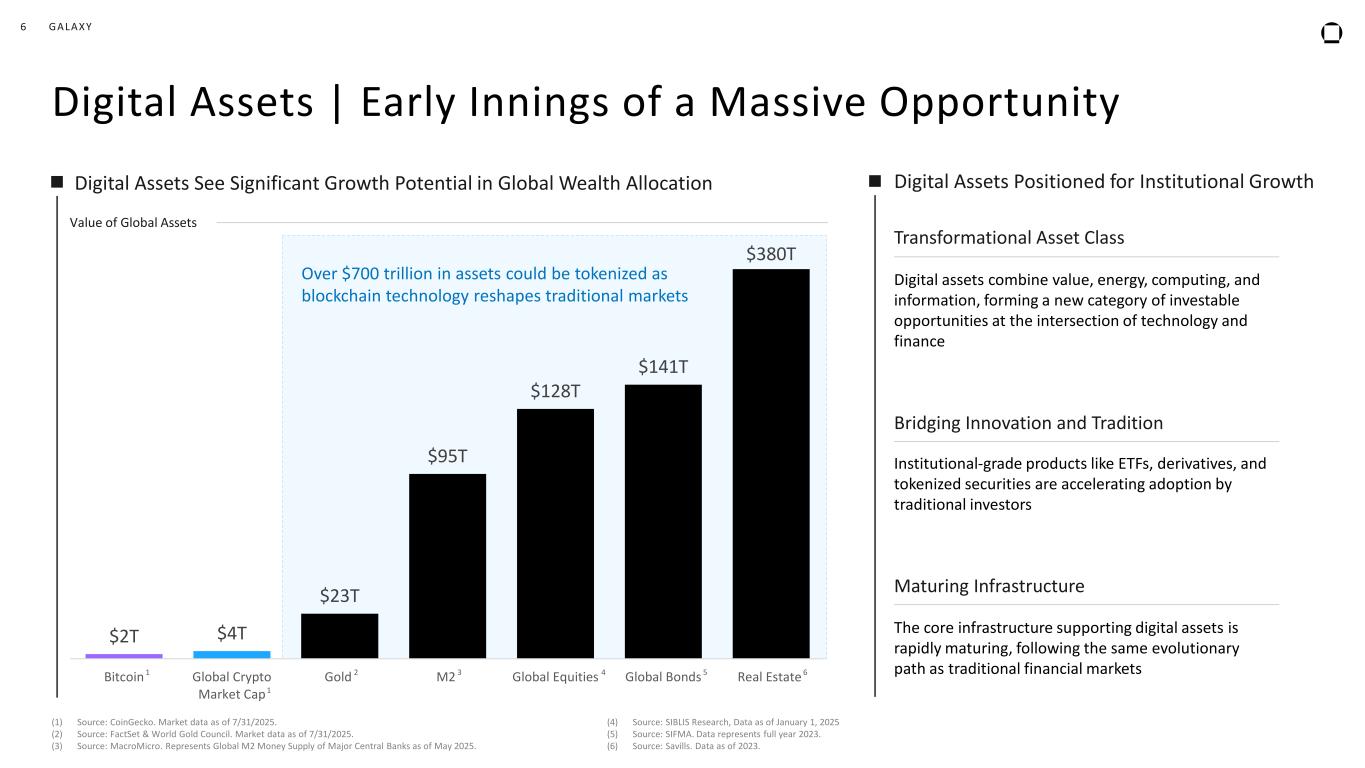
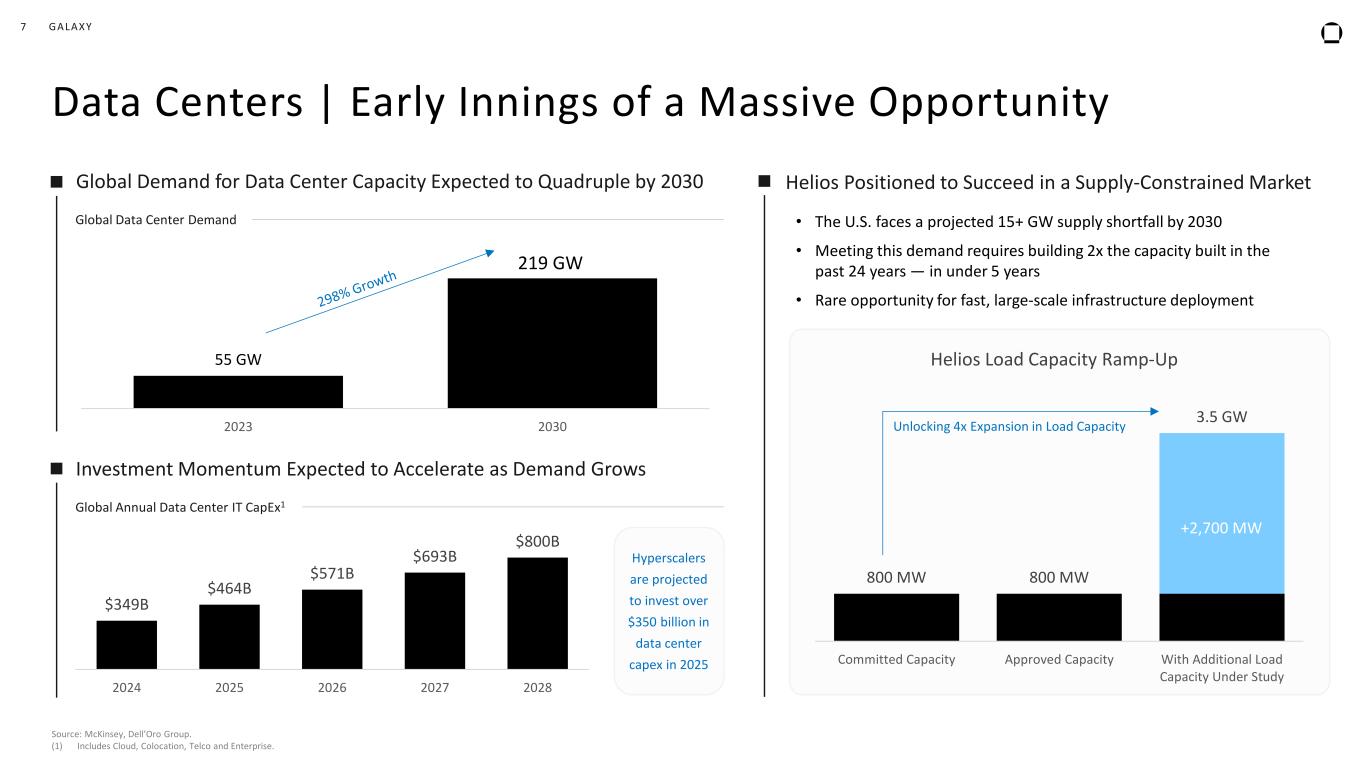
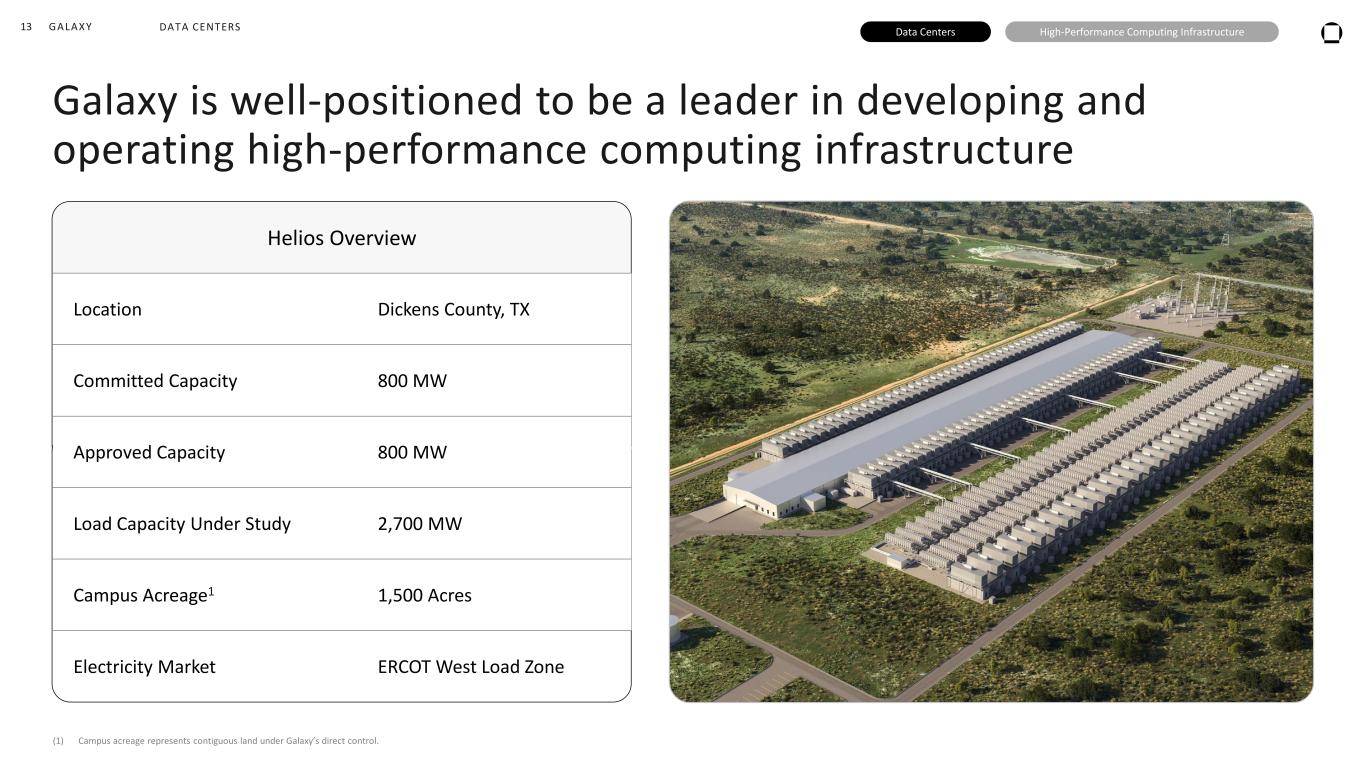
Good morning, everyone. It’s a beautiful day here in New York. This is our first earnings call since becoming a publicly listed company in the U.S., which is really exciting. Tony and Chris will provide a detailed overview of the second quarter. I often find these calls a bit unusual since we’re focused on past performance, whereas my role is to look ahead—not just to the upcoming quarters but to 2028, 2029, and 2030. From that perspective, I am extremely optimistic. July was our best month at Galaxy so far, with all our businesses performing well. In the asset management sector, we’ve seen a surge in balance sheet companies raising capital in public markets to invest in crypto. We are collaborating with over 20 of these companies in capital execution and asset management, potentially adding nearly $2 billion in assets to our platform, contributing to ongoing recurring income. In our trading business, we executed a trade over $9 billion, potentially one of the largest Bitcoin trades ever. This clearly demonstrates that a significant number of people trust our brand and our execution services. The smooth execution of this trade reflects the current strength of the market. Regarding our data center operations, I see both the data center and crypto businesses as growth opportunities. We have recently acquired an additional 1 gigawatt of potential capacity at the Helios site, which could elevate it to a 3.5-gigawatt facility, likely ranking it among the top five data centers worldwide upon completion. We also executed our third option with CoreWeave, customizing the entire 800-megawatt site for them and their clients. Everything is progressing well across the board. The current administration is implementing significant initiatives for crypto. I encourage everyone to check out SEC Chair Paul Atkins' speech regarding incorporating U.S. financial markets into onchain systems. This challenge is crucial for all crypto companies, including Galaxy. Our efforts toward 2028, 2029, and 2030 will be shaped by such projects, and we have much more to share in the next quarter. Lastly, I want to welcome Doug Deason to our Board. Doug brings extensive experience in financial services, real estate, and public markets. Importantly, he has deep ties to Texas, where we have substantial investments, and he will help us navigate opportunities and challenges in Texas and D.C. I am thrilled to have someone with more experience join the Board, and he will serve as our senior spokesperson. Now, I will turn it over to Tony to discuss the quarter.
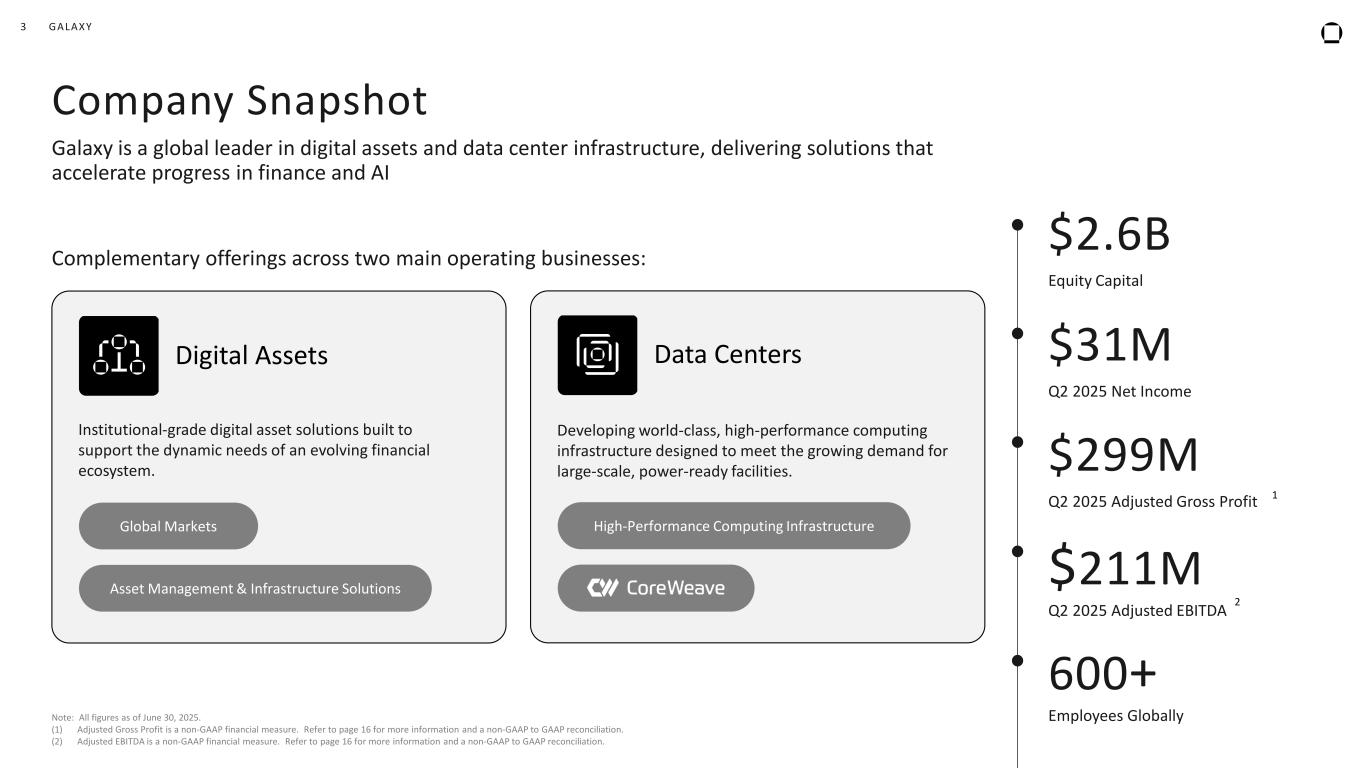
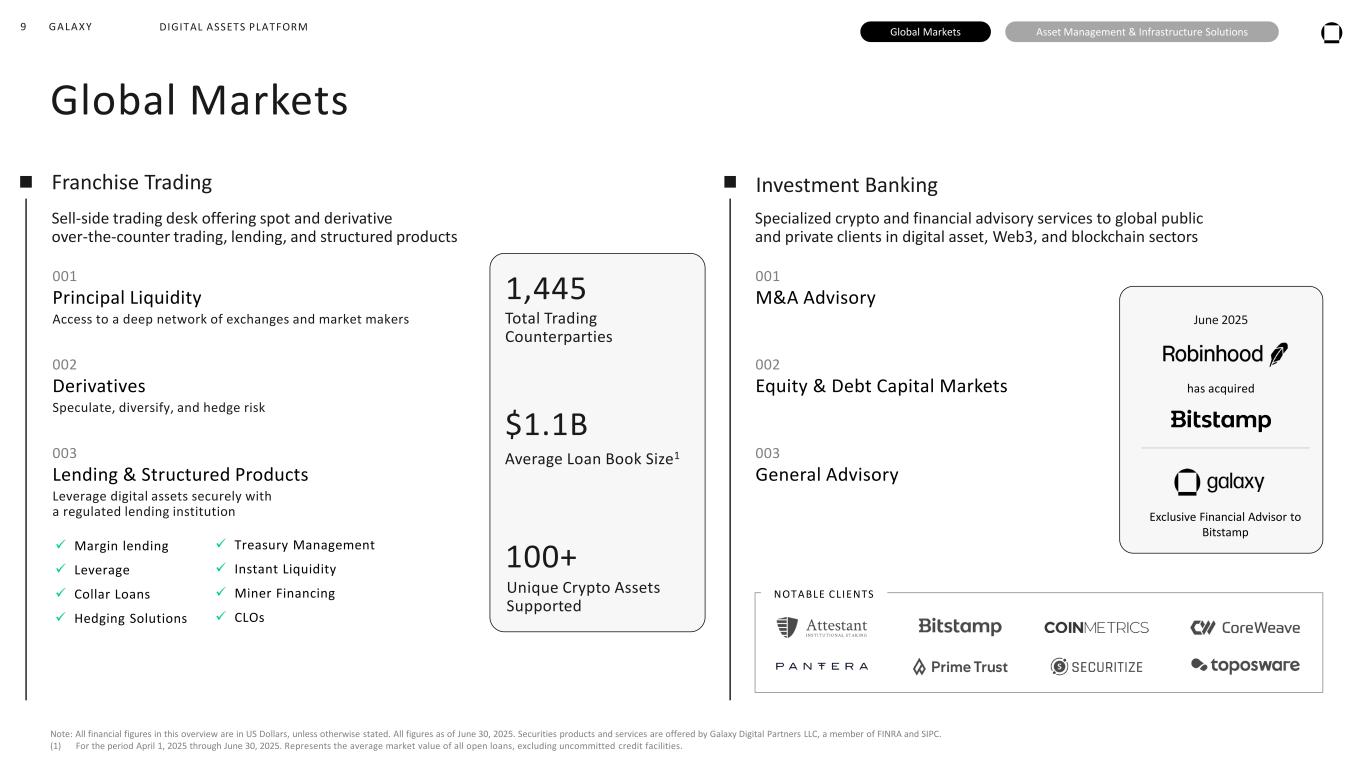
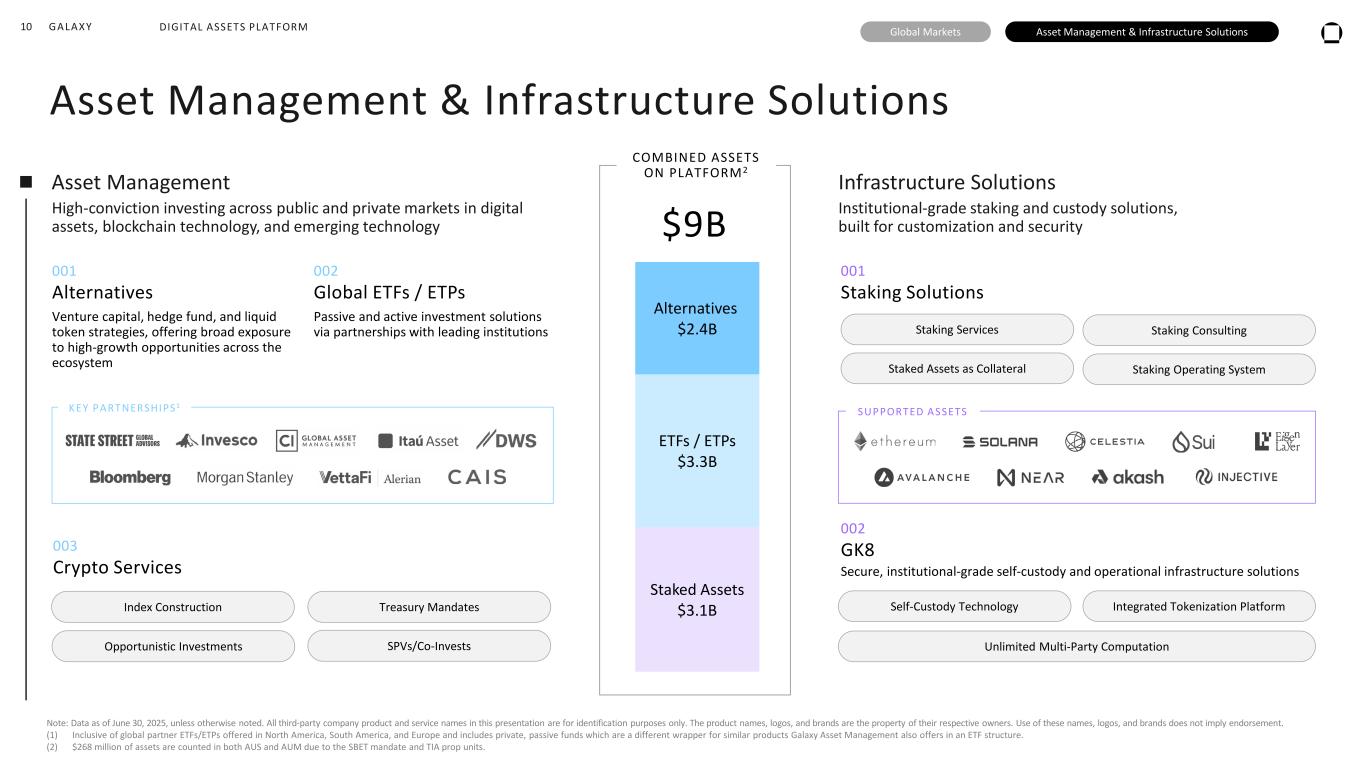
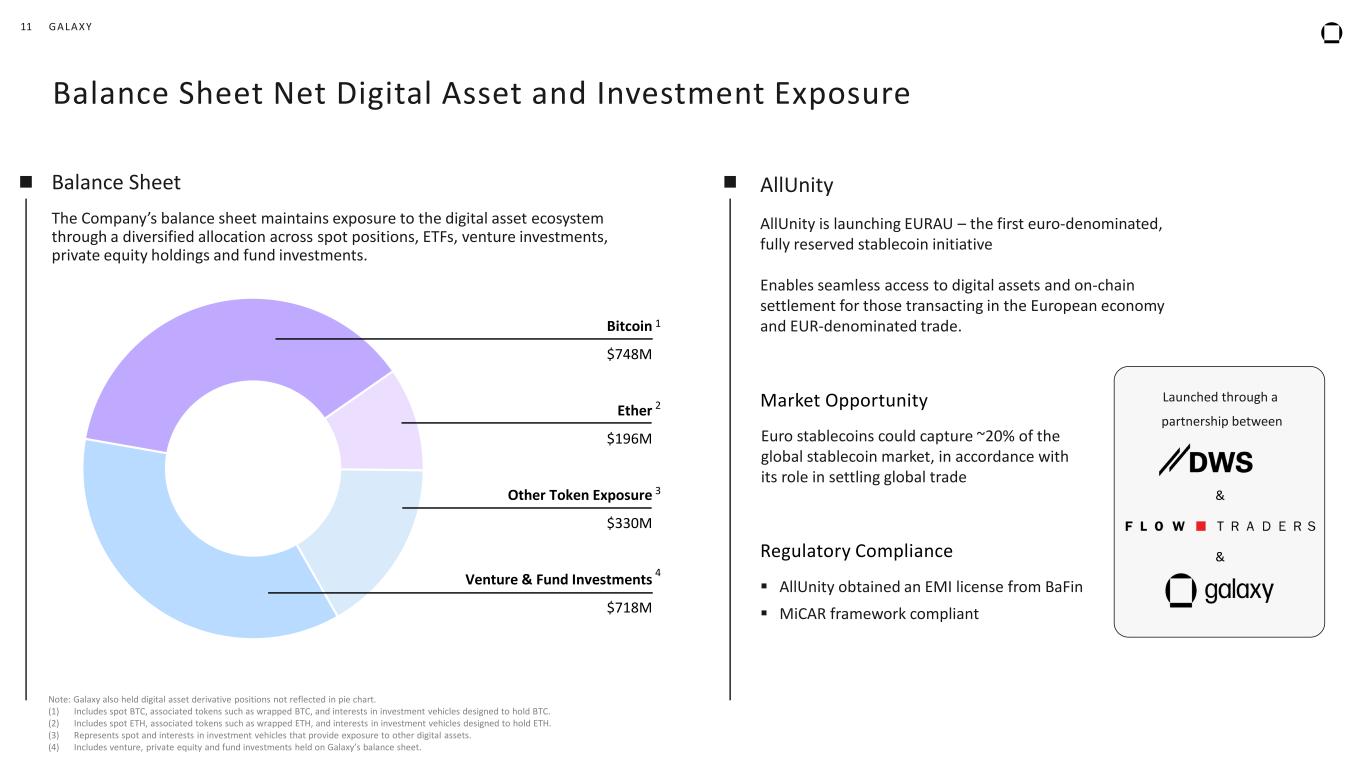
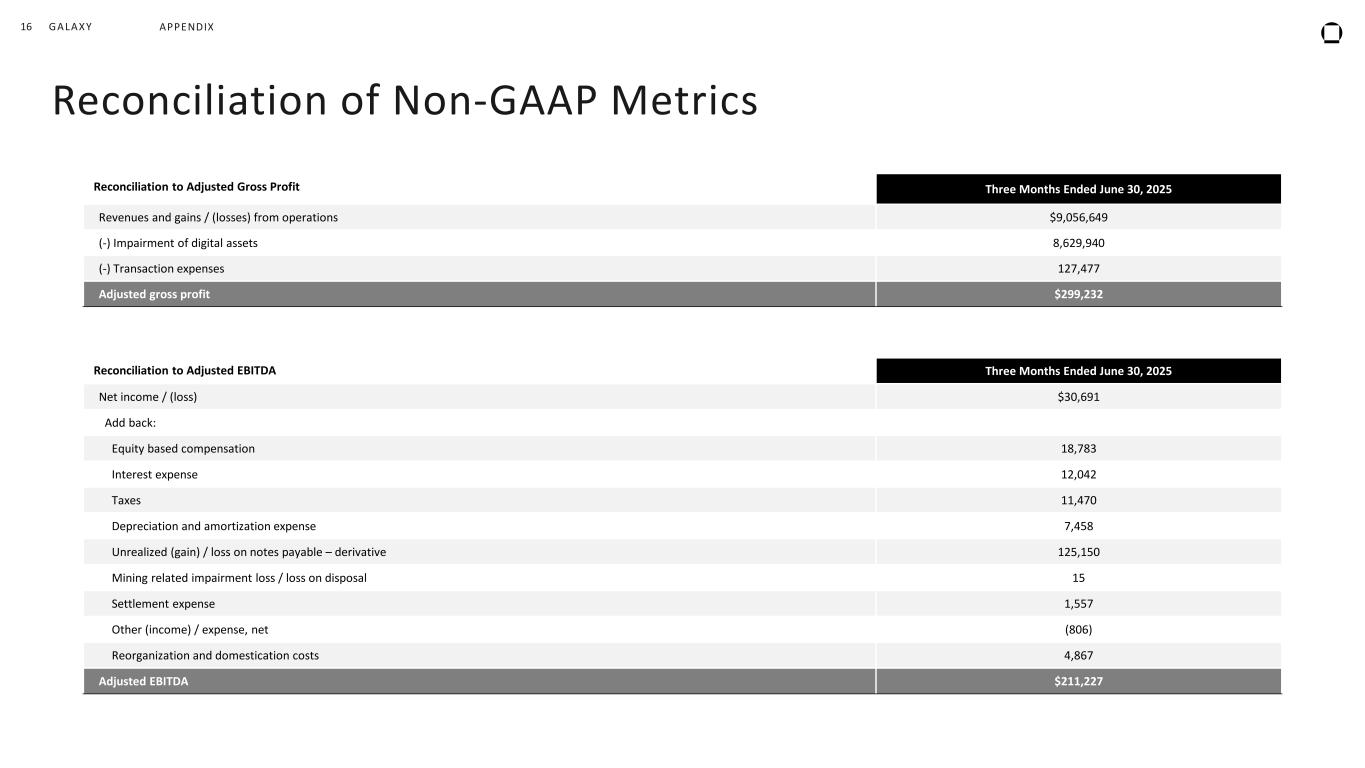
Great. Thanks, Mike, and thanks, everyone, for joining the call today. As Mike mentioned, Q2 was a pivotal quarter for Galaxy, and Q3 is already off to an exciting start, which Chris and I will touch on in a little bit more detail in a few minutes. During Q2, we completed our domestication and reorganization in the U.S., we listed on the NASDAQ, we raised nearly $500 million in common equity capital, and saw continued progress on building out our operating businesses across Digital Assets and Data Centers. From a financial perspective, we made strong progress across the business in the second quarter, generating $299 million in adjusted gross profit and saw a healthy increase in our capital and overall balance sheet. In our operating segments, Digital Assets delivered $71 million in adjusted gross profit, up 10% quarter-over-quarter, reflecting continued momentum across the core operating units. Treasury & Corporate generated $228 million in adjusted gross profit, driven primarily by mark-to-market gains on the digital assets and investment positions held on our balance sheet. As a reminder, in the Data Center segment, we do not expect to report financial results until Q1 of 2026 when we begin recognizing revenue from CoreWeave under Phase 1 of our lease agreement. Until then, all expenditures are being capitalized as they directly support the preparation of the facility for operational readiness. Also, beginning this quarter, we're introducing a new profitability metric called adjusted EBITDA. We believe this offers a clearer representation of the business performance in our operating segments going forward. As a reminder, adjusted EBITDA is a non-GAAP measure and should be thought of as complementary, not a replacement of, our GAAP financial metrics. A reconciliation to GAAP net income is available in our earnings release. For Q2, firmwide adjusted EBITDA came in at $211 million. Our total operating expenses, excluding grossed-up transaction costs and digital asset impairments, were $133 million in Q2. And in Q2 we recorded a negative mark-to-market adjustment of $125 million on the embedded derivative associated with our exchangeable notes, which was driven by Galaxy's second-quarter stock price performance up until the date of our reorganization in mid-May. With the successful reorganization and consolidation of our reporting structure, Q2 will be the last quarter that we will be impacted by this mark-to-market adjustment. Our Q2 GAAP net income was $31 million, which included this mark-to-market adjustment, and Q2 GAAP operating income was $166 million. Turning to the balance sheet. We ended the quarter with $2.6 billion in equity capital, up more than $700 million quarter-over-quarter. This increase was driven by the primary capital raise in May, which generated approximately $480 million in net proceeds, appreciation in our digital assets and balance sheet investments, and a one-time increase of $292 million in equity capital due to the consolidation of our corporate structure as part of the reorganization. In accordance with accounting treatment for reverse acquisitions, this $292 million had no impact on net income or adjusted EBITDA during the quarter but instead was credited directly to equity capital. Cash and stablecoins remained relatively flat at $1.2 billion, with cash proceeds from the May equity raise being used to help fund CapEx related to our Helios data center buildout as well as continuing to grow our balance sheet and digital assets. We ended Q2 with approximately $2 billion in net digital assets and investments on our balance sheet. As we move forward, we will continue to run our balance sheet with fortress-like principles, managing risk with discipline and ensuring we have enough capital, liquidity, and access to financial resources as we continue on a growth agenda across both Digital Assets and Data Centers. Now turning to our operating business results, starting with Digital Assets. Our Global Markets business generated $55 million of adjusted gross profit in the quarter, up from $43 million in Q1. While industry-wide spot crypto trading volumes declined by approximately 30% from Q1, our crypto trading volumes were down 20%, and the business was able to capitalize on market dislocations and outperform the overall market. We continue to see increased engagement from traditional financial institutions, and today we are tracking one of the strongest institutional onboarding pipelines we have seen to date. On the lending side, our average loan book balance exceeded $1 billion for the first time, passing an important growth milestone, and we ended the quarter with roughly $1.4 billion in total loans outstanding. From a net interest margin perspective, we saw modest compression during the quarter, and coupled with a mix shift towards lower-margin lending products, our overall lending revenue was down slightly quarter-over-quarter. And in advisory, Robinhood's acquisition of Bitstamp officially closed, which Galaxy served as the exclusive adviser to Bitstamp on this transaction. Now turning to Asset Management & Infrastructure Solutions. We ended the quarter with nearly $9 billion in total assets under management and assets under stake, reflecting market appreciation and organic growth in our asset management business. This business generated $16 million in adjusted gross profit, down $6 million from Q1, driven by more muted revenue on the staking side, which I'll speak to in just a minute. Asset Management saw approximately $175 million of net inflows this quarter, driven by our Ventures Fund and Treasury Management Solutions, partially offset by certain ETF net outflows amid the market volatility early in the quarter. On the venture side, we announced the final close of Galaxy Ventures Fund with $178 million, which will be focused on early-stage companies building the infrastructure and applications powering the on-chain economy. The fund exceeded its original target size and has already deployed roughly $70 million, with several investments supporting the growth of stablecoin adoption and tokenization. In Infrastructure Solutions, our assets under stake increased by more than 30% to $3.1 billion in Q2. However, this aggregate staking revenue declined in the second quarter amid a notable drop in on-chain activity across the major protocol ecosystems we support. The slowdown in activity was especially pronounced on the Solana network in Q2, where Galaxy is one of the largest infrastructure providers by stake weight. From a distribution standpoint, we announced our integration with Fireblocks in Q2. Galaxy staking services are now natively accessible to more than 2,000 of the world's largest financial institutions, making secure, scalable staking available directly through a trusted custody framework. This was the third major integration in 2025 and reflects our continued focus on partner integrations to broaden access, expand distribution, and open new channels for our customers, helping to drive organic growth in our assets on platform. More broadly, as regulatory clarity improves and institutional infrastructure matures, we're seeing a clear uptick in companies of all sizes looking to engage in the digital asset ecosystem. One of these areas, as Mike mentioned, is the digital asset treasury companies. The recent pickup in activity in this space represents a cross-platform opportunity for Galaxy, drawing on the strength of our trading, asset management, advisory, and staking businesses to deliver integrated end-to-end solutions. Since kicking off our work with digital asset treasury companies, we've evaluated more than 100 different management opportunities. And as Mike mentioned, we are actively supporting over 20 of the most prominent players, providing them with capital, infrastructure, asset management, and trading services. These companies are coming to Galaxy because we are a trusted brand and because they see the value of working with a partner that is built for scale. This has begun to play out in our results, with more than $1.5 billion in assets brought on platform and over $2 billion in notional volumes traded since the first quarter of this year. We are focused on long-term strategic relationships to serve clients, help drive thoughtful innovation in the industry, and generate high-quality and sustainable business for Galaxy. Additionally, last week, AllUnity formally launched their euro stablecoin to the market. As a reminder, this project has been developed in partnership with DWS and Flow Traders and helps position Galaxy to capitalize on this increasingly important segment of the overall digital asset market. Stepping back, we believe we're at a pivotal moment in the evolution of capital markets. With the passage of the GENIUS Act and hopefully more legislation coming, we are seeing real integration between traditional finance and on-chain infrastructure. As this convergence accelerates, clients will need unified platforms to access, deploy and optimize their assets across both environments, which will create entirely new market opportunities. At Galaxy, we're continuing to invest in the technology, research, and product innovation to bridge on-chain and off-chain ecosystems, and you will continue to see us add products, services and new capabilities in the quarters to come. Before I turn it over to Chris, I want to touch on a quick Q3 update. As Mike mentioned, digital asset prices continued their upward momentum to start the quarter, with Bitcoin reaching new all-time highs in July and Ether and Solana posting strong gains in the last few weeks. July marked the strongest monthly performance for our Digital Asset operating business in the firm's history. And as Mike mentioned, we completed the sale of over 80,000 Bitcoin on behalf of a client representing one of the largest notional Bitcoin transactions in history. In Asset Management, we saw strong net inflows and organic growth in staking assets during July and importantly in Data Centers, CoreWeave has exercised its final option on Phase 3 at our Helios campus, and we recently signed a purchase agreement to acquire 160 acres of adjacent land, which could provide an additional 1 gigawatt of increased power capacity at Helios in the future. With that, let me turn it over to Chris.
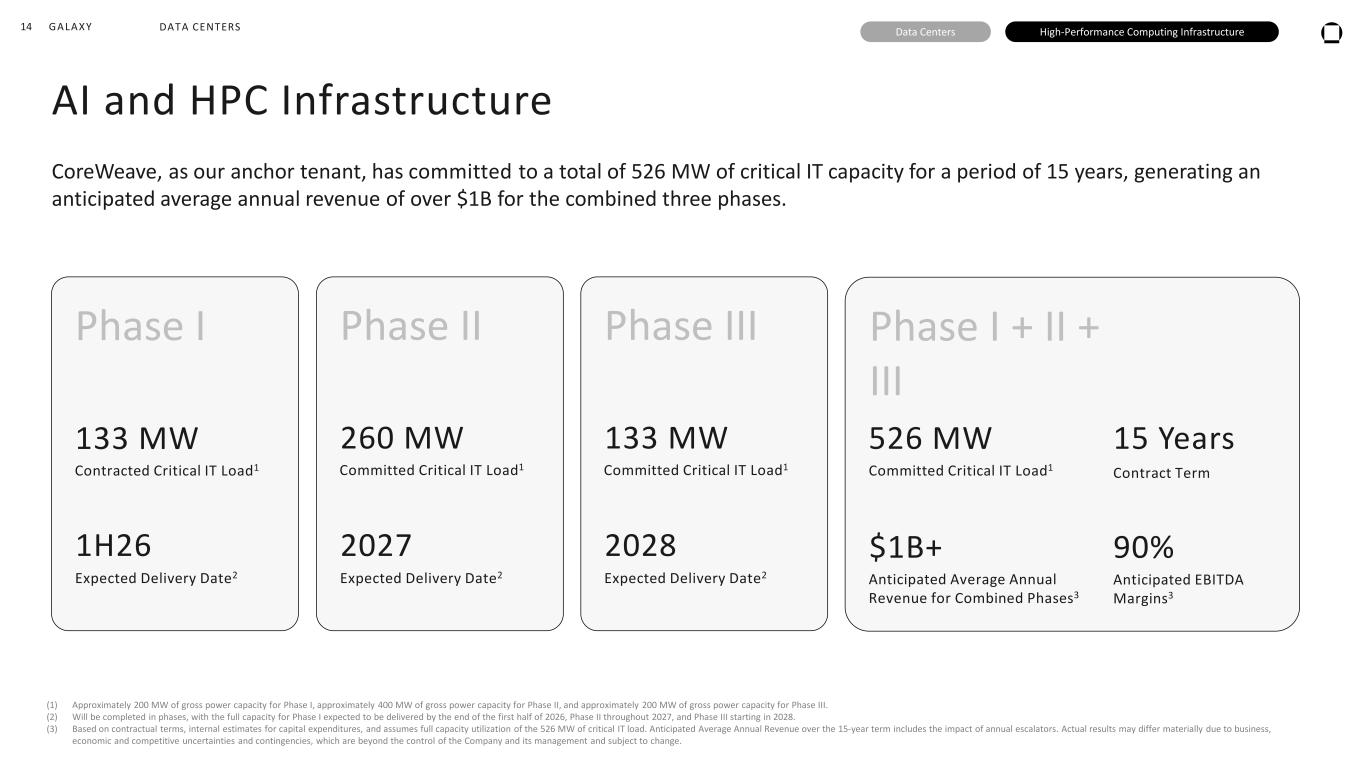
Thanks, Tony. Focusing on our data center business. I'm pleased to announce that subsequent to quarter end, we expanded our partnership with CoreWeave, who exercised its final option to access an additional 133 megawatts of critical IT load for its AI and HPC operations at our Helios data center campus. With this expansion, CoreWeave has now committed to the full 800 megawatts of gross power currently approved for at Helios. This additional capacity will be structured on terms similar to those outlined for both Phases 1 and 2. Throughout the second quarter, the team was laser-focused on execution as we continue transforming the Helios campus into a world-class AI and HPC campus. We're now squarely in the build phase, and I couldn't be more pleased with the pace and precision we're delivering at the site level. From a construction perspective, we have made meaningful progress in retrofitting the existing building and campus. The interior Phase 1 building has been fully demolished in preparation for the buildout of the data center, including the removal of legacy infrastructure, including immersion cooling systems and the former Bitcoin mining machines. We are finalizing an agreement to sell over half of our legacy Bitcoin mining machines, and that sale is expected to close by the end of Q3. For the remaining machines, we have now signed a new hosting agreement. Upon energization with our new hosting provider, beginning in late 2025 and into the first half of 2026, and combined with our East Texas Bitcoin mining site, we anticipate a total mining capacity of approximately 1.8 exahash per second. At today's Bitcoin prices and network difficulty, we expect our mining operations to generate more than $30 million in annual revenue and be an EBITDA positive contributor to the business. At the Helios campus, we're working to complete the earthwork and concrete foundations for our new electrical, mechanical and backup generator infrastructure. The backup generators are scheduled to be delivered throughout the second half of this year and into Q1 2026, keeping us on track for energization. These backup generators are a key part of our electrical infrastructure and are designed to provide full backup power for all critical mechanical systems for the data center. On the electrical front, we've taken a modular approach to accelerate the deployment and commissioning of the systems by prefabricating electrical houses offsite. These electrical houses, or e-houses, are self-contained units that house switchboards, UPS systems, batteries, transformers and other distribution gear. These are being assembled offsite at multiple fabrication facilities. The first units are expected to ship later this month to the Helios campus for installation and integration with the onsite electrical infrastructure. Our chillers begin arriving this month and will continue into Q4. These chillers will operate as part of our broader mechanical cooling infrastructure, providing chilled water to cool the GPUs. Together with our coolant distribution units, the chillers provide a next-generation cooling solution for critical AI infrastructure. In order to bring all these components together and execute the build, we are partnering with Clayco as our general contractor, operating under a construction management scope for the Phase 1 project. Clayco brings deep expertise in mission-critical infrastructure and a strong track record that includes more than $12.7 billion in advanced technology projects. Clayco's expertise gives us high conviction in their ability to deliver large, complex infrastructure projects requiring tight coordination on aggressive timelines, which is exactly what we're building at the Helios campus. They have a team of over 100 subcontractors and trade partners who are boots on the ground at Helios now as we speak, driving progress forward. The combination of earthwork, electrical and mechanical contractors are coming together as planned, and we remain confident in our ability to hit key delivery and construction milestones in the second half of 2025 and first half of 2026. This keeps us firmly on track to deliver the 133 megawatts of critical IT capacity for Phase 1 in various tranches throughout the first half of 2026, aligned with CoreWeave's deployment timeline. With Phase 1 advancing towards energization, we're preparing to seamlessly transition into Phase 2 construction. Let's shift to capital and financing where we've made equally important progress. We are in the very final stages of securing Phase 1 project-level debt financing. Project level debt financing agreements for large-scale data center developments are inherently complex, requiring extensive due diligence, bespoke structuring, and lengthy negotiation processes. As such, these transactions often take considerable time to finalize, even when counterparties are highly engaged. That said, based on the strength of the asset and the structure we've developed, we believe we're well positioned to close this financing imminently. As a reminder, the equity portion of Phase 1 has already been funded through our existing equity capital. Once we have secured the project level debt financing, we will have the capital necessary to fund the anticipated CapEx for Phase 1 of approximately $11 million to $13 million per megawatt. For Phase 2, we are still finalizing the design and engineering specifications, but expect the total project CapEx to be slightly higher than the Phase 1 on a per-megawatt basis. We have already commenced work on project-level debt financing for the Phase 2 project. Throughout the Phase 1 financing processes, we've established strong relationships with a wide range of banks and private credit managers who are active in the space, and I have confidence in our ability to secure debt financing for Phase 2 in the coming months. On the equity side, we are exploring supplementing our parent company equity with project-level equity financing, particularly from infrastructure-focused and private equity-style funds that are actively seeking exposure to AI and HPC data center projects. As always, our approach to capital is opportunistic and disciplined. Once these projects are stabilized and generating revenue, we'll look to refinance at lower cost of capital. This opportunity is expected to unlock committed equity, allowing us to recycle capital into future buildouts while keeping our capital stack nimble and optimized for growth. Finally, shifting to power. We developed a healthy origination pipeline focused on land, powered land, powered shells, and build-to-suit data centers. This pipeline remains a critical part of how we scale in a disciplined and capital-efficient way. Since last quarter, we've narrowed our pipeline from over 40 sites to a select set of high-quality opportunities, rigorously evaluated based on development stage, power capacity, and energization timelines. We are highly selective when it comes to powered land, ensuring that any project we pursue meaningfully expands our data center footprint and advances our position as a multi-asset owner and developer. We've already begun to execute on our growth objectives. Subsequent to the quarter end, we entered into a definitive purchase and sale agreement to acquire 160 acres and a 1 gigawatt load interconnection request adjacent to the Helios campus. At the close of this land acquisition, we will have expanded the Helios campus to over 1,500 acres of contiguous land under Galaxy's direct control, and we'll have increased our total potential power capacity at the Helios campus to 3.5 gigawatts, giving it the potential to become one of the largest AI data center campuses in the world. It also provides us with an important plot of land adjacent to what will be 2 of the largest switching stations in Texas, strengthening our long-term presence in the region. With 2.7 gigawatts of total power capacity now under various stages of study, we're working very closely with ERCOT, AEP, WETT, and other stakeholders to finalize studies and approvals. The load interconnection process for the original 1.7 gigawatts we submitted in 2024 has taken longer than initially anticipated, largely due to ERCOT's efforts to clean up a backlog of speculative and inactive projects that have congested the load interconnection queue. As a result, ERCOT and the transmission utility companies are applying greater scrutiny to new load interconnection requests to ensure that near-term development is anchored in real execution. From our perspective, that's a positive shift and one that ultimately benefits well-capitalized, credible developers like Galaxy. We expect to have clear visibility in the back half of this year. We have also been actively building out our data center team, hiring key talent with deep industry expertise, including engineering and construction team members with experience at leading hyperscalers like Microsoft and Meta. We're full speed ahead on Phase 1, with construction advancing in line with our delivery schedule. Phase 2 is ramping, with both infrastructure planning, lease finalization, and capital formation progressing well. And we'll share more on Phase 3 as decisions take shape. I'm incredibly encouraged by the momentum this team has built. We've made real progress this quarter, and we're going to stay focused, disciplined, and execution-driven as we enter into the second half of this year. Now back to the operator for questions. Thank you.
Operator
Our first question comes from James Yaro at Goldman Sachs.
Speaker 5
I was hoping you might be able to touch a little bit on the outlook for growth of non-U.S. dollar stablecoins. Obviously, there's been quite limited non-U.S. dollar stablecoin growth so far, and a material portion of the U.S. dollar stablecoins are as customers want access to dollars. Do you expect these non-U.S. dollar stablecoins to resemble the size of the dollar ones, and perhaps why?
In the short run, no. Most stablecoins right now are used for liquidity in markets, and that is still mostly denominated in dollars. But over time, I think you're going to see the euro stablecoin and other stablecoins from separate countries pick up as digital currencies start replacing traditional currencies, and the FX market moves to a more digital place. That's going to also happen with payments, European payments, when AI takes off and the agents are starting to spend money. And so I would guess in the short run, no, they're not going to be nearly as big, but I think long-term potential is really great.
Speaker 5
That's really helpful. And then maybe just turning to the data centers. We've seen tightening credit spreads over the past few months. Maybe just any update on the expected financing cost range for the project debt for Phases 1 and 2?
Yes. James, so I think our expectation on where we land on Phase 1 is in line with what we've articulated in the past. It will come out at a sub-10% stream rate. But when you take into account upfront fees and potential breakage, depending on when you assume we'd have a refinancing event or not, we'll likely end up in the 10% to 11% expected yield in terms of cost of capital, even as credit spreads are tightening in real time. These are negotiated deals that have been going on for months. And so we look to that as the expected direction of travel once we look at a stabilized project for takeout. On the Phase 2 side, we're pretty preliminary there. It will be interesting. I think our expectation is that we're a young company doing this. And as we produce results, i.e., as we sign leases, as we get financings closed, and we start building, then we sort of earn the right to achieve larger financings at lower cost. And so our goal on Phase 2 is going to be sort of twofold: one, it's for sure going to be a larger project. And so just getting that financed, I think, is the primary goal; but also the profile of our company, both now as a U.S. public company, larger equity capital base, clear line of sight to delivering stabilization on Phase 1, our expectation is that should lead lenders to also give us positive treatment on that front.
Operator
The next question comes from Patrick Moley with Piper Sandler.
Speaker 6
I was hoping you could just update us on your general conversations with hyperscalers and other AI-adjacent companies. It seems like with the decision to expand the footprint at Helios, those conversations must be going pretty well. Demand seems like it remains strong across the board, but any color that you can give on how those conversations have been going would be great.
I'll start. The most recent announcement regarding CoreWeave executing the third option is a significant indication. They expressed their intention to be the primary build-to-suit tenant for our existing 800 megawatts from the beginning. They had the chance to step into that relationship over the past year, and this final execution solidifies the opportunities they are seeing with their clients on the demand side. We're not continuing to acquire a pipeline of potential energy without reason. Our partnership with CoreWeave will occupy most of our focus in the coming years. However, other hyperscalers are also dedicated to expansion. Their guidance and numbers show that they have not only reaffirmed their expected CapEx budgets but have also begun to increase them. Public announcements from them align with the discussions we're having. Additionally, we've noticed, as expected, that potential clients focused on near-term power deliveries for 2026 and 2027 are now looking ahead to deliveries in 2027, 2028, and 2029. Their interest has just shifted forward. Thus, we're observing continued demand extending into future years, which aligns well with the assets and energy capacity we're building in Texas.
Speaker 6
Okay. That's great color. And then just as a follow-up, switching over to the digital asset business. You mentioned the strong institutional client pipeline and called out some of the Bitcoin treasury companies that you're working with. Could you maybe just talk a little bit about traditional financial firms, asset managers, hedge funds, how that base of clients has looked? Are you seeing a big uptick there? And how are these potential new customers are engaging you on the traditional finance side?
I believe there are several angles to consider. One perspective is that almost every traditional financial company is preparing for a future where assets transition from accounts to wallets, where stocks and funds are tokenized, and where stablecoins play a larger role in payment systems. On the infrastructure front, we are having many discussions with both asset managers and banks. In terms of sales and trading, traditional hedge funds are now much more comfortable with crypto compared to two years ago. Bitcoin has essentially become a macro asset for most hedge funds, and buying or selling it is no longer a significant hurdle as it once was. However, they still tend to feel more secure in equities than in crypto. Consequently, there is a lot of activity in ETFs and balance sheet companies, which will evolve over time. Part of it relates to financing; ETFs are easier to finance compared to prime brokers. I anticipate that we will see a convergence of on-chain crypto and traditional finance in the coming years.
Operator
Our next question comes from Brett Knoblauch with Cantor Fitzgerald.
Speaker 7
This is Thomas Shinske on for Brett. Just one for me. I guess, regarding the recent sale of over 80,000 Bitcoin on behalf of a Satoshi era client. I guess, can you just share any insight into how Galaxy was selected for this mandate? Was there a formal RFP process? And what do you think differentiated Galaxy from other potential counterparties for this client looking to offload his Bitcoin?
As a start, one of the reasons we got that trade and many others is that we are really religious about not speaking about why clients do things or their motivations. I would say we've worked really hard since really 2016, 2017, even pre-Galaxy at building up a network of people that care about this community. And this was our relationships that have gone back many years now of just building trust. And in lots of ways, as much as this is a digital platform technology, there's still a whole lot of hand-to-hand combat in trust. And we do that every single day, and we hammer it into our employees that that's all we have, right? And so I think that maybe doesn't answer exactly what you want, but that's the answer I'm going to give you.
Operator
The next question comes from Greg Lewis with BTIG.
Speaker 8
I was hoping you could talk a little bit more. You mentioned in Q2 about the slowdown in activity on the Solana Layer 1. I'm curious at a high level, maybe what was driving that. And then as we look at July, it seems like a lot of things are improving in terms of activity along the crypto ecosystem. I'm curious what you're seeing on the Solana network in July, if you're able to comment on that at this point.
Yes, sure. Greg, I'll start. Yes, I think what we saw pretty much through the first half of this year was coming off of a pretty aggressive localized volume on Solana for things like memecoin launches and things like that. And so really, Q2 was more of the same after that activity in prior quarters in the prior year had slowed down and leveled off. I could tell you that Solana, as well as some of the other non-Bitcoin Layer 1s, the teams all around those ecosystems, whether it's the foundations or app builders and things like that, who are committed to those networks, are pretty aggressively focused on how do we now build functionality so that onchain volumes are not flash-in-the-pan memecoin-type volumes and instead are enduring volumes tied to support things like stablecoin payments and money movements, actual consumer apps and things like that. So that takes time to layer into the Layer 1s, no pun intended, and actually have working technology. But that is the focus of the industry now is bringing durable, growing volumes onchain. Just where we're at now is at least on Solana specifically was a kink following a pretty aggressive onchain volume run-up from memecoins.
Speaker 8
Okay, great. And then my other question is around these treasury strategies. I mean, clearly, Galaxy is working hard. You called out the 20 customers that you brought on. As you think of the revenue lifecycle of that opportunity for Galaxy, obviously, the initial acquisitions of the cryptocurrencies is important and a revenue driver. But then, could you talk a little bit beyond once they're, I guess, on the platform, how we're thinking about those other opportunities in terms of the asset management and the staking and potentially the lending, how you think that kind of plays out in terms of a revenue opportunity?
Sure. So there's an asset management fee that we're getting in most of these for managing the assets, which roughly is about 1%. There is a staking opportunity in most of these, not the Bitcoin versions, of course, but the non-Bitcoin versions. And so our assets under stake are going up, and there's, of course, staking revenue that comes with that. And the push for all of these companies is going to be to say, hey, we can do something that an ETF doesn't do to drive extra return. And so you're going to see lending, you're going to see onchain activity. And there's, in essence, a race to create the most value, right? Again, Michael Saylor pioneered this idea, and he was able to create value in MicroStrategy by being first in providing access to Bitcoin when a lot of people didn't have that access and created this almost machine and hasn't had to do much more than just buy the Bitcoin and provide leverage. And he's doing it with all kinds of different preferred structures, at first converts, now preferred equity, preferred debt. I think you're going to see the other companies have to go one step further, and we're seeing that. And those are the services we're trying to provide.
Yes. I think it's important to note that our relationship with these companies involves both capital creation and ongoing asset management. In many cases, these activities are conducted under multiyear contracts. The distinctive aspect of these vehicles is that they are closed-end perpetual vehicles. Our objective is to effectively assist the management teams and shareholders of these companies in developing robust infrastructure, managing their assets efficiently, and growing their asset base in the underlying currency. This approach establishes a long-term relationship with them since these vehicles do not allow for redemptions, unlike ETFs. Once the capital is invested, it remains indefinitely. Therefore, our responsibility is to excel in our role continuously.
Operator
The next question comes from Chris Brendler with Rosenblatt Securities.
Speaker 9
Congratulations on the results and also appreciate the additional disclosure. I'm on a train right now, so I'm going to ask my 2-part question all at once. The first question is on the data center business and how much you want to lean into this business. We're already building the pipeline up to 28 now, but I know you're actively looking for additional sites. You're expanding Helios but also looking for additional sites. Is there a plan to potentially add a lot more capacity before the end of the decade? Or is this going to be more methodical so that future growth will be 2029, 2030, that kind of thing? And then second part of the question is, how big do you want this data center business to be? It's kind of a different business than the digital assets business, and your updated thoughts on separating the 2 at some point would be great.
I'll handle the first part, and I believe Mike will also contribute on the long-term strategic side. The response to your question today is clearly focused on methodical growth. This is due to a couple of reasons. First, the industry is still relatively young, and expectations for long-term demand are still forming, especially among the largest companies investing billions. It's one of the largest commitments to a new growth industry we've witnessed, but it's still in its early stages. Secondly, these are large-scale, long-term development projects that require a significant amount of capital. Our ability to grow with these opportunities relies on two main factors: first, our execution needs to be excellent; and second, we need to expand as a company to support this growth. For instance, it would not be wise for us to take on another $10 billion project right now because that demands a capital foundation and resources that we currently do not have. Our strategy is to methodically establish a strong foundation of high-quality assets and reliable recurring revenue, which would then enable us to accelerate growth as opportunities arise. This outlines our approach to growth at this stage.
We have two businesses operating together, and many successful companies manage multiple businesses in one entity, like Amazon with its retail, entertainment, and cloud services. We plan to keep our businesses combined for the time being. As long as the combined value is greater than each separately, we’ll maintain this structure. If the market indicates that splitting them would create more value, we will consider that. The upcoming year is crucial because we are transitioning from significant expenditures to generating cash flow from our assets. Once, in 12 to 24 months, Helios becomes a significant cash generator, it will give us more flexibility in capital allocation. Currently, we are effectively sharing capital. While the financing is largely supported by our strong lease agreements, we still have parent guarantees and equity requirements. This approach allows us to benefit from both aspects for now, and we will continue this strategy until we find a more beneficial way forward.
Operator
Our next question comes from Jon Petersen with Jefferies.
Speaker 10
Maybe just to come back to stick with data centers, and I'm curious for more commentary on hyperscalers. I know you talked about it earlier, but I'm curious what hurdles you think that Galaxy might still need to cross to convince hyperscalers to sign a deal with Galaxy. Are they waiting to see a finished product with the CoreWeave data centers? Or is it more about proving that you have funding capacity or something else?
Yes, Jon. In practical terms, the other hyperscalers considering Galaxy as a partner meant that we allocated our first 800 megawatts of capacity to CoreWeave. It’s true that larger, established hyperscalers care significantly about their partners’ backgrounds, their experience in data center development, and their track record, which we haven't had until now. I believe that they will take this into account. However, after deciding to partner with CoreWeave, we truly didn’t have anything to offer the other hyperscalers. So, it’s been less about us being seen as a new player in data center development and more about the actual availability of capacity. Our strategy was to partner with CoreWeave and execute our existing 800-megawatt project, which is extensive and will take several years. Meanwhile, we plan to build a pipeline for additional capacity to be approved over time. As we achieve this capacity, we will have demonstrated our ability to deliver, which will help us gain credibility with the hyperscalers. So, it's a bit different from what one might expect, but that’s the reality we are facing.
Speaker 10
Yes, that's really helpful. Would you say that while we are considering the future beyond the 800 megawatts, would it be a priority to diversify and attract different customers? Or are you comfortable focusing solely on building for CoreWeave?
Yes. I think that we've definitely gotten comfortable taking on pretty significant exposure to CoreWeave relative to the size of our business. I think that can't be debated based on the size of the mandate that we committed to them. On a go-forward basis, I think it would be natural for anyone who had an opportunity in front of them to build a portfolio of data centers to think about diversification in terms of end client, in terms of regional geography, et cetera. I think generally speaking, from a real estate or portfolio perspective, that kind of diversification usually leads to premium valuation, usually leads to ability to finance things more effectively. And so that's definitely on our long-term road map. I don't want to undersell, though, a, how good a partner CoreWeave has been; and b, as their business grows and they're successful, and their success grows and their credit quality improves, which would be our expectation over time, that it certainly doesn't preclude us from wanting to continue to do business with them as a result. So we're going to keep an eye on it. I think it would be natural for all businesses to think about broader diversification to build the best and most durable business over time. So we're definitely going to look at that.
Operator
The next question comes from Matthew Galinko at Maxim Group.
Speaker 11
I'm interested in hearing about the competitive landscape among treasury companies, particularly regarding how you establish relationships and secure business. Additionally, do you have any insights on what we might anticipate in the latter half of 2025 and into 2026 in terms of new entrants into the treasury market? Also, can you provide any estimates on what percentage of clients you're engaging with before they make their commitments elsewhere?
Yes. We are seeing a significant number of opportunities. At some point, the market will become saturated, as many companies are offering similar products, which will appear in various tokens or combinations of tokens. I believe we have likely passed the peak of new treasury company issuances. What will be particularly interesting is which existing companies emerge as major players. Consider the impact that MicroStrategy has had on the entire Bitcoin ecosystem; it is probably the most influential player, having acquired the largest amount of coins, which gives it a substantial marketing advantage. We have observed a similar dynamic in Ethereum, where two leaders have emerged, along with a few others. Just a couple of months ago, there were no treasury companies in Ethereum, but now the biggest buyers of ETH are SharpLink, Joe Lubin's company, and Tom Lee's firm. I expect these companies to continue growing, while new entrants in these ecosystems will likely find it more challenging to thrive. However, new companies and ecosystems will continue to emerge over time. One important lesson I have taken away from this is the much larger investor base in the equity market compared to the traditional crypto market. From the beginning, as an advocate for Bitcoin, the goal was to attract new people to the community. The treasury companies have excelled in bringing people into the crypto space, and I believe they will continue to be a significant force.
Operator
The next question comes from Edward Engel with Compass Point.
Speaker 12
Just wanted to follow up on some of the digital asset treasury companies. I do see Galaxy has been on some of the pipe deals for some of these. I'm just wondering, are these meaningful investments from your balance sheet or just smaller contributions just to invest alongside some of your clients?
Ed, yes, I think generally speaking, these are relatively small investments for us. Our primary focus has been how can we put our franchise forward and partner with people who actually value our franchise and the skills and the experience we bring to the table to help them make their company better rather than I'll characterize it as buying your way in. So we definitely write checks. We do that generally in the general course of business through a lot of different sleeves at Galaxy, through our ventures funds, our opportunistic pocket of capital. But our commitment from a capital perspective on these is really one of support with our business and reputation and services very much front and center as the goal.
Speaker 12
Great. And then just to squeeze one more in. For the additional capacity that you're purchasing adjacent to Helios, I'm curious just if the timeline of that for ERCOT approval is any different than your existing pipeline.
Yes. So I would think about the additional 1 gigawatt of interconnect request at the land we are acquiring to be somewhat on par with our existing 1.7 gigawatts in the backlog. And so think about 1.7 gigawatts going to 2.7 gigawatts in terms of timeline. To be a little more specific, this new property interconnect is largely focused on the new pitchfork switching station that's being built and delivered. And so our existing 1.7 gigawatts effectively was parsed between our existing timeline into the Cottonwood switching station, which has up to 1.6 gigawatts today approved, which would be an incremental 800 megawatts from what we already have. And so this sort of layers into the new CapEx project that's already been approved and is in flight in ERCOT for the new switching station, which now we own a significant amount of land all surrounding that new project.
Operator
Our next question comes from Devin Ryan with Citizens.
Speaker 13
I want to revisit the topic of tokenization and, as we move closer to developments, it would be helpful to get an update on how you view Galaxy’s role in the on-chain space. Specifically, do you see yourselves assisting product manufacturers in tokenizing assets and raising primary capital? Are you interested in offering traditional assets such as tokenized stocks and bonds? Additionally, how do you envision your focus areas, and are there specific sectors where you prefer not to get involved? Lastly, what resources do you think you need to achieve your goals?
Yes, that's the big question for the future of crypto. Everyone in this industry, including us at Galaxy, is trying to determine our best role. We have a tokenization engine and a wallet business with GK8, and we are involved in a lot of staking. We have put all of that together as an infrastructure package and we aim to be part of the solution for infrastructure needs. However, it is still unclear how these assets will trade in the future. Once they do begin trading, we will be involved and considering whether to partner with others to participate in the exchange or platform. The roadmap is still being developed, largely due to regulatory factors. For example, if we tokenize Apple stock, we need to know where the liquidity for that will be found. There isn’t a clear answer at this moment, but we are very focused on it. We believe there will be more developments; the head of the SEC mentioned plans to move things onchain, and building that foundational support is crucial.
Speaker 13
Got it. And just a quick follow-up, maybe shorter term, regarding the outlook for the investment banking team. Clearly, there are many companies going public now and a significant amount of M&A activity, with indications that even more M&A will occur in the future. While it's not necessarily a core driver, it can influence confidence from quarter to quarter. I'm just looking for any insights on the opportunities ahead and how you might estimate the additional revenues you anticipate from that.
Yes. So on the investment banking side, I would say, where we've really shined over the years is focusing on boutique M&A opportunities where our expertise on both the buy and the sell side, specifically to crypto companies, where they sit in the ecosystem, what their value add is, really shines. That pipeline is the highest quality and largest in terms of dollar numbers and live transactions than we've ever seen before. And what's important about it is historically, if you remember, we had a pipeline in that business that was pretty large, and there were some really chunky, very large transactions in there. Now we have numerous 9-figure M&A proposed transactions that we're pursuing all at once. And so we have higher number and a lot broader and durable pipeline of opportunities. They're all very high-quality companies that will very likely get bought and sold. And so that part of the business, we're actually pretty excited about. Given the size of that market and those opportunities relative to the rest of our business, for the foreseeable near term, it's going to be a relatively smaller contributor, but nonetheless, an important growing one that's important to not just the earnings of the business but also the knowledge base and continuing to build our reputation as being one of the smartest players in the space. So that's what we're most excited about there. What the team is also focused on outside of that, which are really near-term deals we are transacting in is a little bit of what Mike said, which was investing in talent, some licensure around traditional broker-dealer abilities and thinking about what an onchain capital markets business would look like. I think what we knew all along was we're unlikely to be smart to compete against the large banks for traditional capital markets deals. But I'm not sure that we agree that, that should be applied to the new onchain economy that's growing. And so we are investing in early stages and thinking about our strategy around capital raising onchain, whether that be in security token form or nonsecurity other token form depending on where market structure comes out. And so that's our R&D phase today right now.
Operator
The next question comes from Joseph Vafi with Canaccord.
Speaker 14
Great progress on everything. A lot of questions have been answered or asked. So I'll just ask a quick one. Just really curious on this $9 billion notional trade. It feels like the market absorbed that trade really well. So, a, congratulations on that execution. But just kind of peeling the layer of the onion off, the mechanics of it. Were you surprised to see that trade? It felt like the Bitcoin market only dropped a very small amount on such a large trade. So just any color on the mechanics and demand you saw for that block.
Yes. I'll share some public information. Michael Saylor regularly discloses his purchases each week, and whether it's due to grace, luck, fortune, timing, or a mix of all these factors, the execution coincided with significant buying activity. This buying primarily comes from balance sheet companies, not just from Michael Saylor but also from others like Truth Social and various similar entities that are purchasing in the same public space. As a result, supply and demand have aligned, leading to substantial cryptocurrency purchases from these companies. Ethereum-related firms are spending hundreds of millions of dollars each week at the very least. I believe that as long as this trend continues, crypto prices are likely to remain strong. There is a broader economic context at play, as we recently observed a significant decline in jobs and last Friday's job revisions. We are now anticipating an 80% chance of a rate cut in September. The President is increasingly vocal about the need for a new Fed chair, expressing that he thinks Chairman Powell should have reduced rates sooner. When the executive branch intervenes with the Central Bank and dismisses the head of the Bureau of Labor Statistics, it all contributes to the narrative surrounding Bitcoin. It suggests that we might need to resort to inflation to escape an overwhelming debt situation. Therefore, the macroeconomic outlook for Bitcoin and crypto is becoming more positive, suggesting ongoing demand for Bitcoin as an asset in portfolios.
Operator
Ladies and gentlemen, in the interest of time, this concludes our question-and-answer session. I would like to turn the conference back over to Mike Novogratz, Founder and CEO of Galaxy, for any closing remarks.
Guys, thanks a ton. We do notice that we have more demand than spots for the conference call, for the earnings call. And you can call that a rookie mistake. It's our first U.S. listed earnings call. We promise next time we won't make that mistake. We are working hard. We're excited over here. I said that earlier, July was the best month we've had. There is a tremendous amount that we didn't talk about happening here. We have 615 employees that are coming to work with big smiles every day. And I bet you by the time we speak to you next time, that number is bigger. Anyway, thanks a lot, and look forward to talking to you next quarter.
Operator
Ladies and gentlemen, the conference has now concluded. Thank you for attending today's presentation. You may now disconnect.