Operator
Good morning, and welcome to the Galaxy Digital First Quarter 2026 Earnings Call. Today's call is being recorded. After today's presentation, there will be an opportunity to ask questions. To ask a question, you may press star than 1 on your telephone keypad. To withdraw your question, please press star than 2. At this time, I would like to turn the conference over to Jonathan Goldowski, Head of Investor Relations. Please go ahead, sir.
Good morning and welcome to Galaxy's first quarter 2026 earnings call. Before we begin, please note that our remarks, including answers to your questions, may include forward-looking statements. Actual results could differ materially from those described in these statements as a result of various factors, including those identified in the disclaimers in our earnings release or other filings, which have been filed with the U.S. Securities and Exchange Commission and on CDAR+. Forward-looking statements speak only as of today and will not be updated. Additionally, we may discuss references to non-GAAP metrics, the reconciliations of which can also be found in our earnings release. Finally, none of the information on this call constitutes a recommendation, solicitation, or offer by Galaxy or its affiliates to buy or sell any securities. With that, I'll turn it over to Mike Novogratz, founder and CEO of Galaxy.
Yeah, good morning, everyone. Listen, you know, first quarter crypto prices down on average of 25%. You can, you know, see our headline number certainly isn't what we'd like to be delivering quarter after quarter. um all that said i feel pretty good about the business right now and so you know you come into this this earnings call and i thought well let's break it down data centers and then crypto and and give you just how i'm seeing it from the ceo perspective right every every monday morning i look at my to-do list in the data center business and it has four buckets right are we delivering on time and on cost. That's not an easy feat, but so far our team is doing an awesome job. We delivered our first data hauls. We're on schedule. You know, more than half of the data centers around the country, you know, can't say that. And so we feel pretty good about the team down in Texas and the hard work they're doing. And so that's a check, right? The second is we've got to finance phase two and then phase three. The financing markets are open. I was hoping we would have the definitive details today. Trust me, that will come in a very short order. We will have phase two financed. Our partner CoreWeave, their credit spreads have come in. The financing markets are pretty robust right now, and we're looking at a few different options. Part three is, you know, we have this 830 megawatts that we were granted recently, you know, tenant for that, right? That would take a lot of, you know, stress off of me and de-risk this company even further. We're in conversations with a lot of big people. You can guess who they are. That process, Chris will get to the dynamics of it later. My sense is that's probably going to be a second half of the year. process as we get closer to 2027, the stress around 2028 power will pick up. Right now, most of the hyperscalers are focused on this year and next year and just getting the power they need. And finally, new projects that we've been, you know, looking at, circling around. Same answer. hopefully in the not-too-distant future, we're announcing a pretty cool one. And so stay tuned. Don't have anything specific to tell you today. But in each of those buckets, I'm not sweating. I feel good about where we are. I feel good about the progress we're making. And I feel good about, you know, the future after that even. And so I can give a big check on the data center box. Then I flip to digital assets. That's, you know, as I said earlier in the year, I think this is a transition year for the crypto business at large, not just at Galaxy, but globally. And what I mean by that is we are going from a very speculative business where if you were being crashed, you would say it was the crypto casino to a technology that is going to be used in industry all over the world. and you're seeing that pick up in an accelerating fashion, right? Every trade-by organization is working on their version of that infrastructure. They need a wallet. They need custody. And so we have an infrastructure business that's doing great stuff right now, is engaged in all kinds of conversations. Again, I'm not going to announce anything today, but stay tuned. we've got some announcements that are coming soon, deals that roughly are done just aren't at the announcement stage. But that business is going to keep on growing. And for the world, it's important. When you want to understand what's really happening as we're tokenizing equities, tokenizing privates, tokenizing mortgages, tokenizing currencies, this is the way that the United States projects its power around the world. If you want to think about the real use case of crypto, it has always been the rest of the world, more so the United States. Right here, we've got great financial services accessible to most Americans. But there are five, five and a half billion people that that's not true for. And so you're going to see the big brands being sold to, you know, places like Paraguay and Bhutan and Cambodia, all over the world where people have access to our financial services. And that, you know, part of what needs to happen is the infrastructure bill in D.C., the Clarity Act. That's got a really important six weeks. I still believe it gets passed. There's a few obstacles, right? Tom Tillis, who's a friend of mine, is a tough son of a gun. He has been digging in. Him and the president are not on the best of terms. And so he's pushing pretty hard on the ethics piece of this thing. I do think they'll get through that. It's important for both the Republicans who campaigned on it to get this bill done and for the Democrats who don't want to have to campaign on it to get it done. And it's important for America. And so I think once that gets done, you're going to see a further acceleration in that build out. And it's also going to help crypto prices. Bitcoin, which is the bellwether, first quarter, we had a pretty severe sell-up all the way to 60K. It feels like that will be a tradable bottom for this part of the move. We've bounced up to 80. Now I think we're trading $76.77. I don't see Bitcoin exploding in the near term, but it might. And so I think you're going to have some wood to chop through $80.85. Once you get through that, the next stop is $100. And if you break that, then it's all price discovery. And so it's not my prediction that we break that $100 this year. You're going to need a few things to happen. mostly that will be an easing central bank. And, you know, given the war in Iraq, we've got some pretty ugly inflation prints that are going to come through the pipeline. I'm sorry, the war in Iran. Pretty bad inflation points that will come through the pipeline. And so I don't think the Fed does anything but sits and watches. I know Kevin Warsh is a real believer in the productivity miracle that is coming from AI you know one thing I was pointing out to the guys here is all of this wild acceleration we're seeing in AI is mostly being done on the infrastructure that already existed you know campuses like Helios where we're delivering to the data centers is still not really you know we deliver the data center to Corweave they then take another you know two to three months to build out the inside for final customer to use. And so it's really not till this time next year when the next phase of power comes into powering AI. And so the AI revolution is just starting in its impact on inflation, its impact on productivity, its impact on how the world changes. And so, you know, listen, I think the Fed will be cutting rates by the end of the year. I think that will be very supportive of broad crypto prices. One thing I'd point out is that crypto prices were down 20%. Volumes in trading markets were roughly down 20%. And here at Galaxy, our volumes were flat. And so it's the first time we've really started to see a decoupling of our business from the price. And that's very promising. If I could see that four quarters in a row, I'd have a big grin on my face. The balance sheet lost money because crypto prices were down, but we way outperformed what we would have done if we had not, A, cut some positions and also shifted a lot of our level two exposure into hyperliquid, which is one of the tokens I've talked about. We've been a supporter mostly because it's got an economic model, unlike many of the other tokens, which were more association tokens. And I think hyperliquid is a good way to look at what the future of crypto is going to look at. And so again, you know, headline numbers weren't what I want, but I feel really good about the two businesses, both how we're doing and the macro over, you know, backdrop for both of them. And with that, I'll pass it on.
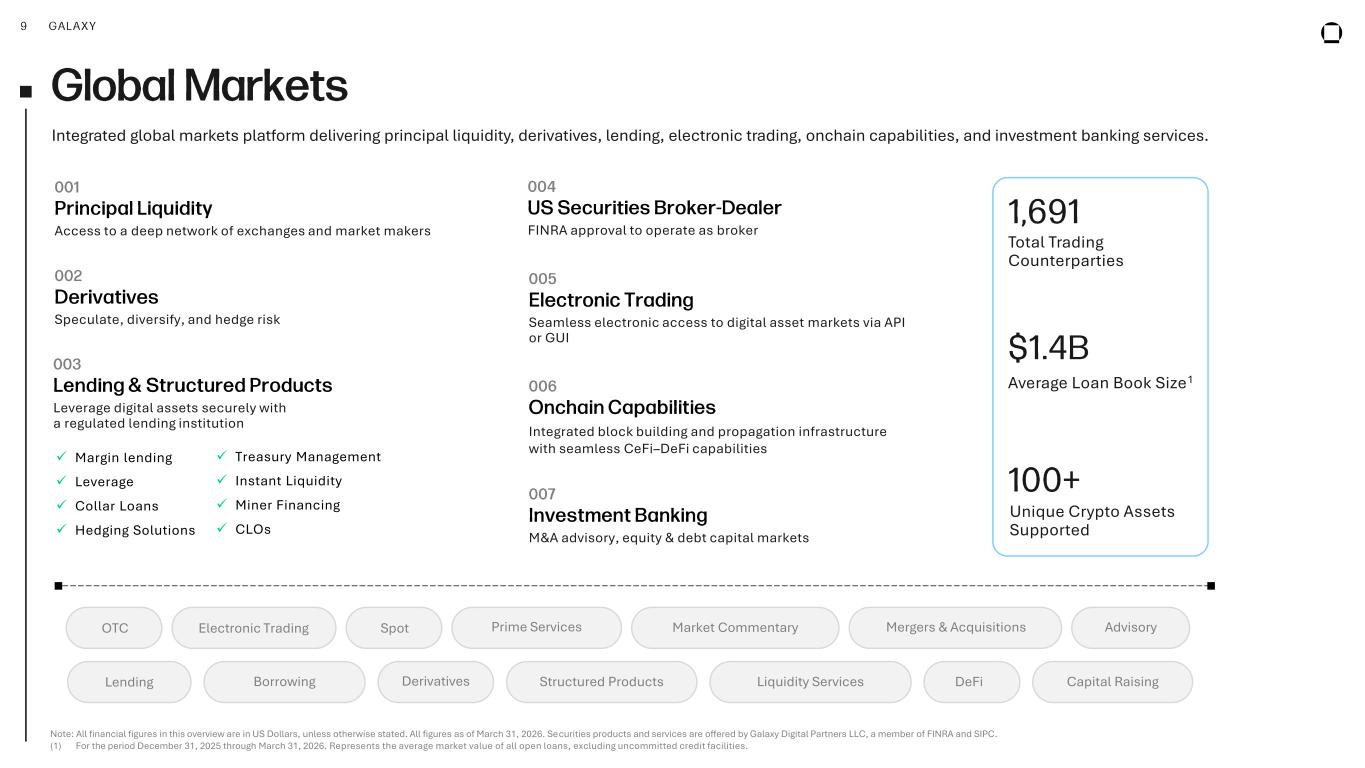
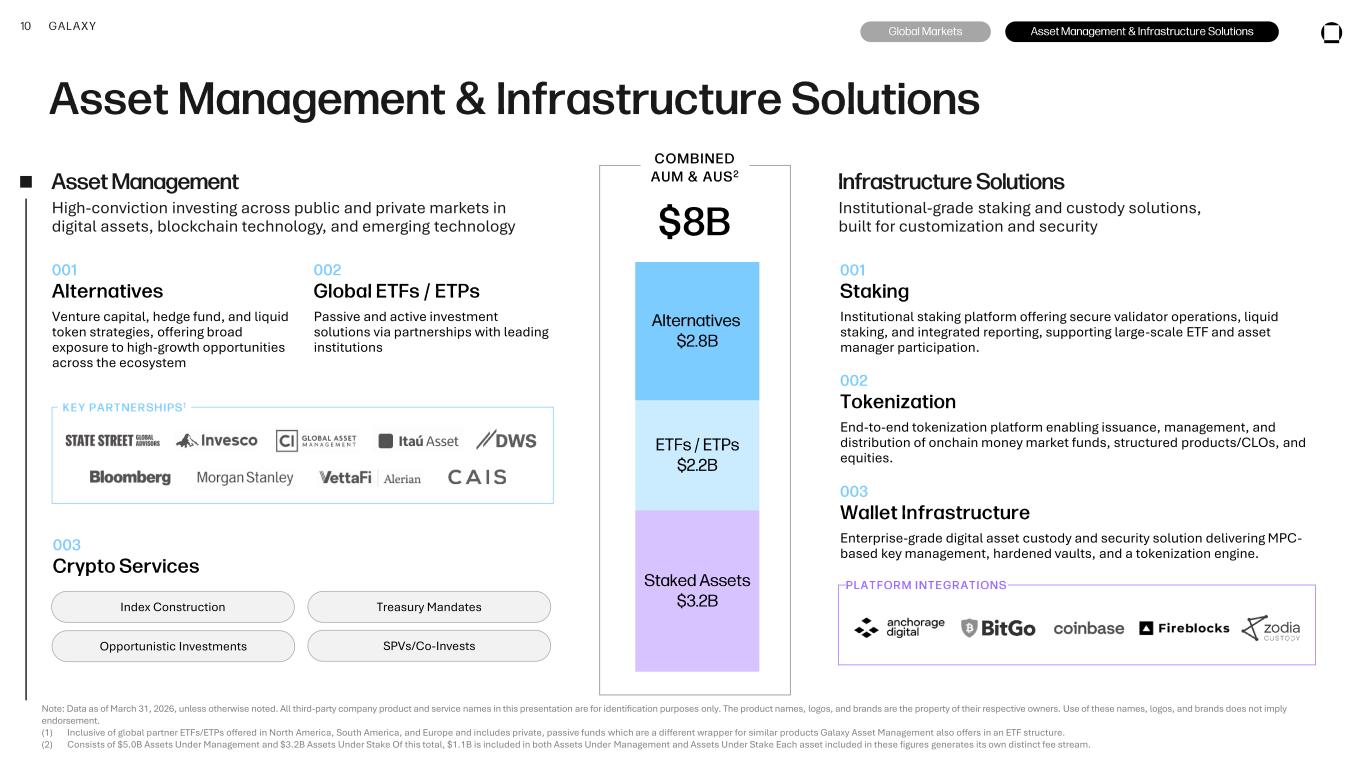
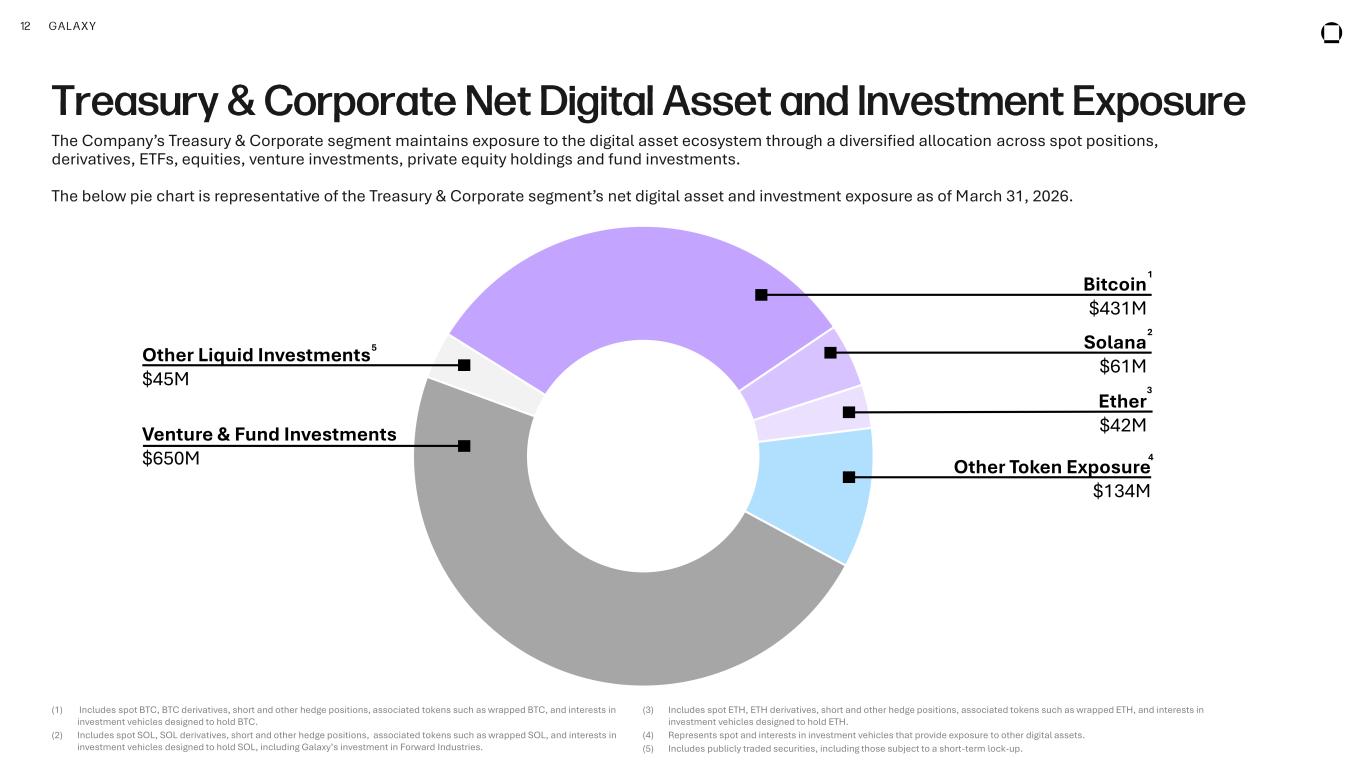
Great. Thanks, Mike. And thank you everyone for joining the call today. I'll start by walking through the consolidated financials and the balance sheet and then dive into the digital asset operating businesses in more detail before turning it over to Chris for an update on data centers. As Mike mentioned, Q1 was a challenging quarter for digital asset prices, with total crypto market cap declining roughly 20%. While that impacted our reported results, our operating businesses continued to perform, and we reached an inflection point at Helios as we've started to come online. For the first quarter, we reported gap net loss of $216 million, or a loss of 49 cents per share, and firm-wide adjusted EBITDA of negative $188 million dollars. These results were driven primarily by unrealized mark-to-market losses on our balance sheet digital asset holdings, with the treasury and corporate segment reporting an adjusted gross loss of 140 million dollars in the quarter. Firm-wide operating expenses, excluding grossed up transaction costs and the impairment of digital assets, were approximately 147 million dollars in Q1, down 7 percent quarter-over-quarter, driven by lower professional fees and a decrease in compensation expense. On the operating business side, our digital asset segment generated $49 million of adjusted gross profit, roughly in line with Q4 results, despite broader market weakness in Q1, as Mike mentioned. I'll provide more detail on this performance in a few moments. In data centers, our financial results remain de minimis in Q1 as we work through the final stages of construction and commissioning for phase one at Helios. As mentioned previously, revenue will begin ramping in Q2 as we deliver data halls under our CoreWeave lease agreement. As a reminder, these are 15-year contracted cash flows at approximately 90% average lease level EBITDA margins, entirely uncorrelated to digital asset prices. As that revenue comes online, it will begin to meaningfully diversify our revenue and earnings profile in the coming quarters. turning to the balance sheet we ended q1 with approximately 10 billion dollars in total assets down from 11 billion dollars at year end driven by the decline in digital asset prices total equity capital was 2.8 billion dollars with roughly 60 allocated to our operating businesses this mix will fluctuate quarter to quarter but as previously noted we expect the share of capital allocated to our operating businesses to continue increasing in the coming quarters driven primarily by the ongoing build-out at Helios. Within Treasury and Corporate, we held approximately $1.4 billion of net digital assets and investments, down 19% quarter-over-quarter, primarily reflecting market depreciation. During Q1, we repurchased 3.2 million shares of our Class A common stock for $65 million under our previously announced $200 million share repurchase authorization. This amount more than offsets dilution from equity-based compensation awarded in 2025 and brought our quarter-end share count to approximately 390 million basic shares outstanding. We view share buybacks as an attractive use of capital when we see meaningful disconnect between the stock price and the intrinsic value of the company, and will continue to use them in a disciplined manner consistent with this philosophy going forward. cash and stablecoin balances were approximately 2.6 billion dollars at quarter end roughly flat from year end we will continue to manage our balance sheet with discipline balancing investments while maintaining sufficient capital and liquidity including for the potential repayment of 445 million dollars of exchangeable notes maturing in december of this year now turning to our operating results starting with digital assets q1 reflected a more challenging market backdrop as we talked about with digital asset prices down quarter-over-quarter and a corresponding softening trading volumes and on-chain activity. Against that backdrop, our digital asset segment delivered $49 million of adjusted gross profit, roughly flat quarter-over-quarter. In a sequentially weaker environment, this stability reflects how the composition of the business has begun to shift. Recurring fee revenue and transaction income continue to scale across the platform, and this base will hold up better in quarters where volumes and prices do not. We also tightened operating expenses during the quarter, narrowing the adjusted EBITDA loss by roughly a third from Q4. In a volatile industry, how we manage the business in challenging environments matters just as much as how we perform in strong ones. The global markets business delivered adjusted gross profit of $31 million, up 3% quarter over quarter, with digital asset trading volumes holding steady, as Mike mentioned, even as the industry-wide activity declined more than 25%. We're adding new trading clients at a steady pace, and the mix is shifting, with a growing share coming from traditional asset managers and hedge funds, reflecting the ongoing convergence of digital assets and traditional finance. On the lending side, our average loan book declined approximately 20% quarter per quarter, driven by digital asset price depreciation, modest client deleveraging, and the roll-off of two larger loans. Since then, we've added new clients and originated new loans, while further diversifying our counterparty base which will continue to support a more durable loan book going forward a quick update on galaxy one where we're quietly continuing to build momentum we recently launched Solana staking at zero percent commission and we'll be opening the platform to business accounts in the coming months expanding the user base and addressable market galaxy one is still early but we see a meaningful opportunity to continue layering in capabilities that integrates trading, yield, and asset management into a single, unified experience. Turning to asset management, we delivered adjusted gross profit of $18 million and ended the quarter with approximately $8 billion in assets on platform. In asset management, we generated $69 million of net inflows during the quarter, underscoring the durability of our platform against the soft market backdrop. Flows were broad-based across both our ETF platform and alternative suite, reflecting continued institutional demand for access to digital asset ecosystem and confidence in our ability to manage through volatility. Subsequent to quarter end, we secured a new $75 million investment mandate, one of the largest single client inflows in our history. Our SMA and managed account business continues to grow as an increasingly important part of our overall platform, and we see a clear path to further expansion through 2026 as client appetite for bespoke mandates remain strong. In addition, on May 1st, we will be launching a new fintech hedge fund focused on the convergence of traditional financial services, blockchain infrastructure, and emerging technologies. This is a thematic we've been operating within at Galaxy for nearly a decade, and one we believe gives us a differentiated edge as investors. We've seen this space evolve firsthand, we understand how these businesses are built, and we're able to underwrite opportunities with a level of conviction that comes from being both operators and long-time participants in the ecosystem. This approach is consistent with how we're building the asset management platform, focusing on differentiated strategies that align with where we see long-term capital formation and innovation across the digital asset ecosystem.
On to digital infrastructure solutions.
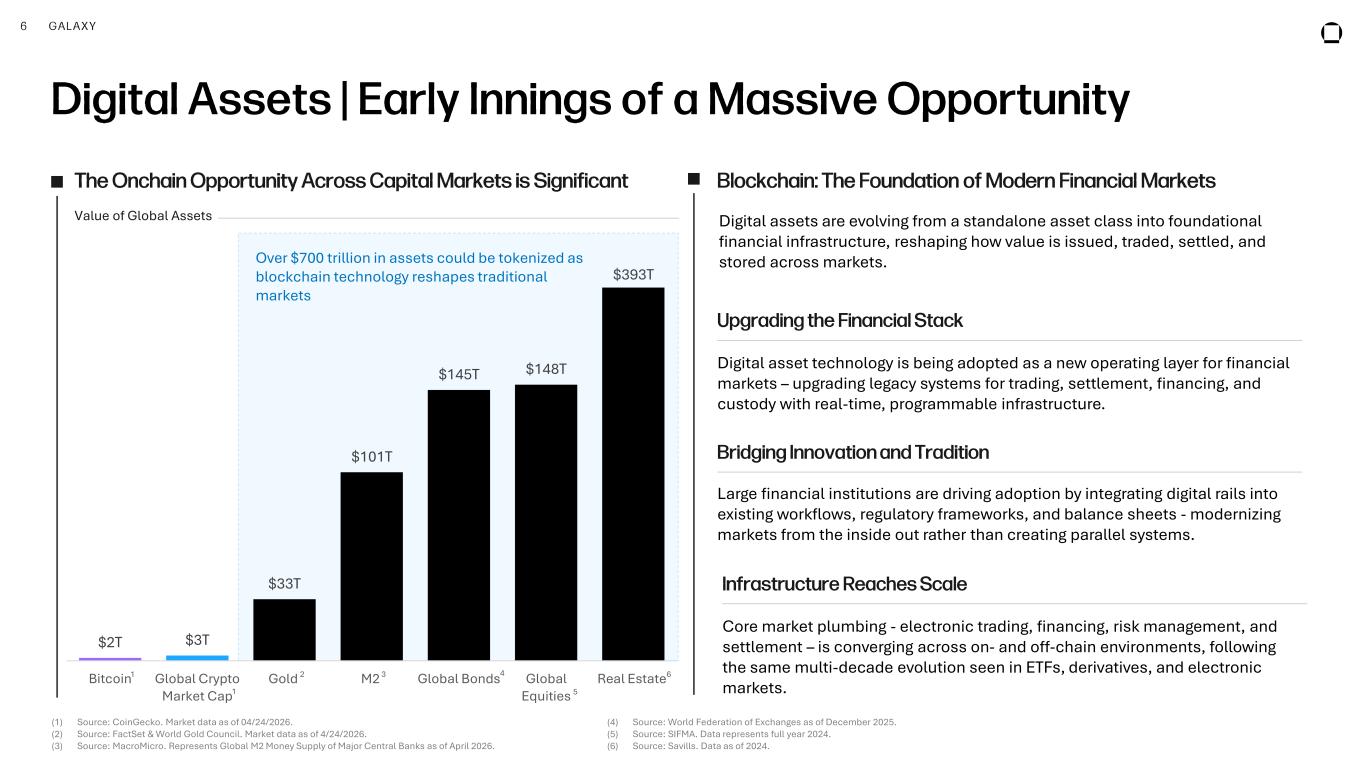
As Mike mentioned, we spent the past eight years building institutional-grade infrastructure to support our own operating businesses and what we're seeing now is a shift where the largest financial institutions are preparing to move onto blockchain-based rails and they're coming to Galaxy as a partner in that transition. Institutions need foundational infrastructure to operate in a tokenized financial system. That includes wallet and custody technology that enable secure 24-7 movement of digital assets as well as the ability to deliver financial products in a way that integrates with their existing systems. This isn't limited to banks or traditional asset managers. It's every institution that touches a digital asset that's now trying to determine what infrastructure they need in a tokenized world. Whether it's trade settlement and clearing, collateral management, corporate treasury, or fund administration, all of that has to be re-architected for a digital native environment. So when we think about the total addressable market, it is not niche. It's the entirety of the capital markets across the front, middle, and back office, all of which ultimately needs to be rewired. Against that backdrop, institutions are looking for partners with the technical capabilities, infrastructure, and expertise to support that transition, capabilities we at Galaxy have been building for nearly a decade. We are now taking those learnings and productizing our digital infrastructure platform into a B2B model through white-labeled solutions, bespoke integrations, and custom infrastructure to meet institutions where they are in their adoption cycle. This spans powering staking infrastructure for leading asset managers to developing wallet, custody, and private key architecture for financial institutions and service providers. Once we're embedded at the infrastructure layer, we're able to provide a set of services where we have real competitive strength. That includes acting as a liquidity provider to enable their clients access to crypto markets, delivering fund and investment products, and providing lending and financing solutions. As we expand this business and deepen those integrations, we expect a continued shift in the composition of our revenue. Over time, our results should become less correlated to the underlying price of digital assets and increasingly driven by the pace of institutional adoption and utilization of the infrastructure itself. These are not short-cycle engagements. Winning and growing these mandates requires time, integration, and a high degree of trust. We've been investing in these relationships for a long time, and we're seeing that begin to translate into tangible opportunities, which we're excited to build on in the quarters and years ahead. stepping back the regulatory environment is continuing to develop institutional adoption is accelerating in the pipeline of opportunity across our digital asset businesses is extremely robust q1 was a difficult quarter from a market standpoint but the most consequential developments in digital assets don't happen in price they happen in infrastructure regulation and institutional adoption before i turn it over to chris i want to touch on our q2 preliminary performance so far in Q2, we have seen an improvement in digital asset prices and overall activity. This has translated into a strong start to the quarter for Galaxy, with second quarter to date adjusted EBITDA estimated at approximately $90 million through last Friday. With that, let me turn it over to Chris.
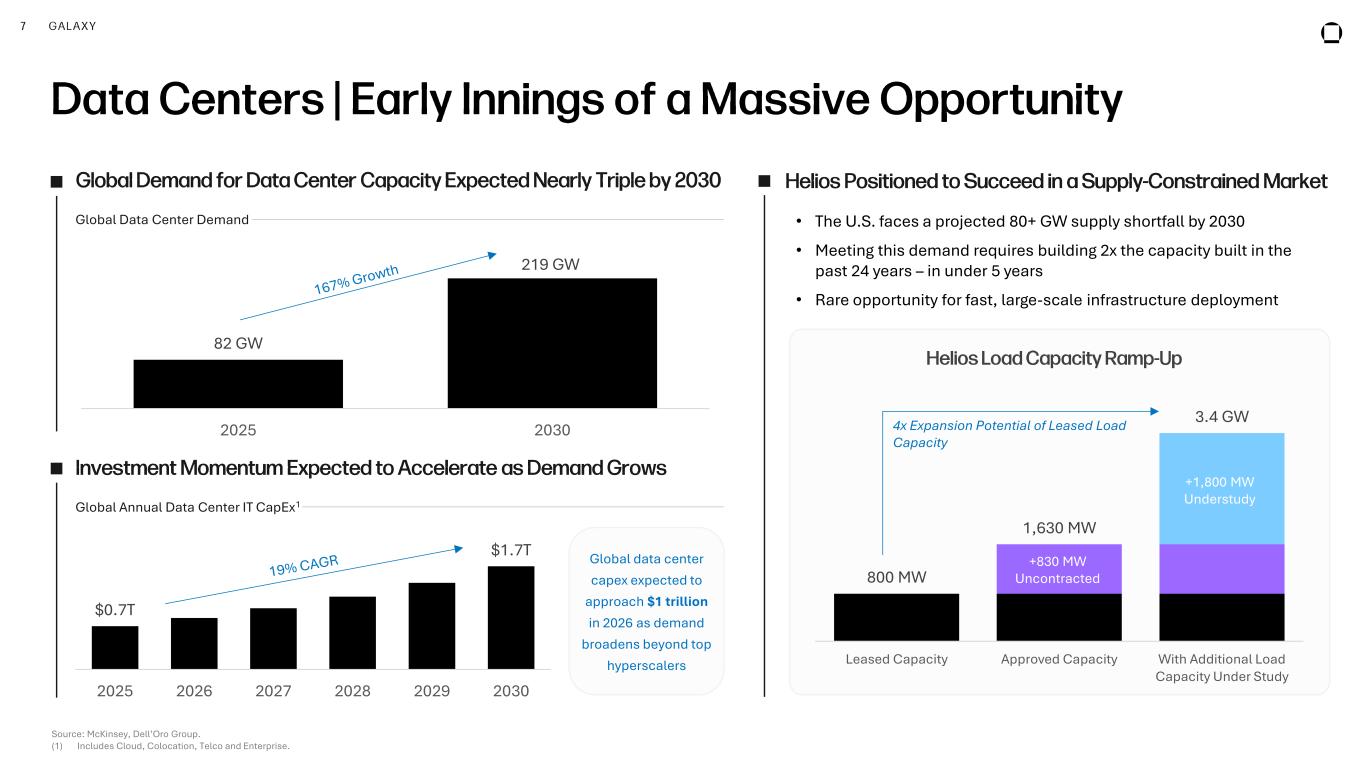
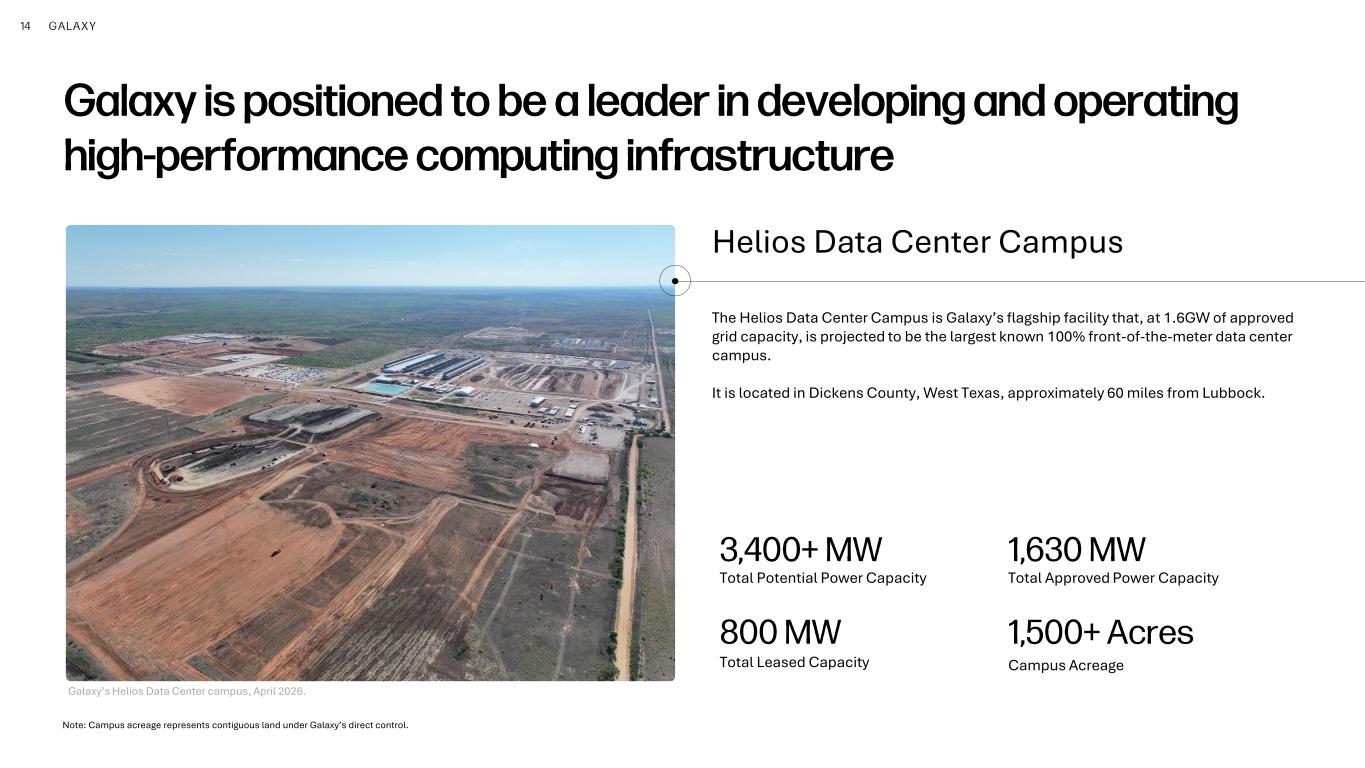
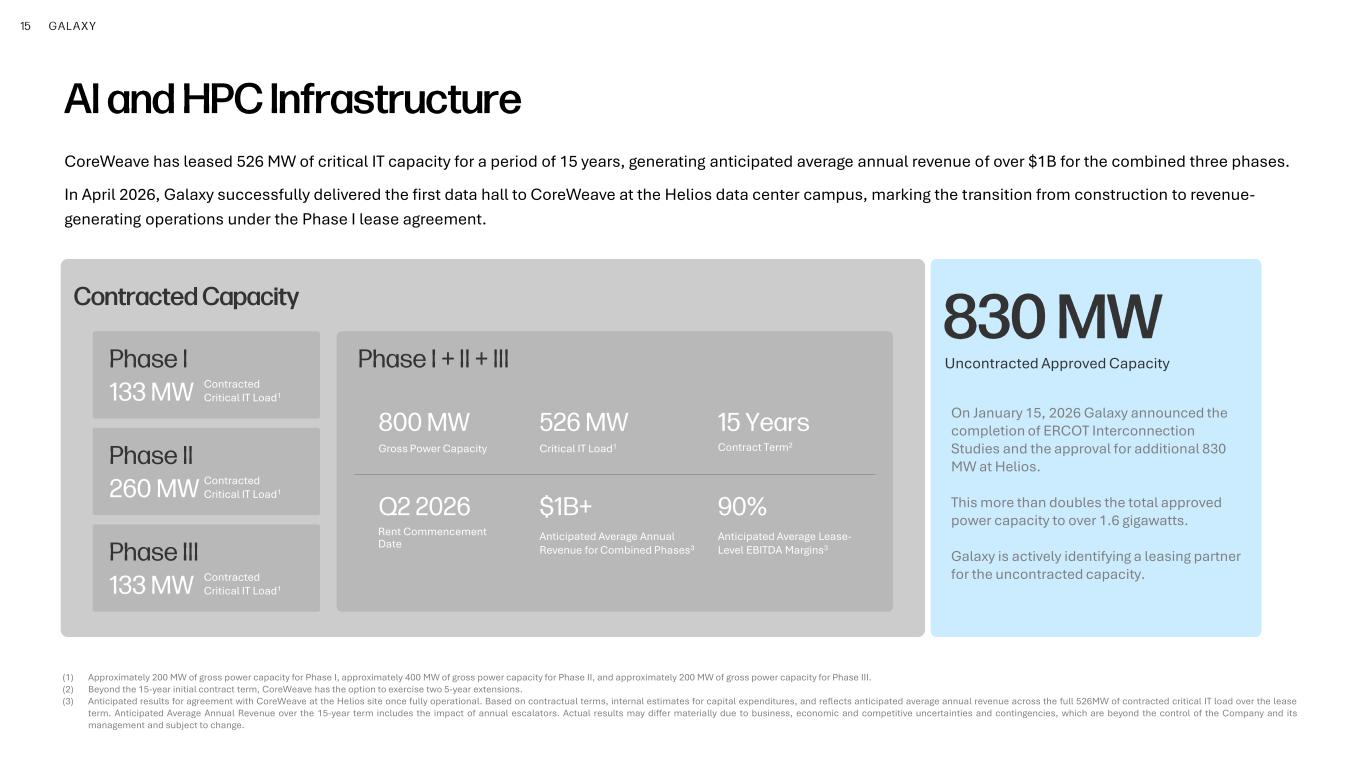
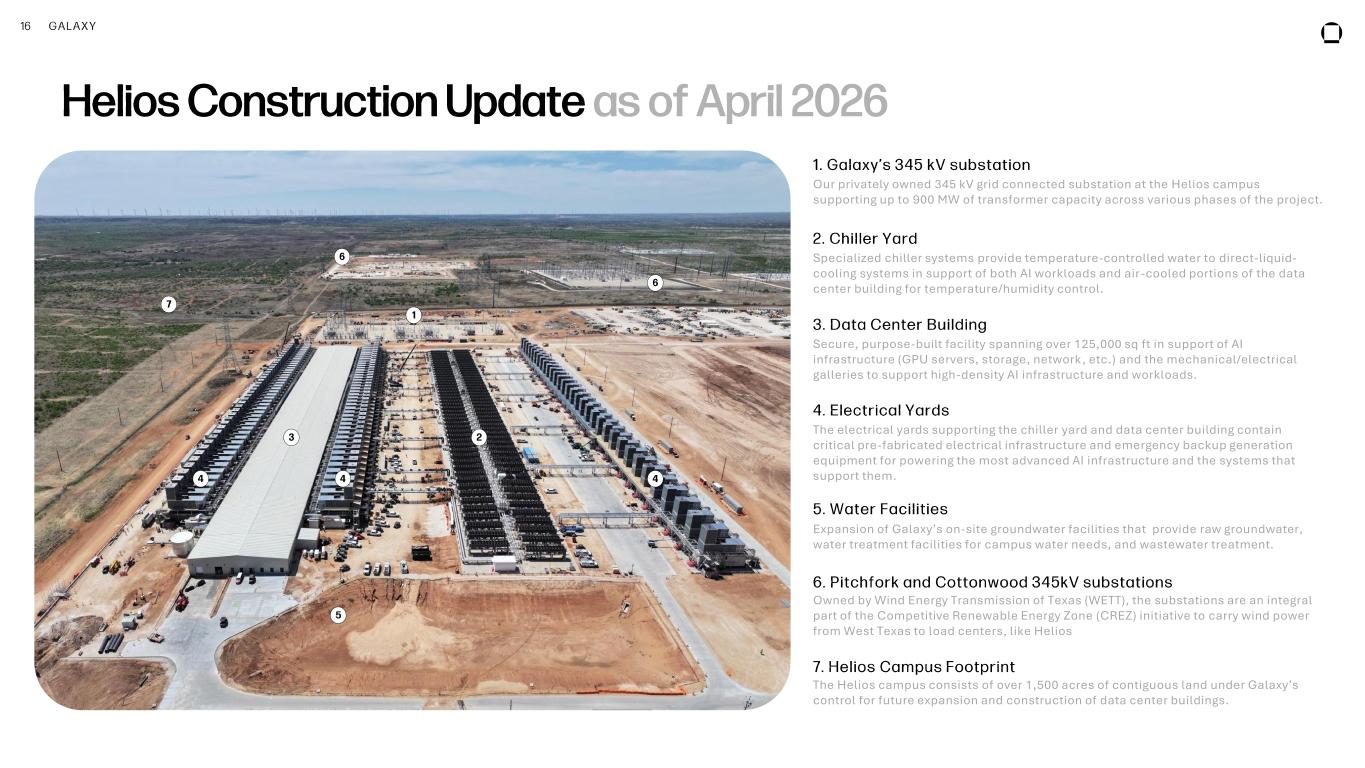
Thanks, Tony. The lights are on at the Helios campus. We've delivered the first data hall to Corweave, and I would call that the most significant milestone this business has hit since the day we signed the lease. Not long ago, this was a Bitcoin mining facility. Today, it is a live operational AI data center with power distribution, cooling, and network connectivity. That's a credit to the team on the ground in Texas and here in New York. This is the single most important de-risking event this business has experienced. We now have a track record of delivering on time and on budget, not a projection. That distinction matters when you're sitting across the table from a prospective customer or capital partner. We've proven we can take a site from concept to operational data center at hyperscale, and that credibility is opening doors. We remain on track to deliver substantially all of the 133 megawatts of critical IT capacity for phase one by the end of Q2. Our client, CoreWeave, has indicated that it expects a multi-trillion dollar investment grade public company to be the end user for their GPUs at our phase one Helios facility once the clusters are operational. Turning to phase two. We've made meaningful progress on the greenfield construction for the 260 megawatts of incremental critical IT capacity. Site work, concrete, and steel are advancing on the new data center buildings, and Phase 2 data hall deliveries are on track to commence in the first half of 2027. On Phase 2 financing, we're seeing strong demand for financing the build. Our focus is on maintaining a capital structure that gives us the flexibility to scale without over-leveraging the platform, and we expect to have more to share on Phase II financing in the near term. Turning to leasing the available 830 megawatts, the demand environment for large-scale HPC capacity remains very strong. Every major participant in this market has capital available and is racing the lock-up future capacity, and we're seeing that firsthand in the quality of the conversations we're having. We are in active discussions with a select group of potential customers. A lease of this scale, multiple years, and billions of dollars of contracted revenue requires extensive diligence, bespoke structuring, and careful negotiation. We've been through this process before, and we know what it takes to get it right. The compounding value of picking the right partner and the right structure is enormous, and that is worth us being deliberate about. From our seat, 830 megawatts of approved front-of-the-meter power in ERCOT is a one-of-one asset, and the responses from potential customers evaluating the opportunity reinforces this view. Importantly, though, we are not waiting on commercial structure to be finalized to proceed on development. Consistent with our approach throughout the initial Helios build, we've begun procuring critical infrastructure for the 830 megawatt development. Specifically, we have placed deposits and issued purchase orders on main power transformers and circuit breakers for the first phase of that development and have secured capacity for the balance of long-lead electrical infrastructure. Lead times for this equipment stretch to multiple years, and securing supply early has been core to our development thesis and schedule forecasts. A brief update on the evolving ERCOT regulatory framework. In mid-March, ERCOT published a draft rule, PGRR 145, which establishes a baseload category for projects with a 2028 energization date. Projects in that category are not subject to restudy in batch zero.
Eligibility requires two things, valid, completed interconnect studies and assigned interconnection agreement with the utility.
Our interconnection studies were completed on January 15th and our service agreement is already executed. We satisfy both requirements to be eligible for baseload within batch zero based on the current draft. I will note that PGRR 145 is still in draft form and could change. We're tracking it closely and are in active dialogue with ERCOT and our advisors, but as we read it today, nothing in the current draft indicates a deferral, and we are certainly not treating this capacity as speculative. There is still a lot to develop at the Helios campus, but scaling beyond we continue to evaluate a deep pipeline of opportunities across the U.S. We're being highly selective. Not every megawatt is worth pursuing, and we're only going to transact on sites where we have conviction in power availability, land suitability, development timeline and customer demand several of those sites have progressed to lois and we expect we will be discussing our multi-campus portfolio within this year the helios campus is the foundation but the vision vision is a multi-campus multi-customer platform built the same way one discipline step at a time we spent the better part of two years building this business and now that foundation is operational phase one is delivering phase two is under construction We have 830 megawatts of approved incremental capacity with active customer conversations underway. We have an additional 1.8 gigawatts progressing through the ERCOT study process and a growing pipeline beyond that. We've proven that we can execute. What lies ahead at the Helios campus and beyond is an opportunity of extraordinary scale, and we're just getting started. I'll turn it over to the operator for questions now. Thank you, everybody.
Operator
We will now begin the question and answer session. To ask a question, you may press star, then 1 on your touchtone phone. If you are using a speakerphone, please pick up your handset before pressing the keys. If at any time your question has been addressed and you would like to withdraw your question, please press star, then 2. In the interest of time, please limit yourself to one question. Your line will be muted after asking your question. You can rejoin the queue to ask another question. At this time, we will pause momentarily to assemble our roster. The first question comes from Peter Christensen with Citi. Please go ahead.
Thank you. Good morning. Great to be a part of the call. I'm curious on the financing side as it relates to data centers here. I mean, you know, fully stabilized lease hyperscale deals are seeing tightening spreads, but I guess the rating agency has been calling out syndicate financing for large deals, being potentially getting strained. Just curious if you're seeing the same and how are you thinking about that on your go-forward financing strategy?
Thank you. Sure. I'll take it. Good morning, Peter. How are you, sir? Yeah, so I would agree with the comment that financing for stabilized assets in this space has started to tighten. That's definitely true. What I would say is prior to maybe six months ago, the market was split and or pretty heavy towards bank syndicates financing more traditional project finance style financings. The high yield bond market has definitely stepped in in a big way over the last few months and has taken a lot of the market share from the larger bank syndicates, which is good because it's a much more distributed base of investors with much more flexible pools of capital rather than a traditional bank that's looking to either hold and syndicate sort of prescriptive project financing. We've pretty much seen, you know, things could change, but we've pretty much seen spreads tighten across the board. And that's come from a peak of sort of concern around buildouts, CapEx budgets, credit quality, and spreads have come in pretty significantly. And so the rating agencies have come through and they've started to rate a number of issues that have come out either at or above the underlying credit levels, which sort of takes into account the fact that folks like us are actually building long-lived durable infrastructure. Even though we have a tenant who has their own credit quality, those assets live beyond any tenant deal and are repurposable, et cetera. And so we're actually, we're pretty constructive right now about the opportunities for financing for two and beyond relative to where the market even was a few months ago.
Operator
The next question comes from Patrick Molley with Piper Sandler. Please go ahead.
Yes, good morning. Thanks for taking the question. On the additional 830 megawatts at Helios, Mike, you mentioned that there was maybe some deals that were getting done, but nothing ready for an announcement yet. I'm just to kind of level set, you know, is it safe to say that this This is not an extension of the current agreement with Corweave, but in fact, you know, separate tenets. And then is there anything you can add on?
I think you miss, either I misspoke or you misheard me. What I was saying is on the 830, we're engaged in lots of conversations. And then on new projects outside of Helios, we are, as Chris said in his remarks, we're LOI stage, and hopefully in the distant future, we'll have things to announce where we've got actual locked up projects. And so that's separate from Helios, which has always been our goal to have a multi-campus business. And so hopefully by the time we're on next quarter, we're talking about that with much more detail.
Yeah. And just to add on to what Mike said, Patrick, to get a different angle of the question you're asking, in addition to a multi-campus strategy, we are very focused on a multi-tenant strategy as well. And so I think it's very fair to assume that we're always talking to CoreWeave because they're our biggest partner in the business today. But the customer conversations we're having extends pretty far beyond just CoreWeave. And I would expect our decision-making around the $830 is going to take into consideration the importance of having a diversified exposure client base across all our assets.
Operator
The next question comes from James Yarrow with Goldman Sachs. Please go ahead.
Good morning, all. I'm speaking on behalf of James Yarrow. My question is, what is the risk appetite among your crypto trading clients, and when do you expect it to stabilize or inflect as crypto prices have appreciated now?
That's a good question. Listen, you know, like I said in my remarks, volumes across all of crypto trading was down, call it 25% on average last quarter. We felt good that we were flat. I think you need a few catalysts. What was nice is that when you saw broadly selling from old school, old holders of crypto that drove the prices down and who came in was retail. Retail through ETFs and retail through buying micro strategies, equity, which then translates into Bitcoin buying another crypto. When Bitcoin stabilizes and trades up the rest of crypto, does better. And so you've got places like Morgan Stanley who have moved into the space in an aggressive way and have their whole sales force now, you know, pitching a fairly large allocation to Bitcoin as part of their portfolio. And so I think what we're seeing is this transition from people that had held crypto for, you know, 5, 10, 15 years, taking some profits, selling some of theirs and that being replaced by a broader retail buying base we've seen a couple sovereign sovereign funds come in and buy as well or add to positions um and so you know i would be lying to you say if it's more muted than it had been in previous years um there's more excitement in in you know ai equities uh in crude oil around the war and what we're seeing is crypto infrastructure is now being used to also trade those and so you're seeing perpetuals which was a crypto innovation being brought to equity markets um and so the broad big picture theme is this infrastructure and what goes along with it will be very supportive to the whole space, but it's not necessarily short-term demand for, you name the token, if it's Solana or Polkadot or Ethereum, right? That demand is less exciting right now, a little bit more muted. Again, cutting rates and the Clarity Act passing probably gives that, you know, a kick. But what we've always seen in crypto is what really drives crypto is price. And so, again, we're basing, you know, once we get moving, people will find all kinds of reasons to get excited.
Operator
The next question comes from James Fawcett with Morgan Stanley. Please go ahead.
Thank you very much. I wanted to delve in quickly to the approval process in ERCOT and the batch process that, as I understand it, will be starting this summer. Can you just touch on two things? First, any clarification to make sure that the recently approved 830 megawatts isn't subject to any part of that batch process or review of the batch process. And then can you give us an assessment of where you think you are, what you may need to do to gain incremental approvals as part of that process for additional capacity and what that time frame may look like? Thanks.
We have two pieces right today at Galaxy. Our originally 100 megawatts that's already leased, let's focus on that first. There's nothing in the current regulatory landscape that we see that puts that capacity at risk. We have a fully executed service agreement, complete interconnect studies, phase one's live, and we're delivering power to it. Next, the 830 megawatts approved earlier this year, we're equally confident in that. I think in my comments, we talked a little bit about the draft PGRR 145 rule, which sets baseload category for projects that are not subject to restudy, not subject to looking And it's very clear to us, and it's been communicated as such, that the 830 megawatts that was approved is part of that baseload capacity to be for batch zero, meaning it's the base case for all new power being studied. We had our studies approved in January. We had an interconnected agreement with the utility. So that, as it's drafted today, and as far as we can see any potential reiterations of that draft is covered. That leaves us with today what we expect could be up to an additional 1.8 gigawatts. That 1.8 gigawatts for us is what's in question from a timing perspective. And I think the best I can give you on that today is, you know, ERCOT is still working through the specifics on what they think the new batch process is going to be. and therefore which parts of our 1.8 gigawatts would fit into potentially being looked at as new studies in batch zero or new studies beyond batch zero. So that's probably the best I can give you today.
Operator
Next question comes from Bill Papanastasio with Chardin Capital Markets. Please go ahead.
Yeah, good morning, gentlemen. Thanks for taking my questions and congrats on recent progress at Helios. I just wanted to dig a bit deeper on potential lease economics. How could they look for the uncontracted capacity relative to the CoreWeave deal? Should we expect similar headline metrics or do you think it would be more aligned with other deals that we've seen by some of your peers? Thanks.
Hey Bill, good morning. That is a very good question and it's hard to answer it directly because there's a bunch of different factors, right? So when we originally signed the CoreWeave deal, CoreWeave was actually when we went into negotiations, CoreWeave was still a private company and was a very different credit quality then, at least at the headline, than when we signed it today. So credit quality is a very important element to any economics to get signed with any counterparty. And the way we think about it is while a headline dollars per KW per month rent rate is an important metric, sort of the net after financing cost spread capture of any deal we signed for us is probably more important. And so you have this balancing act between headline monthly rent revenue versus that minus financing costs, which are going to very clearly be tied to what kind of tenant we have. And so the market now, in the interim, a number of deals have gotten done. And while the headline numbers with regards to their rent versus ours are lagging, meaning like our headline rent number with CoreWeave is a standout in the market, we're pretty constructive that on an after-financing cost basis, the economics to us, both on a dollar and on an IRR basis to build for this next capacity, is going to be equally attractive. And so that's just a framework for the way we think about the opportunity set and how we would strike a deal in the things we consider. Does that make sense?
Operator
The next question comes from Devin Ryan with Citizens Bank. Please go ahead.
Thanks. Thanks for taking the question. Question just on trading activity. And if we were to just assume the Clarity Act passes, let me just get some thoughts around what you think will happen with trading volumes. And, Mike, I heard, obviously, the comments around price and trading kind of going together. But as we think about just the demand for some of the kind of the further out layer ones and layer twos beyond the top 10 or 20, it seems like demand has dried up quite a bit. And so I'm just curious whether you feel like that's cyclical just because risk appetite's not there or maybe secular because there's just not a lot of activity happening on those blockchains. And so maybe we consolidate activity to a smaller number of large blockchains, and that's good for maybe institutions, but maybe not as good for kind of the speculative retail piece. So just curious kind of how you see things playing out post-Clarity, assuming it does pass. Thanks.
I think, you know, my answer is going to tend towards the latter, you know, setup that you had. Listen, I think Clarity will bring more and more institutions in, and those institutions will come in some set of direct trading, you know, desk to compete with us in Bitcoin, Ethereum, and some of the other big majors. People getting more comfortable with the neobank that will have a broader selection of – the neobank wallet structure that people are pushing, a broader selection of tokens. But I think the bigger idea here is that as you turn Wall Street on, you turn a selling machine on, and it starts with Bitcoin and Ethereum, and those things have generally propped up the whole industry. The big transition we're seeing as we move to using crypto infrastructure, it's happening at the same time where there are so many other avenues for people to speculate. Right. The the explosion of of sports betting, you know, online online gambling, sports betting, prediction markets, even meme coin trading. You know, in some ways, I don't think you'd ever saturate people's desire to gamble, but there's a lot more on offer than just, you know, polka dot tokens. And so those tokens need to, those ecosystems need to find a way to be more relevant. We've seen it with Hyperliquid. It's a perfect example of great technology, a tight team, but mostly an economic model in the token that lets people feel like they're participating in the economics of the underlying ecosystem, not just having association with the ecosystem. And we have an entire, you know, hundreds of tokens that really were mostly association tokens. And that was mostly because of the regulatory environment. And I think those tokens are going to either have to restructure or they're going to slowly, slowly have less and less participation from both retail and the broad community. It doesn't mean they all will die, because if there's a community that cares about it, they'll keep pouring in resources and trying to bring in more people. But we're going to go through this transition where I would hope and think in five years, most tokens that are out there are more than just community tokens.
Operator
The next question comes from Edward Engel with Compass Point. Please go ahead.
Hi, thanks for taking my question. Appreciate all the clarity and comments on ERCOT's new load approval process. And I know this is still being finalized by them. But I guess from a timing perspective, when do you think you're going to have more clarity on where some of your pipeline stands within either back zero or one or beyond that?
Yeah, right now, the best visibility we have is around June, which is what indications are that both ERCOT will start to narrow in on their process for the Batch and Air Connection Study Framework, at which point we're sort of doing all the background work and ready to engage with that post-haste once that comes through. So, you know, a couple more months from now towards the middle of the year.
Operator
The next question comes from Ben Summers with BTIG. Please go ahead.
Hey, thanks for taking my questions. I know you guys mentioned a little bit about expanding, you know, the total addressable market for Galaxy One, but I guess just kind of curious. I know it's still early days, but what's kind of been, you know, the most, I guess, used features of this platform and what's kind of drawn, you know, what do you think has gotten most investors drawn to this platform so far?
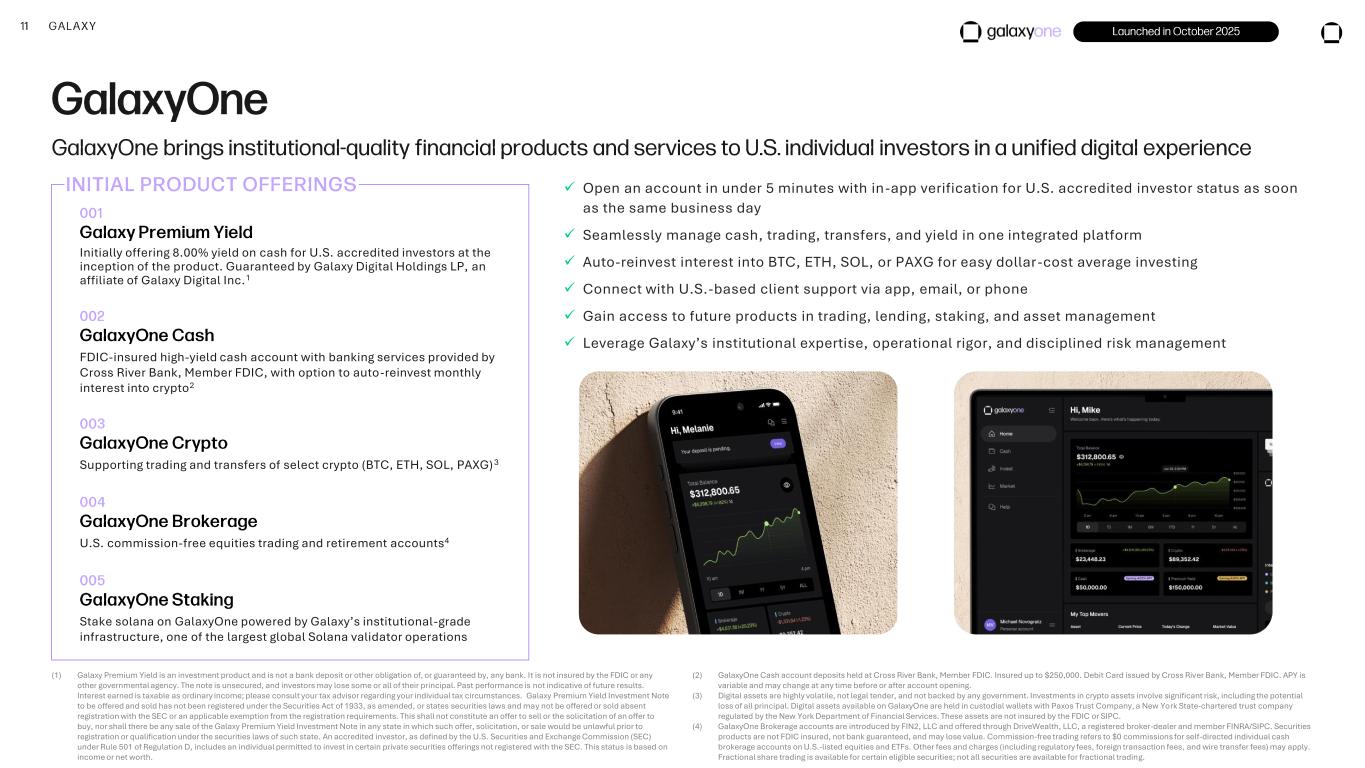
Yeah, so there's a decent amount going on there. I think we have been more, we were surprised, actually, crypto trading has been the largest use case so far. um which is a little counterintuitive because um there are a lot of existing crypto trading platforms out there today um and our capabilities on that front are lagging today although we're we're working very hard to both expand coin coverage uh adding staking which we just did in the last quarter um for solana and we're going to we'll follow up with the rest of those stakable assets um very soon but crypto trading use case has outperformed expectations um cash products are performing okay lagging a little behind the next step we're focused on we're exciting about is sort of tying it all together by offering really financing solutions for individual consumer unit users that allow consumers to basically leverage their entire portfolio together to increase buying power in a thoughtful and safe way and so our product deliveries today, outside of the moonshot stuff, which we're very focused on iterating on, is around creating an entire wallet effectively that a consumer can own all of their assets, cash, equities, crypto, and beyond, and thoughtfully increase their buying power without taking outsized risk. So yeah, that's where Galaxy One stands today.
Operator
The next question comes from Martin Toner with ATB Cormark. Please go ahead.
Good morning. Thanks for taking my question. The revenue number was a nice one given how difficult crypto markets were in Q1. Is the business becoming less cyclical?
And is Galaxy going to be able to do better in some of these weaker crypto markets? you know uh your lips to god's ears um if we can do that three quarters in a row i'll i'll have more confidence to say it's less cyclical uh this was a a promising quarter in that the trading desk stayed flat to to a quarter on quarter when when overall revenue went down 25 percent and our balance sheet was well positioned uh you know again we were in hyperliquid and had less of other l2s we had a little less bitcoin than we normally have etc um and so if you're just looking at the digital assets business that's our goal uh is to make it less cyclical uh what you're going to see in the second half of the year is we'll make some announcements about The infrastructure business, which is certainly going to be less technical and help in that relative to crypto trading. And then if you take digital assets and you combine it with the data center business, which I try to keep those things separate in my head so we don't take hard-earned money in one and fund stuff willy-nilly in the other. We're going to try to be very, very thoughtful in both businesses on where we deploy capital. But overall, Galaxy will be less cyclical to crypto in a big way just because of data center earnings 12 months from now. But even within the digital assets business, our goal is to become less cyclical.
And I think that's going to happen.
But I'm not going to declare any kind of victory for at least two to three more quarters.
Operator
The next question comes from Joseph Fafi with Canaccord.
Operator
Please go ahead.
Hey, guys. Good morning. Maybe we could touch a little bit more on the real-world asset tokenization strategy. I know you mentioned, you know, both the wallet custody and, Mike, you're just kind of talking on infrastructure. Seems, from my seat at least, this is kind of a bigger trend than pretty much anything else in the ecosystem right now. And just, you know, just a little more color on, you know, how it evolves, how you exploit the strategy.
Good morning, Joe. Yeah, we would agree with you around the size of the direction of the trend line and the size of the total addressable market now being up and to the right and larger than we've actually ever seen in our existence. um the historically um galaxy has been building technology products and services that we've been offering to largely institutional clients for most of our uh directly to largely institutional clients um and buyers um uh with a more recent step into um more consumer focused product offerings what we're seeing on the tokenization i'll say tokenization writ large but really it's digital infrastructure to support fair instrument tokenized assets is a demand from the business side. What people would have considered to be the biggest looming concern for Galaxy's institutional business being bank competitors. We've seen the demand for those theoretical bank competitors be limit up for partnering with Galaxy to either buy or implement and use as a vendor Galaxy's technology so that the financial system itself can build out the digital infrastructure and stitch it all together so it actually works so that end users can seamlessly store value, transfer value, etc. And so the tokenization opportunity, you know, we have been obviously tracking very closely our purchase of GK8 back in late 2022, early 2023 was one big step. A handful of smaller acquisitions we've made with great talent, engineers, technology on staking, liquid staking, other digital infrastructure has been a sign of us seeing it coming. We didn't really know in our heart of hearts where the market was going to land in terms of our market opportunity, it's crystallizing pretty fast now. And the market opportunity for us to build infrastructure for what everyone would have thought was going to be our biggest competitors might now become our biggest customers. And so we're very excited about that. That's where the real opportunity we see sits today. And I think Galaxy's best position to actually be the partner that these large financial legacy companies need versus some of our other competitors who are either highly undercapitalized don't have the brand don't have the trust in their staying capacity or have chosen to really be a vertical stack that's competing directly with those institutions and so the the landscape for our opportunity to really take advantage of opportunity is it's pretty attractive and that's we've sort of retooled the team retooled our go to market to take advantage of that now the next question comes from Chris Rendler with Rosenblatt.
Operator
Please go ahead.
Hey, thanks. Good morning, and thanks to my question. I thought the digital asset business was pretty resilient given market conditions. The one area that I thought was a little weaker than I was expecting was lending. Does it reflect decreased risk appetite? Is it asset price sensitive? Just a little color on the decline in lending. We'd love to see how that's being managed in this environment. Thanks.
Yeah, good morning, Chris. Yeah, look, I think we have a pretty consistent and strong trend line in the lending business overall throughout our entire history. I think the number one KPI is that we don't lose money. We don't lose our money. We don't lose shareholder money. We don't lose client money, counterparty money. This was one of the first times in a while we saw a pullback. I think it's pretty natural given that a large percentage of our book is always denominated in crypto prices. You know, we've either lent or borrowed crypto assets that when you see a couple of repeated quarters in terms of including the last quarter with crypto prices down mid-20s for your notional U.S. dollar balance of your lending book to see some impact. While we'd love to keep the book growing all the time, when prices are down and clients themselves are de-risking, it's probably also smart to follow that trend, see a little bit of pullback, de-risk your book, and then rebuild. And so there was a couple of things. Crypto prices down when a percentage of your book is exposed means your U.S. dollar notional by definition should follow that. We also had a handful of large, very low-risk loans that were in the book that rolled off, which is just natural roll-off. And so when you're sort of picking a period quarter end number and pegging it and looking at the health of the business, like having those roll-off and then subsequent to quarter rebuilding the book and adding more diverse client base is a pretty natural progression. So from my perspective, there's nothing to read into that other than we are continuing to grab market share. We're very happy to, for periods of time, sort of allow the deleveraging and de-risking to happen naturally with our number one goal of building a bigger, larger, resilient borrowing pool of clients while being pretty aggressive on limiting downside risk. So we're very constructive in the business. That's one of our specialties. I think the opportunity set not of just building a bilateral lending book with institutions, but expanding that to pretty nascent early markets on-chain, for example, is a wide-open opportunity set for us. And so where we can grow the book smartly, the cone of that opportunity is a lot wider than what we worry about on the downside from a shrinking of the business.
Operator
And the final question will come from John Peterson with Jeffries. Please go ahead.
Oh, great. Thanks. On financing phase two and maybe refinancing phase one, you know, I'm curious, one of your peers earlier this year was able to restructure their debt with CoreWeave with kind of an ultimate parent guarantee from the IG-rated hyperscaler that was actually using the compute. I'm just curious if you have a sense, maybe that's something about restructuring phase one when it's completed or construction financing on phase two, if that sort of solution is part of any of the negotiations that could help on debt pricing. And if I could sneak in a follow-up, do you guys have any updated thoughts on splitting the data center business from the rest of the company? Sure. Good morning.
I'll take the first one to start. I would answer that pretty succinctly in that all options are on the table. The market is pretty nascent, and the deck chairs of the largest companies in the world are shifting always pretty fast, but in the direction of own more compute, reduce the cost of owning more compute. and so we don't observe what you what you observed lightly and ignore it our approach to that is going to be pretty firm in terms of we know the value of Helios we have a very attractive economic deal with a great partner today to the extent we do there is an opportunity to do something along the lines you're suggesting we're going to do it with a clear eye towards net present value to shareholders being equal or better on a risk-adjusted basis with clients. For phase one, I'll just reiterate my comment today that Corweave has stated that our end tenant in that facility is going to be a uh multi-trillion dollar ig public company um and so um uh having knowing that that's the anchor in our first facility gives us should give gives us and should give investors um uh as well as our financing partners there um a lot of um de-risking and a lot of uh comfort level there um on the The second one on splitting the business or the potential of it, no update on that. Our posture on that is the same as it's always been. It is from a management time and focus perspective, myself, Mike, Tony, the whole crew are equally focused on building both businesses. We're involved in building both businesses. We do recognize the capital structure and the capital needs of both businesses and the earnings potential and visibility are very different. And so today they aren't natural synergistic businesses, but we're not convinced that that's not true in the future. And so we're going to continue to build both businesses and evaluate what the opportunities are when the time is right.
This concludes our question. Just to put an exclamation point on what Chris said, if you think about even the growth of where these businesses are, you know, end of the year, we have a convert that rolls off. Helios actually is, you know, phase one at least is fully cash flowing and phase two is getting started. And so, you know, it's probably more of a debate for us around the end of the year than it is today, you know.
Operator
This concludes our question and answer session. I would like to turn the conference back over to Mike Novogratz, founder and CEO of Galaxy Digital for any closing remarks.
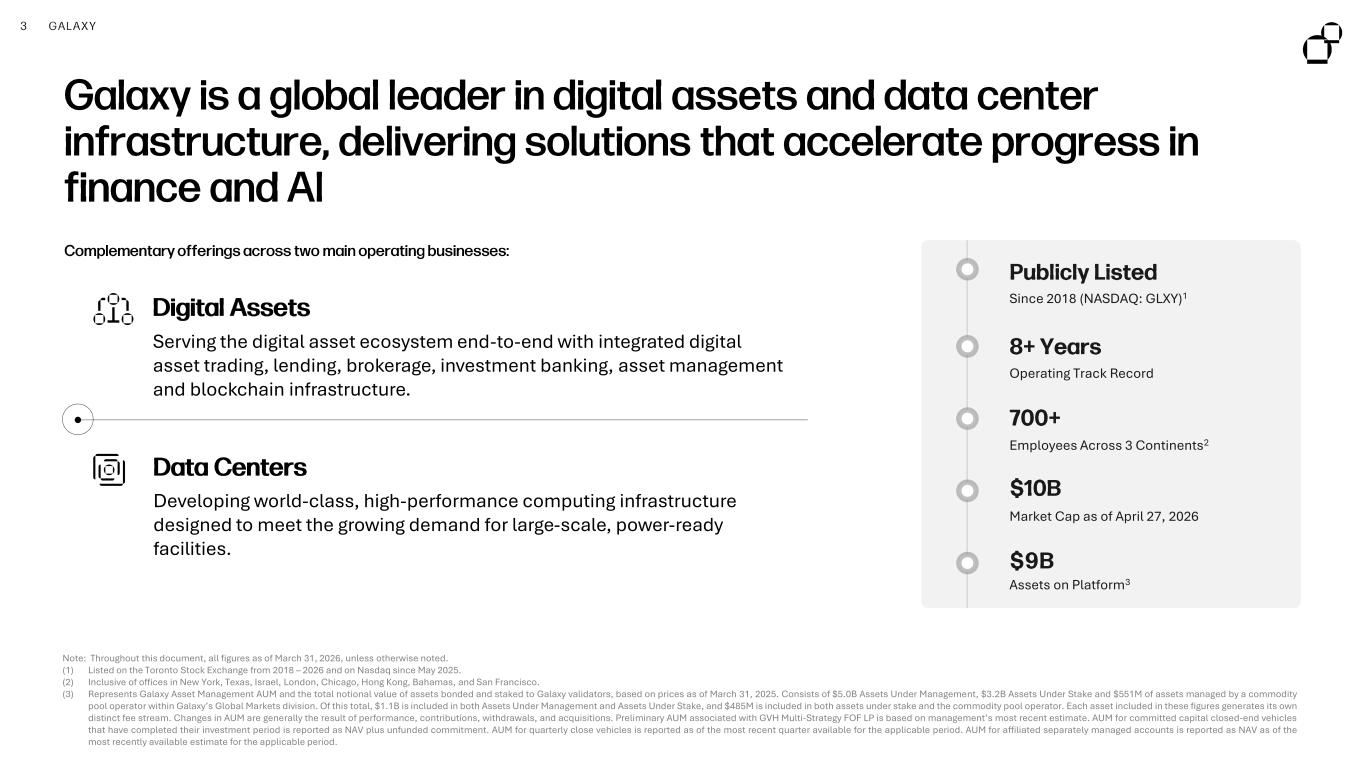
Yeah, well, guys, we appreciate your time today. It is a beautiful day in New York. I usually give a weather update at the start. You know, just want to reiterate, like we're optimistic on both businesses. We've got 700 plus people here working very hard every day. We understand we're in an environment where AI is changing every company in ways that they hadn't dreamed of two years ago, and we are engaged with that trend as well. And so I think that the world is in an AI revolution, and we plan on riding that wave and paddling our canoe as fast as possible in what will be choppy waters, because this is a pretty disruptive technology but like hang on to your seats is the is the broader macro view and thanks for your time the conference has now concluded thank you for attending today's presentation you may now disconnect