
HIVE Digital Technologies Ltd F-3ASR, filed Nov 20, 2025
HIVE Digital Technologies Ltd. (HIVE)
As filed with the Securities and Exchange Commission on November 20, 2025.
Registration No. 333-
UNITED STATES
SECURITIES AND EXCHANGE COMMISSION
Washington, D.C. 20549
FORM F-3
REGISTRATION STATEMENT UNDER
THE SECURITIES ACT OF 1933
HIVE DIGITAL TECHNOLOGIES LTD.
(Exact Name of Registrant as Specified in Its Charter)
| British Columbia | Not Applicable | |
| (State or Other Jurisdiction of Incorporation) |
(IRS Employer Identification Number) |
Suite 128, 7900 Callaghan Road
San Antonio, Texas 78229 United States of America
(Address of principal executive office)
604-664-1078
(Address and Telephone Number of Registrant’s Principal Executive Office)
Cogency Global Inc.
122 E. 42nd Street, 18th Floor
New York, New York 10168
(800) 221-0102
(Name, Address, and Telephone Number of Agent For Service)
Copies to:
| Jonathan H. Gardner Danielle M. Fahey Kavinoky Cook LLP 726 Exchange Street; Suite 800 Buffalo, NY 14210 (716) 332-5290 |
Dennis Peterson Petterson McVicar LLP 18 King St. E., Suite 902 Toronto, ON M5C 1C4 (647) 259-1790 |
Gabriel Ibghy General Counsel HIVE Digital Technologies Ltd. Suite 128, 7900 Callaghan Road San Antonio, Texas 78229 604-664-1078 |
Approximate date of commencement of proposed sale to the public: From time to time after the effectiveness of this registration statement.
If only securities being registered on this Form are being offered pursuant to dividend or interest reinvestment plans, please check the following box. ☐
If any of the securities being registered on this Form are to be offered on a delayed or continuous basis pursuant to Rule 415 under the Securities Act of 1933, check the following box. ☒
If this Form is filed to register additional securities for an offering pursuant to Rule 462(b) under the Securities Act, check the following box and list the Securities Act registration statement number of the earlier effective registration statement for the same offering. ☐
If this Form is a post-effective amendment filed pursuant to Rule 462(c) under the Securities Act, check the following box and list the Securities Act registration statement number of the earlier effective registration statement for the same offering. ☐
If this Form is a registration statement pursuant to General Instruction I.C. or a post-effective amendment thereto that shall become effective upon filing with the Commission pursuant to Rule 462(e) under the Securities Act, check the following box. ☒
If this Form is a post-effective amendment to a registration statement filed pursuant to General Instruction I.C. filed to register additional securities or additional classes of securities pursuant to Rule 413(b) under the Securities Act, check the following box. ☐
Indicate by check mark whether the registrant is an emerging growth company as defined in Rule 405 of the Securities Act of 1933 Emerging growth company. ☒
If an emerging growth company that prepares its financial statements in accordance with U.S. GAAP, indicate by check mark if the registrant has elected not to use the extended transition period for complying with any new or revised financial accounting standards † provided pursuant to Section 7(a)(2)(B) of the Securities Act. ☐
|
† |
The term "new or revised financial accounting standard" refers to any update issued by the Financial Accounting Standards Board to its Accounting Standards Codification after April 5, 2012. |
PROSPECTUS
HIVE DIGITAL TECHNOLOGIES LTD.

Common Shares
Warrants
Subscription Receipts
Units
Debt Securities
Share Purchase Contracts
This prospectus relates to the offering for sale, from time to time, of the securities of HIVE Digital Technologies Ltd. (the “Company”, “HIVE”, “we” or “our”) of any combination of the following: Common Shares, Warrants, Subscription Receipts, Units, Debt Securities and Share Purchase Contracts. We, or any selling securityholders may offer and sell, from time to time, these securities on terms described in a prospectus supplement. We will not receive any proceeds from the sale of our securities by the selling securityholders.
Our securities may be sold directly by us or selling securityholders or through one or more underwriters, dealers, and agents, or through a combination of these methods, and on a continuous or delayed basis. If required, the prospectus supplement for each offering of securities will describe the plan of distribution for that offering. For general information about the distribution of securities offered, please see “Plan of Distribution” in this prospectus.
In addition, the securities may be offered and issued by the Company in consideration for the acquisition of other businesses, assets or securities. The consideration for any such acquisition may consist of any of the securities separately, a combination of securities or any combination of, among other things, securities, cash and the assumption of liabilities.
We will provide the specific prices and terms of the securities in or more supplements to this prospectus as the time of the offering. You should read this prospectus and the accompanying prospectus supplement carefully before you make any investment decisions.
The common shares of the Company ("Common Shares") are listed for trading on the TSX Venture Exchange (the "TSXV") under the trading symbol "HIVE" as well as on the Nasdaq Capital Market Exchange ("Nasdaq") under the symbol "HIVE", and on the Open Market of the Frankfurt Stock Exchanges under the symbol "YO0.F".
____________________________
Investing in our securities involves a number of risks. See "Risk Factors" beginning on page 12 and the supplemental risk factors contained in any applicable prospectus supplement and in the documents incorporated by reference for a description of the risks you should consider when evaluating such investment.
____________________________
Neither the Securities and Exchange Commission nor any state securities commission has approved or disapproved of these securities or passed upon the adequacy or accuracy of this prospectus. Any representation to the contrary is a criminal offense.
The date of this prospectus is November 20, 2025.
TABLE OF CONTENTS
ABOUT THIS PROSPECTUS
This prospectus is part of an “automatic shelf” registration statement that we filed with the Securities and Exchange Commission (the “SEC”) as a “well-known seasoned issuer” as defined in Rule 405 under the Securities Act of 1933, as amended (the “Securities Act”), using a “shelf” registration process. Under this process, we or a selling shareholder may offer and sell securities from time to time. This prospectus only provides you with a general description of the ordinary shares that we or a selling shareholder may offer. Each time we or a selling shareholder sells securities, we will provide a supplement to this prospectus that contains specific information about the terms of that offering, including the specific amounts, prices and terms of the securities. The prospectus supplement may also add, update or change information contained in this prospectus. You should carefully read both this prospectus, any accompanying prospectus supplement and any free writing prospectus prepared by or on behalf of us, together with the additional information described under the heading “Where You Can Find More Information.”
Neither we nor any selling shareholder has authorized anyone to provide you with any information other than that contained in or incorporated by reference into this prospectus, any accompanying prospectus supplement and any free writing prospectus prepared by or on behalf of us or any selling shareholder. Neither we nor any selling shareholder take responsibility for, and can provide no assurance as to the reliability of, any other information that others may give you. Neither we nor any selling shareholder is making any offer to sell the securities in any jurisdiction in which an offer or solicitation is not authorized or in which the person making such offer or solicitation is not qualified to do so or to anyone to whom it is unlawful to make an offer or solicitation.
You should assume that the information appearing in this prospectus, any prospectus supplement or any document incorporated by reference is accurate only as of the date of the applicable documents, regardless of the time of delivery of this prospectus or any sale of securities. Our business, financial condition, results of operations and prospects may have changed since that date.
When used in this prospectus, the terms "HIVE," the "Company," "we," "our" and "us" refer to HIVE Digital Technologies Ltd. and its consolidated subsidiaries, unless otherwise specified or the context otherwise requires.
WHERE YOU CAN FIND MORE INFORMATION
This prospectus is part of the registration statement on Form F-3 we filed with the SEC under the Securities Act, and does not contain all the information set forth in the registration statement and the exhibits and schedules to the registration statement. The rules and regulations of the SEC allow us to omit certain information from this prospectus that is included in the registration statement and the exhibits and schedules to the registration statement. For further information, we refer you to the registration statement and the exhibits and schedules filed as part of the registration statement.
Statements made in this prospectus concerning the contents of any contract, agreement or other document are not necessarily complete descriptions of all terms of these documents. If a document has been filed as an exhibit to the registration statement, we refer you to the copy of the document that has been filed for a complete description of its terms. Each statement in this prospectus relating to a document filed as an exhibit is qualified in all respects by the filed exhibit. You should read this prospectus and the documents that we have filed as exhibits to the registration statement of which this prospectus forms a part completely.
We are subject to the informational requirements of the Securities Exchange Act of 1934, as amended (the "Exchange Act"). Currently, we are considered a "foreign private issuer" (as defined under Section 405 of the Securities Act) and are therefore exempt from certain of the requirements of the Exchange Act, including the proxy and information provisions of Section 14 of the Exchange Act and the reporting and liability provisions applicable to officers, directors and significant shareholders under Section 16 of the Exchange Act. As more fully discussed below in "Implications of Being a Foreign Private Issuer and Emerging Growth Company," beginning we will be required to comply with all of the periodic disclosure and current reporting requirements of the Exchange Act applicable to U.S. domestic issuers, including the filing of annual, periodic and current reports on Forms 10-K, 10-Q and 8-K, respectively.
The SEC maintains a website that contains reports and other information about issuers, like us, that file electronically with the SEC. The address of that website is www.sec.gov. You also may read and download any public document that we have filed with the Canadian securities regulatory authorities under our profile on SEDAR+ (www.sedarplus.ca).
Our website is: https://www.hivedigitaltechnologies.com. Our website does not constitute a part of this prospectus.
Market and Industry Data
Market data and certain industry forecasts used in this prospectus and any applicable prospectus supplement, and the documents incorporated by reference in this prospectus and any applicable prospectus supplement, were obtained from market research, publicly available information and industry publications. We believe that these sources are generally reliable, but the accuracy and completeness of this information is not guaranteed. We have not independently verified such information, and we do not make any representation as to the accuracy of such information. Further, we cannot assure you that a third-party using different methods to assemble analyze or compute market data would obtain the same results. In addition, assumptions and estimates of our and our industry's future performance are necessarily subject to a high degree of uncertainty and risk due to a variety of factors, including those described in "Risk Factors". These and other factors could cause our future performance to differ materially from our assumptions and estimates. See the section titled "Cautionary Note Regarding Forward-Looking Statements".
Presentation of Financial Information
In this prospectus and any prospectus supplement, unless otherwise indicated, all dollar amounts and references to "US$" or "$" are to U.S. dollars and references to "C$" are to Canadian dollars. This prospectus and the documents incorporated by reference contain translations of certain U.S. dollar amounts into Canadian dollars solely for your convenience. See "Currency Presentation and Exchange Rate Information".
CAUTIONARY NOTE REGARDING FORWARD-LOOKING STATEMENTS
Certain statements and other information contained in this prospectus constitute "forward-looking information" under Canadian Securities Laws and "forward-looking statements" under U.S. securities laws (collectively "forward-looking statements"). Such forward-looking statements include, but are not limited to, statements relating to:
-
the future price of cryptocurrencies, such as Bitcoin, and the other types of digital assets which HIVE may obtain, hold, and/or trade as a result of its business operations;
-
the Company's intended use of net proceeds from the sale of its securities;
-
the number of securities the Company intends to issue;
-
the future pricing for services and solutions in the businesses of the Company and its subsidiaries;
-
the liquidity and market price of the Common Shares;
-
the Company's expectations regarding the sufficiency of its capital resources and requirements for additional capital;
-
litigation risks;
-
currency fluctuations;
-
risks related to debt securities being secured;
-
risks related to the decrease of the market price of the Common Shares if the Company's shareholders sell substantial amounts of Common Shares;
-
risks related to stable and cost effective electricity to power our data centers;
-
risks related to future sales or issuances of equity securities diluting voting power and reducing future earnings per share;
-
the absence of a market through which the Company's securities, other than Common Shares, may be sold;
-
the expected annualized run-rate revenue of the HPC line of operations;
-
changes to governmental laws and regulations;
-
the plans for, and progress of, the Company's existing and planned data centers; and
-
effects of any pandemic outbreak, whether global or not, such as the recent novel coronavirus.
These forward-looking statements relate to future events or future performance. All statements other than statements of historical fact may be forward-looking statements. Forward-looking statements are often, but not always, identified by the use of words such as "seek", "anticipate", "plan", "continue", "estimate", "expect", "may", "will", "project", "predict", "potential", "targeting", "intend", "could", "might", "should", "believe", "future", "continue" or similar expressions or the negatives thereof.
By their very nature, forward-looking statements involve known and unknown risks, uncertainties and other factors that may cause actual results or events to differ materially from those anticipated in such forward-looking statements. The Company believes the expectations reflected in those forward-looking statements are reasonable but no assurance can be given that these expectations will prove to be correct and such forward-looking statements included in this prospectus should not be unduly relied upon. These statements speak only as of the date of this prospectus.
The forward-looking statements in this document are based on what the Company currently believes are reasonable assumptions, including the material assumptions set out in the management discussion and analysis and press releases of the Company (such documents are available under the Company's SEDAR+ profile at www.sedarplus.ca, in the United States through EDGAR at the website of the SEC at www.sec.gov, or on the Company's website at www.hivedigitaltechnologies.com). Other material factors or assumptions that were applied in formulating the forward-looking statements contained herein include or relate to the following:
-
the business and economic conditions affecting the Company's operations in their current state, including, general levels of economic activity, regulations, taxes and interest rates;
-
information about the Company's use and profitability of the Company's computing power, including the Company's ability to profitably generate cryptocurrencies;
-
the Company's ability to successfully acquire and maintain required regulatory licenses and qualifications;
-
historical prices of cryptocurrencies;
-
the emerging cryptocurrency and blockchain markets and sectors;
-
the Company's ability to maintain good business relationships;
-
the Company's ability to manage and integrate acquisitions;
-
the Company's ability to identify, hire and retain key personnel;
-
the Company's ability to raise sufficient debt or equity financing to support the Company's continued growth;
-
the technology, proprietary and non-proprietary software, data and intellectual property of the Company and third parties in the cryptocurrencies and digital asset sector is able to be relied upon to conduct the Company's business;
-
the Company does not suffer a material impact or disruption from a cybersecurity incident, cyber-attack or theft of digital assets;
-
the Company's continued maintenance and development of data center facilities;
-
continued growth in usage and in the blockchain for various applications;
-
continued development of a stable public infrastructure, with the necessary speed, data capacity and security required to operate blockchain networks;
-
the absence of adverse regulation or law;
-
the absence of material changes in the legislative, regulatory or operating framework for the Company's existing and anticipated business;
-
development of a new high performance computing business, the Company's strategic partnerships;
-
the cost of energy in each of the jurisdictions where we conduct mining and/or high performance computing operations;
-
the Company's management of its trading operations from Bermuda; and
-
projected growth and estimates for the high performance computing business.
Inherent in forward-looking statements are risks, uncertainties and other factors beyond the Company's ability to predict or control. Some of the risks that could cause outcomes and results to differ materially from those expressed in the forward-looking statements include:
-
The Company's cryptocurrency inventory may be exposed to cybersecurity threats and hacks.
-
Regulatory changes or actions may alter the nature of an investment in the Company or restrict the use of cryptocurrencies in a manner that adversely affects the Company's operations.
-
The value of cryptocurrencies may be subject to volatility and momentum pricing risk.
-
Cryptocurrency exchanges and other trading venues are relatively new and, in most cases, largely unregulated and may therefore be more exposed to fraud and failure.
-
Energy costs in the regions where we operate may increase.
-
Risks related to energy.
-
Risks related to HPC businesses.
-
Possibility of less frequent or cessation of monetization of cryptocurrencies.
-
Limited history of de-centralized financial system.
-
Cryptocurrency network difficulty and impact of increased global computing power.
-
Banks may not provide banking services, or may cut off banking services, to businesses that provide cryptocurrency-related services or that accept cryptocurrencies as payment.
-
The impact of geopolitical events on the supply and demand for cryptocurrencies is uncertain.
-
Political and regulatory risks.
-
Energy tariffs in Paraguay.
-
Development and growth of the HIVE Paraguay Facilities and other infrastructure projects.
-
Changes to tax laws.
-
Permits and licences.
-
Server failures.
-
Global financial conditions.
-
Tax consequences.
-
Company subject to tax audits.
-
Passive foreign investment company regulations could affect U.S. shareholders.
-
Environmental regulations.
-
Environmental liability.
-
The further development and acceptance of the cryptographic and algorithmic protocols governing the issuance of and transactions in cryptocurrencies is subject to a variety of factors that are difficult to evaluate.
-
Acceptance and/or widespread use of cryptocurrency is uncertain.
-
The Company may be required to sell its inventory of cryptocurrency to pay suppliers.
-
Facility developments.
-
The Company's operations, investment strategies, and profitability may be adversely affected by competition from other methods of investing in cryptocurrencies.
-
The Company’s cryptocurrency may be subject to loss, theft or restriction on access.
-
Incorrect or fraudulent coin transactions may be irreversible.
-
If the award of cryptocurrency for solving blocks and transaction fees are not sufficiently high, Miners may not have an adequate incentive to continue mining and may cease their mining operations.
-
The price of cryptocurrency may be affected by the sale of cryptocurrency by other vehicles investing in cryptocurrency or tracking cryptocurrency markets.
-
Risk related to technological obsolescence and difficulty in obtaining hardware.
-
Risks related to insurance.
-
Transactional fees and demand for Bitcoin.
-
Future profits/losses and production revenues/expenses.
-
Property and other insurance risks.
-
Hazards associated with high-voltage electricity transmission and industrial operations may result in suspension of our operations or the imposition of civil or criminal penalties.
-
International conflict.
-
Imposition of U.S. tariffs.
-
Risk of potential adverse U.S. federal income tax consequences to 10% or greater United States shareholders.
-
Transfer pricing.
-
The 2028 Bitcoin Halving.
-
Tax decision in respect of the Company's subsidiaries.
-
Limited operating history.
-
Future capital needs, uncertainty of additional financing and dilution.
-
Management of growth.
-
Additional funding requirements and dilution.
-
Loss of key employees & contractors.
-
Pandemics.
-
Risk of physical security breach or theft.
-
Conflicts of interest.
-
Liquid market for securities.
-
Dividends.
-
Interest rate risk.
-
Currency exchange risk.
-
Trading price of Common Shares and volatility.
-
Risks related to our status as a foreign private issuer.
-
If regulatory changes or interpretations of our activities require our registration as a money services business ("MSB") under the regulations promulgated by the Financial Crimes Enforcement Network of the U.S. Department of the Treasury ("FinCEN") under the authority of the U.S. Bank Secrecy Act, or otherwise under state laws, we may incur significant compliance costs, which may have a material negative effect on our business and the results of its operations.
-
The application of the U.S. Commodity Exchange Act, as amended (the "CEA") and the regulations promulgated thereunder by the U.S. Commodity Futures Trading Commission ("CFTC") to our business is unclear and is subject to change in a manner that is difficult to predict.
-
Compliance with laws, rules, regulations and policies across a multiple jurisdictions.
-
Involvement in legal proceedings.
-
Litigation risks and expenditures.
-
Categorization as an "investment company" under the Investment Company Act of 1940, as amended (the "Investment Company Act").
-
Uncertainty in accounting standards for Bitcoin and other cryptocurrencies may lead to financial restatements and business disruptions.
-
Discretion over use of proceeds.
-
Absence of a public market for certain of the securities.
-
Unsecured debt securities.
-
Effect of changes in interest rates on debt securities.
-
Effect of fluctuations in foreign currency markets on debt securities.
The forward-looking statements contained in this prospectus are expressly qualified by this cautionary statement. Except as required by law, the Company does not undertake any obligation to publicly update or revise any forward-looking statements, whether as a result of new information, future events or otherwise.
RISK FACTORS
Investing in the Company's securities is speculative and involves a high degree of risk due to the nature of the Company's business and the present stage of its development. The following risk factors, as well as risks currently unknown to us, could materially and adversely affect the Company's future business, operations and financial condition and could cause them to differ materially from the estimates described in forward-looking statements relating to the Company, or its business or financial results, each of which could cause purchasers of the Company's securities to lose part or all of their investment. The risks set out below are not the only risks we face; risks and uncertainties not currently known to us or that we currently deem to be immaterial may also materially and adversely affect the Company's business, financial condition, results of operations and prospects. You should also refer to the risk factors and other information set forth or incorporated by reference in this prospectus or any applicable prospectus supplement, including the Company's 2025 AIF and the 2025 MD&A and annual financial statements (as defined below), and the related notes. A prospective investor should carefully consider the risk factors set out below along with the other matters set out or incorporated by reference in this prospectus.
Discussions of certain risks affecting the Company in connection with the Company's business are provided in our annual and interim disclosure documents filed with the various securities regulatory authorities which are incorporated by reference in this prospectus.
Risks Related to the Offering of Securities
Discretion over use of proceeds
The Company intends to allocate the net proceeds it will receive from an offering as described under "USE OF PROCEEDS" in this prospectus and the applicable prospectus supplement; however, the Company will have discretion in the actual application of the net proceeds. The Company may elect to allocate the net proceeds differently from that described in "USE OF PROCEEDS" in this prospectus and the applicable prospectus supplement if the Company believes it would be in the Company's best interests to do so. The Company's investors may not agree with the manner in which the Company chooses to allocate and spend the net proceeds from an offering. The failure by the Company to apply these funds effectively could have a material adverse effect on the business of the Company.
Absence of a public market for certain of the securities
There is no public market for the debt securities, warrants, subscription receipts, securities purchase contracts or units and, unless otherwise specified in the applicable prospectus supplement, the Company does not currently intend to apply for listing of the debt securities, warrants, subscription receipts, securities purchase contracts or units on any securities exchanges. If the debt securities, warrants, subscription receipts, securities purchase contracts or units are traded after their initial issuance, they may trade at a discount from their initial offering prices depending on prevailing interest rates (as applicable), the market for similar securities and other factors, including general economic conditions and the Company's financial condition. There can be no assurance as to the liquidity of the trading market for the debt securities, warrants, subscription receipts, share purchase contracts or units, or that a trading market for these securities will develop at all.
Trading price of Common Shares and volatility
In recent years, the securities markets in the United States and Canada have experienced a high level of price and volume volatility, and the market prices of securities of many companies have experienced wide fluctuations in price that have not necessarily been related to the operating performance, underlying asset values or prospects of such companies. There can be no assurance that continual fluctuations in price will not occur, and the trading price of the Company's shares may be subject to large fluctuations and may decline below the price at which an investor acquired its shares. The trading price may increase or decrease in response to a number of events and factors, which may not be within the Company's control nor be a reflection of the Company's actual operating performance, underlying asset values or prospects. Accordingly, investors may not be able to sell their securities at or above their acquisition cost.
Forward looking statements
Some statements contained in this prospectus are not historical facts, but rather are forward looking statements that involve risks and uncertainties. There can be no assurance that such statements will prove to be accurate as actual results and future events could differ materially from those anticipated in such statements. Without limiting the generality of the foregoing, such risks and uncertainties include interpretation of results, accidents, equipment breakdowns, labour disputes or other unanticipated difficulties with or interruptions in production, delays in development activities, political risks, the inherent uncertainty or production fluctuations and failure to obtain adequate financing on a timely basis.
DOCUMENTS INCORPORATED BY REFERENCE
The rules of the SEC allow us to incorporate information into this prospectus by reference. The information incorporated by reference is considered to be a part of this prospectus, and information in documents that we file later with the SEC will automatically update and supersede information included or incorporated by reference herein. We incorporate by reference into this prospectus the documents listed below.
- Our Annual Report on Form 40-F for year ended March 31, 2025, filed with the Commission on June 25, 205, containing the Company's annual information form for the year ended March 31, 2025 (the "2025 AIF"), the Company's audited consolidated financial statements for the years ended March 31, 2025 and 2024, the notes thereto and the independent auditor's reports thereon, and the Company's Management's Discussion and Analysis of Financial Condition and Results for the year ended March 31, 2025, which were filed with our Form 40-F as Exhibits 99.1, 99.2 and 99.3, respectively.
- Exhibits 99.1 and 99.2 to the Company's 6-K filed with the Commission on August 14, 2025 containing the Company's unaudited consolidated financial statements for the three-months ended June 30, 2025 and the Company's Management's Discussion and Analysis of Financial Conditions and Results for the three-months ended June 30, 2025.
- Exhibit 99.1 and 99.2 to the Company's 6-K filed with the Commission on November 17, 2025 containing the Company's unaudited consolidated financial statements for the three and six months ended September 30, 2025 and the Company's Management's Discussion and Analysis of Financial Conditions and Results for the three and six months ended September 30, 2025 (the "Interim MD&A").
- Our reports on Form 6-K filed with the Commission on November 18, November 12, November 4, 2025, October 28, 2025, October 8, 2025, September 25, 2025, September 19, 2025, September 9, 2025, September 5, 2025, August 26, 2025, August 19, 2025, August 15, 2025, August 8, 2025, July 30, 2025, July 25, 2025, July 9, 2025, June 27, 2025, June 25, 2025, June 9, 2025, May 19, 2025, Exhibit 99. 1 to our Form 6-K filed on May 15, 2025, May 13, 2025, May 6, 2025, April 15, 2025, and November 8, 2024.
- the description of our common shares set under the heading "DESCRIPTION OF THE SECURITIES" in our registration statement on Form 40-F (File No. 001-40398) filed with the Commission on May 10, 2021, and any amendment or report filed with the Commission for the purpose of updating the description.
All subsequent annual reports on Form 10-K that we file with the SEC and all subsequent filings on Forms 10-Q and 8-K filed by us with the SEC pursuant to the Exchange Act (excluding, in each case, any information or documents deemed to be furnished and not filed with the SEC), after the date hereof and prior to the termination or expiration of the registration statement of which this prospectus forms a part, shall be incorporated by reference. We may incorporate by reference any reports on Form 6-K that we furnish to the SEC that we specifically identify in such form or in any applicable prospectus supplement as being incorporated by reference into this prospectus or such prospectus supplement after the date of this prospectus and prior to the completion of an offering of securities under this prospectus.
Upon written or oral request, we will provide to each person, including any beneficial owner, to whom this prospectus is delivered, a copy of any or all of the information that is incorporated by reference into this prospectus, but not delivered with this prospectus (other than exhibits to those documents unless such exhibits are specially incorporated by reference in those documents), at no cost, by writing to or telephoning us at the following address: Suite 2500, 700 West Georgia Street, Vancouver, BC, V7Y 1B3 (Telephone (604) 664 1078) Attn: Chief Financial Officer.
Any statement contained in this prospectus or in a document incorporated or deemed to be incorporated by reference in this prospectus will be deemed to be modified or superseded for purposes of this prospectus to the extent that a statement contained herein, in any prospectus supplement hereto or in any other subsequently filed document that also is or is deemed to be incorporated by reference herein modifies or supersedes such statement. The modifying or superseding statement need not state that it has modified or superseded a prior statement or include any other information set forth in the document that it modifies or supersedes. The making of a modifying or superseding statement is not to be deemed an admission for any purposes that the modified or superseded statement, when made, constituted a misrepresentation, an untrue statement of a material fact or an omission to state a material fact that is required to be stated or that is necessary to make a statement not misleading in light of the circumstances in which it was made. Any statement so modified or superseded will not be deemed, except as so modified or superseded, to constitute a part of this prospectus.
References to the Company's website in any documents that are incorporated by reference into this prospectus do not incorporate by reference the information on such website into this prospectus, and we disclaim any such incorporation by reference.
CURRENCY PRESENTATION AND EXCHANGE RATE INFORMATION
The high, low, average and closing rates for the US dollar in terms of Canadian dollars for each of the financial periods indicated below, as quoted by the Bank of Canada, were as follows:
| Three months ended September 30, 2025 |
Three months ended September 30, 2024 |
Year ended March 31, 2025 |
Year ended March 31, 2024 |
|
| (expressed in Canadian dollars) | ||||
| High | 1.3941 | 1.3858 | 1.4603 | 1.3875 |
| Low | 1.3575 | 1.3460 | 1.3460 | 1.3128 |
| Average | 1.3773 | 1.3641 | 1.3913 | 1.3487 |
| Closing | 1.3921 | 1.3499 | 1.4376 | 1.3550 |
On November 19, 2025 the daily exchange rate for the US dollar in terms of Canadian dollars, as quoted by the Bank of Canada, was $1.00 = C$1.4040.
THE COMPANY
The following description of the Company is, in some instances, derived from selected information about us contained in the documents incorporated by reference into this prospectus. This description does not contain all of the information about us and our business that you should consider before investing in any securities. You should carefully read the entire prospectus and the applicable prospectus supplement, including the section entitled "RISK FACTORS", as well as the documents incorporated by reference into this prospectus and the applicable prospectus supplement, before making an investment decision.
Name, Address and Incorporation
The Company was incorporated in the Province of British Columbia on June 24, 1987 under the Business Corporations Act (British Columbia) under the name "Carmelita Petroleum Limited". The Company changed its name first on September 26, 1996 to "Carmelita Resources Limited", then on July 4, 2000 to "Pierre Enterprises Ltd.", then on February 1, 2011 to "Leeta Gold Corp.", then on September 15, 2017 to "HIVE Blockchain Technologies Ltd." and finally on July 12, 2023, to "HIVE Digital Technologies Ltd.".
The Company's head office is located at Suite 128, 7900 Callaghan Road, San Antonio, Texas, 78229, United States of America, and the Company's registered office is located at Suite 2500, 700 West Georgia Street, Vancouver, BC, V7Y 1B3.
The Company's Common Shares are listed for trading on the TSX Venture Exchange (the "TSXV") under the trading symbol "HIVE" as well as on Nasdaq under the symbol "HIVE", and on the Open Market of the Frankfurt Stock Exchanges under the symbol "YO0.F".
Subsidiaries
The table below lists the principal subsidiaries of the Company as of the date hereof.
| Name | Jurisdiction | Assets Held |
| HIVE Blockchain Switzerland AG | Switzerland | Cryptocurrency inventory |
| HIVE Digital Data Ltd. | Bermuda | Cryptocurrency inventory |
| Bikupa Datacenter AB | Sweden | Computer equipment |
| Bikupa Datacenter 2 AB | Sweden | Computer equipment |
| Bikupa Real Estate AB | Sweden | Real estate |
| W3X S.A. | Paraguay | Substation, land, buildings, and computer equipment |
| Name | Jurisdiction | Assets Held |
| ZUNZ S.A. | Paraguay | Substation, land, buildings, and computer equipment |
| 9376-9974 Québec Inc. | Québec | Computer equipment |
| HIVE Atlantic Datacentres Ltd. | New Brunswick | 50 MW substation, 30 MW substation, land, buildings, and computer equipment |
| BUZZ Performance Computing Ltd. | Bermuda | High performance computing ("HPC") software products |
| HIVE Performance Cloud Inc. | Quebec | Computer equipment |
Note:
(1) In addition to the subsidiaries noted above, the following corporations are subsidiaries of the Company: Liv Eiendom AS (Norway), wholly owned by HIVE Digital Technologies Ltd.; Bikupa Holding AB (Sweden), wholly owned by HIVE Digital Technologies Ltd.; HIVE Performance Computing AB (Sweden), wholly owned by HIVE Digital Technologies Ltd.; HIVE Blockchain Iceland ehf (Iceland), wholly owned by HIVE Blockchain Switzerland AG; Buzz High Performance Computing Inc. (British Columbia), wholly owned by HIVE Digital Technologies Ltd.; HIVE Holdings Paraguay 1 Ltd. (Bermuda), wholly owned by HIVE Digital Technologies Ltd ; HIVE Holdings Paraguay 2 Ltd. (Bermuda) wholly owned by HIVE Digital Technologies Ltd, HIVE Holdings Paraguay 3 Ltd. (Bermuda), wholly owned by HIVE Digital Technologies Ltd ; HIVE Holdings Paraguay 4 Ltd. (Bermuda), wholly owned by HIVE Digital Technologies Ltd ; Paraguay Digital Ltd. (Canada), wholly owned by HIVE Digital Technologies Ltd ; and Buzz Holdings Inc. (Barbados) wholly owned by HIVE Digital Technologies Ltd. See the 2025 AIF under the heading “Corporate Structure – Intercorporate Relationships”.
Summary Description of the Business
HIVE is a growth oriented, publicly listed company. The Company operates in two segments: (a) the provision of data server facilities for the purposes of generating computational power, namely Hashrate which can be sold to mining pools or used in support of validating transactions on the Bitcoin network and (b) the provision of HPC data centers which can be used by customers for artificial intelligence and graphics rendering, among other things. The Company owns and leases predominantly green-energy-powered data center facilities in Canada, Sweden, and Paraguay; the Company provisions computational power at each of these sites. The Company sells the computational power to various third-party aggregators, including mining pools, enterprises supported by AI, and other miscellaneous data center applications. HIVE endeavors to position itself as a large-scale provisioner of computational power, diversified in applications and across jurisdictions, powered by renewable energy and operating an efficient corporate structure to minimize costs.
The Company is in the process of diversifying its business by utilizing its fleet of GPU-based cards to build systems that can provide computational power on a large scale. In addition, the Company intends to branch out into the rental of GPU server nodes and clusters via marketplaces and is exploring the development of a new service to be known as BUZZ Cloud. This cloud service is intended to offer to users a selection of options to access computing resources ranging from a virtual instance of a single GPU to a bare-metal server equipped with up to 10 GPUs to clusters of multiple servers.
For the purposes of this section:
"Bitcoin" shall refer to the native token of the Bitcoin Network which utilizes the SHA-256 algorithm. Bitcoin is a peer-to-peer payment system and the digital currency of the same name which uses open-source cryptography to control the creation and transfer of such digital currency, with "Bitcoin Network" meaning the network of computers running the software protocol underlying Bitcoin and which network maintains the database of Bitcoin ownership and facilitates the transfer of Bitcoin among parties, and "SHA-256" meaning a cryptographic Hash algorithm. SHA-256 generates an almost-unique 256-bit (32-byte) signature for a text. The most well-known cryptocurrencies that utilize the SHA-256 algorithm are Bitcoin and Bitcoin Cash;
"Blockchain" shall refer to an immutable, decentralized public transaction ledger which records transactions, such as financial transactions in cryptocurrency, in chronological order. Bitcoin and Ethereum are examples of well-known and widely distributed blockchains;
"GPU" shall refer to a graphics processing unit, a programmable logic chip (processor) specialized for display functions and effective at solving digital currency hashing algorithms;
"Hash" shall refer to the output of a hash function, i.e. the output of the fundamental mathematical computation of a particular cryptocurrency's computer code which miners ("Miners") execute, and "Petahash" and "Exahash" or "PH" and "EH" mean, respectively, 1x10¹⁵ Hashes and 1x10¹⁸ Hashes; and
"Hashrate" shall refer to a measure of mining power whereby the expected income from mining is directly proportional to a Miner's hashrate normalized by the total hashrate of the network.
As of the date hereof, HIVE operates at eleven (11) data center sites. More detailed information regarding the business of the Company as well as its mining operations can be found in the 2025 AIF under the heading "DESCRIPTION OF THE BUSINESS - Description of the Business". The Company's operating and maintenance expenses are composed of electricity to power its computing equipment as well as cooling and lighting and other aspects of operating computer equipment. Other site expenses include leasing costs for the facilities, personnel salaries, internet access, equipment maintenance and software optimization, and facility security, maintenance and management.
The following is a summary of the Company’s various data center sites as of September 30, 2025:
| Site | Location | Installed Mining Hashpower(2) |
| Lachute Facility | Québec, Canada | 1,393 PH/s |
| Sweden (Boden) Facility | Boden, Sweden | 1,476 PH/s |
| Sweden (Boden) Facility 2 | Boden, Sweden | 294 PH/s |
| Sweden (Robertsfors) Facility | Robertsfors, Sweden | 72 PH/s |
| Sweden (Notviken) Facility | Lulea, Sweden | 45 PH/s |
| New Brunswick Facility | New Brunswick, Canada | 3,160 PH/s(1) |
| Montreal Facility | Québec, Canada | N/A |
| Valenzuela Facility | Valenzuela, Paraguay | 3,419 PH/s |
| Yguazu Facility | Yguazu, Paraguay | 11,481 PH/s |
| Stockholm Facility | Stockholm, Sweden | N/A |
| Montreal Facility 2 | Lévis, Quebec | N/A |
| Toronto Facility | Toronto, Ontario | 92 PH/s |
Note:
|
(1) |
The figure includes 179 PH/s of BTC equivalent hashrate from ASICs mining on the SCRYPT algorithm. |
|
(2) |
The figures provided in this table are approximations, and the actual computational power in use varies due to several factors, including the underlying prices of cryptocurrencies, demand for services, prices of power, replacement, relocation, or retirement of Miners, etc. |
Business Objectives and Milestones
The Company's business objectives are to increase shareholder value and continue its operations as one of the globally diversified publicly traded data center companies with a focus on the development of data centers, the generation of Hashpower and HPC, primarily powered by green energy. The Company's expectations are based on significant assumptions and are subject to significant risks. "CAUTIONARY NOTE REGARDING FORWARD-LOOKING STATEMENTS" and "RISK FACTORS".
The Company's facilities are strategically located in geographical locations where electricity costs are low due to an abundance of green energy, such as hydro power. Offering of HPC Services In the 2024 financial year, the Company commenced an expansion into the high-performance computing ("HPC") space through the conversion of certain graphics processing units ("GPU") cards into an on-demand GPU cloud service for companies operating in the AI industry. This cloud service allows users to access a virtual instance of single or multiple GPUs, in order to provide an array of computing power. The Company's primary aim at this time is to provide HPC services to small and medium-sized AI businesses with an efficient and cost-effective alternative with substantial savings from the major cloud service providers. Although the Company has been able to generate revenue in previous financial quarters, there is no assurance that it will achieve profitability in the future, whether due to a lack of customer acceptance, technological challenges, competing products, weakening economic conditions, increased regulatory costs or other factors, which would have a material adverse effect on the Company's overall business, operations and financial results. See the 2025 AIF under the headings "GENERAL DEVELOPMENT OF THE BUSINESS - Three Year History - Fiscal 2024 - Growth of HPC Business using GPU compute for AI revenues" and "GENERAL DEVELOPMENT OF THE BUSINESS - Three Year History - Fiscal 2025 - HPC Hosting and Expansion".
RECENT UPDATES
Acquisition of HIVE Toronto Facility
On September 17, 2025, the Company announced that it had completed the acquisition of a facility and its property from 1294339 Ontario Inc. ("129 Ontario Inc.") with a total installed capacity of approximately 7.2 megawatts, located in Toronto, Canada (the "Toronto Facility"). This transaction is not a related a party transaction. In consideration for the acquisition of the Toronto Facility, HIVE paid to 129 Ontario Inc. C$12 million and issued 1,000,000 Common Shares at a deemed price of C$5.25 million for an aggregate acquisition price of $17.25 million. For additional information, please see the Toronto Facility MCR.
The Company intends that the Toronto Facility will initially commence as a Bitcoin mining facility as the Company installs approximately 5MW of owned older-generation miners to take advantage of the immediate access to power at the facility. The Company intends to rapidly engage a top-tier contractor to convert the site into a tier-3 data center facility. The anticipated cost of transitioning the facility to tier-3 is approximately $35 million. The Company is evaluating renting out the space for collocation or outfitting the site with its own NVIDIA GPUs to integrate with its Canadian Sovereign Cloud offering. HIVE expects the total cost to acquire equipment that will be housed in the Toronto Facility to be approximately $120 million.
Yguazú Facility Build-out
The Company has completed the construction and build-out of a 200 MW data centre, which comprises the Yguazú Facility. The project has two phases. The first phase, the completion and build-out of 100MW of infrastructure, has been completed as of April 2025.
Sweden Tax Matters
The Swedish Tax Agency ("STA"), has raised two claims involving the application of Sweden's Value Added Tax ("VAT") against three of the Company's wholly-owned Swedish subsidiaries. The first claim was asserted against Bikupa Datacenter AB ("Bikupa") and Bikupa Datacenter 2 AB ("Bikupa 2"). The second claim pertains to Bikupa Real Estate AB. The STA, in connection with earlier VAT claims, has obtained Administrative Court decisions against each of Bikupa and Bikupa 2 assessing VAT amounts that have been accruing since December of 2020. These decisions are subject to appeals which Bikupa 1 and Bikupa 2 have initiated. If the decisions are upheld, the VAT exposure could exceed $80.1 million. While the potential size of the exposure is material, the Company and its tax advisors and tax counsel in Sweden do not believe the STA's claims have merit. The Company intends to pursue the appeals vigorously; however, there is no assurance that the Company will achieve a favorable outcome in its appeal. As of the date hereof, no date for the hearing of the appeals has been set, and the Company cannot predict how long the appeals process may last. See the Interim MD&A under "BUSINESS OVERVIEW - Industry subject to evolving regulatory and tax landscape".
The second claim relates to VAT assessments that arose in connection with Bikupa Real Estate AB and the 2023 purchase of the Little Boden facility (formerly referred to as "Boden 2"). The Company has disputed the STA's claim; however, the STA has obtained a decision from the Administrative Court upholding the claim and is reviewing the Company's filings and the claims made in connection with the purchase of the Little Boden facility. The Company is in the process of appealing this decision. It is not yet known what the scope of the review being conducted by the STA is or when it will be completed (if at all). The Company's external tax advisors do not believe that this VAT assessment represents a material liability for the Company
Implications of Being a Foreign Private Issuer & Emerging Growth Company
Foreign Private Issuer
Historically, we have been considered a "foreign private issuer" (as defined under Rule 405 promulgated under the Securities Act) reporting under the U.S.-Canada multijurisdictional disclosure system (the "MJDS"). Consequently, while the Company is required to file or furnish to the SEC the continuous disclosure documents required under Canadian securities law, the Company does not file the same reports that a U.S. domestic issuer would file with the SEC. For example, the Company is exempt from the rules and regulations under the Exchange Act related to the furnishing and content of proxy statements, as well as Regulation FD, which prohibits issuers from making selective disclosures of material non-public information. Further, the Company's officers, directors, and principal shareholders are exempt from the reporting and "short swing" profit recovery provisions of Section 16 of the Exchange Act.
An issuer will lose its foreign private issuer status if more than 50% of its outstanding voting securities are owned by U.S. residents and any one of the following is true: (i) a majority of its directors or executive officers are U.S. citizens or residents, (ii) more than 50% of its assets are located in the United States or (iii) its business is administered principally in the United States. The determination of foreign private issuer status is made annually, as of the last business day of the issuer's most recently completed second fiscal quarter.
As of September 30, 2025, we did not meet the requirements for eligibility as a foreign private issuer. Accordingly, beginning with our next fiscal year, we will be required to comply with all of the periodic disclosure and current reporting requirements of the Exchange Act applicable to U.S. domestic issuers, including the filing of annual, periodic and current reports on Forms 10-K, 10-Q and 8-K, respectively. We will also be required to make changes in our corporate governance practices in accordance with various SEC and Nasdaq rules. The regulatory and compliance costs to us under U.S. securities laws may be significantly higher as a domestic reporting company. As a result, our legal and financial compliance costs will increase and may be more time consuming. Further, we will be required to update this registration statement to comply with the form requirements applicable to a domestic issuer, to the extent that we are required or otherwise elect to maintain the effectiveness of this registration statement at that time.
Emerging Growth Company
We are currently an "emerging growth company" as defined in the Jumpstart Our Business Startups Act of 2012, or the JOBS Act. As such, we may take advantage of certain exemptions from various reporting requirements that are applicable to other publicly traded entities, including being exempt from Section 404(b) of the Sarbanes-Oxley Act of 2002. We will remain an emerging growth company until the first to occur of (i) March 31, 2027, (ii) the last day of the fiscal year in which we have total annual gross revenue of at least $1.235 billion or (iii) the last day of the fiscal in which we are deemed to be a "large accelerated filer," as defined in the Exchange Act, which means the market value of our ordinary shares that are held by non-affiliates exceeds $700 million as of the last business day of the second financial quarter of such financial year; or, if it occurs before any of the foregoing dates, the date on which we have issued more than $1 billion in non-convertible debt over a three-year period.
As of September 30, 2025, the market value of our common shares held by non-affiliates exceeded $700.0 million. As a result, commencing as of our next fiscal year, we will be a large accelerated filer, we will no longer qualify as an "emerging growth company" and we will no longer be able to avail ourselves of these reduced reporting requirements
USE OF PROCEEDS
Unless we otherwise indicate in a prospectus supplement relating to a particular offering, we currently intend to use the net proceeds from the sale of our securities for general corporate and working capital requirements, including but not limited to, the funding of ongoing operations and/or working capital requirements, the equipping of our Paraguayan facilities, repayment of indebtedness outstanding from time to time, future acquisitions, including procuring cryptocurrency mining equipment and acquiring or expanding facilities to operate the servers and computer equipment, or other corporate purposes as set forth in the prospectus supplement relating to the offering of the securities.
Our core business includes sourcing clean energy to sell computational power for Bitcoin mining. We regularly review opportunities, which may include opportunities to procure sites that have been partially constructed with additional capacity that may be developed as an expansion project, for which funding for the construction cost would be required.
More detailed information regarding the use of proceeds from the sale of securities, including any determinable milestones at the applicable time, will be described in a prospectus supplement. We may also, from time to time, issue securities otherwise than pursuant to a prospectus supplement to this prospectus. All expenses relating to an offering of securities and any compensation paid to underwriters, dealers or agents, as the case may be, will be paid out of the proceeds from the sale of such securities, unless otherwise stated in the applicable prospectus supplement.
CONSOLIDATED CAPITALIZATION AND INDEBTEDNESS
There have been no material changes to the Company’s consolidated capitalization and indebtedness since September 30, 2025 that have not been disclosed in this Prospectus or the documents incorporated by reference. The applicable prospectus supplement will describe any material changes and the effect of such material changes on the share and loan capitalization of the Company that will result from the issuance of Securities (as hereinafter defined) pursuant to each prospectus supplement.
PRIOR SALES
Information in respect of the Company's Common Shares that we issued within the immediately preceding twelve-month period, including Common Shares that we issued upon the exercise of stock options of the Company ("Options") and the Common Shares issuable upon the conversion of outstanding restricted share units of the Company ("RSUs") and warrants, will be provided as required in each prospectus supplement to this prospectus.
EARNINGS COVERAGE
If the Company offers debt securities having a term to maturity in excess of one year under this prospectus and any applicable prospectus supplement, the applicable prospectus supplement will include earnings coverage ratios giving effect to the issuance of such securities.
DESCRIPTION OF SHARE CAPITAL
The following description of our share capital and provisions of our Articles and Notice of Articles are summaries of material terms and provisions contained therein, and is not intended to be exhaustive. For further information, please refer to the full version of our Articles and Notice of Articles, which is included as an exhibit to this registration statement.
Overview
The authorized capital of the Company consists of an unlimited number of Common Shares without par value and an unlimited number of preferred shares without par value.
As of the date hereof, there are 237,711,998 Common Shares and no preferred shares issued and outstanding.
In addition, as of the date of this Prospectus, there were: (i) 2,636,200 Common Shares issuable upon the exercise of outstanding stock options of the Company (“Options”) at a weighted average exercise price of C$6.12; (ii) 14,029,871 Common Shares issuable upon the conversion of outstanding restricted share units of the Company (“RSUs”); (iii) 78,528 Common Shares issuable upon the conversion of convertible debentures outstanding at a conversion price of C$15.00; and (iv) 3,004,375 Common Shares reserved for issuance on exercise of 3,004,375 issued and outstanding Common Share purchase warrants of the Company with a weighted average exercise price of C$5.96, for a total of 257,460,972 Common Shares on a fully-diluted basis.
Common Shares
All of the Common Shares rank equally as to voting rights, participation in a distribution of the assets of the Company on a liquidation, dissolution or winding-up of the Company and entitlement to any dividends declared by the Company. The holders of the Common Shares are entitled to receive notice of, and to attend and vote at, all meetings of shareholders (other than meetings at which only holders of another class or series of shares are entitled to vote).
Each Common Share carries the right to one vote. Subject to the rights, privileges, restrictions and conditions attached to the preferred shares of the Company, in the event of the liquidation, dissolution or winding-up of the Company, or upon any distribution of the assets of the Company among shareholders being made (other than by way of dividend out of monies properly applicable to the payment of dividends) the holders of the Common Shares are entitled to share equally.
Subject to the rights, privileges, restrictions and conditions attached to the preferred shares of the Company, the holders of the Common Shares are entitled to receive any dividends declared by the Company in respect of the Common Shares.
Any alteration of the rights attached to our Common Shares must be approved by at least two-thirds of the Common Shares voted at a meeting of our shareholders. Provisions as to the modification, amendment or variation of such rights or provisions are contained in the Company's articles and in the Business Corporations Act (British Columbia) (sometimes referred to herein as the "BCBCA").
Preferred Shares
Preferred shares of the Company do not give the holders any right to receive notice of or vote at general or special meetings of the Company. As of the date of this Prospectus, no preferred shares were issued and outstanding.
Incorporation
We are incorporated under the BCBCA. Our British Columbia incorporation number is BC0329058.
Objects and Purposes of Our Company
Our articles do not contain a description of our objects and purposes.
Voting on Certain Proposal, Arrangement, Contract or Compensation by Directors
Our articles do not restrict directors' power to (a) vote on a proposal, arrangement or contract in which the directors are materially interested or (b) to vote compensation to themselves or any other members of their body in the absence of an independent quorum. Any such conflicts of interest will be subject to the procedures and remedies as provided under the BCBCA.
Borrowing Powers of Directors
Our articles provide that we, if authorized by our directors, may from time to time on behalf of our company: (i) borrow money in the manner and amount, on the security, from the sources and on the terms and conditions that they consider appropriate; (ii) issue bonds, debentures and other debt obligations either outright or as security for any liability or obligation of our company or any other person and at any discount or premium and on such other terms as they consider appropriate; (iii) guarantee the repayment of money by any other person or the performance of any obligation of any other person; and (iv) mortgage or charge, whether by way of specific or floating charge, or give other security on the whole or any part of the present and future assets and undertaking of our company.
Qualifications of Directors
Under our articles, there is no mandatory retirement age for our directors and our directors are not required to own securities of our company in order to serve as directors.
Meetings
Each director holds office until our next annual general meeting, or until his or her office is earlier vacated in accordance with our articles or with the provisions of the BCBCA. A director appointed or elected to fill a vacancy on our board also holds office until our next annual general meeting.
Our articles provide that our annual meetings of shareholders must be held at such time in each calendar year and not more than 15 months after the last annual general meeting and at such place as our board of directors may from time to time determine. Our directors may, at any time, call a meeting of our shareholders.
Under our articles, the quorum for the transaction of business at a meeting of shareholders is two (2) shareholders entitled to vote at the meeting, present in person or represented by proxy. However, if there is only one shareholder entitled to vote at a meeting of shareholders, (a) the quorum is one person who is, or who represents by proxy, that shareholder, and (b) that shareholder, present in person or by proxy, may constitute the meeting.
Our articles state that in addition to those persons who are entitled to vote at a meeting of our shareholders, the only other persons entitled to be present at the meeting are the directors, the president (if any), the secretary (if any), the assistant secretary (if any), any lawyer for our company, the auditor of our company, any persons invited to be present at the meeting by our directors or by the chair of the meeting and any person entitled or required under the BCBCA or our articles to be present at the meeting.
Limitations on Ownership of Securities
Except as provided in the Investment Canada Act, there are no limitations specific to the rights of non-Canadians to hold or vote our common shares under the laws of Canada or British Columbia, or in our charter documents.
Change in Control
There are no provisions in our articles or in the BCBCA that would have the effect of delaying, deferring or preventing a change in control of our company, and that would operate only with respect to a merger, acquisition or corporate restructuring involving our company or our subsidiaries.
Ownership Threshold
Our articles or the BCBCA do not contain any provisions governing the ownership threshold above which shareholder ownership must be disclosed. Securities legislation in Canada, however, requires that we disclose in our information circular for our annual general meeting, holders who beneficially own more than 10% of our issued and outstanding shares. This threshold is higher than the 5% threshold under U.S. securities legislation at which stockholders must report their share ownership.
Comparison of Shareholder Rights
We are a corporation governed by the BCBCA. The following discussion summarizes material differences between the rights of holders of our common shares and the rights of holders of the common share of a typical corporation incorporated under the laws of the state of Delaware, which result from differences in governing documents and the laws of British Columbia and Delaware. This summary is qualified in its entirety by reference to the Delaware General Corporation Law (the "DGCL"), the BCBCA, and our articles.
| Approval of Business Combinations; Fundamental Changes | |
| Delaware | British Columbia |
| Under the Delaware General Corporation Law (the "DGCL"), certain fundamental changes such as amendments to the certificate of incorporation, a merger, consolidation, sale, lease, exchange or other disposition of all or substantially all of the property of a corporation not in the usual and regular course of the corporation's business, or a dissolution of the corporation, are generally required to be approved by the holders of a majority of the outstanding stock entitled to vote on the matter, unless the certificate of incorporation requires a higher percentage. Under Delaware corporate law (the DGCL), a merger generally does not need stockholder approval if the company issues less than 20% new stock as part of the deal. In some circumstances, a certain number of holders of specific classes of or series of shares may be required to approve the transaction. Also, under Section 251(h) of the DGCL, stockholder approval of a constituent corporation is not required if:
|
Under the British Columbia Business Corporations Act (the "BCBCA"), certain changes to our authorized share structure and the change of our name may be approved by a resolution of the directors of our company. Under the BCBCA, certain extraordinary company alterations, such as to continuances, into or out of province, certain amalgamations, sales, leases or other dispositions of all or substantially all of the undertaking of a company (other than in the ordinary course of business), liquidations, dissolutions, and certain arrangements are required to be approved by ordinary or special resolution as applicable. An ordinary resolution is a resolution (i) passed at a shareholders' meeting by a simple majority, or (ii) passed, after being submitted to all of the shareholders, by being consented to in writing by shareholders who, in the aggregate, hold shares carrying at least two-thirds of the votes entitled to be cast on the resolution. A special resolution is a resolution (i) passed by not less than two-thirds of the votes cast by the shareholders who voted in respect of the resolution at a meeting duly called and held for that purpose or (ii) passed by being consented to in writing by all shareholders entitled to vote on the resolution. Holders common shares vote together at all meetings of shareholders except meetings at which only holders of a particular class are entitled to vote. Under the BCBCA, an action that prejudices or interferes with a right or special right attached to issued shares of a class or series of shares must be approved by a special separate resolution of the holders of the class or series of shares being affected. |
| Subject to applicable securities laws, which may impose certain "Issuer bid" or tender offer requirements, under the BCBCA, arrangements with shareholders, creditors and other persons are permitted and a company may make any proposal it considers appropriate "despite any other provision" of the BCBCA. In general, a plan of arrangement is approved by a company's board of directors and then submitted to a court for approval. It is customary and, at times, required, for a company in such circumstances to apply to a court initially for an interim order governing various procedural matters prior to calling any security holder meeting to consider the proposed arrangement. Plans of arrangement involving shareholders must be approved by a special resolution of shareholders, including holders of shares not normally entitled to vote. The court may, in respect of an arrangement proposed with persons other than shareholders and creditors, require that those persons approve the arrangement in the manner and to the extent required by the court. The court determines, among other things, to whom notice shall be given and whether, and in what manner, approval of any person is to be obtained and also determines whether any shareholders may dissent from the proposed arrangement and receive payment of the fair value of their shares. Following compliance with the procedural steps contemplated in any such interim order (including as to obtaining security holder approval), the court would conduct a final hearing, which would, among other things, assess the fairness of the arrangement and approve or reject the proposed arrangement. The BCBCA does not contain a provision comparable to Section 251(h) of the DGCL. |
|
| Special Vote Required for Combinations with Interested Stockholders | |
| Delaware | British Columbia |
| Section 203 of the DGCL provides (in general) that a corporation may not engage in a business combination with an interested stockholder for a period of three years after the time of the transaction in which the person became an interested stockholder. The prohibition on business combinations with interested stockholders does not apply in some cases, including if: (i) the board of directors of the corporation, prior to the time of the transaction in which the person became an interested stockholder, approves (a) the business combination or (b) the transaction in which the stockholder becomes an interested stockholder; (ii) upon consummation of the transaction which resulted in the stockholder becoming an interested stockholder, the interested stockholder owned at least 85% of the voting stock of the corporation outstanding at the time the transaction commenced; or (iii) the board of directors and the holders of at least two-thirds of the outstanding voting stock not owned by the interested stockholder approve the business combination on or after the time of the transaction in which the person became an interested stockholder. For the purpose of Section 203, the DGCL, subject to specified exceptions, generally defines an interested stockholder to include any person who, together with that person's affiliates or associates, (i) owns 15% or more of the outstanding voting stock of the corporation (including any rights to acquire stock pursuant to an option, warrant, agreement, arrangement or understanding, or upon the exercise of conversion or exchange rights, and stock with respect to which the person has voting rights only), or (ii) is an affiliate or associate of the corporation and owned 15% or more of the outstanding voting stock of the corporation at any time within the previous three years. |
The BCBCA does not contain a provision comparable to Section 203 of the DGCL with respect to business combinations. |
| Appraisal Rights; Rights to Dissent | |
| Delaware | British Columbia |
| Under the DGCL, a stockholder of a corporation participating in some types of major corporate transactions may, under varying circumstances, be entitled to appraisal rights pursuant to which the stockholder may receive cash in the amount of the fair market value of his or her shares in lieu of the consideration he or she would otherwise receive in the transaction. For example, a stockholder is entitled to appraisal rights in the case of a merger or consolidation if the shareholder is required to accept in exchange for the shares anything other than: (i) shares of stock of the corporation surviving or resulting from the merger or consolidation, or depository receipts in respect thereof; (ii) shares of any other corporation, or depository receipts in respect thereof, that on the effective date of the merger or consolidation will be either listed on a national securities exchange or held of record by more than 2,000 shareholders; (iii) cash instead of fractional shares of the corporation or fractional depository receipts of the corporation; or (iv) any combination of the shares of stock, depository receipts and cash instead of the fractional shares or fractional depository receipts. |
The BCBCA provides that shareholders of a company are entitled to exercise dissent rights in respect of certain matters and to be paid the fair value of their shares in connection therewith. The dissent right is applicable where the company resolves to (i) alter its articles to alter the restrictions on the powers of the company or on the business it is permitted to carry on; (ii) approve certain amalgamations; (iii) approve an arrangement, where the terms of the arrangement or court orders relating thereto permit dissent; (iv) sell, lease or otherwise dispose of all or substantially all of its undertaking; or (v) continue the company into another jurisdiction. Dissent may also be permitted if authorized by resolution. A court may also make an order permitting a shareholder to dissent in certain circumstances. |
| Compulsory Acquisition | |
| Delaware | British Columbia |
| Under the DGCL, mergers in which one corporation owns 90% or more of each class of stock of a second corporation may be completed without the vote of the second corporation's board of directors or shareholders. | The BCBCA provides that if, within 4 months after the making of an offer to acquire shares, or any class of shares, of a company, the offer is accepted by the holders of not less than 90% of the shares (other than the shares held by the offeror or an affiliate of the offeror) of any class of shares to which the offer relates, the offeror is entitled, upon giving proper notice within 5 months after the date of the offer, to acquire (on the same terms on which the offeror acquired shares from those holders of shares who accepted the offer) the shares held by those holders of shares of that class who did not accept the offer. Offerees may apply to the court, within 2 months of receiving notice, and the court may set a different price or terms of payment and may make any consequential orders or directions as it considers appropriate. |
| Stockholder Consent to Action Without Meeting | |
| Delaware | British Columbia |
| Under the DGCL, unless otherwise provided in the certificate of incorporation, any action that can be taken at a meeting of the stockholders may be taken without a meeting if written consent to the action is signed by the holders of outstanding stock having not less than the minimum number of votes necessary to authorize or take the action at a meeting of the stockholders. Shareholders not participating in such written consent must be given notice of the action taken by written consent. | Although it is not customary for public companies to do so, under the BCBCA, shareholder action without a meeting may be taken by a consent resolution of shareholders provided that it satisfies the thresholds for approval in a company's articles, the BCBCA and the regulations thereunder. A consent resolution is as valid and effective as if it was a resolution passed at a meeting of shareholders. |
| Special Meeting of Stockholders | |
| Delaware | British Columbia |
| Under the DGCL, a special meeting of shareholders may be called by the board of directors or by such persons authorized in the certificate of incorporation or the bylaws. | Under the BCBCA, the holders of not less than 5% of the issued shares of a company that carry the right to vote at a general meeting may requisition that the directors call a meeting of shareholders for the purpose of transacting any business that may be transacted at a general meeting. Upon receiving a requisition that complies with the technical requirements set out in the BCBCA, the directors must, subject to certain limited exceptions, call a meeting of shareholders to be held not more than 4 months after receiving the requisition. If the directors do not call such a meeting within 21 days after receiving the requisition, the requisitioning shareholders or any of them holding in aggregate not less than 2.5% of the issued shares of the company that carry the right to vote at general meetings may call the meeting. |
| Distributions and Dividends; Repurchases and Redemptions | |
| Delaware | British Columbia |
| Under the DGCL, subject to any restrictions contained in the certificate of incorporation, a corporation may pay dividends out of capital surplus or, if there is no surplus, out of net profits for the current and/or the preceding fiscal year in which the dividend is declared, as long as the amount of capital of the corporation following the declaration and payment of the dividend is not less than the aggregate amount of the capital represented by issued and outstanding shares having a preference upon the distribution of assets. Surplus is defined in the DGCL as the excess of the net assets over capital, as such capital may be adjusted by the board. A Delaware corporation may purchase or redeem shares of any class except when its capital is impaired or would be impaired by the purchase or redemption. A corporation may, however, purchase or redeem out of capital shares that are entitled upon any distribution of its assets to a preference over another class or series of its shares if the shares are to be retired and the capital reduced. |
Under the BCBCA, a company may pay a dividend in money or other property unless there are reasonable grounds for believing that the company is insolvent, or the payment of the dividend would render the company insolvent. The BCBCA provides that no special rights or restrictions attached to a series of any class of shares confer on the series a priority in respect of dividends or return of capital over any other series of shares of the same class. Under the BCBCA, the purchase or other acquisition by a company of its shares is generally subject to solvency tests similar to those applicable to the payment of dividends (as set out above). Under the BCBCA, subject to solvency tests similar to those applicable to the payment of dividends (as set out above), a company may redeem, on the terms and in the manner provided in its articles, any of its shares that has a right of redemption attached to it. |
| Board Vacancies | |
| Delaware | British Columbia |
| Under the DGCL, a vacancy or a newly created directorship may be filled by a majority of the directors then in office, although less than a quorum, or by the sole remaining director, unless otherwise provided in the certificate of incorporation or bylaws. Any newly elected director usually holds office for the remainder of the full term expiring at the annual meeting of stockholders at which the term of the class of directors to which the newly elected director has been elected expires. | Under the BCBCA, a vacancy among the directors created by the removal of a director may be filled by the shareholders at the meeting at which the director is removed or, if not filled by the shareholders at such meeting, by the shareholders or by the remaining directors. In the case of a casual vacancy, the remaining directors may fill the vacancy. Under the BCBCA, directors may increase the size of the board of directors by one third of the number of current directors. Under the BCBCA and our articles, if as a result of one or more vacancies, the number of directors in office falls below the number required for a quorum, the remaining directors may appoint as directors the number of individuals that, when added to the number of remaining directors, will constitute a quorum and/or call a shareholders' meeting to fill any or all vacancies among directors and to conduct such other business that may be dealt with at that meeting, but must not take any other action until a quorum is obtained. |
| The DGCL does not have residency requirements, but a corporation may prescribe qualifications for directors under its certificate of incorporation or bylaws. | The BCBCA does not place any residency restrictions on the boards of directors. |
| Removal of Directors | |
| Delaware | British Columbia |
| Under the DGCL, except in the case of a corporation with a classified board or with cumulative voting, any director or the entire board may be removed, with or without cause, by the holders of a majority of the shares entitled to vote at an election of directors. | The Company’s articles allow for the removal of a director by special resolution of the shareholders. |
| Inspection of Books and Records | |
| Delaware | British Columbia |
| Under the DGCL, any holder of record of stock or a person who is the beneficial owner of shares of such stock held either in a voting trust or by a nominee on behalf of such person may inspect the corporation's books and records for a proper purpose. | Under the BCBCA, directors and shareholders may, without charge, inspect certain of the records of a company. Former shareholders, to the extent permitted under our articles, and former directors may also inspect certain of the records, free of charge, but only those records pertaining to the times that they were shareholders or directors. Public companies must allow all persons to inspect certain records of the company free of charge. |
| Amendment of Governing Documents | |
| Delaware | British Columbia |
| Under the DGCL, a certificate of incorporation may be amended if: (i) the board of directors adopts a resolution setting forth the proposed amendment, declares the advisability of the amendment and directs that it be submitted to a vote at a meeting of shareholders; provided that unless required by the certificate of incorporation, no meeting or vote is required to adopt an amendment for certain specified changes; and (ii) the holders of a majority of shares of stock entitled to vote on the matter approve the amendment, unless the certificate of incorporation requires the vote of a greater number of shares. If a class vote on the amendment is required by the DGCL, a majority of the outstanding stock of the class is required, unless a greater proportion is specified in the certificate of incorporation or by other provisions of the DGCL. Under the DGCL, the board of directors may amend a corporation's bylaws if so authorized in the certificate of incorporation. The shareholders of a Delaware corporation also have the power to amend bylaws. |
Under the BCBCA, a company may amend its articles or notice of articles by (i) the type of resolution specified in the BCBCA, (ii) if the BCBCA does not specify a type of resolution, then by the type specified in the company's articles, or (iii) if the company's articles do not specify a type of resolution, then by special resolution. The BCBCA permits many substantive changes to a company's articles (such as a change in the company's authorized share structure or a change in the special rights or restrictions that may be attached to a certain class or series of shares) to be changed by the resolution specified in that company's articles. If a right or special right attached to a class or series of shares would be prejudiced or interfered with by an alteration to our share structure approved by the board, the BCBCA requires that holders of such class or series of shares must approve the alteration by a special separate resolution of those shareholders. |
| Indemnification of Directors and Officers | |
| Delaware | British Columbia |
| Under the DGCL, subject to specified limitations in the case of derivative suits brought by a corporation's stockholders in its name, a corporation may indemnify any person who is made a party to any action, suit or proceeding on account of being a director, officer, employee or agent of the corporation (or was serving at the request of the corporation in such capacity for another corporation, partnership, joint venture, trust or other enterprise) against expenses (including attorneys' fees), judgments, fines and amounts paid in settlement actually and reasonably incurred by him or her in connection with the action, suit or proceeding, provided that there is a determination that: (i) the individual acted in good faith and in a manner reasonably believed to be in or not opposed to the best interests of the corporation; and (ii) in a criminal action or proceeding, the individual had no reasonable cause to believe his or her conduct was unlawful. Without court approval, however, no indemnification may be made in respect of any derivative action in which an individual is adjudged liable to the corporation, except to the extent the Court of Chancery or the court in which such action or suit was brought shall determine upon application that, despite the adjudication but in view of all the circumstances of the case, such person is fairly and reasonably entitled to indemnity. The DGCL requires indemnification of directors and officers for expenses (including attorneys' fees) actually and reasonably relating to a successful defense on the merits or otherwise of a derivative or third-party action. Under the DGCL, a corporation may advance expenses relating to the defense of any proceeding to directors and officers upon the receipt of an undertaking by or on behalf of the individual to repay such amount if it shall ultimately be determined that such person is not entitled to be indemnified. |
Under the BCBCA, a company may indemnify: (i) a current or former director or officer of that company; or (ii) a current or former director or officer of another corporation if, at the time such individual held such office, the corporation was an affiliate of the company, or if such individual held such office at the company's request, against all costs, charges and expenses, including an amount paid to settle an action or satisfy a judgment actually and reasonably incurred by him or her in respect of any legal proceeding or investigative action (whether current, threatened, pending or completed) in which he or she is involved because of that person's position as an indemnifiable person, unless: (i) the individual did not act honestly and in good faith with a view to the best interests of such company or the other entity, as the case may be; or (ii) in the case of a proceeding other than a civil proceeding, the individual did not have reasonable grounds for believing that the individual's conduct was lawful. A company cannot indemnify an indemnifiable person if it is prohibited from doing so under its articles. In addition, a company must not indemnify an indemnifiable person in proceedings brought against the indemnifiable person by or on behalf of the company or an associated company. A company may pay, as they are incurred in advance of the final disposition of an eligible proceeding, the expenses actually and reasonably incurred by an indemnifiable person in respect of that proceeding only if the indemnifiable person has provided an undertaking that, if it is ultimately determined that the payment of expenses was prohibited, the indemnifiable person will repay any amounts advanced. Subject to the aforementioned prohibitions on indemnification, a company must, after the final disposition of an eligible proceeding, pay the expenses actually and reasonably incurred by an indemnifiable person in respect of such eligible proceeding if such indemnifiable person has not been reimbursed for such expenses, and was wholly successful, on the merits or otherwise, in the outcome of such eligible proceeding or was substantially successful on the merits in the outcome of such eligible proceeding. On application from us or from an indemnifiable person, a court may make any order the court considers appropriate in respect of an eligible proceeding, including the indemnification of penalties imposed or expenses incurred in any such proceedings and the enforcement of an indemnification agreement. |
| Limited Liability of Directors | |
| Delaware | British Columbia |
| The DGCL permits the adoption of a provision in a corporation's certificate of incorporation limiting or eliminating the monetary liability of a director to a corporation or its shareholders by reason of a director's breach of the fiduciary duty of care. The DGCL does not permit any limitation of the liability of a director for: (i) breaching the duty of loyalty to the corporation or its shareholders; (ii) acts or omissions not in good faith; (iii) engaging in intentional misconduct or a known violation of law; (iv) obtaining an improper personal benefit from the corporation; or (v) paying a dividend or approving a stock repurchase that was illegal under applicable law. | Under the BCBCA, a director or officer of a company must (i) act honestly and in good faith with a view to the best interests of the company; (ii) exercise the care, diligence and skill that a reasonably prudent individual would exercise in comparable circumstances; (iii) act in accordance with the BCBCA and the regulations thereunder; and (iv) subject to (i) to (iii), act in accordance with the articles of the company. These statutory duties are in addition to duties under common law and equity. |
| No provision in a contract or the articles of a company may relieve a director or officer of a company from the above duties. Under the BCBCA, a director is not liable for certain acts if the director has otherwise complied with his or her duties and relied, in good faith, on (i) financial statements of the company represented to the director by an officer of the company or in a written report of the auditor of the company to fairly reflect the financial position of the company, (ii) a written report of a lawyer, accountant, engineer, appraiser or other person whose profession lends credibility to a statement made by that person, (iii) a statement of fact represented to the director by an officer of the company to be correct, or (iv) any record, information or representation that the court considers provides reasonable grounds for the actions of the director, whether or not that record was forged, fraudulently made or inaccurate or that information or representation was fraudulently made or inaccurate. Further, a director is not liable if the director did not know and could not reasonably have known that the act done by the director or authorized by the resolution voted for or consented to by the director was contrary to the BCBCA. |
|
| Stockholder Lawsuits | |
| Delaware | British Columbia |
| Under the DGCL, a stockholder may bring a derivative action on behalf of the corporation to enforce the rights of the corporation; provided, however, that under Delaware case law, the plaintiff generally must be a stockholder not only at the time of the transaction which the subject of the suit, but through the duration of the derivative suit. Delaware law also requires that the derivative plaintiff make a demand on the directors of the corporation to assert the corporate claim before the suit may be prosecuted by the derivative plaintiff, unless such demand would be futile. An individual also may commence a class action suit on behalf of himself or herself and other similarly situated stockholders where the requirements for maintaining a class action have been met. | Under the BCBCA, a shareholder (including a beneficial shareholder) or director of a company and any person who, in the discretion of the court, is an appropriate person to make an application to court to prosecute or defend an action on behalf of a company (a derivative action) may, with judicial leave: (i) bring an action in the name and on behalf of the company to enforce a right, duty or obligation owed to the company that could be enforced by the company itself or to obtain damages for any breach of such right, duty or obligation or (ii) defend, in the name and on behalf of the company, a legal proceeding brought against the company. Under the BCBCA, the court may grant leave if: (i) the complainant has made reasonable efforts to cause the directors of the company to prosecute or defend the action; (ii) notice of the application for leave has been given to the company and any other person that the court may order; (iii) the complainant is acting in good faith; and (iv) it appears to the court to be in the interests of the company for the action to be prosecuted or defended. Under the BCBCA, upon the final disposition of a derivative action, the court may make any order it determines to be appropriate. In addition, under the BCBCA, a court may order a company to pay the complainant's interim costs, including legal fees and disbursements. However, the complainant may be held accountable for the costs on final disposition of the action. |
| Oppression Remedy | |
| Delaware | British Columbia |
| Although the DGCL imposes upon directors and officers fiduciary duties of loyalty (i.e., a duty to act in a manner believed to be in the best interest of the corporation and its stockholders) and care, there is no remedy under the DGCL that is comparable to the BCBCA's oppression remedy. | The BCBCA's oppression remedy enables a court to make an order (interim or final) to rectify the matters complained of if the court is satisfied upon application by a shareholder (as defined below) that the affairs of the company are being conducted or that the powers of the directors are being or have been exercised in a manner that is oppressive, or that some action of the company or shareholders has been or is threatened to be taken which is unfairly prejudicial, in each case to one or more shareholders. The application must be brought in a timely manner. A "shareholder" for the purposes of the oppression remedy includes legal and beneficial owners of shares as well as any other person whom the court considers appropriate. The oppression remedy provides the court with extremely broad and flexible jurisdiction to intervene in corporate affairs to protect shareholders. |
| Blank Check Preferred Stock/Shares | |
| Delaware | British Columbia |
| Under the DGCL, the certificate of incorporation of a corporation may give the board the right to issue new classes of preferred shares with voting, conversion, dividend distribution, and other rights to be determined by the board at the time of issuance, which could prevent a takeover attempt and thereby preclude shareholders from realizing a potential premium over the market value of their shares. In addition, the DGCL does not prohibit a corporation from adopting a shareholder rights plan, or "poison pill," which could prevent a takeover attempt and also preclude shareholders from realizing a potential premium over the market value of their shares. |
Under the BCBCA, once a class of preferred shares has been created, the board of directors may be authorized, without shareholder approval, but subject to the provisions of the articles and BCBCA, to determine the maximum number of shares of each series, create an identifying name for each series and attach such special rights or restrictions, including dividend, liquidation and voting rights, as our board of directors may determine, and such special rights or restrictions, including dividend, liquidation and voting rights, may be superior to those of the common shares. Under the BCBCA, each share of a series of shares must have the same special rights or restrictions as are attached to every other share of that series of shares. In addition, the special rights or restrictions attached to shares of a series of shares must be consistent with the special rights or restrictions attached to the class of shares of which the series of shares is part. The BCBCA does not prohibit a corporation from adopting a shareholder rights plan, or "poison pill," which could prevent a takeover attempt and also preclude shareholders from realizing a potential premium over the market value of their shares. |
| Advance Notification Requirements for Proposals of Stockholders | |
| Delaware | British Columbia |
| Delaware corporations typically have provisions in their bylaws that require a stockholder proposing a nominee for election to the board of directors or other proposals at an annual or special meeting of the stockholders to provide notice of any such proposals to the secretary of the corporation in advance of the meeting for any such proposal to be brought before the meeting of the stockholders. In addition, advance notice bylaws frequently require the stockholder nominating a person for election to the board of directors to provide information about the nominee, such as his or her age, address, employment and beneficial ownership of shares of the corporation's capital stock. The stockholder may also be required to disclose, among other things, his or her name, share ownership and agreement, arrangement or understanding with respect to such nomination. For other proposals, the proposing stockholder is often required by the bylaws to provide a description of the proposal and any other information relating to such stockholder or beneficial owner, if any, on whose behalf that proposal is being made, required to be disclosed in a proxy statement or other filings required to be made in connection with solicitation of proxies for the proposal and pursuant to and in accordance with the Exchange Act and the rules and regulations promulgated thereunder. |
Under the BCBCA, qualified shareholders holding at least one percent (1%) of our issued voting shares or whose shares have a fair market value in excess of CAD$2,000 in the aggregate may make proposals for matters to be considered at the annual general meeting of shareholders. Such proposals must be sent to us in advance of any proposed meeting by delivering a timely written notice in proper form to our registered office in accordance with the requirements of the BCBCA. The notice must include information on the business the shareholder intends to bring before the meeting in the prescribed form. To be a qualified shareholder, a shareholder must currently be and have been a registered or beneficial owner of at least one share of the company for at least two years before the date of signing the proposal. If the proposal and a written statement in support of the proposal (if any) are submitted at least three months before the anniversary date of the previous annual meeting and the proposal and written statement (if any) meet other specified requirements, then the company must either set out the proposal, including the names and mailing addresses of the submitting person and supporters and the written statement (if any), in the proxy circular of the company or attach the proposal and written statement thereto. In certain circumstances, the company may refuse to process a proposal. We have included Advance Notice Provisions (as defined in the "Description of Share Capital" section above) in our articles. Under the Advance Notice Provisions, a shareholder wishing to nominate a director would be required to provide us notice, in the prescribed form, within the prescribed time periods. |
DESCRIPTION OF DEBT SECURITIES
In this section describing the debt securities, the terms "Company" and "HIVE" refer only to HIVE Digital Technologies Ltd. without any of its subsidiaries.
The debt securities may be issued in one or more indentures (each a "Trust Indenture") to be entered into between the Company and one or more trustees (the "Trustee") that may be named in a prospectus supplement filed in respect to such debt securities. To the extent applicable, the Trust Indenture will be subject to and governed by the United States Trust Indenture Act of 1939, as amended. Debt securities may be offered separately or in combination with one or more other securities of the Company. The Company may, from time to time, issue debt securities and incur additional indebtedness other than through the issue of debt securities pursuant to this prospectus. Convertible debt securities offered under this prospectus may only be convertible into other securities of the Company.
The following description of the terms of debt securities sets forth certain general terms and provisions of debt securities in respect of which a prospectus supplement may be filed. The particular terms and provisions of debt securities offered by any prospectus supplement, and the extent to which the general terms and provisions described below may apply thereto, will be described in the prospectus supplement filed in respect of such debt securities. Prospective investors should rely on information in the applicable prospectus supplement if it is different from the following information.
The following description sets forth certain general terms and provisions of the debt securities and is not intended to be complete. The particular terms and provisions of the debt securities and a description of how the general terms and provisions described below may apply to the debt securities will be included in the applicable prospectus supplement. The following description is also subject to the detailed provisions of the applicable Trust Indenture. Accordingly, reference should also be made to the applicable Trust Indenture, a copy of which will be filed by the Company with the securities commissions or similar regulatory authorities in applicable Canadian offering jurisdictions, after it has been entered into, and will be available electronically in Canada at www.sedarplus.ca or in the United States through EDGAR at www.SEC.gov.
General
The applicable Trust Indenture will not limit the aggregate principal amount of debt securities that may be issued under such Trust Indenture and will not limit the amount of other indebtedness that the Company may incur. The applicable Trust Indenture will provide that the Company may issue debt securities from time to time in one or more series and may be denominated and payable in U.S. dollars, Canadian dollars or any foreign currency. Unless otherwise indicated in the applicable prospectus supplement, the debt securities will be unsecured obligations of the Company.
The Company may specify a maximum aggregate principal amount for the debt securities of any series and, unless otherwise provided in the applicable prospectus supplement, a series of debt securities may be reopened for issuance of additional debt securities of such series. The applicable Trust Indenture will also permit the Company to increase the principal amount of any series of the debt securities previously issued and to issue that increased principal amount.
Any prospectus supplement for debt securities supplementing this prospectus will contain the following terms and other information with respect to the debt securities being offered thereby, to the extent required and as applicable:the designation, aggregate principal amount and authorized denominations of such debt securities;
-
the percentage of principal amount at which the debt securities will be issued;
-
whether payment on the debt securities will be senior or subordinated to other liabilities or obligations of the Company;
-
the date or dates, or the methods by which such dates will be determined or extended, on which the Company may issue the debt securities and the date or dates, or the methods by which such dates will be determined or extended, on which the Company will pay the principal and any premium on the debt securities and the portion (if less than the principal amount) of debt securities to be payable upon a declaration of acceleration of maturity;
-
whether the debt securities will bear interest, the interest rate (whether fixed or variable) or the method of determining the interest rate, the date from which interest will accrue, the dates on which the Company will pay interest and the record dates for interest payments, or the methods by which such dates will be determined or extended;
-
the place or places the Company will pay principal, premium, if any, and interest, if any, and the place or places where debt securities can be presented for registration of transfer or exchange;
-
whether and under what circumstances the Company will be required to pay any additional amounts for withholding or deduction for Canadian taxes with respect to the debt securities, and whether and on what terms the Company will have the option to redeem the debt securities rather than pay the additional amounts;
-
whether the Company will be obligated to redeem or repurchase the debt securities pursuant to any sinking or purchase fund or other provisions, or at the option of a holder, and the terms and conditions of such redemption;
-
whether the Company may redeem the debt securities at its option and the terms and conditions of any such redemption;
-
the denominations in which the Company will issue any registered and unregistered debt securities;
-
the currency or currency units for which debt securities may be purchased and the currency or currency units in which the principal and any interest is payable or if payments on the debt securities will be made by delivery of Common Shares or other property;
-
whether payments on the debt securities will be payable with reference to any index or formula;
-
if applicable, the ability of the Company to satisfy all or a portion of any redemption of the debt securities, any payment of any interest on such debt securities or any repayment of the principal owing upon the maturity of such debt securities through the issuance of securities of the Company or of any other entity, and any restriction(s) on the persons to whom such securities may be issued;
-
whether the debt securities will be issued as global securities (defined below) and, if so, the identity of the depositary (defined below) for the global securities;
-
whether the debt securities will be issued as unregistered securities (with or without coupons), registered securities or both;
-
the periods within which and the terms and conditions, if any, upon which the Company may redeem the debt securities prior to maturity and the price or prices of which, and the currency or currency units in which, the debt securities are payable;
-
any events of default or covenants applicable to the debt securities;
-
any terms under which debt securities may be defeased, whether at or prior to maturity;
-
whether the holders of any series of debt securities have special rights if specified events occur;
-
any mandatory or optional redemption or sinking fund or analogous provisions;
-
the terms, if any, for any conversion or exchange of the debt securities for any other securities of the Company;
-
if applicable, any transfer restrictions in respect of disqualified holders or otherwise;
-
rights, if any, on a change of control;
-
provisions as to modification, amendment or variation of any rights or terms attaching to the debt securities;
-
the Trustee under the Trust Indenture pursuant to which the debt securities are to be issued; whether the Company will undertake to list the debt securities of the series on any securities exchange or automated interdealer quotation system;
-
material Canadian federal income tax consequences and U.S. federal income tax consequences of owning the Debt Securities; and
-
any other terms, conditions, rights and preferences (or limitations on such rights and preferences) including covenants and events of default which apply solely to a particular series of the debt securities being offered which do not apply generally to other debt securities, or any covenants or events of default generally applicable to the debt securities which do not apply to a particular series of the debt securities.
The Company reserves the right to include in a prospectus supplement specific terms pertaining to the debt securities which are not within the options and parameters set forth in this prospectus. In addition, to the extent that any particular terms of the debt securities described in a prospectus supplement differ from any of the terms described in this prospectus, the description of such terms set forth in this prospectus shall be deemed to have been superseded by the description of such differing terms set forth in such prospectus supplement with respect to such debt securities.
Unless stated otherwise in the applicable prospectus supplement, no holder of debt securities will have the right to require the Company to repurchase the debt securities and there will be no increase in the interest rate if the Company becomes involved in a highly leveraged transaction or has a change of control.
The Company may issue debt securities bearing no interest or interest at a rate below the prevailing market rate at the time of issuance, and offer and sell these securities at a discount below their stated principal amount. The Company may also sell any of the debt securities for a foreign currency or currency unit, and payments on the debt securities may be payable in a foreign currency or currency unit. In any of these cases, the Company will describe certain Canadian federal income tax consequences, U.S. federal income tax consequences and other special considerations in the applicable prospectus supplement.
Unless otherwise indicated in the applicable prospectus supplement, the Company may issue debt securities with terms different from those of debt securities previously issued and, without the consent of the holders thereof, reopen a previous issue of a series of debt securities and issue additional debt securities of such series.
Ranking and Other Indebtedness
Unless otherwise indicated in an applicable prospectus supplement, the debt securities will be direct unsecured obligations of the Company. The debt securities will be senior or subordinated indebtedness of the Company as described in the applicable prospectus supplement. If the debt securities are senior indebtedness, they will rank equally and rateably with all other unsecured indebtedness of the Company from time to time issued and outstanding which is not subordinated. If the debt securities are subordinated indebtedness, they will be subordinated to senior indebtedness of the Company as described in the applicable prospectus supplement, and they will rank equally and rateably with other subordinated indebtedness of the Company from time to time issued and outstanding as described in the applicable prospectus supplement. The Company reserves the right to specify in a prospectus supplement whether a particular series of subordinated debt securities is subordinated to any other series of subordinated debt securities.
The board may establish the extent and manner, if any, to which payment on or in respect of a series of debt securities will be senior or will be subordinated to the prior payment of the Company's other liabilities and obligations and whether the payment of principal, premium, if any, and interest, if any, will be guaranteed and the nature and priority of any security.
Registration of Debt Securities
Debt Securities in Book Entry Form
Unless otherwise indicated in an applicable prospectus supplement, debt securities of any series may be issued in whole or in part in the form of one or more global securities ("Global Security" or "Global Securities") registered in the name of a designated clearing agency (a "Depositary") or its nominee and held by or on behalf of the Depositary in accordance with the terms of the applicable Trust Indenture. The specific terms of the depositary arrangement with respect to any portion of a series of debt securities to be represented by a Global Security will, to the extent not described herein, be described in the prospectus supplement relating to such series. The Company anticipates that the provisions described in this section will apply to all depositary arrangements.
Upon the issuance of a Global Security, the Depositary or its nominee will credit, in its book-entry and registration system, the respective principal amounts of the debt securities represented by the Global Security to the accounts of such participants that have accounts with the Depositary or its nominee ("Participants"). Such accounts are typically designated by the underwriters, dealers or agents participating in the distribution of the debt securities or by the Company if such debt securities are offered and sold directly by the Company. Ownership of beneficial interests in a Global Security will be limited to Participants or persons that may hold beneficial interests through Participants. With respect to the interests of Participants, ownership of beneficial interests in a Global Security will be shown on, and the transfer of that ownership will be effected only through records maintained by the Depositary or its nominee. With respect to the interests of persons other than Participants, ownership of beneficial interests in a Global Security will be shown on, and the transfer of that ownership will be effected only through records maintained by Participants or persons that hold through Participants.
So long as the Depositary for a Global Security, or its nominee, is the registered owner of such Global Security, such Depositary or such nominee, as the case may be, will be considered the sole owner or holder of the debt securities represented by such Global Security for all purposes under the applicable Trust Indenture and payments of principal, premium, if any, and interest, if any, on the debt securities represented by a Global Security will be made by the Company to the Depositary or its nominee. The Company expects that the Depositary or its nominee, upon receipt of any payment of principal, premium, if any, or interest, if any, will credit Participants' accounts with payments in amounts proportionate to their respective beneficial interests in the principal amount of the Global Security as shown on the records of such Depositary or its nominee. The Company also expects that payments by Participants to owners of beneficial interests in a Global Security held through such Participants will be governed by standing instructions and customary practices and will be the responsibility of such Participants.
Conveyance of notices and other communications by the Depositary to direct Participants, by direct Participants to indirect Participants and by direct and indirect Participants to beneficial owners will be governed by arrangements among them, subject to any statutory or regulatory requirements as may be in effect from time to time. Beneficial owners of debt securities may wish to take certain steps to augment transmission to them of notices of significant events with respect to the debt securities, such as redemptions, tenders, defaults and proposed amendments to the Trust Indenture.
Owners of beneficial interests in a Global Security will not be entitled to have the debt securities represented by such Global Security registered in their names, will not receive or be entitled to receive physical delivery of such debt securities in certificated non-book-entry form, and will not be considered the owners or holders thereof under the applicable Trust Indenture, and the ability of a holder to pledge a debt security or otherwise take action with respect to such holder's interest in a debt security (other than through a Participant) may be limited due to the lack of a physical certificate.
No Global Security may be exchanged in whole or in part for debt securities registered, and no transfer of a Global Security in whole or in part may be registered, in the name of any person other than the Depositary for such Global Security or any nominee of such Depositary unless: (i) the Depositary is no longer willing or able to discharge properly its responsibilities as Depositary and the Company is unable to locate a qualified successor; (ii) the Company at its option elects, or is required by law, to terminate the book-entry system through the Depositary or the book-entry system ceases to exist; or (iii) if provided for in the Trust Indenture, after the occurrence of an event of default thereunder (provided the Trustee has not waived the event of default in accordance with the terms of the Trust Indenture), Participants acting on behalf of beneficial holders representing, in aggregate, a threshold percentage of the aggregate principal amount of the debt securities then outstanding advise the Depositary in writing that the continuation of a book-entry system through the Depositary is no longer in their best interest.
If one of the foregoing events occurs, such Global Security shall be exchanged for certificated non-book-entry debt securities of the same series in an aggregate principal amount equal to the principal amount of such Global Security and registered in such names and denominations as the Depositary may direct.
The Company, any underwriters, dealers or agents and any Trustee identified in an accompanying prospectus supplement, as applicable, will not have any liability or responsibility for (i) records maintained by the Depositary relating to beneficial ownership interests in the debt securities held by the Depositary or the book-entry accounts maintained by the Depositary, (ii) maintaining, supervising or reviewing any records relating to any such beneficial ownership interests, or (iii) any advice or representation made by or with respect to the Depositary and contained in this prospectus or in any prospectus supplement or Trust Indenture with respect to the rules and regulations of the Depositary or at the direction of Participants.
Unless otherwise stated in the applicable prospectus supplement, CDS Clearing and Depository Services Inc. or its successor will act as Depositary for any debt securities represented by a Global Security.
Debt Securities in Certificated Form
A series of the debt securities may be issued in definitive form, solely as registered securities, solely as unregistered securities or as both registered securities and unregistered securities. Unless otherwise indicated in the applicable prospectus supplement, unregistered securities will have interest coupons attached.
In the event that the debt securities are issued in certificated non-book-entry form, and unless otherwise indicated in the applicable prospectus supplement, payment of principal, premium, if any, and interest, if any, on the debt securities (other than a Global Security) will be made at the office or agency of the Trustee or, at the option of the Company, by the Company by way of cheque mailed or delivered to the address of the person entitled at the address appearing in the security register of the Trustee or electronic funds wire or other transmission to an account of the person entitled to receive such payments. Unless otherwise indicated in the applicable prospectus supplement, payment of interest, if any, will be made to the persons in whose name the debt securities are registered at the close of business on the day or days specified by the Company.
At the option of the holder of debt securities, registered securities of any series will be exchangeable for other registered securities of the same series, of any authorized denomination and of a like aggregate principal amount and tenor. If, but only if, provided in an applicable prospectus supplement, unregistered securities (with all unmatured coupons, except as provided below, and all matured coupons in default) of any series may be exchanged for registered securities of the same series, of any authorized denominations and of a like aggregate principal amount and tenor. In such event, unregistered securities surrendered in a permitted exchange for registered securities between a regular record date or a special record date and the relevant date for payment of interest shall be surrendered without the coupon relating to such date for payment of interest, and interest will not be payable on such date for payment of interest in respect of the registered security issued in exchange for such unregistered security, but will be payable only to the holder of such coupon when due in accordance with the terms of the Trust Indenture. Unless otherwise specified in an applicable prospectus supplement, unregistered securities will not be issued in exchange for registered securities.
The applicable prospectus supplement may indicate the places to register a transfer of the debt securities in definitive form. Except for certain restrictions to be set forth in the Trust Indenture, no service charge will be payable by the holder for any registration of transfer or exchange of the debt securities in definitive form, but the Company may, in certain instances, require a sum sufficient to cover any tax or other governmental charges payable in connection with these transactions.
DESCRIPTION OF WARRANTS
General
This section describes the general terms that will apply to any warrants for the purchase of Common Shares, or equity warrants, or for the purchase of debt securities, or debt warrants.
We may issue warrants independently or together with other securities, and warrants sold with other securities may be attached to or separate from the other securities. Warrants will be issued under one or more warrant agency agreements to be entered into by us and one or more banks or trust companies acting as warrant agent.
The Company will deliver an undertaking to the securities regulatory authority in each of the provinces and territories of Canada, that it will not distribute warrants that, according to their terms as described in the applicable prospectus supplement, are "novel" specified derivatives within the meaning of Canadian securities legislation, separately to any member of the public in Canada, unless such prospectus supplement containing the specific terms of the warrants to be distributed separately is first approved by or on behalf of the securities commissions or similar regulatory authorities in each of the provinces and territories of Canada where the warrants will be distributed.
This summary of some of the provisions of the warrants is not complete. The statements made in this prospectus relating to any warrant agreement and warrants to be issued under this prospectus are summaries of certain anticipated provisions thereof and do not purport to be complete and are subject to, and are qualified in their entirety by reference to, all provisions of the applicable warrant agreement. You should refer to the warrant indenture or warrant agency agreement relating to the specific warrants being offered for the complete terms of the warrants. A copy of any warrant indenture or warrant agency agreement relating to an offering or warrants will be filed by the Company with the securities regulatory authorities in the applicable Canadian offering jurisdictions after we have entered into it, and will be available electronically in Canada at www.sedarplus.ca or in the United States through EDGAR at the website of the SEC at www.SEC.gov.
The applicable prospectus supplement relating to any warrants that we offer will describe the particular terms of those warrants and include specific terms relating to the offering.
Original purchasers of warrants (if offered separately) will have a contractual right of rescission against us in respect of the exercise of such warrant. The contractual right of rescission will entitle such original purchasers to receive, upon surrender of the underlying securities acquired upon exercise of the warrant, the total of the amount paid on original purchase of the warrant and the amount paid upon exercise, in the event that this prospectus (as supplemented or amended) contains a misrepresentation, provided that: (i) the exercise takes place within 180 days of the date of the purchase of the warrant under the applicable prospectus supplement; and (ii) the right of rescission is exercised within 180 days of the date of purchase of the warrant under the applicable prospectus supplement. This contractual right of rescission will be consistent with the statutory right of rescission described under section 131 of the Securities Act (British Columbia), and is in addition to any other right or remedy available to original purchasers under section 131 of the Securities Act (British Columbia) or otherwise at law.
In an offering of warrants, or other convertible securities, original purchasers are cautioned that the statutory right of action for damages for a misrepresentation contained in the prospectus is limited, in certain provincial and territorial securities legislation, to the price at which the warrants, or other convertible securities, are offered to the public under the prospectus offering. This means that, under the securities legislation of certain provinces and territories, if the purchaser pays additional amounts upon conversion, exchange or exercise of such securities, those amounts may not be recoverable under the statutory right of action for damages that applies in those provinces or territories. The purchaser should refer to any applicable provisions of the securities legislation of the purchaser's province or territory for the particulars of these rights, or consult with a legal advisor.
Equity Warrants
The particular terms of each issue of equity warrants will be described in the applicable prospectus supplement. This description will include, where applicable:
-
the designation and aggregate number of equity warrants;
-
the price at which the equity warrants will be offered;
-
the currency or currencies in which the equity warrants will be offered;
-
the date on which the right to exercise the equity warrants will commence and the date on which the right will expire;
-
the number of Common Shares that may be purchased upon exercise of each equity warrant and the price at which and currency or currencies in which the Common Shares may be purchased upon exercise of each equity warrant;
-
the terms of any provisions allowing or providing for adjustments in (i) the number and/or class of shares that may be purchased, (ii) the exercise price per share or (iii) the expiry of the equity warrants;
-
whether we will issue fractional shares;
-
whether we have applied to list the equity warrants or the underlying shares on a stock exchange;
-
the designation and terms of any securities with which the equity warrants will be offered, if any, and the number of the equity warrants that will be offered with each security;
-
the date or dates, if any, on or after which the equity warrants and the related securities will be transferable separately;
-
whether the equity warrants will be subject to redemption or call and, if so, the terms of such redemption or call provisions;
-
material Canadian federal income tax consequences and U.S. federal income tax consequences of owning the equity warrants;
-
any terms, procedures and limitations relating to the transferability, exchange or exercise of the equity warrants; and
-
any other material terms or conditions of the equity warrants.
Debt Warrants
The particular terms of each issue of debt warrants will be described in the related prospectus supplement. This description will include, where applicable:
-
the designation and aggregate number of debt warrants;
-
the price at which the debt warrants will be offered;
-
the currency or currencies in which the debt warrants will be offered;
-
the designation and terms of any securities with which the debt warrants are being offered, if any, and the number of the debt warrants that will be offered with each security;
-
the date or dates, if any, on or after which the debt warrants and the related securities will be transferable separately;
-
the principal amount and designation of debt securities that may be purchased upon exercise of each debt warrant and the price at which and currency or currencies in which that principal amount of debt securities may be purchased upon exercise of each debt warrant;
-
the date on which the right to exercise the debt warrants will commence and the date on which the right will expire;
-
the minimum or maximum amount of debt warrants that may be exercised at any one time;
-
whether the debt warrants will be subject to redemption or call, and, if so, the terms of such redemption or call provisions;
-
material Canadian federal income tax consequences and material U.S. tax consequences of owning the debt warrants;
-
whether we have applied to list the debt warrants or the underlying debt securities on an exchange;
-
any terms, procedures and limitations relating to the transferability, exchange or exercise of the debt warrants; and
-
any other material terms or conditions of the debt warrants.
Prior to the exercise of their warrants, holders of warrants will not have any of the rights of holders of the securities subject to the warrants.
DESCRIPTION OF UNITS
HIVE may issue units, which may consist of one or more of Common Shares, warrants or any other security specified in the relevant prospectus supplement. Each unit will be issued so that the holder of the unit is also the holder of each of the securities included in the unit. In addition, the relevant prospectus supplement relating to an offering of units will describe all material terms of any units offered, including, as applicable:
-
the designation and aggregate number of units being offered;
-
the price at which the units will be offered;
-
the designation, number and terms of the securities comprising the units and any agreement governing the units;
-
the date or dates, if any, on or after which the securities comprising the units will be transferable separately;
-
whether we will apply to list the units or any of the individual securities comprising the units on any exchange;
-
material Canadian federal income tax consequences and material U.S. federal income tax consequences of owning the units, including, how the purchase price paid for the units will be allocated among the securities comprising the units; and
-
any other material terms or conditions of the units.
DESCRIPTION OF SUBSCRIPTION RECEIPTS
We may issue subscription receipts separately or in combination with one or more other securities, which will entitle holders thereof to receive, upon satisfaction of certain release conditions (the "Release Conditions") and for no additional consideration, Common Shares, warrants, debt securities or any combination thereof. Subscription receipts will be issued pursuant to one or more subscription receipt agreements (each, a "Subscription Receipt Agreement"), the material terms of which will be described in the applicable prospectus supplement, each to be entered into between the Company and an escrow agent (the "Escrow Agent") that will be named in the relevant prospectus supplement. Each Escrow Agent will be a financial institution organized under the laws of Canada or a province thereof and authorized to carry on business as a trustee. If underwriters, dealers, or agents are used in the sale of any subscription receipts, one or more of such underwriters or agents may also be a party to the Subscription Receipt Agreement governing the subscription receipts sold to or through such underwriter or agent.
The following description sets forth certain general terms and provisions of subscription receipts that may be issued hereunder and is not intended to be complete. The statements made in this prospectus relating to any Subscription Receipt Agreement and subscription receipts to be issued thereunder are summaries of certain anticipated provisions thereof and are subject to, and are qualified in their entirety by reference to, all provisions of the applicable Subscription Receipt Agreement. Prospective investors should refer to the Subscription Receipt Agreement relating to the specific subscription receipts being offered for the complete terms of the subscription receipts. We will file a copy of any Subscription Receipt Agreement relating to an offering of subscription receipts with the applicable securities regulatory authorities in Canada after it has been entered into it.
General
The prospectus supplement and the Subscription Receipt Agreement for any subscription receipts that we may offer will describe the specific terms of the subscription receipts offered. This description may include, but may not be limited to, any of the following, if applicable:
-
the designation and aggregate number of subscription receipts being offered;
-
the price at which the subscription receipts will be offered;
-
the designation, number and terms of the Common Shares, warrants and/or debt securities to be received by the holders of subscription receipts upon satisfaction of the Release Conditions, and any procedures that will result in the adjustment of those numbers;
-
the Release Conditions that must be met in order for holders of subscription receipts to receive, for no additional consideration, the Common Shares, warrants and/or debt securities;
-
the procedures for the issuance and delivery of the Common Shares, warrants and/or debt securities to holders of subscription receipts upon satisfaction of the Release Conditions;
-
whether any payments will be made to holders of subscription receipts upon delivery of the Common Shares, warrants and/or debt securities upon satisfaction of the Release Conditions;
-
the identity of the Escrow Agent;
-
the terms and conditions under which the Escrow Agent will hold all or a portion of the gross proceeds from the sale of subscription receipts, together with interest and income earned thereon (collectively, the "Escrowed Funds"), pending satisfaction of the Release Conditions;
-
the terms and conditions pursuant to which the Escrow Agent will hold the Common Shares, warrants and/or debt securities pending satisfaction of the Release Conditions;
-
the terms and conditions under which the Escrow Agent will release all or a portion of the Escrowed Funds to the Company upon satisfaction of the Release Conditions;
-
if the subscription receipts are sold to or through underwriters or agents, the terms and conditions under which the Escrow Agent will release a portion of the Escrowed Funds to such underwriters or agents in payment of all or a portion of their fees or commissions in connection with the sale of the subscription receipts;
-
procedures for the refund by the Escrow Agent to holders of subscription receipts of all or a portion of the subscription price of their subscription receipts, plus any pro rata entitlement to interest earned or income generated on such amount, if the Release Conditions are not satisfied;
-
any contractual right of rescission to be granted to initial purchasers of subscription receipts in the event that this prospectus, the prospectus supplement under which such subscription receipts are issued or any amendment hereto or thereto contains a misrepresentation;
-
any entitlement of HIVE to purchase the subscription receipts in the open market by private agreement or otherwise;
-
whether we will issue the subscription receipts as Global Securities and, if so, the identity of the Depositary for the Global Securities;
-
whether we will issue the subscription receipts as unregistered bearer securities, as registered securities or both;
-
provisions as to modification, amendment or variation of the Subscription Receipt Agreement or any rights or terms of the subscription receipts, including upon any subdivision, consolidation, reclassification or other material change of the Common Shares, warrants or other HIVE securities, any other reorganization, amalgamation, merger or sale of all or substantially all of the Company's assets or any distribution of property or rights to all or substantially all of the holders of Common Shares;
-
whether we will apply to list the subscription receipts on any exchange;
-
material Canadian federal income tax consequences and material U.S. federal income tax consequences of owning the subscription receipts; and
-
any other material terms or conditions of the subscription receipts.
Rights of Holders of Subscription Receipts Prior to Satisfaction of Release Conditions
The holders of subscription receipts will not be, and will not have the rights of, Shareholders. Holders of subscription receipts are entitled only to receive Common Shares, warrants and/or debt securities on exchange of their subscription receipts, plus any cash payments, if any, all as provided for under the Subscription Receipt Agreement and only once the Release Conditions have been satisfied. If the Release Conditions are not satisfied, holders of subscription receipts shall be entitled to a refund of all or a portion of the subscription price therefor and their pro rata share of interest earned or income generated thereon, if provided for in the Subscription Receipt Agreement, all as provided in the Subscription Receipt Agreement.
Escrow
The Subscription Receipt Agreement will provide that the Escrowed Funds will be held in escrow by the Escrow Agent, and such Escrowed Funds will be released to the Company (and, if the subscription receipts are sold to or through underwriters or agents, a portion of the Escrowed Funds may be released to such underwriters or agents in payment of all or a portion of their fees in connection with the sale of the subscription receipts) at the time and under the terms specified by the Subscription Receipt Agreement. If the Release Conditions are not satisfied, holders of subscription receipts will receive a refund of all or a portion of the subscription price for their subscription receipts, plus their pro-rata entitlement to interest earned or income generated on such amount, if provided for in the Subscription Receipt Agreement, in accordance with the terms of the Subscription Receipt Agreement. Common Shares, warrants and or debt securities may be held in escrow by the Escrow Agent and will be released to the holders of subscription receipts following satisfaction of the Release Conditions at the time and under the terms specified in the Subscription Receipt Agreement.
Modifications
The Subscription Receipt Agreement will specify the terms upon which modifications and alterations to the subscription receipts issued thereunder may be made by way of a resolution of holders of subscription receipts at a meeting of such holders or consent in writing from such holders. The number of holders of subscription receipts required to pass such a resolution or execute such a written consent will be specified in the Subscription Receipt Agreement.
The Subscription Receipt Agreement will also specify that we may amend any Subscription Receipt Agreement and the subscription receipts without the consent of the holders of the subscription receipts to cure any ambiguity, to cure, correct or supplement any defective or inconsistent provision or in any other manner that will not materially and adversely affect the interests of the holders of outstanding subscription receipts or as otherwise specified in the Subscription Receipt Agreement.
DESCRIPTION OF SHARE PURCHASE CONTRACTS
We may issue share purchase contracts, representing contracts obligating holders to purchase from or sell to us a specified number of Common Shares, as applicable, at a future date or dates.
The price per Common Share and the number of Common Shares, as applicable, may be fixed at the time the share purchase contracts are issued or may be determined by reference to a specific formula or method set forth in the share purchase contracts. We may issue share purchase contracts in accordance with applicable laws and in such amounts and in as many distinct series as we may determine.
The share purchase contracts may be issued separately or as part of units consisting of a share purchase contract and beneficial interests in debt securities, or debt obligations of third parties, including U.S. treasury securities or obligations of the subsidiaries, securing the holders' obligations to purchase the Common Shares under the share purchase contracts, which we refer to in this prospectus as share purchase units. The share purchase contracts may require the Company to make periodic payments to the holders of the share purchase units or vice versa, and these payments may be unsecured or refunded and may be paid on a current or on a deferred basis. The share purchase contracts may require holders to secure their obligations under those contracts in a specified manner.
Holders of share purchase contracts are not shareholders of HIVE. The particular terms and provisions of share purchase contracts offered by any prospectus supplement, and the extent to which the general terms and provisions described below may apply to them, will be described in the prospectus supplement filed in respect of such share purchase contracts. This description will include, where applicable: (i) whether the share purchase contracts obligate the holder to purchase or sell, or both purchase and sell, Common Shares, as applicable, and the nature and amount of those securities, or the method of determining those amounts; (ii) any conditions upon which the purchase or sale will be contingent and the consequences if such conditions are not satisfied; (iii) whether the share purchase contracts are to be settled by delivery, or by reference or linkage to the value or performance of Common Shares; (iv) any acceleration, cancellation, termination or other provisions relating to the settlement of the share purchase contracts; (v) the date or dates on which the sale or purchase must be made, if any; (vi) whether the share purchase contracts will be issued in fully registered or global form; (vii) the material Canadian federal income tax consequences of owning, holding and disposing of the share purchase contracts; (viii) the material U.S. federal income tax consequences of owning, holding and disposing of the share purchase contracts; and (ix) any other material terms and conditions of the share purchase contracts including, without limitation, transferability and adjustment terms and whether the share purchase contracts will be listed on a stock exchange.
The Company will deliver an undertaking to the securities regulatory authority in each of the provinces and territories of Canada, that it will not distribute share purchase contracts that, according to their terms as described in the applicable prospectus supplement, are "novel" specified derivatives within the meaning of Canadian securities legislation, separately to any member of the public in Canada, unless such prospectus supplement containing the specific terms of the share purchase contracts to be distributed separately is first approved by or on behalf of the securities commissions or similar regulatory authorities in each of the provinces and territories of Canada where the share purchase contracts will be distributed.
SELLING SECURITYHOLDERS
Information about selling securityholders, where applicable, will be set forth in a prospectus supplement, in a post-effective amendment or in filings we make with the SEC under the Exchange Act which are incorporated by reference into this prospectus.
PLAN OF DISTRIBUTION
The Company and/or selling securityholders may sell the securities offered by this prospectus (collectively, the “Securities”), separately or together, to or through underwriters, dealers or agents purchasing as principals for public offering and sale by them and also may sell Securities to one or more other purchasers directly or through agents. Each prospectus supplement will set forth the terms of the offering, including the name or names of any underwriters or agents, the purchase price or prices of the Securities (or the manner of determination thereof if offered on a non-fixed price basis, including sales in transactions that are deemed an “at-the-market offering” as defined under Rule 415 promulgated under the Securities Act), and the proceeds to the Company from the sale of the Securities.
The Securities may be sold from time to time in one or more transactions at a fixed price or prices which may be changed or at market prices prevailing at the time of sale, at prices related to such prevailing market prices or at negotiated prices. The prices at which the Securities may be offered may vary as between purchasers and during the period of distribution. If, in connection with the offering of Securities at a fixed price or prices, the underwriters have made a reasonable effort to sell all of the Securities at the initial offering price fixed in the applicable prospectus supplement, the public offering price may be decreased and thereafter further changed, from time to time, to an amount not greater than the initial public offering price fixed in such prospectus supplement, in which case the compensation realized by the underwriters will be decreased by the amount that the aggregate price paid by purchasers for the Securities is less than the gross proceeds paid by the underwriters to the Company.
The sale of Common Shares may be effected from time to time in one or more transactions at non-fixed prices pursuant to transactions that are deemed to be "at-the-market distributions" as defined in NI 44-102 and a "at-the-market offering" as defined under Rule 415 of the Securities Act, including sales made directly on the TSXV, Nasdaq, or other existing trading markets for the Common Shares. Sales of Common Shares under any "at-the-market distribution" or "at-the-market offering" if any, will be made pursuant to an accompanying prospectus supplement. The volume and timing of any "at-the-market distributions" or "at-the-market offerings" will be determined at the Company's sole discretion.
Underwriters, dealers and agents who participate in the distribution of the Securities may be deemed to be underwriters, and any commissions received by them from the Company and any profit on the resale of the Securities by them may be deemed to be underwriting commissions under the U.S. Securities Act.
Underwriters, dealers and agents who participate in the distribution of the Securities may be entitled under agreements to be entered into with the Company to indemnification by the Company against certain liabilities, including liabilities under securities legislation, or to contribution with respect to payments which such underwriters, dealers or agents may be required to make in respect thereof. Such underwriters, dealers and agents may be customers of, engage in transactions with, or perform services for, the Company in the ordinary course of business.
Unless otherwise specified in the relevant prospectus supplement, in connection with any offering of Securities, other than an "at-the-market distribution", the underwriters, dealers or agents who participate in the distribution of Securities may over-allot or effect transactions intended to maintain or stabilize the market price of the Securities offered at a level above that which might otherwise prevail in the open market. Such transactions, if commenced, may be interrupted or discontinued at any time. No underwriter involved in an "at-the-market distribution", no affiliate of such an underwriter and no person or company acting jointly or in concert with such an underwriter may over-allot Common Shares in connection with the distribution or may effect any other transactions that are intended stabilize or maintain the market price of the Common Shares in connection with an "at-the-market distribution" including selling an aggregate number or principal amount of securities that would result in the underwriter creating an over-allocation position in the securities.
CERTAIN INCOME TAX CONSIDERATIONS
The applicable prospectus supplement may describe certain Canadian federal income tax consequences to an investor who is a non-resident of Canada or to an investor who is a resident of Canada of acquiring, owning and disposing of any of the Company's securities offered thereunder.
The applicable prospectus supplement may also describe certain U.S. federal income tax consequences of the acquisition, ownership and disposition of any of the Securities offered thereunder by an initial investor who is a U.S. person (within the meaning of the U.S. Internal Revenue Code of 1986, as amended), including, to the extent applicable, such consequences relating to debt securities payable in a currency other than the U.S. dollar, issued at an original issue discount for U.S. federal income tax purposes or containing early redemption provisions or other special items.
Prospective investors should be aware that the acquisition of the securities described herein may have tax consequences both in the United States and in Canada. Such consequences for investors who are resident in, or citizens of, the United States may not be described fully herein. This prospectus or any applicable prospectus supplement may not describe these tax consequences fully. Investors should read the tax discussion in any prospectus supplement with respect to a particular offering and consult their own tax advisors with respect to their own particular circumstances.
LEGAL MATTERS
Certain legal matters related to the Company's securities offered by this prospectus will be passed upon on the Company's behalf by MLT Aikins LLP , with respect to matters of Canadian law. Certain legal matters relating to United States law related to the Company's securities offered by this prospectus will be passed upon on behalf of the Company by Kavinoky Cook, LLP. In addition, certain legal matters in connection with any offering of securities may be passed upon for any underwriters, dealers or agents by counsel to be designated at the time of the offering by such underwriters, dealers or agents.
EXPERTS
The audited consolidated financial statements for the fiscal years ended March 31, 2025 and 2024 incorporated by reference in this prospectus and elsewhere in the registration statement have been so incorporated by reference in reliance on the report of Davidson & Company LLP, independent registered public accountants, upon the authority of said firm as experts in accounting and auditing.
TRANSFER AGENT AND REGISTRAR
The transfer agent and registrar of the Company is Computershare Investor Services Inc. with its principal offices in Vancouver, British Columbia and Toronto, Ontario.
ENFORCEMENT OF CIVIL LIABILITIES
We are incorporated under the laws of Canada. Substantially all of our assets are located outside the United States. In addition, several of our directors and officers are nationals and/or residents of countries other than the United States, and all or a substantial portion of such persons' assets may be located outside the United States. As a result, it may be difficult for investors to effect service of process within the United States upon us or such persons or to enforce against them or against us, judgments obtained in United States courts, including judgments predicated upon the civil liability provisions of the securities laws of the United States or any state thereof. In addition, investors should not assume that the courts of Canada (i) would enforce judgments of U.S. courts obtained in actions against us, our officers or directors, or other said persons, predicated upon the civil liability provisions of the U.S. federal securities laws or other laws of the United States; or (ii) would enforce, in original actions, liabilities against us or such directors, officers or experts predicated upon the United States federal securities laws or any securities or other laws of any state or jurisdiction of the United States.
In addition, there is doubt as to the applicability of the civil liability provisions of U.S. federal securities law to original actions instituted in Canada. It may be difficult for an investor, or any other person or entity, to assert U.S. securities laws claims in original actions instituted in Canada.
EXPENSES
The following is an estimate, subject to future contingencies, of the expenses we may incur in connection with the issuance and distribution of the securities being registered. All amounts listed in the table below are estimates except the SEC registration fee.
| Expenses | Estimated Amount | ||
| SEC registration fee | $ | * | |
| Printing expenses | ** | ||
| Legal fees and expenses | ** | ||
| Accounting fees and expenses | ** | ||
| Miscellaneous costs | ** | ||
| Total |
* The Registrant is registering an indeterminate amount of securities under the registration statement and in accordance with Rules 456(b) and 457(r), the registrant is deferring payment of any registration fee until the time the securities are sold under the registration statement pursuant to a prospectus supplement.
** To be provided by a prospectus supplement or as an exhibit to a Report on Form 6-K or Form 8-K that is incorporated by reference into this prospectus, as applicable.
PART II
INFORMATION NOT REQUIRED IN THE PROSPECTUS
Item 8. Indemnification of Directors and Officers
Hive Digital Technologies Ltd. ("we", "us" or "our company") is subject to the provisions of Part 5, Division 5 of the Business Corporations Act (British Columbia) (the "Act").
Under Section 160 of the Act, we may, subject to Section 163 of the Act:
(1) indemnify an individual who:
|
|
· |
is or was a director or officer of our company; |
|
|
· |
is or was a director or officer of another corporation (i) at a time when such corporation is or was an affiliate of our company; or (ii) at our request, or |
|
|
· |
at our request, is or was, or holds or held a position equivalent to that of, a director or officer of a partnership, trust, joint venture or other unincorporated entity, |
| and including, subject to certain limited exceptions, the heirs and personal or other legal representatives of that individual (collectively, an "eligible party"), against all eligible penalties to which the eligible party is or may be liable; and | ||
(2) after final disposition of an eligible proceeding, pay the expenses actually and reasonably incurred by an eligible party in respect of that proceeding, where:
"eligible penalty" means a judgment, penalty or fine awarded or imposed in, or an amount paid in settlement of, and eligible proceeding.
"eligible proceeding" means a proceeding in which an eligible party or any of the heirs and personal or other legal representatives of the eligible party, by reason of the eligible party being or having been a director or officer of, or holding or having held a position equivalent to that of a director or officer of, our company or an associated corporation (a) is or may be joined as a party, or (b) is or may be liable for or in respect of a judgment, penalty or fine in, or expenses related to, the proceeding.
"proceeding" includes any legal proceeding or investigative action, whether current, threatened, pending or completed.
Under Section 161 of the Act, and subject to Section 163 of the Act, we must, after the final disposition of an eligible proceeding, pay the expenses actually and reasonably incurred by an eligible party in respect of that proceeding if the eligible party (a) has not been reimbursed for those expenses, and (b) is wholly successful, on the merits or otherwise, in the outcome of the proceeding or is substantially successful on the merits in the outcome of the proceeding.
Under Section 162 of the Act, and subject to Section 163 of the Act, we may pay, as they are incurred in advance of the final disposition of an eligible proceeding, the expenses actually and reasonably incurred by an eligible party in respect of the proceeding, provided that we must not make such payments unless we first receive from the eligible party a written undertaking that, if it is ultimately determined that the payment of expenses is prohibited under Section 163 of the Act, the eligible party will repay the amounts advanced.
Under Section 163 of the Act, we must not indemnify an eligible party against eligible penalties to which the eligible party is or may be liable or pay the expenses of an eligible party in respect of that proceeding under Sections 160, 161 or 162 of the Act, as the case may be, if any of the following circumstances apply:
· if the indemnity or payment is made under an earlier agreement to indemnify or pay expenses and, at the time that the agreement to indemnify or pay expenses was made, we were prohibited from giving the indemnity or paying the expenses by our memorandum or articles;
· if the indemnity or payment is made otherwise than under an earlier agreement to indemnify or pay expenses and, at the time that the indemnity or payment is made, we are prohibited from giving the indemnity or paying the expenses by our memorandum or articles;
· if, in relation to the subject matter of the eligible proceeding, the eligible party did not act honestly and in good faith with a view to the best interests of our company or the associated corporation, as the case may be; or
· in the case of an eligible proceeding other than a civil proceeding, if the eligible party did not have reasonable grounds for believing that the eligible party's conduct in respect of which the proceeding was brought was lawful.
If an eligible proceeding is brought against an eligible party by or on behalf of our company or by or on behalf of an associated corporation, we must not either indemnify the eligible party against eligible penalties to which the eligible party is or may be liable, or pay the expenses of the eligible party under Sections 160, 161 or 162 of the Act, as the case may be, in respect of the proceeding.
Under Section 164 of the Act, and despite any other provision of Part 5, Division 5 of the Act and whether or not payment of expenses or indemnification has been sought, authorized or declined under Part 5, Division 5 of the Act, on application of our company or an eligible party, the Supreme Court of British Columbia may do one or more of the following:
· order us to indemnify an eligible party against any liability incurred by the eligible party in respect of an eligible proceeding;
· order us to pay some or all of the expenses incurred by an eligible party in respect of an eligible proceeding;
· order the enforcement of, or payment under, an agreement of indemnification entered into by us;
· order us to pay some or all of the expenses actually and reasonably incurred by any person in obtaining an order under Section 164 of the Act; or
· make any other order the court considers appropriate.
Section 165 of the Act provides that we may purchase and maintain insurance for the benefit of an eligible party or the heirs and personal or other legal representatives of the eligible party against any liability that may be incurred by reason of the eligible party being or having been a director or officer of, or holding or having held a position equivalent to that of a director or officer of, our company or an associated corporation.
Under our articles, and subject to the Act, we must indemnify a director, former director or alternate director and his or her heirs and legal personal representatives against all eligible penalties to which such person is or may be liable, and we must, after the final disposition of an eligible proceeding, pay the expenses actually and reasonably incurred by such person in respect of that proceeding. Each director and alternate director is deemed to have contracted with our company on the terms of the indemnity contained in our articles.
Under our articles, and subject to the Act, we may agree to indemnify and may indemnify any person (including an eligible party). We have entered into indemnity agreements with certain of our directors and officers.
Pursuant to our articles, the failure of an eligible party to comply with the Act or our articles does not, of itself, invalidate any indemnity to which he or she is entitled under our articles.
Under our articles, we may purchase and maintain insurance for the benefit of a person (or his or her heirs or legal personal representatives) who:
|
|
· |
is or was a director, alternate director, officer, employee or agent of our company; |
|
|
· |
is or was a director, alternate director, officer, employee or agent of another corporation (i) at a time when such corporation is or was an affiliate of our company; or (ii) at our request, or |
|
|
· |
at our request, is or was, or holds or held a position equivalent to that of, a director, alternate director or officer of a partnership, trust, joint venture or other unincorporated entity, |
against any liability incurred by him or her as a director, alternate director, officer, employee or agent or person who holds or held such equivalent position.
Insofar as indemnification for liabilities arising under the Securities Act of 1933, as amended (the "Securities Act"), may be permitted to directors, officers or persons controlling our company pursuant to the foregoing provisions, we have been informed that in the opinion of the Securities and Exchange Commission such indemnification is against public policy as expressed in the Securities Act and is therefore unenforceable.
Item 9. Exhibits
The following exhibits have been filed as part of this registration statement:
|
EXHIBIT |
|
DESCRIPTION |
|
|
|
|
|
4.1† |
Form of Warrant |
|
|
4.2† |
Form of Subscription Rights Agreement |
|
|
4.3† |
Form of Unit Purchase Agreement |
|
|
4.5† |
Form of Share Purchase Contract |
|
|
Opinion of MLT Aikins LLP, Canadian counsel to the Registrant |
||
|
Opinion of Kavinoky Cook LLP, U.S. counsel to the Registrant |
||
|
Consent of Davidson & Company LLP, independent registered public accounting form |
||
|
Consent of MLT Aikins LLP, Canadian counsel to the Registrant (included in Exhibit 5.1) |
||
|
Consent of Kavinoky Cook LLP, U.S. counsel to the Registrant (included in Exhibit 5.2) |
||
|
|
Powers of Attorney (included on signature page to the Registration Statement) |
|
|
25.1† |
Statement of Eligibility on Form T-1 |
|
† To be filed by amendment to the registration statement or incorporated by reference from documents filed or to be filed with the SEC under the Exchange Act.
Item 10. Undertakings
The undersigned hereby undertakes:
(a) to file, during any period in which offers or sales are being made, a post-effective amendment to this registration statement:
(1) to include any prospectus required by section 10(a)(3) of the Securities Act;
(2) to reflect in the prospectus any facts or events arising after the effective date of this registration statement (or the most recent post-effective amendment thereof) which, individually or in the aggregate, represent a fundamental change in the information set forth in the registration statement. Notwithstanding the foregoing, any increase or decrease in volume of securities offered (if the total dollar value of securities offered would not exceed that which was registered) and any deviation from the low or high end of the estimated maximum offering range may be reflected in the form of prospectus filed with the Securities and Exchange Commission pursuant to Rule 424(b) if, in the aggregate, the changes in volume and price represent no more than a 20% change in the maximum aggregate offering price set forth in the "Calculation of Filing Fee Tables" table in the effective registration statement; and
(3) to include any material information with respect to the plan of distribution not previously disclosed in the registration statement or any material change to such information in the registration statement; provided, however, that paragraphs (a)(1), (a)(2) and (a)(3) of this section do not apply if the registration statement is on Form S-3 or Form F-3 and the information required to be included in a post-effective amendment by those paragraphs is contained in reports filed with or furnished to the Commission by the registrant pursuant to Section 13 or Section 15(d) of the Exchange Act that are incorporated by reference in the registration statement, or is contained in a form of prospectus filed pursuant to Rule 424(b) that is part of the registration statement.
(b) that, for purposes of determining any liability under the Securities Act, each such post-effective amendment shall be deemed to be a new registration statement relating to the securities offered therein, and the offering of such securities at that time shall be deemed to be the initial bonafide offering thereof;
(c) to remove from registration by means of a post-effective amendment any of the securities being registered which remain unsold at the termination of the offering;
(d) to file a post-effective amendment to the registration statement to include any financial statements required by Item 8.A of Form 20-F at the start of any delayed offering or throughout a continuous offering. Financial statements and information otherwise required by Section 10(a)(3) of the Securities Act need not be furnished, provided that the registrant includes in the prospectus, by means of a post-effective amendment, financial statements required pursuant to this paragraph (d) and other information necessary to ensure that all other information in the prospectus is at least as current as the date of those financial statements. Notwithstanding the foregoing, with respect to registration statements on Form F-3, a post-effective amendment need not be filed to include financial statements and information required by Section 10(a)(3) of the Securities Act or Item 8.A of Form 20-F if such financial statements and information are contained in periodic reports filed with or furnished to the Commission by the registrant pursuant to Section 13 or Section 15(d) of the Exchange Act that are incorporated by reference in the Form F-3;
(e) that, for the purpose of determining liability under the Securities Act to any purchaser:
(1) each prospectus filed by the registrant pursuant to Rule 424(b)(3) shall be deemed to be part of the registration statement as of the date the filed prospectus was deemed part of and included in the registration statement; and
(2) each prospectus required to be filed pursuant to Rule 424(b)(2), (b)(5), or (b)(7) as part of a registration statement in reliance on Rule 430B relating to an offering made pursuant to Rule 415(a)(1)(i), (vii), or (x) for the purpose of providing the information required by Section 10(a) of the Securities Act shall be deemed to be part of and included in the registration statement as of the earlier of the date such form of prospectus is first used after effectiveness or the date of the first contract of sale of securities in the offering described in the prospectus. As provided in Rule 430B, for liability purposes of the issuer and any person that is at that date an underwriter, such date shall be deemed to be a new effective date of the registration statement relating to the securities in the registration statement to which that prospectus relates, and the offering of such securities at that time shall be deemed to be the initial bona fide offering thereof. Provided, however, that no statement made in a registration statement or prospectus that is part of the registration statement or made in a document incorporated or deemed incorporated by reference into the registration statement or prospectus that is part of the registration statement will, as to a purchaser with a time of contract of sale prior to such effective date, supersede or modify any statement that was made in the registration statement or prospectus that was part of the registration statement or made in any such document immediately prior to such effective date; and
(f) that, for the purpose of determining liability of the registrant under the Securities Act to any purchaser in the initial distribution of the securities, the undersigned registrant undertakes that in a primary offering of securities of the undersigned registrant pursuant to this registration statement, regardless of the underwriting method used to sell the securities to the purchaser, if the securities are offered or sold to such purchaser by means of any of the following communications, the undersigned registrant will be a seller to the purchaser and will be considered to offer or sell such securities to such purchaser:
(1) any preliminary prospectus or prospectus of the undersigned registrant relating to the offering required to be filed pursuant to Rule 424;
(2) any free writing prospectus relating to the offering prepared by or on behalf of the undersigned registrant or used or referred to by the undersigned registrant;
(3) the portion of any other free writing prospectus relating to the offering containing material information about the undersigned registrant or its securities provided by or on behalf of the undersigned registrant; and
(4) any other communication that is an offer in the offering made by the undersigned registrant to the purchaser;
The undersigned hereby undertakes that, for purposes of determining any liability under the Securities Act, each filing of the registrant's annual report pursuant to Section 13(a) or Section 15(d) of the Exchange Act (and, where applicable, each filing of an employee benefit plan's annual report pursuant to Section 15(d) of the Exchange Act) that is incorporated by reference in the registration statement shall be deemed to be a new registration statement relating to the securities offered therein, and the offering of such securities at that time shall be deemed to be the initial bona fide offering thereof.
Insofar as indemnification for liabilities arising under the Securities Act may be permitted to directors, officers and controlling persons of the registrant pursuant to the foregoing provisions, or otherwise, the registrant has been advised that, in the opinion of the SEC, such indemnification is against public policy as expressed in the Securities Act and is, therefore, unenforceable. In the event that a claim for indemnification against such liabilities (other than the payment by the registrant of expenses incurred or paid by a director, officer, or controlling person of the registrant in the successful defense of any action, suit or proceeding) is asserted by such director, officer or controlling person in connection with the securities being registered, the registrant will, unless, in the opinion of its counsel, the matter has been settled by controlling precedent, submit to a court of appropriate jurisdiction the question of whether such indemnification by it is against public policy as expressed in the Securities Act and will be governed by the final adjudication of such issue.
The undersigned registrant hereby undertakes to file an application for the purpose of determining the eligibility of the trustee to act under Section 310(a) of the Trust Indenture Act ("Trust Indenture Act") in accordance with the rules and regulations prescribed by the Commission under Section 305(b)(2) of the Trust Indenture Act.
SIGNATURES
Pursuant to the requirements of the Securities Act of 1933, the Registrant certifies that it has reasonable grounds to believe that it meets all of the requirements for filing on Form F-3 and has duly caused this Registration Statement to be signed on its behalf by the undersigned, thereunto duly authorized, in the City of Asunción, Paraguay, on November 20, 2025.
| HIVE DIGITAL TECHNOLOGIES LTD. | ||
| By: | /s/ Aydin Kilic | |
| Name: | Aydin Kilic | |
| Title: | President & CEO | |
KNOW ALL MEN BY THESE PRESENTS, that each person whose signature appears below constitutes and appoints Frank Holmes, Aydin Kilic, or Darcy Daubaras, or any one of them, as such person's true and lawful attorneys-in-fact and agents, each of whom may act alone, with full power of substitution and resubstitution, for and in such person's name, place and stead, in any and all capacities, to sign any or all amendments to this Registration Statement, including post-effective amendments, and any and all additional registration statements (including amendments and post-effective amendments thereto) in connection with any increase in the amount of securities registered with the SEC, and to file the same, with all exhibits thereto, and other documents and in connection therewith, with the SEC, granting unto said attorneys-in-fact and agents, and each of them full power and authority to do and perform each and every act and thing requisite and necessary to be done in and about the premises, as fully to all intents and purposes as he or she might or could do in person, and hereby ratifies and confirms all said attorneys-in-fact and agents or any of them or their substitute or substitutes may lawfully do or cause to be done by virtue hereof. This Power of Attorney may be executed in multiple counterparts, each of which shall be deemed an original, but which taken together shall constitute one instrument.
Pursuant to the requirements of the Securities Act of 1933, this registration statement on Form F-3 has been signed by the following persons in the capacities indicated on November 20, 2025.
| Signature | Title | ||
| /s/ Frank Holmes | Director & Executive Chairman | ||
| Frank Holmes | |||
| /s/ Aydin Kilic | President & CEO | ||
| Aydin Kilic | (Principal Executive Officer) | ||
| /s/ Darcy Daubaras | Chief Financial Officer | ||
| Darcy Daubaras | (Principal Financial Officer) | ||
| /s/ Dave Perrill | Director | ||
| Dave Perrill | |||
| /s/ Susan McGee | |||
| Susan McGee | Director | ||
| /s/ Marcus New | |||
| Marcus New | Director |
AUTHORIZED REPRESENTATIVE
Pursuant to the requirements of the Securities Act of 1933, as amended, the undersigned has signed this Registration Statement, in the capacity of the duly authorized representative of the Registrant in the United States, on November 20, 2025.
| COGENCY GLOBAL INC. | ||
| as authorized representative for | ||
|
HIVE DIGITAL TECHNOLOGIES LTD. |
||
|
By:/s/ |
/s/ Colleen A. De Vries |
|
|
|
Name: Colleen A. De Vries |
|
|
|
Title: Sr. Vice President on behalf of Cogency Global Inc. |
|
Exhibit 3.1





LEETA GOLD CORP.
(the "Company")
INCORPORATION NUMBER BC0329058
ARTICLES
- 2 -
- 3 -
- 4 -
LEETA GOLD CORP.
(the "Company")
1. INTERPRETATION
1.1 Definitions
In these Articles, unless the context otherwise requires:
(1) "board of directors", "directors" and "board" mean the directors or sole director of the Company, as the case may be;
(2) "Business Corporations Act" means the Business Corporations Act (British Columbia) from time to time in force and all amendments thereto and includes all regulations and amendments thereto made pursuant to that Act;
(3) "Interpretation Act" means the Interpretation Act (British Columbia) from time to time in force and all amendments thereto and includes all regulations and amendments thereto made pursuant to that Act;
(4) "legal personal representative" means the personal or other legal representative of a shareholder, and includes a trustee in bankruptcy of the shareholder;
(5) "registered address" of a shareholder means that shareholder's address as recorded in the central securities register; and
(6) "seal" means the seal of the Company, if any.
1.2 Business Corporations Act and Interpretation Act Definitions Applicable
The definitions in the Business Corporations Act and the definitions and rules of construction in the Interpretation Act, with the necessary changes, so far as applicable, and unless the context requires otherwise, apply to these Articles as if these Articles were an enactment. If there is a conflict between a definition in the Business Corporations Act and a definition or rule in the Interpretation Act relating to a term used in these Articles, the definition in the Business Corporations Act will prevail in relation to the use of the term in these Articles.
1.3 Conflicts Between Articles and the Business Corporations Act
If there is a conflict or inconsistency between these Articles and the Business Corporations Act, the Business Corporations Act will prevail.
2. SHARES AND SHARE CERTIFICATES
2.1 Authorized Share Structure
The authorized share structure of the Company is as follows:
(1) An unlimited number of common shares (the "Common Shares"), without nominal or par value, having attached thereto the rights, privileges, restrictions and conditions as set forth below:
(a) The holders of the Common Shares shall be entitled to receive notice of and to vote at every meeting of the shareholders of the Company and shall have one vote thereat for each Common Share so held;
- 2 -
(b) Subject to the rights, privileges, restrictions and conditions attached to the Preferred Shares of the Company, the Board of Directors may from time-to-time declare a dividend, and the Company shall pay thereon out of the monies of the Company properly applicable to the payment of the dividends to the holders of Common Shares. For the purpose hereof, the holders of Common Shares receive dividends as shall be determined from time-to-time by the Board of Directors whose determination shall be conclusive and binding upon the Company and the holders of Common Shares; and
(c) Subject to the rights, privileges, restrictions and conditions attached to the Preferred Shares of the Company, in the event of liquidation, dissolution or winding-up of the Company or upon any distribution of the assets of the Company among shareholders being made (other than by way of dividend out of the monies properly applicable to the payment of dividends) the holders of Common Shares shall be entitled to share equally.
(2) An unlimited number of Preferred Shares, without nominal or par value, having attached thereto the rights, privileges, restrictions and conditions as set forth below:
(a) The Board of Directors of the Company may from time-to-time issue the Preferred Shares in one or more series, each series to consist of such numbers of shares as may before issuance thereof be determined by the Board of Directors;
(b) The Board of Directors of the Company may by resolution alter the Articles of the Company (subject as hereinafter provided) to create any series of Preferred Shares and to fix before issuance, the designation, rights, privileges, restrictions and conditions to attach to the Preferred Shares of each series, including, without limiting the generality of the foregoing, the rate, form, entitlement and payment of preferential dividends, the dates and place to payment thereof, the redemption price, terms, procedures and conditions of redemption, if any, voting rights and conversion rights (if any) and any sinking fund, purchase fund or other provisions attaching to the Preferred Shares of such series; and provided, however, that no shares of any series shall be issued until the Company has filed an alteration to the Notice of Articles with the Registrar of Companies, or such designated person in any other jurisdiction in which the Company may be continued.
(c) If any cumulative dividends or amounts payable on return of capital in respect of a series of shares are not paid in full the shares of all series shall participate rateably in respect of accumulated dividends and return of capital;
(d) The Preferred Shares shall be entitled to preference over the Common Shares of the Company and any other shares of the Company ranking junior to the Preferred Shares with respect to the payment of dividends, if any, and in the distribution of assets in the event of liquidation, dissolution or winding-up of the Company, whether voluntary or involuntary, or any other distribution of the assets of the Company among its shareholders for the purpose of winding-up its affairs, and may also be given such other preferences over the Common Shares and any other shares of the Company ranking junior to the Preferred Shares as may be fixed by the resolution of the board of Directors of the Company as to the respective series authorized to be issued;
(e) The Preferred Shares of each series shall rank on a parity with the Preferred Shares of every other series with respect to priority and payment of dividends and in the distribution of assets in the event of liquidation, dissolution or winding-up of the Company, whether voluntary or involuntary, exclusive of any conversion rights that may affect the aforesaid;
(f) No dividends shall at any time be declared or paid on or set apart for payment on any shares of the Company ranking junior to the Preferred Shares unless all dividends, if any, up to and including the dividend payable for the last completed period for which such dividend shall be payable on each series of the Preferred Shares then issued and outstanding shall have been declared and paid or set apart for payment at the date of such declaration or payment or setting apart for payment on such shares of the Company ranking junior to the Preferred Shares nor shall the Company call for redemption or redeem or purchase for cancellation or reduce or otherwise pay off any of the Preferred Shares (less than the total amount then outstanding) or any shares of the Company ranking junior to the Preferred Shares unless all dividends up to and including the dividend payable on each series of the Preferred Shares then issued and outstanding shall have been declared and paid or set apart for payment at the date of such call for redemption, purchase, reduction or other payment;
- 3 -
(g) Preferred Shares of any series may be purchased for cancellation or made subject to redemption by the Company out of capital pursuant to the provisions of the Business Corporations Act, if the Board of Directors so provide in the resolution of the Board of Directors of the Company relating to the issuance of such Preferred Shares, and upon such other terms and conditions as may be specified in the designations, rights, privileges, restrictions and conditions attaching to the Preferred Shares of each such series as set forth in the said Resolution of the Board of Directors and Articles of Amendment of the Company relating to the issuance of such series;
(h) The holders of the Preferred Shares shall not, as such, be entitled as of right to subscribe for or purchase or receive any part of any issue of shares or bonds, debentures or other securities of the Company now or hereafter authorized; and
(i) No class of shares may be created or rights and privileges increased to rank in parity or priority with the Preferred Shares with regard to the rights and privileges therof and without limiting the generality of the foregoing, capital and dividends, without the approval of the holders of the Preferred Shares.
2.2 Form of Share Certificate
Each share certificate issued by the Company must comply with, and be signed as required by, the Business Corporations Act.
2.3 Shareholder Entitled to Share Certificate or Acknowledgement
Each shareholder is entitled, without charge, to (a) one share certificate representing the shares of each class or series of shares registered in the shareholder's name or (b) a non-transferable written acknowledgement of the shareholder's right to obtain such a share certificate, provided that in respect of a share held jointly by several persons, the Company is not bound to issue more than one share certificate or acknowledgement, and delivery of a share certificate or acknowledgement, for a share to one of several joint shareholders or to one of the shareholders' duly authorized agents will be sufficient delivery to all.
2.4 Delivery by Mail
Any share certificate or non-transferable written acknowledgement of a shareholder's right to obtain a share certificate may be sent to the shareholder by mail at the shareholder's registered address and neither the Company nor any director, officer or agent of the Company is liable for any loss to the shareholder because the share certificate or acknowledgement is lost in the mail or stolen.
2.5 Replacement of Worn Out or Defaced Share Certificate or Acknowledgement
If the directors are satisfied that a share certificate or a non-transferable written acknowledgement of a shareholder's right to obtain a share certificate is worn out or defaced, the directors must, on production to them of the share certificate or acknowledgement, as the case may be, and on such other terms, if any, the directors think fit:
- 4 -
(1) order the share certificate or acknowledgement, as the case may be, to be cancelled; and
(2) issue a replacement share certificate or acknowledgement, as the case may be.
2.6 Replacement of Lost, Stolen or Destroyed Share Certificate or Acknowledgement
If a share certificate or a non-transferable written acknowledgement of a shareholder's right to obtain a share certificate is lost, stolen or destroyed, a replacement share certificate or acknowledgement, as the case may be, must be issued to the person entitled to that share certificate or acknowledgement, as the case may be, if the directors receive:
(1) proof satisfactory to the directors that the share certificate or acknowledgement is lost, stolen or destroyed; and
(2) any indemnity the directors consider adequate.
2.7 Splitting Share Certificates
If a shareholder surrenders a share certificate to the Company with a written request that the Company issue in the shareholder's name two or more share certificates, each representing a specified number of shares and in the aggregate representing the same number of shares as the share certificate so surrendered, the Company must cancel the surrendered share certificate and issue replacement share certificates in accordance with that request.
2.8 Share Certificate Fee
There must be paid to the Company, in relation to the issue of any share certificate under Articles 2.5, 2.6 or 2.7, the amount, if any and which must not exceed the amount prescribed under the Business Corporations Act, determined by the directors.
2.9 Recognition of Trusts
Except as required by law or statute or these Articles, no person will be recognized by the Company as holding any share upon any trust, and the Company is not bound by or compelled in any way to recognize (even when having notice thereof) any equitable, contingent, future or partial interest in any share or fraction of a share or (except as by law or statute or these Articles provided or as ordered by a court of competent jurisdiction) any other rights in respect of any share except an absolute right to the entirety thereof in the shareholder.
3. ISSUE OF SHARES
3.1 Directors Authorized
Subject to the Business Corporations Act and rights of the holders of issued shares of the Company, the Company may issue, allot, sell or otherwise dispose of the unissued shares, and issued shares held by the Company, at the times, to the persons, including directors, in the manner, on the terms and conditions and for the issue prices (including any premium at which shares with par value may be issued) that the directors may determine. The issue price for a share with par value must be equal to or greater than the par value of the share.
3.2 Commissions and Discounts
The Company may at any time, pay a reasonable commission or allow a reasonable discount to any person in consideration of that person purchasing or agreeing to purchase shares of the Company from the Company or any other person or procuring or agreeing to procure purchasers for shares of the Company.
- 5 -
3.3 Brokerage
The Company may pay such brokerage fee or other consideration as may be lawful for or in connection with the sale or placement of its securities.
3.4 Conditions of Issue
Except as provided for by the Business Corporations Act, no share may be issued until it is fully paid. A share is fully paid when:
(1) consideration is provided to the Company for the issue of the share by one or more of the following:
(a) past services performed for the Company;
(b) property;
(c) money; and
(2) the value of the consideration received by the Company equals or exceeds the issue price set for the share under Article 3.1.
3.5 Share Purchase Warrants and Rights
Subject to the Business Corporations Act, the Company may issue share purchase warrants, options and rights upon such terms and conditions as the directors determine, which share purchase warrants, options and rights may be issued alone or in conjunction with debentures, debenture stock, bonds, shares or any other securities issued or created by the Company from time to time.
4. SECURITIES REGISTERS
4.1 Central Securities Register
As required by and subject to the Business Corporations Act, the Company must maintain in British Columbia a central securities register. The directors may, subject to the Business Corporations Act, appoint an agent to maintain the central securities register. The directors may also appoint one or more agents, including the agent which keeps the central securities register, as transfer agent for its shares or any class or series of its shares, as the case may be, and the same or another agent as registrar for its shares or such class or series of its shares, as the case may be. The directors may terminate such appointment of any agent at any time and may appoint another agent in its place.
4.2 Closing Register
The Company must not at any time close its central securities register.
5. SHARE TRANSFERS
5.1 Registering Transfers
A transfer of a share of the Company must not be registered unless:
(1) a duly signed instrument of transfer in respect of the share has been received by the Company;
(2) if a share certificate has been issued by the Company in respect of the share to be transferred, that share certificate has been surrendered to the Company; and
- 6 -
(3) if a non-transferable written acknowledgement of the shareholder's right to obtain a share certificate has been issued by the Company in respect of the share to be transferred, that acknowledgement has been surrendered to the Company.
5.2 Transferor Remains Shareholder
Except to the extent that the Business Corporations Act otherwise provides, a transferor of shares is deemed to remain the holder of the shares until the name of the transferee is entered in a securities register of the Company in respect of the transfer.
5.3 Signing of Instrument of Transfer
If a shareholder, or his or her duly authorized attorney, signs an instrument of transfer in respect of shares registered in the name of the shareholder, the signed instrument of transfer constitutes a complete and sufficient authority to the Company and its directors, officers and agents to register the number of shares specified in the instrument of transfer or specified in any other manner, or, if no number is specified, all the shares represented by the share certificates or set out in the written acknowledgements deposited with the instrument of transfer:
(1) in the name of the person named as transferee in that instrument of transfer; or
(2) if no person is named as transferee in that instrument of transfer, in the name of the person on whose behalf the instrument is deposited for the purpose of having the transfer registered.
5.4 Enquiry as to Title Not Required
Neither the Company nor any director, officer or agent of the Company is bound to inquire into the title of the person named in the instrument of transfer as transferee or, if no person is named as transferee in the instrument of transfer, of the person on whose behalf the instrument is deposited for the purpose of having the transfer registered or is liable for any claim related to registering the transfer by the shareholder or by any intermediate owner or holder of the shares, of any interest in the shares, of any share certificate representing such shares or of any written acknowledgement of a right to obtain a share certificate for such shares.
5.5 Transfer Fee
There must be paid to the Company, in relation to the registration of any transfer, the amount, if any, determined by the directors.
6. TRANSMISSION OF SHARES
6.1 Legal Personal Representative Recognized on Death
In case of the death of a shareholder, the legal personal representative, or if the shareholder was a joint holder, the surviving joint holder, will be the only person recognized by the Company as having any title to the shareholder's interest in the shares. Before recognizing a person as a legal personal representative, the directors may require proof of appointment by a court of competent jurisdiction, a grant of letters probate, letters of administration or such other evidence or documents as the directors consider appropriate.
6.2 Rights of Legal Personal Representative
The legal personal representative of a shareholder has the same rights, privileges and obligations that attach to the shares held by the shareholder, including the right to transfer the shares in accordance with these Articles, provided the documents required by the Business Corporations Act and the directors have been deposited with the Company.
- 7 -
7. PURCHASE OR REDEMPTION OF SHARES
7.1 Company Authorized to Purchase or Redeem Shares
Subject to Article 7.2, the special rights and restrictions attached to the shares of any class or series and the Business Corporations Act, the Company may, if authorized by the directors, purchase, redeem or otherwise acquire any of its shares at the price and upon the terms specified in such resolution.
7.2 Purchase or Redemption When Insolvent
The Company must not make a payment or provide any other consideration to purchase, redeem or otherwise acquire any of its shares if there are reasonable grounds for believing that:
(1) the Company is insolvent; or
(2) making the payment or providing the consideration would render the Company insolvent.
7.3 Sale and Voting of Purchased Shares
If the Company retains a share redeemed, purchased or otherwise acquired by it, the Company may sell, gift or otherwise dispose of the share, but, while such share is held by the Company, it:
(1) is not entitled to vote the share at a meeting of its shareholders;
(2) must not pay a dividend in respect of the share; and
(3) must not make any other distribution in respect of the share.
8. BORROWING POWERS
The Company, if authorized by the directors, may:
(1) borrow money in the manner and amount, on the security, from the sources and on the terms and conditions that the directors consider appropriate;
(2) issue bonds, debentures and other debt obligations either outright or as security for any liability or obligation of the Company or any other person and at such discounts or premiums and on such other terms as the directors consider appropriate;
(3) guarantee the repayment of money by any other person or the performance of any obligation of any other person; and
(4) mortgage, charge, whether by way of specific or floating charge, grant a security interest in, or give other security on, the whole or any part of the present and future assets and undertaking of the Company.
9. ALTERATIONS
9.1 Alteration of Authorized Share Structure
(1) Subject to the Business Corporations Act, the Company may by resolution of the board of directors:
(a) create one or more classes or series of shares or, if none of the shares of a class or series of shares are allotted or issued, eliminate that class or series of shares;
- 8 -
(b) increase, reduce or eliminate the maximum number of shares that the Company is authorized to issue out of any class or series of shares or establish a maximum number of shares that the Company is authorized to issue out of any class or series of shares for which no maximum is established;
(c) subject to Article 2.1(2), alter the identifying name of any of its shares;
(d) subdivide or consolidate all or any of its unissued, or fully paid issued, shares;
(e) if the Company is authorized to issue shares of a class of shares with par value:
(A) decrease the par value of those shares; or
(B) if none of the shares of that class of shares are allotted or issued, increase the par value of those shares;
(f) change all or any of its unissued, or fully paid issued, shares with par value into shares without par value or any of its unissued shares without par value into shares with par value; or
(g) subject to Article 2.1(2), otherwise alter its shares or authorized share structure when required or permitted to do so by the Business Corporations Act.
9.2 Change of Name
The Company may by resolution of the board of directors authorize an alteration of its Notice of Articles in order to change its name or adopt or change any translation of that name.
9.3 Other Alterations
If the Business Corporations Act does not specify the type of resolution and these Articles do not specify another type of resolution, the Company may by ordinary resolution alter these Articles.
10. MEETINGS OF SHAREHOLDERS
10.1 Annual General Meetings
Unless an annual general meeting is deferred or waived in accordance with the Business Corporations Act, the Company must hold its first annual general meeting within 18 months after the date on which it was incorporated or otherwise recognized, and after that must hold an annual general meeting at least once in each calendar year and not more than 15 months after the last annual reference date at such time and place as may be determined by the directors.
10.2 Resolution Instead of Annual General Meeting
If all the shareholders who are entitled to vote at an annual general meeting consent by a unanimous resolution under the Business Corporations Act to all of the business that is required to be transacted at that annual general meeting, the annual general meeting is deemed to have been held on the date of the unanimous resolution. The shareholders must, in any unanimous resolution passed under this Article 10.2, select as the Company's annual reference date a date that would be appropriate for the holding of the applicable annual general meeting.
10.3 Calling of Meetings of Shareholders
The directors may, whenever they think fit, call a meeting of shareholders.
- 9 -
10.4 Location of Meeting
A general meeting of the Company may be held anywhere in the world as determined by the directors.
10.5 Notice for Meetings of Shareholders
The Company must send notice of the date, time and location of any meeting of shareholders, in the manner provided in these Articles, or in such other manner, if any, as may be prescribed by ordinary resolution (whether previous notice of the resolution has been given or not), to each shareholder entitled to attend the meeting, to each director and to the auditor of the Company, unless these Articles otherwise provide, at least the following number of days before the meeting:
(1) if and for so long as the Company is a public company, 21 days;
(2) otherwise, 10 days.
10.6 Record Date for Notice
The directors may set a date as the record date for the purpose of determining shareholders entitled to notice of any meeting of shareholders. The record date must not precede the date on which the meeting is to be held by more than two months or, in the case of a general meeting requisitioned by shareholders under the Business Corporations Act, by more than four months. The record date must not precede the date on which the meeting is held by fewer than:
(1) if and for so long as the Company is a public company, 21 days;
(2) otherwise, 10 days.
If no record date is set, the record date is 5:00 p.m. on the day immediately preceding the first date on which the notice is sent or, if no notice is sent, the beginning of the meeting.
10.7 Record Date for Voting
The directors may set a date as the record date for the purpose of determining shareholders entitled to vote at any meeting of shareholders. The record date must not precede the date on which the meeting is to be held by more than two months or, in the case of a general meeting requisitioned by shareholders under the Business Corporations Act, by more than four months. If no record date is set, the record date is 5:00 p.m. on the day immediately preceding the first date on which the notice is sent or, if no notice is sent, the beginning of the meeting.
10.8 Class Meetings and Series Meetings of Shareholders
Subject to the provisions of the Business Corporations Act, unless specified otherwise in these Articles or in the special rights and restrictions attached to any class or series of shares, the provisions of these Articles relating to general meetings will apply, with the necessary changes and so far as they are applicable, to a class meeting or series meeting of shareholders holding a particular class or series of shares.
10.9 Failure to Give Notice and Waiver of Notice
The accidental omission to send notice of any meeting of shareholders to, or the non-receipt of any notice by, any of the persons entitled to notice does not invalidate any proceedings at that meeting. Any person entitled to notice of a meeting of shareholders may, in writing or otherwise, waive or reduce the period of notice of such meeting.
- 10 -
11. PROCEEDINGS AT MEETINGS OF SHAREHOLDERS
11.1 Special Business
At a meeting of shareholders, the following business is special business:
(1) at a meeting of shareholders that is not an annual general meeting, all business is special business except business relating to the conduct of, or voting at, the meeting;
(2) at an annual general meeting, all business is special business except for the following:
(a) business relating to the conduct of, or voting at, the meeting;
(b) consideration of any financial statements of the Company presented to the meeting;
(c) consideration of any reports of the directors or auditor;
(d) the setting or changing of the number of directors;
(e) the election or appointment of directors;
(f) the appointment of an auditor;
(g) the setting of the remuneration of an auditor;
(h) business arising out of a report of the directors not requiring the passing of a special resolution or an exceptional resolution;
(i) any other business which, under these Articles or the Business Corporations Act, may be transacted at a meeting of shareholders without prior notice of the business being given to the shareholders.
11.2 Special Majority
The majority of votes required for the Company to pass a special resolution at a meeting of shareholders is two- thirds of the votes cast on the resolution.
11.3 Quorum
Subject to the special rights and restrictions attached to the shares of any class or series of shares, the quorum for the transaction of business at a meeting of shareholders is two (2) shareholders entitled to vote at the meeting, present in person or represented by proxy.
11.4 One Shareholder May Constitute Quorum
If there is only one shareholder entitled to vote at a meeting of shareholders:
(1) the quorum is one person who is, or who represents by proxy, that shareholder, and
(2) that shareholder, present in person or by proxy, may constitute the meeting.
11.5 Other Persons May Attend
The directors, the president (if any), the secretary (if any), the assistant secretary (if any), the auditor of the Company, the lawyers for the Company and any other persons invited by the directors are entitled to attend any meeting of shareholders, but if any of those persons does attend a meeting of shareholders, that person is not to be counted in the quorum and is not entitled to vote at the meeting unless that person is a shareholder or proxy holder entitled to vote at the meeting.
- 11 -
11.6 Requirement of Quorum
No business, other than the election of a chair of the meeting and the adjournment of the meeting, may be transacted at any meeting of shareholders unless a quorum of shareholders entitled to vote is present at the commencement of the meeting, but such quorum need not be present throughout the meeting.
11.7 Lack of Quorum
If, within one-half hour from the time set for the holding of a meeting of shareholders, a quorum is not present:
(1) in the case of a general meeting requisitioned by shareholders, the meeting is dissolved; and
(2) in the case of any other meeting of shareholders, the meeting stands adjourned to the same day in the next week at the same time and place.
11.8 Lack of Quorum at Succeeding Meeting
If, at the meeting to which the meeting referred to in Article 11.7(2) was adjourned, a quorum is not present within one-half hour from the time set for the holding of the meeting, the person or persons present and being, or representing by proxy, one or more shareholders entitled to attend and vote at the meeting constitute a quorum.
11.9 Chair
The following individual is entitled to preside as chair at a meeting of shareholders:
(1) the chair of the board, if any;
(2) if the chair of the board is absent or unwilling to act as chair of the meeting, the president, if any; or
(3) such other person designated by the directors.
11.10 Selection of Alternate Chair
If, at any meeting of shareholders, the person appointed under section 11.9 above is not present within 15 minutes after the time set for holding the meeting, or if such person is unwilling to act as chair of the meeting, or if such person has advised the secretary, if any, or any director present at the meeting, that such person will not be present at the meeting, the directors present must choose: one of their number, a senior officer or counsel to the Company to chair the meeting or if the director, senior officer or counsel present declines to take the chair or if the directors fail to so choose or if no director, senior officer or counsel is present, the shareholders entitled to vote at the meeting who are present in person or by proxy may choose any person present at the meeting to chair the meeting.
11.11 Adjournments
The chair of a meeting of shareholders may, and if so directed by the meeting must, adjourn the meeting from time to time and from place to place, but no business may be transacted at any adjourned meeting other than the business left unfinished at the meeting from which the adjournment took place.
- 12 -
11.12 Notice of Adjourned Meeting
It is not necessary to give any notice of an adjourned meeting or of the business to be transacted at an adjourned meeting of shareholders except that, when a meeting is adjourned for thirty days or more, notice of the adjourned meeting must be given as in the case of the original meeting.
11.13 Decisions by Show of Hands or Poll
Every motion put to a vote at a meeting of shareholders will be decided on a show of hands unless a poll, before or on the declaration of the result of the vote by show of hands, is directed by the chair or demanded by at least one shareholder entitled to vote who is present in person or by proxy.
11.14 Declaration of Result
The chair of a meeting of shareholders must declare to the meeting the decision on every question in accordance with the result of the show of hands or the poll, as the case may be, and that decision must be entered in the minutes of the meeting. A declaration of the chair that a resolution is carried by the necessary majority or is defeated is, unless a poll is directed by the chair or demanded under Article 11.13, conclusive evidence without proof of the number or proportion of the votes recorded in favour of or against the resolution.
11.15 Motion Need Not be Seconded
No motion proposed at a meeting of shareholders need be seconded unless the chair of the meeting rules otherwise, and the chair of any meeting of shareholders is entitled to propose or second a motion.
11.16 Casting Vote
In case of an equality of votes, the chair of a meeting of shareholders does not, either on a show of hands or on a poll, have a second or casting vote in addition to the vote or votes to which the chair may be entitled as a shareholder.
11.17 Manner of Taking Poll
Subject to Article 11.18, if a poll is duly demanded at a meeting of shareholders:
(1) the poll must be taken:
(a) at the meeting, or within seven days after the date of the meeting, as the chair of the meeting directs; and
(b) in the manner, at the time and at the place that the chair of the meeting directs;
(2) the result of the poll is deemed to be the decision of the meeting at which the poll is demanded; and
(3) the demand for the poll may be withdrawn by the person who demanded it.
11.18 Demand for Poll on Adjournment
A poll demanded at a meeting of shareholders on a question of adjournment must be taken immediately at the meeting.
- 13 -
11.19 Chair Must Resolve Dispute
In the case of any dispute as to the admission or rejection of a vote given on a poll, the chair of a meeting of the shareholders must determine the dispute, and his or her determination made in good faith is final and conclusive.
11.20 Casting of Votes
On a poll, a shareholder entitled to more than one vote need not cast all the votes in the same way.
11.21 Demand for Poll
No poll may be demanded in respect of the vote by which a chair of a meeting of shareholders is elected.
11.22 Demand for Poll Not to Prevent Continuance of Meeting
The demand for a poll at a meeting of shareholders does not, unless the chair of the meeting so rules, prevent the continuation of a meeting for the transaction of any business other than the question on which a poll has been demanded.
11.23 Retention of Ballots and Proxies
The Company must, for at least three months after a meeting of shareholders, keep each ballot cast on a poll and each proxy voted at the meeting, and during that period, make such ballots and proxies available for inspection during normal business hours by any shareholder or proxyholder entitled to vote at the meeting. At the end of such three month period, the Company may destroy such ballots and proxies.
12. VOTES OF SHAREHOLDERS
12.1 Number of Votes by Shareholder or by Shares
Subject to any special rights or restrictions attached to any shares and to the restrictions imposed on joint shareholders under Article 12.3:
(1) on a vote by show of hands, every person present who is a shareholder or proxy holder and entitled to vote on the matter has one vote; and
(2) on a poll, every shareholder entitled to vote on the matter has one vote in respect of each share entitled to be voted on the matter and held by that shareholder and may exercise that vote either in person or by proxy.
12.2 Votes of Persons in Representative Capacity
A person who is not a shareholder may vote at a meeting of shareholders, whether on a show of hands or on a poll, and may appoint a proxy holder to act at the meeting, if, before doing so, the person satisfies the chair of the meeting, or the directors, that the person is a legal personal representative for a shareholder who is entitled to vote at the meeting.
12.3 Votes by Joint Holders
If there are joint shareholders registered in respect of any share:
(1) any one of the joint shareholders may vote at any meeting of the shareholders, either personally or by proxy, in respect of the share as if that joint shareholder were solely entitled to it; or
- 14 -
(2) if more than one of the joint shareholders is present at any meeting of the shareholders, personally or by proxy, and more than one of the joint shareholders votes in respect of that share, then only the vote of the joint shareholder present whose name stands first on the central securities register in respect of the share will be counted.
12.4 Legal Personal Representatives as Joint Shareholders
Two or more legal personal representatives of a shareholder in whose sole name any share is registered are, for the purposes of Article12.3, deemed to be joint shareholders.
12.5 Representative of a Corporate Shareholder
If a corporation, that is not a subsidiary of the Company, is a shareholder, that corporation may appoint a person to act as its representative at any meeting of the shareholders by written instrument, fax or any other method of transmitting legibly recorded messages and:
(1) for that purpose, the instrument appointing a representative must:
(a) be received at the registered office of the Company or at any other place specified for the receipt of proxies, in the notice calling the meeting, at least the number of business days for the receipt of proxies specified in the notice, or if no number of days is specified in the notice, at least, two business days before the day set for the holding of the meeting; or
(b) be provided, at the meeting, to the chair of the meeting or to a person designated by the chair of the meeting;
(2) if a representative is appointed under this Article 12.5:
(a) the representative is entitled to exercise in respect of and at that meeting the same rights on behalf of the corporation that the corporation could exercise if it were a shareholder who is an individual, including, without limitation, the right to appoint a proxy holder; and
(b) the representative, if present at the meeting, is to be counted for the purpose of forming a quorum and is deemed to be a shareholder present in person at the meeting.
12.6 Proxy Provisions Do Not Apply to All Companies
Article 12.9 does not apply to the Company if and for so long as it is a public company or a pre-existing reporting company which has the Statutory Reporting Company Provisions as part of its Articles or to which the Statutory Reporting Company Provisions apply. Sections 12.7 to 12.15 apply to the Company only insofar as they are not inconsistent with any applicable securities legislation and any regulations and rules made and promulgated under such legislation and all administrative policy statements, blanket orders and rulings, notices and other administrative directions issued by securities commission or similar authorities appointed under that legislation.
12.7 Appointment of Proxy Holders
Every shareholder of the Company, including a corporation that is a shareholder but not a subsidiary of the Company, entitled to vote at a meeting of the shareholders of the Company may, by proxy, appoint one or more (but not more than five) proxy holders to attend and act at the meeting in the manner, to the extent and with the powers conferred by the instrument of proxy.
12.8 Alternate Proxy Holders
A shareholder may appoint one or more alternate proxy holders to act in the place of an absent proxy holder.
- 15 -
12.9 Form of Proxy
A proxy, whether for a specified meeting or otherwise, must be either in the following form or in any other form designated by the directors, the scrutineer or the chair of the meeting:
[name of company]
(the "Company")
The undersigned, being a shareholder of the Company, hereby appoints [name] or, failing that person, [name], as proxy holder for the undersigned to attend, act and vote for and on behalf of the undersigned at the meeting of shareholders of the Company to be held on [month, day, year] and at any adjournment of that meeting.
Number of shares in respect of which this proxy is given (if no number is specified, then this proxy is given in respect of all shares registered in the name of the undersigned):______________.
| Signed [month, day, year] | ||
| [Signature of shareholder] | ||
| [Name of shareholder- printed] |
12.10 Deposit of Proxy
A proxy for a meeting of shareholders must be by written instrument, fax or any other method of transmitting legibly messages and must:
(1) be received at the registered office of the Company or at any other place specified for the receipt of proxies, in the notice calling the meeting, at least the number of business days specified in the notice for the receipt of proxies, or if no number of days is specified, in the notice, at least two business days before the day set for the holding of the meeting; or
(2) unless the notice provides otherwise, be deposited at the meeting, to the chair of the meeting or to a person designated by the chair of the meeting.
A proxy may be sent to the Company by written instrument, fax or any other method of transmitting legibly recorded messages.
12.11 Revocation of Proxy
Subject to Article 12.12, every proxy may be revoked by an instrument in writing that is :
(1) received at the registered office of the Company at any time up to and including the last business day before the day set for the holding of the meeting at which the proxy is to be used; or
(2) deposited with the chair of the meeting, at the meeting, before any vote in respect of which the proxy is to be used shall have been taken.
12.12 Revocation of Proxy Must Be Signed
An instrument referred to in Article 12.12 must be signed as follows:
- 16 -
(1) if the shareholder for whom the proxy holder is appointed is an individual, the instrument must be signed by the shareholder or his or her legal personal representative;
(2) if the shareholder for whom the proxy holder is appointed is a corporation, the instrument must be signed by the corporation or by a representative appointed for the corporation under Article 12.5.
12.13 Production of Evidence of Authority to Vote
The chair of any meeting of shareholders may, but need not, inquire into the authority of any person to vote at the meeting and may, but need not, demand from that person production of evidence as to the existence of the authority to vote.
13. DIRECTORS
13.1 First Directors; Number of Directors
The first directors are the persons designated as directors of the Company in the Notice of Articles that applies to the Company when it is recognized under the Business Corporations Act. The number of directors, excluding additional directors appointed under Article 14.8, is set at:
(1) subject to paragraphs (2) and (3), the number of directors that is equal to the number of the Company's first directors;
(2) if the Company is a public company, the greater of three and the most recently set of:
(a) the number of directors set by ordinary resolution (whether or not previous notice of the resolution was given); and
(b) the number of directors set under Article 14.4;
(3) if the Company is not a public company, the most recently set of:
(a) the number of directors set by ordinary resolution (whether or not previous notice of the resolution was given); and
(b) the number of directors set under Article 14.4.
13.2 Change in Number of Directors
If the number of directors is set under Articles 13.1(2)(a) or 13.1(3)(a):
(1) the shareholders may elect or appoint the directors needed to fill any vacancies in the board of directors up to that number;
(2) if the shareholders do not elect or appoint the directors needed to fill any vacancies in the board of directors up to that number contemporaneously with the setting of that number, then the directors may appoint, or the shareholders may elect or appoint, directors to fill those vacancies.
13.3 Directors' Acts Valid Despite Vacancy
An act or proceeding of the directors is not invalid merely because fewer than the number of directors set or otherwise required under these Articles is in office.
- 17 -
13.4 Qualifications of Directors
A director is not required to hold a share in the capital of the Company as qualification for his or her office but must be qualified as required by the Business Corporations Act to become, act or continue to act as a director.
13.5 Remuneration of Directors
The directors are entitled to the remuneration for acting as directors, if any, as the directors may from time to time determine. If the directors so decide, the remuneration of the directors, if any, will be determined by the shareholders. That remuneration may be in addition to any salary or other remuneration paid to any officer or employee of the Company as such, who is also a director.
13.6 Reimbursement of Expenses of Directors
The Company must reimburse each director for the reasonable expenses that he or she may incur in and about the business of the Company.
13.7 Special Remuneration for Directors
If any director performs any professional or other services for the Company that in the opinion of the directors are outside the ordinary duties of a director, or if any director is otherwise specially occupied in or about the Company's business, he or she may be paid remuneration fixed by the directors, or, at the option of that director, fixed by ordinary resolution, and such remuneration may be either in addition to, or in substitution for, any other remuneration that he or she may be entitled to receive.
13.8 Gratuity, Pension or Allowance on Retirement of Director
Unless otherwise determined by ordinary resolution, the directors on behalf of the Company may pay a gratuity or pension or allowance on retirement to any director who has held any salaried office or place of profit with the Company or to his or her spouse or dependants and may make contributions to any fund and pay premiums for the purchase or provision of any such gratuity, pension or allowance.
14. ELECTION AND REMOVAL OF DIRECTORS
14.1 Election at Annual General Meeting
At every annual general meeting and in every unanimous resolution contemplated by Article 10.2:
(1) the shareholders entitled to vote at the annual general meeting for the election of directors must elect, or in the unanimous resolution appoint, a board of directors consisting of the number of directors for the time being set under these Articles; and
(2) all the directors cease to hold office immediately before the election or appointment of directors under paragraph (1), but are eligible for re-election or re-appointment.
14.2 Consent to be a Director
No election, appointment or designation of an individual as a director is valid unless:
(1) that individual consents to be a director in the manner provided for in the Business Corporations Act;
(2) that individual is elected or appointed at a meeting at which the individual is present and the individual does not refuse, at the meeting, to be a director; or
- 18 -
(3) with respect to first directors, the designation is otherwise valid under the Business Corporations Act.
14.3 Failure to Elect or Appoint Directors
If:
(1) the Company fails to hold an annual general meeting, and all the shareholders who are entitled to vote at an annual general meeting fail to pass the unanimous resolution contemplated by Article 10.2, on or before the date by which the annual general meeting is required to be held under the Business Corporations Act; or
(2) the shareholders fail, at the annual general meeting or in the unanimous resolution contemplated by Article 10.2, to elect or appoint any directors;
then each director then in office continues to hold office until the earlier of:
(3) the date on which his or her successor is elected or appointed; and
(4) the date on which he or she otherwise ceases to hold office under the Business Corporations Act or these Articles.
14.4 Places of Retiring Directors Not Filled
If, at any meeting of shareholders at which there should be an election of directors, the places of any of the retiring directors are not filled by that election, those retiring directors who are not re-elected and who are asked by the newly elected directors to continue in office will, if willing to do so, continue in office to complete the number of directors for the time being set pursuant to these Articles until further new directors are elected at a meeting of shareholders convened for that purpose. If any such election or continuance of directors does not result in the election or continuance of the number of directors for the time being set pursuant to these Articles, the number of directors of the Company is deemed to be set at the number of directors actually elected or continued in office.
14.5 Directors May Fill Casual Vacancies,
Any casual vacancy occurring in the board of directors may be filled by the directors.
14.6 Remaining Directors Power to Act
The directors may act notwithstanding any vacancy in the board of directors, but if the Company has fewer directors in office than the number set pursuant to these Articles as the quorum of directors, the directors may only act for the purpose of appointing directors up to that number or of summoning a meeting of shareholders for the purpose of filling any vacancies on the board of directors or, subject to the Business Corporations Act, for any other purpose.
14.7 Shareholders May Fill Vacancies
If the Company has no directors or fewer directors in office than the number set pursuant to these Articles as the quorum of directors, the shareholders may elect or appoint directors to fill any vacancies on the board of directors.
14.8 Additional Directors
Notwithstanding Articles 13.1 and 13.2, between annual general meetings or unanimous resolutions contemplated by Article 10.2, the directors may appoint one or more additional directors, but the number of additional directors appointed under this Article 14.8 must not at any time exceed:
- 19 -
(1) one-third of the number of first directors, if, at the time of the appointments, one or more of the first directors have not yet completed their first term of office; or
(2) in any other case, one-third of the number of the current directors who were elected or appointed as directors other than under this Article 14.8.
Any director so appointed ceases to hold office immediately before the next election or appointment of directors under Article 14.1(1), but is eligible for re-election or re-appointment.
14.9 Ceasing to be a Director
A director ceases to be a director when:
(1) the term of office of the director expires;
(2) the director dies;
(3) the director resigns as a director by notice in writing provided to the Company or a lawyer for the Company; or
(4) the director is removed from office pursuant to Articles 14.10 or 14.11.
14.10 Removal of Director by Shareholders
The Company may remove any director before the expiration of his or her term of office by special resolution. In that event, the shareholders may elect, or appoint by ordinary resolution, a director to fill the resulting vacancy. If the shareholders do not elect or appoint a director to fill the resulting vacancy contemporaneously with the removal, then the directors may appoint or the shareholders may elect, or appoint by ordinary resolution, a director to fill that vacancy.
14.11 Removal of Director by Directors
The directors may remove any director before the expiration of his or her term of office if the director is convicted of an indictable offence, or if the director ceased to be qualified to act as a director of a company and does not promptly resign, and the directors may appoint a director to fill the resulting vacancy.
15. POWERS AND DUTIES OF DIRECTORS
15.1 Powers of Management
The directors must, subject to the Business Corporations Act and these Articles, manage or supervise the management of the business and affairs of the Company and have the authority to exercise all such powers of the Company as are not, by the Business Corporations Act or by these Articles, required to be exercised by the shareholders of the Company.
15.2 Appointment of Attorney of Company
The directors may from time to time, by power of attorney or other instrument, under seal if so required by law, appoint any person to be the attorney of the Company for such purposes, and with such powers, authorities and discretions (not exceeding those vested in or exercisable by the directors under these Articles and excepting the power to fill vacancies in the board of directors, to remove a director, to change the membership of, or fill vacancies in, any committee of the directors, to appoint or remove officers appointed by the directors and to declare dividends) and for such period, and with such remuneration and subject to such conditions as the directors may think fit. Any such power of attorney may contain such provisions for the protection or convenience of persons dealing with such attorney as the directors think fit. Any such attorney may be authorized by the directors to sub-delegate all or any of the powers, authorities and discretions for the time being vested in him or her.
- 20 -
16. DISCLOSURE OF INTEREST OF DIRECTORS
16.1 Obligation to Account for Profits
A director or senior officer who holds a disclosable interest (as that term is used in the Business Corporations Act) in a contract or transaction into which the Company has entered or proposes to enter is liable to account to the Company for any profit that accrues to the director or senior officer under or as a result of the contract or transaction only if and to the extent provided in the Business Corporations Act.
16.2 Restrictions on Voting by Reason of Interest
A director who holds a disclosable interest in a contract or transaction into which the Company has entered or proposes to enter is not entitled to vote on any directors' resolution to approve that contract or transaction, unless all the directors have a disclosable interest in that contract or transaction, in which case any or all of those directors may vote on such resolution.
16.3 Interested Director Counted in Quorum
A director who holds a disclosable interest in a contract or transaction into which the Company has entered or proposes to enter and who is present at the meeting of directors at which the contract or transaction is considered for approval may be counted in the quorum at the meeting whether or not the director votes on any or all of the resolutions considered at the meeting.
16.4 Disclosure of Conflict of Interest or Property
A director or senior officer who holds any office or possesses any property, right or interest that could result, directly or indirectly, in the creation of a duty or interest that materially conflicts with that individual's duty or interest as a director or senior officer, must disclose the nature and extent of the conflict as required by the Business Corporations Act.
16.5 Director Holding Other Office in the Company
A director may hold any office or place of profit with the Company, other than the office of auditor of the Company, in addition to his or her office of director for the period and on the terms (as to remuneration or otherwise) that the directors may determine.
16.6 No Disqualification
No director or intended director is disqualified by his or her office from contracting with the Company either with regard to the holding of any office or place of profit the director holds with the Company or as vendor, purchaser or otherwise, and no contract or transaction entered into by or on behalf of the Company in which a director is in any way interested is liable to be voided for that reason.
16.7 Professional Services by Director or Officer
Subject to the Business Corporations Act, a director or officer, or any person in which a director or officer has an interest, may act in a professional capacity for the Company, except as auditor of the Company, and the director or officer or such person is entitled to remuneration for professional services as if that director or officer were not a director or officer.
- 21 -
16.8 Director or Officer in Other Corporations
A director or officer may be or become a director, officer or employee of, or otherwise interested in, any person in which the Company may be interested as a shareholder or otherwise, and, subject to the Business Corporations Act, the director or officer is not accountable to the Company for any remuneration or other benefits received by him or her as director, officer or employee of, or from his or her interest in, such other person.
17. PROCEEDINGS OF DIRECTORS
17.1 Meetings of Directors
The directors may meet together for the conduct of business, adjourn and otherwise regulate their meetings as the directors think fit, and meetings of the directors held at regular intervals may be held at the place, at the time and on the notice, if any, as the directors may from time to time determine.
17.2 Voting at Meetings
Questions arising at any meeting of directors are to be decided by a majority of votes and, in the case of an equality of votes, the chair of the meeting does not have a second or casting vote.
17.3 Chair of Meetings
The following individual is entitled to preside as chair at a meeting of directors:
(1) the chair of the board, if any;
(2) in the absence of the chair of the board, the president, if any, if the president is a director; or
(3) any other director chosen by the directors if:
(a) neither the chair of the board nor the president, if a director, is present at the meeting within 15 minutes after the time set for holding the meeting;
(b) neither the chair of the board nor the president, if a director, is willing to chair the meeting; or
(c) the chair of the board and the president, if a director, have advised the secretary, if any, or any other director, that the chair of the board and the president will not be present at the meeting.
17.4 Meetings by Telephone or Other Communications Medium
A director may participate in a meeting of the directors or of any committee of the directors in person or by telephone if all directors participating in the meeting, whether in person or by telephone or other communications medium, are able to communicate with each other. A director may participate in a meeting of the directors or of any committee of the directors by a communications medium other than telephone if all directors participating in the meeting, whether in person or by telephone or other communications medium, are able to communicate with each other and if all directors who wish to participate in the meeting agree to such participation. A director who participates in a meeting in a manner contemplated by this Article 17.4 is deemed for all purposes of the Business Corporations Act and these Articles to be present at the meeting and to have agreed to participate in that manner.
17.5 Calling of Meetings
A director may, and the secretary or an assistant secretary of the Company, if any, on the request of a director must, call a meeting of the directors at any time.
- 22 -
17.6 Notice of Meetings,
Other than for meetings held at regular intervals as determined by the directors pursuant to Article 17.1, reasonable notice of each meeting of the directors, specifying the place, day and time of that meeting must be given to each of the directors by any method set out in Article 23.1 or orally or by telephone.
17.7 When Notice Not Required
It is not necessary to give notice of a meeting of the directors to a director if:
(1) the meeting is to be held immediately following a meeting of shareholders at which that director was elected or appointed, or is the meeting of the directors at which that director is appointed; or
(2) the director has waived notice of the meeting.
17.8 Meeting Valid Despite Failure to Give Notice
The accidental omission to give notice of any meeting of directors to, or the non-receipt of any notice by, any director does not invalidate any proceedings at that meeting.
17.9 Waiver of Notice of Meetings
Any director may send to the Company a document signed by him or her waiving notice of any past, present or future meeting or meetings of the directors and may at any time withdraw that waiver with respect to meetings held after that withdrawal. After sending a waiver with respect to all future meetings and until that waiver is withdrawn, no notice of any meeting of the directors need be given to that director and all meetings of the directors so held are deemed not to be improperly called or constituted by reason of notice not having been given to such director.
17.10 Quorum
The quorum necessary for the transaction of the business of the directors may be set by the directors and, if not so set, is deemed to be set at two directors or, if the number of directors is set at one, is deemed to be set at one director, and that director may constitute a meeting.
17.11 Validity of Acts Where Appointment Defective
Subject to the Business Corporations Act, an act of a director or officer is not invalid merely because of an irregularity in the election or appointment or a defect in the qualification of that director or officer.
17.12 Consent Resolutions in Writing
A resolution of the directors or of any committee of the directors may be passed without a meeting:
(a) in all cases, if each of the directors entitle to vote on the resolution consents to it in writing; or
(b) in the case of a resolution to approve a contract or transaction in respect of which a director has disclosed that he or she has or may have a disclosable interest, if each of the other directors who are entitled to vote on the resolution consents to it in writing.
A consent in writing under this Article 17 may be evidence by signed document, fax, email or any other method of transmitting legibly recorded messages. A consent in writing may be in two or more counterparts which together are deemed to constitute one entire document. A resolution of the directors or of any committee of the directors passed in accordance with this Article 17.12 is deemed to effective on the date stated in the consent in writing and is deemed to be a proceeding at a meeting of directors or of the committee of the directors and to be valid and effective as if it had been passed at a meeting of the directors or of the committee of the directors that satisfies all the requirements of the Business Corporations Act and all the requirements of these Articles relating to such meetings.
- 23 -
18. EXECUTIVE AND OTHER COMMITTEES
18.1 Appointment and Powers of Executive Committee
The directors may, by resolution, appoint an executive committee consisting of the director or directors that they consider appropriate, and this committee has, during the intervals between meetings of the board of directors, all of the directors' powers, except:
(1) the power to fill vacancies in the board of directors;
(2) the power to remove a director;
(3) the power to change the membership of, or fill vacancies in, any committee of the directors; and
(4) such other powers, if any, as may be set out in the resolution or any subsequent directors' resolution.
18.2 Appointment and Powers of Other Committees
The directors may, by resolution:
(1) appoint one or more committees (other than the executive committee) consisting of the director or directors that they consider appropriate;
(2) delegate to a committee appointed under paragraph (1) any of the directors' powers, except:
(a) the power to fill vacancies in the board of directors;
(b) the power to remove a director;
(c) the power to change the membership of, or fill vacancies in, any committee of the directors; and
(d) the power to appoint or remove officers appointed by the directors; and
(3) make any delegation referred to in paragraph (2) subject to the conditions set out in the resolution or any subsequent directors' resolution.
18.3 Obligations of Committees
Any committee appointed under Articles 18.1 or 18.2, in the exercise of the powers delegated to it, must:
(1) conform to any rules that may from time to time be imposed on it by the directors; and
(2) report every act or thing done in exercise of those powers at such times as the directors may require.
18.4 Powers of Board
The directors may, at any time, with respect to a committee appointed under Articles 18.1 or 18.2:
- 24 -
(1) revoke or alter the authority given to the committee, or override a decision made by the committee, except as to acts done before such revocation, alteration or overriding;
(2) terminate the appointment of, or change the membership of, the committee; and
(3) fill vacancies in the committee.
18.5 Committee Meetings
Subject to Article 18.3(1) and unless the directors otherwise provide in the resolution appointing the committee or in any subsequent resolution, with respect to a committee appointed under Articles 18.1 or 18.2:
(1) the committee may meet and adjourn as it thinks proper;
(2) the committee may elect a chair of its meetings but, if no chair of a meeting is elected, or if at a meeting the chair of the meeting is not present within 15 minutes after the time set for holding the meeting, the directors present who are members of the committee may choose one of their number to chair the meeting;
(3) a majority of the members of the committee constitutes a quorum of the committee; and
(4) questions arising at any meeting of the committee are determined by a majority of votes of the members present, and in case of an equality of votes, the chair of the meeting does not have a second or casting vote.
19. OFFICERS
19.1 Directors May Appoint Officers
The directors may, from time to time, appoint such officers, if any, as the directors determine and the directors may, at any time, terminate any such appointment.
19.2 Functions, Duties and Powers of Officers
The directors may, for each officer:
(1) determine the functions and duties of the officer;
(2) entrust to and confer on the officer any of the powers exercisable by the directors on such terms and conditions and with such restrictions as the directors think fit; and
(3) revoke, withdraw, alter or vary all or any of the functions, duties and powers of the officer.
19.3 Qualifications
No officer may be appointed unless that officer is qualified in accordance with the Business Corporations Act. One person may hold more than one position as an officer of the Company. Any person appointed as the chair of the board or as the managing director must be a director. Any other officer need not be a director.
19.4 Remuneration and Terms of Appointment
All appointments of officers are to be made on the terms and conditions and at the remuneration (whether by way of salary, fee, commission, participation in profits or otherwise) that the directors think fit and are subject to termination at the pleasure of the directors, and an officer may in addition to such remuneration be entitled to receive, after he or she ceases to hold such office or leaves the employment of the Company, a pension or gratuity.
- 25 -
20. INDEMNIFICATION
20.1 Definitions
In this Article 20:
(1) "eligible penalty" means a judgment, penalty or fine awarded or imposed in, or an amount paid in settlement of, an eligible proceeding;
(2) "eligible proceeding" means a legal proceeding or investigative action, whether current, threatened, pending or completed, in which a director, former director, officer, or former officer of the Company (an "eligible party") or any of the heirs and legal personal representatives of the eligible party, by reason of the eligible party being or having been a director, former director, officer or former officer of the Company:
(a) is or may be joined as a party; or
(b) is or may be liable for or in respect of a judgment, penalty or fine in, or expenses related to, the proceeding;
(3) "expenses" has the meaning set out in the Business Corporations Act.
20.2 Mandatory Indemnification of Directors and Former Directors
Subject to the Business Corporations Act, the Company may indemnify a director, former director, officer or former officer of the Company and his or her heirs and legal personal representatives against all eligible penalties to which such person is or may be liable, and the Company may, after the final disposition of an eligible proceeding, pay the expenses actually and reasonably incurred by such person in respect of that proceeding. Each director and officer is deemed to have contracted with the Company on the terms of the indemnity contained in this Article 20.2.
20.3 Indemnification of Other Persons
Subject to any restrictions in the Business Corporations Act, the Company may indemnify any person.
20.4 Non-Compliance with Business Corporations Act
The failure of a director, former director, officer or former officer of the Company to comply with the Business Corporations Act or these Articles does not invalidate any indemnity to which he or she is entitled under this Part.
20.5 Company May Purchase Insurance
The Company may purchase and maintain insurance for the benefit of any person (or his or her heirs or legal personal representatives) who:
(1) is or was a director, alternate director, officer, employee or agent of the Company;
(2) is or was a director, alternate director, officer, employee or agent of a corporation at a time when the corporation is or was an affiliate of the Company;
(3) at the request of the Company, is or was a director, alternate director, officer, employee or agent of a corporation or of a partnership, trust, joint venture or other unincorporated entity;
(4) at the request of the Company, holds or held a position equivalent to that of a director, alternate director or officer of a partnership, trust, joint venture or other unincorporated entity;
- 26 -
against any liability incurred by him or her as such director, alternate director, officer, employee or agent or person who holds or held such equivalent position.
21. DIVIDENDS
21.1 Payment of Dividends Subject to Special Rights
The provisions of this Article 21 are subject to Article 2.1 and to the rights, if any, of shareholders holding shares with special rights as to dividends.
21.2 Declaration of Dividends
Subject to the Business Corporations Act, the directors may from time to time declare and authorize payment of such dividends as the directors may deem advisable.
21.3 No Notice Required
The directors need not give notice to any shareholder of any declaration under Article 21.2.
21.4 Record Date
The directors may set a date as the record date for the purpose of determining shareholders entitled to receive payment of a dividend. The record date must not precede the date on which the dividend is to be paid by more than two months. If no record date is set, the record date is 5:00 p.m. on the date on which the directors pass the resolution declaring the dividend.
21.5 Manner of Paying Dividend
A resolution declaring a dividend may direct payment of the dividend wholly or partly by the distribution of specific assets or of fully paid shares or of bonds, debentures or other securities of the Company, or in any one or more of those ways.
21.6 Settlement of Difficulties
If any difficulty arises in regard to a distribution under Article 21.5, the directors may settle the difficulty as the directors deem advisable, and, in particular, may:
(1) set the value for distribution of specific assets;
(2) determine that cash payments in substitution for all or any part of the specific assets to which any shareholders are entitled may be made to any shareholders on the basis of the value so fixed in order to adjust the rights of all parties; and
(3) vest any such specific assets in trustees for the persons entitled to the dividend.
21.7 When Dividend Payable
Any dividend may be made payable on such date as is fixed by the directors.
21.8 Dividends to be Paid in Accordance with Number of Shares
All dividends on shares of any class or series of shares must be declared and paid according to the number of such shares held.
- 27 -
21.9 Receipt by Joint Shareholders
If several persons are joint shareholders of any share, any one of such joint shareholders may give an effective receipt for any dividend, bonus or other money payable in respect of the share.
21.10 Dividend Bears No Interest
No dividend bears interest against the Company.
21.11 Fractional Dividends
If a dividend to which a shareholder is entitled includes a fraction of the smallest monetary unit of the currency of the dividend, that fraction may be disregarded in making payment of the dividend and that payment represents full payment of the dividend.
21.12 Payment of Dividends
Any dividend or other distribution payable in cash in respect of shares may be paid by cheque, made payable to the order of the person to whom it is sent, and mailed to the address of the shareholder, or in the case of joint shareholders, to the address of the joint shareholder who is first named on the central securities register, or to the person and to the address the shareholder or joint shareholders may direct in writing. The mailing of such cheque will, to the extent of the sum represented by the cheque (plus the amount of the tax required by law to be deducted), discharge all liability for the dividend unless such cheque is not paid on presentation or the amount of tax so deducted is not paid to the appropriate taxing authority.
21.13 Capitalization of Surplus
Notwithstanding anything contained in these Articles, the directors may from time to time capitalize any surplus of the Company and may from time to time issue, as fully paid, shares or any bonds, debentures or other securities of the Company as a dividend representing the surplus or any part of the surplus.
22. DOCUMENTS, RECORDS AND REPORTS
22.1 Recording of Financial Affairs
The directors must cause adequate accounting records to be kept to record properly the financial affairs and condition of the Company and to comply with the Business Corporations Act.
22.2 Inspection of Accounting Records
Unless the directors determine otherwise, or unless otherwise determined by ordinary resolution, no shareholder of the Company is entitled to inspect or obtain a copy of any accounting records of the Company.
23. NOTICES
23.1 Method of Giving Notice
Unless the Business Corporations Act or these Articles provides otherwise, a notice, statement, report or other record required or permitted by the Business Corporations Act or these Articles to be sent by or to a person may be sent by any one of the following methods:
(1) mail addressed to the person at the applicable address for that person as follows:
(a) for a record mailed to a shareholder, the shareholder's registered address;
- 28 -
(b) for a record mailed to a director or officer, the prescribed address for mailing shown for the director or officer in the records kept by the Company or the mailing address provided by the recipient for the sending of that record or records of that class;
(c) in any other case, the mailing address of the intended recipient;
(2) delivery at the applicable address for that person as follows, addressed to the person:
(a) for a record delivered to a shareholder, the shareholder's registered address;
(b) for a record delivered to a director or officer, the prescribed address for delivery shown for the director or officer in the records kept by the Company or the delivery address provided by the recipient for the sending of that record or records of that class;
(c) in any other case, the delivery address of the intended recipient;
(3) sending the record by fax to the fax number provided by the intended recipient for the sending of that record or records of that class;
(4) sending the record by email to the email address provided by the intended recipient for the sending of that record or records of that class;
(5) physical delivery to the intended recipient.
23.2 Deemed Receipt of Mailing
A record that is mailed to a person by ordinary mail to the applicable address for that person referred to in Article 23.1 is deemed to be received by the person to whom it was mailed on the day, Saturdays, Sundays and holidays excepted, following the date of mailing.
23.3 Certificate of Sending
A certificate signed by the secretary, if any, or other officer of the Company or of any other corporation acting in that behalf for the Company stating that a notice, statement, report or other record was addressed as required by Article 23.1, prepaid and mailed or otherwise sent as permitted by Article 23.1 is conclusive evidence of that fact.
23.4 Notice to Joint Shareholders
A notice, statement, report or other record may be provided by the Company to the joint shareholders of a share by providing the notice to the joint shareholder first named in the central securities register in respect of the share.
23.5 Notice to Trustees
A notice, statement, report or other record may be provided by the Company to the persons entitled to a share in consequence of the death, bankruptcy or incapacity of a shareholder by:
(1) mailing the record, addressed to such person:
(a) by name, by the title of the legal personal representative of the deceased or incapacitated shareholder, by the title of trustee of the bankrupt shareholder or by any similar description; and
(b) at the address, if any, supplied to the Company for that purpose by the persons claiming to be so entitled; or
- 29 -
(2) if an address referred to in paragraph (1)(b) has not been supplied to the Company, by giving the notice in a manner in which it might have been given if the death, bankruptcy or incapacity had not occurred.
24. SEAL
24.1 Who May Attest Seal
Except as provided in Articles 24.2 and 24.3, the Company's seal, if any, must not be impressed on any record except when that impression is attested by the signatures of:
(1) any two directors;
(2) any officer, together with any director;
(3) if the Company only has one director, that director; or
(4) any one or more directors or officers or persons as may be determined by the directors.
24.2 Sealing Copies
For the purpose of certifying under seal a certificate of incumbency of the directors or officers of the Company or a true copy of any resolution or other document, despite Article 24.1, the impression of the seal may be attested by the signature of any director or officer.
24.3 Mechanical Reproduction of Seal
The directors may authorize the seal to be impressed by third parties on share certificates or bonds, debentures or other securities of the Company as the directors may determine appropriate from time to time. To enable the seal to be impressed on any share certificates or bonds, debentures or other securities of the Company, whether in definitive or interim form, on which facsimiles of any of the signatures of the directors or officers of the Company are, in accordance with the Business Corporations Act or these Articles, printed or otherwise mechanically reproduced, there may be delivered to the person employed to engrave, lithograph or print such definitive or interim share certificates or bonds, debentures or other securities one or more unmounted dies reproducing the seal and the chair of the board or any senior officer together with the secretary, treasurer, secretary-treasurer, an assistant secretary, an assistant treasurer or an assistant secretary-treasurer may in writing authorize such person to cause the seal to be impressed on such definitive or interim share certificates or bonds, debentures or other securities by the use of such dies. Share certificates or bonds, debentures or other securities to which the seal has been so impressed are for all purposes deemed to be under and to bear the seal impressed on them.
25. PROHIBITIONS
25.1 Definitions
In this Article 25:
(1) "designated security" means:
(a) a voting security of the Company;
(b) a security of the Company that is not a debt security and that carries a residual right to participate in the earnings of the Company or, on the liquidation or winding up of the Company, in its assets; or
- 30 -
(c) a security of the Company convertible, directly or indirectly, into a security described in paragraph (a) or (b);
(2) "security" has the meaning assigned in the Securities Act (British Columbia);
(3) "voting security" means a security of the Company that:
(a) is not a debt security, and
(b) carries a voting right either under all circumstances or under some circumstances that have occurred and are continuing.
25.2 Application
Article 25.3 does not apply to the Company if and for so long as it is a public company or a pre-existing reporting company which has the Statutory Reporting Company Provisions as part of its Articles or to which the Statutory Reporting Company Provisions apply.
25.3 Consent Required for Transfer of Shares or Designated Securities
No share or designated security may be sold, transferred or otherwise disposed of without the consent of the directors and the directors are not required to give any reason for refusing to consent to any such sale, transfer or other disposition.
26. ADVANCE NOTICE PROVISIONS
26.1 Nomination of Directors
(1) Nominations of persons for election to the Board may be made at any Annual Meeting of shareholders or at any Special Meeting of shareholders if one of the purposes for which the Special Meeting was called was the election of directors. In order to be eligible for election to the Board at any Annual Meeting or Special Meeting of shareholders, persons must be nominated in accordance with one of the following procedures:
(a) by or at the direction of the Board or an authorized officer, including pursuant to a notice of meeting;
(b) by or at the direction or request of one or more shareholders pursuant to a proposal made in accordance with the provisions of the Business Corporations Act (British Columbia) (the "BCA"), or a requisition of the shareholders made in accordance with the provisions of the BCA; or
(c) by any person (a "Nominating Shareholder"): (A) who, at the close of business on the date of the giving by the Nominating Shareholder of the notice provided for below in this Article 26.1 and at the close of business on the record date for notice of such meeting, is entered in the central securities register of the Company as a holder of one or more shares carrying the right to vote at such meeting or who beneficially owns shares that are entitled to be voted at such meeting; and (B) who complies with the notice procedures set forth below in this Article 26.1.
(2) In addition to any other requirements under applicable laws, for a nomination to be made by a Nominating Shareholder, the Nominating Shareholder must give notice which is both timely (in accordance with paragraph (3) below) and in proper written form (in accordance with paragraph (4) below) to the Secretary of the Company at the principal executive offices of the Company.
- 31 -
(3) A Nominating Shareholder's notice to the Secretary of the Company will be deemed to be timely if:
(a) in the case of an Annual Meeting of shareholders, such notice is made not less than 30 nor more than 65 days prior to the date of the Annual Meeting of Shareholders; provided, however, that in the event that the Annual Meeting of Shareholders is to be held on a date that is less than 50 days after the date (the "Notice Date") on which the first public announcement of the date of the Annual Meeting is made, notice by the Nominating Shareholder is made not later than the close of business on the tenth (10th) day following the Notice Date; and
(b) in the case of a Special Meeting (which is not also an Annual Meeting) of Shareholders called for the purpose of electing directors (whether or not called for other purposes), such notice is made not later than the close of business on the fifteenth (15th) day following the day on which the first public announcement of the date of the Special Meeting of Shareholders was made. Notwithstanding the foregoing, the Board may, in its sole discretion, waive any requirement of this paragraph (3).
For greater certainty, the time periods for the giving of notice by a Nominating Shareholder as aforesaid shall, in all cases, be determined based on the original date of the applicable Annual Meeting or Special Meeting, and in no event shall any adjournment or postponement of an Annual Meeting or Special Meeting or the announcement thereof commence a new time period for the giving of such notice.
(4) A Nominating Shareholder's notice to the Secretary of the Company will be deemed to be in proper form if:
(a) as to each person whom the Nominating Shareholder proposes to nominate for election as a director, such notice sets forth: (A) the name, age, business address and residential address of the person; (B) the principal occupation or employment of the person; (C) the class or series and number of shares in the capital of the Company which are controlled or which are owned beneficially or of record by the person as of the record date for the meeting of shareholders (if such date shall then have been made publicly available and shall have occurred) and as of the date of such notice; and (D) any other information relating to the person that would be required to be disclosed in a dissident's proxy circular in connection with solicitations of proxies for election of directors pursuant to the BCA and Applicable Securities Laws (as defined in paragraph 7 below); and
(b) as to the Nominating Shareholder giving the notice, such notice sets forth any proxy, contract, arrangement, understanding or relationship pursuant to which such Nominating Shareholder has a right to vote any shares of the Company and any other information relating to such Nominating Shareholder that would be required to be made in a dissident's proxy circular in connection with solicitations of proxies for election of directors pursuant to the Business Corporations Act and Applicable Securities Laws (as defined in paragraph 7 below).
(5) The Company may require any proposed nominee for election as a Director to furnish such additional information as may reasonably be requested by the Company to determine the eligibility of such proposed nominee to serve as an independent director of the Company or that could be material to a reasonable shareholder's understanding of the independence, or lack thereof, of such proposed nominee.
(6) No person shall be eligible for election as a director of the Company unless nominated in accordance with the provisions of this Article 26.1; provided, however, that nothing in this Article 26.1 shall be deemed to restrict or preclude discussion by a shareholder (as distinct from the nomination of directors) at an Annual Meeting or Special Meeting of any matter that is properly brought before such meeting pursuant to the provisions of the BCA or at the discretion of the Chairman of the meeting. The Chairman of the meeting shall have the power and duty to determine whether any nomination for election of a director was made in accordance with the procedures set forth in this Article 26.1 and, if any proposed nomination is not in compliance with such procedures, to declare such nomination defective and that it be disregarded.
- 32 -
(7) For purposes of this Article 26:
(a) "Annual Meeting" means any annual meeting of Shareholders;
(b) "Applicable Securities Laws" means the applicable securities legislation of each relevant province and territory of Canada, as amended from time to time, the rules, regulations and forms made or promulgated under any such laws and the published national instruments, multilateral instruments, policies, bulletins and notices of the securities commission or similar securities regulatory authority of each province and territory of Canada;
(c) "BCA" means the Business Corporations Act (British Columbia), as amended;
(d) "Board" means the board of directors of the Company as constituted from time to time;
(e) "Common Shares" means common shares in the capital of the Company;
(f) "Public Announcement" means disclosure in a press release reported by a national news service in Canada, or in a document publicly filed by the Company under its profile on the System of Electronic Document Analysis and Retrieval (SEDAR) at www.sedar.com;
(g) "Shareholder" means a holder of Commons Shares; and
(h) "Special Meeting" means any special meeting of Shareholders if one of the purposes for which such meeting is called is the election of directors.
(8) Notwithstanding any other provision of this Article 26.1, notice given to the Secretary of the Company pursuant to this Article 26.1 may only be given by personal delivery, facsimile transmission or by email (at such email address as may be stipulated from time to time by the Secretary of the Company for purposes of this Article 26.1), and shall be deemed to have been given and made only at the time it is served by personal delivery to the Secretary at the address of the principal executive offices of the Company, email (at the address as aforesaid) or sent by facsimile transmission (provided that receipt of confirmation of such transmission has been received); provided that if such delivery or electronic communication is made on a day which is a not a business day or later than 5:00 p.m. (Vancouver time) on a day which is a business day, then such delivery or electronic communication shall be deemed to have been made on the next following day that is a business day.
26.2 Application
(1) Article 26.1 does not apply to the Company in the following circumstances:
(a) if and for so long as the Company is not a public company or a pre-existing reporting company which has the Statutory Reporting Company Provisions as part of its Articles or to which the Statutory Reporting Company Provisions apply; or
(b) to the election or appointment of a director or directors in the circumstances set forth in Article 14.7.
- 33 -
(2) Any director or officer of the Company is hereby authorized and directed for and in the name of and on behalf of the Company to execute or cause to be executed, whether under corporate seal of the Company or otherwise, and to deliver or make or cause to be delivered or made all such filings and documents, and to do or cause to be done all such acts and things, as in the opinion of such director or officer may be necessary or desirable in connection with the foregoing.


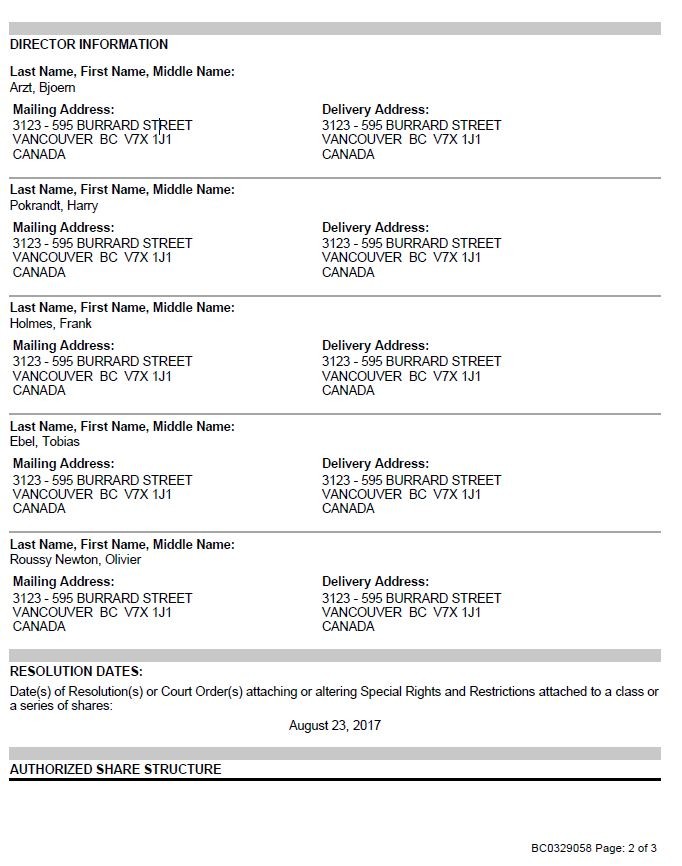

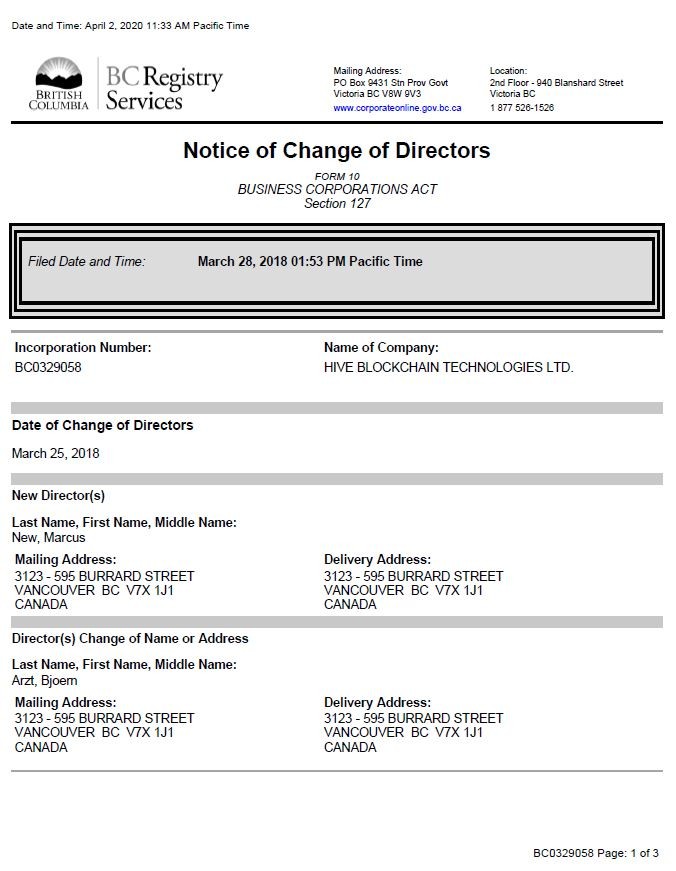



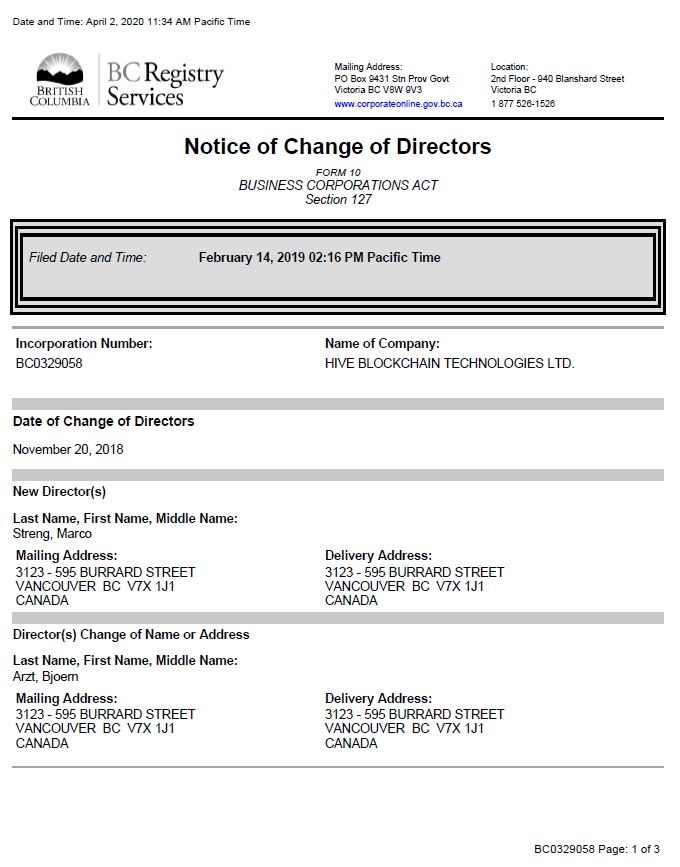
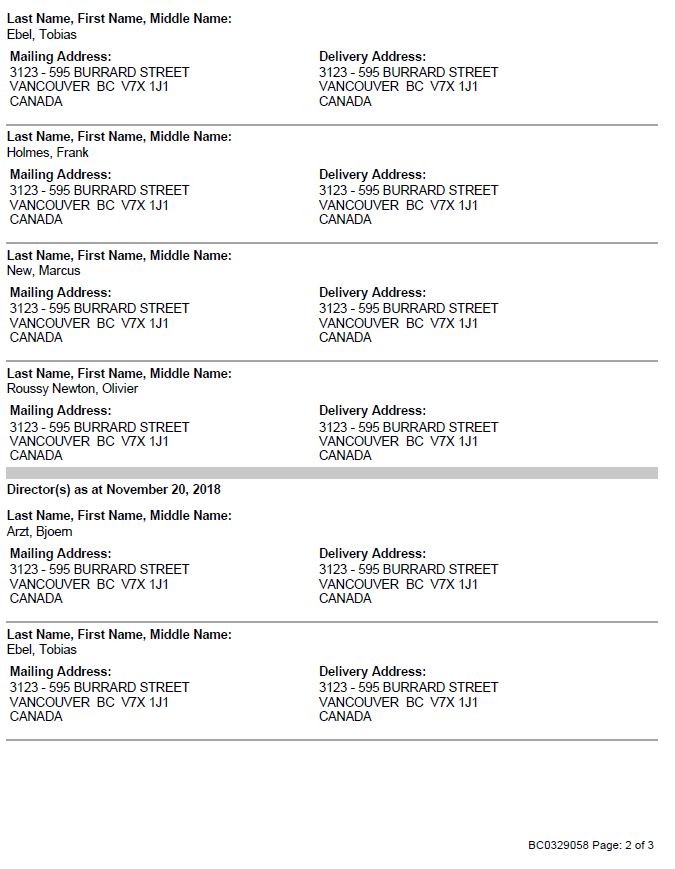


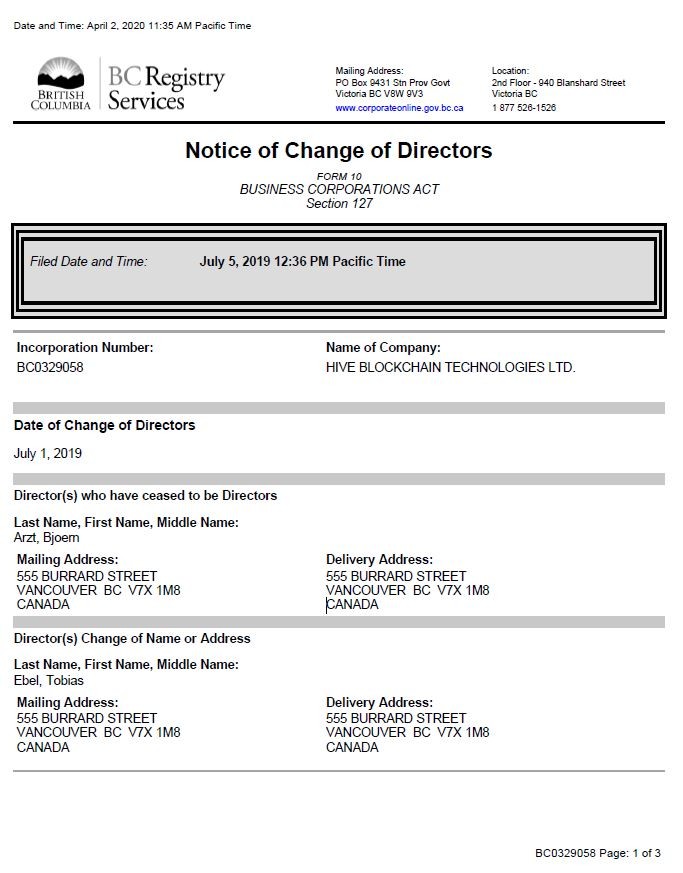


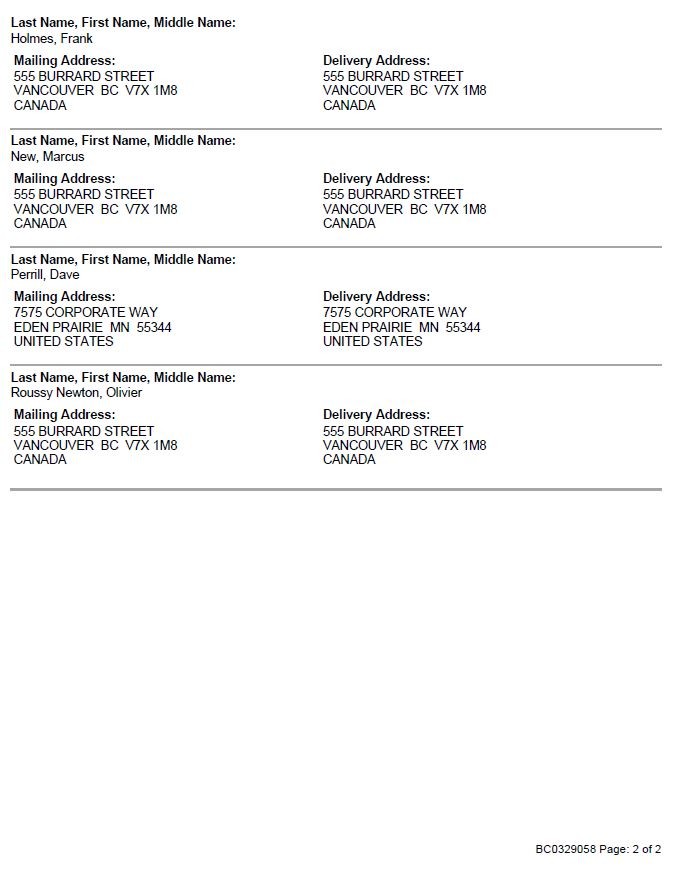
Exhibit 4.4
HIVE DIGITAL TECHNOLOGIES LTD.
FORM OF INDENTURE
Dated as of [ ], 20[ ]
[TRUSTEE]
CROSS-REFERENCE TABLE*
| Trust Indenture Act Section |
Indenture Section |
|
| 310(a)(1) | 7.10 | |
| (a)(2) | 7.10 | |
| (a)(3) | N.A. | |
| (a)(4) | N.A. | |
| (a)(5) | 7.10 | |
| (b) | 7.10 | |
| (c) | N.A. | |
| 311(a) | 7.11 | |
| (b) | 7.11 | |
| 312(a) | 2.06 | |
| (b) | 2.06; 11.03 | |
| (c) | 2.06; 11.03 | |
| 313(a) | 7.06 | |
| (b)(2) | 7.06; 7.07 | |
| (c) | 7.06; 11.02 | |
| (d) | 7.06 | |
| 314(a) | 4.03; 4.04; 11.02 | |
| (b) | N.A. | |
| (c)(l) | 11.04 | |
| (c)(2) | 11.04 | |
| (c)(3) | N.A. | |
| (d) | N.A. | |
| (e) | 11.05 | |
| (f) | N.A. | |
| 315(a) | 7.01 | |
| (b) | 7.05; 11.02 | |
| (c) | 7.01 | |
| (d) | 7.01 | |
| (e) | 6.11 | |
| 316(a) (last sentence) | 2.10 | |
| (a)(l)(A) | 6.05 | |
| (a)(l)(B) | 6.04 | |
| (a)(2) | N.A. | |
| (b) | 6.07 | |
| (c) | 11.06 | |
| 317(a)(l) | 6.08 | |
| (a)(2) | 6.09 | |
| (b) | 2.05 | |
| 318(a) | 11.01 | |
| (b) | N.A. | |
| (c) | 11.01 |
N.A. means not applicable.
* This Cross Reference Table is not part of this Indenture.
INDENTURE, dated as of [ ], 20[ ], by and between Hive Digital Technologies Ltd. a corporation duly organized and existing under the laws of the Province of British Columbia, Canada (the "Company"), and [ ], a [ ] corporation, as trustee (the "Trustee").
The Company and the Trustee agree as follows for the benefit of each other and for the equal and ratable benefit of the Holders of the Notes issued under this Indenture.
ARTICLE I
DEFINITIONS AND INCORPORATION BY REFERENCE
Section 1.01 Definitions.
"Additional Amounts" has the meaning specified in Section 4.08.
"Affiliate" of any specified Person means any other Person directly or indirectly controlling or controlled by or under direct or indirect common control with such specified Person. For purposes of this definition, "control," as used with respect to any Person, means the possession, directly or indirectly, of the power to direct or cause the direction of the management or policies of such Person, whether through the ownership of voting securities, by agreement or otherwise. For purposes of this definition, the terms "controlling," "controlled by" and "under common control with" have correlative meanings.
"Agent" means any Registrar, co-registrar, Custodian, Paying Agent or additional paying agent, or Exchange Rate Agent.
"Applicable Procedures" means, with respect to any payment, tender, redemption, transfer, exchange, or conversion of or for beneficial interests in any Global Note, the rules and procedures of the Depositary that apply to such payment, tender, redemption, transfer, exchange, or conversion.
"Bankruptcy Law" means the Bankruptcy Act of Title 11 of United States Code, as amended from time to time, or any similar federal or state law for the relief of debtors.
"Board of Directors" means:
(1) with respect to a corporation, the board of directors of the corporation or any committee thereof duly authorized to act on behalf of such board;
(2) with respect to a partnership, the Board of Directors of the general partner of the partnership;
(3) with respect to a limited liability company, the managing member or members or any controlling committee of managing members thereof; and
(4) with respect to any other Person, the board or committee of such Person serving a similar function.
"Board Resolution" means a copy of a resolution certified by the Secretary or an Assistant Secretary of the Company to have been adopted by the Board of Directors or pursuant to authorization by the Board of Directors and to be in full force and effect on the date of the certificate and delivered to the Trustee.
"Business Day" means any day other than a Legal Holiday. If a payment date falls on a day that is not a Business Day, the related payment shall be made on the next succeeding Business Day as if made on the date the payment is due, and no interest shall accrue on such payment for the intervening period.
"Canadian Taxes" has the meaning specified in Section 4.08.
"Capital Lease Obligation" means, at the time any determination is to be made, the amount of the liability in respect of a capital lease that would at that time be required to be capitalized on a balance sheet prepared in accordance with GAAP.
"Capital Stock" means:
(1) in the case of a corporation, corporate stock;
(2) in the case of an association or business entity, any and all shares, interests, participations, rights or other equivalents (however designated) of corporate stock;
(3) in the case of a partnership or limited liability company, partnership interests (whether general or limited) or membership interests; and
(4) any other interest or participation that confers on a Person the right to receive a share of the profits and losses of, or distributions of assets of, the issuing Person.
"Company" means HIVE Digital Technologies Ltd., and, subject to Article V, any and all successors thereto.
"Company Order" means a written order signed in the name of the Company by an Officer. A Company Order shall specify the amount of Notes to be authenticated and the date on which the original issue of Notes is to be authenticated.
"Corporate Trust Office of the Trustee" means the designated office of the Trustee at which at any time its corporate trust business in respect of this Indenture shall be administered, which office at the date hereof is located at [ ], Attention: [ ], or such other address as the Trustee may designate from time to time by notice to the Holders and the Company, or the principal corporate trust office of any successor Trustee (or such other address as such successor Trustee may designate from time to time by notice to the Holders and the Company).
"Custodian" means the Trustee, as custodian for the Depositary with respect to any Global Notes, or any successor entity thereto.
"Currency" means any currency or currencies, composite currency or currency unit or currency units issued by the government of one or more countries or by any recognized confederation or association of such governments.
"Default" means any event that is, or with the passage of time or the giving of notice or both would be, an Event of Default.
"Depositary" means, with respect to the Notes of any Series issuable or issued in whole or in part in the form of one or more Global Notes, the person designated as Depositary for such Series by the Company, which Depositary shall be a clearing agency registered under the Exchange Act; and if at any time there is more than one such person, "Depositary" as used with respect to the Notes of any Series shall mean the Depositary with respect to the Notes of such Series.
"Discount Note" means any Note that provides for an amount less than the stated principal amount thereof to be due and payable upon declaration of acceleration of the maturity thereof pursuant to Section 6.02.
"Dollars" and "$" means the Currency of The United States of America.
"Exchange Act" means the United States Securities Exchange Act of 1934, as amended.
"Exchange Rate Agent" means (unless otherwise specified with respect to any Notes pursuant to Section 2.02) a New York Clearing House bank.
"Foreign Currency" means any Currency issued by a government other than the government of The United States of America.
"Global Note" or "Global Notes" means a Note or Notes, as the case may be, in the form established pursuant to Section 2.02 evidencing all or part of a Series of Notes, issued to the Depositary for such Series or its nominee, and registered in the name of such Depositary or nominee.
"Government Securities" means, unless otherwise specified with respect to Notes of any Series pursuant to Section 2.02, securities which are (i) direct obligations of the government which issued the Currency in which the principal of or any premium or interest on Notes of a particular Series are payable or (ii) obligations of a Person controlled or supervised by and acting as an agency or instrumentality of the government which issued the Currency in which the Notes of such Series are payable, the payment of which is unconditionally guaranteed by such government, which, in either case, are full faith and credit obligations of such government payable in such Currency and are not callable or redeemable at the option of the issuer thereof and shall also include a depository receipt issued by a bank or trust company as custodian with respect to any such Government Securities or a specific payment of interest on or principal of any such Government Securities held by such custodian for the account of the holder of a depository receipt; provided that (except as required by law) such custodian is not authorized to make any deduction from the amount payable to the holder of such depository receipt from any amount received by the custodian in respect of the Government Securities or the specific payment of interest or principal of the Government Securities evidenced by such depository receipt.
"Guarantee" means a guarantee other than by endorsement of negotiable instruments for collection in the ordinary course of business, direct or indirect, in any manner including, without limitation, by way of a pledge of assets or through letters of credit or reimbursement agreements in respect thereof, of all or any part of any Indebtedness.
"Hedging Obligations" means, with respect to any specified Person, the obligations of such Person under:
(1) interest rate swap agreements (whether from fixed to floating or from floating to fixed), interest rate cap agreements and interest rate collar agreements;
(2) other agreements or arrangements designed to manage interest rates or interest rate risk; and
(3) other agreements or arrangements designed to protect such Person against fluctuations in currency exchange rates or commodity prices.
"Holder" means a Person in whose name a Note is registered.
"Indebtedness" means, with respect to any specified Person, any indebtedness of such Person, whether or not contingent:
(1) in respect of borrowed money;
(2) evidenced by bonds, notes, debentures or similar instruments or letters of credit, or reimbursement agreements in respect thereof;
(3) in respect of banker's acceptances;
(4) representing Capital Lease Obligations;
(5) representing the balance deferred and unpaid of the purchase price of any property, except any such balance that constitutes an accrued expense or trade payable; or
(6) representing any Hedging Obligations,
if and to the extent any of the preceding items, other than letters of credit and Hedging Obligations, would appear as a liability upon a balance sheet of the specified Person prepared in accordance with GAAP. In addition, the term "Indebtedness" includes all Indebtedness of others secured by a Lien on any asset of the specified Person, whether or not such Indebtedness is assumed by the specified Person, and, to the extent not otherwise included, the Guarantee by the specified Person of any Indebtedness of any other Person or any liability of any person, whether or not contingent and whether or not it appears on the balance sheet of such Person.
The amount of any Indebtedness outstanding as of any date shall be:
(1) the accreted value of the Indebtedness, in the case of any Indebtedness that does not require the current payment of interest; and
(2) the principal amount of the Indebtedness, together with any interest on the Indebtedness that is more than 30 days past due, in the case of any other Indebtedness.
"Indenture" means this Indenture, as amended, supplemented or restated from time to time and shall include the form and terms of particular Series of Notes established as contemplated hereunder.
"Legal Holiday" means a Saturday, a Sunday or a day on which banking institutions in the City of New York, Toronto or the city where the Corporate Trust Office of the Trustee is located at such time are required or authorized by law, regulation or executive order to close or be closed.
"Lien" means, with respect to any asset, any mortgage, lien, pledge, charge, security interest or encumbrance of any kind in respect of such asset, whether or not filed, recorded or otherwise perfected under applicable law, including any conditional sale or other title retention agreement, any lease in the nature thereof, any option or other agreement to sell or give a security interest in and any filing of or agreement to give any financing statement under the United States Uniform Commercial Code (or equivalent statutes) of any jurisdiction; provided that in no event shall an operating lease be deemed to constitute a Lien.
"Notes" means debentures, notes or other debt instruments of the Company of any Series issued under this Indenture.
"Officer" means, with respect to any Person, the Chief Executive Officer, the President, the Chief Operating Officer, the Chief Financial Officer, the Treasurer, any Assistant Treasurer, the Controller, the Secretary, the Assistant Secretary or any Vice-President of such Person.
"Officer's Certificate" means a certificate signed on behalf of the Company by an Officer of the Company that meets the requirements of Section 11.05 hereof.
"Opinion of Counsel" means an opinion from legal counsel, who may be an employee of or counsel to the Company or any Subsidiary of the Company, or other counsel reasonably acceptable to the Trustee, that meets the requirements of Section 11.05 hereof.
"Person" means any individual, corporation, partnership, joint venture, association, joint-stock company, trust, unincorporated organization, limited liability company or government or other entity.
"Responsible Officer," when used with respect to the Trustee, means any director, vice president, assistant vice president or associate within the Corporate Trust Office of the Trustee (or any successor group of the Trustee) or any other officer of the Trustee customarily performing functions similar to those performed by any of the above designated officers who at the time shall have direct responsibility for the administration of this Indenture and also means, with respect to a particular corporate trust matter, any other officer to whom such matter is referred because of his or her knowledge of and familiarity with the particular subject.
"SEC" means the United States Securities and Exchange Commission.
"Series" or "Series of Notes" means each series of debentures, notes or other debt instruments of the Company created pursuant to Sections 2.01 and 2.02 hereof.
"Stated Maturity" means, with respect to any installment Indebtedness, the date specified as the fixed date on which the final payment of principal was scheduled to be paid in the documentation governing such Indebtedness, and will not include any contingent obligations to repay, redeem or repurchase any such principal prior to the date originally scheduled for the payment thereof.
"Subsidiary" means:
(1) any corporation, association or other business entity of which more than 50% of the outstanding Voting Stock is owned or controlled, directly or indirectly, by the Company or by one or more Subsidiaries of the Company; and
(2) any partnership (a) the sole general partner or the managing general partner of which is the Company or a Subsidiary of the Company or (b) the only general partners of which are the Company or one or more Subsidiaries of the Company (or any combination thereof).
"TIA" means the United States Trust Indenture Act of 1939, as amended (15 U.S.C. §§ 77aaa-77bbbb).
"Treasury Regulations" means the regulations promulgated by the United States Treasury Department under the United States Internal Revenue Code of 1986, including any successor regulations.
"Trustee" means the person named as the "Trustee" in the first paragraph of this instrument until a successor Trustee shall have become such pursuant to the applicable provisions of this Indenture, and thereafter "Trustee" shall mean each person who is then a Trustee hereunder, and if at any time there is more than one such person, "Trustee" as used with respect to the Notes of any Series shall mean the Trustee with respect to Notes of that Series.
"Voting Stock" of any specified Person as of any date means the Capital Stock of such Person that is at the time entitled to vote in the election of the Board of Directors of such Person.
Section 1.02 Other Definitions.
| Term | Defined in Section |
||
| "Authentication Order" | 2.03 | ||
| "Covenant Defeasance" | 8.03 | ||
| "Event of Default" | 6.01 | ||
| "Legal Defeasance" | 8.02 | ||
| "Paying Agent" | 2.04 | ||
| "Registrar" | 2.04 |
Section 1.03 Incorporation by Reference of Trust Indenture Act. Whenever this Indenture refers to a provision of the TIA, the provision is incorporated by reference in and made a part of this Indenture.
The following TIA terms used in this Indenture have the following meanings:
"indenture securities" means the Notes;
"indenture security Holder" means a Holder of a Note;
"indenture to be qualified" means this Indenture;
"indenture trustee" or "institutional trustee" means the Trustee; and
"obligor" on the indenture securities means the Company, and any other obligor upon the Notes.
All other terms used in this Indenture that are defined by the TIA, defined by TIA reference to another statute or defined by SEC rule under the TIA have the meanings so assigned to them.
Section 1.04 Rules of Construction. Unless the context otherwise requires:
(1) a term has the meaning assigned to it;
(2) an accounting term not otherwise defined has the meaning assigned to it in accordance with GAAP;
(3) "or" is not exclusive;
(4) words in the singular include the plural, and in the plural include the singular;
(5) "will" shall be interpreted to express a command;
(6) provisions apply to successive events and transactions;
(7) the words "consolidation, amalgamation or merger" as used herein shall be deemed in each case to include any statutory arrangement (including a business combination), binding share exchange or substantially similar extraordinary transaction; and the words "consolidated, amalgamated or merged" and similar phrases have meanings correlative to the foregoing;
(8) the words "include," "included" and "including" as used herein shall be deemed in each case to be followed by the phrase "without limitation"; and
(9) the words "herein," "hereof" and "hereunder" and other words of similar import refer to this Indenture as a whole and not to any particular Article, Section or other subdivision.
ARTICLE II
THE NOTES
Section 2.01 Issuable in Series. The aggregate principal amount of Notes that may be authenticated and delivered under this Indenture is unlimited. The Notes may be issued in one or more Series. All Notes of a Series shall be identical except as may be set forth in a Board Resolution, a supplemental indenture or an Officer's Certificate detailing the adoption of the terms thereof pursuant to the authority granted under a Board Resolution. In the case of Notes of a Series to be issued from time to time, the Board Resolution, Officer's Certificate or supplemental indenture detailing the adoption of the terms thereof pursuant to authority granted under a Board Resolution may provide for the method by which specified terms (such as interest rate, maturity date, record date or date from which interest shall accrue) are to be determined. Notes may differ between Series in respect of any matters, provided that all Series of Notes shall be equally and ratably entitled to the benefits of this Indenture.
Section 2.02 Establishment of Terms of Series of Notes. At or prior to the issuance of any Notes within a Series, the following shall be established (as to the Series generally, in the case of Subsection 2.02(a) and either as to such Notes within the Series or as to the Series generally in the case of Subsections 2.02(b) through 2.02(y)) by or pursuant to a Board Resolution, and set forth or determined in the manner provided in a Board Resolution, supplemental indenture or an Officer's Certificate pursuant to authority granted under a Board Resolution:
(a) the title of the Series (which shall distinguish the Notes of that particular Series from the Notes of any other Series);
(b) the price or prices (expressed as a percentage of the principal amount thereof) at which the Notes of the Series will be issued;
(c) any limit upon the aggregate principal amount of the Notes of the Series which may be authenticated and delivered under this Indenture (except for Notes authenticated and delivered upon registration of transfer of, or in exchange for, or in lieu of, other Notes of the Series pursuant to Section 2.07, 2.08, 2.11, 3.06 or 9.05);
(d) the date or dates on which the principal of the Notes of the Series is payable;
(e) the rate or rates (which may be fixed or variable) per annum or, if applicable, the method used to determine such rate or rates (including, but not limited to, any commodity, commodity index, stock exchange index or financial index) at which the Notes of the Series shall bear interest, if any, the date or dates from which such interest, if any, shall accrue, the date or dates on which such interest, if any, shall commence and be payable and any regular record date for the interest payable on any interest payment date;
(f) the place or places where the principal of, premium, if any, and interest, if any, on the Notes of the Series shall be payable, where the Notes of such Series may be surrendered for registration of transfer or exchange, where the Notes of such Series that are convertible or exchangeable may be surrendered for conversion or exchange, as applicable, and where notices and demands to or upon the Company in respect of the Notes of such Series and this Indenture may be served, and the method of such payment, if by wire transfer, mail or other means;
(g) if applicable, the period or periods within which, the price or prices at which and the terms and conditions upon which the Notes of the Series may be redeemed, in whole or in part, at the option of the Company;
(h) the obligation, if any, of the Company to redeem or purchase the Notes of the Series pursuant to any sinking fund or analogous provisions or at the option of a Holder thereof and the period or periods within which, the price or prices at which and the terms and conditions upon which Notes of the Series shall be redeemed or purchased, in whole or in part, pursuant to such obligation;
(i) the dates, if any, on which and the price or prices at which the Notes of the Series will be repurchased by the Company at the option of the Holders thereof and other detailed terms and provisions of such repurchase obligations;
(j) the denominations in which the Notes of the Series shall be issuable, if other than minimum denominations of $2,000 and integral multiples of $1,000 in excess thereof;
(k) the forms of the Notes of the Series in bearer or fully registered form (and, if in fully registered form, whether the Notes will be issuable as Global Notes);
(l) if other than the principal amount thereof, the portion of the principal amount of the Notes of the Series that shall be payable upon declaration of acceleration of the maturity thereof pursuant to Section 6.02;
(m) whether the Note of any Series will be "original issue discount" securities for United States federal income tax purposes;
(n) the designation of the Currency in which payment of the principal of, premium and interest, if any, on the Notes of the Series will be made if other than Dollars, and the particular provisions applicable thereto;
(o) whether, under what circumstances, and the Currency in which the Company will pay Additional Amounts as contemplated by Section 4.08 on the Notes of the series to any Holder who is not a Canadian Person (including any modification to the definition of Additional Amounts) in respect of any tax, assessment or governmental charge and, if so, whether the Company will have the option to redeem such Notes rather than pay such Additional Amounts (and the terms of any such option);
(p) the provisions, if any, relating to any security provided for the Notes of the Series, and any subordination in right of payment, if any, of the Notes of the Series;
(q) whether the principal of (or premium, if any) or interest, if any, on the Notes of any Series are to be payable, at the election of the Company or a Holder thereof, in a Currency other than that in which such Notes are denominated or stated to be payable, the period or periods within which, and the terms and conditions upon which, such election may be made, and the time and manner of determining the exchange rate between the Currency in which such Notes are denominated or stated to be payable and the Currency in which such Notes are to be so payable;
(r) the terms of any guarantee of the payment of principal, premium and interest with respect to Notes of any Series and any corresponding changes to the provisions of this Indenture as then in effect;
(s) if the Notes of any Series are to be convertible into or exchangeable for any securities of any Person (including the Company), the terms and conditions upon which such Notes will be so convertible or exchangeable;
(t) provisions for electronic issuances of Notes or issuances of Notes in uncertificated form;
(u) any addition to or change in the Events of Default which applies to any Notes of the Series and any change in the right of the Trustee or the requisite Holders of such Notes to declare the principal amount thereof due and payable pursuant to Section 6.02;
(v) any addition to or change in the covenants set forth in Articles IV or V that applies to Notes of the Series;
(w) selling restrictions applicable to any Series of Notes, if any;
(x) any other terms of the Notes of the Series (which may modify or delete any provision of this Indenture insofar as it applies to such Series); and
(y) any depositaries, interest rate calculation agents, exchange rate calculation agents or other agents with respect to Notes of such Series if other than those appointed herein.
All Notes of any one Series need not be issued at the same time and may be issued from time to time, consistent with the terms of this Indenture, if so provided by or pursuant to the Board Resolution, supplemental indenture hereto or Officer's Certificate referred to above, and, unless otherwise provided, a Series may be reopened, without the consent of the Holders, for issuances of additional Notes of such Series; provided, however, that if such additional Notes are not issued in a "qualified reopening" within the meaning of Treasury Regulation section 1.1275-2(k)(3), the additional Notes will have a separate CUSIP number. No Board Resolution or Officer's Certificate may affect the Trustee's own rights, duties or immunities under this Indenture or otherwise with respect to any series of Notes except as it may agree in writing. To the extent any terms of a supplemental indenture relating to a Series of Notes are contrary to terms contained in this Indenture, the terms of such supplemental indenture shall be deemed to supersede this Indenture solely with respect to the Notes issued pursuant to such supplemental indenture.
Section 2.03 Execution and Authentication. One Officer shall sign the Notes for the Company by manual or facsimile signature. If an Officer whose signature is on a Note no longer holds that office at the time such Note is authenticated, such Note shall nevertheless be valid.
A Note shall not be valid until authenticated by the manual signature of the Trustee. The signature shall be conclusive evidence that the Note, as applicable, has been authenticated under this Indenture.
The Trustee shall, upon a written order of the Company signed by one Officer (an "Authentication Order"), authenticate Notes for original issue in accordance with this Indenture. The Notes shall be dated their date of authentication.
The Trustee may appoint an authenticating agent acceptable to the Company to authenticate Notes. An authenticating agent may authenticate Notes whenever the Trustee may do so. Each reference in this Indenture to authentication by the Trustee includes authentication by such agent. An authenticating agent has the same rights as an Agent to deal with Holders or an Affiliate of the Company.
At any time and from time to time after the execution and delivery of this Indenture, the Company may deliver Notes of any Series executed by the Company to the Trustee for authentication, together with a Company Order for the authentication and delivery of such Notes, and the Trustee in accordance with the Company Order will authenticate and deliver such Notes. In authenticating such Notes, and accepting the additional responsibilities under this Indenture in relation to such Notes, the Trustee shall receive, and (subject to Section 7.01) will be fully protected in relying upon, an Opinion of Counsel stating:
(a) that such form has been established in conformity with the provisions of this Indenture;
(b) that such terms have been established in conformity with the provisions of this Indenture; and
(c) that the Indenture and such Notes, when authenticated and delivered by the Trustee and, with respect to the Notes, when issued by the Company, in the manner and subject to any conditions specified in such Opinion of Counsel, will constitute valid and binding obligations of the Company enforceable in accordance with their terms, subject to bankruptcy, insolvency, reorganization, moratorium, or other laws relating to or affecting creditors' rights and to general principles of equity.
Section 2.04 Registrar and Paying Agent. The Company shall maintain an office or agency where Notes may be presented for registration of transfer or for exchange ("Registrar") and an office or agency where Notes may be presented for payment ("Paying Agent"). The Registrar shall keep a register with respect to each Series of the Notes and of their transfer and exchange. The Company may appoint one or more co-registrars and one or more additional paying agents or change the office of such Registrar or Paying Agent. The term "Registrar" includes any co-registrar and the term "Paying Agent" includes any additional paying agent. The Company may change any Paying Agent or Registrar without notice to any Holder; however, the Company shall maintain a Paying Agent in each place of payment for the Notes of each Series. The Company shall notify the Trustee in writing of the name and address of any Agent not a party to this Indenture. If the Company fails to appoint or maintain another entity as Registrar or Paying Agent, the Trustee shall act as such. The Company or any of its Subsidiaries may act as Paying Agent or Registrar.
The Company initially appoints the Trustee to act as the Registrar and Paying Agent and to act as Custodian with respect to the Global Notes. The Company shall be responsible for making calculations called for under the Notes and this Indenture, including, but not limited to, determination of interest, additional amounts, redemption price, premium, if any, and any other amounts payable on the Notes. The Company will make the calculations in good faith and, absent manifest error, its calculations will be final and binding on the Holders. The Company will provide a schedule of its calculations to the Trustee when requested by the Trustee in writing, and the Trustee is entitled to rely conclusively on the accuracy of the Company's calculations without independent verification. The Trustee shall forward the Company's calculations to any Holder of the Notes upon the written request of such Holder.
Section 2.05 Paying Agent to Hold Money in Trust. The Company shall require each Paying Agent other than the Trustee to agree in writing that the Paying Agent will hold in trust, for the benefit of Holders of any Series of Notes, or the Trustee, all money held by the Paying Agent for the payment of principal or interest on the Series of Notes, and shall notify the Trustee of any default by the Company in making any such payment. While any such default continues, the Trustee may require a Paying Agent to pay all money held by it to the Trustee. The Company at any time may require a Paying Agent to pay all money held by it to the Trustee. All payments to a Paying Agent on any Notes which remain unclaimed for a period of two years after such payment was due shall be repaid to the Company. Thereafter, the Holder may look only to the Company for repayment. Upon payment over to the Trustee, or to the Company, as the case may be, the Paying Agent (if other than the Company or a Subsidiary) shall have no further liability for the money. If the Company or a Subsidiary acts as Paying Agent, it shall segregate and hold in a separate trust fund for the benefit of Holders of any Series of Notes all money held by it as Paying Agent. Upon any bankruptcy or reorganization proceedings relating to the Company, the Trustee shall serve as Paying Agent for the Notes.
Section 2.06 Holder Lists. The Trustee shall preserve in as current a form as is reasonably practicable the most recent list available to it of the names and addresses of Holders of each Series of Notes and shall otherwise comply with TIA Section 312(a). If the Trustee is not the Registrar, the Company shall furnish to the Trustee, at least [ ] Business Days before each interest payment date and at such other times as the Trustee may request in writing, a list in such form and as of such date as the Trustee may reasonably require of the names and addresses of Holders of each Series of Notes and the Company shall otherwise comply with TIA Section 312(a).
Section 2.07 Transfer and Exchange. Notes may be transferred or exchanged at the office of the Registrar or co-registrar designated by the Company. Where Notes of a Series are presented to the Registrar or a co-registrar with a request to register a transfer or to exchange them for an equal principal amount of Notes of the same Series, the Registrar shall register the transfer or make the exchange if its requirements for such transactions are met. To permit registrations of transfers and exchanges, the Trustee shall authenticate Notes at the Registrar's request. No service charge shall be made for any registration of transfer or exchange (except as otherwise expressly permitted herein), but the Company may require payment of a sum sufficient to cover any transfer tax or similar governmental charge payable in connection therewith (other than any such transfer tax or similar governmental charge payable upon exchanges pursuant to Section 2.11, 3.06 or 9.05).
Neither the Company nor the Registrar shall be required (a) to issue, register the transfer of, or exchange Notes of any Series for the period beginning at the opening of business [ ] days immediately preceding the mailing of a notice of redemption of Notes of that Series selected for redemption and ending at the close of business on the day of such mailing, or (b) to register the transfer of or exchange Notes of any Series selected, called or being called for redemption as a whole or a portion thereof, except the unredeemed portion of Notes being redeemed in part.
The Trustee shall have no obligation or duty to monitor, determine or inquire as to compliance with any restrictions on transfer imposed under this Indenture or under applicable law with respect to any transfer of any interest in any Note (including any transfers between or among Depositary participants or beneficial owners of interests in any Global Note) other than to require delivery of such certificates and other documentation or evidence as are expressly required by, and to do so if and when expressly required by the terms of, this Indenture, and to examine the same to determine substantial compliance as to form with the express requirements hereof.
Section 2.08 Replacement Notes. If any mutilated Note is surrendered to the Trustee, or if the Company and the Trustee receive evidence to their satisfaction of the destruction, loss or theft of any Note, the Company shall issue and the Trustee, upon receipt of an Authentication Order together with such indemnity or security sufficient in the judgment of the Trustee and the Company to protect the Company, the Trustee, any Agent and any authenticating agent from any loss that any of them may suffer if a Note is replaced, shall authenticate a replacement Note of the same Series if the Trustee's requirements are met. The Company may charge for its expenses in replacing a Note.
Every replacement Note of any Series is an additional obligation of the Company and shall be entitled to all of the benefits of this Indenture equally and proportionately with all other Notes of that Series duly issued hereunder.
Section 2.09 Outstanding Notes. The Notes outstanding at any time are all the Notes authenticated by the Trustee except for those canceled by it, those delivered to it for cancellation, those reductions in the interest in a Global Note effected by the Trustee in accordance with the provisions hereof, and those described in this Section as not outstanding. Except as set forth in Section 2.10 hereof, a Note does not cease to be outstanding because the Company or an Affiliate of the Company holds the Note.
If a Note is replaced pursuant to Section 2.08 hereof, it ceases to be outstanding unless the Trustee receives proof satisfactory to it that the replaced Note is held by a bona fide purchaser.
If the principal amount of any Note is considered paid under Section 4.01 hereof, it ceases to be outstanding and interest on it ceases to accrue.
If the Paying Agent (other than the Company, a Subsidiary or an Affiliate of any thereof) holds, on a redemption date or maturity date, money sufficient to pay Notes payable on that date, then on and after that date such Notes shall be deemed to be no longer outstanding and shall cease to accrue interest.
Section 2.10 Treasury Notes. In determining whether the Holders of the required principal amount of Notes of a Series have concurred in any direction, waiver or consent, Notes owned by the Company, or by any Person directly or indirectly controlling or controlled by or under direct or indirect common control with the Company, shall be considered as though not outstanding, except that for the purposes of determining whether the Trustee shall be protected in relying on any such direction, waiver or consent, only Notes of a Series that a Responsible Officer of the Trustee actually knows are so owned shall be so disregarded.
Section 2.11 Temporary Notes. Until certificates representing Notes are ready for delivery, the Company may prepare and the Trustee, upon receipt of an Authentication Order, shall authenticate temporary Notes. Temporary Notes shall be substantially in the form of certificated Notes but may have variations that the Company considers appropriate for temporary Notes and as shall be reasonably acceptable to the Trustee. Without unreasonable delay, the Company shall prepare and the Trustee shall authenticate definitive Notes in exchange for temporary Notes.
Holders of temporary Notes shall be entitled to all of the benefits of this Indenture.
Section 2.12 Cancellation. The Company at any time may deliver Notes to the Trustee for cancellation. The Registrar and Paying Agent shall forward to the Trustee any Notes surrendered to them for registration of transfer, exchange or payment. The Trustee and no one else shall cancel all Notes surrendered for registration of transfer, exchange, payment, replacement or cancellation. The Company may not issue new Notes to replace Notes that it has paid or that have been delivered to the Trustee for cancellation. Cancelled Notes shall be disposed of by the Trustee pursuant to its standard procedures and, upon request by the Company, the Trustee shall deliver a certificate or other evidence of such disposition.
Section 2.13 Defaulted Interest. If the Company defaults in a payment of interest on a Series of Notes, it shall pay the defaulted interest in any lawful manner plus, to the extent lawful, interest payable on the defaulted interest, to the Persons who are Holders of the Series on a subsequent special record date, in each case at the rate provided in the Notes and in Section 4.01 hereof. The Company shall notify the Trustee in writing of the amount of defaulted interest proposed to be paid on each Note and the date of the proposed payment. The Company shall fix or cause to be fixed each such special record date and payment date, provided that no such special record date shall be less than [ ] days prior to the related payment date for such defaulted interest. At least [ ] days before the special record date, the Company (or, upon the written request of the Company, the Trustee in the name and at the expense of the Company) shall mail or cause to be mailed (or, in the case of the Depositary with respect to any Global Note, sent electronically) to Holders a notice that states the special record date, the related payment date and the amount of such interest to be paid.
Section 2.14 Global Notes.
(a) Terms of Notes. A Board Resolution, a supplemental indenture hereto, or an Officer's Certificate shall establish whether the Notes of a Series shall be issued in whole or in part in the form of one or more Global Notes and shall name the Depositary for such Global Note or Notes. Except as provided herein, each Global Note shall be (i) registered in the name of the Depositary, (ii) deposited with the Depositary or its nominee, and (iii) bear the legend indicated in Section 2.14(c).
(b) Transfer and Exchange. Notwithstanding any provisions to the contrary contained in Section 2.07, any Global Note shall be exchangeable pursuant to Section 2.07 for Notes registered in the names of Holders other than the Depositary for such Note or its nominee only if (i) such Depositary notifies the Company that it is unwilling or unable to continue as Depositary for such Global Note or if at any time such Depositary ceases to be a clearing agency registered under the Exchange Act, and, in either case, the Company fails to appoint a successor Depositary registered as a clearing agency under the Exchange Act within 90 days of such event, (ii) the Company executes and delivers to the Trustee an Officer's Certificate to the effect that such Global Note shall be so exchangeable or (iii) an Event of Default with respect to the Notes represented by such Global Note shall have occurred and be continuing. Any Global Note that is exchangeable pursuant to the preceding sentence shall be exchangeable for Notes registered in such names as the Depositary shall direct in writing in an aggregate principal amount equal to the principal amount of the Global Note with like tenor and terms.
Except as provided in this Section 2.14(b), a Global Note may not be transferred except as a whole by the Depositary with respect to such Global Note to a nominee of such Depositary, by a nominee of such Depositary to such Depositary or another nominee of such Depositary, or by the Depositary or any such nominee to a successor Depositary or a nominee of such a successor Depositary.
(c) Legend. Any Global Note issued hereunder shall bear a legend in substantially the following form:
"This Note is a Global Note within the meaning of the Indenture hereinafter referred to and is registered in the name of the Depositary or a nominee of the Depositary. This Note is exchangeable for Notes registered in the name of a person other than the Depositary or its nominee only in the limited circumstances described in the Indenture, and may not be transferred except as a whole by the Depositary to a nominee of the Depositary, by a nominee of the Depositary to the Depositary or another nominee of the Depositary, or by the Depositary or any such nominee to a successor Depositary or a nominee of such a successor Depositary."
(d) Acts of Holders. The Depositary, as a Holder, may appoint agents and otherwise authorize participants to give or take any request, demand, authorization, direction, notice, consent, waiver or other action which a Holder is entitled to give or take under the Indenture.
(e) Payments. Notwithstanding the other provisions of this Indenture, unless otherwise specified as contemplated by Section 2.02, payment of the principal of and interest, if any, on any Global Note shall be made to the Holder thereof. Prior to due presentment of a Note for registration of transfer, the Company, the Trustee, and any agent of the Company or the Trustee may treat the Person in whose name such Note is registered as the owner of such Note at the close of business on the regular record date for the purpose of receiving payment of principal of and any premium and (subject to Section 2.13) any interest on such Note and for all other purposes whatsoever, whether or not such Note shall be overdue, and neither the Company, the Trustee nor any agent of the Company or the Trustee will be affected by notice to the contrary.
(f) Consents, Declaration and Directions. Except as provided in Section 2.14(e), the Company, the Trustee and any Agent shall treat a person as the Holder of such principal amount of outstanding Notes of such Series represented by a Global Note as shall be specified in a written statement of the Depositary with respect to such Global Note, for purposes of obtaining any consents, declarations, waivers or directions required to be given by the Holders pursuant to this Indenture.
(g) Responsibility of Trustee or Agents. Neither the Trustee nor any Agent shall have any responsibility for any actions taken or not taken by the Depositary. The Company has entered into a letter of representations with the Depositary in the form provided by the Depositary and the Trustee and each Agent is hereby authorized to act in accordance with such letter and the Applicable Procedures.
Section 2.15 Exchange Rate Agent. Unless otherwise specified pursuant to Section 2.02, if and so long as the Notes of any Series (i) are denominated in a Currency other than Dollars or (ii) may be payable in a Currency other than Dollars, or so long as it is required under any other provision of this Indenture, then the Company will maintain with respect to each such Series of Notes, or as so required, at least one Exchange Rate Agent. The Company will cause the Exchange Rate Agent to make the necessary foreign exchange determinations at the time and in the manner specified pursuant to Section 2.02 for the purpose of determining the applicable rate of exchange. The Company shall have the right to remove and replace from time to time the Exchange Rate Agent for any Series of Notes. No resignation or removal of the Exchange Rate Agent and no appointment of a successor Exchange Rate Agent pursuant to this Section shall become effective until the acceptance of appointment by the successor Exchange Rate Agent as evidenced by a written instrument delivered to the Company and the Trustee. If the Exchange Rate Agent shall resign, be removed or become incapable of acting, or if a vacancy shall occur in the office of the Exchange Rate Agent for any cause with respect to the Notes of any Series, the Company, by or pursuant to a Board Resolution, shall promptly appoint a successor Exchange Rate Agent or Exchange Rate Agents with respect thereto.
Section 2.16 CUSIP Number. The Company in issuing the Notes may use "CUSIP" and "ISIN" numbers (if then generally in use), and, if so, the Trustee shall use CUSIP and ISIN numbers in notices as a convenience to Holders; provided that any such notice may state that no representation is made as to the correctness of such numbers either as printed on the Notes or as contained in any notice and that reliance may be placed only on the other identification numbers printed on the Notes, and any such notice shall not be affected by any defect in or the omission of such numbers. The Company shall promptly notify the Trustee in writing of any change in the CUSIP and ISIN numbers.
ARTICLE III
REDEMPTION AND PREPAYMENT
Section 3.01 Notice to Trustee. The Company may, with respect to any Series of Notes, reserve the right to redeem and pay the Series of Notes or may covenant to redeem and pay the Series of Notes or any part thereof prior to the Stated Maturity thereof at such time and on such terms as provided for in such Notes. If a Series of Notes is redeemable and the Company wants or is obligated to redeem prior to the Stated Maturity thereof all or part of the Series of Notes pursuant to the terms of such Notes, it shall notify the Trustee in writing of the redemption date and the principal amount of Series of Notes to be redeemed. The Company shall give the notice at least [ ] days prior to the mailing or sending of notice of redemption to the Holders of the Notes to be redeemed (or such shorter notice as may be acceptable to the Trustee).
Section 3.02 Selection of Notes to Be Redeemed. If less than all of the Notes of a Series are to be redeemed or purchased in an offer to purchase at any time, the Trustee (subject to the applicable procedures of the Depositary) shall select the Notes of a Series to be redeemed or purchased among the Holders of the Notes (a) in compliance with the requirements of the principal national securities exchange, if any, on which the Notes are listed or, (b) if the Notes are not so listed, on a pro rata basis, by lot or in accordance with any other method the Trustee considers fair and appropriate.
The Trustee shall promptly notify the Company in writing of the Notes selected for redemption and, in the case of any Note selected for partial redemption, the principal amount thereof to be redeemed. Notes of a Series and portions of them selected shall be in amounts of $2,000 or whole multiples of $1,000, or with respect to Notes of any Series issuable in other denominations pursuant to Section 2.02(j), the minimum principal denomination for each Series and integral multiples thereof. Except as provided in the preceding sentence, provisions of this Indenture that apply to Notes of a Series called for redemption or repurchase also apply to portions of Notes of a Series called for redemption or repurchase.
Section 3.03 Notice of Redemption. Unless otherwise indicated for a particular Series by Board Resolution, a supplemental indenture hereto or an Officer's Certificate, at least [ ] days but not more than [ ] days before a redemption date, the Company shall mail or cause to be mailed, by first class mail, or, in the case of the Depositary with respect to any Global Note, sent electronically, a notice of redemption to each Holder whose Notes are to be redeemed at its registered address.
The notice shall identify the Notes of the Series to be redeemed and shall state:
(1) the redemption date;
(2) the redemption price (or manner of calculation if not then known);
(3) the name and address of the Paying Agent;
(4) that Notes of the Series called for redemption must be surrendered to the Paying Agent to collect the redemption price;
(5) that interest on Notes of the Series called for redemption ceases to accrue on and after the redemption date;
(6) the CUSIP and ISIN number, if any, provided that no representation is made as to the correctness or accuracy of the CUSIP and ISIN number, if any, listed in such notice or printed on the Notes;
(7) the conditions precedent, if any, to the redemption; and
(8) any other information as may be required by the terms of the particular Series of the Notes or the Notes of a Series being redeemed.
At the Company's request, and upon receipt of an Officer's Certificate complying with Section 11.04 hereof at least [ ] days prior to the date notice is to be given (unless a shorter period shall be satisfactory to the Trustee), together with the notice to be given setting forth the information to be stated therein as provided in the preceding paragraph, the Trustee shall give the notice of redemption in the Company's name and at its expense.
Section 3.04 Effect of Notice of Redemption. Once notice of redemption is sent in accordance with Section 3.03 hereof, Notes called for redemption become irrevocably due and payable on the redemption date at the redemption price. Unless otherwise indicated for a particular Series by Board Resolution, a supplemental indenture hereto or an Officer's Certificate, a notice of redemption may not be conditional.
Section 3.05 Deposit of Redemption Price. At least one Business Day prior to the redemption date, the Company shall deposit with the Trustee or with the Paying Agent money sufficient to pay the redemption price of and accrued interest on all Notes to be redeemed on that date. The Trustee or the Paying Agent shall promptly return to the Company any money deposited with the Trustee or the Paying Agent by the Company in excess of the amounts necessary to pay the redemption price of, and accrued interest on, all Notes to be redeemed.
If the Company complies with the provisions of the preceding paragraph, on and after the redemption date, interest shall cease to accrue on the Notes or the portions of Notes called for redemption. If any Note called for redemption shall not be so paid upon surrender for redemption because of the failure of the Company to comply with the preceding paragraph, interest shall be paid on the unpaid principal, from the redemption date until such principal is paid, and to the extent lawful on any interest not paid on such unpaid principal, in each case at the rate provided in the Notes and in Section 4.01 hereof.
Section 3.06 Notes Redeemed in Part. Upon surrender of a Note that is redeemed in part, the Company shall issue and, upon the Company's written request, the Trustee shall authenticate for the Holder, or transfer by book-entry at the expense of the Company, a new Note equal in principal amount to the unredeemed portion of the Note surrendered.
No Notes of $2,000 or less can be redeemed in part (or with respect to Notes of any Series issuable in other denominations pursuant to Section 2.02(j), the minimum denomination for each Series and integral multiples thereof).
Section 3.07 Tax Redemption. If specified pursuant to Section 2.02, the Notes of a series will be subject to redemption at any time, in whole but not in part, at a redemption price equal to the principal amount thereof together with accrued and unpaid interest to the date fixed for redemption, upon the giving of a notice as described below, if (1) the Company determines that (a) as a result of any change in or amendment to the laws (or any regulations or rulings promulgated thereunder) of Canada or of any political subdivision or taxing authority thereof or therein affecting taxation, or any change in official position regarding application or interpretation of such laws, regulations or rulings (including a holding by a court of competent jurisdiction), which change or amendment is announced or becomes effective on or after a date specified in the applicable supplemental indenture, if any date is so specified, the Company has or will become obligated to pay, on the next succeeding date on which interest is due, Additional Amounts pursuant to Section 4.08 or (b) on or after a date specified pursuant to Section 2.02, any action has been taken by any taxing authority of, or any decision has been rendered by a court of competent jurisdiction in, Canada or any political subdivision or taxing authority thereof or therein, including any of those actions specified in (a) above, whether or not such action was taken or decision was rendered with respect to the Company, or any change, amendment, application or interpretation shall be officially proposed, which, in any case, in the Opinion of Counsel to the Company, will result in the Company becoming obligated to pay, on the next succeeding date on which interest is due, Additional Amounts with respect to any Notes of such series and (2) in any such case, the Company in its business judgment determines that such obligation cannot be avoided by the use of reasonable measures available to the Company; provided, however, that (i) no such notice of redemption may be given earlier than [ ] or later than [ ] days prior to the earliest date on which the Company would be obligated to pay such Additional Amounts were a payment in respect of the Notes due, and (ii) at the time such notice of redemption is given, such obligation to pay such Additional Amounts remains in effect.
ARTICLE IV
COVENANTS
Section 4.01 Payment of Principal and Interest. The Company covenants and agrees for the benefit of the Holders of each Series of Notes that it will pay or cause to be paid the principal of, premium, if any, and interest, if any, on such Series of Notes on the dates and in the manner provided in such Notes. Principal, premium, if any, and interest on any Series of Notes will be considered paid on the date due if the Paying Agent, if other than the Company or a Subsidiary thereof, holds as of [ ] Eastern Time on the due date money deposited by the Company in immediately available funds and designated for and sufficient to pay all principal, premium, if any, and interest then due.
Section 4.02 Maintenance of Office or Agency. The Company covenants and agrees for the benefit of the Holders of each Series of Notes that it will maintain an office or agency (which may be an office of the Trustee for such Notes or an affiliate of the Trustee, Registrar for such Notes or co-registrar) where Notes may be surrendered for registration of transfer or for exchange (and for any Notes that are convertible or exchangeable, where such Notes may be surrendered for conversion or exchange, as applicable) and where notices and demands to or upon the Company in respect of such Notes and this Indenture may be served. The Company will give prompt written notice to the Trustee for such Notes of the location, and any change in the location, of such office or agency. If at any time the Company fails to maintain any such required office or agency or fails to furnish the Trustee with the address thereof, such presentations, surrenders, notices and demands may be made or served at the Corporate Trust Office of the Trustee.
With respect to each Series of Notes, the Company hereby designates the Corporate Trust Office of the Trustee as one such office or agency of the Company in accordance with Section 2.04.
Section 4.03 Reports. The Company will at all times comply with TIA § 314(a). Delivery of such reports, information and documents to the Trustee is for informational purposes only and the Trustee's receipt of such shall not constitute constructive notice of any information contained therein or determinable from information contained therein, including the Company's compliance with any of its covenants hereunder (as to which the Trustee is entitled to rely exclusively on Officer's Certificates).
Section 4.04 Compliance Certificate. The Company and each guarantor of any Series of Notes (to the extent that such guarantor is so required under the TIA) shall deliver to the Trustee with respect to such Series, within [ ] days after the end of each fiscal year of the Company, an Officer's Certificate signed by the principal executive officer, the principal financial officer or the principal accounting officer of the Company, stating that a review of the activities of the Company and its Subsidiaries during the preceding fiscal year has been made under the supervision of the signing Officer with a view to determining whether the Company has kept, observed, performed and fulfilled its obligations under this Indenture, and further stating, as to the Officer signing such certificate, that to the best of his or her knowledge the Company has kept, observed, performed and fulfilled each and every covenant contained in this Indenture and is not in default in the performance or observance of any of the terms, provisions and conditions of this Indenture (or, if a Default or Event of Default shall have occurred, describing all such Defaults or Events of Default of which he or she may have knowledge and what action the Company is taking or proposes to take with respect thereto) and that to the best of his or her knowledge no event has occurred and remains in existence by reason of which payments on account of the principal of or interest, if any, on the Notes is prohibited or if such event has occurred, a description of the event and what action the Company is taking or proposes to take with respect thereto.
Section 4.05 Taxes. The Company will pay, and will cause each of its Subsidiaries to pay, prior to delinquency, all material taxes, assessments, and governmental levies except such as are contested in good faith and by appropriate proceedings or where the failure to effect such payment is not adverse in any material respect to the Holders of the Notes.
Section 4.06 Stay, Extension and Usury Laws. The Company covenants (to the extent that it may lawfully do so) that it will not, and each guarantor of such Notes will not, at any time insist upon, plead, or in any manner whatsoever claim or take the benefit or advantage of, any stay, extension or usury law wherever enacted, now or at any time hereafter in force, that may affect the covenants or the performance of this Indenture; and the Company and each of such guarantors (to the extent that it may lawfully do so), as applicable, hereby expressly waives all benefit or advantage of any such law, and covenants that it will not, by resort to any such law, hinder, delay or impede the execution of any power herein granted to the Trustee for such Notes, but will suffer and permit the execution of every such power as though no such law has been enacted.
Section 4.07 Corporate Existence. Subject to Articles V hereof, the Company shall do or cause to be done all things necessary to preserve and keep in full force and effect:
(a) its corporate existence in accordance with its organizational documents (as the same may be amended from time to time); and
(b) the rights (charter and statutory), licenses and franchises of the Company; provided, however, that the Company shall not be required to preserve any such right, license or franchise if an Officer shall determine that either: (i) the preservation thereof is no longer desirable in the conduct of the business of the Company and its Subsidiaries, taken as a whole, and that the loss thereof is not adverse in any material respect to the Holders of the Notes; or (ii) that such preservation is not necessary in connection with any transaction not prohibited by this Indenture.
Section 4.08 Additional Amounts. If specified pursuant to Section 2.02, all payments made by the Company under or with respect to the Notes of any Series will be made free and clear of and without withholding or deduction for or on account of any present or future tax, duty, levy, impost, assessment or other governmental charge (including penalties, interest and other liabilities related thereto) imposed or levied by or on behalf of the Government of Canada or of any province or territory thereof or by any authority or agency therein or thereof having power to tax ("Canadian Taxes"), unless the Company is required to withhold or deduct Canadian Taxes by law or by the interpretation or administration thereof by the relevant governmental authority or agency. If the Company is so required to withhold or deduct any amount for or on account of Canadian Taxes from any payment made under or with respect to the Notes, the Company will pay such additional amounts ("Additional Amounts") as may be necessary so that the net amount received by each Holder (including Additional Amounts) after such withholding or deduction will not be less than the amount the Holder would have received if such Canadian Taxes had not been withheld or deducted (a similar payment will also be made to Holders that are exempt from withholding but are required to pay tax directly on amounts otherwise subject to withholding); provided that no Additional Amounts will be payable:
(1) to any Person in respect of whom such taxes are required to be withheld or deducted as a result of such Person not dealing at arm's length with the Company (within the meaning of the Income Tax Act (Canada)) at the time of the making of such payment;
(2) where such taxes are required to be withheld or deducted as a result of such person or entity being, or not dealing at arm's length with, a "specified shareholder" of the Company (within the meaning of the Income Tax Act (Canada));
(3) to any Person by reason of such Person being connected with Canada (otherwise than merely by holding or ownership of any Series of Notes or receiving any payments or exercising any rights thereunder), including without limitation a nonresident insurer who carries on an insurance business in Canada and in a country other than Canada;
(4) for or on account of any tax, assessment or other governmental charge which would not have been so imposed but for the presentation by the Holder of such Note for payment on a date more than 10 days after the date on which such payment became due and payable or the date on which payment thereof is duly provided for, whichever occurs later;
(5) for or on account of any estate, inheritance, gift, sales, transfer, personal property tax or any similar tax, assessment or other governmental charge;
(6) for or on account of any tax, assessment or other governmental charge required to be withheld by any Paying Agent from any payment to a Person in respect of any Note, if such payment can be made to such person without such withholding by at least one other Paying Agent the identity of which is provided to such Person;
(7) for or on account of any tax, assessment or other governmental charge which is payable otherwise than by withholding from a payment in respect of such Note;
(8) to any Person which is subject to such Canadian Taxes by reason of its failure to comply with any certification, identification, information, documentation or other reporting requirement if compliance is required by law, regulation, administrative practice or an applicable treaty as a precondition to (or to reasonably evidence) exemption from, or a reduction in the rate of deduction or withholding of, such Canadian Taxes; or
(9) for any combination of items (1), (2), (3), (4), (5), (6), (7) and (8);
nor will Additional Amounts be paid with respect to any payment on a Note to a Holder who is a fiduciary or partnership or other than the sole beneficial owner of such payment to the extent such payment would be required by the laws of Canada (or any political subdivision thereof) to be included in the income for Canadian federal income tax purposes of a beneficiary or settlor with respect to such fiduciary or a member of such partnership or a beneficial owner who would not have been entitled to payment of the Additional Amounts had such beneficiary, settlor, member or beneficial owner been the Holder of such Note.
At least [ ] days prior to each date on which any payment under or with respect to the Notes is due and payable, if the Company will be obligated to pay Additional Amounts with respect to such payment, the Company will (i) deliver to the Trustee an Officers' Certificate stating the fact that such Additional Amounts will be payable, the amounts so payable and will set forth such other information necessary to enable the Trustee to pay such Additional Amounts to Holders on the payment date and (ii) deliver to the Trustee such Additional Amounts. The Company covenants to indemnify the Trustee for, and to hold it harmless against, any loss, liability or expense reasonably incurred by the Trustee without negligence or bad faith on its part arising out of or in connection with actions taken or omitted by it in reliance on any Officers' Certificate furnished pursuant to this Section. Whenever in this Indenture there is mentioned, in any context, the payment of principal (and premium, if any), redemption price, interest or any other amount payable under or with respect to any Note such mention shall be deemed to include mention of the payment of Additional Amounts provided for in this Section to the extent that, in such context, Additional Amounts are, were or would be payable in respect thereof pursuant to the provisions of this Section and express mention of the payment of Additional Amounts (if applicable) in any provisions hereof shall not be construed as excluding Additional Amounts in those provisions hereof where such express mention is not made (if applicable).
The obligations of the Company under this Section 4.08 shall survive the termination of the Indenture.
ARTICLE V
SUCCESSORS
Section 5.01 Merger, Consolidation, Amalgamation or Sale of Assets. The Company shall not, directly or indirectly:
(a) merge, consolidate or amalgamate with or into another Person or Persons; or
(b) sell, convey, transfer, lease or otherwise dispose of all or substantially all of the properties or assets of the Company and its Subsidiaries taken as a whole, in one or more related transactions (a "Transfer"), to another Person or Persons, unless:
(1) either:
(A) (i) the transaction is a merger, consolidation or amalgamation and the Company is the surviving corporation, or (ii) the transaction is a Transfer to a direct or indirect wholly-owned Subsidiary of the Company that is a guarantor or obligor of the Notes; or
(B) the Person formed by or surviving any such merger, consolidation or amalgamation (if other than the Company) or to which such Transfer has been made is a corporation, limited liability company, partnership, trust or other entity organized and existing under the laws of Canada or any province or territory thereof, the United States, any state of the United States or the District of Columbia, and expressly assumes all the obligations of the Company under the Notes and this Indenture pursuant to a supplemental indenture in form reasonably satisfactory to the Trustee;
(2) immediately after giving effect to such transaction and treating the Company's obligations in connection with or as a result of such transaction as having been incurred as of the time of such transaction, no Default or Event of Default shall have occurred and be continuing; and
(3) the Company or the surviving entity shall have delivered to the Trustee (a) an Officer's Certificate stating that the conditions in (1) and (2) above have been satisfied and any other conditions precedent in this Indenture relating to such transaction have been satisfied and (b) an Opinion of Counsel stating that the conditions in (1) above have been satisfied and any other conditions precedent in this Indenture relating to such transaction have been satisfied.
Section 5.02 Successor Corporation Substituted. Upon any merger, consolidation, or amalgamation, or any Transfer in a transaction that is subject to, and that complies with the provisions of, Section 5.01 hereof, the successor Person into which the Company is merged or formed by such consolidation or amalgamation, or to which such Transfer is made shall succeed to, and be substituted for (so that from and after the date of such merger, consolidation, amalgamation or Transfer, the provisions of this Indenture referring to the "Company" shall refer instead to the successor Person and not to the Company), and may exercise every right and power of the Company under this Indenture with the same effect as if such successor Person had been named as the Company herein; provided, however, that the predecessor Company shall not be relieved from the obligation to pay the principal of and interest on any Series of Notes except in the case of a sale of all of the assets of the Company and its Subsidiaries in a transaction that is subject to, and that complies with the provisions of, Section 5.01 hereof.
ARTICLE VI
DEFAULTS AND REMEDIES
Section 6.01 Events of Default. "Event of Default," wherever used herein with respect to Notes of any Series, means any one of the following events, unless in the establishing Board Resolution, supplemental indenture or Officer's Certificate, it is provided that such Series shall not have the benefit of said Event of Default:
(a) default in the payment of any interest on any Note of that Series when it becomes due and payable, and continuance of such default for a period of 30 days; or
(b) default in payment when due of the principal of, or premium, if any, on any Note of that Series when the same becomes due and payable at maturity, upon acceleration, declaration or redemption or otherwise; or
(c) default in the performance or breach of any covenant or warranty of the Company in this Indenture or in any Board Resolution, supplemental indenture or Officer's Certificate with respect to such Series (other than a covenant or warranty that has been included in this Indenture or a Board Resolution, supplemental indenture or Officer's Certificate solely for the benefit of Series of Notes other than that Series), which default continues uncured for a period of 90 days after (i) the Company receives written notice from the Trustee for such Notes or (ii) the Company and the Trustee receive written notice from Holders of not less than [ ]% in aggregate principal amount of Notes of that Series outstanding; or
(d) the Company:
(1) commences a voluntary case under applicable bankruptcy, insolvency or other similar law,
(2) consents to the entry of an order for relief against it in an involuntary bankruptcy case,
(3) applies for or consents to the appointment of any custodian, receiver, trustee, sequestrator, conservator, liquidator, rehabilitator or similar officer of it or for all or substantially all of its property and assets,
(4) makes a general assignment for the benefit of its creditors, or
(5) generally is unable to pay its debts as they become due; or
(e) an involuntary case or other proceeding is commenced against the Company with respect to it or its debts under any applicable bankruptcy, insolvency or other similar law now or hereafter in effect seeking the appointment of a trustee, receiver, liquidator, custodian or other similar official of it or any substantial part of its property, and such involuntary case or other proceeding remains undismissed and unstayed for a period of [ ] consecutive days; or an order for relief is entered against the Company under any such law; or
(f) any other Event of Default provided with respect to Notes of that Series, which is specified in a Board Resolution, a supplemental indenture hereto or an Officer's Certificate, in accordance with Section 2.02.
Section 6.02 Acceleration. If an Event of Default with respect to Notes of any Series at the time outstanding occurs and is continuing (other than an Event of Default referred to in Section 6.01(d) or (e)) then in every such case the Trustee or the Holders of not less than [ ]% in aggregate principal amount of the outstanding Notes of that Series may declare the principal amount of and accrued and unpaid interest, if any, on all of the Notes of that Series to be due and payable immediately, by a notice in writing to the Company (and to the Trustee if given by Holders), and upon any such declaration such principal amount and accrued and unpaid interest, if any, shall become immediately due and payable. If an Event of Default specified in Section 6.01(d) or (e) shall occur, the principal amount of and accrued and unpaid interest, if any, on all outstanding Notes shall ipso facto become and be immediately due and payable without any declaration or other act on the part of the Trustee or any Holder.
At any time after such a declaration of acceleration with respect to any Series has been made, the Holders of a majority in principal amount of the outstanding Notes of that Series, by written notice to the Company and the Trustee, may rescind and annul such declaration and its consequences if (i) the rescission and annulment would not conflict with any judgment or decree already rendered, (ii) if all existing Events of Default with respect to that Series (except nonpayment of principal, interest or premium that has become due solely because of the acceleration) have been cured or waived and all sums paid or advanced by the Trustee hereunder and the reasonable compensation expenses and disbursements of the Trustee and its agents and counsel have been paid and (iii) if the Company has paid or deposited with the Trustee a sum sufficient to pay (a) any overdue interest on the Notes of such Series, (b) the principal amount of such Series of Notes (except the principal, interest or premium that has become due solely because of the acceleration) and (c) to the extent lawful and applicable, interest on overdue installments of interest at the rate specified in the Notes of such Series.
No such rescission shall affect any subsequent Event of Default or impair any right consequent thereon.
Section 6.03 Other Remedies. If an Event of Default with respect to Notes of any Series at the time outstanding occurs and is continuing, the Trustee may pursue any available remedy to collect the payment of principal, premium, if any, and interest on such Notes or to enforce the performance of any provision of such Notes or this Indenture.
The Trustee may maintain a proceeding even if it does not possess any of the Notes or does not produce any of them in the proceeding. A delay or omission by the Trustee or any Holder of a Note in exercising any right or remedy accruing upon an Event of Default shall not impair the right or remedy or constitute a waiver of or acquiescence in the Event of Default. All remedies are cumulative to the extent permitted by law.
Section 6.04 Waiver of Past Defaults. Prior to the acceleration of the maturity of the Notes of any Series as provided in Section 6.02, the Holders of a majority in aggregate principal amount of the Notes of any Series then outstanding by notice to the Trustee may on behalf of the Holders of all of the Notes of such Series waive any existing Default or Event of Default with respect to such Series and its consequences under this Indenture except (i) a continuing Default or Event of Default in the payment of premium or interest on, or the principal of, the Notes of such Series (including in connection with an offer to purchase) or (ii) a Default or Event of Default in respect of a provision that under Section 9.02 cannot be amended without the consent of each Holder affected thereby. Upon any such waiver, such Default or Event of Default shall cease to exist, and any Event of Default arising therefrom shall be deemed to have been cured for every purpose of this Indenture; but no such waiver shall extend to any subsequent or other Default or Event of Default or impair any right consequent thereon.
Section 6.05 Control by Majority. Holders of a majority in aggregate principal amount of the then outstanding Notes of any Series may in writing direct the time, method and place of conducting any proceeding for exercising any remedy available to the Trustee or exercising any trust or power conferred on it, subject to Section 7.02(f). However, the Trustee may refuse to follow any direction that conflicts with law or this Indenture that the Trustee determines may be unduly prejudicial to the rights of other Holders of Notes of such Series (it being understood that the Trustee does not have an affirmative duty to ascertain whether any such directions are unduly prejudicial to such Holders) or that may involve the Trustee in personal liability. The Trustee may take any other action deemed proper by the Trustee that is not inconsistent with such direction.
Section 6.06 Limitation on Suits. A Holder of any Series of Notes may pursue a remedy with respect to this Indenture or the Notes only if:
(a) the Holder of a Note gives to the Trustee written notice of a continuing Event of Default;
(b) the Holders of at least [ ]% in aggregate principal amount of the then outstanding Notes of such Series make a written request to the Trustee to pursue the remedy;
(c) such Holder of a Note or Holders of Notes offer and, if requested, provide to the Trustee security or indemnity satisfactory to the Trustee against any loss, liability or expense;
(d) the Trustee does not comply with the request within [ ] days after receipt of the request and the offer and, if requested, the provision of security or indemnity; and
(e) during such [ ]-day period the Holders of a majority in aggregate principal amount of the then outstanding Notes of such Series do not give the Trustee a direction inconsistent with the request.
A Holder of any Series of Notes may not use this Indenture to prejudice the rights of another Holder of Notes or to obtain a preference or priority over another Holder of Notes.
Section 6.07 Rights of Holders of Notes to Receive Payment. Notwithstanding any other provision of this Indenture, the right of any Holder of a Note to receive payment of principal, premium, if any, and interest on the Note, on or after the respective due dates expressed in the Note (including in connection with an offer to purchase), or to bring suit for the enforcement of any such payment on or after such respective dates, shall not be impaired or affected without the consent of such Holder.
Section 6.08 Collection Suit by Trustee. If an Event of Default specified in Section 6.01 (a) or (b) hereof occurs and is continuing, the Trustee is authorized to recover judgment in its own name and as trustee of an express trust against the Company for the whole amount of principal of, premium, if any, and interest remaining unpaid on, the Notes and interest on overdue principal and, to the extent lawful, interest and such further amount as shall be sufficient to cover the costs and expenses of collection, including the reasonable compensation, expenses, disbursements and advances of the Trustee, its agents and counsel.
Section 6.09 Trustee May File Proofs of Claim. The Trustee for each Series of Notes is authorized to file such proofs of claim and other papers or documents as may be necessary or advisable in order to have the claims of the Trustee (including any claim for the reasonable compensation, expenses, disbursements and advances of the Trustee, its agents and counsel) and the Holders of the Notes of such Series allowed in any judicial proceedings relative to the Company (or any other obligor upon the Notes of such Series), its creditors or its property and shall be entitled and empowered to collect, receive and distribute any money or other property payable or deliverable on any such claims and any custodian in any such judicial proceeding is hereby authorized by each Holder of such Series to make such payments to the Trustee, and in the event that the Trustee shall consent to the making of such payments directly to the Holders of such Series, to pay to the Trustee any amount due to it for the reasonable compensation, expenses, disbursements and advances of the Trustee, its agents and counsel, and any other amounts due the Trustee under Section 7.07 hereof. To the extent that the payment of any such compensation, expenses, disbursements and advances of the Trustee, its agents and counsel, and any other amounts due the Trustee under Section 7.07 hereof out of the estate in any such proceeding, shall be denied for any reason, payment of the same shall be secured by a Lien on, and shall be paid out of, any and all distributions, dividends, money, securities and other properties that the Holders of such Series may be entitled to receive in such proceeding whether in liquidation or under any plan of reorganization or arrangement or otherwise. Nothing herein contained shall be deemed to authorize the Trustee to authorize or consent to or accept or adopt on behalf of any Holder any plan of reorganization, arrangement, adjustment or composition affecting the Notes or the rights of any Holder, or to authorize the Trustee to vote in respect of the claim of any Holder in any such proceeding.
Section 6.10 Priorities. If the Trustee collects any money or property with respect to a Series of Notes pursuant to this Article VI, or, after an Event of Default, any money or other property distributable in respect of the Company's obligations under this Indenture, it shall pay out the money or property in the following order:
First: to the Trustee, its agents and attorneys for amounts due under Section 7.07 hereof applicable to the Notes of such Series, including payment of all compensation, expenses and liabilities incurred, and all advances made, by the Trustee and the costs and expenses of collection;
Second: to Holders of Notes of such Series for amounts due and unpaid on the Notes for principal, premium, if any, and interest, ratably, without preference or priority of any kind, according to the amounts due and payable on the Notes for principal, premium, if any, and interest, respectively; and
Third: to the Company or to such party as a court of competent jurisdiction shall direct.
The Trustee may fix a record date and payment date for any payment to Holders pursuant to this Section 6.10.
Section 6.11 Undertaking for Costs. In any suit for the enforcement of any right or remedy under this Indenture or in any suit against the Trustee for any action taken or omitted by it as a Trustee, a court in its discretion may require the filing by any party litigant in the suit of an undertaking to pay the costs of the suit, and the court in its discretion may assess reasonable costs, including reasonable attorneys' fees and expenses, against any party litigant in the suit, having due regard to the merits and good faith of the claims or defenses made by the party litigant. This Section does not apply to a suit by the Trustee, a suit by a Holder of a Note pursuant to Section 6.07 hereof, or a suit by Holders or group of Holders of more than 10% in principal amount of the then outstanding Notes of any Series.
Section 6.12 Restoration of Rights and Remedies. If the Trustee or any Holder has instituted any proceeding to enforce any right or remedy under this Indenture and such proceeding has been discontinued or abandoned for any reason, or has been determined adversely to the Trustee or to such Holder, then and in every such case, subject to any determination in such proceeding, the Company, the Trustee, and the Holders will be restored severally and respectively to their former positions hereunder and thereafter all rights and remedies of the Trustee and the Holders will continue as though no such proceeding had been instituted.
Section 6.13 Waiver of Stay, Extension or Usury Laws. The Company covenants, to the extent that it may lawfully do so, that it shall not at any time insist upon, or plead, or in any manner whatsoever claim or take the benefit or advantage of, any stay or extension law or any usury law or other law that would prohibit or forgive the Company from paying all or any portion of the principal of, premium, if any, or interest (including additional interest, if any) on the Notes as contemplated herein, wherever enacted, now or at any time hereafter in force, or that may affect the covenants or the performance of the Indenture. The Company hereby expressly waives, to the extent that it may lawfully do so, all benefit or advantage of any such law and covenants that it shall not hinder, delay or impede the execution of any power herein granted to the Trustee, but shall suffer and permit the execution of every such power as if no such law had been enacted.
ARTICLE VII
TRUSTEE
Section 7.01 Duties of Trustee.
(a) If an Event of Default has occurred and is continuing, the Trustee will exercise such of the rights and powers vested in it by this Indenture, and use the same degree of care and skill in its exercise, as a prudent person would exercise or use under the circumstances in the conduct of such person's own affairs.
(b) Except during the continuance of an Event of Default, the duties of the Trustee will be determined solely by the express provisions of this Indenture and the Trustee need perform only those duties that are specifically set forth in this Indenture and no others, and no implied covenants or obligations shall be read into this Indenture against the Trustee.
(c) In the absence of bad faith on its part, the Trustee may conclusively rely, as to the truth of the statements and the correctness of the opinions expressed therein, upon certificates or opinions furnished to the Trustee and conforming to the requirements of this Indenture. However, the Trustee will examine the certificates and opinions to determine whether or not they conform to the requirements of this Indenture (but need not confirm or investigate the accuracy of mathematical calculations or other facts stated thereon).
(d) The Trustee may not be relieved from liabilities for its own negligent action, its own negligent failure to act, or its own willful misconduct, except that:
(1) this paragraph does not limit the effect of paragraph (b) of this Section 7.01;
(2) the Trustee will not be liable for any error of judgment made in good faith by a Responsible Officer, unless it is proved that the Trustee was negligent in ascertaining the pertinent facts;
(3) the Trustee will not be liable with respect to any action it takes or omits to take in good faith in accordance with a direction received by it pursuant to Section 6.05 hereof; and
(4) no provision of this Indenture will require the Trustee to expend or risk its own funds or incur any liability.
(e) Whether or not therein expressly so provided, every provision of this Indenture that in any way relates to the Trustee is subject to paragraphs (a), (b), (c) and (d) of this Section 7.01.
(f) The Trustee will not be liable for interest on any money received by it except as the Trustee may agree in writing with the Company. Money held in trust by the Trustee need not be segregated from other funds except to the extent required by law. The Trustee shall not be required to give any bond or surety in respect of the performance of its powers or duties hereunder. The permissive rights or powers of the Trustee to do things enumerated in this Indenture shall not be construed as a duty of the Trustee.
Section 7.02 Rights of Trustee.
(a) The Trustee may conclusively rely upon any document (whether in its original or facsimile form) believed by it to be genuine and to have been signed or presented by the proper Person. The Trustee need not investigate any fact or matter stated in the document.
(b) Before the Trustee acts or refrains from acting or as specifically called for in this Indenture, it may require an Officer's Certificate or an Opinion of Counsel or both. The Trustee will not be liable for any action it takes or omits to take in good faith in reliance on such Officer's Certificate or Opinion of Counsel. The Trustee may consult with counsel and the written advice of such counsel or any Opinion of Counsel will be full and complete authorization and protection from liability in respect of any action taken, suffered or omitted by it hereunder in good faith and in reliance thereon.
(c) The Trustee may act through its attorneys and agents and will not be responsible for the misconduct or negligence of any attorney or agent appointed with due care.
(d) The Trustee will not be liable for any action it takes or omits to take in good faith that it believes to be authorized or within the rights or powers conferred upon it by this Indenture.
(e) Unless otherwise specifically provided in this Indenture, any demand, request, direction or notice from the Company will be sufficient if signed by an Officer of the Company. Any resolution of the Board of Directors may be sufficiently evidenced by a Board Resolution.
(f) The Trustee will be under no obligation to exercise any of the rights or powers vested in it by this Indenture at the request or direction of any of the Holders unless such Holders have offered to the Trustee indemnity or security satisfactory to the Trustee against the losses, liabilities and expenses that might be incurred by it in compliance with such request or direction.
(g) The Trustee shall not be deemed to have notice of any Default or Event of Default unless a Responsible Officer of the Trustee has actual knowledge thereof or unless written notice of a Default or Event of Default from the Company or by the Holders of at least [ ]% in aggregate principal amount of the then outstanding Notes of such Series is received by the Trustee at the Corporate Trust Office of the Trustee, and such notice references the Notes and this Indenture.
(h) The Trustee may request that the Company deliver a certificate setting forth the names of individuals and/or titles of officers authorized at such time to take specified actions pursuant to this Indenture.
(i) The Trustee will not be bound to make any investigation into the facts or matters stated in any resolution, certificate, statement, instrument, opinion, report, notice, request, direction, consent, order, bond, debenture, note, other evidence of indebtedness, or other paper or document, or inquire as to the performance by the Company or any guarantor of any of their covenants in this Indenture, but the Trustee, in its discretion, may make such further inquiry or investigation into such facts or matters as it may see fit, and, if the Trustee shall determine to make such further inquiry or investigation, it will be entitled to examine the books, records, and premises of the Company or any such guarantor, personally or by agent or attorney at the sole cost of the Company and shall incur no liability or additional liability of any kind by reason of such inquiry or investigation.
Section 7.03 Individual Rights of Trustee. The Trustee in its individual or any other capacity may become the owner or pledgee of Notes and, subject to TIA Sections 310(b) and 311, may otherwise deal with the Company or any Affiliate of the Company with the same rights it would have if it were not Trustee. In the event that the Trustee acquires any conflicting interest as defined in the TIA it must eliminate such conflict within 90 days, apply to the SEC for permission to continue as trustee (if this Indenture has been qualified under the TIA) or resign. Any Agent may do the same with like rights and duties. The Trustee is also subject to Sections 7.10 and 7.11 hereof.
Section 7.04 Trustee's Disclaimer. The Trustee will not be responsible for and makes no representation as to the validity or adequacy of this Indenture or the Notes, it shall not be accountable for the Company's use of the proceeds from the Notes or any money paid to the Company or upon the Company's direction under any provision of this Indenture, it will not be responsible for the use or application of any money received by any Paying Agent other than the Trustee, and it will not be responsible for any statement or recital herein or any statement in the Notes or any other document in connection with the sale of the Notes or pursuant to this Indenture other than its certificate of authentication, except that the Trustee represents that it is duly authorized to execute and deliver this Indenture, authenticate the Notes and perform its obligations hereunder, and that the statements made by it in a Statement of Eligibility on Form T-1 supplied to the Company are true and accurate, subject to the qualifications set forth therein. Under no circumstances shall the Trustee be liable in its individual capacity for the obligations evidenced by any Notes.
Section 7.05 Notice of Defaults. If a Default or Event of Default occurs and is continuing (and has not been waived) and if it is known to the Trustee, the Trustee will mail to Holders of Notes a notice of the Default or Event of Default within 90 days after it occurs. Except in the case of a Default or Event of Default in payment of principal of, premium, if any, or interest on, any Note, the Trustee may withhold the notice from Holders of the Notes if and so long as the Board of Directors, the executive committee or a trust committee of directors and/or Responsible Officers of the Trustee in good faith determine that withholding the notice is in the interests of the Holders of the Notes.
Section 7.06 Reports by Trustee to Holders of the Notes.
(a) Within [ ] days after each [ ] 15 beginning with the [ ] 15 following the date of this Indenture, and for so long as Notes remain outstanding, the Trustee will mail to the Holders of the Notes a brief report dated as of such reporting date that complies with TIA § 313(a) (but if no event described in TIA § 313(a) has occurred within the twelve months preceding the reporting date, no report need be transmitted). The Trustee also will comply with TIA § 313(b)(2). The Trustee will also transmit by mail all reports as required by TIA § 313(c).
(b) A copy of each report at the time of its mailing to the Holders of Notes will be mailed by the Trustee to the Company and filed by the Trustee with the SEC and each stock exchange on which the Notes are listed in accordance with TIA § 313(d). The Company will promptly notify the Trustee when the Notes are listed on any stock exchange or delisted therefrom.
Section 7.07 Compensation and Indemnity.
(a) The Company will pay to the Trustee from time to time such compensation for its acceptance of this Indenture and services hereunder as the Trustee and the Company may agree from time to time in writing. The Trustee's compensation will not be limited by any law on compensation of a trustee of an express trust. The Company will reimburse the Trustee promptly upon request for all reasonable disbursements, advances and expenses incurred or made by it in addition to the compensation for its services, except any such disbursement, advances or expense as may be attributable to its negligence or bad faith. Such expenses will include the reasonable compensation, disbursements and expenses of the Trustee's agents and counsel.
(b) The Company will indemnify the Trustee, its officers, directors, employees, representatives and agents from and against any and all losses, liabilities or expenses incurred by it arising out of or in connection with the acceptance or administration of its duties under this Indenture, including the costs and expenses of enforcing this Indenture against the Company (including this Section 7.07) and defending itself against any claim (whether asserted by the Company, any Holder or any other Person) or liability in connection with the exercise or performance of any of its powers or duties hereunder, except to the extent any such loss, liability or expense may be attributable to its negligence or willful misconduct. The Trustee will notify the Company promptly of any claim for which it may seek indemnity. Failure by the Trustee to so notify the Company will not relieve the Company of its obligations hereunder. The Company will defend the claim and the Trustee will cooperate in the defense. The Company need not pay for any settlement made without its consent, which consent will not be unreasonably withheld.
(c) The obligations of the Company under this Section 7.07 will survive the resignation or removal of the Trustee and the satisfaction and discharge of this Indenture.
(d) To secure the Company's payment obligations in this Section 7.07, the Trustee will have a Lien prior to the Notes on all money or properly held or collected by the Trustee. Such Lien will survive the resignation or removal of the Trustee and the satisfaction and discharge of this Indenture.
(e) When the Trustee incurs expenses or renders services after an Event of Default specified in Section 6.01(d) or (e) hereof occurs, the expenses and the compensation for the services (including the fees and expenses of its agents and counsel) are intended to constitute expenses of administration under any Bankruptcy Law.
(f) The Trustee will comply with the provisions of TIA § 313(b)(2) to the extent applicable.
(g) "Trustee" for the purposes of this Section 7.07 shall include any predecessor Trustee and the Trustee in each of its capacities hereunder and each agent, custodian and other person employed to act hereunder; provided, however, that the negligence or willful misconduct of any Trustee hereunder shall not affect the rights of any other Trustee hereunder.
Section 7.08 Replacement of Trustee.
(a) A resignation or removal of the Trustee and appointment of a successor Trustee will become effective only upon the successor Trustee's acceptance of appointment as provided in this Section 7.08.
(b) The Trustee may resign in writing at any time and be discharged from the trust hereby created with respect to one or more Series of Notes by so notifying the Company with [ ] days prior notice.
(c) The Holders of a majority in aggregate principal amount of the then outstanding Notes of such Series may remove the Trustee by so notifying the Trustee and the Company with [ ] days prior notice in writing.
(d) The Company may remove the Trustee with respect to one or more Series of Notes with 30 days prior written notice if:
(1) the Trustee fails to comply with Section 7.10 hereof or TIA Section 310(b);
(2) the Trustee is adjudged a bankrupt or an insolvent or an order for relief is entered with respect to the Trustee under any Bankruptcy Law;
(3) a custodian or public officer takes charge of the Trustee or its property; or
(4) the Trustee becomes incapable of acting.
(e) If the Trustee has been removed by the Holders, Holders of a majority in aggregate principal amount outstanding of such Series of Notes (voting as a single class) may appoint a successor Trustee with the consent of the Company. Otherwise, if the Trustee resigns or is removed or if a vacancy exists in the office of Trustee for any reason, the Company will promptly appoint a successor Trustee. If a successor Trustee does not take office within [ ] days after the retiring Trustee resigns or is removed, the retiring Trustee, the Company, or the Holders of at least [ ]% in aggregate principal amount of the then outstanding Notes of such Series may petition any court of competent jurisdiction, at the expense of the Company, for the appointment of a successor Trustee.
(f) If the Trustee, after written request by any Holder who has been a Holder for at least six months, fails to comply with Section 7.10 hereof, such Holder may petition any court of competent jurisdiction for the removal of the Trustee and the appointment of a successor Trustee.
(g) A successor Trustee will deliver a written acceptance of its appointment to the retiring Trustee and to the Company. Thereupon, the resignation or removal of the retiring Trustee will become effective, and the successor Trustee will have all the rights, powers and duties of the Trustee under this Indenture. The successor Trustee will mail a notice of its succession to Holders. The retiring Trustee will promptly transfer all properly held by it as Trustee to the successor Trustee; provided all sums owing to the Trustee hereunder have been paid and subject to the Lien provided for in Section 7.07 hereof. Notwithstanding replacement of the Trustee pursuant to this Section 7.08, the Company's obligations under Section 7.07 hereof will continue for the benefit of the retiring Trustee.
Section 7.09 Successor Trustee by Merger, etc. If the Trustee consolidates, merges, amalgamates with, or converts into, or transfers all or substantially all of its corporate trust business to, another corporation, the successor corporation, without any further act (but subject to compliance with Section 7.10), will be the successor Trustee.
Section 7.10 Eligibility; Disqualification. There will at all times be a Trustee hereunder that is a corporation organized and doing business under the laws of the United States of America or of any state thereof or the District of Columbia that is authorized under such laws to exercise corporate trustee power, that is subject to supervision or examination by federal, state or District of Columbia authorities and that has a combined capital and surplus of at least $[ ] million as set forth in its most recent published annual report of condition.
This Indenture will always have a Trustee who satisfies the requirements of TIA § 310(a)(l), (2) and (5). If at any time the Trustee shall cease to be eligible in accordance with the provisions of this Section, it shall resign in the manner prescribed in this Article. The Trustee is subject to TIA § 310(b). There shall be excluded from the operation of TIA § 310(b)(1) any series of Notes under this Indenture if the requirements for such exclusion set forth in TIA § 310(b)(1) are met.
Section 7.11 Preferential Collection of Claims Against Company. The Trustee is subject to TIA § 311(a), excluding any creditor relationship listed in TIA § 311(b). A Trustee who has resigned or been removed shall be subject to TIA § 311(a) to the extent indicated therein.
ARTICLE VIII
LEGAL DEFEASANCE AND COVENANT DEFEASANCE
Section 8.01 Option to Effect Legal Defeasance or Covenant Defeasance. The Company may at any time, at the option of its Board of Directors evidenced by a resolution set forth in an Officer's Certificate, elect to have either Section 8.02 or 8.03 hereof be applied to all outstanding Notes of any Series upon compliance with the conditions set forth below in this Article VIII.
Section 8.02 Legal Defeasance and Discharge. Upon the Company's exercise under Section 8.01 hereof of the option applicable to this Section 8.02, the Company will, subject to the satisfaction of the conditions set forth in Section 8.04 hereof, be deemed to have been discharged from its obligations with respect to all outstanding Notes of such Series on the date the conditions set forth below are satisfied (hereinafter, "Legal Defeasance"). For this purpose, Legal Defeasance means that the Company will be deemed to have paid and discharged the entire Indebtedness represented by the outstanding Notes of such Series, which will thereafter be deemed to be "outstanding" only for the purposes of Section 8.05 hereof and the other Sections of this Indenture referred to in clauses (a) and (b) below, and to have satisfied all their other obligations under such Notes and this Indenture (and the Trustee, on written demand of and at the expense of the Company, shall execute proper instruments acknowledging the same), except for the following provisions which will survive until otherwise terminated or discharged hereunder:
(a) the rights of Holders of outstanding Notes to receive payments in respect of the principal of, or interest or premium, if any, on, such Notes when such payments are due from the trust referred to in Section 8.04 hereof;
(b) the Company's obligations with respect to such Notes under Article II and Section 4.02 hereof;
(c) the rights, powers, trusts, duties and immunities of the Trustee hereunder and the Company's obligations in connection therewith; and
(d) this Article VIII.
Subject to compliance with this Article VIII, the Company may exercise its option under this Section 8.02 notwithstanding the prior exercise of its option under Section 8.03 hereof.
Section 8.03 Covenant Defeasance. Upon the Company's exercise under Section 8.01 hereof of the option applicable to this Section 8.03, the Company and each of the guarantors, if any, will, subject to the satisfaction of the conditions set forth in Section 8.04 hereof, be released from their obligations under the covenants contained in Section 4.03 and any other covenants specified in the applicable Board Resolutions, supplemental indenture or Officer's Certificate as being subject to covenant defeasance pursuant to this Section 8.03, in each case, with respect to the outstanding Notes of the applicable Series on and after the date the conditions set forth in Section 8.04 are satisfied (hereinafter, "Covenant Defeasance"), and the Notes shall thereafter be deemed not "outstanding" for the purposes of any direction, waiver, consent or declaration or act of Holders (and the consequences of any thereof) in connection with such covenants, but shall continue to be deemed "outstanding" for all other purposes hereunder (it being understood that such Notes shall not be deemed outstanding for accounting purposes). For this purpose, Covenant Defeasance means that, with respect to the outstanding Notes of such Series, the Company may omit to comply with and shall have no liability in respect of any term, condition or limitation set forth in any such covenant, whether directly or indirectly, by reason of any reference elsewhere herein to any such covenant or by reason of any reference in any such covenant to any other provision herein or in any other document and such omission to comply shall not constitute a Default or an Event of Default under Section 6.01 hereof, but, except as specified above, the remainder of this Indenture and such Notes shall be unaffected thereby. In addition, upon the Company's exercise under Section 8.01 hereof of the option applicable to this Section 8.03 hereof, subject to the satisfaction of the conditions set forth in Section 8.04 hereof, the failure to comply with any such covenant shall not constitute an Event of Default pursuant to Section 6.01(c).
Section 8.04 Conditions to Legal or Covenant Defeasance. In order to exercise either Legal Defeasance or Covenant Defeasance under either Section 8.02 or 8.03 hereof:
(a) the Company must irrevocably deposit or cause to be deposited with the Trustee, in trust, for the benefit of the Holders, cash in the Currency in which the outstanding Notes are then specified as payable at their Stated Maturity, Government Securities, or a combination thereof, in such amounts as will be sufficient, in the written opinion of a nationally recognized investment bank, appraisal firm, or firm of independent public accountants delivered to the Trustee, to pay the principal of, premium, if any, and interest on, the outstanding Notes on the stated date for payment thereof or on the applicable redemption date, as the case may be, and the Company must specify whether the Notes are being defeased to such stated date for payment or to a particular redemption date;
(b) in the case of an election under Section 8.02 hereof, the Company must deliver to the Trustee an Opinion of Counsel confirming that:
(1) the Company has received from, or there has been published by, the United States Internal Revenue Service a ruling; or
(2) since the date of this Indenture, there has been a change in the applicable United States federal income tax law,
in either case to the effect that, and based thereon such Opinion of Counsel shall confirm that, the beneficial owners of the outstanding Notes will not recognize income, gain or loss for United States federal income tax purposes as a result of such Legal Defeasance and will be subject to United States federal income tax on the same amounts, in the same manner and at the same times as would have been the case if such Legal Defeasance had not occurred;
(c) in the case of an election under Section 8.03 hereof, the Company must deliver to the Trustee an Opinion of Counsel confirming that the beneficial owners of the outstanding Notes will not recognize income, gain or loss for United States federal income tax purposes as a result of such Covenant Defeasance and will be subject to United States federal income tax on the same amounts, in the same manner and at the same times as would have been the case if such Covenant Defeasance had not occurred;
(d) the Company has delivered to the Trustee either an Opinion of Counsel of Canadian counsel or a ruling from the Canada Revenue Agency, in either case to the effect that the Holders of outstanding Notes will not recognize income, gain or loss for Canadian federal, provincial or territorial income tax or other tax purposes as a result of such Legal Defeasance or Covenant Defeasance and will be subject to Canadian federal or provincial income tax and other tax on the same amounts, in the same manner and at the same times as would have been the case had such Legal Defeasance or Covenant Defeasance not occurred (and for the purposes of such Opinion of Counsel, such Canadian counsel shall assume that Holders include Holders who are not resident in Canada).
(e) no Default or Event of Default shall have occurred and be continuing on the date of such deposit (other than a Default or Event of Default resulting from the borrowing of funds to be applied to such deposit) and the deposit will not result in a breach or violation of, or constitute a default under, any other instrument to which the Company is a party or by which the Company is bound;
(f) such Legal Defeasance or Covenant Defeasance will not result in a breach or violation of, or constitute a default under, any material agreement or instrument (other than this Indenture) to which the Company is a party or by which the Company is bound;
(g) the Company must deliver to the Trustee an Officer's Certificate stating that the deposit was not made by the Company with the intent of preferring the Holders of Notes over the other creditors of the Company with the intent of defeating, hindering, delaying or defrauding any creditors of the Company or others;
(h) the Company is not an "insolvent person" within the meaning of the Bankruptcy and Insolvency Act (Canada) on the date of such deposit or at any time during the period ending on the [ ]st day after the date of such deposit (it being understood that this condition shall not be deemed satisfied until the expiration of such period); and
(i) the Company must deliver to the Trustee an Officer's Certificate and an Opinion of Counsel, each stating that all conditions precedent relating to the Legal Defeasance or the Covenant Defeasance have been complied with.
Section 8.05 Deposited Money and Government Securities to be Held in Trust; Other Miscellaneous Provisions. Subject to Section 8.06 hereof, all money and Government Securities (including the proceeds thereof) deposited with the Trustee (or other qualifying trustee, collectively for purposes of this Section 8.05, the "Trustee") pursuant to Section 8.04 hereof in respect of the outstanding Notes of any Series will be held in trust and applied by the Trustee, in accordance with the provisions of such Notes and this Indenture, to the payment, either directly or through any Paying Agent (including the Company acting as Paying Agent) as the Trustee may determine, to the Holders of such Notes of all sums due and to become due thereon in respect of principal, premium, if any, and interest, but such money need not be segregated from other funds except to the extent required by law.
The Company will pay and indemnify the Trustee against any tax, fee or other charge imposed on or assessed against the cash or Government Securities deposited pursuant to Section 8.04 hereof or the principal and interest received in respect thereof other than any such tax, fee or other charge which by law is for the account of the Holders of the outstanding Notes of the applicable Series.
Notwithstanding anything in this Article VIII to the contrary, the Trustee will deliver or pay to the Company from time to time upon the request of the Company any money or Government Securities held by it as provided in Section 8.04 hereof which, in the opinion of a nationally recognized firm of independent public accountants expressed in a written certification thereof delivered to the Trustee (which may be the opinion delivered under Section 8.04(a) hereof), are in excess of the amount thereof that would then be required to be deposited to effect an equivalent Legal Defeasance or Covenant Defeasance.
Section 8.06 Repayment to Company. Any money deposited with the Trustee or any Paying Agent, or then held by the Company, in trust for the payment of the principal of, premium, if any, or interest on, any Series of Notes and remaining unclaimed for two years after such principal, premium, if any, or interest has become due and payable shall, subject to applicable abandoned property law, be paid to the Company on its request or (if then held by the Company) will be discharged from such trust; and the Holder of such Note will thereafter be permitted to look only to the Company for payment thereof, and all liability of the Trustee or such Paying Agent with respect to such trust money, and all liability of the Company as trustee thereof, will thereupon cease; provided, however, that the Trustee or such Paying Agent, before being required to make any such repayment, may at the expense of the Company cause to be published once, in The New York Times and The Wall Street Journal (national edition), or mail to each Holder (or both), notice that such money remains unclaimed and that, after a date specified therein, which will not be less than 30 days from the date of such notification or publication, any unclaimed balance of such money then remaining will be repaid to the Company.
Section 8.07 Reinstatement. If the Trustee or Paying Agent is unable to apply any money or Government Securities in accordance with Section 8.02 or 8.03 hereof, as the case may be, by reason of any order or judgment of any court or governmental authority enjoining, restraining or otherwise prohibiting such application, then the Company's and any applicable guarantors' obligations under this Indenture and the applicable Notes and the guarantees will be revived and reinstated as though no deposit had occurred pursuant to Section 8.02 or 8.03 hereof until such time as the Trustee or Paying Agent is permitted to apply all such money or securities in accordance with Section 8.02 or 8.03 hereof, as the case may be; provided, however, that, if the Company makes any payment of principal of, premium, if any, or interest on, any Note following the reinstatement of its obligations, the Company will be subrogated to the rights of the Holders of such Notes to receive such payment from the money or securities held by the Trustee or Paying Agent.
ARTICLE IX
AMENDMENT, SUPPLEMENT AND WAIVER
Section 9.01 Without Consent of Holders of Notes. Notwithstanding Section 9.02 of this Indenture, the Company and the Trustee may amend or supplement this Indenture or the Notes of one or more Series without the consent of any Holder of Note:
(a) to cure any ambiguity or to correct or supplement any provision contained herein or in any supplemental indenture that may be defective or inconsistent with any other provision contained herein or in any supplemental indenture, or to conform the provisions of this Indenture to the description of the Notes contained in the prospectus or other offering document pursuant to which the Notes of one or more Series were sold, as evidenced by an Officer's Certificate stating that such text constitutes an unintended conflict with the description of the corresponding provision in the offering document;
(b) to provide for uncertificated Notes in addition to or in place of certificated Notes;
(c) to provide for the assumption of the Company's obligations to the Holders of the Notes by a successor to the Company pursuant to Article V hereof;
(d) to make any change that would provide any additional rights or benefits to the Holders of all or any Series of Notes or that does not adversely affect the rights hereunder of any Holder, or to surrender any right or power herein conferred upon the Company;
(e) to comply with requirements of: (i) the SEC in order to effect or maintain the qualification of this Indenture under the TIA, (ii) the Business Corporations Act (British Columbia), and/or (iii) any other applicable laws governing trust indentures as then in effect;
(f) to provide for the issuance of and establish the form and terms and conditions of Notes of any Series as permitted by this Indenture;
(g) to add any additional Events of Default to any Series of Notes;
(h) to add guarantees with respect to the Notes of any Series or to provide security for the Notes of any Series;
(i) to change or eliminate any of the provisions of this Indenture; provided that any such change or elimination shall become effective only when there are no Notes outstanding of any Series created prior to the execution of such supplemental indenture which are entitled to the benefit of such provision; or
(j) to evidence and provide for the acceptance of appointment hereunder by a successor Trustee with respect to the Notes of one or more Series and to add to or change any of the provisions of this Indenture as shall be necessary to provide for or facilitate the administration of the trusts hereunder by more than one Trustee.
Upon the request of the Company accompanied by a Board Resolution authorizing the execution of any such amended or supplemental indenture, and upon receipt by the Trustee of the documents described in Section 7.02 hereof, the Trustee will join with the Company in the execution of any amended or supplemental indenture authorized or permitted by the terms of this Indenture and to make any further appropriate agreements and stipulations that may be therein contained, but the Trustee will not be obligated to enter into such amended or supplemental indenture that affects its own rights, duties or immunities under this Indenture or otherwise.
Section 9.02 With Consent of Holders of Notes. The Company and the Trustee may enter into a supplemental indenture with the written consent of the Holders of at least a majority in aggregate principal amount of the outstanding Notes of each Series affected by such supplemental indenture (including consents obtained in connection with a tender offer or exchange offer for the Notes of such Series), for the purpose of adding any provisions to or changing in any manner or eliminating any of the provisions of this Indenture or of any supplemental indenture or of modifying in any manner the rights of the Holders of Notes of each such Series. Except as otherwise provided herein, the Holders of at least a majority in aggregate principal amount of the outstanding Notes of each Series, by notice to the Trustee (including consents obtained in connection with a tender offer or exchange offer for the Notes of such Series) may waive compliance by the Company with any provision of this Indenture or the Notes with respect to such Series.
It shall not be necessary for the consent of the Holders of Notes under this Section 9.02 to approve the particular form of any proposed supplemental indenture or waiver, but it shall be sufficient if such consent approves the substance thereof. Upon the request of the Company accompanied by a resolution of its Board of Directors authorizing the execution of any such amended or supplemental indenture, and upon the filing with the Trustee of evidence satisfactory to the Trustee of the consent of the Holders of Notes as aforesaid, and upon receipt by the Trustee of the documents described in Section 7.02 hereof, the Trustee will join with the Company in the execution of such amended or supplemental indenture unless such amended or supplemental indenture directly affects the Trustee's own rights, duties or immunities under this Indenture or otherwise, in which case the Trustee may in its discretion, but will not be obligated to, enter into such amended or supplemental Indenture.
After a supplemental indenture or waiver under this section becomes effective, the Company shall mail to the Holders of Notes affected thereby a notice briefly describing the supplemental indenture or waiver. Any failure by the Company to mail such notice, or any defect therein, shall not, however, in any way impair or affect the validity of any such supplemental indenture or waiver. However, without the consent of each Holder affected, an amendment or waiver under this Section 9.02 may not, with respect to any Notes held by a non-consenting Holder:
(a) reduce the principal amount, any premium or change the Stated Maturity of any Note or alter or waive any of the provisions with respect to the redemption or repurchase of the Notes;
(b) reduce the rate (or alter the method of computation) of or extend the time for payment of interest, including defaulted interest, on any Note;
(c) waive a Default or Event of Default in the payment of principal of or premium, if any, or interest on the Notes, except a rescission of acceleration of the Notes by the Holders of at least a majority in aggregate principal amount of the then outstanding Notes of such Series with respect to a nonpayment default and a waiver of the payment default that resulted from such acceleration;
(d) make the principal of or premium, if any or interest on any Note payable in Currency other than that stated in the Notes;
(e) change any place of payment where the Notes of any series or interest thereon is payable;
(f) adversely affect any right to convert or exchange any Note as may be provided pursuant to Section 2.02;
(g) make any change in the provisions of this Indenture relating to waivers of past Defaults or the rights of Holders of the Notes to receive payments of principal of, premium, or interest, if any, on the Notes and/or to institute suit for the enforcement of any such payments;
(h) change any obligation of the Company to pay Additional Amounts contemplated by Section 4.08 (except as contemplated by Section 5.01 and permitted by Section 9.01(c));
(i) make any change in the foregoing amendment and waiver provisions; or
(j) reduce the percentage in principal amount of any Notes, the consent of the Holders of which is required for any of the foregoing modifications or otherwise necessary to modify or amend the Indenture or to waive any past Defaults.
Section 9.03 Compliance with Trust Indenture Act. Every amendment to this Indenture or the Notes of one or more Series will be set forth in a supplemental indenture hereto that complies with the TIA as then in effect.
Section 9.04 Revocation and Effect of Consents. Until an amendment or waiver becomes effective, a consent to it by a Holder of a Note is a continuing consent by the Holder of a Note and every subsequent Holder of a Note or portion of a Note that evidences the same debt as the consenting Holder's Note, even if notation of the consent is not made on any Note. However, any such Holder of a Note or subsequent Holder of a Note may revoke the consent as to its Note if the Trustee receives written notice of revocation before the date the amendment or waiver becomes effective. An amendment or waiver becomes effective in accordance with its terms and thereafter binds every Holder.
Section 9.05 Notation on or Exchange of Notes. The Trustee may place an appropriate notation about an amendment or waiver on any Note of any Series thereafter authenticated. The Company in exchange for Notes of that Series may issue and the Trustee shall authenticate upon request new Notes of that Series that reflect the amendment or waiver.
Failure to make the appropriate notation or issue a new Note will not affect the validity and effect of such amendment or waiver.
Section 9.06 Trustee to Sign Amendments, etc. In executing, or accepting the additional trusts created by, any supplemental indenture permitted by this Article or the modifications thereby of the trusts created by this Indenture, the Trustee shall be entitled to receive, and (subject to Section 7.01) shall be fully protected in relying upon, an Officer's Certificate and an Opinion of Counsel stating that the execution of such supplemental indenture is authorized or permitted by this Indenture, and an Opinion of Counsel stating that it will be the legal, valid and binding upon the Company in accordance with its terms, subject to customary exceptions. The Trustee shall sign all supplemental indentures, except that the Trustee need not sign any supplemental indenture that adversely affects its rights.
ARTICLE X
SATISFACTION AND DISCHARGE
Section 10.01 Satisfaction and Discharge. This Indenture will be discharged and will cease to be of further effect as to a Series of Notes issued hereunder, when:
(a) either:
(1) all such Notes that have been authenticated, except lost, stolen or destroyed Notes that have been replaced or paid and Notes for whose payment money has theretofore been deposited in trust and thereafter repaid to the Company, have been delivered to the Trustee for cancellation; or
(2) all such Notes that have not been delivered to the Trustee for cancellation have become due and payable by reason of the sending of a notice of redemption or otherwise or will become due and payable within one year and the Company has irrevocably deposited or caused to be deposited with the Trustee as trust funds in trust solely for the benefit of the Holders of such Notes, cash in the Currency in which such Notes are then specified as payable at their Stated Maturity, Government Securities, or a combination thereof, in such amounts as will be sufficient, without consideration of any reinvestment of interest, to pay and discharge the entire Indebtedness on the Notes not delivered to the Trustee for cancellation for principal, premium, if any, and accrued interest to the date of maturity or redemption;
(b) no Default or Event of Default has occurred and is continuing on the date of such deposit (other than a Default or Event of Default resulting from the borrowing of funds to be applied to such deposit) and the deposit will not result in a breach or violation of, or constitute a default under, any other material instrument to which the Company or any guarantor, as applicable, is a party or by which the Company, or any guarantor, as applicable, is bound;
(c) the Company or any guarantor of such Notes has paid or caused to be paid all sums payable by it under this Indenture; and
(d) the Company has delivered irrevocable instructions to the Trustee under this Indenture to apply the deposited money toward the payment of the Notes at maturity or on the redemption date, as the case may be.
In addition, the Company must deliver an Officer's Certificate and an Opinion of Counsel to the Trustee stating that all conditions precedent to satisfaction and discharge have been satisfied.
Notwithstanding the satisfaction and discharge of this Indenture, if money has been deposited with the Trustee pursuant to subclause (2) of clause (a) of this Section 10.01, the provisions of Sections 10.02 and 8.06 hereof, and any right to receive Additional Amounts under Section 4.08 will survive. In addition, nothing in this Section 10.01 will be deemed to discharge those provisions of Section 7.07 hereof, that, by their terms, survive the satisfaction and discharge of this Indenture. After the conditions to discharge contained in this Article X have been satisfied, and the Company has paid or caused to be paid all other sums payable hereunder by the Company, and delivered to the Trustee an Officer's Certificate and Opinion of Counsel, each stating that all conditions precedent to satisfaction and discharge have been satisfied, the Trustee upon Company request shall acknowledge in writing the discharge of the obligations of the Company (except for those surviving obligations specified in this Section 10.01 and the rights, powers, trusts, duties and immunities of the Trustee hereunder and the Company's obligations in connection therewith).
Section 10.02 Application of Trust Money. Subject to the provisions of Section 8.06 hereof, all money and securities deposited with the Trustee pursuant to Section 10.01 hereof shall be held in trust and applied by it, in accordance with the provisions of the Notes with respect to which such deposit was made and this Indenture, to the payment, either directly or through any Paying Agent (including the Company acting as its own Paying Agent) as the Trustee may determine, to the Persons entitled thereto, of the principal (and premium, if any) and interest for whose payment such money and securities has been deposited with the Trustee; but such money need not be segregated from other funds except to the extent required by law.
If the Trustee or Paying Agent is unable to apply any money or Government Securities in accordance with Section 10.01 hereof by reason of any legal proceeding or by reason of any order or judgment of any court or governmental authority enjoining, restraining or otherwise prohibiting such application, the Company's and any applicable guarantor's obligations under this Indenture and the applicable Notes shall be revived and reinstated as though no deposit had occurred pursuant to Section 10.01 hereof; provided that if the Company has made any payment of principal of, premium, if any, or interest on, any Notes because of the reinstatement of its obligations, the Company shall be subrogated to the rights of the Holders of such Notes to receive such payment from the money or Government Securities held by the Trustee or Paying Agent.
ARTICLE XI
MISCELLANEOUS
Section 11.01 Trust Indenture Act Controls. If any provision of this Indenture limits, qualifies or conflicts with the duties imposed by TIA § 318(c), the imposed duties will control.
Section 11.02 Notices. Any notice or communication by the Company or any Holder to the Trustee, or by the Trustee or any Holder to the Company, is duly given if in writing and delivered in person or by first class mail (registered or certified, return receipt requested), facsimile transmission or overnight air courier guaranteeing next day delivery, to the applicable address set forth below:
If to the Company:
HIVE Digital Technologies Ltd.
Attention: Chief Financial Officer
Suite 2500
700 West Georgia Street
Vancouver, BC, Canada V7Y 1B3
With copies to (which shall not constitute notice):
Kavinoky Cook LLP
726 Exchange Street; Suite 800
Buffalo, New York 14210
Attention: Jonathan Gardner
If to the Trustee:
[ ]
The Company or the Trustee, by notice to the other and the Holders, may designate additional or different addresses for subsequent notices or communications.
All notices and communications (other than those sent to Holders) will be deemed to have been duly given: at the time delivered by hand, if personally delivered; five Business Days after being deposited in the mail, postage prepaid, if mailed; when receipt acknowledged, if transmitted by facsimile; and the next Business Day after timely delivery to the courier, if sent by overnight air courier guaranteeing next day delivery.
Any notice or communication to a Holder will be mailed by first class mail, certified or registered, return receipt requested, or by overnight air courier guaranteeing next day delivery to its address shown on the register kept by the Registrar. Any notice or communication will also be so mailed to any Person described in TIA § 313(c), to the extent required by the TIA. Failure to mail a notice or communication to a Holder or any defect in it will not affect its sufficiency with respect to other Holders. Notwithstanding any other provision of this Indenture or any Global Note, where this Indenture or any Global Note provides for notice of any event (including any notice of redemption or repurchase) to a Holder of a Global Note (whether by mail or otherwise), such notice shall be sufficiently given if given to the Depositary (or its designee) pursuant to the Applicable Procedures, including by electronic mail in accordance with the standing instructions from the Depositary.
If a notice or communication is mailed in the manner provided above within the time prescribed, it is duly given, whether or not the addressee receives it.
If the Company mails a notice or communication to Holders, it will mail a copy to the Trustee and each Agent at the same time.
The Trustee agrees to accept and act upon instructions or directions pursuant to this Indenture sent by unsecured e-mail, pdf, facsimile transmission or other similar unsecured electronic methods; provided, however, that (a) the party providing such written instructions, subsequent to such transmission of written instructions, shall provide the originally executed instructions or directions to the Trustee in a timely manner, and (b) such originally executed instructions or directions shall be signed by an authorized representative of the party providing such instructions or directions. If the party elects to give the Trustee e-mail or facsimile instructions (or instructions by a similar electronic method) and the Trustee in its discretion elects to act upon such instructions, the Trustee's understanding of such instructions shall be deemed controlling. The Trustee shall not be liable for any losses, costs or expenses arising directly or indirectly from the Trustee's reliance upon and compliance with such instructions notwithstanding such instructions conflict or are inconsistent with a subsequent written instruction. The party providing electronic instructions agrees to assume all risks arising out of the use of such electronic methods to submit instructions and directions to the Trustee, including without limitation the risk of the Trustee acting on unauthorized instructions, and the risk or interception and misuse by third parties.
Where this Indenture provides for notice in any manner, such notice may be waived in writing by the Person entitled to receive such notice, either before or after the event, and such waiver shall be the equivalent of such notice. Waivers of notice by Holders shall be filed with the Trustee, but such filing shall not be a condition precedent to the validity of any action taken in reliance upon such waiver. Any request, demand, authorization, direction, notice, consent, election or waiver required or permitted under this Indenture shall be in the English language, except that any published notice may be in an official language of the country of publication.
Section 11.03 Communication by Holders of Notes with Other Holders of Notes. Holders may communicate pursuant to TIA § 312(b) with other Holders with respect to their rights under this Indenture or the Notes. The Company, the Trustee, the Registrar and anyone else shall have the protection of TIA § 312(c).
Section 11.04 Certificate and Opinion as to Conditions Precedent. Upon any request or application by the Company to the Trustee to take any action under this Indenture, the Company shall furnish to the Trustee (except that in the case of any such application or request as to which the furnishing of such documents is specifically required by any provision of this Indenture relating to such particular application or request, no additional certificate or opinion need be furnished):
(1) an Officer's Certificate stating that, in the opinion of the signers (who may rely upon an Opinion of Counsel as to matters of law), all conditions precedent, if any, provided for in this Indenture relating to the proposed action have been satisfied; and
(2) an Opinion of Counsel stating that, in the opinion of such counsel (who may rely upon an Officer's Certificate as to matters of fact), all such conditions precedent and covenants have been satisfied.
Section 11.05 Statements Required in Certificate or Opinion. Each certificate or opinion with respect to compliance with a condition or covenant provided for in this Indenture (other than a certificate provided pursuant to TIA § 314(a)(4)) must comply with the provisions of TIA § 314(e) and must include:
(1) a statement that the Person making such certificate or opinion has read such covenant or condition;
(2) a brief statement as to the nature and scope of the examination or investigation upon which the statements or opinions contained in such certificate or opinion are based;
(3) a statement that, in the opinion of such Person, he or she has made such examination or investigation as is necessary to enable him or her to express an informed opinion as to whether or not such covenant or condition has been satisfied; and
(4) a statement as to whether or not, in the opinion of such Person, such condition or covenant has been satisfied.
Section 11.06 Rules by Holders, Trustee and Agents. Holders may make reasonable rules for action by or at a meeting of Holders. The record date for purposes of determining the identity of Holders entitled to vote or consent to any action by vote or consent authorized or permitted under this Indenture may be determined as provided for in Section 316(c) of the TIA. The Registrar or Paying Agent may make reasonable rules and set reasonable requirements for its functions.
Section 11.07 Calculation of Foreign Currency Amounts. The calculation of the Dollar equivalent amount for any amount denominated in a Foreign Currency shall be the noon buying rate in the City of New York as certified by the Federal Reserve Bank of New York on the date on which such determination is required to be made or, if such day is not a day on which such rate is published, the rate most recently published prior to such day.
Section 11.08 No Personal Liability of Directors, Officers, Employees and Shareholders. No past, present or future director, officer, employee, incorporator or shareholder of the Company, as such, will have any liability for any obligations of the Company under the Notes, this Indenture or for any claim based on, in respect of, or by reason of, such obligations or their creation. Each Holder of Notes by accepting a Note waives and releases all such liability. The waiver and release are part of the consideration for issuance of the Notes. The waiver may not be effective to waive liabilities under the federal securities laws.
Section 11.09 Governing Law; Submission to Jurisdiction. THE INTERNAL LAW OF THE STATE OF NEW YORK WILL GOVERN AND BE USED TO CONSTRUE THIS INDENTURE, THE NOTES, AND THE GUARANTEES, IF ANY, WITHOUT GIVING EFFECT TO APPLICABLE PRINCIPLES OF CONFLICTS OF LAW TO THE EXTENT THAT THE APPLICATION OF THE LAWS OF ANOTHER JURISDICTION WOULD BE REQUIRED THEREBY. Each of the parties hereto agrees that any legal action or proceeding with respect to or arising out of this Indenture may be brought in or removed to the courts of the State of New York or of the United States of America, in each case located in the borough of Manhattan, the City of New York. By execution and delivery of this Indenture, each of the parties hereto accepts, for themselves and in respect of their property, generally and unconditionally, the non-exclusive jurisdiction of the aforesaid courts. Each of the parties hereto irrevocably consents to the service of process out of any of the aforementioned courts in any manner permitted by law. Nothing herein shall affect the right of any party to bring legal action or proceedings in any other competent jurisdiction. Each of the parties hereto hereby waives any right to stay or dismiss any action or proceeding under or in connection with this indenture brought before the foregoing courts on the basis of forum non-conveniens.
Section 11.10 Form of Documents Delivered to Trustee. In any case where several matters are required to be certified by, or covered by an opinion of, any specified Person, it is not necessary that all such matters be certified by, or covered by the opinion of, only one such Person, or that they be so certified or covered by only one document, but one such Person may certify or give an opinion with respect to some matters and one or more other such Persons as to other matters, and any such Person may certify or give an opinion as to such matters in one or several documents.
Section 11.11 No Adverse Interpretation of Other Agreements. This Indenture may not be used to interpret any other indenture, loan or debt agreement of the Company or its Subsidiaries or of any other Person. Any such indenture, loan or debt agreement may not be used to interpret this Indenture.
Section 11.12 Successors. All agreements of the Company in this Indenture and the Notes will bind its successors. All agreements of the Trustee in this Indenture will bind its successors.
Section 11.13 Severability. In case any provision in this Indenture or in the Notes is invalid, illegal or unenforceable, the validity, legality and enforceability of the remaining provisions will not in any way be affected or impaired thereby.
Section 11.14 Counterpart Originals. The parties may sign any number of copies of this Indenture. Each signed copy will be an original, but all of them together represent the same agreement. The exchange of copies of this Indenture and of signature pages by facsimile or PDF transmission shall constitute effective execution and delivery of this Indenture as to the parties hereto and may be used in lieu of the original Indenture for all purposes. Signatures of the parties hereto transmitted by facsimile or PDF shall be deemed to be their original signatures for all purposes.
Section 11.15 Table of Contents, Headings, etc. The Table of Contents, Cross-Reference Table and Headings of the Articles and Sections of this Indenture have been inserted for convenience of reference only, are not to be considered a part of this Indenture and will in no way modify or restrict any of the terms or provisions hereof.
Section 11.16 Waiver of Jury Trial. EACH OF THE COMPANY AND THE TRUSTEE HEREBY IRREVOCABLY WAIVES, TO THE FULLEST EXTENT PERMITTED BY APPLICABLE LAW, ANY AND ALL RIGHT TO TRIAL BY JURY IN ANY LEGAL PROCEEDING ARISING OUT OF OR RELATING TO THIS INDENTURE, THE NOTES OR THE TRANSACTIONS CONTEMPLATED HEREBY.
Section 11.17 Patriot Act Compliance. The parties hereto acknowledge that in accordance with Section 326 of the United States Patriot Act, the Trustee, like all financial institutions and in order to help fight the funding of terrorism and money laundering, is required to obtain, verify, and record information that identifies each person or legal entity that establishes a relationship or opens an account, which information includes the name, address, tax identification number and formation documents and other information that will allow Trustee to identify the person or legal entity in accordance with such Act. The parties to this Agreement agree that they will provide the Trustee with such information in order for the Trustee to satisfy the requirements of the United States Patriot Act.
[Signatures on following page]
SIGNATURES
| Dated as of [ ], 20[ ] | ||
| HIVE Digital Technologies Ltd. | ||
| By: | ||
| Name: | ||
| Title: | ||
| [ ], as Trustee | ||
| By: | ||
| Name: | ||
| Title: | ||
Exhibit 5.1

November 20, 2025
HIVE Digital Technologies Ltd.
Suite 2500, 700 West Georgia Street
Vancouver, BC, V7Y 1B3
Re: Securities Registered under Registration Statement on Form F-3
Ladies and Gentlemen:
We have acted as British Columbia counsel to you in connection with your filing of a Registration Statement on Form F-3 (as amended or supplemented, the "Registration Statement") pursuant to the Securities Act of 1933, as amended (the "Securities Act"), relating to the offering by HIVE Digital Technologies Ltd., a company governed by the Business Corporations Act (British Columbia) (the "Company"), from time to time of any combination of (i) common shares of the Company (the "Common Shares"), (ii) debt securities of the Company ("Debt Securities"), (iii) warrants to purchase Common Shares or Debt Securities ("Warrants"), (iv) units comprised of Common Shares, Warrants or other securities. in any combination ("Units"); (v) share purchase contracts in respect of the future purchase or sale of Common Shares ("Share Purchase Contracts");, and (vi) subscription receipts to purchase Common Shares, Warrants, or Debt Securities ("Subscription Receipts").
The Common Shares, Warrants, Units, Share Purchase Contracts, Debt Securities and Subscription Receipts are sometimes referred to collectively herein as the "Securities." Securities may be issued in an unspecified number (with respect to Common Shares, Warrants, Units, Share Purchase Contracts and Subscription Receipts) or in an unspecified principal amount (with respect to Debt Securities). The Registration Statement provides that the Securities may be offered together or separately, in one or more offerings, in amounts, at prices and on the terms that the Company will determine at the time of the offering and which will be set forth in a prospectus supplement (each a "Prospectus Supplement") to the prospectus contained in the Registration Statement.
We have examined the Registration Statement and, for the purposes of this opinion, we have also examined originals or copies, certified or otherwise identified to our satisfaction, of and relied upon the notice of articles (the "Notice of Articles") and the articles of the Company (the "Articles"). We have considered such questions of law and examined such public and corporate records, certificates and other documents and conducted such other examinations as we have considered necessary to give the opinions set forth below. We have relied, without independent verification, on certificates of public officials and, as to certain factual matters, upon certificates of officers of the Company.
We have assumed the legal capacity of all individuals, the genuineness of all signatures, the authenticity of all documents submitted to us as originals and the conformity to authentic original documents of all documents submitted to us as certified, conformed, electronic, photostatic or facsimile copies.
The opinions expressed below are limited solely to the laws of the Province of British Columbia and the federal laws of Canada applicable therein.
For purposes of the opinions set forth below, without limiting any other exceptions or qualifications set forth herein, we have assumed that (i) the Registration Statement and any amendments thereto (including post-effective amendments) will have become effective and such effectiveness shall not have been terminated or rescinded; (ii) the Securities will have the terms described in and will otherwise be issued as described in the Registration Statement or in a Prospectus Supplement and a Prospectus Supplement will have been prepared and filed with the SEC regarding the Securities offered thereby; (iii) all Securities will be issued and sold in compliance with applicable U.S. federal and state securities laws and in the manner specified in the Registration Statement and the applicable Prospectus Supplement; (iv) there shall not have occurred any change in law affecting the validity or enforceability of such Securities; (v) at the time of the issuance of any Securities not issued and outstanding as at the date hereof, the Company will be a validly existing company under the law of its jurisdiction of incorporation, (vi) all the foregoing actions to be taken by the Company will have been taken so as not to violate any applicable law and so as to comply with any requirement or restriction imposed by any court or governmental or regulatory body having jurisdiction over the Company or any of its property, (vii) each of the Warrants, Units, Share Purchase Contracts, Debt Securities and Subscription Receipts, and the indentures and agreements governing Securities offered pursuant to the Registration Statement will be enforceable against each of the parties thereto (other than the Company) in accordance with their terms and such agreements will be governed by the laws of the Province of British Columbia; and (viii) after the issuance of any Securities offered pursuant to the Registration Statement, the total number of issued and outstanding Common Shares, together with the total number of such shares issuable upon the exercise, exchange, conversion or settlement, as the case may be, of any exercisable, exchangeable or convertible Security, as the case may be, then outstanding, will not exceed the total number of authorized Common Shares available for issuance under the Articles then in effect, if any.
|
|

For purposes of the opinions set forth below, we refer to the following as the "Future Authorization and Issuance" of Securities:
- with respect to any of the Securities, (a) the authorization by the Company of the amount, terms and issuance of such Securities (the "Authorization"), and (b) the issuance of such Securities in accordance with the Authorization therefor upon the receipt by the Company of the consideration to be paid therefor in accordance with the Authorization;
- with respect to Debt Securities, (a) the authorization, execution and delivery of the indenture or a supplemental indenture relating to such Securities by the Company and the trustee thereunder, and/or (b) the establishment of the terms of such Securities by the Company in conformity with the applicable indenture or supplemental indenture and applicable law, and (c) the execution, authentication and issuance of such Securities in accordance with the applicable indenture or supplemental indenture and applicable law; and
- with respect to Warrants, Share Purchase Contracts Units or Subscription Receipts, (a) the authorization, execution and delivery by the Company and the other parties thereto of any agreement under which such Securities are to be issued, and (b) the establishment of the terms of such Securities and the issuance of such Securities in conformity with those terms, the terms of any applicable agreement and applicable law.
Based upon the foregoing, and subject to the additional qualifications set forth below, we are of the opinion that:
1. Upon the Future Authorization and Issuance of Common Shares, such Common Shares will be validly issued, fully paid and nonassessable Common Shares.
2. Upon the Future Authorization and Issuance of Warrants, such Warrants will be valid and binding obligations of the Company.
3. Upon the Future Authorization and Issuance of Units, such Units will be valid and binding obligations of the Company.
4. Upon the Future Authorization and Issuance of Share Purchase Contracts, such Share Purchase Contracts will be valid and binding obligations of the Company.
5. Upon the Future Authorization and Issuance of Debt Securities, such Debt Securities will be valid and binding obligations of the Company.
6. Upon the Future Authorization and Issuance of Subscription Receipts, such Subscription Receipts will be valid and binding obligations of the Company.
The opinions expressed above are subject to bankruptcy, insolvency, fraudulent transfer and conveyance, reorganization, receivership, preference, arrangement, moratorium or winding-up laws and other similar laws, regulations and judicial doctrines relating to or affecting the rights and remedies of creditors and to general principles of equity and statutory limitation periods.
We hereby consent to the inclusion of this opinion as Exhibit 5.1 to the Registration Statement and to the references to our firm under the caption "Legal Matters" in the Registration Statement.
| 2 |
|
|
In giving our consent, we do not admit that we are in the category of persons whose consent is required under Section 7 of the Securities Act or the rules and regulations thereunder.
Yours very truly,
/s/ MLT Aikins
| 3 |
|
|
Exhibit 5.2
|
|
||
| 726 Exchange Street, Suite 800 Buffalo, New York 14210 Phone 716.845.6000 |

November 20, 2025
HIVE Digital Technologies Ltd.
Suite 128
7900 Callaghan Road
San Antonio, Texas 78229
Re: Registration Statement on Form F-3 of HIVE Digital Technologies Ltd.
Ladies and Gentlemen:
We have acted as special United States counsel to HIVE Digital Technologies Ltd., a British Columbia corporation (the "Company"), in connection with the registration statement on Form F-3 (the "Registration Statement") to be filed on the date hereof by the Company with the Securities and Exchange Commission (the "Commission") under the Securities Act of 1933, as amended (the "Securities Act").
The Registration Statement relates to the issuance and sale by the Company from time to time, pursuant to Rule 415 of the General Rules and Regulations of the Commission promulgated under the Securities Act (the "Rules and Regulations") of: (i) shares of the Company's no par value common stock ("Common Stock"), (ii) debt securities of the Company ("Debt Securities"), which may be issued in one or more series under an indenture or a supplemental indenture (collectively, the "Indenture") proposed to be entered into by the Company and the trustee to be named therein, the form of which is filed as an exhibit to the Registration Statement, (iii) warrants to purchase shares of Common Stock and/or Debt Securities of the Company ("Warrants"), which may be issued pursuant to one or more warrant agent agreements (each, a "Warrant Agreement") proposed to be entered into by the Company and one or more warrant agents to be named therein, (iv) subscription receipts for Common Shares, Warrants, or Debt Securities, in any combination (the "Subscription Receipts"); which may be issued pursuant to one or more subscription receipts agreements (each, a "Subscription Receipts Agreement") proposed to be entered into by the Company and one or more subscription agents to be named therein, (v) share purchase contracts ("Purchase Contracts") obligating the holders thereof to purchase from the Company, and the Company to sell to such holders, shares of Common Stock, at a future date or dates, which may be issued pursuant to one or more purchase contract agreements (each, a "Purchase Contract Agreement") proposed to be entered into by the Company and one or more purchase contract agents to be named therein, (vi) units comprising one or more Common Shares, Debt Securities, Warrants, Subscription Receipts, Share Purchase Contracts or other security, in any combination (the "Units"); which may be issued pursuant to one or more agreements (each, a "Unit Purchase Agreement") proposed to be entered into by the Company and one or more unit purchase agents to be named therein, and (ix) such indeterminate number of shares of Common Stock and indeterminate amount of Debt Securities as may be issued upon conversion, exchange or exercise, as applicable, of any Debt Securities, Warrants or Subscription Receipts or settlement of any Purchase Contracts or Units, including such shares of Common Stock as may be issued pursuant to anti-dilution adjustments determined at the time of offering (collectively, "Indeterminate Securities").
| HIVE Digital Technologies Ltd. November 20, 2025 Page 2 |
The Common Stock, Debt Securities, Warrants, Subscription Receipts, Purchase Contracts, and Indeterminate Securities offered pursuant to the Registration Statement are collectively referred to herein as the "Securities." The term "Transaction Documents" means the Indenture and the supplemental indentures and officer's certificates establishing the terms of the Debt Securities pursuant thereto, the Warrant Agreements, the Subscription Receipts Agreements, the Purchase Contract Agreements, the Unit Purchase Agreements and any other applicable definitive purchase, underwriting, or similar agreement.
This opinion is being furnished in accordance with the requirements of Item 601(b)(5) of Regulation S-K under the Act.
In connection with this opinion, we have relied as to certain matters of fact, without investigation, upon a certificate of an officer of the Company. We have also relied, to the extent we have determined such reliance to be appropriate, without independent investigation and with the permission of MLT Aikins LLP, on the opinion of MLT Aikins LLP dated of even date herewith, as Canadian counsel to the Company, which is filed as Exhibit 5.1 to the Registration Statement. We have also examined originals or copies, certified or otherwise identified to our satisfaction, of such instruments, documents and records as we have deemed relevant and necessary to examine for the purpose of this opinion, including (i) the Registration Statement, (ii) the form of Indenture filed as an exhibit to the Registration Statement.
In connection with this opinion, we have assumed at all applicable times the legal capacity of all natural persons, the accuracy and completeness of all documents and records that we have reviewed, the genuineness of all signatures, the due authority of the parties signing such documents, the authenticity of the documents submitted to us as originals and the conformity to authentic original documents of all documents submitted to us as certified, conformed or reproduced copies. With respect to documents executed or to be executed by parties other than the Company, we have assumed that such parties had or will have the power, corporate or other, to enter into and perform all obligations thereunder and have also assumed the valid existence of such parties, the due authorization by all requisite action, corporate or other, and execution and delivery by such parties, of such documents and the validity and binding effect thereof on such parties.
Each of the opinions expressed herein presume that all of the following (collectively, the "General Conditions") shall have occurred prior to the issuance of the Securities referred to therein: (i) the Registration Statement, as finally amended (including all necessary post-effective amendments), has become effective under the Securities Act, and such effectiveness has not been terminated or rescinded; (ii) an appropriate prospectus supplement or term sheet with respect to such Securities has been prepared, delivered and filed in compliance with the Securities Act and the applicable Rules and Regulations; (iii) the applicable Transaction Documents shall have been duly authorized, executed and delivered by the Company and the other parties thereto; and (iv) the Board of Directors of the Company, including any duly authorized committee thereof, shall have taken all necessary corporate action to approve the issuance and sale of such Securities and related matters and appropriate officers of the Company have taken all related action as directed by or under the direction of the Board of Directors of the Company.
| HIVE Digital Technologies Ltd. November 20, 2025 Page 3 |
Based upon the foregoing and subject to the qualifications and assumptions stated herein, we are of the opinion that:
1. With respect to any series of Debt Securities offered by the Company, including any Indeterminate Securities constituting Debt Securities of such series (the "Offered Debt Securities"), when (i) each of the General Conditions shall have been satisfied, (ii) the Indenture has been qualified under the Trust Indenture Act of 1939; (iii) the issuance, sale and terms of the Offered Debt Securities and related matters have been approved and established in conformity with the applicable Transaction Documents and (iv) such Debt Securities have been duly executed, authenticated, issued and delivered or otherwise distributed in accordance with the provisions of the Indenture and any other applicable Transaction Document, upon payment of the agreed-upon consideration therefor, such Offered Debt Securities will constitute valid and binding obligations of the Company, enforceable against the Company in accordance with their respective terms.
2. With respect to any Warrants offered by the Company (the "Offered Warrants"), when (i) the General Conditions shall have been satisfied, (ii) the Common Stock, Debt Securities or other security for which the Offered Warrants are exercisable have been duly authorized for issuance by the Company and (iii) the Offered Warrants have been duly executed, issued and delivered in accordance with the provisions of the applicable Warrant Agreement and Transaction Documents, upon payment of the agreed-upon consideration therefor, such Offered Warrants will constitute valid and binding obligations of the Company, enforceable against the Company in accordance with their respective terms.
3. With respect to any Subscription Receipts offered by the Company (the "Offered Subscription Receipts"), when (i) the General Conditions shall have been satisfied, (ii) the Common Stock, Debt Securities and/or Warrants relating to such Offered Subscription Receipts have been duly authorized for issuance by the Company and (iii) the Subscription Receipts Agreements have been duly executed, issued, and delivered in accordance with the provisions of the applicable Transaction Documents, the Offered Subscription Receipts, when issued and sold or otherwise distributed in accordance with the provisions of the applicable Transaction Documents and upon payment of the agreed-upon consideration therefor, such Offered Subscription Receipts will constitute valid and binding obligations of the Company, enforceable against the Company in accordance with their respective terms.
4. With respect to any Purchase Contracts offered by the Company (the "Offered Purchase Contracts"), when (a) the General Conditions shall have been satisfied, (b) the shares of Common Stock relating to such Offered Purchase Contracts have been duly authorized for issuance by the Company and (c) the Offered Purchase Contracts have been duly executed, delivered and countersigned in accordance with the provisions of the applicable Purchase Contract Agreement, the Offered Purchase Contracts, when issued and sold or otherwise distributed in accordance with the provisions of the applicable Transaction Documents and upon payment of the agreed-upon consideration therefor, will constitute valid and binding obligations of the Company, enforceable against the Company in accordance with their respective terms.
5. With respect to any Units offered by the Company (the "Offered Units"), when (a) the General Conditions shall have been satisfied, (b) the Unit Purchase Contract, Common Stock, Warrants, Debt Securities, or other securities of the Company, or any combination of the foregoing, included in such Offered Units have been duly authorized for issuance and (c) the Offered Units have been duly executed, delivered and countersigned in accordance with the provisions of the applicable Unit Purchase Agreement, the Offered Units, when issued and sold or otherwise distributed in accordance with the provisions of the applicable Transaction Documents and upon payment of the agreed-upon consideration therefor, will constitute valid and binding obligations of the Company, enforceable against the Company in accordance with their respective terms.
| HIVE Digital Technologies Ltd. November 20, 2025 Page 4 |
Without limiting the generality of the foregoing, the opinions and confirmations set forth herein are subject to the following additional assumptions, exceptions, qualifications, and limitations:
A. We are members of the Bar of the State of New York, and the opinions expressed herein concern only the applicable laws of the State of New York and the applicable federal laws of the United States as expressly limited herein, each as currently in effect. We render no opinions or advice related to the law of any other state or any other jurisdiction or as to the application of conflict of laws principles.
B. We have assumed that each of the Transaction Documents will be governed by the internal laws of the State of New York, and that such provision will be a valid and legal provision.
C. We have assumed (i) that each of the Transaction Documents has been or will be duly authorized, executed and delivered by each of the parties thereto, (ii) that there shall be no terms or provisions contained in any Transaction Document or any other agreement pursuant to which Securities shall be issued that would affect the opinions rendered herein, (iii) that each of the Transaction Documents constitutes or will constitute legally valid and binding obligations of the parties thereto other than the Company, enforceable against each of them in accordance with their respective terms, and (iv) that the status of each of the Transaction Documents as legally valid and binding obligations of the parties will not be affected by any (1) breaches of, or defaults under, agreements or instruments, (2) violations of statutes, rules, regulations or court or governmental orders, or (3) failures to obtain required consents, approvals or authorizations from, or to make required registrations, declarations or filings with, governmental authorities.
D. Without limiting the generality of anything contained herein, we have also assumed that: neither the execution and delivery by the Company of the Transaction Documents nor the performance by the Company of its obligations thereunder, including the issuance and sale of the applicable Securities: (i) constitutes or will constitute a violation of, or a default under, any lease, indenture, agreement or other instrument to which the Company or its property is subject, (ii) contravenes or will contravene any order or decree of any governmental authority to which the Company or its property is subject, (iii) violates or will violate any law, rule or regulation to which the Company or its property is subject (except that we do not make the assumption set forth in this clause (iii) with respect to the laws of the State of New York); and (iv) neither the execution and delivery by the Company of the Transaction Documents nor the performance by the Company of its obligations thereunder, including the issuance and sale of the applicable Securities, requires or will require the consent, approval, licensing or authorization of, or any filing, recording or registration with, any governmental authority under any law, rule or regulation of any jurisdiction.
E. Our opinions are subject to: (i) the effect of bankruptcy, insolvency, reorganization, preference, fraudulent transfer, moratorium or other similar laws relating to or affecting the rights and remedies of creditors, (ii) (1) the effect of general principles of equity, whether considered in a proceeding in equity or at law (including the possible unavailability of specific performance or injunctive relief), (2) concepts of materiality, reasonableness, good faith and fair dealing, and (3) the discretion of the court before which a proceeding is brought, and (iii) the invalidity under certain circumstances under law or court decisions of provisions providing for the indemnification of or contribution to a party with respect to a liability where such indemnification or contribution is contrary to public policy.
| HIVE Digital Technologies Ltd. November 20, 2025 Page 5 |
F. We express no opinion as to (i) any provision for liquidated damages, default interest, late charges, monetary penalties, make-whole premiums or other economic remedies to the extent such provisions are deemed to constitute a penalty, (ii) consents to, or restrictions upon, governing law, jurisdiction, venue, arbitration, remedies, or judicial relief, (iii) waivers of rights or defenses, (iv) any provision requiring the payment of attorneys' fees, where such payment is contrary to law or public policy, (v) any provision permitting, upon acceleration of any Debt Securities, collection of that portion of the stated principal amount thereof which might be determined to constitute unearned interest thereon, (vi) the creation, validity, attachment, perfection, or priority of any lien or security interest, (vii) advance waivers of claims, defenses, rights granted by law, or notice, opportunity for hearing, evidentiary requirements, statutes of limitation, trial by jury or at law, or other procedural rights, (viii) waivers of broadly or vaguely stated rights, (ix) provisions for exclusivity, election or cumulation of rights or remedies, (x) provisions authorizing or validating conclusive or discretionary determinations, (xi) grants of setoff rights, (xii) proxies, powers and trusts, (xiii) provisions prohibiting, restricting, or requiring consent to assignment or transfer of any right or property, (xiv) any provision to the extent it requires that a claim with respect to a security denominated in other than U.S. dollars (or a judgment in respect of such a claim) be converted into U.S. dollars at a rate of exchange at a particular date, to the extent applicable law otherwise provides, and (xv) the severability, if invalid, of provisions to the foregoing effect.
G. We have assumed that any agent of service will have accepted appointment as agent to receive service of process and call to your attention that we do not express any opinion if and to the extent such agent shall resign such appointment. Further, we do not express any opinion with respect to the irrevocability of the designation of such agent to receive service of process.
H. This opinion letter shall be interpreted in accordance with customary practice of United States lawyers who regularly give opinions in transactions of this type.
I. We have assumed that the Indenture will be duly authorized, executed and delivered by the trustee in substantially the form reviewed by us.
We hereby consent to the reference to our firm under the heading "Legal Matters" in the prospectus forming part of the Registration Statement. We also hereby consent to the filing of this opinion with the Commission as an exhibit to the Registration Statement. In giving this consent, we do not thereby admit that we are within the category of persons whose consent is required under Section 7 of the Securities Act or the Rules and Regulations. This opinion is expressed as of the date hereof unless otherwise expressly stated, and we disclaim any undertaking to advise you of any subsequent changes in the facts stated or assumed herein or of any subsequent changes in applicable laws.
| HIVE Digital Technologies Ltd. November 20, 2025 Page 6 |
| Very truly yours, | ||
| KAVINOKY COOK LLP | ||
| /s/ | Jonathan H. Gardner | |
| Jonathan H. Gardner | ||
| Partner | ||
| For the Firm | ||
Exhibit 23.1

CONSENT OF INDEPENDENT REGISTERED PUBLIC ACCOUNTING FIRM
We hereby consent to the incorporation by reference in this Registration Statement on Form F-3 (this “Registration Statement”) of HIVE Digital Technologies Ltd. (the “Company”) of our report dated June 25, 2025 relating to the consolidated financial statements of the Company for the fiscal years ended March 31, 2025 and 2024, which appears as Exhibit 99.2 to the Company's Annual Report on Form 40-F for the year ended March 31, 2025.
We also consent to the reference to us under the heading “Experts” in such Registration Statement.
| /s/ DAVIDSON & COMPANY LLP | |
| Vancouver, Canada | Chartered Professional Accountants |
| November 20, 2025 |