Operator
Good day, and thank you for standing by. Welcome to the InterDigital Fourth Quarter 2024 Earnings Conference Call. At this time, all participants are in a listen-only mode. After the speakers' presentation, there will be a question-and-answer session. Please be advised that today's conference is being recorded. I would now like to hand the conference over to your speaker today, Raiford Garrabrant, Head of Investor Relations. Please go ahead.
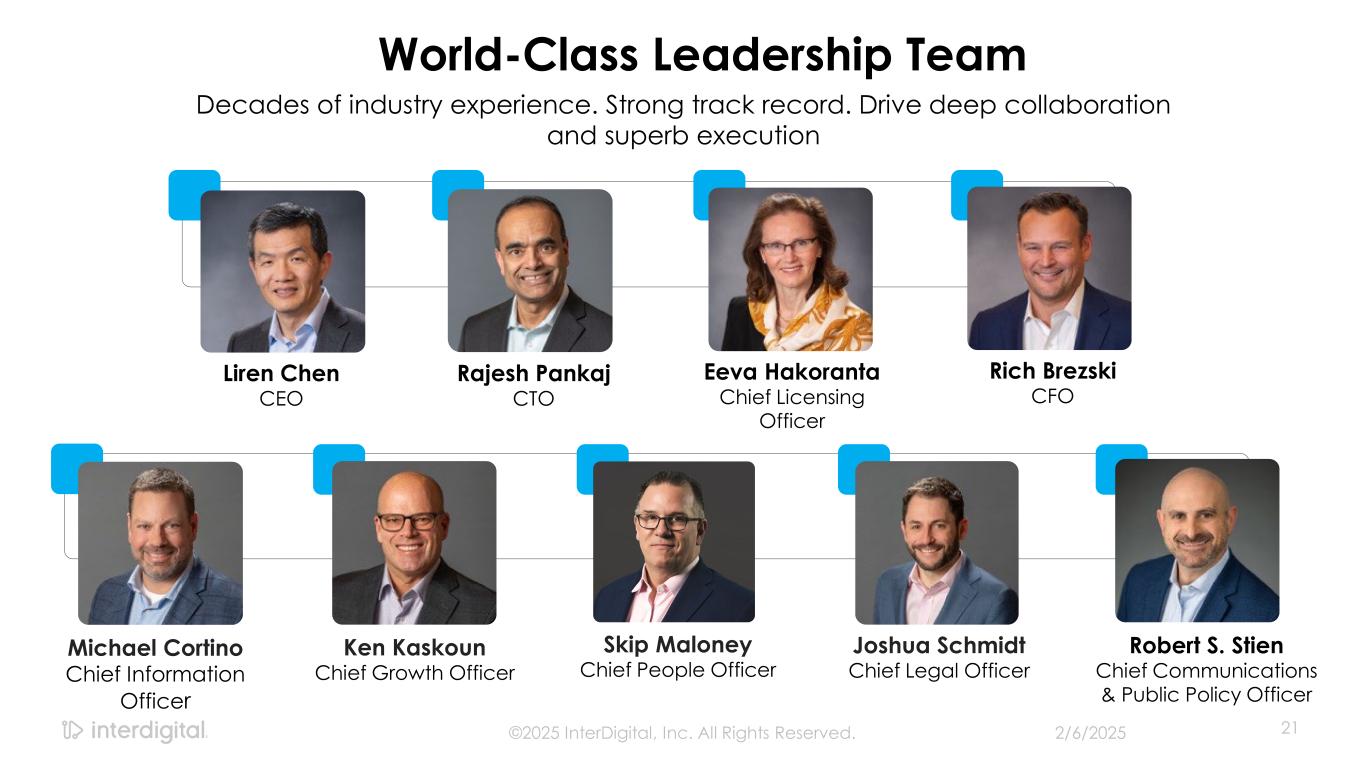
Thank you, Michelle, and good morning, everyone. Welcome to InterDigital's fourth quarter 2024 earnings conference call. I am Raiford Garrabrant, Head of Investor Relations for InterDigital. With me on today's call are Liren Chen, our President and CEO, and Rich Brezski, our CFO. Consistent with prior calls, we will offer some highlights about the quarter and the company, and then open the call up for questions. For additional details, you can access our earnings release and slide presentation that accompany this call on our Investor Relations website. Before we begin our remarks, I need to remind you that in this call, we will make forward-looking statements regarding our current beliefs, plans, and expectations, which are not guarantees of future performance and are made only as of the date hereof. Forward-looking statements are subject to risks and uncertainties that could cause actual results and events to differ materially from results and events contemplated by such forward-looking statements. These risks and uncertainties include those described in the Risk Factors section of our 2024 Annual Report on Form 10-K and in our other SEC filings. In addition, today's presentation may contain references to non-GAAP financial measures. Reconciliations of these non-GAAP financial measures to the most directly comparable GAAP financial measures are included in the supplemental materials posted to the Investor Relations section of our website. With that taken care of, I will turn the call over to Liren.
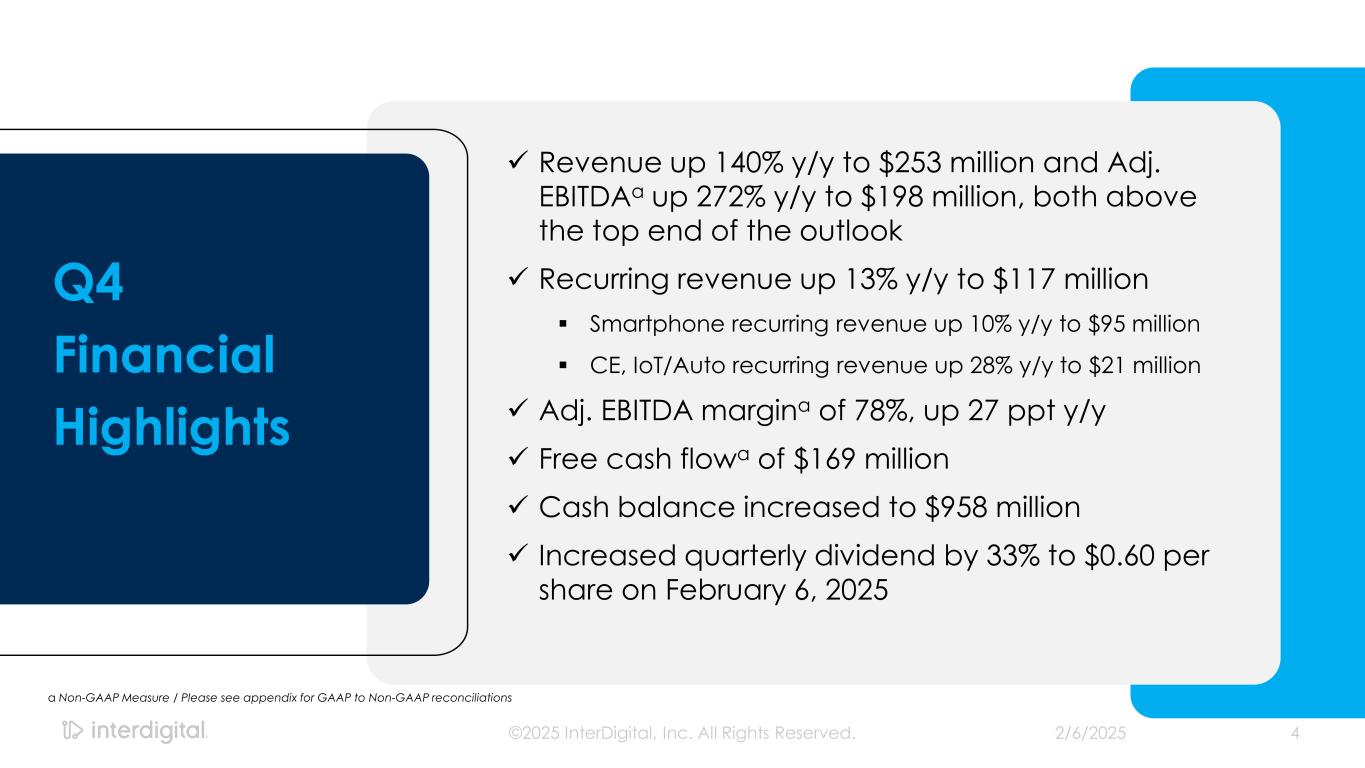
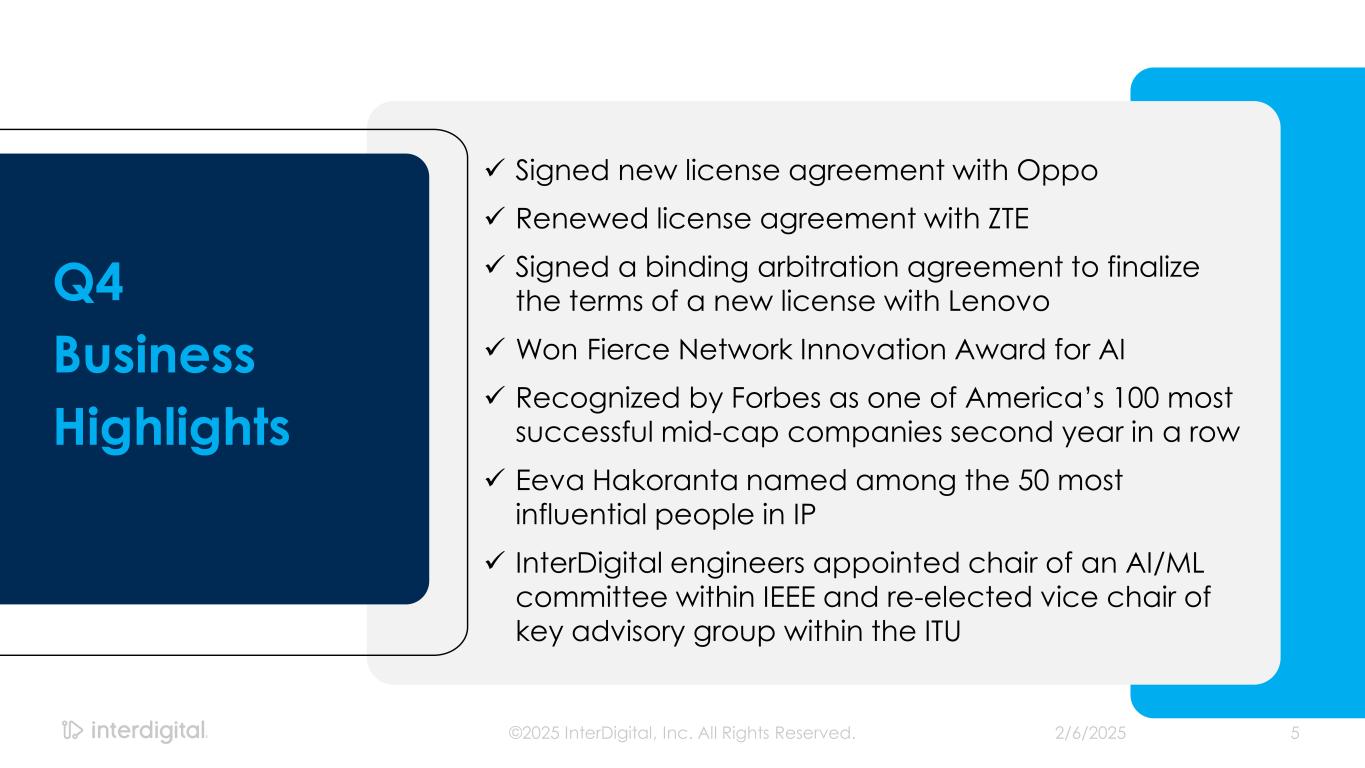
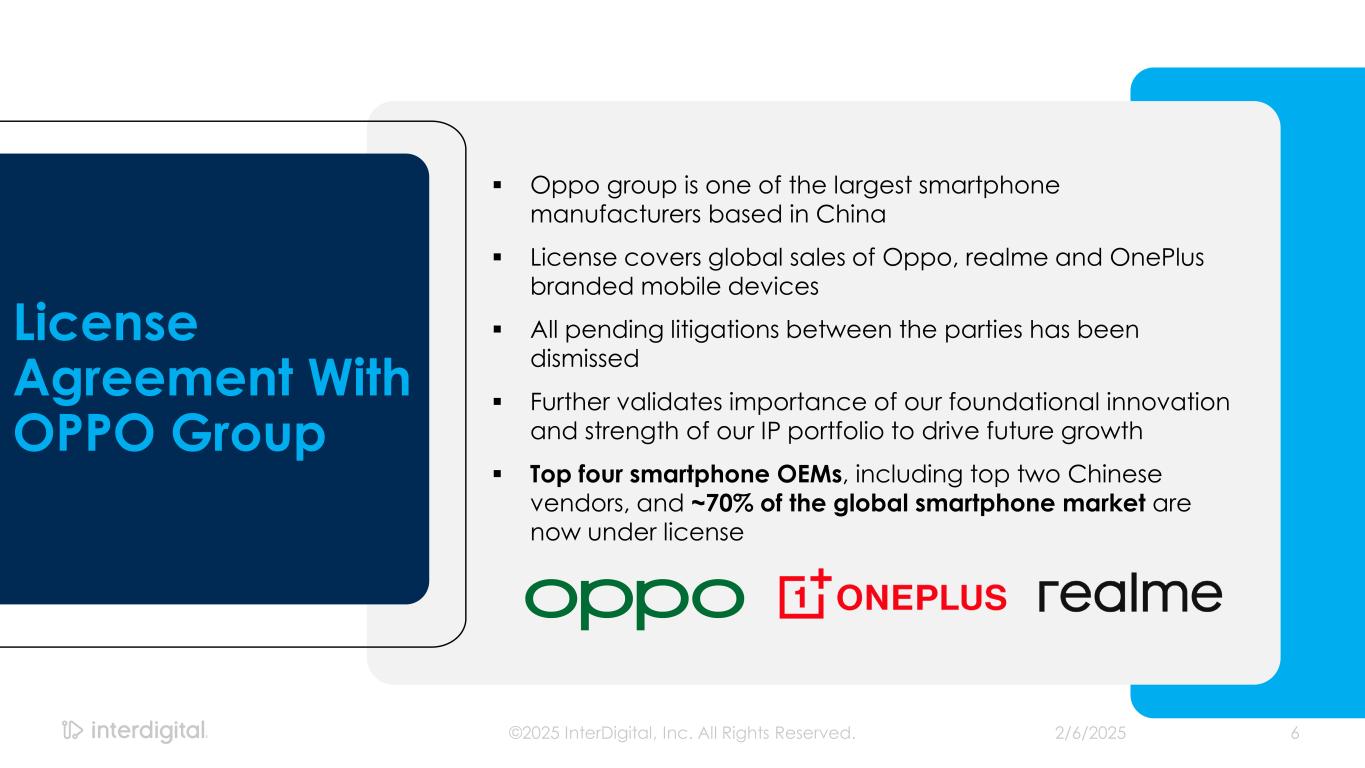
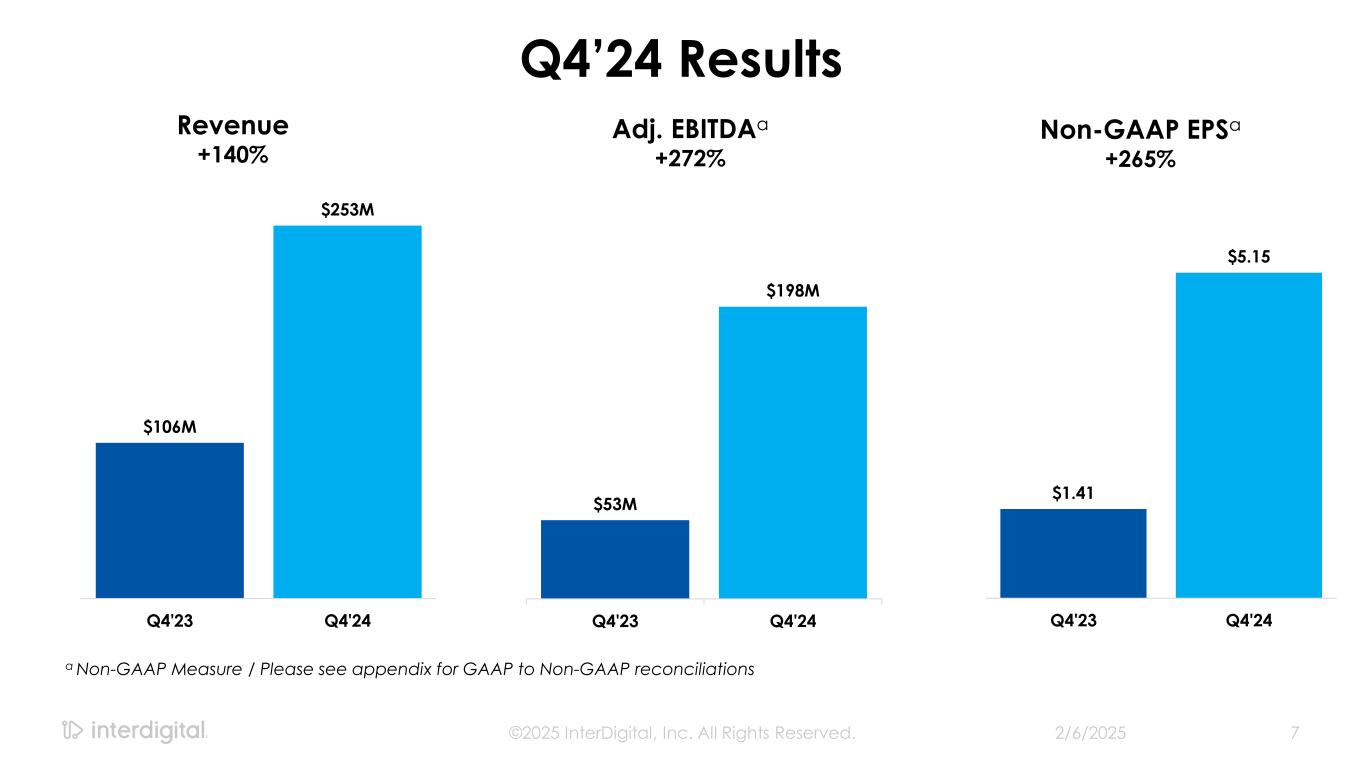
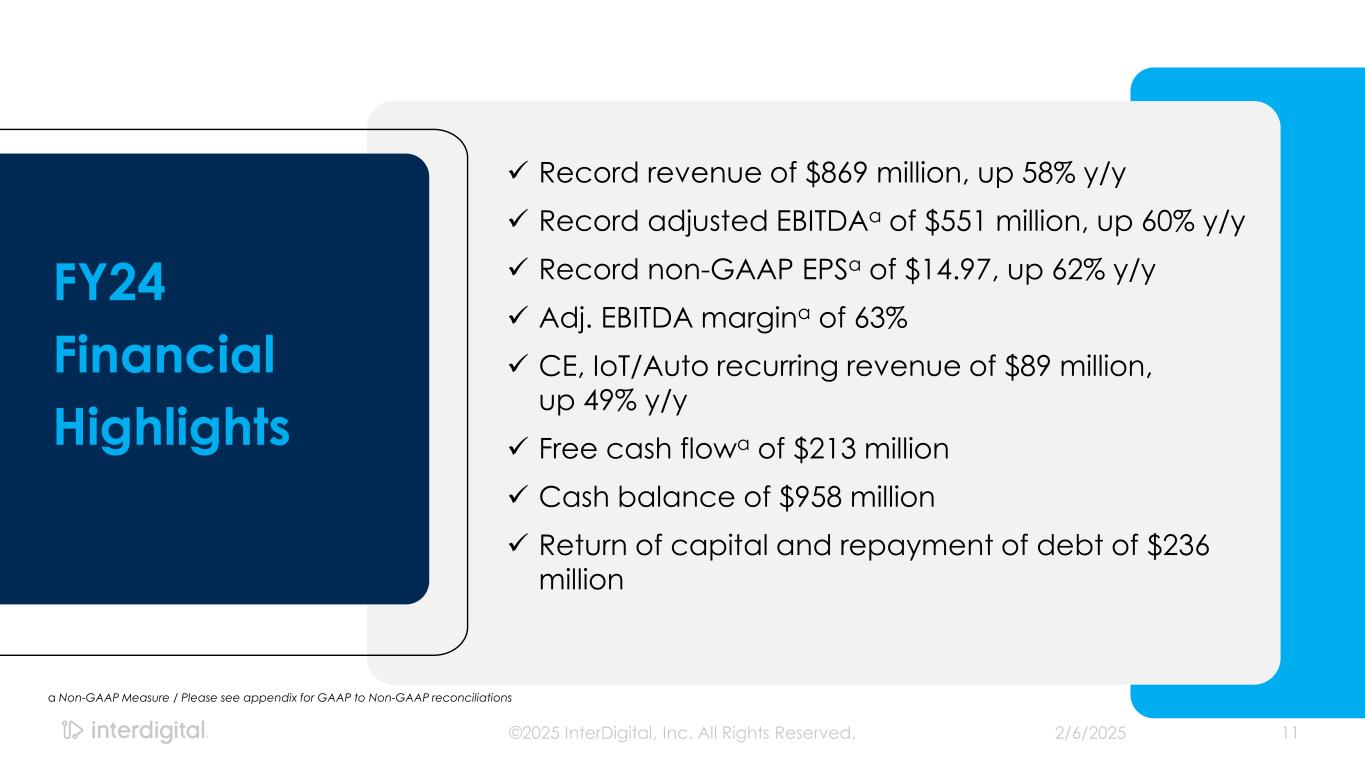
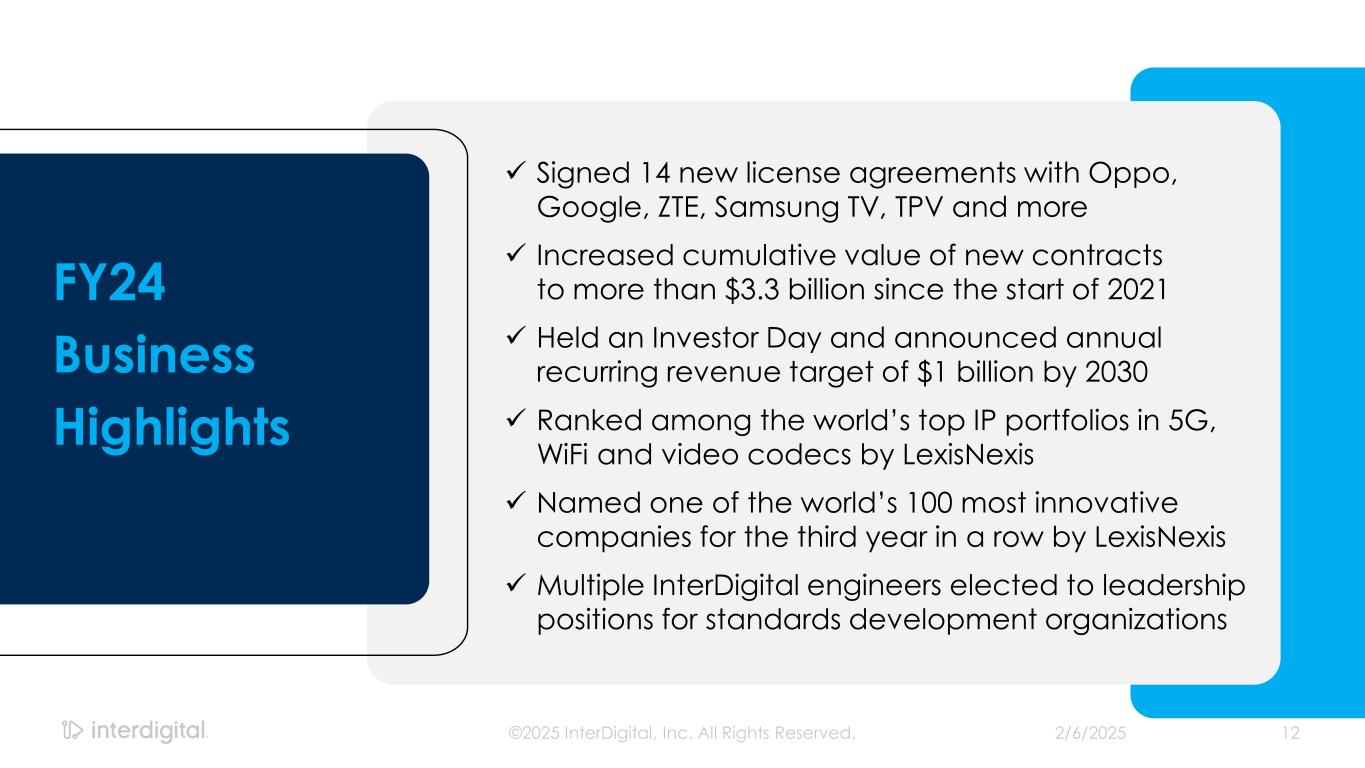
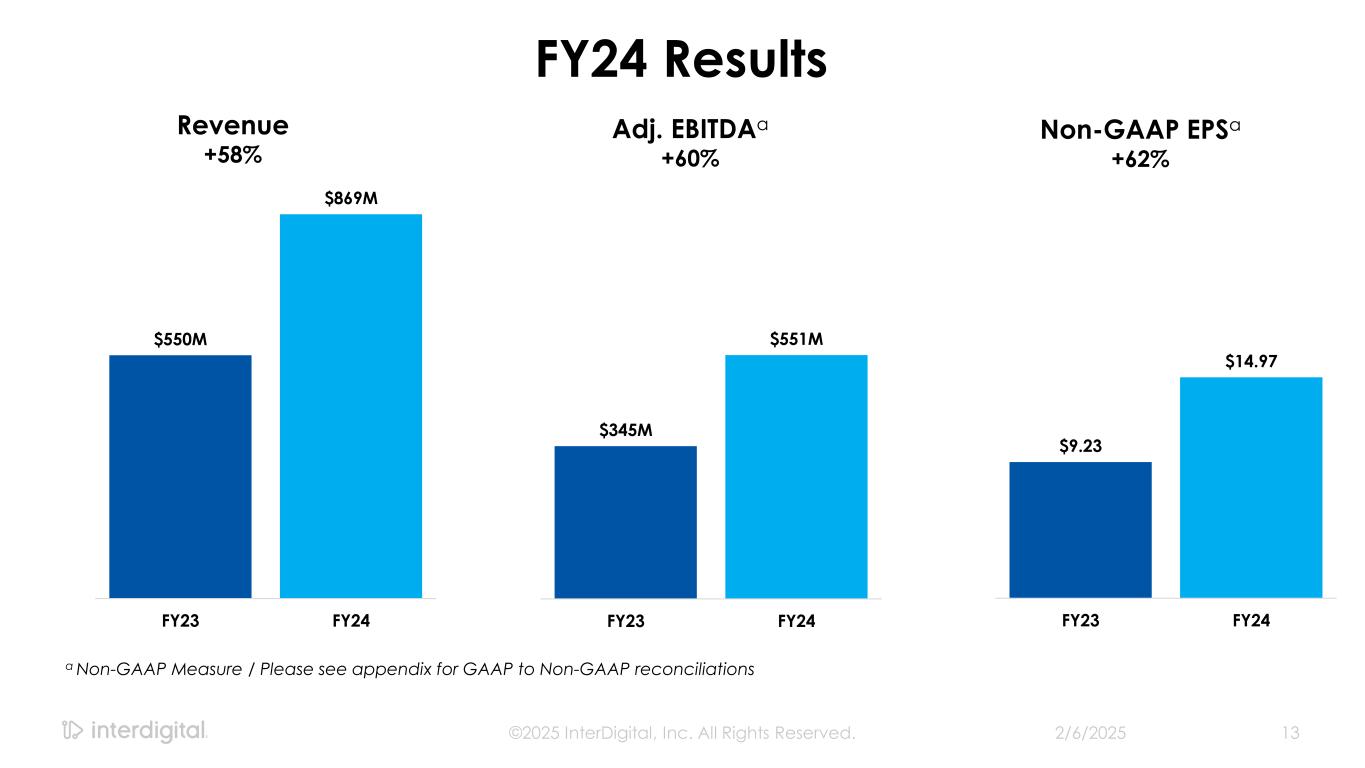
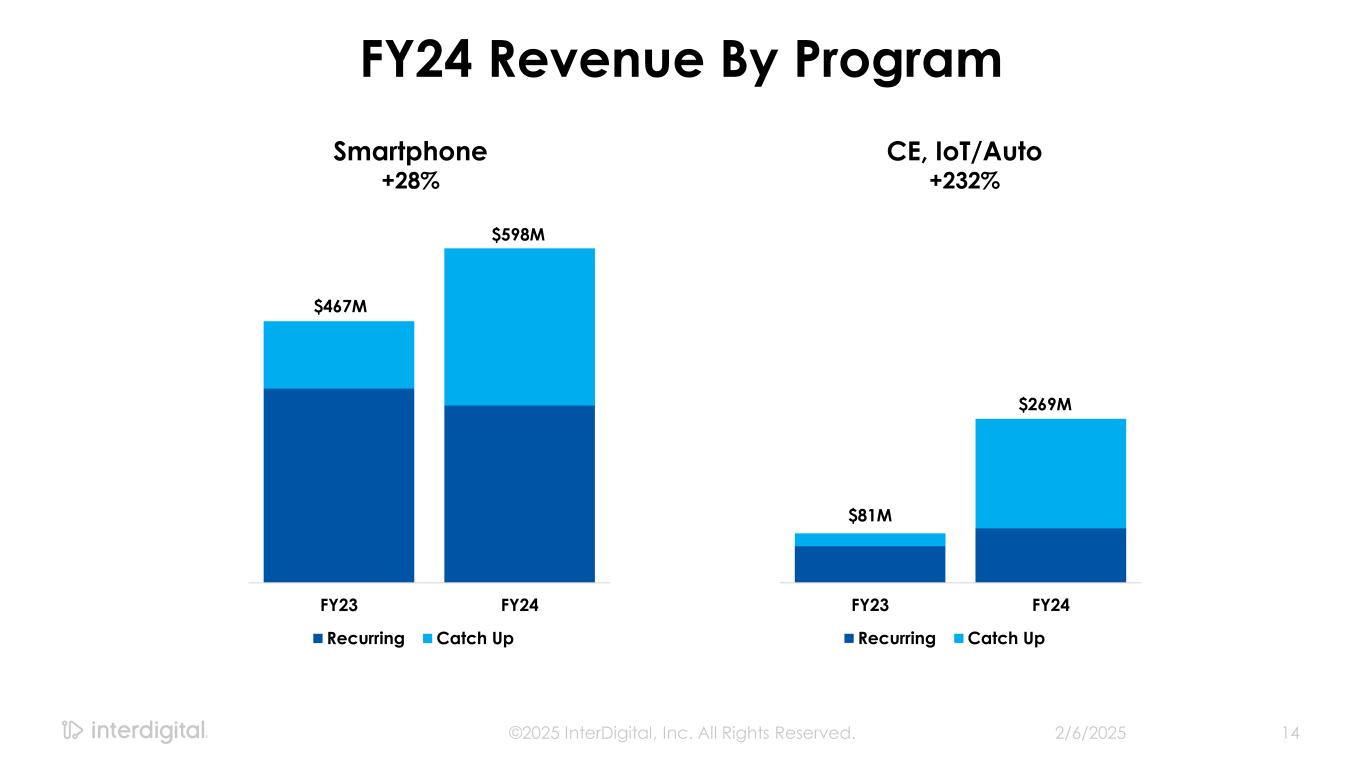
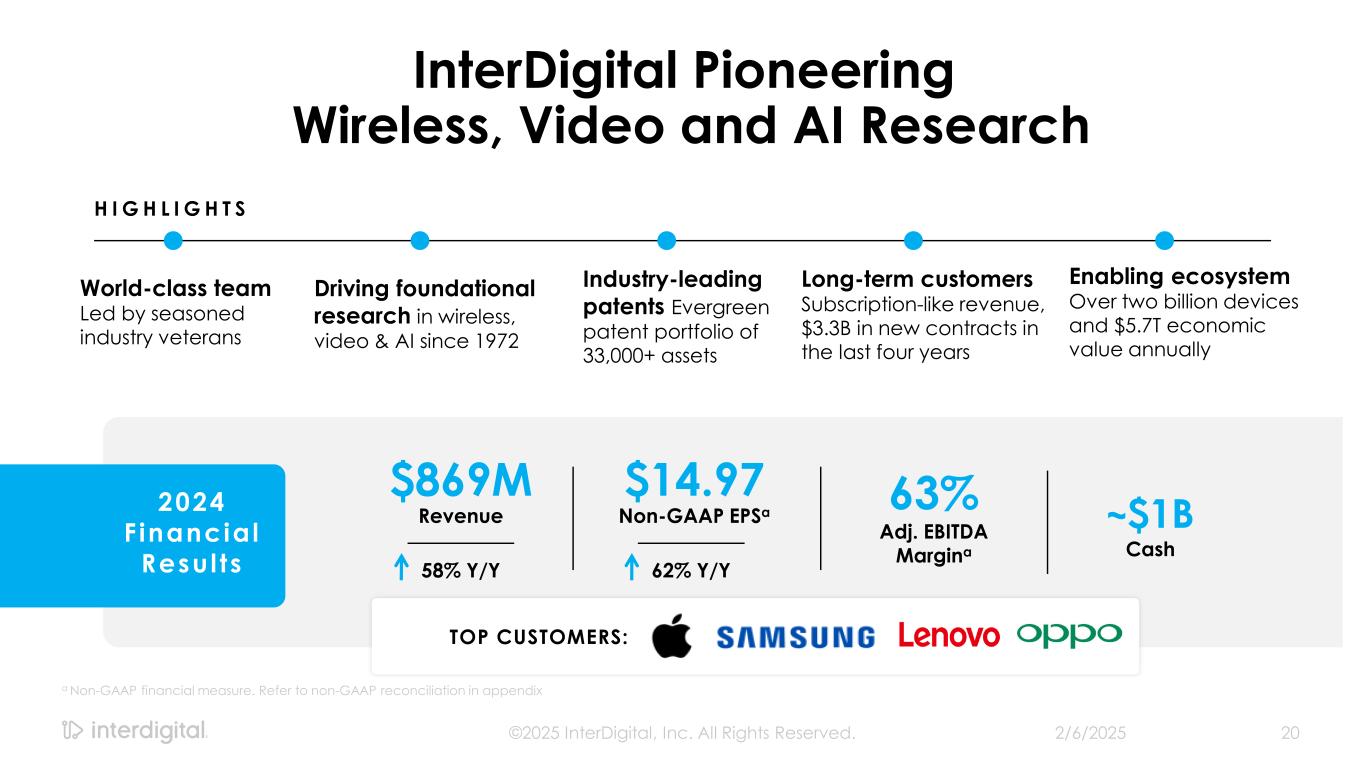
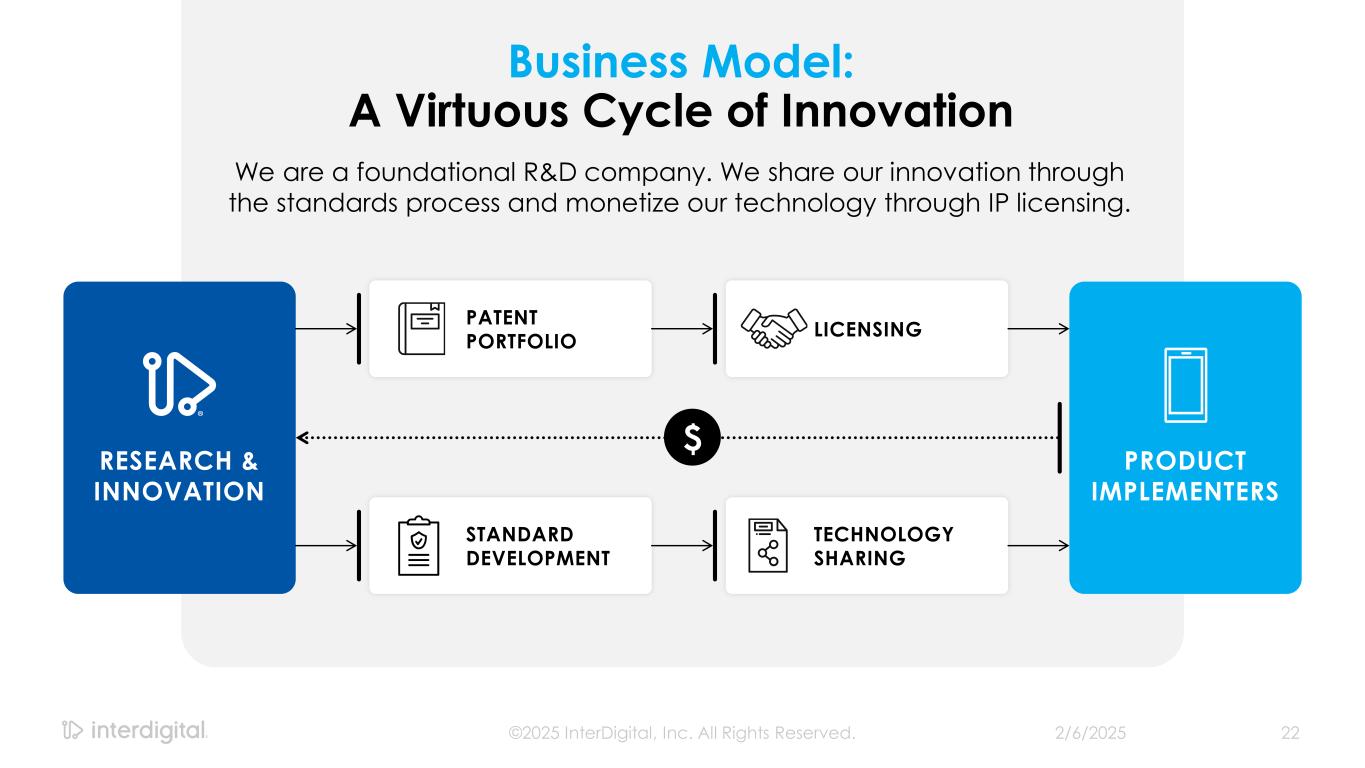
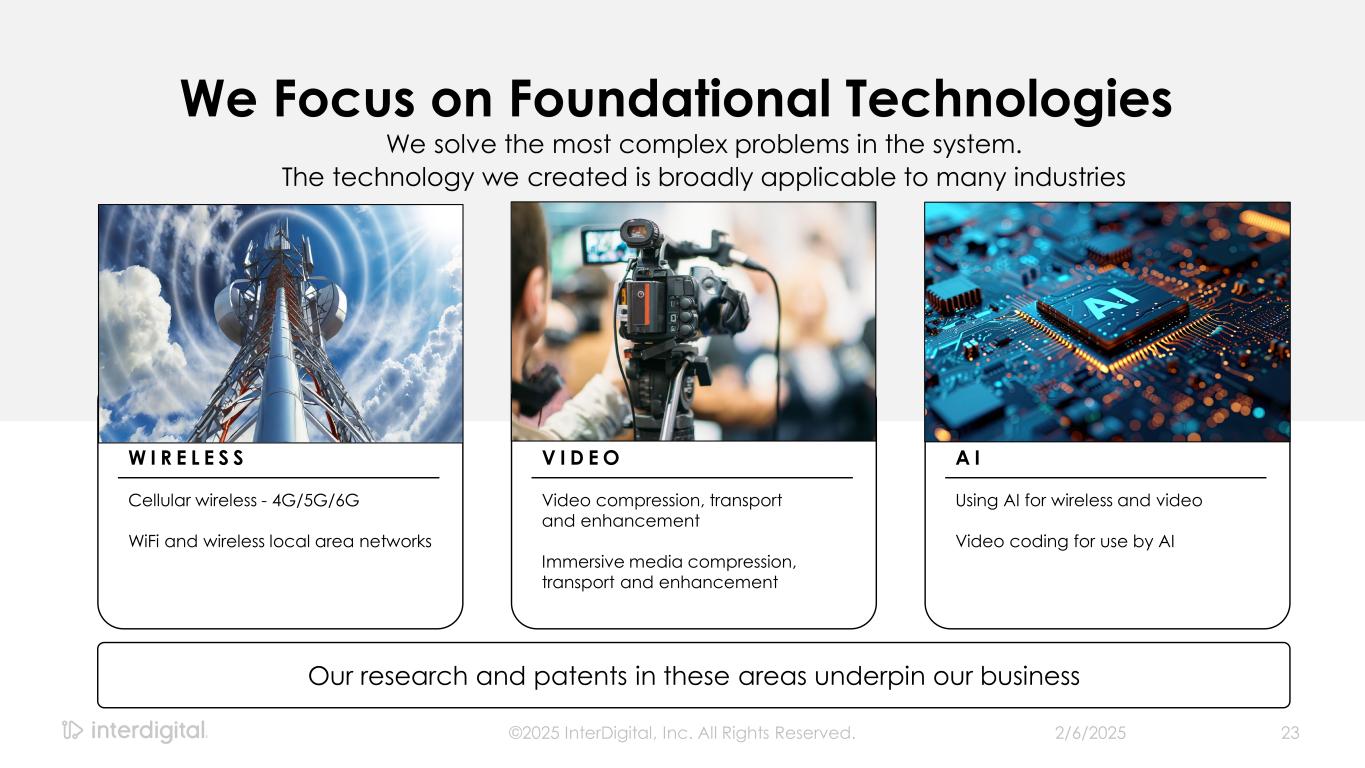
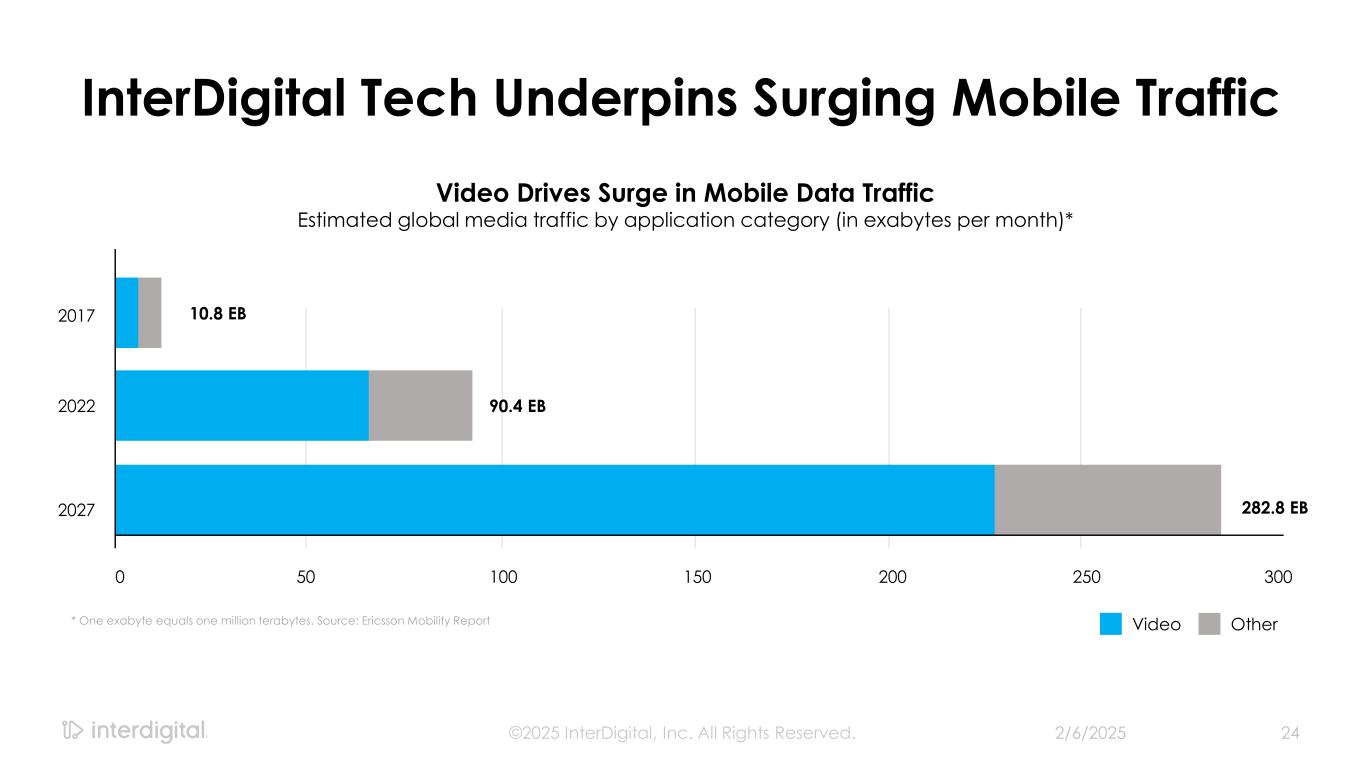
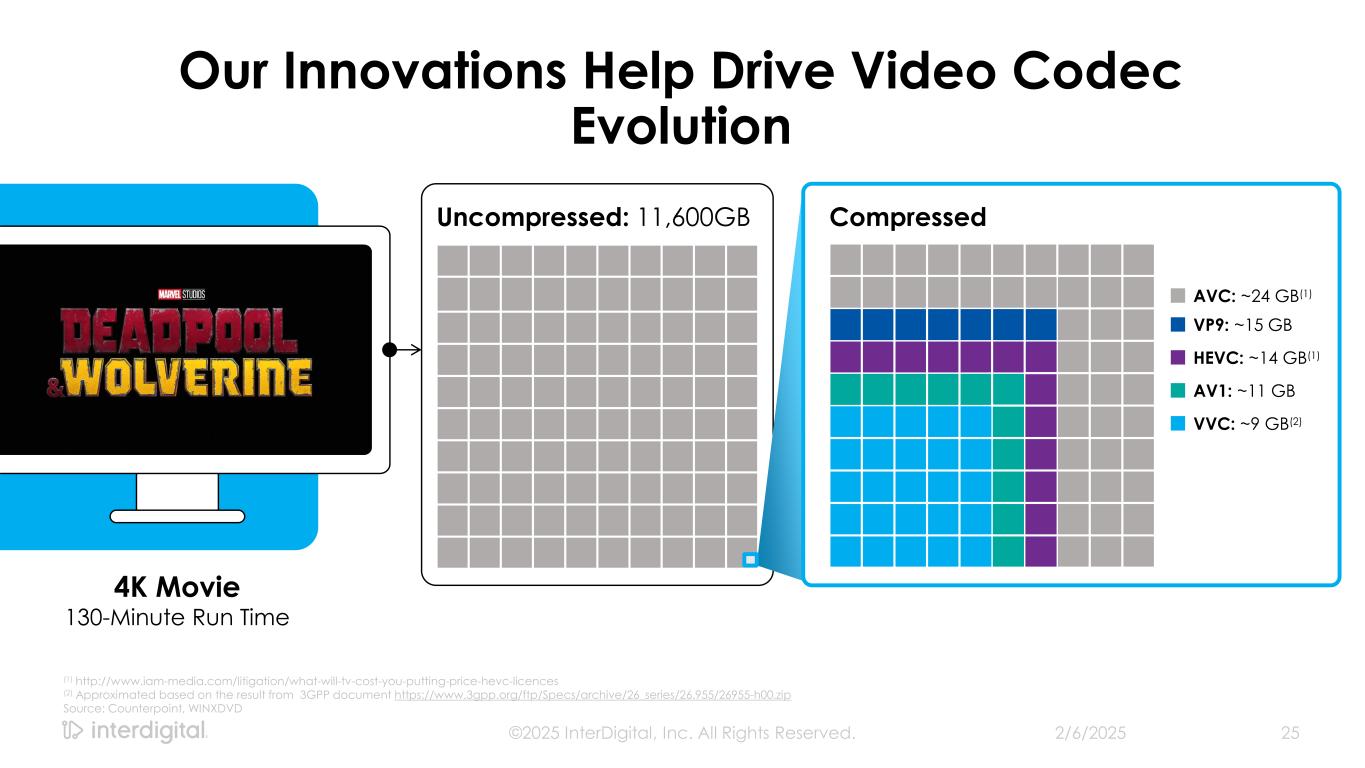
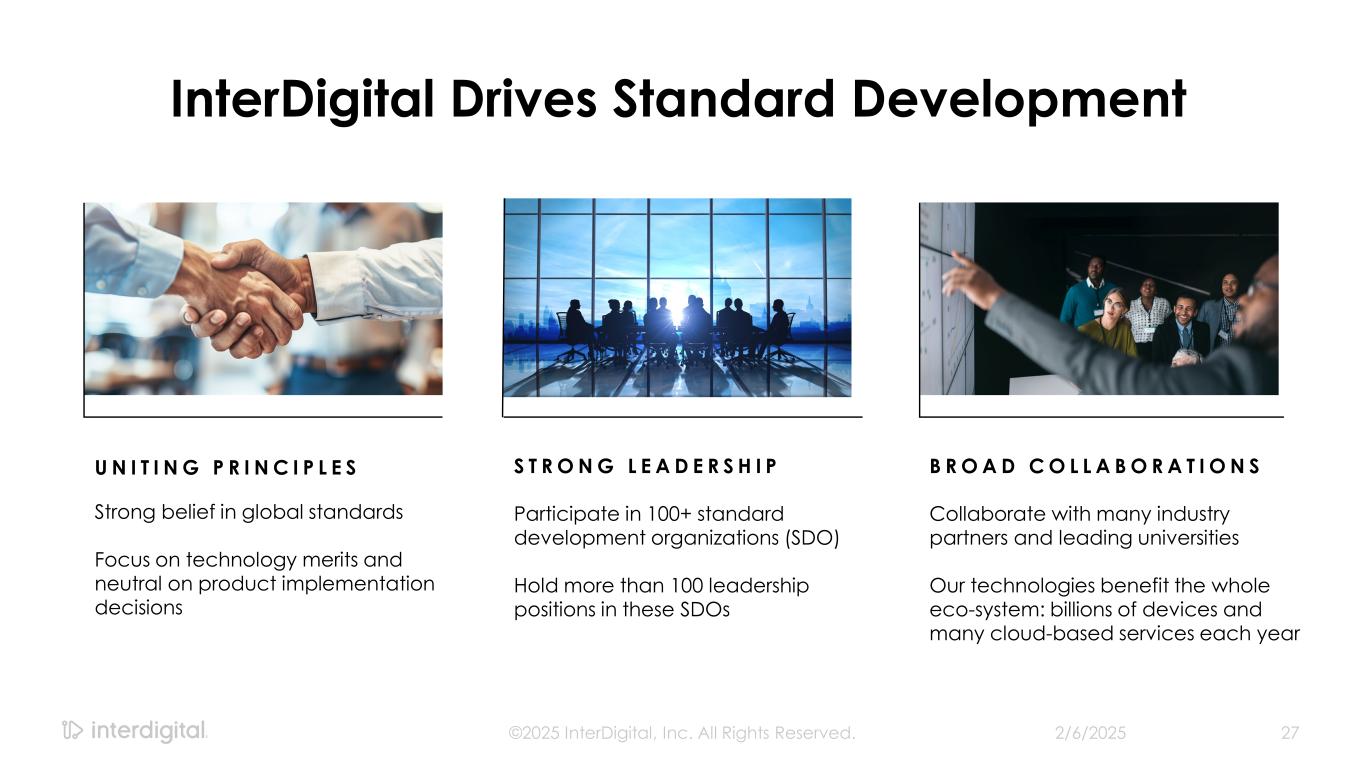
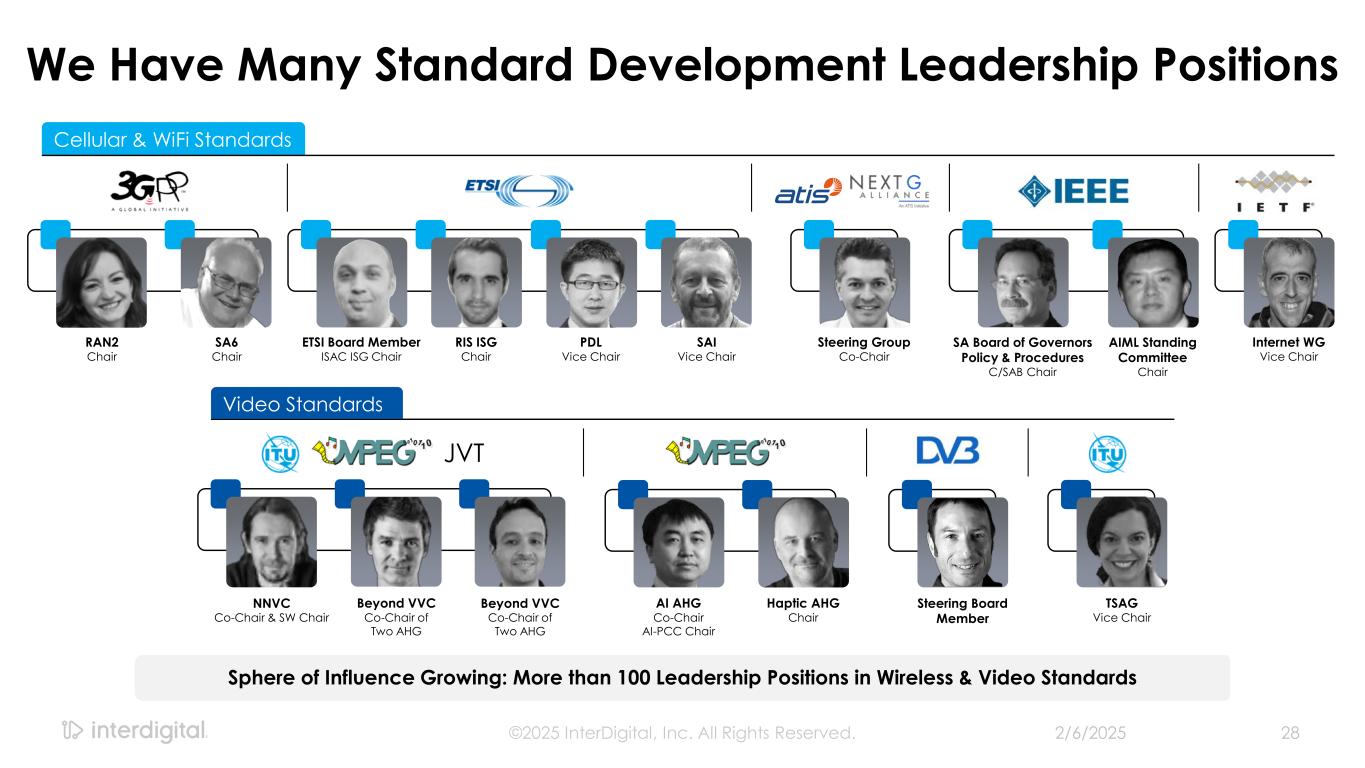
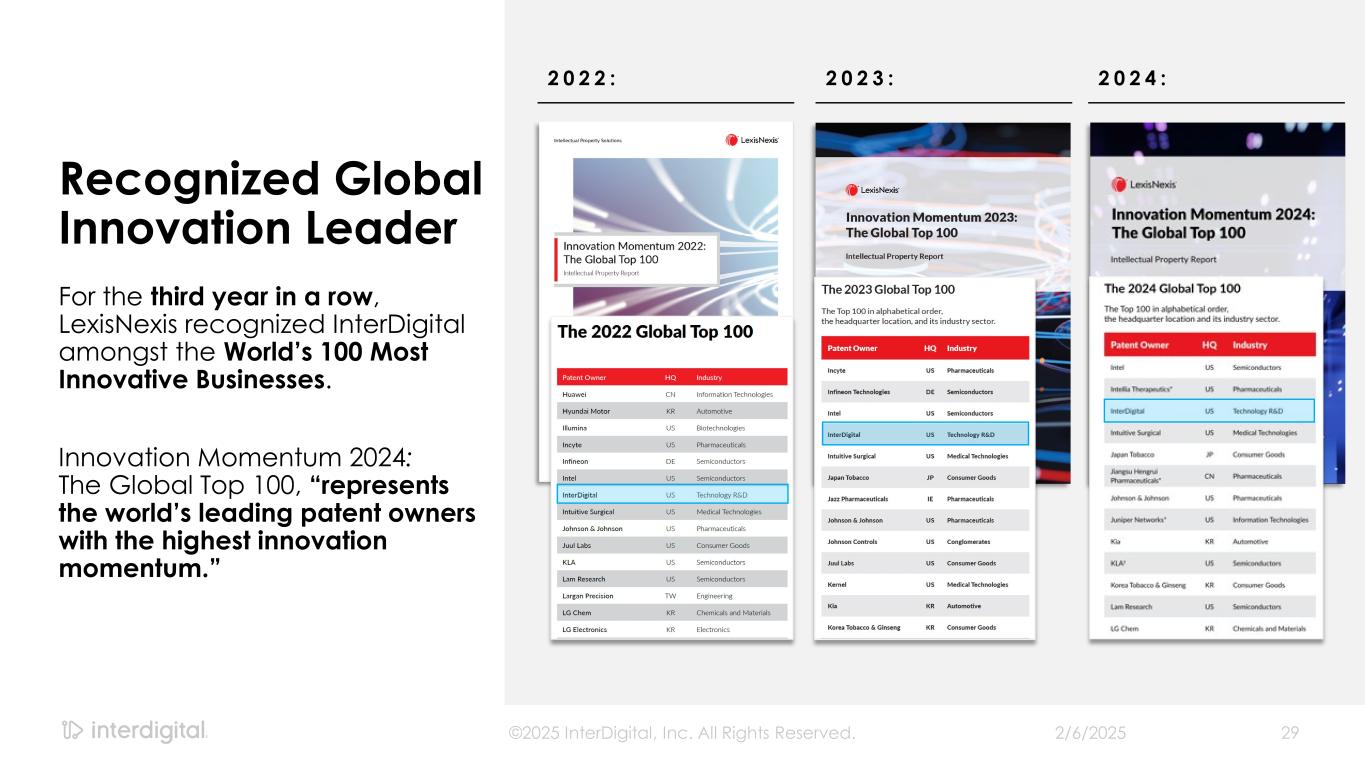
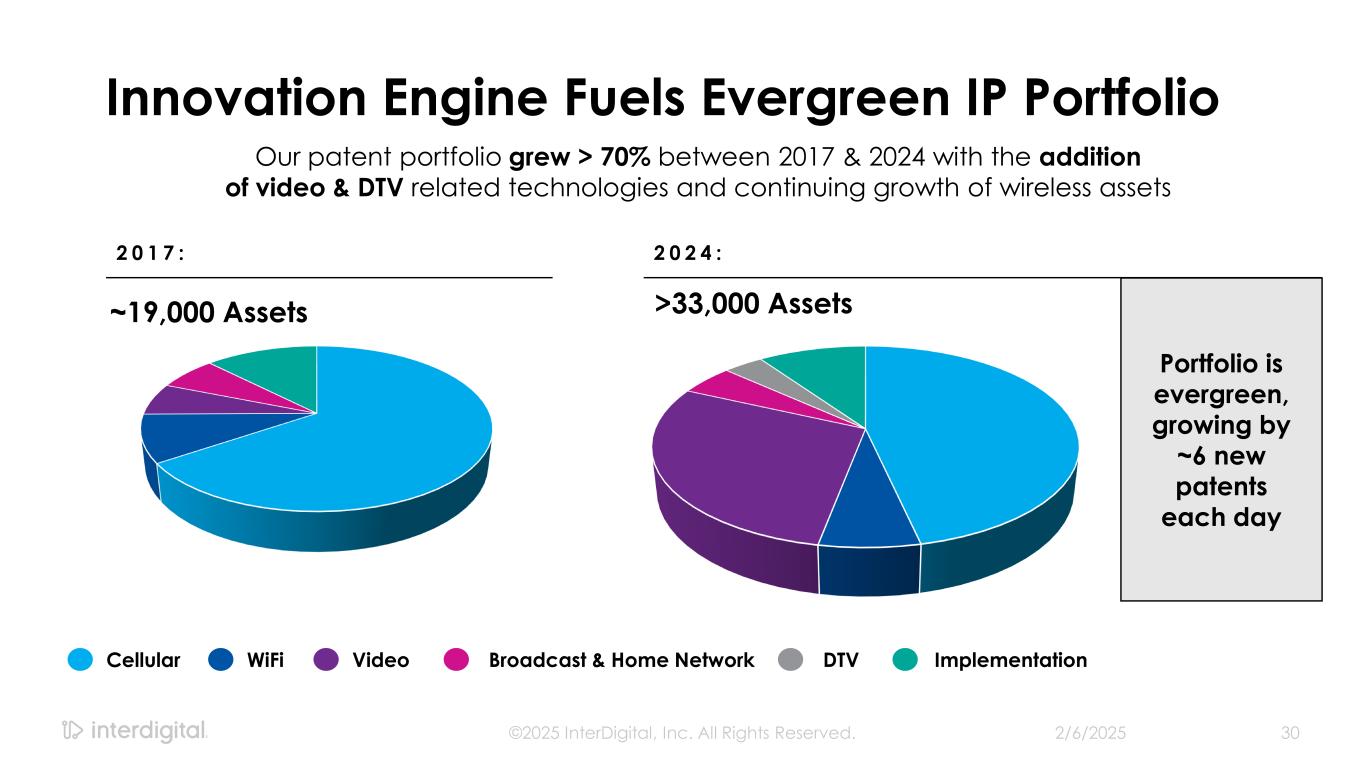
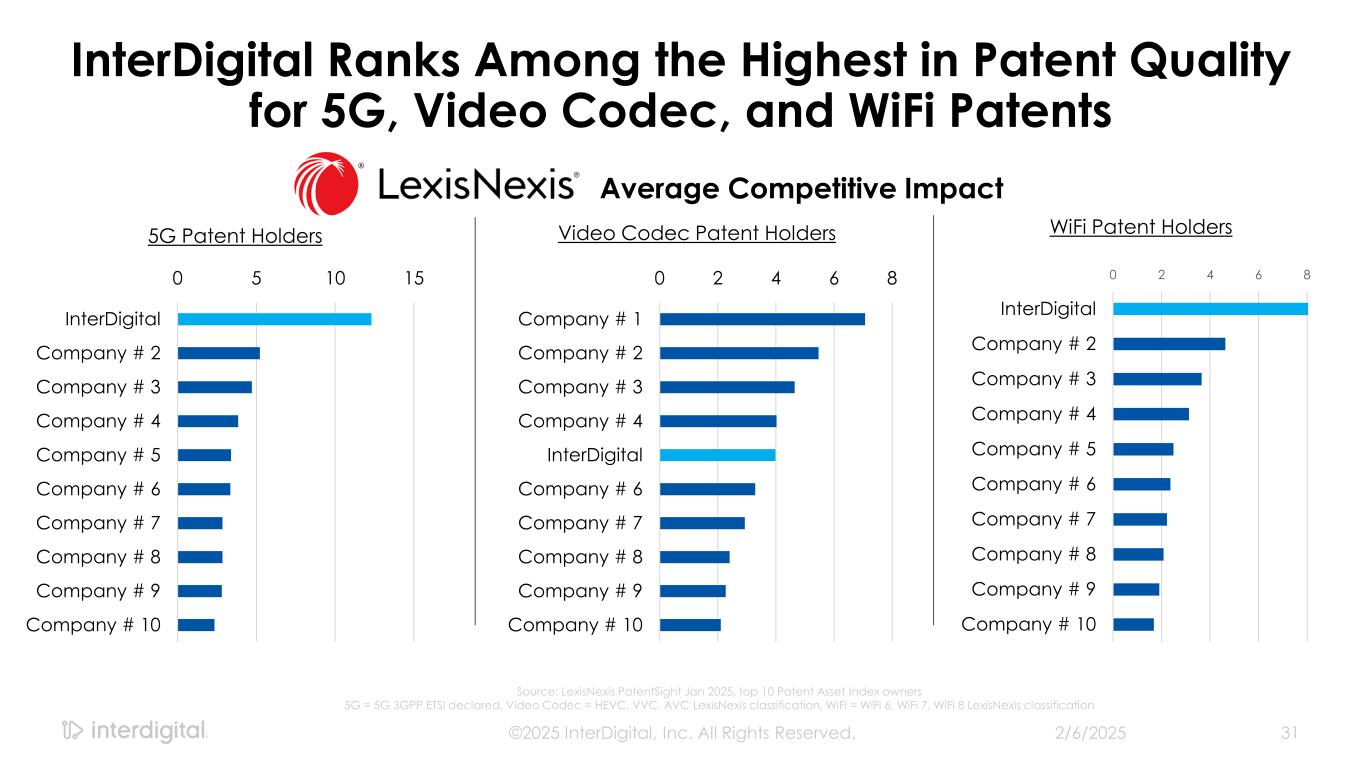
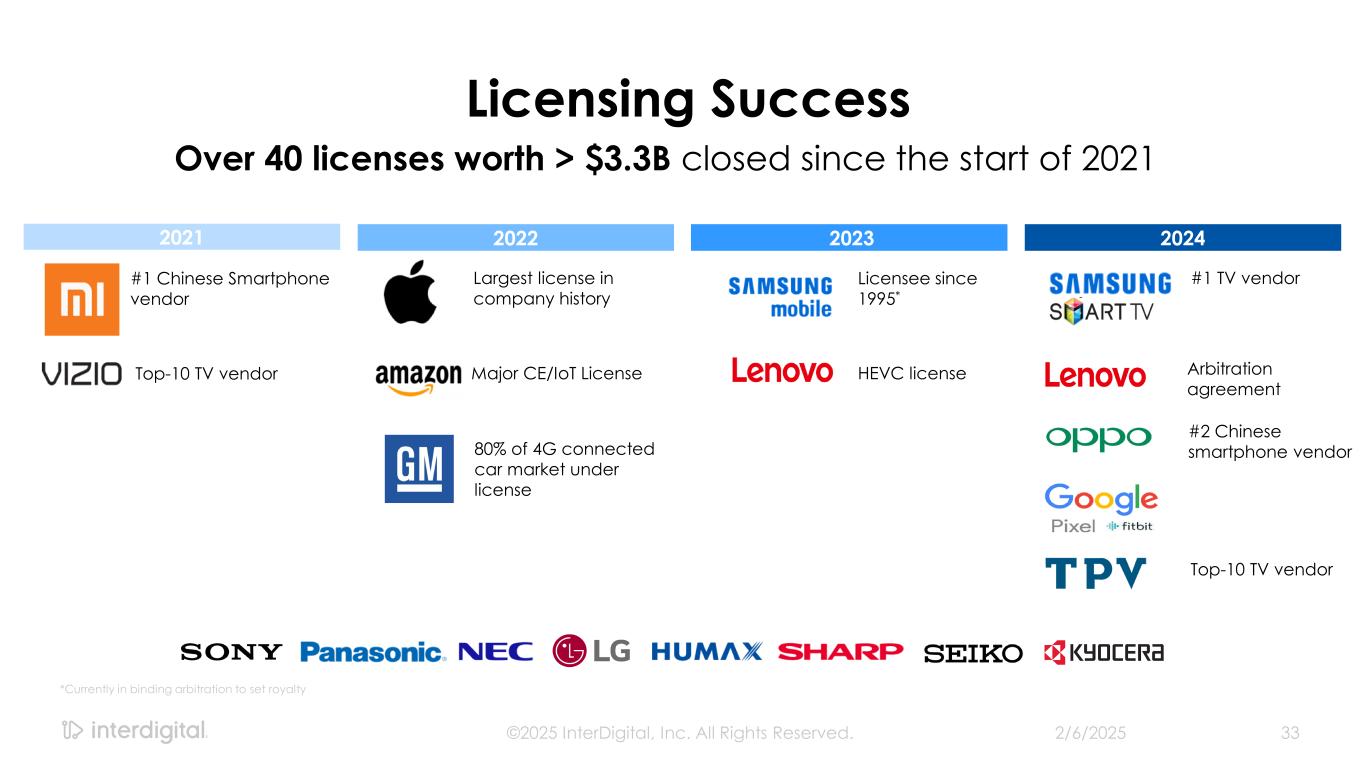
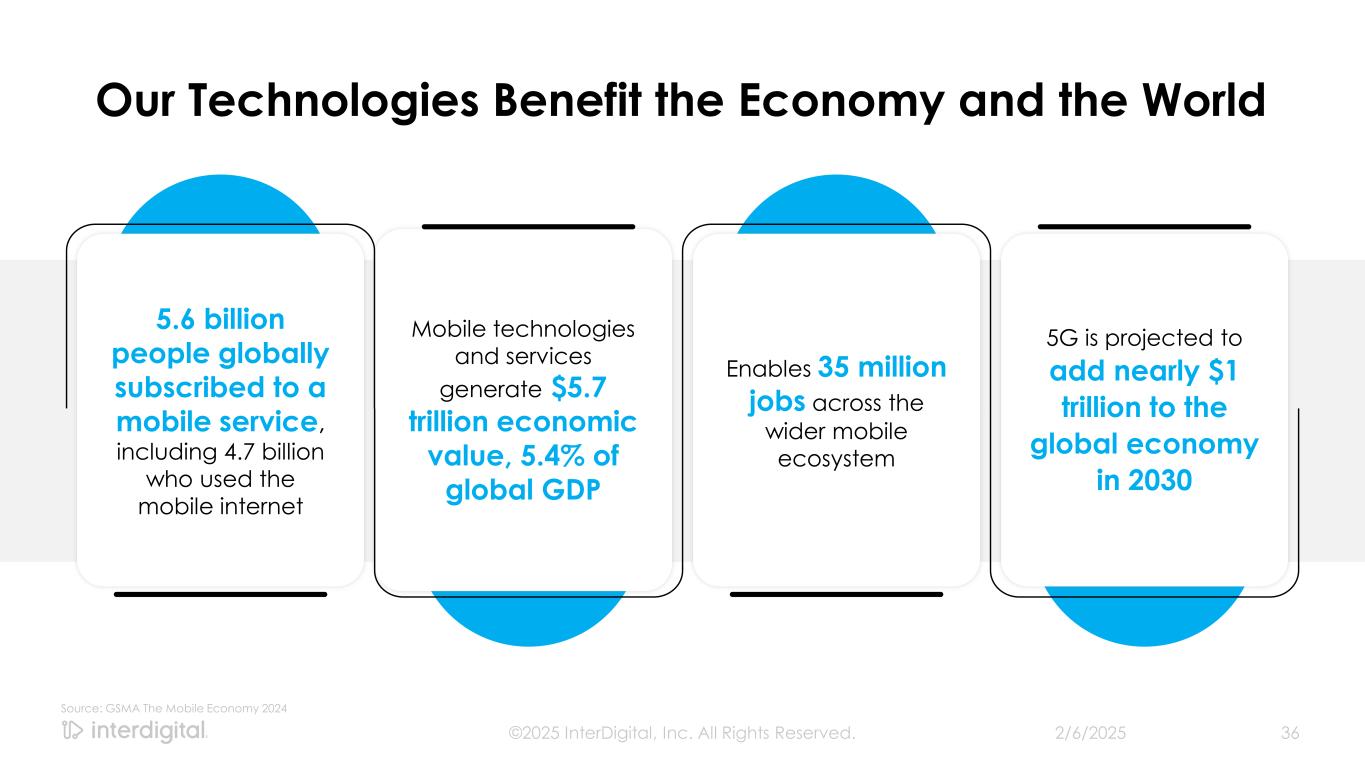
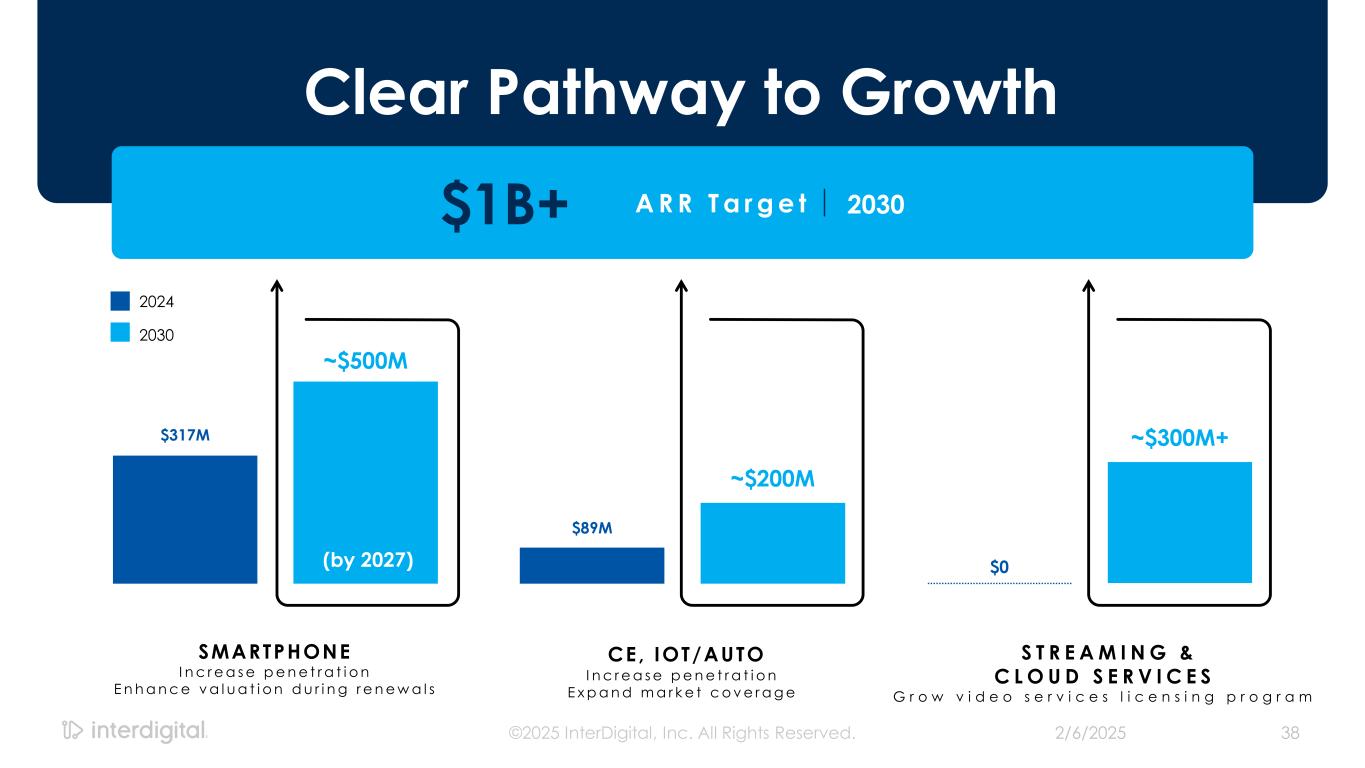
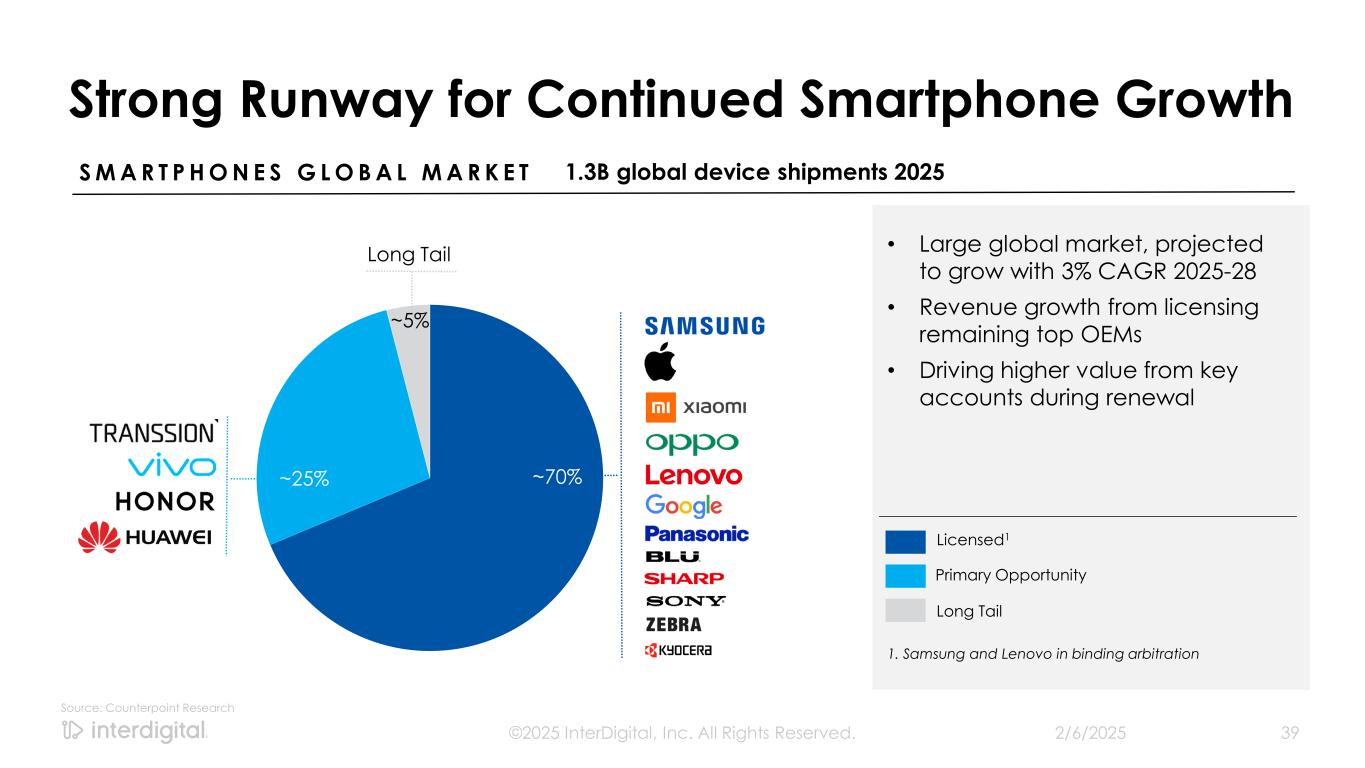
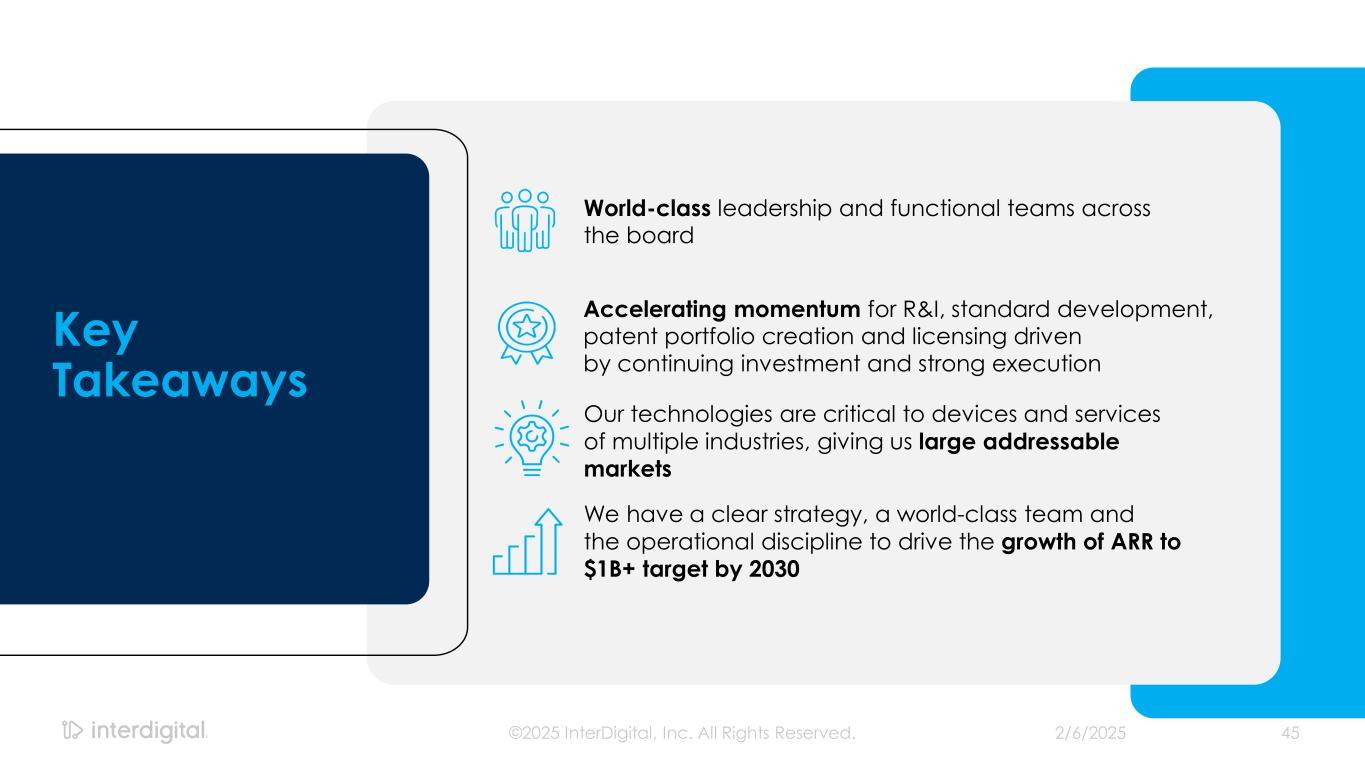
Thank you, Raiford. Good morning, everyone. Thanks for joining us today. A year ago at this moment, I shared our belief that InterDigital has never been better positioned to drive growth. Now sitting here 12 months later, I'm delighted to share that in 2024, we delivered the best business results in our history. And since our technology is more critical than ever to an ecosystem generating roughly $6 trillion in economic value every year, we believe we are just getting started. Today I'll recap the fourth quarter results, summarizing our highlights for the full year and provide more details on our growth path through 2025 and beyond, including a significant development in our video service program. In the fourth quarter, we delivered another outstanding performance. Our revenue increased 140% year-over-year to $253 million, while adjusted EBITDA and non-GAAP EPS nearly quadrupled year-over-year. As we discussed in our last earnings call, we signed a new license agreement with Oppo last quarter, covering the worldwide sales of Oppo, Realme, and OnePlus devices. We have now licensed the top four largest smartphone manufacturers and approximately 70% of annual smartphone shipments worldwide. We also added momentum in our smartphone program in the quarter through our renewal agreement with a major Chinese technology company, ZTE, and with our announcement that we have entered into binding arbitration with Lenovo to determine the final terms of our license and ended our litigations with them. Looking at 2024 overall, it was another outstanding 12 months for the company. Revenue for the year increased almost 60% to $869 million, the highest annual revenue in the company's history. Thanks to increased momentum across all our licensing programs and the new agreement with some of the world's largest device makers. We also delivered record level adjusted EBITDA and EPS in 2024. Rich will cover those financial results in more detail in his section. Across our licensing program, we closed 14 new agreements throughout the year. In addition to our smartphone license with OPPO and ZTE, we signed a new license with Google, covering a range of devices as well as new licenses with leading TV manufacturers, Samsung and TPV in our consumer electronics and IoT program. We have now closed license agreements worth more than $3.3 billion since the start of 2021. In 2024, more than 30% of revenue for the year came from the consumer electronics and IoT program. This highlights the upside beyond our smartphone program and reflects how video and wireless technology support an expanding range of use cases. As you may recall, we are in binding arbitration to settle the final terms of our license with Samsung for mobile devices. The party finished the last round here last October, and we are expecting to have a final decision soon. As a reminder, Samsung already agreed to take the license to our portfolio starting from January 1, 2023, and this binding arbitration will determine the final terms of the license. Our research teams are firing on all cylinders. As we grow our leadership in the development of key standards, we maintain our focus on the quality of our innovation while breaking new ground in applications of cutting-edge technology such as AI. We have been working on the application of AI to wireless and video for years, and our leadership in this space was once again at the forefront throughout 2024. In December, we received an innovation award from FierceWireless for outstanding innovation in wireless-related AI. Specifically, the award was for AI-empowered receiver design for 6G communication, which uses AI and machine learning to improve the performance of a wireless network. From AI to video, wireless, and licensing, our industry leadership extends across the whole business. We hold more than 100 leadership positions in standard organizations, and we are one of only three companies in the world to hold multiple chair positions within 3GPP, the standard body that sets cellular standards. In licensing, our Chief Licensing Officer, Eeva Hakoranta, was named among the 50 most influential people in intellectual property by a leading IP publication. We continue to excel in converting our research leadership into patent assets based on what we firmly believe is one of the strongest patent portfolios in our industry. In 2024, we made more than 5,000 new patent filings worldwide, with our global portfolio now exceeding 33,000 assets. The strength of innovation was once again confirmed as we were named one of the world's 100 Most Innovative Companies for the third consecutive year by LexisNexis. We were also named among the world's leading patent holders in 5G by advanced video compression and Wi-Fi in separate reports from LexisNexis. Also in 2024, we outlined a clear path to significantly increase our revenue and profit at our Investor Day, where we announced a new target of more than $1 billion in annual recurring revenue and $600 million in adjusted EBITDA by 2030. Now, turning to 2025. With a strong foundation to build on from last year, our priority is to continue to execute on our long-term growth strategy. We believe our technology is more valuable in an increasingly connected world. We lead the development of standardized technology that is implemented in billions of devices every year, and we have a proven track record of converting our research and patent leadership into new license agreements. We plan to grow our business by focusing on signing the remaining unlicensed smartphone vendors and by renewing our existing agreements at a higher level when appropriate. We will build on our considerable progress in our consumer electronics and IoT program, and we intend to make more progress in our greenfield opportunity in video services. We feel strongly that our video technology underpins the viability of the video streaming industry, helping to support more efficient video compression, improving picture quality, and enhancing user experience. This week, we initiated a multi-jurisdictional enforcement action against Disney, including Disney+, Hulu, and ESPN+ for their ongoing infringement of our intellectual property. Disney generates about $25 billion in streaming services revenue from over 250 million paying subscribers in FY '24. But in all our licensing programs, we expect that the majority of license agreements could be driven by amicable negotiations. However, we are always prepared to defend the value of our innovation and our patent rights. We believe that the significant investment in fundamental research over the past several decades should be compensated fairly, which enables us to continue to invest in next-generation innovations that will benefit our customers and consumers worldwide in the future. Before I hand it over to Rich, I hope to see many of you who can make it to Mobile Congress in March. Please join us at our booth in Hall 5, to see the very latest in wireless radio and AI innovation. And with that, I'll let Rich talk you through the numbers in more detail.
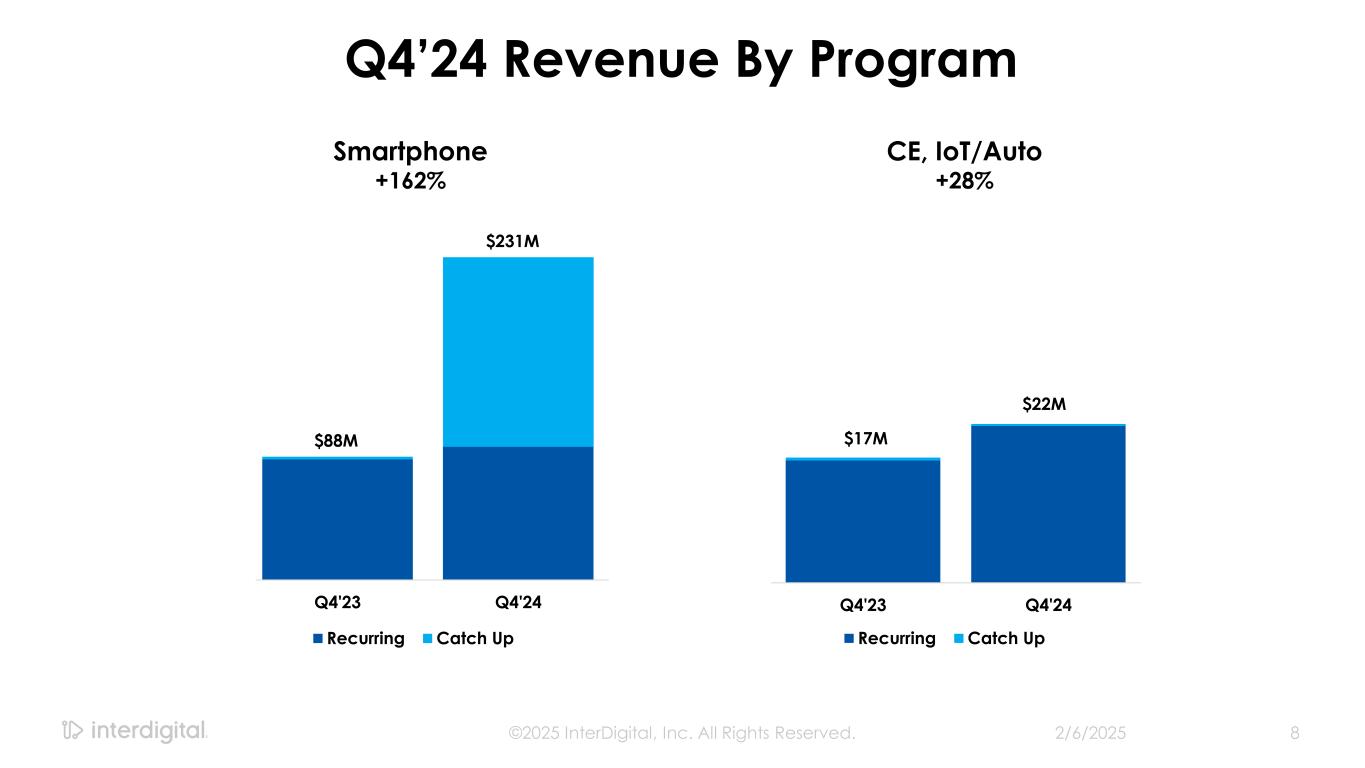
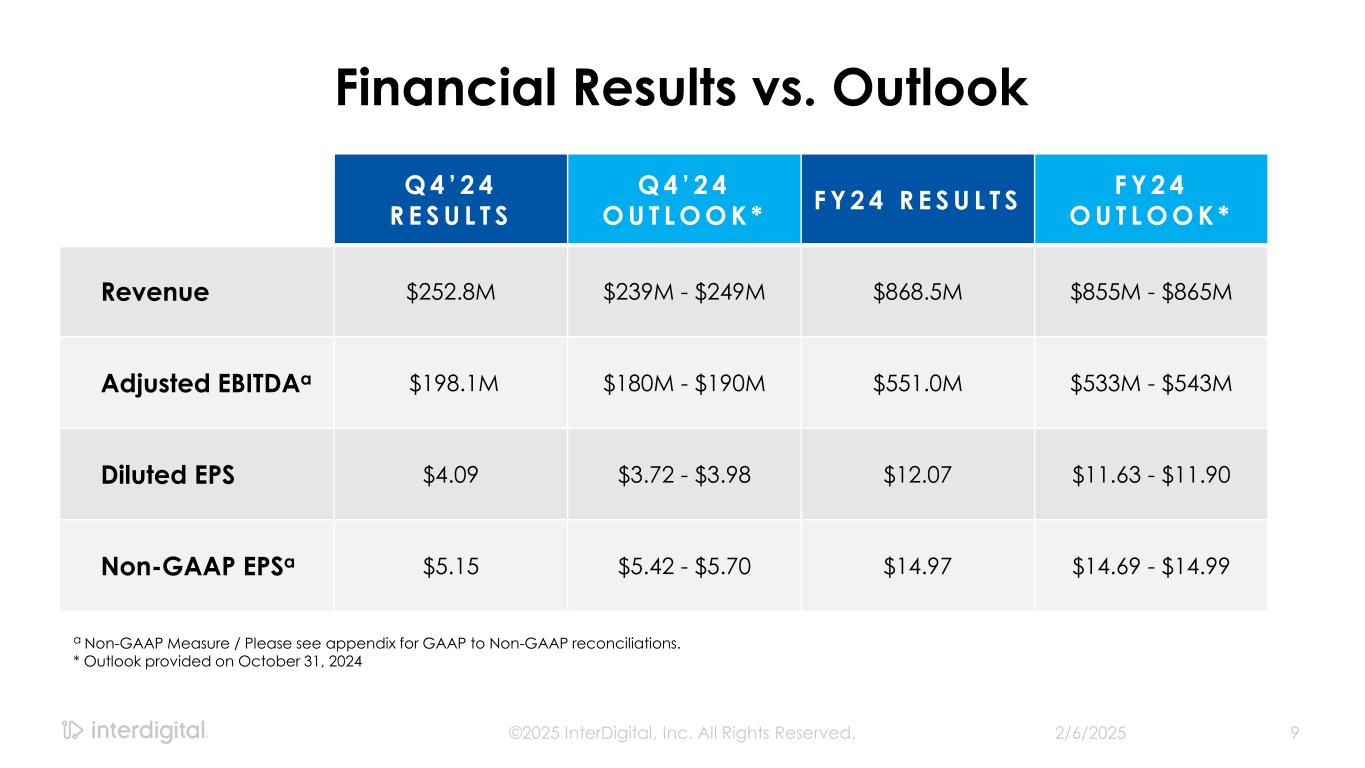
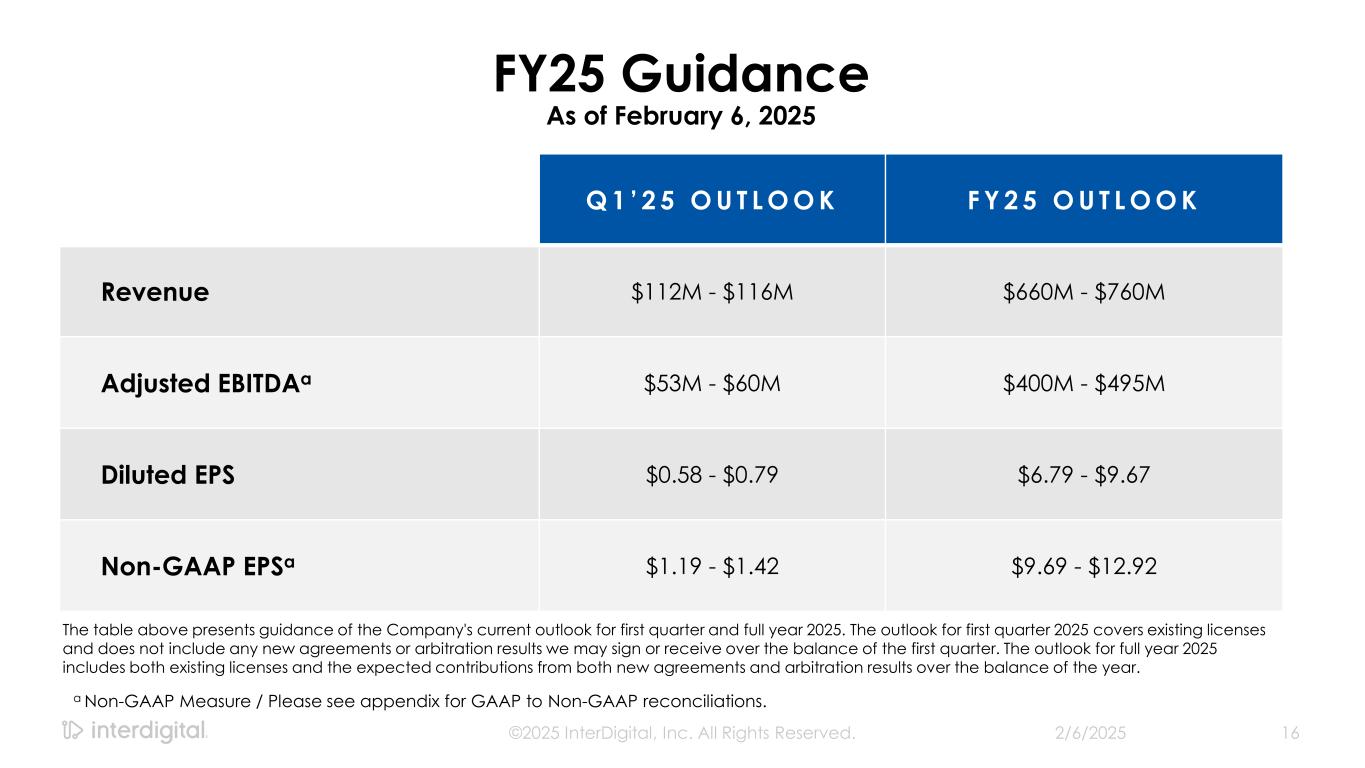
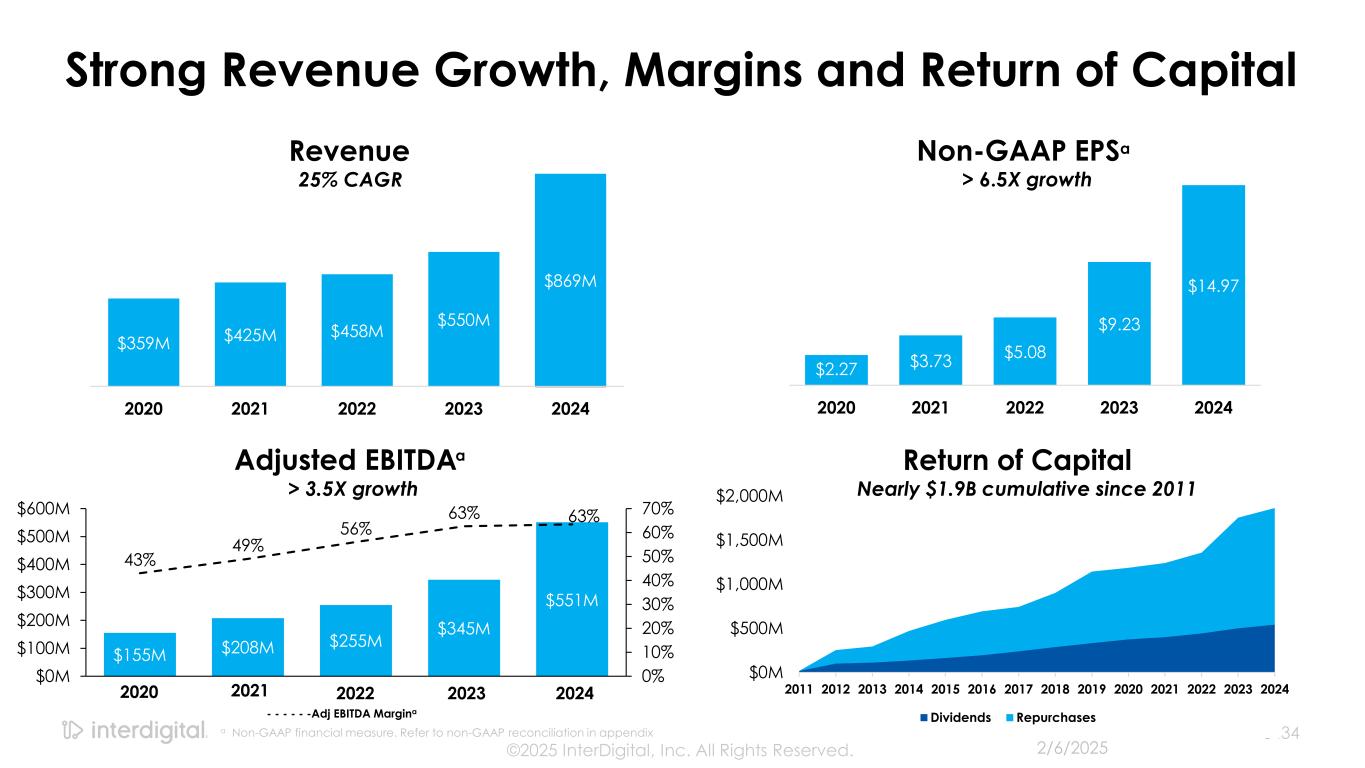
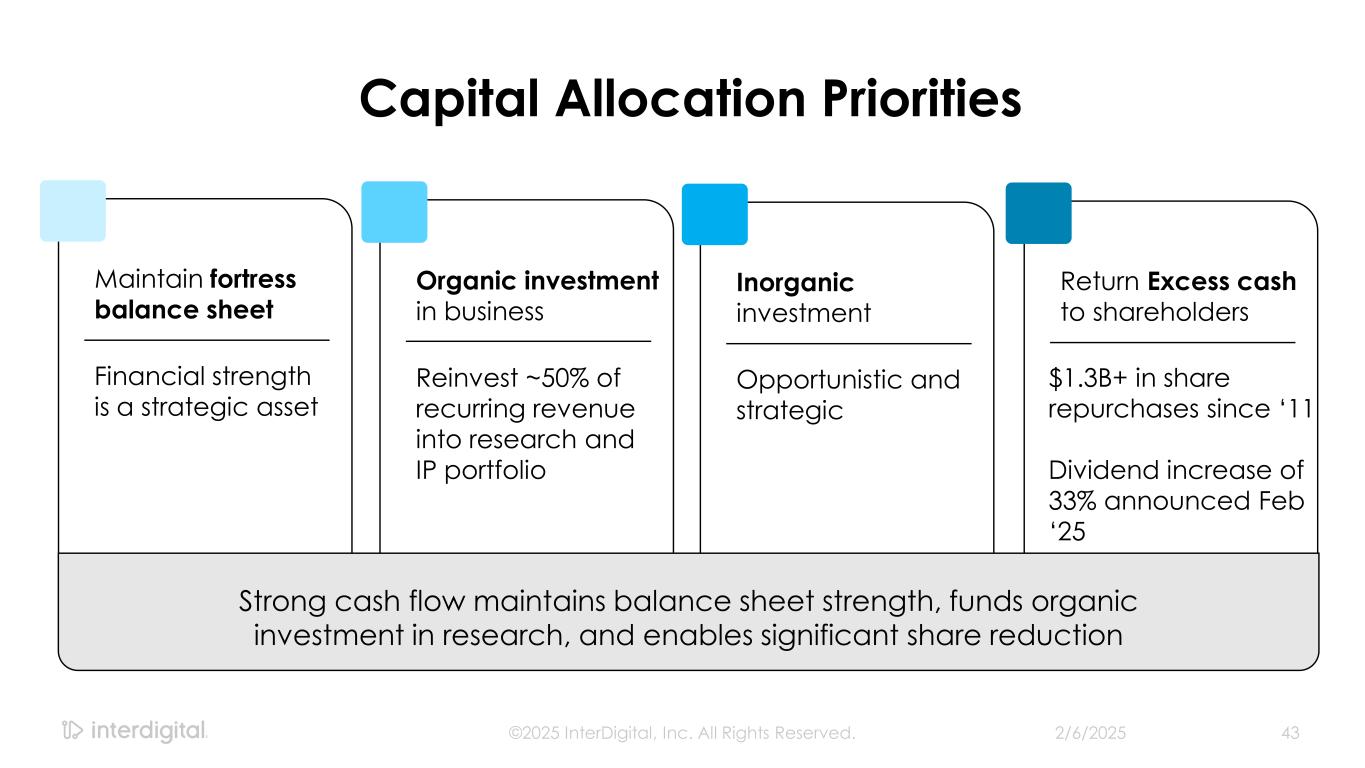
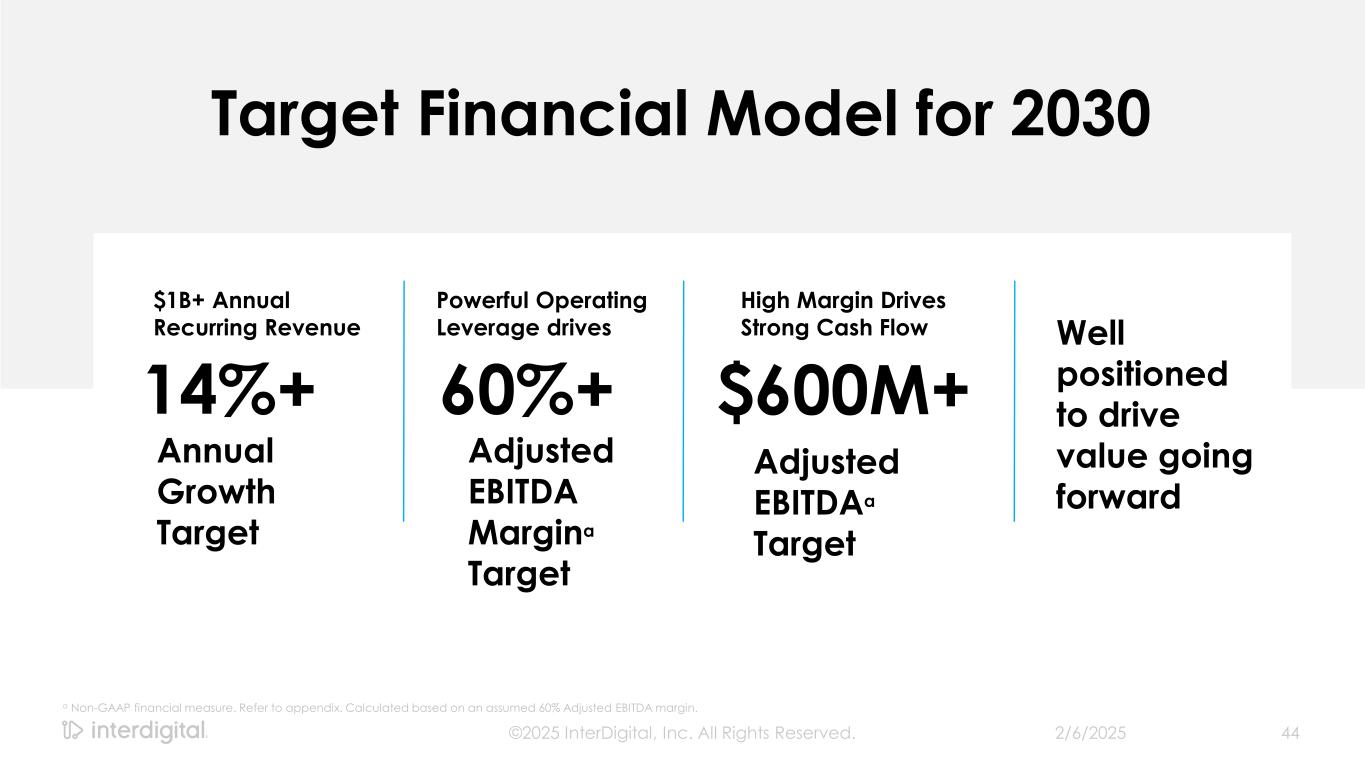
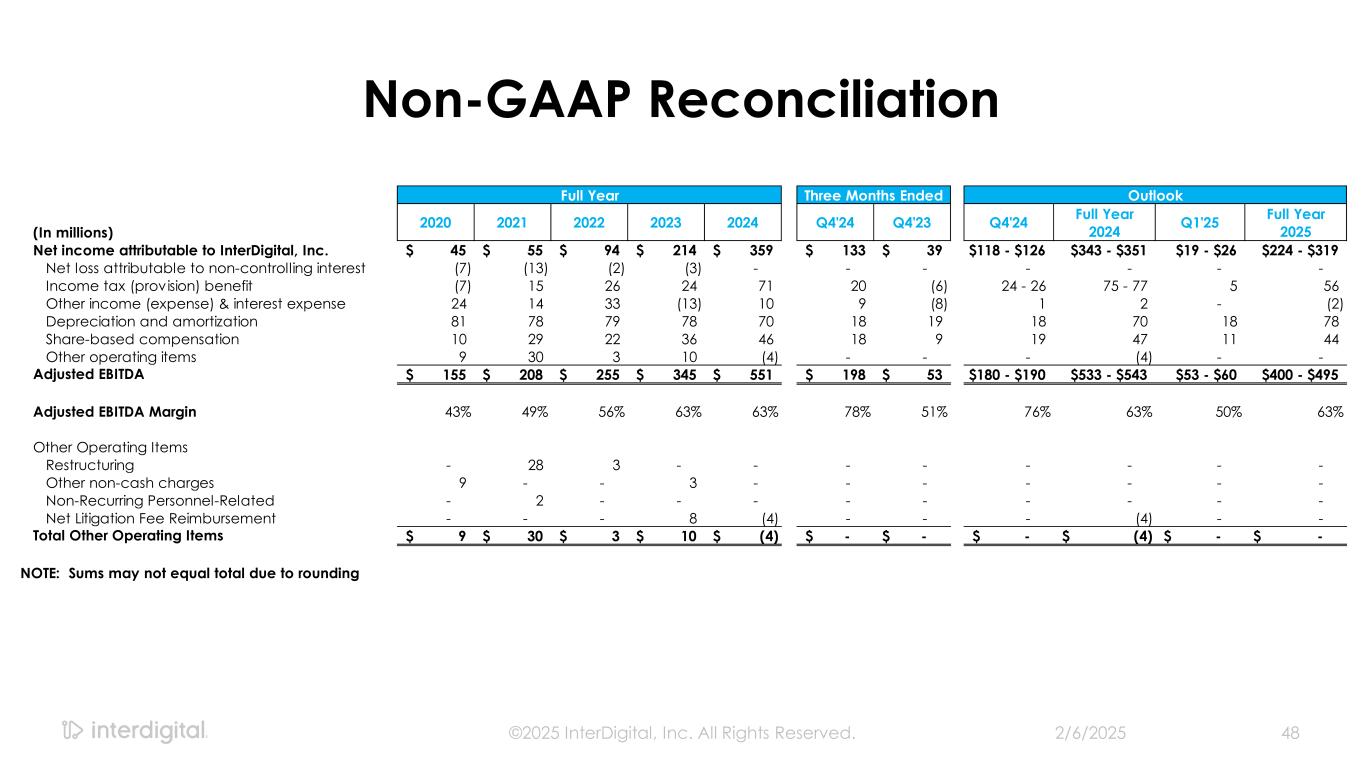
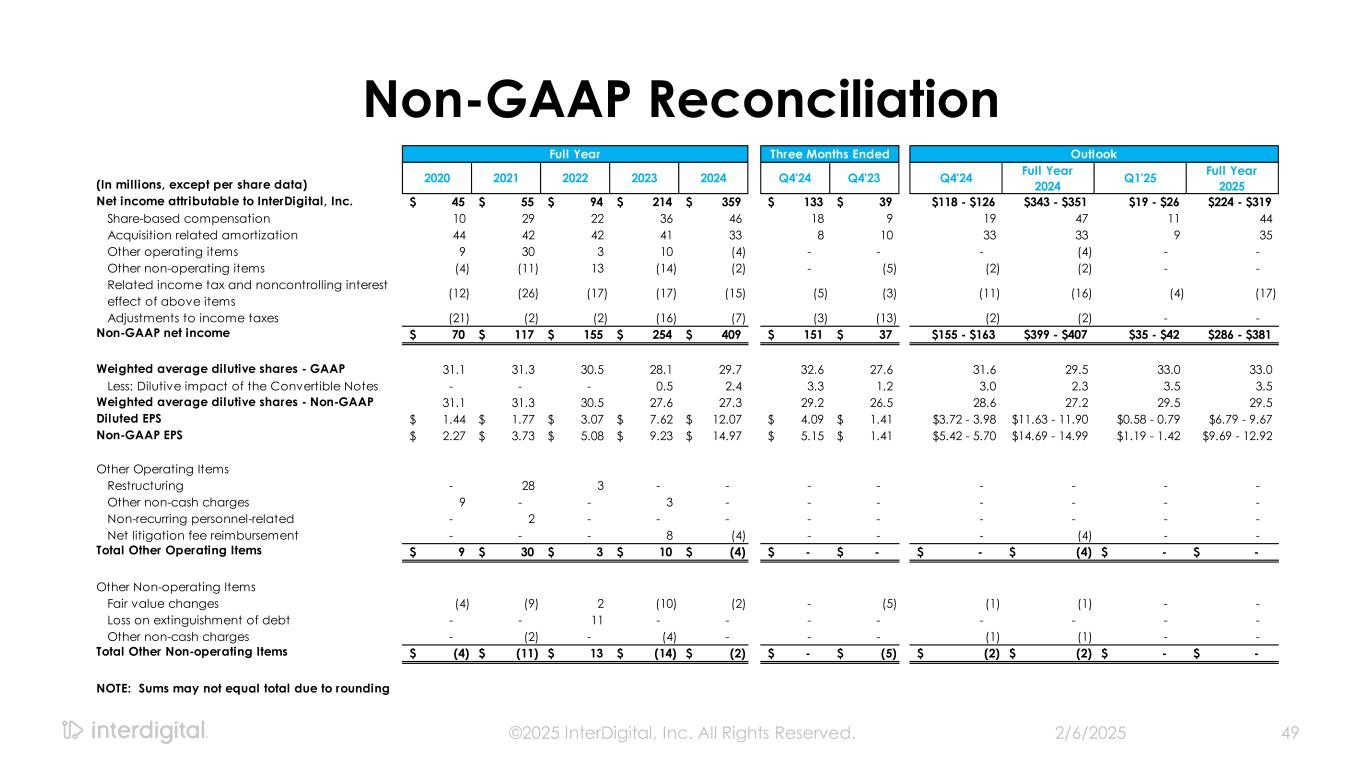
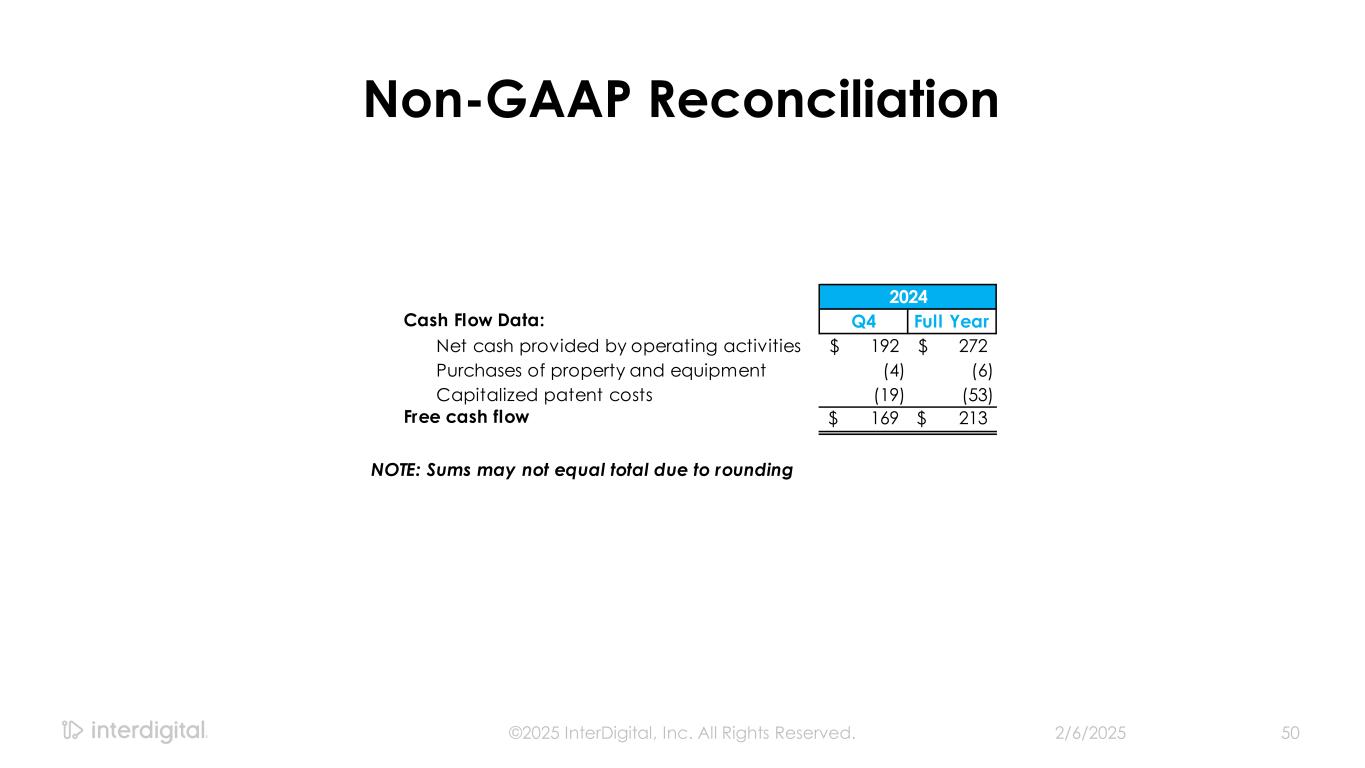
Thanks, Liren. As Liren noted, in Q4 we delivered an outstanding finish to the year. Total revenue of $253 million increased 140% year-over-year, and was above our outlook of $239 million to $249 million driven primarily by new agreements that closed after the prior guidance. Our Q4 revenue included catch-up revenue of $136 million related to our fourth quarter license agreements with OPPO, Lenovo, and ZTE. Our adjusted EBITDA for the quarter of $198 million exceeded the top end of the outlook of $180 million to $190 million, as the vast majority of the revenue upside flowed through and resulted in an adjusted EBITDA margin of 78%. GAAP EPS for the quarter of $4.09 beat our guidance. Non-GAAP EPS for the quarter of $5.15 came in below our guidance due to greater dilution from the converts on account of our higher share price and lower-than-expected non-GAAP adjustments for Q4. However, for the full year, both GAAP EPS of $12.07 and non-GAAP EPS of $14.97 came in at or above the high end of the range. Meanwhile, cash generation for the quarter was exceptionally strong with cash flow from operations of $192 million and free cash flow of $169 million. Building on Liren's comments, I'll highlight a few noteworthy metrics from our full year 2024 results and provide additional perspective on how each item has improved over the last four years. Altogether, these metrics demonstrate our success in progressing towards our objective of delivering more than $1 billion in annual recurring revenue and over $600 million in adjusted EBITDA by 2030. Total revenue accelerated to $869 million, an increase of 58% year-over-year, resulting in a compound annual growth rate of 25% over the past four years. Our 2024 revenue included $269 million of CE-IoT revenue, more than triple prior year levels. This result includes our milestone agreement with Samsung TV, demonstrating our ability to grow revenue by capitalizing on the value that our foundational technologies bring to markets beyond smartphones. Adjusted EBITDA margin was very strong again in 2024, coming in at 63%, a 20-point improvement over the past four years. Over that same time frame, adjusted EBITDA has grown more than 3.5 times. We ended the year with almost $1 billion in cash, including net cash of over $500 million, which is up more than $100 million from last year. Full-year cash flow continued to be robust with $272 million of cash from operations and $213 million of free cash flow for the year. In fact, over the last four years, we have generated nearly $0.75 billion in free cash flow. These strong cash flows allowed us to return $110 million to shareholders through buybacks and dividends and $126 million to holders of our 2024 notes upon their maturity last spring. Over the last four years, we have returned the vast majority of our free cash flow to shareholders through share buybacks and dividends totaling $678 million. In that time, we have reduced our outstanding share count by 5.1 million shares, or 17%, to 25.7 million shares at the end of 2024. Turning to our outlook. We have guided to another very strong year in 2025 with total revenue in the range of $660 million to $760 million, adjusted EBITDA of $400 million to $495 million, and non-GAAP diluted earnings per share of $9.69 to $12.92. In addition, we expect to improve upon the strong free cash flow we delivered in 2024 as we anticipate the resolution of an outstanding arbitration and continued success from our licensing efforts will drive double-digit growth in free cash flow for 2025. With that as a backdrop, our Board of Directors approved a 33% increase in our dividend from $0.45 to $0.60 per share. As a reminder, we began the year with $230 million remaining on our buyback authorization. Between the increased dividend and our commitment to continued share buybacks, we expect to have another strong year of returning capital to shareholders in 2025. You will see in our financial metrics that we have also begun to present annualized recurring revenue. This metric simply annualizes the recurring revenue for a given quarter. For example, in Q4 we had $117 million of recurring revenue. So multiply that by 4 and you get $468 million of ARR, which is by far a record level. Over the last four years, we have increased our ARR at a double-digit growth rate from $314 million at the start of 2021 to $468 million at the end of 2024. As we begin 2025, we do have a small step down due to 2024 year-end expirations, but we expect to drive renewals and agreements this year to close 2025 with double-digit growth in ARR from the $468 million level at which we concluded 2024. Before I turn it back to Raiford, I want to reiterate that our quarterly guidance for Q1 2025 does not include the impact of any new agreements or arbitration results we may sign or receive over the balance of the first quarter. This is because it is harder to predict the timing of new agreements in short windows. In contrast, our full-year guidance includes contributions from both new agreements and arbitration results. As was the case last year, we believe we can achieve financial results within our full-year guidance range through different combinations of new agreements and arbitration results. With that, I'll turn it back to Raiford.
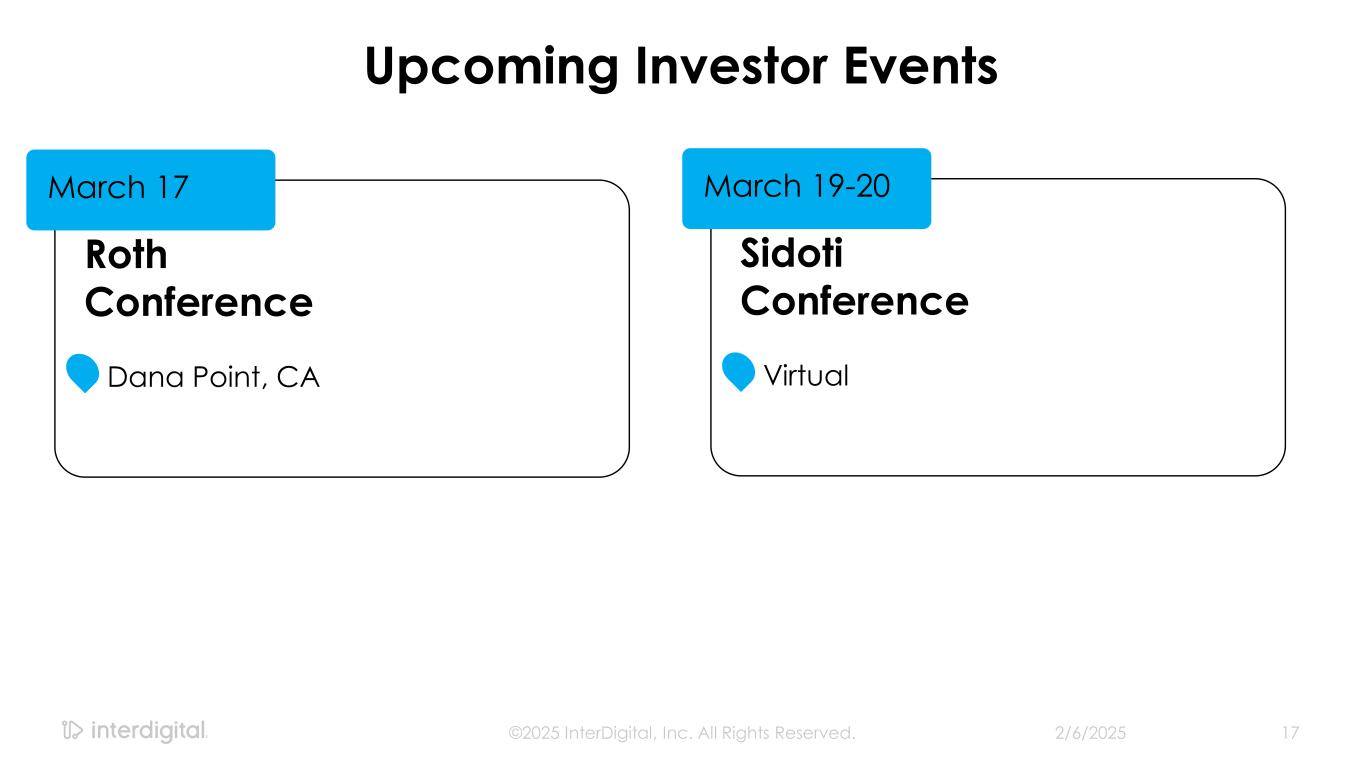
Thanks, Rich. Before we move to Q&A, I'd like to mention that we'll be attending a number of investor events in Q1, including the ROTH Conference in Dana Point, California, and the Sidoti Conference, which is virtual. Please reach out to your representatives at those firms if you'd like to schedule a meeting. Michelle, we are now ready to take questions.
Speaker 4
Hey, good morning. Congrats on the quarter, guys. Thanks for taking my questions. Liren, maybe just to dive in on the Disney front. I'm wondering if you could put some parameters around the timing of when you would expect this to progress and kind of the milestones there. Also, if you could address your engagement with other video streaming vendors and opportunities as they're ongoing within 2025, like the kind of level of engagement that you're seeing.
Yes. Hi, good morning, Scott. Thanks for the question. So regarding Disney, it's public now in our legal filings. We have engaged Disney for more than 2.5 years in bilateral negotiations, and as you know, we prefer to sign most of our deals through amicable discussions. But we have concluded after spending 2.5 years negotiating that enforcement is needed for this particular case. And as you probably know from our smartphone experience, sometimes it can be fairly quickly resolved and sometimes take multiple years to resolve. So as of this case, as of now, I do not really know for sure how long this case will take. Regarding engagement with other streaming service providers, as we have discussed before in our Investor Day, we have engaged with almost all the major players, and we are patient in leveraging our value to them. We hope to make progress as always through bilateral negotiation.
Speaker 4
Okay. Thanks. That's very helpful. Maybe shifting to the annual guidance. I know this is a very difficult one to pin down, but could you provide some color in terms of the range of outcomes how you're thinking about it in terms of catch-up sales versus how we would be exiting the year from a recurring revenue standpoint? I know that there are probably multiple different ways to get there. But if you could kind of help us frame it a little bit. And as part of that, Rich, as we're looking to the first quarter and that recurring revenue guidance, I think it's $112 million to $116 million. I know there's some expirations this year, I think in the K you talked about seven agreements for a total of $91 million or $92 million. How much of that is layering into the first quarter recurring guidance?
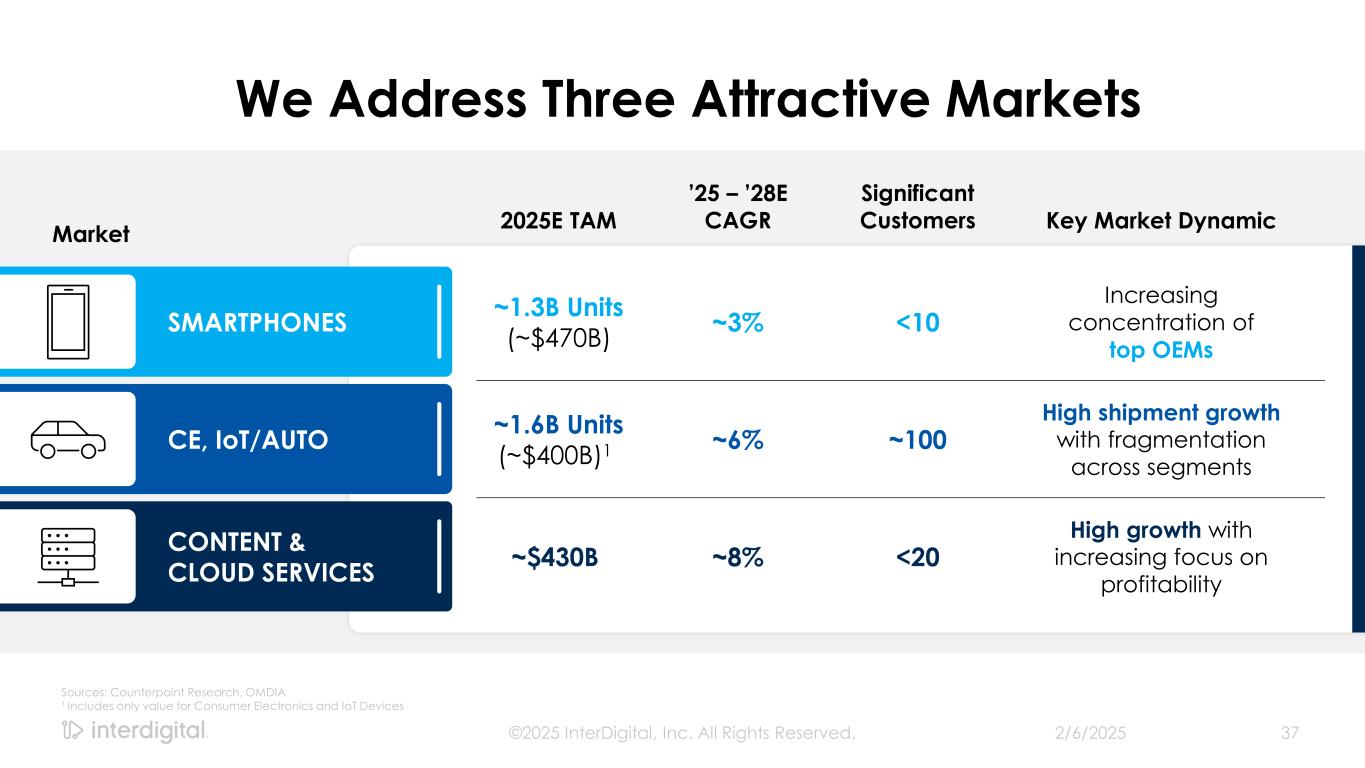
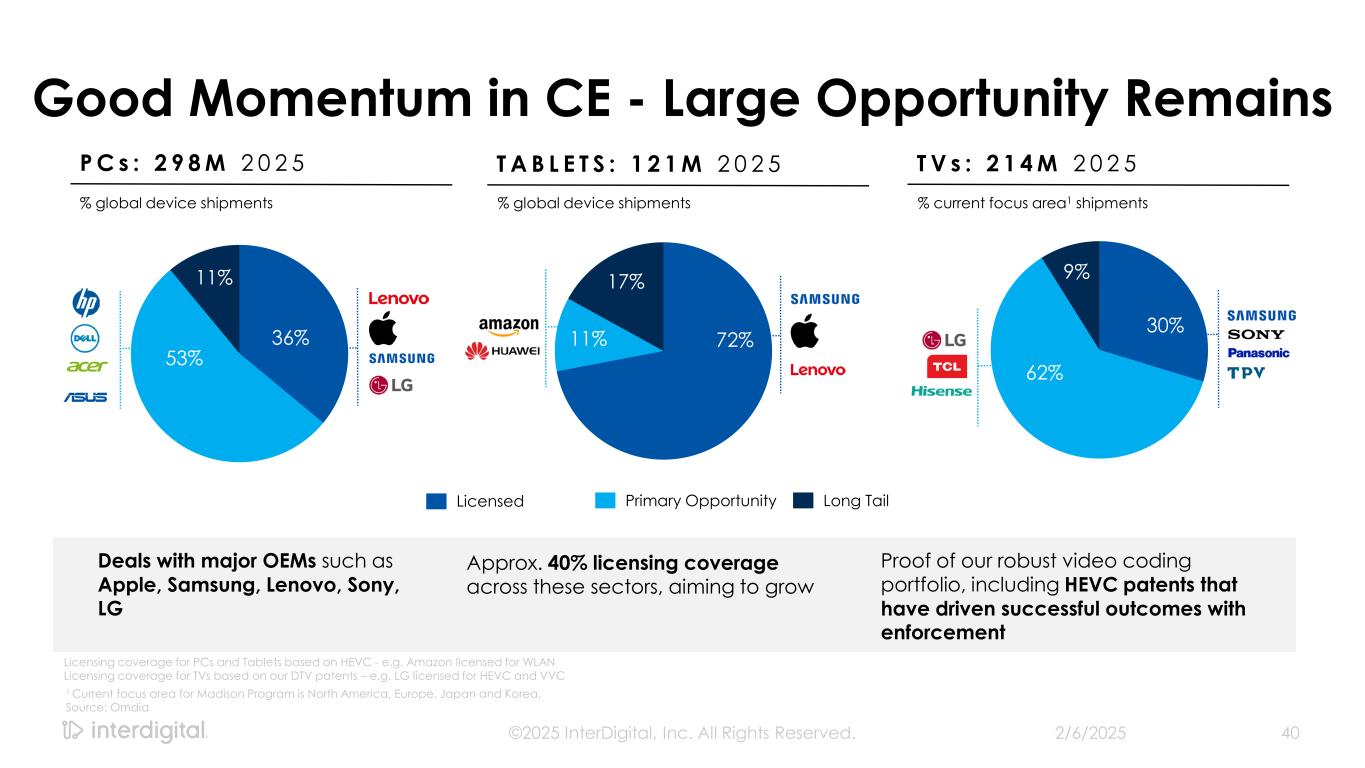
Yeah. Hey Scott, let me take on the majority of the opening opportunities, and then I'll have Rich add on the details for the recurring numbers. So if you look at our 2025 major opportunities here, we have three major programs. On the smartphone side, with our momentum for signing OPPO and frankly ZTE and others, we really only have less than a handful of major opportunities we need to sign. The largest one is Weibo, as you are aware. Then we need to essentially resolve Honor and probably Samsung, not necessarily in that order by the way. We are engaging with some others in parallel. On the consumer electronic TV side, we have built a lot of momentum as Rich has covered in his section. We see a tremendous amount of growth in multiple verticals. But our priority number one is to sign some of the larger TV makers as well as making progress in different segments of vertical for our team. For the service industry, as we already touched on here, we do not factor in any material revenue for 2025, but it is important for us to engage the major players and build a multiyear negotiating progress. And obviously, we already touched on the enforcement with Disney.
Yeah. And Scott, I'll just add to that, that in my comments I noted that we ended 2024 with $468 million of ARR, and we're looking to drive double-digit growth in that ARR number by the end of 2025. As to Q1, you noted correctly that at the end of the year, or over the course of 2025, we typically have agreements that are calendar-year based, not always but typically that we have $91 million of expirations in 2025, again typically at the end of the year. So that's really not an impact in the couple of million dollar difference between recurring revenue and Q4 stepping down to Q1. That's really driven by 2024 expirations. I think we noted we had five 2024 expirations totaling $17 million, which that math shows you that that's the majority of that step down.
Speaker 4
Great. Very helpful. And lastly, if I could just on the capital structure and the convert, Rich could you take us through what you're factoring in for the first quarter and how that will progress in terms of interest expense and the fully diluted share impact? And also how you're thinking about the capital structure in general? I think when you first initiated a convert years ago, it was to be able to have a robust balance sheet to be able to litigate against potential customers like Disney. Now, given that you've got $500 million of net cash, is that a mechanism and an instrument that you guys need to have in the future going forward? Thanks.
Sure. So, let me take the first part of that question and then I'll get to the structure as we see it going forward. In the first quarter, we are factoring in interest income and interest expense. We're not really looking at that much differently than we have in recent quarters. We also, as you alluded to, need to factor in any potential dilution from the convert or the related hedge. That becomes a function of the stock price. Typically, we're looking at what that stock price is around the time that we post that guidance. In our 10-K as in our Qs, in the footnotes to our financial statements, we have a sensitivity table that shows how that dilution is impacted at different prices. Again, there's greater dilution on the convert itself, which we reduced through the hedge, and on the far-right column you'll see the net dilution from the warrants that we issued. As for the cap structure in general, yes, for more than 10 years, we have been utilizing converts to help bolster the balance sheet. That enables us to go toe-to-toe with larger customers when necessary if they need to enforce our rights, while being able to buy back stock and return capital to shareholders. Because we're just in a much different position than even when we did the last convert in the spring of 2022, I think we have more options available to us going forward, not to say we make any predictions on what we'll do there. I'm just saying that we enjoy having more optionality in how we look at our cap structure.
Speaker 4
Great. Thanks so much. I'll get back in queue.
Speaker 5
Perfect. Thank you guys. I appreciate you taking the question here. Maybe I want to start first on the streaming opportunity. It's good to see that there is litigation, and we're somewhat far down the monetization path of your video technology. Liren, one question I have on this is for smartphones, I think we all kind of understand how the economics work, right? It's largely based on kind of units of smartphones sold with the royalty rate. When we're looking at the streaming opportunity, how should we think about kind of the underlying metric that we should get grounded in for some sort of a royalty rate with Disney, for example? You mentioned $25 billion in streaming revenue, and I think 250 million subscribers. Is it more on the per-minute stream? Is it the number of subscribers? Is it a revenue rate? How are you thinking you might monetize this opportunity here?
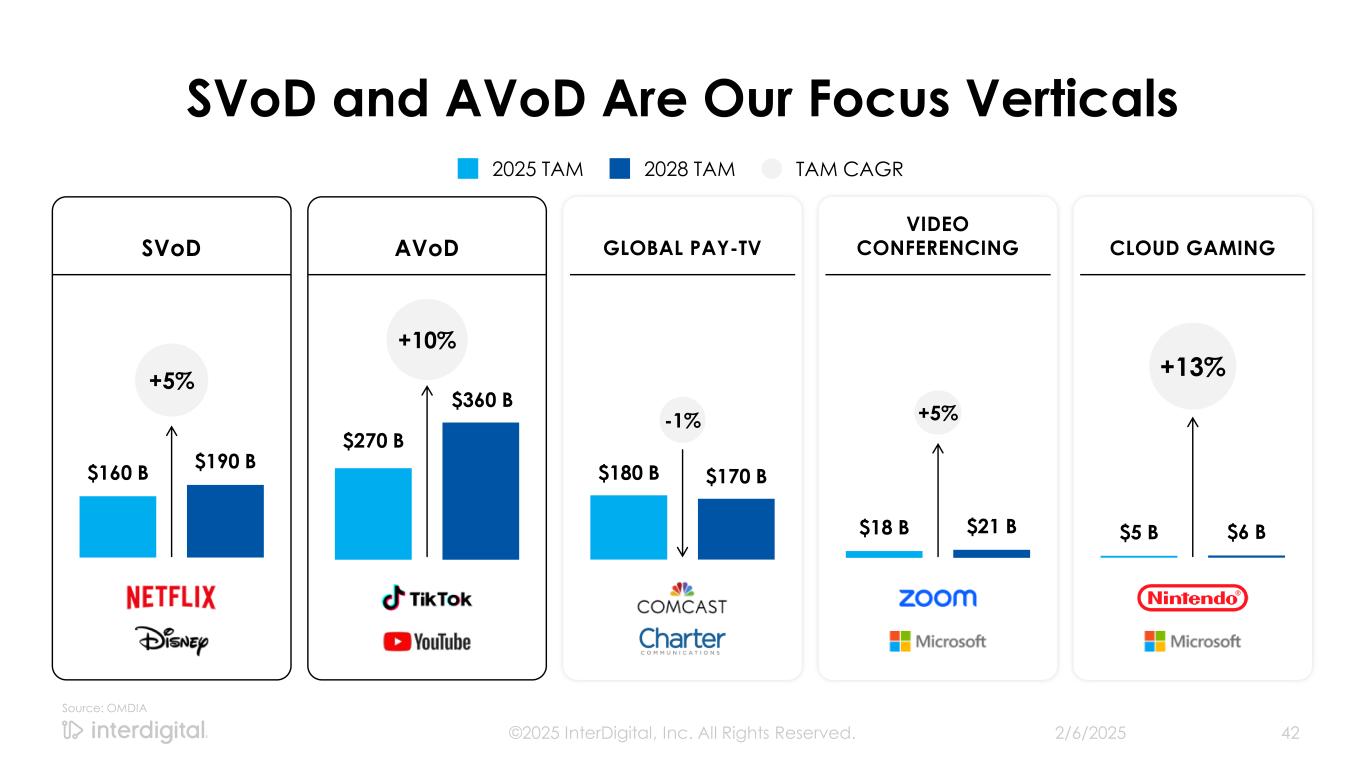
Good morning, Arjun. Thank you for your question. Regarding our streaming segment, we are adaptable in our negotiations with customers concerning the appropriate metrics to apply. Fundamentally, we offer a crucial set of technologies that we believe support their services, contributing to revenue growth and cost savings in areas like storage, power, cooling, and internet services. Different streaming services operate under various business models; some are subscription-based while others rely on advertisement revenue. When we engage with these companies, we aim to establish a modest but fair pricing structure for the value we provide. This could be a small percentage of the monthly subscription fee multiplied by the number of subscribers, which would represent a small overall revenue share. We are open to different arrangements. As mentioned during our Investor Day, our projections, based on third-party data, suggest that by 2027, the streaming industry will be comparable in size to the smartphone industry. As you know, we've made significant progress in the smartphone sector, expecting about $500 million in recurring revenue there. For streaming services, while we believe our technology is equally essential, we recognize it’s a newer area for us. Therefore, we are setting a conservative target of around $300 million by 2030, allowing time for the market to develop.
Speaker 5
Okay. Understood. Very helpful, thanks, Liren. Wonder if I can follow up just on the recurring revenue outlook for 2025. It sounds like you're baking in some incremental upsell and maybe arbitration agreements. With the unspecified agreements in particular, do you have kind of a sense of the range of uplift that you're expecting from Samsung, which I think should be coming relatively soon? Like, how should we benchmark the potential uplift that you could see there if that's announced in Q1 or Q2 here?
Yes. Hey Arjun, this is Liren. So I'll cover it first. If there's anything else Rich might be able to chime in. So on the recurring revenue side, Rich commented we will target to grow our recurring revenue in 2025 by at least double-digit growth. But that's also not based on any single deal or any single outcome. So we have a number of opportunities we are pursuing. And by the way, a number of these opportunities carry both recurring revenue as well as cash upfront payments. We really look at all the opportunities holistically and we frankly estimate an outcome for each case, as well as the likelihood that they will be executed this year. So this is the same process we took last year. So that's why we added them up into a range of outcomes. Regarding the Samsung arbitration outcome, as I commented earlier, we have spent a substantial amount of effort to push through the process already. As a matter of fact, the last hearing happened last October already, and at that time, the arbiter told us they would take time to essentially make their decision writing their conclusion. Due to the holiday season in between, they told us that it will be after the New Year. So we are waiting for the outcome. And as I commented earlier, that can be soon, but we don't really know precisely what time. Regarding the outcome of the range, we commented before in our prior calls that we believe strongly that the value of our portfolio has gone up substantially due to the last contract. And if you look at the most closest comparable, we believe we should realize in the outpacing of the value. But this is for the arbitrator to decide, and we are currently just waiting for the result.
Speaker 5
All right. Wonderful. Thank you.
Speaker 6
Can you hear me?
Operator
We can now, sir.
Speaker 6
Perfect. Thanks. Once again, you're beating the numbers by a significant amount, and I don't think you ever reported a number that is even remotely close to your guidance. It's so hard to predict the numbers. So I want to focus on the recurring part and I have two questions. On the recurring, you said that ARR should grow double digits. Are the trends in revenues different than ARR, meaning is there any deviation between revenue growth and ARR growth? And what could be the reasons for that? And the second question is you noted $70 million that expired in 2024 and $91 million expected to expire in 2025. What happens with these expirations? Are they renewed before, renewed after? How does it go with these expirations of recurring revenues? Thanks.
Okay. Thanks, Tal. This is Rich. Let me start with the first question. I think maybe Liren will have a comment for the second question, and I may have an additional point to make there. So, yeah, when we issue quarterly guidance, and I mentioned this in my prepared remarks again today, it's difficult for us over a short window to determine what the time period will be when exactly a new agreement will close. Our customers are already using our technology. So it's not like we know that they need to make a decision so they can produce their product and ship it on a certain deadline. They're already using it. And it has really been a function of when we can reach an agreement with them on the fair amount that they should pay us. As a consequence on our quarterly guidance, we typically are not including the potential for new agreements. Therefore, typically on a quarterly basis, if we sign a new agreement, we'll come in higher. For the full year guidance, we did initiate full year guidance last year in 2024. We came out with a very strong number for 2024 with full year guidance, but we just had, as we discussed on the call here, an outstanding year, and we're thrilled about the performance we delivered in 2024 and feel confident we can come out with strong numbers again for 2025. So hopefully that helps. As far as recurring revenue versus total, looking back I mentioned on my call over the last four years, we've had a double-digit CAGR in total revenue because we have been signing new agreements and been getting catch-up sales along with it. Importantly, we've also had a double-digit CAGR over that time in ARR. That in my mind is a better measure of kind of what we're earning on a recurring basis. So I'll let Liren start with a response to the second comment.
Yes. Tal. Good morning. Thank you for joining us here. So on the recurring versus sometimes having expiration for contracts, it's absolutely normal to have a certain number of contracts expire each year. And frankly, because we have signed so many agreements, right, we have signed 14 agreements this year. Our average contract length is roughly around five years; sometimes it's longer, sometimes they are shorter. So on any given year, we will have a few contracts expire. For last year to this year, we have $17 million of expiration; that is 1-7. It's actually a relatively small number from last year to this year. So our goal honestly is always how to get them renewed before they expire. Sometimes those expirations happen to be at the end of the year, which, for various reasons, can be difficult to close in time. So they can be pulled over to the next year. For this year, for 2025, at the end of this year, I want to make sure you are aware, we do disclose in our 10-K filing that we have about $91 million expiration primarily driven by our Xiaomi contracts that are for renewal at the end of this year. I won't be able to comment on specific negotiations because they are covered by NDAs. But what we typically do, Tal, is for major agreements, we start roughly six months to a year ahead of time. We demonstrate the value of technology, the goals for the portfolio, as well as demonstrate to them how they have benefited more this time compared to the time of the last contract. And then, when it's appropriate, which we have demonstrated through multiple contracts here, we will try to negotiate a higher value in the renewal if they have benefited more. That's the general practice, Tal. We have demonstrated over the last four or five years that we had a good track record of renewing large contracts including the larger contract for Apple, before they expire. That's what we always target to do.
Speaker 6
So when you give the guidance for the year, do you assume that the $17 million that expired last year will be renewed this year? Do you assume a renewal of the expired ones? Or is it excluded also from the numbers?
So Tal, the way we do new year forecast is, we actually look at all the open opportunities, including unsigned customers as well as renewals. By the way, we are not trying to target for replacing dollar for dollar. We are trying to renew the customer one by one when they come up due. As you are aware, Tal, some of the customers gain market share over the years, and some of them may lose market share. Sometimes, they have a higher mix of 5G devices. They may have gone up in terms of average selling prices. We factor in all those parameters. Therefore, we are not trying to replace every dollar from every customer, but we are trying to renew them and frankly, many benefits more. We try to get a higher valuation out of that new contract. That's normally how it works. So for this year, when we gave the guidance, as I mentioned earlier, we try to look at all the open opportunities and try to drive them to closure as much as we can. But we also know that some of those agreements take longer to renew than others, and some for the first-time customers can be a difficult and complex negotiation. So internally, we assign a certain amount of probability and range of outcomes for each of the cases. Then in total, we give ourselves what we call internally multi-path to get to the result by targeting a range.
Speaker 6
Yes. Okay. One last question, geopolitics. A lot of your customers are coming from China. All the situation all the geopolitical tension between China and the US, do you expect it to have an impact on your contract elongation or any other type of impact?
Yeah. Hey, Tal, that's a great question. We all know geopolitics is always in the macro environment we consider. But there are several things to keep in mind. Number one, our technology is global. Our technology is built on open standards that are frankly developed by industry associations. So that technology itself is open. It's not subject to any export license control. Frankly, not a single government, including the US or Chinese government truly owns that standard. So that's always open. The second one is that most of the open opportunities we are trying to pursue are from large customers who have international business, right? Their sales are driven by many different factors. If you look at the smartphone industry in particular, those large customers always value both domestic industry as well as foreign markets, and they aim to be big and competitive. So that's a healthy dynamic for us. The third point, which is really important for me, is that I spend a substantial amount of time in DC, Brussels, and other capitals, including Beijing, informing policymakers why our business model is pro-competition, why our model is beneficial for them, the country, consumers, and vendors who benefit from our fundamental innovation. We've done a good job explaining our business model, and I can tell you Tal, that our support across different countries is actually quite strong.
Speaker 6
Great. Thank you.
Speaker 7
Hi. Thank you for taking my question. Actually, most of them have been directed already, and congrats on the great performance here. When we went into 2024, you gave the guidance or... yeah, you gave the guidance for the year. And it seemed like you gave guidance that was a little bit modest going into the year, which makes sense. But are you doing the same approach this year, you think? Or?
So Anja, let me take the broader question here. I'll ask Rich to chime in if need be. So, but I explained earlier, right? We try to take a holistic view of all the open opportunities. Here's our opportunity; we associate the likelihood of completion in the year as well as the range of possible valuations. If it's a renewal, we are signed obviously a certain amount of recurring revenue. If it's brand new unsigned customers, we also have to estimate how much catch-up payment we can get from that deal. The timing and the dollar amount are hard to pin down with long lead time, right? But we wanted to give enough visibility into it. So our process generally at the beginning of the year is to do the best we can to come up with the range. Then, larger deals happen throughout the year, as we've demonstrated last year. If we do better or faster, we'll provide guidance accordingly to either update or give you the latest information. That's the general approach we take.
No, I think that covers it.
Speaker 7
Okay. And then just a follow-up on the geopolitical environment here with the new administration. Do you feel like the sentiment has changed in any way with your counterparts or?
Yeah, that's a great question. If you look at the new administration for the US, traditionally, as I think many of you are aware, the Republicans are stronger in IP protection in general. Again, I'm not specifically commenting on any person or anything. We believe this is generally a good thing for IP licensing. We are still at the beginning of the new administration. By the way, we historically have a close working relationship with both administrations over the last decades or more. We continue to build those relationships. We demonstrate to them why our business is good for the US and why our technology leadership is important to US technology leadership as well as in the future of our country. Those points are pretty well received, and I expect strong support going forward.
Speaker 7
Okay. Thank you. That works out for me.
Operator
This concludes today's conference call. Thank you for participating, and you may now disconnect. Everyone, have a great day.