Operator
Hello, and welcome to Inseego Corp.'s Fourth Quarter 2025 Financial Results Conference Call. Please note that today's event is being recorded. On the call today are Juho Sarvikas, Chief Executive Officer, and Steven Gatoff, Chief Financial Officer. During this call, certain non-GAAP financial measures will be discussed. A reconciliation to the most directly comparable GAAP financial measures is included in the earnings release, which is available on the Investors section of the company's website. An audio replay of this call will also be archived there. Please also be advised that today's discussion will contain forward-looking statements. These forward-looking statements are not historical facts, but rather are based on the company's current expectations and beliefs. For a discussion on factors that could cause actual results to differ materially from the expectations, please refer to the risk factors described in the company's Form 10-K, 10-Q and other SEC filings, which are available on the company's website. Please also refer to the cautionary note regarding forward-looking statements section contained in today's press release. With that, I'd like to turn the call over to Juho Sarvikas, Chief Executive Officer. Please go ahead.
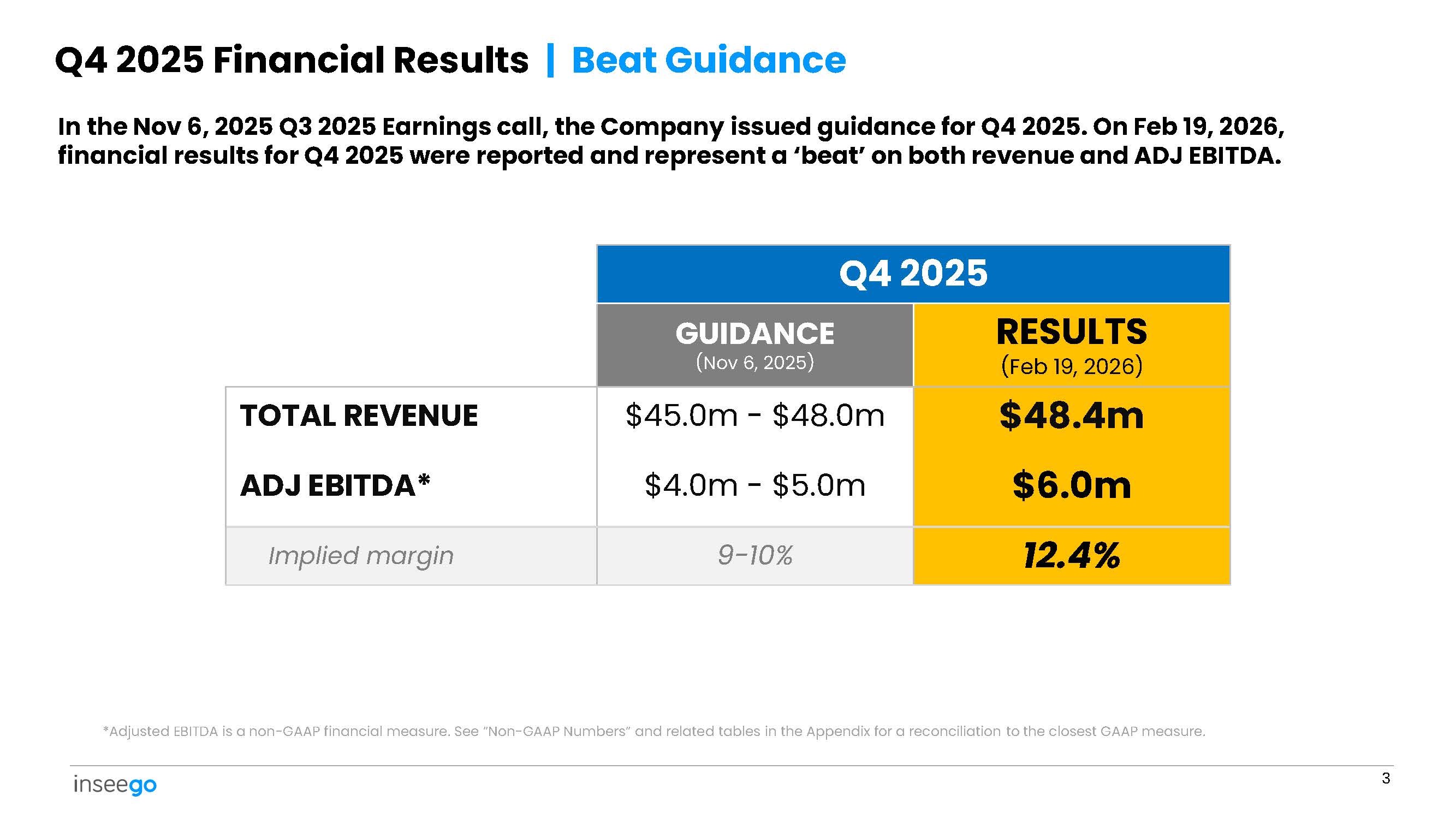
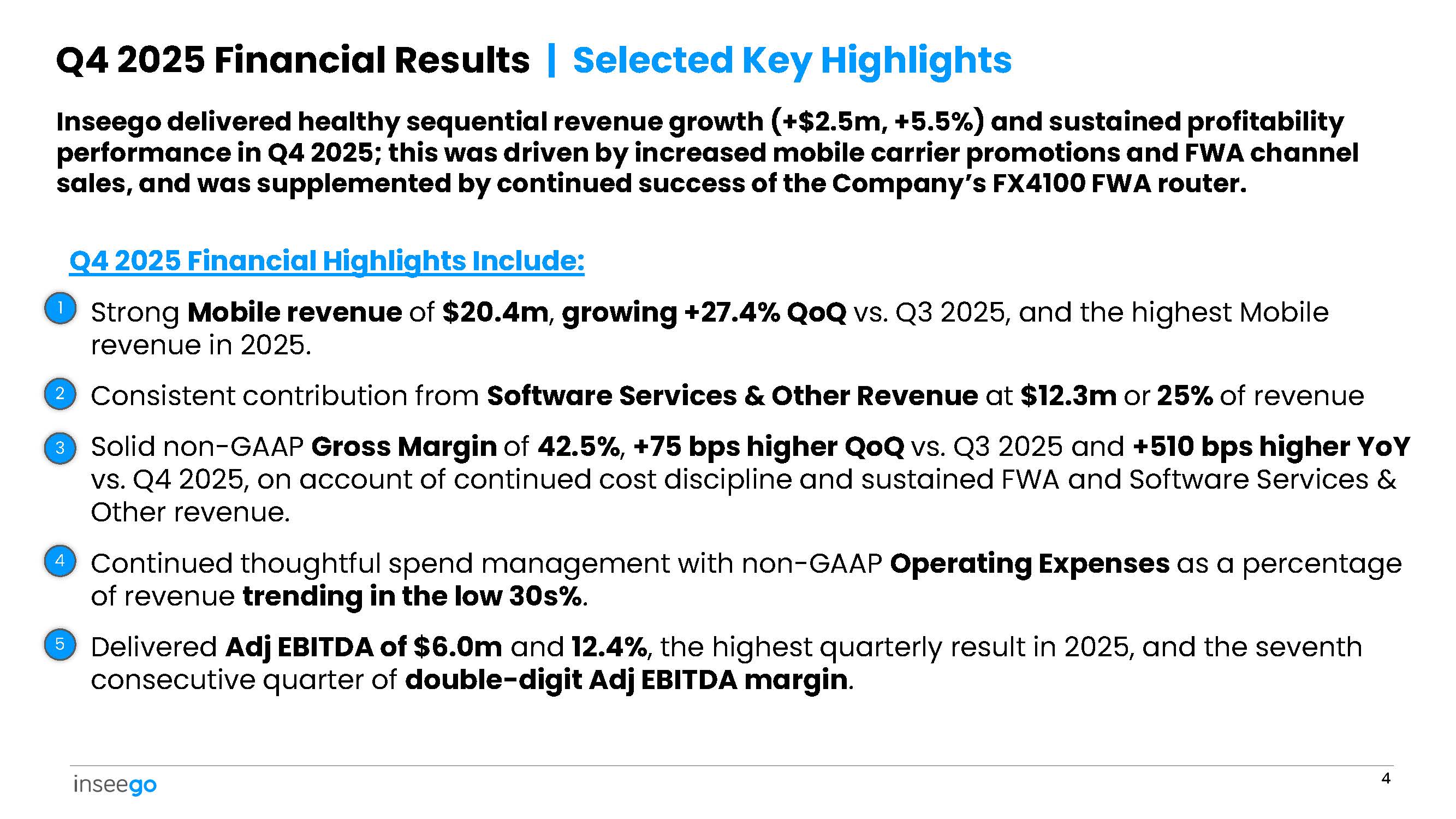
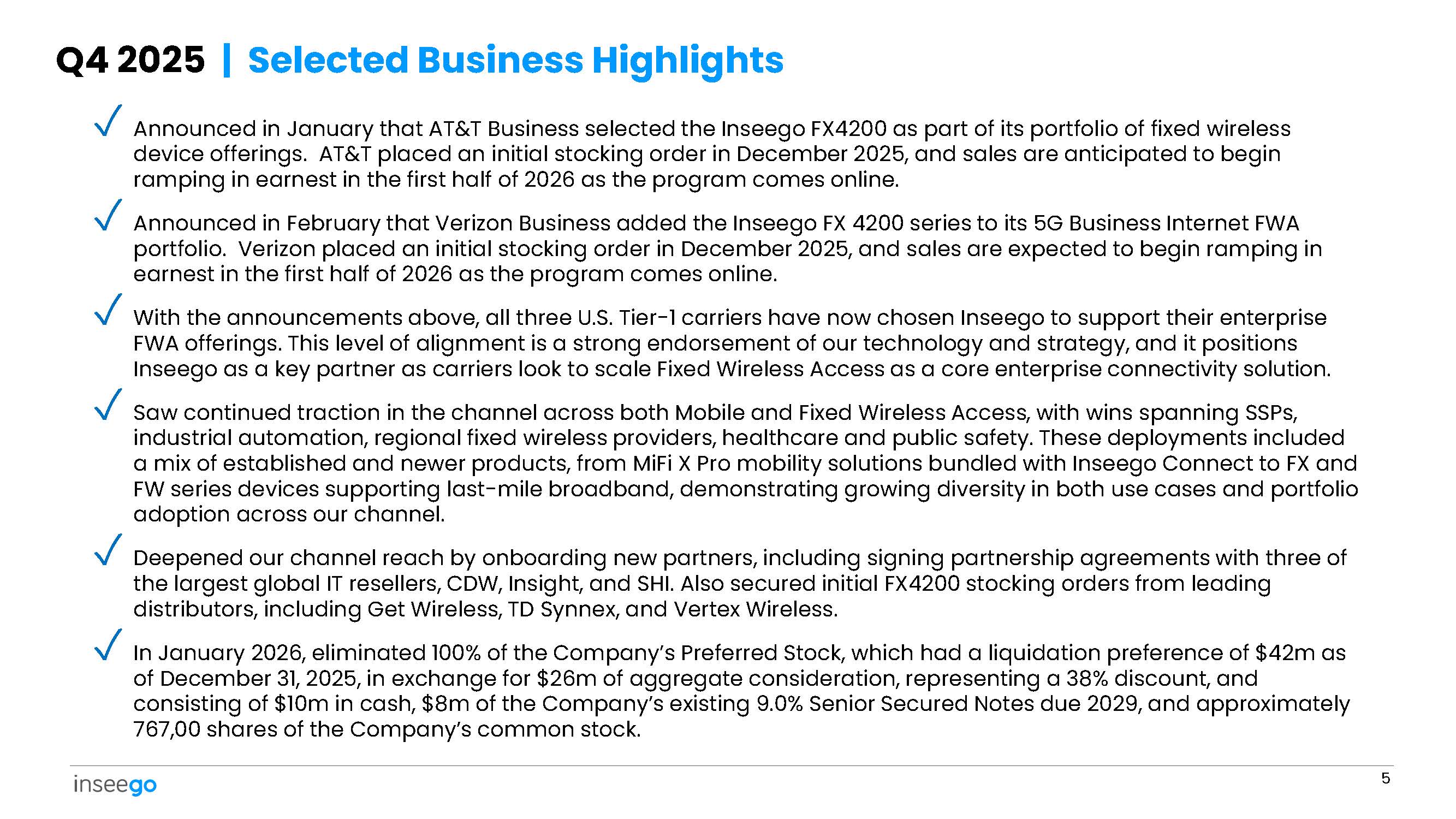
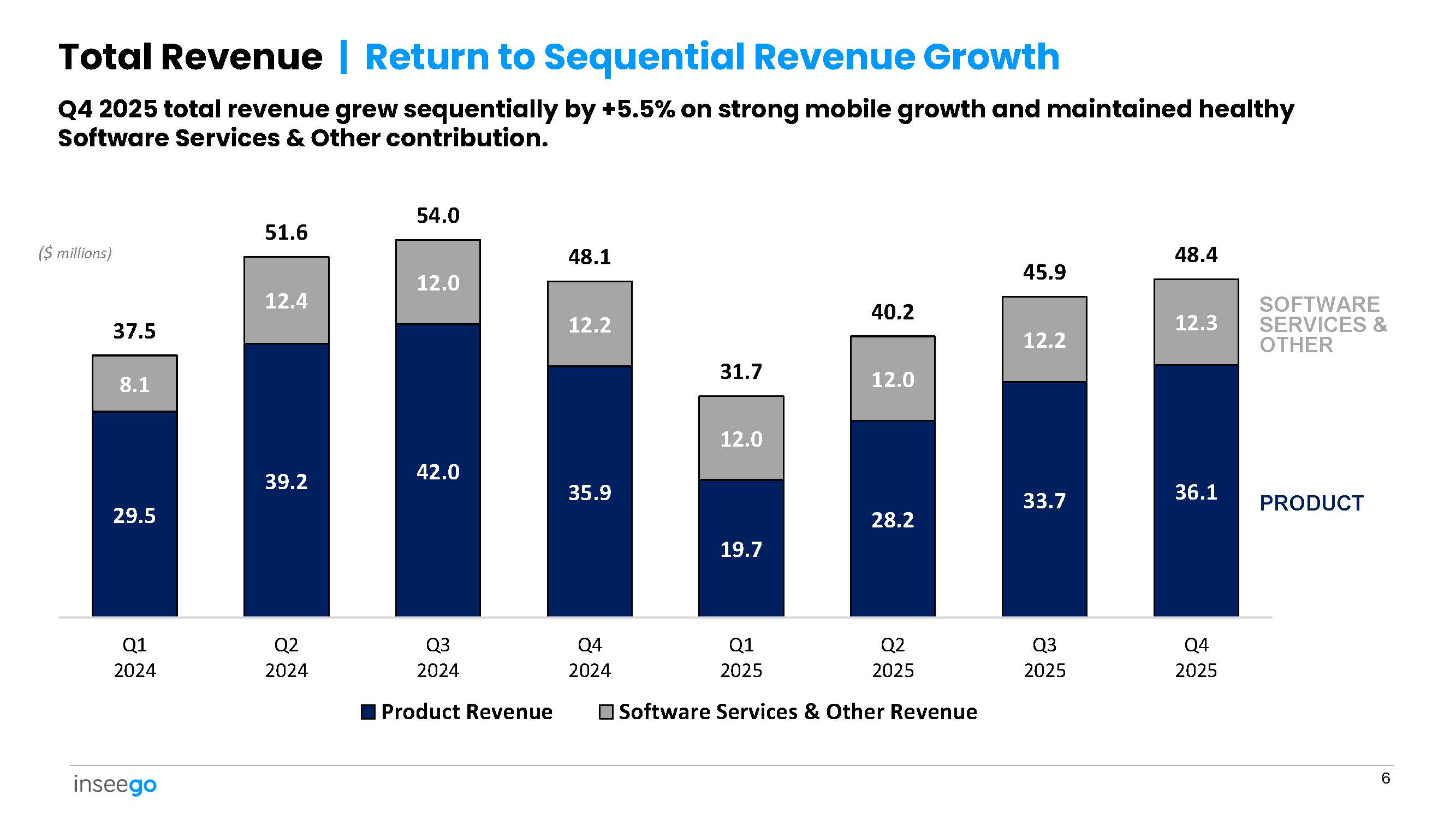
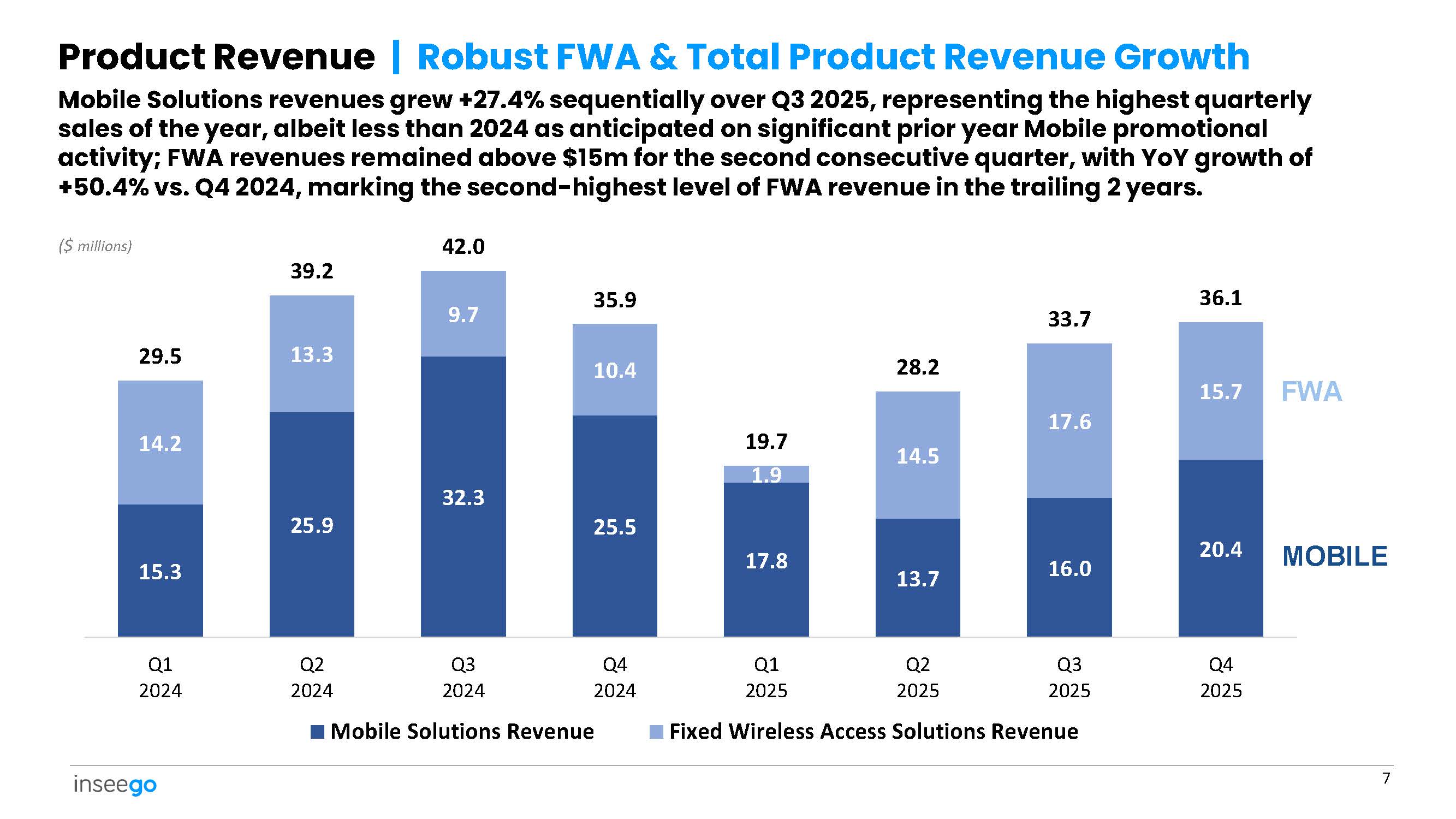
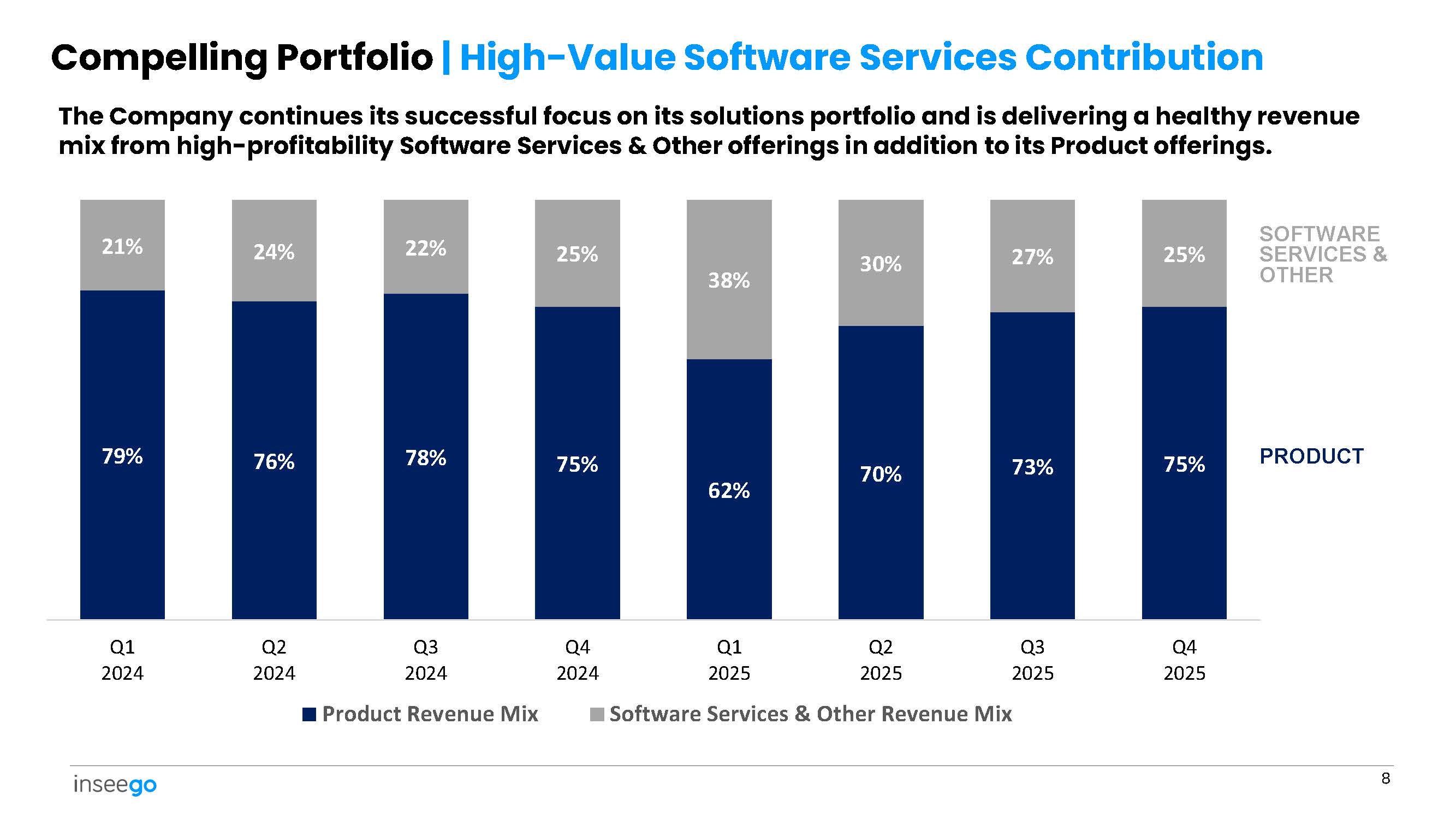
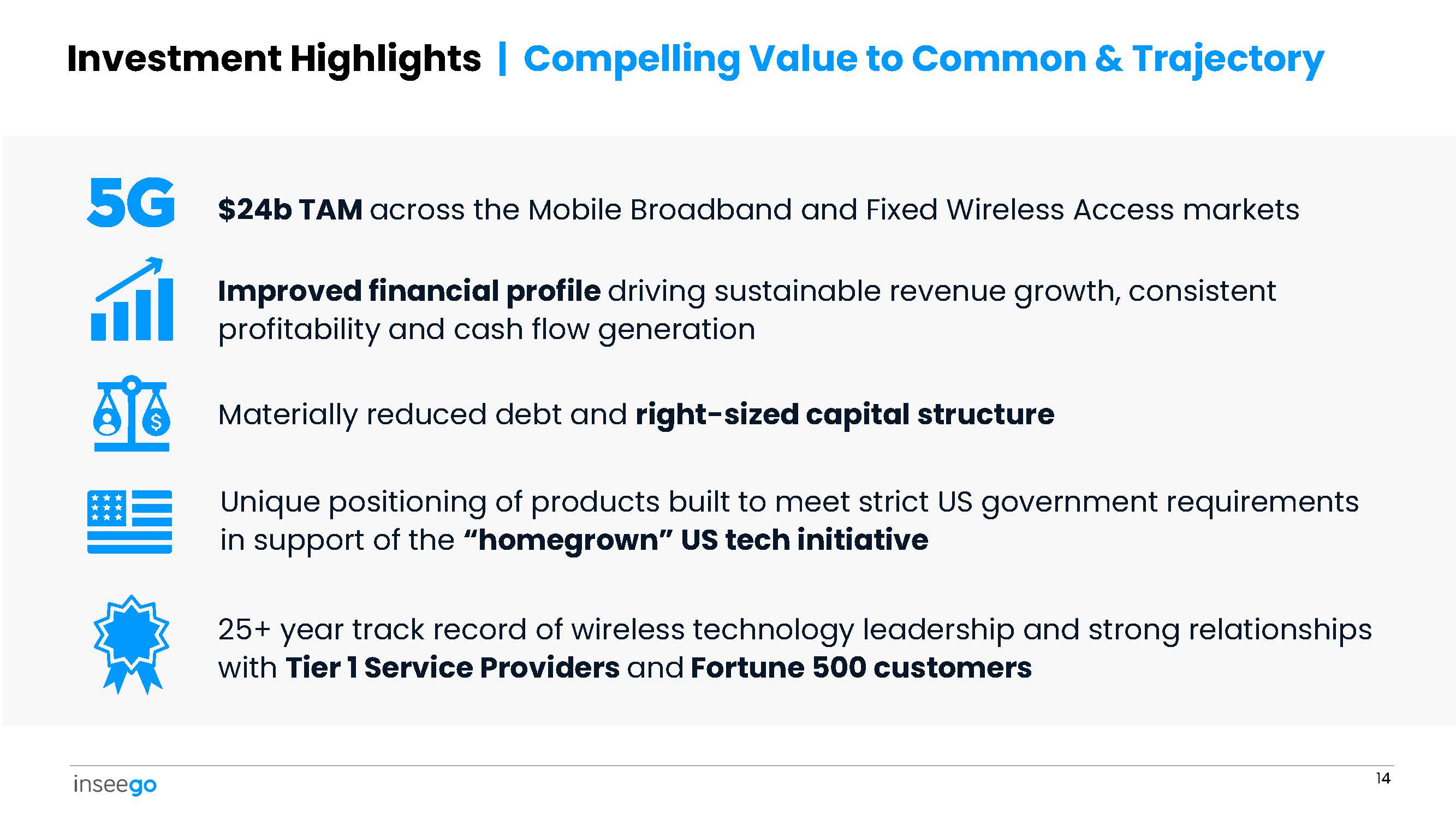
Good afternoon, everyone, and thank you for joining us today. Q4 2025 was another strong quarter for Inseego. We generated revenue of $48.4 million and adjusted EBITDA of $6 million, both above our guidance and marking our third consecutive quarter of sequential growth in each metric. These results capped a year of steady, disciplined execution. We exited 2025 with a meaningfully higher quality and more diversified revenue base driven by broader product breadth and increased customer diversity. Shortly after year-end, we further strengthened our operating momentum by improving our capital structure by retiring all preferred stock. We accomplished this at a meaningful discount, enhancing the company's long-term flexibility and are pleased to welcome Mubadala Capital as a significant common stockholder. Steven will walk through the financials and outlook in more detail later in the call. I'd like to step back and discuss how our performance in 2025 and our trajectory going into 2026 demonstrates that the strategy I outlined when I stepped into the CEO role a year ago is working. To frame that discussion, let me briefly revisit our strategy. We are building an enterprise wireless broadband platform that combines cellular-first connectivity with intelligence, manageability and scalability at the wireless edge. That strategy has remained consistent throughout 2025 and is grounded on 5 clear strategic priorities. First, scaling carrier revenue to a broader enterprise-focused Fixed Wireless Access and mobile portfolio. Second, accelerating Inseego's evolution into a solutions company by creating a platform that includes industry-leading wireless hardware, network and device management and subscriber life cycle management. Third, expanding and diversifying our routes to market and customer base. Fourth, maintaining financial discipline and strengthening our capital structure. And fifth, building a world-class management team and Board of Directors to drive long-term growth and scale. Our fourth quarter results and 2025 full year progress are consistent proof points of execution against these strategic priorities. With that context, I want to do 3 things on today's call. First, I'll walk through how we executed in the fourth quarter. Second, discuss what we delivered across the full year in 2025. And third, share how that execution positions Inseego for its next phase of expansion as we move into 2026. With that, let me now turn to my first topic, how we executed in Q4. Starting with our core business of cloud-managed FWA and mobile solutions. We continue to see strong performance from our FX4100 FWA product with T-Mobile during the quarter, reflecting ongoing enterprise demand and solid sell-through. During Q4, we significantly expanded our Tier 1 carrier footprint for Fixed Wireless Access. As we shared on our last call, we meaningfully broadened our reach and customer diversification by securing an FX4200 FWA award with AT&T. Equally importantly, we just announced this Tuesday that we also signed Verizon for the FX4200. Both AT&T and Verizon have placed initial stocking orders, and we expect commercial sales to begin ramping up in earnest in the first half of 2026 as these programs come online. With the addition of Verizon, all 3 U.S. Tier 1 carriers have now chosen Inseego to support their enterprise FWA offerings. This marks an important inflection point for our business. As carriers increasingly position FWA as a primary connectivity solution for businesses, alignment across all 3 Tier 1 carriers validates our strategy, reinforces our position as a partner of choice as enterprise adoption accelerates and establishes a clear foundation for meaningful growth in 2026. Turning to mobile. Our hotspot portfolio delivered its strongest quarter of 2025 with revenue increasing 27% sequentially to $20.4 million. Mobile represents roughly 40% of total company's revenue in Q4, underscoring the increasingly diversified mix of our platforms across mobile, FWA and software and services. Growth was driven by higher carrier stock volumes and solid channel activity as enterprises expand their use of mobile connectivity. With all 3 carriers committed to Inseego as a key part of their mobile portfolio, we see mobile as a durable and important pillar of our enterprise wireless platform. Continuing with our fourth quarter execution, we've made strong progress in evolving into a solutions company and advancing our platform strategy. In Q3, we shared that we have delivered a major release of Inseego Connect, our network orchestration SaaS offering, expanding its functionality and usability. In Q4, we began to see an impact from that investment. For the first time, Inseego Connect is being taken to market alongside our FWA solutions by all 3 Tier 1 U.S. carriers, each through their own commercial models and routes to market. This represents an important milestone. The combined offering of the FX4200, FX4100 and Inseego Connect reflects a clear shift from device-led selling to solution-led selling and establishes Connect as a foundational element of our enterprise wireless edge platform. As we continue to expand, this solution-based approach is an important source of differentiation for Inseego. We also continue to invest in our subscriber life cycle management platform, Inseego Subscribe, building out the leadership team and platform capabilities. Subscribe is a strategic investment area and an important component of our long-term software and solutions growth strategy. Turning to revenue diversity. With our fourth quarter execution, we broadened our revenue base to initial FX4200 orders from both AT&T and Verizon and delivered a strong quarter in our channel business. Importantly, channel growth was driven by traction across multiple areas rather than a single large transaction, reflecting healthier and more diversified demand. I'd like to take a step back now and review what we delivered over the full year of 2025. At the start of last year, when I arrived at the company, we set out clear execution-focused objectives, execute and scale our FWA and MiFi business, strengthen our two-pronged go-to-market strategy and increase our investment in software. And throughout the year, we've not only stayed tightly aligned with these priorities, we've delivered against them. We meaningfully expanded our enterprise wireless broadband footprint by doing exactly what we said we would do. I reset the product strategy when I joined a year ago, and those products are now launching. Not only that, but I also focused on diversification of our customer base. So those new products are now launching across the broadest customer base the company has ever had. It took a year, but we got there. Throughout 2025, we continued elevating software and platform integration as core elements of our value proposition. Inseego Connect increasingly became positioned as the management, intelligence and control layer of the wireless edge. We made progress towards more integrated hardware and software solutions and took steps towards greater differentiation at the platform level. This laid out the groundwork for deeper software attach and solution-led selling as our portfolio and routes to market continue to expand. To highlight the scale of this growth, we entered 2025 with 3 products offered to 2 carriers. And entering 2026, we are now in the middle of expanding to 6 products across all 3 carriers. In parallel, we've broadened our go-to-market approach in 2025. Along with the expanding and diversifying carrier base, we laid the groundwork for VARs, MSPs, SSPs and MSOs and built the product, commercial and operational capability required to support broader enterprise engagement. All of this execution was delivered with continued financial discipline. We maintained strong double-digit adjusted EBITDA margins through a transition year, managed costs carefully while funding growth investments and strengthened our capital structure. This demonstrates our ability to invest in growth while maintaining profitability and operating rigor. And finally, 2025 was a year of further strengthening the organization. We significantly up-leveled the management team and Board of Directors, added operating depth across product, technology, sales, operations and supply chain from the C level down and built the infrastructure required to support the next phase of growth. That brings us to 2026. 2025 was a year of building the foundation for long-term growth through disciplined execution of our revised strategy that requires significant product investment. In 2026, we're continuing to make product investments in the first half of the year to drive growth. This also includes increased spend in go-to-market capabilities to ensure the success of new products and platforms we're bringing to market. This is a deliberate need to scale the business. Looking ahead to 2026, the market backdrop continues to strengthen and expand our opportunity. Enterprises are increasingly prioritizing resilience, always-on connectivity with Fixed Wireless Access emerging as a primary connectivity solution. That shift is reinforced by carrier commitments as all major U.S. carriers continue scaling enterprise FWA programs. Industry forecasts reflect this momentum with ABI Research projecting North America enterprise FWA service revenue to grow at a 37% compound annual rate through 2030, expanding from roughly $2 billion to more than $11 billion. We see similar momentum in federal, state and local government, where cellular is supporting distributed operations, public safety and mission-critical connectivity and where security concerns have made U.S. designs an important consideration. At the same time, AI-driven workloads and accelerating mobile data traffic are increasing network complexity and raising the importance of performance, visibility and centralized management. As enterprises and governments expand their use of cellular, managing cost, usage and performance becomes as critical as connectivity. Taken together, these dynamics, including the growing convergence of cellular and satellite and continued advances in cloud technologies are elevating the importance of wireless edge and driving demand for integrated platforms that combine connectivity with management and control. This environment aligns directly with Inseego's platform strategy and positions us for our next phase of growth in 2026. Against this backdrop, our core priorities remain consistent. What changes in 2026 is the scale and intensity of execution. Compared to 2025, this is a much more front-loaded year with a higher concentration of carrier launches and product introductions in the first half, specifically in Q1. With that in mind, we're entering 2026 focused on 5 key areas. First, we will continue to scale enterprise wireless broadband across FWA and mobile. With all 3 U.S. Tier 1 carriers now aligned with Inseego, 2026 begins with multiple carrier launches in Q1 and ramps as operations get underway. That requires increased investment early in the year, but the result is a higher carrier-driven revenue run rate, broader channel participation and continued expansion opportunities as we move into the second half. Second, we will accelerate portfolio expansion. In the first half alone, we expect to introduce 4 new products. This includes the rollout of 3 new MiFi products across all major carriers, the introduction of a new entry tier enterprise FWA offering and expansion into additional verticals. This represents the most comprehensive enterprise wireless portfolio in the company's history with all products managed through a common software interface rather than a stand-alone hardware. Third, we will deepen the software and platform layer. Inseego Connect continues to evolve as the management and intelligence layer of the wireless edge. And in 2026, we will expand its role as our installed base grows rapidly. This allows us to introduce additional services, increase software attach and offer more value to customers and partners through a single integrated management experience. Fourth, we will broaden routes to market. The investments we've made in products and platforms are already opening doors with new VARs, MSPs, MVNOs and service providers. We are encouraged by early momentum, including progress with MSOs, and we expect partner-led activity to increase meaningfully as new products come to market. More of our growth going forward will be informed by this new expanding partner ecosystem. Fifth, we will advance our subscriber life cycle management capabilities within Inseego Subscribe. Finally, we will continue to execute with discipline. As we accelerate investment to support carrier ramps, product launches and go-to-market expansion, we remain focused on balancing growth with profitability and long-term margin expansion. Before I get to Q1, I want to briefly address the current memory market dynamic. Overall, as you've all seen, there's a lot of discussion on price increases and supply shortages as the suppliers have pivoted towards AI and data center. We have done a tremendous job in securing supply, and I do not see any meaningful impact on our deployments. When it comes to pricing, we've acted early, and we have been able to lock in modest price increases for products in the first part of the year. In addition to this, we're working with our large customers on price increases and cost sharing. Let's now talk about Q1. Overall, I'm bullish on 2026. We have more products going to more customers than this company has ever had. Q1 is a transition quarter, and there are several moving parts as we introduce a new mobile product generation and work with new large customers to develop joint go-to-market for FWA. While we still expect Q1 to grow year-over-year, there are 3 reasons for lower sequential Q1 revenue. First, we have had engineering delays in delivering our new mobile products that have pushed revenue to Q2. Second, one of our large Tier 1 FWA carrier customers has higher than initially expected inventory that they're selling out in Q1. And third, that same Tier 1 carrier recently changed their go-to-market strategy to address a broader set of customers, but causing a short-term disruption on selling logistics. In summary, 2025 was about implementing the strategy I laid out when I joined a year ago and building the foundation for growth. Now 2026 is about execution and scale. We're launching more products, ramping more Tier 1 carrier programs, expanding our software platform and broadening our partner ecosystem across MSOs, VARs and MSPs. This is positioning us to drive significant growth as the year progresses and scale Inseego at the enterprise wireless edge. We are energized by the trajectory of the business that we see exiting Q1 and confident in delivering the year. With that, I'll turn over to Steven to walk through the financial results and our outlook in more detail.
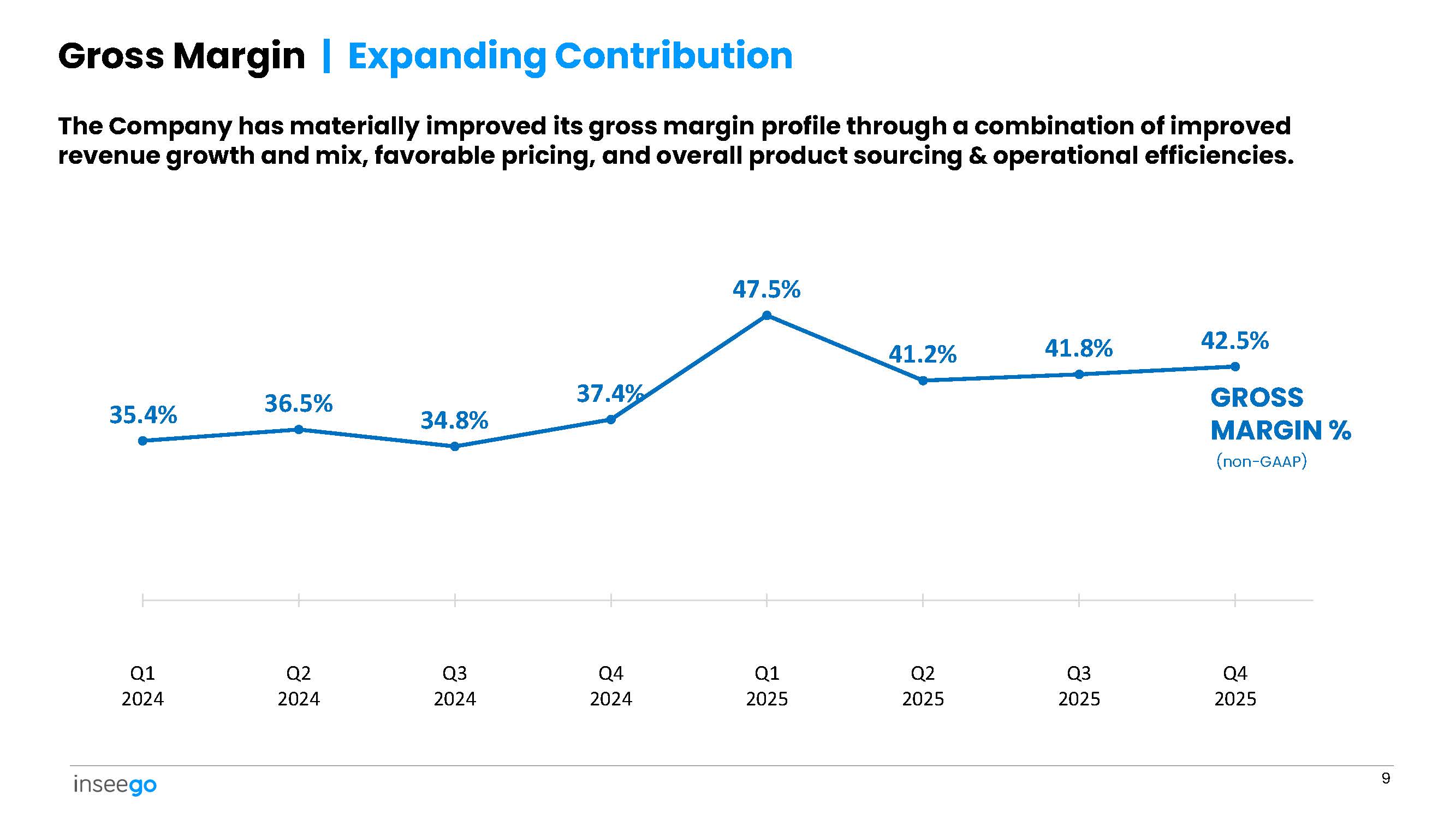
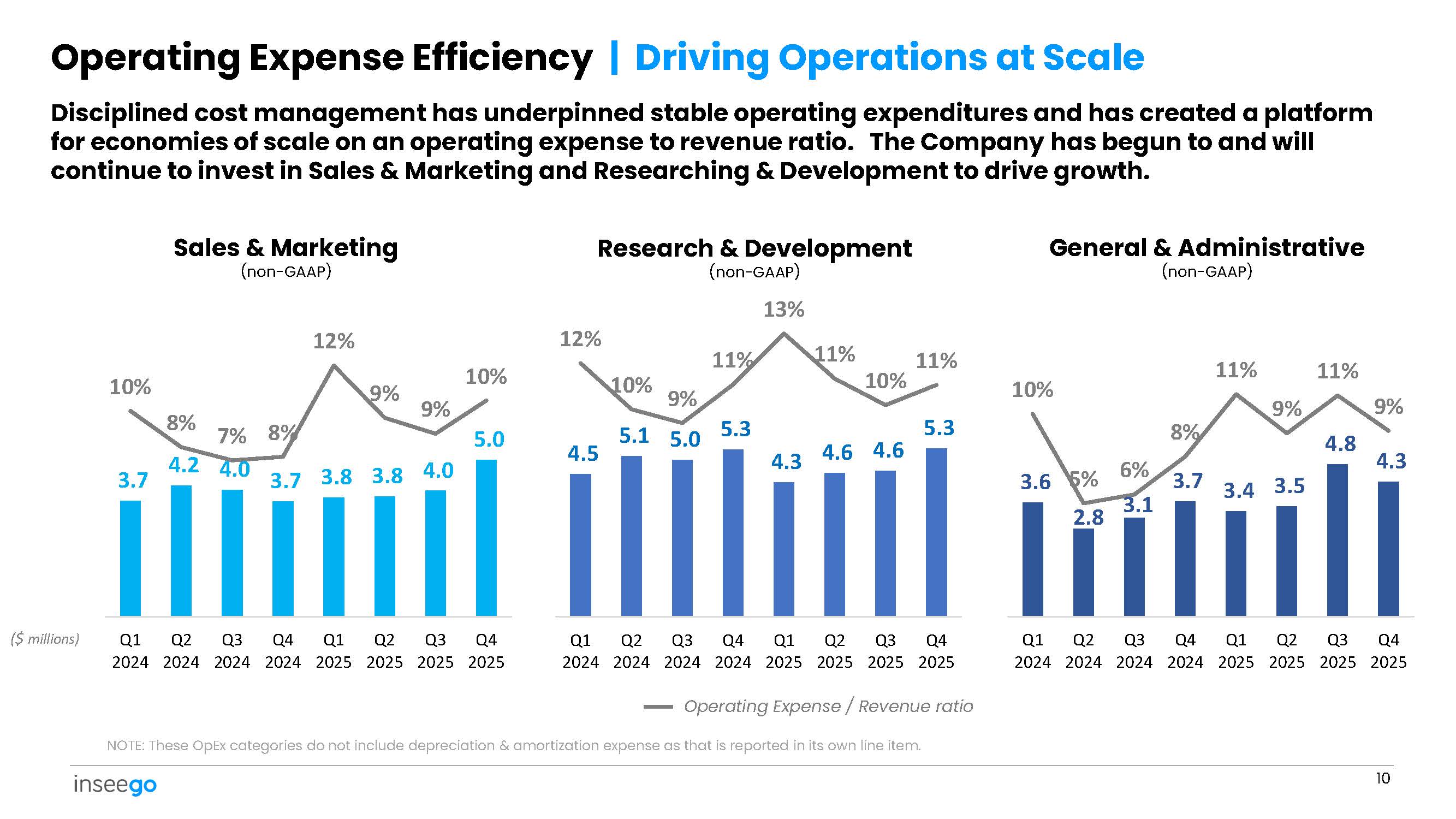
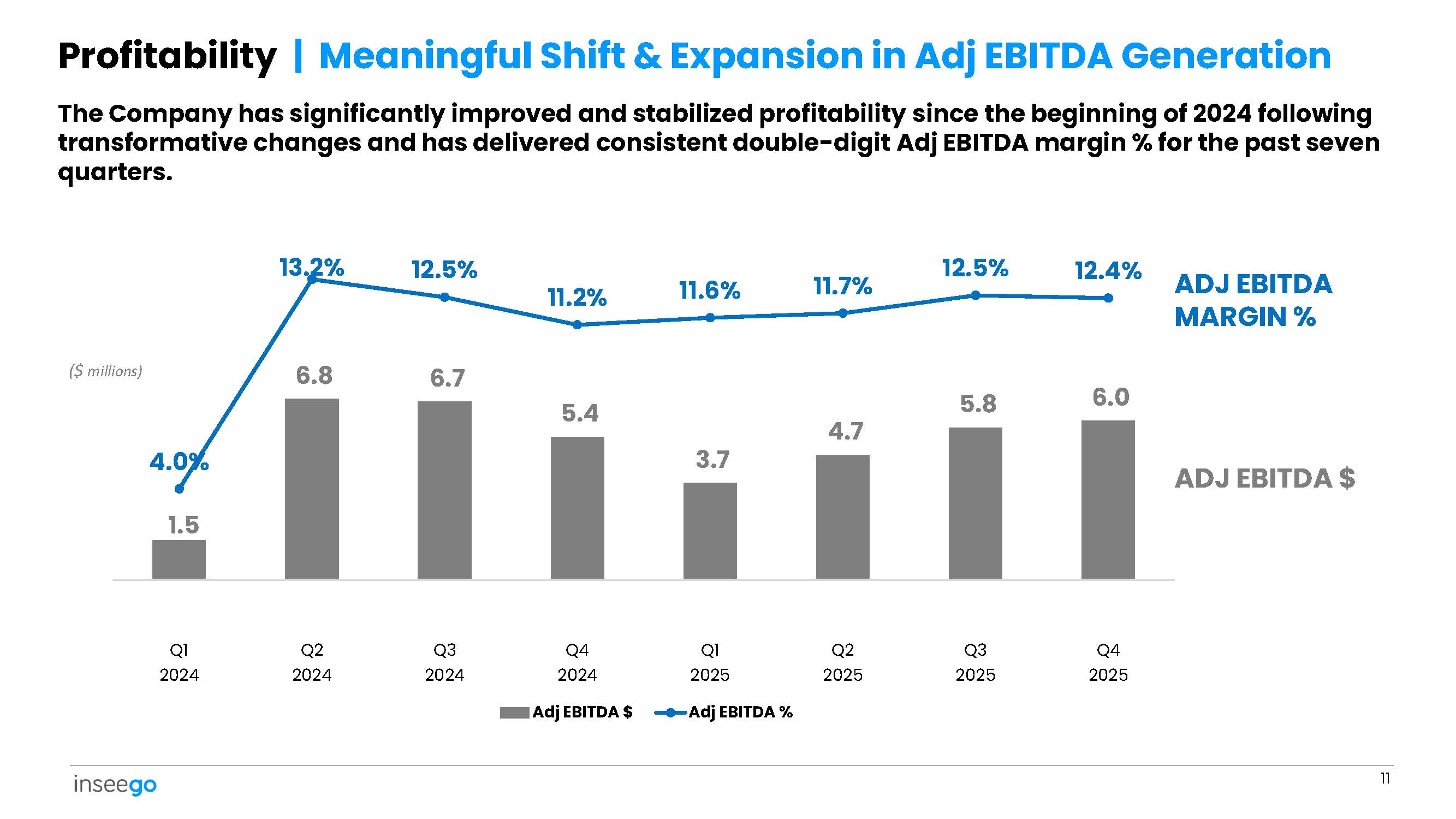
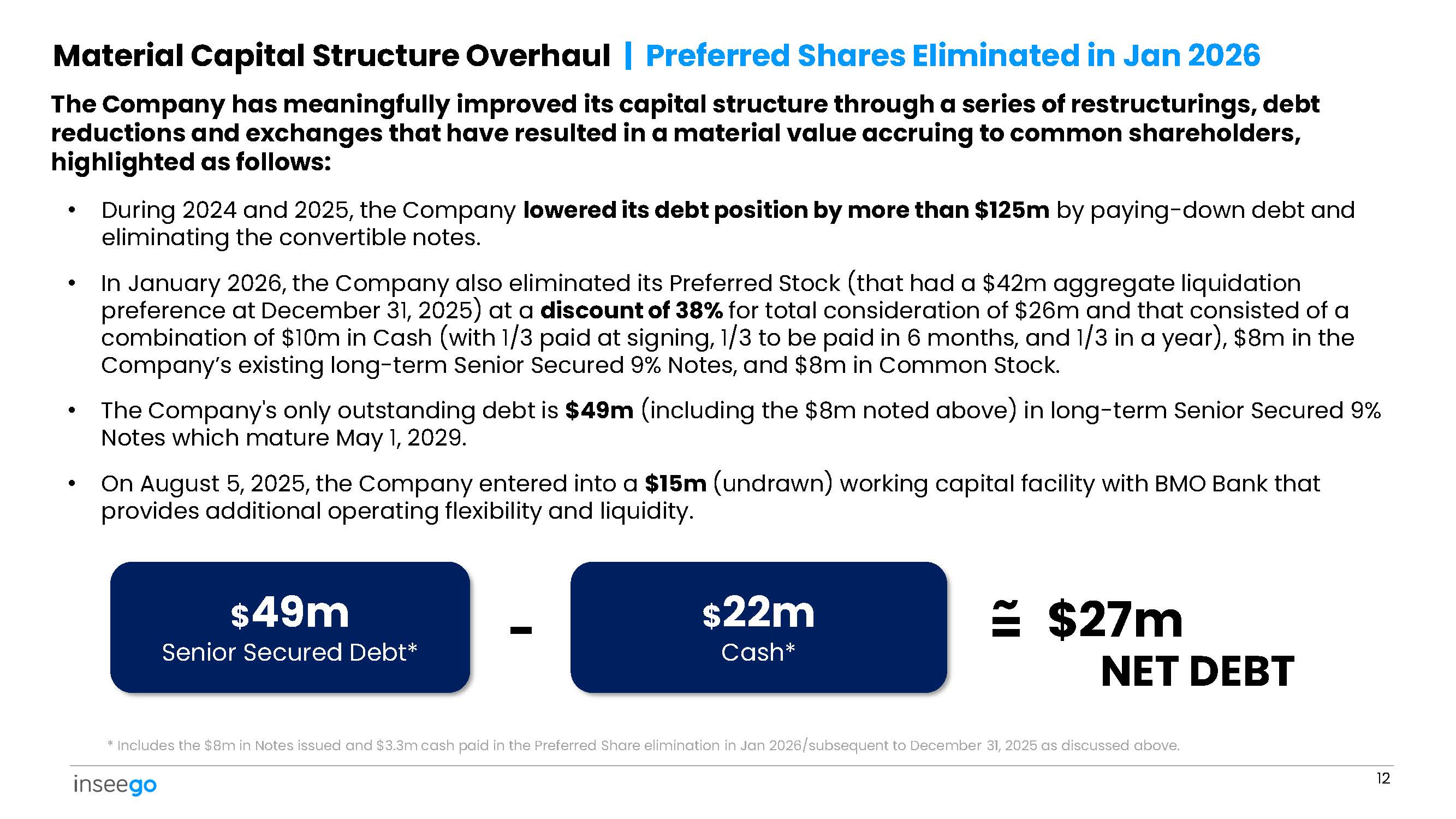
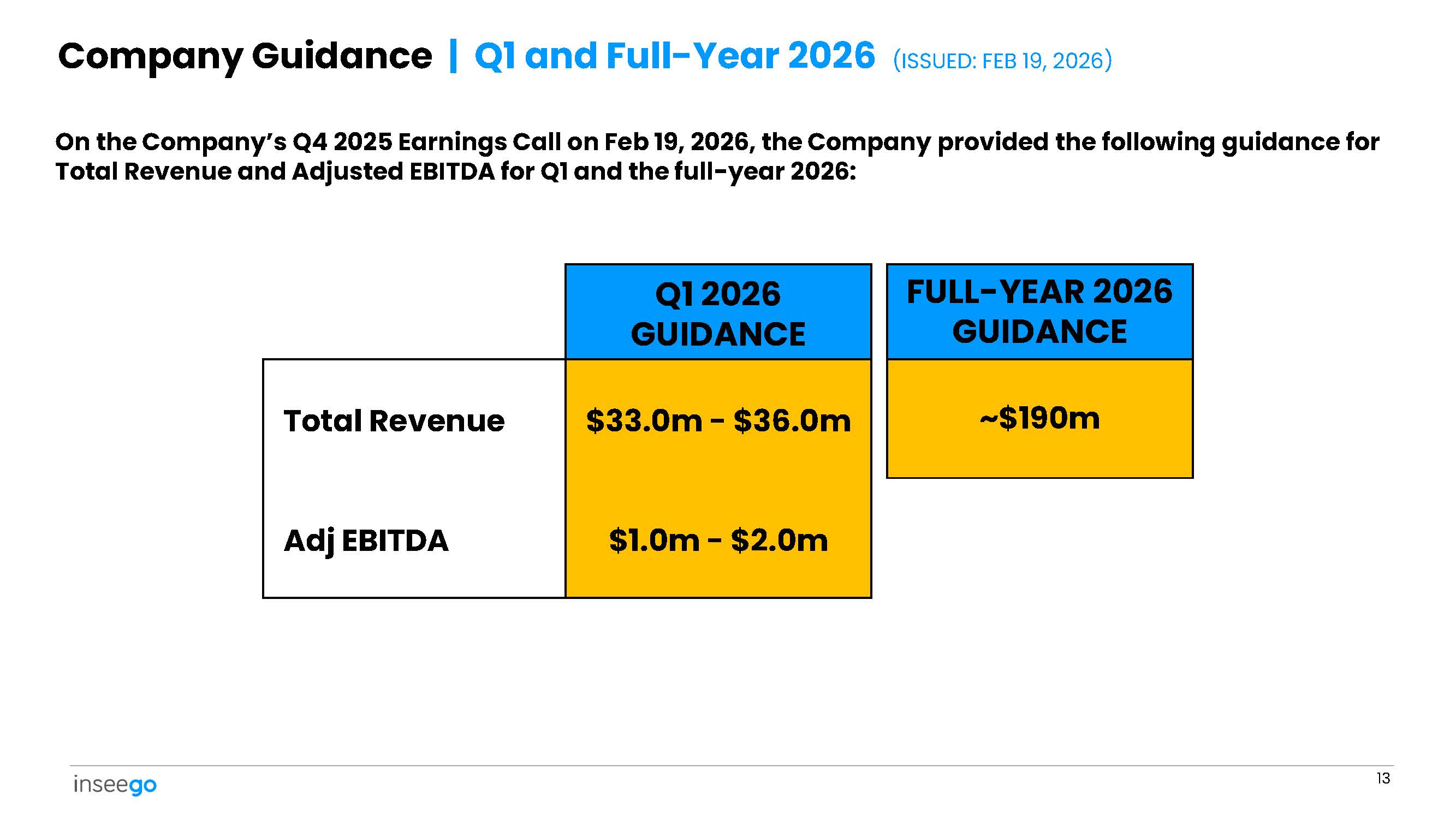
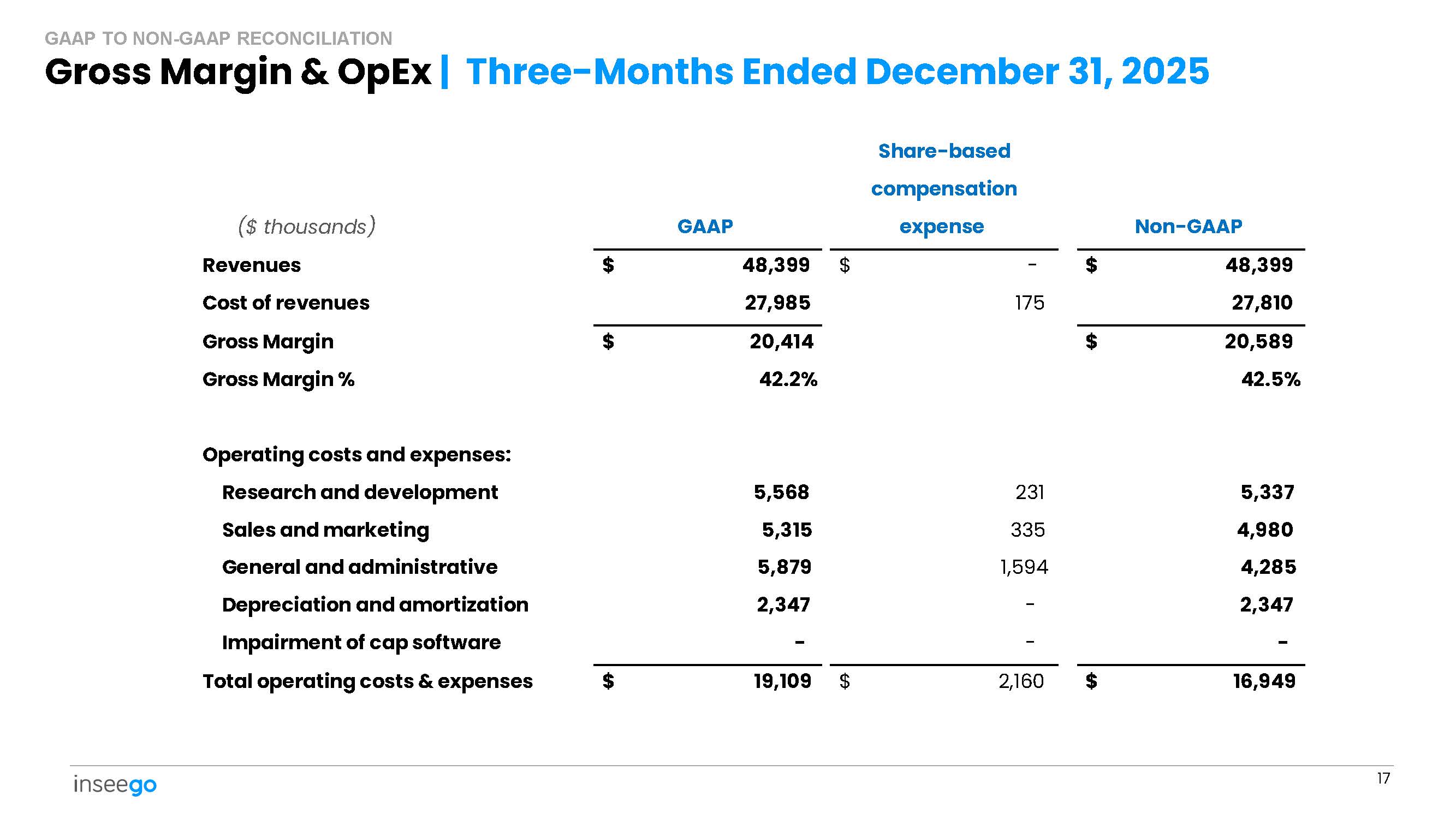
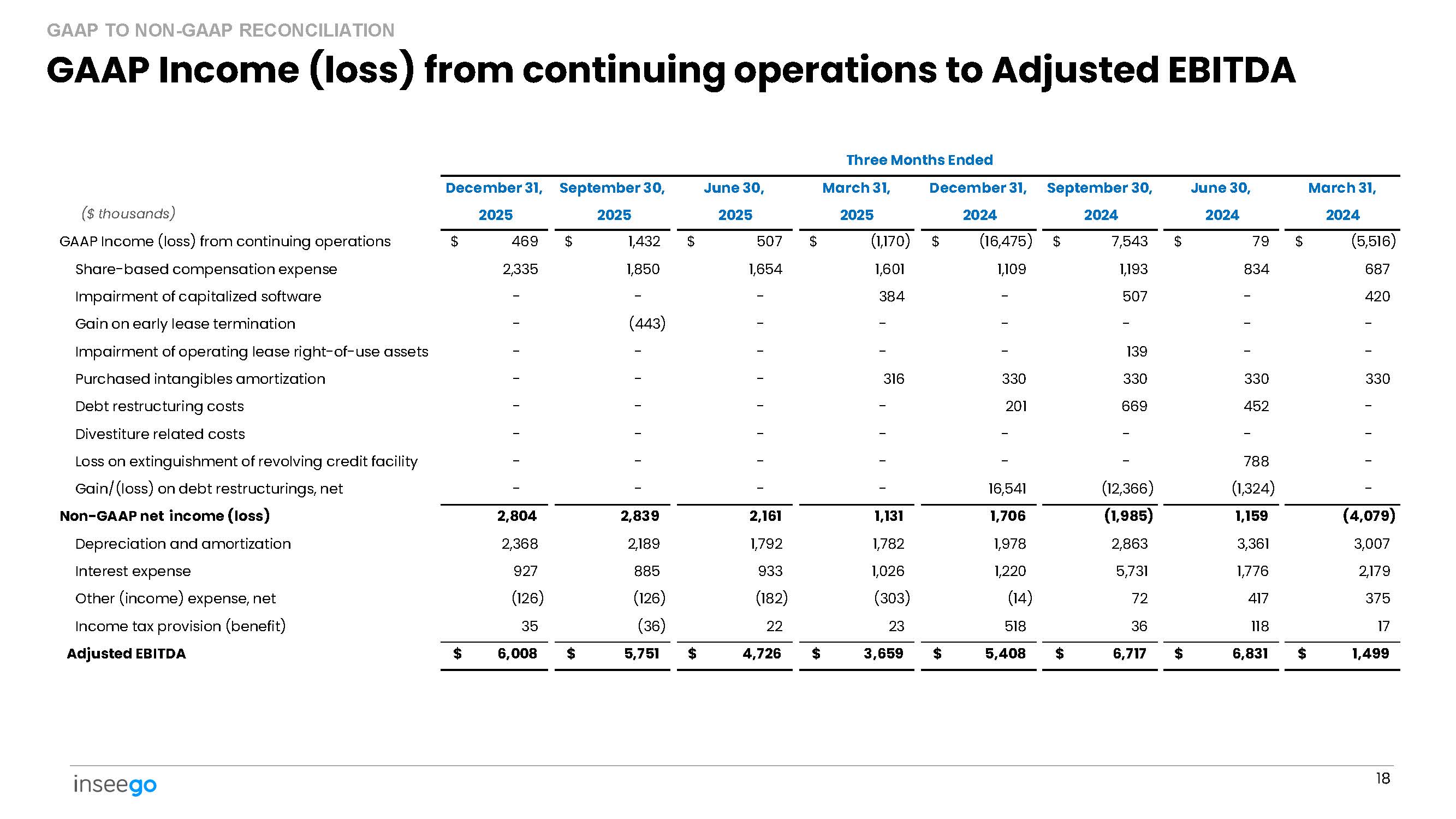
Thank you, Juho. Hi, everyone. Thank you for joining us. I'd like to cover 3 topics today. First, I'll take you through some details on the Q4 and full year 2025 financial results. Second, I'll provide an update on a material improvement in our capital structure that is adding to stockholder value. And third, I'll share some color on the financial profile of the business and provide guidance for Q1 and look at the full year 2026. As we always do, we'll wrap up the call by opening up to your questions. In 2025, we delivered 3 consecutive quarters of sequential revenue growth, culminating in a strong Q4 that exceeded guidance and paired with strong gross margins and disciplined spending resulted in solid profitability in the form of adjusted EBITDA that was the second highest on an apples-to-apples basis in more than a decade. On the top line, total revenue for Q4 was $48.4 million, driven by higher mobile volumes, increased channel activity, continued strength in FWA and a consistent contribution from our Inseego Connect and Inseego Subscribe SaaS offerings. As expected, mobile revenue was strong in Q4 2025 and was driven by a more broad carrier adoption and ordering cadence. While FWA revenue declined sequentially from the record Q3 2025, which benefited from new product rollouts at a carrier customer that we discussed last call, FWA revenue in Q4 was up 50% year-over-year and was driven by the diversification of our carrier customer base and solid channel activity. Software services revenue was $12 million in Q4, consistent and again providing a stable high-margin contribution to results. For the full year 2025, total revenue was $166.2 million, reflecting sequential quarterly momentum throughout the year. Moving through the P&L. Non-GAAP gross margin in Q4 2025 was 43%, up 75 basis points sequentially and driven by sales of some high-margin mobile products and the continued contribution from our high-margin SaaS services. For the full year 2025, non-GAAP gross margin was also 43%, reflecting an overall strong FWA business and our software services contribution and also the highest level of gross margin has been on an apples-to-apples basis in more than a decade. Non-GAAP operating expenses for Q4 were $17 million or 35% of revenue, reflecting the targeted investments in sales and marketing and R&D to support Tier 1 execution and new product launches that we talked about last quarter. As we also talked about and we'll review in a few minutes, we're continuing to make those investments in Q1 2026 to drive both revenue growth and scale as we move through 2026. For 2025, non-GAAP operating expenses were $59.4 million or 35.7% of total revenue. Adjusted EBITDA in Q4 2025 came in at $6 million, a 12.4% margin, among the highest dollars and margin percentage also in more than a decade. About $1 million plus of benefit was from the timing of R&D spend that pushed out of Q4 into Q1 2026 that I'll get to in a moment. For the full year 2025, adjusted EBITDA came in at $20.1 million, representing a 12.1% margin. We see this as an important overall proof point in our ability to invest in growth in the short term while maintaining profitability over the long term. Turning to the balance sheet. We ended Q4 with $24.9 million in cash, a very manageable debt balance of $41 million or approximately 2x LTM adjusted EBITDA. The strong cash finish to the year was a function of a combination of favorable outcomes on customer payments, inventory dynamics and strong working capital management by the team. Overall, the balance sheet strength underpins how we run the business and leads directly to my second topic, our capital structure. Last month, on January 14, we retired 100% of our outstanding preferred stock. It had a liquidation preference of $42 million as of December 31, 2025, and we exchanged it for $26 million of aggregate consideration, representing a 38% discount that immediately accrued to common stockholders. Total consideration consisted of $10 million in cash, $8 million in additional senior secured notes and approximately 767,000 shares of common stock. The cash is paid in 3 equal installments, 1/3 or $3.3 million was paid at closing, 1/3 will be paid 6 months following closing and the remaining 1/3 will be paid 12 months after closing. This transaction represents another purposeful initiative to simplify and strengthen our capital structure. By retiring the preferred at a meaningful discount to its liquidation preference, we reduced long-term obligations, improved balance sheet quality and immediately enhanced common stockholder value. The preferred stock was held by an affiliate of Mubadala Capital. And so as a result of the exchange, they now hold the position in our common stock. We're pleased to have them in the value creation going forward as a long-term common shareholder. With that context on our capital structure, let's now turn to our thoughts on the business and financial guidance for Q1 and the full year 2026. As we discussed on the last call, we started investing meaningfully going into Q4 2025 in new product development and go-to-market capabilities to drive revenue growth in 2026. We're committed to and expect to deliver that revenue growth outcome. We also talked on the last call how 2026 would be front-loaded with spend in the first few months impacting profitability to similarly support carrier ramps, multiple product launches and overall portfolio expansion. Importantly, with the now expanded carrier customer base, that spend positions us to scale the business, drive operating leverage and deliver profitability improvement in the second half of the year. To add more color on the revenue profile, as we've seen historically, Q1 has been a baseline quarter for the year from a revenue perspective, where Q1 has been down from Q4 for 3 of the last 4 years. We see this dynamic for Q1 and 2026, albeit for 3 specific factors. First, the second half of 2025 benefited nicely and particularly from a strong ramp of our new FX4100 FWA product with a Tier 1 carrier and from elevated mobile volumes driven by carrier promotions. Second, we have a Tier 1 FWA customer who went through a sizable company reorg and business realignment, as Juho mentioned, that impacted Q1 volumes and timing. And third, our new MiFi portfolio is set to launch late in Q1 2026, delayed from our initial target date, but that's setting up to drive a meaningful contribution beginning in Q2. And so while Q1 2026 revenue is lighter than desired on new product rollouts and transitions, we remain very positive on the outlook for both mobile and FWA in 2026 as we execute with our Tier 1 carriers and continue expanding our routes to market through SSPs and VARs. Looking at non-GAAP gross margin, we expect Q1 to reflect a lower mobile revenue margin, partially offset by a return to solid gross margin contribution on FWA and consistent software services. Total non-GAAP operating expense dollars are expected to increase modestly sequentially in Q1 2026 on the P&L and more so in total dollar spend in Q1 due to 2 drivers. First, as I mentioned, R&D spend originally planned for Q4 2025 shifted out to Q1 2026 on adjustments in product delivery timing. That shift out in spend resulted in more than $1 million of higher adjusted EBITDA in Q4 2025 and a corresponding higher spend level, therefore, now in Q1 2026. This funding of new product build-outs will also be seen in higher levels of capitalized R&D in the quarter as we've discussed. The second dynamic driving higher current spend in Q1 is the investments in sales and marketing that we've been talking about as part of the 2026 growth driver investment. Pulling this all together, we're providing the following guidance for Q1 2026. Total revenue in a range of $33 million to $36 million and adjusted EBITDA in a range of $1 million to $2 million. Overall, looking back at 2025, we see a similar dynamic for 2026 of growth and profitability coming off of Q1, growing in Q2, growing in Q3 and growing in Q4, with the important difference that there's now a foundation of a more diversified customer base and product portfolio, along with a rightsized balance sheet that provides important flexibility. And so on that strong foundation, we're also providing guidance for the full year 2026 for total revenue of approximately $190 million.
Operator
And the first question will come from Scott Searle with ROTH Capital.
Speaker 3
Great job in the fourth quarter, and it’s encouraging to see the growth in your diverse customer base and product portfolio throughout '26. To start off, Steven, I’d like to discuss the memory aspect. I noticed you mentioned some points in your opening remarks, but it seems like you’re handling that well. Could you elaborate more on this for the first half of the year? It appears that this will be a joint effort with your MNO customers going forward. Regarding the 2026 guidance, it certainly suggests an increase throughout the year, averaging around $50 million per quarter, which is a significant increase. Considering the anticipated timelines and product launches, what is your comfort level and visibility regarding this? With many factors influencing both OpEx and gross margins, could you provide some insight on how we should view adjusted gross margins and EBITDA margins in the latter half of the year?
Yes, sure. I will team up with Juho on a good portion of this, particularly regarding the memory aspect he mentioned. To answer your first question, Scott, we are pretty well secured for memory in Q1 and for most of the first half of the year, and we can discuss this further if you’d like.
Maybe the big thing, Scott, on the memory is that we have so many new exciting products and customers ramping in the first half. I wanted to ensure that we have enough buffer to capture upside and channel fill. From a memory standpoint, as we were doing that, we realized about six months ago that the memory market was going to get tight. So we took the necessary actions. I feel good about the first half inventory situation as well as the pricing environment.
Thank you for the question, Scott. You bring up several important points regarding our guidance. The key takeaway is that we anticipate rapid growth, particularly in Q2, where we expect results to reach the high 4s. Subsequently, Q3 and Q4 should show a figure with a 5 at the beginning, aligning with our forecast of $190 million. We understand your perspective on this. Additionally, as we've discussed over the past few quarters, EBITDA tends to be lowest in Q1, and it starts to increase significantly in Q2, continuing through Q3 and Q4. The average we mention for the year doesn't accurately represent our performance, as the first half has a lower rate and the second half sees a much higher rate. We expect to finish the year with solid EBITDA and margin percentages. I'll pause there—does that address your question?
Speaker 3
That's perfect. And if I could just quickly tack on. Juho, there's been a lot of dynamic changes within the industry, I think, from a competitive standpoint. I'm wondering if you could give us some thoughts in terms of how you see your share shifting over the course of 2026. A lot of moving currents, I think, competitively in the mobile hotspot market. But then also, if you can provide a little bit of color in terms of some of the new product portfolio. Is that mostly going to be MiFi? Are there some other products that we should be expecting to see in new categories potentially taking us into international markets in the second half of the year?
Scott, excellent questions. So I'll start with the mobile part. What I'm super excited about is that we'll have now all 3 large carriers launching our new mobile generation. And like we discussed in the prepared remarks, we were hoping to see that earlier in Q1, but it will now take place towards the latter part of Q1. But the thing with mobile is that it's a predictable run rate business. Think of it like a light switch. Once you launch the product, you get the share in the category. All 3 of them are also positioned in a higher volume segment than where you've seen us historically. So I feel really good about the MiFi volume. And I think I've been fairly open about it. Look, I think in mobile or in hotspot, our job really is to go and consolidate the market. And these 3 across all 3 is a huge, huge milestone. I also see opportunity towards the latter part of the year or going forward in expanding a hotspot. There's also a value segment. And I also believe there's a great opportunity in the premium segment. So mobile, we innovate the category. We're huge fans of, and we look forward to continuing investing and growing in that. I believe your second question was then on the portfolio. So I already described the mobile part of the story. Like you know, in FWA, today, we have, if you think good, better, best. We have the better with the FX4100 that we launched about 9, 10 months ago. We recently introduced FX4200, which is the best. And now what we're going to roll out during the first half is an entry-level, yet enterprise-grade, same manageability, everything you know us for, but a lower tier router. So we'll complete this good, better, best for SMB, enterprise, call it, carpeted environments. And then, of course, there's a lot of other attractive verticals. So that would be my summary on the immediate portfolio expansion.
Speaker 4
So as we think about the 2026 guide across your mobile and your FWA businesses, the FWA side of the business continues to gain momentum and you kind of highlighted the mobile side of the business as being stable. Just wondering with the new customer ramping this year and mobile coming off a softer '25 and different dynamics, should we still expect the Fixed Wireless Access side to be a relatively larger contribution to growth this year?
Thank you, Tyler. We will collaborate as usual. We anticipate growth in revenue for both mobile and FWA in 2026, but for different reasons. The mobile segment is more stable, while FWA continues to expand. I would love to hear your thoughts on this regarding both revenue and customer base. To clarify, you mentioned flat performance, but I see it as a growth driver for both segments.
Yes. I want to emphasize that there is ample opportunity for growth in mobile, and we will pursue it vigorously, as it is expected to perform exceptionally well. Additionally, Fixed Wireless Access, supported by our portfolio and customer expansion, is also set to be a significant story in 2026. Looking ahead to 2026, we will determine which of these two categories grows faster. However, from a long-term perspective, the market potential for mobile Fixed Wireless Access, along with our new product introductions, will greatly enhance our market share in mobile. In the long run, this will favor FWA in the mix. Thanks, Tyler. That's a great question. I believe you’re asking because I’ve mentioned it in my remarks, and I've talked about it a little already. In my view, the MSOs, whether they're cable or fiber, often have cellular assets as well. They're somewhat like carriers, so I would categorize them alongside the large three carriers. There are excellent FWA use cases with the MSOs, beginning with failover from day one. We've made significant investments in both products, with the FX4200 being the ideal router platform for that use case, and in our cloud with a deep understanding of those applications. I expect engaging discussions with MSOs as the year continues. On the other hand, the VARs and managed service providers, which we can refer to as the channel, represent a different scenario. This is a somewhat fragmented network of partners. I want to highlight that the three major value-added resellers, CDW, Insight, and a third one I can’t recall right now, have all launched programs and have been stocking the FX4200 since late last year. This will lead to a steady ramp, similar to FWA. These larger entities, whether carriers or MSOs, will stimulate an immediate increase in volume. In the long term, the VARs and MSPs will become significant growth drivers for us, but their impact will take more time to materialize. The third major value-added reseller is SHI. Did I address your question?
Speaker 5
Good quarter, and congrats on all the deals. As we look at the software business, you have one customer who's a material percentage of that software and services revenue. Is there an opportunity with the other 2 customers to deploy a similar program as your historical leading customer?
Christian, thanks for joining us. Actually, I'll answer both aspects of the software business. Let me start with the Inseego Connect, which is our device management platform, orchestration platform. One of the really important things that we've implemented now, especially with the FX4200, but much broader is that since we've made that investment over 2025, in creating a world-class device management platform with great differentiation capability. Our go-to-market motion has really changed on the routers. It really is a solution first sale attach rate, but also the value capture is growing. The installed base, of course, takes time to grow. But again, here, if you take a multiyear view, Inseego Connect is a really important part of our story. It also provides other service opportunities for us where we can expand, as you might imagine. If you look at the subscriber life cycle management platform, yes, for sure. We've done significant investment here as well, and we're looking at from a business development standpoint of view, expansion opportunities. It really does have a unique feature set, especially if you go into the Fed and government space where you have a lot of compliance, a lot of complexity in terms of how you manage those customers, and there are significant benefits for carriers, broadly speaking, to leverage that platform.
Speaker 5
Great. I guess my second question, with the broadening base out of all 3 carriers, there seems to be a greater industry focus on enterprise class Fixed Wireless Access versus just residential. From a bigger picture standpoint, do you believe any of this has to do with Industry 4.0 initiatives or greater acceleration finally of private 5G networks by the carriers and their thoughts?
So there was an immediate gold rush in FWA when 5G merged to consumer. The problem with consumer is the ARPU and the consumption profile. Very, very data demanding, massive consumption profile and you're competing against cable and other value props for the consumer. Enterprise, on the other hand, has a very rich ARPU profile. And if you think about it, the usage profile is completely the opposite of the consumer because you'll be working through the day, you maybe should not be streaming Netflix at the office. So just like from the basic dynamic standpoint of view, very favorable from a carrier P&L standpoint of view. There has been a significant constraint on the industry, and it really has been spectrum. So C-band when the auction happened, launched a massive wave of FWA expansion. There was a recent acquisition that one of the carriers made that you're very much familiar with. And all of a sudden, FWA and especially the business or enterprise segment became top of mind because now you have the capacity to go there, and it has the highest ARPU. So one of the really foundational things that we believe in is that cellular will take over the world in 2 ways. One, 5G performance is now broadband-like as opposed to 4G. 6G is yet again another 10x faster. So you could make the case where now cellular should become the primary and there shouldn't be a discussion around it. It will also release massive amounts of spectrum, massive amounts of capacity when you can utilize higher auction spectrum assets that are still out there yet to be deployed. And then look from an enterprise end customer standpoint of view, it's super easy to deploy, a single management interface. You don't need to worry which of your locations to get fiber or cable or how do you patch all of that together. So I think there's a lot of benefits that will continue to accelerate enterprise FWA. And that was one of the data points I was sharing is this 30% to high 30% CAGR on service provider revenue increase in the enterprise FWA.
Speaker 6
I have a couple of questions. First, it's great to have Verizon back. However, I am curious if this will impact the variability of results going forward. As we look ahead beyond the initial rollout, will your visibility improve or decline by having Verizon involved compared to working with AT&T and T-Mobile?
That's an FWA question. I'll take it, Lance. So the way to look at it is that I kind of go back to my previous answer, there's a strong economic incentive. All 3 players have made the statement that they're investing in FWA for enterprise, where we got with our existing large customer, it took a couple of product generations, and it took some time to develop the co-selling motion and to be able to drive that kind of volume uplift. So at this early stage, I can't really tell you like how fast each of these opportunities will grow. But I think we have very reasonable expectations, reasonable expectations that inform the guide for 2026 that Steven was sharing.
Speaker 6
Okay. Great. To revisit Scott's question about the full year EBITDA outlook, if I'm calculating correctly, it seems you are estimating a 12.1% EBITDA margin for 2025. Should we consider 2026 to be in a similar range, or is there a possibility for either upside or downside due to investment spending and other factors? How should we approach that in relation to the margin profile year-over-year on the EBITDA line?
Good question. We expect a similar outcome, Lance. The answer for the year isn't straightforward because we anticipate finishing 2026 at the higher levels you're mentioning, similar to where we are currently. However, the first part of the year will likely be lower. Therefore, the average for the year falls somewhere in between, which is hard to quantify. For instance, if the first half of the year experiences single-digit growth and the second half sees decent double-digit growth, you can calculate the average from that. But in short, at the rates we're seeing now, we expect to be at those levels in the second half of the year and definitely by the end of the year.
Speaker 6
Got it. And just one last question from me. Looking at the longer term, do you think double-digit revenue growth will be sustainable over the next few years? I don't expect guidance here, and I understand that 2027 may not be as strong as 2026. However, will we continue to see strong growth in those years, or do you think 2026 will mark a return to a new plateau?
Yes, we can. I think we said that at the end of last year as we're setting up for this year. And candidly, the growth profile for 2026 is a nice double digit with a pretty low week lane we might say internally, Q1. And so if we're pulling that off in a year where we're ramping a whole bunch of new products and transitioning, right, we're going from a company that was one product, one customer to many products, all 3 carriers, and we're doing that all this quarter. So like that's a big deal. And once that gets up and running, like that's a really nice model. And so a little probably long-winded, but the short answer is yes, we do believe that's a double-digit growth for the next several years.
Operator
This concludes our question-and-answer session. I would like to turn the call back over to management for any closing remarks.
Thank you for the great questions and for joining us today. Steven and I will be at the ROTH Conference next month, and we hope to see many of you there. I also wanted to thank our awesome employees for their hard work and dedication and our shareholders for your continued support and confidence in our vision. We are excited to have you with us on this journey. Thank you again for your time, and we look forward to catching up soon.
Operator
The conference has now concluded. Thank you for attending today's presentation. You may now disconnect.