Operator
Hello and welcome to Kane Anderson BDC Inc's fourth quarter 2025 earnings call. A question and answer session will follow the formal presentation. As a reminder, this conference is being recorded. It is now my pleasure to turn the conference over to Andy Wedderburn-Maxwell, Senior Vice President.
Good morning and welcome to Kane Anderson BDC Inc's fourth quarter 2025 earnings call. Today I'm joined by Ken Leonard and Doug Goodwillie, co-CEOs of KBDC, Frank Kahl, President, and Terry Hart, CFO. Following our prepared remarks, we'll be available to take your questions. Today's call may include forward-looking statements. Such statements involve known and unknown risks, uncertainties and other factors, and undue reliance should not be placed thereon. These forward-looking statements are not historical facts, but rather are based on current expectations, estimates, and projections about the company, our current and prospective portfolio investments, our industry, our beliefs and opinions, and our assumptions. These statements are not guaranteed a future performance and are subject to risks, uncertainties, and other factors, some of which are beyond our control and difficult to predict. Actual results may differ materially from those expressed or forecasted in the forward-looking statements. We ask that you refer to the company's most recent filing to the SEC for important risk factors. Any forward-looking statements made today do not guarantee future performance and undue reliance should not be placed on them the company assumes no obligation to update any forward-looking statements at any time our earnings release 10k and supplemental earnings presentation are available on the financial section of our website at kanebdc.com now I'd like to turn the call over to Ken Leonard good morning and thank you for joining us today I'll begin by providing an overview of our fourth quarter results and then share some thoughts on the current direct lending market conditions.
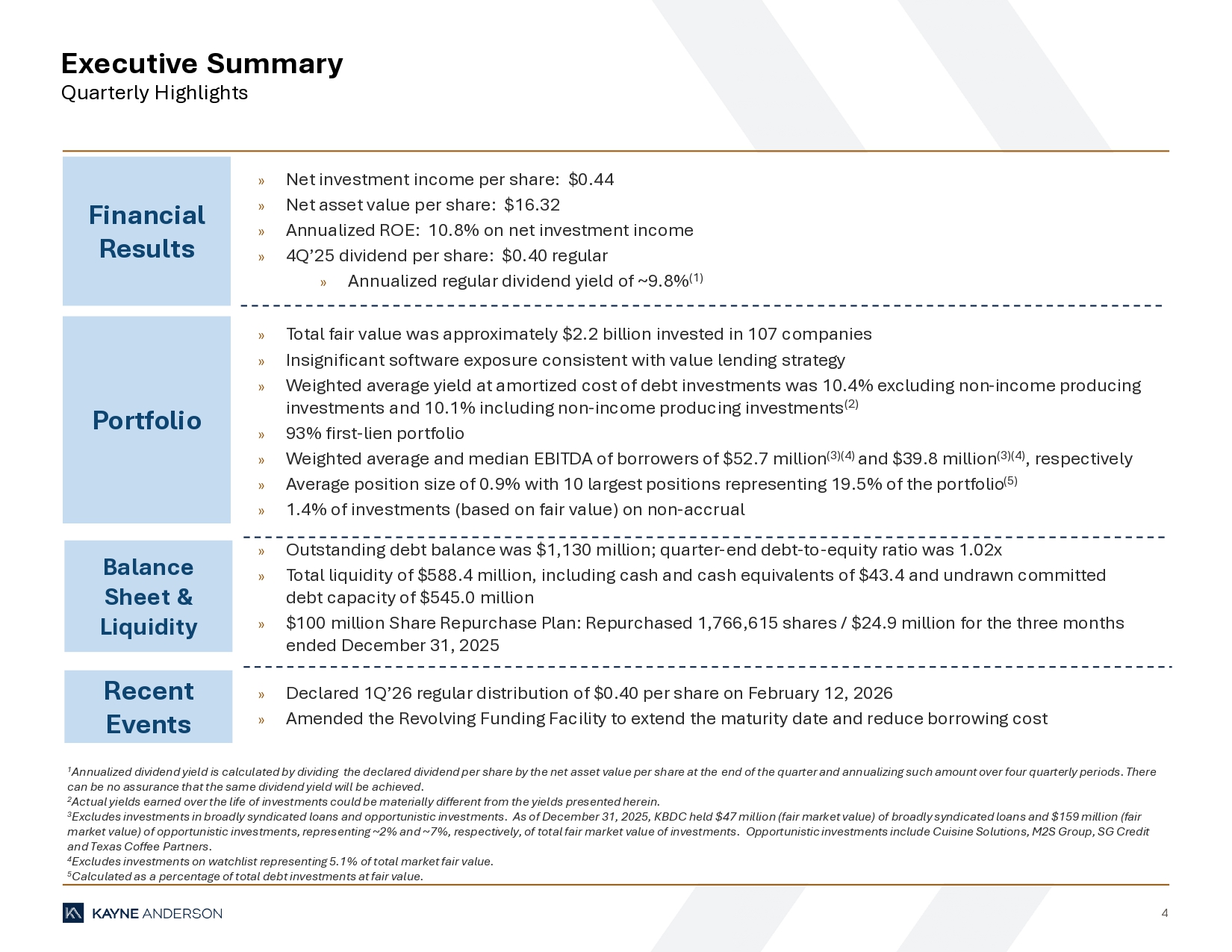
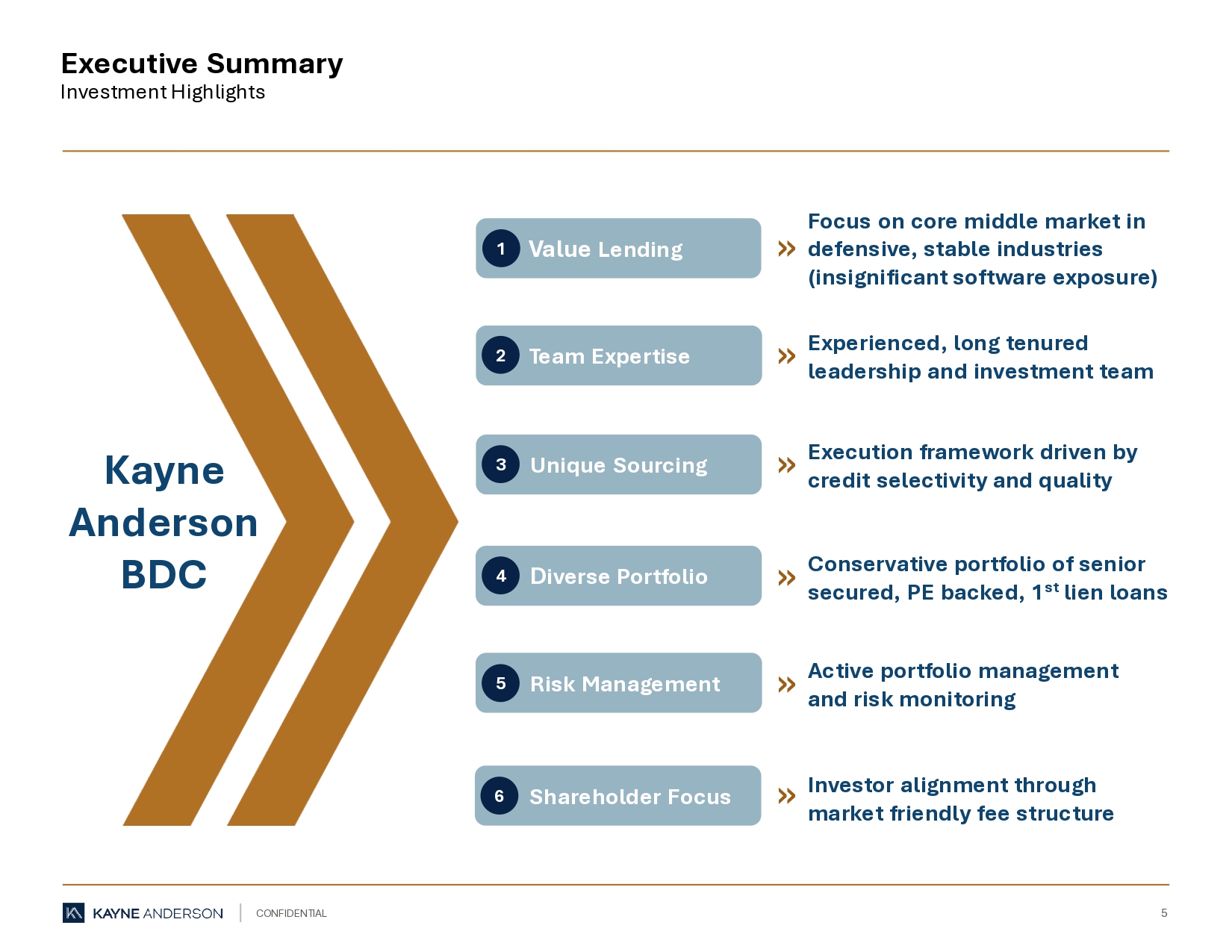
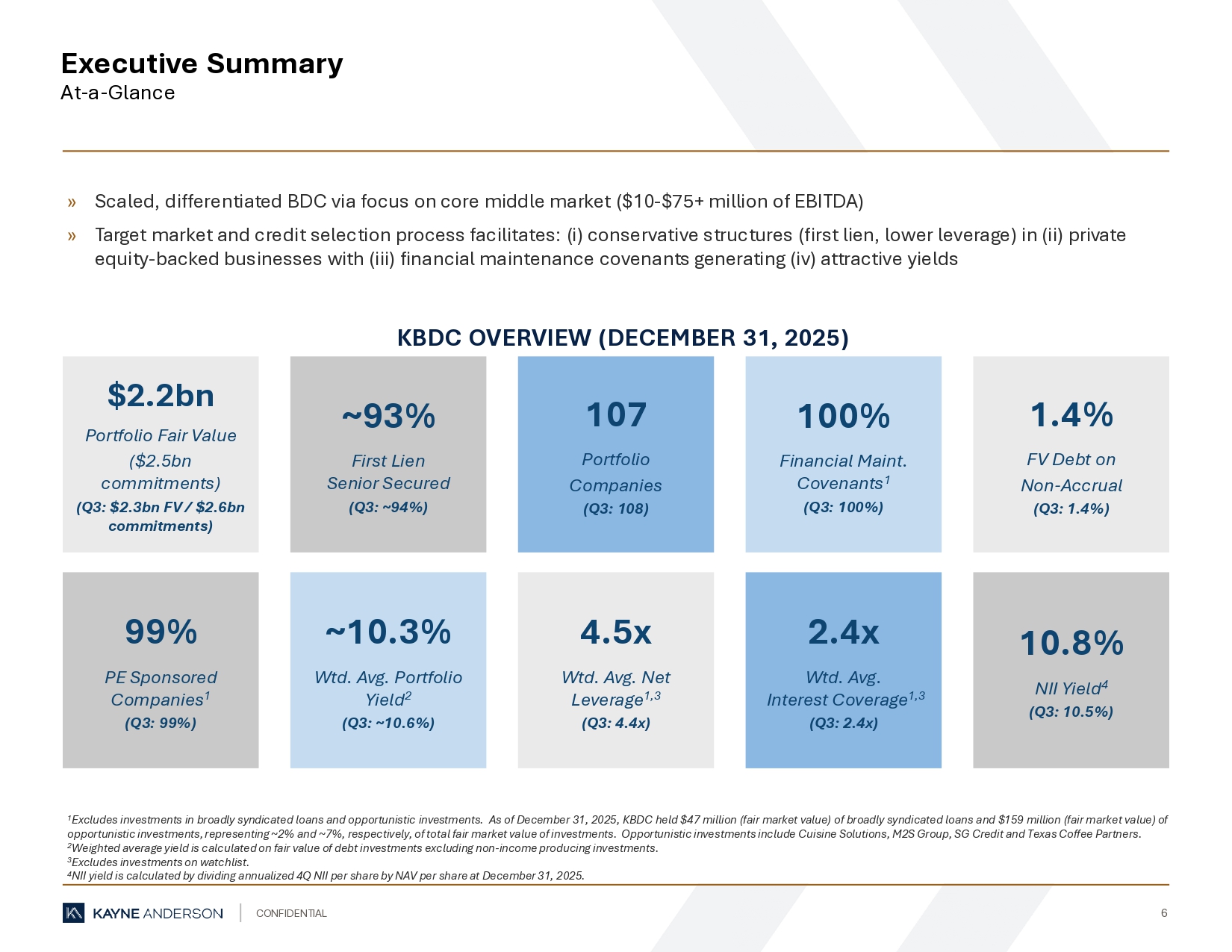
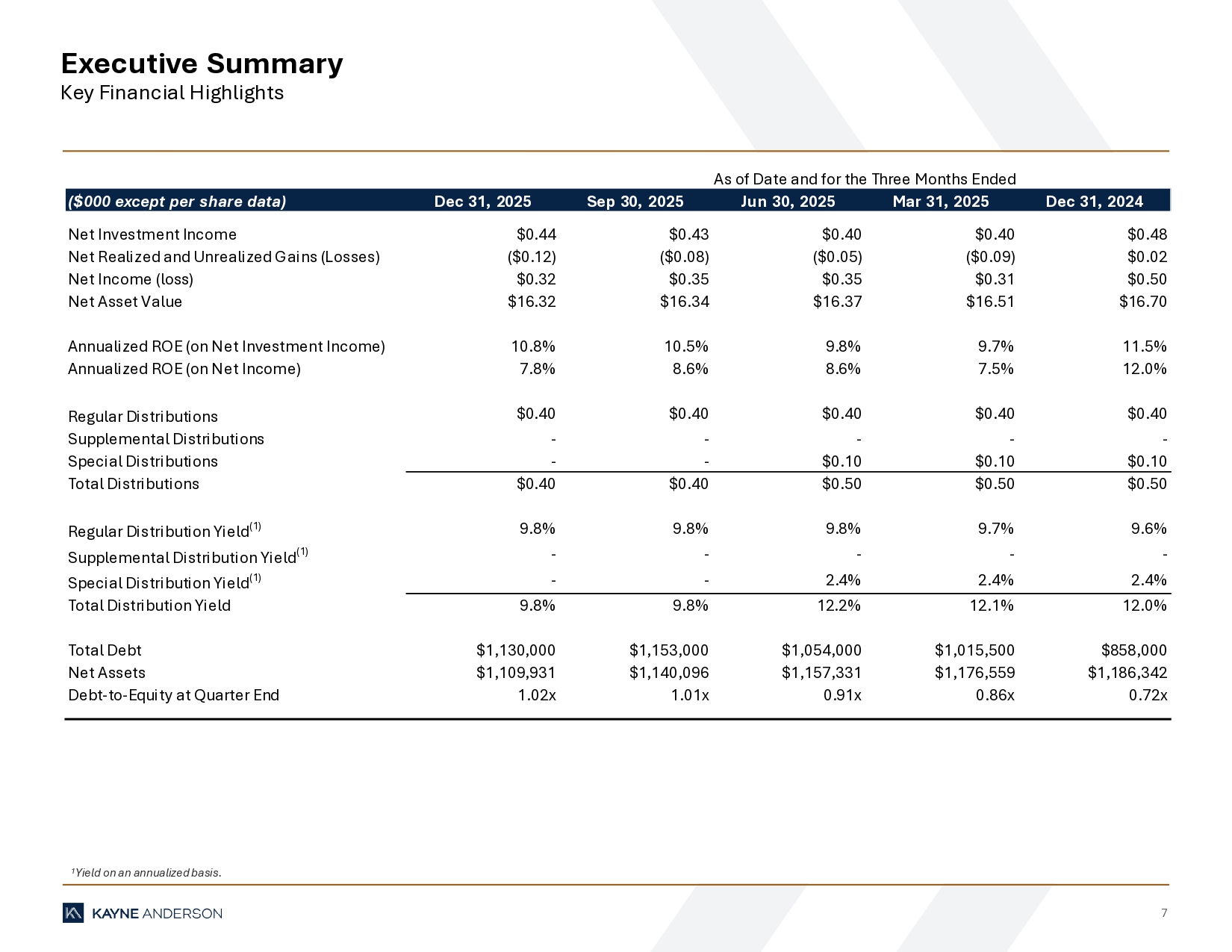
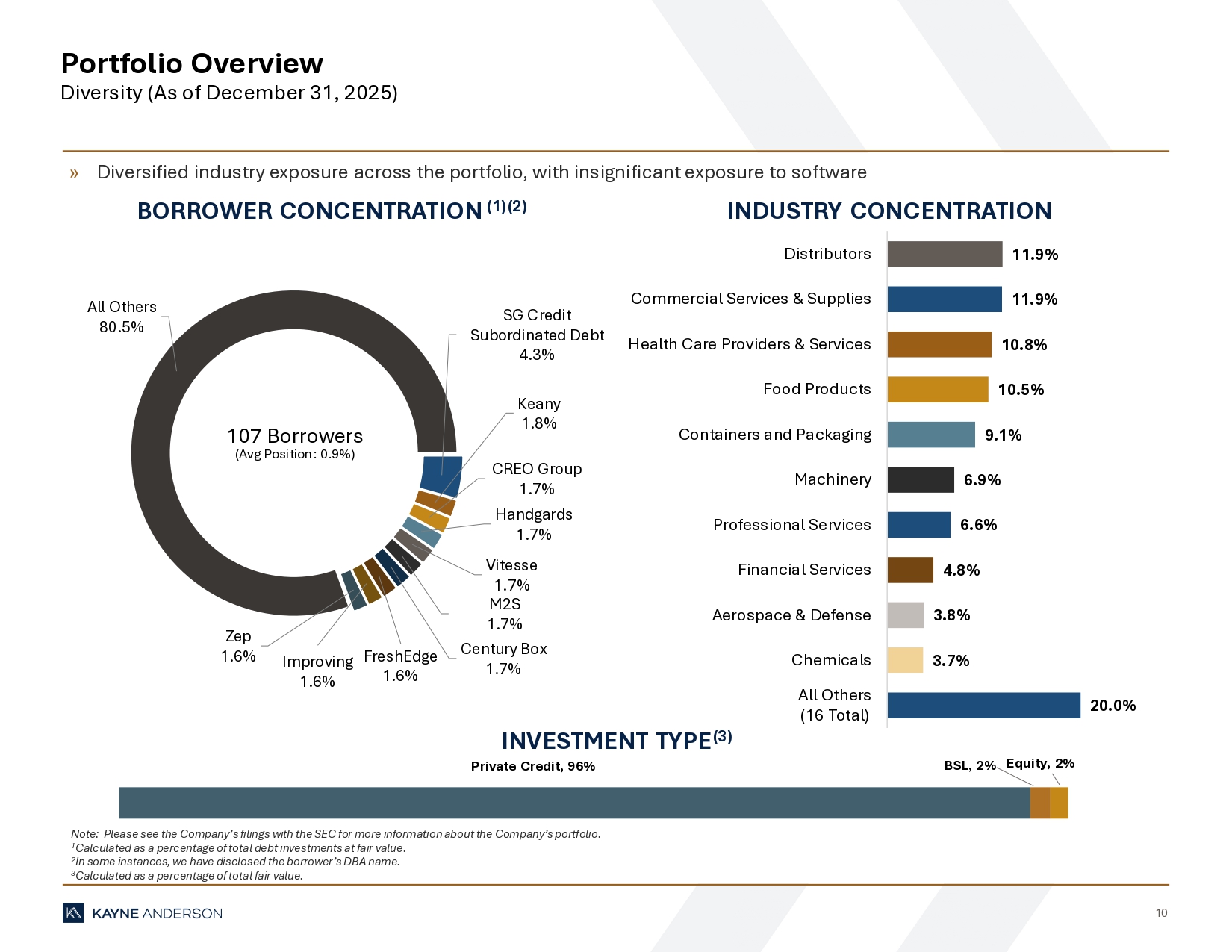
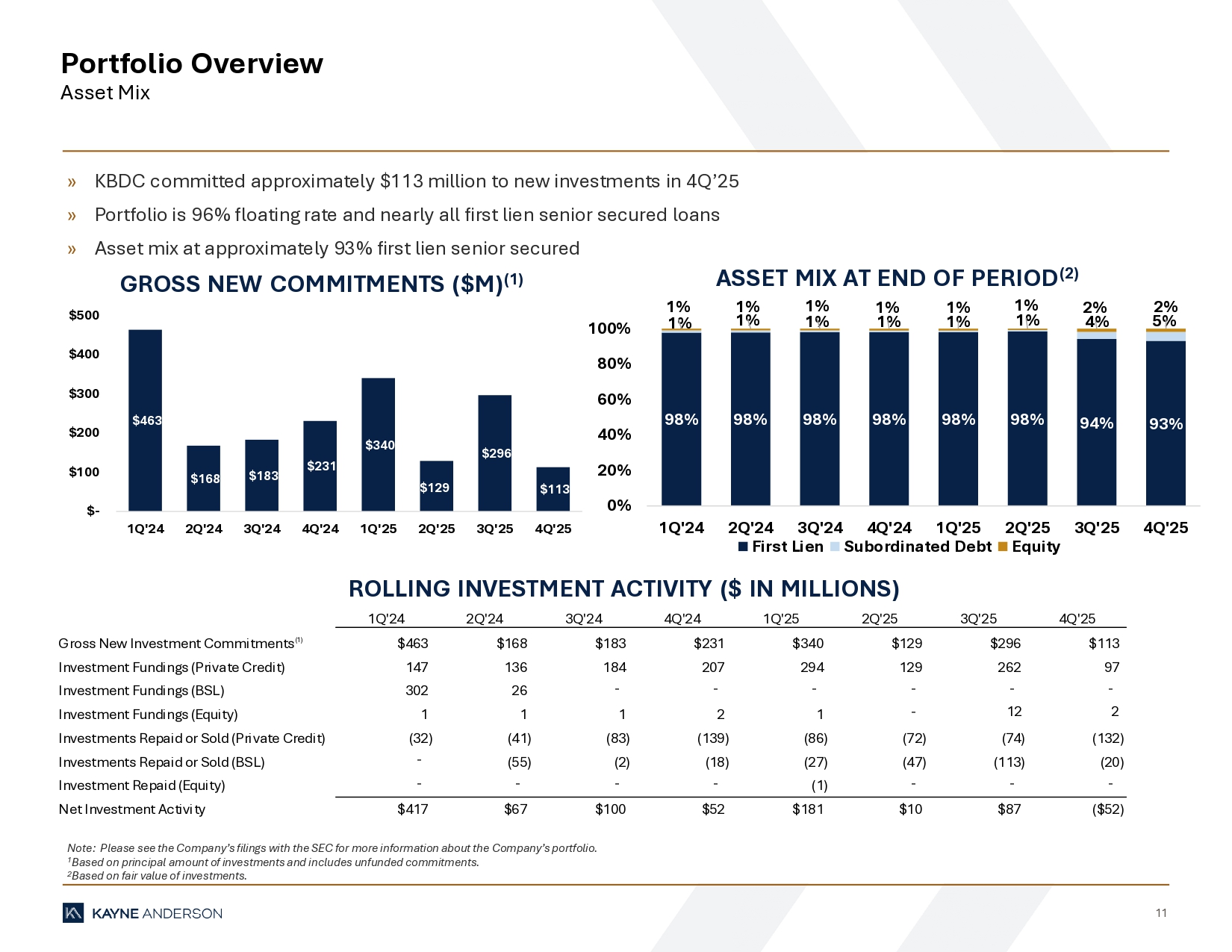
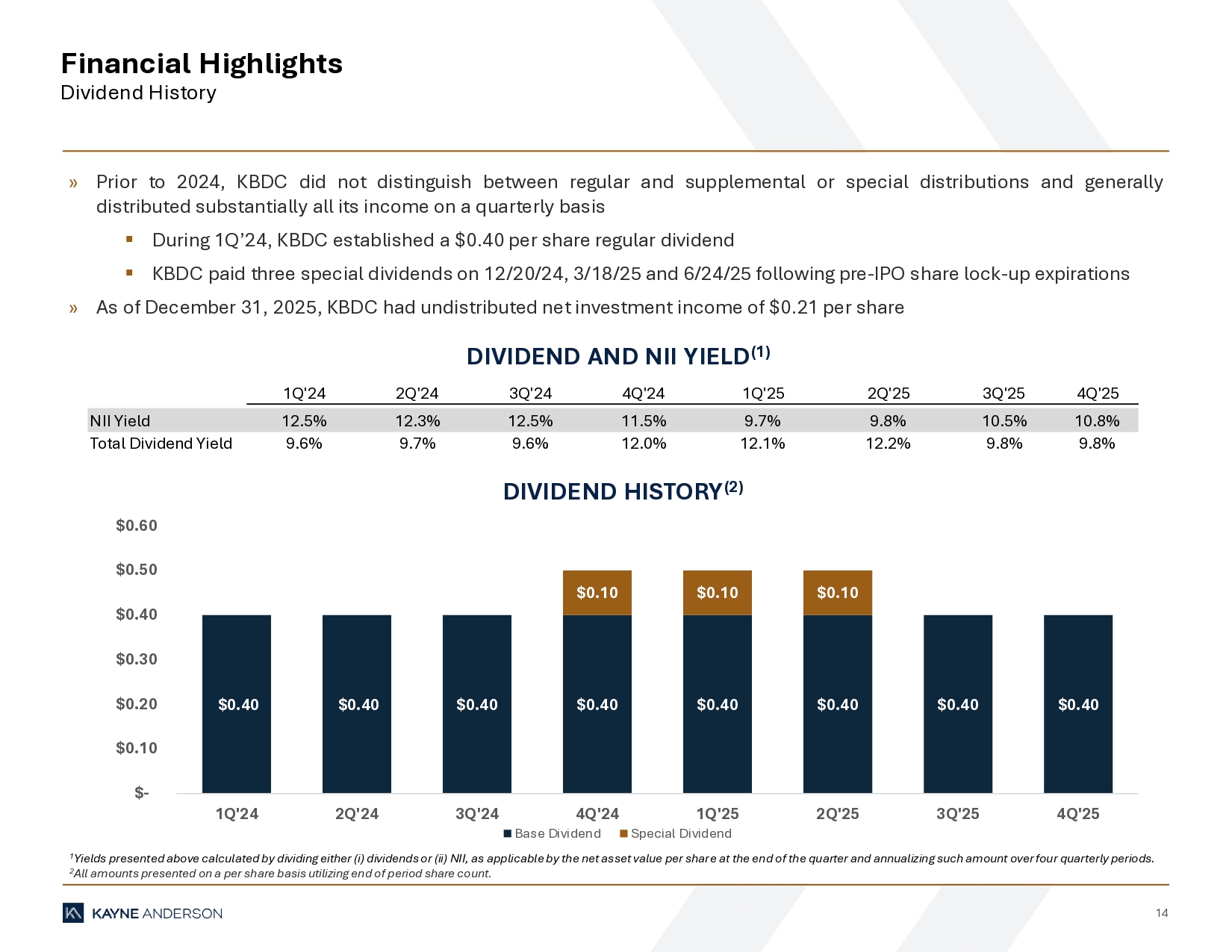
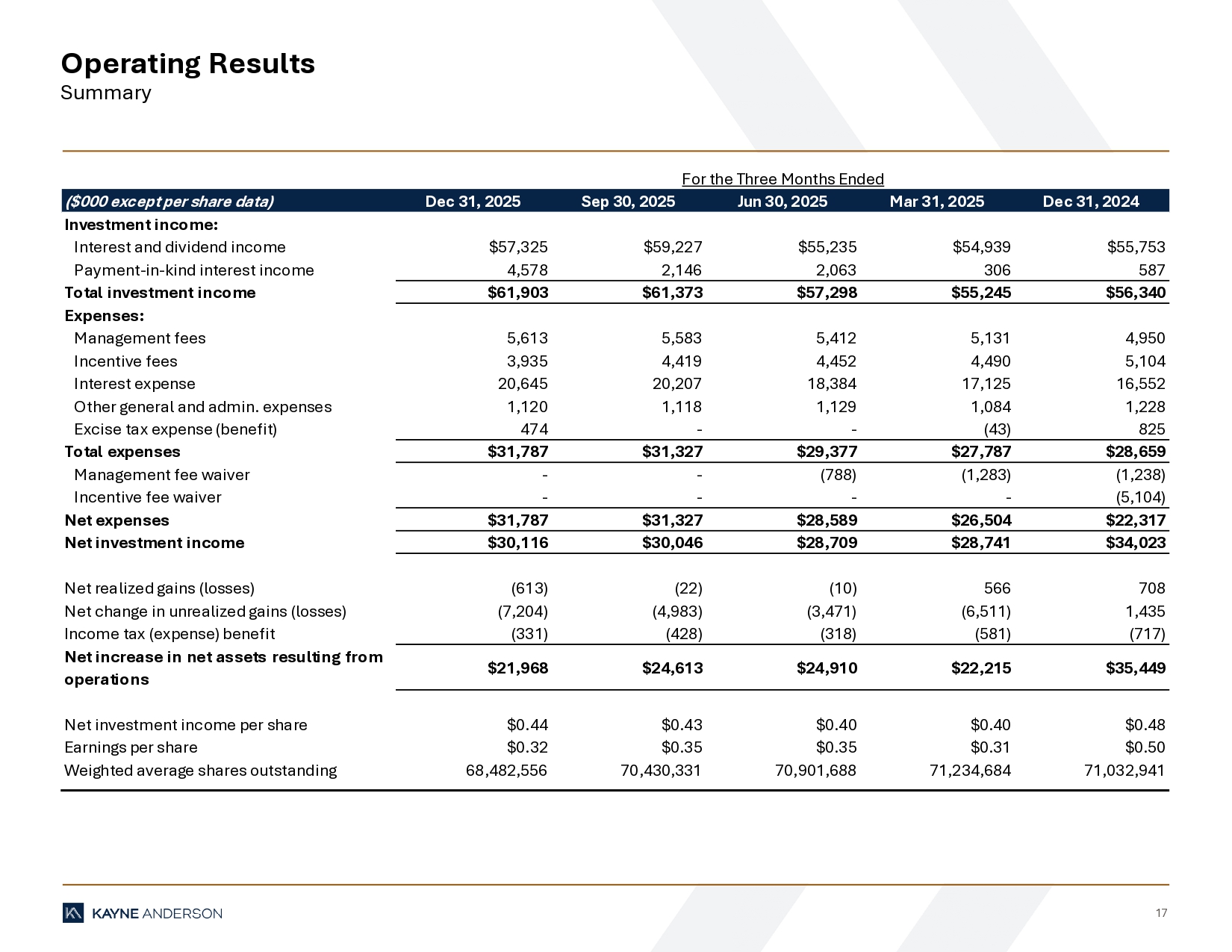
I plan to highlight how KBDC's value lending strategy has created a unique portfolio well positioned to whether any current headwinds associated with the market dislocation related to software and or tariffs. Frank Carl will then provide a more detailed overview of our portfolio and performance before Terry Hart concludes with KBDC's financial results. I'm pleased to report another solid quarter for KBDC. BDC as we closed out 2025 on a strong note. For the fourth quarter, we generated net investment income of $0.44 per share, representing an increase from $0.43 per share in the third quarter and a premium to the declared dividend. This performance translates to an annualized return on equity of 10.8%, demonstrating our continued ability to generate attractive risk-adjusted returns for shareholders in what has otherwise been a noisy period for the BDC sector. Our net asset value per share was $16.32 at the quarter end, down slightly from $16.34 in the prior quarter, reflecting the impact of some marks of the portfolio, which was partially offset by new investment originations and our strategic share repurchase activity during the period. Our dividend coverage ratio was 110%, supporting our regular quarterly distribution, and our board Board of Directors has declared a regular dividend of $0.40 per share for the first quarter, payable on April 16, 2026, the shareholders of record as of March 31, 2026. I would like to add that based on our current view of the market and our portfolio, we expect to be able to pay the $0.40 dividend for the entirety of 2026. Our portfolio continues to perform well from a credit perspective, with only 1.4% of the investments on non-accrual status. The portfolio's weighted average yield of approximately 10.3% on our income-producing investments positions us well to continue generating attractive returns in the current interest rate environment. These results underscores the resilience of our investment approach and the quality of our portfolio construction, with 93% of our portfolio structured as senior secured debt. As mentioned in my introduction, our value lending strategy deliberately avoids highly leverage loans, what we call deep and cheap, made to software businesses. While many BDC peers report more than 20% of their portfolios allocated to software and technology companies, our portfolio has approximately 2% of these sectors. Instead, Kane Anderson Private Credit has a long track record of providing loans to core middle market companies operating in traditional stable industry sectors, such as industrial and business services, distribution, and food products. Our underwriting emphasizes durable cash flows, tangible enterprise value, and disciplined leverage profiles. Our new originations have had average leverage to the borrower between 3.8 and 4.2 times for the last 25 years. We believe this approach enhances downside protection and positions the portfolio to perform consistently across market cycles. Turning to our investment activity in the fourth quarter, we maintained our disciplined approach to capital deployment while continuing to successfully source attractive opportunities in the private credit markets. During the quarter, we committed approximately $113 million to new private credit investments. Our total fundings reached $99.3 million, of which $72.3 million represented new investments, and $27 million represented existing previously unfunded commitments. The funding activity reflects our selective approach to capital deployment, focusing on high-quality opportunities that meet our stringent underwriting standards. During the fourth quarter, we experienced repayments of $131.7 million, which represents a healthy level of portfolio turnover and activity within our core mental market borrower base. Additionally, we continued our rotation out of broadly syndicated loans with sales of $19.8 million. This repayment activity, combined with $99.3 million in new fundings, resulted in a reduction in net funded investment activity of $52.2 million for the quarter. Excluding one higher-yielding opportunistic investment, the average spread on our new floating rate of loans in the fourth quarter was 529 basis points over SOFR. When including that opportunistic investment, the average spread on our new floating rate loans was 593 basis points over SOFR. So we continue to see a reasonably healthy premium in spreads in our core markets relative to the upper, middle, and broadly syndicated markets, but we have continued to see pressure on spreads overall relative to longer-term historical averages, albeit more or less at these levels for the last year. I'd like to provide just a quick reminder on our strategic positioning and some aspects of our investment philosophy that we think differentiates us in the current market landscape. First, our portfolio is highly defensive by nature, with 93% of our investments in first lean and senior secured debt positions. We also prioritize control in our agent or co-agent in 75% of the investments we make, providing us with higher closing fees, enhanced information rights, and greater control in potential workout situations. Second, we are particularly conservative and selective in our capital deployment, prioritizing transactions where we can emphasize downside protection while capturing appropriate returns for the risk we're taking. This typically manifests itself in lower-than-market leverage levels across our portfolio. Third, 99% of our portfolio companies are backed by private equity sponsors, who tend to provide best-in-class governance, operational expertise, and additional capital to these businesses when necessary. Our selective capital deployment philosophy also means we're willing to maintain lower leverage and higher liquidity when we don't see compelling opportunities that meet our risk-adjusted return thresholds. A quarter end, our debt-to-equity ratio is 1.02 times. This positions us at the lower end of our target leverage range of one-to-one-and-a-quarter times. With total liquidity of $588.4 million, including $43.4 million in cash and $545 million in undrawn debt capacity, we maintain substantial flexibility for a creative capital deployment. We have worked hard to create a foundation for consistent income generation and capital protection that we believe will continue to serve our shareholders well, regardless of where we are in the credit cycle. Turning to the current environment for private credit and BDCs, in Q4, conditions were characterized by a combination of lower base rates, relatively tight spreads, and somewhat muted M&A activity and continued concerns around credit performance. These factors together have pressured industry returns and reduced sector-wide ROEs compared to recent years. This is before the recent pressure on most of the market for software-related exposure and associated AI risks, regardless of whether one feels those risks are overblown. Despite the combination of headwinds, underlying credit fundamentals across middle market portfolios remain generally stable. Nonaccrual levels remain low in absolute terms across the sector, although managers continue to reference an elevated but manageable level of idiosyncratic credit stress within certain borrowers. I think it's fair to say that we and most of our peers feel that current public BDC valuations are not in line with the continued strong fundamentals we see in our businesses. Looking ahead, we believe the industry is entering a period that will likely be marked by increased dispersion in outcomes for managers across the sector. As the potential for a prolonged AI software dislocation increases, capital will become tougher to raise in private credit. When you add in the perception of undisciplined, underwriting causing the potential for increased losses in the upper middle market, we think it is reasonably likely that spreads will widen over the next year or two as investors worry about a credit cycle. We believe that this will actually create a good environment for new originations and an attractive opportunity for KBDC to invest, while other BDCs and direct lending platforms are dealing with their software portfolios. On a relative basis, we believe KVDC is very well positioned to continue to be a strong performing VDC, delivering attractive risk adjusted returns to our shareholders. I will now pass the call over to Frank Carrell to discuss our portfolio.
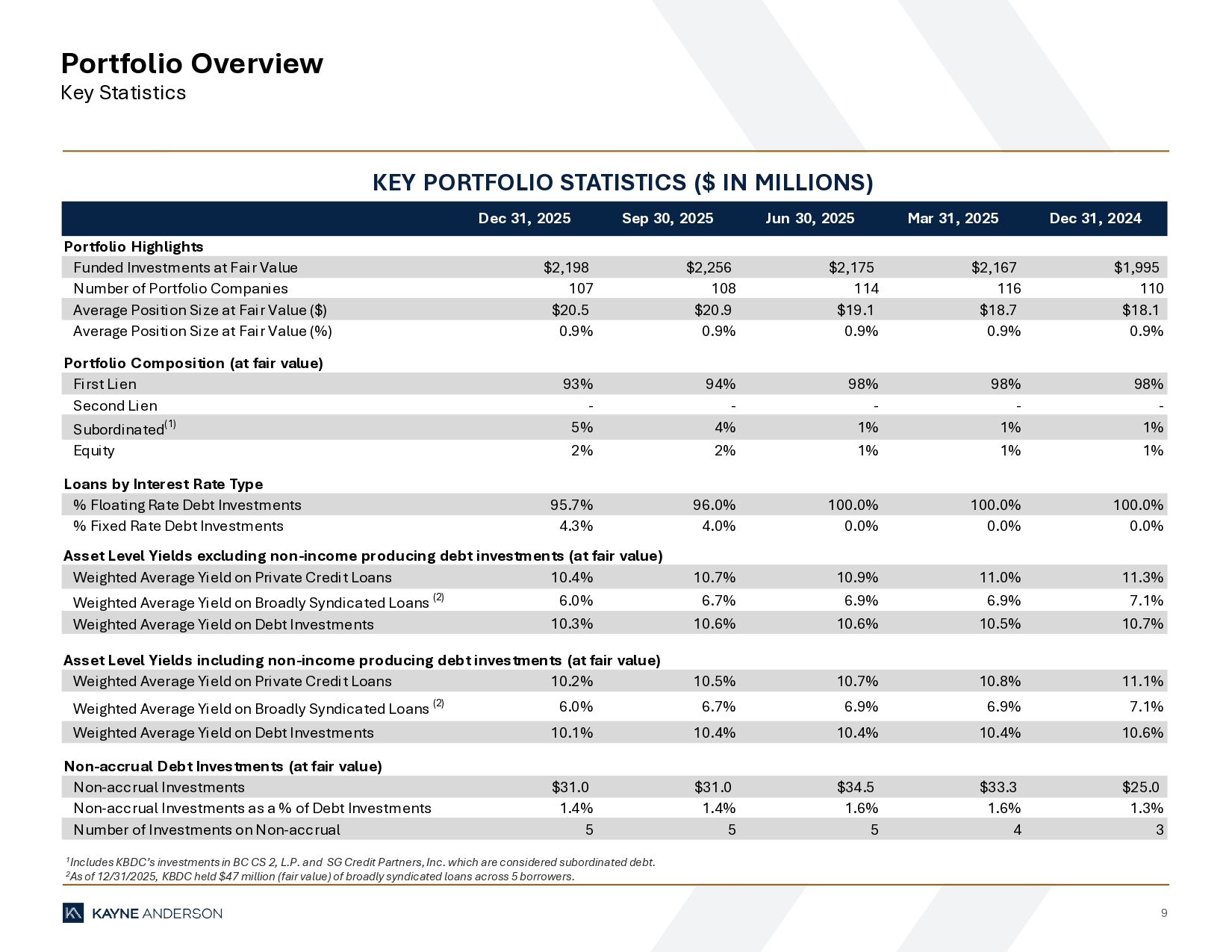
Thank you, Ken. I'll now look to provide a comprehensive overview of our portfolio composition and key performance metrics as of December 31st, 2025. Our portfolio consists of 107 companies with a total fair market value of $2.2 billion, representing a well-diversified collection of core middle market investments. We maintain unfunded commitments of approximately $287 million across our existing portfolio companies, providing us with additional opportunities to support our borrower's growth Since December 31st, 2025, KBDC has closed, or is in the final closing process, on $50 million of new commitments. And we have seen a steady flow of opportunities so far this year, though it's too early to glean any sort of meaningful insights for total 2026 activity levels. Investments in KBDC's portfolio, excluding those on watch lists and our opportunistic investments have a weighted average leverage of 4.5 times, interest coverage of 2.4 times, and loan to enterprise value of approximately 43 percent. Weighted average EBITDA of our private middle market portfolio companies is 52.7 million dollars, reflecting our focus on established businesses with meaningful scale. For the quarter, the number of companies in our portfolio declined defined by one, mainly due to our continued rotation out of the Broadly Syndicated Loan Portfolio. We continue to have a highly diversified portfolio with an average position size of approximately 0.9% of fair value, and where our top 10 investments represent only approximately 20% of our portfolio. This approach allows us to maintain appropriate exposure to our best performing assets while also maintaining prudent diversification across the broader investment base. 95.7% of our debt investments are floating rate which mirrors our liabilities where the vast majority of our debt funding utilizes floating rate borrowings as well. The only fixed rate investment that we have is the SG credit loan that closed in early Q3 2025 and has an 11% fixed coupon. Credit performance across our portfolio remains strong to date with only 1.4% of total debt investments at fair value on non-accrual representing only five positions out of 107, that's flat quarter over quarter. We continue to have financial covenants in all of our core first lien private middle market investments. And lastly, we've built this conservative portfolio with a healthy weighted average yield of approximately 10.3% on fair value of investments, excluding non-accruals. and this reflects a small decline from 10.6% last quarter. This strong level of yield has been achieved with leverage levels at the borrower level that are considerably lower than many of our peers, and while we continue rotation out of broadly-signicated loans into higher spread private credit investments. Ken discussed the well-publicized headwinds affecting the sector and emphasized that we believe KBDC is well-positioned to be a strong performer. While AI-related risks are difficult to fully mitigate, we're confident that the businesses in our portfolio are much more likely to benefit from the use of AI than they are to be displaced by the technology. We remain firmly committed to the disciplined lending strategy that our management team has executed and refined successfully across multiple market cycles for more than two decades. Our credit performance metrics continue to demonstrate the strength and quality of our portfolio construction. As mentioned earlier, non-accountables are flat quarter over quarter at 1.4% of total debt investments. We did see an uptick in PIC in the fourth quarter, predominantly due to one investment, where Terry will provide more detail on that situation later. We view this as consistent with normal course credit management in a diversified portfolio. As a quick reminder, our portfolio construction philosophy has always emphasized a conservative approach to borrower level leverage and capital structure design. As I mentioned earlier, our weighted average borrower net leverage of 4.5 times compares favorably to the broader market where we're seeing still seeing many transactions with leverage levels of five times to six times or higher. We've maintained this disciplined approach as we believe that lending on cash flows as opposed to just loan to value, better position to portfolio for periods of potential distress or in slower growth environments. Looking ahead to 2026, we expect our near to medium term investment activity pipeline to remain solid, supported by a slowly increasing flow of M&A transactions. And while we expect market conditions to remain competitive, we believe that recent increases in overall uncertainty favor experienced lenders like us. For that, I'll turn it over to Terry Hart to discuss KBDC's fourth quarter 2025 financial results.
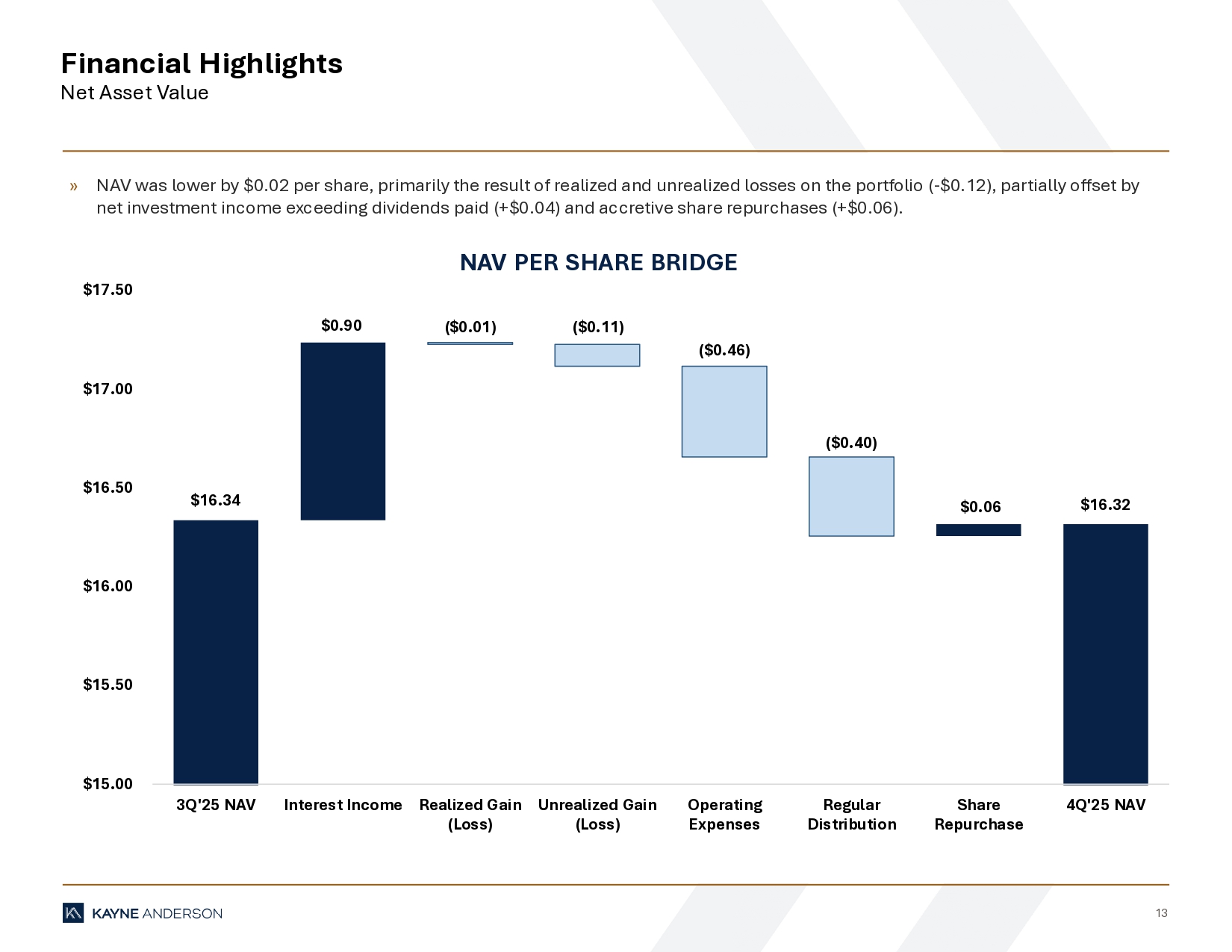
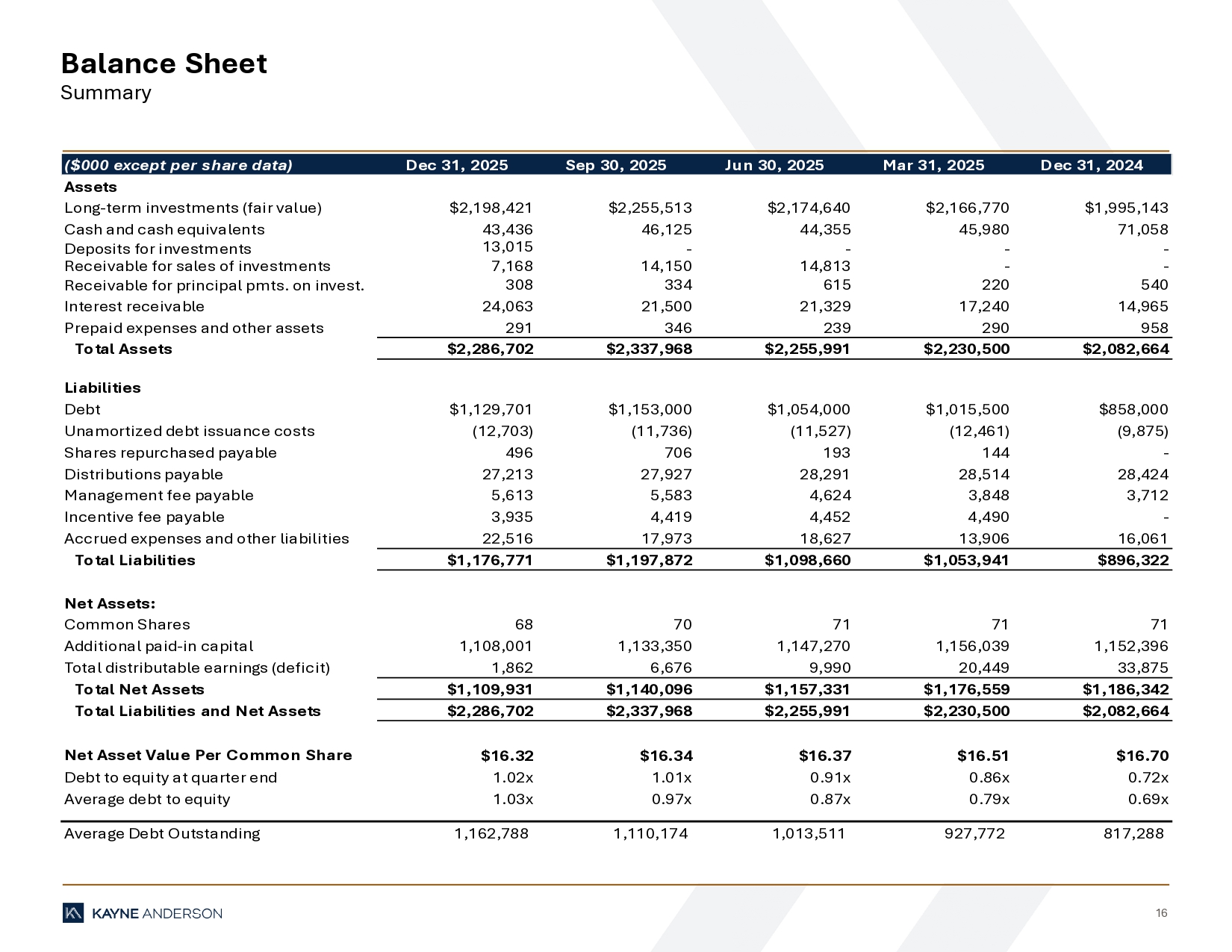
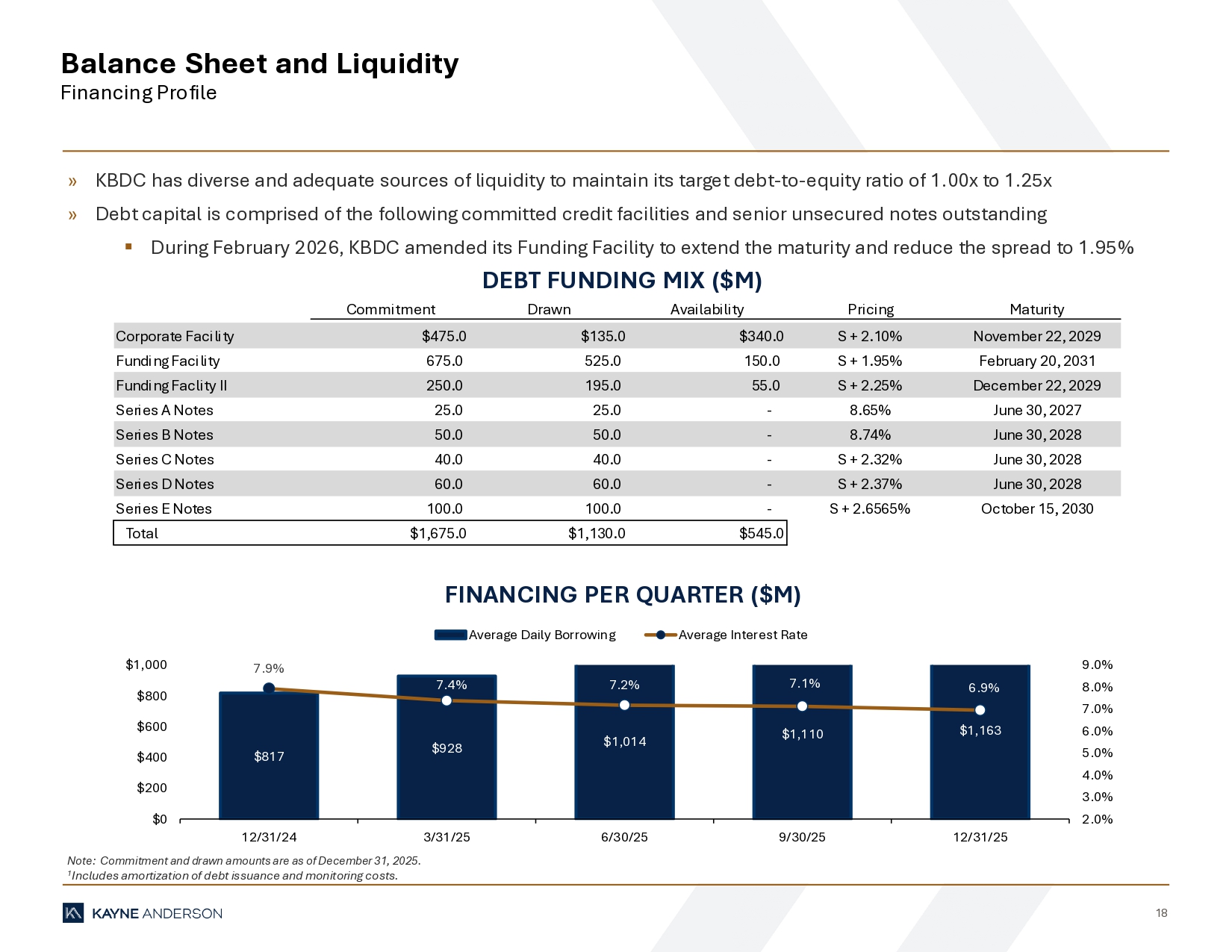
Thanks, Frank. Let's first review results of operations. During the fourth quarter, we earned net income per share of $0.32, and net investment income income per share was $0.44 compared to $0.43 in the prior quarter and $0.04 above our dividend. Total investment income for the fourth quarter was $61.9 million as compared to $61.4 million in the prior quarter. The increase to investment income was primarily driven by the full quarter impact of portfolio rotations out of broadly syndicated loans into middle market loans and an increase in accelerated amortization of OID and prepayments related to realization activity our portfolio yield decreased by 30 basis points mainly related to lower reference rates and PIC interest for the quarter was elevated from prior quarters as a result of year-to-date interest income from our investment and regimen being converted to PIC during the fourth quarter PIC interest represented 7.4% of total interest income during the quarter, but continues to be relatively low at 3.9% for the full year. As mentioned, during the fourth quarter, we had approximately $2.6 million of accelerated amortization of OID and prepayment fees related to realization activity. Total expenses for the fourth quarter were $31.8 million compared to $31.3 million for the prior quarter. The increase was primarily the result of $0.5 million of excise taxes, higher average borrowings, and the issuance of notes during the fourth quarter, partially offset by $0.5 million of lower incentive management fees. During the quarter, our incentive management fees were reduced by the 12th quarter look-back incentive fee cap. During the fourth quarter, we had a small realized loss of approximately $0.6 million related to the sale of several broadly syndicated loans, and we had net unrealized losses on the portfolio of $7.2 million compared to unrealized losses of $5 million in the prior quarter. The unrealized losses were largely the result of negative fair value changes related to our investments in SCORE Sports, Regiment, and Bell USA, as well as accelerated amortization of OID related to repayment activity. These items were partially offset by positive marks on Arbor Works and Centerline. Additionally, we had deferred income tax expense of $0.3 million related to unrealized gains on equity investments held in our taxable subsidiary. As of December 31st, total assets were $2.3 billion and net assets were $1.1 billion. As of that date, our net asset value was $16.32 per share. The decrease of $0.02 from $16.34 per share as of September 30th was comprised of $0.12 per share related to net realized and unrealized losses, partially offset by $0.04 of net investment income in excess of our dividend, and $0.06 related to accretive share repurchases during the fourth quarter. At the end of the quarter, we had debt outstanding of $1,130,000,000, and our debt-to-equity ratio was 1.02 times, which is a slight increase from 1.01 times at the end of the third quarter. On October 15th, we funded and issued $200,000,000 of notes that were priced in August at attractive rates, and as mentioned earlier, we had share repurchases of $24.9 million, pursuant to our $100 million share repurchase program. Year to date through February 20th, KBDC has repurchased its shares valued at approximately $14.5 million at an average price to NAB per share of 87%. Now turning to our distributions, on February 12th, our board of directors declared a regular dividend for the first quarter of 40 cents per share to shareholders of record on March 31st, 2026. As of December 31st, our undistributed net investment income was approximately 21 cents per share. Our positioning to maximize earnings during 2026 centers on several key initiatives. First, we plan to complete the rotation out of our remaining lower-yielding BSL positions, which will provide additional capital to redeploy into higher-yielding direct lending opportunities. Second, we intend to gradually optimize our leverage within our target debt-to-equity range of one times to one-and-a-quarter times. Our current leverage ratio of 1.02 times provides us with substantial capacity to increase earnings through prudent use of additional leverage. Third, we continue to work with our banking partners to reduce our borrowing costs. In fact, yesterday we announced the term extension of our largest credit facility, led by Wells Fargo, and the reduction of the interest rate on this facility from SOFR plus 215 basis points to SOFR plus 195 basis points. With that operator, please open the line for questions.
Operator
We will now begin the question and answer session. To ask a question, press star then the number one on your telephone keypad. Our first question comes from the line of Michael Brown with UBS. Please go ahead.
Hi, this is Corey Johnson on for Mike. I just have a question. So, in regards to like your NII for this quarter, you know, I'm guessing it was a partial impact on Fed rate cuts. How much do you estimate that was in the fourth quarter, and how much would you expect three pets to impact the first quarter of this year?
Thank you for the question. This is Doug Goodwillie. Terry, do you want to handle that?
Yeah, sure. For the quarter itself, I can get you the exact details after the call, but I can say that we didn't see the full impact of the Fed rate cuts in this quarter. But during the first quarter, we would see the full impacts of that. So it was a partial impact during the quarter. We did see offsetting those cuts during the quarter. we saw an uptick in the full quarters activity and full investment in SG credit. And so that helped offset some of those FET cuts. And in addition to that, as we mentioned, we did see a full quarter impact of the rotations out of BSLs during the third quarter And then also in the fourth quarter, we saw additional rotations out of the BSLs. And so that offsets some of those Fed cuts.
And just one follow-up. You guys had mentioned about there, you know, possibly being opportunities for you to be able to take advantage of as other companies who – other VDCs which, you know, went more to software companies are sort of dealing with their credit issues. Can you maybe just talk a little bit more about, like, what opportunities that you expect to be able to see and take advantage of?
Yeah, thanks for the question. This is Doug Goodwillie again. I think when we say, you know, capitalize on that, it's not capitalizing by buying loans from any other stressed BDCs, so to speak. We agree with some of the commentary in terms of probably a bit of an overcorrection in the public markets for the AI risk for some of those software portfolios. But what we're talking about there is when a BDC has 20, 30, 40 percent of their portfolio in software, that that becomes time consuming. If you're in any types of restructures or dealing with companies that could potentially be on a watch list, that tends to take up time. And then it also keeps valuations generally under, you know, a price to NAV of one in certain circumstances. So, it allows those that are, you know, trading at better levels and those that have less stress in their portfolio to put more capital to work in the current market.
Operator
Our next question will come from the line of Kenneth Lee with RBC Capital Markets. Please go ahead.
Hey, good morning. Thanks for taking my question. This one on the targeted portfolio ramp, any updated outlook in terms of timeframes when you might get to the targeted range within the 1 to 1.25, and given the current environment and what you're seeing, do you think you could be closer to the lower end or the higher end of the range in the near term there?
Thanks, Ken. This is Frank. I'll start there. You know, total deployments or net deployment for the quarter was, you know, effectively flat. You know, I think we're seeing a decent amount of activity. You know, I alluded to we've got $50 million of commitments sort of in process for Q1. You know, we are still working out of the Broadly Syndicated book, which we did quarter over quarter and will continue to do in the first part of this year. Our repurchase program has been reasonably active. So, there's, you know, a decent number of levers that we think will push that leverage ratio up a bit more towards the middle of the range, but, you know, putting any specific timeframe on it is difficult to do and will depend on, you know, market conditions and deployment activity, which, again, I think we're reasonably in seeing signs of some increases in activity, you know, but it will be a steady sort of progression over the next couple of But I think, Ken, you know, at the – this is Doug again – at the outset of what may be a bit of a dislocation in the credit market, to be at one times, you know, with 550 million
of dried powder, so to speak, or liquidity, you know, we think it's a good position to So we would expect that to increase beyond the 1.02, I think, where we are as of this but likely to remain somewhere in the 1 to 1.2 range, you know, over the next few quarters.
Gotcha. Very helpful there. And just one follow-up, if I may, and I appreciate the portfolio with only 2% of software exposure there. Wondering if you could just talk a little bit more about any investments on current watch lists, Any particular areas where you're seeing any kind of stress within the portfolio or otherwise challenges within the companies there?
Sure. This is Doug again. I'll start. As it relates to software companies, there are no investments in software companies that we have that are on the watch list, as we talked about. In Ken's section of the call, it's less than 2% of the portfolio. Less than 10% of the entire portfolio is on the watch list. I think from our perspective, there are, I think, five credits that are on nonaccrual, so we think that's kind of, frankly, a normal course watch list, an amount of nonaccrual kind of in the mid 1% range is fairly low, I think, in respect to our competition. So we're happy with the portfolio performance, I'd say from our perspective, I'm not sure that anything that we've seen is all that new in terms of there's been continued pressure on the consumer affecting two or three of the companies on our watch list. And then, frankly, you know, some management mid-steps that we are working with the sponsors and some management teams to correct. But those are really the two themes that, you know, don't really come back to what's going on around AI. I think what we've seen in terms of a theme, in terms of stress, has been a little bit more on the consumer side over the last 12 to 18 months.
Gotcha. Super helpful there. Thank you very much.
Operator
Our next question comes from the line of Vinny and O'Shea with Wells Fargo. Please go ahead.
Hey, everyone. Just to start a small follow-up on the preceding topic with Ken there, it looks like you have a pretty good clip of 26 maturities. Is there a big overlay with that cohort and then the sort of underperformers, as you described?
I think that when we think about it, I'll start on kind of just the repayment outlook. It's been relatively slow in the first quarter thus far. I think for the second quarter, then we'll go through it name by name. It looks like it picks up at a reasonable level into the third and fourth quarter. I'll turn it over to Frank, but I don't see a lot of overlap in terms of, you know, stressed names coming out.
Yeah, there's no concentration of, like, you know, names on the watch list in 26 maturities.
Okay, that's helpful. And then we also wanted to ask about G&A broadly in the context of like the size of your book, the size of your platform. You guys are just off the scatterplot in a good way in regards to G&A expense being very low. So can you walk us through as many specifics as you'll give as to what are the sort of conventional items that you elect not to expense that, say, your advisors or consultants told you that you could? And then how can we be sure that you won't change your mind one day in the future? Thanks.
Yeah, good question. I'll turn it over to Terry in terms of policy and what could be expense and maybe give some idea of that quantity too, Terry, as you answer the question.
Sure. Then, yeah, our agreements do allow us to pass through, and as you see other managers passing through the cost of the CFO and in some cases the cost of the chief compliance officer and then there's their staffs you know we have a model where you know we outsource a lot of our administration fund accounting and so we do pass that through but that tends to be much cheaper than you know if we had our own staff and then charge back all of that time. So in the magnitude, you know, if you look at funds that are similar in size or BDCs that are in similar size, you know, our ratio could be twice as high as it is today. You know, from, you know, 40 basis points, it could be 80 basis points or higher if we were to charge some of those things through. I mean, I think we take pride in having a low, you know, G&A cost just generally. And I think that, you know, we do the right thing for our investor. So we want, especially in an environment where coverage is tight, I think that, you know, we're going to be very mindful of our G&A expense. And, you know, as we grow, are we always going to have a zero for any of those costs? That's hard to say, but like I said, we're going to be very mindful of our G&A as it relates to, you know, coverage and our dividend policy.
Very helpful. Thanks so much. Thanks.
Operator
Again, to ask a question, press star one. And our next question will come from the line of Paul Johnson with KBW. Please go ahead.
Yeah, good morning. Thanks for taking my questions. Just wondering to get your thoughts just generally what is kind of the, I guess, the supply chain sort of risk within the portfolio, just, you know, food companies, distributors, trading companies, those sorts of businesses, you know, given the recent disruption in the, you know, shipping market in the Middle East.
I mean, you are right that I think when we talk about our value lending philosophy and the stable and stable industries, you know, our biggest industries are industrial and business services, food products, healthcare, but the vast majority, and I'll let Lee or Frank weigh in as well, you know, of the supply chain is, you know, from the US, we took a deep dive on this when we were analyzing the prior and I guess potential tariff risk on the portfolio, finding it to be fairly minimal, but I'll let Frank give some specific stats.
Paul, I think it's not the same analysis as the tariff risk, but it gets back to, hey, there's some of the downstream effects. Is inflation picking back up? And what does that mean over the sort of near and medium term for our borrowers? You know, we think our book performed very well through a substantially elevated inflationary period. We think our book performed very well through tariffs and tariff uncertainty. And I think we'd expect, you know, more of the same, admitting that, you know, it's hard to see around the corner for all potential scenarios and downstream effects.
Got it. Thanks for that. And then in terms of the just kind of the remaining BSL rotation, you guys have already obviously taken a fairly measured approach to ramping the portfolio. You know, loan prices are obviously trading at a more depressed level this quarter. If that kind of sustains itself, I guess, for the next few quarters or so, you know, for any of the liquid names in the portfolio, you know, how willing are you, I guess, to be selling out, you know, at a small loss, you know, to fund new originations as opposed to kind of holding out through the volatility to maturity?
Yeah, it's a good question. This is Doug. We are only down to – or we are down to a handful of BSL names at this point. I think it was less than 50 million at the end of the quarter, and it's down from there.
I put Frank on the exact spot, but we're actively – we have been actively continuing to exit that portfolio in this quarter. I think the good part of where we're at from a leverage perspective is we've got still of decent ways to go before we're at the point of needing to make a decision around exiting a position at a loss, albeit very small dollars given the size of this book, versus funding new private credit assets.
That's all for me. Thank you.
Operator
This concludes our question and answer session, and I'll hand the call back over to Doug Goodwillie for any closing comments.
Well, I'd like to thank everyone who joined our earnings call today for their time and and continued interest in KBDC. We hope you enjoyed the call and look forward to speaking again in a few months to discuss Q1 2026 performance. Thank you.
Operator
This concludes today's call. Thank you all for joining. You may now disconnect.