Operator
Hello, everyone. Thank you for joining us and welcome to the Kane Anderson BDC Inc.'s second quarter 2026 earnings call. As a reminder, this call is being recorded. It is now my pleasure to turn the call over to Andy Wedderburn-Maxwell, Managing Director.
Good morning and welcome to Kane Anderson BDC Inc.'s second quarter 2026 earnings call. Today, I'm joined by Ken Leonard and Doug Goodwillie, co-CEOs of KBDC, Frank Kull, President, and Terry Hart, CFO. Following our prepared remarks, we'll be available to take your questions. Today's call may include forward-looking statements. Such statements involve known and unknown risks, uncertainties, and other factors, and undue reliance should not be placed thereon. These forward-looking statements are not historical facts, but rather are based on current expectations, estimates, and projections about the company, our current and prospective portfolio investments, our industry, our beliefs, and our opinions and our assumptions. These statements are not guarantees of future performance and are subject to risks, uncertainties, and other factors, some of which are beyond our control and difficult to predict. Actual results may differ materially from those expressed or forecasted in the forward looking statements. We ask that you refer to the company's most recent filings with the SEC for important risk factors. Any forward-looking statements made today do not guarantee future performance and undue reliance should not be placed on them. The company assumes no obligation to update any forward-looking statements at any time. Our earnings release, 10Q, and supplemental earnings presentation are available on the financial section of our website at canebdc.com. Now I'd like to turn the call over to Ken Leonard.
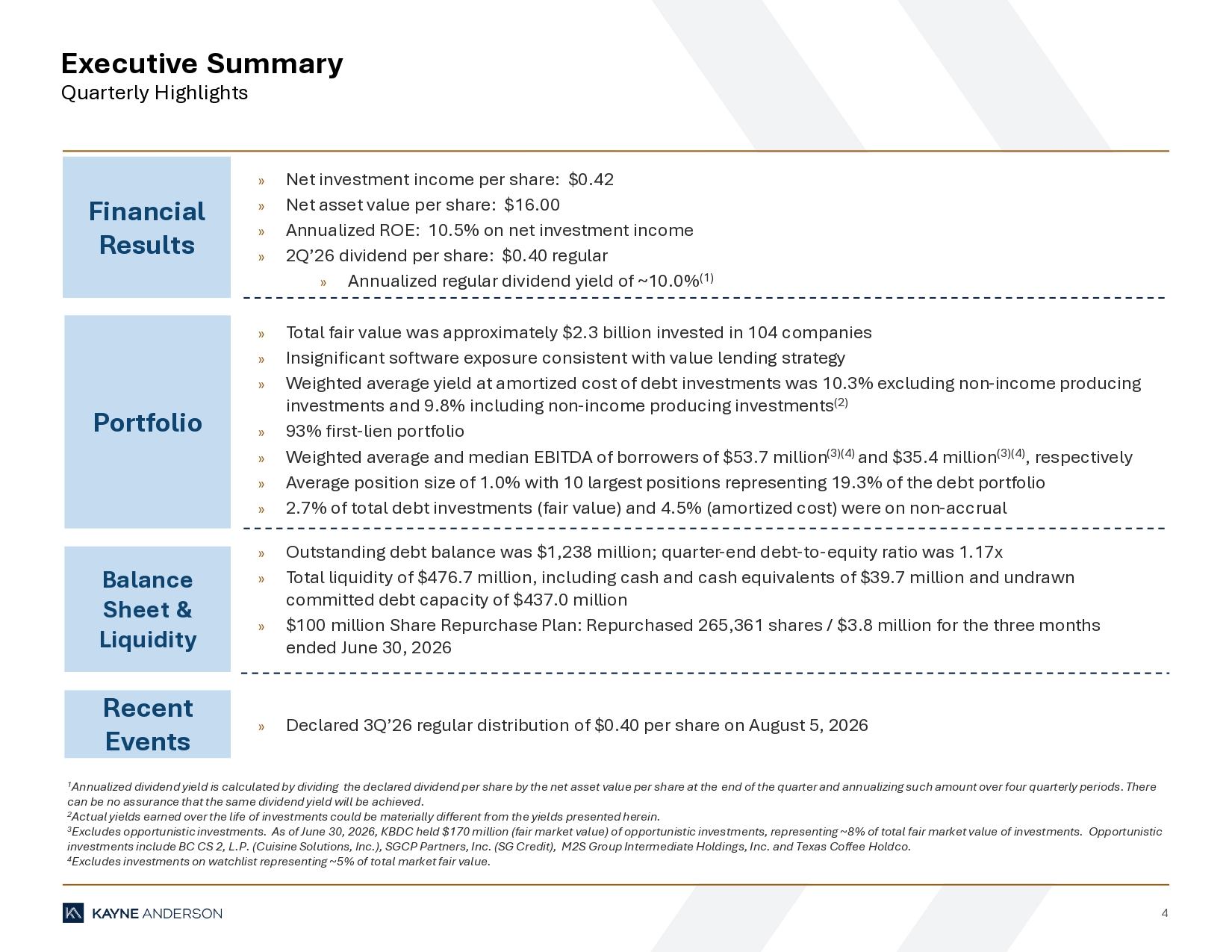
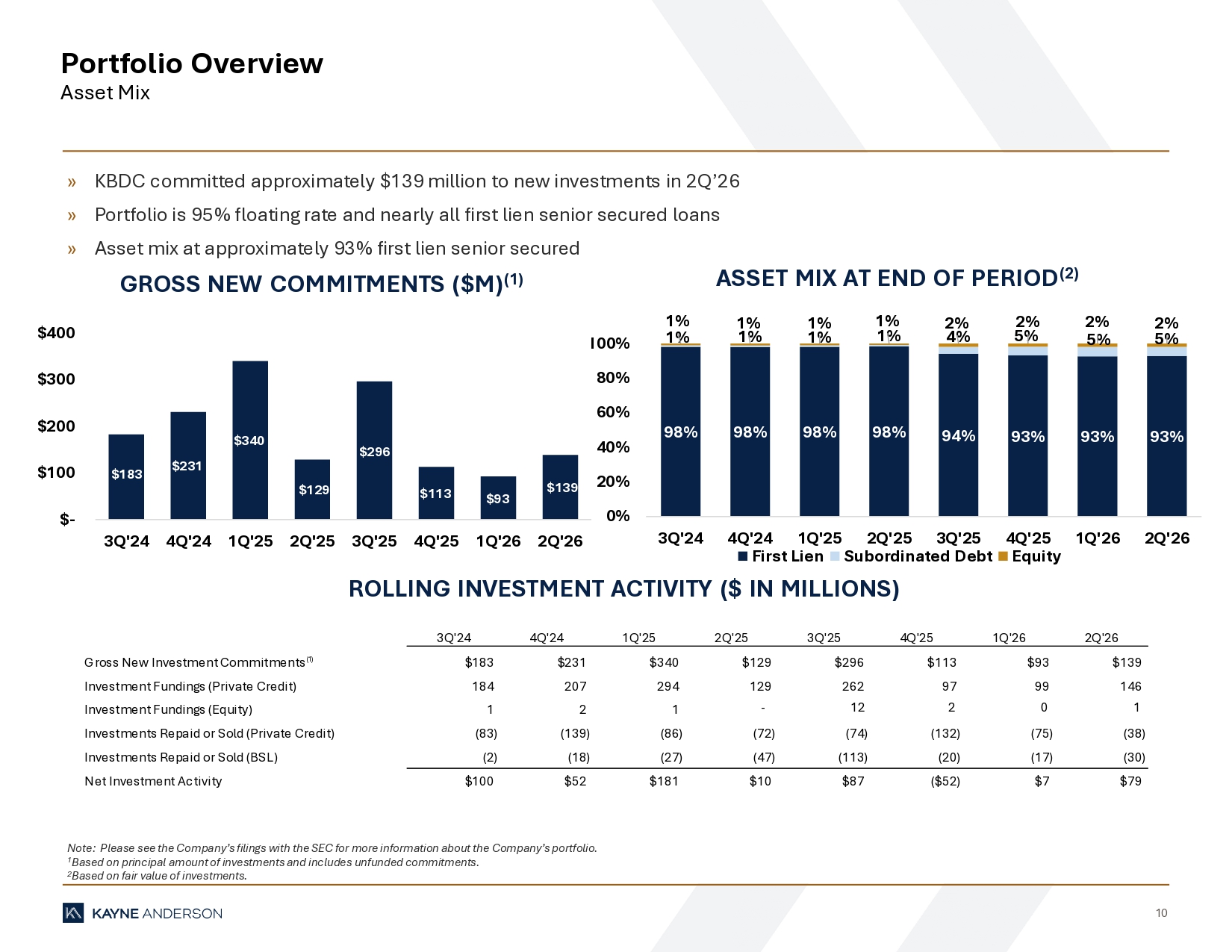
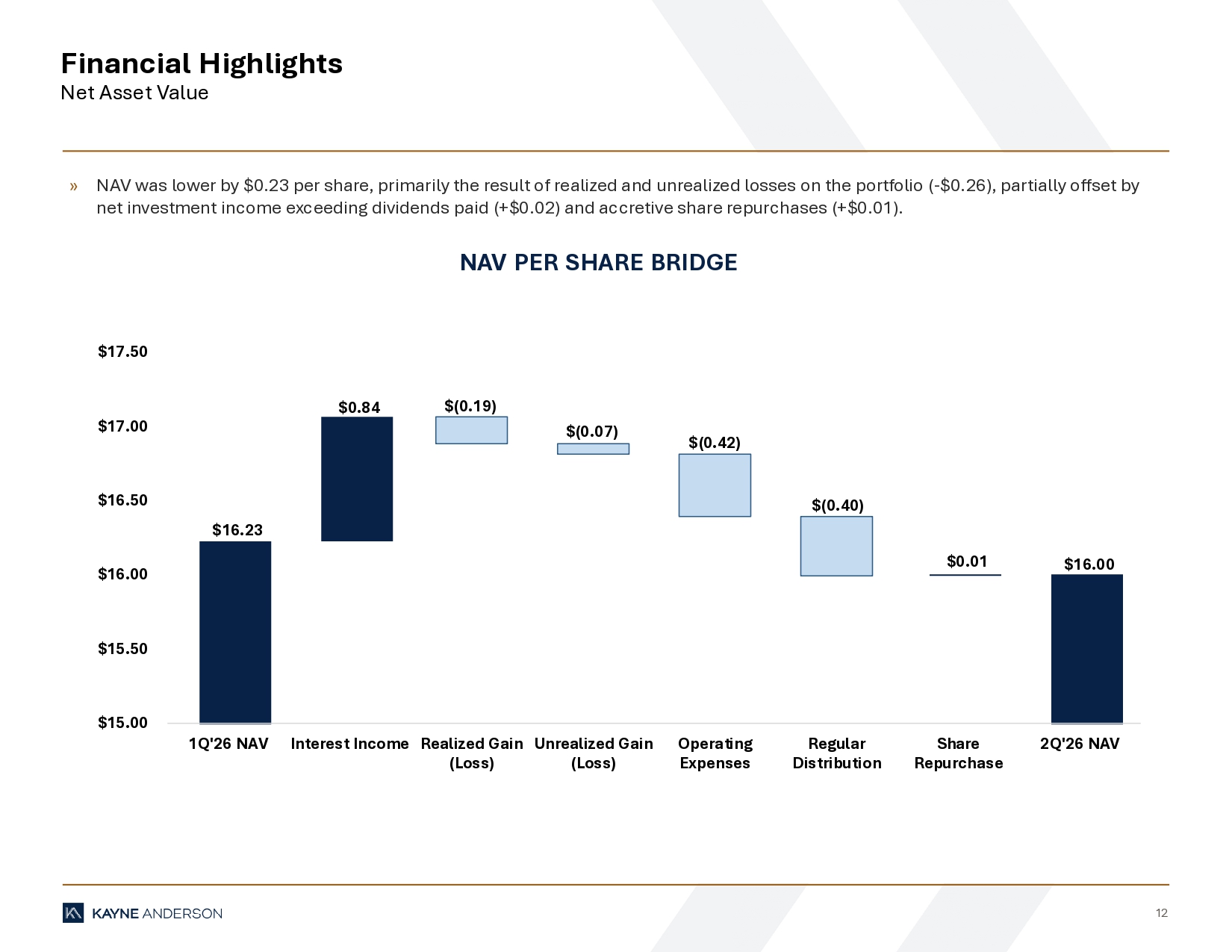
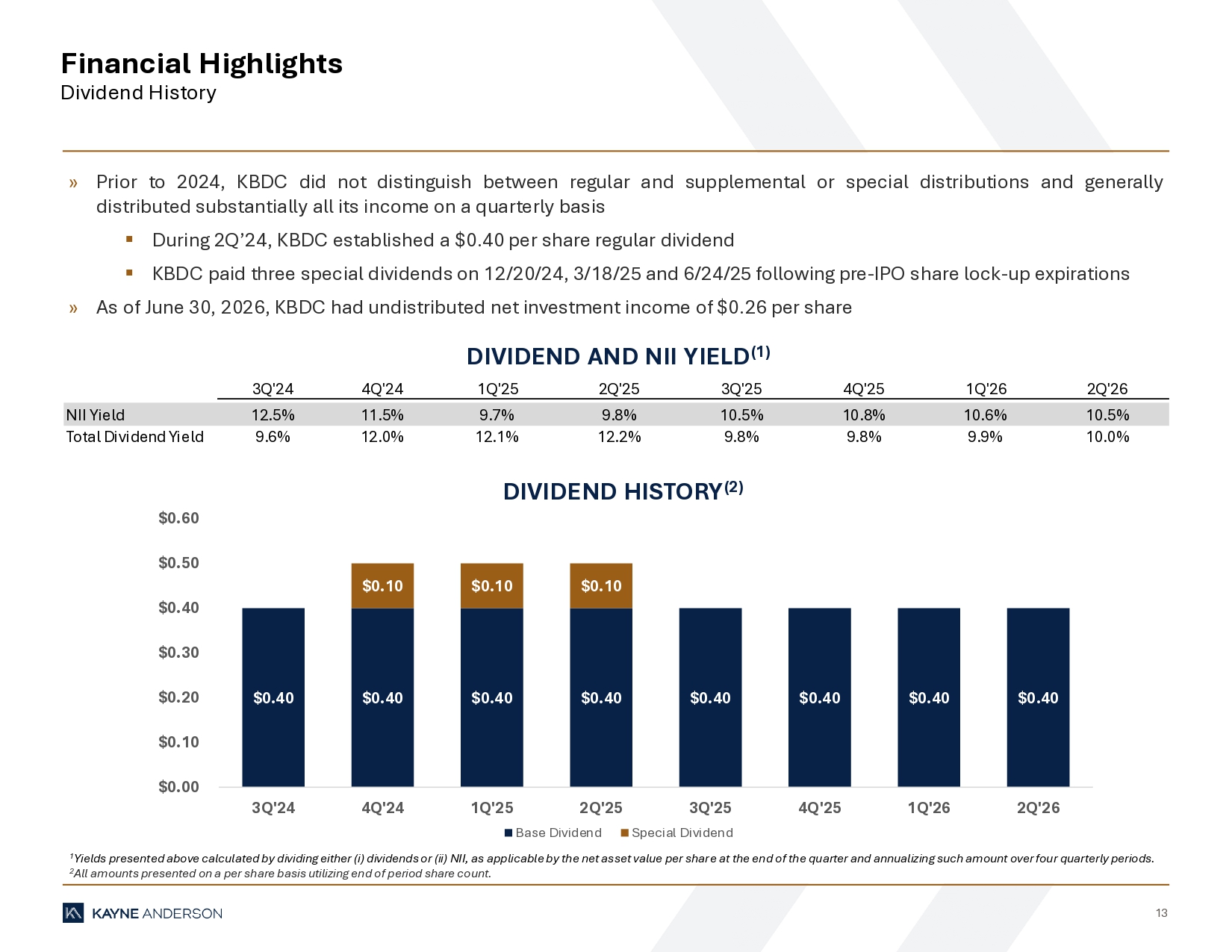
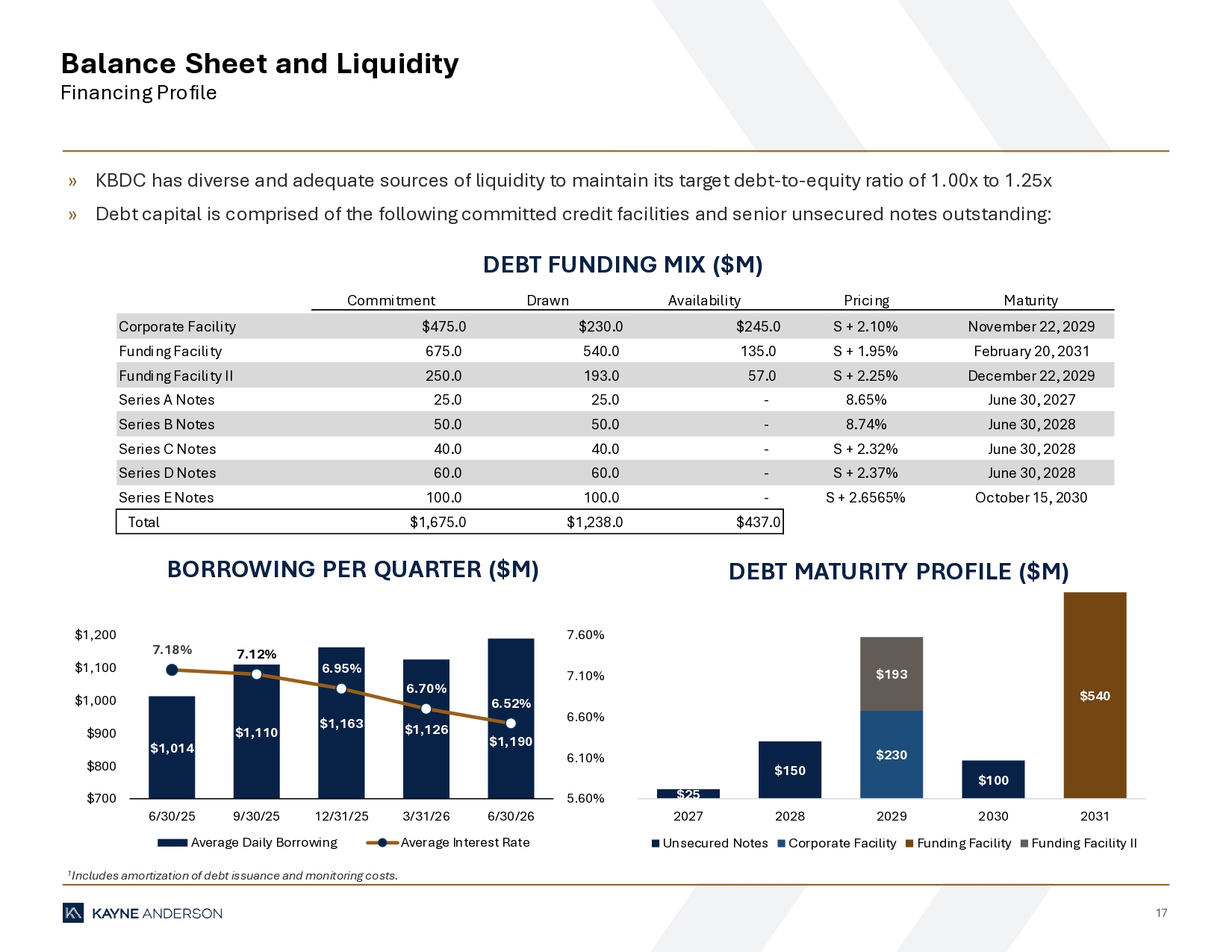
Good morning, everyone. I'm pleased to report that Kane Anderson BDC delivered another quarter of solid performance demonstrating the continued resilience of our value lending approach in what remains a challenging and bifurcated market environment. I'll provide an overview of KBDC's performance this quarter. Frank Karl will then provide a more detailed overview of our portfolio with some relevant market commentary and Terry Hart will conclude with KBDC's financial results. For the second quarter of 2026 we generated net investment income of 42 cents per share our board of directors has declared a regular quarterly dividend of 40 cents per share for the third quarter this represents our annualized dividend yield of approximately 10 percent based on our current nad per share the dividend will be payable on october 16th to shareholders of record as of september 30th this payout represents a dividend coverage ratio of 105 percent our annualized return on equity based on net investment income was 10.5%, reflecting the attractive risk-adjusted returns we have continued to generate for our shareholders. As communicated in our last two earnings calls, we remain confident in our ability to sustain this dividend through 2026. Net asset value per share as of June 30th was $16, representing a decline of $0.23 per share, or approximately 1.4% from the prior quarter $16.23. We experienced realized and unrealized losses totaling $0.26 per share during the quarter, driven primarily by fair market value adjustments on certain portfolio positions and our completion of our strategic rotation out of our remaining broadly syndicated loan positions. These losses were partially offset by net investment income, exceeding the dividend combined with the impact of creative share repurchases. Our overall credit quality remained strong. KBDC's non-accrual rate was 2.7%, up just 20 basis points from last quarter. In terms of specific companies, we added four over and diversified last out-tronch to non-accrual status and took Sundance off non-accrual. Turning to investment activity, we closed $138.7 million in new private credit commitments during the quarter, demonstrating our continued ability to source attractive opportunities that meet our rigorous underwriting standards. Pricing environment for new originations remains favorable with our new floating rate loans averaging 566 basis points over SOFR during the quarter which was 17 basis points wider than in the first quarter. The current pricing environment reflects sustained demand for private credit amongst middle market borrowers, slowing capital formation in non-traded and private vehicles, and a general increase in risk premiums. Regardless, we remain disciplined and passed on numerous opportunities during the second quarter where either risk-adjusted returns fell short of our standards, sector exposure raised concern, or leverage profiles exceeded our comfort levels. We continue to see quality deal flow from sponsors who value our consistency, our ability to move quickly on transactions that fit our criteria and our track record as constructive partners. Our fundings for the quarter totaled $146.4 million, which included both new investments and draws on existing unfunded commitments. On the repayment side, we saw $67.9 million of activity, including $38.1 million of private credit repayments and $29.8 million from the sale of our remaining broadly syndicated loan positions, which we have discussed in a prior. Turning to our balance sheet strength and liquidity position, we enter the quarter with a debt-to-equity ratio of 1.17 times, comfortably within our target range of one to one and a quarter. This positioning gives us flexibility to be opportunistic when we see compelling investment opportunities while maintaining conservative leverage. Our total liquidity position as of June 30th was $476.7 million, consisting of $39.7 million in cash and cash equivalents, and $437 million in undrawn committed debt capacity under our credit lines. M&A activity in our core middle market segment shows encouraging signs. After muted activity in late 2025 and in the first half of 2026, deal flow has picked up modestly in recent months. Private equity sponsors are more active, and financing markets, while selective, remain open for quality business. We continue to see opportunities in our target sectors and win our fair share of pursued deals based on our reputation and execution capabilities. For the second half of 2026, we expect to maintain this disciplined approach, deploying capital that meets our return and credit standards while preserving defensive positioning and sector diversification. In closing, we are encouraged that investors are increasingly differentiating BDCs based on portfolio composition, sector exposure, credit performance, and track record, rather than treating the sector as homogenous. We expect this trend to continue as performance divergence among managers becomes. Our conviction and our value lending strategy has never been stronger, and we remain fully committed to delivering sustainable value for our shareholders. I will now pass the call over to Frank Carl to discuss our portfolio.
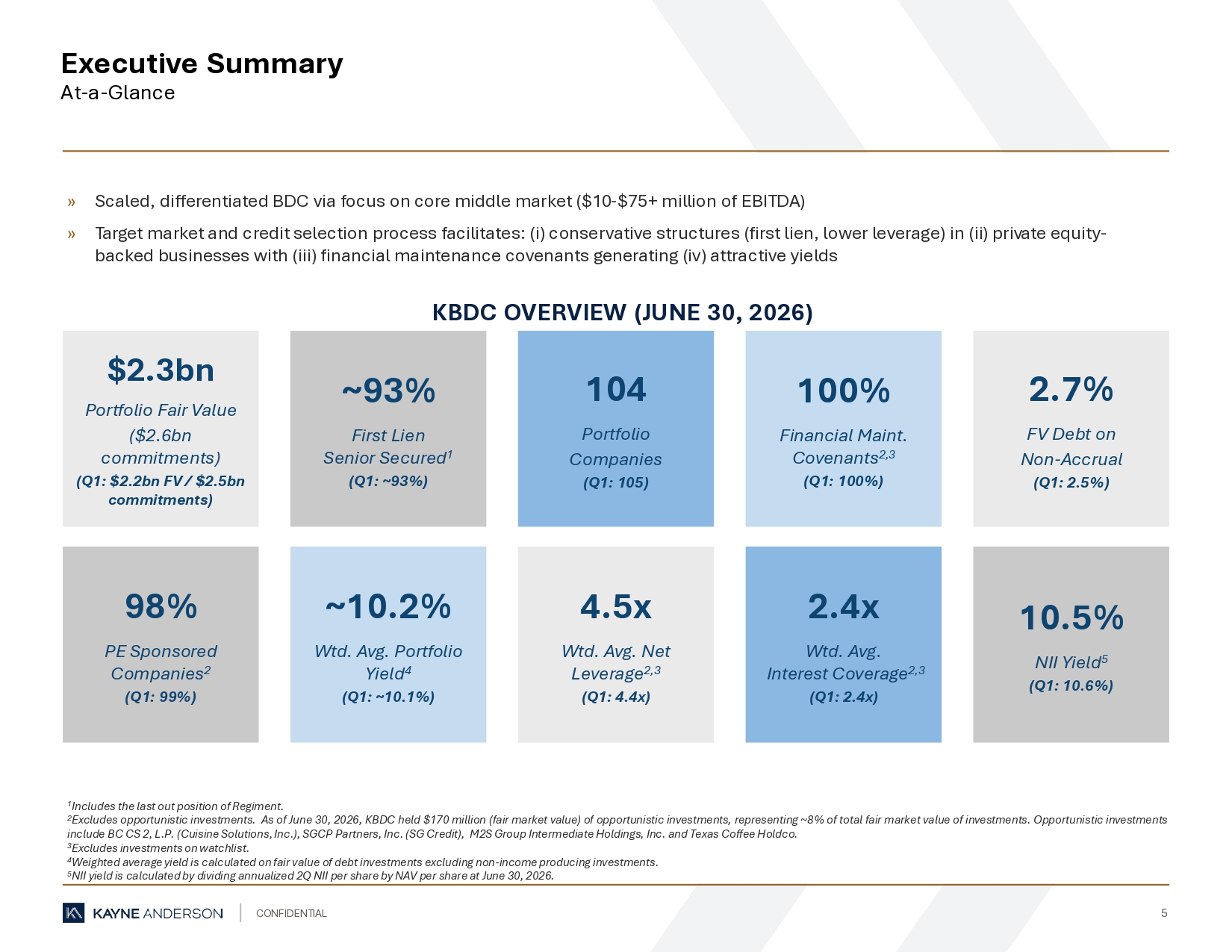
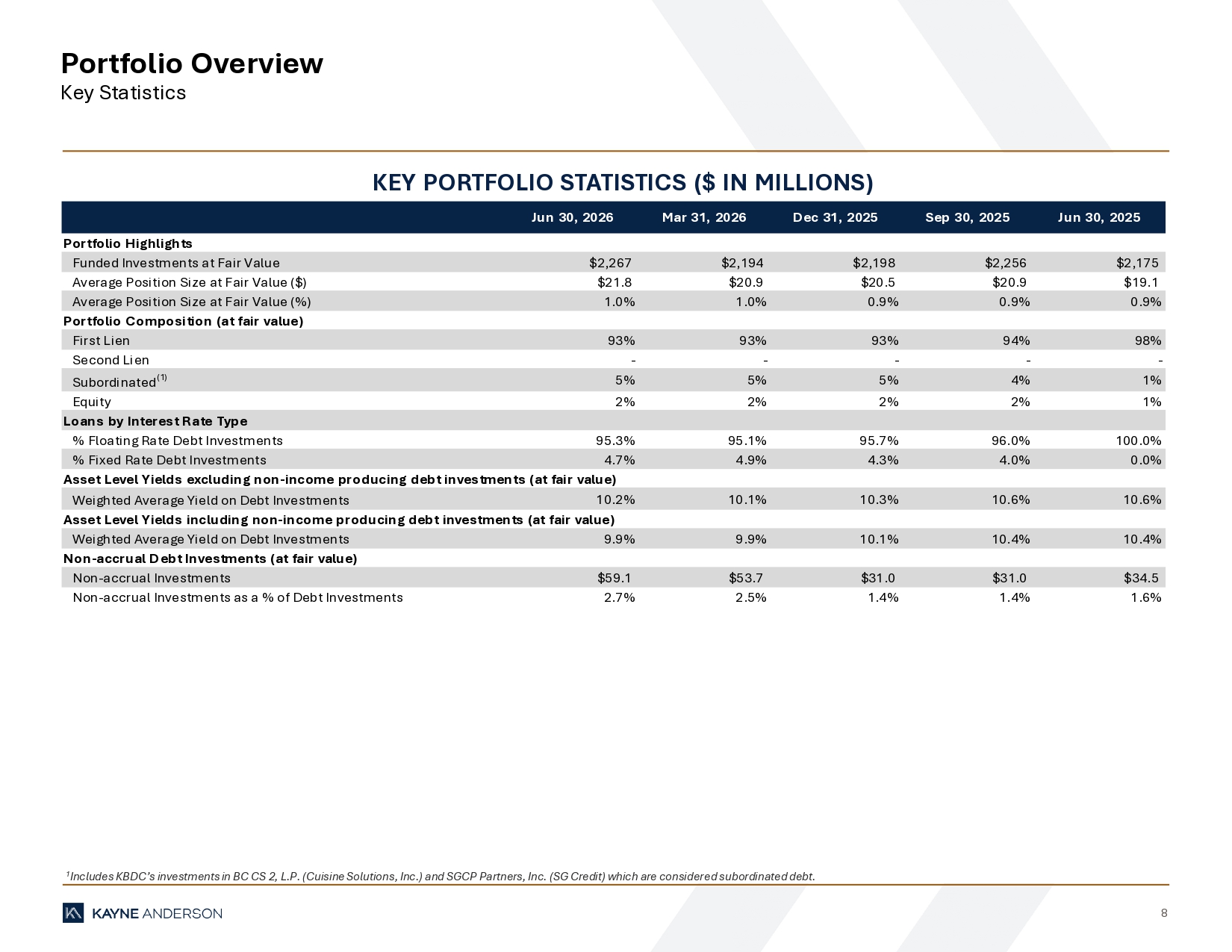
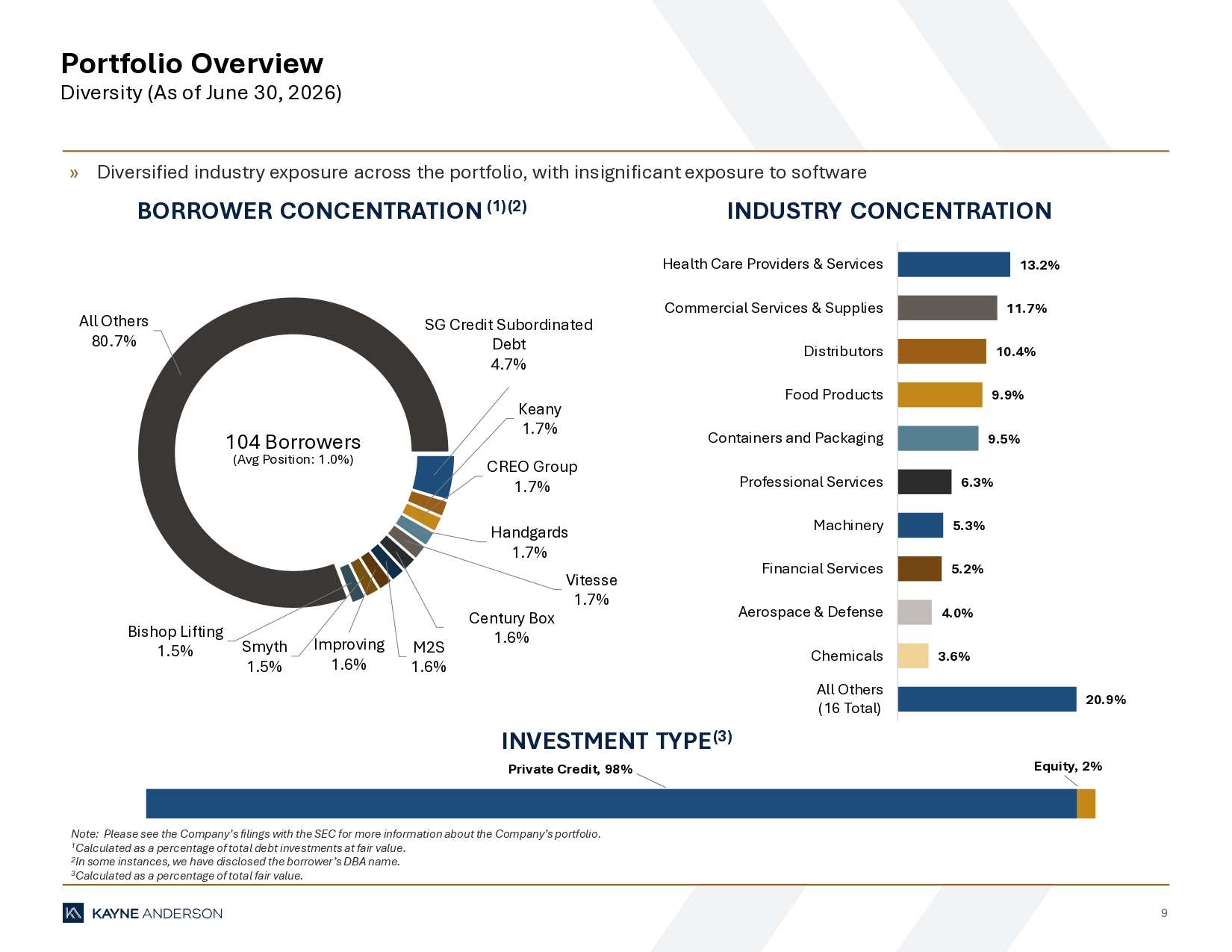
As of June 30th, our portfolio includes 104 companies with a fair value of $2.3 billion, plus $293 million of unfunded commitments. Since quarter end, we have closed or are finalizing $69 million of new commitments, as we've seen volumes remain relatively robust over the summer months. We do expect some realizations in third quarter, including some that slipped from second quarter to third quarter. As such, we are not expecting a significant change in leverage in the third quarter. Investments in KBDC's portfolio, excluding those on our watch list and opportunistic investments, have a weighted average leverage of 4.5 times, interest coverage of 2.4 times, and loan-to-enterprise value of approximately 43%. Weighted average EBITDA of our private middle market portfolio companies is $53.7 million, reflecting our focus on established middle market businesses with meaningful scale. Company count declined by one, reflecting our exit from the broadly syndicated loan portfolio and some realizations in the quarter. The portfolio remains highly diversified. Average position size is approximately 1% of fair value, and our top 10 investments are only approximately 20% of the portfolio. Our top five industry sectors, healthcare, commercial services and supplies, distributors, food products, and containers and packaging account for approximately 55% of the portfolio and have remained consistent quarter over quarter as we focus on avoiding sector concentration risks. Approximately 95% of our debt investments are floating rate, matched by a predominantly floating rate liability stack. Our only material fixed rate investment is the SG credit loan at an 11% coupon. The SG credit platform continues to perform very well in the lower middle market asset the backed financing space. Credit performance remains strong with 2.7% of debt investments at fair value on non-accrual versus 2.5% last quarter. As previewed on our last call, Sundance came off non-accrual in the second quarter. However, Regiment's sale process is still ongoing while the company's performance continues to improve. We look forward to providing an update on Regiment next quarter. As Ken mentioned, we moved four over in Diversify's last out tranche to non-accruel this quarter, which did move our non-accruels up 20 basis points. Total pick income for the quarter dropped to 4.5%, down 300 basis points from last quarter. Given last quarter, we had elevated pick income due to a one-time catch-up on ArborWorks. Terry will provide more specifics. Weighted average yield was 10.2% on fair value, excluding non-accruals, up slightly from 10.1% last quarter. As we continue to invest and manage our portfolio, we remain focused on the geopolitical and macroeconomic risks that require our constant attention. This reinforces our focus on borrowers with strong interest coverage and conservative leverage, providing meaningful cushion against continued rate pressure. We remain willing to be patient and wait for opportunities that meet our standards rather than deploy capital indiscriminately. Broader market sentiment has kept BDC valuations depressed for several quarters. Headlines around redemption pressures at large non-traded BDCs creates a disconnect with higher quality public BDCs, delivering strong operational performance, consistent dividend coverage, stable credit metrics, and disciplined capital deployment. We believe that the higher quality managers will be able to close the price to NAB discounts as the market will increasingly reward BDCs like KBDC to demonstrate consistent returns, discipline, and defensive market positioning. With that, I'll turn it over to Terry.
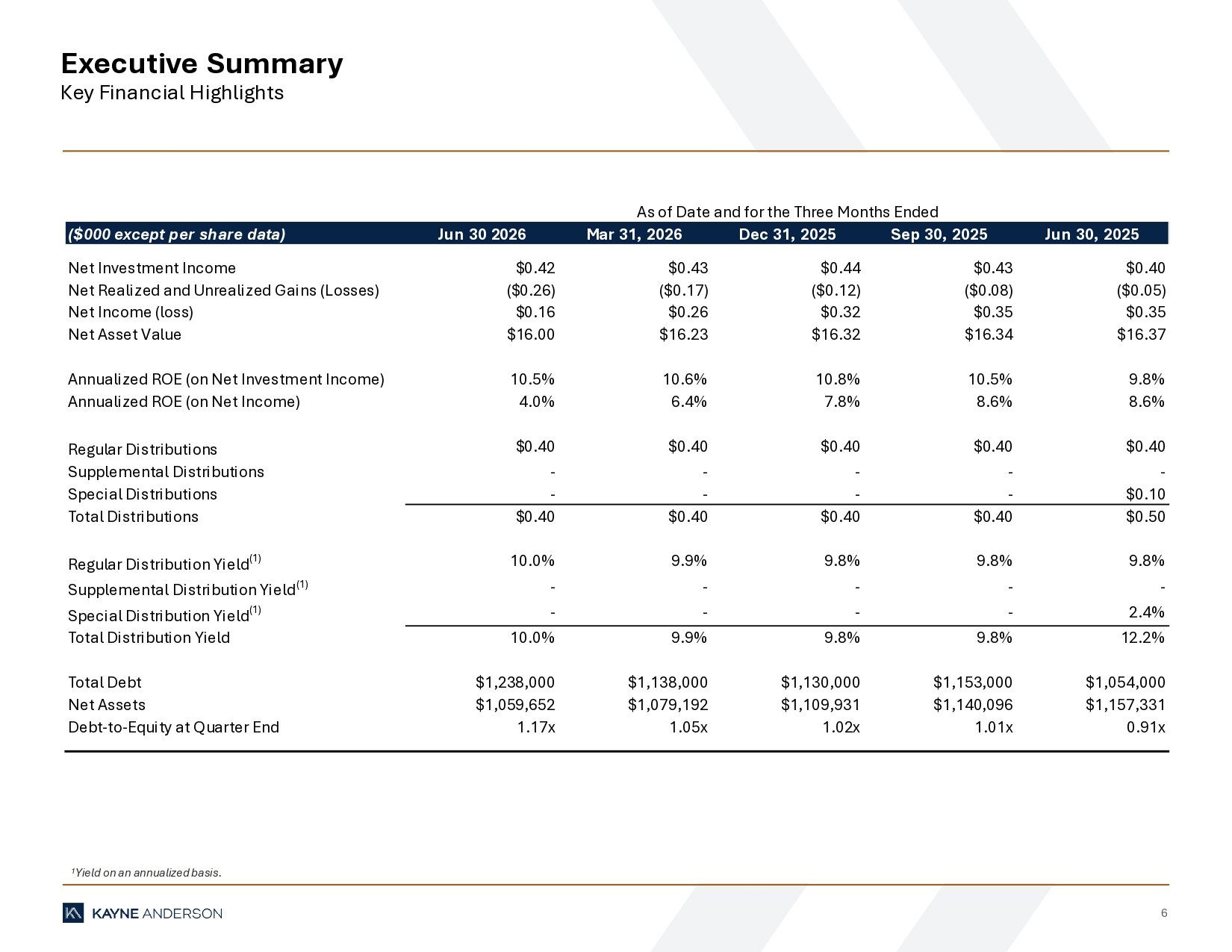
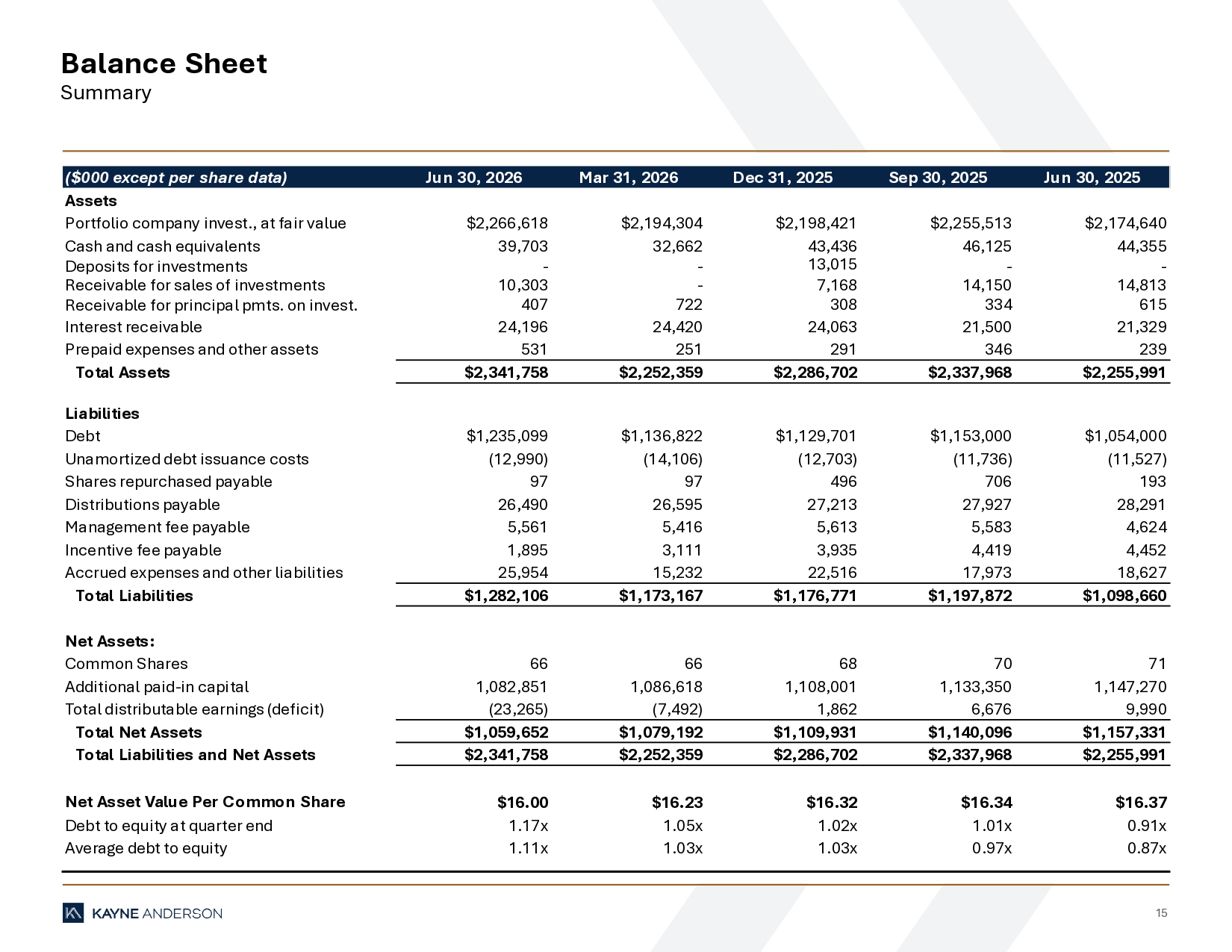
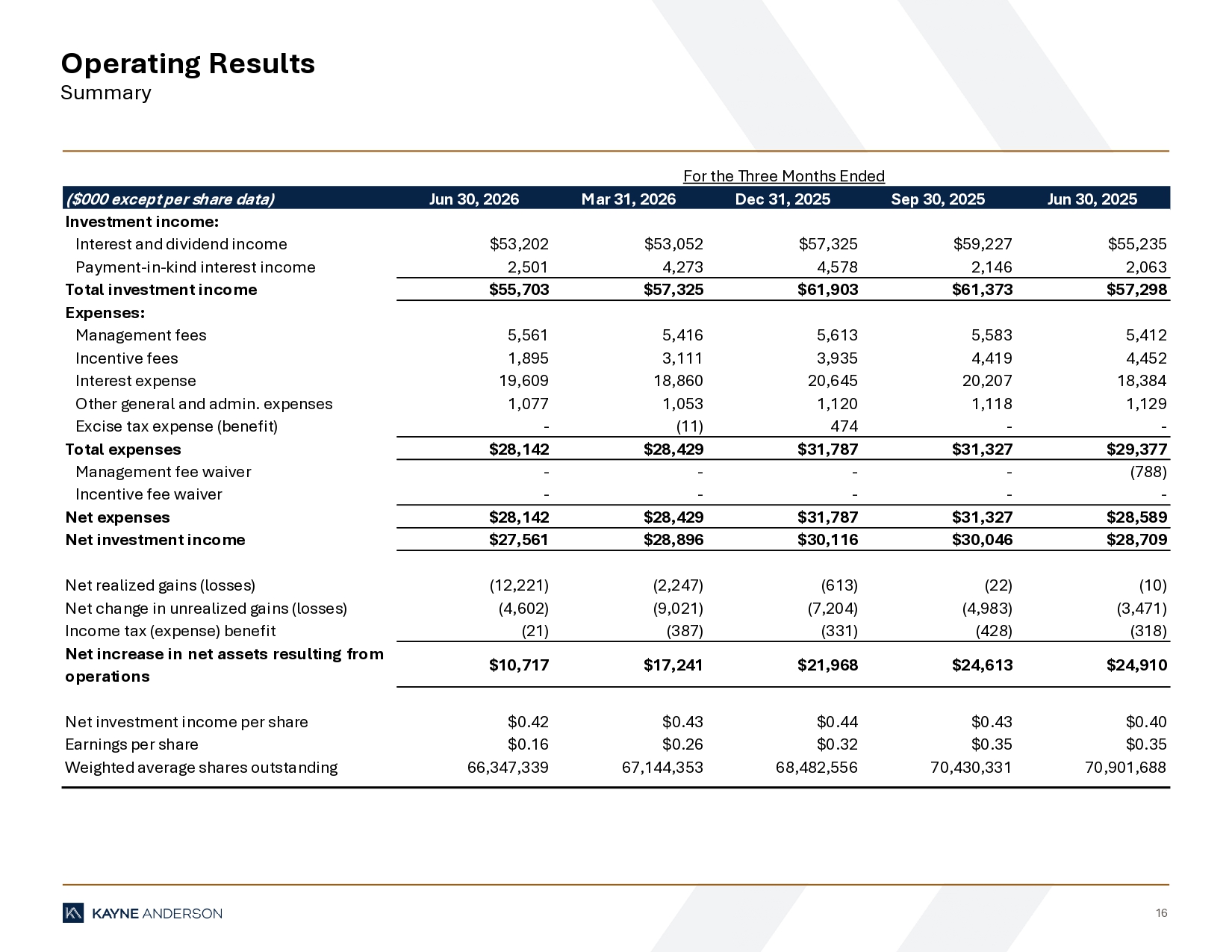
Thanks, Frank. I'll begin by reviewing our financial results. During the second quarter, we earned net income per share of $0.16 and net investment income per share of $0.42, compared to $0.43 in the prior quarter and $0.02 above our dividend. Total investment income for the second quarter was $55.7 million, as compared to $57.3 million in the prior quarter. The decrease in investment income was primarily a result of $2 million less PIC interest income related to our investment in Arbor Works, which moved to accrual status in the first quarter and recognized income that had been deferred since the fourth quarter of 2023. Interest income was also lowered due to American soccer being on non-accrual status during the second quarter but was offset by income from new investments and the rotation out of the remaining broadly syndicated loans. Accelerated amortization of OID related to realization activity was approximately .3 million during the quarter and PIC interest represented 4.5 percent of total investment income for the quarter. Additionally, the 10 basis point increase in our portfolio yield was primarily a result of rotating out of our remaining BSL positions into higher yielding private credit investments. Total expenses for the second quarter were $28.2 million compared to $28.4 million in the prior quarter. The decrease was primarily the result of 1.2 million lower incentive fees, partially offset by a 0.7 million increase in interest expense on higher average credit facility borrowings during the second quarter. During the quarter, our incentive management fees were reduced by the 12 quarter incentive fee cap. During the second quarter, we had realized losses of 12.2 million related to the liquidation of our investment in Sundance that resulted in a realized loss of 9.4 million the restructure of our debt investment and diversify that resulted in a 0.9 million realized loss, and we recognized 1.9 million in realized losses as we rotated out of our remaining broadly syndicated loans. During the quarter, we had net unrealized losses on the portfolio of 4.6 million compared to unrealized losses of 9 million in the prior quarter. The unrealized losses were largely the result of negative fair value changes to our investments in American soccer for over and regiment security, partially offset by the reversal of unrealized losses related to Sundance, Diversify, and the remaining broadly syndicated loans that were realized this quarter. As of June 30th, total assets were $2.3 billion and net assets were $1.1 billion. As of that date, our net asset value was $16 per share. The decrease of $0.23 from $16.23 per share as of March 31st was comprised of $0.26 per share related to net realized and unrealized losses, partially offset by $0.02 of net investment income in excess of our dividend and $0.01 related to accretive share repurchases during the second quarter. At the end of the second quarter, we had debt outstanding of $1,238,000 and our debt-to-equity ratio was 1.17 times, which is an increase from 1.05 times at the end of the first quarter. The increase in leverage during the second quarter was largely a result of expected realizations being delayed rather than a deliberate move higher. We plan to operate around the midpoint of our debt-to-equity target range, with some quarters being higher or lower depending on realization activity now turning to our distributions on august the 5th our board of directors declared a regular dividend for the third quarter of 40 cents per share to shareholders of record on september 30th as of june 30th our undistributed net investment income was approximately 26 cents per share and finally for the remainder of 2026 we plan to stay focused on our value lending strategy, which we believe will continue to differentiate us from our competitors. With that, operator, please open the line for questions.
Operator
We will now begin the question and answer session. If you would like to ask a question, please press star one to raise your hand. To withdraw your question, press star one again. We ask that you pick up your handset when asking a question to allow for optimum sound quality. If you are muted locally, please remember to unmute your device. Please stand by while we compile the Q&A roster. Your first question comes from a line of Kenneth Lee with RBC Capital Markets. Your line is open. Please go ahead.
Hey, good morning, and thanks for taking my question. I'm wondering about prepayment activity, and I realize it's difficult to predict, but any kind of outlook around where or what levels prepayment activities could trend over the near term there? Thanks.
Thanks, Ken. This is Frank. You know, I think you said it right. It is very hard to predict. We had a couple of names push from, you know, expected realizations in second quarter to third quarter. And, you know, I think we have for second half of the year, something around 5% of the portfolio scheduled as maturities. So, you know, broadly something in line with that would be a reasonable expectation absent some material pickup in exit activity inside the portfolio.
Gotcha. Very helpful there. And then one follow-up, if I may, just on the investment portfolio itself. Could you talk about any sort of watch list that you may have and perhaps perhaps, where that's trending over the last few quarters. Thanks.
Sure. And again, this is Frank. Watch list right now is at, call it 5.5% of fair market value of the debt portfolio. That's been relatively consistent over a pretty extended period of time um i think we generally think you know something in that mid single digit range um again this is inclusive of non-accrual investments to make that clear um but something in that range is i'd say our typical uh over call it the last decade plus is speaking at the platform level more broadly obviously there are periods where you're a little bit lower than that a little bit higher than that but i think we look at you know watch list broadly i guess i'm sorry watch this specifically, you know, credit more broadly and think that, you know, we're sort of in a period where I think it would be disingenuous to say that there's, you know, no credit noise out there, right? I think every call we've listened to this quarter and, you know, you can see it in our reporting, right? There is a little bit of signs of increased stress, more non-accruals, more restructurings, picking comes up a little bit, et cetera, nabs down across the board. But I think we're seeing something of sort of a shallow, you know, slow, slowdown is how I would characterize it. And I think you're seeing that in a relatively stable watch list number.
Gotcha. Very helpful there. Thanks again.
Operator
Your next question comes from the line of Paul Johnson with KBW. Your line is open. Please go ahead.
So it sounds like the watch list is relatively stable quarter over quarter, But, I mean, in terms of, like, the non-accrual marks this quarter, I think most of them were pretty much, pretty much most of them were marked lower quarter over quarter, you know, the lower, you know, 50% or so, we'll call it a fair value. I mean, what does that, I guess, suggest about your expectation over recoveries on those assets? And maybe how does that line up with the Kane Anderson platform historically, and are you also just kind of leaving, I guess, or building in some level of conservatism there potentially for better than expected, I guess, recoveries?
Yeah, thanks, Paul. And again, this is Frank. Yeah, I think, you know, we certainly saw some downer moves on the watch list broadly. I would call out that, you know, regiment, the last out piece there. Yes, there was a markdown in second quarter. We're expecting an exit in the third quarter that has a little bit of upside to that current mark. so not all negative, broadly speaking. But, you know, as far as, you know, where these things are marked, I mean, I think we try to be conservative in, you know, our process and it's the same process for the BDC portfolio as it is for, you know, all investments across our entire loan book and it, you know, that's almost 100% overlap between the private funds and separate accounts, et cetera, and the BDC. So, you know, I don't think we want to get super specific about any of these situations other than to say, you know, we historically have thought of ourselves and try to act as conservatively as possible in situations that are sort of stressed and with some unknowns, you know, by their very nature.
Got it. Very, very helpful. Thanks for that, carl uh my last question would just be on the the bsl rotation this quarter um when you're rotating i guess maybe just speaking about this quarter but the rotation there what is kind of like the spread uh like roughly what's the spread pickup there um in terms of what's going into you know the the 566 direct lending origination spread this quarter um and i guess is the reason for the timing on that just more so not necessarily to to draw down additional leverage on the portfolio and kind of access there you know monetize these assets or uh was it just more of an opportunistic sale
that you saw during the quarter thanks yeah so we're we're out of all the broadly syndicated loans at this point um those were you know ballpark sofer plus 300 um directionally so So you're picking up 250 basis points plus or minus on a rotation out of those names. You know, I don't think we were we you know, we were not looking to time the market specifically on an exit. I think we had opportunities to invest that capital in the core of our business, these middle market loans. And, you know, the BSL book was remaining names. And just to be clear, right, I think we were down to three or four of those names. last quarter. Timing was right to move on as we've been communicating to you all and investors since our IPO, that that was a temporary position for us.
Appreciate it. Thanks for the call for me.
Operator
Your next question comes from the line of Finian O'Shea with Wells Fargo Securities. Your line is open. Please go ahead.
Hey, everyone. Good morning. um so so part of the storyline where getting this quarter is competition in the sort of core lower middle market um is you know continuing to pick up a lot of the players there are still raising private funds and such um and then maybe more are looking at your sort of uh focus in the in the value sectors. So seeing if you could give us some, some feel on what the, you know, competition is like, how much sort of wallet is showing up for the, the deals that, you know, you prefer.
Thanks, Finn. I mean, look, I think, you know, market has been constructive. There's been a, I would say, decent amount of flow in the markets where we participate. I know we've seen, a handful of folks in the upper market reporting slower quarters. I mean, that doesn't surprise me when the last five years have been 25% or 30% software originations. There's much less of that right now. That's sort of like broad strokes on, hey, are there a decent amount of deals out there? I'd say yes for our segment specifically on the supply side, sorry, on the demand side. On competition and what we're seeing in different segments of the market, I think it's absolutely the case that what we would characterize as lower middle market, so call it $15 million of EBITDA, maybe $20 million EBITDA below, that space is very competitive. It's usually one lender deals, only takes sort of one person to show up, write the check. And those will clear sometimes at very tight spreads. I think we've seen, if anything, something of the opposite at the larger end of where we focus is you've seen a slowdown in the non-tradeds and just a little bit less net new capital being formed. So to the extent that people are focusing more on the segments where in industries where we've historically invested, I mean, you know, we're not seeing that from, you know, the very large guys directly, or if they are, you know, it's been offset by, you know, a little bit less capital formed more broadly. I know that's a sort of generic response, but that's what we're seeing in real time. I think you see it in spreads. We look at some reporting that has spreads in, call it upper market, gapping out a little bit wider than lower market.
Hey, Ben, this is Doug. Thanks, Frank. You hit on most of the relevant points there. On the industry side, then I don't know that it's so much people coming into the value lending call it stable and staple industries in a purposeful way i just think that higher growth businesses software businesses and technology businesses um are generally obviously not transacting and so i think um kind of the core segments of the market uh the companies that are being you know sold or purchased you know seven to ten times are the ones that are going to market these days. So I think that's where you're seeing more people transact. And I think just quickly to hit on Frank's point, I think when some of the non-traders and capital outflows in the upper mid-market sector are creating a, it's not a severe dislocation by any means right now, but enough of a dislocation that putting together four or $500 million clubs, if you will, There's a decent risk reward there right now in that $50 to $100 million range of EBITDA where in certain markets that call them more liquid, more efficient, you'd see cov light or very loose covenants and pricing in the fours. We're seeing reasonable covenants, reasonable documentation, small lender clubs with decent pricing in the $500s as it relates to, call it the $10 to $15 million EBITDA lower mid-market space.
Very helpful. Another sort of follow-up. In health care, we've seen more of that. There's a dental name this quarter. is that is that whole you know that that area has been a bit of a headwind again for the space is that something that's like become a deep and cheap sort of value sector as you describe it or is it perhaps more opportunistic as others are others might be pulling out from from another sort of credit wave yeah good question and we've certainly read and seen some of the the credit stress there.
I think historically going back, you know, and I'd say four or five years, you saw in those roll-ups, you know, where leverage would be, you know, five to six times, but with aggressive ad-backs as locations were being opened in the practice management space, whether it was dental or ophthalmology or dermatology we largely stayed away from the space during that time now i think over the last few years as people saw pullback after some of the headwinds a few years ago with labor costs and not being able to pass through slower growth or sorry pass through costs combined with slower growth leverage multiples then really normalized in the four to five times range um i think i'm not going to put frank on the spot um but i would say our um our average leverage for our practice management businesses is probably still mid fours so i think when you structure those businesses right when you work with the right sponsors and people aren't looking for aggressive ad backs on um really aggressive location build out we still think that space is viable as long as you're not too aggressive on the structuring side.
And Doug, just to add in, none of those medical practice management deals are on the watch list right now or trending that way.
Operator
Your next question comes from the line of Melissa Waddell with UBS. Your line is open. Please go ahead.
Good morning. Thanks for taking my questions today. I had one more follow-up on the rotation of the BSL. It's a little bit specific and in the weeds, so apologies. I'm wondering if there was anything in particular that we should be thinking about in terms of timing in rotating out of the BSL allocation. Was that front-end loaded or kind of sporadic throughout the quarter and the timing of redeployment back into higher yielding portfolio assets. Was there any drag, do you think, during the quarter from that rotation?
Terry, do you have a perspective there?
Melissa, it's a good question, and I can follow up with you. I can't remember off the top of my head the timing of it. I do think that we had a fairly large chunk of the BSLs rotate out early but we also had a decent amount of private credit deals that closed early in the quarter too. So let me get a little bit more in the weeds with you on that one, but that's how I recollect at least part of it.
But Terry, I mean, the absolute dollar amount, it's not a big mover.
Yeah, you're talking about, I mean, the total was inside of $30 million principal during the quarter, so a fairly small amount. But like Frank said, the spread differential is definitely meaningful.
Yep. Okay. Thanks for that. And then you talked earlier about not expecting much change in portfolio leverage and sort of aiming for that middle of the range with, you know, some plus or minus in any given quarter. When you think about it at sort of current levels and towards that middle of the range, do you think that gives you enough room for both deployment into new opportunities, even if you don't have a lot of recycling of capital in the portfolio and still allow you to repurchase shares? at these levels thanks yeah this is frank and i'll start terry jump in if you have anything else to add i mean it's it's definitely um you know a bit of a hard question to answer with specificity you know i think we like to manage our leverage profile you know on the more conservative
side for the market as a whole um you know such that we have some breathing room on for the shared repurchase program capital to invest in new deals, but it's kind of a, you know, week by week and month by month on the new deal side as to, you know, what's coming back, what can we deploy, looking at it closely every quarter. So I think we're trying to, you know, sort of hit that middle ground of, you know, being fully deployed or as close to it as we can be while keeping some capacity for, you know, really attractive uses of that capital, whether it's, you know, new deals or repurchases thank you there are no further questions at this time i will now turn the call back to ken leonard for closing remarks we appreciate the continued support and engagement from all of our shareholders and analysts we feel very good about where the business is positioned
today we have a clear strategy a strong team and significant opportunities out of us we know that ultimately will be judged in execution and that remains our focus each and every day. Thank you all for joining us today. We look forward to updating you again next quarter.
Operator
This concludes today's call. Thank you for attending. You may now disconnect.