Hello, everyone, and welcome to the MercadoLibre Earnings Conference Call for the quarter ended March 31, 2025. Thank you for joining us. I'm Richard Cathcart, MercadoLibre's Investor Relations Officer. Today, we will share our quarterly highlights on video, after which we will begin our live Q&A session with our management team. Before we go on to discuss our results for the first quarter of 2025, I remind you that management may make or refer to and this presentation may contain forward-looking statements and non-GAAP measures. So please refer to the disclaimer on screen, which will also be available in our earnings materials on our Investor Relations website. Please note that this call is being recorded and a replay will be made available on our IR website as well. With that, let's begin with a short message from our CFO.
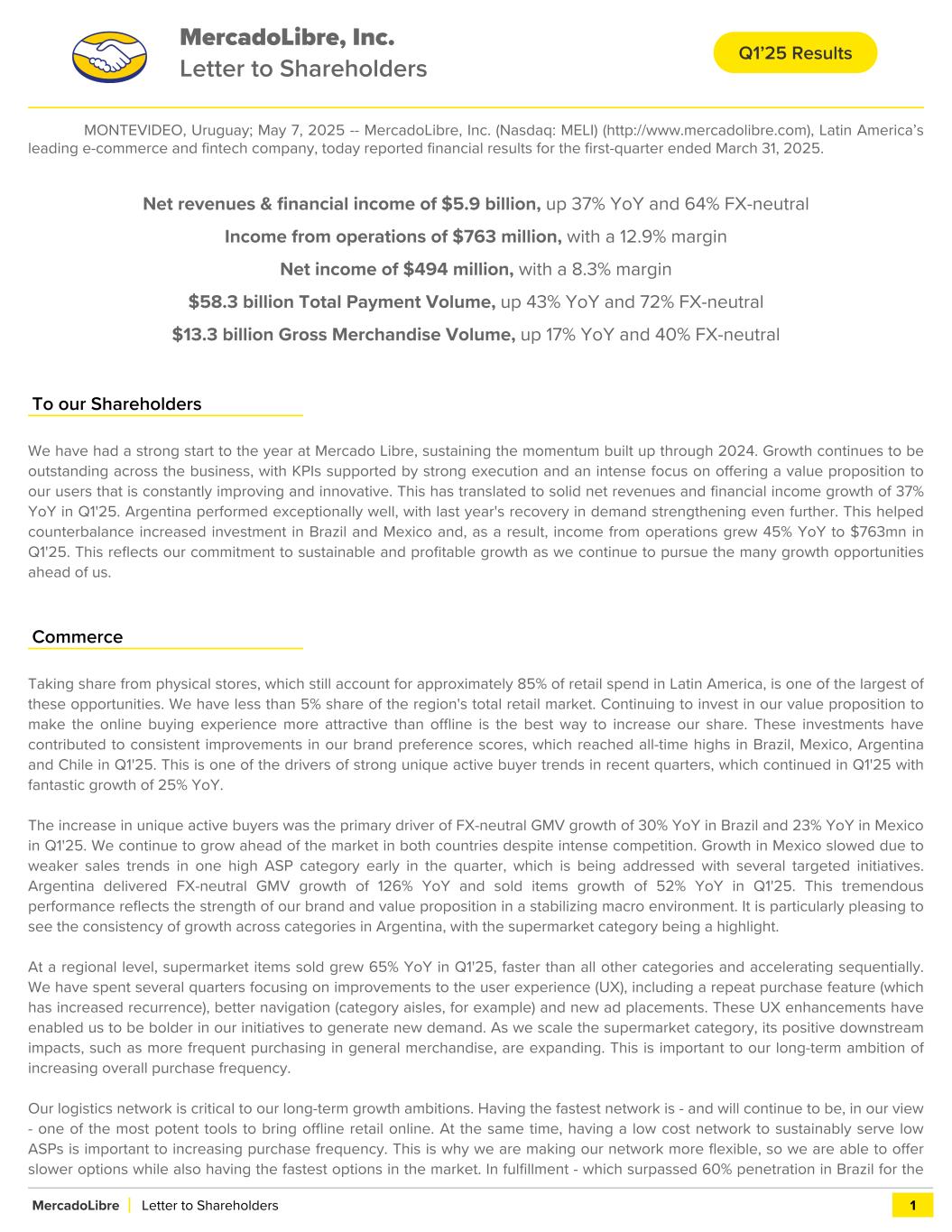
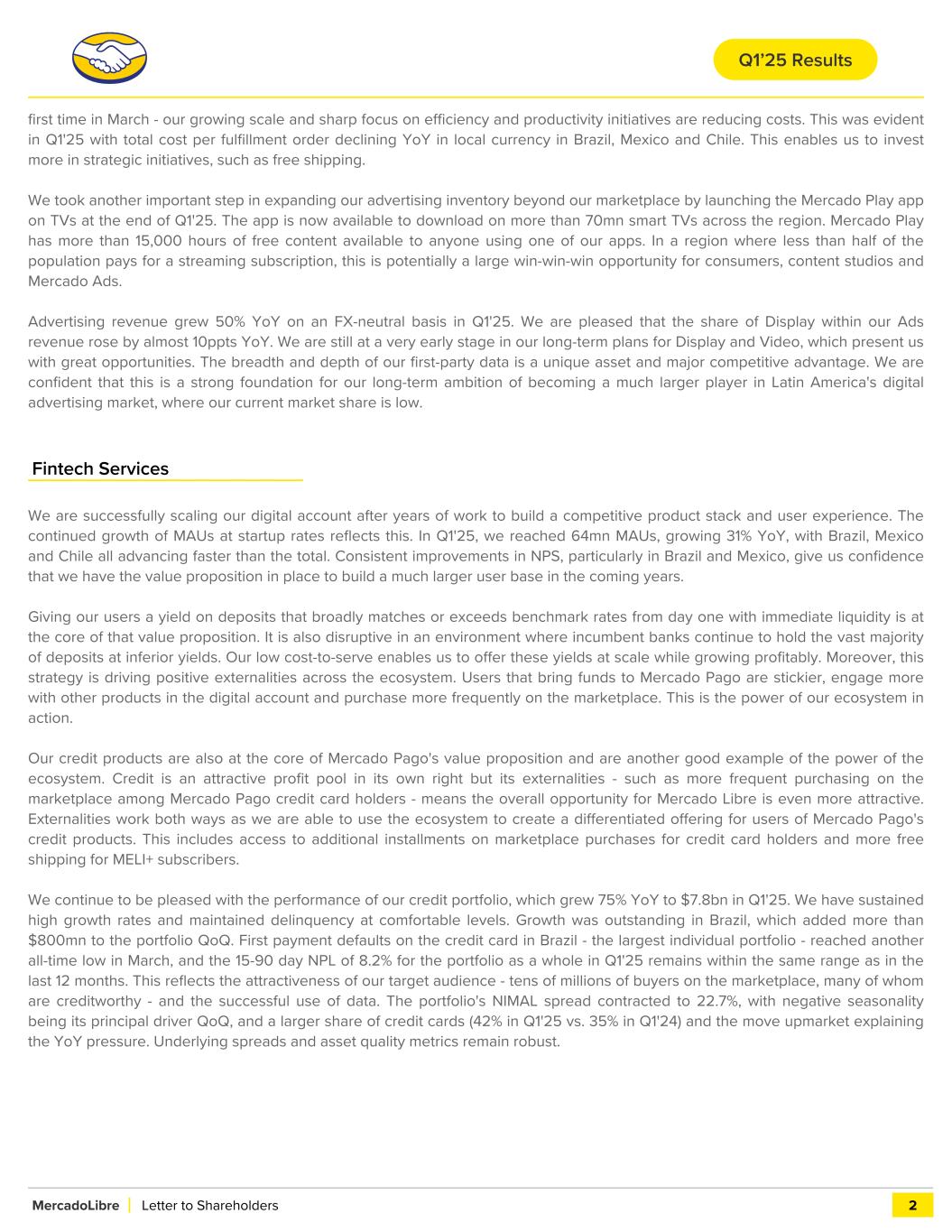
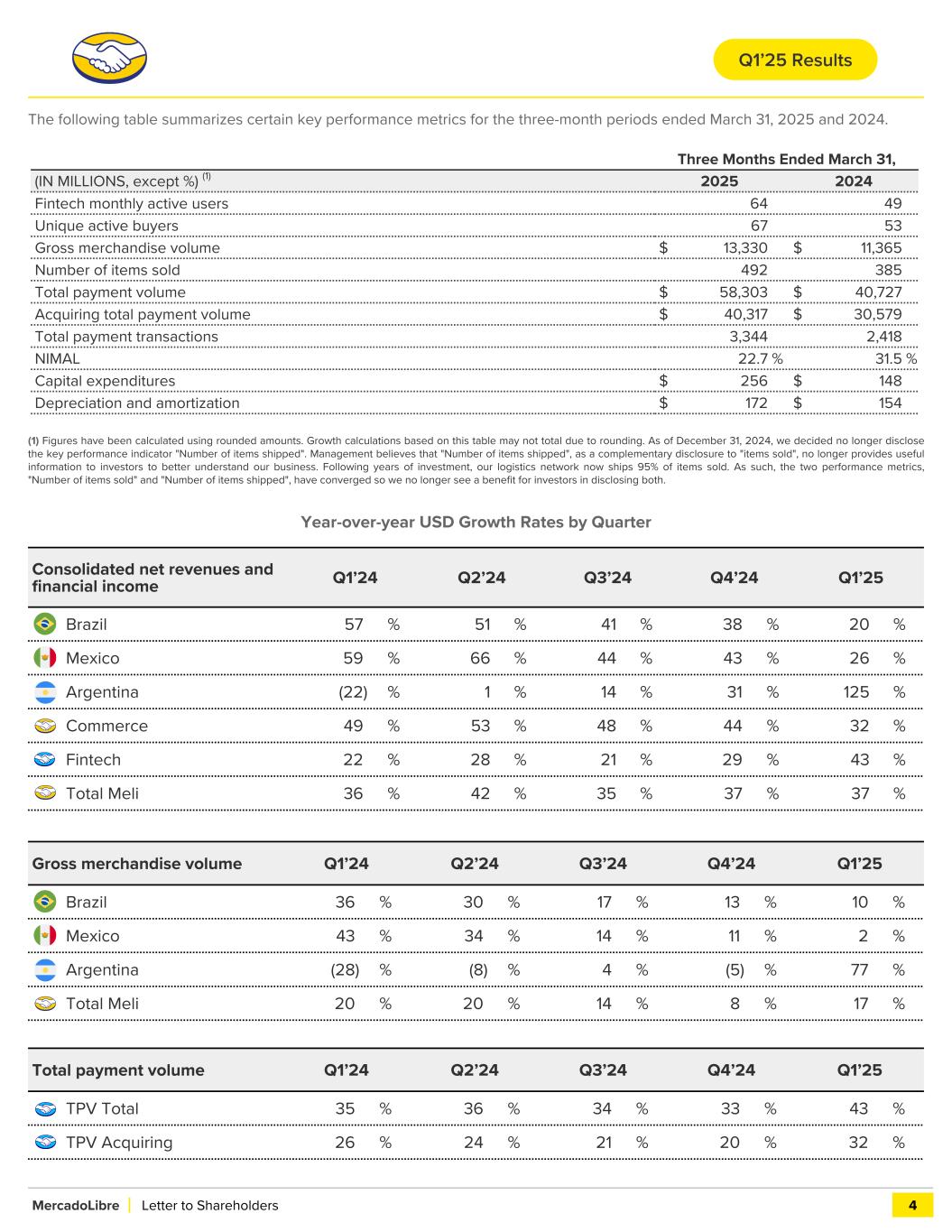
Hello, everyone. We are excited to kick off 2025 with another great quarter at MercadoLibre, as we continue to deliver strong growth across both e-commerce and fintech. In Q1, we maintained the rapid pace of net revenue growth achieved in 2024, while making solid progress on all of our strategic initiatives. This momentum is fueled by continued investments and improvements in the value proposition for our users. In commerce, we continue to deliver strong growth outpacing all of our major markets. Brand preference metrics for our marketplace reached all-time highs in Brazil, Mexico, Argentina, and Chile during the quarter. This is clear evidence that our investments are working and that we are further consolidating our position as a destination of choice for online purchasing in Latin America. In fintech services, monthly active users continue to grow at startup rates of more than 30% year-on-year, reaching a total of 64 million. Our strategy of offering attractive remuneration on deposits is proving to be a powerful tool to attract, retain and engage users. Our credit portfolio grew by 75% year-on-year, while maintaining delinquency at comfortable levels. In March, first payment defaults on the credit card in Brazil reached a new all-time low, driven by ongoing improvements in our scoring models and a successful move up market. As a result, we are scaling the credit card business while improving its profitability. Argentina performed exceptionally well in Q1 in all of our business units, with U.S. dollar revenues more than doubling year-on-year. The stabilization of the macroeconomic environment has helped us to fully leverage the strength of our brands and value proposition in the country. Income from operations grew at a faster pace than revenue, helped by the strong performance in Argentina. We are very encouraged by the positive impact of our strategic investments across the MercadoLibre ecosystem, which are critical for us to capture the many long-term growth opportunities that we see in both e-commerce and fintech in Latin America. Thank you for your continued support and interest. Now I hand it over to Richard for some exciting updates on fintech.
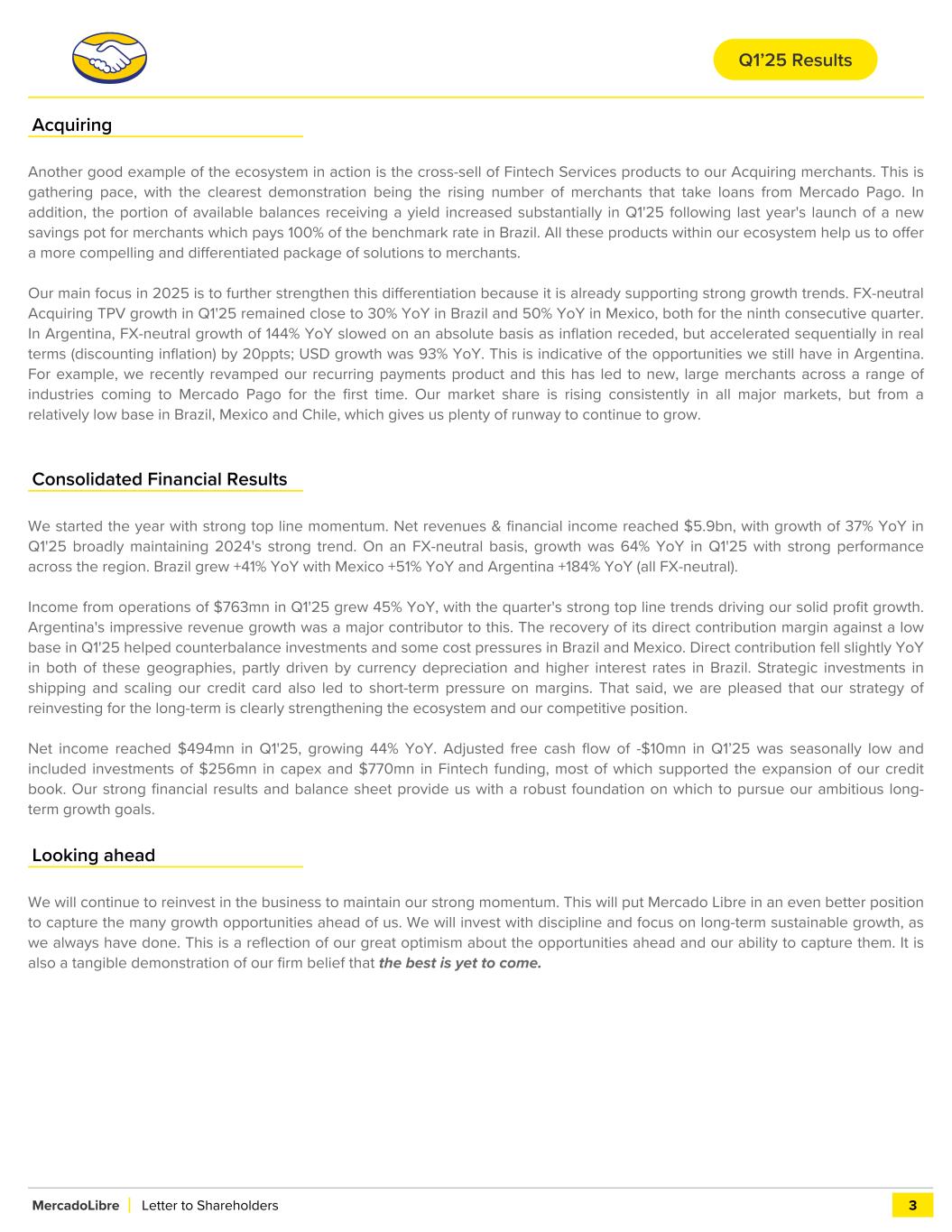
Q1 was the most recent in a long series of quarterly results that reflect MercadoLibre's fantastic momentum. Monthly active users, for example, continue to grow above 30% year-on-year and reached 64 million in Q1 '25. Today, we want to highlight some of the exciting changes that are taking place, as we continue to democratize financial services in the region. Our aim is to transform people's relationships with financial services, so that as many people as possible have access to products such as the yielding account, credit, investments, insurance, and much more. Perhaps more importantly, we want users to see the relationship as win-win. This is a core pillar of Mercado Pago's positioning and, more importantly, how we intend to continue disrupting the markets in which we operate. Here's a short video that should help investors understand how we are thinking about every decision we take as we build Mercado Pago to become users' primary financial relationship. Aside from sharing the win-win value proposition of Mercado Pago, we want it to be more closely connected to MercadoLibre at the center of our ecosystem. This is why Mercado Pago has adopted yellow as its primary color, aligning with our ecosystem. This change allows us to leverage the strong awareness and high consumer confidence in our marketplace across the region. We aim to eliminate the distinction between the yellow and blue sides of the ecosystem to create a unified experience. In the first quarter, we launched new branding in our apps and websites in Chile and Mexico, with Brazil following in mid-April. This branding update affects not only our fintech services but also our acquiring business. Along with the yellow color, we are introducing an updated visual identity that is more modern and aspirational. We've also enhanced Mercado Pago's user experience, transitioning from a super app appearance to a more specialized banking feel. We're committed to showcasing our products in the simplest way possible. These changes are all part of our goal to become the largest and best digital account in Latin America, and we are excited about the possibilities ahead.
Operator
We will now begin the question-and-answer session. The first question will come from Andrew Ruben with Morgan Stanley. Please go ahead.
Speaker 3
Hey. Andrew of Morgan Stanley here. Thanks very much for the question. I'd like to explore a bit the sustainability of some of the trends you're seeing in Argentina. Items sold. It looks like this step change to 52% growth. So, I'm trying to understand even quarter-on-quarter what drove such an acceleration? And similarly, when we look to the contribution profit in the country, you mentioned the reinvestment in Brazil, reinvestment in Mexico, but still quite a strong margin in Argentina. So trying to understand the sustainability of that trend and how you're thinking about investments in the country going forward? Thank you.
Speaker 4
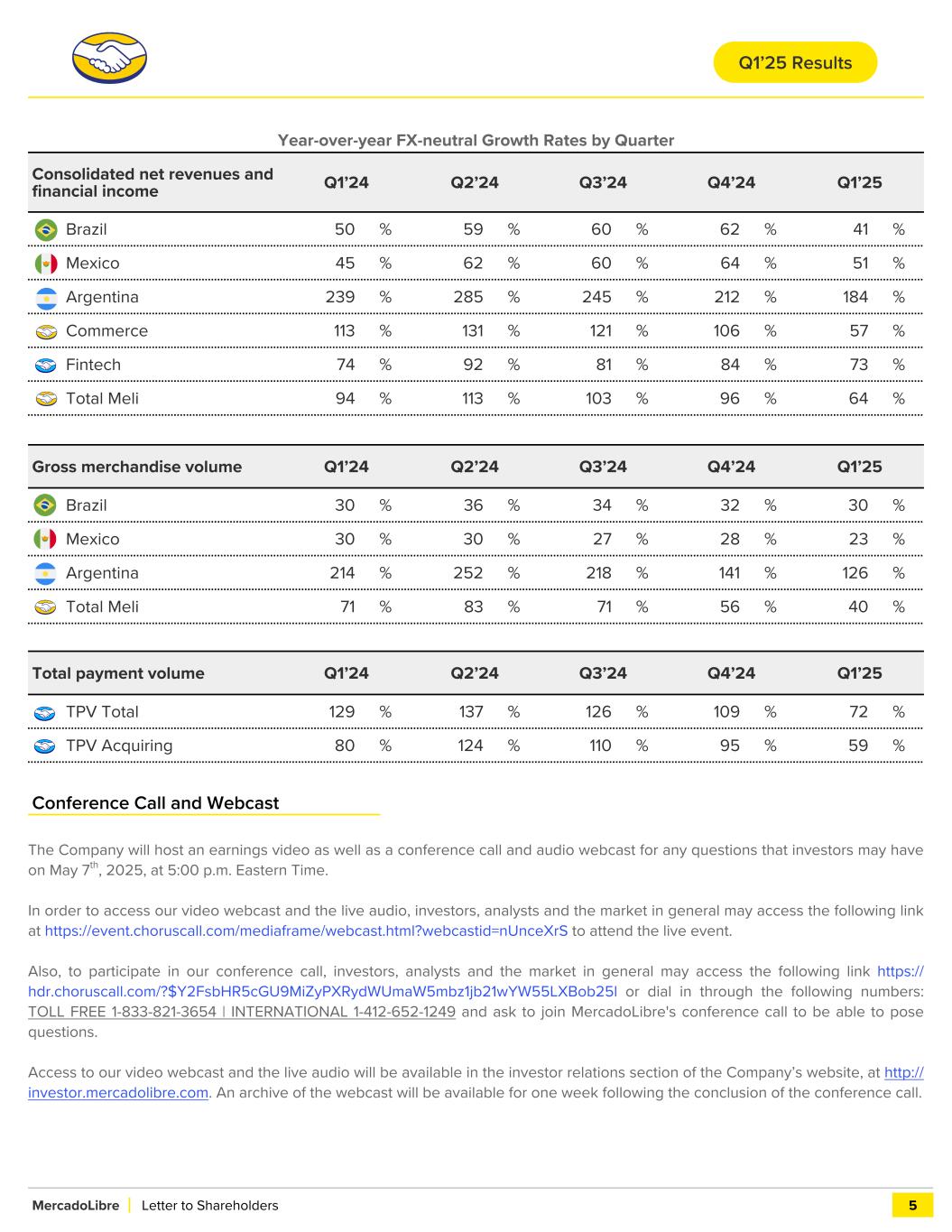
Hey, Andrew. This is Ariel. Thanks for your questions. So as you said, we had an amazing quarter in Argentina with last year's recovery in demand strengthening even further; we were able to capture strong growth. As you said, 126% of GMV growth year-over-year, 52% on items sold, items per unit buyer going up. Of course, there are different effects, right? On the one hand, we are comparing our numbers with a baseline from Q1 last year, which was a bit weak. But simultaneously, we see ourselves gaining market share. And that's not just because of what happened last year, but also because of everything we've been executing over the last few months to help the business recover, being in shipping and making our prices more affordable, pushing for more financing, improving selection and so on. So overall, we continue to enhance our value proposition and we'll continue to do so in the coming quarters. Of course, comparables will get tougher, but we are convinced we have the core of what we need to continue having a great business coming from the country.
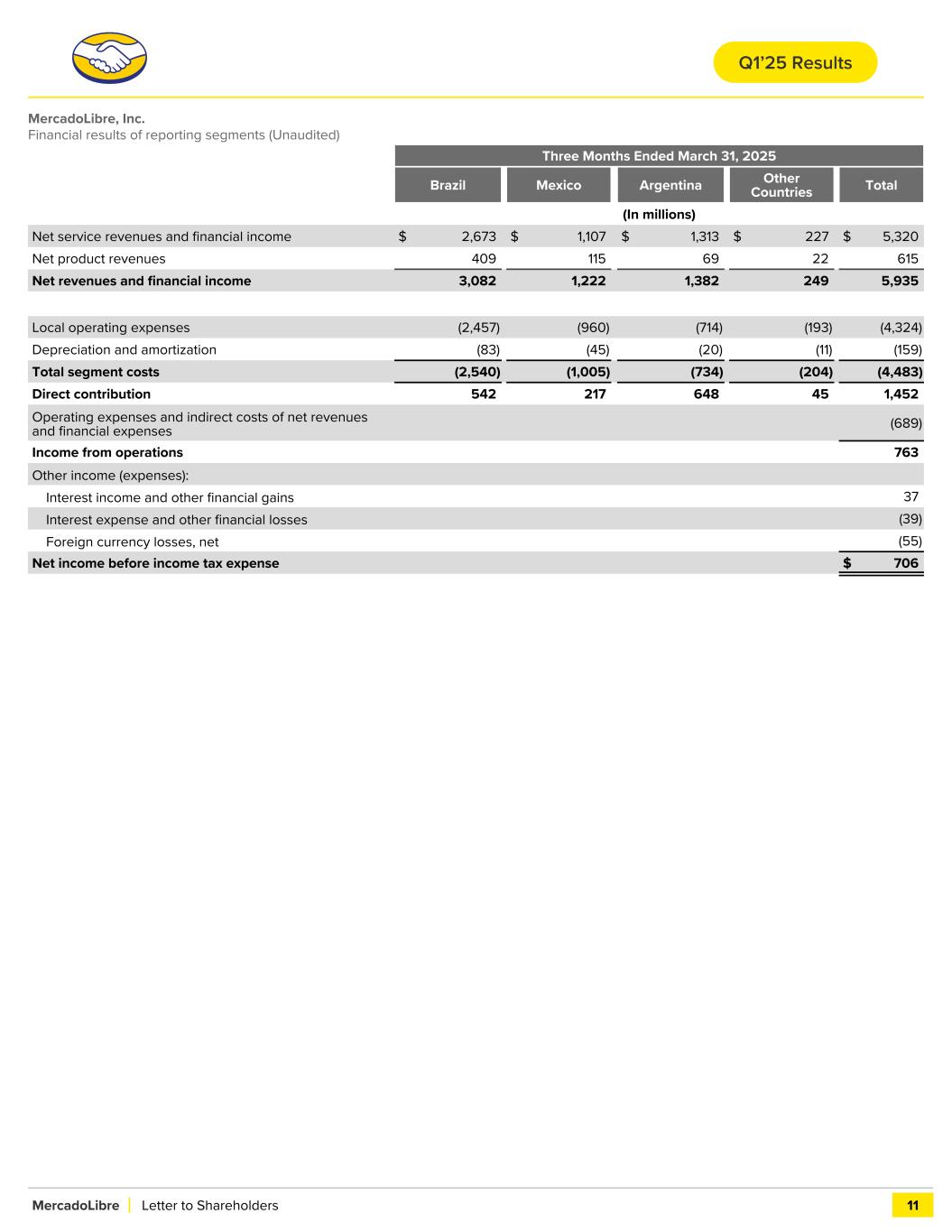
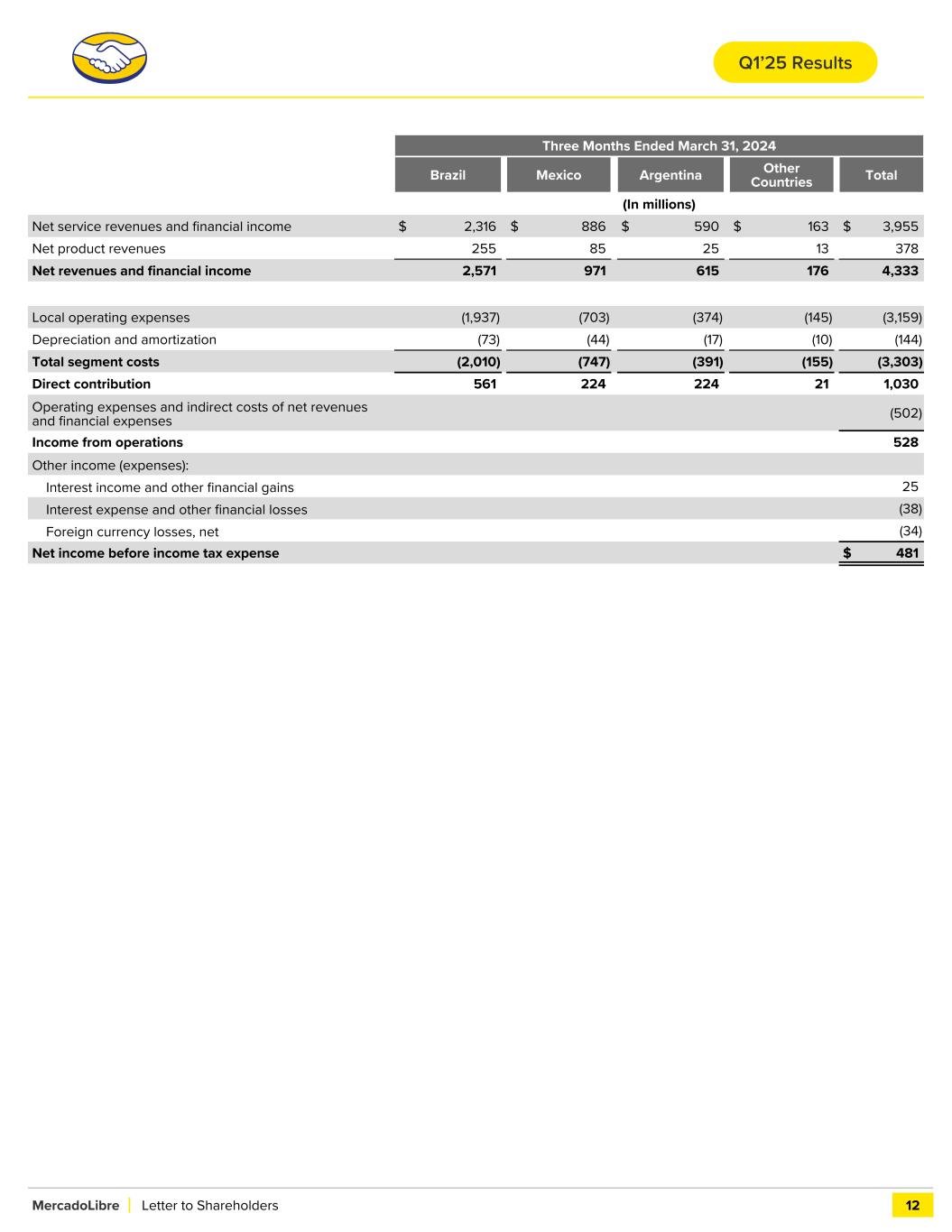
And just to complement, Andrew, yeah, we are seeing clearly stabilization of Argentina. We have seen it for the past few quarters. But obviously, we have a tough comp last year; it was a really tough quarter in Q1. So that also helped us with the comparison. But having said that, we've seen lower inflation, decreasing interest rates, which is helping us with our credit book. And our credit book grew by 4x year-on-year in Argentina in dollar terms. Not only that, but it improved profitability as well, helping profitability in Argentina. Assets under management from a very large base in Argentina continues to grow, grew at 69% year-on-year and profitability, overall, the consolidated profitability for Argentina improved by 11 percentage points during the quarter compared to last year. So we think we are very optimistic about Argentina, not only because of macro, but more importantly, because of the brand that we have in Argentina, both from MercadoLibre and Mercado Pago. The user experience that we have in Argentina is performing extremely well, as Ariel mentioned, both in e-commerce as well as fintech, and we will continue to deploy and improve the user experience in Argentina, just like we are doing in the other countries.
Speaker 5
And if I were to add, one comment is with regards to the reinvestment we're making in Brazil and Mexico on the fintech side that is mostly related to our credit card in those countries, and we have not yet launched a credit card in Argentina. So when we do, definitely we will invest also in building that portfolio.
Speaker 3
Great. Thank you all for the color.
Operator
The next question will come from Irma Sgarz with Goldman Sachs. Please go ahead.
Speaker 6
So 1P GMV posted some really solid growth. Can you talk a little bit in more detail about what drove this growth and what categories perhaps contributed more? Was supermarket, for example, a relevant force here? And if you can also comment on margin evolution here, are you getting closer to breakeven ex-ads and on a full cost basis or is that something on the cards for this year? Thank you.
Speaker 4
Hey, Irma. How are you? Ariel here again. So yes, as you said, 1P had a tremendous Q1 with GMV growth evolving 102 year-over-year with strong performance across market and across categories. And I would say that's the consequence of continuing to improve selection and price competitiveness. And we also continue to make progress in terms of managing the business through more and more technology where we are doing automatic onboarding, automatic buying, automatic pricing, and that's all contributing to better economics and simultaneously continuing to grow. I would say, the growth in 1P is not driven by supermarket. 1P supermarket is growing, but our growth in 1P goes much beyond what happened in supermarket and is more and more spread across different categories of our business. Of course, consumer electronics continues to hold a big share of what we are doing in 1P. So, to the second part of the question, going to supermarket. We are extremely satisfied with the consistent progress we have been making in supermarket for some quarters already. In Q1, we grew 65% year-over-year, that's faster than any other category in our marketplace and sequentially accelerated. And I'd say that's the result of an improved value proposition across the board, right? So we have better and more consistent selection. We have better navigation with aisles that facilitate the shopping experience. We have deployed features for repurchase and some other things that allow our users to fill in their carts and buy stuff easily, we improved our promotional activities and special dates. And last but not least, we are increasing the share of 1P within the supermarket and we are doing so, because it helps us get more effective in getting consistency and availability of supply day after day, but it also brings efficiency and improvement in economics, right? So 1P in supermarket actually has better unit economics than 3P as we managed to operate with massive movements in our warehouses operating by pilots and master cases. We managed to get better revenues from advertising through our relationships with manufacturers. So 1P is and will definitely play a strategic role in supermarket moving forward. Going to the question on margins, year-over-year margins in supermarket in particular continue to improve. So, we are excited with that and that's part of the reason why we feel comfortable investing behind doing more and more site merchandising to push for a category in which we have a lot of confidence and we have proven that can bring down some impact in the users that do engage in buying consumer packaged goods in MercadoLibre.
Operator
The next question will come from Robert Ford with Merrill Lynch. Please go ahead.
Speaker 7
Hey. Good evening, Richard, Martin, Ariel, and Osvaldo. Thanks for taking my question. With respect to fast-moving consumer goods, I was actually surprised that it was a highlight in Argentina. Can you talk a little bit about the TAM across the region, maybe the halo effects for other categories, how you're thinking about subscribe and save? And you alluded to this Ariel, but how big of an unlock is this in terms of having now a full funnel solution in FMCG for advertising?
Speaker 4
Hey, Bob. Ariel once again. So thanks for the question. I think, in general terms, e-commerce penetration in FMCG is pretty low. So longer term, the opportunity is huge. We are just starting with this category, both ourselves and probably some of our competitors. So we are excited with everything we see and with everything we can build to push that penetration closer to what e-commerce represents for general retail. On halo effect, I was just mentioning before, we do measure downstream impact of supermarket. So buyers who buy CPG in MercadoLibre end up buying more of general merchandise in MercadoLibre as well and that's very positive. Then there is a huge list of product improvements that we need to deploy and we need to code first. Subscribe and save is definitely on that list. It will get a time in which we will be able to do that, but we are more on the basic feature building right now. So many things to continue doing in order to get there. We will at some point, but again, excited with the progress. This is happening in every single market where we operate and we expect that to continue in the future.
Operator
The next question will come from Marcelo Santos with JPMorgan. Please go ahead.
Speaker 8
Hi, good evening. Thanks for taking my questions. I would like to ask for an update on the logistics plan, especially on Brazil. I think there were some news saying that you're planning to boost the distribution center deployment. So, where you are now, where do you want to get and if you could also comment on other regions? Thank you very much.
Speaker 4
Hey, Marcelo, how are you? Yeah. I think there's nothing changing in terms of our logistics plan to be shared in this call. As we mentioned in the past, we think logistics is a key enabler for the growth of our business and we don't want to take risks in terms of not having the required capacity to deal with demand. But given our current scenario and our internal projections, there are no changes to what we announced in the past in terms of footprint. We were very active in deploying a large number of fulfillment centers last year. I think this quarter in particular, the number was a bit lower, but that's just because of seasonality and time-to-market in setting up new facilities, but we will continue building and expanding our footprint as needed to deal with the demand that we think we will continue generating in the marketplace.
Speaker 5
And to complement from a financial perspective, you take logistics investments of CapEx, and logistics this quarter as a percentage of revenues is consistent with what we had a year ago. So a similar path from a financial perspective.
Operator
The next question will come from Rodrigo Gastim with Itau BBA. Please go ahead.
Speaker 9
Yeah. Thank you. Good evening, everyone. I just would like to double-click here on the main drivers behind Argentina's contribution margin evolution. You said it is easy comps, I understand that, but you've reached the highest contribution margin ever. So just wondering here where it mostly came from? Is it coming from higher take rates, revenue mix with higher growth in the Fintech business with the acquiring business which has higher margins, SG&A dilution from the faster top-line growth? So anything here on the main drivers, specific drivers in Argentina, actually to help us to understand the future would also be very helpful. Thank you, guys.
Hi, Rodrigo. It's Martin here. I believe Argentina performed exceptionally well in both commerce and fintech. Most of our businesses saw significant growth during the quarter. One of the key factors was our ability to effectively dilute fixed costs while also finding efficiencies in logistics and other areas. The credit business showed strong growth, and with interest rates declining in Argentina, this has positively impacted our credit operations. It's become more affordable for people to adopt credit, and lower funding costs have enhanced our margins on that product. Overall, we've observed recoveries, and as Ariel noted earlier, commerce items have all grown by over 50% year-on-year. This improvement spans the entire business, leading to better margins. The growth we've seen is not just due to comparisons from last year but also reflects genuine and sustainable enhancements in profitability in Argentina.
Speaker 5
The only thing I would add to that is that as interest rates have continued coming down, we also saw an increase in the percentage of transactions that were paid with credit cards and installments where we have also extra revenues and an extra take rate.
Operator
The next question will come from Neha Argarwala with HSBC. Please go ahead.
Speaker 10
Hi. Can you talk a bit about the asset quality trends? We did expect some seasonality and some seasonal worsening, but I also see that it's stronger growth in credit cards, which should dilute the asset quality, both early delinquencies and 90-day NPL. So if you can shed some more light on what kind of trends should we expect going forward? And also, if there's any contribution of the growth in the Argentina credit business on these asset quality numbers that we are seeing? Thank you so much.
Speaker 5
There are several factors at play. When we examine our loan portfolio, we are increasing the share of credit cards. Although credit cards have a lower NIMAL compared to other parts of the portfolio, their NIMAL has been improving. This quarter has been our best ever. The asset quality is very strong, but the share of credit cards is changing. As we expand our portfolio and as all cohorts mature, the proportion of older cohorts, which have a positive NIMAL, will increase, counterbalancing the changes in mix. Additionally, we are moving into higher markets on both the merchant side and particularly in the consumer credit segment, which will entail slightly lower risk but also lower spreads due to the credit we are providing. These factors have largely contributed to the shifts in our credit portfolio mix. Regarding Argentina, it stands out as the country with the lowest delinquency rates. One reason is that the private sector has less debt compared to other markets, as the credit markets were closed for a long time. Furthermore, people use Mercado Pago daily, leading to quick repayments since it often serves as their primary account for daily transactions. Thus, the credit quality in Argentina remains very strong, contributing to the growth in portfolio size that Martin mentioned for both consumer and merchant segments.
Operator
The next question will come from Geoffrey Elliott with Autonomous. Please go ahead.
Speaker 11
Hello, thanks very much for taking the question. Can you discuss the strategy in terms of deposits in Brazil? We've seen the 120% of CDI rate offered over the last few days. What's behind that? Is that about building customer loyalty, is it about funding? Is it about something else? Can you give some thoughts there?
Speaker 4
The main driver behind our strategy is our marketing and positioning as the leading digital bank. We are moving in this direction, which enhances our reputation. When consumers begin to use Mercado Pago, they tend to use it more frequently, leading to increased retention and greater utilization of funds within our marketplace. We recently launched a strong marketing campaign in Brazil, transitioning to a yellow background instead of blue. We also recruited Anitta, a popular Brazilian singer, to promote Mercado Pago, and this has been very effective. Part of our value proposition is that we offer the highest interest rates in Brazil, which we intend to maintain. There are certain conditions to access the 120% of CDI rate; you need to be part of our loyalty program and contribute to a specified fund with a limit on investment. Overall, we are creating significant awareness and more consumers are associating us with the digital banking sector, which indicates we are headed in the right direction.
Operator
Your next question will come from Kaio Prato with UBS. Please go ahead.
Speaker 12
Hello, and good evening. Thanks for the opportunity for asking questions here. I would like to explore a little bit more about the credit business. First, I would like to understand how is your appetite today across your main products, if you can share. Last quarter, you made clear that you were going to reduce the issuance of micro cards. So just wondering if you can share a little bit about the effect from that and more about the strategy going forward. Also, if you can talk a little bit by region would be helpful. And finally, we noted a drop of your credit portfolio. We've seen one of your funding structures filing in Brazil in March, and in this report, you mentioned that you had almost 800 million from own cash for funding on the fintech. So can you provide further details on this? What is the funding breakdown of the portfolio today? And if you are somewhat changing the strategy going forward? And if so, what's the rationale? Thank you very much.
Speaker 5
Hi, Kaio. Let me start with how we are seeing the credit portfolio in general. And let me start with Brazil and our risk capital in Brazil. We have not seen any deterioration in our portfolio. And I think that both on the consumer side and the credit side, we continue to be very profitable and NPLs continue to be very healthy. And now in Brazil, as I mentioned, the credit card book, the recent cohort has the lowest first payment defaults we have seen. So we are very excited about how our credit models are evolving. And that said, we have taken some more measures to reduce risk because we are looking at what's happening in the market and we have seen some deterioration from other players. And so what we have done is beyond reducing the issuance of micro cards, we have been, I'd say, more conservative regarding those customers who have the lower credit score. And I would say this tightening is rather small, but it's something that we have done and we are very comfortable with the level of risk we are currently taking. Something similar has happened in Mexico, probably more towards the end of last year and early this year, then we have been able to relax a little bit in the issuance of new cards, but we were also more conservative and attended a little with regard to those customers that had a lower credit score. But we have not seen any impact in our NPLs.
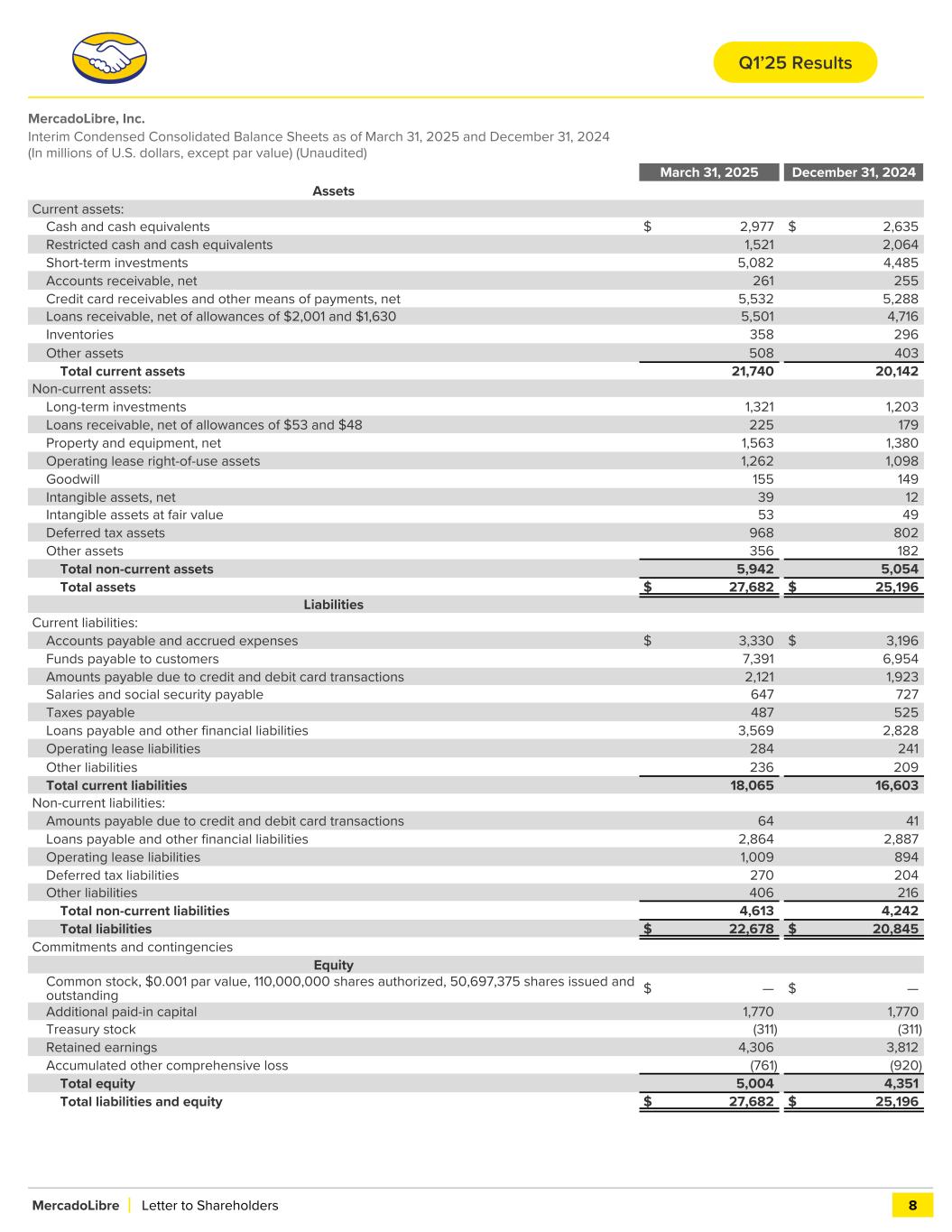
Regarding funding, Kaio, the strategy continues to be the same. Just as a reminder, we fund our credit books in Mexico and Brazil mostly with warehouse facilities, which are funded by large banks, JP Morgan, Goldman Sachs and Citibank. And in Argentina, we typically go to the capital markets on a regular basis to fund our credit portfolio. In Brazil, specifically, which you asked, we also book certain loans on our financial institution as opposed to sending it to their financial institutions and sometimes we optimize the cost of funding by leaving some more loans in our financial institution. And this is what we did this quarter. This is probably what you're referring to. But there's no change in terms of the share of third-party funding and the ways we are funding our credit book. This is mostly a tactical adjustment that we did this quarter.
Operator
The next question will come from Joao Soares with Citigroup. Please go ahead.
Speaker 13
Thank you for addressing my question. I have a couple of quick follow-ups. First, I would like to know if there will be any consequences for commerce growth as you reduce some risk in your concessions. Initially, we observed minimal impact with micro credits, but now, as you shift to lower the risk associated with some clients, I am curious about the potential effects on commerce growth. Additionally, I would like to understand the opportunities for credit cards in Argentina and any thoughts on timing. Should we anticipate a similar impact to what we experienced with the acceleration of credit origination in other countries? Is a similar situation expected in Argentina? I am also interested in how behavior changes compare among Brazil, Mexico, and Argentina. Those would be my questions. Thank you.
Speaker 5
Joao, regarding the first part of your question about potential repercussions in the marketplace related to our actions with Mercado Pago, we do not anticipate any negative impacts. We closely monitor what we refer to as Blue money, which includes all payments in the marketplace from various Mercado Pago sources, such as account-to-account transfers, personal loans, and credit cards. All three of these areas are showing growth in Brazil, Argentina, and Mexico, and we expect this trend to continue. Therefore, we do not foresee any slowdown in the marketplace resulting from our tighter credit measures. As for the evolution of the credit card in Argentina, we expect it to play a significant role in the market. We've gathered valuable insights since our initial launch in Brazil and subsequently moved faster in Mexico. We believe we have established a strong presence in Argentina, and we anticipate interesting developments there. Of course, we will remain cautious as we tailor our models to fit the local nuances, recognizing that each country is unique, but we aim to achieve this in the latter half of the year.
Operator
The next question will come from Marvin Fong with BTIG. Please go ahead.
Speaker 14
Thank you for taking my questions and congratulations on the quarter. I wanted to focus on Mexico, as you mentioned in the shareholder letter that there was one high ASP category showing some softness. Could you provide more details on that and how growth in other categories performed? Did the growth outside of that category align with what we have seen in previous quarters in Mexico? Additionally, I have a quick question regarding NIMAL. You mentioned that the fourth quarter was unusually high due to the longer payment period. If we adjust for that, and given your comments about the underlying strength and credit cards gaining market share, do you think NIMAL would have improved quarter-over-quarter without the seasonal impact? Also, any insight on when you believe NIMAL at a consolidated level might start to expand quarter-over-quarter would be appreciated. Thank you.
Speaker 4
Hey, Marvin. Ariel here. Thanks for your question. So we are very satisfied with the progress of our business in Mexico in general and during Q1 in particular. We continue compounding growth and value created for our millions of consumers; unique buyers grew north of 25% and top-line remained very solid. And I would say we were still negatively impacted by a slower start of the year for our technology vertical. It grew below the average of the rest of the marketplace. We basically saw more aggressive competition, both in terms of pricing and financing in this category and in some cases, we lacked some of the selection that we needed to compete. We have clearly identified the issue and have several targets, initiatives to deal with this, such as some selected adjustments to our premium take rates, some rebates to improve price competitiveness and some other things. We are already seeing positive results coming from each of those. And by the way, the effect from technology was kind of isolated. Our overall GMV continued well ahead of the market and the rest of the categories grew even further, I would say, with the trend that we used to have in previous quarters, around 30% year-over-year in general terms. So very good momentum.
Speaker 5
In relation to NIMAL, I would note that both sequentially and year-over-year, part of the compression is due to the mix of spreads, products, and countries. Specifically, the mix has shifted more towards credit cards, with the share of credit cards increasing by 8 percentage points over the year. This is a product type that typically has a lower NIMAL compared to consumer loans. Additionally, as we expand into higher market segments for both consumer and merchant originations, this affects both revenue yield and bad debt yield. While we have less default risk, it does impact those yields. Moreover, Argentina’s share of the credit portfolio has doubled year-over-year, which helps offset the minimal compression as we typically see higher margins in Argentina.
Operator
The next question will come from Craig Maurer with FT Partners. Please go ahead.
Speaker 15
Yes. Hi. Thanks for taking the questions. I wanted to ask a bit more specifically about the fintech competition in Mexico. Your product offering is trending more toward what we see from the likes of new and I was wondering if you can comment on how you see that evolving over time. Secondly, with regards to the trade war dynamics that the U.S. is propagating. We've been hearing that those e-com businesses that are getting shut out of the U.S. market are redeploying resources to LATAM. And I was wondering if you're seeing any change in behavior from your competition, specifically from Asia in Latin America? Thanks.
Speaker 5
Hi, Craig. I'll address the first question. In Mexico and across Latin America, our goal with Mercado Pago is to focus on acquiring new business while also becoming the best and largest digital bank in the region. This means competing not only with traditional banks but also with fintechs and other digital banks, and we are truly excited about the growth we're experiencing. We are pleased with the feedback reflected in our Net Promoter Score, the frequency at which users engage with Mercado Pago, and the overall growth of our user base in Mexico. The most significant products for us have been the super-yielding account and the credit card, both of which are showing strong growth. I believe there is a clear opportunity in Mexico. We are witnessing a trend similar to what occurred in Brazil over the past decade, where the use of financial services, especially digital financial services, has surged, and we aim to take advantage of that opportunity.
Yeah. I think the second part of your question was regarding international competition and cross-border trade into Latin America. We have been operating in a very competitive environment. Many players coming to the region, not only shipping from Asia but also building their own operations locally in the region. So we haven't seen a change in that pattern. We continue to compete with them and nothing really changed at least in the short term because of tariffs. In fact, the other way around, there are certain tariffs that were imposed in Mexico and Brazil increasing the cost of shipping products into the country that diminished the rate of volume of cross-border trade into the region. On the flip side, Argentina remains open to the market. So there's more volume coming into Argentina. That represents an opportunity for us as well because we are shipping products from the U.S., while at the same time, some international players will come into Argentina, but we would much rather see an open market than a gross market. So to summarize, I think for the most part, we haven't seen a significant impact related to the tariffs in the U.S.
Operator
The next question will come from Deepak Mathivanan with Cantor Fitzgerald. Please go ahead.
Speaker 16
Hey, guys. Thanks for taking the question. So Martin, EBIT margin in Q1 is up 70 basis points year-on-year, and you kind of have a relatively favorable comp in the next few quarters as some of the credit card portfolio headwinds stabilize. Argentina contribution margin trends have also been very good in Q1. So I guess the question is, should we still expect some of the investment plans that you have constrain full-year margin expansion? Can you give us an updated view on how you think about the margin trends? And then second question, just to double-click a little bit on ads. The penetration as a percent of GMV seems to have kind of gained a few more basis points quarter-on-quarter than we typically see. Can you expand how much is driven by ad units like display video versus some of the more traditional ad units? And can we expect this run rate of penetration gains to continue in the next few quarters? Thank you so much.
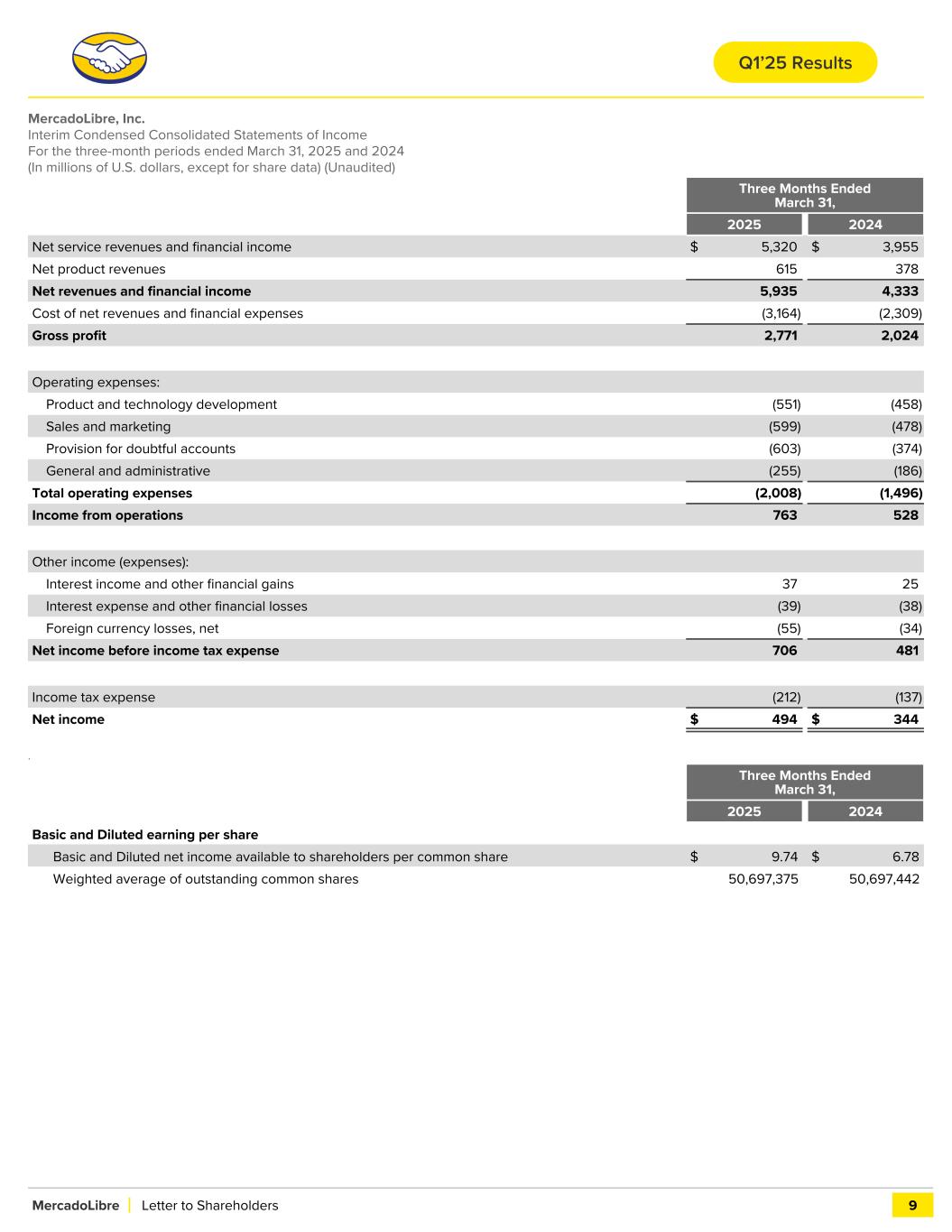
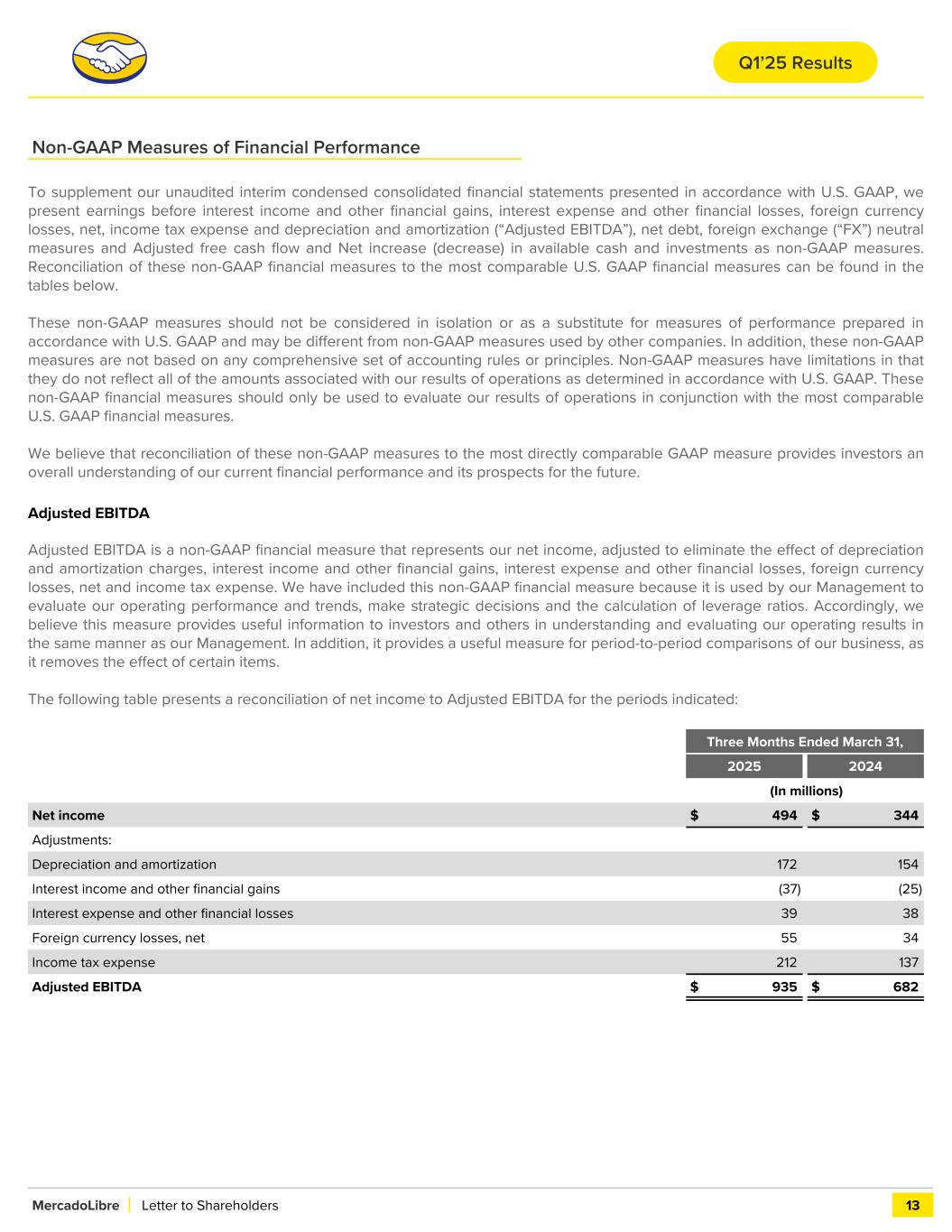
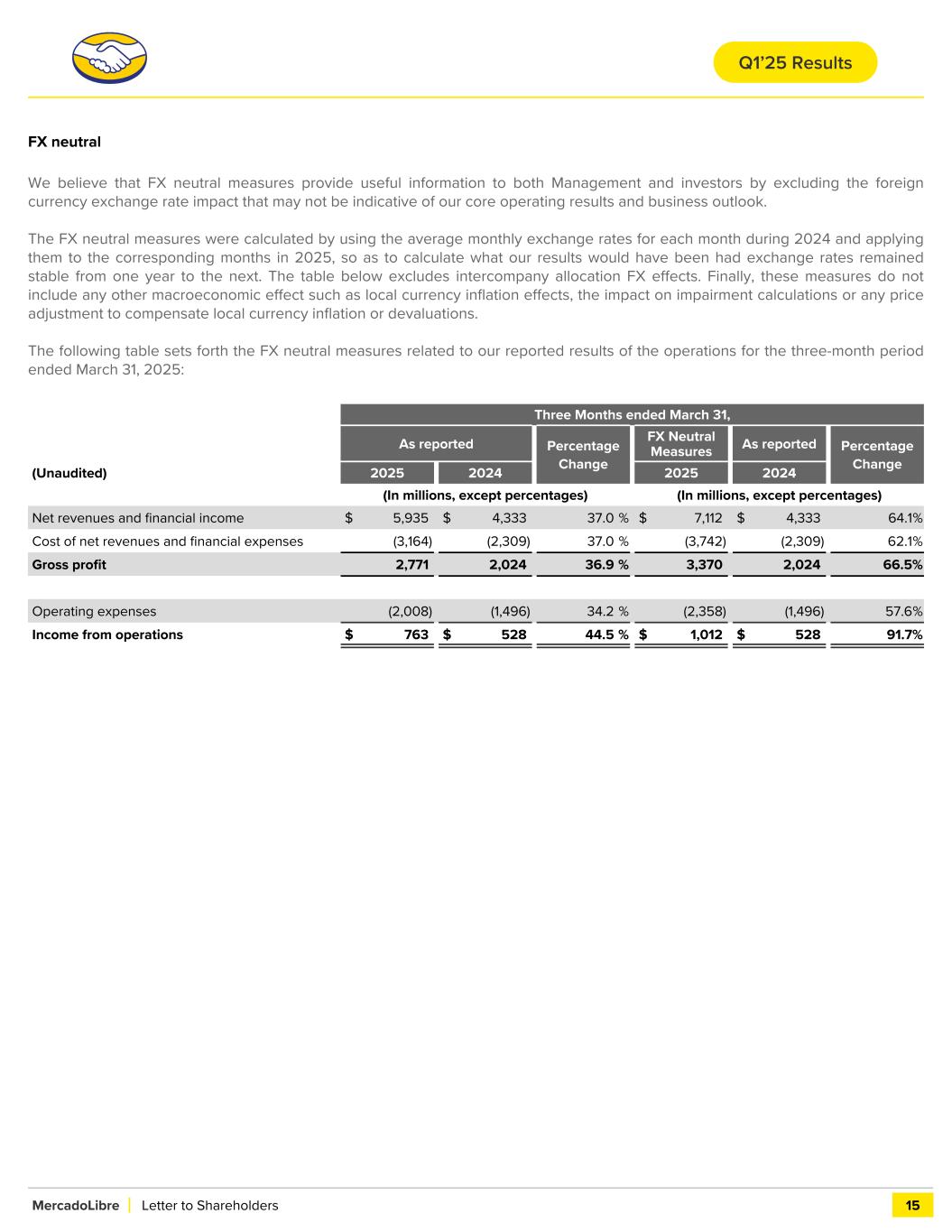
Hi, Deepak. I’m doing well, thank you. You are correct that our EBIT margin improved by 70 basis points year-on-year, increasing from 12.2% to 12.9%. A significant portion of this improvement is due to the country mix. Argentina, which has a higher margin compared to other countries, saw its share of revenues rise from 14% to 34%, contributing positively to our margins. Additionally, Argentina improved its own margins, further aiding our overall performance this quarter. This growth more than offset the investments we continue to make in Brazil and Mexico, particularly in logistics and credit cards, which did cause some margin compression in those regions. Although we don’t provide specific margins guidance, we have consistently stated that our focus is not on achieving short-term margin goals. Rather, we aim to seize the substantial growth opportunities we have in commerce and fintech. We are willing to invest in these areas, even if it puts some short-term pressure on margins. For instance, last year we experienced slightly lower margins in 2024 compared to 2023, yet we achieved strong growth, which we intend to maintain as the opportunities in Latin America remain vast; only 15% of transactions occur online, and we play a crucial role in bringing more people online. Fintech adoption and financial inclusion are still quite low, especially in regions like Mexico, as Osvaldo mentioned. Therefore, our priority remains on growth while also managing for reasonable profitability, which we refer to as MELI growth profit balancing—finding the right balance between growth and profits.
Speaker 4
Hey, Deepak. Ariel here. So to your question about that, we had a solid quarter and we grew about 50% year-over-year on an FX-neutral basis with penetration going up in Brazil, Mexico, and Argentina. And that's basically coming from an improvement in our product stack. We had a great quarter in brand ads, which is part of our search offering. So although coming from a low base, we have seen a positive acceleration coming from the extension of the product to sellers. So it was previously only available for top brands and making it more widely available is paying off. Kind of the same thing happened with display. So we grew this quarter above 100% year-over-year in display, similarly to brand ads coming from a widely available offer to more sellers and also coming from new features in the product like automatic generation of creativity for campaigns, better analytics, etc., etc., but continues to do very well. So we remain optimistic, right? So we have already a business that is the size of $1 billion in revenues per year, but we think we are just getting started. And last but not least, the launch of Mercado Play on TV is another exciting step in the direction of expanding our inventory beyond the marketplace and it will definitely play a key role in our strategy in the long term.
Operator
The next question will come from Josh Beck with Raymond James. Please go ahead.
Speaker 17
Yeah. Thank you so much for taking the question. I wanted to ask about the magnitude of short-term margin pressure that you're seeing from the strategic investments in shipping. So just would like to understand that. And then a little bit of a follow on to I think Craig's question. Are you seeing any impact from maybe higher ocean freight rates because there's certainly been such a slowdown or maybe just kind of help us think through the sourcing of some of your goods, if you have any notable exposure to some of these ocean routes that all of a sudden have a lot less volume. Would love an update there.
Speaker 4
I think when you look at the margins in the different countries, the contribution margins in Argentina improved by 11 points compared to last year for the reasons I mentioned earlier. In contrast, Mexico and Brazil experienced a decline of about 5 percentage points compared to last year. There are three main reasons for this. The growth of credit card usage is creating some short-term margin pressure, although the profitability of credit cards is improving, and some have already been profitable for two years. We are also continuing to invest in our logistics infrastructure in Brazil to enhance our fulfillment capabilities and keep pace with the levels we have in Mexico, especially in a market that is growing 25% to 30% year-on-year. Lastly, when comparing year over year, both Mexico and Brazil faced challenges due to valuation, which is putting additional pressure on Mexico's contribution margins. Regarding our CBT business, it's relatively small and primarily focused on Mexico, while we've started expanding into Argentina in the last couple of quarters now that the market is open. We plan to keep investing in and developing that business as it not only represents a good opportunity on its own but also complements our marketplace offerings by allowing us to ship products directly from Asia into Latin America and from our Texas operation in the U.S.
Operator
The next question will come from James Friedman with Susquehanna. Please go ahead.
Speaker 18
Hi. It's Jamie Friedman at Susquehanna. Thanks for taking my question. I was wondering if you could share any data that you might have on Credito, the credit portfolio and its attached rate to the marketplace. So in some markets, I think you've occasionally disclosed that, but what sort of accelerator do you enjoy as you originate and that attaches to purchasing in the broader marketplace ecosystem? Thank you.
Speaker 5
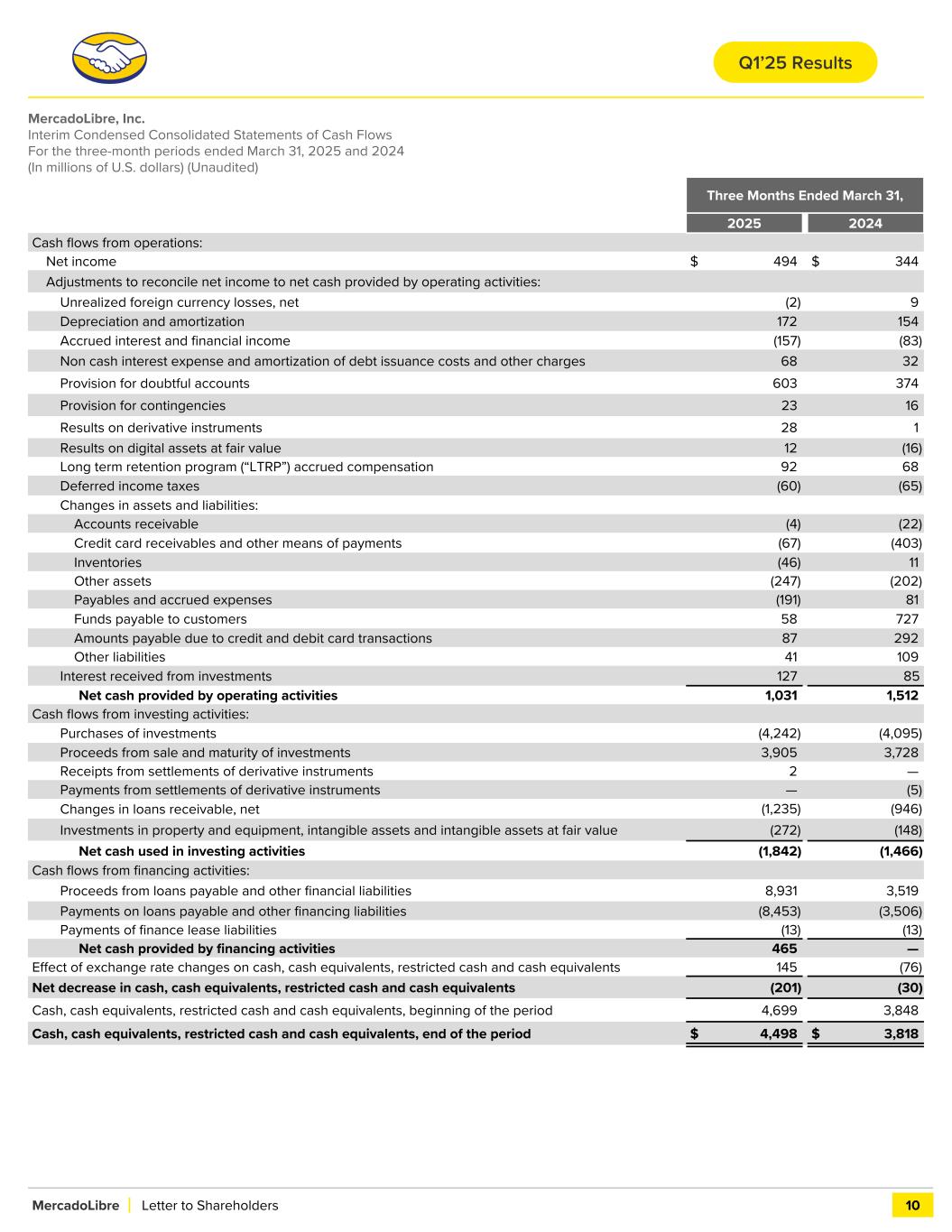
So I think that what we have disclosed in general is this what we call low money, which covers on the one hand credit, but also money that's already within the Mercado Pago system and that is roughly in the order of, depending on the country, 20% to 30% of the GMV we process on the marketplace that has been trending up, as I mentioned, but it continues to be within that range for the mainstream countries.
Operator
The next question will come from Dani Elger with XP. Please go ahead.
Speaker 19
Hi. Good evening. Thank you for taking my question. I have a quick one on competition. It's actually a follow-up. Regarding Brazil, if you could just update us on your view regarding the TikTok shop launch this month here, how do you see that in terms of maybe affecting you guys? And in Argentina, you mentioned about the increased interest. We even saw some news recently. If you could also share your view on the recent developments in terms of competition in Argentina, that would be interesting as well. Thank you.
Speaker 4
Hey, Dani. Ariel here. Regarding TikTok, it's still early to assess their impact. They recently launched in Mexico and are just starting in Brazil, so we don't have much information to share. We're vigilant and monitoring the situation closely. In Mexico, their focus appears to be on low-value items from domestic sellers, and we are curious about their strategy in Brazil. Overall, there seems to be more overlap in their value proposition with other platforms than with MercadoLibre. However, time will tell, and we will keep a close eye on it to decide how to respond. Typically, when a new player enters the e-commerce market with a different approach, they attract new users who used to shop offline, which could create additional opportunities for us, and we aim to leverage that. In Argentina, the situation is even more preliminary. We have observed some interest since Temu started operations there, and Amazon has begun shipping items from the U.S. to Argentina, but we have not seen significant progress that warrants concern. As Martin mentioned earlier, this also presents an opportunity for us. Just three weeks after the government adjusted the regulatory framework, we launched our dropshipping from the U.S. to Argentina, and we are now shipping items from our Texas inventory there too. We plan to keep expanding our selection to complement our local marketplace.
Operator
And this will conclude our question-and-answer session. I would like to turn the conference back over to management for any closing remarks. Please go ahead. The conference has now concluded. Thank you for attending today's presentation. You may now disconnect.