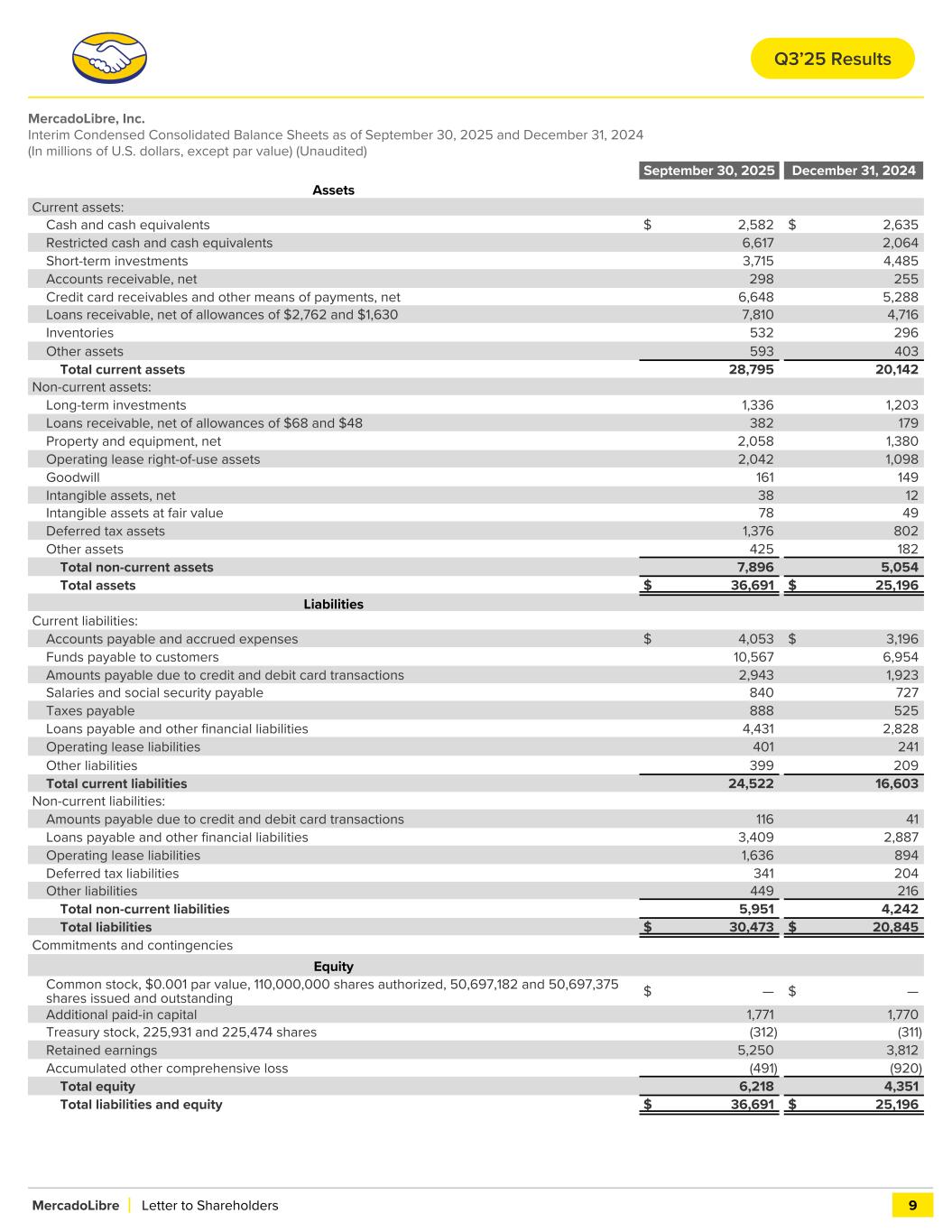
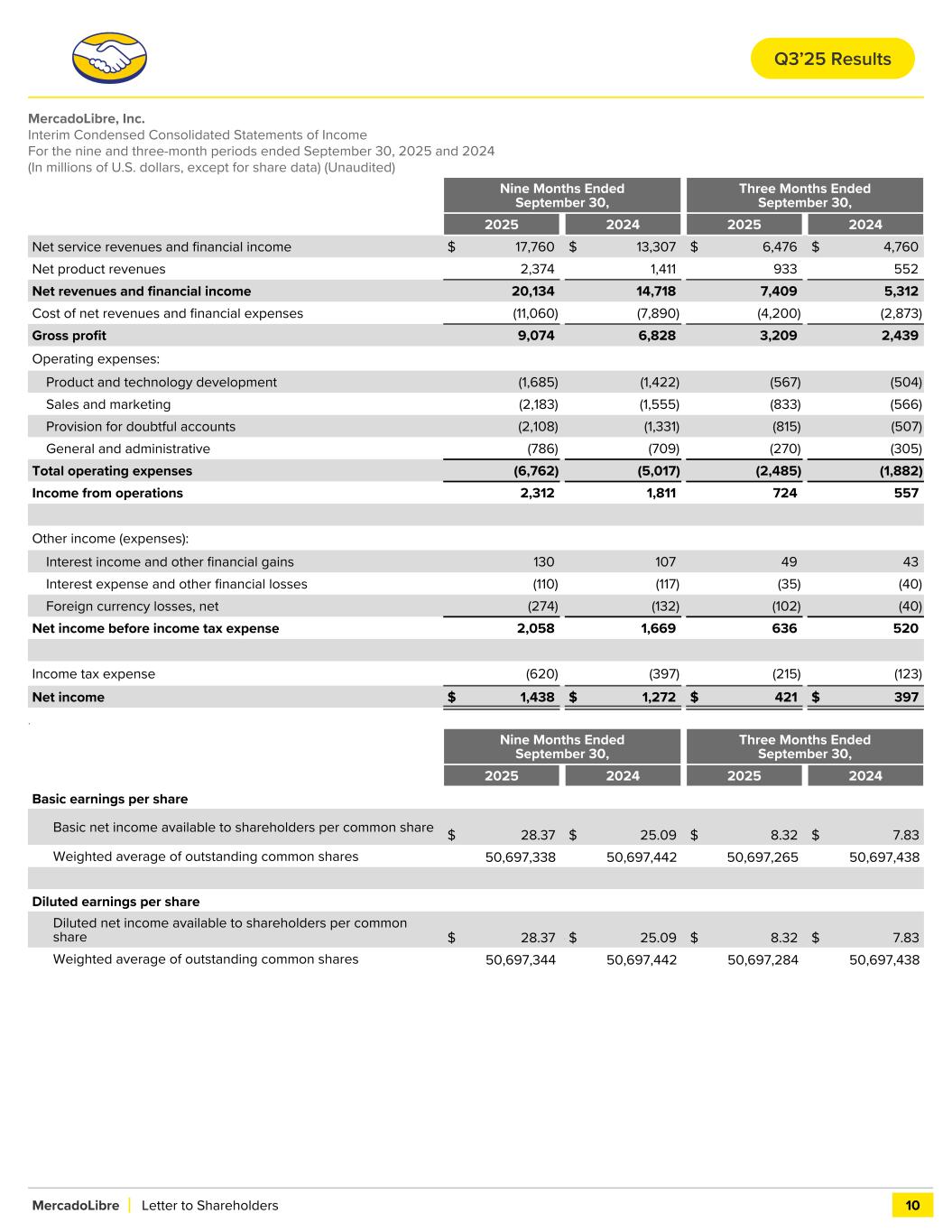
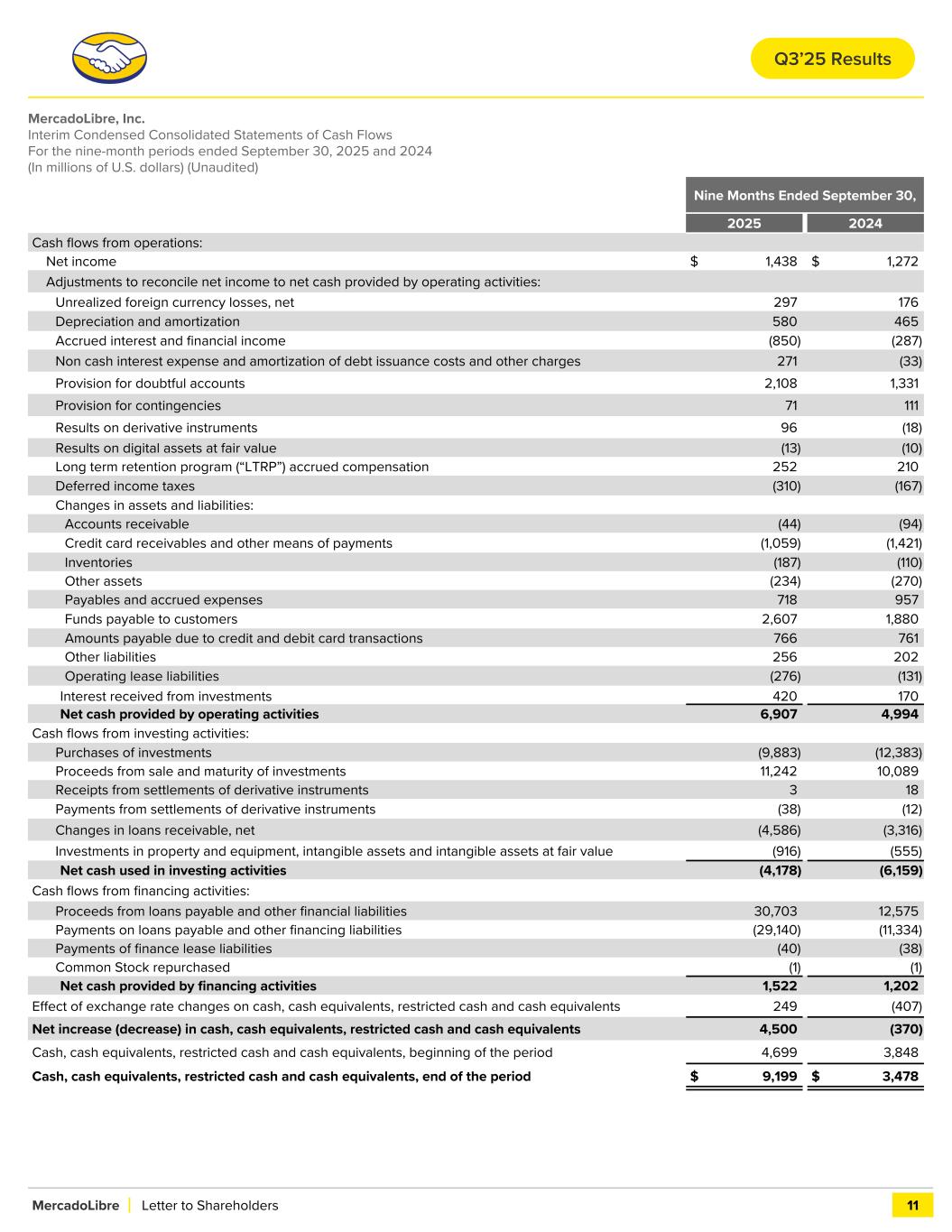
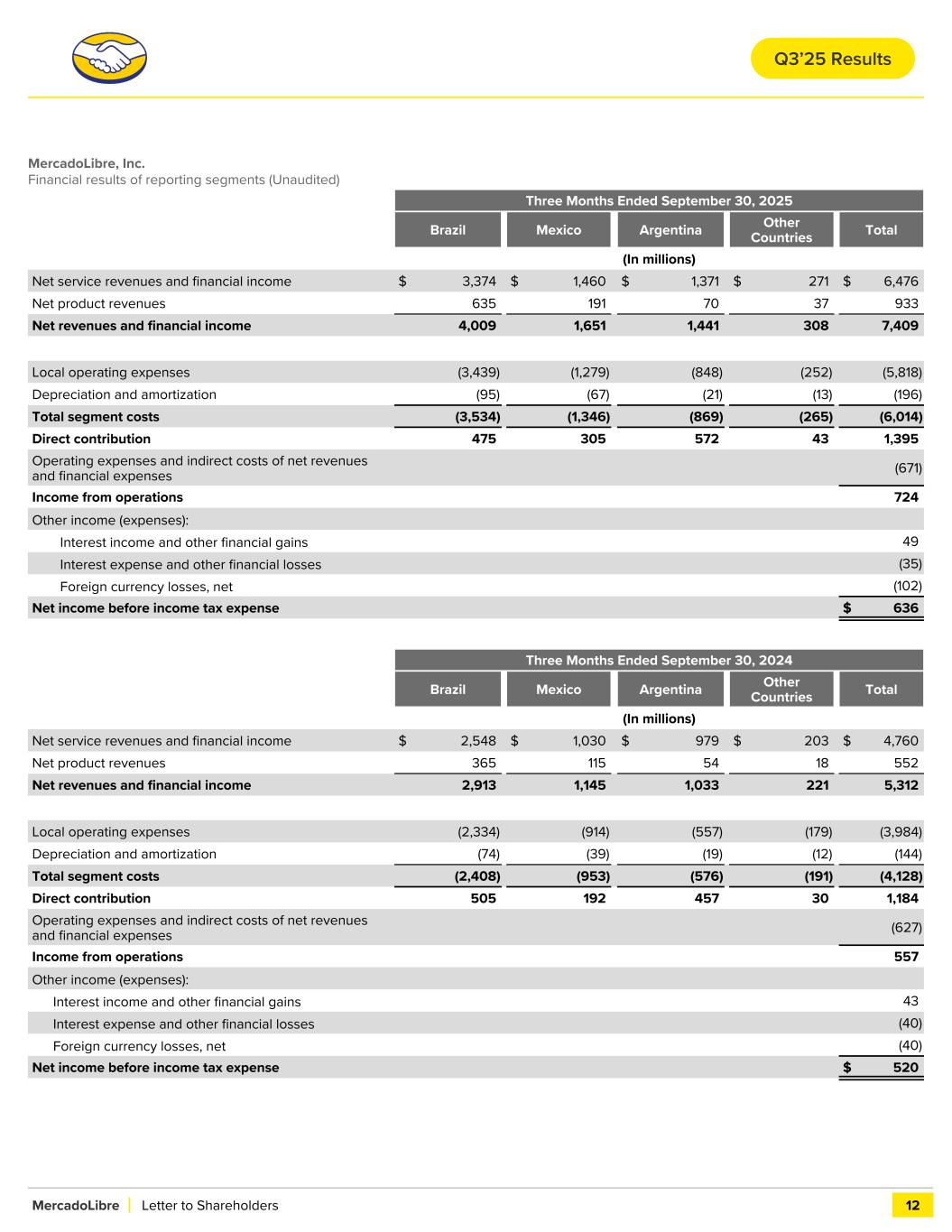
Hello, everyone, and welcome to the MercadoLibre Earnings Conference Call for the quarter ended September 30, 2025. Thank you for joining us. I'm Richard Cathcart, MercadoLibre's Investor Relations Officer. Today, we will share our quarterly highlights on video, after which we'll begin our live Q&A session with our management team. Before we go on to discuss our results for the third quarter of 2025, I remind you that management may make or refer to, and this presentation may contain forward-looking statements and non-GAAP measures. So please refer to the disclaimer on screen, which will also be available in our earnings materials on our Investor Relations website. Please note that this call is being recorded and a replay will be made available on our IR website as well. Our quarterly product updates video will now be released after earnings instead of alongside our conference call. So watch out for this coming into your inboxes in the weeks after our results disclosure. With that, let's begin with a short message from our CFO.
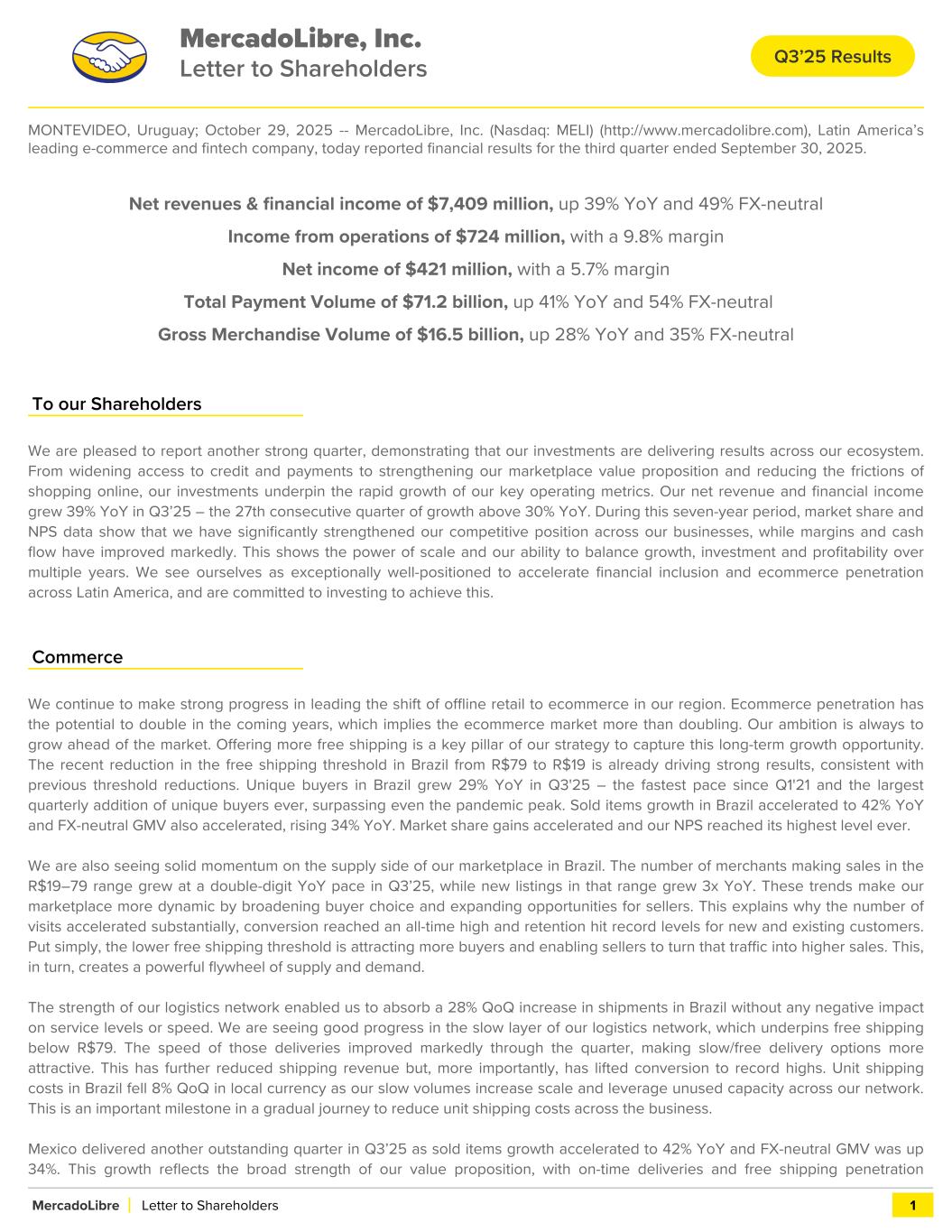
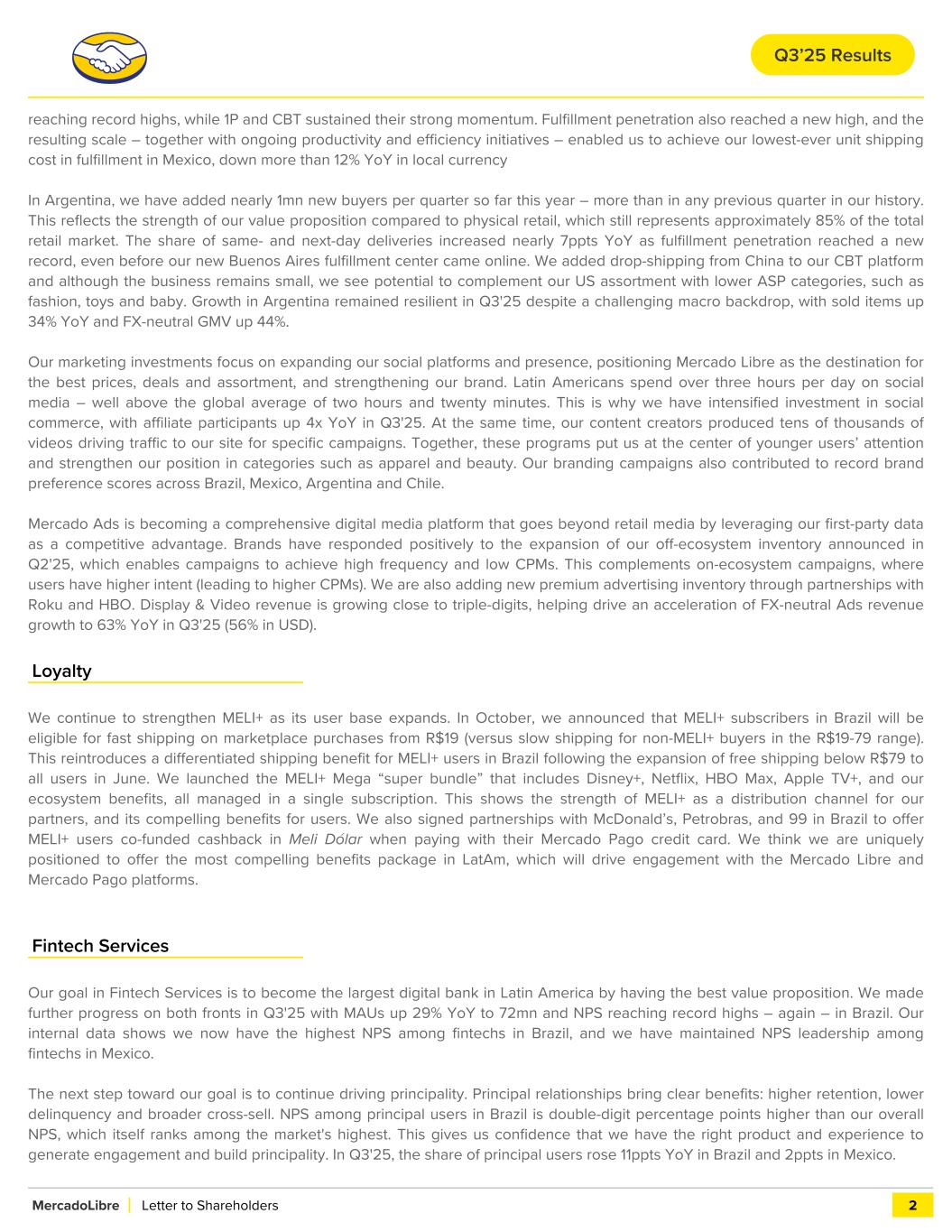
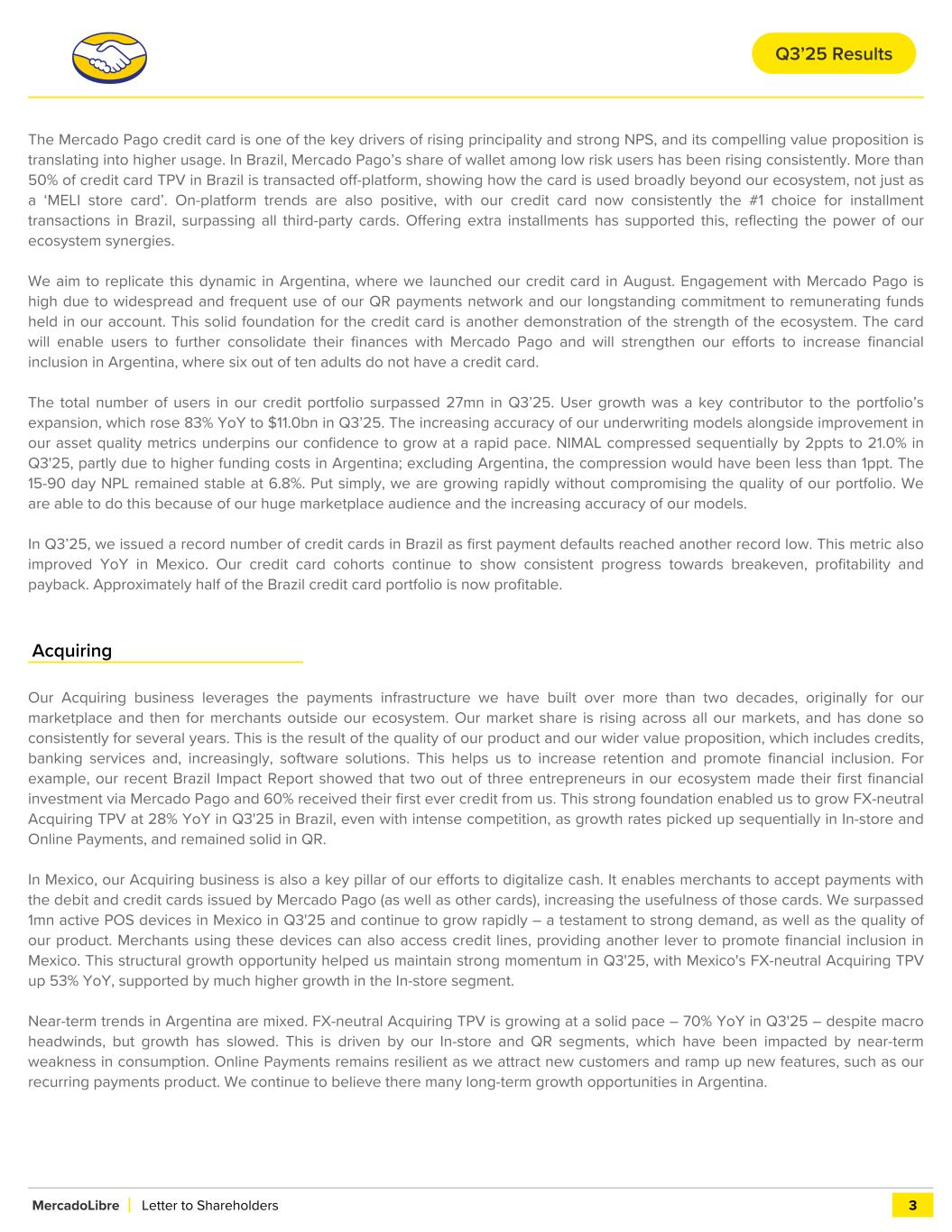
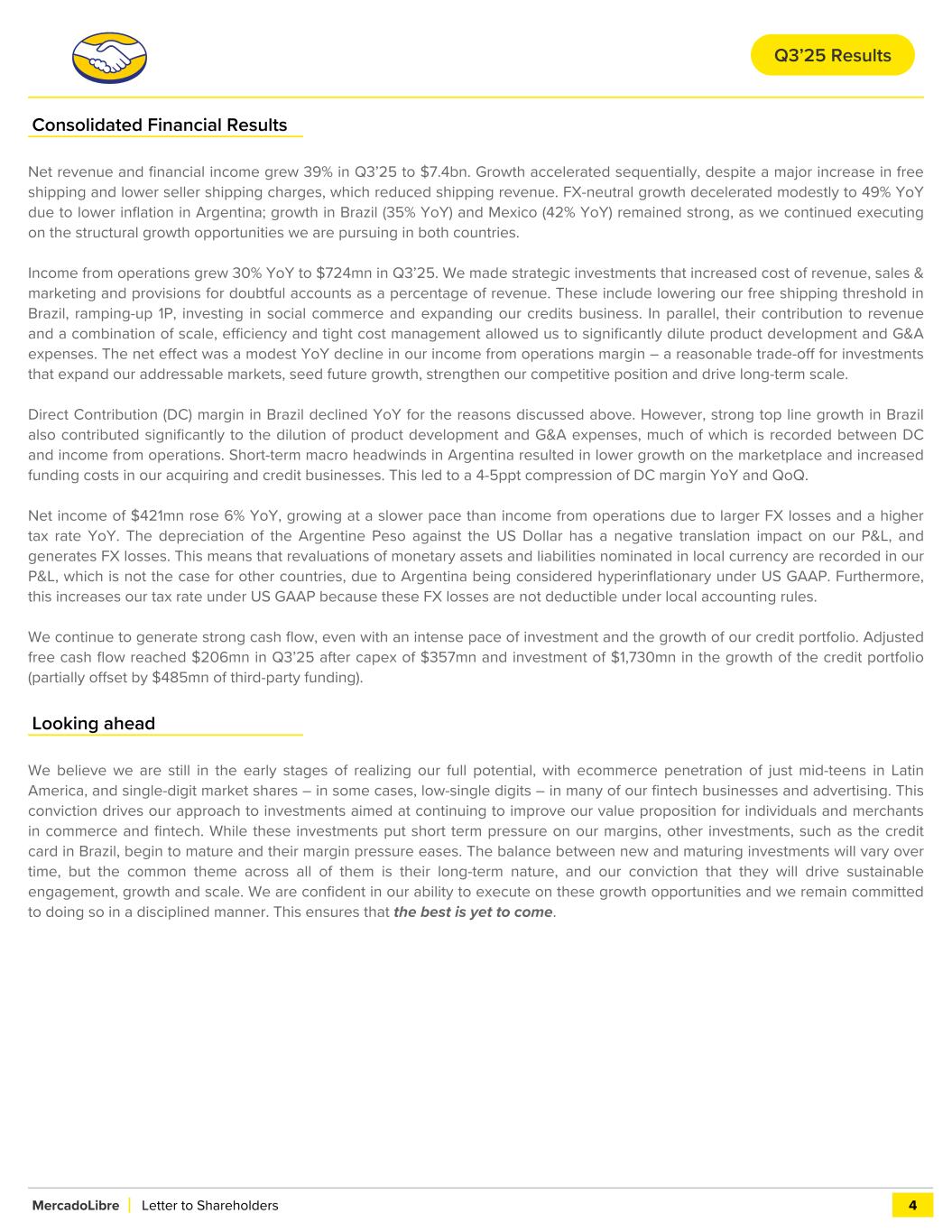
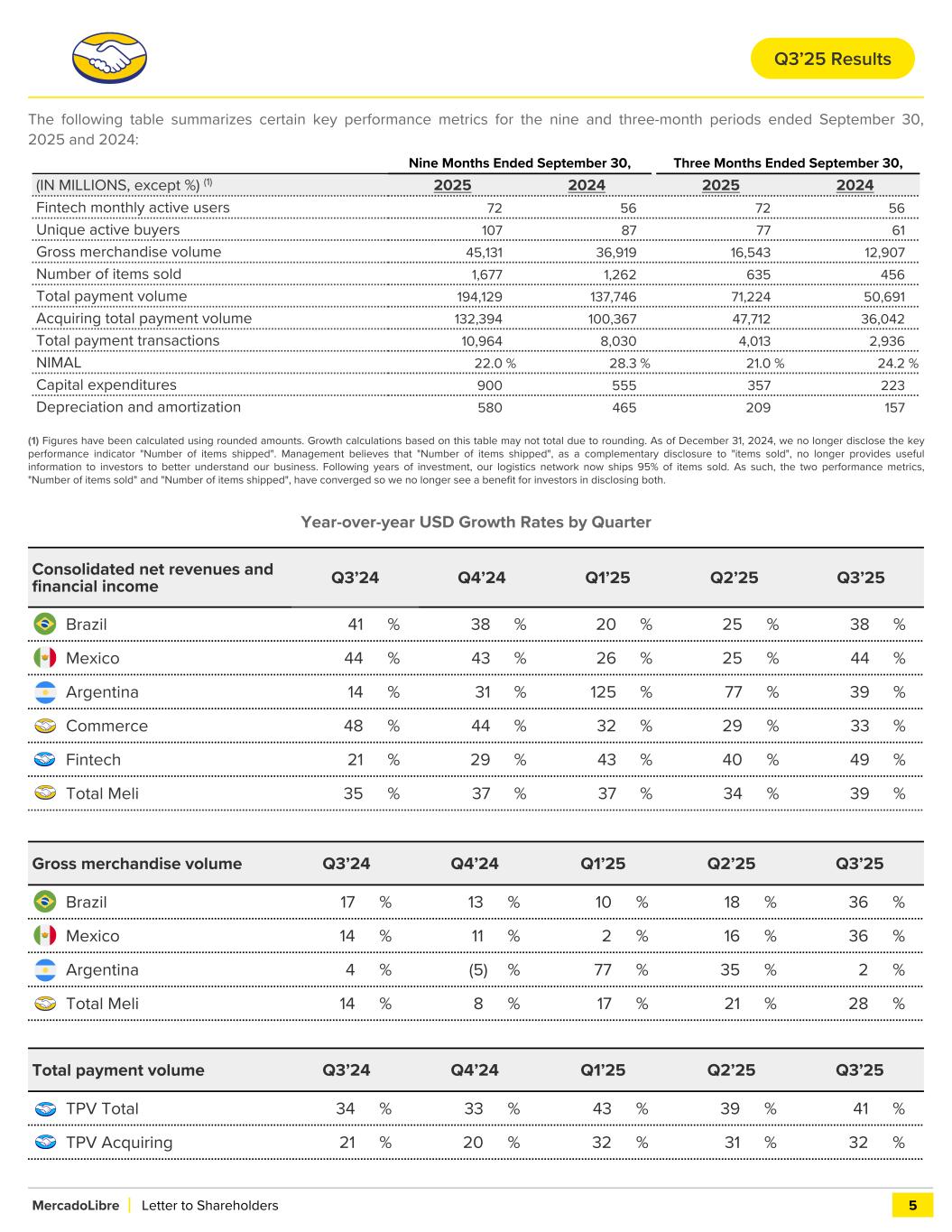
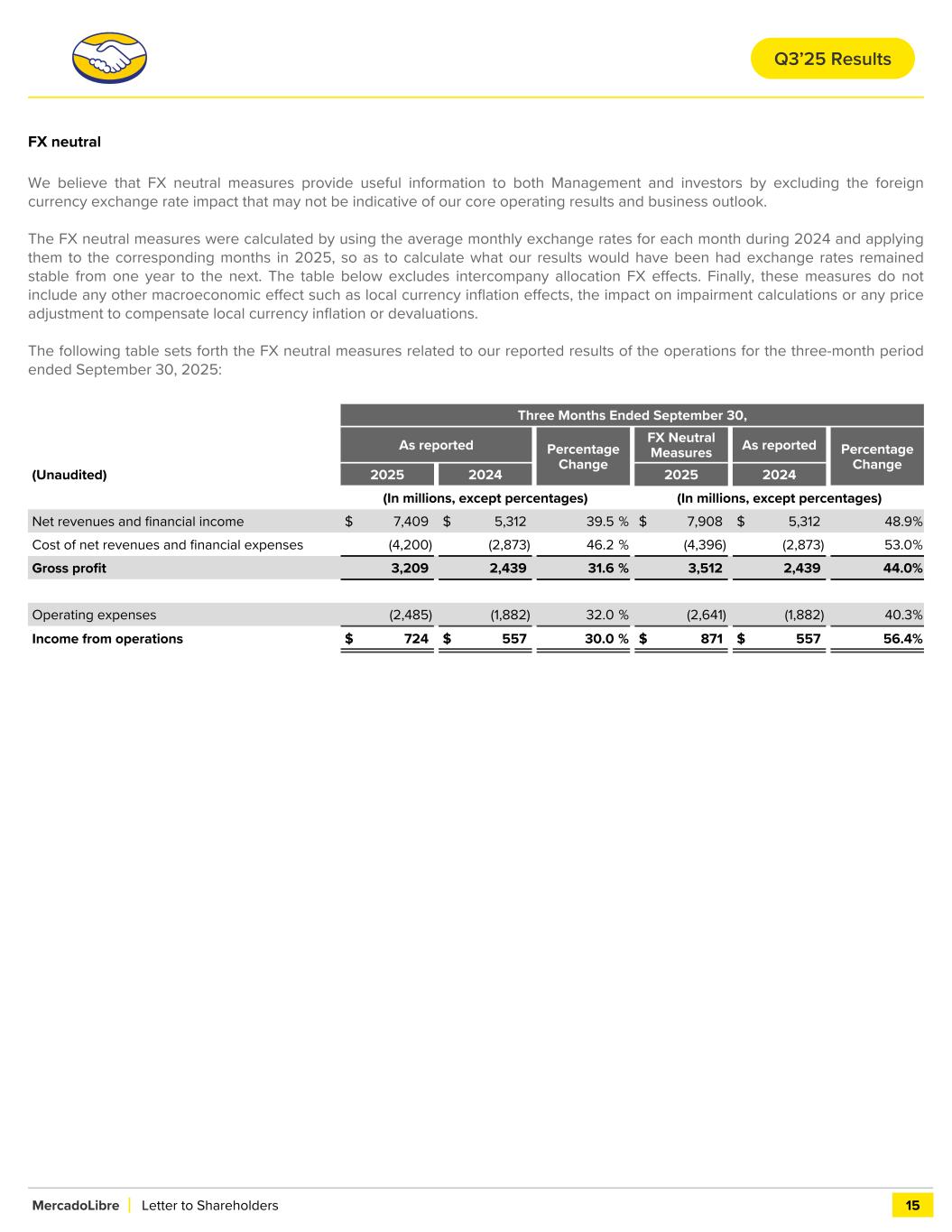
Hello, everyone. This quarter, we continue to invest to capture the immense growth opportunities that are ahead of us in e-commerce and fintech. We are exceptionally well positioned to drive financial inclusion and the offline to online retail shift in Latin America. Revenues grew by 39% year-on-year, marking the 27th consecutive quarter of growth above 30%. Our consistent top line growth comes as a result of the investments we have made across our ecosystem. The recent reduction in the free shipping threshold in Brazil has already delivered strong results with both GMV and items sold accelerating in the quarter. We also saw strong growth in buyers with improved conversion rates, retention, and frequency of purchase. Sellers are also benefiting from the increase in demand generated by the lower threshold. More sellers are coming to our platform and the number of listings has increased sharply in the BRL 19 to BRL 79 price range. Higher transaction volumes helped us reduce unit shipping costs in Brazil by 8%, with slower deliveries enabling us to leverage unused capacity. Brand preference scores reached new record highs across the region, helped by our marketing investments and pre-shipment policies. We had a great quarter in Mexico with GMV growth accelerating and unit shipping costs in fulfillment continuing to fall. Mercado Pago had a stellar quarter. Monthly active users growth accelerated as our NPS hit record highs in Brazil. This is the result of continued efforts to deliver the best value proposition to our users through UX improvements, our credit card, and remunerated account products. This strong growth in assets under management and credit portfolio reflects the potential of Mercado Pago. Our credit card, which plays a key role in NPS and principal is growing very rapidly, driven by a higher number of users and share of wallet. We have grown our loan portfolio without compromising credit quality, maintaining all-time low first pay defaults, and more credit cards are reaching maturity. In Argentina, growth of GMV, buyers, and TPV remained resilient in Q3, but trends slowed through the quarter due to the challenging macro backdrop. This impacts not only growth but also pressures our EBIT margin. Despite the headwind, Argentina continues to be a very profitable market with a strong long-term growth perspective. Operating income of USD 724 million grew by 30% year-on-year. This demonstrates our ability to balance growth investments and profitability and the power of scale, which should continue to play in our favor. Our strategic investments in free shipping, logistics, 1P, and credit card continue to deliver strong top line growth while putting some margin pressure. At the same time, this growth has enabled us to scale key OpEx lines such as product development and G&A expenses. We will continue to invest with discipline, focusing on the long-term potential and scale of our ecosystem. Thank you for your continued support. We will now move on to Q&A.
Operator
And today's first question comes from Andrew Ruben with Morgan Stanley.
Speaker 3
So maybe a question on Argentina, you cited some macro challenges on GMV, TPV, and higher funding costs. So I'm curious to understand first how these items evolved over the course of the quarter? And then second, on a related note, we know you’ve been through political cycles, but I’m curious following Sunday’s election to hear your latest views on the Argentina economic outlook. And how this feeds into your plans for growth investments in the country, fulfillment centers, credit cards, or otherwise.
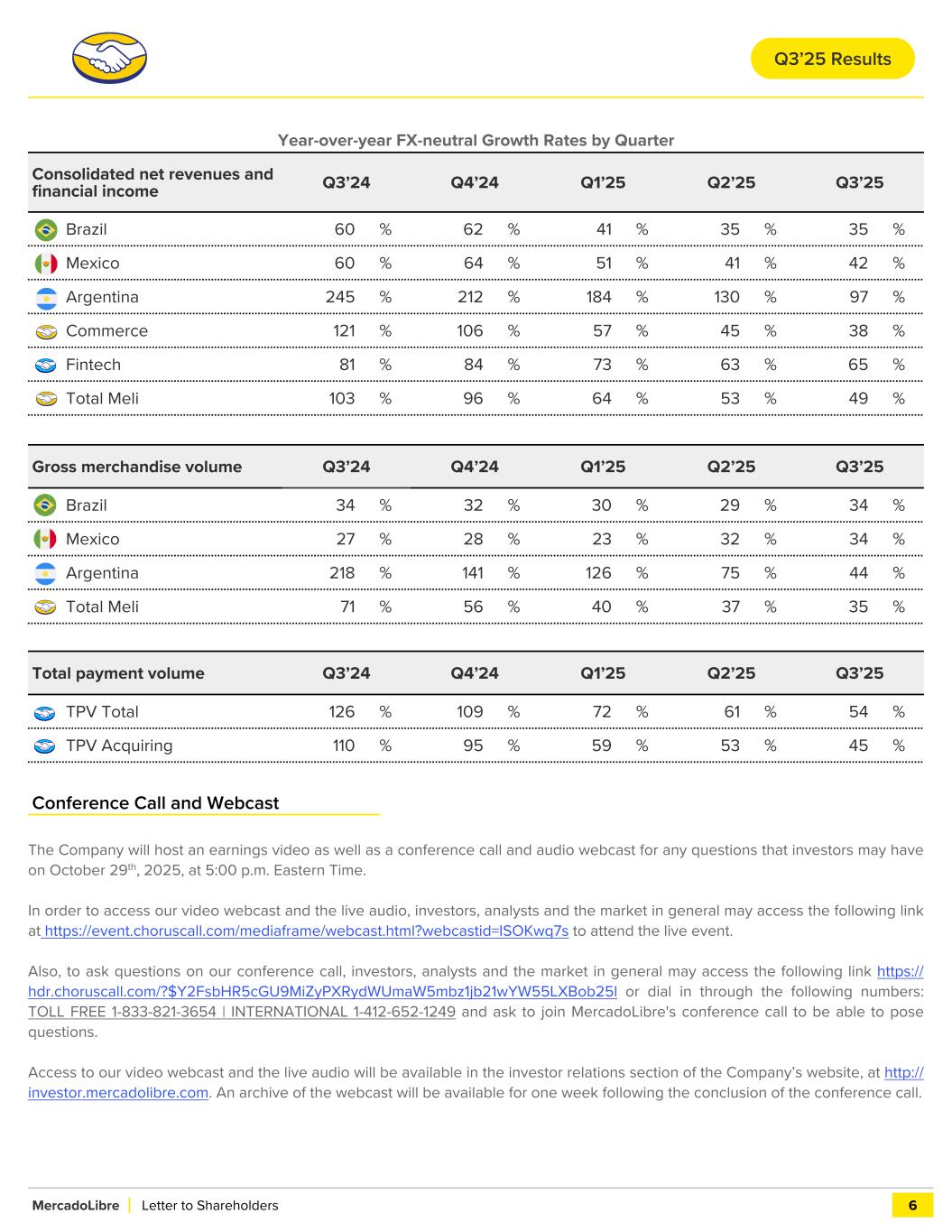
Andrew, it's Martin here. Thank you for your question. Yes, as you know, Argentina continues to be a very important market for us, not only because of the size of the opportunity, but because of the leadership position that we have in the country. So we, as always, remain focused on continuing to improve the value proposition. As we always said, more than macro, the important thing about our business is what we do with our users and our platform. So we continue to invest in Argentina. We opened the second fulfillment center this quarter. We launched the credit card. So we are optimistic about the prospects for Argentina in the long term for our business. In the first half of the year, as you know, we had very strong growth in both commerce and fintech. And in Q3, due to macro instability related to the midterm elections, we saw some slowdown of growth and some increases in interest rates which will affect consumption and increase our funding cost. Having said that, despite macro, we saw solid growth in Argentina, revenues grew by 39% year-on-year in U.S. dollars and 97% in local currency, items also grew by 34%. We had a very tough comp last year. Our credit book, even though we took a more cautious stance, grew by 100% year-on-year, and we maintained a very solid healthy portfolio and very solid metrics in terms of NPLs or bad debt. So we are used to managing volatility. I think this quarter is an example of that. And then looking ahead, we think that hopefully some of the volatility will go away after the results of the elections. I will continue to be extremely optimistic about Argentina for the long term. It continues to be a very profitable market with a lot of growth potential for us in the future.
Operator
Our next question today comes from Irma Sgarz with Goldman Sachs.
Speaker 4
Can you talk a bit about the impressive growth in the active user base that you had? When you look at the 6 million to 7 million new quarterly active users that you added from the second to the third quarter, can you break down the increase by brand-new users versus those that were previously active users, but perhaps not at each and every quarter and that just increased this frequency? And what are the demographics of the new users you're attracting? Is there a potential risk of those new users being a little bit more promotion-focused so that they might churn if you were to pull back on any measures around couponing or marketing spend? And perhaps in that context, if you can talk about how we should think about marketing spend as we progress into next year, and whether we can come back to some degree of dilution to the investments that you're making there right now.
Speaker 5
Ariel here. Pleasure to hear you. So we had an amazing quarter in terms of our user base. We grew the total unique buyers on our platform very, very fast this quarter, reaching the 75 million active buyers that you are referring to. Out of those, approximately 7.8 million were new buyers to the platform. The others were buyers that had purchased at some point on MercadoLibre; we believe both the total number of buyers and the number of new users are very healthy and a great testament to everything we are doing in MercadoLibre by improving the value proposition, both in Brazil, where we are lowering the free shipping threshold, take rates and so on, which you know, but also in the other countries. We had a great quarter in Mexico, Chile, Colombia, and Argentina, as Martin was referring to. So we are excited about everything that is happening with the vibrancy we are generating in our platform and the engagement and frequency that we see from those users that we’re bringing into the platform.
And Irma, it's Martin here. In terms of marketing spending, I think if you look at this particular quarter, it represented about 11% of revenues, which is in line with what we saw last quarter in Q2. As we mentioned last quarter, we were stepping up a little bit of investment in user acquisition in terms of performance plus our affiliate channel. We invested more in our affiliate channel, which grew by 4x year-on-year. This is the way to attract new segments of the population, in particular, younger people and has been a very effective way of bringing more volume to our platform. So I think going forward, we will continue with a similar range of investment. And as we said in the past, we are acquiring users. We have a very sophisticated methodology to acquire users to make sure that those users that we bring are actually contributing to profitability and are adding to the volume sold on our ecosystem. So we're very confident that the level of investment is the right one to support the growth that we are delivering quarter after quarter.
Operator
Our next question today comes from Bob Ford of Bank of America.
Speaker 6
Congratulations on the quarter. Ariel, can you comment on merchant adherence to your recent relative value notice in Brazil, the implied changes to the search algorithm, and the qualification for promotional support? And as competitive dynamics intensify, particularly in Brazil, how should we be thinking about cost structure and ancillary revenue streams?
Speaker 5
Bob, Ariel here. Let me touch on price monitoring and seller adherence. Let me first start by saying that this short-term initiative that you are starting to test for a handful of months comes as our competition is also testing their own initiatives for the same period. As we said consistently over time, we want to have the best possible value proposition for buyers and sellers on our platform. We want to present users with the best speed, the best prices, and the best payment alternatives available for them, and we want them to buy more. And when they buy more, they will generate more demand for our seller base. We believe it’s natural for us to put in our storefront the items that generate the best experience for customers and thereby generate higher sales for our consumers. That’s why we are introducing this system in order to make sure that our buyers always see the most competitive offering and the best experience-generating items in the MercadoLibre platform. Of course, this initiative is coming alongside our record investment levels, meaning faster logistics, more free shipping, lower shipping charges, discounts, lots of promotions, and many coupons that we will invest in during our Black Friday campaign. So we expect adherence to be high because this is the real way to improve the proposal for buyers and sellers. As you know, our on-site real estate and our ability to invest is limited by nature, and for that reason, we want to make sure we make the best use of those limited and available resources for the merchants who are providing the items that are delivering the best experience for our customers. It’s too early to discuss results on that one, but we think this simple system will create the right proposal for our buyers and for our sellers as well.
Operator
Our next question today comes from Marcelo Santos with JPMorgan. And it appears we're not receiving any audio there. Let me get to our next caller, and that will be Josh Beck with Raymond James.
Speaker 7
Yes. I wanted to ask a little bit about the unit costs on the shipping side. I believe you said it was down 8% year-over-year. I assume a lot of this has to do with better utilization and particularly some of the slow shipping efforts that you have. I don't expect a specific answer, but I'm curious how much headroom you think you have on this utilization angle? And then related to that, how much are you investing in robotics and automation as a more mid- to long-term opportunity?
Josh, it's Martin here. Let me just first clarify that the number that we disclosed is the lowering of the cost of shipping in Brazil is 8% Q-on-Q. So that's a decrease in cost of shipping in local currency sequentially. The reason for this is because, as we mentioned, the extraordinary growth that we're seeing in volume is helping us dilute fixed costs of our logistic operations. This has also enabled us to use spare capacity and be more efficient in the way we run our operations, in addition to the things we do on a day-to-day basis to improve efficiencies. I think that's for the most part the main explanation for the lowering of costs. There is some room to continue optimizing the low shipping method in the future, but that will take some more time. For the most part, the decrease in costs is related to scale.
Speaker 5
Yes, just to complement, Ariel here. So the decline in cost per shipment, 8% Q-over-Q in Brazil, is a great result for us. Bear in mind that this is not only impacting slow shipments, but this is a decline of the total cost per shipment in a country where we are operating and dealing with strong pressure coming from extra volume. We believe that unit shipping costs should trend downwards over time, although this might not be a straight line. There will be future gains that we will be able to capture through productivity and process improvements, but we need to continue iterating, adjusting our systems, and implementing technology. So to the second part of your question, we are deploying robotics and technology in the different warehouses; we are testing and learning with different technologies in different places. We’re optimistic. We see great results in productivity, both in put-away, picking, and packing every time we deploy some type of technology around the people that work in our warehouses.
Operator
Our next question today comes from Craig Maurer with FT Partners.
Speaker 8
I wanted to ask about the profitability of the credit card business, specifically the cohorts from last year. I believe you said they had been approaching breakeven, but I wanted to understand if that could become a tailwind going into next year?
Speaker 9
Craig. So what we have been consistently saying is that cohorts that are older than 2 years are profitable, and that continues to be the case. So the profitability of the overall portfolio of credit cards in a given country depends mostly on the mix of cohorts we have. But that continues to be the case that, for cohorts from 2023 and older, they are already profitable in Brazil.
Operator
Our next question today comes from Vinicius Pretto with Itaú BBA.
Speaker 10
We've been discussing a lot about the trade-off between GMV growth and profitability in Brazil. In this quarter, we saw the first response with GMV accelerating significantly, but contribution margin was one of the lowest levels in the past couple of years. When we think about these margin levels, do you view the margin investment made so far as sufficient to achieve your aspirations in terms of growth and market share? Given the recent developments in terms of competition, would you be willing to go below these levels in terms of margins to accelerate market share gains?
Hi Vinicius, it's Martin here. I think, first, when we talk about margins, let's put this in the context of growth. I mean, we see a huge opportunity to grow not only in commerce but also in fintech. As we have consistently said, the main priority for us is to ensure that we capture those growth opportunities ahead of us, and we will continue to invest behind those opportunities as we have done in the past, right? Last year, you saw when we invested in credit card; it required some margin compression, resulting in margin compression. But now, as Osvaldo mentioned, the credit card is starting to mature and that turns around. This quarter, we invested significantly in lowering the free shipping. As you can see, we had very strong results related to that with not only GMV, but if you look at items sold in Brazil, it accelerated from 26% last quarter to 42% this quarter. So there is a very strong acceleration of items and volume, new users, more engagement, better conversion rate. We have all-time high NPS levels in Brazil as a result of this measure. So I think it's important to put that in context. We are not managing the business for short-term margin. We are managing for long-term value creation. And we think that if we continue to sustain the levels of growth that we are delivering, we are on the right track. As we said in the past, we are not going to hesitate to invest behind that even if we put some short-term margin pressure. But in the long term, we continue to be very optimistic about the margin profile of our business as we continue to scale and as some of the investments we’re making continue to mature, such as the credit card and 1P investments and many other things we are doing throughout the ecosystem.
Operator
Our next question today comes from Trevor Young of Barclays.
Speaker 11
Great. Just on NIMAL, should we expect the same seasonal dynamics to play out in the coming quarters, such that 4Q should be up sequentially before we step down again in Q1? And then as we head into next year, should we assume NIMAL remains pressured as you ramp up credit card issuance in Argentina and face potentially the same higher funding costs that you flagged this quarter even as those older cohorts in other countries get more profitable?
Speaker 9
Hi Trevor, let me tell you a little bit of what has happened lately with NIMAL. I would say that the reduction we have seen in the last quarter of NIMAL mostly came from when you look at the overall credit market, I will double-click on credit cards. But overall credit, what we saw was a reduction of NIMAL, coming mostly from Argentina and driven by the increase in funding costs we saw last quarter, which was significant because of some instability in the market. I would say that is rather constrained to that in Argentina; pretty much everything else was working similarly to prior quarters. Now when it comes to credit cards, what we're seeing is that Brazil is reaching a point where we have enough older cohorts that nearly 50% of the volume of cards we have issued and TPV is already profitable. So it will depend on the speed at which we continue issuing cards in Brazil, but that is a country where we should see in the medium term, I would say, the overall credit cards becoming profitable. That is not yet the case in Mexico when we started significantly later, and still we are issuing cards at a volume that is very significant compared to the legacy we have. When we look at the cohorts that are 2-3 years older, they are a smaller part of the overall portfolio. And yes, as we mature in Brazil and eventually in Mexico, we will be accelerating the issuance of cards in Argentina where we're just starting. So definitely, we'll be investing there for the next several years.
In terms of seasonality, it's typically a little bit of seasonality in Q4, which is a little bit better than Q1, which is weaker for collection. But I would say, for the most part, the fluctuations that you've seen over the last several quarters are related to mix, as Osvaldo mentioned, not so much for seasonality.
Operator
Thank you. Our next questions today come from Deepak Mathivanan with Cantor Fitzgerald.
Speaker 12
This is Jack on for Deepak. Kind of sticking with the Argentina credit card topic. Can you just provide any early engagement metrics on the new credit card launch there? Maybe how is the adoption curve compared to Brazil? Is there any reason to think that the 2 years to breakeven stat that you guys have called out would be any different in Argentina? And then lastly, kind of where are the penetration rates you're targeting over the next 12 to 18 months?
Speaker 9
So I'd say it's still very early to tell. We only launched a credit card in Argentina towards the end of the quarter, so there is not yet enough information. It's too early to comment on its performance. We, as we have said in the letter, are very confident that this will be a successful product because we have a huge user base in Argentina, and they are very engaged with Mercado Pago. On top of that, because Argentina is a country where most credit cards, nearly all of the credit cards charge a monthly fee, and we don't. So we believe that provides a huge plus for our card. Additionally, it offers good offers in the MercadoLibre ecosystem for those reasons and on our current cost network. So for all of these reasons, we are encouraged and excited about the opportunity, but I’d say it’s still very early to comment on results because it was just a couple of weeks during the quarter. We cannot comment on guidance for 12 or 18 months, but we are very bullish about the product.
Operator
Our next question comes from Neha Agarwala with HSBC.
Speaker 13
On the fulfillment centers, you mentioned that there's been a big increase in the number of shipments; would you require to add more fulfillment centers than what you already had on the roadmap? And if you can give us a bit more color on the further investments that we can expect in the coming quarters in Brazil, especially? And my second question is on the credit side of the business. In Mexico, there's a lot of competition coming in. What are the early trends that you're seeing? Which products have been doing very well with the Mexican consumers? And what kind of asset quality are you seeing in Mexico specifically?
Speaker 5
Neha, this is Ariel. So before jumping into the answer to your question, let me rewind a bit and make one small comment on an answer that I gave to Irma before. So total number of unique buyers in the marketplace this quarter was indeed 75 million, but new buyers were actually 7.8 million — sorry, new buyers were 7.8 million. I did bring up the number of about 4 million for Brazil, but the total LatAm new buyers was 7.8 million, I'm sorry if I mixed it up for you. So going back to the question on fulfillment. Indeed, we saw a 28% quarter-over-quarter increase in volume in Brazil, which naturally puts pressure on our network capacity. Still, we were ready to manage that. Of course, having part of the volume in the slow method helps us manage the volume flowing through different parts of the value chain. So to specifically address your question, we did not open any new fulfillment center that was not planned. And as you probably know, it's not so easy to open any warehouse of this type and size from one quarter to the next. So we are not changing our super short-term plans; we feel that we have the capacity we need to deal with the volume we're seeing. But of course, we are always reevaluating the mid-to-long-term capacity that we need to handle the volume we're bringing. As part of that ongoing evaluation, we will definitely build the required capacity to deal with the volume we will create. As we said over and over, fulfillment is strategic; having a fast and reliable network is strategic for us in order to continue serving our customers to increase their retention and NPS. We'll continue investing behind logistics as we need to serve our customers.
Speaker 9
And then when it comes to credits in Mexico, I think that we are very encouraged by what we're seeing regarding the size of the opportunity. We believe that we have a few advantages. One is the strength of our ecosystem in Mexico, which gives us a huge distribution channel and also a lot of insights that let us issue cards and credits at a very low customer acquisition cost. When we look at the market in general, we are already, including banks, the second-largest financial institution in terms of monthly active users and already number one in terms of monthly downloads. So we are seeing how we are gaining traction in the Mexican market, both in consumer credit and in credit cards. Recall that during the first part of this year, we decelerated a little bit in the additions of credit cards, but we have been reaccelerating again, and we are encouraged by the results we're seeing. So I would summarize that we believe we have a flywheel where MercadoLibre facilitates a lot of what we do with regards to credits in Mexico.
Operator
Our next question today comes from Jamie Friedman with Susquehanna.
Speaker 14
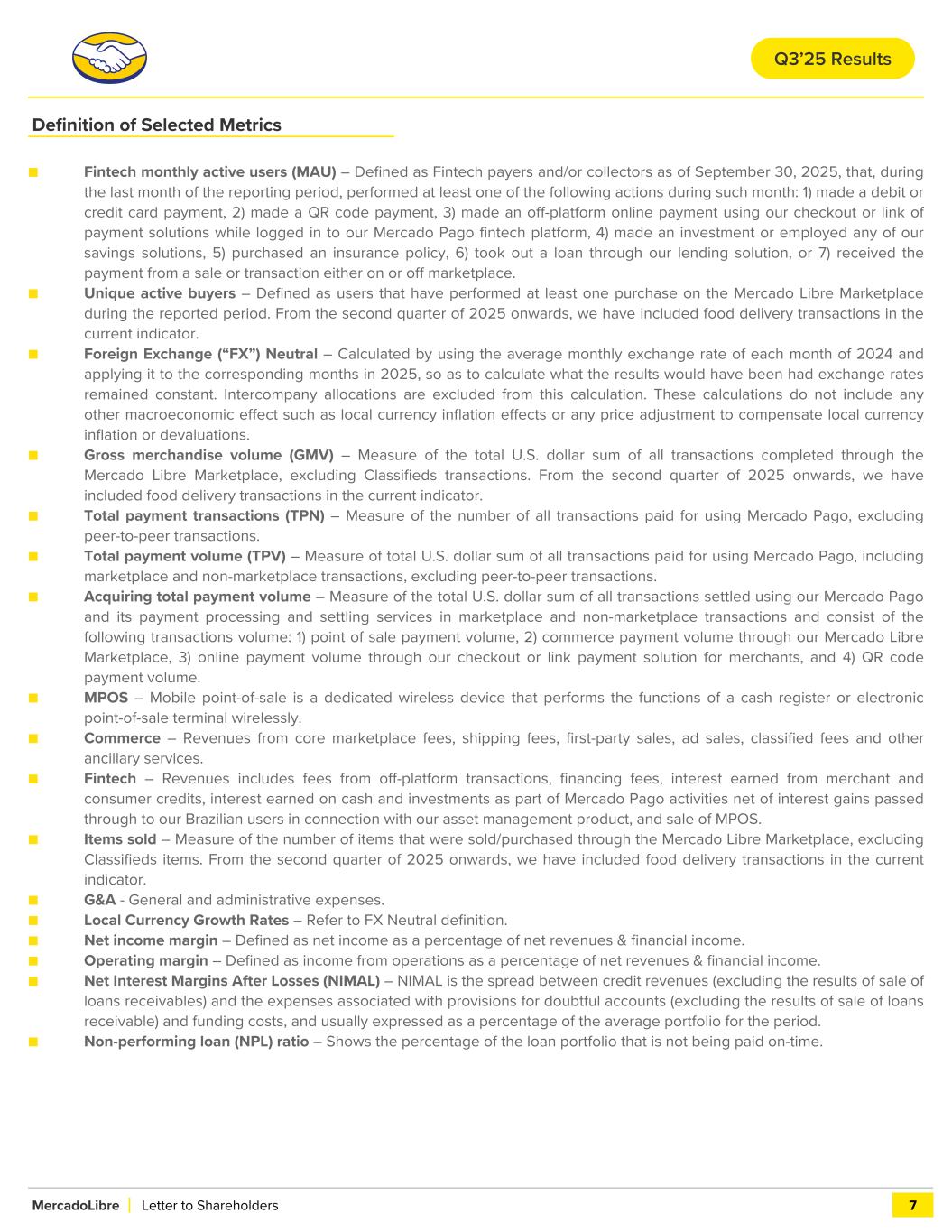
I wanted to ask about principality. You have these interesting call-outs in the shareholder letter on Page 2. You show that there's an 11-point increase in Brazil and 2 points in Mexico. I'm just wondering, one, how you're defining principality. And two, are there any services that you currently don't offer that you may contemplate offering in financial services in order to further escalate the principality, or do you have the things that you need?
Speaker 9
I would say that we are excited about the growth in principality, which you mentioned, mostly in Brazil, but to some degree also in Mexico. The way we measure or estimate principality is if at least 50% of the income of a given client passes through Mercado Pago. In some cases, we’re able to assess it through surveys and in other cases, with open banking data. We have already put in place two of the most important things, and those are yielding accounts and a strong trade offering. What we don't have yet is the ability to collect your salary into the Mercado Pago account. In the case of Mexico, this is because we are not yet a bank. We are in the process of obtaining a banking license and that is a requirement. In the case of Brazil, some people collect salary in Mercado Pago, mostly through portability. However, this is still fairly small, and we believe there's a large opportunity there.
Operator
Our next question comes from João Soares with Citi.
Speaker 15
Hi Martin and Ariel, Osvaldo. I wanted to double-click on an earlier question, and I think it is important. I mean, you are in the midst of an investment cycle, but at the same time, you're also achieving operating leverage, especially on the product and development lines. So I just wanted to understand, are you currently satisfied with the investment level that you're making? Are there any additional areas that you could think could use additional resources? Or should we think about this continued operating leverage across certain OpEx lines? I mean I just wanted to understand where you are at the current stage of investment.
Hi João, it's Martin again. Yes, I think obviously, as I mentioned before, we are extremely satisfied with the results of the investment that we made. We actually announced it last quarter, right? Remember, last quarter, we showed only one month of investment. Now we're seeing the full effect of investment in the full quarter. So we're very excited about the results. The impact on the marketplace is really enormous. We talked about volume growing, but also the number of sellers and items listed on the range of BRL 19 to BRL 79 are growing rapidly as well. So the supply side is also benefiting from this. We are extremely happy. On top of that, as we mentioned, we lowered shipping costs, but still, this is a longer-term process where we are going to optimize the slow shipping layer of our logistic network. We are optimistic about the investments and the results we're seeing. And then on top of that, we continue to make investments in other areas of the ecosystem. 1P, as we mentioned, grew very rapidly this quarter as well. It continues to improve profitability but still requires investments. The credit card, as Osvaldo mentioned, is still very profitable for the other cohorts. However, we continue to invest, and we are launching it in Argentina. There are some smaller initiatives that we continue to invest. We're opening new fulfillment centers. We increased our capacity by 41% year-on-year, which required investments as well. So I think a lot of moving parts on that front. On the flip side, we mentioned in the letter, we're growing at 39% year-on-year. As I said, this marks 27 consecutive quarters of growth above 30%. This is something no other public company has delivered over this timeframe at the scale that MercadoLibre is doing today. This obviously is helping us dilute fixed costs and we saw strong dilution on G&A and product development this quarter. So when you put all that together, I think we're optimistic about the long-term margin trajectory for our company. As I said before, we are focused on continuing to deliver growth in both fintech and commerce. We will make the investments required to capture those growth opportunities as we have in the past. We will continue to do so with discipline but will keep investing.
Speaker 5
Just to reinforce Martin's point, Ariel here. We have amazing growth, higher frequency from our buyers, record conversion rates, record retention rates for new buyers, and record retention rates for existing buyers. We have more new buyers; we had our record high NPS in Brazil. We have more live listings and more sellers than we had before. To Martin's point, we are very encouraged by the impact we see; we are having. This gives us great optimism about the foundations we are building as we look to be the driving force behind shifting physical retail to e-commerce. At the end of the day, that's our goal. We need to continue reducing the friction of buying online and bringing more people into our platform. While we do that, we need to keep finding efficiencies to fund that process. But definitely, we are excited, encouraged, and very positive about the results we had this quarter.
Operator
Our next question comes from Marvin Fong with BTIG.
Speaker 16
I'd like to start with a few developments in recent months. I think you announced a B2B initiative as well as a partnership with Casas Bahia. I just wanted to see if you could help dimensionalize the potential impact for that, not necessarily to your business per se. I know you won't speak to that specifically, but just kind of frame the opportunity for us. How should we be thinking about the ability to drive future GMV growth? And then secondly, on the credit card, just overall, I noticed that the average loan size has been growing. I know that you have a risk discipline to start with small loans. So even though you’re growing, the issuing of new cards continues to rise, I want to understand better how you are loosening up or extending more credit to your borrowers from the outset. Are you still maintaining the same levels of underwriting and credit quality as you have been? So I just want to understand what's driving that dynamic.
Speaker 5
Marvin, Ariel here. Let me start by touching on Casas Bahia. This is an exciting opportunity for us. While our 1P business continues to perform extremely well, we grew 1% year-over-year on an FX neutral basis. Our strategy with 1P has always been to fill the gaps in selection or price competitiveness that 3P sellers were unable to fill. As many times I've said in this call, we are a 3P preferred company. Casas Bahia is a seller able to bring more selection and competitive prices to a category where we are under-indexing in market share. Our penetration in the total market for heavy and bulky items, white goods in particular, is certainly below our average market share. We are excited; we think by the way Casas Bahia not only brings selection and prices, they bring some expertise in dealing with the logistics of those complex items to ship. We believe this complements everything that we are doing, both in 1P and 3P, and we think this is another opportunity to continue improving both sides of our network. B2B, this is a multibillion-dollar opportunity for the long run. For now, we are making first steps into it. It will be long. We need to learn, we need to adjust. However, we think it's another way to serve our customers and our seller base.
Speaker 9
And Marvin, with regards to the credit card, I'd say that we are definitely maintaining the same underwriting discipline that we had in the past. Whenever we saw that there was a worsening of NPLs, we were more cautious, as we were towards the end of last year and early this year in the case of Mexico. As we saw that we were able to improve our models and continue to grow with NPLs under control, we were able to increase the issuance of cards, and that has been the case. Throughout this time, we’ve created new generations of credit models in each of the markets, roughly twice a year. We have been able to improve the technology we use, which allows us to upsell customers more frequently. Therefore, when we start working with someone and if they pay us back according to plan, we are able to every month or every couple of months to increase the line if we deem that appropriate. I would say we are comfortable; we have been able to accelerate the issuing of cards, and we are doing so while maintaining the underwriting discipline that we have.
Operator
Our next question comes from Kaio Prato with UBS.
Speaker 17
I have a question on the payment business, please. Can you talk a little bit about the pace of growth of the acquiring TPV in the ecosystem and more specifically about Brazil? Because in the country, in the industry, we are seeing lower growth, at least on price TPV. Looking at your numbers, it implied a significant market share gain, which may have accelerated this quarter with growth of around 28% year-on-year. I just wonder if you can share with us the drivers behind that and how sustainable it is going forward?
Speaker 9
Absolutely, Kaio. You're right. What we're seeing is that we are both accelerating and growing faster than the market in Brazil. Recall a couple of years ago, we decided to change our go-to-market strategy in Brazil with regards to in-store, or POS, focusing less on third-party reliance. We started building more of our own sales force, and began direct selling to consumers, both via MercadoLibre and through our own Mercado Pago. This resulted in acceleration that started over a year ago and has remained consistent since. We're comfortable with that. The same pattern has been happening in online payments; we are also seeing an acceleration, particularly regarding credit card acquiring. We were more selective at the beginning of this year when it came to Pix acquiring because in some cases, we were working with very thin margins. We decided that some customers were not matching those price points, but we're really focused on credit cards, and we have been able to gain share. Additionally, this has been the case in all the other top markets; we are gaining share in Brazil, Mexico, Argentina, and Chile. We're really comfortable with how we have been able to gain share in all of these markets.
Operator
Our next question comes from Marcelo Santos with JPMorgan.
Speaker 18
My question is regarding the other countries where you had very strong metrics across the board GMV revenues, TPV margins, which just disclose a bit of the initiatives that you are doing in these markets? If this was like MediLED or market-led, and what to expect going forward?
Speaker 5
Marcelo, Ariel here. Yes, we are extremely satisfied with the performance of the other countries. Let me give you some colors on the consolidated numbers for the commerce side. GMV growth in Chile accelerated for the third consecutive quarter, while Colombia's growth picked up more than 10 percentage points Q-over-Q, both trends driven by successful items. We're increasing market share in both markets, particularly in Chile, where the gain in market share has been stronger. There’s no silver bullet to explain what's happening; it’s more fulfilling, better logistics, lots of work in selection, and strong promotional activity. NPS is also higher Q-over-Q in Chile. We are very pleased with the performance we had because it shows that what we are building is a solid foundation that we can continue to grow upon, bringing offline retail into online and continuing to consolidate our leadership in each market.
Speaker 9
Let me add to that, Ari. If you want, on the fintech side, the one country where we have focused the most over the last couple of years has been Chile. We are witnessing the results of that. Our user base, our monthly user base is growing at 75% year-on-year. The yield in the account is growing a lot, and we see an acceleration in the number of products our clients are using. We're very excited about the results we’re seeing in Chile. There are products still to be launched there, but we are very encouraged by the results we've already seen.
Operator
Our next question comes from Pedro Caravina with Exxon.
Speaker 19
Congratulations on the results. If I may, I wanted to hear from you how you are thinking about OpenAI's recent move into e-commerce? The launch of its browser and partnership with players such as Shopify and Walmart. I was wondering how you're seeing potential opportunities or threats here? Could there be something similar in South America?
Speaker 5
Pedro, Ariel here. Before jumping into OpenAI, let me say that we are extremely excited about the potential of agentic AI to enhance discovery, service, and productivity within our ecosystem. There are several examples of things we are doing regarding that. We just launched our own seller assistant, which is a conversational tool that gives sellers personalized advice and recommendations on how to manage activity in our platform. In fintech, we've launched our first AI assistant that can help our users with a wide range of tasks, like making or scheduling money transfers through a conversational platform, or asking questions about the user's operation and so on. This is the first step of many to come for Mercado Pago and MercadoLibre. In specifics to your question, the key message is that we must continue focusing on building the best agentic experience within our platform, which will give us options on what to do next and how to move forward. It’s early to make comments on OpenAI and their partnerships. We need to understand how this will develop in the long run and what role agentic AI will play in the relationship with consumers so we can decide if there's something different we need to do.
Operator
And our final question today comes from Geoffrey Elliott with Autonomous.
Speaker 20
You've talked a lot about what you're doing in Brazilian e-commerce and how you're growing and picking up share. But can you talk a bit about the competitive environment? Do you think that your competitors are behaving rationally? Or do you see any signs of irrational competition in the market?
Speaker 5
Geoffrey, how are you? Let me start by saying something that I've said before here in this call: Brazil has always been an intensely competitive market. I think the reason for that is that it's very attractive: large population, one of the 10 largest economies in the world, and e-commerce penetration is still well below the global standards or benchmarks from the U.K., U.S., or China. Over the last 26 years, we’ve built a business with a formidable value proposition for buyers and sellers; this has put us in a position of market leadership. Our own market share in e-commerce has tripled since 2014 and doubled since the pandemic, but we are still very small when you compare our sales in the country with total retail sales. The position we've built, with record NPLs, preference, retention, and conversion, reveals the strength of everything we've done. We are confident we can successfully compete against the different players in Brazil in the same way we've been competing with many of them for the last 26 years. I can't speak for other players in the market, but we do not believe anything we're doing is irrational. Just look at the results we're seeing from the lower free shipping threshold. That is a very rational move that significantly strengthens our competitive position and ability to bring people into the online world. We are driving satisfaction and retention. So, as long as we maintain the strategy that has served us in the past, which is to always focus on the user and not our competitors, we are confident we will be the platform of choice for buyers and sellers in the long run.
Thank you all for joining the call today and for your questions. As you heard, we're very excited about the results of Q3, in particular, with the results of the strategic investment that we're making. The lowering of the free shipping threshold in Brazil has enabled us to accelerate growth in the marketplace and to continue to gain market share, which grew double over the past five years. The investment that we're making in credit, specifically the credit card, as Osvaldo mentioned, is maturing and helping us with profitability in addition to principality, which is very important for our fintech initiatives. These investments have enabled us to continue to deliver growth; we delivered a 39% year-on-year growth. As I mentioned earlier, that marks the 27th consecutive quarter of above 30% year-on-year growth, which is truly remarkable for a company of our size today. We are very excited about that. Once again, looking forward to getting in touch with you in February when we deliver Q4 results; meanwhile, the Investor Relations team is available for further questions. Once again, thank you very much for your interest, and good night.
Operator
Thank you. This concludes today's conference call. We thank you all for attending today's presentation. You may now disconnect your lines, and have a wonderful day.