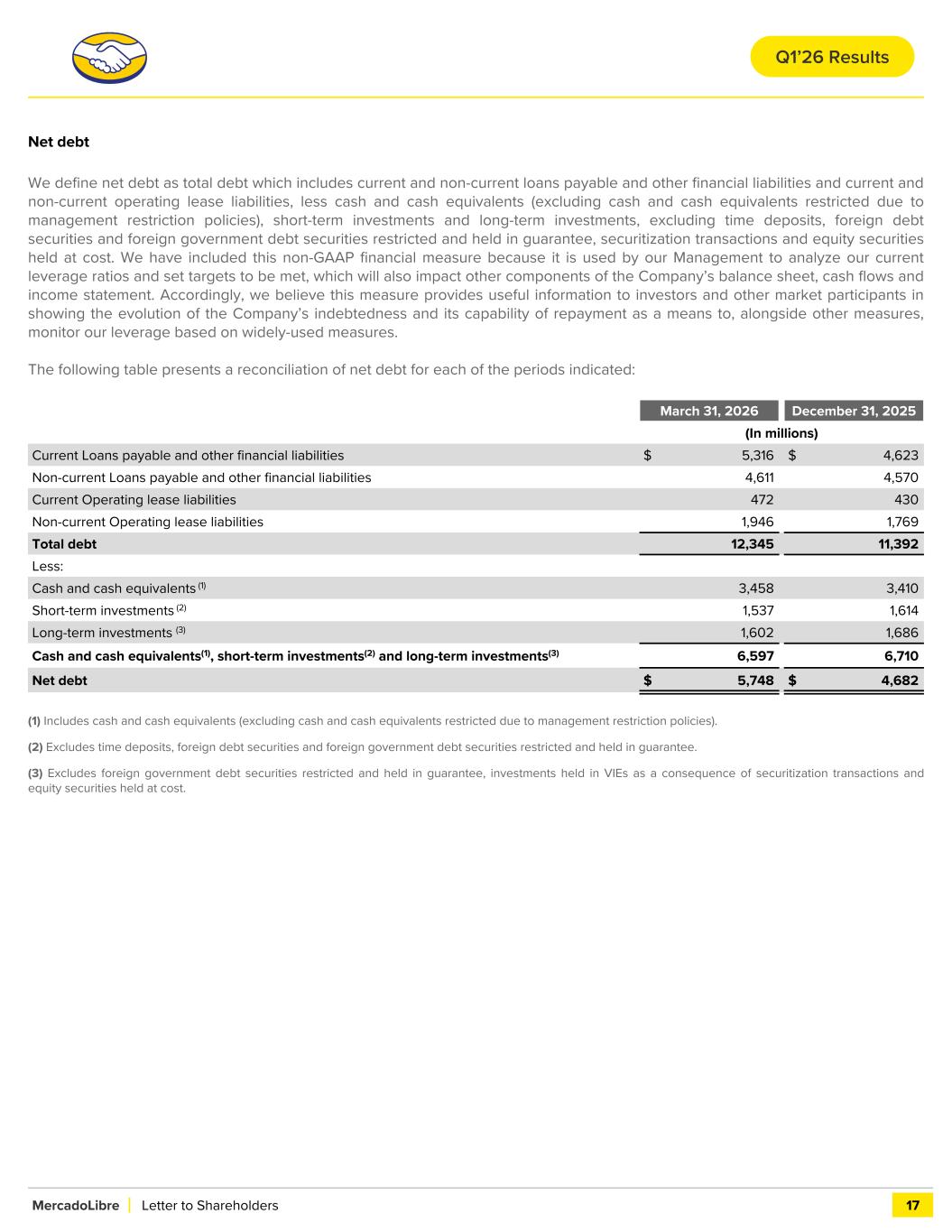
Hello everyone and welcome to the MercadoLibre earnings conference call for the quarter ended March 31st, 2026. Thank you for joining us. I'm Richard Cathcart, MercadoLibre's investor relations officer. Today we will share our quarterly highlights on video, after which we will begin our live Q&A session with our management team. Before we go on to discuss our results of the first quarter of 2026, I remind you that management may make or refer to and this presentation may contain forward-looking statements and non-GAAP measures. So please refer to the disclaimer on screen, which will also be available in our earnings materials on our Investor Relations website. Please note that this call is being recorded and a replay will be made available on our Investor Relations website. With that, let's begin with a short message from our CFO.
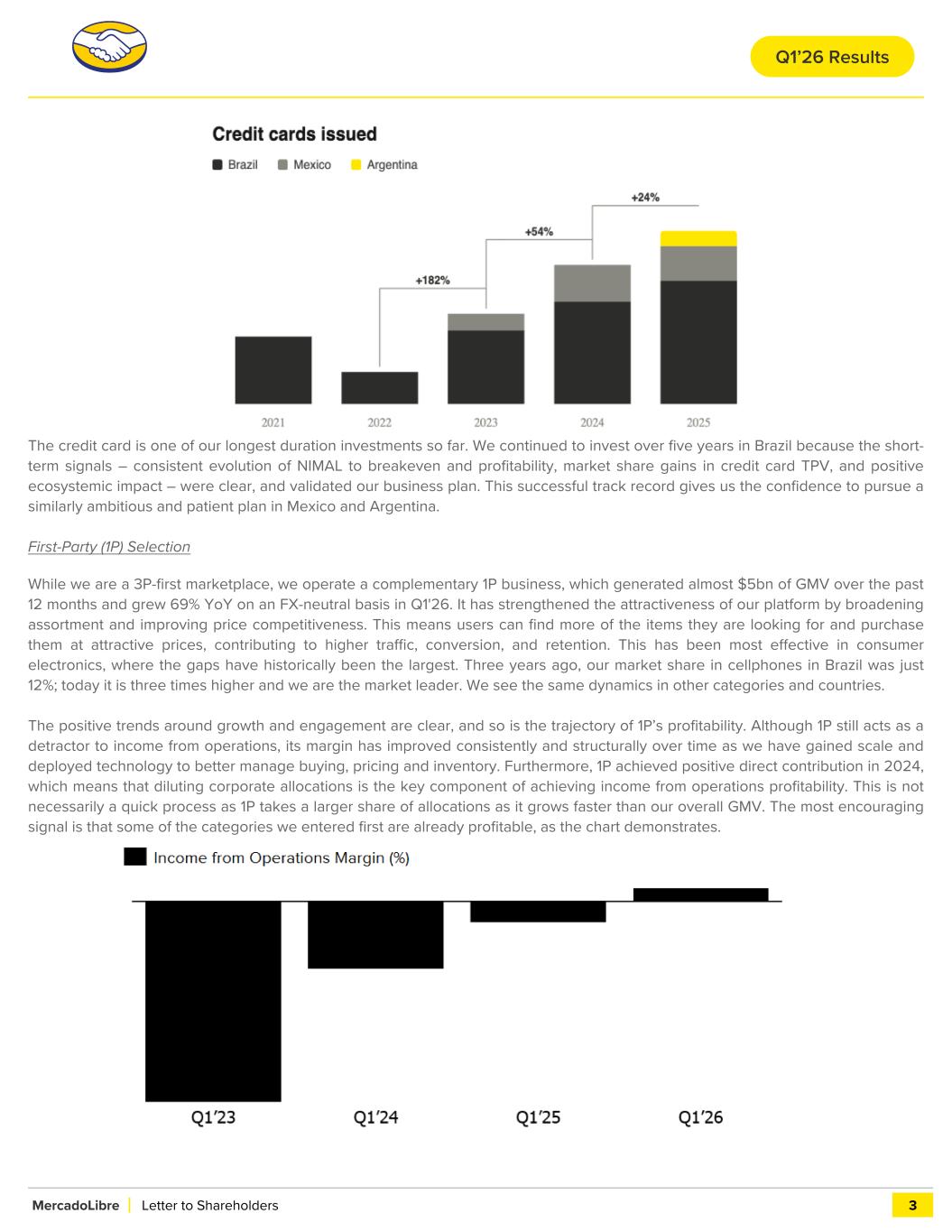
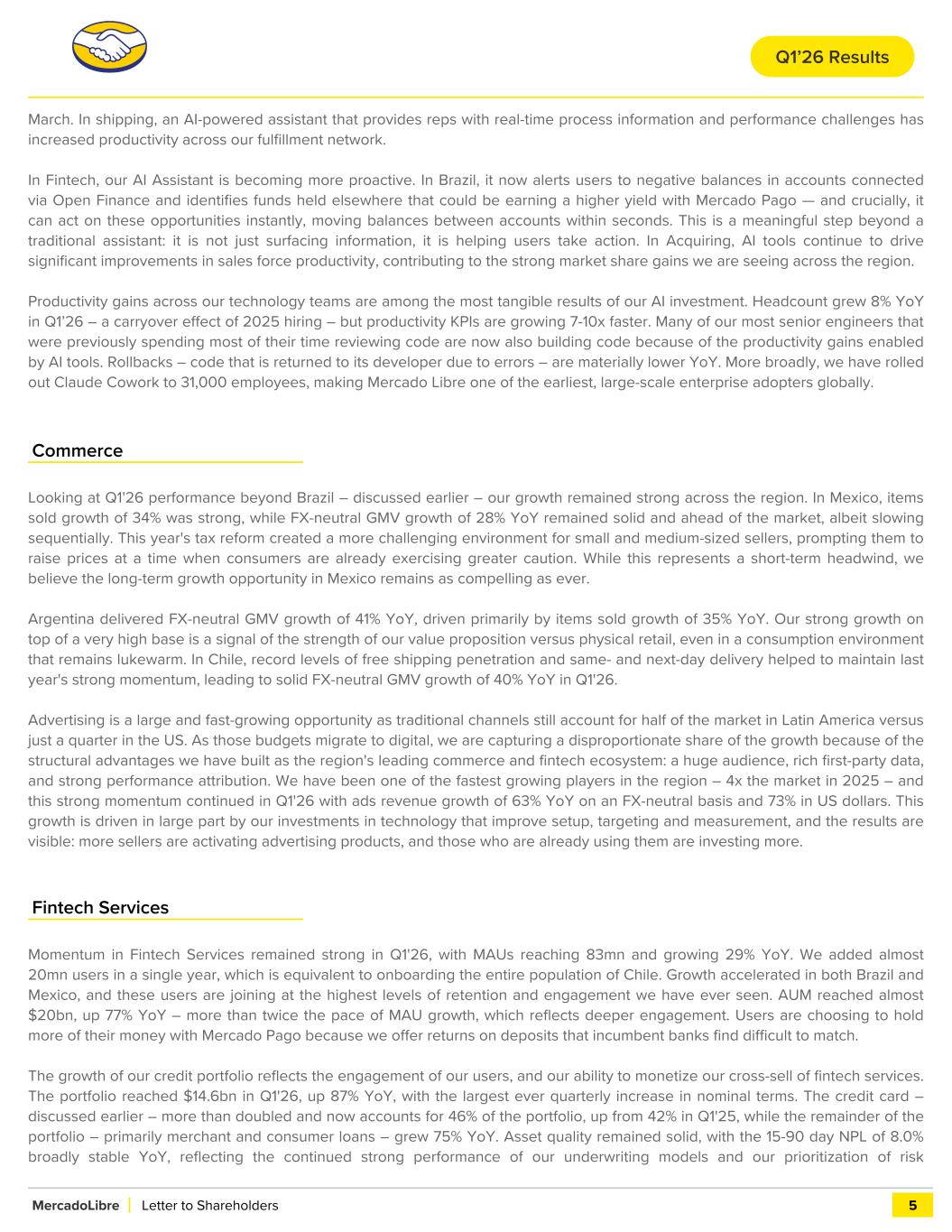
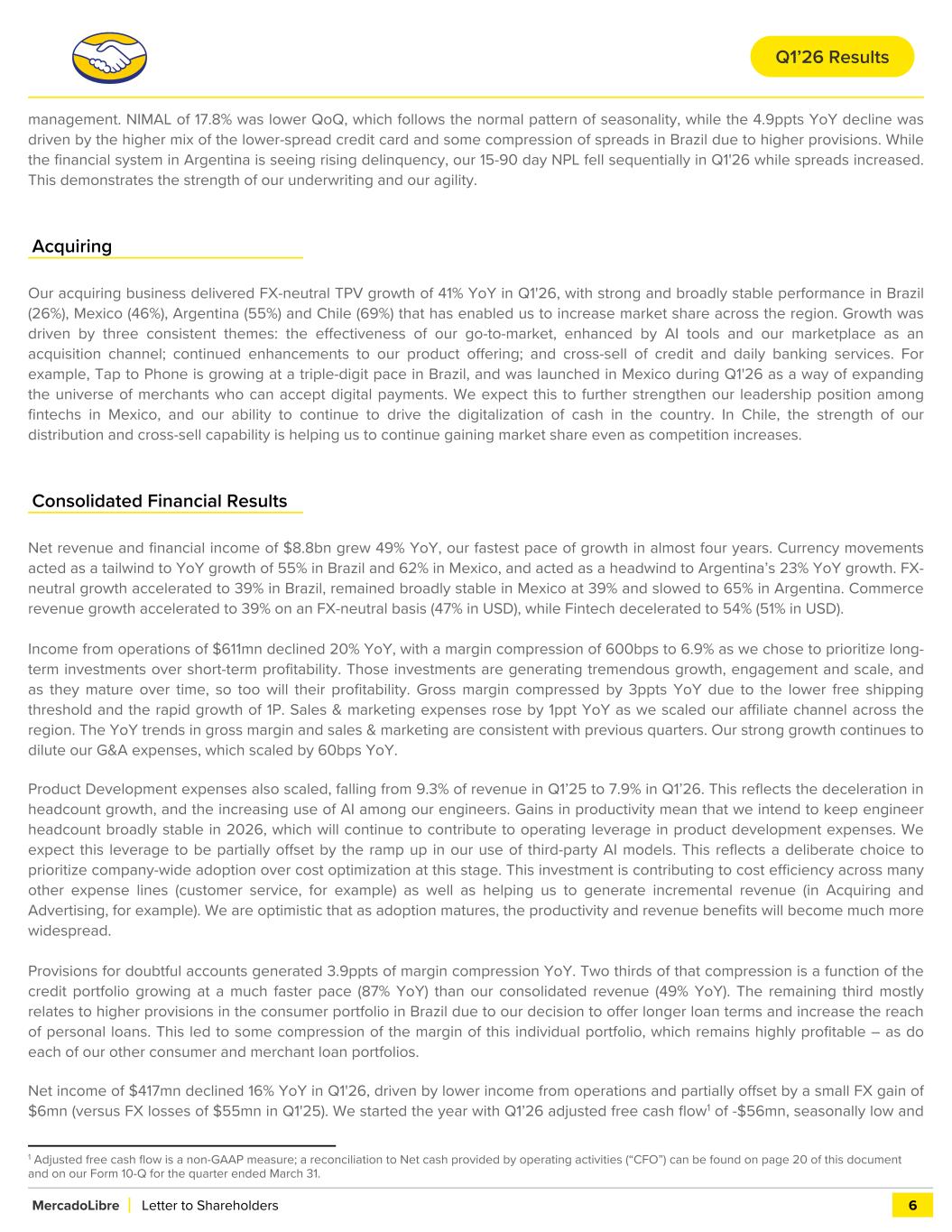
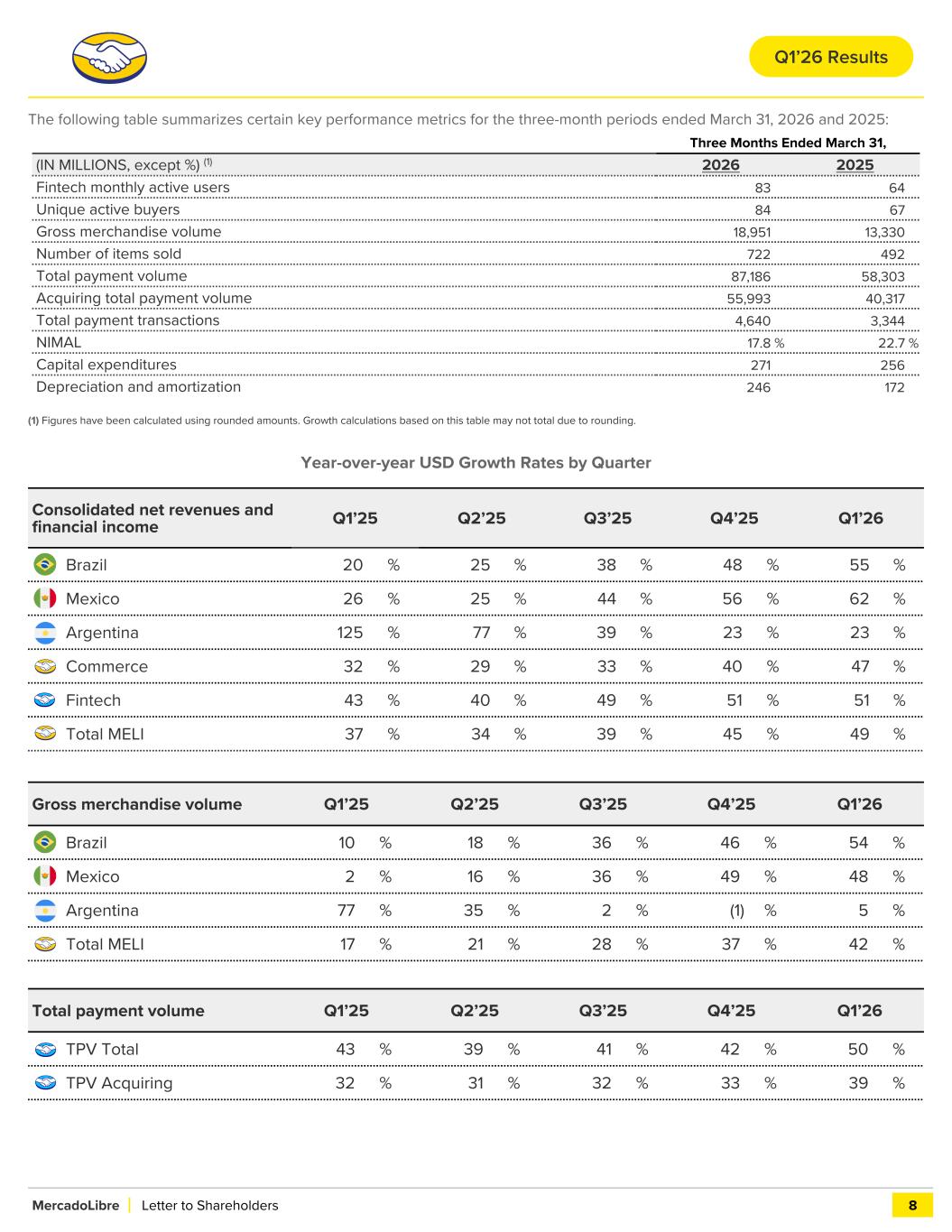
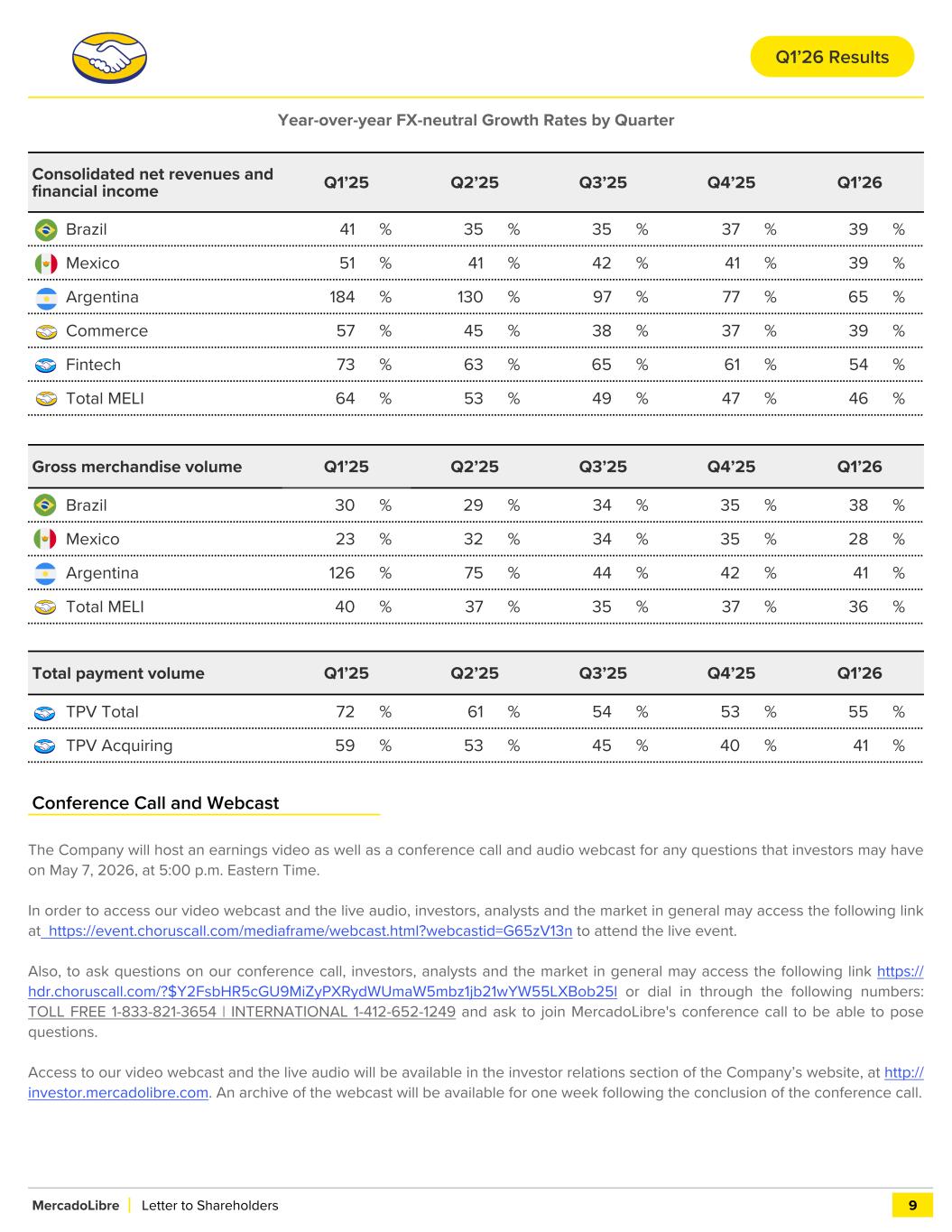
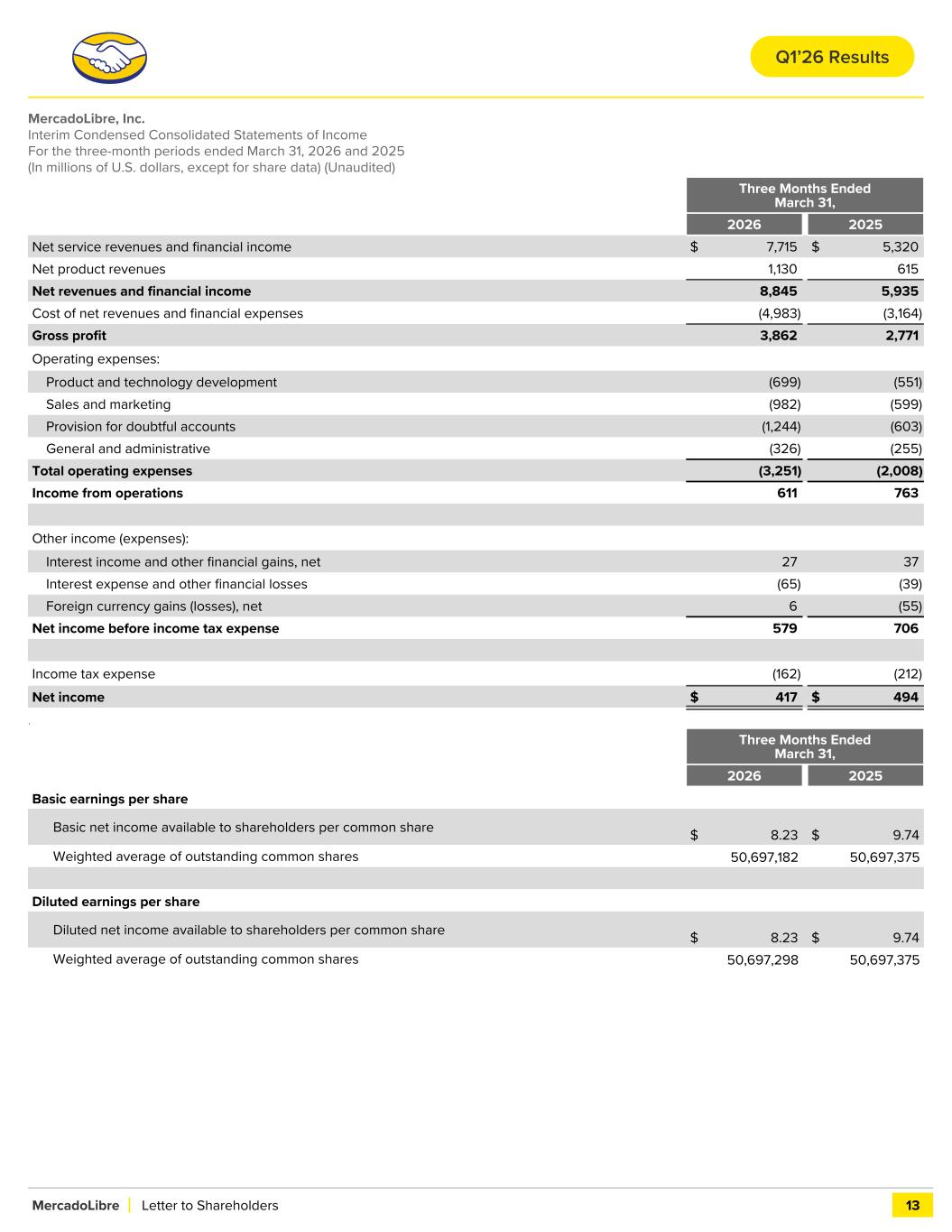
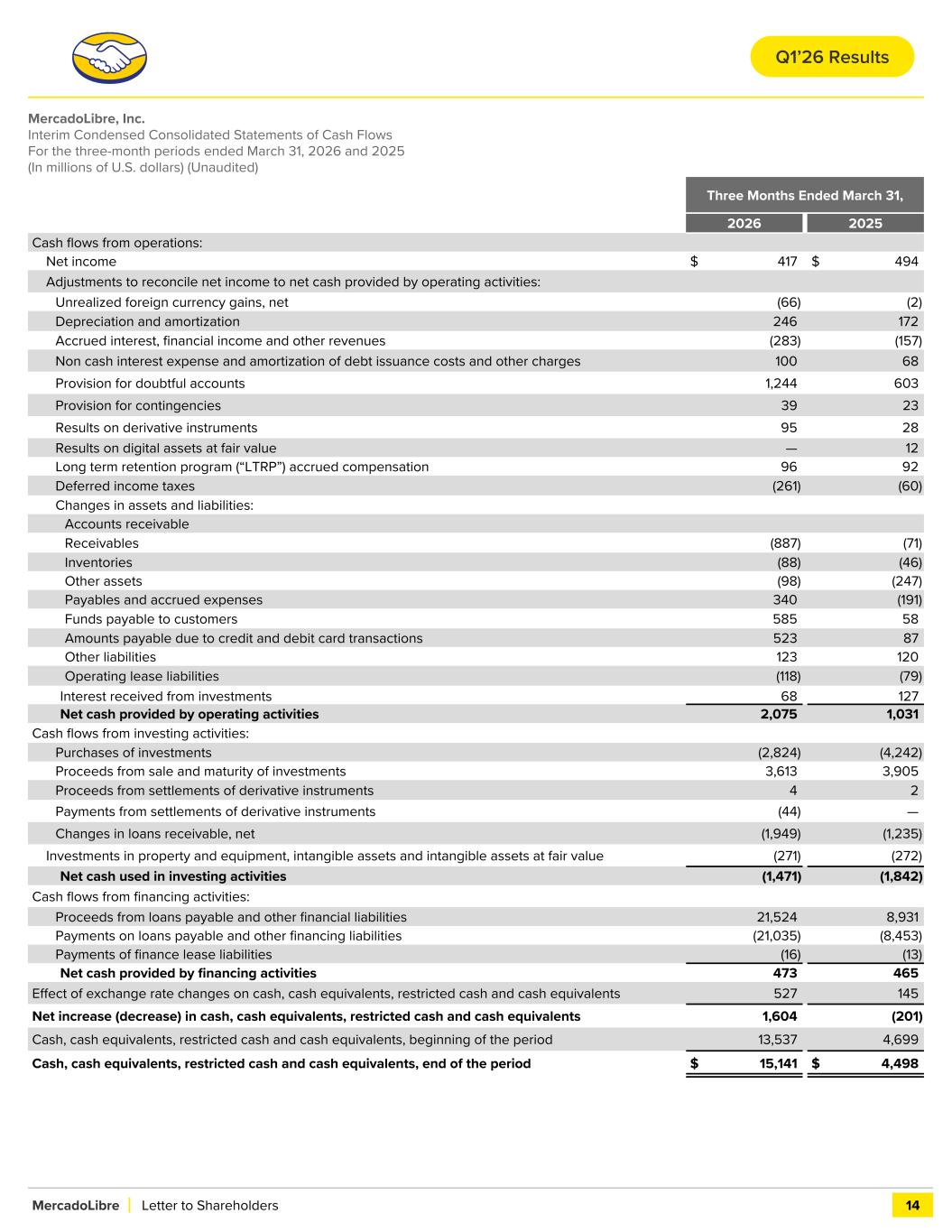
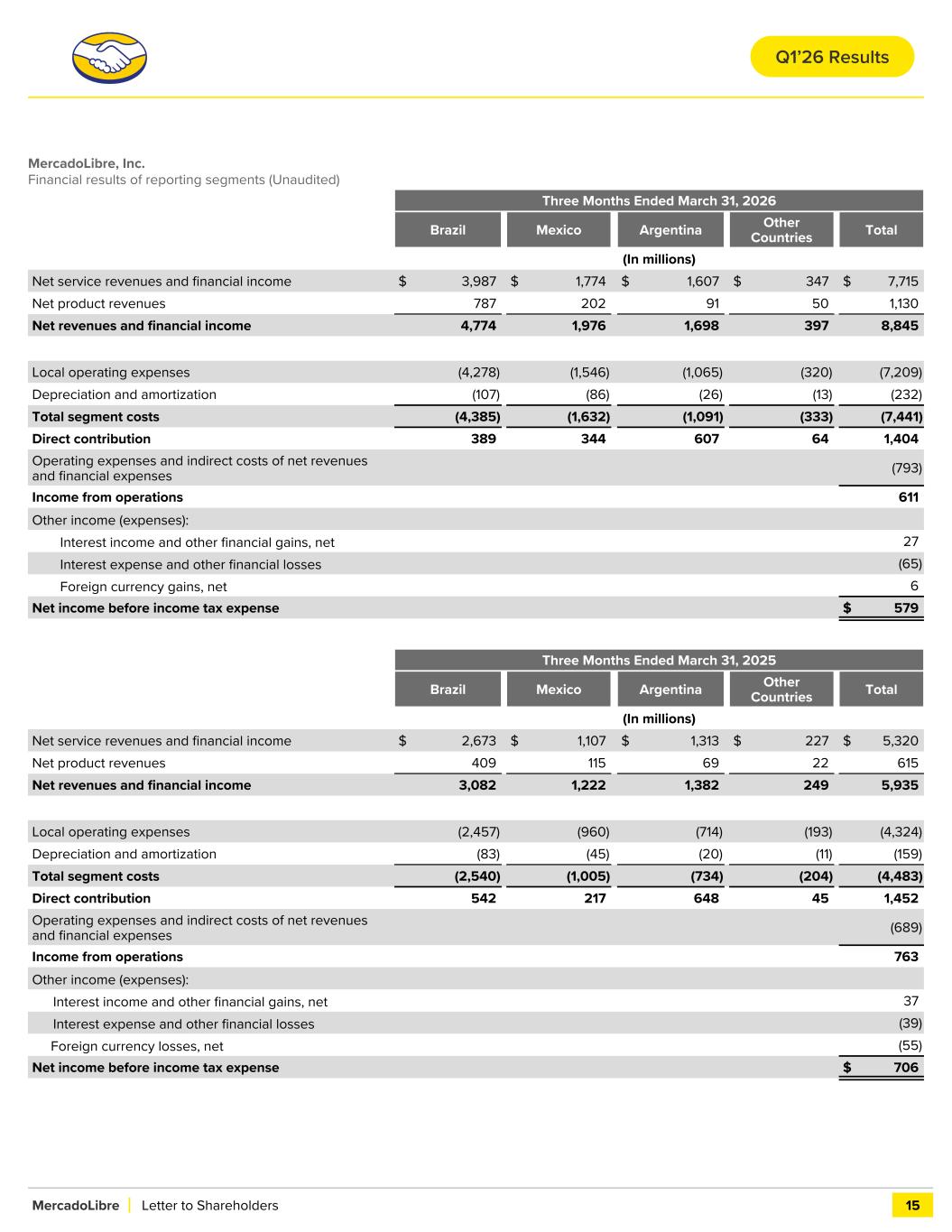
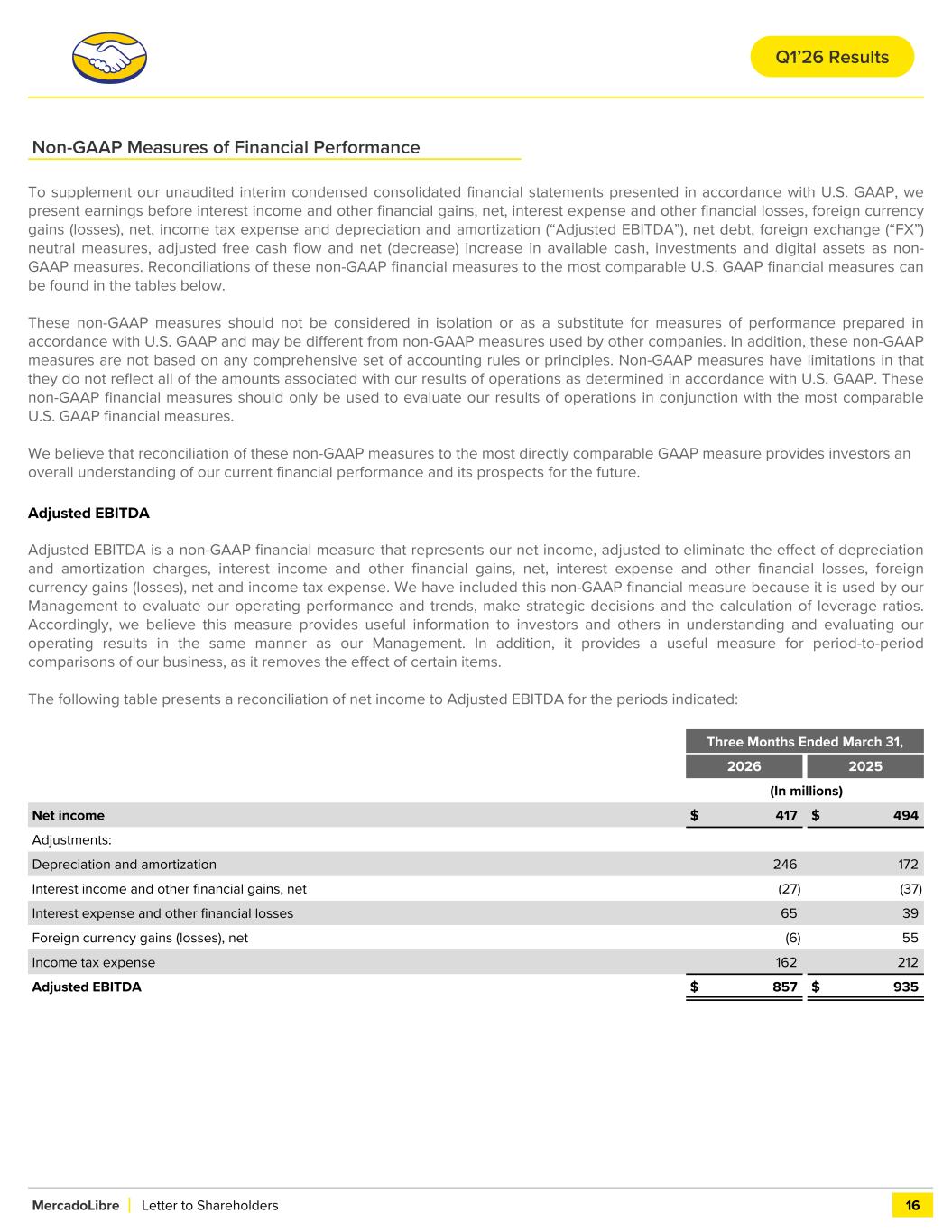
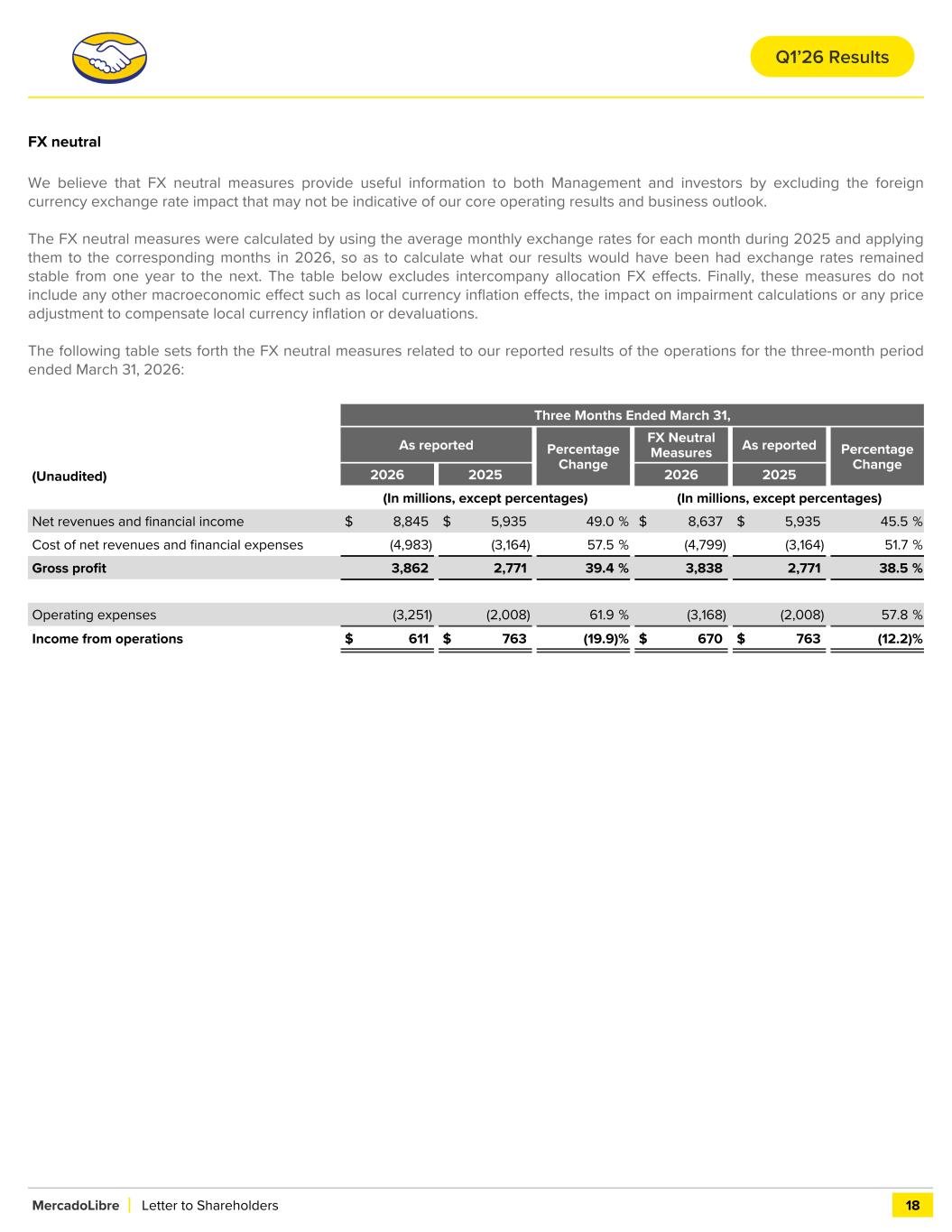
Hello, everyone. Thank you for joining us. I'm pleased to report that MercadoLibre delivered another excellent quarter to start 2026 with net revenue up 49% year-over-year, our strongest growth rate since Q2 2022. This performance reflects the strategic investments we've made consistently over the past several quarters, which are bearing fruit with increasing clarity. Chief among them is our decision to lower the free shipping threshold in Brazil, which has proven to be a sustained growth engine across multiple quarters. By bringing more buyers into the ecosystem, we're strengthening network effects with higher purchase frequency, broader assortment, and a logistics network that becomes more efficient with every incremental package. As a result, Brazil delivered another standout quarter for commerce. GMV grew 38% year-over-year, as item sold growth accelerated to 56%. This is more than double the quarterly growth rate prior to lowering the free shipping threshold. Free shipping penetration reached a new record, and unit economics continued to improve, with cost per shipment down 17% year-over-year in local currency. In other words, higher demand is driving lower cost. Outside Brazil, we deliver solid growth in commerce and continue to gain share across key markets. In Mexico, GMV grew 28% year-over-year, while in Argentina, GMV grew by 41%. Chile remains strong with GMV also up 40% year-over-year, driven by higher free shipping penetration and faster deliveries. Fintech services' momentum also remains strong, with solid growth across our core indicators. Mercado Pago monthly active users grew 29% year-over-year. AUM grew 77%, and our credit portfolio nearly doubled to $14.6 billion. This highlights that engagement is both broadening and deepening as more users choose our ecosystem as their primary financial relationship, supporting our long-term objective of becoming Latin America's largest digital bank. We continue to invest in our credit card as a central pillar of this long-term objective, issuing 2.7 million credit cards this quarter. Credit card TPE grew 90% year-over-year and monthly active users grew 68%. The credit card is an excellent example of fintech cross-sell occurring at scale, as a meaningful share of cardholders were previously marketplace-only users and are now active fintech users this reinforces the cross-cell flywheel and generates positive ecosystemic effects across engagement usage and retention growth of our credit portfolio is supported by disciplined underwriting and continuous enhancements to our models that are improving decision accuracy and scale this validation gives us strong conviction as we extend the playbook beyond brazil continuing to scale the credit card in mexico and building from earlier days in Argentina. Overall, Q1 2026 was an outstanding quarter of top-line growth, with revenue increasing 49% year-over-year. We delivered $611 million of income from operations, representing a 6.9% margin. The margin compression reflects our choice to invest in strategic initiatives, and the results of each investment reinforce our conviction that we are taking the right steps to build the largest and most engaged commerce and fintech platform in latin america our investment decisions are guided by clear observable evidence and that evidence tells us that now is precisely the right moment to invest boldly in a market with significant multi-year growth runways ahead that is the foundation on which we are choosing to invest we look ahead to the rest of 2026 with strong momentum and full conviction that the investments we're making today will compound into structural advantages that define this company in the years ahead. We appreciate your continued support and with that we'll open it up for questions.
Operator
We will now begin the question and answer session. To ask a question you may press star then one on your touchtone phone. If you are using a speaker phone please pick up your handset before pressing the keys. If at any time your question has been addressed and you would like to withdraw your question, please press star, then two. Please limit yourself to one question, and if you have further questions, you may re-enter the question queue. And at this time, we'll pause momentarily to assemble our roster. And the first question will come from Irma Gars with Goldman Sachs. Please go ahead.
Yes, hi. Thank you for the opportunity. I think a key question I'd like to ask is that on the shareholder letter, you mentioned that you chose to set the dial at this level of the first quarter and you point out quite explicitly that there was a deliberate investment decision I think that's quite clear however you also mentioned that there were some you allude to some some incremental opportunities that you've been able to identify and also you note that you don't expect this level to material change in the near term so I think my question is could you just help us understand what perhaps changed from the fourth quarter that you reported in from late February to now, after the first quarter? What new opportunities have you identified to invest behind? And whether this margin level that we saw in the first quarter, again, I know you don't provide guidance, but is that roughly the right level that we should think about for the remainder of 2026? Thank you so much.
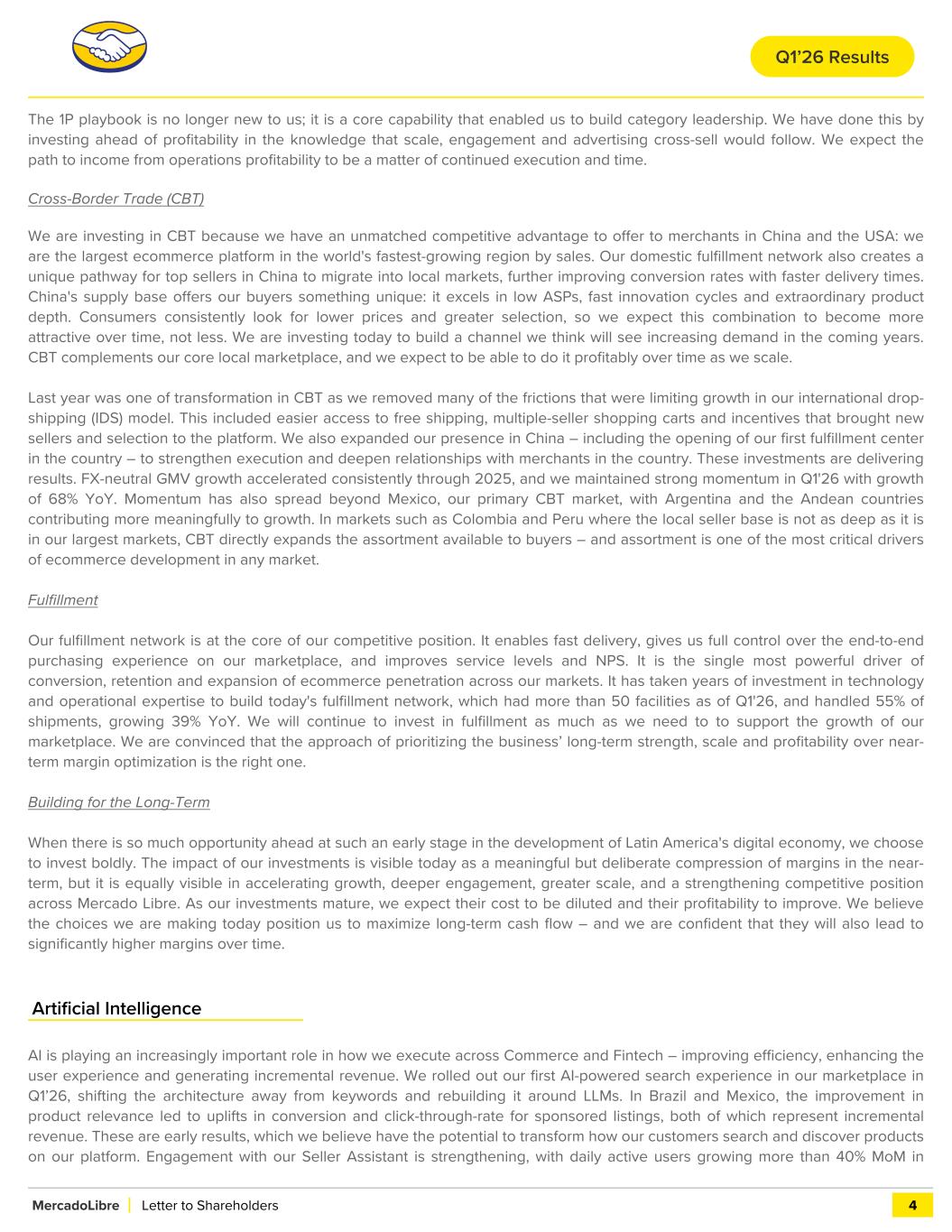
Hi, Jermals Martin here. Let me start with the end. I think the investment philosophy hasn't changed. In fact, we decided to invest behind initiatives, similar initiatives that we have been investing over the past several quarters. What we have seen, and we try to be very explicit about that on the letter this quarter, are the results of those investments. We're seeing very good results in terms of our credit card portfolio. As we mentioned, all their cohorts in Brazil continue to improve and become profitable. The repayment periods in both Brazil and Mexico are also improving. So that gives us more confidence to continue investing and investing boldly in terms of growing our credit card portfolio. And now we're also launching it in Argentina. The same could be said on the commerce side. We continue to expand our fulfillment infrastructure in order to keep up with growth of our business. We expanded and we probably invested a little bit more boldly in CBT. We see a huge opportunity on CBT as well as 1P, and we're investing behind that. And then if you compare year over year, we continue to expand our free shipping offering, which is a critical component of our value proposition. So I would say that for the most part, we did not change anything in terms of the investment philosophy. We have seen very strong results on those investments. As we always said, we're not trying to optimize short-term margins. We're doing this. We're investing for the long term. So we will continue to invest boldly in those initiatives.
Operator
The next question will come from Andrew Rubin with Morgan Stanley. Please go ahead.
Hi, great. And thanks for the additional color on the investments within the release. One other item I'd like to understand more about was the Brazil seller promotions you announced in recent months, lowering take rates for competitively priced sellers in certain price points. So I'd like to understand what drove the decision. And when you're thinking about allocating price investment dollars, How you balance that between seller investments versus buyer initiatives, such as free shipping, and maybe to the extent it relates to Irma's question, if these seller promotions represented any area of change in your philosophy or approach over the past few months.
Hey, Andrew. Ariel here. So let me walk you through what we have done regarding take rates in Brazil for everyone to have the full picture. So basically, we lowered take rates in some categories in some specific price ranges. So this is not a platform-wide take rate cut. It's a targeted investments where we see the greatest opportunity, and by opportunity I mean both elasticity of demand and elasticity of supply. And basically, all the discounts that we are providing to merchants are conditional on sellers maintaining a competitive pricing on their listings in MercadoLibre so why is it that that we are doing this and this is probably the most important part of the answer we started if you go back a few years we started lowering take rates back in 2024 targeting specific ranges and categories and and if you look at results, since then unique buyers have grown 62 percent, GMB has grown even faster, the number of live listings in our platform and the effective sellers have hit record high even after a few years of much slower growth. Engagement and frequency in the platform continue to increase at an excellent rate. So basically the last ticket reduction are a function of the results that we have already proven and we've seen over the last 18 months. And if you were to take a step back in the last 12 months, going to the second part of your question on whether we're doing these for merchants or investing for buyers, over the last 12 months we have lowered the free shipping threshold to 19 reais. We have expanded free and fast shipping in many miles. We have expanded our affiliate program. we continue to build the best and most reliable logistics network across Latin America, and clearly all those investments compounded generate tremendous volume and tremendous value for our merchants. And we want to make sure that those investments which benefit sellers directly are translating in the best possible prices for our buyers in the platform. So, basically, this is another piece of a complex puzzle of initiatives that we are putting together in order to drive engagement and create the very best value proposition for users in MercadoLibre.
Let me just complement those investments that Ari mentioned regarding lowering shipping and take rate to merchants were implemented towards the end of the Q1. So they did not flow through our P&L in Q1. They will flow through in Q2.
Operator
The next question will come from Bob Ford with Bank of America. Please go ahead.
Hey, good evening, everybody, and thanks for taking my question. In the press release, you mentioned a 30-point NPS gap with incumbent banks. Can you talk a little bit about your NPS rank across the marketplaces and what you think you need to do to replicate that NPS leadership with respect to marketplaces and maybe specifically in Brazil.
Hey, Bob. So we are at record high NPS across every single market. In e-commerce, we feel pretty comfortable with the competitive position in terms of customer satisfaction in every single market where we operate. So if you were to compare our NPS with traditional retail, which is kind of the similar example to traditional banks, you would see a huge gap, and we are satisfied with all the progress we've made and the continuous improvement in such a metric across Brazil, Mexico, Argentina, Chile, and so on.
Operator
The next question will come from Marcelo Santos with JP Morgan. Please go ahead.
Good evening. Thank you for taking my question. I wanted to discuss a bit the Brazil-Nimao compression. You mentioned that one-third of the provisions came from higher provisions in Brazil. Is that part of the up-market move? Like you say, you're taking longer loans. Just want to understand what kind of products you're going to take, what kind of risk these products come, and how far you are in this move. That would be the question.
Hi, Marcelo. Yes, as you mentioned and as we mentioned in the call, a big part of that is related to a higher amount of credit cards, which have a significantly smaller NIMAL, because there are still immature cohorts in the portfolio. And then we are taking heavy provisions in Brazil, and that is related, on the one hand, to extending the average term of our loans. We used to have loans typically on average of five months, and that has moved to eight months. And also we are expanding the reach on our personal loans portfolio. And that is in part what you mentioned is we are reaching out to customers who had a line of credit in the past, and they were not taking it, so we are lowering the spread to see if we entice them to start trying our personal loan products and also reaching out to segments where they are either more risky or where we have to work with smaller spreads. So it has been a deliberate decision to reach out to further segments to continue accelerating But I'll add to that that asset quality remains quite stable and reflects how well the models are working and, in general, how the underwriting process is working.
Operator
The next question will come from Rodrigo Gastam with Etow BBA. Please go ahead.
Yeah, good evening, everyone. I'd just like to turn the discussion here to Argentina and the credit book in Argentina. If you could discuss a little bit about the potential acceleration in the credit book in the country or give us some idea of the growth recently of the credit book in Argentina, specifically for the card book, which has been quite new, but we felt you quite enthusiastic with this initiative. And also share with us some early signs of the profitability of the credit card in Argentina, the NIMO or the maturation of the cohorts, how it's behaving. It would be very helpful. Thank you, guys.
Hi, Rodrigo. Let me start with credits and then I move on to credit card. I would say that in general, the 1590 NPL in Argentina has improved sequentially. When we look at the market, we see that some banks are having worsening NPLs, but that has not been our case. And I think that the reason for that is that we have several advantages, is that we are issuing loans with very short durations relative to the banks, and we have a very nimble approach to pricing those loans, and we have high levels of principality in Argentina. Lots of our users use their Mercado Power account every day, and we have very sophisticated underwriting models. So I think that our portfolio has proved to be very, very resilient in Argentina. With regards to the credit card, we just started issuing cards in August, September of last year, and we are excited with the evolution. And given the, I would say, the ubiquity of Mercado Pago, we have been able to reach out to those clients which we deem to be less risky, and that has enabled us to be aggressive in the number of cards we are issuing. Still, it's early to tell how quickly those cars will repay themselves, but we are seeing – the initial impression is that the cohort in Argentina is very similar to our first steps in Brazil, so we are happy with how they are evolving.
Operator
The next question will come from Josh Beck with Raymond James. Please go ahead.
Yes, thank you for taking the question. Sounds like unit costs were down, I believe, 17% year over year. I assume a lot of this has to do with better utilization of idle capacity. as we look you know later into this year and next how do you kind of think about maybe the next step down in terms of unit costs and then just quickly on agentic we've heard you know a number of the U.S. players speak to really embedded agentic experiences within their own e-commerce platform driving better conversion bigger baskets just curious if there's any early learnings in that area for you.
Ariel here. So, indeed, we are very pleased with the results on shipping cost, 17 percent reduction year over year, further accelerating from the 11 percent reduction we saw in Q4, even while absorbing 56 percent volume growth in the same period. And basically the improvements are coming from three main things, A, volume and volume density, so more shipments allow us to dilute fixed costs across the network while also ramping up facilities to utilization levels far more quickly. And that combined with new tech features also allow us to improve shipments per route in both last mile and line haul. B, our slow shipping network, and this is a key lever that allows us to take advantage of the idle capacity both in fulfillment and cross-locking in order to ship items at marginally lower cost whenever there's space available in our value chain. And C, there were lots of work in terms of deployment of operational and technological improvements that did change and improve productivity across every node of our network. So very pleased with that. There's a commentary that we left there in the letter that shares a bit more on the story. So valuable contribution per shipment for the items between 79 and 79 REIs has improved materially since we launched our free shipping program in June. And several brackets within that range are already breaking even, so we are positive with this. This is the same type of trajectory that we saw when we launched our initial free shipping program back in 2016. I would say this case was even faster, the improvement. And looking forward, I would say that we expect the direction of travel in unit shipping cost to continue to be downwards. But this is not going to be linear, right? So we will be adding more capacity for sure, given the growth rates that we're having. And clearly some of the incremental gains may take longer time to achieve, but we are confident on the trajectory that we'll continue to see. In terms of agentic and impact, I think it's worth highlighting the fact that we deployed LLMs in search in commerce for the first time this quarter and basically that is live in Brazil, Mexico and Argentina. So now we are using this technology to better understand user's intent, combining both knowledge on the user behind the query and better interpretation of the query itself and the impact is basically very visible across the funnel. We have higher conversions as buyers find what they are looking for much faster. We have better ad returns as our search also improves the quality of the results that our ad tech stack is generating. We have higher, stronger engagement from our users as the discovery experience actually improved. And clearly, this is one of the contributors to the great performance we had this quarter. This is one piece in a much more broad Gen AI strategy for the marketplace. And we are very happy with the results that we've seen so far.
Operator
The next question will come from Danny Tiger with XP. Please go ahead.
Thanks for taking my question. I have a quick one here. I would just like to know how you guys are seeing the potential work scale revision in Brazil as well as higher oil prices becoming additional cost challenges to be dealt with in the short term.
I think we've seen in the first quarter, we didn't see any change in terms of energy costs. We are seeing some parts of our logistic passing on some increases in costs because of energies in the second quarter, beginning in the last month or so, and we are passing most of those to consumers. So for the most part, we don't expect a significant impact on our results because of that so far. We're obviously monitoring the situation closely, but it's something that we need to go month by month. But so far, we haven't seen any impact on our P&L because of that. And in terms of labor costs, I think the same thing. I mean, for the most part, we obviously were increasing our labor mostly on logistics, and we adjust our logistic costs based on labor costs twice a year, I would say, in Brazil. So that's not a major issue for us and hasn't impacted our performance.
Operator
The next question will come from Jeffrey Elliott with Autonomous. Please go ahead.
Hello, thanks very much for taking the question. There's some interesting language in the looking ahead statement where you talk about margins and you say you can dial them up, you can dial them down. We've chosen where to set the dial, and we do not anticipate this changing materially in the near term. It's unusual for you to give that near term clarity. What has prompted that? And then what could cause it to change? What unforeseen circumstance could cause margins to be lower or to be higher in the near term thank you.
Hi it's Martin here basically what we're trying to explain on the letter is the fact that the margins are a consequence of our investment posture and we can dial in you know up or down the investment uh intensity based on the results that we're seeing on the different channels of different tracks in which we're investing and this particular quarter as you saw we are accelerating the offering of credit cards you Our credit card book is growing more than 100% year-on-year. We're also accelerating CVT and 1P, and we continue to offer more free shipping. So we're investing in both commerce and fintech, and based on the investments that we're making is the margin that we're delivering. As I said earlier, we're not optimizing for short-term margin. We're making investments based on the results that we're seeing, and the results are very positive. When you look at revenue growing at 49%, which is the highest rate of growth over the past four years, that's one example of our investments performing very, very well. So I think what we try to say there is that we will continue to invest the disciplined in the similar areas that we're investing today. If we see opportunities and we see results of those investments performing according to plan, we will continue to invest and we will not shy away from it. And again, we will not try to optimize short-term margins, we're looking at a big opportunity ahead of us. We want to make sure that we capture that opportunity as opposed to just focus on the short-term margins.
Let me compliment that, Martin, on the fintech side, and you mentioned credit cards, definitely we see this as a huge opportunity. And the better we get at improving our models and allows us to issue even more credit cards, always within the same payback period we set as targets. so the better we are at improving those models the more we are willing to invest because we know how predictable the payback period is and then the flip side would be if we wanted to improve margins in the short term it would be fairly easy for us to slow down certain investments but we don't think is the right way to go even the large opportunity that we have in front of us for both commerce and fintech the next question will come from craig maurer with ft partners please go ahead.
Yes, thanks. I wanted to dig in a little bit further on the decision to both go longer duration and to expand the credit box when it comes to the credit card in Brazil and personal loans in Brazil. With the price of oil up and I'm just curious what gave you the confidence to make those changes now and really lean in versus what was already a fast growth rate. So I just want to make sure I understand how you balance the risk reward here.
Let me try to split the question. I would say that on the credit card side, we are very comfortable with the repayments we are seeing. The repayments are very similar to what we were seeing before. And so the impact ECODICAR has on provisions under NIMAL is mostly given that is gaining share in terms of the total credit book. Now, when it comes to personal loans, and that's where we extended the duration, there was a proposal. Basically, our duration was fairly small. It was only five months, and it was very profitable. It continues to be very profitable, less so than a year ago, but it continues to be fairly profitable. And given that we are growing well and it's profitable, we wanted to reach out to segments where we believe we can make money even if on the margin the spread we make is smaller than with the segments we were already serving. And in ties, again, those segments which sometimes we're not willing to take a credit before to start taking them. Again, we can't change the periods at which we land at any point in time, but we wanted to experiment with this and this confirmed that we could do this in a profitable way.
I would say that we continue to monitor and manage our credit book very cautiously, and if you look at the NPLs, despite the macro condition that you described, continue to be fairly stable in all of the countries where we operate, including Brazil.
Operator
The next question will come from Jao Soras with Citi. Please go ahead. Mr. Suarez, your line is open. We'll move on to our next question. That will come from Lucas Alvaz-Lestino with Santander. Please go ahead.
Good evening. Thanks for taking my question. Also regarding the credit portfolio, it's clear that you are increasing exposure to credit cards, but also accelerating in consumer and merchant loans, which I believe require higher provisioning at the time the credit is released, both to the nature of the credit and also the longer durations. So it may explain a big part of the NIMAL reduction. Does it make sense? And combined to it, those categories of credits have lower spreads than credit cards, but accrue interest over the full balance, contrary to credit cards that you depend on users to delay payments. If my understanding is right, is it fair to assume that this static NIMAL is much lower than it could reach over time as you start collecting interest and even potentially reverting provision on this balance?
Hi, Lucas. So in general, the spreads in consumer and merchant books are better than those on the credit card because, again, on the credit card, we have to book all of the potential lines we have as provisions. And so initially, we take a loss whenever we issue a credit card, and then only after some time do we start making money on those cards we issued in the past. So, I would say that what contributes to an increase, a lower NEMA and a higher provision is mostly, first, two-thirds of it is coming from the increase in the proportion of credit cards. And then, with regards to the loans, yes, increasing duration make us take larger provisions, and we also assume a larger early repayment risk. And that was part of the equation of moving toward longer durations, but we expect that with time and as we regulate and we already understand better how repayments will work, we will be able to again expand the spread in those loans, in those personal loans in Brazil.
Just to complement the consumer loan portfolio in Brazil, which is the only one that Oswaldo was referring to, continues to be a very profitable operation. It has margins, double digit margins. It's just that it is a little bit less profitable than it was a year ago, just to clarify that, and will continue to perform very, very well.
Yes, and merchant loans, which were the last one we mentioned, have very, very healthy spread. Probably they have the highest spreads of all the products as of now today.
Operator
The next question will come from Nija Agawala with HSBC. Please go ahead.
Hi, thank you for taking my question. Sorry to go back on the provisions question, but the cost of risk increased quite substantially this quarter. It's now around 37% as for my calculation. Could you zoom in on which particular loan segment or any particular region that might have led to this increase in cost of risk? and do you see it as a one-off or do you see closer to 37-38% as a going rate for cost of risk as you continue growing the credit business? Second question is, there's a lot of discussion about payroll loans in Brazil which are less risky but gives a good alternative to personal loans. Is that something that you would contemplate entering into for Brazilian market? Thank you so much.
Hi, Nija, it's Martin here.
Let me take the first part of your question regarding the provisions this quarter. You're probably looking at this chart on our investor presentation where we show the waterfall in terms of margin compression. There's four points of margin compression because of bad debt or because of the provisions. This is something that's been happening for quite some time. The fact that our credit book grows at a faster pace than revenues, you know the credit book grows at 87 percent year on year and our revenues for mercado libre growth at 49 percent that generates margin compression okay and the reason for that is because as we issue any new loan we have to provision for the full amount of the expected loss of the loan and we accelerate when we accelerate growth we need to provision more so two-thirds of the margin compression comes from that that's natural that's something that we have seen over time and in fact In fact, if you look at the credit business because it's so profitable, it is actually accretive to margin to overall melee. Then the one-third of a compression that you see on that waterfall comes from the consumer credit book in Brazil that, as we mentioned earlier, it is profitable, but it's less profitable than it was a year ago, and that generates a compression. So it's not really a change in terms of, except for Brazil, there's no change in terms of performance we continue to be very excited about the performance of the credit cards which is continuing to improve quarter after quarter the performance of the older cohorts and consumer the merchant grades are very profitable business as they have been for many years now and then regarding the second part of the question regarding payroll loans basically we have seen a significant increase in in brazil of payroll roles and we are about to to launch the private payroll loans we have already integrated with the government and and we will launch the product soon
the next question will come from deepak malivanan with cantor fitzgerald please go ahead wait two questions please first can you talk about the competitive intensity in brazil amazon has made several changes recently are you seeing any impact on the seller side or supply on the platform at this time and then second one for martin can i go back to the EBIT question Irma asked and try a little bit differently there are obviously seasonal headwinds in 1Q from credit business you know that portly eases off through the year but are you now ramping investments in certain areas that's incremental you know that the seasonal effects are somewhat masked and we should expect EBIT margin for the year to be around 1Q levels any additional color
you can provide that would be super helpful thank you so much hey Deepak Ariel here so let me take some time to address the the first point on competitive intensity. So Brazil is one of the most attractive e-commerce markets in the world so it's natural that it's getting more and more intense and as that has been the case for many years. While competition is intense I would highlight a couple of things about the way we are thinking about this and perhaps this might be a a bit different from how the market is thinking. So first, we thrive in competitive environments, right? Competition makes us stronger. It pushes us to evolve, to continue innovating, and that's exactly what we have been doing over the last few years, actually for 26 years, but it's been doing for the last few years as well. Every single engagement metric you look in in MercadoLibre Brazil is strengthening frequency, multiple category shopping retention so all those are structural gains in our value proposition those are not short-term gains or growth that we are buying so once again satisfied with that as we are satisfied with reaching new records of MPS that really show how strong our value proposition is in the country our conversion rate in Brazil has increased one percentage points year over year that's huge increase and when when you think about conversions and all these feeds into the rapid growth and that we are delivering the record market shares so we have never been in a stronger position on on that regards the second point that i would highlight is that this competitive intensity is also having a positive impact in the market as a whole by bringing new consumers from the offline world into the online world and we feel we are very much equipped to offer all those consumers the opportunity to buy in in MercadoLibre so the pie is increasing at a faster pace than it was before and we are taking an even larger slice of that pie. Regarding the impact on what others are doing our numbers speaks speak for themselves right our supply continues to grow our GMB continues to grow our successful items sold accelerating our retention is improving so so we are basically comfortable and confident with the competitive position that we have and we will continue to execute behind it if I start in here with regards to margins as As you know, we will not talk about margins on a quarterly basis, but let me say that in Q1 we decided to invest, you know, we decided to this level of intensity of our investment
based on the performance of the different investments. I think on the shareholder's letter we tried to go deeper into those results, as you can see we're seeing very positive results in all of our investments, in the credit card, 1p cbt uh or a free shipping offering and so on so we will continue to invest behind those initiatives it might be some others like ariel mentioned uh some uh incremental investments that we're doing on on our marketplace in particular in brazil uh we have to see how how energy costs play out i don't see a big impact on that but we need to monitor that situation so i would say that the philosophy will continue to be the same. We will look at the investments, we will look at the results of investments, and we will invest behind our ecosystem to capture the opportunity in front of us. Again, we're not managing the business to a particular margin level. We feel very optimistic and comfortable about the level that we deliver this quarter, and we will continue to monitor the investment opportunities throughout the years to see what we position and the level of intensity that we'll continue to deliver in those different tracks.
Operator
The next question will come from Cal Pareto with UBS. Please go ahead.
Thanks for the opportunity. I have a follow-up on your credit book, please. So I think we are seeing some deterioration on the asset quality, given these higher provisions and NPLs in the lower level of NIMALs. And having said that, I would like to hear from you about your renegotiation strategy. How is this evolving over time? and if this higher duration of loans that you mentioned is related to any kind of renegotiation as well or not. And second, just to see if you understand, at this environment, should we expect the same pace of credit card insurance in Brazil, or should we see some slowdown? And finally, if this is the new recurrent level of NIMO going forward, or actually could be lower as you continue to expand in credit cards.
Thank you, Carlos. So, Caio, with regards to NEMA, when you look at it on a quarter-by-quarter evolution, there is some seasonality in Q1, when typically we have lower NEMA in Q1, but it's normal to see the sequential compression results. And then when it comes to year-on-year evolution, as we mentioned, a big part of that is the the higher mix of credit cards and the rest is more related to to brazil and the both extending the average in terms of loans and expanding the reach of our personal loan portfolio we have not seen any change in in in more negotiations what we do see when we extend the duration is that more people are willing to prepay their loans so the revenues of the interest we end up collecting of that loan is shorter, just because in that case, the duration was extended as we expected in the first place. But we are not seeing any impact of that in the quality or the type of negotiations we are doing.
Operator
This concludes our question and answer session. I would like to turn the conference back over to Mr. Martin de los Santos for any closing remarks. Please go ahead.
Thanks. First, I would like to thank everybody for joining the call. I would like to close with some comments regarding our investment philosophy and we will try to go deeper into that in our quarterly letter to shareholders we are not currently are facing a once-in-a-generation opportunity both fintech and commerce have tremendous runway ahead in latin america and we are in the best position to capture this opportunity so for that we choose to invest behind our ecosystem as we mentioned throughout the call we're investing in fintech and scaling our credit card portfolio which is helping us bring you know millions of people to our mercado pago platform in commerce we continue to grow our free shipping offering we are expanding our logistics and we are investing behind our 1p and cbt operations and obviously those investments are putting some short-term uh pressure on margins but they are delivering tremendous you know results we've seen those investment working our market share we continue to gain market shares in all of business that we operate in all of the countries where we operate engagement and mps are record levels and we are generated tremendous growth and scale and proof to that is the 49 year-on-year growth that we deliver in q1 which is the highest in the five in the last four years we are aware that that generates margin pressure but we think that this is the right way to go and we are as confident as ever that the choices that we're making today will maximize long-term cash flow and will lead us to significant higher margins over time. So with that, I would like to close the call. Thank you again, all of you, for joining, and please reach out to the IR team if you have any further questions.
Operator
The conference is now concluded. Thank you for attending today's presentation. You may now disconnect.