Operator
Good morning, everyone, and thank you for participating in Magnolia Oil & Gas Corporation's Third Quarter 2025 Earnings Conference Call. My name is Danielle, and I will be your moderator for today's call. Our call is being recorded. I will now turn the call over to Magnolia's management for their prepared remarks, which will be followed by a brief question-and-answer session.
Thank you, Danielle, and good morning, everyone. Welcome to Magnolia Oil & Gas' Third Quarter Earnings Conference Call. Participating on the call today are Chris Stavros, Magnolia's Chairman, President and Chief Executive Officer; and Brian Corales, Senior Vice President and Chief Financial Officer. As a reminder, today's conference call contains certain projections and other forward-looking statements within the meaning of the federal securities laws. These statements are subject to risks and uncertainties that may cause actual results to differ materially from those expressed or implied in these statements. Additional information on risk factors that could cause results to differ is available in the company's annual report on Form 10-K filed with the SEC. A full safe harbor can be found on Slide 2 of the conference call slide presentation with the supplemental data on our website. You can download Magnolia's third quarter 2025 earnings press release as well as the conference call slides from the Investors section of the company's website at www.magnoliaoilgas.com. I will now turn the call over to Mr. Chris Stavros.
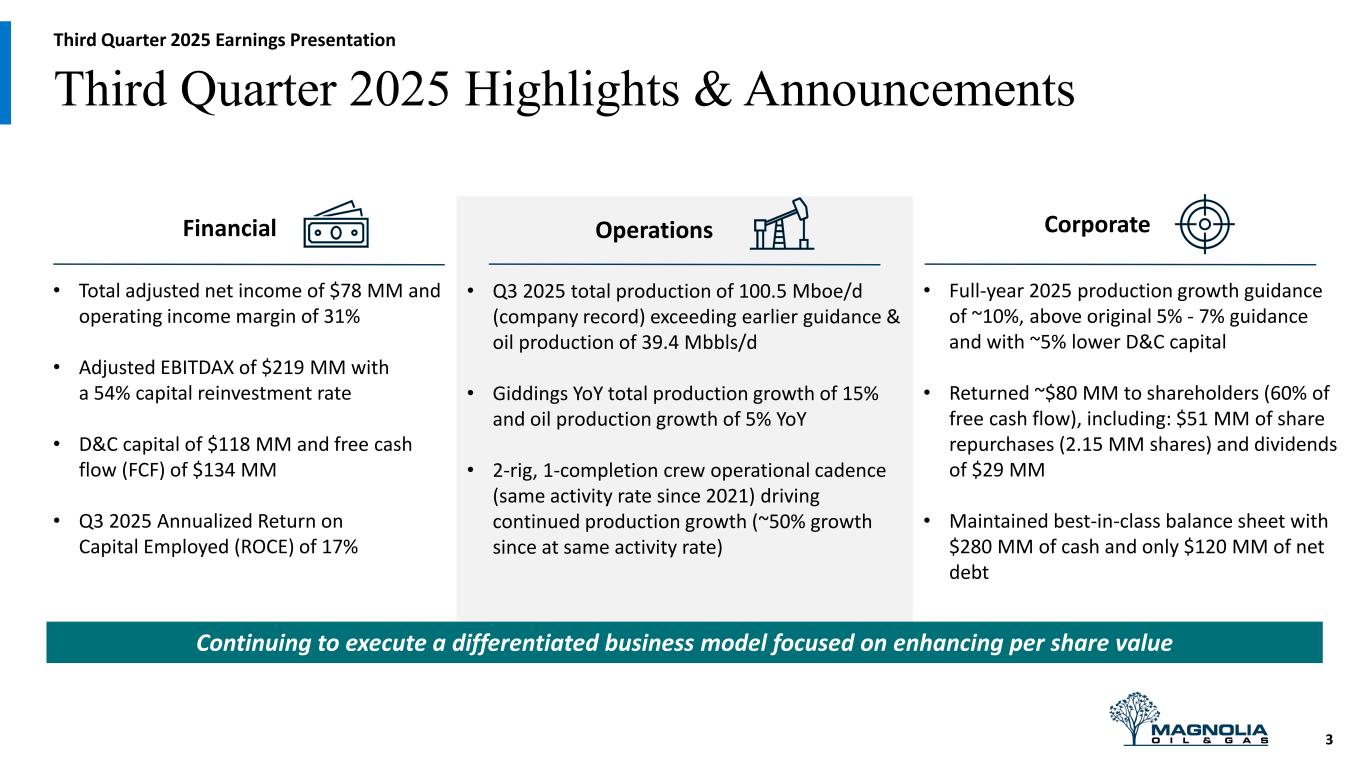
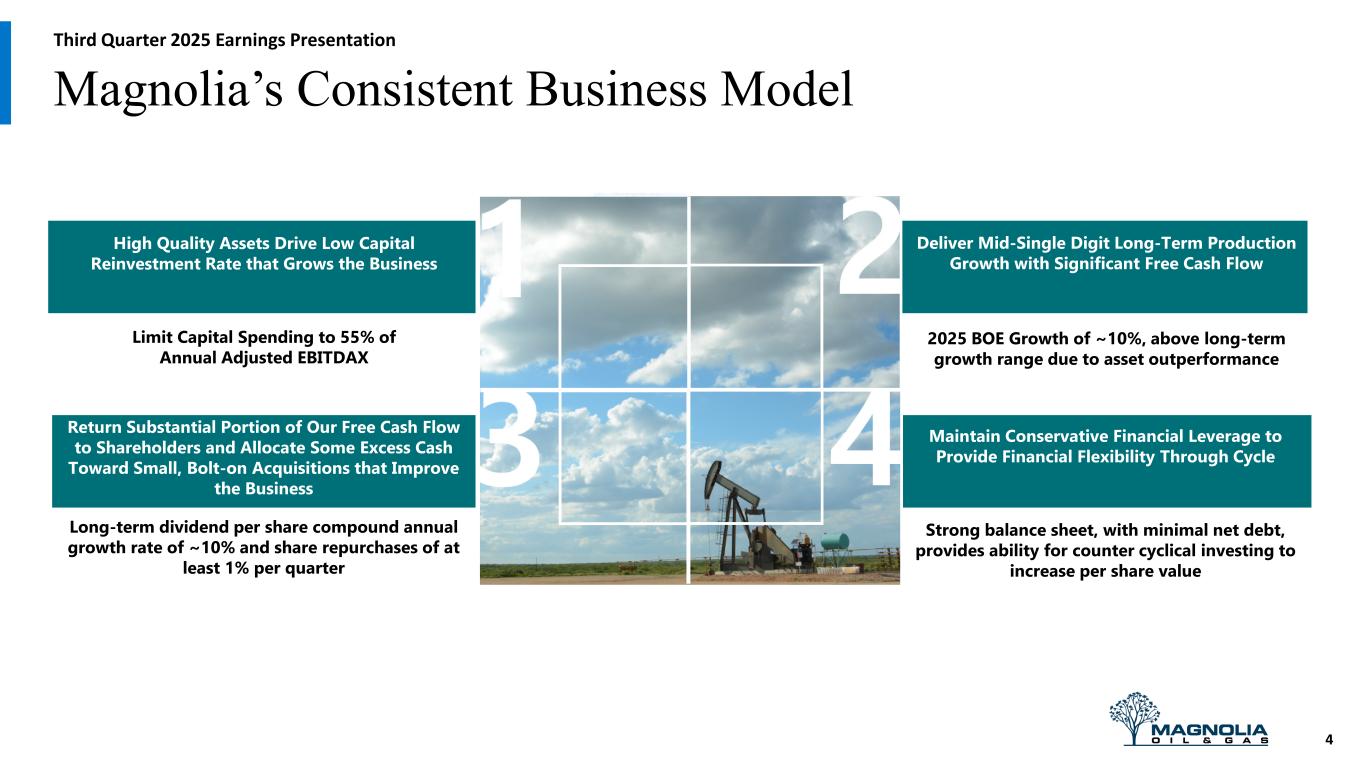
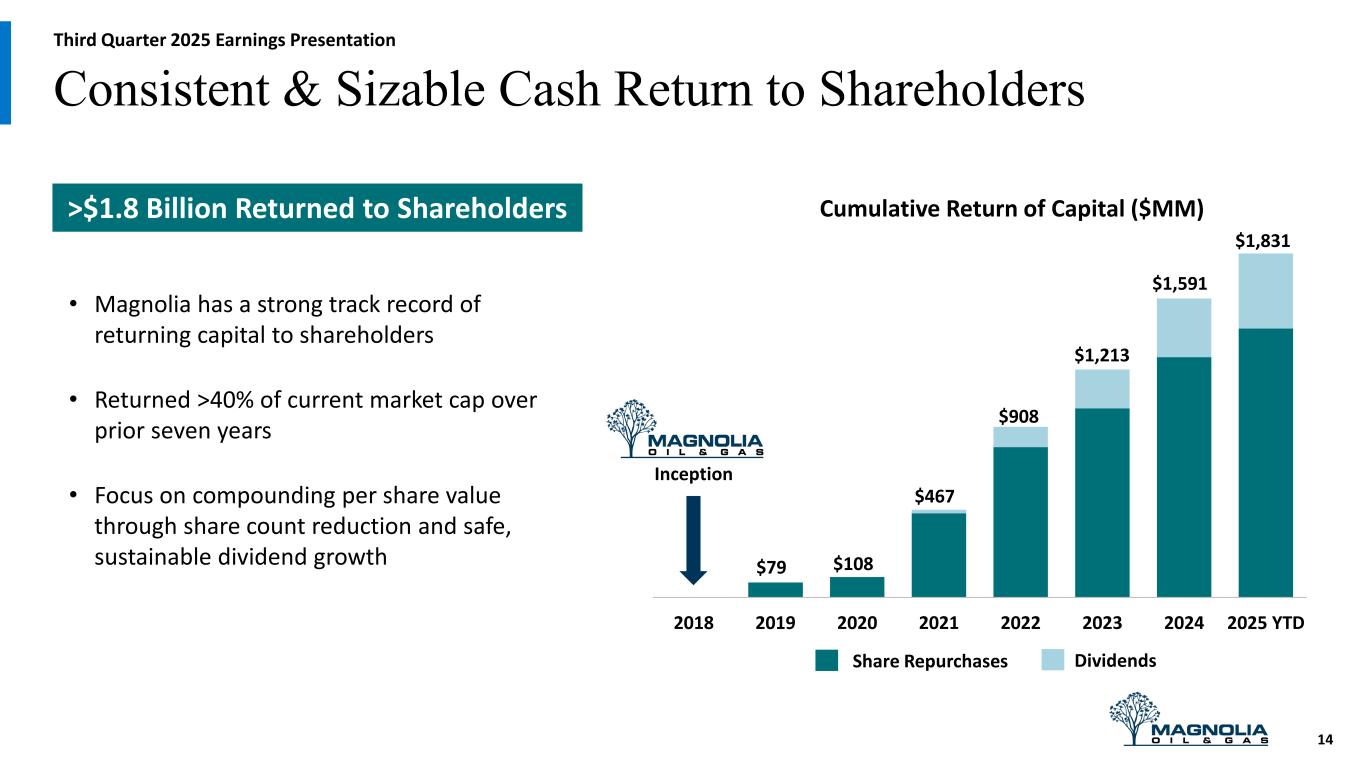
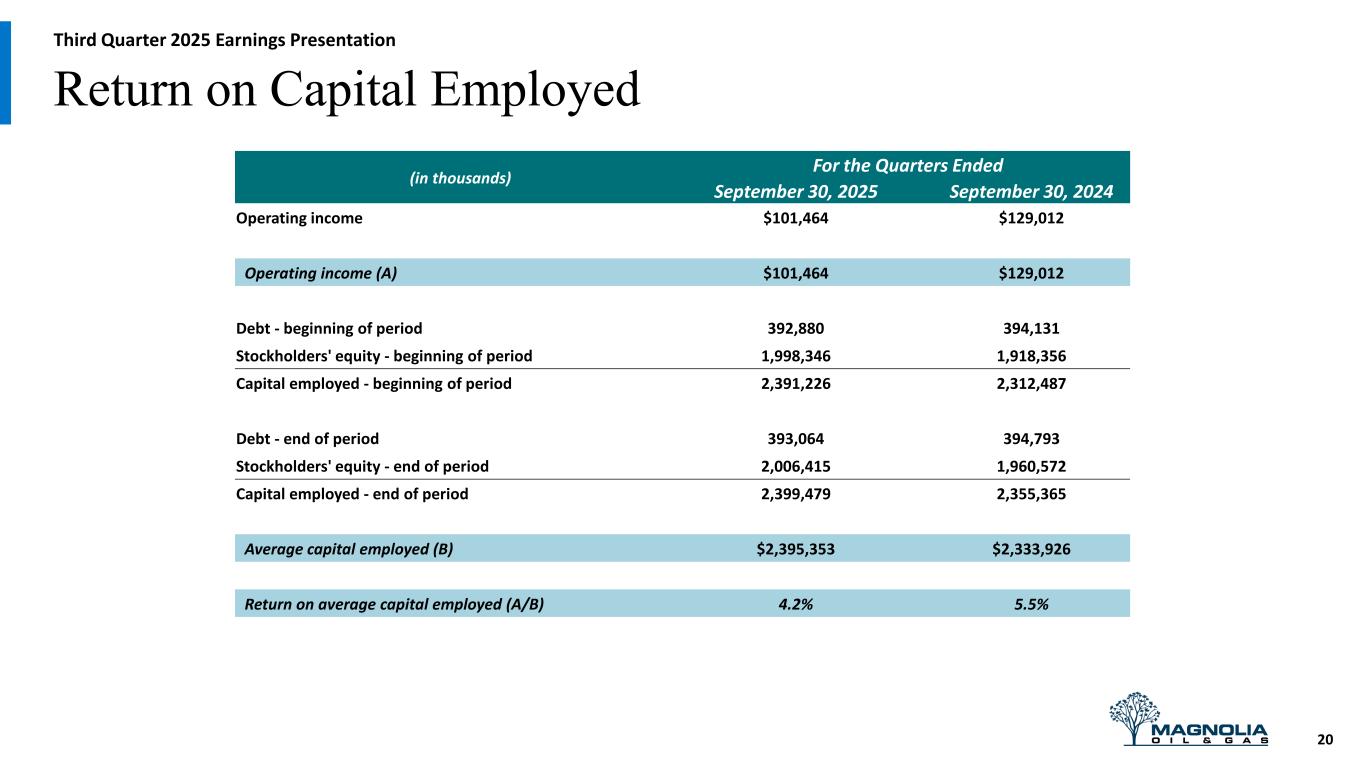
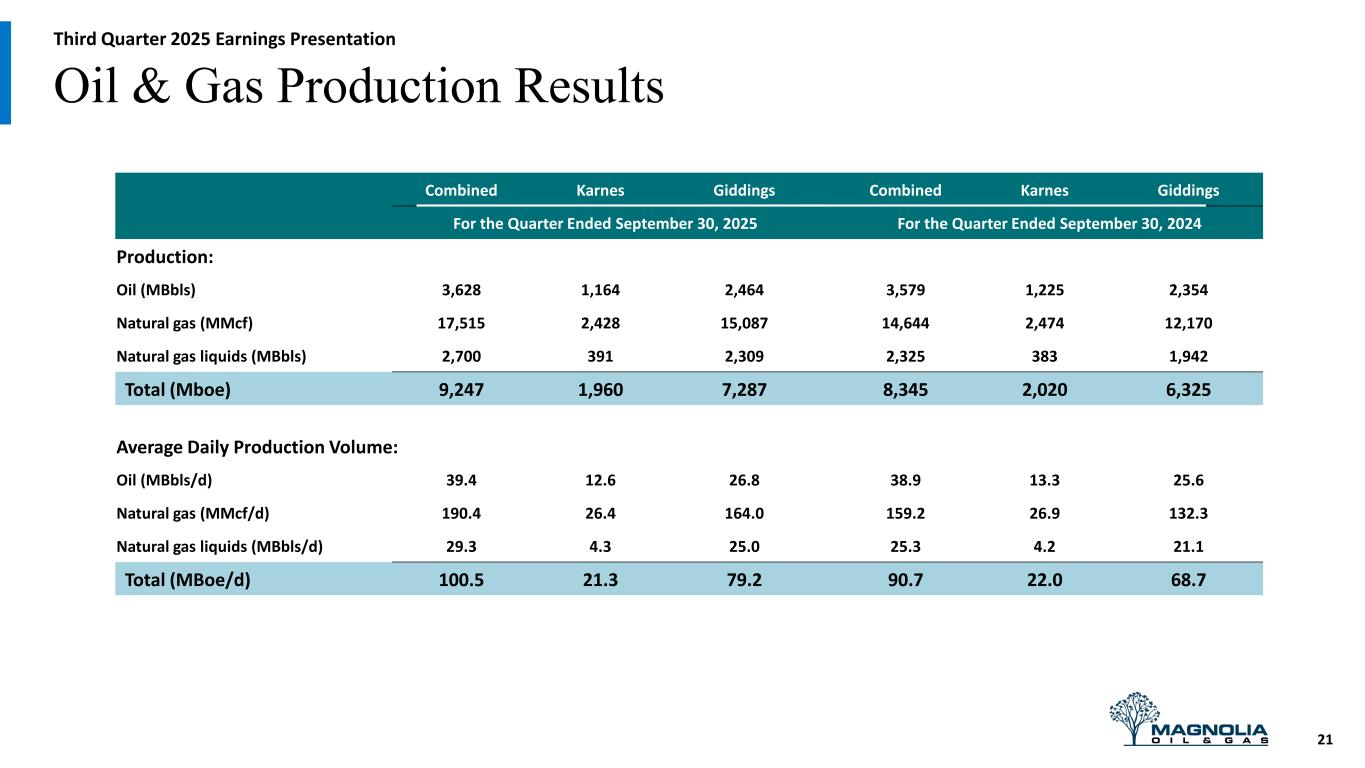
Thank you, Tom, and good morning, everyone. Thanks for joining us today for a discussion of our third quarter 2025 financial and operating results. I plan to highlight our quarterly results, which represent another strong period of consistent execution for Magnolia and continues to deliver on the capital-efficient program that we outlined during the first half of this year, which has provided us with more free cash flow. Brian will then review our third quarter financial results in greater detail and provide some additional guidance before we take your questions. We continually remind the financial community that Magnolia's primary goals and objectives are to be the most efficient operator of our best-in-class oil and gas assets to generate the highest returns on those assets while employing the least amount of capital for drilling and completing wells. A substantial portion of the free cash flow Magnolia generates is returned to investors through our secure and growing cash dividend and ongoing share repurchases. We continue to enhance and expand our asset base through bolt-on acquisitions stemming from our cumulative subsurface knowledge and experience near areas where we operate and understand well. Magnolia's latest quarter is characterized by achieving these objectives, and our year-to-date performance demonstrates our ability to execute our business model despite the decline in product prices we've seen recently. We operate a focused business with an emphasis on driving financial returns and do not plan to add incremental activity at current product prices. At Magnolia, our mission is straightforward: generating consistent and sustainable free cash flow through disciplined capital allocation. All that said, turning to Slide 3 of our investor presentation, Magnolia delivered another strong quarter, and our overall business continues to operate exceptionally well. We achieved a record quarterly total production rate of 100,500 barrels of oil equivalent per day during the third quarter, representing year-over-year production growth of 11%. Total production grew despite a small sequential quarterly decline due to the timing of turn-in lines, while oil production at Giddings grew by nearly 5% compared to the prior year. As we are now well into the fourth quarter, our production is off to a very strong start, and we anticipate both record total production and oil production in the current period. Continued strong well performance during the year is expected to provide us with full year 2025 total production growth of approximately 10%, well above our initial guidance of 5% to 7% at the start of the year. Our Giddings well results have not only outperformed our expectations, but have exceeded levels of the last couple of years despite a similar drilling and activity program. The outperformance led us to defer the completion of several wells into next year, allowing for a reduction in our capital earlier this year and is expected to result in a roughly 5% savings in spending during 2025. This had the dual benefit of improving our free cash flow during 2025 as well as enhancing our operational flexibility as we look into 2026. Our adjusted EBITDAX for the third quarter was $219 million, and operating income margins were 31% during the period, while our annualized return on capital employed was 17%. Each of these metrics was supported by solid overall production volumes during the quarter in addition to strong relative price realizations for both natural gas and NGL production. Our disciplined approach around spending, a focus on financial returns, including our efforts and initiatives to improve the efficiency of our drilling and completions program, all contributed to limiting our capital reinvestment rate to 54% of our adjusted EBITDAX during the third quarter. Our low reinvestment rate helped generate a strong level of free cash flow in the quarter of $134 million. We returned 60% of this free cash or approximately $80 million to our shareholders through the repurchase of more than 2.1 million Magnolia shares and the cash payment of our quarterly base dividend. Both our consistent share repurchase program and the secure increasing base dividend are a mainstay of Magnolia's ongoing investment proposition. Incorporating these outlays, we ended the quarter with $28 million of additional cash, bringing our cash balance to $280 million at quarter end, which was the highest level of the year. As I mentioned, we expect to end the year on a strong note with record oil and gas production in the fourth quarter and capital spending of approximately $110 million. As we did during 2024, we continue to focus on our field-level operating costs, which have reduced our lease operating expenses through capturing additional production efficiencies in areas such as water handling and fluid management. These initiatives result from continuous improvements in how we plan, drill, complete, and operate our wells. Additional drilling and completion efficiencies that we expect to realize will accrue to the business through further delineation of our Giddings asset. We expect these efficiencies to accumulate at a measured pace and have no plan to accelerate our activity to pursue these improvements aggressively. Looking ahead to 2026, we remain committed to our business model, which limits our capital spending to 55% of our adjusted EBITDAX or gross cash flow. Similar to 2025, we plan to operate 2 drilling rigs and 1 completion crew next year and expect to allocate a modest amount of capital toward appraisal activities in both Giddings and the Karnes area to further enhance our resource opportunity set. Assuming current product prices, we expect that our 2026 program would deliver mid-single-digit total production growth with capital spending at similar levels to 2025. This also allows for significant free cash flow generation in support of our investment proposition, providing a secure and growing dividend and consistent share repurchases. We remain well positioned with ample financial and operational flexibility, allowing us to adapt within a volatile product price environment. When we ask our larger shareholders why they're invested in Magnolia, a common reply is because we do what we say we're going to do. Since our founding more than 7 years ago, Magnolia has consistently executed around the principles of its differentiated business model, including our strong balance sheet and disciplined capital spending philosophy designed to maximize free cash flow generation from our high-quality assets. We remain committed to our business model and our strategy that has helped compound per share value for Magnolia shareholders. I'll now turn the call over to Brian to provide some further details on our third quarter 2025 results and some additional guidance for the fourth quarter.
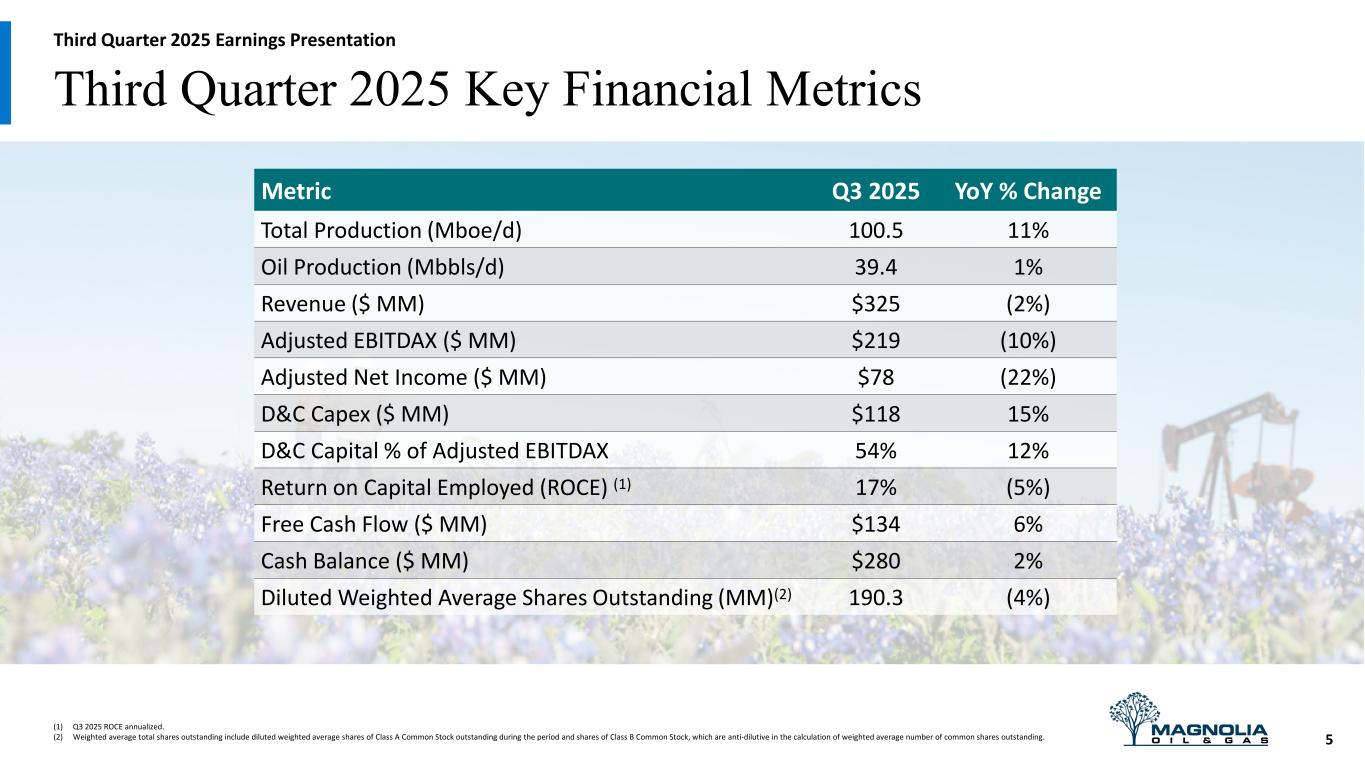
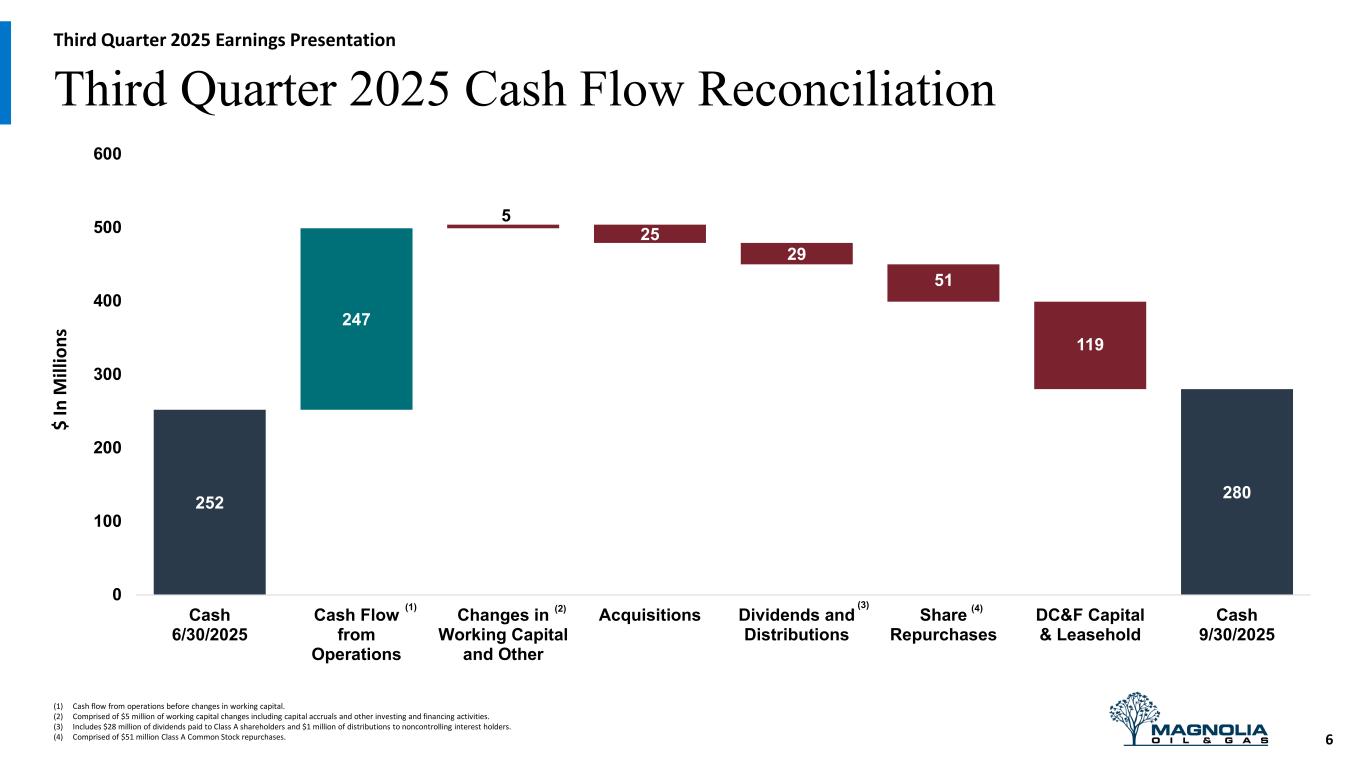
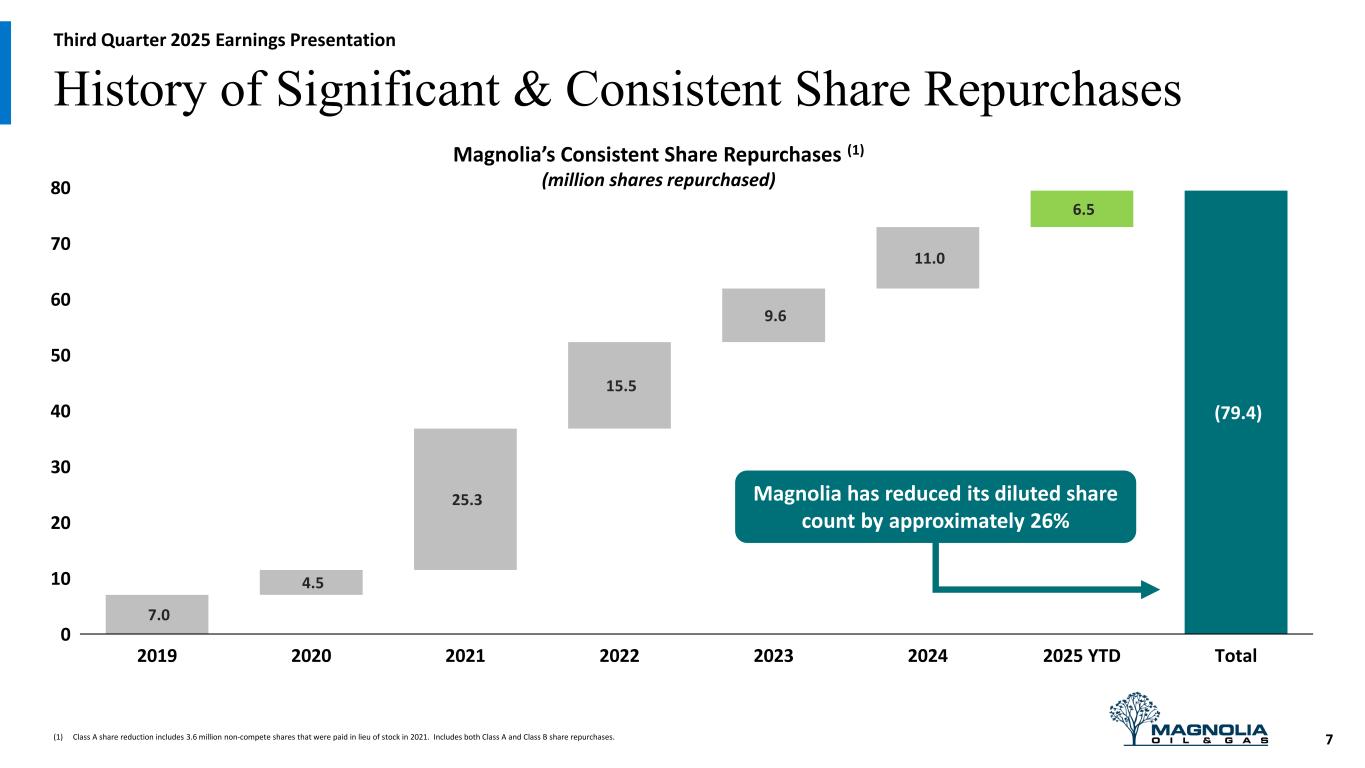
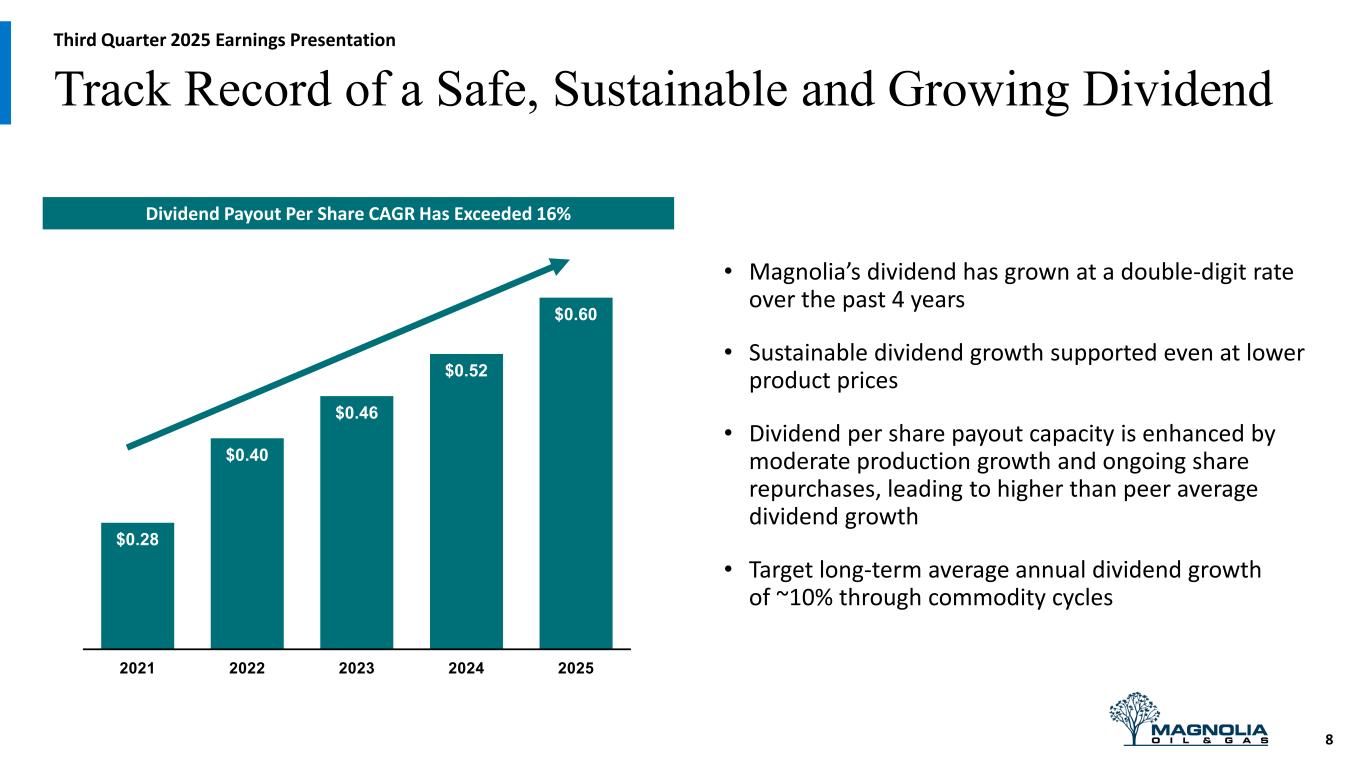
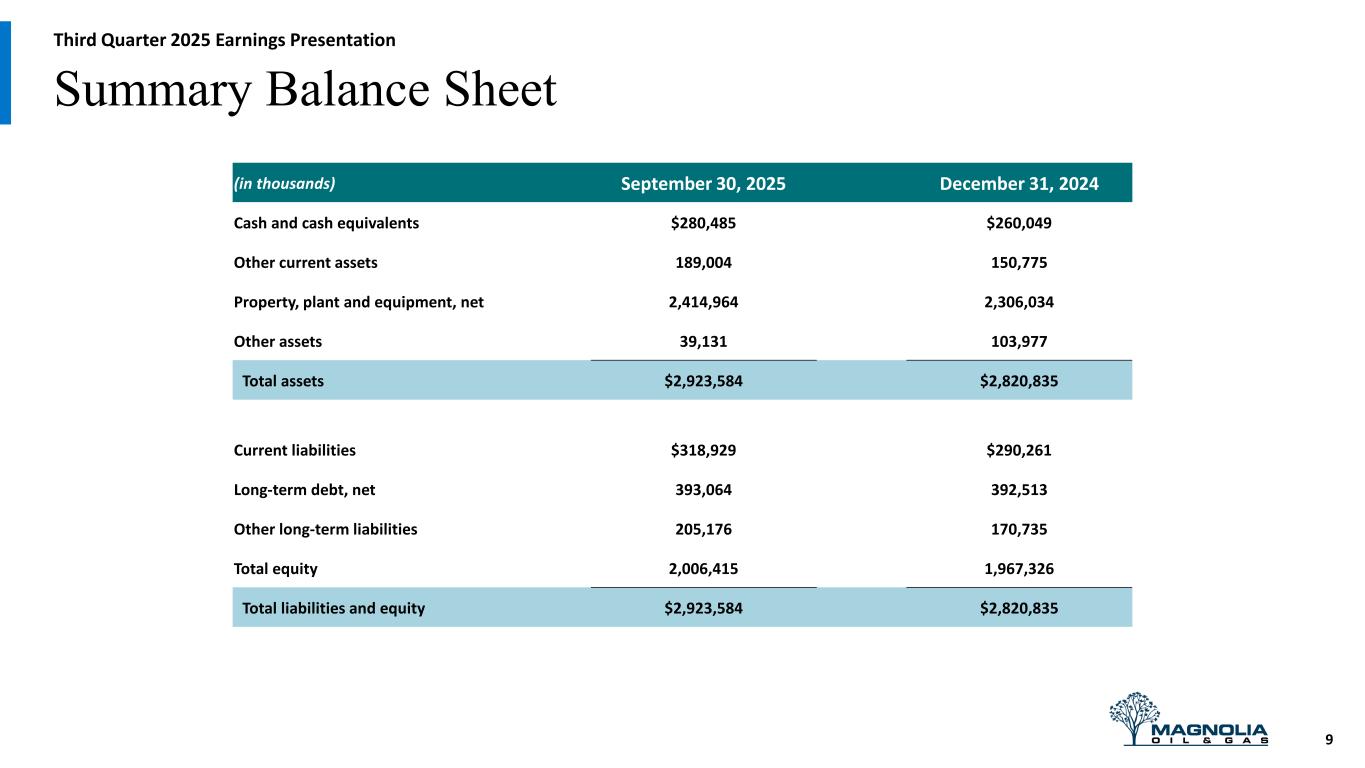
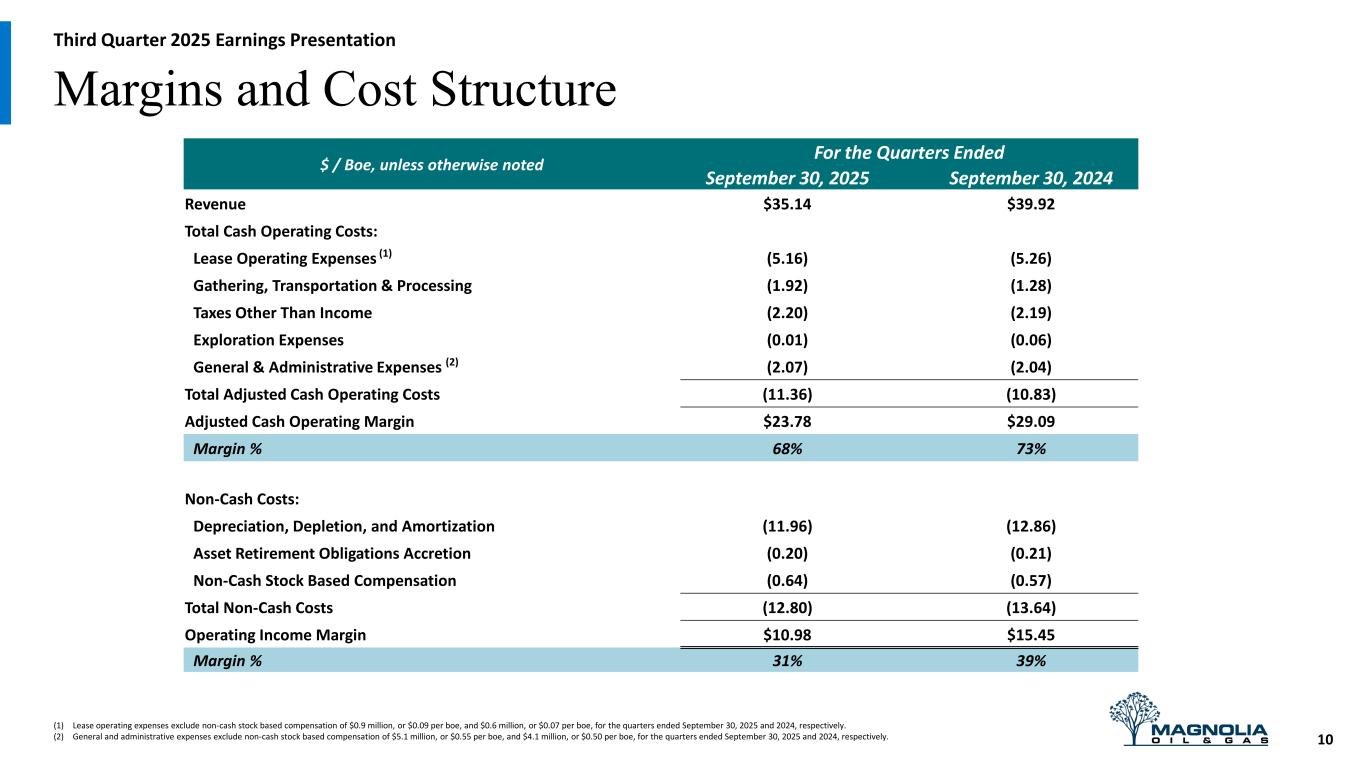
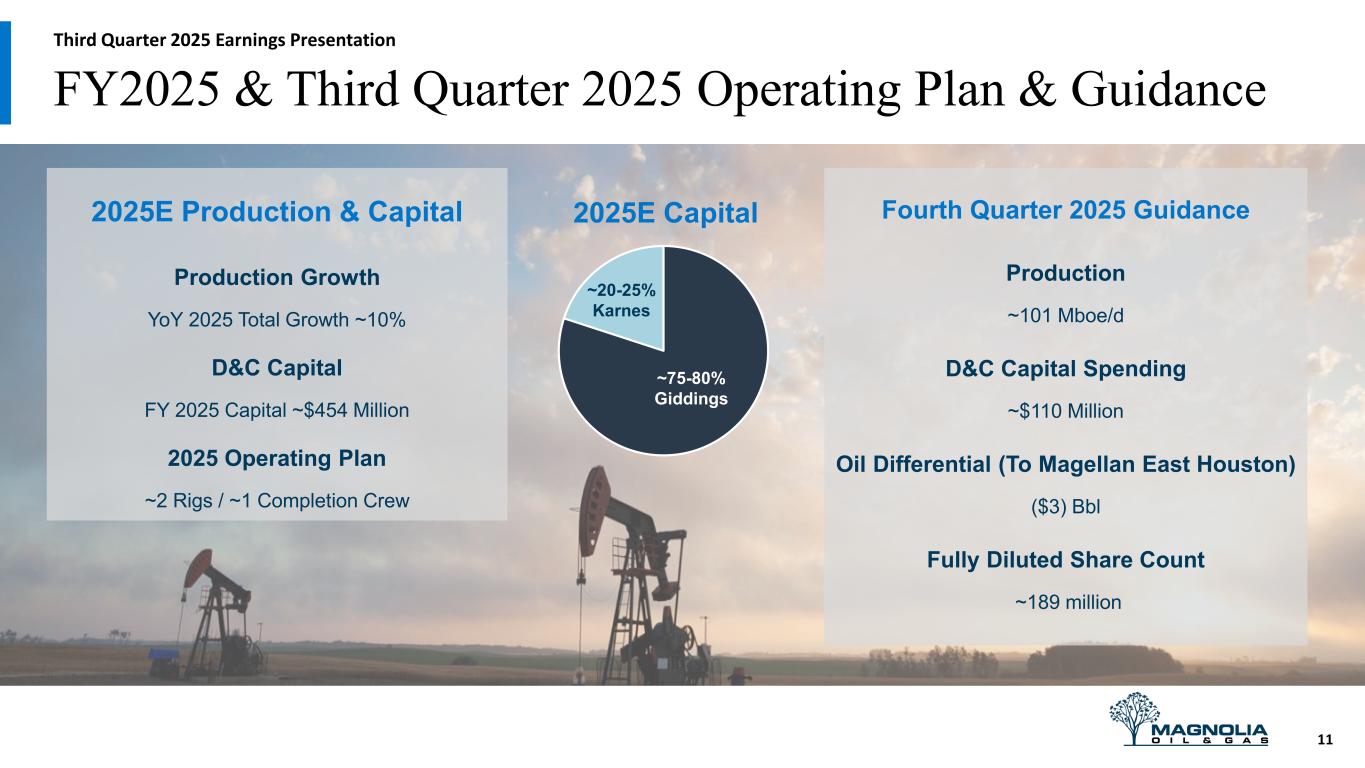
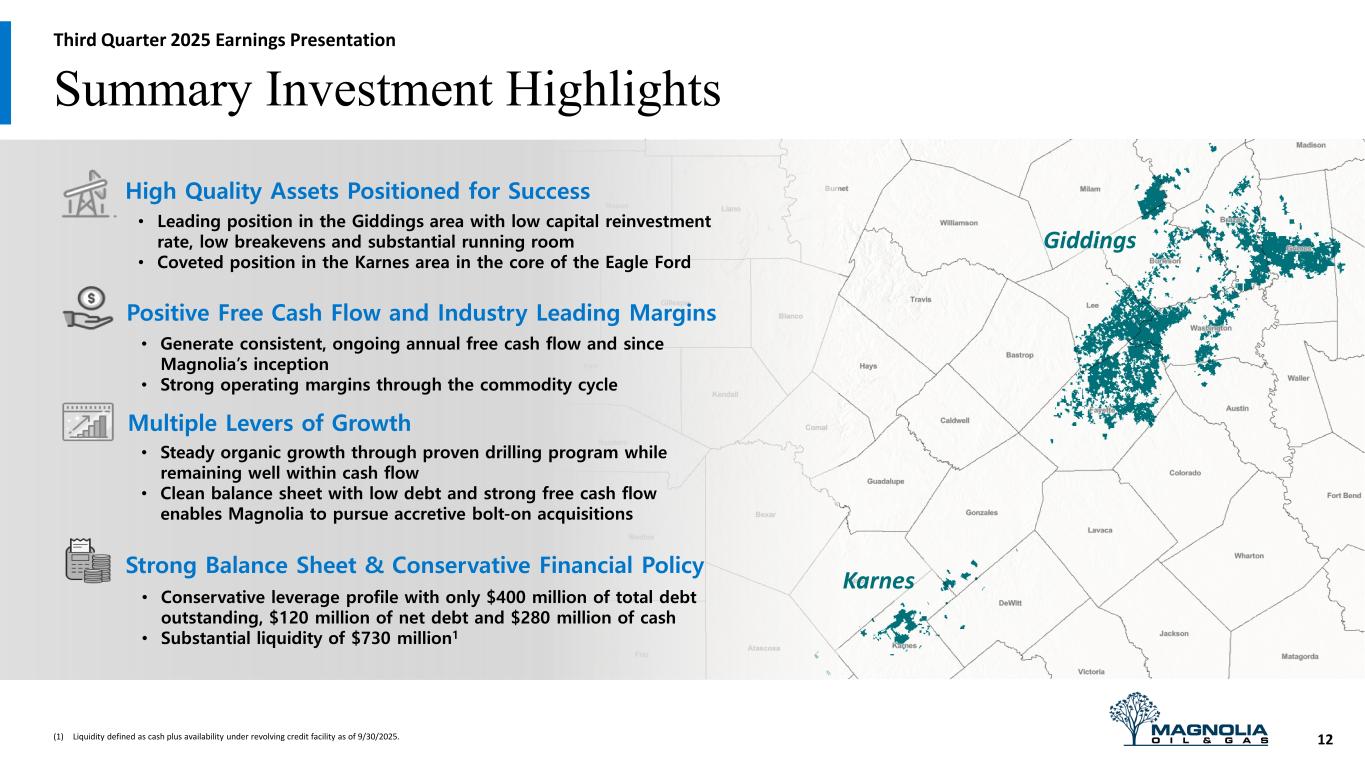
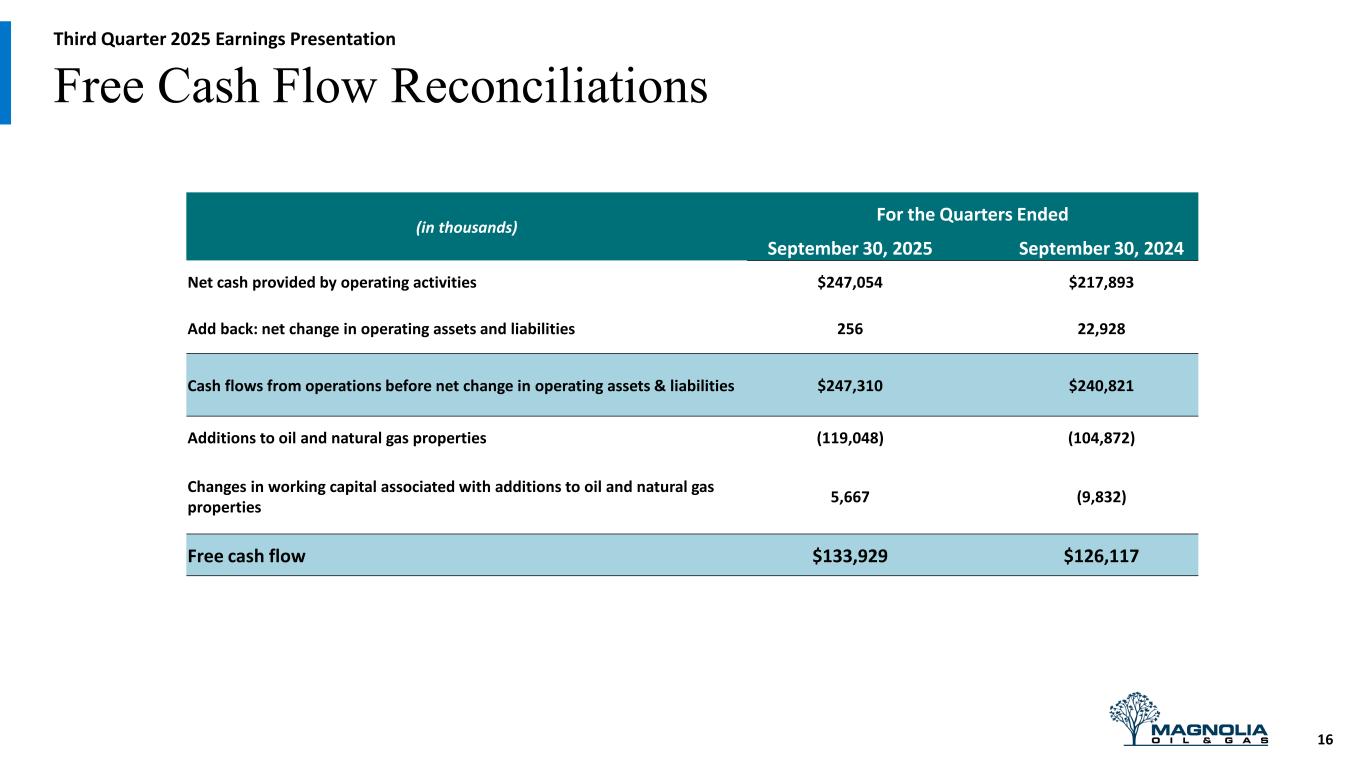
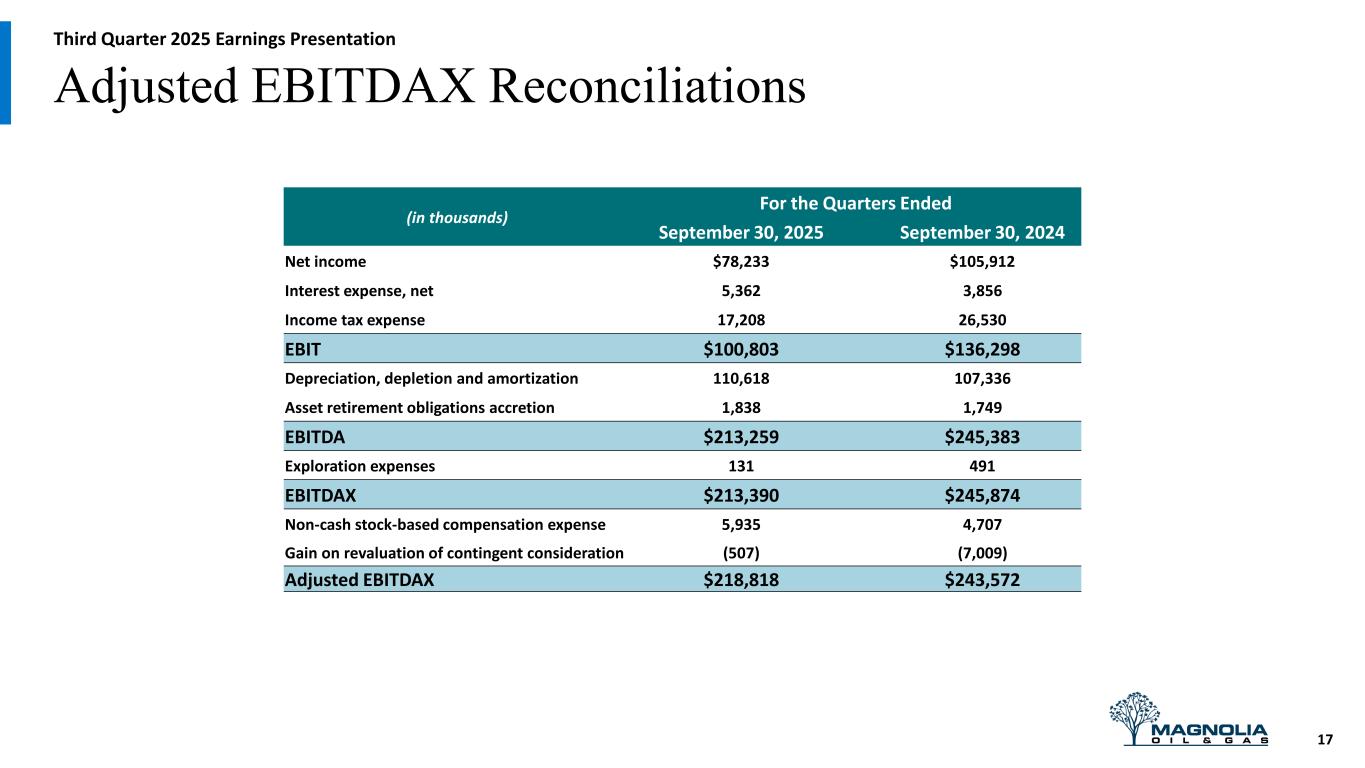
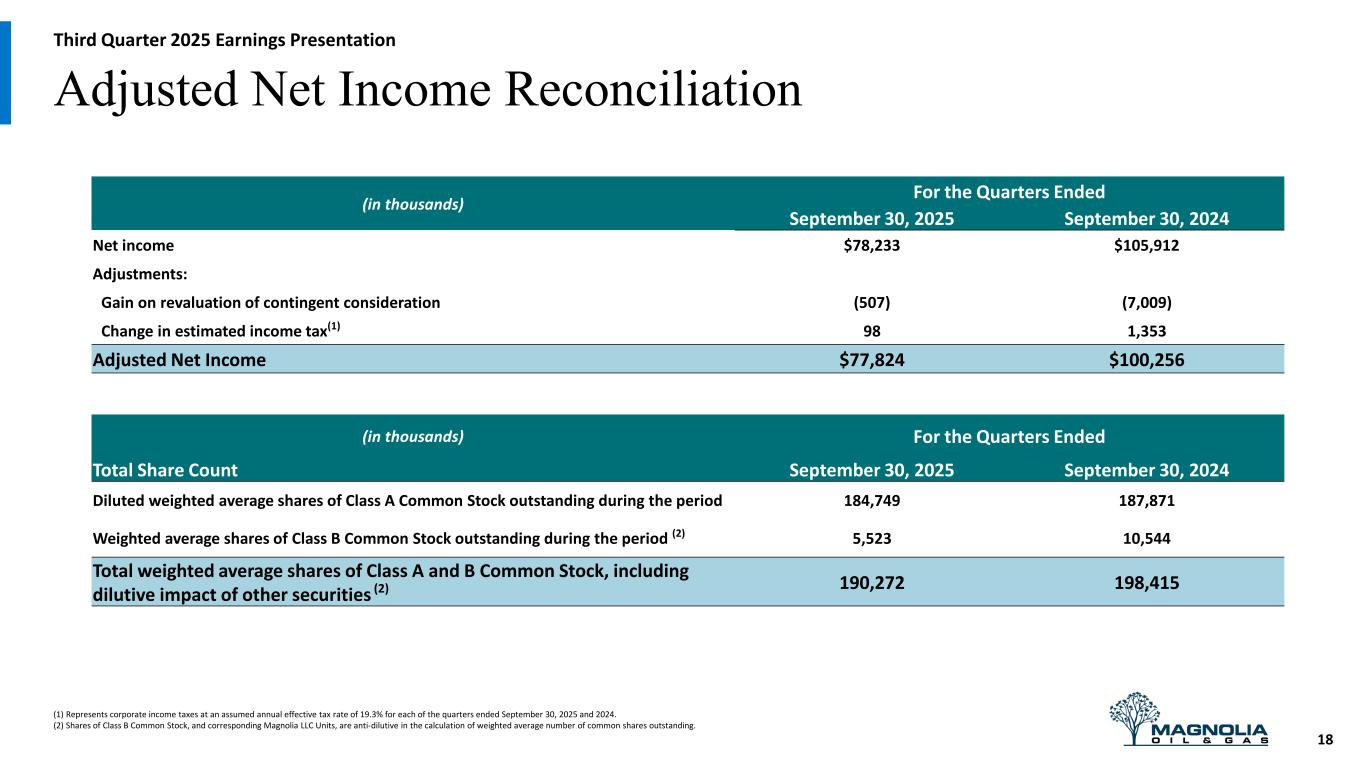
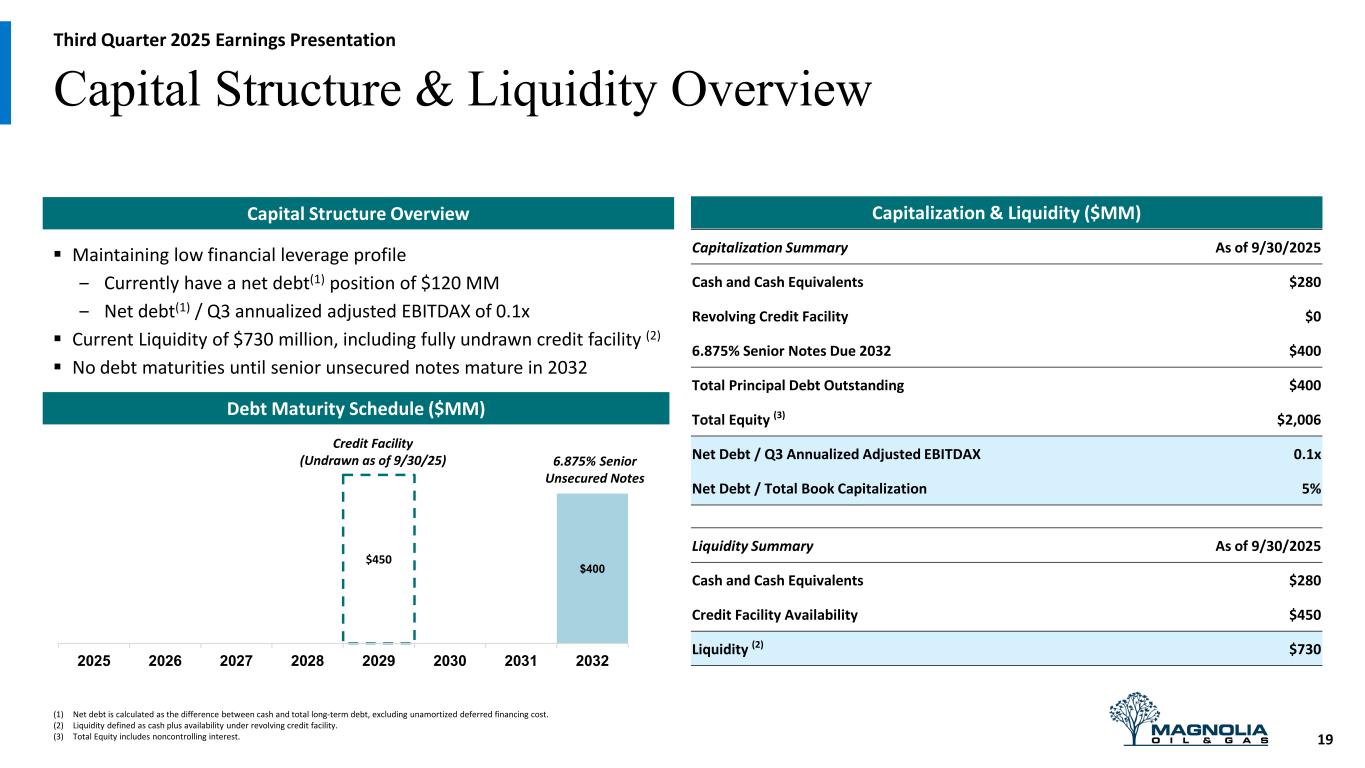
Thanks, Chris, and good morning, everyone. I'll review some items from our third quarter results and refer to the presentation slides found on the website. I'll also provide some additional guidance for the fourth quarter of 2025 before turning it over for questions. Beginning on Slide 5, Magnolia delivered a strong quarter as we continue to execute our differentiated business model. During the third quarter, we generated adjusted net income of $78 million or $0.41 per diluted share. Our adjusted EBITDAX for the quarter was $219 million with total capital associated with drilling, completions, and associated facilities of $118 million, representing 54% of our adjusted EBITDAX. Third quarter production volumes grew 11% year-over-year to 100,500 barrels of oil equivalent per day while generating free cash flow of $134 million. Looking at the quarterly cash flow waterfall chart on Slide 6, we started the quarter with $252 million of cash. Cash flow from operations before changes in working capital was $247 million, with working capital changes and other small items impacting cash by $5 million. We added $25 million in small bolt-on acquisitions comprised of additional acreage, working interest, and royalties that we discussed last quarter. During the quarter, we paid dividends of $29 million and allocated $51 million toward share repurchases. We incurred $119 million of drilling, completions, associated facilities, and leasehold spending and ended the quarter with $280 million of cash. Our cash position is the highest it has been all year despite lower oil prices and acquiring approximately $65 million of bolt-on acquisitions during the year. Looking at Slide 7, this chart illustrates the progress in reducing our total outstanding shares since we began our repurchase program in the second half of 2019. Since that time, we have repurchased 79.4 million shares, leading to a change in weighted-average diluted shares outstanding of 26% net of issuances. Magnolia's weighted average diluted share count declined by approximately 2 million shares sequentially, averaging 190.3 million shares during the third quarter. We currently have 5.2 million shares remaining under our repurchase authorization, which are specifically directed towards repurchasing Class A shares in the open market. Turning to Slide 8, our dividend has grown substantially over the past few years, including a 15% increase announced earlier this year to $0.15 per share on a quarterly basis. Our next quarterly dividend is payable on December 1 and provides an annualized dividend payout rate of $0.60 per share. Our plan for annualized dividend growth is an important part of Magnolia's investment proposition and supported by our overall strategy of achieving moderate annual production growth, reducing our outstanding shares, and increasing the dividend payout capacity of the company. Magnolia continues to have a very strong balance sheet, and we ended the quarter with $280 million of cash. Our $400 million of senior notes does not mature until 2032. Including our third quarter cash balance of $280 million and our undrawn $450 million revolving credit facility, our total liquidity is approximately $730 million. Our condensed balance sheet as of September 30 is shown on Slide 9. Looking at Slide 10 and evaluating our per unit cash costs and operating income margins, total revenue per BOE declined approximately 12% year-over-year due to the decline in oil prices, partially offset by an increase in natural gas prices. Our total adjusted cash operating costs, including G&A, were $11.36 per BOE in the third quarter of 2025, and our operating income margin for the third quarter was $10.98 per BOE or 31% of our total revenue. Turning to guidance, fourth quarter drilling and completion capital expenditures are expected to be approximately $110 million, which would bring the total capital for the year to about the midpoint of our previously reduced annual capital budget. This includes an estimate of non-operating capital that is similar to that of 2024. We are reiterating our full year 2025 outlook for total production growth of approximately 10% compared to our guidance at the beginning of the year of 5% to 7%. Total production for the fourth quarter is estimated to be approximately 101,000 barrels equivalent a day, and we expect that total production and oil production for the quarter to reach the highest levels of the year, setting new Magnolia records. Our price differentials are anticipated to be approximately a $3 per barrel discount to Magellan East Houston, and Magnolia remains completely unhedged on all of its oil and natural gas production. The fully diluted share count for the fourth quarter of 2025 is expected to be approximately 189 million shares, which is about 4% lower than fourth quarter 2024 levels. We expect our effective tax rate to be approximately 21%, and with the passing of new legislation during the third quarter, we expect 0 cash taxes for full year 2025. We are now ready to take your questions.
Operator
The first question comes from Neal Dingmann from William Blair.
Speaker 4
It was a great quarter, and I'm glad to be back. Chris, my question is for you or Brian regarding the impressive operational efficiencies you've demonstrated. If these efficiencies from the Giddings wells continue at their current pace, do you see the possibility of accelerating production by more than 10%? Alternatively, could you consider reducing capital expenditures? I'm curious about the potential outcomes should these trends continue and what benefits we might expect to see next year.
Neil, thanks for the question. Good to have you back. Look, we can do largely anything we'd like to do or want to do within the context or framework that you mentioned. I think the point is, we want to stay true to the business model, and it works for us and our shareholders in terms of maximizing the free cash flow that we have to give back to them. So rather than elevating activity levels or rushing to get there, we will achieve our goals over time. As we continue to pursue new areas and probe around the vast acreage position we have in Giddings and also parts of Karnes, we will realize more efficiencies. I'm very confident of that. We've seen it, and there's much that I can share about what teams are working on. So that will happen as we move forward. There's no real reason to rush activity levels or production volumes just for the sake of it. We live within the model, achieving moderate mid-single-digit growth. If the assets exceed that, which they often have over the years, we'll take it. But we're not going to overstretch on capital or activity because we believe in our model, and I think everyone will be satisfied with that.
Speaker 4
I would appreciate that if you can make it happen. Finally, regarding mergers and acquisitions, you've done an excellent job of replacing your inventory. Considering the opportunities in your area, is there still a significant amount of potential? How would you assess the capability to continue with these strategic acquisitions? You've successfully replenished the inventory, and there seems to be a lot of opportunities left to explore.
Yes, good question. There's a fair amount of white space, and there's a fair number of smaller private operators that we continue to evaluate. It has to be the right fit. It must improve the business, enhance our durability, and fit into our model. If we find something that looks like us or presents a proper fit, we will consider it. There may be opportunities out there. I receive numerous emails and calls from bankers looking to transact, but they may not always align with our goals, as the answer is typically no. However, we continue to explore and chipping away at finding additive pieces to our business. Some have emerged from our appraisal program, where we learn about areas we like, and look for opportunities to fill that white space.
Operator
The next question comes from Tim Rezvan from KeyBanc Capital Markets.
Speaker 5
I want to start, Chris, you mentioned in your prepared comments and in that last response, appraisal work going on at Karnes. There's a market perception that Karnes is sort of on its last legs as one of the earlier shale plays. So, can you talk about what you're referring to with the appraisal activity there? Is that non-op? Is it operated? Is it Austin Chalk or something else? Just curious for any color you can provide.
Well, I wouldn't write Karnes off just yet. Good rock is good rock, and it tends to have a long life. We’re continuing to evaluate and see what other opportunities we have in that area. While I won’t disclose exact plans, there will be tests that may have some upside or extend the life of Karnes. The challenge with appraisal work is always the economics—there's no doubt about producing quantities of oil and gas, but the question is whether we can make the economics of certain areas work. I'm optimistic about Karnes, and I feel the same about Giddings, where we have some projects planned.
Speaker 5
Okay, we'll have to stay tuned into next year. And then my follow-up is sort of a similar theme. The Western Haynesville evolution has been interesting, and now there are folks leasing up to your acreage line. I'd be shocked, I think, if you did some appraisal drilling there. But is there a discussion at the Board level about trying to understand if you think you have that resource? And do you have the deep rights?
That's a bit further afield compared to where we are now. We currently don't have an area around there. However, there are other areas within Giddings that have significant amounts of natural gas exposure. We have discussed that at the organizational level continually. The question remains, can we make it economical enough to compete for capital given what we already have? We know the resource is present, the challenge is always in the economics.
Operator
The next question comes from Carlos Escalante from Wolfe Research.
Speaker 6
I would like to revisit your discussion on the appraisal program. Looking ahead to 2026, particularly if there are any market weaknesses, how do you plan to manage your appraisal program and what options do you have? Given your current adjusted EBITDAX and CapEx, it seems you may hold off on growth capital until oil prices are closer to $50 per barrel WTI. Can you explain the appraisal program in relation to these options, especially in the event of prolonged oil price decline?
Yes, thanks for the question, Carlos. The appraisal program has been beneficial for Magnolia in terms of resource expansion and capabilities over time. While I would be reluctant to severely cut that program, we must also consider financial and operational flexibility given current price dynamics. There is still room for reasonable activity, and we will continue with the appraisal efforts. You either find new resources or acquire them; we are always looking for ways to supplement our existing resource. The appraisal program works well, particularly in Giddings, where we've tested new concepts and boundaries and found producible amounts. The focus is on ensuring that those activities meet our economic metrics and competitive for capital.
Speaker 6
Wonderful. Appreciate that, Chris. On my follow-up, I think that, certainly from our vantage point, one of the many sell points of Magnolia is its ability to capitalize on natural gas realizations compared to a lot of your oil-levered peers. We just had an interesting quarter in Waha, for example. Where are you today, and considering the reshuffling that you see just in your backyard with Gulf Coast LNG growing, are there any initiatives that you have for sustaining your organizational level to further gain that edge over some of your oil-levered peers?
Thanks for the compliment on our natural gas realizations. I agree that we've benefited from solid realizations on a year-over-year basis into most of 2025. However, the commodity market remains complicated. Actions based on opinions we've heard over the past year could have been detrimental if taken. The impact of Permian gas flowing has not influenced our pricing as some anticipated. I’m cautious about making any deterministic assumptions due to the numerous moving variables involved.
Operator
The next question comes from Charles Meade from Johnson Rice.
Speaker 7
Chris, I'd like to go back to the A&D market and ask a question there. Can you offer your view? Have you seen anything different on the packages that you look at around Giddings, either in the quality of what is available, what's being brought forward, or the ask that you're seeing relative to the value?
In terms of Giddings, it's somewhat concentrated. There us and a large private player without naming names, along with small positions scattered among private players. Larger packages might be holdouts for better product prices before considering sale, while smaller assets may be more reasonable for connectivity and potential alignment. The small acquisitions may pop up more regularly as sellers may reach a point where they exhaust their resources.
Speaker 7
Got it. And then a question about your flexibility around your activity levels. When I look at your steady 2 rigs, 1 frac fleet, it appears you're above the minimum efficient threshold of keeping 1 frac crew continuously busy. Is that something you consider? Are you concerned that you'd lose some efficiencies if you had to cut activity in response to lower commodity prices?
I'm not all that worried about it. We have strong relationships with the crews and equipment we use. I don't see our activity pulling back dramatically if at all. We can adapt but remain confident in our efficiencies, having entered contracts providing flexibility to manage costs. While we remain cautious, we are not concerned with efficiency at this point.
Operator
The next question comes from Peyton Dorne from UBS.
Speaker 8
I know you gave indications on the 2026 budget earlier. But I wonder if you have any details to share on how the plan might be shaped. You highlighted the six well deferrals and maybe targeting completions to benefit from higher winter gas prices. Should we assume spending is weighted more toward the first half or first quarter of '26?
Yes, thanks for the question. Generally, spending levels will lean toward the earlier part of the year, including test areas and having more visibility on pricing. Thus, you can expect a subtle increase in activity early in the year, but nothing dramatic.
Operator
The next question comes from Phillips Johnston from Capital One Securities.
Speaker 9
First question is on oil volumes. Chris, I think your comments on the second quarter call suggested that oil production should grow in '26 at a rate a little below the mid-single-digit target for total BOE production. Is that still a good way to think about next year, which I think would put you somewhere in the 40,000 to 41,000 a day range, give or take?
Yes, that's about right. The fourth quarter is off to a very strong start. I anticipate record volumes in BOEs and oil. The record was earlier in the second quarter, and we did 40,000 a day of oil. So, if you consider gas, you could be looking at 40,000 to 41,000, which is a fair estimate. I would expect lower single-digit oil growth year-on-year for the full year '26 over '25, around 2% to 3%.
Speaker 9
Okay, perfect. For modeling purposes, if we assume you remain at this current 2-rig program throughout next year, would that imply somewhere around 55 gross wells next year? Or has the annual run rate continued to creep up with the efficiencies?
Yes, plus or minus, that's accurate. No significant shift in the number of gross wells expected.
Operator
The next question comes from Zach Parham from JPMorgan.
Speaker 10
You exited the quarter with the most cash on the balance sheet you've had since 1Q '24. That's great, but how do you think about using that cash? If you continue to build cash, do you consider potentially increasing your buyback pace?
Our goal is not only to generate free cash but also to find ways to allocate it effectively to generate returns. We'll see how things evolve late this year and into next year. We're not looking to amp up activity simply for volume's sake; it’s about finding underperformance or equity disruptions. If there’s an opportunity to buy more shares that works in our favor and provides a dividend advantage, we'll consider it. Our flexibility will guide us.
Speaker 10
Just wanted to ask on OpEx. You guided to $520 per BOE for LOE in 4Q. Can you provide color on how you expect that to trend into 2026? I know you've done a lot to bring that down.
I mentioned several initiatives such as saltwater disposal and managing chemicals more effectively. We've achieved numerous small wins this year. Some of these improvements will carry into next year. However, workovers still represent the largest variability in operating costs quarter-to-quarter, but we are making progress on surface facility expenses and logistics, which should help reduce costs. As for the fourth quarter, expect a seasonal uptick to $520 but to decline over time as we advance into next year.
Operator
The next question comes from Tim Moore from Clear Street.
Speaker 11
Congrats on the great free cash flow. Question regarding gathering, transportation, and processing expense as a percentage of revenue. Are there trends that might provide utilization benefits in the upcoming year?
GP&T costs aren't generally calculated as a percent of revenue. As long as commodity prices are stable, costs should be stable. Increases in pricing for gas or NGLs can drive up costs, while decreases can save costs.
Speaker 11
That's helpful. And a follow-up. You mentioned improved efficiencies with water disposal and fluid handling. Are there more surface repairs or low-hanging fruit for efficiencies, or is that mostly done?
There's always room for improvement; you should never stop looking for better ways to optimize and innovate processes. We're continuously moving equipment and products around in search of efficiencies, so we'll keep pushing for further enhancements.
Operator
The next question comes from Phil Shen from ROTH Capital.
Speaker 12
My first question is about the Giddings expansions. So, in the last quarter, we know that you expanded by 40,000 acres. Were any new wells drilled in those areas? If not, do you expect any upcoming expansions or new wells in that area?
Thanks for the question. If you're referring to some wells drilled earlier this year and late last year, the answer is yes, we do propose to go back. Those wells are performing beyond expectations and will be included in our program for next year.
Speaker 12
My second question is about your Eagle Ford production. The production seemed a bit higher this quarter. Were any wells drilled in the quarter? How was their performance?
Assuming you’re referring to the Karnes area, we drill there several times a year. Thus, you may see some fluctuations in Karnes production. If there's an increase, it likely indicates some activity, whether operated or non-operated.
Operator
The next question comes from Noah Hungness from Bank of America.
Speaker 13
For my first question here, Chris, I was wondering how are you seeing service pricing right now? Is it aligned with where the curve is for oil prices?
Service pricing has seen a downward trend throughout much of 2025. While conditions have softened, the rate of change has lessened recently. We may still encounter some pressure on OCTG pricing, but most pressure will be offset by our efficiencies and contractual arrangements. While there is some softness, prices seem to have levelled out, not to imply that this won’t change with fluctuating product prices into 2026.
Speaker 13
That’s helpful. For my second question, could you clarify how many deferred completions you're carrying into '26? How many DUCs do you expect to exit 2026 with?
We generally don’t carry planned DUCs. We don’t maintain DUCs intentionally; if we defer some completions, that can arise out of timing issues rather than a strategy.
We're not purposefully carrying DUCs; it's more about timing that influences the counts.
Speaker 13
So, can we assume that you'll be carrying these six deferred completions into '26, but exiting with effectively 0 deferred completions with your current plan?
Correct. Outside of wells in process, you can expect there to be no more DUCs.
Operator
The next question comes from Greta Drefke from Goldman Sachs.
Speaker 14
I wanted to follow up on the last one that was just asked regarding your activity and macro outlook. In a scenario of derating oil prices into 2026, can you provide some price points where you might consider deferring completions or adjusting your activity?
Our program is dynamic. We have built-in flexibility in response to changing price dynamics, especially regarding the deferrals we've carried through into 2026, offering a cushion for us. If we see good performance as we exit the year, that could give us even more flexibility. Our spending is limited to 55%, keeping us financially disciplined. I am satisfied with the current operations and the model that we have in place.
Speaker 14
Great. As you highlighted, your 2-rig 1-crew program has supported 50% production growth over the past several years. Can you attribute that growth to improved rig and crew cycle times, acquisitions, or improvements in well performance over time?
Most of our growth has come organically; we've not focused on acquisitions to add volumes aside from 1 or 2 transactions historically. We've seen around 8% compounded annual growth primarily from organic drilling completions, and that is how we have managed to achieve more consistent performance.
Operator
This concludes our question-and-answer session and the conference is now concluded. Thank you for attending today's presentation. You may now disconnect.