Operator
Good morning, everyone, and thank you for participating in Magnolia Oil and Gas Corporation's fourth quarter 2025 earnings conference call. My name is Chloe, and I will be your moderator for today's call. At this time, all participants will be placed in listen-only mode as our call is being recorded. I will now turn the call over to Magnolia's management for their prepared remarks, which will be followed by a brief question and answer session.
Thank you, Chloe, and good morning, everyone. Welcome to Magnolia Oil & Gases' fourth quarter earnings conference call. Participating on the call today are Chris Stavros, Magnolia's Chairman, President, and Chief Executive Officer, and Brian Corrales, Senior Vice President and Chief Financial Officer. As a reminder, today's conference call contains certain projections and other forward-looking statements within the meaning of the federal securities laws. These statements are subject to risks and uncertainties that may cause actual results to differ materially from those expressed or implied in these statements. Additional information on risk factors that could cause results to differ is available in the company's annual report on Form 10-K filed with the SEC. A full safe harbor can be found on slide two of the conference call slide presentation with the supplemental data on our website. You can download Magnolia's fourth quarter 2025 earnings press release, as well as the conference call slides from the investor section of the company's website at www.magnoliaoilgas.com. I will now turn the call over to Mr. Chris Stavros.
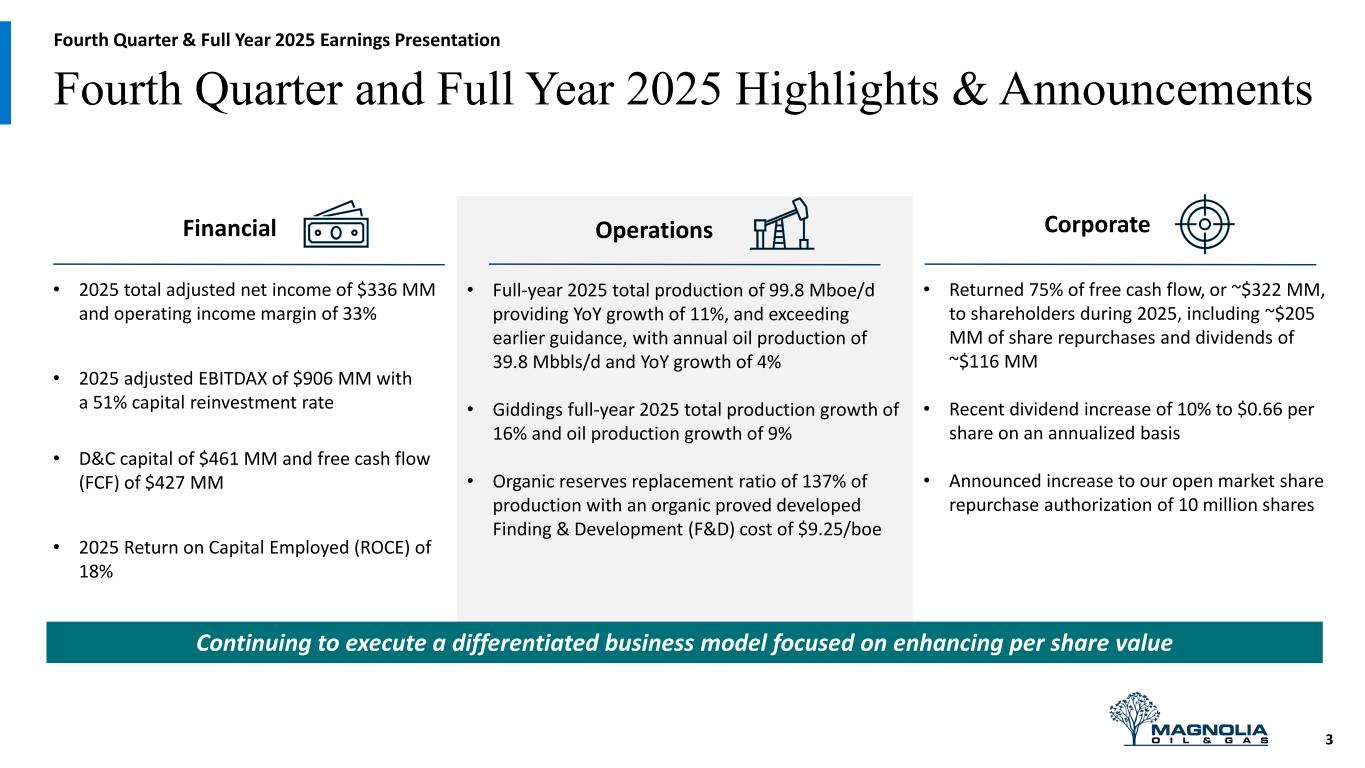
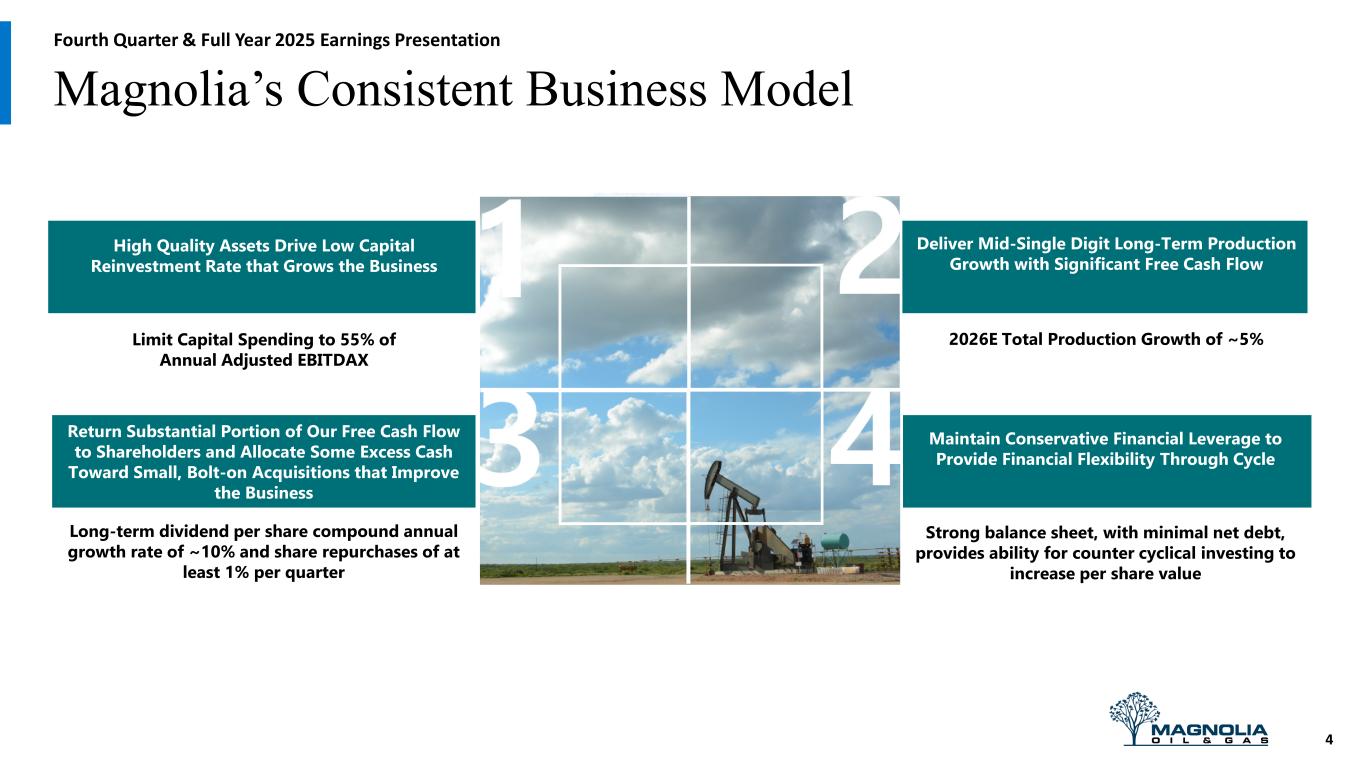
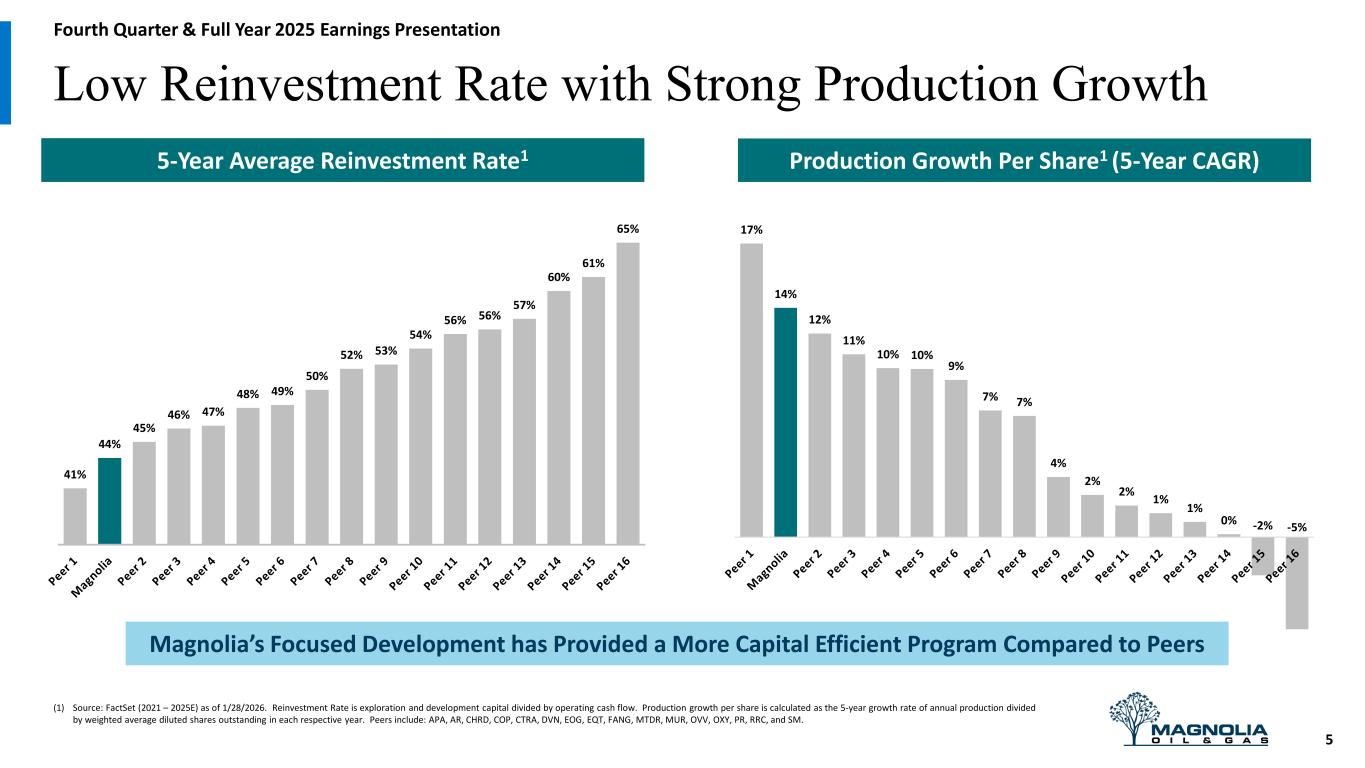
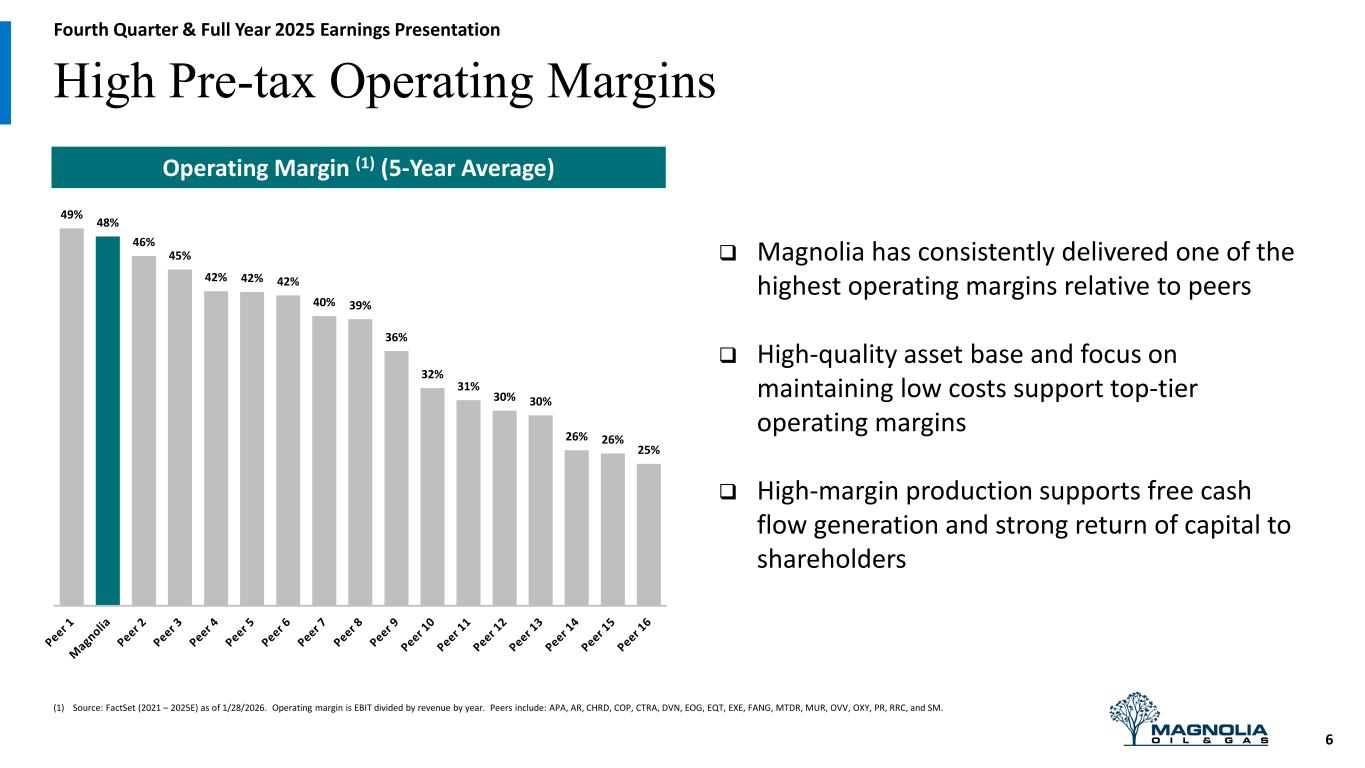
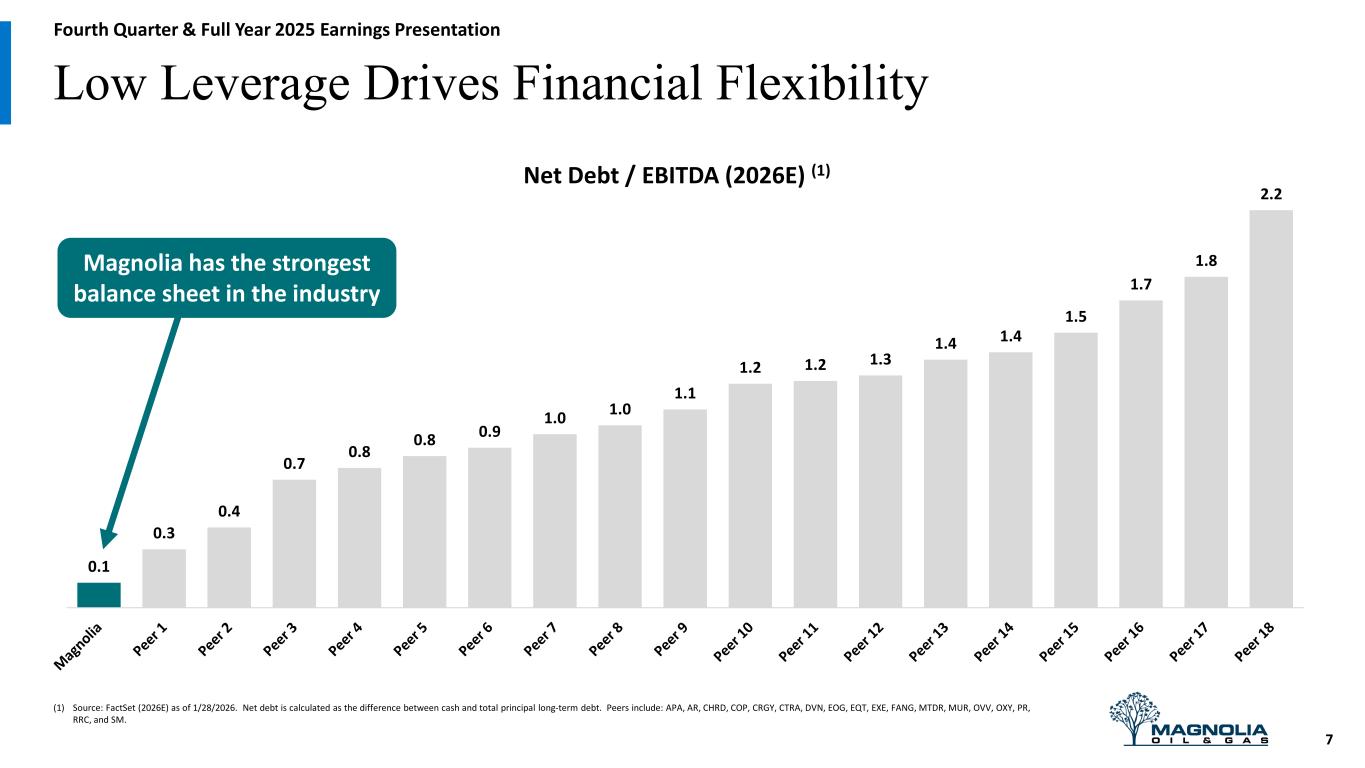
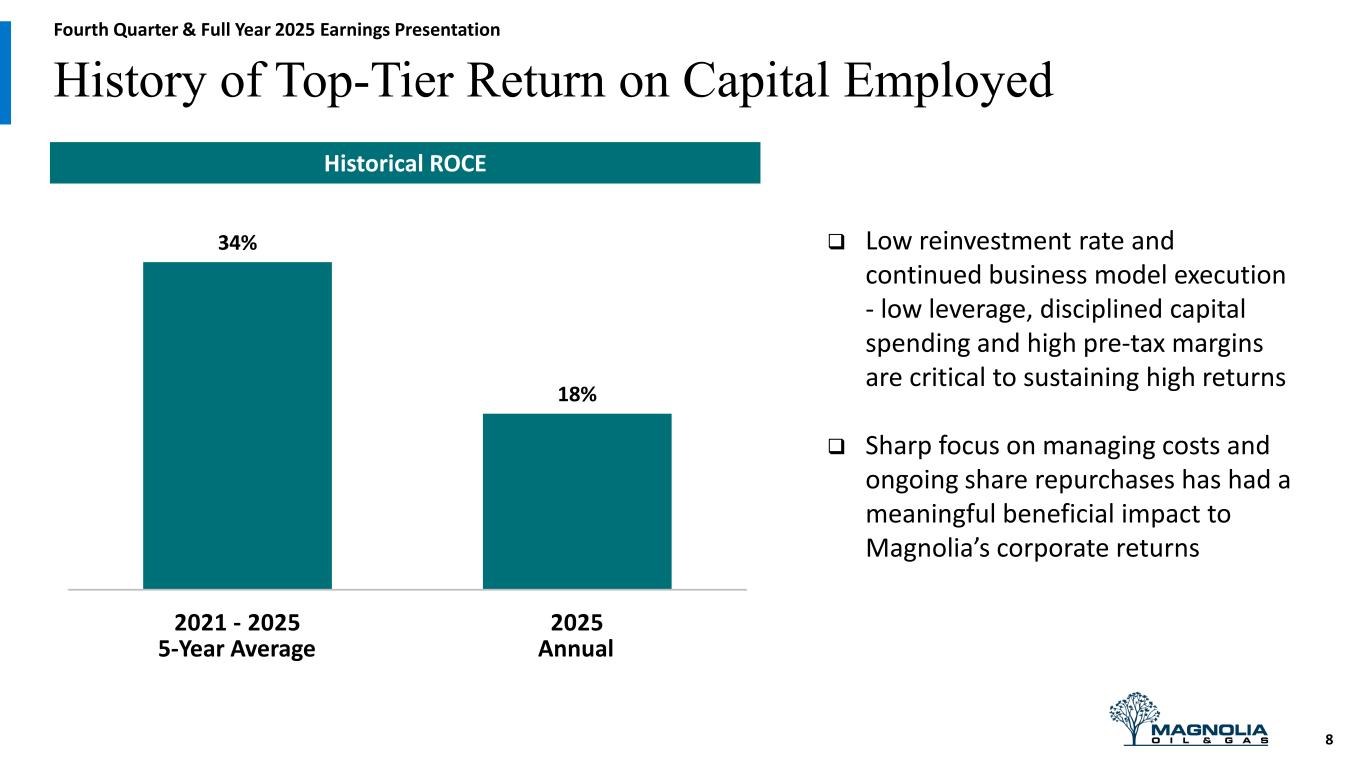
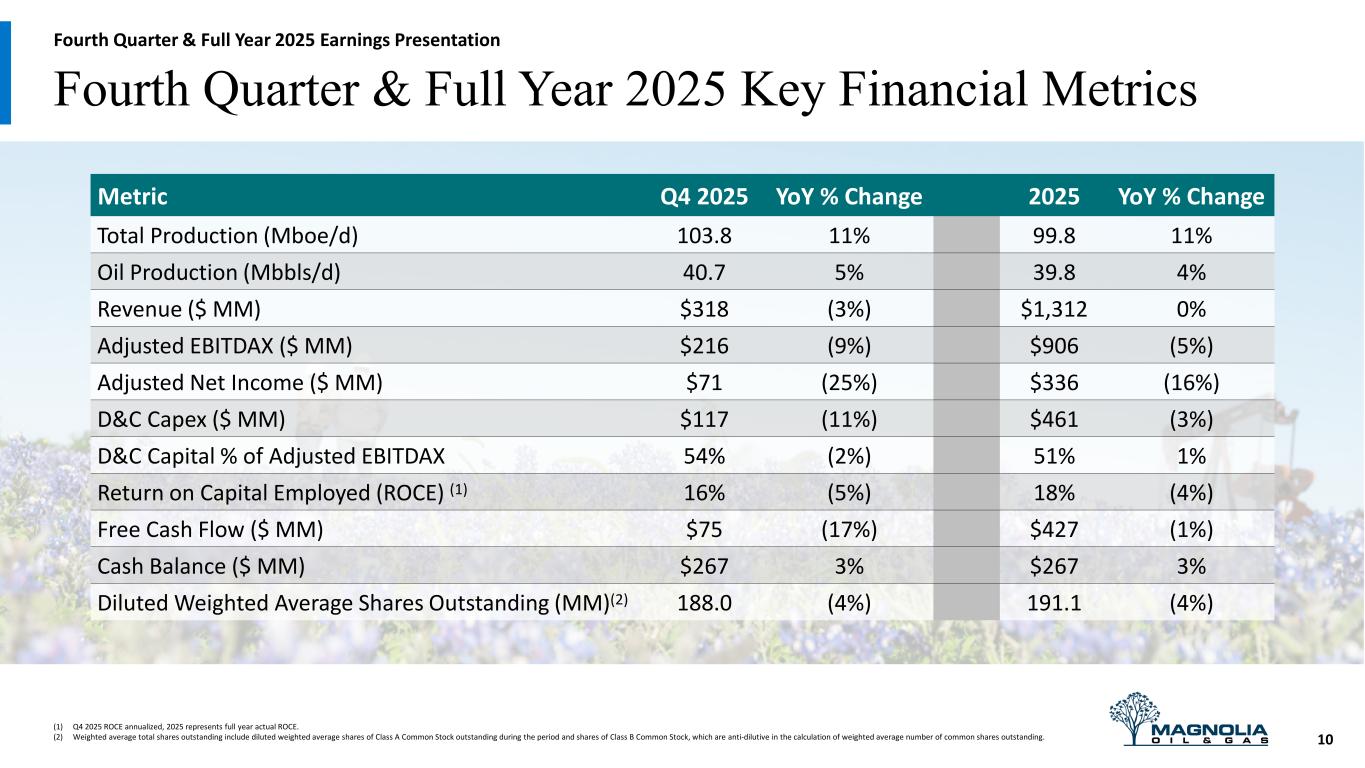
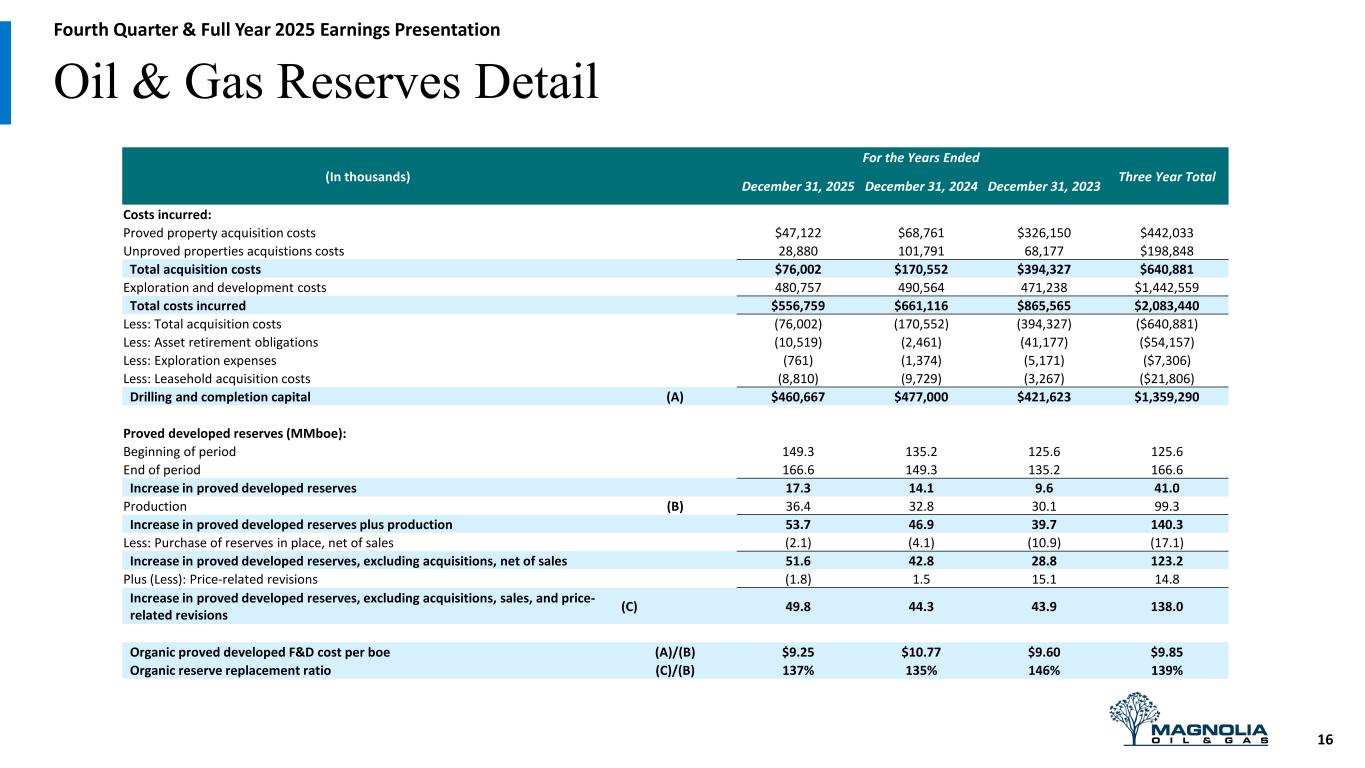
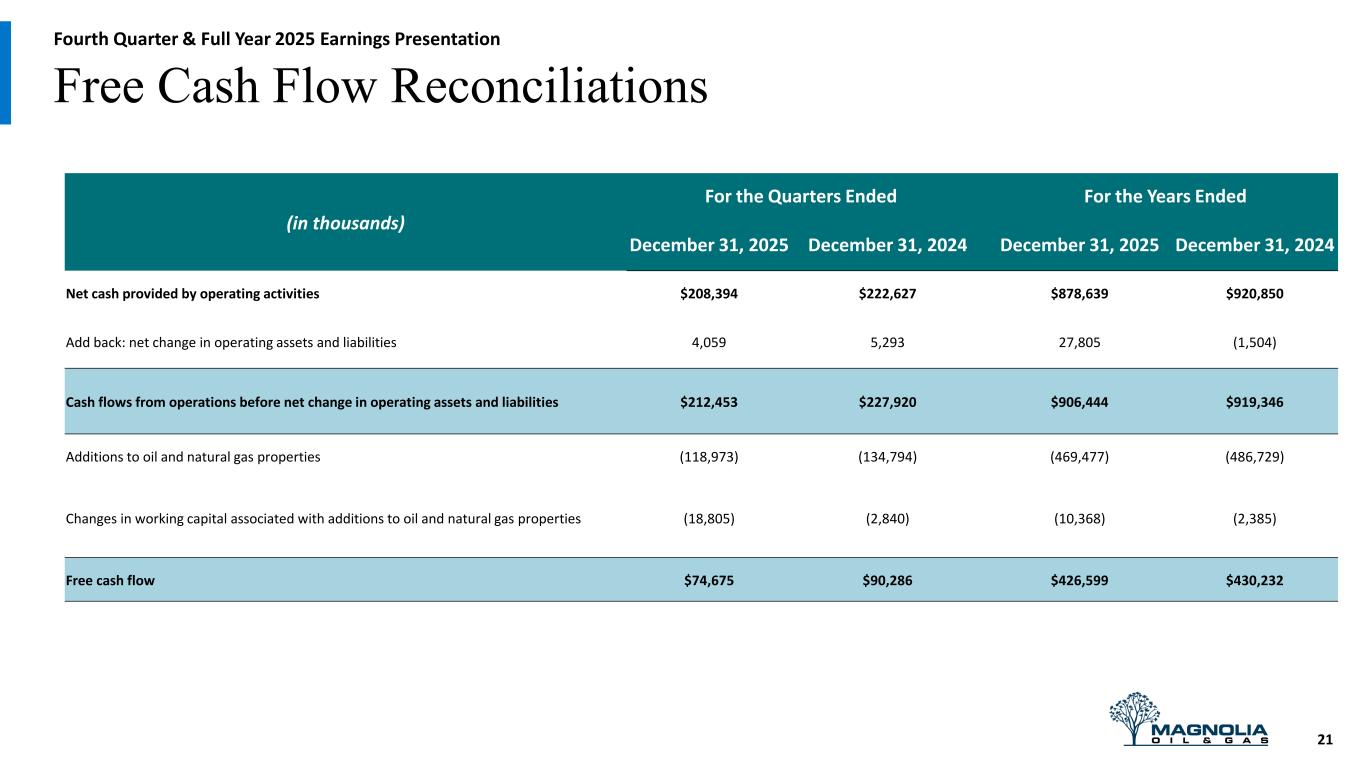
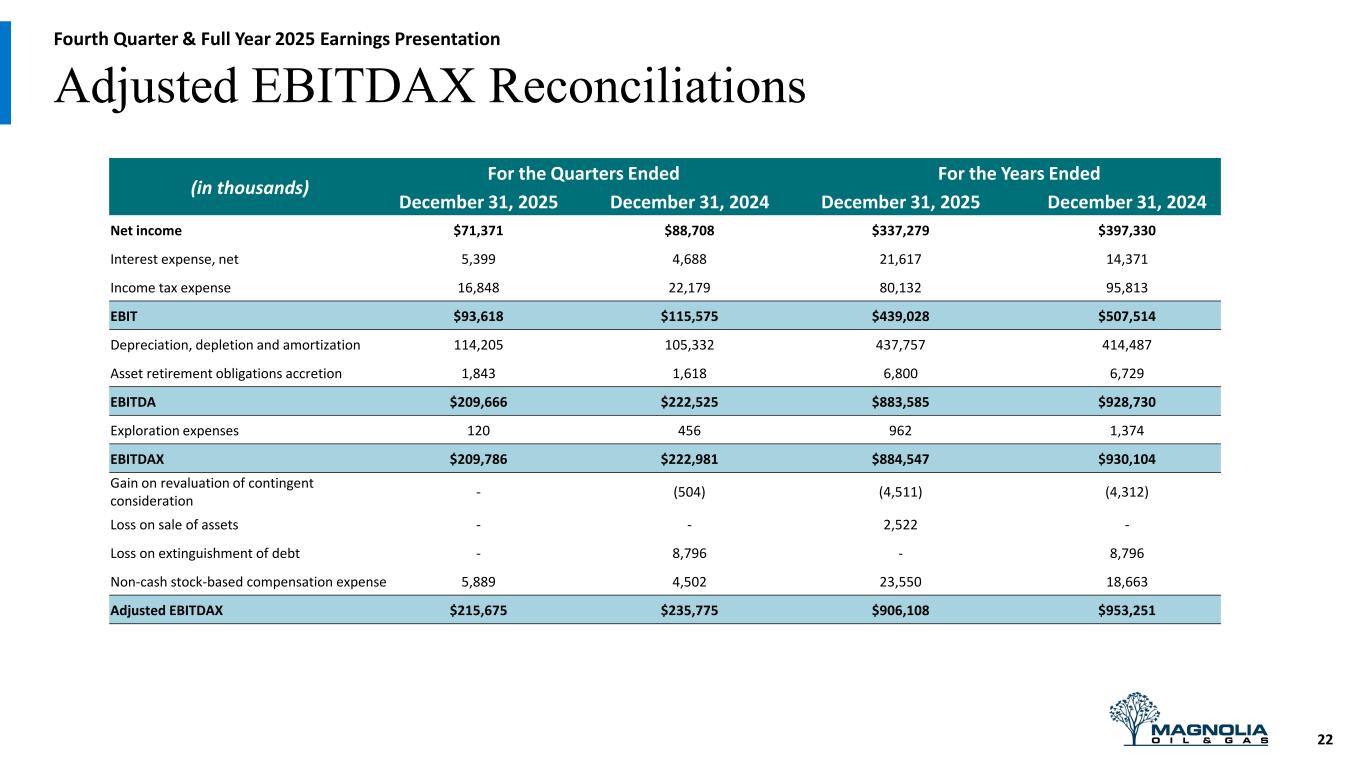
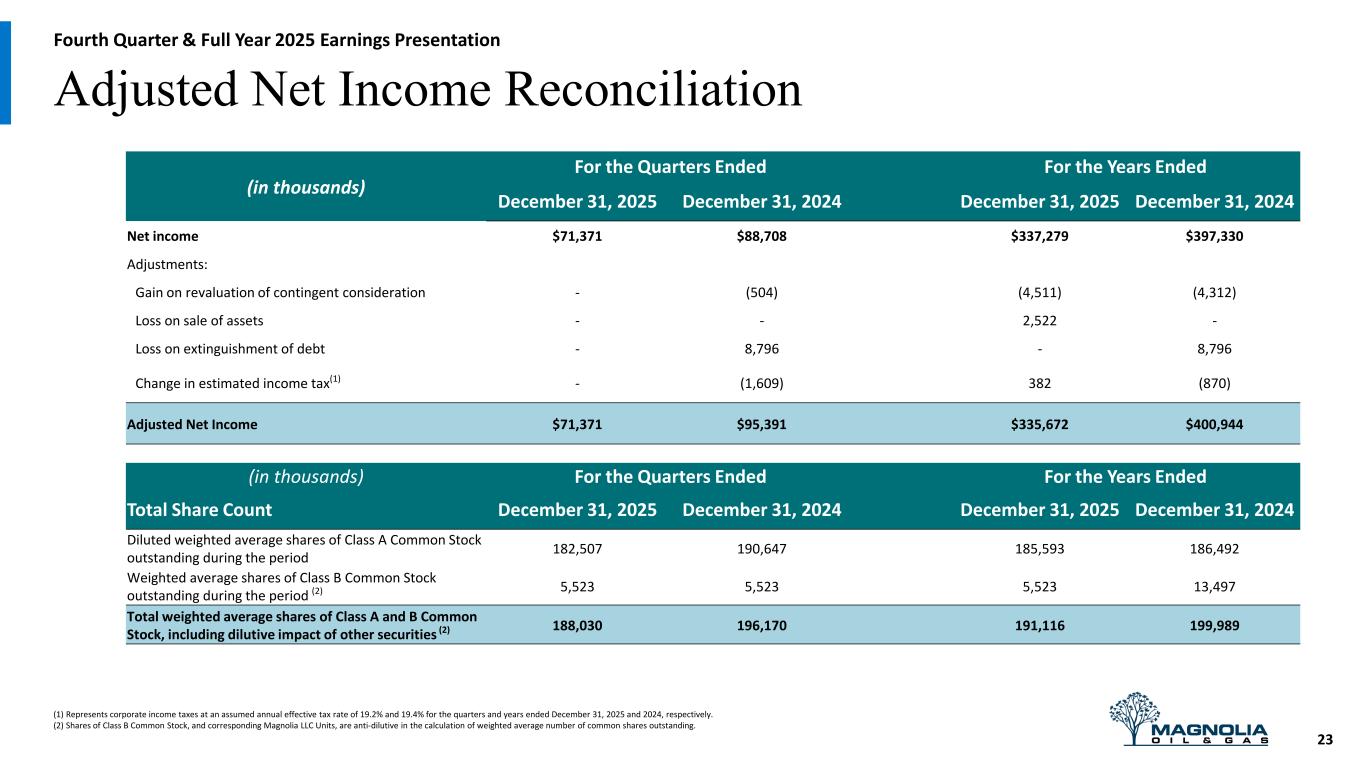
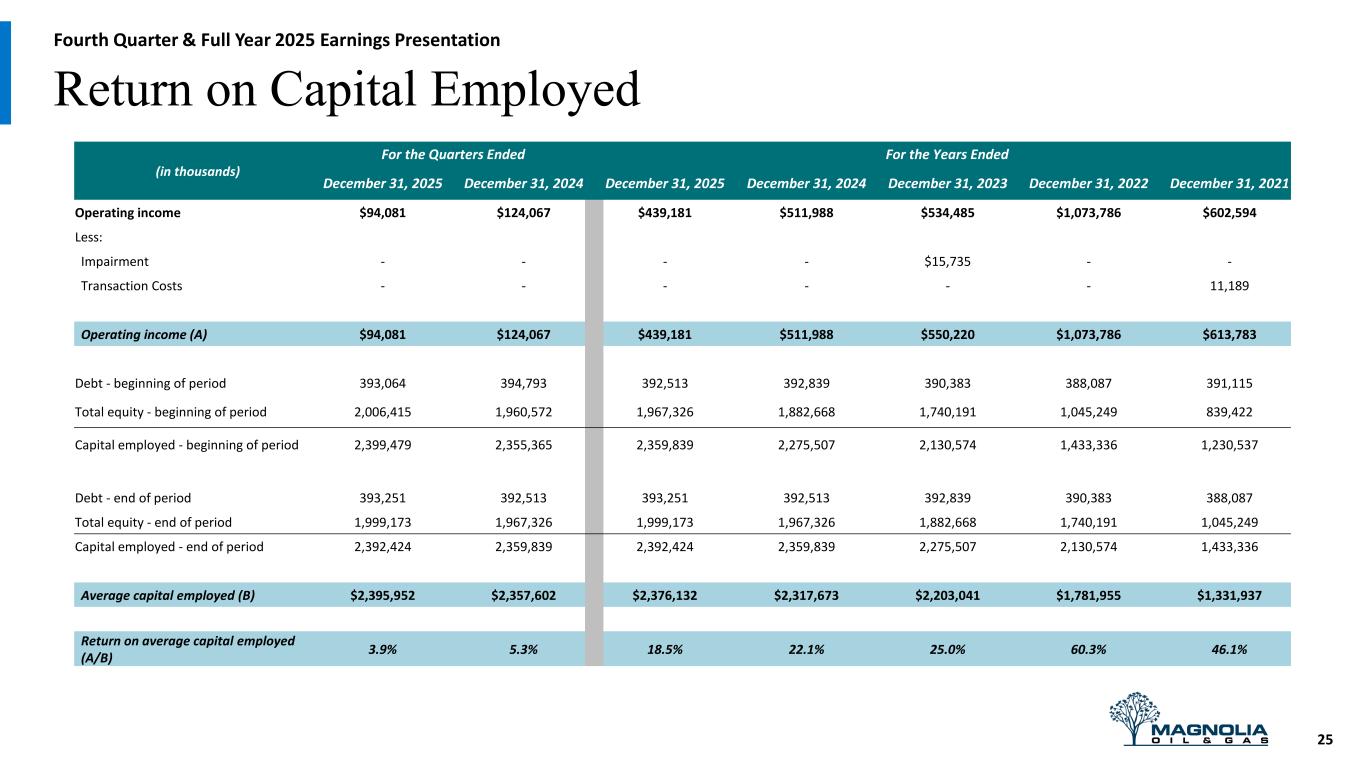
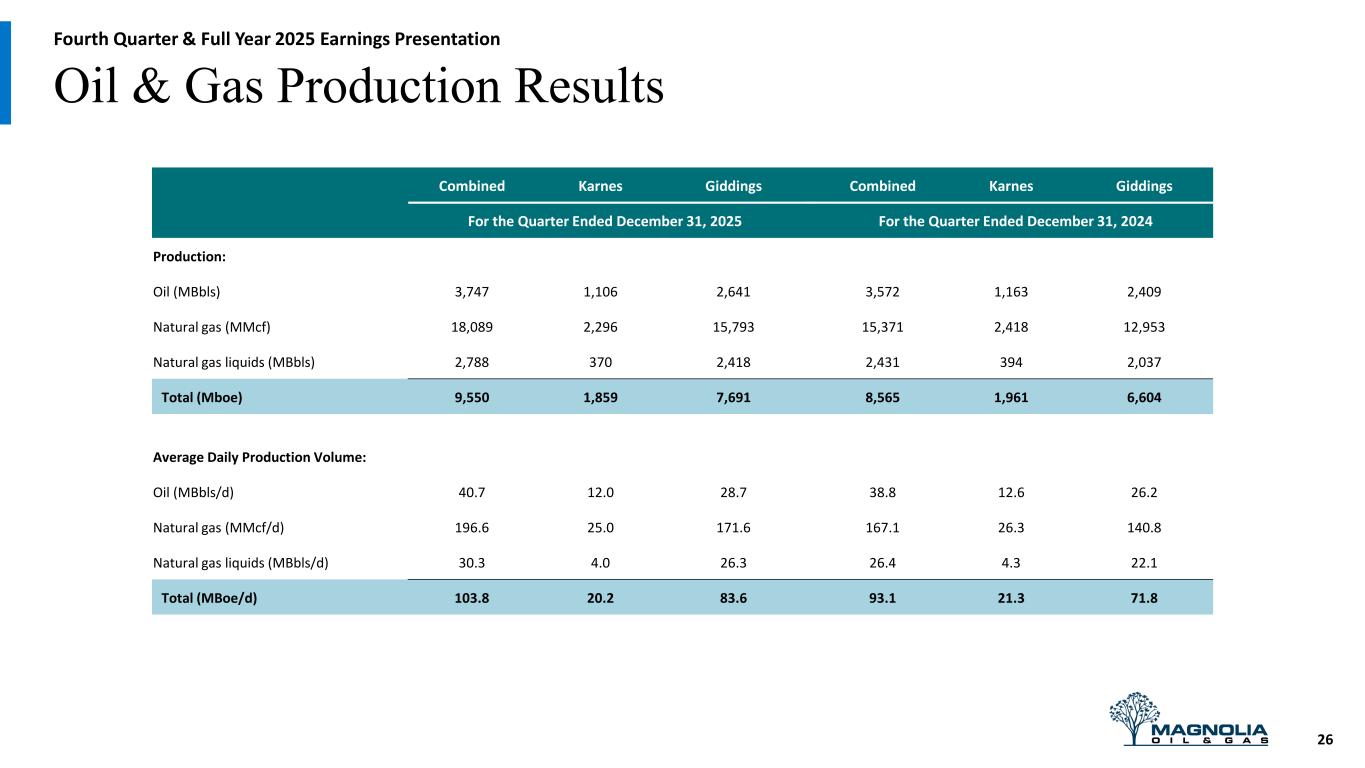
Thank you, Tom, and good morning, everyone. We appreciate you joining us today for a discussion of our fourth quarter and full year 2025 financial on operating results. I plan to briefly speak to last year's results, which closed out another year of strong, consistent performance and execution, showing the beneficial characteristics and merits of our differentiated business model and during a year of elevated product price volatility. Our model has allowed us to deliver strong free cash flow and cash returns to our shareholders, resulting from superior asset performance and our continued focus on capital discipline, cost containment, and visible efficiency improvements. I'll conclude by providing an outlook of Magnolia's 2026 capital and operating plan, which is expected to deliver moderate growth with a similar level of capital spending that provides us with further opportunities to capture low-cost resource across our acreage position. Brian will then review our financial results in greater detail and provide some additional guidance before we take your questions. Beginning on slide three of our quarterly investor presentation and looking at the highlights, Magnolia delivered another solid quarter and year of performance marked by steady execution of our capital-efficient business model and our high-quality assets. I'm particularly proud of our ongoing dedication and focus shown by both our operating teams in the field and our Houston staff. Their continued hard work and diligence is a significant factor behind Magnolia's success. Our business performed exceptionally well throughout the year, driven by stronger-than-expected well results, improved efficiencies, lowered unit costs, and our commitment to capital discipline, as I mentioned. For the full year 2025, total company production grew by 11% to approximately 100,000 barrels of oil equivalent per day, with oil production growing by 4% and averaging nearly 40,000 barrels per day. operationally we continue to make strides in reducing our field level cash operating expenses which declined by seven percent to five dollars and twelve cents per boe during 2025 the better than expected well productivity we experienced during the first half of last year not only provided us with higher production growth in 2025 but also allowed us to save capital by deferring some well completions into this year our teams were also able to drive a more efficient drilling and completions program last year in Giddings, with our average drilled feet per day increasing by 8% and with completed feet per day improving by 6%. Turning specifically to the fourth quarter, we achieved a new company record for our production, averaging nearly 104,000 barrels of oil equivalent per day and 40.7,000 barrels of oil per day. These both marked a sequential increase of 3% and reflected the continued strong performance from our wells. Financially, the quarter and year were equally strong and aligned with our goal of generating consistent and sustainable free cash flow through disciplined capital allocation. Our fourth quarter adjusted net income was approximately $71 million, or 38 cents per diluted share, with adjusted EBITDAX coming in at $216 million. Our drilling and completion capital for the period was roughly $117 million, representing 54% of our adjusted EBITDAX. Pre-tax operating margins averaged 33% for the year, despite a more than 15% annual decline in our oil price realizations. Our low reinvestment rate enabled us to generate free cash flow of more than $425 million for the full year. We stood by our commitment to return a significant portion of that free cash flow to our shareholders, distributing approximately 75 percent through a combination of our base dividend and share repurchases. In total, we repurchased approximately 8.9 million shares throughout the course of 2025, reducing our diluted share count by roughly 4.5 percent. This not only accretes value on a per share basis, but also reinforces our business model that leads to a serial compounding of value. Our balance sheet ended the year in a position of strength, allowing us to navigate product price uncertainty, yet provides us with ample liquidity and a cash balance, giving us flexibility to selectively pursue opportunistic bolt-on additions to our portfolio. As shown on slide four, our strategy is designed to produce steady mid-single-digit total production growth, high pre-tax margins, and reliable free cash flow while maintaining a low reinvestment rate and a strong balance sheet. The strength of this model and the strategy is clear when looking at Magnolia's longer-term performance across these key financial metrics. Looking at slide five, Magnolia has maintained one of the lowest capital reinvestment rates among the U.S. oil and gas producers over the past five years, while delivering one of the highest rates of production growth per share. As shown on slide six, Magnolia continues to achieve strong pre-tax operating margins driven primarily by our low-cost, high-quality asset base, which is also in close proximity to large consuming markets on the U.S. Gulf Coast. Slide 7 highlights the continued strength of our balance sheet, which remains best in class in the industry. Maintaining low leverage is a critical part of our strategy as it reduces financial risk while preserving substantial flexibility and strategic optionality. While many oil and gas operators often excel in one or two of these areas, we believe that our combination of our low capital reinvestment rate, above average per share growth, high operating margins, and minimal debt is unique, especially for a small to mid-sized operator. This powerful recipe allows us to generate high corporate returns, maximize our free cash flow generation, and sustain our strong and consistent capital return program for shareholders. Slide 8 illustrates our corporate-level returns, showing 2025 is another strong year, with return on capital employed ROCE of 18% and well above our cost of capital, despite year-over-year lower oil prices. Over the last five years, Magnolia has generated an average ROCE of 34% and more than three times our weighted average cost of capital. These exceptional returns stem from our prudent capital allocation, consistent low debt levels, ongoing share of purchase program, and perhaps most importantly, our low-cost, high-quality assets. Case in point, Magnolia added approximately 50 million BOE-approved developed reserves during the year. When accounting for all expenditures to add these reserves, this resulted in organic, proved-developed, finding and development costs, or F&D, of $9.25 per BOE. During the three-year period from 2023 to 2025, Magnolia's organic, proved-developed F&D costs averaged $9.85 per BOE. This demonstrates our high-quality and low-cost of supply asset base. Looking ahead into 2026, we're committed to the principles that have guided us from the start and have proven to be successful thus far. We plan to remain fiscally prudent and disciplined with our capital spending expected to be approximately flat year over year while delivering total production growth of approximately 5%. As I've often said, Magnolia's primary goals and objectives are to be the most prudent and efficient to be the most efficient and our best-in-class oil and gas assets to generate the highest return on those assets while spending the least amount of capital on drilling and completing wells, no matter what the product price. Last year was another example of our successful delivery on these goals. We achieved double-digit production growth with less capital than originally planned, or purchased more than 4% of our outstanding shares, recently announced a 10% increase in our dividend, our fifth consecutive annual increase, and completed approximately $67 million of bolt-on acquisitions, furthering our resource opportunity set. To summarize, Magnolia is well-positioned and consistently guided by the principles of our business model. Our high-quality assets and strategy of continued capital spending discipline, proactive cost management, and pursuit of further operational efficiencies should serve us well during periods of product price volatility. Our consistent policy of low leverage and the lack of commodity hedges is essential to our strategy, providing us with downside protection, while also allowing for upside to product prices and the ability to generate value through commodity cycles. I'll now turn the call over to Brian for a review of our financials and to provide some additional guidance.
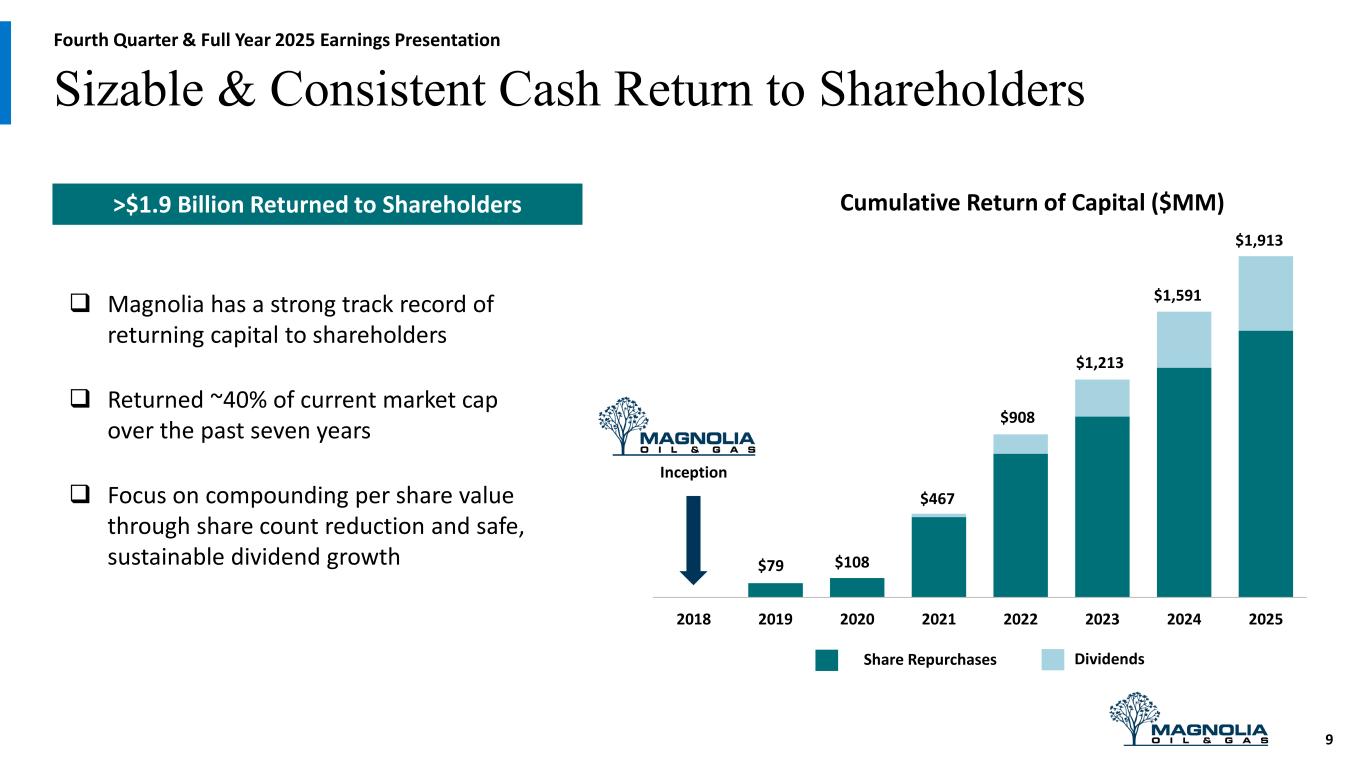
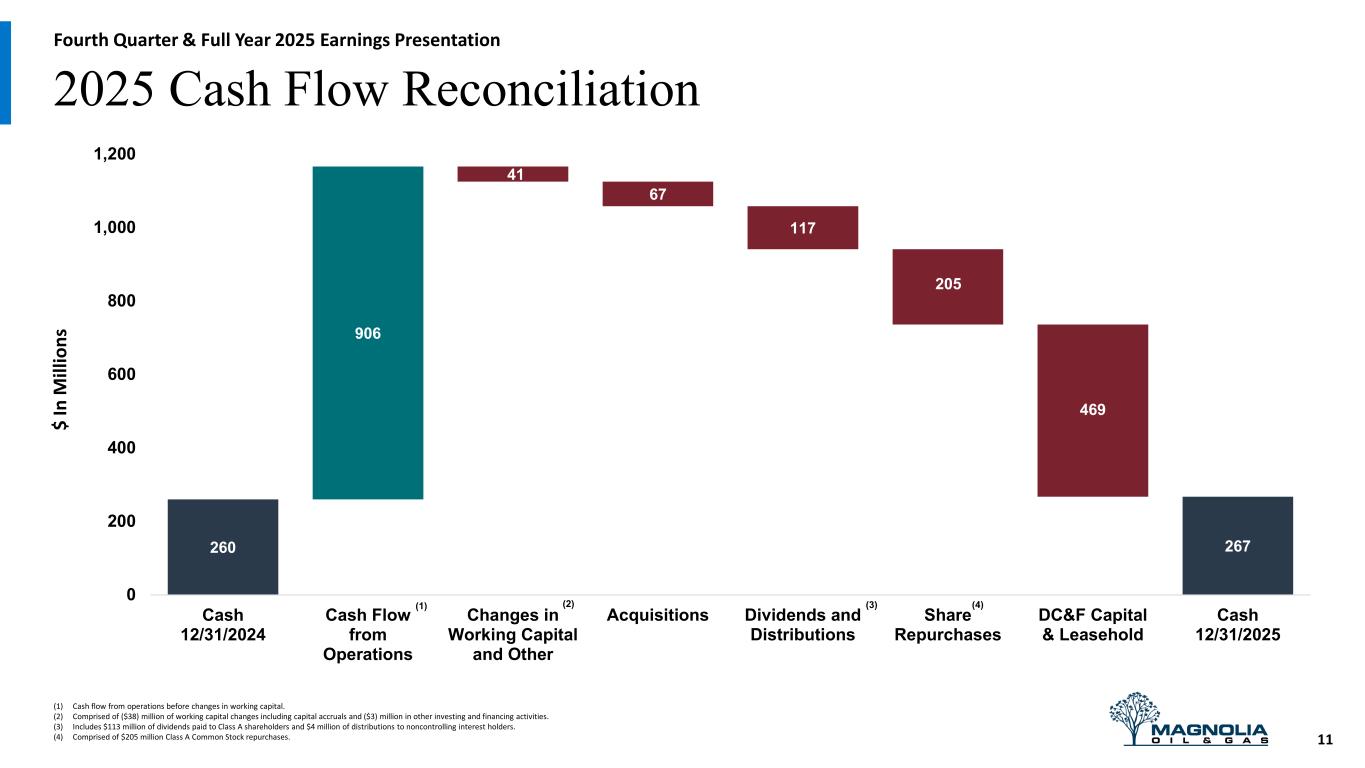
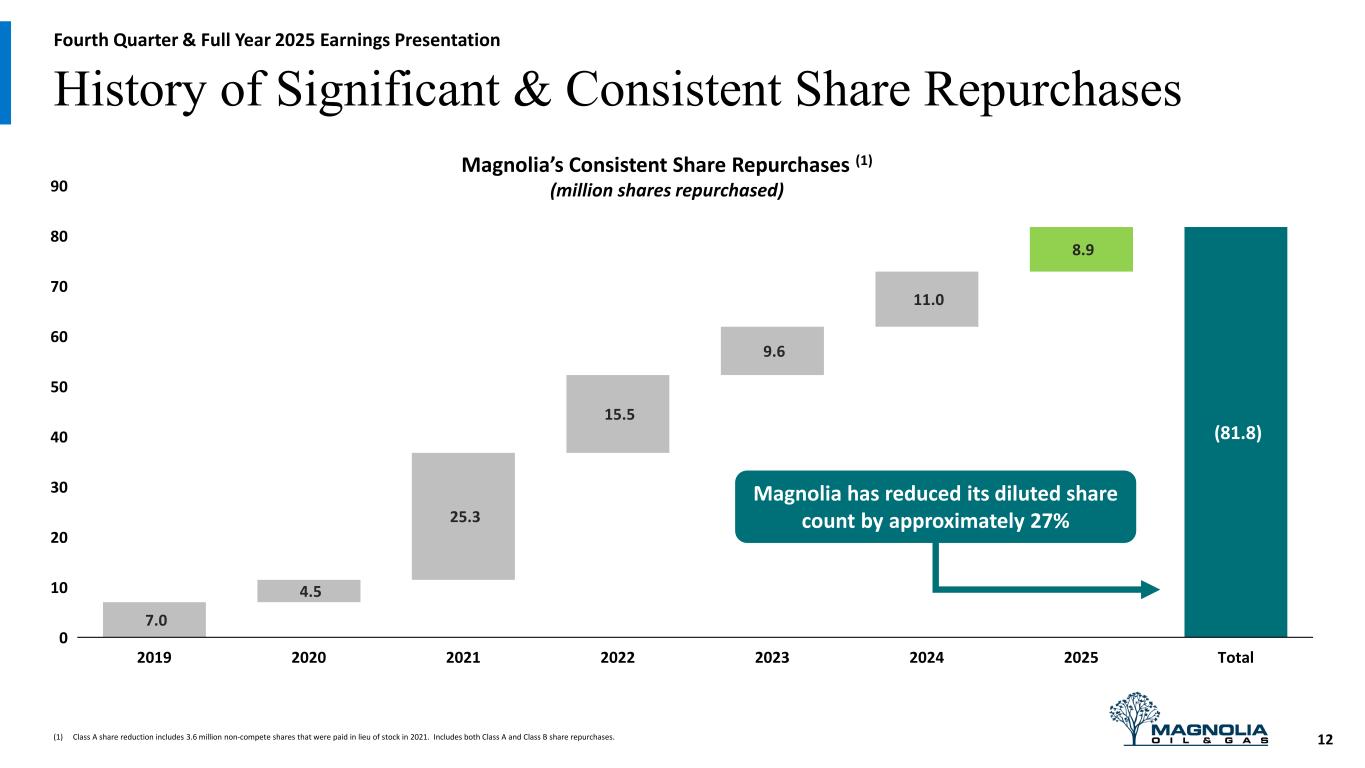
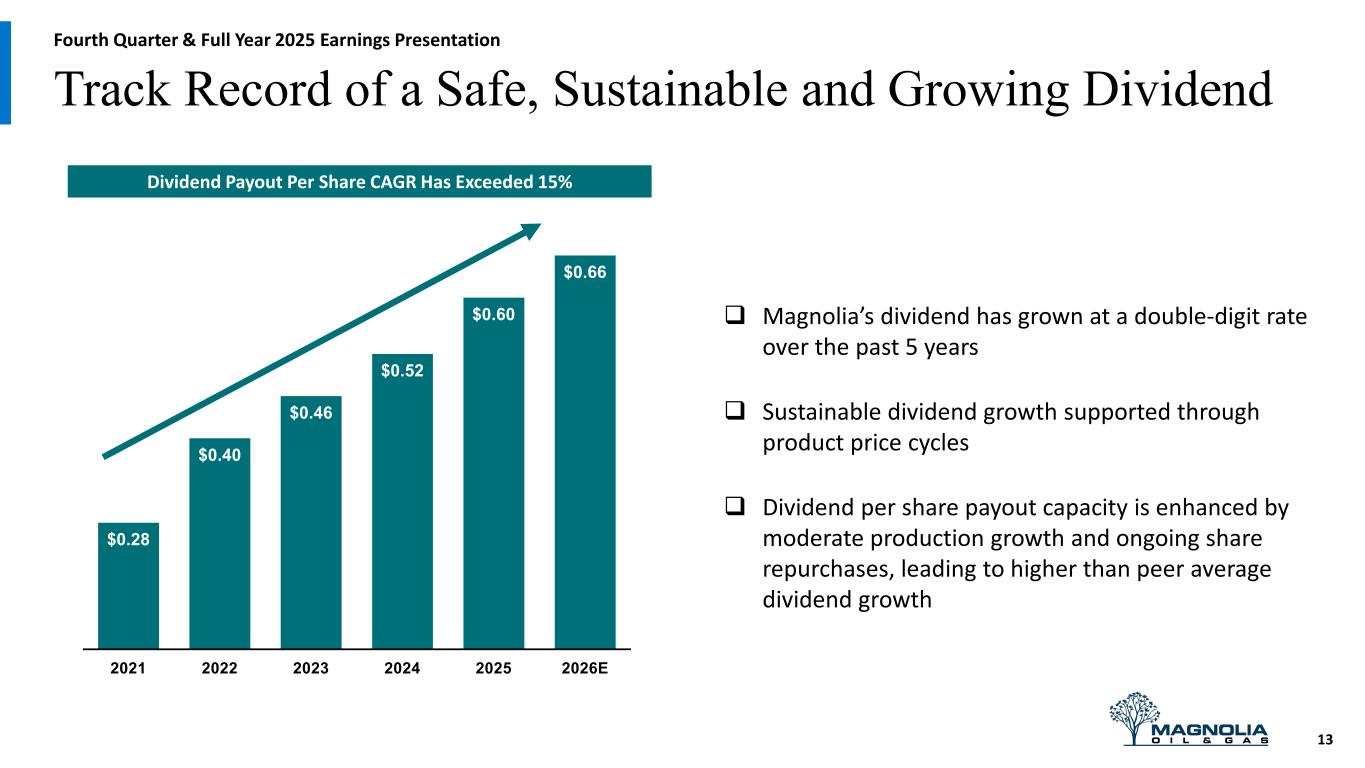
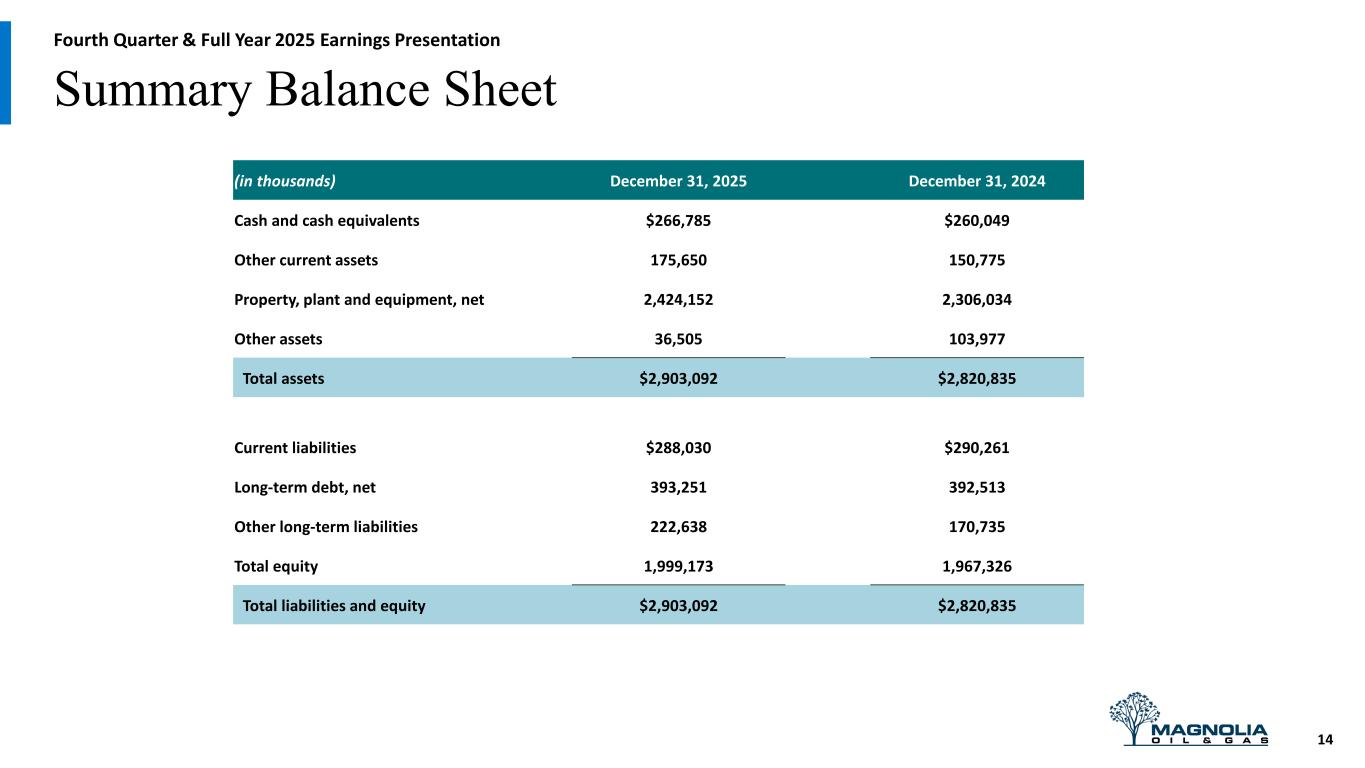
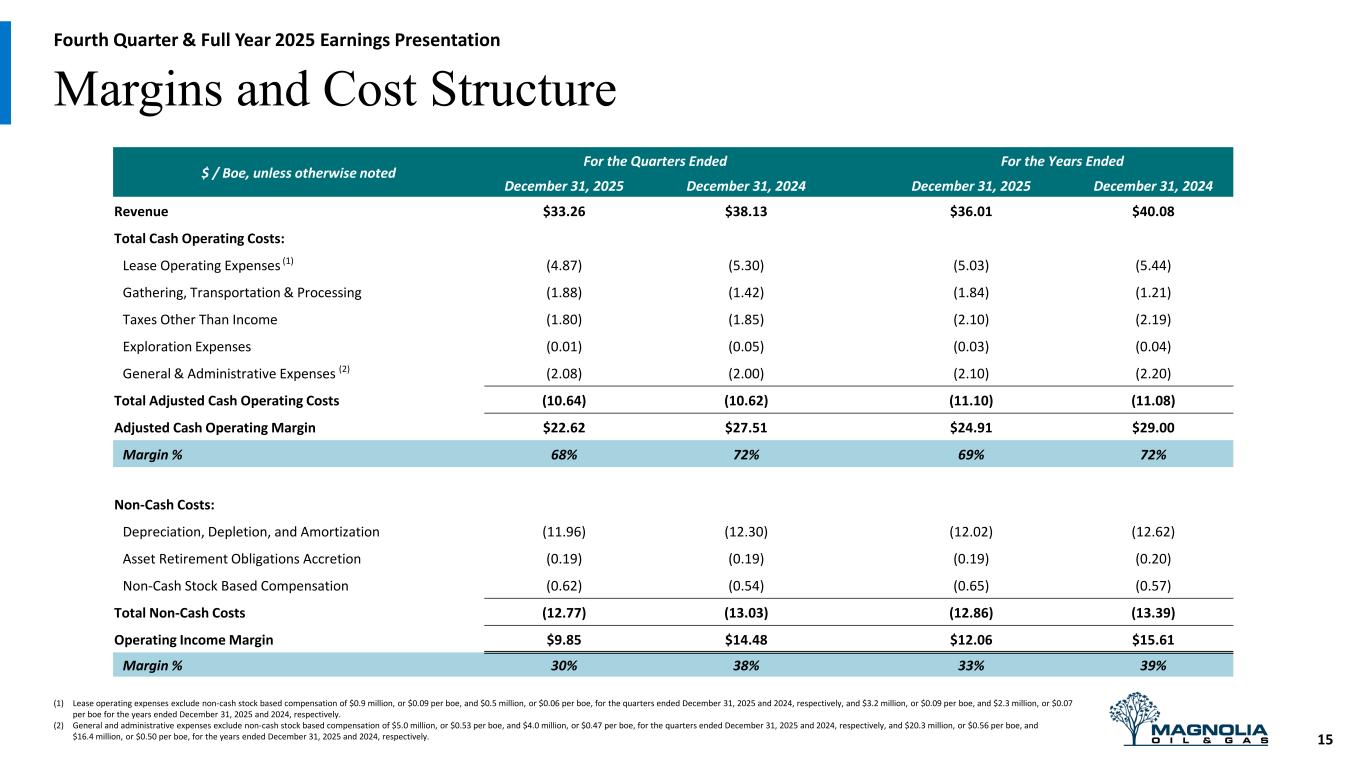
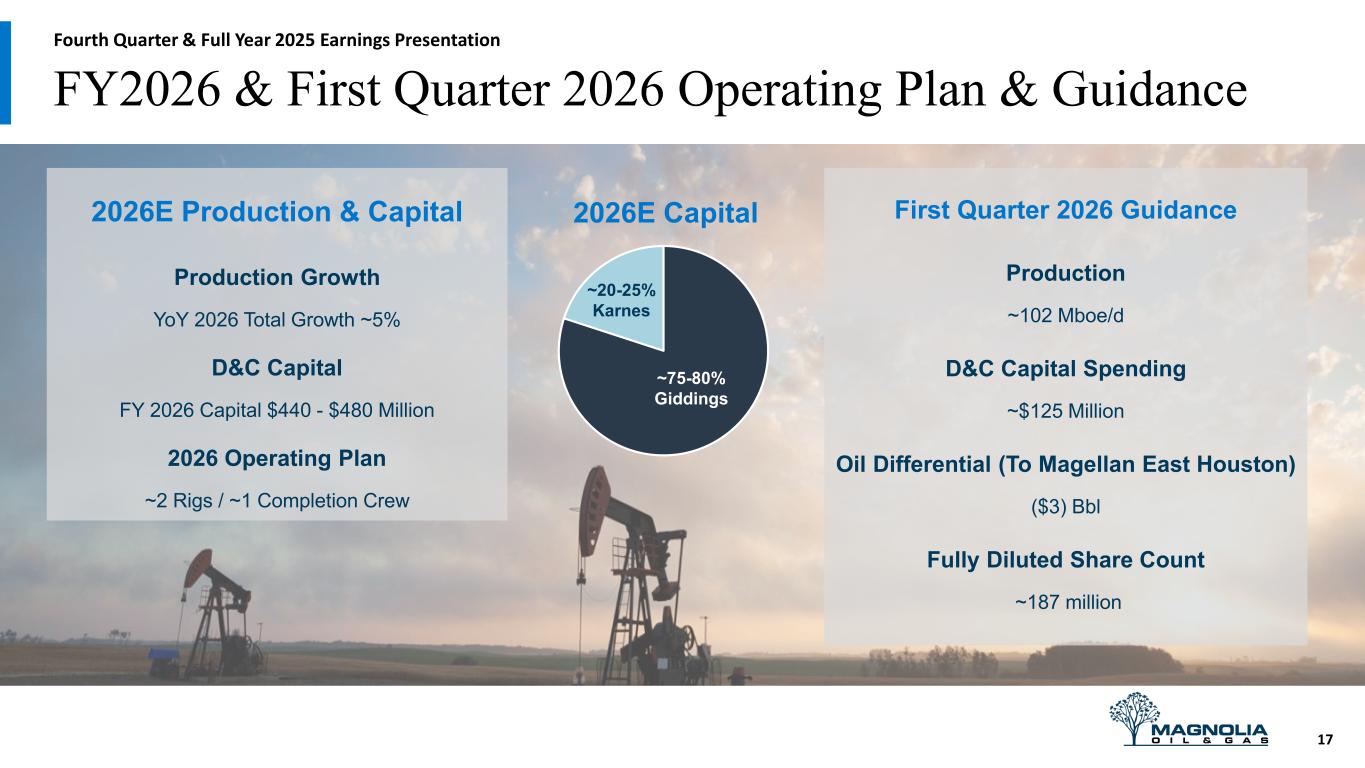
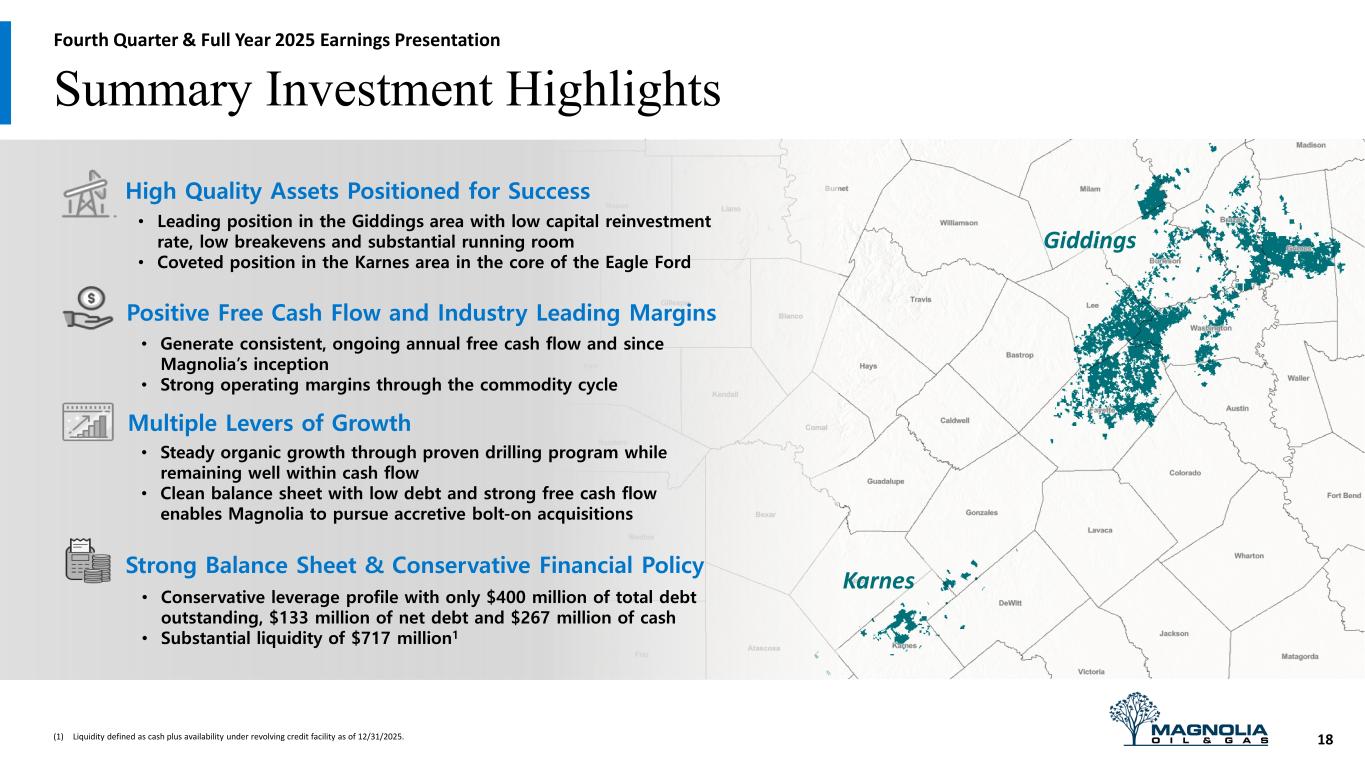
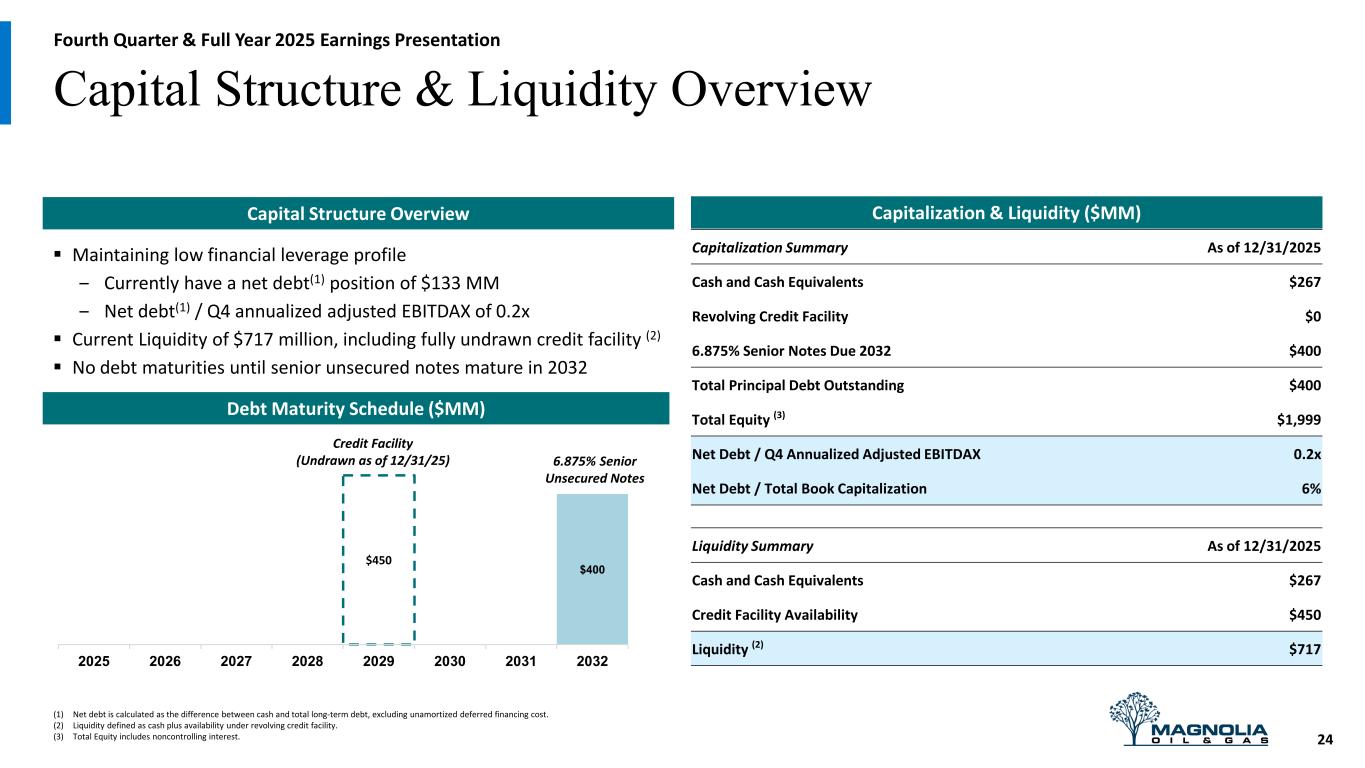
Thanks, Chris, and good morning, everyone. I will review some items from our fourth quarter full-year results and refer to the presentation slides found on our website. I'll also provide some additional guidance for the first quarter of 2026 and the remainder of the year before turning it over for questions. Magnolia ended 2025 with a strong performance across our operations. Starting on slide 10, during the fourth quarter, we generated total adjusted net income of $71 million, or $0.38 per diluted share. Our adjusted EBITDAX for the quarter was $216 million, with total capital associated with drilling completions and associated facilities of $117 million, representing 54% of our adjusted EBITDAX. For the full year, adjusted EBITDAX was $906 million, with D&C capital representing 51% of EBITDAX. Fourth quarter production volumes grew 11% year-over-year to 103.8 thousand barrels of oil equivalent per day. For the full year, production volumes grew 11% to 99.8 thousand barrels of oil equivalent per day, with oil growth of 4%. During the year, we repurchased a total of 8.9 million shares, and our diluted share count fell by 4% year-over-year. Looking at the quarterly cash flow waterfall chart on slide 11, we started the year with $260 million of cash. Cash flow from operations before changes in working capital was $906 million, with working capital changes and other small items impacting cash by $41 million. Throughout the year, we added $67 million of bolt-on acquisitions. We paid dividends of $117 million and allocated $205 million towards share repurchases. We incurred $469 million on drilling completions and associated facilities and leasehold and ended the year with $267 million of cash. Looking at slide 12, this chart illustrates the progress in reducing our total outstanding shares since we began our repurchase program in the second half of 2019. Since that time, we have repurchased 81.8 million shares, leading to a change in weighted average diluted shares outstanding of approximately 27% net of issuances. Magnolia's weighted average diluted share count declined by more than 2 million shares sequentially, averaging 188 million shares during the fourth quarter. As Chris discussed, the board recently approved a 10 million share increase to our share repurchase authorization, leaving 12.9 million shares remaining under our current repurchase authorization, which are specifically directed towards repurchasing Class A shares in the open market. Turning to slide 13, our dividend has grown substantially over the past few years, including a 10% increase we recently announced to $0.16.5 cents per share on a quarterly basis. Our next quarterly dividend is payable on March 2nd and provides an annualized dividend payout rate of $0.66 per share. Our plan for annualized dividend growth is an important part of Magnolia's investment proposition and supported by our overall strategy of achieving moderate annual production growth, reducing our outstanding shares and increasing the dividend payout capacity of the company. Magnolia continues to have a very strong balance sheet, and we ended the quarter with $267 million of cash. Our $400 million of senior note does not mature until 2032, including our fourth quarter ending cash balance of $267 million and our undrawn $450 million revolving credit facility. Our total liquidity is approximately $717 million. Our condensed balance sheet as of December 31st is shown on slide 14. Turn to slide 15 and looking at our per unit cash costs and operating income margins. Total revenue per BOE declined 13% quarter over quarter due to the decline in oil prices. Our total adjusted cash operating costs, including G&A, were $10.64 per BOE in the fourth quarter of 2025. Our operating income margin for the fourth quarter was $9.85 per BOE, or 30% of our total revenue. The decrease in our quarter-over-quarter pre-tax operating margin was entirely driven by the decrease in commodity prices and were further benefited from a lower DDNA expense. On slide 16, Magnolia continues to have a very successful organic drilling program. The total proved developed reserves at year end 2025 were 167 million barrels of oil equivalent. Excluding acquisitions and price-related revisions, the company added 50 million barrels of oil equivalent of proof-developed reserves during the year. Total drilling and completions capital was $461 million in 2025, resulting in organic proof-developed F&D costs of $9.25 per BOE and reflective of our current drilling program. The three-year average organic proof-developed F&D cost was $9.85 per BOE. Turning to guidance, we expect our 2026 drilling completions in facility capital to be in the range of $440 to $480 million, which includes an estimate of non-operated capital that is similar to that of 2025. At the midpoint, this is similar to prior years' capital costs, despite planting more wells in 2026. We expect first quarter D&C capital expenditures to be approximately $125 million and anticipate this to be the highest quarterly rate of spending for the year. Total production for the first quarter is estimated to be approximately 102,000 barrels of oil equivalent per day, which includes approximately 1,500 barrels of oil equivalent per day of winter weather impacts experienced in January. Total full year 2026 production growth is expected to be approximately 5%. Oil price differentials are anticipated to be approximately $3 per barrel discount to Magellan, East Houston, and Magnolia remains completely unhedged for all of its oil and natural gas production. The fully diluted share count for the first quarter of 2026 is expected to be approximately 187 million shares, which is 4% lower than first quarter 2025 levels. We expect our effective tax rate to be approximately 21%, with all of this being deferred. We are now ready to take your questions.
Operator
We will now begin the question and answer session. To ask a question, you may press star then 1 on your touchtone phone. If you are using a speaker phone, please pick up your handset before pressing the keys. If at any time your question has been addressed and you would like to withdraw your question, please press star then 2. At this time, we will pause momentarily to assemble our roster. First question comes from Neil Dinman with William Blair. Please go ahead.
Hi, morning, guys. Nice to see another strong quarter, Chris and team. Chris, my first question is to jump right to the Giddings play. So, typically, looking at our well data, it suggests that a number of your recent wells not only continue to outperform the type curves, but they certainly appear to be some of the best drilled to date. I'm just wondering, you know, with that said, you know, has there been, you know, notable operational changes? Is it more because you're in pure development for a lot of that? Now, what do you attribute, you know, most of this continued upside to?
Good morning, Neil. Thanks for the question and also for pointing it out. We did notice it as well. They're producing – the wells are very strong. They're producing a lot of everything. And I'm not sure exactly which specific wells that you're referring to, but many of them have performed very well. You know, I can't point to anything specific or very different in terms of the completion design, if that's a little bit of what you're asking. I think what you're seeing is simply the outcome of drilling into some very good rock. And I think, you know, when we take a lot of and make a lot of effort in terms of locating the wells and placing the wells, you know, I think there's a better than decent chance that you'll see more of this. So I, you know, there's nothing specific that I can say that we've changed. We've just gotten better at it with time.
No, that's obvious to see. And then second question, moving over to M&A, specifically, can you discuss, I know you'll look at sort of all the above, I think, as any, or Stuart would, but, you know, what we've noticed out there, I mean, we've seen record prices paid for Delaware, we've seen big prices paid for PDP-heavy things, I guess, you know, sort of twofold here. Or, you know, what are you looking sort of at all the above? And, you know, when it comes to, you know, the gettings around your area in particular, you know, are we seeing prices increase there like we've seen in a lot of these other areas?
Yeah, Brian puts some numbers around the, you know, the bolt-on transactions, acquisitions, some of the ground game that has led to some of the bolt-ons that we've done over the last couple of years. And, you know, what I'd say is that it's not predictable, but we've done a good job, I think, with that ground game in Giddings, Western Eagle for Carnes area. I really do expect it to continue. Like I said, it's just tough to predict in terms of the timing. The competition, I would tell you, has risen over the last year. the larger the opportunity or, you know, maybe deal size or, you know, item that you might be looking for, you know, the tougher it is and maybe the more expensive it is. But, you know, we've done a good job of better understanding the things that we're looking for in terms of the subsurface and in and around where we currently operate. I'm not and never really have been a big proponent of very large PDP-heavy deals as you're more likely to pay full value for these or even higher. I think part of that is within your question in terms of what you might be seeing in the Permian and the Delaware. I really much prefer to focus on opportunities where we have more undeveloped upside, but you're generally right. The prices for acreage has climbed. I mean, we're not out there looking to build a data center anytime soon, you know, in terms of what you're seeing for what's happening in real estate or land prices. But for all I know, we could be competing with those, with some of those who are looking to build a data center. I just don't know. But it's certainly reflected in some of the elevated levels of pricing.
Well said. Thanks, Chris.
Operator
The next question comes from Philip Jungworth with BMO. Please go ahead.
Yeah, thanks. Good morning. You called out the faster cycle times last year in the release. I was also hoping you could talk to well-cost reductions and how those might have contributed to the better capital efficiency and lower F&D. And any expectations here as we go into 2026 or what you're seeing on the service cost front?
Yeah, sure. Um, you know, we, we had been, if I go back a year plus, you know, we were looking at a standard cost of, uh, you know, or, or the cost of a standard Giddingswell as sort of maybe $1,100 a foot. And, you know, it, it, it was trending, you know, through that period of up to now maybe down towards 1,000 a foot. So I think that's sort of what we're looking at right now for a standard Giddings well, which is between 8 to 8 1⁄2 thousand feet. So something between that probably gives you a reasonable estimate and maybe closer to 1,000 a foot if that helps you. You know, on the service costs, you know, things are flat to slightly down into this year, you know, but we'll see where this goes as far as commodity prices. You know, we have regular conversations with our service partners, and we want to keep them working because they've been good partners. You know, most recently, this has been a tough way to make a living. I think the OFS market can continue to experience some pricing pressure going through this year, and certainly at prices for oil are 60 or below. We've locked in some of our service costs with our key providers through most of the first half of this year, And we'll be going back probably later in the spring to start looking at negotiating for things in the back half of the year and, you know, sort of close it out. But I feel as if we're in a good position and we're not looking to take advantage, but it's, like I said, it's tough. And I get it, but we're also in the business to make a margin as well. So things are favorable for us, less favorable for the OFS guys.
Right. Makes sense. And then we've seen really strong equity performance year-to-date for the sector and Magnolia, helped by geopolitical risk. So how tactical do you plan to be on the buyback? Do you view this as more programmatic as far as deploying it or maintaining dry powder to take advantage of any pullback, given that we're likely to continue to see volatility?
Yeah, the programmatic portion of it is, you know, the sort of 1% that we're minimally committed to, as far as the way I think about it. I mean, and there's – it really does have teeth as it starts to chew into, you know, the shares outstanding and works with that sort of serial compounding that I mentioned. Some of the tactical portion of it is what you saw probably for us in the fourth quarter where we underperformed, whether that was mean reversion or whatever. Nothing really changed in the business, but we have the opportunity to sort of, since we don't provide broker discretion, we sort of run it ourselves. we have the opportunity to sort of lean in or not as things move along on the stock. It's going to be volatile, and if we see pockets of disconnect where I can't necessarily determine why that's occurring, we can lean in or not. And so should that occur again, we will.
Great. Thanks, guys. Great results. Thanks.
Operator
The next question comes from Peyton Dorn with UBS. Please go ahead.
Hey, Chris and team. Thanks a lot for getting me on. You know, understanding the weather impacts for the first quarter, I wonder if you could just touch on your expectations for the shape of the 2026 production outlook. Is it fair to think that beyond the step back here in 1Q that we should kind of see maybe a steady growth rate through the year? Or is there any other factors that we should keep in mind kind of as we go through 2026?
Yeah, more or less. I mean, you can do the arithmetic. I mean, I think we provide you with enough information where with the winter storm impact in the quarter and sort of adding it back, what it might have looked like perhaps without the occurrence of the event. So, you know, 26 is off to a good start. And I sort of see things gradually progressing through the year. but it's a little bit heavier capital outlay in the first half of the year, certainly in the first quarter. So typically that's sort of the way the curve works for us just in terms of timing of the spend. 4Q, 1Q is a little heavier, and then it sort of tapers off in the mid part of the year and then again rises on the capital as we end it out or finish out the full year. But the goal would be to spend as least as possible and generate, you know, better results on growth if we can. And, you know, I'm optimistic around the outcome of the wells. But generally, I think you'll see a gradual, steady progress through the year on the volumes.
Great. Thank you very much. Okay, thanks.
Operator
The next question comes from Tim Resvin with KeyBank Capital Markets.
Please go ahead. okay good morning folks thanks for taking our questions um i wanted to ask about the the development approach for the year you talked about 75 of activity on on multi-well pads and gettings you know almost identical to your comments a year ago um can you sort of refresh our memories on on sort of leading edge um you know the pad template i know there's there's you know unique pads for different reasons but are you still sort of in that three to four well package size? Why not kind of push out laterals, you know, more to 10,000 feet or above? Just trying to kind of understand what development looks like as we think about, you know, incremental efficiency opportunities. Thanks.
Yeah, no, the three to four per pad is about, is still about right. There's no real change there. We do have some five-well pads. We do have some two-well pads, you know, but generally I would tell you it's probably around three to four on average. And the lateral lengths will vary. I mean, we'll drill if possible. I mean, we're not trying to drill shorter laterals. We'll drill longer laterals if and when we can, and that's part of the assist that we get with a little bit of the ground game. If we can, you know, acquire some adjacent or open acreage that could assist or help us out in that way, there's opportunities to do that. Yeah, we drilled wells that are 12,000, 13,000 feet, and, you know, if we can do it, we will. But on average, it's sort of eight to eight and a half. That's sort of the typical program that I would expect to see this year, not very different.
It's a helpful context. And if I could just circle back to the M&A question, you talked about some more competition on the larger side. I know there's at least two large packages right now in the market from Publix, you know, not really in your Gideon's backyard. But, you know, do you still feel the better opportunities on those sort of smaller sides? You know, would there be interest in doing something big, you know, potentially on that, you know, transformative side if the pricing was correct or, you know, in your favor?
Yeah, these are, you know, what I alluded to or mentioned before, probably not probably, they are more on the PDP heavy side, have been well developed, has sort of been through the, you know, machination of time and heavily drilled up. So, you know, you really, you don't want to buy somebody else's decline curve, you never want to get involved with that if you can avoid it. So I'm looking for, you know, things that have untested upside or just upside, undrilled acreage, and, you know, those are tougher things to be had. I'm just not looking to, you know, you're going to pay full value or better on this PDP-heavy stuff. And so I think generally that's what those larger things would look like. We'd probably also like to lean a little bit more on the liquids side, on the oil side, if we can do it or find it. So I'm not adverse to gas necessarily, but if we can, you know, if there's going to be some production that comes along with it, I'd probably prefer to have a little bit more on the oil side. You know, the other thing, too, you know, large deals come with obviously greater risk. And so, you know, you just want to be sure that you can manage this and that you have a good understanding of it. So whatever we're going to do or whatever we're going to look like, you know, has to sort of start off with the understanding that we have a good firm view of what we're getting ourselves into subsurface-wise and whether or not we can continue to manage it going forward. So there's lots of – looking at old things that are being hived off by Publix, it's interesting, but you just got to make sure you understand it well, and it's actually contributing to the business in a positive way, fits into our model, and can be accretive to the – Okay.
Okay. I appreciate the responses. And if I could just sneak a quick one in. You know, oil skew has been about 39% in the back half of 2025. As we look forward, should we still expect that 39% to 40% range to hold?
Thank you. yeah the percentage is a tough one i you know not tough from in terms of what it's going to be it's just you know i'd rather speak in terms of absolute oil and absolute oil i expect to grow you know two to three percent this year and it'll be a mix of of gettings and and the carns area asset uh so i'm confident around that and if we can do a little bit better you know we'll see um But the percentage, considering the proportion of the program in Giddings, where, you know, Giddings on average is running very much mid-30s, 35, 36 percent thereabouts, and we're, you know, call it, like you said, 40 percent, 39, 40, it's going to be in that range. You know, it's going to be in that range, and, you know, if you were able to add an asset or a little activity that could, you know, make you a little bit oilier, we'll just sort of see. But I'm very confident that on the low end, you know, you're not going to sort of be 20% or something odd. You're going to be in that mid-30s or, you know, 40-ish or maybe even a touch better depending on, you know, things that are available to drill and that we fit into the program.
Okay. I appreciate the responses. Okay.
Operator
The next question comes from Leo P. Mariani with Roth. Please go ahead.
Hey, guys. Just obviously strong well-performance in Q4, which you guys spoke of, trying to get a sense of whether or not that's been primarily driven by the 240,000-acre development area, or you've seen some contributions from some other areas. You did reference some new development areas in your release. So I was just trying to get a sense if those new areas are on top of the 240,000 acres or kind of included in the 240.
I would tell you it's included in the 240, but that's not to say that we're not looking elsewhere and have plans to go outside the 240 with additional appraisal this year, which we will. So, you know, I'm looking forward to that. I'm looking forward to what the results may bring, and it's been very useful, helpful to us up to now, and I expect it to be additive in terms of our resource going forward, so I'm optimistic around that, but to your question around where did it come from, it's sort of historical, and it's really within the 240.
Okay, I appreciate that caller, and then obviously LOE was once again pretty strong, you know, this quarter in terms of being a low number, just wanted to get a sense of kind of what's It's really been driving that. You guys have done a really good job at getting costs down. And I think from your prepared comments, I think you're still continuing to work on that. So how should we expect that to trend as we roll through 26 here?
So good question. You know, the first quarter, obviously, we had the weather events, you know, with the freeze. And, you know, there's just some extra things that need to be done to sort of compensate for that in terms of repairs and maintenance. I'm not going to dwell on it. It's not a huge deal, but you'll see a little bit of that, I believe, in the first quarter on LOE. And LOE seasonally is generally higher in the first quarter for field bonus payments. We have to pay our guys, and hopefully we pay them well. So, you know, there's some of that. So that's just seasonality. I will tell you, though, that they have done a very good job, an impressive job, frankly, in terms of bringing down costs in the field. I think we have additional things. They have some things up their sleeve that will work out in a positive way over time, and I'm confident that sort of the numbers that we're seeing in terms of continuing to trend down, I feel pretty good about it. So I think there's some additional room for improvement with some things we're working on.
Okay. Nice to hear. Thanks.
Operator
The next question comes from Noah Hungness with Bank of America. Please go ahead.
You guys gave a decently wide range for your 26 capital guide. Could you really put some color around what would push you either to the upper or lower end of that range?
There's not much that I can come up with that would push us to the upper in the current environment. um you know so i'm confident that you know you're sort of in the mid middle part of that range or lower um you know we're not we're not looking to to do more um the you know and frankly should we we do better in terms of the well performance as occurred last year you know we could find ourselves in a similar position where you just put off some of the spending or defer some completions or whatever just because the performance is better. So if we could spend lower less and have more free cash flow, that would be terrific. That is really the objective. So I'm simply giving a range really because, you know, just some of the product price volatility and uncertainty should prices move higher and directionally higher and we see some reflation or pickup in service that could lead to it. But right where we are now, that's not something I'm anticipating.
And for my second question is just on first quarter DT&T, during the winter freeze, we also saw really strong gas prices. is is that higher gas pricing going to potentially translate into higher gp and t for the quarter maybe maybe slightly we expect gp and t to be relatively similar um from what we've seen over the past couple quarters so i don't i don't expect too much uh volatility there could it be slightly higher yes but we're not talking quarters and you know it could be a couple pennies or nickels okay thanks guys the next question comes from carlos escalante with wolf please go
ahead hey good morning team thank you for having me on i i i would like to pivot back uh real quick to your dnc cost savings year on year um i learned yesterday from your own tom fitter that you've been running the same patterson rig since magnolia's inception and i thought that that's just the epitome of your industrial approach. So I wonder if you can in a very succinct manner unpack how much of the DNC cost gains year and year have been on as a consequence of that industrial approach to the business versus any kind of service deflation and perhaps with your additional commentary on how much more you can squeeze via that continued repetition on the drilling side specifically well it's a it's a very you know good good point and observation i mean it's you know running these rigs not just one but both consistently over a multi-year period has led to you know a wonderful understanding of the field uh the drilling challenges and
capabilities that the assets bring to us. And so not just the rig, but the crews that we have and equipment really does provide us with that, you know, further understanding and capability and consistency that I think, you know, drives some of the efficiencies that we've been seeing. So if you want to call that the industrial approach, you know, that's fine. But it does translate into benefits with time. The crews, the people, the equipment, all of it. We like what we have. We're always looking, you know, to continue to utilize those things, but at the same time be competitive and look elsewhere. But there's advantages to having that consistency for sure.
That's very helpful. And as my second question, and building on Noah's question, on capital, so if we exclude the six deferred tills that you had from 25, and then you include back the downtime from the production storm, in my mind, it stands to reason that your development capital, your maintenance capital, is substantially down. I wonder if you can put maybe perhaps a number on where you see that, where you can hold reproduction flat. And I think that I'll add that as a backdrop, the industry hasn't been paid to grow for the past few years. So a lot of interesting things going on in the Premier Basin and in the South in general with growing dynamics. So we could be turning the tide here.
So wondering how you see that and if you can provide, again, that number on your maintenance capital as it stands today now the capital the capital is an interesting observation or point um setting aside you know the winter event um you know the you know we're we're going to complete drill and complete um a few more wells this year uh that is sort of embedded within the the growth expectations that we have and some of that is is largely fits into the program because of some of the efficiencies that we've generated over the years but in terms of maintenance you know probably I'm not sure we haven't tested it yet so I you know it's always hard to exactly come up with a very, very narrow range, but I would tell you, you know, $400 million-ish feels about right, maybe a little less.
Carlos, maybe I'll just add, too, if you go look back in time, the last five years we've spent about the same amount of money every year. Our production is up roughly 50%. We're drilling more wells each year generally, and that's driven by efficiencies. There's other things that can contribute um to the decrease in total capital costs but when you but you look at as a whole since you know last five years has been relatively stable in terms of how much we've spent on an absolute basis um and we're doing that with more production and more wells and factoring in the first part of your question around the industrial capabilities of the equipment and the drilling rig.
I mean, all of that sort of comes together to allow that flatness, if you will, in terms of what you've seen or consistency on the capital over the last five years that Brian mentioned.
Operator
The next question comes from Phillips Johnston with Capital One Security. Please go ahead.
Hey, thanks for the time. Just a few housekeeping questions on the modeling front. I know your average working interest on some of your acreage in Giddings has moved up with some of the recent bolt-ons. So, what should we assume for your average working interest for this year's drilling program in both Giddings and Carnes? And just in terms of cycle times company-wide, are we still kind of running somewhere around 28 gross wells per rig for a year per rig line?
So I'll start with your second. 28, I mean, that may be slightly aggressive, but it's not far off, depending on where we are and exactly what we drill. In terms of working interest at Giddings, I mean, we've been able to move that up from the, you know, call it mid, maybe slightly higher 70% range, and I would assume something in the low 80s today.
Okay, perfect. um and um you guys noted some deferred well completions from 25 into 26 i think the number was around six so just to clarify would you expect your till count this year to be about six wells higher than the number of wells that you drill or should we think about the company just operating with a higher working inventory of ducks no i wouldn't necessarily i mean we don't we don't purposefully, you know, looked at ducks, you know, necessarily, but I think you're in the range plus or minus ballpark of the half dozen that we, you know, we sort of had coming in from that from last year. Okay, perfect. Thanks, guys.
Operator
The next question comes from Charles Mead with Johnston Rice. Please go ahead.
Good morning, Chris and Brian and the rest of the Magnolia team there morning morning chris i i want to uh i want to go back to the uh to the acquisition market and i know you spoke a lot about this earlier in the q a but i want to try to put the pieces together and see if i understand your thinking um when i think about the uh the traditional oily parts of the eagleford that's gonna that's gonna all be pdp heavy uh or almost anything would be pdp heavy And then you think about something that has more undeveloped, which I think you said that's more interesting than you, those are mostly going to be down dip and gassier. And so am I – and I think you said you weren't interested in gas.
And so if I'm putting those pieces together, right, does that mean that you're not likely to be a – to really charge hard at those traditional Eagle Fruit packages? um i wouldn't disagree with what you said as far as you know they're tough to find but they're out there uh so you just have to be and remember we're small and so you know little things here and there can make a difference and you just have to uh make make the effort and and you know poke around and we know a lot of folks and so you know there there are opportunities out there you just have to um just have to try uh the the PDP heavy Eagleford and and things like that that that you're referring to up dip I'm not I'm less interested in those uh it's it's difficult it's it tends to be more scattered. There's less obvious, you know, synergies that are available because it's just sort of county to county. It's not all homogenous. It's very different scattered, like I said. So it's tougher to make it work as a public company. If you're private, you know, you can do some of these things, get away with it, it's not a big deal. But as a public company, in terms of the way we think about things, it's a tougher way to make a living.
Got it. Got it. Thank you for that elaboration. And then, Owen, I wonder if you could just give us a refresh on, you know, I think that there's a lot of bearishness in the oil market, but, you know, we recently saw 65. And so So when you guys look at internal scenarios where you run $70 or $75 oil or whatever, where does the extra cash go in the scenarios that you run?
You know, on your oil comment, you're right. I mean, the sentiment as we sort of got out of $25 was extremely negative. And maybe some of that is still lingering in there in terms of just available supply in the market. is certainly ample oil. Personally, I've been more constructive. I think I've said this many times in investor meetings that we've had, I've been more constructive on oil as you go into 2026 and then you have all these sort of geopolitical whack-a-mole events that, you know, sort of tend to pop up and you don't know what's lurking around the corner. So those have sort of underpinned and and helped, I guess, on oil, just to remind everybody that, you know, two-thirds to three-quarters of the world's oil supplies are in some pretty nasty places, and so that's not going to end any time soon. You know, the other thing, you've got other dynamics, too. Global demand is pretty healthy. You've got sort of the economy that's pretty good. You know, I'm sorry, but your question is getting at what exactly?
When you guys run scenarios at $70 or $75, where does the extra cash go? Does it go to more? Is the first thing another dividend bump, or is the first thing to ramp up share repurchases? Part of that could even be when does another rig come into the picture?
Another rig doesn't come into the picture. That's not the plan. So, again, I say this again and again, and maybe people don't believe me, but, I mean, the plan is to spend as little as we can or be the most efficient with the money in terms of drilling the fewest wells to continue to take advantage of the productivity gains that we see in the field and have some moderate growth. We're not chasing growth for growth's sake. So, you know, in a better-than-expected commodity product price scenario, we just sort of sit there, take the winnings. It's the advantage of having an unhedged outcome, if you will, or structure, and so we don't have any real financial risk in terms of the leverage. So we capture all the upside to commodity prices that will ultimately feed back to the shareholder in the way, shape, or form of, like you said, And we can toggle this, whether it's dividends, share repurchase, and or just being opportunistic around redeploying some of the excess cash towards opportunistic acquisitions. So that's pretty much where the extra money would go. Thank you. Thanks.
Operator
The next question comes from Tim Moore with ClearStreet. Please go ahead.
Thanks, and great execution and reliable capital allocation. I just like Chris' comments that another rig cost won't creep into the picture. But Chris, I just want to follow up on just another Giddings thread. How much more confident are you in future outcomes of new wells there, bringing more net acreage into the portfolio with some higher predictability than you were maybe 18 months ago? So, you know, if you kind of could add any color on your look back of EUR pre-drill and post-drill results for new wells and Giddings. I mean, if they came out a couple percent better or just any thoughts on that would be helpful.
I'm very confident because of, you know, the ongoing appraisal and even where you say maybe adding to that a touch of sprinkle of exploration, if you will, in and around some of our areas. So whether it's that or some of previous bolt-ons or things that we may be working on, there is a very good chance that there will be more opportunities set to work on that will deliver the types of results that we've been accustomed to seeing. So I'm very confident.
Great. And my only other question is, I mean, without adding another rig, like you mentioned, you won't, you know, how quickly can you really lean in and slightly ramp up drilling for a few extra wells and gettings? You know, if later this year, you know, oil prices somewhere around 70, I mean, I know you were able to quickly delay, you know, I don't know, six completions last year. Could you flex that much on new wells, or do you need a lot more lead time?
I mean, we could, but we won't. It's just generally not the direction we would take it. Like I said, we set our plan at something that we view as practical and prudent in terms of what we envision with the product price scenario that is conservative. and we'd like to grow within that outcome. And the moderate growth that we talked about is what the assets are capable of delivering. We're not stretching for more than that. If the outcome turns out to be better than expected, that's great, but we won't chase more growth or necessarily just respond to the product price in that way. We'll just take the money and view it as winnings and we'll deploy it to or we'll provide it back to the shareholder in some fashion either share or purchases most likely.
Thanks. That's terrific clarity, and that's it for my questions.
Operator
The next question comes from Zach Parham with J.P. Morgan. Please go ahead.
Hey, just one question for me, and you've commented on this a little bit, but you all delivered some pretty significant gains in productivity this year that's allowed you to grow production more than originally planned, that lower CapEx. Do you think that higher level of productivity is sustainable going forward? And maybe comment on how much of that productivity uplift is factored into your 2026 guidance.
We pretty much take a backward look on this and look at, you know, our drilling plan. The drilling plan, I would tell you, and the anticipated outcome is not very different in terms of the sets of wells that we're expecting planning to drill as far as what this year's program. So there's a reasonable chance that, you know, things could turn out better than what we're predicting. Certainly it turned out that way last year, but, you know, you can't – there's no guarantee. I mean, so, but there is a reasonable chance that some of that will occur in certain areas. So, it's a balanced program. It's designed to sort of deliver, you know, moderate expectations for volume growth and factoring in some sorts of levels of risk. But I think as I look at the risk this year, frankly, it doesn't even feel as great as it was last year, and last year turned out okay. So I think the outcome will be pretty good. Thank you.
Operator
The next question comes from Paul Diamond with Citi. Please go ahead.
Thank you. Good morning, all. Thanks for taking my call. Just a quick one for me. You just talked a bit about the improvement in feeling fee per day, completion fee per day, and kind of just general overall cycle improvement. I guess just trying to understand as we look forward how much meat is left in that bone. Is there a recent trend indicative of what we should expect over the next 12 to 18 months, or is there any other thoughts there?
Yeah, I can't speak to precise estimates or a factor of improvement that's coming in the next 12 to 18 months. Is it likely to improve? Yes. Gradually, yes. And some of that is some of the, what I mentioned in an earlier response, just the consistency and understanding of not just where we're drilling, how we're completing, and the experience of not just the equipment, but the personnel that are driving the effort. So as you understand more, you unlock more efficiencies with time. so I do expect to that to gradually improve so the conference is now concluded thank you for attending today's presentation you may now