Operator
Good day, everyone, and welcome to the Mercury Systems Second Quarter Fiscal 2025 Conference Call. Today's call is being recorded. At this time, for opening remarks and introductions, I would like to turn the call over to the company's Vice President of Investor Relations, Tyler Hojo. Please go ahead, Mr. Hojo.
Good afternoon, and thank you for joining us. With me today is our Chairman and Chief Executive Officer, Bill Ballhaus; and our Executive Vice President and CFO, Dave Farnsworth. If you have not received a copy of the earnings press release we issued earlier this afternoon, you can find it on our website at mrcy.com. The slide presentation that we will be referring to is posted on the Investor Relations section of the website under Events and Presentations. Turning to slide 2 in the presentation, I'd like to remind you that today's presentation includes forward-looking statements, including information regarding Mercury's financial outlook, future plans, objectives, business prospects, and anticipated financial performance. These forward-looking statements are subject to future risks and uncertainties that could cause our actual results or performance to differ materially. All forward-looking statements should be considered in conjunction with the cautionary statements on slide 2, in the earnings press release and the risk factors included in Mercury's SEC filings. I'd also like to mention that in addition to reporting financial results in accordance with Generally Accepted Accounting Principles or GAAP, during our call, we will also discuss several non-GAAP financial measures, specifically adjusted income, adjusted earnings per share, adjusted EBITDA and free cash flow. A reconciliation of these non-GAAP metrics is included as an appendix to today's slide presentation and in the earnings press release. I'll now turn the call over to Mercury's Chairman and CEO, Bill Ballhaus. Please turn to slide 3.
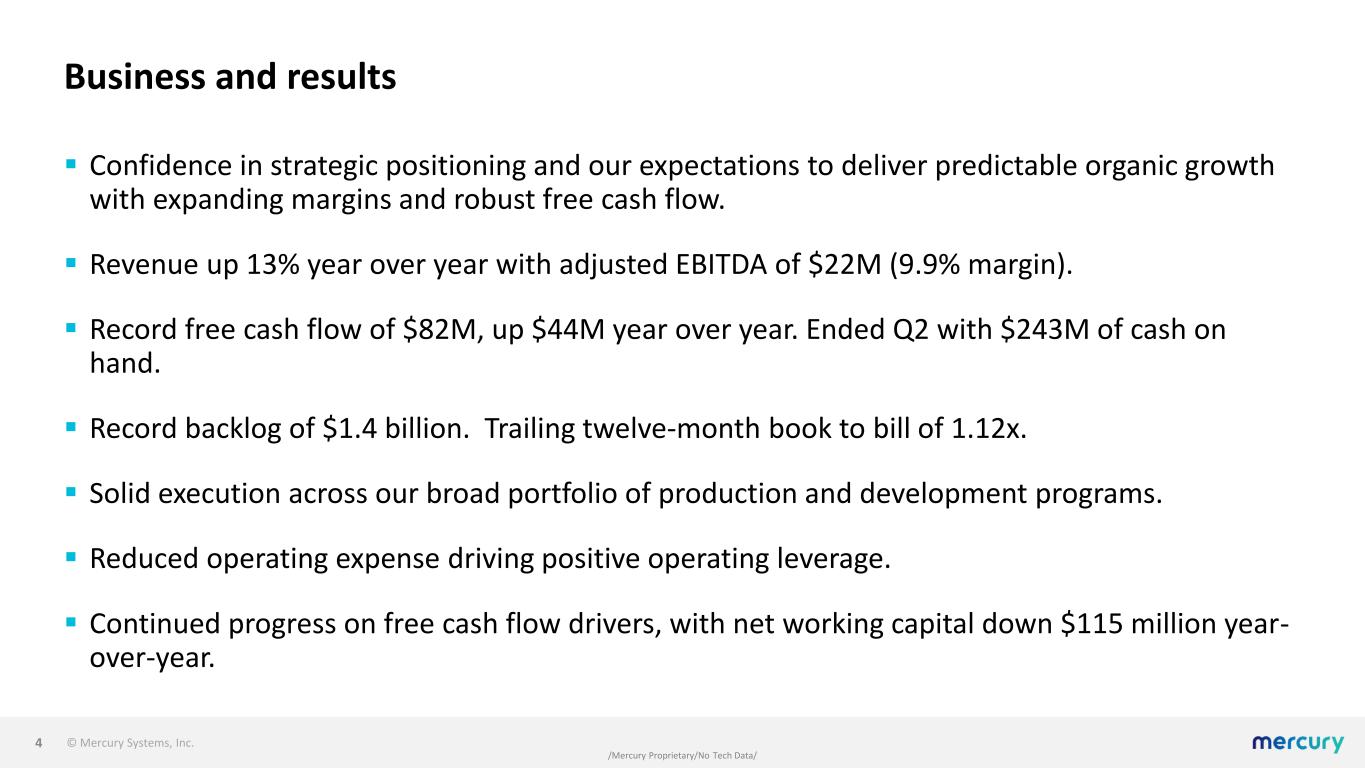
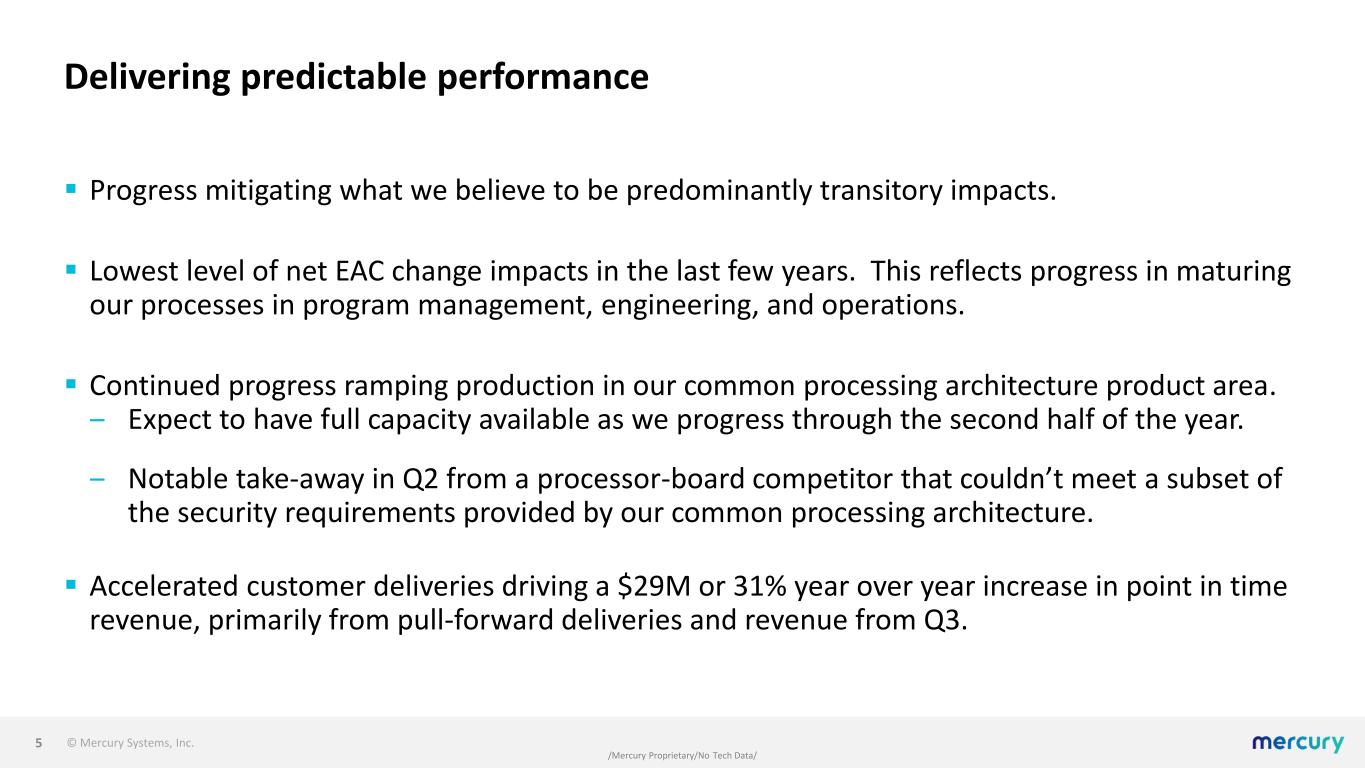
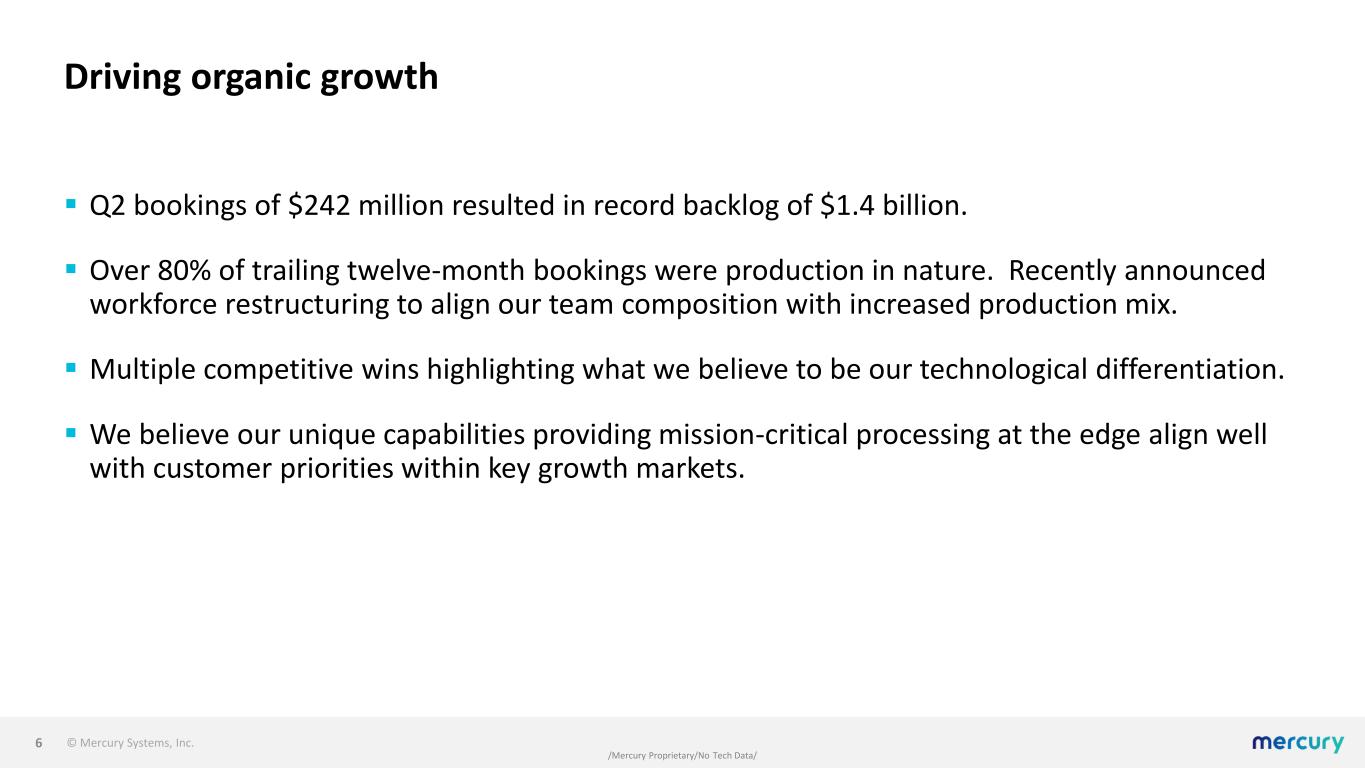
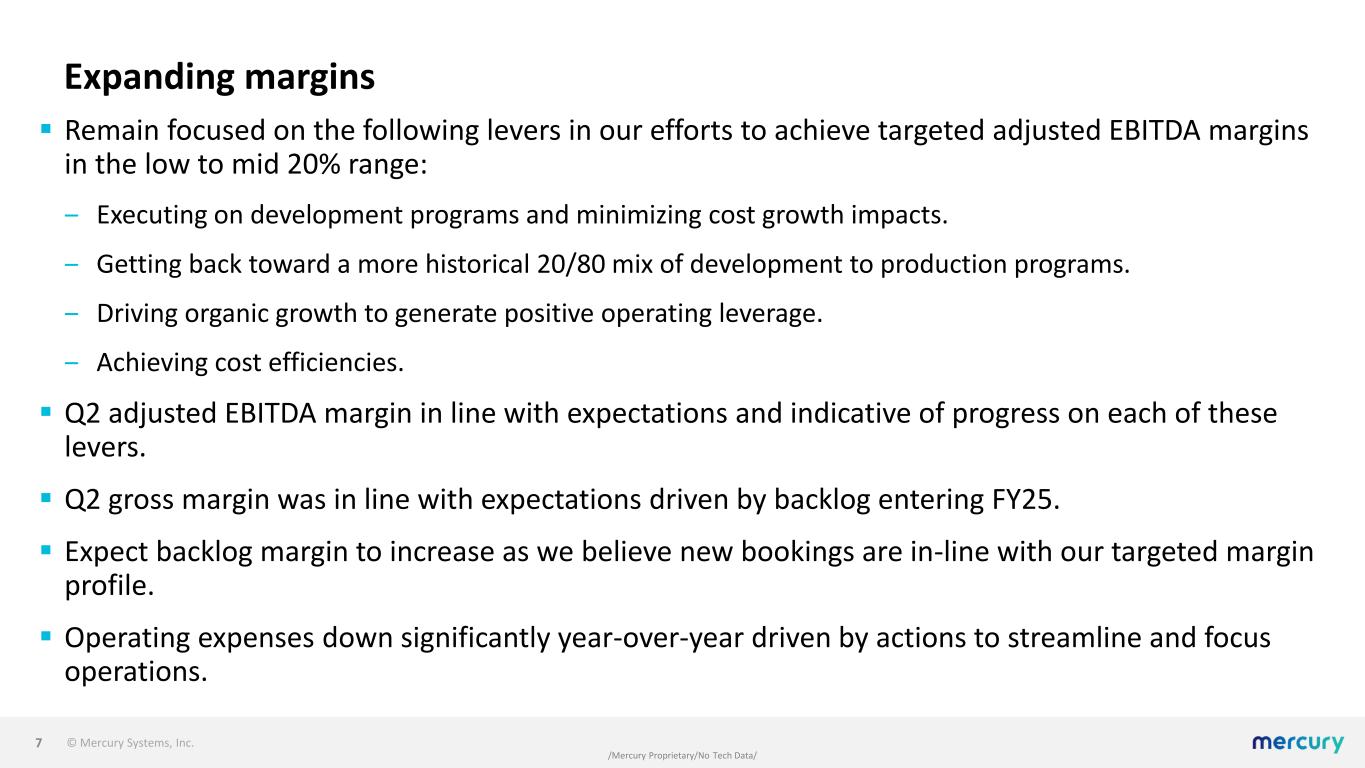
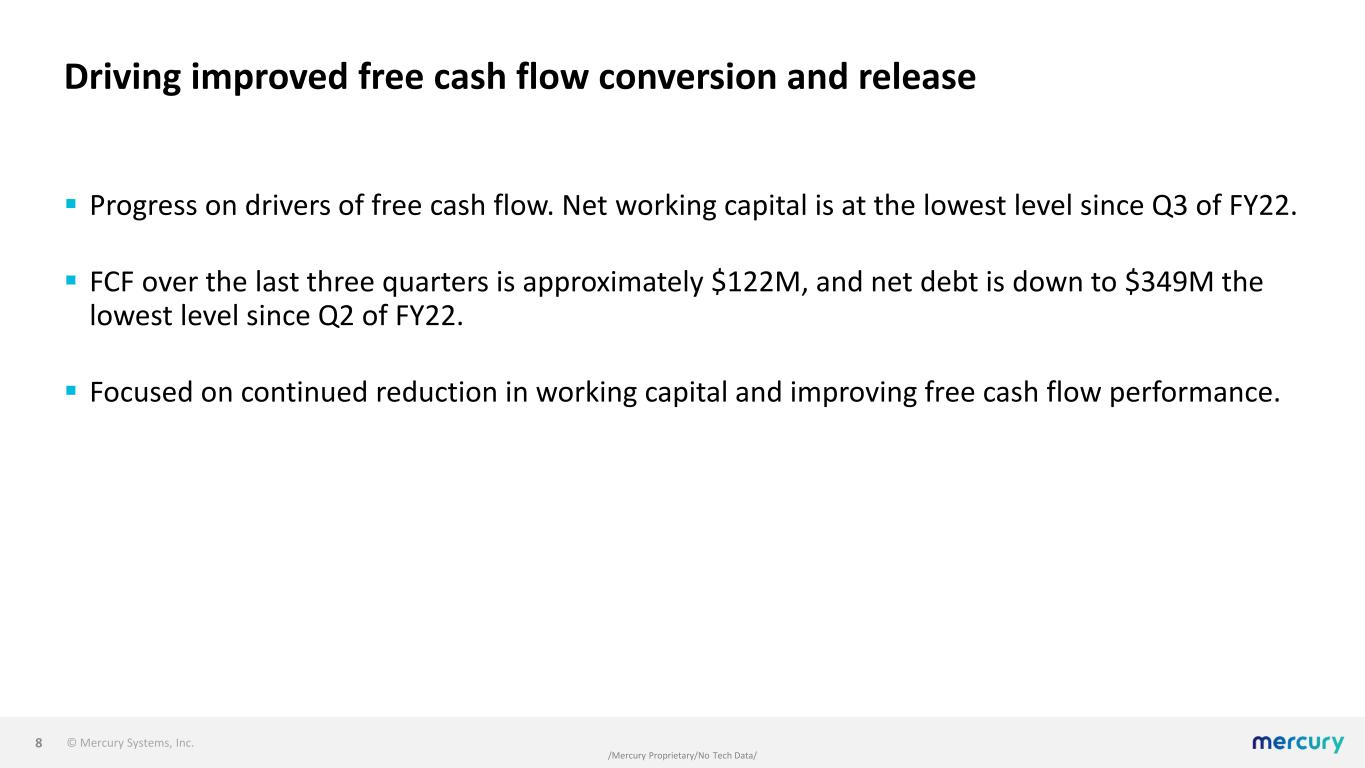
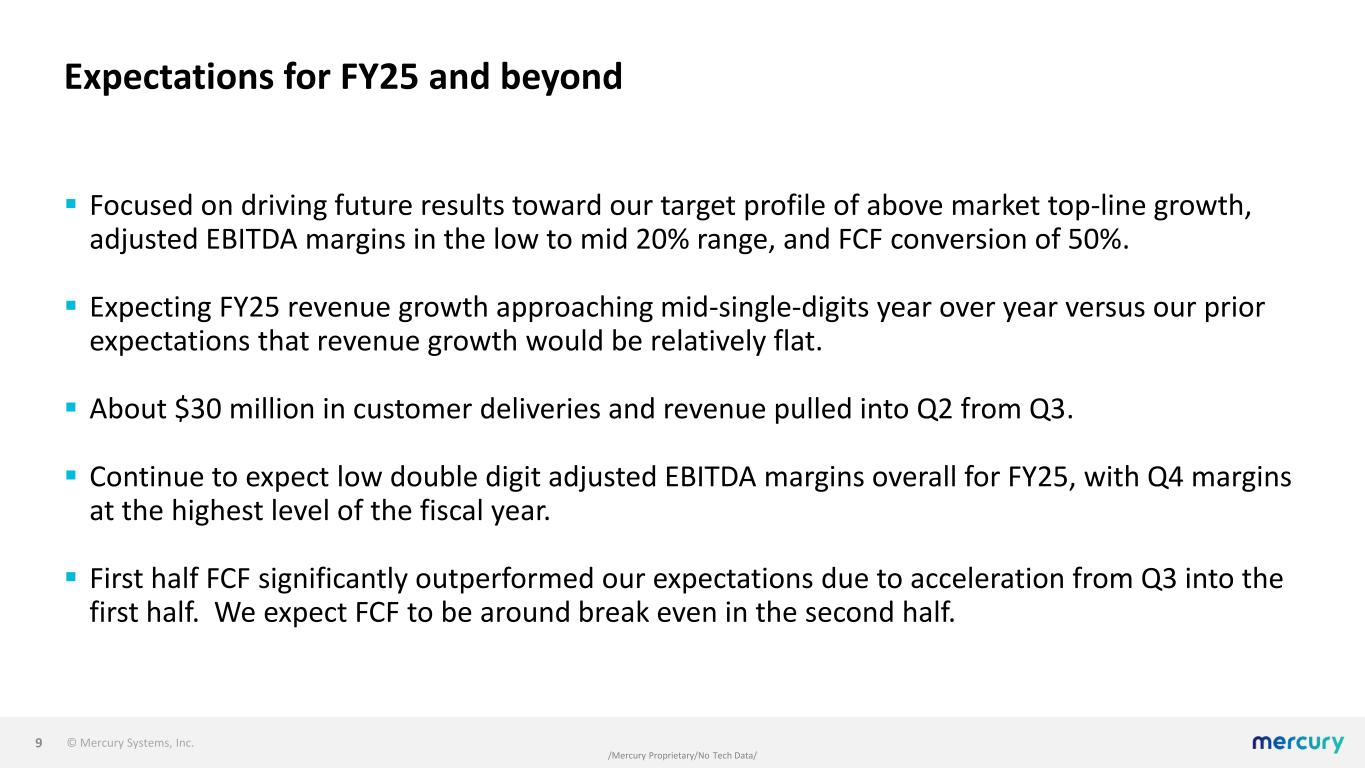
Thanks, Tyler. Good afternoon. Thank you for joining our Q2 FY 2025 earnings call. We delivered solid results in Q2 that were once again in line with or ahead of our expectations, and I'm optimistic about our ongoing efforts to improve performance as we move through the fiscal year. Today, I'd like to cover three topics: first, some introductory comments on our business and results; second, an update on our four priorities: delivering predictable performance, building a thriving growth engine, expanding margins, and driving improved free cash flow; and third, performance expectations for FY 2025 and longer term. Then I'll turn it over to Dave, who will walk through our financial results in more detail. Before jumping in, I'd like to thank our customers for their collaborative partnership and the trust they put in Mercury to support the most critical programs and our Mercury team for their dedication and commitment to delivering mission-critical processing at the edge. Please turn to slide 4. Our Q2 results reinforce my confidence in our strategic positioning and our expectations in delivering predictable organic growth with expanding margins and robust free cash flow. Bookings of $242 million and a trailing book-to-bill of 1.12, revenue of $223 million, up 13% year-over-year, adjusted EBITDA of $22 million and adjusted EBITDA margin of 9.9%, both up substantially year-over-year, and record free cash flow of $82 million, up $44 million year-over-year. We ended Q2 with $243 million of cash on hand. These results reflect continued progress in each of our four priority areas with highlights that include solid execution across our broad portfolio of production and development programs, a record backlog of $1.4 billion, reduced operating expense, enabling increased positive operating leverage and continued progress on free cash flow drivers with net working capital down $115 million year-over-year or 19.5%. Please turn to slide 5. Starting now with our four priorities and priority one: delivering predictable performance. In the second quarter, our focus on predictable performance positively impacted our results primarily in three areas. First, we continue to make progress mitigating what we believe to be predominantly transitory impacts as discussed over the last several quarters. In Q2, we recognized approximately $4.4 million of net EAC change impacts across our portfolio, which is the lowest in the last few years and reflects the progress we are making in maturing our processes and program management, engineering, and operations. Second, we continue to make progress in the quarter, ramping production in our common processing architecture product area. We expect to have our full capacity become available as we move through the second half of the year. This progress is enabling follow-on production awards as we discussed last quarter and led to a notable takeaway in Q2 from a processor board competitor that wasn't able to meet the security requirements provided by our common processing architecture. This reflects our ability to take share in this attractive market segment based on our technology leadership position. And third, our focus on accelerating customer deliveries generated a $29 million or 31% year-over-year increase in point-in-time revenue, the majority of which was driven by pull-forward deliveries and revenue from Q3. Please turn to slide 6. Moving on to priority two: driving organic growth. Solid Q2 bookings of $242 million resulted in a record backlog of $1.4 billion. In line with our expectations, over 80% of trailing 12-month bookings were production in nature, which has driven a mix shift toward production. In line with this shift, we recently announced a workforce restructuring to align our team composition with this increased production mix. Some wins in the quarter are worth noting: a development contract from a US defense prime contractor where we will replace and upgrade a competitor's existing processing capabilities with a solution leveraging our common processing architecture. Our additional protection features enable the system to be eligible for export to allied nations to support forward-deployed operations. A $24.5 million contract to develop a data processing and storage subsystem for a US Defense Department satellite program. Under this contract with an innovative space systems prime contractor, we will deliver a number of subsystems that leverage our commercial products and deep expertise in data recording, data processing and subsystem integration for defense applications. Two awards with Naval Air Systems Command: a $16.5 million delivery order for data transfer units and a $14 million contract option for high-definition video recorders that support US and allied military aircraft and follow-on production awards for two long-running US Navy programs of record supported by multiple lines of business, and two key US Air Force programs of record where Mercury is the sole source provider of memory modules. These awards are important not only because of their value and impact on our growth trajectory, but also because they reflect those customers' trust in Mercury to support their most critical franchise programs. We know from engagements with our customers that our unique capabilities providing mission-critical processing at the edge align well with their priorities and what we believe is strong demand in growth markets, including sensors and effectors, electronic warfare, avionics, C4I, and space. All in all, Q2 was a good bookings quarter with multiple competitive wins where we believe we are growing share based on our technical differentiation. Please forward to slide 7. Now turning to priority three: expanding margins. As we've discussed in prior calls, in our efforts to achieve our targeted adjusted EBITDA margins in the low to mid-20% range, we are focused on the following levers: executing on our development programs and minimizing cost growth impacts, getting back toward a more historical 20-80 mix of development to production programs, driving organic growth to generate positive operating leverage, and achieving cost efficiencies. Q2 adjusted EBITDA margin of 9.9% was in line with our expectations and indicative of progress on each of these levers in our effort to reach our targeted margins over time. Gross margin of 27% was in line with our expectations and largely driven by the average margin in our backlog coming into FY 2025. As we've discussed over the last two quarters, our backlog margin coming out of FY 2024 was lower than what we expect to see on a go-forward basis, driven primarily by a small number of low-margin development programs and programs that incurred adverse net EAC change impacts in FY 2024. We expect backlog margin to increase going forward as we continue to bring in new bookings as we did once again in Q2 that we believe will be in line with our targeted margin profile and accretive to the current average margin in our backlog. Operating expenses, specifically R&D and SG&A, are down significantly year-over-year as a result of prior and ongoing actions to streamline and focus our operations. As expected, R&D levels increased sequentially in the quarter. Please forward to slide 8. Finally, turning to priority four: improve free cash flow. We continue to make significant progress on the drivers of free cash flow and in particular, in reducing net working capital, which at $475 million is at the lowest level since Q3 of FY 2022. Notably, combined free cash flow over the last three quarters is approximately $122 million, and net debt is down to $349 million, the lowest level since Q2 of FY 2022. We believe our continuous improvement related to program execution and hardware delivery, just-in-time material, and appropriately timed payment terms will lead to continued reduction in working capital and improved free cash flow performance going forward. Please turn to slide 9. Looking ahead, I am optimistic about our team, our leadership position in delivering mission-critical processing at the edge, and our expected ability over time to deliver results in line with our target profile of above-market top line growth, adjusted EBITDA margins in the low to mid-20% range, and free cash flow conversion of 50%. As we discussed last quarter, although we will not be providing specific guidance for FY 2025, I will update the color we previously discussed. First half revenue up 13% year-over-year, exceeded our expectation that the first half would be in line with last year. The over-performance was largely driven by the acceleration of about $30 million in customer deliveries and revenue into Q2 from Q3. For full year FY '25, we now expect revenue growth approaching mid-single digits year-over-year versus our prior expectation that revenue growth would be relatively flat. As we discussed last quarter, our current backlog margin is lower than what we expect to see on a go-forward basis, driven primarily by a small number of low-margin development programs and programs that incurred adverse net EAC change impacts in FY '24. Although we are encouraged that our recent quarter bookings are accretive to our overall backlog margin, we continue to expect low double-digit adjusted EBITDA margins overall for FY '25, as we complete lower-margin development efforts and continue to shift our mix toward production. We expect Q4 adjusted EBITDA margins to be the highest level of the fiscal year. Finally, with respect to free cash flow, we continue to expect to be cash flow positive in FY '25. Given the large acceleration of cash from Q3 into the first half and first half free cash flow of $61 million, which is well ahead of our prior expectations, we expect free cash flow to be around breakeven in the second half. In summary, given the operational improvements over the last several quarters and our recent momentum, I expect that our performance in FY '25, in particular, our exit run rate will represent a positive step toward our target profile. Given our progress in the first half and our momentum heading into the second half, I look forward to providing additional insights relative to our expectations for full year performance as we progress through the back half of the year. With that, I'll turn it over to Dave to walk through the financial results for the second quarter, and I look forward to your questions.
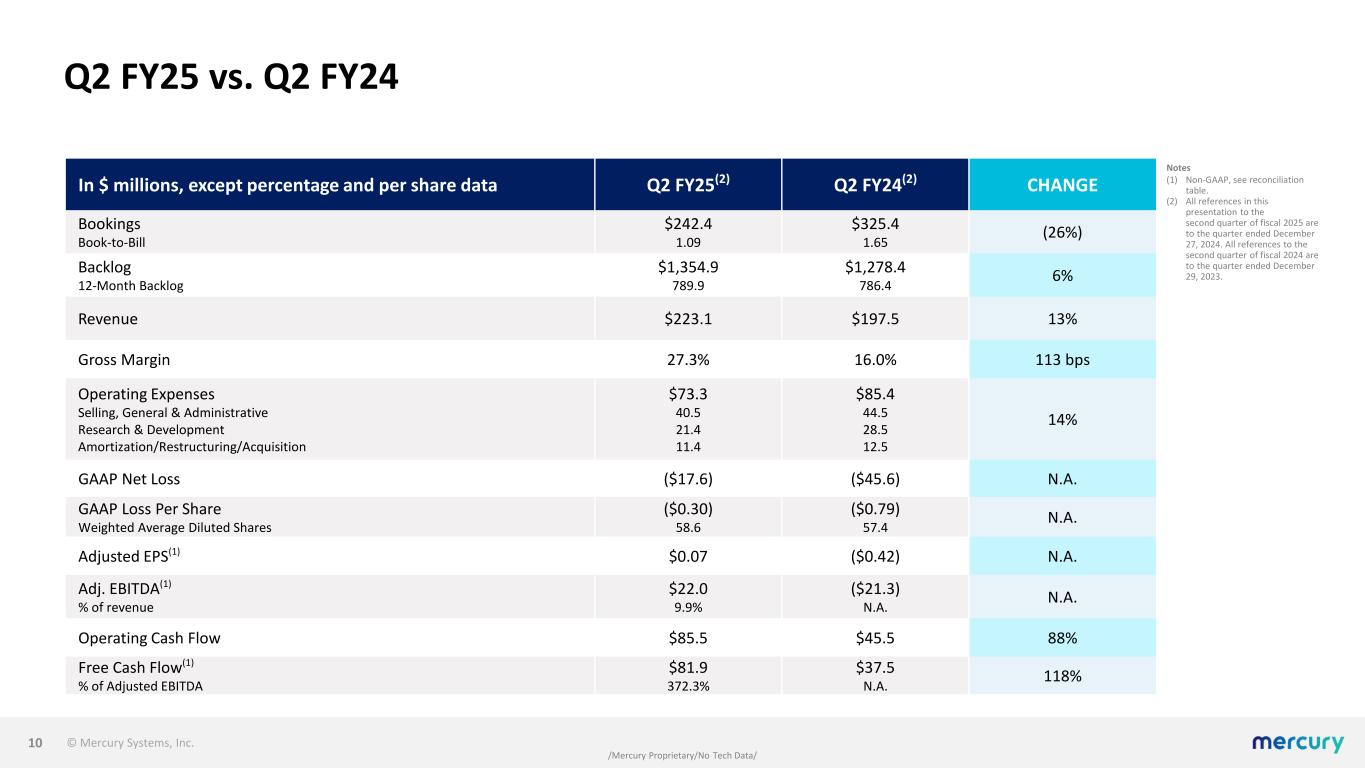
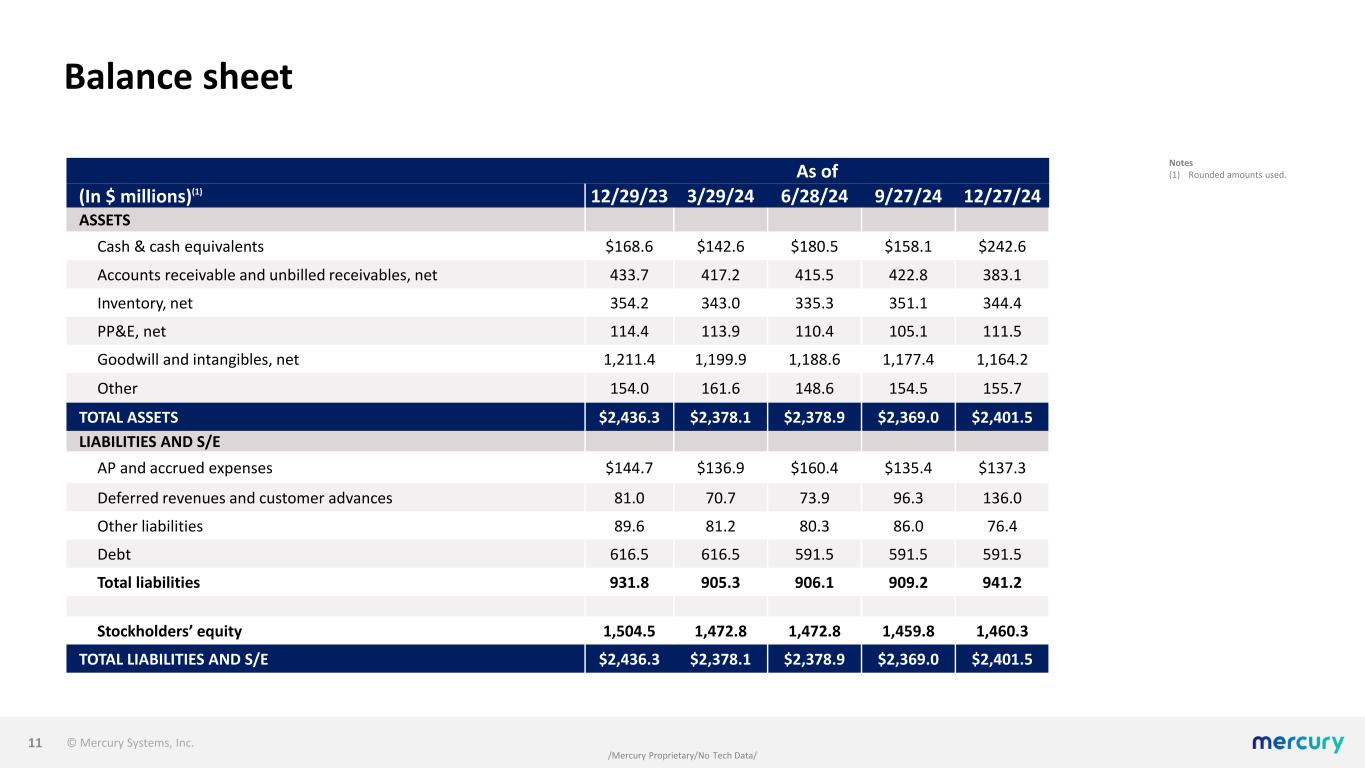
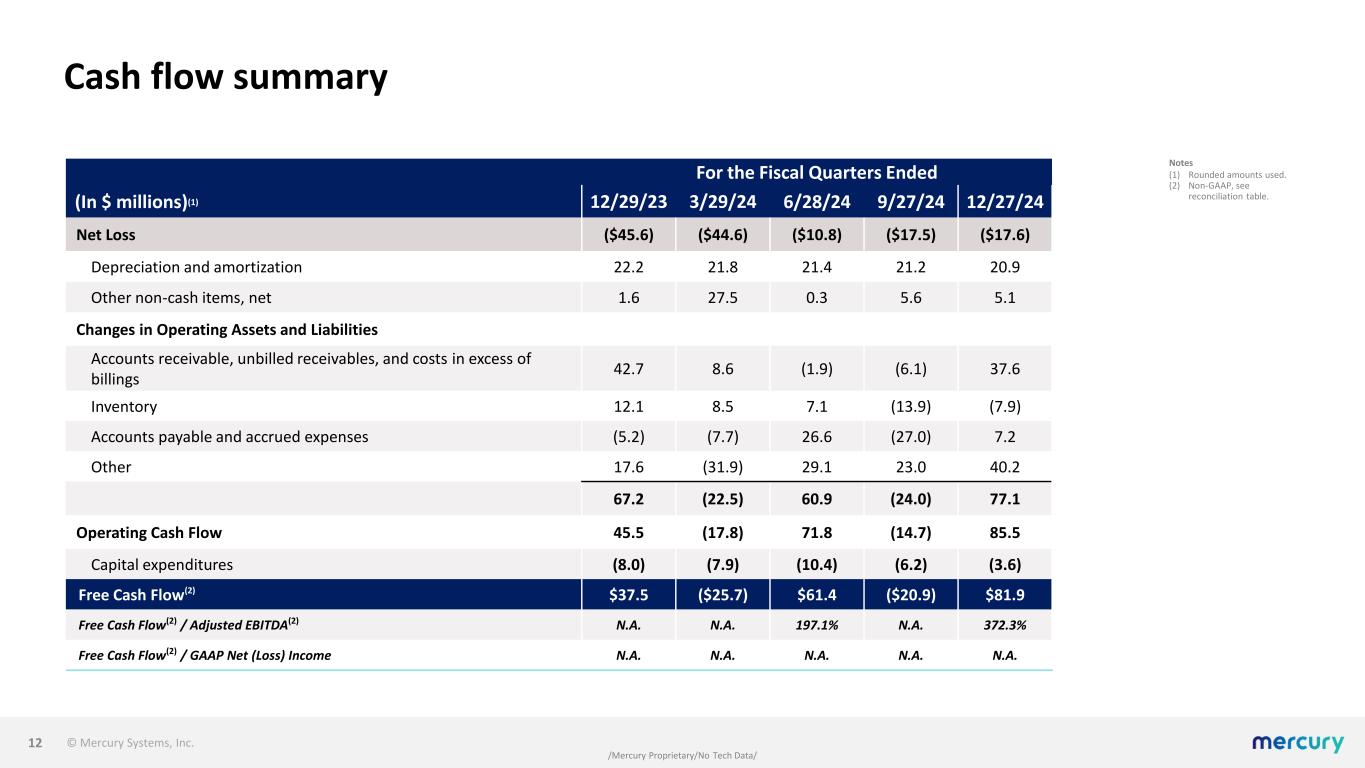
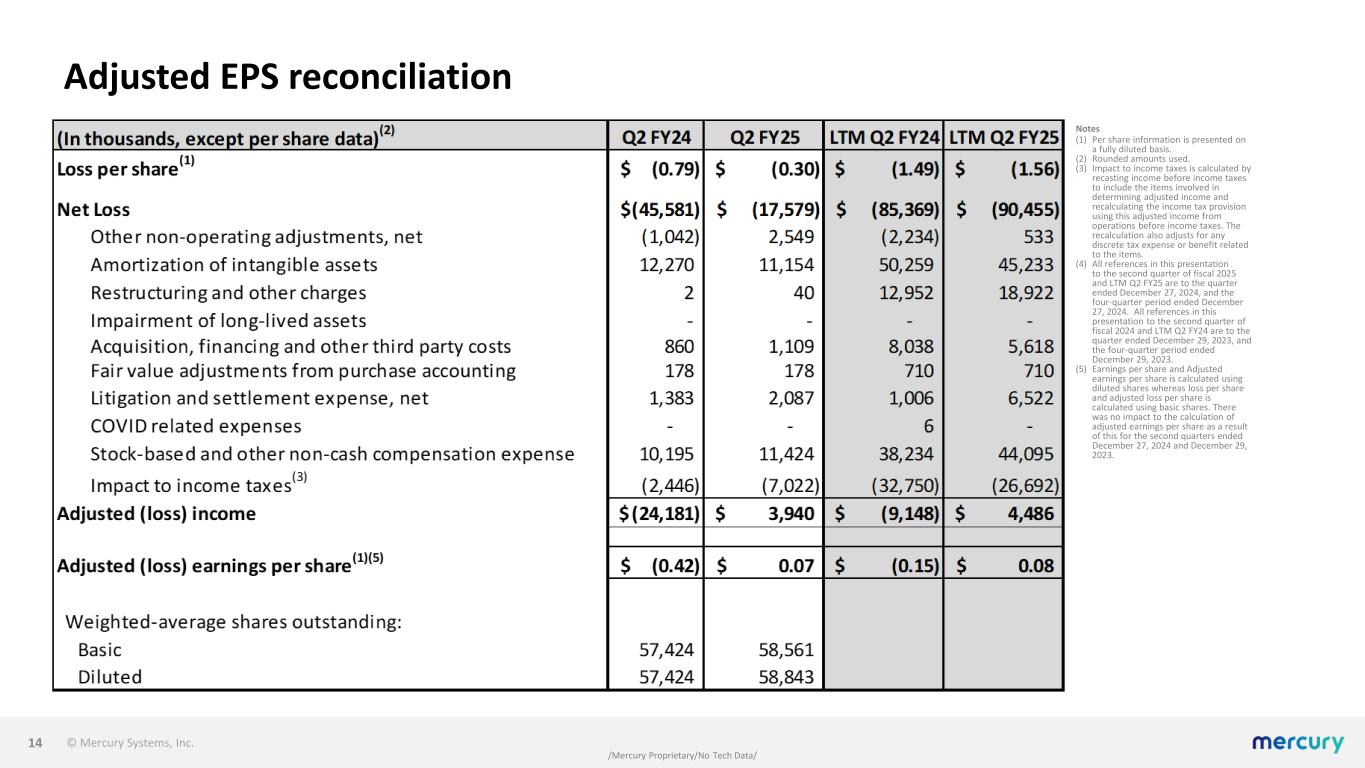
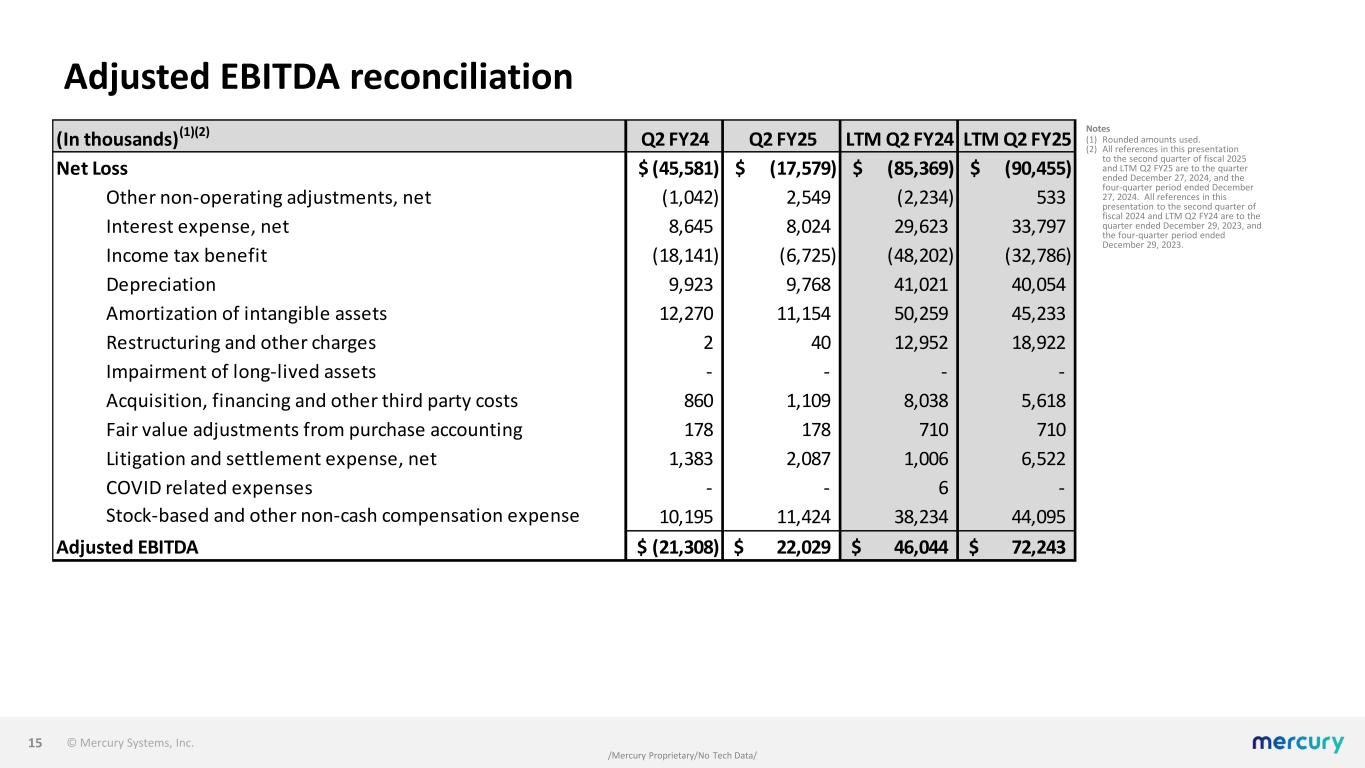
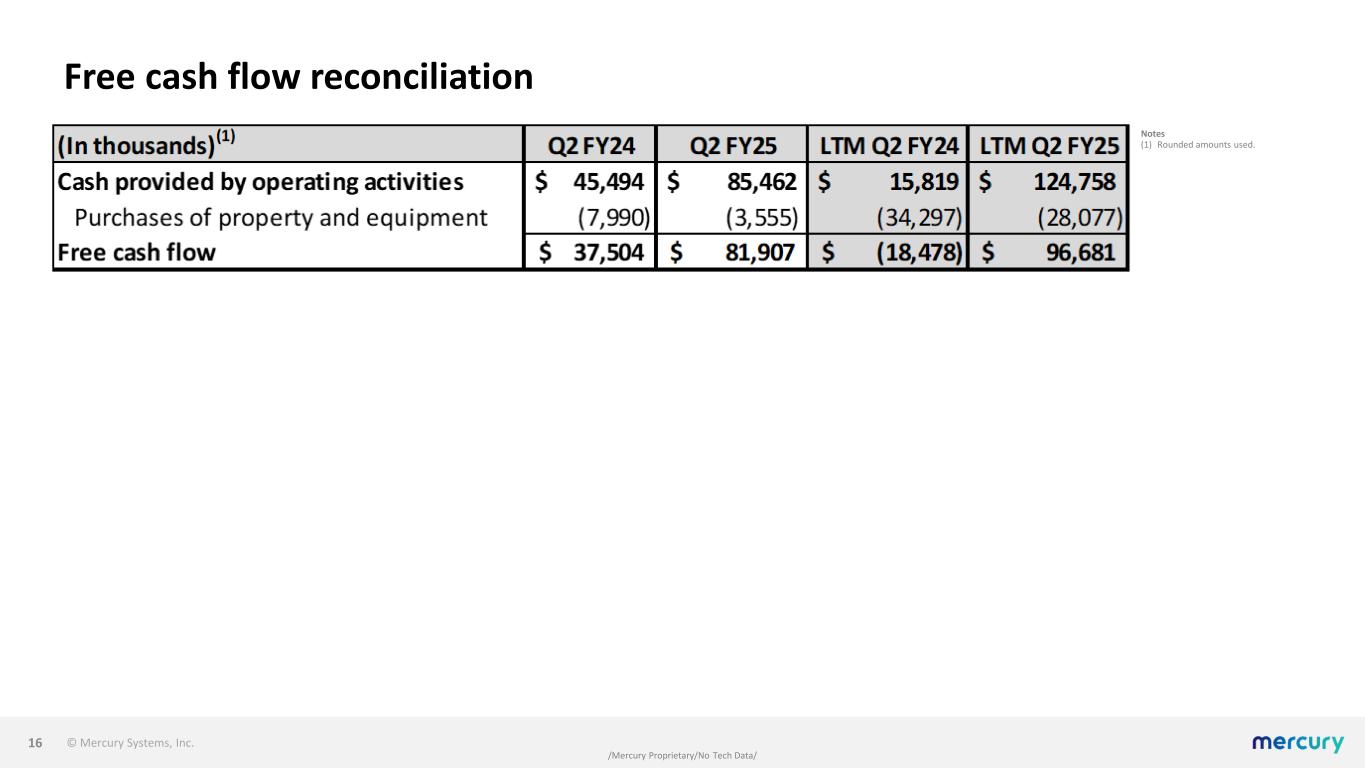
Thank you, Bill. Our second-quarter results reflect solid progress toward our goal of positioning the business to deliver predictable performance characterized by organic growth, expanding margins, and robust free cash flow. There is still work to be done, but we are encouraged by the progress we have made and expect the second half of fiscal 2025 revenue and adjusted EBITDA margins to improve over the first half. Our continued progress in our priority areas is highlighted by a few key milestones that we achieved during the second quarter. This includes delivering improved operating performance, making additional progress in ramping production in our common processing architecture product area, and continuing to expand our record backlog. With that, please turn to Slide 10, which details our second-quarter results. Our bookings for the quarter were $242 million with a book-to-bill of 1.09, yielding a backlog of $1.4 billion, up $77 million or 6% year-over-year. Revenues for the first quarter were $223 million, up $26 million or 13% compared to the prior year. The increase is primarily driven by higher point-in-time revenue of $29 million, largely accelerated from Q3 as we continue to focus on delivering for our customers. Gross margin for the second quarter increased to 27.3% from 16% in the same quarter last year. The increase in gross margin during the current quarter was primarily driven by a reduction in the net EAC change impact on our programs recognized over time to $4 million as compared to $31 million in the same quarter last year and lower inventory reserves of approximately $12 million. These improvements in gross margin were partially offset by higher manufacturing adjustments of approximately $4 million. As Bill previously noted, we expect to see an improvement in our gross margin performance over time, as the average margin in our backlog improves, resulting from newer awards at targeted margins. Operating expenses decreased approximately $12 million year-over-year, primarily due to lower R&D and SG&A expenses. These decreases were driven by the actions taken in fiscal 2024 to improve our performance by consolidating and simplifying our operations. GAAP net loss and loss per share in the second quarter were approximately $18 million and $0.30, respectively, as compared to GAAP net loss and loss per share of $46 million and $0.79, respectively, in the same quarter last year. The improvement in year-over-year earnings is primarily a result of increased revenue and the associated gross margin, coupled with reduced operating expenses. Adjusted EBITDA for the second quarter was approximately $22 million compared to negative $21 million in the same quarter last year. Adjusted earnings per share were $0.07 as compared to adjusted loss per share of $0.42 in the prior year. The year-over-year increase was primarily related to lower net losses in the current period as compared to the prior year period. Free cash flow for the second quarter was a record of nearly $82 million as compared to approximately $38 million in the prior year. The significant increased cash flow was primarily driven by the improvement in cash provided by operating activities of approximately $40 million in the current year as compared to the prior year. Slide 11 presents Mercury's balance sheet for the last five quarters. We ended the second quarter with cash and cash equivalents of approximately $243 million, driven primarily by approximately $85 million in cash provided by operations and investments of approximately $4 million in capital expenditures. Billed receivables decreased approximately $20 million or 16% sequentially. Unbilled receivables decreased year-over-year and sequentially by approximately $72 million or 21%, and $20 million or 7%, respectively. These decreases reflect the incremental progress we've made by delivering on programs to our customers, which significantly drove our cash flow performance during the current quarter. Inventory decreased slightly year-over-year and sequentially by approximately $10 million and $7 million, respectively. The current quarter balance also included approximately $15 million of material receipts, supporting milestone invoicing, which largely drove the increase in our deferred revenue of nearly $40 million. These material receipts partially offset our decrease in inventory from accelerated point-in-time revenue. This increase in milestone invoicing activity reflects the progress we've made to better align the payment structure of our contracts to match the corresponding cash outflows of these arrangements. Accounts payable decreased approximately $10 million sequentially, driven by the timing of payments to our suppliers. Accrued expenses decreased approximately $2 million sequentially, primarily due to payments under our restructuring taken in fiscal 2024. Deferred revenues increased year-over-year and sequentially by approximately $55 million and $40 million, respectively, as a result of additional milestone billing events achieved during the period. Working capital decreased in the second quarter approximately $115 million year-over-year or 20% and decreased by $89 million or 16% sequentially. This demonstrates the progress we've made in reversing the multiyear trend of growth in working capital, highlighted by five quarters of sequential reductions in unbilled receivables, resulting in the lowest net working capital since Q3 fiscal 2022. As a reference point, we have driven our net working capital in the last three quarters from a high of 72% of trailing 12-month revenue to under 54%. Net working capital remains a primary focus area, and we believe we can continue to deliver improvement. Turning to cash flow on Slide 12. Free cash flow for the second quarter was approximately $82 million as compared to $38 million in the prior year. We believe our continuous improvement related to program execution and hardware delivery, just-in-time material, and appropriately timed payment terms will lead to continued reduction in working capital improved free cash flow performance going forward. In closing, we are pleased with the first half performance for the fiscal year and the higher level of predictability in the business. We believe continuing to execute on our four priority focus areas will not only drive revenue growth and profitability, but will also result in further margin expansion and cash conversion, demonstrating the long-term value creation potential of our business. With that, I'll now turn the call back over to Bill.
Thanks, Dave. With that, operator, please proceed with the Q&A.
Operator
Thank you. Your first question comes from Pete Skibitski with Alembic Global. Your line is open.
Speaker 4
Hi, good evening, guys. Great quarter. It looks like even excluding the pull forward revenue, it was still a strong quarter, especially on the cash flow side. So Bill, I'll ask a question I've asked before, but maybe this is the last time I need to ask it. Just can you talk about the progress in the second quarter on the CPA processes and programs in terms of the maturity there? Is there any kind of technical risk that remains at this point? Or is it just a matter of slowly ramping from low rate to full rate production on the programs?
Yes, Pete. Thanks. Well, first of all, thanks for the comments upfront. I would characterize our progress on CPA as planned and consistent with what we discussed previously, we are ramping the full-rate production. We expect to get our capacity to be fully available as we move through the back half of the year. And of course, how we use that capacity will benefit the business in a number of ways. We've already seen as we brought production online that we've received significant production awards. We talked about that in Q1. We had a really nice takeaway from a competitor based on our technical differentiation this quarter. That's been another benefit. And as we progress through the second half, we'll be able to allocate that capacity to drive revenue performance and deliver for our customers on new awards and continue to burn down unbilled balances where we have receivables on older contracts. So continued progress all sort of normal course at this point and very much progressing to plan and consistent with what we've discussed previously.
Speaker 4
Okay. That's great. Just one more for me. As you guys build confidence in that system, can you talk about order flow? Backlog has kind of inched upward in the first half of the year. How are you expecting order flow to trend in the second half of the year? Should that accelerate? Or kind of in conjunction, how is the continuing resolution impacting order flow? Thanks.
Yes. I don't get too granular in focusing on orders by quarter because like cash, it can be a little bit lumpy. I do think that our trailing 12-month book-to-bill of 1.12 is reflective of solid performance. And as we're looking forward, we still feel really confident about not only our strategic positioning, which we've talked about consistently, but also the enduring demand drivers and the need for mission-critical processing at the edge. So, all-in-all, I feel very optimistic about that outlook. Our trailing 12-month book-to-bill is solid at 1.12, and I think it positions us well for the second half of the year.
Speaker 4
Great. Thank you very much.
Operator
Your next question comes from the line of Peter Arment with Baird. Your line is open.
Speaker 5
Good afternoon, Bill and Dave. Tyler, welcome to the call. Congratulations on the quarter. Clearly, there has been significant progress made. I would like to clarify the comments regarding free cash flow breakeven in the latter half of the year. It appears you've made considerable strides in reducing the unbilled amount, which we saw evidence of this quarter. However, there is also deferred revenue growth to consider. I'm curious if this is related to the new contract structure and the receipt of milestones. Dave, could you explain the dynamics behind the lack of positive cash generation in the second half?
Yes. And as we said, Peter, when we looked at the first half, our cash was ahead of where we were expecting, and some of that was driven by the milestones that we were able to achieve that drove, as you saw, a significant increase in our deferred revenue based on the timing of those milestones. So, those milestones as we work through the second half will be performing effort against that cash that we've already received. So, we expect to see the deferred revenue come down as we get through the back half of the year. It does not mean that unbilled won't continue to be something that we're working aggressively on. But we do expect to see a material drawdown of that deferred revenue that was brought in those milestones that were completed earlier.
Speaker 5
Appreciate that. I'll jump back in the queue. Thanks.
Operator
The question comes from the line of Ken Herbert with RBC Capital Markets. Your line is open.
Speaker 6
Hey, good afternoon Bill and Dave. You consistently talked now about the longer-term opportunity to get adjusted EBITDA margins back into the low 20s range. Can you provide, without getting maybe too specific on timing, how does the business look when you get to that level? Is there a way we should think about that from a revenue standpoint and from an efficiency standpoint? Can you provide any more sort of parameters around how you think about that maybe from a timing standpoint or just operationally as you think about the business moving forward?
Thank you for the question. This is Bill, and I’ll address it. We have consistently discussed our key focus areas over the past several quarters, and we’ve made progress in each of these areas. As we look ahead to achieving our target margins, there are two main aspects we’re concentrating on. First, it’s the conversion of our backlog margin, which we noted was lower at the end of FY 2024 than we expect moving forward. This was influenced by a few low-margin development programs and some projects affected by EAC adjustments in FY 2024. As we continue to progress each quarter and secure new bookings, we’re pleased to observe that the margins on those bookings align with our target EBITDA margins. This will develop over time. While we haven't specified when we expect our backlog margin to align with our target margins, we have a timeline associated with our backlog that gives an idea of how it may turn over. That’s the first factor. The second factor regards our operating expenses, which we aim to manage for positive operating leverage as we increase volume. I believe we’ve made substantial progress in the past 18 months regarding our operating expenses. We will keep focusing on driving efficiencies in the business moving forward, and I am confident about our current operating expenses in relation to the positive operating leverage we expect as we work towards our target margins.
Speaker 6
Thanks for all the detail, Bill.
Operator
The next question comes from Seth Seifman of JPMorgan. Your line is open.
Speaker 7
Hey, thanks very much and good afternoon, and nice quarter. I guess just in thinking about the growth rate, you talk about above market. Maybe just to put some parameters around that. When you think about what market is, do you think about it kind of as the defense budget, which I think a lot of people think about maybe a low to mid-single-digit growth over time? Do you think about it as a subset of the defense market that might be growing faster? And then the second part of that question is, the common processing architecture and when you're fully ramped up there, what role that plays in the mix and how that plays into your thoughts about the overall growth rate of the business as we look out over let's say a one to three-year period?
Yes. So as we've discussed before, we're focused on delivering top-line growth that represents a growth rate above the market growth rate. Specifically, the market that we're focused on is the defense electronics, Tier 3 defense electronics market with growth rates that are historically in the 5% to 6% range. And we believe for a number of reasons, in particular, when we focus in on the subsegments of that market where we're well-positioned and we focus; and in particular, that's around delivering processing power and capability to the edge, those subsegments tend to grow a little bit faster, and we feel like we're very well positioned based on our technical differentiation to deliver growth that exceeds those market growth rates. So that's really what we mean when we talk about our targeted growth rate. With respect to the common processing architecture, as we've worked through the technical challenges in that area and gotten those behind us and then ramped to full-rate production, it impacts our business in a number of different ways positively. First, it unlocks bookings because a number of customers were holding back follow-on development and production awards until we had demonstrated we got to root cause, eliminated the technical risk, and then ramped up production. So it's opened up new production awards. It also now gives us the opportunity with the capacity becoming available to allocate that capacity in the manner that makes the most sense. And that could be either burning down backlog and delivering new units and revenue that goes with it, or allocating the capacity to more legacy programs that represent our unbilled balances that when we deliver those units, there's less revenue associated with those units because the revenue has been recognized in prior periods, but it allows us to deliver the units, invoice our customers, and collect cash. So having that capacity online gives us a number of different degrees of freedom to drive performance and have it flow through our P&L into our cash flow statement and into the balance sheet. So hopefully, that's helpful.
Speaker 7
Yes, absolutely. Thank you.
Operator
The next question comes from Jonathan Ho with William Blair. Your line is open.
Speaker 8
Hi. Let me echo my congratulations as well. I just wanted to get some additional color on what drove the $30 million in pull-forward contract activity. Was this concentrated in a handful or a single program? And was there a customer impetus or government directive to drive earlier deliveries?
Yes. Thanks, Jonathan. Thanks for the comment upfront and the question. For 18 months, we've been very consistent in the prioritized focus of the business with priority one being a focus on delivering predictable performance. Looking backward, a lot of that effort was focusing on completing the large mix of development programs in our portfolio, but it also includes a relentless focus on delivering for our customers. So a lot of what you've seen in our results for both Q1 and in Q2 is a byproduct of our team being relentless on delivering for our customers. That shows up in two ways: it's delivering out of our backlog on new awards, and delivering hardware associated with that backlog, getting it out the door, as well as working down our unbilled balances. In this quarter, really the overperformance was tied to point-in-time revenue, and those were on programs and for products where based on that focus on delivering for our customers, we're able to pull to the left from our initial expectations. And that's what really drove the shift into the quarter.
And Jonathan, I would add, it was not a single contract or a single customer. It was multiple different products and customer sets. And again, as Bill said, as we're improving our capacity in our operational facilities, we were able to pull some things that we thought we would not get delivery on and at this point in time, revenue is on delivery. We would not get revenue on and deliver in Q2. We were able to pull them forward out of Q3 and Q2, deliver them early, get them to our customers. So a positive all around.
And I think one of the things that was encouraging in the quarter is as we really focused our capacity, we were able to demonstrate both the pull forward of deliveries to drive revenue and at the same time, finish off programs and drive down our unbilled receivables. And I think that's really a credit to our team, the improvement in our management system and our focus on delivering for our customers.
Speaker 8
Excellent. Thank you.
Operator
The next question comes from Michael Ciarmoli with Truist Securities. Your line is open.
Speaker 9
Good evening, everyone. Thank you for the question. Great results. Bill or Dave, can you provide more clarity on the topic? It appears that the pull forward was primarily about basic operations and execution. When I hear "pull forward," it makes me think that if we removed it, your revenues would show a decrease year-over-year and sequentially. However, this doesn't seem to be the right interpretation. Looking at the latter half of the year, mid-single-digit revenue growth suggests a relatively stable sequential pattern. What factors will contribute to margin increases in this stable revenue environment, particularly in the fourth quarter? Is this related to the bookings coming in at the targeted margin rate?
Yeah. So let me start with the top line and the revenue movement within the period. And again, I don't want to get too granular on the revenue between quarters. But I do want to remind everyone that in Q1, we had some pull forward from Q2 into Q1 and then again from Q3 into Q2. Now if you kind of normalize the volume and where it sits, it does sort of spread out the growth throughout the year to get a more balanced and consistent growth between the first half and the second half. And I think if you adjust that $30 million in your thinking, you'll see a more balanced growth rate across the full year. As far as the margin uplift in the fourth quarter, I think there's two things that are happening: yes, the dynamics in the backlog. We are seeing the roll forward of the lower-margin backlog being replaced with the new awards that are coming in, in line with our target margins. But as we saw last year, in the fourth quarter, we would expect to see some positive operating leverage with the increased volume that would be additive to our margins, and that's why we're expecting the fourth quarter to be the highest margins in the year. Hopefully, that makes sense.
Yeah. And I think there are two things that impact that backlog margin, as Bill discussed. One is, of course, the new bookings coming in and the margin rate on those bookings, and we said that it's been accretive as we've been going forward. And the other is the level of the margin on the contracts that we're actually performing and executing on. And we've talked about some of the contracts that we're completing and moving past those that were some of the lower-margin contracts. So those two phenomena act in concert with each other to naturally start to raise that backlog margin.
Speaker 9
Got it. Helpful. Thanks, guys.
Operator
Your next question comes from the line of Brian Gesuale with Raymond James. Your line is open.
Speaker 10
Hey, nice quarter. And thank you for taking my questions. I wanted to maybe just delve into this journey you're taking to remix the business from development to production work. Can you talk about where you're at in that journey? And then maybe give us a little bit of sensitivity on how the margins shift higher as development moves every 500 or 1,000 basis points?
Yes, we have discussed before the difference in margin rates between development and production contracts and how we approach that model. In the past, we've noted that the difference typically falls within a range of about 1,000 basis points. Our recent bookings align with our targeted margins. As Bill mentioned, our bookings over the last twelve months have been around 80% in production, indicating progress. This is partly due to wrapping up a significant number of development programs. It's important to understand that the current level of production shouldn't be viewed solely as a natural outcome of completing these development programs and securing follow-on production awards. We remain committed to pursuing new development opportunities and continuing our innovation efforts within the company. This trend in bookings is expected to continue for some time.
Speaker 10
Great. As a follow-up, how do you view the progression of your backlog towards your target margin? Specifically, how much of the margin increase from 10% to 20% or above is due to this natural shift in mix compared to other factors that Bill mentioned earlier?
Yes. I don't think we've broken out the individual components of that, so I wouldn't want to try and detail that.
Speaker 10
Okay. Fair enough. Thank you.
Operator
Your next question comes from Sheila Kahyaoglu of Jefferies. Your line is open.
Speaker 11
Great quarter, guys. Thanks for taking the time. I wanted to maybe start on free cash flow and just ask the $82 million of free cash flow in the quarter. I think it was your all-time high free cash flow in a quarter, let alone a year. So can we talk about how we bridge that free cash flow to what true free cash flow is, given you're implying breakeven in the second half? There was obviously some factoring in there and some benefit from other items. So maybe if you could just talk about how we should be thinking about the second half being breakeven and as we head into fiscal 2026?
Yes. I believe the key point is that we managed to accelerate cash flow into the second quarter. Our deferred revenue has increased by around $40 million, reflecting milestones we've reached ahead of completing all the associated work. As we move into the second half, we anticipate a decrease in deferred revenue as we finalize those projects. This change will balance out the cash we're generating from other programs. So, the $40 million is essentially a pull-forward from the latter half of the year. We're not viewing this as just breaking even in the second half; rather, we're aiming to offset that activity. We're also prioritizing reducing our net working capital, which is currently at its lowest level in several years, indicating we are making progress. This is not at the expense of revenue or margin, but rather a balanced approach. Our strategy for cash remains in line with our past statements. We expect to continue generating positive cash flow consistently and anticipate a positive cash position as we conclude the year, and we are slightly ahead of our initial expectations for the first half.
Speaker 11
Got it. Could we discuss the profitability profile? Any insights on production versus development margins? Also, could you elaborate on the competitive wins mentioned in the slides and how we should view their profitability?
Sure. I'll begin, and then Bill can discuss the wins. Historically, we've mentioned that production margins and development margins are roughly 1,000 basis points apart due to their different profiles. We've consistently observed this in our bookings, and the bookings we are currently receiving align well with our target model. Thus, the incoming bookings reflect the margins necessary for us to progress toward our ultimate business model.
And I'll just make a comment on the competitive wins. We had a number of head-to-head competitive wins in the quarter. I think a couple worth mentioning. One is on a US Defense Department satellite program with an innovative space systems provider. I think what's interesting about this pursuit is it was led by our Advanced Concepts group, which is a group we launched last year to focus on our next-generation technology and position us for next-generation type pursuits. They came up with a very innovative solution that actually leveraged existing products and work that we had done for other customers. We think it's right in line with an innovative development program with the right risk profile that will lead to production runs down the road. So it's exactly what we wanted to do with the Advanced Concepts Group and a really good success story. And then the second is the takeaway associated with our common processor architecture product line. As we've said before, this is an area where we see emerging demand, and we feel like we've got solid technical differentiation. This takeaway was a perfect example of that. It was a relatively entrenched competitor and incumbent providing a processing capability. The end customer was looking to upgrade the capability to include the functionality consistent with our common processing architecture. The incumbent couldn't meet those requirements; we could, and that was the basis of the takeaway and the development awards. So I think those are very notable, they're worth mentioning, and I think they're evidence of our ability to compete head-to-head and win based on the technical differentiation associated with the Mercury processing platform.
Operator
Mr. Ballhaus, it appears there are no further questions. Therefore, I would like to turn the call back to you for closing remarks.
Okay. Well, thanks, everybody for your participation. I would like to thank the Mercury team because it's people and teams that deliver the results that we talked through today, and the team had an outstanding quarter. We appreciate your participation, and we look forward to the update next quarter. Thank you.
Operator
This concludes today's conference call. We thank you for joining. You may now disconnect.