Operator
Good day, everyone, and welcome to the Mercury Systems Fourth Quarter Fiscal 2025 Conference Call. Today's call is being recorded. At this time, for opening remarks and introduction, I'd like to turn the call over to the company's Vice President of Investor Relations, Tyler Hojo. Please go ahead, Mr. Hojo.
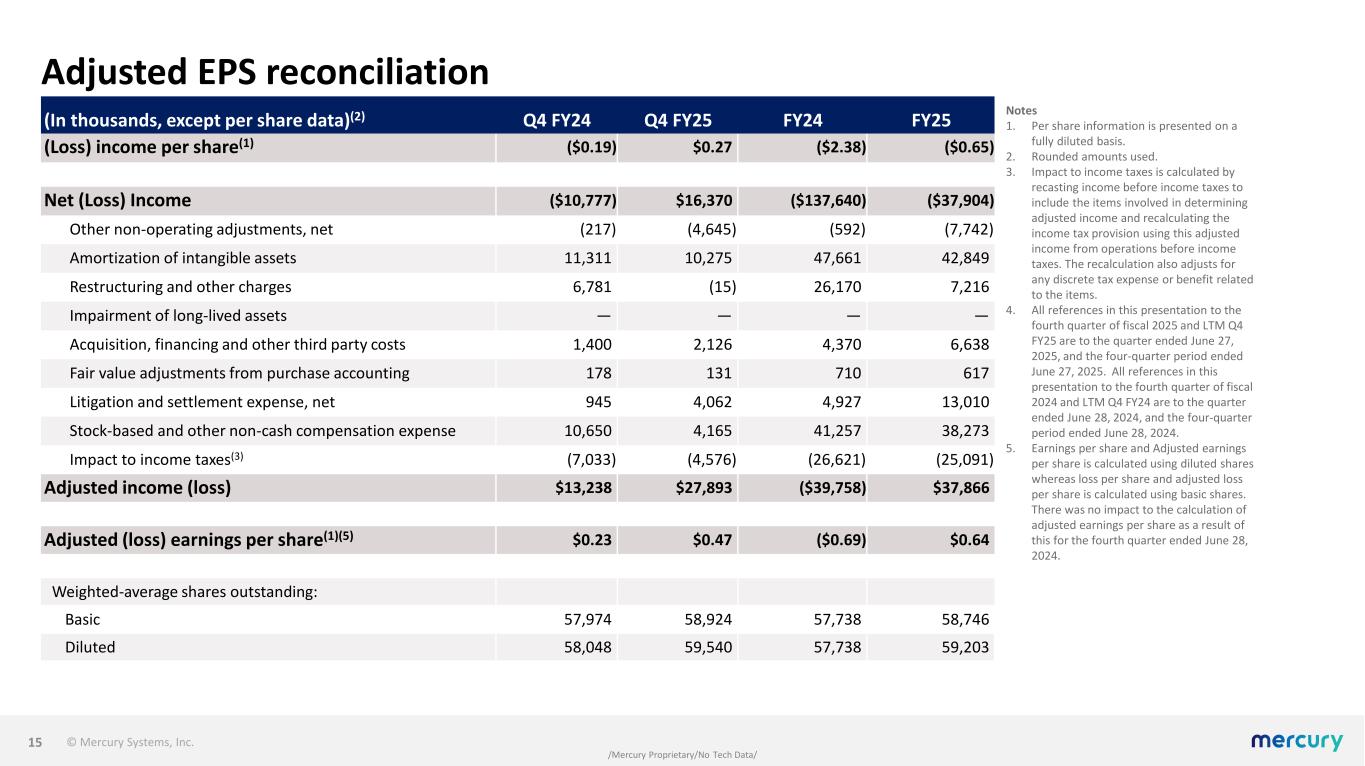
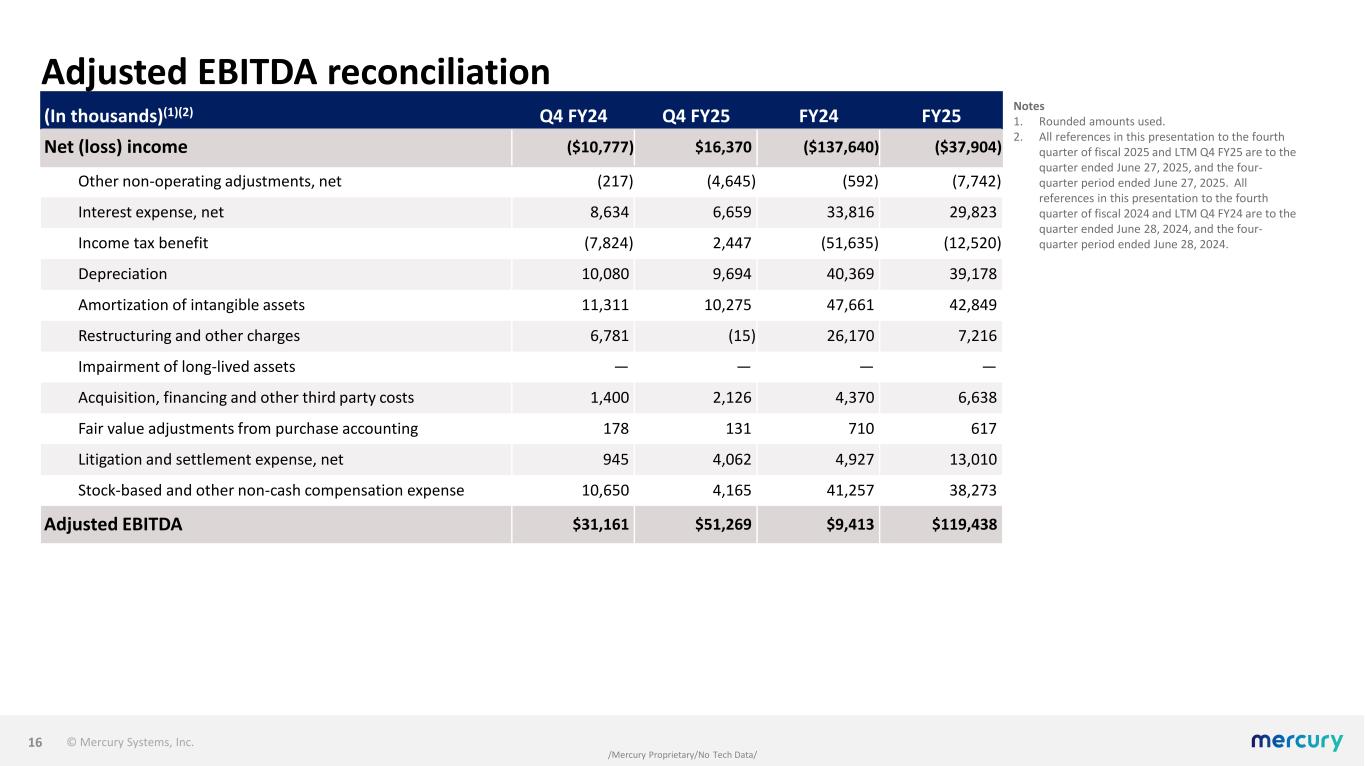
Good afternoon, and thank you for joining us. With me today is our Chairman and Chief Executive Officer, Bill Ballhaus; and our Executive Vice President and CFO, Dave Farnsworth. If you have not received a copy of the earnings press release we issued earlier this afternoon, you can find it on our website at mrcy.com. The slide presentation that we will be referencing is posted on the Investor Relations section of the website under Events and Presentations. Turning to Slide 2 in the presentation. I'd like to remind you that today's presentation includes forward-looking statements, including information regarding Mercury's financial outlook, future plans, objectives, business prospects, and anticipated financial performance. These forward-looking statements are subject to future risks and uncertainties that could cause our actual results or performance to differ materially. All forward-looking statements should be considered in conjunction with the cautionary statements on Slide 2 in the earnings press release and the risk factors included in Mercury's SEC filings. I'd also like to mention that in addition to reporting financial results in accordance with generally accepted accounting principles, or GAAP, during our call, we will also discuss several non-GAAP financial measures, specifically adjusted income, adjusted earnings per share, adjusted EBITDA, and free cash flow. A reconciliation of these non-GAAP metrics is included as an appendix to today's slide presentation and in the earnings press release. I'll now turn the call over to Mercury's Chairman and CEO, Bill Ballhaus. Please turn to Slide 3.
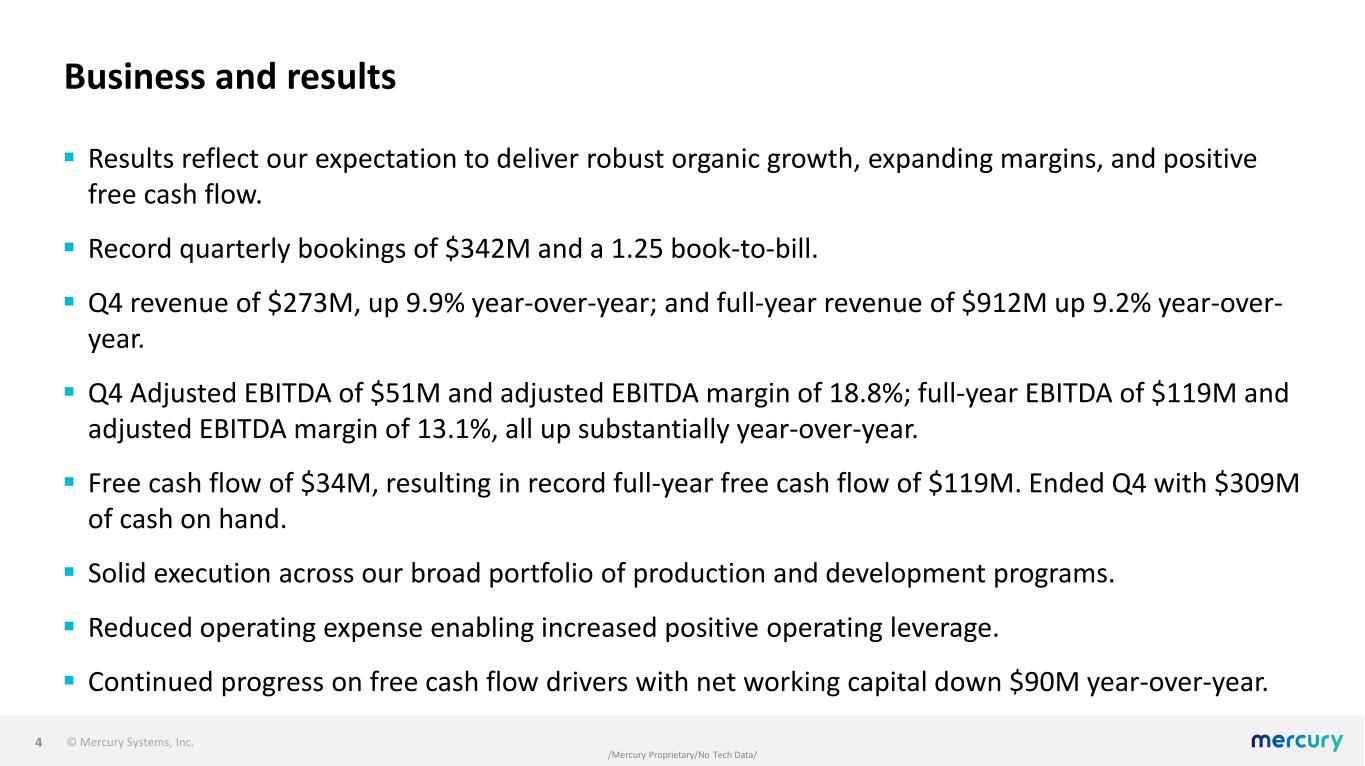
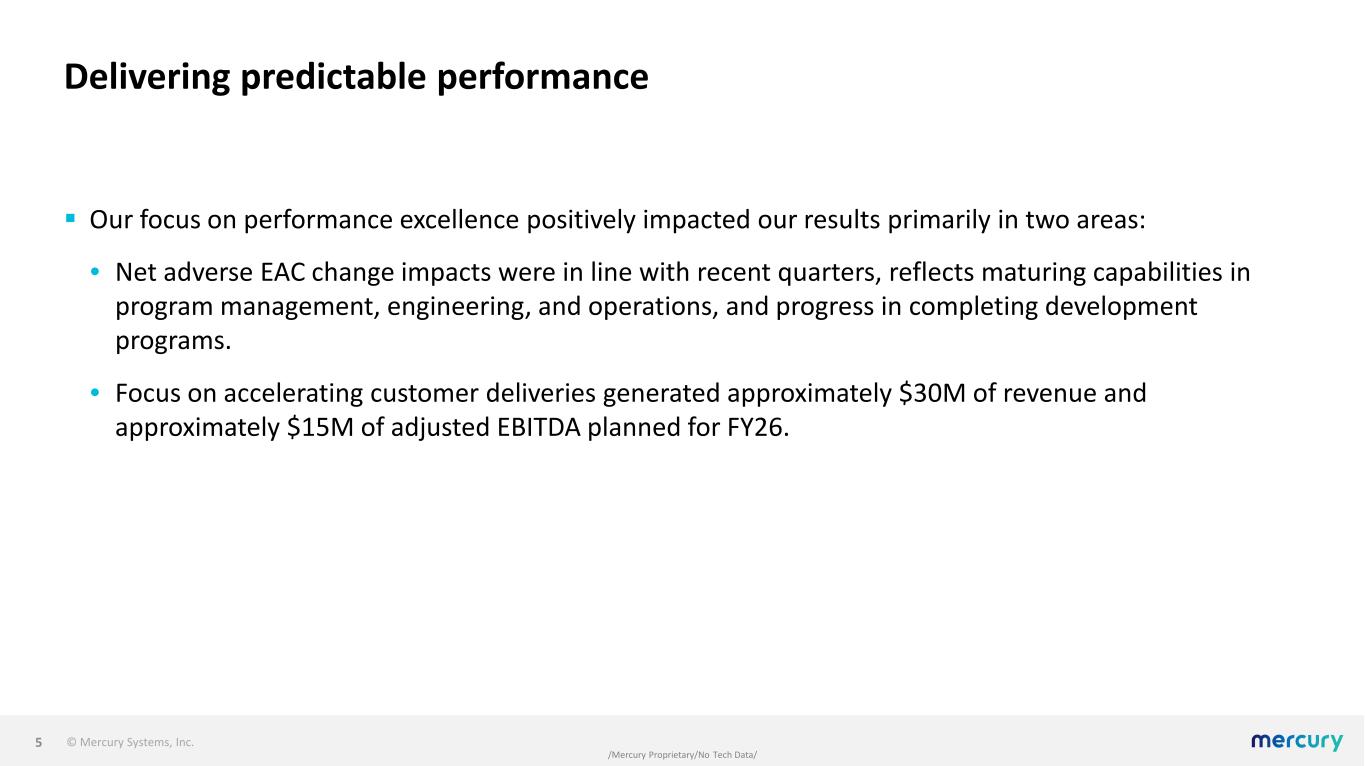
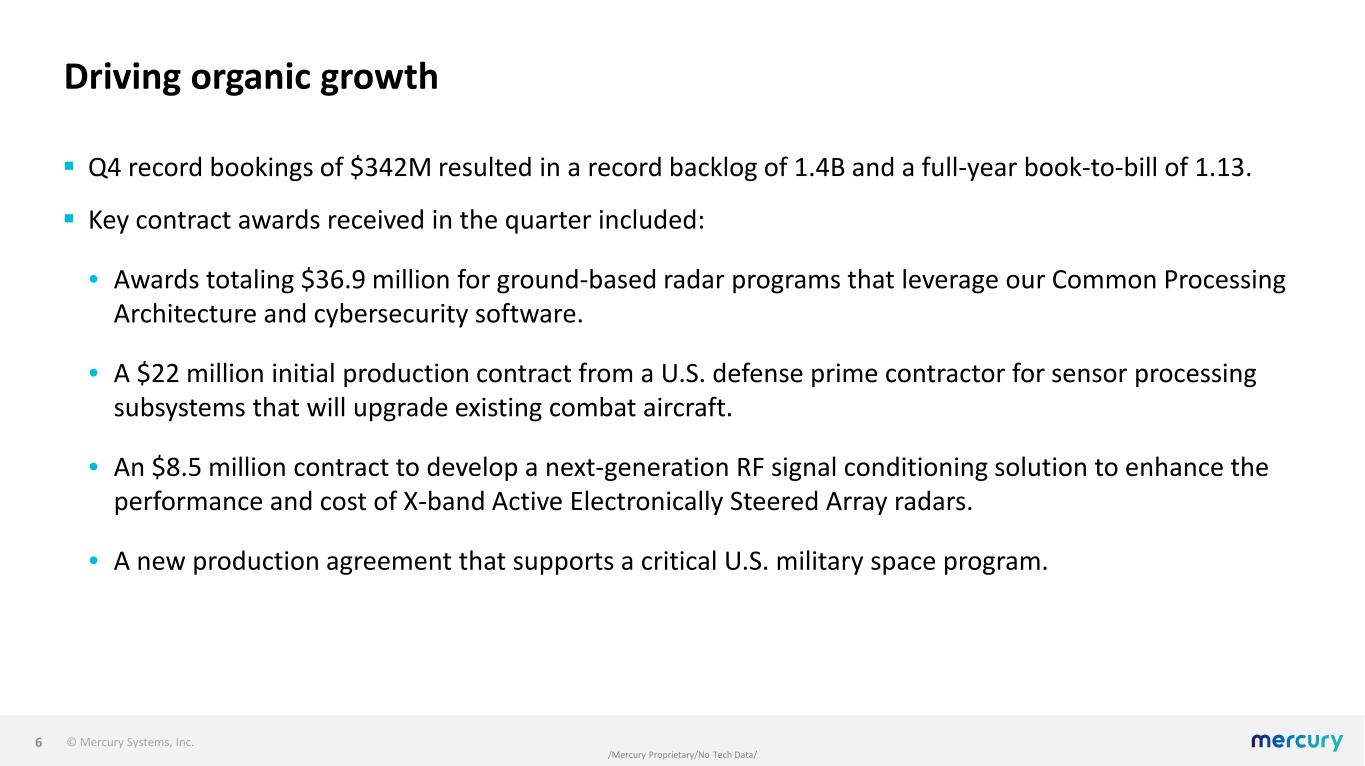
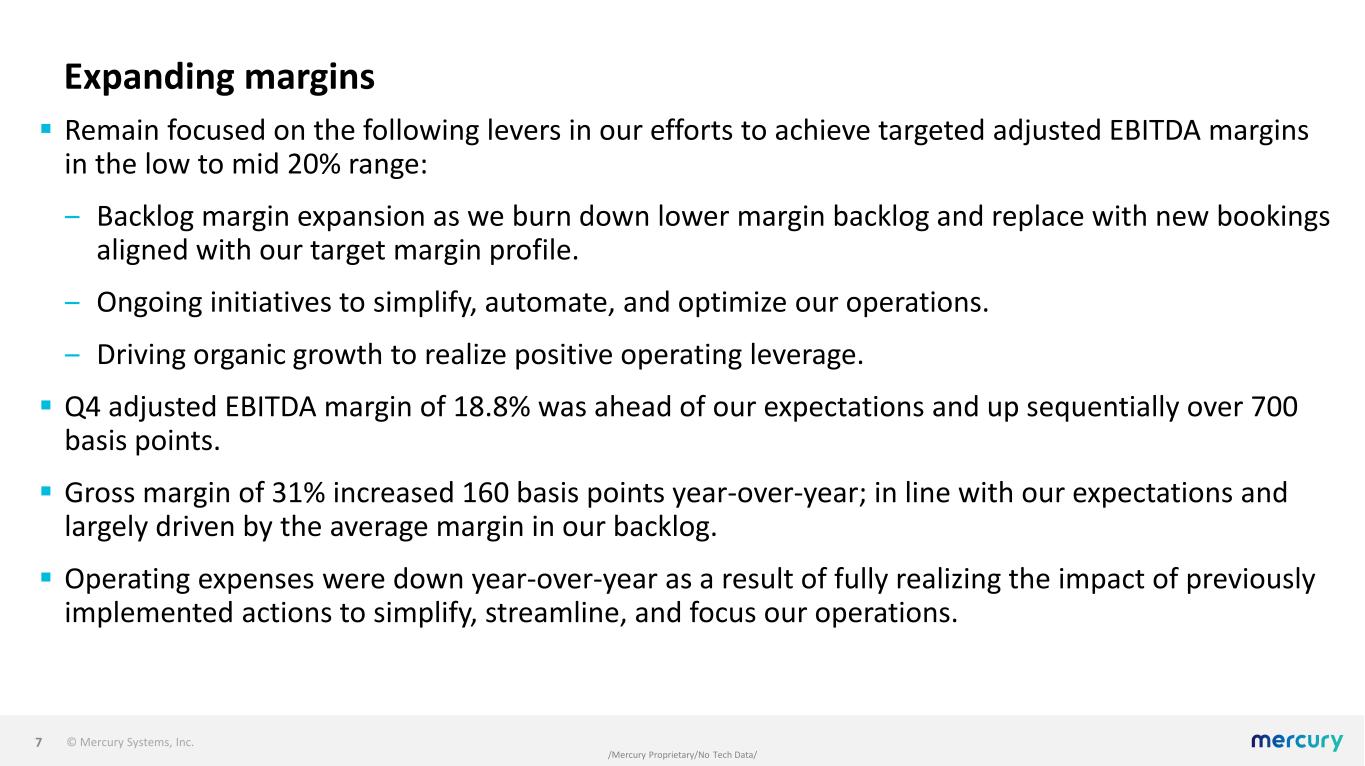
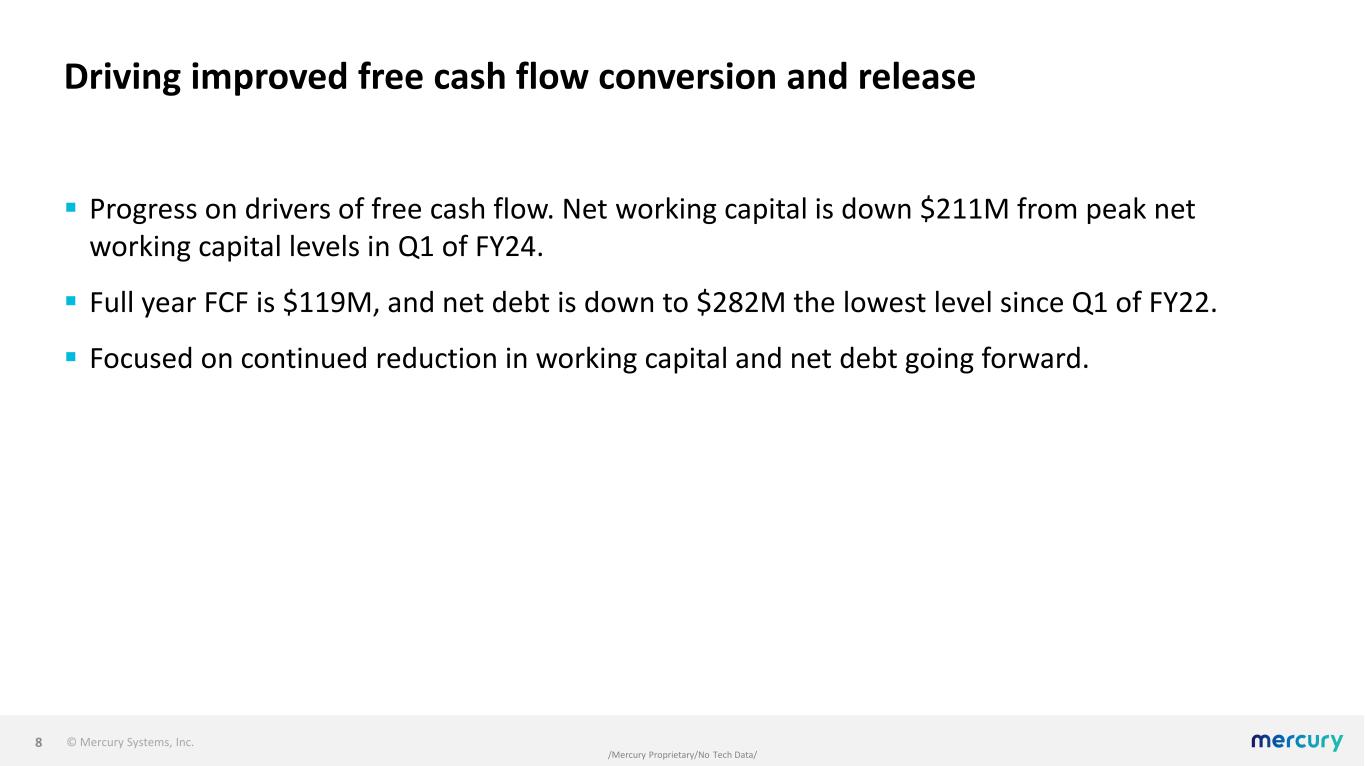
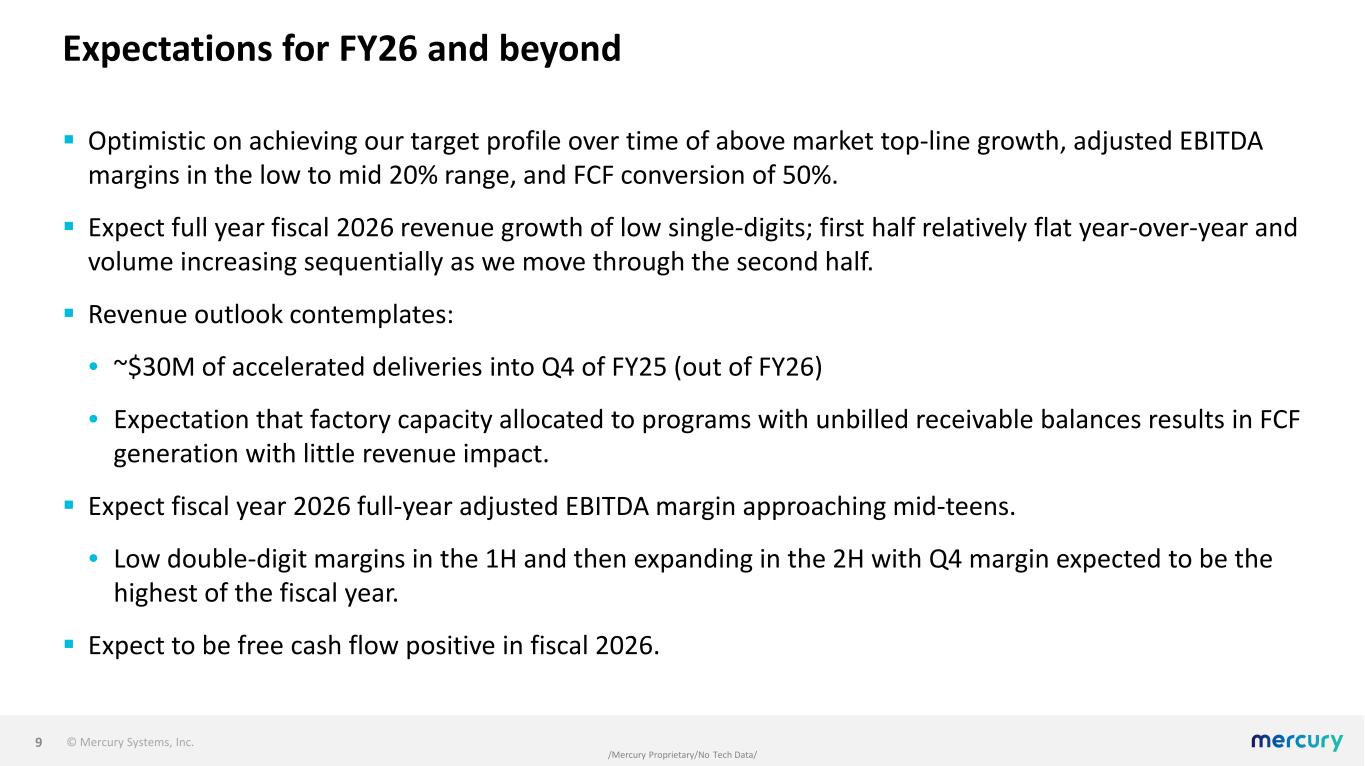
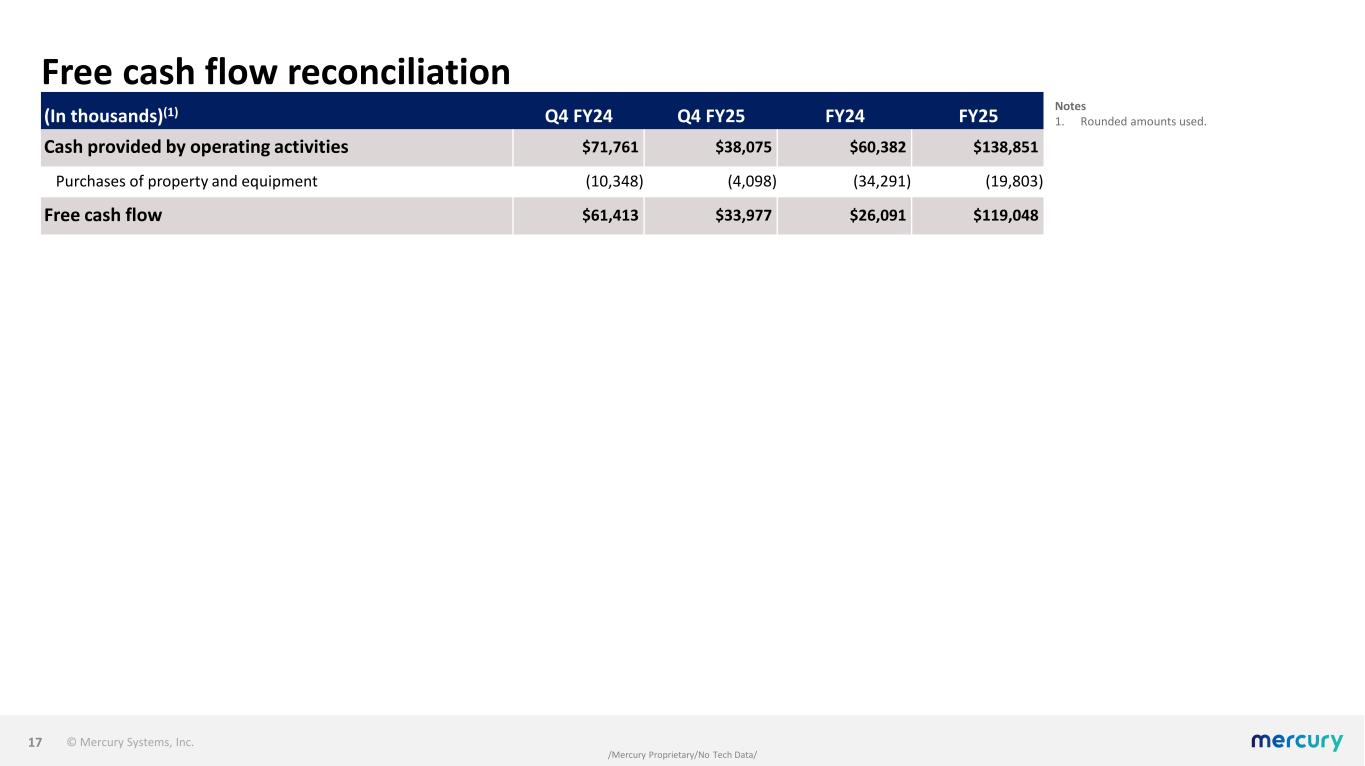
Thanks, Tyler, and good afternoon. Thank you for joining our Q4 and FY '25 earnings call. We delivered very strong results in Q4 that were once again in line with or ahead of our expectations, resulting in solid FY '25 year-over-year growth in backlog, revenue, adjusted EBITDA, and free cash flow. Today, I'd like to cover 3 topics: first, some introductory comments on our business and results; second, an update on our 4 priorities—performance excellence, building a thriving growth engine, expanding margins and driving improved free cash flow; and third, performance expectations for FY '26 and longer term. Then I'll turn it over to Dave, who will walk through our financial results in more detail. Before jumping in, I'd like to thank our customers for their collaborative partnership and the trust they put in Mercury to support their most critical programs. I'd also like to thank our Mercury team for their dedication and commitment to delivering mission-critical processing at the edge. Please turn to Slide 4. Our Q4 and full year results reflect our expectation to deliver robust organic growth with expanding margins and positive free cash flow. Record quarterly bookings of $342 million and a 1.25 book-to-bill, resulting in a record backlog of $1.4 billion. Q4 revenue of $273 million, up 9.9% year-over-year, and full year revenue of $912 million, up 9.2% year-over-year. Q4 adjusted EBITDA of $51 million and adjusted EBITDA margin of 18.8%. Full year EBITDA of $119 million and adjusted EBITDA margin of 13.1%, all up substantially year-over-year. And free cash flow of $34 million, resulting in record full year free cash flow of $119 million. We ended Q4 with $309 million of cash on hand. These results reflect our ongoing focus on our 4 priority areas with highlights that include solid execution across our broad portfolio of production and development programs, backlog growth of 6% year-over-year, reduced operating expense enabling increased positive operating leverage, and continued progress on free cash flow drivers with net working capital down $90 million year-over-year or 16.7%. Please turn to Slide 5. Starting now with our 4 priorities and priority 1, performance excellence. In the fourth quarter, our focus on performance excellence positively impacted our results, primarily in 2 areas. First, in Q4, we recognized $4.7 million of net adverse EAC changes across our portfolio, which is in line with recent quarters, reflecting our maturing capabilities in program management, engineering, and operations, and progress in completing development programs. Second, our focus on accelerating customer deliveries generated approximately $30 million of revenue and approximately $15 million of adjusted EBITDA planned for FY '26. This acceleration incrementally impacted our top-line growth and adjusted EBITDA margins for Q4 and FY '25 and will also factor into our outlook for FY '26, which I'll speak to shortly. Please turn to Slide 6. Moving on to priority 2, driving organic growth. Q4 record bookings of $342 million resulted in a record backlog of $1.4 billion and a full year book-to-bill of 1.13. In the quarter, we received a number of significant contract awards, including 2 new production awards totaling $36.9 million for ground-based radar programs that leverage our Common Processing Architecture and cybersecurity software from recently acquired Star Lab, a $22 million initial production contract from a U.S. defense prime contractor for sensor processing subsystems that will upgrade existing combat aircraft, an $8.5 million contract to develop and demonstrate a next-generation RF signal conditioning solution to enhance the performance and cost of X band active electronically steered array radars broadly used in air, sea and ground-based applications, 2 agreements with the European defense prime contractor to expand and accelerate production of processing subsystems and components for radar and electronic warfare missions, and a new production agreement that supports a critical U.S. military space program. These awards are important not only because of their value and impact on our growth trajectory, but also because they reflect those customers' trust in Mercury to support their most critical franchise programs. Please forward to Slide 7. Now, turning to priority 3, expanding margins. In pursuit of our targeted adjusted EBITDA margins in the low-to-mid 20% range, we're focused on the following drivers: backlog margin expansion as we burn down lower margin backlog and replace it with new bookings, aligned with our target margin profile; ongoing initiatives to simplify, automate and optimize our operations; and driving organic growth to realize positive operating leverage. Q4 adjusted EBITDA margin of 18.8% was ahead of our expectations and up sequentially over 700 basis points. This stronger margin performance was driven by the conversion of backlog previously contemplated to be delivered in FY '26 and higher operating leverage. Gross margin of 31%, up approximately 160 basis points year-over-year, was in line with our expectations and largely driven by the average margin in our backlog. We expect backlog margin to continue to increase as we bring in new bookings that we believe will be in line with our targeted margin profile and accretive to the current average margin in our backlog. Operating expenses are again down year-over-year as a result of fully realizing the impact of previously implemented actions to simplify, streamline and focus our operations. Please forward to Slide 8. Finally, turning to priority 4, improved free cash flow. We continue to make progress on the drivers of free cash flow, and in particular, reducing net working capital, which at approximately $449 million, is at the lowest level since Q2 of FY '22 and down $211 million from peak net working capital levels in Q1 of FY '24. Q4 free cash flow of $34 million was ahead of our expectation of breakeven, primarily driven by acceleration of cash receipts. Free cash flow for FY '25 was approximately $119 million, and net debt is down to $282 million, the lowest level since Q1 of FY '22. We believe our continuous improvement related to program execution, accelerating deliveries for our customers, demand planning and supply chain management will lead to continued reduction in working capital and net debt going forward. In addition, as we did in FY '25, we continue to expect to allocate factory capacity in FY '26 to programs with unbilled receivable balances, which will help drive free cash flow, although with little impact to revenue. Please turn to Slide 9. FY '25 represented a year of significant progress and dramatically improved results. Looking ahead, I am optimistic about our team, our leadership position in delivering mission-critical processing at the edge, the market backdrop and our expected ability over time to deliver results in line with our target profile of above-market top line growth, adjusted EBITDA margins in the low-to-mid 20% range and free cash flow conversion of 50%. Although we will not be providing specific guidance for FY '26, I will provide the following color, which excludes any acceleration of customer deliveries within or into FY '26 and potential funding increases on existing programs, driven by administration priorities such as Golden Dome. In FY '26, we expect to demonstrate continued progress toward our target profile. For full year FY '26, we expect annual revenue growth of low-single digits with the first half relatively flat year-over-year and volume increasing sequentially as we move through the second half. This revenue outlook reflects the previously discussed approximately $30 million of accelerated deliveries into Q4 of FY '25, as well as our expectation that we will allocate factory capacity to programs with unbilled receivable balances, resulting in free cash flow generation with little revenue impact. As we discussed in previous calls, our backlog margin, while up over the last 4 quarters, is still below our target margin profile, driven primarily by older, low-margin programs. We expect to continue to execute those low-margin programs in FY '26. As a result, we are expecting full year adjusted EBITDA margin approaching mid-teens with low-double-digit adjusted EBITDA margins in the first half and first quarter margin flat year-over-year. We anticipate margins to expand in the second half with Q4 adjusted EBITDA margin expected to be the highest of the fiscal year. Finally, with respect to free cash flow, we expect to be free cash flow positive for the year with second half free cash flow greater than the first. In summary, with our momentum coming out of FY '25, I expect that our performance in FY '26 will represent another positive and meaningful step toward our target profile. I look forward to providing updated commentary as we progress through the year. With that, I'll turn it over to Dave to walk through the financial results for the quarter and fiscal year, and I look forward to your questions. Dave?
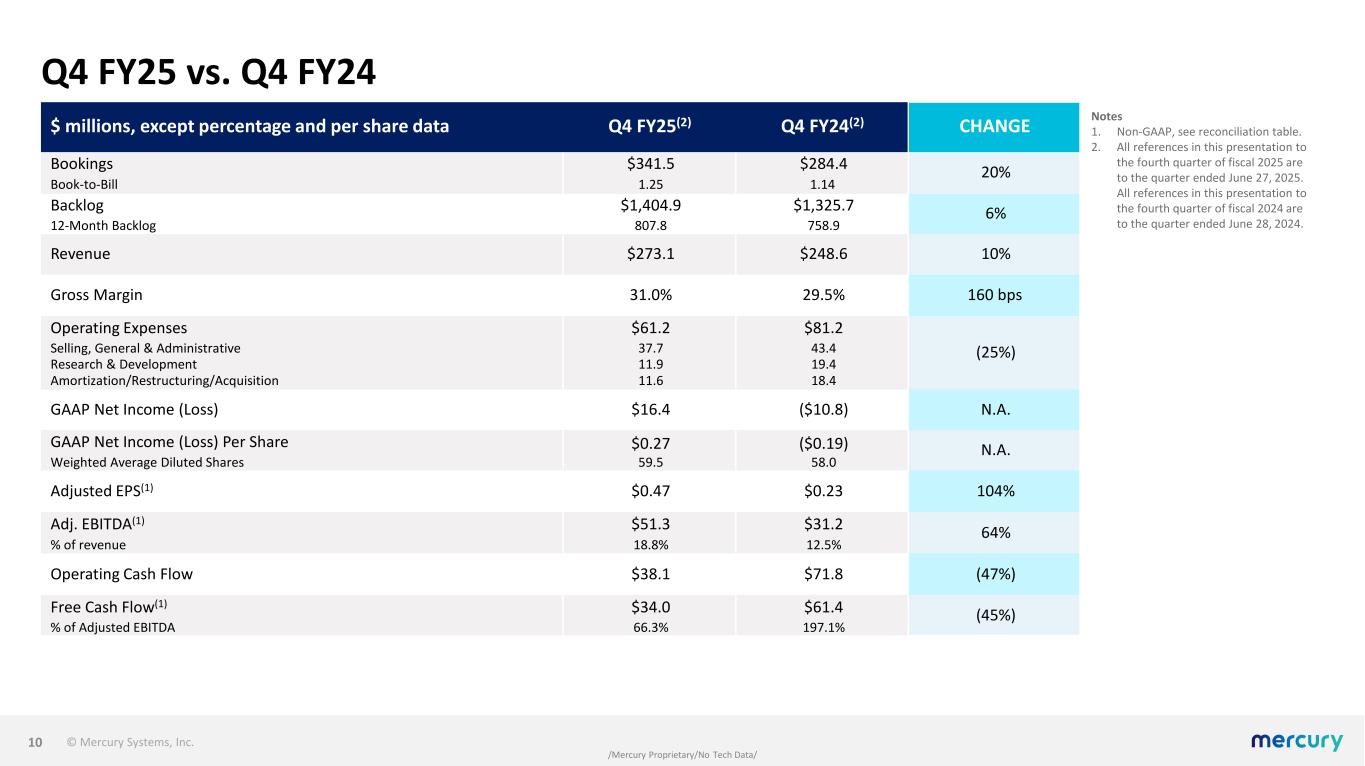
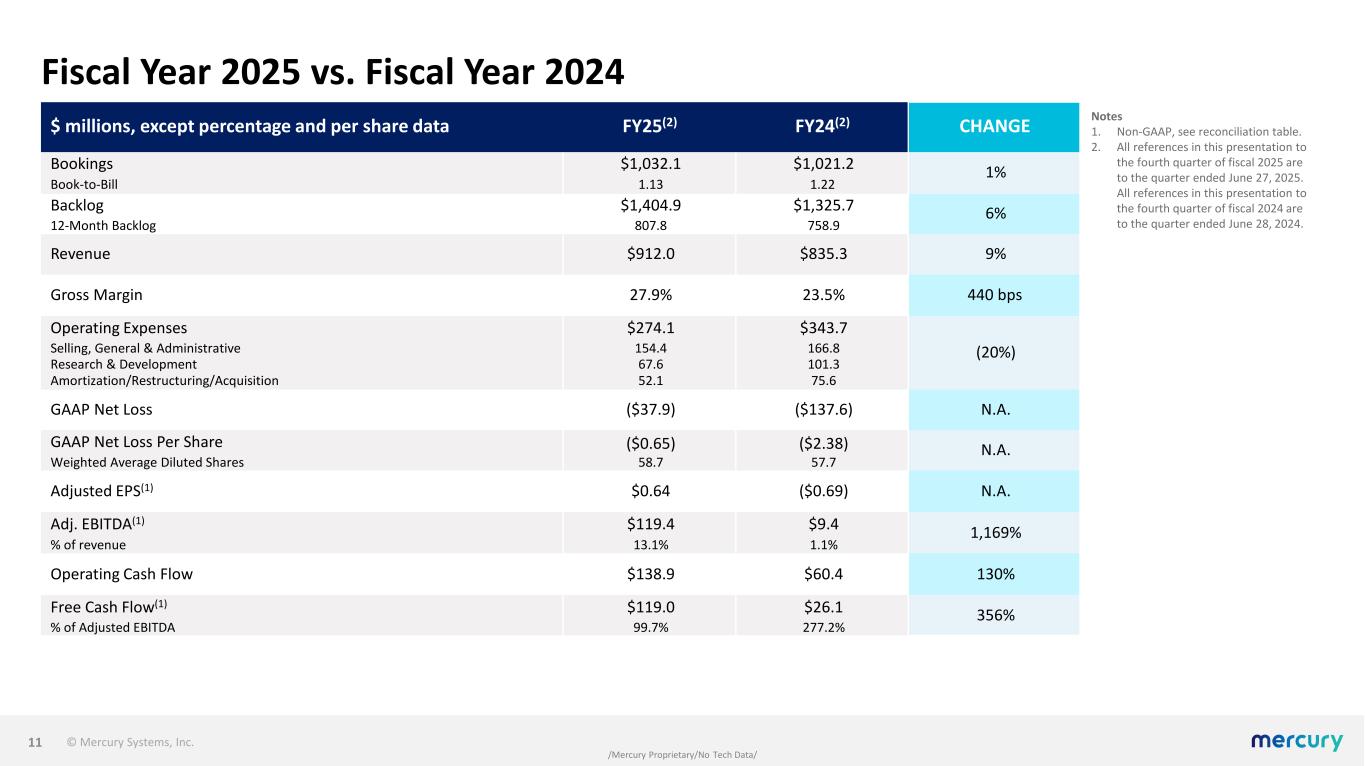
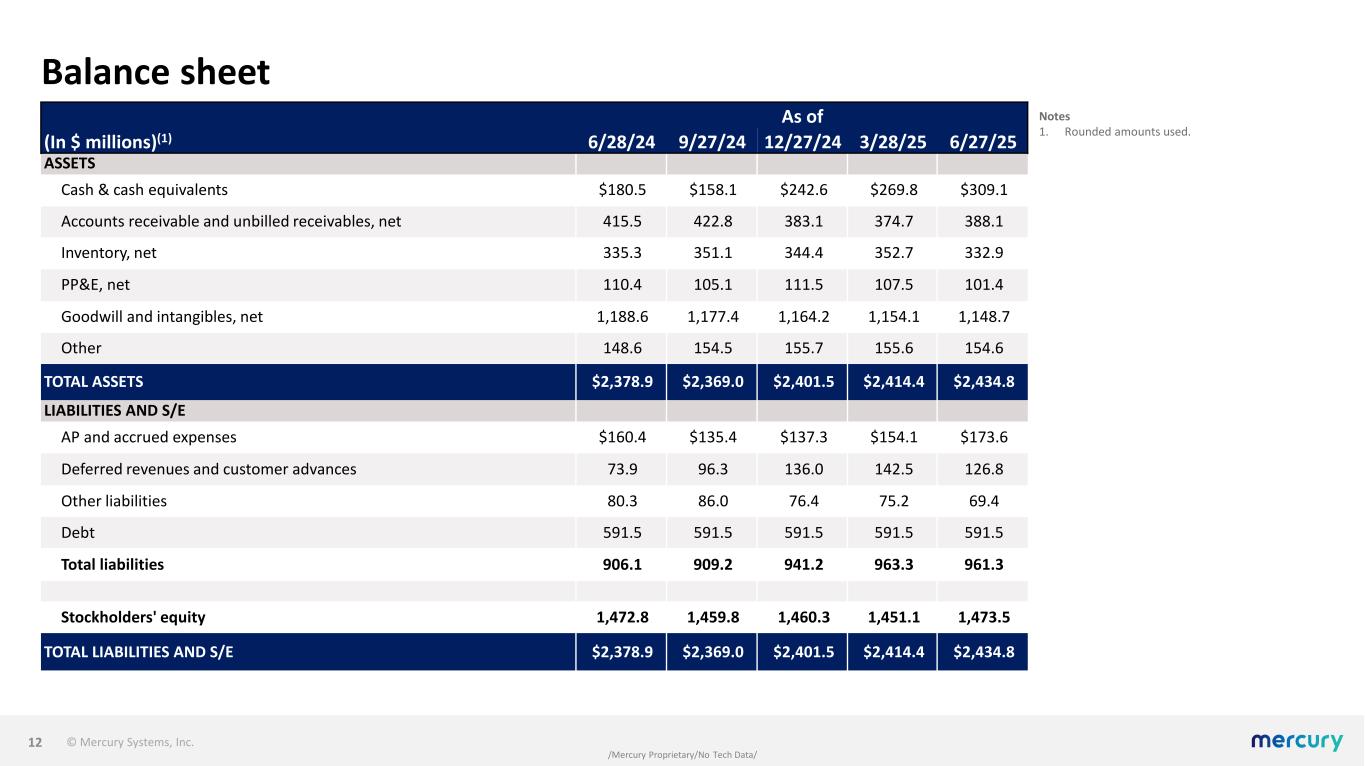
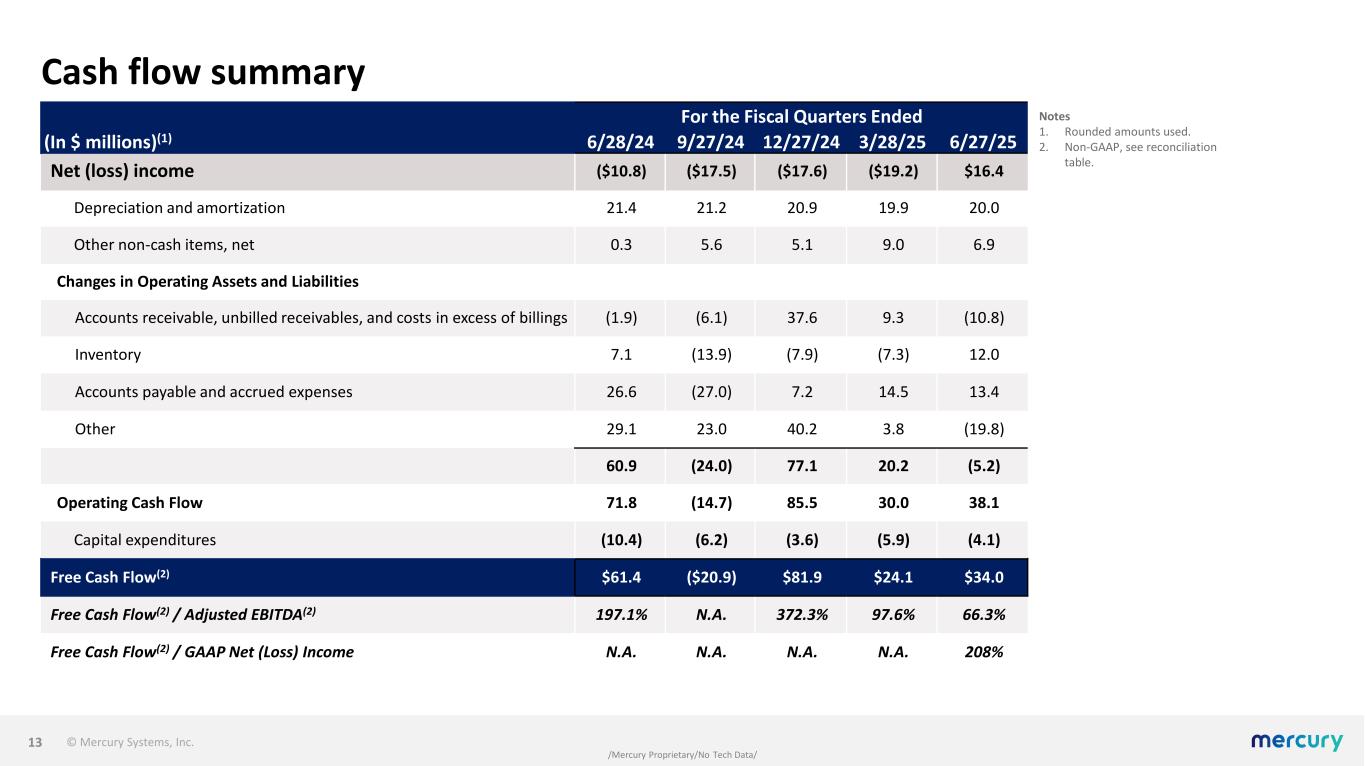
Thank you, Bill. Our fourth quarter results reflect solid progress toward our goal of positioning the business to deliver performance excellence, characterized by organic growth, expanding margins, and robust free cash flow. We still have work to do, but we are encouraged by the progress we have made and expect to continue this momentum in fiscal '26. With that, please turn to Slide 10, which details our fourth quarter results. Our bookings for the quarter were $342 million, up $57 million or 20% year-over-year with a book-to-bill of 1.25. Our backlog of $1.4 billion is up $79 million or 6% year-over-year. Revenues for the fourth quarter were $273 million, up approximately $25 million or 9.9% compared to the prior year. During the fourth quarter, we were able to accelerate customer deliveries worth approximately $30 million of revenue from fiscal '26 into the fourth quarter. Gross margin for the fourth quarter increased approximately 160 basis points to 31% as compared to the same quarter last year. Gross margin improvement during the fourth quarter was primarily driven by favorable program mix and a reduction in net EAC change impacts of approximately $5 million or 51% year-over-year. As Bill previously noted, we expect to see an improvement in our gross margin performance over time as the average margin in our backlog improves through our continued focus on building a thriving growth engine, coupled with further expected progress toward completion of lower-margin activities. Operating expenses decreased approximately $20 million or 25% year-over-year. The decrease was primarily driven by the actions taken in fiscal '24 and '25 to improve our performance by simplifying, automating, and optimizing our operations and aligning our team composition with our increased production mix, as we previously discussed. GAAP net income and earnings per share in the fourth quarter were approximately $16 million and $0.27, respectively, as compared to GAAP net loss and loss per share of approximately $11 million and $0.19, respectively, in the same quarter last year. The improvement in year-over-year earnings is primarily a result of increased gross margins, coupled with reduced operating expenses. Adjusted EBITDA for the fourth quarter was $51 million, up $20 million or 65% as compared to the same quarter last year. Adjusted earnings per share were $0.47 as compared to $0.23 in the prior year. The year-over-year increase was primarily related to net income of $16 million in the current period as compared to net loss of $11 million in the prior year. Free cash flow for the fourth quarter was approximately $34 million as compared to approximately $61 million in the prior year. This reflects the third consecutive quarter of positive free cash flow. Turning to our full year results on Slide 11. Our bookings for fiscal '25 were approximately $1 billion, marking another solid year of bookings. Our book-to-bill was 1.13, yielding record backlog of $1.4 billion, which is up 6% from fiscal '24. Fiscal '25 revenues were $912 million, up approximately $77 million or 9.2% compared to the prior fiscal year. Gross margin was 27.9% for fiscal '25, an increase of approximately 440 basis points from the 23.5% gross margin realized during fiscal '24. During fiscal '25, we had net EAC change impacts of $21 million, a reduction of $51 million or 71% as compared to the prior year. Our gross margin improvement in fiscal '25 was also impacted by lower manufacturing adjustments, including inventory reserves and warranty expense. Operating expenses decreased approximately $70 million or 20% in fiscal '25 as compared to the prior year. The decrease was primarily due to the organizational realignment activities taken in fiscal '24 and '25 as previously discussed. GAAP net loss and loss per share in fiscal '25 were approximately $38 million and $0.65, respectively, as compared to GAAP net loss and loss per share of approximately $138 million and $2.38, respectively, in the prior year. The improvement in year-over-year earnings is primarily a result of increased gross margins, coupled with reduced operating expenses. Adjusted EBITDA for fiscal '25 was $119 million, up $110 million as compared to the prior year. Adjusted earnings per share were $0.64 as compared to adjusted loss per share of $0.69 in the prior year. The year-over-year increase was primarily related to lower net losses of approximately $100 million in fiscal '25 as compared to the prior year. Free cash flow for fiscal '25 was a record of $119 million as compared to $26 million in the prior year. Slide 12 presents Mercury's balance sheet for the last 5 quarters. We ended the fourth quarter with cash and cash equivalents of $309 million, sequentially driven primarily by approximately $38 million in cash provided by operations in the fourth quarter, which were partially offset by investments of approximately $4 million in capital expenditures. Over the last 5 quarters, we generated approximately $180 million of free cash flow. Billed receivables decreased slightly year-over-year, while unbilled receivables decreased approximately $26 million. The decrease in unbilled receivables reflects the incremental progress we've made by delivering on programs to our customers, which significantly drove our cash flow performance during fiscal '25. As Bill previously noted, we continue to expect to allocate factory capacity in fiscal '26 to programs with unbilled balances, which will help drive free cash flow. Inventory decreased slightly year-over-year and sequentially by approximately $2 million and $20 million, respectively. Accounts payable increased $6 million sequentially, driven by the timing of payments to our suppliers. Accrued expenses decreased approximately $2 million sequentially, primarily due to lower restructuring and other accrued expenses. Accrued compensation increased approximately $16 million sequentially, primarily due to bonus and payroll expenses. Deferred revenues increased year-over-year by approximately $53 million as a result of additional milestone billing events achieved during the period. Sequentially, deferred revenues decreased approximately $16 million, primarily due to additional point-in-time revenue during the fourth quarter of fiscal '25. Working capital decreased approximately $90 million year-over-year or 17%. This demonstrates the progress we've made in reversing the multiyear trend of growth in working capital, resulting in the lowest net working capital since Q2 of fiscal '22. As a reference point, in the last 4 quarters, we have driven our net working capital from a highest of 72% of trailing 12 months revenue to 49%. Net working capital remains a primary focus area for us, and we believe we can continue to deliver improvement. Turning to cash flow on Slide 13. Free cash flow for the fourth quarter was approximately $34 million as compared to $61 million in the prior year. This exceeded our expectation of breakeven for the fourth quarter. We believe our continuous improvement in program execution, hardware delivery, just-in-time material, and appropriately timed payment terms will lead to continued reduction in working capital. In closing, we are pleased with the performance for the fiscal year and the higher level of predictability in the business. We believe continuing to execute on our 4 priority focus areas will not only drive revenue growth and profitability, but will also result in further margin expansion and cash conversion, demonstrating the long-term value creation potential of our business. With that, I'll now turn the call back over to Bill.
Thanks, Dave. With that, operator, please proceed with the Q&A.
Operator
Your first question comes from the line of Peter Arment with Baird.
Speaker 4
Nice results. Bill, can I ask a question regarding the factory capacity that's being allocated to programs tied to the unbilled receivables? Does that wash out of the system when we think about fiscal '26? Or how do you handicap that?
Yes, it's difficult to be very precise about the timing, but we are getting to a point where our organic growth discussions won't include this. In 2026, as Dave and I have mentioned, we believe there is still considerable opportunity to enhance our net working capital. We made strong strides in 2024 and 2025, and we anticipate further good progress in 2026. Part of that will involve reducing the programs with unbilled balances. While this will be beneficial for our free cash flow, it has minimal effect on revenue. So, without being overly specific, I think we will make significant progress in overcoming this challenge as we move through 2026.
Speaker 4
Great. That's very clear. And just regarding the net working capital comment, Dave mentioned, I think you guys peaked at 72% of sales now down to 49%. Is there a way to think about what should be a normalized level for a business like Mercury?
Yes, Peter, this is Dave. I believe we've consistently stated that depending on the mix of business, that could be around 35%. As we look longer term, that's still our target, and we will continue to pursue that. We've reduced it by about $200 million; however, achieving the next dollar is more challenging than the previous ones, but we still believe we have potential for further improvement in that area.
Operator
Your next question comes from the line of Ken Herbert with RBC Capital Markets.
Speaker 5
Yes, Bill or Dave, maybe as you think about the pull-forward of the revenues from, it sounds like, first half '26 into the fourth quarter, can you maybe elaborate on what's behind that? Because it's obviously the second or third quarter of this year, you've been able to do this. Is it just better execution? Is it maybe customers really sort of pushing things to go faster? I'm just trying to get a sense as to sort of repeatability of this, if that makes sense, because obviously, it's a really nice surprise and reflects certainly well on the execution.
We are very pleased with our Q4 performance. We achieved record quarterly bookings, and our revenue was the second highest in the company's history. A large portion of this revenue came from point-in-time sales, indicating the need for delivery. To speed up these deliveries, we are focusing on our supply chain and factory capacity, looking to expedite what we can pull from our growing backlog. Our customers are eager to use our technologies, and we want to get them to them as quickly as possible. Currently, we are assessing the effects of previous planned deliveries that have now shifted to Q4 while navigating the same constraints. This involves reviewing kits ready for production, identifying shortages, and addressing those issues to complete kits and accelerate deliveries. The positive aspect is that we’ve shown our ability to build and execute these processes effectively in FY '25, allowing us to upgrade our initial low-single-digit outlook for the year into high-single-digit, nearly double-digit growth. We plan to apply those same capabilities in FY '26. While we've not factored in any potential accelerations for the year from FY '27, we are actively working on this daily. As our plans progress and we execute them, we will keep updating our outlook throughout the year.
Speaker 5
Great. I have a quick follow-up regarding the bookings for the quarter. You mentioned that they support the longer-term margin targets. Could you provide more details about where you're seeing the bookings, particularly in terms of capabilities, how many are with the CPA, and what the actual demand looks like from a booking perspective?
In the recent bookings we discussed, there is a good distribution across various end markets, combining production with some development awards that have significant potential for future growth. This reflects a healthy mix of bookings and represents the overall health of our end markets. Regarding the margins, I'm pleased with the progress we've made. We talked about our backlog margin status at the end of FY '24 and our expectation that it will improve over time as we transition from lower margin projects to those that align with our targeted margins. We've been doing this for four quarters now, so we're confident in our progress. While we haven't specified when that transition will fully complete, based on our backlog duration calculations, it's clear it won't be finished in a year, nor will it take three years. It's likely to take somewhere in between. By the end of FY '26, we should have a clear understanding of where we stand in completing this transition and will provide a more precise update.
Yes. And Ken, this is Dave. I would add, with specific reference to your question on the bookings around the common processing architecture, we did note in our remarks that 2 of the bookings that came in in the quarter for $36.9 million were related to common processing architecture, adding more to our backlog in that area.
Operator
Your next question comes from the line of Pete Skibitski with Alembic Global.
Speaker 6
Yes. Really nice quarter, guys. Maybe just to beat the drum more on the unbilled receivables just because, Bill, you mentioned that they've declined really nicely, and you talked about it accelerating to $30 million in the quarter, so you can do quick turnaround stuff. So I just wanted to understand better why the balance of these unbilled programs are sort of giving you schedule risk and why they're taking up so much capacity. So are they basically all integrated subsystems as opposed to components? Is that why they're kind of taking longer and taking up more capacity?
Well, I think it's a couple of things. One is some of those programs are what we talked about over the last couple of years, development programs that transitioned into production, etc. But I think the main point is that with the programs that have some of the larger unbilled balances, when they consume factory capacity to move out the door, we're able to deliver, invoice, and collect cash, but most of the revenue on those programs have been recognized. So there's very little incremental revenue that comes with it. That's the main point that we're trying to get across. So as we have to allocate capacity to these programs, we get the benefit of the free cash flow, but we don't get significant revenue impact because a lot of the revenue has been previously recognized in those programs, and it's what drives those unbilled balances.
And I would add that when you look at those programs, they're largely older programs that were bid and contracted before we were really focused on the terms we have around these contracts. So that's why the unbilled balances build up as well because we weren't billing and collecting along the way as we are now. You can see examples of how that's changed in our deferred revenue buildup, for instance. But those older contracts, as Bill said, didn't have that. So they have larger unbilled balances. We have to complete the contracts in order to get there.
Yes. So Pete, hopefully, that addresses the question. But if not, please follow up.
Speaker 6
Sure. I have a follow-up on your 2026 free cash flow guidance, which indicates a positive free cash flow. If you're allocating capacity to these unbilled programs that won't generate revenue, your free cash conversion should be quite strong. You achieved 1x this year, so with more unbilled work ahead, it seems you would be in a similar range. Is that the correct way to view the situation?
Yes. I think the way we're putting it is we expect to be positive. This is a business that should be generating positive cash. And we have a couple of things that are working for us, of course, like you just said. We did accelerate a significant amount of cash into Q4. We expected to be about breakeven, and we were $30-plus million ahead of that. And so, that's a little bit of a challenge early on in the year. And at the same time, as I said, we have a significant deferred revenue balance, which is cash we've collected in advance already. So we'll be working that off over time. We expect to continue building it up, but it's dependent on the terms we can negotiate with our customers. So more to come as we go through the year on that. But for now, I think that's the way we're looking at it is we expect to be positive.
Yes. I mean, there's no mystery to those moving pieces. It starts with the 50% free cash flow conversion, and there's what we free up off the balance sheet. If there's anything we accelerated into a prior period, then that would be impacted. So I think, Pete, you're thinking about it consistent with how we're thinking about it.
Operator
Your next question comes from the line of Seth Seifman with JPMorgan.
Speaker 7
I have two questions about margin. Considering that you mentioned the average margin in the backlog is contributing to the 31% gross margin we observed this quarter, is there any reason to expect that the margin might decline back into the 20s in the future? Additionally, regarding operational expenses, SG&A and R&D are at very low levels as a percentage of sales. How should we approach these Q4 run rates in dollar terms and what do they suggest for next year?
Yes, this is Dave. I'll begin with that. As we progress over time, we anticipate our gross margins to rise alongside our margin and backlog. While it's possible for a single event in a quarter to cause a slight fluctuation, I wouldn't claim it's impossible for it to decrease. However, for the year and in the long term, we expect continuous growth in gross margins. Regarding operating expenses, you can observe a notable year-over-year decline in operating expense for the fourth quarter and overall for the year. Specifically, when comparing year-over-year and looking at the fourth quarter, there was a reduction in restructuring costs, which does not affect EBITDA; it changed by $20 million from last year to this year. Additionally, there was a significant variance in SG&A in the fourth quarter. I view that as consistent with last year, with the difference mainly attributed to stock-based compensation, which again doesn't influence EBITDA. From an SG&A perspective, we believe we are in the appropriate range, as we've mentioned several times. The R&D spending in the fourth quarter was somewhat lower than our expected run rate. Bill has indicated that the level we observed during the year aligns with what we expect moving forward, depending on contract activities during any given period. Bill, if you have anything to add…
I'd just wrap it up by saying I think we're in the right range for the near term in our OpEx. And it's a result of the things that we've talked about over the last couple of years and really streamlining our organization and focusing in areas like IRAD, for instance. So I feel like we're in the right ballpark for the near term, and that's really a good place for us to be to start generating more operating leverage as we start to scale.
Operator
Your next question comes from the line of Jonathan Ho with William Blair.
Speaker 8
Congrats on the strong results. Just given your strong next 12 months backlog, I just wanted to understand sort of the rationale behind not providing sort of annual guidance. And where do you maybe see the most potential for uncertainty? Or what's giving you pause, just given the framework that you've laid out?
Yes, regarding our outlook for the year, we've mentioned that we did not factor in any acceleration of deliveries for this year. In FY '25, we showed our commitment to this goal and achieved success. Recently, we accelerated $30 million worth of deliveries into Q4, which is substantial. We are still navigating the challenges associated with accelerating deliveries throughout the year. This is something we are addressing daily, evaluating both risks and opportunities to pinpoint any bottlenecks. I want to clarify that we don't have concerns; it’s about working through these plans. We are committed to resolving the constraints and determining what can be expedited this year. On a positive note, conversations with our customers are encouraging. When we look at the overall outlook, the increasing defense budgets and their focus on acquiring new technologies play to our strengths. Notably, there are several executive orders promoting the use of commercial technology and initiatives like Golden Dome, alongside the developments in European defense budgets. This is reflected in our international operations, which have significantly expanded over the past year. We're optimistic about these positive trends. The discussions we're having indicate strong interest in greater quantities and ways to expedite processes while identifying production and capacity limitations. However, until these discussions materialize into actual bookings, it’s challenging for us to incorporate them into our forecast with certainty. As we did last year, we’ll manage the accelerations, convert bookings, and provide ongoing updates throughout the year.
Speaker 8
Got it. And just as a quick follow-up and building on the question, I just wanted to understand your thoughts around design win cadence and the pipeline progression, particularly around areas like Golden Dome and the new budget. How do we sort of see that playing out over the course of the year? And do you need these design wins ahead of sort of bookings programs to sort of accelerate the business?
Well, interestingly, I think some of the bigger opportunities that we're talking about in terms of near-term volume are actually on existing programs that could fit within a Golden Dome type architecture. That wouldn't look like a design win, but it would look like an increase in quantity or an acceleration of delivery. So I'd say that that's one point to the response. But I'd say, secondly, since we've stood up our Advanced Concepts group, over the last year, we've really tightened up our focus on the next set of developments and next-generation technologies and design wins that can expand our footprint and really drive and accelerate our growth beyond our current portfolio. So I think those are the 2 things that we're really focused on. But I think the near-term opportunities that could really drive volume are more tied to existing customer relationships and existing systems where we have a footprint.
Operator
Your next question comes from the line of Conor Walters with Jefferies.
Speaker 9
Congrats on the great quarter. I wanted to circle back on margins. Curious what played out better than anticipated in Q4, given the earlier commentary, it was pointing to something nearing the mid-teens. And then, hoping you could offer some puts and takes as we think about that deceleration to the low-double-digit range in the first half of '26. Now that OpEx is in the right ballpark, you're executing well on the ACs, is this just a read on program mix that's expected to come down the pipeline?
Yes. There were two main factors. First, the increased volume due to the pull-in helped improve our operating leverage since operating expenses did not grow as a result. Second, we experienced a mix effect as we were able to expedite $30 million in higher-margin activity. These factors contributed to our better-than-expected EBITDA margin in Q4.
Speaker 9
Great. And maybe just one more. CapEx took a step back this year. How should we be thinking about that in '26 and beyond as you continue to invest in additional automation across the facility footprint?
Yes. I think there might be an opportunity for it to tick up a little bit in '26, just tied to any investments we make to further automate or down the road that we make to really accelerate our capacity and ability to accelerate deliveries. But I see a tick-up. I don't see anything at this point that would be significant.
Operator
Your next question comes from the line of Sam Struhsaker with Truist Securities.
Speaker 10
Nice quarter. On for Mike Ciarmoli this evening. I guess, just kind of circling back, I'm curious what operational improvement levers do you guys have left to pull if any? I don't know if you guys are thinking about maybe any more facility consolidation, just anything on that front? And kind of building off of that, how should we think about potential operational improvement versus the lower-margin backlog working out of the system in terms of the margin expansion profile going forward?
Yes. I think as we think about the drivers of our margin going forward, there's 3 pieces to it. One is the backlog margin that we talked about. The second is continuing to drive efficiencies and to automate and to streamline our operations. And the third is the positive operating leverage that we get with increased volume. I'd say we're focused on all 3. The backlog margin is progressing and playing out the way we thought. And I think the fourth quarter is a great illustration that when we deliver a higher mix of higher-margin backlog, it's math, it translates into better EBITDA margins. So, as we move through '26, and we're seeing a little bit in '26 of a higher mix of lower-margin programs working their way through in '26. I think Q4 showed what happens when we have less low-margin mix, more high-margin mix that all flows through to higher EBITDA margin. So we're focused on continuing that progression. And then, we said it before in prior calls, we'll work continuously for the rest of our lives on driving efficiency into the organization, and then it becomes a decision around what we do with those efficiencies, either to create additional capacity for innovation, investment, etc. But that's something that we'll work on continuously and will never be done.
Speaker 10
Got it. That's great. And I guess, if I could just sneak in one more. You guys spoke to a couple of noteworthy contracts in the quarter in the backlog. But could you maybe just give us a little more detail sort of on where you're seeing the most demand, either by sort of general product category or even end market kind of land air, where you're seeing that? And then, I guess, obviously, international has been doing well, but if you have any additional color there, that would be great, too.
Yes, I guess you can see in the K where we're growing by customer and by segment. And that does move around quarter to quarter. And sometimes it's just driven by mix and program activity in the current period. But I will say that across our business right now, we are engaged in conversations that look like increased production quantities and acceleration and questions from our customers and primes around providing rough order of magnitude bids if we were to accelerate or increase production. And it's tied to our domestic primes, and it's across their land, sea space. And we're also seeing it with the European primes as well. Now, again, until those conversations manifest into bookings, it's really hard to put any certainty into our outlook, but those conversations are happening. And again, we feel very good about the market and the tailwinds in the market going forward.
Operator
Your next question comes from the line of Noah Poponak with Goldman Sachs.
Speaker 11
Just considering the quarterly pacing for revenue from this point, I understand the relatively flat performance in the first half and the identification of $30 million pulled forward into the fourth quarter from the first quarter. So, starting with $30 million in a flat year, if I were to look at revenue for the first quarter of 2025, that would represent 15% of revenue. To return to flat growth, you would need to achieve a 15% growth, assuming all other factors remain constant and there are no additional changes in revenue. So, is it the case that the first quarter is down followed by an increase in the second quarter to reach flat for the first half? Or am I missing something in this analysis?
I think without getting too specific or caught up in quarter-to-quarter, we're thinking relatively flat for the first half. I think that's the simplest way to articulate our commentary.
Speaker 11
Okay. Fair enough. On the margin commentary, and maybe this is also splitting hairs too much, but I guess calling it approaching mid-teens, I would interpret as you're still working your way up towards mid-teens. And you just finished a year 13.1%, and you've talked about not needing that much more time to be at the longer-term framework. So I guess, help me think through how '26 progresses versus '25, and then to, what extent does '27 achieve the low to mid-20s versus it needs more time than that?
Yes. If I take a step back and avoid getting too focused on the fluctuations from quarter to quarter, I see that the approximately $30 million we moved from 2015 to an earlier period affects our growth trajectory. Without this adjustment, I believe the growth rates for our top line and margins would appear differently. We can do the calculations to illustrate this, but it's clear that shifting $30 million from 2026 to 2025 impacts our projected mid-single-digit growth in 2025, leading to high-single-digit growth in 2026. This aspect is relevant to our overall outlook and also pertains to margins. So, while I don’t feel it's necessary to go through the numbers in detail, that’s my perspective on the situation.
Speaker 11
I understand. On Golden Dome, any ability to frame what that could mean to Mercury on a run rate basis? And I guess, given the time frame they've talked about for fully operational, when do you think they'll start to make awards?
Great questions. Taking a step back, to achieve the capabilities we've discussed, we primarily expect them to come from our existing systems that form various layers of the Golden Dome architecture. As we examine those layers and our current systems, we are pleased with our position. We believe there is potential for us to expedite deliveries on ongoing programs and increase quantities. However, at this moment, the timing remains uncertain, which is why we have clearly stated that our outlook for FY '26, concluding next June, does not factor in any effects from Golden Dome-related delivery accelerations. We will monitor the situation and keep everyone updated.
Speaker 11
Okay. Last thing, Dave, is there a way to frame where normal unbilled receivables should be in dollars or as a percentage of revenue? And then, why are you building deferred revenue? What is the contracting mechanism that's driving that?
Yes. To illustrate the concept of deferred revenue, consider a situation where a customer requests us to purchase end-of-life components for their programs to cover the next five years. They want us to hold these in inventory or on our balance sheet. We agree to this arrangement as it ensures our production stability for the next five years. However, we ask the customer to pay us upfront, allowing us to place orders ahead of receiving the components. This upfront payment creates a deferred revenue asset, indicating that while we have the cash now, we have future obligations to fulfill. This significantly affects our inventory and unbilled balances, with some of the $127 million in deferred revenue serving as a counterbalance to these accounts. We have analyzed the optimal rates for each category, and as mentioned, we have approximately $100 million to reach our target of a 35% range. Currently, we believe we are not at the ideal levels for either unbilled receivables or inventory.
Operator
Mr. Ballhaus, it appears there are no further questions. Therefore, I would like to turn the call back over to you for any closing remarks.
Okay. Well, thank you very much. Thanks for your time this afternoon, and we look forward to updating everybody in our next quarterly call.
Operator
This concludes today's conference call. Thank you for your participation, and you may now disconnect.