Operator
Partners' second quarter 2026 earnings conference call. Today's call is being recorded. I will now turn the call over to Walter Pinto, Investor Relations. Please go ahead.
Thank you, Operator, and good morning, everyone. Welcome to the New Lake Capital Partners' second quarter 2026 financial results conference call. Joining me on the call today are Anthony Caniglio, President and Chief Executive Officer, and Lisa Meyer, Chief Financial Officer. Before we begin, And please note that certain statements made during today's call may be considered forward-looking under the State Farm provisions of the Private Securities Litigation Reform Act of 1995. Actual results may differ materially due to a variety of risks and uncertainties. For more detailed discussion of these factors, please refer to the company's filings with the Securities and Exchange Commission, including our Form 10-Q, for the quarter-ended June 30, 2026. During the call, we'll also reference non-GAAP financial measures, including FFO and AFFO. Reconciliations to the most directly comparable GAAP measures are included in our earnings release. With that, I'd now like to turn the call over to Anthony Caniglio, President and Chief Executive Officer. Please go ahead, Anthony.
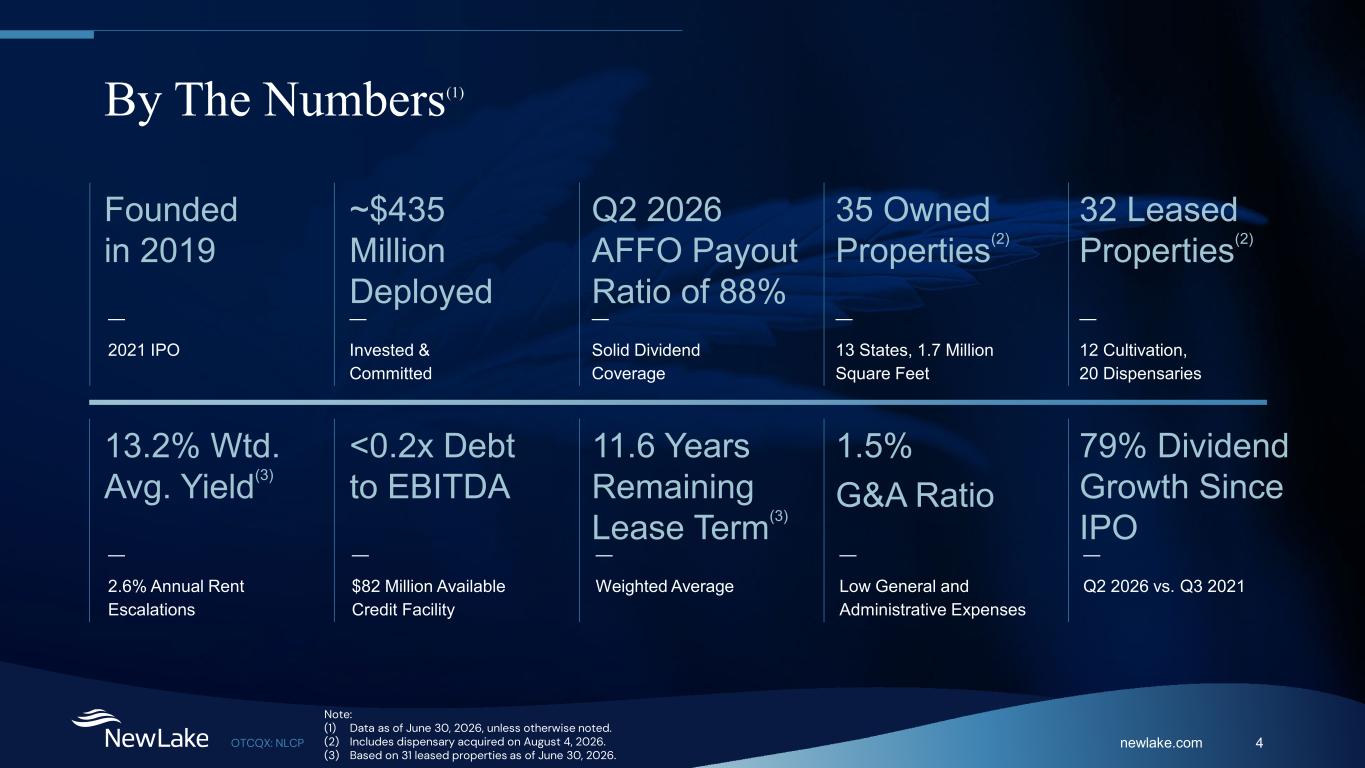
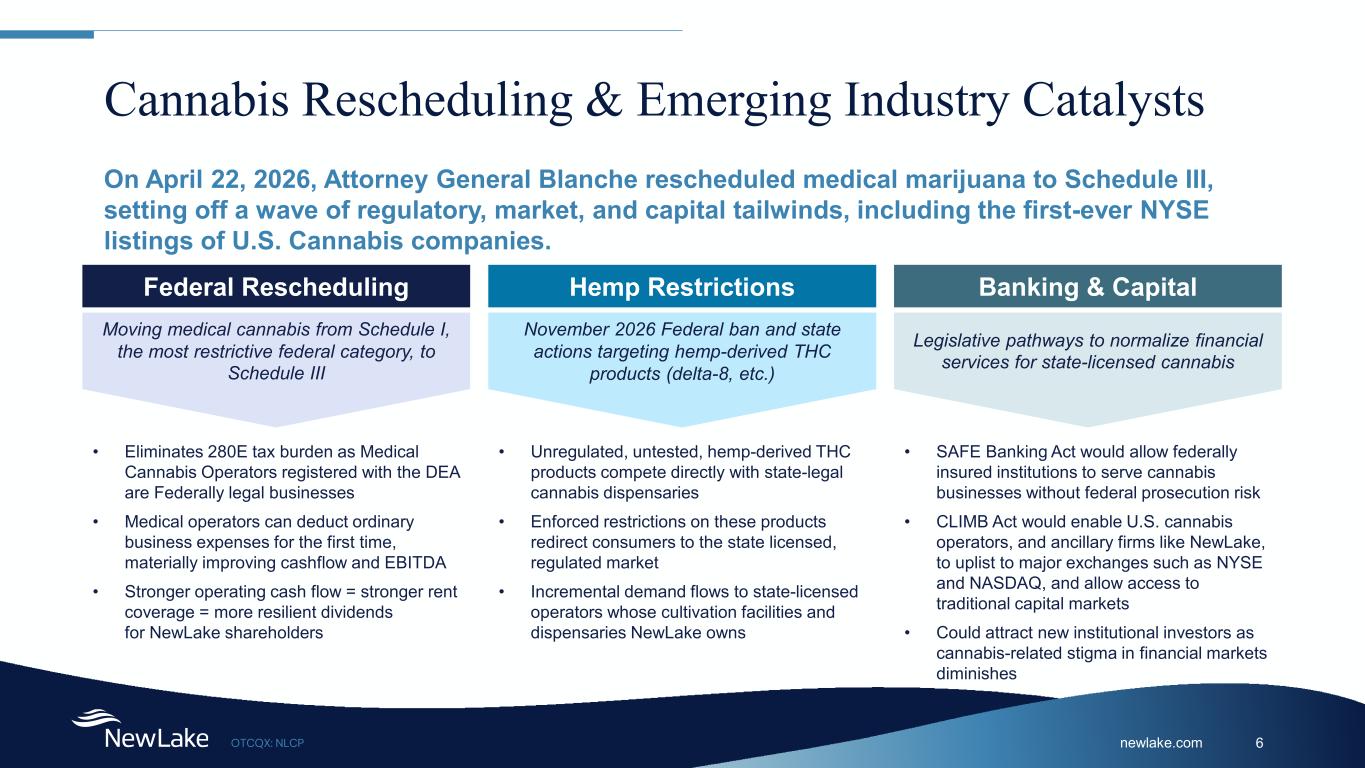
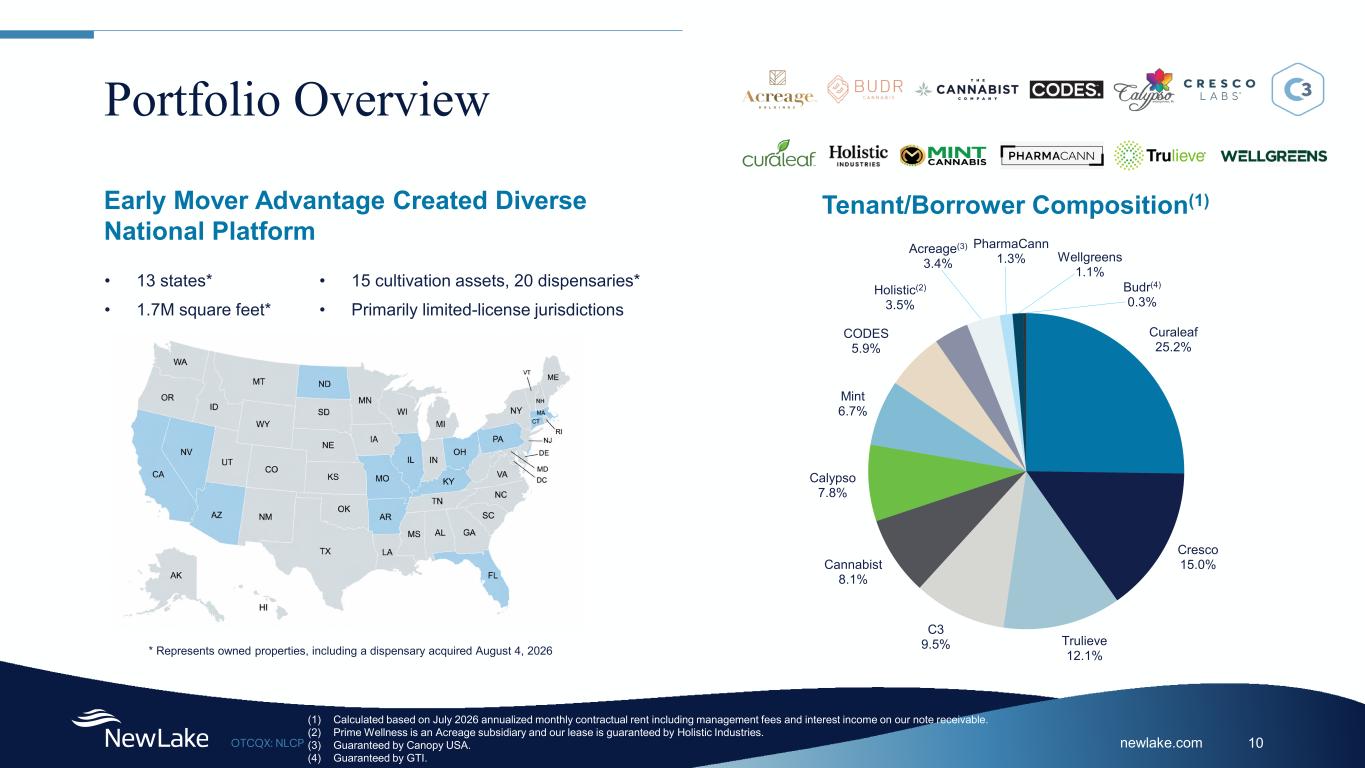
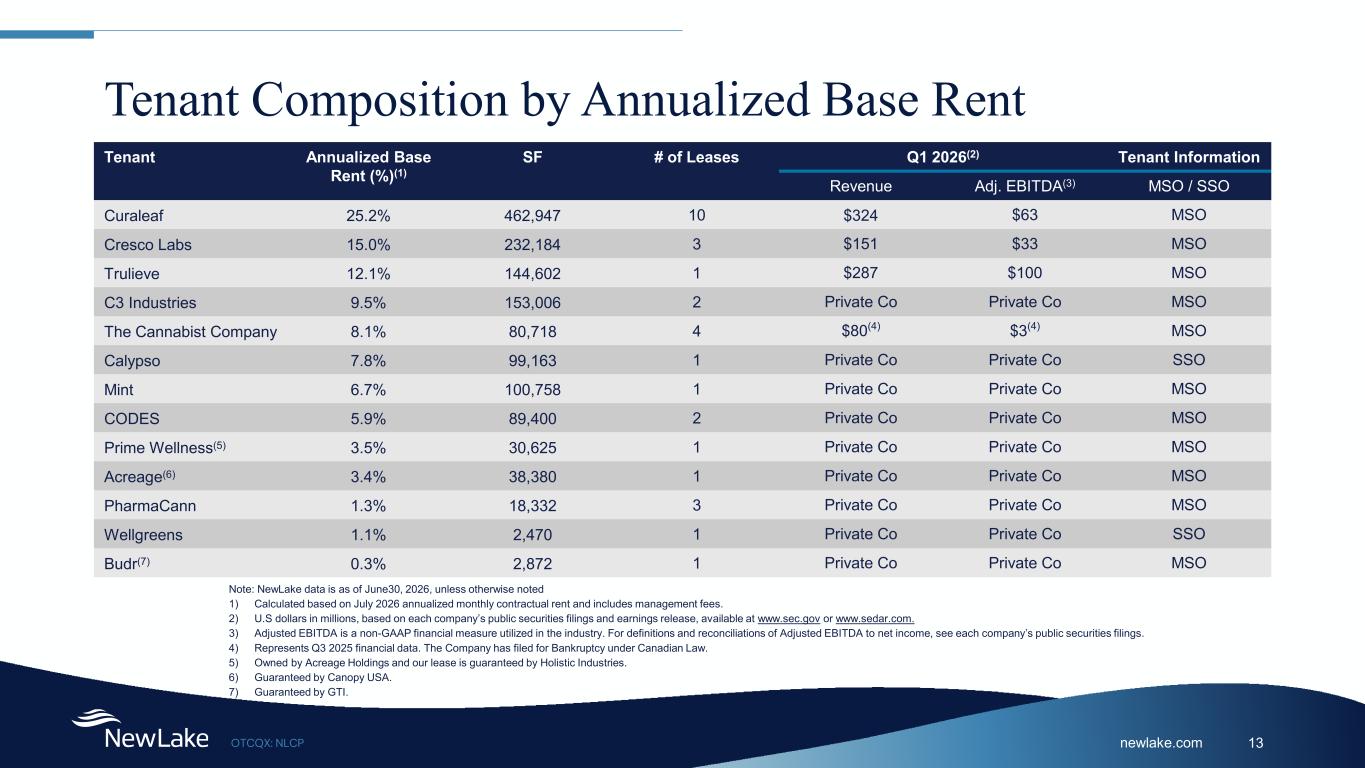
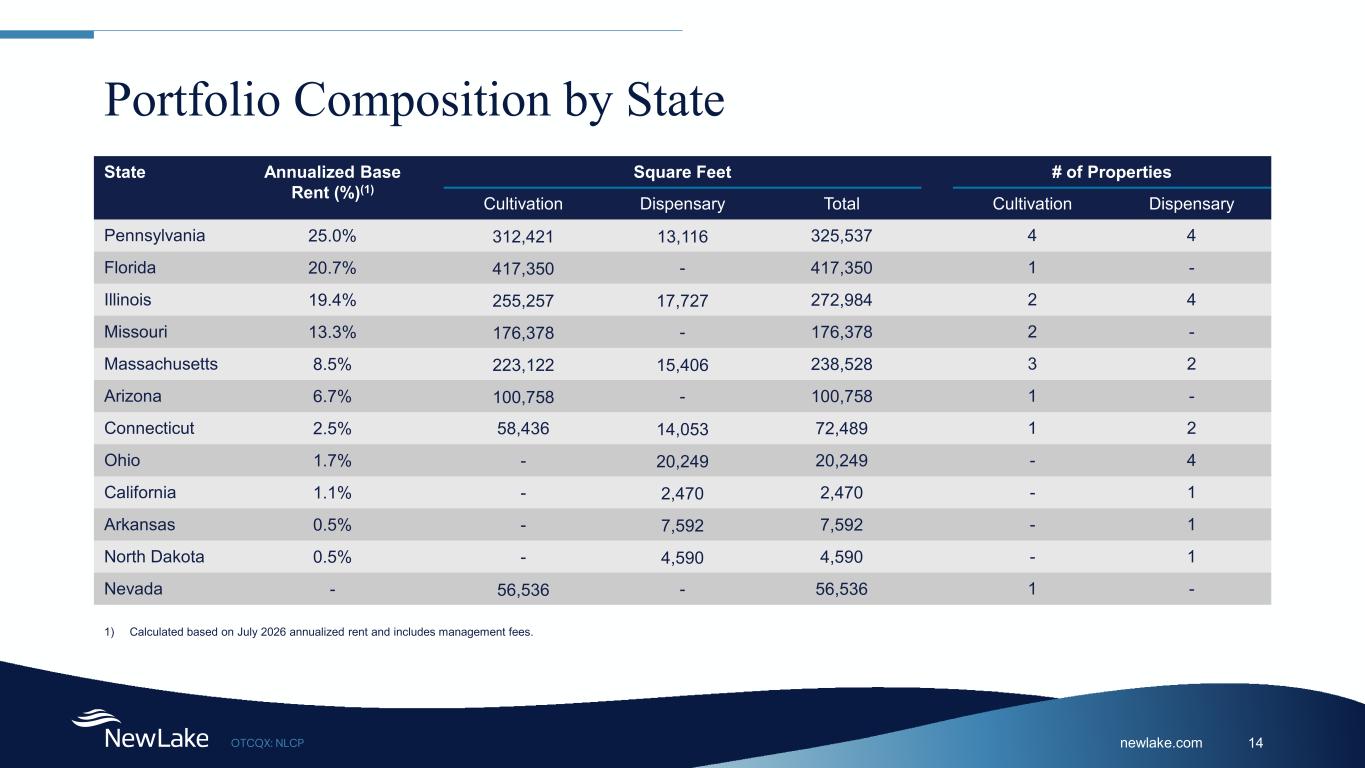
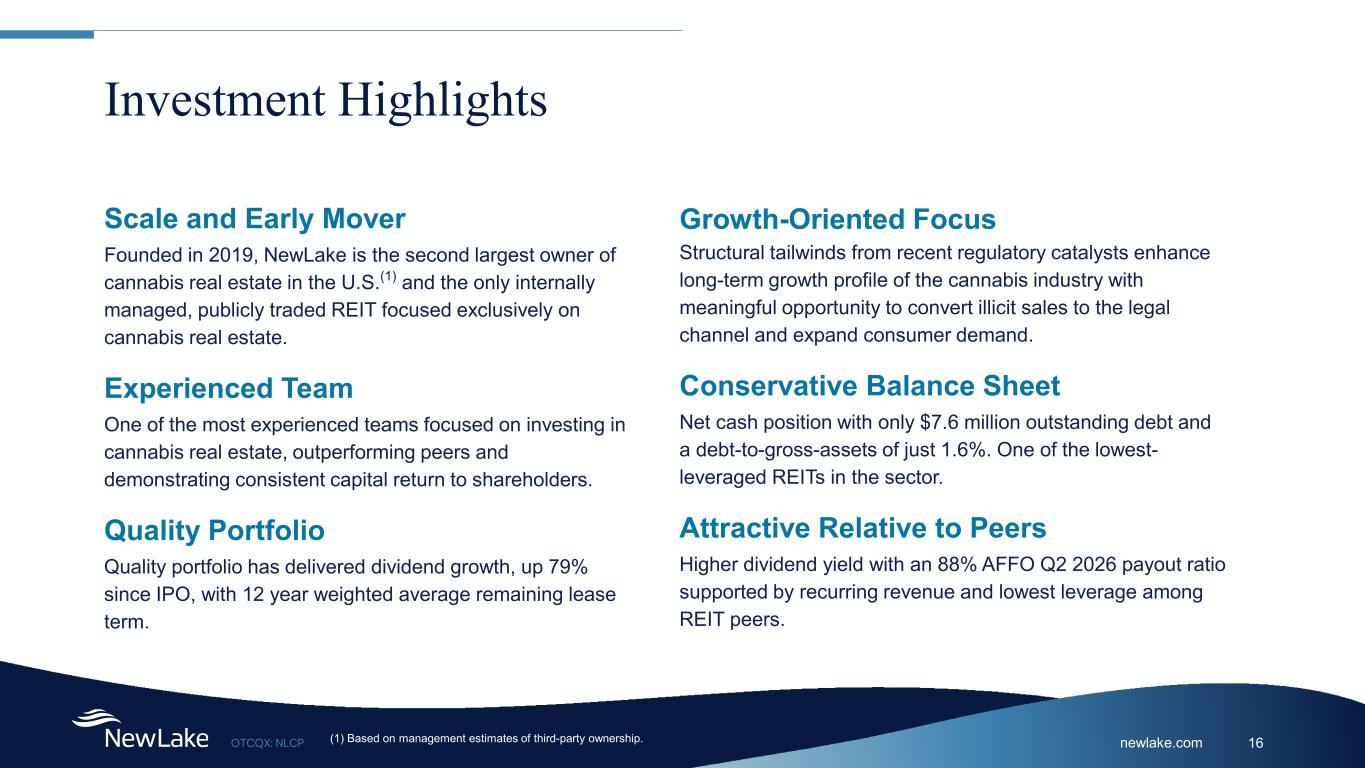
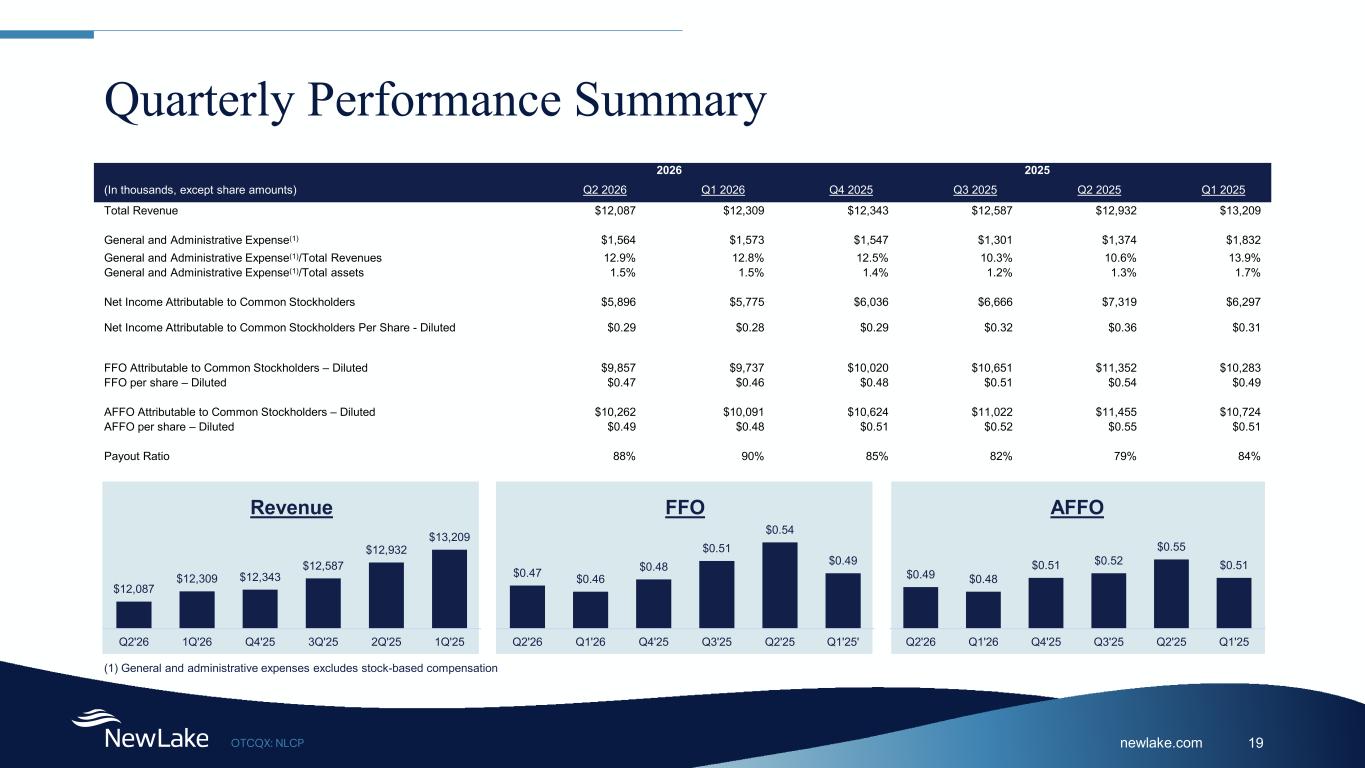
Thank you, Walter, and good morning, everyone. The past few months have been among the most constructive for the cannabis industry that we've seen in some time. The rescheduling of medical cannabis to Schedule 3, the continued momentum toward broader reform and the New York Stock Exchange listings of true leaving Glass House are all meaningful milestones that reflect the continued normalization of the industry. While additional reform is still needed before the industry has unfettered access to the U.S. capital markets, we are encouraged by the progress made over the last several months and believe it represents an important step towards a more stable and sustainable operating environment. As I mentioned on our last call, the impact of medical rescheduling extends beyond the elimination of 280E taxation. DEA registration transforms registered medical cannabis operators into federally legal businesses. All of our tenants operating medical-only facilities, which represents approximately 50% of our portfolio, have indicated that they've submitted applications for DEA registrations. We view this as another important step toward broader institutional participation and improved access to capital markets, including the potential for listing on major U.S. exchanges. Against this backdrop, New Lake delivered another solid quarter. Revenue and AFFO were in line with our expectations, and our AFFO payout ratio was 88% for the quarter, supporting our 43% per share dividend and within our guided range of 80% to 90%. Our portfolio continues to demonstrate the resilience that comes from disciplined underwriting, conservative balance sheet management and our focus on property-level performance. Turning to our portfolio, we continue to closely monitor developments related to our tenant, the cannabis. As we discussed last quarter, the cannabis filed for bankruptcy in Canada earlier this year and has been working through a court-supervised process. We lease four properties to the cannabis, including a dispensary and cultivation facility in Illinois and a dispensary and cultivation facility in Massachusetts. Recently, Bireo Growth announced the acquisition of certain assets from the cannabis across five markets, including Illinois and Massachusetts. The cannabis remains current through and including August Rent, and we're actively engaged with the cannabis and other parties to minimize the potential for rent disruption at our properties. We will update stakeholders as we have more definitive information to share. We continue to hold approximately one month of security deposit across those properties. Turning to investment activity, we are excited to have recently closed on a $2.1 million transaction for a 3,200-square-foot dispensary in Wilder, Kentucky, which will be leased to C3 Industries. This transaction expands our presence into Kentucky's emerging medical cannabis market and will be accretive to earnings. More importantly, it reflects a pipeline that has become increasingly active over the past several months. More broadly, we are seeing renewed optimism across the industry regarding opportunities to deploy capital, pursue growth initiatives, and participate in industry consolidation. As a result, we're actively evaluating new investments. That said, our underwriting standards remain unchanged. We will continue to be disciplined and selective, of prioritizing capital preservation and risk-adjusted returns over growth for growth's sake. Our three properties available for lease continue to be actively marketed. While retenanting opportunities do take time to develop, the quality and pace of discussions have improved over the past few months. Looking ahead, we believe there's a growing stack of potential catalysts for the industry. These include medical rescheduling, progress towards broader rescheduling of cannabis, exchange listing opportunities for plant-touching businesses, potential for banking reform, and increasing scrutiny of intoxicating hemp-derived products. While the timing and outcome of these developments remain uncertain, we believe the direction of travel continues to be favorable for the industry. I'd also like to address a topic where we've received a number of questions about following the New York Stock Exchange listings of Trulieve and Glasshouse. We're not announcing anything today, but we are actively evaluating whether there is a path for New Lake to uplist to a major exchange. To remind our investors, New Lake satisfies the listing requirements for both the NYSE and NASDAQ other than the exchange's restrictions on cannabis-related businesses. As regulatory developments continue to unfold, we'll continue evaluating potential paths forward so that we are prepared to act if and when the opportunity becomes available. While no decisions have been made, we do believe that the broader exchange access would create additional value for our shareholders over time. Finally, subsequent to quarter end, we extended the maturity of our revolving credit facility to May 2029 while lowering our borrowing costs and enhancing our financial flexibility. In an environment where capital for the cannabis sector remains scarce and expensive, our ability to extend our credit facility on improved terms while continuing to pursue accretive investment opportunities speaks to the strength of our balance sheet, the quality of our portfolio, and the confidence our lending partners have in our business. Before turning the call over to Lisa, I'd like to recognize David Weinstein, who stepped down from our board of directors at the end of July. David has been part of NewLake since our founding in 2019 and served as Chief Executive Officer through the company's transition to the public markets. On behalf of our board, management team, and shareholders, I want to thank David for his years of service and many contributions to the company. We wish him all the best in his future endeavors. With that, I'll turn the call over to Lisa to review our financial results in more detail.
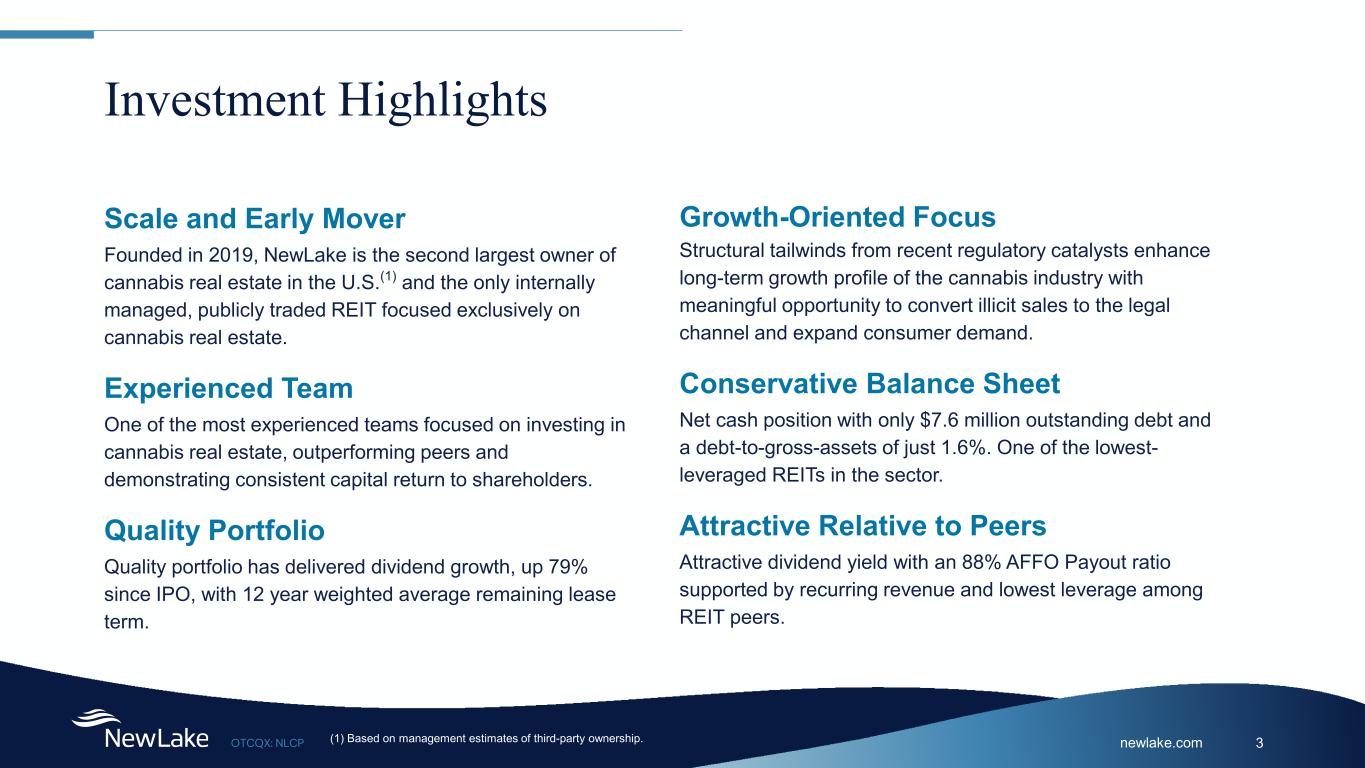
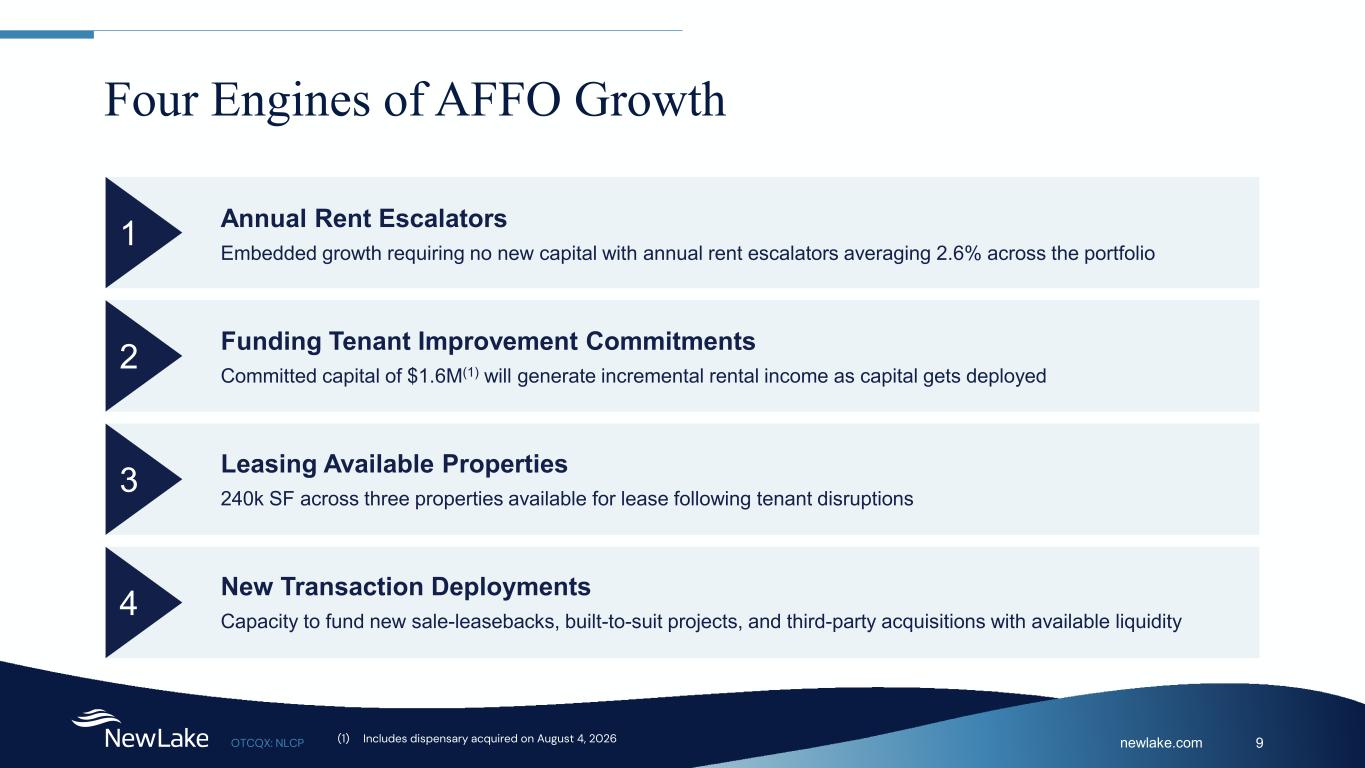
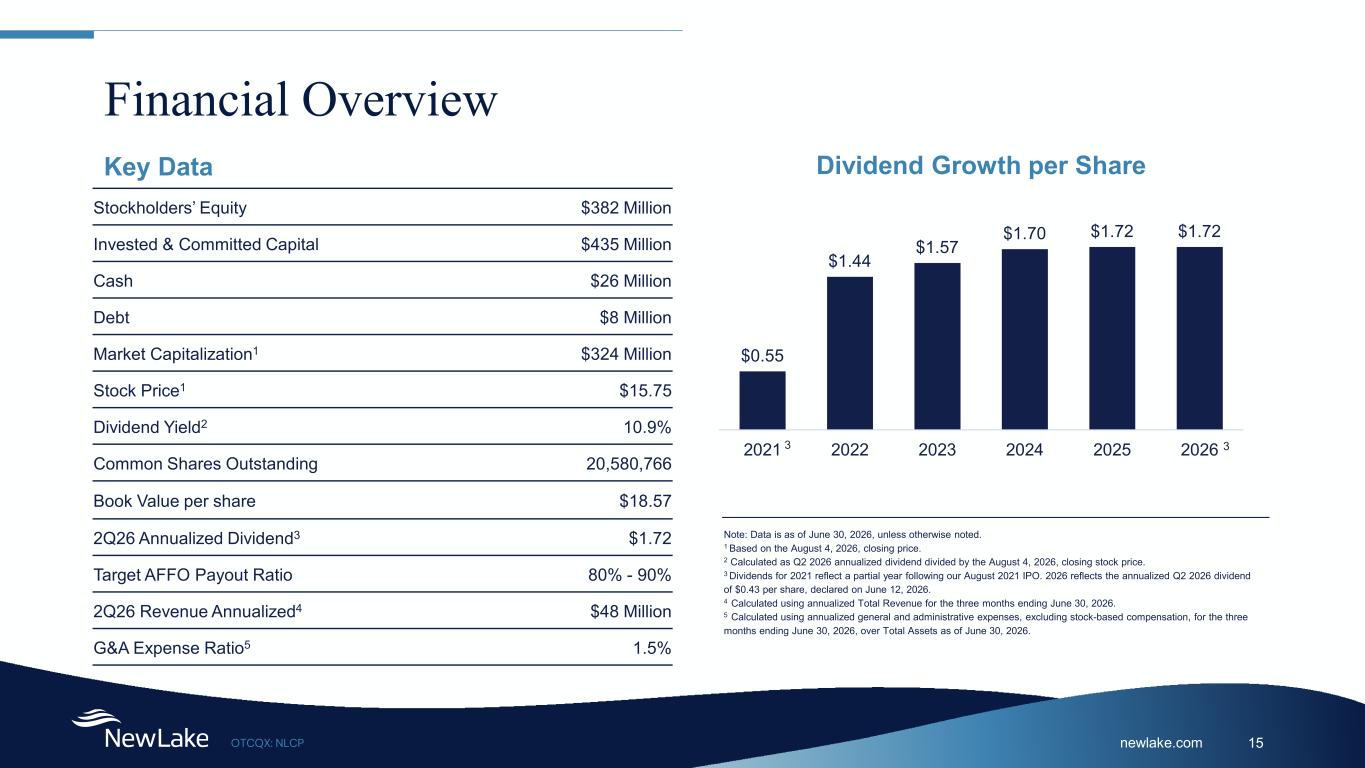
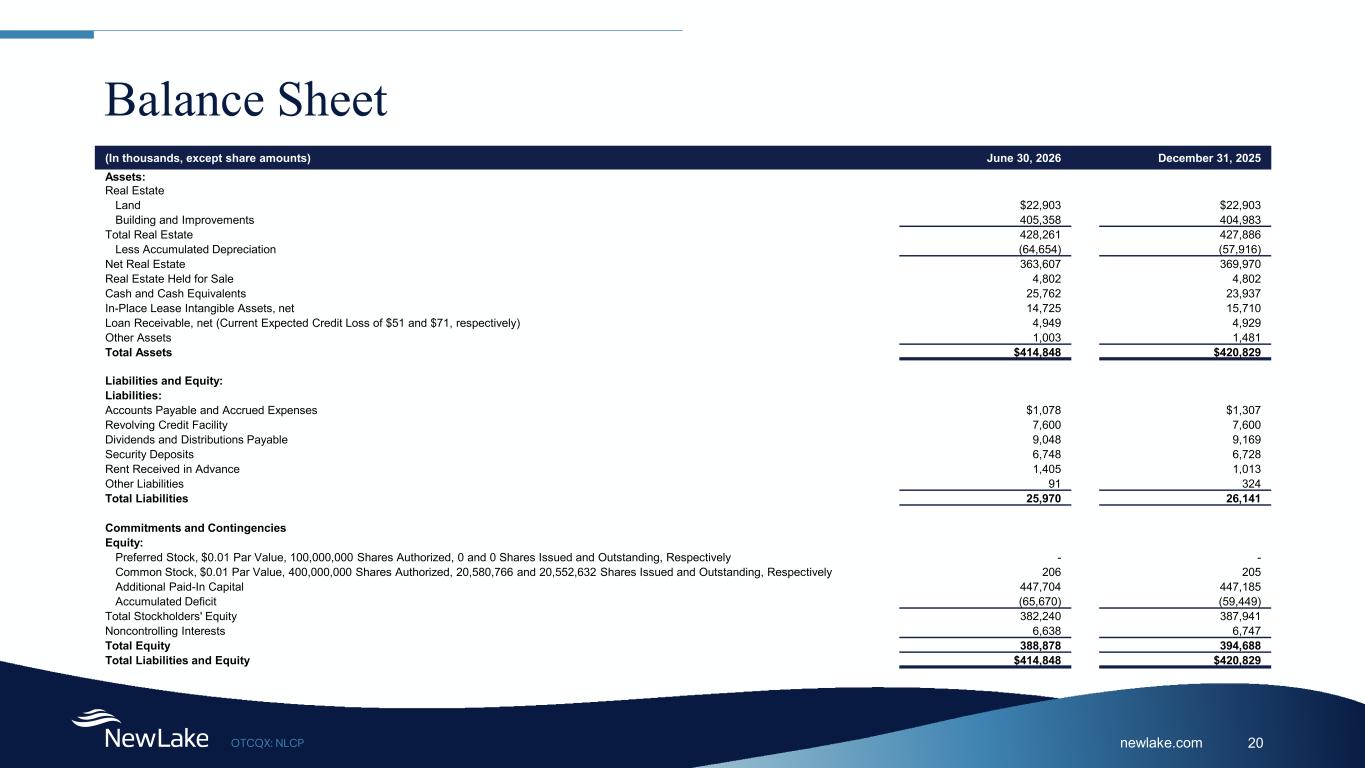
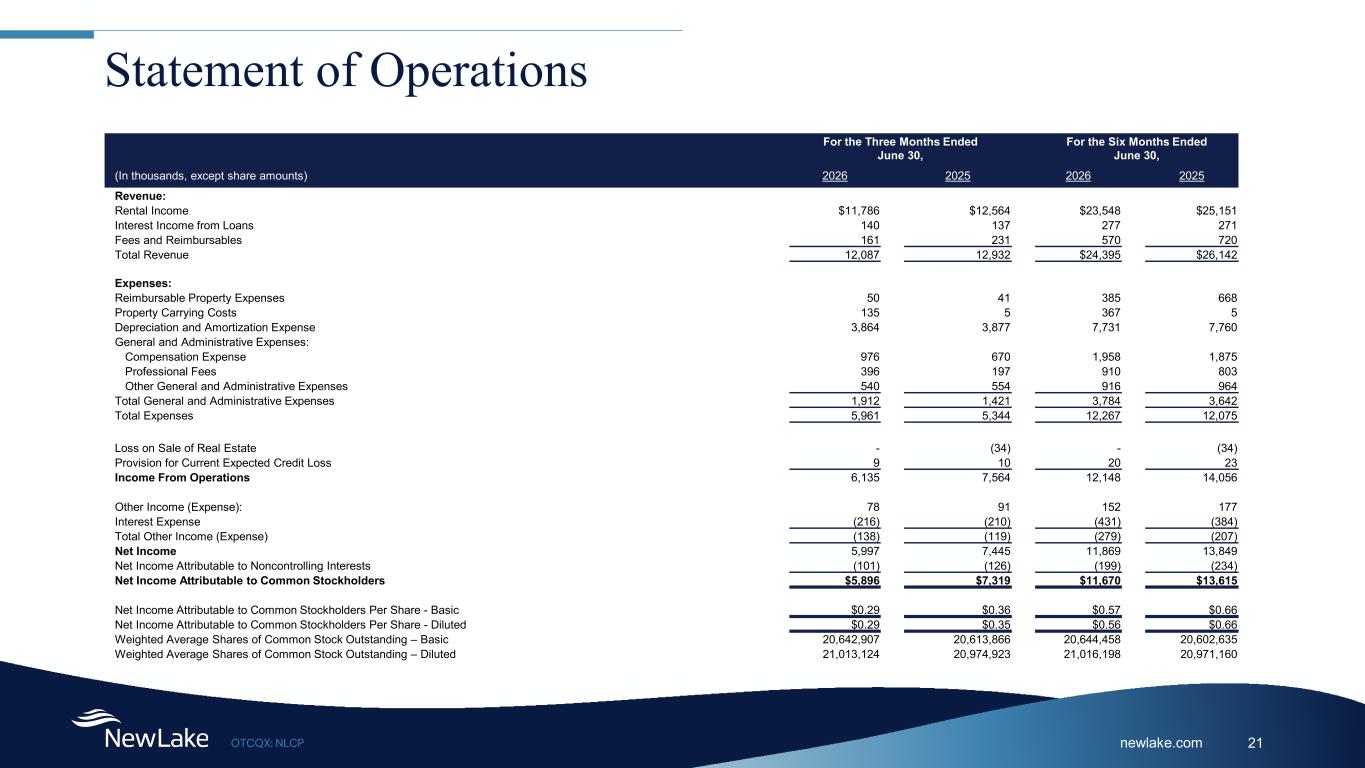
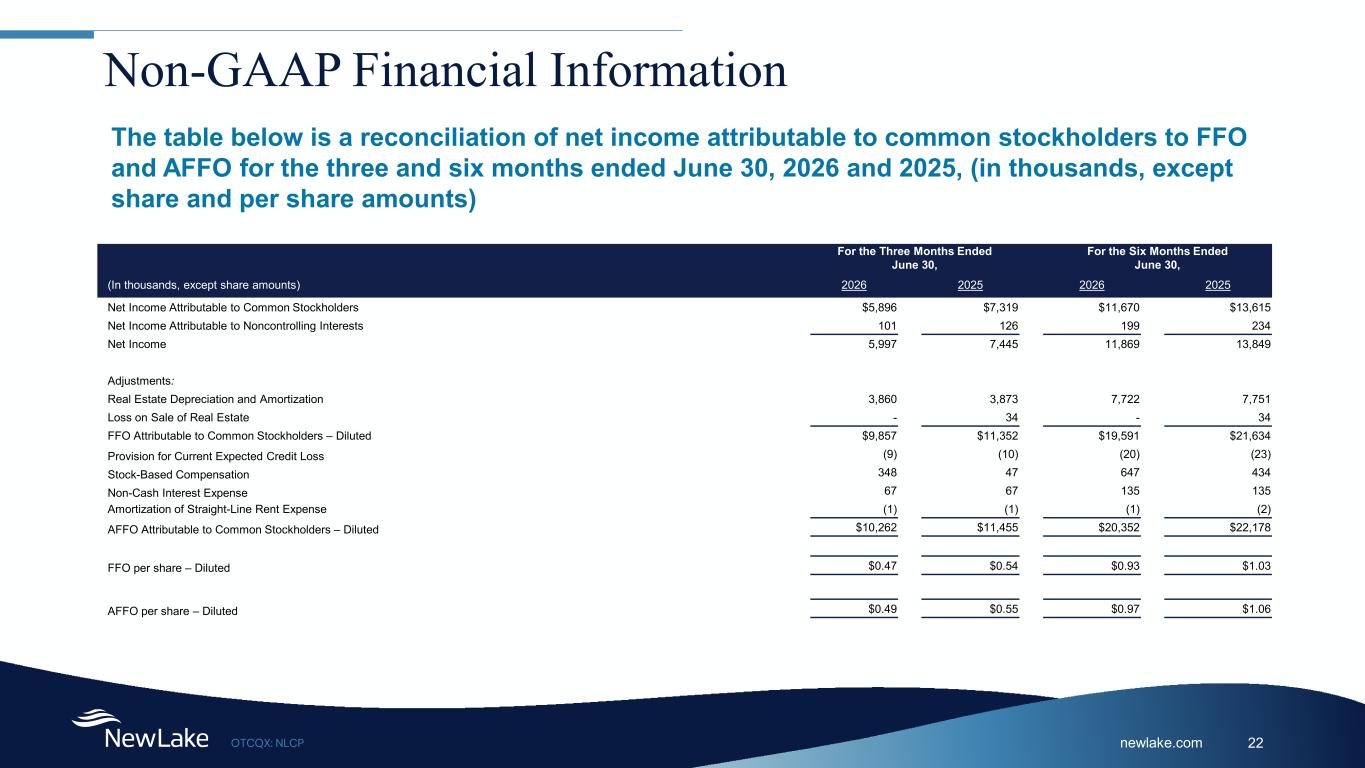
Thank you, Anthony, and good morning. For the second quarter of 2026, total revenue was $12.1 million compared to $12.9 million in the prior year period. Net income attributable to common stockholders was $5.9 million, or $0.29 per diluted share. Funds from operations totaled $9.9 million, or $0.47 per diluted share. and adjusted funds from operations totaled $10.3 million or 49 cents per diluted share. For the first six months of 2026, total revenue was $24.4 million compared to $26.1 million in the prior year period. Net income attributable to stockholders was $11.7 million or 56 cents per diluted share. Funds from operations totaled $19.6 million, or $0.93 per diluted share, and adjusted funds from operations totaled $20.4 million, or $0.97 per diluted share. The drivers of the year-over-year results were generally consistent for both the three- and six-month periods ended June 30, 2026. Revenue and AFFO were primarily impacted by three cultivation facilities available to lease in Pennsylvania, Nevada, and Massachusetts, reducing rental income and increasing property carrying costs. The impact was partially offset by the following. Annual contractual rent escalations averaging 2.6 percent across the portfolio, rental income from the two Ohio dispensaries acquired in 2025, and rental income associated with funded improvement allowances. On June 12, 2026, our board of directors declared a second quarter cash dividend of 43 cents per share, or $1.72 per share on an annualized basis. The dividend was paid on July 15, 2026 to stockholders of record as of June 30, 2026. This represents an AFFO payout ratio of approximately 88%, which remains within our target range of 80 to 90%. The earnings power of our portfolio continues to support our dividends. Turning to the balance sheet, as of June 30, 2026, we had $25.8 million in cash. We continue to maintain a very conservative leverage profile, with only $7.6 million outstanding on our 90 million credit facility, a debt-to-total asset ratio of 1.6%, and a debt-to-EBITO ratio of approximately 0.2 times. In August, we amended our $90 million revolving credit facility, reducing our interest rate by 100 basis points from prime plus 1% to prime, and extended the maturity date to May of 2029. We believe this amendment further strengthens our balance sheet by lowering our cost of capital and extending our maturity date. Also, in August, as Anthony mentioned, we acquired a dispensary property in Kentucky for approximately $0.6 million and committed to fund approximately $1.6 million for improvements. This property was simultaneously leased to an existing tenant. Overall, our results for the quarter were in line with expectations, and we remained focused on maintaining a strong balance sheet while prudently managing risk across our portfolio. With our liquidity, conservative leverage profile, and no debt maturities until 2029, we believe we are well positioned to pursue attractive opportunities as the regulatory environment for cannabis continues to evolve. operator please open up the line for questions thank you we will now be conducting a question and answer session if you would like to ask a question please press star 1 on your telephone keypad a confirmation tone will indicate your line is in the question queue you may press star 2 if you would like to remove your question from the queue for participants using speaker equipment it
Operator
may be necessary to pick up your handset before pressing the star keys and our first question will come from Pablo Zuanek with Zuanek and Associates.
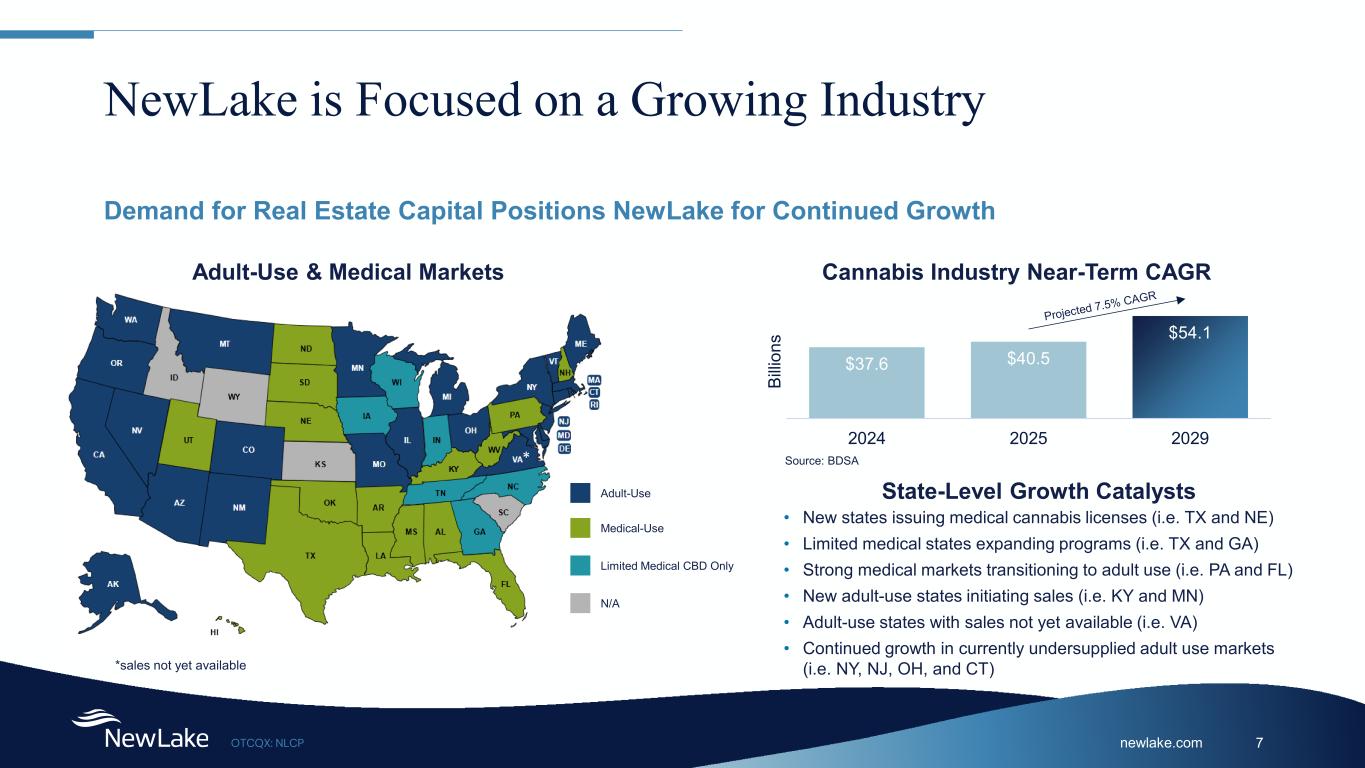
Thank you and good morning everyone. Anthony, can we start by talking about leap times? I'm thinking about Georgia, Virginia, Texas. You know, when supposedly in the case of Georgia, flower is already legal since allowed since July 1st, right? And I hear companies are running out of flower there very quickly. Virginia starting July 1st next year. I'm just wondering, because we're at lead times to get up and running on production of 18 months, 24 months, you would think that those companies would be talking to you already in terms of leasing potential properties. I'm just surprised we're not seeing that yet, especially with Georgia and Virginia. I realize that Texas may take a bit longer.
Yeah, I think Kentucky is a good indicator of what we would expect to see in this environment where companies are less enthusiastic about aggressive build-out of capacity, even into some of these newer markets. Um, we find that the discussion with us is often delayed than say where those discussions were back in the 22, 23 timeframe when there were, there was a more aggressive posture towards expansion. And so, yes, we do have some conversations going across, um, across these states, but I think overall CapEx and expansion is at a slower pace into the new states than it was in, say, the 21-22 cohort.
Thank you. That's a good caller. In terms of the vacant properties, the Nevada and Pennsylvania Ex Air Cultivation and the Revolutionary Clinics Cultivation in Massachusetts, can you give an update on that? Are they more likely to be sold maybe for other use or even rented for other use, or do you believe that you'll be able to lease them out for cultivation of cannabis?
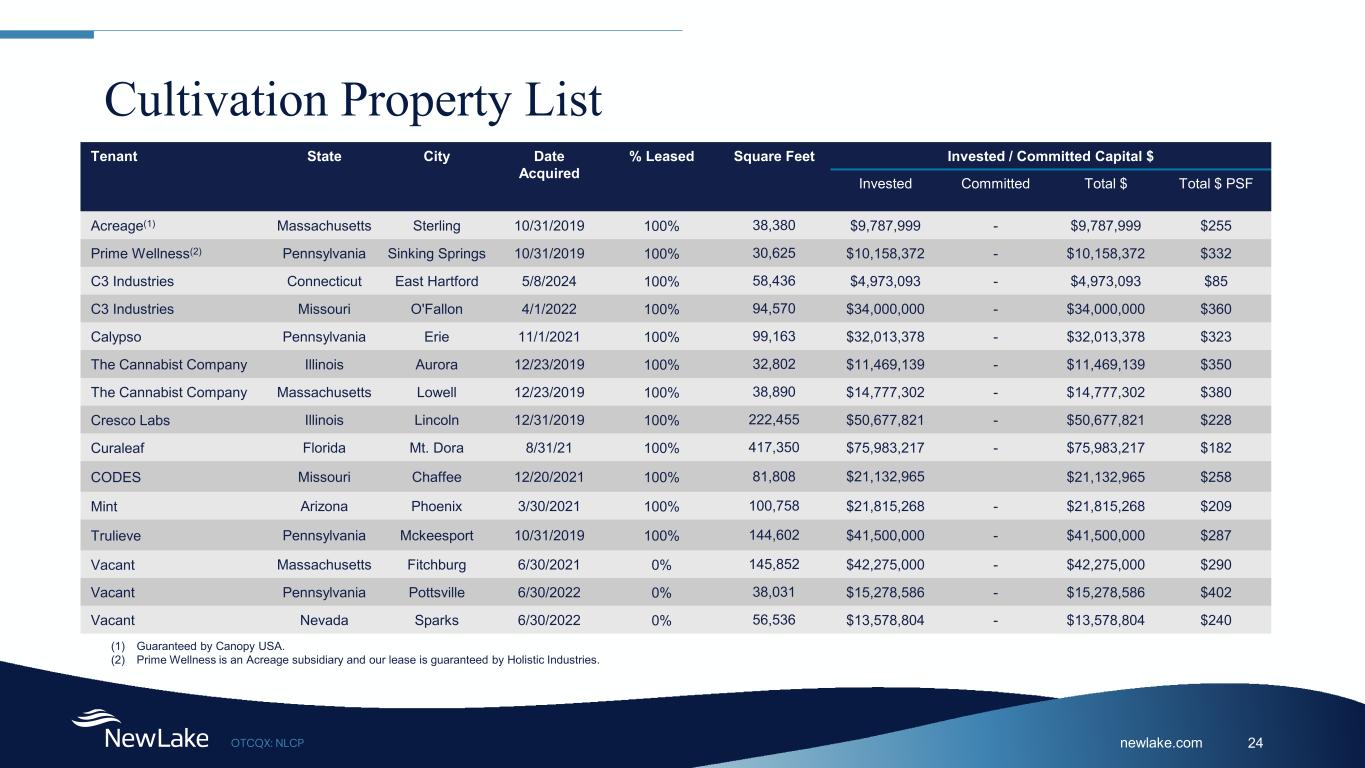
First off, our guiding principle when it comes to tenanting those facilities is what is the best net present value for our shareholders. And so we have everything on the table. We look at cannabis as an opportunity, non-cannabis. Because these are cultivation facilities and they're purpose-built as existing cultivation facilities, typically the best use for our shareholders is try to get the premium rent from a cannabis operator versus a non-cannabis operator. So, yes, we pursue all of them. I think the longer it goes that we're not able to identify a credit-worthy cannabis tenant, the increased likelihood is we pivot to either a non-cannabis tenant or a potential sale of the property.
But on that point, would you want to handicap the three? I mean, it seems that Massachusetts is taking a lot longer than expected. I realize Nevada and Pennsylvania is more recent. Do you want to keep a bit more color there?
No, I don't because it's so variable. Pablo, there's so many different factors that go into it. What I would say to you is that when you look at Pennsylvania, given it's still a medical market and it is a market that will have adult use at some point, it's a more limited license market, there's probably more demand for those types of facilities than you would find, say, in Massachusetts. And when you look at, say, in Nevada, while activity was slow, we do see hemp as a real big issue in Nevada. And with hemp receding and hemp-derived products competing with the marketplace in Nevada with hemp receding, there has been some recent uptick in interest. And so I don't want to go farther than that in terms of handicapping because nothing's ever done until it's done. That's why we don't announce letters of intent.
We only announce signed lease agreements. thank you and just moving on to the cannabis properties uh you know uh now taken over by video growth i heard your comment about the conversations ongoing but i guess let me give you a couple of examples uh you know i hear sometimes when uh dispensaries change hands uh because of restructuring or the owner going on default the new buyer buys the dispensary but sometimes they don't recognize the receivables. So whoever was holding the receivables, the wholesaler or vendor, to a dispensary ends up losing the money. What's the precedent? But I realize the case is very different for rented property, right? You would think Vireo, if they want to hold on to those dispensaries and the cultivation, they will have to honor the leasing agreements and pay the rent. I mean, maybe I'm stating something that's obvious, but I'm just trying to understand what's the precedent, And not so much about video specifically, but it would seem that when these properties change hands, the new owner has to honor the lease agreement. Or is that very naive thinking of me?
No, I think that is accurate. I think that is accurate. First, I want to reiterate that in my prepared remarks, I informed investors that the cannabis has paid rent on all four properties through and including August rent. And that's telling me that there's a deal to be had and nothing's ever done until it's done. But these properties are obviously have some value to continue paying the rent. And yes, when someone acquires a license in an operating business, they typically will step in to that facility and they will continue paying rent. From time to time, there may be a negotiation about reducing rent as part of the overall transaction. That's always something that's in the cards in these types of transactions. And then I think what you're referring to is there have been cases where people have purchased the licenses and not necessarily the operating businesses. And when you purchase the license, you can leave certain assets behind, excuse me, certain liabilities behind through a Canadian bankruptcy process. So they're very complicated and highly negotiated.
Thank you. One last one for me. In the thank you, there's something there about the acreage property that is guaranteed by Canopy USA. Can you give more color in terms of how that works in practice?
Yes. When the transaction with acreage was executed way back in 2019, 2020, there was a direct acreage parent guarantee. Given the restructuring that occurred between Canopy and Acreage, excuse me, started with the closing of the acquisition of Canopy, acquisition of Acreage by Canopy, and the creation of Canopy USA, Acreage now has a parent Canopy USA, and Canopy USA not only holds the interest in Acreage, but also holds interest in Juana, Jetty, as well as shares in Terrasend. And so through dialogue and a transaction earlier this year around Pennsylvania, we were able to negotiate an additional guarantee from Canopy USA. And so we were able to get what we think is additional protection for our shareholders by adding Canopy USA as a guarantee and not only having an acreage guarantee on the lease.
Right. Thank you. Look, and I guess I want to add one more, Anthony, and apologies if there's someone else on the Q&A queue. Just in terms of the macro, obviously always very interested to hear your perspective. So, you know, we know August 17th, right, then Judge Julius has to go through all the documents he receives, look at the hearing and write his report, question mark how long that will take. Then that goes to a DOJ, and then a DA director has to, administrator has to write the final rule, right? And, of course, we're all speculating how long that would take. Do you want to give your impressions in terms of how long that process could take?
It is a guess, so I will give you an answer, but it is a guess. My best guess is it's mid to end of October. and why I get there is when we study the Administrative Procedures Act and how these types of processes work, as you indicated, we need the ALJ recommendation. Well, the post-hearing briefs are due by August 17th. The ALJ needs to have time to consider what's submitted, and we don't expect those to be submitted until the very end. So it's going to take probably a couple of weeks for the ALJ to complete his report and his recommendation, and so call that beginning of September. Then once his recommendation comes out, there is what's called a 30-day exception period where parties who participated in the hearing have the opportunity to file exceptions to what the ALJ recommendation is. That takes us into early October, and now the DEA has to file the final rule. And they likely can't do that the day after the exception period ends because they will need to consider the exceptions that were submitted towards the end of that period. And so I add all of that up and there's a lot of work to be done, even though the DEA is probably doing work on a final rule now, they do need time to incorporate what comes in during that exception period to incorporate what the ALJ recommendation is. So that's why I think the earliest is probably mid-October. And so my guess, mid to end of October. And I get a little aggressive in that timing only because I do believe in the political overlay that this action has and that there's probably a desire of the administration to get this completed and get that final rule filed before midterms. And so that's how I conclude. But I do want to remind everybody, once the filing occurs of the final rule, it's a 30-day implementation period and we'll all buckle up for the resulting litigation that will commence from there.
That's right. Thank you very much. That's a great quarter. Thank you, Anthony.
Operator
Thank you, Pablo. And as a reminder, that is star one if you would like to ask a question. We'll go next to Craig Kuchera with Lucid Capital Markets.
Hey, good morning. You guys had a decline in property carrying costs sequentially.
Understanding that you wouldn't have them if you leased up some vacancy, but if those assets remain vacant, how should we think about that for the remainder of the year? the reason there was a decline in the second quarter was a result of a reimbursement that we received from a previous tenant um that was in that that had vacated so it just it reduced the property expenses a little bit more than it would what it should have i i would think that q1 is a good run rate for what those expenses should be okay that's that's helpful um yeah i believe both truly even glasshouse deconsolidated their recreational operations
in order to uplist um just curious given the legalization of medical are you seeing any of your other tenants moving in that direction to take advantage of the legislation most of our other tenants that are public um have a more intertwined business between their medical and their adult use programs and so what we're seeing is most of the others are taking a weight approach Well, let me restate that. They're taking steps such as reverse splits in order to meet listing requirements for minimum stock price, but they are stopping short of restructuring their business, given the nature of their business or how large the adult use component is, with the expectation that we will see rescheduling get completed later this year, and then the entire business could get uplisted to the New York or NASDAQ.
Okay. You know, that makes sense, putting off that decision certainly until back half of the year. And I guess against that backdrop, are you seeing any pickup in transactional activity for medical only? And if so, you know, any movement in cap rates? Or is it still too early?
I would say there's been no pickup in medical versus adult use. The pickup in activity is really driven by the market opportunities. I don't yet see people making decisions in their business purely to orient towards medical versus adult use. And then in terms of cap rates, cap rates continue to be in the same range that they've been for some time in the marketplace. we've not seen compression in that.
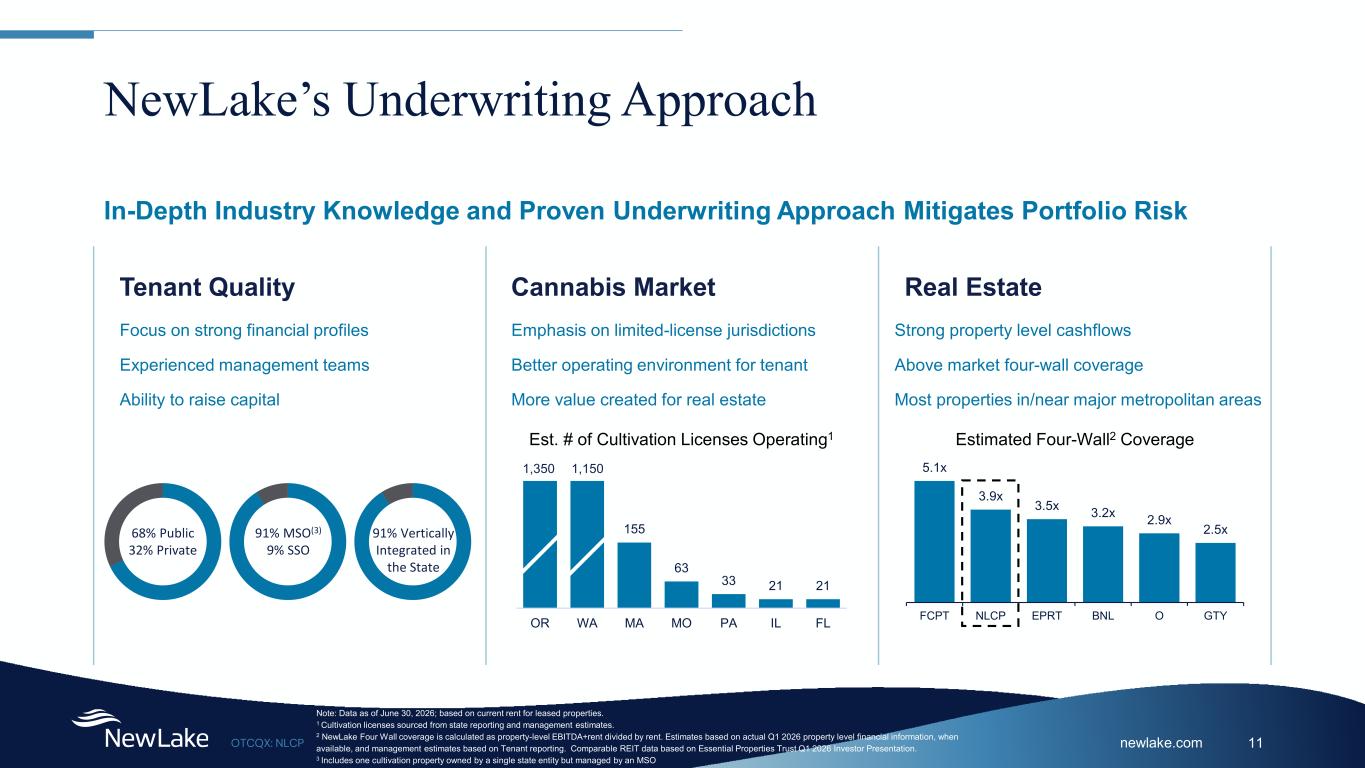
Got it. And outside of cannabis, which sounds like there's some positive movement there, are there any other tenants that are on watch list negative or is everybody still performing well? I know your four-wall coverage still looks really good.
We watch all of them. This is the cannabis industry. This is a volatile and emerging industry. So we're watching all of them. The ones that we've identified in the past on these calls would be a cannabis or an acreage. And so those were the ones in the portfolio versus, say, a Cresco, which just issued really good results this morning, or Cureleaf, our largest tenant, issued last night, very good performance. And so when we look at the portfolio, we don't publish a watch list per se, but we're certainly looking at the operators in the portfolio that have historically underperform their peers, such as acreage. Got it. Okay. Thanks. That's it for me. Okay. Thanks, Craig.
Operator
And this now concludes our question and answer session. I would like to turn the floor back over to Anthony Coniglio for closing comments.
Thank you, Operator, and thank you, everybody, for joining us today. We hope you have a wonderful remaining of the summer, and we look forward to connecting with you all in the coming months.
Operator
Ladies and gentlemen, thank you for your participation. This does conclude today's teleconference. You may disconnect your lines and have a wonderful day.