Operator
Good day and welcome to the NN Inc. first quarter 2025 earnings conference call. All participants will be in a listen-only mode. Please note this event is being recorded. I would now like to turn the conference call over to Mr. Stephen Poe, Investor Relations. Mr. Poe, the floor is yours, sir.
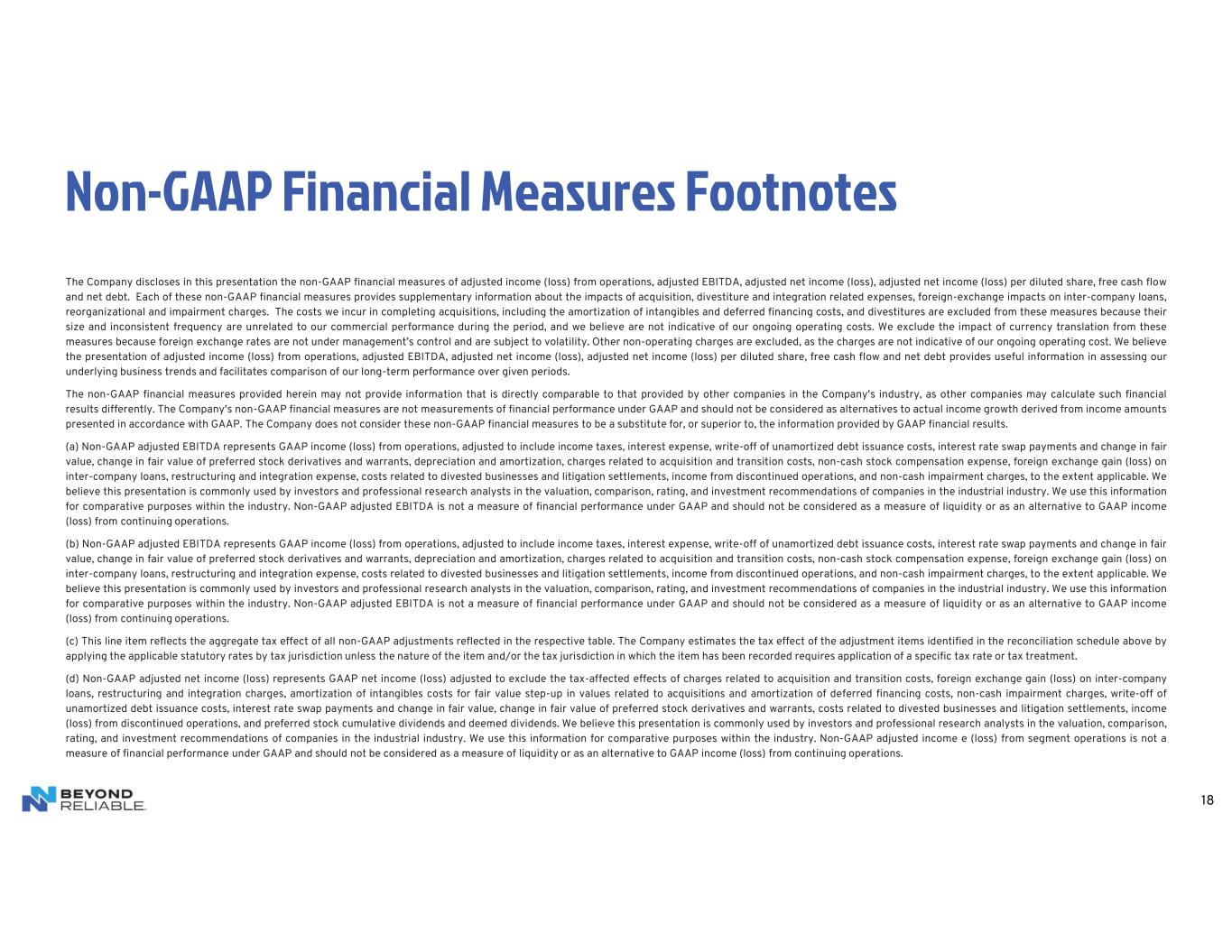
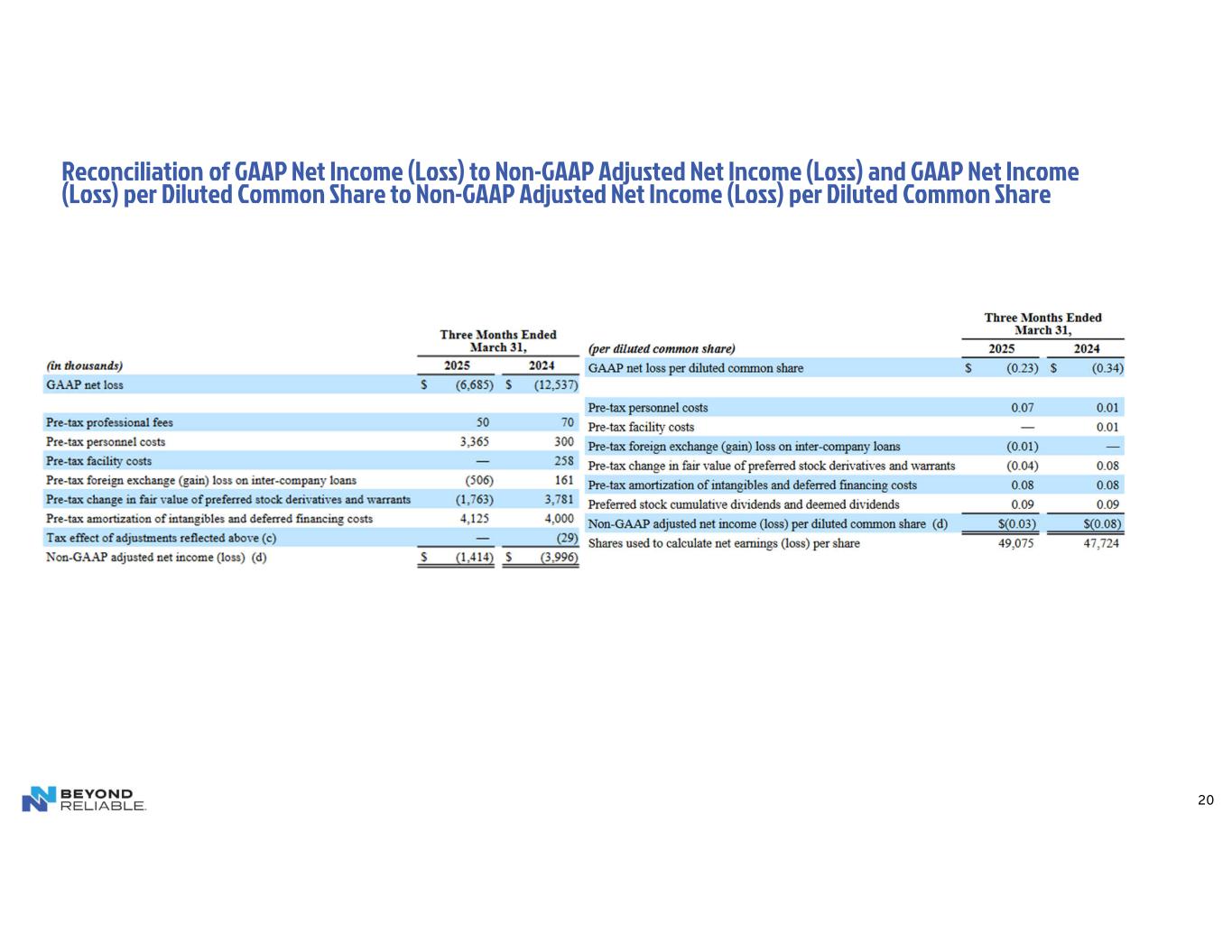
Thank you, operator. Good morning, everyone, and thanks for joining us. I'm Stephen Poe with NN Inc.'s Investor Relations Team, and I'd like to thank you for attending today's earnings call and business update. Last evening, we issued a press release announcing our financial results for the first quarter ended March 31, 2025, as well as a supplemental presentation, which has been posted on the Investor Relations section of our website. If anyone needs a copy of the press release or the supplemental presentation, you may contact our Investor Relations Group at [email protected]. Our presenters on the call this morning will be Harold Bevis, President and Chief Executive Officer, Chris Bohnert, Senior Vice President and Chief Financial Officer, and Tim French, our Senior Vice President and Chief Operating Officer. Please turn to Slide 2, where you'll find our forward-looking statements and disclosure information. Before we begin, I'd ask that you take note of the cautionary language regarding forward-looking statements contained in today's press release, supplemental presentation, and in the risk factors section in the company's quarterly report on Form 10-Q for the fiscal quarter ended March 31, 2025. The same language applies to comments made on today's conference call, including the Q&A session, as well as the live webcast. Our presentation today will contain forward-looking statements regarding sales, margins, inflation, supply chain constraints, foreign exchange rates, cash flow, tax rates, acquisitions and divestitures, synergies, cash and cost savings, future operating results, performance of our worldwide markets, general economic conditions, and economic conditions in the industrial sector, including the potential impacts and ramifications of tariffs, the impacts of pandemics and other public health crises, and military conflicts on the company's financial condition, among other topics. These statements should be used with caution and are subject to various risks and uncertainties, many of which are outside of the company's control, which may cause actual results to be materially different from such forward-looking statements. The presentation also includes certain non-GAAP measures as defined by SEC rules. The reconciliation of such non-GAAP measures is contained in the tables in the final section of the press release and the supplemental presentation. Please turn to Slide 3, and I will now turn the call over to our CEO, Harold Bevis.
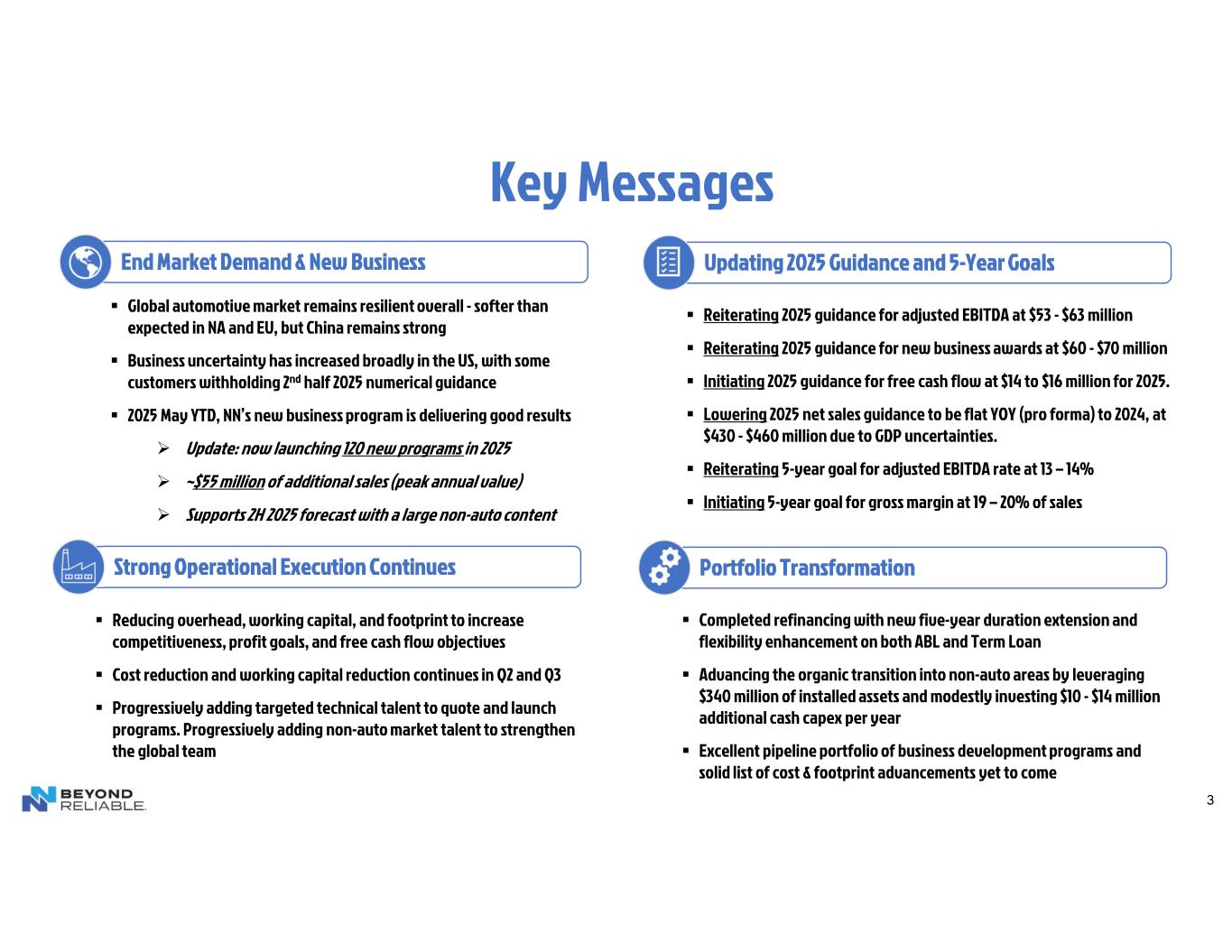
Thanks, Stephen, and good morning, everyone. I'd like to address a few key points at the beginning of the update today, and the first point is regarding market demand, tariffs, and new business. Business uncertainty increased during the quarter and since we last reported, and it caused us to have lighter sales in plan in Q1 at a few customers, especially in global automotive, which is now about 40% of our sales. Quite a few public companies in our segments are reporting down sales and negative outlooks. We're reporting flat sequential sales and flat year-over-year sales on a pro forma basis. We're able to do that due to our successful new business program, which keeps delivering results, gaining share, and winning new positions. But during the quarter, we did see our base business softening, and we shifted our business development focus on closing and winning immediate ramp-up sales, and it's working well. We nicknamed it the PIGS program for Profitable Immediate Growth Strategy, focusing on immediate ramp-up business, and the complexion of 2025 already looks different. We now have 120 programs that we've won ramping up this year worth $55 million in annualized sales, which is a steep increase since we last reported. Our biggest new win is in industrial products where we will convert certain automotive production assets over to produce these new products. This $55 million in new business is ramping up during the remainder of 2025, and it adds to whatever our base business will be. At this point, we're assuming a flat base business market environment from our legacy customers with this additional layer of business. It bolsters our outlook, and it gives us confidence to reconfirm our guidance, which Chris will walk through. So, this has turned out to be a speed bump, not a roadblock, and we're working through it and winning immediate business. If our base markets improve, then it's all the better and will add additional positivity to our outlook. The second point is on operations. Given the base business uncertainty, we decided to go ahead and increase the amount of cost reduction that we have underway for 2025, and our operations team is well underway with this. We've already actioned many staff reductions during Q1, which will further bolster our profit rates in Q2, Q3, and Q4. We've progressively increased our cost-out plans and new product launch plans from 2023 to 2024 and now to 2025, and we're on track for this year's $15 million cost reduction plan, as well as the 120 ramp-up plans, which almost every plant is participating in. This gives us confidence with the rest of the year and provides a good carry into 2026 as well. Our third point is that the combination of our commercial performance and operational performance gives us confidence to update our 2025 guidance and five-year goals. We are reiterating our full-year guidance for EBITDA and for new business awards, and we're initiating free cash flow guidance at $14 million to $16 million. In the first quarter, we could not be aggressive with our cash management activities as we refinanced our ABL at the very beginning of the quarter and our term loan at the very end. We kept our balances comfortable to fund all activities and manage bank transfers. This was temporary and will not be the case going forward. Our fourth point is that our company transformation is on track. On the commercial side, a key point to remember is that we have a significant amount of open capacity globally. We are largely running one shift operations everywhere in the world, enabling a robust new business program for existing products. We're set up to pursue a wide spectrum of additional business for legacy products. On the pivoting side, we're selectively adding new assets that are market-based for those products, and this balanced program of both leveraging existing capacity and know-how, as well as adding new capacity in certain areas, is working well. We've now won $160 million of new business, and we've kept our growth CapEx spending modest, continuing to gain momentum in our new targeted areas, which we will cover today as well. On the operational side, this one-shift plant situation gives us many opportunities for footprint optimization, and we're progressively eliminating redundancy and excess costs from our global cost and working capital structures. We have a comprehensive program for 2025, but we are also opportunity-rich on a going-forward basis. In summary, we're optimistic about both 2025 and our long-term goals, and we look forward to discussing them with you. Please turn to Page 4 where our CFO, Chris Bohnert, will cover some key performance metrics. Chris?
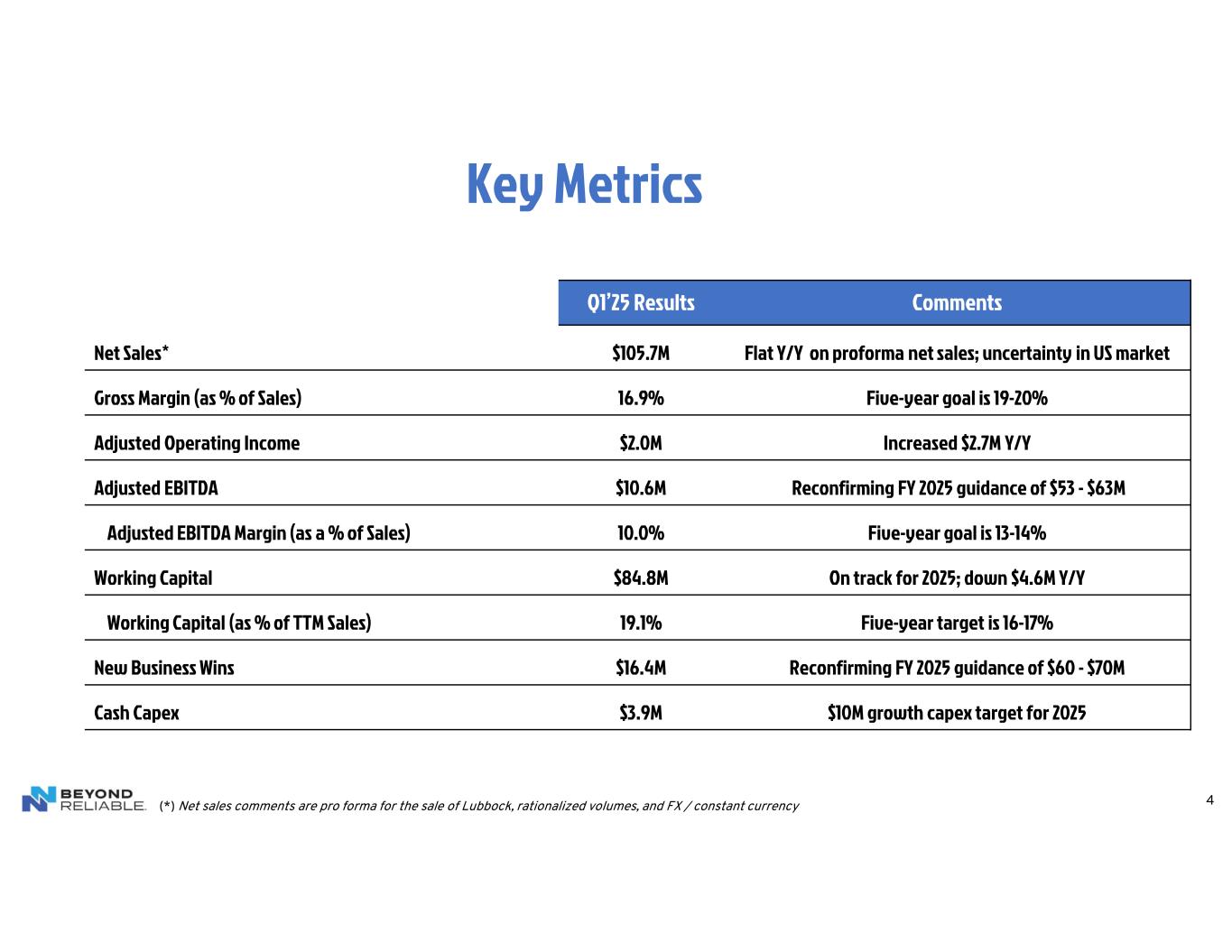
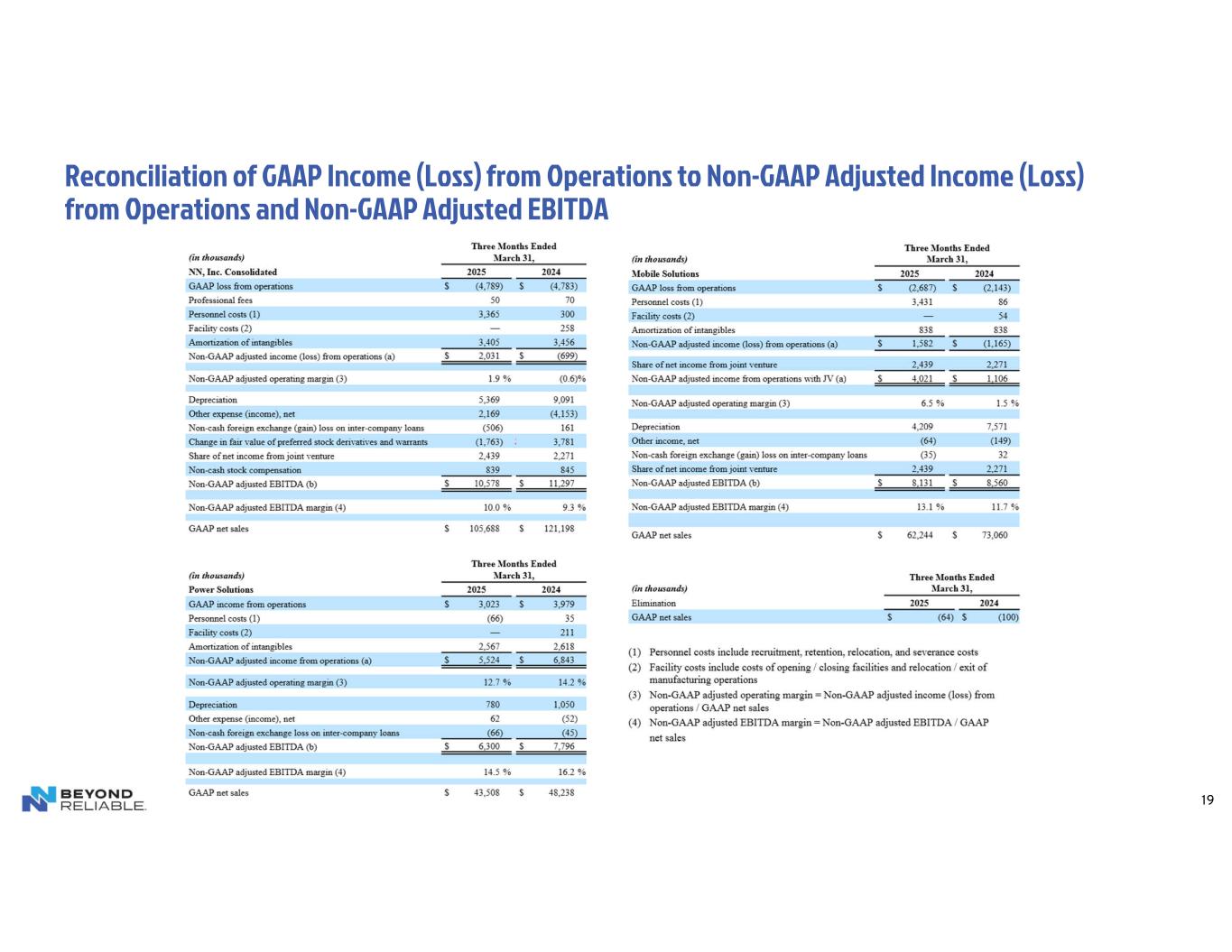
Thank you, Harold. We added this slide to focus on some of our key metrics first. I'll get into our more detailed quarterly results later. First up is our net sales for the quarter. As Harold mentioned, we were flat on a pro forma basis and roughly flat sequentially from the fourth quarter. Our adjusted gross margins were 16.9%. We feel like we're on track to hit our five-year goal in the 19% to 20% range as we continue our cost-out programs and layer in new business in the coming quarters and years. Our adjusted operating income was actually positive at $2 million, which was an increase of $2.7 million quarter-on-quarter. Our adjusted EBITDA came in at $10.6 million, and as Harold mentioned, we're reconfirming our guidance in the range of $53 million to $63 million for the full year of 2025. Adjusted EBITDA margins came in at about 10% for the quarter, on track with our five-year goals in the 13% to 14% range. We also spent a lot of time working on working capital. Tim will cover this in more detail, but our working capital through the first quarter was $84.8 million. It's on track for our goals to be down $4.6 million year-on-year, and our working capital as a percent of our trailing 12-month sales is 19.1%, significantly down, as Tim will talk about shortly. New business wins came in at $16.4 million. We're reconfirming our guidance there in the range of $60 million to $70 million for the full year. We also obviously track cash CapEx and cash very closely. Cash CapEx for the first quarter was $3.9 million, and we're targeting about $10 million for the full year, maintaining a strict spending discipline. Those are just a few of our key metrics. I'll talk about the quarter in more detail, but with that, I'd like to turn it back over to Harold.
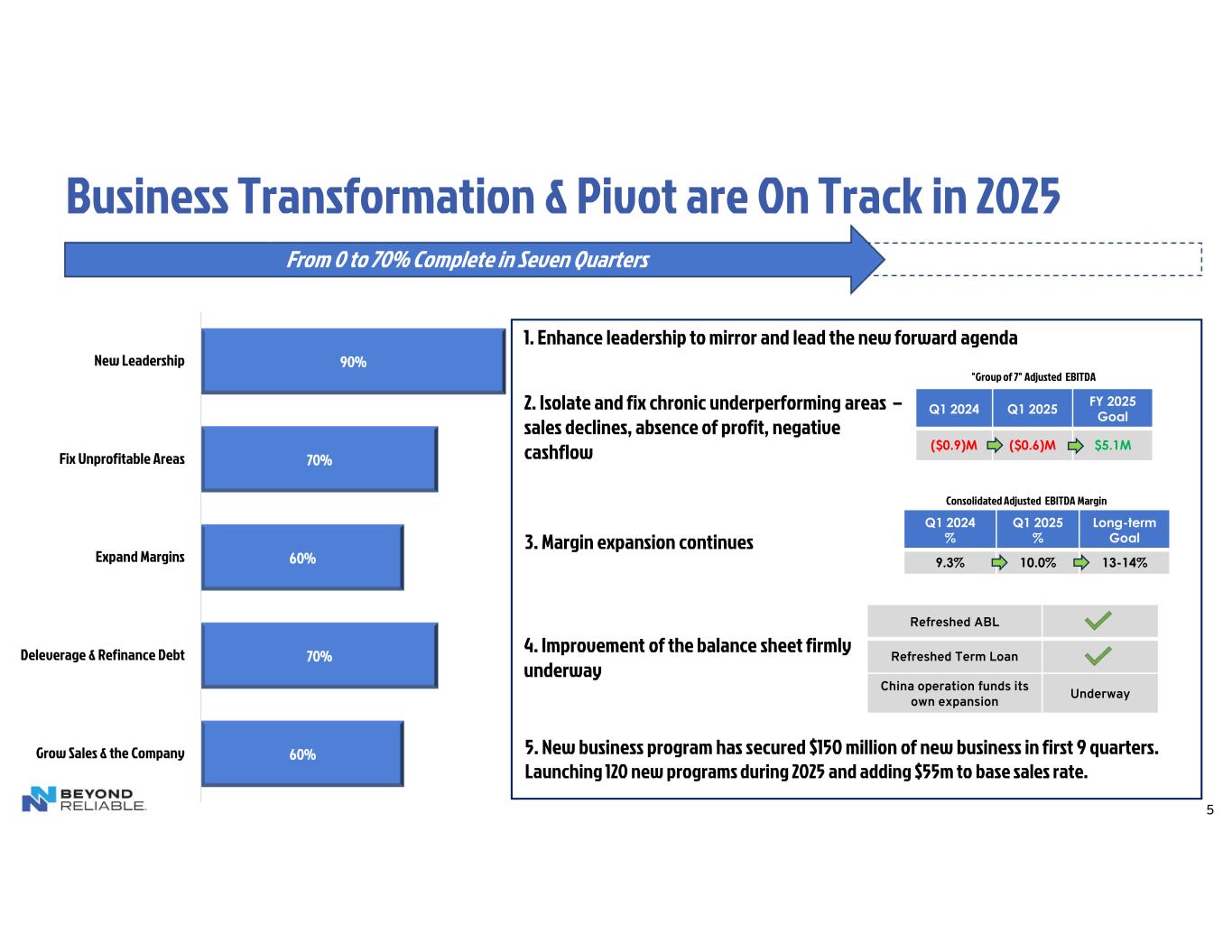
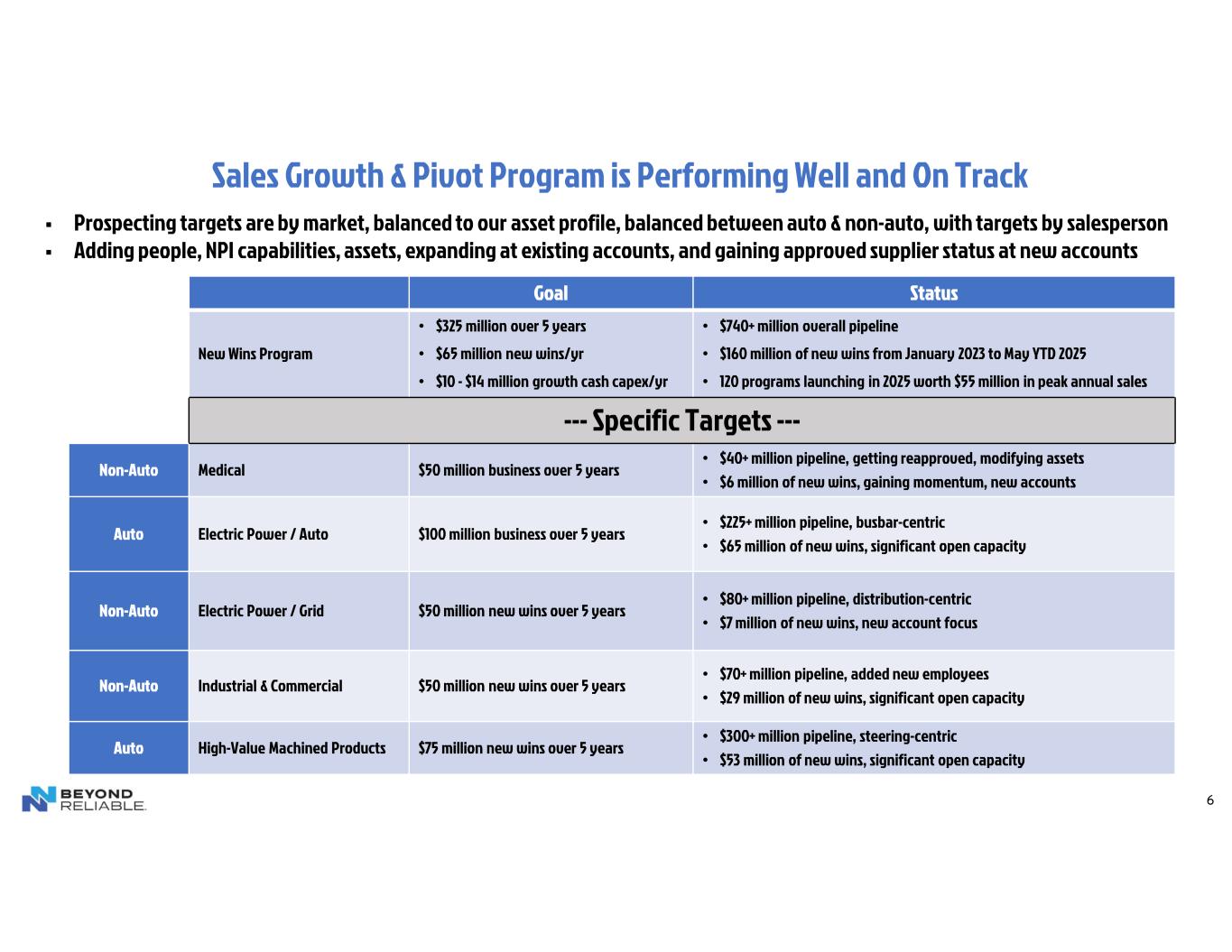
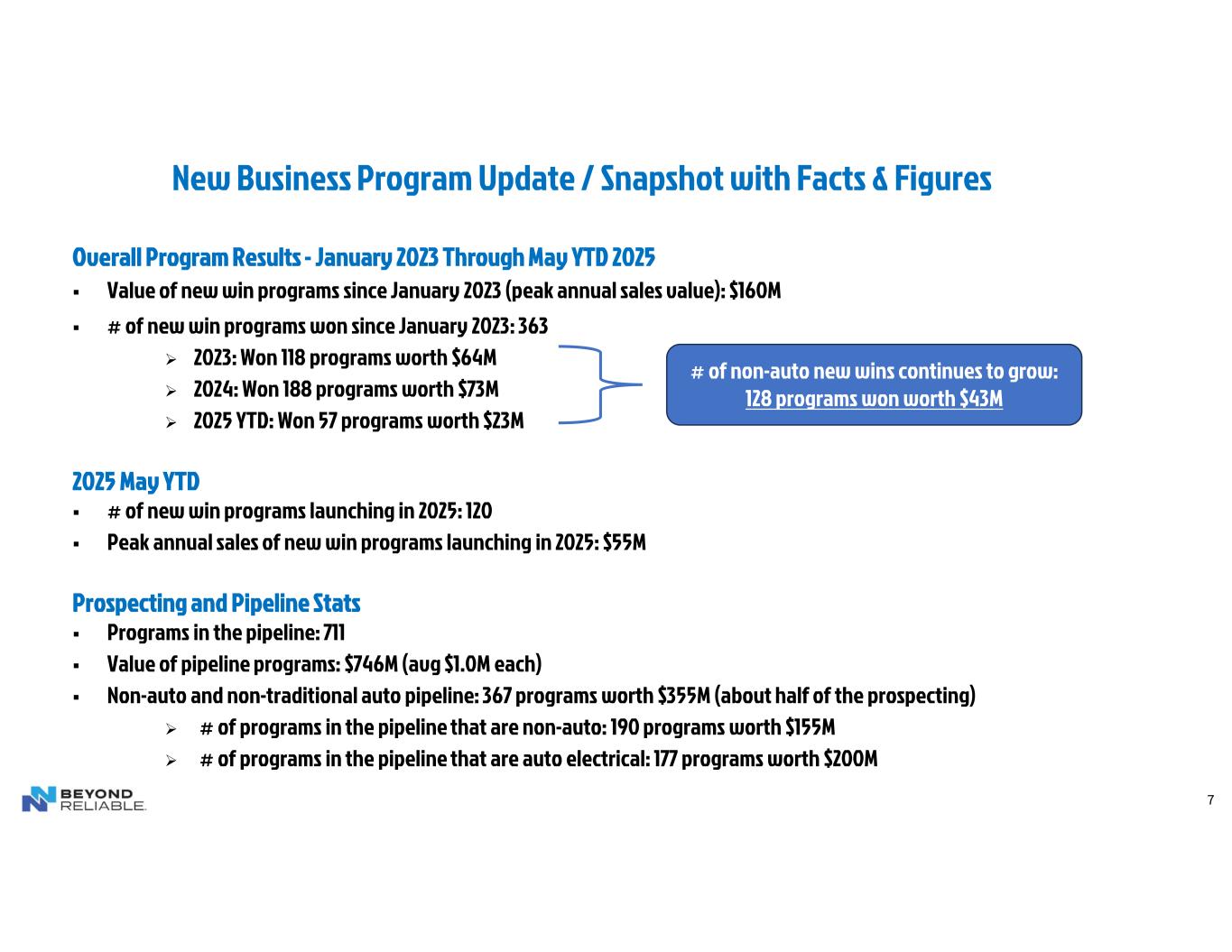
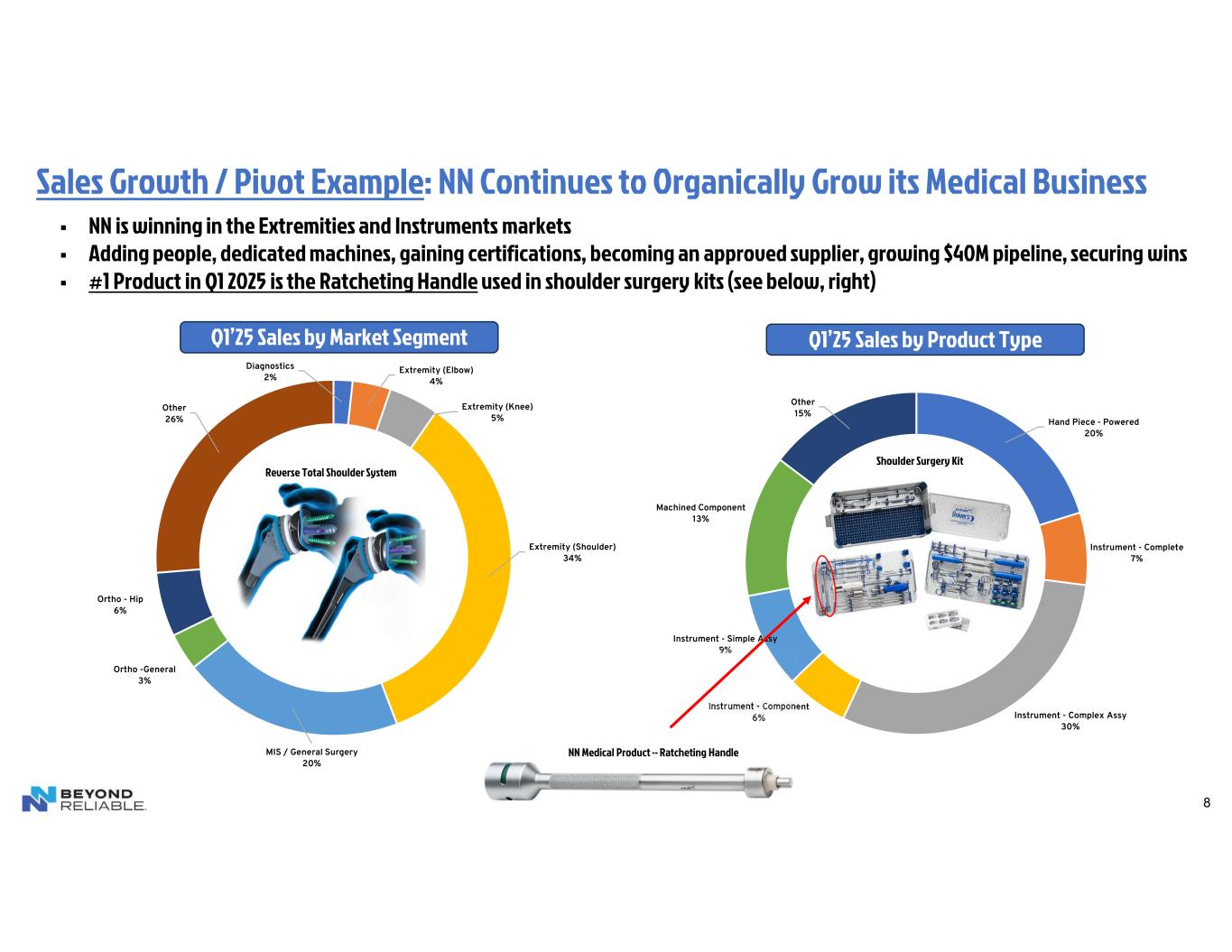
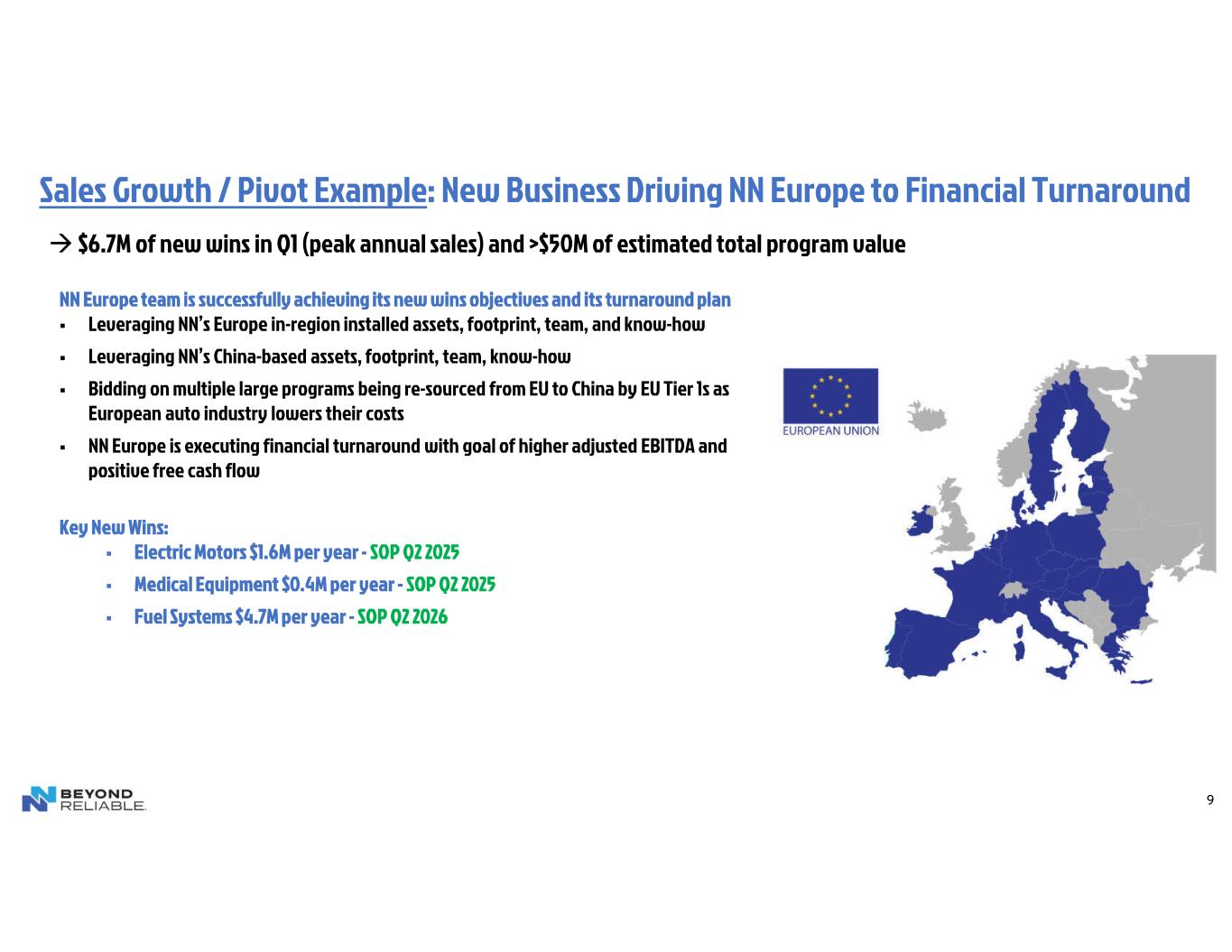
Thank you. One of our key charts that we've been providing updates around is our transformation plan and our tracker. Our enterprise transformation is roughly 70% complete after our first seven quarters, and we're on track with our targets for the full year of 2025. Going down the list, we're about 90% complete with enhancing our leadership to mirror our new forward agenda. We've been isolating and actioning against the underperforming parts of the company. These are customer-specific, program-specific, and plant-specific. This requires aggressive customer interactions to arrive at mutual agreements to either improve economics or transition professionally. We're about 70% complete with this. We nicknamed this the group of seven because it was concentrated into seven plants, and 2025 will be a turning point for those plants, and they will deliver positive margins for us. Margin expansion is a result of these fixes, but also leaning out of our cost structure globally. We call it our one-team program, which is a multi-year endeavor, with a strong game plan for 2025 that's underway, and we're about 60% complete with that. To make our turnaround a bit more challenging, we inherited a debt structure that was nearing the end of its life expectancy, but we extended the duration of our capital structure for another five years. Along the way, we've learned that we have plenty of options to alter the complexion of our China operations, and we are underway with this. This will materially aid our domestic debt profile. Lastly, regarding organically growing sales, follow the comparatives here as we sold the Lubbock business in July of 2024, and we began rationalizing money-losing business in multiple plants in 2024, which we call price clearing. If we could get the prices we needed to keep the business, we did, and this is largely done. On a pro forma basis, as we've reported, we were flat in a quarter. Conversely, going forward, we have about $55 million in new business launching now, and we potentially have another $100 million in 2026. We believe we're at a turning point here. So, we're calling this about 60% complete because it is yet to happen, although we have a tremendous amount of business in hand. Turning to Page 6, I would like to talk a little more deeply about our new business program due to its importance, and we wanted to be more transparent about exactly what we're doing, as we receive a decent amount of questions about this. Here you can see our overall plan, specific targets, and status against those targets. Our targets are based on leveraging our significant open capacity, which is largely CapEx-free when we quote it, as well as our most investment-intensive portfolio pivots. It's almost tautological that to increase our positions in new areas, we need something new. Generally, it requires a few people and some specific investment, and we're doing this progressively. I wanted to point out a few key items for you. First, about half of our prospecting and half of our pipeline is into new areas. You'll see if you add up some of the columns, it’s almost exactly half. We are gaining steam in medical and are on the verge of a few large foundational wins. To re-enter the medical market, we've had to perform a lot of re-approval and reacquaintances and renew our approved supplier status. To a large extent, we've gotten through that. In this area, we are almost one-for-one needing additional machines as we gain business, which we are. We've had substantial wins in the industrial market this year, mostly immediate ramp-ups. In fact, our largest win of the year is an industrial products win, with a significant global rebalance among our automotive business and customers between ICE, EV, and hybrid. We read a lot about this in the US, but it is indeed global. The rapid transitions underway have slowed down globally, leading to a calmer business development environment. On Page 7, we wanted to share some summary facts and figures. A key point is that we're progressively winning a higher number of programs worth more revenue, as shown in the statistics here. We won 118 programs in 2023, 188 programs in 2024, and we're on pace to win over 200 programs this year. It’s a steady increase in performance, and we are steadily adding people with relationships and product knowledge that we don't have, opening new doors with new and existing teammates. Our new business prospects and activity have not slowed down amidst global uncertainty and tariff wars—not at all. In fact, our activities have increased, and we are now also receiving significant tariff RFQs on top of our own prospecting. Some of the RFQs are large and could alter our game plans. We are participating in those that fit us, and we're making significant progress with multiple targeted RFQs currently in the contracting stage. Our prospecting pipeline is also continuing to grow in size. We're not necessarily chasing that; it’s a byproduct of our activity, and it now stands at almost $750 million and is well balanced. This part of our game plan is working effectively, and we foresee that our pipeline will continue to grow as we get better at this game. Please turn to Page 8. We wanted to provide further insight into a couple of new business win areas by sharing two vignettes with you. Given the amount of questions we receive about medical, we wanted to discuss our efforts in that sector, and highlight where our metal part-making know-how is coming into play. A major area for us is in the extremities and instruments markets, which are metal-based. It's essential to use metal parts for these activities, as they must be sterilized, rigid, and must work effectively. Our number one product in the first quarter is the ratcheting handle used in shoulder surgery kits, which you can see in the picture here. It bears a similar shape to a rack-and-pinion shaft, exemplifying how our expertise in producing long, thin, high-tolerance parts translates well to this market. This does require a slightly different machine, but it is a close cousin to what we already perform, allowing us to transition into this market with ease. We are optimistic about our progress in the rest of the year, having established a $40 million pipeline, which is the highest we've had since re-entering this business. On Page 9, similar to our other plants, our NN plant in France has been running one-shift operations with ample open capacity, aided by a short work week. We have been actively prospecting for additional business, and we've had three recent wins that will financially correct this plant. While I won’t disclose the customers, we're now ramping up these three programs, and they are expected to make the plant accretive in terms of EBITDA and positive free cash flow. These two examples illustrate the direct impact of our new business and its benefits to us. Now I’d like to turn it over to Tim French, who will discuss our operational performance.
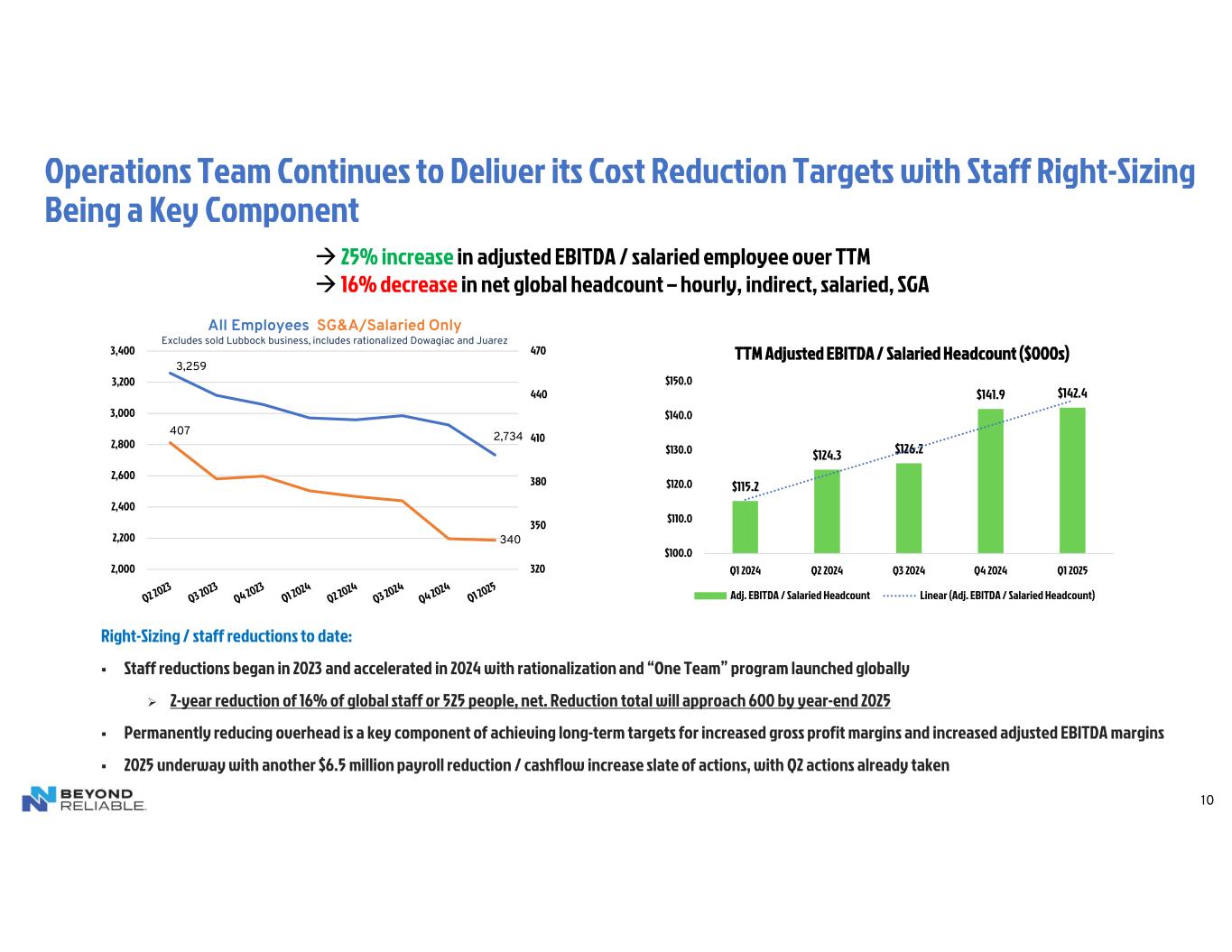
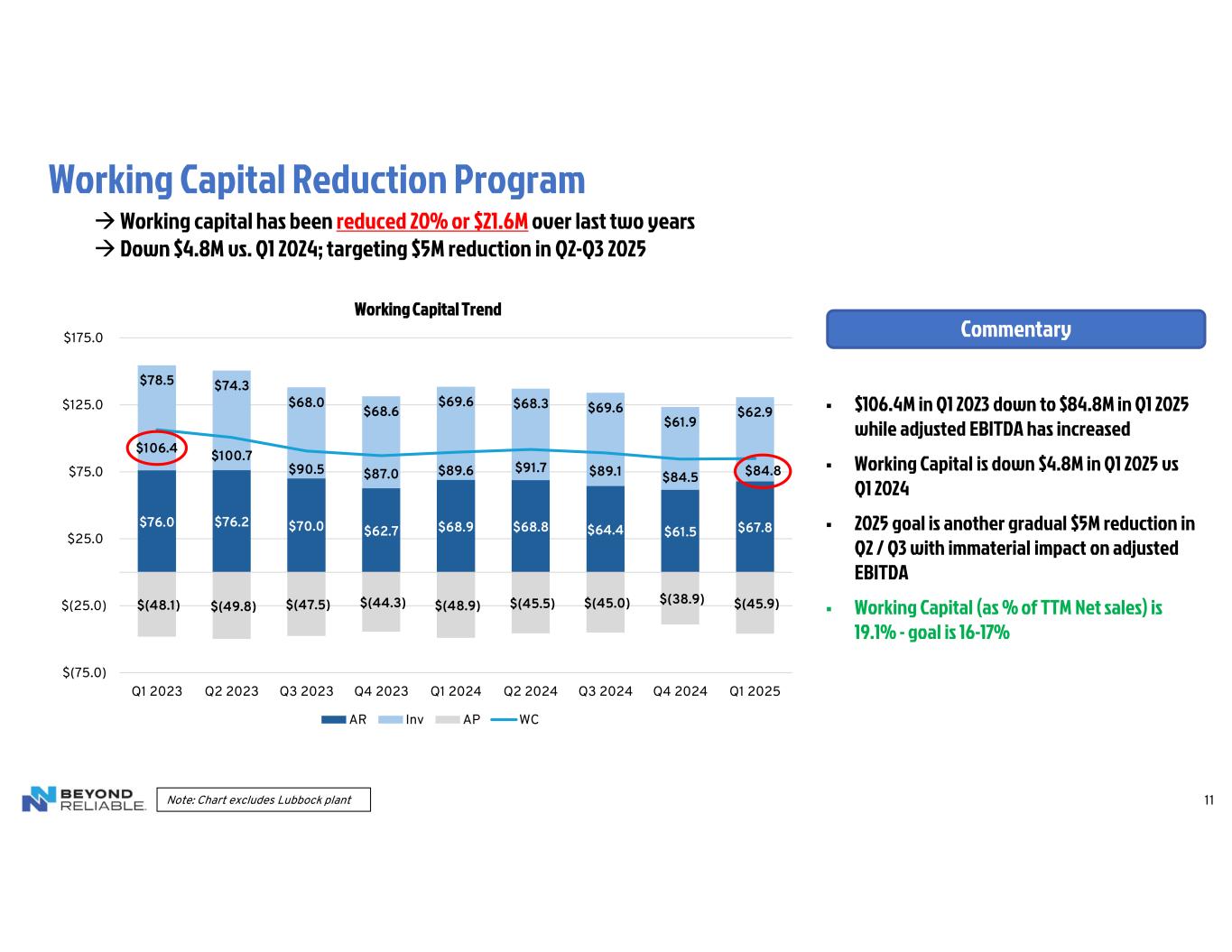
Thank you, Harold, and good morning, everyone. On Slide 10, the operations team continues to focus on achieving the cost reduction targets aimed at improving our EBITDA and cash flow metrics. A key aspect of this initiative is right-sizing our workforce across all areas of the company, including direct, indirect, salaried, and SG&A. The data on this slide shows that we have achieved a total headcount reduction of 16.1% since Q2 2023, equating to about 525 net positions eliminated. This includes a 16.5% reduction, or 67 jobs, in salaried or SG&A positions. It is important to note that some areas, such as our APAC region, added employees to handle significant growth. Although these additions were necessary to effectively manage business and meet customer demand, they muted the overall impact of the reductions. The key metric on this slide is the effect these actions have had on our adjusted EBITDA for salaried headcount, which has improved significantly from $115,000 in the first quarter of last year to $142,000 this quarter, reflecting a 25% improvement over the last 12 months and exemplifying our efforts to right-size and enhance efficiency. Our efforts in this area are ongoing, and while direct labor will always need to flex to reflect demand, we are implementing our one-team model to create a shared service infrastructure across facilities to support our manufacturing operations. This will allow us to progressively improve efficiency in our salaried and SG&A workforce, appropriately aligning our team with the needs of a company the size of NN. Now, turning to Slide 11, another area of focus has been on reducing our working capital requirements, which has positively impacted our free cash flow. Overall, we've achieved a 20% reduction in working capital, or $21.6 million, over the past nine quarters, and a $4.8 million decrease compared to Q1 2024. Working capital as a percentage of revenue finished at 19.1%, down from 22.4% in Q1 2023. We are committed to further reducing our working capital by an additional $5 million over the next two quarters, with the ultimate aim of reducing it to 16% to 17% of revenue. Overall, we are pleased with our progress in these two areas but recognize that there is more to be done to lower our cost structure, enhance profitability, and generate additional free cash flow. Before I hand it back to Chris for a review of our financial performance, I'd like to briefly highlight the start of Q2. April finished strong, with our consolidated volumes exceeding our internal forecasts. Our finishing operation had its best revenue month since June of 2022, and our key North American machining facility had its best shipping month since March of 2022. Our American facility similarly had its best shipping month in the past 12 months. We are optimistic that these promising early results will represent the balance of the year. With that, I'll turn it back over to Chris.
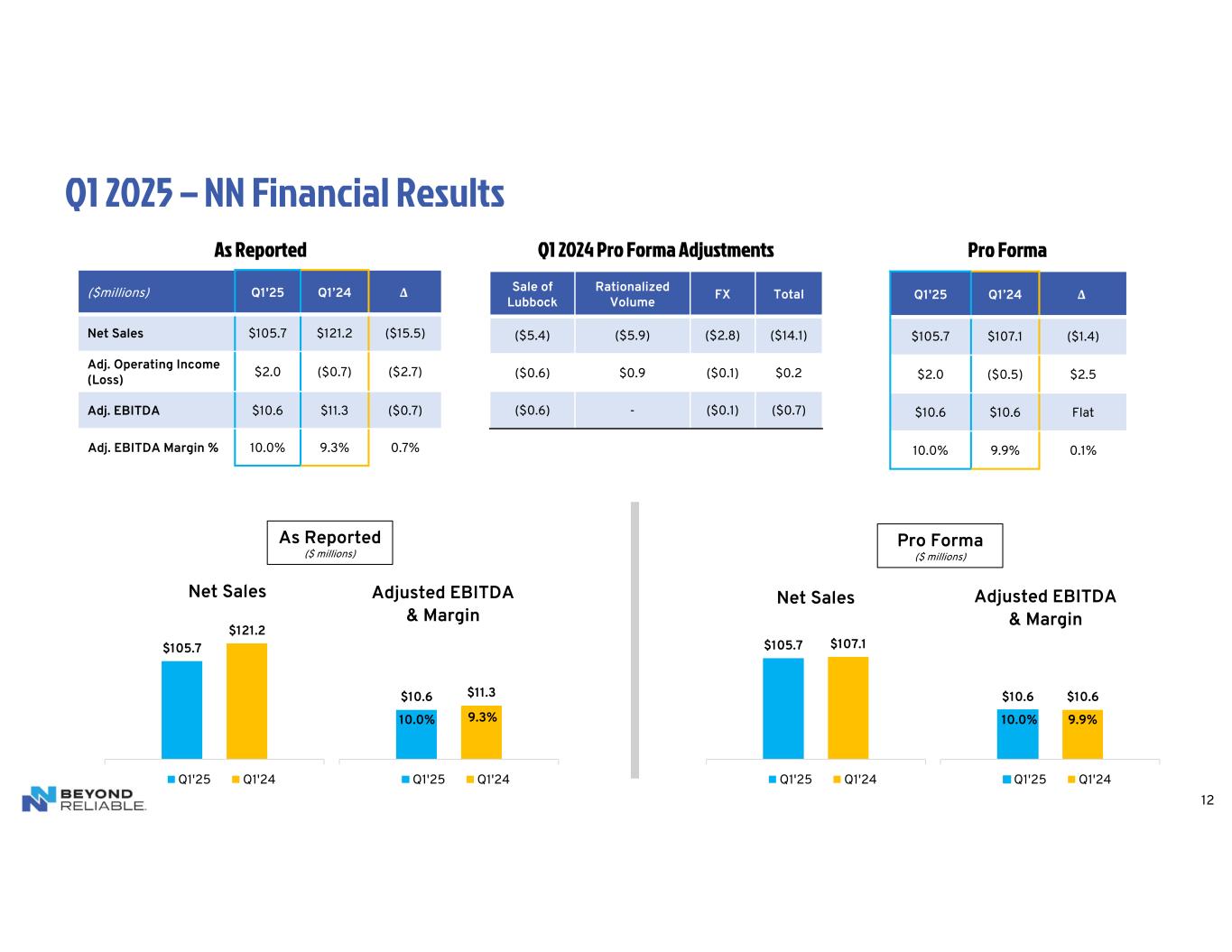
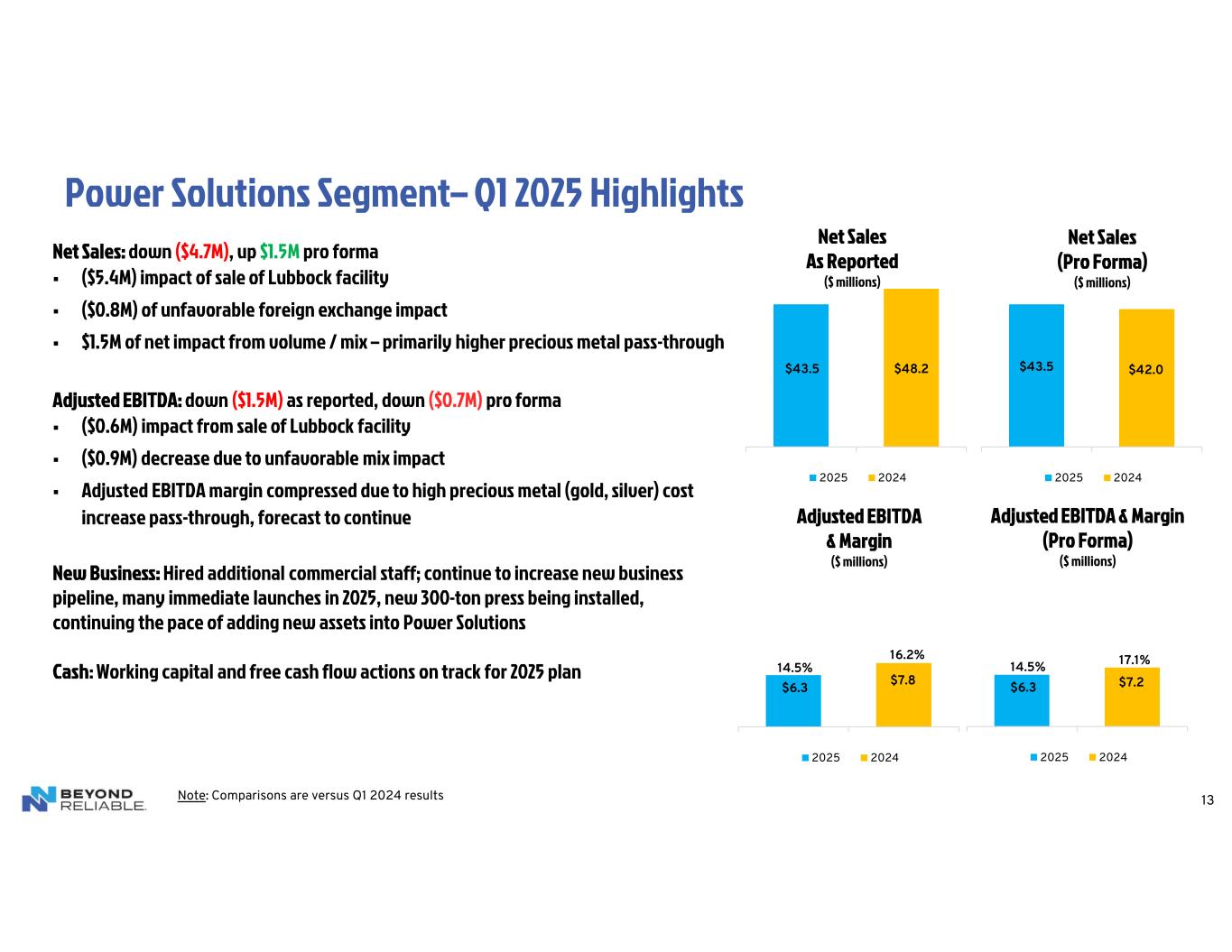
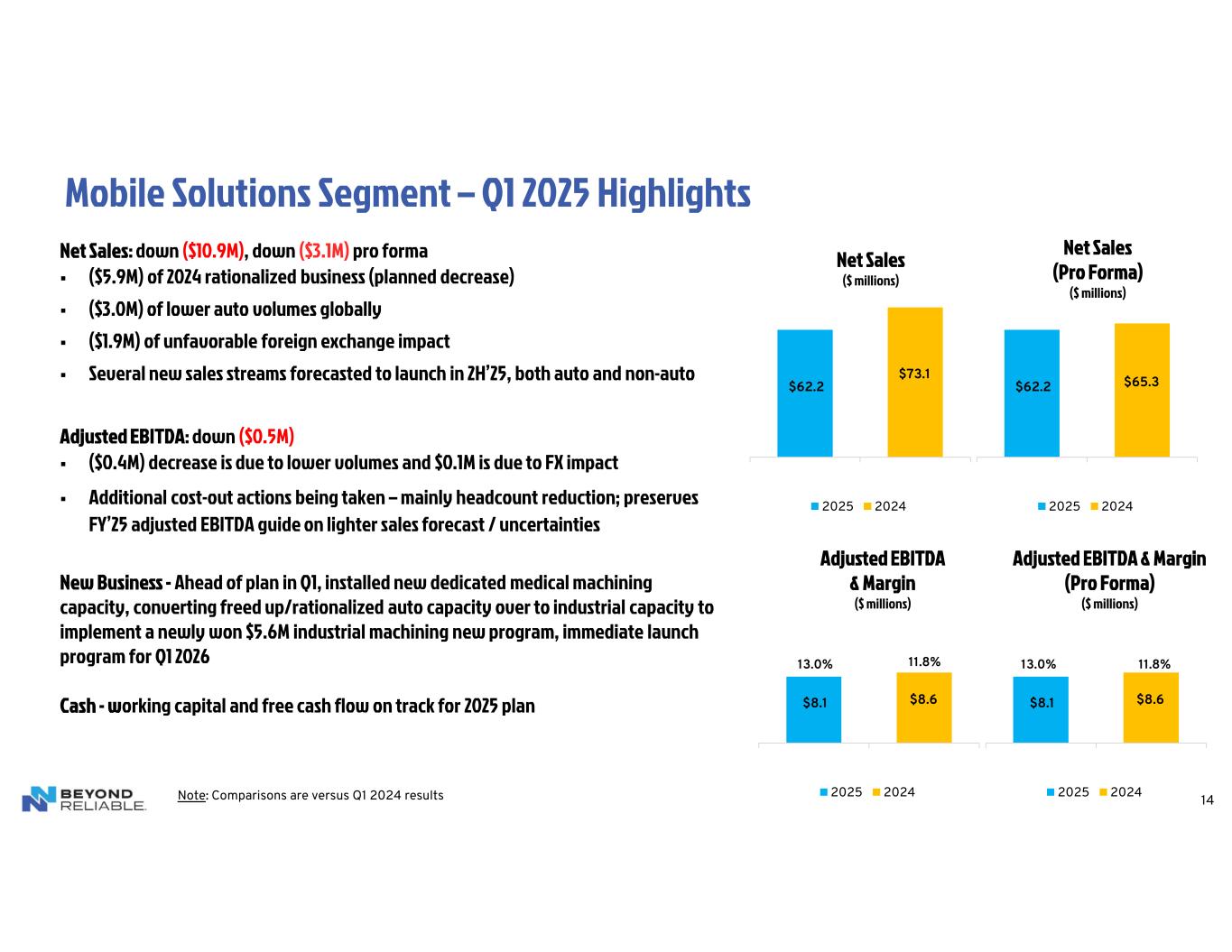
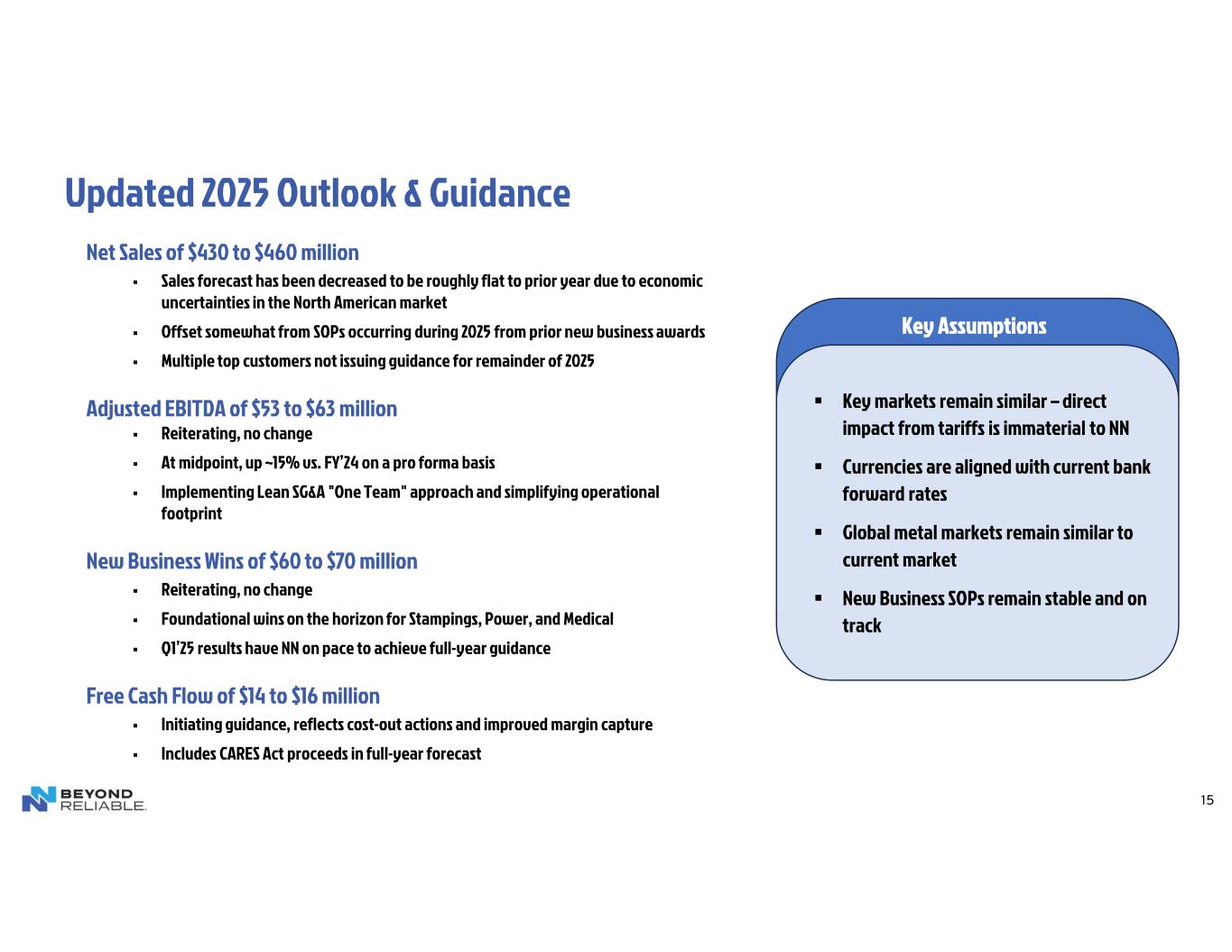
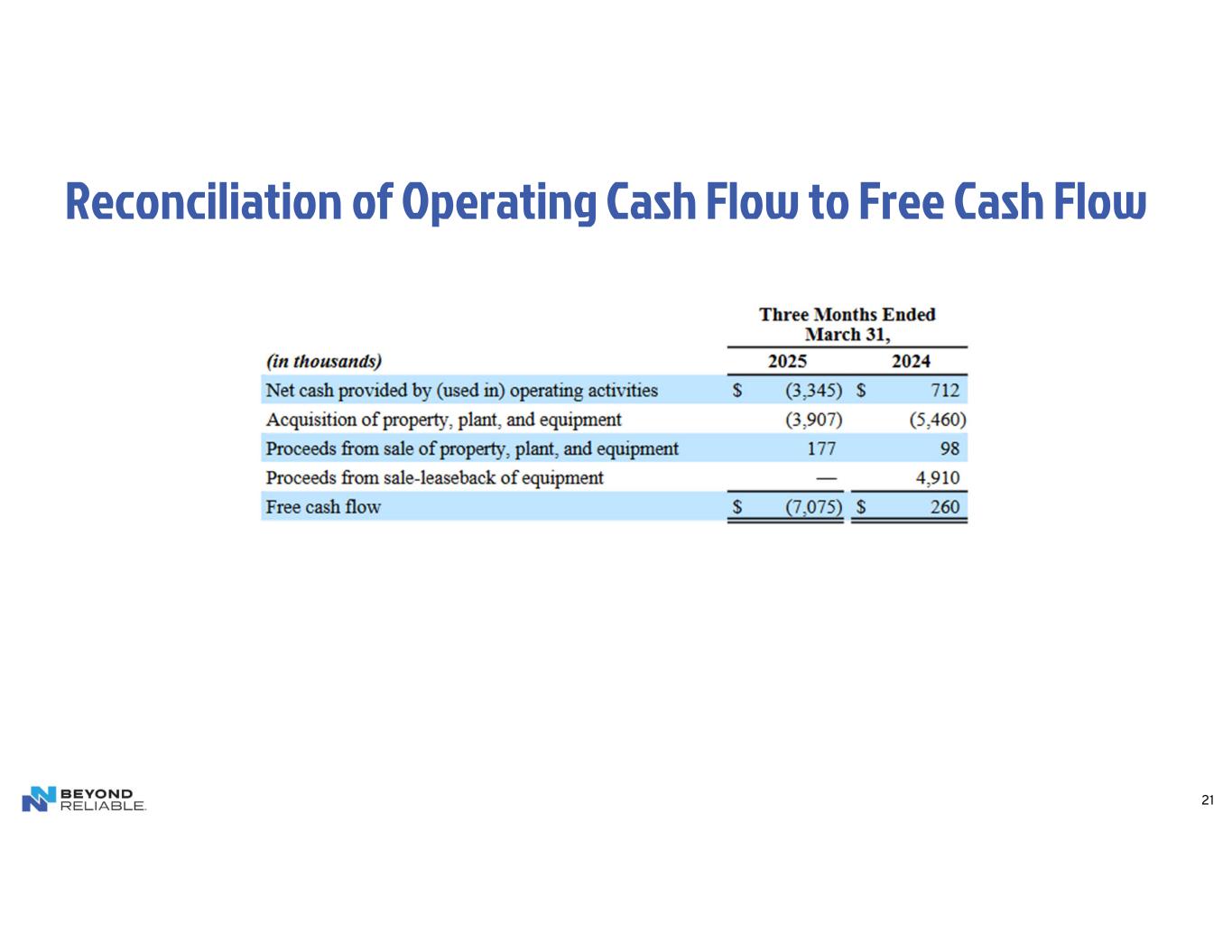
Thank you, Tim. Similar to last quarter, I will present information on a GAAP and pro forma basis to provide transparency into our operating results due to recent changes such as the sale of the Lubbock facility back in July 2024, and the exit of certain unprofitable business, which we refer to as rationalized volume. We hope this presentation will be indicative of how we are making changes and decisions to transform NN over time. Starting on Slide 12, we detail the financial results for the first quarter. This slide presents our as-reported GAAP and non-adjusted numbers. On the left side, we've outlined the pro forma adjustments to our quarterly results in the table in the middle, with our quarterly pro forma results on the right side of the table. The pro forma adjustments include last year's contribution from the Lubbock plant, which was sold in July 2024, rationalized sales volume, and the impacts of foreign currency translation. Last year's quarter included $5.4 million of net sales and $0.6 million of adjusted EBITDA associated with the Lubbock plant. Strategically rationalized volumes of unprofitable business totaled $5.9 million in the prior year, along with a $2.8 million impact from foreign exchange, rounding out the three pro forma changes we highlight. For the first quarter, as reported, net sales were $105.7 million, declining $15.5 million from last year's first quarter. On a pro forma basis, accounting for the earlier-discussed items, net sales modestly declined by 1.3%, or $1.4 million. Our adjusted operating income for the first quarter increased to $2 million, marking a rise of $2.7 million compared to the loss of $700,000 in the prior year. On an adjusted pro forma basis, operating income increased by $2.5 million. Adjusted EBITDA for the quarter was $10.6 million compared to $11.3 million for the same period last year. Pro forma, adjusted EBITDA was flat with the prior year's first quarter as we drove profitability through effective operational execution. Now, let’s move on to our segment results, starting with Slide 13. In our power solution segment, which primarily consists of stamped products, net sales for the quarter were $43.5 million, down $4.7 million from $48.2 million in the prior year period. This change was primarily due to the impact of the Lubbock facility and an $800,000 unfavorable impact from foreign exchange translation. These items were partially offset by volume and mix, with precious metals pass-through driving much of the increase. On a pro forma basis, excluding the Lubbock contribution, first quarter net sales increased by $1.5 million, or 4%, as noted in the charts on the right. Our solutions segment adjusted EBITDA was $6.3 million, down $1.5 million from last year's first quarter of $7.8 million, driven by the non-recurrence of Lubbock's contribution and an unfavorable mix. Adjusted EBITDA margins typically compress during periods of rising precious metal costs, although these costs are passed through to customers. On a pro forma basis, our power solutions adjusted EBITDA results were down by $0.7 million compared to last year's first quarter, attributed to the same volume mix factors noted earlier. It is noteworthy that we bolstered our power solutions sales team during the quarter with additional industry experts, and we have already seen an immediate increase in our new business pipeline for industrial stamping, achieving multiple new wins year-to-date through April—many of which have immediate launches this year. To support our continued progress and new business growth, we have been strategically adding physical assets and equipment, and we intend to maintain this pace as we move forward. Now turning to Slide 14, in our mobile solutions segment, which covers our machine products business, net sales for the first quarter were $62.2 million, compared to $73.1 million in last year's first quarter. Net sales comparisons were impacted by the rationalized business of $5.9 million, lower automotive volumes of $3 million, and unfavorable foreign exchange effects of $1.9 million. On a pro forma basis, net sales of $62.2 million represents a decline of $3.1 million, or 5%, compared to pro forma net sales of $65.3 million in last year's first quarter. This decline was largely driven by reduced volumes in the automotive business. Our first quarter adjusted EBITDA in the mobile solutions segment was $8.1 million, down $0.5 million from the previous year’s first quarter, both on an as-reported and pro forma basis. The slight decrease is due to lower volumes and foreign exchange impacts. While there was minor compression in our adjusted EBITDA, our cost-cutting actions and ongoing re-profiling of our sales mix have driven a notable rise in our adjusted EBITDA margins to 13%. The margin increase has also been supported by right-sizing our cost structure to better align with where we are headed, a point Harold emphasized earlier this call. Looking ahead, our new business wins for the segment are outpacing our plan in Q1. We have installed new machinery dedicated specifically to our medical business, and we are efficiently utilizing capacity that has been freed up from rationalized automotive business. Recently, we have secured new programs set to launch in the first quarter of 2026, contributing an estimated $5.6 million in peak sales, utilizing this freed capacity for our new industrial market wins. Slide 15 shows our updated outlook for 2025, which I mentioned a few points earlier this morning. Given the uncertainties that have negatively impacted US GDP in the first quarter, we now expect net sales between $430 million to $460 million due to current economic uncertainties and a lack of transparency on volumes, particularly in the North American market. This is anticipated to be partially offset by our strategic operational plans throughout 2025, stemming from new business awards acquired in prior years. We do not anticipate changes to our adjusted EBITDA range of $53 million to $63 million; however, we expect future marketing conditions to push our results to the lower half of this range. In response, we will intensify our cost-cutting program, which will help mitigate the impact of lower net sales. Our new business win guidance remains unchanged, estimated to be between $60 million to $70 million. Our Q1 2025 results have positioned NN to achieve full-year guidance, and we expect to maintain this momentum through 2025. Finally, we are initiating free cash flow guidance in the range of $14 million to $16 million for the year. This reflects our cost-cutting action, improved margin capture, and anticipated proceeds from the CARES Act. With that, I’ll turn the call back over to Harold for some final remarks.
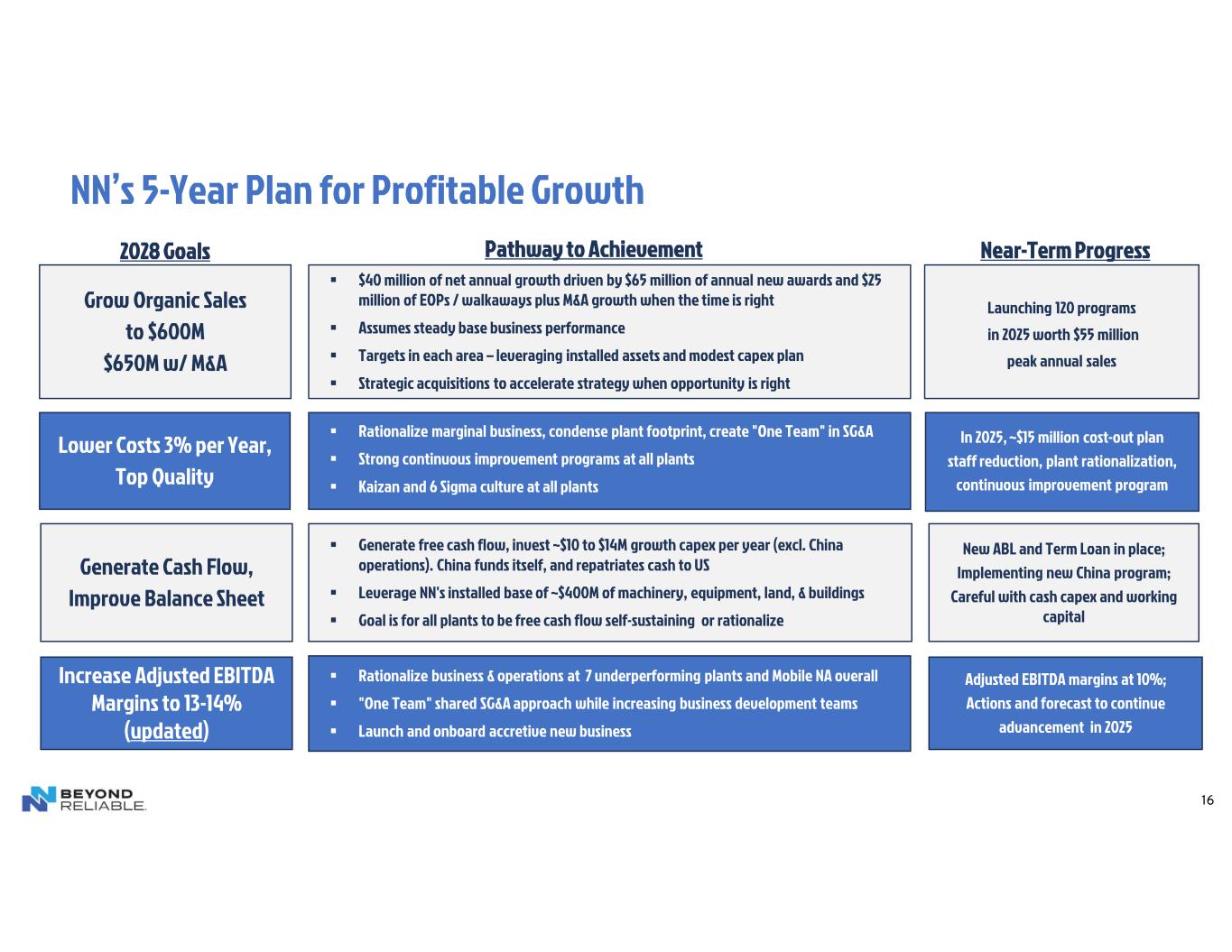
Thanks, Chris. On Page 16, I wanted to remind our investors of the pillars of our five-year plan aimed at driving profitable growth and converting that into improved sustainable shareholder value. Our plan remains intact. The volume speed bump we encountered in Q1 has only reinforced our commitment to achieving successful outcomes. We've listed our near-term progress against each of our goals, and we are fully dedicated to them. Thank you for your attention and for listening to our presentation. I’ll now turn the call back to the operator for questions. Mike?
Operator
And the first question we have will come from Robert Brown of Lake Street Capital. Please go ahead.
Speaker 5
Good morning and congratulations on all the progress. First, I wanted to get a little more detail on some of the tariff-related RFQs. You talked about seeing some incremental activity for quoting, and I'm curious about what's happening there and where your plants have the capacity to take on that business.
Yes, so the biggest two material streams of tariff-related activity are reshoring into the United States and European supply moving to China. In our US opportunities, we are seeing business being reshored from Canada to the US and from China to the US. These are generally fast-paced and significant in size. Sometimes we have the equipment for them, and sometimes we don’t. They are in the quoting stage with various bidders, mostly within automotive. Our interest in spending significantly on US-based automotive is lower than in other segments, meaning the numbers must be attractive for us to pursue. However, we have a few opportunities that fit. Regarding the Europe to China transition, there is notable activity around metal parts currently sourced in Europe. The European companies aim to drastically lower costs to manage the tariff impacts. They are quoting large business segments moving to China, then assembling in Europe for shipment to the US, thus reducing the price of the vehicle. We are working on certain expansions and do have open capacity but will require some capital for some components. Overall, it's mainly automotive, strategically working around tariffs to maintain cost neutrality, requiring roughly 50% new capital and 50% reuse of existing capital.
Speaker 5
Thank you for that clarification. That’s very helpful. Additionally, regarding the automotive market, you noted that activity in EV and hybrid segments has moderated slightly, balancing more with ICE activity. How is that changing your new business opportunities?
Generally, the moderation and balance are helpful for us. Many of our older assets in Europe, South America, and North America were tailored for fuel systems. A shift to purely EV would have posed a declining market situation for us, but a shift toward hybrids opens additional opportunities because hybrids require either a generator or engine along with batteries. The rise in hybrid popularity expands our addressable market significantly. Regarding EV, we initiated a business in shielding and connector stamped products, which is indicated on our new wins chart and continues to progress well as a new market entry. Hence, we now have a more balanced portfolio, leveraging existing assets for both machining and stamping. This diversification allows us to access a larger available market.
Speaker 5
Thank you. I'll turn it over.
Speaker 6
Hi. Thanks for taking my questions, and great progress on the transformation. I was hoping you could elaborate on the $55 million of new business wins expected this year, as well as the $740 million pipeline. What is the anticipated timing of these? Will they be weighted towards the back half of the year, or can we expect them to be evenly distributed?
Yes, that’s a good question. Our immediate win programs are defined as those with a green light to ramp up. This means we must hard tool, go through prototyping, customer testing, and secure what we call a PPAP, or a standardized process way to certify the product, process, and materials to ensure quality. Typically, immediate ramp-up has about a six-month lag before it hits revenue, although some may complete within three months. Recently, we mentioned that we have a significant win targeting a Q1 2026 start, which involves ramping out of a current supplier into a new one, including addressing stranded inventory as part of the agreement. Hence, we anticipate a three- to nine-month overall ramp-up period. However, significant portions of the revenue from the profitable immediate growth strategy (PIGS) will impact the latter half of this year.
Speaker 6
That is very helpful. Thank you. Regarding the $15 million in targeted cost savings, is that anticipated to be evenly distributed throughout the year?
Yes. Tim, would you like to add to that?
Yes, a significant portion is evenly distributed throughout the year, though we do see some backend loading.
Speaker 6
Okay, thank you. I have a couple more questions. Regarding the remaining plants, should we anticipate any more closures, or are the seven plants the baseline as we move forward?
We are evaluating a couple more plants for potential consolidation, currently down to two plants that are being reviewed for possible closure as they are dilutive to our overall goals. However, we do not have a firm plan in place to start or announce anything right now as we are in the valuation stage concerning both plants.
Speaker 6
Understood. That's everything from me.
Operator
The next question comes from John Franzreb of Sidoti & Company. We are evaluating a couple more plants for potential consolidation, currently down to two plants that are being reviewed for possible closure as they are dilutive to our overall goals. However, we do not have a firm plan in place to start or announce anything right now as we are in the valuation stage concerning both plants. Understood. That's everything from me.
Speaker 7
Good morning, and thanks for taking my questions. I apologize if this has already been addressed. I’ve been juggling conference calls this morning, but I'm curious about the free cash flow guidance. Does that include the CARES Act refund, and what’s the expectation?
Yes, Chris, please respond.
Sure, John, you broke up a bit, but yes, the free cash flow guidance includes the CARES Act, which is about $12.3 million to $12.4 million.
Speaker 7
Okay. And is there anything else included?
John, you broke up again, but generally, it's tied to operational activities. We spent about $4 million in cash CapEx in the first quarter and are targeting about $10 million for the full year, so you can factor that into the guidance.
Speaker 7
Does that include CapEx, or is it excluded?
It includes it, meaning it’s net of CapEx.
Speaker 7
Okay. Just wanted to confirm. What trends are you observing in the April and early May timeframe compared to what you expected three months ago?
Tim mentioned that our initial start to the quarter has been stronger than anticipated. The results are broad-based, which makes us optimistic about our earlier comments and our recommitment to our guidance, John.
Speaker 7
Thank you for addressing all my questions! I appreciate your guidance.
Operator
At this time, we're showing no further questions. We will conclude today's conference call. Thank you for attending today's presentation, and we appreciate management's time today. You may now disconnect your lines. Thank you, and have a great day.