Operator
Good morning, and welcome to the Open Lane, Inc. First Quarter 2026 Earnings Call. All participants will be in a listen-only mode. Should you need assistance, please signal an operator by pressing the star key, followed by zero. After today's presentation, there will be an opportunity to ask questions. To ask a question, you may press star and then 1 on your touchtone phone. To withdraw your question, please press star and then 2. Please note that this event is being recorded. I would now like to turn the conference over to Bull Wright. Please go ahead, sir.
Thank you, Operator. Good morning, everyone. Welcome to Open Lane's first quarter 2026 earnings call. With me today are Peter Kelly, CEO of Open Lane, and Brad Herring, EVP and CFO of Open Lane. Our remarks today include forward-looking statements within the meaning of the Private Securities Litigation Reform Act of 1995. Such forward-looking statements involve risks and uncertainties that may cause our actual results or performance to differ materially from such statements. Factors that may cause such differences include those discussed in our press release issue today and in our SEC filings. Certain non-GAAP financial measures, as defined under SEC rules, will be discussed on this call. Reconciliations of gap-to-non-gap measures are provided in our earnings materials and are available in the Investor Relations section of our website. Please note that all financial and operational metrics presented during this call are on a year-over-year basis unless otherwise specifically noted. With that, I'll turn the call over to Peter.
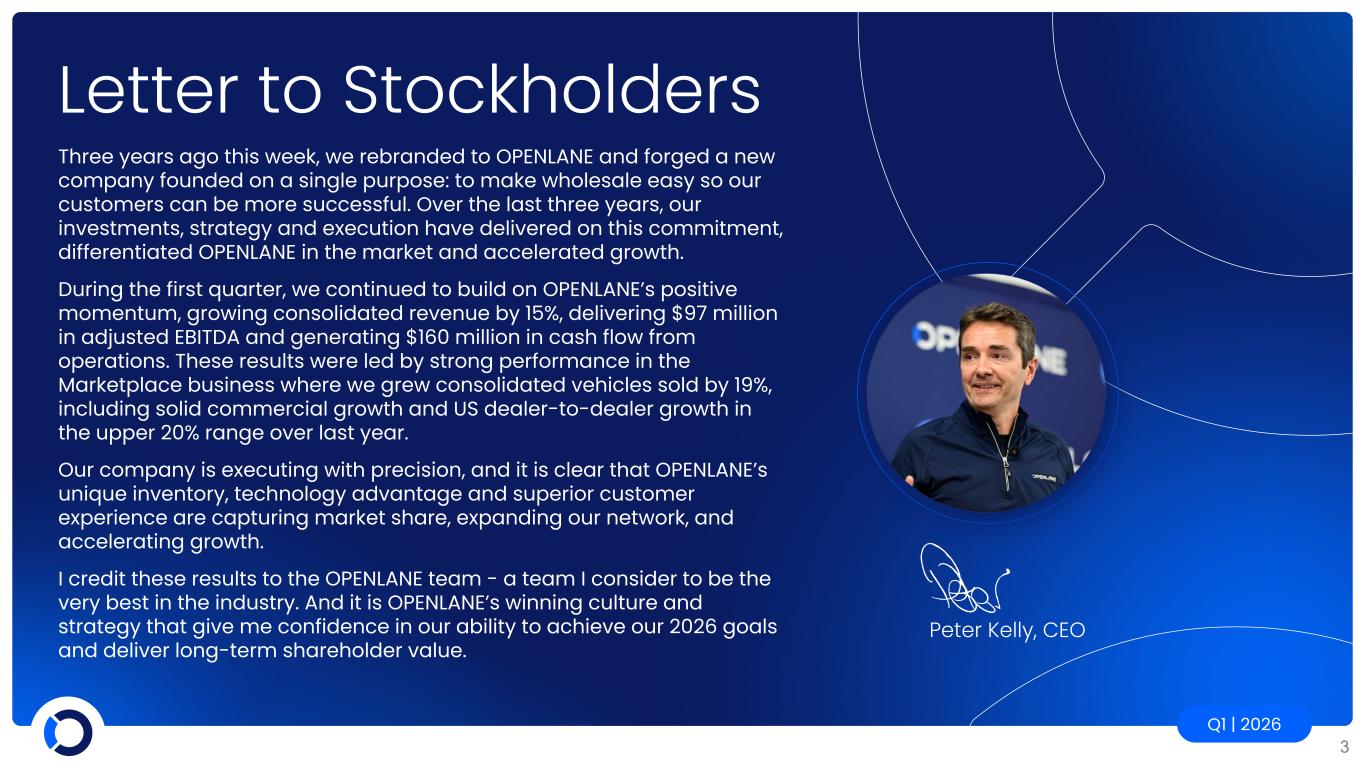
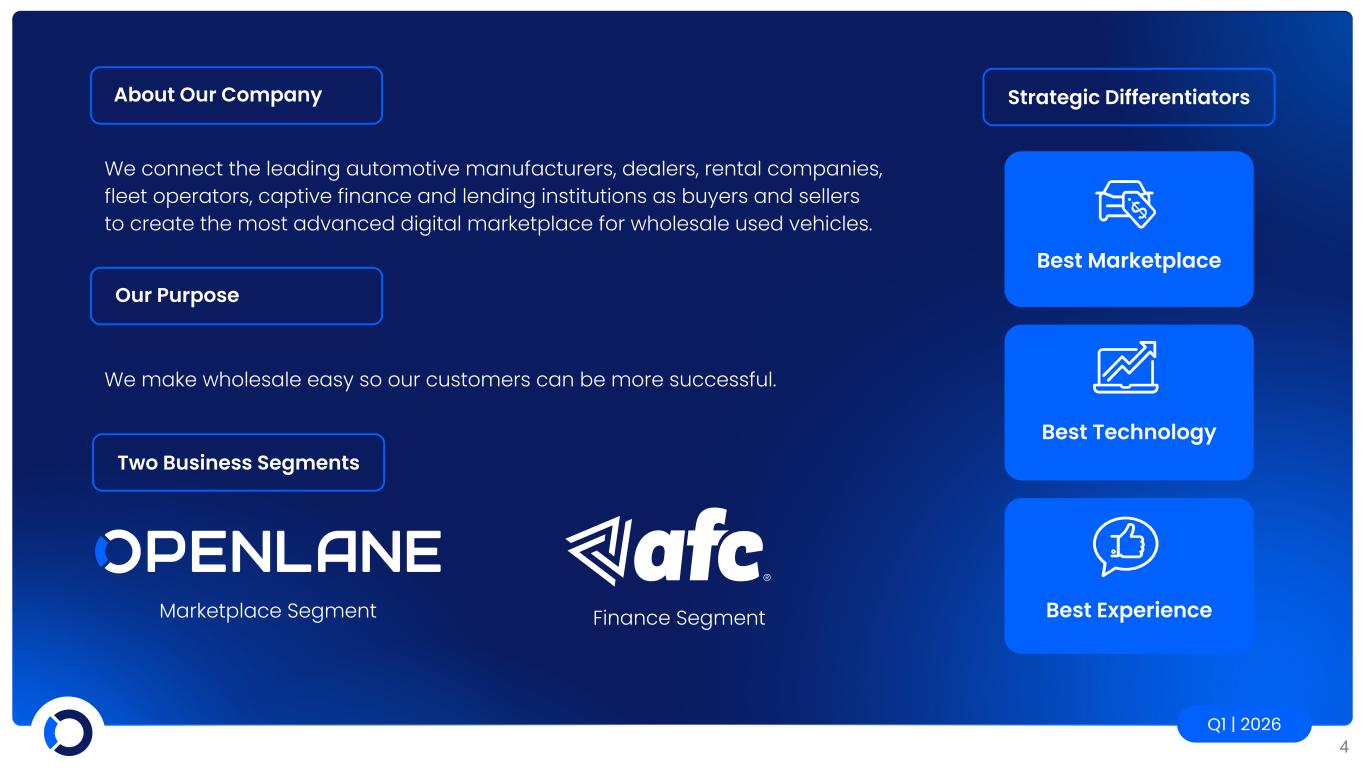
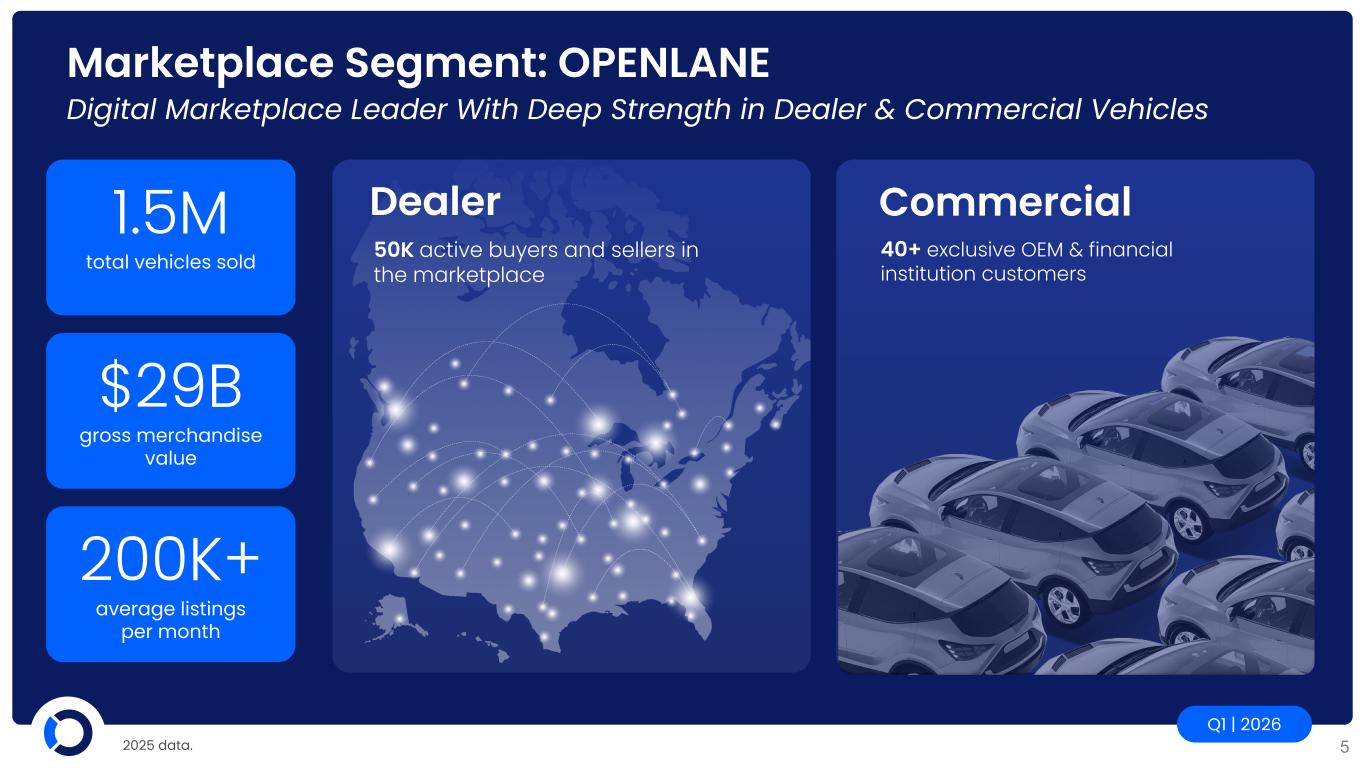
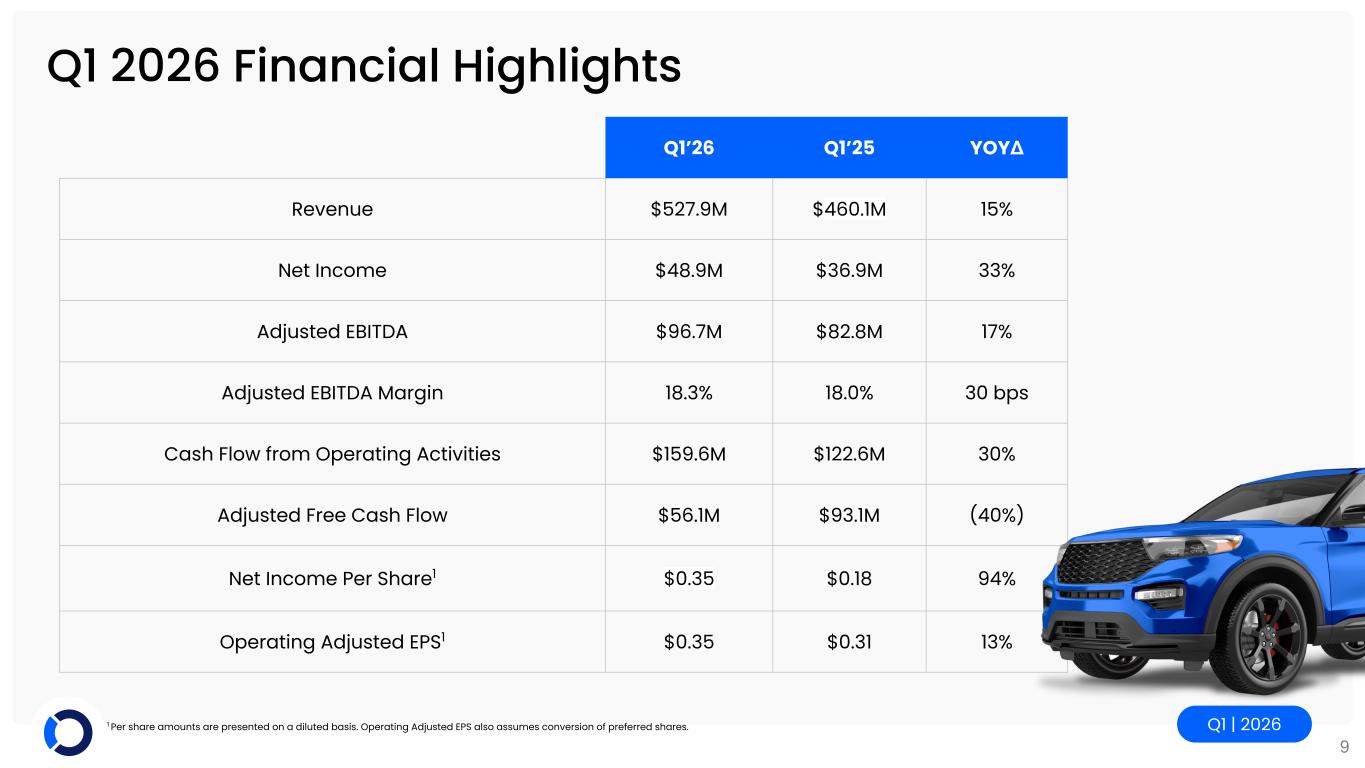
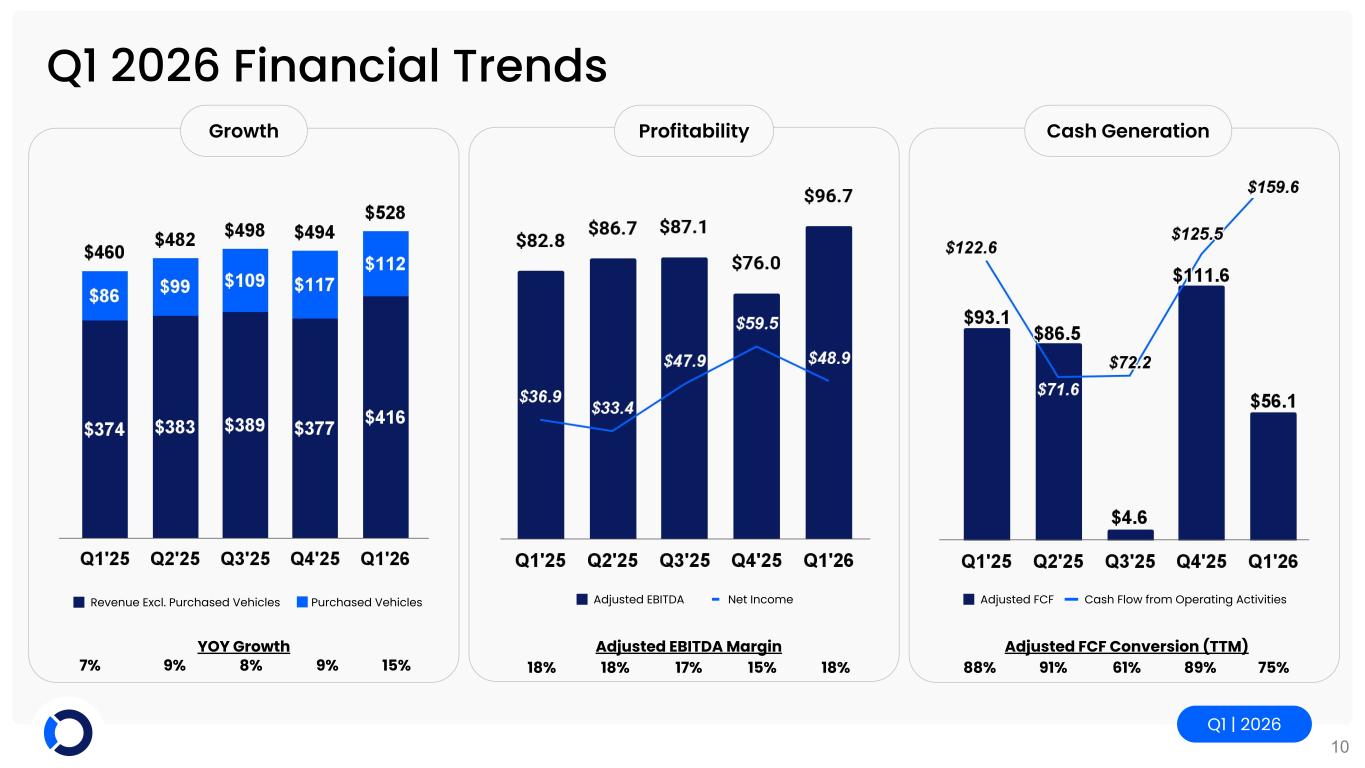
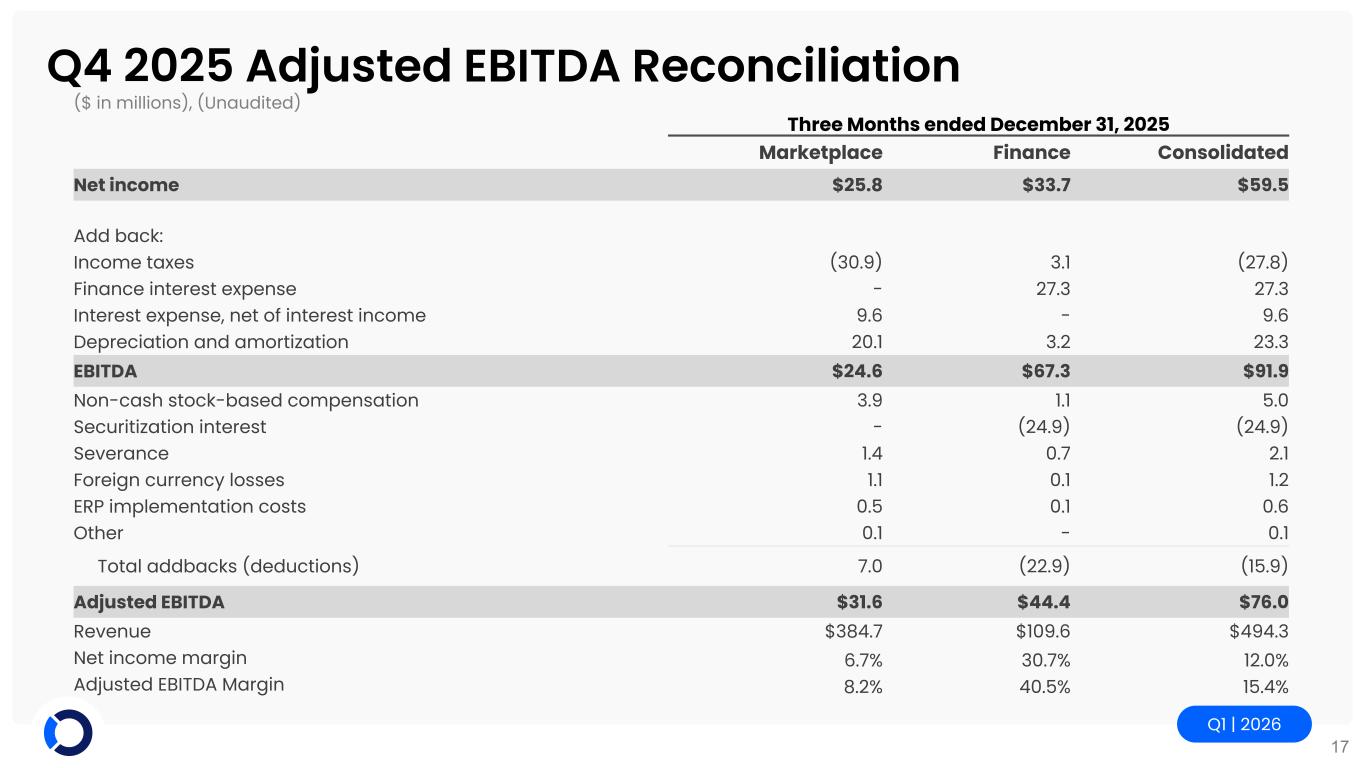
Thank you, Bill, and thank you, everyone, for joining the call today. I'm very pleased to report on OpenLane's strong first-quarter results and to provide you with an update on our strategy and our outlook. I'll begin with a few opening remarks, and then Brad will walk you through our financial and operational performance and our increased guidance for 2026. But before I turn to our results, I'd like to highlight that this week marks the three-year anniversary of our rebrand to OpenLane. As I stated at our March investor event, the rebrand was never about a new name or logo. It was about forging an entirely new company founded on a single purpose, which is to make wholesale easy so our customers can be more successful. Over the past three years, our investments, strategy, and execution have delivered on that commitment and reinforced several key pillars of differentiation for OpenLane, including the leading commercial off-lease solution that connects thousands of franchise dealers into our marketplace, a dealer business that is outpacing the industry and capturing meaningful market share, A high-performing finance business that is synergistic with our marketplace. An accelerating network effect of new buyers, sellers, listings, and transactions. And a winning culture and team that I consider to be the very best in the industry. The performance and outcomes OpenLane is delivering are the direct result of the strategy we began executing three years ago. And I believe our first quarter results are further evidence to OpenLane's strength and differentiation in the market. During the first quarter, we continued to build on Openlane's positive momentum, growing consolidated revenue by 15% and delivering adjusted EBITDA of $97 million, a 17% increase. We also generated $160 million in cash flow from our operations. These results were led by strong performance in the marketplace business with both commercial and dealer customers and solid contributions from our finance business. In the marketplace segment, we grew overall vehicles sold by 19%, increased gross merchandise value by 32% to $9.1 billion, and delivered $52 million in adjusted EBITDA, representing a 39% increase. In our dealer-to-dealer business, we grew vehicles sold by 13%, with similar geographic dynamics to those experienced in Q4 of 2025. In the United States, OpenLane's dealer-to-dealer transactions continue to accelerate, with growth in the upper 20% range. This represents a significant outperformance of the industry and a meaningful gain in market share. Our go-to-market strategy in the U.S. is working, and OpenLane's unique inventory, technology advantage, and superior customer experience are expanding our dealer network and compounding our growth in transactions. In Canada, we were pleased to see some improvement in the macroeconomic and automotive retail environment, and while Canadian dealer unit sales declined versus a strong prior year comp, we did see sequential improvement over Q4 of 2025. On the commercial vehicle side, the 25% increase in vehicles sold was driven in large part by the onboarding of our latest private label customer. Even excluding that step function increase, however, commercial vehicle sales grew by 6% during the quarter. This reinforces that the inflection of off-lease supply has officially begun, and we expect to see year-on-year growth in off-lease volumes throughout the remainder of 2026 and beyond. Moving to our finance segment, AFC also had a good quarter, growing average receivables managed, holding the loan loss rate to 1.6%, and generating $45 million in adjusted EBITDA. Now, we do believe the industry experienced a strong spring market driven by higher-than-normal tax refunds and constrained supply paired with high consumer demand, which led to high conversion rates and appreciating asset values. That said, there is no question that OpenLane's digital operating model is resonating in the market, and I am highly encouraged by the output of our investments and our focused execution. So now let me turn to our strategy and outlook. As I mentioned at the start of the call, our strategy is delivering results, and we remain committed to advancing our three strategic priorities. First, delivering the best marketplace, expanding our depth and breadth with more buyers and more sellers, and offering the most diverse commercial and dealer inventory available. Second, delivering the best technology, innovative products and services that help our customers make informed decisions and achieve better outcomes. And third, delivering the best customer experience, keeping our marketplace fast, fair, and transparent, making it easy for customers to transact, and making OpenLane the most preferred marketplace. And I'll touch on each of these in a little more detail. First, in terms of offering the best marketplace, we continued to make significant gains and drove another quarter of double-digit increases in new buyers, sellers, and unique vehicles listed, each of which were up over 20% in the United States. Customer anticipation for the off-lease recovery is also driving more franchise dealers from our private label programs into Open Lane's open sale. During the quarter, we nearly doubled the number of commercial vehicles sold in this higher margin channel versus the prior year. And on the independent dealer side, AFC new dealer registrations also increased during the quarter, each of which also presents a new dealer opportunity for Open Lane. At the end of Q1, approximately 54% of all AFC dealers were registered with OpenLane. From a best technology perspective, we extended our technology advantage in the first quarter with our public release of OpenLane Intelligence. OpenLane Intelligence unifies our human and AI-enhanced capabilities to deliver actionable insights that improve customer decision-making. We see AI as a true enabler and accelerator of our digital solutions. And during the quarter, we released several new offerings and features that leverage our AI expertise and deep data resources. In Canada, we launched our new MyLot inventory management solution. Initial interest has exceeded our expectations with hundreds of early signups. And we are optimistic about the potential of this subscription-based SaaS offering. across the u.s and canada we also released our new predictive pricing feature the only technology in the industry that provides dealers with a forward-looking 30 60 90 day view into the anticipated value of every dealer vehicle offered on open lane and finally in terms of providing the best customer experience we are also leveraging our human and ai capabilities to streamline and enhance the customer experience, improve the consistency, accuracy, and speed of arbitrations, and to help address dealer inquiries as quickly as possible. At the end of Q1, our transactional NPS scores across all geographies sit squarely in the excellent range, with our U.S. seller NPS achieving the highest scores, indicating exceptional customer loyalty and brand satisfaction. So as we look into the remainder of 2026, While we cannot count on an industry environment as strong as Q1, there is still a lot of opportunity for OpenLane. We are continuing to build momentum, and I'm very optimistic about our ability to execute our strategy with precision. As our 2025 go-to-market investments in dealer-to-dealer continue to ramp up towards full productivity, we remain focused on increasing market share and wallet share. As stated earlier, we expect awfully supply to scale up throughout the year, and OpenLane will be a primary beneficiary of this cyclical recovery. Our Canadian business is leveraging its strong market position to introduce new revenue-generating products and services. Used vehicle values significantly appreciated in Q1 and remain strong. This is a positive for the marketplace and for AFC, though any sharp decline in used vehicle values could lead to a higher risk environment for floor plans and answers. And while no industry is immune to geopolitical or macroeconomic events, we have not seen a material industry impact from fuel prices, new and used vehicle affordability, chip production, or any other external factors that we monitor. So just to summarize, OpenLane remains well positioned to capture the opportunities ahead, and we're executing a strategy that is delivering results, winning customers and outpacing the industry. Because of that, I believe the key elements of our value proposition for investors remain very compelling. OpenLane is a highly scalable digital marketplace leader, focused on making wholesale easy for automotive dealers, manufacturers, and commercial sellers. There is a large addressable market for our services, and OpenLane is uniquely well-positioned with commercial customers and franchise and independent dealers. Our customer surveys and third-party research indicate we are the most preferred pure-play digital marketplace in the industry. Our technology advantage is a competitive differentiator. Our floor plan finance business, AFC, is a high-performing business that is synergistic with the marketplace. We generate significant cash flow and have a strong balance sheet. And we believe our business has the capability to deliver meaningful growth, profitability, and cash generation over the next several years. So with that, I will now turn the call over to Brad.
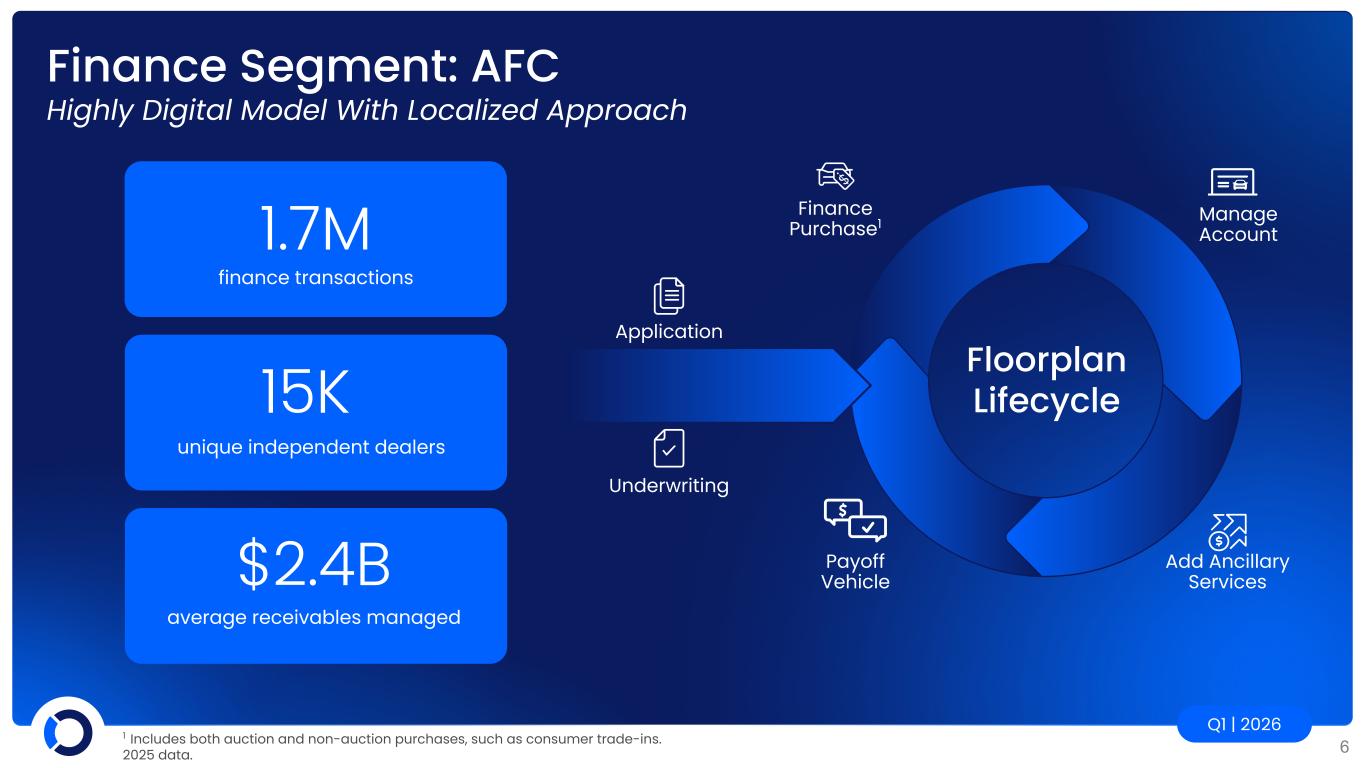
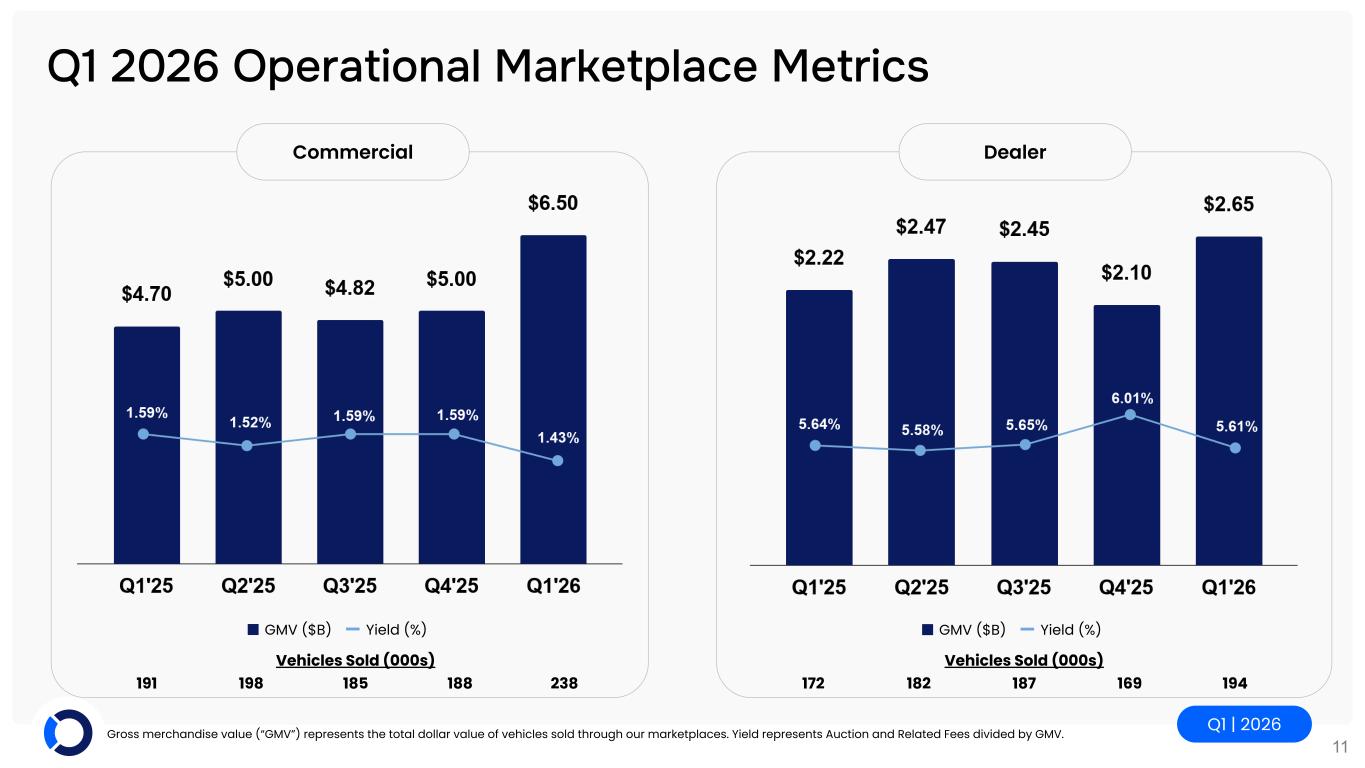
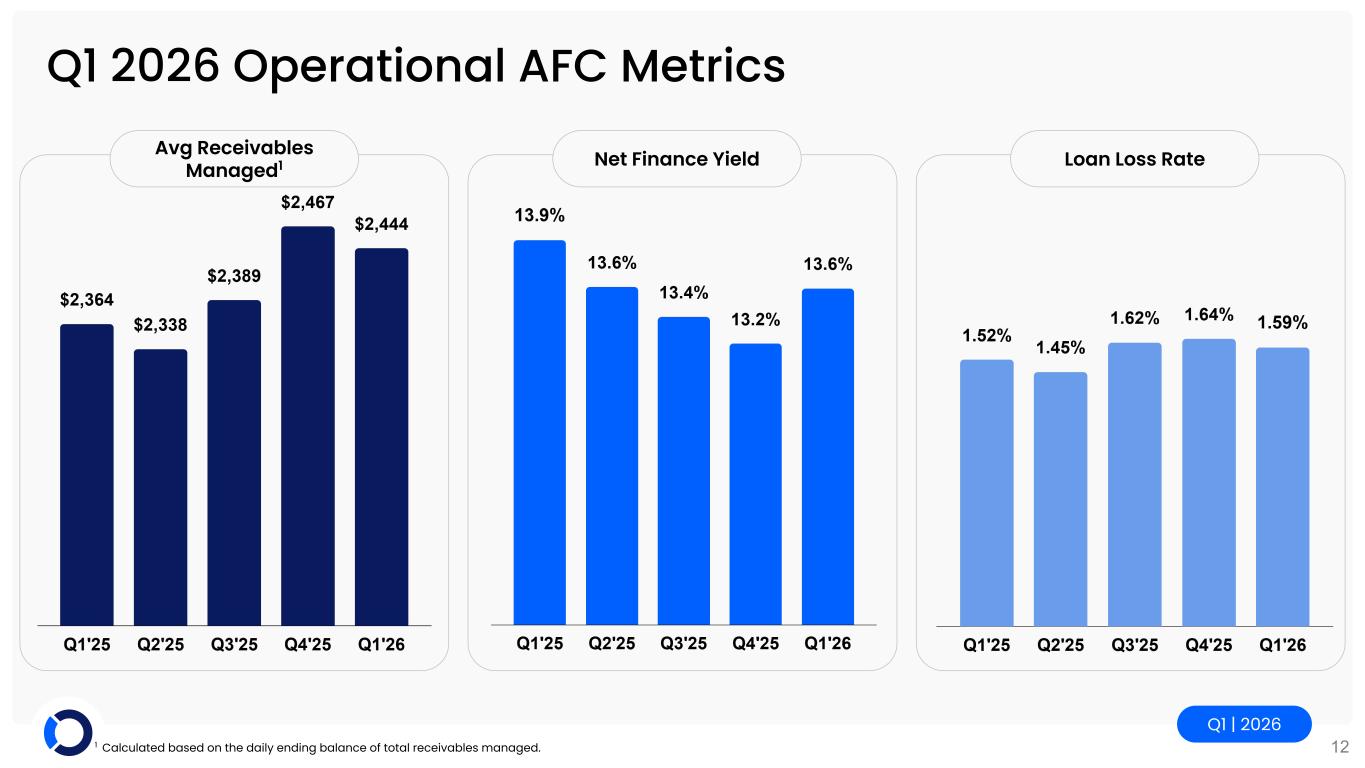
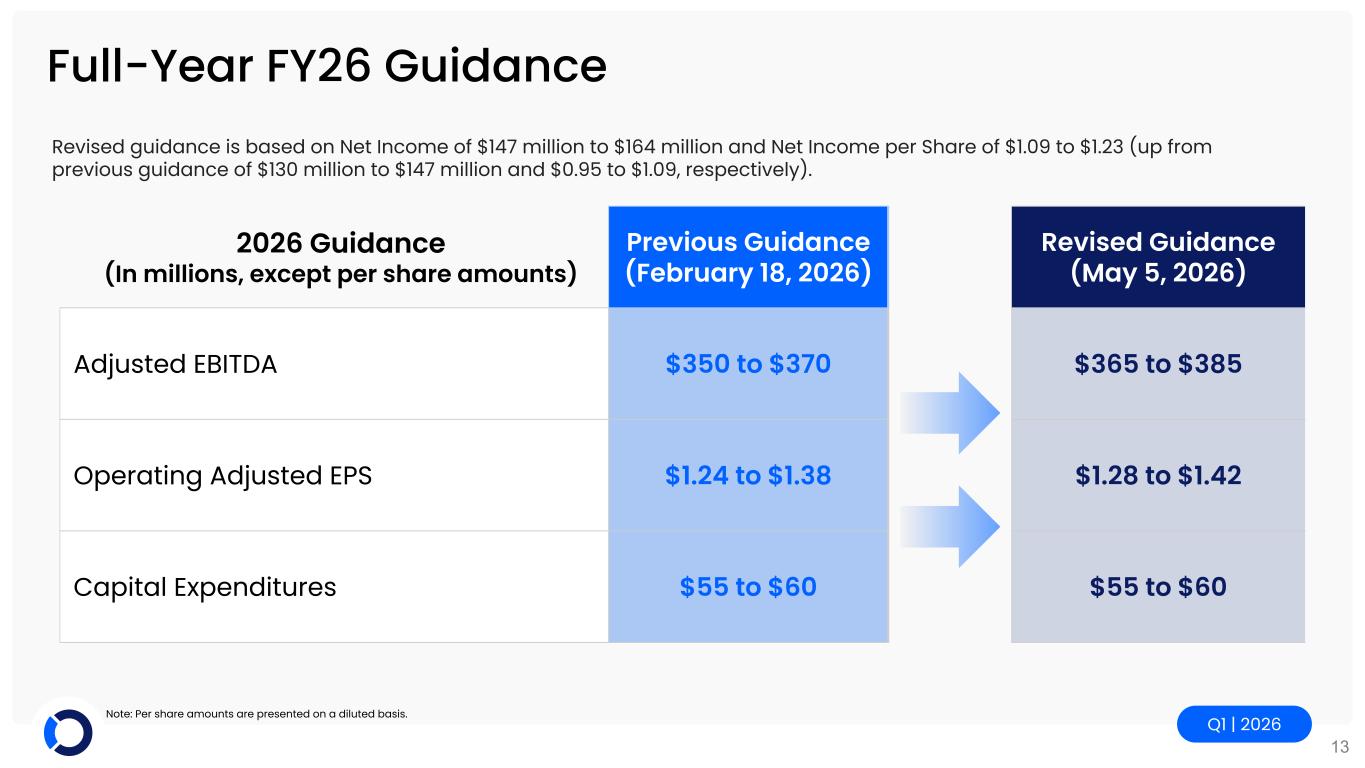
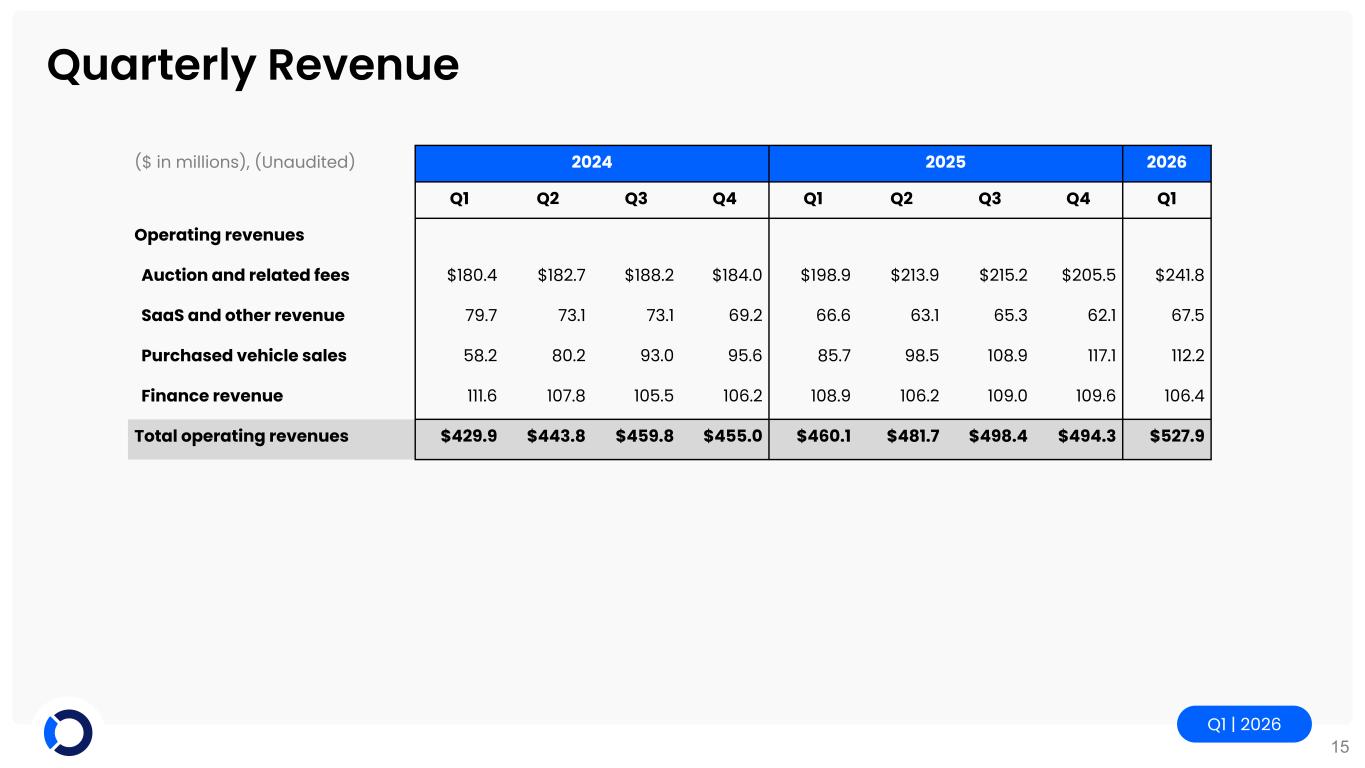
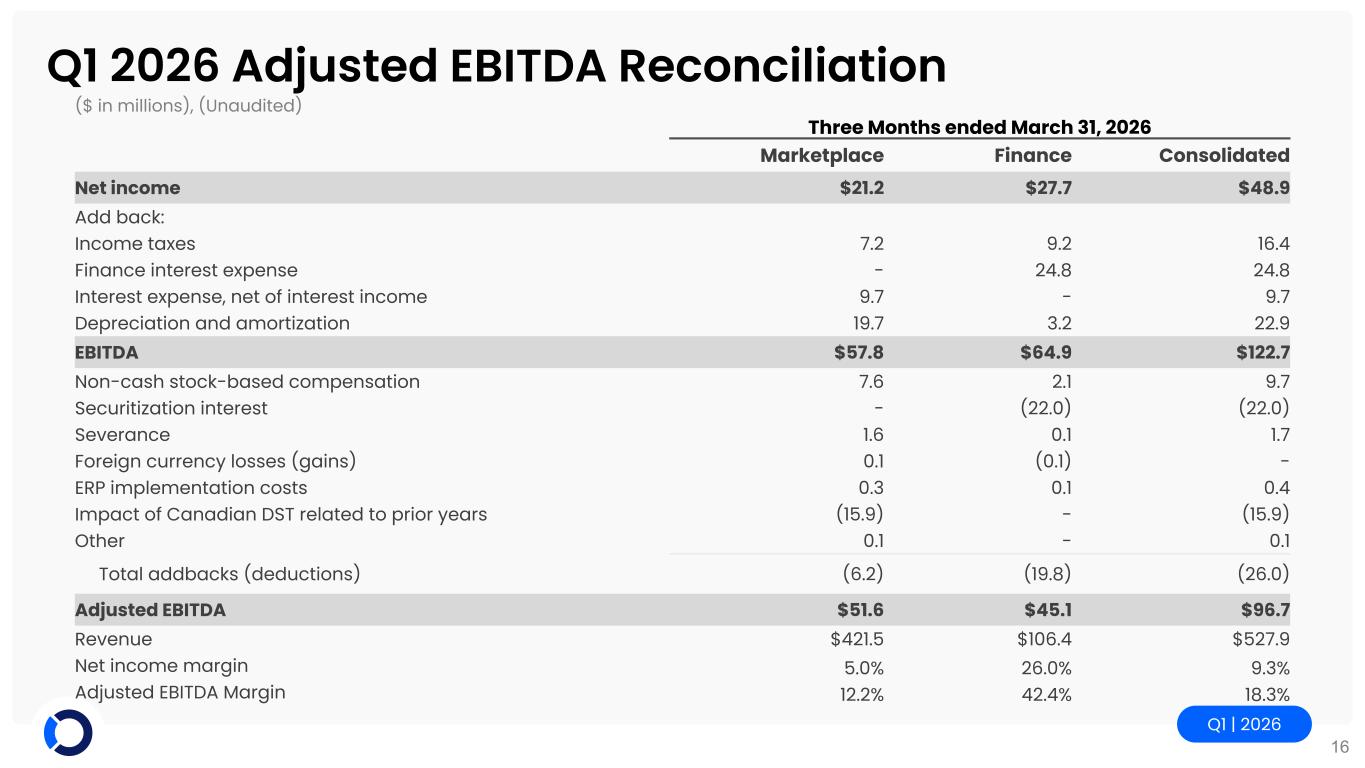
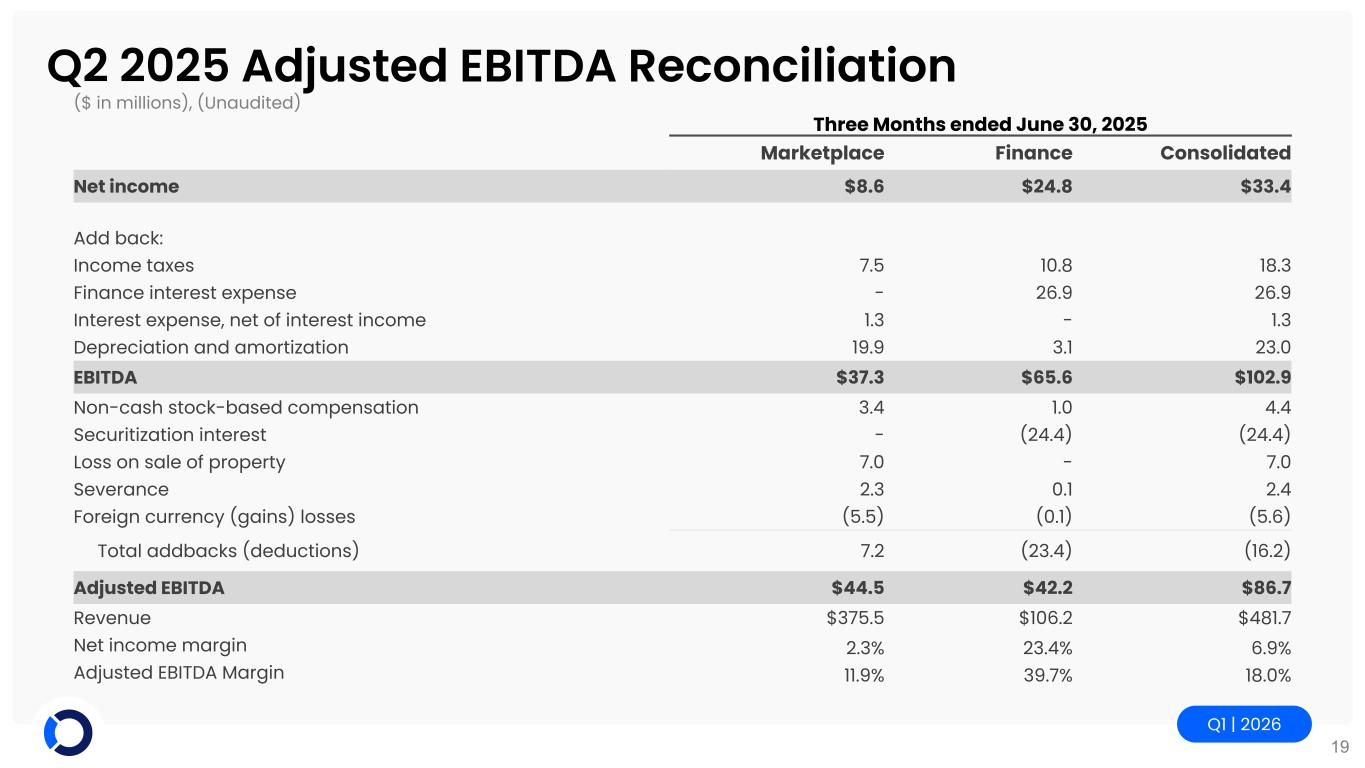
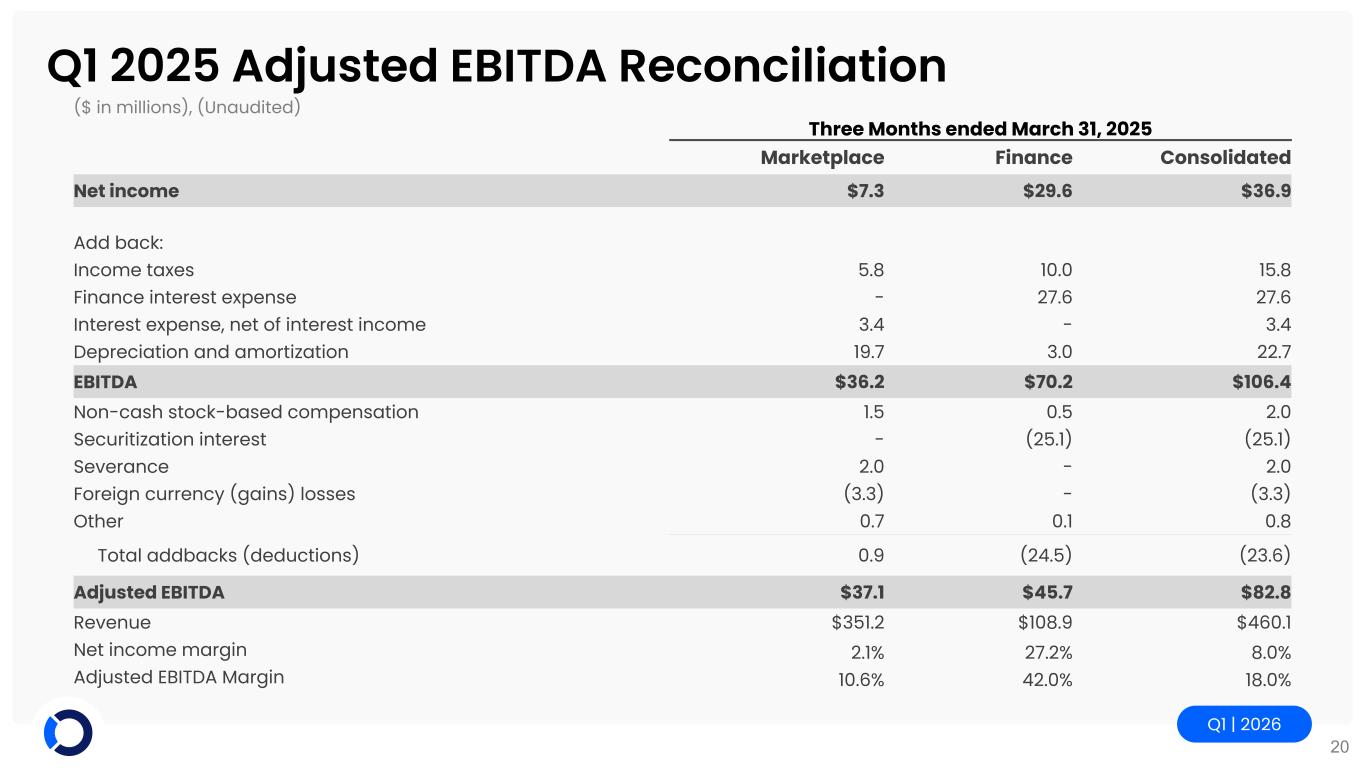
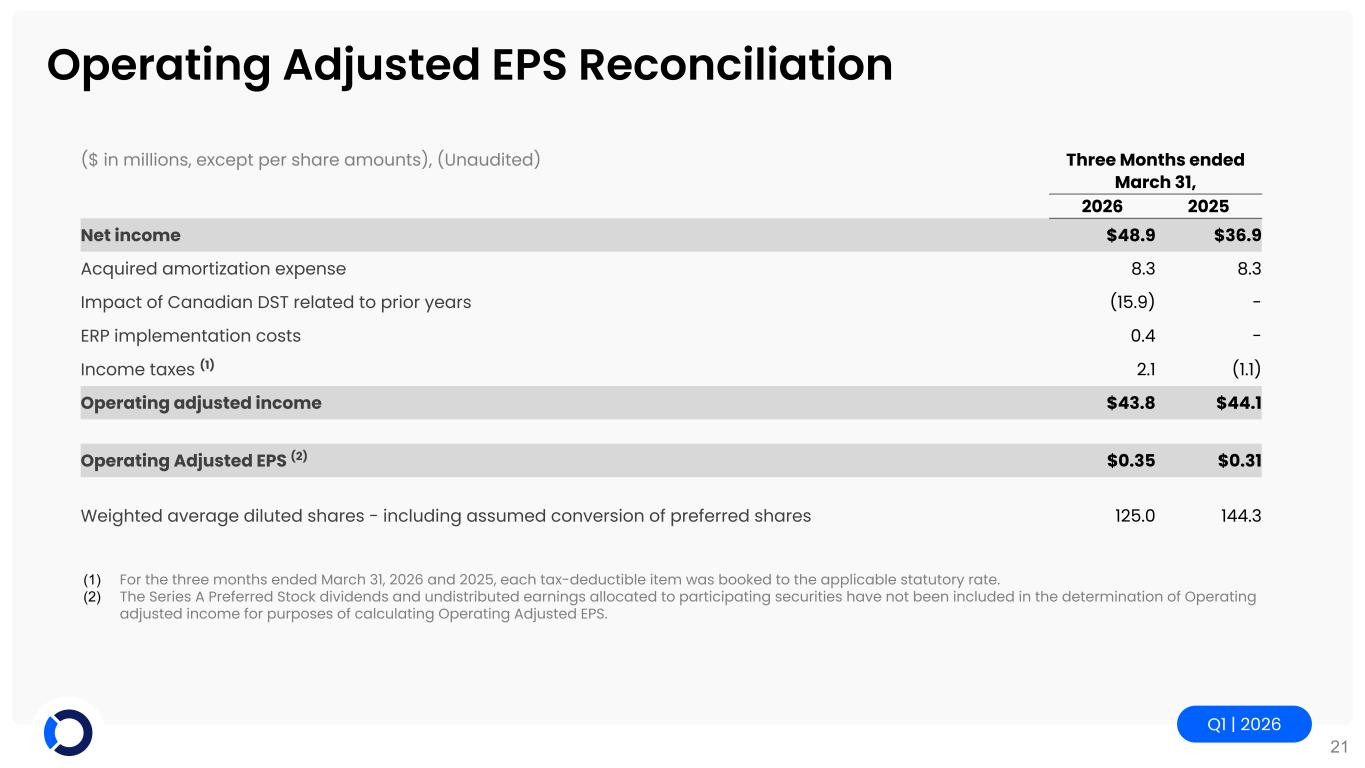
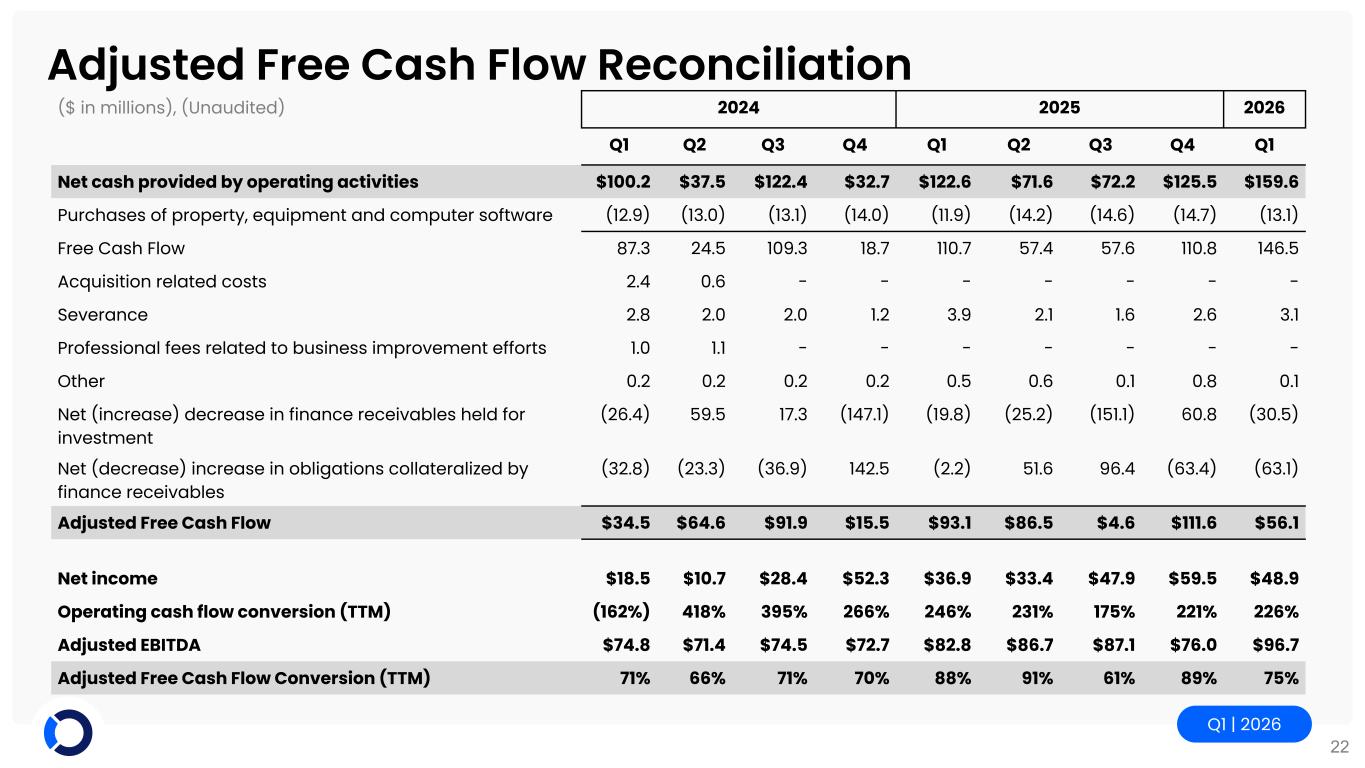
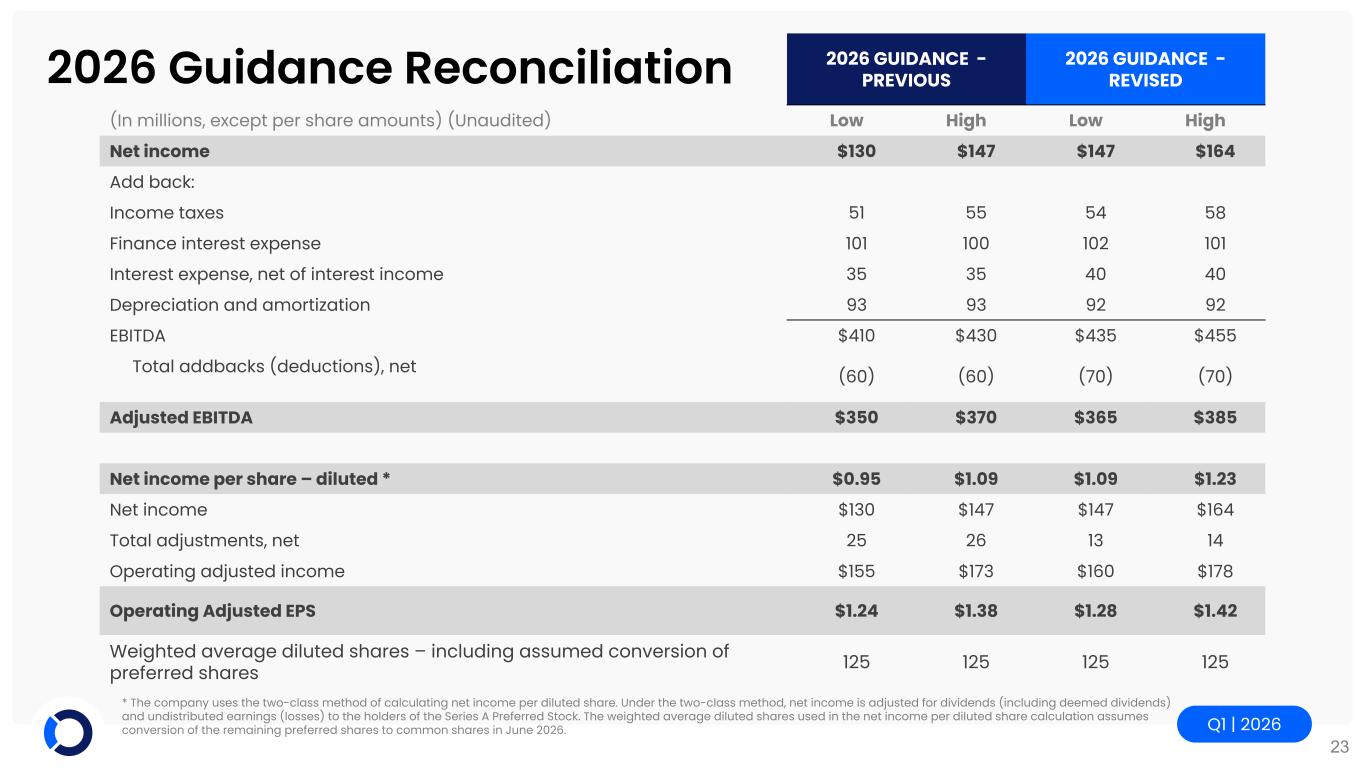
Thanks, Peter. Good morning to everyone for joining us today. On behalf of our management team and all of our employees, we are very proud to report a record quarter for OpenLane. For the quarter, we transacted more GMV, sold more vehicles, generated more revenue, and produced more adjusted EBITDA than any quarter in our company's history as a digital marketplace. These results would not be possible without the tireless commitment and stellar execution of our nearly 5,000 employees that work every day to make wholesale easy for our customers. Before we dive into the financial results, I'd like to thank all of our investors and sell-side analysts that came to visit us in Fort Lauderdale for our Investor Day on March During my remarks in Q&A today, I may reference selected slides we reviewed during our presentation. These slides can be found on the Investor Relations section of our website. Moving on to actual results, we reported total revenues of $528 million, which represents growth of 15%. Revenue growth in the quarter was exclusively driven by the results in the marketplace segment, which I'll dive into more shortly. Consolidated adjusted EBITDA for the quarter was $97 million, which represents an increase of 17%. I'll talk more about our adjusted EBITDA results within the discussions about each business segment. Consistent with previous quarters, we will be discussing adjusted free cash flow metrics on a rolling 12-month basis due to the inherent volatility in our quarterly cash flow numbers. For the trailing 12 months, our adjusted free cash flow totaled $259 million, representing an adjusted free cash flow conversion rate of 75%. A 75% conversion rate is slightly above our expected range of 65% to 70% and reflects the strong cash generation of both our marketplace and financing businesses. As you may have heard, on March 26th, the Canadian Parliament enacted a bill repealing the Digital Service Tax, or DST. This action resulted in a $17.3 million reduction to our marketplace cost of services. $15.9 million of the reduction represents prior period expenses that have been removed from our current quarter adjusted EBITDA calculation, while the remaining $1.4 million is reflected as an in-quarter expense savings. Moving to the performance of our business segments, I'll start with the marketplace. In Q1, we transacted GMB totaling $9.1 billion, which represents growth of 32%. GMB growth in the dealer category was 20%, representing a 13% increase in vehicles sold and a 6% increase in average vehicle values. In the commercial category, the GMB growth of 38% was made up of a 25% increase in vehicles sold with an 11% increase in average values. Auction and related revenues were $242 million, which reflects growth of 22%. The primary driver of this growth was in the U.S. dealer category, where we saw a 38% increase in auction and related fees, driven mostly by the strong vehicle sold performance that Peter mentioned earlier. In addition to the growth in vehicles sold, U.S. dealer GMB growth also included a 22% increase in average vehicle values, driven by a higher mix of sales from our large dealer group customers and an overall increase in wholesale auto prices. Exclusively due to the significant increase in average vehicle values, yields for the U.S. dealer business declined approximately 60 basis points from the 680 to 700 basis point baseline range that we provided in our investor day materials. On a per-vehicle sold basis, revenue generation in U.S. dealer improved by high single digits. Complementing our performance in the U.S. dealer business, auction and related fees in our U.S. commercial business were up 42%. GMB in the U.S. commercial business was up approximately 46%, due largely to the successful launch of a returning private label customer, as well as improvement in the lease return waterfall. fall. Yields in the U.S. commercial business remain largely consistent with the baseline that we reviewed in Investor Day. SAS and other revenues in the quarter were $68 million, which is up 1% due to increases in our subscription-based revenue streams. Rounding out the revenues in the marketplace segment, our purchase vehicle sales grew 31% to $112 million. The variance was driven by the increase in U.S. vehicles sold as well as an increase in the average vehicle values in both U.S. and Europe. Adjusted EBITDA for the marketplace segment was $52 million, which results in an adjusted EBITDA margin of 12%. That represents growth of 39% in adjusted EBITDA and 160 basis points of expansion in adjusted EBITDA margin. The year-over-year expansion in adjusted EBITDA margin was driven by the structural scaling effects of our digital platform and a higher mix of revenues coming from our U.S. commercial business that comes with an accretive variable contribution. In our finance segment, the average outstanding receivables managed in the quarter was $2.4 billion, which is up 3%. Growth here was driven by a 3% increase in the average vehicle values, offset by a 1% decrease in transaction counts. net yield for the quarter was 13.6%, which is down 30 basis points. The decrease was primarily attributable to a decrease in transaction fee yields driven by slightly lower transaction counts and increasing loan values. The Q1 provision for credit losses was 1.6%, which is consistent with our results from last quarter and seven basis points higher than the same quarter last year. While recent performances hovered in the mid-1% range, we continue to reiterate our targeted range of 1.5% to 2.0% for credit losses. The culmination of the changes in the portfolio balance, the net yield, and the loss provisions are an adjusted EBITDA for the finance segment of $45 million, which was down 1%. With respect to capital considerations, I'll refer investors to page 75 of the Investor Day deck where we laid out our objectives for capital deployment. To summarize that message, our first and foremost priority is to fund the organic growth of our business. That will be followed by share repurchases and finally, debt repayment. In addition to our investments in go-to-market, we repurchased 964,000 shares in the first quarter at an average price of $27.20. This represents the retirement of approximately 0.7% of our fully diluted share count that includes the assumed conversion of the remaining preferred shares. As we also mentioned in our investor day, we are considering debt repayment options, although investors should not expect to see any material paydowns to start until later in 2026 or early 2027. From a liquidity perspective, we ended the quarter with an unrestricted cash balance of $180 million and capacity of over $400 million on our existing revolver facilities. Moving along to our guidance, we are raising our full-year expectations for adjusted EBITDA from a range of $350 to $370 million to a range of $365 to $385 million. The entire increase is coming from our marketplace segment and is driven mostly by strong performances in both our U.S. dealer and U.S. commercial businesses. This revision also reflects the full-year impact of the repeal of the Canadian DST that I mentioned earlier. Countering the strong performance in the marketplace, we remain cautious around downstream impact of evolving and volatile macro conditions. Sustained increases in fuel prices, the impact of rising auto prices on consumer affordability, and subsequent impact on our customers, and the automotive supply chain challenges are all front of mind as we look into the back half of 2026. With respect to our finance segment, we maintain our previous guided position as the volatility and macro trends are largely offsetting the decreased likelihood of any rate cuts in 2026. To summarize, we're very pleased with our quarterly results and are proud to increase our full-year 2026 projections. Our revised outlook represents strong momentum in both the dealer and commercial elements of our marketplace segment, while at the same time reflecting on some potential challenges. We are also proud of our prudent balance between growth and risk management in our finance segment. With that, I'll turn it over to the operator for questions.
Operator
Thank you, sir. We will now begin the question and answer session. To ask a question, you may press star and then one on your touchtone phone. If you are using a speakerphone, please pick up your handset before pressing the keys. If at any time your question has been addressed and you would like to withdraw your question, please press star and then two. The first question that we have comes from Bob Labbeck of CJS Securities. Please go ahead.
Good morning. Congratulations on a great start to 2026. Thank you, Bob. So obviously really strong performance on commercial volumes, and you mentioned the returning off-lease customer there. Can you tell us, was there a full impact from that customer, I mean, did you have it for the full quarter, or do you get a little incremental benefit in Q2 as well? I'm just trying to figure out the kind of, you know, run rate from that and the impact kind of going forward.
Yeah, Bob, it launched mid-January, so it's pretty much a full quarter. But I guess, you know, if you're doing precisely, there was an extra two weeks it wasn't live, but it was live for, you know, 11 of the 13 weeks.
Okay, great. And then kind of sticking with commercial, lots of EVs coming off lease, and there's pretty significant negative equity on that side. How are they behaving in the open lane auctions, EVs in general? And then similarly, how are the ICE vehicles that may still have a little bit of equity behaving? Just give us a sense, you know, as we see this divergence of off-lease, you know, coming on more, you know, EVs probably this year and more ICE next year.
Yeah. Thanks, Bob. Let me tackle that. I'll start with just the commercial overall, and then I'll go into the EV piece of it, if that's okay. So, listen, really good quarter from commercial, you know, as I said, 25% growth, a lot of growth in GMV as well. you know, it was a strong spring market. Used vehicle values did go up about 7%, you know, by the end of the quarter relative to January 1. So, GMV was strong. The new customer also had a premium vehicle portfolio that contributed to EV. But in addition to the sort of volume increase, we also saw an improved mix relative to a year ago, you know, so relatively fewer payoffs, you know, across the portfolio, although payoffs remain abnormally high, but they've come down a little bit in percentage terms. And, you know, corresponding to that, an increase in sort of non-grounding and open sales, which are higher revenue, higher margin transactions for us. So, you know, we saw an improved mix through the commercial funnel. I'm talking generally here EV and ICE combined, okay? So, listen, you know, a lot of encouraging encouraging signs there. And again, feel really good about the setup for commercial vehicles through the balance of this year and into next year and beyond. Going specifically into EVs, yeah, we certainly saw an increase in EV volumes in the first quarter. The good news is they're performing very well. Conversion rate for EVs is comparable to that for ICE vehicles. It varies a little bit by portfolio, which indicates certain sellers are adopting different strategies in terms of how to how to remarket them but uh overall conversion rates on evs in our marketplace is very strong um if anything we're seeing you know because of the equity situation on evs which is more negative as you know we're seeing even fewer payoffs so almost no payoff so those cars are flowing deeper in the funnel so relatively higher conversion of evs in the you know the the non-grounding and open channels which you know from a margin perspective it was very good for us. So we're seeing good performance with EVs. Obviously, in the quarter as well, we saw the stuff in the Persian Gulf and oil prices, that has probably boosted EV demand at the retail level a bit. So if anything, I would say that demand has strengthened late in March and into April as well. So good, positive momentum on EVs. And I think that the real question is the seller has to be prepared to sort of acknowledge, you know, what the value of the car is in the marketplace as opposed to what is the residual value that they might have written on a contract, you know, two or three years ago. But absent that, I feel really good about it. And, you know, as we're looking to the future, and again, this comment is more general, as commercial volumes are generally picking up, our commercial sellers are getting more and more interested in, okay, what techniques and plans can we put in place to maximize conversion and improve outcomes in the digital channel because it is such a fast channel, it's a low expense channel, but also a high price realization channel. So we're having very constructive discussions with many of our customers running pilots and various programs to drive adoption and drive conversion of other vehicles.
Okay, that sounds great. Congratulations. I'll jump back in queue, but great quarter and great outlook. Thanks.
Operator
The next question we have comes from Craig Kennison of BARD. Please go ahead.
Yeah, hey, thanks for taking my question. I wanted to go to slide 11, if I could, and just ask you, Brad, if you could just help us understand the yield dynamic in Q1, why it dropped and what the mix issues are that impacted that.
Yeah, perfect, Brad. I'll take that. So, yeah, if you look at the yield, I was going to be talking about on the commercial side where the yield drops. So it's a mixed issue. If you think about when we talked about it in Investor Day, we talked about the different yields set up for commercial across the different geographies, and we mentioned that the U.S. range was certainly lower than Canada and Europe. So if you look at the mix in the commercial space, last year, first quarter, U.S. made up about 71-ish percent of the GMB that flew through the commercial space. Q1 of this year with the ramp-up of that new customer we talked about as well as kind of the increase just from the lease returns, now that number is north of 75%, 76%. So that's a mixed issue that drove that yield down from a 159 to a 143. The yields across the different categories are relatively stable, so that means it's purely mixed across the geographies that's driving that.
Thanks. And while I have you, Brad, could you just help us understand the full year implications of the repeal of the digital service tax?
Yeah, the full year impact on an annual basis is $5.5 to $6 million. It's about $1.4 million in the first quarter is what I disclosed. That's a relatively steady run rate across the different quarters. It will kind of vary a bit with volumes. But if you use a $5.5 to $6 million impact number for the full year, you'll be in line.
Now, are there any offsets to that, like charges or fees you may have charged to offset that that would also go away?
No, that'll just be only – that'll be the only impacting item.
All right. Thanks, Craig.
Operator
Thank you. The next question we have comes from Jeff Leck of Stevens, Inc. Please go ahead.
Good morning. Thanks for taking my question, and congrats on a great quarter. Peter, I was wondering, as it relates to the U.S. dealer-to-dealer, you said it was in the upper 20 range, which implies a little bit of a sequential improvement from Q4, which was in the 20-ish, up 20. The market was actually down a little more in Q1 than Q4, which kind of implies your spread to market is widening. And I was wondering if you could elaborate on any of that. And then, you know, does the lease return business kind of have a halo effect, like some kind of symbiotic effect, synergistic effect that's helping drive that? If you could elaborate, that'd be great.
Yeah, thanks, Jeff. I appreciate that. Listen, we were very pleased with the dealer performance in Q1. You know, in aggregate, you know, dealer volumes grew year-on-year by a higher number than in Q4, and that was driven by the U.S., where year-on-year growth, as I said, increased to the upper 20s, and as you pointed out, that was an acceleration. So we feel really good about that. You know, we don't have a full industry picture yet, but we do know that dealer volumes of physical declined a little in the first quarter. So, you know, it definitely looks like OpenLane had a strong performance in terms of market share and share gains based on those results. So we feel pleased about that. It also looks like, you know, an increased portion of the industry volumes moved towards digital, largely driven by our volume increase, right, based on the data we have at least right now. So, listen, feel really good about that. I think it's driven in large part by the things I've talked about on many calls, you know, our focus on the value proposition that digital offers our customers, the speed, the ease, the access to a broader network of buyers, ultimately better outcomes for sellers, and for buyers, the convenience, the peace of mind, the ability to, you know, search for vehicles and purchase vehicles without leaving your dealership and all those types of benefits. So we're very focused on that. Obviously, we've made go-to-market investments as well, Jeff, that continue to help drive those results. To the specific question on lease, you know, does improving commercial volumes create a halo effect? You know, I think it probably does. You know, I think dealers are aware that lease volumes are going up and OpenLane is, you know, well-positioned to benefit from that. And if dealers want to get access to those units, then, you know, doing business with OpenLane would be a wise choice. So I think we're seeing franchise dealer registrations have improved. Our ability to convert dealers from private label buyers across into our open sale have improved. So I think there is some of that for sure. I think the other thing, Jeff, is there's just a network effect, right? There's a network effect in any marketplace as that you add more buyers, your marketplace becomes more valuable for every seller on the marketplace. And as you add more sellers and more inventory, it becomes more valuable to every buyer on the marketplace. So I think there's a compounding benefit that takes place over the longer term, you know, on that dimension as well. And I think we're benefiting from that. So, listen, very pleased with the results. You know, I did also say in my remarks, it was a strong spring market, you know. You know, tax refunds were relatively high. Inventory remained relatively scarce. So, you know, there was a lot of demand. Conversion rates were up. I would not forecast an upper 20s growth rate for the full year in the U.S., candidly. But obviously we're going to drive, you know, our traction in the marketplace as strongly and aggressively as we can.
And then just a quick follow-up on commercial. Did you say in your prepared remarks that your commercial is up 24.6, call it 25, that X, the new customer commercial, would have been up 6, implying that the new customer was 19?
Yeah, that's – well, yeah, that's what I said. Commercial was up 25-ish, excluding new customer of 6. So the new customer was a pretty significant step function. And maybe one comment on that. With this new customer, we're essentially handling all of their transactions, including all payoffs. And that's not always the case. In fact, I would say the majority of our customers, that's not the case. We do it for a number of others, but we do it for this one. So this customer, you know, we're kind of indifferent to – we're not indifferent from an economic standpoint because the economics are different, but from a transaction count standpoint, you know, all those transactions get processed to our platform. So it was a pretty significant volume impact, but it had some, you know, as Brad alluded to, some mix impacts because, you know, we got a bunch of payoffs and lower revenue transactions as part of that. But still, it's very good business. And by the way, all of those transactions, whether it's a payoff or not, it brings a dealer to our platform to do a transaction. And that's always going to be a good thing because that's sort of a touch point where they then can launch into other parts of our services.
And was Q1 disproportionately high because maybe there was some bottleneck units from Q4 that flow into Q1? Or will this type of similar impact flow through for the next three quarters?
It's hard to say. I don't think there was a bottlenecking, Jeff, you know, but, you know, every customer has, you know, different quarterly profiles of their maturities based on, you know, the lease programs that they ran two, three years ago, the incentives that they ran two, three years ago. So, you know, it'll have and flow, but I don't think there was a bottlenecking. So I would expect a solid positive volume impact from this customer through the rest of this year.
I would assume, given that this is a luxury customer, a greater portion of luxury leases happen in Q4, so Q4 could be even bigger.
I hadn't thought of that. It's possible. I wouldn't know. I don't know at this moment. Awesome. Well, thanks very much, and best of luck in Q2. Thank you, Jeff. Appreciate the questions.
Operator
Thank you. The next question we have comes from John Babcock of Barclays. Please go ahead.
Hey, good morning, and thanks for taking my questions. I guess just to quickly follow up on that last one. So it sounds like that mix impact is going to continue through the year just because of this new customer. Is that fair to say?
I'd say there's a whole bunch of different things going on in the mix, and Brad touched on them. If I could kind of summarize, I'd say we're seeing, because of the new customer, you know, obviously a volume impact. And, you know, that customer, we're handling a lot of payoffs there. So that tends to sort of have sort of, I'll say, a somewhat negative impact on yields. Offsetting that, you know, we're seeing cars flow deeper in the funnel, more into the non-grounding dealer and open. That has a positive impact on mix. And then we're seeing our U.S. private label volumes increase relative to all of our other commercial volumes. So there's a lot of puts and takes in there that are driving that, John. Brad, do you want to comment?
Yeah, John, just to add on to that, I mentioned in my comments that the yields in the U.S. commercial were flat, but to kind of peel back Peter's comment a little bit, this new customer certainly was diluted to that. It's a higher-end, higher GMV per sale transaction at a lower yield because of that mix, a little bit more concentrated at the top of the funnel related to those payoffs that we're processing. On the other side of that, you actually saw some pretty substantial yield improvement on the non-new customers as those transactions have now flowed deeper into the waterfall. So what that netted out to was a yield that was essentially around flat from what we talked about at Investor Day, but it does have those two moving components embedded in it.
Yeah, that's very helpful. And now as we think about the off-lease volumes for the year, I was just kind of curious, because it seems like demand is probably going to be pretty strong for those, especially with affordability challenges, and it seems like people are more willing now to take on used vehicles than pay the higher prices for new. Are there any concerns that those off-lease volumes will stay more with the grounding dealer, or is there any reason to think that that will happen, or is that not necessarily a fair assumption?
You know, it's a good question, John. I think, you know, one thing we saw in Q1 was used vehicle values went up in value. Used vehicles went up in value, right, because of the supply-demand situation you talked about. What that does is that essentially increases the equity that consumers have in their off-lease volumes. So to some extent, that could delay a little bit, you know, or could impact the sort of consumer payoff percentage, and that's something we've talked about in the past. So there's a lot of sort of give and take here, but I think fundamentally, you know, what do we know is true? Maturities coming off lease, those are going up, okay? They're going up in the second quarter and accelerating into the third and fourth. You know, we have seen consumer payoffs come down a little bit. They were down a little bit, Q1 versus Q1 of last year. So there's more cars flowing our way, and then those cars are flowing deeper in the funnel. But market conditions do drive those things, John. And, you know, I don't know if I can predict with precision all of the puts and takes on that. But I think fundamentally, I feel very optimistic and very positive about the setup for commercial, both for the balance of this year, but also looking further out into 27 and 28.
Okay. And then just last question, if you don't mind. I was just kind of curious. I mean, dealer volumes were quite strong in the first quarter. are you able to provide any sort of sense or do you have any sense as to how those volumes have done so far in 2Q? It seems like 1Q was generally a pretty good quarter overall, at least for the used market. It seems like that market was pretty tight, but I'm just curious to see what you're seeing.
Yeah, well, listen, in our industry, there's normally, you know, a spring market, we'll call it, you know, that's what we call a spring market driven by the tax refund season. The spring market usually kind of loses a bit of steam around mid-April, you know, and there It tends to be a little bit of a fallback, but not a massive one. You could look at previous year's results to see how the quarters trend. I would say this year kind of is exhibiting sort of a similar pattern to the normal seasonal pattern, nothing abnormal. And that I'd say, you know, it still, in my views, continues to be a pretty robust market, you know, in terms of used car demand versus supply.
Operator
Thanks for all the color. you're welcome thank you ladies and gentlemen just a final reminder if you would like to ask a question please press star and then one now the next question we have comes from gary prestapino of barrington research please go ahead good morning uh peter and brad hey um peter i just got a question you said your open sales and commercials gobbled in the quarter which means things are flowing down the funnel.
But, you know, given that we've just seen this turn in lease returns, were you surprised at that magnitude of what's coming, you know, outside of the franchise dealers buying these cars? And what does that indicate? Does that indicate that the franchise dealers have solid used vehicle inventory and, you know, more of this is going to flow down to the independent dealers? Yeah, good question, Gary. You know, Well, I wasn't massively surprised by the doubling. I was expecting high growth, you know, 50% to 100% somewhere in that range. It's growing off a fairly small number, so there's that impact as well, you know. But nonetheless, it was a strong year-on-year increase, as we have seen for at least a few quarters in that commercial open transaction piece. Just because they sell in open doesn't mean they sell to an independent dealer. I want to be clear about that. Let's say, for example, a Ford vehicle coming through the Ford private label. Well, a Honda dealer can't buy that on the Ford private label. If a Honda dealer wants to buy it, they've got to wait until it gets to the open sale. They don't have access to the private label. So even though they're selling in the open, there's still a high percentage of franchise dealers buying them in that channel. They're just buying them across brand. You have the large used car retail operations buying them there, too, as well as independent dealers. So it's a mix of all three customer groups that represent the buyers there. So, no, I think generally, listen, pleased with how it's going. we're working with many of our commercial sellers to improve their performance and drive further conversion in that open sale channel because sellers increasingly see it as very strategic to them it's kind of their last chance to sell the car before they start incurring significant downstream expenses for moving the vehicle you know waiting you know a number of extra weeks before they sell the car all that sort of stuff so we're having very productive discussions and strategies that are helping drive that performance, and we're going to be doing more and more of that in the quarters to come. Okay, thank you very much. Thanks, Gary.
Operator
Thank you. The next question we have comes from Arjad Gupta of JPMorgan. Please go ahead.
Great. Thanks for taking the question. Just to follow up, a couple of clarifications after that. Could you quantify the open, you know, sale units that you're seeing in commercial? You know, any unit number or percentage number you could throw out for the quarter?
Yeah, we don't comment on that number, Rajat. I would say our open sale in the U.S. skews heavily towards dealer, but commercial is, you know, an increasing percentage over time. And if I look at our year-on-year growth in the open sale in the U.S., again, we said dealer grew, you know, high 20s, commercial grew, you know, approximately double. So, from that, we can determine commercial, obviously, you know, was a bigger percentage in Q1 this year than a year ago. But we don't release that exact number.
Understood. And just on the guidance, you know, given, you know, the strong first quarter, just as you normal seasonality, you know, it would imply somewhere above the upper end of the new range. I'm curious if – and especially in light of, you know, the off lease picking up, you know, later this year, I'm curious, is there any conservatism baked in, you know, in the second half, you know, with regard to new car sales or anything around the macro? Is it not right to assume normal seasonality, just making sure we're looking at this correctly? Any color would be helpful.
Yeah, let me comment sort of high level, and Brad can comment on maybe specifics. Again, listen, very pleased with Q1, you know, a strong quarter with traction kind of across the board. But as I mentioned in our remarks, you know, there was a strong spring market in Q1. I would say a stronger spring market this Q1 than in, you know, any of the last two or three years for sure. And that was reflected, you know, that was driven, I'd say, by high tax refunds and generally inventory being somewhat constrained. It was reflected in used vehicle price appreciation and high conversion rates. So, you know, one judgment is how are those going to trend going forward? Is there going to be an above-average correction from that? Haven't seen it yet, right? But, you know, that possibility would exist. And then the other thing we're mindful of is just, you know, the geopolitical and macroeconomic impacts out there, high oil prices, you know, potential impacts from those in the markets in which we operate. Again, I can't say we've seen any material impact from that yet, except that we're seeing increased interest in EVs. But, you know, we're one quarter in, three quarters left, didn't want to get too far out in front of our skis on what the remaining quarters could be. I'd also say, particularly in U.S. dealers, we get into the second half of this year, we do see tougher comps on the D2D side. You know, we're going to be lapping some bigger quarters that we had in the second half of last year. So, again, I would expect some deceleration in our dealer-to-dealer growth rate in those quarters, you know. So, anyway, we've kind of reflected all of those to the best of our judgment. I would say, you know, notwithstanding any of that, I think there's a ton of opportunity out there for OpenLane. I'm very pleased with how our customers are responding to our offering and the feedback we're getting and the growth in the customer base. So I really feel good about the strategy we're executing and the opportunity that offers, not just for the next three quarters, but for the long term.
Brad, do you want to comment? Yeah, I think that's a really good summary, Peter. I think the only thing I would add, look, as the quarters play out, if things change and our view of the remaining quarters of the year changes, we'll certainly be updating that in our next quarterly discussion.
Understood. Thanks for that color. I'll jump back in queue.
Operator
Thank you. The next question we have comes from John Healy of North Coast Research. Please go ahead.
Thanks for taking the question. Peter, just wanted to ask just about the relationship between lease returns and wholesale sellout. So if we're thinking about this, you know, I think we've all kind of penciled in a growth rate based on lease returns. But how should that lease return number impact the timing through your P&L? And let's just say hypothetically in a quarter, off lease grows 25% or something like that. In terms of returns, is that going to be spread out over multiple quarters? So perhaps the volume that you guys move through your platform might be elongated. I'm just trying to think about how we should kind of think about the returns to market and to dealers and then the actual flow through to your business in terms of a processing standpoint to make sure you get the most value for your remarketing partners.
Yeah, thanks, John. You know, I guess, first of all, I'll say the equation to sort of determine, you know, what volume we actually get, it's very, very complex. You know, I don't know that it really exists, you know, because there's obviously different customers in there. They have different portfolios. Sometimes a customer will execute what's called a pull ahead. You know, I've got these leases coming off, you know, six months from now, but my retail market share looks a bit weaker. I'm going to try and pull these leases ahead and get those customers to buy a new in-brand vehicle now to get my market share up on the new car side. So we see that. We also see the opposite of that, lease extensions. I've got too many cars coming back. I don't want that many. I'm going to try and push some of these out and extend those leases. So there's all these things that can happen. But I guess the net-net is I do look at the maturity forecast in aggregate, how many leases were written three years ago. That's the best barometer I actually have of how many leases will be returned. And generally, John, I'd say, you know, if anything, they tend to come back a month or two early. So leases that you expect to come in Q3 can sometimes come in, you know, a month or two or maybe three months ahead of that. And I generally assess that the consumer that's kind of said, okay, I know my lease is up, but I've made a decision of what the new car is that I want, and I just want to pull the trigger and get that done now. You know, so I guess take what did all that mean? I expect, you know, if we look at that maturity curve, I believe off-lease volumes in the back half of this year are up around 20% to 25%. So I'm expecting that kind of volume growth in our off-lease volumes without the addition of the new customer. So that's the kind of math I'm looking at, and it's obviously fairly robust, but I guess we'll see what happens.
Great. That's helpful. And just wanted to ask about the AFC business. You know, obviously you guys are seeing a nice bounce in the auction business, but, you know, AFC loans kind of originated in a quarter of, you know, pretty anemic growth the last few quarters. Curious if you think that gets better, and is there a desire to really grow that business, or are you just kind of happy keeping it about the same size that it is right now? because it would just think with the, you know, activity and the attractiveness and the network effect in your business that you talked about on the dealer car side, I'm kind of perplexed a lot when it also takes place on the AFC side.
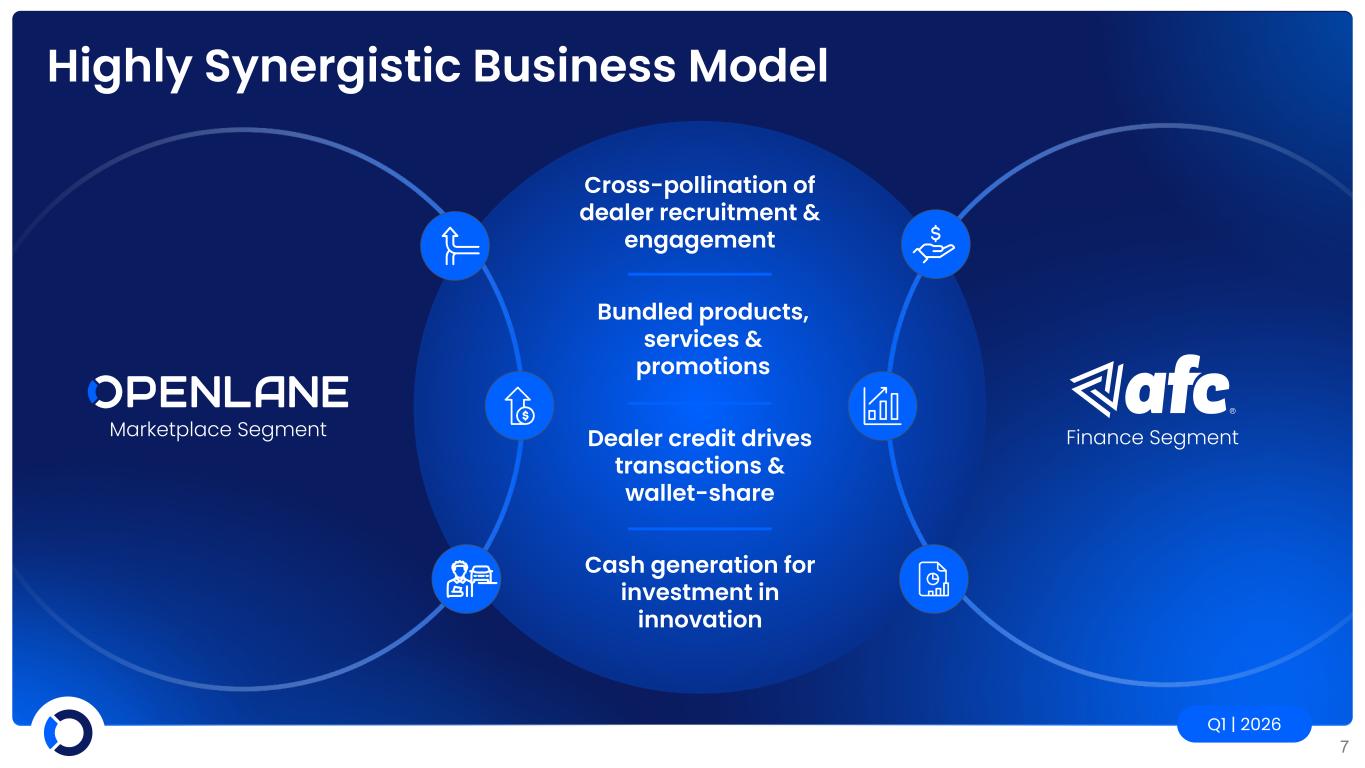
Yeah, well, thanks, John. You know, listen, I think, first of all, AFC is a great, great business. You know, it's a category leader in the space, an industry leader in terms of its risk management and loan loss rate, strong, you know, return on assets, return on equity, and strong, you know, EBITDA cash flow generation for our company. So it really is a great business. It's also synergistic with the marketplace and it is helping us drive, you know, some of the marketplace results that we've talked about on multiple calls and we talked about our investor day. So I feel really, really pleased about AFC and the performance that it's delivering and the AFC team. I'll also say, you know, we don't chase growth for growth's sake. We have a somewhat conservative view We like managing within a risk band that we've talked about, 1.5% to 2%. There's obviously a lot of customers we could take that are outside of that band, but we generally try to avoid that. We like to manage this more conservatively. But that said, it is growing. We are growing the customer base on AFC, and we're seeing something interesting start to play out now, started in the first quarter. I think we'll see it through the balance of the year. It's not maybe yet showing up in the results, but, you know, we've been driving, you know, can we get more of these AFC dealers to register on open lane? Well, so that's been successful. But now we're also seeing a whole bunch of independent dealers on open lane that aren't registered on AFC. But they see on open lane there's an AFC floor plan that they could potentially utilize if they go register. So we're seeing that sort of cross-pollination flow back the other way. So, again, I think there's growth opportunity there. It absolutely is going to be more modest. we're going to manage that business for risk, but it is a great business, and it's very synergistic in helping drive our overall results. Brad, do you want to comment?
Yeah, I'll just add to that, John. We've talked about it, I think, at Investor Day. We've always kind of seen AFC as really a low single-digit grower for those reasons. It's about staying in that risk band that we're very comfortable with and extracting the value that AFC provides, some within the AFC vertical of a segment report, but also, you know, the value that manifests itself in the marketplace. And I think that's the part. When we think about it, the growth in AFC, we combine those two as opposed to just looking at the segment results of AFC independently.
Understood. Thank you, guys.
Operator
Thank you. We have a follow-up question from Rajat Gupta. Please go ahead.
Question. Just to pull on commercial, you just mentioned on a previous question that you expect 20% growth in your off-leaves plus the new customer? And it looks like the new customer was 20% of the units. Analyzing that would be like 20% plus. So am I reading that correctly, the 25% plus 20% for your commercial business this year?
You know, Rajat, I guess what I said is I think the growth Open maturities is a good number to take in our underlying customer base. And I believe in the back half of this year, that is in the 20-ish percent level, maybe a bit higher. So I would expect that kind of volume in our non-new customer. And then we got the new customer in addition to that. I'm not saying that new customer is going to be 20% every quarter. They have a portfolio that has its own seasonality to it. And I don't have that in front of me right now. I will say that our initial results from that new customer in volume terms exceeded our expectations. I don't know that they'll continue to exceed our expectations every single quarter, but we were surprised by the volume they had in Q1.
And also keep in mind, Rezat, that new customer was a step function in January, so that will not recur. That element of growth will not recur to that same degree in Q1 of 27. Of course.
Yeah, no, for sure, yeah. sure uh and then just a quick question you know we we heard from some of your larger public customers uh that there's some uh luxury oems that have dialed up early lease terminations you know to manage captive finance losses uh i'm curious if that is something you've observed um you know has that benefited you know with just like incremental off lease and wintry recently uh just curious to get our thoughts there and how we should think about implications for open line Yeah, well, again, that's an example.
As I was saying on just a question a few moments ago, you know, captive finance companies can put these types of programs in place from time to time. You don't really get a lot of sort of advance warning as to when they might happen. But early, you know, early terms, that's kind of a pull-ahead program. I'm not aware of that having had a specific benefit on our volumes. But that said, the new customer we launched does have a premium portfolio, and those volumes were quite strong in the first quarter. So maybe there was some aspect of a pull ahead in that or an early term offer within that. It's possible, Rajat.
Thanks for all the color and congrats on a strong quarter again. Thank you, Rajat.
Operator
Thank you. At this stage, that was our final question. I will now hand back to management for any closing remarks. Please go ahead.
Well, thanks again, everybody, for your time this morning. We really appreciate your interest in our company and your questions here this morning. Listen, very pleased with the quarter that we had and continue to be focused on our strategy and our purpose of making wholesale easy so our customers can be more successful. I'm looking forward to reconnecting with you all in 90 days where we can talk about our second quarter results. Thank you all very much.
Operator
Thank you. Ladies and gentlemen, that then concludes today's conference. Thank you for joining us. You may now disconnect your lines.