Operator
Good morning, and welcome to Blue Owl Capital's second quarter 2025 earnings call. During the presentation, our lines will remain on listen only. I'd like to advise all parties that this conference call is being recorded. I will now turn the call over to Anne Dye, Head of Investor Relations for Blue Owl.
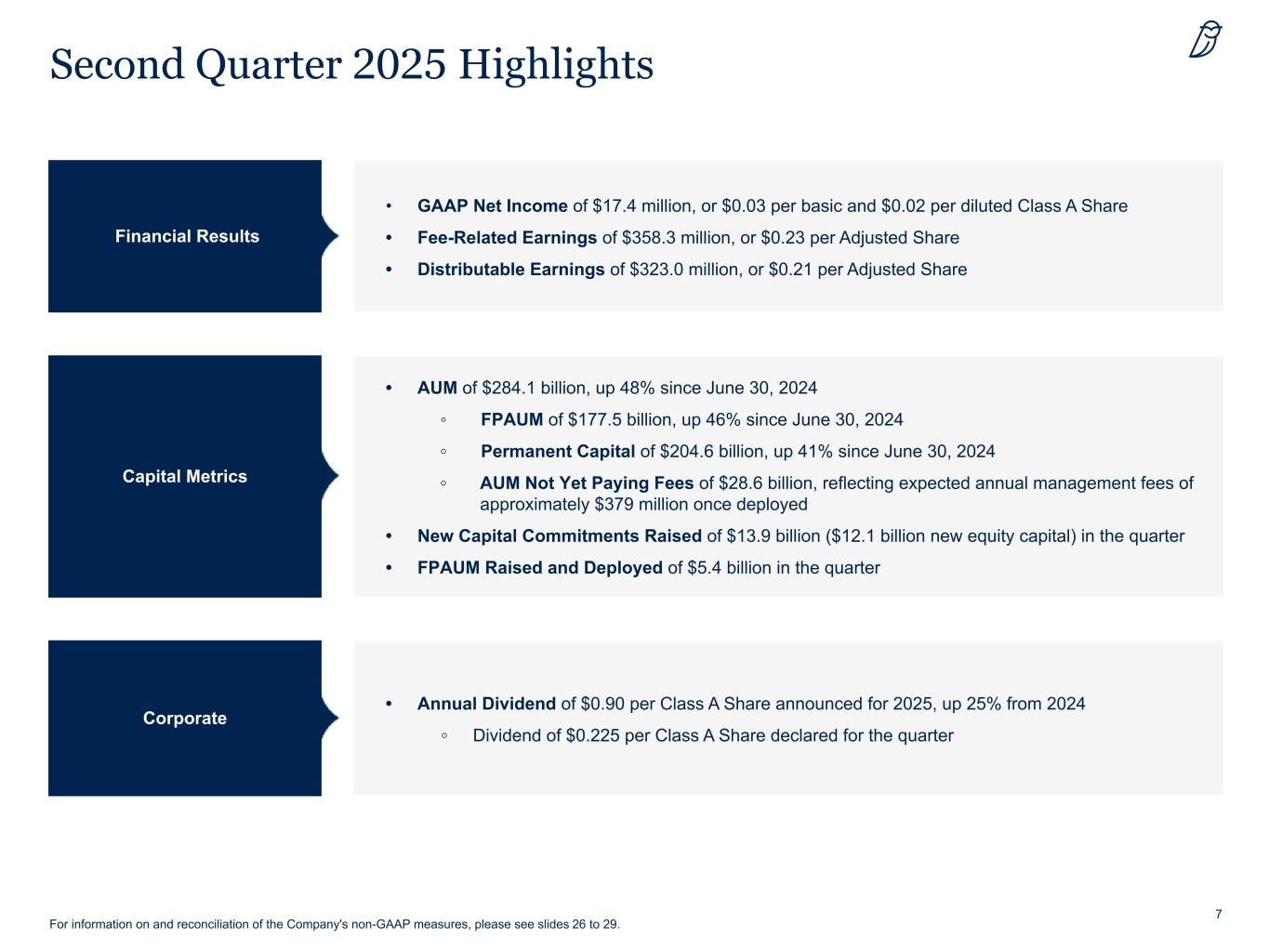
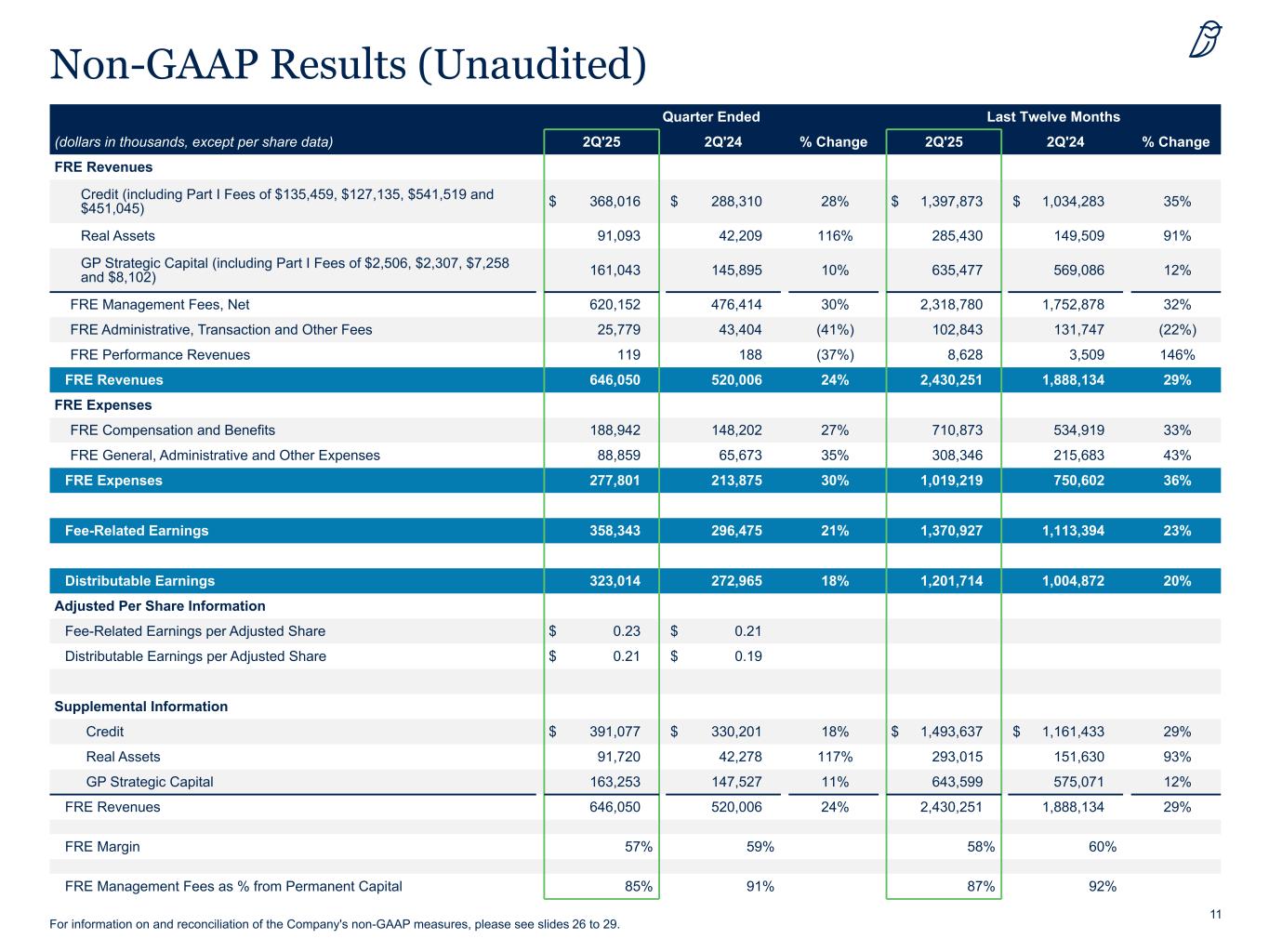
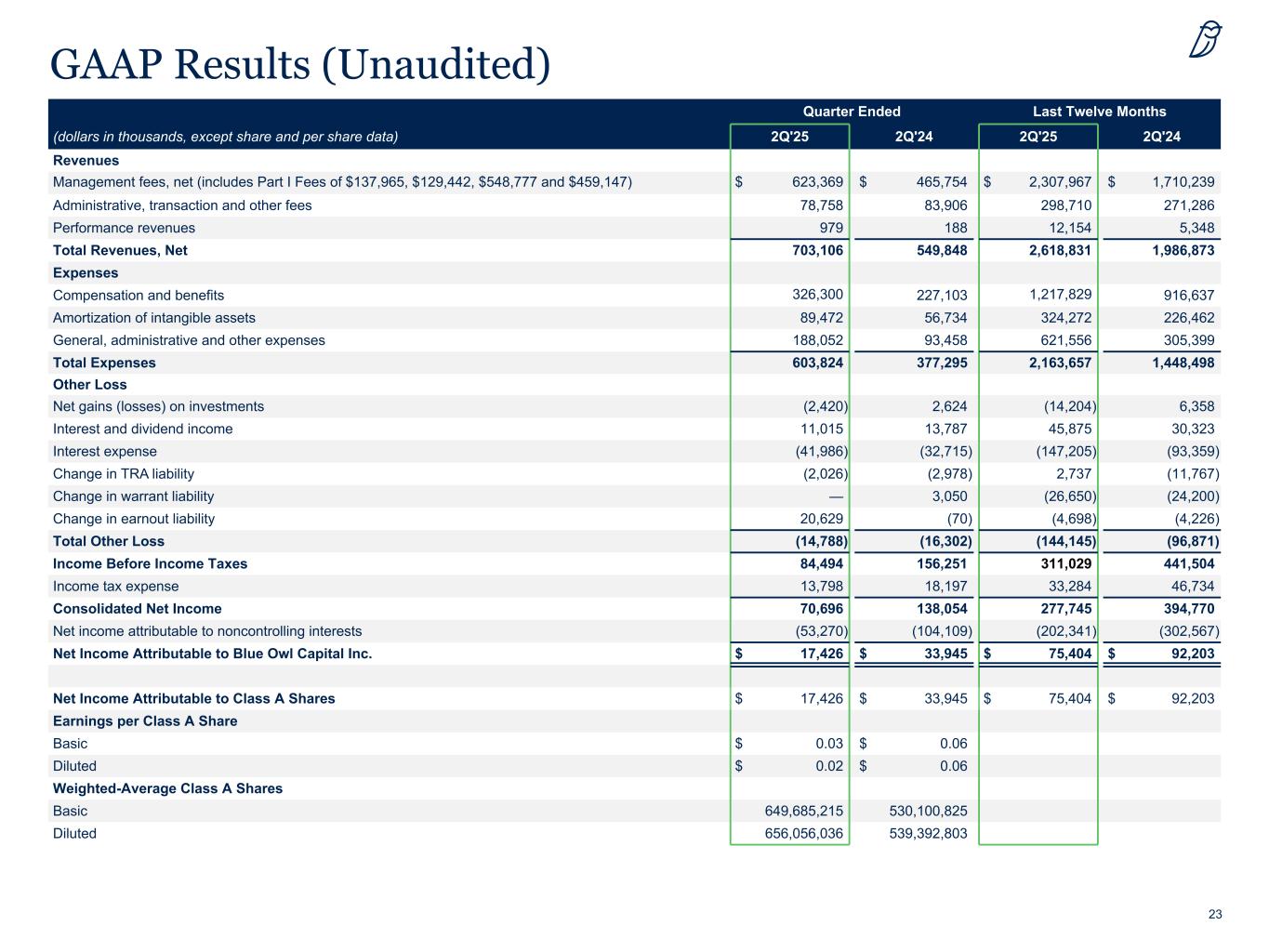
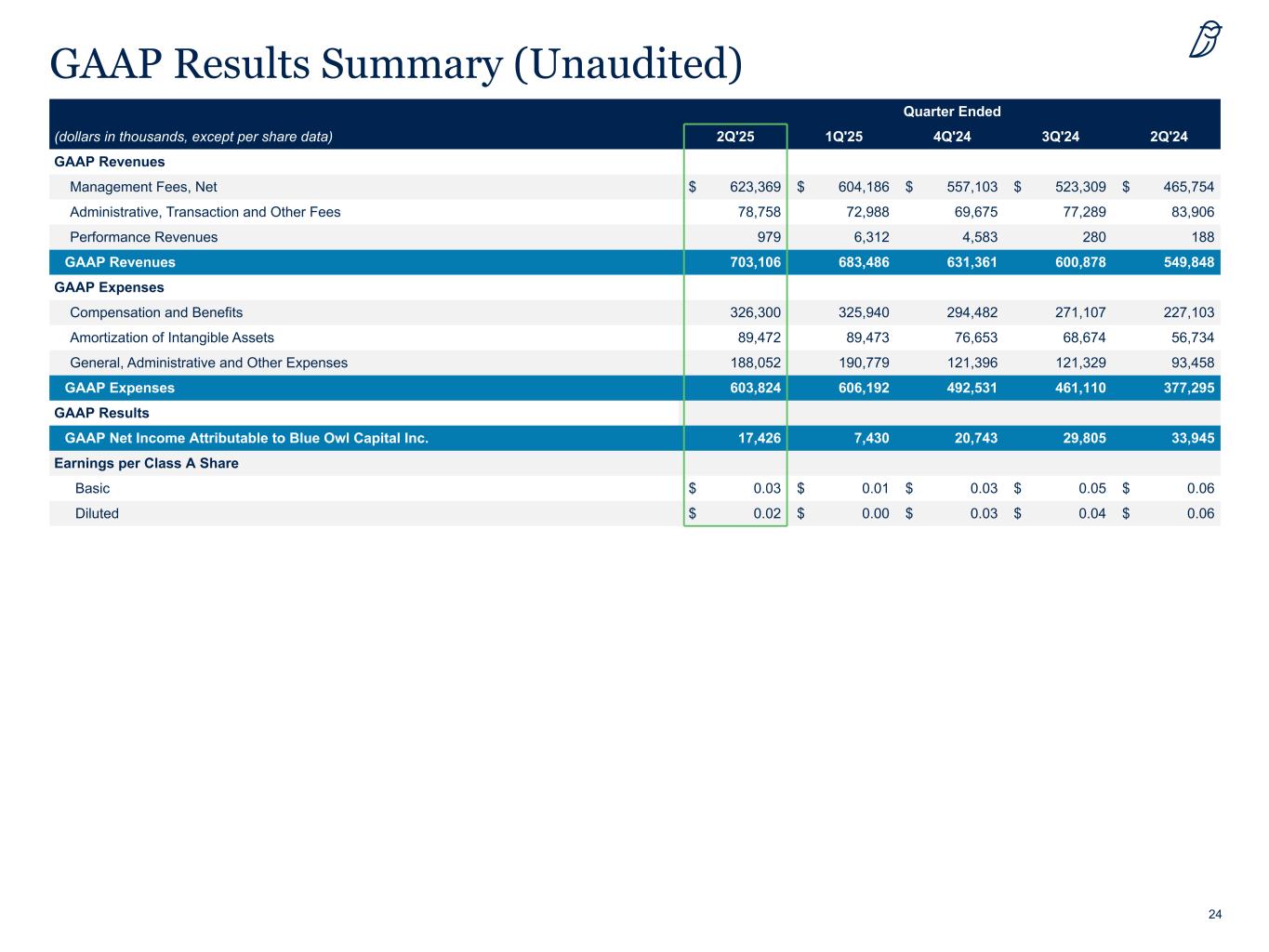
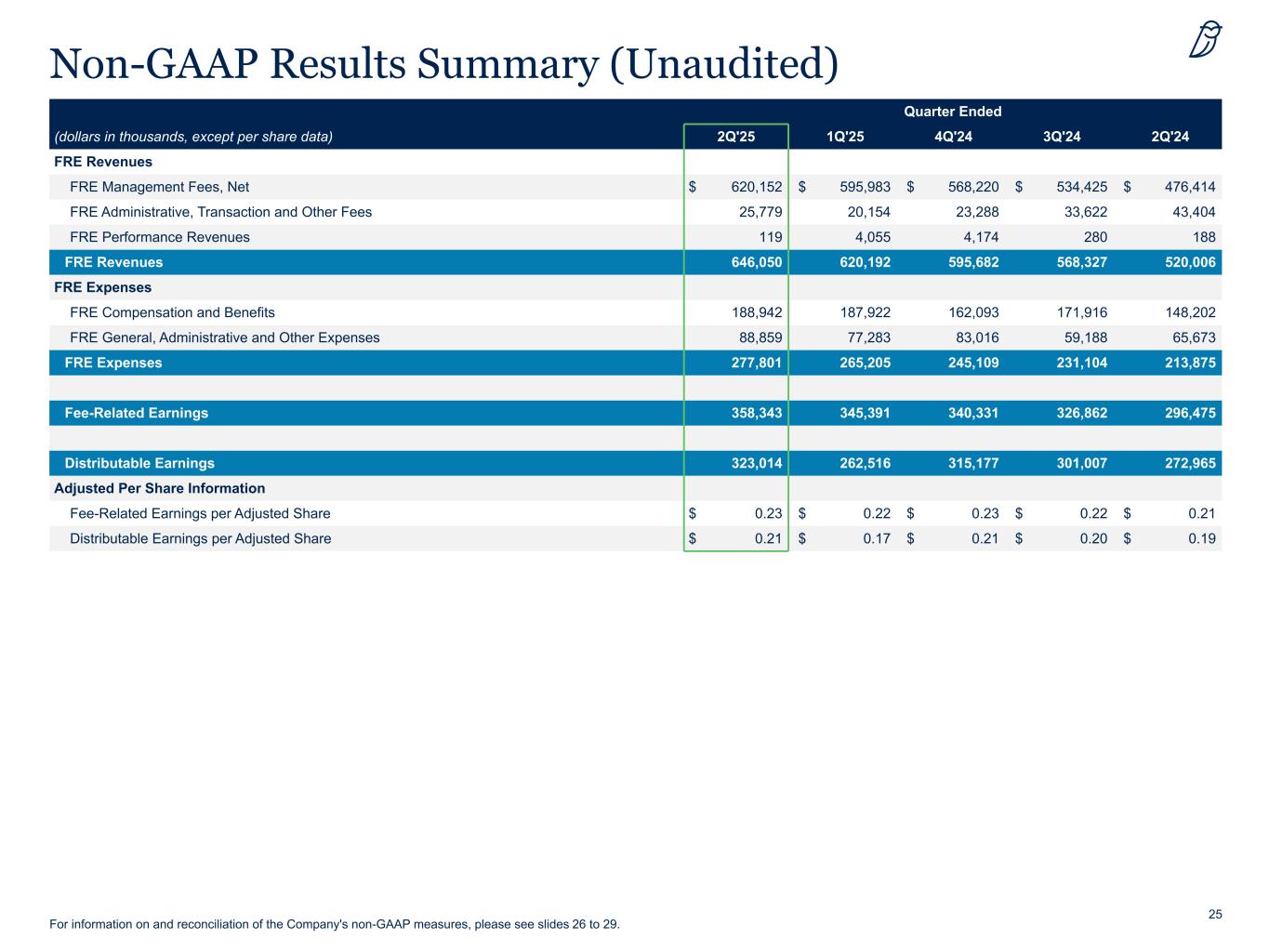
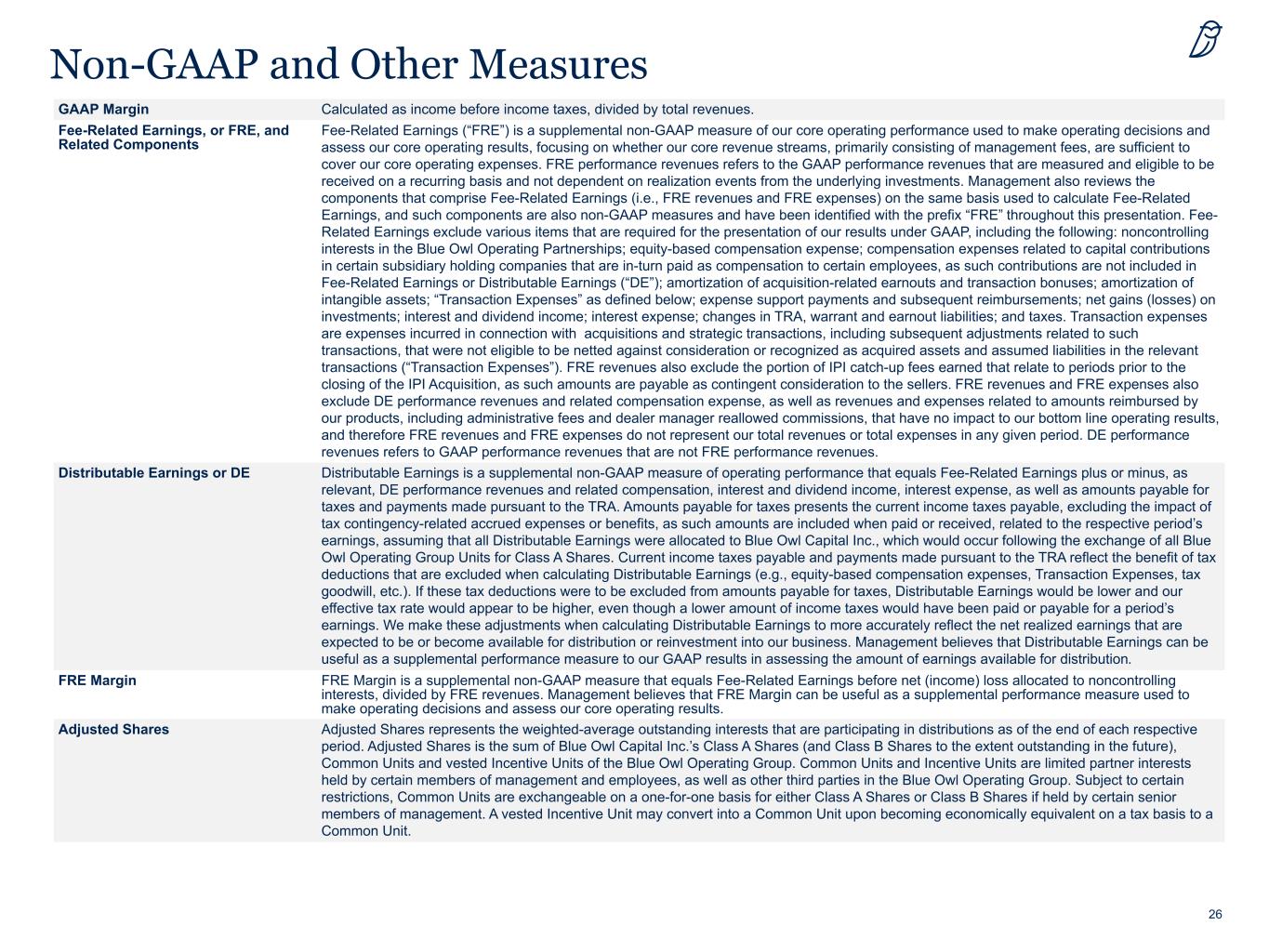
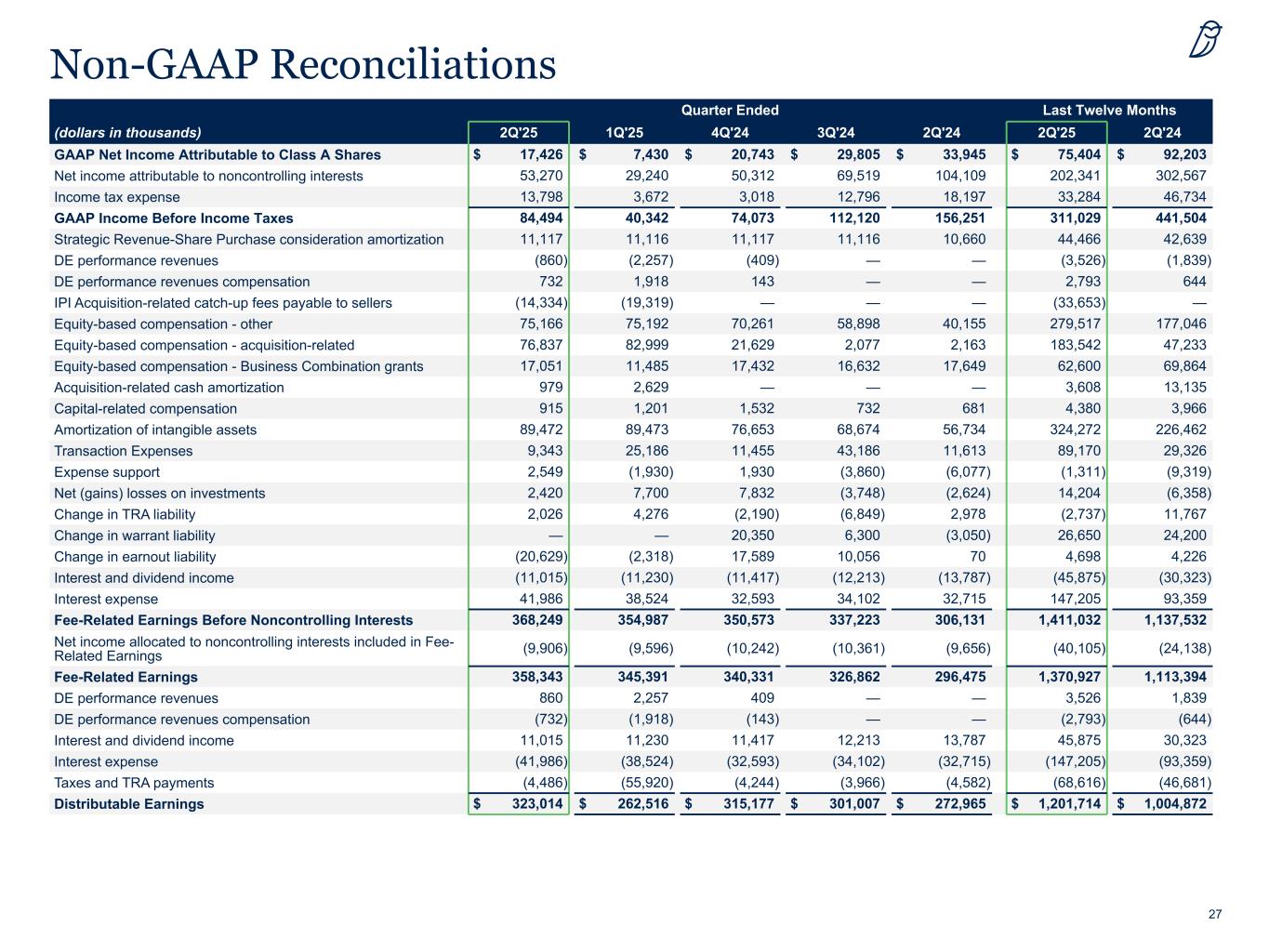
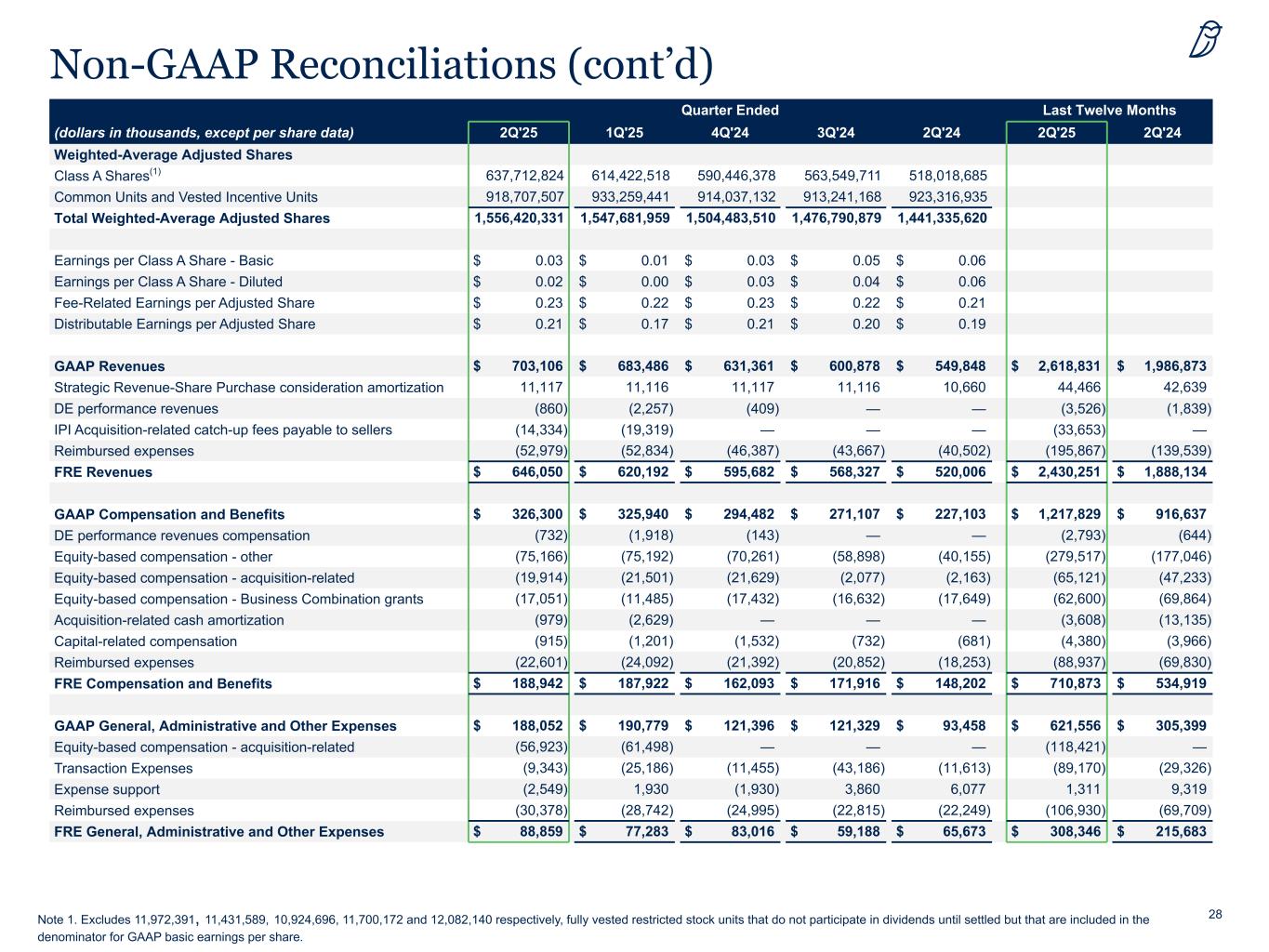
Thanks, Operator, and good morning to everyone. Joining me today are Mark Lipschultz, our Co-Chief Executive Officer, and Alan Kirchenbaum, our Chief Financial Officer. I'd like to remind our listeners that remarks made during the call may contain forward-looking statements which are not a guarantee of future performance or results and involve a number of risks and uncertainties that are outside the company's control. Actual results may differ materially from those in forward-looking statements as a result of a number of factors, including those described from time to time in Blue Owl Capital's filings with the Securities and Exchange Commission. The company assumes no obligation to update any forward-looking statements. We'd also like to remind everyone that we'll refer to non-GAAP measures on the call, which are reconciled to GAAP figures in our earnings presentation, available on the shareholders section of our website at blueowl.com. Please note that nothing on this call constitutes an offer to sell or a solicitation of an offer to purchase an interest in any Blue Owl Fund. This morning, we issued our financial results for the second quarter of 2025, reporting fee-related earnings or FRE of $0.23 per share and distributable earnings or DE of $0.21 per share. We declared a dividend of $0.22.5 per share for the second quarter, payable on August 28th to holders of record as of August 14th. During the call today, we'll be referring to the earnings presentation, which we posted to our website this morning, so please have that on hand to follow along. With that, I'd like to turn the call over to Mark.
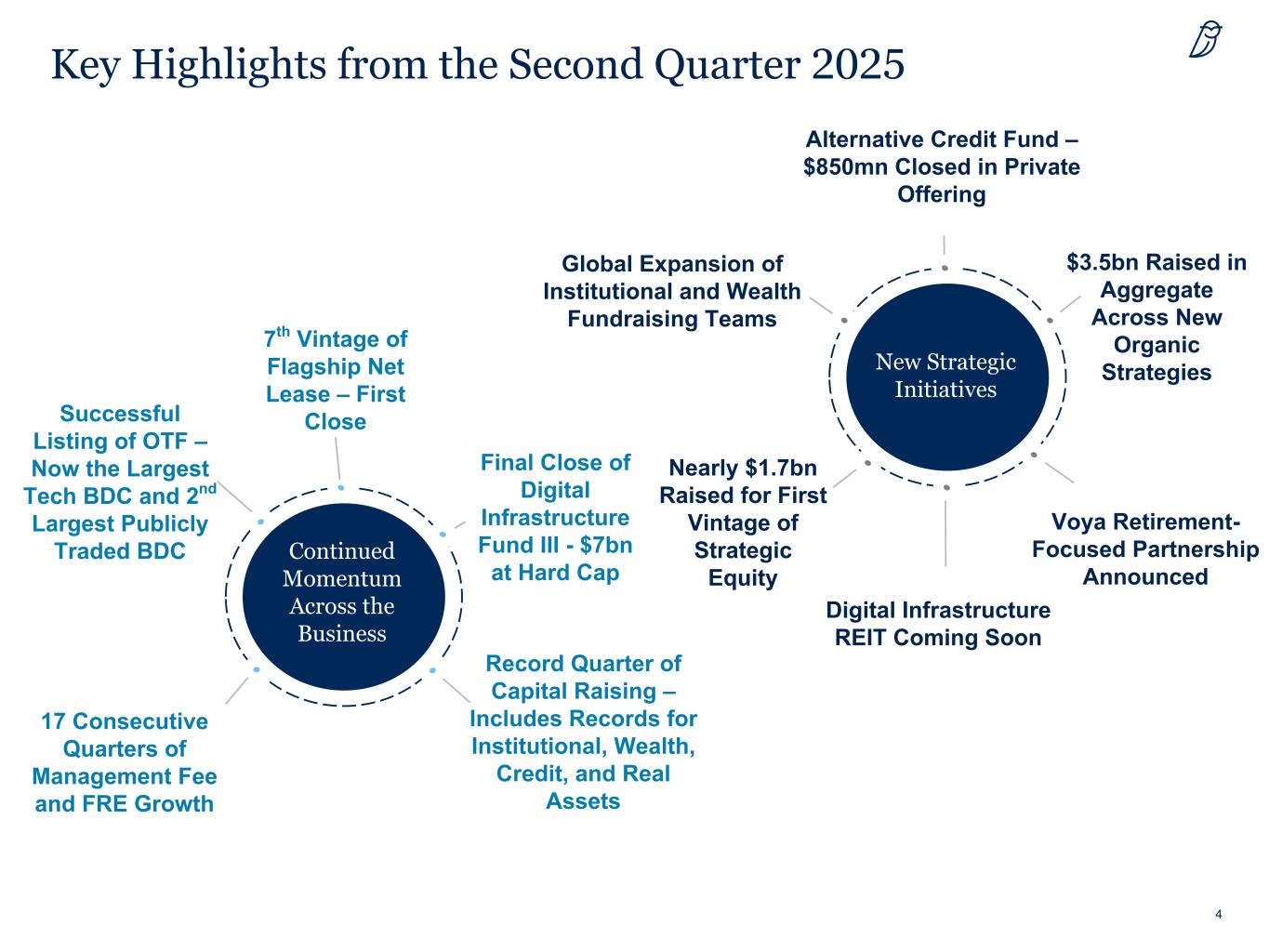
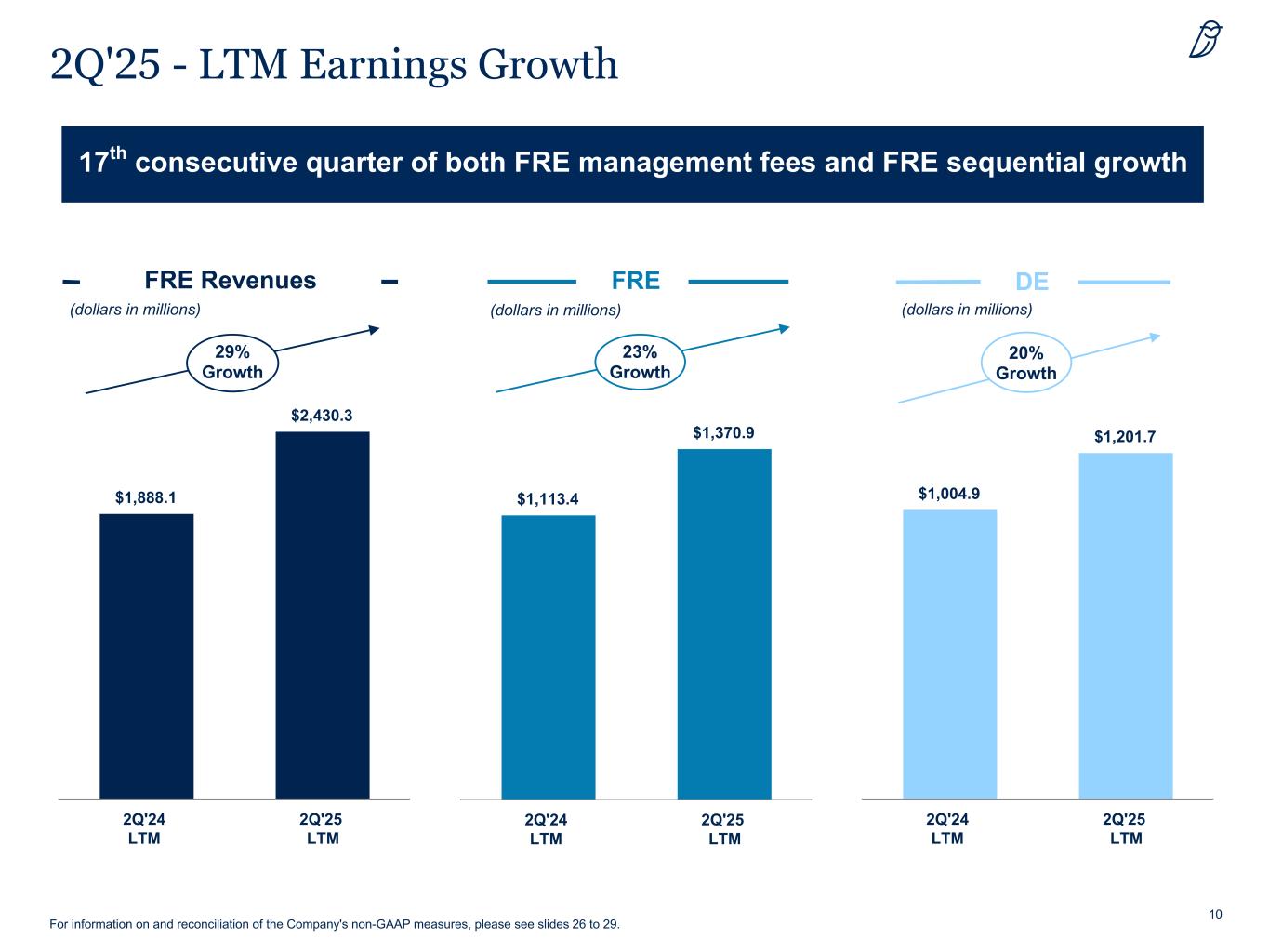
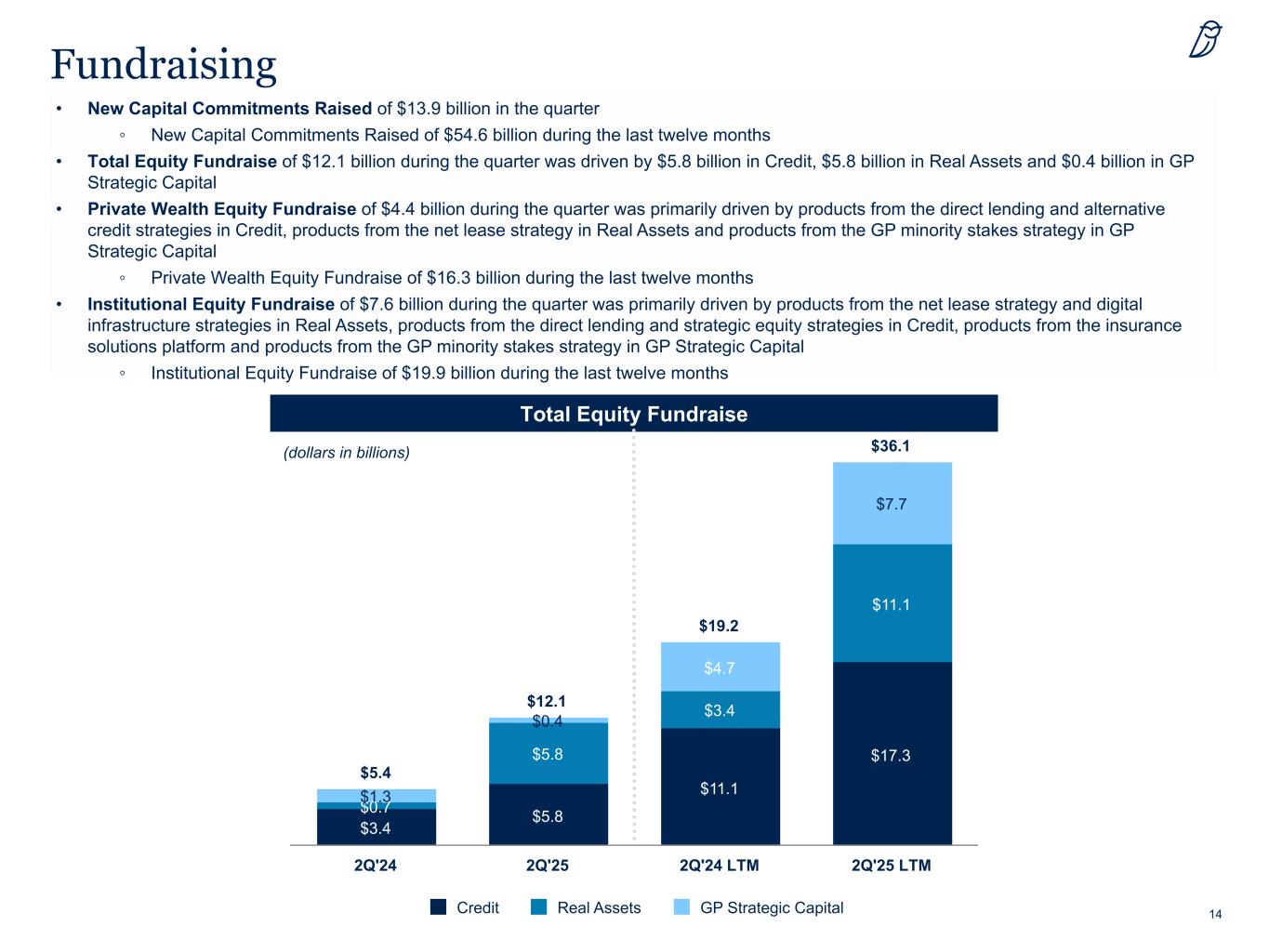
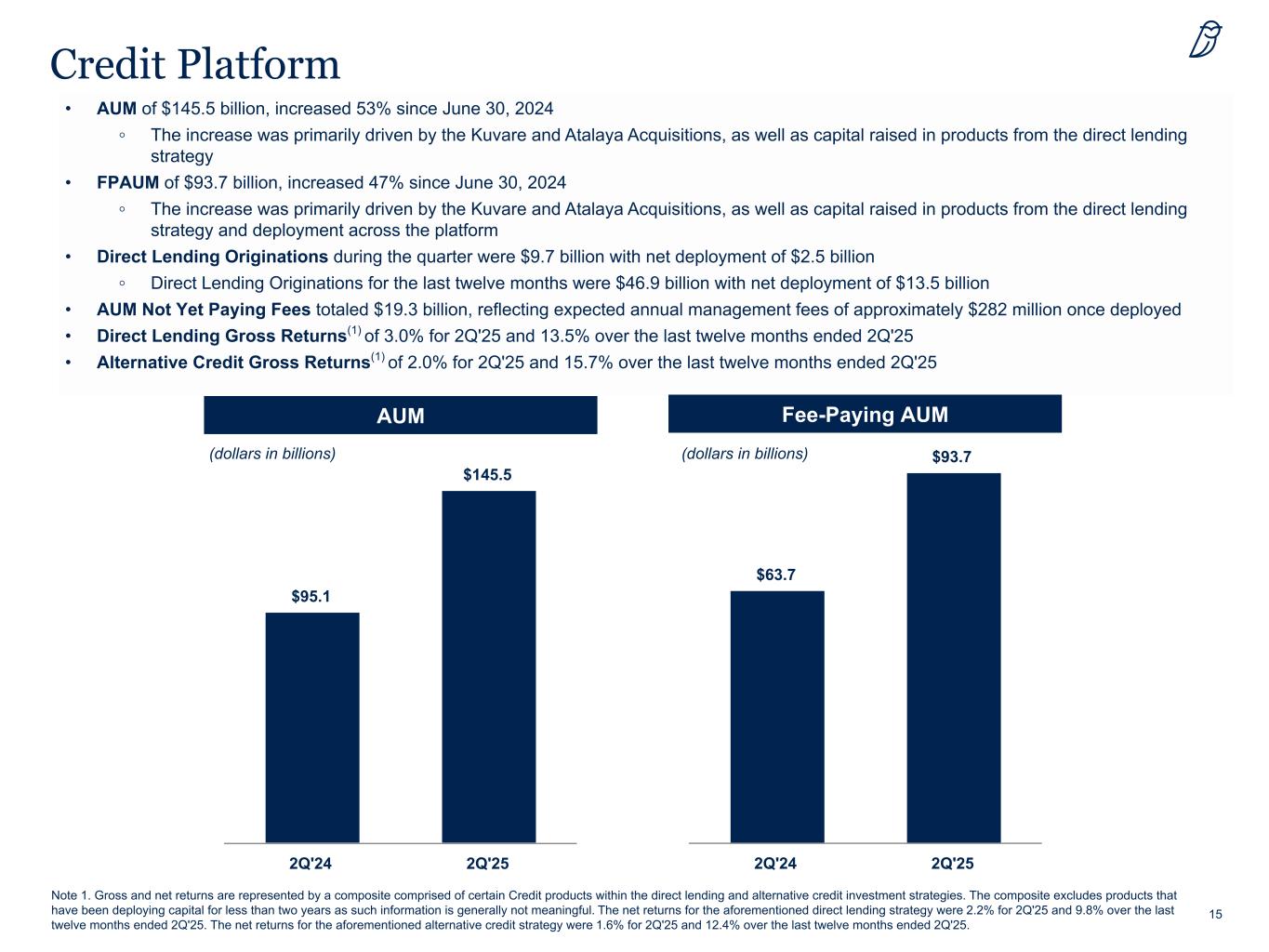
Great. Thank you so much, Anne. The results we reported for the second quarter of 2025 reflect a continued expansion of the breadth and depth of Blue Owls' business and highlights the increasingly essential role the firm plays within a modern capital markets landscape. We raised $14 billion of new capital during the quarter, bringing us to a record capital raise of $55 billion over the last 12 months, or 28% of our assets under management a year ago. And these numbers do not yet reflect any meaningful contributions from our acquisitions this past year, where we are anticipating significant synergies over the next couple of years. We have grown our FRE revenues by 29%, FRE by 23%, and DE by 20% year-over-year on a last 12-month basis, continuing the steady march up and to the right, supported by our substantial permanent capital base. This momentum has been driven by the continued strength we see across fundraising and deployment, reflecting two critical concepts. First, for investors, we are leveraging the benefits of Blue Olive scale and incumbency in respective markets to drive differentiated results, and we are creating product structures to serve varying investor needs across the risk-return spectrum. And second, we have placed ourselves in a position to offer the bespoke and scaled solutions that are increasingly in demand for users of our capital, and we have even more of those solutions on offer today as a result of the strategic actions taken last year. I want to spend a moment on some of the early wins from strategic investments we have made organically and through acquisition over the past year, which we've summarized on slide four. Starting with alternative credit, we closed a private offering of $850 million for our new interval fund stemming from a diversified and global set of investors we are pleased with this remarkable fundraising which reflects both the strength of our global private wealth platform and investor confidence in our approach to credit solutions it's been an incredible start for this product and even more impressive considering the market disruption we saw during april in our view alternative credit is a highly complementary addition to fixed income portfolios given us diversified collateral modest correlation to other credit asset classes and attractive risk return anchored by current income. These alternative credit capabilities further diversify our product suite, and we should benefit greatly from the incumbency and leading position we've built in the private wealth channel to date. For our digital infrastructure strategy, the first half of the year was active from a fundraising and deployment perspective, leading us to a final close of our third flagship fund in April at a $7 billion hard cap. Notably, the fund has already soft-circled more than half the capital raised for investment. Looking ahead, we're working expeditiously towards the launch of a well-focused product in the foreseeable future, similar to the process we undertook with Orent, with significant investor interest already observed. Our real estate credit strategy has been extremely active, deploying over $3 billion year-to-date, including opportunistic deployment during the market dislocation that generated outsized spread. Both real estate and alternative credit have been extremely active for our insurance channel, with these teams and others across Blue Owl driving roughly $2 billion deployed in the second quarter alone at a spread of more than 200 basis points above similarly rated public corporate bonds. And as it relates to organic new strategy development, we have now raised $3.5 billion of capital across strategies that did not even exist two years ago, including in $1.7 billion for GP-led secondaries, our Bose strategy. We believe the strong reception we've encountered for these new offerings reflects the partnership-driven, solutions-based mentality that anchors everything we do at Blue Island. Taken together, you can see a substantial amount of forward movement in the early days of these new initiatives, and we are just getting started. The combination of these initiatives and broad-based momentum across our more established businesses drove the robust capital raising we saw during the second quarter. Alan will walk through our flows in greater detail, but let me call out some notable items. We held the first close of the next vintage of our net lease flagship strategy ahead of schedule with $2.1 billion raised and another billion dollars of co-invest. the total size of our 2020 vintage of this strategy was 2.5 billion dollars in commitments and the entire net lease business was 12 billion dollars of AUM when we announced that acquisition we have more than tripled the size of this business in three and a half years a testament to the platform synergies generated through scale and access this acceleration has not gone unnoticed with a recent PERE article naming Blue Owl as the third largest real estate capital raiser globally over the last five years, trailing only Blackstone and Brookfield. In aggregate, we raised $5.1 billion of equity in net lease during the second quarter and a record $5.8 billion across our real assets platform. Mirroring the expansion trend in real assets, we also raised $5.8 billion of equity across credit in the second quarter, a record quarter for credit. On a year-over-year, last 12-month basis, equity raised in credit has increased by 55%, and flows have been balanced quite evenly between the private wealth and institutional channels. Last 12-month capital raised from EMEA and APAC investors has increased to 23% from 14% two years ago, reflecting the ongoing globalization of our business embedded in the platform investments we've made for the long-term growth. And broadly, we saw resilience across our investor base despite fairly disruptive capital markets during the quarter, which speaks to the continued and secular demand for the strategies we offer and the strength of our private wealth channel. Turning to business performance, in direct lending, we continue to find high-quality deployment opportunities despite a relatively lackluster M&A backdrop, speaking to the advantages of being a partner of choice due to our scale and incumbency. As a reminder, M&A is only one component driving deployment activity for us. We continue to see sponsors pursue bolt-on and organic investment opportunities for their portfolio companies, driving add-on activity for Blue Owl. And in the case of continuation fund transactions, the breadth of our loan portfolio means that we are often the existing lender and therefore a logical and frictionless partner for new financing. gross origination in the quarter was roughly 10 billion dollars bringing gross origination over the last 12 months to nearly 47 billion dollars and net to 13.5 billion dollars credit quality and direct lending remains strong with average annual realized losses at 13 basis points we are not seeing any meaningful changes in the underlying metrics this has been a constant theme over the last few years. In alternative credit, we continue to see positive network effects benefiting deployment with more partners looking to engage in repeat and larger financings with us. Recently, we renewed and upsized a forward flow agreement with Lending Club for up to $3.4 billion, yet another substantiation of the expanding role that private lenders are being asked to play in the alternative credit markets and across capital markets more broadly. This marks our Alternative Credit Fund's third investment with Lending Clubs since 2023. Blue Owl has also provided meaningful funding solutions to small business lenders. We recently upsized an existing transaction with a UK-based lender, Capital on Tap, that funds both US and UK small businesses. The Alternative Credit business continues to see strong demand for stable capital partners and benefited from the volatility in the public securitization markets during the second quarter. In real assets, we continue to see highly attractive deployment opportunities across net lease, digital infrastructure, and real estate credit. As I mentioned earlier, our digital infrastructure flagship fund has already soft-circled more than half the capital raised for investment, despite its final close having just occurred. However, the tremendous capital needs in the data center space are creating an incredible moment in time where our investors can own mission-critical assets for tenants with an average credit rating of AA across 10-plus year durations and earn opportunistic returns for doing so. As we've said before, we truly believe this is the best risk-reward setup we've seen in our careers and feel fortunate to have such a scaled and experienced team at Blue Owl with which to lean into this generational opportunity. Across our digital infrastructure funds, we have leased capacity of 3.8 gigawatts, or approximately 5% of the current capacity leased globally, making us one of the leading players in this rapidly evolving technology landscape. We expect to meaningfully participate in this evolution through our net lease strategy as well, which is financing the largest data center project in the United States. in aggregate we believe there are very few firms that can provide the breadth of technical expertise and scale capital we offer across blue owl to address the needs of hyperscalers today and these strategies present a differentiated proposition offering the ability to fund the leading edge of innovation but to do so on products and structures that are designed to be income oriented and downside protected our gp stake strategy closed on a second investment during the second quarter and on another one subsequent to quarter end. In total, these investments bring us to nearly 30% invested on our target size. We've continued to invest in some of the premier names in the alternative industry, household names with decades of experience and long track records of success. And we believe these firms are the ones that will continue to be beneficiaries of this consolidation trend we have discussed. Over the years, we've seen validation of our strategy through the outsized growth of the partner managers in our funds relative to the broader industry. We've also generated positive outcomes as it relates to liquidity, with our GP Stakes flagship funds having distributed more than $2.9 billion over the past year in a market where return of capital has been scarce, situating our funds within the top quartile on this important metric. There are two final items that I'd like to mention before Allen covers the financials for the quarter, and I think it's a testament to the very dynamic quarter we had across Blue Island that we are only coming to these now. First, I'd like to mention our recent announcement of a new strategic partnership with Voya focused on delivering private market strategies in vehicles tailored for defined contribution retirement plans. We've observed the growing demand for alternative investment solutions within retirement portfolios and see this as an important first step to broadening access and supporting plan participants in their quest to build more resilient portfolios and optimize outcomes. We are very excited about the long-term potential for the new frontier in private wealth and see Voya as an ideal partner, given their leadership and deep expertise in the retirement market. Our strategies have also been included in multiple model solutions. Morgan Stanley, Wells Fargo, Cetera, iCapital, and Case, just to name a few. This success is evidence of the strong strategic positioning we have in improving access to Blue All products via the scale of our Evergreen Fund franchise, our strong distribution footprint, and our industry-leading education. Finally, during the second quarter, we completed the listing of our technology-focused BDC, OTF, which is now the second-largest publicly traded BDC by NetAssets and largest tech-focused BDC in the market. Over the past six months, our teams have worked relentlessly to merge the formerly private OTF and OTF2 vehicles, evaluate efficient liquidity paths for all stakeholders, and execute the listings seamlessly, all while navigating serious market turbulence. I want to acknowledge the efforts and collaboration we saw across the firm that culminated in this very successful endeavor. With that, let me turn it to Alan to discuss our financial results.
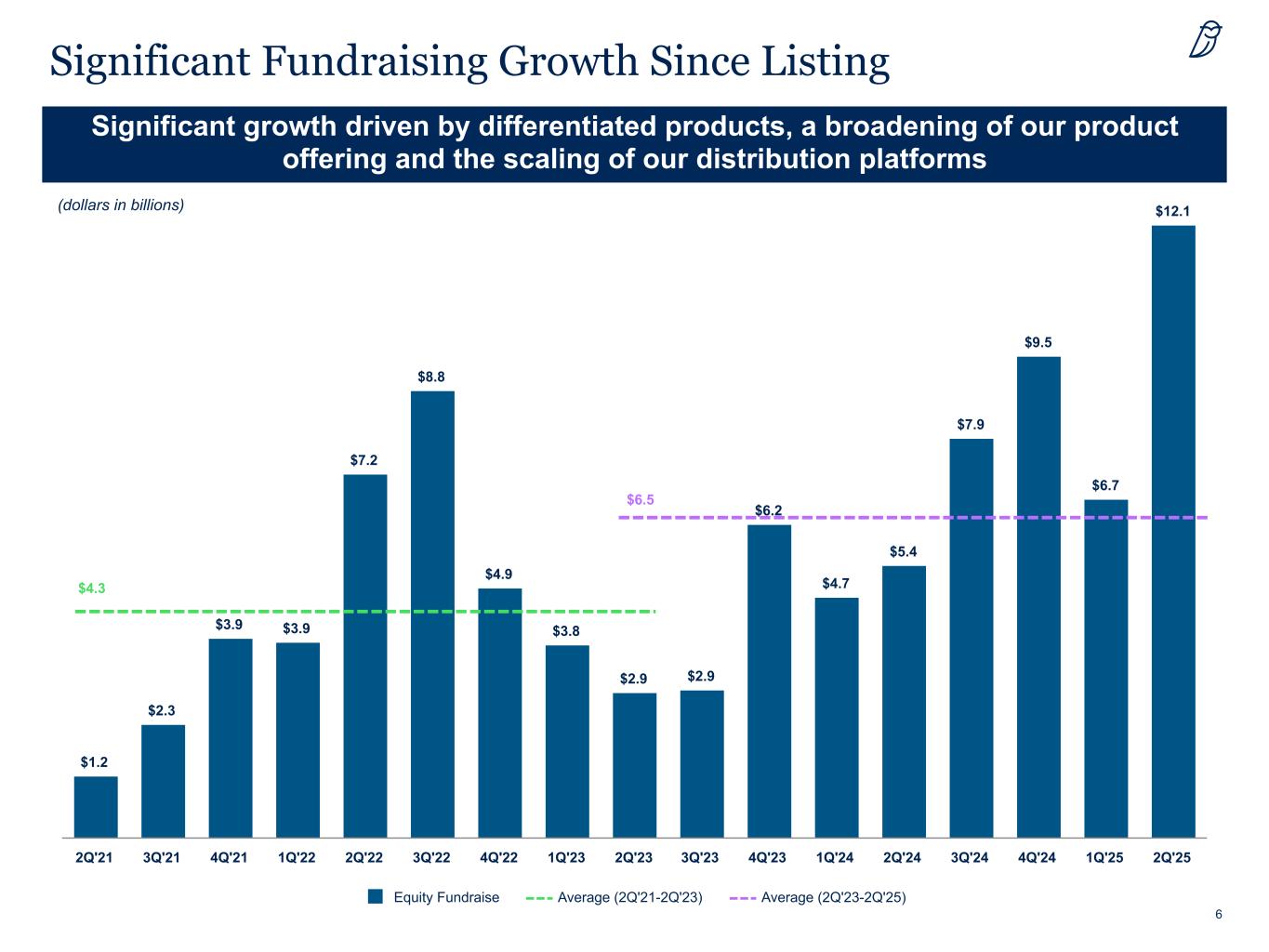
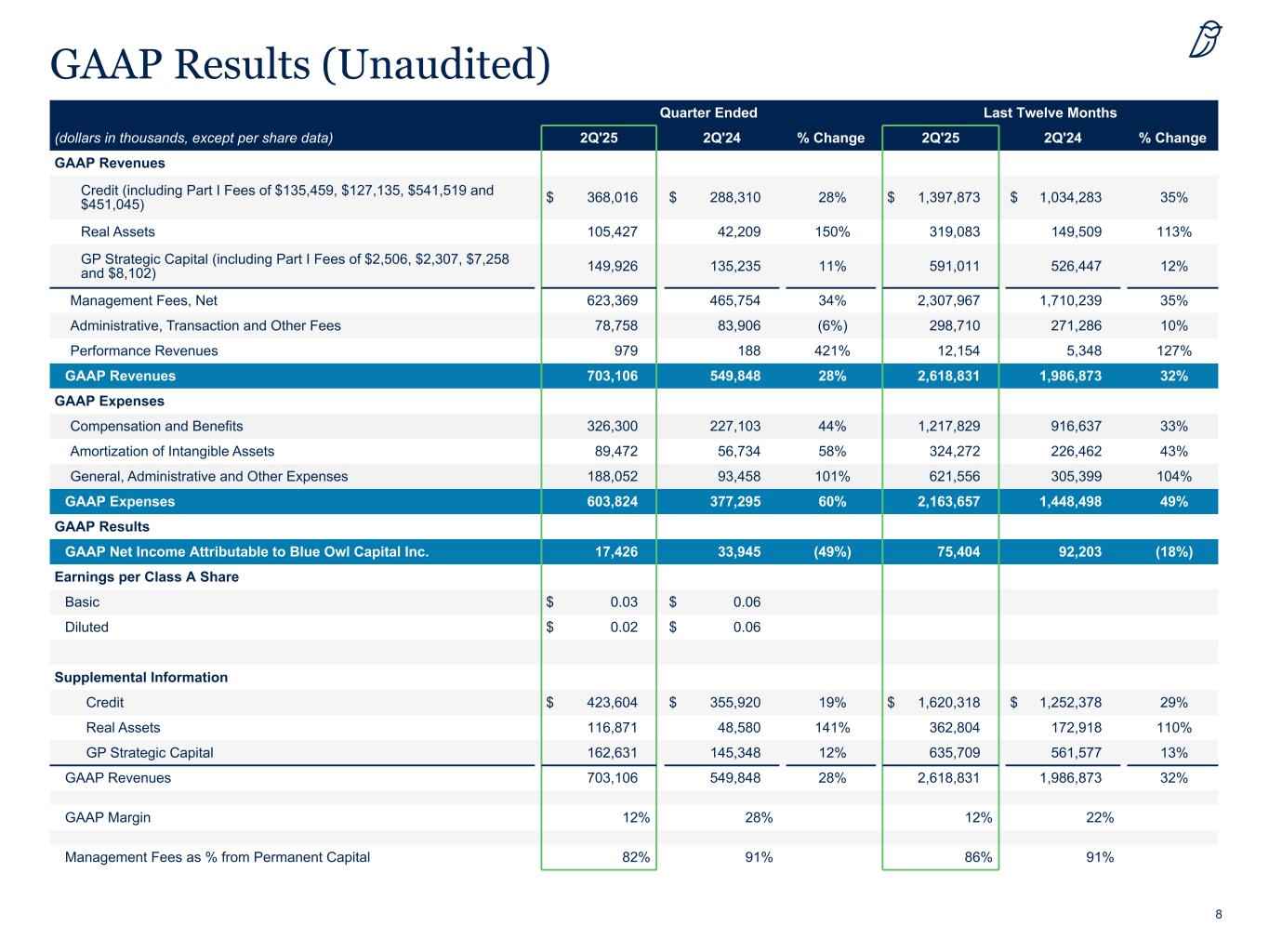
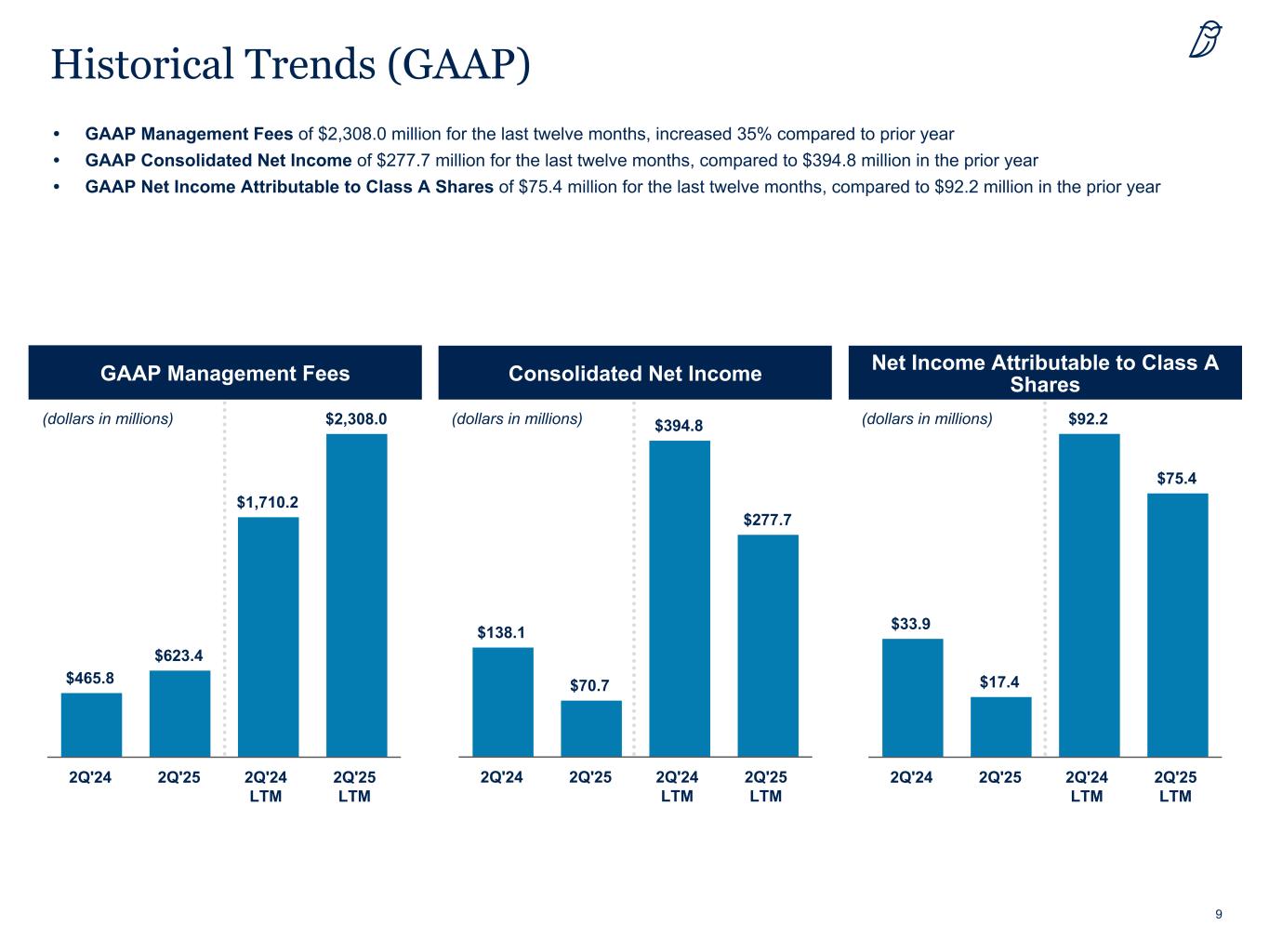
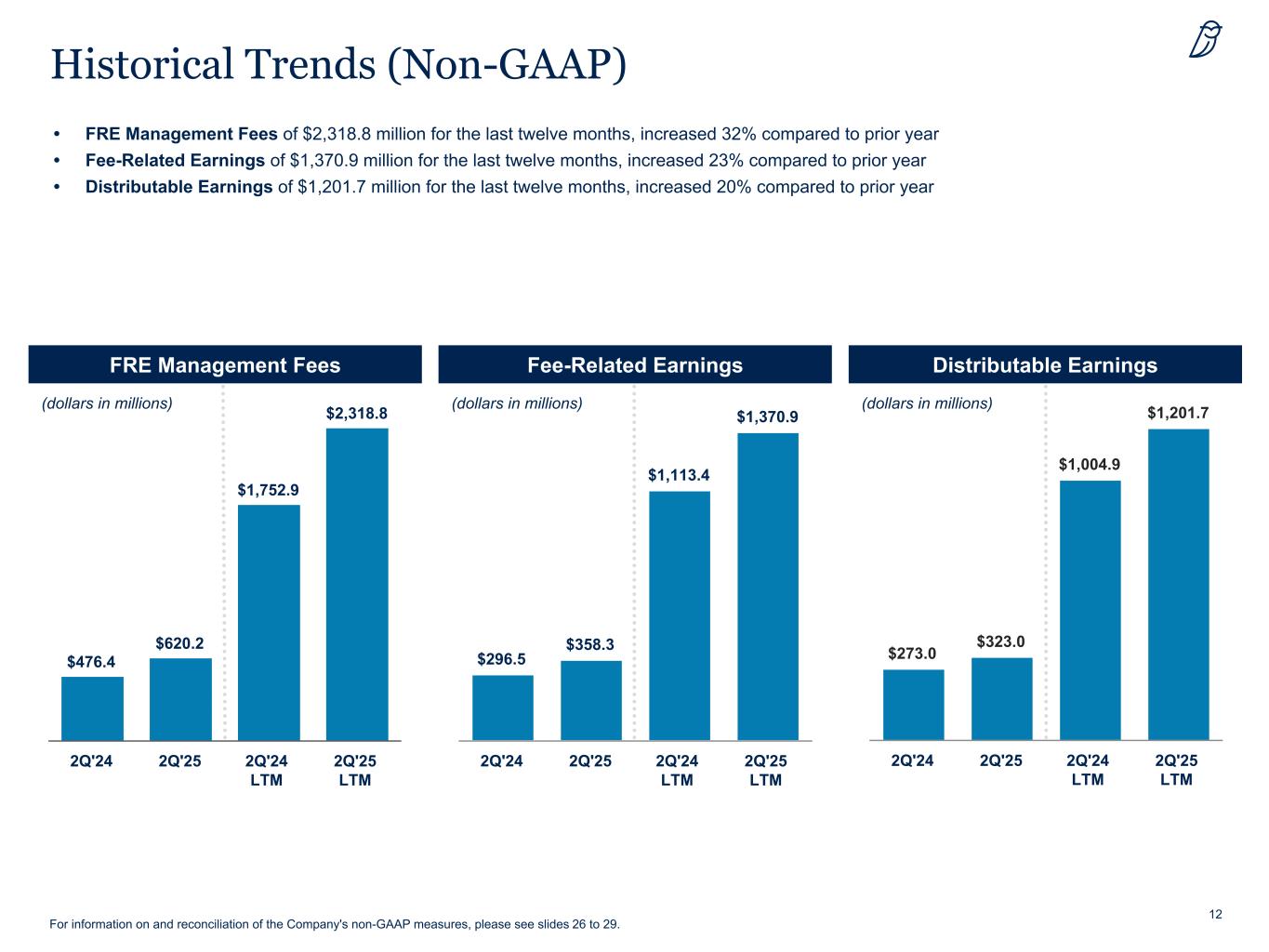
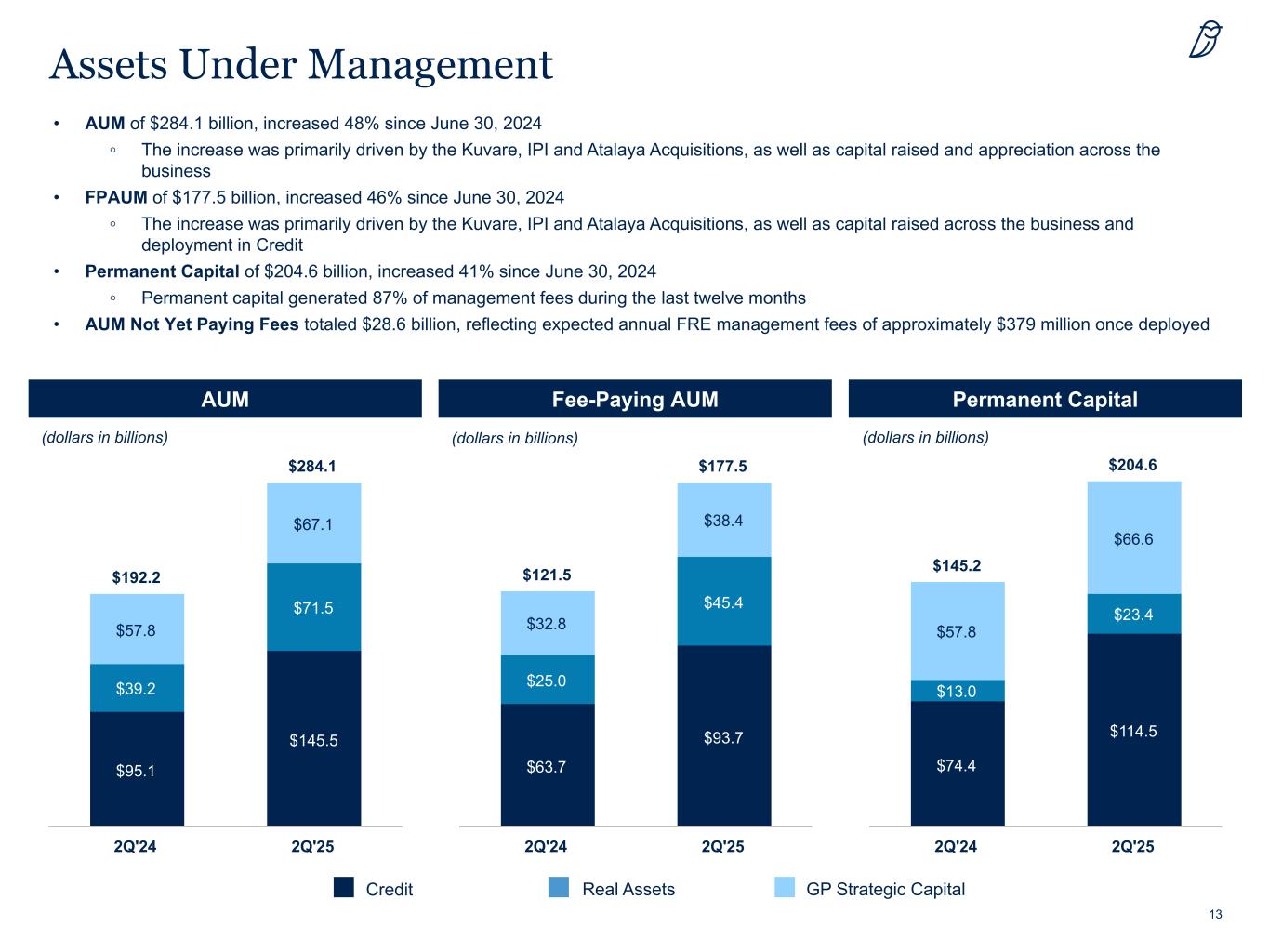
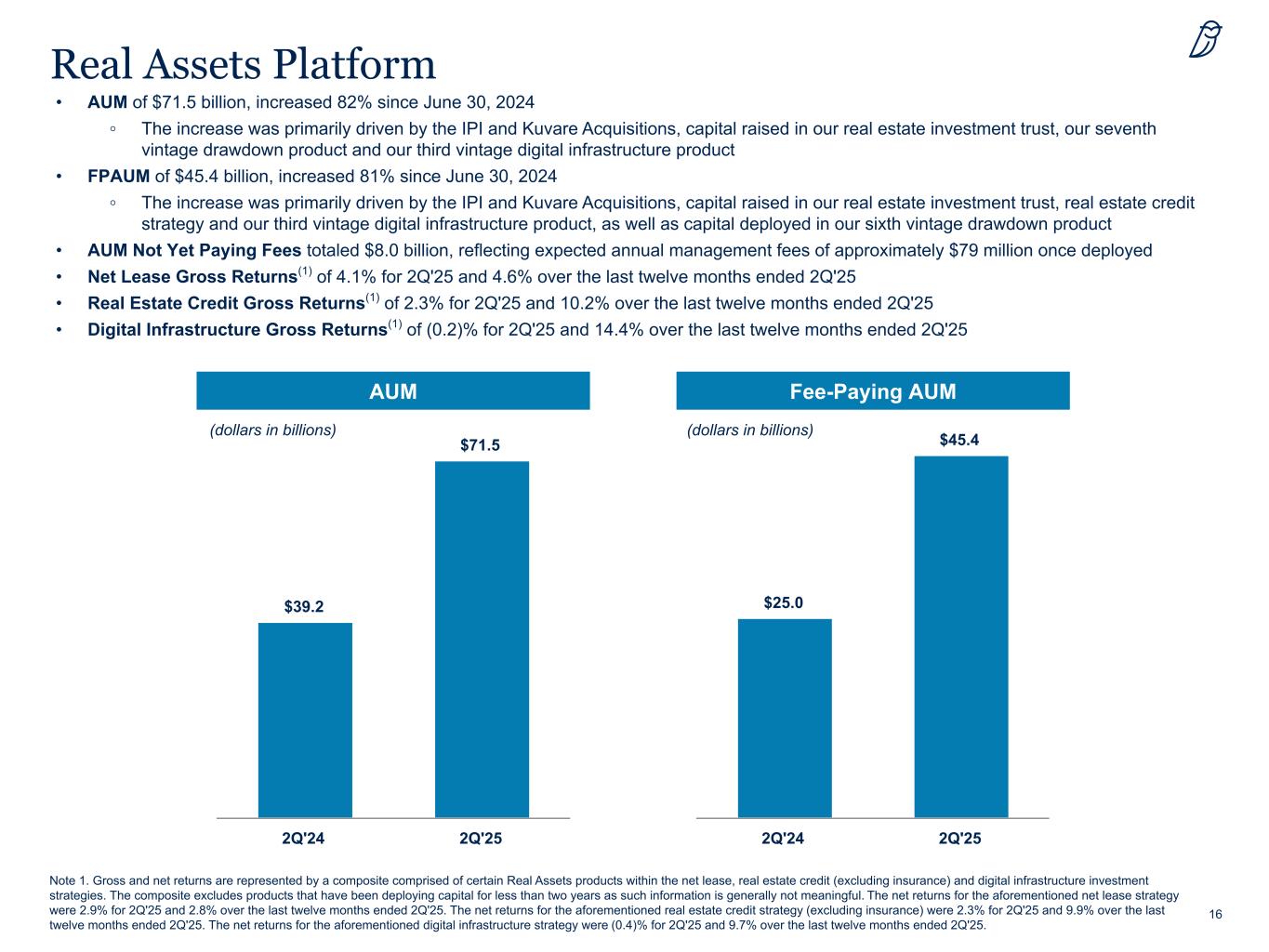
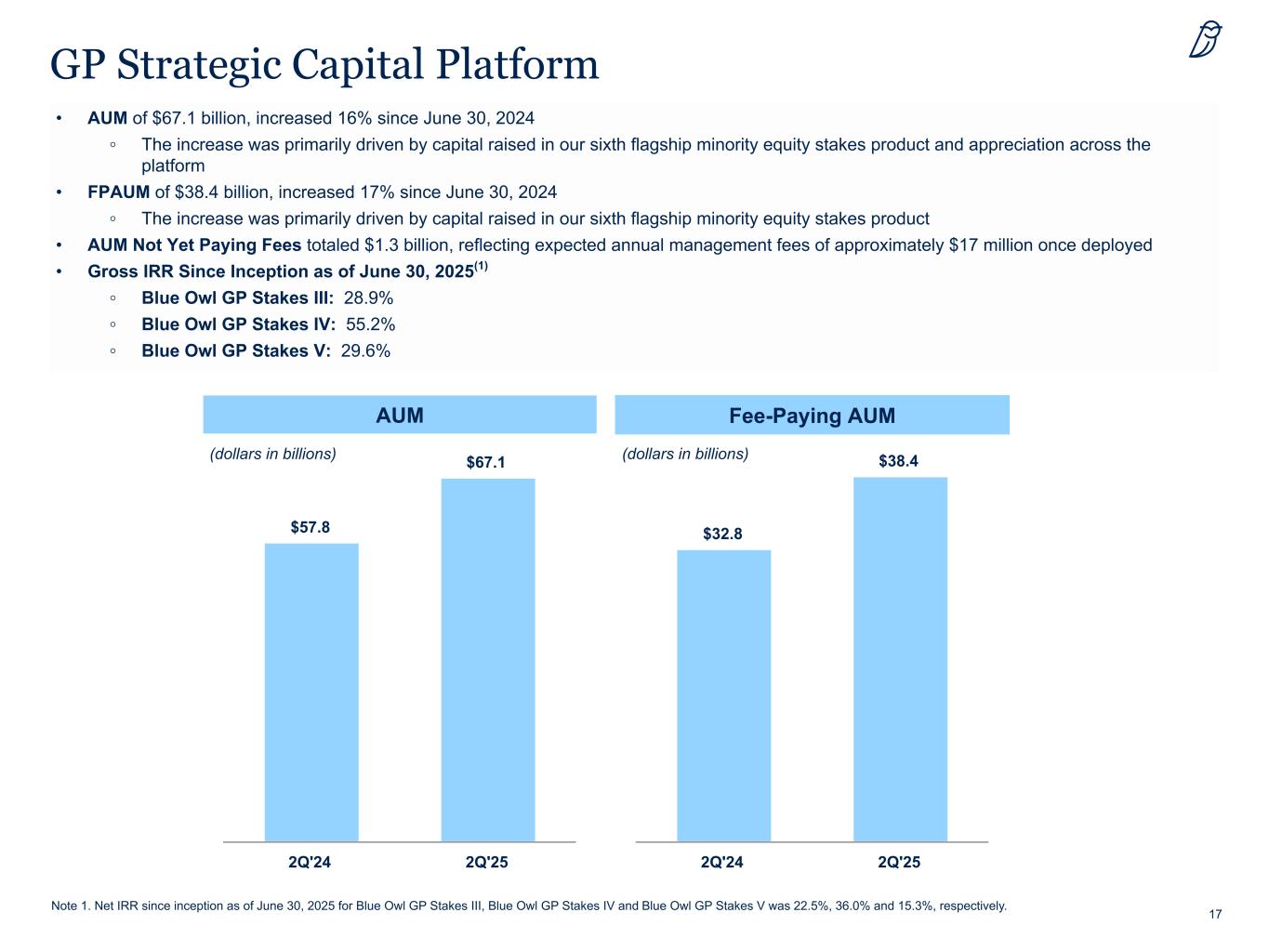
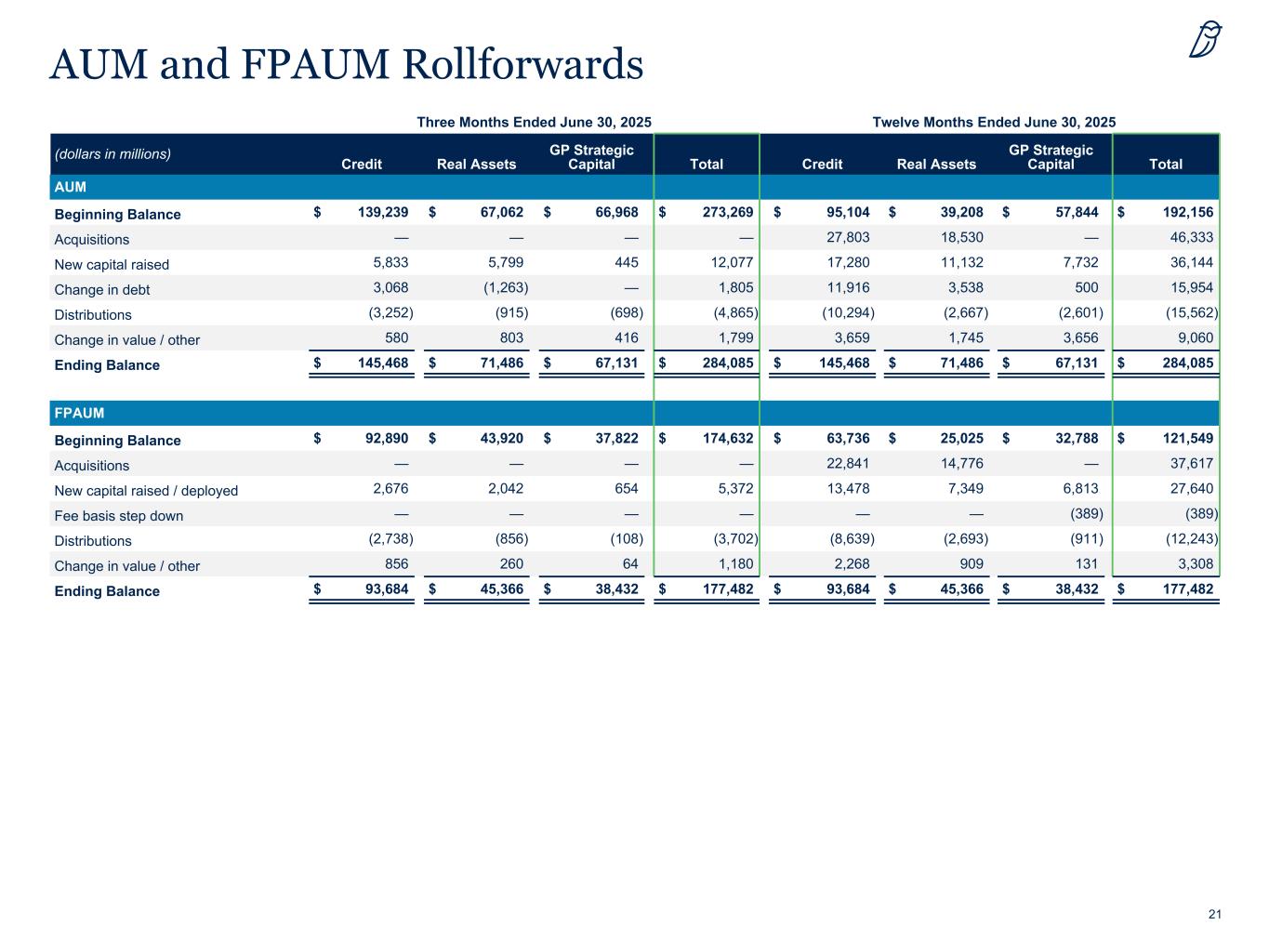
Thank you, Mark. And good morning, everyone. We are very pleased with the results we reported this quarter, marking our 17th consecutive quarter of management fee and FRE growth. Over the last 12 months, management fees increased by 32 percent and 87 percent were from permanent capital vehicles. FRE was up 23 percent, GE was up 20 percent, and this was a record quarter of equity fundraising for us. We raised over $12 billion of equity in the second quarter and over $36 billion over the last 12 months, an increase of nearly 90% from the prior year. Recognizing that fundraising is not linear, we also looked at this statistic on a multi-year basis. And as you can see on slide six of our earnings presentation, equity raised over the last two years is about 50% higher than equity raised over the prior two-year period. Each of our institutional and private wealth channels experienced record high quarters of equity raised, with $7.6 billion across institutional, primarily driven by products in our net lease, direct lending, strategic equity, and digital infrastructure strategies. And in private wealth, we raised $4.4 billion of equity during a quarter with substantial market volatility. To break down the second quarter fundraising numbers across our strategies and products, in credit, we raised $5.8 billion, a record quarter for our credit platform. $4.3 billion was raised in direct lending, of which over $2 billion came from our non-traded BDCs, OCIC and OTIC. The remainder was primarily raised across diversified lending, our GP-led secondary strategy, our newly launched interval fund investment grade credit and our first lien strategy in real assets we also raised 5.8 billion dollars a record for our real assets platform as well over 900 million was raised from orent and as mark mentioned we held a first close for the seventh vintage of our flagship net lease strategy bringing in over 2 billion dollars the remainder was in additional on that lease products, digital infrastructure, insurance-focused products, and co-invest dollars. And in GP Strategic Capital, we raised half a billion dollars during the quarter, bringing the latest vintage to over $7.5 billion. As we said on last quarter's earnings call, we expect the fundraiser to come in at similar levels in 3Q and then to wrap up with our $13 billion total fundraise goal through mid-2026. Turning to our platforms, in credit, our direct lending portfolio gross returns were 3% in the second quarter and 13.5% over the last 12 months. Weighted average LTVs remains in the high 30s across direct lending and in the low 30s specifically in our software lending portfolio. On average, underlying revenue and EBITDA growth across our portfolios was in the high single digits to low double digits with no material increase in signs of stress, such as increased non-accruals, stress amendments, PIC conversion requests, or watch list names. And as Mark mentioned earlier, none of these metrics have changed meaningfully over the past several years. Turning to alternative credit, our portfolio gross returns were 2% in the second quarter and 15.7% over the last 12 months. In real assets, our first close of the seventh vintage of our flagship Netly strategy occurred less than 15 months after the final close of Fund 6, demonstrating both a strong pipeline for investment and robust interest from investors. We expect that Fund 6 will have nearly committed all of its available capital for investment by year end and has deployed roughly 40% through June 30th, with much of the remainder slated for deployment over the next 12 to 18 months as various build-to-suit projects reach completion. And our net lease pipeline continues to grow with nearly $41 billion of transaction volume under letter of intent or contract to close. During the second quarter, in net lease, we committed $4.2 billion, bringing commitments year-to-date to $8 billion at a roughly 8% cap rate on average. Concurrently, we monetized over $320 million year-to-date at a 6% weighted average cap rate, continuing to drive spread compression at the point of sale. With regards to performance, gross returns in that lease were 4.1% for the second quarter. In real estate credit, we invested $1.4 billion in public securities at an 8.1% yield to maturity and 11.1% debt yield. During the first half of 2025, we maintained a leadership position in our area of focus, anchoring roughly 40% of the single-asset, single-borrower CMBS deals that priced during that period and about a quarter of total CMBS deals. And in digital infrastructure, we held a final close for our third digital infrastructure flagship fund at its hard tap of $7 billion. In GP Strategic Capital, we continue to deploy out of the sixth vintage of our flagship GP stake strategy, having made three investments thus far. Performance across these funds remains strong, with a net IRR of 22.5% for Fund 3, 36% for Fund 4, and 15.3% for Fund 5. Moving on to some housekeeping items for the quarter, we want to be sure to point out a few things that we think will be helpful. During the second quarter, we listed OTF, which we had previously said would drive approximately 135 million dollars of incremental annual management fees for roughly 33 million per quarter given the timing of the listing in mid-june we saw approximately six million dollars of this in the second quarter in conjunction with the listing we saw a de minimis impact to nti during the second quarter and the anticipated step up of approximately three million dollars in the third quarter as a reminder the capital raised for the seventh vintage of our net lease strategy primarily earns fees on deployment. In conjunction with a fee step down for the prior fund, OREF 6, we expect third quarter management fees in these two funds to be roughly flat compared to the second quarter. And for our alternative credit strategy, we anticipate seeing the impact of management fees from the private offering of the interval fund in approximately 12 months, similar to a fee waiver. Finally, we had a little over $7 million dollars of catch-up management fees in the quarter and as it relates to gna we had a few million dollars of one-time items so to wrap up here we feel like we're hitting on all cylinders across the business blue owl sits at the intersection of many of the secular trends that we believe will define alternatives for the next decade and we feel fortunate to be an incumbent across a number of these areas now all of these things take time and what you've heard from us today is that the investments we've made over the past year are beginning to bear fruit. But this type of progress is measured in years, not quarters. And for shareholders, our steady and predictable financial profile allows you to focus on the big-picture evolution of this market, not on the quarterly swings of realizations or capital markets fees. To us, that is a very valuable thing, and we think that over time, our stock will reflect the value of that certainty. Hopefully, what we've provided you today is a helpful mile marker on the growth roadmap we outlined during Investor Day. As you heard that day, we intend to grow FRE management fees to over $5 billion and FRE to over $3 billion, and we feel that we are very much on track with those long-term goals. Thank you very much for joining us this morning. Operator, can we please open the line for questions?
Operator
Thank you. If you would like to ask a question, please press star 1 on your telephone keypad. If you would like to withdraw your question simply press star 1 again. Please ensure your phone is not on mute when called upon. We ask that you please limit yourself to one question and please rejoin the queue if needed. Thank you. Your first question comes from Glenn Score of Evercore ISI. Your line is open.
Hello, thank you. I heard your comments on the the topping up of the lending club and capital on tap relationships. We're seeing a lot of scaling, a lot of growth in the asset-backed market, and you have a new toy to play with here. So I wonder if you could step back and talk about what you have now in terms of an asset origination challenge. I don't know if you want to break that up on platforms, forward flow agreements, or just portfolio purchase, and then what you're really trying to build as you scale towards this big opportunity across asset-backed finance. Thanks.
Thanks, Glenn. The opportunity in asset-backed is huge, as you observe, and we are in a very distinctive position to win, for lack of a better term, and, of course, winning means delivering the best results for our LPs, our investors, and that, in turn, leads to building a very big business. And we have the template, right? You've seen us already do it, and now we're steps down the road, which is to bring, you know, to have first on board the best team in the business. So we have the former Adelaide team, as you know, been at this for 20 years. And that is, this is a high barrier to entry business. This is not an amateur area. And so we have the best in the business as the team driving it. It's a demon deep on data and data science expertise. We're using cutting edge technology. We have the structures. And to your point, and this will partly touch origination, we originate, and this has been one of the great powers of 20 years of doing this, across just about every sub-channel within the world of asset-backed finance. So we're in those markets and already have the pipeline. The difference here has been, they've had the pipeline built, but not the endpoint for the capital. They've had this series of now very successful. We have our ninth opportunistic fund, which is doing fabulously. But now we are broadening the home and doing that with this new interval fund, which as you saw, we closed with enormous success just this quarter. So we have the template, right? We have the same exact thing with triple net lease, a business where, as you heard us say, we have tripled the assets just in three and a half years with that business with the same template. Take the best of breed participant that's a market leader, continue in that traditional institutional drawdown wrapper, put an adjacent accessible wrapper for individual investors, and then turn on the Blue Owl origination infrastructure and Blue Owl placement infrastructure. All of that's already happening with asset-backed. So it's also, as you know, it depends which subset or numbers you want to use. But overall, it's a market $7 trillion, $10 trillion. It depends on what you're addressing. It's bigger than the direct lending market. So we have a very long way to run, and we now have it all stitched together. We have our asset-backed business fully integrated with our direct lending business and in turn tied in with all the pipes built to our insurance platform so we now have every piece in place we sought produce value this this month billions of dollars of for example in that case IG equivalent product at more than a 200 basis point spread to the liquid alternative this this is going to be a very very good investment for our investors and it's a wonderful complement to other strategies people have it's a good durable much less correlated strategy with those same income and even faster amortization attributes which is also why this is the exact right problem product for an interval fund and so hence hence you've seen us put this in the wrapper that we think is going to be very very successful thanks a lot the next question comes from Craig Saganthaler with Bank of America.
Operator
Your line is open.
Good morning, Mark Allen. Hope everyone's doing well and congrats on the record fundraising quarter. Thank you. So our question is on the topic of privates in the 401k channel and your new partnership with Voya. So we're curious, where are you and what are your thoughts on the build out of a target date fund? And do you think target date funds are going to require one alt manager partner? Or do you see a world where there's multiple partnership models that are more likely?
Yeah, so the opportunity ahead, which of course is something of great importance to us and others, is the ability to bring the products we have been successfully delivering to a wide range of institutions and individuals for a very long time, and we live in a world right at this moment where institutions have benefited from decades for access to products like ours. We have pioneered access by individuals 10 years through that journey and are probably number two in the world in the wealth channel, and so we can address a lot of investors, and we've built structures, and we have particularly well-suited products, right? We have income-oriented, low volatility, downside protected. That is Blue Owl. It is the perfect marriage to this channel and even the more perfect marriage to the beginning of what happens in the 401k market. This is an area where, frankly, everyone ought to be thinking, look, this is a methodical process to match the right product, the right structure to this very important market, $12 trillion marketplace, and credit, private credit, alternative credit, digital infrastructure, triple net lease real estate. These are the perfect products for exactly that channel. And so we see this in Voya together as a way to bring this group that's sort of, for lack of a better term, excluded from the opportunity. In fact, it's kind of an oddity, In fact, not a good thing, which is if you are a defined benefit pensioner, you've been benefiting from what we do for years. You've been benefiting from alts for decades. If you're an affluent individual investor just with your own assets outside of a retirement account, you're benefiting from what we do. And if you're an institution, a sovereign wealth fund, you benefit. But somehow, if you have a 401k, you don't get this chance. Sorry, you're out. That's not a good result. It's not fair. It's not a democratized asset. And I don't have to make that sound too highbrow. Of course, it's a business that we want access. Of course, we're trying to build access to this capital. But doing well and doing good at the same time are a good thing. So we really think we can bring a great complementary solution, a prudent solution to 401ks. And that's going to be really a winning strategy. Now, as for target date funds, yeah, that's certainly one very good way and naturally, given the structure of 401k market, the entry point. That's why with Voya, which, by the way, just to pause on this for a moment, Voya had their choice of every partner around. They're a phenomenal firm. It was an extremely competitive process, and they're with us, and we're with them. We feel very lucky about that. They're an incredible firm, and they're a prudent firm, right? We're going to do this right, just like we did in the individual investor market away from 401ks. That's important, too. Who you're working with, not just their products. Do they understand the individual and know this is about making the individual a winner? That will be a win for us over time. So with that partnership, we're going to begin, as you know, with these collective investment trusts, and that does allow us to immediately bring that product into target date structure. So that is the pathway forward. Will there be multi-manager structures? I mean, I think there'll be a lot of innovation in this arena. I would, again, be an advocate for a little bit of collectively walking before we run. Let's go with safe products in the hands of good managers, with good partners like Voya, and let's deliver a great experience, a great result for our 401k investors. And then we can continue to innovate ever better products. and people can evaluate more exotic or more aggressive strategies in alts. But let's start safe. Let's start smart, and let's do for 401k what we've been doing for defined benefit and what we're doing today for individual investors. We have 150,000 individual investors today. This is not new, but we've got to include this group that's been excluded.
Operator
The next question comes from Brian McKenna with Citizens. your line is open.
Thanks. Good morning, everyone. So we're a few quarters removed here from the series of acquisitions we made. There's clearly been a lot of upfront costs and investment, and I appreciate it'll take some time for all of these to scale. But what should we be looking for from the outside in terms of the integration and the scaling of these businesses really starting to inflect? Is it the trajectory of fundraising and flows? Is it an acceleration in management in fees, or is it as simple as an inflection in that FRE margin? Thanks.
Well, they started in Alamo joint, too. But let me just baseline for a moment. It's already happening. It already even happened. If you look at this quarter, you're already seeing the fruits of those benefits. These businesses are fully integrated, and we are getting benefits from those integrations for all LPs. So it's both for the LPs, for example, of asset-backed by being married to this much broader credit origination engine. Remember, we have companies, 400 plus companies in our portfolio, many of whom need asset-backed financing solutions. And lo and behold, here they are part of the Blue Owl family. So the benefits flow to, for example, in that case, asset-backed. Same thing the other way. We work with companies who are looking at asset-backed solutions and also, of course, need corporate solutions. So that integration's already happened. Look at digital infrastructure and our real real estate business our fastest growing real assets business in total look at our project with oracle and open ai in texas biggest data center project in america and that is where both products are participating in that because that is a great project that reflects an opportunity for a generalized a diversified triple net lease real estate business and for a deep vertical digital infrastructure business. And we're coming now with the adjacent continuously offered product. Again, you've seen this movie. We know how to do this. And we're going to bring what today we do think is best risk return opportunity set we've probably ever seen. And this is the moment. And we have both unique talent and we have the structures and experience to deliver it. So I guess I would say it's already happened. You know, in terms of the inflection, you know, again, we grew our fee revenues by 30% this quarter. If I translate that maybe into, you know, kind of what you said, where else do you start to see it? Well, remember, the one place you won't see it fully until we wrap through the year is in per share, only because we buy the businesses first, and then, of course, you have to get a full year. But, I mean, that's nothing but a passage of time exercise. So the integrations happened, the new product innovation, the origination, and then in terms of what comes beyond, you know, that, I'll just turn to Alan and say, now we talk more of the other follow-on, you know, benefits as it goes to new product launches and the like. Anything, Alan, you want to add?
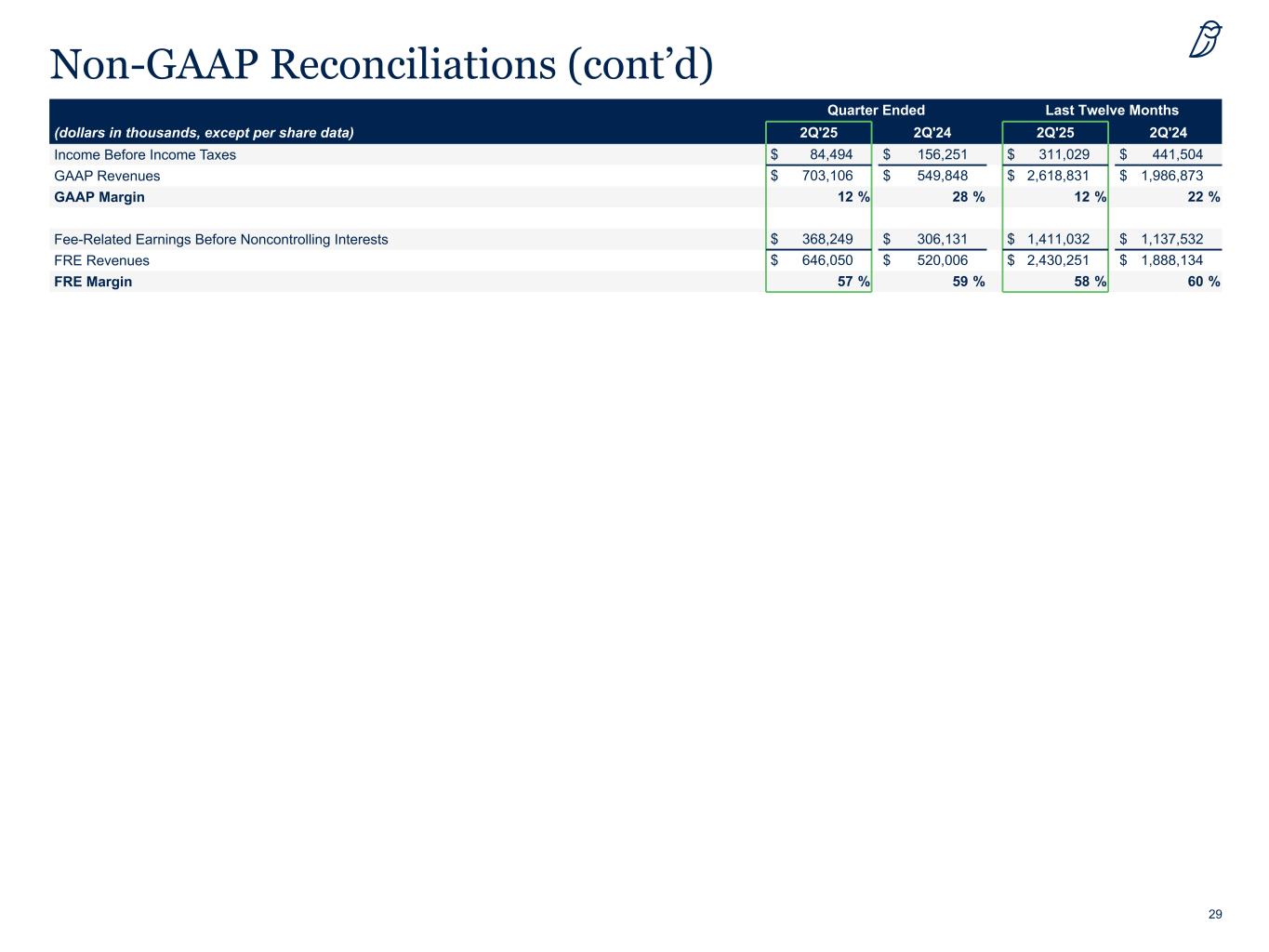
Sure. And to Mark's good point, we're already seeing even a benefit when you think about the, you know, something like FRE versus FRE per share, DE versus DE per share. That gap has meaningfully narrowed when you look at 2Q versus 1Q. And then, Brian, to your good point, when you think about, you know, we've acquired these four businesses over the past year. They put us in the largest secular growth areas in our industry. And as we've talked about on prior calls, we've continued to reinvest in our business and put valuable resources back into growing institutional and wealth fundraising platforms. And we're still at a 57% margin. And so that still continues to be among the highest in the industry. We feel really good about that. And over the long term, we feel there are margin expansion opportunities. So we think we're sitting in a great place, a more diversified business, a much broader product array, as everyone can see from this quarter with the strong fundraising numbers, and we're very well positioned.
And just, you know, to wrap that back up and anchor it, look, we have already done this, right? We have demonstrated that we know how to make this all work, again, for the investors, and that works for us. So look at O-Rent. O-Rent is the number one net fundraising real estate REIT in the world today on the continuously offered basis because it's a great product and it has the right support. We're doing the same thing in digital infrastructure. So I think you can start to see if it doesn't happen overnight, as you know, these have kind of these hyperbolic sort of curves, but it's already happening. And I think when you look back three years from now, you know, you're going to undersee, like, wow, they did it again. Oh, look, they did it again. You know, they did it in asset-backed. They did it in digital infrastructure. So I think we feel like we have not only all the building blocks, but the building blocks cemented in, the foundation built, and we're already starting to come out of the ground. And that's a pretty exciting place for us to be.
Really helpful. Thank you, guys.
Operator
Thanks, Brian. The next question comes from Crispin Love with Piper Sandler. Your line is open.
Thank you. Good morning, everyone. In real estate, focusing on triple net lease, can you just talk about the competitive environment there? And if you're seeing more activity from others, you've definitely been a leader in net lease, but BlackRock recently did a deal with ElmTree. So curious if you're noticing any shifts in the competitive landscape or others trying to grow just versus the overall opportunity set, which seems to have increased mainly just based on the data center opportunity that you mentioned?
Yeah, the data center opportunity has expanded dramatically and in the right format, like the Oracle project, that's well-suited to triple net lease real estate. In many instances, it's better and will be suited to the digital infrastructure product. But as for TripleNet Lease, to go direct to your question, the market's absolutely expanding. And candidly, no, we're the go-to. We're not seeing any change. We see our pipeline growing. We see ever more trust built with partners, making us the partner of choice. We continue to have every one of the largest funds where, as you saw, we already have launched our newest fund already in the first close of $2 billion. And so I think investors have observed this is a great opportunity, it's growing, and there is, you know, an unquestioned market leader. So I never question other people who will try to do things, and I don't underestimate that. But, no, our leadership is accelerating, not the other way around.
Operator
The next question comes from Bill Katz with TD Cowan. Your line is open.
Great. Good morning, everybody. thank you for taking the question uh maybe just a circle a little more of a narrow part of the conversation wanted to talk a little bit about activity levels on direct lending maybe how the quarter itself transpired uh maybe the exit velocity and what you might be seeing into the third quarter uh one of your peers had a very constructive update for the month of july and relatedly i'm wondering if you could maybe speak to what you're seeing in terms of spreads on incremental capital deployed. Thank you.
Absolutely. So this environment, as you would broadly expect, is extremely good for the direct lending business with the asterisk being, okay, but, you know, we need that return of M&A activity to just get more to do. But credit quality is exceptional. You know, that we've known, we've seen it, we've said it, but it remains is absolutely true today. At some point, people are going to have to stop trying to find the boogeyman because it's not there. The private credit portfolio and private credit business is doing really, really well. And it partly reflects the macro environment in the U.S. and it reflects really disciplined investment management. We're not indices. We're picking very specific businesses and very specific industries. This past quarter, our portfolio on average grew over 10% EBITDA but this is really and we're the lender through 40% on average 30 closer to 30 in software so the setup is excellent and yet you have a world where there's certainly some meaningful what we'll call more exogenous and hard to predict variables right you have you know you have flash zones and war zones around the world you have obviously the resolution of trade and tariff. And when those things come together and maybe moments people get nervous, that kind of uncertainty for now is yet another reason people use our product. So in the quarter, we had very high credit quality in terms of new opportunities. We like the deals we're doing very much. We are obviously, of course, seeing a slowdown in refinancing because that, you know, that has moved through the system very heavily. And while the quarter itself was, you know, moderate and given disruptions in April, probably not surprising, moderate in terms of originations, yeah, we likewise have seen last few weeks quite a meaningful pickup in activity, really interesting companies, in some cases quite large. So, you know, let's not get too far out of ourselves, but there's some reasonable indicators that, you know, maybe that moment has finally come. And the surrounding would suggest that too, right? At this point, six months ago, lots of debates about where's the economy. We now know the economy is strong. Lots of debates about, you know, where are we with interest rates and inflation? It's all settling into a tight range. And that brings us to a good environment to transact. And now the trillions of dollars in dry powder, it's got to go to work. So I think, yeah, we are seeing current signs, but they're early. So let's not, you know, overspend that statement yet. But yeah, so right now, I think there's cause for optimism on that last little asterisk, which is just overall volume in the market.
Operator
The next question comes from Patrick Davitt with Autonomous Research. Your line is open.
Hey, good morning, everyone. My question is on flows. I think last quarter you've been talking about the picture looking much better in the second half than the first half. But given the big 2Q beat, is that still your view, or did that beat pull some of that view forward? Thank you.
Thanks, Patrick. We feel very good about the second half of the year. I think the obvious outlier here is OREF 7 closed. that closed a little sooner than expected at the first close, we continue to feel very good about the back half of the year, both for institutional as well as for our wealth products.
More of the products out of both our existing strategies and new strategies are hitting stride, and you can see it, and you can see it in the wealth channel, and you can see it in the institutional channel. Note that, you know, we have had continued great strength in both, and in fact, this quarter, actually the majority of our capital came from institutional so there's these the beauty of the model is this having balance and having access and success in both at the same time by the way that's in the context of wealth having a fantastic quarter continuing to grow record quarters so we're um yeah we're in a we're in a very good place to continue the strength you know and as as we roll forward, we think.
Operator
The next question comes from Stephen Chewbac with Wolf Research. Your line is open.
Hi, good morning, Mark and Alan. Thanks for taking my question.
So maybe to start just on digital infra and framing the opportunity, certainly, Mark, you gave a constructive message around how you're thinking about the deployment opportunity longer term. I was hoping to contextualize it a bit more. Just how quickly could you be back in the market raising for your next flagship vehicle? I know you've talked about as early as next year. And just evaluating the deployment opportunity over a multi-year horizon, how much capacity is there to increase future fundraising relative to prior vintages?
Yeah. So, as you know, we did the final close of Fund 3 on March 31st, and half that money is already circled and is good stuff. And so we're, and the pipeline, you know, the opportunity set that we're working on, you know, it's hard, the scale is so massive. And of course, you know, you all know this, listen, there are three tech companies that just over the last two days that announced, and every one of them, for reasons we all understand, are talking about just how big, important, and heavily focused and invested they are in data centers, well, AI, and the capacity to drive it. And there are only a few people in the world that have both the operational technical skill and the capital to meet that need. And by the way, don't forget, we also have the 15-year history in Triple Not Lease of structuring exactly these kinds of partnerships and have been at the at the business of building these hyperscale data centers for the world-class hyperscalers longer than just about anybody. It's been 10 years now. IPI had the idea of hyperscalers before that was war to any of us we're talking about. So we're in a very, very distinctive position against what amounts to a hundreds and hundreds and hundreds of billions of dollar opportunity. And that is, And so therefore, you know, we have room to deliver great results for massively larger pools of capital than we have access to today. What will that translate into? You know, what size next fund? I don't know that yet. As I said, we will do this, the wealth product. I think that's going to be an incredible opportunity for individual investors and institutions alike. So it basically gets down to this. As much capital as we can assemble, we can largely put to work with extraordinary – we're talking about companies, right, with on average AA kinds of ratings. It's pretty special. Now, five years from now, we'll see. I mean, for the years to come, though, there's a lot, a lot to do, and it kind of does fit the category of it's not something to miss. You look, there's going to be a lot of and maybe even excess excitement about AI and some of the valuations in venture land. We'll see. But what I know for sure is that when you sign a 15 or 20 year lease with, in every case, these hyperscalers are amongst the largest market caps in the world and you have a commitment to a stream of income with escalators, you're going to have a good experience.
The only thing I would add to that, Stephen, is from a timing perspective, we continue to be on track with everything we've previously said. The next vintage, we expect we will be out in the market next year, talking to investors about, and prior to that, between now and then end of this year, early next year, we do expect to be out with that digital infrastructure, wealth-dedicated product that we're also very excited about.
That's great. Thanks for taking my question. Thanks, Steven.
Operator
The next question comes from Alex Blastin with Goldman Sachs. Your line is open.
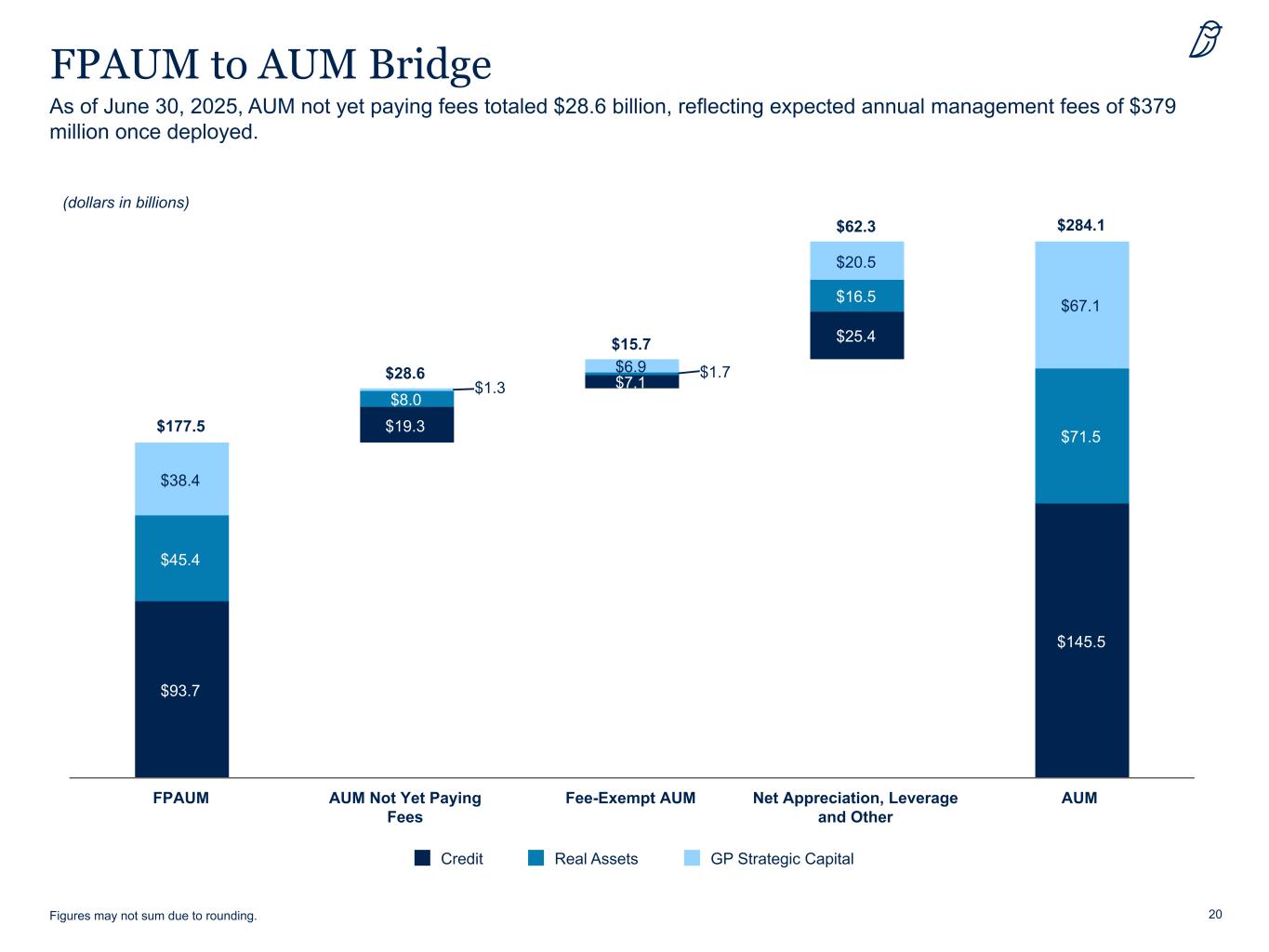
Hey, everybody. Thank you for taking the question. I wanted to zoom out a little bit. The franchise continues to fundraise through more kind of vehicles than what we've seen in the past across more strategies, I guess. And the fact that it's shown up and kind of fees yet to be deployed or yet to be turned on upon deployment, increasing nicely helps as well. So maybe help unpack the bridge from last quarters to this quarter's $370 million, quite sizable. What are kind of some of the bigger buckets? And importantly, I guess, how quickly do you guys think you will put that to work? And also, are there any offsets against that? You talked about a couple of step downs that will obviously impact the net number, but I'm just kind of trying to put the $379 in the context of the firm's overall management fee growth over the next, you know, 18-24 months.
Sure. Alex, thanks for the question. We're really excited. We saw, you know, a record fundraise quarter, $12-plus billion. About half of that went right into AUM not yet paying fees, so excited about the future deployment opportunities and getting that money to work. The $380 million of management fees upon the deployment of that almost $30 billion of AUM not yet earning fees, that's almost a $100 million increase from last quarter. You know, the ORAP 7 vintage, the 7th vintage fund in net lease, that was obviously a big contributor to that, raising over $2 billion in the initial close at the end of June. And the total $380 million, once deployed, that gets deployed at a blended fee rate of 130 basis points and so once that once that 380 is deployed that would represent over a 15% increase from our LTM management fees today so we feel really excited about you know not just the fundraise that impacts us today we continue to put those dollars up but the AUM not yet earning fees the trajectory over let's say 12 18 24 months we feel really encouraged about that as well and and we are seeing as as mark pointed to as we heard on a previous earnings call the deployment opportunities continue to look a little better it looks like there's a pickup in the environment and so that could you know pull that time frame forward a little bit all right thank you thanks Alex.
Operator
The next question comes from Kyle Voigt of KBW. Your line is open.
Hi. Good morning, everyone. So, Mark, there was an FT article on secondaries published this morning quoting you that you would have a very open, you would be very open to a full sweep of large acquisitions or building a business organically. I was just wondering if you could clarify whether that comment was specific to secondaries or simply a broad-based comment. And then maybe you could just update us on how you're thinking about M&A right now. Are there certain areas that you find attractive or want to accelerate your growth in? And how should we think about your appetite for larger M&A versus bulk bonds right now?
Great, thank you. So with regard to, let me start at the broader topic of M&A, and then come down to the secondaries topic specifically. So with regard to M&A, as, of course, you all have observed, it's been a very, very successful part of our overall strategy. It's a minority part of our overall strategy. Recall that while we did several very important strategic acquisitions in terms of capabilities last year, it was less than 10% of our market cap that was invested to create those opportunities and look at the benefits that are already yielding for us. And so I think for us, look, we are all about risk management as a firm. Like, that's our DNA. Everything we do is about how do we create products, how do we manage a firm, permanent capital, fee-based income. So we're always focused on risk management. So that includes what we buy, the culture fit, the nature of the product, the ability for us to then, in turn, grow it. And so all of those are variables. And we will continue to evaluate M&A opportunities. It's quite clear that consolidation is a real part of the landscape for alternatives, and we're one of the few, frankly, demonstrated people who can truly do it successfully, not just for our shareholders, but for the teams that join us and then thrive as a part of this platform. So we continue to be active. We will always be looking, though, for a strategy that is consistent with our DNA, again, about those durable, protected strategies, culture fit for sure. And we will always be looking for things, therefore, that are a place where we can bring an advantaged result for the investor. We are not going to be all things to all people. We don't want to be. We are going to be the best for what we do for the people that we're lucky enough to work with. So we're better, we're deeper, and you can see that in these adjacencies and the synergies we're getting, synergies being origination synergies, as well as infrastructure and capital raising. So, you know, we don't have like a goal to, quote, you know, acquire things. We have an extremely open mind about when we see a place where we want to skate to because that's where the puck is going. We're always going to look at organic, we'll look at small, as you called them, bolt-on, and we'll look at large acquisitions. All of those are options. Whichever one is the winning strategy to both, on the one hand, win for the investors, the LPs, and by extension, win for blue oil. So it will continue to be a part of our game plan and our strategy, but you should expect us to continue to be highly selective, but also not to be lost. We've proven we know how to do it. Again, these acquisitions last year, we had a lot of questions about this during last year's calls, very understandably. But look where we are now. Real estate credit, thriving, right? We've already got that thriving. Insurance, we just talked about the origination power that we're already delivering. We, of course, talked a lot about digital infrastructure and asset back where we already have now raised our new interval fund. So we've got the skill, the template, and the plan. Now, as for secondaries, the comment in that article was particular to secondaries in talking about the full sweep from organic to large. Look, we think that is a good business for us because it's another solution for the exact ecosystem that we serve. And don't forget, we're already pioneering, back to the point of buy versus build, what we think is actually probably one of the most interesting new areas within the broadly defined secondaries. That's GP-led secondaries. This is an area with no market leader, and we plan to be the market leader. We are now already up to $1.7 billion, and that's from a standing start creating this business. We've already deployed meaningful amounts of that capital in portfolio companies that are doing really well. And I think that market's got enormous room to run because that solves the liquidity issue that is binding up this system with the same time allows the PE sponsor to keep their best in trophy assets. And that's a place where we're building and the scalability, it's early days, but the scalability of that business is enormous as we think about this next phase of PE, which is not like the older phases, right? There's going to be a lot more about how do you, what do you do with these accumulated assets? There's going to be less, relatively speaking, and less acceleration in capital raised for PE. It's a different stage, needs different tools. We have it. So secondary would be a very complementary strategy. Last thing I'll say, just because you cited the article, is with all that said, and you'll hear this in everything we ever talk about, we are not interested in hype. We are not interested in doing anything other than deliver fundamentally great results for investors. Secondary can be done really well. It's a good business, but there is an element today where some people think they're just harvesting free money because part of it is there's this accounting quirk to the way when you buy something at 80 cents and then the nanosecond later, it's a dollar. And so there's nothing wrong with that accounting fact, but it's creating this sense that people are just picking up free money and almost a mania. And we're not playing into that. That is not the answer, but there sure is a great business to be had, being a really thoughtful buyer of secondary interest when you have more sellers today than you've ever had in the past.
Operator
The next question comes from Brian Bedell with Deutsche Bank. Your line is open.
Thanks for taking my question. But maybe just to circle back on 401k and the partnership with Voya, you've got good leadership in retail vehicles already. So I'm just wondering to what extent you could, you know, sort of activate these into the market sooner rather than later. And I say that just because, you know, I'd be interested in your perspective on this, but, you know, obviously there's a longer-term development timeline for plan sponsors to be comfortable with adding these vehicles into target-day products. But do you feel you're positioned so that you might be able to target, let's say, the small plan market with financial advisors and model portfolios? Maybe if you could just sort of comment on that dynamic.
Yeah, it's a very keen question, Brian, because actually, given our leadership position in the world of BDCs, BDCs are already eligible products. I mean, in fact, today, someone done right in a partnership with like a Voya, if someone wanted to, through their 401k, buy a BDC share, they could. Now, most people don't run their 401ks that way, right? Most people tend to run with target date funds. So the bulk of that capital doesn't live in a place where people are making those kinds of decisions, but actually, you're spot on. the nature of both our strategies and our product structures mean we're already in position to start to meet the needs of that market. And as you note, too, we already work with a very wide sweep of FAs, increasingly with wonderful partners like Voya. So, yeah, I think we're in a place to be on the front edge of what might be a minority portion of that $12 trillion. But then, of course, again also of the products that are correct and are now being formatted right for what you're right it's going to be a more medium term development to get into these target portfolios and work with fiduciaries and do the education that we should do to make sure that people are prudently using these products as part of their retirement strategy so yeah we we like the setup it does it does match hand-in-glove with blue owl in particular great thank you the next question comes from Benjamin Budish with Barclays your line is open hi good morning and
thank you for taking the question I'm just a couple maybe housekeeping items on the modeling side thinking about the back half of the year on the transaction fees you know this quarter was a a little bit better sequentially despite softer net deployment. I know there's a lot of factors that go into that number beyond the magnitude of deployment itself, but anything you can share in terms of what that means for that revenue line for the next couple of quarters? And then similarly, just on the FRE margins, you know, trending kind of at the lower end of the full-year range, but I've assumed there's some benefit from OTF turning on and giving you a full quarter of fees. Any other considerations there in terms of what that means for the full year?
Thanks, Ben. Ben, on the margins, obviously, I touched on that. The guidance is 57 to 58 for this year, and we feel good about where we are. We've printed 57 this quarter. We feel good about that overall. On the first question, just remind me, Ben, the first part of the question.
Just on the transaction fees, we're up a bit sequentially despite NED deployment down a little bit. just anything to read into there, how to think about that in the back half of the year.
Sure. As you know, that moves around and moves up a little, moves down a little, largely tied to gross originations. I think this quarter is as good of a leaping off point for the balance of the year as I could probably guess.
All right. I appreciate that, Alan. Thanks.
Of course. Thank Thank you.
Operator
Our next question comes from Chris Katowski with Oppenheimer. Your line is open.
Yeah, good morning and thank you. Mark touched on it a little bit, but I wonder, I'm looking at page four of your release, and I wonder if you can add a little color on the right-hand side of the page. And in particular, I'm wondering about the $1.7 billion vintage and the $3.5 billion of new funds raised. And so, like, first, I imagine those are in the 12.1 that we saw. But in particular, on the strategic equity fund, I was wondering, is that a traditional drawdown fund or is it evergreen? And how do you plan to scale it? And I guess just in general on all these things also, like, when and where do we see them in the P&L? and when do we start seeing revenues and where should we expect them, you know, in your accounting geography?
Great. So the slide four on that right side, you know, is something that is very much worth highlighting. So I appreciate the question because, well, you know, there's a lot of macro talks about alternatives and, you know, questions, rightfully so, about, you know, strategies and acquisitions. the right-hand side is the answer, which is now you can see already, as I said, this is his point about it's not a, you know, we're not laying the pylons for a foundation. The foundation's built and the building's coming out of the ground. And candidly, we think it's going to be, you know, one heck of a skyscraper over time. And so you can see here some of those pieces of that puzzle, because these are things we didn't even have before. So to answer first, like on the three and a half billion. That is primarily in our Bose. That is that 1.7 billion in the strategic equity, which I'm going to come back to. That is net lease Europe, again, taking our world-class franchise on the road, so to speak. And then with our GP mid-market business. So those are all new strategies that are just beginning to blossom. With regard to the 1.7 billion in strategic equity, we get really excited about this product. That is the GP-led secondary product I actually was just also referencing, as you know. We call that Bose, Blue Owl Strategic Equity. And at the end of the day, it's the greatest hits of private equity. It is the product that allows us in partnership with the firms that we are go-to partners with today to facilitate a really important solution. LPs want liquidity. Some. Others want to carry forward. And we're the ones that provide that liquidity to bridge between those two. Well, in a self-selected basis, the PE fund says, I already know what my best asset is. And of course, I want to keep that for the benefit of the investors that want to stay in it. And then we get to come in with that hindsight benefit already and provide the capital to, if you will, help the LPs that don't want to stay exit. I think this is one of the more enormous, very immature, but enormous opportunities in the alts market, because this lives on the 50-year run in PE. You all have the stats on the thousands and thousands and thousands of companies owned by PE and the trillions of dollars held. And this is a way of saying, you know what, for the very best of those assets, That's how do I get those on a self-selected basis by the people that know best? That is the people that already own them. And so, candidly, I think it's the best way to participate in private equity today. But it's a young strategy, and we're in a very good place to, I think, be the market leader because it takes an origination engine, which we clearly have for reasons that are quite obvious given our role in the PE marketplace. workplace, it also takes an ability to do the work. This is very, very different from LP secondaries, very different. This is buying an individual asset. So you have to do the deep dive multi-month work, which is what we do every day, right, in the world of credit. And I've done thousands and thousands and thousands of times. And then you need the PE capability to drive the final PE decision on the back of all that work. And we have built a team of world-class PE professionals here to do that. So we got the combination, we have the capital, and that product to answer your last question has both a drawdown strategy and a continuously offered format. It's not being offered continuously yet, but there's a, there's, it combined two vehicles and one vehicle ends up in the place where it becomes the continuously offered version of it.
Okay, so two follow-ups on that. One is, is it like a traditional private equity fund where people pay on the committed amount or is it on the deployed? And then secondly, can you invest equity in transactions where you're also a lender or do you keep those two houses separate? it.
Yeah, thanks, Chris. So, look, these are some of the products. The structure is a GPLP institutional product, and then there's a product that will be a RIC over time that, as Mark mentioned, went through a continuously offered phase. These are all products that Mark's pointing out that help contribute to the long-term goals. These are great adjacent opportunities, organic initiatives that we've been growing, as Mark pointed out, that will contribute over the long term to the management fee line. So, you know, these are some of the reasons why we continue to be really excited and remain on track with our long-term goals that we outlined back in February at Investor Day.
All righty. Thank you. That's it for me. Thanks, Chris.
Operator
This concludes the question and answer session.
I'll turn the call to Mark Lipschultz for closing remarks. thanks so much look it was a tremendous quarter um and we expected that which is to say that this is what we talked about at investor day this is the journey we're on the building blocks are quite clear um and while the blocks were easily describable now you can start to see the the benefits of the block so to speak um we are delivering and have consistently been delivering outsized growth. We're on track toward our long-term goals, as we talked about. You know, just keep an eye on the North Star. It's the $5 billion, you know, roughly of revenue and the $3 billion, roughly, of FRE. That's our North Star, and we're pointed right at it, and this quarter took us another step closer. It seems clear to us the market, you know, either hasn't seen it or has whatever remaining questions, I hope some of which got answered today, because our performance in the market doesn't reflect these attributes today. But we're going to keep delivering and we're going to try to be as available and communicative as we can. Any questions, we love the questions. We want a chance to explain, you know, anything people wonder about, we want to explain it. We feel really great and we see the visible track. The acquisitions are working. The integrations are completed. The synergies are being realized. Over time, we'll continue to add those opportunistically. But it worked. That's been another successful building block in this business. And I guess the last thing I'd close on, because it is timely to the moment, is this generational AI, generational change, adoption. What's happening, look, on the cutting edge, there's going to be some gigantic winners and some gigantic losers, but it's going to transform the economy. And what's quite clear, the necessary tool to get to the arms race to super intelligence or whatever term of art you want to call it, it does take the picks and shovels. In this case, it takes the modern version, the data centers. And we are the best-placed firm to help develop and to help fund those data centers. And they are with the best companies to have as your partners, and we are committed to being their best partner. So we have our way of delivering an exceptional risk result, risk return opportunity for investors at massive scale, and it's a bit of a once-in-a-lifetime. And so sitting here today, this quarter, more than any, it's tangible. Again, we just heard the biggest tech companies announced, and the theme couldn't be clearer. And we're in position A. I don't know how big this business will be, but we think it has the potential to be a mighty, mighty large one. Certainly, we intend to do a really great job with it. So I think with that, we'll close. Thank you all again for the time, the questions, and we look forward to continuing the conversation.
Operator
This concludes today's conference call. Thank you for joining. You may now disconnect.