Operator
Good day and thank you for standing by. Welcome to the PAR Technology Fiscal Year 2025 Fourth Quarter Financial Results Conference Call. At this time, all participants are in a listen-only mode. After this previous presentation, there will be a question and answer session. To ask a question during the session, you will need to press star 11 on your telephone. You will then hear an automated message advising your hand is raised. To withdraw your question, please press Star 11 again. Please be advised that today's conference is being recorded. I'd now like to hand the conference over to your first speaker today, Chris Burns, Senior Vice President, Investor Relations and Business Development. Please go ahead.
Thank you, Stephen. Good afternoon, everyone, and thank you for joining us today for Par Technologies 2025 fourth quarter financial results call. Earlier this afternoon, we released our financial results. The earnings release is available on the Investor Relations page of our website at Partech.com, where you can also find the Q4 financials presentation as well as in our related Form 8K for earnings to the SEC. Before we begin, please be advised that remarks today will contain forward-looking statements. These forward-looking statements are subject to risks, uncertainties, and other factors which could cause actual results to differ materially from those expressed or implied by such forward-looking statements. For additional information on these factors, please refer to our earnings release and our other reports filed with the SEC. Also we will be discussing or providing certain non-GAAP financial measures today, which we believe will provide additional clarity regarding our ongoing performance. For a full reconciliation of the non-GAAP financial measures discussed in this call to the most comparable gap measures in accordance with SEC regulations, please see our press release furnished as an exhibit to our Form 8K filed this afternoon and the earnings presentation available on the investor relations section of our website. Joining me on the call today is PAR CEO Savneet Singh and Brian Menard as PAR Chief Financial Officer. I'd now like to turn the call over to Savneet for the formal remarks portion of the call, which will be followed by general Q&A. Savneet?
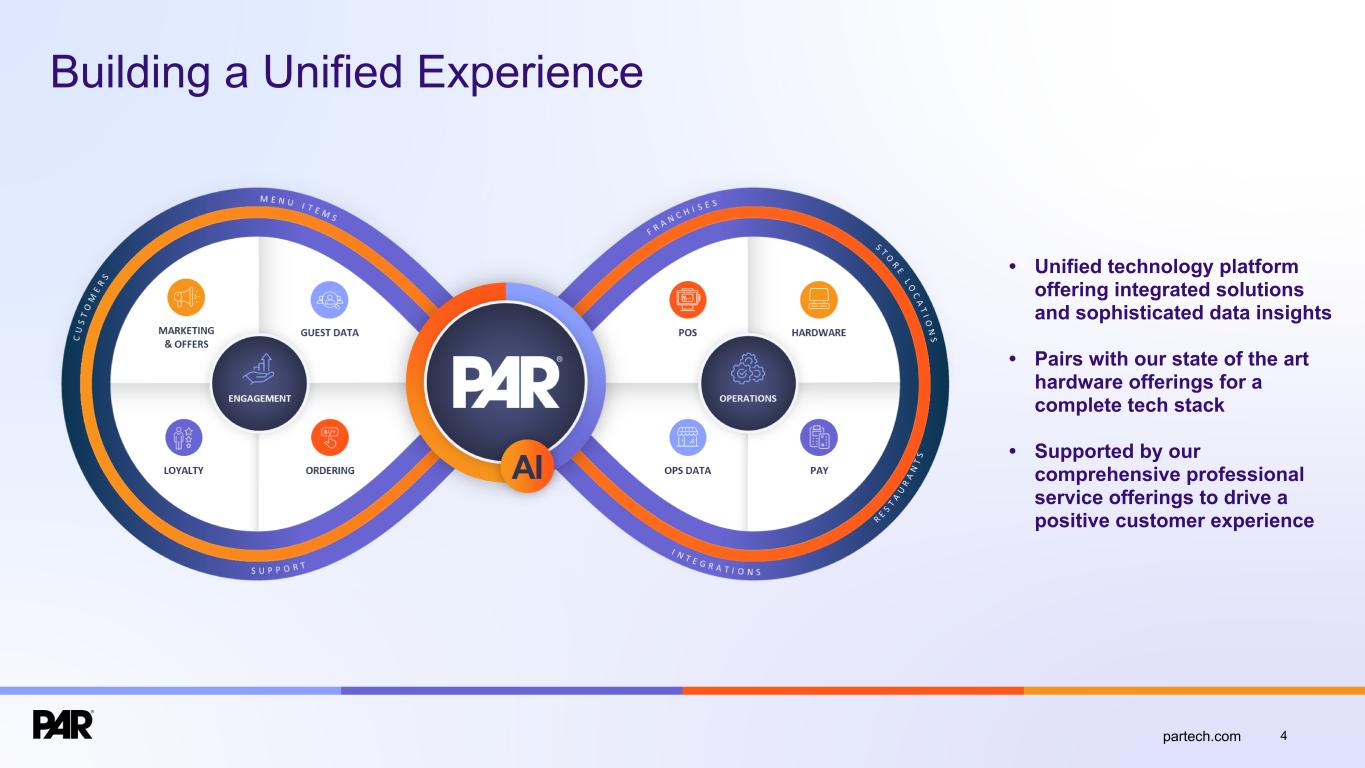
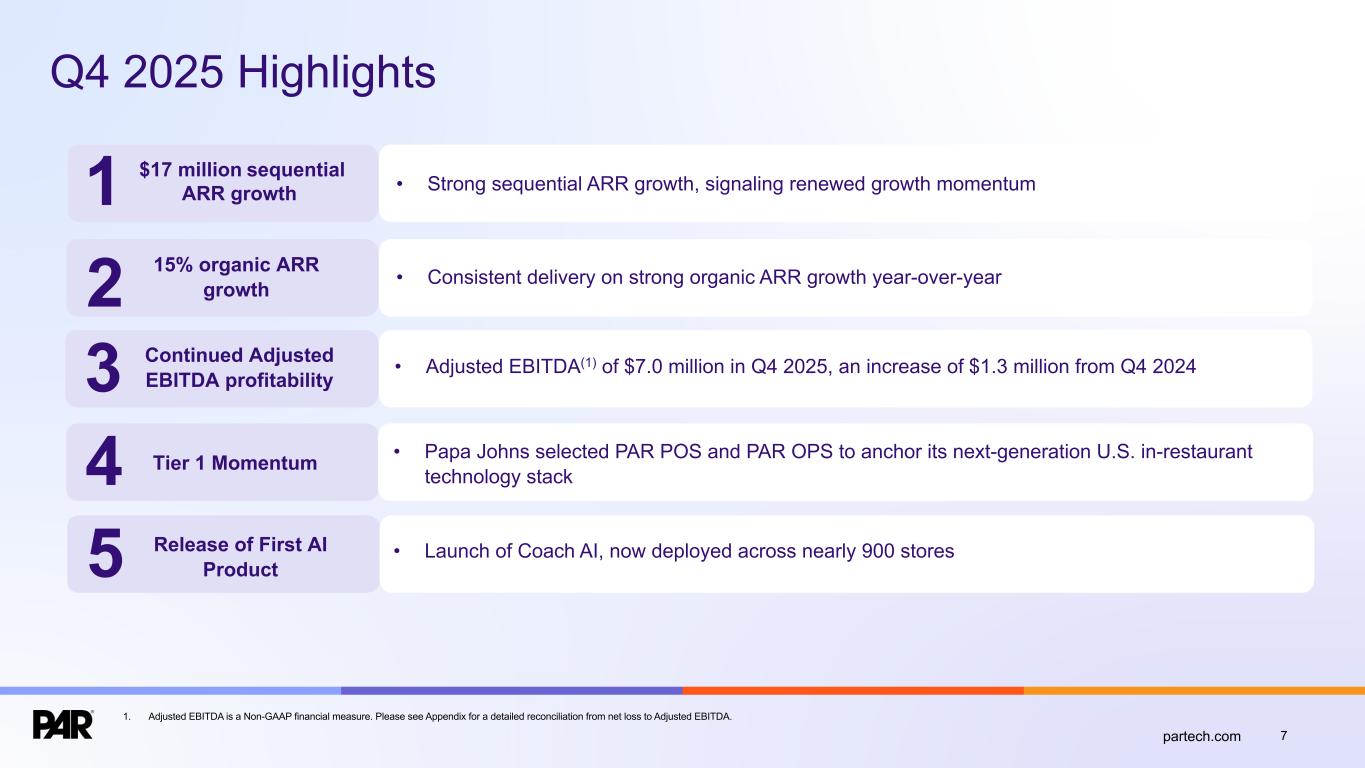
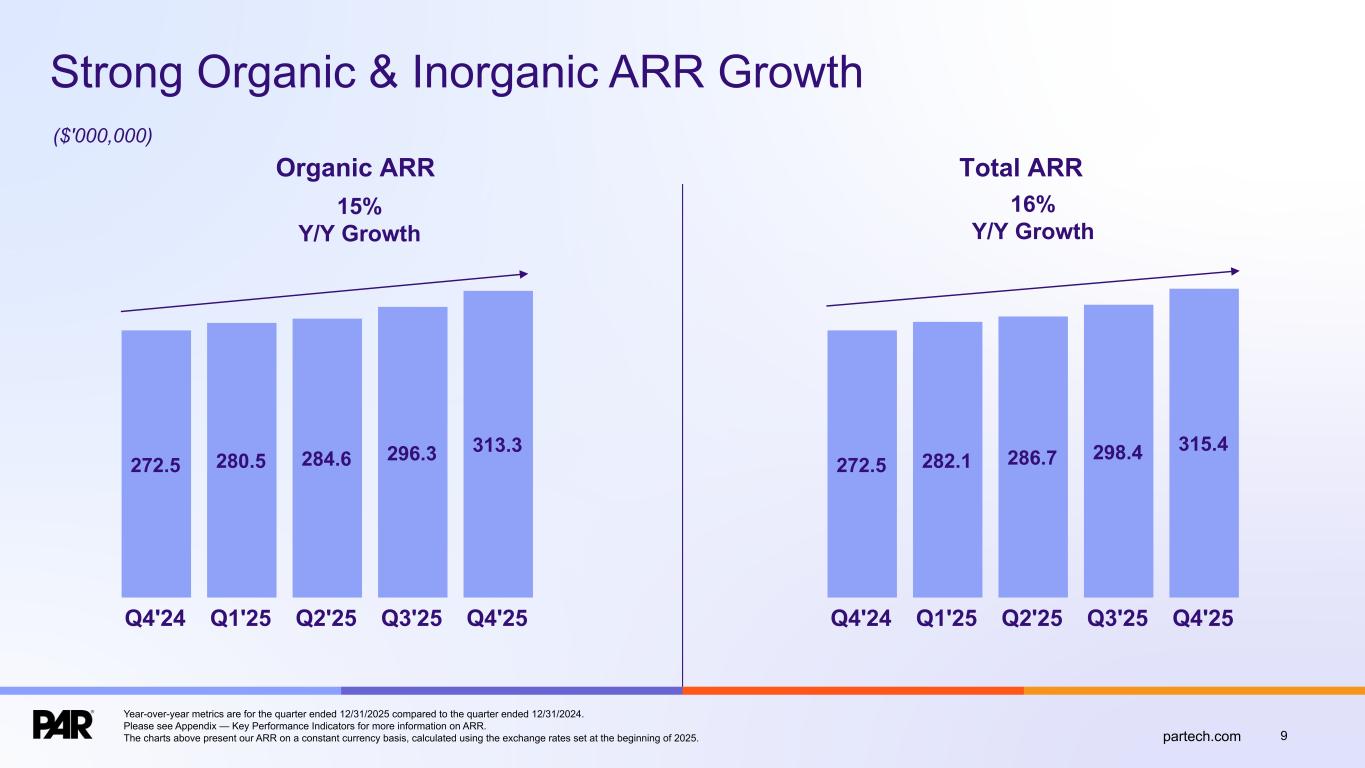
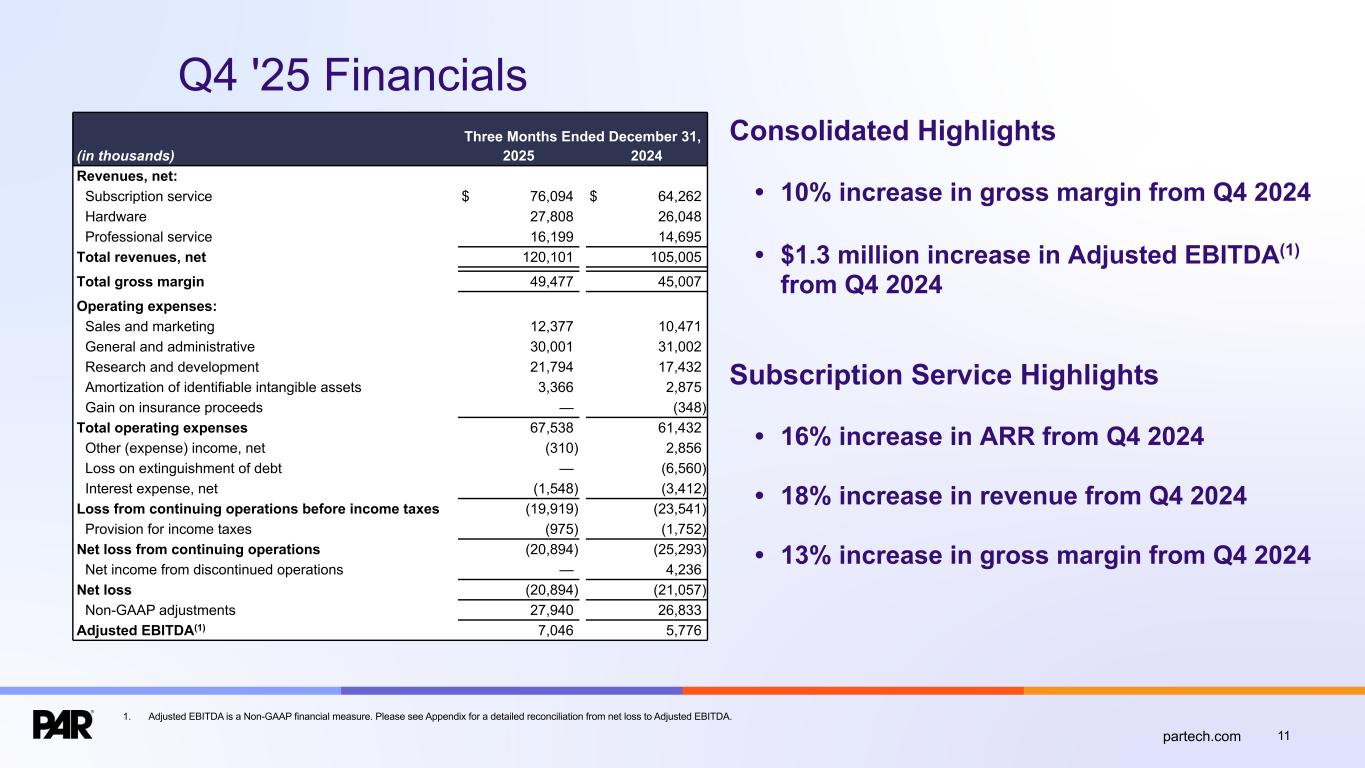
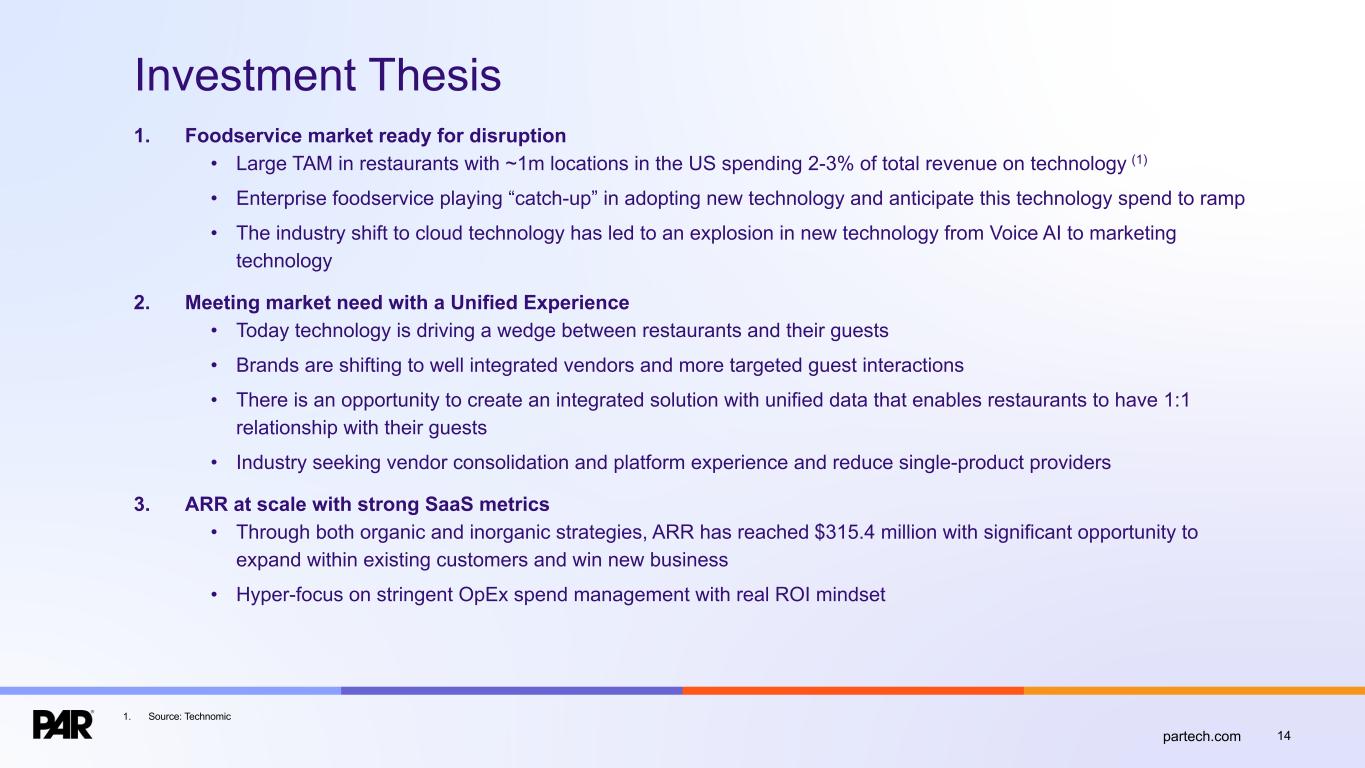
Good afternoon, everyone, and thank you for joining us. Before sharing details of a strong Q4 today, I want to reaffirm PARS' thesis. PARS is becoming an AI-driven hospitality platform company. Our two verticals, restaurants and retail, are individually mid-teens ARR growers with significant white space anchored by mission-critical systems of record with deep domain expertise. The compounding nature of PARS Enterprise Platform is driven by simultaneously allowing customers to play offense and defense via revenue generation and cost efficiency. This is especially true in times of underlying market instability. We're falling behind in digital adoption, and its resulting margin loss is a formula for customer pain. Aggressive investments into our AI platform will deepen our performance and provide further customer expansion opportunities. We have never felt more confident about our positioning in the opportunity set in front Now, to review the numbers. In Q4, we delivered revenue of $120.1 million, of 14% year-over-year, driven primarily by continued strength in subscription services and an increase in hardware revenue. On a non-GAAP basis, we generated $2.6 million in net income, marking our third consecutive quarter of non-GAAP profitability. Adjusted EBITDA in the quarter was $7 million. Full-year revenue reached $455.5 million, up $105 million year-over-year, including 21% organic growth with subscription services growing 40%. Most importantly, full-year non-GAAP net income improved by over $30 million year-over-year, proving that our operating model is scaling. We continue to stress operating expense efficiency as we scale our business and Q4 was no different. As a percentage of subscription revenue, R&D came in at 25% and sales and marketing at a solid 13%. Respectively, at or ahead of our targets. Turning to ARR, we exited Q4 with ARR of $315.4 million, representing 15% organic growth. Crucially, second-half growth was more than double first-half growth and was powered by Crossel, with over 80% of deals being multi-product. Growth was broad-based, led by POS Momentum and the resumed Burger King rollout, along with continued steady performance from Punch and Plexcher. The former continues to win new marquee brands, while the latter benefits were McDonald's international expansion, including a successful Japan launch. We also saw improving trends in ordering and payments. Now to review our business performance in Q4, starting with the operator solutions business. Q4 revalidated our platform strategy. We were selected by Papa John's for a decades-long partnership in their 3,200 sites, and we'll be rolling out PARPOS and PAROPS to power their in-store tech stack. This win builds up momentum in the pizza category, with TAM expansion already reflected in significant PISA pipeline for 2026. Further, we anticipate increasing our partnership with Papa John's in the future, with both expansion to select international markets and continued expansion within our platform. In addition to this marquee project, our bookings exceeded internal expectations and hit record highs with over 25 million booked for PARPOS alone. The mix skewed heavily towards enterprise, multi-unit, multi-product deployments. Enterprise customers are not buying point solutions. They're buying a unified platform with POS as a gateway into the broader PAR ecosystem. Our attach rates confirmed this. Nearly 90% of Q4 operator deals were multi-product in nature. Additionally, we continue to progress on our large Tier 1 opportunities. The world's largest brands continue to show more and more interest in the PAR platform, and will update investors as we convert these opportunities to bookings. We're hopeful that our intense focus on AI helps accelerate these opportunities as these brands are looking for ways to become AI-driven ahead of their peers. ParOps, our back office offering, is evolving from analytics to intelligence, and even more importantly, product capability accelerated. Our first AI product, Coach AI, is now being utilized by nearly 1,000 stores with roughly 1,000 active users, indicating high usability and market fit. Since launch, we've added enhancements and improved both usability and contextual awareness. The current version of Coach AI moves us into prescriptive operator recommendations, not just showing personnel what happened, but telling them what to do next. Crucially, we are embedding AI directly into daily workflows and are building towards a full self-driving product that is capable of direct and immediate store optimization. This is not incremental enhancement. this is margin driving capability for operators. The industry does not need more dashboards. It needs fewer decisions and better ones. Our goal is to embed intelligence into every operational layer such that actions drive outcomes. One of the most encouraging signals this quarter was the breadth and quality of momentum across our engagement cloud, both with new logos and existing customers. Starting with Punch, we signed two new noteworthy brands, including Shake Shack, and also expanding meaningfully into the adjacent E-tertainment vertical with Lucky Strike Entertainment, which opens up a compelling new category for us. These wins reinforce Punch's position as a category leader and validates our ability to extend the platform into new high-value segments. Ordering continued its strong momentum, adding six new brands in the quarter, including Savvy Sliders and Smoky Moe's. Importantly, these weren't stand-alone wins. They increasingly came as part of a broader multi-product engagement, which speaks to how customers are buying the platform rather than the point solution. Across power engagement, co-sell and cross-sell momentum continues to build. More than 80% of new deals are now multi-product, consistent with last quarter and still trending higher. This quarter included the first large sale of PAR catering to Condado Tacos, where we successfully displaced a competitor. We also had the first major deployment of PAR games with Smoothie King and the first significant sale of PAR Smart Passes. PAR retail delivered a strong quarter that demonstrated continued scale, engagement, and execution across the platform, particularly with our largest enterprise customers. One of PAR retail's newest and largest C-store customers is driving improved results as their program now exceeds 3.6 million members and continues to drive measurable changes in customer behavior. We are seeing higher visitor frequency, richer customer data, and clear monetization benefits across categories. We continue to see broad adoption of part retail as three new customers launch on the platform in Q4. But it gets better. I'm also excited to announce the launch of our newest AI products for C stores and fuel retailers, ParDrive AI, a fully integrated AI suite built directly into our unified platform. This isn't AI layered on top. It's intelligence embedded into the systems, convenience, and fuel retailers you already use every single day. Not only making us AI native, but building AI in the workflow our customers run today alongside the security, data, and intelligence our customers trust today. We also saw strong performance in the quarter driven by increased hardware demand by our restaurant customers and deployment activity across several of our large enterprise customers. Some of this acceleration is due to the switchover by restaurants to edge compute. Later this year, we'll be coming out with Parzone's portfolio to help support this move. We also saw strong momentum with new store openings and continued kiosk expansion, reinforcing the role of self-service and digital ordering within large QSR environments. In Q4, we experienced steady demand across large POS enterprise brands, including Dairy Queen and Burger King, where ongoing remodel activity, platform upgrades, and new unit growth continue to drive consistent deployment volume. Even with a strong Q4, we saw significant cost pressures on key components, including solid-state drives, memory, and processors being driven by significant demand from AI infrastructure build-outs, which is tightening availability and creating elevated pricing across the broader compute supply chain. We're moving early and aggressively with measures to protect our core hardware product lines, while also rationalizing configuration and offerings based on component availability and involving customer needs. As of today, we expect component cost pressures and constrained availability to persist until supply more fully catches up with demand, which we believe could extend into 2027. Importantly, we remain focused on mitigation through supplier diversification, product flexibility, and the pricing discipline to ensure we can continue supporting customers. Before turning the call over to Brian, I wanted to share a perspective on AI and its impact on software, and even more specifically on PAR. The market fear around the durability of software in an AI-first world is palpable. I would be tone-deaf not to address this directly. PAR has suffered an extreme sell-down. We are at one of those rare moments where a technology shift is structural. For those of us in the restaurant technology space, We believe this moment represents an opportunity to lead. There are two key realities that guide us as we position Par to be the leader in AI technology for restaurants. First, food service chains are among the most compelling environments for AI to create real, measurable value. Food service is a performance business. Brands compete on speed, consistency, and quality, and their guests are already conditioned to engage digitally. At the same time, rising costs, structural labor challenge, and tight margins mean AI isn't being evaluated as a future capability, but rather as a near-term operational imperative. We believe that among all physical businesses, restaurant AI adoption by end users will be amongst the fastest. And second, PAR is uniquely positioned to be the company that delivers it. PAR owns and is an ecosystem of record for tens of thousands of restaurants. Every transaction, every labor input, every menu item, every guest interaction, every payment event, PAR is best positioned to be the provider that delivers an intelligent operating system where POS captures the data, payments enriches the data, loyalty identifies the guests, PAR ops structures the insight, and PAR AI delivers prescriptive action. We believe that the winners of AI have three key components, a massive trove of industry-wide first and third-party data, second, the complex integration into an end-to-end workflow, and third, customer trust, the least measurable and hardest to come by of the three. For PAR, we have all three. Our AI strategy isn't about adding a chatbot on top of our products. We are rethinking our entire product suite to deliver measurable outcomes autonomously. The vision stated plainly, we are building a platform that gives every restaurant brand the firepower of the biggest brands in their segments. A single marketing manager at a 200 location chain should be able to execute with the precision, personalization, and speed of the entire marketing department of the world's largest restaurant. We will empower them with a team of AI agents that actually do the work, strategize a new plan, build segmented audiences, configure campaigns, deploy one-to-one offers, optimizing in real time and reporting back what worked and what didn't. Or imagine the regional ops leader overseeing 150 stores, empowering them with the situational awareness of a Fortune 500 field organization through an AI layer that watches every location and flags what matters, recommends what to do, and executes a fix before it becomes a problem. Now zoom in to the general manager opening the store at 5 a.m. This lead should walk in with the preparedness of an executive chef running Eleven Madison, knowing exactly what to prep, who's coming in, what's trending, and where yesterday's gaps were. A guest pulling into the drive-to should experience something that feels like their favorite local spot remembers them and they're talking to a friend. The pattern is the same in every case. AI eliminates the gap between what small teams can do and what the best operators in the world actually do. Nobody needs another chat interface. What brands need is a system that advises you before you ask, assists while you execute, and answers when you need it, across every function, at every location, with the ultimate goal of driving profitable revenue. That level of scale and dependency makes PAR well situated in the deterministic orchestration layer of this new world. AI won't replace enterprise orchestration, but rather leverage it. We are seeing this firsthand with our customers today. Brian?
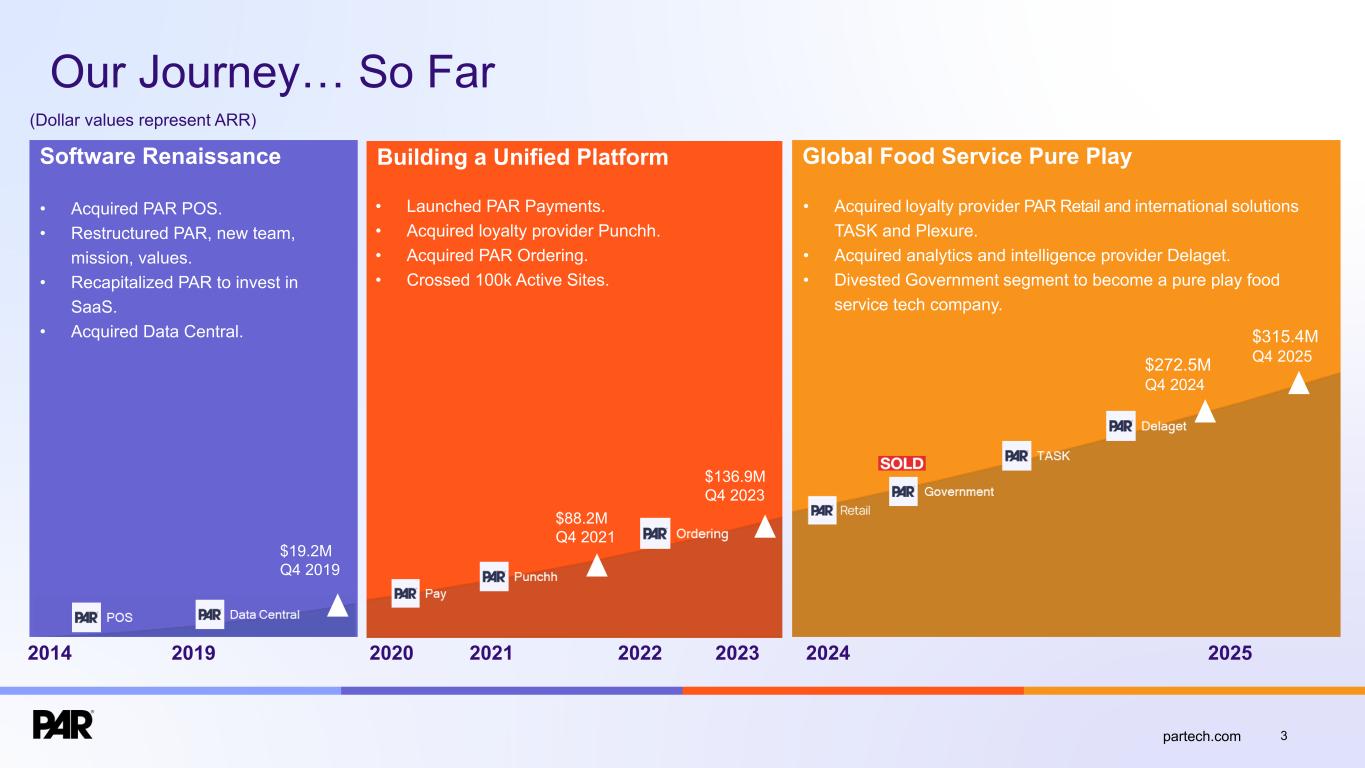
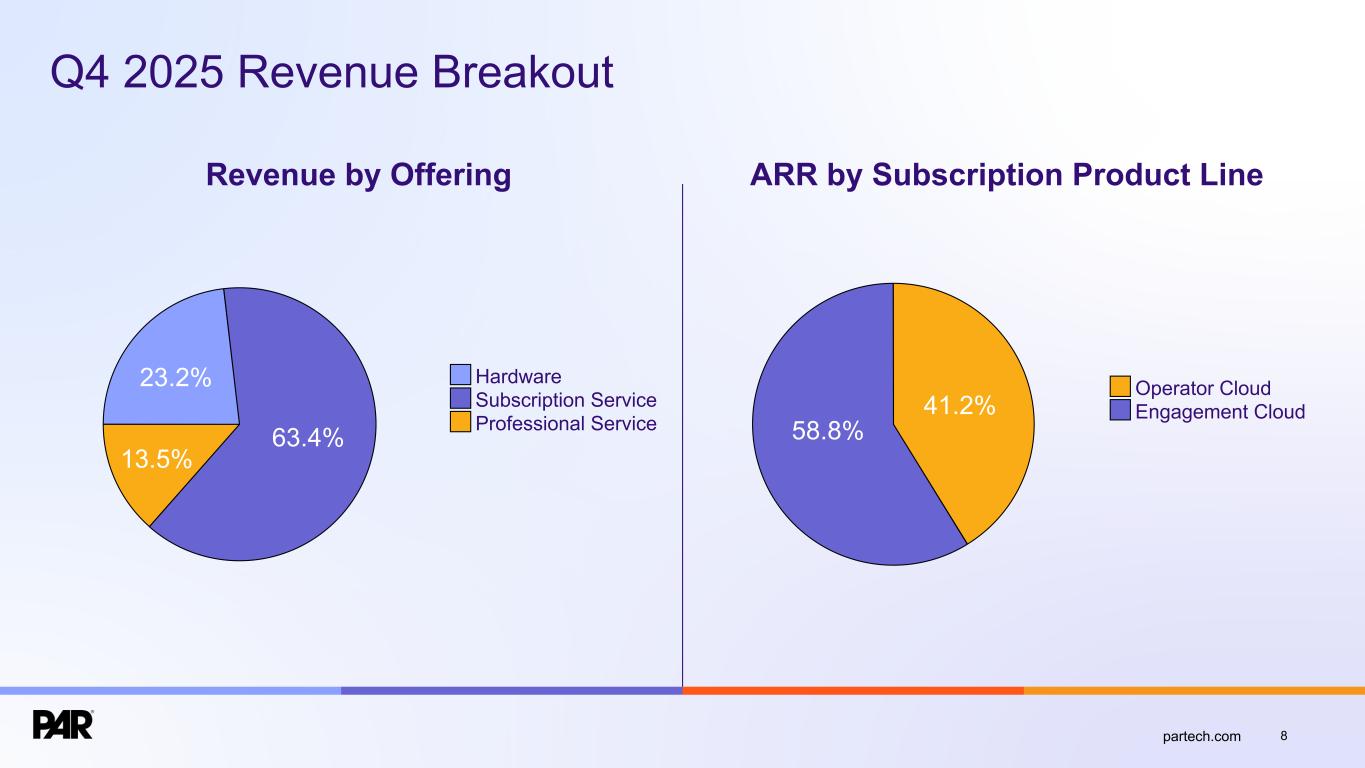
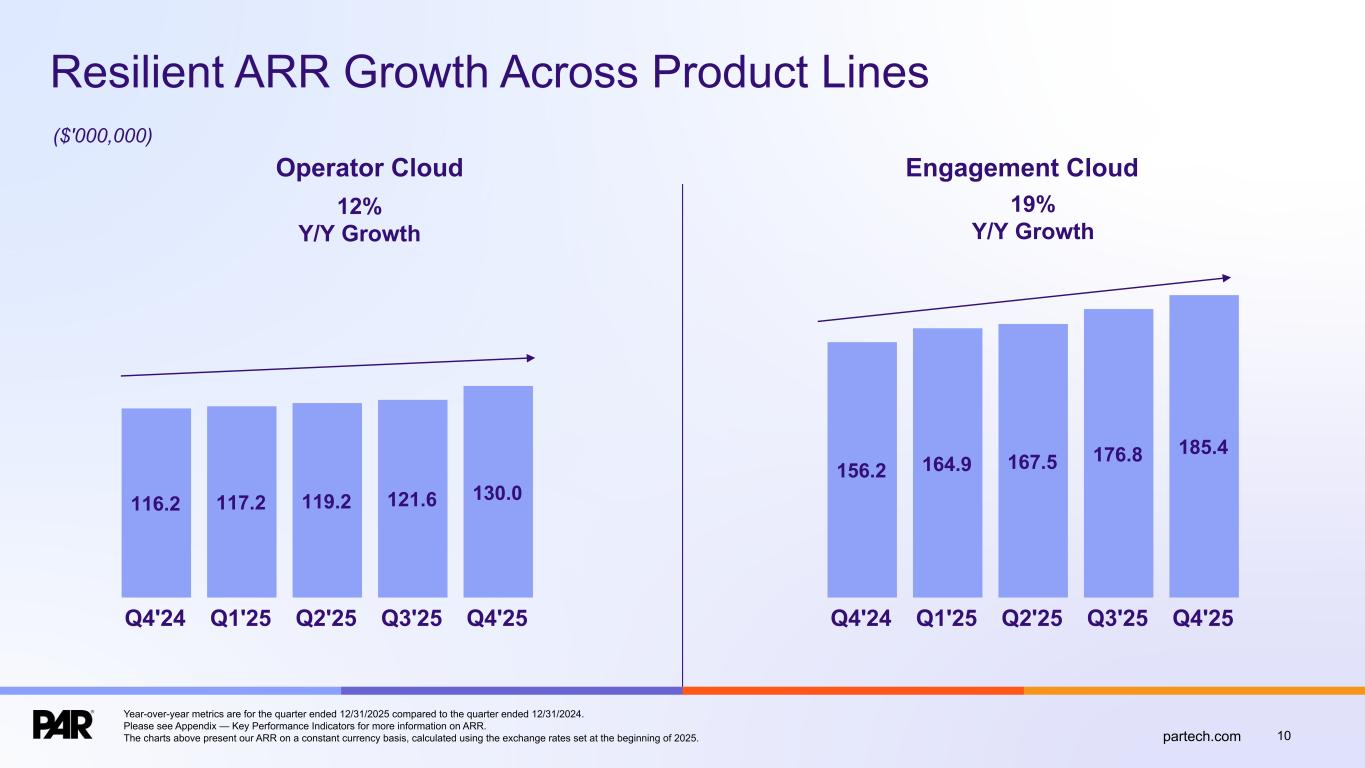
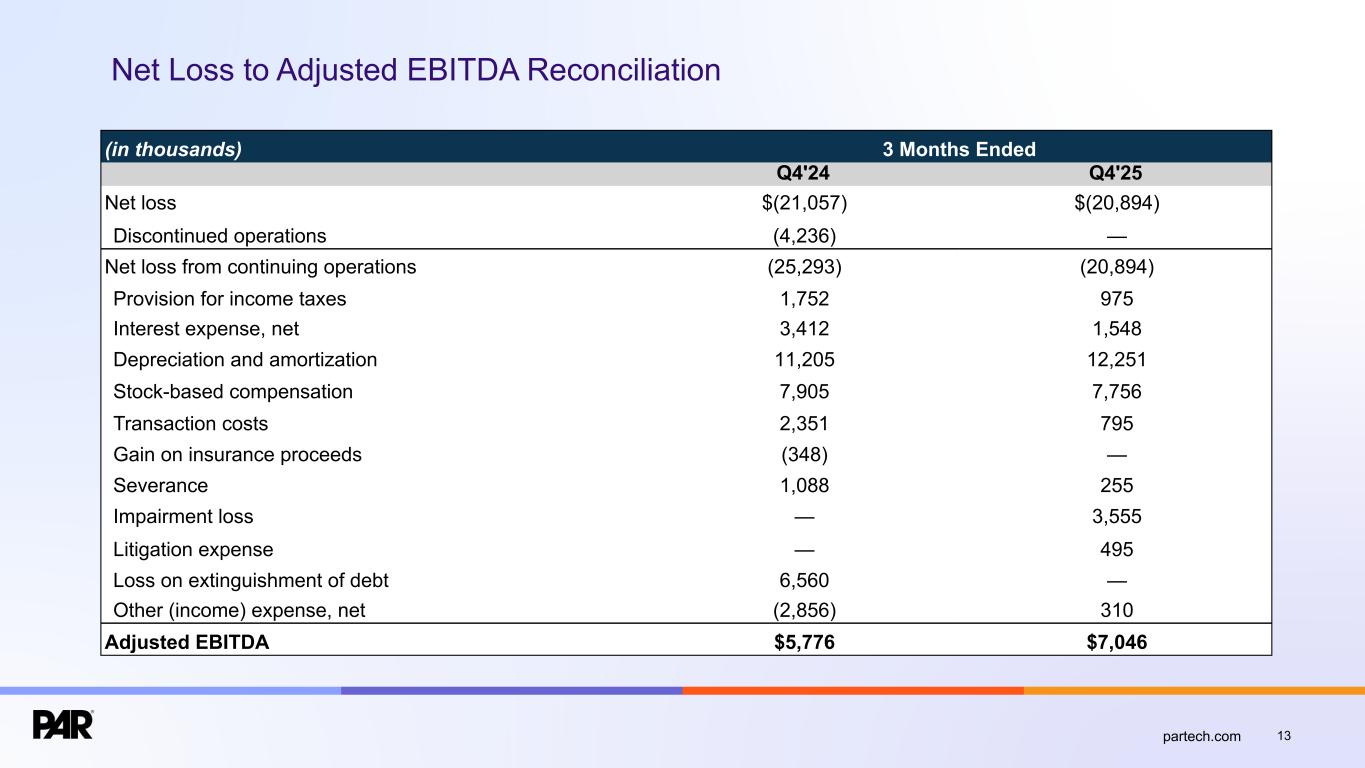
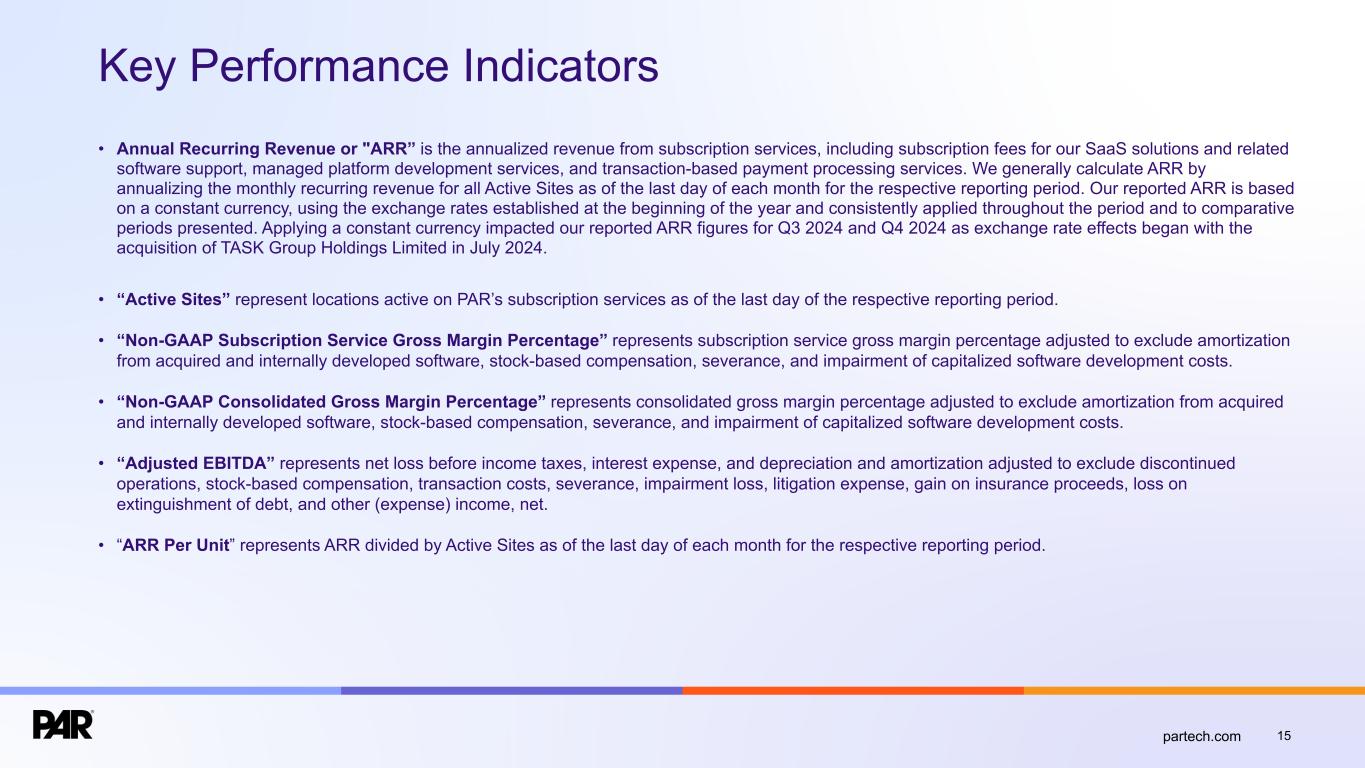
Thank you, Stephanie. Good afternoon, everyone. We closed out 2025 with our most successful quarter in recent history, from our strong bookings, incremental ARR of 17 million, and down through to our $7 million adjusted EBITDA. We continue to execute to our plan of driving organic growth across our products and the verticals we serve while also driving profit improvement. All while ensuring the company has the right resourcing to execute with excellence on our growth trajectory and an aggressive AI transformation. Subscription services continue to fuel our organic growth and represented 63% of total Q4 revenue. The growth from higher margin revenue streams resulted in a consolidated non-GAT gross margin of 61 million, an increase of 8 million or 16% compared to Q4 prior year. We managed the growth while limiting operating expenses, which has enabled us to grow adjusted EBITDA for the third quarter in a row. Now to the financial details. Total revenues were $120 million for Q4 2025, an increase of 14% compared to the same period in 2024, driven by subscription service revenue growth of 18%. Net loss from continuing operations for the fourth quarter of 2025 was $21 million, a $0.51 loss per share, compared to a net loss from continuing operations of $25 million, or $0.68 loss per share reported for the same period in 2024. Non-GAAP net income for the fourth quarter of 2025 was $2.6 million, or $0.06 earnings per share, compared to a non-GAAP net loss of $37,000, or effectively $0.00 per share for the prior year. Adjusted EBITDA for the fourth quarter of 2025 was $7 million, an improvement of $1.2 million sequentially from Q3, and $1.3 million compared to the same period in 2024. This positive movement is indicative of our ability to continue to drive growth with profitability. Now for more details on revenue. Substitution service revenue was reported at $76 million, an increase of $12 million or 18% from the $64 million reported in the prior year, and now represents 63% of total part revenue. Organic Sufficient Service Revenue grew 11% compared to prior year when excluding revenue from our trailing 12-month acquisitions. ARR exiting the quarter was $315 million, an increase of 16% from last year's Q4, with engagement cloud up 19% and operator cloud up 12%. Total organic ARR was up 15% year-over-year. Incremental AR growth accelerated in the second half of the year, and we reported a record 17 million increase in Q4. This progression reflects strong underlying momentum in the business and positions us well entering 2026. Our growth is being driven by both site growth and increased ARP, reflecting successful execution of a better-together thesis, which is driving momentum in both multi-product deals and cross-selling into our existing customer base. Hardware revenue in the quarter was $28 million, an increase of $2 million or 7% from the $26 million reported in the prior year. The increase was driven by continued penetration of hardware attachment into our expanding software customer base. Professional service revenue was reported at $16 million, relatively unchanged from the $15 million reported in the prior year. Now, turning to margins. Gross margin was $49 million, an increase of $4 million or 10% from the $45 million reported in the prior year. The increase was driven by subscription services with gross margins of $39 million, an increase of $4 million or 13% from the $34 million reported in the prior year. Subscription service margin for the quarter was 51% compared to 53% reported in Q4 of the prior year. The decrease in margin is due to an intangible impairment recorded in the current period related to the write-off of capitalized software development costs within our drive-through business. Excluding the amortization of intangible assets, stock-based compensation, severance, and the impairment loss, non-GAAP subscription service margin for Q4 2025 was 65.8%, compared to 64.7% for Q4 2024. That margin includes the impact of a fixed product contract that we acquired from one of our 2024 acquisitions, excluding that contract, which is not reflective of core operational performance. Non-GAAP subscription service margin was 71% for the quarter, an improvement of 190 basis points versus prior year. The continued improvement is a strong sign of our ability to leverage economies of scale. Hardware margin for the quarter was 23% versus 26% in the prior year. The decrease in margin year-over-year was driven by increased supply chain costs, resulting from recently implemented U.S. tariff policies and supply chain constraints, with memory components related to a significant increase in demand driven by the AI infrastructure industry. We continue to evaluate and implement pricing adjustments and modify procurement plans to mitigate the impact of supply chain cost movements on our hardware margins. We expect this environment to persist through 2026 and will continue to manage mitigation plans. Professional service margin for the quarter was 28%, unchanged from the 28% reported in the prior year. In regard to operating expenses, GAAP sales and marketing was $12 million, an increase of $2 million from the $10 million report in the prior year. The increase was primarily driven by inorganic increases related to our acquisitions, while organic sales and marketing expenses increased a modest $700,000 year-over-year. GAAP G&A was $30 million, a decrease of $1 million from the $31 million report in the prior year. The decrease was driven by a $1.5 million decrease of organic G&A expense year-over-year year, partially offset by inorganic G&A expenses. Gap R&D was $22 million, an increase of $4 million from the $17 million recorded in the prior year. The increase was substantially driven by a $3 million increase in development costs as we continue to invest to innovate our product and service offerings. Residual increase was driven by inorganic R&D expenses. Operating expenses excluding non-GAAP adjustments was $54 million, an increase of $7 million or 15% versus Q4 2024, and when excluding inorganic growth, organic operating expenses increased a modest 8%, primarily driven by an increase in R&D investment during the quarter. Now to provide information on the company's cash flow and balance sheet position. As of December 31st, 2025, we had cash and cash equivalents of $80 million. For the year end of December 31st, cash used in operating activities from continuing operations was $27 million versus $21 million for the prior year. The increase in cash use and operating activities compared to the prior year was largely attributable to increased accounts receivable. We view the increase as an interim position and expect the day sales outstanding will stabilize and pull in to historical levels during 2026. Cash use and investing activities was $13 million for the year ended December 31st versus $180 million for the prior year. Investing activities included $4 million of net cash consideration in connection with the token asset acquisition of GoSkip, capital expenditures of $3 million for fixed assets, and capital expenditures of $6 million for developed technology costs associated with their software platforms. Cash provided by financing activities was $12 million for the year ended December 31st versus $279 million for the prior year. Financing activities primarily consisted of the net proceeds from the 2030 notes of $111 million of which $94 million was utilized to repay the credit facility in full. I'd now like to take a moment to reiterate and thank our PAR team and how they managed a successful, strong second half of the year. We pride ourselves on making an accretive capital allocation decisions and through our focus on operational execution, position PAR for sustained growth and success. We are proud of what we have been able to achieve, but we are by no means content in where we stand. We need to double down on executing to our strategy as we progress to 2026. We expect ARR to continue to grow in the mid-teens, and similar to last year, the net growth will be more muted in the first half of the year versus the second half, as Savneeth mentioned. I will now turn the call back over to Savneeth for closing remarks prior to moving to Q&A.
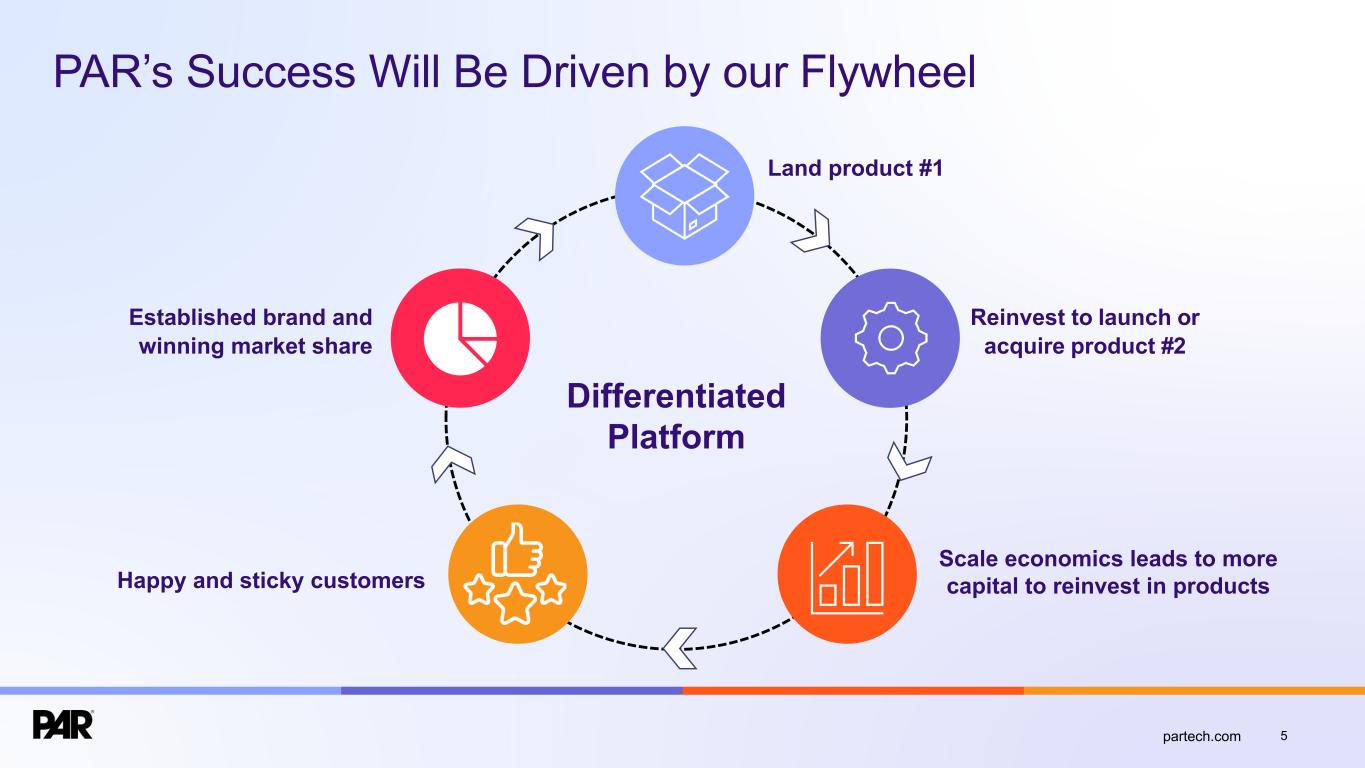
Thanks, Brian. 2025 was a strong year for PARC. After a slow start, we added record ARR in Q3 and Q4 with a large swing at EBITDA net We enhanced our platform functionality. We're first in our sector to commercialize an AI-native product in Coach AI. We won the industry's largest projects and drove multi-product attachment across near 100% of our deals. In 2026, you should expect three things from us. Continued growth momentum. We will sustain mid-teens organic AR growth at scale, driven by multi-product attachment, new logos, and deeper partnerships with our existing customers. Similarly to last year, we expect our second half will be stronger than our first half as we manage out some of our legacy low-margin customers in Q1. We preserve in-year upside from one, commercialization of new to-market AI functionality, and two, pipeline conversion of our large Tier 1 opportunities. Second, you should expect a step change in operational efficiency. We expect to eliminate roughly $15 million in annualized OpEx through AI-driven automation and the natural synergies of operating at our scale by the end of Q1. A luster of this, we've reached 100% adoption of AI across R&D teams, with a meaningful shift towards agentic development. Most of our development is now happening via agents without human involvement in code. A year ago, developers were still touching almost 100% of code generated, best driving real velocity, and we have doubled our roadmap commits into production in the last year. Third, you should expect for us to deploy parts of our operational expense savings into AI platform production. We will deliver code faster, bring to market new and commercializable AI-led products, and demonstrably enhance our workflows with unified data. RAI investments are not a hedge for our existing business, but the all-out mandate. All of this is to set up 2027 for where we want it to be, a leaner operating structure, a more powerful platform, and a product roadmap that positions PAR to real accelerate growth. PAR is only at the start of its growth runway. Our average customer uses just 1.8 PAR products from a list of six to eight core software SKUs, meaning there's at least three ex-organic upside within our base. Further, far from driving customer tech inertia, the ongoing restaurant value wars and applied margin pressures in the restaurant business favor consolidation behind a platform vendor like PAR and to move away from point solutions. Brands cannot afford to not compete across the entire operations frontier, and we are the only enterprise vendor that facilitates this. Near 100% of our deals are multi-products for a reason. Additionally, AI platform investments will naturally drive our proof expansion as customers are willing to pay for excess value. If technology unlocks a larger pie, it will be adopted with Coach AI as an early proof The food service technology market is being rewritten now, and the companies that win will be the ones with the data, the platform, the trust, and the conviction to move decisively. PAR has all four, along with a track record of execution and reinvention. We are quietly and confidently building our future. Operator, we can open the line for questions.
Operator
At this time, we will conduct the question and answer session. As a reminder, to ask a question, you will need to press star 11 on your telephone and wait for your name to be announced. To withdraw your question, please press star 11 again. Please stand by, or we'll compile the Q&A roster. Our first question comes from the line of George Sutton of Craig Hallam. Your line is now open. Thank you.
Samneet, you mentioned you never felt more confident about the opportunity set. You've not lacked for enthusiasm in the past, So I just want to put that into perspective. You can give us a little bit more clarity what you mean there.
Yeah, I think that specifically, you know, my excitement is really in the AI investments and the AI excitement from our customers. You know, as I mentioned, we really do think categorically the restaurant and retail categories are, you know, one of the best places to adopt AI technology. You know, these are businesses that are fighting extreme margin pressures, labor challenges, It is operational complexity. And I think that AI is an operational imperative for them, not a nice tool to try. And so when we see the end markets we serve, you know, open to new products, and then we look at our platform as truly the platform of choice, we really think it sets us up for an exciting opportunity to be the AI platform that our customers look to build their future Now, speaking of AI, you mentioned these large enterprise deals that you are chasing.
You are hoping that through using the AI components, you can speed up those deals. Can you just give us a sense of how that is accomplished? Many times, I know you're in pilot with these folks.
Yeah, my perspective is more that as restaurants in particular look to adopt AI faster and faster it should accelerate sales processes from vendors that can provide them those AI tools to become AI native and so I think given how much time and investment and candidly how far ahead of what we are of our peers you know could potentially accelerate some of these deals that we are you know working really hard to get done gotcha thank you very much thank you our next question comes from the line of Mayank Tandon of Needham your line is now open Thank you.
Good evening. Saviv, could you speak to the state of the restaurant market? I ask because it seems like the traffic data is pretty mixed right now, but same-store sales have still been fairly healthy given some of the pricing leverage restaurant chains have. How does that square with what you're seeing on the ground in terms of demand for your products? Should we be looking at that as maybe a signal of how demand would impact you, or is that maybe not that linear tie-in or correlation, rather?
I don't think it's linear yet, but I think it is moving linear to the upside for us in the sense that this is a complicated environment for restaurants. You've got, you know, ostensibly flat to declining traffic for most. You have a value war. You've got cost pressures from labor in your cost inputs through inflation across food stuff. And then you've got massive, massive challenge to win a new digital customer. And all of that screens for you to make the investments to win in that environment, not to pull back. And so we think it's the perfect environment to sell, and we think it's even a more perfect environment to use AI to bring these products together. Just imagine what I just described to you. How in the heck, if you're running one of these great brands, do you expect to run a clean operation when you've got different tools running, your online ordering, your loyalty, your drive-through, your digital exposure through loyalty and social media? But it's really hard to do that. And I think this environment where there's extreme pressure on bringing guests in the door and extreme pressure on bringing costs down is a really, really great environment to be a vendor in, provided we can provide them the value to make their operations more So we think it's a great timing. As far as, you know, direct trends, we are seeing, I think, a stabilization. I think the first half of last year was very painful for our restaurant customers, Q3 was a little bit better. in Q4 we saw stabilization really good holiday traffic numbers I think as you're seeing from some of the companies reporting it's still mixed but you know we're not seeing those extreme drop-offs we saw last year which is I think it makes me hopeful that that we're kind of past that period of time that's good to hear now for my follow-up I wanted to just ask about how the ERR guidance we can call it that squares with what you would expect on the subscription growth side in terms of, you know, the trajectory over the course of the year, and the same question would be applicable to your margin aspirations for 2026, you know, how should
we expect that to trend, and can you provide a little bit more color maybe on sort of where you would look to exit the year, if you could share that?
Yeah, I think that, you know, we – similar to last year, our first half will be slower than our second half. Our second half is looking to be extraordinarily strong right now from book deals that we have, and so feel very good about the second half. The first half will be a little bit slower. In Q1 and a little bit of Q2, we are, as I mentioned, you know, leaving legacy brands that are generally not paying the value for the services that we have, which will lead to us having higher margins over time. And even with that, we feel really confident in getting to the mid-teens growth. And as I mentioned, I think we've got a couple of nice levers to expand beyond that with first, some of these new AI product launches, and second, the large tier one opportunities. And so, you know, we guided to the mid-teens, and obviously there's upside there, but we want to make sure we give you something we can hit. And, you know, the margin flow-through will come through, you know, very similar to last year's, you know, margin profile. So, you know, I expect the growth to be the driver of margin there. And, again, upside there, dependent upon how we deploy the savings I mentioned on the OPEX side. You know, as far as an exit, you know, we expect the exit rate in Q4 to be, you know, meaningfully, meaningfully higher than Q1 or Q2. We are, you know, we haven't given guidance, but, you know, we expect that to be, you know, very, very significant, getting us, you know, pretty close to the, you know, run rate margins we want to get to as a company over time.
Got it. Thank you for taking my questions. Appreciate it.
Operator
Thank you. Our next question comes from the line of Stephen Sheldon of William Blair. Your line is now open.
At a high level, I guess, what do you see in terms of the restaurant that are willing to make software changes and decisions right now? It seems like you've had a handful of encouragements completely with Papa John, some others. So is it becoming a better environment for customers to make decisions on what to do with their front of house and back of house software, even with uncertainty around too much spending environment? And does that work any different in the mid-market versus enterprise?
And you were cutting a little bit in and out, so Stephen, I'm going to take some liberties in guessing what you were saying, but I think that it's a great environment right now to be in our category. As I mentioned, we had record bookings last year ahead of our expectations. You know, it was really, really exciting to see what was happening in Q4, and we expect that to continue. And we are definitely seeing that in the larger chains. You know, we are continually surprised how many large chains are coming into the funnel, And I do think that is because some of the macro challenges that you mentioned, but the last caller mentioned as well, where, you know, brands really do need to figure out how to increase frequency, but also cut costs, and we're a great solution. I think the other, you know, core secular driver, though, is AI. I think there's not a brand in the world that is not exploring ways that they can leverage their data better. And we, you know, through luck or design, are really the only platform that can give that holistic view both front and back of house. And so to your question on, you know, where are we seeing it in front and back of house, you know, we're seeing it everywhere. You know, both our engagement side and our operator side grew really strongly last year. We are seeing it a little bit more in the operation side of our business right now, where brands are really going aggressive on upgrading the foundation of technology, that back of house, if you will. But the front of house is not slowing, but we are seeing a little bit more there. In terms of, you know, are we seeing the mid-market or the enterprise, I would say we're seeing more pipelines created from the large enterprise, but the medium enterprise called the chains that are, you know, a couple hundred up to a thousand, you know, are moving as well. But I think there's a little bit of, you know, the larger chains have the budget to make those investments. But we are seeing broad-based adoption, and I don't know if I'm comfortable saying it's more here or there. I just think we're seeing it, you know, everywhere at the moment.
Got it. Very helpful, and hopefully you can hear me. On the – I think the other thing I wanted to ask about was in R&D, I think you talked about a $3 million increase in development costs. So, can you give more detail on that and what drove that higher, and specifically is that tied to some of the Tier 1 opportunities you're pursuing?
So, you know, I think it kind of comes in a few buckets. So, the first is, you know, we're making some pretty aggressive investments into AI, as you heard. We've already launched, you know, two products, soon to be three, and we'll continue to push that going forward. You know, it is not whitewashing. It is not, let's put it in their face. These are real products that drive real value that we are charging for. These aren't, hey, we're now an AI product and it's the same price. And so, there's a real investment going on there. A second part of it is, you know, when you're pushing into these large Tier 1 opportunities, There's more investment for us because these are categories that we have not been in before. For example, we were growing into pizza, and that is a new space for us. Entertainment is a new space for us. And at the same time, the configuration and changes needed to go after these new potential opportunities is important. And the good part is all that is reusable across others in that category. So that's the second part. And then the third part, you know, we aren't making investments to modernize every product at par. And so, you know, we built a really nice moat and a really nice lead, but we think the worst thing we can do is kind of sit here and do nothing. Now, if you look collectively, our R&D expense is still 25% of sales, which we think is, you know, a very comfortable position to be in. But, you know, we really do have the reinvestment arm going on, and it's only because we see so much opportunity in front of us today that, you know, candidly, you know, wasn't there 18 months ago, particularly as related to AI. Very helpful.
Operator
Thank you. Our next question comes from the line of Samad Samana of Jefferies.
Your line is now open. Hi, guys. This is Jeremy Scheller. I'm for Samad. Thanks for taking my questions. I guess first on the Papa John's, you called out intracorder that you're expecting an R-approved around $4,500 per store with price escalators. Are these stores below list price and the escalators are getting them back up the list, or are the escalators set to take you above the typical list price? And then I know you called out, you know, you have the opportunity to expand the deal with additional products. Should we expect something similar to the Burger King win where it can happen in the intro rollout? Or is this maybe, are you just speaking of a future opportunity, just kind of more green field?
So, it's market pricing for us. So, you know, I think it's great. We got really good pricing here. We're really happy with it, and I think that Papa John's, importantly, is equally happy with it. It's part point of sale and part back office. So, you know, good, high-quality deal for both of us. So market pricing. And, you know, our escalators are pretty normal now with any contract that we have, so very much in line with, you know, the brands we're signing today. As far as, you know, future opportunities, you know, we sort of see two direct, you know, potential opportunities. The first is, you know, potentially upselling the brand on other products we have. You know, that could be ordering. It could be payments. It could be, you know, all sorts of stuff that we've got, the AI products that I mentioned. And the second, you know, avenue for opportunity will be international expansion. As we continue to internationalize core parts of our product, we want to, you know, and are pushing to try to win some of the international markets that they operate in.
Great. That's great, Keller. And I have to think about the mid-teens ARR guidance. Can you help us unpack how much of that is coming from new locations versus cross-seller products? And then I know you guys have some large renewals coming up, legacy renewals coming up, and there's an opportunity to take price there. How much is coming from that as well?
Yeah, I think we're probably 70-30 new logo versus, you know, existing customer. You know, a lot of it will depend on, you know, some of the roll-offs we have towards the end of the year, but it's probably 70-30 from new product to extension, which is an incredible change for PAR. As you probably remember, for years it was 100-0. So, you know, clearly the cross-cell and co-cell muscle has really changed.
Thanks for taking my questions, guys.
Operator
Thank you. Our next question comes from the line of Andrew Hart, BTIG, the line is now open.
Okay, thanks for taking my question. Congrats on the shared buyback authorization. I guess if you could just talk about maybe how you feel about the balance sheet, you know, how do you plan to deploy that $100 million authorization? And I guess it also leads to, you know, what you're thinking about profitability and EBITDA margins continuing to scale for this year as well.
Thanks, Andrew. You know, we want to have the optionality to, you know, return capital to our investors in every which way possible. And you know, the prices that our shares are trading, you know, we don't think make a ton of sense given the opportunities that the white space and the long-term growth we see in front of us and obviously the margin profile we want to get to. And so we want to make sure that we have that tool to operate and ensure that our shareholders are getting the best return. And so as we look to allocate capital, we sort of first look at what are the organic opportunities in front of us, because those are ones that we have tons of control and data to look back at. We'll look at the inorganic opportunities in front of us, and then we'll look at, you know, buying back shares. And so we want to make sure that we have the ability to do all three and figure out where we can get the highest return. You know, we expect, you know, a strong year this year, as I mentioned, the second half, you know, we're going to have a, you know, a very, very strong year, cash generation, and so we want to make sure we're prepared to be in the market when and if we see these disruptions that we've been seeing, because we don't think it makes a lot of sense and completely understand a lot of the AICers, but, you know, as a company that, you know, we truly expect to be a net winner in this AI market, you know, we think it's important that we eat our own cooking.
Thanks. And then kind of a two-part question on growth. You said in the fourth quarter, the PARPOS kind of results significantly exceeded your internal expectations. So, I would like to kind of hear where that came out of or what it was that drove that. And then when you think about 2026 growth, let's just call it, you know, mid-team, so call it 15%, and it's a bit slower in the first half and then faster in the back half. I guess, How much of that, call it 15% for the entire year, is, you know, stuff that you feel really good about versus how much do you need, you know, some wins that you're tracking on to come across the finish line?
I would say the majority of our plan for the year is pretty much there. There's not a lot of go-get for us in our model right now, which is why, you know, I mentioned sort of the upside to our model is to, you know, get incremental adoption of our new AI products and, you know, potentially the bookings of large Q1 opportunities we're working on. So, you know, a good portion of that is booked and planned. Now, listen, things can change. We could screw up, so on and so forth, but we feel pretty good about the visibility that we have there. Great. Thanks, Amit.
Operator
Thank you. Our next question comes from the line of Charles Nopon of Stevens. Your line is now open.
Hi, good afternoon, and thank you for taking my question. Stephanie, I appreciate the comments around the supply chain and hardware, given some of the price inflation and the chip market. But my question there is, are you seeing any impact on RFP activity from higher hardware costs, or are you seeing restaurants and operators still willing to upgrade their software while maintaining their hardware?
Great question, Chuck. So short answer is we're not seeing any impact yet on the revenue side. In fact, you know, as you can see, we've had a really good revenue year last year for hardware, and I hope that continues this year. So, you know, it is not slowing down refresh cycles, whether those refresh cycles are tied to software upgrades or to net new, you know, just refreshing hardware, not refreshing software. But we are seeing on the cost side, you know, where our margins were mid-20s, you know, I think we expect margins will be, you know, 20%, 21% from a hardware perspective. So, you know, not the end of the world, but the increased volume has helped us, you know, offset the gross dollars. You know, if prices continue to spike very, very meaningfully, it could potentially have an impact on our customers wanting to, you know, maybe hold off until they saw pricing come down. But, you know, we have not seen that. And these pricing pressures have started since April, you know, since the tariff started, you know, April of last year. And so we've had a pretty strong demand year even with that in place. But you know, we're monitoring it very carefully. And it's just so hard to predict, you know, month to month, even week to week. And so as we mentioned, as Brian mentioned, we're putting a lot of mitigation activities in place from reconfiguration to accelerated buying to ensure that we don't have any disruptions. And the reason we're focused on disruptions is we haven't seen a slowdown in demand.
And I would just add to that as well, too, right, is mitigating plans are not only to manage at the margin on the hardware, but we're also making sure, too, as part of the plans that we have optionality to make sure that there's no impact in regards to our software growth and rollout, right? So we do have – we are still hardware agnostic, but a lot of our customers want the attachment because they want the one vendor because we could service everything, right? But we do also have that optionality to give them what they need from the software standpoint and still have flexibility as to what hardware they're using. And so that may play into it as we go forward. And so we're managing both of those, and we're making sure it does not impact the software side of the house.
And as a follow-up, I wanted to ask about profitability as we think about our EBITDA estimates for the next couple years. I know not all the ARR from this year is going to flow through to EBITDA, but in the past you've talked about roughly a 70% to 75% flow through to the EBITDA line from ARR, based on roughly flattish OPEX. Is there any reason to expect a deviation from that framework, or is that still a fair way of thinking about it?
Certainly, we sort of, you know, talked about subscription services, ARR, at around 70% gross margins. Brian mentioned, I think it was 71% when you exclude, you know, the one business unit. And then, you know, incremental, we've always had, you know, we expect 20 cents of incremental or 20% incremental cost, although we haven't had that because the OPEX has been relatively flat. You know, I don't think those trends change meaningfully, although, you know, we will see some investment in R&D this year. Again, not, you know, game-changing amounts, but we really do want to continue that AI investment. And so I think the sufficient services margins will continue to hold, and you'll continue to see the, you know, the gross profit dollars be there to support, you know, EBITDA growth and to cover any investment that we're looking at.
Got it. Appreciate the color. Thank you.
Operator
Thank you. Our final question comes from the line of Maxwell Michaelis of Lake Street Capital Markets. Your line is now open.
Hey, guys. Thanks for taking my question. Just one from me. If we look at – actually, I got two. If we look at the bridge technology acquisition you guys made last month, I know you guys are – you guys are going to see around $15 million of OPEC savings in 2026. Are you guys looking to invest in that platform at all?
Of course, we're going to invest in it, but that is not going to be a cash burn within We've kind of budgeted for it to be profitable within PAR. Now, if we see a ton of opportunity and we see a lot of opportunity, we will, but we budgeted it for it to be profitable within PAR and think it will, and the early customer feedback has been really excellent.
And I think we'll be able to speak more to it. We'll be able to speak more to it when we get through that next quarter's earnings call right as we're closing on that in the near future. So, we are definitely excited about how we can leverage that platform within our existing.
And then I guess if we just stay on the M&A trend, I mean, is that – I mean, how – if you were to rank it in terms of capital allocation in 2026, I mean, how does M&A rank in 2026 versus the share buyback and other areas of investment?
It's always at a point in time, you know, today, you know, we, you know, are disappointed with our stock price and so I think, you know, it's very, the bar for M&A is very, very high. You know, Bridge was a special opportunity for us. You know, we bought it for, you know, roughly two times ARR, an ARR that we expect to grow that's profitable, and so kind of really helping us complete a product suite of having both loyalty and non-loyal guests data in one platform that allows us to build a CDP and do a lot more going forward. So it was very strategic from a product perspective, and then a good price. You know, we're always looking at stuff, but, you know, I think M&A is lower on the priority list given where our stock price is.
Operator
Thank you. I'm showing no further questions at this time. I would now like to turn it back to Chris Burns for closing remarks.
Thank you, Stephen, and we want to thank everyone for joining us today on the call. We do look forward to updating you further in the coming weeks. Please have a nice evening.
Operator
Thank you for your participation in today's conference. This does conclude the program. You may now disconnect.