Operator
Good day and welcome to Reinsurance Group of America First Quarter 2025 Earnings Conference Call. All participants will be in listen-only mode. After today's presentation, there will be an opportunity to ask questions. Please note that this event is being recorded. I would now like to turn the conference over to Jeff Hopson, Senior Vice President of Investor Relations. Please go ahead.
Speaker 1
Thank you. Welcome to RGA's first quarter 2025 conference call. I'm joined on the call this morning by Tony Cheng, RGA's President and CEO; Axel Andre, Chief Financial Officer; Leslie Barbi, Chief Investment Officer; and Jonathan Porter, Chief Risk Officer. A quick reminder before we get going regarding forward-looking information and non-GAAP financial measures. Some of our comments today may contain forward-looking statements. Actual results could differ materially from expected results. Please refer to the earnings release we issued yesterday for a list of important factors that could cause actual results to differ from expected results. Additionally, during the course of this call, the information we provide may include non-GAAP financial measures. Please see our earnings release, earnings presentation, and quarterly financial supplement, all of which are posted on our website, for a discussion of these terms and reconciliations to GAAP measures. Throughout the call, we will be referencing slides from the earnings presentation, which, again, is posted on our website. And now I'll turn the call over to Tony for his comments.
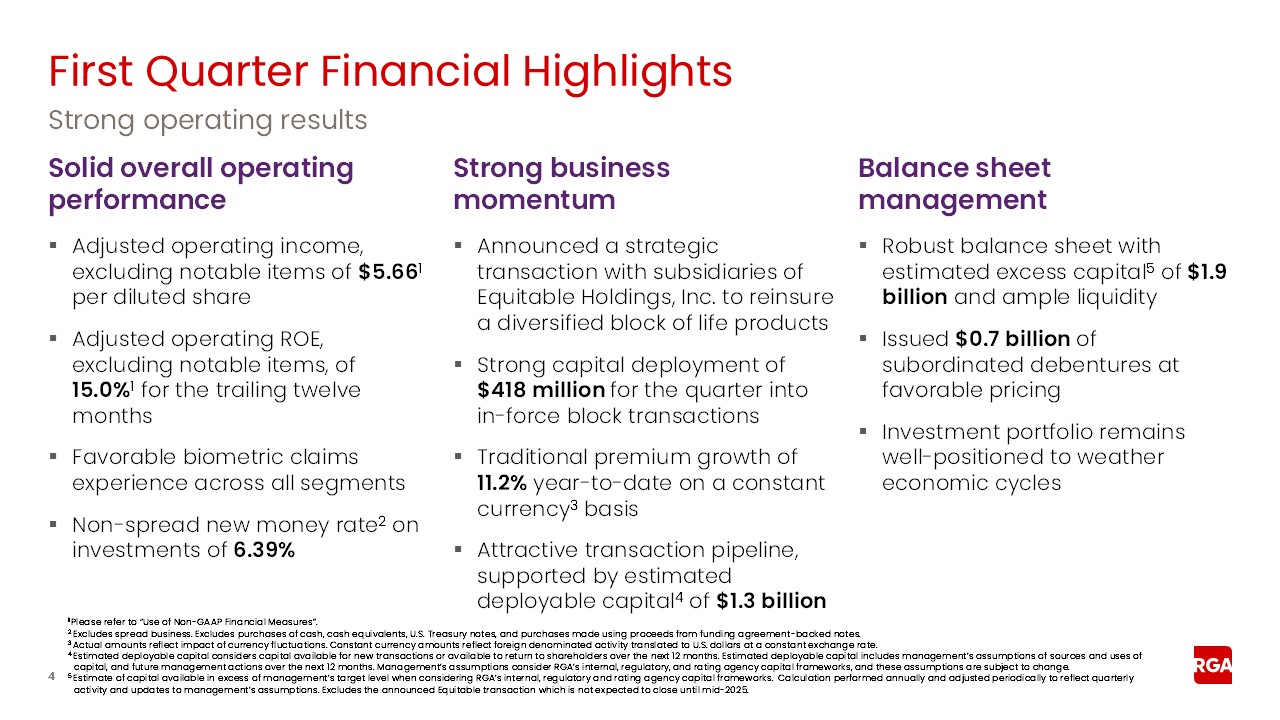
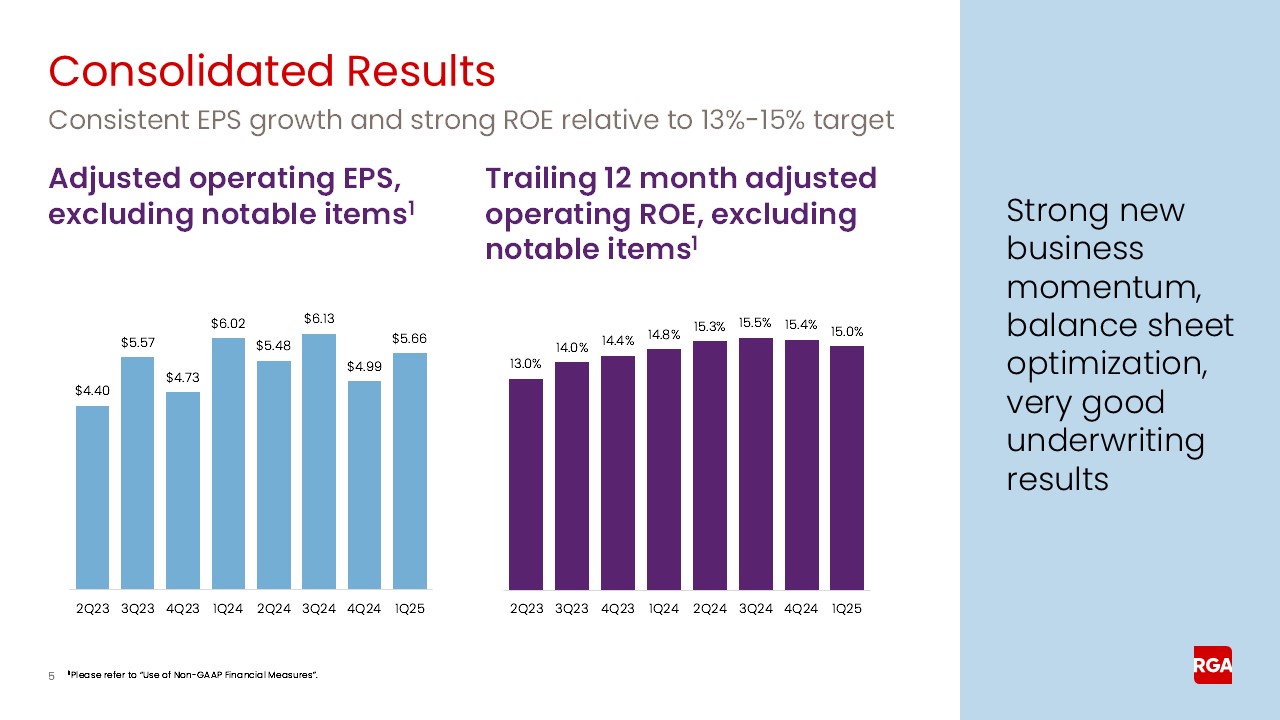
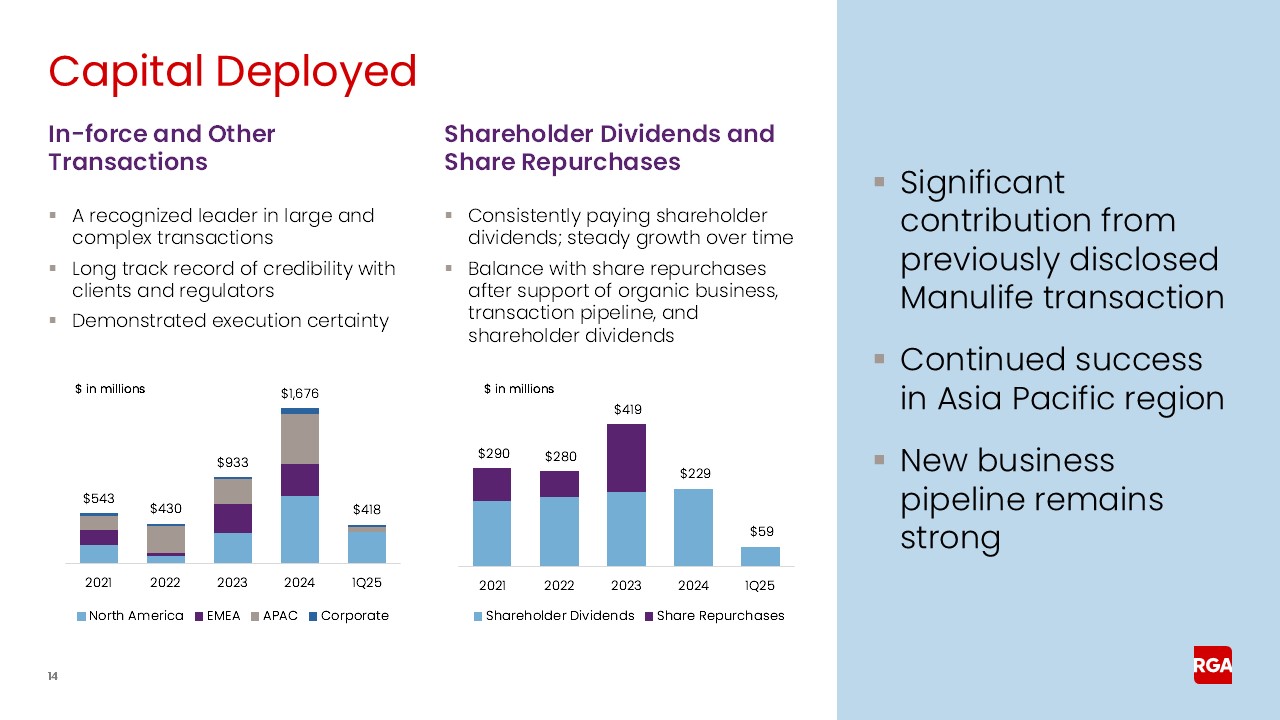
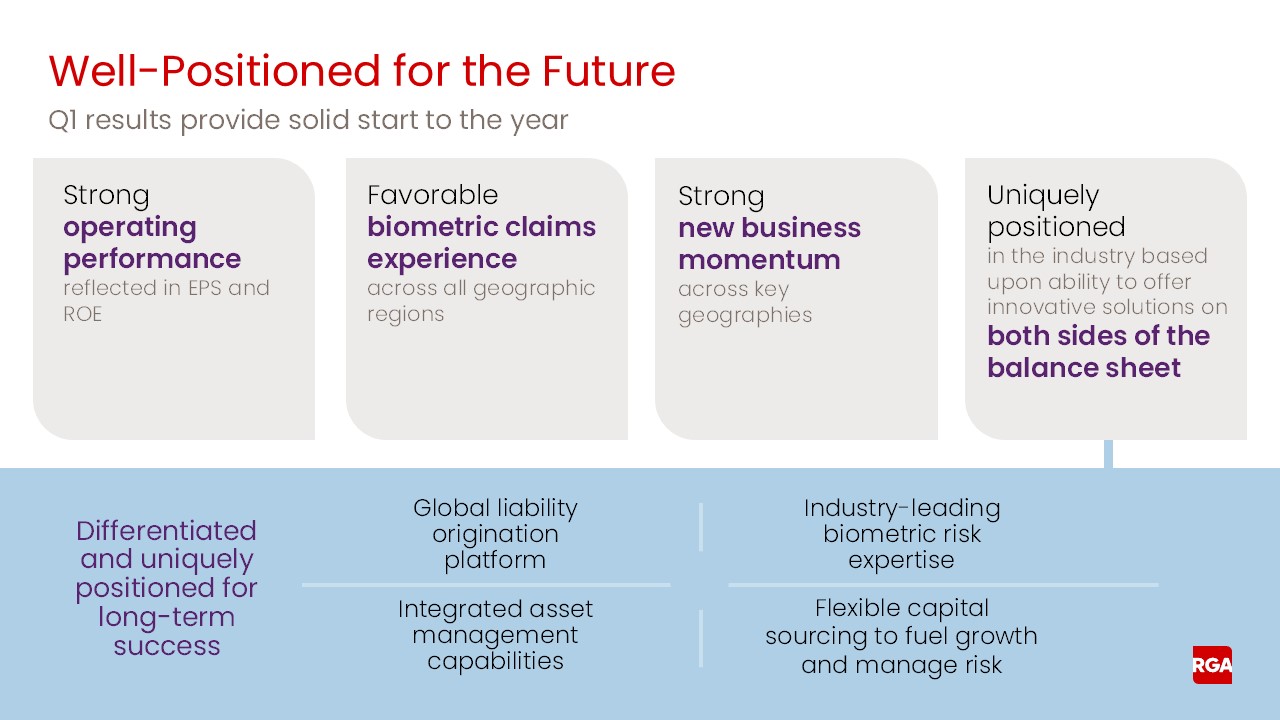
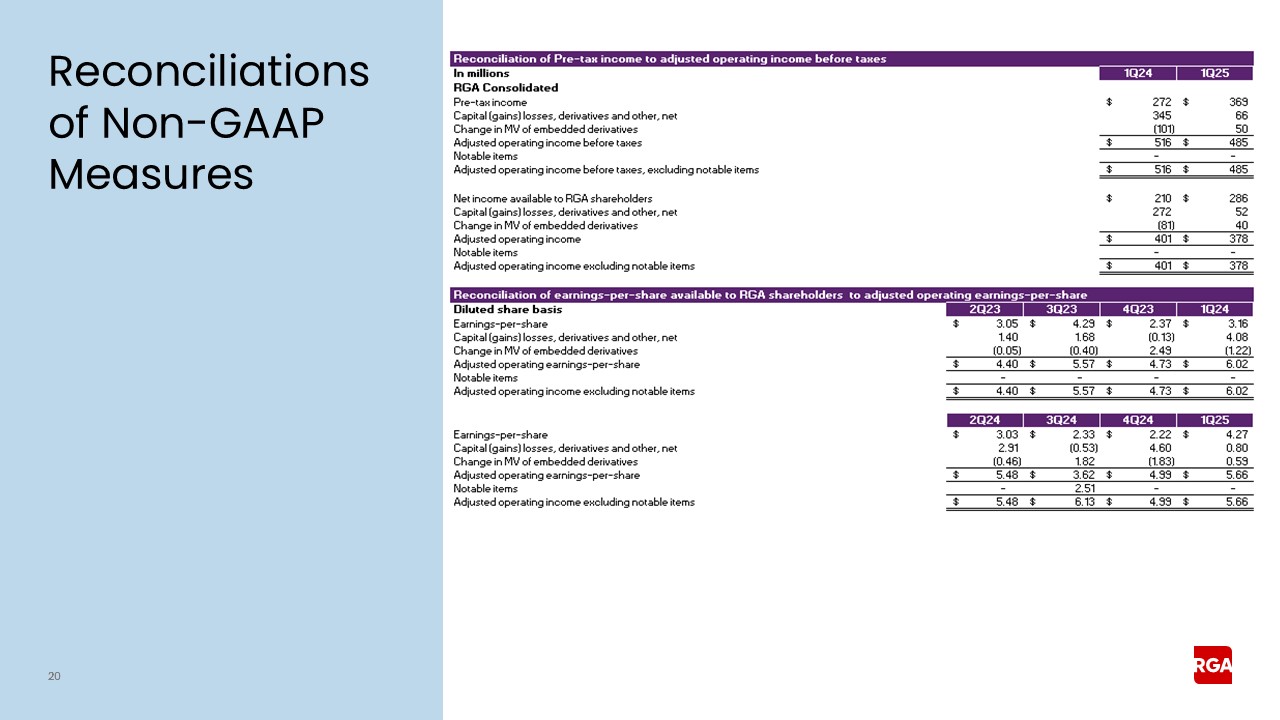
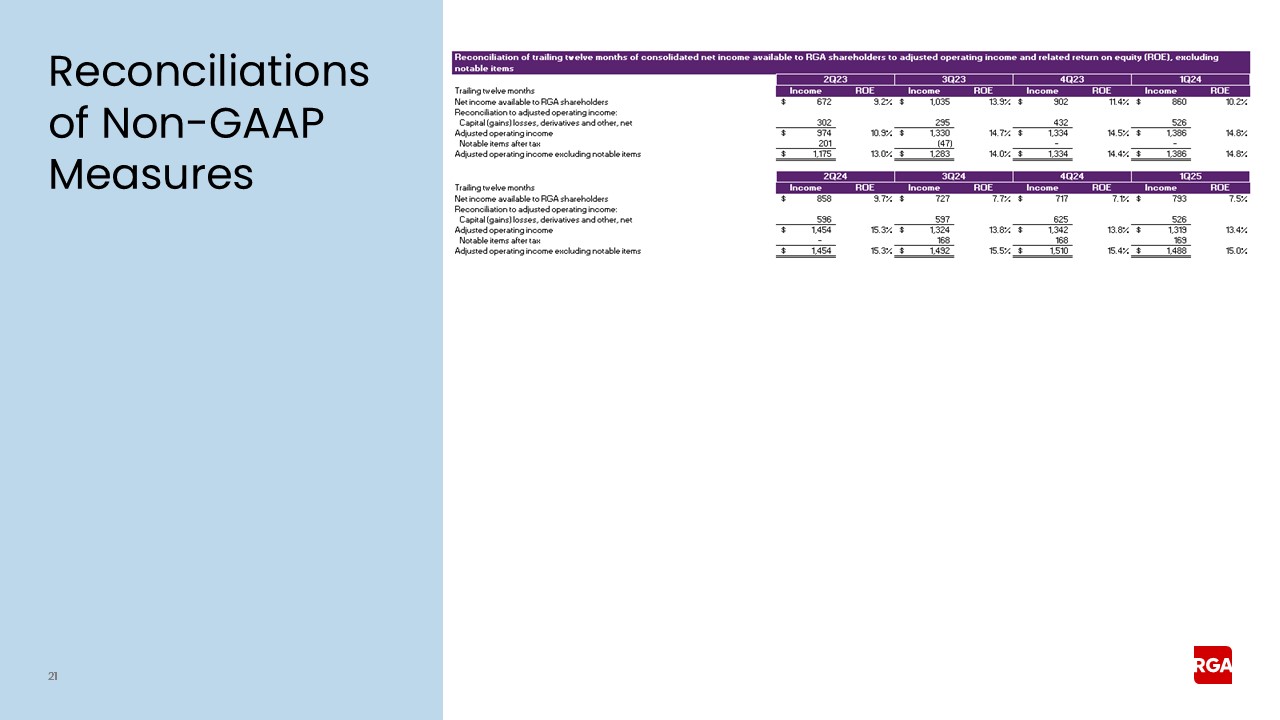
Good morning, everyone, and thank you for joining our call. Last night, we reported adjusted operating earnings of $5.66 per share. Our adjusted operating return on equity, excluding notable items, was 15%. I consider this to be a very good quarter, and it provides a strong start to the year. We achieved these results through a balance of strong performances across many of our geographic regions and products. The most significant driver of the results was the favorable claims experience, which is a continuation of our strong underwriting results over the past couple of years. Despite ongoing macroeconomic uncertainties, we are not seeing a significant impact on our business. Our asset portfolio remains well-positioned, and our capital position remains strong. Therefore, we are highly confident we can successfully navigate the current environment without losing any of our strong momentum. I am very proud to announce that for the 14th year in a row, RGA was number one in terms of the NMG Consulting's Business Capability Index, with particular strength in underwriting, actuarial, product innovation, and relationship management. We believe the backbone to our success is our biometric expertise. In other words, we are second to none in terms of pricing, underwriting, and ongoing risk management of mortality, morbidity, and longevity risks. As you know, this expertise either directly leads to more biometric reinsurance or indirectly is our key differentiator in the asset-intensive blocks that we pursue. Our biometric expertise has also led to strong claims experience over RGA's history. Since the end of 2022, our cumulative underwriting claims experience has been highly favorable compared to expectations. And finally, with regards to this quarter, all of our key geographic regions reported favorable claims experience on both an economic and GAAP income statement basis. In terms of in-force transactions, we had a strong quarter, with $418 million of capital deployed. This includes the previously announced Manulife deal that closed at the beginning of the quarter, as well as two more modest-sized strategic transactions in Asia. Additionally, in February, we announced a strategic transaction with Equitable. The actual capital deployment for this deal will be recorded when it closes, which is expected mid-year. As a reminder, this transaction is in our wheelhouse of mortality risk, and we expect the financial returns to be within our targeted range. I will now provide details on some of our new business activities in the quarter, focused on our four areas of notable growth. In Asia Traditional, we had a strong quarter in terms of new treaties, with all markets performing well. Importantly, nearly all of its success is related to Creation Re product development initiatives. Creation Re refers to our ability to partner with clients on a more exclusive basis to deliver new products and create greater value for both our clients and RGA. These partnerships have allowed RGA to grow together with our clients, and in many cases, help them win industry awards and gain market leadership. For RGA, this leads to quality repeat business and also larger transactions as our clients grow in scale. This is best illustrated by the fact that since 2021, the new business embedded value per transaction for Asia has tripled in size. This is due not only to larger-sized transactions but also due to higher expected underwriting profitability as we create new products with little competition. More strategically, each new product not only leads to more business, more data, and a stronger brand but also deepens our library of solutions. These solutions are then adapted and replicated across different markets, creating further new products, and the Creation Re flywheel continues. Let me highlight this with our largest traditional business in Asia. The Hong Kong underlying life insurance market remains very strong, achieving record sales in 2024, increasing over 21% from 2023. This is due to the rapid growth in mainland Chinese visitors buying insurance, the aging population, and Hong Kong being a major high-net-worth wealth management center. In response to these trends, we recently launched three new initiatives. The first is our simplified issue critical illness product catered to the senior market. Second, we continue to be highly successful in delivering the more complex underwriting services needed for the high-net-worth segment. And third, we developed the MedScreen+ underwriting system, which simplifies the process for mainland Chinese visitors coming to Hong Kong. This underwriting system won its second award during the quarter and is fast being recognized as a competitive advantage for our clients. These innovations drive the Creation Re business in Hong Kong, lead to deeper market penetration, and further create our library of solutions that we tailor for other markets with similar needs across Asia. Moving to Asia financial solutions, our second area of notable growth. We closed two block transactions in Japan. For both these transactions, RGA has had a long-standing relationship for more than a decade. Japan is one of our most exciting business opportunities as a result of the new ESR capital framework. Our local teams not only provide quotes on a timely manner but also provide the after-sales service in the local language and adhering to local cultures. We feel this gives RGA a distinct edge in this market segment. We, of course, tremendously value the large marquee transactions, but as importantly, are these more frequent modest-sized blocks that play towards our sweet spot of biometric expertise and strong local teams. These more modest-sized transactions are often completed without an intense bidding process, and RGA, with its many touchpoints and long-standing relationships, is best positioned to benefit. Our third area of notable growth is the longevity and PRT market. Starting with the UK, we expect strong levels of PRT sales once again during the year. Similar to Japan, our local UK team has, in my view, a comparable combination of expertise, data, relationships, and experience in the longevity market, which is why they have long been the market leader. Similar to Hong Kong, we have a market-leading underwriting system for the individual retail annuity segment that ensures we win more than our fair share of business. Our pipeline remains very strong, and we expect another successful year. The U.S. PRT market has been less vibrant recently, which may be reflecting the effects of market uncertainty, resulting in less deal activity at the upper end of the market. We do expect this to be temporary and for the market to recover, and we remain very bullish on this business line. Finally, in the U.S. traditional area, our fourth area of notable growth, we have had another active quarter as we added a number of new treaties, most of them related to our underwriting initiatives. As demonstrated with the Equitable transaction, we not only do large block transactions but also provide product development and underwriting outsourcing services to support new business. When you couple this with our partners that provide distribution technology and other services, it is clear that together we bring holistic solutions, generating exclusive business for RGA. I trust you can see our business playbook of creating and perpetuating the Creation Re flywheel is very consistent across the world. Strong local teams learn from each other and are empowered to partner and deliver unique solutions for our clients so that we can grow together and become market leaders. Through our global network, and often with the same global client, we then spread and adapt these new solutions to different markets, creating more new solutions, and the virtuous cycle continues. This business generates greater value for our clients and higher returns for RGA. We have executed this strategy ahead of schedule over the past two years, resulting in more than 50% of our new business coming from Creation Re over this period of time. Continuing this success will provide a tailwind to our current ROE levels once the earnings power from this new business fully materializes. With regards to in-force management actions, as we have discussed previously, in addition to attractive new business, we are able to enhance ROE and earnings through our balance sheet optimization strategy and other management actions and levers. This is very much part of our business but is lumpy in nature. The impact of in-force actions was modest in Q1, but we continue to move forward on a number of initiatives that we expect to help drive higher returns over time. Looking forward, we continue to be very optimistic about our business due to our strong focus on being disciplined. We have a strong strategic discipline of sticking to what we know and what we are great at. Just as important is our risk-taking and being patient for the right risk-return trade-off to emerge. The third important area of discipline is capital management and finding efficient new sources of capital. As we know, building a sustainably successful business takes a total company effort. By applying this disciplined approach with our culture of collaboration and innovation, we are very optimistic that we will continue to deliver on both growth and attractive ROEs. This is even more important during the current period of heightened uncertainties in the macro environment. Our disciplined, proactive business approach and acceleration of the Creation Re flywheel mean RGA continues to be nimble and we are well-positioned to take advantage of the new opportunities that often arise during uncertain times. Thus, it is without doubt that I remain fully confident that the best is yet to come. I will now turn it over to our CFO, Axel Andre, to discuss the financial results in more detail.
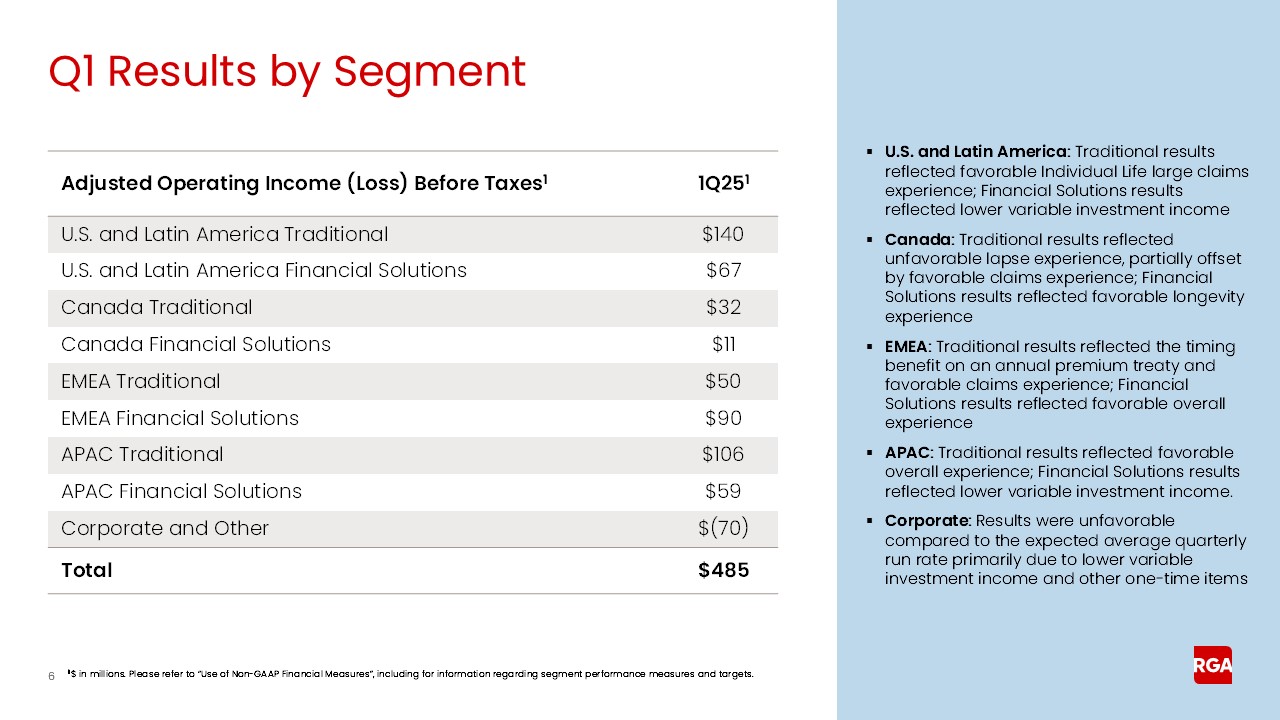
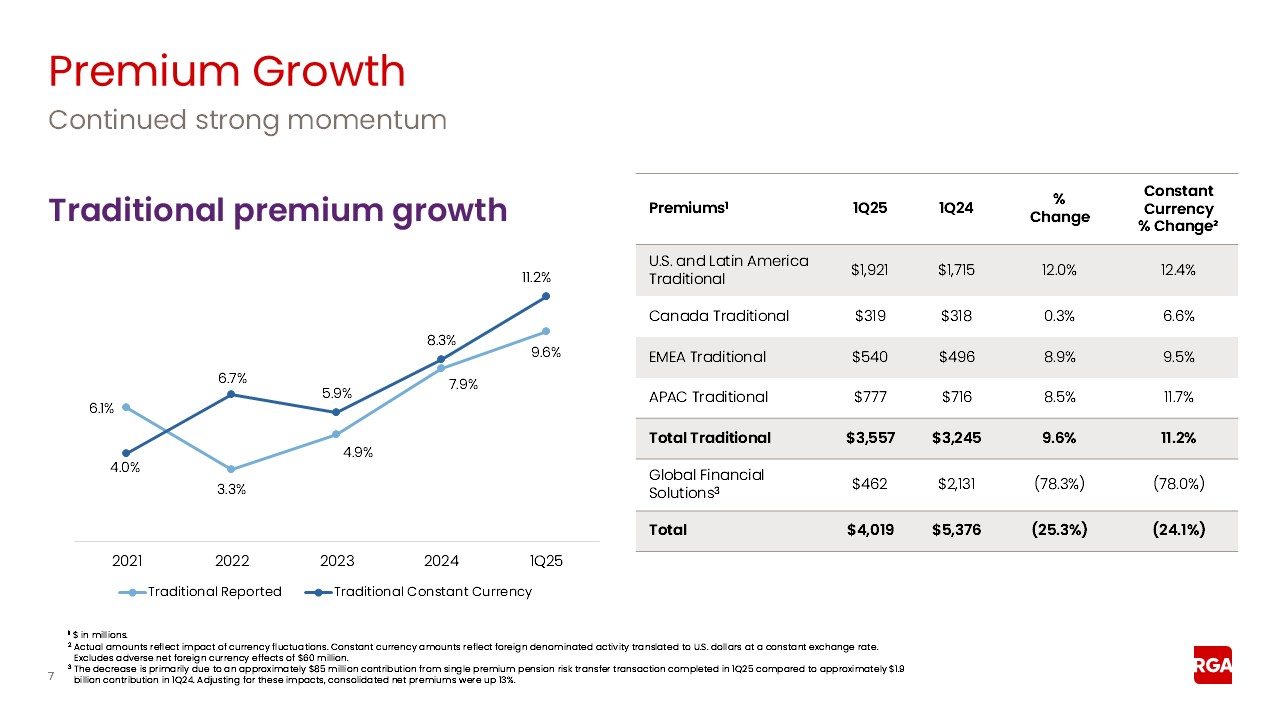
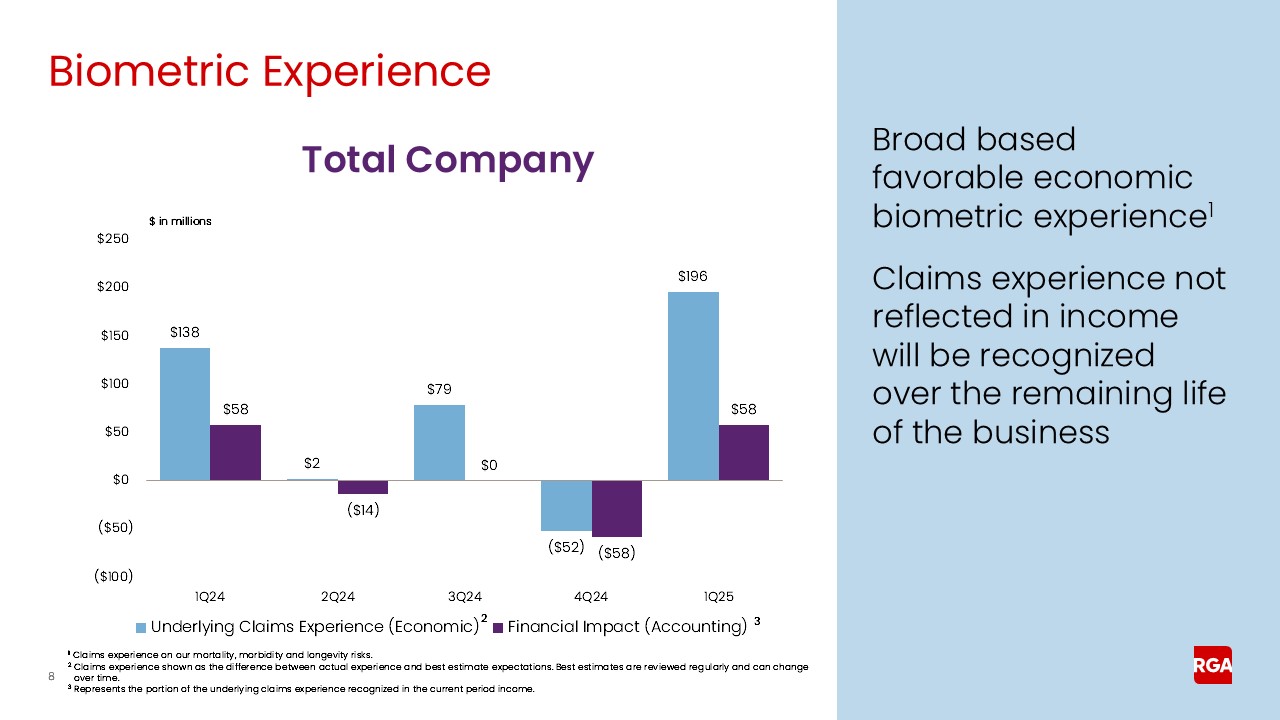
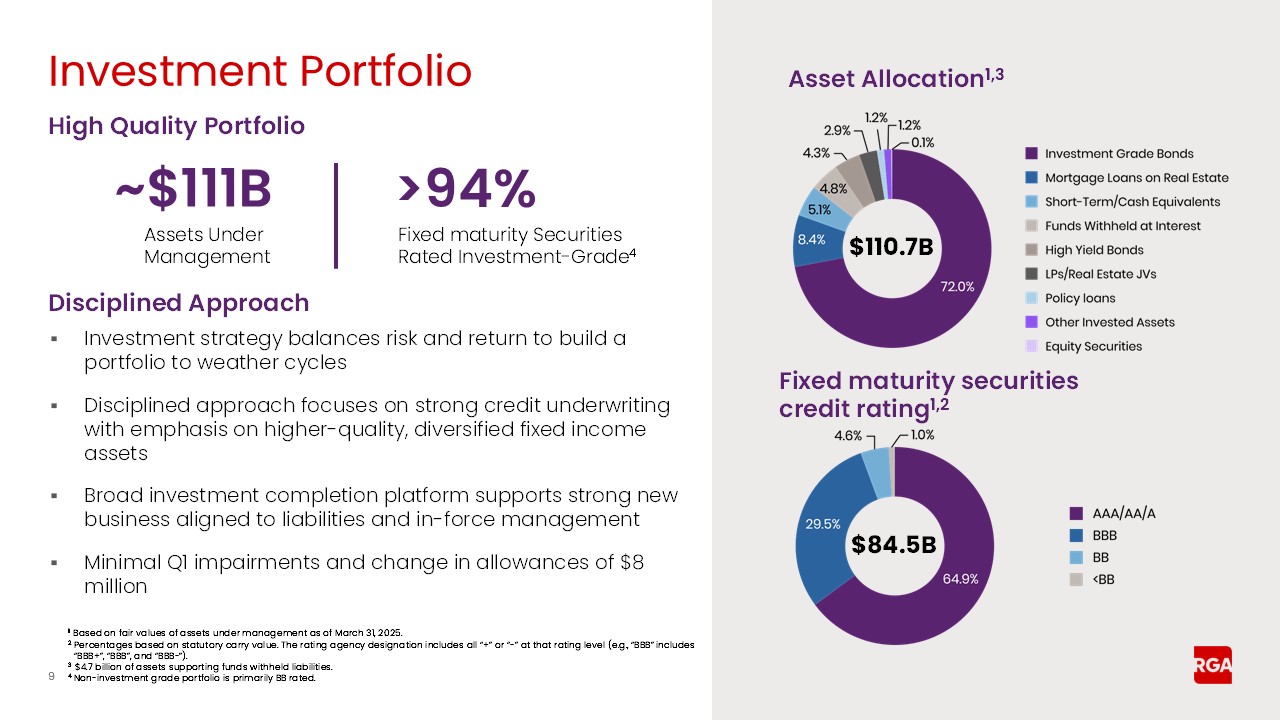
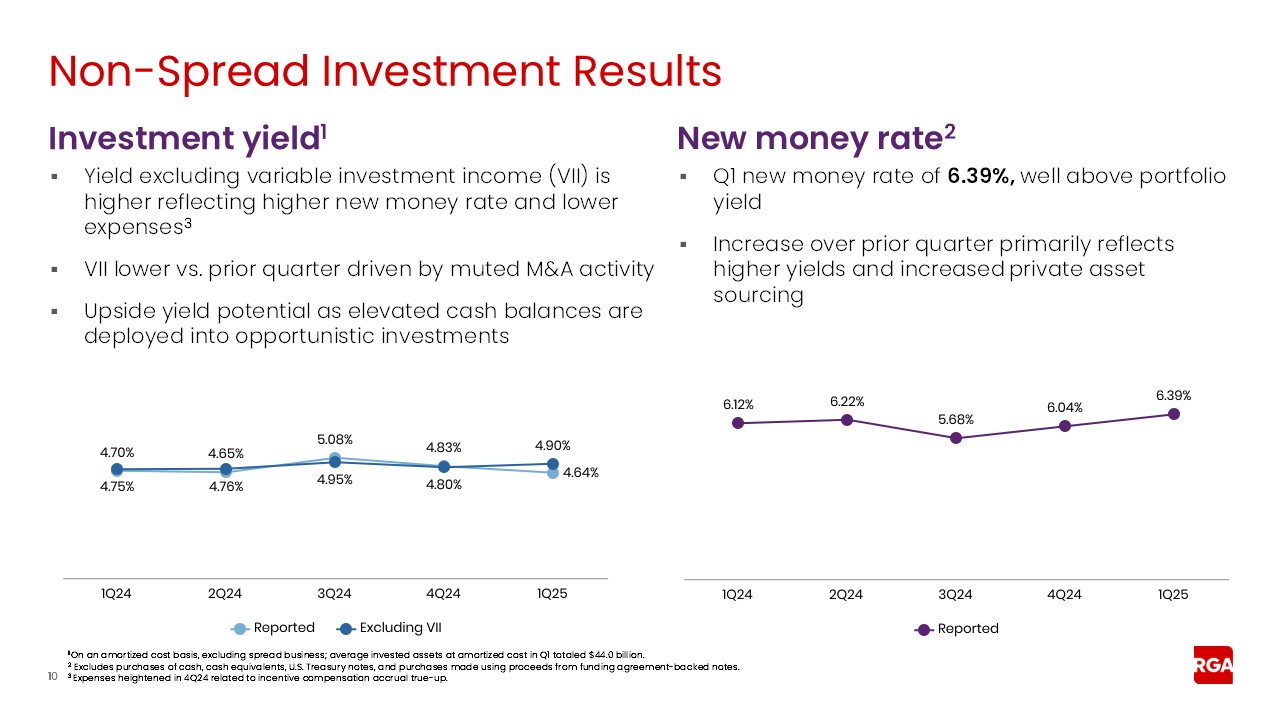
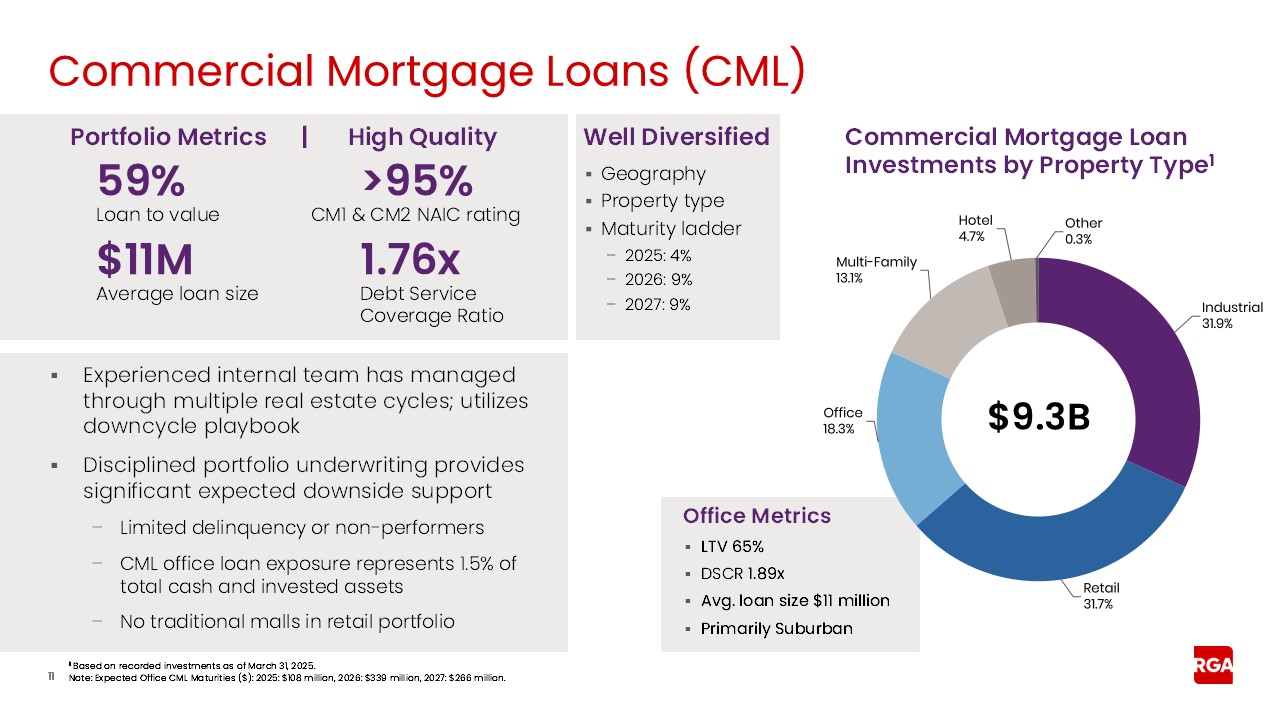
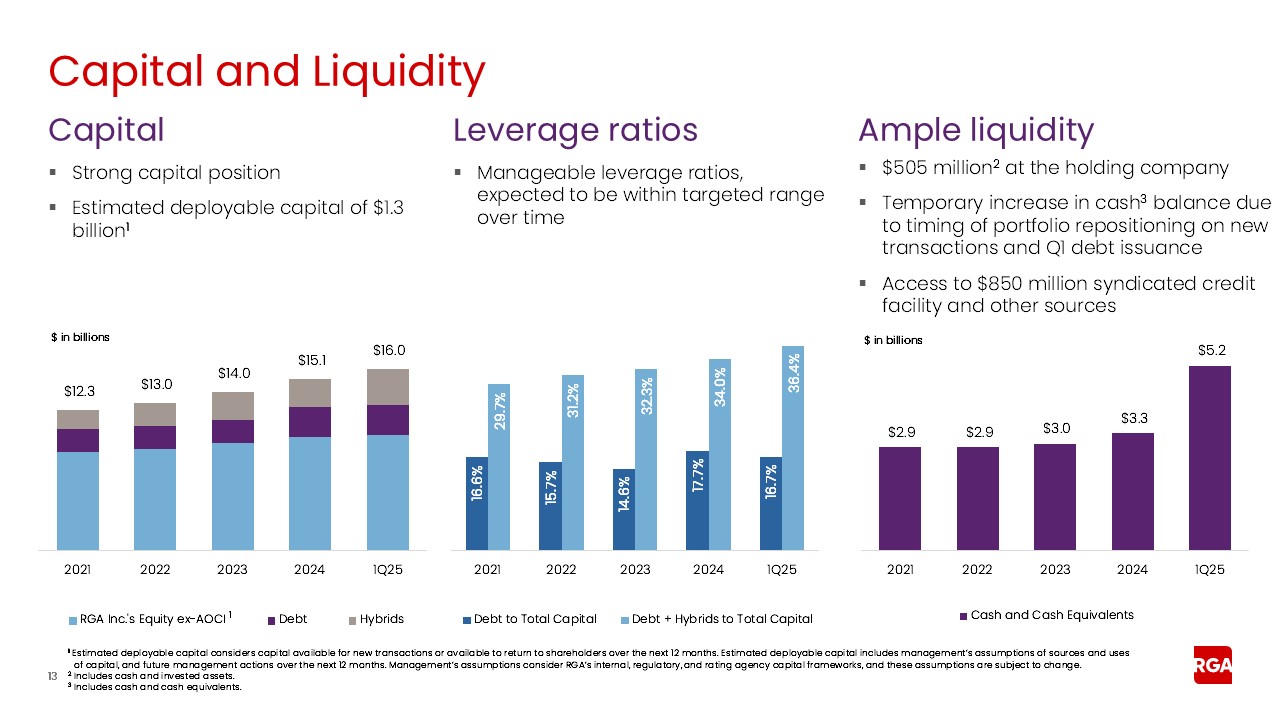
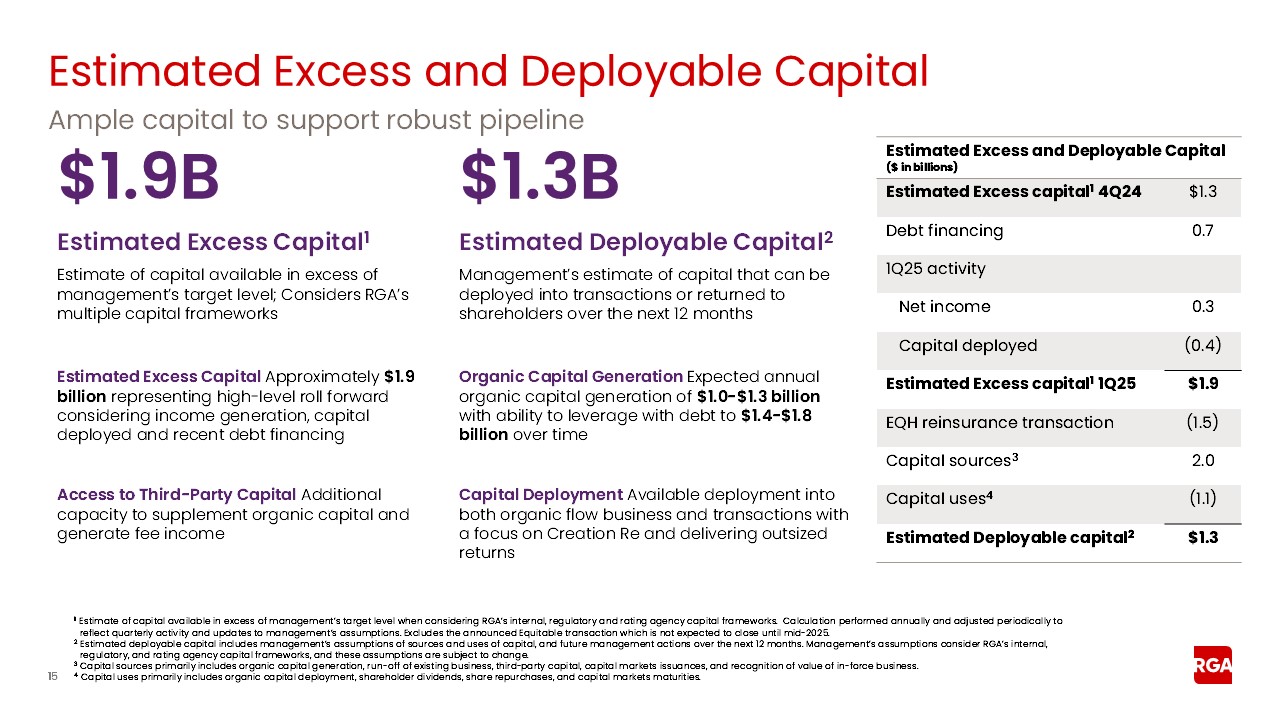
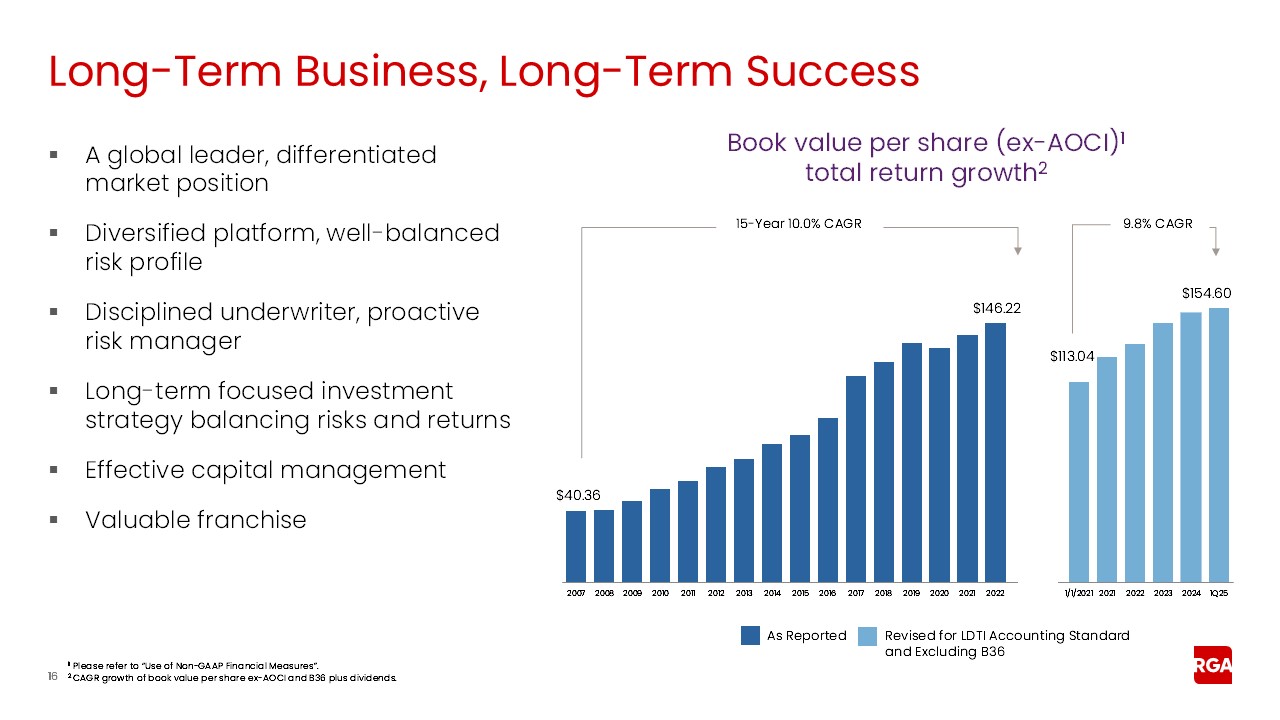
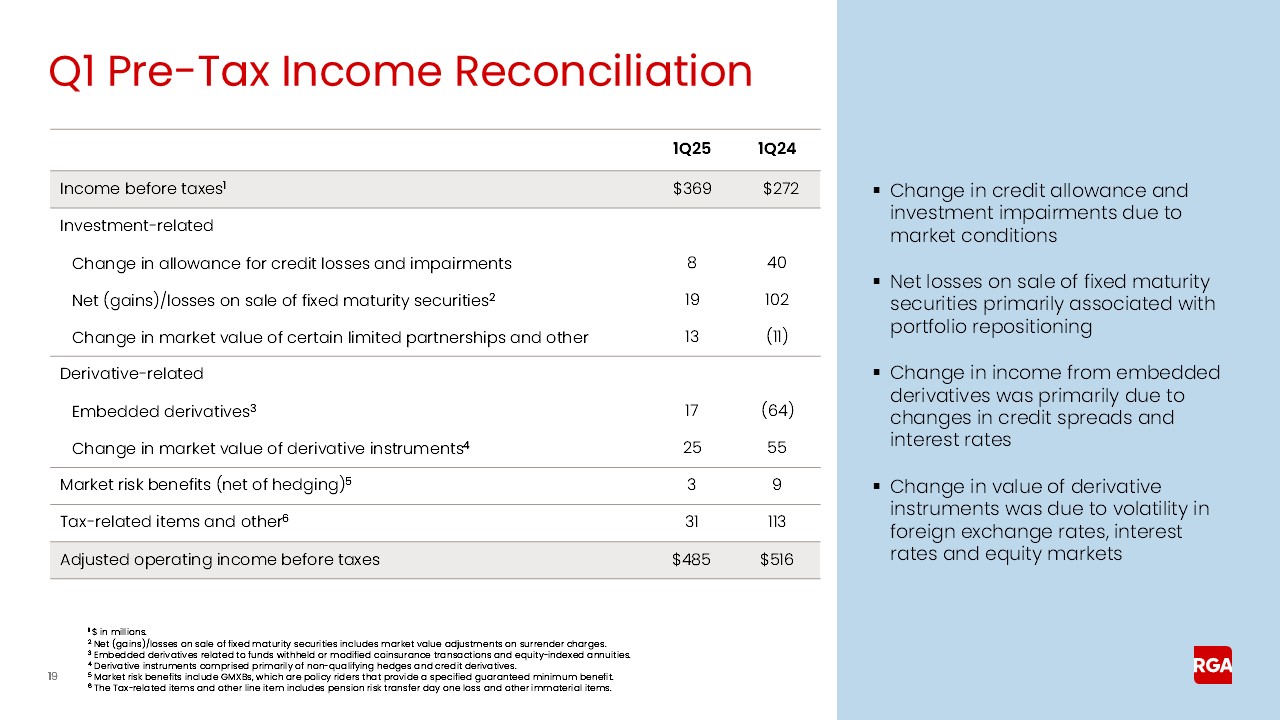
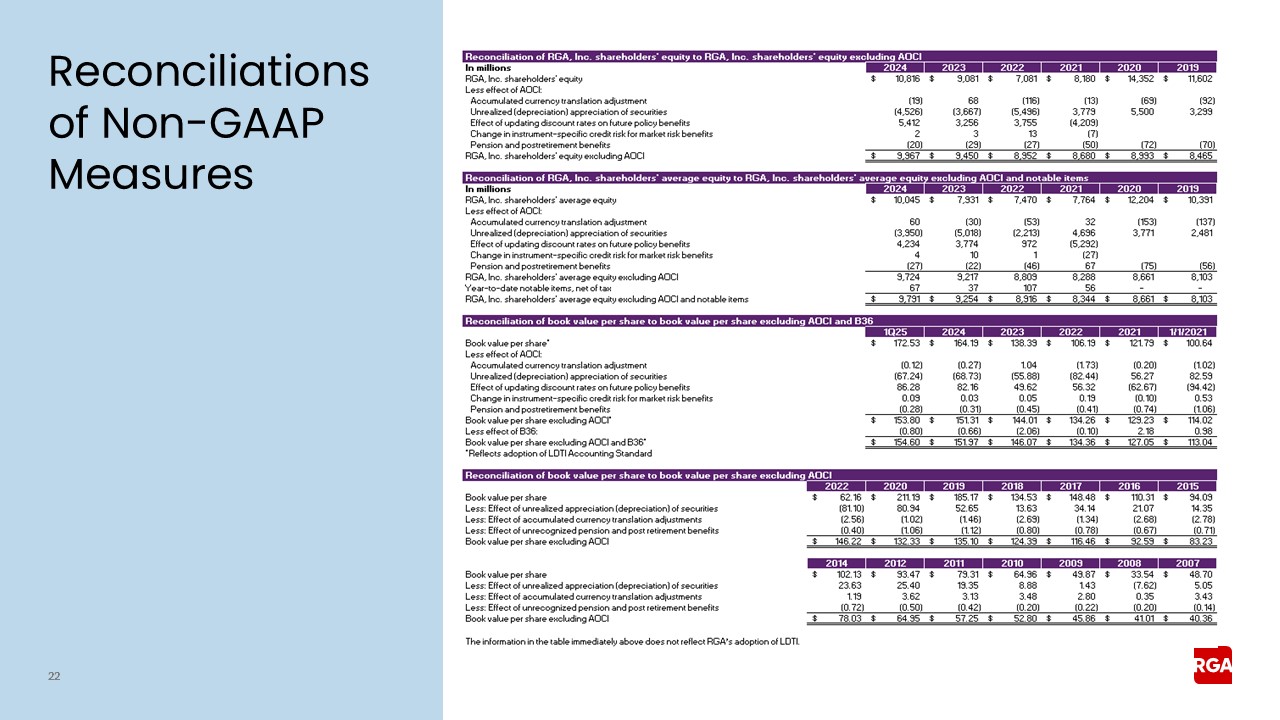
Thank you, Tony. RGA reported pre-tax adjusted operating income of $485 million for the quarter or $5.66 per share after tax. For the trailing 12 months, adjusted operating return on equity, excluding notable items, was 15%. We delivered strong overall results for the quarter. We deployed $418 million into in-force transactions, have excess capital of $1.9 billion before the Equitable transaction, and our deployable capital is an estimated $1.3 billion at the end of the quarter. The economic impact on our biometric claims experience was favorable by $196 million and positive across all regions, and the financial impact was favorable by $58 million. Our non-spread portfolio yield, excluding variable investment income, was 4.9% in Q1, up 10 basis points from the fourth quarter. Variable investment income was below our expectation by approximately $30 million, primarily due to lower mark-to-market adjustments on our limited partnerships and timing of real estate joint venture sales. The effective tax rate for the quarter was 21.9% on adjusted operating income before taxes, below the expected range of 23% to 24%, primarily due to U.S. tax benefits received from taxes paid in foreign jurisdictions. We are still expecting a tax rate of 23% to 24% for the remainder of the year. New business was strong and contributed around $1.1 billion to the value of enforced business margins. Consolidated net premiums were up 13% year-over-year when adjusted for the impact from U.S. PRT transactions, which can cause premiums to fluctuate. Our traditional business premium growth was 11.2% for the quarter on a constant currency basis, which benefited from strong growth in the U.S. and Asia. Premiums are a good indicator of the ongoing strength of our traditional business, and we continue to have strong momentum across our regions. Turning to biometric claims experience, as outlined on Slide 8 of our earnings presentation. This displays the total company claims experience and the related financial statement impact on a quarterly basis. As mentioned earlier, claims experience was favorable in the quarterly results. Economic claims experience was favorable by $196 million, with a corresponding $58 million favorable current period financial impact. The remaining favorable experience will be recognized in income over the life of the underlying business. Claims experience was particularly strong in the U.S., primarily due to lower-than-expected large claims. It is also noteworthy that there was favorable economic experience in every geographic region. I'll point out that some volatility on a quarterly basis, both positive and negative, is normal and does not necessarily indicate a material trend. Turning now to capital. Our excess capital is estimated to be approximately $1.9 billion at the end of Q1 2025, based on rolling forward our year-end excess capital of $1.3 billion as previously disclosed, and considering capital generation, capital deployed, and debt financing activities during the quarter. As a reminder, this is before taking into account the announced transaction with Equitable, which is expected to close mid-year 2025. Note that the excess capital considers our three main capital lenses corresponding to RGA's internal economic capital model, local regulatory capital across our main legal entities, and rating agency capital methodologies. Our deployable capital at Q1 2025 is estimated to be $1.3 billion and represents management's estimate of the capital available to be deployed into transactions or returned to shareholders over the next 12 months, taking into account estimated capital sources and committed uses over that forward-looking 12-month period, including the impact of the Equitable transaction. We are always looking to efficiently manage risks and capital across our different frameworks. This includes utilizing tools such as third-party capital, strategic retrocession, internal retrocession, and recognition of the significance of our in-force business. As demonstrated during the first quarter, this enabled us to efficiently fund the capital expected to be deployed into the Equitable transaction with a mix of excess capital and hybrid debt financing. Our strong balance sheet, capital management toolkit, and current levels of excess and deployable capital position us to continue to support an attractive new business pipeline across the various business segments. Turning to the quarterly segment results on Slide 6. The U.S. and Latin America traditional results reflected favorable individual life claims experience, driven by a lower-than-expected number of large claims. Other experience in the segment was in line with expectations. The U.S. financial solutions results were at the low end of the expected range due to lower variable investment income of roughly $7 million. As a reminder, the Equitable transaction is expected to be recorded within this segment once closed. Assuming a mid-year close, we expect pre-tax operating income contributions of approximately $70 million in 2025, and $160 million to $170 million in 2026, as previously disclosed. Canada traditional results reflected modestly unfavorable lapse experience, partially offset by favorable claims experience. The financial solutions results reflected favorable longevity experience. In the Europe, Middle East, and Africa region, the traditional results reflected modestly favorable claims experience, as well as favorable timing impacts from the earnings recognition of an annual premium treaty. EMEA's financial solutions results were above expectations, reflecting favorable overall experience. Turning to our Asia-Pacific region, the traditional results were good, reflecting favorable overall experience and contributions from new business. Underlying claims experience was again favorable in the quarter. Financial solutions results were slightly lower-than-expected, primarily due to lower variable investment income of around $6 million. We expect the segment results to increase over the course of the year, reflecting the earnings emergence from recent transactions and planned timing of new business. Finally, the corporate and other segments reported an adjusted operating loss before tax of $70 million, unfavorable compared to the expected quarterly average run rate. This was primarily due to lower-than-expected variable investment income of around $15 million and a few other smaller one-time items. Overall, we are pleased with the results this quarter, and we remain confident in our ability to deliver on our intermediate-term financial targets. Moving to investments on Slides 9 through 12, the non-spread book yield, excluding variable investment income, rose to 4.9%, primarily due to higher new money rates, which increased to 6.39% and remains well above the portfolio yield. The total non-spread portfolio yield for the quarter was 4.64%, down slightly from last quarter, reflecting lower variable investment income and a higher balance of cash and cash equivalents, partially offset by higher new money rates. Variable investment income was modestly negative for the period and approximately $30 million below expectations, driven by lower valuations on limited partnerships and timing of real estate joint venture sales. I'll note that we still hold an above-average level of cash that we look to deploy opportunistically over the coming quarters. Importantly, portfolio quality remains high and credit impairments were again minimal, and we believe the portfolio remains well-positioned. During the quarter, we continued our long track record of increasing book value per share. As shown on Slide 16, our book value per share, excluding AOCI and impacts from B36 embedded derivatives, increased to $154.60, which represents a compounded annual growth rate of 9.8% since the beginning of 2021. To summarize, a strong first quarter is a good start for the year, following a record 2024. We continue to see very good opportunities across our geographies and business lines. We are well-positioned and remain appropriately capitalized to execute on our strategic plan. With that, I would like to thank everyone for your continued interest in RGA. This concludes our prepared remarks. We would now like to open it up for questions.
Operator
We will now begin the question and answer session. Our first question comes from Suneet Kamath from Jefferies. Please go ahead.
Speaker 4
Great. Thank you. I was hoping you could help us understand the mortality experience, particularly in the U.S. Obviously, we've seen the flu season data. We know that there was a single large case in the first quarter. We're seeing it at other companies, yet you're showing very strong underwriting experience. And then there's a disconnect there that I'd like to try to understand if you can comment. Thanks.
Sure, I can get started on that. So, we saw a large positive experience in particular driven by lower than expected large claims in the U.S. I want to remind you that some volatility on claims experience is expected, both to the positive and the negative. Excluding the large claims experience, so for smaller claims experience, our overall U.S. mortality claims were slightly higher than expected, consistent with an elevated flu season. In terms of, obviously, our process, we are, of course, very confident in our claims process. In fact, this quarter, we performed extra due diligence to ensure that all claims are collected. As you can imagine, for large claims, there's an extra incentive for students to notify us. And of course, we hear from companies, from students, whenever they experience large claims and ensure that we verify whether we see the similar data in our data.
Speaker 5
Yeah, and this is Jonathan. Maybe just to add specifically on that large case you referenced that's been mentioned on other calls, that experience is reflected in our Q1 results.
Speaker 4
Correct, thanks. And then I guess the other question, I've been struggling with this since you announced the Equitable deal. For those of us that cover Equitable, we look at that business, and I think a fair way to describe it would be challenged. Then all of a sudden, you take it over and you're able to turn it into 13% to 15% ROE business per your comments about it being in line with your target. So, I'm just trying to understand how does that happen. Is there an expense piece or a capital piece or something? Because the earnings should be the same, I would think, other than what you do on the investment portfolio. So, how do you take this challenged business and make it a good return business? Thanks.
Let me just kick it off strategically. I'm sure others have areas to involve. I mean, obviously, like I said, in my comments or previous comments, I mean, the big block obviously is a big part of the transaction. And we feel that's totally priced appropriately. And then there are other components that made the transaction so strategically valuable for both parties and then adds to the value we create. But let me hand it over to Axel and Jonathan to provide any further comments on your question.
So, I think a few things, just to remind you. When we announce a transaction, obviously, this is a large block of business, mortality business. However, we've been in business for over 50 years. And so, when we look at our total mortality exposure across the globe, the impact of the transaction is to increase that exposure by about 5%. That's point number one. Point number two, like Tony said, we, of course, when we execute a transaction, get to reprice the business. Fundamentally, we benefit from all of our experience, all of the treasure of data that we have available on that, and also the specific experience for that block of business that is part of the due diligence that we perform when we underwrite the block. We expect some volatility of claims on the business, but we believe that is very manageable given our balance sheet and our expertise.
Speaker 5
And I think just to add further, I think the synergies you do highlight, I mean, whether it's capital or whether it's expense or whether it's the asset side, I think they all play parts of it. It's very hard for us to opine, given we obviously don't know exactly what Equitable used to do with this business. But for us, once again, it fits very well within our wheelhouse. It's all risks and operations that we have established already to manage going forward. Very comfortable with the pricing as we look through it all.
Operator
Our next question comes from Elyse Greenspan from Wells Fargo. Please go ahead.
Speaker 6
Thanks. Good morning. My first question, I was hoping that you guys could just talk about the current pipeline of transactions and where you guys are seeing the most opportunity?
Sure, happy to do that. Thank you for the question. Look, I think in our comments we've described it as attractive, and I think it's the appropriate word because when we think of attractive, the quantity is nice. But really, our word is trying to characterize more the quality of the pipeline. Obviously, since the recently announced transactions and RGA's brand and history, we've been in the enviable position to work with many, many great companies. The way we describe the quality of the pipeline is really around who are the partners. Are they long-term partners? Are they ideally sizable? But as long as they're really a long-term partnership mentality. To answer your question on the breadth, we run our business with a heavy focus on all three major regions of EMEA, Asia, and North America, and it's each of those pipelines that are very robust and strong, so it's across the board breadth is great. And then the third element, as I've alluded to, is does it fit within our strategy? Our strategy is very simple. We call it Creation Re, but really, it's a focus on getting not only repeat business but repeat exclusive business, because if we're able to solve a client's opportunity or problem, or hopefully even an industry opportunity or problem, then others will come to us to solve that same issue, and then we can use our global network to just spread that around the world because life insurance markets around the world seem different, but to be honest, the underlying drivers are very, very similar, the underlying needs. So, our global platform allows us to really solve these across the board.
Speaker 6
And then my follow-up, in your prepared remarks, you were talking about PRT and just there being an impact of some of the market uncertainty there. How do you expect, and I know you said it would be temporary, do you see this as becoming a greater opportunity later this year, or just how do you see things playing out on the PRT side, just given the volatility we're dealing with right now?
Yeah, absolutely. This is, as you've suggested, a longer-term story that's already started. So absolutely do we believe that this is a temporary pause, let's say, that there's uncertainty in the macro environment in general. A lot of the bigger schemes would have been down this journey of de-risking for many years already, so it's not a question of stopping, it's a question of really pausing it, perhaps. But we're very bullish on this. We're looking at some other strategies also to highlight our strengths in other segments of the market that really have not paused at all. That was part of our broader strategic direction anyway. So, we're very bullish about this market in the medium term and the longer term, and we do expect it to pick up in the second half of the year.
Operator
Our next question comes from John Barnidge from Piper Sandler. Please go ahead.
Speaker 7
Good morning. Thanks for the opportunity. With portfolio investing ahead for that elevated cash balance, can you talk about how those new money rates maybe have trended so far in the second quarter for you? Thank you.
Speaker 8
Hey, John. This is Leslie Barbi. Thanks for the question. Yeah, so as you know, there's been a lot of movement up and down, but really the rates currently are similar to the first quarter. I guess only time will tell if that plays out, but yields came down, but spreads widened, so there's still a good opportunity set to put that cash to work.
Speaker 7
My follow-up question, sticking with the portfolio, you talked about increased private asset sourcing. Has that also continued to be favorable as well? Thank you.
Speaker 8
Thanks. Yeah, so we have a very broad platform across many public and private asset types, and we've been building that private asset capability for over 20 years, and we had attractive opportunities in the first quarter, and I'll just note that those are also a good match for our stable liabilities, and given the portfolio growth overall, we've had some room to invest. I think your question also got to the fact that with market volatility, issuance had paused in public markets and may be slower in privates. It's certainly coming back in publics, and we still had a good pipeline in place for privates. So, I still think there'll be a good set of opportunities, although if volatility continues, it may be somewhat slower.
We're not hearing any questions. Operator, we're ready for the next question. I apologize, everybody. Please hang tight. We are finding the operator. Thank you for your patience. We should be getting there shortly.
Operator
The next question comes from the line of Jimmy Bhullar. Please go ahead.
Speaker 9
So, first, I had a question for Tony just on if you could just talk about competition across your various businesses. Many of your competitors are P&C companies or have P&C reinsurance businesses as well, and it seems like the market's a little softer there. When it was hardening a lot, there were comments from RGA that that might actually improve things in life reinsurance as well, as some of those companies would be focusing more on the P&C side of their business. Are you seeing the reverse of that now, and how are competitive conditions across various markets given that dynamic and also the fact that in some of the product lines, you're seeing a lot more activity by some of the PE-backed companies?
Sure. Thanks for the question. I’ll start with our main focus and strategy, which is Creation Re. We monitor our competition and take note of their successful initiatives, but our primary aim isn’t to compete directly. In response to your question, it’s always challenging to determine how the property and casualty companies will behave in varying market conditions. I don’t think we can draw clear conclusions about how market fluctuations affect their views on life and health. What I can say is that we remain consistently present in the market, focused solely on life and health, which allows us to steadily develop our platform. Currently, we don’t perceive the level of competition we face, whether from traditional businesses or the property and casualty sector, as particularly intense.
Speaker 9
Okay. Just wanted to let you know. I think there's some issue with the call because your comments were paused for a few minutes. I don't know. Can you hear me okay?
Speaker 9
Yes. There might be an issue. You could address that later as well. I'm not sure, but maybe continue with your answer if you're able to.
Speaker 9
Just the word now.
Okay. So, I mean, Jimmy, to answer your question, like I said, our focus really is not to compete. That's the Creation Re focus. The fact that we can continually stay in the life and health market, given that's all we do in reinsurance. We don't believe the level of intensity of competition has increased materially or noticeably with regards to the blocks or the traditional business that we see from the more P&C-oriented reinsurers, the hardness or softness of the market, if it impacts their attitude towards Life and Health, it really is around the fringes. We continue to just strengthen our platform. We believe that we're in a very, very strong position, and that's why we're so optimistic about our future.
Speaker 9
Okay. And then just another one on the Equitable transaction along the lines of the question previously. They're basically losing around $100 million of income per year. And you've said that you could pick up close to $200 million eventually from that block. And I think a big chunk of that is just you guys repositioning the portfolio. So, since Leslie is on the call, what is it actually that you're doing with the portfolio that's different than how they've invested it because I think there's a lot of confusion in the market about how one company is losing a lot less business than the other one is picking up from the same block. So.
Speaker 8
Well, I know others will want to jump in. It's not all asset portfolio, and we're sticking to our discipline. It will be a reasonable amount of risk, and there will also be some of the assets still managed by Alliance Bernstein. But at the crux of it, where we will be adding value. We do have quite a broad platform, including a broad private asset platform. So that is where some of the value is coming in, but it's not the entire value for the transaction.
I would just like to add that the expense structure will certainly vary between Equitable and us, which could account for that difference. Additionally, the accounting for that block of business as a reinsurer is also different from the underlying economics; it focuses more on earnings emergence rather than the core financials. All of these factors likely contribute to the situation.
Operator
Next question comes from the line of Wes Carmichael from Autonomous Research. Please go ahead.
Speaker 10
Good morning. I wanted to follow up on the point on Equitable in the accounting. I think there's probably a good reason to think that might be bit less volatility. Is that because when you reprice the business and it changes hands, I think the way I understand it is with LDTI accounting, the net premium ratio may be reset and then you have less of the cap cohort volatility coming through. Is that basically the dynamic do have that right?
Wes, so just to clarify, there's some part of the business may be subject to LDTI, but a big part of it will not be subject to LDTI. So that's not necessarily the driver. I think there could be some smoothing of claims experience through reinsurance accounting. So, it's not directly related to LDTI, but it's kind of something like that, essentially something along those lines.
Speaker 10
Okay. And I guess we saw a pretty material long-term care reinsurance transaction since the last call. And I believe our European reinsurer took the morbidity risk, with annuity pact reinsurer taking the assets. Does RGA have appetite for structures like that because LTC is obviously a gigantic liability set for the industry and the potential opportunity.
Speaker 5
Wes, let me take that. Look, our attitude towards long-term care is very clear. Number one, obviously, given our market position, we do see, I would believe, every opportunity that arises in the market. So that's point number one. But point number two, as I emphasized, is really critical, one of the, if not the most important reasons for our success is our discipline. So, I think I've shared sort of by criteria we look at with regards to long-term care blocks. The first one would be, is it a strategically important or value or long-term partner? So that's point number one. Point number 2 would be the risk-return trade-off within the block, but also being paid appropriately for any risk that we take, obviously. Point number three, does any other blocks of business, non-long-term care, come along with the transaction? Point number four is really critical is, look, we have done long-term care for a number of years. We've got a very modest-sized block. But it's within it's the newer type of business because that's the business that we have the risk tolerance for. We stayed out of the market for many years until the products moved that way, and that's the only time that we started entering the market many years ago. So, the fourth element of it is the risk tolerance. And then the final is the site. Yes, we like diversification, but the size of the long-term care block characterizes it as new blocks that if and when we do potentially take it with those other criteria, would be modest in size. So hopefully, that gives you a bit of clarity. The one that across the wires recently, we obviously did not have a share of that block of business.
Operator
Next question comes from Ryan Krueger from KBW. Please go ahead.
Speaker 11
In the deployable capital disclosures, it looks like the capital sources increased at least a few hundred million from what you had laid out in the Equitable transaction slides. Can you give some more color on what drove that higher?
Thank you for your question, Ryan. To provide some background, we've updated both excess capital and deployable capital metrics this quarter, and I want to clarify our reasoning behind this. We view these two metrics as serving different purposes. Excess capital is a defensive measure, reflecting the balance sheet's strength and resilience during tough times. In contrast, deployable capital looks ahead, starting from excess capital and considering how much capital we expect to generate organically over the next 12 months, sources of third-party capital, and the committed uses we have for that. This helps us determine how much we can allocate over the next year into potential opportunities. On Slide 15, we provide a reconciliation, and you are right to notice that the capital sources and uses figure is larger compared to what we previously disclosed. This increase is due to two main factors: we're now including Q1 2026 in our outlook and dropping Q1 2025, which is reflective of our strong business momentum and earnings growth. Additionally, the rest of the change is related to a refinement of our model projections, which will be included in our future updates.
Speaker 11
I think the value of in-force is something you have been focusing on getting recognized by rating agencies for future capital sources. Is there a significant amount currently considered for that? Additionally, what has been the progress in discussions with the rating agencies?
Thank you for that question. The value of in-force is a significant concept. Depending on the framework, it may or may not be recognized, and we have a substantial value of in-force as indicated by our business margins. We have successfully executed securitization of value of in-force blocks, providing evidence to support our claims. We can even secure third-party financing against this or offer a portion to others, which serves as a validation of our assessments. From the perspective of rating agencies, this recognition is crucial. We currently have it in place for part of our business and are actively engaging with rating agencies to expand the portion that is recognized. This effort is part of our ongoing initiative to enhance our capital position. We will provide updates when there are significant developments.
Operator
Your next question comes from Tom Gallagher from Evercore. Please go ahead.
Speaker 12
Good morning. I have a couple of quick questions. First, you mentioned booking part of that $200 million industry syndicated contract. What was your share of that? Second, could you provide some details on the underlying experience in U.S. trade concerning mortality, long-term care, and any other risks like medical stop loss? I'm interested in how those trends are developing.
Jonathan, you want to take that?
Speaker 5
Yes. Thanks, Axel. Tom, we're not going to give out specifics on the claim. Again, I'll just reiterate that the full impact of that syndicated claim that you talked about was recognized in our Q1 statement, so it's already been recorded. With respect to the experience within the traditional business, as Axel has already mentioned, really, the key driver is the large claims favorability in the U.S. individual line. There were some other pluses and minuses across Latin America Group and U.S. or individual health, but they're all relatively small.
Speaker 12
Okay. And then...
Sorry, Tom, on the long term, I mean broadly, yes, we didn't see anything. I mean, that was just normal on track experience.
Speaker 12
Got you. One other one for you on the Equitable transaction. And Axel, you had mentioned the majority of that book is not captured under LDTI and the majority of your business is. So, I presume that means on a proportionate basis that's going to increase your earnings volatility somewhat. And I know Equitable had a pretty high level of earnings volatility in that block. How much of a consideration was that for you? Or did you kind of ignore the earnings volatility and just focus more on the economic returns?
Let me start by addressing that. Tom, we did reprice the transaction, which is crucial. Repricing involves assessing the underlying economic risks, considering both the earnings signature and the accounting impact. This includes not only the base case but also stress analysis and the evaluation of potential volatility. Ultimately, we observed that the overall mortality risk increased by about 5%. Although the accounting may be more volatile due to the size of our balance sheet, our sources of earnings can handle that level of volatility without concern. We approached this situation with awareness and are not particularly worried about it.
I don't know if you've got it. Go ahead.
Speaker 5
Yes, I would like to add one more thing. When considering the Equitable block being integrated into our existing mortality business, we achieve a broader diversification benefit across the entire portfolio, which will help reduce relative volatility.
Speaker 12
Great. Thanks.
Operator
The next question comes from the line of Joel Hurwitz from Dowling Partners. Please go ahead.
Speaker 13
Good morning. I would like to discuss variable investment income. Can you explain what is included in your operating earnings targets? Did the earnings targets mentioned last quarter assume 6% returns or your long-term expectation of 10% to 12%? Additionally, I believe some of your alternative income is included in operating income while some is not. Can you clarify which components contribute to operating income versus net income?
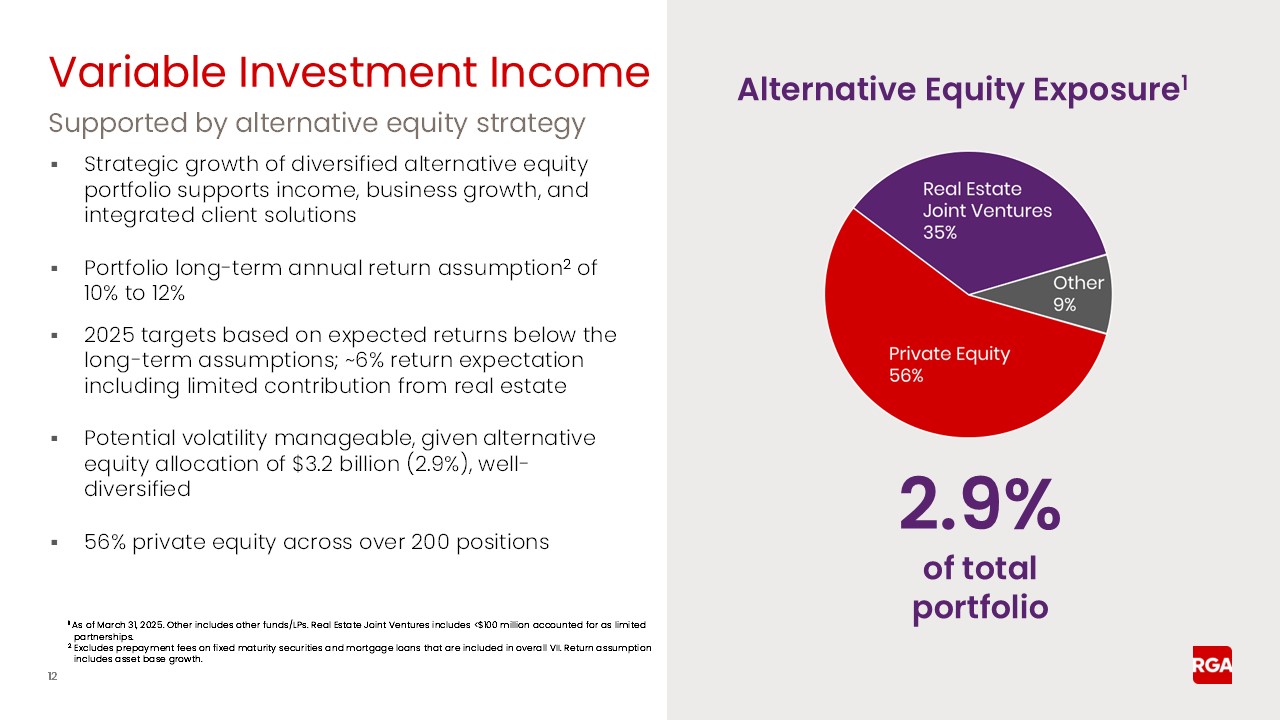
Sure. Thank you for your question, Joel. To begin with, the targets we recently announced, starting from the 2025 run rate, incorporate a 6% return for the variable investment income. This reflects our understanding of the market environment, our expectations regarding realizations on limited partnerships, and the real estate joint venture sales, compared to our long-term return expectation of 10% to 12%. Looking ahead over the next 12 months, we maintain our expectation of a 6% return for that variable investment income. Additionally, regarding accounting, this relates to a portion of the limited partnerships, with the unrealized portion accounted for below the line as nonoperating. However, I want to clarify that when there's a realization, it flows through operating income. Ultimately, the total return will be reflected in operating income.
Speaker 13
Okay. Very helpful. And then, Tony, I know you said in your prepared remarks that in-force actions were modest in the quarter, but you sounded pretty positive on a number of initiatives. Could you just elaborate on some of these initiatives and how much of a potential benefit there could be?
Yes. No, I mean, it is just part of our business. So, and it's an area, anything we explore, then we're interested and excited by. So, the team works on that, and we've got teams dedicated on that, purely to enforce our rights in the treaty in a win-win fashion. So, I just want to highlight, as I've said previously, it is lumpy in nature. But we continue to explore it and would be hopeful some falls through by the end of the year, but it's business as usual for us on that.
Operator
Your next question comes from the line of Wilma Burdis from Raymond James. Please go ahead.
Speaker 14
Could you just give us an update on your outlook for mortality now? It seems like one thing I've been hearing is that it's a little bit better at younger ages below 9 years, but then at older ages a little bit worse than pre-COVID. And then are you seeing any changes with GLP-1s or others now that we have a little bit more experience.
Speaker 5
This is Jonathan. Yes, certainly, we're encouraged by what we're seeing in the general population. So if you look at 2024 experience as reported by the CDC, excess mortality was down to about 1% in the U.S. relative to about 3.5% excess in 2023. That's across all ages. So that's a positive trend that's good to see coming out of COVID. Specifically, on GLP-1s, I think we continue to be very encouraged by the potential benefits given data that is emerging in anticipation of improvements in both effectiveness and accessibility. So recently, there was just a news article about an oral version of GLP-1 drugs that could further enhance that accessibility and take-up rates as an example. We continue to devote significant resources for ongoing analysis and looking at data in clinical literature. Our expectation would be to incorporate any of those impacts into our assumptions when appropriate. But at this point, we have not explicitly reflected those impacts.
Speaker 14
And could you just give a little bit more detail on the ability to price and how that changes the as you think about.
Operator
I'm really sorry to interrupt. Wilma, we are not getting audio correctly from your end. It was breaking. your line was breaking. If you can repeat the question.
Speaker 14
Yes, sure. On the Equitable block, could you give us more detail on the ability to reprice and how that changes post-acquisition?
Yes, when we talk about repricing, we're primarily referring to the initial reprice. These blocks of business were previously written by Equitable, and now we have the opportunity to reassess and apply our own pricing assumptions to the transaction. In doing this, we analyze both their data and our own, utilizing various actuarial techniques to integrate the data and determine what we believe to be the appropriate price. It's important to consider not just the short-term, as these are long-term businesses requiring future assumptions. This has been our core business for over 50 years, and we continue to excel in it.
Operator
Your next question comes from Mike Ward from UBS. Please go ahead.
Speaker 15
I was curious about the new business pipeline you are observing. Are there specific areas where you see greater or lesser opportunities? Also, does the Equitable deal enhance your position in the U.S. market, suggesting we should expect more international deals, or is that not how you view the situation?
Thanks for the question, Mike. Yes. Sort of repeating a bit, I mean, it really is across the board, the three regions are just each and every one of them is strong. So different size type transactions, as I mentioned, in Asia, and even in EMEA, there's probably more regular flow of not only the new business sort of traditional business, but even blocks more modest in size, but we just leverage off the fact that we have these incredibly strong local partnerships. In the U.S., obviously, the Equitable transaction is strategically significant for the market. So obviously, we've had a lot of inquiries and talking to clients potentially about how we can also assist them strategically fulfilling those endeavors. These things take time. The Equitable transaction was a particularly sizable one. So once again, in the U.S., we're very excited also about the pipeline there. And all three very strong and all three learn from each other. So there's no reason why some of the things we've done in the U.S. or in Asia are not absolutely being transplanted into the other regions because that's what we do is make sure our global platform is very well connected strategically and find those new solutions that work for those different markets.
Speaker 15
And then just back to the sources of capital. I'm curious how active is the third-party capital, I guess, pipeline and your ability to establish more details. And then just confirming there is a slide deck mentioned potential capital markets issuances, but just wanted to confirm that common equity is low on the totem pole in terms of capital sources.
Thank you for the question. Let me start with Ruby Re. We are very focused on fulfilling our commitment to our investors. We did not see business in the first quarter as we were waiting for year-end statutory financials, but we are constantly working on that and remain optimistic that most of that capital will be deployed by the end of the year. This will enable us to build upon our nice track record and supplement our capital, allowing us to access a global pipeline of opportunities. We are interested in continuing to build on that track record. Regarding the footnote that describes sources of potential capital issuance, it is a general statement and does not signal anything specific or imminent. As for common equity, it is one of the options we consider, but it requires a high hurdle rate to be viable.
Operator
Next question comes from Bob Huang from Morgan Stanley. Please go ahead.
Speaker 16
Good morning. I know we're out of time, so I'll keep it to one question. Maybe if you can give us a little bit more color on the Japan reinsurance opportunities. I know you touched on it in your prepared remarks. It feels not just like a new opportunity for you, but a broader set of opportunity for the industry and the addressable market seems to be very large. Can you maybe, one, talk about that opportunity, but also to talk about just the competitive environment from that area.
Sure, happy to. The situation in Japan is quite exciting. We believe we are still relatively early in the cycle. Japanese clients tend to approach business gradually, executing many tranches over the years. For instance, we have maintained a long-term relationship with one client, completing numerous transactions year after year. Regarding competitiveness, we don't pursue every opportunity. There is a significant asset-only market in Japan that comes with minimal biometric risk, which we choose not to engage in as we don't believe we can compete effectively there. Our focus is on asset transactions involving long-term, loyal clients. While these may be smaller in scale, they are more collaborative in nature and involve the biometric risk that sets us apart. It’s an exciting market, but it requires time to develop relationships and provide after-sales service. While the initial transaction is thrilling, we have over 100 team members in Tokyo who assist in after-sales service, speaking the local language and nurturing long-term connections. We believe these factors will give us a crucial advantage in the medium to long term as we finalize transactions and manage them over decades. This is essential for achieving sustainable success in this business.
Operator
Thank you. This concludes our question-and-answer session. I would now like to turn the conference back over to Tony Cheng for closing remarks.
Well, thank you all very much for your questions and your very strong interest and continued interest in RGA. This was a very good quarter and the start of what we believe will be a great year, further demonstrating our very strong and continued momentum and substantial earnings power. So, have a great day, and we look forward to talking to you next time. Bye-bye.
Operator
The conference has now concluded. Thank you for attending today's presentation. You may now disconnect.