Good morning, and welcome to the Reinsurance Group of America Third Quarter 2025 Earnings Conference Call. Please note, this event is being recorded. I would now like to turn the conference over to Tony Cheng, RGA's President and CEO. Please go ahead.
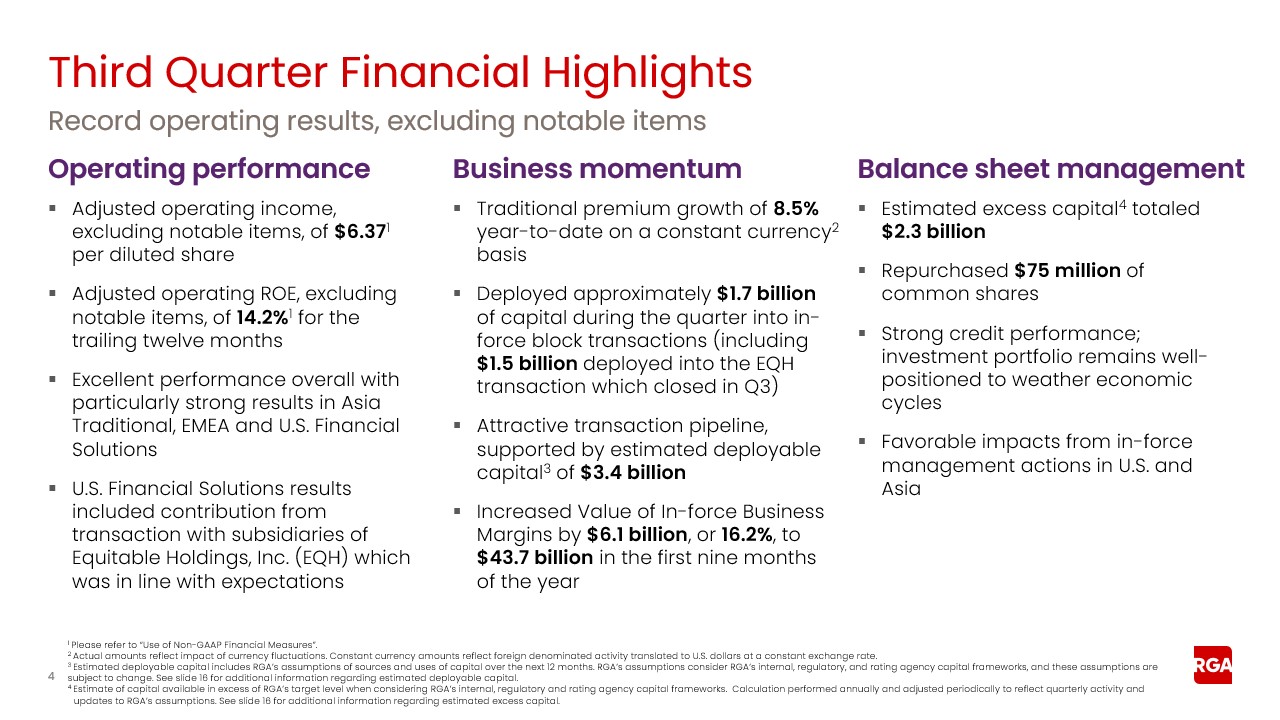
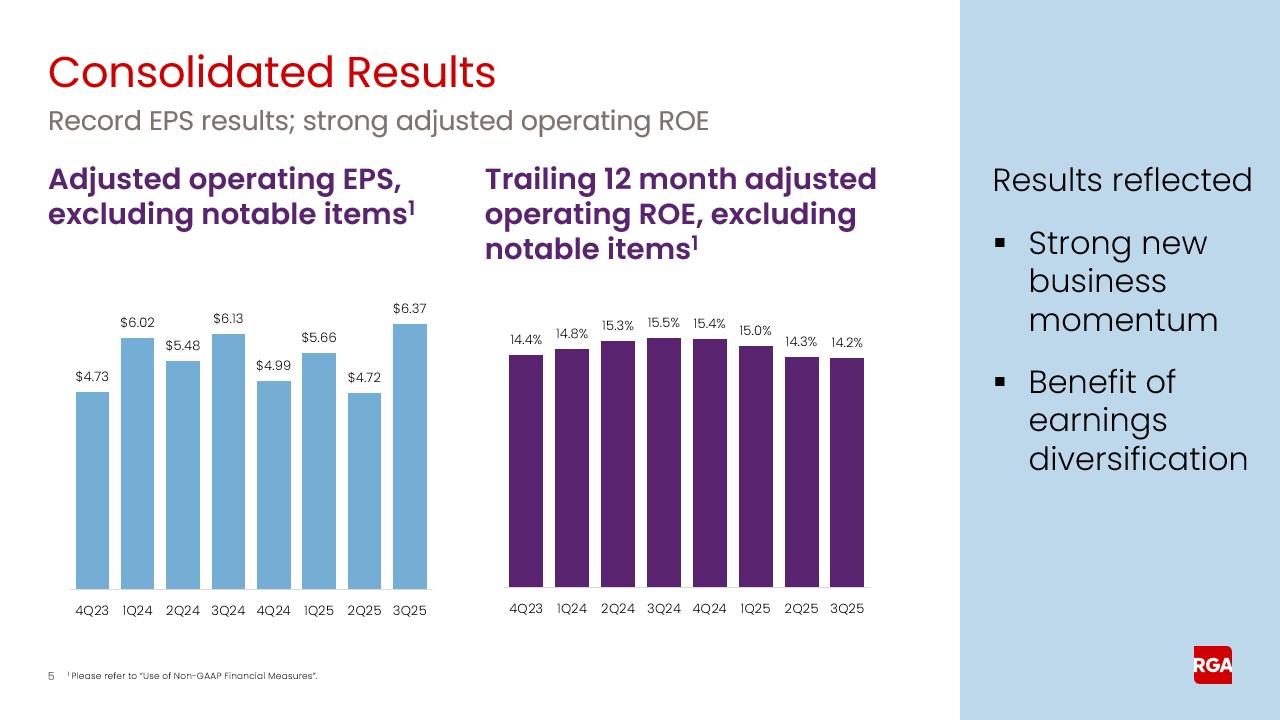
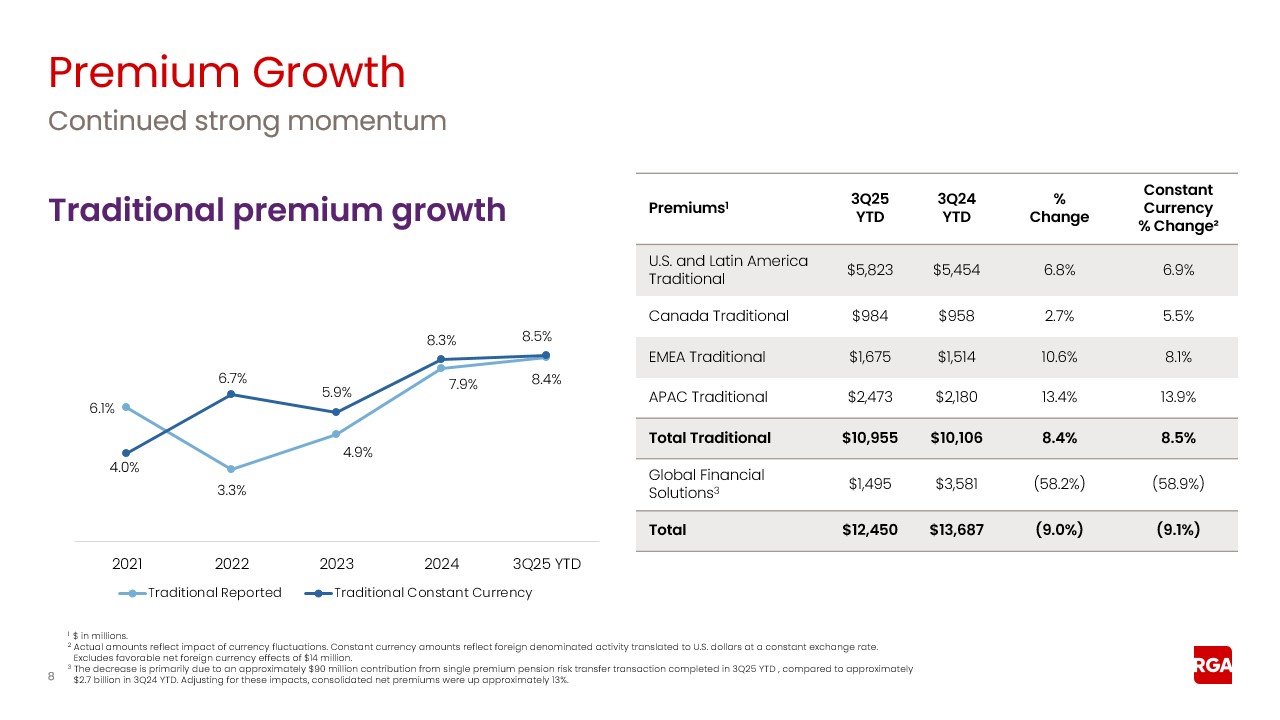
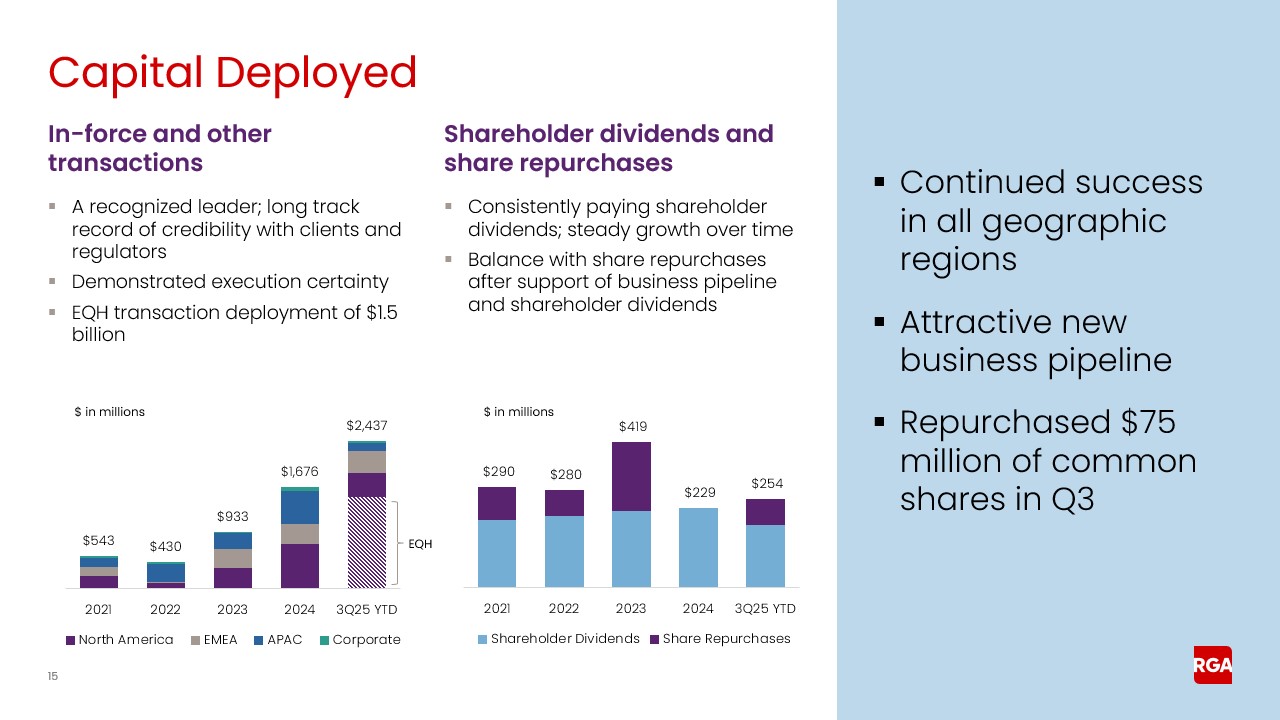
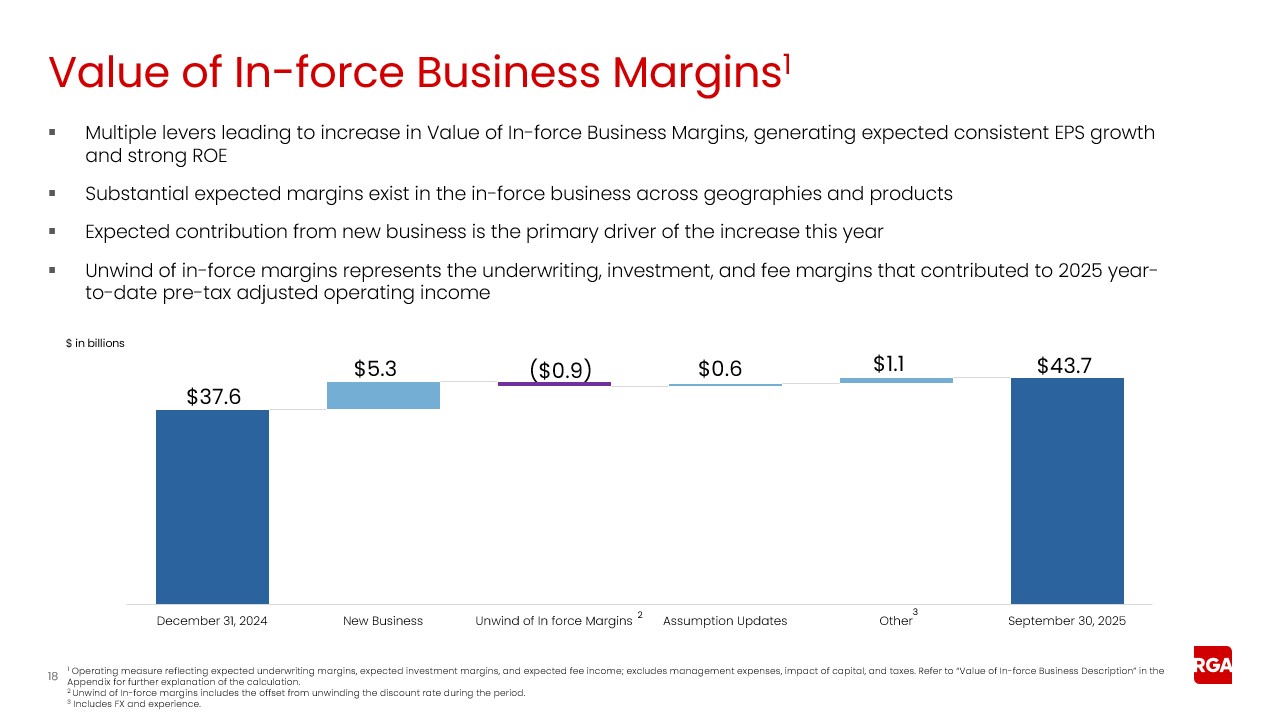
Good morning, everyone, and thank you for joining us. I am delighted to share that we have had a very strong third quarter, as demonstrated by the continued successful execution of our strategy as well as the record financial performance we delivered. Let me open with a few key highlights. Firstly, we reported record operating EPS, excluding notable items, of $6.37 per share. These results were strong and above expectations. We had excellent performance overall with particularly good results in Asia Traditional and EMEA and U.S. Financial Solutions. Our diversified global platform continues to deliver significant long-term value. Secondly, we are seeing a positive contribution from the Equitable transaction, which closed this quarter. Thirdly, new business momentum remains strong, as evidenced by our premium growth and capital deployment into in-force transactions. We are seeing good year-to-date contributions from across our geographies. Our competitive advantages continue to differentiate RGA, leading to good new business results, a robust pipeline and the ability to be selective on the opportunities we pursue. Next, during the quarter, we repurchased $75 million of common shares. We will continue to balance investing our excess capital into the business and returning it to shareholders in a manner that allows us to execute our strategy and meet our financial targets over time. Finally, we continue to make progress on other strategic initiatives, including the utilization of Ruby Re and the successful execution of in-force management actions. All of these position us for continued long-term success. Let me now provide a few more details on the quarter, including highlights from across our regions, starting with North America. We continue to exceed our new business targets for the traditional business, driven by our strong underwriting capabilities. We closed a significant number of new deals in the quarter and reached a record number of underwriting applications. One of these deals was an enhancement of our strategic underwriting program with a digital solution that enabled us to partner exclusively with a key client that has a strong brand and a large distribution footprint. These initiatives differentiate RGA and represent an increasing portion of our U.S. business. This is yet another example of what RGA has done for over 50 years and continues to do at its best, which is to be innovative and the leader in underwriting. Also, as indicated, the Equitable transaction closed in the quarter, and we recorded a full quarter of earnings in this period. Results were in line with our expectations. The asset portfolio repositioning is progressing as planned, and our previous guidance on the expected future earnings remains unchanged. Along with the financial gains, the partnership is yielding strategic benefits through increased underwriting services, product development, asset management and participation in our Ruby Re sidecar. The depth and breadth of this partnership is one example of the win-win opportunities for the benefit of both RGA and our clients. Moving to Asia Pacific. The region continues to perform very well. Traditional results were particularly strong this quarter, continuing its trend of excellent growth and bottom line results. We continue to delight our clients by staying at the forefront of innovation and helping them navigate evolving strategic needs. Our strategy in Hong Kong is to deliver holistic solutions combining product development, capital solutions and technology-enabled underwriting capabilities. We recently won the prestigious Hong Kong Federation of Insurers' Outstanding Reinsurance Scheme Award, recognizing one of these holistic solutions. We expect this to lead to repeat transactions of this nature in Hong Kong. In addition, we've been able to leverage these strengths across the region. This was best demonstrated in Mainland China where recent regulatory changes allow participating critical illness products like the ones in Hong Kong to be sold. RGA co-developed a first of its kind critical illness combination product, and early sales performance has been strong. In Korea, RGA remains the market leader in product innovation. Building on the success of last year's cancer treatment product, which launched with 19 clients, we introduced the second-generation version of this product, and our clients have already sold over 1 million policies, demonstrating the strong market demand. Finally, in the EMEA region, RGA remains a clear market leader, and Q3 results reflect that. We successfully closed multiple transactions across the region and across a range of product lines. The strong client satisfaction from RGA executing on our promises will lead to repeat opportunities. In addition, we closed a market-first transaction in Switzerland. This follows our success in Belgium last year in a similar market first and shows Continental Europe is opening up to asset-intensive reinsurance. I firmly believe we are best positioned in this market, and our innovation will continue to drive growth in the region. Reflecting on the activity from across the globe, I am very pleased with our Traditional business results. Traditional business premiums are up 8.5% year-to-date on a constant currency basis, with good growth across regions and we can rely on this business year in, year out, giving us a strong foundation for continued earnings growth. Now with regards to transactions, we have deployed $2.4 billion of capital year-to-date. This comprised of $1.5 billion into the Equitable transaction and $900 million of capital into over 20 other transactions spread around the globe. These are high-quality transactions that don't always make headlines due to their more modest size, but are equally important as they form a regular base of business that we can also rely on year in, year out. They leverage our long-standing client relationships, our strength in biometric risk and often our repeat transactions that are well within our sweet spot. As you can see from these examples, the new business success in all 3 regions are the result of our now well entrenched Creation Re business approach. This approach proactively provides holistic and innovative solutions, leveraging our competitive advantages and often leads to exclusive and repeat business. Over the past 2 years, this approach has driven expected lifetime returns of all new business across the company above our target range. Looking forward, our new business pipeline is strong across all 3 regions, and we will continue to select the best opportunities based on our expected returns, risk appetite and other strategic considerations. Another highlight is that the value of in-force business margins increased by 16% over the past 3 quarters. This is a measure of our efforts to create long-term value through new business and other management actions and indicates our success in building a sustainable and successful future. Finally, it is very gratifying that we can provide an attractive combination of organic growth and are in a strong capital position that enables us to fulfill our healthy pipeline and return a meaningful amount of capital to shareholders. So to sum up, we have had an excellent third quarter with many highlights. We are well positioned in the right markets with the right teams executing with the right strategies and have full confidence that the best is yet to come. I will now turn it over to our CFO, Axel Andre, to discuss the financial results in more detail.
Speaker 2
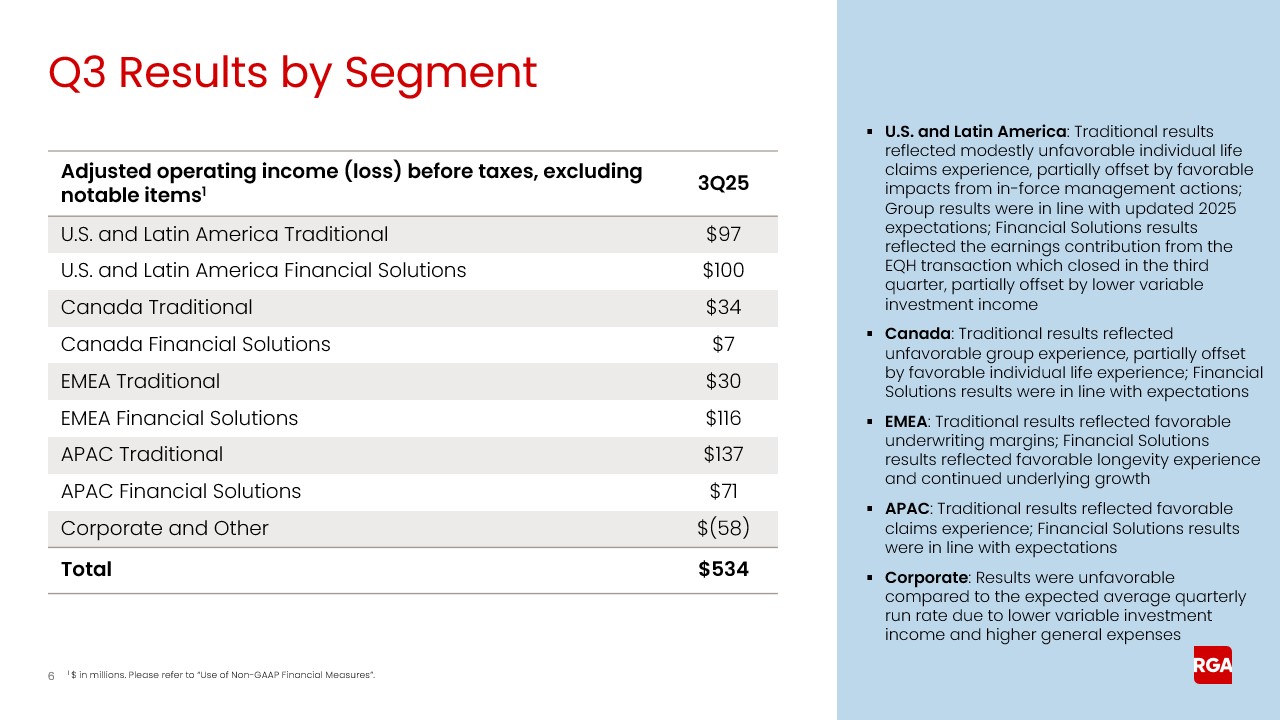
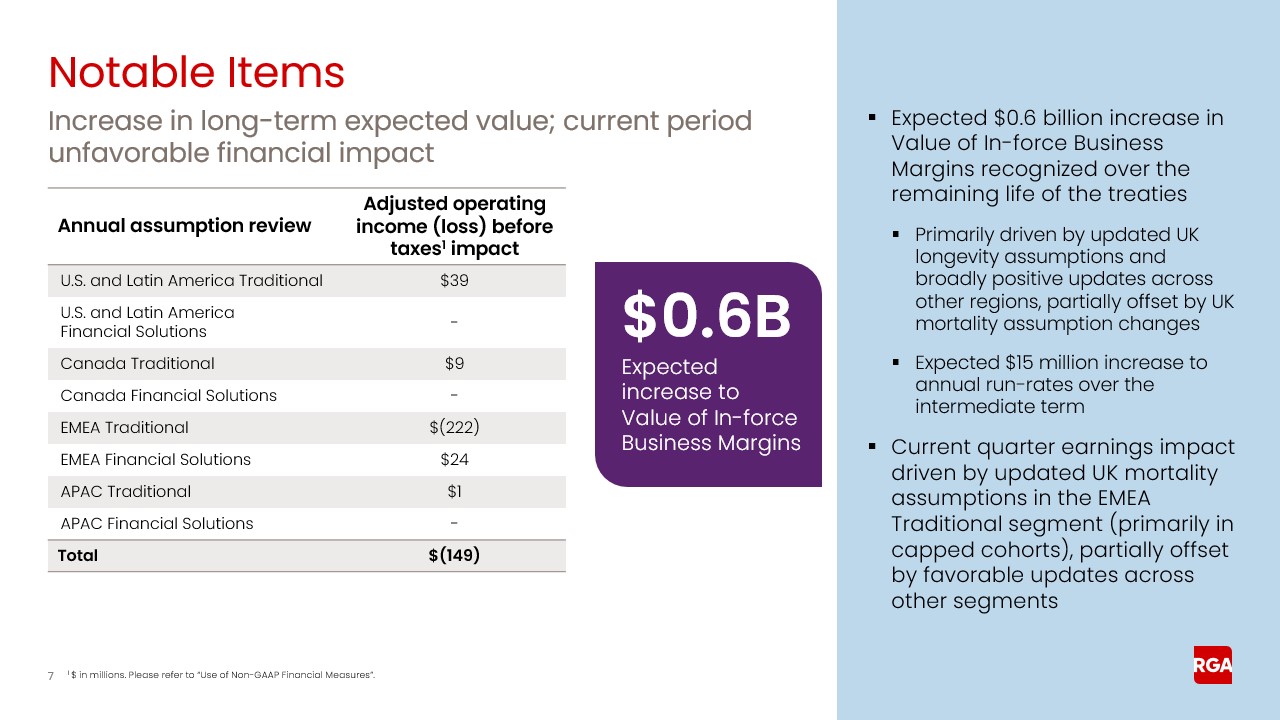
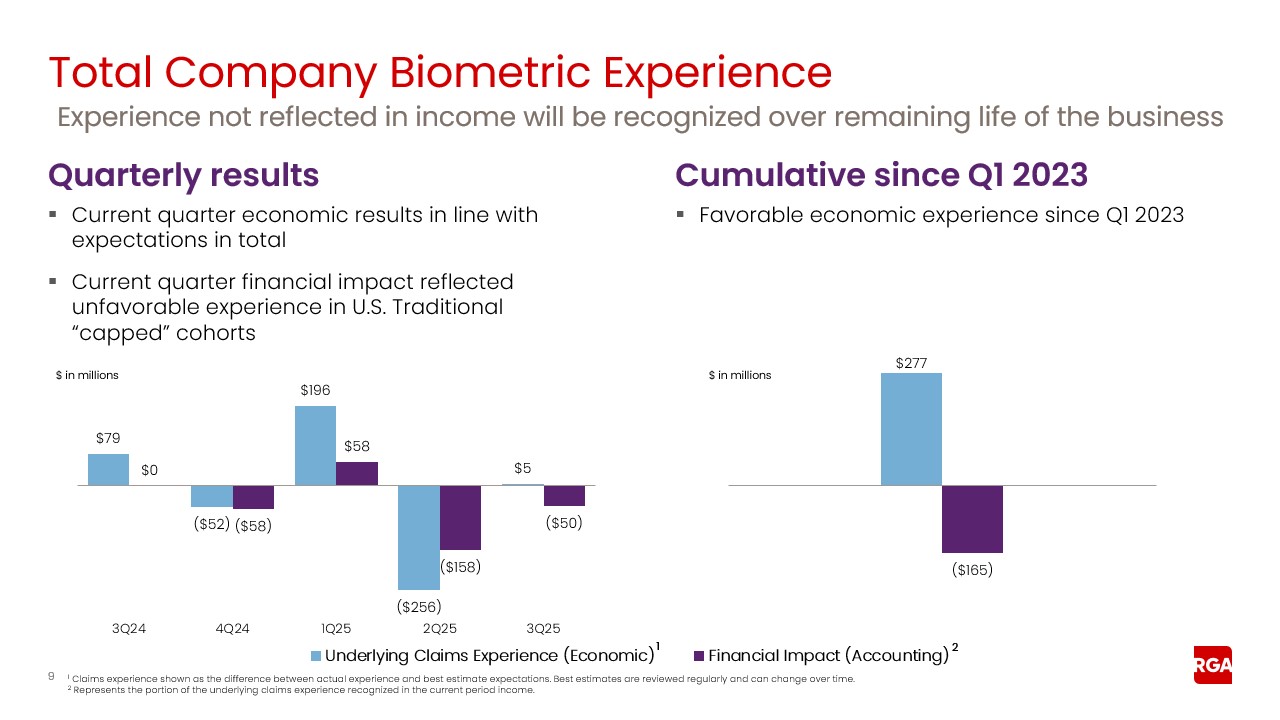
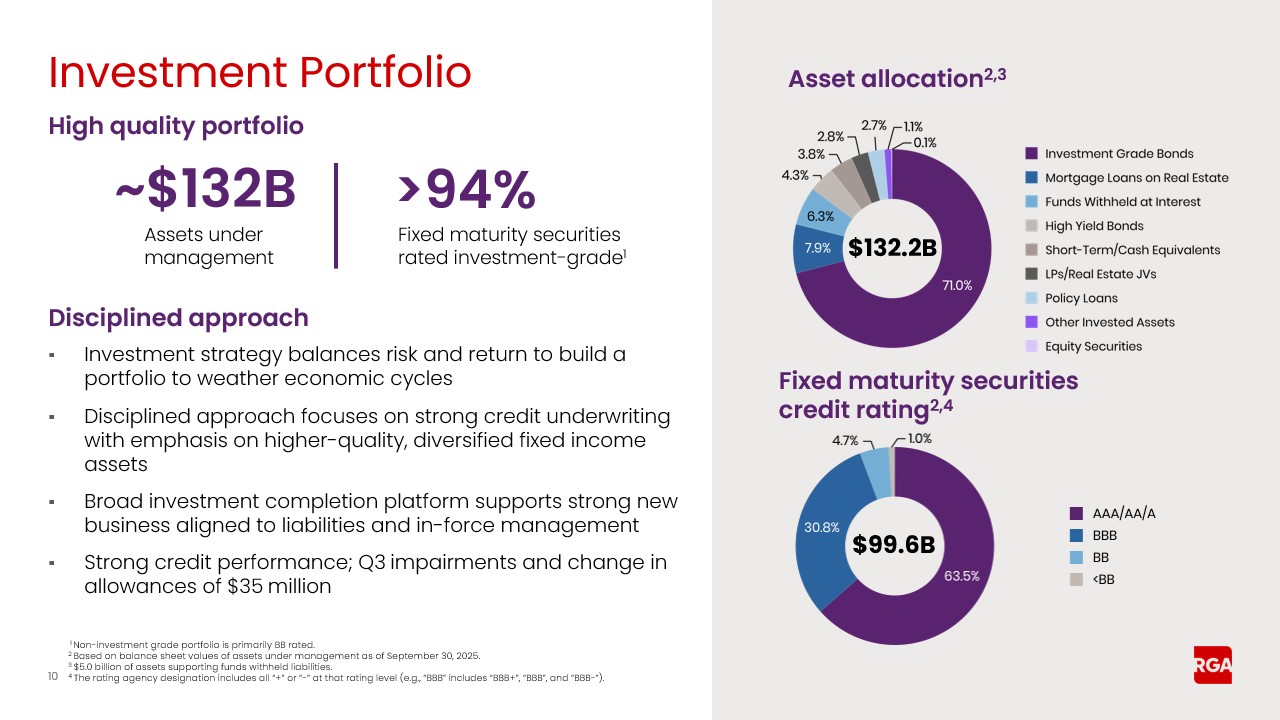
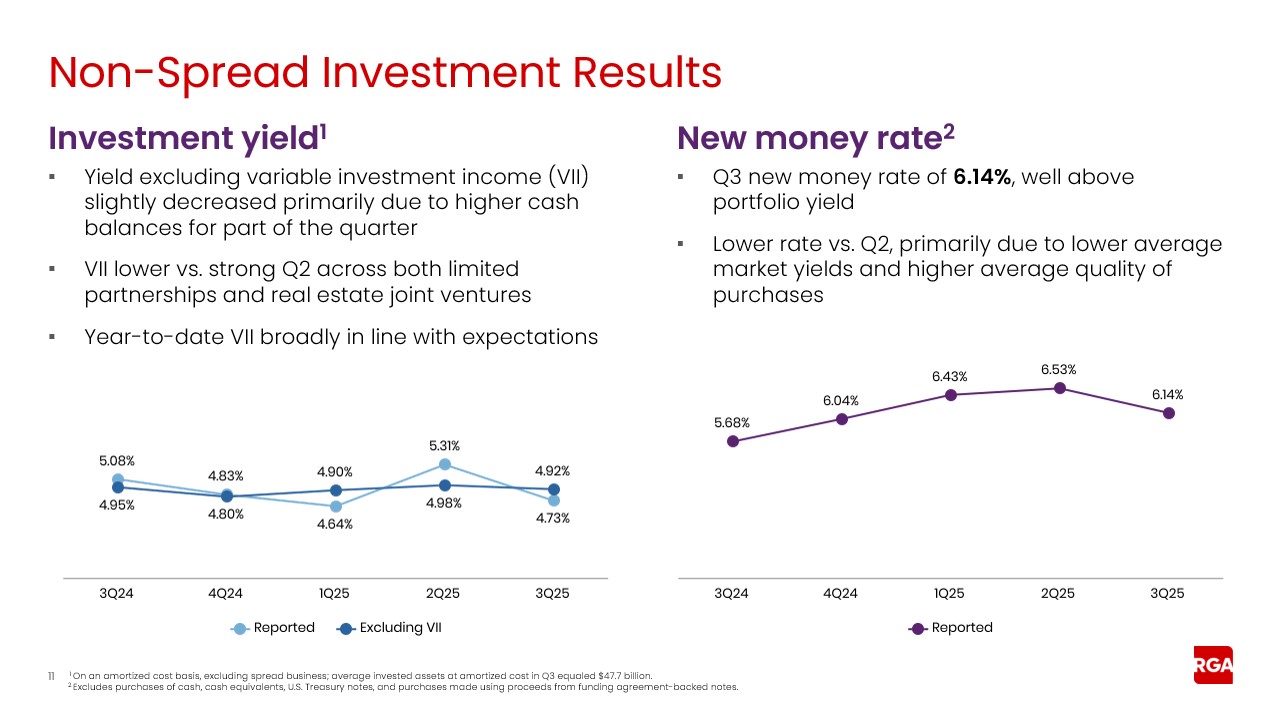
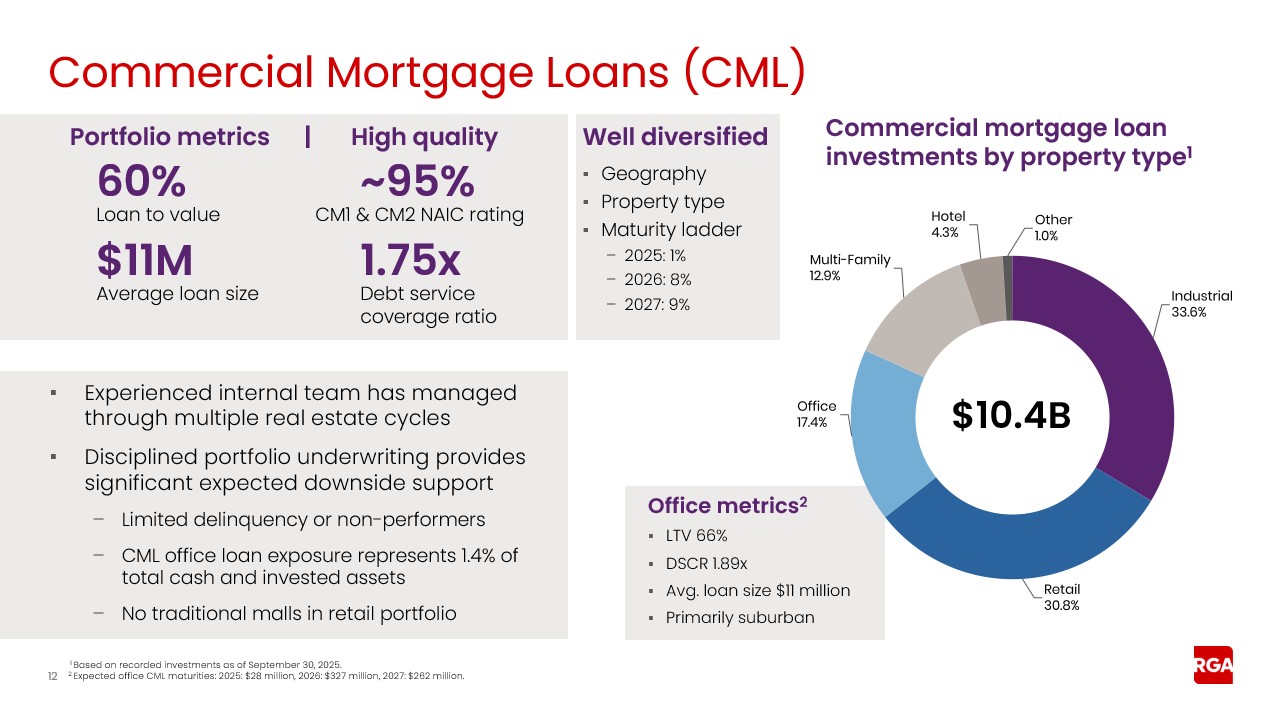
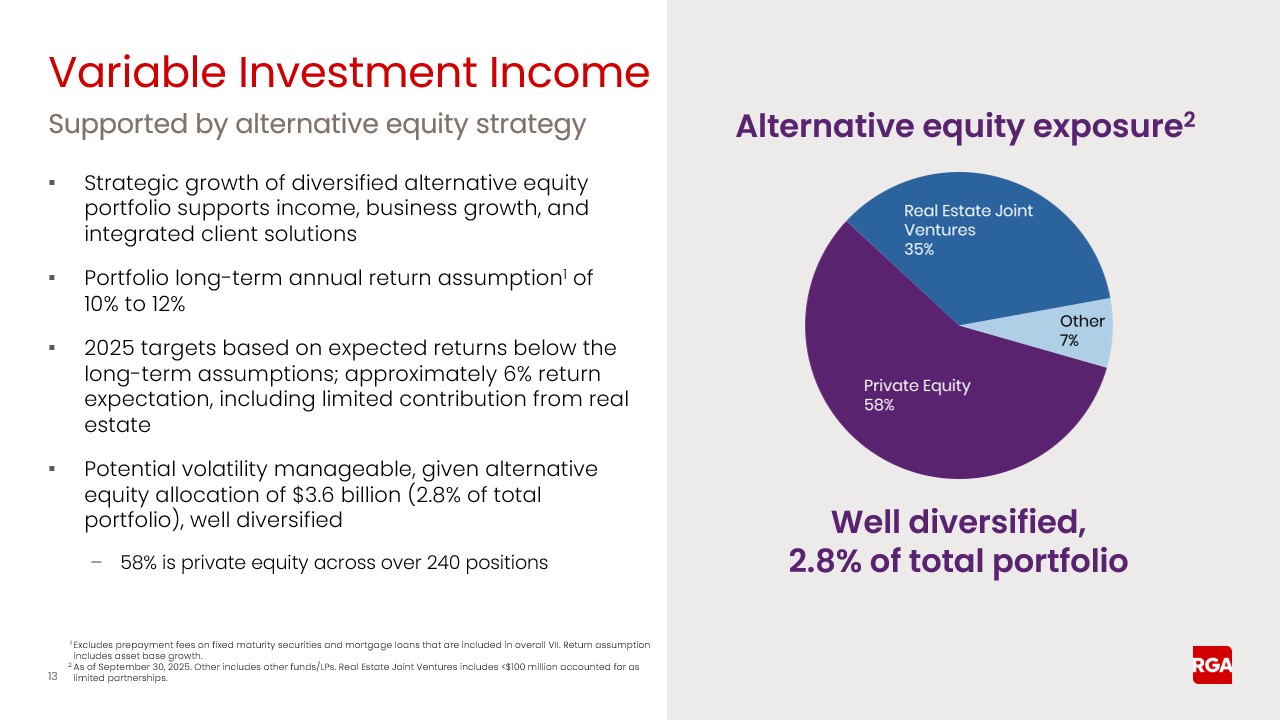
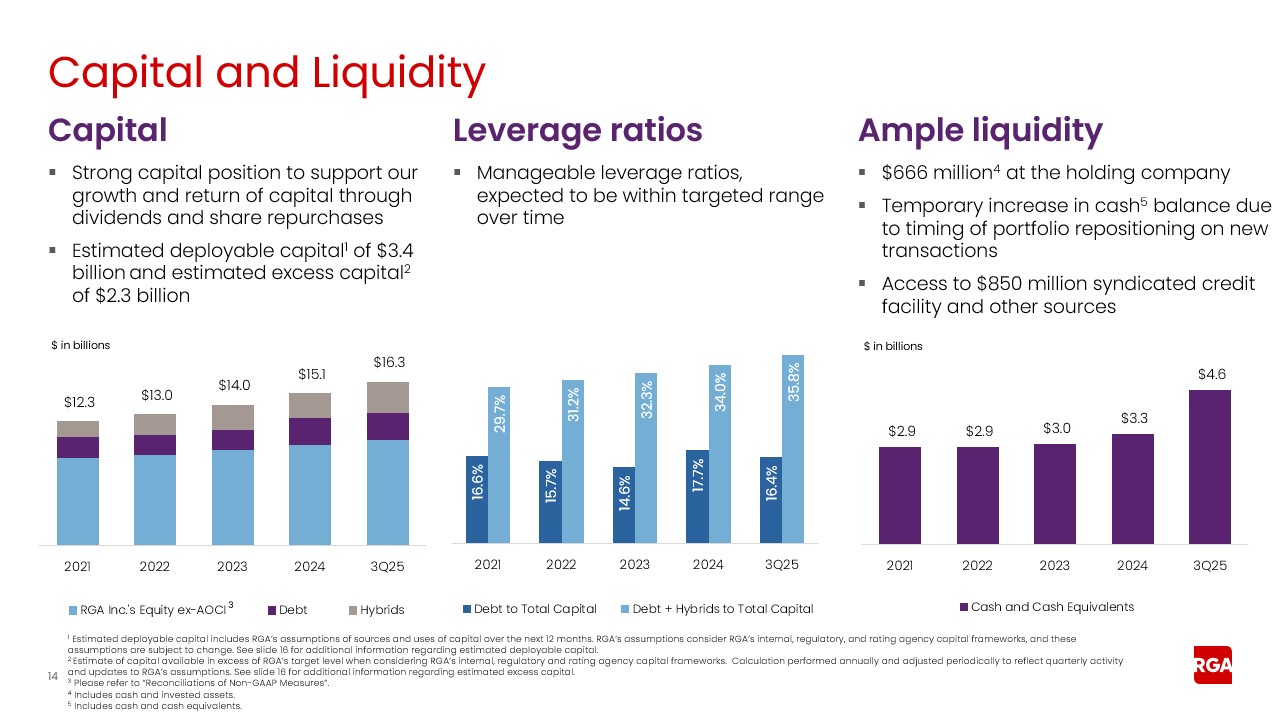
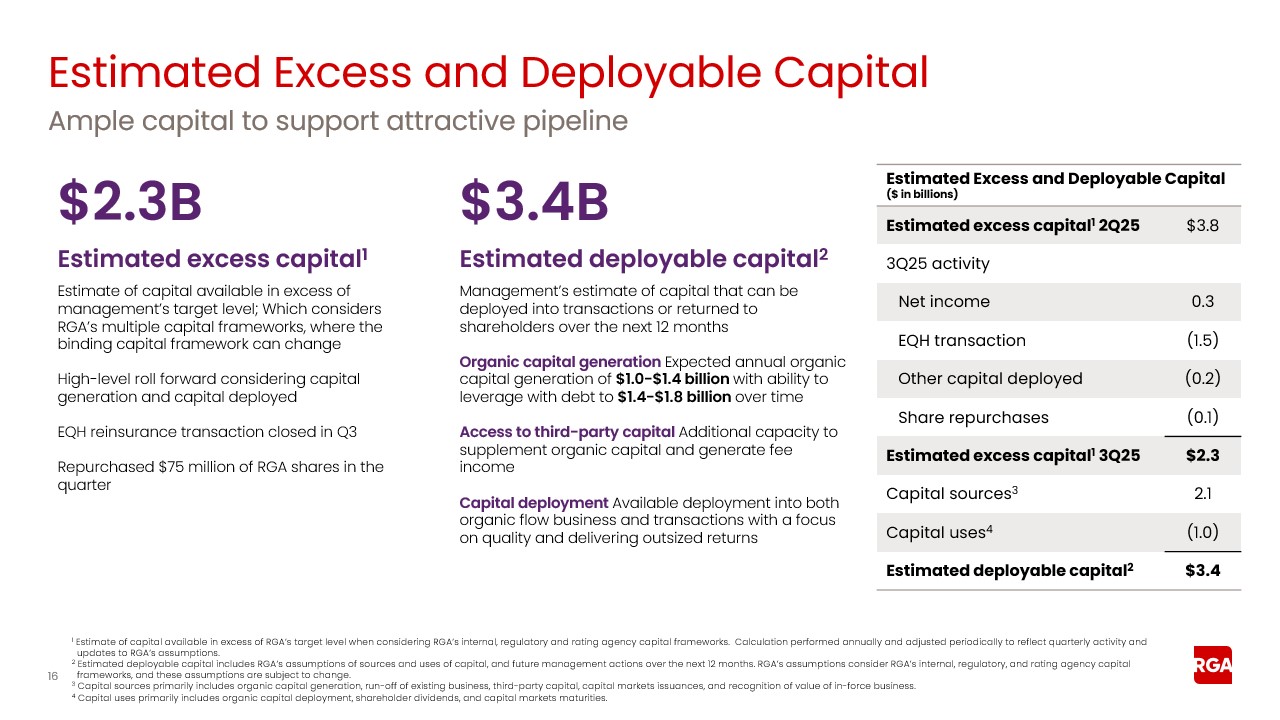
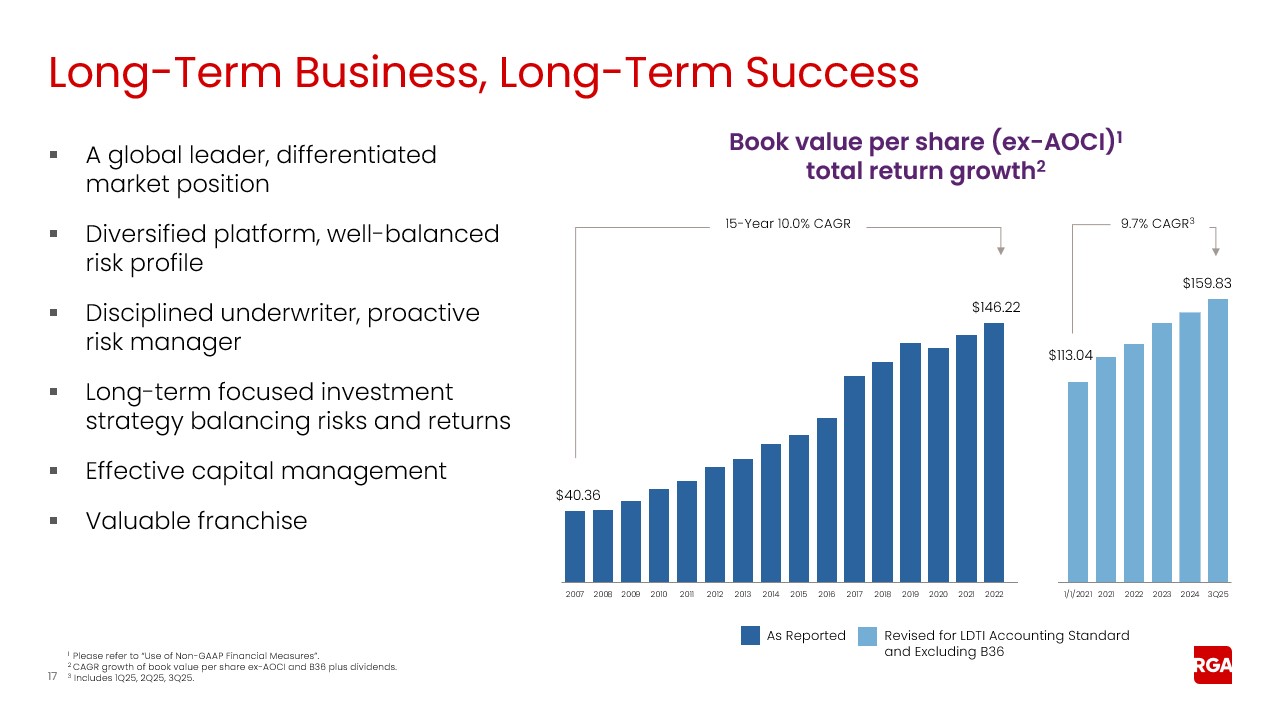
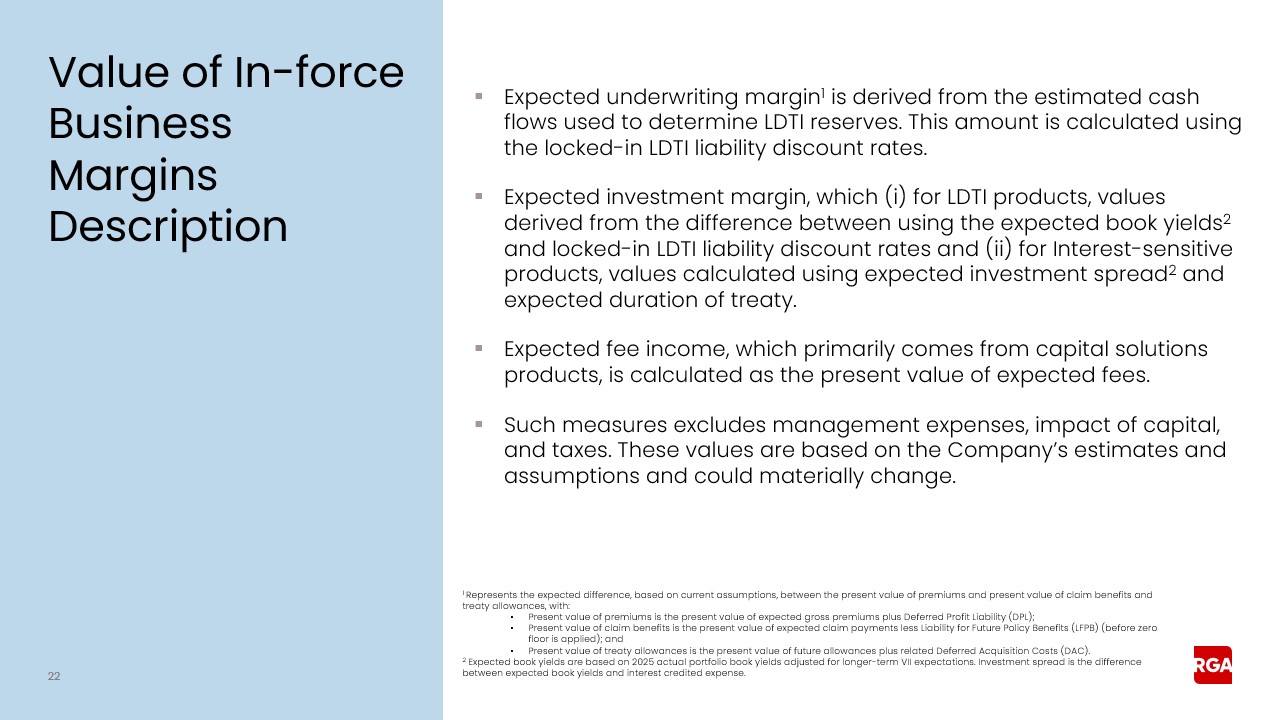
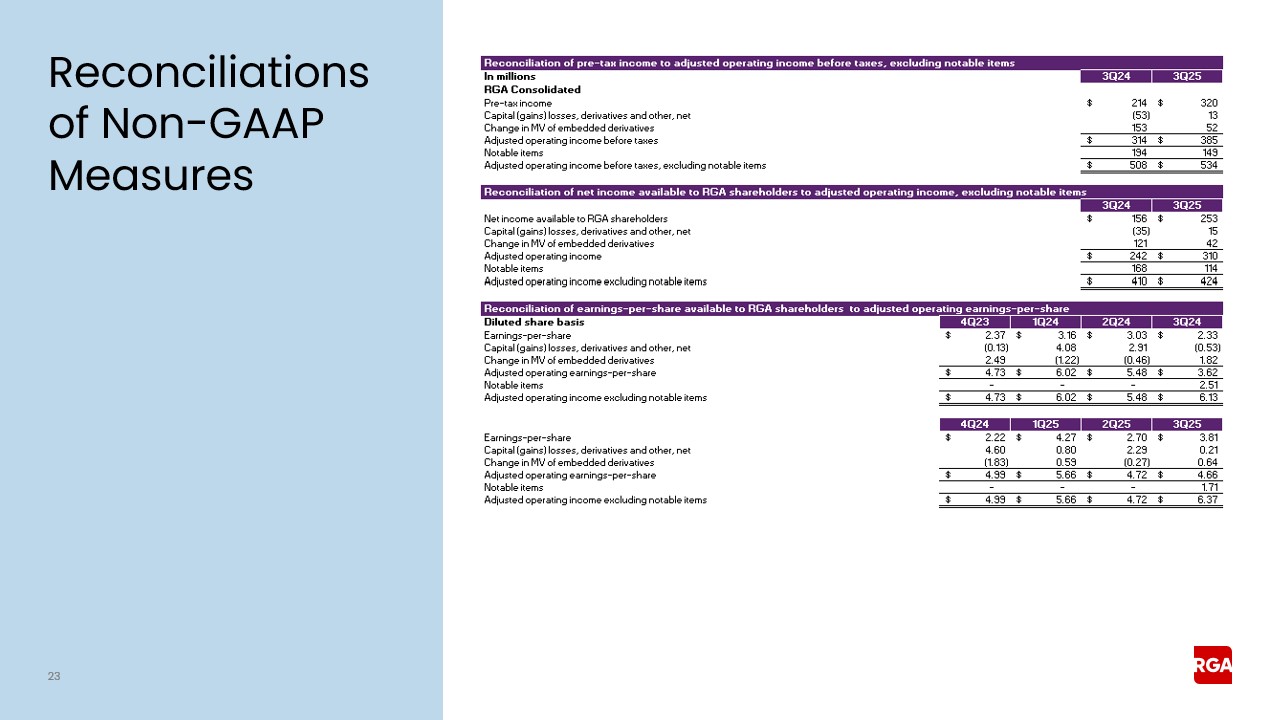
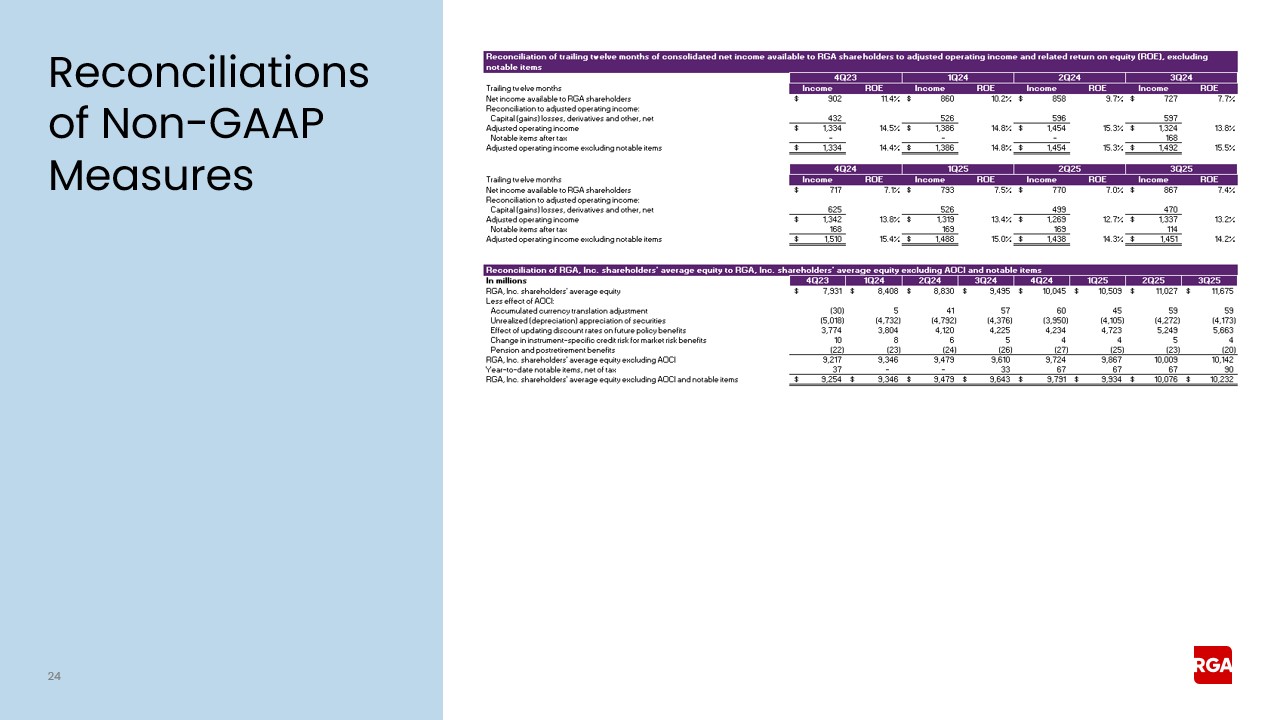
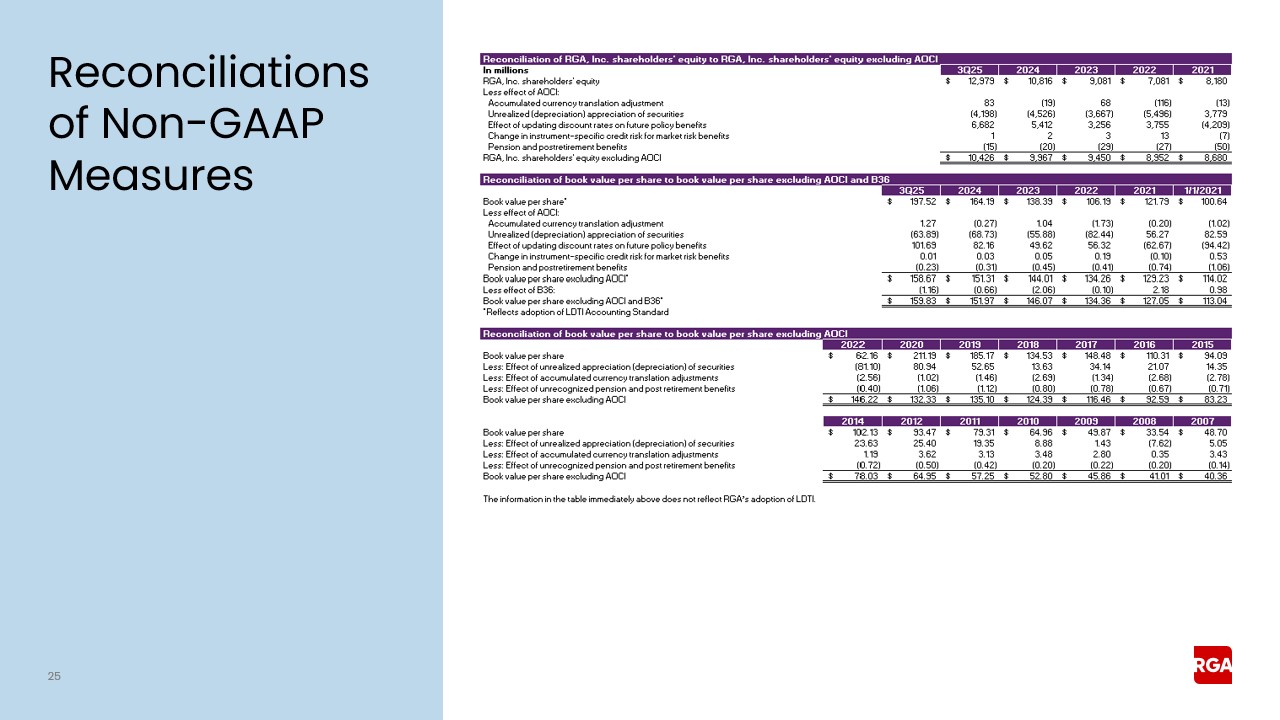
Thank you, Tony. RGA reported pretax adjusted operating income, excluding notable items, of $534 million for the quarter or $6.37 per share after tax. For the trailing 12 months, adjusted operating return on equity, excluding notable items, was 14.2%. Results were strong this quarter and above expectations. Momentum across our business remains good, and we saw notable strength in Asia Traditional and EMEA and U.S. Financial Solutions. As Tony mentioned earlier, we closed the Equitable transaction and recognized a full quarter of income. Results for the block continue to be in line with expectations. As a reminder, this block is expected to have highly diversified sources of earnings, split roughly between fee income, underwriting margin and investment spread. This is one of the reasons the transaction was so attractive to us. Given the diversified sources of earnings, this is immediate earnings impact as well as incremental ramp-up as some of the assets are repositioned. The portfolio repositioning is on track and was approximately 75% complete at the end of the quarter. The remainder will occur over the next 6 to 9 months. During the quarter, we deployed $233 million of capital into in-force transactions in addition to the previously announced $1.5 billion into the Equitable transaction. We also completed $75 million of share repurchases at an average price of $184.58. Our capital position remained strong, and we ended the quarter with estimated excess capital of $2.3 billion and estimated deployable capital of $3.4 billion. The effective tax rate for the quarter was 19.6% on adjusted operating income before taxes, below the expected range of 23% to 24%, primarily due to the jurisdictional mix of earnings. We still expect a tax rate of 23% to 24% for the full year. Our Traditional business premium growth was 8.5% year-to-date on a constant currency basis, which has benefited from strong growth in the U.S., EMEA and APAC. Premiums are a good indicator of the ongoing vitality of our Traditional business, and we continue to have strong momentum across our regions. Turning to biometric claims experience, as outlined on Slide 9 of our earnings presentation, Economic claims experience was favorable by $5 million in the quarter, primarily driven by APAC and Canada, partially offset by the U.S. Traditional segment. The corresponding current period financial impact was unfavorable by $50 million. Claims experience in U.S. individual life and group were modestly unfavorable. As discussed last quarter, our expectation was that the group business overall will be approximately breakeven for the second half of the year, and that remains true. Over the longer term, economic claims experience for the total company has been favorable by $277 million since the beginning of 2023 when we more fully emerged from COVID. As a reminder, the favorable economic experience that has not been recognized through the accounting results will be recognized over the remaining life of the business. I'll now make a few comments on the notable items reported in the period, which relates to the results of our annual actuarial assumptions review, the overall economic impact of the assumptions update is positive from a long-term value perspective and future run rates. As presented on Slide 7, the impact is split into 2 components: a negative $149 million current period impact due to LDTI cohorting and a positive $600 million impact on long-term value. Said another way, if LDTI did not exist, the total impact is a benefit of $450 million. These updates will increase annual run rates by $15 million, gradually increasing to $25 million annually by 2040. Moving to the quarterly segment results on Slide 6. The U.S. and Latin America Traditional results reflected modestly unfavorable claims experience, partially offset by the favorable impact from in-force management actions. In our group business, as mentioned, results were approximately breakeven and in line with our updated 2025 expectations, and the block will be fully repriced by January 2026. The U.S. Financial Solutions results reflected the contribution from the Equitable transaction, partially offset by lower variable investment income. The results from the Equitable block were in line with expectations. For the full year, we still expect this transaction to contribute around $70 million of pretax income, increasing to $160 million to $170 million in 2026 and approximately $200 million per year by 2027. Canada Traditional results reflected unfavorable group experience, partially offset by favorable individual life claims experience. The Financial Solutions results in Canada were in line with expectations. In the Europe, Middle East and Africa region, the Traditional results reflected favorable underwriting margins. EMEA's Financial Solutions results reflected favorable longevity experience and continued growth in the segment. This segment continues to be a bright spot for us. Turning to our Asia Pacific region. Traditional had another good quarter, reflecting favorable claims experience and the benefit of ongoing growth. This segment continues to perform at a high level, a reflection of our excellent competitive position and our execution of value-added solutions to clients. Financial Solutions results were in line with expectations with a modest unfavorable impact from lower variable investment income. Finally, the Corporate and Other segment reported an adjusted operating loss before tax of $58 million, unfavorable compared to the expected quarterly average run rate. Moving to investments on Slides 10 through 13. The non-spread book yield, excluding variable investment income was slightly lower than Q2, primarily due to higher levels of cash for part of the quarter. The new money rate remains well above the portfolio yield, providing a tailwind to our overall book yield. Total variable investment income was below expectations by around $40 million, primarily due to lower real estate joint venture activity. Overall, our portfolio quality remains high and credit impairments are better than expectations for the year. Notably, we have zero direct exposure to the recent auto sector bankruptcies. Turning now to capital. Our excess capital ended the quarter at an estimated $2.3 billion and our deployable capital was an estimated $3.4 billion. It's important to note that we manage capital through multiple frameworks, including our internal economic capital, regulatory capital and rating agency capital. From a regulatory lens, we maintain ample levels of regulatory capital in the jurisdictions where we operate. Also, our strong ratings are important to our counterparty strength. Thus, we manage our rating agency capital to support these ratings. On a holistic basis, considering all capital frameworks, we are well capitalized. In the quarter, we successfully retroceded a midsized block of U.S. PRT business to Ruby Re and we are actively working on additional retrocessions. We still expect the vehicle to be fully deployed by the middle of 2026. Looking ahead, we will balance capital deployment into the business with returning capital to shareholders through quarterly dividends and share repurchases. Our intention remains to be opportunistic with share repurchases quarterly, depending on our capital position, a forward view of our transaction pipeline and valuation metrics. Over the longer term, we expect total shareholder return of capital through dividends and share repurchases to range between 20% to 30% of after-tax operating earnings on average, consistent with our long history. During the quarter, we continued our long track record of increasing book value per share. As shown on Slide 17, our book value per share, excluding AOCI and impacts from B36 embedded derivatives increased to $159.83, which represents a compounded annual growth rate of 9.7% since the beginning of 2021. Moving to Slide 18. We provided an update on the value of in-force business margins, which significantly increased since the end of 2024, reflecting the very strong new business momentum. Overall, we believe this is an additional lens through which to assess the long-term earnings power of our business that will emerge over time, and we are pleased with the results. All in all, this was a great quarter with strong operating results. In addition, we continue to advance many strategic objectives. Our long-term strategy remains well on track, and we are confident in our ability to deliver on our intermediate-term financial targets. We continue to see very good opportunities across our geographies and business lines and remain well capitalized to execute on our strategic plan. We also believe we are in a position to return excess capital to shareholders through dividends and share repurchases. With that, I would like to thank everyone for your continued interest in RGA. This concludes our prepared remarks. We would now like to open it up for questions.
Speaker 3
First one was just on the U.S. claims activity in Traditional in the quarter. Just wanted to see if you would unpack current experience, if that's just normal volatility in your view, if there's any one-time items in there.
Speaker 2
Yes, Wes. Thanks for the question. On the U.S. Trad side, so we had about $30 million of negative claims experience on the individual life side, that's really kind of normal volatility. If you look at it on a historical basis, it's well below a standard deviation. So frankly, modest noise there. And then on the group side, as indicated last quarter, and consistent with the expectations that we had set, we had about a $20 million negative experience.
Speaker 3
Got it. And maybe sticking with that segment, U.S. Traditional in the current quarter. Were there any one-time items that impacted premiums? It looks like premium growth was a little bit softer there than the rest of the enterprise. And if so, what was kind of the underlying growth rate there?
Speaker 2
Yes. So on the U.S. premium side, so in the quarter, we had an in-force action, a recapture of a treaty, which resulted in a positive impact to the results of about $20 million. And so the flip side of that is that we didn't record the premiums that we would have gotten from that treaty. And so that's really the main driver for the reduction in premiums.
Speaker 4
There was a recent report in September from Swiss Re suggesting a mortality reduction from GLP-1 drugs of up to 6.4% in the U.S. and 5.1% in the U.K. How soon would it make sense to maybe recognize that benefit either on pricing or in your assumptions?
Speaker 5
John, thanks for the question. This is Jonathan. So we haven't made any material changes to our assumptions due to anti-obesity medication, but the benefits from these medications have increased our confidence that our existing mortality improvement assumptions will be realized in the future. We've done some significant modeling and analysis, and we continue to believe that anti-obesity medications, including GLP-1s, will have a meaningful benefit on population-level mortality. And going forward, we'll continue to regularly assess the data and our model and expectations as to how this population improvement translates through to our insured book of business. Specifically for the study that you referenced, our analysis is generally aligned with a central estimate that Swiss Re has as well. So our numbers are consistent with their central estimate. I think the numbers you quoted were on the high end of their estimate.
Speaker 4
Yes, those were the bull case outcomes. My follow-up, I believe the lift to annual run rate is $15 million over the intermediate term and would be expected to grow. To what level would it be expected to grow in the max year?
Speaker 2
Yes. So just to clarify, I think you referred to the impact of the actual assumptions update. As I mentioned, there's the accounting impact and there's the kind of long-term value impact, the $600 million, which will be recognized over time. That $600 million essentially will increase our run rates by $15 million next year, which then gradually ramps up to a $25 million increase to the annual run rate by 2040.
Speaker 6
I had a couple of questions. First, regarding your expectations for Ruby Re, you mentioned that you anticipate the pipeline will be filled based on your intentions for business activity. What kind of liabilities are you considering for the structure? There seems to be significant demand for reinsurance or deals related to some of these legacy liabilities. How do those fit into your plans? I also have a follow-up.
Speaker 2
Sure. Thanks for the question. We were pleased to see another transaction added to Ruby Re this quarter. As you may recall, the vehicle was designed to take in U.S. asset-intensive transactions. We have a pipeline of transactions that we are currently processing to add to the vehicle, which is why we are confident that we will be fully deployed by the middle of 2026. It's important to note that sidecars and third-party capital are essential to our strategy. In the future, we plan to pursue additional sidecars, which will enhance our ability to deploy capital over time.
Speaker 6
And then the type of liabilities include just annuities or like LTC VAs with living benefits as well?
Speaker 2
Ruby Re is focused on relatively straightforward liabilities, particularly those we classify as asset intensive, like pension risk transfer. We also manage other liabilities with some biometric risks, but they tend to be fairly standard. As we seek new opportunities, we might broaden the scope of the liabilities we consider. However, I want to emphasize that we concentrate on areas where we have established expertise. Our strength lies in merging the two sides of the balance sheet, the biometric risk and the asset side, within the types of transactions we have successfully managed. Therefore, our intention is not to venture into new areas where we lack expertise or a proven track record.
Speaker 7
I had a question on in-force actions. You've done a number of things over the last few years. I was just hoping to get an update on how far along you think you are at this point? And in the kind of opportunities that you still have going forward to do more actions on the in-force.
Speaker 2
I can start by discussing the numbers and then hand it over to Tony. We've mentioned in-force actions in several calls, noting that they contributed significantly to our earnings in 2023 and 2024. At the start of the year, we anticipated around $50 million annually from in-force actions. These can fluctuate, meaning some years may exceed that amount while others may fall short. So far in 2025, we have achieved approximately $45 million in cumulative in-force actions, which aligns well with our expected run rate. Additionally, we have several opportunities to implement more in-force management actions across our portfolio.
Yes, Ryan, I would add that this discipline originated in the U.S. but has now expanded globally. In the current quarter, we are seeing these actions not just in the U.S. but worldwide. That’s the first point. The second point I want to emphasize is the critical importance of risk management for us. We are actively managing risk. The question is how we leverage our strong partnerships with clients to create win-win solutions as we gain a comprehensive understanding of the business blocks. This process has not hindered our ability to write new business; in fact, it can actually enhance it by enabling us to navigate difficult discussions effectively. We are very pleased with our approach, and as Axel mentioned, we continue to deliver on it. This is not a drawn-out process; it's an integral part of our ongoing business that we anticipate will continue moving forward.
Speaker 7
I wanted to follow up regarding last quarter's discussion on the value in-force benefit related to excess capital. There seems to be some skepticism from others about whether this benefit can fully be utilized for growth in the future. I wanted to clarify that there are no restrictions on this benefit, and you have full approval from rating agencies to deploy this portion of your capital moving forward.
Speaker 2
Thank you, Ryan, for your question. To clarify, this capital is indeed real and available for transactions. I want to emphasize that our excess capital spans three frameworks: economic capital, regulatory, and rating agency. We assess the constraints we face from each of these perspectives. From a regulatory standpoint, this capital is present within our legal entities and accessible for deployment, despite the varying regulatory frameworks involved. The recognition of the value of in-force, as you mentioned, is influenced by rating agency considerations. It's important to note that we only account for a portion of our in-force value, and there is a significant discount applied by rating agencies. The value in-force will amortize over the business's lifecycle, and we aim to enhance our in-force value by examining blocks not yet reviewed by rating agencies and incorporating new business. Notably, our reports indicate that the value of in-force business margins has grown by 16% over the first nine months of the year, reflecting strong growth in our value store and the potential to recognize this capital from the perspective of rating agencies.
Yes, Ryan, let me add another point. I know you were talking about deployment into the business. Regarding potential buybacks, we have communicated how much we plan to return to shareholders. To answer your question, the only criteria we would consider beyond the strategic ones for buybacks would be whether we have sufficient liquidity and our leverage ratios. Otherwise, this capital is fully available for buybacks. I just wanted to reinforce Axel's comments.
Speaker 8
Regarding the U.K. mortality assumption review impact, are those claims that you're seeing today? Or is it more of a long-term expectation for higher mortality? And could you also just provide some color on what you're seeing in terms of U.K. mortality trends?
Speaker 5
Wilma, this is Jonathan. Thanks for the question. So part of the assumption review this quarter, we've increased our expectation for future U.K. mortality, and that's resulted in an increase in future mortality claims and an offsetting decrease to future longevity claims. So this change in assumptions reflects ongoing excess mortality we're seeing in the U.K. population, which likely reflects challenges with the National Health System as well as a thorough review of recent experience in our own book of business. Under LDTI, as Axel mentioned, most of this U.K. mortality impact is recognized in the current period as the strengthening of reserves on capped cohorts and the benefits of the longevity business are deferred and amortized into future periods. So on a net economic basis, looking at both mortality and longevity combined and just looking at the U.K. specifically, it's actually pretty neutral. So that's given our balanced book of business. There's not much net economic effect of the changes.
Speaker 8
Okay. Now that the second question is, now that the Equitable block is closed, could you provide a little more insight into your expectations for accounting smoothing on the mortality for that block?
Speaker 2
Sure. Yes, for the Equitable block, there will be accounting smoothing of volatility. We expect roughly about 50% of that block to benefit from that smoothing of results over time.
Speaker 9
First one I had is just on the group headwind that you guys have had from the medical piece of things. Can you talk about what you're seeing there, the kind of repricing you're taking? And just any further commentary on the trajectory there?
Speaker 2
Sure. I can start here. Look, on the group side, like we mentioned last quarter, it's short-term business, right? So it all gets repriced over the course of the year. And as we mentioned, we had started to take repricing actions by Jan 1, 2026. By Jan 2026, all of the block will be repriced. And so from there on, we have expectations of profitability for all segments of the group business.
Speaker 9
Understood. My next question is a bit direct, so I apologize ahead of time. As we engage with industry participants and attend various conferences, a recurring theme emerges. Some investors seem to believe that RGA is becoming more competitive and aggressive, possibly accepting lower internal rates of return to secure business. It's important to hear your perspective on this, as it appears to influence your stock. I'd like to know whether this perception is merely a reaction to your success or if there's more substance to it. I'm interested in your thoughts regarding these comments we've encountered.
Yes, Alex, let me address that. There’s a lot to unpack. First, regarding our approach to risk, there has been no change in our risk tolerance, appetite, processes, leadership, or culture, and we likely couldn't alter it even if we wanted to, nor would we want to, as it has been a significant competitive advantage for us over the past 52 years. You can see this throughout the organization; our business strategy is centered on discipline. We focus on choosing and selecting business that aligns with our strengths in local offices, biometric and asset risk, and our strong client relationships. This focus leads us to pursue higher quality business, which in my view carries less risk than tendered business. This is evident not only in what we engage with but also in what we choose to forego. Our name often does not come up because we are not participating in many recent U.S. tenders for risks that simply do not fit our sweet spot. For one, they are tenders; we prefer to pursue exclusive transactions. Additionally, the risks involved are not what we are interested in. This has always been our methodology and will remain our approach. When I hear comments like the ones you mentioned, it reminds me of the early days in Asia when we began to find success 20 years ago. Naturally, such perceptions arise, and that is to be expected. We will continue to adhere to our strategy and culture. It remains unchanged, and we are genuinely excited about the growth and returns we will deliver to our shareholders in the future.
Speaker 10
So if I think back to when we started talking about LDTI, I think the commentary was this was supposed to be a benefit to RGA because of the smoothing and if I just look at recent results, it just doesn't seem like that's playing out. You're getting more of the bad than the good. And I was just curious, is this just because there's a larger portion of your block that's in capped cohorts, and that's what's causing it? Or can you give us a sense of what percentage of your business is capped versus uncapped? Because I just don't think we're seeing the smoothing that we expected when we first started to talk about this.
Speaker 2
Sure, thank you for the question. We continue to believe that LDTI helps in smoothing results over time, although this may not be consistent every quarter. When examining recent presentations or older ones with a longer history, it’s evident that the accounting impacts are generally less significant than the economic ones, introducing some degree of smoothing and reducing noise. However, you are right that for capped cohorts, the results are recognized immediately, and over time, we anticipate that a portion of cohorts will remain capped, leading to increased volatility on the downside.
Speaker 5
Yes. And then Suneet, just to give you a number to size it for you, for our traditional business and total across the world, about 15% of our business is in capped cohorts.
Yes, Suneet, just let me add one more point. I mean, look, these capped cohorts to us, like I said earlier, look, risk management is our DNA, our critical part, and therefore, these capped cohorts are obviously blocks we monitor very closely and are a fertile ground for the in-force actions that you see us doing. And that's, as I said earlier, an integral part of our way of generating further profit and ROE.
Speaker 10
Yes, that makes sense. My second question is about the economic solvency in Japan. Over the past few quarters, it seems like you've seen this as an opportunity, but we're still a few quarters away from actual implementation. Has it turned out to be the opportunity you anticipated, or have companies found solutions that don’t require RGA's capabilities? I'm just curious about our current position on this.
Thank you, Suneet. I would say the initial signs of opportunities began about five or six years ago. It’s not an immediate switch; companies have been preparing for this for years, which has allowed us to secure significant business. This is a key reason for the increased activity we're witnessing in Japan regarding the coinsurance of blocks. Our partners in the market include local firms as well as some multinational companies. While these global companies might have additional resources like internal reinsurers, for us, this remains a significant opportunity that is ongoing. We are very selective in our pursuits, primarily focusing on blocks of business that involve both biometric and asset risk, usually with long-standing clients we've had relationships with for decades concerning biometric risk.
Speaker 11
If I look at the earnings power in the quarter, and I adjust for, we'll call it, the accounting noise in the capped versus uncapped cohort, I sort of unwind that, you get about $7 of earnings power in the quarter. Now that seems well above the kind of levels that you guys have guided to if I think about glide path. Now I'm assuming there was like significant over-earnings in some of the segments versus what you think is trendable, but can you help kind of unpack $7 and maybe getting us back to a more reasonable trend line because that does seem quite high?
Speaker 2
Thank you for the question, Tom. When we analyze the components of our earnings this quarter, we noted the claims experience amounted to about $50 million, while the positive impact of in-force actions worldwide was around $40 million, offsetting some of that negative impact. Additionally, there was a headwind of about $40 million from the VII. On the tax side, we experienced a benefit. Overall, this was a very strong quarter, and we are extremely pleased with the results driven by capital deployment and earnings coming online. We discussed the ramp-up of earnings as we work on our portfolio repositioning, including the Equitable transaction, which is a clear example of our capital deployment and made a significant impact this quarter. Everything is progressing well, and we are excited about the future growth trajectory of our earnings.
Yes. And Tom, let me just add a couple of points. As we always say, and as you know, one quarter's results are just one quarter's results. So if you do a similar analysis for the year, we've had an excellent quarter. That's why we describe it that way. And for the year-to-date, we're having a very strong year-to-date relative to expectations. So I'd encourage you to just maybe look back over the 3 quarters. It's probably a better gauge of where we're at in terms of sustainable earnings power for '25.
Speaker 11
Good point, Tony. My follow-up is whether you have considered any partnerships with alternative managers. We've seen several primary life companies enter into these partnerships. I wonder, with the asset-intensive business being a critical part of your growth, and given that many competitors for those types of deals seem to have significantly enhanced alternative strategies, whether it's private credit or other areas. Is that something you would consider?
Thank you for your question, Tom. I'd like to highlight a few points. Regarding private assets, we primarily manage most of it internally. However, we do maintain several external partnerships where it wouldn't be practical for us to develop the necessary capabilities, especially since they have a scale that we might not reach. This has been our guiding principle. It's important to note that we don't focus on pure asset transactions, as that's not our area of expertise. Frankly, it wouldn't make sense for us to bid aggressively on those types of deals because we are likely unable to compete on price. Instead, we concentrate on whether an asset transaction involves significant biometric risk, which is where we excel, drawing on long-standing relationships we've established over the years. We do engage in material asset reinsurance or asset-intensive reinsurance, but it's always connected to biometrics. Many of the transactions I mentioned earlier tend to be smaller or more modest; they don’t always attract headlines because they involve servicing clients we've supported for a long time, and we continue to honor those partnerships.
This concludes our question-and-answer session. I would like to turn the conference back over to Tony Cheng for any closing remarks.
Well, thank you for your questions and your continued interest in RGA. Our strong quarter and continued growth in long-term value continues to fuel future growth and returns for RGA. And this ends today's call. Thank you.
Operator
The conference has now concluded. Thank you for attending today's presentation. You may now disconnect.