Speaker 7
Hello, everyone. Thank you for joining us and welcome to the Repligent Q2 2026 Earnings Call. After today's prepared remarks, we will host a question and answer session. If you'd like to ask a question, please press star 1 to raise your hand. To withdraw your question, please press star 1 again. I would now like to turn the call over to your host for today's call, Jacob Johnson, Vice President of Investor Relations for Repligent.
Thank you, Operator, and welcome, everyone, to our 2026 Second Quarter Report. On this call, we will cover business highlights and financial performance for the three-month period ended June 30, 2026, and we'll provide financial guidance for the full year 2026. Joining us on the call today are Repligen's President and Chief Executive Officer, Olivier Leyo, and our Chief Financial Officer, Jason Garland. As a reminder, the forward-looking statements that we make during this call, including those regarding our business goals and expectations for the financial performance of the company, are subject to risk and uncertainties that may cause actual events or results to differ. Additional information concerning risk related to our business is included in our quarterly reports on Form 10-Q, our annual report on Form 10-K, and our current reports, including the Form 8K that we are filing today, and other filings that we make with the Securities and Exchange Commission. Today's comments reflect management's current views, which could change as a result of new information, future events, or otherwise. The company does not oblige or commit itself to update forward-looking statements except as required by law. During this call, we are providing non-GAAP financial results and guidance unless otherwise noted. Reconciliations of GAAP to non-GAAP financial measures are included in the press release that we issued this morning which is posted to Repligen's website and on scc.gov along with our earnings supplemental which is posted to Repligen's website. Adjusted non-GAAP figures in today's report include the following organic revenue and or revenue growth, cost of goods sold, gross profit and gross margin, operating expenses including R&D and SG&A, income from operations and operating margin, other income or expense, tax rate on pre-tax income, net income, diluted earnings per share, EBITDA, adjusted EBITDA, and adjusted EBITDA margin. These adjusted financial measures should not be viewed as an alternative to gap measures, but are intended to best reflect the performance of our ongoing operations. With that, I'll turn the call over to Olivier.
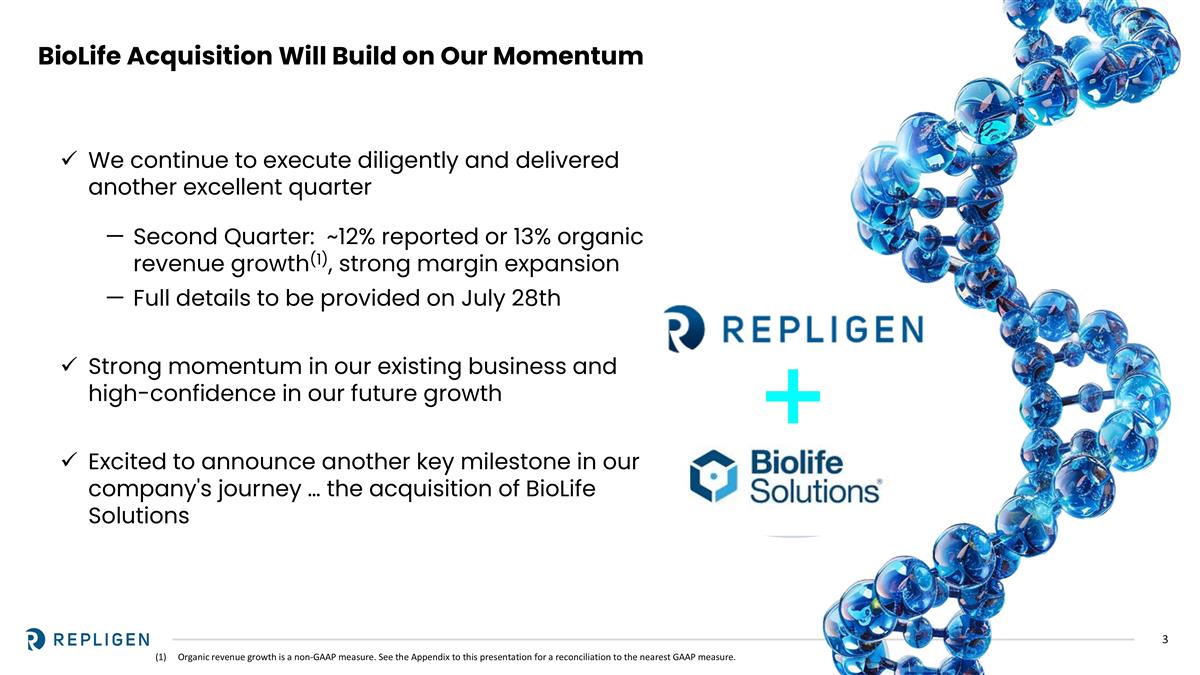
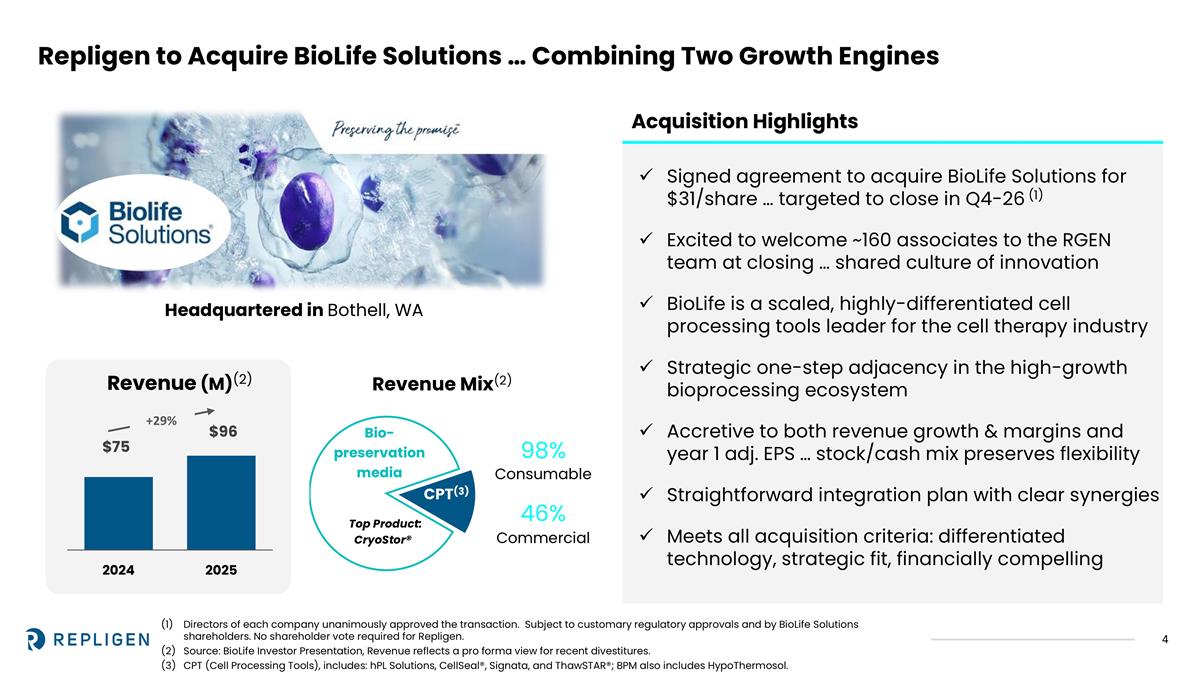
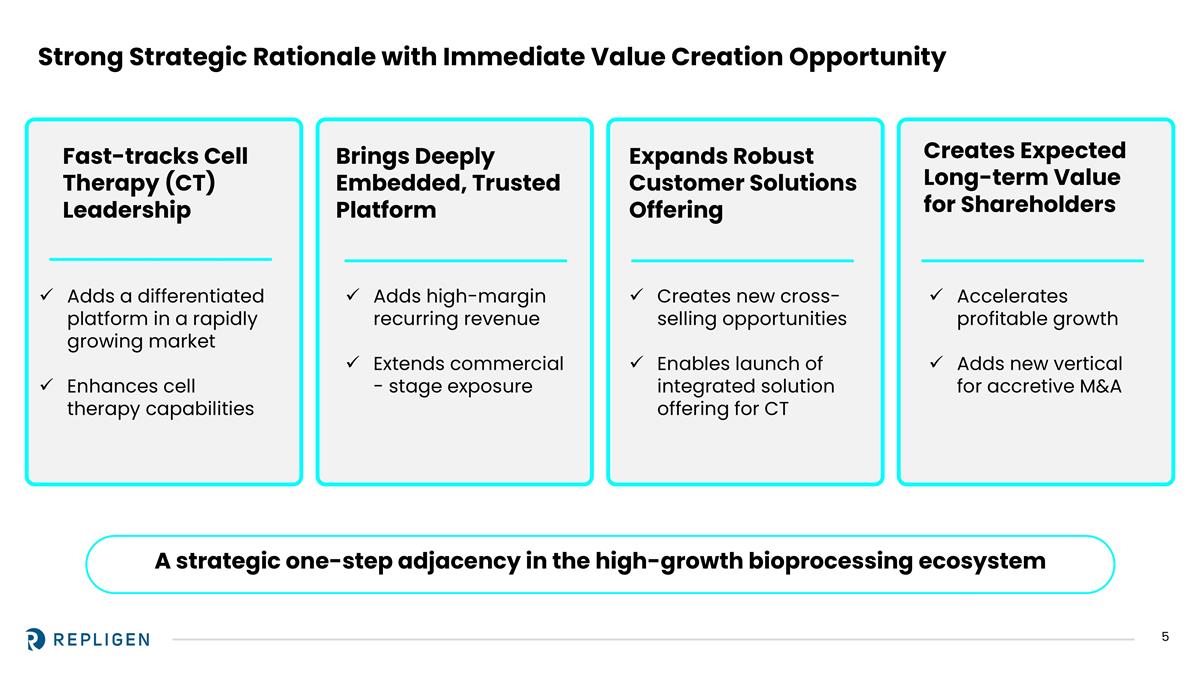
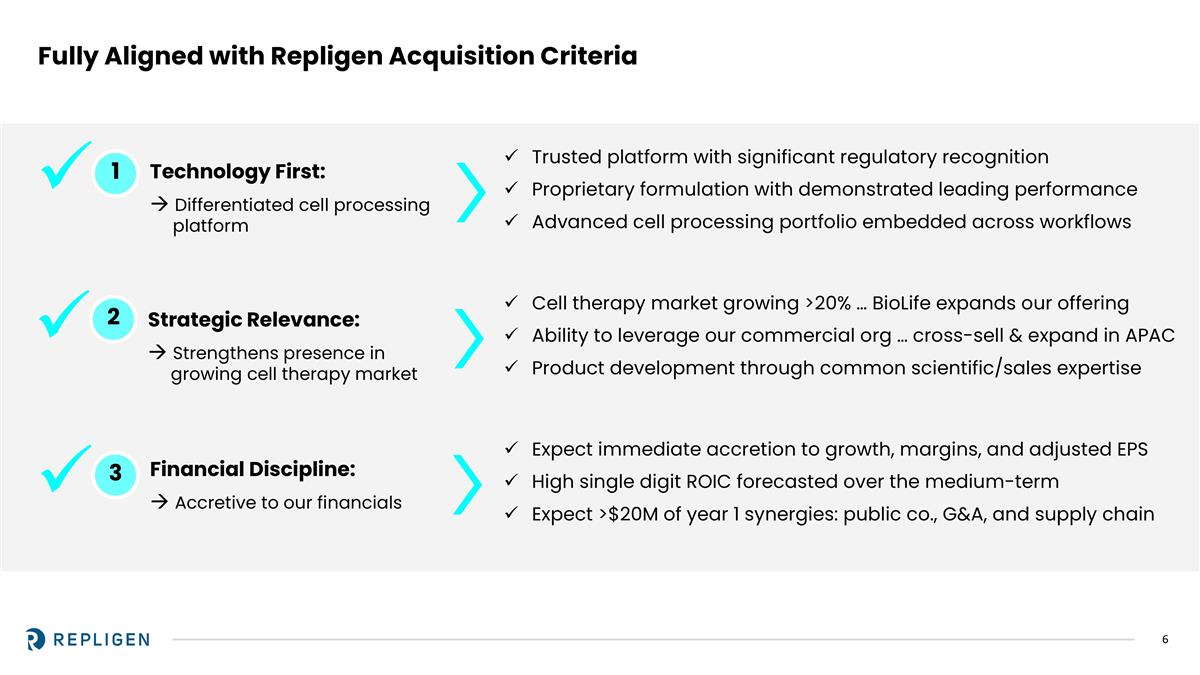
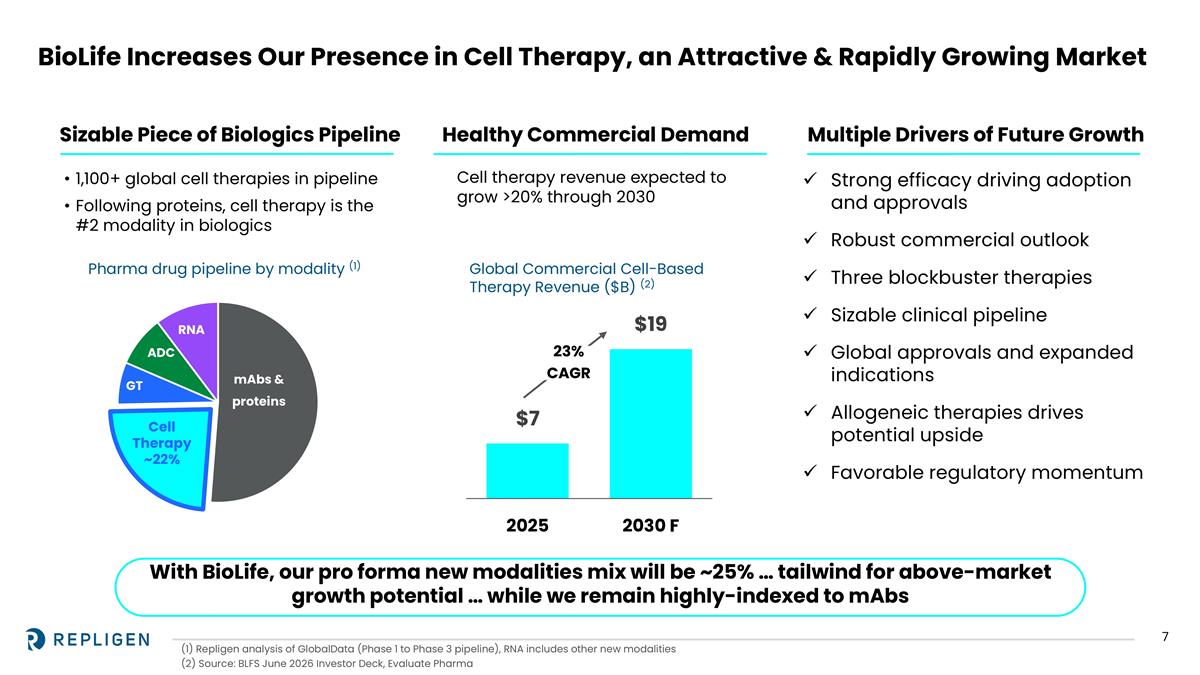
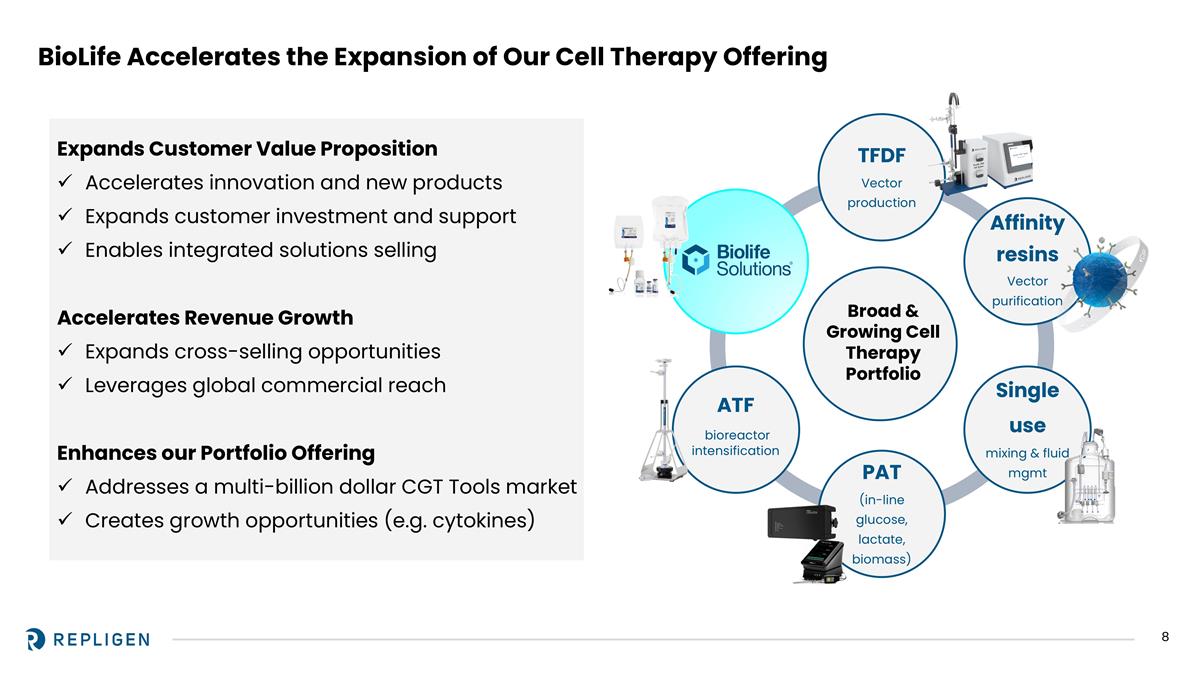
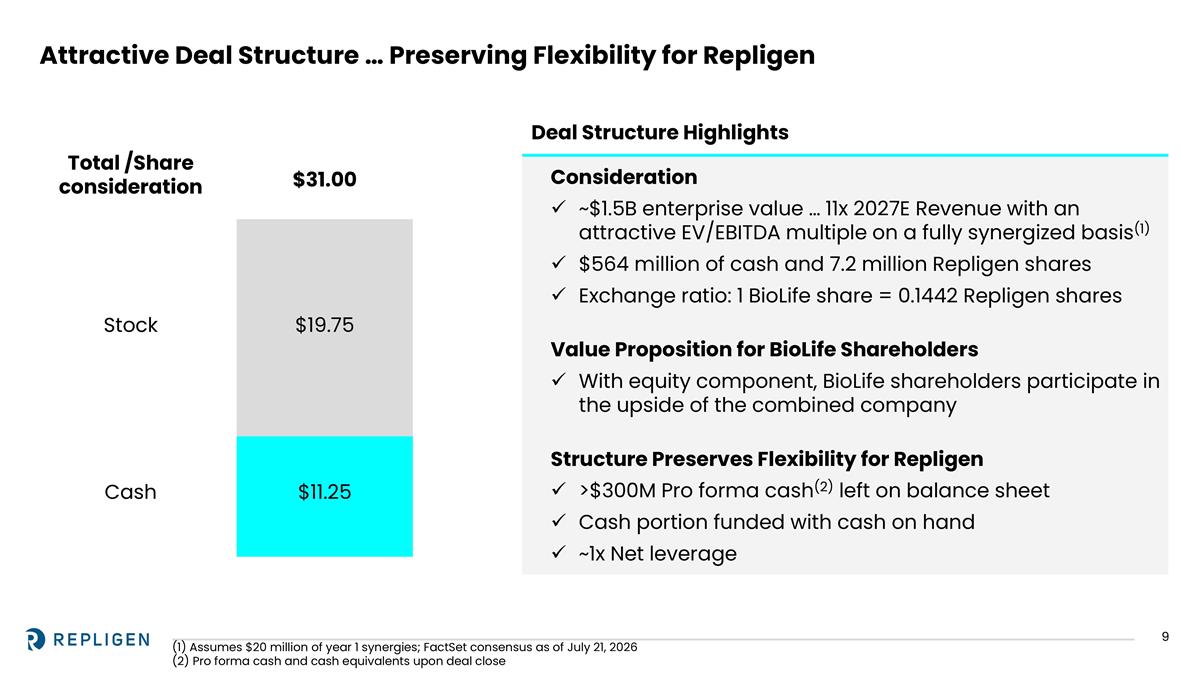
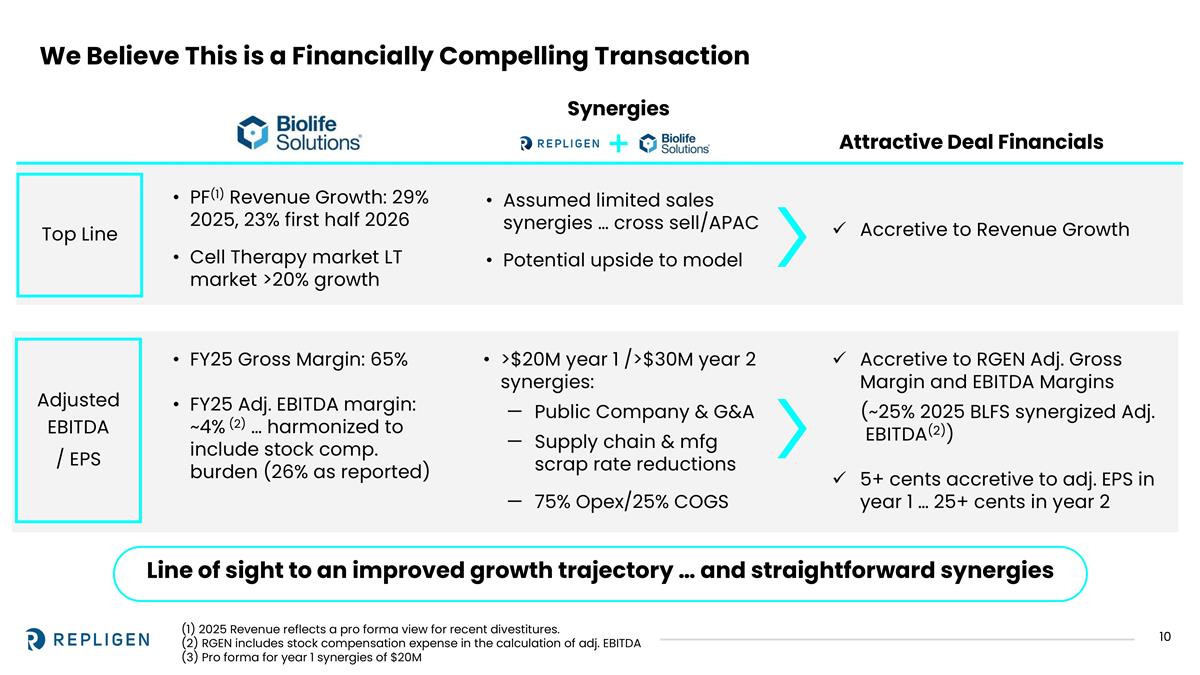
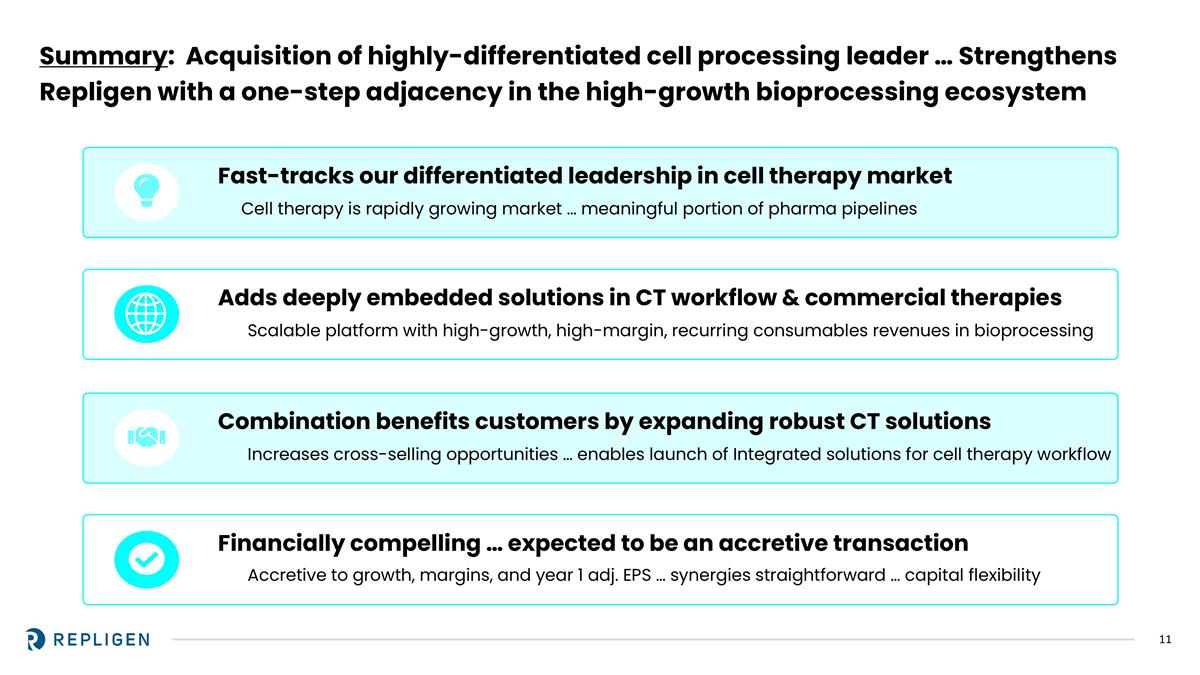
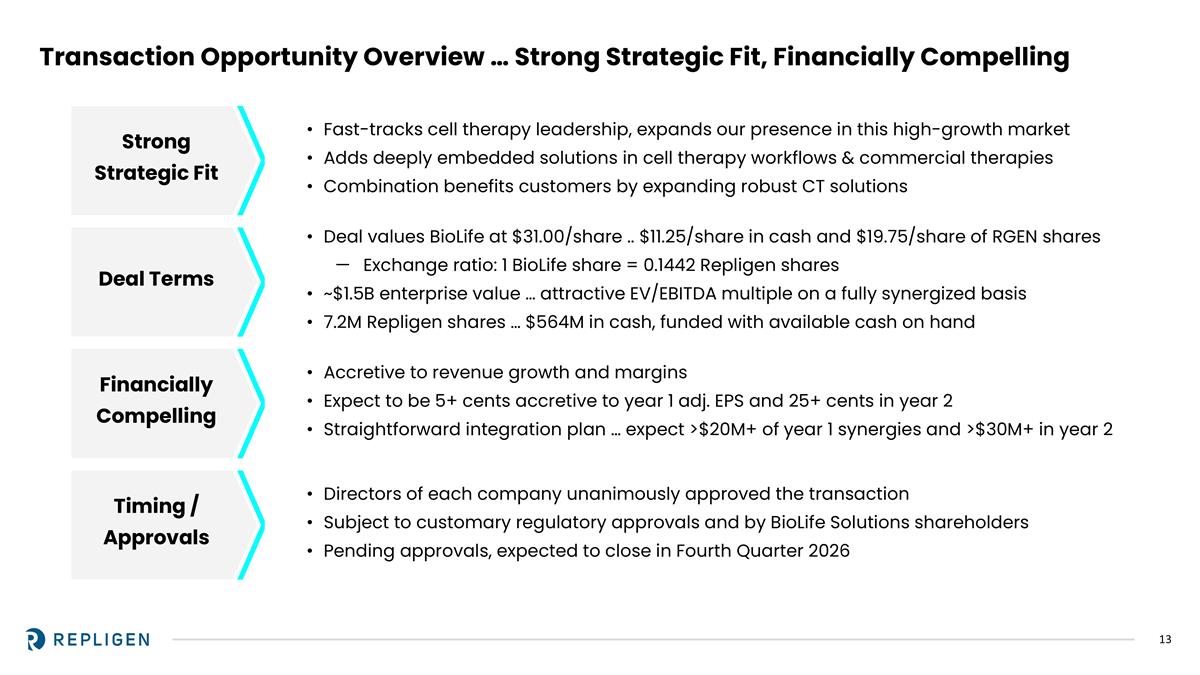
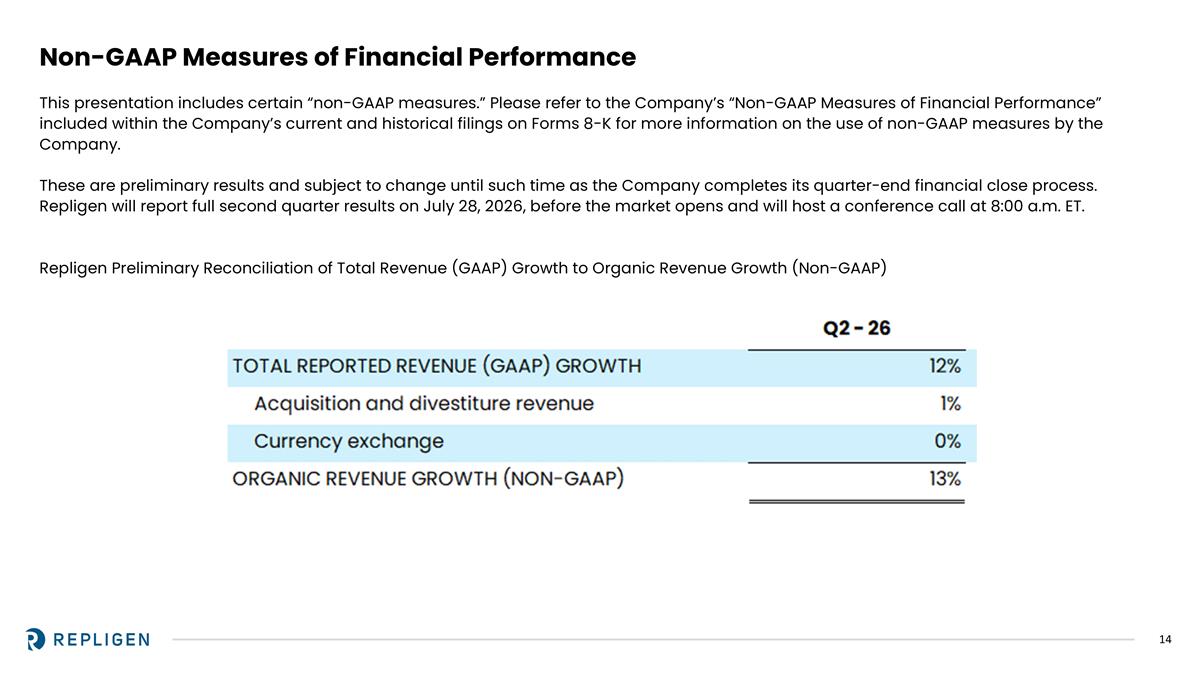
Thank you, Jacob. Good morning, everyone, and welcome to our 2026 second quarter call. Once again, we delivered excellent results in the second quarter our team executed at a high level driving 12 percent reported growth which translated to 13 percent organic growth and 460 basis points of adjusted operating margin expansion reflecting on our strong first half results and with our increased conviction in the full year outlook we are raising our organic revenue growth and adjusted eps guidance at the midpoint, this represents a full 1% increase to our organic growth expectations and five cents to adjusted EPS. In addition to our excellent first half results, we see several reasons for our increased confidence in our end markets and revenue outlook. First, the positive order momentum that emerged late in the first quarter carried into the second quarter, including an improvement in ATF order trends. Second, while capital equipment revenue remains muted, we saw a sequential step up in orders and won another important RFP. Year over year, our funnel remains very healthy and we are increasingly convinced the capital equipment tab will open further in the not-too-distant future. And finally, emerging biotech grew high teens, Even against a high comparison, a clear sign this customer base is recovering in a sustainable manner, and we are seeing the translation of an improving funding environment. In the second quarter, we delivered $204 million of revenue driven by healthy recurring revenue growth across our broad portfolio. Proteins led the way with an impressive 50% growth, while analytics demand remained extremely strong with 30% plus growth in the quarter. Consumables, including proteins, grew high teens, while services grew over 20%. Capital equipment revenue was stable between Q1 and Q2, and we saw a significant sequential pickup in orders, though revenues declined slightly year over year. Still, our capital equipment revenue grew high single digits in the first half. Across geographies, APAC led the way with approximately 40% revenue growth, while North America was also strong in the high teens. The growth in APAC highlights the fact our reinvigorated strategy continues to create opportunities across the region and we are pleased to see strong growth from both biopharma and cdmos in the region our strong first half margin expansion continues to reflect our discipline operational execution we continue to be balanced in investing for future growth while managing costs and driving real operational efficiencies in our manufacturing operations As a result, we remain on track to achieving our target for 30% adjusted EBITDA margin by 2030. In short, our base business remains very strong as highlighted by 13% organic growth in the second quarter. Our second quarter growth was in part driven by the multiple new product innovation we launched in analytics and proteins in recent years. This is enabling us to outpace market growth. The definitive agreement to acquire BioLife adds an exciting new growth vectors. This financially accretive acquisition fast-tracks our sales therapy strategy. I will provide additional thoughts around our strategic effort shortly, but first, some more details on the quarter. Looking at our performance by end market, CDMO growth remained strong biopharma revenue was essentially flat with strength in north america and asia which both grew at least high teens offset by a difficult prior year comparison in europe oem and integrators were accretive to growth driven by strength in fluid management and proteins as mentioned earlier emerging biotech revenues grew high teens which is important as we are now lapping our return to growth last year we remain encouraged by growth from this customer base and optimistic we will see a continued recovery given funding trends remain robust new modalities grew nine percent excluding the impact of a certain gene therapy headwind importantly this was the best quarter since the first quarter of 2025 and we saw strong sequential increase across all modalities we continue to see growth in cell therapy and also in gene therapy when excluding that specific headwind moving to our strategy update we recently completed our annual strategic planning process looking back on our 2025 strat plan we made great progress on our strategic initiatives including but not limited to launching multiple innovating products adding great talent to our team and expanding our margin our recently launched transformation office is positioned to start delivering promising business improvements this year plan focus on refining our same long-term goals including outpacing market growth advancing our digital and services capabilities and accelerating growth in asia pacific We would highlight three areas of heightened focus in this year's track plan. First, we recently launched our integrated solution strategy. We believe now is the right time to launch this initiative given the upcoming ensuring opportunities. This team will focus on cross-selling our entire A2Z offering under a formal integrated solutions team. While our key accounts team has focused on selling our full suite of solutions, our integrated solution initiative will further these proactive efforts to increase speed and professionalism while also engaging more directly with engineering firms. We will initially focus our efforts on ADCs and other new modalities. In particular, with the upcoming acquisition of BioLife, we'll expand the scope of solutions we can offer to the sales therapy market. Second, our team is increasing its focus on product lifecycle management. This effort works to continuously innovate our product portfolio to best address customer needs while ensuring the transition to a graded solution is a frictionless process. We've seen sizable benefit from this initiative with our solo VPA plus upgrade cycle and we intend to run a similar playbook elsewhere in our portfolio. Third, the definitive agreement to acquire BioLife built on our strong momentum and commitment to use compelling M&A to drive creative growth, double down in high-growth markets, and create more robust customer solutions. BioLife fast-tracked our sales therapy leadership by adding a differentiated portfolio of products, serving this rapidly growing end market. Following last week's announcement, we received some questions about our interest and view of the cell therapy market. From our analysis of the biologic landscape, it's clear that cell therapy represents a meaningful portion of our customers' focus and investment, with this modality representing nearly a quarter of their clinical pipelines. In our extensive due diligence, we spend time with third-party advisors evaluating the opportunities and risks of this end market. The analysis increases our conviction in the long-term growth of this industry while helping us to gain comfort around potential risks like further development of in vivo therapies. A recent white paper from the Alliance for Regenerative Medicine showcased a 170% increase in U.S. treatment centers and a 740% increase in cell and gene therapy U.S. claim from 2018 to 2025. This highlights a growing volume from these modalities. The equation of BioLife will enhance our offering for these end markets and provide us with additional opportunities for organic and inorganic growth. It adds a deeply embedded and highly trusted platform to our portfolio led by its biopreservation media which supports 18 commercial therapies. We believe the future combination of our companies will bring important benefits to customers by expanding our robust offering of self-therapy workflow solutions. Finally, the transaction is financially compelling. It's accretive to our top-line growth, our adjusted margin, and adjusted EPS. We see at least 20 million US dollar synergies and 5 cents of adjusted EPS accretion in year one, which grows to at least 30 million and 25 cents respectively in year two. Before I turn the call over to Jason, I'll provide some more detail on our franchise-level performance. I will note that all references to our 2026 expectations are on a reported basis. Starting with filtration, revenue grew slightly on a reported basis in the quarter, driven by consumable demand, including fluid management and flat sheet cassettes, offset by the sale of PolyMEM and the previously-dislaught gene therapy headwind. Consistent were our expectations, ATF and systems demand were muted this quarter. As I previously mentioned, we are encouraged by the recent pick-up in orders that will start fueling 2027 backlog for both of these product categories. We continue to expect filtration growth of roughly mid-single digits. Turning to chromatography, revenue grew low double digits, lapping our strongest quarter last year. This was again driven by growth in opus columns with continued growth from CDMO and biopharma customers. In particular, we continue to see significant fraction with large-scale columns where units have grown 18% in the first half. We continue to expect chromatography growth of 20% plus for the full year we had a phenomenal quarter in proteins with 50 percent growth again driven by strength across our portfolio we're excited about the portfolio of capabilities we've assembled in our protein franchise it's encouraging to see how strategy play out in financial results and we remain focused on seeding opportunities across our protein offerings with a strong first half performance and visibility into continued momentum in the second half, we now expect protein growth in the mid-teens for the year. Our analytics franchise had another strong quarter with 30% plus growth including strength across consumables, services and capital equipment. The solo VPA plus upgrade cycle highlights the tangible benefit of our product life cycle management strategy but it's important to note we are seeing broad strength in our downstream analytics business we continue to believe our digitization strategy is well positioned for where the industry is going given momentum in downstream demand and a growing contribution throughout the year from our upstream analytics offering we now expect analytics growth of at these 25%. Before I hand over the call over to Jason, I wanted to reiterate that we are very pleased with our second quarter resource and our continued momentum in the business. We delivered 13% organic growth in the second quarter. Our team continues to execute effectively on our strategic priorities, outpacing market growth, while expanding margin, which enable us to increase our full year outlook. These are incredibly exciting times at Repligen and we look forward to welcoming the BioLife team upon deal close. Now I'll turn the call over to Jason for the financial highlights.
Thank you Olivier and good morning everyone. Today we are happy to share our excellent financial results for the second quarter of 2026. These results in an improving environment have increased our conviction in our 2026 outlook. And with that, we are raising our full year guide. I look forward to sharing the details shortly. Before we discuss the quarter, let me highlight that unless otherwise noted, all financial measures discussed reflect adjusted non-GAAP measures. As shared in our press release this morning, we delivered strong second quarter revenue of $204 million. This is a reported year-over-year growth of 12% or 13% growth on an organic basis, which excludes the impact of acquisitions, divestitures, and foreign exchange. The previously announced sale of Polymem was a one-point headwind to reported growth, while foreign currency was also a slight headwind. For clarity, we did receive tariff refunds in the quarter that were a slight headwind to both reported and organic growth. As Olivier provided details on our product franchise performance, I'll share more color on our regional performance. Starting with quarterly revenue mix, North America represented approximately 51% of our total, AMEA represented 32%, and Asia Pacific and the rest of the world represented approximately 17%. North America grew high teens driven by strength across our franchises and customer base. AMEA declined mid-single digits with strength in analytics, offset by a difficult prior year comparison. Asia-Pacific grew a standout 40% driven by strong growth in pharma and CDMOs supported by continued strength in China. Transitioning to profit and margins, our strong first-half margin expansion continues to reflect our disciplined operational execution. Second quarter adjusted gross profit was $110 million, and adjusted gross margin was 53.9%. This was 280 basis points of margin expansion versus last year. The year-over-year increase was driven primarily by volume leverage, pricing execution, and favorable product mix, tariffs, all of which more than offset inflation. Tariffs were a modest benefit to our margins in the second quarter. Our full-year guidance now assumes minimal impact from tariffs. Continuing through the P&L, our adjusted income from operations was $34 million in the second quarter, up 55% year-over-year on a reported basis. This translated to an adjusted operating margin of 16.7% in the second quarter, which was an increase of 460 basis points year-over-year on a reported basis, including a 40 basis point benefit from the sale of Polymem. Adjusted EBITDA was $43.8 million in the quarter, or 21.4% adjusted EBITDA margin. Underlying our adjusted operating income margin expansion in the quarter was strong operating leverage achieved with a modest adjusted OPEX growth of 6% on a reported basis and 8% excluding the impact from the Polymem sale and foreign currency. We have remained prudent in our spending and have taken a measured approach to headcount additions in the first half. To help explain the sequential decline in OPEX and lower year-over-year growth, the quarter was also helped by a transient benefit related to employment compensation costs that were favorable relative to our expectations. We do not expect this benefit to recur in the second half and therefore we anticipate OPEX to step up sequentially in the third quarter, driven by spending levels more consistent with the first quarter. In addition, given recent trends, we do plan to make some investments in the second half of the year to support growth in 2027. We will remain thoughtful about balancing investments in the business and expanding margin. Moving to the bottom line, adjusted net income was $31 million, a 45% year-over-year increase. Our second quarter adjusted effective tax rate was 21.5%, and we now expect it to trend towards the lower end of our prior guidance of 22 to 23 percent. Adjusted fully diluted earnings per share for the second quarter was 54 cents compared to 37 cents in the same period in 2025 or an increase of 46 percent. We continue to see strong earnings conversion from our robust revenue growth. Finally, our cash, cash equivalents, and marketable securities position at the end of the second quarter was $810 million, up $25 million sequentially from the first quarter. This was driven by $33 million of strong cash flow from operations, primarily offset by $5 million of capex in the quarter. We remain focused on optimizing our working capital to drive improved free cash flow. I will now outline the improved outlook in our adjusted financial guidance. For clarity, our guidance does not include any assumed impact from BioLife, as the transaction is expected to close in the fourth quarter following necessary and customary approvals. As Olivier mentioned, we are raising the midpoint of our revenue guidance. We are now guiding $813 to $834 million of revenue, or $824 million at the midpoint. This represents 10% to 13% reported growth or 10.5% to 13.5% organic, which is an increase of a full percentage point of organic growth at the midpoint versus our prior guidance. This assumes a couple million dollars of foreign currency tailwind, offset by approximately one point of headwind from the sale of our PolyMem operations we announced last quarter. From a franchise perspective, Our reported growth of 10-13% assumes roughly mid-single-digit growth in filtration, greater than 20% growth in chromatography, proteins growth of mid-teens, and 25% plus growth in analytics. We continue to expect 110 to 160 basis points of gross margin expansion for the year. That said, with our strong first half results, we are raising our adjusted operating income guidance to a range of $128 to $134 million and our adjusted operating margin guidance of 15.7 to 16%. This implies 190 to 220 basis points of operating margin expansion. Moving through the income statement, we continue to assume $19 million of adjusted other income, while we now assume a tax rate of approximately 22 percent, as mentioned earlier. Putting this together, we expect adjusted, fully diluted earnings per share to be between $2.03 and $2.09. This is up 32 to 38 cents versus 2025. We're up 20 percent at the midpoint. The midpoint reflects a five-cent increase from our prior guidance. For visibility to the remaining quarterly cadence, we expect Q3 revenue dollars to increase slightly sequentially. As we highlighted last quarter, we continue to expect Q3 to be the lowest adjusted gross margin quarter for the year. We expect adjusted gross margins to decline sequentially and year-over-year, as mix can have an impact in a given quarter. Subsequently, fourth-quarter margin will benefit from volume leverage. As I mentioned, we expect underlying third-quarter OPEX to return to levels more consistent with Q1, though it will be higher in total as we expect to make modest investments in the back half of the year to support future growth. The investments will be focused in sales and R&D, and continuing to support our fit for growth journey, particularly in IT. As a result, we see third quarter operating margin fairly consistent with third quarter of the prior year. As a quick update, we have seen continued progress in our dedicated transformation office. We continue to develop and implement plans to drive incremental margin expansion, and we'll soon be leveraging the detailed integration playbook developed by the transformation team for BioLife following the transaction closing. As it relates to cash, we expect CapEx spend to continue being approximately 3% to 4% of 2026 revenue. As we wrap up the call, Olivia and I want to thank our Repligen teammates for delivering an exceptional first half of 2026. Last week's announcement of our definitive agreement to acquire BioLife marks an important step forward in our journey. It fast-tracks our cell therapy strategy and opens a compelling new growth vector for Repligen. We are energized by the momentum across our business and remain firmly focused on executing our strategic priorities. With that, I will turn the call back to the operator to open the line for questions.
Speaker 7
We will now begin the question and answer session. Please limit yourself to one question. If you'd like to ask a question, please press star 1 to raise your hand. To withdraw your question, press star one again. We ask that you pick up your handset when asking a question to allow for optimum sound quality. If you are muted locally, please remember to unmute your device. Please stand by while we compile the Q&A roster. Your first question comes from the line of Matt LaRue with William Blair. Matt, your line is open. Please go ahead.
Hi, good morning, everyone. You know, a strong quarter that you previewed last week, so so the growth wasn't a surprise but composition of that growth perhaps a bit different than we expected both in terms of the segments you know the strength of proteins in particular and customer class uh you know the strength emerging biotech so we'll just be be curious you know how order trends progressed throughout q2 and into the first month of the third quarter across you know segments and and customers and and what that you know means in terms of your visibility to the guidance range at this point based on those order trends and backlog that you're building. Thanks.
Good morning, Matt. Olivier here. Yeah, no, absolutely good question and thanks for asking it. We are obviously very happy about how order developed over the last several months. You probably remember we said we saw really nice order improvement towards the end of quarter one and that this has kept on going for all of quarter two, which was really great and and raised from pretty much across the board in terms of orders, in terms of our different franchises. That's why we came to the conclusion it's really the right time to increase our guidance for the full year, knowing we are now end of July and we've got much better visibility for the full year. So that's why we decided to move to 10.5 to 13.5, midpoint at 12% growth, which happens to be exactly what we had during the first half. I mean, organic growth of 12%, meaning in order to deliver the midpoint of the new guidance, we don't need any acceleration at all. And then just quickly going through the franchises, obviously you mentioned incredible performance on protein, but also on process analytics and chromatography, I want to say. So the only one that has not been doing fantastic this year is filtration, and that was just totally expected because all of the headwind we talked about are all happening in filtration. sure no. Okay, thanks.
Speaker 7
Your next question comes from the line of Dan Arias with Stifle. Dan, your line is open. Please go ahead.
Hi, good morning, guys. Thank you. Olivier or Jason, on capital equipment, I up high singles for the first half of the year. One Q was the better growth quarter, but I think you mentioned that order activity improves sequentially. So how do you think second half equipment growth sets up as a compare to the first half? And then And within that, can you maybe just sort of take a shot at a view on how you think you exit the year on equipment as we start to think about some of the moving parts here for 2027?
Yeah, good morning, Tania. So honestly, it was really expected that capital equipment sales would be muted for us in Q2. I want to say, like, for the first half, our sales of capital equipment are up high single digits. But what was really more important for us was to see order really picking up very significantly sequentially and our book to build in quarter two was really significantly above one so well what's important is we want a second rfp remember we said we would start to have a seat at the table and of last year that is the second one number three is on its way we should get confirmation within the next few few weeks probably so we are starting to build a really nice backlog for 27 and uh and we were really excited about that i mean some of it might come toward the end of this year, but probably mostly toward the beginning of next year, which is going to set us up for a really strong 2027 on the equipment side.
Speaker 7
Your next question comes from the line of Casey Woodring with JP Morgan. Casey, your line is open. Please go ahead.
Great. Thank you for taking my questions and congrats on the quarter. I guess first one on the 50% protein growth, can you just elaborate on what you saw in the quarter there? Was there a big order or something else that drove the outside strength. And then, you know, second question here on the margin front, you talked a little bit about 3Q margin expectations, but maybe if you could just walk us through the cadence and what's implied as the exit rate for 4Q on the operating line, you know, curious how much gross margin steps up from the 3Q levels that you talked a little bit about. And then, you know, on OpEx, stepping up in the back half, you know, you had the favorable employment compensation costs in the first half and talked a little bit about growth investment. So maybe just any way to quantify how should we think about that, stepping up in 3Q and then again in 4Q. Thank you.
Yeah. Good morning, Casey. I'll start by answering the question on protein and then I let Jason comment on the margin side. So yeah, you said it rightly. I mean, it was an incredible quarter for us on the protein side with growth around 50%. It's really what was driven by strengths across the entire portfolio. And remember a couple of years ago so we said we had to pivot our protein strategy completely after losing two of our big OEM deals at that point and the strategy we put in place is just playing out in a marvelous manner and being a little bit more detailed I mean we've re-seen strength from three different sides on the protein side first of all our OEM partnering with PureLight is doing extremely well they had a very strong performance in q2 and we're so happy to partner with them but also on our own ligand slash resin custom development the habitat portfolio we had a tremendous quarter as well and then finally on growth factors as well what was a very strong quarter so it's really pretty much across the entire protein portfolio that we've experienced a very nice growth which is why we decided to to increase the guide to meetings for the full year versus low double digits before And on margin, I'll let Jason answer.
Yeah, good morning, Casey. So first, let me just highlight and thank the team for such a strong execution that we've been delivering on margin expansion. And so, you know, we've had a really strong first half, both at the gross margin level and at the operating margin level. When I take a step back, I think we've improved our visibility and we can make faster, smarter decisions. The manufacturing team is delivering. We're achieving net price, getting volume leverage, and we've been very balanced in our overall OPEX management in terms of making sure that we're investing in the future for growth and our fit for growth journey, as well as, again, driving that margin expansion. You saw that we raised our operating margin guide by another 25 bps. That was after 25 bps in the first quarter. So now we're guiding for a full just north of 200 basis points of margin expansion year over year. So really, really excited to see that momentum going. Again, there is a dynamic first half to second half that you called out. You know, the op margin will be slightly lower in the second half, and some of that's driven by the OPEX that you referenced, but frankly, again, we didn't change the OPEX guide, raise the top line, and so we see that operating leverage falling through. The second half OPEX that we've called out is going to be a step up, right, from a run So the third quarter will step up a couple million from 2Q, and then fourth quarter will step up similarly again. And as I highlighted on the call, we'll be really doubling down a little bit our investments in sales. You know, we've talked about certainly our investments in Asia, some of the technical selling resources we have, the integrated solutions team that we're building, and then also in R&D. so again but but I would put in context that even with that growth in the quarters you know OpEx will still be up really only high single digits year over year and again being less than our top line growth that's how we achieve that that leverage gross margin just to address that quickly you know no change in the guide still up 135 bps year over year so again continuing to see that traction. There is, though, I'll say more of a change first half versus second half at the gross margin line than we see at operating margin, and that's primarily driven by mix, right? We probably had about a full point of expansion in the first half on the mix we saw. We're still calling to about a neutral mix impact for the year, so that, of course, implies that the second half is going to be the other direction. But again, we've been really happy with what the team has been executing and we'll continue our journey on margin expansion.
Great. Thank you so much.
Speaker 7
Your next question comes from the line of Dan Leonar from RBC. Dan, your line is open. Please go ahead.
Thank you very much. I'd like to talk a bit more about the topic of order conversion, specifically in light of that comment, Olivier, that you made that Q2 order strength and filtration fuels your 2027 growth outlook. Did that comment apply to both consumables and equipment? And what are the factors limiting faster conversion?
Yeah, good morning, Dan. Thanks for your question. Yeah, it's very much depending from customer preparedness. I mean, and that's, as you can imagine, particularly the case for capital equipment, where when you get orders for specific capital equipment investment, you have to make sure that the plan is ready to accommodate delivery of those equipment. So it's mostly the case for capital equipment. It can be the case sometimes for consumable as well. It's a little bit more rare, but that's definitely also sometimes the case where some people like to order their consumable six to 12 to 12 months in advance, but it's mostly applicable for capital equipment for sure.
Speaker 7
Thank you. Your next question comes from the line of Brendan Smith with TD Cohen. Brendan, your line is open. Please go ahead.
Great. Thanks for taking the questions, guys, and appreciate all the color. Maybe just another follow-up actually on the filtration commentary a bit. I know you mentioned in your prepared remarks, these were some of the headwinds you had previously acknowledged and were expected. So I guess I'm just wondering, as we look at filtration in the second half, should we maybe expect some of these dynamics to be similarly spread between Q3 and Q4? Is this mostly kind of a Q2 and Q3 story, but maybe behind you by Q4? Any kind of any updates on the Maverick tucking with ATF that could impact some of that this year? Really just trying to understand some of the cadence of that over the next couple quarters. So any caller there would be great. Thank you.
Yeah, thanks for your question, Brendan. Good morning. Yeah, of course, as you heard, we had only a slight revenue growth for filtration in Q2, which, by the way, was driven by pretty strong fluid management and flat sheet cassette business. Well, what was really encouraging for us was a pickup we've seen in ATF and equipment orders toward the end of the quarter. And you just said it very rightly. I mean, all of our 2026 headwind happened to be in filtration, unfortunately. I mean, it started obviously with the gene therapy program that that we we face issue with a year ago now exactly then we mentioned beginning of the year we had the two headwinds on the atf customer side one managing its inventory the other one being delayed implementing the new sites and now on top of it we saw the polymem business which also impacts the reported growth so we we probably will see some impact from those headwinds in quarter three and we expect like it should start to normalize somewhere in quarter four and what i'm trying really to say here is we remain very excited about 2027 the growth opportunity that exists across that entire portfolio just to be very specific on ats in the first half of 2026 we've won more new program slash customer than we did in the first half of 2026, and in fact, by mid of May already, we had reached the level we reached by the end of June of 2025. So, it's really a much higher number, which we know is going to set us up for being back to growth very nicely on the ETF side from 27 onwards and for the next several years. So, that's where we are. We kept the guidance roughly mid-single digit. Again, if you look at all of these headwinds we have, they are piling to almost high single digit. and so that's a big game changer obviously for us this year and most of these are temporary as already mentioned got it thanks guys your next question comes from the line of punit suda with la rink partners punit your line is open please go ahead yeah hi uh oliver and team thanks for taking my questions here um uh first one really on apac 40 growth really strong there could you unpack that a bit more.
I know China was a big focus for you. How are products, you know, what products are gaining traction there in a fairly competitive market? Maybe just elaborate a bit on that. And then on the onshoring piece, Olivier, how are you thinking about the, you know, timing and magnitude of that? I just wanted to get a sense of if you're willing to share anything on on 2027 organic growth, ex-BioLife. Thank you.
Morning, Puneet. Yeah, I think I heard three questions. So I will answer probably the first two. And anyway, I wouldn't comment too much on 27 at this point. But as far as APAC is concerned, yeah, it was a fantastic quarter. I mean, 40% growth in the quarter. Well, what was really good, it was across all of Asia. I mean, it was not only China, but as you say, very rightly, we have a huge focus on China. China is a great turnaround for us this year. In fact, first half, China grew more than 60%, which we are very, very delighted about. But the rest of Asia did very well. And as far as watch franchises, it's pretty much across the board, really. I would say maybe out of the four, the one that might be a little bit less important right now in Asia is protein. But really, filtration, chromatography, and process analytics are really the three critical franchises for us in Asia. As far as China is concerned, I mean, we are very ambitious about the country, as you know. Our OEM partnership is advancing as expected. We're hoping to be up and running by beginning of next year to start manufacturing a lot of our filters in China for China. And the reason why we are so bullish about China is about 30 percent of any clinical trial in the world now are happening in China. and they are leading the pack on product line like bi-specific, antibody-drug conjugate, cell therapy. I mean, believe it or not, 40% of the funnel of cell therapy worldwide is taking place in China. So really, that's about the Asia piece. As far as ensuring is concerned, I mean, I would say, I mentioned we won a second RFP and probably on the way to win a third one very soon. I mean, we see a lot of opportunities that are coming at our desk And we're really obviously very optimistic. We'll see some 27 revenues coming out of this. What I think is really important, if you want to hear from me, is the reason why we're putting in place that integrated solution team right now is to enable us to tackle those opportunities better and better. I mean, you don't answer a big RFP, a big answering opportunity, the same way you're answering small bits and pieces of equipment here and there. And that's something our team has got some good past experience with, and that we are really building right now to really make sure we are capable to turn around those type of offering in a very professional manner, and then adding as much services and potentially as much consumable as possible into those big opportunities. So I think we are going to be extremely well set for those opportunities that we see coming more and more, and that should really benefit us currently from 27 onwards here.
Speaker 7
Okay, great. Thank you. Your next question comes from the line of Anna Snupkowski with KeyBank Capital Markets. Anna, your line is open. Please go ahead.
Hi, this is Anna Snupkowski on for Paul Knight. Congrats on the great quarter and the raising guide.
I was just wondering if you could walk us through some of the drivers and maybe macro assumptions that will get you to the low end versus the high end of the guide whether this is equipment versus consumables or yeah different end market assumptions that'd be great thank you hey good morning Anna yeah I mean obviously we we see a lot of of reason why we decided to increase our guidance for the full year first of all our incredible execution in the first half again we did a 12 percent organic growth in the first half the midpoint of our new guidance is 12% so as I mentioned earlier no need for any specific acceleration to deliver the midpoint of the new guidance here so we have increasing expectation for protein and analytics in particular which is why we increase guidance for those two specific businesses now now come your question about what could make it uh going to the upper hand or to the lower hand I mean and let me start with the lower hand stuff which would really implies softness in the industry which we are actually not seeing today in fact you heard me saying what has been really interesting for us to watch in quarter two is to see first of all the emerging biotech business growing again high teens for for a fifth quarter in a row of tremendous growth on the on the emerging biotech side which now means it's a real pattern because comp were much higher and it means indeed the money is starting to really reach those people and everybody in the bioprocessing industry starts to benefit from it. And then the other stuff that I was really happy about was new modality because we all knew beyond, obviously, the headwind we had on that specific gene therapy program, I mean, it was a little bit of a soft environment for new modality as well. And to see new modality growing close to 10% year over year and having a very strong book-to-build ratio as well make us feel like we start to see a real rebound on that side, which, as you know, is something we have huge potential tailwind coming out of that. So in terms of market segment, great improvement, both on the emerging biotech, but also on the new modality side. And in terms of our product line, obviously, a big hope to see a protein process analytics enabling us to deliver even more than what we've seen so far. And to talk about what could bring us to the upper hand of the bracket we have, which is what we're hoping to achieve, obviously, I mean, ETF could really be a big swing factor. I mean, we've seen a nice rebound toward the end of quarter two. This is being confirmed with early orders in quarter three. I mean, that could be really helping us to be more toward the upper hand of the bracket and the midpoint or so on. So that's kind of the overall situation where we are very optimistic about this promising year for us.
Speaker 7
Your next question comes from the line of Matt Hewitt with Craig Hallam Capital Group. Matt, your line is open. Please go ahead.
Good morning. Congratulations on the strong quarter. I was hoping you could give us some details on the competitive landscape or environment. The second RFP that you noted that you recently won, the third that you could potentially win here soon, are those competitive displacements? What are you seeing in the competitive environment? Have you seen any changes there? How are you stacking up?
Yeah, good morning, Max. Yeah, great question. I mean, I think I mentioned a few times already, like we did not really have a seat at the table earlier. I mean, and very simple because we've built that portfolio of equipment over the years. I mean, it's literally only a year ago that we started to have not only our ATF equipment, but we had also our downstream TFF, downstream chromatography, and more recently, our mixing offering as well. So now we would say we've got almost 80% of whatever large-scale hardware requirement customers have when they go for expansion. So not only now we have a seat at the table, but at the same time, as you know, we started to pair some of our hardware with our PAT technologies to give our customers really a chance to run their processes, their manufacturing with much more intelligence than before. And that's definitely a big game changer and a big advantage. We have that big benefit we are providing to our customers. So you can call it potentially market share shift, or you can call it people looking for different solutions than they were looking for before, because we are the only one really being capable to offer those inline technologies, mostly one today, but we're working on adding two more that will be available probably sometime in 27 or 28. So that's really us having a seat at the table, us bringing new solutions for customers, and us professionalizing the way we answer those answers with the integrated solution team we're putting in place right now.
Speaker 7
Your next question comes from the line of Mac Etock with Stevens, Inc. Mac, your line is open. Please go ahead.
Speaker 15
Hey, good morning, and thank you for taking my questions. Maybe, Jason, just one for you and maybe just a little bit of cleanup. I think you mentioned that tariffs were maybe a headwind to 2Q. I'd just like to get a sense of how much of an influence that was in the quarter and how that's impacted the guide so far.
Yeah, so we actually had a tariff refund in the quarter. So it actually ended up being a good guide to margin, to your point, or pressure to revenue. So it was about a million dollars of revenue headwind. We literally got the refunds in the last day of the quarter. Now, I will note that even with that million dollar revenue headwind, we did not adjust that from our organic growth rate. So, again, if that hadn't happened, we would have been about, call it 50 bps higher growth rate, both on an organic and on a reported basis. In terms of the cost of goods sold, I'll say associated with the refund. So that was a margin good guy in the quarter. When I think about the total year, I think when we in February, we shared that we thought tariffs would be about a 50 point headwind for us. So with some of this refund, you know, that will certainly be lower. It'll still be a slight headwind for us overall, but not quite as much as the 50 BIP. So that won't repeat as both a pressure point in the second half for revenue or a good guy in the second half for margin. So I think we've got it sort of dialed in what we know. Now you see the news as well. Tariffs get headlines weekly, so we'll continue to monitor that. But we've built all that into our guide right now.
Speaker 15
Appreciate you taking my questions.
Speaker 7
Your next question comes from the line of Michael Polark with Wolf Research. Michael, your line is open. Please go ahead.
Hey, good morning. Thank you for taking the questions. I'm going to ask for a little bit of speculation, perhaps. So last week, one of the dust-ups in bioprocessing was resin shipment push-out from one of your large peers, and Repligen has been clear in ATF. This is a subdued year for growth due to a couple customer timing dynamics reaffirmed here inventory and sounds like site readiness and so my question for you team is do you think these items are all related similar I know these are different points in the stack but but similar sites similar customers and I'm asking in the spirit of to the extent these large kind of order timing shipment timing variances are from similar sources i think maybe we can all develop confidence it comes back in 27 and and sets up 27 for maybe a super normal growth year so um that that's the
topic and i'm curious for your two cents if you think um these things are largely related thank you hey good morning mike appreciate your question i mean we've always been very transparent about the trend we're seeing in our business, which is the reason why, as soon as we heard about the potential headwind we had on the ATF side, we talked about it. And we had two of them. I mean, one of them was a customer that told us, hey, we have a pretty significant inventory and you're probably not going to see the color of any other in the whole of 2025. Sorry, in the whole of 2026, you're going to see it probably coming back in 27. And then the other one just told us, hey, and for me, our site will not be ready before the end of 2026. So from that point of view, you're not going to see the color of consumable orders this year. So as soon as we've seen it, we just mention it. I mean, I like to do what we say, and that's why we've delivered those 12 quarters in a row of meeting or bidding expectation. This being said, it's very difficult for me to say what others have mentioned is connected to ours. I mean, I don't know. All I can say is, if anything, from our side, we've seen improvement in our business since we heard about those headwinds being of the year.
Speaker 7
Thank you. Your next question comes from Matt Stanton with Jefferies. Matt, your line is open. Please go ahead.
Hey, thanks. Olivia, maybe to go back to proteins, you know, you raised the guide here for the year mid-teens. We'd just be curious to get your thoughts on what market growth is there. If we go back pre-COVID, you know, I think it'd been pretty consistently high singles over a long period of time, but not without bouts of pretty lumpy quarter to quarter fluctuations. So we'd love to just get your view on kind of what market growth is for proteins for 26. And then also just the durability of some of the growth drivers you have with Tanti, Avatide, and the innovation there, the partnership with Furalite, how durable is this outgrowth to the market that you're seeing here on the protein side?
Good morning, Matt. So let me start with the first question on market growth for protein. So here, it's a great question, by the way. I think you need to look at different subsegments of the protein market because where you think about products like ligand resins on one side and probably to a certain extent some of the growth factors. On the other side, you would say growth has been – well, let me start maybe first with resin and ligand. I think here we've always said market growth is anywhere between 8% and 10%. It's fair to assume like people are starting to get better and better at using those products. So probably slowly but surely that market has been going more toward the lower hand of that bracket than the higher hand. But then on the other side, for upstream, you've got protein like growth factors, cytokines, where they are definitely benefiting a lot lately from these very high cell density processes that are becoming more and more common. And so I think you need to really split those two, that market between those two sub market raising on one side and then probably upstream growth factors and cytokine on the other side, because I think growth factor cytokine has a potential to really grow more towards the low teens, if not mid teens over the next several years. And then if we look at our own business, I mean, yeah, we are a bit of a newcomer in the field. We have incredible, great traction right now. I mean, between a year ago and this year, I have to say what we've seen changing a lot is a year ago, people were mostly coming to us for new modality, custom ligand, custom resin in that field of new modality. Now, in the last 12 months, we've seen a lot of customers coming to us for a much broader range of products that might have been on the market for several decades and where they realized, hey, we never got a chance to really get a state-of-the-art product to really purify our product in a much more productive manner. So I think we have a very sustainable growth in front of us on the protein side. In fact, I think the best is still to come because we are still mostly into a clinical early phase or let's say switching from an existing commercial product to a new one and where people are still running those validation batches and so on. So I really do believe we have an incredible way forward tailwind on the protein side. Great.
Speaker 7
Thank you. Your next question comes from the line of Subbu Nambi with Guggenheim. Subbu, your line is open. Please go ahead.
Hey, guys. Thank you for taking my question. One clarifying question, Olivier. Thank you for sharing all the details on proteins. Is this driven by new modality or biosimilars? And then And secondly, if our model is right, the partial offset was chromatography. Is there anything interesting to unpack in chromatography? Any changes in order patterns or customer behavior?
Yeah, good morning, Subu. I mean, I just said earlier, really on the protein side, we are really becoming broader than just focusing on new modalities. I mean, yes, we've had numerous successes on new modality. I mean, we launched an AV-8, an AV-9 reasons that have got incredible traction right now. I mean, we hear from customers that are the best on the market right now. But beyond new modality, we are working on multiple products that are going into more established products that have been on the market for a long time. Obviously, excluding monoclonal antibody, where we work exclusively with our friend from Pure Light. And then in terms of chromatography, yeah, you're right. I mean, somehow analytics and protein have been doing so well in Q2, like we don't even talk so much about chromatography, but chromatography grew again, low double digits in the quarter. Quarter two of last year was our highest quarter of the year, and we had incredible growth in quarter two of last year. So comps were very high. I mean, we keep on winning a lot of new customers, both pharma and CDMOs. And I feel like today compared to a couple or even three years ago when I joined the company, I mean, it sounds like people are really realizing they want to switch towards using prepack column more and more in the future. And the good news, it's only a small fraction of the entire market that is using prepack column. So we seem to have a lot of traction behind us for the next several years here on that side. thank you so much guys we have reached the end of the q a session i will now turn the call back to olivier leo for closing remarks thank you so much and thanks again for joining us today for that earning quarter two session we're obviously very pleased with our performance at quarter and our continued momentum in the business our teams continue to execute very efficiently on all of our strategic priorities which is why we continue to outpace market growth and expand margin at the same time so last week at repligen was incredibly exciting with the announcement on the bio life side our team is very energized and we look forward to catching up with many of you very soon thanks this concludes today's call thank you for attending you may now disconnect.