Operator
Good morning, and welcome to the Seven Hills Realty Trust Third Quarter 2025 Financial Results Conference Call. Please note that this conference is being recorded. I would now like to turn the call over to Mr. Matt Murphy, Manager of Investor Relations. Please go ahead.
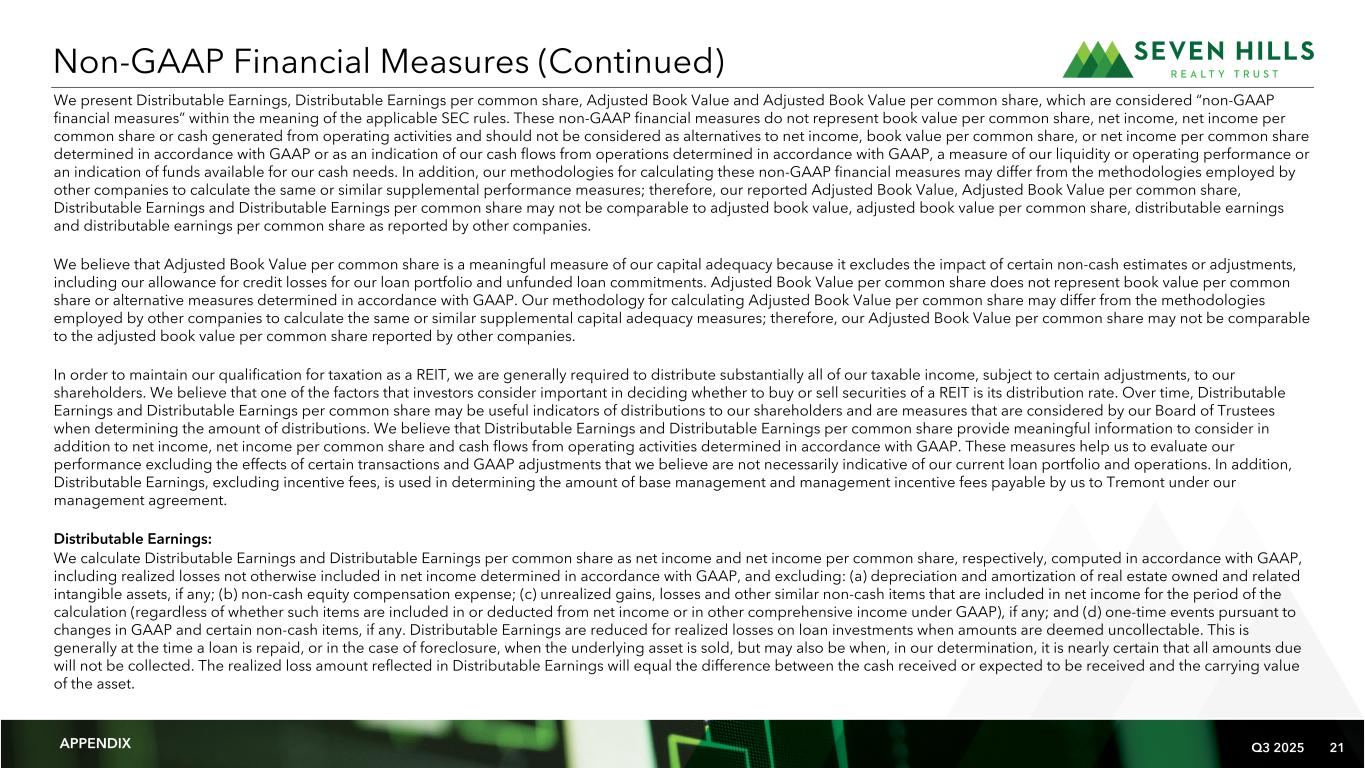
Good morning. Joining me on today's call are Tom Lorenzini, President and Chief Investment Officer; Matt Brown, Chief Financial Officer and Treasurer; and Jared Lewis, Vice President. Today's call includes a presentation by management followed by a question-and-answer session with analysts. Please note that the recording, retransmission and transcription of today's conference call is prohibited without the prior written consent of the company. Also note that today's conference call contains forward-looking statements within the meaning of the Private Securities Litigation Reform Act of 1995 and other securities laws. These forward-looking statements are based on Seven Hill's beliefs and expectations as of today, October 28, 2025, and actual results may differ materially from those that we project. The company undertakes no obligation to revise or publicly release the results of any revision to the forward-looking statements made in today's conference call. Additional information concerning factors that could cause those differences is contained in our filings with the Securities and Exchange Commission, or SEC, which can be accessed from the SEC's website. Investors are cautioned not to place undue reliance upon any forward-looking statements. In addition, we will be discussing non-GAAP financial numbers during this call, including distributable earnings and distributable earnings per share. A reconciliation of GAAP to non-GAAP financial measures can be found in our earnings release presentation, which can be found on our website at sevnreit.com. With that, I will now turn the call over to Tom.
Speaker 2
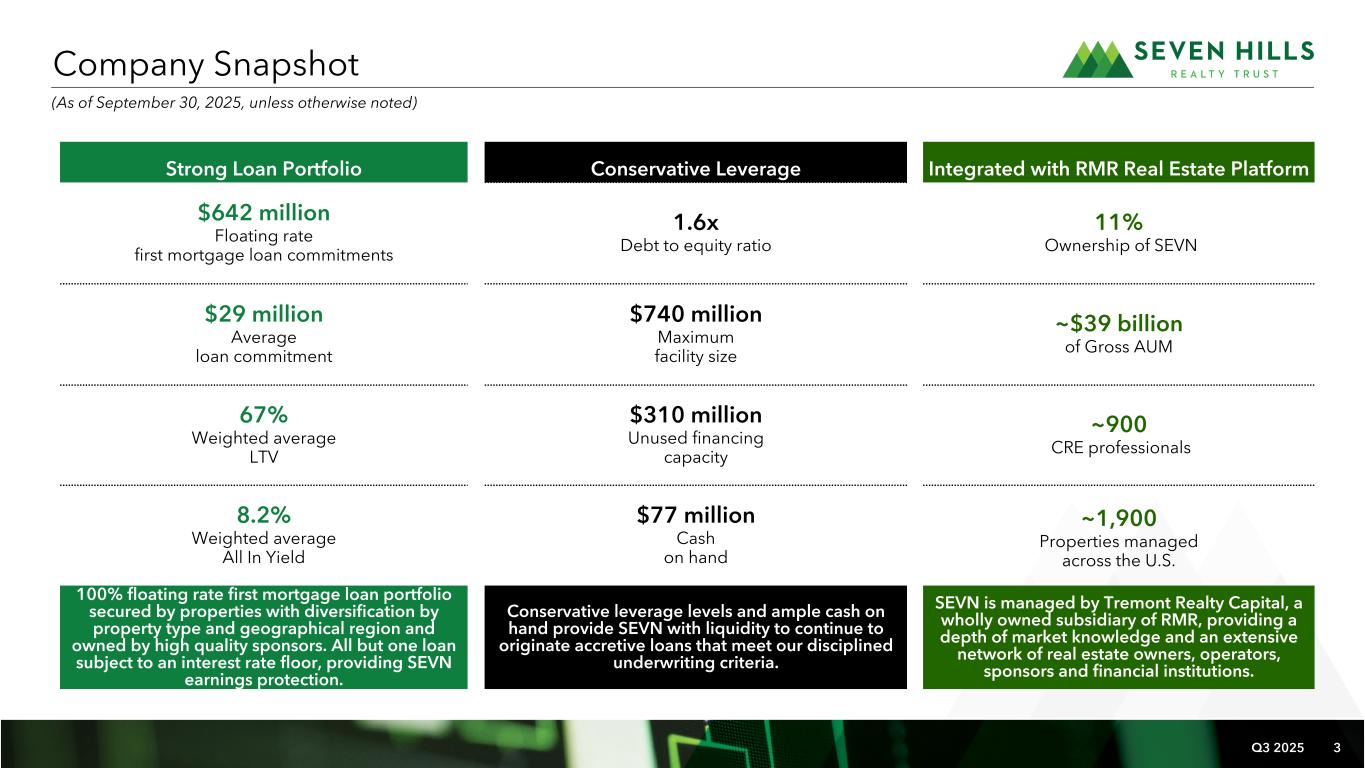
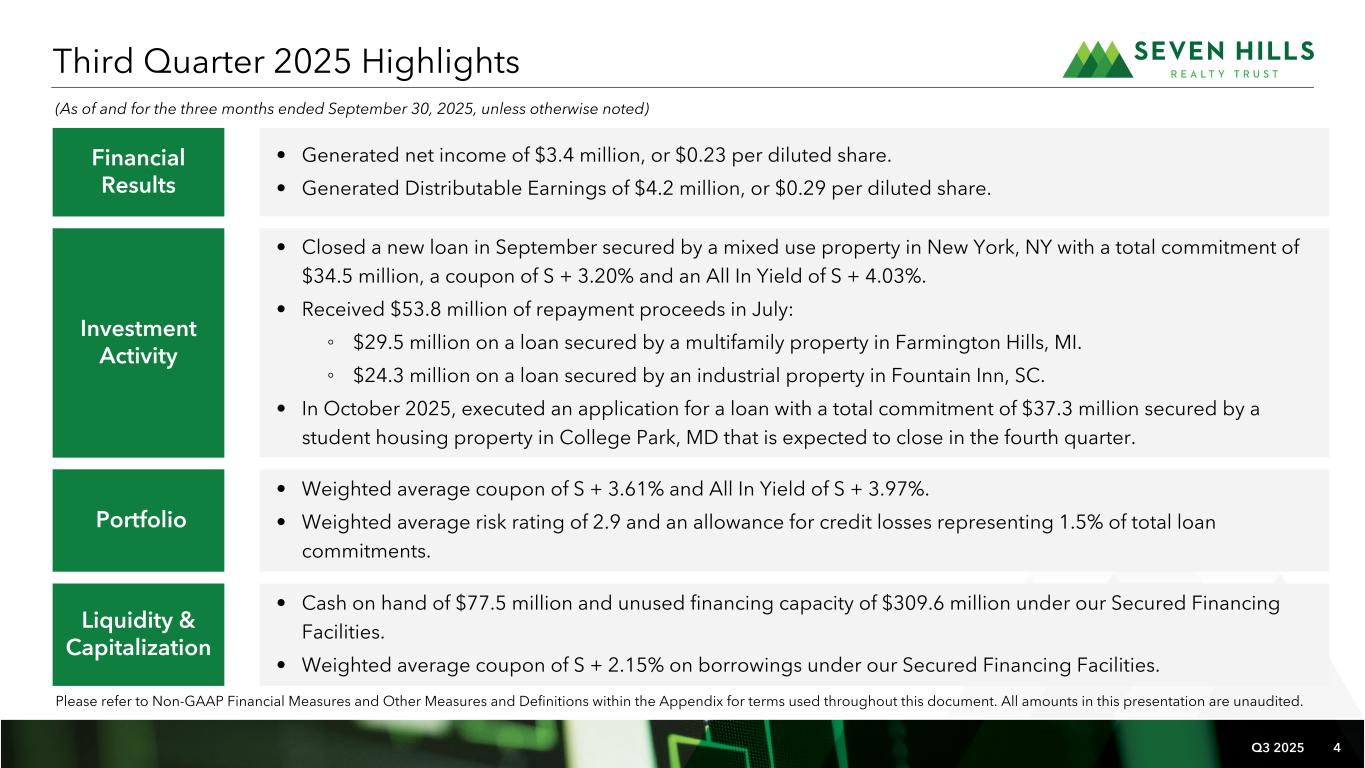
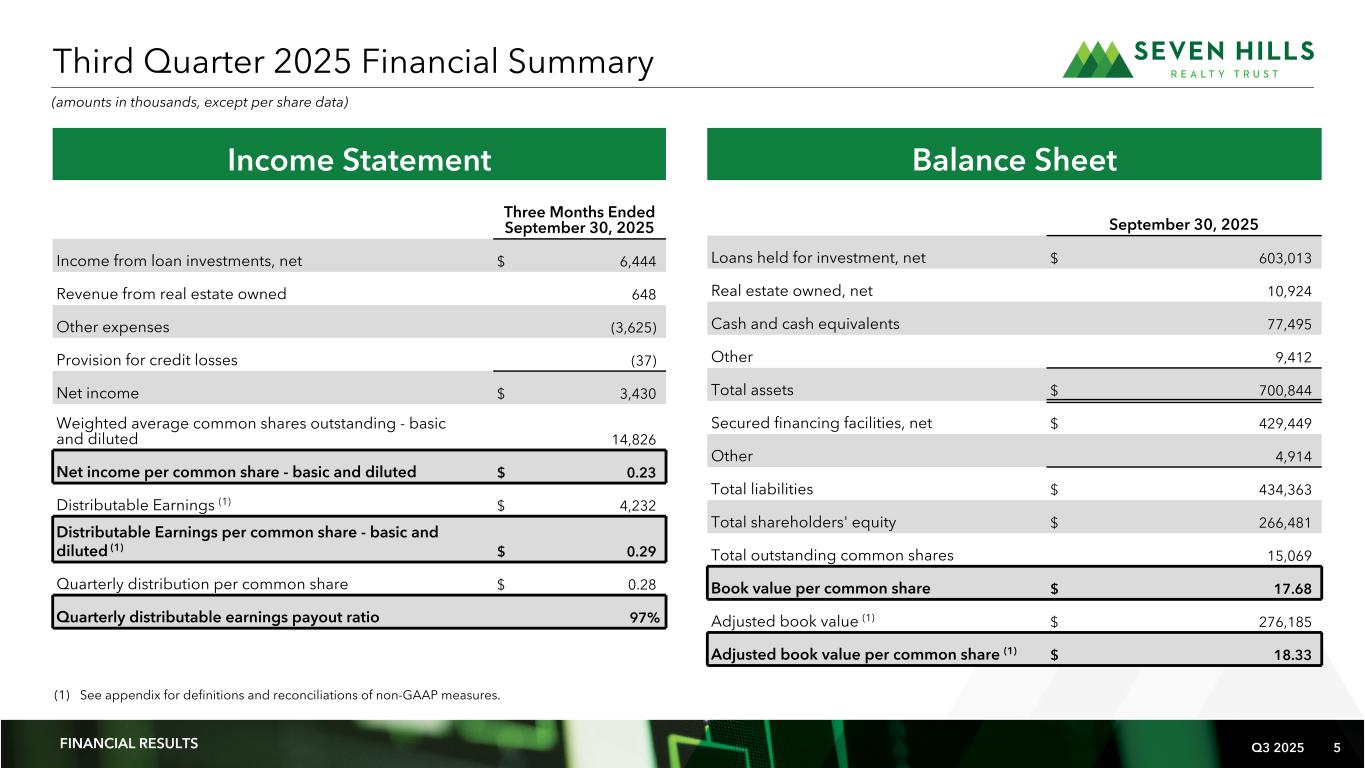
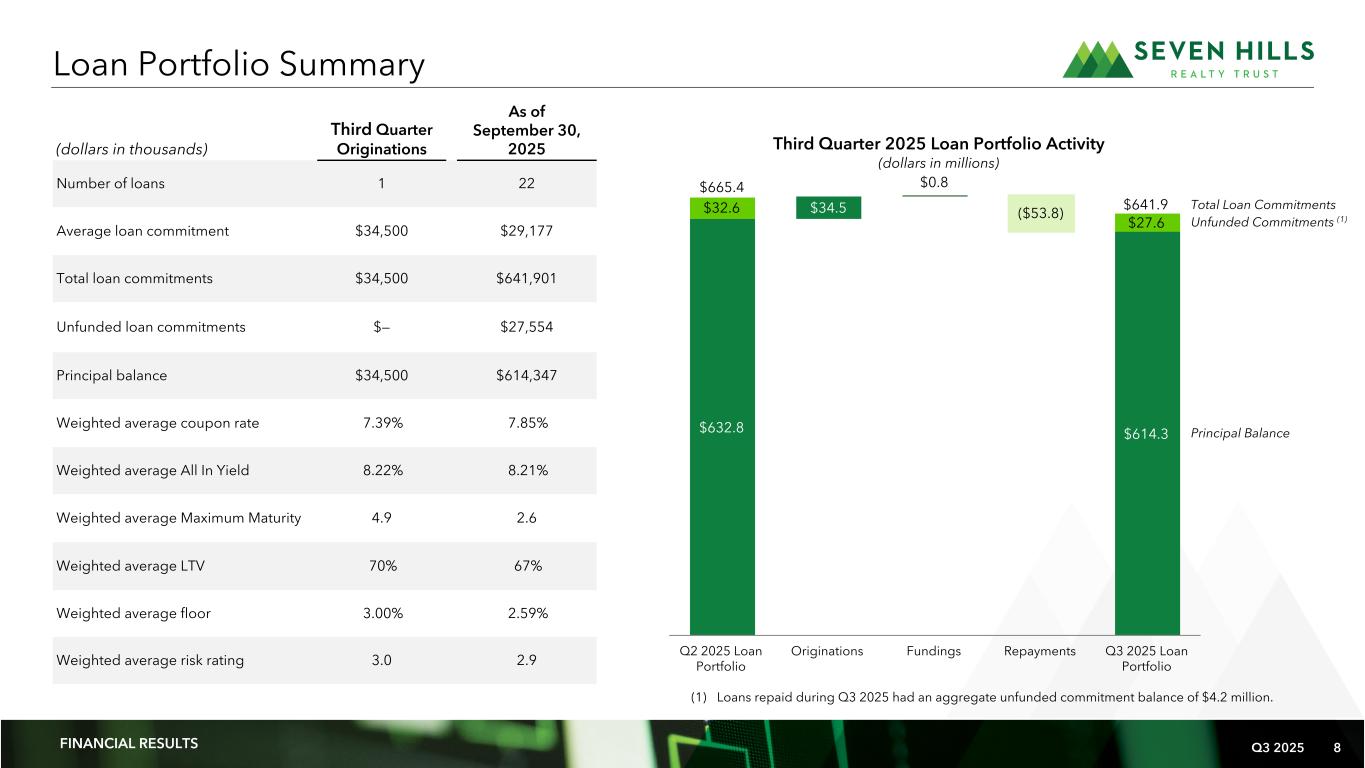
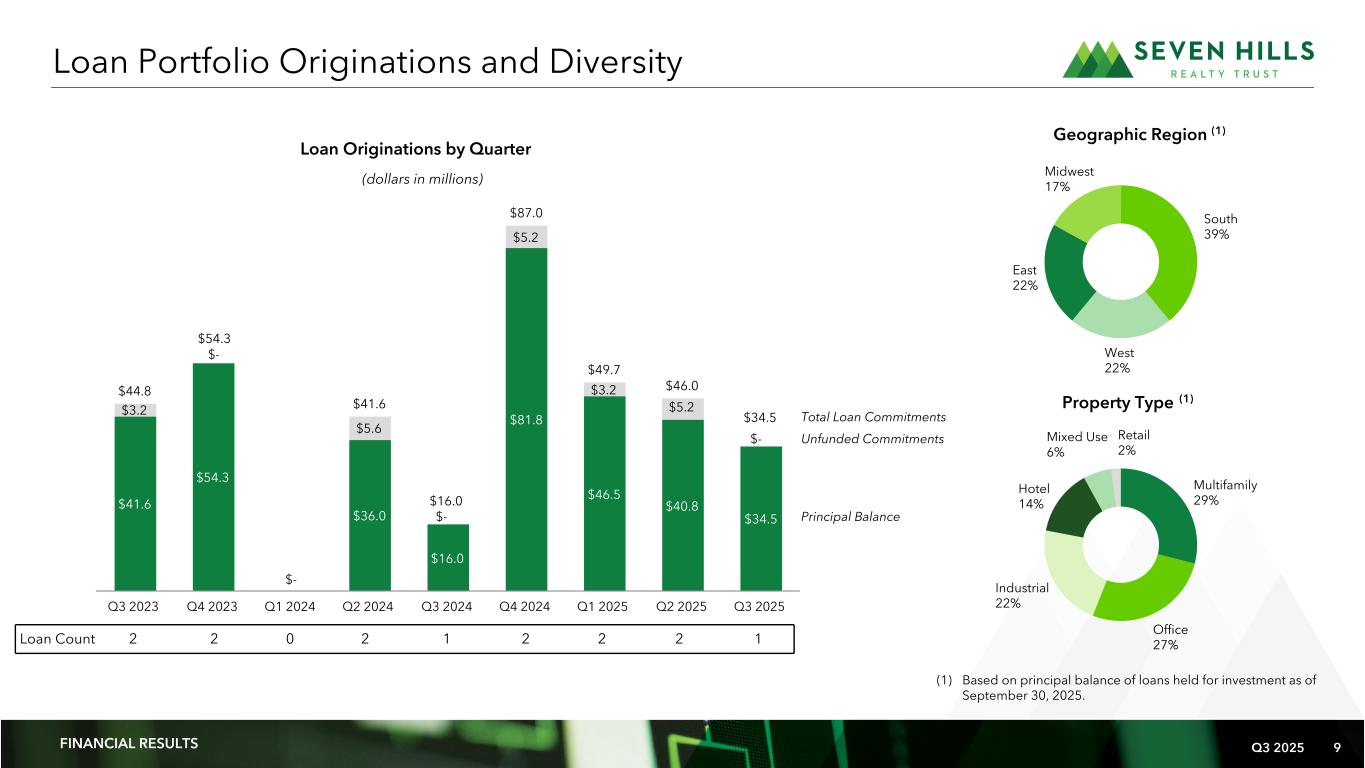
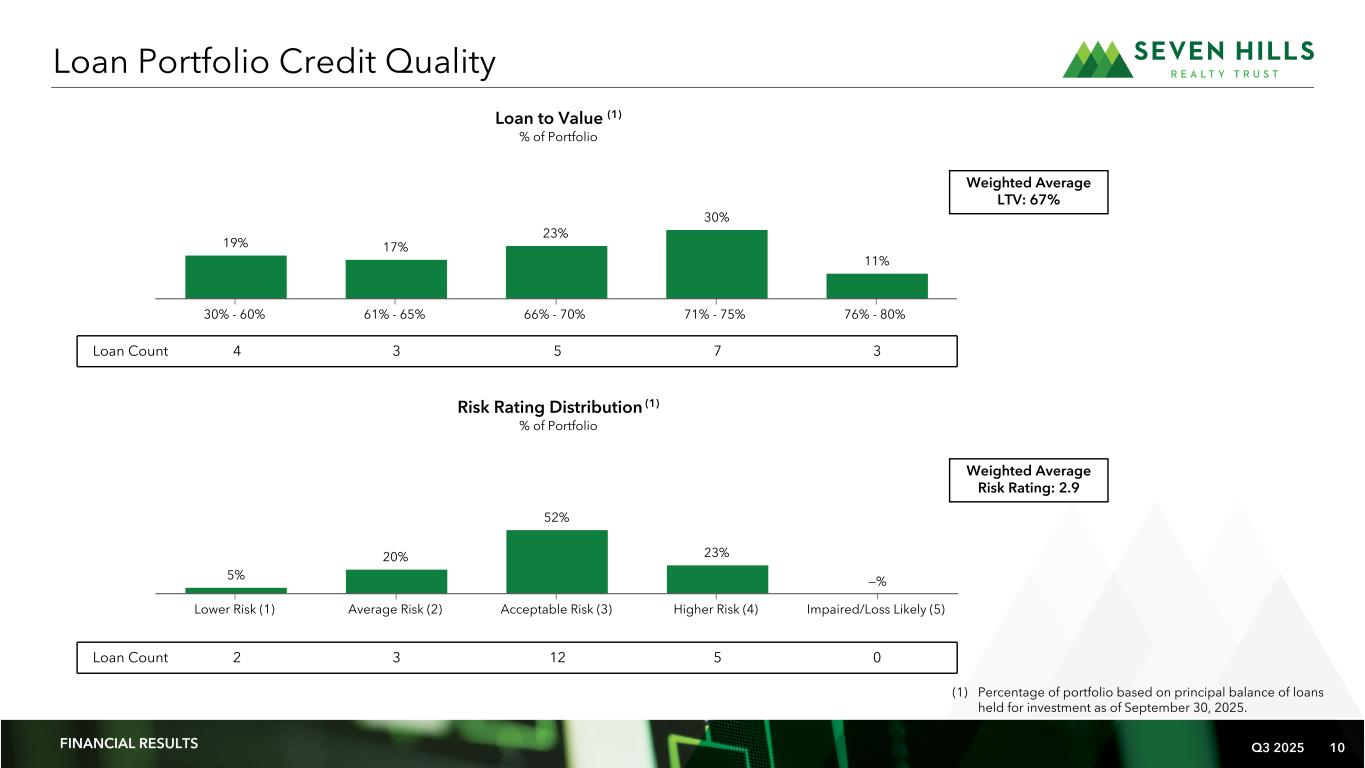
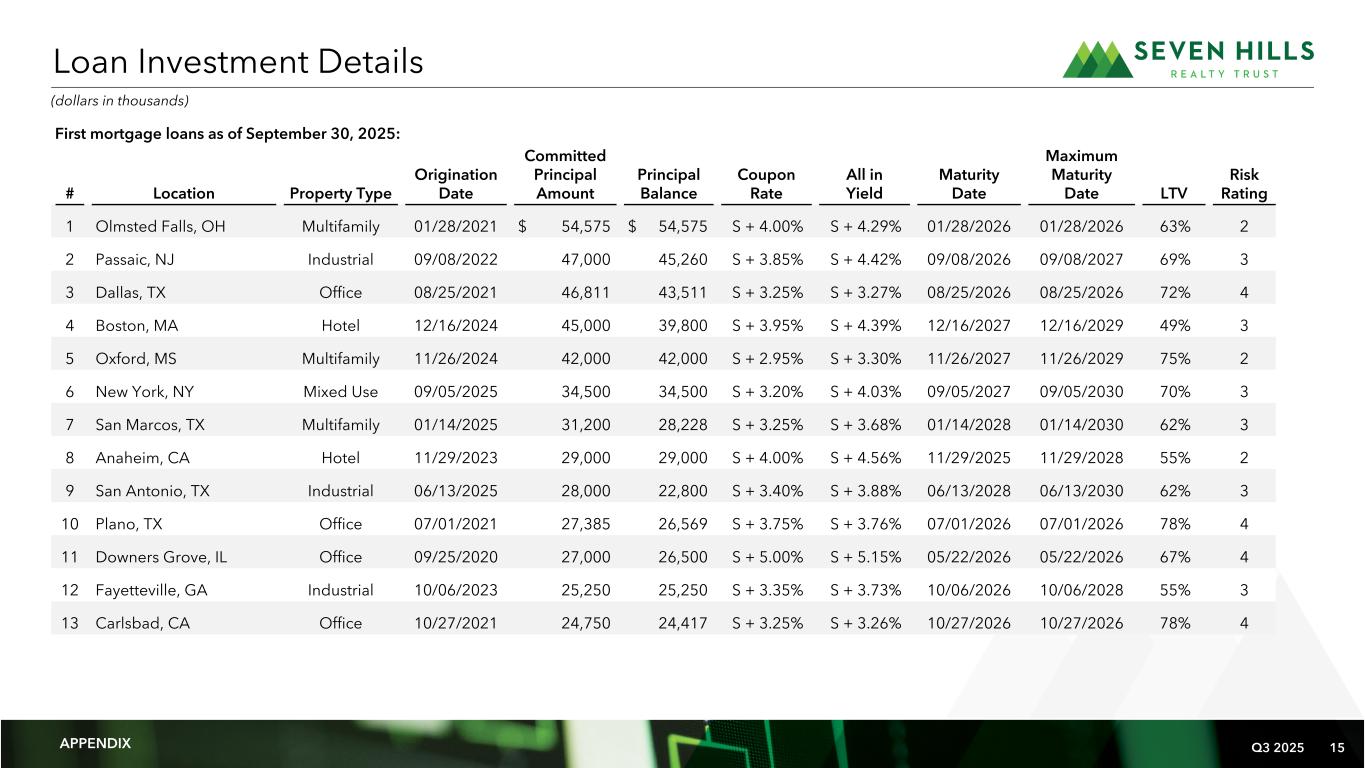
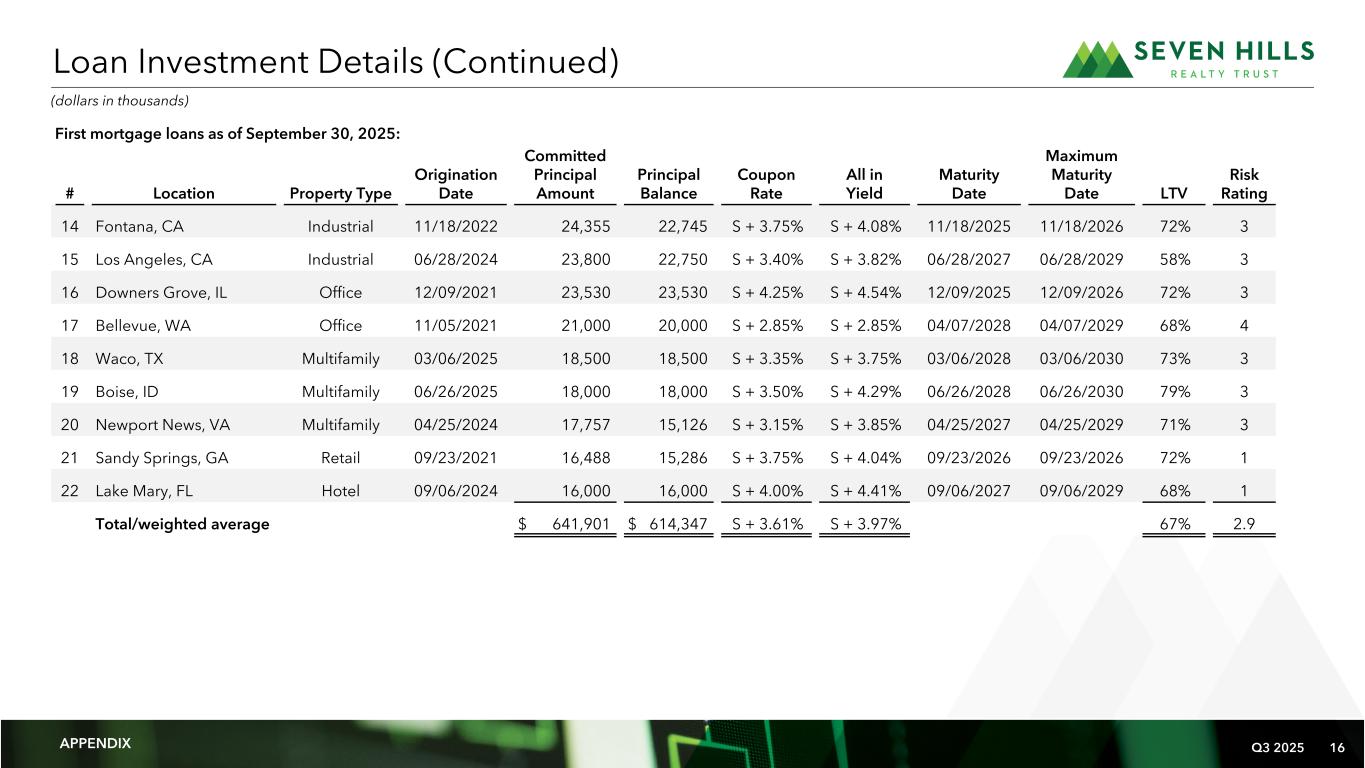
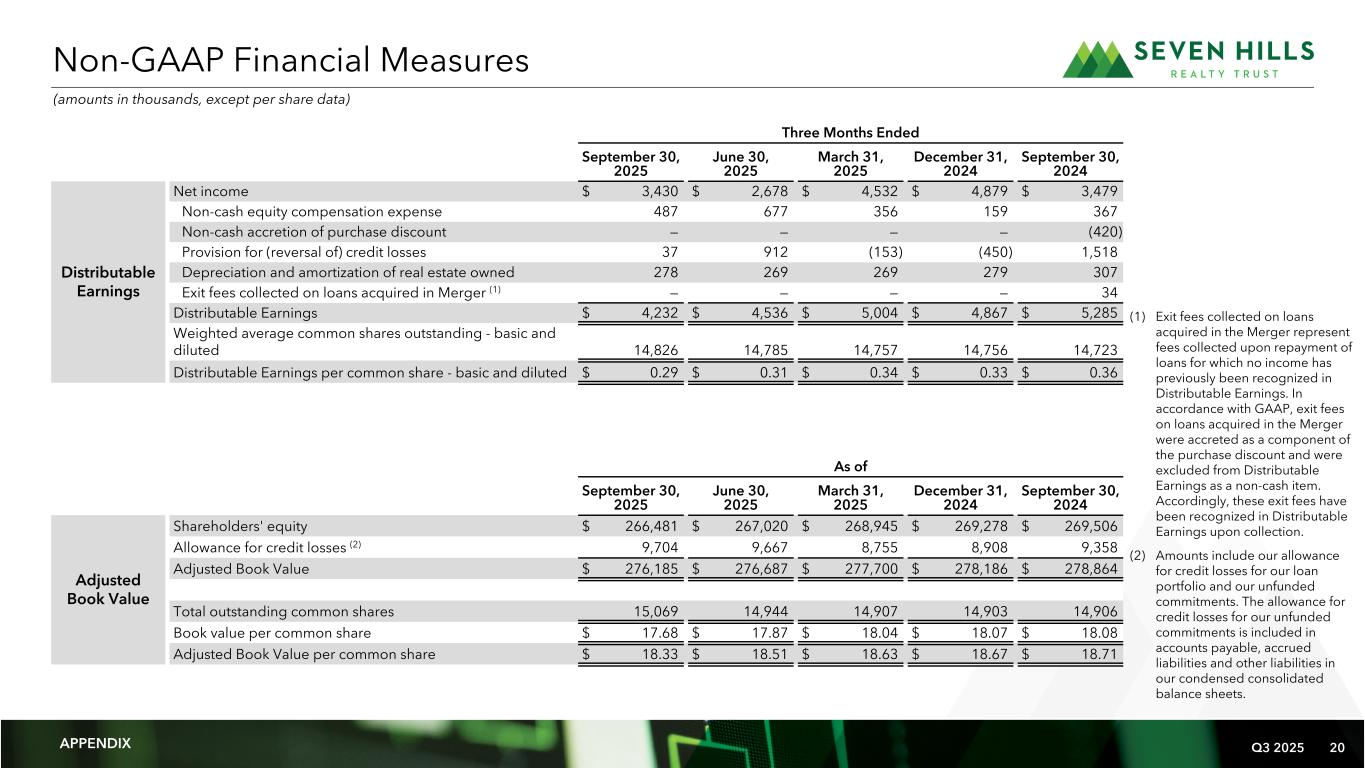
Thank you, Matt, and good morning, everyone. On today's call, I will provide an overview of our third quarter performance and recent developments, and I will then turn the call over to Jared for an update on our pipeline and market trends; followed by Matt, who will review our financial results before opening the line for questions. We delivered solid third quarter results supported by a fully performing loan portfolio and disciplined capital deployment. Distributable earnings for the third quarter were $4.2 million or $0.29 per share, which came in at the high end of our guidance range. And earlier this month, our Board declared a regular quarterly dividend of $0.28 per share, which equates to an annualized yield of 11% on yesterday's closing price. Recent transaction activity during the quarter included the closing of a $34.5 million first mortgage loan secured by a 100% leased mixed-use retail and medical office property in Manhattan's Upper West Side. In addition, we also executed a loan application for $37.3 million secured by a student housing property at the University of Maryland, which we expect to close in the next few days. Student housing assets at major universities continue to perform well while allowing for enhanced spreads when compared to traditional multifamily. As of quarter end, our portfolio consisted of $642 million of floating rate first mortgage commitments across 22 loans with a weighted average all-in yield of 8.2% and a weighted average loan-to-value of 67% at close. Our weighted average risk rating at the quarter end was 2.9, with all loans current on debt service, no 5-rated loans, and no non-accrual balances. During the quarter, we received a full repayment of 2 loans totaling $53.8 million, and we may see one additional loan repaid before year-end with an outstanding balance of $15.3 million, but the majority of near-term repayments are expected to occur in 2026. Full year portfolio growth is estimated to be approximately $100 million net from year-end 2024. We continue to see a more active lending environment as short-term rates move lower and investors anticipate further rate cuts before year-end. This has led to greater borrower engagement and transaction volume across our pipeline, which we expect will continue to grow over the coming quarters. As SOFR continues to decline, we will see our SOFR floors begin to become active, providing a benefit to earnings and helping to partially offset the impact from declining rates. While competition remains elevated, we continue to find compelling opportunities that meet our return thresholds and align with our underwriting standards. Overall, we believe our disciplined approach, strong sponsor relationships, and underwriting and asset management expertise will allow us to continue generating attractive risk-adjusted returns. With borrower demand and transaction activity improving, we remain focused on deploying capital into opportunities that we believe offer the best relative value in the current environment. Our platform is well positioned to deliver consistent execution and drive sustainable value creation as market conditions evolve, and we look forward to sharing our continued progress in the quarters ahead. With that, I will now turn the call over to Jared for an overview of current market conditions as well as our pipeline.
Speaker 3
Thanks, Tom. During the third quarter, we saw a notable improvement in market sentiment following the Fed's rate cut in September, which helped to drive new financing activity. The initial rate cut prompted many borrowers to move forward with financing decisions that had previously been placed on hold, and with expectations of 2 additional rate cuts before year-end, buyer and seller expectations are beginning to come into closer alignment, which has led to an increase in overall transaction volumes. Demand for floating rate bridge financing remains strong, driven primarily by 2021 and 2022 vintage floating rate multifamily loan maturities, which will continue well into 2026. In most cases, borrowers are choosing to refinance debt but continue to require flexible floating rate debt solutions to allow time for business plans to play out and property operations to stabilize. We are also beginning to see more instances of new buyers acquiring properties at a reset basis that better reflects current rent growth and operational expectations, helping drive additional transaction volumes. While multifamily continues to account for the majority of current opportunities, it also remains the most competitive. CRE CLO issuance has accelerated significantly over the year, and debt funds, mortgage REITs, and insurance companies are all pursuing similar loan opportunities. Furthermore, the material tightening of corporate bond spreads has made real estate credit an attractive relative value investment, which has resulted in an influx of capital to the CRE debt sector, providing liquidity and causing competition among lenders. Despite these competitive dynamics, we remain selective and disciplined in our approach to new originations. We continue to find opportunities in industrial, necessity-based retail, hospitality, and student housing. We are seeing more attractive spreads on loans with strong credit characteristics. Furthermore, with transaction volumes expected to increase in the first half of 2026, we expect to see significant opportunities for lenders with flexible capital to invest. Our pipeline is robust and well diversified, and we are currently evaluating over $1 billion of loan opportunities. Importantly, the composition of our pipeline has shifted toward a higher proportion of acquisition financing compared to refinancing activity, a trend that we view as a key indicator of renewed market confidence and a constructive environment for new lending. Our disciplined investment process supported by the broad RMR platform will allow us to identify attractive opportunities to maintain strong credit performance as market dynamics continue to unfold. I will now turn the call over to Matt for an overview of our financial results.
Speaker 4
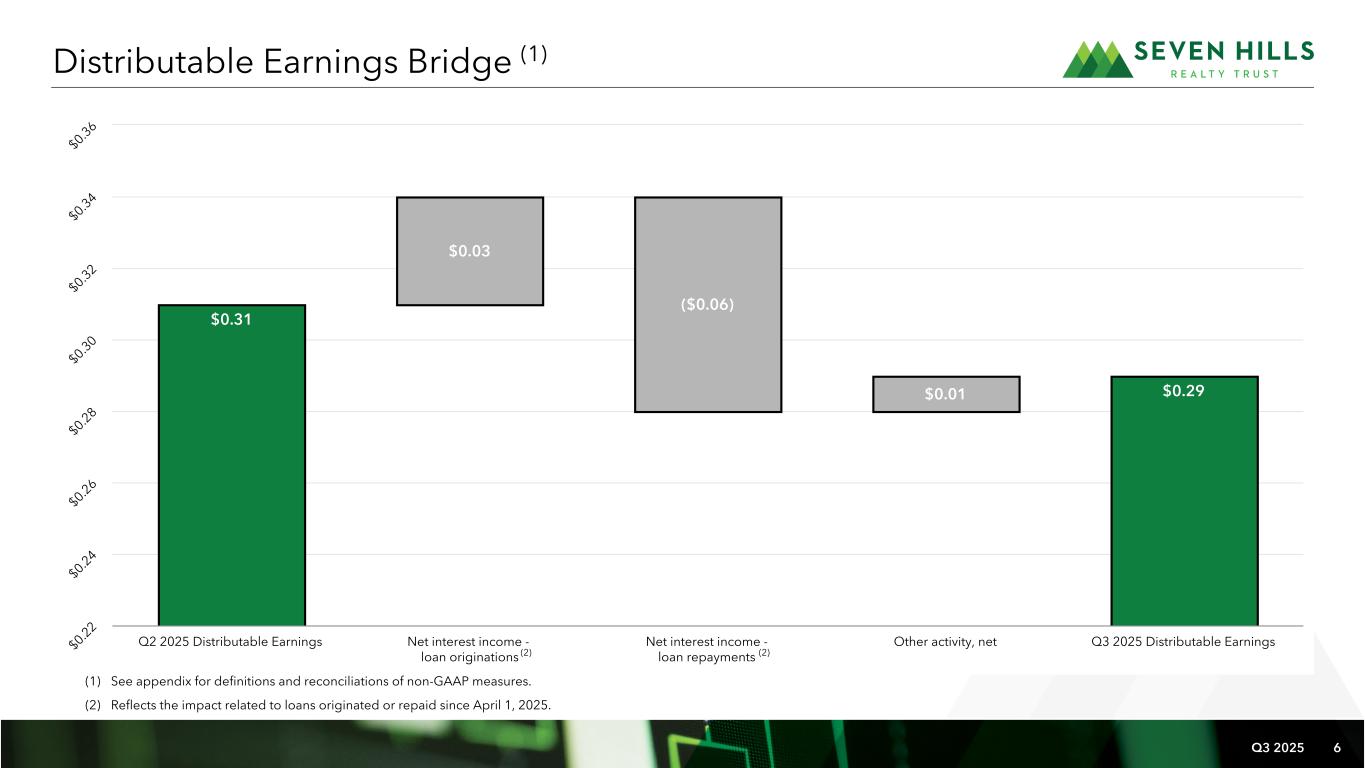
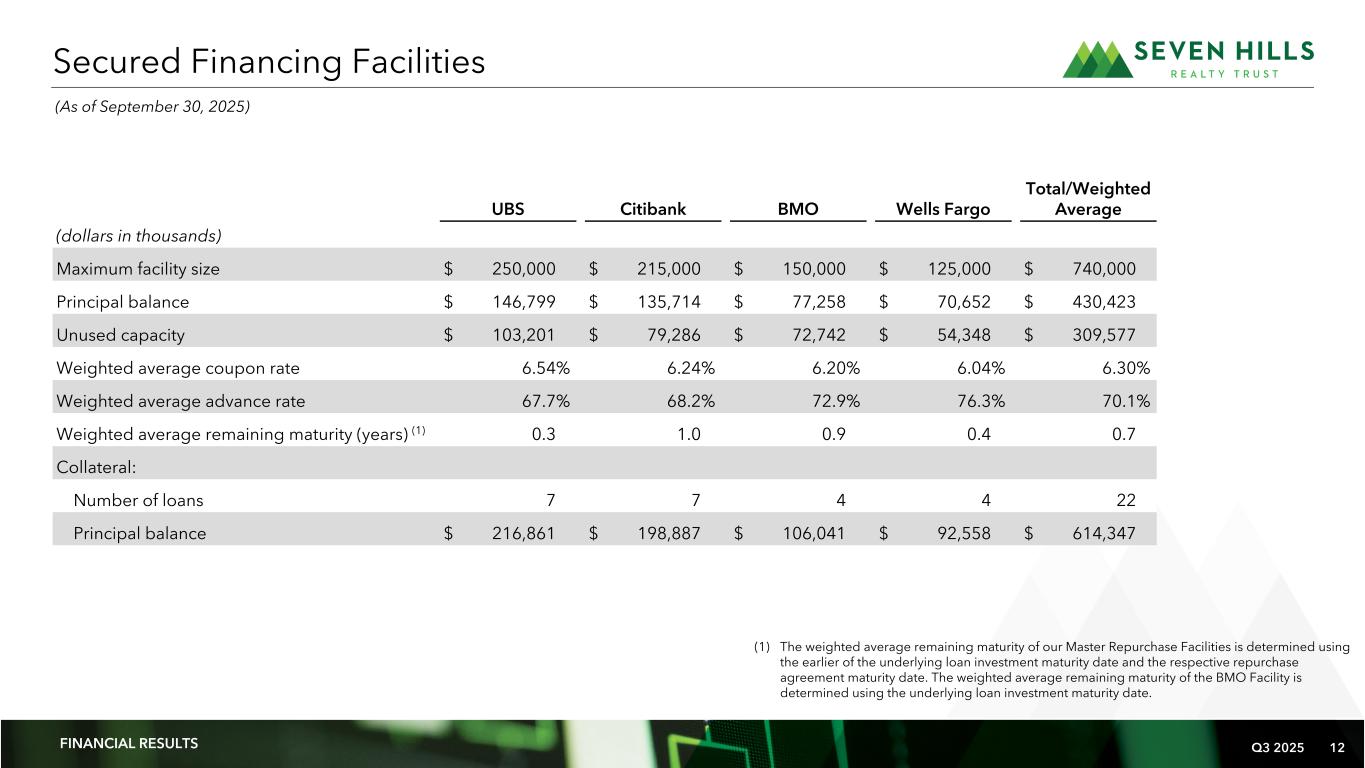
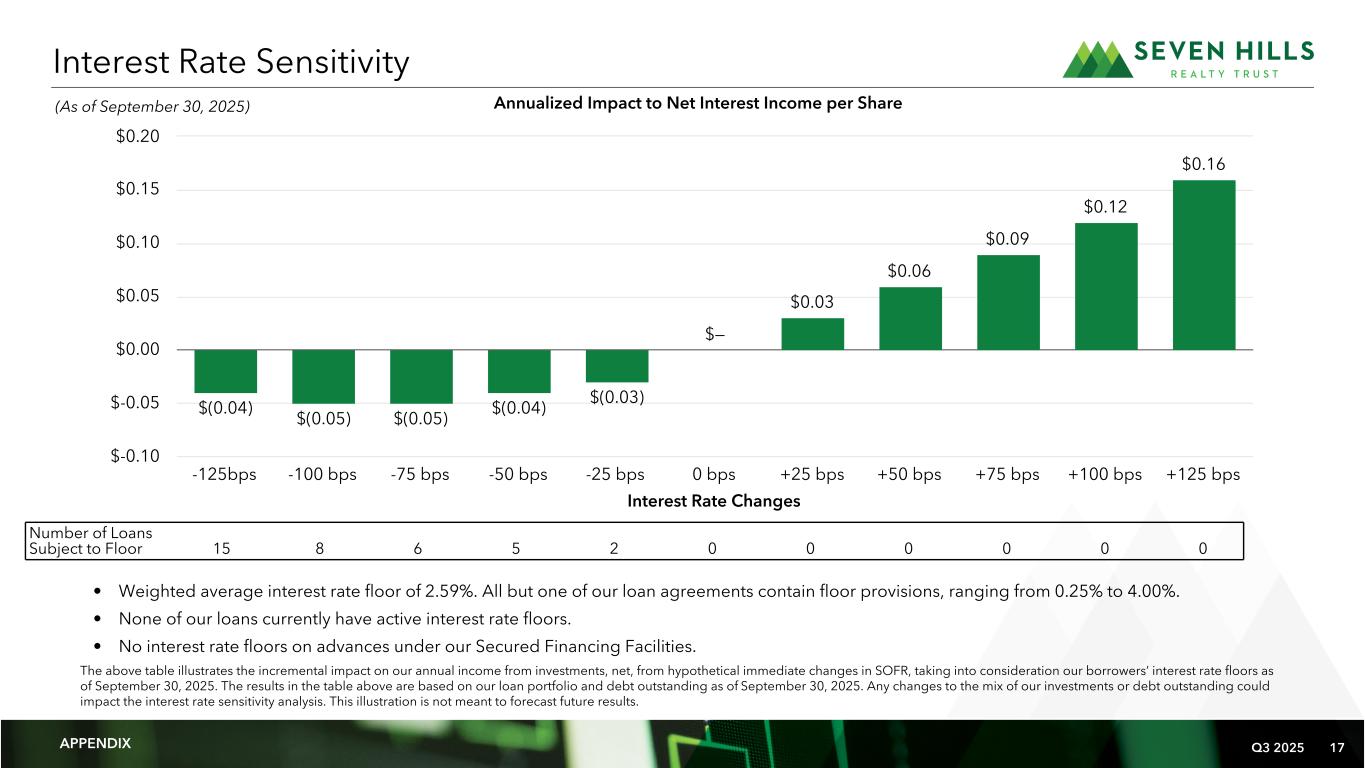
Thank you, Jared, and good morning, everyone. Yesterday, we reported third quarter distributable earnings of $4.2 million or $0.29 per share coming in at the high end of our guidance and in line with consensus estimates for the quarter. As it relates to third quarter distributable earnings, loan repayments since April 1 impacted distributable earnings by $0.06 per share, whereas loan originations over the same period contributed $0.03 per share. The $53.8 million of loan repayments in July contributed $0.01 of distributable earnings to third quarter results. We expect the loan originated in September and the loan origination under application to contribute $0.03 of distributable earnings per share in the fourth quarter. Overall, we expect fourth quarter distributable earnings to be in the range of $0.29 to $0.31 per share, taking into account this loan activity and current SOFR expectations based on the curve. As Tom mentioned, all but one of our loans contain interest rate floors ranging from 0.25% to 4% with a weighted average floor of 2.59%. With continued decreases in SOFR, certain of our loans will be subject to the floor, providing SEVN with earnings protection, whereas none of our secured financing facilities contain floors. At quarter end, none of our loans had active interest rate floors. However, with SOFR now hovering just below 4%, certain of our floors have become active. Please refer to Page 17 of our earnings presentation for further details. We ended the quarter with $77 million of cash on hand and $310 million of capacity on our secured financing facilities. Our portfolio has an all-in yield of SOFR plus 397 basis points and a weighted average borrowing rate of SOFR plus 215 basis points. Our CECL reserve remains modest at 150 basis points of our total loan commitments, unchanged from last quarter and is supported by a conservative portfolio risk rating of 2.9, which is also unchanged from last quarter. Our portfolio remains well diversified by property type and geography and all loans are current on debt service. We did not have any collateral dependent loans or loans with specific reserves. This highlights the strength in our underwriting and asset management functions to provide long-term value for shareholders. That concludes our prepared remarks. Operator, please open the line for questions.
Operator
We have the first question from Matthew Erdner from JonesTrading.
Speaker 5
Could you rehash the repayments that you were expecting for the remainder of the year? I picked up the $15.3 million, but was there another loan that I was missing in there?
Speaker 2
No, Matt, that's the only one that we expect to come back potentially before year-end. Everything else really will be 2026 with the bulk of our scheduled repayments in Q3 and Q4 of '26.
Speaker 5
Okay. Got it. Yes, that makes sense. And then based on the College Park loan closing, I've got the portfolio around $680 million, seeing that last year at the end of the year was about $640 million. So that leads me to believe that you guys are expecting a couple more loans to close throughout the year. Could you talk a little bit about how you guys are sourcing those? And just speak a little more on the competition of what's causing you guys to win loans over certain people and just the characteristics that you guys are bringing to the table.
Speaker 2
Sure. I'll begin by explaining how we source our loans. Most of our transactions come through traditional channels like mortgage banking and firms such as JLL, CBRE, and Newmark. A portion of our transactions comes directly from sponsors, with about 80% sourced through brokerage and 20% direct. In terms of how we secure these transactions, we believe we have a strong reputation for delivering on our commitments, which is essential for sponsors and appealing to the brokerage community, as they prefer to work with lenders who can close deals as promised. Additionally, we have been careful in seeking loans that offer higher yields. Our broader platform's expertise allows us to understand the asset and market better, enabling us to win deals from competitors. This approach applies across all the product types we are exploring. We are currently in the application process for a student deal, which we find promising. We are actively pursuing multifamily, grocery-anchored retail, and select hospitality opportunities as well. Looking ahead to the end of the year, we anticipate closing another 3 to 4 loans that we feel confident about.
Operator
We have the next question from Christopher Nolan from Ladenburg Thalmann.
Speaker 6
For Matt, does the CECL reserve change or does the requirements under CECL for the allowance go down with lower rates, lower SOFR specifically?
Speaker 4
They could. There's a lot of factors that impact the CECL reserve. I think it's important to note that we add back any CECL reserve to our distributable earnings because it is a noncash item, and we do not have a history of recording any loan losses for SEVN. So there's macroeconomic factors. There's factors with our existing portfolio based on property level performance, repayment activity, origination activity. So it's a blend of factors that are driving that. Overall, we're at 1.5% of total loan commitments, which we think is very conservative for our business.
Speaker 6
If SOFR decreases and your loans are tied to that rate, there is a greater chance that the allowance reserve as a percentage of loans will decrease. Does that make sense?
Speaker 4
It does. But like I said, there are a lot of factors that go into it in addition to just SOFR.
Speaker 6
Got it. Okay. And Jared, thank you for the overview of the market. For multifamily and your comments on multifamily debt, does this also imply increased demand for multifamily equity as well? Or is that a different market in terms of its dynamics right now?
Speaker 3
There is certainly a consistent demand for equity capital. Given the significant volume of loan maturities from the 2021 and 2022 vintage assets, many of these deals will require additional equity, especially if the property cannot refinance according to current standards. As a result, sponsors and borrowers are seeking out extra equity for these opportunities. On the acquisition side, there is also a considerable amount of capital that has been raised over the years that is looking to be invested in the multifamily sector due to its appeal and liquidity. This will contribute to increased financing activity. Therefore, while there will be a need for new debt in the multifamily sector going forward, it will also necessitate additional equity. A lot of capital is actively pursuing these opportunities due to strong underlying fundamentals, and I expect this trend to persist into 2026 and 2027.
Speaker 6
Great. And final question on that line. In your observation, are you seeing banks become less participatory in multifamily debt markets or more? Any characterization there?
Speaker 3
Yes. So the larger banking community, the money center banks are very active today and they've become competitive, and they're another cohort of lenders that are chasing these opportunities, specifically in the multifamily space. Smaller regional banks may not be as active. As you've read in headlines, I mean, there's still a concern or questions over bank balance sheets in certain sectors. And so I think some are still taking a more conservative approach. But generally speaking, the larger banks are active, smaller banks are a little bit more selective.
Operator
We have the next question from the line of Chris Muller from Citizens Capital Markets.
Speaker 7
Congrats on a solid quarter. So cash balances jumped up a little bit in the quarter. I guess the question is, is that due to timing of repayments coming in? Are you guys holding a little bit of extra liquidity ahead of some of those originations you expect in Q4?
Speaker 4
It's really driven by the sources and uses of the quarter. We had $54 million of repayments come in, in July, and we only put out about $34 million of new loans. As we noted, we do have a $37 million loan opportunity that we expect to close in the near future. But that cash balance also allows for the additional originations that Tom noted through the end of the year.
Speaker 7
Got it. And I guess, I like the slide you guys have with the EPS bridge in the deck. Does that $0.03 include origination fees? And then I guess, a follow-up question on that is, what does a typical quarter look like for origination fees? Is it kind of that $0.01, $0.02, $0.03 type number? Or can we see that ramp up if you guys can really start deploying capital in 2026?
Speaker 4
Yes. The origination fees are baked into the yield.
Speaker 7
Got it. And is that just like a $0.01 or $0.02 a quarter? Is that the right way to think about that?
Speaker 4
Yes. At best, it's probably $0.01 a quarter is my guess.
Speaker 7
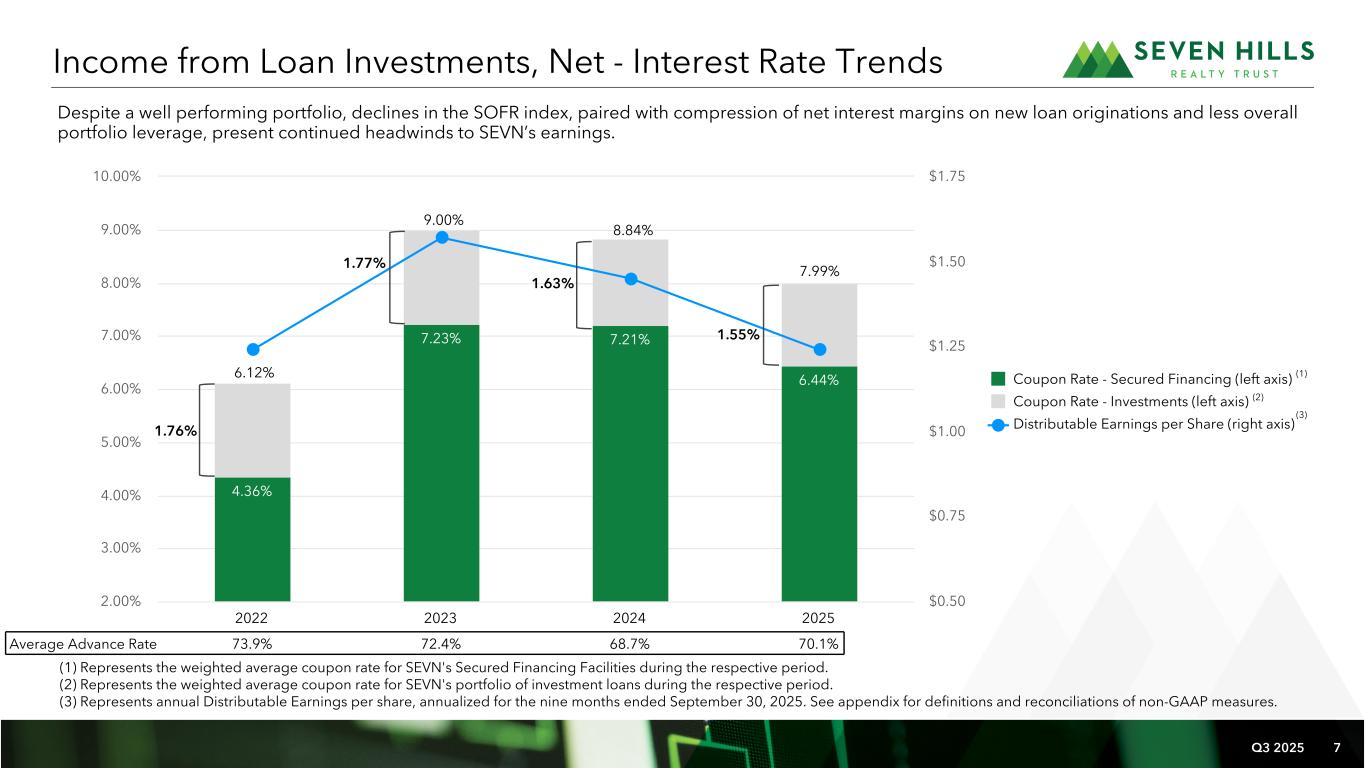
Got it. And I guess just the last one I have here. So on the NIM compression, the other slide you guys have in your deck, it's been trending lower since the peak of the market when rates were at 0, which makes sense. But do you guys feel that you're either at or near a trough on NIM compression there? Or could there be some more pressure in the coming quarters?
Speaker 2
Yes. I think we are likely at the lowest point regarding this matter. This mainly relates to our process of identifying suitable investment opportunities. We are certainly aware of this aspect. Additionally, I believe we have been successful in securing significant returns whenever possible, and that remains our objective moving forward. Therefore, we anticipate that this will stabilize and could potentially improve.
Speaker 7
Got it. Appreciate you guys taking the questions and congrats again on a solid quarter.
Operator
Thank you. This concludes our question-and-answer session. I would like to turn the conference back over to Tom Lorenzini, President and Chief Investment Officer, for any closing remarks.
Speaker 2
Thank you, everyone, for joining today's call. Please reach out to Investor Relations if you are interested in scheduling a call with Seven Hills. Operator, that concludes our call.
Operator
Thank you. The conference has now concluded. Thank you for attending today's presentation. You may now disconnect.