Operator
Good morning, and welcome to Summit Therapeutics' fourth quarter and year-end 2024 earnings and update call. All participants will be in listen-only mode until the question-and-answer portion of this call. We do not expect any technical difficulties today. However, in the event that we lose this webcast connection and are unable to provide any updates, please wait up to 10 minutes for resolution. Please refer to the company's website for updates. Please note that today's call is being recorded. If you would like to ask a question during this time, simply press star followed by the number 1 on your telephone keypad. If you would like to withdraw your question, press star 1 again. Thank you. At this time, I would like to turn the call over to Dave Gancards, Summit Therapeutics Chief of Business and Strategy Officer. You may proceed.
Good morning, and thank you for joining us. Two press releases were issued earlier this morning and are available on the homepage of our website. Our Form 10-K was also filed earlier this morning and is available on our website. Today's call is being simultaneously webcast and an archived replay will also be made available later today on our website, www.smmttx.com. Joining me on the call today is Bob Duggan, our Chairman of the Board and Chief Executive Officer, Dr. McKee Zonganay, our Chief Executive Officer and President, Manmit Soni, our Chief Operating Officer and Chief Financial Officer, and Dr. Alan Yang, our Chief Medical Officer. Before we get started with the rest of the call, I would like to note that some statements made by our management team and some responses to questions that we may make today may be considered forward-looking statements based on our current expectations. Summit cautions that these forward-looking statements are subject to risks and uncertainties that may cause actual results to differ materially from those indicated in the forward-looking statements. Please refer to our SEC filings for information about these risks and uncertainties. Summit undertakes no obligation to update these forward-looking statements except as required. Following comments from Bob, McKee, and Manmits, we will take questions. With that, I will turn the call over
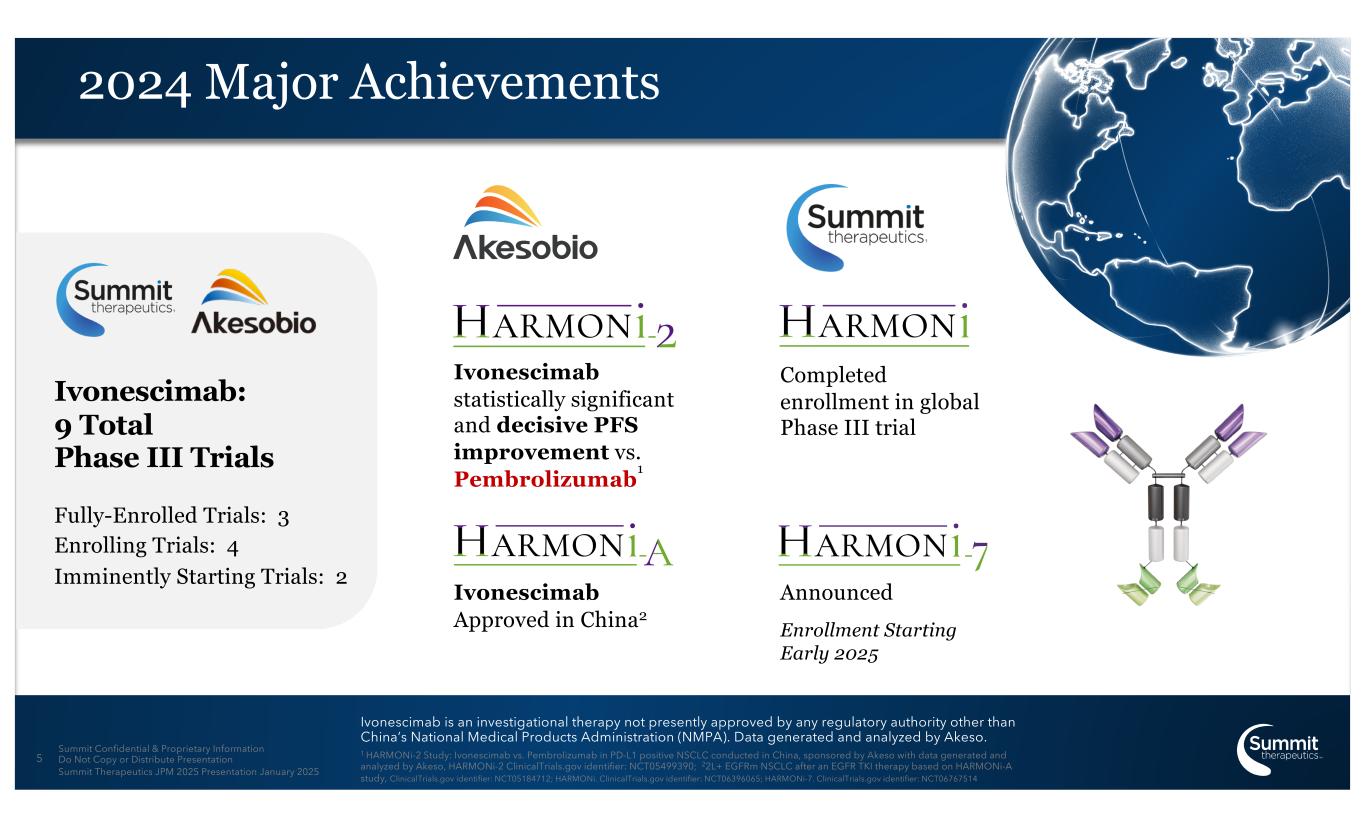
to Bob. Thank you, Dave. Good morning, everyone, and thank you for joining us today. I am very pleased with recent accomplishments of Team Summit and the investigational asset. In the Q4 of last year and to date in 2025, we have reached several meaningful milestones around the development of Ivinusumab, importantly with our partners in China as well as here in the U.S. and Western markets. We continue to progress towards our mission of building an organization making a significant positive unmet medical needs combination with multiple Pfizer antibody drug conjugates, or ADCs, in unique solid tumor settings. Rapidly developing novel mechanisms that go beyond what is currently available to patients and physicians is what we believe will make the most significant. We believe this will accelerate the advancement of potentially landscape-changing therapeutic combinations, which intend to improve the standards of care for patients. Clinical trials associated in October of last year track designation for harmony our global phase three trial are mutated advanced with a third gen top line data from my vanissimab's first global registrational phase three trial harmony is expected in mid with this amendment harmony three is a multi-regional with tumors of squamous histology and harmony three now addresses a patient population two to three times larger than prior to the amendment, significantly expanding the numbers of patients with cancer that Ibenizumab can potentially help. Towards the end of the year, we announced our third global phase three trial, Harmony 7, would be initiating in early 2025. Initial trial sites have begun activating in the United States, and Harmony 7 continues to progress as planned. As a reminder, Harmony 7 is evaluating ivenizumab monotherapy against pembrolizumab monotherapy in first-line metastatic non-small cell lung cancer patients whose tumors have high PD-L1 expression without actionable genomic alterations. McKee will further discuss these accomplishments, including additional strides taken to drive our continued belief in what could be accomplished by Team Summit, as well as our conviction in the potential of ivenizumab in non-small cell lung cancer, and very importantly, indications beyond lung cancer. We are a mission-driven organization with an overriding patient goal to improve quality of life, increase potential duration of life, and resolve the right team, and we believe we have the molecule in ivenizumab to realize this goal. With that, I will turn the call over for additional context and recent highlights for consideration. Mackie?
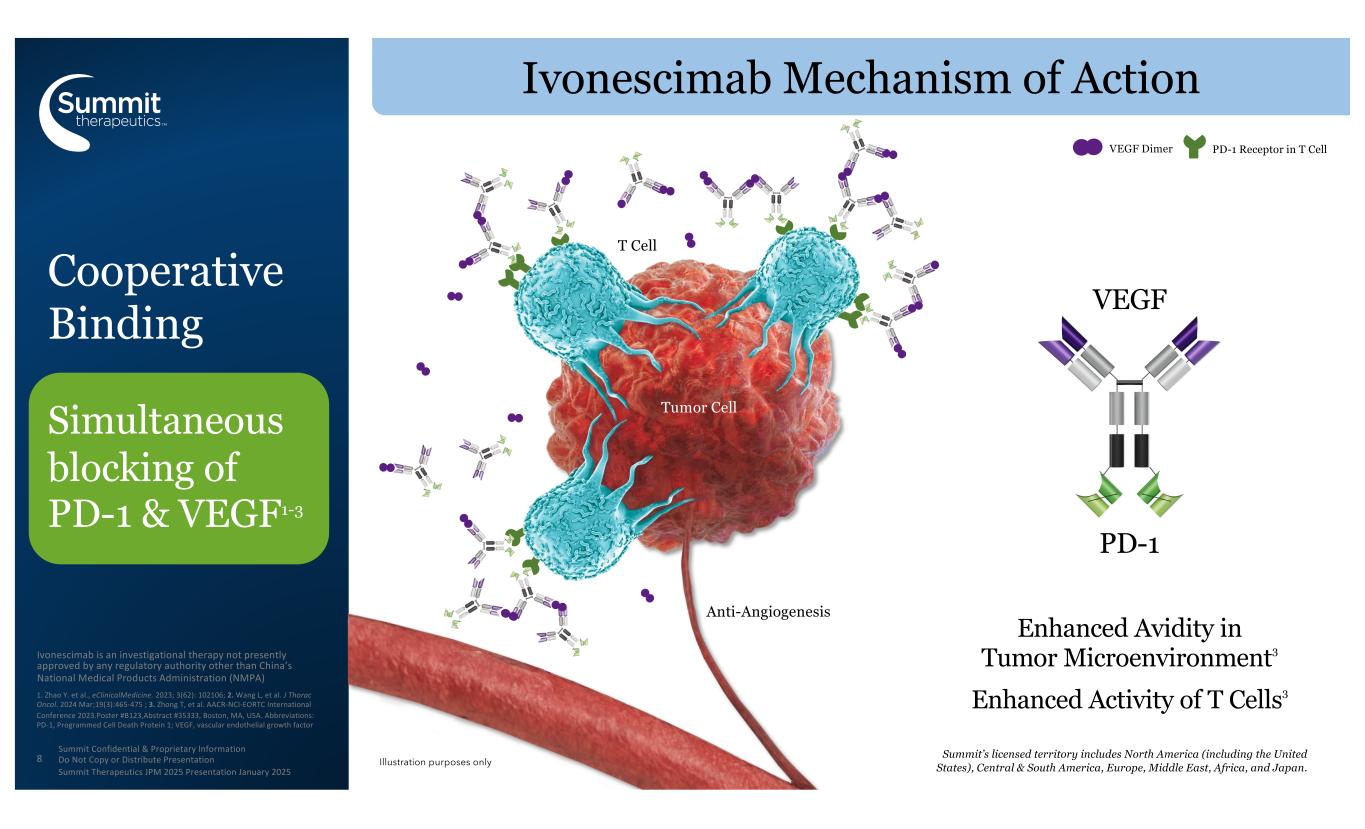
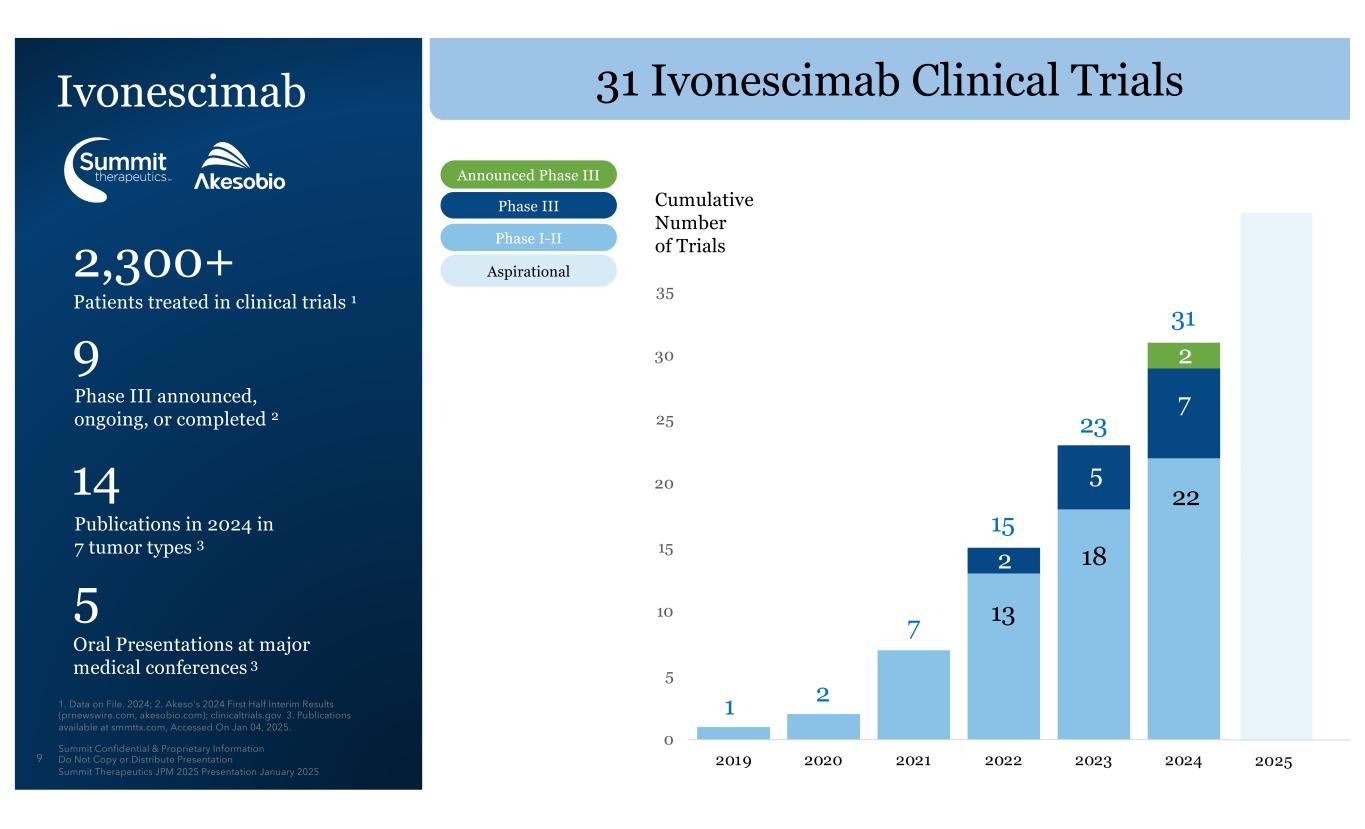
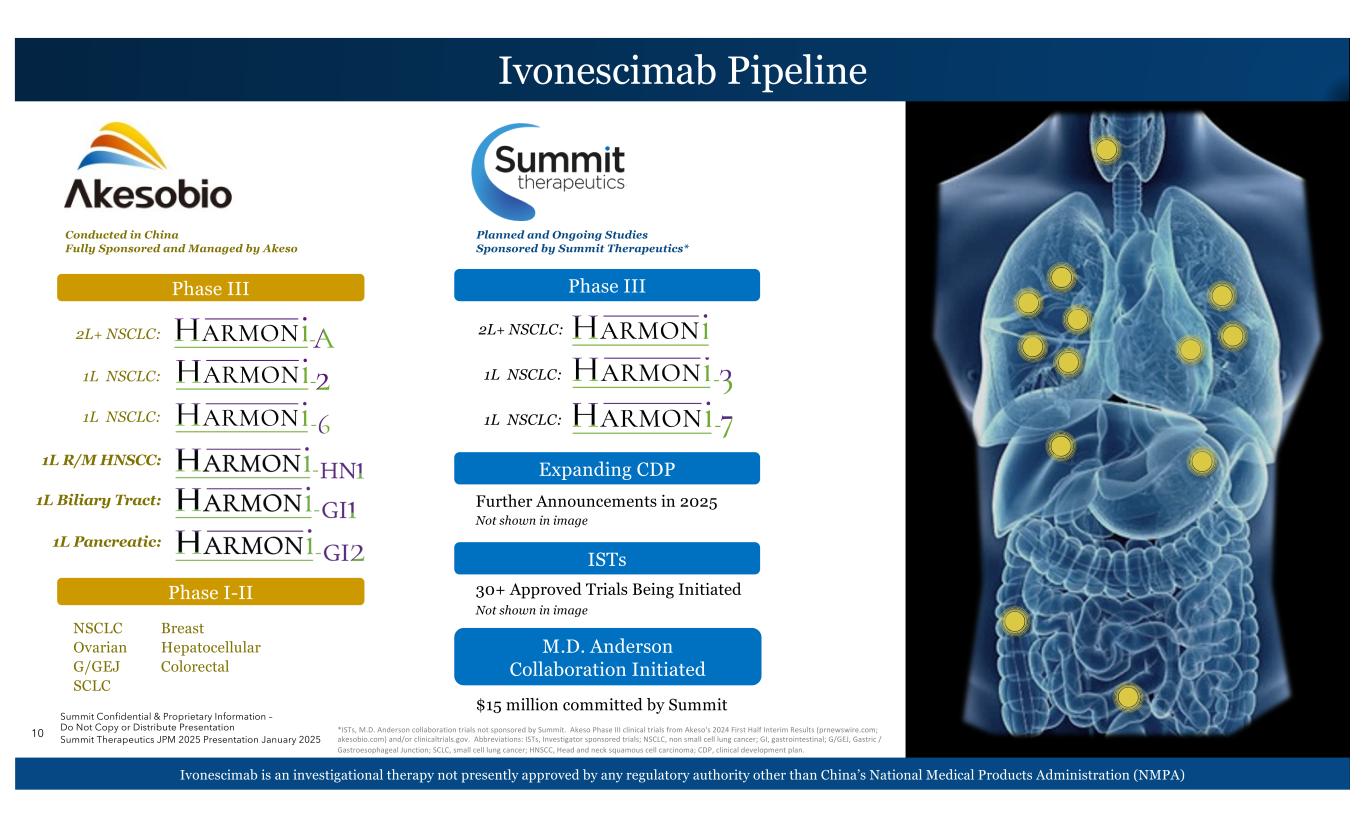
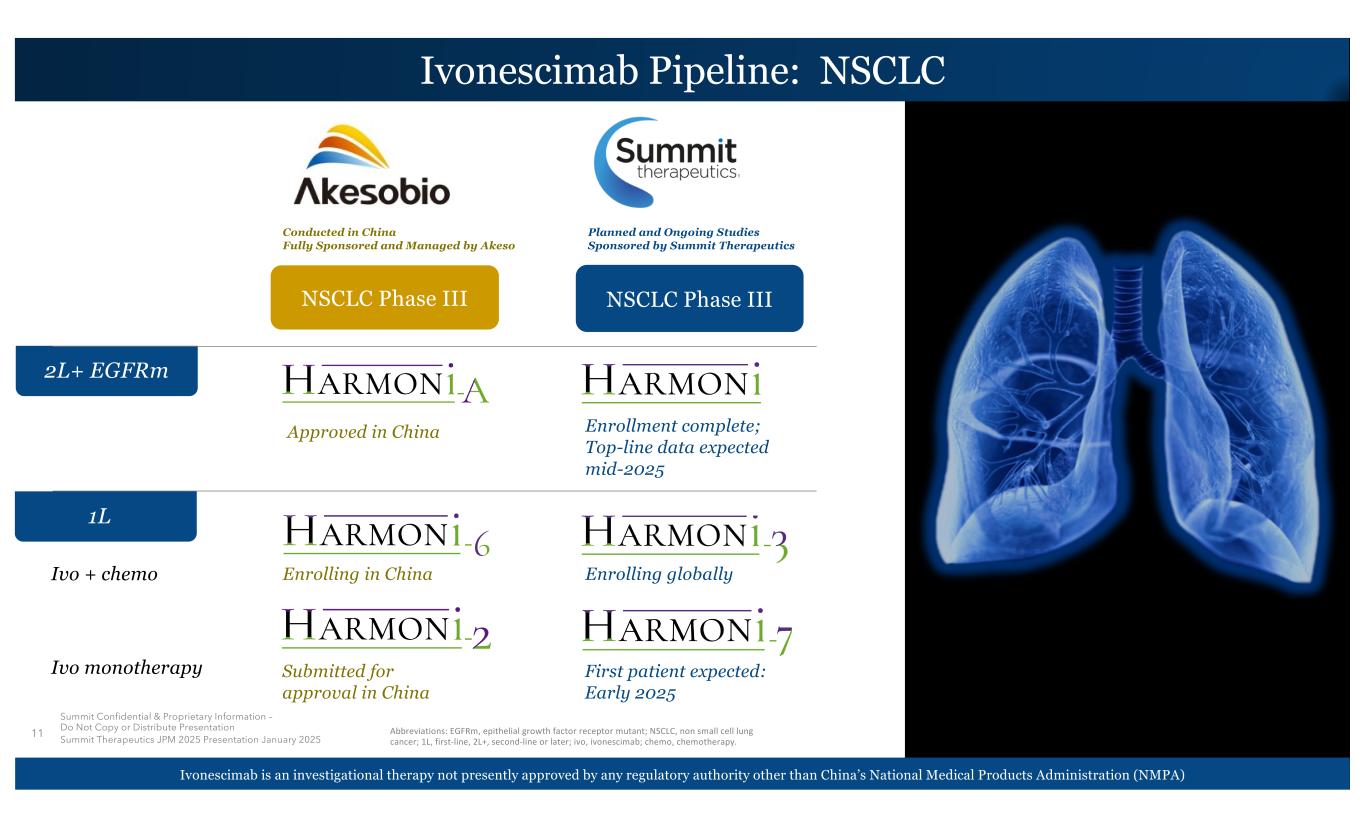
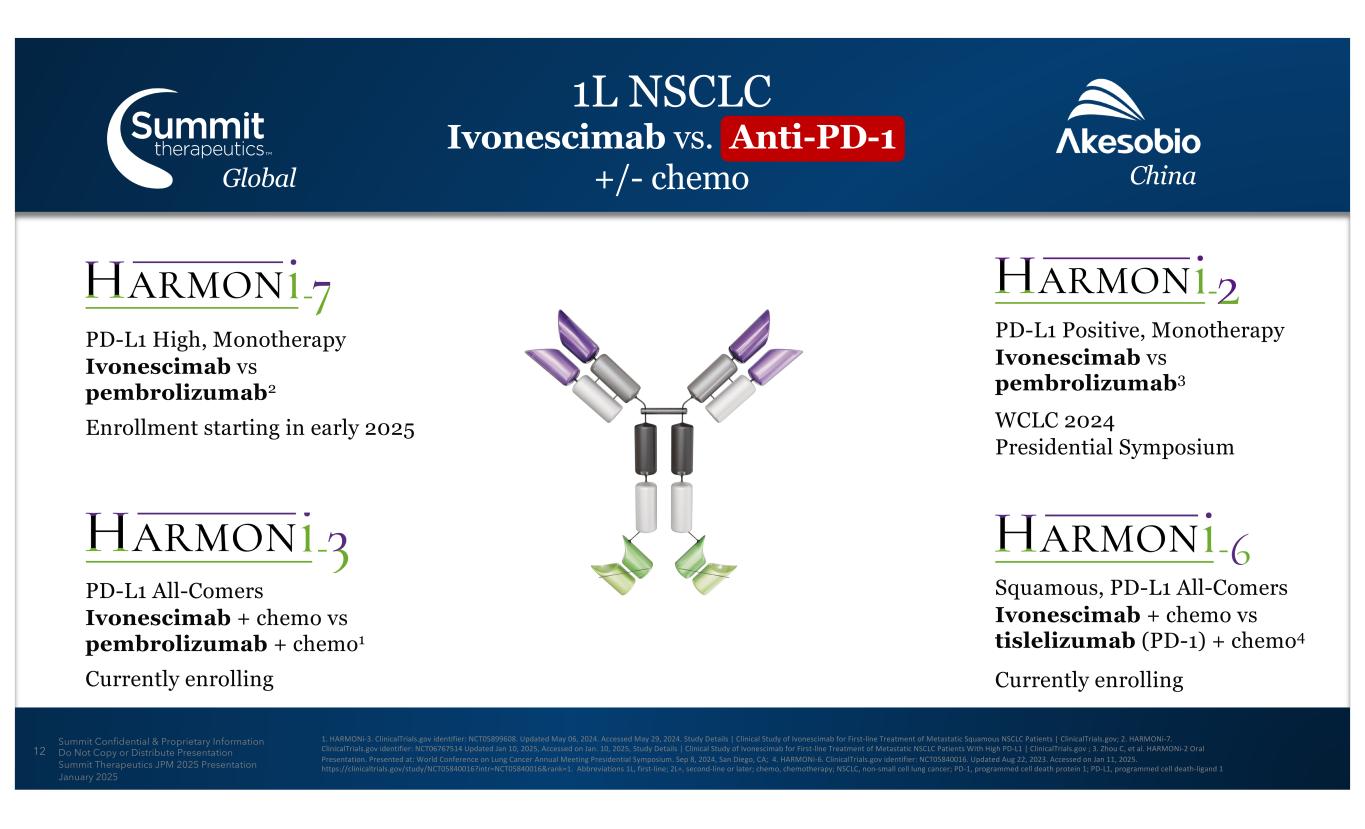
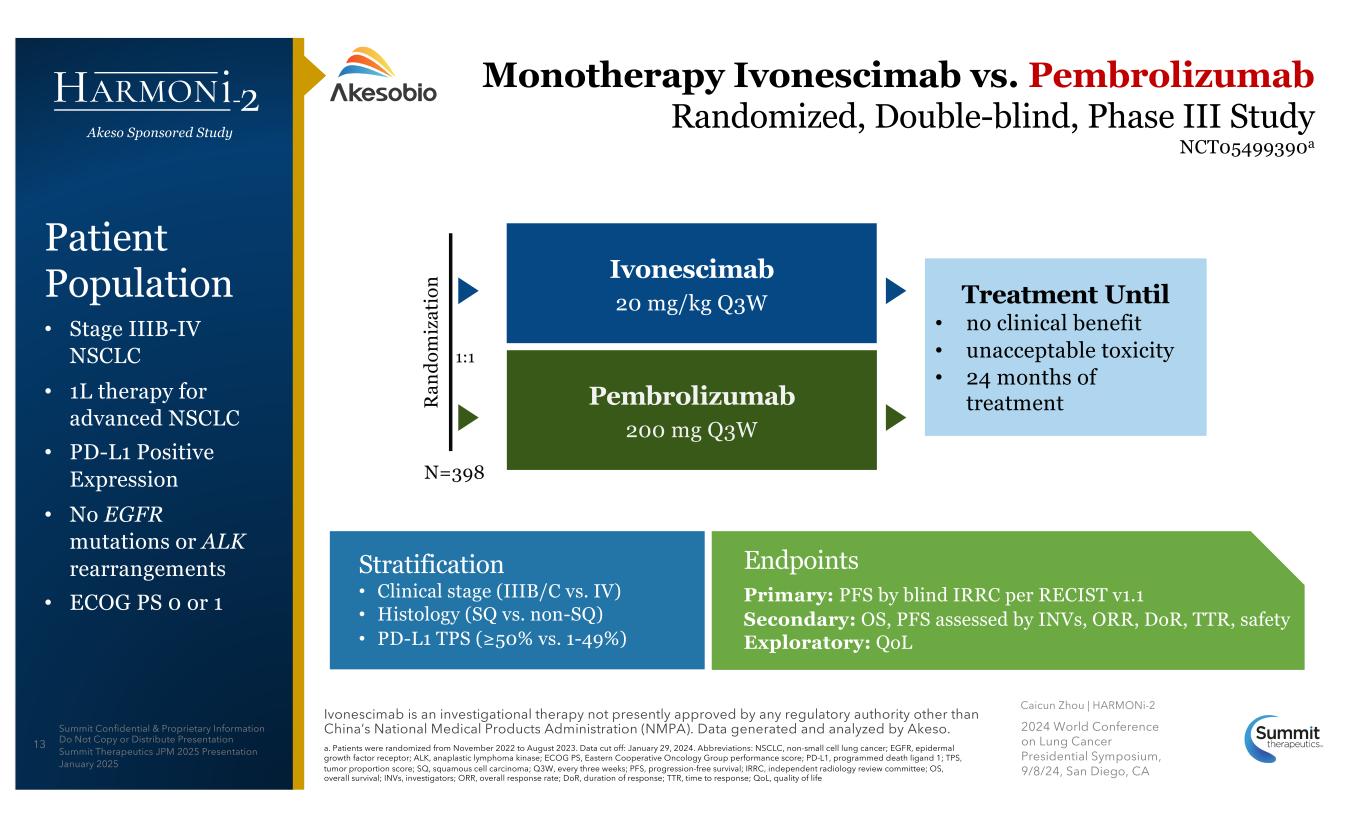
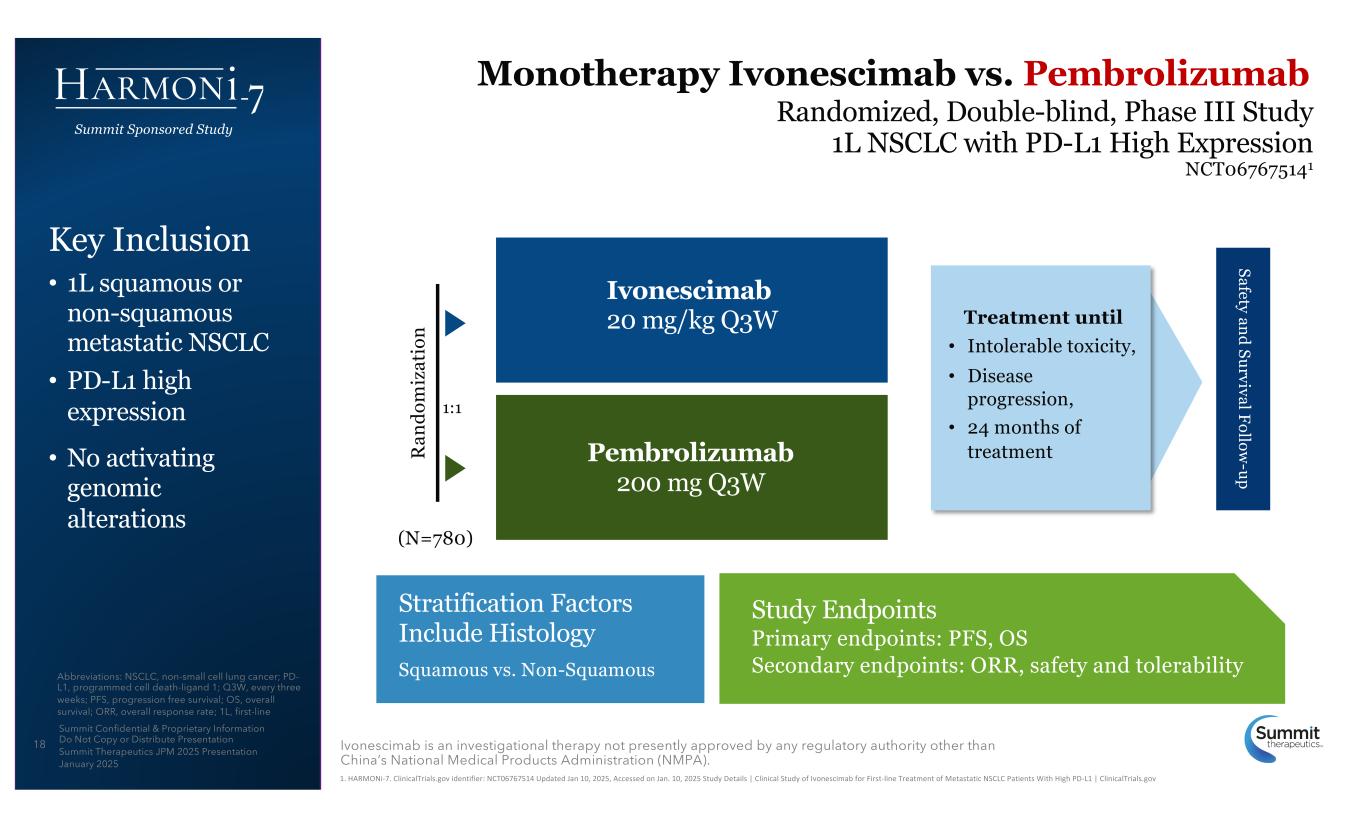
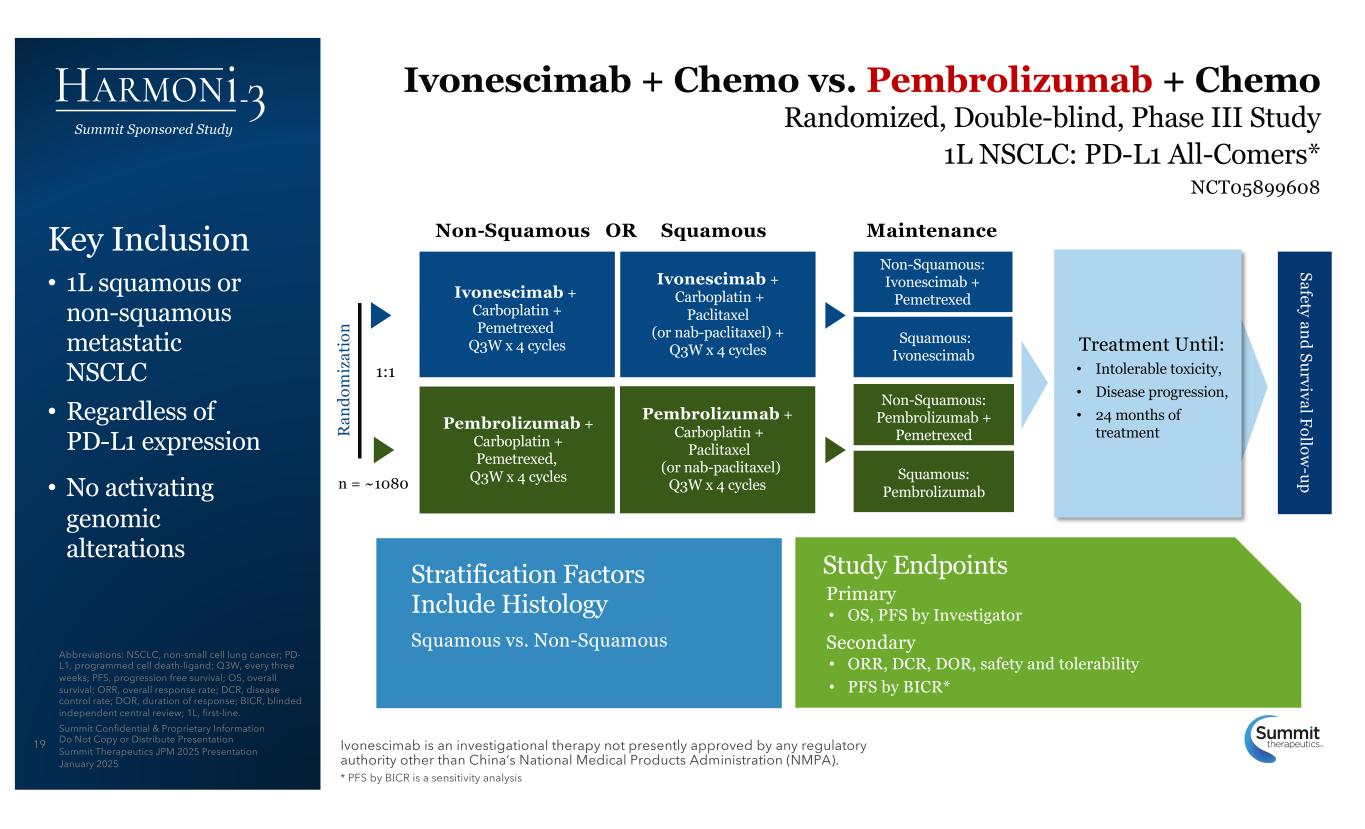
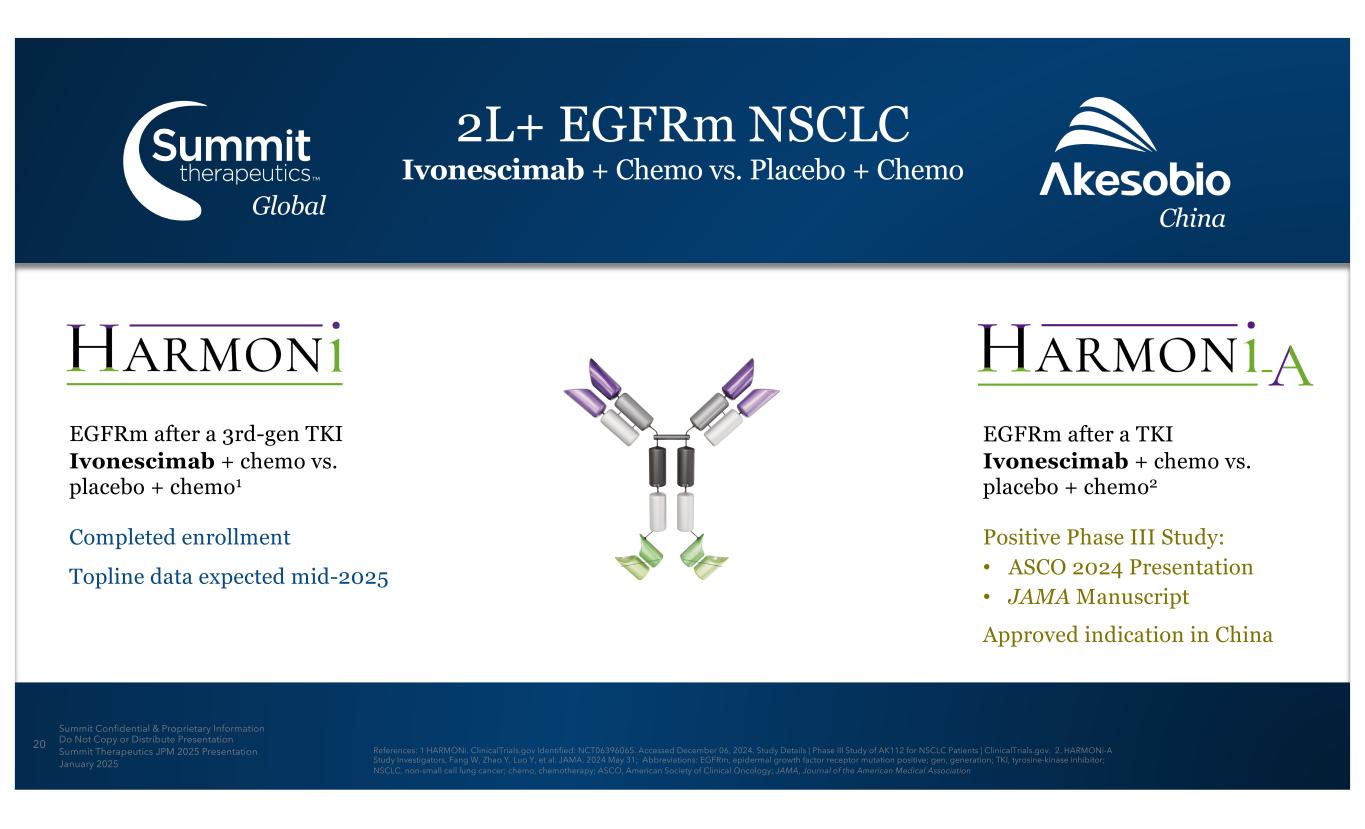
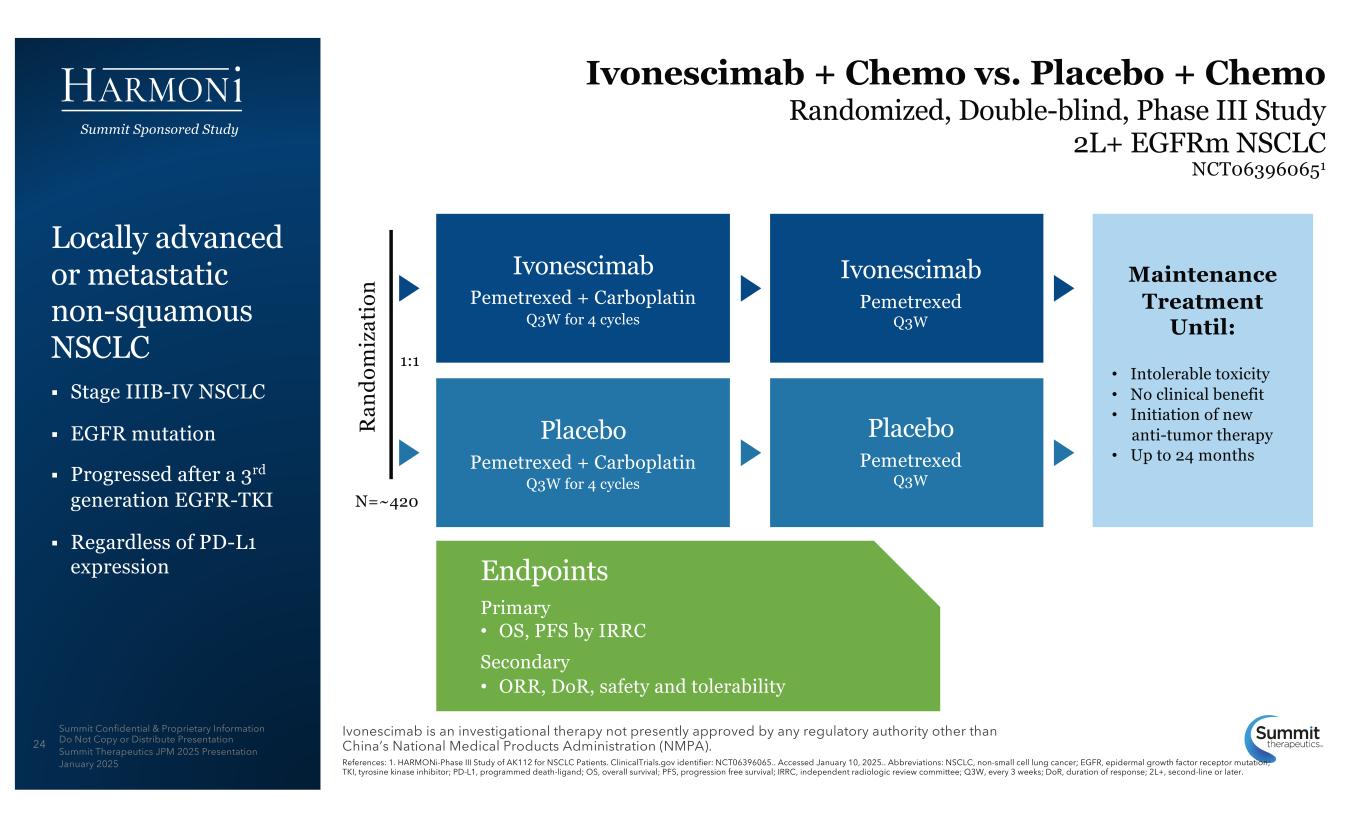
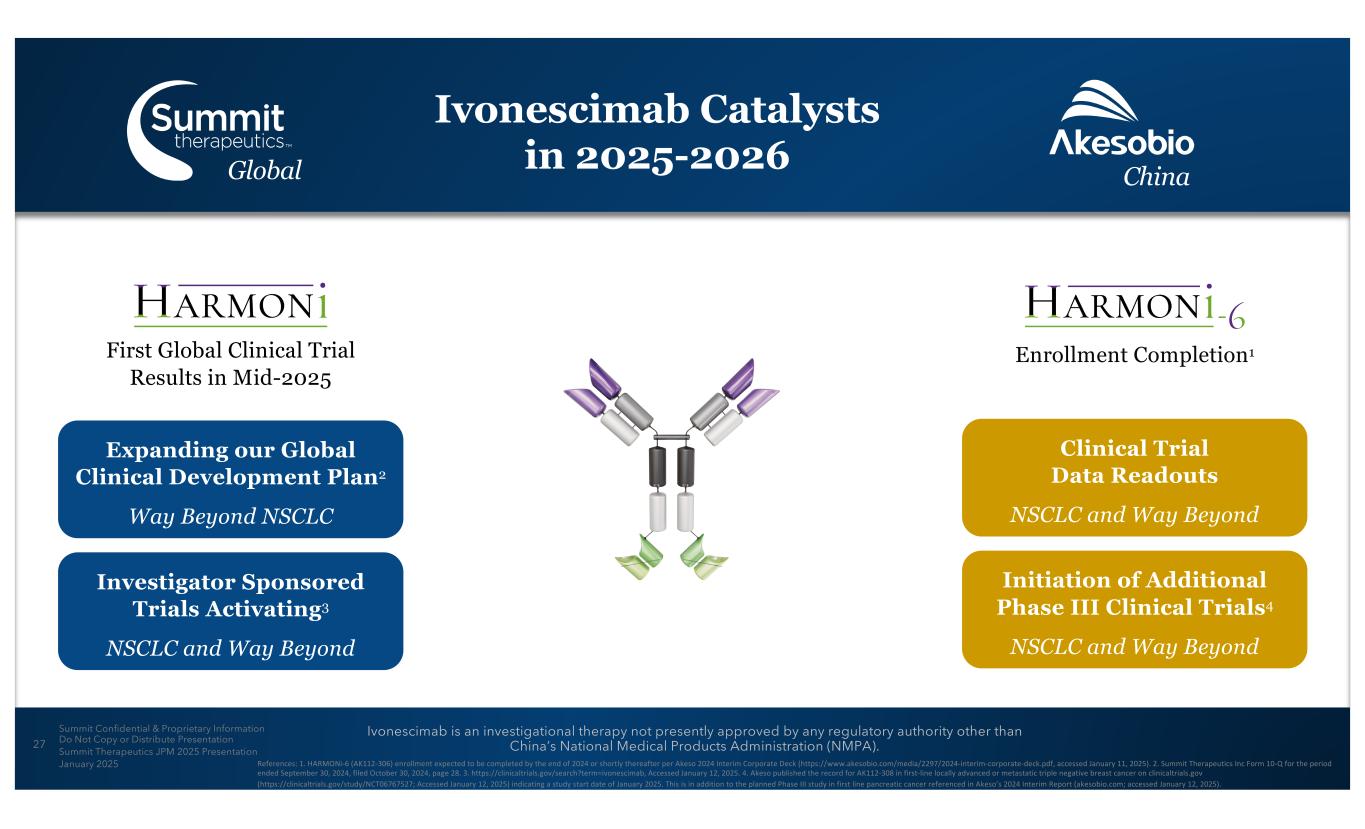
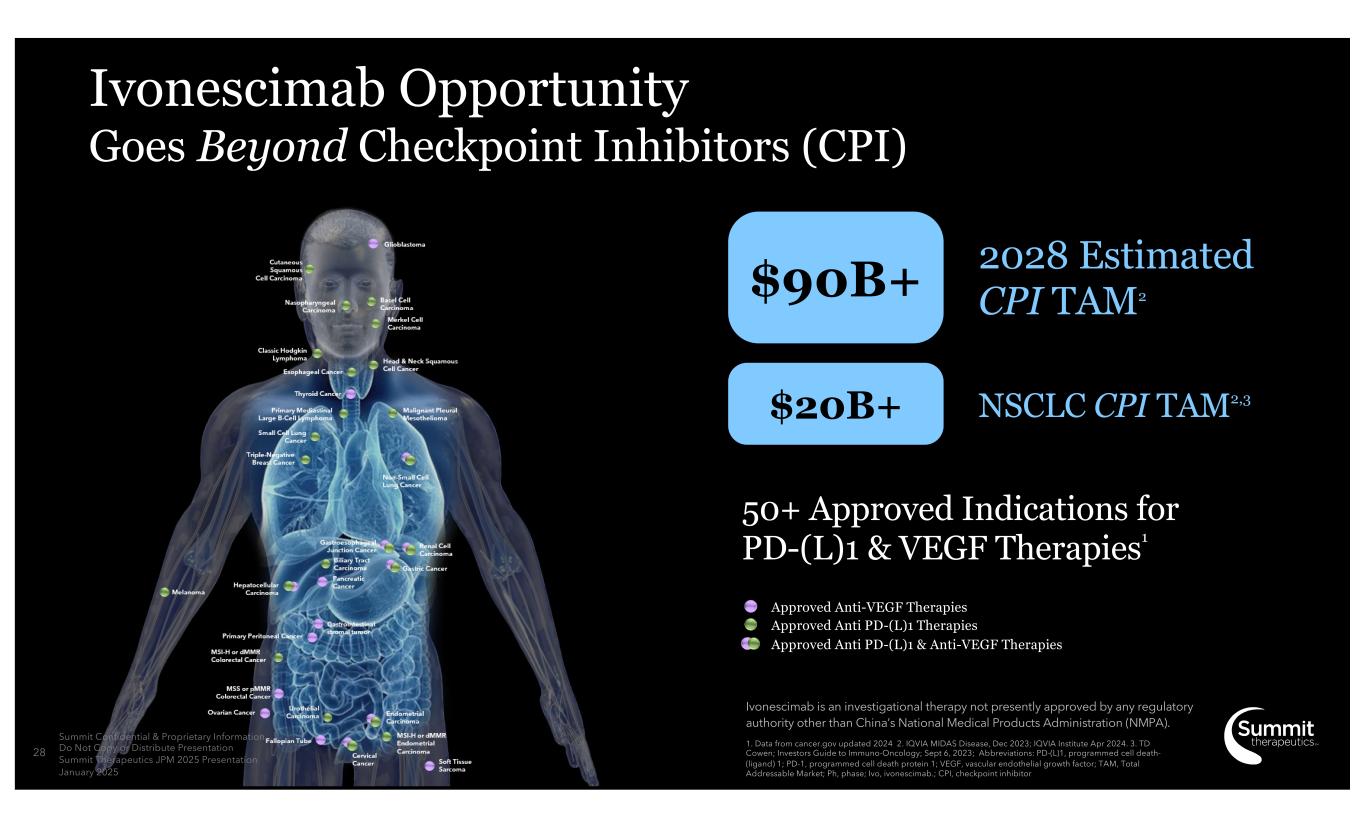
Thank you, Bob, and good morning, everyone. As Bob said, I remain incredibly enthusiastic about the future of Summit and the possibilities of what can be accomplished with our lead candidate, Ivanissimab. Before providing some additional detail and reviewing the current pipeline, I would like to touch on the clinical work that has been conducted with Ivanissimab and some of the interest and recognition received last year. last year. Since first entering the clinic with our partner, Ekeso, back in 2019, more than 2,300 patients have been treated in clinical trials with Ivonesimab. In 2024 alone, Ivonesimab was featured in 14 publications across seven tumor types and selected for five oral presentations at major medical conferences. Currently, between our partners at ECESO and our team at Summit, four phase three trials have been completed enrollment, two of which are waiting top-line data readout, including the summit-sponsored Harmony trial. Five phase three trials are currently ongoing. Two of these are summit-sponsored trials in first-line non-small cell lung cancer, and three are ECESO-sponsored trials studying ibanissimab in head and neck, biliary tract, triple negative breast cancers. ECESO has also announced its intention to start a clinical study in pancreatic cancer later this year. A significant amount of additional data is being generated in additional indications, including colorectal cancer, ovarian cancer, gastric cancer, and hepatocellular carcinoma, in addition to more data to support the lung cancer program. Turning specifically to the summit-sponsored pipeline, as Bob mentioned last quarter, Harmony completed enrollment in the fourth quarter with top-line data expected in mid-2025. This data is expected to contain data for both primary endpoint, progression-free survival, and overall survival. Harmony 3 was amended by significantly expanding the addressable patient population to include all frontline metastasy non-small cell lung cancer patients without driver mutations by including patients with non-squamous tumors in addition to squamous tumors. Squamous tumors represent approximately 25 percent to 30 percent of non-small cell lung cancer in the United States with non-squamous tumors representing a large proportion of the rest. As a reminder, this trial includes patients with tumors that are PD-L1-negative, PD-L1-low-expressing and PD-L1-high-expressing. We announced our intention to initiate Harmony 7 in early 2025, for which we have begun to activate clinical trial sites in the United States. Later this year, we expect to announce additional details around expanding our clinical development plan around ibanesimab, specifically beyond lung cancer. After receiving interest for more than 75 investigator-sponsored trials in the most recent open window, we have approved over 30 ISDs today, which will either enhance our sponsored clinical development activities or can show signals in settings where ECESO not yet had the opportunity to explore. In 2024, we started our collaboration with MD Anderson, which now has studied that are activated and open for enrollment in Houston. We have committed 15 million to this collaboration to quickly discover additional opportunities for ibanicimab, including several tumor settings outside of its current development plan, as well as the possibility of identifying biomarkers through additional research activities. Finally, as we announced this morning, our clinical trial collaboration with Pfizer will look at ibanesimab in combination with several Pfizer-Velotin-based ADCs in multiple tumor types. As we seek to accelerate the development of ibanesimab across non-small cell lung cancer and other solid tumor settings, this collaboration will allow us to quickly advance beyond our promising late-stage development plan to evaluate ibanesimab in combination with some of the most innovative ADCs from Pfizer. Clinical trials as part of this collaboration are expected to start mid-2025. Pfizer will be responsible for the operations and costs associated with these trials. We will provide avonissimab and jointly oversee the study. As a reminder for those new to the summit's story, avonissimab has significant lead in the clinical development of this novel class of compound. Avanissimab brings two highly validated targets together into one novel biospecific antibody that targets both PD-1 and VJAS. Next, I would like to review upcoming catalysts for this year and beyond. As we touched on a moment ago, we are expecting HARMONY top-line data in mid-2025, which we expect will include both primary endpoints of progression-free survival and overall survival. This will be the first global phase three clinical trial readout for ibanesimab, which provides a potential path to applying for marketing authorization in our territories, including potentially the United States. Secondly, we intend to expand our sponsored clinical development plan to go beyond non-sponsored lung cancer in 2025 and 2026, in addition to continuing engagement with the rapidly increasing number of investigators seeking to conduct investigator-sponsored trials at various institutions across a large number of different tumor types. And you will see continual activating of additional ISDs in a variety of solid tumor settings. This is in addition to ECSO continuing its execution of its phase 3 studies, including completing the enrollment of Harmony 6 in in frontline squamous non-small set lung cancer with ibanesimab combined with chemo, as well as continuing the enrollment of its phase III biliary tract cancer, triple negative breast cancer, and head and neck cancer studies. Over the course of this year, we will continue to see clinical trial data readouts from a case in a variety of tumor types. And finally, we expect to see more phase III initiations from a case in non-small set lung cancer and beyond, likely in indications in which Phase II data has been generated, which we touched on earlier. We are excited for the catalyst-rich path ahead of us, our conviction and belief in the potential for ibanesimab to improve patient lives for the better, remain strong, and consistent. Now, I would like to take a moment to review study design for our two ongoing Global Phase III trials, HARMONY-T and HARMONY-7. Here we have the study design for HARMONY-3. HARMONY-3 is a randomized, double-blind, global phase three clinical trial. Evaluating ibanesimab in combination with chemotherapy against PEMBRO in combination with chemotherapy as first-line treatment for patients with metastatic non-small cell lung cancer. This trial includes patients with squamous or non-squamous histologies with no activating genomic alterations regardless of PD-L1 expression, including high, low, and negative PD-L1-expressing tumors. Dual primary endpoint for HARMONY-III include progression-free survival and overall survival, and results will be stratified by squamous and non-squamous histology. Next, we have the study designed for HARMONY-7. HARMONY-7 is randomized double-blind global phase three clinical trial evaluating ibanesimab monotherapy against Pembrol monotherapy as first-line treatment for the metastatic non-small cell lung cancer patients with tumors with high PD-L1 expression. Your primary endpoints for HARMONY 7 include progression-free survival, overall survival, and results will be stratified by squamous and non-squamous histologies. As a reminder, our HARMONY 7 study shares similarity with AKSO-sponsored Harmony II Phase III trials, which reported data last year, but specifically targeted the PDR1 high-expressing tumors consistent with the standard of care for monotherapy, immunotherapy in the U.S. and Europe. Turning to the market opportunity for ibanesimab, the value proposition here is clear. Ibanesimab has the potential to be a platform, blockbuster drug, and is well-positioned to make a significant impact across the treatment landscape of non-small cell lung cancer and beyond. Specifically, in non-small cell lung cancer, there are a combined six announced or ongoing phase three studies conducted by either ECESO or SUMMIT. Non-small cell lung cancer alone has an addressable market that could ultimately approach 20 billion for checkpoint inhibitors according to the third-party research from the likes of TD, Kahn, and others. But this is just the start. There are more than 50 indications where PT1, PTL1, or VGIS therapies have been approved. Ivanizimab will continue to be rapidly tested and developed beyond non-sponsored lung cancer. Across all checkpoint inhibitors indications, the addressable market approached $90 billion globally in the next couple of years, according to Icudio research. However, this deal excludes the full impact that Ivanizimab could have, where it has shown promising data in multiple tumor types where checkpoint inhibitor have not been effective, including microsatellite stable colorectal cancer, PD-L1 low negative triple negative breast cancer, and EGFR mutant non-small cell lung cancer after targeted therapy. We are excited to continue to progress our development in non-small cell lung cancer in 2025. Additionally, data shared in 2024 showed that ibanissimab has a market potential much larger than non-small cell lung cancer and our current ongoing global phase three clinical studies that we are sponsoring at summit. There are multiple phase two trials that have been conducted providing encouraging data to continue to explore Ibanezima and its opportunity to become a standard of care across several solid tumor settings which we intend to continue to explore with the goal to improve the lives of as many patients as possible facing high unmet medical needs. I would also like to take the opportunity to thank, most importantly, the patients in our clinical studies, as well as our investigators, hospitals, including our collaborators at MD Anderson, and our partner in China, Dr. Michelle Shaw, and the entire AKSO team, as we continue to pave the way for rapid development of avanesimab globally and of course the summit team as Bob and I look back on all of the many achievements over just the past two years team summit has done a tremendous job across every department in making our goals a reality and appropriately condensing time when and where possible we continue to look at opportunities to accelerate our timeline in bringing additional therapeutic options to patients with high unmet cancer needs. It is an honor and privilege to work with each member of team summit and I would like to express my heartfelt thanks to everyone of our team members. With that update I will now ask Manmi to provide details on our financial position and operations update. Thank you Miki and good morning everyone. This morning we issued
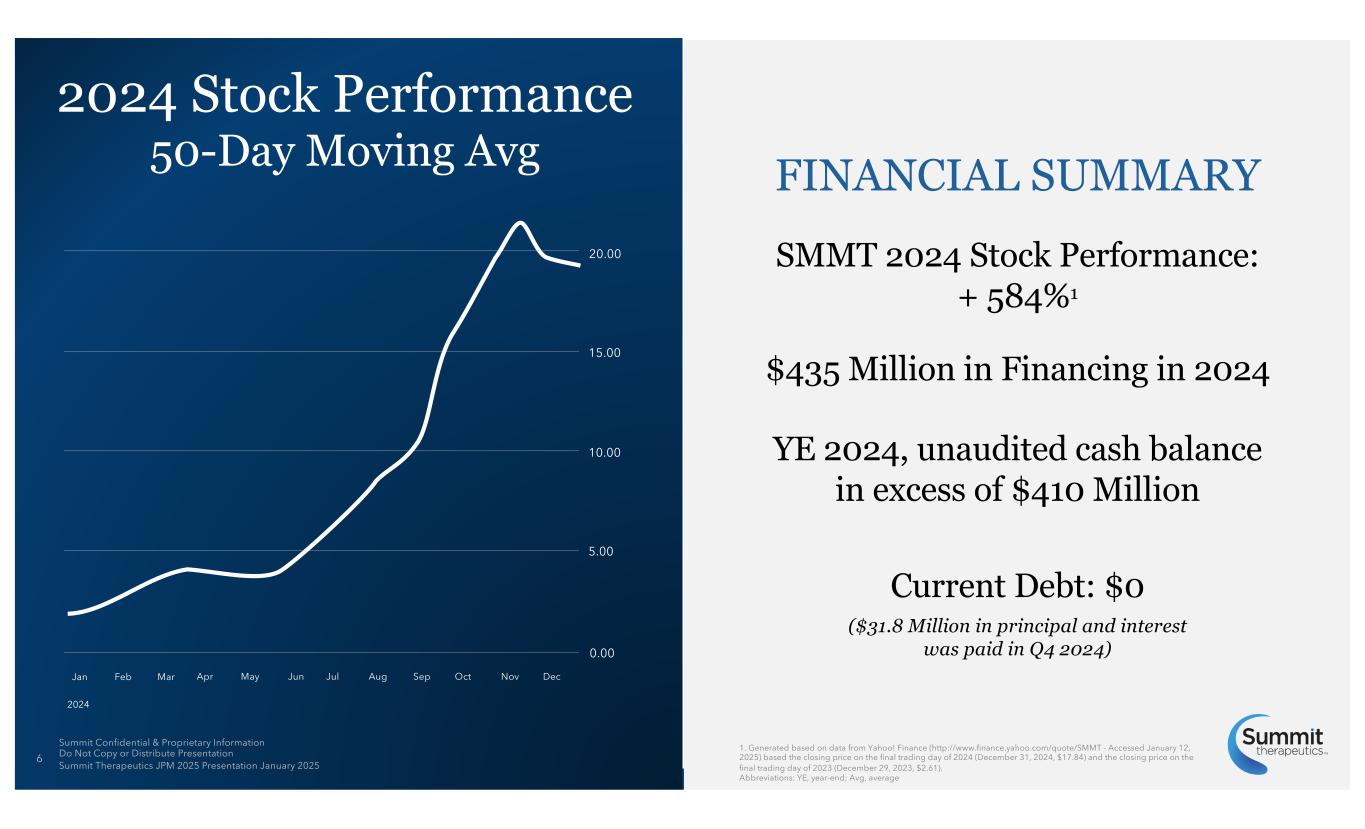
our earnings release for the fourth quarter and year ended 2024. Today in addition to providing you with an update on our cash position and operating expenses, I will also be providing an update on our progress on clinical trial enrollment on Harmony 3, Harmony 7, and update on tech transfer for manufacturing in our licensed territories. On the financial front, let me start with our cash position. We ended the year 2024 with a strong cash position of approximately $412 million. Let me remind you that we have paid off our debt in entirety and now we are debt-free. With a strong cash position and zero debt, we are well positioned to continue to execute on our clinical trials. Turning to operating expenses, I will be providing details to both GAAP and non-GAAP numbers. You can refer to our press release issued this morning for a reconciliation of GAAP to non-GAAP financial measures. Just to remind you, non-GAAP expenses exclude stock-based compensation expense. Our GAAP R&D expenses during the full year 2024 were $150.8 million compared to $59.4 million for the previous year. And non-GAAP R&D expenses were $134.8 million during the full year 2024 compared to $55 million for the previous year. The increase in the R&D expenses reflect the expansion of our clinical trials related to Avanosumab. Our acquired in-process R&D expenses during the year 2024 were $15 million compared to $520.9 million for the previous year. To remind, acquired in-process R&D expenses for the year 2023, which were $520.9 million, were related to the upfront payments made to CASO for the licensing agreement. And $50 million expense in the year 2024 is related to the amendment of the licensing agreement with the CASO to include Latin America, Middle East, and Africa regions into our licensed territory. Our GAAP GNA expenses during the full year 2024 were $60.5 million compared to $30.3 million for the previous year. And non-GAAP GNA expenses were $25.5 million during the full year 2024 compared to $20.6 million for the prior year. Our GAAP G&A expenses primarily increased due to an increase in the stock-based compensation charges related to achievement of certain market conditions on performance milestones which vested during 2024. Overall, our non-GAAP operating expenses during the full year 2024 were $175.3 million compared to $596.5 million for the previous year. The decrease in non-GAAP operating expenses was primarily related to the decrease in acquired in-process R&D expenses, as mentioned earlier, which were offset by the increase in R&D expenses due to the expansion of clinical studies and development costs related to Avanosumab. To remind that last quarter we announced that we planned to expand Harmony3 study to include non-squamous patients in addition to the squamous patients. I'm very pleased that our summit team was able to activate non-squamous arm in a record time, and we recently started enrolling patients for non-squamous in the United States. We expect to start activating sites to enroll non-squamous patients in other regions during the second quarter of 2025. We continue to enroll squamous patients in all the territories. Additionally, during last quarter, we had given guidance that we will initiate our newly announced global trial, Harmony 7, in frontline non-small cell lung cancer for PD-1 high patients in early 2025. Ahead of our schedule, Team Summit has already begun to activate sites in the United States. We expect to initiate activating sites in the other regions during the second quarter of 2025. Turning to tech transfer for manufacturing, we continue to make progress in transferring relevant know-how to third parties to establish additional supply sources in our licensed territory. and with that i will hand it back over to dave dave thank you bob mckee and my meat we now we will
now see if there are any questions that we can help our team that our team can help answer cape
Operator
if you could please open up the line for questions at this time i would like to remind everyone in order to ask a question press star then the number one on your telephone keypad we will pause for just a moment to compile the q a roster your first question comes from the line of eagle Lechimovitz with Citigroup. Please go ahead. Hi, great. Thank you so much for taking the
questions. Obviously, we're getting a lot of inbounds on Harmony 2, and Akezo has provided some comments on the timing of the OS. If you could help us understand what you believe to be the timing for the Harmony 2 OS, and given the fact that it may be approved in China as early as the third quarter of this year for the second indication for frontline what is the potential or is there any expectation that we could see a glimpse of some early os data in that in that
china label thank you thanks and this is dave um so appreciate the question um and i know there's uh you know a bit of as our partners at aceso have mentioned uh they expect uh to reach the number of events required for 2025. We ultimately don't have more information on that front other than continuing partnership with Aqueso. But at this point, there's been nothing new on that front with respect to any additional information. But appreciate the question. Okay. No worries. And
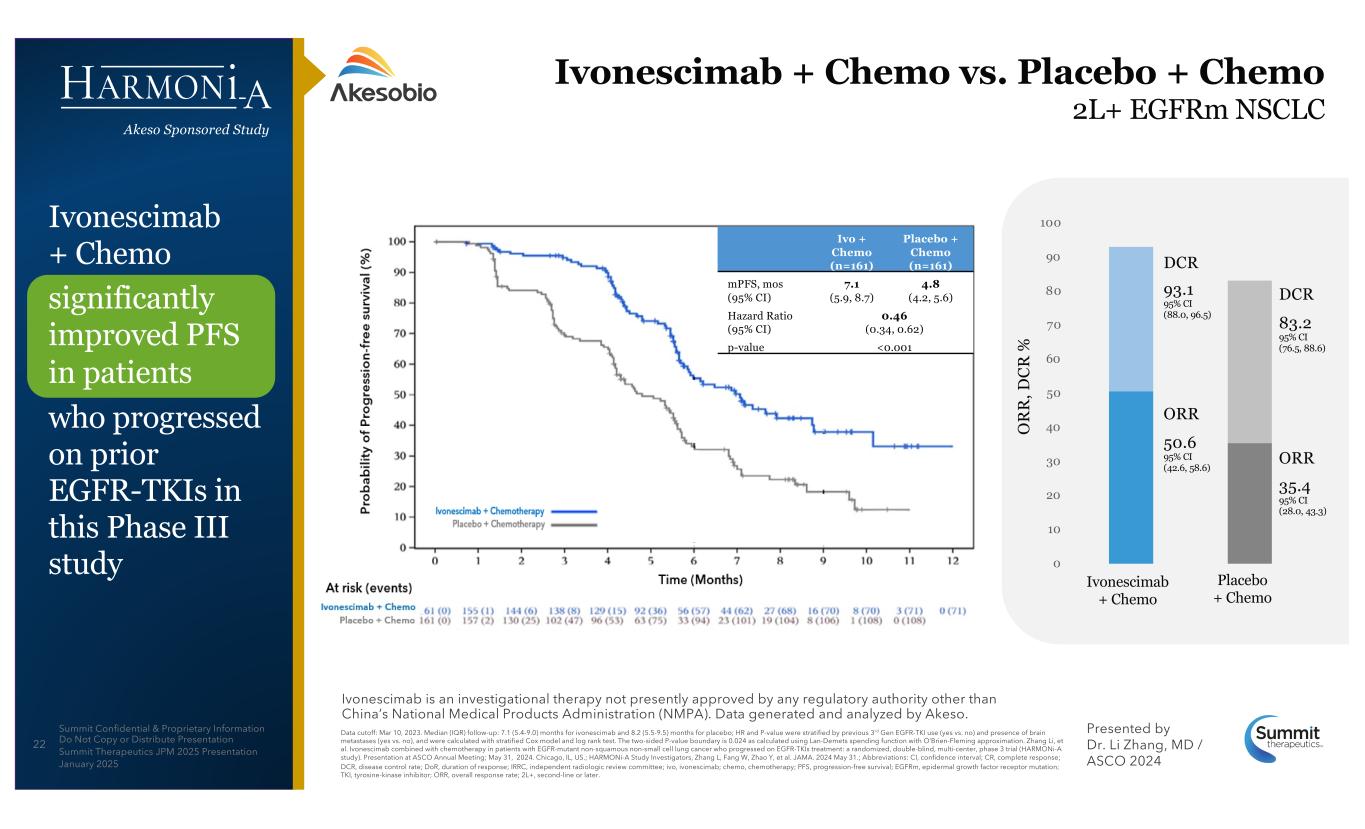
then on the second line EGFR, the Harmony trial, I think Maki mentioned you will have the OS data. in the top-line readout, what is your understanding as to whether you need that to be only a trend or actually hit onsets, that SIG, in order to be in a good position for approval in the U.S.?
Yeah, Yigal, this is Alan Yang. Thanks for the question. So I think there's two things. I think we would, of course, would want to hit OS and be statistically significant. However, if you look at the precedence of previous approvals in this space, they have not required OS for when PFS has been adequate.
And then I know, and Manit just mentioned that you're starting to add the patients for non-squam in the second quarter for Harmony 3. Is there any possibility you could provide even a rough guideline as to the timing for the top-line readout for Harmony 3? And if you can't do that, anything you can say around Harmony 6, given that's possibly helpful in terms of a read-through to Harmony 3?
Hey, this is Manmeet. You heard it correct, right? We have just initiated our sites in U.S. and we have started enrolling for U.S. the non-squamous arm. It's too early to give clarity on the completion of the enrollment until we complete all the sites in other territories, which is obviously in Europe and other regions, which we plan to initiate. We would be able to provide once all those sites are activated and we have a quarter or two of the run rate, think we will have clarity in our timelines over there. Related to Harmony 6, you're also correct, right, that trial has been completed in enrollment, which was fully in China in this famous arm, and what I believe, as for the guidance from ACESO, that should lead out sometime in the middle to end of this year. We don't have visibility into any more details further than that.
And then the last quick one, I would be remiss if I didn't ask you about the news this morning on the Pfizer collab. Anything you could say there in terms of additional details, which of the Vidotin ADCs, what tumor types, how big would these early studies be, and things of that nature?
Thank you so much. Yeah, thanks, Egal. This is Dave. I really appreciate the interest there. I think, you know, so what we've said this morning, you know, multiple ADCs from Pfizer. We plan to go into multiple solid tumor settings, just not small cell lung cancer, obviously. We We haven't given specifics in terms of which ones just yet, but they are, you know, likely to be Phase 1, B2, you know, level trials at this point. We need – these are the first combinations that we'll do with Ivanesimab and these specific ADCs. So, you know, normal course operations there, but we'll give additional details as we get closer. But we are very excited to get moving here. And I think, as we've mentioned before, you know, this is one of the strategic advantages that we feel we have in terms of the opportunity to combine ibanesimab with you know a number of different um products from another a number of different um you know organizations and so you know this is uh one of the first steps in terms of moving forward uh from that perspective but we will be giving uh additional details as we continue to get closer to the beginnings of these trials which are expected in the middle of this year all right thank you very very much
Operator
Thanks. Your next question comes from the line of Brad Canino with CFIL. Please go ahead.
Good morning. Thanks for the questions. In the Pfizer-ADC collaboration, do you think about this more from the perspective of providing further therapeutic enhancement beyond the Keynote 189 benchmark, or more from the perspective of bringing ibanesimab outside of lung with a
better probability of success? Hi, Brad. Thanks for the question. Both, but probably the latter or more. So, you know, clearly, you know, ADCs are going to be important across solid tumor oncology. I think the data in lung cancer is interesting, but the data outside of lung cancer has been stronger. And I think the fact that there's multiple ADCs involved in this is important.
Maybe just a quick follow-up on that. In lungs specifically, as I look at the Pfizer pipeline of ADCs, can I check your confidence level in integrin beta 6 for an ADC target over trope 2? where obviously competitors have frontline Phase 3s reading out this year.
Yeah, so I appreciate the question, Brad, and I think we'll be in a better position to give a little bit more details as we get closer to launching the Phase 1B2 clinical trials. But at this point, we're not really getting into the specifics just yet in terms of the design as we want to allow for these trials to get up in the activation portion. Brad, for what it's worth, it's an important question.
love to answer it, but we can't do it yet. All right, maybe last for me. With the Harmony EGFR data coming mid-year, how do you plan to show the data to investors to demonstrate that there's comparable efficacy and safety and its effect in Western patients relative to
KESA's China patients? Thank you. Thanks, Brad. Yeah, I mean, I think that is going to be a key component. I think, you know, we, and especially Alan, have been talking about the past year or So, you know, one of the key components will be showing, you know, the comparability of the data, to your point, both efficacy and safety in the Eastern. While we haven't explicitly described, you know, the ways in which we will show this, we'll obviously have presentations at major medical conferences, and the granularity will be there so that that data can be interpreted.
Operator
Your next question comes from the line of Cal Issue with Jeffries. Please go ahead.
Congrats on the progress. thank you for taking my questions maybe a couple of questions uh how many trial global trial design um so regarding the polling assumptions on both pfs and os should we assume it is designed based on the total 420 patients but not a subgroup of ex-china patients yeah this is alan yang
yes it is a primary analysis of the total study population of course as brad alluded to that there will be looks at the regional differences we've had discussions on this from a regulatory standpoint about how the data should be analyzed and presented but then of course during the analysis and then during the review process they could always ask for additional studies as well
okay thank you okay thanks and you guided a media year for data disclosure just want to like confirm this is referring to like uh june july or actually could be like the entire q2 q3 time frame
yeah yeah appreciate the question kelly i think we're probably a little bit broader on that more in the q2 q3 timeline but you know obviously as we get closer to that uh we'll be letting people
know okay terrific and the one more um five years collaboration so regarding uh ev in bladder cancer I'm just curious, is there like a possibility to add some combo arm to the ongoing or the initiating phase three trials running by Pfizer, or should we expect more like early phase trials?
Yeah. I don't think we've disclosed anything. We're exploring every opportunity to move as quickly as possible. We haven't said anything about EV specifically, but we believe that EV is important in bladder cancer, and yeah, more to come.
Yeah, we're excited to give you a little bit more details in the upcoming couple of months.
Operator
Okay, great. Thank you for the callers.
Operator
Your next question comes from the line of Mohit Benzel with Wells Fargo. Please go ahead.
Hi, this is Sadia Rahman. I'm from Mohit. Thanks for taking the questions, and congrats on all the progress over the year. So I wanted to ask on the Pfizer collaboration, curious how you're thinking about the overlapping toxicities with VEGF inhibition and Vidotin-based ADCs, and how this could differ from combinations of ADCs using topoisomerase payloads?
Yeah, I appreciate the question there. If I take a step back, one of the things that we've expressed more broadly is that we want to be able to take Ivanesimab and combine it with the best available treatments on a tumor-by-tumor level, right? And so, part of what we will be doing is doing safety run-ins, you know, with any combination in which we come, and that'll be the same here. So, I don't think we're in a position to commentate specifically on, you know, each of the different types of ADCs, whether it be MMAE-based. You know, we've seen data historically, you know, whether it be in combination with immunotherapy like pembrolizumab in some of these ADCs, whether it be, again, MMAE-based. But at this point, we're excited about, you know, the profile that's been shown to date for ibanesimab. You know, we're very aware of, you know, many of the progressing ADCs, and I think that's where we're going to take the opportunity to do, you know, rational step-by-step combinations, and then we'll take that to the next step. Yeah, and I would just add that there's emerging data
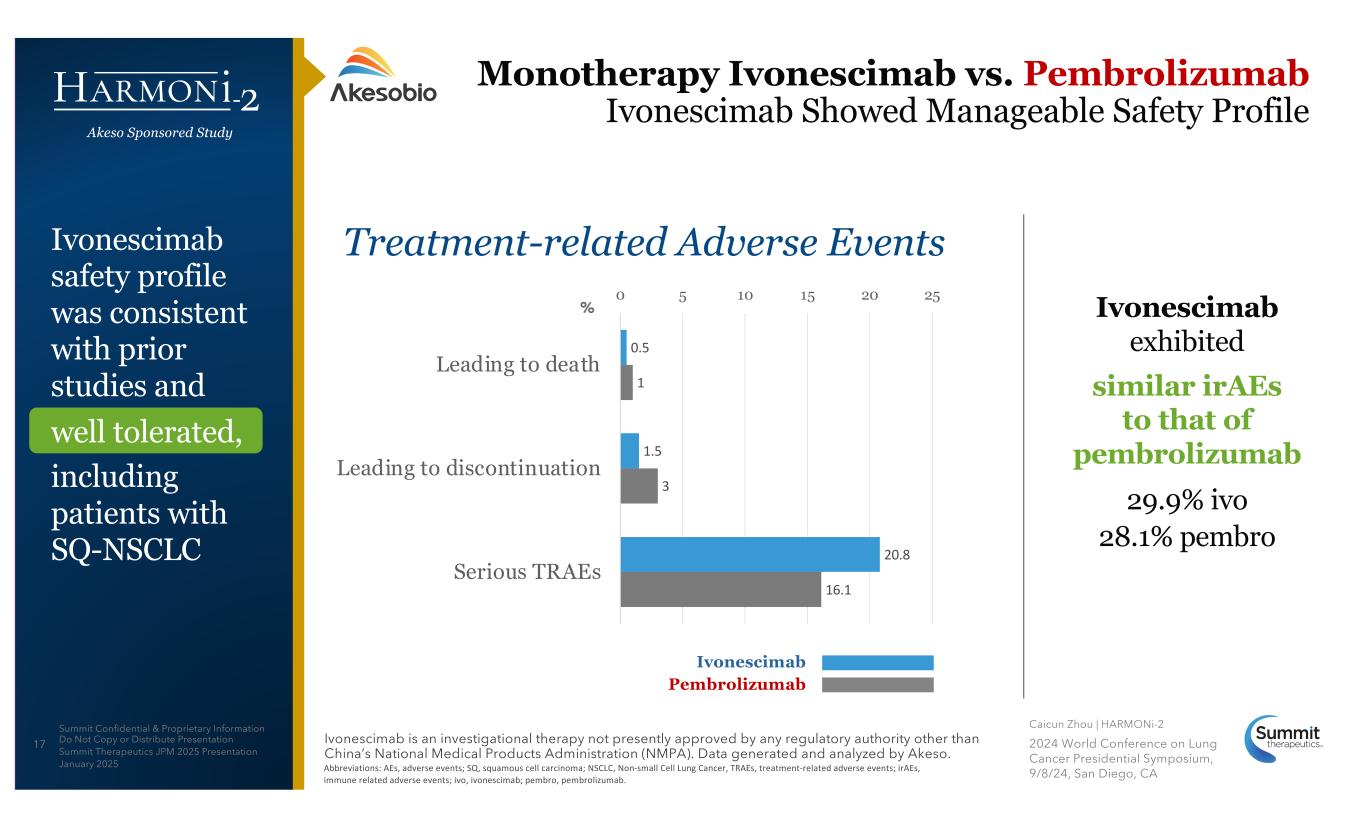
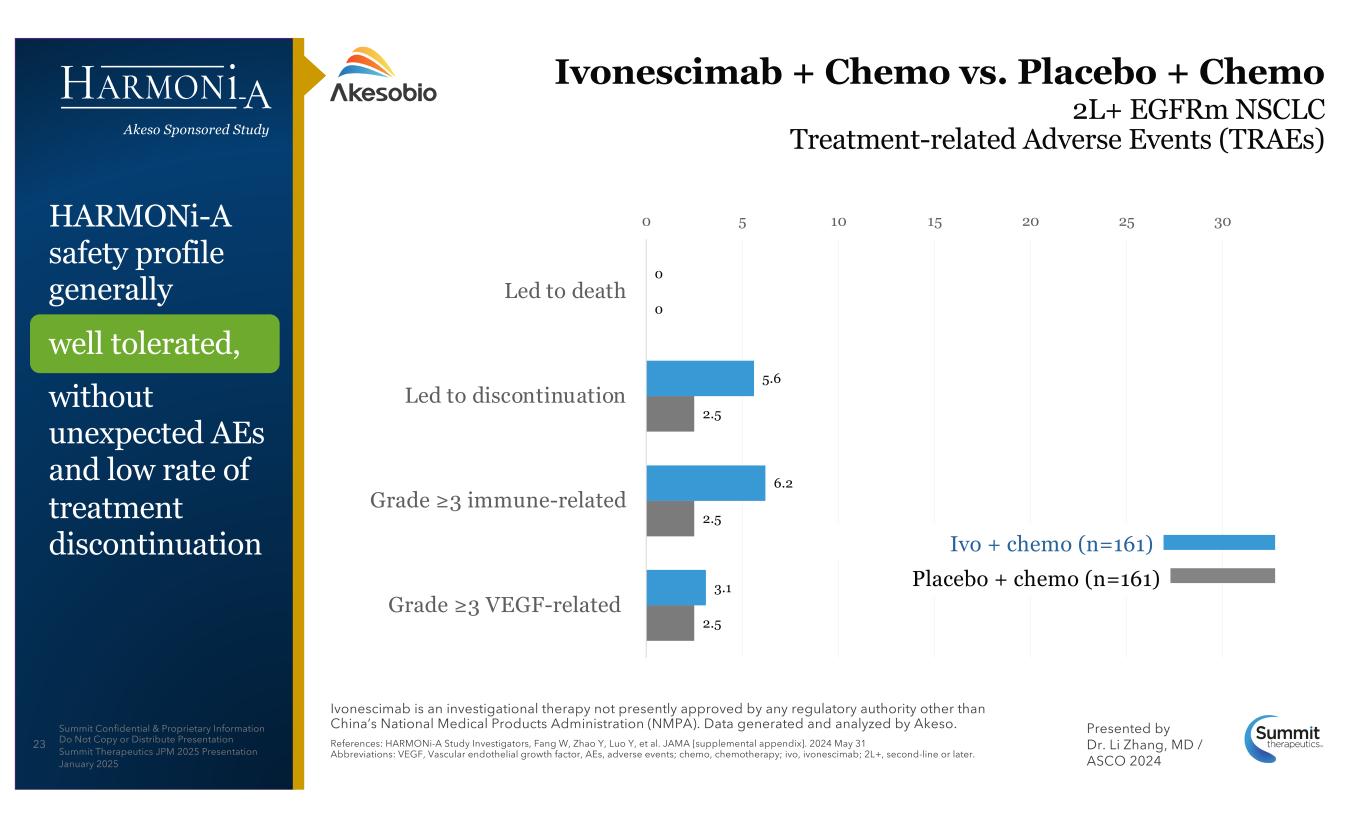
in combination with pembrolizumab that, you know, that these types of ADC combinations are feasible. And, you know, we have good safety data comparing ivanizumab to pembrolizumab, so we don't expect any additions or surprises in the combinations.
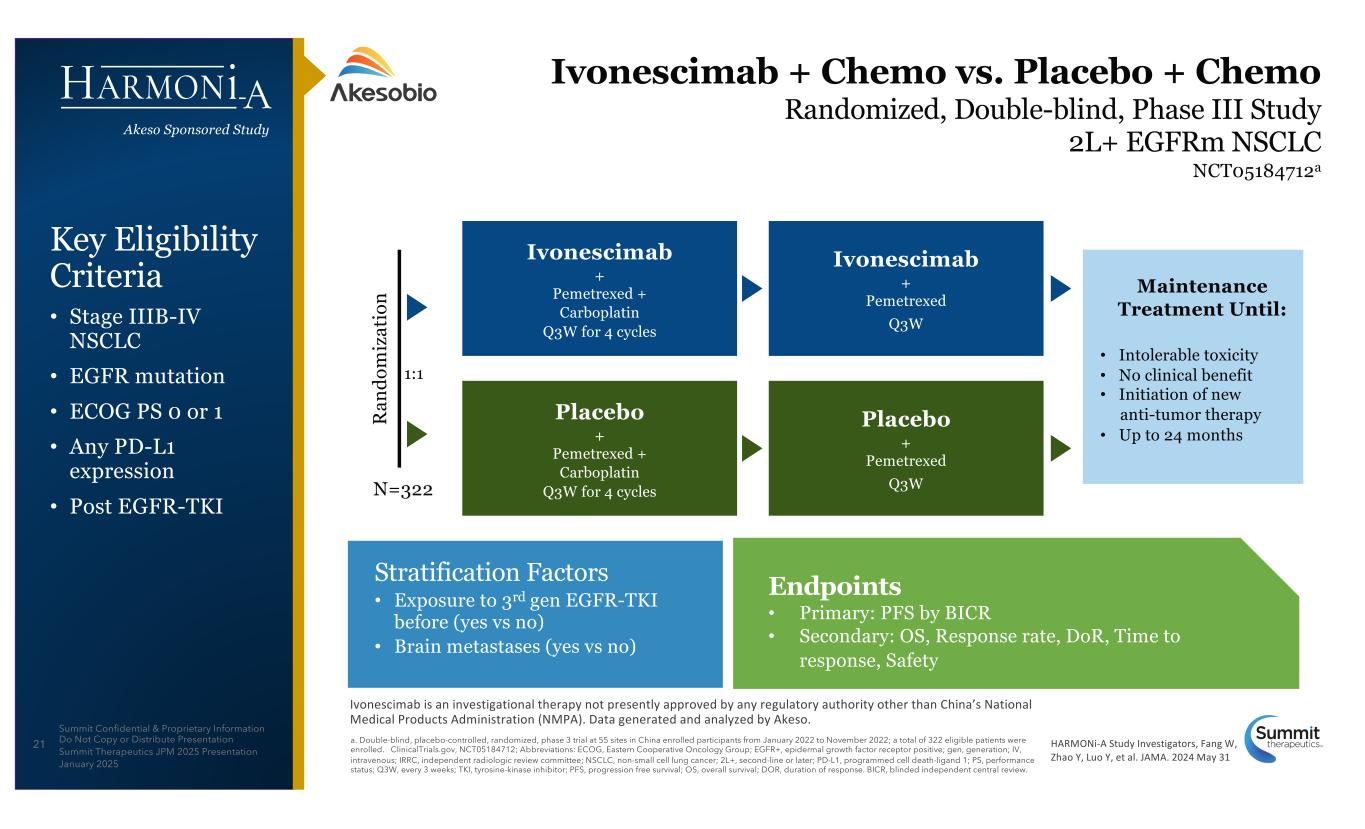
Got it. Thank you. And then on the upcoming readout this year in EGFR mutant lung cancer, I think you said the majority of those patients are coming from the China Harmony study and the majority of those patients received a first or second gen TKI before getting a third gen TKI. Would all of the patients recruited into the Harmony study receive only a third gen TKI in that first-line setting? And can you talk about any differences in those populations that we could expect in terms of time from diagnosis or survival after that third gen TKI and whether that could result in any differences in efficacy when looking at the next line of treatment.
Yeah, Bhatia, just to be clear, the majority of patients in Harmony A did receive a third-generation TKI as part of the standard of care, and those patients will be included. Whether they received a first or second generation before receiving a third generation, they would still be eligible. And in terms of differences in responses in those that got first or second versus third generation and where they got them. That's outlined in the Lancet publication by Zhang at all, and we don't expect any differences.
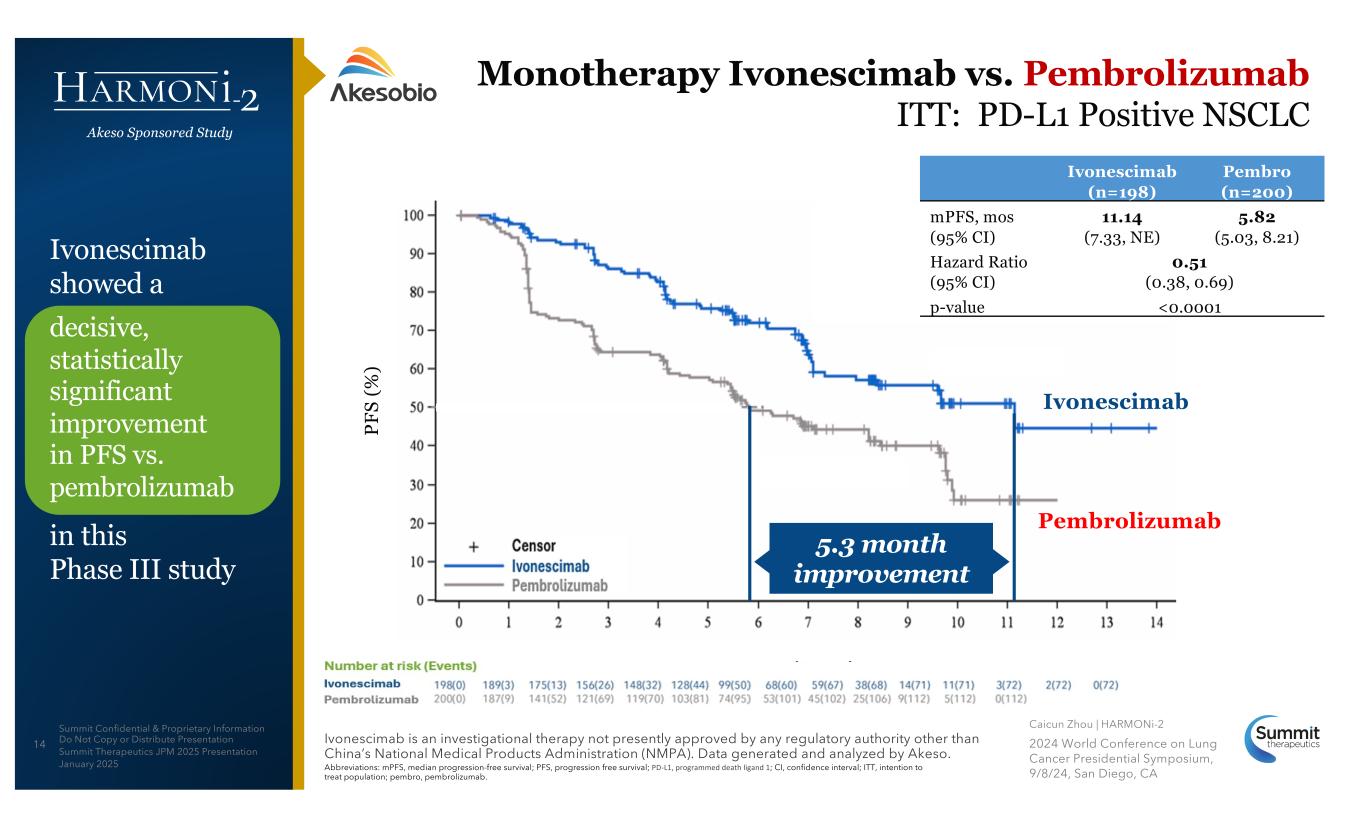
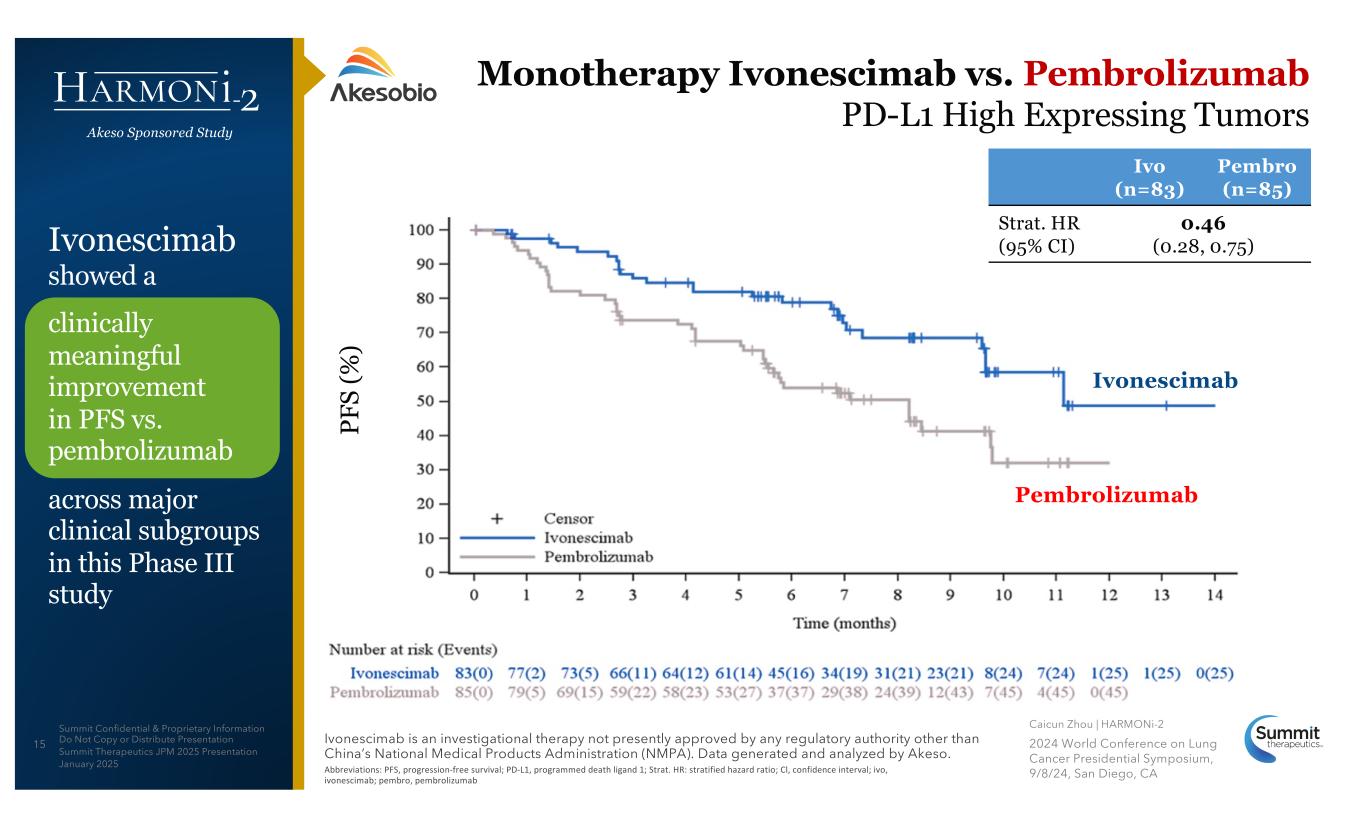
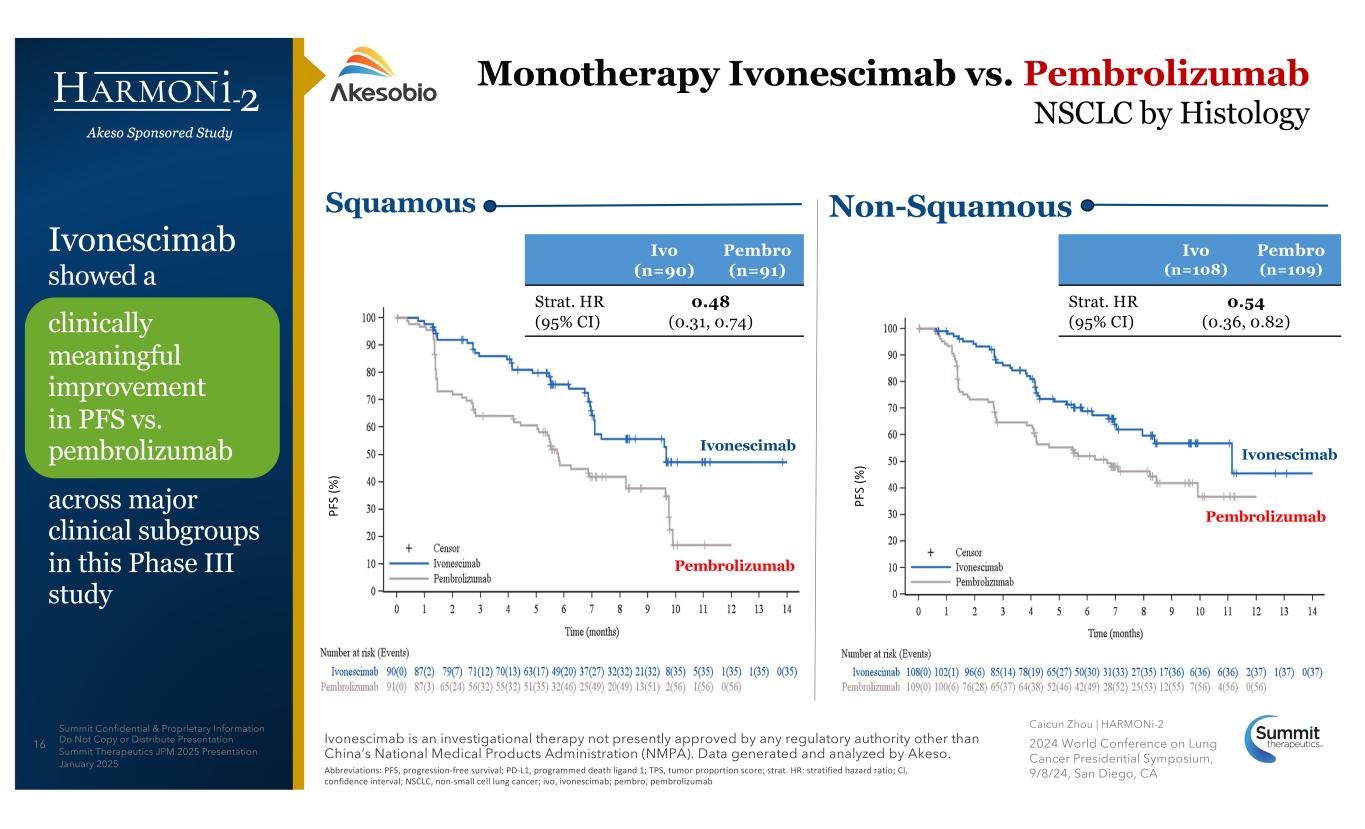
Okay, thank you. And then maybe one more on the HARMONY-2 trial and your global trial. The time to separation on the PFS curve in HARMONY-2 happened very early on. Can you talk about what you would expect for the global study, since it adds on chemo combination, just trying to understand how much the curves could shift and how that could affect timing of when you hit on PFS relative to Harmony 2 hit on PFS.
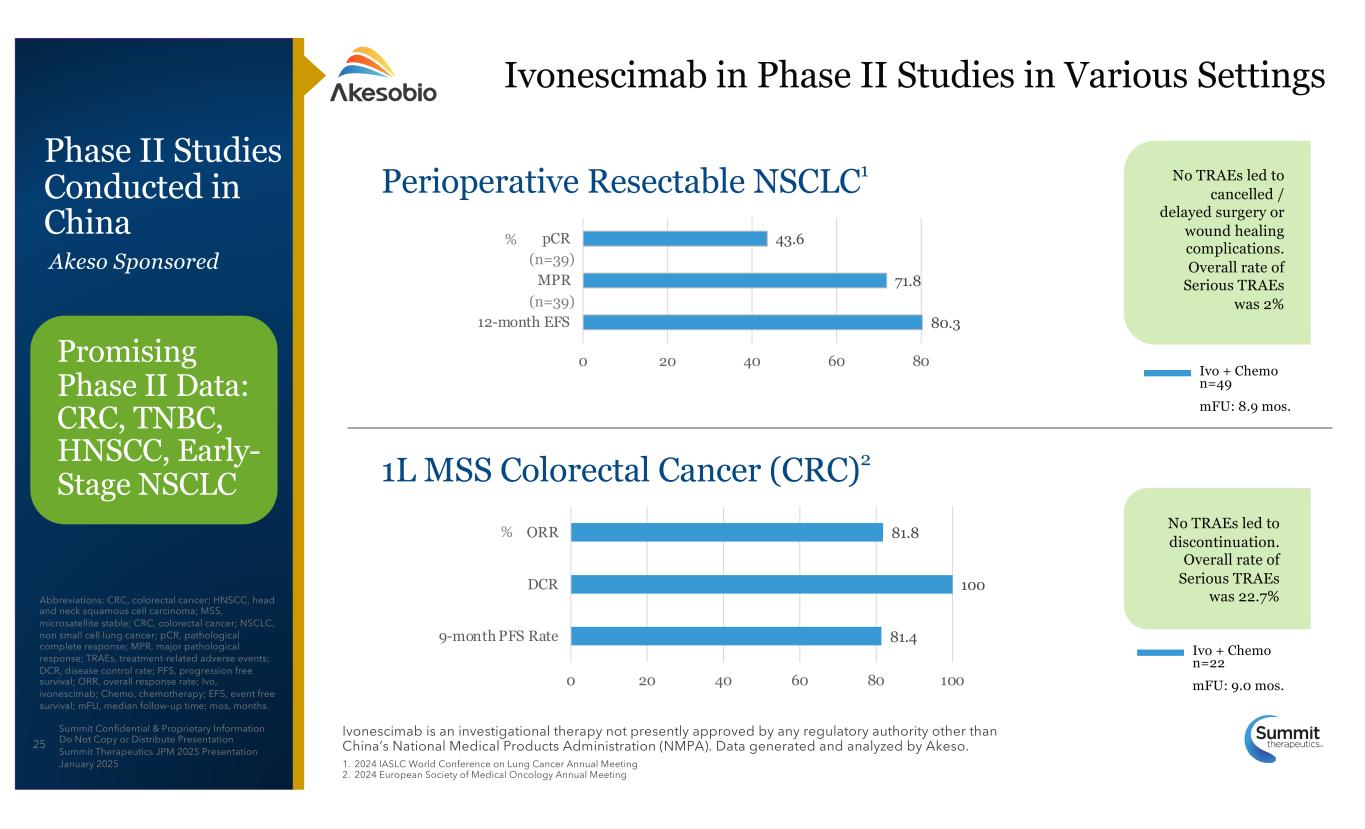
Yeah, I think, you know, we've put out a decent amount of data with respect to AK-112-201, which was the phase two which looked at ivanesimab plus chemotherapy in multiple settings including both squamous and non-squamous in the frontline setting that's probably the earliest or best rather in terms of an early thought process with respect to you know what we would see from data with ivanesimab plus chemo and comparing that against the history such as keynote 189 keynote 407 etc so i think that's probably those are probably the landmarks that i would look at from an early read in terms of what's publicly available and then obviously as we get you know continuing data including harmony six uh from those will be additional inputs that will will provide more
Operator
color great thank you so much your next question comes from the line of mitchell kapur with hsc
wainwright please go ahead hey everyone thanks for taking the questions and congrats on this deal um just can we just talk about kind of you know when you were searching for the for a bb transactions like this, you just talk about, you know, what you were looking for before you came to this arrangement with Pfizer. And now that this deal is on the table, do you foresee additional BD opportunities or does this kind of preclude those for a while? And could you just talk about if you expect future business development to be in the pursuit of combinations similarly like this? And if importantly, if there are any particular BD opportunities that you're not considering.
Yeah. Thanks for the question, Mitchell. I think, you know, if I, again, take a step back here, I think one of the things that we've talked about is the strategic advantage for Summit and Ibanesimab is that we don't have that pipeline internally that we're kind of, you know, almost committed to combining with and will, you know, almost, you know, force through combinations as much as possible to try to keep internal synergies. And so, in general, our approach will be to look out and say what are the best therapies, what are the standards of care across each of the different solid tumor settings, and to the extent that Ivanesimab plus one of those small molecules make sense, then that'll be an opportunity where Ivanesimab can combine there. So I would say as a whole, we don't believe that there's a single ADC platform that individually is the only way to move forward. But we do believe that multiple companies have multiple different types of ADCs, whether it be topoisomirase-based, whether it be MMAE-based, whether it's switching out the linkers or the antibodies in different settings. Obviously, there's a number of different antibodies. So what we can do is really explore different combinations of ibanesimab plus X, Y, or Z, you know, ADC, antibody, small molecule. So we're not really giving, you know, guidance in terms that we plan to do X additional. But in general, what we certainly, you know, feel well positioned for is that we will take ibanesimab and look to combine it with, you know, the best, you know, best possible alternative, if you will, out there from a standard of care perspective to bring the, you know, the most potential value to hyponasmab and ultimately help patients
in any way that we can there. Yeah, Mitch, and this is Alan Yang, I would just add that, you know, we just want to pursue the best science to help patients, right? And so, you know, I think there was a lot of interest in combining with PEMBRO in terms of combination therapies with different immunotherapies and different other agents. And based on the Harmony2 data, as we had suspected that now companies are interested in sort of pairing with Ivanesimab, and that's
where the puck is going. Okay, great. And just to clarify the last point, are there any particular BD opportunities that you're not open to at this juncture? No, I wouldn't say that there's
specific things we're not open to. I think it's more about what is possible with Ivanesimab.
Yeah, and I would just add if there was some clear safety issue or something like that, But we have not seen that signal yet, so we're pretty excited that we have a lot of opportunity.
Okay, great. Sorry, Manmeet. Sorry, Mitch, this is Manmeet. And I would just clarify, yes, to answer your question very specifically, this transaction with Pfizer doesn't preclude us to do any other, you know, regional or, you know, any partnerships or any other activities.
Very helpful. And the last one for me, just on the first-line trials, can you talk a little bit more about the Harmony 3 enrollment? And I know you briefly touched on that, but does Harmony 7 site activation compete for patients for the PD-L1 high enrollment for Harmony 3 at all?
Hey, Mitch, this is Manmeet again. Yes, obviously there is a segment of patients, right, PD-L1 high patients, which will be covered in our Harmony 3 also, right? So there is some sort of that. But as you know, we are much ahead in our schedule on Harmony 3 activations. and there will be not a full overlap of the sites, right, as compared to Harmony 7. So we have just taken Harmony 7 initiation in the last few weeks and Harmony 3 is already enrolling, right, patients. So there will be – obviously there is an overlap, but we don't expect there is a competition because of the new sites which we are planning to add in Harmony 7.
Great. Thank you all very much for taking the questions and congrats again on this collaboration.
Operator
Your next question comes from the line of Azteca, Goonwarden, with True Risk Securities. Please go ahead.
Hey, guys. Thanks for taking my questions, and congrats on all the progress as well. I want to dig into Harmony 3 a little bit, please. Will the primary statistical analysis for that study, are you doing the primary analysis on the combined non-squamous plus squamous population, or will you do it more in a stepwise manner, kind of looking at the squamous and non-squamous subgroups individually first, and then looking at the overall population. I ask this because I believe the Biontech study is structured more like the latter. I'm curious to know if you take a different approach, and if
so, why you prefer your method? Yes, Stika. Thanks for the question. This is Alan. Yeah, so our plan is to do a primary analysis of the combined population, and we believe that that was the best way to bring this product to patients as fast as possible from an operational perspective of course there is always data and ongoing data coming out the harmony six will be informative as well but our current plan is to do a combined analysis got it thanks Alan um have you discussed
with the FDA any way to accelerate a filing with harmony three i'm wondering if you're seeing a strong PFS signal. Is there, have you talked to the FDA about maybe doing a soda filing based on
that? Of course, we want to bring this to patients as fast as possible. We've had several discussions with them on this study, but I can't disclose our discussions at this time. Got it. Okay. And then
on the Pfizer collaboration, do you feel Ivansimab would be, could better leverage the immunogenic cell depth versus PD-1, or is the rationale behind this deal mainly about layering on a classical anti-antigenic pressure in addition to PD-1 with ADC?
Yeah, Stika, great question. We could talk a lot about that, but with that said, part of it is empiric. We know that both of these drugs are, a lot of these drugs are active in different tumor types, and then, you know, you clearly want to add those efficacies. Whether there will be some synergistic effect through the immune system for the profile would it be different from pembro's sort of additive or synergistic effect we think all of those are actually possible and we're looking forward to these combinations but yeah it's very interesting
Operator
great thanks for taking my questions guys thanks very much your next question comes from the line of fran benjamin with citizens jmp please go ahead hey guys thanks for taking the questions and
congratulations on all the progress. With Harmony 3 and 7 kind of off to the races, can we talk a little bit about the next solid tumor indications you plan to invest in? And we've got some, we had some ongoing study data reported last year. Can you talk a little bit about when we might see some updated results from those studies? And I guess just as a sticking with this theme, you know, I guess broadly, do you kind of strategically follow a KESO based on, you know, their data, their solid tumor data, and kind of, you know, do global studies based on what they've reported, or do you kind of broaden exposure and go after indications that maybe they're not addressing?
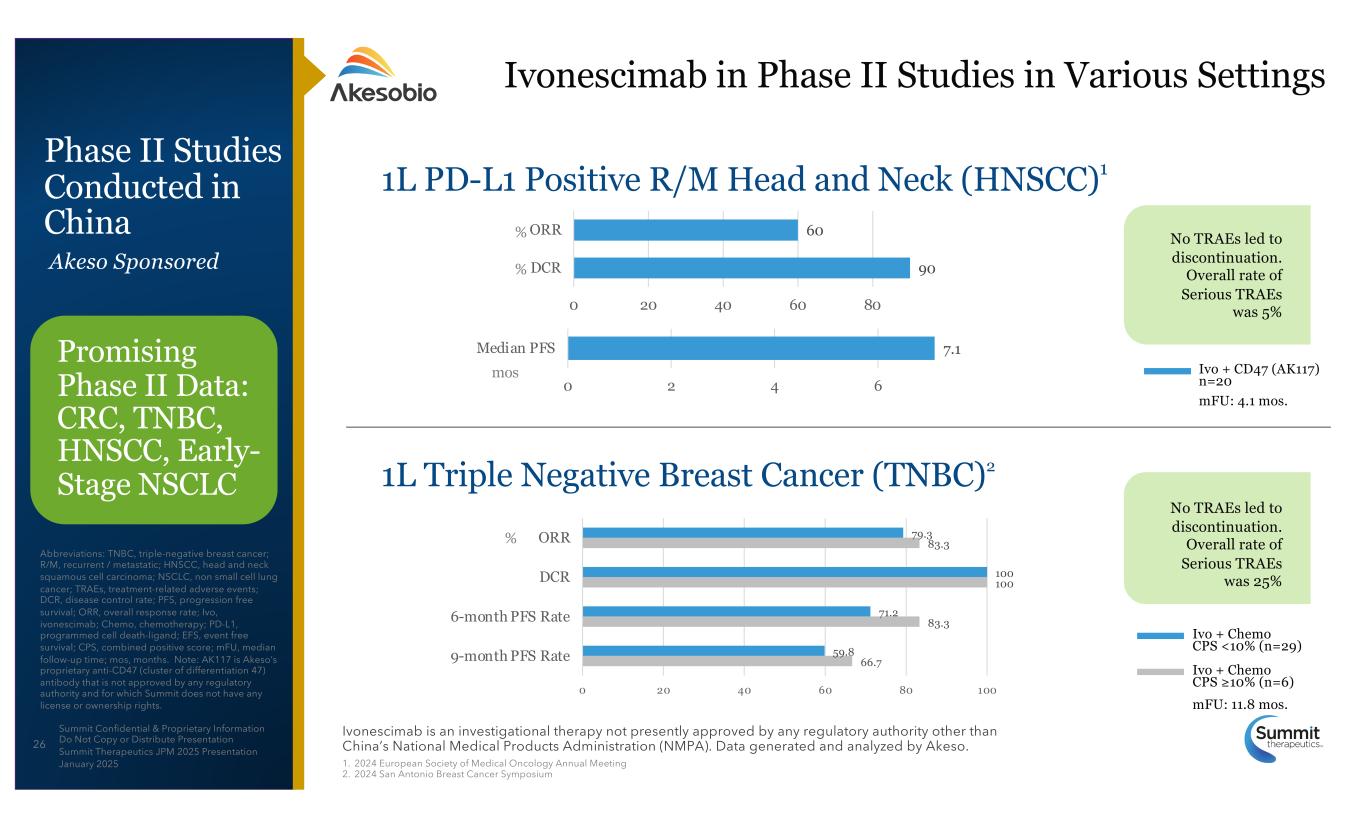
Perfect question. In reality, you know, everything that you mentioned resonates, right? And so, if you think about, you know, the last part of your question, which is do you follow Akeso or do you look to branch out, you know, as McKee talked about, part of our MD Anderson collaboration, you know, looks to accomplish parts of that, as well as our IST program. If you look at some of the Phase II data generated by our partners at ACESO, which were released over the course of last year, whether it be BTC, colorectal cancer, head and neck cancer, and triple negative breast cancer, you know, there are some promising signals that we see in that Phase II data. There are also additional indications that have been explored in Phase II where data is fully disclosed from that perspective, which give us opportunities. And then, obviously, we can run additional, you know, signal-seeking or Phase II studies as well, whether on our own or through things like the collaboration, the clinical trial collaboration with Pfizer here, which as a whole, I think, you know, we've, as McKee mentioned in her comments earlier, we're very keen to, you know, in addition to the significant work being done in non-small-tell lung cancer, look beyond lung cancer as well. And that's, you know, part of our 25-26 development plan.
I was just going to add. So, you know, we haven't disclosed it. You know, we're in the midst of multiple regulatory discussions around that. I would just say that, you know, we have been thinking about this for a long time. So we did this exercise even before the Harmony 2 data read out, shortly after the deal was done, looking at all the prior checkpoint inhibitor approvals, looking at all the anti-angiogenic approvals, looking at what we think the population size would be, what the comparator arm would be, and then you layer on top of that the phase two data coming out from a KESO. That all goes into the calculus of how we make those decisions, and hopefully we'll be able to disclose some exciting opportunities soon.
Outside of the opportunities, could we expect updated results from any of those studies, or do you feel like they're largely concluded and really it's about the Phase III studies that are up and running?
Yeah, hi, Ren. This is Manmeet. Yes, you will continue to hear more updates as we progress on all the studies which we had given some initial top-line data earlier in the last year. But I would also mention that colorectal cancer, right, where we are pretty excited, and we have just recently partnered with Akeso also on the Phase II study, which we are beginning to activate over here on our side, and that would be the first one which you would hear more details in the next coming quarters.
Okay, thank you for that. And just one last one for us. I think CT.gov said that there are three active sites for Harmony 7. Can you talk a little bit about how many sites globally you expect to have on board by the end of 2025 and for both Harmony 3 and Harmony 7?
Hi, and this is Manmeet again. I think we don't give the specific number, but on the sites which we activate, because we go into multiple regions, right? This is a global multi-regional study, but I would expect by end of 2025, almost, you know, most of the sites are like 100, near to 100% of the sites should be activated.
Great. Thanks for taking the questions, guys, and congrats.
Operator
I will now turn the call back to Dave Gankors for closing remarks.
Thanks very much. And I'd like to hand it over to Bob Duggan just for a couple of remarks before we close.
Yeah, I just want to weigh in on the question of business development. Business development has a couple of arms. One is optimize Ivo and make it the best product monotherapy, combination therapy that the world can get from us and our partner, Kesso. And we're daily looking at that and evaluating that. There's plenty of room to go, as you see with the trials that we're entering into. The second aspect of business development is what's the timing of gaining markets, additional market space, additional market opportunity, and then how much share can you get and how do you go about doing that? And that's also a major part of business development. So we're very active on two footprints. Pfizer is footprint one. how do we optimize the product. Other activities, we're constantly working on those here. Also, I just want to make clear that Pfizer is not the beginning and end of business development at some, not that it isn't for most of you, but even for some of you. So back over to Dave.
Really appreciate it, Bob. Thanks very much. And I want to thank everyone for attending today's earnings call. An archived version of the webcast will be available later today on our website, www.smmttx.com. Thank you very much for your participation and we hope you enjoy the rest of your day. Thank you.