Operator
Good afternoon and welcome to Summit Therapeutics Q4 and Year-In 2025 Earnings Call. All participants will be in listen-only mode until the question and answer session portion of this call. We do not expect any technical difficulties today. However, in the event that we lose the webcast connection and are unable to provide any updates, please wait up to 10 minutes for resolution. Please refer to the company's website for updates. Please note that today's call is being recorded. After the speaker's remarks, there will be a question and answer session. If you would like to ask a question during this time, simply press the star key followed by the number 1 on your telephone keypad. If you would like to withdraw your question, press star 1 again. At this time, I would like to turn the call over to Dave Gancars at Summit Therapeutics, Chief Business and Strategy Officer. You may proceed.
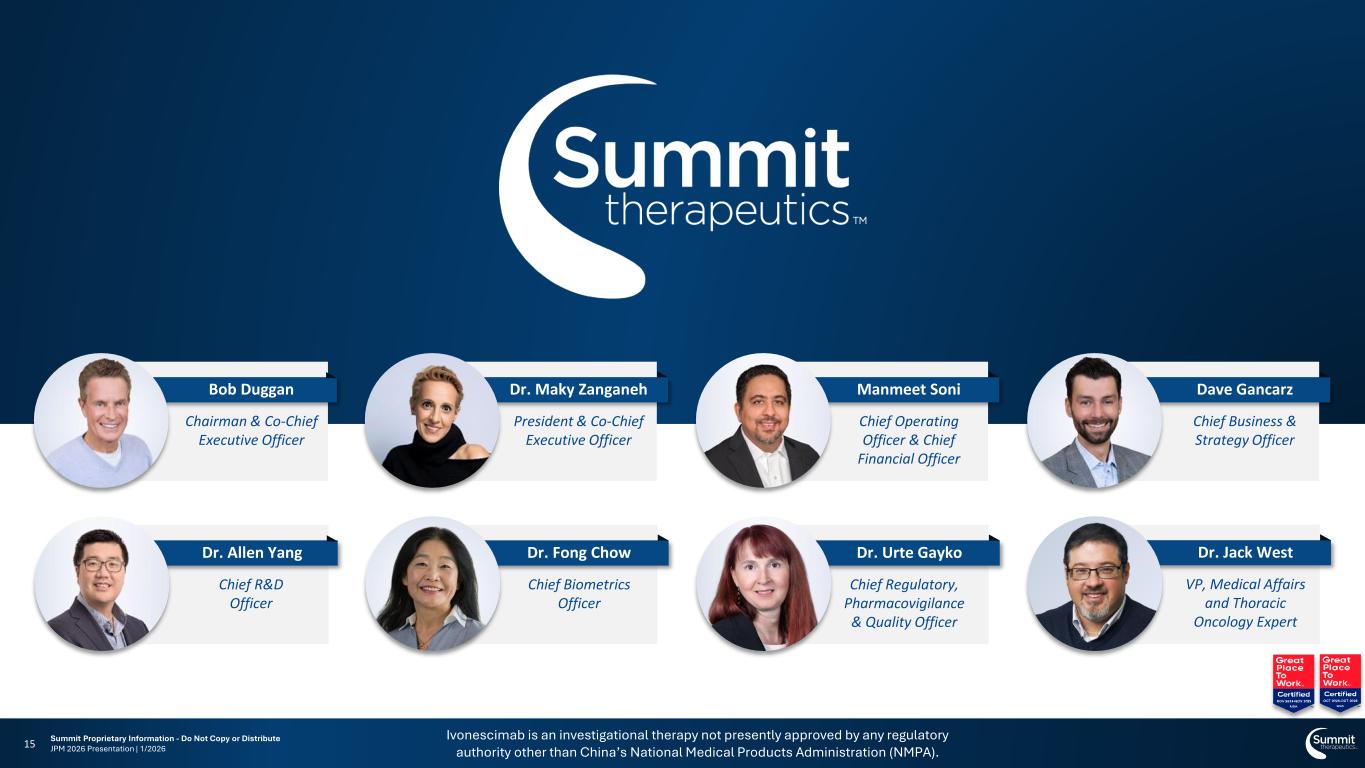
Good afternoon, and thank you for joining us. On today's call, we will provide an update on our fourth quarter and year-end 2025 financial results and operational progress. This afternoon's press release is available on our website, www.smmttx.com. Our form 10-K was also filed today and is available on our website and via the SEC's website. Today's call is being simultaneously webcast and an archived replay will also be made available later today on our website. Joining me on the call today is Bob Duggan, our Chairman of the Board and Co-Chief Executive Officer, Dr. Matthew Zanganai, our President and Co-Chief Executive Officer, Manmeet Soni, our Chief Operating Officer and Chief Financial Officer, and Dr. Alan Yang, Chief of R&D Strategy. I'm Dave Gankars, the Chief Business and Strategy Officer at Summit. Before we get started with the rest of the call, I would like to note that some statements made by our management team and some responses to questions that we make today may be considered forward-looking statements based on our current expectations. Summit cautions that these forward-looking statements are subject to risks and uncertainties that may cause actual results to differ materially from those indicated in the forward-looking statements. Please refer to our SEC filings for information, including the Form 10 issued today, about these risks and uncertainties. Summit undertakes no obligation to update these forward-looking statements, except as required by law. One item to note, this presentation is being webcast with slides, so we'll be referring to the slides being displayed in the webcast link.
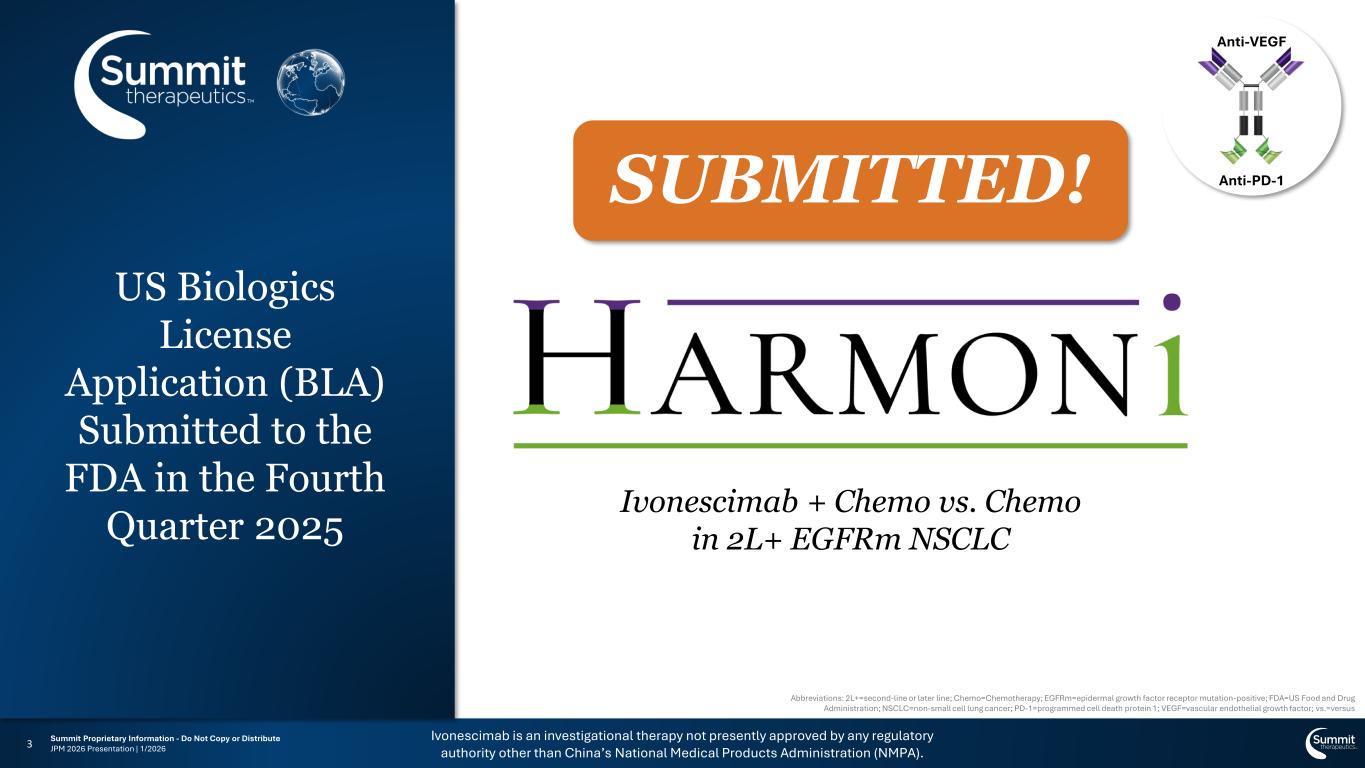
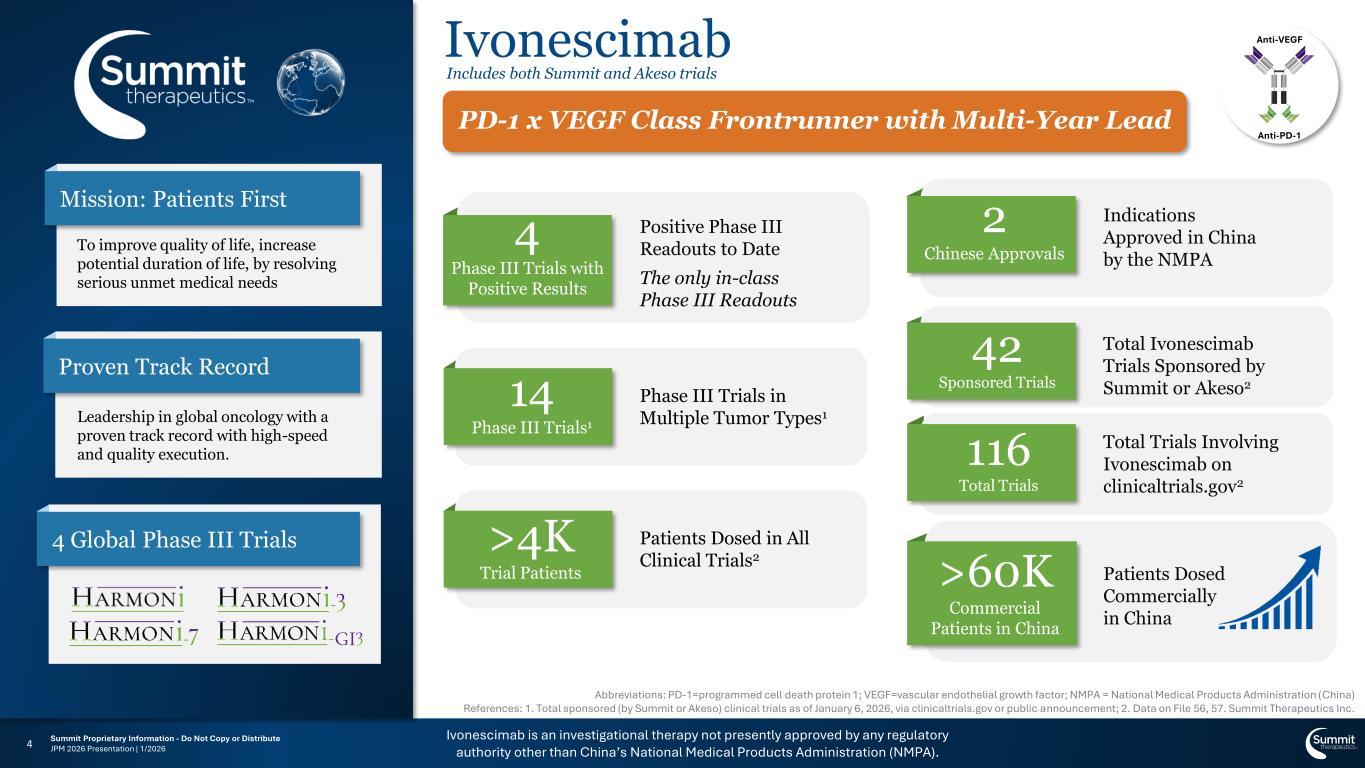
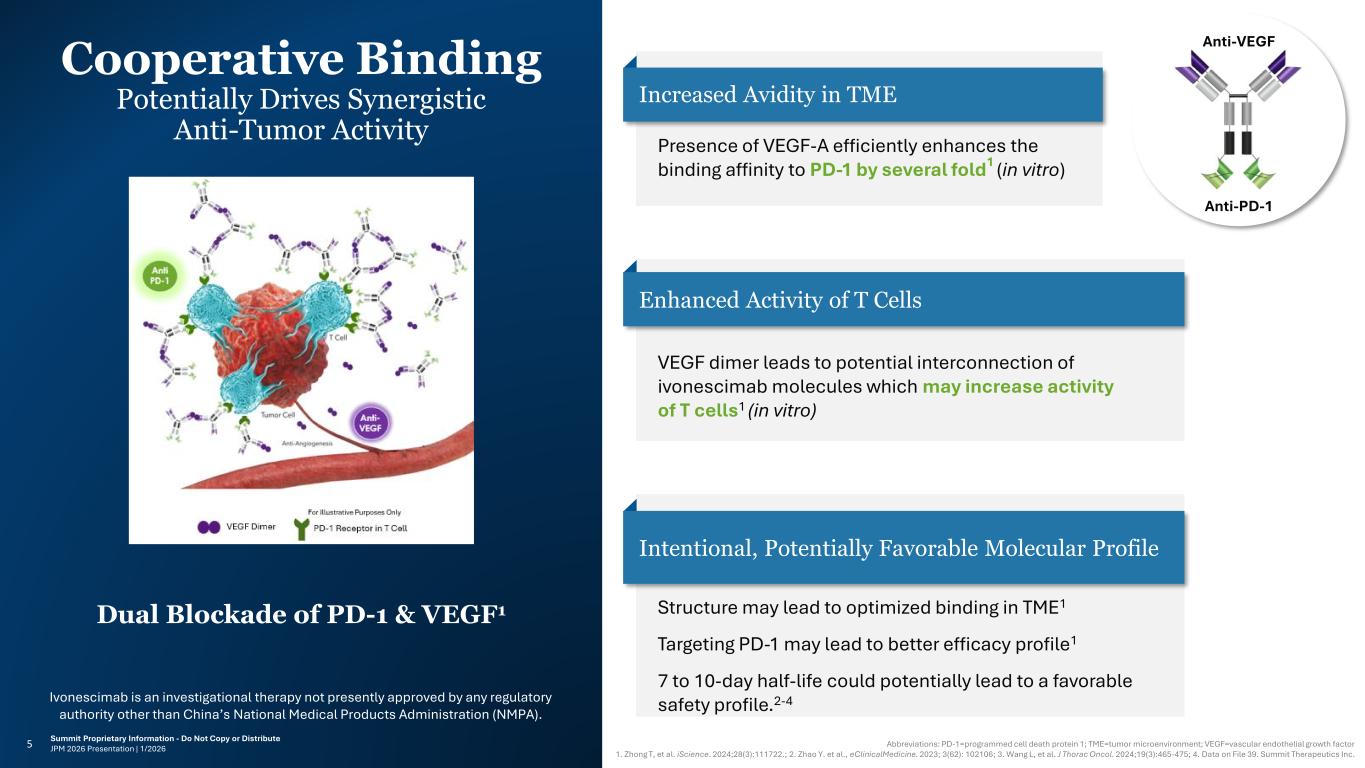
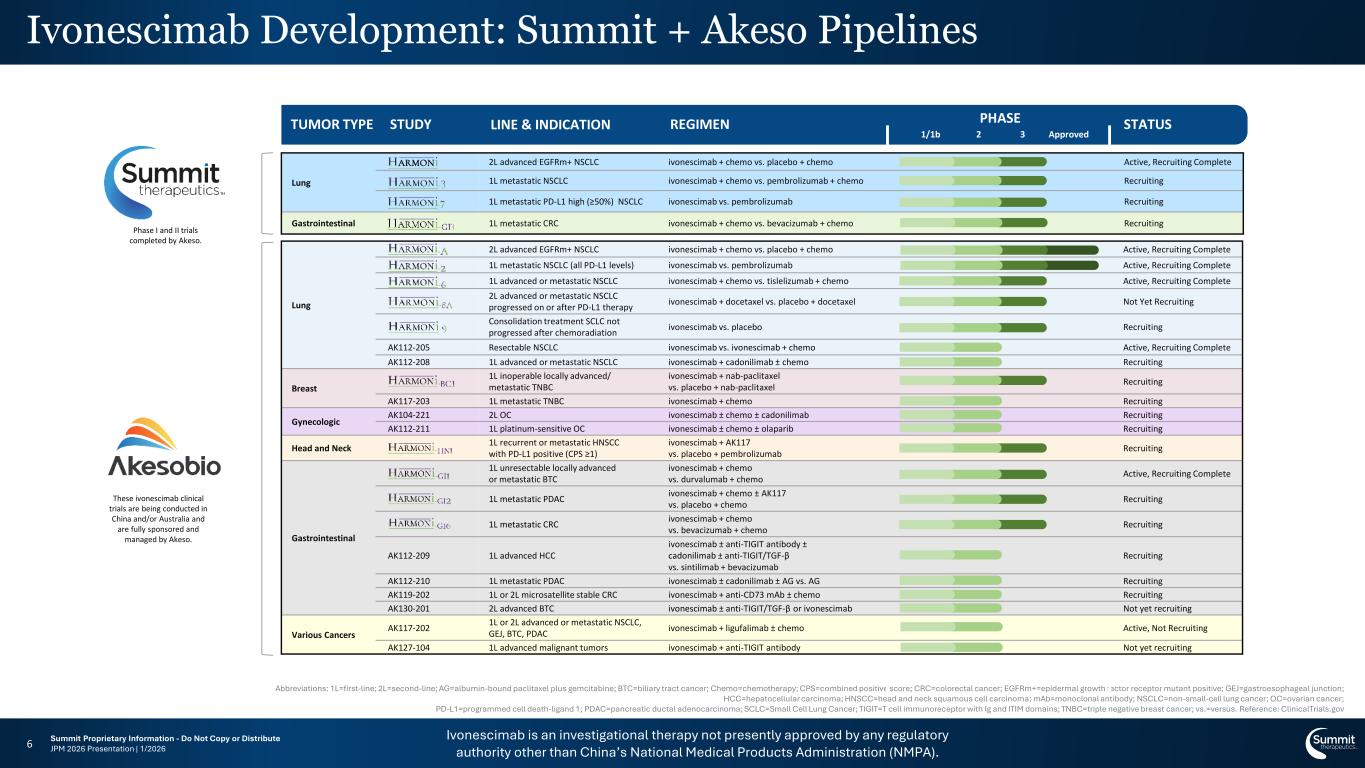
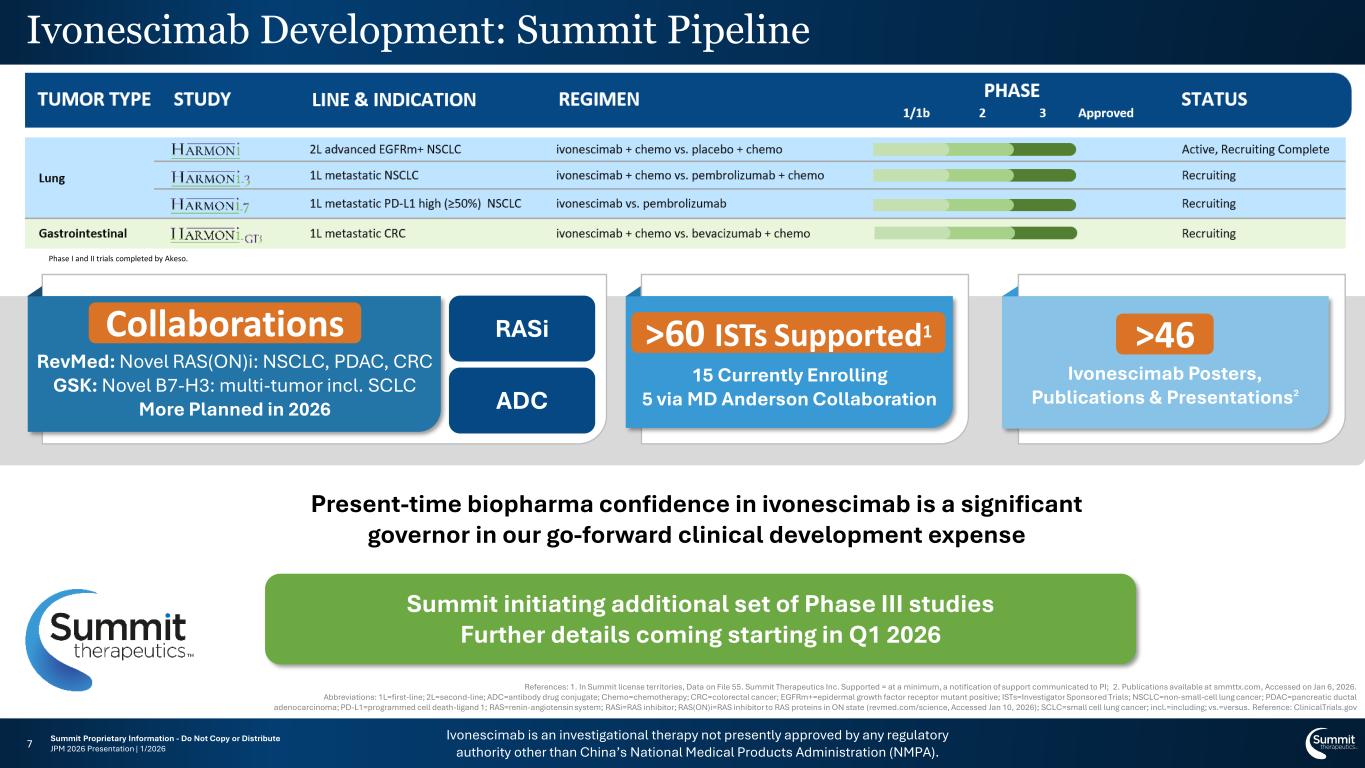
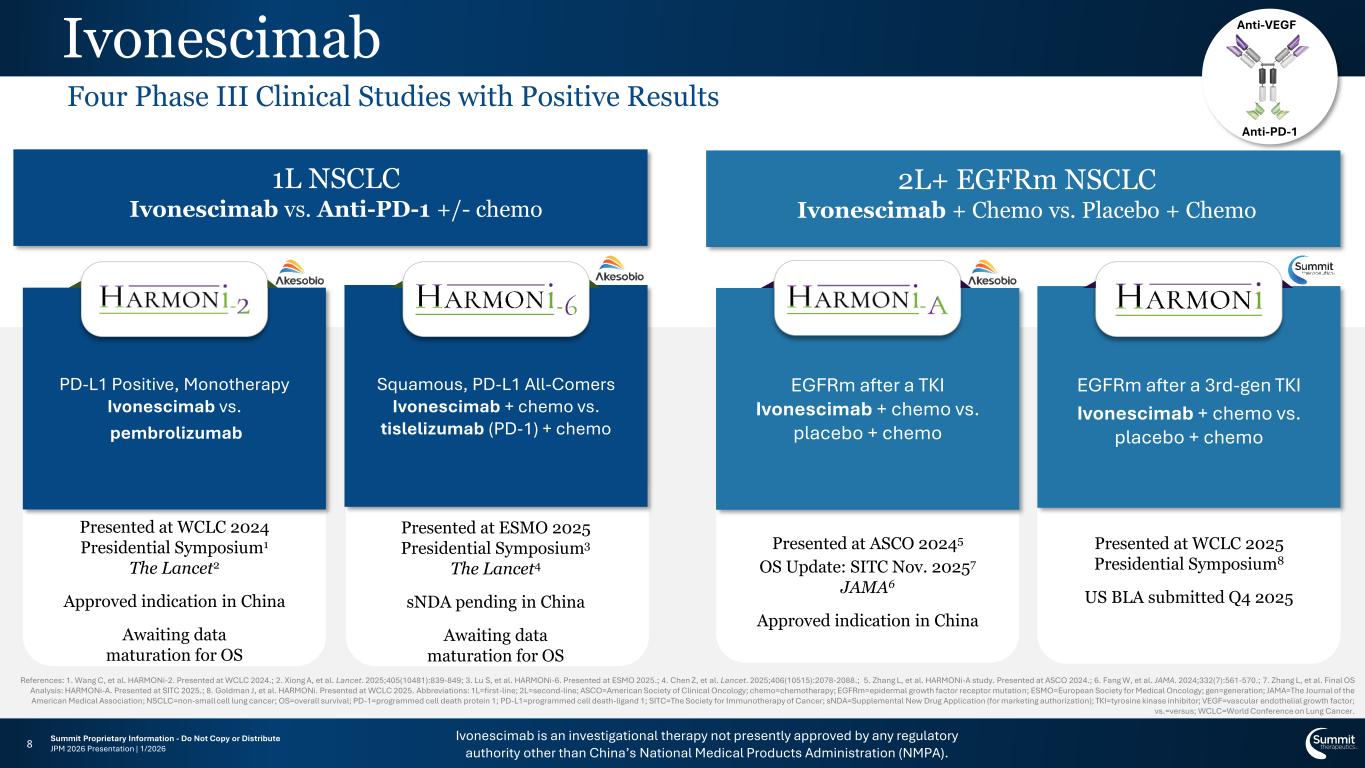
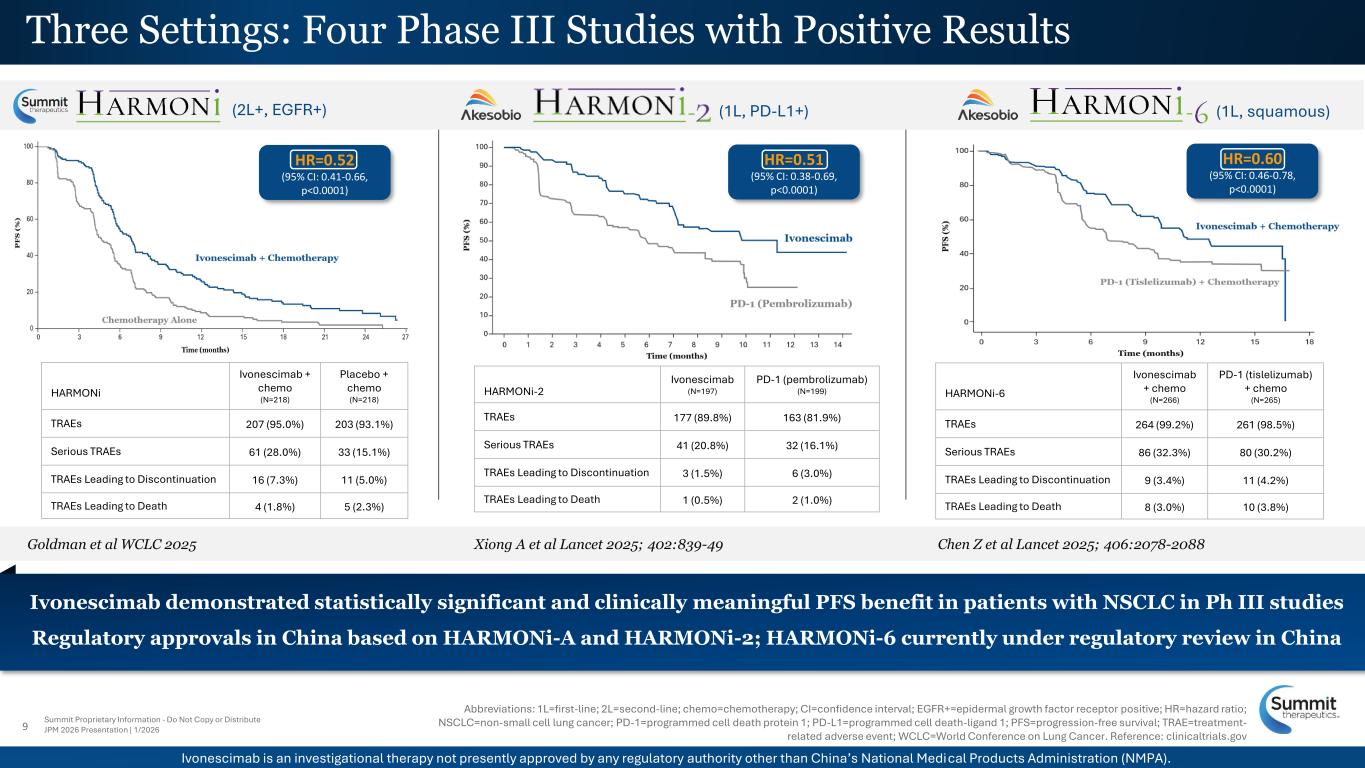
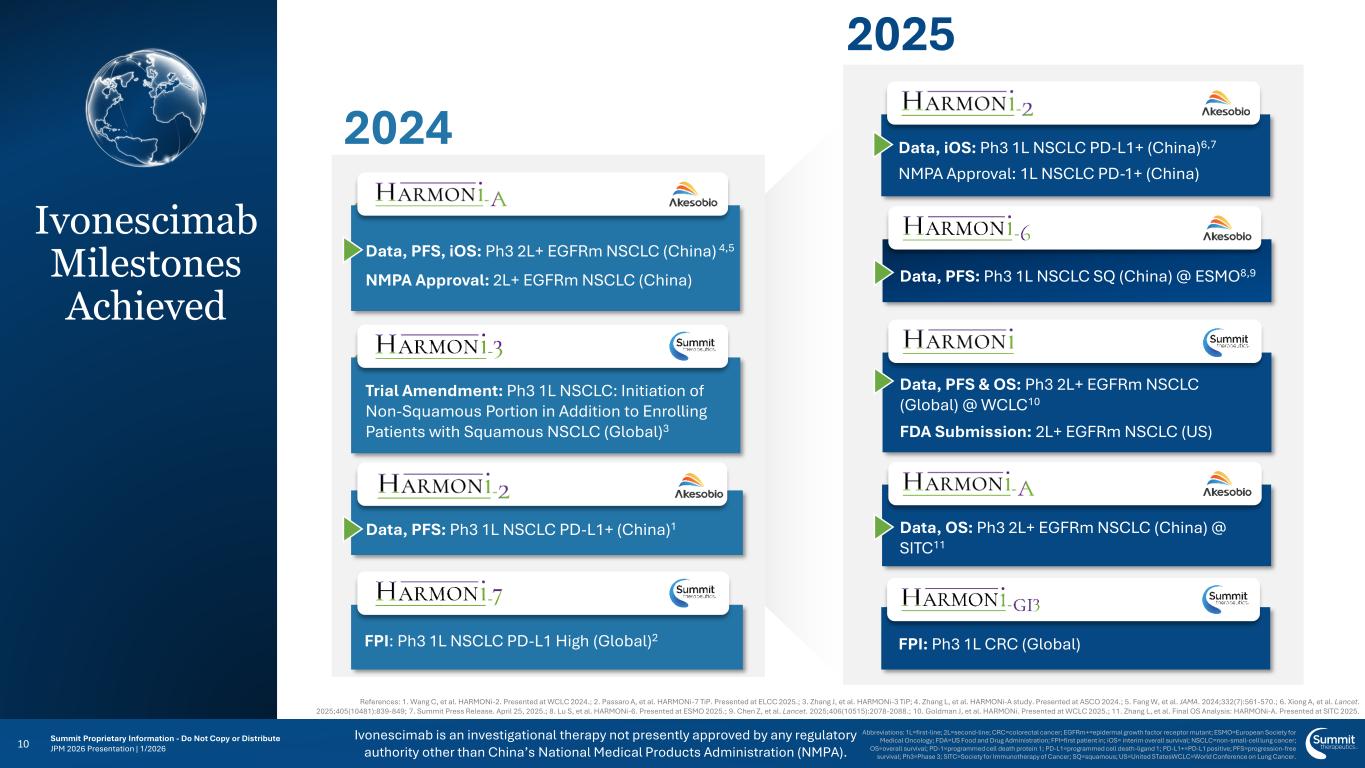
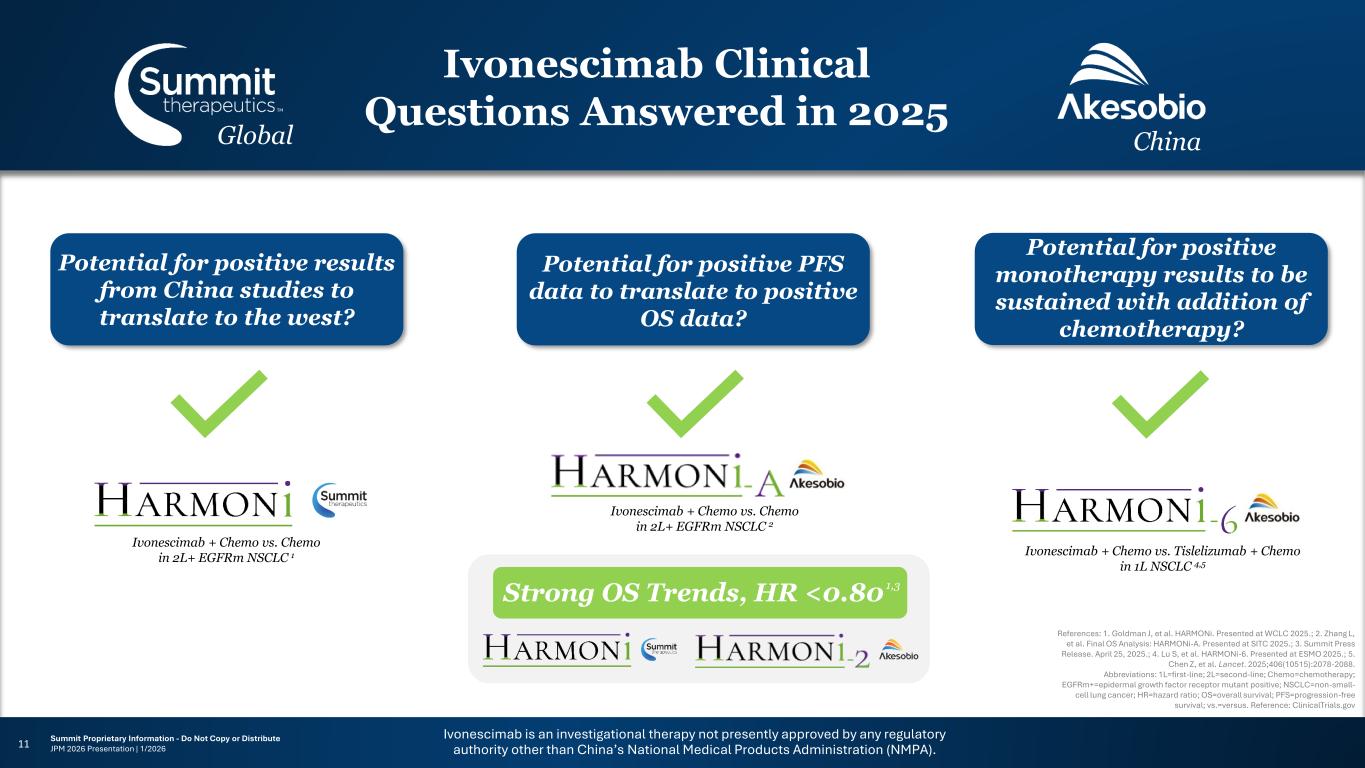
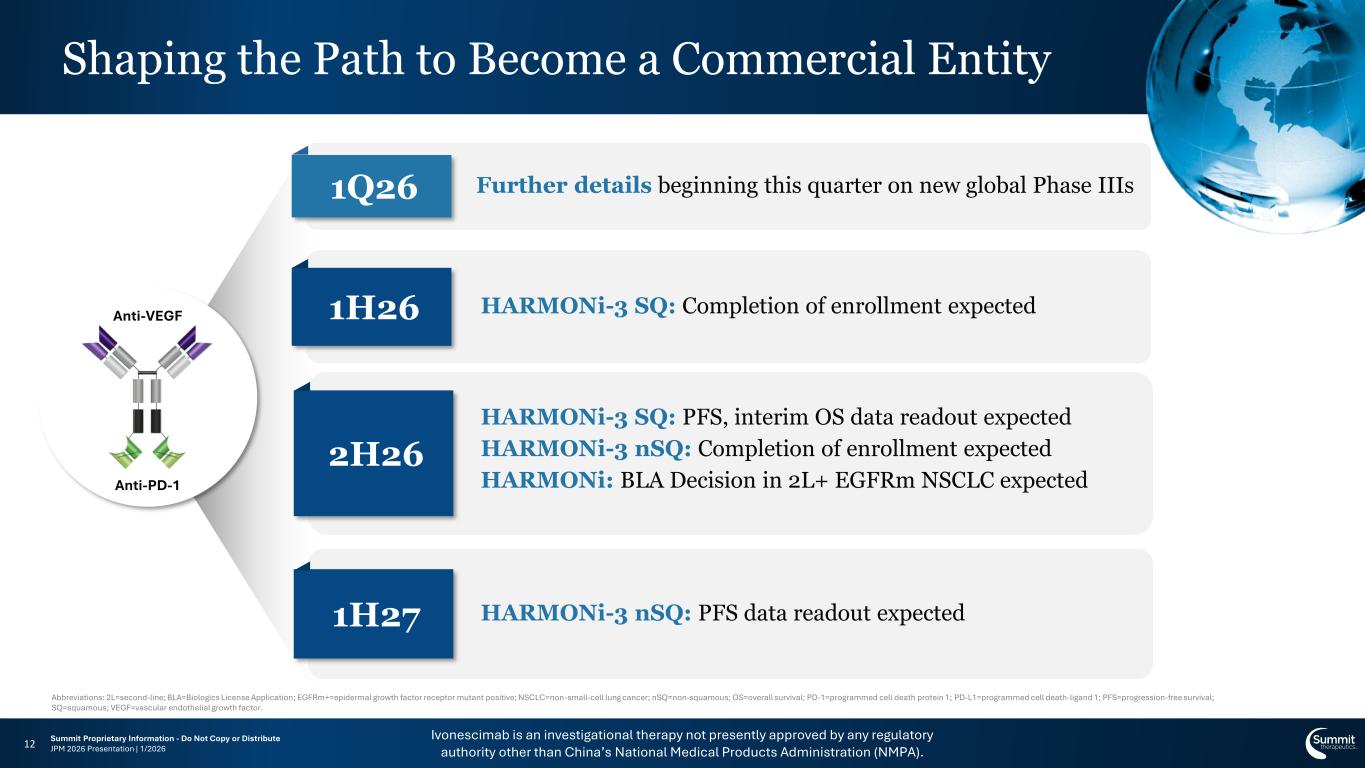
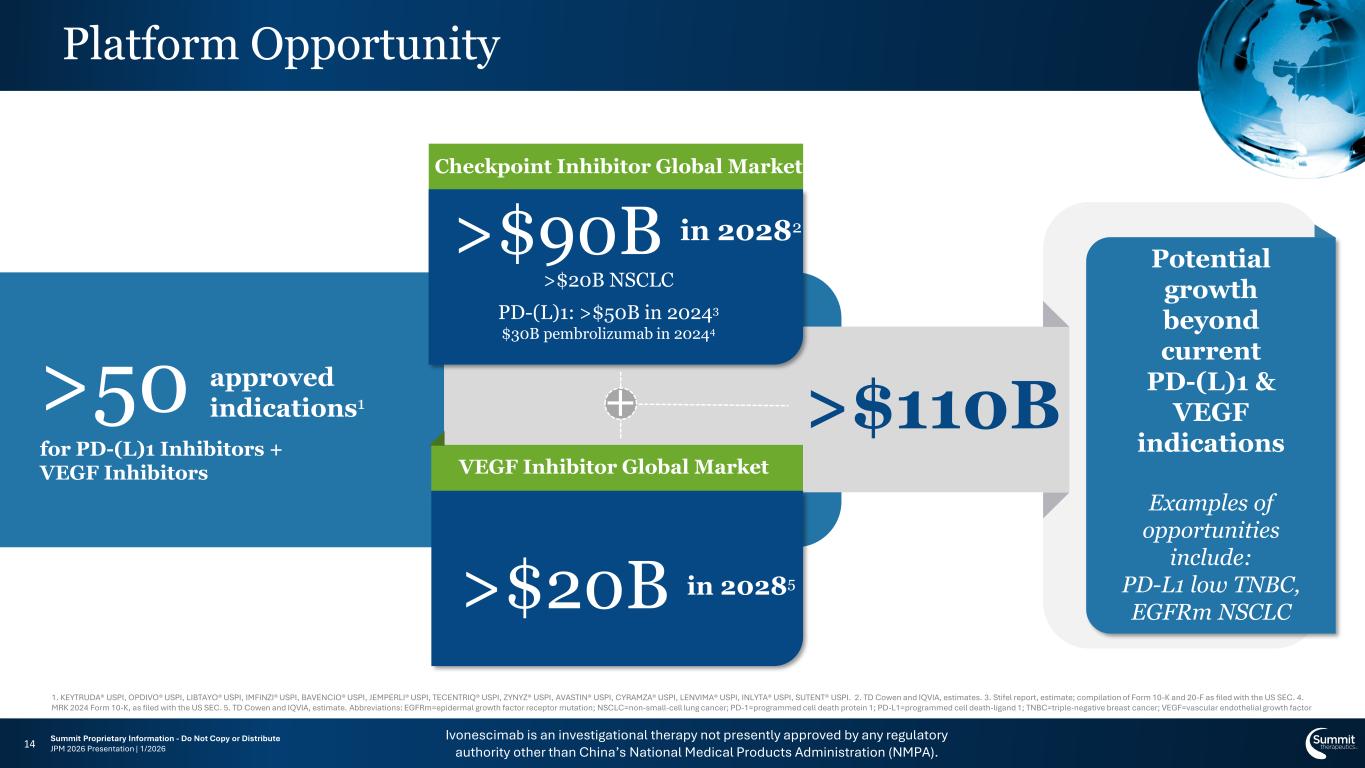
I'd encourage you to use the webcast link to see the slides being presented this afternoon that will accompany our comments following comments from our team we will take questions and with that i'd like to hand it over to mickey thank you dave good afternoon everyone and thank you for joining us today i'm very proud of team summit's ongoing accomplishments and their growing positive data sets and support around ibanesimab a pd1 vegef by specific or lead investigational asset We are a highly focused, mission-driven, patient-first company with a mission to make a significant difference in improving the lives of patients suffering from cancer. Our team is growing rapidly as we expand our clinical development plan and prepare for commercialization in anticipation of a decision from the FDA on our BLA near the end of this year. We have announced a few significant events today, starting with the updates related to our Harmony 3 study. Last quarter, we announced our Harmony 3 Phase 3 trial evaluating ibanissimab plus chemo as first-line treatment for patients with squamous and non-squamous non-small cell lung cancer was amended to have separate analysis by squamous and non-squamous histologies for primary endpoints of PFS and OS for each cohort. The SQMS cohort was planned to complete enrollment in the first half of 2026, followed by the non-SQMS cohort in the second half of this year. As announced today, we have now completed screening patients for the SQMS cohort of the Harmony 3 study and the last patient will be randomized in the next couple of weeks. We have amended our statistical plan to now include an interim PFS analysis for our squamous cohort and we are planning to conduct the interim PFS analysis during the second quarter of 2026. Overall survival will be immature at the time of this analysis, therefore, we may not have overall survival results to communicate at that time. As you recall, we initially included PFS as a primary endpoint in this study, opened the readout of Harmony 2, comparing ivanissimab to PEMBRO in PDL-positive frontline lung cancer patients, which showed a highly statistical significant and clinically meaningful benefit in PFS with a hazard ratio of 0.51 and a median improvement in PFS of over five months. This point was later validated with Harmony 6, showing that there was a substantial PFS benefit when comparing ibanissimab plus chemo versus a PD-1 inhibitor plus chemo with a hazard ratio of Two Phase III studies conducted by ECESO in China in Frontline Non-Small Cell Lung Cancer demonstrated a 40% plus improvement in PFS for the Ivanecimab R. Both the HARMONY-2 and HARMONY-6 PFS results were based on the planned interim PFS analysis of each study. By adding an interim PFS analysis, we opened the door to an earlier discussion with the health authorities for our multi-regional phase 3 study. The final PFS analysis, if applicable, and an interim analysis for OS is planned to be conducted in the second half of this year, consistent with previous guidance. For the non-squamous cohort of Harmony 3, we continue to expect enrollment to complete in the second half of this year and to reach the pre-specified number of events for the final PFS analysis by the first half of 2027. There are several meaningful moments upcoming related to these two cohorts, each of which are independent from each other, like two separate studies in one protocol, where 2026 will be pivotal to providing additional clarity to expand the reach of IVO to a broader population of lung cancer patients. Additionally, we announced today the first update to the IVO Phase III clinical trial program, which will continue to expand throughout 2026. Illumin, a new Phase III study in PD-L1 positive frontline head and neck squamous cell carcinoma will be sponsored by GORTEC, a French cooperative group dedicated to head and neck oncology with initial enrollment expected to begin early next quarter. The study intends to evaluate both ivenissimab monotherapy and in combination with ligofalumab, a case of proprietary anti-CD47 monoclonal antibody against monotherapy PEMBRO in this three-arm randomized study. Approximately 780 patients are intended to be enrolled across the three arms in multiple countries in Europe and in China. We may consider potentially expanding the study to include U.S. sites as well. Phase II data supporting the potential use of ibanesimab in this patient population was previously presented at ESMO 2024, where ibanesimab in combination with ligofalimab demonstrated an objective response rate of 60% in 20 patients with median PFS of 7.1 months after median follow-up of 4.1 months. At the time of this analysis, no patient receiving avanesimab plus ligofalimab discontinued treatment due to the treatment-related adverse events. The data generated in Phase II is encouraging in light of existing standards of care, and ECESO is also running a single-region Phase III trial in this population in China. Turning to our clinical collaboration with Revolution Medicine, today we announced the first patient has been dosed in the collaboration's initial clinical trial. As a reminder, abanissimab is being evaluated in combination with three RAS-ON inhibitors, including Laraxon RASIP, a multi-selective RAS inhibitor, Zoldan RASIP, a KRAS G12D selective inhibitor, and Euleron RASib, a KRAS G12C selective inhibitor, across multiple solid tumor settings with RAS mutations, including pancreatic cancer, colorectal cancer, and non-small cell lung cancer. Finally, as we announced last month, we entered into a clinical collaboration with GSK to evaluate ibanissimab in combination with GSK novel B7H3 antibody drug conjugate in multiple solid tumors. The initial study under this collaboration is expected to begin dosing patients in mid-2026. Let's now take a step back and look at ibanissimab accomplishments today. There are many to list. We are just highlighting some of them. Avanicimab has read out four phase three clinical studies to date, all four of which have had positive data, leading to two approvals in China so far. At this time, a total of 15 phase three trials have been announced, currently ongoing, or have read out in multiple tumor types. 44 clinical trials have been initiated since 2019 between SUMIT and ECESO evaluating ibanesimab in a variety of solid tumors. When considering investigator-initiated and collaborative studies, a total of 142 clinical trials are now listed on clinicaltrials.gov. The enthusiasts demonstrated by investigators around the world to generate data and seek positive signals for patients facing high unmet medical needs really speaks to the opportunity and optimist surrounding Ibonissima. Together with our partner, Ekeso, we have enrolled over 4,000 patients in either summit-sponsored or Ekeso-sponsored clinical trials across the world. Commercially in China, over 60,000 patients have received Ibonissima based on two approved indications by the NMPA in non-small cell lung cancer according to our partners at ECESO. A third indication based on the positive harmony six study in frontline squamous non-small cell lung cancer is currently under review by the NMPA in China. I wanted to make sure this point is not means four phase 3 trials evaluating ibanesimab have readout to date and all four with positive data readouts. This represents the only phase 3 readout that we have seen in the PD-1 VEGF bispecific class today. These positive trials are supported by the differentiated mechanism of action of ibanesimab. Here is the current ibanesimab development plan across Summit and ECESO. In total, there are 15 randomized phase 3 trials, four of which are Global Summit sponsored studies in non-small cell lung cancer and colorectal cancer, one of which is a multi-regional, regional cooperative group study announced today, and 10 of which are being enrolled by ECESO in China in a variety of solid tumor types, including lung, breast, head and neck, BTC, pancreatic, and colorectal cancers. Additionally, ECESO is also currently enrolling multiple phase 2 trials evaluating abonissimab in other tumor types, ovarian, gastric, HCC, and others, including non-metastatic settings. Through our partnership with ECESO, we continuously compile a substantial amount of data allowing us to make faster more informed decisions fueling the rapid expansion of our global development plan focusing on our pipeline at summit we have four global phase 3 trials completed or ongoing Harmony which read out positively last year Harmony 3 Harmony 7 HARMONY GI-3, all three of which are currently enrolling and progressing nicely. The HARMONY trial evaluated Ibonissima plus chemo against chemo alone as treatment for EGFR mutant non-small cell lung cancer after TKI therapy, a population of significant unmet need with few available treatment options. We submitted a BLA filing last quarter, seeking approval in this proposed indication, and in January, we announced the U.S. FDA's acceptance of the filing and a PDUFA target action date of November 14, 2026. As previously disclosed, the FDA noted that a statistically significant overall survival benefit is necessary to support marketing authorization in this setting. Considering safety and efficacy profile of the current FDA-approved options to patients in this setting the positive regionally consistent results of this phase 3 multi-regional study as well as discussions with key opinion leaders and physicians who have administered ibanesimab to patients we believe that ibanesimab is a potential treatment option with a favorable benefit risk profile in anticipation of potential approval in q4 of this year we continue to ramp up commercial capabilities in preparation for potential launch. Harmony 3 is evaluating ibanissimab plus chemo against pembro plus chemo in frontline metastatic non-small cell lung cancer. This patient population represents a significant unmet medical need with nearly 100,000 patients in the United States alone as this trial covers frontline non-small cell lung cancer patients without genomic mutations, irrespective of histology or PD-L1 status. I spoke a minute ago about the recent changes to this pivotal study. For HARMONY7, this study is evaluating abanissimab monotherapy against pembrol monotherapy as frontline treatment for patients with non-small cell lung cancer that have high PD-L1 expression levels. HARMONY7 continues to enroll well, and we look forward to providing additional updates in the future. And finally, last quarter, we initiated and began enrolling patients in Harmony GI3, evaluating Ivanissimab plus chemo compared to Bev plus chemo in first-line therapy in patients with unresectable colorectal cancer. Our decision to expand into colorectal cancer was driven by encouraging Phase II data published at ESMO 2024 and subsequent continuing enrollment in this Phase II study to China and the United States with additional chemotherapy regimen. This dataset allowed us to make an informed decision to move forward in CRC, specifically with the FALFOX chemo combination. We look forward to providing further updates on the Phase II data set later this year, as well as the HARMONY-GI3 study as the trial progresses. Looking beyond our own sponsored trials, we are expanding into additional settings with multiple collaborations and other groups. We have the Phase III Illumin study sponsored by GORE-TECH evaluating ibanissimab in head neck cancer that I spoke to earlier. With respect to novel-novel combination, we announced that the first patient was those this quarter in our collaboration with Revolution Medicine to evaluate ibanesimab in combination with three novel RAS inhibitors across multiple solid tumor settings. We are excited to learn about the opportunity and potential to improve patient outcomes with ibanesimab combined with these novel targeted therapies and promising molecules. This collaboration is intended to evaluate Avonisimab in combination with one or more of RevMed's RAS-on inhibitors in pancreatic cancer, colorectal cancer, and non-small cell lung cancer. This collaboration has an opportunity to be mutually beneficial to both SUMIT and REVMAT by leveraging a combination of potential next-generation assets that individually have promised in each setting, and this may have high promise for patients with RAS mutant cancers. In our GSK collaboration, evaluating avonissimab in multiple solid tumor settings in combination with their B7H3 ADC system, We expect the trial to initiate in mid-2026. This is another example of promising targets seeking to significantly advance outcomes in settings where both AIBO and B7H3 ADCs have shown promise. We have over 60 ISDs that we intend to support in various stages of development of these 15 are currently enrolling, five of these in collaboration with MD Anderson, and Ibonicimab has now been featured in over 45 publications, presentations, and posters. Collectively, these trials enhance and inform our own clinical development activities as we learn more about new settings where neither we nor ECESO have had the opportunity to explore yet. Tremendous interest in ISDs is a testament to the enthusiasts, we have heard from many investigators as they consider the potential opportunity that ibanissimab presents across multiple tumor types. Over the past 18 months, we have seen four positive randomized phase 3 trials, including the first and only phase 3 trials to compare positively against anti-PD-1 therapies. Each of these studies represent a benefit either over a PD-1 inhibitor or in setting where PD-1 inhibitors have failed to achieve a benefit in either PFS or OS. ECESO's Harmony 2 PFS results showed Imanissimab monotherapy as superior to Keytruda in frontline non-small cell lung cancer. These results represent the first time any therapy has achieved a clinically meaningful benefit over Keytruda in randomized phase 3 trials. In April of 2025, ECESO announced that Harmony 2 achieved a clinically meaningful overall survival hazard ratio below 0.8 at this early look. Moving to ECESO's Harmony 6 frontline non-small cell lung cancer study in patients with squamous histology, results were announced at ESMO 2025 demonstrating ibanissimab with chemo was superior to pd1 plus chemo in pfs with this result harmony 2 and harmony 6 represent the first and only known regiments to achieve a clinically meaningful benefit replacing an anti-pd1 regimen in ejfr mutant non-small cell lung cancer both a case of harmony a trial and our own global harmony trial achieve positive consistent results in harmony a positive overall survival trend was observed with hazard ratio of 0.79, barely missing statistically significance. In a subsequent analysis in September 2025, with longer-term follow-up on Western patients, Ibonissima plus chemo showed a favorable trend in overall survival with a hazard ratio of 0.78 and a corresponding nominal p-value of 0.0332. In Harmony A, a case of final overall survival analysis showed ibanissimab plus chemo achieved a statistically significant hazard ratio of 0.74 with a p-value of 0.019, supporting a treatment profile where OS does not degrade but rather improves over time in this setting. Turning to our market opportunity, the value proposition is clear, ibanesimab on its own has the potential to be a platform blockbuster drug. Additionally, novel-novel combinations with Ivo could bring potential improvements over current standard of care, which could expand market opportunity further. Ibanesimab is well positioned to make a significant impact across the solid tumor treatment landscape. Between checkpoint inhibitors and anti-VEGF therapies, TD Cohen and others estimate the total addressable market to be in excess of $100 billion US dollars globally. Looking only at the checkpoint inhibitor market for non-small cell lung cancer, market estimates for immunotherapy are expected to exceed $20 billion US dollars by 2028. And yet, these estimates still do not include the full impact Ibanezimab could have as it has already shown promising data in multiple tumor type where checkpoint inhibitors have not been effective including EGFR mutant non-small cell lung cancer and PD-L1 low triple negative breast cancer. Ibanezimab differentiated profiles support its platform potential across multiple indication, many of which could be blockbuster opportunities on their own. We have a very exciting year ahead. Here are some of the upcoming milestones we expect to reach in 2026 and into the first half 2027. Our global clinical studies pipeline will continue to expand and we will provide further details in 2026 as we begin studies in new settings and indications. This will include additional novel novel combinations as well as the new phase 3 studies that we intend to launch in 2026. the first steps with respect to this expansion came today with the announcement of the cooperative group led illumine phase 3 clinical study in head and neck cancer we will continue to expand often the details of our clinical development plan throughout 2026 including sponsored studies. With today's Harmony 3 update, we anticipate an interim PFS analysis for the squamous cohort to occur next quarter. Final PFS and interim OS data are expected in the second half of this year. In the Harmony 3 non-squamous cohort, we expect to complete enrollment this year. We anticipate final progression-free survival data in the first half of 2027. And as already discussed, we are looking forward to a potential first approval for Ivanissimab in the U.S. around our November 14 PDUFA date based on our Harmony BLA filing. Now, I will turn the call over to Manmeet to provide a financial and operational update for the quarter. Manmeet.
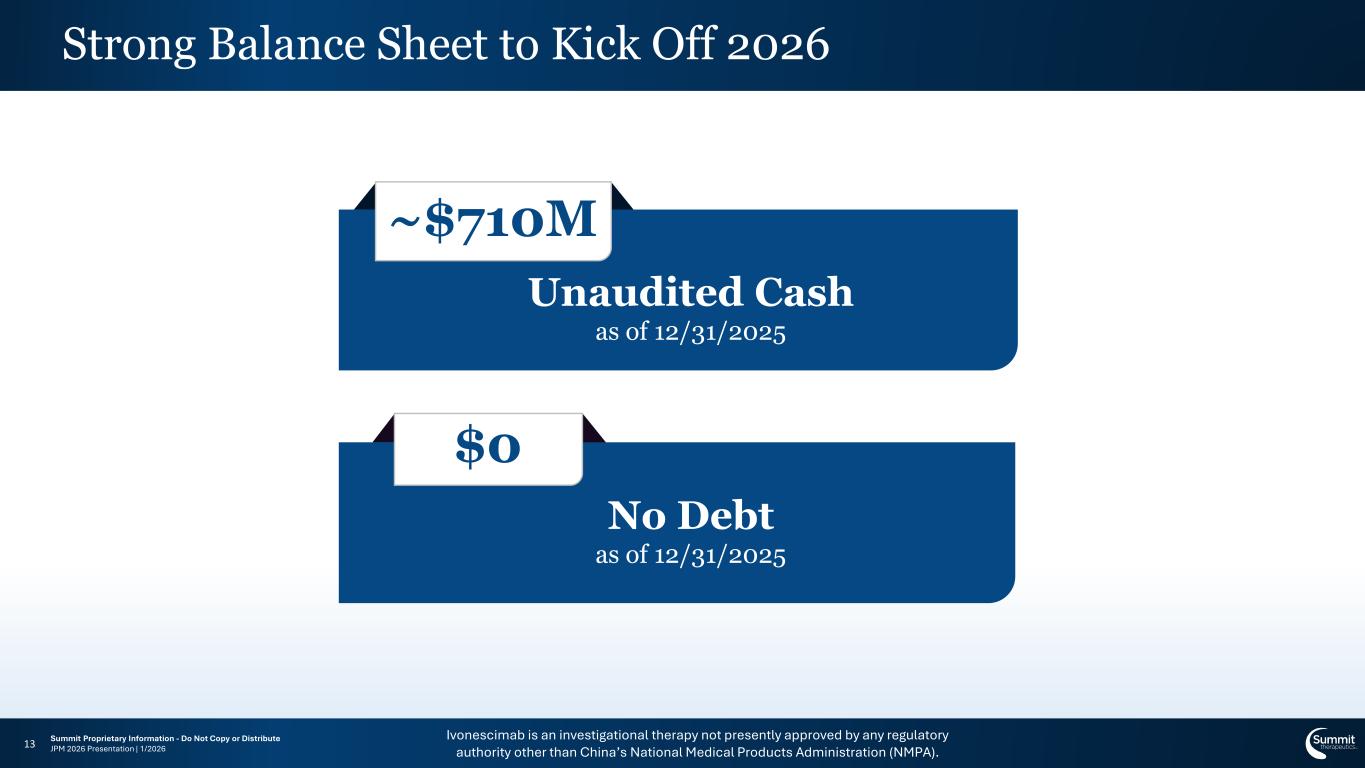
Thank you, Maki, and good afternoon, everyone. On the financials front, let me start with our cash position. We ended the year 2025 with a strong cash position of approximately $713.4 million. And to remind everyone, currently we have no debt. Turning to operating expenses, I will provide details on both GAAP and non-GAAP numbers. You can refer to our press release issued this afternoon for a reconciliation of GAAP to non-GAAP financial measures. As a reminder, non-GAAP expenses exclude stock-based compensation expenses. Total GAAP operating expenses for the fourth quarter of 2025 were $225 million compared to $234.2 million for the third quarter of 2025. This decrease in GAAP operating expenses was primarily due to the lower stock-based compensation expense of $19.1 million, and this was offset by an increase in our clinical triagulated spend of $8.8 million. dollars. Overall, our non-GAAP operating expenses during the fourth quarter of 2025 were $113.3 million compared to $103.4 million for the third quarter of 2025. This increase in non-GAAP operating expenses was primarily related to an increase in R&D expenses related to how many three and how many seven trials. As you will note, we have been very efficient and disciplined in controlling our G&A spend, our total G&A spend, excluding stock-based compensation expense, has been approximately $43 million for the full year 2025, with a run rate of approximately $10 to $11 million per quarter in 2025. On the operations front, I'm extremely proud that Team Summit has been able to accelerate the enrollment of 600 SCMS patients ahead of our planned timelines, which will allow us to have interim readout by second quarter of 2026. With the acceptance of our BLA with FDA, we have accelerated our commercial readiness activities to prepare for our potential commercial launch of EGFR mutant non-small cell lung cancer post-TKI therapy. With respect to manufacturing and drug supply readiness, we have successfully transferred and validated the production process of Avanismab to a U.S.-based manufacturer. And with that, I will hand it back over to Dave.
Thank you, team. and we will now see if there are any questions that our team can help answer. Operator, if you could please open the line for questions.
Operator
Thank you. We will now begin the question and answer session. If you have dialed in and would like to ask a question, please press star 1 on your telephone keypad to raise your hand and join the queue. If you would like to withdraw your question, simply press star 1 again. We'll take our first question from Salveen Richter at Goldman Sachs.
Mark
Analyst — Goldman Sachs
Hey, this is Mark on for Salveen. Thank you so much for taking our question, and congrats on the quarter. Can you talk about what drove the decision to include the interim PFS analysis for Harmony 3 for the squamous cohort and also frame expectations for both the initial data in the second quarter and also the potential final PFS analysis in interim OS in the second half? Will we see curves in addition to the top line data? And now given the split, do you expect that OS could reach that physical significance by that final PFS analysis time?
Thanks, Mark. Appreciate the question. This is Dave. So we decided to amend the protocol for the HARMONY-III study by including an interim analysis for the PFS primary endpoint. If you recall, we previously amended the HARMONY-III study in order to add PFS as a primary endpoint in addition to overall survival. The reason for the addition of PFS as a primary endpoint was based on the results of HARMONY-II, which showed the large PFS delta that McKee spoke to, a hazard ratio of 0.51, comparing IVO to monotherapy to a number of lung cancer patients. And then this would allow for – so this was then seen again in the Harmony 6 data. So this would allow for an earlier discussion with the agency based on the PFS primary endpoint and now an interim PFS. So it's really about accelerating the timelines with respect to the data based on two interim readouts from our partners at Acheso in studies in lung cancer. And so with both studies remaining or reading out positively, the overlap and the indication with respect to Harmony 6, that gives a strong indication in terms of the opportunity that exists here with Ivo plus chemo versus the PD-1 plus chemo here. What I would say with respect to your question on survival, and I think McKee emphasized this point a minute ago as well, overall survival will be immature at the time of the interim PFS analysis. In terms of disclosure with respect to when that will take place, so we plan to run the analysis in the second quarter, and then ultimately from there, what gets disclosed will be determined based on output results as well as you know traditional major medical conference uh guidance depending on on how results uh are read out one way or the other um and then with respect to your final question on final pfs interim os that remains uh no real change in timing uh that's the second half of this year again um we're not really guiding uh and we don't really comment historically on our expectations with respect to results. We don't, you know, we obviously are encouraged by Ivanesimab's Phase 2 data, the Phase 3 data that took place in Harmony 6. And so we really, you know, are looking to continue to, you know, follow in those trends but don't necessarily guide specifically with respect to our expectations numerically, if you will.
Mark
Analyst — Goldman Sachs
Excellent. Thank you.
Operator
We'll go next to Igal Nachomovic at Citi.
Thank you very, very much for taking the questions and for the comprehensive updates, Matt Key and team. So just to kind of press further on this question around this interim PFS in the second quarter So it sounds like what you're saying is that this is based on the optimism from Harmony 2 and Harmony 6. But I just want to check, was there anything specific that you saw in Harmony 3 with respect to an event rate that's faster or other new piece of information that increased your confidence in doing this interim now in the second quarter or is it is it really just a question of you know um providing this update sooner to accelerate development um you know based on as you pointed out what you what you saw with harmony two and harmony six thank you yeah thanks igal for the question it's really a data-backed decision uh as we mentioned with respect to interim readouts for Harmony 2 and 6, and then obviously the significant overlap in setting with Harmony 6.
I would also reemphasize we are not changing the timing in terms of, you know, guiding towards final PFS expectations and then the interim OS, so no change there from events. I'll let Alan provide more commentary as well.
Yeah, Yigal, I think what you said, it's the latter. Remember, this study was designed way back in 23 right and since then we've had the Harmony 2 and the Harmony 6 readout our mission is always to been bring this very important medicine which we think is a game-changer to patients as soon as possible right and I think the Harmony 2 and now the Harmony 6 data gives us growing confidence now granted both of those studies read out on an intro of PFS which was very dramatic and PFS is a surrogate endpoint so they'll have to to be some regulatory discussion, but we'll need to look at that data before we can make those decisions. But again, I think this is an opportunity to bring patients faster.
Okay, and at this point, are you providing any other details with respect to the alpha spend or the number of events that are triggering this interim in the second quarter?
No, nothing in terms of a statistical plan at this point has been provided, neither for the interim PFS nor the final. But, you know, we have provided, you know, approximate sample sizes for both cohorts and then obviously the primary endpoints of both PFS and OS.
And then a totally separate question. I just want to, you know, comment or ask about Illumine. So is there, you had the data in ESMO in 2024. What do you know about contribution of components with respect to IVO and Ligifalumab?
Is there evidence to suggest synergy or not? or is this just an additive effect if you just spend a little bit more time explaining you know the the thinking scientifically to put those two together i know the esmo data was was a little bit of time ago and back in 2024. sure thanks for the question so if you recall from esmo 2024 we showed data that was generated from our partners at aceso both in monotherapy ivanessimab as well as Ivanesimab in combination with Ligofalumab that, as McKee explained, was Acheso's proprietary CD47 antibody. And that data was encouraging in both cohorts, but it did show an additional uplift that was seen with Ivanesimab plus Ligofalumab. And so, we've seen our partners at Acheso launch a Phase III study with the combination in PD-L1 positive head and neck cancer uh and so we've explored and have been encouraged by this data as it continues to the phase two data continues to mature um and part of the the study being a three-arm study uh with ivo in one arm ivo plus ligofalamav in the second arm and then the the control arm being monotherapy pembro that will help answer definitively that question uh with respect to contribution of components, but the two cohorts within the phase two, each were encouraging, and there was encouragement from the cooperative group in Gore-TEC, and I'd like to obviously, you know, thank Gore-TEC for, you know, their enthusiasm in terms of the study, and that's, you know, what's led to the progression here.
Yeah, I would just add that, you know, as Dave said, that you know the data from ESMO showed that the combination of ligofalumab and ivanesimab was had no higher overall response rate than ivanesimab alone we're excited to work with Gore-Tec which is a premier cooperative group in head and neck cancers and they've designed a very rigid clinically sound scientifically robust study to demonstrate that and I think McKee's comments in the script showed that there are going to be ivanesimab as one group and ivanesimab plus ligofalumab. So you can demonstrate the contribution of components against the standard of care pembrolizumab. I think that's going to be very important.
Operator
Next, we'll move to Brad Canino at Guggenheim.
Hey, afternoon. Congrats on the screening completion for me it's not quite clear yet why adding the interim provides a benefit with regulatory discussions because it seems like you'll reach final pfs before any os data interim or final and presumably you would need the os to file anyway so can you help square that for me and you're sorry to beat the horse on this one oh no great thanks for the question brad um and so So I think there's a couple things in terms of what you said.
So first of all, you can't really have a discussion with respect to data with the regulatory agencies without data, right? And so part of the interim analysis allows for the generation of primary endpoint-based data. And then, you know, as we continue to mature that data, you'll see also, you know, no change in our guidance with respect to final PFS as well as interim OS timing in the second half of the year as well. And so when you kind of combine those two points, it allows for the acceleration of the conversation without much delay with respect to, you know, there's several months in between, obviously, second quarter versus the second half of the year. but it allows for progressing that conversation with the agency with data in hand to allow for next steps.
And I guess when I hear this, and along with the regulatory strategy in EGFR Mutant, should we read this as a company's evolving view that frontline Mung could see approvals with just PFS benefits and only OS trends? Thank you.
Yeah, I mean, I think they're, you know, depending on…it's a combination, right? It depends on the timing, right? The magnitude of the benefit is important, and then, obviously, there'll be some contribution in terms of, you know, overall survival trends, and I think that's where we see dual primary endpoints in this study, and then across solid tumors, you see that in several places as So, the studies, to be clear, are certainly powered for both primary endpoints, which is an important point as well.
So, Brad, this is my meat. I think in other words, right, depending upon this earlier interim PFS data and the magnitude of the PFS, that will allow us a potential discussion with the FDA to accelerate our submission as we submit, right, OS may come and mature, and that is the path forward to accelerate providing this drug to patients much earlier.
Operator
Okay. Okay. Thank you. We'll go next to Corey Kazimov at Evercore ISI.
Josh
Analyst — Evercore ISI
Hi, this is Josh on for Corey Kazimov. Thanks for taking our question. Our question is on the head and neck, Phase 3. Why opt to go through a co-op group here, and what signal would you want to see before committing to expanding into the U.S. here, and could it be used to leverage for a U.S.
Yeah. Hey, Josh. Thanks for the question. So, a couple of points there. I think, one, we've talked a few times now in terms of expanding our phase three program more broadly. So I think in some ways there is an opportunity to work with some of the premier cooperative groups in terms of adding additional indications that we see promise in as well. And this is one of those indications. There's a highly competitive space in head and neck cancer, and we think there are multiple opportunities for patients in this setting, and we think ivanesimab presents a strong opportunity, in particular ivanesimab and then potentially ivanesimab in combination with ligofalumab, right? And so working with cooperative groups also expands the number of trials that are able to be performed ultimately. And so, it's important that we are taking on as much opportunities as we can with respect to bringing Ivanesimab to as broad of a set of patients who were impacted by cancer as So, we think that that is a strong approach overall. It's a strong cooperative group who's run multiple studies as well, and they were highly enthusiastic based on the data that's been presented and obviously working with them since. And so, as McKee emphasized earlier as well, it's important to note that we do plan to continue to expand that Phase III program in 2026, and I think we've been pretty clear that as we plan to launch additional studies, we would wait until we get to the readiness to launch and we'd have FPI in sight. And so, part of this will be over the course of 2026, but this was an important concept that we had with respect to working with a highly enthusiastic cooperative group in a setting which they specialize, and it was an opportunity to really explore on a multi-regional setting these two regimens, really the monotherapy as well as the combination regimen.
Josh
Analyst — Evercore ISI
Arlid, anything? Go ahead.
I was just going to add, they approached us, right? So they came to us you know head and neck is an unmet need it's not the largest unmet need in the pd1 vegf space and so i think we are going to as dave said focus our resources on the largest unmet needs and this one was convenient because they came to us uh wanting to do a study yeah sorry josh i interrupted you no no thanks alan i i was going to ask if there was anything specific you could give us on what may trigger, like, a U.S. expansion here?
Yeah, I don't know that at this time we want to start disclosing specific details, but obviously we'll get enthusiasm with respect to enrollment. There's several countries in Europe who are enrolling in the study feedback from Gore-Tec as they operationalize the study. There's also additional data being generated by our partners at Acaso in Phase 3 in China with respect to this setting. So, I think there's a multitude of different, you know, and there's continuing maturity of the phase two, obviously, as well. So, there's multiple paths with respect to that, but nothing more specific there.
Operator
Got it. Thank you. We'll take our next question from Tyler Van Buren at TD Cowan.
Hey, guys. Congrats on the Squamish enrollment completion and the progress. So, should we expect the Harmony 6 OS data later this year? And how about HARMONY-2 OS data as well? And in general, given the upcoming HARMONY-3 OS data over the next year, can you just reiterate what gives you the most confidence that all the positive PFS data we have seen from the frontline lung cancer trials will ultimately translate to OS benefits in the frontline Western population or global studies?
Appreciate the question, Tyler. I think, as we have said a few times, so the Harmony II and the Harmony VI studies are studies that are conducted by and sponsored by our partners in China and at Aqueso, and so they have not necessarily guided in terms of looks on overall survival readouts at this point. It's important to note again, Harmony II is not necessarily powered for overall survival and was not powered for overall survival at all. That was a PFS primary endpoint exclusively. Harmony 6 was also a PFS primary endpoint, but obviously a little bit larger in the sample size, over 500 patients. And so I think the protocol for Harmony 6 was published. And so that would appear at some point, you know, to look like 2026 is an event, but they have not guided more specifically to that. I think the second half of your question with respect to, you know, translation into Harmony 3, than obviously the confidence that we have, you know, with the PFS data translating to OS. So I'd make a couple of points. I don't think there's a better analogy in terms of opportunity with respect to a randomized phase 3 study, you know, and in this case in squamous non-small cell lung cancer, Ivo plus chemo versus PD1 plus chemo, than a randomized phase 3, you know, that was nearly identical just run in China, right? And so that was strongly positive the PFS hazard ratio, you know, indicated a 40% improvement in terms of PFS, you know, reduction of risk and or death. And so when we look at the translation from, you know, China to the global setting, we're obviously very confident in Harmony helped enforce that with, you know, very consistent results with respect to OS, both from a median perspective as well as hazard ratio. I think the other thing is we step back. You know, we often talk about the question with respect to PFS and, hey, what's the confidence level translating that into OS? And so, at this point, four randomized phase threes have read out, right? Harmony A was the first, and that was in China, the EGFR mutant on small cell lung cancer after TKI. And that final OS analysis was statistically significant, and that was displayed at CITC. The second was the HARMONY study, and we've talked at length there with a very strong showing. With respect to overall survival, the final analysis was not statistically significant, but with longer follow-up time, given the delays in initial enrollment and the follow-up time differences between China and the U.S., we saw a nominal p-value that was below any threshold with respect to, you know, what would be required for significance. We saw a p-value of 0.03. When we look at Harmony II, the only readout we've seen thus far was the NMPA, the Chinese Health Authority Requested look, and that showed an OS hazard ratio of 0.777 comparing Ivo to Pembro. So, at this point, Harmony VI has not even hit that point, and it's still – that That application is in review, as our partners at Acaso have announced, and so there hasn't been a look yet at overall survival. But of the four that have read out, three of those studies have shown some data towards OS. All of them have shown a hazard ratio less than 0.8, which when we speak to KOLs, we speak to physicians globally, that's kind of the, you know, generally agreed upon threshold for clinical meaningfulness, if you will. And so the amount of encouragement that we've seen with respect to OS is about as high as you can get with respect to the time that we're at. I appreciate everyone's, you know, focus on overall survival, but overall survival takes time in terms of the readout. And all of the readouts that we've seen to date have pointed in one direction, which has been highly encouraging. So hopefully, Tyler, a comprehensive answer to your question, but, you know, one that answers it.
And Tyler, this is Alan. I would just add from a clinical perspective, from the mechanics of the study, they're not a crossover design. The standard of care for both arms is the same, right? And the patients are blinded, so they don't even know which arm they were on, so they should get balanced standard of care. Now, if you start that standard of care in the second line or later line, five months later, because of the PFS benefits seen on, that should trend. It's just such a large magnitude in delaying that next line of therapy.
Operator
And, Esiko, your line is open. Please go ahead.
Oh, hi, guys. Thanks for taking my questions. So, I've got a question, more of a commercial question here. So as you're thinking about the commercial footprint you're going to need for EGFR mutant that's all so long that you're building up right now, how much of this footprint would be usable for the broader squamous population? I'm assuming all of that. But then how much more would you have to add on top of that to address the broader squamous population? And then I have a follow-up.
Hey, this is Manmeet, and I can take that question on commercial readiness, right? There are a lot of synergies, right? If you see our EGFR and squamous and non-squamous, all are coming from the non-small cell lung cancer, right? And as you would note, right, most of them are treated by similar physicians over there. So our footprint and synergies will come, right, pretty much. EGFR is a much smaller population base. squamous gets over like 2.5 to three times bigger than EGFR and then non-squamous comes which is almost double of squamous right so it keeps expanding but it gets our foot into the door we will have to do a lot of education a lot of you know learning from our setting our basic infrastructure in next coming quarters and that will be the backbone of as we expand into squamous and non-squamous because these are all similar physicians same institutions so many how should What do we think about, I guess, the ramp-up in your expenditure for the SG&A line item? Yeah, we have been, like, pretty efficient over there. As I said, EGFR is the smallest one, right, to initiate. We don't have to put a lot of expenditure, and most of the expenditure will come, right, when we hire our sales teams over there. We have been already doing a lot of activities on the medical affairs front, which we initiated, right, last quarter, and those all are happening. So I would say there will be expense, but that will come a quarter before the PDUFA, right? As you get into that, you hire more salespeople and other things. But other than that, we are already, you know, doing much of the activities and managing that right now very well.
Got it. Thanks for that. And then as we're – I like that you guys are offsetting some of the development through these cooperative groups like Vortec. But, of course, these groups are going off of data that's generated in China, also with novel agents that are not yet approved in the U.S. and Europe. So I guess, how do you think about—when you think about these data, converting them for U.S. submissions, how do you think about some of the regulatory requirements like Project Optimist that might be required perhaps to be done before a Phase III is started, and And how are you getting these cooperative groups to kind of play ball with that and make sure that the data that they're generating is going to be applicable for a U.S. submission Yeah, it's a great question, Astaka.
And so, importantly, our partners at Aqueso here have started a phase three in China in And so that also speaks to the additional data that exists with respect to some of the work that's been done in this setting. And also, there's optimists, there's contribution of components, which we spoke to earlier as well. And obviously, with the novel, novel opportunity here with IVO and LIGU, it's important to show IVO as a monotherapy as well as IVO and LIGU combined. And so, I think a lot of the concepts that you're speaking to are something that's permeating both in the U.S. as well as Europe. the cooperative groups are very familiar with those thought processes of the health authorities. And so, in general, that's not something that is of high concern in terms of pushback or anything like that with the cooperative groups. That's something that's pretty well understood at this point.
Yeah. Hi, Ashtika. This is Al. I'd just add to what Dave said is that we've used Chinese data clearly to satisfy Project Optimist before, so that shouldn't be an issue.
Operator
We'll take our next question from David Day at UBS.
Thanks for taking my questions. Just on the Harmony I trial in the second line GFR announcement, I want to answer. Could you provide some additional color on the FDA interactions leading to the BLA submission? And then more importantly, anything you can share on the FDA stents on the OS, how has that changed over time?
Yeah, this is Alan Nying. So, again, I think we've been very transparent that, you know, the study is positive with the PFS endpoint. We just missed OS because of delays to enrollment due to sort of post-effects from the pandemic. The FDA was clear that they wanted to see OS to make this a fileable package. And we said, look, we think the data are important. When we look at our data compared to other agents approved in this space, we think that that this satisfies an important unmet need for patients. And so we wanted them to review the full package of the data. We submitted it and they've accepted that filing and they're reviewing the data now.
Got it, okay, that's helpful. And then just on the most recent collaboration with GSK of the B7H3 ADC in combination with IVO. So it really helps us understand a little more on the initial indication you're exploring. We know that the GSK is currently exploring B7H3 for small cell lung cancer, is that an indication you think it would make sense for you to explore in combination with Ivo?
Yeah. We've specifically talked about in our press release announcing the collaboration small cell lung cancer, right? And so that is a place…we've also been clear also that there's multiple solid tumor settings where we believe both B7H3 as well as Ivo have shown promise. And so – but there's obviously a place where, with the evolving landscape of small-cell lung cancer, that's an important place for us to explore. And we think the B7H3 ADC that GSK has is, you know, very much showing a lot of the – we're not going to go into details with respect to the comparisons we've done against the B7H3s across multiple companies. But it's important that we, you know, we did look at that asset and feel that that was a very appropriate partner for IVO with respect to collaborating in small cell as well as, you know, a couple other cell of tumor settings.
Operator
And we'll move next to Mitchell Kapoor at H.C. Wainwright.
Hey, everyone. Thanks for taking the questions. With Harmony under consideration from the FDA, could you walk through your high-level thoughts on pricing strategy given the competitive landscape in EGFR, non-small cell lung cancer, but also the benefit of Ivanesimab, what it could provide in future expansion indications?
Hey Mitchell, this is Manmeet, and it's very early to start talking about pricing. Pricing is dependent on, is finally decided, right, based on the final label you have and the indication which you are launching. And obviously EJFR is our first one, but we will not be commenting on the prize. Obviously, as you see the other benchmarks, right, and you can easily look at, right, how other second line EJFR drugs are prized, you could see that there is big range and we have the potential based on the benefit of having a SMAP to prize it very well but as you also stated right in the long run we have multiple more indications to come so we'll have to uh prize it appropriately uh but more to come i think there is no decision or nothing to add over here right now okay fair enough um and then on on those potential expansion opportunities obviously ivanesimab is kind of this pipeline and a drug opportunity which is rare these days but what kind of gating items you know would would would be there to determine how
fast you could initiate more trials? Is it additional partnerships or anything that can determine, you know, the next steps you take? Are you watching Aqueso's next moves or, you know, what's helping you decide how fast to initiate additional studies?
Yeah, it's a great question, Mitchell. I think, so, I want to emphasize one of the points that McKee spoke to because I think sometimes there's a lot of really positive events that take place with Ivo, and sometimes it's important to slow down on a couple. And so, over 4,000 patients have been treated with Ivanesimab just in clinical trials sponsored by either Summit or Kesem, right? So, this doesn't include the over 140 total clinical trials listed on clintrials.gov at this point. This doesn't include, you know, such as ISTs and whatnot. So when we look at the amount of data generated by Ivanesimab, there's a significant amount of information that can be, you know, really well understood in several different settings. We've also, you know, it's important that our partners at Acheso have initiated 10 Phase III clinical studies. And so underneath that, you can see the amount of data that has been generated in terms of really understanding where Ivanesimab can be successful. And then, obviously, there's also a significant place where we can continue to explore where maybe the prevalence of a particular disease in China is not necessarily as high as it may be in the U.S. and vice versa, right? But there's a lot of overlaps with respect to the characteristics of those diseases that's important for us to be able to kind of translate that information across. But because there's so much patient data with respect to how patients have performed on ibanesimab, that really allows us to, you know, triangulate, if you will, the information. So we're not running, you know, hey, you know, we've been able to dose 30, 40, 50 patients with Ivo, and now it's very encouraging. So we are trying to figure out how to move forward. There's a plethora of information and data, you know, so much of it truly highly encouraging in terms of what that opportunity can be. and that really gives us the opportunity to really think through the different places the different standards of care it's important to also consider what the standard of care is in some of these settings how is that evolving how is that evolving in the short term how is that evolving by the end of what would be a phase three clinical study and so we can really look at the information we have internally what's happening in the in the market to really at the end of the today, what we're trying to do is provide a medicine that improves outcomes for patients, right? But that takes an ecosystem in order to do. Physicians need to be able to, you know, access, understand, and have clear, you know, answers from that data. Patients need to be able to see what opportunities exist based on data and outcomes from trials. And so when we look at the totality of the landscape across, you know, many of the tumor types that, you know, are sensitive either to immunotherapy, anti-angiogenic therapy, places where neither have been successful, but there's an opportunity with ibanesimab. We really can look at the totality of the landscape, the data generated, what physicians will need to see in a couple of years to really come up with the right answer. And that's why some of these even collaborative studies or collaboration opportunities, rather, with RevMed, with GSK, that's important. We'll have more of those coming as well. But when we look at the totality of what's out there, It's really important to consider, you know, each of those points, and so that's why we really look to expand much further in 2026 as well.
Yeah, Mitch, and I want to just address a couple of your comments. So, you know, at JPM, McKee announced that we're going to be doing multiple new Phase III programs. We will, of course, continue to explore cooperative group studies and collaborations with external partners, and you should expect more of those to come. But our strategy is not dependent on that. We will have sponsored studies based on the ACESO data and moving forward. And so you should expect more of those studies to come as well.
Operator
Next, we'll go to Eric Schmidt at Cantor.
Thanks for taking my question. I wanted to go back to hormone E3 and beat the horse a little bit more. I'm wondering if you've had discussion with the FDA around what you think would be the maximum um disclosable set of information given you need to maintain the integrity of the trial do you think for example you might be able to give us hazard ratios or any other meaningful data at that time thank you and eric you're just to be clear eric you're speaking about the interim pfs i am thank you dave yep yeah no i appreciate it eric so i mean look i i think and i think we we kind of mutually address this across comments from unmeet uh mckee and myself a little bit earlier.
But it's important that the analysis is run and then we see the analysis in terms of outcomes, in terms of what the next, you know, logical steps are in that respect. And so then obviously positive data, you know, requires, you know, contemplation with respect to major medical conferences as well. And so it's – we have, you know, several, you know, opportunities, if you will, in terms of the data and what that readout will look like. And as we get a little bit closer, we'll be providing, you know, a little bit more clarity on what that looks like. But obviously, we thought it was very important now to provide, you know, effectively an immediate answer with respect to the analysis being, you know, run in the second quarter, and then the amount of that disclosure in some ways depends on, you know, what both the data shows and what the next steps are.
Go ahead. I just want to manage expectations here. You know, once we get the data, the most important thing is trying to provide this agent to patients as soon as possible. That requires a regulatory interaction, right? And as a courtesy to them, we need to demonstrate to them first, right? Then, you know, in collaboration with our investigators, we want to present this at a major medical meeting. So, you know, unfortunately, you know, sort of a press release with curves for you guys as investors and analysts are not going to be a high priority.
Well, I guess my question was even just very specific to maintaining integrity of the final pfs readout from a regulatory standpoint and whether even if you were able to give a interim pfs readout that would be too great a disclosure making regulators too uncomfortable but do you have a view on that sorry eric i'm not i'm not sure we followed exactly what i think what he's saying is eric correct me if i'm wrong but what you're saying is if we were to release top line interim pfs would that impact the study scientifically in terms of unwinding it for the final PFS, right? Exactly. Thank you.
Yeah, I understand what you're saying. And I guess I just don't want to disclose too much about what we're doing at this time. I understand your question. We're, of course, going to take that into consideration. But, you know, I just don't want to disclose how we're going to do this right now.
Yeah, I would say a couple of key principles, right? We're never going to do anything that puts at risk the final analysis, if you will. And I think part of this becomes an outcomes-driven response as well in terms of what that data shows to be able to provide the clarity and transparency, but also be able to maintain the integrity of the study itself as well as the interactions with the health.
Appreciate all the updates.
Operator
And we have time for one more question. And we'll take that question from Faisal Khurshid at Jefferies.
Hi, thank you for answering the question. I wanted to ask on the FDA review for Harmony, have you guys had any interaction with the FDA since having the BLA submitted? And is there anything in the FDA's stance changing on acceptability of PFS and read through of that to Harmony 3?
Yeah, thanks, Faisal. I think we addressed most of this a little bit earlier. but yes we have interactions with the agency we don't necessarily disclose you know you know meeting by meeting discussions and whatnot and so what we don't want to do is we're not looking to leverage external sources in terms of you know pressuring the agency or anything like that we have we have confidence those discussions are intended to be confidential so we're not we're not necessarily giving step-by-step updates with respect to that but we have uh we do have interactions with the agency, both for this study as well as, you know, other current studies and then, you know, potential future studies. And so, it's important in terms of the totality of what we're looking to accomplish with Ivanesimab that we have the utmost respect for the FDA. I think that's just a level-setting point. That becomes very important in terms of, you know, with the platform opportunity, if you will, for Ivo. There's a lot of studies with a lot of potential settings where ibanesimab may bring benefit to patients. And we want to make sure that we have a strong relationship with the agency in order to do what our mission is really to bring ibanesimab to as many patients facing an unmet need as possible in doing what's right for ultimately patients facing cancer diagnoses.
Operator
And that concludes our Q&A session. I will now turn the conference back over to Dave Gankars for closing remarks.
Hi, this is Bob Duggan. Not only is David correct in saying that we have a tremendous respect for the FDA, it is probably America's most respected agency around the world for its integrity, the due diligence of its work, putting patients first, and reporting into them. Lastly, we're also very impressed with our partner, Kesso. You know, Kesso has almost a few hundred million dollars of investment value in their ownership along with you all that are owners of Summit and we're happy that they chose to do that. We're also quite pleased to see that time after time when they introduce new drugs they get through their own agency, they get clearances, they're doing quite well. If there's any China lookalike, Regeneron, it's a Kesso, just a fabulous company with great engineers, great scientists, and we're pleased that they are the source of the bispecific tetravalent back in 2013, and we're proud to have that in licensed and we're making great progress with that. So thank you all. We look forward to updating you on our next call unless there's great late-breaking news Thank you, everyone.
Operator
This concludes today's conference call. Thank you for your participation. You may not just.