
Sonoma Pharmaceuticals, Inc 10-K for FY2025
Sonoma Pharmaceuticals, Inc. (SNOA)
About this 10-K
Sonoma Pharmaceuticals, Inc filed this 10-K on June 17, 2025, covering the fiscal year ended March 31, 2025 (FY2025).
Headline figures
Fiscal year ended March 31, 2025, as reported in this filing, compared with the same period a year earlier where the filing states it.
- Revenue
- $14.29M
- up 12.2% from $12.74M a year earlier
- Net loss
- $3.46M
- compared with a net loss of $4.84M a year earlier
- Diluted EPS
- -$2.79
- compared with -$10.63 a year earlier
UNITED STATES
SECURITIES AND EXCHANGE COMMISSION
Washington, D.C. 20549
Form
(Mark One)
|
ANNUAL REPORT PURSUANT TO SECTION 13 OR 15(d) OF THE SECURITIES EXCHANGE ACT OF 1934
For the fiscal year ended |
|
TRANSITION REPORT PURSUANT TO SECTION 13 OR 15(d) OF THE SECURITIES EXCHANGE ACT OF 1934
For transition period from _____________ to _____________ |
Commission File Number:
(Exact name of registrant as specified in its charter)
| (State or other jurisdiction of incorporation or organization) | (I.R.S. Employer Identification No.) |
(Address of principal executive offices) (Zip Code)
(
(Registrant’s telephone number, including area code)
Securities registered pursuant to Section 12(b) of the Act:
| The | ||||
| (Title of Each Class) | (Trading Symbol(s)) | (Name of Each Exchange on Which Registered) |
Securities registered pursuant to Section 12(g) of the Act:
None.
Indicate by check mark if the
registrant is a well-known seasoned issuer, as defined in Rule 405 of the Securities Act. Yes ☐
Indicate by check mark if the
registrant is not required to file reports pursuant to Section 13 or Section 15(d) of the Act. Yes ☐
Indicate by check mark whether
the registrant (1) has filed all reports required to be filed by Section 13 or 15(d) of the Securities Exchange Act of 1934
during the preceding 12 months (or for such shorter period that the registrant was required to file such reports), and (2) has
been subject to such filing requirements for the past 90 days.
Indicate by check mark whether
the registrant has submitted electronically every Interactive Data file required to be submitted pursuant to Rule 405 of Regulation S-T
(§232.405 of this chapter) during the preceding 12 months (or for such shorter period that the registrant was required to submit
such files).
Indicate by check mark whether the registrant is a large accelerated filer, an accelerated filer, a non-accelerated filer, a smaller reporting company, or an emerging growth company. See the definitions of “large accelerated filer,” “accelerated filer,” “smaller reporting company,” and “emerging growth company” in Rule 12b-2 of the Exchange Act:
| Large accelerated filer ☐ | Accelerated filer ☐ |
| Smaller reporting company | |
| Emerging growth company |
If an emerging growth company, indicate by check mark if the registrant has elected not to use the extended transition period for complying with any new or revised financial accounting standards provided pursuant to Section 13(a) of the Exchange Act. ☐
Indicate by check mark whether
the registrant has filed a report on and attestation to its management’s assessment of the effectiveness of its internal control
over financial reporting under Section 404(b) of the Sarbanes-Oxley Act (15 U.S.C. 7262(b)) by the registered public accounting firm that
prepared or issued its audit report.
If securities are registered
pursuant to Section 12(b) of the Act, indicate by check mark whether the financial statements of the registrant included in the filing
reflect the correction of an error to previously issued financial statements.
Indicate by check mark whether any of those error corrections are restatements that required a recovery analysis of incentive-based compensation received by any of the registrant’s executive officers during the relevant recovery period pursuant to §240.10D-1(b). ☐
Indicate by check mark whether
the registrant is a shell company (as defined in Rule 12b-2 of the Act). Yes ☐ No
The aggregate market value of
the voting and non-voting common stock held by non-affiliates of the registrant on September 30, 2024, was $
There were shares of the registrant’s common stock issued and outstanding on June 16, 2025.
DOCUMENTS INCORPORATED BY REFERENCE
Items 10 (as to directors and Section 16(a) Beneficial Ownership Reporting Compliance), 11, 12, 13 and 14 of Part III will incorporate by reference information from the registrant’s proxy statement to be filed with the Securities and Exchange Commission in connection with the solicitation of proxies for the registrant’s 2025 annual meeting of stockholders.
TABLE OF CONTENTS
| i |
PART I
This report includes “forward-looking statements.” The words “may,” “will,” “anticipate,” “believe,” “estimate,” “expect,” “intend,” “plan,” “aim,” “seek,” “should,” “likely,” and similar expressions as they relate to us or our management are intended to identify these forward-looking statements. All statements by Sonoma regarding expected financial position, revenues, cash flows and other operating results, business strategy, legal proceedings and similar matters are forward-looking statements. Our expectations expressed or implied in these forward-looking statements may not turn out to be correct. Our results could be materially different from our expectations because of various risks, including the risks discussed in this report under “Part I — Item 1A — Risk Factors.” Any forward-looking statement speaks only as of the date as of which such statement is made, and, except as required by law, we undertake no obligation to update any forward-looking statement to reflect events or circumstances, including unanticipated events, after the date as of which such statement was made.
ITEM 1. Business
Corporate Information
We originally incorporated as Micromed Laboratories, Inc. in 1999 under the laws of the State of California. We changed our name to Oculus Innovative Sciences, Inc. in 2001. In December 2006 we reincorporated under the laws of the State of Delaware, and in December 2016 we changed our name to Sonoma Pharmaceuticals, Inc.
Our principal executive offices are located at 5445 Conestoga Court, Suite 150, Boulder, Colorado 80301. We have two active wholly-owned subsidiaries: Oculus Technologies of Mexico, S.A. de C.V., and Sonoma Pharmaceuticals Netherlands, B.V. Our fiscal year end is March 31. Our corporate telephone number is (800) 759-9305. Our websites are www.sonomapharma.com and www.sonomapharma.eu. The websites and any information contained therein or connected thereto is not intended to be incorporated into this report.
Overview
We are a global healthcare leader for developing and producing stabilized hypochlorous acid, or HOCl, products for a wide range of applications, including wound care, eye care, oral care, dermatological conditions, podiatry, animal health care and non-toxic disinfectants. Our products are clinically proven to reduce itch, pain, scarring, and irritation safely and without damaging healthy tissue. In-vitro and clinical studies of HOCl show it to safely manage skin abrasions, lacerations, minor irritations, cuts, and intact skin. We sell our products either directly or via partners in over 55 countries worldwide.
Business Update
Over the past year, we have continued our focus on increasing revenues and continuing progress towards profitability. During our most recent fiscal year, our revenues have grown as a result of continued expansion of our distribution network and customer base, the introduction of new products into multiple markets around the world, as well as organic growth from existing customers and distributors. We have also focused on expanding and strengthening our regulatory reach by seeking new approvals and clearances.
| 1 |
Some of our recent business updates include:
| · | We successfully transitioned all of our commercialized products in Europe, including eye care, wound care, scar gel, acne products and atopic dermatitis products to the new European Union (EU) Medical Device Regulation (MDR). | |
| · | Our manufacturing facility and five of our products were successfully registered with the Medicines & Healthcare products Regulatory Agency (MHRA) in the United Kingdom, including our wound irrigation solution, scar management products, wound hydrogel, and skin exfoliant, and we partnered with a leading health and beauty retailer for the sale of our acne products in over 1,200 U.K. stores. | |
| · | In January 2025, we partnered with WellSpring Pharmaceutical Corporation for the sale of our Microcyn technology-based products to large retailers in the United States. In March 2025 and June 2025, we expanded our agreement with WellSpring to include additional consumer focused products. | |
| · | In September and November 2024, we received two new 510(k) clearances from the FDA, including specific over-the-counter indications for the face, eyelid and eyelashes, as well as improved biocompatibility for our Microcyn-based solution and hydrogel. | |
| · | In December 2024, we announced the relaunch of our prescription eye care product, Acuicyn®, our prescription dermatology products Celacyn®, Levicyn® and Epicyn®, and our over-the-counter Lasercyn® Dermal Spray and Lasercyn Gel. | |
| · | In August 2024, we announced a new distribution agreement with Medline Industries, LP for the marketing and distribution of our wound care products in the United States. In October 2024, we expanded our agreement with Medline for marketing and distribution of our wound care products in Canada, and the sale of OTC wound care products to retailers in both countries. |
We continue to invest in research and development, both in the U.S. and internationally, for our core performance-stabilized hypochlorous acid, or HOCl, technology. We have an active pipeline of products and we intend to continue to seek new regulatory clearances to expand potential markets for our products.
Business Channels
Our core market differentiation is based on being the leading developer and producer of stabilized hypochlorous acid, or HOCl, solutions. We have been in business for over 20 years, and in that time, we have developed significant scientific knowledge of how best to develop and manufacture HOCl products backed by decades of studies and data collection along with manufacturing experience.
We sell our products into many markets both in the U.S. and internationally. In international markets, we ship a variety of products into over 55 countries. Our core strategy is to work with partners both in the United States and around the world to market and distribute our products. In some cases, we market and sell our own products.
Dermatology
We have developed unique, differentiated, and safe dermatologic products that support paths to healing for various dermatologic conditions. Our products are primarily targeted at the treatment of redness and irritation, the management of scars and symptoms of eczema/atopic dermatitis. In Europe and the United Kingdom, we have developed products to treat acne. We are strategically focused on introducing innovative new products that are supported by human clinical data with applications that address specific dermatological procedures currently in demand. In addition, we look for markets where we can provide effective product line extensions and pricing to new product families.
| 2 |
In the United States, we relaunched the direct sale of our prescription and office dispense dermatology products in December 2024, including Epicyn Facial Cleanser, Levicyn Antimicrobial Dermal Spray, Levicyn Gel, Levicyn Spray Gel, Celacyn Scar Management Gel. We also relaunched over-the-counter Lasercyn Dermal Spray and Lasercyn Gel.
Other over-the-counter dermatology products in the United States include Regenacyn® Advanced Scar Gel, which is clinically proven to improve the overall appearance of scars while reducing pain, itch and redness, Reliefacyn® Advanced Itch-Burn-Rash-Pain Relief Hydrogel for the alleviation of red bumps, rashes, shallow skin fissures, peeling, and symptoms of eczema/atopic dermatitis, and Rejuvacyn® Advanced Skin Repair Cooling Mist for management of minor skin irritations following cosmetic procedures as well as daily skin health and hydration. Rejuvacyn is certified as a Natural Personal Care Product by the Natural Products Association, and Reliefacyn received the National Eczema Association Seal of AcceptanceTM in 2023.
In January 2023, we launched a line of office dispense products exclusively for skin care professionals, including two new prescription strength dermatology products, Reliefacyn Plus Advanced Itch-Burn-Rash-Pain Relief Hydrogel and Rejuvacyn Plus Skin Repair Cooling Mist. These products, along with Regenacyn Plus Scar Gel, are marketed and sold directly to dermatology practices and medical spas.
In January 2024, we launched LumacynTM Clarifying Mist, a direct-to-consumer skin care product in the United States. Lumacyn is an all-natural daily toner to soothe skin, reduce redness and irritation, and manage blemishes by reducing infection.
Our consumer products are available through online retailers, our online store and third-party distributors.
We sell dermatology products in Europe and Asia through distributors. In these international markets, we have a network of partners, ranging from country specific distributors to large pharmaceutical companies to full-service sales and marketing companies. We work with our international partners to create products they can market in their home country. Some products we develop and manufacture are custom label while others use branding we have already developed. We have created or co-developed a wide range of products for international markets using our core HOCl technology.
First Aid and Wound Care
Our HOCl-based wound care products are intended for the treatment of acute and chronic wounds as well as first- and second-degree burns, and as an intraoperative irrigation treatment. They work by first removing foreign material and debris from the skin surface and moistening the skin, thereby improving wound healing. Secondly, our HOCl products assist in the wound healing process by removing microorganisms. HOCl is an important constituent of our innate immune system, formed and released by the macrophages during phagocytosis. Highly organized cell structures such as human tissue can tolerate the action of our wound care solution while single-celled microorganisms cannot, making our products advantageous to other wound-irrigation and antiseptic solutions. Due to its unique chemistry, our wound treatment solution is also much more stable than similar products on the market and therefore maintains much higher levels of hypochlorous acid over its shelf life.
In the United States, we sell our wound care products directly to hospitals, physicians, nurses, and other healthcare practitioners and indirectly through non-exclusive distribution arrangements. In Europe, the Middle East and Asia, we sell our wound care products through a diverse network of distributors.
In June 2023, we announced a new application of our HOCl technology for intraoperative pulse lavage irrigation treatment, which can replace commonly used IV bags in a variety of surgical procedures. The intraoperative pulse lavage container is designed to be used in combination with a pulse lavage irrigation device, or flush gun, for abdominal, laparoscopic, orthopedic, and periprosthetic procedures. It is in trial use by hospitals in Europe and launched in the U.S. in November 2023.
In April 2024, we announced expansion of our Microcyn Negative Pressure Wound Therapy Solution products line, now available in 250mL, 450mL and 990mL sizes to meet the diverse needs of healthcare professionals and patients.
| 3 |
In August, 2024, we entered into a distribution agreement with Medline Industries, LP, for the marketing and distribution of our wound care products in the United States. The agreement is for an initial term of five years, subject to automatic one-year renewal periods. In October 2024, we entered into an amendment to the agreement which allows Medline to also sell our wound care products in Canada, as well as to sell additional over-the-counter wound care products to retailers in both countries.
Eye Care
In the United States, our prescription product Acuicyn® Eyelid & Eyelash Cleanser is an effective solution for symptoms of blepharitis and the daily hygiene of eyelids and lashes, and helps manage red, itchy, crusty and inflamed eyes. It is strong enough to kill the bacteria that causes discomfort, fast enough to provide near instant relief, and gentle enough to use as often as needed.
We sell Ocucyn® Eyelid & Eyelash Cleanser to consumers through online retailers, our online store, and third party distributors. Ocucyn is designed for everyday use as a safe, gentle, and effective solution for good eyelid and eyelash hygiene. In international markets we rely on distribution partners to sell our eye products.
Oral, Dental and Nasal Care
We sell a variety of oral, dental, and nasal products around the world.
In international markets, our product Microdacyn60 Oral Care treats mouth and throat infections and thrush. Microdacyn60 assists in reducing inflammation and pain, provides soothing cough relief and does not contain any harmful chemicals. It does not stain teeth, is non-irritating, non-sensitizing, has no contraindications and is ready for use with no mixing or dilution.
Our international nasal care product Sinudox™ based on our HOCl technology is an electrolyzed solution intended for nasal irrigation. Sinudox clears and cleans stuffy, runny noses and blocked or inflamed sinuses by ancillary ingredients that may have a local antimicrobial effect. We sell Sinudox through international distributors.
Podiatry
Our HOCl-based wound care products are also indicated for the treatment of diabetic foot ulcers. In the United States, we sell our wound care products directly to podiatrists as well as hospitals, nurses, and other healthcare practitioners and indirectly through non-exclusive distribution arrangements. In Europe, we sell our wound care products for podiatric use through a diverse network of distributors.
In April 2023, we launched PodiacynTM Advanced Everyday Foot Care direct to consumers for over-the-counter use in the United States, intended for management of foot odors, infections, and irritations, as well as daily foot health and hygiene. Podiacyn is available through Amazon.com, our online store and third-party distributors.
Animal Health Care
MicrocynAH® is an HOCl-based topical product that cleans, debrides and treats a wide spectrum of animal wounds and infections. It is intended for the safe and rapid treatment of a variety of animal afflictions including cuts, burns, lacerations, rashes, hot spots, rain rot, post-surgical sites, pink eye symptoms and wounds to the outer ear.
| 4 |
For our animal health products sold in the U.S. and Canada, we partner with Compana Pet Brands. Compana distributes non-prescription products to national pet-store retail chains and farm animal specialty stores, such as PetSmart, Tractor Supply, PetExpress, and Menards.
For the Asian and European markets, in May 2019 we partnered with Petagon an international importer and distributor of quality pet food and products for an initial term of five years. We supply Petagon with all MicrocynAH products sold by Petagon.
Surface Disinfectants
Our HOCl technology has been formulated as a disinfectant and sanitizer solution and is sold in numerous countries. It is designed to be used to spray in aerosol format in areas and environments likely to serve as a breeding ground for the spread of infectious disease, which could result in epidemics or pandemics. The medical-grade surface disinfectant solution is used in hospitals worldwide to protect doctors and patients. In May 2020, Nanocyn® Disinfectant & Sanitizer received approval to be entered into the Australian Register of Therapeutic Goods, or ARTG, for use against the coronavirus SARS-CoV-2, or COVID-19, and was also authorized in Canada for use against COVID-19. Nanocyn has also met the stringent environmental health and social/ethical criteria of Good Environmental Choice Australia, or GECA, becoming one of the very few eco-certified, all-natural disinfectant solutions in Australia. In 2024, the Australian Therapeutic Goods Administration approved extended claims for Nanocyn for use against Candida auris (C. auris) and Clostritium Difficile (C. diff.).
Through our partner MicroSafe, we sell hard surface disinfectant products into Europe, the Middle East and Australia.
In July 2021, we granted MicroSafe the non-exclusive right to sell and distribute Nanocyn in the United States provided that MicroSafe secure U.S. EPA approval. In April of 2022, MicroSafe secured the EPA approval for Nanocyn® Disinfectant & Sanitizer, meaning that it can now be sold in the United States as a surface disinfectant, and it was subsequently added to the EPA’s list N for use against COVID-19. In June 2022, the EPA added Nanocyn to List Q as a disinfectant for Emerging Viral Pathogens, including Ebola virus, Mpox, and SARS-CoV-2, and in March 2023 the EPA added Nanocyn to Lists G and H, for use against Methicillin Resistant Staphylococcus Aureus (MRSA), Salmonella, Norovirus, Poliovirus, and as a fungicide. Nanocyn also received the Green Seal® Certification after surpassing a series of rigorous standards that measure environmental health, sustainability and product performance. Nanocyn is currently sold by MicroSafe in Europe, the Middle East and Australia.
Employees
As of June 12, 2025, we employed a total of 7 full-time employees in the United States, and one full-time employee in the Netherlands. Additionally, we had approximately 160 employees in Mexico. We are not a party to any collective bargaining agreements. We believe relations with employees are very good.
Products
Our products are all classified as medical devices and categorized as prescription, over-the-counter (OTC) and office dispense products. Below are some of our key products that we either sell through our own efforts or through partnership agreements.
| 5 |
Dermatology
In the United States, we offer both prescription and OTC dermatology products. Our prescription strength products include Epicyn Facial Cleanser, Levicyn Dermal Spray, Levicyn Gel, Levicyn Spray Gel, Celacyn Scar Management Gel.

We offer Lasercyn Dermal Spray, Lasercyn Gel, Regenacyn Advanced Scar Gel, Reliefacyn Advanced Itch-Burn-Rash-Pain Relief Hydrogel and Lumacyn Clarifying Mist for OTC purchase in the United States, and Regenacyn Plus Scar Gel and Reliefacyn Plus Itch-Burn-Rash-Pain Relief Hydrogel for office dispense.
 |
Lasercyn Post Procedure Gel is intended for the management of post non-ablative laser therapy procedures, post microdermabrasion therapy and following superficial chemical peels. Both Lasercyn Gel and Lasercyn Dermal Spray may also be used to relieve itch and pain from minor skin irritations, lacerations, abrasions and minor burns. |
| 6 |
 |
Regenacyn Advanced Scar Gel is clinically proven to improve the overall appearance of scars, burns and keloids while reducing pain and itch. |
 |
Reliefacyn Advanced Itch-Burn-Rash-Pain Relief Hydrogel is intended for the alleviation of red bumps, rashes, shallow skin fissures, sunburn, peeling, and symptoms of eczema/atopic dermatitis. |
 |
Lumacyn Clarifying Mist is intended for use as a daily skin toner, to soothe and cleanse the skin, reduce redness, and manage blemishes by reducing infection. |
| 7 |
Regenacyn Plus, Reliefacyn Plus, and Rejuvacyn Plus are prescription-strength products available as office dispense through dermatology practices and medical spas.
Internationally, we offer GramaDerm® Hydrogel and Solution Combo Pack to assist in the treatment of topical mild to moderate acne, Epicyn® Scar Management Hydrogel and Pediacyn® Atopic Dermatitis Hydrogel.
Wound Care
In the United States we offer Microcyn wound and skin care both as an OTC and prescription product.
Microcyn OTC Advanced Wound & Skin Cleanser is intended for the over-the-counter management of skin abrasions, lacerations, minor irritations and cuts.
Microcyn Wound Care Management for Professional Use is an HOCl-based topical line of products designed to stimulate expedited healing by targeting a wide range of pathogens including viruses, fungi, spores and bacteria, including antibiotic-resistant strains that slow the natural healing of wounds. We offer Microcyn Skin & Wound Spray, Skin & Wound Hydrogel, Wound Irrigation Solution, and Negative Pressure Wound Therapy Solution.

| 8 |
Eye, Nasal and Oral Care
In the United States, we offer both OTC and prescription eye care products.
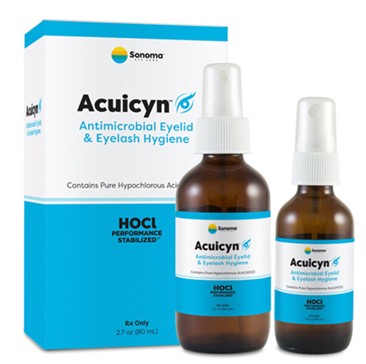 |
Acuiycn Eyelid and Eyelash Hygiene is a prescription HOCl-based solution that removes encrustation and debris, to help manage red, itchy, crusty, inflamed eyes and symptoms of chronic eye conditions such as dry eye, contact lens intolerance, blepharitis and meibomian gland dysfunction. |
 |
Ocucyn Eyelid and Eyelash Cleanser is an OTC eye care product sold directly in the United States that provides everyday relief for red, itchy, irritated and swollen eyelids. |
Internationally, we offer OcudoxTM for eye care, SinudoxTM for nasal irrigation, and Microdacyn60® Oral Care to support the treatment of mouth and throat infections and the debridement and moistening of mouth lesions and thrush.
| 9 |
Animal Health Care
In the United States and internationally, our HOCl-based MicrocynAH line offers topical solutions designed to relieve the common symptoms of hot spots, scratches, skin rashes, post-surgical sites and irritated animal skin and promote expedited healing for all animals.
Our MicrocynVS line is veterinarian-strength animal care for use in vet clinics and animal hospitals.

Surface Disinfectants
Through our partner MicroSafe DMCC, Dubai, we sell Nanocyn®. Nanocyn is a hospital-grade disinfectant indicated to sterilize hard surfaces by spraying directly onto the surface, for medical devices by submerging the device in Nanocyn, and also for fumigation into the air.
When fumigated, Nanocyn has demonstrated the ability to kill a wide range of airborne pathogens and significantly reduce the spread of infectious disease.

| 10 |
Research and Development
Research and development expenses consist primarily of expenses for clinical studies, personnel, regulatory services and supplies. For the years ended March 31, 2025 and 2024, research and development expense amounted to $1,814,000 and $1,871,000, respectively. A small percentage of these expenses were borne by our customers.
We manufacture all of our products at our facility in Zapopan, Mexico. We have developed a manufacturing process and conduct quality assurance testing on each production batch in accordance with current U.S., Mexican and international Current Good Manufacturing Practices. Our facility is required to meet and maintain regulatory standards applicable to the manufacture of pharmaceutical and medical device products and is certified and complies with U.S. Current Good Manufacturing Practices, Quality Systems Regulations for medical devices, and International Organization for Standardization, or ISO, guidelines. Our facility has been approved by the Ministry of Health and is also ISO 13485 certified.
Our machines are tested regularly, which is part of a validation protocol mandated by U.S., Mexican and international Current Good Manufacturing Practices, Quality Systems Regulation, and ISO requirements. This validation is designed to ensure that the final product is consistently manufactured in accordance with product specifications at all manufacturing sites. Certain materials and components used in manufacturing are proprietary to Sonoma. All other raw materials and supplies utilized in the manufacturing process of our products are available from various third-party suppliers in quantities adequate to meet our needs.
We believe we own or have access to sufficient factory space and equipment to produce an adequate amount of product to meet anticipated future requirements for at least the next two years. With expansion into new geographic markets, we may establish additional manufacturing facilities to better serve those new markets.
Regulatory Approvals and Clearances
To date, in the United States we have obtained 22 U.S. Food and Drug Administration, or FDA, clearances permitting the sale of products as medical devices for Section 510(k) of the Federal Food, Drug and Cosmetic Act.
Outside the United States, we sell products for dermatological and advanced tissue care with a European Conformity marking, Conformité Européenne, or CE. On January 29, 2025, we received an updated CE certificate under the new EU Medical Devices Regulation covering all of our commercialized products in Europe.
The following table summarizes our current material regulatory approvals and clearances by brand.
| Brand | Approval Type | Summary Indication | ||
| HOCl-based Products: | ||||
|
Microcyn Wound Care Management Acuicyn Antimicrobial Eyelid & Eyelash Hygiene Epicyn Antimicrobial Facial Cleanser |
U.S. 510(k) | Under the supervision of a healthcare professional, intended for the cleansing, irrigation, moistening, debridement and removal of foreign material and debris from exudating wounds, acute and chronic dermal lesions including stage I-IV pressure ulcers, stasis ulcers, diabetic ulcers, post-surgical wounds, first-and-second-degree burns, abrasions, minor irritations of the skin, diabetic foot ulcers, ingrown toe nails, grafted/donor sites and exit sites. It is also intended for use to moisten and lubricate wound dressings and for use with devices intended to irrigate wounds. | ||
| 11 |
|
Microcyn OTC Advanced Wound & Skin Cleanser Ocucyn Eyelid & Eyelash Cleanser Lumacyn Clarifying Mist Podiacyn Advanced Everyday Foot Care
|
U.S. 510(k) | Intended for OTC use in the management of skin abrasions, lacerations, minor irritations, cuts and intact skin. | ||
|
Levicyn Gel Lasercyn Post Procedure Gel |
U.S. 510(k) |
Prescription and OTC product intended for the management of post non ablative laser therapy procedures, post microdermabrasion therapy and following superficial chemical peels. May also be used to relieve itch and pain from minor skin irritations, lacerations, abrasions and minor burns. | ||
|
Celacyn Scar Management Gel Regenacyn Plus Scar Gel Regenacyn Advanced Scar Gel
|
U.S. 510(k) | Prescription and OTC product intended for the management of old and new hypertrophic and keloid scarring resulting from burns, general surgical procedures and trauma wounds. | ||
| Levicyn SG | U.S. 510(k) |
Under the supervision of a healthcare professional, intended to manage and relieve the burning, itching and pain experienced with various types of dermatoses, including radiation dermatitis and atopic dermatitis. May be also used to relieve the pain of first and second degree burns. Helps to relieve dry waxy skin by maintaining a moist wound and skin environment, which is beneficial to the healing process. | ||
|
Rejuvacyn Plus Skin Repair Cooling Mist Rejuvacyn Advanced Skin Repair Cooling Mist Lasercyn Gel |
U.S. 510(k) | Prescription and OTC product for the management of post non ablative laser therapy procedures, post microdermabrasion therapy and following superficial chemical peels. May also be used to relieve itch and pain from minor skin irritations, lacerations, abrasions and minor burns. intended for the management of minor skin irritations following post non ablative laser therapy procedures, post microdermabrasion therapy and following superficial chemical peels, and to relieve itch and pain from minor skin irritations, lacerations, abrasions and minor burns. | ||
|
Reliefacyn Plus Itch-Burn-Rash-Pain Relief Hydrogel Levicyn Dermal Spray |
U.S. 510(k) | Under the supervision of a healthcare professional, indicated to manage and relieve the burning, itching and pain experienced with various types of dermatoses, including radiation dermatitis and atopic dermatitis. May be also used to relieve the pain of first and second degree burns. Helps to relieve dry waxy skin by maintaining a moist wound and skin environment, which is beneficial to the healing process. | ||
|
Reliefacyn Advanced Itch-Burn-Rash-Pain Relief Hydrogel Lasercyn Dermal Spray |
U.S. 510(k) | Intended for OTC use to relieve the burning and itching associated with many common types of skin irritations, lacerations, abrasions and minor burns. Also indicated for the management of irritation and pain from minor burns, including sunburn. | ||
| 12 |
| Endocyn Root Canal Irrigation Solution | U.S. 510(k) | Under the supervision of a healthcare professional intended to irrigate, cleanse, and debride root canal systems including the removal of foreign material and debris during root canal therapy. It is also intended to provide for lubrication and irrigation during root canal instrumentation. | ||
| Microdacyn60 Wound Care | EU CE Mark | Indicated for use in surgical wounds (intraoperative and postoperative), acute and chronic wounds, ulcers, cuts, abrasions, and burns. Microdacyn60® Wound Care can be broadly applied within a comprehensive wound treatment. | ||
| Microdacyn60 Hydrogel | EU CE Mark | indicated for use in acute and chronic wounds, ulcers, cuts, abrasions and burns. Can be broadly applied within a comprehensive wound treatment. | ||
| Epicyn Scar Management Hydrogel | EU CE Mark | Indicated as an adjuvant in the wound healing process with wounds that can only heal by secondary intention in maturation phase. Effective for the management and reduction of new and existing hypertrophic and keloid scars. | ||
| Pediacyn Atopic Dermatitis Hydrogel | EU CE Mark | Indicated as an adjuvant in the healing process of wounds that can only heal by secondary intention in the maturation phase. Indicated for the care of lesions associated with atopic dermatitis. | ||
| GramaDerm Solution | EU CE Mark | Indicated as an adjunct in the topical treatment of mild to moderate acne. | ||
| GramaDerm Hydrogel | EU CE Mark | Indicated as an adjunct in the topical treatment of mild to moderate acne. | ||
| Ocudox | EU CE Mark | Indicated to aid in the treatment and symptoms of blepharitis on the eyelid. Can be used to clean minor cuts and burns of the periocular skin. |
Significant Customers
We rely on certain key customers for a significant portion of revenues. At March 31, 2025, customer D represented 24% of our net accounts receivable balance. At March 31, 2024, customer B represented 13% of our net accounts receivable balance and customer D represented 17% of our net accounts receivable balance. For the year ended March 31, 2025, customer B represented 21% and customer C represented 18% of net revenues. For the year ended March 31, 2024, customer A represented 17%, customer B represented 15% and customer C represented 14% of net revenues.
| 13 |
Intellectual Property
Our success depends in part on an ability to obtain and maintain proprietary protection for product technology and know-how, to operate without infringing proprietary rights of others, and to prevent others from infringing on our proprietary rights. We seek to protect a proprietary position by, among other methods, filing, when possible, U.S. and foreign patent applications relating to our technology, inventions and improvements that are important to the business. We have patented certain aspects of our HOCl technology in the United States and worldwide. We also rely on trade secrets, know-how, continuing technological innovation, and in-licensing opportunities to develop and maintain a proprietary position.
Although we work diligently to protect proprietary technology, there are no assurances that any patent will be issued from currently pending patent applications or from future patent applications. The scope of any patent protection may not exclude competitors or provide competitive advantages, and any patent may not be held valid if subsequently challenged, and others may claim rights in or ownership of patents and proprietary rights. Furthermore, others may develop products similar to ours and may duplicate any of the products or design around patents.
We have also filed for trademark protection for marks used with products in each of the following regions: United States, Europe, Canada, Brazil, certain countries in the Middle East and certain countries in Asia, including Japan, China, Hong Kong, the Republic of Korea, India and Australia. In addition to patents and trademarks, we rely on trade secret and other intellectual property laws, nondisclosure agreements and other measures to protect intellectual property rights. We believe that in order to have a competitive advantage, we must develop and maintain the proprietary aspects of technologies. Employees, consultants and advisors are required to execute confidentiality agreements in connection with their employment, consulting or advisory relationships. Employees, consultants and advisors with whom we expect to work with are also required to disclose and assign to us all inventions made in the course of a working relationship with them, while using intellectual property or which relate to our business. Despite any measures taken to protect our intellectual property, unauthorized parties may attempt to copy aspects of the products or to wrongfully obtain or use information that is regarded as proprietary.
Competition
We compete globally across six main channels: dermatology, eye, nasal and oral care, wound and acute care, podiatry, animal health care and surface disinfectants with our HOCl technology.
Dermatology
Our dermatology products are at the forefront of HOCl-based solutions, a safe and highly effective active ingredient designed to relieve itching and burning and act as a highly effective antimicrobial agent. We believe no other solutions on the market provide the same patient benefits at the levels of safety and cost. Our HOCl-based solutions face significant competition in the United States from prescription products including corticosteroids, topical steroids and topical antibiotics. Our opportunity as an adjunct to these steroids is based on the insight that many doctors and patients limit steroid and antibiotic use due to potential side effects. These side effects include bacterial resistance, stinging, burning and inflammation for topical antibiotics and stretch marks, easy bruising, tearing of the skin and, to a lesser extent, enlarged blood vessels for topical steroids. Our HOCl-based products are safe, non-toxic and have shown few side effects in clinical studies.
Wound and Acute Care Markets
Similar to our dermatology products, our HOCl-based wound and acute care solutions provide improved efficacy at lower costs than traditional acute care products. Our HOCl-based solutions compete with topical anti-infectives and antibiotics, as well as some advanced wound technologies, such as skin substitutes, growth factors and delayed release silver-based dressings. Our opportunity in this space relative to antibiotics is based on the insight that competing antibiotic solutions may have resistance-building properties.
| 14 |
Factors Affecting Competitive Position
While some other companies are able to produce small molecule, HOCl-based formulations, based on our research, their products may become unstable after a relatively short period of time or have large ranges of effectiveness. We believe our HOCl-based solutions are among the most stable therapeutics available.
Some of our competitors in the dermatology, wound care, eye, nasal and oral care, podiatry, animal health care and surface disinfectant markets enjoy several competitive advantages. These include:
| · | greater name recognition; | |
| · | established relationships with healthcare professionals, patients and third-party payors; | |
| · | established distribution networks; | |
| · | additional product lines and the ability to offer rebates or bundle products to offer discounts or incentives; | |
| · | experience in conducting research and development, manufacturing, obtaining regulatory approval for products and marketing; and | |
| · | financial and human resources for product development, sales and marketing and patient support. |
Government Regulation
Government authorities in the United States, at the federal, state and local levels, and foreign countries extensively regulate, among other things, the research, development, testing, manufacture, labeling, promotion, advertising, distribution, sampling, marketing, and import and export of pharmaceutical products, biologics and medical devices. All of our products in development will require regulatory approval or clearance by government agencies prior to commercialization. In particular, human therapeutic products are subject to rigorous pre-clinical and clinical trials and other approval procedures of the FDA and similar regulatory authorities in foreign countries. Various federal, state, local and foreign statutes and regulations also govern testing, manufacturing, safety, labeling, storage, distribution and record-keeping related to such products and their marketing. The process of obtaining these approvals and clearances, and the subsequent process of maintaining substantial compliance with appropriate federal, state, local, and foreign statutes and regulations, require the expenditure of substantial time and financial resources. In addition, statutes, rules, regulations and policies may change and new legislation or regulations may be issued that could delay such approvals.
Medical Device Regulation
To date, we have received 22 510(k) clearances for use of products as medical devices in tissue care management, such as cleaning, debridement, lubricating, moistening and dressing, including for acute and chronic wounds, and in dermatology applications. Any future product candidates or new applications classified as medical devices will require clearance by the FDA.
Medical devices are subject to FDA clearance and extensive regulation under the Federal Food Drug and Cosmetic Act. Under the Federal Food Drug and Cosmetic Act, medical devices are classified into one of three classes: Class I, Class II or Class III. The classification of a device into one of these three classes generally depends on the degree of risk associated with the medical device and the extent of control needed to ensure safety and effectiveness. Devices may also be designated unclassified. Unclassified devices are legally marketed pre-amendment devices for which a classification regulation has yet to be finalized and for which a pre-market approval is not required.
Class I devices are devices for which safety and effectiveness can be assured by adherence to a set of general controls. These general controls include compliance with the applicable portions of the FDA’s Quality System Regulation, which sets forth good manufacturing practice requirements; facility registration, device listing and product reporting of adverse medical events; truthful and non-misleading labeling; and promotion of the device only for its cleared or approved intended uses. Class II devices are also subject to these general controls, and any other special controls as deemed necessary by the FDA to ensure the safety and effectiveness of the device. Review and clearance by the FDA for these devices is typically accomplished through the 510(k) pre-market notification procedure. When 510(k) clearance is sought, a sponsor must submit a pre-market notification demonstrating that the proposed device is substantially equivalent to a legally marketed device. If the FDA agrees that the proposed device is substantially equivalent to the predicate device, then 510(k) clearance to market will be granted. After a device receives 510(k) clearance, any modification that could significantly affect its safety or effectiveness, or that would constitute a major change in its intended use, requires a new 510(k) clearance or could require a pre-market approval.
| 15 |
Clinical trials are almost always required to support a pre-market approval application and are sometimes required for a 510(k) pre-market notification. These trials generally require submission of an application for an investigational device exemption. An investigational device exemption must be supported by pre-clinical data, such as animal and laboratory testing results, which show that the device is safe to test in humans and that the study protocols are scientifically sound. The FDA must approve an investigational device exemption, in advance, for a specified number of patients, unless the product is deemed a non-significant risk device and is eligible for more abbreviated investigational device exemption requirements.
Both before and after a medical device is commercially distributed, manufacturers and marketers of the device have ongoing responsibilities under FDA regulations. The FDA reviews design and manufacturing practices, labeling and record keeping, and manufacturers’ required reports of adverse experiences and other information to identify potential problems with marketed medical devices. Device manufacturers are subject to periodic and unannounced inspection by the FDA for compliance with the Quality System Regulation, which sets forth the Current Good Manufacturing Practice requirements that govern the methods used in, and the facilities and controls used for the design, manufacture, packaging, servicing, labeling, storage, installation and distribution of all finished medical devices intended for human use.
On November 30, 2023, the FDA issued a proposed rule to classify certain wound dressings and liquid wound washes containing antimicrobials with a low level of antimicrobial resistance concern, including hypochlorous acid, into Class II medical devices. If finalized as proposed, we would be required to submit new 510(k) applications for our products and to demonstrate compliance with special controls that require specific information relating to performance testing and technical specifications, specific labeling requirements, and other requirements to mitigate the risks to health and demonstrate a reasonable assurance of safety and effectiveness. Our existing devices could serve as predicates for the new devices. The FDA is proposing that manufacturers will need to demonstrate compliance with applicable special controls within six months after the effective date of the rule, when finalized.
FDA regulations prohibit the advertising and promotion of a medical device for any use outside the scope of a 510(k) clearance or pre-market approval or for unsupported safety or effectiveness claims. Although the FDA does not regulate physicians’ practice of medicine, the FDA does regulate manufacturer communications with respect to off-label use.
If the FDA finds that a manufacturer has failed to comply with FDA laws and regulations or that a medical device is ineffective or poses an unreasonable health risk, it can institute or seek a wide variety of enforcement actions and remedies, ranging from a public warning letter to more severe actions such as:
| · | imposing fines, injunctions and civil penalties | |
| · | requiring a recall or seizure of products | |
| · | implementing operating restrictions, which can include a partial suspension or total shutdown of production | |
| · | refusing requests for 510(k) clearance or pre-market approval of new products | |
| · | withdrawing 510(k) clearance or pre-market approvals already granted | |
| · | criminal prosecution |
The FDA also has the authority to require a company to repair, replace, or refund the cost of any medical device.
The FDA also administers certain controls over the export of medical devices from the United States, as international sales of medical devices that have not received FDA clearance are subject to FDA export requirements. Additionally, each foreign country subjects such medical devices to its own regulatory requirements. In the European Union, there is a single regulatory approval process and approval is represented by the presence of a CE marking.
| 16 |
Other Regulation in the United States
The Physician Payments Sunshine Act
The Physician Payments Sunshine Act signed into law in 2010 as part of the Affordable Care Act requires manufacturers of medical devices, drugs, biologicals, and medical supplies for which payment is available under Medicare or Medicaid to track and report certain payments made to and transfers of value provided to physicians and teaching hospitals as well as to report certain ownership and investment interests held by physicians and their immediate family members. These manufacturers must report annually to the Center for Medicare & Medicaid Services any direct or indirect payments and transfers of value of $13.46 or more, or annual aggregate of $134.54 or more in calendar year 2025, made to physicians or to a third party at the request of or on behalf of a physician, including dentists. Payment includes: consulting fees, compensation for services other than consulting, honoraria, gifts, entertainment, food, travel (including the specified destinations), education, research, charitable contribution, royalty or license, current or prospective ownership or investment interest, direct compensation for serving as faculty or as a speaker for a medical education program, grants, any other nature of the payment, or other transfer of value. Manufacturers face monetary penalties for non-compliance. Certain payments related to research must be reported separately. Product samples intended for patient use need not be reported.
Health Care Coverage and Reimbursement by Third-Party Payors
Commercial success in marketing and selling products depends, in part, on the availability of adequate coverage and reimbursement from third-party health care payors, such as government and private health insurers and managed care organizations. Third-party payors are increasingly challenging the pricing of medical products and services. Government and private sector initiatives to limit the growth of health care costs, including price regulation, competitive pricing, and managed-care arrangements, are continuing in many countries where we do business, including the United States. These changes are causing the marketplace to be more cost-conscious and focused on the delivery of more cost-effective medical products. Government programs, including Medicare and Medicaid, private health care insurance companies, and managed-care plans control costs by limiting coverage and the amount of reimbursement for particular procedures or treatments. This has created an increasing level of price sensitivity among customers for our products. Some third-party payors also require that a favorable coverage determination be made for new or innovative medical devices or therapies before they will provide reimbursement of those medical devices or therapies. Even though a new medical product may have been cleared or approved for commercial distribution, we may find limited demand for the product until adequate coverage and reimbursement have been obtained from governmental and other third-party payors.
Fraud and Abuse Laws
In the United States, we are subject to various federal and state laws pertaining to healthcare fraud and abuse, which, among other things, prohibit the offer or acceptance of remuneration intended to induce or in exchange for the purchase of products or services reimbursed under a federal healthcare program and the submission of false or fraudulent claims with the government. These laws include the federal Anti-Kickback Statute, the False Claims Act and comparable state laws. These laws regulate the activities of entities involved in the healthcare industry, such as Sonoma, by limiting the kinds of financial arrangements such entities may have with healthcare providers who use or recommend the use of medical products, including, for example, sales and marketing programs, advisory boards and research and educational grants. In addition, in order to ensure that healthcare entities comply with healthcare laws, the Office of Inspector General of the U.S. Department of Health and Human Services recommends that healthcare entities institute effective compliance programs. To assist in the development of effective compliance programs, the Office of Inspector General has issued model Compliance Program Guidance, materials for a variety of healthcare entities which, among other things, identify practices to avoid that may implicate the federal Anti-Kickback Statute and other relevant laws and describes elements of an effective compliance program. While compliance with the Compliance Program Guidance materials is voluntary, a California law requires pharmaceutical and devices manufacturers to initiate compliance programs that incorporate the Compliance Program Guidance and the July 2002 Pharmaceuticals Research and Manufacturers of America Code on Interactions with Healthcare Professionals.
| 17 |
Due to the scope and breadth of the provisions of some of these laws, it is possible that some of our practices might be challenged by the government under one or more of these laws in the future. Violations of these laws, which are discussed more fully below, can lead to civil and criminal penalties, damages, imprisonment, fines, exclusion from participation in Medicare, Medicaid and other federal health care programs, and the curtailment or restructuring of operations. Any such violations could have a material adverse effect on our business, financial condition, results of operations or cash flows.
Anti-Kickback Laws
Our operations are subject to federal and state anti-kickback laws. The federal Anti-Kickback Statute prohibits persons from knowingly and willfully soliciting, receiving, offering or providing remuneration directly or indirectly to induce either the referral of an individual for a good or service reimbursed under a federal healthcare program, or the furnishing, recommending, or arranging of a good or service, for which payment may be made under a federal healthcare program, such as Medicare or Medicaid. The definition of “remuneration” has been broadly interpreted to include anything of value, including such items as gifts, discounts, the furnishing of supplies or equipment, waiver of co-payments, and providing anything at less than its fair market value. Because the Anti-Kickback Statute makes illegal a wide variety of common, even beneficial, business arrangements, the Office of Inspector General was tasked with issuing regulations, commonly known as “safe harbors,” that describe arrangements where the risk of illegal remuneration is minimal. As long as all of the requirements of a particular safe harbor are strictly met, the entity engaging in that activity will not be prosecuted under the federal Anti-Kickback Statute. The failure of a transaction or arrangement to fit precisely within one or more safe harbors does not necessarily mean that it is illegal or that prosecution will be pursued. However, business arrangements that do not fully satisfy an applicable safe harbor may result in increased scrutiny by government enforcement authorities, such as the Office of Inspector General. Our agreements to pay compensation to our advisory board members and physicians who provide other services for us may be subject to challenge to the extent they do not fall within relevant safe harbors under state and federal anti-kickback laws. In addition, many states have adopted laws similar to the federal Anti-Kickback Statute, which apply to the referral of patients for health care services reimbursed by Medicaid, and some have adopted such laws with respect to private insurance. Violations of the Anti-Kickback Statute are subject to significant fines and penalties and may lead to a company being excluded from participating in federal health care programs.
False Claims Laws
The federal False Claims Act prohibits knowingly filing a false claim, knowingly causing the filing of a false claim, or knowingly using false statements to obtain payment from the federal government. Certain violations of the Anti-Kickback Statute constitute per se violations of the False Claims Act. Under the False Claims Act, such suits are known as “qui tam” actions. Individuals may file suit on behalf of the government and share in any amounts received by the government pursuant to a settlement. In addition, certain states have enacted laws modeled after the federal False Claims Act under the Deficit Reduction Act of 2005, where the federal government created financial incentives for states to enact false claims laws consistent with the federal False Claims Act. As more states enact such laws, we expect the number of qui tam lawsuits to increase. Qui tam actions have increased significantly in recent years, causing greater numbers of healthcare companies to have to defend false claims actions, pay fines or be excluded from Medicare, Medicaid or other federal or state government healthcare programs as a result of investigations arising out of such actions.
HIPAA
Two federal crimes were created under the Health Insurance Portability and Accountability Act of 1996, or HIPAA: healthcare fraud and false statements relating to healthcare matters. The healthcare fraud statute prohibits knowingly and willfully executing a scheme to defraud any healthcare benefit program, including private payors. The false statements statute prohibits knowingly and willfully falsifying, concealing or covering up a material fact or making any materially false, fictitious or fraudulent statement in connection with the delivery of or payment for healthcare benefits, items or services.
| 18 |
Health Information Privacy and Security
Individually identifiable health information is subject to an array of federal and state regulation. Federal rules promulgated pursuant to HIPAA regulate the use and disclosure of health information by “covered entities.” Covered entities include individual and institutional health care providers from which we may receive individually identifiable health information. These regulations govern, among other things, the use and disclosure of health information for research purposes, and require the covered entity to obtain the written authorization of the individual before using or disclosing health information for research. Failure of the covered entity to obtain such authorization could subject the covered entity to civil and criminal penalties. We may experience delays and complex negotiations in dealing with each entity’s differing interpretation of the regulations and what is required for compliance. Also, where our customers or contractors are covered entities, including hospitals, universities, physicians or clinics, we may be required by the HIPAA regulations to enter into “business associate” agreements that subject the company to certain privacy and security requirements. In addition, many states have laws that apply to the use and disclosure of health information, and these laws could also affect the manner in which we conduct research and other aspects of business. Such state laws are not preempted by the federal privacy law when such laws afford greater privacy protection to the individual than the federal law. While activities to assure compliance with health information privacy laws are a routine business practice, we are unable to predict the extent to which resources may be diverted in the event of an investigation or enforcement action with respect to such laws.
Foreign Regulation
Whether or not we obtain FDA approval for a product, approval of a product by the applicable regulatory authorities of foreign countries must be obtained before clinical trials or marketing of the product in those countries can begin. The approval process varies from country to country, and the time may be longer or shorter than that required for FDA approval. The requirements governing the conduct of clinical trials, product licensing, pricing and reimbursement also vary greatly from country to country. Although governed by the applicable country, clinical trials conducted outside of the United States typically are administered under a three-phase sequential process similar to that discussed above for medical devices.
European Union Regulation
Medical Device Regulation
Our products are classified as medical devices in the European Union. In order to sell medical device products within the European Union, we are required to comply with the requirements of the Medical Devices Regulation, and its national implementations, including affixing CE markings on products. The CE marking indicates a product’s compliance with EU legislation and so enables the sale of products throughout the European Economic Area, or the EEA, comprising the 28 Member States of the EU and European Free Trade Association, or EFTA, countries Iceland, Norway, and Liechtenstein. In order to comply with the Medical Devices Regulation, we must meet certain requirements relating to the safety and performance of products and, prior to marketing products, we must successfully undergo verification of products’ regulatory compliance, or conformity assessment.
The Medical Devices Regulation was adopted in the EU on May 26, 2017 to replace the existing Medical Device Directive, and became applicable on May 26, 2021, with a transition period until May 26, 2024, which was been extended to December 31, 2028 for non-implantable Class IIb and lower risk devices. Under the new Medical Devices Regulation, certain devices are classified in higher classes, new devices are classified, and certain new obligations are imposed on manufacturers and distributors. Manufacturers are required to engage a medical device expert and carry insurance for possible liability claims. In addition, the pre-market approval and post-market surveillance requirements are enhanced. The European Database for Medical Devices, or Eudamed, will hold and publish information on medical devices collected from the European Commission and the national authorities.
| 19 |
We successfully transitioned all of our commercialized products in Europe to the Medical Devices Regulation and received an updated CE certificate for Class IIb wound care solution, wound care hydrogel and dermatological hydrogel and Class IIa dermatological solution, dermatological hydrogel and eyelid solution, which allows us to continue to affix CE markings on our products and sell them as medical devices in Europe. We may not be able to maintain the requirements established for CE markings for any or all of our products or be able to produce these products in a timely and profitable manner while complying with the requirements of the Medical Devices Regulation and other regulatory requirements. We are subject to continued supervision and are required to report any serious adverse incidents to the appropriate authorities. We are also required to comply with additional national requirements that are beyond the scope of the Medical Devices Regulation.
European Good Manufacturing Process
In the European Union, the manufacture of pharmaceutical products and clinical trial supplies is subject to good manufacturing practice as set forth in the relevant laws and guidelines. Compliance with good manufacturing practice is generally assessed by the competent regulatory authorities. They may conduct inspections of relevant facilities, and review manufacturing procedures, operating systems and personnel qualifications. In addition to obtaining approval for each product, in many cases each drug manufacturing facility must be approved. Further inspections may occur over the life of the product.
Mexican Regulation
The Ministry of Health is the authority in charge of sanitary controls in Mexico. Sanitary controls are a group of practices related to the orientation, education, testing, verification and application of security measures and sanctions exercised by the Ministry of Health. The Ministry of Health is responsible for the issuance of Official Mexican Standards and specifications for drugs subject to the provisions of the General Health Law, which govern the process and specifications of drugs, including the obtaining, preparing, manufacturing, maintaining, mixing, conditioning, packaging, handling, transporting, distributing, storing and supplying of products to the public at large. In addition, a medical device is defined as a device that may contain antiseptics or germicides used in surgical practice or in the treatment of continuity solutions, skin injuries or its attachments.
Under the General Health Law, a business that manufactures drugs is either required to obtain a “Sanitary Authorization” or to file an “Operating Notice.” Our Mexican subsidiary, Oculus Technologies of Mexico, S.A. de C.V., is considered a business that manufactures medical devices and therefore is not subject to a Sanitary Authorization, but rather only required to file an Operating Notice.
In addition to its Operating Notice, our Mexico subsidiary has obtained a “Good Processing Practices Certificate” issued by Mexican Federal Commission for the Protection against Sanitary Risks, which demonstrates that the manufacturing at our facility located in Zapopan, Mexico, operates in accordance with the applicable official standards.
In addition, regulatory approval of prices is required in most countries other than the United States, which could result in lengthy negotiations delaying our ability to commercialize products. We face the risk that the prices which result from the regulatory approval process would be insufficient to generate an acceptable return.
Available Information
We make available on sonomapharma.com, free of charge, copies of our annual reports on Form 10-K, quarterly reports on Form 10-Q, current reports on Form 8-K and amendments to these reports, as soon as reasonably practicable after electronically filing or furnishing such materials to the Securities and Exchange Commission, or SEC. Sonomapharma.com and the information contained therein or connected thereto are not intended to be incorporated into this annual report on Form 10-K. The SEC maintains an Internet site that contains reports, proxy and information statements, and other information regarding issuers that file electronically with the SEC at www.sec.gov.
| 20 |
ITEM 1A. Risk Factors
Risks Related to Our Business
We have a history of losses, we expect to continue to incur losses and we may never achieve profitability, and our March 31, 2025 audited consolidated financial statements included disclosure that casts substantial doubt regarding our ability to continue as a going concern.
We reported a net loss of $3,457,000 and $4,835,000 for the years ended March 31, 2025 and 2024, respectively. At March 31, 2025 and 2024, our accumulated deficit amounted to $197,806,000 and $194,349,000, respectively. We had working capital of $8,552,000 and $8,829,000 as of March 31, 2025 and 2024, respectively. During the years ended March 31, 2025 and 2024, net cash used in operating activities amounted to $88,000 and $2,398,000, respectively. As of March 31, 2025, we had cash and cash equivalents of $5,374,000.
We spent the most recent years working to reduce our losses and have made significant progress. However, we expect to continue incurring losses for the foreseeable future. We may never achieve or sustain profitability. We must raise additional capital to pursue our product development initiatives, penetrate markets for the sale of our products and continue as a going concern. We cannot provide any assurance that we will raise additional capital. We believe that we have access to capital resources through possible public or private equity offerings, debt financings, corporate collaborations, or other means. If we are unable to secure additional capital, we may be required to curtail our research and development initiatives and take additional measures to reduce costs in order to conserve our cash in amounts sufficient to sustain operations and meet our obligations. These measures could cause significant delays in our efforts to further commercialize our products, which are critical to the realization of our business plan and to our future operations. These matters raise substantial doubt about our ability to continue as a going concern or become profitable.
We depend on third party distributors and intend to continue to license or collaborate with third parties in various potential markets, and events involving these strategic partners or any future collaboration could delay or prevent us from developing or commercializing products.
Our business strategy and our short- and long-term operating results depend in part on our ability to execute on existing strategic collaborations and to license or partner with new strategic partners. We believe collaborations allow us to leverage our resources and technologies and to access markets that are compatible with our own core areas of expertise while avoiding the cost of establishing or maintaining a direct sales force in each market. We may incur significant costs in the use of third parties and other resources to identify and assist in establishing relationships with potential collaborators. We currently use distributors for most of our products.
We have limited control over the amount and timing of resources that our current partners or any future collaborators devote to our collaborations or potential products. These partners may breach or terminate their agreements with us or otherwise fail to conduct their collaborative activities successfully and in a timely manner. Further, our partners may not develop or commercialize products that arise out of our collaborative arrangements or devote sufficient resources to the development, manufacture, marketing or sale of these products.
To penetrate our target markets, we may need to enter into additional collaborative agreements to assist in the development and commercialization of products. Establishing strategic collaborations is difficult and time-consuming. Potential collaborators may reject collaborations based upon their assessment of our financial, regulatory or intellectual property position and our internal capabilities. Our discussions with potential collaborators may not lead to the establishment of new collaborations on favorable terms and may have the potential to provide collaborators with access to our key intellectual property filings and next generation formations. By entering into collaboration, we may preclude opportunities to collaborate with other third parties who do not wish to associate with our existing third-party strategic partners. Moreover, in the event of termination of a collaboration agreement, termination negotiations may result in less favorable terms.
| 21 |
Mexican tax law prevents us from deducting intercompany interest expense incurred by our Mexico subsidiary Oculus Technologies of Mexico, S.A. de C.V and requires withholding tax on payments remitted to the US. At the same time, we are unable to recognize tax benefits for foreign tax credits for U.S. tax purposes.
Since 2004, we loaned substantial amounts to our Mexico subsidiary Oculus Technologies of Mexico, S.A. de C.V. at various interest rates to fund their operations. As of March 31, 2025, our Mexico subsidiary owes approximately $10.9 million in principal, $8.6 million in technical assistance payments and $26.4 million in accrued interest. The intercompany loans mature in 2027. There is no guarantee that our Mexican subsidiary will be able to pay any or all of the amounts due. If we were to forgive the debt or if we were to convert the debt to equity, it would be subject to Mexico income tax at 30%, or approximately $13.8 million, as well as Mexican withholding tax of 15%.
Mexico’s thin capitalization rules also require taxpayers to maintain a debt-to-equity ratio of 3:1. Any interest paid to foreign related parties that results in indebtedness exceeding a ratio of 3:1 to their stockholder’s equity is not deductible for Mexican corporate income tax purposes and we did not meet that condition. Therefore, we have not been able to deduct the intercompany interest on our Mexico tax returns since 2004. It has prevented our Mexico subsidiary from accruing net operating losses in Mexico to offset potential future profits. At the same time the intercompany interest income in the United States decreases our U.S. net operating losses and reduces our ability to apply these carryforwards to offset future taxable income in the United States.
In addition, any interest paid to a foreign lender is subject to Mexico withholding tax of 15%. We also have interest owed on our intercompany technical assistance agreement and royalty withholding of 10% on our technical assistance agreement. This would amount to approximately $5.1 million in Mexico withholding tax at March 31, 2025, if all of the interest and technical assistance were to be repaid to us. In general, the foreign related party parent can then claim a credit for these withholding taxes on their U.S. income tax return. However, because of our substantial U.S. net operating losses, we are prevented from claiming any credit on any withholding tax for U.S. income tax purposes. Any such failure to pay intercompany debt, inability to deduct income taxes or apply credits, or liability for tax payments could have a material adverse effect on our business, financial condition, and results of operations.
We rely on a number of key customers who may not consistently purchase our products in the future, and if we lose any one of these customers, our revenues may decline.
Although we have a significant number of customers in each of the geographic markets that we operate in, we rely on certain key customers for a significant portion of our revenues. For the year ended March 31, 2025, customer B represented 21% and customer C represented 18% of net revenues. For the year ended March 31, 2024, customer A represented 17%, customer B represented 15% and customer C represented 14% of net revenues. In the future, a small number of customers may continue to represent a significant portion of our total revenues in any given period. These customers may not consistently purchase our products at a particular rate over any subsequent period. The loss of any of these customers could adversely affect our revenues.
| 22 |
A majority of our business is conducted outside of the United States, exposing us to additional risks that may not exist in the United States, which in turn could cause our business and operating results to suffer.
We have material international operations in Mexico, Asia and Europe. During the years ended March 31, 2025 and 2024, approximately 82% and 76% of our total revenue, respectively, were generated from sales outside of the United States. Our business is highly regulated for the use, marketing and manufacturing of our HOCl-based products both domestically and internationally. Our international operations are subject to risks, including:
| · | local political or economic instability; | |
| · | economic downturn or recession; | |
| · | changes in exchange rates; | |
| · | changes in governmental regulation; | |
| · | changes in import/export duties, tariffs, or trade agreements; | |
| · | trade restrictions; | |
| · | lack of experience in foreign markets; | |
| · | difficulties and costs of staffing and managing operations in certain foreign countries; | |
| · | work stoppages or other changes in labor conditions; | |
| · | difficulties in collecting accounts receivables on a timely basis, or at all; and | |
| · | adverse tax consequences or overlapping tax structures. |
We plan to continue to market and sell our products internationally to respond to customer requirements and market opportunities. We currently have manufacturing facilities in Mexico. Establishing operations in any foreign country or region presents risks such as those described above as well as risks specific to the particular country or region. In addition, until a payment history is established over time with customers in a new geographic area or region, the likelihood of collecting receivables generated by such operations could be less than our expectations. As a result, there is a greater risk that the reserves set with respect to the collection of such receivables may be inadequate. If our operations in any foreign country are unsuccessful, we could incur significant losses and we may not achieve profitability.
In addition, changes in policies or laws of the United States or foreign governments resulting in, among other things, changes in regulations and the approval process, higher taxation, currency conversion limitations, restrictions on fund transfers or the expropriation of private enterprises, could reduce the anticipated benefits of our international expansion. If we fail to realize the anticipated revenue growth of our future international operations, our business and operating results could suffer.
| 23 |
If we fail to obtain, or experience significant delays in obtaining, additional regulatory clearances or approvals to market our current or future products, we may be unable to commercialize these products.
The developing, testing, manufacturing, marketing and selling of medical technology products is subject to extensive regulation by numerous governmental authorities in the United States and other countries. The process of obtaining regulatory clearance and approval of medical technology products is costly and time consuming. Even though their underlying product formulations may be the same or similar, our products are subject to different regulations and approval processes depending upon their intended use.
The FDA generally clears marketing of a medical device through the 510(k) pre-market clearance process if it is demonstrated the new product has the same intended use and the same or similar technological characteristics as another legally marketed Class II device, such as a device already cleared by the FDA through the 510(k) premarket notification process, and otherwise meets the FDA’s requirements. Product modifications, including labeling the product for a new intended use, may require the submission of a new 510(k) clearance and FDA approval before the modified product can be marketed.
On November 30, 2023, the FDA issued a proposed rule to classify certain wound dressings and liquid wound washes, including hypochlorous acid, into Class II medical devices. If finalized, we would be required to submit new 510(k) applications for our products and to demonstrate compliance with special controls that require specific information relating to performance testing and technical specifications, specific labeling requirements, and other requirements. While we believe we will be able to demonstrate compliance with these special controls if the proposed rule is finalized, there is no guarantee that the FDA will issue new clearance letters for our products, and the process of obtaining additional clearances may be costly and time consuming.
In addition, we do not know whether the necessary approvals or clearances will be granted or delayed for future products. The FDA could request additional information, changes to product formulation(s) or clinical testing that could adversely affect the time to market and sale of products as drugs. If we do not obtain the requisite regulatory clearances and approvals, we will be unable to commercialize our products and may never recover any of the substantial costs we have invested in the development of HOCl.
Distribution of our products outside the United States is subject to extensive government regulation. These regulations, including the requirements for approvals or clearance to market, the time required for regulatory review and the sanctions imposed for violations, vary from country to country. We do not know whether we will obtain regulatory approvals in such countries or that we will not be required to incur significant costs in obtaining or maintaining these regulatory approvals. In addition, the export by us of certain of our products that have not yet been cleared for domestic commercial distribution may be subject to FDA export restrictions. Failure to obtain necessary regulatory approvals, the restriction, suspension or revocation of existing approvals or any other failure to comply with regulatory requirements would have a material adverse effect on our future business, financial condition, and results of operations.
If we fail to comply with ongoing regulatory requirements, or if we experience unanticipated problems with our products, these products could be subject to restrictions or withdrawal from the market.
Regulatory approvals or clearances that we currently have and that we may receive in the future are subject to limitations on the indicated uses for which the products may be marketed, and any future approvals could contain requirements for potentially costly post-marketing follow-up studies. If the FDA determines that our promotional materials or activities constitute promotion of an unapproved use or we otherwise fail to comply with FDA regulations, we may be subject to regulatory enforcement actions, including warning letters, injunctions, seizures, civil fines or criminal penalties. In addition, the manufacturing, labeling, packaging, adverse event reporting, storing, advertising, promoting, distributing and record-keeping for approved products are subject to extensive regulation. We are subject to continued supervision by European regulatory agencies relating to our CE markings and are required to report any serious adverse incidents to the appropriate authorities. Our manufacturing facilities, processes and specifications are subject to periodic inspection by the FDA, Mexican and other regulatory authorities and, from time to time, we may receive notices of deficiencies from these agencies as a result of such inspections. Our failure to continue to meet regulatory standards or to remedy any deficiencies could result in restrictions being imposed on our products or manufacturing processes, fines, suspension or loss of regulatory approvals or clearances, product recalls, termination of distribution, product seizures or the need to invest substantial resources to comply with various existing and new requirements. In the more egregious cases, criminal sanctions, civil penalties, disgorgement of profits or closure of our manufacturing facilities are possible. The subsequent discovery of previously unknown problems with HOCl, including adverse events of unanticipated severity or frequency, may result in restrictions on the marketing of our products, and could include voluntary or mandatory recall or withdrawal of products from the market.
| 24 |
New government regulations may be enacted and changes in FDA policies and regulations and, their interpretation and enforcement, could prevent or delay regulatory approval of our products. We cannot predict the likelihood, nature or extent of adverse government regulation that may arise from future legislation or administrative action, either in the United States or abroad. Therefore, we do not know whether we will be able to continue to comply with any regulations or that the costs of such compliance will not have a material adverse effect on our future business, financial condition, and results of operations. If we are not able to maintain regulatory compliance, we will not be permitted to market our products and our business would suffer.
If we fail to comply with ongoing regulatory requirements for our European products under the new Medical Devices Regulation, these products could be subject to withdrawal from the market.
Our products are classified as medical devices in the European Union (EU). In order to sell medical device products within the European Union, we are required to comply with the requirements of the Medical Devices Regulation, and its national implementations, including affixing CE markings on products.
The Medical Devices Regulation was adopted in the EU on May 26, 2017 to replace the existing Medical Device Directive, and became applicable on May 26, 2021, with a transition period until extended to December 31, 2028 for non-implantable Class IIb and lower risk devices. We received a CE certificate for 39 of our Class IIB medical devices under the Medical Device Directive. Under the new Medical Devices Regulation, certain devices are classified in higher classes, new devices are classified, and certain new obligations are imposed on manufacturers and distributors. In addition, the pre-market approval and post-market surveillance requirements are enhanced.
We have successfully completed transition to the new Medical Device Regulation (MDR) for all of our commercialized products in Europe, including Microdacyn60 Wound Care and Microdacyn60 Hydrogel, our scar gel product Epicyn®, and Pediacyn® for atopic dermatitis, which are each classified as Class IIb medical devices, and our eye care product Ocudox and acne products GramaDerm Solution and GramaDerm Hydrogel, which are each classified as Class IIa medical devices. Our nasal product Sinudox, Microdacyn® Oral and MucoClyns®, a disinfectant, will not be transitioned without additional studies. We currently have no commercial sales of these products and are evaluating whether to conduct the additional studies necessary to transition these products.
We can provide no assurance that we will be able to maintain the requirements established for CE markings for any or all of our products in the EU or be able to produce these products in a timely and profitable manner while complying with the requirements of the Medical Devices Regulation and other regulatory requirements. Failure to comply with these requirements could result in these products being withdrawn from the market and could have a material negative impact on our future results.
If any of our third-party contractors fail to perform their responsibilities to comply with FDA rules and regulations, the manufacture, marketing and sales of our products could be delayed, which could decrease our revenues.
Supplying the market with our HOCl technology products requires us to manage relationships with an increasing number of collaborative partners, suppliers and third-party contractors. As a result, our success depends partially on the success of these third parties in performing their responsibilities to comply with FDA rules and regulations. Although we pre-qualify our contractors and we believe that they are fully capable of performing their contractual obligations, we cannot directly control the adequacy and timeliness of the resources and expertise that they apply to these activities. For example, we and our suppliers are required to comply with the FDA’s quality system regulations, which cover the methods and documentation of the design, testing, production, control, quality assurance, labeling, packaging, storage and shipping of our products. The FDA enforces the quality system regulation through inspections.
If any of our partners or contractors fail to perform their obligations in an adequate and timely manner or fail to comply with the FDA’s rules and regulations, including failure to comply with quality systems regulations or a corrective action submitted to the FDA after notification by the FDA of a deficiency is deemed insufficient, then the manufacture, marketing and sales of our products could be delayed. Our products could be detained or seized, the FDA could order a recall, or require our partner to replace or offer refunds for our products. The FDA could also require our partner, and depending on our agreement with our partner, us, to notify healthcare professionals and others that the products present unreasonable risks of substantial harm to the public health. If any of these events occur, the manufacture, marketing and sales of our products could be delayed which could decrease our revenues.
| 25 |
If we fail to comply with the FDA’s rules and regulations and are subject to an FDA recall as part of an FDA enforcement action, the associated costs could have a material adverse effect on our business, financial position, results of operations and cash flows.
Our Company, our products, the manufacturing facilities for our products, the distribution of our products, and our promotion and marketing materials are subject to strict and continual review and periodic inspection by the FDA and other regulatory agencies for compliance with pre-approval and post-approval regulatory requirements.
If we fail to comply with the FDA’s rules and regulations, we could be subject to an enforcement action by the FDA. The FDA could undertake regulatory actions, including seeking a consent decree, recalling or seizing our products, ordering a total or partial shutdown of production, delaying future marketing clearances or approvals, and withdrawing or suspending certain of our current products from the market. A product recall, restriction, or withdrawal could result in substantial and unexpected expenditures, destruction of product inventory, and lost revenues due to the unavailability of one or more of our products for a period of time, which could reduce profitability and cash flow. In addition, a product recall or withdrawal could divert significant management attention and financial resources. If any of our products are subject to an FDA recall, we could incur significant costs and suffer economic losses. Production of our products could be suspended and we could be required to establish inventory reserves to cover estimated inventory losses for all work-in-process and finished goods related to products we, or our third-party contractors, manufacture. A recall of a material amount of our products could have a significant, unfavorable impact on our future gross margins.
If our products fail to comply with FDA and other governmental regulations, or our products are deemed defective, we may be required to recall our products and we could suffer adverse public relations that could adversely impact our sales, operating results, and reputation which would adversely affect our business operations.
We may be exposed to product recalls, including voluntary recalls or withdrawals, and adverse public relations if our products are alleged to cause injury or illness, or if we are alleged to have mislabeled or misbranded our products or otherwise violated governmental regulations. Governmental authorities can also require product recalls or impose restrictions for product design, manufacturing, labeling, clearance, or other issues. For the same reasons, we may also voluntarily elect to recall, restrict the use of a product or withdraw products that we consider below our standards, whether for quality, packaging, appearance or otherwise, in order to protect our brand reputation.
Product recalls, product liability claims, even if unmerited or unsuccessful, or any other events that cause consumers to no longer associate our brand with high quality and safe products may also result in adverse publicity, hurt the value of our brand, harm our reputation among our customers and other healthcare professionals who use or recommend the products, lead to a decline in consumer confidence in and demand for our products, and lead to increased scrutiny by federal and state regulatory agencies of our operations, any of which could have a material adverse effect on our brand, business, performance, prospects, value, results of operations and financial condition.
If our products do not gain market acceptance, our business will suffer because we might not be able to fund future operations.
A number of factors may affect the market acceptance of our products or any other products we develop or acquire, including, among others:
| · | the price of our products relative to other products for the same or similar treatments; | |
| · | the perception by patients, physicians and other members of the healthcare community of the effectiveness and safety of our products for their indicated applications and treatments; | |
| · | changes in practice guidelines and the standard of care for the targeted indication; | |
| · | our ability to fund our sales and marketing efforts; and | |
| · | the effectiveness of our sales and marketing efforts or our partners’ sales and marketing efforts. |
| 26 |
Our ability to effectively promote and sell any approved products will also depend on pricing and cost-effectiveness, including our ability to produce a product at a competitive price and our ability to obtain sufficient third-party coverage or reimbursement, if any. In addition, our efforts to educate the medical community on the benefits of our product candidates may require significant resources, may be constrained by FDA rules and policies on product promotion, and may never be successful. If our products do not gain market acceptance, we may not be able to fund future operations, including developing, testing and obtaining regulatory approval for new product candidates and expanding our sales and marketing efforts for our approved products, which would cause our business to suffer.
If our competitors develop products with similar characteristics to our HOCl technology, we may need to modify or alter our business strategy, which may delay the achievement of our goals.
Competitors have and may continue to develop products with similar characteristics to our HOCl technology. Such similar products marketed by larger competitors can hinder our or our partners’ efforts to penetrate the market. As a result, we may be forced to modify or alter our business and regulatory strategy and sales and marketing plans, as a response to changes in the market, competition and technology limitations, among others. Such modifications may pose additional delays in achieving our goals.
Negative economic conditions increase the risk that we could suffer unrecoverable losses on our customers’ accounts receivable which would adversely affect our financial results.
We grant credit to our business customers, which are primarily located in Mexico, Europe and the United States. Collateral is generally not required for trade receivables. We maintain allowances for potential credit losses. We rely on certain key customers for a significant portion of revenues. At March 31, 2025, customer D represented 24% of our net accounts receivable balance. At March 31, 2024, customer B represented 13% of our net accounts receivable balance and customer D represented 17% of our net accounts receivable balance. While we believe we have a varied customer base and have experienced strong collections in the past, if current economic conditions disproportionately impact any one of our key customers, including reductions in their purchasing commitments to us or their ability to pay their obligations, it could have a material adverse effect on our revenues and liquidity. We have not purchased insurance on our accounts receivable balances.
We may experience difficulties in manufacturing our products, which could prevent us from commercializing one or more of our products.
The machines used to manufacture our products are complex, use complicated software and must be monitored by highly trained engineers. Slight deviations anywhere in our manufacturing process, including quality control, labeling, and packaging, could lead to a failure to meet the specifications required by the FDA, the Environmental Protection Agency, European notified bodies, Mexican regulatory agencies and other foreign regulatory bodies, which may result in lot failures or product recalls. If we are unable to obtain quality internal and external components, mechanical and electrical parts, if our software contains defects or is corrupted, or if we are unable to attract and retain qualified technicians to manufacture our products, our manufacturing output of HOCl, or any other product candidate based on our platform that we may develop, could fail to meet required standards, our regulatory approvals could be delayed, denied or revoked, and commercialization of one or more of our products may be delayed or foregone. Manufacturing processes that are used to produce the smaller quantities of HOCl-based products needed for clinical tests and current commercial sales may not be successfully scaled up to allow production of significant commercial quantities. Any failure to manufacture our products to required standards on a commercial scale could result in reduced revenues, delays in generating revenue and increased costs.
| 27 |
Our competitive position depends on our ability to protect our intellectual property and our proprietary technologies.
Our ability to compete and to achieve and maintain profitability depends on our ability to protect our intellectual property and proprietary technologies. We currently rely on a combination of patents, patent applications, trademarks, trade secret laws, confidentiality agreements, license agreements and invention assignment agreements to protect our intellectual property rights. We also rely upon unpatented know-how and continuing technological innovation to develop and maintain our competitive position. These measures may not be adequate to safeguard our HOCl technology. If we do not protect our rights adequately, third parties could use our technology, and our ability to compete in the market would be reduced.
Our pending patent applications and any patent applications we may file in the future may not result in issued patents, and we do not know whether any of our in-licensed patents or any additional patents that might ultimately be issued by the U.S. Patent and Trademark Office or foreign regulatory body will protect our HOCl technology. Any claims that are issued may not be sufficiently broad to prevent third parties from producing competing substitutes and may be infringed, designed around, or invalidated by third parties. Even issued patents may later be found to be invalid or may be modified or revoked in proceedings instituted by third parties before various patent offices or in courts.
The degree of future protection for our proprietary rights is more uncertain in part because legal means afford only limited protection and may not adequately protect our rights, and we will not be able to ensure that:
| · | we were the first to invent the inventions described in patent applications; | |
| · | we were the first to file patent applications for inventions; | |
| · | others will not independently develop similar or alternative technologies or duplicate our products without infringing our intellectual property rights; | |
| · | any patents licensed or issued to us will provide us with any competitive advantages; | |
| · | we will develop proprietary technologies that are patentable; or | |
| · | the patents of others will not have an adverse effect on our ability to do business. |
The policies we use to protect our trade secrets may not be effective in preventing misappropriation of our trade secrets by others. In addition, confidentiality and invention assignment agreements executed by our employees, consultants and advisors may not be enforceable or may not provide meaningful protection for our trade secrets or other proprietary information in the event of unauthorized use or disclosures.
We cannot be certain that the steps we have taken will prevent the misappropriation and use of our intellectual property in the United States, or in foreign countries where the laws may not protect our proprietary rights as fully as in the United States.
We may face intellectual property infringement claims that could be time-consuming, costly to defend and could result in our loss of significant rights and, in the case of patent infringement claims, the assessment of treble damages.
On occasion, we may receive notices of claims of infringement, misappropriation, or misuse of other parties’ proprietary rights. We may have disputes regarding intellectual property rights with the parties that have licensed those rights to us. We may also initiate claims to defend our intellectual property. Intellectual property litigation, regardless of its outcome, is expensive and time-consuming, and could divert management’s attention from our business and have a material negative effect on our business, operating results, or financial condition. In addition, the outcome of such litigation may be unpredictable. If there is a successful claim of infringement against us, we may be required to pay substantial damages, including treble damages if we were to be found to have willfully infringed a third party’s patent, to the party claiming infringement, develop non-infringing technology, stop selling our products or using technology that contains the allegedly infringing intellectual property or enter into royalty or license agreements that may not be available on acceptable or commercially practical terms, if at all. Our failure to develop non-infringing technologies or license the proprietary rights on a timely basis could harm our business. In addition, modifying our products to exclude infringing technologies could require us to seek re-approval or clearance from various regulatory bodies for our products, which would be costly and time consuming. Also, we may be unaware of pending patent applications that relate to our technology. Parties making infringement claims on future issued patents may be able to obtain an injunction that would prevent us from selling our products or using technology that contains the allegedly infringing intellectual property, which could harm our business.
| 28 |
We could be required to indemnify third parties for alleged intellectual property infringement, which could cause us to incur significant costs.
Some of our distribution agreements contain commitments to indemnify our distributors against liability arising from infringement of third-party intellectual property, such as patents. We may be required to indemnify our customers for claims made against them or to contribute to license fees they are required to pay. If we are forced to indemnify for claims or to pay license fees, our business and financial condition could be substantially harmed.
Our international operations are subject to trade policies, tariffs and trade agreements, and recent and future changes could harm our business.
We have significant international operations in Mexico and Europe, and we manufacture all of our products for export from Mexico. New or increased tariffs on goods imported into the United States, particularly tariffs on products manufactured in Mexico, could adversely affect our business.
Any changes to existing trade agreements, like the United States-Mexico-Canada Agreement (USMCA), which went into effect on July 1, 2020 (or subsequent trade agreements), or greater restrictions on free trade generally, could impact our operations in countries where we manufacture or sell products or source components, or materials, which could adversely affect our operating results and our business.
Given the uncertainty regarding the scope and duration of any trade actions by the U.S. government or other countries, we can provide no assurance that the impact on our operations and results in the future will not be material.
Our sales in international markets subject us to foreign currency exchange and other risks and costs which could harm our business.
A substantial portion of our revenues are derived from outside the United States, primarily from Mexico and Europe. We anticipate that revenues from international customers will continue to represent a substantial portion of our revenues for the foreseeable future. Because we generate revenues in foreign currencies, we are subject to the effects of exchange rate fluctuations. The functional currency of our Mexican subsidiary is the Mexican Peso and the functional currency of our Netherlands subsidiary is the Euro. For the preparation of our consolidated financial statements, the financial results of our foreign subsidiaries are translated into U.S. dollars using average exchange rates during the applicable period. If the U.S. dollar appreciates against the Mexican Peso or the Euro, as applicable, the revenues we recognize from sales by our subsidiaries will be adversely impacted. Foreign exchange gains or losses as a result of exchange rate fluctuations in any given period could harm our operating results and negatively impact our revenues. Additionally, if the effective price of our products were to increase as a result of fluctuations in foreign currency exchange rates, demand for our products could decline and adversely affect our results of operations and financial condition.
| 29 |
The markets in which we operate are highly competitive and subject to rapid technological change. If our competitors are better able to develop and market products that are less expensive or more effective than any products that we may develop, our commercial opportunity may be reduced or eliminated.
Our success depends, in part, upon our ability to stay at the forefront of technological change and to maintain a competitive position. We compete with large healthcare, pharmaceutical and biotechnology companies, along with smaller or early-stage companies that have collaborative arrangements with larger pharmaceutical companies, academic institutions, government agencies and other public and private research organizations. Many of our competitors have significantly greater financial resources and expertise in research and development, manufacturing, pre-clinical testing, conducting clinical trials, obtaining regulatory approvals and marketing approved products than we do. Our competitors may:
| · | develop and patent processes or products earlier than we will; | |
| · | develop and commercialize products that are less expensive or more efficient than any products that we may develop; | |
| · | obtain regulatory approvals for competing products more rapidly than we will; and | |
| · | improve upon existing technological approaches or develop new or different approaches that render our technology or products obsolete or non-competitive. |
As a result, we may not be able to successfully commercialize any future products.
The success of our research and development efforts may depend on our ability to find suitable collaborators to fully exploit our capabilities. If we are unable to establish collaborations or if these future collaborations are unsuccessful, our research and development efforts may be unsuccessful, which could adversely affect our results of operations and financial condition.
An element of our business strategy is to enter into collaborative or license arrangements under which we license our HOCl technology to other parties for development and commercialization. We expect to seek collaborators for our potential products because of the expense, effort and expertise required to conduct clinical trials and further develop those potential product candidates. Because collaboration arrangements are complex to negotiate, we may not be successful in our attempts to establish these arrangements. If we need third party assistance in identifying and negotiating one or more acceptable arrangements, it might be costly. Also, we may not have products that are desirable to other parties, or we may be unwilling to license a potential product because the party interested in it is a competitor. The terms of any arrangements that we establish may not be favorable to us. Alternatively, potential collaborators may decide against entering into an agreement with us because of our financial, regulatory or intellectual property position or for scientific, commercial or other reasons. If we are unable to establish collaborative agreements, we may not be able to develop and commercialize new products, which would adversely affect our business and our revenues.
In order for any of these collaboration or license arrangements to be successful, we must first identify potential collaborators or licensees whose capabilities complement and integrate well with ours. We may rely on these arrangements for not only financial resources, but also for expertise or economies of scale that we expect to need in the future relating to clinical trials, manufacturing, sales and marketing, and for licensing technology rights. However, it is likely that we will not be able to control the amount and timing of resources that our collaborators or licensees devote to our programs or potential products. If our collaborators or licensees prove difficult to work with, are less skilled than we originally expected, or do not devote adequate resources to the program, the relationship will not be successful. If a business combination involving a collaborator or licensee and a third party were to occur, the effect could be to diminish, terminate or cause delays in development of a potential product.
| 30 |
If we are unable to comply with broad and complex federal and state fraud and abuse laws, including state and federal anti-kickback laws, we could face substantial penalties and our products could be excluded from government healthcare programs.
We are subject to various federal and state laws pertaining to healthcare fraud and abuse, which include, among other things, “anti-kickback” laws that prohibit payments to induce the referral of products and services, and “false claims” statutes that prohibit the fraudulent billing of federal healthcare programs. Our operations are subject to the Federal Anti-Kickback Statute, a criminal statute that, subject to certain statutory exceptions, prohibits any person from knowingly and willfully offering, paying, soliciting or receiving remuneration, directly or indirectly, to induce or reward a person either (i) for referring an individual for the furnishing of items or services for which payment may be made in whole or in part by a government healthcare program such as Medicare or Medicaid, or (ii) for purchasing, leasing, ordering or arranging for or recommending the purchasing, leasing or ordering of an item or service for which payment may be made under a government healthcare program. Because of the breadth of the Federal Anti-Kickback Statute, the Office of Inspector General of the U.S. Department of Health and Human Services, was authorized to adopt regulations setting forth additional exceptions to the prohibitions of the statute commonly known as “safe harbors.” If all of the elements of an applicable safe harbor are fully satisfied, an arrangement will not be subject to prosecution under the Federal Anti-Kickback Statute.
In addition, if there is a change in law, regulation or administrative or judicial interpretations of these laws, we may have to change our business practices or our existing business practices could be challenged as unlawful, which could have a negative effect on our business, financial condition and results of operations.
Healthcare fraud and abuse laws are complex, and even minor, inadvertent irregularities can potentially give rise to claims that a statute or regulation has been violated. The frequency of suits to enforce these laws has increased significantly in recent years and has increased the risk that a healthcare company will have to defend a false claim action, pay fines or be excluded from the Medicare, Medicaid or other federal and state healthcare programs as a result of an investigation arising out of such action. We cannot guarantee that we will not become subject to such litigation. Any violations of these laws, or any action against us for violation of these laws, even if we successfully defend against it, could harm our reputation, be costly to defend and divert management’s attention from other aspects of our business. Similarly, if the physicians or other providers or entities with which we do business are found to have violated abuse laws, they may be subject to sanctions, which could also have a negative impact on us.
We may not be able to maintain sufficient product liability insurance to cover claims against us.
Product liability insurance for the healthcare industry is generally expensive to the extent it is available at all. We may not be able to maintain such insurance on acceptable terms or be able to secure increased coverage if the commercialization of our products progresses, nor can we be sure that existing or future claims against us will be covered by our product liability insurance. Moreover, the existing coverage of our insurance policy or any rights of indemnification and contribution that we may have may not be sufficient to offset existing or future claims. A successful claim against us with respect to uninsured liabilities or in excess of insurance coverage and not subject to any indemnification or contribution could have a material adverse effect on our future business, financial condition, and results of operations.
Our ability to generate revenue will be diminished if our partners are unable to obtain acceptable prices or an adequate level of reimbursement from third-party payors, or our partners may face pricing pressure from private third-party payers, including customers, from rebates and restrictive reimbursement practices.
Our partner’s ability to commercialize our products successfully will depend in part on the extent to which appropriate coverage and reimbursement levels for the cost of our products and related treatment are obtained from governmental authorities, private health insurers and other organizations, such as health maintenance organizations, or HMOs. In the United States, governmental and private payors have limited the growth of health care costs through price regulation or controls, competitive pricing programs and drug rebate programs.
| 31 |
There is significant uncertainty concerning third-party coverage and reimbursement of newly approved medical products. Third-party payors are increasingly challenging the prices charged for medical products and services. Also, the trend toward managed healthcare in the United States and the concurrent growth of organizations such as HMOs, as well as the “Affordable Care Act,” or any new healthcare laws may result in lower prices for or rejection of our products. The cost containment measures that healthcare payors and providers are instituting and the effect of any healthcare reform or changes to managed healthcare could materially and adversely affect our ability to generate revenues.
In the United States and some foreign jurisdictions, there have been a number of legislative and regulatory proposals to change the health care system in ways that could affect our partner’s abilities to sell our products profitably, and thus lead to decreased demand for our products and revenues for us. We were able to negotiate minimum purchase requirements in certain of our third-party distributor agreements. However, we have limited control over purchases by our distributors, to meet the minimum purchase thresholds or above the minimum purchase thresholds.
Increasingly, private health insurance companies and self-insured employers have been raising co-payments required from beneficiaries and looking for other ways to shift more of the cost burden to manufacturers and patients. This cost shifting has given consumers greater control of medication choices, as they pay for a larger portion of their prescription costs and may cause consumers to favor lower cost generic alternatives to branded pharmaceuticals. Additionally, patients continue to face cost reduction pressures that may cause them to curtail their use of, or seek reimbursement for, our products, to negotiate reduced fees or other concessions or to delay payment. Third-party payors may reduce or limit reimbursement for our products in the future, such as by withdrawing their coverage policies, canceling any future contracts, reviewing and adjusting the rate of reimbursement, or imposing limitations on coverage. Any such changes could negatively impact the sales of our products by our partners, and therefore, have a material adverse effect on our revenues.
Our ability to generate revenue will be diminished if our partners are unable to manage customer product substitutions for our prescription products.
Similar to other pharmaceutical companies, patients are increasingly seeking lower-cost substitutes to our products. Even if our patients have a prescription for our product, the pharmacist may recommend a less expensive product even if that product is less effective or designed for conditions different from what the patient is seeking to treat. As a result, the patient may choose to abandon purchasing our prescribed product for a less expensive alternative product resulting in a lost sale for our partners. If the number of consumers substituting our products increases, it could have a material adverse effect on sales of our products by our partners, and therefore, our revenues, financial position, cash flows and results of operations.
Our inability to raise additional capital on acceptable terms in the future may cause us to curtail certain operational activities, including regulatory trials, sales and marketing, and international operations, in order to reduce costs and sustain the business, and such inability would have a material adverse effect on our business and financial condition.
We may need to raise additional capital in the future in order to, among other things:
| · | increase our sales and marketing efforts to drive market adoption and address competitive developments; | |
| · | sustain commercialization of our current products or new products; | |
| · | acquire or license technologies; | |
| · | develop new products; | |
| · | expand our manufacturing capabilities; and | |
| · | finance capital expenditures and our general and administrative expenses. |
| 32 |
Our present and future funding requirements will depend on many factors, including:
| · | the level of research and development investment required to maintain and improve our technology position; | |
| · | cost of filing, prosecuting, defending and enforcing patent claims and other intellectual property rights; | |
| · | our efforts to acquire or license complementary technologies or acquire complementary businesses; | |
| · | changes in product development plans needed to address any difficulties in commercialization; | |
| · | competing technological and market developments; and | |
| · | changes in regulatory policies or laws that affect our operations. |
If we raise additional funds by issuing equity securities, it will result in dilution to our stockholders. Any equity securities issued also may provide for rights, preferences or privileges senior to those of holders of our common stock. If we raise additional funds by issuing debt securities, these debt securities would have rights, preferences and privileges senior to those of holders of our common stock, and the terms of the debt securities issued could impose significant restrictions on our operations. If we raise additional funds through collaborations or licensing arrangements, we might be required to relinquish significant rights to our technologies or products, or grant licenses on terms that are not favorable to us. A failure to obtain adequate funds may cause us to curtail certain operational activities, including regulatory trials, sales and marketing, and international operations, in order to reduce costs and sustain our business, and would have a material adverse effect on our business and financial condition.
Our information technology and infrastructure may be breached or attacked, which could expose us to liability, damage our reputation, compromise our confidential information or otherwise adversely affect our business.
In the ordinary course of our business, we collect and store a limited amount of sensitive data, including intellectual property, our proprietary business information and that of our customers, suppliers, business partners, and personally identifiable information of our customers and employees, in our data centers and on our networks. The secure processing, maintenance, and transmission of this information is critical to our operations and business strategy. Despite our security measures, our information technology and infrastructure may be vulnerable to attacks by hackers or breached due to employee error, malfeasance or other disruptions. Any such breach could compromise our networks and the information stored there could be accessed, publicly disclosed, lost or stolen. Any such access, disclosure or other loss of information could result in legal claims or proceedings, liability under laws that protect the privacy of personal information, and regulatory penalties, disrupt our operations and the services we provide to customers, and damage our reputation, and cause a loss of confidence in our products and services, which could adversely affect our business, revenues and competitive position.
Our cash and cash equivalents may be exposed to failure of our banking institutions.
We maintain our cash at financial institutions, in balances that exceed current FDIC insurance limits. If the banks where we hold deposits were to become insolvent or enter receivership, our ability to access our cash, cash equivalents and investments, including transferring funds, making payments or receiving funds, may be threatened, and this could have a material adverse effect on our business and financial condition.
| 33 |
Risks Related to Our Common Stock
The market price of our common stock may be volatile, and the value of your investment could decline significantly.
The trading price for our common stock has been, and we expect it to continue to be, volatile. The price at which our common stock trades depends upon a number of factors, including our historical and anticipated operating results, our financial situation, announcements of new products by us or our competitors, our ability or inability to raise the additional capital we may need and the terms on which we raise it, and general market and economic conditions. Some of these factors are beyond our control. Broad market fluctuations may lower the market price of our common stock and affect the volume of trading in our stock, regardless of our financial condition, results of operations, business or prospects. It is impossible to assure you that the market price of our shares of common stock will not fall in the future.
Our operating results may fluctuate, which could cause our stock price to decrease.
Fluctuations in our operating results may lead to fluctuations, including declines, in our share price. Our operating results and our share price may fluctuate from period to period due to a variety of factors, including:
| · | demand by physicians, other medical staff and patients for our HOCl-based products; | |
| · | clinical trial results published by others in our industry and publication of results in peer-reviewed journals or the presentation at medical conferences; | |
| · | the inclusion or exclusion of our HOCl-based products in large clinical trials conducted by others; | |
| · | actual and anticipated fluctuations in our quarterly financial and operating results; | |
| · | developments or disputes concerning our intellectual property or other proprietary rights; | |
| · | issues in manufacturing our product candidates or products; | |
| · | new or less expensive products and services or new technology introduced or offered by our competitors or by us; | |
| · | reimbursement decisions by third-party payors and announcements of those decisions; | |
| · | the development and commercialization of product enhancements; | |
| · | changes in the regulatory environment; | |
| · | delays in establishing new strategic relationships; | |
| · | costs associated with collaborations and new product candidates; | |
| · | introduction of technological innovations or new commercial products by us or our competitors; | |
| · | litigation or public concern about the safety of our product candidates or products; | |
| · | changes in recommendations of securities analysts or lack of analyst coverage; | |
| · | failure to meet analyst expectations regarding our operating results; | |
| · | additions or departures of key personnel; and | |
| · | general market conditions. |
| 34 |
Variations in the timing of our future revenues and expenses could also cause significant fluctuations in our operating results from period to period and may result in unanticipated earning shortfalls or losses. In addition, The Nasdaq Capital Market, in general, and the market for life sciences companies, in particular, have experienced significant price and volume fluctuations that have often been unrelated or disproportionate to the operating performance of those companies.
Anti-takeover provisions in our certificate of incorporation and bylaws and under Delaware law may make it more difficult for stockholders to change our management and may also make a takeover difficult.
Our corporate documents and Delaware law contain provisions that limit the ability of stockholders to change our management and may also enable our management to resist a takeover. These provisions include:
| · | the ability of our Board of Directors to issue and designate, without stockholder approval, the rights of up to 714,286 shares of convertible preferred stock, which rights could be senior to those of common stock; | |
| · | limitations on persons authorized to call a special meeting of stockholders; and | |
| · | advance notice procedures required for stockholders to make nominations of candidates for election as directors or to bring matters before meetings of stockholders. |
We are subject to Section 203 of the Delaware General Corporation Law, which, subject to certain exceptions, prohibits “business combinations” between a publicly-held Delaware corporation and an “interested stockholder,” which is generally defined as a stockholder who became a beneficial owner of 15% or more of a Delaware corporation’s voting stock for a three-year period following the date that such stockholder became an interested stockholder.
These provisions might discourage, delay or prevent a change of control in our management. These provisions could also discourage proxy contests and make it more difficult for you and other stockholders to elect directors and cause us to take other corporate actions. In addition, the existence of these provisions, together with Delaware law, might hinder or delay an attempted takeover other than through negotiations with our Board of Directors.
Our stockholders may experience substantial dilution in the value of their investment if we issue additional shares of our capital stock or other securities convertible into common stock.
Our Restated Certificate of Incorporation, as amended, allows us to issue up to 50,000,000 shares of our common stock and to issue and designate, without stockholder approval, the rights of up to 714,286 shares of preferred stock. In the event we issue additional shares of our capital stock, dilution to our stockholders could result. In addition, if we issue and designate a class of convertible preferred stock, these securities may provide for rights, preferences or privileges senior to those of holders of our common stock. Additionally, if we issue preferred stock, it may convert into common stock at a ratio of 1:1 or greater because our Restated Certificate of Incorporation, as amended, allows us to designate a conversion ratio without limitations.
Shares issuable upon the exercise of outstanding options may substantially increase the number of shares available for sale in the public market and depress the price of our common stock.
As of March 31, 2025, we had outstanding options to purchase an aggregate of 73,081 shares of our common stock at a weighted average exercise price of $43.27 per share and a weighted average contractual term of 8.82 years. In addition, 14,670 shares of our common stock were available on March 31, 2025 for future option grants under our 2016 Equity Incentive Plan, our 2021 Equity Incentive Plan and our 2024 Equity Incentive Plan. To the extent any additional options are granted and exercised, there will be further dilution to stockholders and investors. Until the options expire, these holders will have an opportunity to profit from any increase in the market price of our common stock without assuming the risks of ownership. Holders of options may convert or exercise these securities at a time when we could obtain additional capital on terms more favorable than those provided by the options. The exercise of the options will dilute the voting interest of the owners of presently outstanding shares by adding a substantial number of additional shares of our common stock.
| 35 |
We have filed several registration statements with the SEC, so that substantially all of the shares of our common stock which are issuable upon the exercise of outstanding warrants and options may be sold in the public market. The sale of our common stock issued or issuable upon the exercise of the warrants and options described above, or the perception that such sales could occur, may adversely affect the market price of our common stock.
Our failure to maintain compliance with Nasdaq’s continued listing requirements could result in the delisting of our common stock.
If we fail to satisfy the continued listing requirements of the Nasdaq Capital Market, such as the minimum closing bid price requirement and corporate governance requirements, Nasdaq may take steps to delist our common stock. The delisting of our common stock from Nasdaq would have a material adverse effect on our access to capital markets, and any limitation on market liquidity or reduction in the price of its common stock as a result of that delisting would adversely affect our ability to raise capital on terms acceptable to the Company, if at all.
ITEM 1B. Unresolved Staff Comments
Not Applicable.
ITEM 1C. Cybersecurity
| 36 |
ITEM 2. Properties
At March 31, 2025, we have a corporate office in Boulder, Colorado and our manufacturing facility in Zapopan, Mexico. We currently lease the following material properties:
| Locations | Rent per month | Purpose | ||
| 1) 5445 Conestoga Court, Unit 150, Boulder, CO 80301 | USD 3,680 | Principal executive office | ||
| 2) Industria Vidriera 81, & 87 Zapopan Industrial Norte, Zapopan, Jalisco, 45135, Mexico | MXN 209,811 | Office, manufacturing | ||
| 3) Industria Maderera 106, 115 & 815 Zapopan Industrial Norte, Zapopan, Jalisco, 45135, Mexico | MXN 213,625 | Warehouse |
We believe that our properties will be adequate to meet our needs for at least the next 12 months.
ITEM 3. Legal Proceedings
We may be involved in legal matters arising in the ordinary course of our business including matters involving proprietary technology. While management believes that such matters are currently insignificant, matters arising in the ordinary course of business for which we are or could become involved in litigation may have a material adverse effect on our business, financial condition or results of comprehensive (loss) income.
ITEM 4. Mine Safety Disclosures
Not applicable.
| 37 |
PART II
ITEM 5. Market for Registrant’s Common Equity, Related Stockholder Matters and Issuer Purchases of Equity Securities
Market Information
Our common stock is traded on The Nasdaq Capital Market under the symbol “SNOA.” Previously, it traded under the symbol “OCLS” until December 6, 2016. Our common stock has been trading since our initial public offering on January 25, 2007.
Holders
As of June 10, 2025, we had approximately 61 holders of record of our common stock. Holders of record include nominees who may hold shares on behalf of multiple owners.
Dividends
We have never declared or paid any cash dividends on our common stock. We currently anticipate that we will retain all future earnings for the operation of our business and we do not currently intend to pay any cash dividends on our common stock in the foreseeable future.
Securities Authorized for Issuance Under Equity Compensation Plans
The information required to be disclosed by Item 201(d) of Regulation S-K, “Securities Authorized for Issuance Under Equity Compensation Plans,” is incorporated herein by reference. Refer to Item 12 of Part III of this annual report on Form 10-K for additional information.
Recent Sales of Unregistered Securities
We did not issue any unregistered securities during the year ended March 31, 2025 and through June 12, 2025.
ITEM 6. Selected Financial Data
As a smaller reporting company, as defined by Rule 12b-2 of the Exchange Act and in Item 10(f)(1) of Regulation S-K, we are electing scaled disclosure reporting obligations and therefore are not required to provide the information requested by this Item.
ITEM 7. Management’s Discussion and Analysis of Financial Condition and Results of Operations
Critical Accounting Policies
The preparation of our consolidated financial statements in conformity with accounting principles generally accepted in the United States of America requires management to exercise its judgment. We exercise considerable judgment with respect to establishing sound accounting policies and in making estimates and assumptions that affect the reported amounts of our assets and liabilities, our recognition of revenues and expenses, and disclosure of commitments and contingencies at the date of the consolidated financial statements.
On an ongoing basis, we evaluate our estimates and judgments. Areas in which we exercise significant judgment include, but are not necessarily limited to, our valuation of accounts receivable, inventory, income taxes, and equity transactions (compensatory and financing).
| 38 |
We base our estimates and judgments on a variety of factors including our historical experience, knowledge of our business and industry, current and expected economic conditions, the attributes of our products, the regulatory environment, and in certain cases, the results of outside appraisals. We periodically re-evaluate our estimates and assumptions with respect to these judgments and modify our approach when circumstances indicate that modifications are necessary.
While we believe that the factors we evaluate provide us with a meaningful basis for establishing and applying sound accounting policies, we cannot guarantee that the results will always be accurate. Since the determination of these estimates requires the exercise of judgment, actual results could differ from such estimates.
For a Summary of all Accounting Policies, please refer to Notes to Consolidated Financial Statements, Note 3.
Results of Continuing Operations
Comparison of the Year Ended March 31, 2025 and 2024
Revenue
The following table shows our consolidated total revenue and revenue by geographic region for the year ended March 31, 2025 and 2024:
Year Ended March 31, | ||||||||||||||||
| (In thousands, except for percentages) | 2025 | 2024 | $ Change | % Change | ||||||||||||
| United States | $ | 2,611 | $ | 3,058 | $ | (447 | ) | (15% | ) | |||||||
| Europe | 5,523 | 4,781 | 742 | 16% | ||||||||||||
| Asia | 2,317 | 2,298 | 19 | 1% | ||||||||||||
| Latin America | 2,962 | 1,726 | 1,236 | 72% | ||||||||||||
| Rest of the World | 875 | 872 | 3 | 0% | ||||||||||||
| Total | $ | 14,288 | $ | 12,735 | $ | 1,553 | 12% | |||||||||
The decrease in United States revenue of $447,000 for the year ended March 31, 2025, was primarily the result of fluctuations in demand for over-the-counter animal health care products.
The increase in Europe revenue for the year ended March 31, 2025 of $742,000 was the result of a general increase in demand for our products and, more specifically, an increase in demand for our wound care products due to recent world events.
The increase in Asia revenue of $19,000 for the year ended March 31, 2025 was primarily due to timing of customer orders.
The increase in Latin America revenue for the year ended March 31, 2025 of $1,236,000 was primarily due to an increase in manufacturing orders.
The increase in Rest of World revenue for the year ended March 31, 2025 of $3,000 was primarily due to timing of customer orders.
| 39 |
Cost of Revenue and Gross Profit
The cost of revenue and gross profit metrics for the year ended March 31, 2025 and 2024 are as follows:
Year Ended March 31, | ||||||||||||||||
| (In thousands, except for percentages) | 2025 | 2024 | $ Change | % Change | ||||||||||||
| Cost of Revenues | $ | 8,823 | $ | 7,990 | $ | 883 | 10% | |||||||||
| Cost of Revenue as a % of Revenues | 62% | 63% | ||||||||||||||
| Gross Profit | $ | 5,465 | $ | 4,745 | $ | 720 | 15% | |||||||||
| Gross Profit as a % of Revenues | 38% | 37% | ||||||||||||||
The gross profit margin of 38% for the year ended March 31, 2025 was consistent with the prior year.
Research and Development Expense
The research and development expense metrics for the year ended March 31, 2025 and 2024 are as follows:
Year Ended March 31, | ||||||||||||||||
| (In thousands, except for percentages) | 2025 | 2024 | $ Change | % Change | ||||||||||||
| Research and Development Expense | $ | 1,814 | $ | 1,871 | $ | (57 | ) | (3% | ) | |||||||
| Research and Development Expense as a % of Revenues | 13% | 15% | ||||||||||||||
Decrease in research and development expenses for the year ended March 31, 2025 of $57,000 was primarily due to decreased product development expenses in the U.S. in the current period and decreased regulatory efforts in Europe following the successful transition to MDR.
Selling, General and Administrative Expense
The selling, general and administrative expense metrics for the years ended March 31, 2025 and 2024 are as follows:
Year Ended March 31, | ||||||||||||||||
| (In thousands, except for percentages) | 2025 | 2024 | Change | % Change | ||||||||||||
| Selling, General and Administrative Expense | $ | 7,361 | $ | 7,575 | $ | (214 | ) | (3% | ) | |||||||
| Selling, General and Administrative Expense as a % of Revenues | 52% | 59% | ||||||||||||||
The decrease in selling, general and administrative expenses for the year ended March 31, 2025 of $214,000 was the result of ongoing efforts to contain expenses across all parts of the company.
Other Income (Expense), net
Other income (expense), net for the year ended March 31, 2025 was $803,000 compared to $(330,000) for the year ended March 31, 2024. The change in other income (expense), net primarily relates to exchange rate fluctuations and to a lesser extent income of $245,000 for employee retention credits approved from calendar year 2020. In fiscal 2026 we expect to recognize income of approximately $350,000 related to approved calendar year 2021 employee retention credits.
| 40 |
Income Tax (Expense) Benefit
Income tax (expense) benefit for the years ended March 31, 2025 and 2024 was $(550,000) and $196,000, respectively. The expense for the current year is primarily related to the use of our deferred tax asset in Mexico and, to a lesser extent, an increase in our deferred tax asset in Netherlands. The benefit for the prior year was related to our Mexico deferred tax asset.
Net Loss
The following table provides the net loss for each period along with the computation of basic and diluted net loss per share:
| For the Year Ended March 31, | ||||||||
| (In thousands, except per share data) | 2025 | 2024 | ||||||
| Net loss | $ | (3,457 | ) | $ | (4,835 | ) | ||
| Weighted-average shares outstanding: basic and diluted | 1,241 | 455 | ||||||
| Net loss per share: basic and diluted | $ | (2.79 | ) | $ | (10.63 | ) | ||
Liquidity and Capital Resources
We reported a net loss of $3,457,000 and $4,835,000 for the years ended March 31, 2025 and 2024, respectively. At March 31, 2025 and 2024, our accumulated deficit amounted to $197,806,000 and $194,349,000, respectively. As of March 31, 2025 and 2024, we had cash and cash equivalents of $5,374,000 and $3,128,000, respectively. Since our inception, substantially all of our operations have been financed through sales of equity securities. Other sources of financing that we have used to date include our revenues, as well as various loans and the sale of certain assets to customers.
Since April 1, 2024, substantially all of our operations have been financed through cash on hand and proceeds of $3,079,000, net of offering expenses, from the sale of common stock during the fiscal year ended March 31, 2025.
The following table presents a summary of our consolidated cash flows for operating, investing and financing activities for the years ended March 31, 2025 and 2024 as well as balances of cash and cash equivalents and working capital:
| Year ended March 31, | ||||||||
| (In thousands) | 2025 | 2024 | ||||||
| Net cash provided by (used in): | ||||||||
| Operating activities | $ | (88 | ) | $ | (2,398 | ) | ||
| Investing activities | (80 | ) | (2 | ) | ||||
| Financing activities | 3,030 | 1,676 | ||||||
| Effect of exchange rates on cash | (616 | ) | 32 | |||||
| Net change in cash and cash equivalents | 2,246 | (692 | ) | |||||
| Cash and cash equivalents, beginning of the period | 3,128 | 3,820 | ||||||
| Cash and cash equivalents, end of the period | $ | 5,374 | $ | 3,128 | ||||
| Working capital (1), end of period | $ | 8,552 | $ | 8,829 | ||||
| (1) | Defined as current assets minus current liabilities. |
| 41 |
As of March 31, 2025 and 2024, we had cash and cash equivalents of $5,374,000 and $3,128,000, respectively.
Net cash used in operating activities during the year ended March 31, 2025 was $88,000, primarily due to our net loss of $3,457,000, offset by stock compensation of $224,000, a decrease in accounts receivable of $434,000, a decrease in prepaid expenses of $1,086,000 and an increase in accounts payable of $416,000.
Net cash used in operating activities during the year ended March 31, 2024 was $2,398,000, primarily due to our net loss of $4,835,000, offset by stock compensation of $516,000, a decrease in inventory of $184,000, and a decrease in prepaid expenses of $1,107,000.
Net cash used in investing activities for the year ended March 31, 2025 was $80,000, primarily related to the purchase of capital property and equipment.
Net cash used in investing activities for the year ended March 31, 2024 was $2,000, primarily related to the purchase of capital property and equipment.
Net cash provided by financing activities for the year ended March 31, 2025 was $3,030,000, primarily related to proceeds of $3,079,000 from the sale of common stock.
Net cash provided by financing activities for the year ended March 31, 2024 was $1,676,000, primarily related to proceeds of $1,784,000 from the sale of common stock.
We believe that we have access to additional capital resources through possible public or private equity offerings, debt financings, corporate collaborations or other means; however, we cannot provide any assurance that new financings will be available on commercially acceptable terms, if needed. If the economic climate in the U.S. deteriorates, our ability to raise additional capital could be negatively impacted. If we are unable to secure additional capital, we may be required to take additional measures to reduce costs in order to conserve our cash in amounts sufficient to sustain operations and meet our obligations. These measures could cause significant delays in our continued efforts to commercialize our products, which is critical to the realization of our plan and future operations. This uncertainty along with our history of losses indicates that there is substantial doubt about our ability to continue as a going concern within one year after the date that our financial statements are issued. The accompanying consolidated financial statements do not include any adjustments that may be necessary should we be unable to continue as a going concern.
Capital Expenditures
We currently forecast capital expenditures in order to execute on our business plan and maintain growth; however, the actual amount and timing of such capital expenditures will ultimately be determined by the volume of business. We currently do not anticipate that a material amount will be purchased for the year ended March 31, 2026. If we purchase capital equipment, we expect to pay cash for those expenditures or to finance them through equipment leases.
Material Trends and Uncertainties
We rely on certain key customers for a significant portion of our revenues. In the future, a small number of customers may continue to represent a significant portion of our total revenues in any given period. These customers may not consistently purchase our products at a particular rate over any subsequent period.
We are exposed to risk from foreign currency devaluation for both the Mexico Peso and the Euro versus the US dollar. Risk related to foreign currency valuation tends to be unpredictable and can be affected by various factors outside of our control.
| 42 |
We face a substantial Mexico tax liability, intercompany debt, unpaid technical assistance charges and accrued interest. These amounts are due in 2027. At this time, management believes there are sufficient assets on the balance sheet to cover any tax obligation without interrupting our operations or business. We have engaged tax professionals to review all options to limit our exposure to these amounts and to proceed in a manner that is most advantageous to us.
We also closely monitor global economic conditions, including the risk of economic downturn or recession, the prospect of new or increased tariffs, as well as overall consumer sentiment, any of which may impact our financial results.
Use of Estimates
The preparation of consolidated financial statements in conformity with accounting principles generally accepted in the United States of America requires management to make estimates and assumptions that affect the reported amounts of assets and liabilities and disclosures of contingent liabilities at the dates of the consolidated financial statements and the reported amounts of revenues and expenses during the reporting periods. Actual results could differ from these estimates. Significant estimates and assumptions include reserves and write-downs related to receivables and inventories, the valuation allowance relating to the Company’s deferred tax assets, and the valuation of equity.. Periodically, the Company evaluates and adjusts estimates accordingly.
Off-Balance Sheet Transactions
We currently have no off-balance sheet arrangements that have or are reasonably likely to have a current or future material effect on our financial condition, changes in financial condition, revenues or expenses, results of operations, liquidity, capital expenditures or capital resources.
ITEM 7A. Quantitative and Qualitative Disclosures About Market Risk
As a smaller reporting company as defined by Rule 12b-2 of the Exchange Act and in Item 10(f)(1) of Regulation S-K, we are electing scaled disclosure reporting obligations and therefore are not required to provide the information requested by this Item.
| 43 |
ITEM 8. Consolidated Financial Statements and Supplementary Data
SONOMA PHARMACEUTICALS, INC. AND SUBSIDIARIES
INDEX TO CONSOLIDATED FINANCIAL STATEMENTS
| 44 |
REPORT OF INDEPENDENT REGISTERED PUBLIC ACCOUNTING FIRM
To the Shareholders and Board of Directors of
Sonoma Pharmaceuticals, Inc.
Opinion on the Consolidated Financial Statements
We have audited the accompanying consolidated balance sheets of Sonoma Pharmaceuticals, Inc. and Subsidiaries (the "Company") as of March 31, 2025 and 2024, and the related consolidated statements of comprehensive loss, changes in stockholders' equity, and cash flows for the years ended March 31, 2025 and 2024, and the related notes (collectively referred to as the consolidated financial statements). In our opinion, the consolidated financial statements present fairly, in all material respects, the financial position of the Company as of March 31, 2025 and 2024, and the results of their operations and cash flows for the years then ended, in conformity with accounting principles generally accepted in the United States of America.
Substantial Doubt About the Company's Ability to Continue as a Going Concern
The accompanying consolidated financial statements have been prepared assuming that the Company will continue as a going concern. As discussed in Note 2 to the consolidated financial statements, the Company has incurred significant losses and negative operating cash flows and needs to raise additional funds to meet its obligations and sustain its operations. These conditions raise substantial doubt about its ability to continue as a going concern. Management's plans in regard to these matters are also described in Note 2. The consolidated financial statements do not include any adjustments that might result from the outcome of this uncertainty.
Basis for Opinion
These consolidated financial statements are the responsibility of the Company's management. Our responsibility is to express an opinion on the Company's consolidated financial statements based on our audits. We are a public accounting firm registered with the Public Company Accounting Oversight Board (United States) ("PCAOB") and are required to be independent with respect to the Company in accordance with the U.S. federal securities laws and the applicable rules and regulations of the Securities and Exchange Commission and the PCAOB.
We conducted our audits in accordance with the standards of the PCAOB. Those standards require that we plan and perform the audit to obtain reasonable assurance about whether the consolidated financial statements are free of material misstatement, whether due to error or fraud. The Company is not required to have, nor were we engaged to perform, an audit of its internal control over financial reporting. As part of our audits we are required to obtain an understanding of internal control over financial reporting but not for the purpose of expressing an opinion on the effectiveness of the Company's internal control over financial reporting. Accordingly, we express no such opinion.
Our audits included performing procedures to assess the risks of material misstatement of the consolidated financial statements, whether due to error or fraud, and performing procedures that respond to those risks. Such procedures included examining, on a test basis, evidence regarding the amounts and disclosures in the consolidated financial statements. Our audits also included evaluating the accounting principles used and significant estimates made by management, as well as evaluating the overall presentation of the consolidated financial statements. We believe that our audits provide a reasonable basis for our opinion.
Critical Audit Matters
Critical audit matters are matters arising from the current period audit of the consolidated financial statements that were communicated or required to be communicated to the audit committee and that: (1) relate to accounts or disclosures that are material to the consolidated financial statements and (2) involved our especially challenging, subjective, or complex judgments. We determined that there are no critical audit matters.
/s/
We have served as the Company's auditor since 2021.
June 17, 2025
| F-1 |
SONOMA PHARMACEUTICALS, INC. AND SUBSIDIARIES
CONSOLIDATED BALANCE SHEETS
(In thousands, except share amounts)
March 31, 2025 | March 31, 2024 | |||||||
| ASSETS | ||||||||
| Current assets: | ||||||||
| Cash and cash equivalents | $ | $ | ||||||
| Accounts receivable, net | ||||||||
| Inventories, net | ||||||||
| Prepaid expenses and other current assets | ||||||||
| Current portion of deferred consideration, net of discount | ||||||||
| Total current assets | ||||||||
| Property and equipment, net | ||||||||
| Operating lease, right of use assets | ||||||||
| Deferred tax asset, net | ||||||||
| Deferred consideration, net of discount, less current portion | ||||||||
| Other assets | ||||||||
| Total assets | $ | $ | ||||||
| LIABILITIES AND STOCKHOLDERS’ EQUITY | ||||||||
| Current liabilities: | ||||||||
| Accounts payable | $ | $ | ||||||
| Accrued expenses and other current liabilities | ||||||||
| Deferred revenue, current portion | ||||||||
| Short-term debt | ||||||||
| Operating lease liabilities, current portion | ||||||||
| Total current liabilities | ||||||||
| Deferred revenue, net of current portion | ||||||||
| Withholding tax payable | ||||||||
| Operating lease liabilities, less current portion | ||||||||
| Total liabilities | ||||||||
| Commitments and Contingencies (Note 11) | ||||||||
| Stockholders’ Equity: | ||||||||
| Convertible preferred stock, $ par value; shares authorized at March 31, 2025 and 2024, respectively, shares issued and outstanding at March 31, 2025 and 2024 | ||||||||
| Common stock, $ par value; and shares authorized at March 31, 2025 and 2024, respectively, and shares issued and outstanding at March 31, 2025 and 2024, respectively (Note 1) (Note 12) | ||||||||
| Additional paid-in capital | ||||||||
| Accumulated deficit | ( | ) | ( | ) | ||||
| Accumulated other comprehensive loss | ( | ) | ( | ) | ||||
| Total stockholders’ equity | ||||||||
| Total liabilities and stockholders’ equity | $ | $ | ||||||
The accompanying footnotes are an integral part of these consolidated financial statements.
| F-2 |
SONOMA PHARMACEUTICALS, INC. AND SUBSIDIARIES
CONSOLIDATED STATEMENTS OF COMPREHENSIVE LOSS
(In thousands, except per share amounts)
| Year ended March 31, | ||||||||
| 2025 | 2024 | |||||||
| Revenues | $ | $ | ||||||
| Cost of revenues | ||||||||
| Gross profit | ||||||||
| Operating expenses: | ||||||||
| Research and development | ||||||||
| Selling, general and administrative | ||||||||
| Total operating expenses | ||||||||
| Loss from operations | ( | ) | ( | ) | ||||
| Other income (expense), net | ( | ) | ||||||
| Loss from operations before income taxes | ( | ) | ( | ) | ||||
| Income tax (expense) benefit | ( | ) | ||||||
| Net loss | $ | ( | ) | $ | ( | ) | ||
| Net loss per share: basic and diluted | $ | ) | $ | ) | ||||
| Weighted-average shares outstanding: basic and diluted | ||||||||
| Other comprehensive loss: | ||||||||
| Net loss | $ | ( | ) | $ | ( | ) | ||
| Foreign currency translation adjustments | ( | ) | ||||||
| Comprehensive loss | $ | ( | ) | $ | ( | ) | ||
The accompanying footnotes are an integral part of these consolidated financial statements.
| F-3 |
SONOMA PHARMACEUTICALS, INC. AND SUBSIDIARIES
CONSOLIDATED STATEMENTS OF CHANGES IN STOCKHOLDERS’ EQUITY
For the Years Ended March 31, 2025 and 2024
(In thousands, except share amounts)
| Common
Stock ($0.0001 par Value) | Additional Paid in | Accumulated | Accumulated Other Comprehensive | |||||||||||||||||||||
| Shares | Amount | Capital | Deficit | Loss | Total | |||||||||||||||||||
| Balance, March 31, 2023 | $ | $ | $ | ( | ) | $ | ( | ) | $ | |||||||||||||||
| Proceeds from the sale of common stock, net of offering expenses | ||||||||||||||||||||||||
| Proceeds from the At-the-Market sale of common stock, net of offering expenses | ||||||||||||||||||||||||
| Employee stock-based compensation | – | |||||||||||||||||||||||
| Stock based compensation related to restricted stock grants | ||||||||||||||||||||||||
| Foreign currency translation adjustment | – | |||||||||||||||||||||||
| Net loss | – | ( | ) | ( | ) | |||||||||||||||||||
| Balance, March 31, 2024 | ( | ) | ( | ) | ||||||||||||||||||||
| Proceeds from the At-the-Market sale of common stock, net of offering expenses | ||||||||||||||||||||||||
| Payments for fractional shares related to reverse-split | ( | ) | ( | ) | ( | ) | ||||||||||||||||||
| Proceeds from the exercise of employee stock options | ||||||||||||||||||||||||
| Employee stock-based compensation | – | |||||||||||||||||||||||
| Stock based compensation related to restricted stock grants | ||||||||||||||||||||||||
| Foreign currency translation adjustment | – | ( | ) | ( | ) | |||||||||||||||||||
| Net loss | – | ( | ) | ( | ) | |||||||||||||||||||
| Balance, March 31, 2025 | $ | $ | $ | ( | ) | $ | ( | ) | $ | |||||||||||||||
The accompanying footnotes are an integral part of these consolidated financial statements.
| F-4 |
SONOMA PHARMACEUTICALS, INC. AND SUBSIDIARIES
CONSOLIDATED STATEMENTS OF CASH FLOWS
(In thousands)
Year Ended March 31, | ||||||||
| 2025 | 2024 | |||||||
| Cash flows from operating activities | ||||||||
| Net loss | $ | ( | ) | $ | ( | ) | ||
| Adjustments to reconcile net loss to net cash used in operating activities: | ||||||||
| Depreciation | ||||||||
| Stock-based compensation | ||||||||
| Deferred income tax expense | ( | ) | ||||||
| Operating lease right-of-use asset | ||||||||
| Changes in operating assets and liabilities: | ||||||||
| Accounts receivable, net | ( | ) | ||||||
| Inventories, net | ( | ) | ||||||
| Prepaid expenses and other current assets | ||||||||
| Deferred consideration, net of discount | ||||||||
| Accounts payable | ( | ) | ||||||
| Accrued expenses and other current liabilities | ||||||||
| Withholding tax payable | ||||||||
| Operating lease liabilities | ( | ) | ( | ) | ||||
| Deferred revenue | ||||||||
| Net cash used in operating activities | ( | ) | ( | ) | ||||
| Cash flows from investing activities: | ||||||||
| Purchases of property and equipment | ( | ) | ( | ) | ||||
| Net cash used in investing activities | ( | ) | ( | ) | ||||
| Cash flows from financing activities: | ||||||||
| Proceeds from issuance of common stock, net of offering expenses | ||||||||
| Proceeds from exercise of employee stock options | ||||||||
| Payments for fractional shares related to reverse-split | ( | ) | ||||||
| Principal payments on short-term debt | ( | ) | ( | ) | ||||
| Insurance premiums financed | ||||||||
| Net cash provided by financing activities | ||||||||
| Effect of exchange rate on cash and cash equivalents | ( | ) | ||||||
| Net increase (decrease) in cash and cash equivalents | ( | ) | ||||||
| Cash and cash equivalents, beginning of year | ||||||||
| Cash and cash equivalents, end of year | $ | $ | ||||||
| Supplemental disclosure of cash flow information: | ||||||||
| Cash paid for interest | $ | $ | ||||||
| Non-cash operating and financing activities: | ||||||||
| Insurance premiums financed | $ | $ | ||||||
The accompanying footnotes are an integral part of these consolidated financial statements.
| F-5 |
SONOMA PHARMACEUTICALS, INC. AND SUBSIDIARIES
NOTES TO CONSOLIDATED FINANCIAL STATEMENTS
NOTE 1 – Organization and Recent Developments
Organization
Sonoma Pharmaceuticals, Inc. (the “Company”) was incorporated under the laws of the State of California in April 1999 and was reincorporated under the laws of the State of Delaware in December 2006. The Company moved its principal office from Petaluma, California to Woodstock, Georgia in June 2020 and to Boulder, Colorado in October 2022. The Company is a global healthcare leader for developing and producing stabilized hypochlorous acid (“HOCl”) products for a wide range of applications, including wound care, eye, oral and nasal care, dermatological conditions, podiatry, animal health care, and as a non-toxic disinfectant. The Company’s products are clinically proven to reduce itch, pain, scarring, and irritation safely and without damaging healthy tissue. In-vitro and clinical studies of HOCl show it to safely manage skin abrasions, lacerations, minor irritations, cuts, and intact skin. The Company sells its products either directly or via partners in 55 countries worldwide.
Reverse Stock Split
Effective August 29, 2024, the Company effected a reverse stock split of its common stock, par value $0.0001 per share. Every twenty shares of common stock were reclassified and combined into one share of common stock. No fractional shares were issued as a result of the reverse stock split. Instead, each fractional share was settled with cash. The reverse stock split reduced the number of shares of the Company’s common stock outstanding from to . The total number of authorized shares of common stock was not proportionally decreased and the par value per share of the common stock continues to be $0.0001. The reverse stock split has been retroactively applied to all share and per share amounts in the consolidated financial statements and accompanying footnotes.
NOTE 2 – Liquidity and Financial Condition
The Company reported a net loss of $
Management believes that the Company has access to additional capital resources through possible public or private equity offerings, debt financings, corporate collaborations or other means; however, the Company cannot provide any assurance that other new financings will be available on commercially acceptable terms, if needed. If the economic climate in the U.S. deteriorates, the Company’s ability to raise additional capital could be negatively impacted. If the Company is unable to secure additional capital, it may be required to take additional measures to reduce costs in order to conserve its cash in amounts sufficient to sustain operations and meet its obligations. These measures could cause significant delays in the Company’s continued efforts to commercialize its products, which is critical to the realization of its business plan and the future operations of the Company. This uncertainty along with the Company’s history of losses indicates that there is substantial doubt about the Company’s ability to continue as a going concern within one year after the date that the financial statements are issued. The accompanying consolidated financial statements do not include any adjustments that may be necessary should the Company be unable to continue as a going concern.
| F-6 |
NOTE 3 – Summary of Significant Accounting Policies
Principles of Consolidation
The accompanying consolidated financial statements include the accounts of the Company and its wholly-owned subsidiaries, Aquamed Technologies, Inc. (“Aquamed”), Oculus Technologies of Mexico S.A. de C.V. (“OTM”), and Sonoma Pharmaceuticals Netherlands, B.V. (“SP Europe”). Aquamed has no current operations. All significant intercompany accounts and transactions have been eliminated in consolidation. The functional currency for the Company's wholly-owned subsidiaries incorporated outside the United States (“U.S.”) is denominated in local currency. All intercompany transactions and balances have been eliminated in consolidation.
Basis of presentation
The accompanying consolidated financial statements have been prepared by the Company pursuant to the rules and regulations of the U.S. Securities and Exchange Commission (“SEC”) and are in conformity with U.S. generally accepted accounting principles (“GAAP”). The Company’s fiscal year end is March 31. Unless otherwise stated, all years and dates refer to the fiscal year.
Cash and Cash Equivalents
Cash and cash equivalents include cash on hand and all highly liquid investments with an original maturity of three months or less when purchased. The Company’s cash equivalents are held in prime money market investments with strong sponsor organizations which are monitored on a continuous basis.
Use of Estimates
The preparation of consolidated financial statements in conformity with GAAP requires management to make estimates and assumptions that affect the reported amounts of assets and liabilities and disclosures of contingent liabilities at the dates of the consolidated financial statements and the reported amounts of revenues and expenses during the reporting periods. Actual results could differ from these estimates. Significant estimates and assumptions include reserves and write-downs related to receivables and inventories, the valuation allowance relating to the Company’s deferred tax assets and the valuation of equity. Periodically, the Company evaluates and adjusts estimates accordingly.
Revenue Recognition
The Company recognizes revenue in accordance with Accounting Standards Codification (“ASC”), Topic 606 Revenue from Contracts with Customers (“Topic 606”). Revenue is recognized when the Company transfers promised goods or services to the customer, in an amount that reflects the consideration which the Company expects to receive in exchange for those goods or services. In determining the appropriate amount of revenue to be recognized as the Company fulfills its obligations under the agreement, the Company performs the following steps: (i) identification of the promised goods or services in the contract; (ii) determination of whether the promised goods or services are performance obligations, including whether they are distinct in the context of the contract; (iii) measurement of the transaction price, including the constraint on variable consideration; (iv) allocation of the transaction price to the performance obligations; and (v) recognition of revenue when (or as) the Company satisfies each performance obligation. The Company only applies the five-step model to contracts when it is probable that it will collect the consideration it is entitled to in exchange for the goods or services it transfers to the customer.
The Company derives the majority of its revenue through sales of its products directly to end users and to distributors. The Company also sells products to a customer base, including hospitals, medical centers, doctors, pharmacies, distributors and wholesalers. The Company has also entered into agreements to license its technology and products.
| F-7 |
The Company considers customer purchase orders, which in some cases are governed by master sales agreements, to be the contracts with a customer. For each contract, the Company considers the promise to transfer products, each of which are distinct, to be the identified performance obligations. In determining the transaction price the Company evaluates whether the price is subject to refund or adjustment to determine the net consideration to which it expects to be entitled.
For all of the Company’s sales to non-consignment distribution channels, revenue is recognized when control of the product is transferred to the customer (i.e. when its performance obligation is satisfied), which typically occurs when title passes to the customer upon shipment but could occur when the customer receives the product based on the terms of the agreement with the customer. For product sales to its value-added resellers, non-stocking distributors and end-user customers, the Company grants return privileges to its customers, and because the Company has a long history with its customers, the Company is able to estimate the amount of product that will be returned.
The Company has entered into consignment arrangements, in which goods are left in the possession of another party to sell. As products are sold from the customer to third parties, the Company recognizes revenue based on a variable percentage of a fixed price. Revenue recognized varies depending on whether a patient is covered by insurance or is not covered by insurance.
Sales to stocking distributors are made under terms with fixed pricing and limited rights of return (known as “stock rotation”) of the Company’s products held in their inventory. Revenue from sales to distributors is recognized upon the transfer of control to the distributor.
The Company assessed the promised goods and services
in the technical support contract with Invekra for a ten-year period as being a distinct service that Invekra can benefit from on its
own and as separately identifiable from any other promises within the contract. Given that the distinct service is not substantially the
same as other goods and services within the Invekra contract, the Company accounted for the distinct service as a performance obligation.
At March 31, 2025, 2024 and 2023, the Company had deferred revenue related to Invekra in the amounts of $
Concentration of Credit Risk and Major Customers
Financial instruments that potentially subject the Company to concentration of credit risk consist principally of cash, cash equivalents and accounts receivable. Cash and cash equivalents are maintained in financial institutions in the United States, Mexico and the Netherlands. The Company is exposed to credit risk in the event of default by these financial institutions for amounts in excess of the Federal Deposit Insurance Corporation insured limits. Cash and cash equivalents held in foreign banks are intentionally kept at minimal levels, and therefore have minimal credit risk associated with them. We currently have $3,004,000 of deposits above federally insured limits.
The following table shows major customers revenues as a percentage of revenue:
| Schedule of concentration of risk | ||||||||
| For the Year Ended March 31, | ||||||||
| 2025 | 2024 | |||||||
| Customer A | ||||||||
| Customer B | ||||||||
| Customer C | ||||||||
The following table shows major customers accounts receivable balances as a percentage of net accounts receivables:
| March 31, | ||||||||
| 2025 | 2024 | |||||||
| Customer B | ||||||||
| Customer D | ||||||||
| * |
| F-8 |
Accounts Receivable
Trade accounts receivable are recorded net of allowances for cash discounts for prompt payment, doubtful accounts, and sales returns. Estimates for cash discounts and sales returns are based on analysis of contractual terms and historical trends.
The Company’s policy is to reserve for uncollectible
accounts based on its best estimate of the amount of probable credit losses in its existing accounts receivable. The Company periodically
reviews its accounts receivable to determine whether an allowance for doubtful accounts is necessary based on an analysis of past due
accounts and other factors that may indicate that the realization of an account may be in doubt. Other factors that the Company considers
include its existing contractual obligations, historical payment patterns of its customers and individual customer circumstances, an analysis
of days sales outstanding by customer and geographic region, and a review of the local economic environment and its potential impact on
government funding and reimbursement practices. Account balances deemed to be uncollectible are charged to the allowance after all means
of collection have been exhausted and the potential for recovery is considered remote. The Company did
Inventories
Inventories are stated at the lower of cost, cost being determined on a standard cost basis (which approximates actual cost on a first-in, first-out basis), or net realizable value.
Due to changing market conditions, estimated future
requirements, age of the inventories on hand and production of new products, the Company regularly reviews inventory quantities on hand
and records a provision to write down excess and obsolete inventory to its estimated net realizable value. At March 31, 2025 and 2024,
the Company recorded provisions to reduce the carrying amounts of inventories to their net realizable value in the amounts of $
Financial Assets and Liabilities
Financial instruments, including cash and cash equivalents, accounts receivable and accounts payable are carried at cost, which management believes approximates fair value due to the short-term nature of these instruments. The fair value of capital lease obligations and approximates their carrying amounts as a market rate of interest is attached to their repayment. The Company measures the fair value of financial assets and liabilities based on the exchange price that would be received for an asset or paid to transfer a liability (an exit price) in the principal or most advantageous market for the asset or liability in an orderly transaction between market participants on the measurement date. The Company maximizes the use of observable inputs and minimizes the use of unobservable inputs when measuring fair value. The Company uses three levels of inputs that may be used to measure fair value:
Level 1 – quoted prices in active markets for identical assets or liabilities;
Level 2 – quoted prices for similar assets and liabilities in active markets; quoted prices for identical or similar instruments in markets that are not active; and model-derived valuations in which all significant inputs and significant value drivers are observable in active markets;
Level 3 – inputs that are unobservable (for example cash flow modeling inputs based on assumptions).
| F-9 |
Level 3 liabilities are valued using unobservable inputs to the valuation methodology that are significant to the measurement of the fair value of the liabilities. For fair value measurements categorized within Level 3 of the fair value hierarchy, the Company’s accounting and finance department, who report to the Chief Financial Officer, determine its valuation policies and procedures. The development and determination of the unobservable inputs for Level 3 fair value measurements and fair value calculations are the responsibility of the Company’s accounting and finance department and are approved by the Chief Financial Officer.
As of March 31, 2025 and 2024, there were
Property and Equipment
Property and equipment are stated at cost less accumulated depreciation. Depreciation of property and equipment is computed using the straight-line method over the estimated useful lives of the respective assets. Depreciation of leasehold improvements is computed using the straight-line method over the lesser of the estimated useful life of the improvement or the remaining term of the lease. Estimated useful asset life by classification is as follows:
| Schedule of property and equipment estimated useful life | |||
| Years | |||
| Office equipment | |||
| Manufacturing, lab and other equipment | |||
| Furniture and fixtures |
Upon retirement or sale, the cost and related accumulated depreciation are removed from the consolidated balance sheet and the resulting gain or loss is reflected in operations. Maintenance and repairs are charged to operations as incurred.
Impairment of Long-Lived Assets
The Company periodically reviews the carrying values of its long-lived assets when events or changes in circumstances would indicate that it is more likely than not that their carrying values may exceed their realizable values, and records impairment charges when considered necessary. Specific potential indicators of impairment include, but are not necessarily limited to:
| · | a significant decrease in the fair value of an asset; | |
| · | a significant change in the extent or manner in which an asset is used or a significant physical change in an asset; | |
| · | a significant adverse change in legal factors or in the business climate that affects the value of an asset; | |
| · | an adverse action or assessment by the U.S. Food and Drug Administration or another regulator; and | |
| · | an accumulation of costs significantly in excess of the amount originally expected to acquire or construct an asset; and operating or cash flow losses combined with a history of operating or cash flow losses or a projection or forecast that demonstrates continuing losses associated with an income-producing asset. |
| F-10 |
When circumstances indicate that an impairment may
have occurred, the Company tests such assets for recoverability by comparing the estimated undiscounted future cash flows expected to
result from the use of such assets and their eventual disposition to their carrying amounts. In estimating these future cash flows, assets
and liabilities are grouped at the lowest level for which there are identifiable cash flows that are largely independent of the cash flows
generated by other such groups. If the undiscounted future cash flows are less than the carrying amount of the asset, an impairment loss,
measured as the excess of the carrying value of the asset over its estimated fair value, will be recognized. The cash flow estimates used
in such calculations are based on estimates and assumptions, using all available information that management believes is reasonable. The
Company did
Research and Development
Research and development expenses are charged to operations
as incurred and consists primarily of personnel expenses, clinical and regulatory services and supplies. For the years ended March 31,
2025 and 2024, research and development expense amounted to $
Advertising Costs
Advertising costs are charged to operations as incurred.
Advertising costs amounted to $
Shipping and Handling Costs
The Company classifies amounts billed to customers
related to shipping and handling in sale transactions as product revenues. The corresponding shipping and handling costs incurred are
recorded in cost of product revenues. For the years ended March 31, 2025 and 2024, the Company recorded revenue related to shipping and
handling costs of $
Foreign Currency Reporting
The Company’s subsidiary, OTM, uses the local
currency (Mexican Pesos) as its functional currency and its subsidiary, SP Europe, uses the local currency (Euro) as its functional currency.
Assets and liabilities are translated at exchange rates in effect at the balance sheet date, and revenue and expense accounts are translated
at average exchange rates during the period. Resulting translation adjustments amounted to losses of $
Foreign currency transaction losses relate primarily
to trade payables and receivables and intercompany transactions between subsidiaries OTM and SP Europe. These transactions are expected
to be settled in the foreseeable future. The Company recorded foreign currency transaction gains of $
| F-11 |
The Company accounts for share-based awards exchanged for employee services at the estimated grant date fair value of the award. The Company estimates the fair value of employee stock option awards using the Black-Scholes option pricing model. The Company amortizes the fair value of employee stock options on a straight-line basis over the requisite service period of the awards. Compensation expense includes the impact of forfeitures for all stock options as incurred.
The Company accounts for equity instruments issued to non-employees at their fair value on the measurement date. The measurement of stock-based compensation is subject to periodic adjustment as the underlying equity instrument vests or becomes non-forfeitable. Non-employee stock-based compensation charges are amortized over the vesting period or as earned.
Income Taxes
Deferred tax assets and liabilities are determined based on the differences between the financial reporting and tax bases of assets and liabilities and net operating loss and credit carryforwards using enacted tax rates in effect for the year in which the differences are expected to impact taxable income. Valuation allowances are established when necessary to reduce deferred tax assets to the amounts expected to be realized.
Tax benefits claimed or expected to be claimed on a tax return are recorded in the Company’s consolidated financial statements. A tax benefit from an uncertain tax position is only recognized if it is more likely than not that the tax position will be sustained on examination by the taxing authorities, based on the technical merits of the position. The tax benefits recognized in the consolidated financial statements from such a position are measured based on the largest benefit that has a greater than fifty percent likelihood of being realized upon ultimate resolution. Uncertain tax positions have had no impact on the Company’s consolidated financial condition, results of comprehensive loss or cash flows.
Comprehensive Loss
Other comprehensive loss includes all changes in stockholders’
equity during a period from non-owner sources and is reported in the consolidated statements of changes in stockholders’ equity.
To date, other comprehensive loss consists of changes in accumulated foreign currency translation adjustments. Accumulated other comprehensive
losses at March 31, 2025 and 2024 were $
The Company computes basic net loss per share by dividing net loss per share available to common stockholders by the weighted average number of common shares outstanding for the period and excludes the effects of any potentially dilutive securities. Diluted earnings per share, if presented, would include the dilution that would occur upon the exercise or conversion of all potentially dilutive securities into common stock using the “treasury stock” and/or “if converted” methods as applicable.
| Schedule of computation of earnings per share | ||||||||
| For the Year Ended March 31, | ||||||||
| (In thousands, except per share data) | 2025 | 2024 | ||||||
| Net loss | $ | ( | ) | $ | ( | ) | ||
| Weighted-average shares outstanding: basic and diluted | ||||||||
| Net loss per share: basic and diluted | $ | ) | $ | ) | ||||
| F-12 |
The computation of basic and diluted loss per share for the years ended March 31, 2025 and 2024 excludes the potentially dilutive securities summarized in the table below because their inclusion would be anti-dilutive.
| Schedule of antidilutive shares | ||||||||
| March 31, | ||||||||
| (In thousands) | 2025 | 2024 | ||||||
| Common stock to be issued upon exercise of options | ||||||||
| Common stock to be issued upon vesting of restricted stock units | ||||||||
Convertible Preferred Stock
The Company applies the accounting standards for distinguishing liabilities from equity when determining the classification and measurement of its preferred stock. Shares that are subject to mandatory redemption (if any) are classified as liability instruments and are measured at fair value. The Company classifies conditionally redeemable preferred shares, which includes preferred shares that feature redemption rights that are either within the control of the holder or subject to redemption upon the occurrence of uncertain events not solely within the Company’s control, as temporary equity. At all other times, preferred shares are classified as stockholders' equity. There are shares issued as of March 31, 2025.
Segment Reporting
The Company has one primary business activity and operate in one reportable segment. The Company’s chief operating decision maker (“CODM”) is its Chief Executive Officer (“CEO”) who evaluates performance and makes operating decisions about allocating resources based on financial data presented on a consolidated basis. The measures of profitability and the significant segment expenses reviewed by the CODM are consistent with these financial statements and footnotes.
Subsequent Events
Management has evaluated subsequent events or transactions occurring through the date these consolidated financial statements were issued. All events requiring disclosure have been incorporated into the notes to the consolidated financial statements.
Recent Accounting Standards
The Company has evaluated all the recent accounting standards and determined that none are material to it.
NOTE 4 – Accounts Receivable
Accounts receivable, net consists of the following:
| Schedule of accounts receivable | ||||||||
| March 31, | ||||||||
| 2025 | 2024 | |||||||
| Accounts receivable | $ | $ | ||||||
| Less: discounts, rebates, distributor fees and returns | ( | ) | ( | ) | ||||
| Total accounts receivable, net | $ | $ | ||||||
| F-13 |
NOTE 5 – Inventories
Inventories, net consists of the following:
| Schedule of inventories | ||||||||
| March 31, | ||||||||
| 2025 | 2024 | |||||||
| Raw materials | $ | $ | ||||||
| Finished goods | ||||||||
| Inventories, gross | ||||||||
| Less: allowance for obsolete and excess inventory | ( | ) | ( | ) | ||||
| Total inventories | $ | $ | ||||||
NOTE 6 – Prepaid Expenses and Other Current Assets
Prepaid expenses and other current assets consist of the following:
| Schedule of prepaid expenses and other current assets | ||||||||
| March 31, | ||||||||
| 2025 | 2024 | |||||||
| Prepaid insurance | $ | $ | ||||||
| VAT prepaid to Mexican tax authorities | ||||||||
| Other prepaid expenses and other current assets | ||||||||
| Total prepaid expenses and other current assets | $ | $ | ||||||
NOTE 7 – Property and Equipment
Property and equipment, net consists of the following:
| Schedule of property and equipment, net | ||||||||
| March 31, | ||||||||
| 2025 | 2024 | |||||||
| Manufacturing, lab, and other equipment | $ | $ | ||||||
| Office equipment | ||||||||
| Furniture and fixtures | ||||||||
| Leasehold improvements | ||||||||
| Property and equipment, gross | ||||||||
| Less: accumulated depreciation | ( | ) | ( | ) | ||||
| Total property and equipment, net and equipment, net | $ | $ | ||||||
Depreciation expense amounted to $
| F-14 |
NOTE 8 – Accrued Expenses and Other Current Liabilities
Accrued expenses and other current liabilities consist of the following:
| Schedule of accrued expenses and other current liabilities | ||||||||
| March 31, | ||||||||
| 2025 | 2024 | |||||||
| Salaries and related costs | $ | $ | ||||||
| Other | ||||||||
| Total accrued expenses and other current liabilities | $ | $ | ||||||
NOTE 9 – Debt
Financing of Insurance Premiums
On February 1, 2025, the Company entered into a note
agreement for $
On February 6, 2024, the Company entered into a note
agreement for $
NOTE 10 – Leases
The Company’s operating leases are comprised primarily of facility leases. Balance sheet information related to the Company’s leases is presented below:
| Schedule of lease information | ||||||||
| March 31, | March 31, | |||||||
| 2025 | 2024 | |||||||
| Operating leases: | ||||||||
| Operating lease right-of-use assets | $ | $ | ||||||
| Operating lease liabilities – current | ||||||||
| Operating lease liabilities – non-current | ||||||||
Other information related to leases is presented below:
Year ended March 31, 2025 | Year ended March 31, 2024 | |||||||
| Lease cost | ||||||||
| Operating lease cost | $ | $ | ||||||
| Other information: | ||||||||
| Operating cash flows from operating leases | $ | ( | ) | $ | ( | ) | ||
| Weighted-average remaining lease term – operating leases (in months) | ||||||||
| Weighted-average discount rate – operating leases | ||||||||
| F-15 |
As of March 31, 2025, the annual future minimum lease payments of the Company’s operating lease liabilities were as follows:
| Schedule of minimum operating lease liabilities | ||||
| For Years Ending March 31, | ||||
| 2026 | $ | |||
| 2027 | ||||
| 2028 | ||||
| Total future minimum lease payments, undiscounted | ||||
| Less: imputed interest | ( | ) | ||
| Total lease liability | $ | |||
NOTE 11 – Commitments and Contingencies
Legal Matters
The Company may be involved in legal matters arising in the ordinary course of business including matters involving proprietary technology. While management believes that such matters are currently insignificant, matters arising in the ordinary course of business for which the Company is or could become involved in litigation may have a material adverse effect on its business and financial condition of comprehensive loss.
Employment Agreements
The Company has employment agreements in place with two of its key executives. These executive employment agreements provide, among other things, for the payment of up to eighteen months of severance compensation for terminations under certain circumstances.
As of March 31, 2025, with respect to these agreements,
aggregated annual salaries was $
NOTE 12 – Stockholders’ Equity
Authorized Capital
Effective August 29, 2024, the Company increased its authorized shares from to shares of common stock with a par value of $ per share.
Additionally, the Company is authorized to issue shares of convertible preferred stock with a par value of $ per share.
Description of Common Stock
Each share of common stock has the right to one vote. The holders of common stock are entitled to dividends when funds are legally available and when declared by the board of directors.
| F-16 |
Description of Series B Convertible Preferred Stock
On October 18, 2016, the Company’s board of directors approved, and the Company entered into, a Section 382 rights agreement, or the Rights Agreement, with Computershare Inc., or the Rights Agent. The Rights Agreement provides for a dividend of one preferred stock purchase right, or a Right, for each share of common stock, par value $0.0001 per share, of the Company outstanding on November 1, 2016, or the Record Date. Each Right entitles the holder to purchase from the Company one one-thousandth of a share of Series B Preferred Stock, par value $0.0001 per share, or the Preferred Stock, for a purchase price of $10.00, subject to adjustment as provided in the Rights Agreement. The description and terms of the rights are set forth in the Rights Agreement.
In connection with the adoption of the Rights Agreement, the Company’s board of directors adopted a Certificate of Designation of Series B Preferred Stock. The Certificate of Designation was filed with the Secretary of State of the State of Delaware and became effective on October 18, 2016.
The Company’s board of directors adopted the Rights Agreement to protect shareholder value by guarding against a potential limitation on the Company’s ability to use its net operating loss carryforwards, or NOLs, and other tax benefits, which may be used to reduce potential future income tax obligations. The Company has experienced and continues to experience substantial operating losses, and under the Internal Revenue Code of 1986, as amended, and rules promulgated thereunder, the Company may “carry forward” these NOLs and other tax benefits in certain circumstances to offset any current and future earnings and thus reduce our income tax liability, subject to certain requirements and restrictions. To the extent that the NOLs and other tax benefits do not otherwise become limited, the Company believes that it will be able to carry forward a significant amount of NOLs and other tax benefits, and therefore these NOLs and other tax benefits could be a substantial asset to the Company. However, if the Company experiences an “ownership change,” as defined in Section 382 of the Code, its ability to use its NOLs and other tax benefits will be substantially limited. Generally, an ownership change would occur if our shareholders who own, or are deemed to own, 5% or more of the Company’s common stock increase their collective ownership in the Company by more than 50% over a rolling three-year period.
Sale of Common Stock
On October 26, 2023, the Company entered into a placement
agency agreement with Maxim Group LLC (“Maxim”) pursuant to which Maxim agreed to use its reasonable best efforts to solicit
offers to purchase up to an aggregate of 425,000 shares of the Company’s common stock, par value $0.0001 per share. The Company
agreed to pay Maxim a cash fee equal to 8.0% of the gross proceeds from the offering, plus reimbursement of up to $
On December 15, 2023, the Company entered into an
Equity Distribution Agreement (the “Agreement”), with Maxim pursuant to which the Company may offer and sell, from time to
time, through Maxim, as sales agent or principal, shares of its common stock, $0.0001 par value per share. Subject to the terms and conditions
of the Agreement, Maxim will use commercially reasonable efforts consistent with its normal trading and sales practices, applicable state
and federal law, rules and regulations and the rules of the Nasdaq Capital Market to sell shares from time to time based upon the Company’s
instructions, including any price, time or size limits specified by the Company. Under the Agreement, Maxim may sell shares by any method
deemed to be an “at the market” offering as defined in Rule 415 under the U.S. Securities Act of 1933, as amended, or any
other method permitted by law, including in privately negotiated transactions. Maxim’s obligations to sell shares under the Agreement
are subject to satisfaction of certain conditions, including customary closing conditions for transactions of this nature. The Company
will pay Maxim a commission of 3% of the aggregate gross proceeds from each sale of shares and has agreed to provide Maxim with customary
indemnification and contribution rights. The Company also agreed to reimburse Maxim for certain specified expenses of up to $
| F-17 |
In
connection with the Agreement that the Company entered into on December
15, 2023 with Maxim, on January 11, 2024, the Company sold shares of its common stock for gross proceeds of $
In connection with the Agreement that the Company
entered into on December 15, 2023 with Maxim, as amended, from May 13, 2024 to November 20, 2024 the Company sold shares of its
common stock for gross proceeds of $
2016 Stock Plan
On September 2, 2016, upon recommendation of the board, the stockholders approved the Company’s 2016 Equity Incentive Plan (the “2016 Plan”). The 2016 Plan is effective as of September 2, 2016 and has a ten year term.
The 2016 Plan provides for the grant of options, including incentive stock options as defined in Section 422 of the Internal Revenue Code to employees, stock appreciation rights, restricted awards, performance share awards and performance compensation awards to employees, non-employee directors, advisors and consultants.
Options issued under the 2016 Plan generally have a ten-year term.
In accordance with the 2016 Plan, the stated exercise price of an employee incentive stock option or a non-statutory stock option shall not be less than 100% of the estimated fair market value of a share of common stock on the date of grant. An employee who owns more than 10% of the total combined voting power of all classes of outstanding stock of the Company shall not be eligible for the grant of an employee incentive stock option unless such grant satisfies the requirements of Section 422(c)(5) of the Internal Revenue Code.
Shares subject to awards that expire unexercised or are forfeited or terminated for any other reason will again become available for issuance under the 2016 Plan. No participant in the 2016 Plan can receive more than 11,112 option grants, or other awards with respect to more than 13,334 shares in the aggregate in any calendar year.
The board has authorized of the Company’s common stock for issuance under the 2016 Plan, in addition to automatic increases provided for in the 2016 Plan through April 1, 2026. The number of shares of the Company’s common stock reserved for issuance under the 2016 Plan will automatically increase, with no further action by the stockholders, at the beginning of each fiscal year by an amount equal to the lesser of (i) 8% of the outstanding shares of the Company’s common stock on the last day of the immediately preceding year, or (ii) an amount determined by the Company’s board of directors. During the year ended March 31, 2019, the board of directors approved an increase of shares authorized for issuance. During the year ended March 31, 2020, the board of directors approved an increase of shares authorized for issuance. During the year ended March 31, 2022, the board of directors approved an increase of shares authorized for issuance. During the year ended March 31, 2025, the board of directors approved an increase of shares authorized for issuance.
At March 31, 2025 there were shares available for future issuance.
| F-18 |
2021 Stock Plan
On September 21, 2021, upon recommendation of the board, the stockholders approved the Company’s 2021 Equity Incentive Plan (the “2021 Plan”). The 2021 Plan is effective as of September 21, 2021 and has a five year term.
The 2021 Plan provides for the grant of options, including incentive stock options as defined in Section 422 of the Internal Revenue Code to employees, stock appreciation rights, restricted awards, performance share awards and performance compensation awards to employees, non-employee directors, advisors and consultants.
Options issued under the 2021 Plan generally have a ten-year term.
In accordance with the 2021 Plan, the stated exercise price of an employee incentive stock option or a non-statutory stock option shall not be less than 100% of the estimated fair market value of a share of common stock on the date of grant. An employee who owns more than 10% of the total combined voting power of all classes of outstanding stock of the Company shall not be eligible for the grant of an employee incentive stock option unless such grant satisfies the requirements of Section 422(c)(5) of the Internal Revenue Code.
Shares subject to awards that expire unexercised or are forfeited or terminated for any other reason will again become available for issuance under the 2021 Plan.
The board has authorized shares of the Company’s common stock for issuance under the 2021 Plan.
At March 31, 2025, there were shares available for future issuance.
2024 Stock Plan
On August 23, 2024, upon recommendation of the board, the stockholders approved the Company’s 2024 Equity Incentive Plan (the “2024 Plan”). The 2024 Plan is effective as of August 23, 2024 and has a five year term.
The 2024 Plan provides for the grant of options, including incentive stock options as defined in Section 422 of the Internal Revenue Code to employees, stock appreciation rights, restricted awards, performance share awards and performance compensation awards to employees, non-employee directors, advisors and consultants.
Options issued under the 2024 Plan generally have a ten-year term.
In accordance with the 2024 Plan, the stated exercise price of an employee incentive stock option or a non-statutory stock option shall not be less than 100% of the estimated fair market value of a share of common stock on the date of grant. An employee who owns more than 10% of the total combined voting power of all classes of outstanding stock of the Company shall not be eligible for the grant of an employee incentive stock option unless such grant satisfies the requirements of Section 422(c)(5) of the Internal Revenue Code.
Shares subject to awards that expire unexercised or are forfeited or terminated for any other reason will again become available for issuance under the 2024 Plan.
| F-19 |
The board has authorized shares of the Company’s common stock for issuance under the 2024 Plan, in addition to automatic increases provided for in the 2024 Plan through April 1, 2029. The number of shares of the Company’s common stock reserved for issuance under the 2024 Plan will automatically increase, with no further action by the stockholders, at the beginning of each fiscal year by an amount equal to the lesser of (i) 5% of the outstanding shares of the Company’s common stock on the last day of the immediately preceding year, or (ii) an amount determined by the Company’s board of directors.
At March 31, 2025, there were shares available for future issuance.
Stock-Based Compensation
The Company issues service, performance and market-based stock options to employees and non-employees. The Company estimates the fair value of service and performance stock option awards using the Black-Scholes option pricing model. The Company estimates the fair value of market-based stock option awards using a Monte-Carlo simulation. Compensation expense for stock option awards is amortized on a straight-line basis over the awards’ vesting period. Compensation expense includes the impact of forfeitures as they are incurred.
The expected term of the stock options represents the average period the stock options are expected to remain outstanding and is based on the expected term calculated using the approach prescribed by SEC Staff Accounting Bulletin No. 110 for “plain vanilla” options. The expected stock price volatility for the Company’s stock options was determined by using an average of the historical volatilities of the Company. The Company will continue to analyze the stock price volatility and expected term assumptions as more data for the Company’s common stock and exercise patterns become available. The risk-free interest rate assumption is based on the U.S. Treasury instruments whose term was consistent with the expected term of the Company’s stock options. The expected dividend assumption is based on the Company’s history and expectation of dividend payouts.
The Company estimated the fair value of employee and non-employee stock options using the Black-Scholes option pricing model. The fair value of employee stock options is being amortized on a straight-line basis over the requisite service periods of the respective awards. The fair value of employee stock options was estimated using the following weighted-average assumptions:
| Schedule of weighted-average assumptions of fair value of employee stock options | ||||||||
| Year Ended March 31, | ||||||||
| 2025 | 2024 | |||||||
| Fair value of the Company’s common stock on date of grant | $ | $ | ||||||
| Expected term | yrs | yrs | ||||||
| Risk-free interest rate | % | % | ||||||
| Dividend yield | % | % | ||||||
| Volatility | % | % | ||||||
| Fair value of options granted | $ | $ | ||||||
During the years ended March 31, 2025 and 2024, the Company incurred $ and $, respectively of stock-based compensation expense. All stock-based compensation expense incurred is included in selling, general and administrative expense in the accompanying consolidated statements of comprehensive loss.
At March 31, 2025, there were unrecognized compensation costs of $ related to stock options which is expected to be recognized over a weighted-average amortization period of years.
| F-20 |
Stock-Based Award Activity
Stock-based awards outstanding at March 31, 2025 under the various plans are as follows:
| Schedule of stock based awards outstanding by plan | ||||
| Plan | Stock Options | |||
| 2011 Plan | ||||
| 2016 Plan | ||||
| 2021 Plan | ||||
Stock options award activity is as follows:
| Schedule of options activity | ||||||||||||||||
| Number of Shares | Weighted- Average Exercise Price | Weighted- Average Contractual Term | Aggregate Intrinsic Value | |||||||||||||
| Outstanding at April 1, 2024 | $ | |||||||||||||||
| Options granted | ||||||||||||||||
| Options exercised | ( | ) | ||||||||||||||
| Options forfeited | ( | ) | ||||||||||||||
| Options expired | ( | ) | ||||||||||||||
| Outstanding at March 31, 2025 | $ | $ | ||||||||||||||
| Exercisable at March 31, 2025 | $ | $ | ||||||||||||||
The aggregate intrinsic value of stock options is calculated as the difference between the exercise price of the underlying stock options and the fair value of the Company’s common stock, or $ and $ per share at March 31, 2025 and 2024, respectively.
Restricted stock award activity is as follows:
| Schedule of unvested restricted stock activity | ||||||||
Number of Shares | Weighted Average Award Date Fair Value per Share | |||||||
| Unvested restricted stock awards outstanding at April 1, 2024 | $ | |||||||
| Restricted stock awards granted | ||||||||
| Restricted stock awards vested | ( | ) | ||||||
| Unvested restricted stock awards outstanding at March 31, 2025 | $ | |||||||
A tax benefit of $
The Company issues new shares of common stock upon exercise of stock options or release of restricted stock awards.
| F-21 |
NOTE 14 – Income Taxes
The income tax provision (benefit) is based on the following net taxable loss before income taxes, which are from domestic and foreign sources:
| Schedule of income tax provision from domestic and foreign sources | ||||||||
| Year Ended March 31, | ||||||||
| 2025 | 2024 | |||||||
| Domestic | $ | ( | ) | $ | ( | ) | ||
| Foreign | ( | ) | ( | ) | ||||
| Totals | $ | ( | ) | $ | ( | ) | ||
The federal, state and foreign income tax provisions are summarized as follows:
| Schedule of federal, state and foreign income tax provisions | ||||||||
| Year Ended March 31, | ||||||||
| 2025 | 2024 | |||||||
| Current: | ||||||||
| State | $ | ( | ) | $ | ( | ) | ||
| Deferred: | ||||||||
| Foreign | ( | ) | ||||||
| Total income tax (expense) benefit | $ | ( | ) | $ | ||||
A reconciliation of the statutory federal income tax rate to the Company’s effective tax rate for continuing operations is as follows:
| Schedule of reconciliation of federal income tax rate to effective rate | ||||||||
| Year Ended March 31, | ||||||||
| 2025 | 2024 | |||||||
| Expected federal statutory rate | ||||||||
| State income taxes, net of federal benefit | ||||||||
| Foreign earnings taxed at different rates | ||||||||
| Effect of permanent differences | ( | ) | ( | ) | ||||
| Effect of intercompany interest permanent differences | ( | ) | ( | ) | ||||
| True-up of state deferred assets | ( | ) | ( | ) | ||||
| Total effective rate | ( | ) | ||||||
| Change in valuation allowance | ( | ) | ||||||
| Totals | ( | ) | ||||||
| F-22 |
The tax effects of temporary differences that give rise to significant components of our deferred tax assets consist of:
| Schedule of deferred tax assets | ||||||||
| March 31, | ||||||||
| 2025 | 2024 | |||||||
| Deferred tax assets: | ||||||||
| Net operating loss carryforwards | $ | $ | ||||||
| Research and development tax credit carryforwards | ||||||||
| Stock-based compensation | ||||||||
| Reserves and accruals | ||||||||
| Other deferred tax assets | ||||||||
| Lease liability | ||||||||
| Gross deferred tax assets | ||||||||
| Less valuation allowance | ( | ) | ( | ) | ||||
| Total deferred tax assets | $ | $ | ||||||
| Deferred tax liabilities: | ||||||||
| Fixed assets | ( | ) | ( | ) | ||||
| Prepaid expenses | ( | ) | ( | ) | ||||
| Right of use asset | ( | ) | ( | ) | ||||
| Gross deferred tax liabilities | ( | ) | ( | ) | ||||
| Net deferred tax assets | $ | $ | ||||||
As of March 31, 2025, we have net operating loss carryforwards
for federal, state and foreign income tax purposes of approximately $
As of March 31, 2025, we had federal and California
research and development credit carryforward of approximately $
Section 382 of the Internal Revenue Code limits the use of the federal net operating losses in certain situations where changes occur in stock ownership of a company. If the Company should have an ownership change of more than 50% of the value of the Company's capital stock, utilization of the carryforwards could be restricted. The Company is not aware of any changes in ownership that would result in a change in control under Internal Revenue Code section 382.
The Company released the valuation allowance recorded against its Netherlands deferred tax assets as of March 31, 2024. Given its recent history of earnings, current earnings and anticipated future earnings, the Company concluded that there is sufficient positive evidence available to reach a conclusion that the valuation allowance is no longer needed in the Netherlands. The release of the valuation allowance resulted in the recognition of deferred tax assets of $114,000. The Company, after considering all available evidence, fully reserved against all deferred tax assets in the U.S. since it is more likely than not such benefits will not be realized in future periods. The Company will continue to evaluate its deferred tax assets to determine whether any changes in circumstances could affect the realization of their future benefit.
| F-23 |
The Company has filed tax returns for federal, state and foreign jurisdictions. The Company’s evaluation of uncertain tax matters was performed for tax years ended through March 31, 2025. Generally, the Company is subject to audit for the years ended March 31, 2023, 2022 and 2021. The Company has elected to retain its existing accounting policy with respect to the treatment of interest and penalties attributable to income taxes, and continues to reflect interest and penalties attributable to income taxes, to the extent they arise, as a component of its income tax provision or benefit as well as its outstanding income tax assets and liabilities. The Company believes that its income tax positions and deductions would be sustained on audit and does not anticipate any adjustments to result in a material change to its financial position.
NOTE 15 – Employee Benefit Plan
The Company has a program to contribute and administer
a qualified 401(k) plan. Under the 401(k) plan, the Company matches employee contributions to the plan up to 4% of the employee’s
salary. Company contributions to the plan amounted to an aggregate of $
NOTE 16 – Revenue Disaggregation
The Company generates product revenues from products which are sold into the human and animal healthcare markets, and the Company generates service revenues from laboratory testing services which are provided to medical device manufacturers.
The following table presents the Company’s disaggregated revenues by source:
| Schedule of disaggregated revenue by source | ||||||||
| Year Ended March 31, | ||||||||
| 2025 | 2024 | |||||||
| Product: | ||||||||
| Human Care | $ | $ | ||||||
| Animal Care | ||||||||
| Total Product Revenue | ||||||||
| Service/Royalty | ||||||||
| Total | $ | $ | ||||||
The following table shows the Company’s revenues by geographic region:
| Schedule of revenues by geographic region | ||||||||
| Year Ended March 31, | ||||||||
| 2025 | 2024 | |||||||
| United States | $ | $ | ||||||
| Europe | ||||||||
| Asia | ||||||||
| Latin America | ||||||||
| Rest of the World | ||||||||
| Total | $ | $ | ||||||
| F-24 |
ITEM 9. Changes in and Disagreements with Accountants on Accounting and Financial Disclosures
None.
ITEM 9A. Controls and Procedures
Evaluation of Disclosure Controls and Procedures
We maintain disclosure controls and procedures that are designed to ensure that information required to be disclosed in the reports that we file or submit under the Exchange Act is recorded, processed, summarized, and reported within the time periods specified in the SEC’s rules and forms, and that such information is accumulated and communicated to our management, including our Chief Executive Officer and Chief Financial Officer, as appropriate, to allow timely decisions regarding required disclosure.
We carried out an evaluation, under the supervision and with the participation of our management, including our Chief Executive Officer and Chief Financial Officer, of the effectiveness of the design and operation of our disclosure controls and procedures (as defined in Rules 13a-15(e) and 15d-15(e) under the Exchange Act) as of the end of our most recent fiscal quarter. Based upon this evaluation, our Chief Executive Officer and Chief Financial Officer concluded that our disclosure controls and procedures were effective as of March 31, 2025.
Evaluation of Internal Control over Financial Reporting
Our management is responsible for establishing and maintaining adequate internal control over financial reporting, as such term is defined in the Exchange Act Rule 13a-15(f) and 15d-15(f). Because of its inherent limitations, internal control over financial reporting is not intended to provide absolute assurance that a misstatement of our financial statements would be prevented or detected. Under the supervision and with the participation of our management, including our Chief Executive Officer and Chief Financial Officer, we conducted an evaluation of the effectiveness of our internal control over financial reporting based on the framework in the 2013 Internal Control — Integrated Framework issued by the Committee of Sponsoring Organizations of the Treadway Commission. Based on our evaluation, our management concluded that our internal control over financial reporting was effective as of March 31, 2025. We have determined that there were adequate spreadsheet controls, an adequate separation of duties with preparation and review of the reported numbers, and adequate analysis of revenue reporting among other things. We believe we have taken steps to correct this and the controls have been working for a sufficient period of time to remove this weakness.
Management’s Remediation Measures
Management, with oversight from the Audit Committee of our Board of Directors, is actively engaged in remediation efforts to address the material weaknesses identified in the management’s evaluation of internal controls and procedures. Management has taken a number of actions to remediate the material weaknesses described above, including the following:
| · | Improved monitoring and risk assessment activities to address these control deficiencies. | |
| · | Hired an experienced Chief Financial Officer and Controller in 2023. | |
| · | Separated the preparation of the financial reports from review of the financial reports. | |
| · | Implemented additional process-level controls over revenue recognition of new contracts. | |
| · | Developed and delivered further internal controls training to individuals associated with these control deficiencies and enhanced training provided to all personnel who have financial reporting or internal control responsibilities in these areas. The training includes a review of individual roles and responsibilities related to internal controls, proper oversight and reemphasizes the importance of completing the control procedures. | |
| · | Did a detailed review of income taxes and our intercompany agreements which uncovered the fact that we should be accruing withholding taxes that will be paid to Mexico when intercompany interest and technical assistance payments are made to Mexico from the United States and that we will not be eligible for a tax credit in the United States because of our net operating loss positions. |
| 45 |
These improvements were targeted at strengthening our internal control over financial reporting and remediating the material weaknesses. We remain committed to an effective internal control environment, and management believes that these actions and the improvements management expects to achieve as a result effectively remediated the material weaknesses. The material weaknesses in our internal control over financial reporting are considered remediated and the controls have operated for a sufficient period of time and management has concluded, through testing that these controls operate effectively. As of the date of filing this Annual Report on Form 10-K, management has evaluated these additional controls and determined they are operating effectively. We have hired appropriate accounting staff to establish effective internal controls and processes.
Changes in Internal Control over Financial Reporting
There were changes in our internal control over financial reporting during the three months ended March 31, 2025 that have materially affected, or are reasonably likely to materially affect, our internal control over financial reporting. Sufficient time has elapsed to make the determination these controls are operating effectively.
ITEM 9B. Other Information
Equity Awards
On June 12, 2025, the Compensation Committee of the Board of Directors approved an equity award of 13,500 Restricted Stock Units (RSUs) to each of Ms. Trombly, Mr. Dvonch and Mr. Thornton, to be issued on June 19, 2025. The RSUs vest on the third anniversary of the grant date or upon change of control or as otherwise provided in an executive officer’s employment agreement.
During the quarter ended March 31, 2025, no director
or officer
| 46 |
PART III
ITEM 10. Directors, Executive Officers and Corporate Governance
The information required by this Item is incorporated by reference to the definitive proxy statement for our 2025 Annual Meeting of Stockholders to be filed with the Securities and Exchange Commission within 120 days after the end of our fiscal year ended March 31, 2025 (the “2025 Proxy Statement”).
Item 405 of Regulation S-K requires the disclosure of, based upon our review of the forms submitted to us during and with respect to our most recent fiscal year, any known failure by any director, officer, or beneficial owner of more than ten percent of any class of our securities, or any other person subject to Section 16 of the Exchange Act (“reporting person”) to file timely a report required by Section 16(a) of the Exchange Act. This disclosure is contained in the section entitled “Section 16(a) Beneficial Ownership Reporting Compliance” in the 2024 Proxy Statement.
Code of Business Conduct
We have adopted a Code of Business Conduct that applies to all of our officers, directors, and employees, including our Chief Executive Officer, Chief Financial Officer, and other employees who perform financial or accounting functions. The Code of Business Conduct sets forth the basic principles that guide the business conduct of our employees. On November 5, 2024, our board of directors adopted changes to our Code of Business Conduct. The changes to the Code of Business Conduct were made to update the code to current best practices. In addition to some clerical changes, the Code of Business Conduct now explicitly reflects the definition of “code of ethics” in Item 406 of Regulation S-K. The Code also updates reporting procedures, including updates to our anonymous reporting hotline. We filed our Code of Business Conduct with the Securities and Exchange Commission as exhibit 14.1 to the current report on Form 8-K on November 7, 2024, and it is also available on our website at http://www.ir.sonomapharma.com/governance-documents. We will provide any person, without charge, copies of our Code of Business Conduct and Ethics upon request. Such requests should be in writing and addressed to: Sonoma Pharmaceuticals, Inc., Attention: Chief Financial Officer, 5445 Conestoga Court, Suite 150, Boulder, Colorado 80301.
To date, there have been no waivers under our Code of Business Conduct. We intend to disclose future amendments to certain provisions of our Code of Business Conduct or any waivers, if and when granted, of our Code of Business Conduct on our website at http://www.sonomapharma.com within four business days following the date of such amendment or waiver.
Procedures for Nominating Directors
There have been no material changes to the procedures by which stockholders may recommend nominees to our Board of Directors. The Board of Directors will consider candidates for director positions that are recommended by any of our stockholders. Any such recommendation for a director nomination should be provided to our Secretary. The recommended candidate should be submitted to us in writing and addressed to Sonoma Pharmaceuticals, Inc., Attention: Secretary, 5445 Conestoga Court, Suite 150, Boulder, Colorado 80301. The recommendation should include the following information: name of candidate; address, phone and fax number of candidate; a statement signed by the candidate certifying that the candidate wishes to be considered for nomination to our Board of Directors and stating why the candidate believes that he or she would be a valuable addition to our Board of Directors; a summary of the candidate’s work experience for the prior five years and the number of shares of our stock beneficially owned by the candidate. The Board will evaluate the recommended candidate and shall determine whether or not to proceed with the candidate in accordance with our procedures. We reserve the right to change our procedures at any time to comply with the requirements of applicable laws.
ITEM 11. Executive Compensation
The information required by this Item is incorporated by reference to the 2025 Proxy Statement.
| 47 |
ITEM 12. Security Ownership of Certain Beneficial Owners and Management and Related Stockholder Matters
The information required by this Item is incorporated by reference to the 2025 Proxy Statement.
The information required to be disclosed by Item 201(d) of Regulation S-K, “Securities Authorized for Issuance Under Equity Compensation Plans,” appears under the caption “Equity Compensation Plan Information” in the 2024 Proxy Statement and such information is incorporated by reference into this report.
ITEM 13. Certain Relationships, Related Transactions, and Director Independence
The information required by this Item is incorporated by reference to the 2025 Proxy Statement.
ITEM 14. Principal Accounting Fees and Services
The information required by this Item is incorporated by reference to the 2025 Proxy Statement.
| 48 |
PART IV
ITEM 15. Exhibits, Financial Statement Schedules
(a) Documents filed as part of this report
(1) Financial Statements
Reference is made to the Index to Consolidated Financial Statements of Sonoma Pharmaceuticals, Inc. under Item 8 of Part II hereof.
(2) Financial Statement Schedules
Financial statement schedules have been omitted that are not applicable or not required or because the information is included elsewhere in the Consolidated Financial Statements or the Notes thereto.
(b) Exhibits
Exhibit Index
| Exhibit No. | Description |
| 3.1 | Restated Certificate of Incorporation of Oculus Innovative Sciences, Inc., effective January 30, 2006 (included as exhibit 3.1 of the Company’s Annual Report on Form 10-K filed June 20, 2007, and incorporated herein by reference). |
| 3.2 | Certificate of Amendment of Restated Certificate of Incorporation of Oculus Innovative Sciences, Inc., effective October 22, 2008 (included as exhibit A in the Company’s Definitive Proxy Statement on Schedule 14A filed July 21, 2008, and incorporated herein by reference). |
| 3.4 | Certificate of Amendment of Restated Certificate of Incorporation of Oculus Innovative Sciences, Inc., as amended, effective March 29, 2013 (included as exhibit 3.1 to the Company’s Current Report on Form 8-K filed March 22, 2013, and incorporated herein by reference). |
| 3.5 | Certificate of Amendment of Restated Certificate of Incorporation of Oculus Innovative Sciences, Inc., as amended, effective December 4, 2014 (included as exhibit 3.1 to the Company’s Current Report on Form 8-K filed December 8, 2014, and incorporated herein by reference). |
| 3.6 | Certificate of Amendment of Restated Certificate of Incorporation of Oculus Innovative Sciences, Inc., as amended, effective October 22, 2015 (included as exhibit 3.1 to the Company’s Current Report on Form 8-K filed October 27, 2015, and incorporated herein by reference). |
| 3.7 | Certificate of Amendment of Restated Certificate of Incorporation of Oculus Innovative Sciences, Inc., as amended, effective June 24, 2016 (included as exhibit 3.1 to the Company’s Current Report on Form 8-K filed June 28, 2016, and incorporated herein by reference). |
| 3.8 | Certificate of Amendment of Restated Certificate of Incorporation of Sonoma Pharmaceuticals, Inc., as amended, effective December 6, 2016 (included as exhibit 3.1 to the Company’s Current Report on Form 8-K filed December 7, 2016, and incorporated herein by reference). |
| 3.9 | Amended and Restated Bylaws, as amended, of Sonoma Pharmaceuticals, Inc., effective December 6, 2016 (included as exhibit 3.2 to the Company’s Current Report on Form 8-K filed December 7, 2016, and incorporated herein by reference). |
| 3.10 | Amendment No. 1 to Amended and Restated Bylaws, as amended, of Sonoma Pharmaceuticals, Inc., effective June 14, 2024 (included as exhibit 3.10 to the Company’s Annual Report on Form 10-K filed June 17, 2024, and incorporated herein by reference). |
| 3.11 | Certificate of Designation of Preferences, Rights and Limitations of Series A 0% Convertible Preferred Stock, filed with the Delaware Secretary of State on April 24, 2012 (included as exhibit 4.2 to the Company’s Current Report on Form 8-K, filed April 25, 2012, and incorporated herein by reference). |
| 3.12 | Certificate of Designation of Series B Preferred Stock, effective October 18, 2016 (included as exhibit 3.1 to the Company’s Current Report on Form 8-K filed October 21, 2016, and incorporated herein by references). |
| 49 |
| 3.13 | Certificate of Amendment of Restated Certificate of Incorporation of Sonoma Pharmaceuticals, Inc., as amended, effective June 19, 2019 (included as exhibit 3.1 to the Company’s Current Report on Form 8-K filed June 19, 2019, and incorporated herein by reference). |
| 3.14 | Certificate of Amendment of Restated Certificate of Incorporation of Sonoma Pharmaceuticals, Inc., as amended, effective August 29, 2024 (included as exhibit 3.1 to the Company’s Current Report on Form 8-K filed August 28, 2024, and incorporated herein by reference). |
| 4.1 | Specimen Common Stock Certificate (included as exhibit 4.1 to the Company’s Annual Report on Form 10-K filed June 28, 2017, and incorporated herein by reference). |
| 4.2 | Section 382 Rights Agreement, dated as of October 18, 2016, between Oculus Innovative Sciences, Inc. and Computershare Inc., which includes the Form of Certificate of Designation of Series B Preferred Stock as Exhibit A, the Form of Right Certificate as Exhibit B and the Summary of Rights to Purchase Preferred Stock as Exhibit C (included as exhibit 4.1 to the Company’s Current Report on Form 8-K filed October 21, 2016, and incorporated herein by reference). |
| 10.1 | Form of Indemnification Agreement between Oculus Innovative Sciences, Inc. and its officers and directors (included as exhibit 10.1 to the Company’s Registration Statement on Form S-1 (File No. 333-135584), as amended, declared effective on January 24, 2007, and incorporated herein by reference). |
| 10.2 | Office Lease Agreement, dated May 18, 2006, between Oculus Technologies of Mexico, S.A. de C.V. and Antonio Sergio Arturo Fernandez Valenzuela (translated from Spanish) (included as exhibit 10.10 to the Company’s Registration Statement on Form S-1 (File No. 333-135584), as amended, declared effective on January 24, 2007, and incorporated herein by reference). |
| 10.3 | Office Lease Agreement, dated July 2003, between Oculus Innovative Sciences, B.V. and Artikona Holding B.V. (translated from Dutch) (included as exhibit 10.11 to the Company’s Registration Statement on Form S-1 (File No. 333-135584), as amended, declared effective on January 24, 2007, and incorporated herein by reference). |
| 10.4 | Form of Director Agreement (included as exhibit 10.20 to the Company’s Registration Statement on Form S-1 (File No. 333-135584), as amended, declared effective on January 24, 2007, and incorporated herein by reference). |
| 10.5 | Amendment to Office Lease Agreement, effective February 15, 2008, by and between Oculus Innovative Sciences Netherlands B.V. and Artikona Holding B.V. (translated from Dutch) (included as exhibit 10.44 to the Company’s Annual Report on Form 10-K filed June 13, 2008, and incorporated herein by reference). |
| 10.6† | Exclusive Sales and Distribution Agreement, dated November 6, 2015, by and between Oculus Innovative Sciences, Inc. and Manna Pro Products, LLC (included as exhibit 10.1 to the Company’s 8-K filed March 23, 2016 and incorporated herein by reference). |
| 10.7† | Asset Purchase Agreement dated October 27, 2016, between Oculus Innovative Sciences, Inc. and Invekra, S.A.P.I de C.V. (included as exhibit 10.1 to the Company’s Current Report on Form 8-K filed October 31, 2016, and incorporated herein by reference). |
| 10.8† | Amendment Agreement to Acquisition Option dated October 27, 2016, by and between More Pharma Corporation S. de R.L. de C.V. and Oculus Technologies of Mexico, S.A. de C.V. (included as exhibit 10.2 to the Company’s Current Report on Form 8-K filed October 31, 2016, and incorporated herein by reference). |
| 10.9 | 2016 Equity Incentive Plan (included as exhibit A to the Company’s Definitive Proxy Statement on Schedule 14A filed July 29, 2016, and incorporated herein by reference). |
| 10.10⸸+ | Asset Purchase Agreement dated May 14, 2019, between Sonoma Pharmaceuticals, Inc. and Petagon, Ltd. (included as exhibit 10.1 to the Company’s Current Report on Form 8-K filed May 22, 2019, and incorporated herein by reference). |
| 10.11⸸+ | Asset Purchase Agreement dated February 21, 2020, between Sonoma Pharmaceuticals, Inc. and MicroSafe Group, DMCC (included as exhibit 10.1 to the Company’s Current Report on Form 8-K filed February 27, 2020, and incorporated herein by reference.) |
| 10.12⸸+ | License, Distribution and Supply Agreement by and between Sonoma Pharmaceuticals, Inc. and Brill International, S.L. dated May 19, 2020 (included as exhibit 10.1 to the Company’s Current Report on Form 8-K filed May 26, 2020, and incorporated herein by reference.) |
| 10.13⸸ | Licensing Agreement between Sonoma Pharmaceuticals, Inc. and MicroSafe Group, effective July 27, 2020 (included as exhibit 10.1 to the Company’s Current Report on Form 8-K filed August 6, 2020, and incorporated herein by reference). |
| 10.14 | 2021 Equity Incentive Plan (included as appendix on the Company’s Definitive Proxy Statement on Schedule 14A filed July 29, 2021 and incorporated herein by reference). |
| 10.15 | 2024 Equity Incentive Plan (included as appendix on the Company’s Definitive Proxy Statement on Schedule 14A filed July 1, 2024 and incorporated herein by reference). |
| 50 |
| 51 |
| 97 | Sonoma Pharmaceuticals, Inc. Compensation Clawback Policy (included as Exhibit 97 to the Company’s Annual Report on Form 10-K filed June 17, 2024, and incorporated herein by reference). |
| 101.INS* | Inline XBRL Instance Document (the instance document does not appear in the Interactive Data File because its XBRL tags are embedded within the Inline XBRL document) |
| 101.SCH* | Inline XBRL Taxonomy Extension Schema Document |
| 101.CAL* | Inline XBRL Taxonomy Extension Calculation Linkbase Document |
| 101.DEF* | Inline XBRL Taxonomy Extension Definition Linkbase Document |
| 101.LAB* | Inline XBRL Taxonomy Extension Label Linkbase Document |
| 101.PRE* | Inline XBRL Taxonomy Extension Presentation Linkbase Document |
| 104* | Cover Page Interactive Data File (formatted in inline XBRL, and included in exhibit 101). |
| * | Filed herewith. |
| † | Confidential treatment has been granted with respect to certain portions of this agreement. |
| ⸸ | Certain portions of the exhibit have been omitted to preserve the confidentiality of such information. The Company will furnish copies of any such information to the SEC upon request. |
| + | The schedules to the exhibit have been omitted from this filing pursuant to Item 601(a)(5) of Regulation S-K. The Company will furnish copies of any such schedules to the SEC upon request. |
Copies of above exhibits not contained herein are available to any stockholder, upon payment of a reasonable per page fee, upon written request to: Chief Financial Officer, Sonoma Pharmaceuticals, Inc., 5445 Conestoga Court, Suite 150, Boulder, Colorado 80301.
(c) Financial Statements and Schedules
Reference is made to Item 15(a)(2) above.
ITEM 16. Form 10-K Summary
None.
| 52 |
SIGNATURES
Pursuant to the requirements of Section 13 or 15(d) of the Securities Exchange Act of 1934, the registrant has duly caused this report to be signed on its behalf by the undersigned, thereunto duly authorized.
| SONOMA PHARMACEUTICALS, INC. | |||
| Date: June 17, 2025 | By: | /s/ Amy Trombly | |
|
Amy Trombly President and Chief Executive Officer, (Principal Executive Officer) |
|||
| Date: June 17, 2025 | /s/ Jerome Dvonch | ||
| Jerome Dvonch | |||
| Chief Financial Officer | |||
|
(Principal Financial and Principal Accounting Officer |
|||
Pursuant to the requirements of the Securities Exchange Act of 1934, this report has been signed below by the following persons on behalf of the registrant and in the capacities and on the dates indicated.
| Signature | Title | Date | ||
| /s/ Amy Trombly | President, Chief Executive Officer | June 17, 2025 | ||
| Amy Trombly | (Principal Executive Officer) | |||
| /s/ Jerome Dvonch | Chief Financial Officer | June 17, 2025 | ||
| Jerome Dvonch | (Principal Financial and Principal Accounting Officer) | |||
| /s/ Jay Edward Birnbaum | Director | June 17, 2025 | ||
| Jay Edward Birnbaum | ||||
| /s/ Philippe Weigerstorfer | Director | June 17, 2025 | ||
| Philippe Weigerstorfer | ||||
| /s/ Jerry McLaughlin | Director | June 17, 2025 | ||
| Jerry McLaughlin |
| 53 |
Exhibit 10.30
[Certain identified information has been excluded from the exhibit because it both (i) is not material and (ii) is the type that the company treats as private or confidential.]
Amendment No.2 to Master Supply Agreement
This Amendment No. 2 to Master Supply Agreement (this “Amendment”) is entered into as of June 2, 2025 (the “Amendment Effective Date”) by and between Sonoma Pharmaceuticals, Inc., a Delaware corporation having a place of business at 5445 Conestoga Court, Suite 150, Boulder, Colorado 80301 (“Supplier”), and Wellspring Pharmaceutical Corporation, a Delaware corporation, having a place of business at 5911 N. Honore Ave, Suite 211, Sarasota, Florida 34243 (“Distributor” and, together with Supplier, the “Parties” and each a “Party”).
Whereas, Supplier and Distributor have entered into that certain Master Supply Agreement, dated January 29, 2025, as amended on March 21, 2025 by Amendment No. 1 to Master Supply Agreement (as amended, the “Supply Agreement”), pursuant to which Supplier appointed Distributor as Supplier’s exclusive distributor of the Products through the Channels in the Field in the Territory for sale for the Permitted Use (as each term is defined in the Supply Agreement);
Whereas, Supplier now desires to grant Distributor certain rights with respect to the distribution of additional products in additional fields through the Channels in the Territory;
Now, Therefore, in consideration of the foregoing premises and the mutual promises and covenants set forth below, the Parties mutually agree as follows:
1. Attachment A to the Supply Agreement is hereby amended and replaced in its entirety with Attachment A attached hereto.
2. Section 4.4 to the Supply Agreement is hereby amended and replaced in its entirety with the following:
4.4 Invoicing. Supplier shall invoice Distributor for Products on the date Supplier ships Products. Supplier shall invoice Distributor directly for all shipments by Supplier to any Subdistributor made at Distributor’s request. Supplier’s invoices are due and payable in U.S. Dollars within [__________] ([____]) days after the date of Supplier’s invoice, without deduction, suspension or set-off for any reason whatsoever. Distributor shall notify Supplier in writing of any dispute with any amount owed in connection with a Purchase Order (along with substantiating documentation and a reasonably detailed description of the dispute) within [__________] ([____]) days from the receipt of Products by Distributor. The Parties shall seek to resolve any such disputes expeditiously and in good faith. Notwithstanding anything to the contrary, Distributor and Supplier shall continue performing their obligations under this Agreement during any such dispute, including Distributor’s obligation to pay all due and undisputed invoice amounts in accordance with the terms of this Agreement.
3. Distributor shall pay Supplier an upfront labeling fee of [______________] USD ($[__________]) per SKU for label printing, labeling, and packaging of each Product added to Attachment A pursuant to this Amendment, which shall be due upon submission of the initial Purchase Order for such Product.
4. All other terms of the Supply Agreement shall remain in full force and effect.
5. For convenience of the Parties hereto, this Amendment may be executed in one or more counterparts, each of which shall be deemed an original for all purposes.
| Distributor | Supplier |
| Wellspring Pharmaceutical Corporation | Sonoma Pharmaceuticals, Inc. |
|
By: /s/ Casey G. Davis Name: Casey G. Davis Title: VP Supply Chain |
By: /s/ Amy Trombly Name: Amy Trombly Title: Chief Executive Officer |
| Date: June 2, 2025 | Date: June 3, 2025 |
Exhibit 10.31
[Certain identified information has been excluded from the exhibit because it both (i) is not material and (ii) is the type that the company
treats as private or confidential.]
Distribution and Supply Agreement
This Distribution and Supply Agreement is entered into as of March 28, 2025 (the “Effective Date”) by and between Sonoma Pharmaceuticals, Inc., a Delaware corporation having a place of business at 5445 Conestoga Court, Suite 150, Boulder, Colorado 80301 (“Supplier”) and Phase One Health, LLC, a Tennessee limited liability company having a place of business at 2815 Brick Church Pike, Nashville, Tennessee 37207 (“Distributor”).
Whereas, Supplier manufactures certain products based on the Proprietary Rights (as such term is defined below) and subject to the Label Claims as approved by the Government Authorities, which it is willing to supply to Distributor on the terms and subject to the conditions of this Agreement;
Whereas, as between Distributor and Supplier, all right, title and interest in and to Supplier’s Proprietary Rights (as such term is defined below) related to the Products and Supplier’s business remains with Supplier.
Whereas, Distributor wishes to obtain from Supplier rights to distribute the Products in the Territory through the Channels (as such term is defined below);
Now, Therefore, in consideration of the foregoing premises and the mutual promises and covenants set forth below, the Parties mutually agree as follows:
| 1. | Definitions. |
“Affiliate” means, with respect to any person or entity (a) any other person or corporation directly or indirectly controlling, controlled by, or under common control with a Party to this Agreement, or (b) any partnership, joint venture or other entity directly or indirectly controlled by, controlling, or under common control with, a Party to this Agreement but in each case only for so long as such ownership or control shall continue. For purposes of this definition, the term “control” as applied to any person or entity means the possession, directly or indirectly, of the power to direct or cause the direction of the management of that person or entity, whether through ownership of voting securities or otherwise.
“Agreement” means this Distribution and Supply Agreement, as amended from time to time by both parties.
“Business Day” means a day (excluding Saturdays, Sundays and public holidays) on which banks are generally open for business in the United States of America for the transaction of normal banking business.
“Channels” means healthcare professionals, hospitals, pharmacies, wound care centers, and plastic surgery centers.
“Distribution Rights” shall have the meaning assigned to it under Section 2.1 of this Agreement.
“Effective Date” has the meaning ascribed thereto in the preamble.
“Field” means all fields and uses permitted under the applicable approved 510(k) preclearance submission, including without limitation the cleansing, irrigation, moistening, debridement and removal of foreign material and debris from exudating wounds, acute and chronic dermal lesions including stage I-IV pressure ulcers, stasis ulcers, diabetic ulcers, post-surgical wounds, first- and second-degree burns, abrasions, minor irritations of the skin, diabetic foot ulcers, ingrown toe nails, grafted/donor sites and exit sites, moistening and lubrication of wound dressings, and use with devices intended to irrigate wounds.
| 1 |
“Government Authority” means any federal, state, foreign, or other public authority, exercising governmental powers and having jurisdiction in connection with this Agreement; and all statutes, laws, ordinances, regulations, orders, decrees, permits, licenses, approvals, writs, process and rules issued thereby that may operate in connection with this Agreement in the Territory.
“Initial Term” shall have the meaning set forth in Section 10.1.
“Label Claims” means the label claims obtained for a Product and instructions for use as approved by the Government Authority or the Food and Drug Administration.
“Marketing Authorization” means the permit, authorization and/or license for the Products issued by the relevant health authorities in the Territory, the underlying applications thereto, and any supplements and amendments to such Government Authorizations that authorize the holder of such license to market and sell the Products in the Territory.
“Party” shall mean each of Supplier and Distributor.
“Permitted Use” means use in accordance with applicable Label Claims.
“Patents” means the patent(s) owned by Supplier.
“Patent Applications” means the patent application(s) filed by Supplier.
“Proprietary Rights” means the Trade Names, Trademark(s), Trademark Application(s), Patent(s), Patent Application(s), copyrights, trade secret rights and all other intellectual and industrial property rights of any sort related to a Party’s products or business.
“Product” means the hypochlorous-acid based products, in the volumes and packaging specified on Attachment A of this Agreement. The Parties agree that they may, from time to time and by mutual written agreement, include new Products in such Attachment A; provided, however, that pricing must be agreed to by the Parties before adding any new Product to such Attachment A.
“Purchase Price” shall have the meaning assigned to it under Section 4.2 of this Agreement.
“Recall” shall have the meaning assigned to it under Section 7.3 of this Agreement.
“Subdistributor” means any third party appointed to act for Distributor in promoting, marketing, selling and distributing the Products in the Territory for the Permitted Use as permitted under Section 2.2 hereof.
“Term” means the Initial Term and any extension thereof pursuant to Section 10.1 hereof.
“Territory” means the United States. The Parties will engage in good faith discussions to mutually expand the Territory to include other countries, subject to the Sonoma’s existing distribution agreements. Any expansion of the Territory must be mutually agreed in writing.
“Trademark(s)” means the trademark application(s) filed by a Party, any derivatives thereof, any other symbols related to a Party’s products and all goodwill associated therewith.
“Trade Names” means any name under which a Party markets a product or service or that a Party uses in connection with its business.
| 2 |
| 2. | Distribution Rights and Limitations. |
2.1 Distribution Rights. On the terms and subject to the conditions of this Agreement, Supplier hereby appoints Distributor, and Distributor hereby accepts appointment as Supplier’s distributor of the Products through the Channels in the Field in the Territory for sale for the Permitted Use in accordance with the terms of this Agreement (the “Distribution Rights”). Distributor may promote Products on its company website, however, Distributor may not promote, sell or distribute Products on third-party operated websites (e.g. Amazon). Distributor shall not have any right to, and shall not, promote, market, import, offer for sale, sell and/or distribute or use any Products outside of the Channels, outside of the Field or outside of the Territory or for any use outside of the Permitted Use.
2.2 Limitation on Rights. The Distribution Rights are limited to, and may be exercised by Distributor and/or its permitted Subdistributor, solely for the purpose of promoting, marketing, importing, offering for sale, selling and/or distributing the Products for the Permitted Use, through the Channels, in the Field, in the Territory. Distributor shall have no right to distribute or sell Products outside the Channels. Distributor and any Subdistributor shall not have any right to and shall not promote, import, export, market, offer for sale, sell or distribute any Products outside of the Channels or outside of the Territory or for any use other than the Permitted Use. Distributor may appoint Subdistributors, but only pursuant to written agreements with third parties reasonably acceptable to Supplier, which agreements shall contain obligations of the third party materially similar to the obligations of Distributor hereunder, and no less favorable to Supplier’s rights than the provisions contained in this Agreement. Any Subdistributor shall be subject to Supplier’s prior written approval which may be withdrawn in the event Subdistributor breaches any term of this Agreement. Distributor shall be liable to Supplier for acts or omissions of any Subdistributor not in conformity with the terms of this Agreement or any agreement between Distributor and any Subdistributor.
2.3 Non-Exclusive. Nothing in this Agreement shall mean (a) that Distributor is the exclusive distributor of the Products on behalf of Supplier, or (b) that Supplier is the exclusive source of hypochlorous acid-based products for Distributor, provided that Distributor shall not source the Products set forth on Attachment A from another party during the Term of this Agreement. Subject to the provisions set forth in Section 3.1 and 3.3, Distributor shall not be required to purchase any monthly minimum amount of Products or pay any monthly minimum to Supplier.
| 3. | Purchase Orders and Delivery. |
3.1 Forecast. Within five (5) days after the Effective Date, and on the first day of each quarter, Distributor shall provide Supplier with a written non-binding rolling forecast, by month and by Product, of the quantities of Products Distributor expects Supplier to ship to Distributor for each month covered by the forecast.
3.2 Terms and Conditions. Purchase Orders by Distributor shall be subject to acceptance by Supplier at Boulder, Colorado, or such other place(s) as may be designated by Supplier. Except as modified by this Agreement, all Purchase Orders shall be accepted subject to (a) minimum purchase quantities specified in Attachment A, and (b) to the terms and conditions of Supplier’s Terms and Conditions of Sale (“General Terms and Conditions”), a copy of which is attached hereto as Attachment B and incorporated herein by reference. In the event of any inconsistency between the General Terms and Conditions and any provision of this Agreement, this Agreement shall be controlling.
3.3 Purchase Orders. Distributor shall submit to Supplier firm purchase orders for Products in writing (each, a “Purchase Order”) at least [__________] ([______]) calendar days before the delivery date requested by Distributor. Unless agreed to by Supplier, such quantity orders shall not be materially different from the quantities in Distributor’s forecast provided to Supplier pursuant to Section 3.1 above.
3.3.1 Each Purchase Order shall specify (i) Distributor’s order number; the quantity ordered per Product (the “Order Line Item”), (iii) the applicable purchase price per Order Line Item or a clear reference to the applicable price under this Agreement, and (iv) requested delivery date, which shall be at least [__________] ([______]) days after the date the Supplier receives the Purchase Order.
| 3 |
3.3.2 Each Purchase Order shall be subject to acceptance by Supplier. Upon receipt of any Purchase Order from Distributor, Supplier shall promptly (but in any event no later than [____] business days) notify Distributor in writing of its acceptance or rejection of the Purchase Order and, if rejected, of the reasons for its rejection.
3.3.3 Any Purchase Order submitted by Distributor and accepted by Supplier in writing shall be binding upon the Parties and may not be modified, rescinded or cancelled by either Party without the prior written consent of the other Party.
3.4 Shipment. Subject to the terms and conditions of this Agreement, Supplier shall use commercially reasonable efforts to fill (by full or partial shipment) Distributor’s orders for Products for the Territory. Distributor shall use its best efforts to purchase from Supplier at least the number of units that equals a full truck load, approximately 13,000-20,000 units depending on size. Shipping terms are F.O.B. from Supplier’s facility in Zapopan, Mexico.
3.5 Packaging and Labeling. Supplier shall be responsible for all packaging and labeling of Products purchased under the Agreement. Distributor shall not modify, alter, remove, or add to, or authorize Subdistributor or other third party to modify, alter, remove or add to, any labeling of any Product without the prior written consent of Supplier. Supplier shall have the right to modify the Product packaging and labeling at any time, including, without limitation, to address modifications required or suggested by the relevant Government Authority issuing the Market Authorization; except that Supplier shall not modify the presentation of Distributor Trademarks or Trade Names appearing on the packaging unless so authorized by Distributor.
3.6 Residual Shelf Life. The Product supplied to the Distributor shall have a residual shelf life at the time of dispatch of [___]% of the maximum shelf life for the Product.
3.7 Storage, Handling. Supplier has provided to Distributor all required shipping, storage and handling conditions for each Product, and Distributor shall comply with all such requirements.
| 4. | Pricing and Payment. |
4.1 Labeling and Onboarding Fees. Distributor shall pay Supplier a non-refundable labeling fee of $[________________] per Product prior to the initial Purchase Order for such Product. Labelling fees for the PhaseOne Skin and Wound Cleanser 40mL and 8 oz Products are due upon execution of this Agreement. With respect to the 450 mL Product, Distributor shall pay Supplier an additional one-time non-refundable onboarding fee of $[________________], payable in three tranches: $[________________] upon execution of this Agreement, $[________________] due [__________] ([______]) days from execution of this Agreement, and $[________________] due [__________] ([______]) days from execution of this Agreement. Distributor shall pay Supplier $[________________] for each proprietary name required to be registered with the U.S. Food and Drug Administration, with the initial $[________________] for the PhaseOne name due upon execution of the Agreement; furthermore, the Parties shall proceed with registering the OMNIPHASE and NEUTROPHASE names at a mutually agreeable time. If Distributor requests any changes to labeling or packaging of the Product or the Marketing Authorization, Supplier may charge additional fees to cover any such costs and expenses.
4.2 Purchase Price. The current purchase price for each Product (“Purchase Price”) is set forth on Attachment A.
4.3 Purchase Price Changes. Supplier will notify Distributor before raising the Purchase Prices, but Supplier shall have the right to increase Purchase Prices of Products [_____________________________________].
4.4 Invoicing. Supplier shall invoice Distributor for Products on the date Supplier ships Products. Supplier shall invoice Distributor directly for all shipments by Supplier to any Subdistributor made at Distributor’s request. Supplier’s invoices are due and payable in U.S. Dollars within [__________] ([______]) days after the date of Supplier’s invoice in accordance with the General Terms and Conditions, without deduction, suspension or set-off for any reason whatsoever. Distributor shall notify Supplier of any disputed amount within [__________] ([______]) days after the date of Supplier’s invoice, and any such dispute shall be addressed by the Parties without being subject to Section 4.5. In the event of non-payment or late payments, Supplier reserves the right to change its payment terms or terminate this Agreement. In the event Supplier elects to change its payment terms, it will notify Distributor in writing.
| 4 |
4.5 Any undisputed balance remaining unpaid after the due date may be subject to a service charge of [_____]% per month until paid, but in no event shall such charge exceed the rate permitted by applicable law. Distributor’s failure to make undisputed payments within sixty (60) days of the date of invoice shall be deemed a material breach and default of this Agreement. If legal action or collection proceedings are necessary to enforce Distributor’s undisputed payment obligations, Distributor shall be liable for Supplier’s reasonable and necessary costs relating to invoice collection, including, all court costs, filing fees and attorney’s fees.
| 5. | Marketing and Sales. |
5.1 Marketing. Distributor agrees to use all commercially reasonable efforts to successfully promote and sell Products for the Permitted Use in the Field in the Territory in accordance with the Marketing Authorizations on a continuing basis. During the Term, Distributor agrees not to promote, market, distribute or sell any products that are competitive with the Products.
5.2 Compliance with Laws. Each Party agrees to ascertain and materially comply with all applicable laws and regulations and standards of industry or professional conduct in connection with the manufacture, use, marketing, offer for sale, sale, distribution and promotion of the Products, including, without limitation, those applicable to exportation, importation, product claims, labeling, approvals, registrations and notifications.
5.3 Compliance with Label Claims, Etc. Distributor agrees to market the Products consistent with all applicable Label Claims. Distributor shall not, and shall cause its Affiliates not, to make any representations or warranties relating to the Products except for those approved by Supplier or on the label. Distributor agrees not to make, and agrees to cause its Subdistributors not to make, any representation or warranty, whether oral or in writing, regarding the Products that is not consistent with the Label Claims authorized for the Product in the Field in the Territory. Distributor will receive approval from the supplier of all claims and language used to describe the product. To the extent Distributor uses language, claims or other artwork or communications that have not been approved in writing by the Supplier, Distributor will be solely responsible for any and all recalls, damages, or expenses resulting from use of such language, claims and/or communications.
5.4 Marketing Materials. Distributor shall supply all sales and marketing material in the Territory at its sole expense and, upon Supplier’s request, shall obtain Supplier’s written approval before using any such material. Supplier shall not unreasonably withhold or delay this approval. Use of Supplier’s name on Distributor’s website or social media pages shall remain subject to Supplier’s approval at any time. Should Supplier determine, in its own discretion, that the use of Supplier’s name by Distributor is misleading or harmful to Supplier’s brand reputation, Distributor shall take necessary steps to remove or modify such references to Supplier’s name to Supplier’s satisfaction. Supplier shall supply Distributor, as reasonably requested from time to time, with information required in order to prepare sales and marketing materials. Supplier will support the Distributor with a reasonable quantity of samples, brochures or additional marketing and/or promotional materials.
5.5 Government Contracts. Distributor shall not resell Products to any Governmental Authority or its respective agencies without express written approval from Supplier, other than to VA or publicly-owned hospitals. Unless otherwise separately agreed to in writing between Supplier and Distributor, no provisions required in any US government contract or subcontract related thereto shall be a part of this Agreement, imposed on or binding on Supplier, and this Agreement is not deemed an acceptance of any government provisions that may be included or referenced in Distributor’s request for quotation, Purchase Order, or any other document.
| 6. | Intellectual Property. |
6.1 No Rights to Intellectual Property. Unless otherwise expressly set forth in this Section, this Agreement shall not be interpreted or construed to transfer, assign, license or grant to a Party or any third party any right to or under any patent, trade secret, trademark, trade name or other intellectual property right of the other Party.
| 5 |
6.2 Identification of Supplier Rights. Distributor shall properly identify and accurately describe all Products as products of Supplier. Distributor shall not alter, remove, deface or obscure any notice of any Proprietary Right of Supplier that appears on any Product and shall not add to any Product any other trade name, trademark or notice of any other person or entity without the prior written consent of Supplier. Distributor shall not rebottle or repackage any Product.
6.3 No Use of Supplier Trade Names and Trademarks. Neither Distributor nor any Distributor Affiliate or Subdistributor shall, either during the Term nor after expiration, termination or dissolution of this Agreement, use a company name (whether in its charter documents or otherwise) that includes the element “Oculus” , “Sonoma” and / or Microcyn® (technology) or any other Trademark or Trade Name of Supplier (collectively, “Supplier Marks”) that is similar to or could be confused with any Supplier Mark. Neither Distributor nor any Subdistributor is authorized to license or permit any third party to use a name or trademark which includes a Supplier Mark or any word or words that is similar to, could be confused with, or is disparaging of any Supplier Mark. Distributor may use the name Microcyn® technology in marketing materials following Supplier’s review and approval pursuant to Section 5.4.
6.4 Distributor Trade Names and Trademarks. Supplier may print and use the Trademarks and Trade Names of Distributor (including PHASE ONE®, OMNIPHASE®, and NEUTROPHASE®) (collectively the “Distributor Marks”) solely in connection with the manufacture of the Products and/or product packaging for sale to Distributor (or Distributor’s Subdistributors) under this Agreement. Aside from such license, neither Supplier nor any Supplier Affiliate shall, either during the Term nor after expiration, termination or dissolution of this Agreement, use the Distributor Marks, or any trademark or trade name that is similar to or likely to cause confusion with any of the Distributor Marks. Supplier is not authorized to license or permit any third party to use the Distributor Marks, or any trademark or trade name that is similar to or likely to cause confusion with any of the Distributor Marks.
6.5 Protection of Proprietary Rights. Each Party shall comply with all directives issued by the other Party respecting the use or protection of the other Party’s Proprietary Rights and shall not use or suffer the use of any of the same in any manner which contravenes the other Party’s directives or which otherwise may, in the other Party’s opinion, tend to lessen the value thereof, or impair the goodwill or reputation of the other Party, of any Affiliate of the other Party, and/or of its respective products and/or services. Without limiting the foregoing, Distributor shall further refrain from reverse engineering or otherwise attempting to discern the trade secret information of the Product, nor will Distributor permit any third party to do any of the foregoing.
6.6 Assistance with Intellectual Property Matters. Each Party, if requested by the other Party, shall assist the other Party in registering or otherwise protecting the other Party’s Proprietary Rights within the Territory, all strictly in the other Party’s name and for the other Party’s benefit. Such assistance shall be at the requesting Party’s expense for out-of-pocket costs.
6.7 Notice of Infringement. Each Party shall immediately notify the other Party of any infringement, misuse, misappropriation, tort, unfair competition, passing off or violation relating to any Proprietary Right of the other Party that comes to the notifying Party’s attention. In the event of any such infringement, misuse, misappropriation, tort, unfair competition, passing off or violation relating to the activities of one of the Parties or a Party’s Affiliates, that Party shall take all steps reasonably requested by the other Party to terminate any such infringement, misuse, misappropriation, tort, unfair competition, passing off or violation.
6.8 Proceedings. Each Party shall have exclusive control over the commencement, prosecution and settlement of any legal proceeding with respect to any infringement, misuse, misappropriation, tort, unfair competition, passing off or violation relating to any patent, trade secret, trademark, trade name or other Proprietary Rights of that Party. In connection with any such legal proceeding, the other Party shall provide such assistance related to such proceeding as the owning Party may reasonably request; provided that the owning Party shall reimburse the expenses reasonably incurred by the other Party in providing such assistance in accordance with the owning Party’s request for the same. Neither Party shall have any right to commence, prosecute or settle any legal proceeding with respect to any infringement, misuse, misappropriation, act of tort, unfair competition, passing off or violation relating to any Proprietary Rights of the other Party.
| 6 |
| 7. | Non-Conformities and Recall. |
7.1 Non-Conformities. Upon delivery of the Products, Distributor shall inspect the Products and shall notify the Supplier promptly, and no later than ten (10) Business Days after the delivery date, by email or written communication delivered as provided herein, of any shortages or non-conformity of the delivered Products apparent from a visual inspection. Distributor shall include supporting evidence and documents reasonably acceptable to Supplier to support any such shortages or nonconformities. With respect to shortages or nonconformity discoverable by way of visual inspection, the Product shall be deemed to have been delivered in good saleable condition after expiry of said ten (10) Business Day period after the delivery date to Distributor.
Upon request of Supplier, Distributor shall make available to Supplier samples of the Products which Distributor believes to be defective. In case of non-conformity to the Marketing Authorization(s) of any quantity of the Product delivered pursuant hereto, Supplier shall replace, at its expense, the quantities concerned within twenty (20) Business Days from receipt of the relevant notice and supporting documentation from Distributor.
7.2 Traceability and Complaints.
7.2.1 During the Term, and for a period of 5 (five) years after the end of the Term, Distributor shall keep and maintain records of all sales and other distributions of Products made by Distributor or its Subdistributors sufficient to effectively, efficiently and economically implement any Recall or investigation of any Product, but at a minimum containing information about:
| (i) | Product description; | |
| (ii) | Customer identification (name and location); and | |
| (iii) | Shipping date. |
All complaints received by Distributor shall be communicated to Supplier within two (2) Business Days. All traceability information accompanied by the complaint shall be made available to Supplier.
7.2.2 Upon Supplier’s request, Distributor shall make such records available to Supplier and otherwise cooperate as reasonably required to effectively, efficiently and economically implement any Recall or investigation.
7.3 Recalls. The Parties shall cooperate fully with one another in any of the following events involving a recall of Product resulting in a market withdrawal covered by this Agreement, including any correction, post-sale warning or mailing of information (a “Recall”):
7.3.1 A Recall is requested or ordered by Government Authority issued due to the Products not meeting the Label Claims or manufacturing related issues or Supplier requests a Recall for Product quality or manufacturing related issues;
7.3.2 A Recall is requested or ordered by a Government Authority issued due to off-Label promotion, illegal marketing or misrepresentation of Product quality; and
7.3.3 Any Recall other than those specified in Sections 7.3.1 and 7.3.2 above.
Each Party shall inform the other Party in writing on a reasonably timely basis in light of the events concerning any Product related issues that have the potential to result in a Recall in the Territory or elsewhere if impacting this Agreement. Supplier and Distributor and its Subdistributors shall further cooperate with one another using reasonable efforts and acting in good faith in conducting a Recall. The Parties will provide reasonable assistance to each other to investigate the root cause(s) related to a Recall subject to this Agreement.
| 7 |
The out-of-pocket costs and expenses incurred in connection with a Recall under subsection 7.3.1 shall be borne by Supplier; the out-of-pocket costs and expenses incurred in connection with a Recall under subsection 7.3.2 shall be borne by Distributor; the out-of-pocket costs and expenses incurred in connection with a Recall under subsection (7.3.3) shall be borne by Supplier and Distributor on a 50%-50% basis.
| 8. | Confidentiality. |
8.1 Confidential Information. All information disclosed or exchanged by the Parties under this Agreement, including all intellectual property related to the Products, shall constitute confidential information of the disclosing Party (the “Confidential Information”). Each Party agrees (i) to hold the other Party’s Confidential Information in confidence and to take all reasonable precautions to protect such Confidential Information (including, without limitation, all precautions each Party employs with respect to its confidential materials, but in no case less than reasonable care), (ii) not to disclose such Confidential Information other than to its employees and agents who need to know such information and who are informed of the confidential nature of such information and bound by confidentiality and non-use obligations regarding such information, (iii) not to divulge any such Confidential Information or any information derived therefrom to any third person; provided, however, that if disclosure is required by a competent Government Authority, prior to such disclosure, the receiving Party shall give prompt written to the disclosing Party sufficient to allow the disclosing Party the opportunity to pursue its legal and equitable remedies regarding such potential disclosure, and the receiving Party shall (A) assert the confidential nature of the Confidential Information to the Government Authority; (B) seek an appropriate protective order and/or narrow the scope of such order to only that portion of the Confidential Information which is required by law to be disclosed; (C) use its reasonable best efforts to obtain confidential treatment for any Confidential Information that is so disclosed; and (D) cooperate fully with the disclosing Party in protecting such disclosure; and (iv) not to remove or export from the United States and/or the Territory or re-export any such Confidential Information or any direct product thereof (e.g., Products by whomever made) unless expressly consented to in writing by the other Party and except in compliance with all licenses and approvals required under applicable local and foreign export laws and regulations. Any employee given access to any such Confidential Information must have a legitimate “need to know” and shall be similarly bound in writing. Without granting any right or license, the Parties agree that the foregoing sub-sections (i), (ii), (iii) and (iv) shall not apply with respect to information the other Party can document (W) is in or (through no improper action or inaction by the other Party, agent or employee enters) the public domain, or (X) was rightfully in its possession or known by it prior to receipt from the disclosing Party, or (Y) was rightfully disclosed to it by another person without a duty of confidentiality owed to the other Party, or (Z) was independently developed by it, by persons without access to such information and without use of any information of the other Party. Each Party must promptly notify the other Party of any information it believes comes within any circumstance listed in the immediately preceding sentence and will bear the burden of proving the existence of any such circumstance by clear and convincing evidence including contemporaneous written records. The Parties’ obligations under this Section 8 shall terminate five (5) years after the termination or expiration of this Agreement. Distributor shall use the Confidential Information solely to promote, distribute, and sell the Product through the Channels for the Permitted Use in the Field in the Territory.
8.2 Return of Confidential Information. Immediately upon termination of this Agreement, at the written request of Supplier, Distributor will turn over, or shall cause to have turned over, to Supplier all Confidential Information received from the other Party and all documents or media containing any such Confidential Information, and any and all copies or extracts thereof.
8.3 Remedies; Equitable Relief. The Parties acknowledge and agree that due to the unique nature of their Confidential Information, there can be no adequate remedy at law for any breach of its obligations hereunder, that any such breach may allow the non-breaching Party or third parties to unfairly compete with the non-breaching Party resulting in irreparable harm to the non-breaching Party, and therefore, that upon any such breach or any threat thereof, the non-breaching Party shall be entitled to appropriate equitable relief in addition to whatever remedies it might have at law and to be indemnified by the breaching Party from any damages and expenses (including reasonable and documented attorney’s fees), in connection with any breach or enforcement of each Party’s obligations hereunder or the unauthorized use or release of any such Confidential Information. Each Party will notify the other in writing immediately upon the occurrence of any such unauthorized release or other breach. Any breach of this Section 8 will constitute a material breach of this Agreement.
| 8 |
| 9. | Representations, Warranties, Indemnification and Insurance. |
9.1 Supplier’s Representations. Supplier hereby represents and warrants the following:
(a) It is a corporation duly organized, validly existing and in good standing under the laws of Delaware;
(b) It has the legal power and authority to enter into and be bound by the terms and conditions of this Agreement and to perform its obligations under this Agreement;
(c) It has taken all necessary action to authorize the execution and delivery of this Agreement. This Agreement has been duly executed and delivered on behalf of it and constitutes a legal, valid, binding obligation, enforceable against it in accordance with its terms;
(d) It is not subject to any legal, contractual or other restrictions, limitations or conditions which conflict with its rights and obligations under this Agreement or which might affect adversely its ability to perform under this Agreement;
(e) To the best of its knowledge, there are no investigations, adverse third party allegations, claims or actions against it, including any proceedings or any pending or threatened action against it by or before any Government Authority, relating to the Product;
(f) The execution and delivery of this Agreement will not (i) violate Supplier’s charter documents or other organizational document, (ii) conflict with or result in a violation or breach of, or constitute a default under, any contract, agreement or instrument to which it is a party or by which it is bound, or (iii) violate or conflict with any law, rule, regulation, judgment, order or decree of any court applicable to it; and
(g) Supplier represents and warrants that all Product will be manufactured in accordance with good manufacturing practices and when supplied will comply with the Label Claims.
9.2 Distributor’s Representations. Distributor hereby represents and warrants the following:
(a) It is a limited liability company duly organized, validly existing and in good standing under the laws of Tennessee;
(b) Its legal representative is empowered with the necessary sufficient authority to bind the Distributor under the terms hereof;
(c) Distributor has taken all necessary action on its part to authorize the execution and delivery of this Agreement. This Agreement has been duly executed and delivered on behalf of Distributor and constitutes a legal, valid, binding obligation, enforceable against Distributor in accordance with its terms;
(d) Distributor is not subject to any legal, contractual or other restrictions, limitations or conditions that conflict with its rights and obligations under this Agreement or that might affect adversely its ability to perform under this Agreement;
(e) To the best of its knowledge, there are no investigations, adverse third party allegations, claims or actions against it, including any proceedings or any pending or threatened action against it by any Governmental Authority that may limit or in any manner affect the compliance by Distributor of the obligations undertaken hereunder;
(f) The execution and delivery of this Agreement will not (i) violate the charter documents or other organizational documents of Distributor, (ii) conflict with or result in a violation or breach of, or constitute a default under, any contract, agreement or instrument to which Distributor is a party or by which it is bound, or (iii) violate or conflict with any law, rule, regulation, judgment, order or decree of any court applicable to Distributor;
| 9 |
(g) As of the Effective Date, there are no claims pending or, to Distributor’s knowledge, threatened against Distributor or any of its Affiliates or Subdistributors by any third party, which might affect adversely its ability to perform under this Agreement. Distributor represents that it has not been notified of, nor does have knowledge of, any circumstances or set of circumstances that would put Distributor in any such situation;
(h) Distributor represents and warrants that the Product will be used, promoted, marketed, imported, offered for sale, sold and/or distributed in accordance with good practices and in material compliance with applicable law and Marketing Authorizations; and
(i) Distributor represents and warrants that it owns all right, title, and interest in and to the Distributor Marks.
| 9.3 | Mutual Representations. |
9.3.1 The Parties understand and agree to comply with the U.S. Foreign Corrupt Practices Act, as revised, which prohibits the promise, payment or giving of anything of value, either directly or indirectly, to any government official for the purpose of obtaining or retaining business or any improper advantage. For purposes of this Section, “government official” means:
(a)any official, officer, representative, or employee of any non-U.S. government department, agency or instrumentality (including any government-owned or controlled commercial enterprise), or
(b)any official of a public international organization or political party or candidate for political office.
The Parties shall furthermore ensure that their Affiliates that have rights or obligations under this Agreement understand and agree to comply with the U.S. Foreign Corrupt Practices Act, as revised with regard to activities performed under this Agreement.
9.3.2 The Parties, their Affiliates and their shareholders are not engaged in or in any manner whatsoever related to illegal or illicit acts or activities and the financial resources used for the compliance of the obligations undertaken hereunder derive from legal activities and sources. The Parties further represent that they are in full compliance with all applicable laws, rules and regulations that are applicable to their activities.
9.4 Supplier Indemnification. Supplier hereby agrees to defend, hold harmless and indemnify Distributor and its agents, directors, officers and employees from and against any liability or loss or liability for any and all judgments, claims, causes of action, suits, proceedings, losses, damages, demands, fees, expenses, fines, penalties or costs (including reasonable attorney’s fees, costs and disbursements) resulting from suits, claims, actions and demands, in each case brought by a third party arising out of: (a) a breach of any of Supplier’s representations and warranties under Section 9.1 or 9.3 or of any warranty contained in the General Terms and Conditions, (b) any bodily harm or death caused by defects in materials or workmanship of Products, or on-label use of the Product, or (c) infringement, misuse, misappropriation, tort, unfair competition, passing off or violation by Supplier’s Products or Supplier Marks of any patent, trade secret, trademark, trade name or other intellectual property right of any third party.
9.5 Distributor Indemnification. Distributor hereby agrees to defend, hold harmless and indemnify Supplier, its Affiliates, and their respective agents, directors, officers and employees from and against any liability or loss or liability for any and all judgments, claims, causes of actions, suits proceedings, losses, damages, demands, fees, expenses, fines, penalties or costs (including reasonable attorney’s fees, costs, and disbursements), resulting from suits, claims, actions and demands, in each case brought by a third-party arising out of: (a) any breach of Distributor’s obligations under this Agreement, (b) a breach of any of Distributor’s representations and warranties under Section 9.2 or 9.3, (c) Product claims, representations or warranties, whether written or oral, made or alleged to be made by Distributor, Distributor’s Subdistributor or any of their respective agents of in advertising, publicity, promotion or sale of any Product where such product claims, representations or warranties were not provided by or approved by Supplier or are inconsistent with the Label Claims, (d) any infringement, misuse, misappropriation or violation of any intellectual property right of any third party by any trademark or trade name used by Distributor or any of its Subdistributors or agents, (e) off-label promotion, marketing sale or distribution of the Products and any bodily harm or death caused by the off-label promotion, marketing, sale or distribution of the Product by Distributor, or (f) negligent handling by Distributor or any its Subdistributors or their respective agents.
| 10 |
9.6 Insurance. Each Party agrees to maintain general commercial and product liability insurance consistent with industry standards for a product of this nature. Distributor shall provide Supplier with evidence of such coverage upon written request.
9.7 Warranties Disclaimer; Non-Reliance. EXCEPT FOR THE LIMITED EXPRESS WARRANTIES DESCRIBED IN SECTION 9.1, (A) NEITHER SUPPLIER NOR ANY PERSON ON SUPPLIER’S BEHALF HAS MADE OR MAKES ANY EXPRESS OR IMPLIED REPRESENTATION OR WARRANTY WHATSOEVER, INCLUDING ANY WARRANTIES OF: (i) MERCHANTABILITY; OR (ii) FITNESS FOR A PARTICULAR PURPOSE; OR (iii) TITLE; OR (iv) NON-INFRINGEMENT WHETHER ARISING BY LAW, COURSE OF DEALING, COURSE OF PERFORMANCE, USAGE OF TRADE OR OTHERWISE, ALL OF WHICH ARE EXPRESSLY DISCLAIMED, AND (B) DISTRIBUTOR ACKNOWLEDGES THAT IT HAS NOT RELIED ON ANY REPRESENTATION OR WARRANTY MADE BY SUPPLIER, OR ANY OTHER PERSON ON SUPPLIER’S BEHALF, EXCEPT AS SPECIFICALLY DESCRIBED IN SECTION 9.1 OF THIS AGREEMENT.
| 10. | Term and Termination. |
10.1 Term. The initial term of this Agreement shall be two (2) years from its Effective Date (the “Initial Term”) and shall be automatically renewed for two successive one-year terms without the need of any notice or modification, unless (a) terminated by either Party as provided in this Section 10, or (b) one Party gives notice to the other Party of its intent to terminate the Agreement with one hundred eighty (180) days’ notice prior to the end of the then-current term.
10.2 Termination by Either Party. Either Party may terminate this Agreement:
10.2.1 Upon [__________] ([______]) days’ written notice of material breach to the breaching party, which, if such breach is capable of cure, such breach is not cured in such [__________] ([______]) day period; provided, however, that breach by Distributor of the provisions of Section 2 (Distribution Rights), Section 6 (Intellectual Property), or Section 8 (Confidentiality) shall not be capable of cure;
10.2.2 Immediately if the other party ceases to do business, or otherwise terminates its business operations; or
10.2.3 Immediately if the other shall seek protection under any bankruptcy, receivership, trust deed, creditors arrangement, composition, or comparable proceeding, or if any such proceeding is instituted against the other (and not dismissed within [__________] ([______]) days).
10.2.4 In the event that the agreement is discontinued or terminated in accordance with the terms of this Agreement, Supplier has the discretion to purchase back any inventory or allow Distributor to continue to sell existing inventory for a period to be agreed upon by the Parties, not to exceed 365 days.
10.3 Termination by Supplier. Supplier may terminate this Agreement upon [__________] ([______]) days’ written notice to Distributor if the Distributor shall fail to promptly secure or renew any license, registration, permit, authorization or approval necessary for the conduct of its business in the manner contemplated by this Agreement, or if any such license, registration, permit, authorization, or approval is revoked or suspended and not reinstated within [__________] ([______]) days or, in the sole determination of Supplier, Distributor is not making diligent efforts to effect such reinstatement.
10.4 No Liability. Neither Party shall incur any liability whatsoever for any damage, loss or expense of any kind suffered or incurred by the other (or for any compensation to the other) arising from or incident to any termination of this Agreement by such Party that complies with the terms of the Agreement whether or not such Party is aware of any such damage, loss or expense.
10.5 Survival. Except to the extent expressly provided to the contrary, the following provisions shall survive the termination of this Agreement: Sections 1, 6.7, 7.2, 8, 9.4, 9.5, 10.4, 10.5, 11 and Attachment C.
| 11 |
| 11. | Miscellaneous. |
11.1 Liability. Nothing in this Agreement shall be effective to limit or restrict any liability of any Party in respect of (i) death, personal injury, loss or claim resulting from fraud, gross negligence or willful misconduct as otherwise prohibited by law; or (ii) any fraudulent or negligent misrepresentation.
Subject to clauses (i) and (ii) above, the Parties will not be liable to the other for any punitive, incidental, special, indirect or consequential damages, including loss of profits, revenue or income, diminution in value or loss of business reputation or opportunity relating to the breach or alleged breach of this Agreement.
The Parties acknowledge that monetary damages may be inadequate for a breach of this Agreement by any Party. Accordingly, the Parties agree that any other Party may seek the granting of injunctive relief as one of the remedies available to it in respect of any breach by any Party.
11.2 Entire Agreement. This Agreement, together with its Attachments, which by this reference are incorporated herein, contains the entire agreement of the Parties regarding the subject matter hereof and supersedes all prior agreements, understandings and negotiations regarding the same. This Agreement may not be modified or supplemented except by a written instrument signed by the Parties. Furthermore, it is the intention of the Parties that this Agreement shall be controlling over additional or different terms of any Purchase Order or similar Distributor document, even if accepted in writing by the Parties, and waivers and amendments shall be effective only if made by negotiated waiver agreements referencing this Agreement and clearly understood by the Parties to be an amendment or waiver
11.3 Severability. If any provision of this Agreement shall be held illegal or unenforceable, that provision shall be limited or eliminated to the minimum extent necessary so that this Agreement shall otherwise remain in full force and effect.
11.4 Further Assurances. Each Party hereto agrees to execute, acknowledge and deliver such further instruments, and to do all such other acts as may be reasonably necessary or appropriate in order to carry out the purposes and intent of this Agreement.
11.5 Use of Party’s Name. Except as provided in this Agreement, or right, express or implied, is granted by this Agreement to either Party to use in any manner the name or trademark of the other.
11.6 Assignment. This Agreement may not be assigned by either Party without the prior consent of the other Party (and any attempt to do so will be void), which consent shall not be unreasonably withheld, condition or delayed. Any attempted or purported assignment or transfer of rights infringe the provisions of this Section and shall be null and void.
11.7 Notices. All notices, consents, or approvals required by this Agreement shall be in writing sent by certified or registered mail, postage prepaid, or through a reputable expedited courier service, to the Parties at the addresses set forth in the preamble of this Agreement or such other addresses as may be designated in writing by the respective Parties. Notice shall be deemed effective on the date of confirmed receipt shown on the return receipt or on the third day following delivery to a reputable courier.
11.8 Relationship of the Parties. All Parties are independent contractors under this Agreement. Nothing contained in this Agreement is intended nor is to be construed so as to constitute Supplier and Distributor as partners, agents or joint venturers with respect to this Agreement. Neither Party hereto shall have any express or implied right or authority to assume or create any obligations on behalf of or in the name of the other Party or to bind the other Party to any contract, agreement or undertaking with any third party.
11.9 Waiver. The waiver by either Party of a breach of any provisions contained herein shall be in writing and shall in no way be construed as a waiver of any subsequent breach of such provisions or the waiver of the provision itself.
| 12 |
11.10 Dispute Resolution and Applicable Law. Any dispute regarding this Agreement shall be governed by and construed in accordance with the law of the State of Colorado, without regard to conflict of law principles. Each of the Parties hereby consents to the exclusive jurisdiction of the federal and state courts in Boulder County, Colorado, U.S.A. over any and all disputes arising hereunder. Further each of the Parties hereby expressly and irrevocably waives any claims or defense in any such action or proceeding based on any alleged lack of personal jurisdiction, improper venue, forum non-conveniens or any similar basis.
11.11 Captions. Section captions are for convenience only and in no way are to be construed to define, limit or affect the construction or interpretation hereof.
11.12 Force Majeure. A Party shall not be liable for nonperformance or delay in performance (other than obligations regarding payment, confidentiality and Distribution Rights) caused by any event reasonably beyond the control of such Party including, but not limited to, wars, hostilities, revolutions, riots, civil commotion, national emergency, strikes, lockouts, epidemics, fire, flood, earthquake, force of nature, explosion, embargo, or any other Act of God, or any law, proclamation, regulation, ordinance, or other act or order of any court, government or governmental agency.
11.13 Counterparts. This Agreement may be executed in two or more counterparts, in original all of which shall be considered one and the same agreement, and all of which shall become effective when one or more such counterparts have been signed by each of the Parties and delivered to the other Party.
| Distributor | Supplier |
| Phase One Health, LLC | Sonoma Pharmaceuticals, Inc. |
|
By: _____________________________________ Name: __________________________________ Title: ___________________________________ |
By: /s/ Amy Trombly Name: Amy Trombly Title: Chief Executive Officer |
| Date: ___________________________________ | Date: 3/28/2025 |
| 1. | Attachments |
Attachment A - Products and Pricing
Attachment B - Supplier’s General Terms and Conditions
| 13 |
Exhibit 19
Sonoma pharmaceuticals, INC.
Policy as to Trades in the Company’s Securities by Company Personnel
and
Treatment of Confidential Information
As amended on December 20, 2023
Purpose
Both the Securities and Exchange Commission (the “SEC”) and Congress are very concerned about maintaining the fairness of the U.S. securities markets. The securities laws are continually reviewed and amended to prevent people from taking unfair advantage and to increase the punishment for those who do. These laws require publicly-traded companies to have clear policies on insider trading. If companies like ours do not take active steps to adopt preventive policies and procedures covering securities trades by Company personnel, the consequences could be severe.
In addition, we are adopting this Policy as to Trades in the Company’s Securities by Company Personnel and Treatment of Confidential Information (the “Insider Trading Policy”) to avoid even the appearance of improper conduct on the part of anyone employed by or associated with our Company (not just so-called insiders). We have all worked hard to establish our reputation for integrity and ethical conduct. We cannot afford to have it damaged.
The Consequences
The consequences of insider trading violations can be substantial:
For individuals who trade on inside information (or tip information to others):
| · | A jail term of up to 20 years; |
| · | A civil penalty of up to three times the profit gained or loss avoided; and |
| · | A criminal fine (no matter how small the profit) of up to $5 million. |
For a company (as well as possibly any supervisory person) that fails to take appropriate steps to prevent illegal trading:
| · | A civil penalty of the greater of $1 million or three times the profit gained or loss avoided as a result of the employee’s violation; and |
| · | A criminal penalty of up to $25 million. |
Further, if an employee violates the Company’s insider trading policy, Company imposed sanctions, including dismissal for cause, could result. Needless to say, any of the above consequences, even an SEC investigation that does not result in prosecution, can tarnish one’s reputation and irreparably damage a career. Finally, remember that there are no limits on the size of a transaction that will trigger insider trading liability. In the past, relatively small trades have resulted in SEC investigations and lawsuits.
| 1 |
Our Policy
No Trading on the Basis of Material Non-Public Information
If a member of the Board of Directors, officer or any employee has material non-public information (often referred to as “insider information”) relating to our Company, it is our policy that neither that person nor any related person may buy or sell securities of the Company or engage in any other action to take advantage of, or pass on to others, that information. This policy also applies to information relating to any other company, including our customers, collaborators, partners or suppliers, obtained in the course of employment at the Company.
Transactions that may be necessary or justifiable for independent reasons (such as the need to raise money for an emergency expenditure) are no exception. Even the appearance of an improper transaction must be avoided to preserve our reputation for adhering to the highest standards of conduct.
What is Material Information?
Material information” is any information that a reasonable investor would consider important in deciding whether to buy, hold or sell securities of the Company. In short, “material information” includes any information that reasonably could affect the price of our securities. Either positive or negative information may be material. It can be information about the Company or about a company with which we do business.
Examples: Common examples of information that will frequently be regarded as material are:
| - | projections of future earnings or losses; |
| - | news of a possible merger, acquisition or tender offer; |
| - | significant new products or delays in new product introduction or development; |
| - | the results of clinical trials (positive or negative) or research efforts; |
| - | a change in reimbursement policy (positive or negative) by a significant third-party payor; |
| - | plans to raise additional capital through stock sales or otherwise; |
| - | the gain or loss of a significant collaborator or supplier; |
| - | significant regulatory actions concerning products; |
| - | discoveries, or grants or allowances or disallowances of patents; |
| - | changes in management; |
| - | news of a significant sale of assets; |
| - | impending bankruptcy or financial liquidity problems; and |
| - | changes in dividend policies or the declaration of a stock split. |
| 2 |
Twenty-Twenty Hindsight
Remember, if your securities transactions become the subject of scrutiny, they will be viewed after-the-fact with the benefit of hindsight. As a result, before engaging in any transaction you should carefully consider how regulators and others might view your transaction in hindsight.
Transactions by Family Members
The same restrictions apply to your family members and others living in your household. Employees are expected to be responsible for the compliance of their immediate family and personal household.
Do Not Pass Information to Others
Whether the information is proprietary information about our Company or information that could have an impact on our stock price, employees must not pass the information on to others. It is illegal to advise others to trade on the basis of undisclosed material information. Liability in these cases can extend to both the “tippee” — the person to whom the insider disclosed inside information — and you, as the “tipper,” and will apply whether or not you derive any benefit from another’s actions.
When Information is Public
As you can appreciate, it is also improper for any employee to enter a trade immediately after the Company has made a public announcement of material information, including earnings releases. We impose certain “trading blackouts” to ensure that the Company’s stockholders and the investing public will be afforded the time to receive the information and act upon it. These are discussed below under the heading “Trading Blackouts.” To avoid the appearance of impropriety, as a general rule, you should not engage in any transaction until at least one full trading day has passed following the release of the information. Thus, if an announcement were made after the market close on a Monday, Wednesday generally would be the first day on which you would be able to trade. If an announcement were made after the market close on a Friday, Tuesday generally would be the first eligible trading day.
Pre-Clearance of Trades
To provide assistance in preventing inadvertent violations and avoiding even the appearance of an improper transaction (which could result, for example, where an employee engages in a trade while unaware of a pending major development), all officers and certain employees in a position to have access to material non-public information are subject to pre-clearance in writing by our General Counsel, of all transactions in Company securities (acquisitions, dispositions, transfers, etc.). You must submit a written request for pre-clearance of a transaction no later than three business days before the proposed date of execution of the transaction. You will be notified if you are one of the specified employees subject to this policy. Pre-clearance is subject to a five business day expiration and must be renewed by the applicant after five business days to be valid.
Pre-clearance does not relieve anyone of their responsibility under SEC rules. All employees, whether subject to pre-clearance or not, are responsible for adherence to this Insider Trading Policy, including, but not limited to: not trading on insider information; not trading during trading blackout periods; not trading for two full trading days after earnings announcements; and not trading in securities on a short-term basis. Employees normally not subject to pre-clearance are still responsible for written pre-clearance for the sale of stock purchased in the open market and that has been owned less than six months. If any employee is in doubt of whether or not pre-clearance is required, the employee should inquire with our General Counsel or obtain pre-clearance as a cautionary measure.
Members of the Board of Directors must give our General Counsel notice of their intention to initiate a transaction prior to doing so.
| 3 |
Trading Blackouts
From time to time, the Company may require that members of the Board of Directors, officers, selected employees and others suspend trading because of developments known to the Company and not yet disclosed to the public. In that event, these persons are advised not to engage in any transaction involving the purchase or sale of the Company’s securities during that period and should not disclose to others the fact that they have been suspended from trading. The Company will also require the following mandatory trading blackouts:
| · | Earnings Trading Blackouts – All members of the Board of Directors, officers, and designated employees will be subject to a stock trading blackout period beginning at the end of a fiscal quarter until two full trading days have passed after earnings for that quarter are released. |
Of course, no trading should be done at any time that a member of the Board of Directors, officer or employee is actually aware of a major undisclosed corporate development.
Options
Cash exercise of options currently can be done at any time. This policy also does not apply to the exercise of a tax withholding right pursuant to which you elect to have the Company withhold shares subject to an option to satisfy tax withholding requirements. Same day sales and exercises of options are subject to trading windows, as are any other market sale for the purpose of generating the cash needed to pay the exercise price of an option.
Exception for Approved 10b5-1 Plans
Trades by members of the Board of Directors, officers or employees in the Company’s securities that are executed pursuant to an approved 10b5-1 trading plan (a “Trading Plan”) are not subject to the prohibition on trading on the basis of material non-public information contained in this Insider Trading Policy or to the restrictions set forth above relating to pre-clearance (or, in the case of Board members, prior notification) procedures and blackout periods.
SEC Rule 10b5-1 provides an affirmative defense from insider trading liability under the federal securities laws for trading plans that meet certain requirements. It does not prevent someone from bringing a lawsuit. This Insider Trading Policy permits individuals to adopt Trading Plans with brokers that outline a pre-set plan for trading of the Company’s securities, including the exercise of options. Trading Plans are to be implemented only during open windows and when the individual is not aware of any material non-public information.
Any Trading Plan must comply with SEC Rule 10b5-1 and be approved in writing in advance by our General Counsel, and the establishment of such a Trading Plan with respect to an individual may be publicly announced by the Company.
Establishing a Trading Plan does not exempt individuals from complying with the Section 16 six-month short swing profit rules or liability.
Revocation/Amendments to Plans
An individual may revoke his or her Trading Plan at any time. Revocation is effected upon written notice to the broker. However, if the individual terminates the Trading Plan after the first option exercise or stock sale, then the individual must cancel all outstanding Trading Plans and agree not to enter into another Trading Plan until six months after termination of the Trading Plan.
Under certain circumstances, a Trading Plan must be revoked. This includes circumstances such as the announcement of a merger or the occurrence of an event that would cause the transaction either to violate the law or to have an adverse effect on the Company. The General Counsel or any stock administrator of the Company is authorized to notify the broker in such circumstances, thereby insulating the insider in the event of revocation.
Amendments to Trading Plans will not be allowed once the Trading Plan is in place.
| 4 |
Post-Termination Transactions
This policy continues to apply to your transactions in Company securities even after you have terminated employment. If you are in possession of material non-public information when your employment terminates, you may not trade in Company securities until that information has become public or is no longer material.
Additional Prohibited Transactions
We believe it is improper and inappropriate for any Company personnel to engage in short-term or speculative transactions involving Company securities. We believe that this trading can reflect badly on the Company and that Company personnel should not engage in any types of transactions that are commonly viewed as a form of “betting” for or against the Company. Accordingly, it is the Company’s policy that members of the Board of Directors, officers and employees should not engage in any of the following activities with respect to securities of the Company:
| · | Director and officer cashless exercise – In response to the restrictions set forth in the Sarbanes-Oxley Act of 2002, the Company will not arrange with brokers to administer cashless exercises on behalf of directors and officers of the Company. Directors and officers of the Company may only utilize the cashless exercise feature of their options if (i) the director or officer retains a broker independently of the Company, (ii) the Company’s involvement is limited to confirming that it will deliver the stock promptly upon payment of the exercise price and (iii) the director or officer uses a “T+2” cashless exercise arrangement, in which the Company agrees to deliver stock against the payment of the purchase price on the same day the sale of the stock underlying the option settles. Under a T+2 cashless exercise, a stock broker, the issuer, and the transfer agent of the issuer work together to make all transactions settle simultaneously. This approach is to avoid any inference that the Company has “extended credit” in the form of a personal loan to the director or executive officer. Any employee who has any questions about cashless exercises may obtain additional guidance from our General Counsel. |
| · | Director and officer trading during pension and 401(k) plan blackout periods – In response to the restrictions set forth in the Sarbanes-Oxley Act of 2002, directors and officers of the Company are prohibited from trading Company securities during pension and 401(k) plan blackouts, if any. |
| · | Trading in securities on a short-term basis — As a general rule, any Company securities purchased in the open market (i.e., not including stock purchased upon exercise of an employee stock option) should be held for a minimum of six months and ideally longer. The top executives and members of the Board of Directors of the Company are already subject to the SEC’s “short-swing” profit rule, which penalizes sales and purchases inside of any six-month period. Any employee who wishes to sell Company securities that were purchased in the open market and that has been owned less than six months must obtain prior written clearance from our General Counsel. You must submit a written request for pre-clearance of a transaction no later than three business days before the proposed date of execution of the transaction. |
| · | Purchases of Company securities on margin — This means borrowing from a brokerage firm, bank or other entity in order to buy Company securities (other than in connection with a so-called “cashless” exercise of options under the Company’s stock plans). |
| · | Short sales of Company securities — This involves selling Company securities that you do not own in the expectation that the price of the securities will fall, or as part of an arbitrage transaction. |
| · | Buying or selling puts or calls on Company securities — This includes options trading on any of the stock exchanges or futures exchanges. |
| 5 |
Confidential Information and Communications with the Media
Unauthorized disclosure of internal information relating to the Company (including information regarding products, the Company’s suppliers or customers) could cause competitive harm to the Company and in some cases could result in liability for the Company.
Unauthorized Disclosure
Company personnel should not disclose internal information about the Company to anyone outside the Company, except as required in the performance of regular duties for the Company. In this regard, Company employees are prohibited from posting internal information about the Company on a “bulletin board” on the Internet or communicating about the Company and its business in Internet-based “chat” rooms.
Communications With the Media, Securities Analysts And Investors
Communications on behalf of the Company with the media, securities analysts and investors must be made only by specifically designated representatives of the Company. Unless you have been expressly authorized to make such communications, if you receive any inquiry relating to the Company from the media, a securities analyst or an investor, you should refer the inquiry to our General Counsel.
Safeguarding Confidential Information
Care must be taken to safeguard the confidentiality of internal information. For example, sensitive documents should not be left lying on desks, and visitors should not be left unattended in offices containing internal company documents.
Rumors
Rumors concerning the business and affairs of the Company may circulate from time to time. Our general policy is not to comment upon rumors. Individual employees should also refrain from commenting upon or responding to rumors and should refer any requests for comments or responses to our General Counsel.
Company Assistance
Any person who has any questions about specific transactions may obtain additional guidance from our Chief Financial Officer.
Remember, however, the ultimate responsibility for adhering to this Insider Trading Policy and avoiding improper transactions rests with you. In this regard, it is imperative that you use your best judgment.
Modifications
This Insider Trading Policy has been approved by the Company's Board of Directors. Officers of the Company may, from time to time, make non-substantive modifications to this Insider Trading Policy (including, without limitation, substitution of the names of the appropriate contact persons within the Company) without prior approval of the Company’s Board of Directors.
Acknowledgements
All employees will be required to acknowledge their understanding of, and an intent to comply with, this Insider Trading Policy
| 6 |
ACKNOWLEDGMENT
I have received and read a copy of the Sonoma Pharmaceuticals Policy as to Trades in the Company’s Securities by Company Personnel and Treatment of Confidential Information (“Insider Trading Policy”) and I understand and agree to comply with the specific requirements of the Insider Trading Policy.
| Signed: | |||
| Printed Name: | |||
| Date: |
| 7 |
Exhibit 23.1
CONSENT OF INDEPENDENT REGISTERED PUBLIC ACCOUNTING FIRM
We consent to the incorporation by reference in the Registration Statement of Sonoma Pharmaceuticals, Inc. on Form S-3 (File No. 333-275311), Form S-8 (File No. 333-262144), Form S-8 (File No. 333-228898), Form S-8 (File No. 333-219058), Form S-8 (File No. 333-214760), Form S-8 (File No. 333-205171), Form S-8 (File No. 333-171412), Form S-8 (File No. 333-182263), Form S-8 (File No. 333-195530), Form S-8 (File No. 333-194314), Form S-8 (File No. 333-163988), Form S-8 (File No. 333-235708), Form S-8 (File No. 333-141017), Form S-8 (File No. 333-280268), and Form S-8 (File No. 333-283992) of our report dated June 17, 2025, with respect to our audit of the consolidated financial statements of Sonoma Pharmaceuticals, Inc. and Subsidiaries as of March 31, 2025 and 2024 and for the years then ended, which report is included in this Annual Report on Form 10-K.
/s/ Frazier & Deeter, LLC
Nashville, Tennessee
June 17, 2025
Exhibit 31.1
CERTIFICATION OF CHIEF EXECUTIVE OFFICER PURSUANT TO
SECTION 302 OF THE SARBANES-OXLEY ACT OF 2002
(18 U.S.C. SECTION 1350)
I, Amy Trombly, certify that:
1. I have reviewed this annual report on Form 10-K of Sonoma Pharmaceuticals, Inc. for the year ended March 31, 2025;
2. Based on my knowledge, this report does not contain any untrue statement of a material fact or omit to state a material fact necessary to make the statements made, in light of the circumstances under which such statements were made, not misleading with respect to the period covered by this report;
3. Based on my knowledge, the financial statements, and other financial information included in this report, fairly present in all material respects the financial condition, results of operations and cash flows of the registrant as of, and for, the periods presented in this report;
4. The registrant’s other certifying officer and I are responsible for establishing and maintaining disclosure controls and procedures (as defined in Exchange Act Rules 13a-15(e) and 15d-15(e)) and internal control over financial reporting (as defined in Exchange Act Rules 13a-15(f) and 15d-15(f)) for the registrant and have:
(a) Designed such disclosure controls and procedures, or caused such disclosure controls and procedures to be designed under our supervision, to ensure that material information relating to the registrant, including its consolidated subsidiaries, is made known to us by others within those entities, particularly during the period in which this report is being prepared;
(b) Designed such internal control over financial reporting, or caused such internal control over financial reporting to be designed under our supervision, to provide reasonable assurance regarding the reliability of financial reporting and the preparation of financial statements for external purposes in accordance with generally accepted accounting principles;
(c) Evaluated the effectiveness of the registrant’s disclosure controls and procedures and presented in this report our conclusions about the effectiveness of the disclosure controls and procedures, as of the end of the period covered by this report based on such evaluation; and
(d) Disclosed in this report any change in the registrant’s internal control over financial reporting that occurred during the registrant’s most recent fiscal quarter (the registrant's fourth fiscal quarter in the case of an annual report) that has materially affected, or is reasonably likely to materially affect, the registrant’s internal control over financial reporting; and
5. The registrant’s other certifying officer and I have disclosed, based on our most recent evaluation of internal control over financial reporting, to the registrant’s auditors and the audit committee of the registrant’s board of directors (or persons performing the equivalent functions):
(a) All significant deficiencies and material weaknesses in the design or operation of internal control over financial reporting which are reasonably likely to adversely affect the registrant’s ability to record, process, summarize and report financial information; and
(b) Any fraud, whether or not material, that involves management or other employees who have a significant role in the registrant’s internal control over financial reporting.
| By: | /s/ Amy Trombly | ||
| Date: June 17, 2025 | Amy Trombly | ||
| Chief Executive Officer | |||
| (Principal Executive Officer) |
Exhibit 31.2
CERTIFICATION OF CHIEF FINANCIAL OFFICER PURSUANT TO
SECTION 302 OF THE SARBANES-OXLEY ACT OF 2002
(18 U.S.C. SECTION 1350)
I, Jerome Dvonch, certify that:
1. I have reviewed this annual report on Form 10-K of Sonoma Pharmaceuticals, Inc. for the year ended March 31, 2025;
2. Based on my knowledge, this report does not contain any untrue statement of a material fact or omit to state a material fact necessary to make the statements made, in light of the circumstances under which such statements were made, not misleading with respect to the period covered by this report;
3. Based on my knowledge, the financial statements, and other financial information included in this report, fairly present in all material respects the financial condition, results of operations and cash flows of the registrant as of, and for, the periods presented in this report;
4. The registrant’s other certifying officer and I are responsible for establishing and maintaining disclosure controls and procedures (as defined in Exchange Act Rules 13a-15(e) and 15d-15(e)) and internal control over financial reporting (as defined in Exchange Act Rules 13a-15(f) and 15d-15(f)) for the registrant and have:
(a) Designed such disclosure controls and procedures, or caused such disclosure controls and procedures to be designed under our supervision, to ensure that material information relating to the registrant, including its consolidated subsidiaries, is made known to us by others within those entities, particularly during the period in which this report is being prepared;
(b) Designed such internal control over financial reporting, or caused such internal control over financial reporting to be designed under our supervision, to provide reasonable assurance regarding the reliability of financial reporting and the preparation of financial statements for external purposes in accordance with generally accepted accounting principles;
(c) Evaluated the effectiveness of the registrant’s disclosure controls and procedures and presented in this report our conclusions about the effectiveness of the disclosure controls and procedures, as of the end of the period covered by this report based on such evaluation; and
(d) Disclosed in this report any change in the registrant’s internal control over financial reporting that occurred during the registrant’s most recent fiscal quarter (the registrant's fourth fiscal quarter in the case of an annual report) that has materially affected, or is reasonably likely to materially affect, the registrant’s internal control over financial reporting; and
5. The registrant’s other certifying officer and I have disclosed, based on our most recent evaluation of internal control over financial reporting, to the registrant’s auditors and the audit committee of the registrant’s board of directors (or persons performing the equivalent functions):
(a) All significant deficiencies and material weaknesses in the design or operation of internal control over financial reporting which are reasonably likely to adversely affect the registrant’s ability to record, process, summarize and report financial information; and
(b) Any fraud, whether or not material, that involves management or other employees who have a significant role in the registrant’s internal control over financial reporting.
| By: | /s/ Jerome Dvonch | ||
| Date: June 17, 2025 | Jerome Dvonch | ||
|
Chief Financial Officer (Principal Financial Officer and Principal Accounting Officer) | |||
Exhibit 32.1
CERTIFICATION PURSUANT TO
SECTION 906 OF THE SARBANES-OXLEY ACT OF 2002
(18 U.S.C. SECTION 1350)
Pursuant to section 906 of the Sarbanes-Oxley Act of 2002 (subsections (a) and (b) of section 1350, chapter 63 of title 18, United States Code), the undersigned officers of Sonoma Pharmaceuticals, Inc., a Delaware corporation (the “Company”), do hereby certify, to such officers’ knowledge, that:
The Annual Report on Form 10-K for the year ended March 31, 2025 (the “Form 10-K”) of the Company fully complies with the requirements of Section 13(a) or 15(d) of the Securities Exchange Act of 1934, and the information contained in the Form 10-K fairly presents, in all material respects, the financial condition and results of operations of the Company.
| Date: June 17, 2025 | By: | /s/ Amy Trombly | |
|
Amy Trombly Chief Executive Officer (Principal Executive Officer) |
|||
| Date: June 17, 2025 | By: | /s/ Jerome Dvonch | |
|
Jerome Dvonch Chief Financial Officer (Principal Financial Officer and Principal Accounting Officer) | |||