Operator
At this time, I'd like to welcome everyone to the Talkspace 4th Quarter and Full Year 2025 Earnings Call. Following the prepared remarks, there will be a question and answer period. To ask a question at that time, please press star 1 on your telephone keypad. If you wish to remove yourself from the queue, please press star 2. We ask that you please pick up your handset to allow for optimal sound quality. The press release and presentation of earnings results can be accessed on Talkspace's IR website. The presentation will be used to walk you through today's remarks. Leading today's call are CEO, Dr. John Cohen, and CFO, Ian Harris. Management will offer their prepared remarks and then take your questions. Certain measures that will be discussed on today's call are expressed on a non-GAAP basis and have been adjusted to exclude the impact of one-off items. Reconciliations of these non-GAAP measures are included in the earnings release and on the website, Talkspace.com. As a reminder, the company will be discussing forward-looking information today, which may include forecasts, targets, and other statements regarding plans, goals, strategic priorities, and anticipated financial results. While these statements represent the company's best current judgment about future results and performance as of today, actual results are subject to many risks and uncertainties that could cause actual results to differ materially from expectations. Important factors that may affect future results are described on Talkspace's most recent SEC reports and today's earnings press release. For more information, please review the Safe Harbor Disclaimer on slide two. Now, I will turn the call over to Dr. John Cohen.
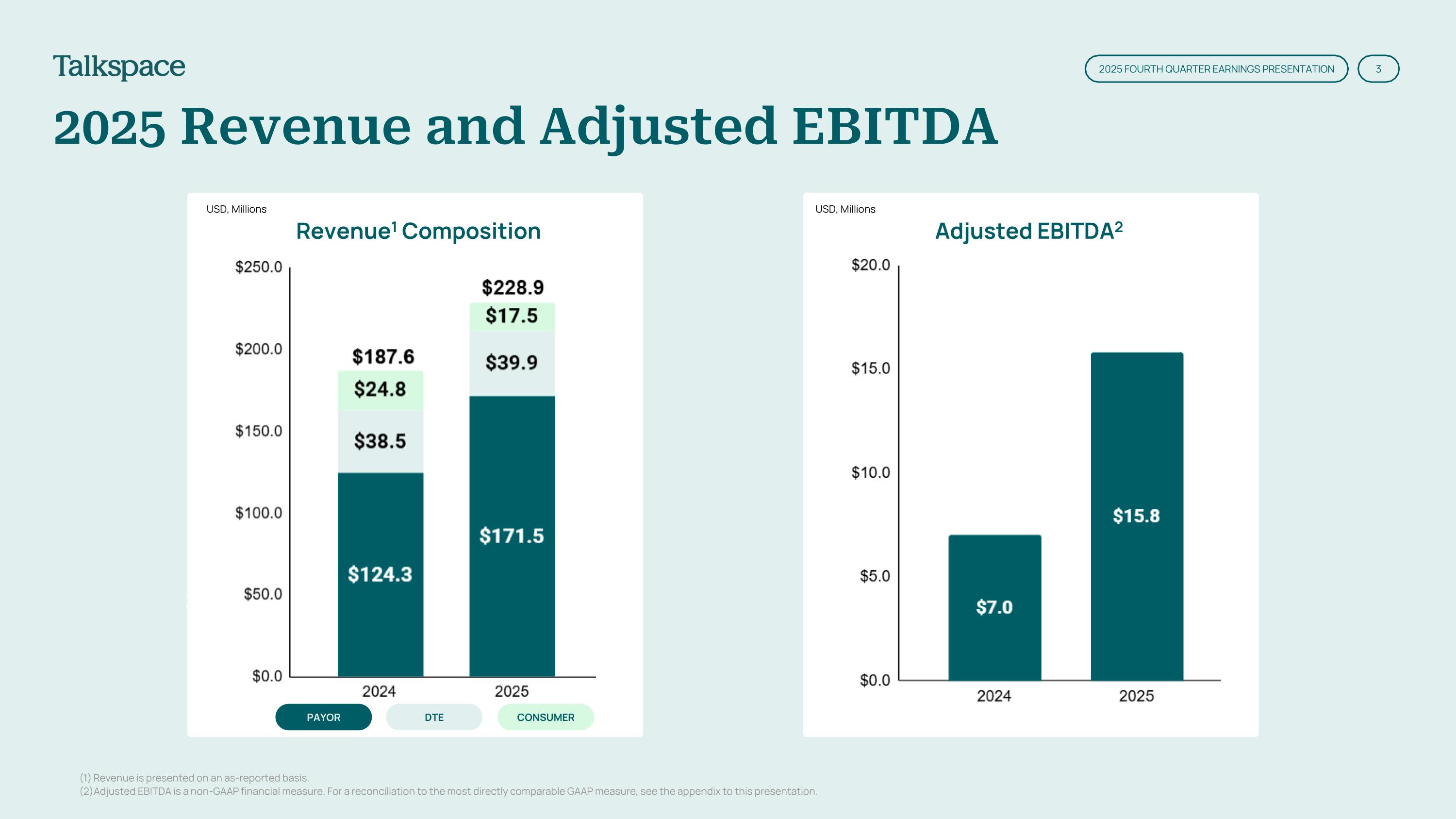
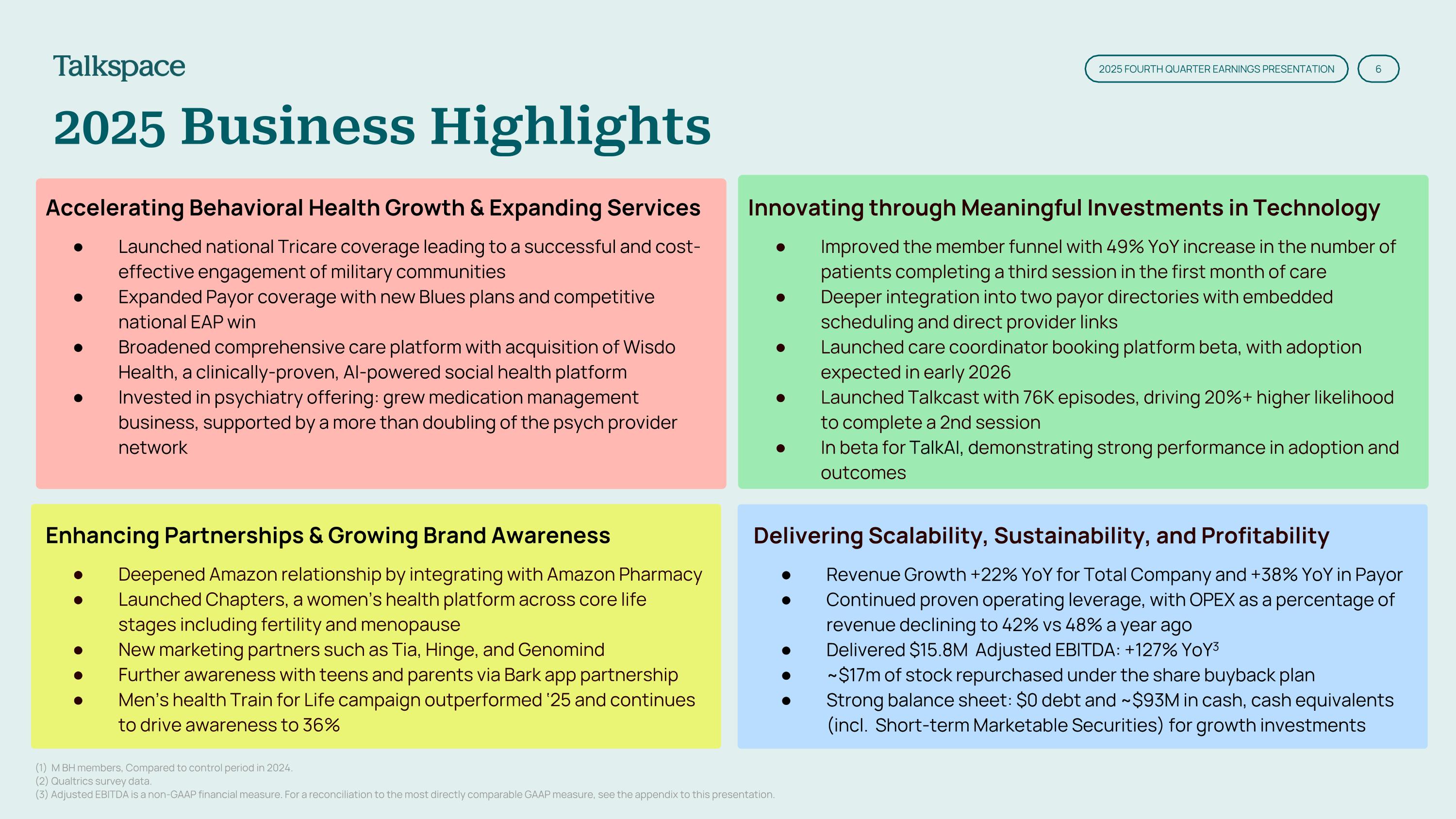
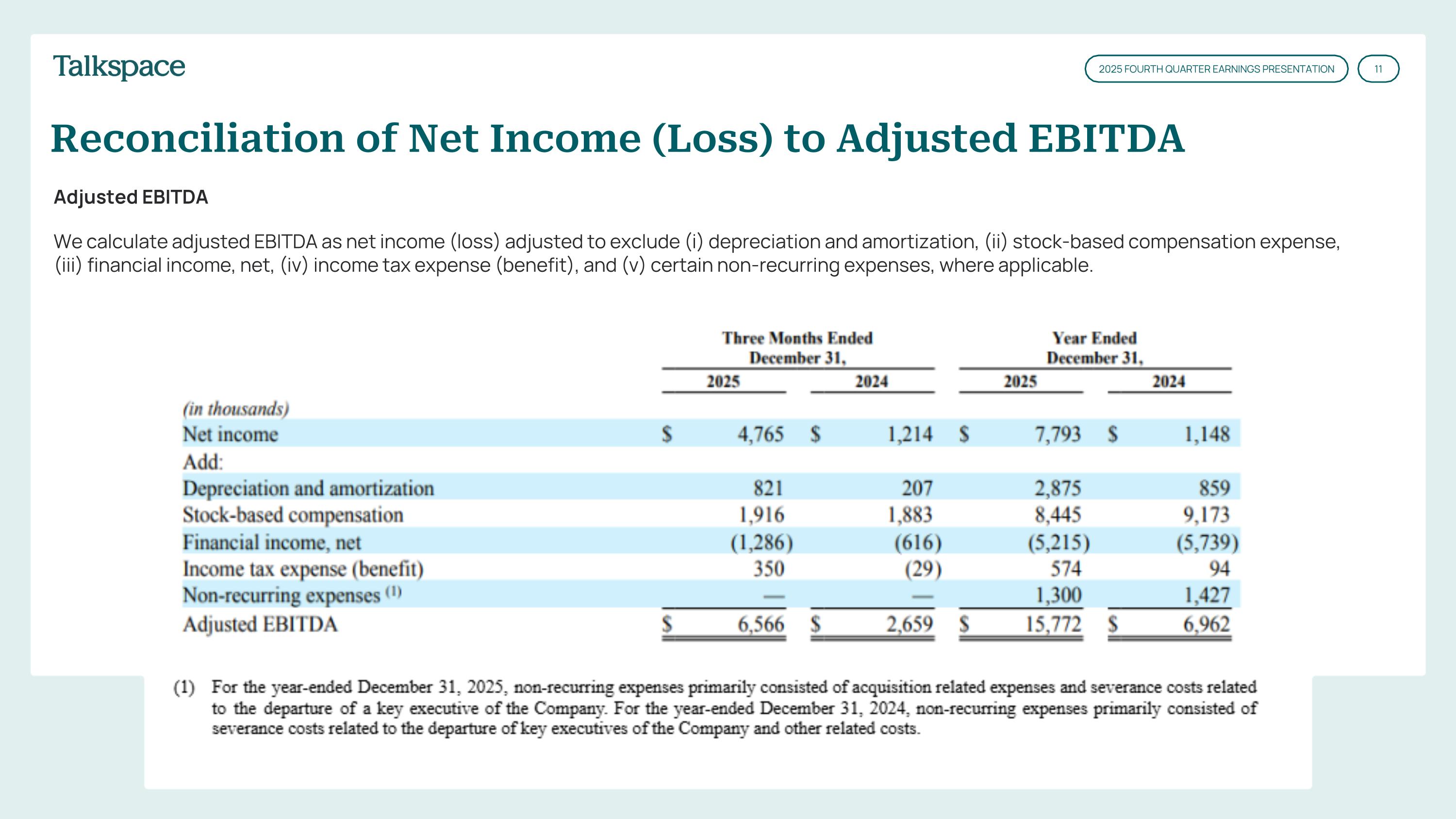
Good morning, and thank you for joining the call today to review our fourth quarter and full year 2025 results. When I joined Talkspace at the end of 2022, the strategic pivot had already begun, shifting from our consumer model to a payer fee-for-service model. Today, I am proud to look back at the progress we've made financially, operationally, and towards our mission to deliver comprehensive, personalized mental health care to all. Since 2022, we have grown revenue at a CAGR of 24%, driven by payer session annualized growth of about 56%. During this time, our operating expenses as a percentage of revenue continue to decline, helping to drive operating leverage and improved EBITDA margins. For the full year of 2025, we delivered revenue of approximately $229 million, an increase of 22% year-over-year, driven by pay growth of 38%. In addition, we more than doubled adjusted EBITDA, growing from about $7 million in 2024 to $15.8 million in 2025, which represents an adjusted even a margin of 7%. Our growth in pair, where we now cover well over 200 million lives through insurance and employer benefits, is driven by two factors. One, strategic initiatives we have put in place to bring people to talk space, including targeted efforts to increase awareness and drive high intent referrals, as well as deepen partnerships with the payers to improve the patient journey and make it easier to find care. And two, our expanding offerings within the payer channel to cater to new populations and differing levels of acuity. Both of these initiatives are underpinned by our continuous improvements to the member journey and our clinical network. We continue to drive increased consumer awareness through our paid media strategies, search optimization, partnerships, and scaling brand recognition. Our awareness campaigns have been very successful over the last three years as recognition of the Talkspace brand continues to go up while our spending on marketing has significantly decreased over the same period. Our initiatives to drive high-intent referrals has been successful, with increasing volumes month over month from Amazon, ZocDoc, and our strategic partners. We're also seeing a strong and growing presence of talk space in large language models due to the work our team has done to optimize on and off our website for increased visibility and citations. In the fourth quarter, general-purpose LLMs drove an increasing percentage of traffic and checkouts as we continue to expand this new and growing channel. Recognizing that we provide high-quality clinical care, the payers have partnered with us on several new initiatives to further simplify the patient experience. This includes directory integrations with several of our payer partners and some utilizing single sign-on so that patients can log into both platforms with ease. Others are embedding Talkspace scheduling into their directories so that patients can book sessions without leaving the payer site. We are currently working with one partner to launch the capability for their care coordinators to schedule Talkspace appointments on behalf of patients, a tool we will expand with other partners and payers. During the year, we also expanded our offerings within the payer channel. We invested in our psychiatry business, grew both military and Medicare enrollment, and acquired Wisdo, the lower-acuity, AI-powered social health platform specializing in peer-to-peer community and coaching. On military, our enrollment continues to grow month over month following our January 2025 launch, as does patient engagement through our direct-to-enterprise contract with the Navy. Our Medicare enrollment also continues to grow, and with the acquisition of WISDO, we've seen increased interest in Medicare Advantage plans, given WISDO's proven impacts on loneliness and social isolation. In addition, WISDO's partnership with Novo Nordisk to provide group coaching for patients on GLP-1s opens a new door for us into a previously untapped category of pharma partnerships. Our youth programs, which we initially launched at the end of 2023 across major markets including New York, Baltimore, Seattle, and North Carolina, continue to deliver strong measurable impact on scale. In New York City alone, more than 45,000 teens are enrolled in our Teen Space program. Sixty-six percent of enrolled teens showed measurable clinical improvement with the most common presenting needs being anxiety, depression, relationship challenges, and stress management. The program is reaching historically underserved communities with nearly 45 percent of participants living in areas with high health and income disparities and 82 percent identifying as BIPOC. Engagement remains very strong with over 90 percent of teens actively texting with their therapist and more than half choosing messaging as their exclusive modality the results of these programs reinforce team space as a scalable public-private partnership model and talk spaces leadership in youth mental health solutions specifically in psychiatry we expanded our network of psychiatry providers to over 400 providers and we made a number of improvements to the patient journey to streamline processes like simplifying medication management workflow to be able to send medications directly to the members pharmacy of choice in april we launched our integration with amazon pharmacy allowing members to seamlessly fill prescriptions from their talk space provider and get fast free home delivery making for a more convenient patient experience Further, we created an easy pathway for members using Talkspace for therapy to receive an internal referral to a Talkspace psychiatrist, an investment for which we are seeing strong traction. Turning to AI, we are continuing to utilize the technology to improve business operations and incorporate AI enhancements into the platform to further improve the patient journey and provider workflow these enhancements have reduced friction in several areas lowering the number of registration drop-offs and leading more patients to successfully begin their care journey once a member is onboarded we have also made it easier to schedule their appointments increasing the number of patients that continue care after a first session these efforts have resulted in an increase in the number of checkouts and a 49 increase in the number of patients completing a third session in the first month of care another factor contributing to our increase in session growth has been the success of talkcast our individualized ai generated podcast that i've talked about in the past when members open a talkcast episodes between their first and second sessions they are 20 more likely to complete a second and third session to date we have produced over 76,000 episodes, which have been overwhelmingly well received. 95% of provider reviews and 92% of client reviews have been positive. In addition, our network management strategy has brought continued focus on curating our network of clinicians to optimize for the specific utilization trends we are seeing, ensuring that we have clinicians available in the right states at the right times to align with patient demand. Now let me turn to the talk AI agent that we have been developing over the last year. Although general purpose large language models are now being utilized by a huge number of the global population, they were never built to support mental health. While these models have democratized access for millions, which is a good thing, they have unfortunately led to a rash of reported harmful outcomes. Mental health support requires something far more specialized and nuanced including challenging distorted thinking recognizing delusions and identifying risk in real time the talk ai agent we have built is designed to be the first safe ai agent specifically developed for mental health support utilizing clinically recognized standards of care with continuous human oversight and privacy hipaa protection the llm has trained and fine-tuned on Talkspace's massive mental health data set, identifies 10 areas of risk in real time, supports appropriate decision making, and avoids the pitfalls already seen in general purpose LLMs. It keeps clinicians constantly in the loop with clear escalation pathways to connect users at risk to a licensed human clinician in real time. TalkAI does not replace clinicians, but rather extends their reach adhering to strict clinical standards while identifying new users who may need human interaction i believe that the need for human care by trained therapists will increase as millions more people will be identified that need professional help beyond what our agent will provide we are currently beta testing this quarter with the expectation to be in the market late in q2 in summary as you can see we have come a long way in three years there remains a tremendous opportunity in front of us and one we are positioned to continue to aggressively pursue in addition to the core business we believe we have strategically positioned ourselves to be a leader in the application of ai to mental health services in this rapidly moving current environment i am pleased with the q4 results and our full year business performance looking ahead to 2026 i am very optimistic about our capability and opportunity to continue to grow the business expand profitability and am encouraged by the strong momentum we have seen thus far in 2026 and now i'll turn the call over to ian good morning
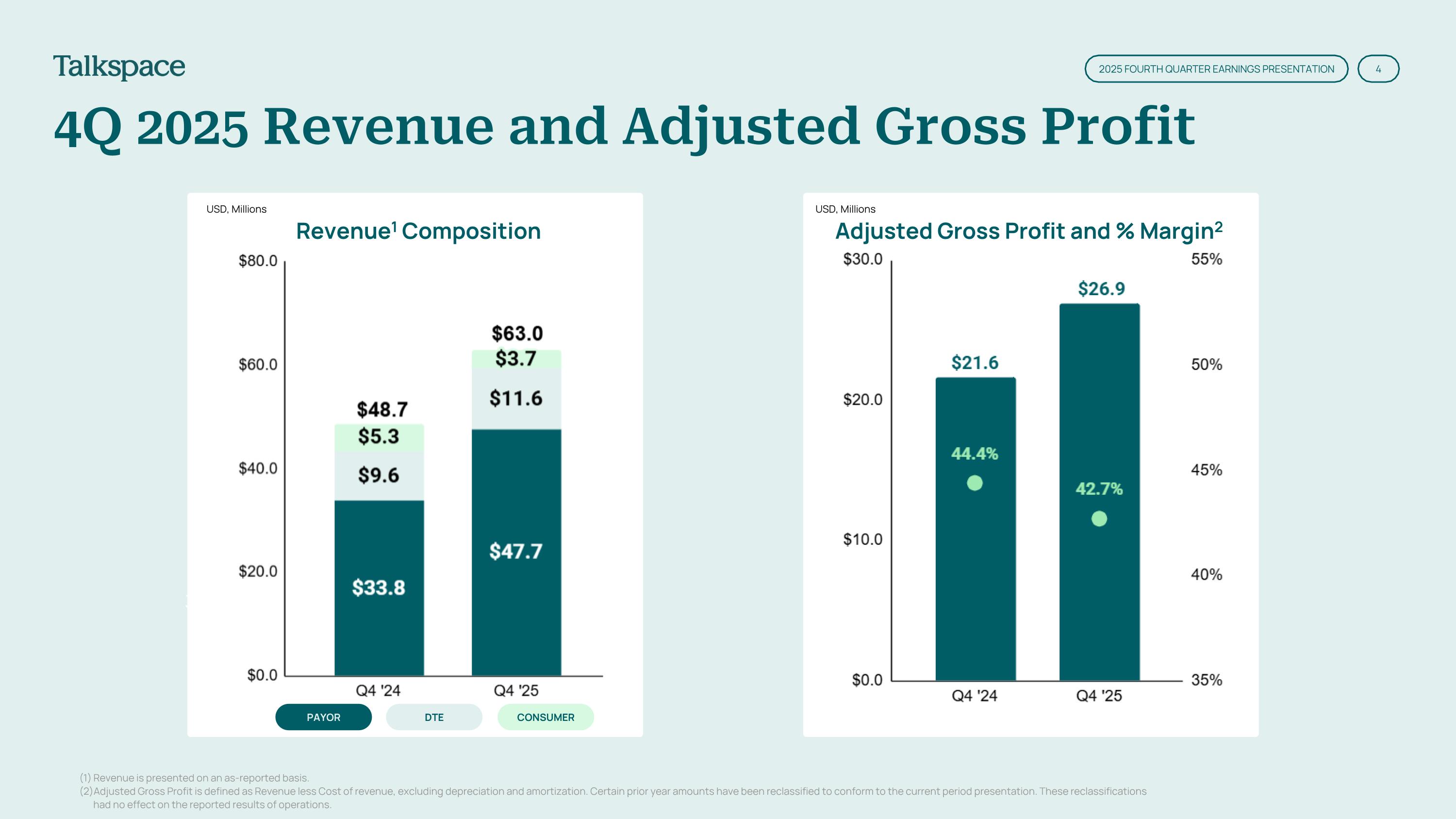
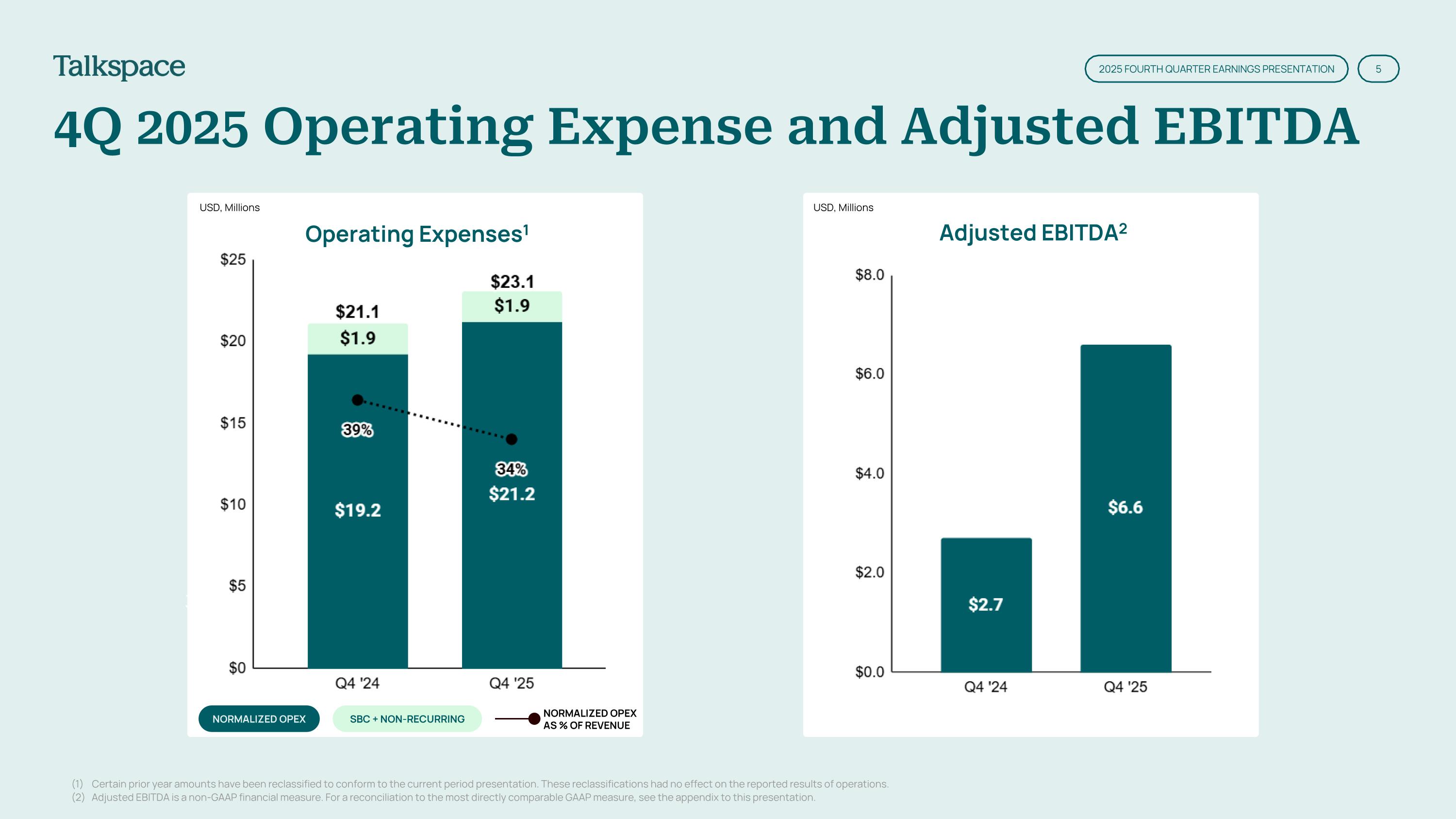
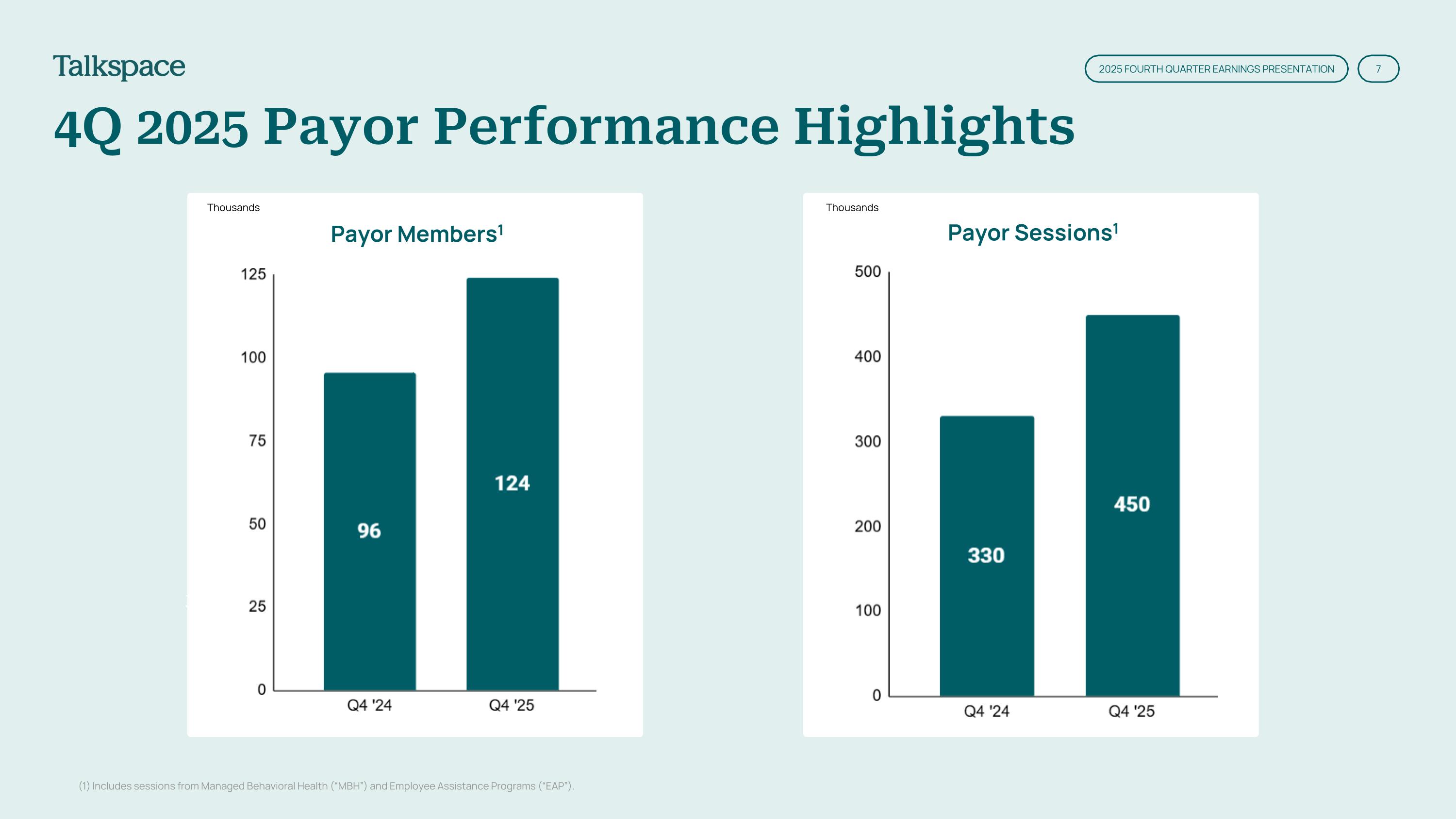
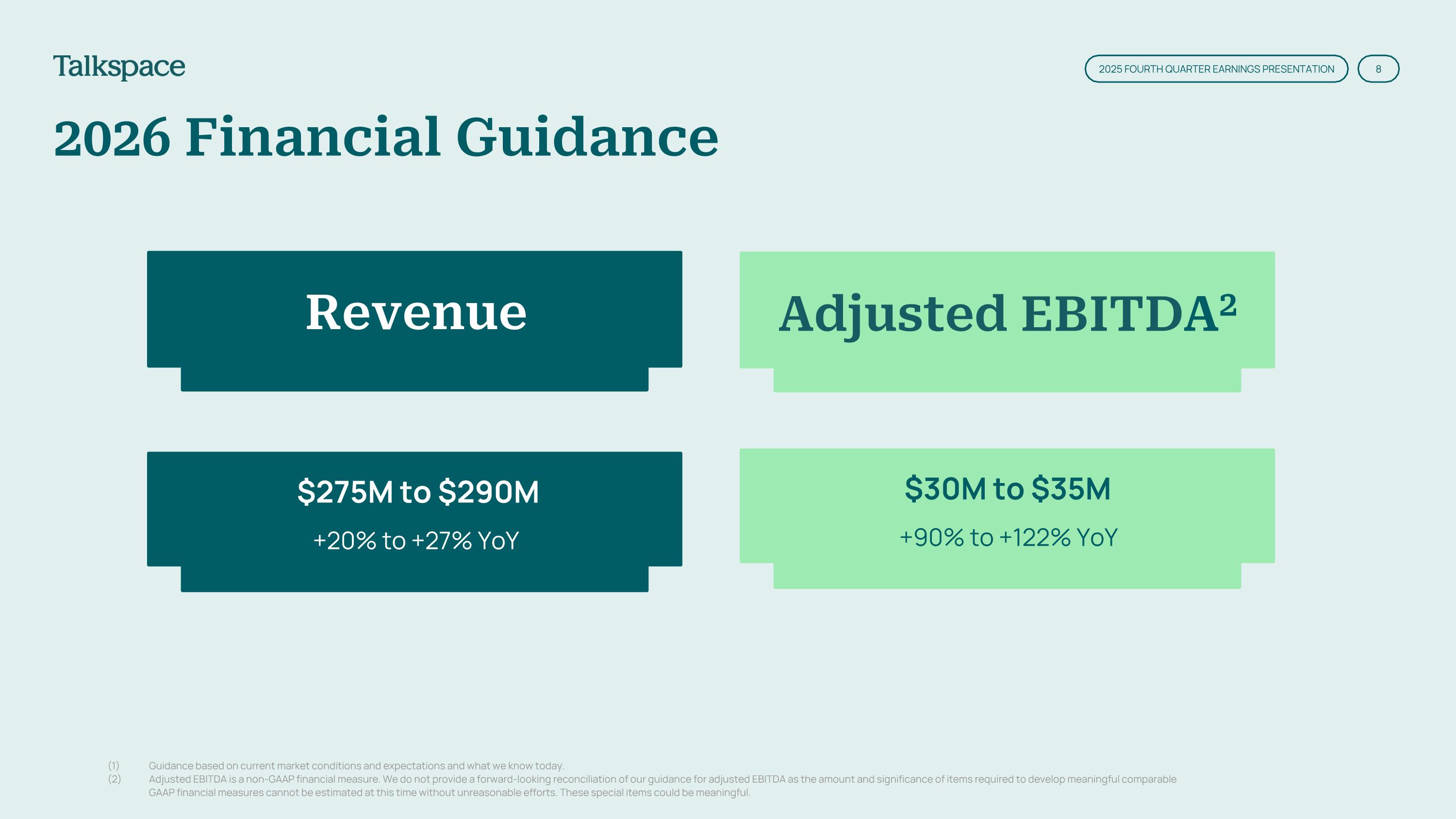
and thank you for joining us i want to first echo john's sentiment that we ended the year with some really solid momentum and we are well positioned for that to continue today i'll review our fourth quarter financial results before walking you through our financial outlook for 2026 turning to the fourth quarter results total revenue for the quarter was 63.0 million representing a 29.3 percent year-over-year increase our payer business continued to be the primary growth Thriver, with revenue of $47.7 million, up 41% year-over-year. Growth was driven by increased session volume and expansion across existing clients. Specifically, the number of sessions for the quarter was $450,000, representing a 36.3% year-over-year increase. Furthermore, the number of unique active payer members for the quarter was $124,000, representing a 29.7% year-over-year increase. Within Direct-to-Enterprise, revenue was $11.6 million, an increase of 21.8% year-over-year. As we noted on our third quarter call, several new launches shifted from the third quarter into the fourth, and DTE also benefited from the inclusion of the WISDO acquisition, which closed on October 1st, and benefited from revenue associated with implementation work for certain new accounts. Consumer revenue was $3.7 million, down 30.4% year-on-year, consistent with our intentional prioritization of both enterprise and payer channels. Gross profit was $26.9 million, up 24.4% year-over-year, resulting in a gross margin of 42.7% in the This was down 169 basis points year-over-year, primarily reflecting revenue mix shifts towards Operating expenses were $23.1 million, an increase of 9.6% year-over-year as we incorporated the team from the WISO acquisition. Importantly, operating expenses as a percentage of revenue improved meaningfully to 36.7%, down 660 basis points compared to the fourth quarter in 2024. Adjusted EBITDA was $6.6 million, representing 147.1% year-on-year growth with an adjusted EBITDA margin of 10.4%, up nearly 500 basis points versus the prior year. Turning to the balance sheet, we ended the quarter with $92.6 million in cash, a decrease of $25.2 million year-on-year, driven primarily by our share repurchases which totaled 17.2 million in 2025 for the full year as well as the acquisition of wisdom now turning to the guidance for the full year 2026 we are providing initial guidance as follows we expect revenue to be in a range of 275 million to 290 million representing 20 to 27 year-on-year growth we expect adjusted EBITDA to be in the range of $30 to $35 million, representing growth of 90% to 122%. Looking back at our three-year outlook introduced in early 2024, and which extends through this year, we expect to deliver a three-year revenue CAGR of approximately 23% using the midpoint of our 2026 guidance, which is consistent with the three-year outlook stated target of 20 to 25%. percent. From a profitability perspective, we anticipate exiting 2026 with EBITDA margins in the mid-teens toward the high end of our 12 to 15 percent target range from that outlook. I want to share a few points on the underlying assumptions behind our outlook. From a quarterly cadence perspective, we anticipate revenue growing over the course of the year and similar to last year with the first half representing a little less than 50 percent of annual revenue as active payer members and sessions grow throughout the year. In terms of our revenue mix, we expect payer revenue growth to be in line with the payer growth rate we experienced in 2025, driven by the activation strategies John outlined earlier. As we've discussed in the past, the payer business brings a high degree of visibility given the longer retention of a payer member compared to someone paying out of pocket, and a material portion of our 2026 payer revenue will actually come from payer members already on the platform as of year-end 2025. We expect DDE to grow in the low single-digit percentages again this year. As a reminder, the first quarter historically has the highest number of accounts up for renewal and therefore sees the highest attrition of any quarter in the year. Q4 performance also benefited from certain implementation revenue, so we would expect DDE revenue in Q1 to be sequentially lower than Q4. And finally, consumer revenue will continue to decline by design. However, it's a much smaller headwind overall, given the less material starting point in 2026. While the midpoint of 2026 revenue guidance represents 23% growth year-over-year, Our Q4 run rate revenue, which is over $250 million, implies 12% growth at the midpoint. This is thanks to the accelerating growth we drove over the course of 2025. These trends, along with the internal efficiency measures that we continue to implement, will drive further operating leverage through the P&L. Specifically, for adjusted EBITDA margins, we anticipate starting the year in the high single-digit percentages and exiting 2026 in the mid-teens, which will result in a similar quarterly cadence of adjusted EBITDA as we saw in 2025. In summary, we believe Talkspace is well-positioned for sustainable growth and continued margin expansion, supported by strong momentum in our payer business, improving operating leverage, and increasing visibility into future demand. With that, we'll open the call for questions.
Operator
Thank you. If you'd like to ask a question, press star 1 on your keypad. To leave the queue at any time, press star 2. Once again, that is star 1 to ask a question. And we'll take our first question from Steve Deckard with KeyBank. Your line is open.
Hey, guys. Congrats on a solid quarter, and thanks for the questions. And just around your large language model that you're currently beta testing, what do you see as the key challenges in getting people that are currently using the general purpose large language models to using yours as you roll it out?
Thanks, Steve. You know, this is obviously very much a work in progress. You know, as we stated, we're in beta with, you know, people registering as we speak to to go through the testing of what this thing looks like. We're, you know, this thing is positioned as a place to have a serious conversation where your information is protected and where you have both security and safety behind you. I can't tell you, you know, yet, because it's such early days, about what kind of movement we'll have, what kind of people will use this versus the other LLMs. That is just absolutely a work in progress. So, you know, my message right now is to stay tuned. We will have a lot more information once we finish the beta. We've seen a little bit early results, but right now my answer really is to stay tuned and let's just see what happens. It will be positioned as somewhat different than the general purpose LLMs. You know, I'm not obviously trying to keep days. I'm just telling you, it's just early days, and we have a lot of interesting information right now. But we'll, you know, we're certainly going to talk about it more as the next several months evolve.
Got it. Totally understand. Ian, you just mentioned on the 26th guide that most of the revenue is already from members on the platform. So I guess I'm wondering, does the high end of the guide perhaps imply that, you know, that's from additional new members that aren't currently on the platform? Just maybe what gets us to the high end of the guide, said more simply?
Yeah. Hey, Steve. And just to clarify, I think my preparator market said a material amount of payer revenue is from existing members on the platform. I want to call that out just because people forget, right, under the payer model, that sort of longer lifetime on the platform and that sort of longer tail of revenue allows us from a visibility standpoint to have a much higher level of conviction in terms of modeling out the payer revenue, right? So as we start Jan 1, it's not a majority, but think of it as, you know, 30 to 50 percent range of our payer revenue is actually coming from folks who already have on the platform. In addition to that, obviously, we're going to, to John's comments, keep driving both from paid marketing work, additional organic work we're doing on the marketing front, which there's a lot of really exciting llm sort of optimization work we're doing and then very importantly uh the directory integration we're doing with the payers and getting sort of more embedded with the payers to lower that friction for people that find us through their insurance portal so that'll all drive new users throughout the year um as we've done sequentially throughout 25 which then obviously has that long tail of sessions pulling through um as well okay makes
Makes sense. Thanks, guys.
Operator
We'll take our next question from Ryan McDonald with Needham. Your line is open.
Hi. Thanks for taking my questions, and congrats on a great quarter. Maybe just to double down on the directory integrations, you know, obviously showing some great success with the first payer partner that you've rolled that out with. Can you just remind us on sort of how many additional sort of deep integrations you'll have, sort of with additional partners this year and you know I guess what have you learned from the first partner that can be replicable you know to sort of continue that you know strong utilization with these additional payers as we go throughout the year. Thanks. Yeah I can start and then I'll hand over to John. I mean on the on the first payer like you said it's been extremely successful. They're they're happy in so far as they're bringing a much friendlier consumer experience to their members and making it easier and
can be less frustrating right that sort of finding your care journey and we view it as obviously from a CAC perspective very creative right to get that incremental conversion and additional traffic coming from the payer so it's early in 26 Ryan so you know we're obviously working hard to do more I would say line of sight we have today there's probably depending how you look at it call it three directory integrations we're doing in the early part of 26 so for sure at least three I think in terms of what that represents materiality wise versus the one last year it's probably about similar size all in all population wise maybe a little bit bigger in in the aggregate the three so you know as bigger bigger of an opportunity as we saw with the integration 25 what we're learning is it's interesting some of these directories it's sort of the first time they're doing these integrations so we are sort of in this beneficial position where we're working in tandem with them on the design of how the directory works which obviously gives us a level of influence to sort of shape what that experience looks like from our own knowledge having done this right for a decade as a marketplace business ourselves so so they really appreciate the sort of edification we're able to bring there, but also helps us candidly in terms of the algorithm, what helps screen providers higher, is it quality, is it schedule, and sort of how that sort of search algorithm is designed. We sort of have a seat at the table for that.
Thank you. And then, you know, obviously a lot of the success that you've had in the payer business to date has been on the commercial side and obviously in the military. I'm curious to get your thoughts about sort of the potential opportunity within Medicare sort of in 2026, particularly with CMS rolling out this potential opportunity to sort of supercharge or sort of fuel, you know, deeper Medicare efforts or to drive better utilization there. And, you know, are you intending to participate in the program?
Yeah, thanks for the program. So the answer to that is on the access program is yes, we are keenly aware of the access program. We talked about it. we have submitted. We want to be part of it. It is outcome-based. We are very comfortable with what an outcome-based model would look like. So the answer to that is yes. You also, as you heard me say, the WISDO acquisition on Medicare and NMA has been very positive and continues to grow. And as we say in the past, we continue to see month-over-month increases. It's been no surprise, as I've talked about in the past. It's a relatively difficult market to penetrate only because it's so ubiquitous and it's across all 50 states. But we are making progress. But between WISDO, Access Program, the stuff we're doing on the ground, we continue to be
Operator
confident in how it will grow. Awesome. Congrats again. We'll move next to Richard Close with
Canaccord Genuity. Your line is open. Yes. Thanks for the question. Congratulations on a strong year and outlook. John, at the end of your comments, you said something about momentum already here in 26 and i was just curious if you could go a little bit deeper in terms of what you're seeing already through you know almost two months um the basis of that that comment um i would
the the comment is because you know the beginning of the year you know really does you know somewhat change things because you know people coming back on they're looking at the assurances they're they're beginning to re-engage at a bunch of different levels but you know most of what we're we're gauging everything is on is uh people coming onto the platform and doing sessions um so my comment was purposeful that we're continuing as we exit 2025 to see the you know to see the momentum continue uh early on in 26. yeah and richard as you as you know we
you know take january as a opportunity to do a bunch of sort of marketing campaigns right post holidays, post-New Year's, resolution season. So a lot of sort of wood behind the ball from a marketing effort standpoint. The momentum John's leading to is just that, right? The checkouts we're seeing, the CAC environment we're seeing, getting in front of folks, and all of that's contemplated in the guide, consistent with the guidance. Okay. Second question would be just
Like overall behavioral health care costs, I know we've talked about this in the past, but, you know, I mean, you look at, you know, some of the benefit brokers and, you know, they cite increased behavioral health as one of the top expenses. And obviously, some of that's inpatient, but outpatient playing a role as well. I'm just curious, you know, your conversations with payers in terms of rising health care costs. And you just did mention with respect to Medicare, you're comfortable with, you know, outcomes based and whatnot. I'm just curious how you're thinking about, you know, potential utilization, management, or reimbursement changes and just the overall marketplace with respect to behavioral health.
Yeah, I think it's consistent with some prior discussions. We know, obviously, watching what's going on in, you know, health care costs, you know, people paying more for their premiums. But remember, the mental health, not just the TAM, you know, the market, but the more people engage in mental health, it actually saves people. As you know, there's a huge amount of data out there already that, you know, a good mental health support program saves people on the medical side. So that's one. Number two is the majority of costs that people are looking at, to reiterate, is really on the in-hospital side, the in-hospital diagnosis. It's really not – it's not on what we're doing on the outpatient side. The outpatient side of mental health is a very, very small piece of the pie right now for the healthcare spend nationally. And then we're – you know, some of the other products, you know, when the TalkAI agent comes to fruition, it'll be a lower-cost option. The pairs already know that. So I think there's a lot of positives from what we're doing, but I don't think the global or national issues relative to the health care costs should have any impact on us. I just continue to see this to grow because it's actually a win-win for everybody, the more people who get mental health.
As a follow-up to that, do you think your ability to show outcomes and the data that you have is a differentiator where, you know, maybe payers skinny down the number of providers that there are vendors that they're actually utilizing for these services?
Absolutely. So we already have a couple of, you know, early value-based contracts. They're relatively rudimentary, quite honestly. It's, you know, time to first appointment, time to second appointment, how many people show up. But, you know, so all of those things we have in place. So we're very comfortable with anybody almost that comes to us for a value-based arrangement because we already have the records in place. And one of the reasons that we are so comfortable is because of the network. So the curated network is a really big deal, meaning we monitor, as you know, we monitor the quality. We look at what therapists are doing. That's really important on a value-based contract because you have to be able to measure outcomes. And to measure outcomes, you've got to be able to control your network. And what I mean by control the network, you've got to be able to look and see what the quality is that's being delivered. So having all of that in place is really, really important to be able to deliver on a value-based contract. So we're pretty comfortable with all that.
And that dynamic you allude to, Richard, I think that is exactly what is playing out with the directory dynamics, right? It's no coincidence we're being tapped to do these initial embedded directories. It's a function of years and years of providing them that data, exactly as you allude to, the clinical oversight, the QBRs we do with the payers, the audits. So they're in some ways rewarding us in that sort of, I don't know if you use this phrase, Richard, but narrowing the network a little bit. But clearly by doing these directories with us, we would expect, as we saw with that one payer last year, to take a sort of outsized portion of share of their payer portal traffic. So it's sort of indirectly them doing exactly what you're hypothesizing.
The questions and congratulations. Thanks.
Operator
We'll take our next question from Charles Reidy with TD Cowan. Your line is open.
Oh, yeah. Thanks for taking the question. Hey, John, I wanted to ask a question, right? You kind of made the comment earlier, right? A lot of people are now seeking out information, but they're not just going to a search engine anymore, right? They're going into like chat CPT or something and asking. And so you've talked about how do you optimize to be picked up by these LLMs so that people can get directed to you. And it sounds like, is this like the new SEO? Like, is even search engine optimization as much of a thing? Is it really now, how do you optimize to be picked up by LNM? Because it's something that we've heard from other companies as well more recently. And then connected to that really is, how do you then connect from maybe that kind of initial outreach by a patient who's going through a chat GPT or something, and get them to your AI block, right, which would be more a protective environment for patients. How do we bridge those two, or how do we get them to search you first? Let me just start there.
Right. So, you know, great question. So actually just, I don't know if you've seen it, there's an article in the New York Times this morning all about search engine optimization through LLMs. And I have talked about this. We have put in place our, you know, our marketing folks have been aware of this for quite some time. So we actually have people who just are working through LLM search strategies so that we do appear on whether it's Gemini or Claude or ChatGPT. So we have been optimizing. There's another term for it. It's called generic. I think it's called generative. Generative optimization as opposed to SEO. But, however, saying that, we are not only aware of it, but what we put in place mechanisms to make sure that people do find us. And we track it also, by the way. So we have seen this go up month to month to month. People who are finding us on the other LLMs, the number of people, it continues to increase month to month. So, one, that's what we're doing on the SEO, very comfortable about where we are relative to that strategy. In terms of people finding us is an interesting question because we have not gone to market yet. We do have a fairly fully baked initial marketing plan so that people will find us depending on what they're looking for. Now, there's a lot of nuances that we don't have time here to probably talk about all that, but meaning are they really looking for therapists or are they looking to have a serious conversation? There's a lot of different things that people look for. So, as I mentioned a couple minutes ago, our view on this is that if you want to have a serious conversation that's confidential, particularly around relationships or other issues that may be bothering you, and your information is protected, if we're protected, and we have significant clinical background, you know, that people will then make a decision about where they will go depending on what they want. We don't – the answer, of course, is we don't have the answer yet. But we are being positioned – we'll start off being positioned in a little bit different mode than the others. But the jury – you know, I can't even say the jury's out because we haven't gone yet. So we will know more, as I said, once we finish the beta in terms of why people are coming to it, how people are using it, which will be a significant bunch of data points about how we go to market after that.
We'll have a separate marketing initiative and budget just for the L1 product, right? So in the guide, there's little to no revenue associated with TalkAI revenue, which, as John alluded to, will launch this summer publicly. But there will also be a separate marketing effort there. While we don't historically disclose traffic or conversion numbers on our core platform, suffice it to say, if you just look at even the best-in-breed e-com brands, you can imagine there's a ton of traffic coming to our site who never check out, right? So we actually view, based on the research we've done, the TalkAI product is going to be absolutely TAM expansionary for us because there's a lot of people who are curious about therapy. They come, they search. But as you know, it's not sort of a fleeting decision somebody makes just to buy something, right, to enter therapy. So a lot of people actually come to our site and never check out. And we actually think this is going to capture, I don't want to call it a lower intent, but maybe a group of people who are not quite ready to see a human-to-human. therapy session but are willing to take on sort of this more of a GPT type interface so we'll have a separate marketing effort around that from a paid standpoint but I also want to flag just from organic we think there's a lot of folks coming to our site today who are not monetizing at all that we will retain once we have a talk AI product and that and this is completely separate from the GEO, the generative engine optimization work, which I would agree with your succinct take. It is sort of like the new frontier for SEO, which honestly we're benefiting a lot from our historical strength in SEO. And so it's, as John said, it's a small but growing very fast sort of channel for us on the core side.
Okay, that's really helpful. And that kind of clarifies some of my thoughts because I was just curious, how do you transition people if they're searching through a chat GPT, but what you're saying is that the low-hanging fruit is all the people that come to your website already that you aren't monetizing. So at least you have this initial base, and it seems like people are getting to you in some fashion. My second question, though, is maybe have you had any discussions with, you know, like a Humana, when we think about the MA opportunity, we've obviously seen now the advance rate notice for 2027 is actually quite poor and and we're looking at potentially another round of benefit cuts from plans going into you know not this year but going into next year you know you know where does uh behavioral health in do you think in your partner's mind sit in terms of benefits is that something that you think they might look to cut back on or is this something that you think is is pretty safe
thanks yeah i mean if you're if you're alluding to you're alluding to employers um i can't you
know i can't answer you we have a you know most of that i was thinking about uh medicare advantage
for for 27 just because of the uh yeah yeah our view right now is the payers continue to be very interested in what we're offering and ma continues to grow but we'll continue to talk to whoever's out there. I think that Humana is a, you know, another whole question about, you know, how they're going to approach the market now. But I can't say anything more except that we still continue to have
interest on the MI side. Okay. Yeah, just curious. Okay. That was really helpful. I appreciate the
Operator
comments. Thanks, guys. Thanks. Thanks, Charles. We'll take our next question from Bobby Brooks with Northland Capital Markets. Your line is open.
Hey, good morning, guys. Thank you for taking my question. As we think about how you guys are mapping out driving higher utilization into 2026, what are the three or so most important levers you feel you have at your disposal to help drive that?
Well, no particular order. We've talked at length already about the directory integration. I think you've heard me talk about the change that we made in the patient journey this year have had a very, very significant impact on the number of people that are booking checkouts, booking first sessions, second and third. That's been a really big idea. So I think, as I talked about before, that's a never-ending journey. There are literally, you can't believe how many more things you can do to test and to change to make sure that you actually get more people to the funnel and through the funnel. So that's the second. I would say, again, no particular, the third is partnerships. You've heard us talk about the growth in both Amazon, ZocDoc, and the 20-plus other partners that we've announced. We will continue to lean in on the partnership expansion because a lot of it's beneficial for both the partners and for us to get the referral. So I would say that those three levers, you know, journey, partnership, and certainly directories. And probably in a general sense, number four is just our ongoing relationship with the payers.
And then just curious to hear more on the beta testing of TalkAI. And obviously it's still early, but wanted to know, wanted to hear more what's the plan, like how are you thinking of early plans of commercializing it? But maybe are you in any active conversations with kind of the larger LLMs or potentially licensing it, just trying to get a sense on that?
Yeah, you know, our go-to-market is to be direct-to-consumer first, which is what we've talked about, is to launch and then test all the different models about who's coming, why they're coming, what sort of, you know, price point makes sense. You know, so that whole direct-to-consumer is the number one focus. We are in discussions with multiple, to be honest, several other entities about their interest in our LLM, and I would just say just TBD, but there are other discussions going on with other people who are interested in what we're doing.
Got it. The last one from Bobby, on the early learnings of the beta, which call it, you know, a little bit shy of 1,000 users at the moment, we've been, I don't want to say pleasantly surprised, but it's been really interesting to see just how engaged folks are with the product. And this has been well covered in sort of general reporting on elements, but the willingness of people to share with the AI therapy product, therapist, therapeutic product, as opposed to a human, has been quite astonishing. So, very, very, I'd say, promising sort of engagement and retention thus far. And then, as John said, the intention would be, like any sort of product-led growth strategy, start with D2C, right? It's sort of an out-of-pocket revenue model. take the learnings from that and that initial data from those initial cohorts, which will then inform how we would approach it more on the enterprise side, talking to whether that's employers, other large groups, yeah.
That's super helpful. And then just the last one for me, John, when we were on the road in December, I thought you made a really interesting remark I think would be good to hear on the call about, about obviously you've had a long career in the medical field and have been in kind of a couple different spaces of it. And you mentioned how in your past lives you've never seen, like people, insurance companies are always coming to ask for lower prices, but that's not what you've seen. Could you maybe reiterate that comment?
Sure. So, you know, we talked about we expect single-digit increases increases in our pay and reimbursement on our fee-for-service. So we are negotiating. We are going back with them. There are several coming up where we'll look for small increase rates. What you're alluding to is, yes, the prior industries where I've been, whether it's physician networks, hospital, PRGs, laboratories, is it's usually the reverse. You know, they're usually looking for how much less they're going to pay you. It just turns out that, you know, the mental health space is something that the payers really, really continue to be interested in promoting and supporting relative to their relationship with the employers and their employees. So because we are, as I said, you know, not just available, accessible, but an affordable option for them and significantly scalable. We remain very attractive to the payers, which, as Ian alluded to, which is why the partnerships and everything else are really, really important to us. So the long-winded answer to yes, I'm very happy that we get increased rates. It's a bit of a surprise to me.
Congrats on the great quarter and our return of the queue.
Operator
We'll move next to Stephen Valaket with Mizuho Securities. Your line is open.
Yeah, thanks. Yeah, good morning, guys. A couple of questions here. First on the 26 revenue guidance, obviously coming in pretty strong versus the high end of the range that you targeted three years ago. I guess, are you able to find any color or just remind us roughly how much revenue you're expecting from WISDO in 26? I'm just trying to get a sense for just rough approximation for like the organic versus the unorganic growth this year. I'll let you answer that one first, and I'll have to follow up after
that. Hey, Steve. Yeah, we haven't broken out with those separately. It'll show up depending on the type of contract, most likely in DDE or the payer lines of business. And to a lesser extent, a little bit of consumer there. So it's embedded in the three business lines we report out. I would think of it if you're – I understand the question for an organic benefit from them. So it's fairly modest. It's a single-digit millions contribution for 26.
Okay, got it. And then, yeah, the next question here, I guess with the industry environment rapidly moving right now, as you kind of alluded to, not just in relation to AI but other factors as well, does this increase your appetite and or need to look at additional external assets or possibly do additional tuck-in acquisitions this year? I know it's always hard to answer those questions, But, you know, I guess the question would be, are you well positioned the way you think you are right now with your own enhancements on the internally developed talk AI agent and recent WSDO addition? We just wanted to get your sense for that.
No, we appreciate the question. I mean, certainly we have the wherewithal to do more tuck-ins, right, within the year with almost $93 million of cash and equivalents on the balance sheet. I would say, given we just did the WSDO acquisition, we want to make sure that's a successful outcome. outcome. It's the first talk-in we've done in a number of years, and for this management team, our first. So our main priority is to make sure that one's successful. I would say the excitement and resources and attention that we're dedicating to the Talk AI project is very substantive, and so the sort of de novo organic internal developed growth opportunities is probably where I would, If I had to bet, we'll spend most of the time. So nothing immediate in terms of our portfolio that feels like a gaping hole that we need to address inorganically. I would say we feel very good about the hand we have today, sort of already under our roof. And then, as you know, just on that cash point, we bought back $17 million of stock in 2025. Still have a very good amount of capacity under our existing buyback program. So in terms of uses of cash, that's another one. We also have that sort of arrow in our quiver for 26.
Yeah, I would add that on the – it's an interesting question. You know, the Talk AI and even all of our other AI initiatives to improve the business and patient journey. Just as a reminder that Talk AI has been around 14 years, and, you know, it's always been an innovative company, quite honestly. I mean, they did most of the original work for texting and messaging and then got approval for that. So when we made the decision to further invest in AI initiatives, again, just to remind you, the company reported out AI risk algorithms back in 2018 and 2019. So the reason I bring that up is that we have a fair degree of significant expertise on the inside relative to our ability to do this kind of work. Obviously, you don't have everything. You go outside and you get other people to help on a consulting basis, whatever you need. But the core talk space technology capability is very, very high. That's all very helpful.
Operator
We'll take our next question from Peter Warrendorf with Barclays. Your line is open.
Yeah, thanks for the question. Just curious, given the anticipated growth this year, if you guys are comfortable with the size of the provider network as it is right now, and if there are any specific pockets that you feel like you might need to address.
Yeah, hey, Peter. The short answer is yes, we feel very good about it. we actually you know john had some notes in there in his prepared remarks about what we call the curated network so we're actively pruning engaging trying to activate and i think it was um maybe it was bobby's question sort of the the rank ordering um of how we're activating folks you know one of the indirect components of that which i think is not as obvious because really on the supply side is making sure we're engaging the network to have adequate availability such that when someone comes in and they want a certain day a certain time a certain type of therapist we we have that right and and there's a lot of creative ways we're working on the product to make sure um we're capturing that sort of consumer intent in real time so short answer is we feel very good about where it is it will grow here and there you know it's very specific state by state if we add a big a big partner with a certain type of population do we need to ramp up hiring there we've had numerous examples where our recruiting team has proven again and again they're very effective and very nimble in ramping up supply when and if needed but as sort of a run rate basis we feel very good about where we are the one area I would flag which we grew quite a bit in 2025 was on the psych side. So John talked about it as one of the more exciting sort of newer service offerings for us, psych. And what we mean by that is really medication management has been a very, you know, small-ish, but very fast-growing component of our payer business. And so you'll see, I think in our 10K, we ramped up our provider network on the psych side quite a bit in 25.
Got it. Okay, thank you. And then one quick one on the consumer side, the DCC revenue obviously is becoming a smaller headwind every year. But just curious how much of that you guys think you're capturing elsewhere on the payer side of the business as that revenue kind of continues to fade away.
Oh, yeah. I would say most of it we capture. I mean, as you go through the registration flow, we make it pretty unavoidable for a prospective consumer, prospective member, I should say, to not share with us your insurance info. So we very much lead with that intent to capture you on the payer side. As I said, there's always, for whatever reason, you know, the long, small-tail folks we don't cover or they just rather pay out of pocket for whatever reason, there is always that option. But we surmise we're capturing most of that consumer attrition. And then, yes, to your point, you know, it'll be less of a headwind on a dollar basis in 2016 just given the smaller starting point in the year. So, you know, quickly becoming sort of more and more immaterial.
Operator
And that does conclude the Q&A portion of today's call. And this also brings us to the end of today's meeting. We appreciate your time and participation. You may now disconnect.