Operator
Greetings and welcome to the TKGEN Q2 2026 conference call. At this time, all participants are in a listen-only mode. A question-and-answer session will follow the formal presentation. If anyone should require operator assistance, please press star zero on your telephone keypad. As a reminder, this conference is being recorded. It is now my pleasure to introduce your host, Jack Whiting, General Counsel. Thank you. You may begin.
Good morning. This is Jack Whiting, General Counsel and Secretary of TKGEN. This call is being recorded and will be archived on our website at tkagen.com. The press release regarding our second quarter, 2026 earnings, and the presentation provided this morning are available in the investor section of our website. I'd like to direct your attention to our Safe Harbor Statement included in our earnings press release and presentation. Various remarks that we make about the company's expectations, plans, and prospects constitute forward-looking statements for purposes of the Safe Harbor Provision for the Private Securities and Regulation Reform Act of 1995. Actual results may differ materially from those indicated by forward-looking statements as a result of various factors, including those discussed in the company's most recent annual and quarterly reports on Forms 10-K and 10-Q, under the caption, Risk Factors Filed with the Securities and Exchange Commission, and available in the Investor's section of our website in the heading SEC Filings. While we may elect to update forward-looking statements, we specifically disclaim any obligation to do so so we should not rely on any forward-looking statements as representing our views as of any future date during this call we will refer to certain financial measures not prepared in accordance with general accepted county principles or gap a reconciliation of non-gap financial measures to the most directly comparable gap measures is provided in the press release regarding our q2 2026 earnings and on our website I will now turn the call over to Abenan Rangesh, TKGEN CEO, who will provide an overview of second quarter 2026 activity and results, and Roger Dishan, TKGEN CFO, will provide additional information regarding Q2 financial results. Abenan?
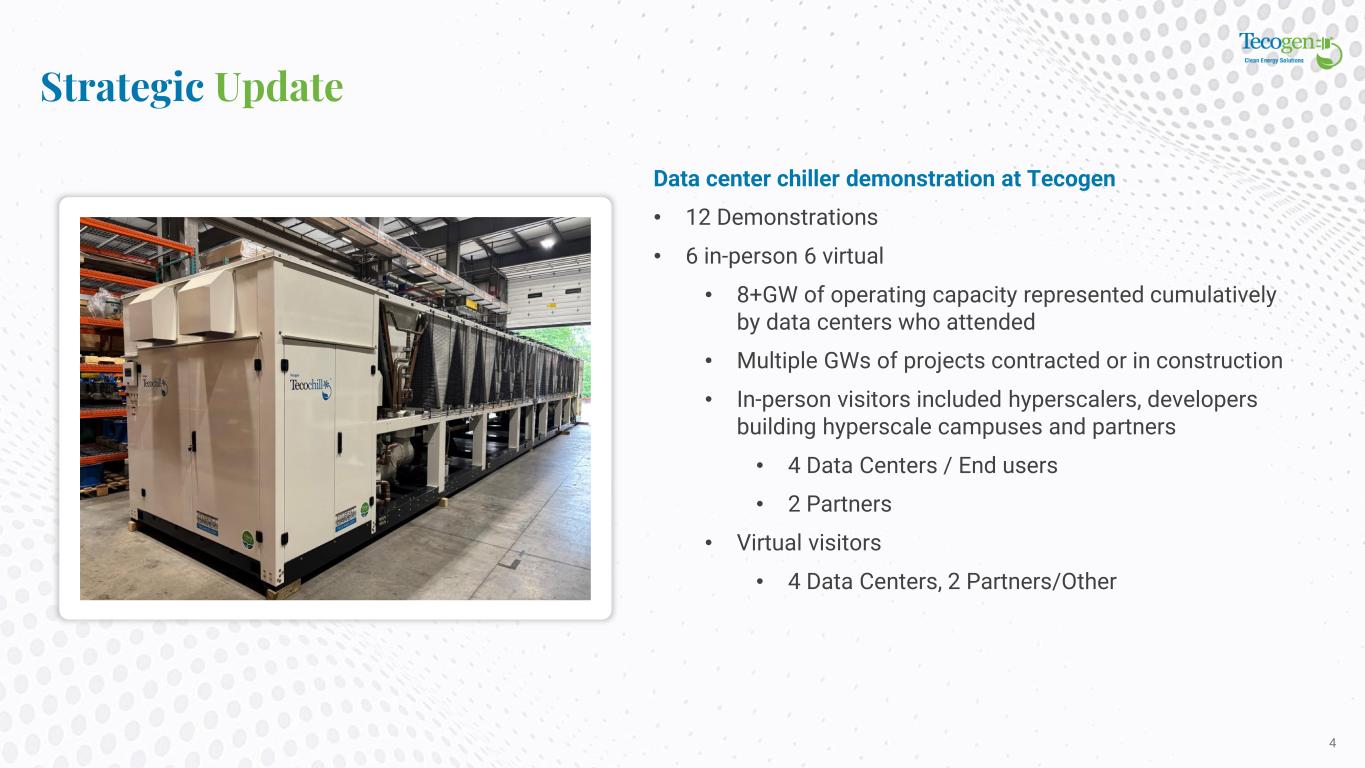
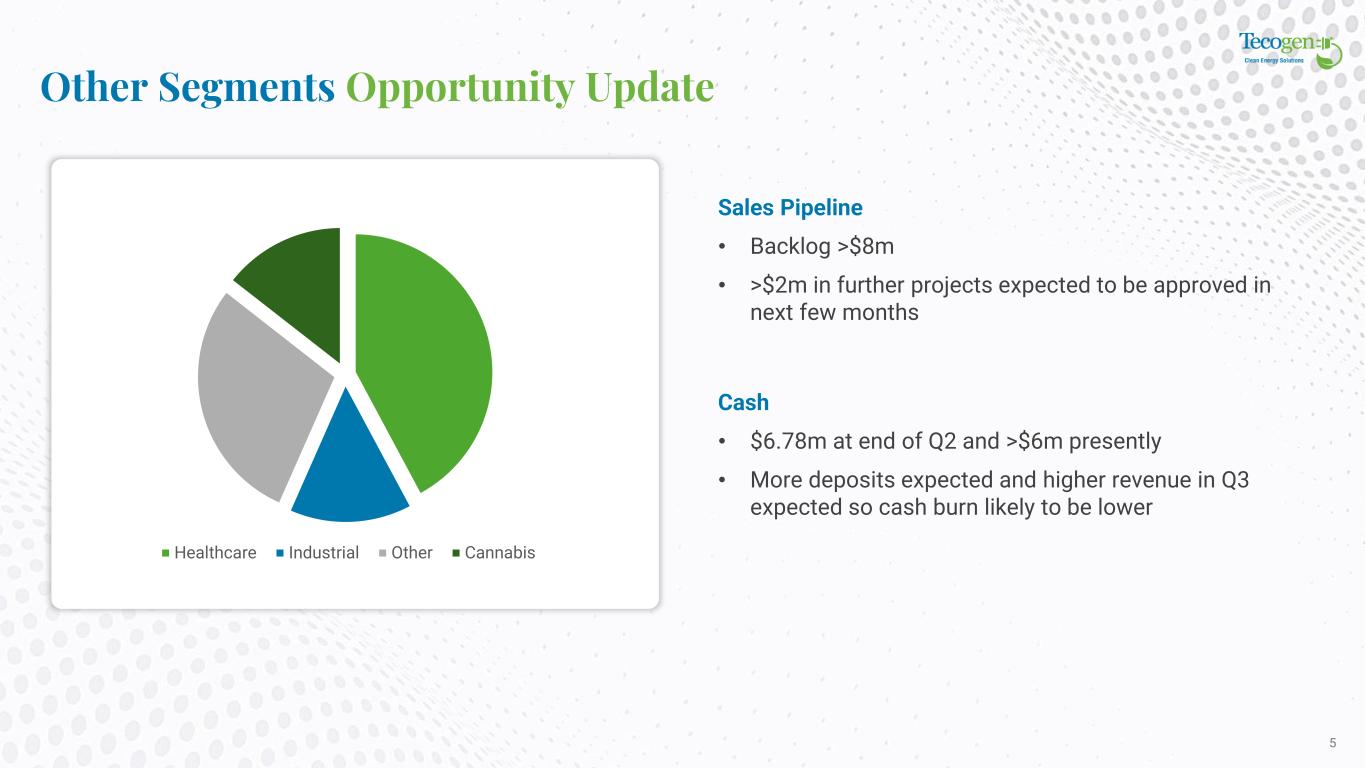
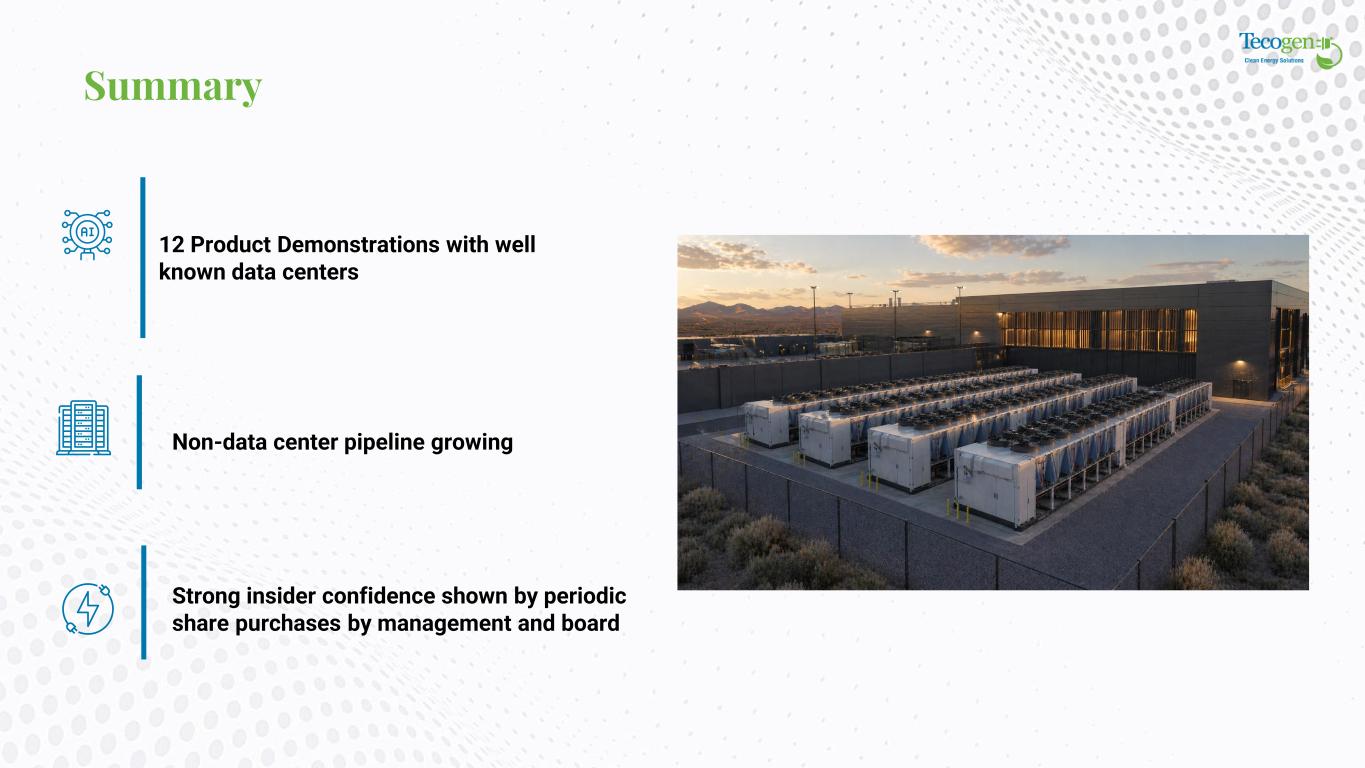
Thank you, Jack. Welcome to TKGEN's Q2 2026 call. Today, I would like to start with a key question that many of you may be wondering about. Given that TicoGen has been working on the data center strategy for a while, and the product seems to make perfect sense for the market, what is taking so long for orders to close? Is there something missing in the story? To answer those questions, I believe we need to start with the objective. In my view, the objective is, what is the fastest way to maximize the value of TicoGen? given we have great technology but have resource constraints as a small company. Originally, our strategy was to target smaller data centers. We could then use that as a reference to get the bigger names interested. As we got bigger names interested, the company's technology starts to become incorporated by big brand data centers, and now we have technology that everyone wants, making TikaGen very valuable. Now, we may have an opportunity to go straight for the end goal, which is the hyperscale and big brand developers. In March this year, I shared an opportunity pipeline with you. Many of these opportunities were with data centers that were of smaller scale. While many of these projects will likely close, these projects are subject to external factors such as tenants, delays in construction permits, etc. The big brand data centers don't have the same limitations. In addition to these smaller opportunities, we have been simultaneously working on access to the larger names. It has taken an enormous amount of work on the part of our sales team to make inroads on some of the larger names. But now I believe we have managed to gain some serious traction. Over the last two months, we have hosted 12 product demonstrations, six in-person and six virtual. The in-person group included four data centers that are hyperscale or built-in hyperscale campuses and partners. The virtual visit group included chip manufacturers, engineers, and another four data centers. These data centers collectively represent greater than 8 gigawatts of data center capacity operating today and multiple gigawatts in construction. Although I cannot tell you the names of the data centers that attended, I'm sure you will know many of them. To put this into perspective, the data centers that attended, either virtually or in person, collectively represent 15 to 20 percent of present data center capacity in the U.S. The natural question at this point is, does attending this product demonstration show any real commitment or interest? For the in-person group, given how busy data center engineers and senior-level people are, blocking off a whole day for multiple people is a significant commitment. It has taken many months of finding the right internal champions with influence at these larger companies and educating them on the value of our products before we got to this point. Second, beyond the list that attended, we are talking to other large and hyperscale data centers. The ones that are earlier in the process declined attending. This is consistent with our experience in other markets, where once a potential customer attends a site visit, our close rate is usually high, as they're serious about entering a business relationship. Lastly, I think the market has also evolved. In addition to power, there are some key challenges that the bigger data centers are facing that our products solve. As you may have read in the press, many data centers are facing opposition for on-site water use. noise, and air pollution. Here's where our products really shine. We solve all three problems. The dual power source chiller is closed loop, so there's no water evaporation. Our products already operate in noise-sensitive environments, such as on rooftops next to penthouse apartments. Recently, during the scorching 4th of July weekend, black smoke could be seen in northern Virginia from continuous diesel generator usage from data centers. Diesel generators were being used to avoid a blackout as the utility grid was running out of power and forcing data centers to shed load. Therefore, unlike a diesel generator that attracts noise complaints and pollutes, data centers can install our products without worry. This is where seeing a product demo brings these benefits to life. There is a difference between seeing a data sheet with a decibel reading and hearing our products in person or reading about near zero knots and carbon monoxide emissions versus seeing the readout from an emissions analyzer in real time. There's also a big difference between saying you can add extra megawatts for compute during hot days versus watching in real time a jump in cooling load and seeing the electrical power remain capped, or saying you can provide uninterruptible cooling during a power outage versus watching someone shut off the electrical power to the chiller while it's running. These big-name data centers have permitted projects, capital, and the ability to shape the whole industry. The feedback has been extremely positive across the board, and specific projects, delivery dates, et cetera, have been discussed, so we feel confident enough to begin building some inventory of our dual power source chiller and PowerGen modules to get a head start. In addition to the data center push, our base business backlog now stands at greater than 8 million. In addition to what is already in backlog, we expect a further $2 to $3 million in projects to close over the next few months. This means we expect product revenue to increase in Q3, and we expect to collect more deposits, improving cash flow. Although our focus has predominantly been on our data center strategy, during the last call, we mentioned that we expected to reduce expenses in our service group to increase margins. During Q2, these reductions were made mid-quarter, so the full impact will be seen beginning in Q3. One-time costs in Q2 reduced margin by around seven percentage points. Without these one-time costs, margin is starting to recover in service. In addition to cost reductions, we have also started to make contract pricing adjustments, where appropriate, and are working with customers, especially on larger sites, to make improvements that would help them increase run hours and help us increase revenue and margin. Given that our service revenue is substantially higher year-on-year, this continuous improvement is expected to result in higher margins and therefore a significant increase in growth profit dollars. I'll now hand over to Roger to talk about the financials.
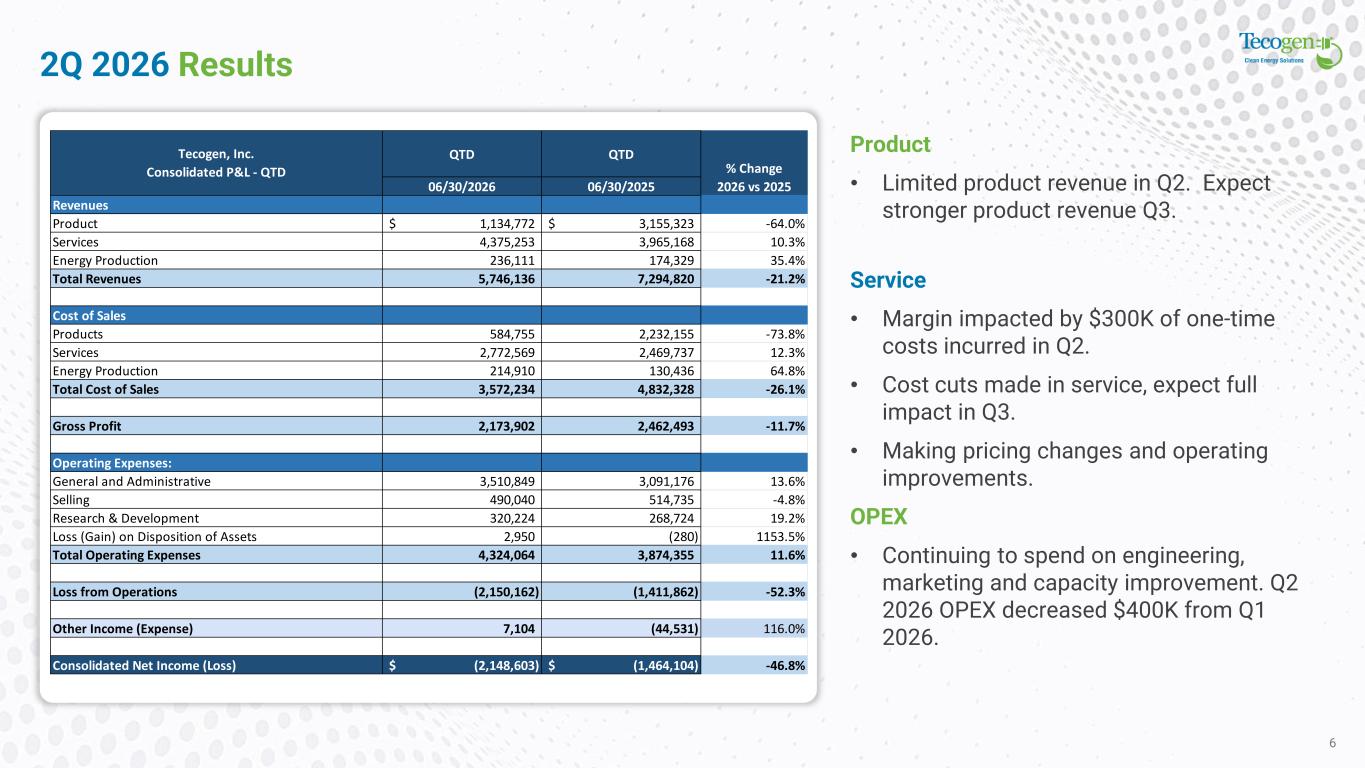
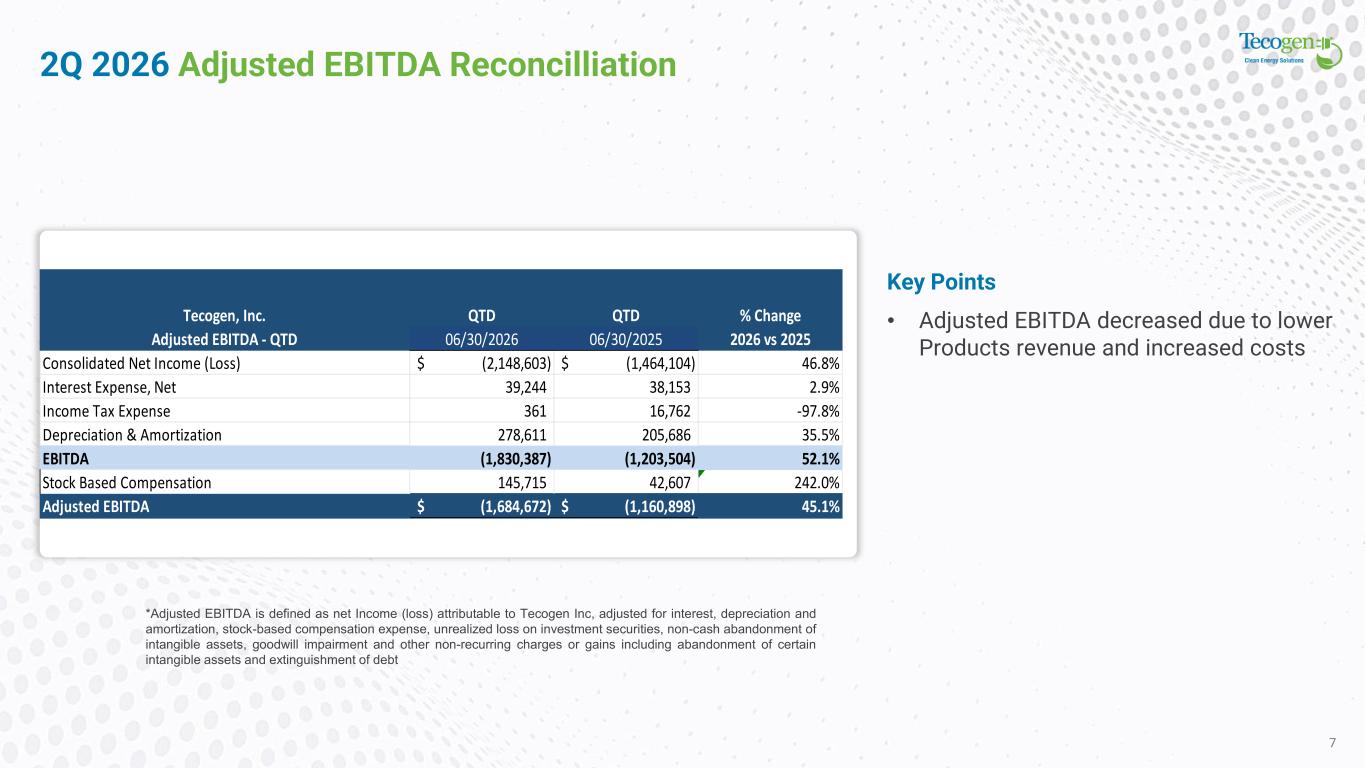
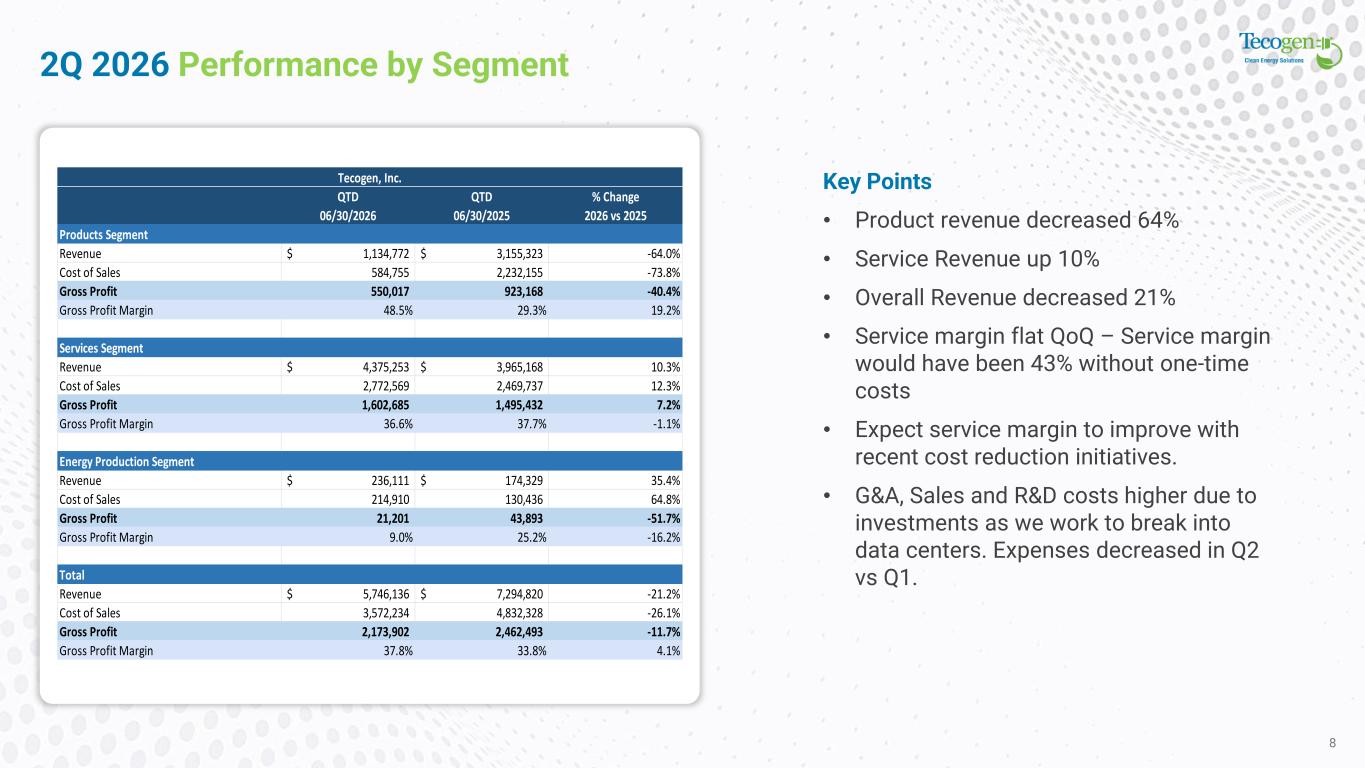
Thank you, Abedad, and good morning, everyone. I'll begin with the results for the second quarter. Total revenues decreased 21% or $1.5 million in the second quarter to $5.8 million compared to $7.3 million in the second quarter of 2025, and this is due mainly to lower product segment revenue. As Aminad indicated just moments ago, we expect revenue to increase in the third quarter based on the recent increase in our backlog and the anticipation of expected projects that will close in the next few months. Our gross profit decreased 11.9% to $2.2 million in the second quarter of 2026 compared to $2.5 million in the comparable period in 2025. And, again, this is due to products segment revenue. A gross profit margin increase by 4% to 37.8% in the second quarter of this year, from 33.8% in 2025. And this is due to improved products segment gross margin. Operating expenses increased 11.6% in the second quarter to $4.3 million from $3.9 million in the second quarter of 2025. And this is due to increased operating costs in both our products and services segments. And the general increase in operating costs incurred for the manufacturing capacity expansion that we're undergoing. and the continued development and refinement of our dual-source chiller, which, as we all know, is focused on our entry into the data center market. During the just-concluded quarter, we reduced headcount at a few of our service centers as we worked to reduce our spend there. Overall, operating expenses decreased approximately $400,000 in the second quarter of this year compared to the first quarter. Our net loss for the quarter increased to $2.2 million from $1.5 million in the comparable quarter in 2025. And this is due to lower products, segment sales, and gross margin and an increase in operating expenses. Moving over to adjusted EBITDA for the quarter. The adjusted EBITDA loss was $1.7 million in the second quarter of this year, which was higher when compared to last year's loss of $1.2 million. And this is due to lower products, segment sales, and gross margin in higher operating costs. Moving to performance by segment, products revenue decreased 64% to $1.1 million in the second quarter of 2026 from $3.2 million in the second quarter of 2025. The revenue for product segment revenues last year benefited from the shipment of cogeneration systems during this period to customers seeking tax credits from the Inflation Reduction Act of 2022. As we have discussed in the past, product revenue has significant variability quarter to quarter. Products margin, gross margin, increased 19.2% to 48.5% in the second quarter of this year from 29.3% in the similar quarter of 2025. And this is due to price increases and change in product mix. Our services revenue increased 10% quarter over quarter of 2026 to $4.4 million, which compares to $4 million in the second quarter of 2025. And this is due to higher billable activity and higher operating hours of our equipment from both our existing service contracts and our AGES-acquired contracts. Our service gross margin was essentially flat compared to last year. During the second quarter of this year, as I'm going to indicate, we spent approximately $300,000 of one-time cost at a handful of sites that we serviced, which are electric chillers as part of the energy sites that we sold to SDCL, Kyotherm in 2029. In fact, one of these electric chillers had a catastrophic failure at the start of the cooling season and needed significant repairs and the additional cost of rental cooling during the time the systems were being repaired. You know, excluding this one-time cost, as Amadad indicated earlier, our gross margin from our service operations would have been 7% higher in the 2026 period. Our energy production revenue increased 35% in the second quarter of this year to $0.24 million from $0.17 million in the 2025 period, and this is due to increased uptime at certain energy production sites. The energy production gross profit margins decreased 2-9% in the second quarter of 2026 from 25.2%. And this is due to the guaranteed shortfall of just under $100,000 that we recognized in the quarter. I'll now hand the call back over to Abedai for closing remarks. Thank you, Robin.
At this point, there are two conclusions you could reach. The first is that it has taken a long time today, so the company's prospects in the data center market are slim. Or the second, that it has taken a while to navigate the data center landscape and get access to the right champions of the largest data centers. Now that we have, the potential addressable market is massive. After all, why would some of the largest data centers bother to take a day out of their busy schedules to attend a product demonstration? Given that we now have a range of opportunities from small data centers to the largest players, what is the likelihood that nothing closes, especially if we have some inventory on hand and delivery risk is eliminated? If we land even a pilot project with a big brand data center, what does it do to our prospects industry-wide? Management and the board have consistently bought stock because we believe the company has technology that solves some fundamental problems facing not just data centers, but a whole host of markets. You decide which conclusion makes the most sense. Thank you, and I'll open for more questions.
Operator
Thank you. We will now be conducting a question and answer session. If you would like to ask a question, please press star 1 on your telephone keypad. A confirmation tone will indicate your line is in the question queue. You may press star to remove yourself from the queue. For participants using speaker equipment, it may be necessary to pick up the handset before pressing the star keys. One moment, please, while we poll for questions. Our first question comes from the line of Bobby Brooks with Northland Capital Markets. Please proceed with your question.
Hey, good morning, team, and thank you for taking my question. So very exciting to hear about the 12 demonstrations. I wanted to unpack that a little bit more. We're all 12 demos with 12 different potential customers, and you disclosed having those six demonstrations at the beginning of July, so had another six over the last month. Was there any acceleration in that? Just curious to hear more there.
Great question, Bobby. So, out of the 12, eight were potential direct end customers. The rest were engineers or other people either designing data centers or partners that could help us accelerate some of that. So, really, that have key influence on the end result. And then one of them was one of the chip manufacturers. visitors. So, generally, it was all high-profile visitors. Definitely, what we tried to do with regards to the scheduling was to schedule the most important ones towards the end, just so we got better practice with the demonstrations as well. And it just so happened that's how the schedule worked. So, we gradually escalated in terms of size towards the, which is why Our press release earlier in July probably showed a lower installed capacity, and we had more towards the end.
Got it. That's helpful. So it was like 12 different customers across the 12 visits.
Yeah, so exactly, 12 different entities.
And then when we spoke after the last print, you mentioned how the larger data center operators were sort of split in two, both interested but group one let's say would learn of the capacity limits you currently have and sort of lose interest and say call me call me when you can do more but then interestingly you had mentioned that that that second group were some who were seemingly willing to scale up with you so i wanted to follow up there and here is today's commentary on these larger potential for customers a sort of evolution of that second cohort, getting more comfortable on the technology, or just any additional color you could share on that dynamic?
Yeah, yeah. No, that is a great question. I believe once, you know, again, when people come for demonstrations, there's generally a certain level of interest, right? The way, at least I think, of the sales process, you've got two portions to it. The first part is getting the interest up to the point that somebody says, this makes sense for me. And then the second part of it is, of course, reducing anything that might add friction to it or might act as a negative to them not closing the deal, right? And out of that capacity is one of them. That's part of why we're starting to build some inventory so we can cut the lead time and we can turn these things around without having to tell somebody you need to give us an order. right away, and this is our lead time, right? We can start getting a head start on some of that. Having said that, I believe, based on all of the discussions that we had during these meetings, again, the advantage of having, especially the ones in person, is you get a decent amount of time to really probe their requirements and what they're looking for and where they're thinking. We're starting to find, I think, applications that we could essentially start small and grow with them. That is also one of the advantages of these bigger data centers that have existing locations, because you could either add almost as a retrofit as a pilot, or you can do it as part of one phase of a bigger project. So, there's ways to do this without having to have all that capacity up front. And we believe that this is the capacity issue, although is important. I think there's a way around it in this case, but we will see as further discussions go forward. that's really helpful caller and then maybe just on building that uh the the building capacity ahead of orders as a confidence has grown was just curious to get a sense on the size of that and how much that might cost thank you i'm not sure i can comment on that exact number but i'll give you kind of how we think about it what we're thinking about is well what would people want let's say, in the very end of this year towards the early part of next year, right? What sort of a rough number that – and then if we can – if we, let's say, have three or four different potential customers saying, I need roughly this amount of capacity, then we'll say, okay, our odds of – if we build X amount, then we'll sell it to at least one out of the three or one out of the four, right? Our odds are good in terms of getting that sold. So that's how we're thinking about it in terms of risk, cash, and in terms of also timing, because I think part of the issue I'm sure everybody is thinking about is what does this mean in terms of cash flow and inventory? And if we time it right, in theory, we should be able to bridge, you know, we won't necessarily need to put up all the capital up front, right? If you look at the timing of when these things could potentially be shipped or delivered, that's what we're hoping for. But even if it ends up slipping a little bit, it allows us to manage the risk versus the cash flow.
Very helpful caller. Appreciate our return of the queue.
Operator
Thank you. Our next question comes from the line of Eric Stein with Craig Hallam. Please proceed with your question.
Hi, Benand. Good morning. Hey, Eric. Hey, so maybe first, talking about those 12 demos, you know, just curious, is there a way to think about that, you know, which opportunities you may pursue under the Vertiv relationship or not? Or is that even the right way to think about this? I mean, is that kind of a separate path?
I'd say the two are parallel paths. um pretty much all of this all the demos that came were arranged through us and our sales team and our marketing efforts um we of course if it makes sense in these projects there are places where it may make sense to collaborate um but right now those are all came from our marketing efforts got it and then maybe sticking with vertiv um i know you you're you got the initial order you know just curious if you can speak to both the progress towards finalizing the mpa and then also i know you've talked about in the past that vertiv was specking you into i think 25 to 50 megawatts of projects maybe if you could just give an update on where those specific projects stand yeah so one thing on this particular call i you know we as we mentioned anything of course on either party right we have to get prior approval on both sides in this particular case I talked to my counterparties and we decided that let something close so that we save the approval process with vertib for something that's more substantial so at this point I can't comment too much on that without so I think you know stay tuned let things happen and you know we'll announced deals as they happen.
Okay, but beyond the deals, in terms of just progress towards the MPA, I mean, is that just still in process?
Yeah, so I think things are in a very good place overall with them. I just cannot comment at this point because, again, I didn't this time around and get specific for it.
Understood. Okay, last one. You know, so building inventory, I know you've built some inventory over the last three quarters, you know, when you're highlighting specifically building inventory in your prepared remarks and now, is that saying that there is more inventory build to come and then how do you kind of manage that versus some of your capital constraints that you talked about yeah so we had a little bit of inventory earlier but as our backlog has increased for the non-data center projects a lot of that inventory is going to get absorbed as part of that so we have to add
additional it's it's also as I mentioned it we're trying to manage this in such a way that it's really it's less a matter of total inventory it's a matter of figuring out how do you compress the lead time because typically with some of these projects right there's a lot of things moving in the background and you may get various progress and verbal approvals but as you you may not get a purchase order for a while as even though we might know that things are progressing things are happening so we don't want to have a delay at that point we'd rather know that okay we're going to get we feel very confident we're going to get these projects in which case let's get this so as soon as we get a purchase order and get a deposit we can start shipping and that's that's how we're thinking about it so we're trying to balance the cash flow versus versus that but we also feel that it's important to be able to move quickly especially because At this point, we have the interest of these bigger names. We want to make sure that we're able to respond quickly, and then hopefully once we get some units starting to ship, then we can start ramping up very quickly from there.
Operator
Thank you. Our next question comes from the line of Chip Moore with Roth MKM. Please proceed with your question.
Hey, morning. I wanted to maybe follow up on, hey, I want to follow up maybe around the demos and some of your comments, which makes sense around, you know, balancing working capital and compressing those lead times. Just the discussions you've had, I think you alluded to even talking about dates. Maybe just help frame that out, like a range of whether it's, you know, sort of those pilot early phases versus larger potential opportunities. Just any sense of, you know, where those type of dates are panning out.
So part of that is it's like I can't comment too much on that. What we're trying to do is to have really work with event customers to figure out, you know, how we can scale with them. So, we think at this point in the companies, like where we are, it's probably more important to get the right names that, in terms of first projects, if we can do that. Just because if you get the right names, you end up shaping the whole, all the future. development right once you have the right brand name everybody else is going to follow hopefully based on that um you know the right name using it because it's it's i think reputationally probably more important to get that done right than necessarily um you know i mean whichever order we get of course if we get a smaller data center first we're going to take that but our priority right now is to try to get the right brand names closed if we can understood Good.
Yeah, that's helpful. And we'll look forward to hearing updates. And maybe just for my follow-up, the base business, right, with that backlog increasing, good to see. And it looks like you expect some more here, just the trends you're seeing there and any changes in sort of base markets. Thanks.
So we're starting to see power constraints across the board, all over the place, which is, in the past, a lot of our sale, whether it was chillers or cogeneration, was made predominantly based on economics. Now we're starting to see a lack of power, electrical equipment having long lead times, those kind of things affecting the ability for non-data center type customers to have access to air cooling or power generation or all of that equipment. So we're starting to see that driving some of this. We're also starting to see a little bit of the cogeneration and standard power generation side of things start to come back for a while. That had significantly reduced, but we're starting to see some of the larger multifamily buildings and other types of buildings that are seeing high utility rates and, in some cases, not enough power that are looking to use our equipment. So I think the Bayes business is growing just as a result of some of what the data center space is also facing. And part of what we've seen in that Bayes business, right, things like switchgear, things like that that are having longer lead times, is also what is making us feel like having some of that inventory on hand will also likely pick up potential customers that are trying to get other electrical equipment, they're not able to install electrical-based equipment just because the switchgear and things like that might be longer that we could essentially pick up projects just that way as well.
Yeah, no, that makes sense. Okay, no, I appreciate it. Thanks very much.
Operator
Thank you. Our next question comes from the line of Alex Blanton with Clear Harbor Acid Management. Please proceed with your question.
Good morning. I've got a question Good morning Alex Oh yes I've got a question about the direction you see the market going for you is it going to be original data centers built from scratch or is it going to be retrofit of existing centers and in those instances would it be participating in expansions of existing data centers rather than just building what's already been built?
That's a great question. Actually, we both. Earlier, a lot of our opportunity pipeline was with newer types of projects, but we're starting to see more with existing data centers in a few different types of applications one is you know the ai side of it gets a lot of the press right but there's still a lot of existing cloud data centers that are supporting either the ai infrastructure but also just regular web workloads and many of those are running out of power and their cooling load may not be quite as big as an ai data center but it's still there And if they can free up some of that, then there's benefits there. So we're starting to see some potential in those kind of applications. We're seeing some potential customers say we can incorporate this as part of, you know, a bigger campus where they do it in one phase or as they build it into a certain phase of an expansion. and then there's also like the smaller data centers that might use it as a primary cooling source so there's different applications that we're starting to see and then there's also push i think more broadly in the industry to start moving towards maybe smaller data centers that are closer to urban environments just to where you can pick up pockets of power and those areas, again, our cooling products could be a very, very good fit. But we're seeing a mix of different types of applications right now.
But you see an opportunity to retrofit where someone has an electric chiller, and they say, well, let's take that out and install Ticogen instead, what is the opportunity there?
That actually is, we are seeing some potential opportunities like that, but what is more likely to happen in those kind of applications is, because with an existing data center, the actual doing the retrofit tends to be, because it's a live site, so they might add it to either as almost like an expansion into, because many of these data centers typically have some additional space they set up for future expansion, whereas they may not necessarily remove the electric chiller, they might leave it in place and add us in and put the electric chiller now as a backup.
So that's a more likely application than a pure remove electric chillers, but we are seeing some people that are looking to remove electric and move what are what I was in and thank you I'm interested in what you said earlier about solving the helping to solve the problems of pollution and noise and there was a third one the water usage water water pollution and noise how how do you how do you do that in your case?
So if you look at, yeah, so there are two different ways you can do it, right? One is with the chiller, because typically when a utility wants you to shut down your, or reduce power from the grid, it's usually on the hottest stage, just because that's when everybody else has their air conditioning system on. And when the utility starts to get very constrained, they start asking large load users to drop load, in which case your alternative and what happened in Virginia, for example, was the diesel generators were turned on. What we would do in our case, right, is just have that load either dynamically move to natural gas or have those chillers just be turned on in those applications so that that load moves over to natural gas. Because our equipment is designed for continuous usage and originally like our Altera emission system was designed for Southern California, so we have very, very clean emissions, our carbon monoxide knocks very, very low, right? So in that sense, substantially cleaner than diesel generates. The other thing is because our machines have been designed for continuous usage whether it's the inverter product or the chiller designed for pretty low noise urban environment so you could be standing next to it and you hear it but it's not going to be bothersome no more than ambient noise so in that sense it's substantially quieter than those diesel generators so that's the the first is the chiller application the second application is also potentially the inverter it's not necessarily going to run all your loads but there are certain standby loads there are other loads again that you may not want to have your massive full data center load coming on smaller power systems like invertease but because it's modular you essentially could add the invertease in conjunction with the chillers to to shed some of that load during that peak time and not turn on the generator and keep the diesel generator really just for emergency use okay well thank you very much Thank you Alex Thank you And we have reached the end of the question and answer session I would like to turn the floor back to Abinan Rangish for close remarks Thank you very much everyone for attending our Q2 2026 conference call I will keep everyone updated as things move forward I believe we've gotten the interest we're going to do everything in our power now to turn this this interest into projects, but I'll keep people posted, and hopefully we'll update. We'll have some interesting news over the next few months. Thank you.
Operator
Thank you, and this concludes today's conference, and you may disconnect your lines at this time. We thank you for your participation.