Operator
Good morning. Thank you for attending today's Thrive Holdings second quarter 2025 earnings conference call. My name is Megan and I'll be your moderator for today. All lines will be muted during the presentation portion of the call with an opportunity for questions and answers at the end. I would now like to turn the call over to Cameron Lassard with Thrive Holdings. Please go ahead.
Good morning, and thank you for joining us for Thrive Holdings' second quarter 2025 earnings conference call. With me today are Joe Walsh, Chairman and Chief Executive Officer, and Paul Rouse, Chief Financial Officer. During this call, we will make forward-looking statements that are subject to various risks and uncertainties. Actual results may differ materially from these statements. A discussion of these risks and uncertainties is included in our earnings release and SEC filing. Today's presentation will also include non-GAAP financial measures, which should be considered in addition to, but not a substitute for, our GAAP results. Reconciliations of these measures can be found in our earnings release. As a reminder, on this call, SAS revenue reflects the combined performance of Thrive and Keep. We will only specify Keep's performance when discussing its revenue contribution for the quarter and fiscal year. With that, I'll turn the call over to Joe Walsh, Chairman and CEO. Joe?
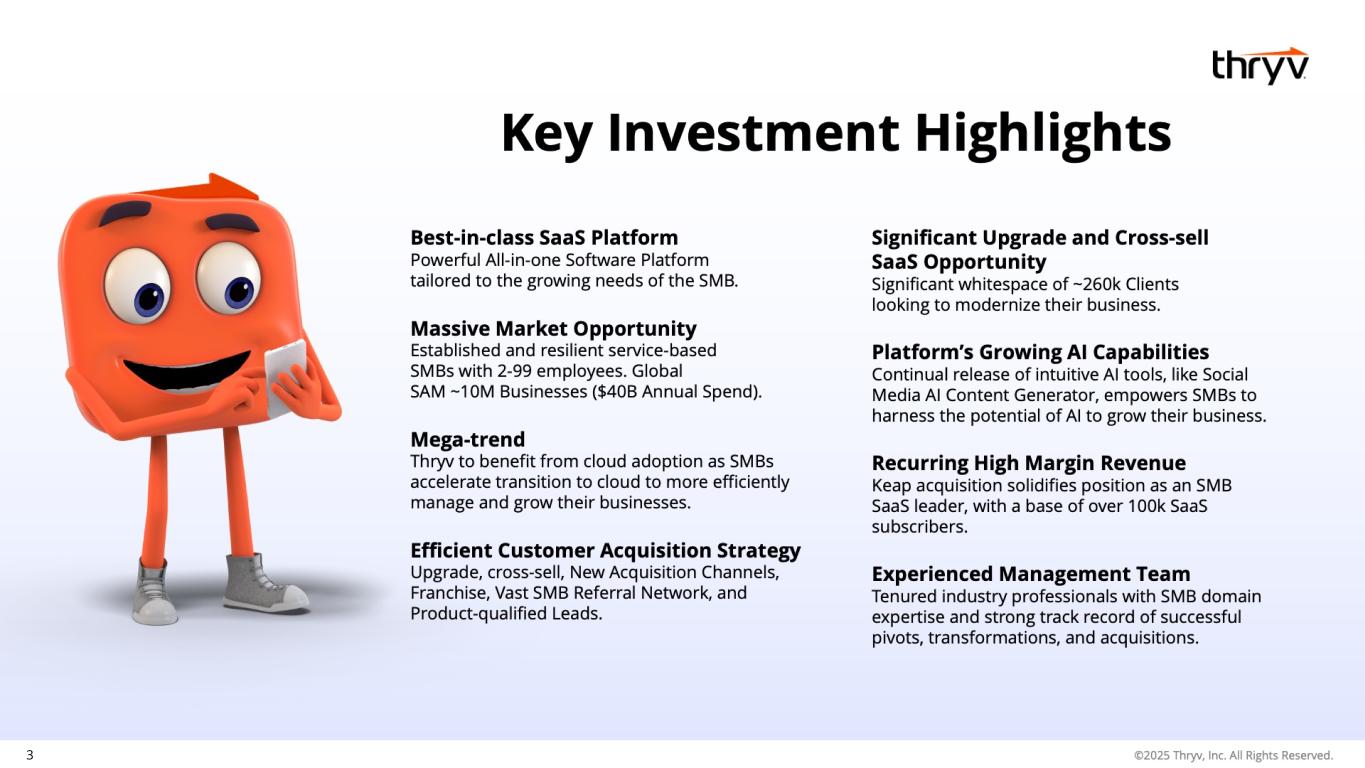
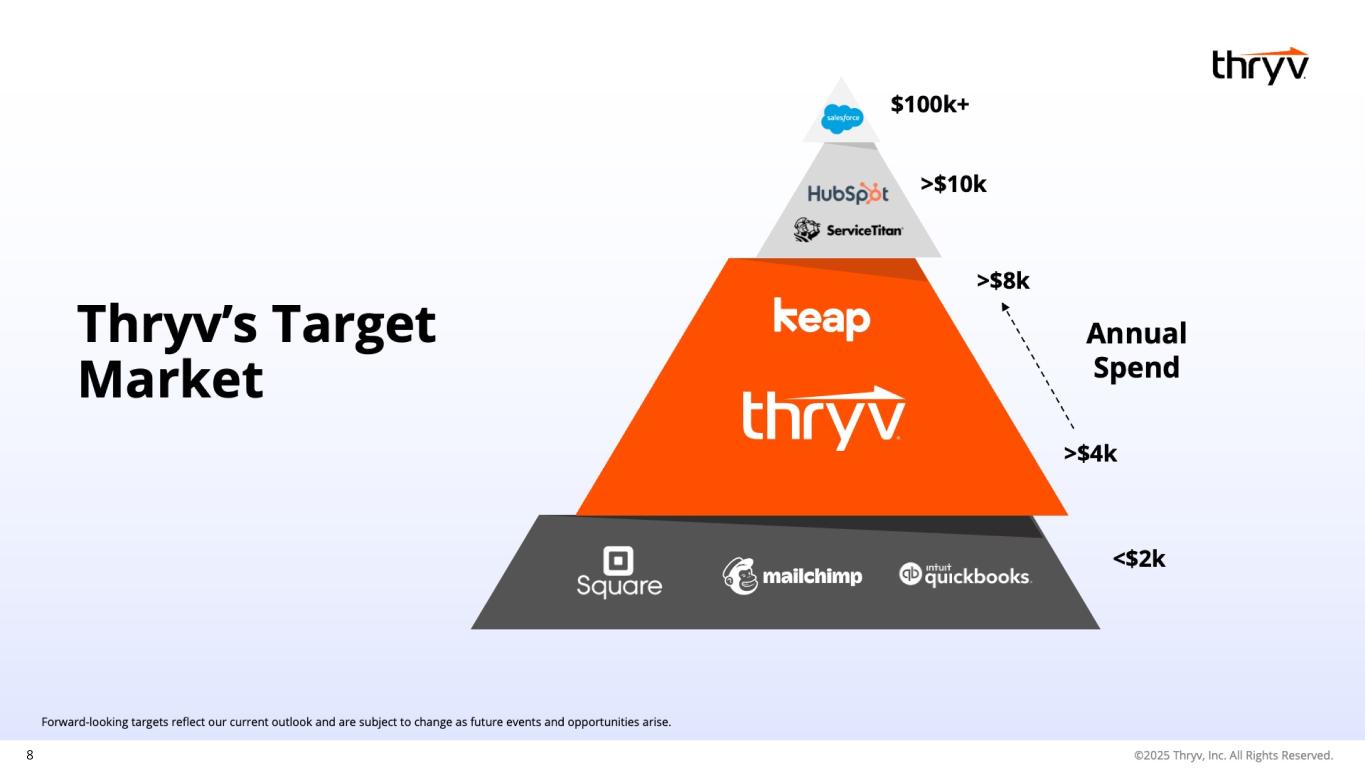
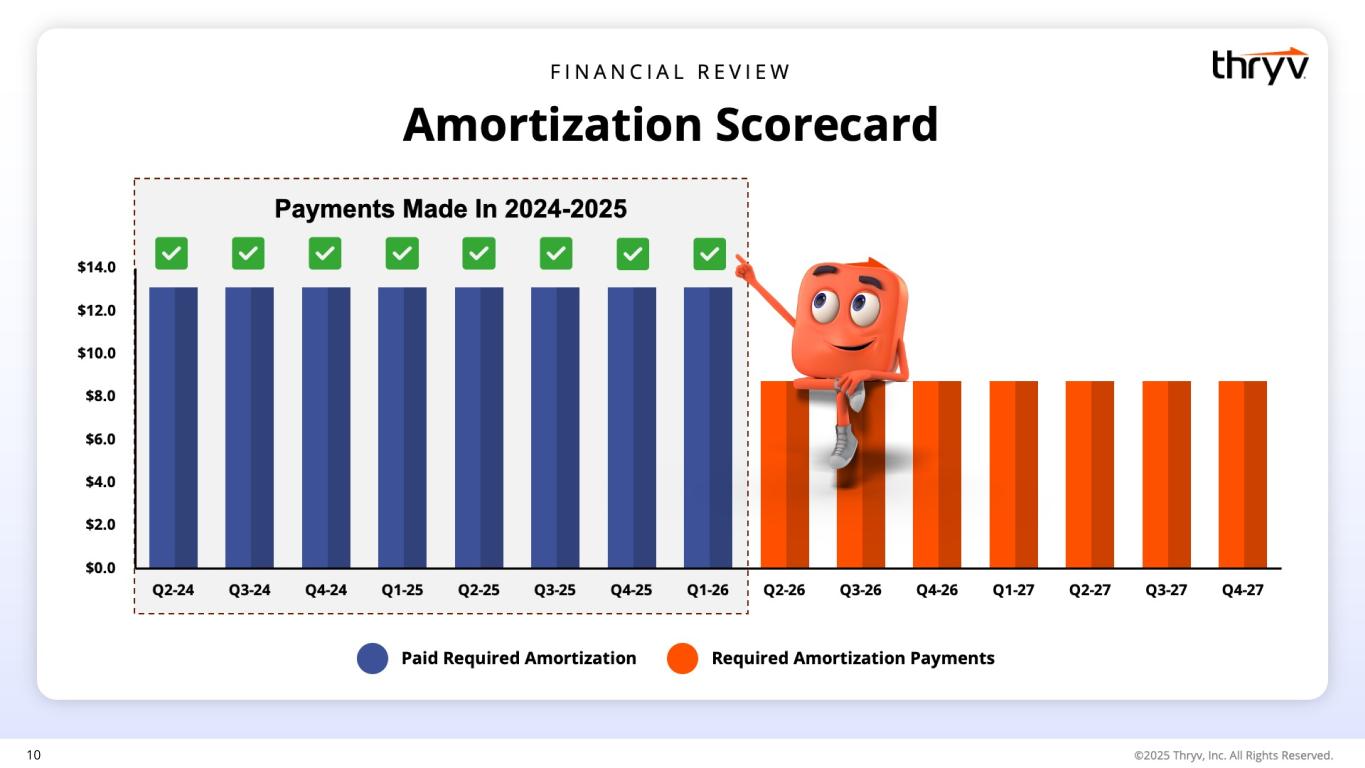
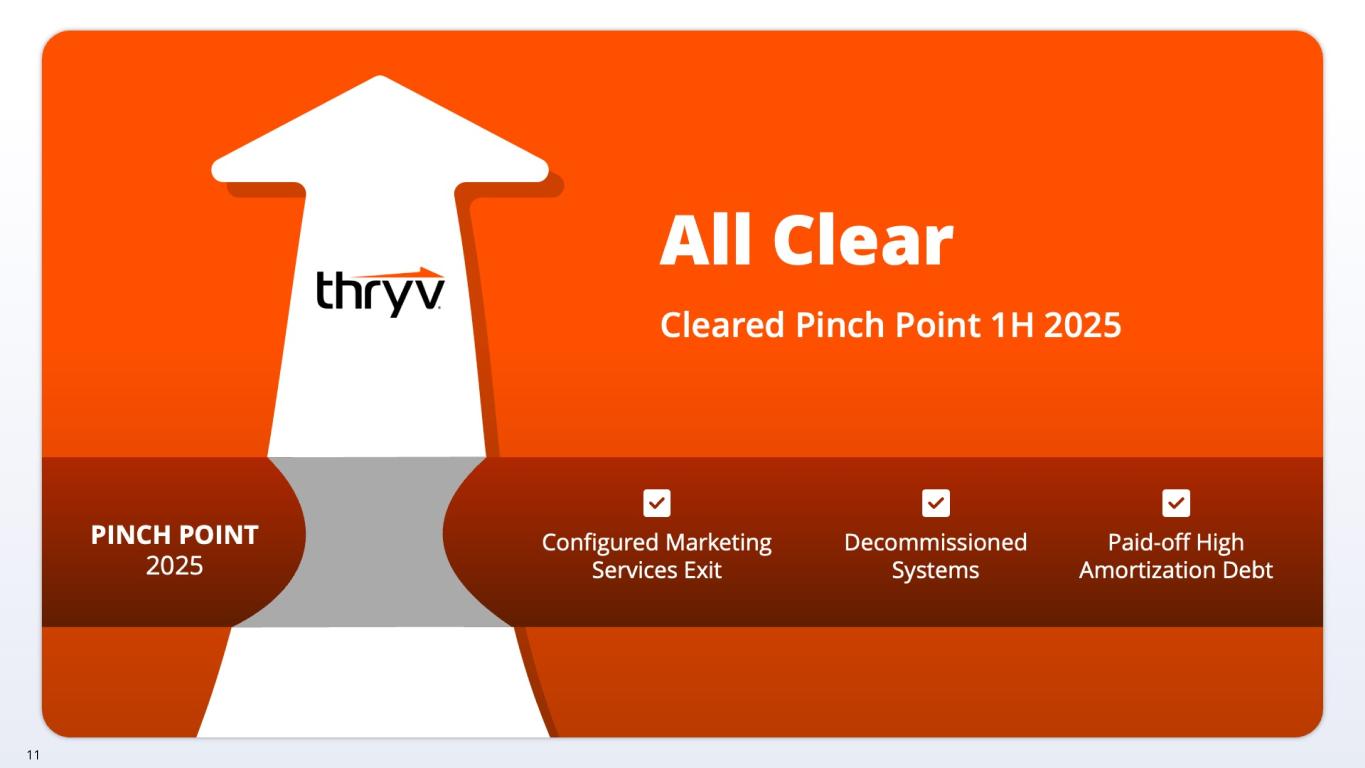
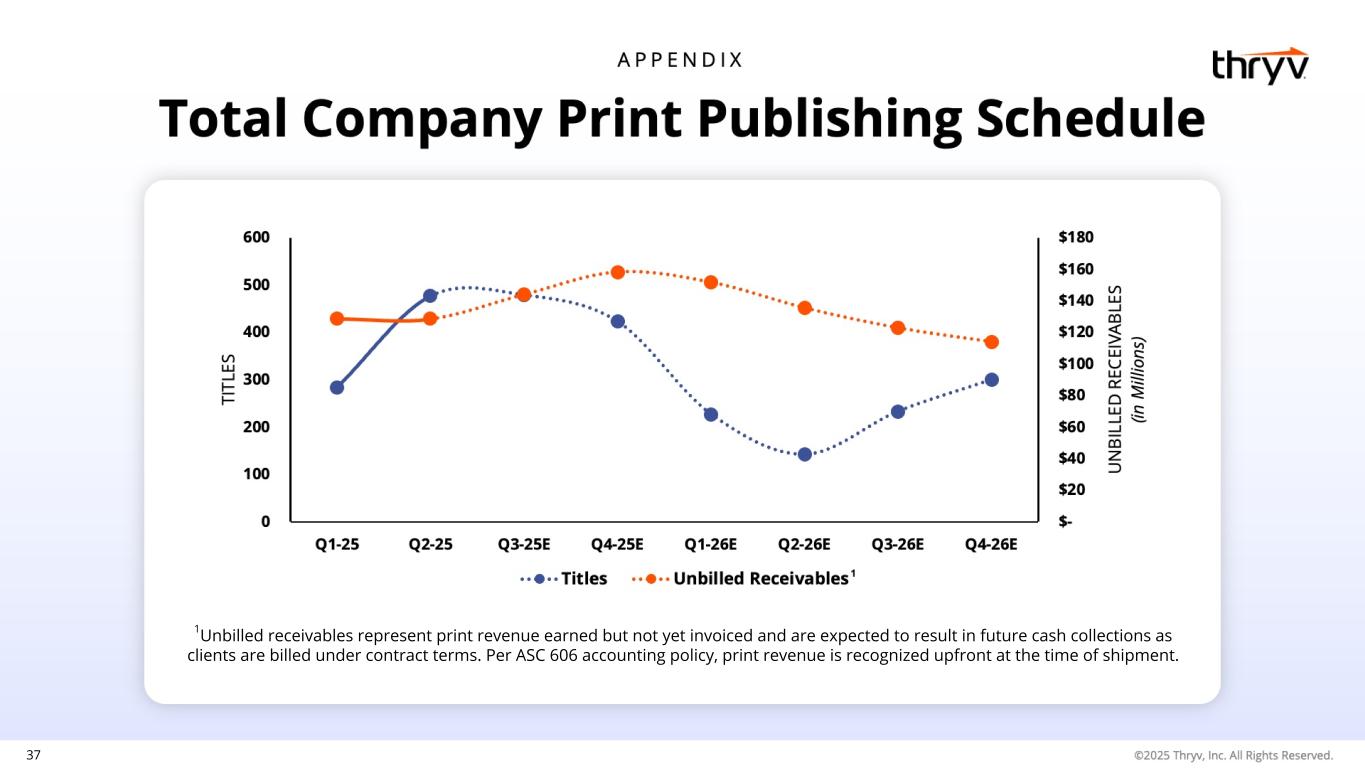
Thank you, Cameron, and good morning, everyone. I will highlight a few items, and Paul will take you through the numbers. We did it. We made it through the pinch point. At our Investor Day in December, we laid out a pinch point that was approaching for us, and investors were understandably concerned to see our leverage ratio rising. It was a challenging setup. You had accounting-related pressure due to our publication schedule with the move from 18 to 24 months, leaving a few less directories publishing in the early part of the year. And you had our decommissioning of legacy systems tied to marketing services, which added costs in the short run, but simplified our business for the long run. You had us digesting keep and the challenges there. And you had the last of our high amortization payments that needed to be made. So there was a reason to focus on it. But we've achieved that. We're out the other side of it now. We've made those amortization payments. And from this point forward, our business begins to, the ratio begins to improve in Q3 and Q4 moving out. We have lower amortization payments ahead of us now, and we're well ahead on those payments. So we now will have a real opportunity to have some free cash flow left in the business. With each passing week, with each passing month, we're going to begin to actually develop a little bit of leftover free cash flow in the business and be able to make decisions for the first time about how to allocate that. So mark it down in your calendar there. We're past the pinch point. That's behind us now. In terms of our results, this transition is continuing to go really well. Our rule of 40 ways are continuing. We delivered in this most recent period around 20% EBITDA margins and over 20% growth. So continuing to be a rule of 40 type business. As expected, our ARPU for our customers is rising. Currently, it's at about $4,200 on an annual basis. And as we said, we see that going from $4,000 to $8,000 over the next few years. Some evidence that we see progress here, our seasoned clients are spending $5,400 a year. And clients from our largest sales channel, which is our U.S. direct channel, are spending about $6,000 a year. So, we're definitely on course with more products now within the platform and customers buying more and more products. You know, we're seeing really good progress there. We've spoken about net revenue retention, that we expect it to hang out right around 100%. It was, again, this period, a little over 100% at 103. And the clients buying multiple products increased to 19%. So really good progress there on working with the existing clients and adding more. So with that, let me turn it over to Paul and let him take you through the numbers.
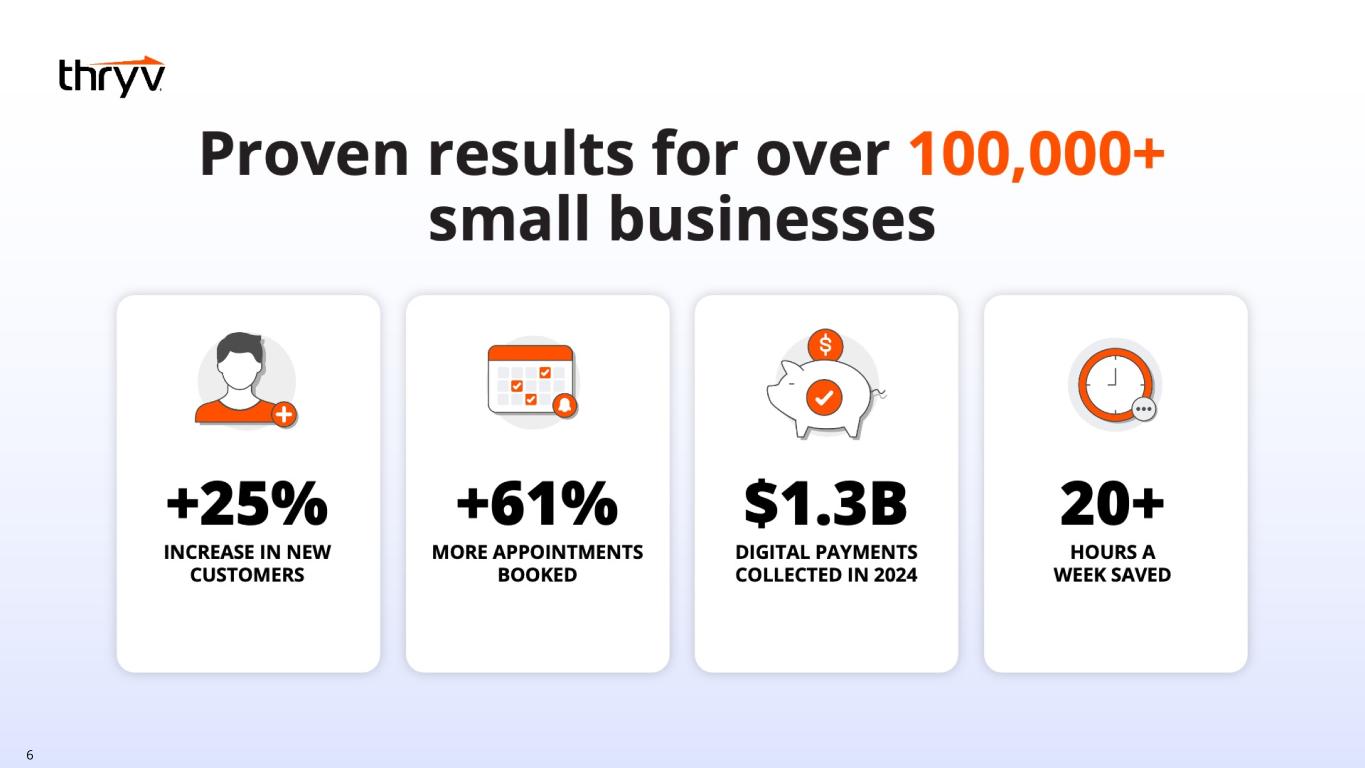
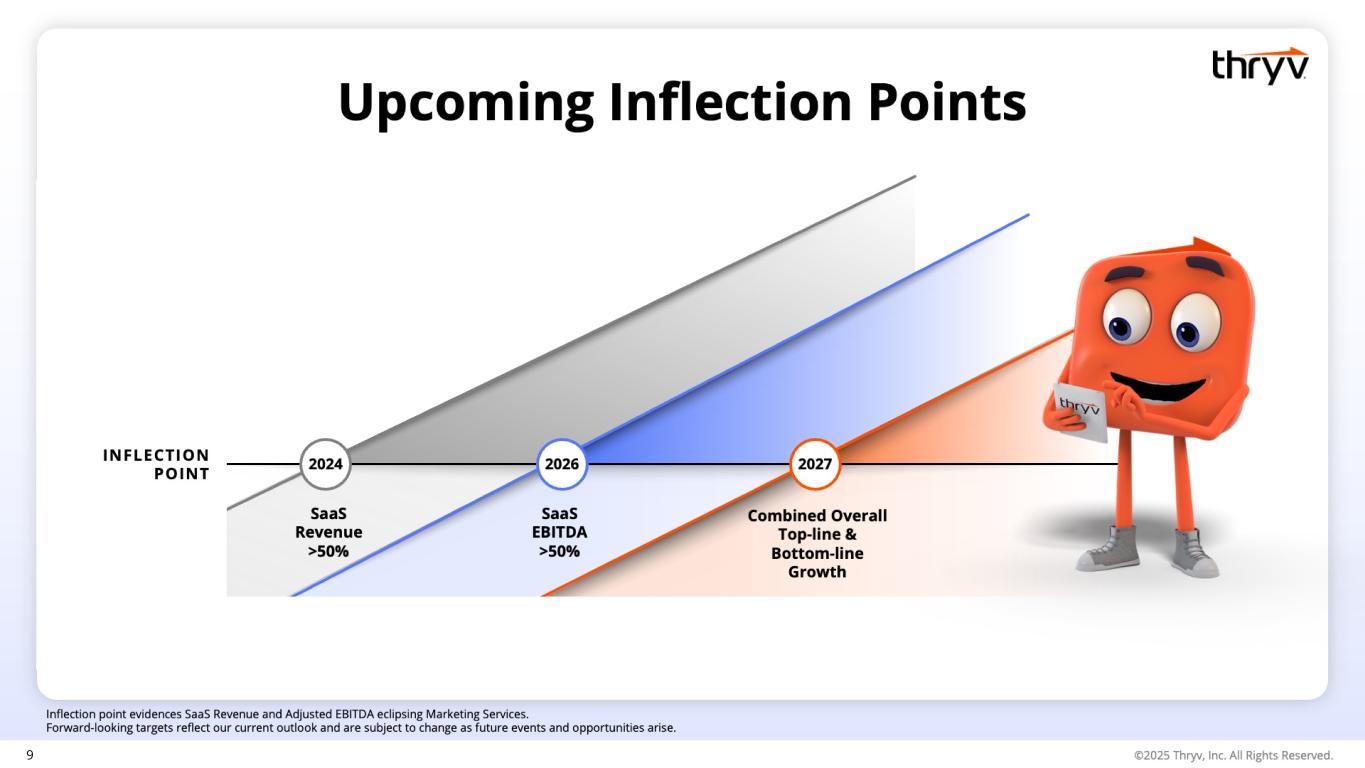
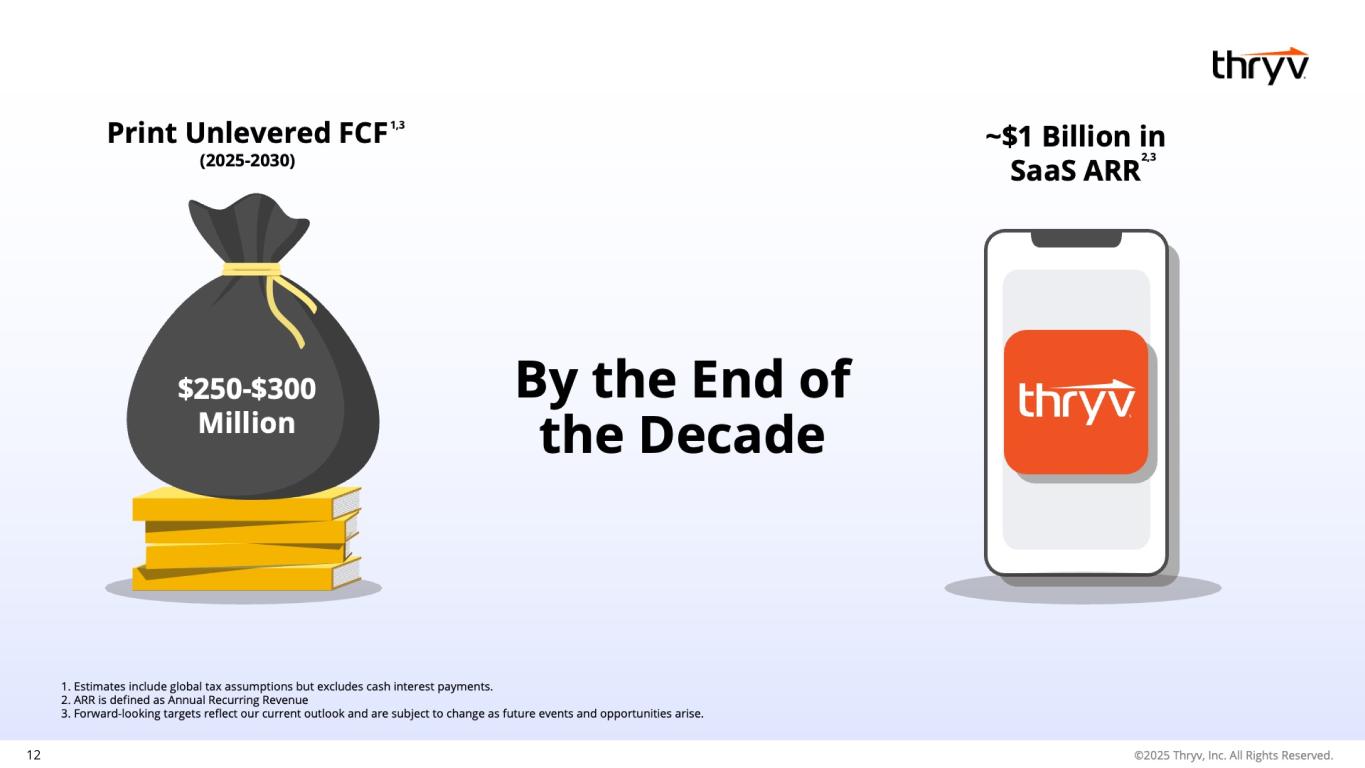
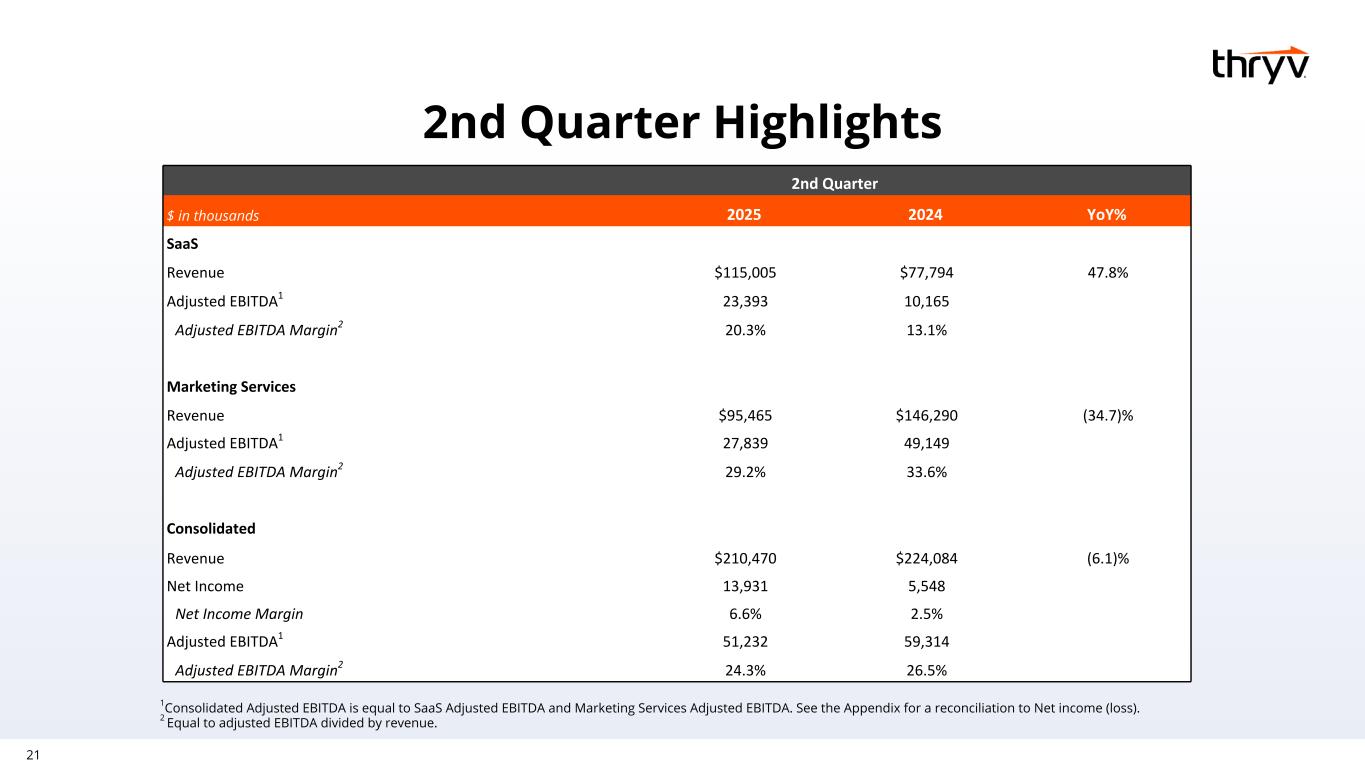
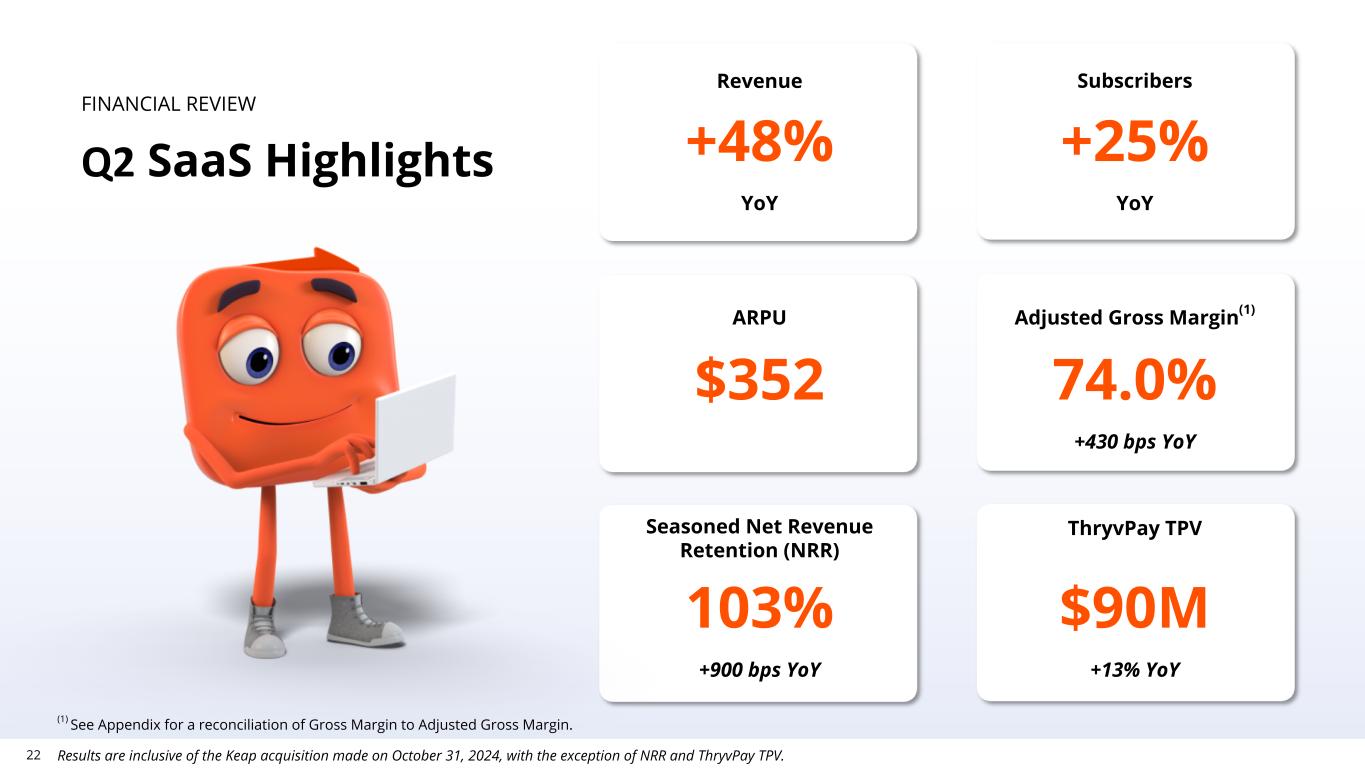
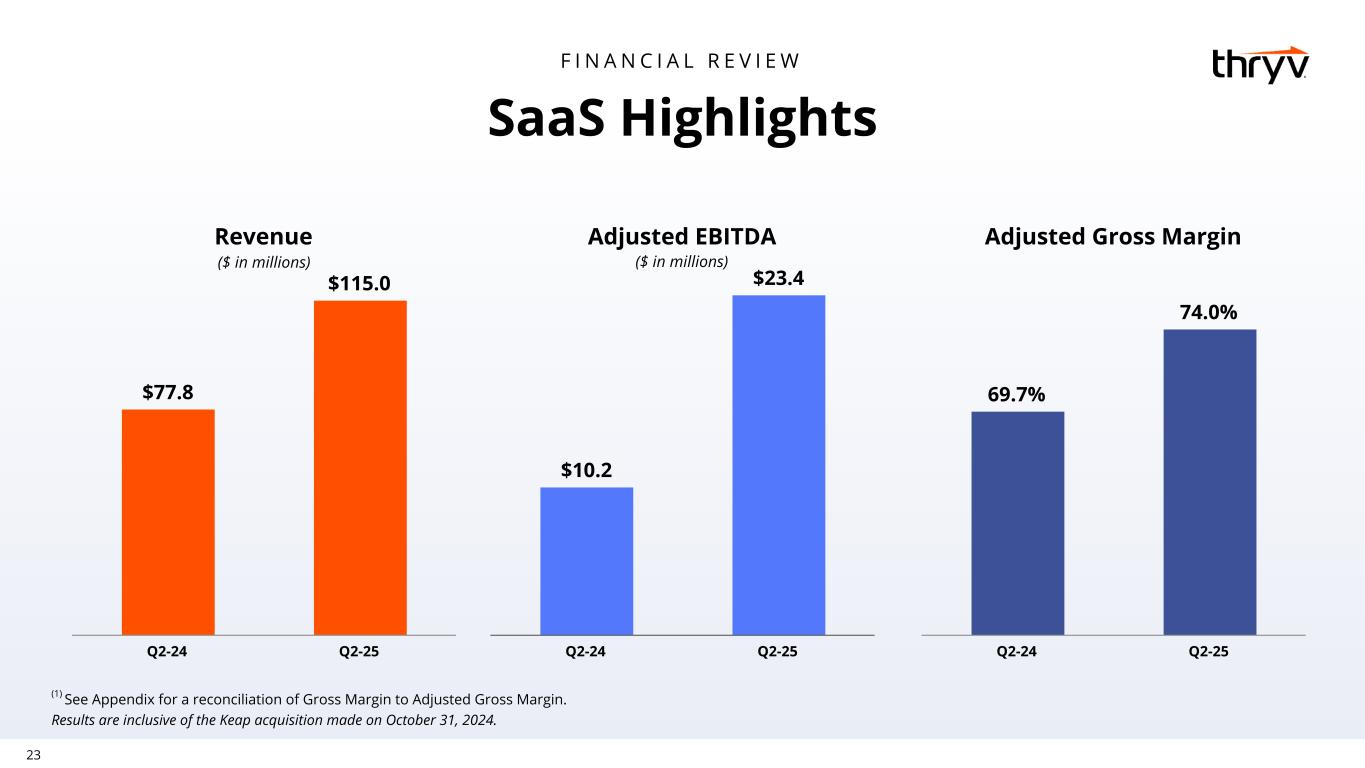
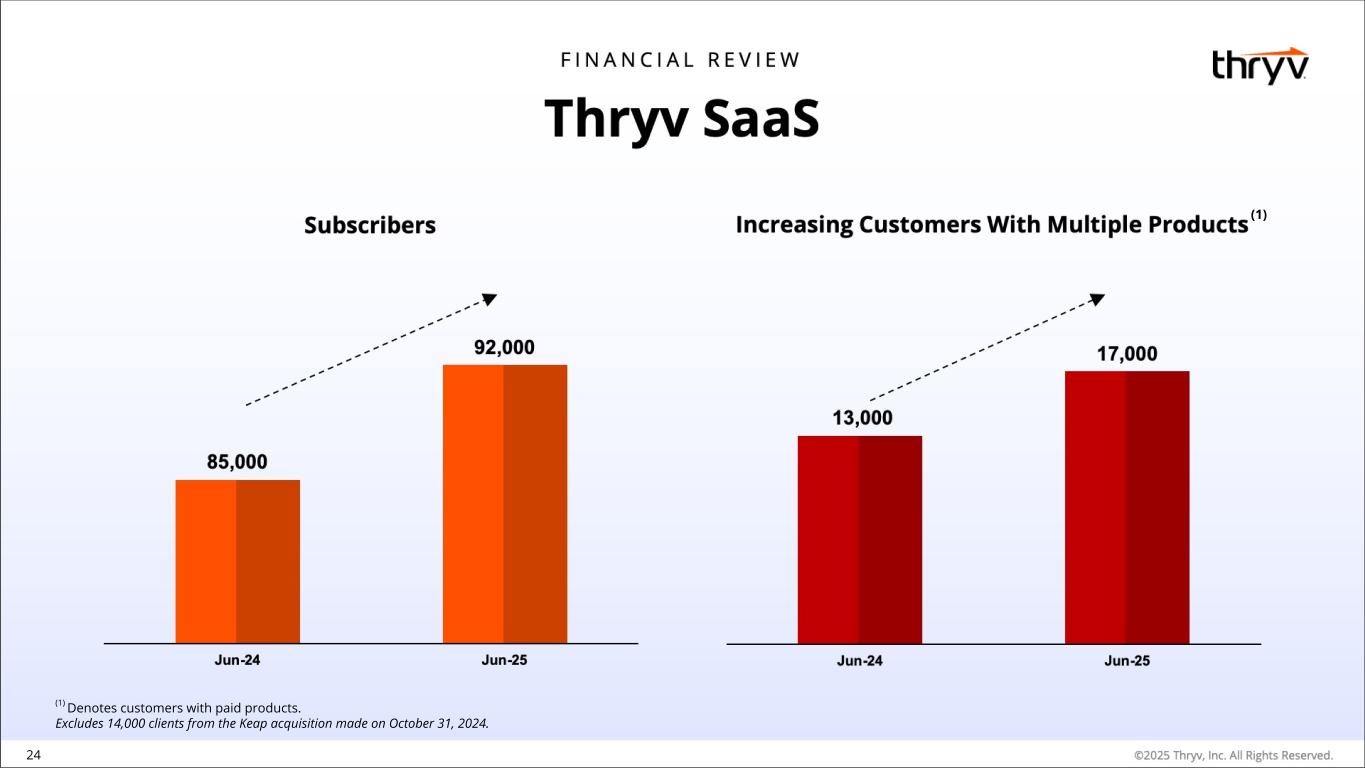
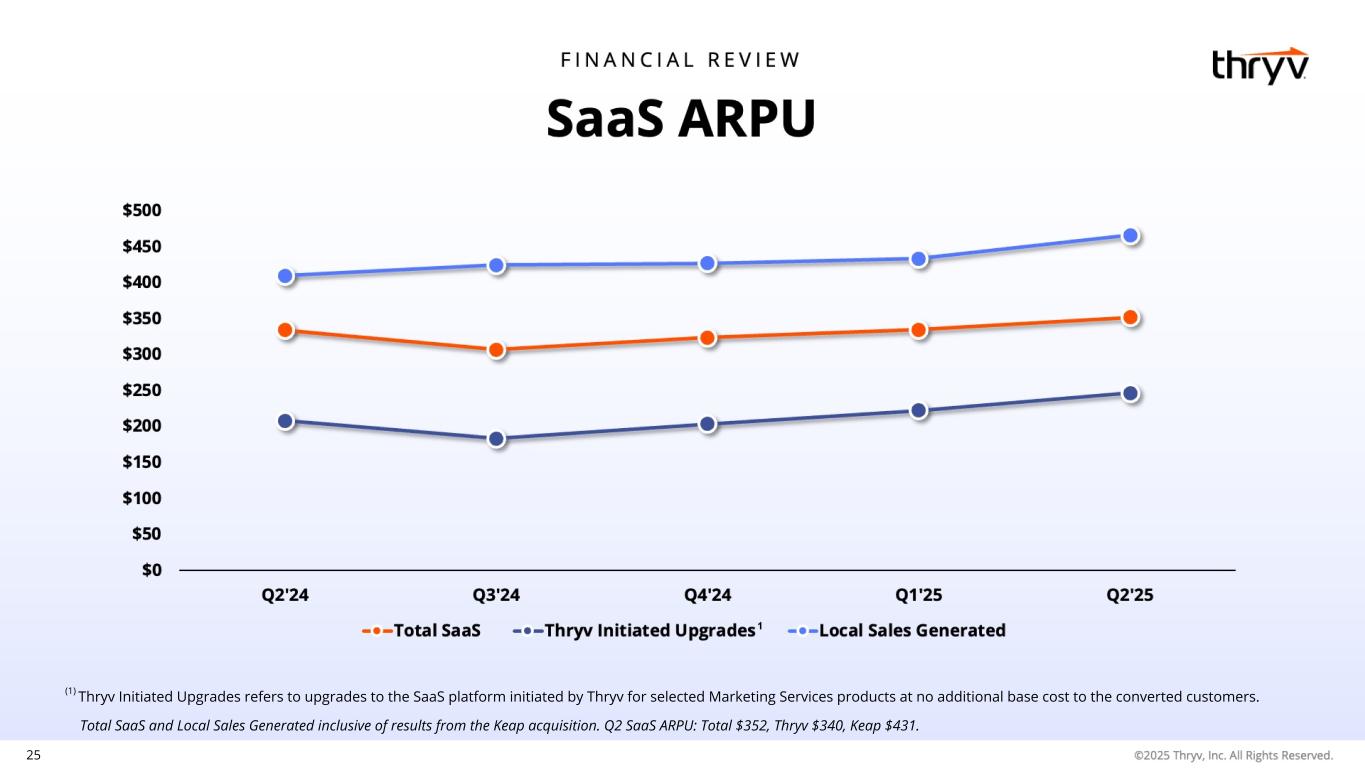
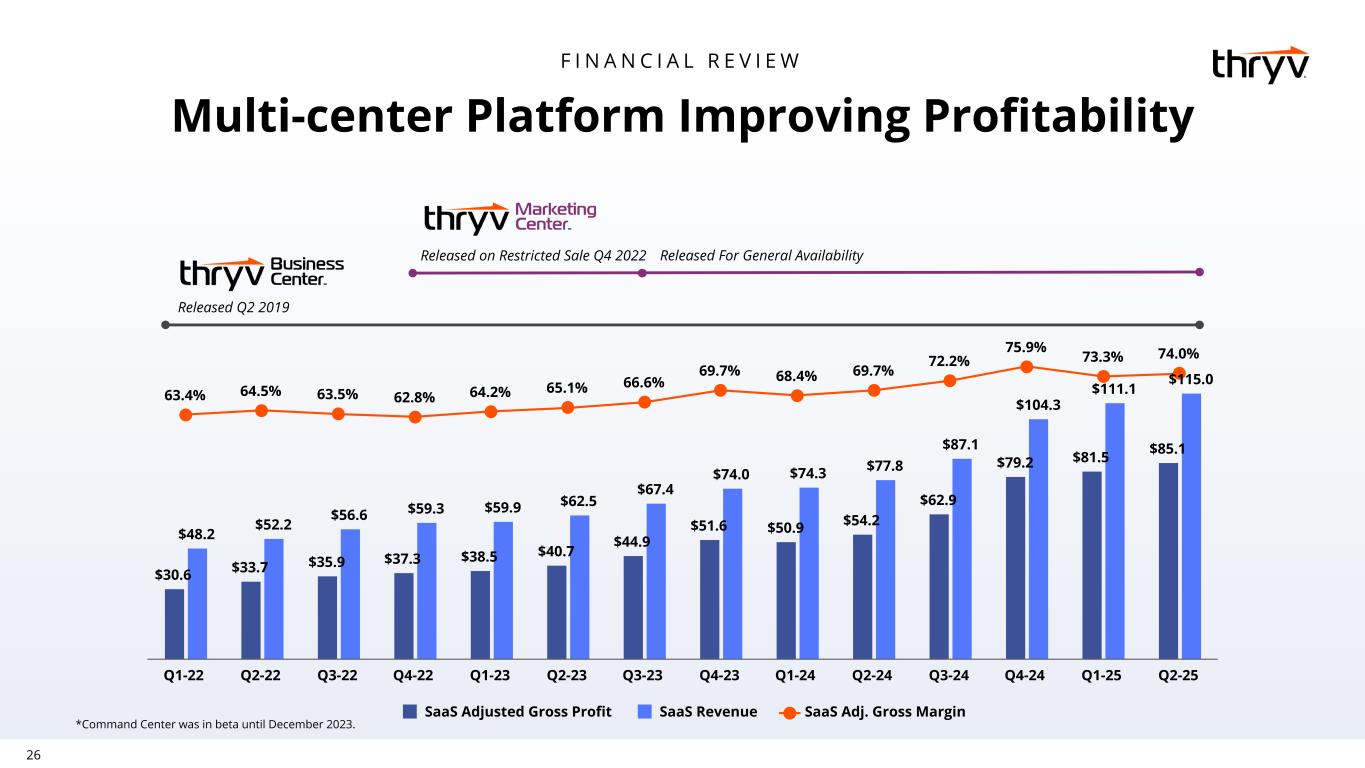
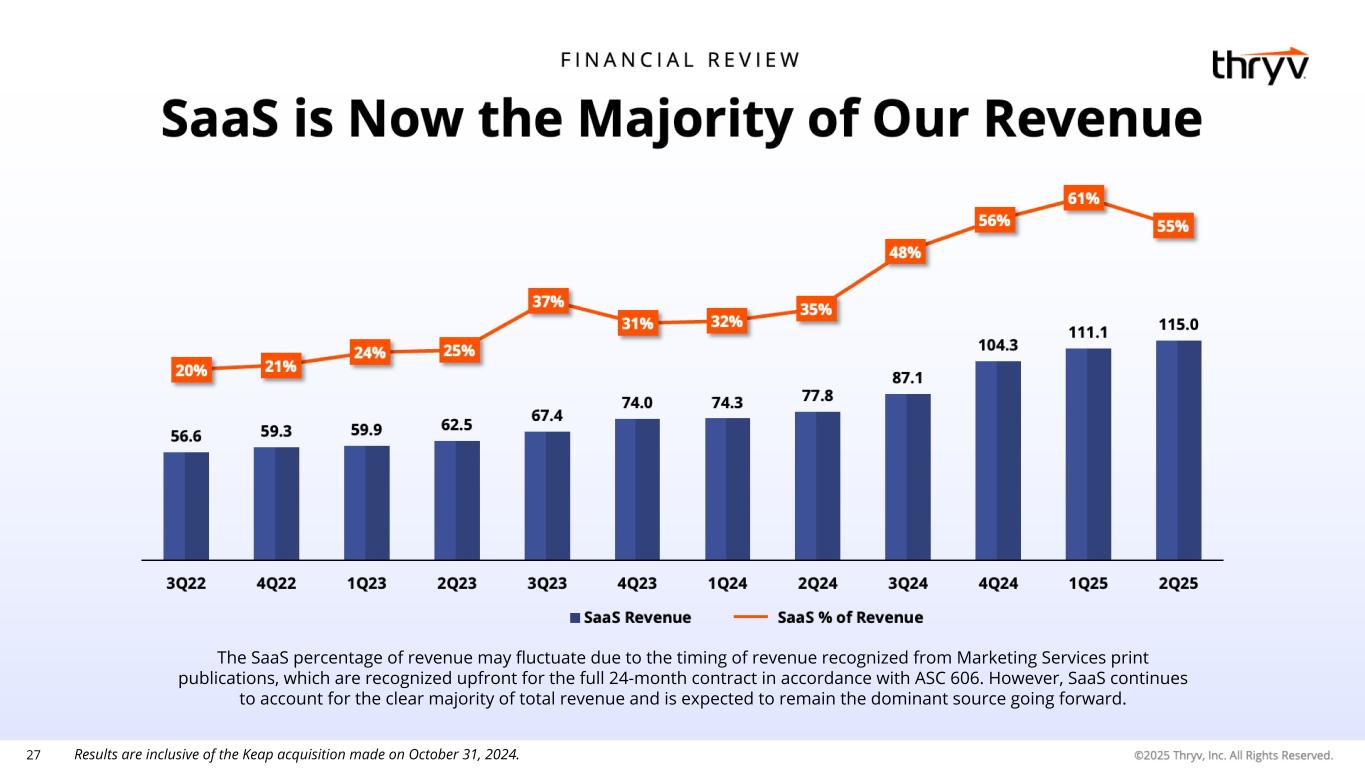
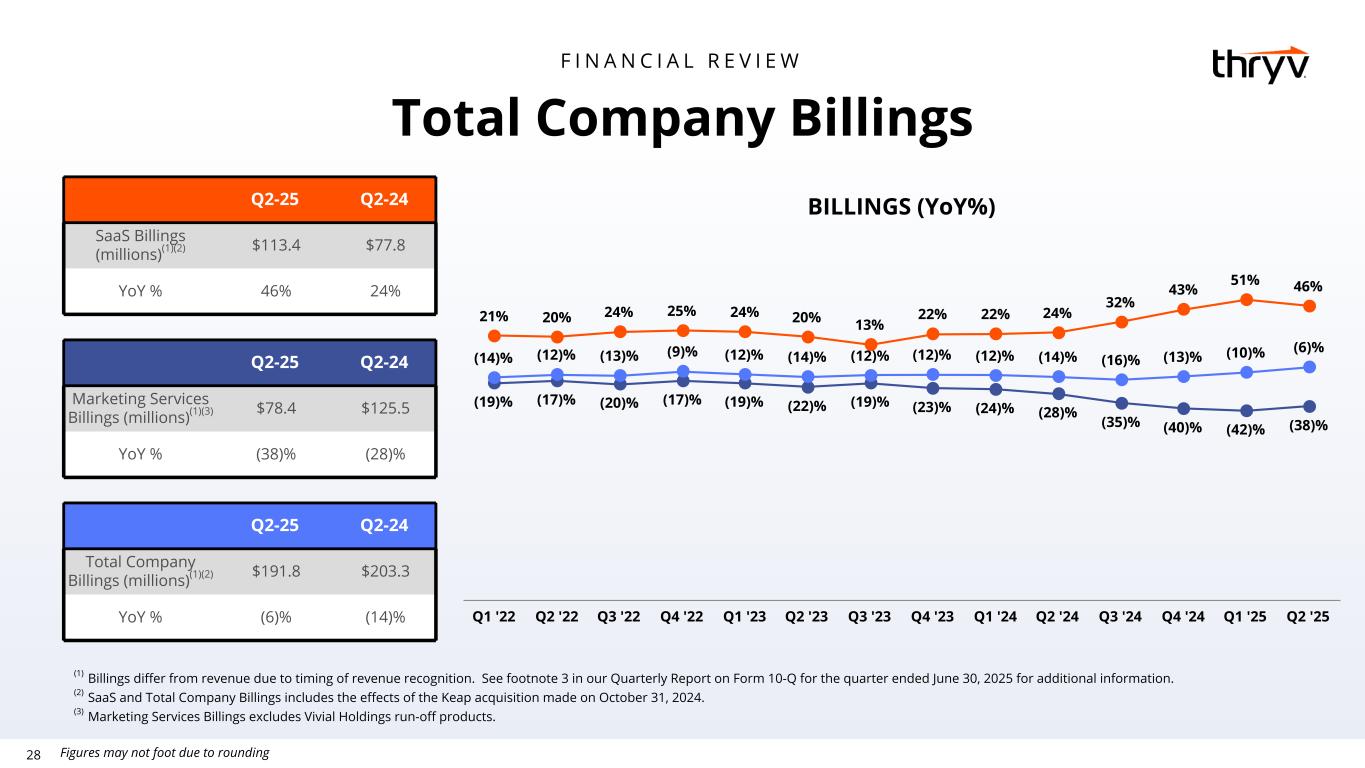
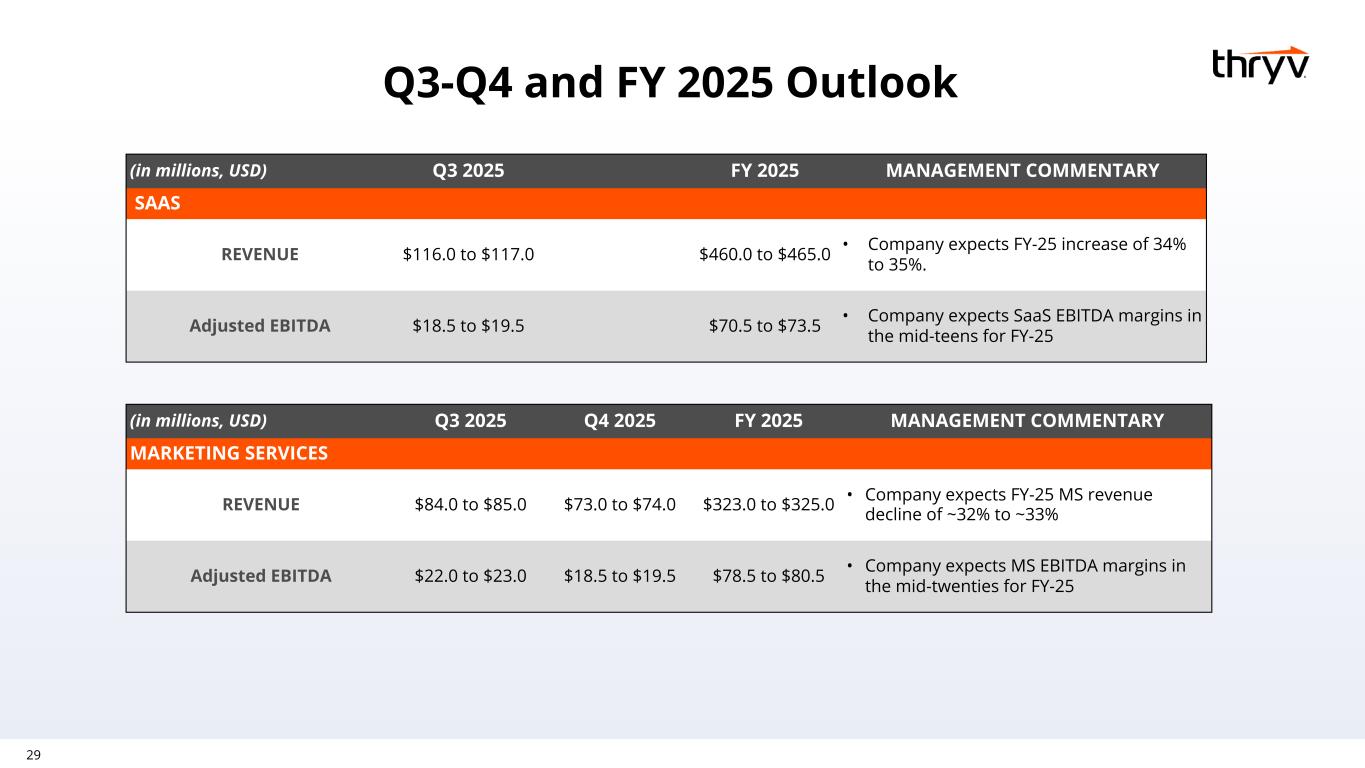
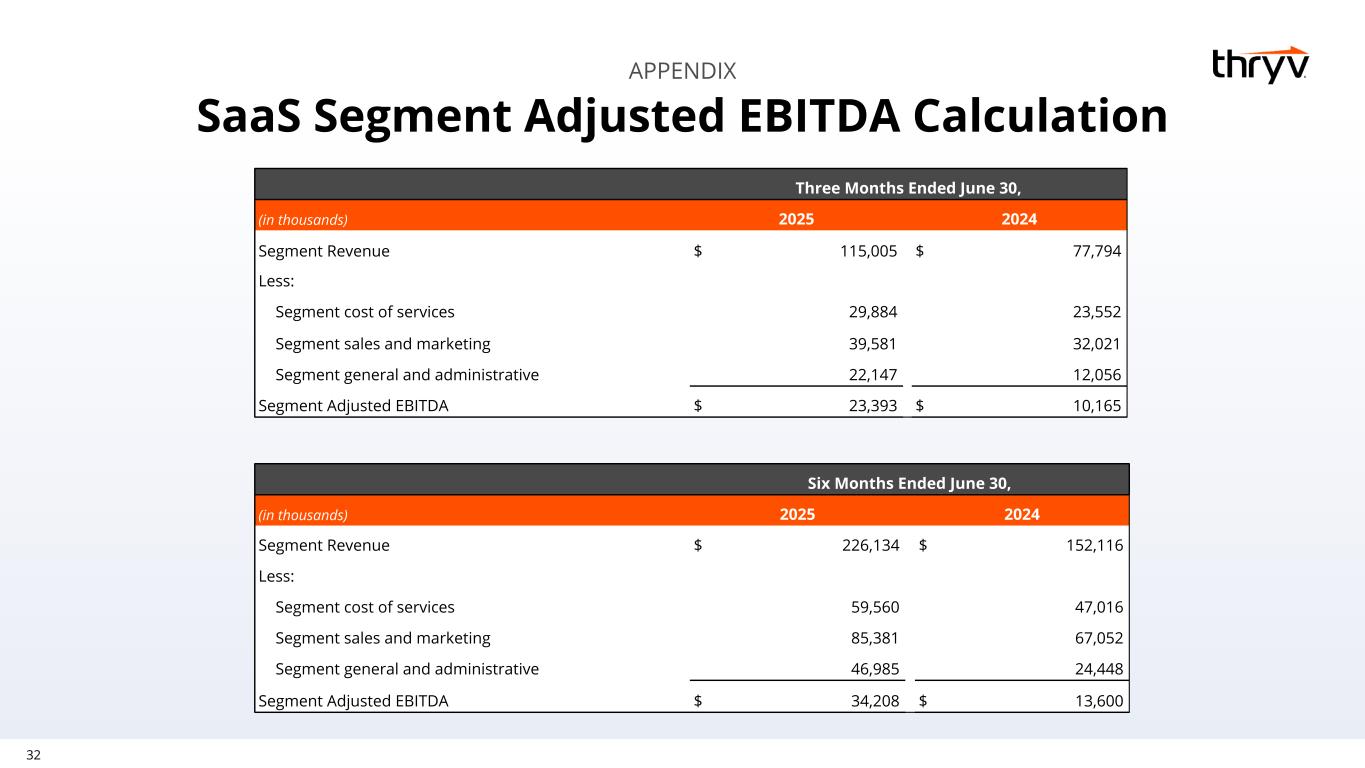
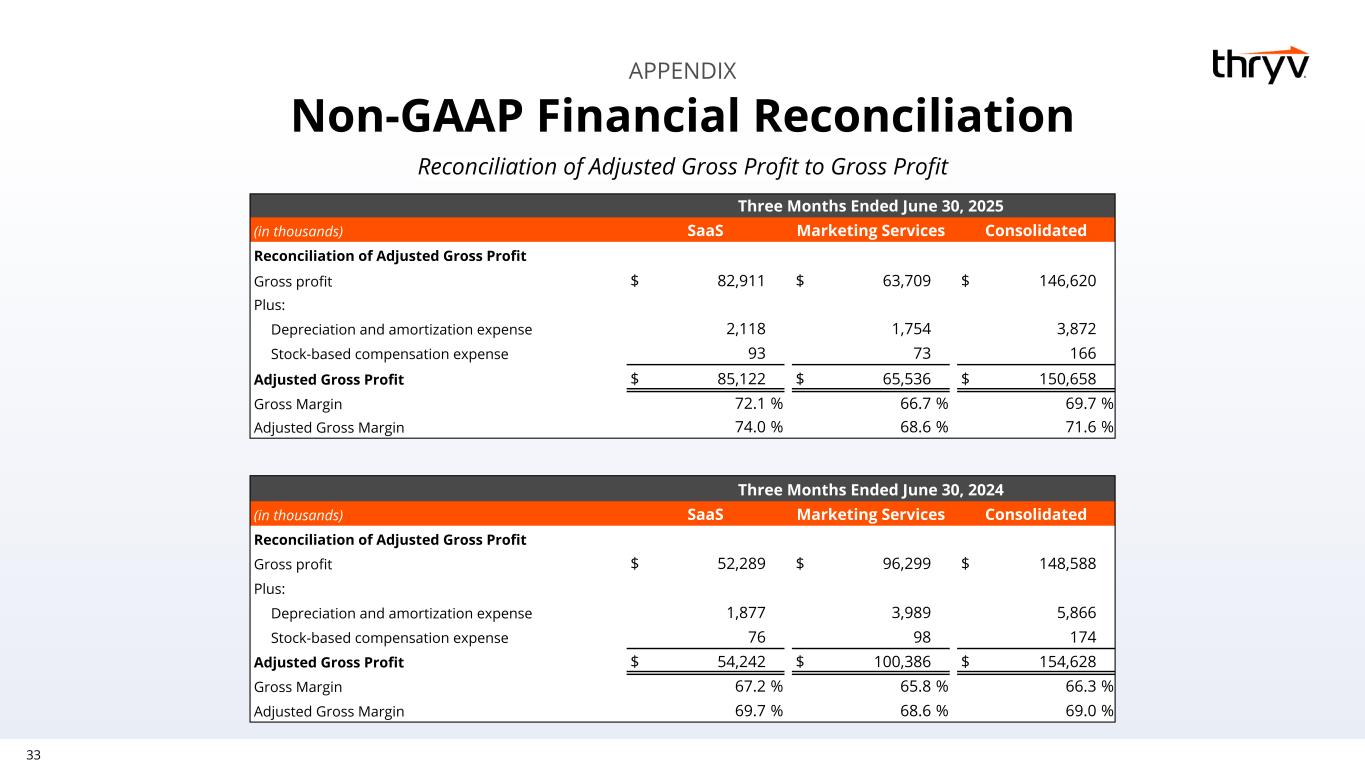
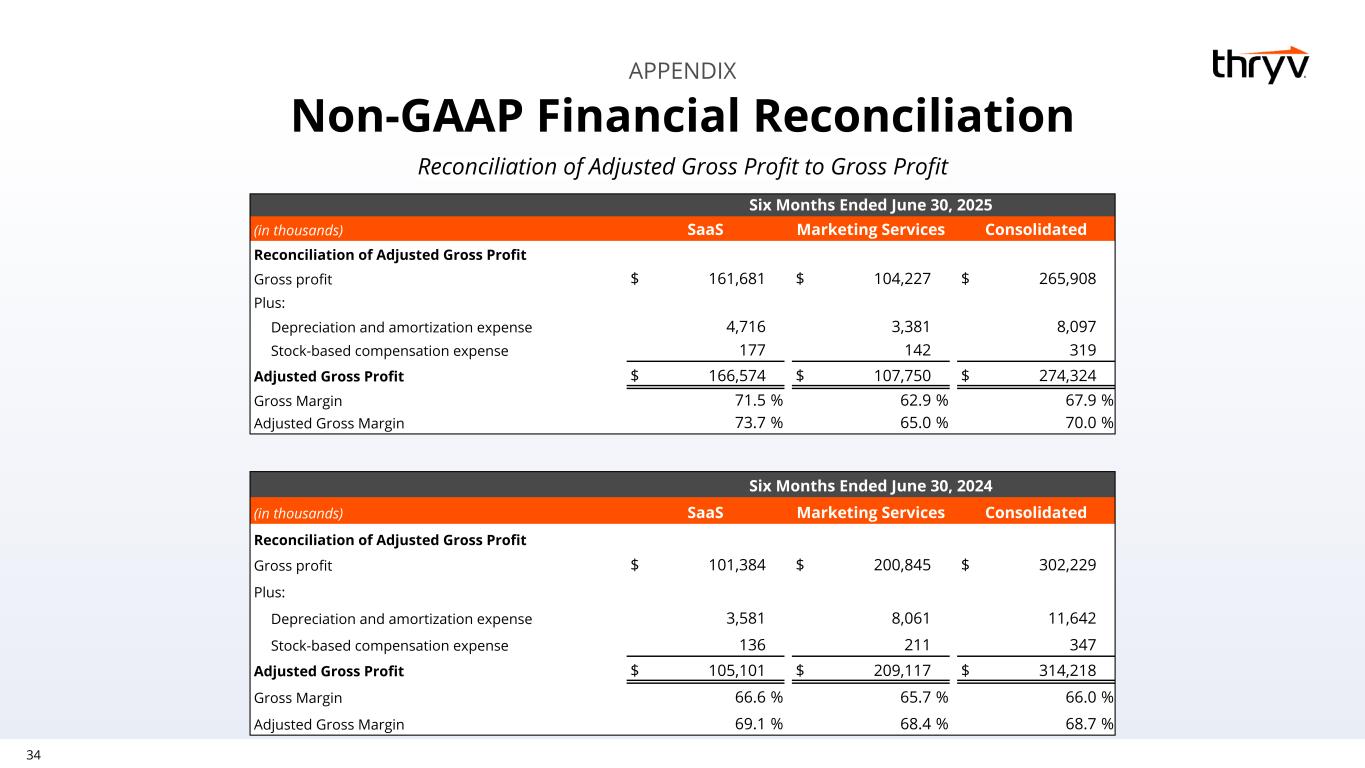
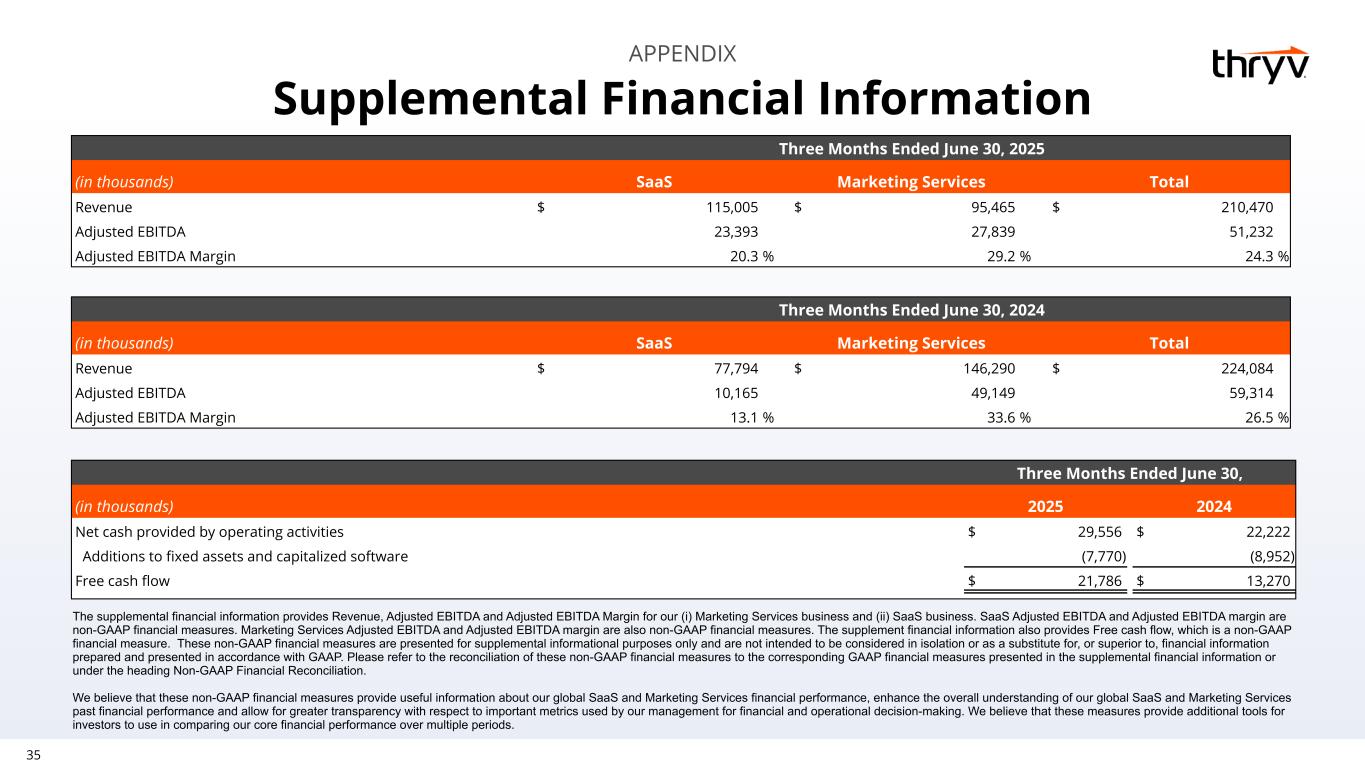
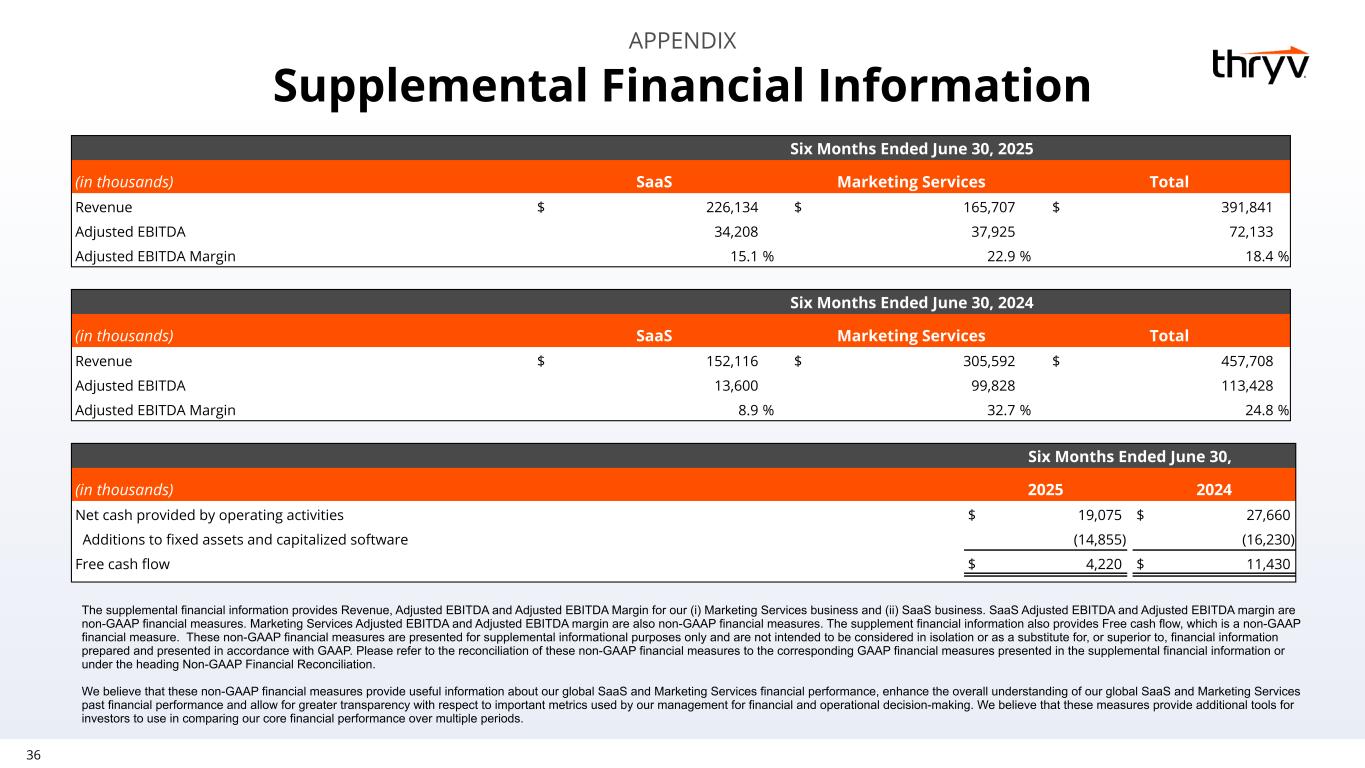
Thanks, Joe. SAS reported revenue was $115 million in the second quarter and met the top end of our guidance range, representing an increase of 48% year over year. KEEP contributed $17.7 million in the second quarter. Excluding Keep, Thrive's SaaS business grew 25% year-over-year. SaaS-adjusted gross margin increased 430 basis points year-over-year, reaching 74%. In the second quarter, SaaS-adjusted EBITDA increased to $23.4 million, exceeding guidance and resulting in a record-adjusted EBITDA margin of 20%. This performance underscores the progress we are making in scaling a profitable and durable software business. As we stated last quarter, the return of a strong print quarter helped reverse the temporary cost allocation headwind, with more shared expenses now shifting back to the marketing services segment. This will continue to normalize over time, particularly as we We transitioned more print publications to a 24-month cycle, bringing greater consistency and visibility across the business. We ended the second quarter with 106,000 SaaS subscribers, including 14,000 from Keep, representing a 25% increase year-over-year. With a large and established customer base now in place, our focus is on increasing spend per customer by driving adoption of more products and solutions, especially among our high-value clients and larger businesses. This approach meaningfully expands SaaS' lifetime value and is a more efficient driver of profitability. In the second quarter, our overall SaaS ARPU reached $352 with Thrive at $340 up sequentially and keep ARPU holding strong at $431. We see continued opportunity for ARPU expansion through the second half of the year, supported by our broad platform and our redesigned compensation plan that incentivizes increased monthly recurring revenue. We continued to be over 100% NRR, achieving 103% this quarter. Additionally, clients with two or more Thrive SaaS products increased to 17,000 at the end of the second quarter, compared to 13,000 in the prior year. Thrive centers per client also grew to 15% at the end of the second quarter compared to 10% in the prior year, further highlighting the traction we are seeing with existing clients. This kind of expansion, more products, more centers, more value, is core to our growth strategy and is a key driver of SaaS lifetime value. Moving over to marketing services, second quarter revenue was $95.5 million and above guidance. Second quarter marketing services adjusted EBITDA was $27.8 million, resulting in an adjusted EBITDA margin of 29% and just above guidance. As anticipated, this quarterly performance is subject to the dynamics of the print schedule, which perform better than expected and return to normalized levels starting in the second quarter. Second quarter marketing services billings total $78.4 billion, down 38% year-over-year, reflecting the intentional shift in our strategy as we continue to initiate upgrades of legacy digital marketing services products for clients to our SaaS platform. The decline will persist, but at a managed pace, we remain on track to exit marketing services by 2028, with cash flow lasting through 2030, ensuring strong liquidity as we fully transition to a pure play software business. We ended the second quarter with net debt down $24 million to $274 million, bringing our leverage ratio to 2.2 times ahead of expectations. Importantly, during this period, we made two additional quarters of required amortization payments, effectively eliminating two years of required amortization under our new term loan facility in just 13 months. So we are paid through until the second quarter of 2026. This achievement enables us to step down to a lower required amortization of $35 million per year going forward, significantly increasing the flexibility within our capital structure. With strong print quarters expected ahead, we anticipate leverage to step down significantly as revenue recognition ramps and cash flow improves. Turning to our outlook for 2025, for the third quarter we expect SAS revenue in the range of 116 million to 117 million. For the full year, we are updating our SAS revenue to a range of 460 million to 465 million. For the third quarter, we expect SAS-adjusted EBITDA in the range of 18.5 million to 19.5 million. For the full year, we are raising SAS-adjusted EBITDA guidance to a range of $70.5 million to $73.5 million. For the full year, we are raising our marketing services revenue guidance to a range of $323 million to $325 million. For the full year, we are raising our marketing services adjusted EBITDA guidance to a range of $78.5 million to $80.5 million. With that, I'll turn it back over to Joe.
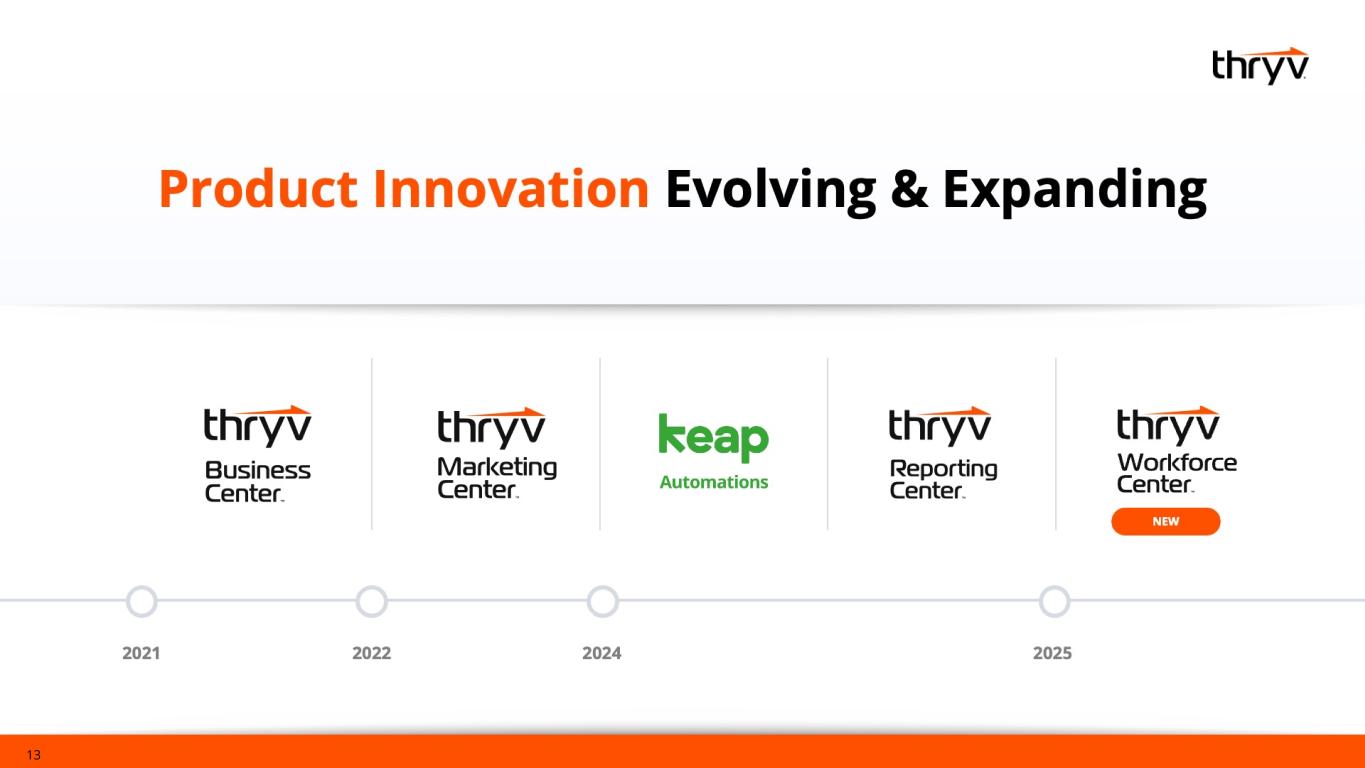
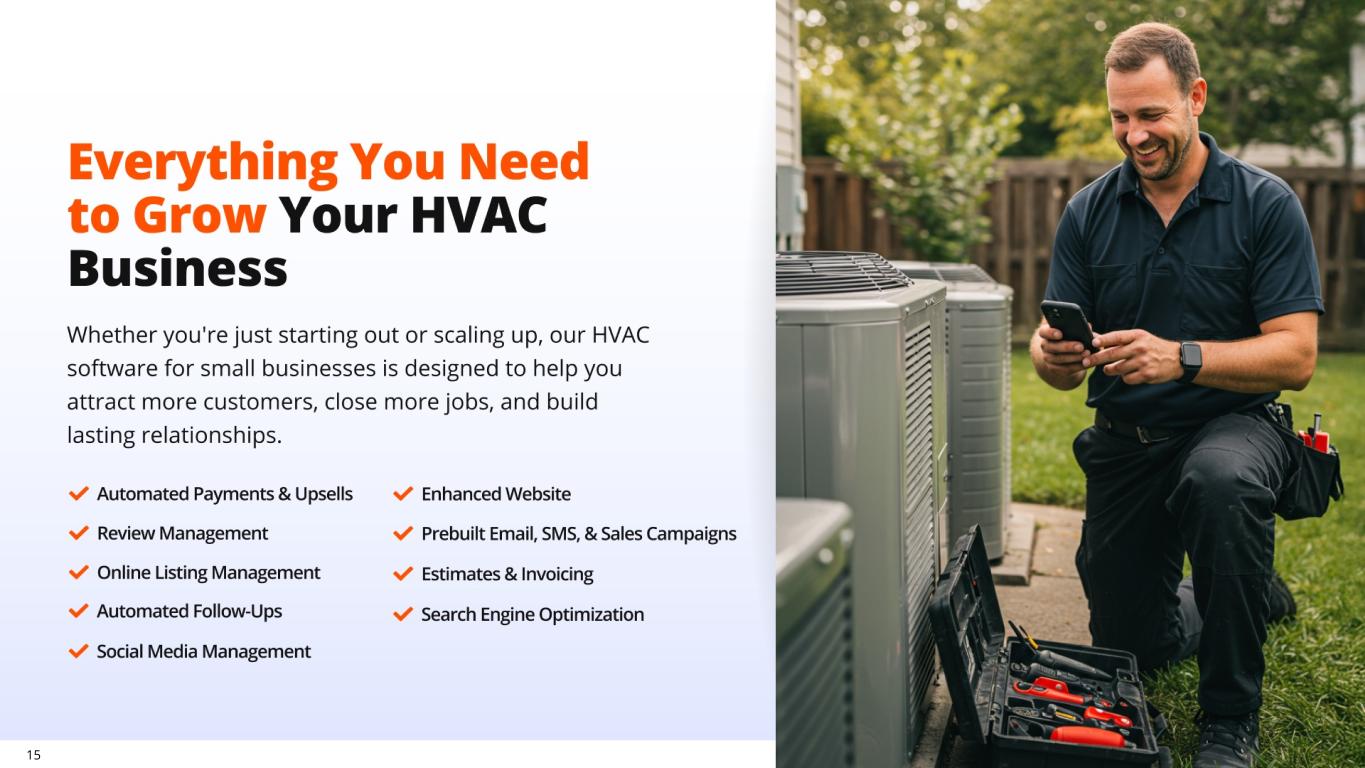
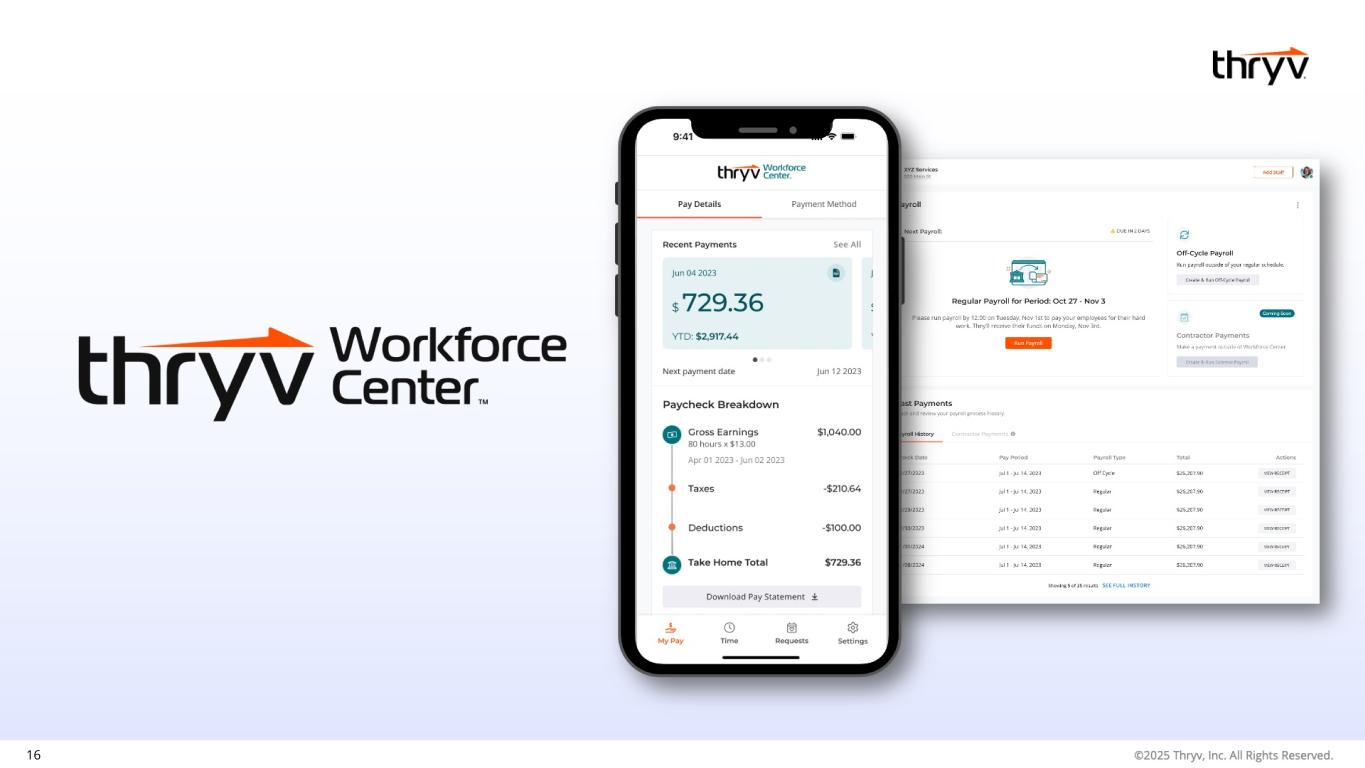
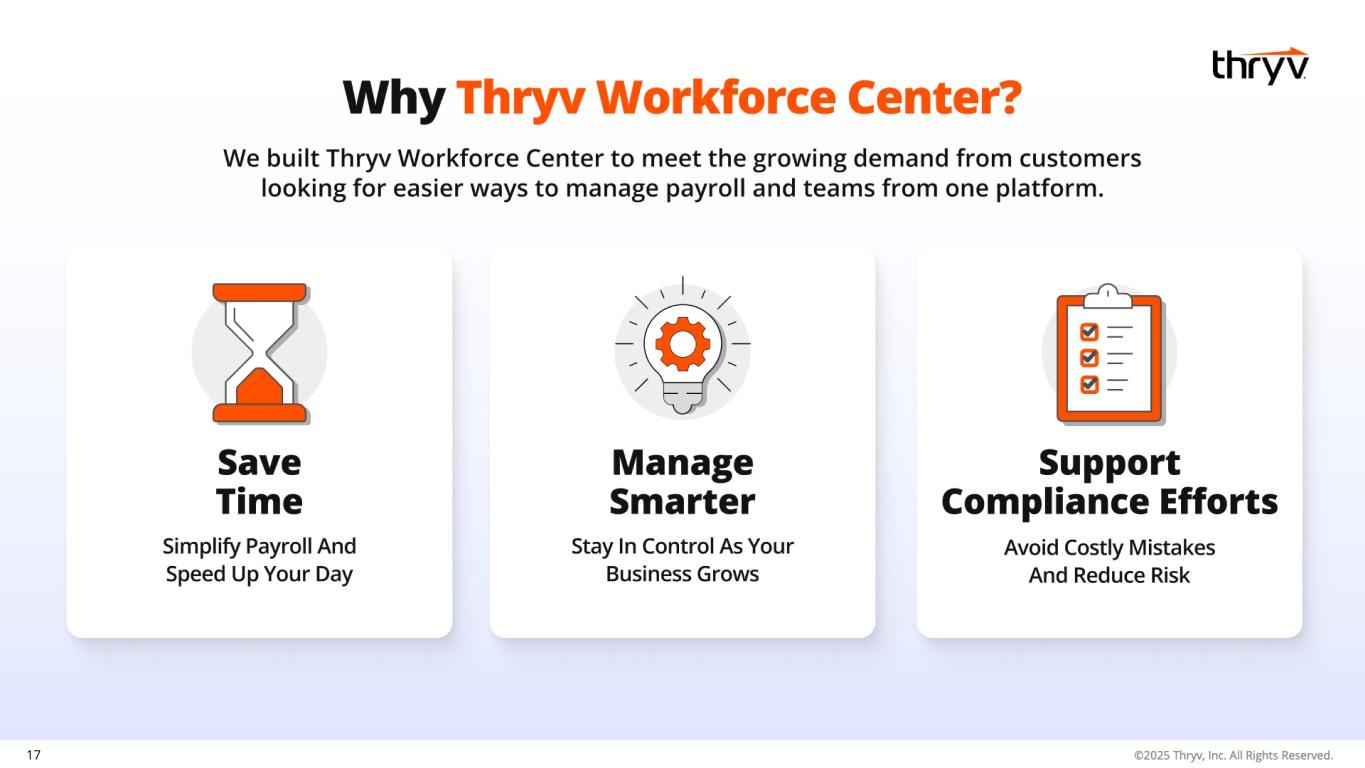
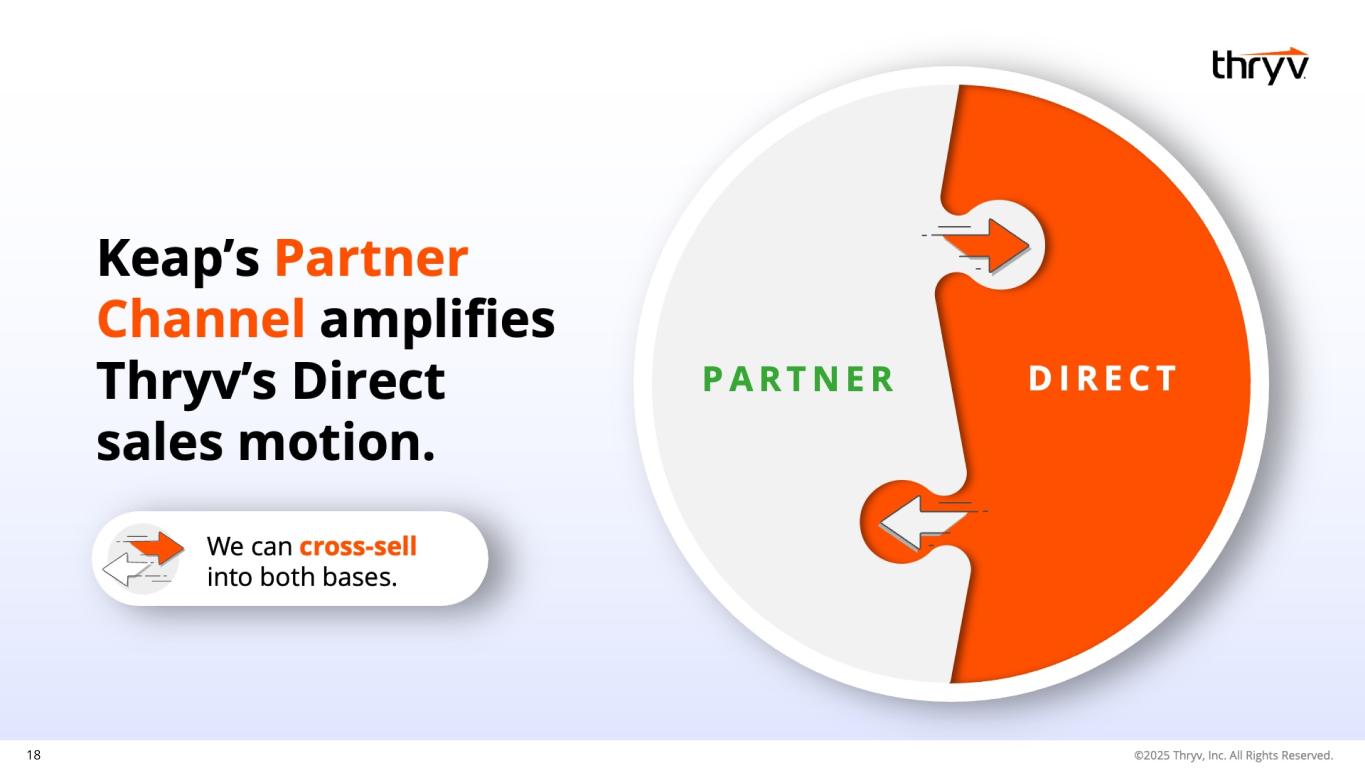
Thanks, Paul. Before we wrap, I want to reiterate our conviction that we are on a good path. The business is progressing nicely. The modest adjustment in SAS guidance is isolated to softness in the keep business, specifically within the demand generation side of the keep business. We didn't love the economics that were there, and as we were facing the pinch point, we took the opportunity to kind of cut costs there and didn't really invest in those sales because they weren't as profitable on a lifetime value to cost of acquisition basis. But the keep business is helping us tremendously across the SaaS business. And I want to take you through that in just a minute. Before that, I also want to comment that please note that we increased our SaaS EBITDA targets. So we are delivering really where it counts. I want to talk about the Thrive for HVAC. We recently announced Thrive for HVAC, and this is a product that we worked very closely with a very successful large HVAC business and designed automations by HVAC for HVAC using Keep's powerful automation tools. You know, one of the, I guess, sort of knocks against Thrive might be, well, Thrive is horizontal. They have horizontal software. That's how they got to over 100,000 subscribers so fast, because they're working horizontally. What we're doing now is working to deepen our engagement by going deeply vertical in our most powerful verticals where we've had the most success. And HVAC is a real big winner for us, and so we've rolled this out. We already have an impressive number of sales so far coming in from that HVAC vertical. And we'll be following with more verticals, working with a successful leadership company in each vertical, sort of mapping processes, and then rolling that out more broadly. And I want to be clear, this is not the back office. So we're not doing the, you know, the filters and the wing nuts and tracking the trucks. This is a focus on the marketing side, the outside, managing the funnel of how you get work, how you get repeat work, how you get followed up. So actually, in some of these larger accounts, we're working with Service Titan or with some of the other back office tools. We're working closely with them, and there's a connection between the two. So we've had a lot of success with this, and we're excited about strengthening our vertical positioning going forward. You know, we've been asked about growth after the zoo. What happens when you get done with the zoo? And I just wanted to comment briefly on this. We are working on a variety of initiatives for 26 and beyond, starting with a free trial motion for one of our products, which will be kind of a product-led growth motion. We've been leaning into the new partner channel that we acquired from Keep, investing in that, and we believe that that will bear a lot of fruit in the future. We're excited about the feedback we're getting from the partners and the partner channel. We have a franchise channel that we're leaning into investment there, and we believe that there will be a lot of application, and the Keep tools have added a lot there in terms of being able to provide interesting offers for those franchises. We have an agency channel. We own an agency called BNI. We work with some large national brands, and we've had some success and expect a lot more success going forward, working with those agency clients and beginning to automate some of their processes with the new tools that we have. So we believe that there's many vectors to our growth in the future, and we actually see a smaller percentage of our sales and our growth in the future coming from our direct channel and more broadening out into other channels as well. We also rolled out a new product we just recently announced, and that's Workforce Center. Workforce Center is designed to help a small business pay their employees and contractors in an easy way, stay up on all their tax compliance and all the rules that they need to follow. And it's a scalable solution that whether you're hiring your first employee or you have a whole bunch of employees you're able to offer. And what most small businesses find is that there's plenty of payroll operators out there, but they really want people that have lots of employees. It's kind of hard if you just have a couple. And with Thrive's Workforce Center, it's ideally suited for our small business customer, and it integrates right into your Thrive platform. So you can just work right within the platform and you don't have to log in or out. And we've already had a number of sales in the product, and we've got small businesses paying their employees on the product. So we're excited about this, and we feel like there's going to be a lot of potential success here. And, you know, furthermore, I think the broader we make the platform, the more sort of locked in customers get and the less churn there is over time. And when you're dealing with small businesses, it's always going to be a little more churn. So that's an important item for us. Last comment I'd like to make is on our global industry classification standard, the GICS, where we're positioned as a company. Currently, Thrive is classified incorrectly. We are classified as a, under advertising, under media and entertainment within the communication services. So we're not in software at all. So when people screen and look for Thrive, they don't see Thrive. they they they we don't even show up anywhere in the league tables of software and that's just a mistake that's being made uh by the uh gix group and you know we expect that that will be rectified at some point in the future um it it is something that uh i i think is important and i wanted to just mention it here um and that's it let's open it up for uh questions operator absolutely If you would like to ask a question, please press star followed by one on your telephone keypad.
Operator
If you would like to retract your question for any reason, please press star followed by two. Again, to ask a question, please press star one. We do ask that you limit yourself to asking one question and one follow-up. As a reminder, if you're using a speakerphone, please remember to pick up your handset before asking your question. Our first question will go to the line of Arjun Bhatia with William Blair.
Arjun, your line is open. all right thank you and um congrats on a great q2 here especially nice to see the the profitability ramp um joe you talked a little bit about the vertical strategy just now um the hvac product is out what like help us understand what how you think that's going to impact the business you know is it going to help you kind of get new customers in the hvac segment is there an upcharge for the vertical capabilities. How do you think that kind of plays out into the Thrive growth story? And then I'd be curious to hear how you're thinking about the roadmap for future verticalization, which verticals might you target, and then what kind of timeline should we think about there? Thank you.
Thanks, Arjun. So within HVAC, we have mapped these automations. And it is an upcharge. You need to buy this automations package. And you've got one of the leading HVAC companies in the country who sort of opened up their processes and shared. And so a lot of aspiring HVAC guys kind of get a glimpse into how the big guys do it and do it really well. Sort of the roadmap of where they may want to go for the future is laid out for them and pre-built in these automations. So you're buying automation just for buying IP. You're buying business processes. So yes, there's a fee for it. And in terms of how it'll shape our business, I think it will continue to flatter ARPU because you've got people that are standing accounts adding a chunky additional investment. I think it will impact engagement and client satisfaction because it will really help them advance to another level with their business. I think it will play defense for the thousands and thousands of HVAC accounts that we currently have. Rather than just having a horizontal piece of software, they'll have something that's deeply verticalized and to the extent that, you know, they're maybe being called on by, you know, other players, it'll play defense. On the offense side, it gives us a heck of a story to tell when we want to go to try to win new business in HVAC. And, you know, you've got something really relevant to talk to them about. We've got a lot of wonderful content out there online now, you know, tutorial videos, you know, how to be a great HVAC company and so on, marketing. And we're getting a lot of clicks and hits and views and all that stuff on that. And it's generating leads already. We've actually been at this for a minute. And that's going really well. So I think we will be able to attract more HVAC companies. I think we'll be able to retain the ones that we have. I think there'll be nice upsell in terms of the ARPU per account. And so I think it'll flatter the whole category that way. I also want to stop and say that we have every intention working closely with some of the back office folks who've spent an enormous amount of time mapping the back office processes and figuring out when the truck 22 comes in, you load it with Freon and you put this many filters and wing nuts on it and all that. We haven't done that. That's not where we operate. We don't operate in the deep back office. We're more out in front helping you get customers. And so we will be working with a number of these different players that work in the back office and anxious to do that. And I think there's white space in the market where we are, and I think we have an opportunity to serve there. As far as additional verticals, that team that did the HVAC vertical is flat out working on other verticals. And the way we approach those is we looked at our own success. We peered into our 100,000 plus customer base and said, where do we have the deepest penetration? Where are we having the most success? Let's start right there. And so we're really, you know, really working at our deepest penetrated, most successful classifications and delivering to them real value add and doing it pretty quickly. And so I think you'll see us adding more of these vertical applications pretty quickly. You know, we have several others underway as we speak, and we will be adding them pretty quickly. So if we look forward, say, a year from now, our top band of customers will have these vertical offerings, and we'll be heading further down, deeper into the customer base.
That's a super helpful color. Appreciate that. And then maybe, you know, I want to touch on the guidance for a sec. I know you mentioned, you know, the revision on the SAS guidance is mostly due to the segment of the key business. But when we look at kind of what's implied in the back half on an organic basis, you know, it does imply a bit of a slowdown. meanwhile when i look at the q2 results both from a organic growth and profitability perspective you know clearly there's good momentum in the business now you have verticals going out you have workforce center you're just getting going on a lot of the cross-sell initiatives that you launched this year so how realistic maybe is the back half deceleration on an organic basis that's incorporate into the guidance and maybe you know are you being conservative there or what would have to happen in the business and the demand environment for for those for that backhouse
outlook to come to fruition yeah arjun paul still works here so there's always a tremendous amount in everything that we put out um so uh you know he's assuming we catch a cold get the sniffles fall down sprain an ankle like everything between now and the end of the year so that that's a you know we we want to be conservative we want to view the numbers that we give you guys like we're writing a check so that you can kind of count on them and build on them so uh we're excited about a lot of the momentum we have going on in the business we really are um so uh i i don't i can't
point to anything that we're worried about to be honest with you okay uh that's good to hear uh perfect well thank you for the time appreciate it thank you arjun thank you our next question goes to the line of scott burgh with needham and company scott your line is open hi joan paul nice quarter thanks for taking my questions here um i wanted to focus both my questions on the sas business i guess in general joe i just wanted to see if you could explain upon your kind of commentary around what you're seeing the key business around those customers that you're It sounds like it may be not for viewing or trying to get away from something. How do we think about where you are in that cycle, I guess, in order to, because if I do keep revenues, I gave up $71 million versus what I believe you all expected would be a $75 million trial.
Yeah, look, the keep software is amazing. The keep people that we acquired are amazing. Their go-to-market motion had some challenges. I mean, they had been in a revenue decline for more than just one year prior to when we bought them. And, you know, even toward the end, they were selling at a fairly low lifetime value to CAC ratio in their direct channel in order to keep revenue up where it was. And you're very well aware of our pinch point that we just passed through and the tightness of our plan. And we just looked skeptically at those unprofitable sales and said, you know, do we really want to invest in those right now? When our overall number is rocking, the Thrive side of the house is rocking, do we really want to go over here and buy more of these sales? And we just made the decision not to. We could have put a few million bucks into the demand gen business and equaled that number, but it would have been not a good ROI on that cash in the short term. Where we're finding a tremendous amount of interest and success and traction with Keep Software is through the Thrive Salesforce into the Thrive customer base. Using these slick automations in the solutions launch pad and so on, customizing those for particular verticals is an absolute hit. And it's just early days now. We're just getting going. But it's gaining lots of traction in our sales organization and with our customers. The ARPU is tasty. It's a good size one. It's margin rich. So we're really, really pleased about that. You know, one of the things that we were super excited about in buying Keep was their very successful partner channel. And it's still a good partner channel. It's still a successful partner channel. But when we showed up day one and said, we're here, they were mad at us. Like the day they met us, they were mad at us. They said, you know, we haven't been getting love. We haven't been getting innovation. We haven't been getting investment. We haven't been getting – and you owe us. And you owe us right now. And so we're working feverishly to deliver on, you know, a lot of the API hooks and different other technical things that they're looking for and some other ease of doing business with partner channel things that they've been waiting for a while for. And so we are emerging slowly from the partner doghouse as we deliver on those. And I have a lot of enthusiasm for what happens in 26 and 27 with the partner channel. Just not happening quite as quick here in 25 because they're sort of taking a little bit of wait and see in terms of really leaning in. So we're really pleased about Keep. I'd buy it again, you know, every day of the week and twice on Saturday. It was a great transaction. KEEP's own revenue-producing model, you know, had been challenged, and we haven't chosen to just pour money in to fill in that hole. But I am very confident of what KEEP will do in the fullness of time in terms of adding revenue to our business. And you know, one of the other promises that we made, Scott, for KEEP was that we could deliver $10 million in cost energy so that it would bounce our EBITDA up this year. And we went by $10 million like it was tied to a pole. Like, that's in the rearview mirror, and we're going further than that. So the cost synergies were captured right or right away, and the revenue synergies are coming. They're just delayed by a little bit. And that was really a business decision that I made, just out of an abundance of caution to make sure we preserved every dollar for debt repayment. And as Paul shared in his segment earlier, we're actually now ahead of debt repayment. So we sort of push that off the table as an issue now. Not only does our M-work drop substantially, but we're actually paid way into next year already. So, you know, you can take that and pigtail that off your issues for Thrive list over and out.
Got it. Also, Joe, Thrive business, and the numbers are correct. It looks like your customers don't understand those existing customer expansions or you've seen something else.
Yeah, well, you have the theme right. This is the year, 2025 will be the year where our client base will remain about flat and where the big gain will come with an ARPU bounce, with us going in and adding multiple SaaS products into existing customers, upselling, taking people deeper into tools like these automations we've been talking about, adding things like Workforce Center. So this, you know, we guided in the fullness of time or over the balance of the decade that we would go from sort of $4,000 a year to $8,000 a year. And then we immediately then that year, you know, or last year, our food went back slightly because we just added so many subs. And a lot of those, you know, were coming over out of marketing services with special pricing arrangements. So what's happening now is we're meeting with these clients, working with them, getting them squared away with often new packages and new programs and updating and changing. And that's resulting in strong upsell. Candidly, we did not have the money to do both this year. We couldn't really staff going out and servicing all those people who came over. I mean, we made, what, 40-plus thousand jump in subs last year. We've got a lot of people to see, a lot of people to talk to. And so this will just be a year where we're flattish. And it'll bounce around quarter to quarter through the year. But I would expect we'll end the year right around where we started, but with a big jump in ARPU, so that revenue will make a big jump. And then as you look forward to 26, and we'll get into guidance for next year or later, But, you know, I would expect us to get back on the horse and begin to invest in expanding our channels. As I mentioned earlier, we've got some new channels that are gaining traction. And I would see us get back on the path of balancing adding subscribers and adding ARPU. I hope that answers the question. It does. Thank you for taking my question. Thanks, Scott.
Operator
Thank you. Our next question goes to the line of Jason Cryer with Craig Hallam. Jason, your line is open.
All right. Thank you, guys. So, Joe, you made it through this financial pinch point. You talked about the financial flexibility. Just hoping you can unpack that and just talk about the opportunities just given better profitability, lower amortization liabilities, and so I think all of that will equate to better free cash flow. But what kind of financial flexibility opportunities do you have with that better free cash flow generation? Thanks.
I'm going to share this answer with Paul. I'll start and then I'll let him talk about how he thinks about it. Yeah, most corporations have some capital allocation decisions that they make. They sit around a room and they say, should we allocate the money into share buyback? Should we put it into debt repayment? Should we invest more in marketing or whatever. We've only made two decisions and they just left them stuck there for the last few years and that's invest hand over fist in our product and cut everything else and pay down debt. That's pretty much what the last several years have been and so yeah we're excited about now that we're past the pinch point we actually begin to make some new decisions. We can invest in adding sales people, we can put more demand generation into the market, we can tell our story more to our customers. We could do more marketing. And obviously, you know, with such a mispriced share price, we can buy back stock. And I can, you know, you have to figure that's very much on the table. We have a share buyback authorization. We've not really had any cash to action that. But we now have the ability, we have the authorization and we have the money to do it. So those are some of the options. I don't want to get too deeply into exactly how we'll play all that right now, but with the share price where it is, that's certainly something that we'll be thinking very hard about. I'll let Paul comment to any thoughts he has on it. Paul?
Yeah, I'll stay in my lane here. Those strategic decisions are really Joe's, but I just want to let you and the market. No, we're still focused like a laser beam and repaying that and de-levering. So you'll see that as a move out too. We'll be focused on that.
Does that answer your question, Jason?
Helpful. Thank you. That answers my question very well. I appreciate that. Just a quick follow-up for me on marketing center. If you can just talk about the growing client appetite there and maybe you're seeing success with new products and market. So curious if you can maybe shine a light on what those new products are, how you're finding ways to engage with customers that have that greater appetite.
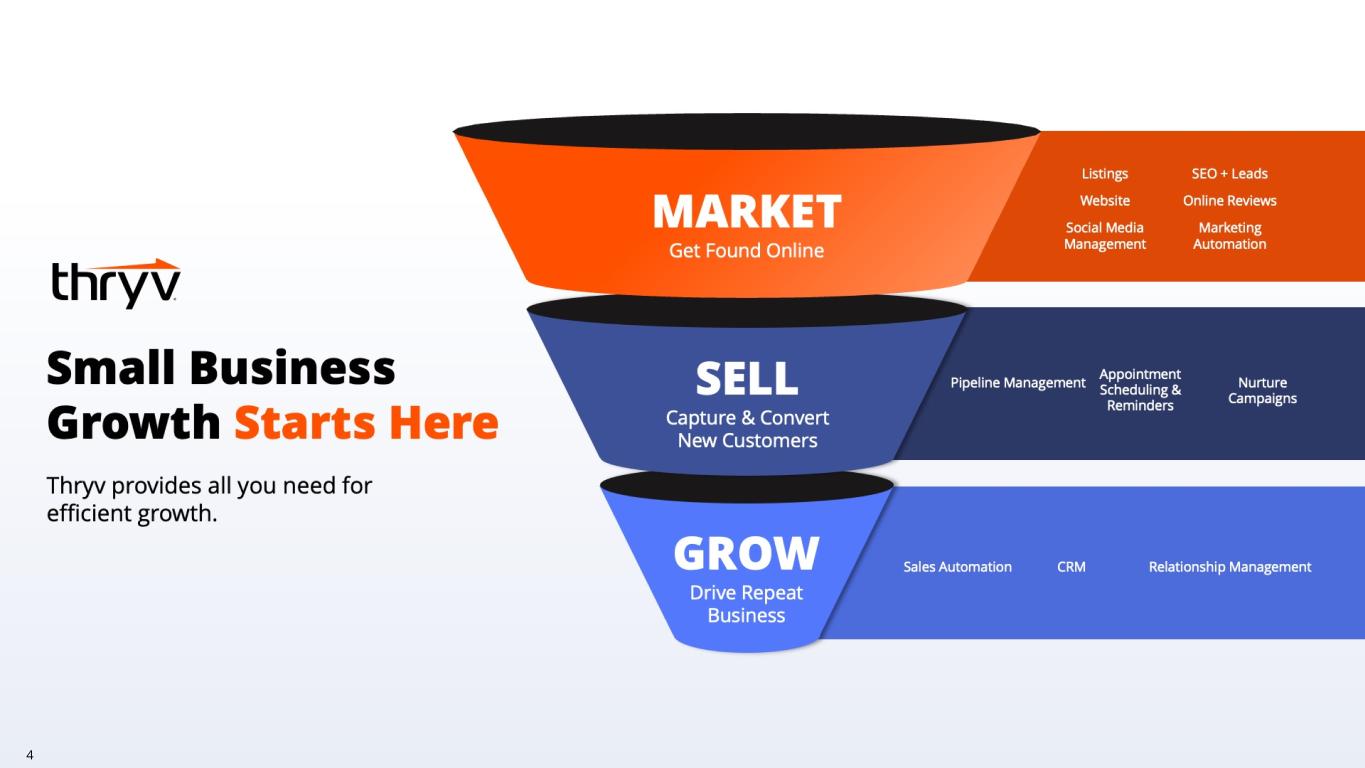
Yeah, we, you know, it's funny, we, we've been in business since 1886, linking buyers and sellers together through the yellow pages, right? And that's, that's the background here. And then that, that went on to be online yellow pages, and then all manner of digital marketing. And, you know, our company is peopled with experts and everything to do with search engine marketing and SEO and all these different things. And we have a network, a massive network of directories for which we monetize their traffic. And we hadn't fully been leveraging all of that. And we sort of were almost running away from it, focusing on helping people to operate their businesses with our CRM software and estimates, invoices, is billing, payments, all that kind of stuff. And I think we've recently woken back up to the fact that helping small businesses grow is a big deal. And it's an area that's our birthright. We're really, really good at it. And so our marketing center answers the famous question that John Wanamaker asked, you know, I know that half of all my advertising is wasted. I just don't know which half, it answers that. It lets you know precisely which things that you're doing are working online, offline. There's no mystery. And for successful businesses and smart people that want data to know how they're doing, it delivers that. What we've now done is coupled that with some of our other things that helps you build your list, that helps you drive your leads, helps you meet new prospective people that are interested in what you do. And we've struck oil I mean, you know, we're screwing around here drilling holes, and all of a sudden, oil just came up everywhere. We hit it, and we have a hit on our hands. And our focus has really been marketing center and some very powerful add-ons that leverage the other assets that we have as a business. So I really like where we are, and I think we fit nicely in the market with some of those people that have spent a lot of time working in the vertical realm, digging in on all the deep back office operations of a pest control company or whatever. We can actually partner and sit right alongside of them where we're handling all the front end, helping to keep the order book full and keep your existing customers activated and all that. We are superb at all that. And if you want to keep track of when we applied the chemicals, that's great. We fit in there perfectly. So we really like what we've learned.
We like where we are there on the poll thank you appreciate it guys thanks jason thank you our next question goes to the line of zach cummins with the riley securities zach your line is open hi good morning uh congrats on the strong quarter um this might be a question pointed towards paul but can you speak to uh just the out performance that we saw on the staff adjusted EBITDA margin side Is there any sort of one-time benefit in this quarter? Just wondering in terms of second guidance that you've put out there.
Yeah, thanks, Zach. Good question. It really was. You know, we had a really strong print quarter. So, you know, as you know, how our allocations work is based on revenue. So if you have a strong print quarter, it's going to – allocations are going to be stronger towards marketing services. That type of – listen, I would love – we had 20% each quarter going out. but quarters are gonna be lighter in print for the third and fourth. So the allocations will shift back weighing on SAS. There'll still be strong quarters, but I wouldn't write down the 20% going forward straight for SAS margins.
Understood, that's helpful. And Joe, just with the press release this morning around Workforce Center, I mean, can you delve a little bit into maybe some of the early feedback you've been getting from some of the early users of the product and how should we think about the ideal customer fit and who's going to be really interested in this product within your customer base?
So there's a whole world of kind of PEO people out there working with businesses and even small businesses on payroll, but they become less and less interested when you don't have very many employees. When you're below 25 employees, it's just not a lot of there there. And our customer base is largely these 5, 8, 10, 12, 15 employee businesses that kind of sit below that radar. And their dream scenario would be to have one platform they could use for everything. And we're delivering on that. So, you know, that's kind of the market that we see. We don't think it's going to be a massive, you know, revenue. It's not going to rival marketing center and revenue or something like that. It's more of a convenience that we were able to adopt, create a cool UI, and plug into what we're doing to make life easy for our customers. And we've seen, and the evidence is overwhelming, that the more of our SaaS products they buy from us, the churn falls. So if they add, you know, Workforce Center, you know, their propensity to churn just drops through the floor. And so, you know, that's sort of how we thought about it. It's a little bit like ThrivePay. It's convenience for customers. Workforce Center is the same. So that's kind of how we think about it. We don't have a ton of revenue modeled in for this. We do have many customers already on it. We've actually been doing it for a while. We brought it out in Alpha earlier this year and then had a beta, and it's now out live, and we're out selling it. And we have customers on it and paying their contractors, paying their employees, happy with it, already giving us feedback about additional things they'd love to see and all the things that customers always do. But we're off to a really nice start with it. And I would put it down as a, you know, if I were modeling, if I were in your shoes, I would put it down as a minor positive. And, you know, we may going into 26, we may even think about guiding you a little bit on it. We'll see. But we don't have a ton in for this year. This is really, if you think back to the promises we were making last year, we said we'd get another center out this year. And we sort of directed you to think that would probably be in q4 probably late q4 and the team just had it ready the alpha went well the beta went well so we went ahead and took the took the wrapper off and rolled it out um so in in our big model there's really not much revenue in it so anything we get will be a good guy understood well thanks for taking my questions and uh best of luck with the rest of the quarter thank you very much thank you our last question will go to the line of matthew swanson with rbc Matthew, your line is open.
Yeah, thank you so much for taking my questions. And congratulations as well on getting past the pinch point. Maybe on that, when you think about kind of what you've learned in this period of efficiency, how do you think that impacts the areas you want to focus on investment in 2026 when you get more flexibility? Basically, where are some of these areas that you've been able to gain additional leverage? And then where are the areas that you really want to, you know, double downpouring into?
Yeah, look, the one place we never stimmed is on the product. We continue to invest hand over fist in product engineering, product improvement, making it more interoperable with other products in the market, all the connective tissue that makes it easy for small businesses. Because we felt like that's something that we couldn't slow down on. So we were flat out on that. But in terms of the development of some of our sales channels, we did skimp there. We did hold off there. We pulled back on international. We pulled back on the amount of energy we're putting against our back in the day, the old Thrive partner channel before we bought Keep, similarly on our franchise channel. So there are a number of initiatives that we're honestly super excited about. We have incredible leaders focused on and, you know, a nice right to win that we haven't peopled or invested in just based on deference to this pinch point. We needed to get past it. So, you know, we will be able to begin to feed some investment into those channels. You know, our marketing team is like the Maytag repair people, like sitting there waiting for us to give them some money. So, you know, we're going to begin to be able to do that, to begin to market the product. I doubt you're watching, you know, the Final Four and seeing ads on TV for Thrive. I mean, we really haven't been doing much at all in terms of marketing. We've been just relying on having been in business for 140 years as a way to meet people and so on. So honestly, there's just a lot of opportunities. I could go on for probably 10 more minutes about all the places that we could use a little bit of nourishment that we could put in that would be offensive and begin to put us on our front foot. The best way I can describe the last several years for us as a company is we've been on the back foot. We've been in a cost-cutting, you know, get through this, get through this, get through this kind of mode with Paul Rouse, who's mean, He's running around, you know, cutting everything in sight and just cranking us down. And he's done a wonderful job and delivered a buttload of cash and has us. He overshot, you know, but I'd rather have him overshoot than undershoot. And so it is very exciting for us to kind of get off the back foot and onto the front foot. And, you know, we've been doing some reasonably good growth, obviously, you know, as a business. But, you know, a lot of that has come from, you know, hunting in our zoo, moving our zoo over and all that. So, you know, getting going outside of that is something that we're super excited about in, you know, in the year ahead.
Yeah, I appreciate that. And then I guess like between SAS and Justa Deepa, Dom Margin, CRP, the net retention, we're starting to get a glimpse of kind of like the power of the transitioned platform. But I want to focus specifically on multi-products. I know retention gets a lot better when you get to that. What is kind of the key strategy, I guess, in improving that 19%? Is it about, do you think it's about the product fit in terms of getting more centers out? Or do you think is this more so kind of on that same line we were just on, about investing more in the go-to-market and more about making sure your customers and the right customers know about the products?
Yeah, one of the things we did invest in, I want to hit it from Paul, he didn't know about it, I guess, over the last couple of years, is really modernizing our go-to-market efforts. And we've invested in the data scientists to do it, the sales technology to put in the hands of our sales reps to aim them. I mean, it was just a few years ago we'd say to the reps, good luck, guys, go get them. That was about the end of it. Now, I mean, when they wake up in the morning, they open up their laptop. It says, okay, welcome to your morning. Let's go call an ABC glass and mirror company. And this is what you're going to talk to them about. And that's just next level from where we were even really even two years ago. And so we are now, with the go-to-market team, the data scientists doing that, and our marketing team all working very carefully together, we're now directing our sales force out running very specific plays against very specific types of businesses with a very specific offer. And I would say that we're in the first inning of that. We're really just getting going, but we're seeing tremendous sell-through on that, tremendous success. And our marketing team are beginning to do account-based marketing ahead of those sales plays so that kind of the beachhead is softened and they actually have already been alerted that there's Workforce Center available or that there's this other add-on product available. So we're honestly just starting, and I would expect that percentage of customers that have more than one SaaS product to just move up almost like a metronome moving north. It should just go up and up and up and up and up. And with it, our net revenue retention will be stronger, our churn will continue to reduce. I think that's the play here. And it was awful hard to go get 100,000 customers, guys. They don't just fall out of the sky. It was very hard. Our job now is to leverage that. And we've said that we can go from 4,000 to 8,000. We're currently at about 4,200. But if you look at what's being sold by our direct sales channel, it's more like six grand. And so that's a little peek into where this goes. And, I mean, we intend to add customers over the next few years. But if you just took the $100,000 we have now and we then grew them from $4,200 to $8,000, you've all but doubled the SaaS business over that planning period. And as I said, I do think it's a growing and expanding market. I think we can capture more share, not donate share. So, you know, we are super bullish on on those opportunities.
Operator
Thank you. Thank you. And that with that being our last question, we'll conclude the question and answer session as well as today's conference call. Thank you for your participation. I hope you have.