
Thermo Fisher Scientific Inc DEF 14A, filed Apr 7, 2020
Thermo Fisher Scientific Inc. (TMO)
About this DEF 14A
Thermo Fisher Scientific Inc filed this DEF 14A on April 7, 2020.
UNITED STATES
SECURITIES AND EXCHANGE COMMISSION
Washington, D.C. 20549
SCHEDULE 14A INFORMATION
Proxy Statement Pursuant to Section 14(a) of the
Securities Exchange Act of 1934
(Amendment No. )
| Filed by the Registrant ☒ | Filed by a Party other than the Registrant ☐ |
|---|
Check the appropriate box:
| ☐ | Preliminary Proxy Statement |
|---|---|
| ☐ | Confidential, for Use of the Commission Only (as permitted by Rule 14a-6(e)(2)) |
| ☒ | Definitive Proxy Statement |
| ☐ | Definitive Additional Materials |
| ☐ | Soliciting Material under §240.14a-12 |
THERMO FISHER SCIENTIFIC INC.
(Name of Registrant as Specified In Its Charter)
(Name of Person(s) Filing Proxy Statement, if other than the Registrant)
Payment of Filing Fee (Check the appropriate box):
| ☒ | No fee required. | |
|---|---|---|
| ☐ | Fee computed on table below per Exchange Act Rules 14a-6(i)(4) and 0-11. | |
| (1) | Title of each class of securities to which transaction applies: | |
| (2) | Aggregate number of securities to which transaction applies: | |
| (3) | Per unit price or other underlying value of transaction computed pursuant to Exchange Act Rule 0-11 (set forth the amount on which the filing fee is calculated and state how it was determined): | |
| (4) | Proposed maximum aggregate value of transaction: | |
| (5) | Total fee paid: | |
| ☐ | Fee paid previously with preliminary materials. | |
| ☐ | Check box if any part of the fee is offset as provided by Exchange Act Rule 0-11(a)(2) and identify the filing for which the offsetting fee was paid previously. Identify the previous filing by registration<br> statement number, or the Form or Schedule and the date of its filing. | |
| (1) | Amount Previously Paid: | |
| (2) | Form, Schedule or Registration Statement No.: | |
| (3) | Filing Party: | |
| (4) | Date Filed: |


From our Chairman, President and CEO
Dear shareholder,
Thermo Fisher Scientific is The World Leader in Serving Science. Our purpose as a company is embodied in our Mission: to enable our customers to make the world healthier, cleaner and safer. This means we use science to help our customers solve key societal challenges, whether they’re developing novel treatments for disease, advancing environmental sustainability or keeping people safe in daily life. As we continue to successfully execute our growth strategy, we measure our progress by continuously delivering outstanding financial performance while ensuring that we create a spectacular experience for our customers and our colleagues. What we do to benefit society truly creates a reason for optimism, and this inspires our more than 75,000 colleagues to bring their best to work each day and truly make a difference in the world.
We continued our growth trajectory in 2019, strengthening our unique value proposition for our customers and achieving excellent results for our shareholders. Year-over-year, we grew revenue by 5% to $25.54 billion, and effectively leveraged our top-line growth to achieve strong earnings performance, delivering GAAP diluted earnings per share growth of 27% to $9.17 per share and adjusted EPS* growth of 11% to $12.35 per share.
In addition, we created significant value by being good stewards of capital, deploying $1.8 billion on strategic bolt-on acquisitions, returning a total of $1.8 billion in capital to our shareholders through share buybacks and dividends, and refinancing $5.6 billion of our debt to generate $80 million in savings annually.
We continued to strengthen our Company to be the best partner for our customers.
Our financial success gives us the ability to invest in our future and successfully execute our proven growth strategy, which consists of three pillars:
| • | Innovating to launch new high-impact products |
|---|---|
| • | Leveraging our leading scale in high-growth and emerging markets, and |
| --- | --- |
| • | Enhancing our unique customer value proposition. |
| --- | --- |
We significantly advanced all aspects of our strategy in 2019, and you’ll find examples highlighted throughout this report. Our Vision for 2030 is our long-term roadmap. And embedded in it is our aspiration to deliver a unique value proposition and sustained competitive advantage through a culture that puts the customer first in everything we do. Our culture is our most precious resource, and to be the best partner for our customers, we continue to build a team that feels empowered to drive change to meet customers’ evolving needs.
Our culture is also based on continuous improvement and our teams use our Practical Process Improvement (“PPI”) Business System to bring their best ideas forward so they can work smarter and have the greatest impact. PPI helps us to solve problems and take action to improve quality, productivity and customer allegiance - all of which are necessary to make us an even better company and support our growth.
Bound by our Mission-driven purpose, our accomplishments create tremendous value for all those who have a stake in our success. We ask for your voting support on the matters described in this proxy statement so we can continue to build on our strong foundation and extend our long track record of outstanding performance. On behalf of the customers that we serve and all of my colleagues, I thank you for your investment in Thermo Fisher Scientific.
Yours very truly,
Marc N. Casper
Chairman, President and Chief Executive Officer
April 7, 2020
| * | Adjusted earnings per share (“EPS”) is a financial measure that is not prepared in accordance with generally accepted accounting principles (“GAAP”). Appendix A to this proxy statement defines this and<br> other non-GAAP financial measures and reconciles them to the most directly comparable historical GAAP financial measures. |
|---|
Notice of 2020 annual meeting of shareholders
 |
Date & Time<br><br> <br>Wednesday, May 20, 2020<br><br> <br>1:00 p.m. (Eastern Time) |  |
Location*<br><br> <br>http://www.virtualshareholdermeeting.com/ TMO2020 |  |
Record Date<br><br> <br>March 27, 2020 |
|---|
Items of business
| Proposals | Board Recommendation | For Further Details |
|---|---|---|
| Proposal 1: Elect as directors the 12 nominees named in our proxy statement | FOR each nominee | Page 11 |
| Proposal 2: Vote on an advisory resolution to approve executive compensation | FOR | Page 37 |
| Proposal 3: Ratify the selection of PricewaterhouseCoopers LLP as the Company’s independent auditors for 2020 | FOR | Page 69 |
| Shareholders will also consider any other business properly brought before the meeting. |
By Order of the Board of Directors,

Sharon S. Briansky
Vice President and Secretary
April 7, 2020
| * | In light of the novel coronavirus, or COVID-19, outbreak, for the health and well-being of our shareholders, employees and directors, we have determined that the<br> 2020 Annual Meeting will be held in a virtual meeting format only, via the Internet, with no physical in-person meeting. At our virtual Annual Meeting, shareholders will be able to attend, vote and submit questions by visiting<br> www.virtualshareholdermeeting.com/TMO2020. Further information about how to attend the annual meeting online, vote your shares online during the meeting and submit questions during the meeting is included in the accompanying proxy<br> statement. |
|---|
Review your proxy statement and vote in one of the following ways
 |
 |
 |
|
| Via the Internet<br><br> <br>Visit the website listed on your Notice of Internet Availability, proxy card or voting instruction form | By Telephone<br><br> <br>Call the telephone number on your proxy card or voting instruction form | By Mail<br><br> <br>Sign, date and return your proxy card or voting instruction form in the enclosed envelope | |
| Please refer to the enclosed proxy materials or the information forwarded by your bank, broker, trustee or other intermediary to see which voting methods are<br> available to you. | |||
Important Notice Regarding the Availability of Proxy Materials for the Annual Meeting of Shareholders to be Held on May 20, 2020.
The Proxy Statement and 2019 Annual Report are available at www.proxyvote.com.
This notice and the accompanying proxy statement, 2019 annual report, and proxy card or voting instruction form were first made available to shareholders beginning on April 7, 2020. You may vote if you owned shares of our common stock at the close of business on March 27, 2020, the record date for notice of and voting at our annual meeting.
Table of contents
| Proxy statement summary | 1 |
|---|---|
| Company overview | 1 |
| 2019 performance | 3 |
| Long-term performance | 4 |
| Corporate governance highlights | 4 |
| Sustainability | 5 |
| Shareholder engagement | 5 |
| Roadmap of voting items | 6 |
| Corporate governance | 11 |
| PROPOSAL 1 Election of directors | 11 |
| Board of directors—selection, skills and experience | 12 |
| Board structure | 18 |
| Board practices, policies and processes | 26 |
| Compensation of directors | 29 |
| Sustainability | 32 |
| Public policy engagement and political participation | 34 |
| Shareholder engagement | 35 |
| Executive compensation | 37 |
| PROPOSAL 2 Advisory vote on executive compensation | 37 |
| Compensation discussion and analysis | 38 |
| Compensation Committee report | 55 |
| Executive compensation tables | 56 |
| CEO pay ratio | 68 |
| Audit matters | 69 |
| PROPOSAL 3 Ratification of selection of independent auditors | 69 |
| Independent auditor fees | 69 |
| Audit Committee’s pre-approval policies and procedures | 70 |
| Audit Committee report | 71 |
| Information about stock ownership | 72 |
| Security ownership of certain beneficial owners and management | 72 |
| Equity compensation plan information | 73 |
| Delinquent Section 16(a) reports | 74 |
| Voting and meeting information | 75 |
| Purpose of annual meeting | 75 |
| Virtual annual meeting | 75 |
| Voting information | 76 |
| Proxy solicitation and distribution | 78 |
| Submitting 2021 proposals | 79 |
| SEC Rule 14a-8 | 79 |
| Advance notice bylaw | 79 |
| Proxy access nominations | 79 |
| Appendix A | 80 |
| Reconciliation of GAAP to non-GAAP financial measures | 80 |
| Table of Contents |
|---|
Proxy statement summary
To assist you in reviewing the proposals to be acted upon at our 2020 Annual Meeting of Shareholders (“2020 Annual Meeting”), below is a brief overview of the Company and our performance, corporate governance and shareholder engagement highlights, and a roadmap of voting items. The following description is only a summary. For more information about these topics, please review Thermo Fisher’s Annual Report on Form 10-K for the year ended December 31, 2019 and the complete Proxy Statement.
2020 Annual Meeting of Shareholders
|
Date & Time<br><br> <br>Wednesday, May 20, 2020<br><br> <br>1:00 p.m. (Eastern Time) | |
Location*<br><br> <br>http://www.virtualshareholdermeeting.com/ TMO2020 | |
Record Date<br><br> <br>March 27, 2020 |
|---|---|---|---|---|---|
| * | In light of the novel coronavirus, or COVID-19, outbreak, for the health and well-being of our shareholders, employees and directors, we have determined that the 2020 Annual<br> Meeting will be held in a virtual meeting format only, via the Internet, with no physical in-person meeting. At our virtual Annual Meeting, shareholders will be able to attend, vote and submit questions by visiting<br> www.virtualshareholdermeeting.com/TMO2020. Further information about how to attend the annual meeting online, vote your shares online during the meeting and submit questions during the meeting is included in the proxy statement. | ||||
| --- | --- |
Company overview
Who we are
Thermo Fisher Scientific Inc. (also referred to in this document as “Thermo Fisher,” “we,” and the “Company”) is the world leader in serving science.
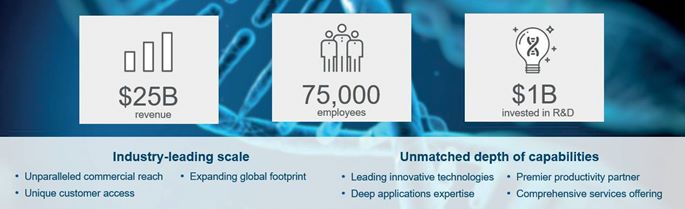
We serve more than 400,000 customers working in pharmaceutical and biotech companies, hospitals and clinical diagnostic labs, universities, research institutions and government agencies, as well as environmental, industrial quality and process control settings. Our global team of more than 75,000 colleagues delivers a unique combination of innovative technologies, purchasing convenience and pharmaceutical services through our industry-leading brands, including Thermo Scientific, Applied Biosystems, Invitrogen, Fisher Scientific, Unity Lab Services and Patheon.
We continuously increase our depth of capabilities in technologies, software and services, and leverage our extensive global channels to address our customers’ emerging needs. Our goal is to make our customers more productive in an increasingly competitive business environment, and to allow them to solve their challenges, from complex research to improved patient care, environmental and process monitoring, and consumer safety.
2020 Proxy Statement  thermofisher.com |
1 |
|---|
| Table of Contents |
|---|
Proxy Statement Summary
Our Mission
At Thermo Fisher, everything we do begins with our Mission – to enable our customers to make the world healthier, cleaner and safer. We have a remarkable team of colleagues around the globe who are passionate about helping our customers address some of the world’s greatest societal challenges. Whether they are developing new treatments for disease, protecting the environment or ensuring public safety, our customers count on us to help them achieve their goals.
| Healthier | Cleaner | Safer |
|---|---|---|
 |
 |
 |
Our Values
Thermo Fisher’s 4i Values of Integrity, Intensity, Innovation and Involvement make up our culture and guide our colleagues’ interactions — with our customers, suppliers and partners, and with each other. These four Values are the very foundation of our culture, and are fundamental to our continued growth.
 |
Honor commitments, communicate openly and demonstrate the highest ethical standards |
|---|---|
| Be determined to deliver results with speed, excellence and a passion to succeed | |
| Create value by transforming knowledge and ideas into differentiated products and services for our customers | |
| Make connections to work as one global team, embracing unique perspectives and treating others with dignity and respect | |
| 2 | 2020 Proxy Statement thermofisher.com |
| --- | --- |
| Table of Contents |
|---|
Proxy Statement Summary
2019 performance
| In 2019, our team executed well to capture the many opportunities we saw in our markets and deliver another year of excellent revenue and earnings growth:<br><br> <br>• Revenue grew 5% to $25.54 billion<br><br> <br>• GAAP diluted EPS increased 27% to $9.17 and adjusted EPS* increased 11% to $12.35<br><br> <br>• GAAP operating income grew by 21% to $4.59 billion and adjusted operating income* grew by 6%<br> to $5.97 billion<br><br> <br>• And we generated free cash flow* of $4.08 billion | ||||||
|---|---|---|---|---|---|---|
| We also continued to effectively deploy our capital in 2019 to create significant shareholder value by:<br><br> <br>• Deploying $1.8 billion to complete strategic acquisitions,<br> including viral vector manufacturer Brammer Bio and a GlaxoSmithKline (“GSK”) active pharmaceutical ingredient manufacturing site in Ireland<br><br> <br>• Returning capital of $1.8 billion through $1.5<br> billion of stock buybacks and $300 million of dividends<br><br> <br>• Refinancing $5.6 billion of debt to generate $80 million of<br> savings annually | ||||||
| --- | ||||||
| --- | ||||||
| We became a stronger partner for our customers by continuing to successfully execute our growth strategy, which consists of three pillars: | ||||||
| --- | --- | --- | --- | --- | --- | |
| • High-impact innovation: We invested 1 billion in R&D in 2019 and launched a range of new products that strengthened our offering. Some highlights include the Thermo Scientific Orbitrap Exploris 480 and Eclipse mass spectrometers, Thermo Scientific Krios G4 cryo- electron microscope, Applied Biosystems QuantStudio 6 and 7 Pro real-time PCR systems, the addition of numerous allergens to the Thermo<br> Scientific ImmunoCAP ISAC menu and, our new Ion Torrent Genexus next-generation sequencing instrument. | • Scale in high-growth and emerging markets: We built on our industry-leading scale in emerging and high-growth markets in 2019 to showcase our depth of capabilities for customers, including opening new<br> solution centers in Seoul and Shanghai for life sciences applications, Beijing and Delhi for improving food quality and safety and a new Pharma and Biotech Customer Solution Center in Shanghai to accelerate development of new drug therapies. | • Unique customer<br> value proposition: Our<br> success here is most apparent in the way we serve our pharma and<br> biotech customers. We are building an offering of products and services that support them from the discovery of a molecule in the research lab all the way to manufacturing a commercial medicine. We added new capabilities through internal investments in R&D and capacity expansions, and also through strategic bolt-on acquisitions, like Brammer Bio and<br> the GSK facility in Ireland. | ||||
All values are in US Dollars.
| All of these achievements are designed to make Thermo Fisher Scientific a stronger partner for our customers. And when we help them achieve their goals, society benefits. Here are<br> some recent examples:<br><br> <br>• To meet growing demand for non-opioid pain medications, we are supporting<br> a biotech company in the manufacture of an innovative pain reliever.<br><br> <br>• Our mass spectrometers are helping the FOSSIL Institute in Brazil study the effects of<br> climate change.<br><br> <br>• We are supplying our customers around the world who are battling the<br> coronavirus with instruments, assays and safety gear to support virus identification, rapid vaccine development and the protection of citizens.<br><br> <br>• Within weeks of the first case of the coronavirus in the U.S., the Food and Drug<br> Administration issued emergency use authorization for production of millions of our diagnostic tests. Optimized for our real-time PCR instruments and using our master mixes and sample prep platforms and kits, these tests provide<br> accurate results to medical personnel within four hours, enabling the U.S. and other governments to meet surging demand. | |
|---|---|
| * | Adjusted EPS, adjusted operating income and free cash flow are financial measures that are not prepared in accordance with GAAP. Appendix A to this proxy statement defines these<br> non-GAAP financial measures and reconciles them to the most directly comparable historical GAAP financial measures. |
| --- | --- |
| 2020 Proxy Statement thermofisher.com |
3 |
| --- | --- |
| Table of Contents |
|---|
Proxy Statement Summary
Long-term performance
Our record of delivering total shareholder return (“TSR”) reflects our commitment to long-term shareholder value creation.
Total Shareholder Return
1-Year<br><br> <br>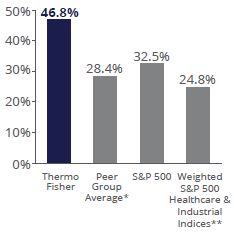 |
3-Year<br><br> <br> |
5-Year<br><br> <br>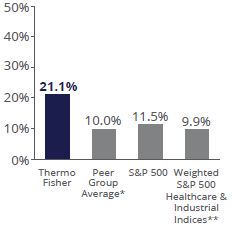 |
|---|---|---|
| * | Represents average TSR of companies included in our “Peer Group.” See page 40 for list of companies. | |
| --- | --- | |
| ** | Represents average TSR of the S&P’s 500 Healthcare and S&P’s 500 Industrial Indices, weighted 80/20, respectively, to approximate the split of our revenue by<br> end market. | |
| --- | --- |
Corporate governance highlights
Our Board of Directors (the “Board”) recognizes that Thermo Fisher’s success over the long-term requires a robust framework of corporate governance that serves the best interests of all our shareholders. Below are highlights of our corporate governance framework.
 |
Board refreshment remains a key area of focus for us, most recently evidenced by the recent addition of Debora Spar to our Board. |
|---|---|
|
Our Bylaws provide for proxy access by shareholders. |
| --- | --- |
|
All of our directors are elected annually. |
| --- | --- |
|
In uncontested elections, our directors must be elected by a majority of the votes cast, and an incumbent director who fails to receive such a majority is required to tender<br> his/her resignation. |
| --- | --- |

|
Our shareholders have the right to act by written consent. |
|---|---|
| 4 | 2020 Proxy Statement  thermofisher.com |
| --- | --- |
| Table of Contents |
|---|
Proxy Statement Summary
Sustainability
As the world leader in serving science, we are keenly aware of our responsibility to the global community. Our Corporate Social Responsibility (“CSR”) strategy is our commitment to doing business the right way to enable a sustainable future for all stakeholders. Our approach is built on a framework of four key pillars - Operational Integrity, Colleagues, Communities and Environment - that reinforce our Mission, align with our strategy and are material to our stakeholders.
 |
 |
 |
 |
|---|
Shareholder engagement
Our Board and management are committed to engaging with and listening to our shareholders. Throughout 2019 and into 2020 we engaged with shareholders representing over 50% of our outstanding shares to solicit their feedback on our business and financial performance, governance and executive compensation programs, and environmental and social matters. Members of our investor relations team and senior management participated in each discussion, with certain engagements including a member of our Board. This dialogue has informed our Board’s meeting agendas, and led to governance enhancements that help us address the issues that matter most to our shareholders. See page 36 for details on what we learned from our shareholders and changes we made to our programs.
This engagement process will assist us in achieving our strategic objectives, creating long-term value, maintaining our culture of compliance, and contributing to our environmental, social, and governance activities.
Our Shareholder Engagement Process
| Deliberate, Assess, and Prepare<br><br> <br>・Our Board assesses and monitors:<br><br> <br>- investor sentiment<br><br> <br>- shareholder voting results<br><br> <br>- trends in governance, executive compensation, human capital management, regulatory, environmental, social, and other<br> matters<br><br> <br>・Our Board identifies and prioritizes potential topics for shareholder engagement |  |
Outreach and Engagement<br><br> <br>・Management regularly meets with shareholders to actively solicit input on a range of issues, and report shareholder<br> views to our Board<br><br> <br>・Management routinely engages with investors individually, as well as at conferences and other forums |
|---|---|---|
 |
 |
|
| Respond<br><br> <br>・Our Board responds, as appropriate, with enhancements to policy, practices, and disclosure<br><br> <br>・For more information on governance enhancements informed by shareholder input, please see page 36 |  |
Evaluate<br><br> <br>・Shareholder input informs our Board’s ongoing process of continually improving governance and other practices<br><br> <br>・Our Board and management review shareholder input to identify consistent themes, and research and evaluate any<br> identified issues and concerns |
| 2020 Proxy Statement thermofisher.com |
5 | |
| --- | --- |
| Table of Contents |
|---|
Proxy Statement Summary
Roadmap of voting items
 |
Proposal 1<br><br> <br>Election of directors<br><br> <br>We are asking our shareholders to elect each of the 12 director nominees identified below to serve until the 2021 Annual Meeting of<br> shareholders.<br><br> <br><br><br> <br>The Board recommends a vote FOR each director nominee. | See page 11 |  |
|---|
Our director nominees
Below is an overview of each of the director nominees you are being asked to elect at the 2020 Annual Meeting.
| Committee Membership | ||||||||
|---|---|---|---|---|---|---|---|---|
| Director Nominee | Age | Director<br><br> <br>Since | AC | CC | NCGC | SFC | STC | |
 |
Marc N. Casper<br><br> <br>Chairman, President and Chief Executive Officer, Thermo Fisher Scientific | 52 | 2009 |  |
 |
|||
 |
Nelson J. Chai Independent<br><br> <br>Chief Financial Officer, Uber Technologies Inc. | 54 | 2010 |  |
 |
|||
 |
C. Martin Harris Independent<br><br> <br>Associate Vice President of the Health Enterprise and Chief Business Officer, Dell Medical School at the University of Texas at Austin | 63 | 2012 |  |
 |
|||
 |
Tyler Jacks<br><br> <br>David H. Koch Professor of Biology at the Massachusetts Institute of Technology and Director of the David H. Koch Institute for Integrative Cancer Research | 59 | 2009 | |
 |
|||
 |
Judy C. Lewent Independent<br><br> <br>Former Chief Financial Officer, Merck & Co., Inc. | 71 | 2008 |  |
||||
 |
Thomas J. Lynch Independent<br><br> <br>Chairman of the Board and Former Chief Executive Officer, TE Connectivity Ltd. | 65 | 2009 |  |
||||
 |
Jim P. Manzi Independent<br><br> <br>Chairman, Stonegate Capital | 68 | 2000 |  |
||||
 |
James C. Mullen Independent<br><br> <br>Former Chief Executive Officer, Patheon N.V. and Former Chief Executive Officer, Biogen Inc. | 61 | 2018 |  |
||||
 |
Lars R. Sørensen Independent<br><br> <br>Former President and Chief Executive Officer, Novo Nordisk A/S | 65 | 2016 |  |
|
|||
 |
Debora L. Spar Independent<br><br> <br>Professor, Harvard Business School | 56 | 2019 |  |
||||
 |
Scott M. Sperling Independent<br><br> <br>Co-President, Thomas H. Lee Partners, LP | 62 | 2006 | |
|
|||
 |
Dion J. Weisler Independent<br><br> <br>Former President and Chief Executive Officer, HP Inc. | 52 | 2017 |  |
 |
AC Audit
CC Compensation NCGC Nominating and Corporate Governance
| SFC Strategy and Finance STC Science and Technology |  Chair  Member |
|---|---|
| 6 | 2020 Proxy Statement thermofisher.com |
| --- | --- |
| Table of Contents |
|---|
Proxy Statement Summary
Board snapshot
| Independence | Tenure | Age | Diversity | ||||
|---|---|---|---|---|---|---|---|
| Independent | <5 years | 50-60 years | Female | ||||
 |
10 |  |
3 |  |
5 |  |
2 |
| Not independent | 5-8 years | 61-70 years | Ethnically diverse | ||||
 |
2 |  |
2 |  |
6 | |
2 |
| 9-12 years | >70 years | Born outside of the U.S. | |||||
 |
5 |  |
1 |  |
2 | ||
| >12 years | |||||||
 |
2 | ||||||
| 9.1 years Average Tenure | 61 years Average Age |
Board skills and experience
| Strategic Leadership |  |
100% of directors | ||
|---|---|---|---|---|
| CEO Leadership |  |
67% of directors | ||
| Industry Background |  |
67% of directors | ||
| Public Company Board Service |  |
92% of directors | ||
| Financial Acumen and Expertise |  |
75% of directors | ||
| International Experience | |
92% of directors | ||
| Senior Management Leadership | |
92% of directors | ||
| Corporate Finance and M&A Experience |  |
83% of directors | ||
| 2020 Proxy Statement thermofisher.com |
7 | |||
| --- | --- |
| Table of Contents |
|---|
Proxy Statement Summary
|
Proposal 2<br><br> <br>Approval of an advisory vote on executive compensation<br><br> <br>We are asking our shareholders to cast a non-binding, advisory vote on the compensation of the executive officers named in<br> the Summary Compensation Table. In evaluating this year’s “say on pay” proposal, we recommend that you review our Compensation Discussion and Analysis, which explains how and why the Compensation Committee of our<br> Board arrived at its executive compensation actions and decisions for 2019.<br><br> <br><br><br> <br>The Board recommends a vote FOR this proposal. | See page 37 | |
|---|
Framework of 2019 compensation
Overview of executive compensation program
Our executive compensation program is designed with Thermo Fisher’s Mission at its core. Being successful, while delivering sustainable value creation for our shareholders in a responsible way, requires the right talent in the right roles focused on a combination of financial and non-financial performance.
Compensation of the Company’s executive officers named in the summary compensation table set forth under the heading “Executive compensation” (the “Named Executive Officers” or “NEOs”) is delivered in base salary, an annual cash incentive and a mix of long-term incentives. This combination balances a focus on retention of talent, achievement of near-term business goals, and sustainable longer-term performance and shareholder value creation. Learn more on page 37.
Alignment with strategy
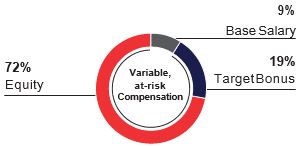
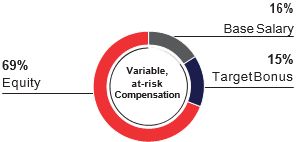
For our compensation program to be successful, it needs to effectively align with our key strategic, financial and operational goals. We achieve this by delivering the majority of compensation in the form of at-risk variable pay that is directly tied to our performance and value delivery to our shareholders.
The performance measures that apply to annual and long-term incentive awards reflect both our focus on organic top line growth, along with operational efficiency and profitability. To ensure alignment with shareholder value creation we also assess total shareholder return relative to some of the highest performing companies in the S&P 500.
CEO
Other Named Executive Officers (Aggregate)
Learn more about our performance measures and why they matter on page 42.
| 8 | 2020 Proxy Statement thermofisher.com |
|---|
| Table of Contents |
|---|
Proxy Statement Summary
Key activities in 2019
During 2019, the Compensation Committee reviewed feedback collected as part of the extensive shareholder outreach efforts, as it related to executive compensation. This feedback was a critical input into a comprehensive review of the executive compensation program design during the year. As a result, the Committee approved select changes for 2019 and updated the Compensation Discussion & Analysis to enhance clarity and transparency around our executive compensation programs. Learn more on page 36.
Executive compensation 2019 decisions
| • | In February 2019, the Compensation Committee approved increases to base salaries ranging from 0.0% - 6.2% for our Named Executive Officers. |
|---|---|
| • | In February 2019, the Compensation Committee approved an increase to the CFO’s target bonus opportunity. |
| --- | --- |
| • | In February 2020, the Compensation Committee approved annual cash incentive payouts (for 2019 performance) ranging from 100% – 135% of target for our Named Executive Officers. |
| --- | --- |
| • | In February 2020, the Compensation Committee certified achievement of 163% payout on 2019 performance-based restricted stock units and the performance requirements for the third<br> 5-year performance period under the 2017 TSR stock option program. |
| --- | --- |
Compensation governance
Our Compensation Committee also recognizes that the success of our executive compensation program over the long-term requires a robust framework of compensation governance. As a result, the Committee regularly reviews external executive compensation practices and trends and incorporates best practices into our executive compensation program:
What We Do<br><br> <br> Benchmark compensation levels against<br> appropriate companies operating in similar industries, of a similar size and business complexity<br><br> <br> Reference the market median when reviewing<br> compensation for our Named Executive Officers<br><br> <br> Clawback policy for the recoupment of<br> compensation in certain situations<br><br> <br> Regular shareholder<br> engagement related to compensation<br><br> <br> Caps under our performance-based incentive<br> plans (annual cash incentive payout limit and share cap under performance-based long- term plans)<br><br> <br> Robust stock ownership requirements<br><br> <br> Two year holding requirement on 50% of net<br> stock vesting under the CEO’s time-and performance-based restricted stock units<br><br> <br> Engage an independent compensation consultant<br><br> <br> Deliver the majority of compensation in the<br> form of at-risk, variable pay<br><br> <br> Align pay with performance and Company strategy<br><br> <br> Double-trigger change in control provisions |
|
|---|---|
What We Don’t Do<br><br> <br> No tax gross ups<br><br> <br> No plans that encourage excessive risk<br><br> <br> No guaranteed pay increases<br><br> <br> No guaranteed bonuses or equity awards<br><br> <br> No dividends paid on equity awards prior to vesting<br><br> <br> No hedging or pledging of Company stock<br><br> <br> No excessive perquisites<br><br> <br> No pension or SERPs (with the exception of legacy accumulated benefits<br> from acquired companies) |
|
| --- | |
| --- | |
| 2020 Proxy Statement thermofisher.com |
9 |
| --- | --- |
| Table of Contents |
|---|
Proxy Statement Summary
|
Proposal 3<br> Ratification of the selection of the independent auditors<br> <br><br><br> <br>We are asking our shareholders to ratify our Audit Committee’s selection of PricewaterhouseCoopers LLP (“PwC”) to act as the independent auditors for Thermo<br> Fisher for 2020. Although our shareholders are not required to approve the selection of PwC, our Board believes that it is advisable to give our shareholders an opportunity to ratify this selection.<br><br> <br>The Board recommends a vote FOR this proposal. | See page 69 | |
|---|
The Audit Committee has selected PricewaterhouseCoopers LLP as the Company’s independent auditors for the fiscal year ending December 31, 2020. During the fiscal year ended December 31, 2019, PwC served as the Company’s independent auditors.
PwC has audited the Company’s financial statements each year since 2002. The Audit Committee exercises sole authority to approve all audit engagement fees and terms associated with the retention of PwC. In addition to overseeing the regular rotation of the lead audit partner, the Audit Committee is involved in the selection of, and reviews and evaluates the lead audit partner and considers whether, in order to assure continuing auditor independence, there should be regular rotation of the independent registered public accounting firm. The Audit Committee believes that the retention of PwC to serve as our independent auditors is in the best interests of the Company and its shareholders. Although the Company is not required to seek shareholder ratification of this selection, the Company has decided to provide its shareholders with the opportunity to do so. If this proposal is not approved by our shareholders at the 2020 Annual Meeting, the Audit Committee will reconsider the selection of PwC. Even if the selection of PwC is ratified, the Audit Committee in its discretion may select a different firm of independent auditors at any time during the year if it determines that such a change would be in the best interest of the Company and its shareholders.
Representatives of PwC are expected to attend the virtual 2020 Annual Meeting. They will have the opportunity to make a statement if they desire to do so and will be available to respond to appropriate questions from the shareholders.
| 10 | 2020 Proxy Statement thermofisher.com |
|---|
| Table of Contents |
|---|
Corporate governance
|
Proposal 1<br><br> <br>Election of directors<br><br> <br><br><br> <br>We are asking our shareholders to elect each of the 12 director nominees identified below to serve until the 2021 Annual Meeting of shareholders.<br><br> <br>The Board recommends a vote FOR each director nominee. |
|---|
The Board, upon recommendation from the Nominating and Corporate Governance Committee, has nominated 12 directors for election at the 2020 Annual Meeting. Each of the directors elected at the 2020 Annual Meeting will hold office until the annual meeting of shareholders to be held in 2021 and until his or her successor has been elected and qualified, or until his or her earlier death, resignation, removal or disqualification. Each of the director nominees currently serves as a member of the Board of Directors.
After consideration of the individual qualifications, skills and experience of each of our director nominees and his or her prior contributions to the Board, we believe that a Board composed of the 12 director nominees would be well-balanced and effective.
Unless contrary instructions are given, the shares represented by a properly executed proxy will be voted “FOR” each of the director nominees presented below. If, at the time of the meeting, one or more of the director nominees has become unavailable to serve, shares represented by proxies will be voted for the remaining director nominees and for any
substitute director nominee or nominees designated by the Board of Directors, unless the size of the Board is reduced. The Board knows of no reason why any of the director nominees will be unavailable or unable to serve. Proxies cannot be voted for a greater number of persons than the director nominees listed.
| 2020 Proxy Statement thermofisher.com |
11 |
|---|
| Table of Contents |
|---|
Corporate Governance
Board of directors—selection, skills and experience
Director nomination process
The Nominating and Corporate Governance Committee considers recommendations for director nominees suggested by its members, other directors, management and other interested parties. It will consider shareholder recommendations for director nominees that are sent to the Nominating and Corporate Governance Committee to the attention of the Company’s Secretary at the principal executive office of the Company.
Role of the Nominating and Corporate Governance Committee
The process for evaluating prospective nominees for director, including candidates recommended by shareholders, includes meetings from time to time to evaluate biographical information and background material relating to prospective nominees, interviews of selected candidates by members of the Nominating and Corporate Governance Committee and other members of the Board, and application of the Company’s general criteria for director nominees set forth in the Company’s Corporate Governance Guidelines. These criteria include the prospective nominee’s integrity, business acumen, age, experience, commitment, and diligence. Additionally, given the importance of diversity to the Board, in February 2020 we revised our Corporate Governance Guidelines to require that the Nominating and Corporate Governance Committee seek to include diverse candidates, including women and minorities, in the pool of candidates from which it recommends director nominees and request that any search firm it engages include diverse candidates. The Nominating and Corporate Governance Committee does not assign specific weights to particular criteria and no particular criterion is necessarily applicable to all prospective nominees. The Committee believes that the backgrounds and qualifications of the directors considered as a group should provide a significant breadth of experience, knowledge and abilities to assist the Board in fulfilling its responsibilities. The Nominating and Corporate Governance Committee also considers such other relevant factors as it deems appropriate, including the current composition of the Board, the balance of management and independent directors, and, with respect to members of the Audit Committee, financial expertise.
After completing its evaluation, the Nominating and Corporate Governance Committee makes a recommendation to the full Board as to the persons who should be nominated by the Board, and the Board determines the nominees after considering the recommendation and report of the Nominating and Corporate Governance Committee.
The Nominating and Corporate Governance Committee has from time to time engaged a search firm to facilitate the identification, screening and evaluation of qualified, independent candidates for director to serve on the Board.
Board diversity and board tenure
We believe that the varied perspectives and experiences resulting from having a diverse board of directors enhances the quality of decision making. We also believe diversity can help the board identify and respond more effectively to the needs of customers, shareholders, employees, suppliers and other stakeholders. The Board and the Nominating and Corporate Governance Committee consider a number of demographics including, but not limited to, race, gender, ethnicity, age, culture and nationality in seeking to develop a board that, as a whole, reflects diverse viewpoints, backgrounds, skills, experiences and expertise. Director nominees are not discriminated against on the basis of race, religion, national origin, sex, sexual orientation, disability or any other basis proscribed by law.
In addition, we believe that having directors with differing tenures is important in order to provide both fresh perspectives and deep experience and knowledge of the Company. The Board believes that a mix of long- and short-tenured directors ensures an appropriate balance of view and insights and allows the Board as a whole to benefit from the historical and institutional knowledge that longer-tenured directors possess and the fresh perspectives contributed by newer directors. In furtherance of the Board’s active role in Board succession planning, the Board has appointed three new directors since 2017.
| 12 | 2020 Proxy Statement thermofisher.com |
|---|
| Table of Contents |
|---|
Corporate Governance
Director nominee skills, experience, and background
The Board regularly reviews the skills, experience, and background that it believes are desirable to be represented on the Board and in order to align with the Company’s strategic Vision, business and operations.
The following matrix identifies the skills, experience, and background that our director nominees bring to the Board:
| Casper | Chai | Harris | Jacks | Lewent | Lynch | Manzi | Mullen | Sørensen | Spar | Sperling | Weisler | ||
|---|---|---|---|---|---|---|---|---|---|---|---|---|---|
 |
Strategic Leadership<br><br> <br>Experience driving strategic direction and growth of an organization | |
|
 |
|
|
|
|
|
|
|
|
|
 |
CEO Leadership<br><br> <br>Experience serving as the Chief Executive Officer of a major<br> organization | |
|
|
|
|
|
|
|
||||
 |
Industry Background<br><br> <br>Knowledge of or experience in the Company’s specific<br> industry | |
|
|
|
|
|
|
|
||||
 |
Public Company Board Service<br><br> <br>Experience as a board member of another publicly-traded<br> company | |
|
|
|
|
|
|
|
|
|
|
|
 |
Financial Acumen and Expertise<br><br> <br>Experience or expertise in financial accounting and<br> reporting or the financial management of a major<br><br> <br>organization | |
|
|
|
|
|
|
|
|
|||
 |
International Experience<br><br> <br>Experience doing business internationally | |
|
|
|
|
|
|
|
|
|
|
|
 |
Senior Management Leadership<br><br> <br>Experience serving in a senior leadership role of a major organization<br> (e.g., Chief Financial Officer, General Counsel, President, or Division Head) | |
|
|
|
|
|
|
|
|
|
|
|
 |
Corporate Finance and M&A Experience<br><br> <br>Experience in corporate lending or borrowing, capital market<br> transactions, significant mergers or acquisition, private equity, or investment banking |  |
|
|
|
|
 |
|
|
|
|
||
| 2020 Proxy Statement thermofisher.com |
13 | ||||||||||||
| --- | --- |
| Table of Contents |
|---|
Corporate Governance
Nominees and incumbent directors
Set forth below are the names of the persons nominated as directors, their ages, their offices in the Company, if any, their principal occupations or employment for the past five years, the length of their tenure as directors and the names of other public companies in which they currently hold directorships or have held directorships during the past five years. We have also presented information below regarding each director’s specific experience, qualifications, attributes and skills that led our Board to the conclusion that he or she should serve as a director. Information regarding their beneficial ownership of the Company’s common stock, par value $1.00 per share (“Common Stock”), is reported under the heading “Information about stock ownership” on page 72.
 <br><br> <br>Marc N. Casper<br><br> <br>Chairman, President and CEO |
Professional Highlights<br><br> <br>• Thermo Fisher Scientific Inc.<br><br> <br>- Chairman, President and CEO (2020 - Present)<br><br> <br>- President and CEO (2009 - 2020)<br><br> <br>- Executive VP and COO (2008 - 2009)<br><br> <br>- Executive VP (2006 - 2008)<br><br> <br> <br>Other current directorships: USBancorp |
|---|---|
| Age: 52<br><br> <br>Director since:<br><br> <br>2009<br><br> <br>Committees:<br><br> <br>Strategy and Finance, Science and Technology | Director Qualifications<br><br> <br>As the only member of the Company’s management to serve on the Board, Mr. Casper contributes a deep and valuable understanding of Thermo<br> Fisher history and day-to-day operations. This contribution is stemmed further from Mr. Casper’s 20-plus years in the life sciences and healthcare equipment industry, and his long standing employment with the Company.<br> Additionally, Mr. Casper’s experience as the Chief Executive Officer of the Company, and previously serving in various senior level management roles, enables him to provide strategic leadership skills and financial acumen and<br> expertise that are invaluable to the Board. |
 <br><br> <br>Nelson J. Chai<br><br> <br>Independent |
Professional Highlights<br><br> <br>• CFO, Uber<br> Technologies Inc. (2018 - Present)<br><br> <br>• President and CEO, The Warranty<br> Group (2017 - 2018)<br><br> <br>• President, CIT Group (2011 - 2015)<br><br> <br>Other current directorships: None |
| --- | --- |
| Age: 54<br><br> <br>Director since:<br><br> <br>2010<br><br> <br>Committees:<br><br> Audit (Chair), Nominating and<br><br> <br>Corporate Governance | Director Qualifications<br><br> <br>Mr. Chai’s broad background and experience makes him a<br> suitable and valued member of our Board. Mr. Chai has held executive management positions in a variety of industries and organizations, including his current role as Chief Financial Officer of Uber Technologies Inc., a ridesharing<br> company, and prior roles as President and CEO of The Warranty Group, a provider of specialty insurance products, and President of CIT Group, a financial institution. As a result of his vast background, Mr. Chai brings valuable CEO<br> and strategic leadership, financial acumen and expertise, and accounting experience to our Board. |
| 14 | 2020 Proxy Statement thermofisher.com |
| --- | --- |
| Table of Contents |
|---|
Corporate Governance
 <br><br> <br>C. Martin Harris<br><br> <br>Independent |
Professional Highlights<br><br> <br>• Associate VP<br> and Chief Business Officer, University of Texas Austin, Dell Medical School (2016 - Present)<br><br> <br>• Cleveland Clinic Hospital<br><br> <br>- Chief Strategy Officer, The Cleveland Clinic Foundation (2009 - 2016)<br><br> <br>- Chief Information Officer and Chairman, Information Technology Division (1996 - 2016)<br><br> <br>- Staff Physician, Foundation Department of General Internal Medicine (1996 -2016) |
|---|---|
| Age: 63<br><br> <br>Director since:<br><br> <br>2012<br><br> <br>Committees: <br><br> <br>Nominating and <br><br> <br> <br>Corporate Governance, Science and Technology | Director Qualifications<br><br> <br>Dr. Harris provides valuable insight and perspective on the healthcare<br> industry stemming from his current role as Chief Business Officer of Dell Medical School of the University of Texas, Austin, and his previous long-standing career as a physician and Chief Information Officer of Cleveland Clinic<br> Hospital, and Chief Strategy Officer of the Cleveland Clinic Foundation. Dr. Harris has been a strategic leader in healthcare organizations, and also brings valuable board-level experience from his many years served on public company<br> boards in the healthcare industry, including his service on various committees, including the Audit, Nominating and Corporate Governance, and Compensation Committees. |
 <br><br> <br>Tyler Jacks<br><br> <br>Independent |
Professional Highlights<br><br> <br>• Investigator, Howard Hughes Medical Institute (2002 - Present)<br><br> <br>• Massachusetts Institute of Technology, Koch Institute<br><br> <br>- Director, Center for Cancer Research (2001 - Present)<br><br> <br>- Professor, Department of Biology and Center for Cancer Research (2000 - Present)<br><br> <br>Other current directorships: Amgen, Inc. |
| --- | --- |
| Age: 59<br><br> <br>Director since:<br><br> 2009<br><br> <br>Committees:<br><br> Strategy and Finance, Science and Technology (Chair) | Director Qualifications<br><br> <br>Dr. Jacks brings to the Board the benefits of his significant experience<br> of many years in the cancer research industry. He has worked for 20 years at Massachusetts Institute of Technology, as director of the Koch Institute, a cancer research center and as a professor in the Department of Biology. Dr.<br> Jacks brings valuable board-level and industry specific experience from his years serving on public company boards in the biotechnology industry and as a member of multiple scientific advisory boards of biotechnology companies,<br> pharmaceutical companies and academic institutions, including his service on various committees, such as the Audit, Compensation and Management Development, Corporate Responsibility and Compliance, and Nominating and Corporate<br> Governance Committees. |
 <br><br> <br>Judy C. Lewent<br><br> <br>Independent |
Professional Highlights<br><br> <br>• Merck & Co., Inc.<br><br> <br>- Chief Financial Officer (1990 - 2007)<br><br> - Executive VP (2001 - 2007)<br><br> - President, Human Health Asia (2003 - 2005)<br><br> <br>Other current directorships: Motorola Solutions, Inc. and GlaxoSmithKline plc. |
| --- | --- |
| Age: 71<br><br> <br>Director since:<br><br> 2008<br><br> <br>Committees:<br><br> <br>Strategy and Finance (Chair) | Director Qualifications<br><br> <br>Ms. Lewent’s nearly 20 years in executive management roles at Merck<br> & Co., Inc., a global pharmaceutical company, enables her to bring valuable experience in a highly regulated industry to the Board. With her experience as the former Chief Financial Officer and Executive Vice President of<br> Merck, Ms. Lewent brings financial acumen and expertise, strategic leadership skills and international experience to the Board. Ms. Lewent also brings valuable board-level experience from her many years served on public company<br> boards, including her service on various committees, such as the Audit, Nominating and Corporate Governance, Remuneration, Risk, and Science Committees. |
| 2020 Proxy Statement thermofisher.com |
15 |
| --- | --- |
| Table of Contents |
|---|
Corporate Governance
 <br><br> <br>Thomas J. Lynch<br><br> <br>Independent |
Professional Highlights<br><br> <br>• TE Connectivity, Ltd.<br><br> <br>- Chairman (2013 - Present) (Director since 2006)<br><br> <br>- Chief Executive Officer (2006 - 2017)<br><br> <br>Other current directorships: TE Connectivity Ltd., Cummins Inc. and Automatic Data Processing, Inc. |
|---|---|
| Lead Director<br><br> <br>Age: 65<br><br> <br>Director since:<br><br> 2009<br><br> <br>Committees: Compensation | Director Qualifications<br><br> <br>Mr. Lynch’s many years as the former Chief Executive<br> Officer of TE Connectivity Ltd., a comparably-sized global company in the consumer electronics industry, enables him to bring valuable experience to the Board, such as strategic leadership skills, financial expertise, and<br> international experience. Mr. Lynch also brings valuable board-level experience from his service on public company boards including his service on various committees, such as the Audit, Finance, Compensation, Governance and<br> Nominating, and Corporate Development and Technology Advisory Committees. |
 <br><br> <br>Jim P. Manzi<br><br> <br>Independent |
Professional Highlights<br><br> <br>• Chairman, Stonegate Capital (1995 - Present)<br><br> <br>• Chairman, President and CEO, Lotus Development Corporation (1984 - 1995)<br><br> <br>Other current directorships: None |
| --- | --- |
| Age: 68<br><br> <br>Director since:<br><br> 2000<br><br> <br>Previous Chairman: From 2007 to February 2020 and from 2004 to 2006<br><br> <br>Committees: Compensation | Director Qualifications<br><br> <br>Mr. Manzi brings to the Board valuable strategic<br> leadership skills, operational management expertise and overall business acumen, as a result of his senior-level management experience leading Lotus Development Corporation, as Chief Executive Officer, prior to its<br> acquisition, and his current role as Chairman of Stonegate Capital, a private equity firm. Mr. Manzi also brings valuable knowledge of the Company due to his 20 years as a member of our Board, which we believe provides our<br> Board with specific expertise and insight into our business. |
 <br><br> <br>James C. Mullen<br><br> <br>Independent |
Professional Highlights<br><br> <br>• Chief Executive Officer, Patheon N.V. (2011 - 2017)<br><br> <br>• Chief Executive Officer, Biogen Inc. (2000 - 2010)<br><br> <br>Other current directorships: Editas Medicine Inc.<br><br> <br>Previously held directorships: Insulet Inc. |
| --- | --- |
| Age: 61<br><br> <br>Director since:<br><br> 2018<br><br> <br>Committees:<br><br> Strategy and Finance | Director Qualifications<br><br> <br>Mr. Mullen brings valuable industry knowledge to<br> the Board, due to his 35 years of extensive management experience and his senior leadership background in the pharmaceutical and biotechnology industries. Mr. Mullen served as Chief Executive Officer of Patheon, a<br> pharmaceutical contract development and manufacturing organization, prior to its acquisition by the Company in 2017, and as Chief Executive Officer of Biogen, Inc. We believe this experience provides our Board with<br> specific expertise and insight into our business. Mr. Mullen also brings valuable board-level experience from his service on the boards of public companies in the pharmaceutical industry, including his service on various<br> committees, such as the Compensation and Nominating and Corporate Governance Committees. |
| 16 | 2020 Proxy Statement thermofisher.com |
| --- | --- |
| Table of Contents | |
|---|---|
 <br><br> <br>Lars R. Sørensen<br><br> <br>Independent |
Professional Highlights<br><br> <br>• President and CEO, Novo Nordisk A/S (2000 - 2017)<br><br> <br>Other current directorships: Essity Aktiebolag<br><br> <br>Previously held directorships: Carlsberg AS |
| --- | --- |
| Age: 65<br><br> <br>Director since:<br><br> 2016<br><br> <br>Previously served as a director:<br><br> 2011 - 2015<br><br> <br>Committees: Nominating and Corporate Governance (Chair), Strategy and Finance | Director Qualifications<br><br> <br>Mr. Sorensen brings to the Board valuable<br> strategic leadership skills, financial expertise, industry background, and international experience as a result of his long-standing tenure as Chief Executive Officer at Novo Nordisk A/S, a global healthcare company.<br> Mr. Sorensen also brings valuable board-level experience from his years of serving on public company boards in the life sciences industry, including his service on various committees, such as the Audit, Nominating, and<br> Remuneration Committees, |
 <br><br> <br>Debora L. Spar<br><br> <br>Independent |
Professional Highlights<br><br> <br>• Professor, Harvard Business<br> School (2018 - Present)<br><br> <br>• President and CEO, Lincoln Center<br> for the Performing Arts (2017 - 2018)<br><br> <br>• President of Barnard College<br> (2008 - 2017)<br><br> <br>Other current directorships: None |
| --- | --- |
| Age: 56<br><br> <br>Director since:<br><br> 2019<br><br> <br>Committees:<br><br> Audit | Director Qualifications<br><br> <br>Dr. Spar brings to the Board valuable<br> executive management and strategic leadership skills, financial expertise, and a unique perspective on technology’s role in shaping society and the global economy. Dr. Spar also brings valuable experience serving<br> on various committees, such as the Audit, Compensation, Nominating and Corporate Governance, and Strategy Committees. |
 <br><br> <br>Scott M. Sperling<br><br> <br>Independent |
Professional Highlights<br><br> <br>• Co-President, Thomas H. Lee Partners, LP<br> (1994 - Present)<br><br> <br>Other current directorships: Agiliti Health, Inc., iHeart Media, Inc. and The Madison Square Garden Company |
| --- | --- |
| Age: 62<br><br> <br>Director since:<br><br> <br>2006<br><br> <br>Committees: Compensation, Strategy and Finance | Director Qualifications<br><br> <br>Mr. Sperling brings to the Board<br> valuable strategic leadership skills, and corporate finance and acquisition experience due to his current role serving as Co-President of Thomas H. Lee Partners LP., a private equity firm. Mr. Sperling also brings<br> valuable board-level experience from serving on public company boards, including his service on the Nominating and Corporate Governance Committees. |
| 2020 Proxy Statement thermofisher.com |
17 |
| --- | --- |
| Table of Contents |
|---|
Corporate Governance
 <br><br> <br>Dion J. Weisler<br><br> <br>Independent |
Professional Highlights<br><br> <br>・ President and CEO, HP Inc. (2015 - 2019)<br><br> <br>Other current directorships: HP, Inc. |
|---|---|
| Age: 52<br><br> <br>Director since:<br><br> <br>2017<br><br> <br>Committee:<br><br> <br>Audit,<br> Compensation (Chair) | Director Qualifications<br><br> <br>Mr. Weisler brings to the Board valuable strategic and senior management<br> leadership skills, financial expertise, international experience, and M&A experience due to his former role serving as Chief Executive Officer at HP Inc., an information technology company. Mr. Weisler also brings valuable board-level<br> experience from his service on HP Inc.’s board. |
Retirement policy
Under Thermo Fisher’s Corporate Governance Guidelines, a director is required to retire when he or she reaches age 72. A director elected to the Board prior to his or her 72nd birthday may continue to serve until the annual shareholders meeting following his or her 72nd birthday. In accordance with this policy, Elaine S. Ullian is not standing for re-election. On the recommendation of the Nominating and Corporate Governance Committee, the Board may waive this requirement as to any director if it deems a waiver to be in the best interests of the Company.
Board leadership structure
On an annual basis, our Nominating and Corporate Governance Committee evaluates and makes recommendations to the Board concerning the Board’s leadership structure, including whether the roles of Chairman and CEO should be separated or combined and elects a Chairman from among the directors. The Board believes that it is in the best interests of the Company and its shareholders for the Board to determine which director is best qualified to serve as Chairman in light of the circumstances at the time, rather than based on a fixed policy. In the event that the Chairman is not an independent director, an independent Lead Director is elected on an annual basis by a majority of the independent directors upon a recommendation from the Nominating and Corporate Governance Committee.
The duties of the independent Lead Director include:
| ・ | leading meetings of the non-management or independent directors; |
|---|---|
| ・ | presiding over meetings of the Board at which the Chairman is not present; |
| --- | --- |
| ・ | calling meetings of non-management or independent directors; |
| --- | --- |
| ・ | approving meeting agendas for the Board; |
| --- | --- |
| ・ | approving meeting schedules to help ensure sufficient time for discussion; |
| --- | --- |
| ・ | serving as a liaison between independent directors and the Chairman; however, each director remains free to communicate directly with the Chairman; and |
| --- | --- |
| ・ | being available to meet with shareholders as appropriate. |
| --- | --- |
On February 25, 2020, our Board combined the positions of Chairman and CEO under the leadership of Marc Casper and designated Thomas J. Lynch as the Board’s independent Lead Director. The Board concluded that it was in the best interests of the Company and its shareholders to combine the roles of Chairman and CEO at this time to drive the most efficient execution of our strategic plan and realize our vision for the future. Given his contributions to the Company’s success, and his insights and expertise as a member of the Board, our Board unanimously selected Mr. Casper to also take on the Chairman role as the Company begins the next decade. With these changes, the Board has adopted the right governance structure, with the right leaders and oversight, to drive shareholder value now and in the future.
| 18 | 2020 Proxy Statement  thermofisher.com |
|---|
| Table of Contents |
|---|
Corporate Governance
How we assess director independence
Board members
The Company’s Corporate Governance Guidelines require a majority of our directors to be independent within the meaning of the NYSE listing requirements. The Board has determined that all of our director nominees (listed on page 6) other than Mr. Casper and Dr. Jacks are independent, and determined that Elaine S. Ullian, who serves on the Board until the 2020 Annual Meeting of Shareholders is independent.
| ・ | The Board’s guidelines. For a director<br> to be considered independent, the Board must determine that he or she does not have any material relationship with the Company. The Board has adopted the following standards to assist it in determining whether a director has a material<br> relationship with the Company, which can be found in the Company’s Corporate Governance Guidelines, on the Company’s website at www.thermofisher.com. Under these standards, a director will not be considered to have a material relationship<br> with the Company if he or she is not: |
|---|---|
| ・ | A director who is (or was within the last three years) an employee, or whose immediate family member is (or was within the last three years) an executive officer, of the Company; |
| --- | --- |
| ・ | A director who is a current employee or greater than 10% equity owner, or whose immediate family member is a current executive officer or greater than 10% equity owner, of a company<br> that has made payments to, or received payments from, the Company for property or services in an amount which, in any of the last three fiscal years, exceeds the greater of $1 million, or 2% of such other company’s consolidated gross<br> revenues; |
| --- | --- |
| ・ | A director who has received, or whose immediate family member has received, during any twelve-month period within the last three years, more than $120,000 in direct compensation from<br> the Company, other than director and committee fees and pension or other forms of deferred compensation for prior service (provided such compensation is not contingent in any way on continued service); |
| --- | --- |
| ・ | A director who is, or whose immediate family member is, a current partner of a firm that is the Company’s internal or external auditor; a director who is a current employee of a firm that is the Company’s<br> internal or external auditor; a director whose immediate family member is a current employee of a firm that is the Company’s internal or external auditor and personally works on the Company’s audit; or a director who was, or whose<br> immediate family member was, within the last three years (but is no longer) a partner or employee of a firm that is the Company’s internal or external auditor and personally worked on the Company’s audit within that time; |
| --- | --- |
| ・ | A director who is (or was within the last three years), or whose immediate family member is (or was within the last three years), an executive officer of another<br> company where any of the Company’s current executive officers at the same time serve or served on the other company’s compensation committee; |
| --- | --- |
| ・ | A director who is (or was within the last three years) an executive officer or greater than 10% equity owner of another company that is indebted to the Company, or to which the<br> Company is indebted, in an amount that exceeds one percent (1%) of the total consolidated assets of the other company; and |
| --- | --- |
| ・ | A director who is a<br> current executive officer of a tax exempt organization that, within the last three years, received discretionary contributions from the Company in an amount that, in any single fiscal year, exceeded the greater of $1 million or 2% of such tax exempt organization’s consolidated gross revenues.<br> (Any automatic matching by the Company of employee charitable contributions will not be included in the amount of the Company’s contributions for this purpose.) |
| --- | --- |
Ownership of a significant amount of the Company’s stock, by itself, does not constitute a material relationship. For relationships or amounts not covered by these standards, the determination of whether a material relationship exists shall be made by the other members of the Board who are independent (as defined above).
| ・ | Applying the guidelines in 2019. In assessing director independence<br> for 2019, the Board considered relevant transactions, relationships and arrangements, including relationships between Board members and the Company. For details, see “Relationships and transactions considered for director independence” below. |
|---|---|
| 2020 Proxy Statement thermofisher.com |
19 |
| --- | --- |
| Table of Contents |
|---|
Corporate Governance
Committee members
All members of the Audit Committee, the Compensation Committee, and the Nominating and Corporate Governance Committee must be independent, as defined by the Company’s Corporate Governance Guidelines. Some committee members must also meet additional standards:
| ・ | Additional standards for Audit Committee members. Under a separate SEC independence requirement, Audit Committee members may not accept any consulting, advisory or other fees from the Company, except compensation for Board service, and cannot be an affiliate of the<br> Company. |
|---|---|
| ・ | Additional standards for Compensation Committee members. In<br> determining that Compensation Committee members are independent, NYSE rules require the Board to consider their sources of compensation, including any consulting, advisory or other compensation paid by the Company. |
| --- | --- |
The Board has determined that all members of the Audit, Compensation and Nominating and Corporate Governance Committees are independent and also satisfy any Committee-specific independence requirements.
Relationships and transactions considered for director independence
| Thermo Fisher<br><br> <br>Transaction & 2019 Magnitude | ||||
|---|---|---|---|---|
| Director<br><br> <br>nominee | Organization | Relationship | Purchases from<br><br> <br>Thermo Fisher<br><br> <br>Less than the<br><br> <br>greater of 2% of<br><br> <br>the other company’s<br><br> <br>revenue and $1m | Sales to<br><br> <br>Thermo Fisher<br><br> <br>Less than the<br><br> <br>greater of 2% of<br><br> <br>the other company’s<br><br> <br>revenue and $1m |
| Chai | Uber Technologies Inc. | CFO | N/A |  |
| Harris | University of Texas | Executive | |
N/A |
| Jacks^(2)^ | Howard Hughes Medical Institute^(1)^ | Investigator |  |
N/A |
| Massachusetts Institute of Technology | Professor and Director of David H. Koch Institute of Integrative Research | |
N/A | |
| Dragonfly Therapeutics, Inc.^(3)^ | Greater than 10% equity owner | |
N/A | |
| Spar | Harvard University | Professor | |
N/A |
| Weisler | HP Inc. | CEO & Director^(4)^ | |
|
| (1) | The Company’s 2019 sales to Howard Hughes Medical Institute (“HHMI”) represented approximately 5% of HHMI’s 2019 consolidated gross revenues. | |||
| --- | --- | |||
| (2) | As a result of his relationships with HHMI and Dragonfly, Dr. Jacks is not deemed independent under the Company’s Corporate Governance Guidelines. | |||
| --- | --- | |||
| (3) | The Company’s 2019 sales to Dragonfly Therapeutics, Inc. (“Dragonfly”) represented approximately 5% of Dragonfly’s 2019 consolidated gross revenues. | |||
| --- | --- | |||
| (4) | Mr. Weisler ceased to serve as CEO, effective October 31, 2019. | |||
| --- | --- |
Executive sessions
Independent directors meet at least twice a year in an executive session without management and at such other times as may be requested by any independent director. During 2019, Jim P. Manzi, as the Chairman of the Board, presided at the meetings of the Company’s independent directors held in executive session without management. Beginning in February 2020, Thomas J. Lynch, as Lead Director, presides at the meetings of the Company’s independent directors held in executive session without management.
| 20 | 2020 Proxy Statement thermofisher.com |
|---|
| Table of Contents |
|---|
Corporate Governance
Role of the Board
The Board is elected by the shareholders to oversee their interests in the long-term health and overall success of the Company’s business and financial strength. The Board serves as the ultimate decision-making body of the Company, except for those matters reserved to or shared with the shareholders. The Board oversees the proper safeguarding of the assets of the Company, the maintenance of appropriate financial and other internal controls and the Company’s compliance with applicable laws and regulations and proper governance. The Board selects the Chief Executive Officer and oversees the members of senior management, who are charged by the Board with conducting the business of the Company.
| Key responsibilities of the Board | |||||
|---|---|---|---|---|---|
| Oversight of strategy | Oversight of risk | Succession planning | |||
| • The Board<br> oversees and monitors strategic planning<br><br> <br><br><br> <br>• Business strategy is a key focus at the Board level and embedded in the work of Board committees<br><br> <br><br><br> <br>• Company<br> management is charged with developing and executing business strategy and provides regular performance updates to the Board | • The Board<br> oversees risk management<br><br> <br><br><br> <br>• Board<br> committees, which meet regularly and report back to the full Board, play significant roles in carrying out the risk oversight function<br><br> <br><br><br> <br>• Company<br> management is charged with managing risk, through robust internal processes and effective internal controls | • The Board<br> oversees succession planning and talent development for senior executive positions<br><br> <br><br><br> <br>• The<br> Compensation Committee, which meets regularly and reports back to the Board, has primary responsibility for developing succession plans for the CEO position<br><br> <br><br><br> <br>• The CEO is<br> charged with preparing, and reviewing with the Compensation Committee, talent development plans for senior executives and their potential successors |
Oversight of strategy
The Board believes that overseeing and monitoring strategy - one of its key responsibilities - is a continuous process and takes a multilayered approach in exercising its duties.
| The Board is committed to oversight of the Company’s business strategy and strategic planning, including work embedded in<br> the Board committees, regular Board meetings and a dedicated meeting each year to focus on strategy. |  |
This ongoing effort enables the Board to focus on Company performance over the short, intermediate and long term, as well as the quality of operations. In addition to financial and operational performance, non- financial measures are<br> discussed regularly by the Board and Board committees. |
|---|
While the Board oversees strategic planning, Company management is charged with developing and executing the business strategy. To monitor performance against the Company’s strategic goals, the Board receives regular updates and actively engages in dialogue with our Company’s senior leaders.
The Board’s oversight and management’s execution of business strategy are viewed with a long-term mindset and a focus on assessing both opportunities for and potential risks to the Company.
| 2020 Proxy Statement thermofisher.com |
21 |
|---|
| Table of Contents |
|---|
Corporate Governance
Oversight of risk
Inherent in the Board’s responsibilities is an understanding and oversight of the various risks facing the Company. The Board does not view risk in isolation. Risks are considered in virtually every business decision. The Board recognizes that it is neither possible nor prudent to eliminate all risk. Indeed, purposeful and appropriate risk taking is essential for the Company to be competitive on a global basis and to achieve the Company’s long-term strategic objectives. Effective risk oversight is an important priority of the Board. The Board has implemented a risk governance framework designed to:
| ・ | understand critical risks in the Company’s business and strategy; |
|---|---|
| ・ | allocate responsibilities for risk oversight among the full Board and its committees; |
| --- | --- |
| ・ | evaluate the Company’s risk management processes and whether they are functioning adequately; |
| --- | --- |
| ・ | facilitate open communication between management and Directors; and |
| --- | --- |
| ・ | foster an appropriate culture of integrity and risk awareness. |
| --- | --- |
The Board’s role in risk oversight is consistent with the Company’s leadership structure, with our management having day-to- day responsibility for assessing and managing our risk exposure and the Board having ultimate responsibility for overseeing risk management with a particular emphasis on the most significant risks facing the Company, including strategic, competitive, economic, operational, financial, regulatory, compliance and reputational risks. Management periodically provides risk assessment reports to the Board and regularly provides updates to the Board related to legal and compliance risks and cybersecurity. The Board’s consideration of risk is not limited to discussions during Board and committee meetings. Rather, the Board communicates with senior management individually concerning our most significant risks whenever it deems such communications to be appropriate.
The Board administers its risk oversight responsibilities both through active review and discussion of key risks facing the Company and by delegating certain risk oversight responsibilities to the Board committees for further consideration and evaluation. Generally, each committee has responsibility to identify and address risks that are associated with the purpose of, and responsibilities delegated to, that committee. In performing this function, each committee has full access to management, as well as the ability to engage advisors, and each committee reports back to the full Board. Certain risk topics may be brought to the full Board for consideration where deemed appropriate to ensure broad Board understanding of the nature of the risk. The Board has not established a specific risk committee because the Board believes that the most significant risks the Company faces are most properly directly overseen by the full Board or, in certain cases, the appropriate standing committee which considers the risks within its area of responsibility.
Management development and succession planning
The Board believes that one of its primary responsibilities is to oversee the development and retention of senior talent and to ensure that an appropriate succession plan is in place for our CEO and other members of senior management. The Compensation Committee, together with the CEO, regularly reviews senior management talent, including readiness to take on additional leadership roles and developmental opportunities needed to prepare senior leaders for greater responsibilities. In addition, the Compensation Committee regularly discusses recommendations and evaluations from the CEO as to potential successors to fill senior positions. The CEO, together with the Chief Human Resources Officer, provides a regular review to the Compensation Committee assessing the members of the executive leadership team and his or her succession potential. This review includes a discussion about development plans for senior leaders to help prepare them for future succession and contingency plans in the event the CEO is unable to serve for any reason (including death or disability). While the Compensation Committee has the primary responsibility to develop succession plans for the CEO position, it regularly reports to the Board and decisions are made at the Board level.
| 22 | 2020 Proxy Statement thermofisher.com |
|---|
| Table of Contents |
|---|
Corporate Governance
Board committees
| Audit Committee | |
|---|---|
 <br><br> <br>Nelson J. Chai (Chair)<br><br> <br><br><br> <br>Members<br><br> <br>Debora L. Spar<br><br> <br>Dion J. Weisler<br><br> <br>Meetings in 2019: 12<br><br> <br>• All members are independent, financially literate.<br><br> <br>• Two members qualify as Audit Committee financial experts. |
Principal Responsibilities<br><br> <br>The Audit Committee is responsible for:<br><br> <br>・assisting the Board in its oversight of the integrity of the Company’s financial statements;<br><br> <br>・overseeing the Company’s compliance with legal and regulatory requirements;<br><br> <br>・assessing the independent auditor’s qualifications and independence;<br><br> <br>・overseeing the performance of the Company’s internal audit function and independent auditors;<br><br> <br>・discussing with management the Company’s policies with respect to risk assessment and risk management, including guidelines and<br> policies to govern the process by which the Company’s exposure to risk is handled;<br><br> <br>・discussing with management the Company’s major financial risk exposures and steps management has taken to monitor and control such<br> exposures;<br><br> <br>・overseeing procedures for the receipt, retention and treatment of complaints received by the Company regarding accounting, internal<br> accounting controls or auditing matters; and the confidential, anonymous submission by our employees of concerns regarding questionable accounting or auditing matters; and<br><br> <br>・reviewing cybersecurity and other risks relevant to the Company’s information system controls and security.<br><br> <br>Certain responsibilities of our Audit Committee and its activities during 2019 are described in the Report of the Audit Committee in this proxy statement under the heading “Audit<br> Committee report.”<br><br> <br>2019 Key Activities<br><br> <br>・ Received updates on calls received on the Company’s whistleblower hotline<br><br> <br>・ Received updates on cybersecurity<br><br> <br>・ Received updates on emerging markets<br><br> <br>・ Received an update on outstanding litigation and environmental matters and reviewed the appropriateness of related reserves<br><br> <br>・ Adopted a new hiring policy for former employees of our Independent Auditor |
 |
Cybersecurity oversight<br><br> <br>The Board recognizes the importance of maintaining the trust and confidence of our customers and employees. To more effectively prevent, detect and respond to<br> information security threats, the Company has a dedicated Chief Information Security Officer whose team is responsible for leading enterprise-wide information security strategy, policy, standards, architecture and processes. Both the<br> Audit Committee and the full Board receive regular reports from the Chief Information Security Officer and the Chief Information Officer on, among other things, the Company’s cyber risks and threats, the status of projects to strengthen<br> the Company’s information security systems, assessments of the Company’s security program and the emerging threat landscape. |
| --- | --- |
To learn more about risks facing the Company, you can review the factors included in Part I, “Item 1A. Risk Factors” in the Annual Report on Form 10-K for the year ended December 31, 2019 (the “Form 10-K”). The risks described in the Form 10-K are not the only risks facing the Company. Additional risks and uncertainties not currently known or that may currently be deemed to be immaterial based on the information known to the Company also may materially adversely affect the Company’s business, financial condition or results of operations in future periods.
| 2020 Proxy Statement thermofisher.com |
23 |
|---|
| Table of Contents |
|---|
Corporate Governance
| Compensation Committee | |
|---|---|
 <br><br> <br>Dion J. Weisler (Chair)<br><br> <br><br><br> <br>Members<br><br> <br>Thomas J. Lynch<br><br> <br>Jim P. Manzi<br><br> <br>Scott M. Sperling<br><br> <br>Elaine S. Ullian<br><br> <br>Meetings in 2019: 7<br><br> <br>• All members are independent. |
Principal Responsibilities<br><br> <br>The Compensation Committee is responsible for:<br><br> <br>・ reviewing and approving compensation matters with respect to the Company’s chief executive officer and its other officers;<br><br> <br>・ reviewing and recommending to the Board management succession plans;<br><br> <br>・ administering equity-based plans; and<br><br> <br>・ overseeing the process for conducting annual risk assessments of the Company’s compensation policies, programs, and practices.<br><br> <br>Certain responsibilities of our Compensation Committee and its activities during 2019 are described in this proxy statement under the heading “Compensation discussion and analysis.” The<br> Compensation Committee also biennially reviews our director compensation, and makes recommendations on this topic to the Board as it deems appropriate, as described under the heading “Compensation of directors.”<br><br> <br>Role of Consultant |
| The Compensation Committee has sole authority to retain and terminate a compensation consultant to assist in the evaluation of CEO or senior executive compensation. In 2019, the Committee in its sole discretion<br> retained Pearl Meyer & Partners (“Pearl Meyer”) as its independent compensation consultant. Pearl Meyer does not provide any other services to the Company and the Compensation Committee has determined that Pearl Meyer’s work for the<br> Compensation Committee does not raise any conflict of interest. | |
| The consultant compiles information regarding the components and mix (short-term/ long- term; fixed/variable; cash/equity) of the executive and director compensation programs of the<br> Company and its peer group (see page 40 of this proxy statement for further detail regarding the peer group), analyzes the relative performance of the Company and the peer group with respect to the financial metrics used in the programs,<br> and provides advice to the Compensation Committee regarding the Company’s programs. The consultant also provides information regarding emerging trends and best practices in executive compensation and director compensation and input on the<br> Company’s proxy disclosures. The Committee considers this information when making decisions about compensation levels and design. | |
| The consultant retained by the Compensation Committee reports to the Compensation Committee Chair and has direct access to Committee members. The consultant periodically meets with<br> members of the Committee either in person or by telephone. | |
| In addition, the Committee has access to data from other outside firms, such as market surveys and analyses, to stay informed of developments in the design of compensation packages<br> generally and to understand the officer compensation programs of companies with whom we compete for executive talent to ensure our compensation program is in line with current marketplace standards. | |
| 2019 Key Activities | |
| ・Reviewed compensation programs to ensure the design supports the talent needs of the Company by attracting the talent<br> needed for both today and in the future | |
| ・Based on shareholder feedback made changes to our annual incentive plan and market<br> references for executive compensation | |
| 24 | 2020 Proxy Statement thermofisher.com |
| --- | --- |
| Table of Contents |
|---|
Corporate Governance
| Nominating and Corporate Governance Committee | |
|---|---|
 <br><br> <br>Lars R. Sørensen (Chair)<br><br> <br>Members<br><br> <br>Nelson J. Chai<br><br> <br>C. Martin Harris<br><br> <br>Meetings in 2019: 5<br><br> <br>• All members are independent. |
Principal Responsibilities<br><br> <br>The Nominating and Corporate Governance Committee is responsible for:<br><br> <br>・ identifying persons qualified to serve as members of the Board;<br><br> <br>・ recommending to the Board persons to be nominated by the Board for election as directors at the annual meeting of shareholders;<br><br> <br>・ recommending to the Board the directors to be appointed to each of its committees;<br><br> <br>・ overseeing the Company’s corporate responsibility and sustainability efforts and associated risks;<br><br> <br>・ developing and recommending to the Board a set of corporate governance guidelines; and<br><br> <br>・ overseeing the annual self-evaluation of the Board.<br><br> <br>2019 Key Activities<br><br> <br>・ Evaluated potential candidates for future election to the Board and nominated Debora L. Spar for election<br><br> <br>・ Reviewed the Company’s corporate social responsibility progress, roadmap and key initiatives in depth during two of its meetings<br><br> <br>・ Oversaw the evaluation process for the Board and its committees, which consisted of an<br> in-depth interview of each director by Mr. Sorensen |
| Strategy and Finance Committee | |
| --- | --- |
 <br><br> <br>Judy C. Lewent (Chair) <br><br> <br><br> Members<br><br> <br>Marc N. Casper<br><br> <br>Tyler Jacks<br><br> <br>James C. Mullen<br><br> <br>Lars Sørensen<br><br> <br>Scott M. Sperling |
Principal Responsibilities<br><br> <br>The Strategy and Finance Committee is responsible for:<br><br> <br>・ overseeing the development of an annual strategic plan for the Company;<br><br> <br>・ reviewing significant strategic decisions; and<br><br> <br>・ overseeing certain of the Company’s material financial matters, including investments<br> and acquisitions and divestitures that are material to the Company’s business. |
| Science and Technology Committee | |
| --- | --- |
 <br><br> <br>Tyler Jacks (Chair)<br><br> <br><br><br> <br>Members<br><br> <br>Marc N. Casper<br><br> <br>C. Martin Harris |
Principal Responsibilities<br><br> <br>The Science and Technology Committee is responsible for:<br><br> <br>・ assisting the Board in staying abreast of new technologies, markets and applications for the Company’s products;<br><br> <br>・ overseeing the Company’s Scientific Advisory Board; and<br><br> <br>・ monitoring and evaluating trends in science and recommending to the Board emerging<br> technologies for building the Company’s technological strength. |
| 2020 Proxy Statement thermofisher.com |
25 |
| --- | --- |
| Table of Contents |
|---|
Corporate Governance
Board practices, policies and processes
Annual evaluation process
Each year, our Board conducts a comprehensive self-evaluation in order to assess its own effectiveness and Board dynamics, and identify areas for enhancement. Our Board’s annual self-evaluation also is a key component of its director nomination process and succession planning.
The Nominating and Corporate Governance Committee (the “N&CG Committee”) reviews and determines the overall process, scope, and content of our Board’s annual self-evaluation process. Each of our Nominating and Corporate Governance, Compensation and Audit Committees also conducts a separate self-evaluation process annually which is led by the respective committee chair.
The following chart reflects the key components of the Board’s annual self-evaluation process. Additional information on the topics covered in the scope of the evaluation is included below.
| Evaluation survey<br><br> <br>Form is sent by the N&CG Committee Chair to each board member to request feedback on various topics |  |
One-on-one director discussions<br><br> <br>Individual calls with the N&CG<br> Committee Chair held with each director to obtain candid feedback | |
Group discussion Discussion of evaluation led by the<br> N&CG Committee Chair and summary of assessment is provided to Board | |
Feedback communicated and acted upon<br><br> <br>Feedback is provided to management by the N&CG Committee Chair on<br> areas for improvement and changes are implemented |
|---|
Topics covered during the board self-evaluation
In 2019, the Board self-evaluation included a comprehensive assessment of the following topics, among others:
| Board composition, performance, and materials |  |
・ Board composition and performance, including mix of skills, experience, tenure, and background<br><br> <br>・ Identification of knowledge, background, and skill-sets that would be useful additions to the Board<br><br> <br>・ Board refreshment and succession planning<br><br> <br>・ Board materials and management reporting, including the quality of materials and Board member interactions with management |
|---|---|---|
| Structure and effectiveness | |
・ Board and committee leadership, responsibilities, and effectiveness<br><br> <br>・ Committee structure and functioning, responsibilities, communication, and reporting from committees to the Board<br><br> <br>・ Effectiveness of meeting structure |
| Board responsibilities | |
・ Knowledge of the Company<br><br> <br>・ Strategic planning, including the process, format, and materials for the Board’s strategy review sessions<br><br> <br>・ Talent management and succession planning for the CEO and other senior management, including diversity and inclusion<br><br> <br>・ Candor of communications with the CEO |
| 26 | 2020 Proxy Statement thermofisher.com |
|
| --- | --- |

| Table of Contents |
|---|
Corporate Governance
Director attendance
The Board met 7 times during 2019. During 2019, each of our directors attended at least 75% of the total number of meetings of the Board and the committees of which such director was a member. Members of the Board are expected to attend the annual meeting of shareholders. Last year, all of the then-serving directors attended the 2019 Annual Meeting of Shareholders.
Director orientation
We provide our new directors with comprehensive orientation to familiarize them with our business and strategic plans, significant financial, accounting and risk management issues, compliance programs and other controls, policies, principal officers and internal auditors, and our independent registered public accounting firm. The orientation also addresses Board procedures, our Corporate Governance Guidelines and our Board committees. Directors who will be serving as committee members receive orientation specific to the committee/s on which they will serve.
Corporate Governance Guidelines
The Board has adopted Corporate Governance Guidelines to assist the Board in exercising its duties and to best serve the interests of the Company and its shareholders. In addition, the Company has adopted a Code of Business Conduct and Ethics that encompasses the requirements of the rules and regulations of the Securities and Exchange Commission (“SEC”) for a “code of ethics” applicable to principal executive officers, principal financial officers, principal accounting officers or controllers, or persons performing similar functions. The Code of Business Conduct and Ethics applies to all of the Company’s officers, directors and employees. The Company intends to satisfy SEC and New York Stock Exchange (“NYSE”) disclosure requirements regarding amendments to, or waivers of, the Code of Business Conduct and Ethics by posting such information on the Company’s website. We may also use our website to make certain disclosures required by the rules of the NYSE, including the following:
| ・ | the identity of the presiding director at meetings of non-management or independent directors; |
|---|---|
| ・ | the method for interested parties to communicate directly with the presiding director or with non-management or independent directors as a group; |
| --- | --- |
| ・ | the identity of any member of the Company’s Audit Committee who also serves on the Audit Committees of more than three public companies and a determination by the Board that such<br> simultaneous service will not impair the ability of such member to effectively serve on the Company’s Audit Committee; and |
| --- | --- |
| ・ | contributions by the Company to a tax exempt organization in which any non-management or independent director serves as an executive officer if, within the preceding three years,<br> contributions in any single fiscal year exceeded the greater of $1 million or 2% of such tax exempt organization’s consolidated gross revenues. |
| --- | --- |
We have long believed that good corporate governance is important to ensure that the Company is managed for the long- term benefit of our shareholders. We periodically review our corporate governance policies and practices and compare them to those suggested by various authorities in corporate governance and the practices of other public companies. As a result, we have adopted policies and procedures that we believe are in the best interests of the Company and our shareholders. In particular, we have adopted the following policies and procedures:
| ・ | Proxy access. Our bylaws provide for<br> proxy access, which permits a shareholder, or a group of up to 20 shareholders, owning 3% or more of Thermo Fisher’s outstanding common stock continuously for at least three years, to<br> nominate and include in our proxy materials qualifying director nominees constituting up to the greater of (i) 20% of the number of directors currently serving or (ii) two nominees. |
|---|---|
| ・ | Declassified Board of Directors. Our<br> bylaws provide that all of our directors will stand for election for a term expiring at the next annual meeting of shareholders. |
| --- | --- |
| ・ | Majority Voting for Election of Directors. Our bylaws provide for<br> a majority voting standard in uncontested director elections, so a nominee is elected to the Board if the votes “for” that director exceed the votes “against” (with abstentions and broker non-votes not counted as for or against the election). If a nominee does not receive more “for” votes than “against” votes, the director must<br> offer his or her resignation, which the Board would then determine whether to accept and publicly disclose that determination. |
| --- | --- |
| 2020 Proxy Statement thermofisher.com |
27 |
| --- | --- |
| Table of Contents |
|---|
Corporate Governance
| ・ | No Hedging or Pledging Policy. We prohibit all hedging and<br> pledging transactions involving Company securities by our directors and officers. |
|---|
In early 2020, in response to shareholder feedback, we made certain governance enhancements to our Corporate Governance Guidelines, as described in detail on page 36.
You can access the current charters for our Audit Committee, Compensation Committee and Nominating and Corporate Governance Committee, our Corporate Governance Guidelines and our Code of Business Conduct and Ethics at www.thermofisher.com or by writing to:
Investor Relations Department
Thermo Fisher Scientific Inc.
168 Third Avenue
Waltham, MA 02451
Phone: 781-622-1111
Email: investorrelations@thermofisher.com
Related person transactions
Review, approval or ratification of transactions with related persons
Our Board has adopted written policies and procedures for the review of any transaction, arrangement or relationship in which the Company is a participant, the amount involved exceeds $120,000, and one of our executive officers, directors, director nominees or 5% shareholders (or their immediate family members), each of whom we refer to as a “related person,” has a direct or indirect material interest.
If a related person proposes to enter into such a transaction, arrangement or relationship, which we refer to as a “related person transaction,” the related person must report the proposed related person transaction to our General Counsel. The policy calls for the proposed related person transaction to be directed to, for review by, one of the Audit, Nominating and Corporate Governance or Compensation Committees, as designated by the General Counsel. Whenever practicable, the reporting, review and approval will occur prior to entry into the transaction. If advance review and approval is not practicable, the committee will review, and, in its discretion, may ratify the related person transaction. The policy also permits the chairman of the committee to review and, if deemed appropriate, approve proposed related person transactions that arise between committee meetings, subject to ratification by the committee at its next meeting. A related person transaction reviewed under the policy will be considered approved or ratified if it is authorized by the committee after full disclosure of the related person’s interest in the transaction. As appropriate for the circumstances, the committee will review and consider:
| ・ | the related person’s interest in the related person transaction; |
|---|---|
| ・ | the approximate dollar value of the amount involved in the related person transaction; |
| --- | --- |
| ・ | the approximate dollar value of the amount of the related person’s interest in the transaction without regard to the amount of any profit or loss; |
| --- | --- |
| ・ | whether the transaction was undertaken in the ordinary course of our business; |
| --- | --- |
| ・ | whether the terms of the transaction are no less favorable to the Company than terms that could have been reached with an unrelated third party; |
| --- | --- |
| ・ | the purpose of, and the potential benefits to the Company of, the transaction; and |
| --- | --- |
| ・ | any other information regarding the related person transaction or the related person in the context of the proposed transaction that would be material to investors in light of the circumstances of the<br> particular transaction. |
| --- | --- |
The committee may approve or ratify the transaction only if the committee determines that, under all of the circumstances, the transaction is in, or is not inconsistent with, the Company’s best interests. The committee may impose any conditions on the related person transaction that it deems appropriate.
| 28 | 2020 Proxy Statement thermofisher.com |
|---|
| Table of Contents |
|---|
Corporate Governance
The policy exempts from the definition of related person transactions those transactions that are excluded by the instructions to the SEC’s related person transaction disclosure rule, as well as the following: interests arising solely from the related person’s position as an executive officer of another entity (whether or not the person is also a director of such entity), that is a participant in the transaction, where (a) the related person and all other related persons own in the aggregate less than a 10% equity interest in such entity, (b) the related person and his or her immediate family members are not involved in the negotiation of the terms of the transaction and do not receive any special benefits as a result of the transaction, (c) the amount involved in the transaction equals less than the greater of $1 million dollars or 2% of the annual consolidated gross revenues of the other entity that is a party to the transaction, and (d) the amount involved in the transaction equals less than 2% of the Company’s annual consolidated gross revenues.
The policy provides that transactions involving compensation of executive officers shall be reviewed and approved by the Compensation Committee in the manner specified in its charter.
Transactions with related persons
As a result of the end of his service to Patheon N.V. (“Patheon”) upon the Company’s acquisition of Patheon, Mr. Mullen was entitled to receive severance pay of 24 months’ base salary ($2,200,000 in the aggregate) pursuant to his employment agreement with Patheon, payable in 24 monthly installments following the date of termination. These severance payments, which he received in monthly installments through August 2019, were not contingent on continued service and Mr. Mullen has not provided services to the Company in any capacity since it acquired Patheon (other than as a director commencing in November 2018 for which he received the compensation reflected in the Summary Director Compensation Table on page 31). The severance pay was not subject to the Company’s related person transaction policy described above because it was negotiated as part of Mr. Mullen’s employment agreement with Patheon prior to the Acquisition.
Compensation of directors
Compensation philosophy
The general philosophy of our Board is that compensation for non-employee directors should be a mix of cash, payable quarterly, and equity-based compensation to reward them for a year of service in fulfilling their oversight responsibilities. The Company does not compensate our Chief Executive Officer for Board service in addition to his regular employee compensation.
Process of determining director compensation
Decisions regarding the non-employee director compensation program are approved by our full Board based on recommendations by the Compensation Committee. The Committee reviews the total compensation of our non-employee directors and each element of our director compensation program biennially. At the Committee’s direction, Pearl Meyer analyzes the competitive position of our director compensation program against the Peer Group used to benchmark executive compensation and examines how director compensation levels, practices and design features compare to members of the Peer Group.
Cash compensation
Each non-management director (except Mr. Lynch) receives an annual retainer of $125,000. Mr. Casper, as an employee of the Company, receives no additional compensation from the Company for service as a director or committee member. The chairpersons of each of the Audit, Compensation, Nominating and Corporate Governance, Strategy and Finance, and Science and Technology Committees of the Board receive additional compensation for their services in those positions. The chairman of the Audit Committee receives an additional annual retainer of $25,000, and the chairpersons of the Compensation, Nominating and Corporate Governance, Strategy and Finance, and Science and Technology Committees receive an additional annual retainer of $15,000.
| 2020 Proxy Statement thermofisher.com |
29 |
|---|
| Table of Contents |
|---|
Corporate Governance
Prior to February 25, 2020, Mr. Manzi served as Chairman of the Board. As Chairman of the Board, Mr. Manzi received an annual retainer of $295,000. Effective February 25, 2020, Mr. Manzi ceased to serve as Chairman of the Board and receives an annual retainer of $125,000 for his service as a director. Effective February 25, 2020, Mr. Lynch serves as Lead Director of the Board. As Lead Director of the Board, Mr. Lynch receives an annual retainer of $165,000. Payment of the annual retainers is made quarterly. Directors are reimbursed for out-of-pocket expenses incurred in attending Board and committee meetings.
Deferred compensation plan for directors
The Company maintains a deferred compensation plan for its non-management directors (the “Directors Deferred Compensation Plan”). Under the Directors Deferred Compensation Plan, a participant may elect to defer receipt of his or her annual retainer. Amounts deferred under the Directors Deferred Compensation Plan are valued at the end of each quarter as units of Common Stock and, when payable under the plan, may only be paid in shares of Common Stock. Additional credits are made to a participant’s account for cash and stock dividends that he or she would have received had the participant been the owner of such Common Stock on the record dates for payment of such dividends. The Common Stock and cash credited to a participant’s account are paid to the participant within 60 days after the end of the fiscal year in which the participant ceases to serve as a director unless the participant makes a timely election to defer the distribution in accordance with the requirements of Section 409A of the Code. The participant does not have any actual ownership of the Common Stock until the Common Stock is distributed to the participant. As of December 31, 2019, a total of 283,789 shares of Common Stock were available for issuance under the Directors Deferred Compensation Plan, of which deferred units equal to 25,625 shares of Common Stock were accumulated.
Fisher Scientific International Inc. retirement plan for non-employee directors
Fisher Scientific International Inc. (“Fisher”) maintained a Retirement Plan for non-employee directors, pursuant to which a director who retired from the board of directors with at least five years of service is eligible to receive an annual retirement benefit for the remainder of the director’s lifetime and his or her spouse’s lifetime. The Company’s acquisition of Fisher (the “Fisher Merger”) resulted in a termination of service from the Fisher board for Mr. Sperling, which started the payout of benefits under the Retirement Plan. Mr. Sperling’s annual benefit is equal to 80% of his then director’s fee. Mr. Sperling receives $48,000 per year under this plan.
Stock-based compensation
Annual equity grants to non-management directors are made upon the recommendation of the Compensation Committee. In May 2019 each non-management director on the Board at that time received a grant valued at $195,052 consisting of 718 time-based restricted stock units of the Company, which vest on the earlier of the anniversary of the grant date or the Company’s next annual meeting of shareholders.
Matching charitable donation program
The Company has a matching charitable donation program for independent directors, pursuant to which the Company matches donations made by a director to a charity selected by the director, up to $15,000 per director per year.
Stock ownership policy for directors
The Compensation Committee has established a stock ownership policy that directors of the Company hold shares of Common Stock equal in value to five times (5x) the annual cash retainer for directors. Directors have until five years from when they joined the Board to achieve this ownership level. For the purpose of this policy, a director’s election to receive shares of Common Stock in lieu of director retainers will be counted towards this target, as will time-based restricted stock units. All of our directors are either currently in compliance or intend to be in compliance with this policy within the applicable time limit. Executive officers of the Company are required to comply with a separate stock holding policy established by the Compensation Committee, which is described under the sub-heading “Stock ownership guidelines” under the heading “Compensation discussion and analysis.”
| 30 | 2020 Proxy Statement thermofisher.com |
|---|
| Table of Contents |
|---|
Corporate Governance
Summary director compensation table
The following table sets forth a summary of the compensation of the Company’s non-employee directors for 2019:
| Name | Fees<br><br> <br>Earned or<br><br> <br>Paid in Cash<br><br> <br>($) | Stock<br><br> <br>Awards<br><br> <br>($)^(1)^ | Option <br><br> Awards<br><br> <br>($) | Change in<br><br> <br>Pension Value<br><br> <br>and Nonqualified<br><br> <br>Deferred<br><br> <br>Compensation<br><br> <br>Earnings | All Other Compensation<br><br> <br>($)^(2)^ | Total<br><br> <br>($) |
|---|---|---|---|---|---|---|
| Nelson J. Chai | $150,000 | $195,052 | — | — | $15,563 ^(3)^ | $360,615 |
| C. Martin Harris | $125,000 | $195,052 | — | — | $2,063 ^(4)^ | $322,115 |
| Tyler Jacks | $140,000 | $195,052 | — | — | $15,563 ^(3)^ | $350,615 |
| Judy C. Lewent | $140,000 | $195,052 | — | — | $16,125 ^(5)^ | $351,177 |
| Thomas J. Lynch | $140,000 | $195,052 | — | — | $15,563 ^(3)^ | $350,615 |
| Jim P. Manzi | $295,000 | $195,052 | — | — | $15,563 ^(3)^ | $505,615 |
| James C. Mullen^(6)^ | $125,000 | $195,052 | — | — | $563 | $320,615 |
| Lars R. Sørensen | $140,000 | $195,052 | — | — | $563 | $335,615 |
| Debora L. Spar^(7)^ | $39,492 | $— | — | — | $— | $39,492 |
| Scott M. Sperling^(8)^ | $125,000 ^(9)^ | $195,052 | — | — | $27,275 ^(10)^ | $347,327 |
| Elaine S. Ullian | $125,000 | $195,052 | — | — | $21,214 ^(11)^ | $341,266 |
| Dion J. Weisler | $125,000 ^(12)^ | $195,052 | — | — | $1,718 ^(13)^ | $321,770 |

| (1) | These amounts represent the aggregate grant date fair value of stock awards granted to directors in 2019, calculated in accordance with the<br> Company’s financial reporting practices. For information on the valuation assumptions with respect to these awards, refer to note 6 of the Thermo Fisher financial statements in the Form 10-K for the year ended December 31, 2019,<br> as filed with the SEC. These amounts do not represent the actual amounts paid to or realized by the directors for these awards during 2019. In May 2019, each non- management director on the Board at that time received a grant of<br> 718 restricted stock units, having a grant date fair value of $195,052, all of which is included in the “stock awards” column. |
|---|
No stock option awards were granted to any of our non-employee directors during their respective service periods in 2019 and no stock option awards were outstanding as of December 31, 2019.
| (2) | These amounts include $563 of dividends accrued in the form of dividend equivalents on restricted stock units held by each non- employee<br> director, except for Dr. Spar, for whom the amount is $0. |
|---|---|
| (3) | Includes matching Company contributions of $15,000 under the Matching Charitable Donation Program for Directors. |
| --- | --- |
| (4) | Includes matching Company contributions of $1,500 under the Matching Charitable Donation Program for Directors. |
| --- | --- |
| (5) | Includes matching Company contributions of $15,000 under the Matching Charitable Donation Program for Directors and $563 of Company dividends<br> accrued in the form of dividend equivalents in 2019 on deferred stock units held in the Directors Deferred Compensation Plan. |
| --- | --- |
| (6) | As a result of the end of his service to Patheon upon the Company’s acquisition of Patheon, Mr. Mullen was entitled to receive severance pay<br> of 24 months’ base salary ($2,200,000 in the aggregate) pursuant to his employment agreement with Patheon, payable in 24 monthly installments following the date of termination. These severance payments, which he continued to<br> receive in monthly installments through August 2019, are not included in the table above because they were not contingent on continued service and related solely to Mr. Mullen’s service prior to the Company’s acquisition of<br> Patheon. |
| --- | --- |
| (7) | Dr. Spar was elected to the Board effective September 5, 2019. |
| --- | --- |
| (8) | Does not include amounts paid to Mr. Sperling under the Fisher Retirement Plan for Non-Employee Directors because such amounts relate solely to<br> Mr. Sperling’s service as a director of Fisher prior to the Fisher Merger. |
| --- | --- |
| (9) | Represents compensation deferred and issued as 425 deferred stock units pursuant to the Directors Deferred Compensation Plan. |
| --- | --- |
| (10) | Includes matching Company contributions of $15,000 under the Matching Charitable Donation Program for Directors and $11,712 of Company<br> dividends accrued in the form of dividend equivalents in 2019 on deferred stock units held in the Directors Deferred Compensation Plan. |
| --- | --- |
| (11) | Includes matching Company contributions of $15,000 under the Matching Charitable Donation Program for Directors and $5,651 of Company<br> dividends accrued in the form of dividend equivalents in 2019 on deferred stock units held in the Directors Deferred Compensation Plan. |
| --- | --- |
| (12) | Represents compensation deferred and issued as 425 deferred stock units pursuant to the Directors Deferred Compensation Plan. |
| --- | --- |
| (13) | Includes $1,155 of Company dividends accrued in the form of dividend equivalents in 2019 on deferred stock units held in the Directors<br> Deferred Compensation Plan. |
| --- | --- |
2020 Proxy Statement  thermofisher.com |
31 |
| --- | --- |
| Table of Contents |
|---|
Corporate Governance
Sustainability
At Thermo Fisher, everything we do begins with our Mission - to enable our customers to make the world healthier, cleaner and safer. Our products, technologies and services benefit the environment and society globally, but creating a better world starts with the way we run our business - and we are committed to doing so the right way. We take deliberate actions to address sustainability issues today in order to strengthen our business for tomorrow’s customers, colleagues and communities around the world.
Our approach to sustainability
Our Corporate Social Responsibility (“CSR”) team sits within the Company’s Corporate Strategy function, led by a member of the Company leadership team. The CSR team drives corporate strategy, processes and reporting for sustainability topics, championing and coordinating Thermo Fisher’s commitment to sustainability throughout the Company. Our 4i Values of Integrity, Intensity, Innovation and Involvement create a culture in which our colleagues can share their talents and perspectives and are empowered to make a difference for our customers, for each other, for our communities and for the environment.
CSR strategy
Our corporate social responsibility strategy is our commitment to doing business the right way to enable a sustainable future for all stakeholders. Our approach is built on a framework of four key pillars - Operational Integrity, Colleagues, Communities and Environment - that reinforce our Mission, align with our strategy and are material to our stakeholders.

Operational integrity
| We take measures to ensure strong global citizenship practices both internally and across all our business relationships. We are committed to conducting our business ethically<br> and in full compliance with our internal systems and the laws of the countries where we operate with rigor around governance and ethics, supply chain transparency, and compliance with environmental, health and safety regulations<br> and quality management standards. | 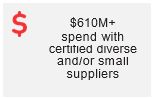 |
|---|
Colleagues and human capital management
Creating a culture where our 75,000+ colleagues are able to make connections and work as one global team is vital to Thermo Fisher because it generates better outcomes for our colleagues and for our customers. That’s why we strive to connect our teams in new and innovative ways, embrace unique perspectives, empower our colleagues to improve our business and culture, and provide resources to allow our colleagues to reach their full potential. We measure the employee experience through our annual Employee Involvement Survey (“EIS”) which asks colleagues to provide feedback.
| 32 | 2020 Proxy Statement thermofisher.com |
|---|
| Table of Contents |
|---|
Corporate Governance
Diversity and inclusion
Diversity and inclusion (“D&I”) is vital to the future success of our organization. It’s not just something we do, it’s who we are. It enables our colleagues to openly share the wide range of perspectives they represent, creating an environment where differences are truly valued, authenticity is a state-of-being, and everyone feels they belong and can do their best work.
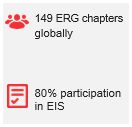 |
Our Employee Resource Groups (“ERGs”) - company-supported groups of colleagues - are key partners in attracting, developing and retaining diverse talent to bring an essential<br> variety of experiences and perspectives into our organization. ERGs are championed by an executive sponsor and partner with the D&I team to foster organizational culture, reinforce infrastructure and create personal<br> accountability. We added three new ERGs in 2019: our Asian ERG, Working Parent ERG and Data Science BRG (Business Resource Group) joined the African Heritage, Latino Hispanic Heritage, LGBTA, Millennials, PossAbilities, Women’s and<br> Veterans ERGs. |
|---|
Talent
We believe that talent is the differentiator for our growth and success as an organization and as such, we take a holistic view to managing our talent. We have defined a standard set of competencies for all Thermo Fisher colleagues that provide clear, shared behavioral expectations. Our competencies are founded in our 4i Values and integrated into each stage of the Company’s talent management lifecycle so that our colleagues understand how to grow within the Company and our people leaders have a consistent framework for developing and managing talent. We updated our competencies in 2019 to meet the talent needs of our growing company and ensure our framework is clear and consistent for our global colleagues.
We are committed to talent development and enhancing the skills and knowledge of our colleagues to achieve current and future business objectives. We’ve instituted a range of tools, technologies and programs to support the growth of our colleagues, whether it is job-specific, professional, people manager or leadership development. We also have programs for critical talent pipelines, such as R&D and General Managers. The result is more personalized learning - we enable our colleagues to access what they need when they need it.
Communities
We are proud to invest in the communities where our colleagues live and work. Our key strategy to strengthening our communities is to foster employee-led Community Action Councils (“CACs”) at our sites around the world. This model drives our collaborative culture and empowers our colleagues to connect directly with their local community to ensure the Company’s impact is widespread yet tailored to the needs of each market where we operate. In 2019, nearly 18% of our colleagues contributed volunteer hours (up five percentage points from 2018), working with over 1,600 global non-profit organizations. We also engage our colleagues through giving programs, with over $1.8 million raised through our matching gift program and a $1.2 million investment in scholarships that benefited over 275 students in 2019.

STEM Education
Our goal is to inspire a new generation of innovators that will allow us to continue to enable our customers to make the world healthier, cleaner and safer. By leveraging our colleagues, products and expertise, we have developed signature STEM (science, technology, engineering and math) education programs to support interactive learning at the primary and secondary level. Global CAC utilization of our signature STEM education portfolio helped the Company implement over 800 STEM education events worldwide in 2019, up 2.2x from 2018, demonstrating the critical role our colleagues play in support of our STEM education strategy.
| 2020 Proxy Statement thermofisher.com |
33 |
|---|
| Table of Contents |
|---|
Corporate Governance
Environment
At Thermo Fisher, we recognize our opportunity to minimize impacts on the environment and thus environmental stewardship is foundational to our business. Our commitment is reflected in both our Mission, or what we do, as well as our CSR strategy, or how we do it. This is reinforced and communicated to our global colleagues through our Environmental, Health and Safety policy and annual Company goal tree, which is used to set priorities for all global colleagues and measure Company success.
Through our portfolio of environmental analysis technologies, our customers are monitoring the environment to ensure a cleaner and safer environment, while our Thermo Fisher Scientific™ Nalgene™ reusable water bottles reduce the use of single-use plastics. Many of our customers also utilize our portfolio for unique applications to address important environmental challenges.
We continually look for ways to be a more responsible business partner for our customers and help them achieve greater environmental sustainability in their own labs and businesses. We strive to provide eco-enhancements to products, packaging and delivery, as well as service solutions for our customers. Our greener product alternatives can reduce environmental impacts as well as improving safety and reducing costs. The Company has focused on packaging and delivery for cold shipments, with several innovative solutions for our customers including a paper cooler and a reusable cooler that can replace more traditional expanded polystyrene foam coolers.
Operations optimization
| Our efforts to protect the environment start with our own operations. We focus on the efficient use of resources in running our business and reduction of our impact in the communities where we<br> operate. Our commitment to stewardship, culture of continuous improvement and engaged colleagues inspire innovations that reduce the energy and water we consume and the waste we generate.<br><br> <br>We are committed to reducing our carbon footprint and have set a target to reduce our scope 1 and 2 emissions by 30% by the end of the decade. Our approach to achieving this target<br> is anchored in the framework of process optimization, built environment efficiency and renewable sourcing. |  |
|---|
Public policy engagement and political participation
Engaging in public policy
We operate in a highly regulated and competitive industry. It is fundamental to our business, our colleagues, our customers and our shareholders that we engage globally on public policy issues that may affect our ability to meet customers’ needs and enhance shareholder value. These issues include funding biomedical research; supporting healthcare innovation; protecting intellectual property rights; ensuring patient access to care and therapies; boosting environmental protections; and supplying government regulators with the most advanced tools for keeping citizens safe. We regularly work with governments to create and maintain an environment where innovation is a priority, our customers are well supported and governments function and do not inhibit growth.
Thermo Fisher is also a member of several broad-based industry and trade groups, including the National Association of Manufacturers, MedTech Europe, the U.S.-China Business Council, various American chambers of commerce globally, several state biotech trade associations. United for Medical Research, the Personalized Medicine Coalition, the Alliance for Regenerative Medicine, the Health Industry Distributors Association and the Institute of Clean Air Companies. These organizations, along with the others to which we belong, represent both our industry and the business community at large to bring about consensus on policy issues that can impact our business. Our support of these organizations is evaluated annually by the Company’s government relations leaders as we assess these organizations’ policy expertise and advocacy on Thermo Fisher’s issues. In addition to their positions on specific policy issues that relate to Thermo Fisher’s interests, these organizations may engage on a broad range of other issues that extend beyond the scope of issues of primary importance to Thermo Fisher. If concerns arise about a particular issue, we are able to voice our concerns, as appropriate, through our colleagues who serve on the boards and committees of these organizations. Thermo Fisher’s participation as a member of these organizations comes with the understanding that we may not always agree with the positions of the organization and/ or its members.
| 34 | 2020 Proxy Statement thermofisher.com |
|---|
| Table of Contents |
|---|
Corporate Governance
Corporate political contributions
Thermo Fisher complies fully with all federal, state and local laws and reporting requirements governing corporate political contributions. We also request that trade associations receiving total payments of $25,000 or more from Thermo Fisher annually report the portion of Thermo Fisher dues and special assessments that were used for activities that are not deductible under section 162(e) of the Internal Revenue Code. Political contributions that use corporate funds are published annually in the Company’s Political Contributions report in compliance with Thermo Fisher’s Political Contributions Policy.
Policies and procedures for approval and oversight of corporate and PAC political expenditures
The Thermo Fisher Scientific Political Action Committee (“PAC”) is a non-partisan employee-funded organization that provides opportunities for a legally-restricted group of employees to participate in the American political process. All corporate and PAC political spending decisions undergo a rigorous review process conducted by the Company’s Vice President, Global Government Relations & Public Affairs, the General Counsel, and the Vice President, Corporate Communications. These executives ensure that contributions are not based on the political preferences or views of any individual colleague within Thermo Fisher.
The PAC looks for candidates who demonstrate integrity and intensity, support innovation and understand Thermo Fisher’s involvement in the policymaking process. The PAC considers factors including candidates’ views on issues relevant to our Company and Mission, committee assignments and the presence of Thermo Fisher employees in their districts.
Federal and state lobbying activity
The Company’s government relations leaders are responsible for the Company’s U.S. lobbying activities. All colleague communications with government and regulatory officials are governed by Thermo Fisher’s internal policies and procedures, which include guidelines published in our Code of Business Conduct and Ethics.
We file quarterly reports on our federal lobbying activity in compliance with the Lobbying Disclosure Act, the Honest Leadership and Open Government Act of 2007 and the Justice Against Corruption on KStreet Act of 2018 (“JACK Act”). In addition to our federal lobbying activity, the amount we report also includes the amount spent on federal lobbying activity by trade associations of which Thermo Fisher is a member. These reports are available to the public at www.senate.gov under “Public Disclosure.”
With regard to Thermo Fisher’s state, municipal and international lobbying activity, we comply with state registration and reporting requirements where we are active.
Shareholder engagement
We are committed to an active and robust shareholder engagement program. We believe that understanding the perspectives of our shareholders is a key component of good corporate governance. The goals of our shareholder engagement program include:
| ・ | Providing visibility and transparency into our business, our financial and operational performance and our strategy; |
|---|---|
| ・ | Determining which issues are important to our shareholders and sharing our views on those issues; and |
| --- | --- |
| ・ | Discussing and seeking feedback on our business and our executive compensation and corporate governance policies and practices, and our sustainability initiatives. |
| --- | --- |
We approach shareholder engagement as an integrated, year-round process involving our investor relations team, senior management and a member of the Board as appropriate and/or requested. This includes participation in investor conferences and other formal events and one-on-one meetings and conference calls throughout the year.
Throughout 2019 and into 2020 we engaged with shareholders representing over 50% of our outstanding shares to solicit their feedback on our business and financial performance, governance and executive compensation programs, and environmental and social matters. Members of our investor relations team and senior management participated in each discussion, with certain engagements including a member of our Board.
| 2020 Proxy Statement thermofisher.com |
35 |
|---|
| Table of Contents |
|---|
Corporate Governance
Communications from shareholders and other interested parties
The Company has a process in place for shareholders and other interested parties to send communications to the Board or any individual director or groups of directors, including the Chairman of the Board and the independent directors.
Shareholders and other interested parties who desire to send communications to the Board or any individual director or groups of directors should write to the Board or such individual director or group of directors care of the Company’s Corporate Secretary, Thermo Fisher Scientific Inc., 168 Third Avenue, Waltham, Massachusetts 02451. The Corporate Secretary will relay all such communications to the Board, or individual director or group of directors, as the case may be.
Key topics discussed with shareholders
In the engagements with our shareholders during 2019 and early 2020, we gained valuable feedback on several issues and topics of mutual interest, including those listed below.
| What We Learned from our Meetings with Shareholders | |
|---|---|
| ・ Shareholders appreciated being engaged on governance in general and specifically on executive compensation policies and design, corporate<br> governance issues and environmental and social issues, and suggested that we enhance our proxy statement disclosure to provide a better picture of the Company’s practices in these areas.<br><br> <br>・ A strong majority of the institutional shareholders we spoke with expressed support for our executive compensation program<br> and generally commented that they viewed it as aligned with performance and shareholder interests. They suggested we enhance our proxy statement disclosure to provide greater transparency on our program.<br><br> <br>・ Some investors preferred we target market median in our executive compensation programs and use separate metrics in our short<br> and long term incentive programs, and suggested we explain our reasoning if taking a different approach.<br><br> <br>・ Shareholders understand our Mission and the role that our environmental, social and<br> governance (“ESG”) practices play in that. They acknowledged our strong ESG practices and suggested enhancements to the breadth and depth of our disclosures in this area. | |
| Governance and Compensation Enhancements Informed by Shareholder Input | |
| --- | |
| Our Board evaluates and reviews input from our shareholders in considering their independent oversight of management and our long-term strategy. As part of our<br> commitment to constructive engagement with investors, we evaluate and respond to the views voiced by our shareholders. Our dialogue has led to enhancements in our corporate governance, ESG, and executive compensation activities, which<br> our Board believes are in the best interest of the Company and our shareholders. For example, after considering input from shareholders and other stakeholders, we:<br><br> <br>・ Enhanced our shareholder engagement efforts to include a greater number of<br> discussions regarding corporate governance, executive compensation and environmental and social issues, including conducting our first “ESG Roadshow” on which management from our investor relations, governance and compensation and<br> corporate social responsibility teams spent several days meeting with shareholders to gather feedback on the Company’s Sustainability program<br><br> <br>・ Changed market reference point for compensation paid to our NEOs to median (other than<br> our CEO, for whom the market reference point was already median)<br><br> <br>・ Replaced adjusted EPS with adjusted net income as a performance metric in our 2019 annual incentive plan<br><br> <br>・ Enhanced our Compensation Discussion and Analysis disclosure to help readers better<br> understand the compensation program features and rationale for metric selection, and to better enable readers to tie the overall business strategy to pay results<br><br> <br>・ Enhanced our ESG disclosure by including more detail about our ESG program in our proxy statement<br><br> <br>・ Amended our Corporate Governance Guidelines to include the following:<br><br> <br>・ a limit on the number of boards on which our directors may sit<br><br> <br>・ a requirement that our Nominating and Corporate Governance Committee seek to include diverse candidates including women and<br> minority candidates, in the pool of candidates from which it recommends director nominees<br><br> <br>・ an increase in the stock ownership requirement for our CEO and other executive officers<br><br> <br>・ Expanded the clawback in our equity awards to<br><br><br><br> allow the Company to recoup compensation in additional circumstances | |
| 36 | 2020 Proxy Statement thermofisher.com |
| --- | --- |
| Table of Contents |
|---|
Executive compensation
|
Proposal 2<br><br> <br>Approval of an advisory vote on executive compensation<br><br> <br>Your board of directors recommends a vote FOR approving the compensation of our Named Executive<br> Officers. |
|---|
Every year, we provide our shareholders the opportunity to vote to approve, on an advisory, non-binding basis, the compensation of our Named Executive Officers as disclosed in this proxy statement in accordance with the SEC’s rules. This proposal is required by Section 14A of the Exchange Act.
Our “Compensation Discussion and Analysis,” starting below, describes in detail our executive compensation programs and the decisions made by the Compensation Committee with respect to the year ended December 31, 2019.
As an advisory vote, this proposal is not binding. The outcome of this advisory vote does not overrule any decision by, create or imply any change to the fiduciary duties of, or create or imply any additional fiduciary duties for the Company or the Board of Directors (or any committee thereof). However, our Compensation Committee and Board of Directors value the opinions expressed by our shareholders in their vote on this proposal and will consider the outcome of the vote when making future compensation decisions for Named Executive Officers.
At the Company’s 2019 Annual Meeting of Shareholders, our shareholders approved our say-on-pay with an 86% favorable advisory vote. While this level of support indicates that a sizable majority of our shareholders continue to support our overall compensation philosophy and executive compensation practices, it represents a decline from the 90+% levels of shareholder support we received for many years. Consequently, our investor relations team, with participation from our CEO, CFO and a member of our Board in certain engagements, met with shareholders representing over 50% of our outstanding shares to ensure that we heard firsthand their perspectives and concerns specifically related to our executive compensation programs. We value our shareholders’ input, and our goal is to continue to receive strong support for our compensation programs.
Our shareholders appreciated being engaged on the topic, and these meetings reinforced their support of our compensation programs. The meetings also served to highlight opportunities for enhanced disclosure, and to improve the impact of our proxy statement by better-presenting our approach to governance topics, including compensation. Pages 35 and 36 of this proxy statement provide detailed information on our shareholder engagement program, what we learned from our 2019 and early 2020 meetings with shareholders, and changes we made to our governance and compensation programs based on shareholder input.
Looking to the future, the Company is committed to maintaining ongoing communication with our major shareholders specifically focused on executive compensation, to ensure we continue to remain fully aware of shareholder expectations and concerns.
The Board recommends that shareholders vote in favor of the following resolution:
RESOLVED, that the compensation paid to the Company’s Named Executive Officers, as disclosed pursuant to the compensation disclosure rules of the Securities and Exchange Commission, including the compensation discussion and analysis, the compensation tables and any related material disclosed in this proxy statement, is hereby approved.
| 2020 Proxy Statement thermofisher.com |
37 |
|---|
| Table of Contents |
|---|
Executive Compensation
Compensation discussion and analysis
Executive overview
The Compensation Discussion and Analysis (“CD&A”) describes our executive compensation program and reviews compensation decisions for our CEO, CFO and three other most highly compensated executive officers for 2019. Pursuant to SEC rules, information is also provided this year for two additional officers that would have been among the most highly- compensated executive officers if they had been still serving as an executive officer at year-end 2019 (all seven together, the “Named Executive Officers” or “NEOs”).
The compensation of our Named Executive Officers with respect to 2019 is explained in the following sections and the Summary Compensation Table that follows.
Named Executive Officers
Our NEOs are as follows:
| Named Executive Officer | Title | Date of Appointment<br><br> <br>to Current Role | Tenure |
|---|---|---|---|
| Marc N. Casper | Chairman, President and Chief Executive Officer | October 2009 | 18 years |
| Stephen Williamson | Senior Vice President and Chief Financial Officer | August 2015 | 18 years |
| Mark P. Stevenson | Executive Vice President and Chief Operating Officer | August 2017 | 28 years |
| Michel Lagarde | Executive Vice President | September 2019 | 4 years |
| Syed A. Jafry | Senior Vice President | September 2017 | 15 years |
| Patrick M. Durbin^(1)^ | Senior Vice President | October 2015 | 14 years |
| Gregory J. Herrema^(2)^ | Senior Vice President | January 2014 | 18 years |
| (1) | Mr. Durbin’s employment with the Company terminated on October 1, 2019. | ||
| --- | --- | ||
| (2) | Mr. Herrema was no longer an executive officer on December 31, 2019. | ||
| --- | --- |
Program overview
| ・ | Core elements of compensation comprise base salary, annual cash incentive and long-term incentives delivered in the form of time-based restricted stock units, performance-based restricted stock<br> units and stock options |
|---|---|
| ・ | Performance measures include organic revenue growth, adjusted operating margin, adjusted net income, adjusted EPS, free cash flow and other drivers of shareholder value creation of strategic<br> significance |
| --- | --- |
Compensation philosophy and objectives
The primary objectives of our executive compensation program are to:
| ・ | attract and retain the best possible executive talent; |
|---|---|
| ・ | promote the achievement of key strategic and financial performance; |
| --- | --- |
| ・ | motivate long-term value creation; and |
| --- | --- |
| ・ | align executive officers’ interests with those of our shareholders. |
| --- | --- |
We achieve these objectives through the design of our programs, including:
| ・ | competitive positioning of pay versus our peers; |
|---|---|
| ・ | delivery of a significant portion of pay in the form of variable, at-risk compensation; |
| --- | --- |
| ・ | alignment of performance measures with our strategy; |
| --- | --- |
| ・ | use of a combination of vehicles that collectively promote the achievement of business results, retention and sustainable long-term value creation; and |
| --- | --- |
| ・ | use of stock ownership guidelines, a clawback policy, a stock holding requirement for our CEO, and other risk mitigation tools. |
| --- | --- |
| 38 | 2020 Proxy Statement thermofisher.com |
| --- | --- |
| Table of Contents |
|---|
Executive Compensation
Executive compensation decision-making process
Compensation oversight
The Compensation Committee, chaired by Dion J. Weisler and comprised of five independent directors, is responsible for discharging the Board’s responsibilities relating to compensation of our executive officers, including the Chief Executive Officer.
The Committee has overall responsibility for approving and evaluating all of our compensation plans, policies and programs as they affect our executive officers. This includes reviewing and approving the compensation of the Named Executive Officers, approving performance goals, reviewing the achievement of performance goals at year end, stock plan administration and management succession.
Key duties and activities
The Compensation Committee undertakes a number of activities each year. The primary areas of focus are discussed in more detail below.
| Q1<br><br> <br>・ Review of executive bonus pool<br><br> <br>・ Review Company and NEO performance and approve year-end compensation (annual bonus and equity programs)<br><br> <br>・ Approve annual equity incentive program performance metric selection for current year<br><br> <br>・ Approve officer cash compensation (base salary) and target bonus for current year<br><br> <br>・ Proxy statement review<br><br> <br>・ Conduct annual risk assessment on our global compensation programs and policies |  |
Q2<br><br> <br>・Review proxy advisory firms’ analyses of current proxy statement<br><br> <br>・Discuss investor outreach regarding executive compensation<br><br> <br>・Propose director equity grants for current year |
|---|---|---|
 |
 |
|
| Q4<br><br> <br>・ Committee self-evaluation<br><br> <br>・ Committee charter review<br><br> <br>・ Equity program and pool review<br><br> <br>・ Consider shareholder feedback from outreach discussions |  |
Q3<br> <br>・ Management talent and succession plan review and discussion<br><br> <br>・ Confirmation of compensation peer group<br><br> <br>・ Engagement of independent compensation consultant<br><br> <br>・ Review results of executive competitive assessment<br><br> <br>・ Confirmation of executive compensation philosophy/review of potential changes |
Annual compensation review
Typically during the first quarter of each calendar year, the Compensation Committee conducts an annual compensation review. As part of this review, the Committee reviews information provided by Pearl Meyer and recommendations presented by the Chief Executive Officer with respect to annual salary increases, bonuses and annual equity awards for the other executive officers.
| 2020 Proxy Statement thermofisher.com |
39 |
|---|
| Table of Contents |
|---|
Executive Compensation
In reaching decisions, the Committee applies its judgment to determine and set the appropriate mix and level of compensation for the executive officers. A range of perspectives is taken into account, including the peer group information provided by Pearl Meyer, Company and business unit performance, individual performance, prevailing market trends, feedback from shareholders and the views of both the Chief Executive Officer and the other independent directors of the Board. The Committee will then approve any changes to base salary, bonus opportunities, and equity grant sizes and mix. As a final step, the Committee considers each element of pay in isolation and collectively, to ensure that in combination the overall total compensation is aligned with the Company’s compensation philosophy.
For 2019, the Committee concluded that all elements of compensation – both in isolation and in combination – were aligned to our strategic market positioning. The Committee will continue to review this on an annual basis to ensure compensation remains market competitive and aligned with the Company’s compensation philosophy.
Target setting
We set rigorous annual goals based on Company and industry outlook for the year, historical and projected growth rates for the Company and its peers, and performance expectations from analysts. The annual incentive plan is aligned with the Company’s annual operating plan and is designed so that target payout requires achievement of a high degree of business performance without encouraging excessive risk-taking. The Company’s annual operating and three-year strategic plans serve as the basis of the annual earnings guidance we communicate to investors. The annual operating plan builds on the prior year’s results and is based on the anticipated business environment.
The Compensation Committee followed the process described above when establishing our 2019 performance targets. Consistent with prior years, our 2019 targets considered analyst expectations and competitors’ publicly disclosed projected performance.
Compensation peer group
The Compensation Committee reviews the companies that are included in the compensation peer group (“the Peer Group”), which is used to review and set executive compensation. In determining appropriate companies for inclusion in the Peer Group, the Committee considers a number of factors, including revenue and market capitalization as a means to assess size relative to the Company. This resulted in the following Peer Group (which is unchanged from the prior year):
| 2019 Peer Group | |||
|---|---|---|---|
| ・ 3M | ・ Becton Dickinson | ・ Eli Lilly | ・ Illinois Tool Works |
| ・ Abbott Laboratories | ・ Biogen | ・ Emerson Electric | ・ Medtronic |
| ・ AbbVie | ・ Bristol-Myers Squibb | ・ Gilead Sciences | ・ Merck |
| ・ Allergan | ・ Danaher | ・ Honeywell International | ・ Texas Instruments |
| ・ Amgen | ・ Eaton Corporation |
The following chart illustrates the Company’s size compared to the Peer Group median of revenues, market capitalization and number of employees, using data provided to the Compensation Committee by Pearl Meyer. The Peer Group companies ranged from 0.6x to 1.8x of Thermo Fisher’s revenue and 0.4x and 1.9x of its market capitalization.
Thermo Fisher Positioning Relative to Peer Group

The Committee validated with Pearl Meyer that the resulting Peer Group was reasonable and appropriate for the purpose of gathering references and insights into compensation practices in the market. The Committee will keep the Peer Group under periodic review, with an eye to stability, appropriateness from a size standpoint and continued relevance with respect to business operations.
| 40 | 2020 Proxy Statement thermofisher.com |
|---|
| Table of Contents |
|---|
Strategic pay positioning
The Committee considers compensation data based on practices in the Peer Group when reviewing executive compensation for the Named Executive Officers. While this reference is just one consideration in the decision making process, the Committee has established guidelines around the strategic positioning of pay within a range that is deemed to be market competitive.
| Base Salary | median |
|---|---|
| Annual Incentive | Not defined |
| Target Total Cash^(1)^ | median |
| Target Long-Term Incentive (“LTI”) | Not defined |
| Target Direct Compensation^(2)^ | median |
| Target Compensation^(3)^ | median |
| (1) | Base salary and target annual incentive |
|---|---|
| (2) | Base salary, target annual incentive and target LTI |
| --- | --- |
| (3) | Base salary, target annual incentive, target LTI, change in pension value and nonqualified deferred compensation earnings, and all other<br> compensation |
| --- | --- |
Naturally, the individual positioning of pay will still vary as the Committee takes into account a range of factors (e.g. tenure, experience, performance, scope of role) when determining pay levels.
Managing compensation risk
The Committee believes that the Company’s executive compensation program supports the executive compensation objectives described in this report, without encouraging management to take unreasonable risk with respect to our business. The Committee has reviewed the Company’s key compensation policies and practices and concluded that any risks arising from our policies and programs are not reasonably likely to have a material adverse effect on the Company. In particular, the following features are noted as having a positive impact in managing compensation risk.
| Support long-term<br><br> <br>view and<br><br> <br>sustainability of<br><br> <br>Company | ・Equity compensation in the form of stock options and restricted stock units<br><br> <br>・Stock ownership requirement (increased in 2020)<br><br> <br>・Stock holding requirement on 50% of shares delivered upon vesting applied to all CEO time- and performance-based restricted stock units |
|---|---|
| Ability to take action<br><br> <br>to affect current and<br><br> <br>recoup prior<br><br> <br>compensation | ・Full Committee discretion to reduce awards and payouts under our annual incentive plan and stock incentive plans to zero for certain<br> conduct detrimental to the Company<br><br> <br>・Clawback policy (expanded in 2020) |
| Committee Oversight | • Annual risk assessment presented to the Committee by General Counsel and VP Executive Compensation<br><br> <br>・Assessment considers program design and payouts |
Clawback policy
We have the right to claw back incentive-based compensation to the extent it was awarded in the prior three years on the achievement of financial results subject to an accounting restatement that should have resulted in the executive receiving a lower amount of compensation had our financial results been properly reported.
Our equity award agreements also provide for the recoupment of all or part of any proceeds received upon the sale of vested awards in the prior 12 months, if there is a breach by the executive of the award agreement or any non-competition, non-solicitation, confidentiality or similar covenant or agreement with us.
In early 2020 we revised our equity agreements such that grants made from 2020 onwards also provide for the recoupment of all or part of any proceeds received upon the sale of vested awards in the prior 12 months, in the case of a termination of any executive for cause or a breach by an executive of his or her fiduciary duty to the Company.
| 2020 Proxy Statement thermofisher.com |
41 |
|---|
| Table of Contents |
|---|
Executive Compensation
Our metrics and their alignment with company strategy
The metrics we use to determine executive compensation are designed to capture the main drivers of shareholder value: maximizing revenue, reducing operating expenses, controlling other costs, maintaining process discipline and sound execution, and maintaining the trust and confidence of the investor community. We evaluate these drivers on both a quantitative and qualitative basis.
The performance measures that we use in our annual incentive plan (a cash-based annual incentive) and our performance- based long-term incentives reflect the alignment of our plans to our Company strategy.
| Measure | Why It Matters |
|---|---|
| Quantitative | |
| Organic revenue | ・Reflects top line financial performance, which is a strong indicator of our long-term ability to drive shareholder value<br><br> <br>・Allows comparison of financial results to both acquisitive and non-acquisitive peer companies<br><br> <br>・Prevalent, industry-relevant measure of growth |
| Adjusted net income | ・Reflects achievement of our strategic goals by encouraging efficient operations and resource allocations, in order to maximize earnings relative to the<br> revenue environment<br><br> <br>・Ensures all employees can contribute to profitability of the Company |
| Adjusted earnings per<br><br> <br>share (“adjusted EPS”) | ・Prevalent, industry-relevant measure of delivery of shareholder value<br><br> <br>・Metric is closely followed by shareholders, analysts and investors |
| Adjusted operating<br><br> <br>income as a percentage<br><br> <br>of revenue (“adjusted<br><br> <br>operating margin”) | ・Prevalent, industry-relevant measure of profitability<br><br> <br>・Reflects achievement of our strategic goals by encouraging efficient operations and resource allocations, in order to maximize earnings relative<br> to the revenue environment<br><br> <br>・Ensures all employees can contribute to profitability of the Company |
| Free cash flow | ・Reflects quality of earnings and incremental cash generated from operations that may be reinvested in our businesses,<br> used to make acquisitions, or returned to shareholders in the form of dividends and/or share repurchases |
| Total Shareholder<br><br> <br>Return | ・Offers clear alignment between the interests of management and shareholders<br><br> <br>・Summary indicator of long-term performance<br><br> <br>・Relative (as opposed to absolute) nature of goals accounts for macroeconomic factors impacting the broader market |
| Qualitative | |
| Customer allegiance | ・Strong indicator of our long-term ability to drive shareholder value |
| Employer of choice/<br><br> <br>diversity | ・Ensuring the Company remains focused on attracting and retaining high potential employees and enhancing workforce diversity is important to ensure our ability to execute our other<br> goals |
| Positioning for future<br><br> <br>revenue growth | ・Strong indicator of our long-term ability to drive shareholder value by effectively meeting<br> the needs of our customers in all of the end markets that we serve |
| Positioning for future<br><br> <br>margin expansion | ・Drives strong future profitability |
| Effectively execute<br><br> <br>capital deployment<br><br> <br>strategy | ・Properly managing the strategic use of capital through acquisitions, dividends, share repurchases and debt repayment is of paramount importance to the<br> Company’s long- term financial health |
| 42 | 2020 Proxy Statement thermofisher.com |
| --- | --- |
| Table of Contents |
|---|
Executive Compensation
Given the importance of organic revenue growth and adjusted EPS to our investors, and their significance in assessing how effective the Company is at delivering shareholder value, these measures were historically used in both the annual and long- term variable compensation programs, reflecting this criticality. This effectively enabled the Committee to drive alignment, and assess and reward for performance in these areas.
In 2019, the Company replaced adjusted EPS with adjusted net income in the annual incentive plan. This change addressed the reliance on the same metrics in the annual and long-term incentive plans, while continuing to emphasize the importance of maximizing earnings by adding a metric that aligns with what virtually all of our employees can influence. The Company elected to continue to utilize organic revenue growth in both plans based on feedback from investors around the criticality of that metric in driving shareholder value creation.
Financial performance measure definitions
The Committee selected these financial measures, as opposed to financial measures computed under GAAP, because this is consistent with how the Company communicates performance to investors, and as such how management measures and forecasts the Company’s performance. The use of adjusted measures enables investors and management to compare the Company’s performance to the market on a like-for-like basis, which is particularly important given the varying degrees of acquisition across peer companies.
| Performance Measure | Definition |
|---|---|
| Organic revenue | Reported revenue adjusted for the impact of acquisitions and divestitures and for foreign currency changes |
| Adjusted operating<br><br> <br>income as a<br><br> <br>percentage of revenue<br><br> <br>(“adjusted operating<br><br> <br>margin”) | Operating income before certain charges/credits to cost of revenues and selling, general and administrative expenses, principally associated with acquisition-related activities, restructuring and other<br> costs/income including costs arising from facility consolidations such as severance and abandoned lease expense and gains and losses from the sale of real estate and product lines; and amortization of acquisition-related<br> intangible assets; as a percentage of revenue |
| Adjusted net income | Earnings before certain charges/credits to cost of revenues and selling, general and administrative expenses, principally associated with acquisition-related activities,<br> restructuring and other costs/income including costs arising from facility consolidations such as severance and abandoned lease expense and gains and losses from the sale of real estate and product lines; amortization of<br> acquisition-related intangible assets; and other gains and losses that are either isolated or cannot be expected to occur again with any predictability, tax provisions/ benefits related to the previous items and the impact of<br> significant tax audits or events |
| Adjusted earnings per<br><br> <br>share (“adjusted EPS”) | Adjusted net income per share |
| Free cash flow | Operating cash flow net of capital expenditures |
| 2020 Proxy Statement thermofisher.com |
43 |
| --- | --- |
| Table of Contents |
|---|
Executive Compensation
Components of our compensation program
| Element | Purpose | Key Features |
|---|---|---|
| Base salary | Provide competitive, fixed compensation to attract and retain the best possible executive talent | ・Cash-based<br><br> <br>・Reviewed annually; changes effective March/April<br><br> <br>・Reference market median for all NEOs<br><br> <br>・Takes account of level of responsibility, time in role, performance and the ability to replace the individual |
| Annual<br><br> <br>cash<br><br> <br>incentive<br><br> <br>bonus | Align executive compensation with our corporate strategies and business objectives; promote the achievement of key strategic and financial performance measures by linking annual<br> cash incentives to the achievement of corporate performance goals | ・Cash-based<br><br> <br>・Reference market median for all NEOs for target total cash (base salary plus target annual incentive)<br><br> <br>・Maximum opportunity 2-times target<br><br> <br>・Based on performance goals tied to organic revenue growth, adjusted operating margin, adjusted<br> net income, free cash flow, and a selection of strategic measures |
| Long-term<br><br> <br>incentives | Align executive compensation with our corporate strategies and business objectives; motivate the Company’s officers to create sustainable long-term value for our shareholders and<br> achieve other business objectives; encourage stock ownership by the Company’s officers in order to align their financial interests with the long-term interests of our shareholders | ・Equity-based<br><br> <br>・Granted in a combination of<br><br> <br>- Performance-based restricted stock units;<br><br> <br>- Time-based restricted stock units; and<br><br> <br>- Time-based stock options<br><br> <br>・Reference market median for all NEOs for target direct compensation (target total cash plus the grant date value of long-term incentives)<br><br> <br>・Based on performance goals tied to organic revenue growth and adjusted EPS (performance-based restricted stock units)<br><br> <br>・Legacy award of performance-based stock options, subject to five- year relative TSR performance over four periods spanning 2013 – 2020 |
| 44 | 2020 Proxy Statement thermofisher.com |
|
| --- | --- |
| Table of Contents |
|---|
Executive Compensation
Mix of our Named Executive Officers’ 2019 target and actual compensation
The Compensation Committee annually reviews the mix of our core elements of compensation relative to the market. The majority of our Named Executive Officers’ target 2019 compensation is at-risk and variable, with the mix well aligned to practices in our peer companies. The results of the 2019 analysis and actual results are shown below.
| CEO Target |  |
|---|---|
| Peer Group Median<br><br> <br>CEO |  |
| CEO Actual 2019 |  |
| Other NEOs<br><br> <br>(Aggregate) Target |  |
| Peer Group Median<br><br> <br>Other NEOs<br><br> <br>(Aggregate) |  |
| Other NEOs<br><br> <br>(Aggregate) Actual<br><br> <br>2019 |  |
In addition to the core elements of our executive compensation program, our executive officers are eligible to participate in additional benefits programs, to ensure that their total compensation is market competitive and that it enables them to effectively discharge their duties. See page 53 for full details of those programs.
While defined benefit pension plans and SERPs continue to be preferred by many peer companies, the Company does not offer these plans (outside of legacy arrangements from acquired companies), electing to rely upon stock-based long-term incentives as the primary individual capital accumulation vehicle. The Company’s contributions toward executive retirement are limited to a matching contribution of 6% of eligible earnings (salary and annual incentive compensation), a benefit prevalent at peer group companies as well, with varying company match percentages.
| 2020 Proxy Statement thermofisher.com |
45 |
|---|
| Table of Contents |
|---|
Executive Compensation
2019 compensation decisions and outcomes
Base salary
Base salary is used to recognize the experience, skills, knowledge and responsibilities required of all our employees, including our executive officers. Decisions regarding individual positioning take into account the relative size and scope of the role, time in role, current salary and the Company’s ability to replace the individual serving in the role, as well as the most relevant external market reference.
In February 2019, the Compensation Committee considered the market data collected by Pearl Meyer in combination with the factors listed above. As a result of this review, in February 2019 the Committee approved increases to base salaries ranging from 0.0% - 6.2% for our Named Executive Officers.
| Named Executive Officer | 2018 Base<br><br> <br>Salary | 2019 Base Salary<br><br> <br>(Effective March 25, 2019) | Increase |
|---|---|---|---|
| Marc N. Casper | $1,500,000 | $1,550,000 | 3.3% |
| Stephen Williamson | $659,200 | $700,000 | 6.2% |
| Mark P. Stevenson | $1,014,000 | $1,050,000 | 3.6% |
| Michel Lagarde^(1)^ | $750,000 | $750,000 | 0.0% |
| Syed A. Jafry | $618,000 | $650,000 | 5.2% |
| Patrick M. Durbin | $606,400 | $625,000 | 3.1% |
| Gregory J. Herrema | $670,000 | $680,000 | 1.5% |
| (1) | In connection with his promotion to Executive Vice President of the Company, Mr. Lagarde received a base salary increase effective September 5,<br> 2019 to $850,000. | ||
| --- | --- |
Increases principally reflected tenure, competitive pay levels, strong individual performance and retention. In particular, with respect to Mr. Williamson, the adjustment was made to address his competitive positioning below the 25th percentile per the market data collected by Pearl Meyer, and with respect to Mr. Jafry, the increase reflected outstanding continued growth in the region that he oversees for the Company. The base salary increases provided to Mr. Casper of 3.3%, and to Messrs. Stevenson, Durbin and Herrema, which ranged from 1.5% to 3.6%, are reflective of individual performance, competitive positioning and prevailing market practice.
Annual cash incentive
Each year the Compensation Committee establishes a target incentive cash award, defined as a percentage of base salary, for each officer of the Company, including executive officers. The amount actually awarded can range from 0 to 200% of target, depending primarily on the financial and non-financial performance of the Company. Amounts are subject to adjustment based on the Committee’s subjective evaluation of an officer’s contributions towards the achievement of those results, and where relevant the performance of individual businesses under an executive officer’s control.
In setting performance goals, the Committee generally establishes standards such that the target payout (100% of target bonus) represents attractive financial performance within our industry and can be achieved with strong execution; payouts above 150% of this target require outstanding performance. For the financial measures, the Company’s actual performance was measured relative to the Company’s internal operating goals for 2019. The weighting of the financial and non-financial measures and performance targets for 2019 were:
2019 Annual Incentive Performance Measures
| Financial |  |
・Organic revenue growth (35%)<br><br> <br>・Adjusted operating margin (15%)<br><br> <br>・Adjusted net income (15%)<br><br> <br>・Free cash flow (5%) |
|---|---|---|
| Non-financial |  |
・Customer allegiance<br><br> <br>・Positioning the Company for accelerated revenue growth and margin expansion<br><br> <br>・Employer of choice and workforce diversity<br><br> <br>・Capital deployment strategy |
| 46 | 2020 Proxy Statement thermofisher.com |
|
| --- | --- |
| Table of Contents |
|---|
Executive Compensation
2019 Performance achievements
| Financial Performance Score: 129% | |
|---|---|
| Organic Revenue Growth (35%) | |
| ・ The threshold level of performance required was 3.0%, which equated<br> to a payout of 0%<br><br> <br>・ For each 0.5% of organic revenue growth above the threshold, the payout<br> increased proportionately by 25 percentage points to 6.0% organic revenue growth<br><br> <br>・ To reflect the additional investment and effort required, for<br> exceptional growth between 6.0% and 6.5%, the payout increased proportionately by 25 percentage points for each 0.25% increase in organic revenue growth up to a maximum opportunity of 200%<br><br> <br>・ Actual organic revenue growth for the year was 6.1%, resulting in a payout of 157% for this element | |
| Adjusted Operating Income as a Percentage of Revenue (15%) | |
| ・ The payout factors for this element link the variation in organic<br> revenue growth to margin expansion, meaning that the “threshold” and “maximum” performance requirements (whether expressed as dollars or as a percentage) varied directly with actual organic revenue growth achievement<br><br> <br>・ Regardless, the maximum payout in respect of this element is capped at<br> 200%<br><br> <br>・ The baseline goal, assuming target organic growth of 5.0%, was 23.69% of revenue. The payout factors for this metric recognize the<br> incremental costs required to achieve accelerated organic revenue growth, and reflect the greater difficulty in achieving margin expansion on lower organic revenue<br><br> <br>・ Actual adjusted operating income as a percentage of revenue for the year was 23.4%, resulting in a payout of 0% for this element | |
| Adjusted Net Income (15%) | |
| ・ The threshold level of performance required was $4,779 million,<br> which equated to a payout of 0%<br><br> <br>・ For each additional $24 million of adjusted net income, the payout<br> increased proportionately by 25 percentage points to adjusted net income of $4,971 million<br><br> <br>・ Actual adjusted net income for the year was $4,975 million, resulting in a payout of 200% for this element | |
| Free Cash Flow (5%) | |
| ・ The threshold level of performance required was $4,050<br> million, below which no payout is earned<br><br> <br>・ For free cash flow between $4,050 million and $4,099 million a payout<br> of 100% is achieved, with a maximum payout achieved for free cash flow at or above $4,100 million<br><br> <br>・ Actual free cash flow for the year was $4,083 million, resulting in a payout of 100% for this element | |
| Achievement Earned on Financial Performance Element | |
| --- | --- |
| Based on the weighted average of the organic revenue, adjusted operating margin, adjusted net income and free cash flow payouts noted above, the Committee<br> concluded an overall achievement of 129% of target was earned for the financial performance element. | |
| 2020 Proxy Statement thermofisher.com |
47 |
| --- | --- |
| Table of Contents |
|---|
Executive Compensation
| Non-Financial Performance Score: 150% | ||
|---|---|---|
| The Committee assesses performance in our five identified areas of strategic importance, taking account of the Company’s overall Mission and commitments to all stakeholders. | ||
| Customer Allegiance | ||
| Key areas of focus<br><br> <br>・ Improve Customer Allegiance Score (“CAS”) vs. 2018<br><br> <br>・ Maximize the impact of eBusiness and cloud capabilities | Key achievements<br><br> <br>・ Over-achieved CAS goal for the year<br><br> <br>・ Significant advancements in eBusiness and digital science | |
| Positioning the Company for Accelerated Revenue Growth | ||
| Key areas of focus<br><br> <br>・ Improve impact from innovation<br><br> <br>・ Continue to strengthen competitive position in China and emerging markets<br><br> <br>・ Effectively manage macro-economic risks related to tariffs and Brexit | Key achievements<br><br> <br>・ Very strong product launches across the Company<br><br> <br>・ Good execution on tariff mitigation in China; continued to strengthen commercial infrastructure in China and the emerging markets<br><br> <br>・ Detailed Brexit plan made in conjunction with key customers | |
| Positioning the Company to Drive Margin Expansion over Mid-Term | ||
| Key area of focus<br><br> <br>・ Execute projects to leverage Company scale to reduce infrastructure cost | Key achievements<br><br> <br>・ Shared services locations continue to expand and mature<br><br> <br>・ Made good progress on driving additional impact from our PPI business system, centrally-led procurement and low cost region facilities | |
| Employer of Choice/Diversity | ||
| Key areas of focus<br><br> <br>・ Deepen culture of diversity, involvement and inclusion<br><br> <br>・ Build on CSR momentum<br><br> <br>・ Continue to improve leadership diversity<br><br> <br>・ Drive personal ownership of ethics, quality, safety and regulatory compliance and cybersecurity | Key achievements<br><br> <br>・ Positive feedback from colleagues via the employee involvement survey highlighting the inclusiveness of our culture<br><br> <br>・ Significant impact on our communities through global volunteerism and environmental projects<br><br> <br>・ Continued to build a more diverse management and leadership team | |
| Effectively Execute Capital Deployment Strategy | ||
| Key areas of focus<br><br> <br>・ Deliver a strong year of financial performance from the Pharma services business (Patheon)<br><br> <br>・ Maintain strong pipeline of M&A targets | Key achievements<br><br> <br>・ Patheon integration is complete; Pharma services business is performing well<br><br> <br>・ Acquired Brammer Bio and a new facility in Ireland | |
| Achievement Earned on Non-Financial Performance | ||
| --- | --- | |
| Based on the key achievements noted above, the Committee concluded an overall achievement of 150% of target was earned for the non-financial performance element. | ||
| Overall Achievement | ||
| --- | --- | |
| After weighing the payouts of the financial and non-financial performance described above, the Committee concluded that a calculated payout of 135% was earned. | ||
| 48 | 2020 Proxy Statement thermofisher.com |
|
| --- | --- |
| Table of Contents |
|---|
Executive Compensation
How We Arrived at the 135% Overall Performance Score
| Performance Measure | Weight | Payout | Weighted<br><br> <br>Average |
|---|---|---|---|
| Organic Revenue Growth | 35% | 157% | 55% |
| Adjusted Operating Income as % of Revenue | 15% | 0% | 0% |
| Adjusted Net Income | 15% | 200% | 30% |
| Free Cash Flow | 5% | 100% | 5% |
| Subtotal Financial | 70% | 129% | 90% |
| Non-financial | 30% | 150% | 45% |
| Total | 100% | 135% | |
| Performance score: 135% |
Additional performance considerations
The Committee elected this year to grant Messrs. Casper, Williamson and Stevenson, as corporate officers, 135.0% of target. Mr. Lagarde was awarded 127.8% of target bonus to reflect the proration of his contributions to the Company in the two positions he held during the year. Messrs. Jafry and Herrema were awarded 100.0% and 109.5%, respectively, of target bonus to reflect their contributions to the Company as business leaders, taking into account the performance of the region and operating businesses, respectively, which they managed in 2019. The following payouts were earned:
| Named Executive Officer | 2019 Target^(1)^<br><br> <br>(% of Base Salary) | 2019 Target<br><br> <br>Award | 2019 Approved<br><br> <br>Award | 2019 Payout (%<br><br> <br>of Target) |
|---|---|---|---|---|
| Marc N. Casper | 200% | $3,077,262 | $4,154,303 | 135.0% |
| Stephen Williamson | 100% | $690,723 | $932,476 | 135.0% |
| Mark P. Stevenson | 110% | $1,145,995 | $1,547,093 | 135.0% |
| Michel Lagarde^(2)^ | 100% | $782,329 | $1,000,000 | 127.8% |
| Syed A. Jafry | 85% | $546,315 | $546,315 | 100.0% |
| Patrick M. Durbin^(3)^ | 85% | $360,959 | $360,959 | 100.0% |
| Gregory J. Herrema | 85% | $576,067 | $630,794 | 109.5% |
| (1) | The target bonus opportunity for Mr. Williamson increased by ten percentage points for 2019 to address his competitive positioning below the<br> 25th percentile per the market data collected by Pearl Meyer; opportunities for the other Named Executive Officers were unchanged. | |||
| --- | --- | |||
| (2) | In February 2020, Mr. Lagarde, the former President and Chief Operating Officer of Patheon and the President of the Company’s Pharma Services<br> business, was also awarded an additional bonus of $375,000 in recognition of his extraordinary efforts with respect to the integration of Patheon. | |||
| --- | --- | |||
| (3) | Mr. Durbin’s employment with the Company ceased on October 1, 2019. His target and actual bonus were prorated for the portion of the year that<br> he was employed by the Company. | |||
| --- | --- | |||
| 2020 Proxy Statement thermofisher.com |
49 | |||
| --- | --- |
| Table of Contents |
|---|
Executive Compensation
Long-term incentives
The objectives of our long-term equity incentive program are to provide a strong link to delivering long-term sustainable performance, create an ownership culture and facilitate executive retention through opportunities tied to the appreciation of our stock price over time, while delivering superior performance in accordance with our Mission. This provides a clear alignment of interests between our executives and our shareholders.
We achieve this by granting our executive officers equity through a combination of vehicles, each serving a different objective.
Target Award Value by Award Type
 |
・Stock options incentivize long-term sustainable value creation<br><br> <br>・Time-based restricted stock units promote executive retention while aligning executives’ interests with<br> those of our shareholders<br><br> <br>・Performance-based restricted stock units enable the Committee to reward executives for performance in areas of<br> long-term strategic importance for the Company and our shareholders |
|---|
Key design features
| Stock Options | Time-Based Restricted Stock Units | Performance-Based Restricted Stock Units |
|---|---|---|
| ・Four year ratable vesting (one quarter per annum)<br><br> <br>・Seven-year term<br><br> <br>・Exercise price equal to closing price on date grant approved | ・Three-and-a-half year ratable vesting (15%, 25%, 30% and 30% after 6, 18, 30 and 42 months respectively)<br><br> <br>・Dividends accrue (in form of dividend equivalents) and paid only on vested awards<br><br> <br>・CEO awards subject to a two-year holding requirement on 50% of shares delivered upon vesting | ・Three-year ratable vesting (one third per annum)<br><br> <br>・Performance measured over one- year<br><br> <br>・No vesting if minimum performance not met<br><br> <br>・Dividends accrue (in form of dividend equivalents, only after performance conditions are met) and paid only on vested awards<br><br> <br>・CEO awards subject to a two-year holding requirement on 50% of shares delivered upon vesting |
| 50 | 2020 Proxy Statement thermofisher.com |
|
| --- | --- |
| Table of Contents |
|---|
Executive Compensation
The Compensation Committee approves awards in respect of the year at a meeting in late February, such that target award values reflect our publicly released earnings for the just-completed year. The target values and actual award values as of the grant date in February 2019 are reflected in the table below. The difference between the approved target value and the actual grant date value reflects the variation between the 20-day average stock price and minor differences in the other option pricing variables used to approve the awards and the methodology used for accounting purposes.
| Grant Date Accounting Value of 2019 Award | |||||
|---|---|---|---|---|---|
| Named Executive Officer | Target 2019 LTI<br><br> <br>Award Value | Stock<br><br> <br>Options | Time-Based<br><br> <br>Restricted<br><br> <br>Stock Units | Performance-Based<br><br> <br>Restricted<br><br> <br>Stock Units | Total 2019<br><br> <br>LTI Award Value |
| Marc N. Casper | $12,000,639 | $3,969,338 | $4,394,027 | $4,394,027 | $12,757,392 |
| Stephen Williamson | $3,250,580 | $1,094,702 | $1,181,054 | $1,181,054 | $3,456,810 |
| Mark P. Stevenson | $5,400,719 | $1,778,542 | $1,981,122 | $1,981,122 | $5,740,786 |
| Michel Lagarde^(1)^ | $3,000,507 | $1,033,421 | $1,079,458 | $1,079,458 | $3,192,337 |
| Syed A. Jafry | $2,600,371 | $862,476 | $927,064 | $927,064 | $2,716,604 |
| Patrick M. Durbin | $2,300,849 | $770,191 | $838,167 | $838,167 | $2,446,525 |
| Gregory J. Herrema | $2,750,433 | $972,140 | $977,862 | $977,862 | $2,927,864 |
| (1) | In connection with his promotion to Executive Vice President of the Company, Mr. Lagarde was awarded stock options and time-based restricted stock units with<br> grant date accounting values of $264,285 and $264,618, respectively, on September 5, 2019. | ||||
| --- | --- |
Performance-based restricted stock units
Awards of performance-based restricted stock units are made subject to performance conditions of strategic importance to the Company and our shareholders:
| ・ | Organic revenue growth; and |
|---|---|
| ・ | Adjusted EPS. |
| --- | --- |
Organic revenue growth, which also features under our annual incentive plan for 2019, is of particular importance as it directly reflects our ability to deliver on our strategic priorities. Furthermore it is of the highest priority.
In respect of each measure, performance is measured over the fiscal year in which the award is made. The performance conditions and level of payout that apply to awards made in February 2019 are structured in a matrix, meaning that strong performance is required in respect of both elements to earn an above target payout.
The weighting of the financial measures and performance targets for 2019 were:
| Organic Revenue<br><br> <br>Growth (50%)^(1)^ | Adjusted Earnings<br><br> <br>Per Share (50%)^(1)^ | |
|---|---|---|
| Threshold (0% payout on each measure) | 3.5% | $11.86 |
| Baseline (50% payout on each measure) | 5.0% | $12.10 |
| Maximum (87.5% payout on each measure) | 6.3% | $12.28 |
| Actual Results | 6.1% | $12.35 |
| Payout Factor | 163% | |
| ^(1)^ | There are a variety of payout scenarios for financial results between the threshold and maximum levels. | |
| --- | --- |
Payouts under the program are step-wise, based on standalone organic revenue growth in equal proportion to adjusted earnings per share, with no graduated payout at intermediate points. The plan was designed to provide some level of upside opportunity, but full downside risk. One-third of the total number of units earned vested on February 25, 2020, and the same number of restricted units will vest on both the first anniversary and the second anniversary of this vesting date so long as the executive officer is employed by the Company on each such date (subject to certain exceptions).
| Overall Achievement | |
|---|---|
| Actual organic revenue growth for the year was 6.1% and actual adjusted EPS for the year was $12.35, resulting in a payout of 163%. | |
| 2020 Proxy Statement thermofisher.com |
51 |
| --- | --- |
| Table of Contents |
|---|
Executive Compensation
TSR long-term incentive award
| In September 2017 the Compensation Committee approved a supplemental award of performance-based stock options for senior leaders, including our executive officers.<br><br> <br>This award was designed to further enhance the alignment of interests between senior leaders and our shareholders, by requiring sustained share price growth through the use of<br> options, and delivery of sustained superior stock price and dividend performance through the use of multiple relative TSR performance requirements. It also provides a means to assess and reward the leadership teams’ success at<br> integrating recent acquisitions in a way that generates shareholder value.<br><br> <br>The peer group for the program (the “TSR Peer Group”) was constructed to focus on high-performing companies, meaning that to earn a payout, the Company needs to deliver<br> exceptional, sustained performance against some of the higher performing companies in the S&P 500. | Design Elements<br><br> <br>・Performance-based stock options<br><br> <br>・Exercise price equal to price on date of grant<br><br> <br>・Cliff vesting in March 2021<br><br> <br>・Seven-year term<br><br> <br>・Performance measured over four overlapping five-year<br> periods spanning 2013 - 2020<br><br> <br>・Vesting contingent on relative TSR<br><br> <br>・TSR Peer Group of high performing companies with<br> median TSR exceeding the S&P 500<br><br> <br>・Full vesting requires<br> performance in the top ten for all four periods<br><br> <br>・For any vesting to occur the Company must rank in the<br> top ten for at least two of the four periods |
|---|
TSR Peer Group
| ・ 3M Company<br><br> <br>・ Abbott Laboratories<br><br> <br>・ AbbVie Inc.<br><br> <br>・ Automatic Data Processing, Inc.<br><br> <br>・ Allergan plc<br><br> <br>・ Amgen Inc.<br><br> <br>・ Becton, Dickinson and Company<br><br> <br>・ Biogen Inc.<br><br> <br>・ Bristol-Myers Squibb Company<br><br> <br>・ Cigna Corporation | ・ CSX Corporation<br><br> <br>・ Danaher Corporation<br><br> <br>・ Eaton Corporation plc<br><br> <br>・ Eli Lily and Company<br><br> <br>・ Emerson Electric Co.<br><br> <br>・ Gilead Sciences Inc.<br><br> <br>・ Henry Schein, Inc.<br><br> <br>・ Honeywell International Inc.<br><br> <br>・ Illinois Tool Works Inc.<br><br> <br>・ International Paper Company | ・ Medtronic, Inc.<br><br> <br>・ Merck & Co., Inc.<br><br> <br>・ Merck KGaA, Darmstadt, Germany<br><br> <br>・ NIKE, Inc.<br><br> <br>・ PNC Financial Services Group<br><br> <br>・ State Street Corporation<br><br> <br>・ Stryker Corporation<br><br> <br>・ Texas Instruments Incorporated<br><br> <br>・ The Boeing Company<br><br> <br>・ Thermo Fisher Scientific Inc. |
|---|
Relative TSR is measured over four overlapping periods, each five years in length. Thermo Fisher’s relative performance will determine the ultimate number of performance-based stock options that vest in March 2021.
| Number of Periods Thermo Fisher Ranks in Top 10 Companies (i.e. top third) | Payout |
|---|---|
| Four (All of the periods) | 100% |
| Three (75% of the periods) | 75% |
| Two (50% of the periods) | 50% |
| One (25% of the periods) | 0% |
| 52 | 2020 Proxy Statement thermofisher.com |
| --- | --- |
| Table of Contents |
|---|
Executive Compensation
The first three 5-Year performance periods under the plan are now complete and the results are reflected below:
| Performance Period | Thermo Fisher<br><br> <br>TSR | 75th<br><br> <br>%ile | Threshold<br><br> <br>TSR^(1)^ | S&P 500<br><br> <br>TSR^(2)^ | Thermo Fisher<br><br> <br>Rank | Performance<br><br> <br>Requirement Met |
|---|---|---|---|---|---|---|
| 1 Jan 2013 – 31 Dec 2017 | 25.1% | 24.8% | 22.8% | 15.7% | 6^th^ | Yes |
| 1 Jan 2014 – 31 Dec 2018 | 15.8% | 15.7% | 14.4% | 8.5% | 8^th^ | Yes |
| 1 Jan 2015 – 31 Dec 2019 | 21.1% | 16.8% | 16.0% | 11.5% | 3^rd^ | Yes |
| 1 Jan 2016 – 31 Dec 2020 | Calculated in Q1 2021 | |||||
| (1) | Minimum TSR required to rank in the top ten and meet the performance requirement | |||||
| --- | --- | |||||
| (2) | Shown for reference given TSR Peer Group selected to hold Thermo Fisher accountable for delivering superior returns against<br> some of the higher performing companies in the S&P 500 | |||||
| --- | --- | |||||
| Achievement To Date | ||||||
| --- | ||||||
| Based on performance to date, 75% of the award has been earned. |
Other compensation
Executive benefits
We maintain broad-based benefits that are provided to all employees, including health and dental insurance, life and disability insurance and a 401(k) plan. Executives are eligible to participate in all of our employee benefit plans, in each case on the same basis as other eligible employees.
| Benefit | Key Features |
|---|---|
| 401(k) Plan | • Tax qualified retirement savings plan for U.S.-based employees<br><br> <br>• Contributions matched 1:1 up to the first 6% of compensation deferred<br><br> <br>• 2019 cap on matching contributions of 6% of $280,000<br><br> <br>• Contributions are fully vested on contribution<br><br> <br>• Matching contributions for employees joining after January 1, 2014 vest after two<br> years of employment |
| Deferred Compensation<br><br> <br>Plan | • Available to executive officers and certain<br> other highly-compensated employees<br><br> <br>• Participants can defer receipt of up to 50% of annual salary and/or bonus until<br> either employment ceases or a future date prior to termination<br><br> <br>• Contributions matched 1:1 on the first 6% of pay that is deferred over the 401(k)<br> limit |
| Perquisites | • Supplemental long-term disability insurance<br><br> <br>• Supplemental life insurance<br><br> <br>• Executive health services<br><br> <br>• Financial planning services (except for the CEO)<br><br> <br>• A $3 million term life insurance policy for the CEO<br><br> <br>• Limited non-business use of the corporate aircraft, up to an annual incremental<br> cost to the Company of $150,000 (treated as taxable income in accordance with the IRS regulations) for the CEO<br><br> <br>• Security services, including home security systems, monitoring and additional<br> personal security services for the CEO<br><br> <br>• No tax gross-ups are provided on any perquisites |
| Severance and change<br><br> <br>in control benefits | • Named Executive Officers are entitled to specified benefits on termination in<br> certain circumstances<br><br> <br>• ‘Double trigger’ change in control agreements<br><br> <br>• Separate agreements for CEO<br><br> <br>• No tax gross-ups |
| 2020 Proxy Statement thermofisher.com |
53 |
| --- | --- |
| Table of Contents |
|---|
Executive Compensation
Other items
Stock ownership guidelines
The Committee has adopted stock ownership guidelines that require our executive officers to hold shares of the Company’s stock with a value equal to a specified multiple of their base salary. These guidelines help ensure that our executives build and maintain a long-term ownership stake in the Company, which aligns their financial interests with those of the Company’s shareholders.
The guidelines were initially adopted in 2003 and executives have five years from the adoption or the date of their appointment to attain the ownership levels. For purposes of the guidelines, the value of an executive’s stock ownership includes all shares of the Company’s Common Stock owned by the executive outright and the value of unvested time-based restricted stock units. All of our Named Executive Officers are in compliance with this policy.
In response to feedback we received from our stakeholders in 2019, in early 2020 we amended our Corporate Governance Guidelines to, among other things, increase the stock ownership requirement from four times (4x) base salary to six times (6x) base salary for our Chief Executive Officer, and from two times (2x) base salary to three times (3x) base salary for our other executive officers.
Stock holding requirement for CEO
In addition to stock ownership guidelines, the Committee approved additional stock holding requirements for the Chief Executive Officer, reflecting the particular accountability of his role. All time- or performance-based restricted stock units awarded to Mr. Casper since 2009 are subject to a requirement that at least 50% of the net shares delivered upon vesting be held for at least two years. This provides further alignment with the sustainable long-term performance of the Company.
Anti-hedging and anti-pledging policies
The Company’s Insider Trading Policy (the “Insider Trading Policy”) addresses hedging, pledging and other transactions which might give the appearance of impropriety. Under the Insider Trading Policy, officers and directors of the Company are prohibited from engaging in any of the following types of transactions:
| • | short sales of Company securities |
|---|---|
| • | purchases or sales of puts or calls |
| --- | --- |
| • | transactions involving financial instruments (including prepaid variable forward contracts, equity swaps, collars and exchange funds)<br> that are designed to hedge or offset any decrease in the market value of Company securities |
| --- | --- |
| • | borrowing against Company securities held in a margin account or pledging Company securities as collateral for a loan. |
| --- | --- |
Employees who are not insiders or officers are generally permitted to engage in transactions designed to hedge or offset market risk.
Our executives and directors are permitted to enter into trading plans that are intended to comply with the requirements of Rule 10b5-1 of the Securities Exchange Act so that they can prudently diversify their asset portfolios and exercise their stock options before expiration.
Deductibility of executive compensation
Section 162(m) of the Internal Revenue Code of 1986, as amended, or the Code, generally disallows a tax deduction to public companies for compensation in excess of $1 million paid in any one year to each of certain of the company’s current and former executive officers. Historically, compensation that qualified under Section 162(m) as performance-based compensation was exempt from the deduction limitation. However, subject to certain transition rules, tax legislation signed into law on December 31, 2017 eliminated the performance-based compensation exception. As a result, for taxable years beginning after December 31, 2017, all compensation in excess of $1 million paid in any one year to each of the specified officers that is not covered by the transition rules will not be deductible by us.
| 54 | 2020 Proxy Statement thermofisher.com |
|---|
| Table of Contents |
|---|
Executive Compensation
Equity grant practices
We typically make an initial equity award to newly-hired executives and to newly-promoted executives to reflect their new responsibilities, and annual equity grants in late February as part of our overall compensation program.
All equity grants to our officers are approved by the Compensation Committee. Equity grants for newly-hired or promoted non-officer employees are determined and approved by the Employee Equity Committee, which currently consists of Mr. Casper, and cannot exceed 25,000 shares per employee without Compensation Committee approval.
Vesting normally ceases upon termination of employment, except for acceleration upon qualifying retirements, death, disability, and in the case of certain terminations for Messrs. Casper and Lagarde (see page 66). Stock option exercise rights normally cease for officers other than Mr. Casper shortly after termination, except in the cases of death, disability and qualifying retirement. Prior to the exercise of an option, the holder has no rights as a shareholder with respect to the shares subject to such option, including voting rights and the right to receive dividends or dividend equivalents. Prior to the issuance of shares after vesting of restricted stock units (which represent a right in the future to receive shares), the holder has no right to transfer or vote the underlying shares.
Accounting considerations
Accounting considerations also play an important role in the design of our executive compensation programs and policies. ASC 718 requires us to expense the cost of stock-based compensation awards. We consider the relative impact in terms of accounting cost in addition to other factors such as shareholder dilution, retentive impact, and motivational impact when selecting long-term equity incentive instruments.
Compensation Committee report
The members of the Company’s Compensation Committee hereby state:
We have reviewed and discussed the Compensation Discussion & Analysis contained in this proxy statement with management, and based on such review and discussions, we have recommended to the Company’s Board of Directors that the Compensation Discussion & Analysis be included in this proxy statement.
Compensation Committee
| By: | Dion J. Weisler (Chair) | |
|---|---|---|
| Thomas J. Lynch | ||
| Jim P. Manzi | ||
| Scott M. Sperling | ||
| Elaine S. Ullian | ||
| 2020 Proxy Statement thermofisher.com |
55 | |
| --- | --- |
| Table of Contents |
|---|
Executive Compensation
Executive compensation tables
Summary compensation table
The following table summarizes compensation for services to the Company earned during the last three fiscal years (where applicable) by the Company’s Named Executive Officers.
| Name and<br><br> <br>Principal Position | Year | Salary<br><br> <br>($)^(1)^ | Stock<br><br> <br>Awards<br><br> <br>($)^(2)^ | Option<br><br> <br>Awards<br><br> <br>($)^(3)^ | Non-Equity<br><br> <br>Incentive Plan<br><br> <br>Compensation<br><br> <br>($)^(4)^ | Change in<br> <br>Pension<br><br> <br>Value and<br><br> <br>Nonqualified<br><br> <br>Deferred<br><br> <br>Compensation<br><br> <br>Earnings<br><br> <br>($)^(5)^ | All Other<br><br> <br>Compensation<br><br> <br>($)^(6)^ | Total<br><br> <br>($) |
|---|---|---|---|---|---|---|---|---|
| Marc N. Casper<br><br> <br>Chairman, President and<br><br> <br>Chief Executive Officer | 2019 | $1,538,631 | $8,788,054 | $3,969,338 | $4,154,303 | $— | $572,819 | $19,023,145 |
| 2018 | $1,482,740 | $8,005,840 | $3,893,298 | $4,670,630 | $— | $554,595 | $18,607,103 | |
| 2017 | $1,425,000 | $8,388,576 | $7,543,202 | $4,366,200 | $— | $552,198 | $22,275,176 | |
| Stephen Williamson<br><br> <br>Senior Vice President and<br><br> <br>Chief Financial Officer | 2019 | $690,723 | $2,362,108 | $1,094,702 | $932,476 | $— | $116,136 | $5,196,145 |
| 2018 | $654,781 | $2,106,800 | $994,299 | $928,153 | $— | $112,127 | $4,796,160 | |
| 2017 | $631,635 | $1,829,088 | $1,747,914 | $833,408 | $— | $102,349 | $5,144,394 | |
| Mark P. Stevenson<br><br> <br>Executive Vice President<br><br> <br>and Chief Operating Officer | 2019 | $1,041,814 | $3,962,244 | $1,778,542 | $1,547,093 | $889,054 | $190,609 | $9,409,356 |
| 2018 | $1,005,025 | $3,665,832 | $1,764,115 | $1,741,205 | $— | $250,400 | $8,426,577 | |
| 2017 | $922,212 | $3,279,744 | $6,005,310 | $1,529,622 | $429,130 | $175,878 | $12,341,896 | |
| Michel Lagarde^(7)^ <br> <br>Executive Vice<br> President | 2019 | $782,329 | $2,423,534 | $1,297,706 | $1,375,000 | $— | $127,292 | $6,005,861 |
| Syed A. Jafry^(8)^<br> <br>Senior Vice President | 2019 | $642,723 | $1,854,128 | $862,476 | $546,315 | $— | $67,292 | $3,972,934 |
| Patrick M. Durbin^(9)^<br><br> <br>Former Senior Vice President | 2019 | $464,948 | $1,676,334 | $770,191 | $360,959 | $— | $1,808,775 | $5,081,207 |
| 2018 | $599,749 | $1,853,984 | $829,905 | $611,744 | $— | $31,119 | $3,926,501 | |
| 2017 | $571,154 | $1,450,656 | $1,585,908 | $646,800 | $— | $28,589 | $4,283,107 | |
| Gregory J. Herrema ^^^(10)^<br> <br>Senior Vice President | 2019 | $677,726 | $1,955,724 | $972,140 | $630,794 | $— | $96,023 | $4,332,407 |
| 2018 | $663,349 | $1,853,984 | $829,905 | $845,770 | $— | $108,477 | $4,301,485 | |
| 2017 | $637,846 | $1,829,088 | $1,676,934 | $834,840 | $— | $105,518 | $5,084,226 | |
| (1) | Reflects salary earned for the year, though a portion of such salary may have been paid early in the subsequent year. | |||||||
| --- | --- | |||||||
| (2) | These amounts represent the aggregate grant date fair value of restricted stock unit awards made during 2019, 2018 and 2017,<br> respectively, calculated in accordance with the Company’s financial reporting practices. For information on the valuation assumptions with respect to these awards, refer to note 6 of the Thermo Fisher financial<br> statements in the Form 10-K for the year ended December 31, 2019, as filed with the SEC. For performance-based restricted stock unit awards made in February 2019, these amounts reflect the grant date fair value<br> of such awards at the time of grant based upon the probable outcome (earning 100% of target) at the time of grant. The value of the performance-based restricted stock unit awards at the grant date in February<br> 2019 assuming that the highest level of performance conditions was achieved was $7,689,547, $2,066,844, $3,466,964, $1,889,051, $1,622,361, $1,466,792 and $1,711,258 for Messrs. Casper, Williamson, Stevenson,<br> Lagarde, Jafry, Durbin and Herrema, respectively. The amounts reflected in this column do not represent the actual amounts paid to or realized by the Named Executive Officer for awards made during 2019, 2018 and<br> 2017. | |||||||
| --- | --- | |||||||
| (3) | These amounts represent the aggregate grant date fair value of stock option awards made during 2019, 2018 and 2017,<br> respectively, calculated in accordance with the Company’s financial reporting practices. For information on the valuation assumptions with respect to these awards, refer to note 6 of the Thermo Fisher financial<br> statements in the Form 10-K for the year ended December 31, 2019, as filed with the SEC. The amounts reflected in this column do not represent the actual amounts paid to or realized by the Named Executive Officer<br> for awards made during 2019, 2018 and 2017. | |||||||
| --- | --- | |||||||
| (4) | Reflects compensation earned for the year but paid early in the subsequent year. | |||||||
| --- | --- | |||||||
| 56 | 2020 Proxy Statement thermofisher.com |
|||||||
| --- | --- |
| Table of Contents |
|---|
Executive Compensation
| (5) | These amounts represent the actuarial increase (if any) in the present value of Mr. Stevenson’s benefits under the Applera Corporation<br> Supplemental Executive Retirement Plan (the “SERP”) during the year. Mr. Stevenson’s SERP balance decreased by $328,826 in 2018. As the SERP was a plan maintained by Life Technologies prior to the Company’s 2014<br> acquisition of Life Technologies (the “Life Technologies Acquisition”), and was frozen prior to the acquisition, only Mr. Stevenson (a former employee of Life Technologies) participates in the SERP. | ||||||||||
|---|---|---|---|---|---|---|---|---|---|---|---|
| (6) | The amounts presented in this column are detailed in the table below and include (a) matching contributions made on behalf<br> of the Named Executive Officers by the Company pursuant to the Company’s 401(k) Plan, (b) premiums paid by the Company with respect to long-term disability insurance for the benefit of the Named Executive<br> Officers, (c) matching contributions made on behalf of the Named Executive Officers by the Company pursuant to the Company’s Non-Qualified Deferred Compensation Plan, (d) dividends accrued in the form of dividend<br> equivalents on restricted stock units, (e) financial planning services, (f) premiums paid by the Company with respect to supplemental group term life insurance, (g) access to executive health services, and (h)<br> with respect to Mr. Casper, premiums paid by the Company for a term life insurance policy for the benefit of Mr. Casper, personal security services and the incremental cost to the Company of Mr. Casper’s<br> non-business use of Company aircraft. As described on page 53, Mr. Casper is permitted to use the aircraft for limited non-business purposes. The incremental cost to the Company during 2019 for non-business use<br> represents the direct variable costs incurred due to usage of the Company aircraft including fuel, crew trip expense, crew meals, catering, landing fees, hangar/parking costs and other miscellaneous expenses.<br> Since the aircraft is used primarily for business travel, the Company does not include in the calculation fixed costs which remain constant, such as pilots’ salaries, the acquisition costs of the aircraft, and<br> the cost of maintenance not related to Mr. Casper’s personal trips. Mr. Casper’s annual allowance for personal use of the Company aircraft is limited to $150,000 in incremental cost to the Company. | ||||||||||
| --- | --- | ||||||||||
| Name | Matching<br><br> <br>401(k)<br><br> <br>Contributions | Long-term<br><br> <br>Disability<br><br> <br>Insurance<br><br> <br>Premiums | Matching<br><br> <br>Deferred<br><br> <br>Compensation<br><br> <br>Plan<br><br> <br>Contributions | Dividend<br><br> <br>Equivalents | Financial<br><br> <br>Planning<br><br> <br>Services | Term Life<br><br> <br>Insurance<br><br> <br>Policy | Personal<br><br> <br>Security<br><br> <br>Services | Personal<br><br> <br>Aircraft<br><br> <br>Usage | Other | Total All Other<br><br> <br>Compensation | |
| --- | --- | --- | --- | --- | --- | --- | --- | --- | --- | --- | |
| Marc N.<br><br> <br>Casper | $16,800 | $2,513 | $324,650 | $62,240 | $— | $11,875 | $29,267 | $125,188 | 286 | $572,819 | |
| Stephen<br><br> <br>Williamson | $16,800 | $2,843 | $80,490 | $15,261 | $— | $— | $— | $— | 742 | $116,136 | |
| Mark P.<br><br> <br>Stevenson | $16,800 | $4,037 | $138,444 | $26,811 | $— | $— | $— | $— | 4,517 | $190,609 | |
| Michel<br><br> <br>Lagarde | $16,800 | $2,251 | $89,585 | $17,914 | $— | $— | $— | $— | 742 | $127,292 | |
| Syed A.<br><br> <br>Jafry | $16,800 | $3,720 | $32,779 | $13,262 | $— | $— | $— | $— | 731 | $67,292 | |
| Patrick M.<br><br> <br>Durbin | $16,800 | $1,968 | $— | $9,794 | $— | $— | $— | $— | $1,780,213 | ^(11)^ | $1,808,775 |
| Gregory J.<br><br> <br>Herrema | $16,800 | $2,742 | $61,686 | $14,053 | $— | $— | $— | $— | 742 | $96,023 |
All values are in US Dollars.
| (7) | Mr. Lagarde became an executive officer of the Company on August 29, 2017, but was not a Named Executive Officer for the<br> years ended December 31, 2017 or December 31, 2018. |
|---|---|
| (8) | Mr. Jafry became an executive officer of the Company on October 1, 2019. |
| --- | --- |
| (9) | Mr. Durbin’s employment with the Company ceased on October 1, 2019. |
| --- | --- |
| (10) | Mr. Herrema ceased being an executive officer of the Company on October 1, 2019. |
| --- | --- |
| (11) | Includes $1,734,375 of severance pay received by Mr. Durbin plus $25,200 for medical and dental and $20,000 for outplacement<br> services that Mr. Durbin is entitled to receive as standard benefits provided upon involuntary separation under the provisions of the Company’s Executive Severance Policy. |
| --- | --- |
| 2020 Proxy Statement thermofisher.com |
57 |
| --- | --- |
| Table of Contents |
|---|
Executive Compensation
Grants of plan-based awards for 2019*
| Estimated Future Payouts Under<br><br> <br>Non-Equity Incentive Plan Awards | Estimated Future Payouts Under<br><br> <br>Equity Incentive Plan Awards | All Other<br><br> <br>Stock<br><br> <br>Awards:<br><br> <br>Number<br><br> <br>of Shares<br><br> <br>of Stock or<br><br> <br>Units^(3)^ | All Other<br><br> <br>Option<br><br> <br>Awards:<br><br> <br>Number of<br><br> <br>Securities<br><br> <br>Underlying<br><br> <br>Options^(4)^ | Exercise<br><br> <br>or Base<br><br> <br>Price of<br><br> <br>Option<br><br> <br>Awards<br><br> <br>($/Sh) | Grant<br><br> <br>Date Fair<br><br> <br>Value of<br><br> <br>Stock and<br><br> <br>Option<br><br> <br>Awards<br><br> <br>($)^(4)^ | ||||||
|---|---|---|---|---|---|---|---|---|---|---|---|
| Name | Grant Date | Threshold<br><br> <br>($) | Target<br><br> <br>($)^(1)^ | Maximum<br><br> <br>($) | Threshold^(2)^ | Target^(2^ | Maximum^(2)^ | ||||
| Marc N.<br><br> <br>Casper | 2/26/2019 | — | $3,077,262 | 6,154,524 | |||||||
| 2/26/2019 | — | 17,300 | 30,275 | $4,394,027 | |||||||
| 2/26/2019 | 17,300 | $4,394,027 | |||||||||
| 2/26/2019 | 71,250 | $253.99 | $3,969,338 | ||||||||
| Stephen Williamson | 2/26/2019 | — | $690,723 | 1,381,446 | |||||||
| 2/26/2019 | — | 4,650 | 8,138 | $1,181,054 | |||||||
| 2/26/2019 | 4,650 | $1,181,054 | |||||||||
| 2/26/2019 | 19,650 | $253.99 | $1,094,702 | ||||||||
| Mark P. Stevenson | 2/26/2019 | — | $1,145,995 | 2,291,990 | |||||||
| 2/26/2019 | — | 7,800 | 13,650 | $1,981,122 | |||||||
| 2/26/2019 | 7,800 | $1,981,122 | |||||||||
| 2/26/2019 | 31,925 | $253.99 | $1,778,542 | ||||||||
| Michel Lagarde | 2/26/2019 | — | $782,329 | 1,564,658 | |||||||
| 2/26/2019 | — | 4,250 | 7,438 | $1,079,458 | |||||||
| 2/26/2019 | 4,250 | $1,079,458 | |||||||||
| 2/26/2019 | 18,550 | $253.99 | $1,033,421 | ||||||||
| 9/5/2019 | 900 | $264,618 | |||||||||
| 9/5/2019 | 4,500 | $294.02 | $264,285 | ||||||||
| Syed A.<br><br> <br>Jafry | 2/26/2019 | — | $546,315 | 1,092,630 | |||||||
| 2/26/2019 | — | 3,650 | 6,388 | $927,064 | |||||||
| 2/26/2019 | 3,650 | $927,064 | |||||||||
| 2/26/2019 | 16,400 | $253.99 | $862,476 | ||||||||
| Patrick M. Durbin | 2/26/2019 | — | $360,959 | 721,918 | |||||||
| 2/26/2019 | — | 3,300 | 5,775 | $838,167 | |||||||
| 2/26/2019 | 3,300 | $838,167 | |||||||||
| 2/26/2019 | 13,825 | $253.99 | $770,191 | ||||||||
| Gregory J. Herrema | 2/26/2019 | — | $576,067 | 1,152,134 | |||||||
| 2/26/2019 | — | 3,850 | 6,738 | $977,862 | |||||||
| 2/26/2019 | 3,850 | $977,862 | |||||||||
| 2/26/2019 | 17,450 | $253.99 | $972,140 |
All values are in US Dollars.
| * | All equity awards made during 2019 were granted under the Company’s 2013 Stock Incentive Plan. |
|---|---|
| (1) | Target awards are based on a percentage of the Named Executive Officer’s salary. |
| --- | --- |
| (2) | Represents the threshold, target and maximum number of achievable shares pursuant to a performance-based restricted stock unit award granted on February 26,<br> 2019. (See “Compensation discussion and analysis — Long-term incentives” on page 50.) |
| --- | --- |
| (3) | Represents a time-based restricted stock unit award which vests over a three-and-a half year period, according to our standard schedule. (See “Compensation<br> discussion and analysis — Long-term incentives” on page 50.) |
| --- | --- |
| (4) | Options vest in equal annual installments over a four-year period. (See “Compensation discussion and analysis — Long-term incentives” on page 50.) |
| --- | --- |
| (5) | These amounts represent the aggregate grant date fair value of stock option and restricted stock unit awards made during 2019, calculated in accordance with<br> the Company’s financial reporting practices. For information on the valuation assumptions with respect to these awards, refer to note 6 of the Thermo Fisher financial statements in the Form 10-K for the year<br> ended December 31, 2019, as filed with the SEC. The amounts reflected in this column do not represent the actual amounts paid to or realized by the Named Executive Officer for these awards during 2019. |
| --- | --- |
| 58 | 2020 Proxy Statement thermofisher.com |
| --- | --- |
| Table of Contents |
|---|
Executive Compensation
Outstanding equity awards at 2019 fiscal year-end
| Option Awards | Stock Awards | ||||||||
|---|---|---|---|---|---|---|---|---|---|
| Name | Number of<br><br> <br>Securities<br><br> <br>Underlying<br><br> <br>Unexercised<br><br> <br>Options (#)<br><br> <br>Exercisable | Number of<br><br> <br>Securities<br><br> <br>Underlying<br><br> <br>Unexercised<br><br> <br>Options (#)<br><br> <br>Unexercisable^(1)^ | Equity<br><br> <br>Incentive<br><br> <br>Plan<br><br> <br>Awards:<br><br> <br>Number of<br><br> <br>Securities<br><br> <br>Underlying<br><br> <br>Unexercised<br><br> <br>Unearned<br><br> <br>Options<br><br> <br>(#) | Option<br><br> <br>Exercise<br><br> <br>Price ($) | Option<br><br> <br>Expiration<br><br> <br>Date | Number<br><br> <br>of Shares<br><br> <br>or Units of<br><br> <br>Stock That<br><br> <br>Have Not<br><br> <br>Vested<br><br> <br>(#)^(1)^ | Market<br><br> <br>Value of<br><br> <br>Shares or<br><br> <br>Units of<br><br> <br>Stock That<br><br> <br>Have Not<br><br> <br>Vested ($)<br><br> <br>@ $324.87* | Equity<br><br> <br>Incentive<br><br> <br>Plan Awards:<br><br> Number of<br><br> <br>Unearned<br><br> <br>Shares,<br><br> <br>Units or<br><br> <br>Other<br><br> <br>Rights That<br><br> <br>Have Not<br> <br>Vested (#) | Equity<br><br> <br>Incentive<br><br> <br>Plan Awards:<br><br> <br>Market or<br><br> <br>Payout Value<br><br> <br>of Unearned<br><br> <br>Shares, Units<br><br> <br>or Other<br><br> <br>Rights That<br><br> <br>Have Not<br><br> <br>Vested ($) |
| Marc N.<br> <br>Casper | 131,500 | — | — | $124.28 | 2/26/2021 | — | — | — | — |
| 120,000 | — | — | $131.07 | 2/25/2022 | — | — | — | — | |
| 96,075 | 32,025^(2)^ | — | $129.77 | 2/24/2023 | — | — | — | — | |
| 63,200 | 63,200 ^(3)^ | — | $157.68 | 2/28/2024 | — | — | — | — | |
| — | — | 116,300 ^(4)^ | $190.59 | 9/7/2024 | — | — | — | — | |
| 21,462 | 64,388 ^(5)^ | — | $210.68 | 2/27/2025 | — | — | — | — | |
| — | 71,250 ^(6)^ | — | $253.99 | 2/26/2026 | — | — | — | — | |
| — | — | — | — | 7,980 ^(7)^ | $2,592,463 | — | — | ||
| — | — | — | — | — | 13,300 ^(8)^ | $4,320,771 | — | — | |
| — | — | — | — | — | 11,400 ^(9)^ | $3,703,518 | — | — | |
| — | — | — | — | — | 22,167 ^(10)^ | $7,201,393 | — | — | |
| — | — | — | — | — | 14,705 ^(11)^ | $4,777,213 | — | — | |
| — | — | — | — | — | — | — | 30,275 ^(12)^ | $9,835,439 ^(13)^ | |
| Stephen Williamson | 8,700 | — | — | $124.28 | 2/26/2021 | — | — | — | — |
| 19,800 | — | — | $131.07 | 2/25/2022 | — | — | — | — | |
| 16,912 | 5,638 ^(2)^ | — | $129.77 | 2/24/2023 | — | — | — | — | |
| 13,650 | 13,650 ^(3)^ | — | $157.68 | 2/28/2024 | — | — | — | — | |
| — | — | 29,100 ^(4)^ | $190.59 | 9/7/2024 | — | — | — | — | |
| 5,481 | 16,444 ^(5)^ | — | $210.68 | 2/27/2025 | — | — | — | — | |
| — | 19,650 ^(6)^ | — | $253.99 | 2/26/2026 | — | — | — | — | |
| — | — | — | — | — | 1,740 ^(7)^ | $565,274 | — | — | |
| — | — | — | — | — | 2,900 ^(8)^ | $942,123 | — | — | |
| — | — | — | — | — | 3,000 ^(9)^ | $974,610 | — | — | |
| — | — | — | — | — | 5,834 ^(10)^ | $1,895,292 | — | — | |
| — | — | — | — | — | 3,953 ^(11)^ | $1,284,211 | — | — | |
| — | — | — | — | — | — | — | 8,138 ^(12)^ | $2,643,792 ^(13)^ | |
| Mark P. Stevenson | 100,000 | — | — | $124.28 | 2/26/2021 | — | — | — | — |
| 44,000 | — | — | $131.07 | 2/25/2022 | — | — | — | — | |
| 35,737 | 11,913 ^(2)^ | — | $129.77 | 2/24/2023 | — | — | — | — | |
| 24,750 | 24,750 ^(3)^ | — | $157.68 | 2/28/2024 | — | — | — | — | |
| — | — | 58,200 ^(4)^ | $190.59 | 9/7/2024 | — | — | — | — | |
| 36,350 | 36,350 ^(14)^ | $190.59 | 9/7/2024 | — | — | — | — | ||
| 9,725 | 29,175 ^(5)^ | — | $210.68 | 2/27/2025 | — | — | — | — | |
| — | 31,925 ^(6)^ | — | $253.99 | 2/26/2026 | — | — | — | — | |
| — | — | — | — | — | 3,120 ^(7)^ | $1,013,594 | — | — | |
| — | — | — | — | — | 5,200 ^(8)^ | $1,689,324 | — | — | |
| — | — | — | — | — | 5,220 ^(9)^ | $1,695,821 | — | — | |
| — | — | — | — | — | 10,150 ^(10)^ | $3,297,431 | — | — | |
| — | — | — | — | — | 6,630 ^(11)^ | $2,153,888 | — | — | |
| — | — | — | — | — | — | — | 13,650 ^(12)^ | $4,434,476 ^(13)^ | |
| 2020 Proxy Statement thermofisher.com |
59 | ||||||||
| --- | --- |
| Table of Contents |
|---|
Executive Compensation
| Option Awards | Stock Awards | ||||||||
|---|---|---|---|---|---|---|---|---|---|
| Name | Number of<br><br> <br>Securities<br><br> <br>Underlying<br><br> <br>Unexercised<br><br> <br>Options (#)<br><br> <br>Exercisable | Number of<br><br> <br>Securities<br><br> <br>Underlying<br><br> <br>Unexercised<br><br> <br>Options (#)<br><br> <br>Unexercisable^(1)^ | Equity<br><br> <br>Incentive<br><br> <br>Plan<br><br> <br>Awards:<br><br> <br>Number of<br><br> <br>Securities<br><br> <br>Underlying<br><br> <br>Unexercised<br><br> <br>Unearned<br><br> <br>Options<br><br> <br>(#) | Option<br><br> <br>Exercise<br><br> <br>Price ($) | Option<br><br> <br>Expiration<br><br> <br>Date | Number<br><br> <br>of Shares<br><br> <br>or Units of<br><br> <br>Stock That<br><br> <br>Have Not<br><br> <br>Vested<br><br> <br>(#)^(1)^ | Market<br><br> <br>Value of<br><br> <br>Shares or<br><br> <br>Units of<br><br> <br>Stock That<br><br> <br>Have Not<br><br> <br>Vested ($)<br><br> <br>@ $324.87* | Equity<br><br> <br>Incentive<br><br> <br>Plan Awards:<br><br> Number of<br><br> <br>Unearned<br><br> <br>Shares,<br><br> <br>Units or<br><br> <br>Other<br><br> <br>Rights That<br><br> <br>Have Not<br> <br>Vested (#) | Equity<br><br> <br>Incentive<br><br> <br>Plan Awards:<br><br> <br>Market or<br><br> <br>Payout Value<br><br> <br>of Unearned<br><br> <br>Shares, Units<br><br> <br>or Other<br><br> <br>Rights That<br><br> <br>Have Not<br><br> <br>Vested ($) |
| Michel Lagarde | 71,318 | 71,319 ^(15)^ | — | $105.17 | 7/20/2026 | — | — | — | — |
| 14,697 | 7,349 ^(16)^ | — | $132.66 | 3/23/2027 | — | — | — | — | |
| — | — | 29,100 ^(4)^ | $190.59 | 9/7/2024 | — | — | — | — | |
| 18,250 | 18,250 ^(14)^ | — | $190.59 | 9/7/2024 | — | — | — | — | |
| 1,975 | 5,925 ^(5)^ | — | $210.68 | 2/27/2025 | — | — | — | — | |
| — | 18,550 ^(6)^ | — | $253.99 | 2/26/2026 | — | — | — | — | |
| — | 4,500 ^(17)^ | — | $294.02 | 9/5/2026 | — | — | — | — | |
| — | — | — | — | — | 2,831 ^(18)^ | $919,784 | — | — | |
| — | — | — | — | — | 4,260 ^(19)^ | $1,383,946 | — | — | |
| — | — | — | — | — | 1,320 ^(9)^ | $428,828 | — | — | |
| — | — | — | — | — | 2,567 ^(10)^ | $833,941 | — | — | |
| — | — | — | — | — | 3,613 ^(11)^ | $1,173,755 | — | — | |
| — | — | — | — | — | 7,438 ^(12)^ | $2,416,383 ^(13)^ | |||
| — | — | — | — | — | 900^^^(20)^ | $292,383 | — | — | |
| Syed A. Jafry | — | 5,638 ^(2)^ | — | $129.77 | 2/24/2023 | ||||
| — | 12,400 ^(3)^ | — | $157.68 | 2/28/2024 | — | — | — | — | |
| — | — | 29,100 ^(4)^ | $190.59 | 9/7/2024 | — | — | — | — | |
| — | 13,725 ^(5)^ | — | $210.68 | 2/27/2025 | — | — | — | — | |
| — | 16,400 ^(6)^ | — | $253.99 | 2/26/2026 | — | — | — | — | |
| — | — | — | — | — | 1,560 ^(7)^ | $506,797 | — | — | |
| — | — | — | — | — | 2,600 ^(8)^ | $844,662 | — | — | |
| — | — | — | — | — | 2,640 ^(9)^ | $857,657 | — | — | |
| — | — | — | — | — | 5,134 ^(10)^ | $1,667,883 | — | — | |
| — | — | — | — | — | 3,103 ^(11)^ | $1,008,072 | — | — | |
| — | — | — | — | — | — | — | 6,388 ^(12)^ | $2,075,270 ^(13)^ | |
| Gregory<br><br> <br>J. Herrema | 24,300 | — | — | $131.07 | 2/25/2022 | — | — | — | — |
| 22,762 | 7,588 ^(2)^ | — | $129.77 | 2/24/2023 | — | — | — | — | |
| 13,650 | 13,650 ^(3)^ | — | $157.68 | 2/28/2024 | — | — | — | — | |
| — | — | 29,100 ^(4)^ | $190.59 | 9/7/2024 | — | — | — | — | |
| 4,575 | 13,725 ^(5)^ | — | $210.68 | 2/27/2025 | — | — | — | — | |
| — | 17,450 ^(6)^ | — | $253.99 | 2/26/2026 | — | — | — | — | |
| — | — | — | — | — | 1,740 ^(7)^ | $565,274 | — | — | |
| — | — | — | — | — | 2,900 ^(8)^ | $942,123 | — | — | |
| — | — | — | — | — | 2,640 ^(9)^ | $857,657 | — | — | |
| — | — | — | — | — | 5,134 ^(10)^ | $1,667,883 | — | — | |
| — | — | — | — | — | 3,273 ^(11)^ | $1,063,300 | — | — | |
| — | — | — | — | — | — | — | 6,738 ^(12)^ | $2,188,974 ^(13)^ | |
| * | Calculated based on $324.87, the closing price of the Company’s Common Stock on the New York Stock Exchange on December 31, 2019. | ||||||||
| --- | --- | ||||||||
| (1) | Unexercisable stock options and unvested restricted stock units vest as described in the footnotes below and under certain circumstances described under<br> the heading “Agreements with Named Executive Officers; Potential Payments Upon Termination or Change in Control.” Unexercisable stock options and unvested restricted stock units also vest upon certain other<br> events such as death, disability, or qualifying retirement. | ||||||||
| --- | --- | ||||||||
| (2) | Represents the balance of a stock option granted on February 24, 2016, which vested February 24, 2020. | ||||||||
| --- | --- | ||||||||
| 60 | 2020 Proxy Statement thermofisher.com |
||||||||
| --- | --- |
| Table of Contents |
|---|
Executive Compensation
| (3) | Represents the balance of a stock option granted on February 28, 2017, one-half of which vested on February 28, 2020 and the remainder of which vests on<br> February 28, 2021, so long as the executive officer is employed by the Company on such date (subject to certain exceptions). |
|---|---|
| (4) | Represents a performance-based stock option award which vests, if at all, in part or in whole, in one installment on March 7, 2021. (See “Compensation<br> Discussion and Analysis — TSR Long-Term Incentive Award” on page 52.) |
| --- | --- |
| (5) | Represents the balance of a stock option granted on February 27, 2018, one-third of which vested on February 27, 2020 and the remainder of which vests in<br> equal installments on February 27, 2021 and February 27, 2022, so long as the executive officer is employed by the Company on each such date (subject to certain exceptions). |
| --- | --- |
| (6) | Represents a stock option, one-quarter of which vested on February 26, 2020 and the remainder of which vests in equal annual installments on February 26,<br> 2021, February 26, 2022 and February 26, 2023, so long as the executive officer is employed by the Company on such date (subject to certain exceptions). |
| --- | --- |
| (7) | Represents the balance of a time-based restricted stock unit award granted on February 28, 2017, which vests on August 28, 2020, so long as the executive<br> officer is employed by the Company on such date (subject to certain exceptions). |
| --- | --- |
| (8) | Represents the balance of a performance-based restricted stock unit award granted on February 28, 2017, which vested on February 27, 2020. |
| --- | --- |
| (9) | Represents the balance of a time-based restricted stock unit award granted on February 27, 2018, which vests 50% on each of August 27, 2020 and August 27,<br> 2021, so long as the executive officer is employed by the Company on each such date (subject to certain exceptions). |
| --- | --- |
| (10) | Represents the balance of a performance-based restricted stock unit award granted on February 27, 2018, one-half of which vested on February 26, 2020, and<br> the remainder of which vests on February 26, 2021, so long as the executive officer is employed by the Company on such date (subject to certain exceptions). |
| --- | --- |
| (11) | Represents the balance of a time-based restricted stock unit award granted on February 26, 2019, which vests 29.4% on August 26, 2020, and 35.3% on each of<br> August 26, 2021 and August 26, 2022, so long as the executive officer is employed by the Company on each such date (subject to certain exceptions). |
| --- | --- |
| (12) | Represents the maximum number of achievable shares that may be earned pursuant to a performance-based restricted stock unit award granted on February 26,<br> 2019. (See “Compensation Discussion and Analysis — Long-Term Incentives” on page 50.) |
| --- | --- |
| (13) | Represents the maximum payout of a performance-based restricted stock unit award granted on February 26, 2019 at $324.87, the Company’s closing stock price<br> on December 31, 2019. |
| --- | --- |
| (14) | Option vests in equal annual installments on September 7, 2020 and September 7, 2021, so long as the executive officer is employed by the Company on each<br> such date (subject to certain exceptions). |
| --- | --- |
| (15) | Option vests on August 29, 2020 so long as Mr. Lagarde is employed by the Company on each such date (subject to certain exceptions). |
| --- | --- |
| (16) | Option vested on March 23, 2020. |
| --- | --- |
| (17) | Option vests in equal annual installments on September 5, 2020, September 5, 2021, September 5, 2022 and September 5, 2023, so long as Mr. Lagarde is<br> employed by the Company on each such date (subject to certain exceptions). |
| --- | --- |
| (18) | Represents the balance of a time-based restricted stock unit award granted on March 23, 2017, which vested on March 23, 2020. |
| --- | --- |
| (19) | Represents the balance of a time-based restricted stock unit award granted on September 7, 2017, one-half of which vested on March 7, 2020, and the<br> remainder of which vests on March 7, 2021, so long as Mr. Lagarde is employed by the Company on such date (subject to certain exceptions). |
| --- | --- |
| (20) | Represents a time-based restricted stock unit award granted on September 5, 2019, 15% of which vested on March 5, 2020, and the remainder of which vests<br> 25% on March 5, 2021, and 30% on each of March 5, 2022 and March 5, 2023, so long as Mr. Lagarde is employed by the Company on each such date (subject to certain exceptions). |
| --- | --- |
| 2020 Proxy Statement thermofisher.com |
61 |
| --- | --- |
| Table of Contents |
|---|
Executive Compensation
Option exercises and stock vested during 2019
The following table reports information regarding stock option exercises and the vesting of stock awards during 2019 by the Named Executive Officers. No stock appreciation rights were exercised or were outstanding during 2019.
| Option Awards | Stock Awards | |||
|---|---|---|---|---|
| Name | Number of Shares<br><br> <br>Acquired on<br><br> <br>Exercise (#) | Value<br><br> <br>Realized On<br><br> <br>Exercise ($)^(1)^ | Number of Shares<br><br> <br>Acquired on<br><br> <br>Vesting (#) | Value<br><br> <br>Realized On<br><br> <br>Vesting ($)^(2)^ |
| Marc N. Casper | 150,713 | $31,857,481 | 62,068 | $16,359,566 |
| Stephen Williamson | — | $— | 13,373 | $3,522,875 |
| Mark P. Stevenson | — | $— | 24,983 | $6,581,845 |
| Michel Lagarde | — | $— | 22,921 | $6,523,453 |
| Syed A. Jafry | 21,587 | $2,261,391 | 12,243 | $3,224,968 |
| Patrick M. Durbin | 43,312 | $6,698,657 | 11,209 | $2,951,087 |
| Gregory J. Herrema | 23,750 | $3,329,341 | 14,116 | $3,719,902 |
| (1) | The amounts shown in this column represent the difference between the option exercise price and the market price on the date of exercise. | |||
| --- | --- | |||
| (2) | The amounts shown in this column represent the number of shares vesting multiplied by the market price on the date of vesting. | |||
| --- | --- |
Pension benefits
Prior to the Life Technologies Acquisition, Life Technologies maintained the Applera Corporation Supplemental Executive Retirement Plan (the “SERP”), a U.S. non-tax-qualified pension plan for select executives. The SERP provides a monthly pension payable at age 65 equal to 50% of final five-year average monthly pay, prorated for less than 15 years of service. Benefit accruals under the SERP were frozen as of January 1, 2010.
The table below shows the present value of accumulated benefits payable to each of the Named Executive Officers under the SERP. As the SERP was a plan maintained by Life Technologies prior to the Life Technologies Acquisition, and was frozen prior to the acquisition, only Mr. Stevenson (a former employee of Life Technologies) participates in the SERP.
| Name | Plan Name | Number of Years<br><br> <br>Credited Service<br><br> <br>(#) | Present Value of<br><br> <br>Accumulated<br><br> <br>Benefit ($) | Payments During<br><br> <br>Last Fiscal Year<br><br> <br>($) |
|---|---|---|---|---|
| Marc N. Casper | — | — | — | — |
| Stephen Williamson | — | — | — | — |
| Mark P. Stevenson | Applera Corporation<br><br> <br>Supplemental Executive<br><br> <br>Retirement Plan | 5 | $3,672,637 ^(1)^^^ | — |
| Michel Lagarde | — | — | — | — |
| Syed A. Jafry | — | — | — | — |
| Patrick M. Durbin | — | — | — | — |
| Gregory J. Herrema | — | — | — | — |
| (1) | Represents the actuarial present value of accumulated benefit as of December 31, 2019 under the SERP, based on assumptions of a 3.08% discount rate and a<br> retirement age of 65. | |||
| --- | --- | |||
| 62 | 2020 Proxy Statement thermofisher.com |
|||
| --- | --- |
| Table of Contents |
|---|
Executive Compensation
Nonqualified deferred compensation for 2019
| Name | Executive<br><br> <br>Contributions in Last FY ($)^(1)^ | Company<br><br> <br>Contributions<br><br> <br>in Last FY ($)^(2)^ | Aggregate<br><br> <br>Earnings in<br><br> <br>Last FY ($) | Aggregate<br><br> <br>Withdrawals/ Distributions<br><br> <br>($) | Aggregate<br><br> <br>Balance at<br><br> <br>Last FYE ($) |
|---|---|---|---|---|---|
| Marc N. Casper | $358,446 | $355,630 | $898,858 | $— | $5,885,212 ^(3)^ |
| Stephen Williamson | $81,105 | $80,230 | $135,739 | $— | $1,168,406 ^(4)^ |
| Mark P. Stevenson | $917,915 | $150,090 | $2,081,573 | $— | $9,266,982 ^(5)^ |
| Michel Lagarde | $30,900 | $29,585 | $803 | $— | $61,288 ^(6)^ |
| Syed A. Jafry | $50,091 | $50,091 | $8,811 | $— | $262,545 |
| Patrick M. Durbin | $— | $— | $470 | $— | $12,839 |
| Gregory J. Herrema | $490,616 | $74,584 | $225,657 | $— | $6,308,401 ^(7)^ |
| (1) | Represents deferral of a portion of 2019 salary and/or bonus earned for 2018 performance (but paid in 2019). | ||||
| --- | --- | ||||
| (2) | Represents a matching Company contribution in the deferred compensation plan with respect to 2019 salary and/or bonus earned for 2018 (but paid in<br> 2019). | ||||
| --- | --- | ||||
| (3) | Of this amount, $69,300, $76,765 and $78,208 were withheld from Mr. Casper’s 2017, 2018 and 2019 salary, respectively, for deferral, and $261,972 and<br> $280,238 were withheld from his bonus earned for 2017 and 2018 performance, respectively, for deferral, which amounts are also included in the “Salary” column for 2017, 2018 and 2019, respectively, and<br> the “Non-Equity Incentive Plan Compensation” column for 2017 and 2018, respectively, for Mr. Casper in the Summary Compensation Table on page 56. | ||||
| --- | --- | ||||
| (4) | Of this amount $21,732, $24,146 and $25,416 were withheld from Mr. Williamson’s 2017, 2018 and 2019 salary, respectively, for deferral, and $50,004 and<br> $55,689 were withheld from his bonus earned for 2017 and 2018 performance for deferral, which amounts are also included in the “Salary” column for 2017, 2018 and 2019, and the “Non-Equity Incentive Plan<br> Compensation” column for 2017 and 2018, respectively, for Mr. Williamson in the Summary Compensation Table on page 56. | ||||
| --- | --- | ||||
| (5) | Of this amount, $458,885, $483,000 and $47,312 were withheld from Mr. Stevenson’s 2017, 2018 and 2019 salary, respectively, for deferral, and $764,811<br> and $870,603 were withheld from Mr. Stevenson’s bonus earned for 2017 and 2018 performance, respectively, for deferral, which amounts are also included in the “Salary” column for 2017, 2018 and 2019,<br> respectively, and the “Non-Equity Incentive Plan Compensation” column for 2017 and 2018, respectively, for Mr. Stevenson in the Summary Compensation Table on page 56. | ||||
| --- | --- | ||||
| (6) | Of this amount, $30,900 was withheld from Mr. Lagarde’s 2019 salary for deferral which amount is also included in the “Salary” column for 2019 for Mr.<br> Lagarde in the Summary Compensation Table on page 56. | ||||
| --- | --- | ||||
| (7) | Of this amount, $63,730, $66,222 and $67,731 were withheld from Mr. Herrema’s 2017, 2018 and 2019 salary respectively, for deferral, and $417,420 and<br> $422,885 was withheld from Mr. Herrema’s bonus earned for 2017 and 2018 performance, respectively, for deferral, which amounts are also included in the “Salary” column for 2017, 2018 and 2019,<br> respectively, and the “Non-Equity Incentive Plan Compensation” column for 2017 and 2018, respectively, for Mr. Herrema in the Summary Compensation Table on page 56. | ||||
| --- | --- |
The Company maintains a deferred compensation plan for its executive officers and certain other highly compensated employees. Under the plan in effect for amounts deferred on or after January 1, 2005 through December 31, 2008 (the “2005 Deferred Compensation Plan”), a participant had the right to defer receipt of his or her annual base salary (up to 90%) and/ or annual incentive bonus (up to 100%) until he or she ceased to serve as an employee of the Company or until a future date while the participant continued to be an employee of the Company. The Company credited (or debited) a participant’s account with the amount that would have been earned (or lost) had the deferred amounts been invested in certain funds selected by the participant. The participant did not have any actual ownership in these funds. Any gains (or losses) on amounts deferred are not taxable until deferred amounts are paid to the participant. All amounts in the participant’s deferred account represent unsecured obligations of the Company. The 2005 Deferred Compensation Plan is intended to comply with Section 409A of the Code as enacted under The American Jobs Creation Act of 2004. The 2005 Deferred Compensation Plan remains in existence and applies to amounts deferred between January 1, 2005 and December 31, 2008. The Deferred Compensation Plan that the Company adopted in 2001 (the “Original Deferred Compensation Plan”) remains in existence and applies to amounts deferred on or before December 31, 2004. The Company has “frozen” the terms of the Original Deferred Compensation Plan in existence as of December 31, 2004 for account balances resulting from amounts deferred through such date.
| 2020 Proxy Statement thermofisher.com |
63 |
|---|
| Table of Contents |
|---|
Executive Compensation
The Original Deferred Compensation Plan provides for the payout of either all or a portion of the participant’s account beginning (1) at a specified date in the future if the participant so elects (in the case of a short-term payout), (2) in the case of the participant’s death or disability, or (3) upon the participant’s retirement or termination from employment with the Company. In the case of the participant’s death or disability, or upon the participant’s termination, payment is made in a lump sum distribution. Upon retirement, the participant may elect to receive his or her distribution in a lump sum or in annual installment payments over the course of five, ten or fifteen years. Additionally, with respect to account balances existing at December 31, 2004, the executive may receive a full or partial payout from the plan for an unforeseeable financial emergency (as defined in the plan), or may withdraw all of his or her account at any time less a withdrawal penalty equal to 10% of such amount (“haircut” provision). The distribution provisions of the 2005 Deferred Compensation Plan are substantially similar to the provisions of the Original Deferred Compensation Plan except that the 2005 Deferred Compensation Plan does not permit “haircut” distributions and the time and form of payment after retirement must be elected at the time the participant makes his or her initial deferral election.
In September 2008, the Compensation Committee approved the Amended and Restated 2005 Deferred Compensation Plan, effective January 1, 2009 (the “Amended and Restated Deferred Compensation Plan”). Pursuant to the Amended and Restated Deferred Compensation Plan, an eligible employee can generally defer receipt of his or her annual base salary (up to 50%) and/or bonus (up to 50%) until he or she ceases to serve as an employee of the Company or until a future date while the participant continues to be an employee of the Company. The Amended and Restated Deferred Compensation Plan is substantially similar to the original 2005 Deferred Compensation Plan, except that the Amended and Restated Deferred Compensation Plan includes a Company match of 100% of the first 6% of pay that is deferred into the Plan over the IRS annual compensation limit for 401(k) purposes.
During the year ended December 31, 2019, participants in the Original Deferred Compensation Plan and the Amended and Restated Deferred Compensation Plan were given the opportunity to invest amounts deferred under the plans in an array of mutual funds and vehicles, administered by The Newport Group, which track the investment options available in the Company’s 401(k) Plan. Additionally, participants may invest in a fixed interest account, which provides interest at a rate that is reset annually, at 120% of the applicable federal long-term rate compounded annually. We do not provide any “above- market earnings or preferential earnings” as defined in applicable SEC rules and regulations. The Original Deferred Compensation Plan and the Amended and Restated Deferred Compensation Plan allow the executive to reallocate his or her balance and future deferrals among the investment choices up to four times in any plan year. The table below shows the funds available to participants and their annual rate of return for the year ended December 31, 2019 (though participants’ actual investment options are funds and vehicles that track the funds shown below instead of the actual funds themselves).
| Name of Fund | Rate of<br><br> <br>Return ^(1)^ | Name of Fund | Rate of<br><br> <br>Return ^(1)^ | Name of Fund | Rate of<br><br> <br>Return ^(1)^ |
|---|---|---|---|---|---|
| T. Rowe Price Retirement 2005 Fund | 15.29% | T. Rowe Price Retirement 2045 Fund | 25.73% | Jennison Institutional US Small Cap Equity | 26.60% |
| T. Rowe Price Retirement 2010 Fund | 16.38% | T. Rowe Price Retirement 2050 Fund | 25.76% | State Street S&P 500 Index Fund | 31.47% |
| T. Rowe Price Retirement 2015 Fund | 17.66% | T. Rowe Price Retirement 2055 Fund | 25.83% | State Street Russell Sm/Mid Cap Index | 27.88% |
| T. Rowe Price Retirement 2020 Fund | 19.68% | T. Rowe Price Retirement 2060 Fund | 25.78% | FIAM Core Plus Bond Fund | 10.28% |
| T. Rowe Price Retirement 2025 Fund | 21.37% | American Funds Euro Pacific Growth Fund | 27.40% | Fidelity Inflation-Protected Bond Index | 8.31% |
| T. Rowe Price Retirement 2030 Fund | 22.90% | Dodge & Cox Stock Fund | 24.83% | State Street US Bond Index | 8.72% |
| T. Rowe Price Retirement 2035 Fund | 24.11% | Fidelity Total International Index | 21.48% | ||
| T. Rowe Price Retirement 2040 Fund | 25.09% | T. Rowe Price Growth Stock Trust | 31.18% | ||
| (1) | Assumes reinvestment of dividends. | ||||
| --- | --- | ||||
| 64 | 2020 Proxy Statement thermofisher.com |
||||
| --- | --- |
| Table of Contents |
|---|
Executive Compensation
Potential termination payments
Employment, retention and severance agreements
Executive change in control retention agreements
Thermo Fisher has entered into executive change in control retention agreements with the Named Executive Officers and other key employees that provide cash and other severance benefits if there is a change in control of the Company and their employment is terminated by the Company without “cause” or by the individual for “good reason,” as those terms are defined therein, in each case within 18 months thereafter. For purposes of these agreements, a change in control exists upon (i) the acquisition by any person of 50% or more of the outstanding Common Stock or voting securities of Thermo Fisher; (ii) the failure of the Board to include a majority of directors who are “continuing directors,” which term is defined to include directors who were members of the Board on the date of the agreement or who subsequent to the date of the agreement were nominated or elected by a majority of directors who were “continuing directors” at the time of such nomination or election; (iii) the consummation of a merger, consolidation, reorganization, recapitalization or statutory share exchange involving Thermo Fisher or the sale or other disposition of all or substantially all of the assets of Thermo Fisher unless immediately after such transaction: (a) all holders of Common Stock immediately prior to such transaction own more than 50% of the outstanding voting securities of the resulting or acquiring corporation in substantially the same proportions as their ownership immediately prior to such transaction and (b) no person after the transaction owns 50% or more of the outstanding voting securities of the resulting or acquiring corporation; or (iv) approval by shareholders of a complete liquidation or dissolution of Thermo Fisher.
The executive change in control retention agreements with Messrs. Williamson, Stevenson, Lagarde, Jafry and Herrema (and with Mr. Durbin during his employment with the Company) provide that, upon a qualifying termination, the executive would be entitled to (A) a lump sum payment equal to (1) two and one-half multiplied by (2) the sum of (x) the higher of the executive’s annual base salary as in effect immediately prior to the “measurement date” or the “termination date,” as those terms are defined therein, and (y) the higher of the executive’s target bonus as in effect immediately prior to the measurement date or the termination date, and (B) a pro rata bonus for the year of termination, based on the higher of the executive’s target bonus as in effect immediately prior to the measurement date or the termination date. In addition, the executive would be provided continuing medical, dental and life insurance benefits for a period of two years, after such termination. The Company would also provide outplacement services through an outside firm to the executive up to an aggregate of $20,000.
Mr. Casper’s executive change in control agreement provides that, upon a qualifying termination, he would be entitled to (A) a lump sum payment equal to (1) two and one-half multiplied by (2) the sum of (x) the higher of Mr. Casper’s annual base salary as in effect immediately prior to the “change in control date” or the “date of termination,” as those terms are defined therein, and (y) the higher of Mr. Casper’s target bonus as in effect immediately prior to the change in control date or the date of termination, and (B) a pro rata bonus for the year of termination, based on the higher of Mr. Casper’s target bonus as in effect immediately prior to the change in control date or the date of termination. In addition, Mr. Casper would be provided continuing medical, dental and life insurance benefits for a period of two years, after such termination. The Company would also provide outplacement services through an outside firm to Mr. Casper up to an aggregate of $20,000.
None of the change in control agreements in effect on the date of this proxy statement between the Company and the Named Executive Officers provide for a tax gross-up.
Executive Severance Policy
The Company maintains an executive severance policy for executive officers (other than Mr. Casper) and certain other key employees that provides that, in the event an executive officer’s employment is terminated by the Company without “cause” (as such term is defined therein), he or she would be entitled to a lump sum severance payment equal to the sum of (A) 1.5 times his or her annual base salary then in effect for an executive officer (and 1.0 times his or her annual base salary then in effect for other executives), and (B) 1.5 times his or her target bonus for the year in which the date of termination occurs, for an executive officer (and 1.0 times his or her target bonus for other executives), except that if the executive receives benefits under the executive change in control retention agreement described above, he or she would not be entitled to also receive benefits under the executive severance policy. In addition, the executive would be entitled to a pro rata bonus for that year, based on his or her target bonus (which would not be paid until March of the following year, when the other executive officer bonuses would be paid, and only if the performance goals established under the annual incentive plan applicable to the other executive officers were met), and for 18 months after the date of termination, he or she would be provided medical, dental and life insurance benefits at least equal to those he or she would have received had his or her employment not been terminated, or if more favorable, to those in effect generally during such period with respect to peer executives of the Company. Finally, the executive would be entitled to up to $20,000 of outplacement services until the earlier of 12 months following his or her termination or the date he or she secures full-time employment. Messrs. Williamson, Stevenson, Lagarde, Jafry and Herrema are eligible to receive benefits under the Company’s executive severance policy. In order to receive the benefits described above, the executive must have entered into a noncompetition agreement with the Company. Mr. Durbin received benefits under this policy in connection with his departure from the Company.
| 2020 Proxy Statement thermofisher.com |
65 |
|---|
| Table of Contents |
|---|
Executive Compensation
Executive severance agreement for Marc Casper
Mr. Casper’s executive severance agreement provides that, in the event his employment is terminated by the Company without “cause” or by him for “good reason” (as such terms are defined therein), he would be entitled to a lump sum severance payment equal to the sum of (A) two (2) times his annual base salary then in effect, and (B) two (2) times his target bonus for the year in which the date of termination occurs, except that if Mr. Casper receives benefits under his executive change in control retention agreement described above, he would not be entitled to also receive benefits under his executive severance agreement. In addition, Mr. Casper would be entitled to a pro rata bonus for that year (which would not be paid until March of the following year, when the other executive officer bonuses would be paid, and only if the performance goals established under the annual incentive plan applicable to the other executive officers were met), and for two years after the date of termination, he would be provided medical, dental and life insurance benefits at least equal to those he would have received had his employment not been terminated, or if more favorable, to those in effect generally during such period with respect to peer executives of the Company. Finally, Mr. Casper would be entitled to up to $20,000 of outplacement services until the earlier of 12 months following his termination or the date he secures full-time employment.
Noncompetition agreements
The Company has entered into noncompetition agreements with the Named Executive Officers and certain of its key employees. The terms of the noncompetition agreement provide that during the term of the employee’s employment with the Company, and for a period of eighteen (18) months in the case of Messrs. Williamson, Durbin, Lagarde, Jafry and Herrema, and twenty-four (24) months in the case of Mr. Casper, thereafter, the employee will not compete with the Company. The agreement also contains provisions that restrict the employee’s ability during the term of the employee’s employment with the Company and for a period of eighteen (18) months after termination (or twenty-four (24) months in the case of Mr. Casper), to solicit or hire employees of the Company or to solicit customers of the Company. The Company has entered into a noncompetition agreement with Mr. Stevenson that provides that during the term of his employment with the Company, and for a period of twelve (12) months thereafter, Mr. Stevenson will not compete with the Company’s Life Sciences Solutions group, which consists of primarily the former Life Technologies businesses. The agreement also contains provisions that restrict Mr. Stevenson’s ability during the term of his employment with the Company and for a period of twelve (12) months after termination, to solicit for hire employees of the Company or to solicit customers of the Company.
Treatment of equity
Upon death, disability, or a qualifying retirement of Messrs. Williamson, Stevenson, Lagarde, Jafry and Herrema, certain outstanding stock options and certain restricted stock unit awards will vest. In the event that any of these individuals is terminated by the Company without “cause” or by the individual for “good reason,” as those terms are defined in the executive change in control retention agreements within eighteen (18) months following a qualifying change in control, each outstanding stock option and time-based restricted stock unit award granted to an executive officer will vest. In the case of Mr. Lagarde, in the event he is terminated without “cause” or he leaves voluntarily for “good reason,” as those terms are defined in his former employment agreement with Patheon, certain portions of his unvested equity grants will vest.
In the case of Mr. Casper, in the event he is (i) terminated without “cause” or he leaves voluntarily for “good reason,” as those terms are defined in his severance agreement, or (ii) terminated without “cause” or he leaves voluntarily for “good reason” within 18 months of a qualifying change in control, as those terms are defined in his executive change in control retention agreement, certain portions of his unvested equity grants will vest.
| 66 | 2020 Proxy Statement thermofisher.com |
|---|
| Table of Contents |
|---|
Executive Compensation
Table
The amounts in the following table are estimates of the potential payments due to each of the Named Executive Officers in the event they had terminated employment or a change in control of the Company had occurred on December 31, 2019. The actual amounts to be paid out can only be determined at the time of such event. In all termination scenarios, the Named Executive Officer retains vested amounts in the Company’s deferred compensation plan and pension plan. These amounts are described under “Pension Benefits,” and in the “Aggregate Balance at Last FYE” column of the Nonqualified Deferred Compensation table on page 63.
| Long-term Incentive Programs^(1)^ | ||||||
|---|---|---|---|---|---|---|
| Name | Termination Scenario | Total | Severance | Stock<br><br> <br>Options | Performance<br><br> <br>Stock Option | Restricted<br><br> <br>Stock Units |
| Marc N.<br><br> <br>Casper | Voluntary Resignation<br><br> <br>Without Good Reason | $3,077,262 | $3,077,262 ^(2)^ | $— | $— | $— |
| Involuntary For Cause | $— | $— | $— | $— | $— | |
| Involuntary Without Cause or<br><br> <br>by Executive for Good Reason | $46,082,246 | $14,013,547 ^(3)^ | $15,244,656 | $— | $16,824,043 | |
| Involuntary Without Cause or by Executive for Good Reason<br><br> <br>(with CIC) | $91,324,092 | $14,733,810 ^(4)^ | $29,217,151 | $15,616,764 | $31,756,367 | |
| CIC Without Termination | $— | $— | $— | $— | $— | |
| Disability | $65,382,729 | $4,670,630 ^(5)^ | $29,217,151 | $15,616,764 | $15,878,184 | |
| Death | $65,382,729 | $4,670,630 ^(5)^ | $29,217,151 | $15,616,764 | $15,878,184 | |
| Stephen<br><br> <br>Williamson | Voluntary Resignation<br><br> <br>Without Good Reason | $690,723 | $690,723 ^(2)^ | $— | $— | $— |
| Involuntary For Cause | $— | $— | $— | $— | $— | |
| Involuntary Without Cause | $2,830,757 | $2,830,757 ^(3)^ | $— | $— | $— | |
| Involuntary Without Cause or by Executive for Good Reason<br><br> <br>(with CIC) | $22,917,145 | $4,233,085 ^(4)^ | $6,652,650 | $3,907,548 | $8,123,862 | |
| CIC Without Termination | $— | $— | $— | $— | $— | |
| Disability | $19,374,783 | $690,723 ^(2)^ | $6,652,650 | $3,907,548 | $8,123,862 | |
| Death | $19,374,783 | $690,723 ^(2)^ | $6,652,650 | $3,907,548 | $8,123,862 | |
| Mark P.<br><br> <br>Stevenson | Voluntary Resignation<br><br> <br>Without Good Reason | $1,145,995 | $1,145,995 ^(2)^ | $— | $— | $— |
| Involuntary For Cause | $— | $— | $— | $— | $— | |
| Involuntary Without Cause | $4,494,087 | $4,494,087 ^(3)^ | $— | $— | $— | |
| Involuntary Without Cause or by Executive for Good Reason (with CIC) | $45,434,885 | $6,701,739 ^(4)^ | $16,937,594 | $7,815,096 | $13,980,456 | |
| CIC Without Termination | $— | $— | $— | $— | $— | |
| Disability | $39,879,141 | $1,145,995 ^(2)^ | $16,937,594 | $7,815,096 | $13,980,456 | |
| Death | $39,879,141 | $1,145,995 ^(2)^ | $16,937,594 | $7,815,096 | $13,980,456 | |
| Michel<br><br> <br>Lagarde | Voluntary Resignation<br><br> <br>Without Good Reason | $782,329 | $782,329 ^(2)^ | $— | $— | $— |
| Involuntary For Cause | $— | $— | $— | $— | $— | |
| Involuntary Without Cause | $21,285,892 | $3,284,772 ^(3)^ | $17,081,336 | $— | $919,784 | |
| By Executive for Good Reason | $— | $— | $17,081,336 | $— | $919,784 | |
| Involuntary Without Cause or by Executive for Good Reason (with CIC) | $37,781,600 | $4,928,707 ^(4)^ | $21,662,170 | $3,907,548 | $7,283,175 | |
| CIC Without Termination | $— | $— | $— | $— | $— | |
| Disability | $33,635,222 | $782,329 ^(2)^ | $21,662,170 | $3,907,548 | $7,283,175 | |
| Death | $33,635,222 | $782,329<br><br><br><br> ^(2)^ | $21,662,170 | $3,907,548 | $7,283,175 | |
| 2020 Proxy Statement thermofisher.com |
67 | |||||
| --- | --- |
| Table of Contents |
|---|
Executive Compensation
| Long-term Incentive Programs^(1)^ | ||||||
|---|---|---|---|---|---|---|
| Name | Termination Scenario | Total | Severance | Stock<br><br> <br>Options | Performance<br><br> <br>Stock Option | Restricted<br><br> <br>Stock Units |
| Syed A.<br><br> <br>Jafry | Voluntary Resignation<br><br> <br>Without Good Reason | $546,315 | $546,315 ^(2)^ | $— | $— | $— |
| Involuntary For Cause | $— | $— | $— | $— | $— | |
| Involuntary Without Cause | $2,394,853 | $2,394,853 ^(3)^ | $— | $— | $— | |
| Involuntary Without Cause or by Executive for Good Reason<br><br> <br>(with CIC) | $20,231,066 | $3,602,814 ^(4)^ | $5,902,820 | $3,907,548 | $6,817,884 | |
| CIC Without Termination | $— | $— | $— | $— | $— | |
| Disability | $17,174,567 | $546,315 ^(2)^ | $5,902,820 | $3,907,548 | $6,817,884 | |
| Death | $17,174,567 | $546,315 ^(2)^ | $5,902,820 | $3,907,548 | $6,817,884 | |
| Gregory J. <br><br> <br>Herrema | Voluntary Resignation<br><br> <br>Without Good Reason | $576,067 | $576,067 ^(2)^ | $— | $— | $— |
| Involuntary For Cause | $— | $— | $— | $— | $— | |
| Involuntary Without Cause | $2,514,117 | $2,514,117 ^(3)^ | $— | $— | $— | |
| Involuntary Without Cause or by Executive for Good Reason<br> (with CIC) | $21,390,971 | $3,781,790 ^(4)^ | $6,566,676 | $3,907,548 | $7,134,957 | |
| CIC Without Termination | $— | $— | $— | $— | $— | |
| Disability | $18,185,248 | $576,067 ^(2)^ | $6,566,676 | $3,907,548 | $7,134,957 | |
| Death | $18,185,248 | $576,067 ^(2)^ | $6,566,676 | $3,907,548 | $7,134,957 | |
| ^(1)^ | Based on the closing price of the Company’s Common Stock on the New York Stock Exchange on December 31,<br> 2019 of $324.87. | |||||
| --- | --- | |||||
| (^2^) | Represents an assumed target bonus award for 2019. | |||||
| --- | --- | |||||
| ^(3)^ | Represents cash benefits payable in the event of a qualifying termination: for CEO, 2x multiple of base<br> salary and target bonus, actual bonus paid in 2019 for 2018, 2 years of premiums for continued group medical and dental coverage, 2 years of premiums for life insurance, and outplacement services;<br> for all other NEOs, 1.5x multiple of base salary and target bonus, pro rata target bonus for 2019, 1.5 years of premiums for continued group medical and dental coverage, 1.5 years of premiums for<br> life insurance, and outplacement services. | |||||
| --- | --- | |||||
| ^(4)^ | Represents cash benefits payable in the event of a qualifying termination: 2.5x multiple of base salary and<br> target bonus, pro rata target bonus for 2019, 2 years of premiums for continued medical and dental coverage, 2 years of premiums for life insurance, and outplacement services; | |||||
| --- | --- | |||||
| ^(5)^ | Represents actual bonus paid in 2019 for 2018. | |||||
| --- | --- |
CEO pay ratio
In accordance with SEC rules, companies are required to disclose the ratio of the annual total compensation of their CEO to the median of the annual total compensation of their other employees (“CEO pay ratio”). Following is a reasonable estimate, prepared under these SEC rules, of our CEO pay ratio. In determining our CEO pay ratio for 2019, we concluded that neither our workforce composition nor our compensation arrangements changed materially during 2019; however we used a different median employee this year because the original median employee that we identified for purposes of our CEO pay ratio for 2018 left the Company during 2019. As permitted by SEC rules, the median employee used this year is an employee whose compensation was substantially similar to the compensation of the original median employee last year. The annual total compensation of our median employee (other than the CEO) for 2019 was $80,915. As disclosed in the Summary Compensation Table appearing on page 56, our CEO’s annual total compensation for 2019 was $19,023,145. Based on the foregoing, our estimate of our CEO pay ratio was 235 to 1.
Given the different methodologies that various public companies will use to determine an estimate of their CEO pay ratio, the estimated ratio reported above should not be used as a basis for comparison between companies.
| 68 | 2020 Proxy Statement thermofisher.com |
|---|
| Table of Contents |
|---|
Audit matters
|
Proposal 3<br><br> <br><br><br> <br>Ratification of the selection of the independent auditors<br><br> <br><br><br> <br>Your board of directors recommends a vote FOR the ratification of the selection of PricewaterhouseCoopers<br> LLP as the Company’s independent auditors for the fiscal year ending December 31, 2020. |
|---|
Independent auditor fees
The following table presents the aggregate fees billed for professional services rendered by PwC for the years ended December 31, 2019, and December 31, 2018:
| 2019 | 2018 | |||
|---|---|---|---|---|
| Audit Fees | $23,541,721 | ^(1)^ | 25,950,180 | |
| Audit-Related Fees | 2,865,413 | 2,478,506 | ||
| Tax Fees | 13,365,705 | ^(2)^ | 13,858,895 | ^(2)^ |
| All Other Fees | 70,000 | — | ||
| Total Fees | 39,842,839 | 42,287,581 |
All values are in US Dollars.
| ^(1)^ | Reflects aggregate audit fees billed/estimated to be billed for professional services rendered by PwC for<br> 2019. |
|---|---|
| ^(2)^ | Includes $4,330,435 and $4,482,892 for tax compliance services and $9,035,270 and $9,376,003 for tax<br> consulting services in 2019 and 2018, respectively. |
| --- | --- |
Audit fees
Consists of fees billed/estimated to be billed for professional services rendered by PwC for the audit of the Company’s annual consolidated financial statements (including PwC’s assessment of the Company’s internal control over financial reporting), review of the Company’s interim financial statements included in the Company’s quarterly reports on Form 10-Q and services that are normally provided by PwC in connection with statutory and regulatory filings or engagements for those fiscal years.
Audit-related fees
Consists of fees billed for assurance and related services by PwC that are reasonably related to the performance of the audit or review of the Company’s consolidated financial statements and are not reported under “Audit Fees” above. These services include employee benefit plan audits, accounting consultations relating to acquisitions, divestitures, and financings, due diligence related to mergers and acquisitions, financial accounting and reporting matters, and SEC filing related matters.
| 2020 Proxy Statement thermofisher.com |
69 |
|---|
| Table of Contents |
|---|
Audit Matters
Tax fees
Consists of fees billed for professional services rendered by PwC for tax compliance, tax advice, and tax planning. These services include professional services related to the Company’s international legal entity restructuring and international and domestic tax planning.
All other fees
Consists of fees billed for all other services provided by PwC other than those reported above.
Audit Committee’s pre-approval policies and procedures
The Audit Committee’s charter provides that the Audit Committee must pre-approve all audit services and non-audit services to be provided to the Company by its independent auditor as well as all audit services to be provided to the Company by other accounting firms. However, the charter permits de minimis non-audit services to be provided to the Company by its independent auditors to instead be approved in accordance with the listing standards of the NYSE and SEC rules and regulations. As provided for in the charter, the Audit Committee has delegated authority to the chairman of the Audit Committee to pre-approve up to an additional $500,000 of permitted non-audit services to be provided to the Company by its independent auditors per calendar year. Any pre-approvals granted under such delegation of authority are to be reported to the Audit Committee at the next regularly scheduled meeting. During fiscal years 2019 and 2018, all audit services and all non-audit services provided to the Company by PwC were pre-approved in accordance with the Audit Committee’s pre- approval policies and procedures described above.
| 70 | 2020 Proxy Statement thermofisher.com |
|---|
| Table of Contents |
|---|
Audit Matters
Audit Committee report
The Audit Committee is responsible for assisting the Board in its oversight of the integrity of the Company’s financial statements, the Company’s compliance with legal and regulatory requirements, the independent auditors’ qualifications and independence, and the performance of the Company’s internal audit function and independent auditors. The full text of the Audit Committee’s charter is available on the Company’s website at www.thermofisher.com. The Committee reviews the charter annually, and also annually evaluates the performance of the Company’s independent registered public accounting firm, including the senior audit engagement team, and determines whether to reengage the current accounting firm or consider other accounting firms.
As specified in the charter, management of the Company is responsible for the preparation, presentation, and integrity of the Company’s financial statements and for the appropriateness of the accounting principles and reporting policies that are used by the Company. The independent auditors are responsible for auditing the Company’s financial statements and for reviewing the Company’s unaudited interim financial statements. The Audit Committee’s responsibility is to monitor and oversee these processes. The authority and responsibilities of the Audit Committee set forth in its charter do not reflect or create any duty or obligation of the Audit Committee to plan or conduct any audit, to determine or certify that the Company’s financial statements are complete, accurate, fairly presented, or in accordance with generally accepted accounting principles or applicable law, or to guarantee the independent auditor’s report.
In fulfilling its oversight responsibilities, the Audit Committee has reviewed and discussed the audited financial statements of the Company for the fiscal year ended December 31, 2019, with management and the Company’s independent auditors, PwC. The Committee has also reviewed and discussed with management and PwC management’s assessment of the effectiveness of the Company’s internal control over financial reporting and PwC’s audit of the Company’s internal control over financial reporting.
The Audit Committee has also discussed with PwC the matters required to be discussed pursuant to applicable requirements of the SEC and Public Company Accounting Oversight Board, including PCAOB AS 1301 (Communications with Audit Committees). The Audit Committee has received from PwC the letters and written disclosures required by applicable requirements of the Public Company Accounting Oversight Board, as currently in effect, regarding the independent auditors’ communications with the Audit Committee concerning independence, and has discussed with PwC the auditors’ independence. The Committee also has considered whether the independent auditors’ provision of non-audit services to the Company is compatible with the auditors’ independence.
The Committee has discussed with the Company’s internal audit department and independent auditors the overall scope and plans for their respective audits. The Committee meets with the Company’s vice president of internal audit and representatives of the independent auditors’, in regular and executive sessions, to discuss the results of their examinations, their evaluations of the Company’s internal controls, and the overall quality of the Company’s financial reporting.
Based upon the review and discussions described in this report, the Audit Committee recommended to the Board that the audited financial statements be included in the Company’s Annual Report on Form 10-K for the year ended December 31, 2019, filed with the SEC.
Audit Committee
| By: | Nelson J. Chai (Chair) |
|---|---|
| Thomas J. Lynch | |
| Debora L. Spar | |
| Dion J. Weisler | |
| 2020 Proxy Statement thermofisher.com |
71 |
| --- | --- |
| Table of Contents |
|---|
Information about stock ownership
Security ownership of certain beneficial owners and management
The following table sets forth, as of March 1, 2020, the beneficial ownership of Common Stock by (a) each director and nominee for director, (b) each Named Executive Officer, (c) all current directors and executive officers as a group, and (d) persons known to the Company to be the beneficial owner of more than five percent of the Company’s Common Stock.
| Amount and Nature of Beneficial Ownership | |||||
|---|---|---|---|---|---|
| Name and Address of Beneficial Owner^(1)^ | Shares<br><br> <br>Owned<br><br> <br>Directly or<br><br> <br>Indirectly | Common Stock<br><br> <br>Subject to<br><br> <br>Options<br><br> <br>Exercisable<br><br> <br>on or Prior to<br><br> <br>April 29, 2020 | Restricted<br><br> <br>Stock Units<br><br> <br>which vest<br><br> <br>on or prior<br><br> <br>to April 29,<br><br> <br>2020 | Total | Percent of<br><br> <br>Shares<br><br> <br>Beneficially<br><br> <br>Owned |
| Vanguard Group Inc. | 31,187,697 | — | — | 31,187,697 (2) | 7.90% |
| BlackRock, Inc. | 28,202,856 | — | — | 28,202,856 (3) | 7.15% |
| Marc N. Casper | 267,307 | 505,137 | — | 772,444 (4) | * |
| Nelson J. Chai | 11,420 | — | — | 11,420 | * |
| Patrick M. Durbin | 24,609 | — | — | 24,609 | * |
| C. Martin Harris | 5,640 | — | — | 5,640 | * |
| Gregory J. Herrema | 12,049 | 56,837 | — | 68,886 | * |
| Tyler Jacks | 5,693 | — | — | 5,693 | * |
| Syed A. Jafry | 4,497 | 35,863 | 6,767 | 47,127 | * |
| Michel Lagarde | 27,132 | 120,201 | 5,096 | 152,429 | * |
| Judy C. Lewent | 18,209 | — | — | 18,209 (5) | * |
| Thomas J. Lynch | 13,929 | — | — | 13,929 | * |
| Jim P. Manzi | 20,914 | — | — | 20,914 | * |
| James C. Mullen | — | — | — | — | * |
| Lars R. Sørensen | 7,493 | — | — | 7,493 | * |
| Debora L. Spar | — | — | — | — (6) | * |
| Scott M. Sperling | 89,643 | — | — | 89,643 (7) | * |
| Mark P. Stevenson | 68,728 | 360,731 | 13,415 | 442,874 (8) | * |
| Elaine S. Ullian | 15,061 | — | — | 15,061 (9) | * |
| Dion J. Weisler | 3,612 | — | — | 3,612 (10) | * |
| Stephen Williamson | 22,101 | 87,399 | — | 109,500 | * |
| All current directors and executive officers as a group (19 individuals) | 601,041 | 1,125,921 | 26,008 | 1,752,970 (11) | * |
| * | Less than one percent. | ||||
| --- | --- | ||||
| (1) | The address of each of the Company’s executive officers and directors is c/o Thermo Fisher Scientific Inc., 168 Third Avenue, Waltham, MA<br> 02451. Except as reflected in the footnotes to this table, shares of Common Stock beneficially owned by executive officers and directors consist of shares owned by the indicated person or by<br> that person for the benefit of minor children, and all share ownership includes sole voting and investment power. Generally, stock options granted to the Company’s officers and directors may<br> be transferred by them to an immediate family member, a family trust or family partnership. | ||||
| --- | --- | ||||
| 72 | 2020 Proxy Statement thermofisher.com |
||||
| --- | --- |
| Table of Contents |
|---|
Information about Stock Ownership
| (2) | This information was obtained from Schedule 13G/A filed with the Securities and Exchange Commission on February 12, 2020, by The Vanguard<br> Group Inc. (“Vanguard”), 100 Vanguard Blvd., Malvern, PA 19355, which reported such ownership as of December 31, 2019. The percentage of shares beneficially owned was calculated using the<br> number of shares of Common Stock outstanding as of March 1, 2020. Vanguard reports sole voting power with respect to 612,540 shares, shared voting power with respect to 109,898 shares, sole<br> dispositive power with respect to 30,502,204 shares, and shared dispositive power with respect to 685,493 shares. |
|---|---|
| (3) | This information was obtained from Schedule 13G/A filed with the Securities and Exchange Commission on February 6, 2020, by BlackRock, Inc.<br> (“BlackRock”), 55 East 52nd Street, New York, NY 10055, which reported such ownership as of December 31, 2019. The percentage of shares beneficially owned was calculated using the number of<br> shares of Common Stock outstanding as of March 1, 2020. BlackRock has sole voting power with respect to 24,870,786 shares, shared voting and dispositive power with respect to no shares and<br> sole dispositive power with respect to 28,202,856 shares. |
| --- | --- |
| (4) | Includes 69,330 shares held indirectly, by the Marc N. Casper 2012 Irrevocable Trust, for the primary benefit of Mr. Casper’s minor<br> children, over which Mr. Casper shares dispositive power with the trustee and as to which the trustee has sole voting power. |
| --- | --- |
| (5) | Includes 17,469 shares held indirectly, by the Judy C. Lewent Revocable Living Trust to which Ms. Lewent is the sole trustee and<br> beneficiary, and 740 stock-based units accrued under the Directors Deferred Compensation Plan that are payable in Common Stock at the time of distribution (See “DIRECTOR COMPENSATION —<br> Deferred Compensation Plan for Directors”). These units may not be voted or transferred until they become shares of Common Stock. |
| --- | --- |
| (6) | Dr. Spar became a director on September 5, 2019. |
| --- | --- |
| (7) | Includes 15,670 stock-based units accrued under the Directors Deferred Compensation Plan that are payable in Common Stock at the time of<br> distribution (See “DIRECTOR COMPENSATION — Deferred Compensation Plan for Directors”). These units may not be voted or transferred until they become shares of Common Stock. |
| --- | --- |
| (8) | Includes 53,959 shares held indirectly by the Stevenson 2010 Living Trust to which Mr. Stevenson and his spouse are the current<br> beneficiaries and trustees, 477 shares held in the Company’s 401(k) plan by Mr. Stevenson, 68,175 shares of Common Stock underlying stock options that are immediately exercisable if Mr.<br> Stevenson retires and 13,415 restricted stock units that will vest immediately if Mr. Stevenson retires. |
| --- | --- |
| (9) | Includes 7,435 stock-based units accrued under the Directors Deferred Compensation Plan that are payable in Common Stock at the time of<br> distribution (See “DIRECTOR COMPENSATION — Deferred Compensation Plan for Directors”). These units may not be voted or transferred until they become shares of Common Stock. |
| --- | --- |
| (10) | Includes 1,779 stock-based units accrued under the Directors Deferred Compensation Plan that are payable in Common Stock at the time of<br> distribution (See “DIRECTOR COMPENSATION — Deferred Compensation Plan for Directors”). These units may not be voted or transferred until they become shares of Common Stock. |
| --- | --- |
| (11) | Includes, in addition to the items described above for the Named Executive Officers and directors, 534 shares held in the Company’s 401(k)<br> Plan by executive officers other than the Named Executive Officers, 1,763 shares of Common Stock underlying stock options held by executive officers other than the Named Executive Officers<br> that are exercisable immediately if certain eligible executive officers retire, and 730 restricted stock units held by executive officers other than the Named Executive Officers that will<br> settle and pursuant to which shares will be delivered immediately if certain eligible executive officers retire. |
| --- | --- |
Equity compensation plan information
The following table provides information as of December 31, 2019, with respect to the Common Stock that may be issued under the Company’s existing equity compensation plans.
| Plan Category | (a)<br><br> <br>Number of securities to<br><br> <br>be issued upon exercise<br><br> <br>of outstanding options,<br><br> <br>warrants and rights | (b)<br><br> <br>Weighted average<br><br> <br>exercise price of<br><br> <br>outstanding options,<br><br> <br>warrants and rights | (c)<br><br> <br>Number of securities remaining<br><br> <br>available for future issuance<br><br> <br>under equity compensation<br><br> <br>plans (excluding securities<br><br> <br>reflected in column (a))^(1)^ |
|---|---|---|---|
| Equity Compensation Plans Approved By Security Holders^(2)(3)(4)(5)^ | 7,747,327 | $178.10 | 14,205,278 |
| Equity Compensation Plans Not Approved By Security Holders^(6)^ | 223,132 | $110.69 | 2,840,875 |
| Total | 7,970,459 | $176.26 | 17,046,153 |
| (1) | Equity compensation plans approved by security holders include 8,577,277 securities available for future issuance as awards other than<br> options or stock appreciation rights (e.g., full value shares of restricted stock or restricted stock units). | ||
| --- | --- | ||
| (2) | Column (a) includes an aggregate of 853,276 Common Stock time-based restricted stock units outstanding granted under the Company’s approved<br> plans. The weighted average exercise price set forth in column (b) does not take into account the Common Stock time-based restricted stock units included in column (a). | ||
| --- | --- | ||
| 2020 Proxy Statement thermofisher.com |
73 | ||
| --- | --- |
| Table of Contents |
|---|
Information about Stock Ownership
| (3) | Column (a) includes an aggregate of 25,625 Common Stock-based units accrued under the Directors Deferred Compensation Plan for deferred<br> directors’ fees and retainers accrued through December 31, 2019. Column (c) includes 258,164 shares that are available under the Directors Deferred Compensation Plan. See “DIRECTOR<br> COMPENSATION — Deferred Compensation Plan for Directors” for additional information regarding this plan. The weighted average exercise price set forth in column (b) does not take into<br> account the Common Stock-based units included in column (a). |
|---|---|
| (4) | Column (a) includes an aggregate of 196,197 Common Stock performance-based restricted stock units outstanding under the Thermo Fisher<br> Scientific Inc. 2013 Stock Incentive Plan (which represents the maximum number of units achievable under such awards). The weighted average exercise price set forth in column (b) does not<br> take into account the Common Stock performance-based restricted stock units included in column (a). |
| --- | --- |
| (5) | Column (a) does not include shares issuable under the Thermo Fisher Scientific Inc. 2007 Employees’ Stock Purchase Plan (the “ESPP”),<br> which has a remaining shareholder approved reserve of 460,332 shares. Under the ESPP, each eligible employee may purchase a limited number of shares of the Common Stock of the Company two<br> times each year at a purchase price equal to 95% of the fair market value of the Common Stock on the respective stock purchase date. The remaining shareholder approved reserve is included<br> in column (c). |
| --- | --- |
| (6) | In connection with the acquisition of Patheon on August 29, 2017, the Company assumed the Patheon N.V. 2016 Omnibus Incentive Plan, as<br> amended (the “Patheon Plan”), including awards outstanding at the time of acquisition. Each assumed award has the same terms and conditions in effect prior to the acquisition, except that<br> the number of shares issuable upon exercise and, in the case of stock options, the exercise price, were adjusted in accordance with the acquisition terms. After giving effect to these<br> adjustments, at December 31, 2019, assumed stock options covered 187,231 shares of the Company’s Common Stock, at a weighted average exercise price of $110.69, and assumed time-based<br> restricted stock units covered 35,901 shares of the Company’s Common Stock (which are not included in the weighted average exercise price in column (b)). Please see “Patheon Plan” below<br> for a summary of the material terms of the Patheon Plan. |
| --- | --- |
Patheon plan
The Patheon Plan was originally adopted to help align the long-term financial interests of selected participants with those of Patheon’s shareholders. Following the acquisition, the Patheon Plan allows the Company to provide eligible participants of the plan an opportunity to acquire an equity interest in the Company.
The Patheon Plan provides for the issuance of options, share appreciation rights, restricted shares, restricted share units, share bonuses, other share-based awards and cash awards. Following the acquisition, eligible participants in the Patheon Plan are officers, employees, non-employee directors and consultants of the Company who (i) were officers, employees, non- employee directors and consultants of Patheon prior to the Patheon acquisition date of August 29, 2017 or (ii) were or are hired after August 29, 2017. At December 31, 2019, 2,840,875 shares remain available for grants to eligible participants under the Patheon Plan.
Since August 29, 2017, the Company has not made any new grants of awards under the Patheon Plan.
The Patheon Plan is administered by the Compensation Committee, who may prescribe, amend and rescind rules and make all other determinations necessary or desirable for the administration of the Patheon Plan, provided that the plan administrator may not reprice or cancel and regrant any award at a lower exercise, base or purchase price or cancel any award with an exercise, base or purchase price in exchange for cash, property or other awards without first obtaining shareholder approval.
Delinquent Section 16(a) reports
Section 16(a) of the Securities Exchange Act of 1934, as amended, requires the Company’s directors and executive officers, and beneficial owners of more than 10% of the Common Stock, to file with the Securities and Exchange Commission initial reports of ownership and periodic reports of changes in ownership of the Company’s securities. Based upon a review of such filings, all Section 16(a) filing requirements applicable to such persons were complied with during 2019, except for Mr. Sperling who filed a late Form 4 on May 28, 2019 to report an award of 718 restricted stock units granted to him on May 22, 2019.
| 74 | 2020 Proxy Statement thermofisher.com |
|---|
| Table of Contents |
|---|
Voting and meeting information
This proxy statement is furnished in connection with the solicitation of proxies by the Company on behalf of the Board of Directors of the Company for use at the 2020 Annual Meeting to be held on Wednesday, May 20, 2020 at 1:00 p.m. (Eastern Time) in a virtual meeting format only, via the Internet, at www.virtualshareholdermeeting.com/TMO2020, and any adjournments thereof. The mailing address of the principal executive office of the Company is 168 Third Avenue, Waltham, Massachusetts 02451. This proxy statement and enclosed proxy card are being first furnished to shareholders of the Company on or about April 7, 2020.
Purpose of annual meeting
At the 2020 Annual Meeting, shareholders entitled to vote at the meeting will consider and act upon the matters outlined in the notice of meeting accompanying this proxy statement, including the election of twelve directors for a one-year term expiring at the 2021 annual meeting of shareholders, an advisory vote on executive compensation (“Say on Pay”), and the ratification of the selection of PwC as the Company’s independent auditors for 2020.
Virtual annual meeting
Why is the 2020 annual meeting a virtual, online meeting?
To support the health and well-being of our shareholders, employees and directors in light of the recent novel coronavirus (“COVID-19”) outbreak, our 2020 Annual Meeting will be a virtual meeting where shareholders will participate by accessing a website using the Internet. There will not be a physical meeting location. In light of the public health and safety concerns related to COVID-19, we believe that hosting a virtual meeting will facilitate shareholder attendance and participation at our 2020 Annual Meeting by enabling shareholders to participate remotely from any location around the world. We have designed the virtual annual meeting to provide the same rights and opportunities to participate as shareholders would have at an in-person meeting, including the right to vote and ask questions through the virtual meeting platform. We intend to return to holding an in person annual meeting in 2021.
How do I virtually attend the annual meeting?
We will host the 2020 Annual Meeting live online via webcast. You may attend the meeting online by visiting www.virtualshareholdermeeting.com/TMO2020. The webcast will start on Wednesday, May 20, 2020 at 1:00 p.m. (Eastern Time). You will need the control number included on your proxy card or voting instruction form in order to be able to vote or ask questions during the meeting. Instructions on how to attend and participate online are posted at www.virtualshareholdermeeting.com/TMO2020. Online check-in will begin at 12:45 p.m. (Eastern Time) on May 20, 2020, and you should allow ample time for the online check-in proceedings. We will have technicians standing by and ready to assist you with any technical difficulties you may have accessing the virtual meeting starting at 12:45 p.m. (Eastern Time), on May 20, 2020. If you encounter any difficulties accessing the virtual meeting during the check-in or meeting time, please call:
800-586-1548 (domestic) or 303-562-9288 (international).
How do I submit a question at the annual meeting?
If you wish to submit a question prior to the meeting, you can visit www.proxyvote.com, type your question into the “Submit a Question for Management” section and click “Submit Question.” If you wish to submit a question on the day of the meeting, beginning at 12:45 p.m. (Eastern Time) on May 20, 2020, you may log into, and ask a question on, the virtual meeting platform at www.virtualshareholdermeeting.com/TMO2020. All questions received from shareholders during the virtual annual meeting will be posted on the Company’s investor relations website at ir.thermofisher.com as soon as practicable following the annual meeting.
| 2020 Proxy Statement thermofisher.com |
75 |
|---|
| Table of Contents |
|---|
Voting and Meeting Information
Voting information
Who is entitled to vote?
Shareholders of record at the close of business on March 27, 2020 are eligible to vote at the meeting. At the close of business on March 27, 2020, the outstanding voting securities of the Company consisted of 394,951,104 shares of Common Stock. Each share outstanding on the record date is entitled to one vote for each director nominee and one vote for each of the other proposals to be voted on. Treasury shares are not voted.
What is a quorum and a broker non-vote?
The presence at the meeting, in person or by proxy, of a majority of the outstanding shares of Common Stock entitled to vote at the meeting will constitute a quorum for the transaction of business at the meeting. Votes of shareholders of record present at the meeting in person or by proxy, abstentions, and “broker non-votes” (as defined below) are counted as present or represented at the meeting for the purpose of determining whether a quorum exists. A “broker non-vote” occurs when a broker or representative does not vote on a particular matter because it either does not have discretionary voting authority on that matter or it does not exercise its discretionary voting authority on that matter. Shares present virtually during the meeting will be considered shares of Common Stock represented in person at the meeting.
How can I vote before the meeting?
We encourage shareholders to submit their votes in advance of the meeting. To submit your votes by telephone or the Internet, follow the instructions on your proxy card, voting instruction form or Notice of Internet Availability of Proxy Materials. If you received your materials by mail, you can simply complete and return the proxy or voting instruction form in the envelope provided. If you vote in advance using one of these methods, you are still welcome to virtually attend the meeting and vote your shares online while virtually attending the meeting.
How can I vote at the meeting?
Shareholders who hold shares directly with the Company may virtually attend the meeting and vote your shares online while attending the meeting, or may execute a proxy designating a representative to virtually attend the meeting and vote on their behalf. You will need your control number included on your proxy card in order to be able to vote during the meeting. If you do not hold your shares directly with us and they are instead held for you in a brokerage, bank or other institutional account, you may virtually attend the meeting and vote your shares online while attending the meeting with your control number included on your voting instruction form. Instructions on how to attend and participate online are posted at www.virtualshareholdermeeting.com/TMO2020.
What if I want to change my vote?
You may change your vote by revoking your proxy at any time before it is exercised, which can be done by voting your shares online while virtually attending the meeting, by delivering a new proxy or by notifying the Company Secretary in writing prior to the meeting. If your shares are held for you in a brokerage, bank or other institutional account, you must contact that institution to revoke a previously authorized proxy.
| 76 | 2020 Proxy Statement thermofisher.com |
|---|
| Table of Contents |
|---|
Voting and Meeting Information
What are the voting standards and board recommendations?
| Voting Item | Board<br><br> <br>Recommendation | Voting Standard | Treatment of<br><br> <br>Abstentions & Broker <br><br> Non-Votes |
|---|---|---|---|
| Election of directors | For all nominees | Majority of<br><br> <br>Votes Cast | Not<br> counted as votes<br><br> <br>cast and therefore no<br><br> <br>effect |
| Say on Pay | For | ||
| Auditor ratification | For |

WE HAVE A MA JORITY VOTING STANDARD FOR DIRECTOR ELECTIONS. Each director nominee who receives a majority of the votes cast will be elected. Any current director who does not meet this standard is subject to the Board’s policy regarding resignations by directors who do not receive a majority of “For” votes (see page 27). All other matters are approved if supported by a majority of votes cast.
How will proxies be voted?
PROXIES WILL BE VOTED AS YOU SPECIFY OR, IF YOU DON’T SPECIFY, AS RECOMMENDED BY THE BOARD. The shares represented by all valid proxies that are received on time will be voted as specified. When a valid proxy form is received and it does not indicate specific choices, the shares represented by that proxy will be voted in accordance with the Board’s recommendations.
WHAT HAPPENS IF OTHER MATTERS ARE PROPERLY PRESENTED AT THE MEETING. If any matter not described in this proxy statement is properly presented for a vote at the meeting, the persons named on the proxy will vote in accordance with their judgment.
WHAT HAPPENS IF A DIRECTOR NOMINEE IS UNABLE TO SERVE. We do not know of any reason why any nominee would be unable to serve as a director. If any nominee is unable to serve, the Board can either nominate a different individual or reduce the Board’s size. If it nominates a different individual, the shares represented by all valid proxies will be voted for that nominee.
What if I am a beneficial owner?
If your shares are held for you in a brokerage, bank or other institutional account, you are considered the beneficial owner of those shares, but not the record holder. This means that you vote by providing instructions to your broker rather than directly to the Company. Unless you provide specific voting instructions, your broker is not permitted to vote your shares on your behalf, except on the proposal to ratify the selection of PwC as the Company’s independent auditors for 2020. For your vote on any other matters to be counted, you will need to communicate your voting decisions to your broker, bank or other institution before the date of the 2020 Annual Meeting using the voting instruction form that the institution provides to you. If you would like to vote your shares online while virtually attending the meeting, you will need your control number included on your voting instruction form. Instructions on how to attend and participate online are posted at www.virtualshareholdermeeting.com/TMO2020.
What if I am a participant in the Thermo Fisher Scientific 401(k) retirement plan?
If you hold your shares through the Thermo Fisher Scientific 401(k) Retirement Plan (the “401(k) Plan”), your proxy represents the number of shares in your 401(k) Plan account as of the record date. For those shares in your 401(k) Plan account, your proxy will serve as voting instructions for the trustee of the 401(k) Plan. You may submit your voting instructions by returning a signed and dated proxy card to the Company’s tabulation agent in the enclosed, self-addressed envelope for its receipt by 11:59 p.m. Eastern time on Friday, May 15, 2020, or by telephone or over the Internet by 11:59 p.m. Eastern time on Sunday, May 17, 2020, in accordance with the instructions provided on the proxy card.
You may revoke your instructions by executing and returning a later dated proxy card to the Company’s tabulation agent for its receipt by 11:59 p.m. Eastern time on May 15, 2020, or by entering new instructions by telephone or over the Internet by 11:59 p.m. Eastern time on May 17, 2020.
May I see a list of shareholders entitled to vote as of the record date?
A list of registered shareholders as of the close of business on the record date will be available for examination by the shareholders during the whole time of the meeting at www.virtualshareholdermeeting.com/TMO2020.
| 2020 Proxy Statement thermofisher.com |
77 |
|---|
| Table of Contents |
|---|
Voting and Meeting Information
Proxy solicitation and distribution
How are proxies solicited?
Proxies will be solicited on behalf of the Board by mail, telephone, other electronic means or in person, and we will pay the solicitation costs. Copies of proxy materials will be supplied to brokers, dealers, banks and voting trustees, or their nominees, to solicit proxies from beneficial owners, and we will reimburse these institutions for their reasonable expenses.
D.F. King & Co., Inc. has been retained to assist in soliciting proxies for a fee of $15,000 plus distribution costs and other expenses.
How can I view or request copies of proxy materials?
Since 2009, we have distributed proxy materials to some of our shareholders over the Internet by sending them a Notice of Internet Availability of Proxy Materials that explains how to access our proxy materials and vote online. Many other large companies have transitioned to this more contemporary way of distributing annual meeting materials, often called “e-proxy” or “Notice & Access.”
HOW SHAREHOLDERS BENEFIT FROM E-PROXY. This “e-proxy” process, which was approved by the SEC in 2007, expedites our shareholders’ receipt of these materials, lowers the costs of proxy solicitation and reduces the environmental impact of our annual meeting.
HOW TO OBTAIN A PRINTED COPY OF OUR PROXY MATERIALS. If you received a notice and would like us to send you a printed copy of our proxy materials, please contact us at the following address or telephone number: Investor Relations Department, Thermo Fisher Scientific Inc., 168 Third Avenue, Waltham, Massachusetts 02451, telephone: 781-622-1111.
How will documents be delivered to beneficial owners who share an address?
If you are the beneficial owner, but not the record holder, of shares of Thermo Fisher stock, and you share an address with other beneficial owners, your broker, bank or other institution is permitted to deliver a single copy of this proxy statement and our 2019 annual report for all shareholders at your address (unless one of them has already asked the nominee for separate copies).
TO RECEIVE SEPARATE COPIES. To request an individual copy of this proxy statement and our 2019 annual report, or the materials for future meetings, you should contact your bank, broker, or other nominee record holder, or you may contact the Company at the above address or telephone number. We will promptly deliver them to you.
TO STOP RECEIVING SEPARATE COPIES. If you currently receive separate copies of these materials and wish to receive a single copy in the future, you will need to contact your broker, bank or other institution where you hold your shares.
| 78 | 2020 Proxy Statement thermofisher.com |
|---|
| Table of Contents |
|---|
Submitting 2021 proposals
SEC rule 14a-8
Proposals of shareholders (other than with respect to director nominations) intended to be included in the proxy statement and proxy card relating to the 2021 Annual Meeting of Shareholders of the Company and to be presented at such meeting must be received by the Company for inclusion in the proxy statement and proxy card no later than December 8, 2020.
Advance notice bylaw
The Company’s bylaws include an advance notice provision that requires shareholders desiring to bring proposals before an annual meeting (which proposals are not to be included in the Company’s proxy statement and thus are submitted outside the processes of (1) Rule 14a-8 under the Exchange Act and (2) our “proxy access” bylaw described below) to do so in accordance with the terms of such advance notice provision. The advance notice provision requires that, among other things, shareholders give timely written notice to the Corporate Secretary of the Company regarding their proposals. To be timely, notices must be delivered to the Corporate Secretary at the principal executive office of the Company not less than 60, nor more than 75, days prior to the first anniversary of the date on which the Company mailed its proxy materials for the preceding year’s annual meeting of shareholders. Accordingly, a shareholder who intends to present a proposal at the 2021 Annual Meeting of Shareholders without inclusion of the proposal in the Company’s proxy materials must provide written notice of such proposal to the Corporate Secretary no earlier than January 22, 2021, and no later than February 6, 2021.
Proposals received at any other time will not be voted on at the meeting. If a shareholder makes a timely notification, the proxies that management solicits for the meeting may still exercise discretionary voting authority with respect to the shareholder’s proposal under circumstances consistent with the proxy rules of the SEC.
Proxy access nominations
Pursuant to the Company’s proxy access bylaw, a shareholder, or a group of up to 20 shareholders, continuously owning for three years at least 3% of our outstanding Common Stock may nominate and include in our proxy materials qualifying director nominees up to the greater of two nominees or 20% of the number of directors currently serving, if the shareholder(s) and nominee(s) satisfy the bylaw requirements. For eligible shareholders to include nominees in our proxy materials for the 2021 Annual Meeting, proxy access nomination notices must be received by the Company no earlier than December 21, 2020, and no later than January 20, 2021. The notice must contain the information required by the Company’s bylaws.
Waltham, Massachusetts
April 7, 2020
| 2020 Proxy Statement thermofisher.com |
79 |
|---|
| Table of Contents |
|---|
Appendix A
Reconciliation of GAAP to non-GAAP financial measures
As described in more detail in the Compensation Discussion and Analysis section of the Company’s 2020 proxy statement, the 2019 annual incentive awards paid to the Company’s Named Executive Officers were based in part on the Company’s 2019 performance with respect to four metrics, organic revenue, adjusted operating margin, adjusted net income and free cash flow, and the 2019 performance-based restricted stock units were based on the Company’s 2019 performance with respect to organic revenue and adjusted EPS. Each of these metrics is a financial measure that is not prepared in accordance with generally accepted accounting principles (“GAAP”). Adjusted net income, adjusted EPS and adjusted operating margin exclude certain acquisition-related costs, including charges for the sale of inventories revalued at the date of acquisition and significant transaction costs; restructuring and other costs/income; and amortization of acquisition-related intangible assets. Adjusted net income and adjusted EPS also exclude certain other gains and losses that are either isolated or cannot be expected to occur again with any predictability, tax provisions/benefits related to the previous items, benefits from tax credit carryforwards, and the impact of significant tax audits or events. We exclude the above items because they are outside of our normal operations and/or, in certain cases, are difficult to forecast accurately for future periods. We also use a non- GAAP measure, free cash flow, which is operating cash flow, excluding net capital expenditures, to provide a view of the continuing operations’ ability to generate cash for use in acquisitions and other investing and financing activities. We believe that the use of non-GAAP measures helps investors to gain a better understanding of our core operating results and future prospects, consistent with how management measures and forecasts the Company’s performance, especially when comparing such results to previous periods or forecasts. Set forth below are reconciliations of each of these metrics to the most directly comparable GAAP financial measure, based on the Company’s actual 2019 performance. The non-GAAP measures presented herein are not meant to be considered superior to or a substitute for our results of operations prepared in accordance with GAAP.
| (Dollars in millions except per share amounts) | 2019 | 2018 | ||
|---|---|---|---|---|
| Consolidated Statement of Income^(a)(b)^ | ||||
| Revenues | 25,542 | 24,358 | ||
| Costs and Operating Expenses: | ||||
| Cost of revenues^(c)^ | 13,715 | 12,994 | ||
| Selling, general and administrative expenses^(d)^ | 4,930 | 4,823 | ||
| Amortization of acquisition-related intangible assets | 1,713 | 1,741 | ||
| Research and development expenses | 1,003 | 967 | ||
| Restructuring and other (income) costs, net^(e)^ | (413) | 50 | ||
| 20,948 | 20,575 | |||
| Operating Income | 4,594 | 3,783 | ||
| Other Expense, Net^(f)^ | (524) | (521) | ||
| Income from Continuing Operations Before Income Taxes | 4,070 | 3,262 | ||
| Income Tax Provision^(g)^ | (374) | (324) | ||
| Net Income | 3,696 | 2,938 | ||
| Diluted Earnings per Share | 9.17 | 7.24 | ||
| Organic Revenue Growth | ||||
| Revenue Growth | 5% | 16% | ||
| Acquisitions, net of Divestitures | 1% | 7% | ||
| Currency Translation | -2% | 1% | ||
| Organic Revenue Growth | 6% | 8% |
All values are in US Dollars.
| 80 | 2020 Proxy Statement thermofisher.com |
|---|
| Table of Contents |
|---|
Appendix A
| (Dollars in millions except per share amounts) | 2019 | 2018 | ||
|---|---|---|---|---|
| Reconciliation of Adjusted Operating Income and Adjusted Operating Margin | ||||
| GAAP Operating Income^(a)^ | $4,594 | 18.0% | $3,783 | 15.5% |
| Cost of Revenues Charges^(c)^ | 17 | 0.1% | 12 | 0.1% |
| Selling, General and Administrative Charges, Net^(d)^ | 62 | 0.2% | 29 | 0.1% |
| Restructuring and Other (Income) Costs, Net^(e)^ | (413) | -1.6% | 50 | 0.2% |
| Amortization of Acquisition-related Intangible Assets | 1,713 | 6.7% | 1,741 | 7.2% |
| Adjusted Operating Income^(b)^ | $5,973 | 23.4% | $5,615 | 23.1% |
| Reconciliation of Adjusted Net Income | ||||
| GAAP Net Income^(a)^ | 3,696 | 2,938 | ||
| Cost of Revenues Charges^(c)^ | 17 | 12 | ||
| Selling, General and Administrative Charges^(d)^ | 62 | 29 | ||
| Restructuring and Other (Income) Costs, Net^(e)^ | (413) | 50 | ||
| Amortization of Acquisition-related Intangible Assets | 1,713 | 1,741 | ||
| Other Expense, Net^(f)^ | 144 | 25 | ||
| Income Tax Benefit^(g)^ | (244) | (284) | ||
| Adjusted Net Income^(b)^ | 4,975 | 4,511 | ||
| Reconciliation of Adjusted Earnings per Share | ||||
| GAAP Diluted EPS^(a)^ | 9.17 | 7.24 | ||
| Cost of Revenues Charges, Net of Tax^(c)^ | 0.03 | 0.02 | ||
| Selling, General and Administrative Charges, Net of Tax^(d)^ | 0.12 | 0.06 | ||
| Restructuring and Other (Income) Costs, Net of Tax^(e)^ | (0.56) | 0.09 | ||
| Amortization of Acquisition-related Intangible Assets, Net of Tax | 3.30 | 3.34 | ||
| Other Expense, Net of Tax^(f)^ | 0.27 | 0.05 | ||
| Income Tax Benefit^(g)^ | 0.02 | 0.32 | ||
| Adjusted EPS^(b)^ | 12.35 | 11.12 | ||
| Reconciliation of Free Cash Flow | ||||
| GAAP Net Cash Provided by Operating Activities^(a)^ | 4,973 | 4,543 | ||
| Purchases of Property, Plant and Equipment | (926) | (758) | ||
| Proceeds from Sale of Property, Plant and Equipment | 36 | 50 | ||
| Free Cash Flow | 4,083 | 3,835 |
All values are in US Dollars.
| (a) | “GAAP” (reported) results were determined in accordance with U.S. generally accepted accounting principles (GAAP). |
|---|---|
| (b) | Adjusted results are non-GAAP measures and, for income measures, exclude certain charges/credits to cost of revenues (see<br> note (c) for details); certain charges/credits to selling, general and administrative expenses (see note (d) for details); amortization of acquisition- related intangible<br> assets; restructuring and other costs (income), net (see note (e) for details); certain other gains or losses that are either isolated or cannot be expected to occur again<br> with any predictability (see note (f) for details); and the tax consequences of the preceding items and certain other tax items (see note (g) for details). |
| --- | --- |
| 2020 Proxy Statement thermofisher.com |
81 |
| --- | --- |
| Table of Contents |
|---|
Appendix A
| (c) | Reported results in 2019 and 2018 include $16 and $14 respectively, of charges for the sale of inventories revalued at the<br> date of acquisition and $1 and ($3), respectively, of charges/(credits) to conform the accounting policies of recently acquired businesses with the Company’s accounting<br> policies. Reported results in 2018 also include $1 of accelerated depreciation on manufacturing assets to be abandoned due to facility consolidations. |
|---|---|
| (d) | Reported results in 2019 and 2018 include i) $62 and $40, respectively, of certain third-party expenses, principally<br> transaction/integration costs related to acquisitions and a divestiture and ii) $1 and $11, respectively, of income associated with product liability litigation. Reported<br> results in 2019 also include $4 of accelerated depreciation on fixed assets to be abandoned due to integration synergies and facility consolidations and $3 of credits from<br> changes in estimates of contingent acquisition consideration. |
| --- | --- |
| (e) | Reported results in 2019 and 2018 include restructuring and other costs, net, consisting principally of severance,<br> abandoned facility and other expenses of headcount reductions within several businesses and real estate consolidations. Reported results in 2019 include $482 of gain,<br> principally on the sale of the Anatomical Pathology business, $6 of charges for impairment of acquired technology in development and $4 of charges for pre-acquisition<br> litigation-related matters. Reported results in 2018 include $46 of net credits from litigation, $17 of net gains on the sales of real estate, $19 of environmental<br> remediation costs and $5 of hurricane response costs. |
| --- | --- |
| (f) | Reported results in 2019 include $184 of losses on the early extinguishment of debt and $4 of net charges for the<br> settlement/ curtailment of pension plans, offset in part by $44 of net gains from investments. Reported results in 2018 include $15 of net losses from investments, $7 of net<br> charges for the settlement/curtailment of pension plans and $3 of losses on the early extinguishment of debt. |
| --- | --- |
| (g) | Reported provision for income taxes includes i) $253 and $411 of incremental tax benefit in 2019 and 2018, respectively,<br> for the pre-tax reconciling items between GAAP and adjusted net income; ii) $7 and ($12) in 2019 and 2018, respectively, of incremental tax provision/ (benefit) from<br> adjusting the Company’s non-U.S. deferred tax balances as a result of tax rate changes; iii) $2 and $68 of incremental tax provision in 2019 and 2018, respectively,<br> principally to adjust the impacts of U.S. tax reform legislation based on new guidance/ regulations issued during the period: and iv) $71 of incremental tax provision in<br> 2018, due to net operating losses that will not be utilized as a result of the sale of the Anatomical Pathology business. |
| --- | --- |
| 82 | 2020 Proxy Statement thermofisher.com |
| --- | --- |
| Table of Contents |
|---|

| Table of Contents |
|---|
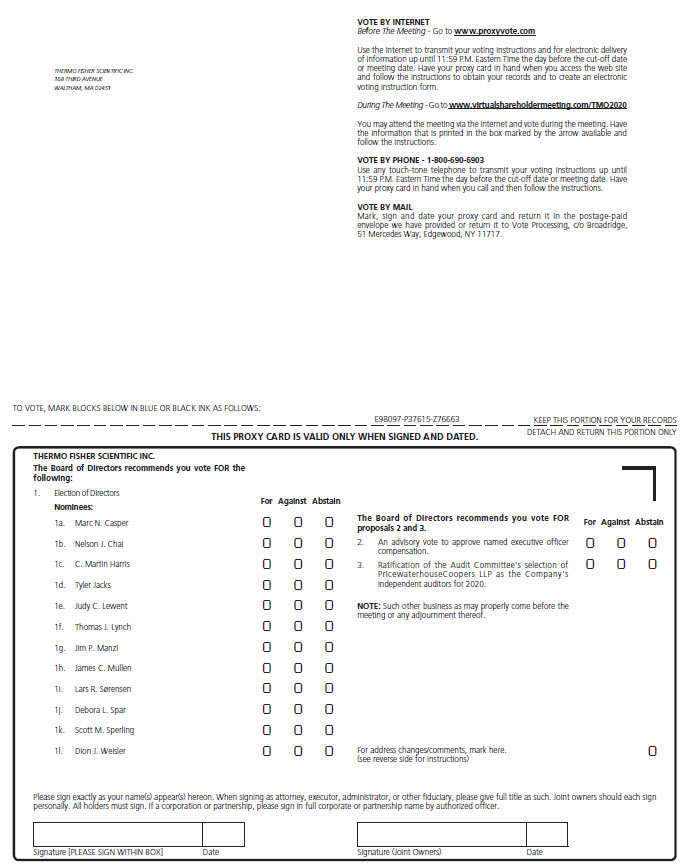
Signature [PLEASE SIGN WITHIN BOX] Date Signature (Joint Owners) Date TO VOTE, MARK BLOCKS BELOW IN BLUE OR BLACK INK AS FOLLOWS: KEEP THIS PORTION FOR YOUR RECORDS THIS PROXY CARD IS VALID ONLY WHEN SIGNED AND DATED. DETACH AND RETURN THIS PORTION ONLY E98097-P37615-Z76663 THERMO FISHER SCIENTIFIC INC. 168 THIRD AVENUE WALTHAM, MA 02451 Please sign exactly as your name(s) appear(s) hereon. When signing as attorney, executor, administrator, or other fiduciary, please give full title as such. Joint owners should each sign personally. All holders must sign. If a corporation or partnership, please sign in full corporate or partnership name by authorized officer. For address changes/comments, mark here. (see reverse side for instructions) THERMO FISHER SCIENTIFIC INC. 1. Election of Directors 1a. Marc N. Casper 1b. Nelson J. Chai 1c. C. Martin Harris 1d. Tyler Jacks 1e. Judy C. Lewent 1f. Thomas J. Lynch 1g. Jim P. Manzi The Board of Directors recommends you vote FOR the following: Nominees: 1i. Lars R. Sørensen 1j. Debora L. Spar 1h. James C. Mullen 1k. Scott M. Sperling 1l. Dion J. Weisler The Board of Directors recommends you vote FOR proposals 2 and 3. 2. An advisory vote to approve named executive officer compensation. 3. Ratification of the Audit Committee's selection of PricewaterhouseCoopers LLP as the Company's independent auditors for 2020. NOTE: Such other business as may properly come before the meeting or any adjournment thereof. For Against Abstain For Against Abstain VOTE BY INTERNET Before The Meeting - Go to www.proxyvote.com Use the Internet to transmit your voting instructions and for electronic delivery of information up until 11:59 P.M. Eastern Time the day before the cut-off date or meeting date. Have your proxy card in hand when you access the web site and follow the instructions to obtain your records and to create an electronic voting instruction form. During The Meeting - Go to www.virtualshareholdermeeting.com/TMO2020 You may attend the meeting via the Internet and vote during the meeting. Have the information that is printed in the box marked by the arrow available and follow the instructions. VOTE BY PHONE - 1-800-690-6903 Use any touch-tone telephone to transmit your voting instructions up until 11:59 P.M. Eastern Time the day before the cut-off date or meeting date. Have your proxy card in hand when you call and then follow the instructions. VOTE BY MAIL Mark, sign and date your proxy card and return it in the postage-paid envelope we have provided or return it to Vote Processing, c/o Broadridge, 51 Mercedes Way, Edgewood, NY 11717.
| Table of Contents |
|---|
Important Notice Regarding the Availability of Proxy Materials for the Annual Meeting: The Notice and Proxy Statement, 10-K and Annual Report are available at www.proxyvote.com.
E98098-P37615-Z76663
THERMO FISHER SCIENTIFIC INC.
This proxy is solicited by the Board of Directors
ANNUAL MEETING OF THE SHAREHOLDERS TO BE
HELD ON MAY 20, 2020
The undersigned hereby appoints Marc N. Casper, Thomas J. Lynch and Stephen Williamson, and each of them, proxies of the undersigned, each with power to appoint his substitute, and hereby authorizes them to represent and to vote, as designated on the reverse side, all the shares of common stock of Thermo Fisher Scientific Inc. held of record by the undersigned on March 27, 2020, at the Annual Meeting of the Shareholders to be held virtually at www.virtualshareholdermeeting.com/TMO2020, on Wednesday, May 20, 2020 at 1:00 p.m. (Eastern Time), and at any adjournments thereof, as set forth on the reverse side hereof, and in their discretion upon any other business that may properly come before the meeting.
The Proxy will be voted as specified, or if no choice is specified, "FOR" the election of each of the nominees for director, "FOR" the approval of an advisory vote on our named executive officer compensation, "FOR" ratification of the selection of independent auditors, and as said proxies deem advisable on such other matters as may properly come before the meeting.
Address changes/comments:
(If you noted any Address Changes and/or Comments above, please mark corresponding box on the reverse side.)
Continued and to be signed on reverse side