Operator
Good morning. My name is Angela, and I will be your conference operator today. At this time, I would like to welcome everyone to Trinity Capital's Third Quarter 2025 Earnings Conference Call. It is now my pleasure to turn the call over to Ben Malcolmson, Trinity Capital's Head of Investor Relations.
Thank you, and welcome to Trinity Capital's Third Quarter 2025 Earnings Conference Call. Speaking on today's call are Kyle Brown, Chief Executive Officer; Michael Testa, Chief Financial Officer; and Jerry Harder, Chief Operating Officer. Joining us for the Q&A portion of the call are Ron Kundich, Chief Credit Officer, and Sarah Stanton, General Counsel and Chief Compliance Officer. Earlier today, we released our financial results, which are available on our website at ir.trinitycapital.com. Before we begin, please note that certain statements made during this call may be considered forward-looking under federal securities laws. Please review our most recent SEC filings for further information on the risks and uncertainties related to these statements. With that, please allow me to turn the call over to Trinity Capital's CEO, Kyle Brown.
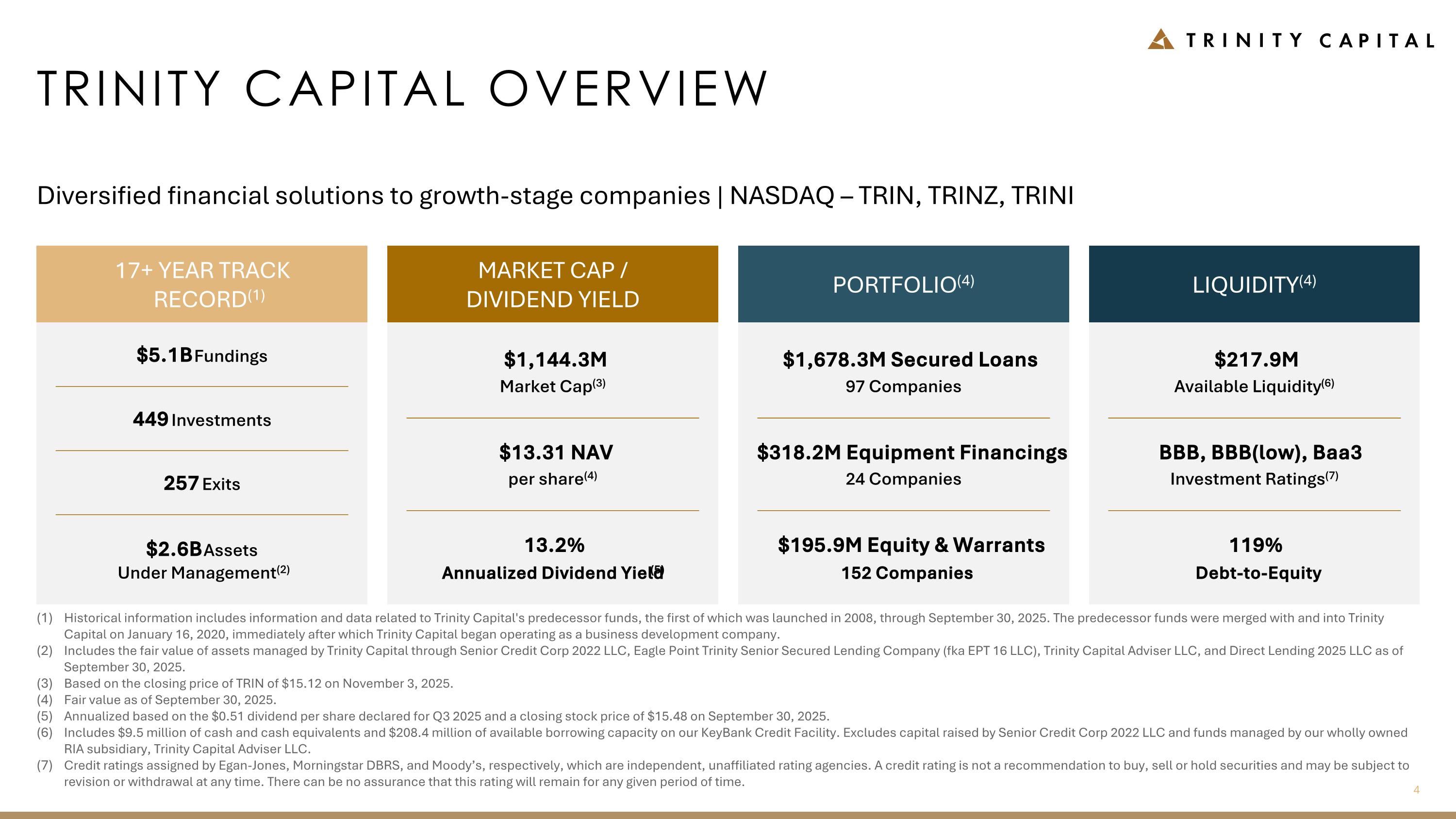
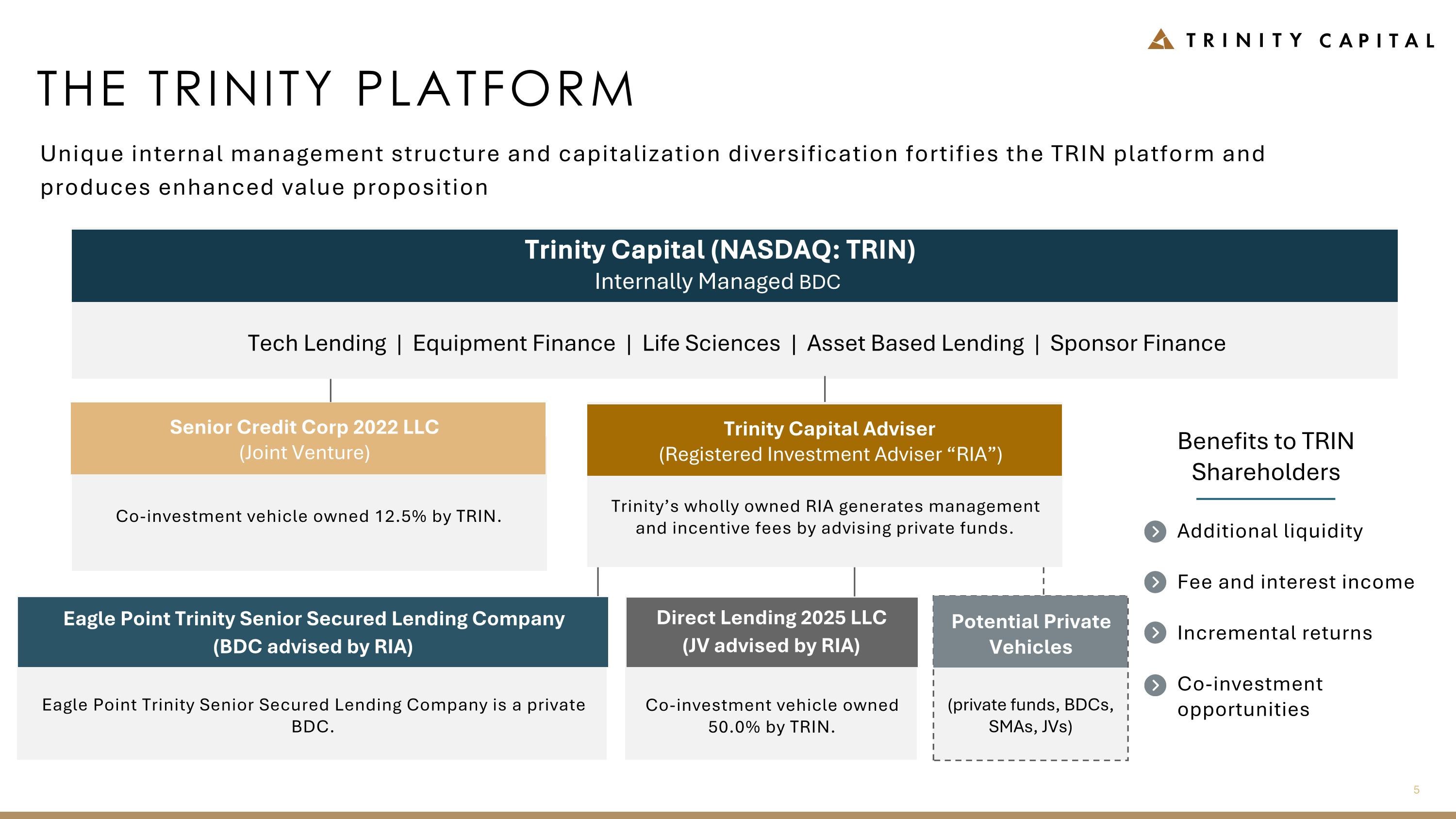
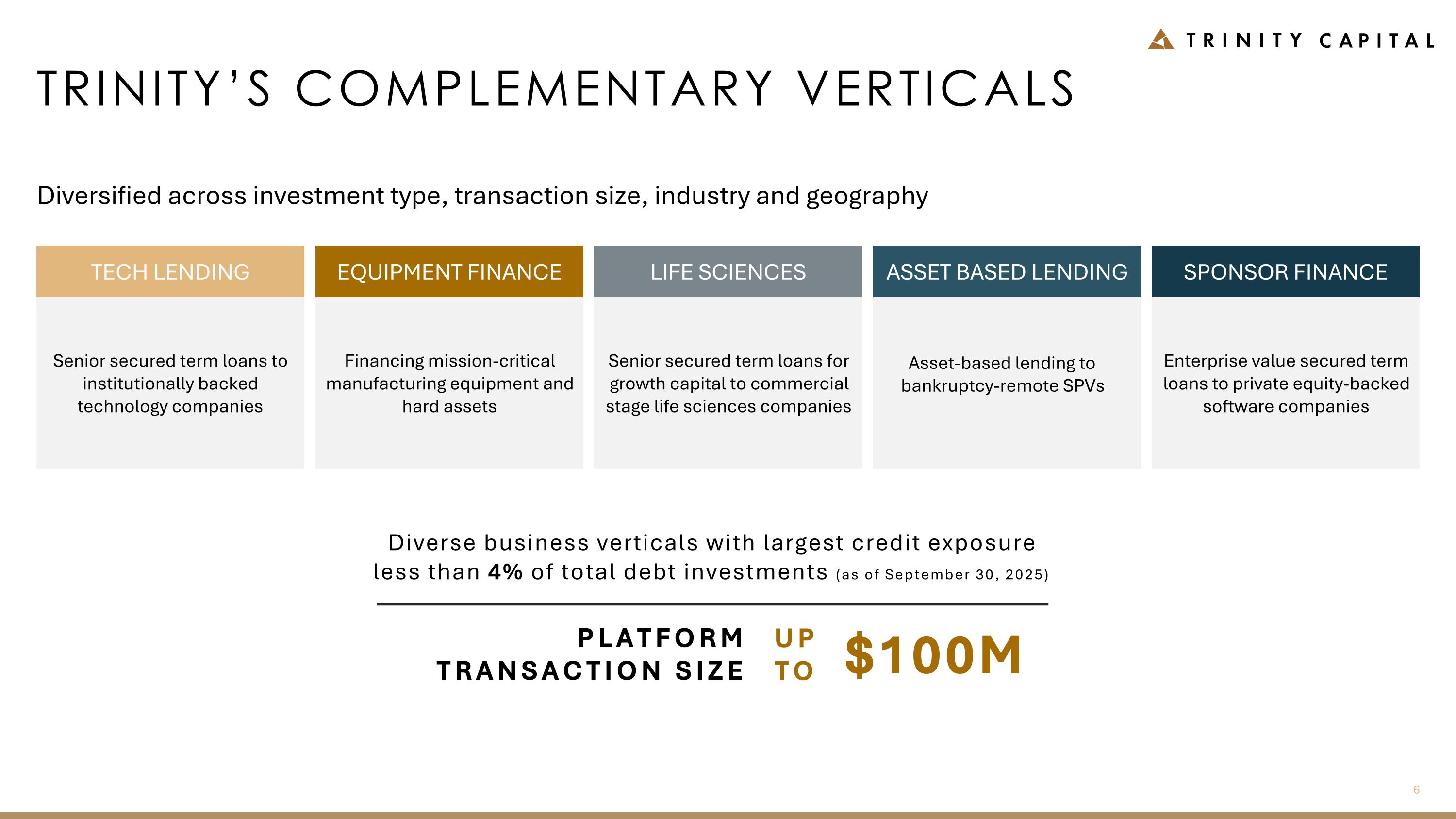
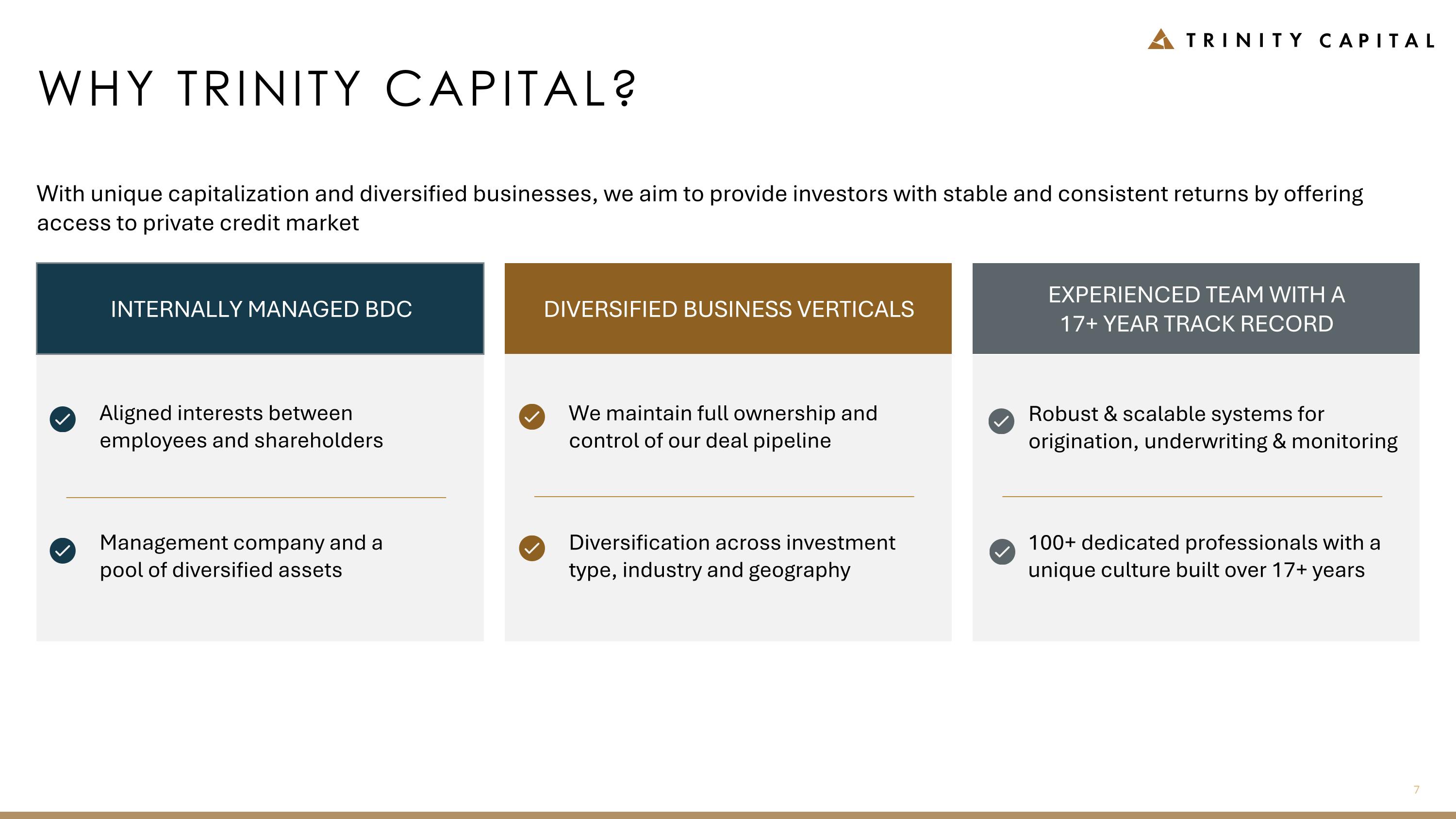
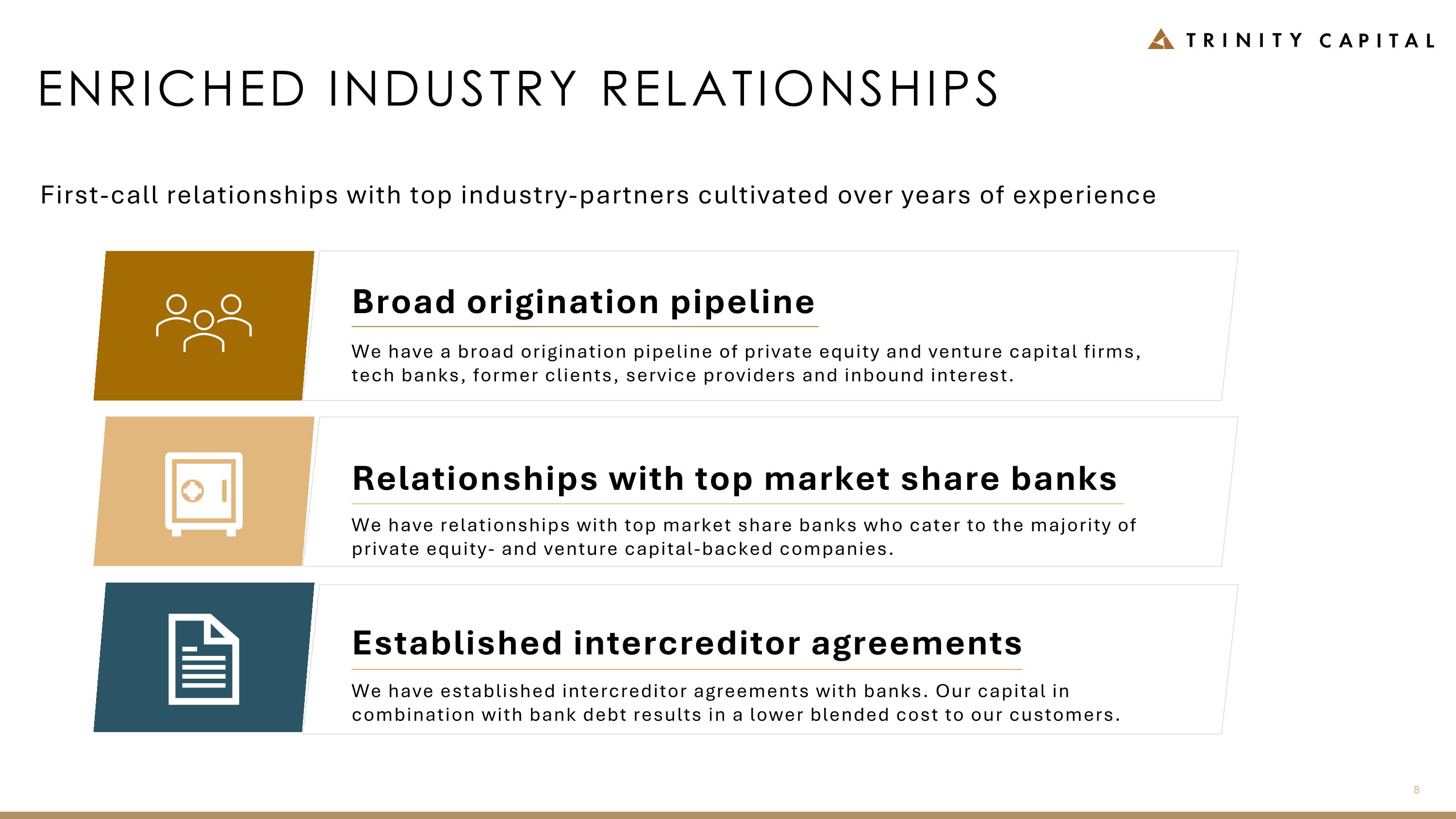
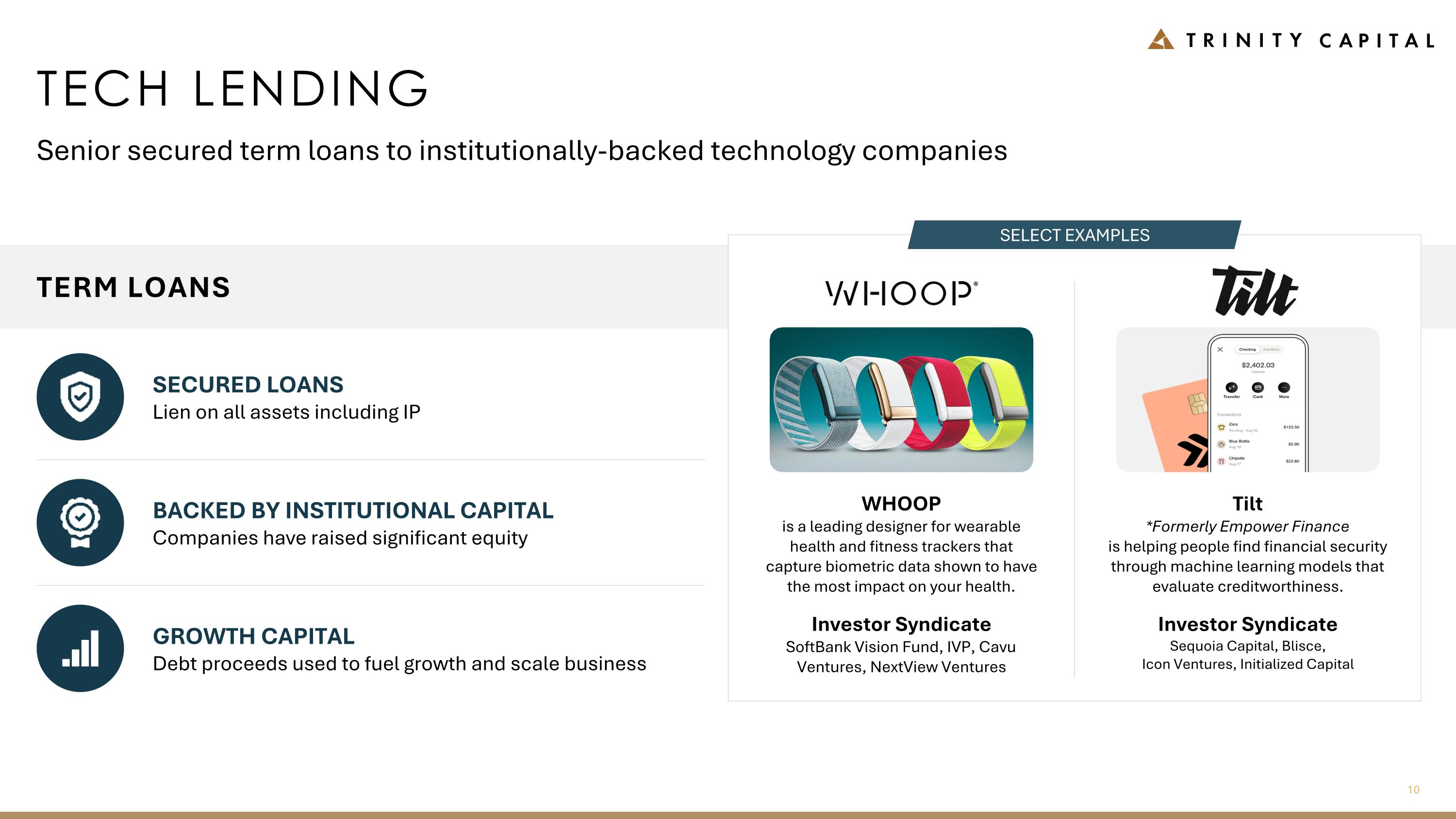
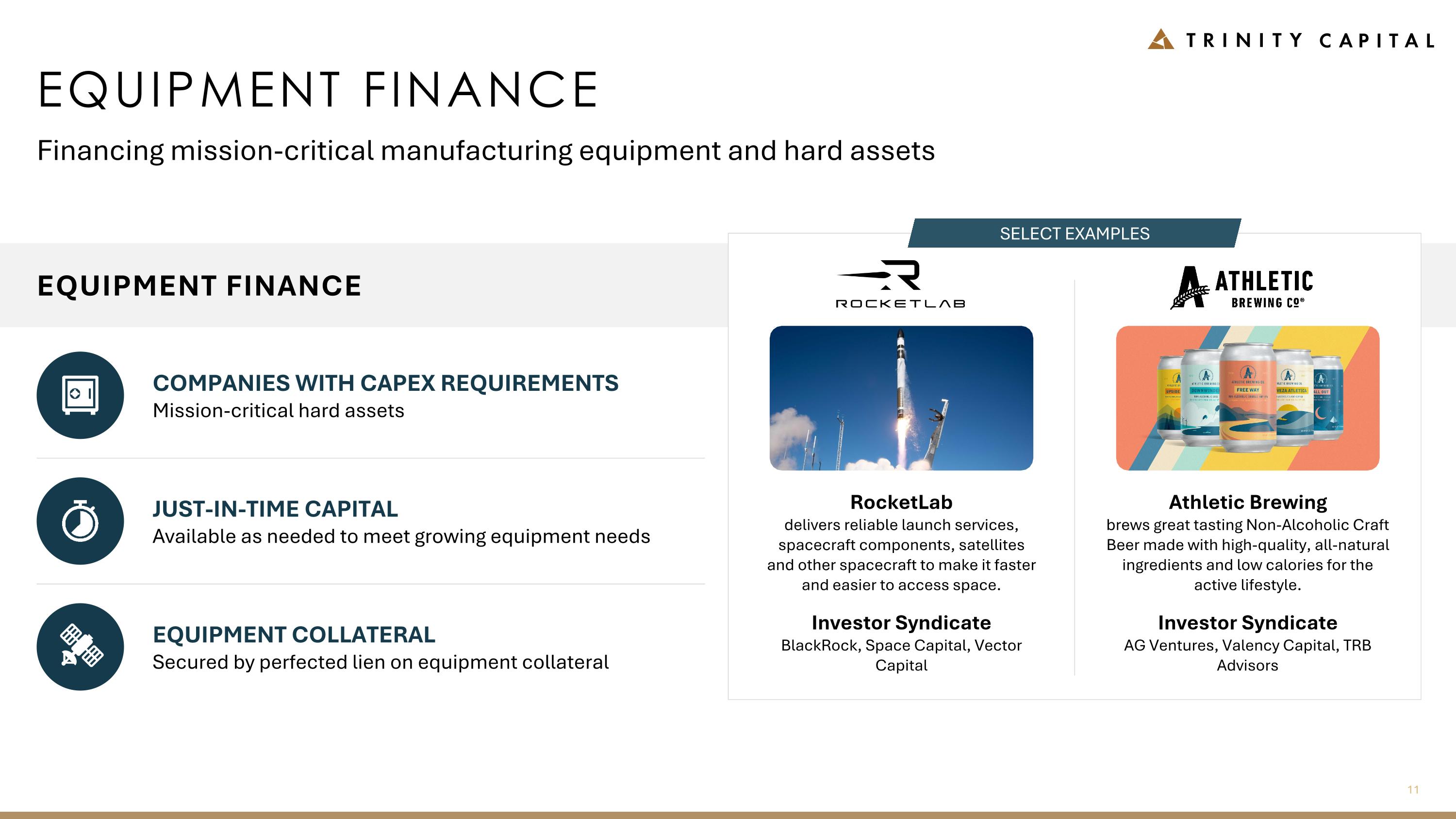
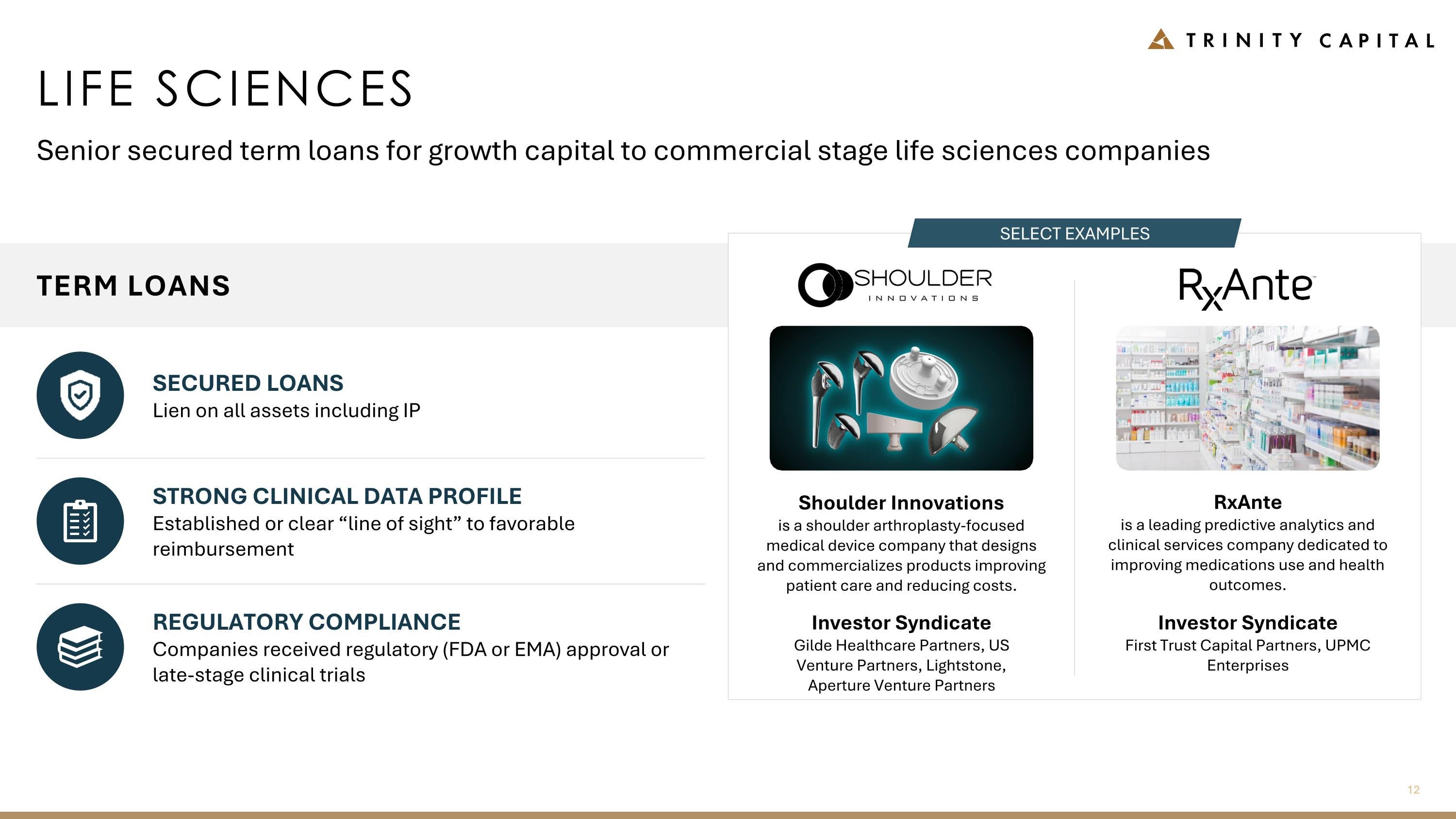
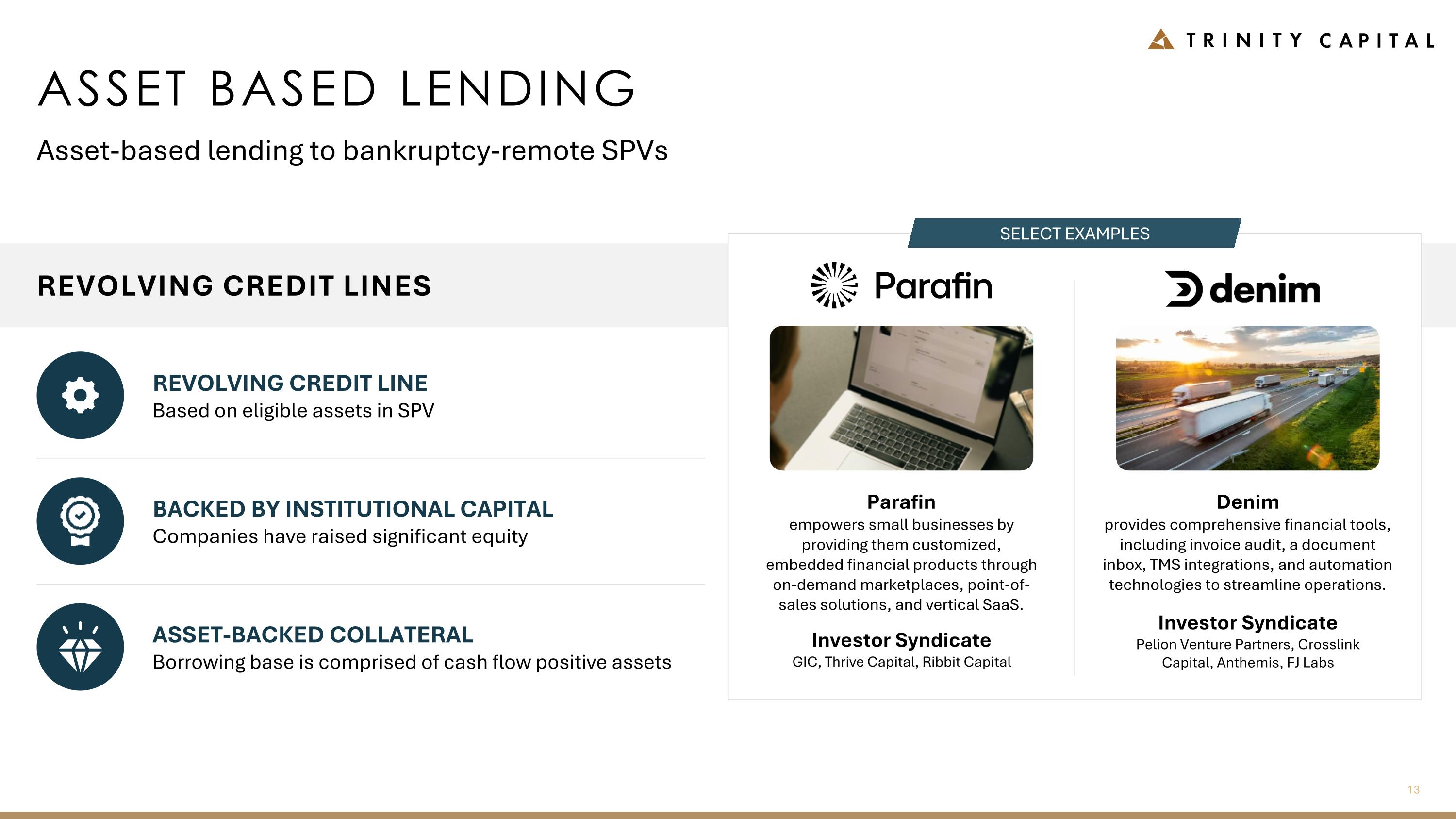
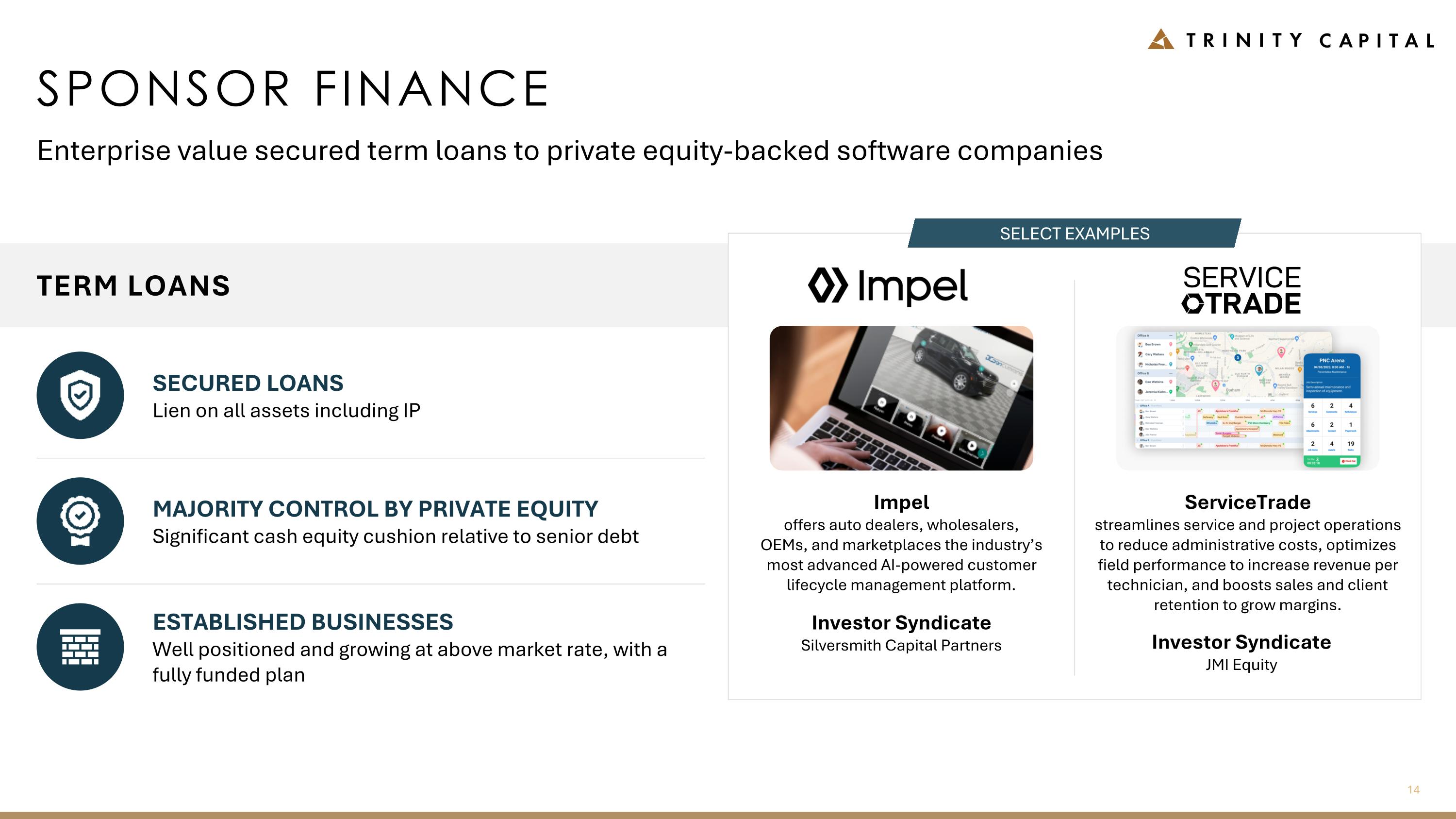
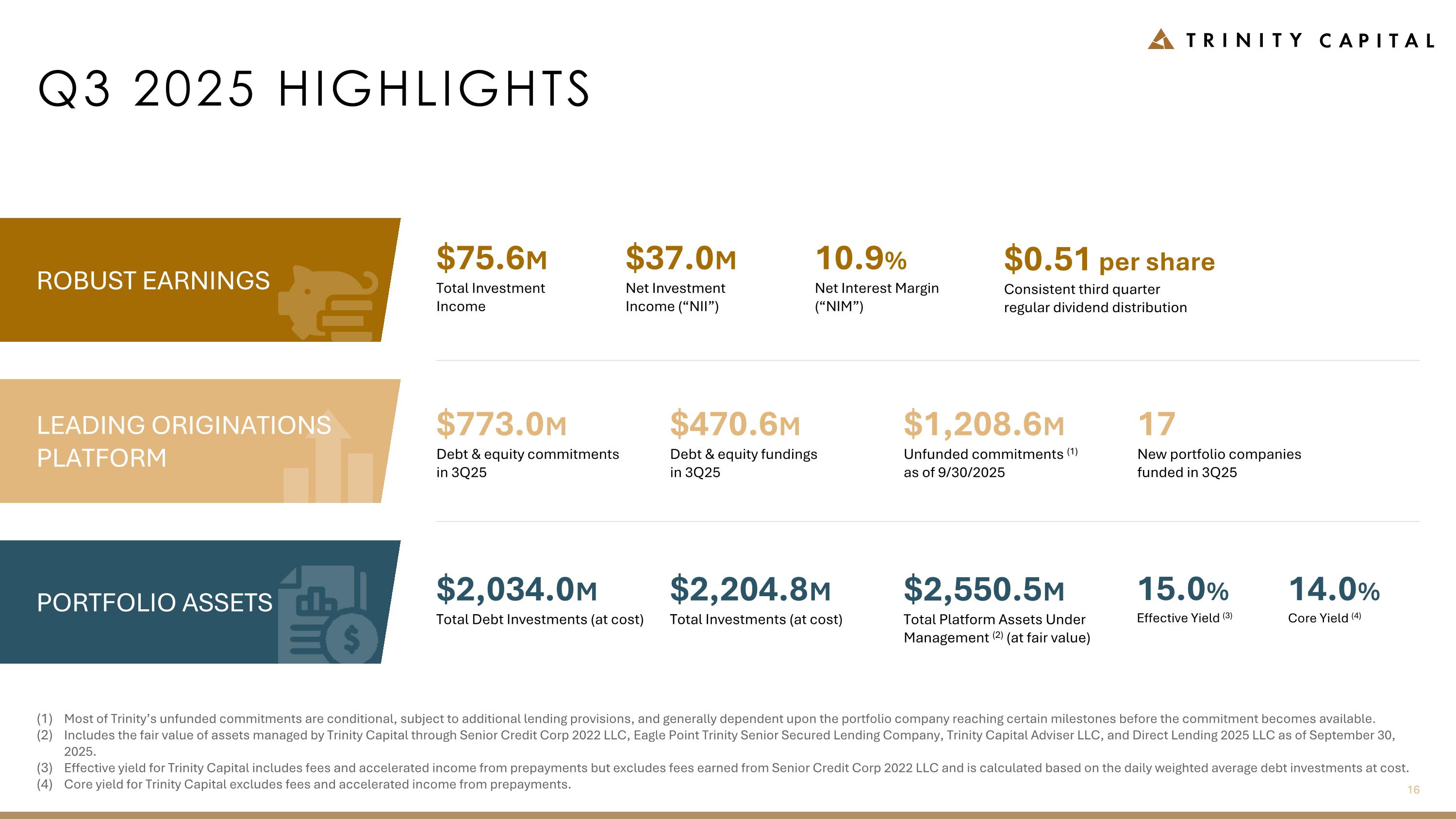
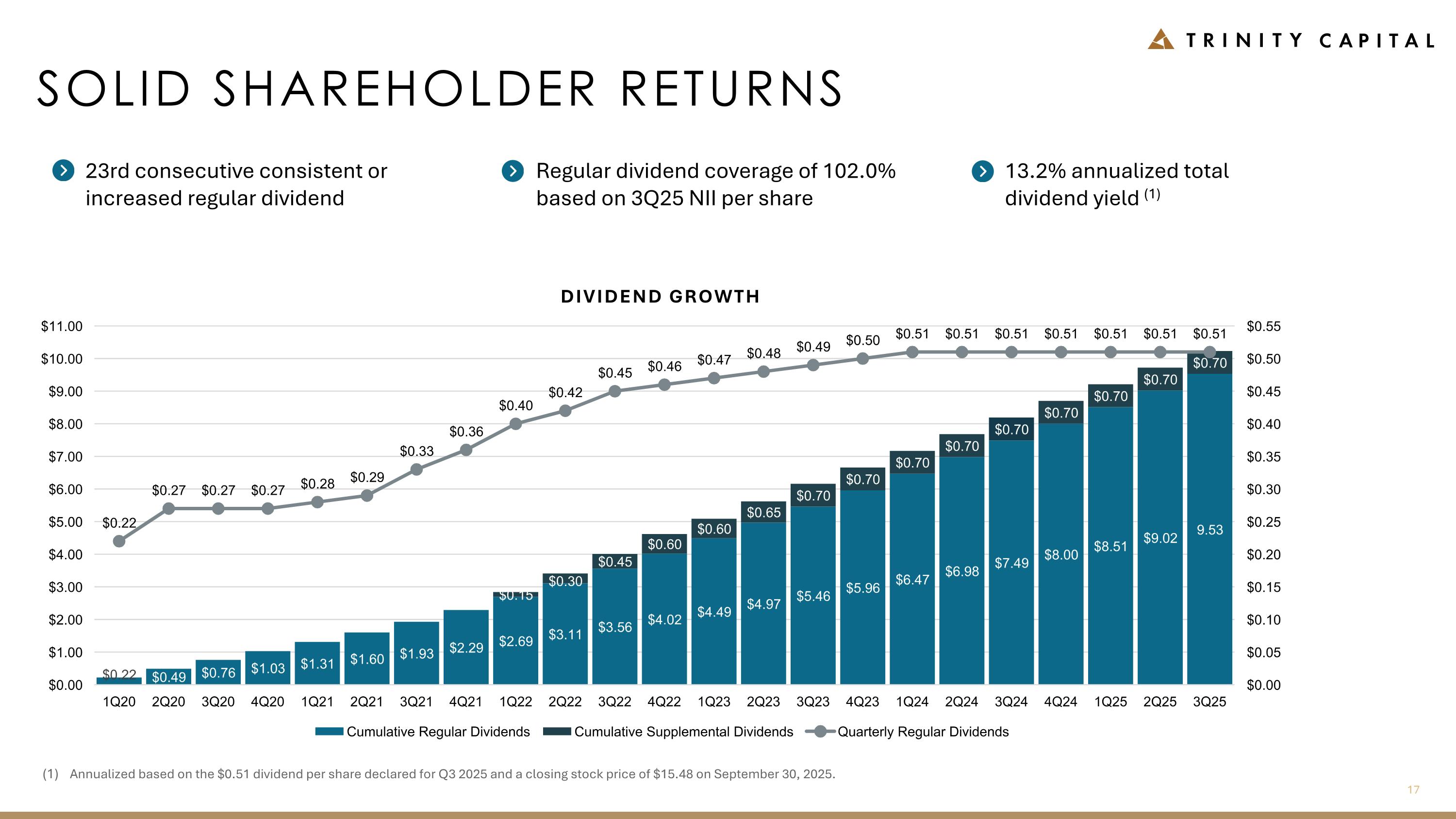
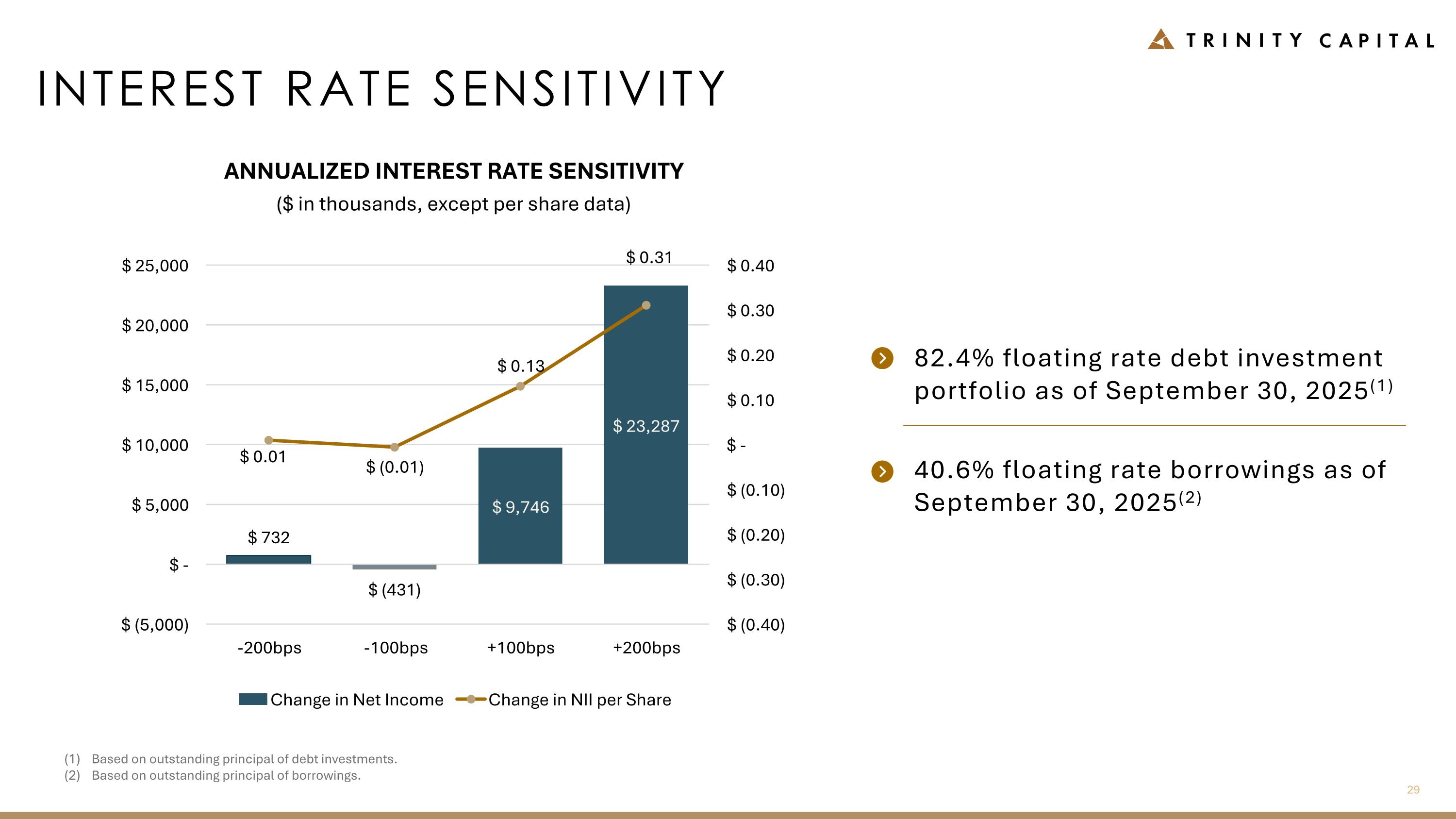
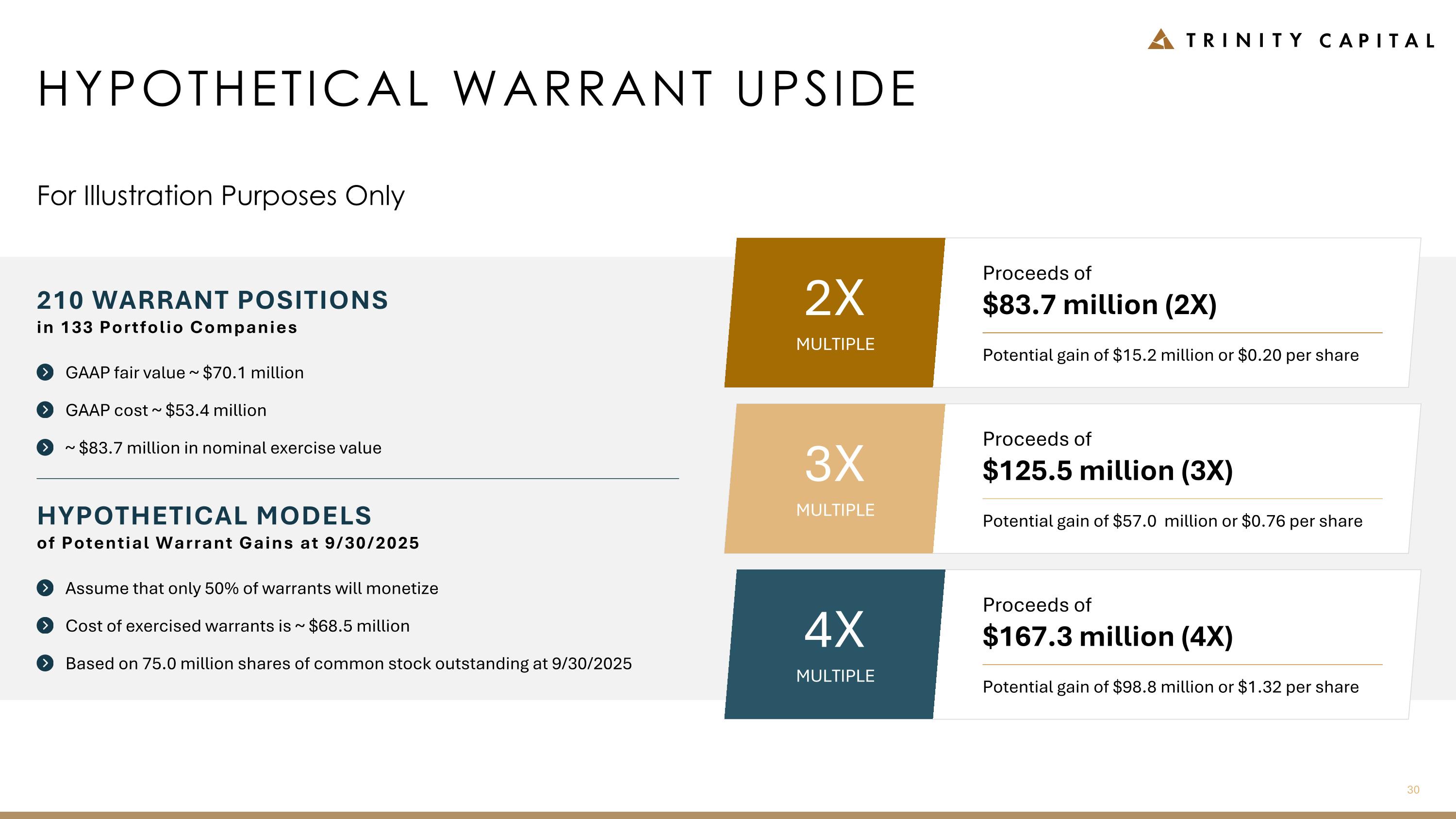
Thanks, Ben, and thanks, everyone, for joining us today. To start off, we're pleased to highlight several key achievements from a strong Q3 for Trinity Capital as we continue to mature as a best-in-class alternative asset manager focused on the private credit space. We delivered $37 million in net investment income, a 29% increase compared to Q3 of last year. Our net asset value grew 8% quarter-over-quarter to a record $998 million. Platform AUM increased to more than $2.6 billion, up 28% year-over-year. We maintained strong credit quality with nonaccruals at 1% of the portfolio at fair value. And we distributed a third quarter cash dividend of $0.51 per share, marking the 23rd consecutive quarter of a consistent dividend for our shareholders. Trinity Capital continues to outperform across key metrics. Our return on equity and effective yield rank among the best in the BDC space. Our NAV has grown 32% year-over-year, while our credit metrics have remained consistent. Since our IPO nearly 5 years ago, Trinity's stock has delivered a cumulative return of 114%, far outpacing both the peer average of 63% and the S&P 500 at 78% over the same time period. Looking forward, we have a growing asset management business, generating new income as well as 210 warrant positions in 133 portfolio companies, which have the potential to provide incremental upside to our shareholders as IPO and M&A activity continue to rebound. We entered the fourth quarter with excellent momentum. In Q3, we funded $471 million, bringing year-to-date investments to $1.1 billion, nearly matching all of 2024's total. Our investment pipeline remains robust with $773 million of new commitments in Q3 and $1.2 billion in total unfunded commitments as of quarter-end. Important to note that 94% of our unfunded commitments remain subject to rigorous ongoing diligence and investment committee approval, while only 6% of these commitments are unconditional. Our originations activity reflects consistent growth in all our verticals across the Trinity platform. It's a powerful flywheel fueled by our lead team of originators, and we own the pipeline. We do not depend on syndicated deals and have immaterial overlap with other BDCs, all of which give our investors access to a highly differentiated portfolio of investments through our 5 business verticals. All the while, we remain deeply committed to disciplined underwriting and credit performance, which are the bedrock of our long-term success. I would like to touch on 2 noteworthy topics concerning the private credit space. First, let's talk about rate cuts. To date, rate cuts have had a limited impact on our business. Unlike most BDCs, the majority of our loans include interest rate floors at or near the original closing levels. This means that when rates decline, our income does not decline proportionately. Looking ahead, additional rate cuts are expected to have a muted impact on our returns, partially due to a majority of our portfolio having already hit their floor rates, which could drive some early repayments and the capturing of prepayment fees and restructuring fees. Further rate cuts would also lower our borrowing costs by reducing the interest expense on our floating rate credit facility. Secondly, PIK is a nominal portion of our income with less than 2% of our income based on PIK. We continue to strategically raise equity, debt, and off-balance sheet vehicles to fuel our growth. In Q3, we raised $83 million of equity through our ATM program at a 19% average premium to NAV. We closed a new joint venture with a large asset manager to provide new liquidity and earnings. We converted a separate vehicle into a private BDC, which is now actively raising money. Additionally, we are in the process of raising outside capital for our third SBIC fund, which provides low-cost leverage and is expected to add over $260 million of capacity to our platform. Together, these initiatives underscore our ability to scale the platform and expand investment capacity. The funds I discussed are managed by our wholly owned RIA Trinity Capital Advisor, which manages third-party capital and generates new income above and beyond the interest and equity returns from our BDC's investment portfolio. As shareholders of Trinity Capital, investors benefit from the fees collected by our managed fund business. I'm going to be a broken record on this point in every call going forward. What we are building is not your typical BDC. We are building a platform that can scale while driving up earnings and NAV. We believe our consistent performance is driven by our differentiated structure, disciplined underwriting, and world-class team. Our 5 complementary business verticals—sponsor finance, equipment finance, tech lending, asset-based lending, and life sciences—position us to maintain a diversified portfolio while staying closely aligned with our core competencies. Each vertical is supported by a dedicated originations team, underwriters, and portfolio managers, together forming a highly effective and scalable operating model. Structurally, as an internally managed BDC, our employees, management, and Board hold the same shares as our investors, promoting complete alignment of interest and a shared commitment to delivering consistent dividends and long-term value. This structure also supports a premium valuation as shareholders benefit from ownership of both the management company and the underlying assets. In addition, the management and incentive fees generated through our managed funds business flow directly into the BDC, creating incremental income streams, enhancing valuation, and fueling platform growth, all for the benefit of our shareholders. From a talent perspective, we're passionate about fostering a vibrant culture rooted in humility, trust, integrity, uncommon care, and continuous learning with an entrepreneurial spirit. Our unique culture enables us to attract and retain the best people in the industry and fuels our continued growth trajectory. From the onset, our goal has been clear: to consistently outearn our dividend while growing the BDC. We continue to deliver on that mission. Trinity Capital is strategically positioned within the private credit market, supported by a differentiated pipeline, disciplined underwriting, and a growing platform. On the capitalization front, we're laying the foundation for a managed funds business that will expand our direct lending strategy and create additional income streams for Trinity shareholders. Overall, we remain very bullish about the opportunities before us. We're committed to building a company that aims to deliver outsized returns for our investors while demonstrating uncommon care for our people and partners. And with that, I'll turn the call over to our CFO, Michael Testa, to discuss our financial results in more detail.
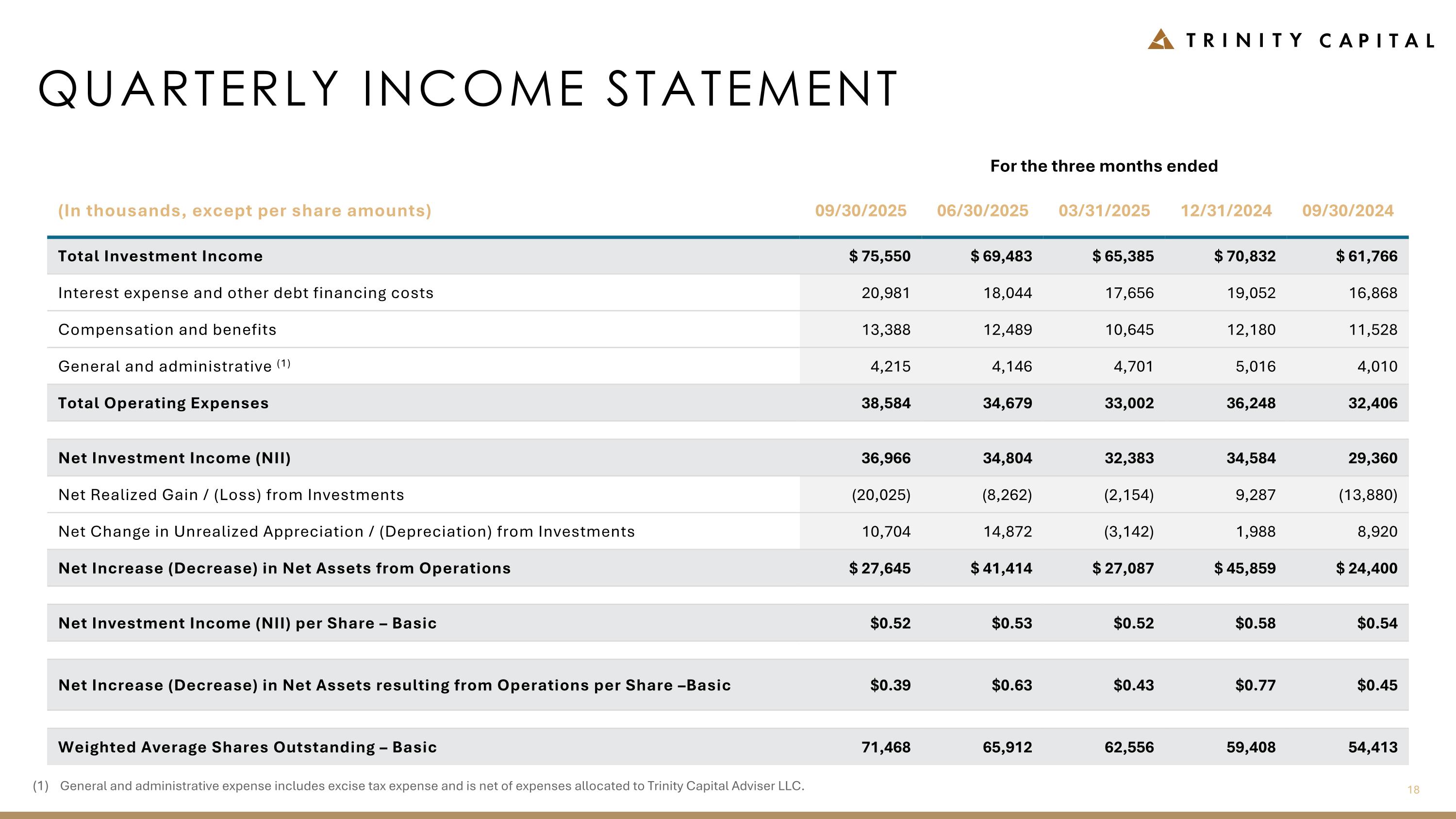
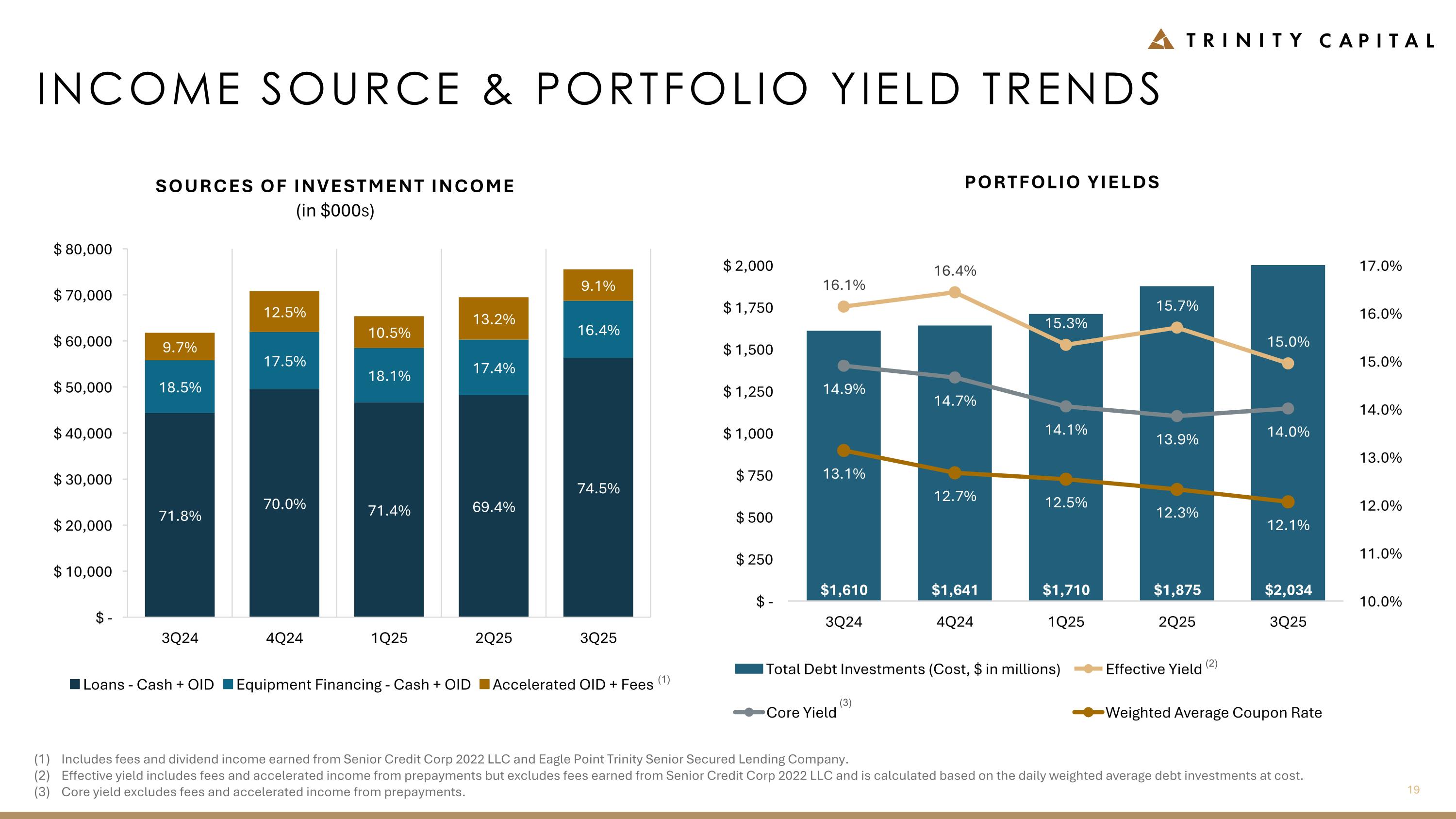
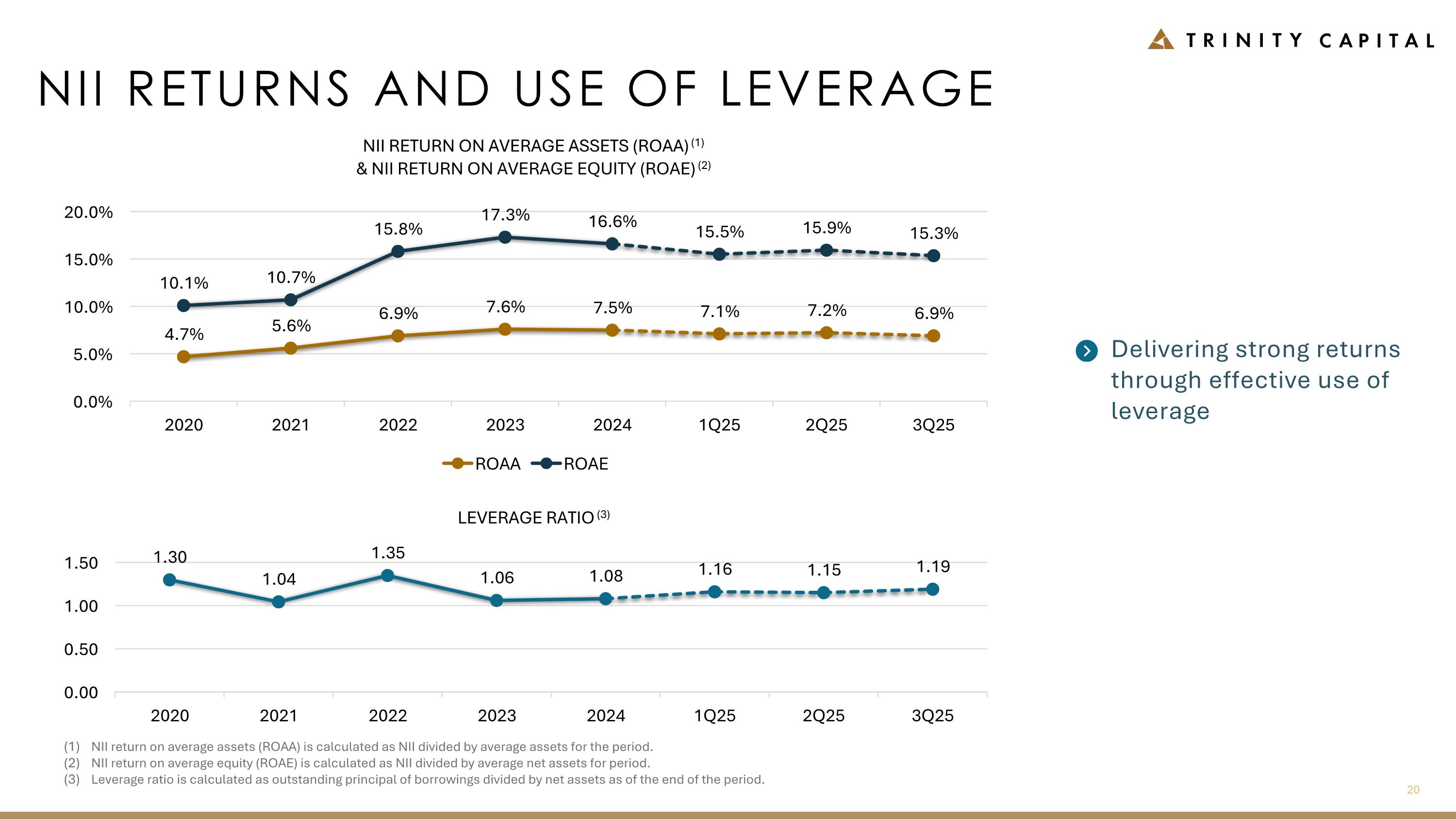
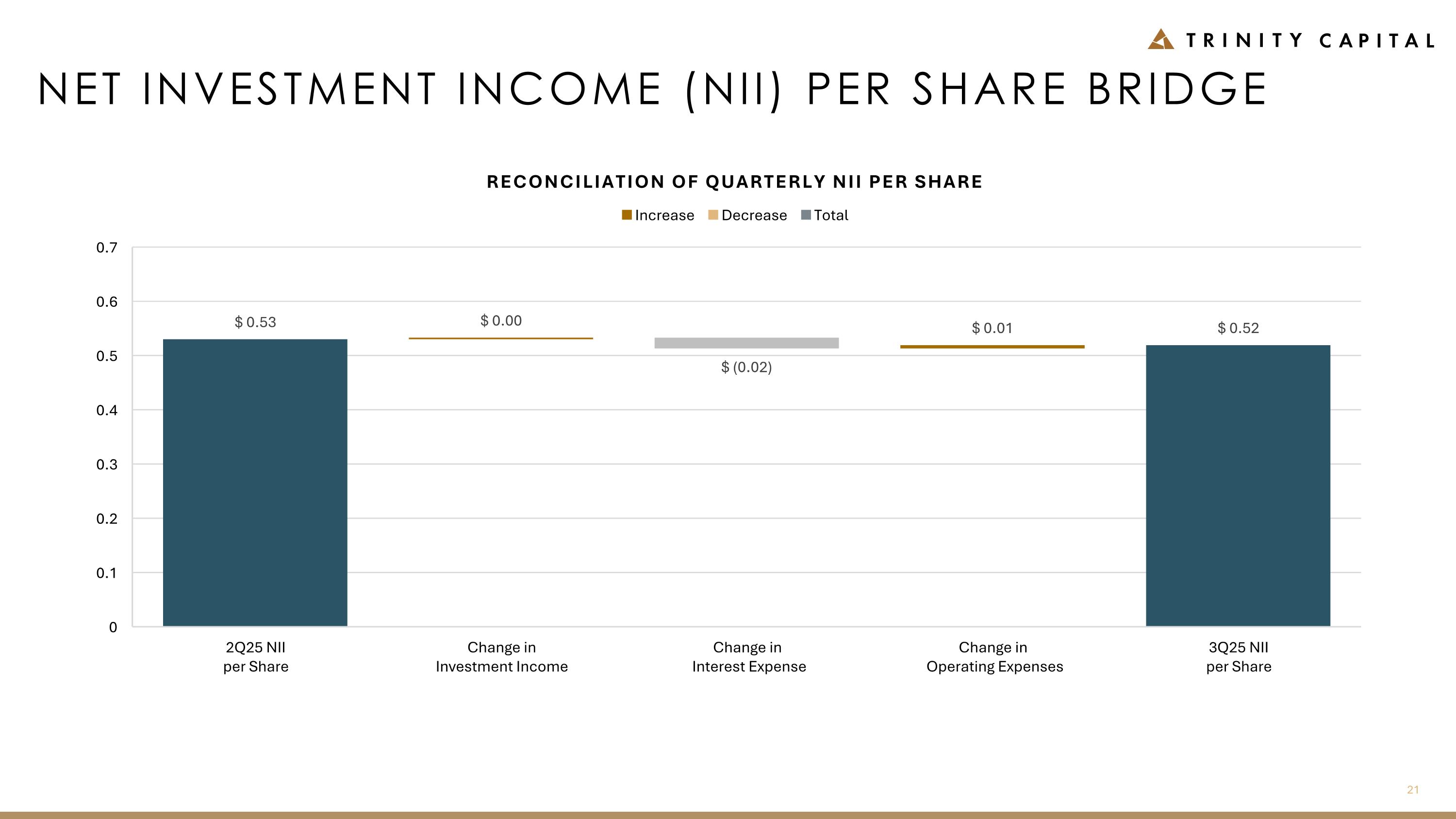
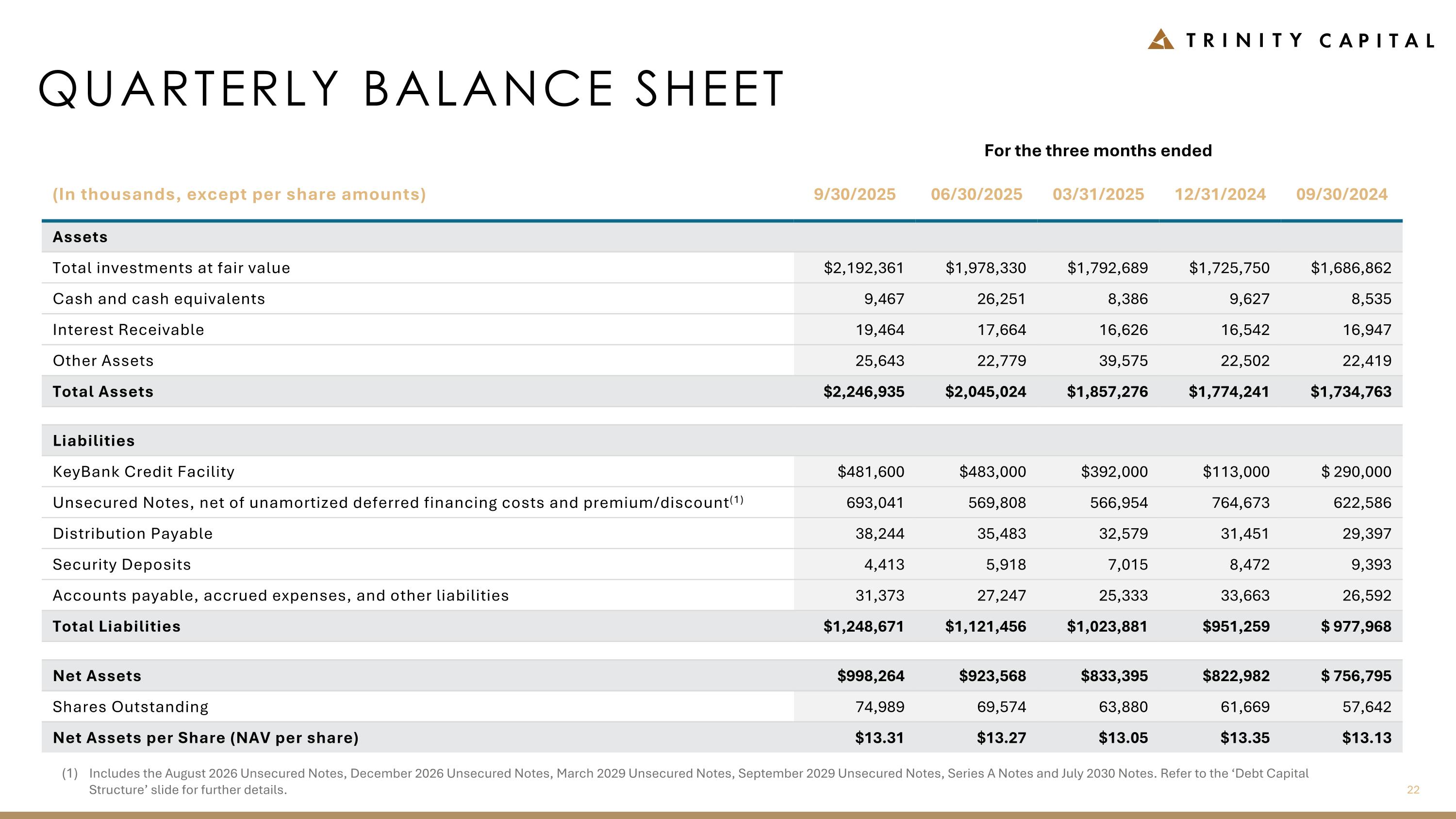
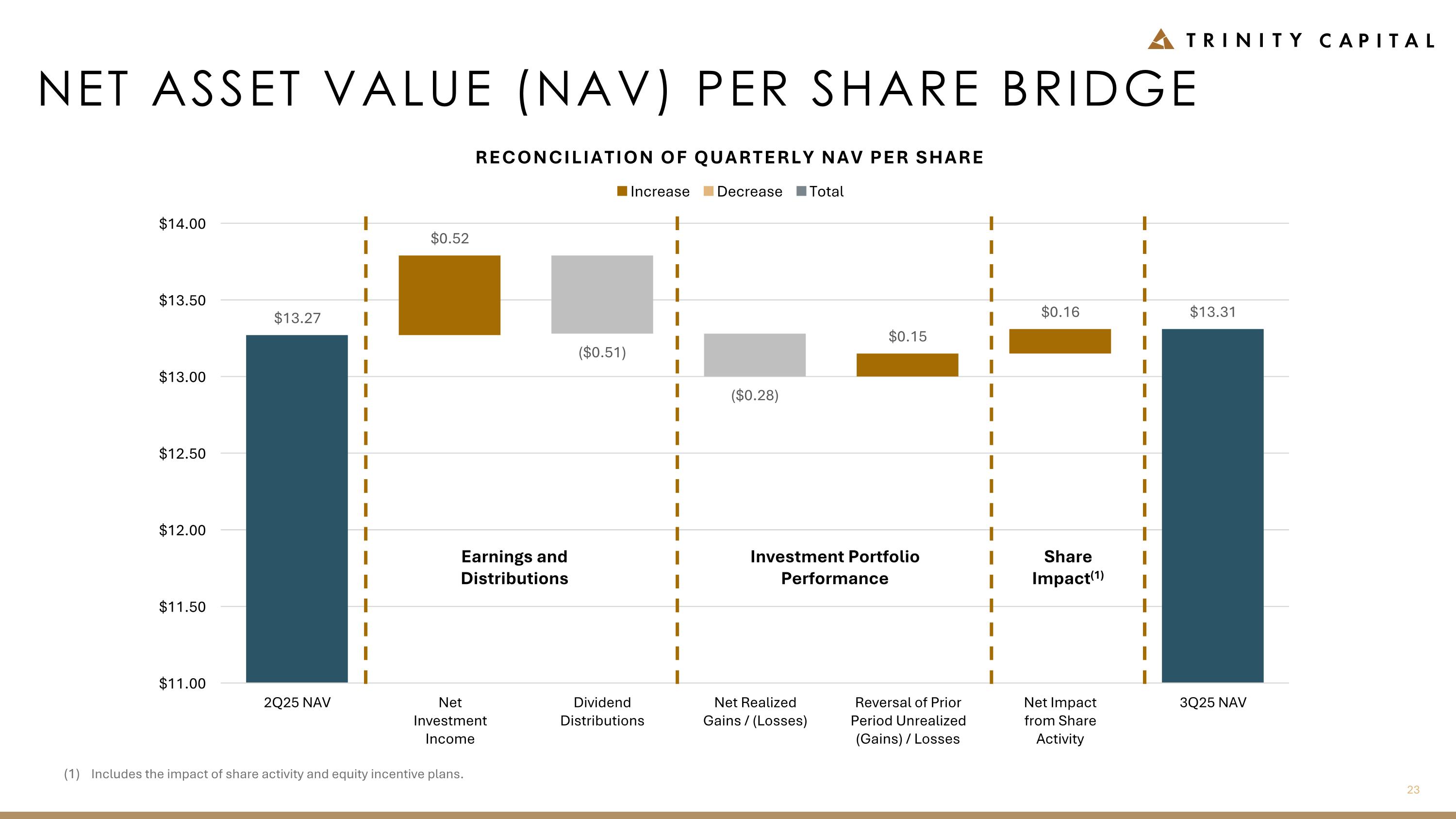
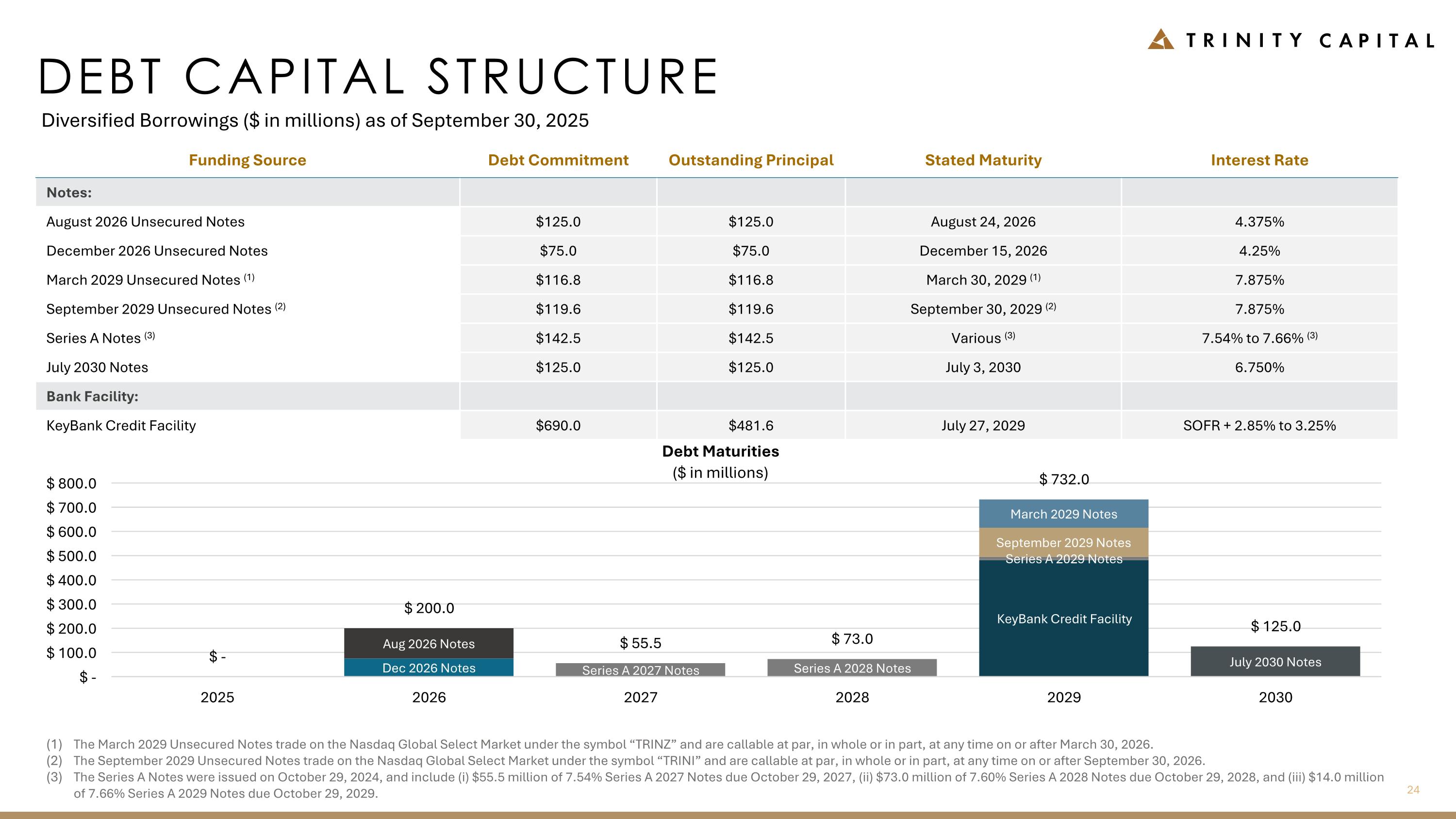
Thanks, Kyle. Our operational and financial performance remained strong in the third quarter. We generated $75.6 million in total investment income, a 22% year-over-year increase, and $37 million in net investment income, or $0.52 per basic share, representing 102% coverage of our quarterly distribution. Estimated undistributed taxable income is approximately $63 million, or $0.84 per share, which we continue to reinvest for the benefit of our investors while maintaining a consistent and meaningful distribution. Our platform continues to deliver top-tier performance, generating a 15.3% return on average equity, among the highest in the BDC space. Our weighted average effective portfolio yield remained strong at 15% for the quarter, despite the declining rate environment. Net asset value per share increased from $13.27 at the end of Q2 to $13.31 at the end of Q3, reflecting accretive capital raises. Total NAV rose 8% to $998 million, up from $924 million at the end of Q2. We further strengthened our capital base by raising $83 million through our equity ATM program during the quarter at an average premium to NAV of 19%. With no debt maturities until August 2026, our balance sheet and capital structure remain strong and positioned to scale earnings per share while maintaining moderate leverage. Our co-investment vehicles continue to enhance returns, contributing approximately $3.3 million, or $0.05 per share, of incremental net investment income in Q3. We syndicated $120 million to these vehicles during the quarter and as of September 30, managed $409 million in assets across our private vehicles. Our net leverage ratio increased slightly to 1.18x at quarter end. With strong liquidity, diversified capital sources, and capacity across the Trinity platform, we are well-positioned to underwrite a robust pipeline, maintain strong credit discipline, and deploy capital into high conviction opportunities. To discuss our portfolio performance in more detail, I'll now pass the call over to our COO, Jerry Harder.
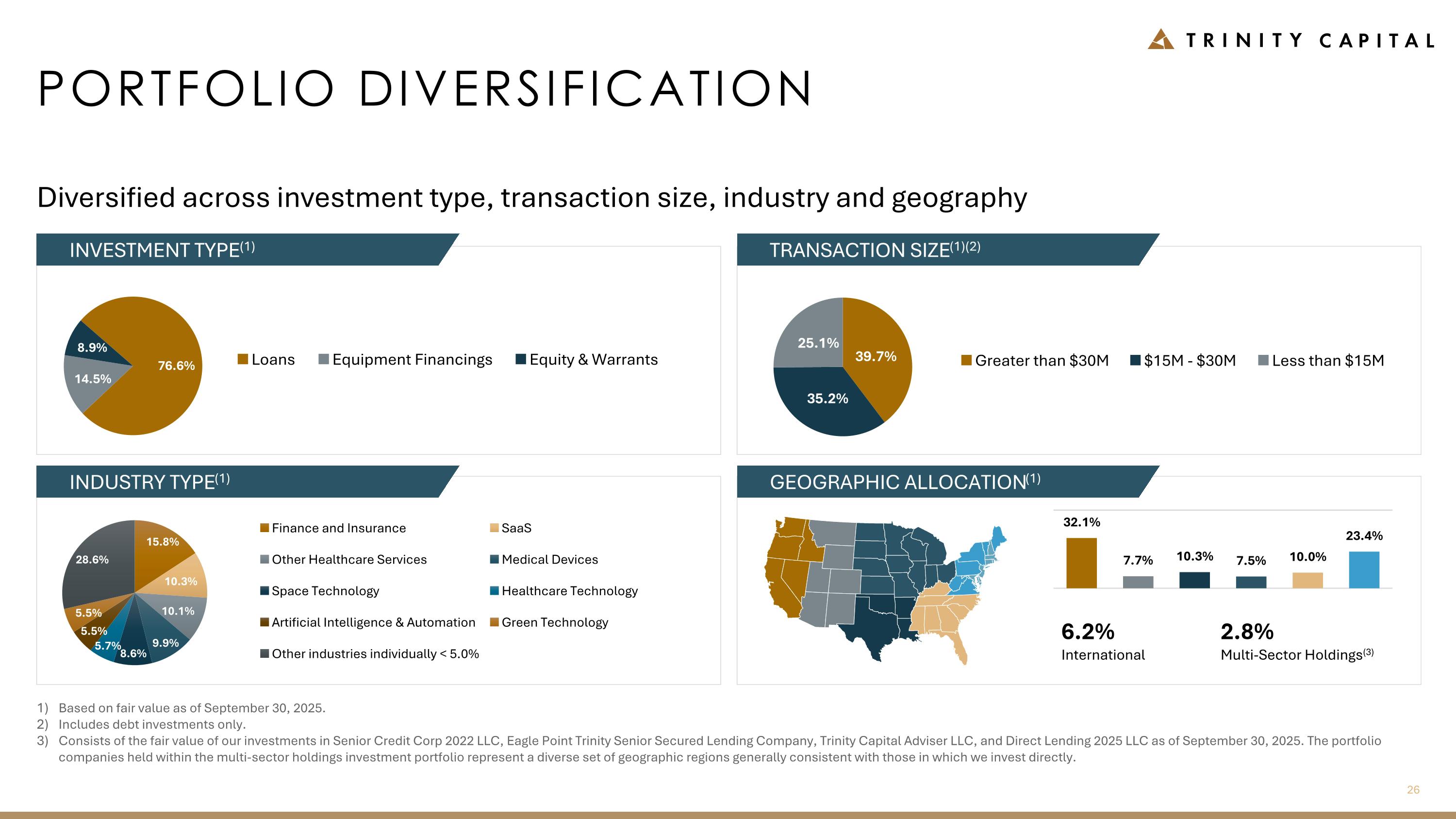
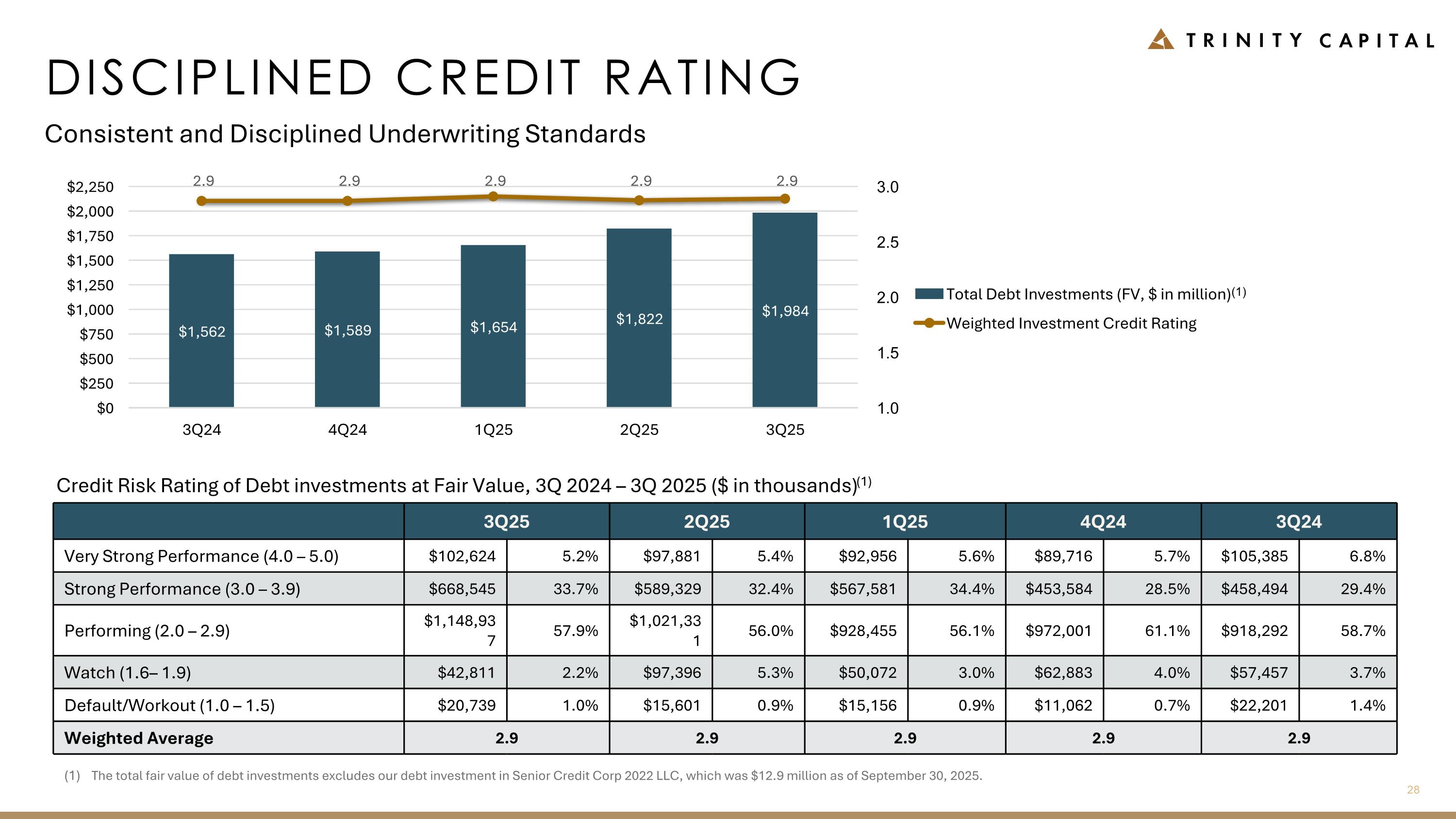
Thank you, Michael. Our portfolio continues to demonstrate exceptional strength, driven by broad diversification across 21 industries with no single borrower representing more than 3.4% of total exposure. Our largest industry concentration, finance and insurance, accounts for 15% of the portfolio at cost, diversified across 20 borrowers. Credit quality remained consistent quarter-over-quarter with 99% of investments performing at fair value. On our 1 to 5 scale, where 5 indicates very strong performance, the average internal credit rating was 2.9, consistent with prior quarters and reflecting the addition of high-quality originations and continued strong portfolio management. Quarter-over-quarter, the number of portfolio companies on nonaccrual remained steady at 4. During Q3, one new company was added to nonaccrual status, while the prior nonaccrual investment was realized and rolled off. As of September 30, nonaccruals totaled $20.7 million at fair value, representing 1% of the total debt portfolio. At quarter-end, 84% of total principal was secured by first-position liens on enterprise value equipment or both. For enterprise-backed loans, the weighted average loan-to-value stood at 18%. During Q3, portfolio companies collectively raised $2.3 billion in equity capital, underscoring both the strength of our borrowers and their continued access to capital in the current environment. Looking ahead, our momentum, disciplined underwriting, and diversified platform position us to continue delivering consistent dividends and NAV growth. With a shareholder-first mindset, our team remains focused on building a top-performing BDC that generates sustained long-term value for our investors. Before we conclude our call, we'd like to open the line for questions.
Operator
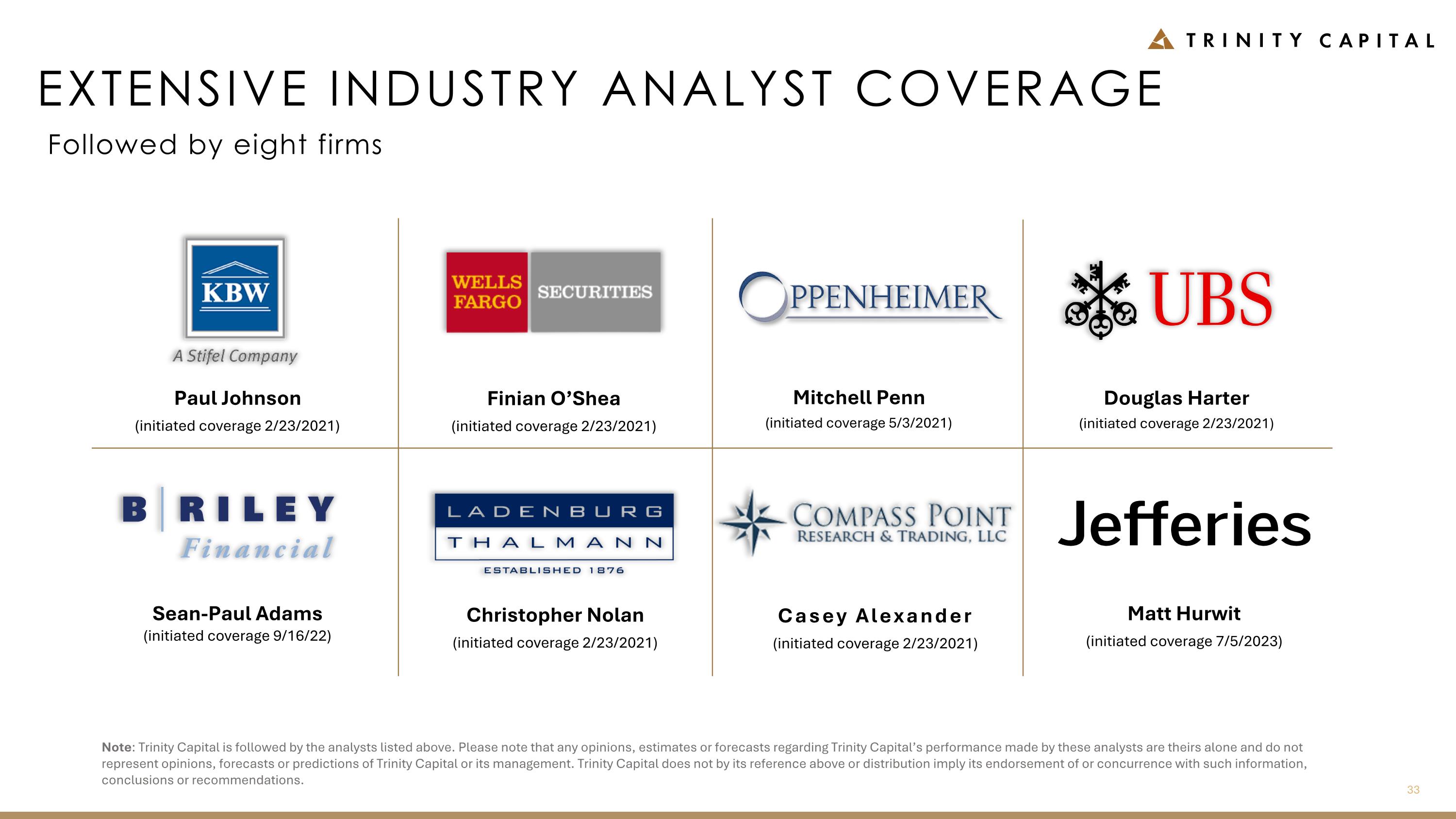
Our first question comes from Casey Alexander with Compass Point.
Speaker 5
You noted that you have $409 million off-balance sheet assets and a new JV. I'm just curious how much current capacity do you have in the off-balance sheet vehicles at this point in time? I know that number can grow because you can always create more of them, but I'm curious how much capacity you have there at this time.
Yes. Casey, I think with the question looking at our liquidity and our ability to allocate investments each quarter, it grew this quarter. You saw that. I think you'll continue to see that in our allocation policy, we look to which vehicles have more liquidity than others. These are going to get a higher share, but we're consistently allocating based off of available liquidity. So, I don't think in any period, one vehicle like the BDC that has more liquidity would be under-allocated investments.
We're going to try to grow it as much as we can. I mean, that's the strategy, though, Casey, is the more capital we can raise via the RIA and the various funds we're setting up, that's just new income, right, and above and beyond what our loans generate. And it has a huge impact on our earnings long-term. So, our goal is to grow it as fast as possible. We've got our new BDC that we manage, and we're out there raising money through the wealth channel. Then we have a couple of larger partnerships with large credit funds that we're now managing, and we're going to try to funnel as much as we can there. And so long as we stay really active and grow the manufacturing side and deployment side of the business, it gives us new earnings potential going forward.
Speaker 5
I get all that. But how much capacity do you have at the moment?
Yes. So currently, the new vehicle is just ramping up. So, there's $200 million or so of current capacity there. We'll look to increase that by setting up a debt facility there. The other 2 vehicles, they're probably 75% or so funded to date, and those had the benefit of increasing capacity as we deploy or raise additional equity as well as leverage in each of those 2.
Operator
We'll go next to John Hecht with Jefferies.
Speaker 6
Congrats on another good quarter. A little bit of a related question to the last question is you guys are in 5 verticals. You have multiple funds you run, I guess, but you are focused on scaling the enterprise. How do we think about the capacity of the team right now? How much can that originate and manage in a period? And what are kind of the thresholds where you would need to bring in new resources in any of those verticals?
Yes. So, we have continued over the last 5 years to be about a year ahead from an employment standpoint. We're planning out 1-, 3-, 5-year plans, and we've hired in advance of that. We're reaching some interesting points right now where we have some efficiencies of scale. A lot of our deployment growth and AUM growth doesn't necessarily correlate to employment additions, at least in the same way. But we have a road and a path towards continued growth with the team that we have. We're still hiring and recruiting great talent, but we've already hired for what we think is a very achievable 2026 plan right now.
Yes, this is Jerry. I would like to add that the current managed accounts are co-investment vehicles. They are allocating portions of the investments in the five verticals where we are already performing. We don’t need to add any additional capabilities. The businesses that we have been operating for a longer time, such as tech lending, equipment financing, and life sciences lending, are at or very close to scale. We are continuing to grow in some of the newer verticals, like sponsor finance and ABL. You may see some increase in headcount there in 2026, but the other businesses are fairly well scaled.
Speaker 6
And then another question is you noted that given your unique footprint and the verticals, there's limited overlap with other BDCs. So I guess a couple of questions on that is, one is, who do you perceive as your competition in the various verticals? And second is, I guess, given a lower amount of overall competition, how are kind of new deal spreads relative to where they were, say, 6 months ago?
To answer your last question, we do not observe the same rate compression or spread compression and challenges that the middle market and upper middle market are facing for several reasons. Our verticals are more specialized, still represent significant markets, and we can effectively scale within them. In our operations, we engage directly with companies, including their CEOs, CFOs, and teams; we are underwriting the transactions ourselves. Unlike some private credit companies in the middle market and upper middle market, we are not involved in syndicating deals. This creates a business model that is heavily reliant on relationships. In our segment, where we provide investments ranging from $20 million to $100 million, there is less competition. We have not experienced spread compression and continue to achieve strong returns that exceed those of typical BDCs or private credit firms in the middle market. Competition will vary in unique ways based on the vertical. While I could detail numerous competitors for each vertical, we are benchmarking ourselves against other BDCs in terms of competition and performance.
Operator
Our next question comes from Doug Harter with UBS.
Speaker 7
This is Cory Johnson filling in for Doug. I've observed that the compensation expenses have significantly increased over the past few quarters. Could you explain the reasons behind this? Is it primarily due to more hiring, or are there other one-time factors involved? Additionally, do you anticipate this trend will continue in the upcoming quarters?
Yes, that's us ramping up. I mean that's hiring. We've added to the team, added some incredible talent, and we're growing. We also launched a team in the U.K. and an office there to replicate the success we've had here in the U.S. It's not a one-time expense, but just further team growth. We're still in growth mode. As far as the way we compare ourselves to our larger peers, we're very small, and we have a lot of growth potential and opportunity in front of us, and we're going to keep growing.
Speaker 7
And then just also it looks like you were able to make good progress on your watch credit. Can you maybe just talk a little bit about what exactly occurred there? And then how are your portfolio companies in general, just how are they doing in regards to being able to raise additional investor capital?
Yes. This is Jerry. I can take that one, Cory. Yes, the watch decreased significantly from Q3. We're pleased with that. One of the particular companies landed on the watch list in the prior quarter as they were trying to close some financing. They've got both a term sheet for financing and an offer for M&A. We're feeling much more secure about that position. One of the companies on watch in the prior quarter became partially realized. So, the loan portion that remains went on nonaccrual. Overall, portfolio health is good. We continue to monitor closely. You'll hear us say all of our verticals include their own originations, underwriting, and portfolio management. We are happy with portfolio health at this point in time.
Operator
Our next question comes from Paul Johnson with KBW.
Speaker 8
Can you just maybe if you can take us a little bit further through what, I guess, occurred with kind of Nomad Health during the quarter? It looks like you chose to write off a pretty significant portion of that prior to that investment going on nonaccrual. So, I'd be curious to hear kind of what transpired there.
Yes, this is Jerry again. Thank you for the question. It's a bit complicated. As I mentioned earlier, the investment was partially realized, with about two-thirds of that debt position converted to equity, which is considered a realized transaction from an accounting perspective. This is reflected in the impact on NAV from that investment. The remaining one-third is still classified as debt for caution and remains on nonaccrual while we see how things develop. It's an interesting scenario because while the equity portion of the transaction is realized, the situation is not concluded. The company is still operational, and we are hopeful that it can add some value and result in a positive outcome. However, in terms of mark-to-market, this is the current status, and it's what is reflected in the SOI and the realized results.
Speaker 8
Appreciate that. I mean, why would you choose to take a more accelerated approach to that, I guess, and basically realize or charge off so much of the investment in a relatively kind of accelerated fashion? Was there anything sort of atypical here in the outcome of the situation that was just different from what you expected, and this was kind of the best path forward?
Yes. Michael and I were talking about that just yesterday. So not really atypical in terms of how the investment was handled. The realized portion is realized from an accounting perspective, right? And that's GAAP accounting, how we have to do it. It wasn't really an election that we elected to do it that way. The debt portion that was converted to equity is realization. We marked that equity position to market, which you could argue is pessimistic or optimistic. The company remains; they're operating. From the equity standpoint, there's far more upside than downside at this point.
Speaker 8
I have one more question. Could you broadly discuss any underlying exposure within the portfolio to consumer receivables, particularly through any fintech investments or companies that rely on receivables structures? That's all from me.
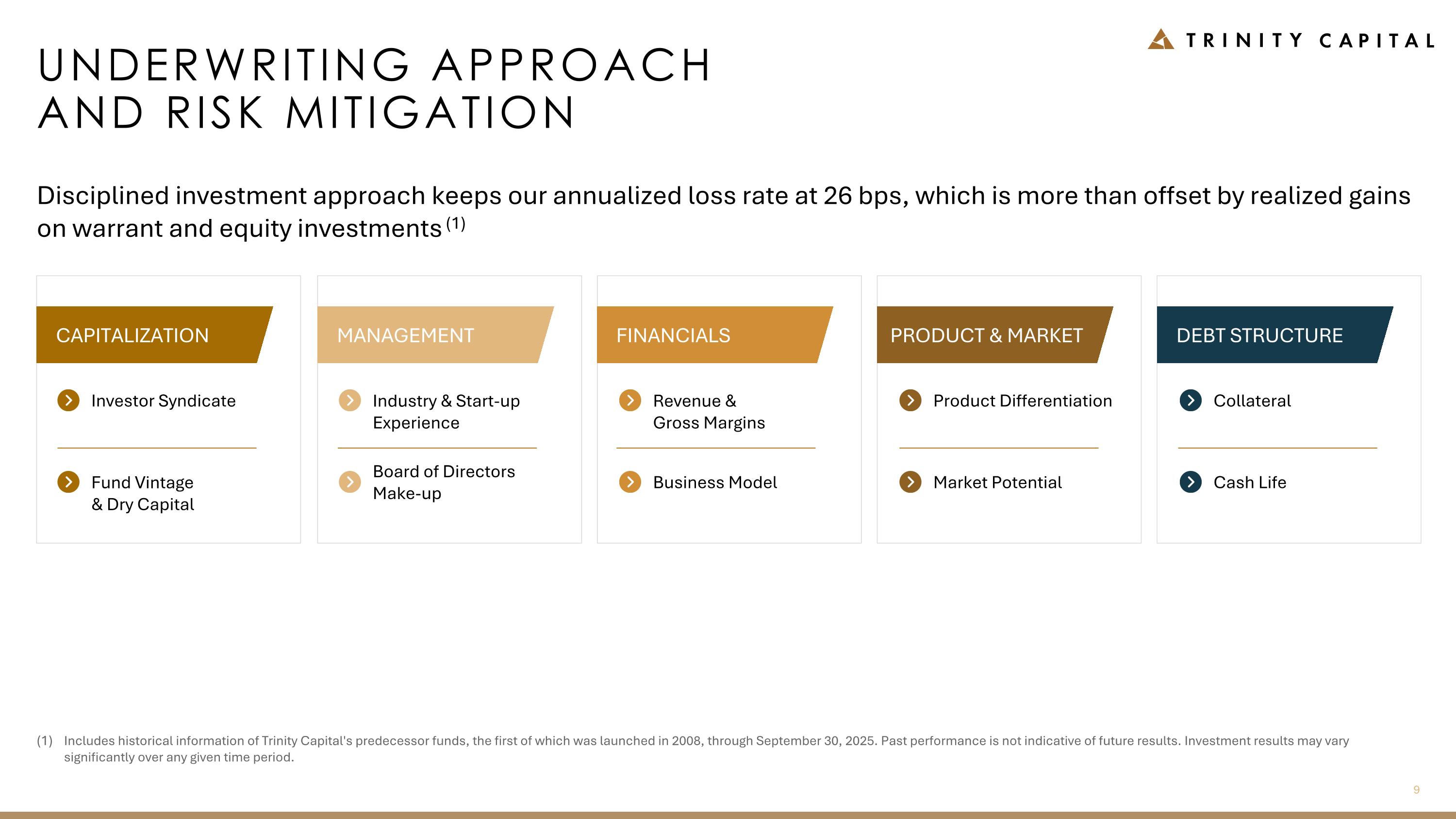
No. The answer is no. The portfolio is incredibly granular and diversified, very little exposure to anything consumer whatsoever. Anything that is consumer is very sticky, has strong retention of customers, and we have a very high mark for any kind of consumer deal to get to the finish line here. The portfolio remains incredibly stable with 99% of it performing. We're focusing on one individual credit out of over 100 here, but historically, our loss rate has remained very low with our realized gains offsetting all losses and providing some incremental upside to investors. We don't see any trends that would reflect any change from our historical performance over nearly 20 years on that loss rate.
Yes. Specifically on 2 items that you called out, our asset-based lending is focused on B2B receivables. Those are some of the highest performing financings in the portfolio. With respect to consumer, 2.4% at fair value of our portfolio is what we would classify as consumer products and services. So, very low exposure to consumer.
Operator
Our next question comes from Finian O'Shea with Wells Fargo Securities.
Speaker 9
Kyle, it sounded like we're still pretty upbeat on growth. Can you talk about the split between the BDC issuing in the market, secondary ATM, and so forth versus the RIA? Should we expect the BDC had a pretty good bit this past quarter? Share prices across the industry are also lower. So, seeing if you think that it's as attractive in the context of what you're seeing in the origination pipeline?
Yes. I'll start at the end there. The pipeline is exploding, where we deal, which is late-stage VC-backed companies heading towards an IPO or liquidity event into the lower middle market, $3 million to $15 million of EBITDA sponsor-backed. This market is robust and growing. Private credit companies who have raised too much money and have to deploy too much money are focused on middle market and upper middle market; it's just wide open, and we are seeing a really robust pipeline right now in our space. As far as capital raising goes, everything comes down to earnings per share, EPS, and when we talk about and we meet twice a week, our executive team and FP&A group on how we're going to capitalize and raise capital to meet the deployment needs that our business has. It all comes down to EPS and making sure we don't dilute shareholders. I mean I'm one of our largest shareholders of Trinity, our executive team and every single person in our company owns Trinity shares. We have no incentive to dilute shareholders. It's always a combination of equity issuances at the BDC level, downstreaming assets into our new funds that we've set up with a huge emphasis on raising third-party capital, which we can generate new management fees, incentive fees, and then the more permanent capital vehicles or permanence we set up. Our RIA has NAV growth and NAV accretion because we can value those long-term income streams. It's just icing on the cake for our shareholders. We're hyper-focused on EPS to make sure it's consistent. We have been working for a couple of years now on building that foundation to see it grow with our managed fund business, and we're scaling and executing on that plan. It's an exciting time for us.
Speaker 9
Just a follow-up on the growing pipeline. Managers in the industry have mixed feelings. Some are more hopeful about a recovery, but overall, there's not much excitement. To be fair, we haven't heard from all our venture peers yet, so there could be more developments on the life side or tech front. Are you observing any trends, such as an increase in late-stage growth or equipment finance compared to asset-based lending or sponsor finance?
So, we've got 5 different verticals, and it's becoming more and more balanced across those verticals. People still think of us as a venture debt business. We're not just a venture debt business, that's about 25% of our deployment. We have a huge emphasis on equipment right now. We're seeing more CapEx needs for U.S.-based companies who are manufacturing their goods here. We're seeing more needs for asset-backed lending for companies that are disrupting the legacy financial sector. We are seeing more of these lower middle-market companies get picked up and bought, and there's a need for financing there. We've been diversifying into complementary segments of the market. There's no concentration in any one of our verticals right now. It's pretty spread out, and the portfolio is looking more spread out each quarter.
Operator
Our next question comes from Sean-Paul Adams with B. Riley Securities.
Speaker 10
It looks like nonaccruals were relatively flat quarter-over-quarter, but the overall rankings for the watch and defaults within the portfolio went down by approximately half. Can you just share a little bit more color about any changes in the portfolio health for those companies?
Yes. I mean, thanks. That was noted on an earlier question. Nonaccruals were consistent. The watchlist credits dropped significantly compared to prior quarter. We saw movement both up and down. The current nonaccrual includes an investment that was prior on watch. Two other investments were promoted out of the watch list as they raised capital and continued to improve their performance. Overall, we think the health of the portfolio is as strong as ever. The credits on the watch list are the ones we're obviously working most actively, but seeing fewer members in that club is definitely a good thing.
Operator
We'll go next to Christopher Nolan with Ladenburg Thalmann.
Speaker 11
What's the plan on the leverage ratio going forward, up or down?
Plan is down for a variety of reasons. Right now, we utilize it and kind of scale it up as we load up on deals and then downstream them into our new funds that we're setting up. But long-term, our ability to generate new income via the RIA gives us the ability to lower that leverage ratio. We're not trying to maximize returns. We can ratchet that leverage up and generate better earnings per share, but that's not the plan. The plan is to lower the leverage, create ample liquidity so we can be opportunistic at the right time and get the proper ratings that will give us the ability to lower our cost of debt capital. Our off-balance sheet growth and activity really gives us that ability to lower that leverage ratio over time.
Speaker 11
Now the off-balance sheet vehicles, and you guys are not the only ones who do this, but things such as an SLF, I mean, isn't that just sort of like second lien type of risk there? I mean because you're in equity in a levered vehicle, inside a levered vehicle.
No. I get that; that's how some BDCs do JVs to ramp up leverage. That's not what we're doing. We're raising third-party capital that we can utilize and co-invest alongside the loans we're funding and then charge management fees and incentive fees. We have very little equity in any of those deals. Some we don't have any. We are managing a fund business where we can offer investors who can't hold a public security. It gives us the ability to offer up our manufacturing to a different subset of investors and generate income by doing so.
Speaker 11
And final question for these off-balance sheet vehicles, are they set up like a fund where investors can call their investments at some point?
Right now, no. We have a couple of separately managed accounts and a perpetual private BDC that is aimed at the wealth management segment. Those are the three funds we currently have. This allows us to raise funds as needed. We are also looking into establishing a larger institutional co-investment fund and are in the process of fundraising while closing out our third SBIC fund, which primarily targets banks and investors who have previously succeeded with our two earlier SBIC funds. This will take various forms to ensure we can invest alongside them.
Operator
It appears we have no further questions at this time. I will now turn the program back to Kyle Brown for any additional or closing remarks.
Great. On behalf of the Trinity Capital team, thank you for joining us today. We appreciate your continued interest and investment in Trinity Capital. We look forward to sharing our fourth quarter and 2025 results on our next earnings call in February. Have a great day. Thanks.
Operator
This does conclude today's program. Thank you for your participation. You may disconnect at any time.