Operator
Good day, and thank you for standing by. Welcome to UGI Corporation Q2 2026 Earnings Conference Call. At this time, all participants are in listen-only mode. After the speaker's presentation, there will be a question and answer session. To ask a question during the session, you will need to press star 11 on your telephone. You will then hear an automated message advising your hand is raised. To withdraw your questions, please press star 1-1 again. Please be advised that today's conference is being recorded. I would now like to hand the conference over to your first speaker today, Tameka Morris.
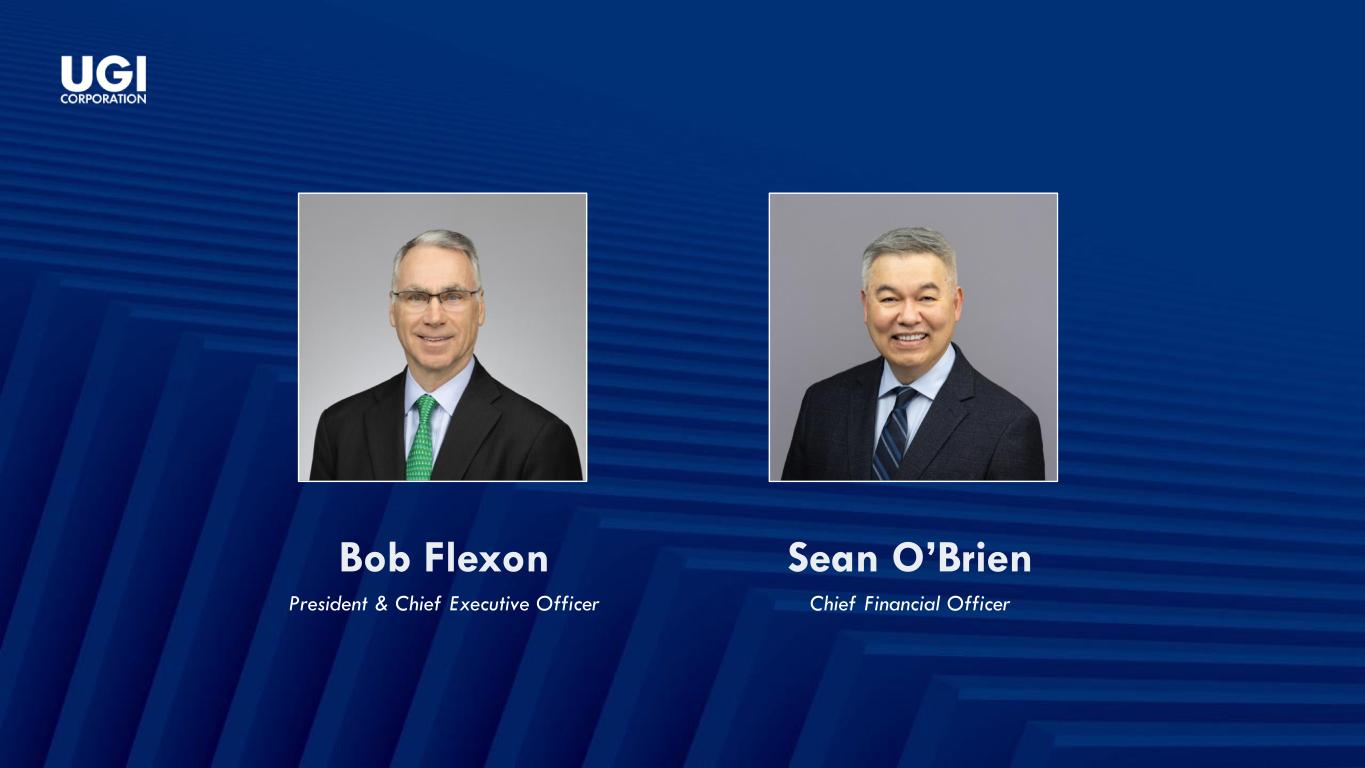
Good morning, everyone. Thank you for joining our fiscal 2026 second quarter earnings call. With me today are Bob Flexton, President and CEO, and Sean O'Brien, CFO. On today's call, we will review our second quarter financial results and key business highlights before concluding with a question and answer session. Before we begin, let me remind you that our comments today include certain forward-looking statements which management believes to be reasonable as of today's date only. Actual results may differ significantly because of risks and uncertainties that are difficult to predict. Please read our earnings release and our annual report for an extensive list of factors that could affect results. We assume no duty to update or revise forward-looking statements to reflect events or circumstances that are different from expectations. We will also describe our business using certain non-GAAP financial measures. Reconciliations of these measures to the comparable GAAP measures are available within our presentation. And with that, I'll turn the call over to Bob.
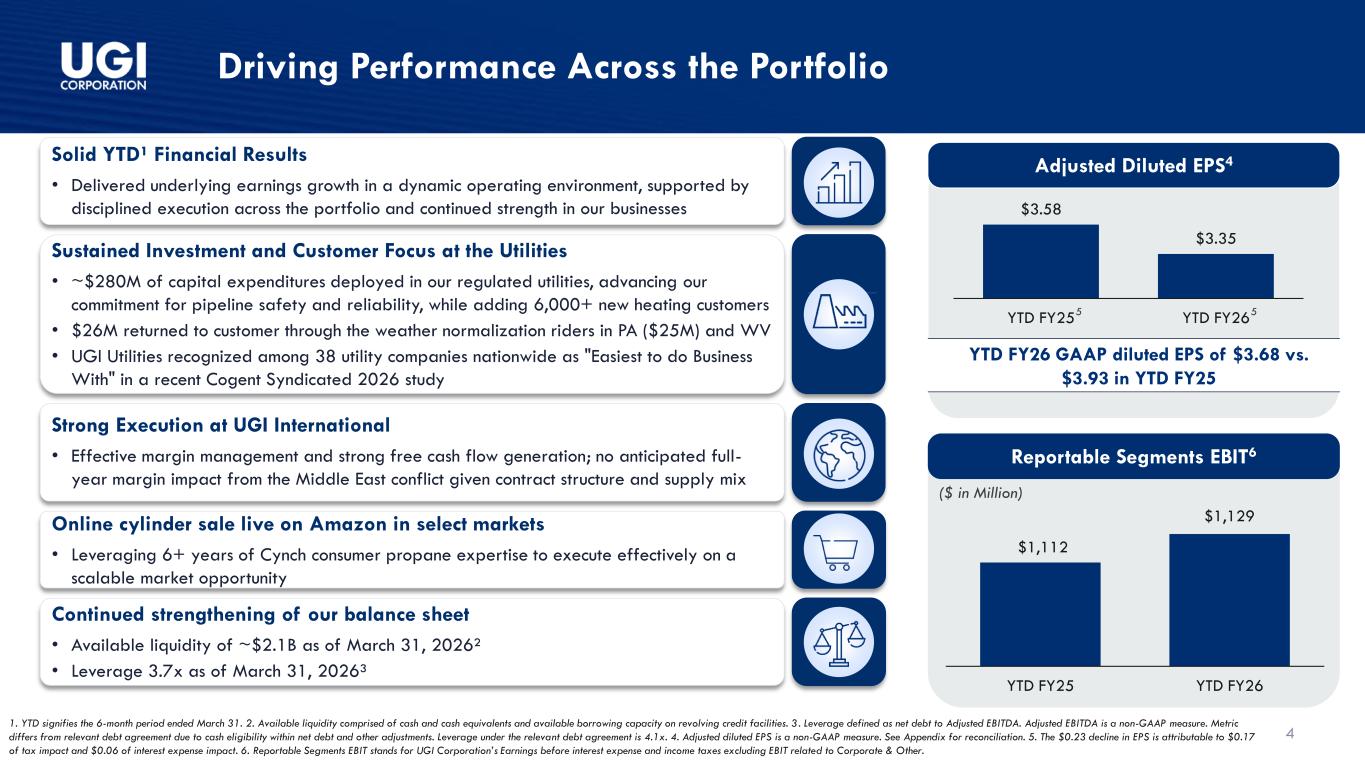
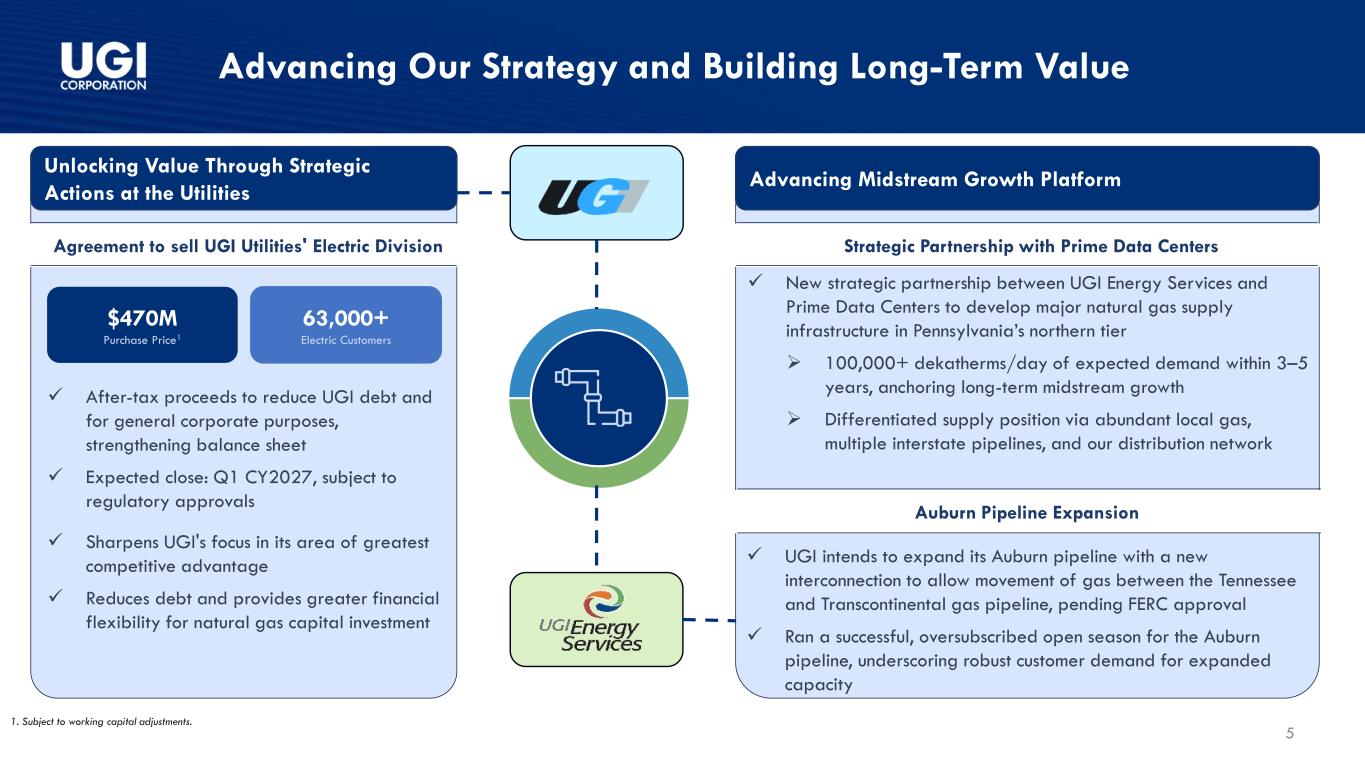
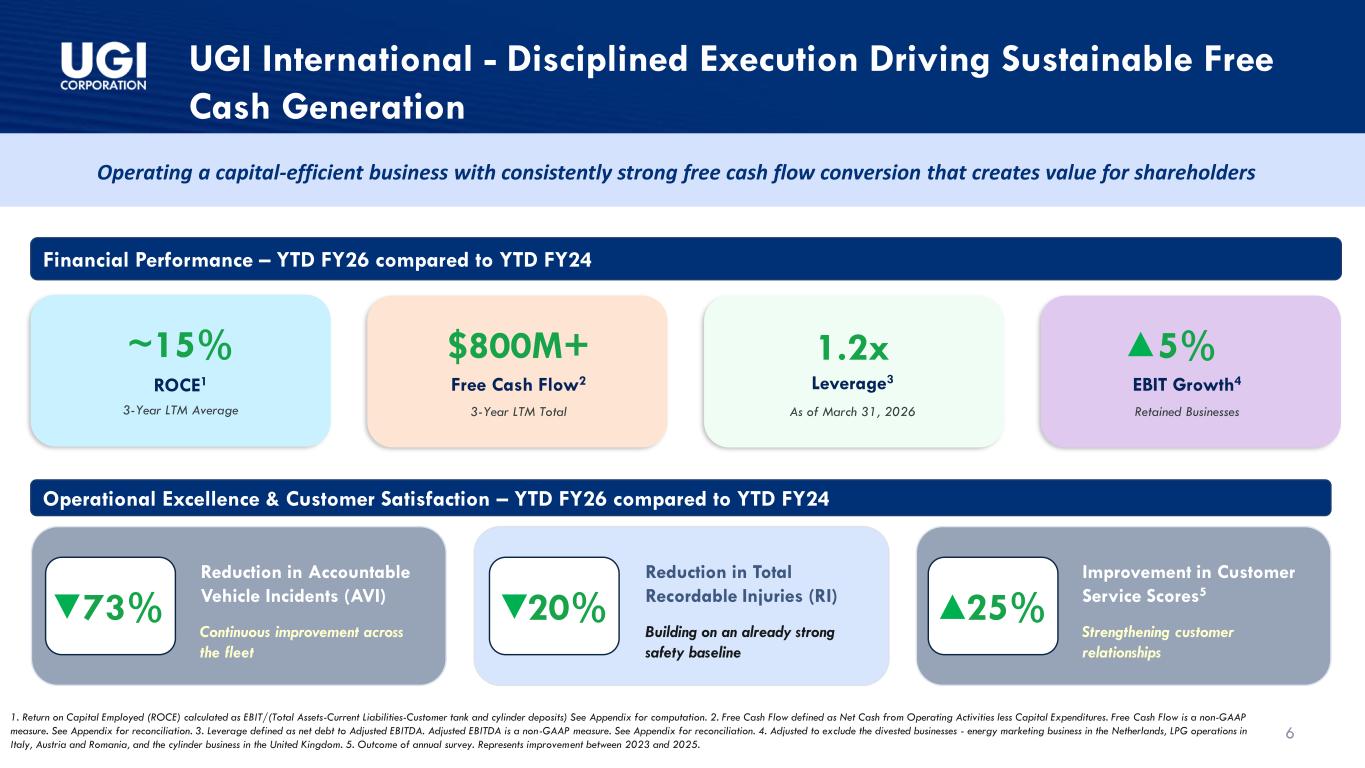
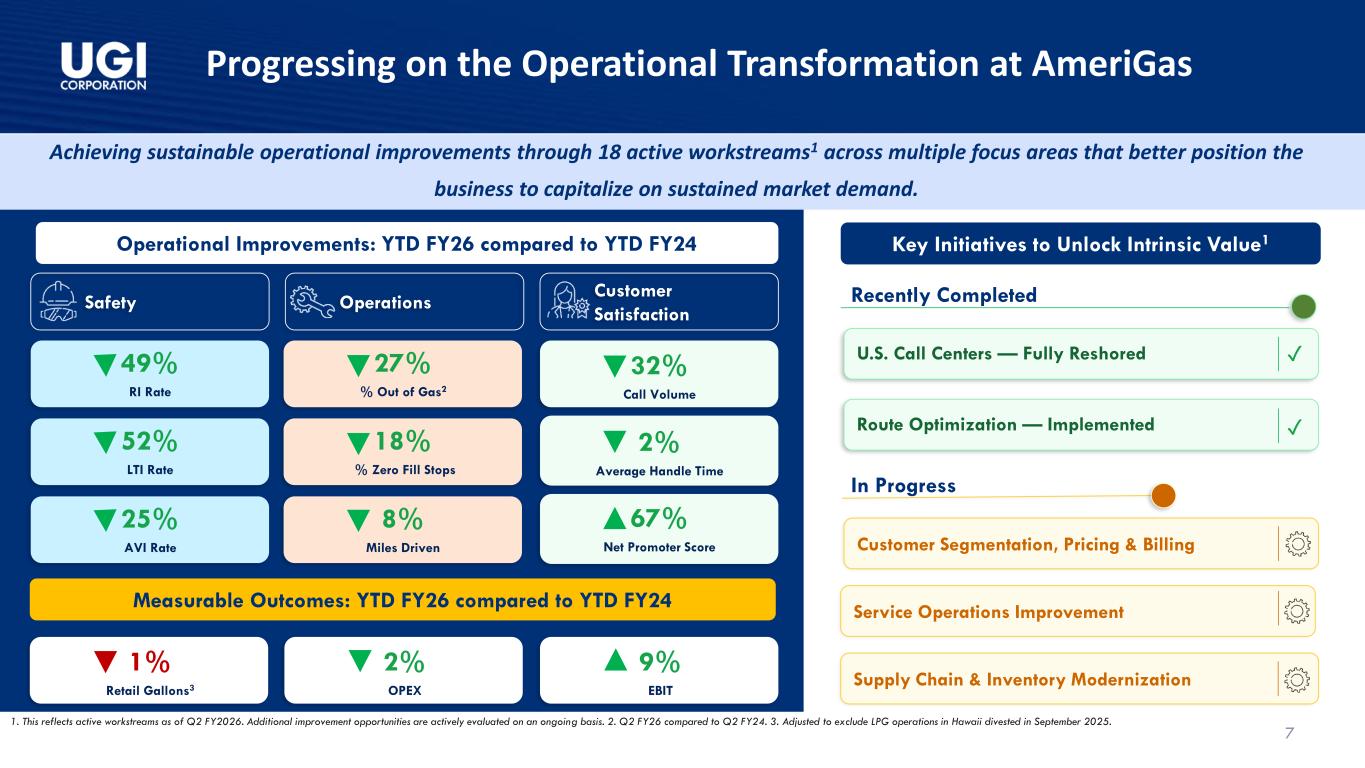
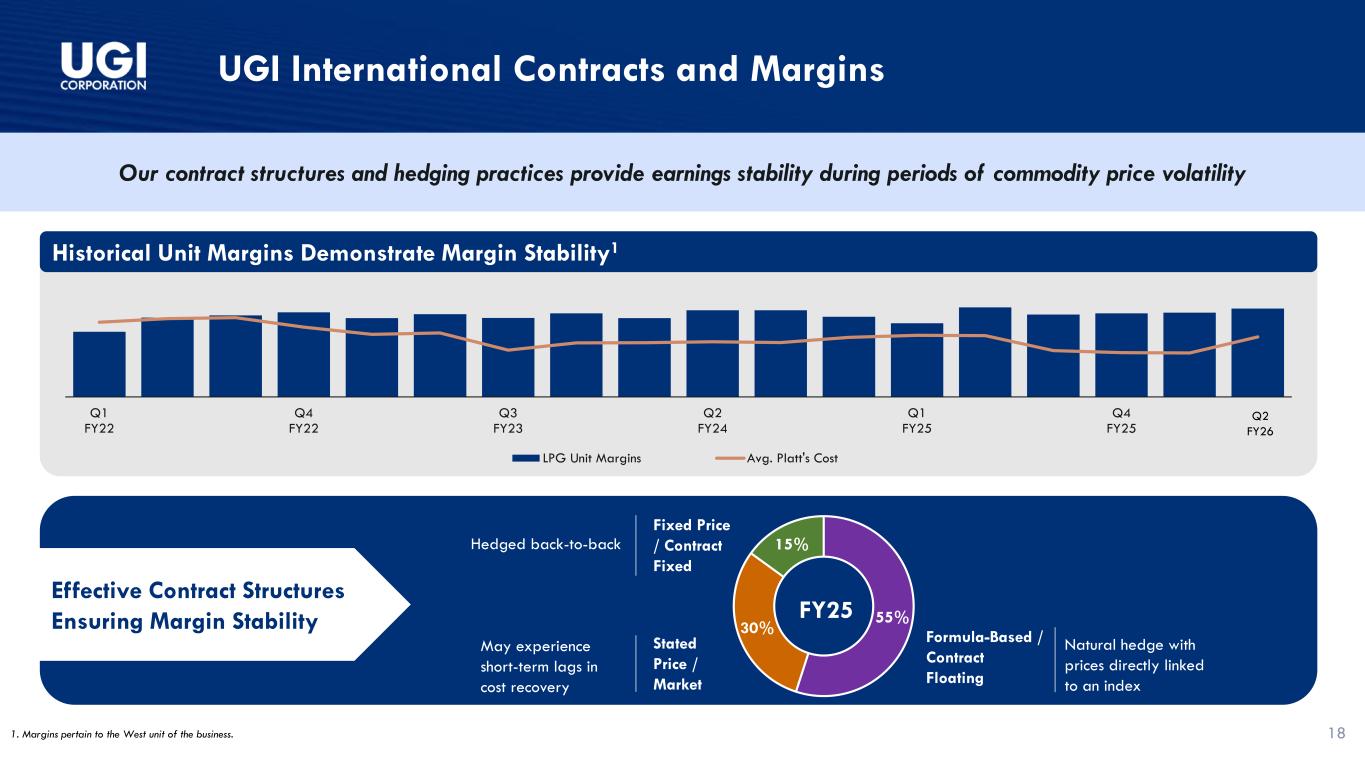
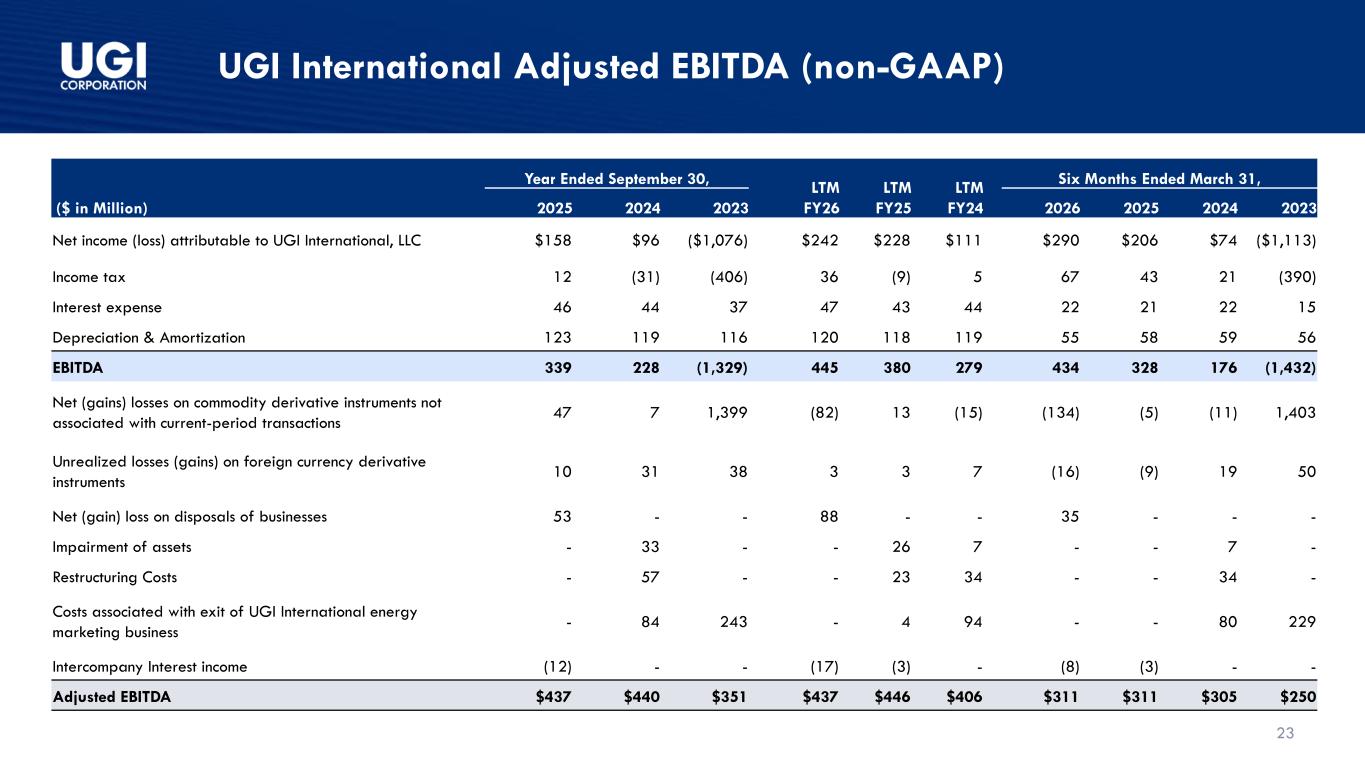
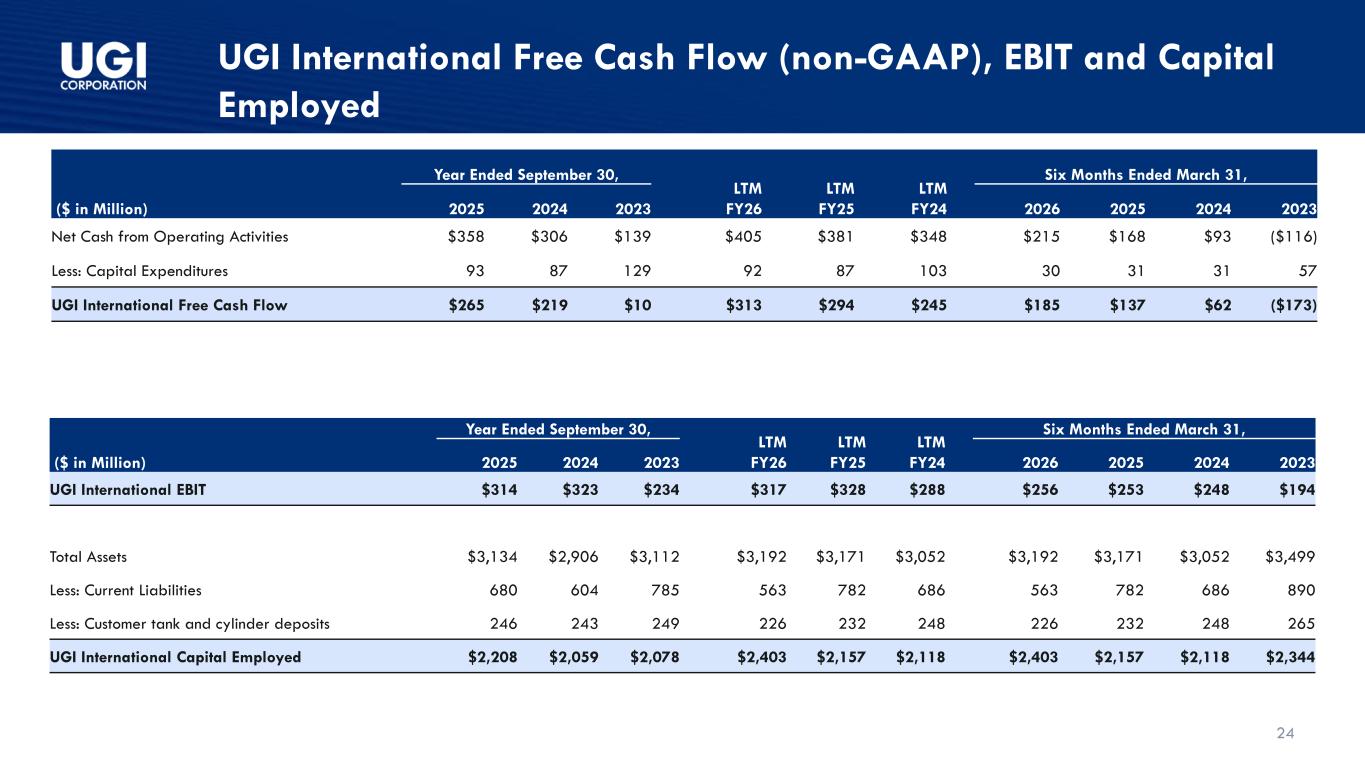
Thanks, Tamika, and good morning. Fiscal 2026 is shaping up to be a year of meaningful progress against the strategic priorities we laid out at the start of the year. Our natural gas businesses continue to anchor the portfolio, supported by strong customer demand and operational execution. We continue to have a robust pipeline of data center opportunities, much like the announcement of our partnership with Prime Data Centers. UGI International continues to demonstrate the strength of its business, generating strong free cash flow and effectively managing margins through a dynamic operating environment. Of note, we do not anticipate any full-year impact to margins or supply availability issues from the ongoing conflict in the middle east due to the nature of our sales contracts and our risk management hedging program the operational transformation at amerigas is delivering substantial measurable results and on target to set the business up for a successful heating season at the start of fiscal year 2027. our balance sheet ended the quarter with consolidated leverage below the targeted range of at or below 3.75 times. Sean will cover in more detail the leverage milestones we expect to achieve this fiscal year. Our year-to-date reportable segments EBIT is up $17 million over prior year, largely from higher gas base rates at our utilities and effective margin management at UGI International, which offset the impact of warmer weather in our global LPG service territories. At our utilities, we deployed approximately $280 million of capital year-to-date, advancing our commitment to pipeline safety, reliability, and modernization, while adding more than 6,000 new heating customers across our service territories. Through our weather normalization riders in Pennsylvania and West Virginia, customers were able to save 26 million dollars on heating bills this past winter. At Amerigas, we're excited that in select cities, our barbecue cylinders are now available online through Amazon. We are rolling this out in a phased approach across the markets where we currently operate Amerigas' cylinder home delivery service called Cinch, leveraging our established direct-to-consumer delivery infrastructure. Turning to the next slide, I want to spend a few minutes on several strategic actions that together reflect the deliberate execution of our long-term value creation strategy, sharpening our focus on natural gas and deploying capital into the most attractive growth opportunities we see in our service territories. First, subsequent to the quarter, we entered into a definitive agreement to sell our electric division at UGI Utilities. The transaction valued at approximately $470 million with further potential earnouts prior to working capital adjustments is expected to close in the first quarter of calendar 2027, subject to customary closing conditions and applicable regulatory approvals. The strategic rationale here is clear. the transaction sharpens UGI's focus in our area of greatest competitive advantage and the after-tax proceeds will be used to reduce UGI debt and for general corporate purposes, further strengthening the balance sheet and providing greater financial flexibility for natural gas capital investment. We're excited to announce the strategic partnership between UGI Energy Services and prime data centers to develop major natural gas supply infrastructure in Pennsylvania's northern tier. Under a purchase and sale agreement, UGI Energy Services will sell prime property to build a proposed on-site gas fuel electric generation facility. UGI will retain the storage capacity and oil and gas rights associated with the property and is expected to supply the Dana Center with reliable, large-scale gas supply. Prime's natural gas demand is expected to exceed 100,000 decatherms per day within three to five years, a scale that underscores the importance of the project for the region's energy infrastructure. This partnership is a powerful example of how UGI's integrated natural gas platform platform, is uniquely positioned to support the next wave of energy demand. The northern tier of Pennsylvania offers direct access to locally produced natural gas and multiple redundant interstate pipeline pathways, a combination of supply, security, and infrastructure depth. And importantly, PRIME is one of many opportunities we are actively pursuing. Our team is in active conversations with numerous parties across the data center and large-load industrial space, with over 75 nondisclosure agreements directly related to potential future projects signed to date. While we don't expect that every one of those will translate into contracted opportunity, the breadth of inbound interest continues to be a strong signal of the demand environment our service territories and UGI's position to be a strategic partner for large-scale natural gas infrastructure. Lastly, during the quarter, we ran a successful oversubscribed open season for the projected Auburn pipeline expansion, which is pending FERC approval. The level of customer demand validates our expansion strategy. Taken together, these announcements provide additional avenues to creating long-term value, sharpening focus, strengthening the balance sheet, and deploying capital where the demand exists. Now let me spend a few minutes on UGI International because this segment really embodies what discipline execution looks like over the long term. When you look at the financial and operational profile of this business, there are several metrics worth highlighting. First, the return on capital employed of approximately 15% indicates that we're earning attractive returns on the capital invested in this business, reflecting the quality of our market positions, a thoughtful approach to capital allocation, and an operating model that has been refined over many years to drive efficiency at every level. We've also continued to expand operating margin, drive cost productivity, and improve on already strong safety and customer metrics, areas where this team has long set a high bar and continues to raise it. Free cash flow generation is equally important, and over the past three years, UGI International has generated more than $800 million in free cash flow. free cash flow that has been used to fund dividends and shareholders investing growth initiatives in our natural gas line of business and maintain a strong balance sheet with net leverage consistently below two times this reflects discipline capex working capital rigor and the structural cost improvements this team has driven consistently over time together these metrics describe a business that is efficient generate strong returns on the capital it deploys and built to perform through changing economic cycles turning to slide seven the operational transformation is fully underway at amerigas and making a significant difference we continue to advance many active improvement work streams across six focus areas with measurable improvements compared to fiscal 2024. over the past two years we have reduced recordable incident and lost time injury rates by roughly 50 percent in operations the percentage of zero fill stops and out of gas events are down considerably while we've become more efficient in the number of miles driven to serve customers and when i think of customer satisfaction our customer service call volumes are down 32 percent while our net promoter score is up 67 percent. Significant progress when compared to fiscal year 24. A major milestone on our turnaround for Amerigas is the full reshoring of our call center to the U.S. at the end of the second quarter. We now have over 250 agents dedicated to serving customers and regional teams that are closer to our customers and can better understand and respond to our customers' needs. This was a multi-quarter effort, and we executed it on schedule, on budget, and well ahead of the upcoming heating season. Our route optimization program is fully implemented, and the productivity benefits are showing up in miles-driven and on-time delivery metrics. Although we've seen strong improvements, our established PMO team remains focused on efforts to improve our cylinder or exchange business, customer segmentation, pricing and billing, service operations improvement, supply chain optimization, and inventory modernization. Taken together, the operational transformation at Amerigas is delivering tangible results with volume stabilized and a 9% improvement in EBIT over the two-year period. And with that, I'll hand the call over to Sean to walk through our financial results for the quarter and year-to-date in more detail.
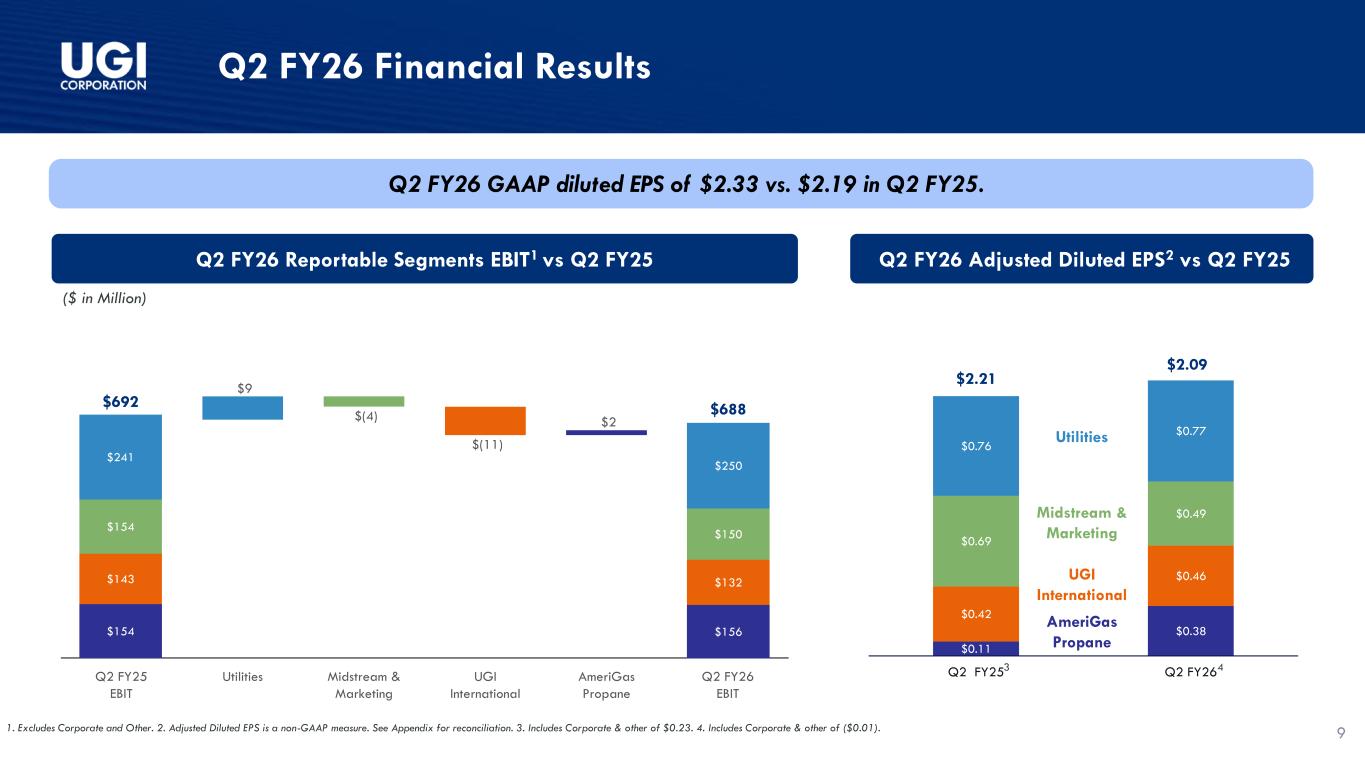
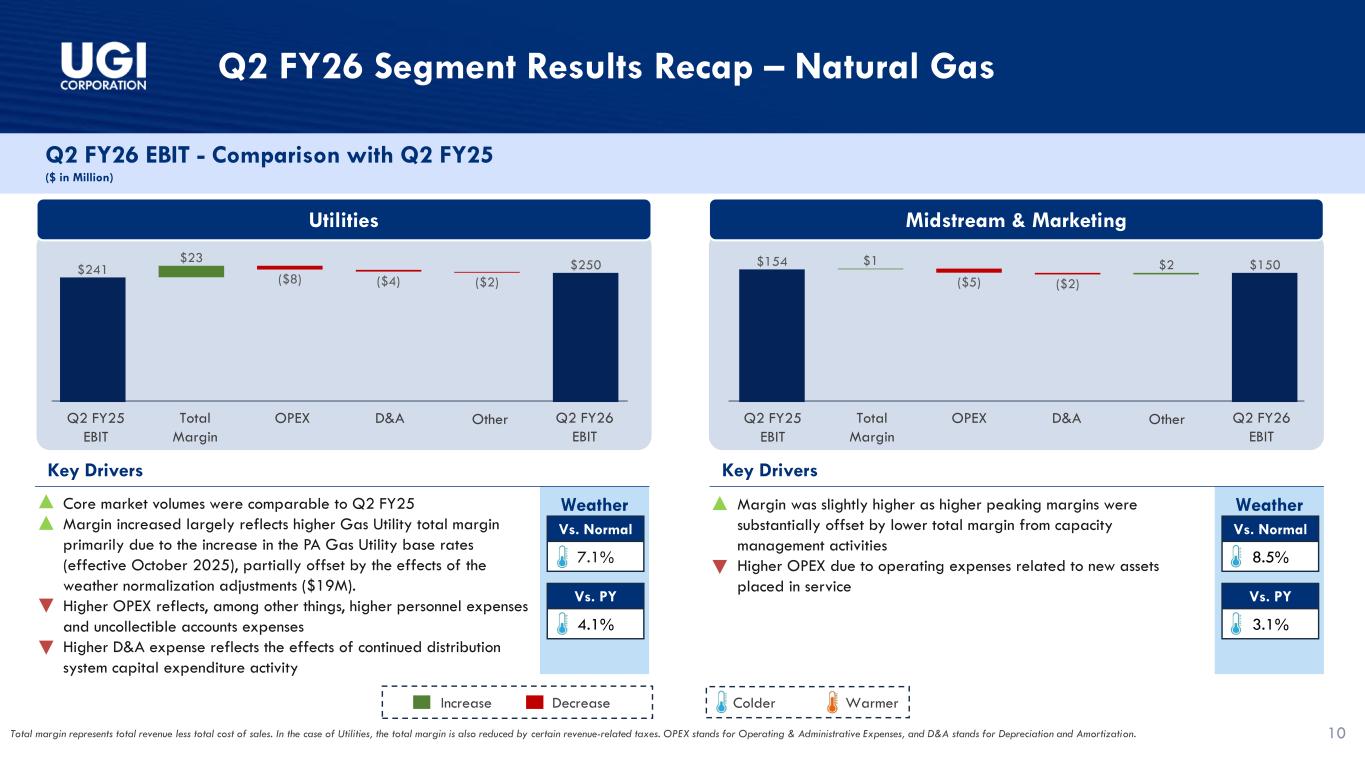
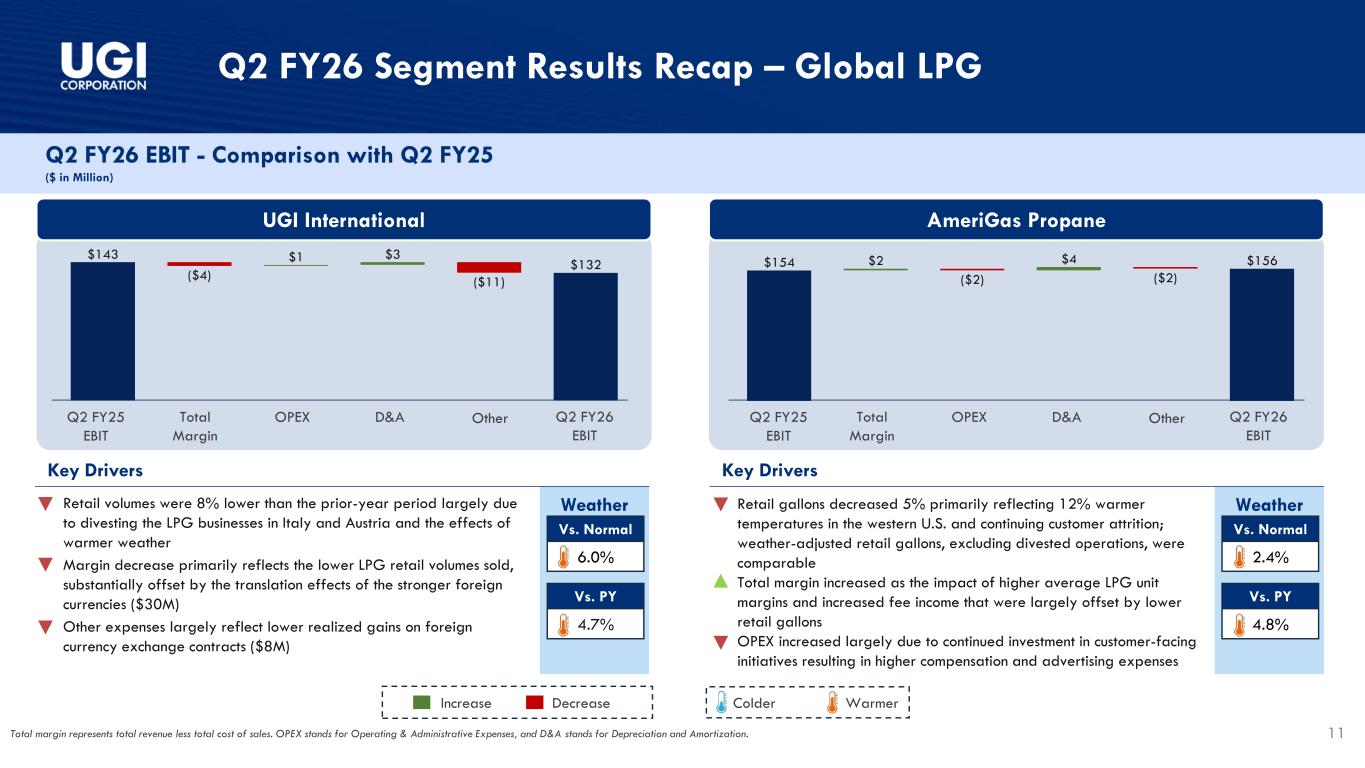
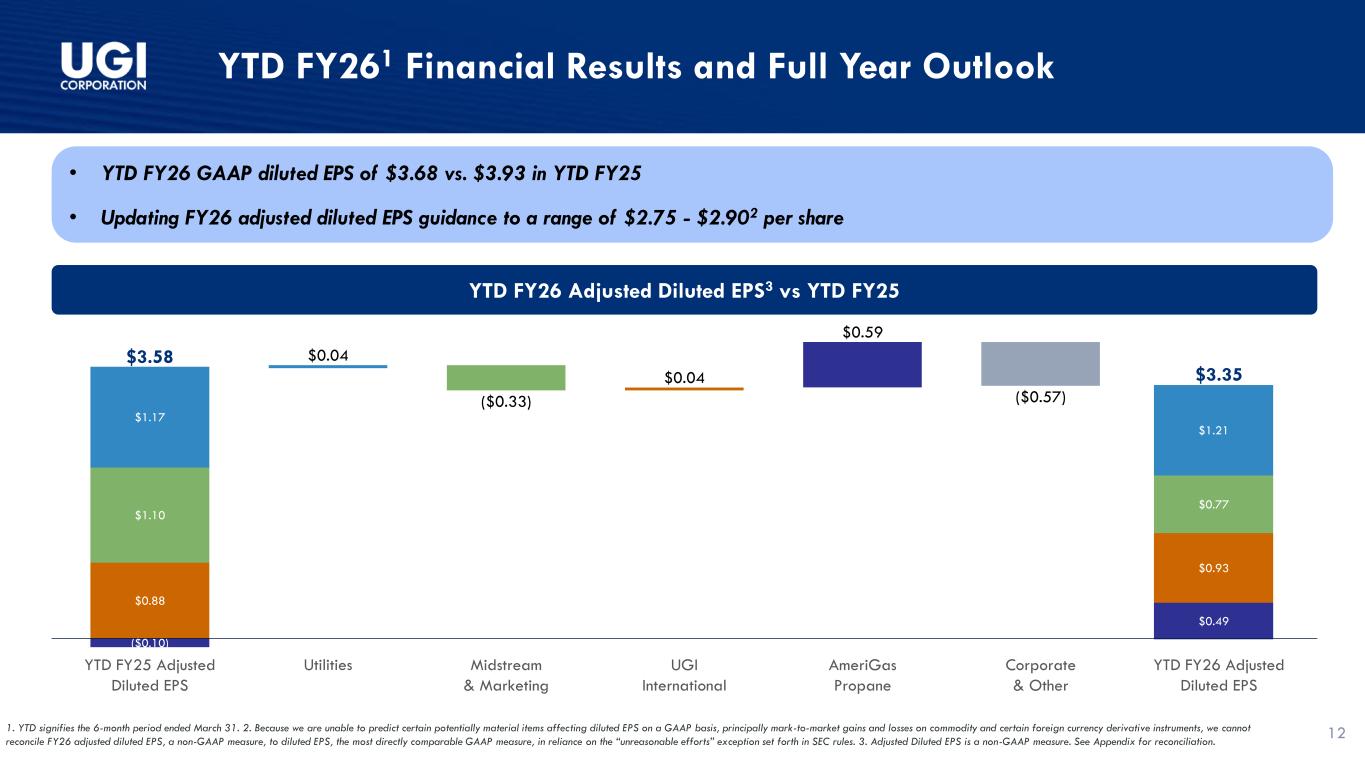
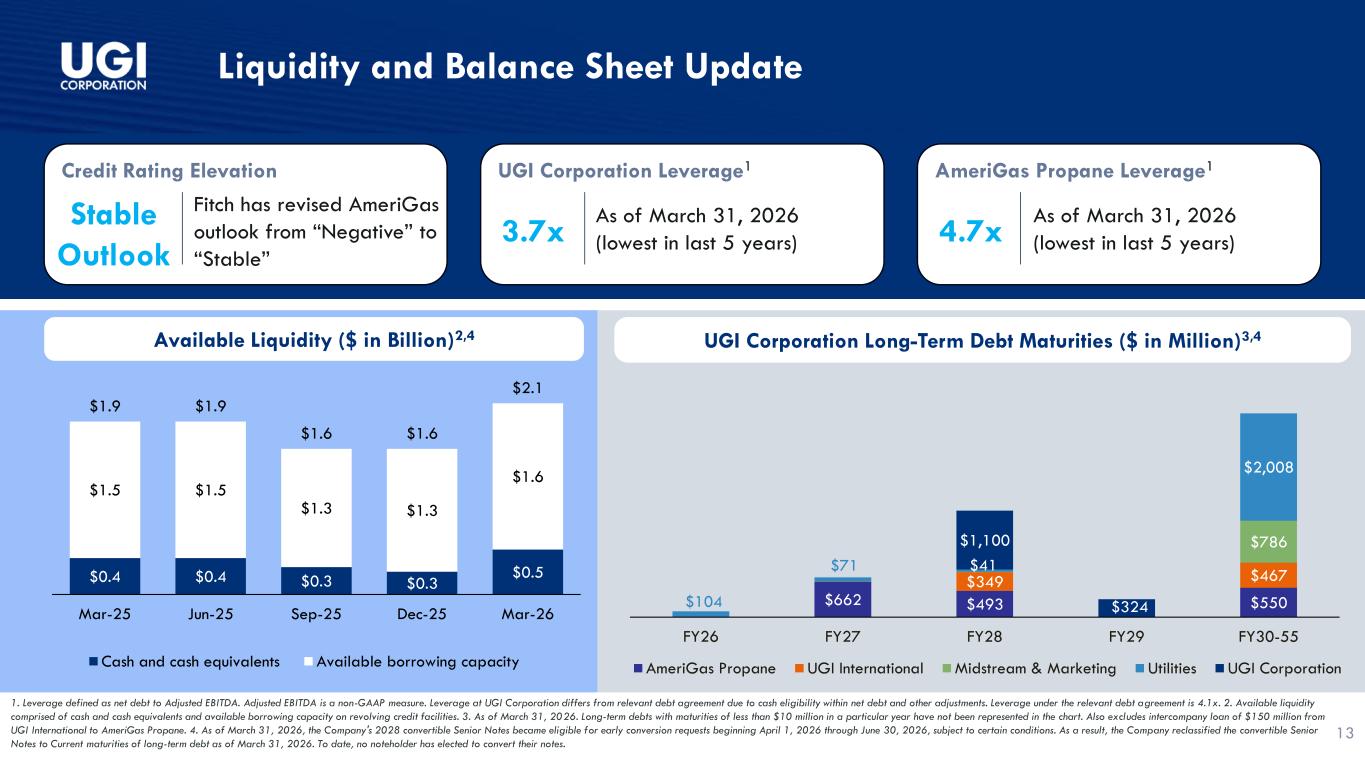
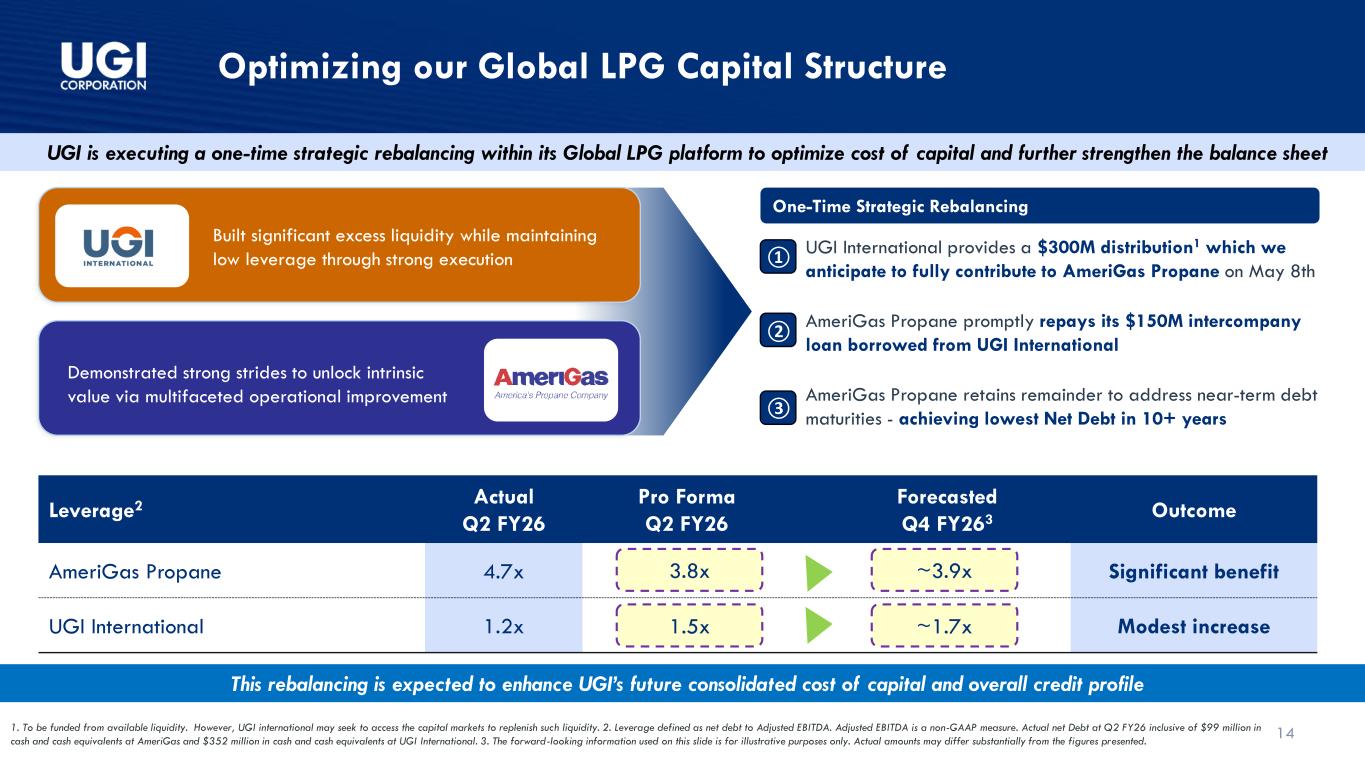
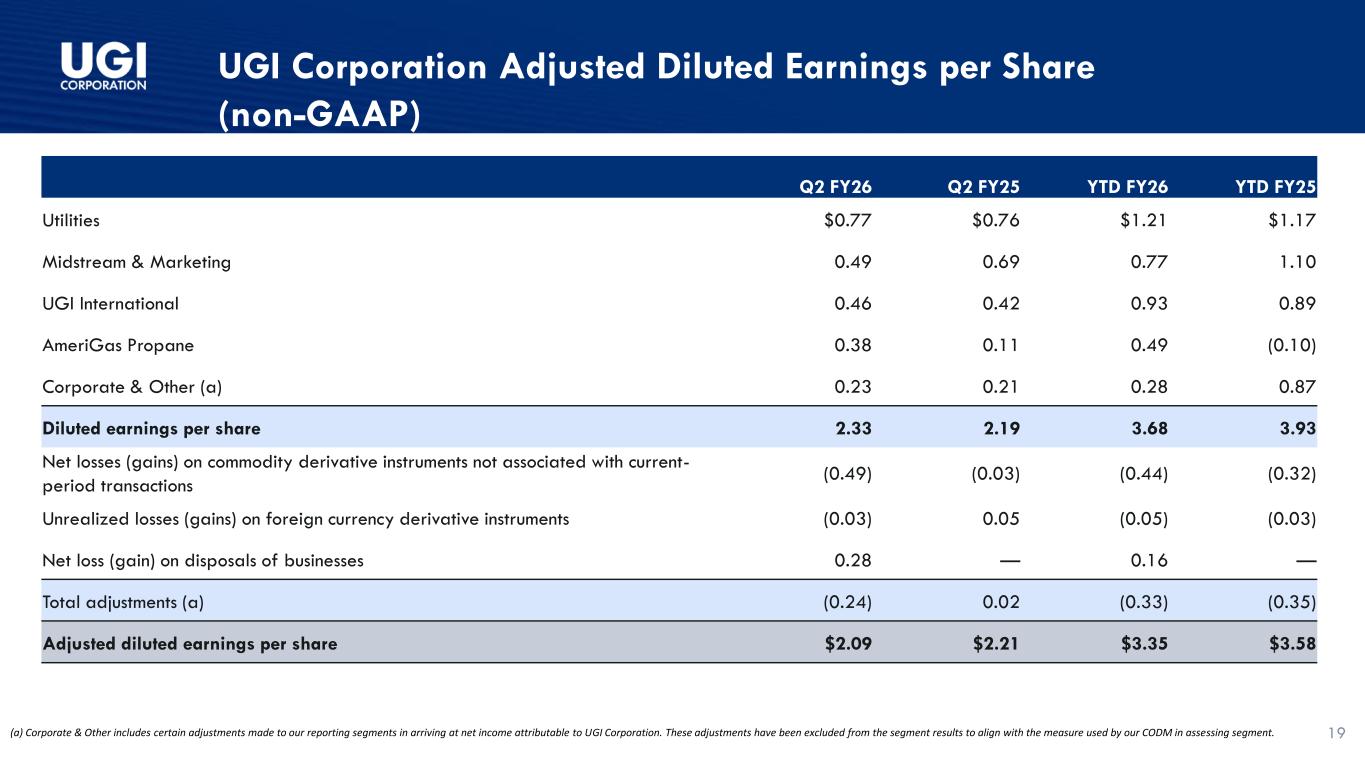
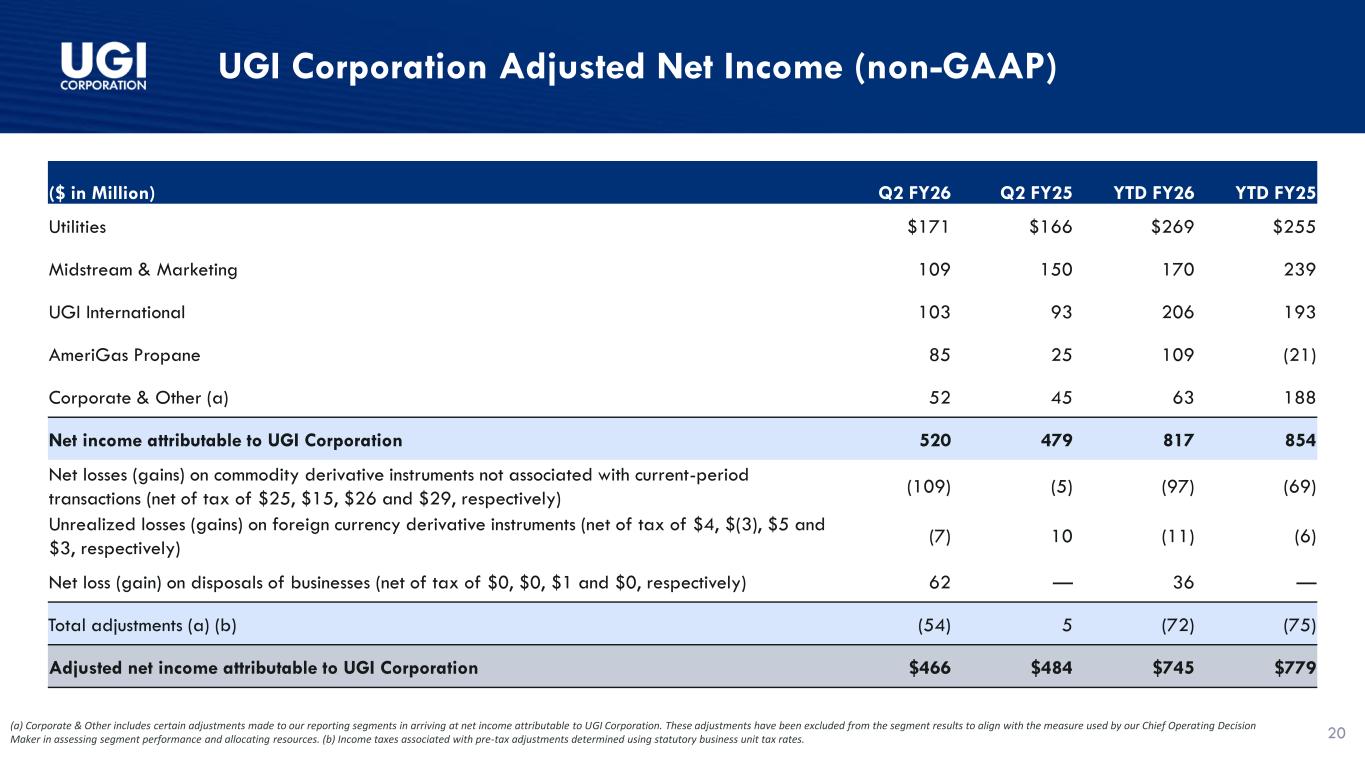
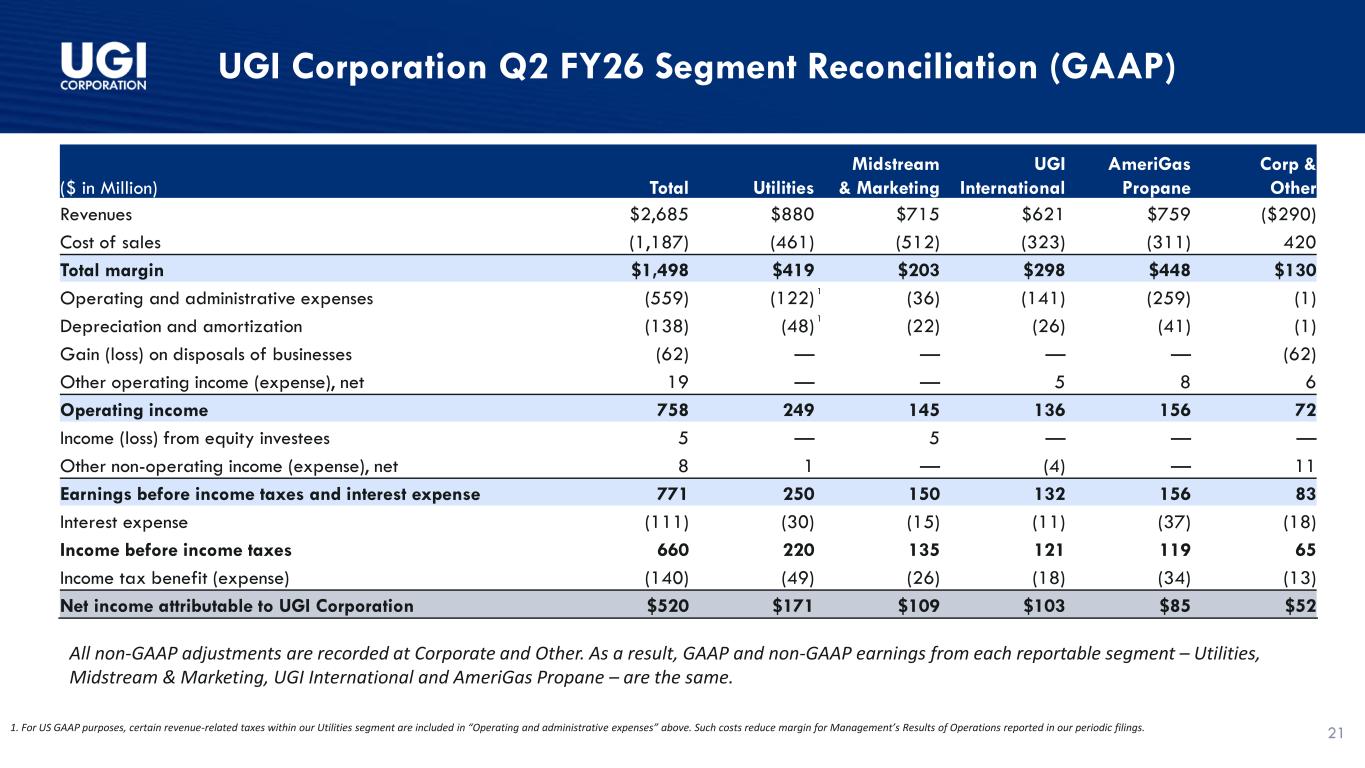
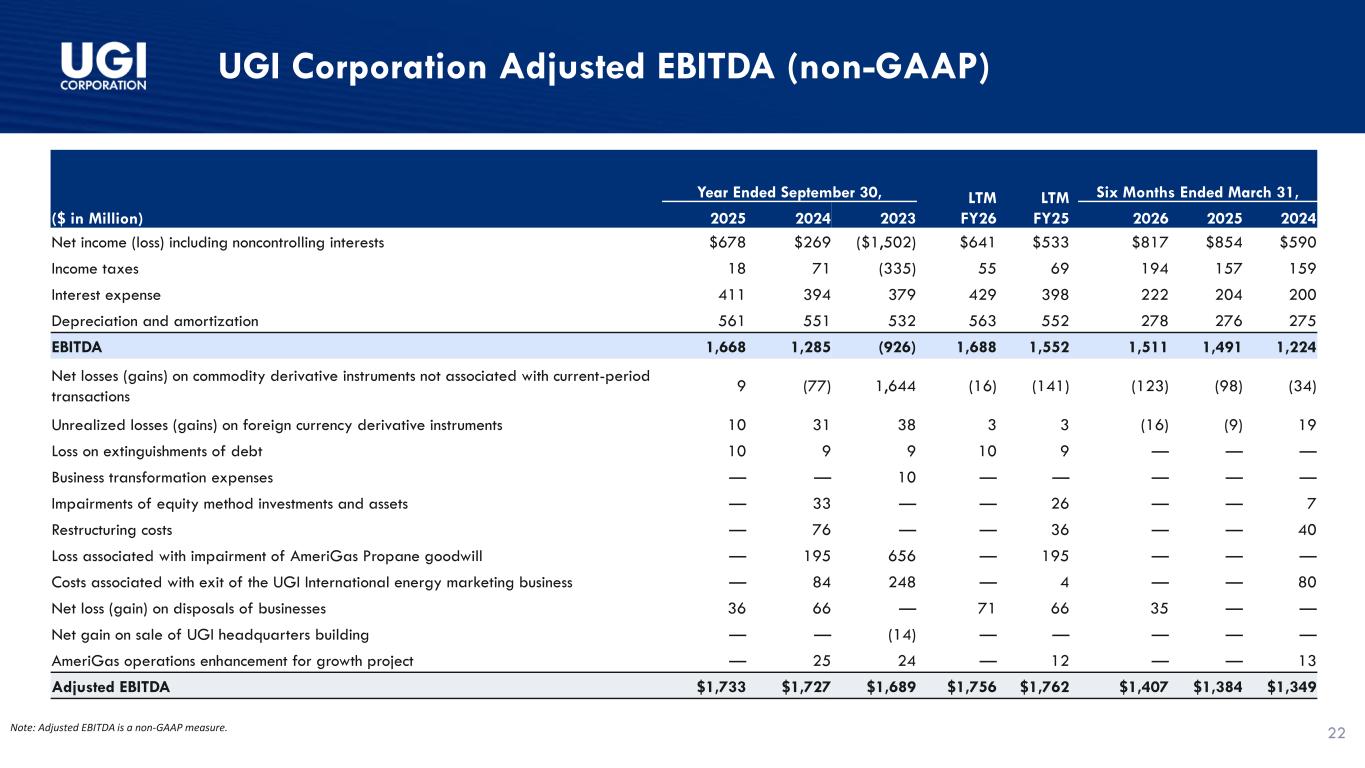
Thanks, Bob, and good morning. For the fiscal 2026 second quarter, UGI delivered total reporter segments EBIT of $688 million in comparison to $692 million in the prior year period. This performance was largely driven by higher base rates at our Pennsylvania gas utility and effective margin management across our global LPG businesses in a quarter that was warmer than the prior year across their respective service territories. I want to highlight the strong operational execution by our natural gas teams who faced periods of colder weather in their service territories and delivered safe, reliable service for our customers. Turning to EPS, adjusted diluted EPS was $2.09 cents compared to two dollars and 21 cents in the prior year period as we previously anticipated the year-over-year decline in adjusted eps was driven primarily by the absence of investment tax credits realized last year and higher interest expense turning to the drivers of each segment's results first the utilities delivered ebit of 250 million up 9 million over the prior year Total margin increased $23 million, primarily due to the effect of higher gas-based rates that went into effect in Pennsylvania at the end of October 2025. As designed, our weather normalization adjustment mechanism mitigated approximately $19 million of the weather impact this quarter, providing bill stability for our customers. Operating and administrative expenses increased $8 million, reflecting higher personnel costs and uncollectible account expenses. Depreciation and amortization rose $4 million on our continued distribution system capital investment. At midstream and marketing, EBIT was $150 million for the quarter in comparison to $154 million in the prior year. While heating degree days were 3% colder than the prior year, this winter we saw longer durations of cold weather where the team was focused on reliably serving its peaking customers, who pay a fixed demand charge regardless of usage, driving greater earning stability in this business. Next, operating and administrative expenses were higher year-over-year, primarily due to new assets placed in service in the prior year. In the global LPG businesses, starting with UGI International, EBIT was $132 million in comparison to $143 million in the prior year. Retail volumes were 8% lower, largely due to divestitures of the LPG businesses in Italy and Austria and the impact of warmer weather. Total margin was down $4 million, as the lower retail volumes were substantially offset by the translation effects of stronger foreign currencies, which contributed approximately $30 million. Operating and administrative expenses were comparable with the prior year period, as the impact of the aforementioned divestitures, as well as lower distribution expenses, were largely offset by the translation effects of the stronger foreign currencies of approximately $15 million. Other income declined $11 million, and this included approximately $8 million of lower realized gains on foreign currency exchange contracts. Lastly, while we are closely monitoring the current geopolitical situation involving Iran, the structure of our LPG contracts with customers, combined with proactive actions taken by our team, gives us confidence that we do not anticipate any impact to margin or supply availability constraints. Importantly, the underlying business continues to perform well from a margin management and cash generation standpoint. Moving to Amerigas, EBIT was $156 million, up $2 million versus the prior year. Retail gallons decreased 5%, primarily due to temperatures in the west that were warmer than prior year period, as well as continuing customer attrition. For the quarter, while weather in the eastern region of the U.S. was comparable on a year-over-year basis, temperatures in the west were 12% warmer than the prior year period, impacting total volume sold. On aggregate, on a weather-adjusted basis and excluding the effect of the Hawaii divestiture, retail gallons were comparable to the prior year period. Total margin increased $2 million as higher average LPG unit margins and increased fee income were largely offset by the lower retail gallons. OPEX increased $2 million from the continued investment in customer-facing initiatives which resulted in higher compensation and advertising expenses turning to our year-to-date results adjusted diluted eps for the first half of fiscal 2026 was three dollars and 35 cents in comparison to three dollars and 58 cents in the prior year period ugi delivered core even growth largely driven by higher gas base rates at our utilities which more than offset the impact of warmer weather in our global LPG service territories and the previously announced LPG divestitures. This EBIT growth was offset by higher income tax expense reflecting the absence of investment tax credits realized last year and higher interest expense. As we turn to the full year outlook, we are revising our fiscal 2026 adjusted diluted EPS guidance range to $2.75 cents to $2.90. This primarily reflects lower expected earnings contributions from our midstream and marketing segment, where there are delays in planned growth investments and lower production volume in the Appalachian region. Also, to a lesser extent, the pace at which operational improvements at Amerigas are translating into earnings is slower than originally anticipated. The fundamentals of these businesses remain intact, and as Bob discussed earlier, the recent announcements and progress on the operational transformation underscore our confidence in the long-term growth trajectory of this business. Moving to the balance sheet update, we continue to make strong progress against our balance sheet objectives. Available liquidity at the end of the quarter was approximately $2.1 billion, an increase of approximately $200 million over the prior year quarter. Net leverage at UGI Corporation was 3.7 times at the end of the quarter, which was the lowest in five years and below our targeted level of at or below 3.75 times. At Amerigas, we closed the quarter with net leverage of 4.7 times, representing a meaningful decrease compared to recent years and the lowest in five years. On the credit front, we are pleased that Fitch revised the Amerigas outlook from negative to stable during the quarter, further validating the operational and financial improvements that are underway, and this builds on the Moody's outlook that was revised to positive last quarter. Turning to the next slide, I want to walk through a key strategic action that we are taking to optimize the capital structure across our global LPG platform. We are executing a one-time rebalancing across UGI International and Amerigas designed to optimize the consolidated cost of capital, improve credit profiles, and further strengthen the balance sheet. Specifically, UGI International, which ended the quarter at 1.2 times net leverage and with approximately $900 million in liquidity, will pay a special one-time dividend of $300 million to UGI Corporation using available liquidity. Those funds will be immediately contributed to Amerigas as a capital contribution, which Amerigas will use to retire outstanding indebtedness, including approximately $150 million of intercompany loans from UGI International. This rebalancing accomplishes three things. First, it leverages the interest rate arbitrage between UGI International and Amerigas to materially reduce our consolidated borrowing costs. Second, it significantly accelerates deleveraging at Amerigas, which is consistent with our objective of reducing the company's net leverage to sub-four times, while enhancing free cash flow and consolidated credit profile. Our expectation is that Amerigas will end fiscal 2026 with leverage below 4.0 times. Third, it unlocks investment capacity for growth opportunities within our natural gas businesses while maintaining a conservative credit profile. Taken together, the strategic actions we recently announced reflect a deliberate, disciplined approach to capital allocation that strengthens the foundation of the company and supports our long-term EPS compound annual growth rate target of 5% to 7% between fiscal year 24 and fiscal year 29. Now, let me turn the call over to Bob for his closing remarks.
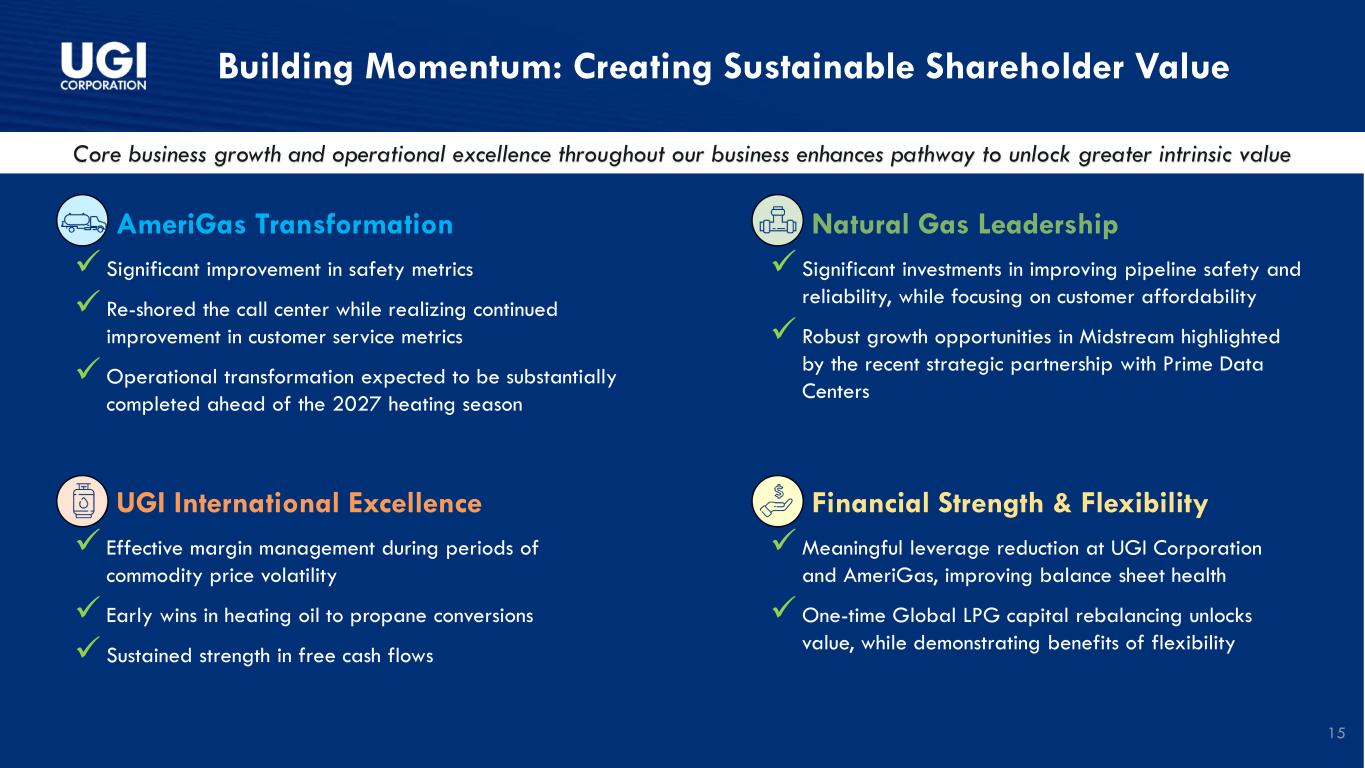
Thanks, Sean. Before we open the line for questions, I want to leave you with several key takeaways. First, our year-to-date results reflect the continued execution event ahead of the prior year. Our natural gas businesses are performing well, supported by robust customer demand, and our weather normalization mechanisms are working as designed to provide bill stability for our customers. Second, the operational transformation at Amerigas is delivering measurable, sustainable results in safety, in operations, and in customer satisfaction. The onshoring of our call center, the implementation of route optimization, and the launch of our cylinder sales on Amazon all position the business for the upcoming heating season and for future earnings growth. Third, we are well positioned for attractive natural gas growth opportunities and the prime data centers partnership combined with the planned expansion of the Alborne pipeline supports the long-term outlook for our midstream business. In addition, the strategic actions we have announced, the agreement to sell our electric division, and the global LPG capital structure rebalancing, sharpen our focus on natural gas, strengthen our balance sheet, and increase our financial flexibility to invest where the demand is greatest. While we have revised our fiscal 2026 guidance to reflect the timing of certain growth initiatives, the long-term trajectory of this business is, in my view, stronger than it has ever been. We're optimally situated to serve the growing demand for safe, reliable, and affordable energy solutions and the foundation we are building positions, UGI, to deliver sustainable returns for our shareholders over the long term. And with that, I'll turn the call over to the operator for questions.
Operator
Thank you. And at this time, we will conduct the question and answer session. As a reminder, to ask a question, you will need to press star 1-1 on your telephone and wait for your name to be announced. To withdraw your question, please press star 1-1 again. Please stand by while we compile the Q&A roster. Our first question comes from Julianne Dumoulin-Smith of Jefferies. Your line is now open.
Hey, good morning, team. It's actually Paul Zimbardo on for Julianne. Thanks for taking the time.
Hi, Paul. We expected you, Paul.
Morning. Thank you. It's a good musical chairs during earnings. The first question I had was just on the decision to put equity into Amerigas from international. I fully understand the cost of capital benefits, right? I thought the message was more that Amerigas needs to stand on its own two feet without support from corporate. So just curious, what changed in the plans, or was this always the plan? Just any details on the thought process there would be helpful.
Paul, I'll go first and then let Sean tap in, because I certainly have the viewpoint Amerigas stands on its own. I think what's different in this situation, Amerigas is in a position now where they can stand on their own. This is about optimizing cost of capital, and rather than paying interest rates, Amerigas will be paying dividends up to the parent starting next fiscal year. So rather than seeing that money go out as interest expense, we see that money flowing to the parent company as more valuable. This is not a situation where Amerigas could not refinance its upcoming debt maturities. this is more a decision of Shawn and team finding creative ways to lower that cost of capital to allow additional funds to flow to the parent I mean Shawn you can come guys I think Paul what I'm I just stick to the facts let's stick to the facts Amerigas this is very I was here when the previous year the aforementioned infusion happened that was from hold co to Amerigas Amerigas was in a much different position.
So let me hit some of the facts. We set the best debt to EBITDA that Amerigas has seen in over five years in this quarter at 4.7 times. So massive progress. Amerigas was sitting on well over $100 million of cash. The business is generating a lot of cash. So we're sitting on a lot of cash. And then one other fact, we will, and you can see it in the slide, we're going to pay down back to international, the $150 million of intercompany debt in this transaction. So much, much different place. You've got volumes at Amerigas, much more stable. You've got earnings stable, different position. Now let me get to the economics, why the team and myself really wanted to put this on the Bob alluded to it. This improves the cost of capital for the company. This benefits the company as a whole in terms of interest expense, in terms of cash flow in a meaningful way. And we'll get a full year of that starting in 27, but we'll get some benefit of that this year. The last thing I'll tell you is we know we have a maturity coming due. Amerigas has a maturity coming due, and we want to put our best foot forward, not only arbitrage the cost, you know, the lower cost debt at international, but do the best we can to make sure that as we head out into the markets to take care of this Amerigas maturity, that we put our best foot forward. And I don't know if you saw it this morning, but Fitch upgraded Amerigas from B1 positive to double B minus stable. That's a big move. That puts us on par with the best propane companies in terms of the balance sheet that are out there, and actually in some cases stronger than many of our peers. So there's a lot to this deal. I think it's all good. And we kept it between the LPG family, between International and between Amerigas. So I'm very proud, and I think it really is going to be beneficial to the company.
Thank you for all the facts in the background. That is useful information. And I did not see that Fitch update, so thank you for flagging that. One other one, if I can, just to shift gears. I wanted to see if you have any thoughts on the Pennsylvania governor's letter related to utility affordability. Do you think this impacts the current rate case or anything in front of you?
Well, we don't think it impacts the current rate case. It's going through its normal process and procedures. It's on schedule. We've had some of the intervener commentary. It goes into the next stage in June, so we don't see anything. But certainly, we want to be constructive with the governor. We want to be constructive for the state. we want Pennsylvania to continue to be one of the best states to invest in and we're going to do everything we can to work and drive on affordability and support the governor and the governor's goals for the state so so I mean that's how I see it playing out I mean we're going to do our part okay thank you team thank you our next question comes from the line of Gabrielle Maureen of Mizzou your line is now open.
Good morning, everyone. Maybe I could just follow up on Paul's question on sort of the Amerigas international capital transactions here. Sean, can you maybe just talk about how, you know, what else you need to do to address that upcoming maturity and maybe how you plan to address it? Is it just straight up, you know, debt issuance at this point? And then also, I think you had mentioned a comment on just allowing you to maybe invest a bit more on midstream, so I'm curious, or in the natural gas businesses, so I'm curious about that. And last but not least, Bob, strategically, I'm curious with, I guess, Amerigas cap structure kind of right-sized after this, do you think there are larger strategic implications as far as you evaluating Amerigas's place within, you know, the UGI family of companies?
Okay, so I think I can go first, Gabe. I think a couple, one thing I want to highlight, and I should have highlighted on Paul's question. The absolute debt at Amerigas, Gabe, and you were kind of alluding to this, has moved from $2.8 billion to sub $1.3 billion in this period. That's amazing. And it's in the slide, Gabe, but in terms of the overall leverage, we're going to be sub four after this transaction. That'll be industry-leading leverage. We know we have a maturity going current in the next month or so. This does a really good job of preparing us for that. But our goals in dealing with that maturity and any future maturity is to right-size the cost of capital at Amerigas. We believe this transaction does that and also continue to de-lever. So we've been very open. I can't speak about timing on when we go after the maturities, but I can tell you that our goal is to as quickly as we can deal with the current maturity and also go after the 28s, which had a nine handle, and continue to set Amerigas up again with leverage sub four, with absolute debt lower than 1.3 when it was just at 2.8, and really set it up well as it goes to deal with future maturities to be an industry-leading balance sheet as we go out into these markets. So this helps us accelerate all those things I just mentioned to you.
And Paul, sorry Gabe, in addition to what Sean is speaking about with the great financial profile improvement of the balance sheet, we've done a lot of work over this past year to drive operating improvements as you saw on one of the slides to showing a lot of the more complex projects that we have underway and the significant improvement. We now feel with the call centers being back in the U.S. that we can be much more aggressive now in seeking new business and by the time we start the winter for 2027 which really begins call it in november of this year we expect to have a substantially better business than what we had when i joined the company november 1st of 2024 so let's get through the upcoming winter season i expect significant significantly improved execution this year was better than last year and next year's going to be better than this year and we have all the operating metrics to to back that up once we get through the winter of next year and kind of prove where we are i think we will look at what are the longer term strategic options for the company on how we are configured and the like but right now our focus is to make sure that in addition to this financial improvement we have the strong operating base to show growth in in amerigas and then we'll get through to winter and we'll see what's next and gabe i wanted i i missed it you asked about the midstream, what it does for midstream.
In general, and it's not just the Amerigas delevering, we talk about the transaction on the electric utility, obviously the portfolio optimization we've done in international, the sale of Hawaii. What we're alluding to there is we're setting the company up. All of that, as you know, our priority has been to improve the balance sheet, improve the financial standing. All of those transactions have gone to debt reduction. So we're very focused on increasing the, what I'll call the dry powder of the company. You know, a corp, by the way, set a five-year record as well at 3.7 times this quarter. We set a goal to be sub 3.75 and we're at 3.7 this quarter. So it's really setting the company up well for whether, you know, for midstream opportunities. We know that obviously the the LDC side of the equation. We've seen opportunities. That's what we're alluding to there, really getting the balance sheet, delevering, getting Amerigash's cost of capital down so the company's well positioned if those opportunities come.
And Gabe, I want to maybe stretch your question a little bit farther when you talk about how do we position Amerigash, maybe talk in general about portfolio management for the entire corporation. And as you can see, we've done a lot on recasting what our international business looks like. We are now in markets where we're the top three, if not primarily top one in markets and really where we have a good competitive advantage. The electric utility sale that's underway, we've been able to execute that at a very strong multiple off a rate base of somewhere between 220 and $230 million rate base and bringing in $470 million approximately of sale proceeds with the potential for some higher earnouts on that as well. And then we can look at the overall configuration once we get through the winter. So portfolio management for the entire complex of the companies will always be under review looking what's going to create the most value and the most focus for our shareholders.
Great. Thanks, Bob, and thanks, Sean. Maybe if I can kind of stay on midstream a little bit. I think you alluded to delay in some midstream investments as one of the factors behind the guidance revised. Can you maybe speak to that a little bit more, whether that was organic, inorganic? What are the factors there? Will they resolve? And then also just talking about the Auburn expansion, can you maybe talk about the capital and timing on that project potentially?
Yeah, I can take the first part, Gabe, for sure. Since I've been here, we've had consistent opportunities to do inorganic growth at the midstream business. A lot of that's just through buying out through JVs, looking at PE firms that are ready to exit the assets and so forth. And we've had that pretty consistently, so it would not be uncommon for us to assume those types of things as we move forward. I think what happened this year, if you want to be specific to that, we anticipated those inorganic opportunities around those, you know, similar to what we've seen in the past. And then the data center evolution hit. So you can think, Gabe, that the valuation on a lot of those inorganic opportunities were massively reassessed by their owners with potential growth in power, potential growth in gas needs in the region. And so it's just a case where the company's being very disciplined. I mean, as we look at those transactions, they have to be, you know, at the right return levels for us. So I do think those transactions will continue to be there for the midstream business, but at the ones that we were counting on, and we had specific ones we were looking at this year, but again, the valuations got a little bit beyond where we felt comfortable. So I think that could just be a timing. We do anticipate seeing those opportunities in the future.
Yeah, and the other part of your question, Gabe, around Auburn, the investment will be somewhere between $25 to $30 million of capital investment. And through the open season that we just went through, the interest in subscribing to the Auburn pipeline was significantly higher than what we had in our economics. So it's a very strong return project for us. So we look forward to bringing that one online.
Great. And then if I could just squeeze one more in on the data center announcement, can you just talk about sort of next steps there as far as kind of when you'll figure out whether that's sort of a go on the gas supply? And then I'm also curious whether there's capital kind of being infused into this project, or are you actually getting capital out because of the sale of the property here to the data center developer?
Well, overall, it would be a net capital input, but certainly there's the sale of the land which provides capital return to us at the beginning, and then there will be investment on our side to be able to deliver gas to the data center when developed. Working with Prime and working with John, who – you know, John and I worked together at NRG for a number of years. They're good power developers, and so we look to be there to supply the gas to the demand that that data center will create. So I think you'll see the benefits of that later in the decade in terms of the development, the investment, and the bringing online. Thanks, Bob.
Operator
Thank you. This now concludes the question and answer session. I would now like to turn it back to Bob Flexen for closing remarks.
Yeah, thanks, Stephanie. And thank you for your interest, everyone, for participating today and listening. And just to summarize, I think we've really been focusing on our operational performance. I think one of the things that we're most proud about is the dramatic increase in safety. Amerigas has had its best safety performance in the history of us owning Amerigas, which is number one on our list to make sure everybody is safe. And we're seeing that across all of the business units. And so safety is really paramount, and we're seeing just tremendous progress on doing our business in a very safe way and keeping not only us safe, but, you know, our customers and communities safe as well. Our performance over winter was good on all accounts, and we're looking at, with customer service back in the U.S. for Amerigas, we're looking for significantly improved customer service, making the business feel local again. We've executed on strategic transactions, the sale of the electric utility at a very strong multiple for us. We're now a retailer on Amazon for the Amerigas business, which is exciting. We'll see how that translates into sales, but we're really optimistic on that. Obviously, the deal with prime data on bringing in a data center and being able to serve that as well. And finally, as Sean spoke about a lot, strengthening the balance sheet. So the combination of operational improvement and having a much stronger financial base opens up opportunities for us. And so we look forward to executing on all of that. So with that, I will conclude the call. And again, thanks, everybody, for participating.
Operator
And thank you for your participation. This does conclude the program. You may now disconnect.