Operator
Good day and thank you for standing by. Welcome to the GeneDX third quarter 2025 earnings conference call. At this time, all participants are in a listen-only mode. After the speaker's presentation, there'll be a question and answer session. To ask a question during the session, you'll need to press star 11 on your telephone. You will then hear an automated message advised when your hand is raised. To answer your question, please press star 11 again. Please be advised that today's conference is being recorded. I would now turn the conference over to Sabrina Dunbar, Investor Relations. Please go ahead.
Thank you, Operator, and thank you to everyone for joining us today. On the call, we have Catherine Stuhlen, President and Chief Executive Officer, Brian Vitero, Chief Operations Officer, and Kevin Feeley, Chief Financial Officer. Earlier today, GNDX released financial results for the third quarter, and it's September 30th, 2025. Before we begin, please take note of our cautionary statement. We may make forward-looking statements on today's call, including about our business plans, updated 2025 guidance, and outlook. Forward-looking statements inherently involve risks and uncertainties and only reflect our view as of today, October 28th, and we are under no obligation to update. When discussing our results, we refer to non-GAAP measures, which exclude certain items from reported results. Please refer to our third quarter 2025 earnings release and slides available at ir.gndx.com for definitions and reconciliations of non-GAAP measures and additional information regarding our results, including a discussion of factors that could cause actual results to materially differ from forward-looking statements. And with that, I'll turn the call over to Catherine. Thank you, Sabrina, and good morning, everyone.
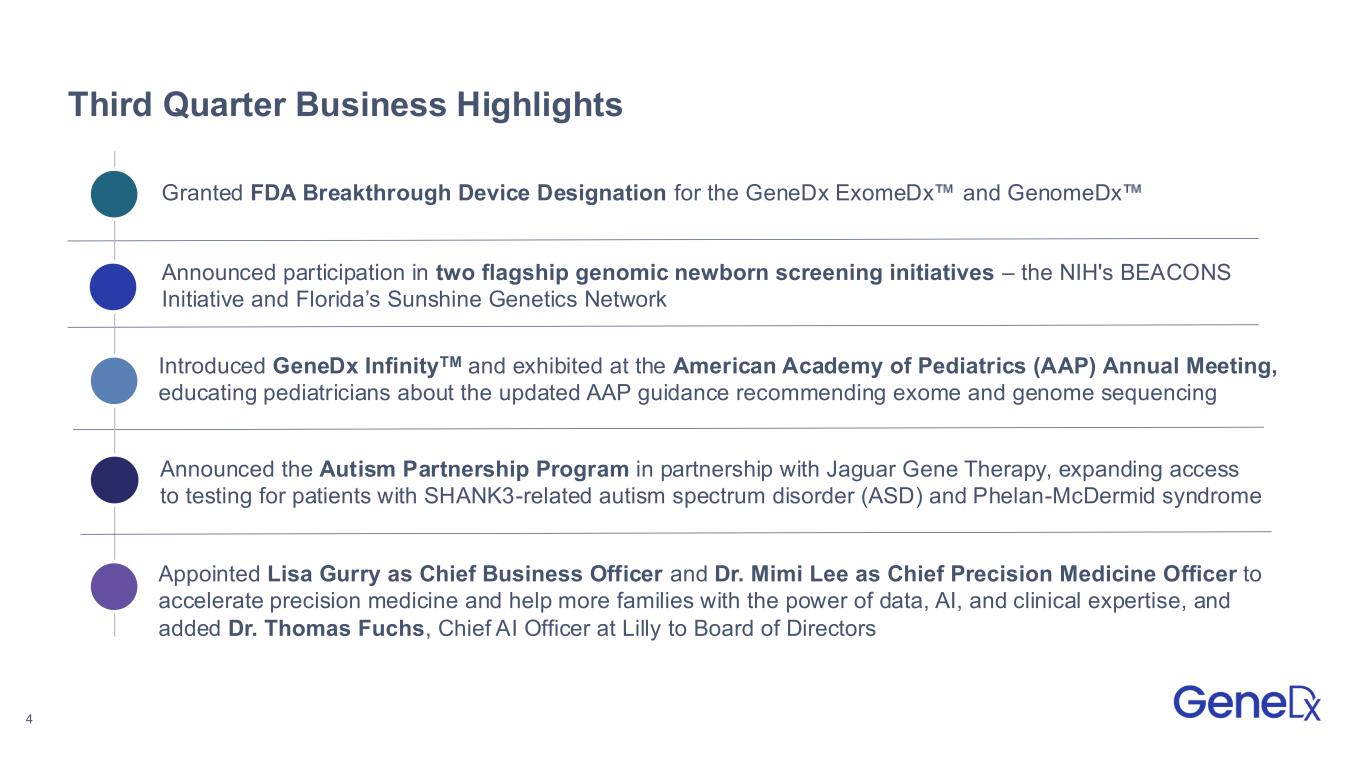
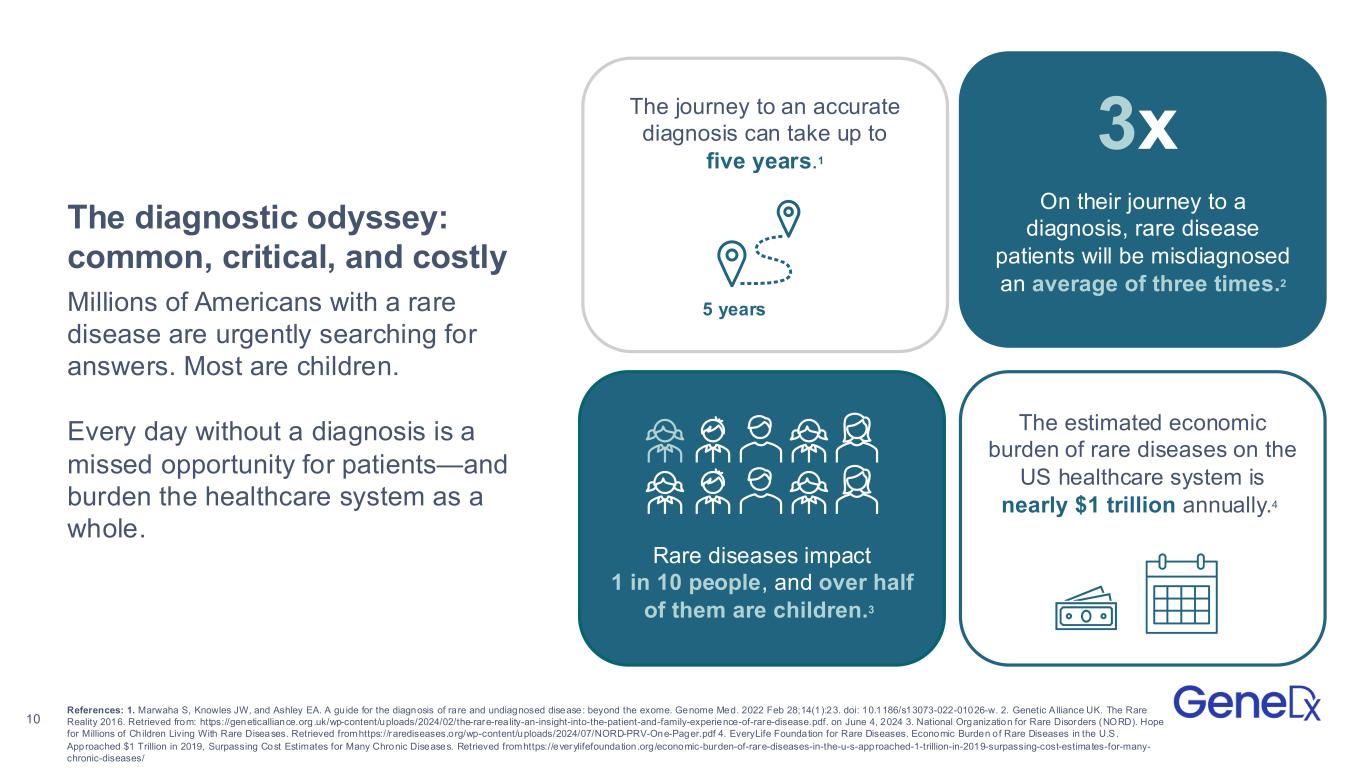
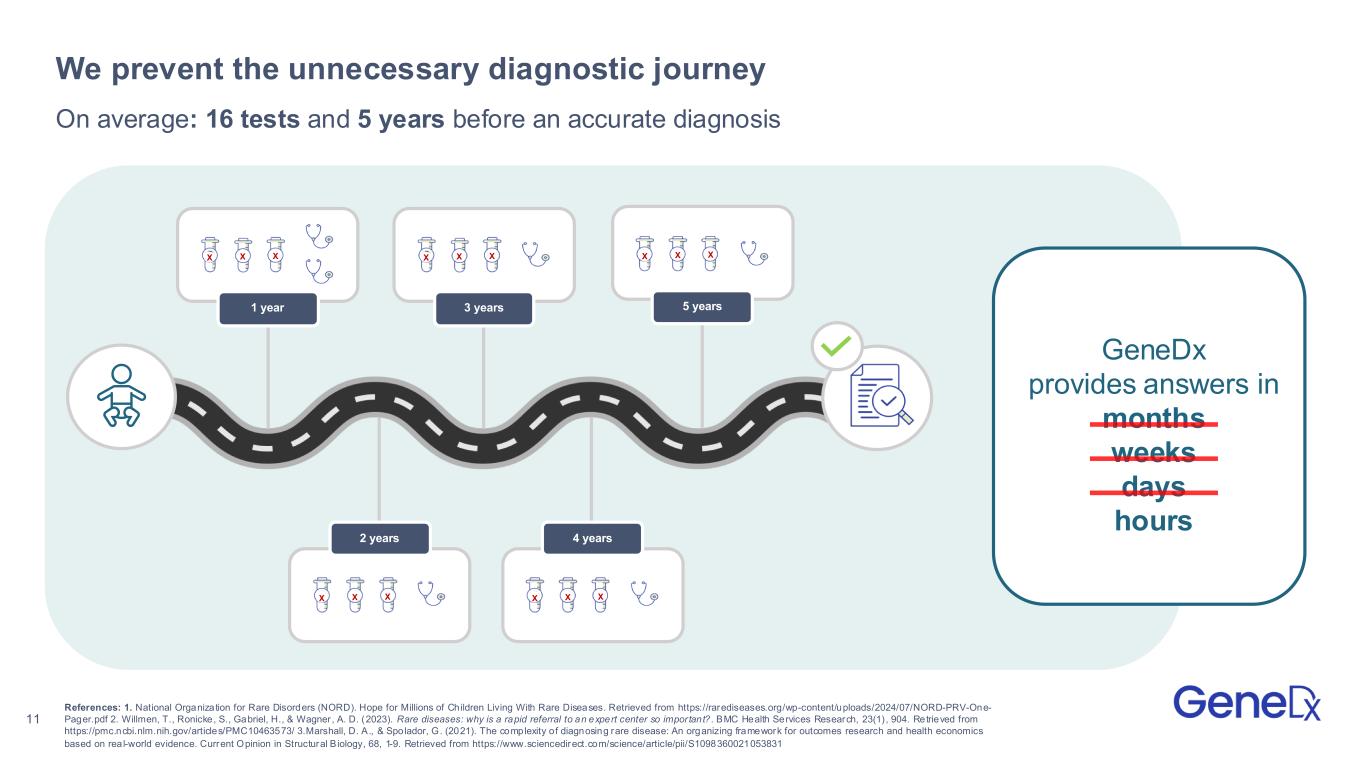
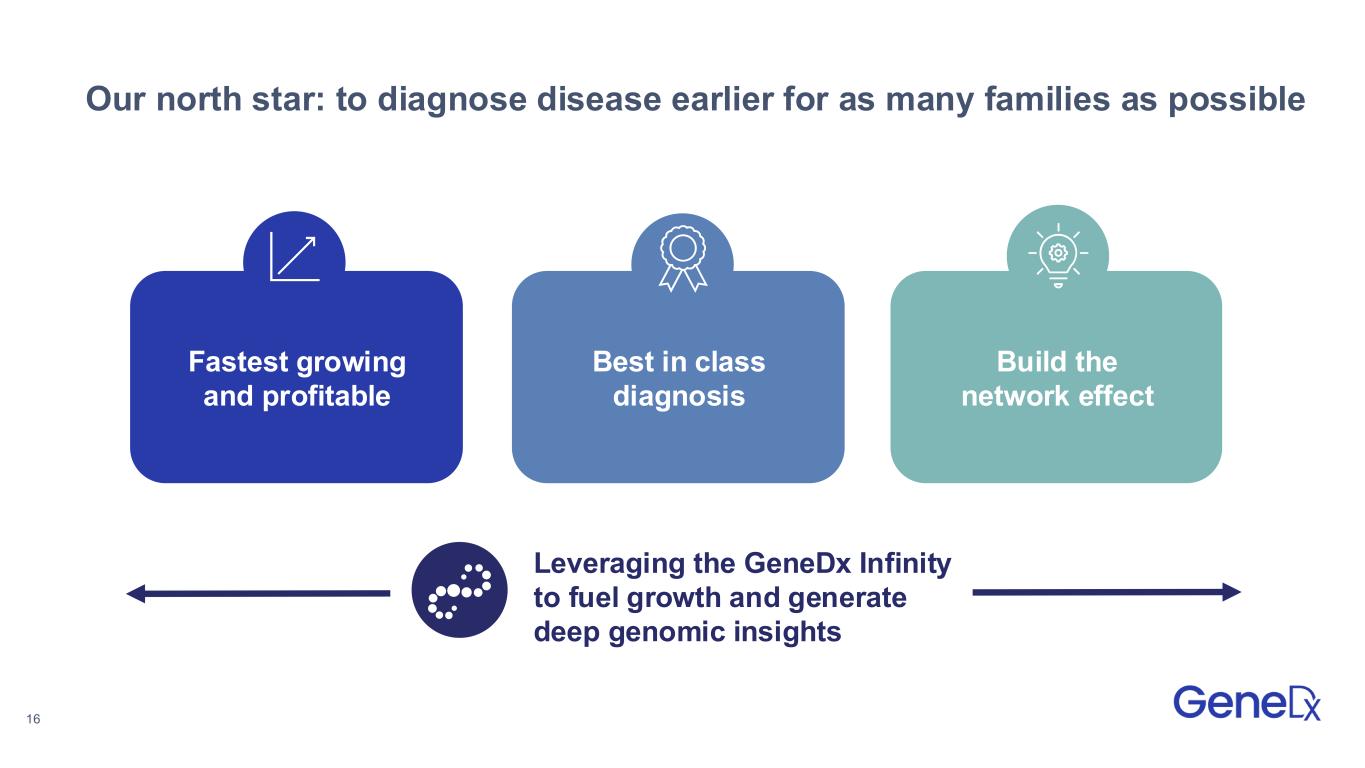
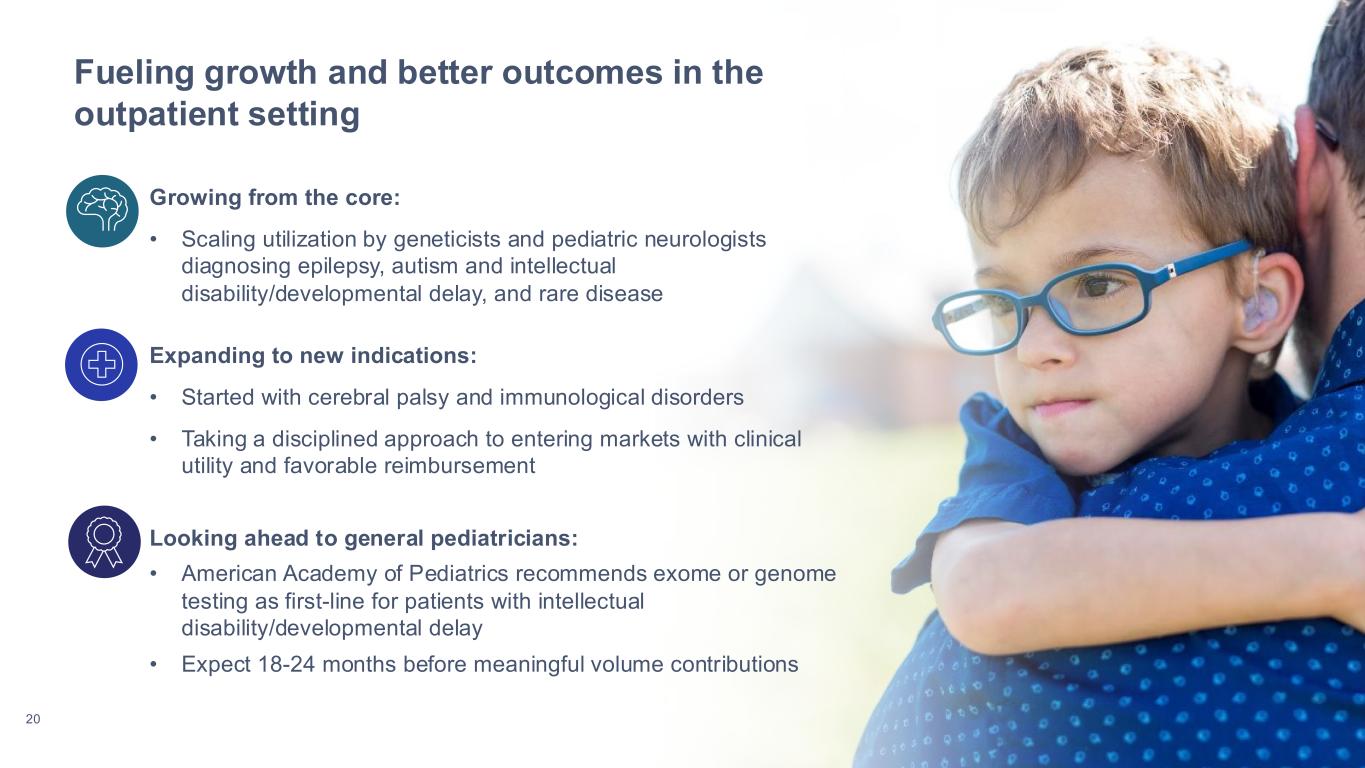
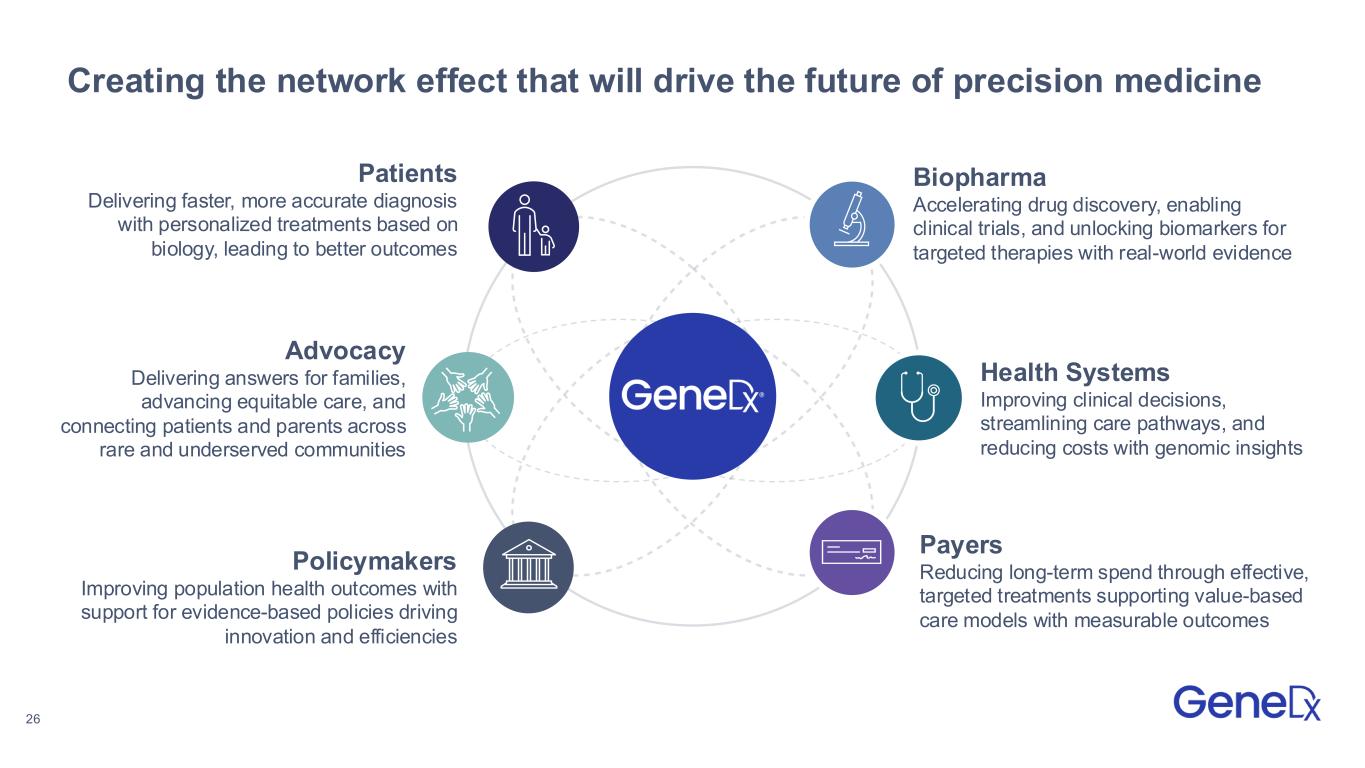
The third quarter was another exceptional quarter for June DX. We continue to drive record growth while maintaining our commitment to profitability. For us, better patient care and profitability go hand in hand. because our ambition is truly transformative to fundamentally alter how precision healthcare is delivered, making it more accessible, effective, and patient-centered. We envision a world where any genetic disorder is diagnosed quickly to prevent disease progression and ensure everyone has a chance to live a long and healthy life. Achieving that vision requires a fast-growing, disciplined, profitable business that delivers both life-changing answers for patients and long-term value for shareholders. Based on our momentum executing this quarter, we're raising our 2025 revenue guidance to $425 to $428 million. Our North Star, the goal that drives each and every one of us at DDX, is to diagnose disease earlier for as many families as possible. Our strategy to do so is to, one, drive high profitable growth, two, offer the best-in-class diagnostics products and experience for clinicians and patients globally, and three, fill the network effects required to usher in the next era of precision medicine. Across all three focus areas, we are leveraging the power of GeneDx Infinity, the largest rare disease data set to generate deep genomic insights that enable fast and reliable diagnoses and fuel the precision medicine revolution. Just last week, the FDA granted breakthrough device designation into our Exome BX and Genome BX tests, offering powerful validation that our industry-leading technology is the gold standard in transforming lives and shaping the future of health. There are over 10,000 rare diseases impacting 1 in 10 Americans, most of them children, and it still takes an average of five years to reach an accurate diagnosis. Receiving an accurate genetic diagnosis is a pivotal milestone in patients' journey, but it's often not the end. Today, 95% of rare diseases have no approved treatment. That is the largest provider of rare disease diagnoses in the world. GeneDx will be central in changing that. As we look to our future, GeneDx isn't just a starting point for rare disease. We're the nexus, connecting patients, biopharma, health systems, payers, policymakers, and advocacy to unlock the full potential of genomic medicine. We recently announced two key executive hires, Lisa Gurry as Chiefs Business Officer and Dr. Mimi Lee as Chiefs Precision Medicine Officer, to unite our data, diagnostics, and partnerships so that clinical adoption, equitable access, and therapeutic advancements reinforce one another, creating a network effect. We are uniquely positioned to move our system from sick care to health care, and strengthened by the network effect, we will deliver on the promise of precision medicine for all. What fuels our business is growth and diagnostic testing at scale, and our strategy is twofold. We're deepening our penetration while widening the market, enabling us to serve more patients today while opening access for patients tomorrow. Our existing markets of geneticists and pediatric neurologists continue to deliver impressive growth, and we have ample room to run. And with updated guidance from the American Academy of Pediatrics now in place, we can now shorten that multi-year diagnostic odyssey by meeting parents where they go first, their pediatrician. Our commercial build-out is underway, and we expect to nearly double our sales scores over the coming quarters with a dedicated Gen Z team. We're also leading medical education on the updated guidance, extending GNDX's authority as the leader in genomics to this new cohort of clinicians, many of whom are learning about these changes for the first time from us.
We're also investing in customer experience to drive utilization.
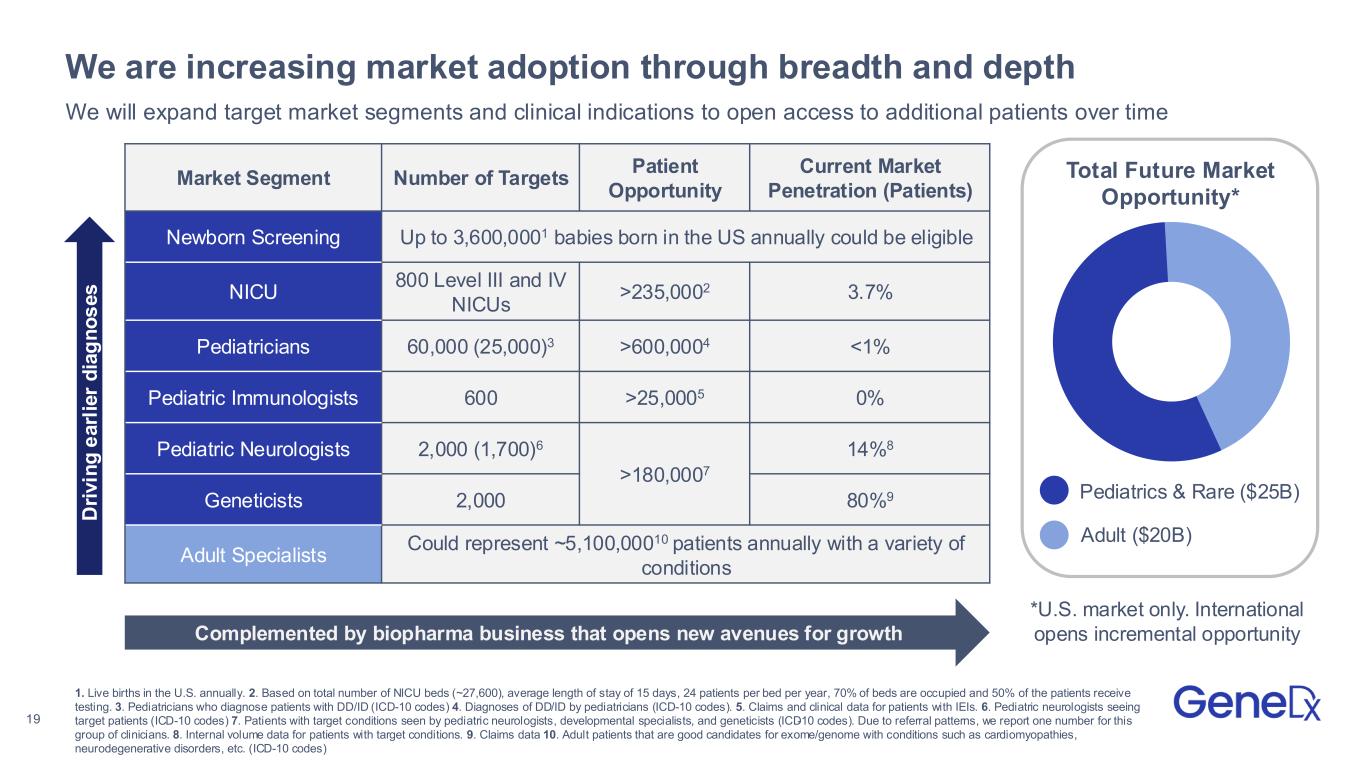
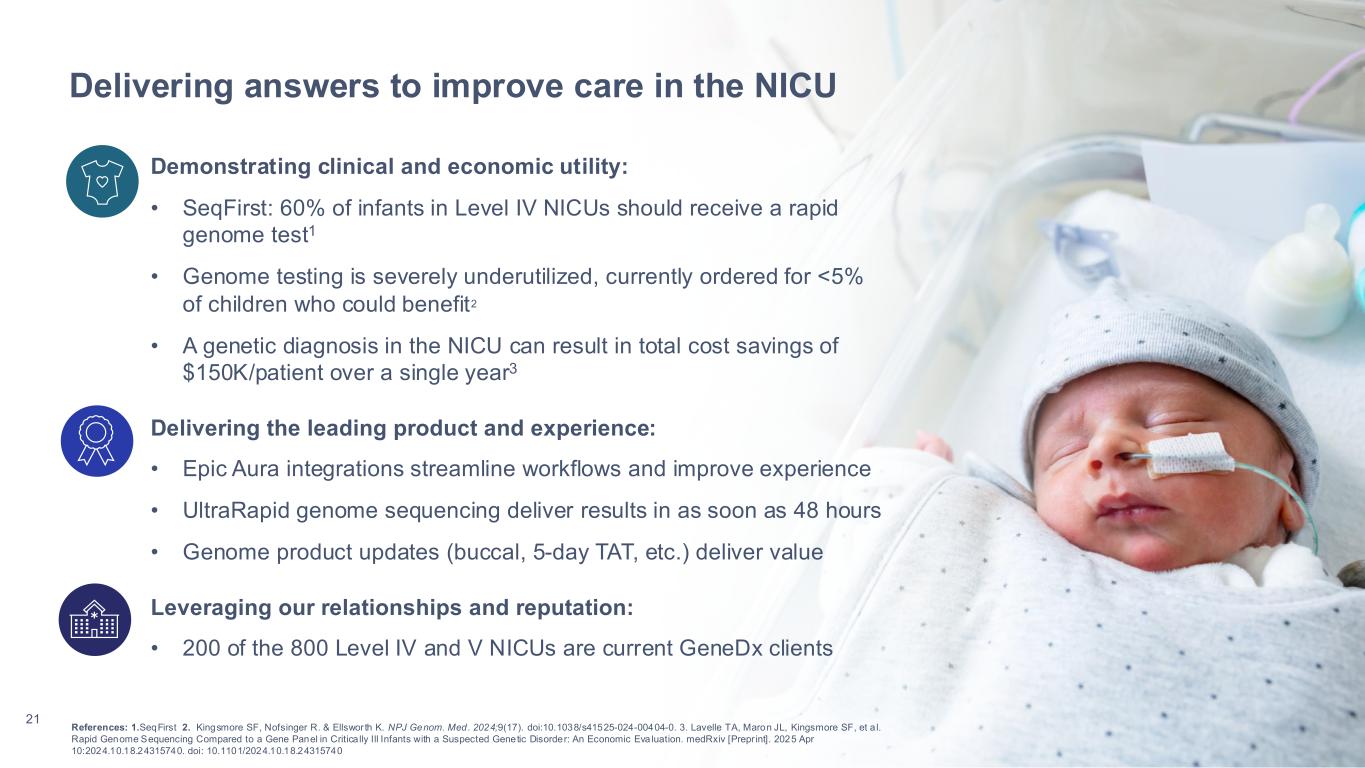
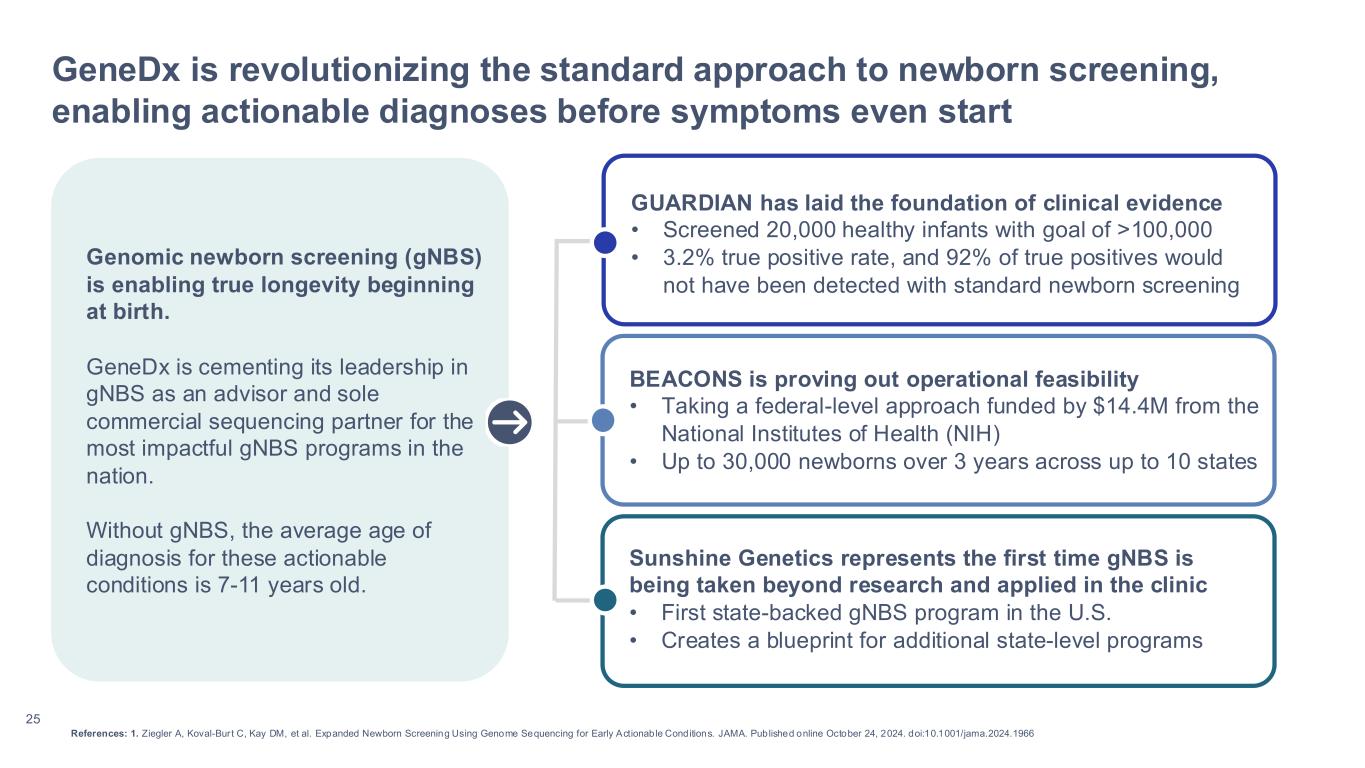
The opportunity is significant, and we expect it will take 18 to 24 months from the June update before we see real adoption. Turning to the inpatient setting, the NICU remains underpenetrated and continues to be a focus, with less than 5% of NICU patients receiving any genetic testing today. We have eight Epic Aura integrations live and are on track to deliver at least 12 by the end of the year. Our ultra-rapid genome continues to prove its value for critically ill infants, and as protocols evolve and whole system engagement increases, we're well-positioned to significantly scale testing in Level 3 and Level 4 nissues over time. Our work to date has shown the value of testing symptomatic patients, but we know the next step forward is to enable proactive personalized care beginning at the earliest moment possible. Our leadership in genomic newborn screening from supporting pioneering research to enabling clinical adoption in Florida reflects our mission to drive true longevity and highlights our unique ability to expand access to this technology at scale. Our work on the Guardian study generated foundational clinical data to support adoption, demonstrating an over 3% true positive rate for actionable conditions at birth. This quarter, we announced our role in two new pivotal initiatives, the NIH's Beacon Program and the Sunshine Genetics Network. These programs are relying on GNDX as a trusted advisor in newborn screening because we have the unique talent and experience to design programs that are clinically impactful, equitable, and scalable. Broad adoption of newborn screening will flip the system from reactive to proactive, advancing our mission and accelerating impact at population scale. At the same time, exome and genome testing can have significant utility later in life. Adult conditions represent another large, untapped market where GNDX is uniquely positioned to offer diagnoses for cardiovascular conditions, neurodegenerative diseases, and many others. And as we grow our footprints domestically, we're also poised to address growing opportunities internationally. The Fabric Genomics Platform offers us flexibility to serve global markets at scale, and we're excited to have seats on the ground and see ex-US regions to develop these markets. We're proud to have built a business that delivers both purpose and profit to fuel reinvestment, and the strength of our model today is laying the foundation for an exciting future. With that, I'll pass it over to Kevin to share more about our results.
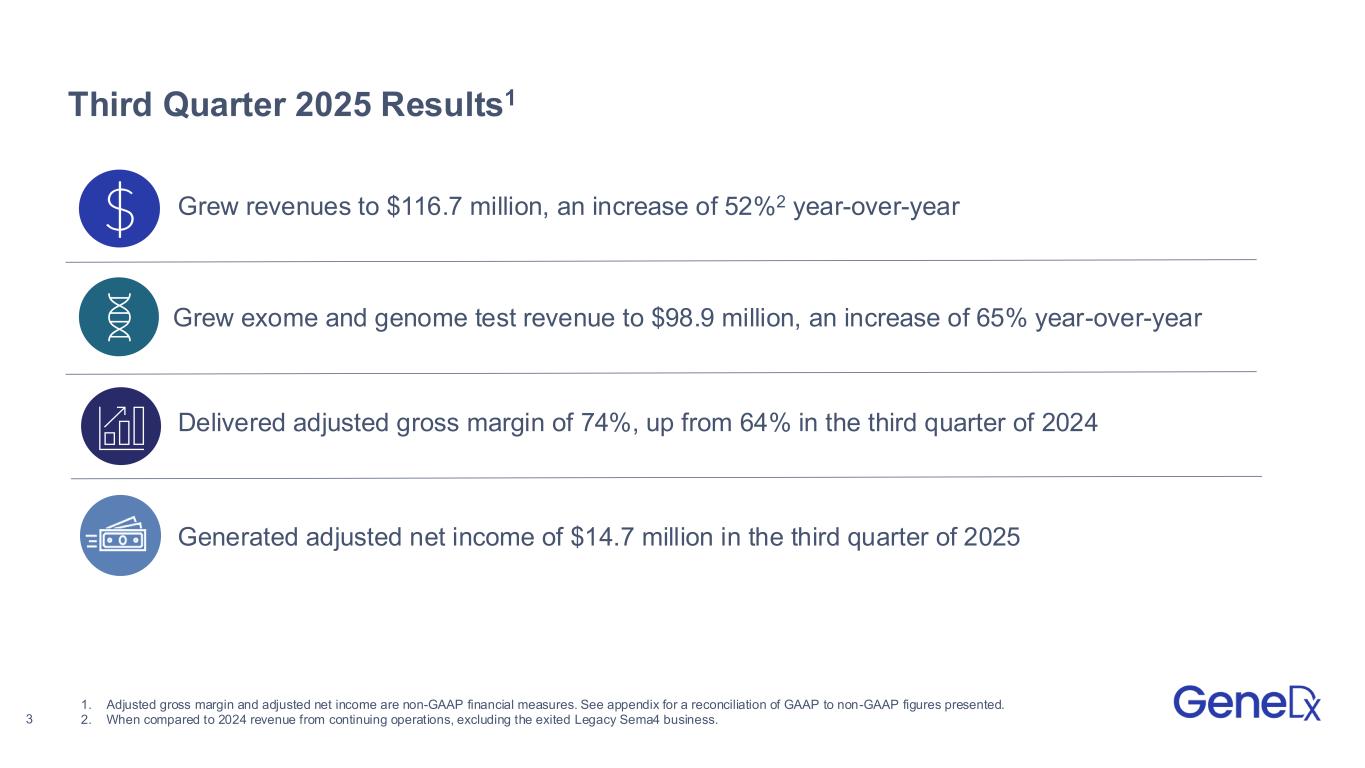
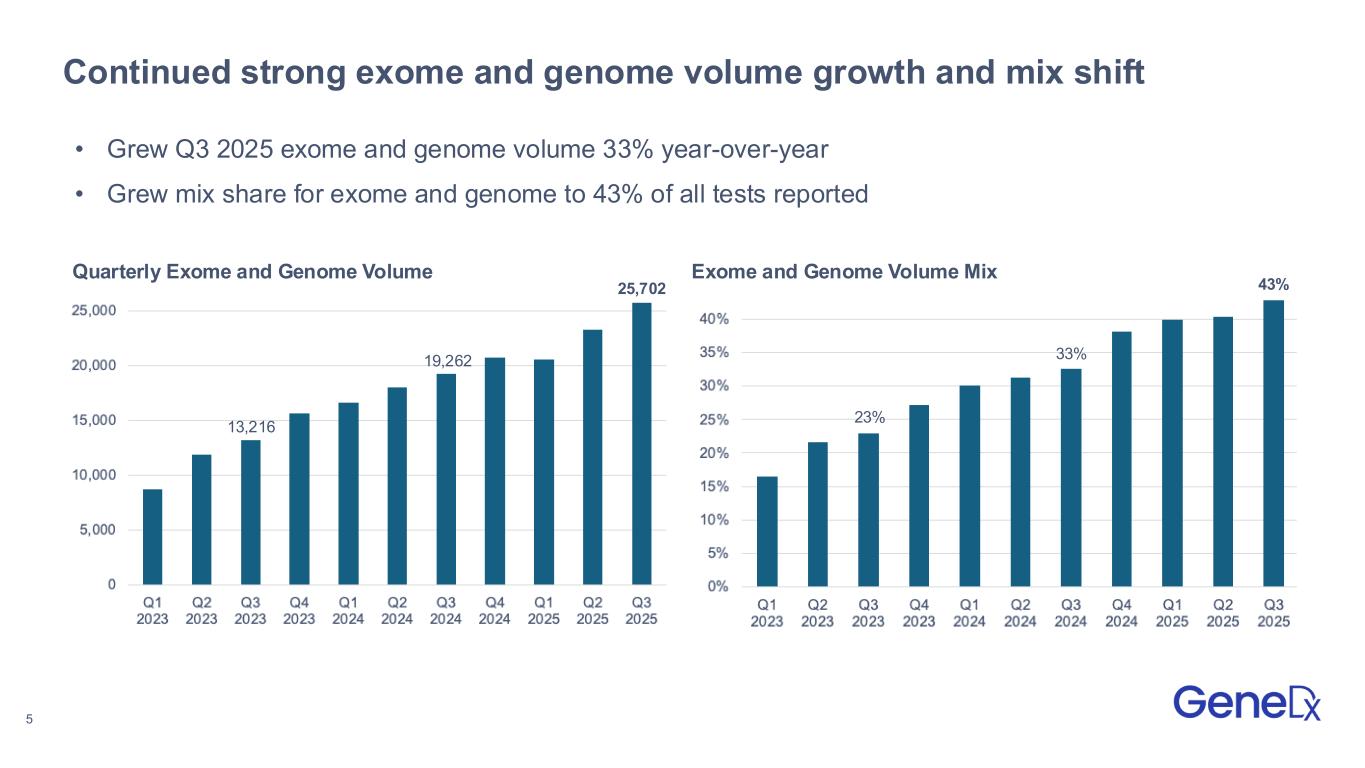
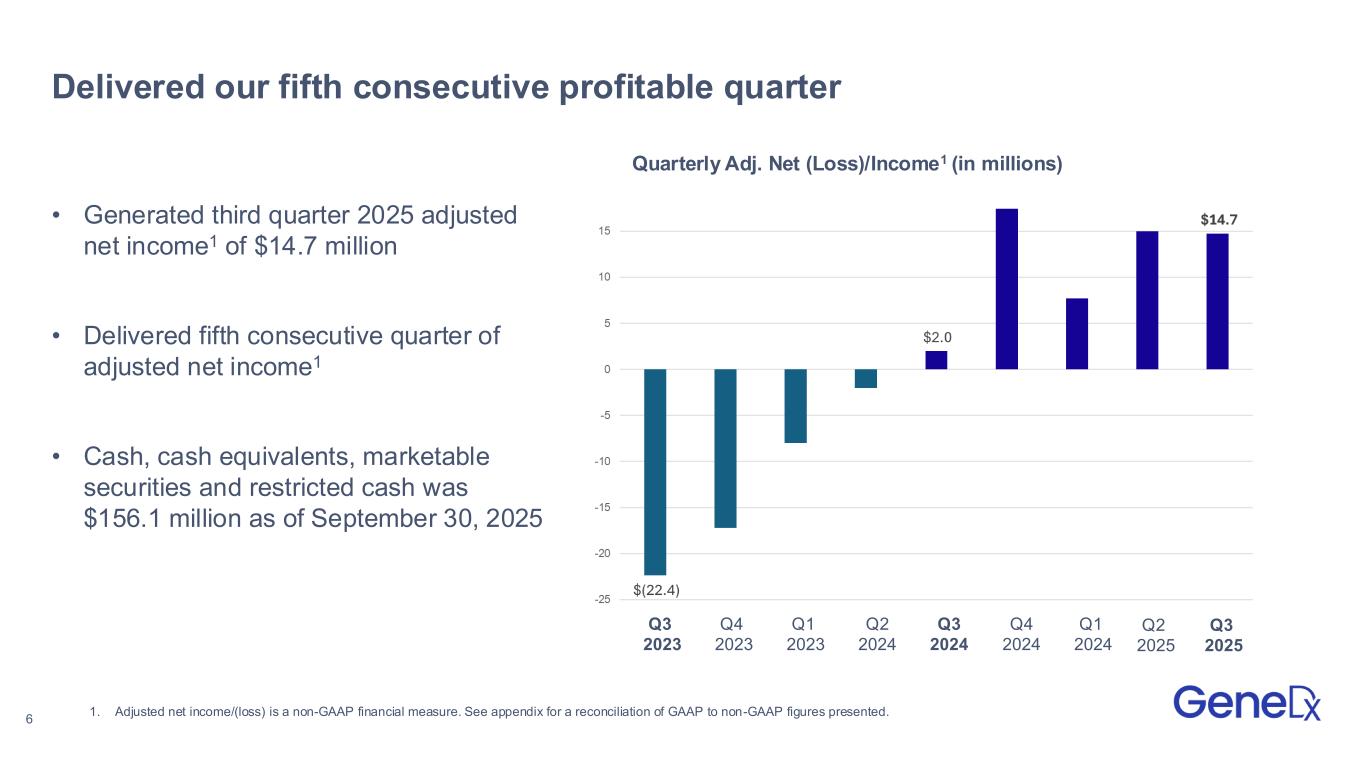
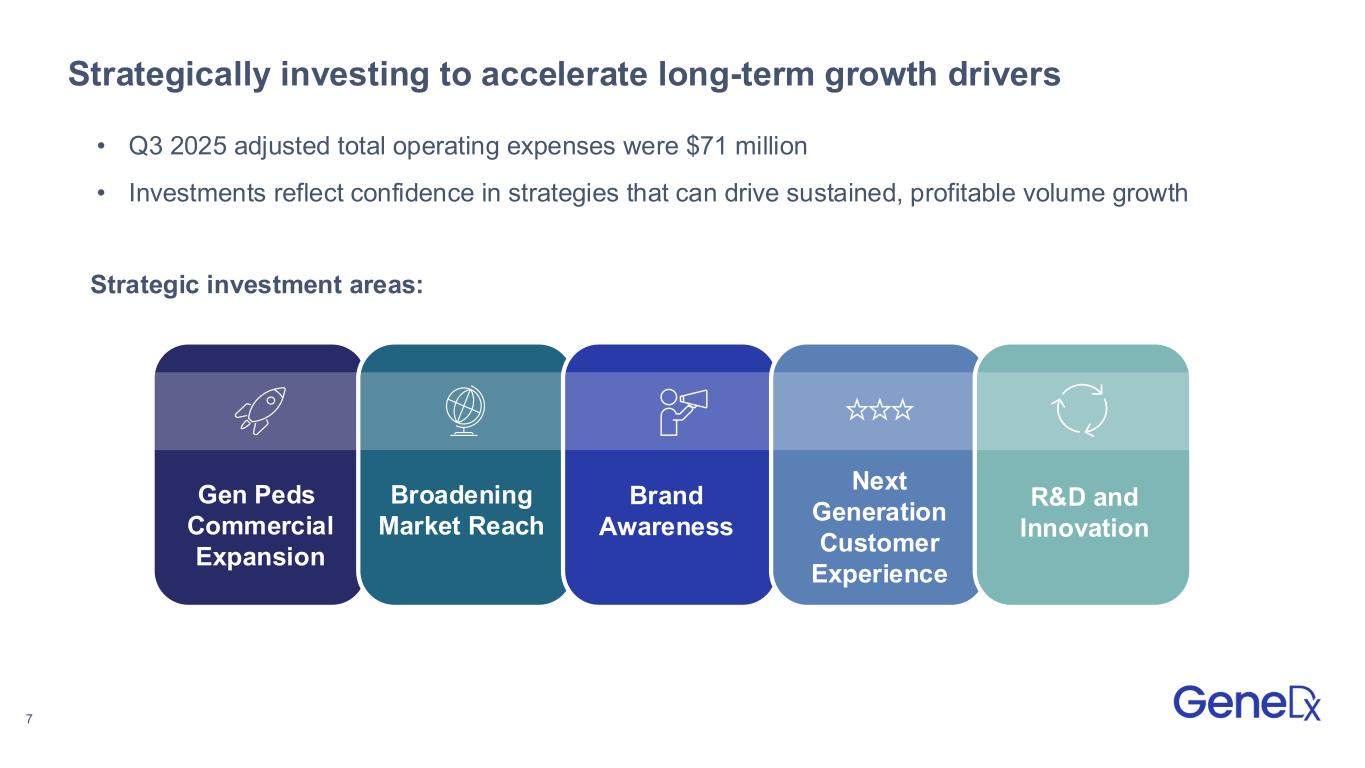
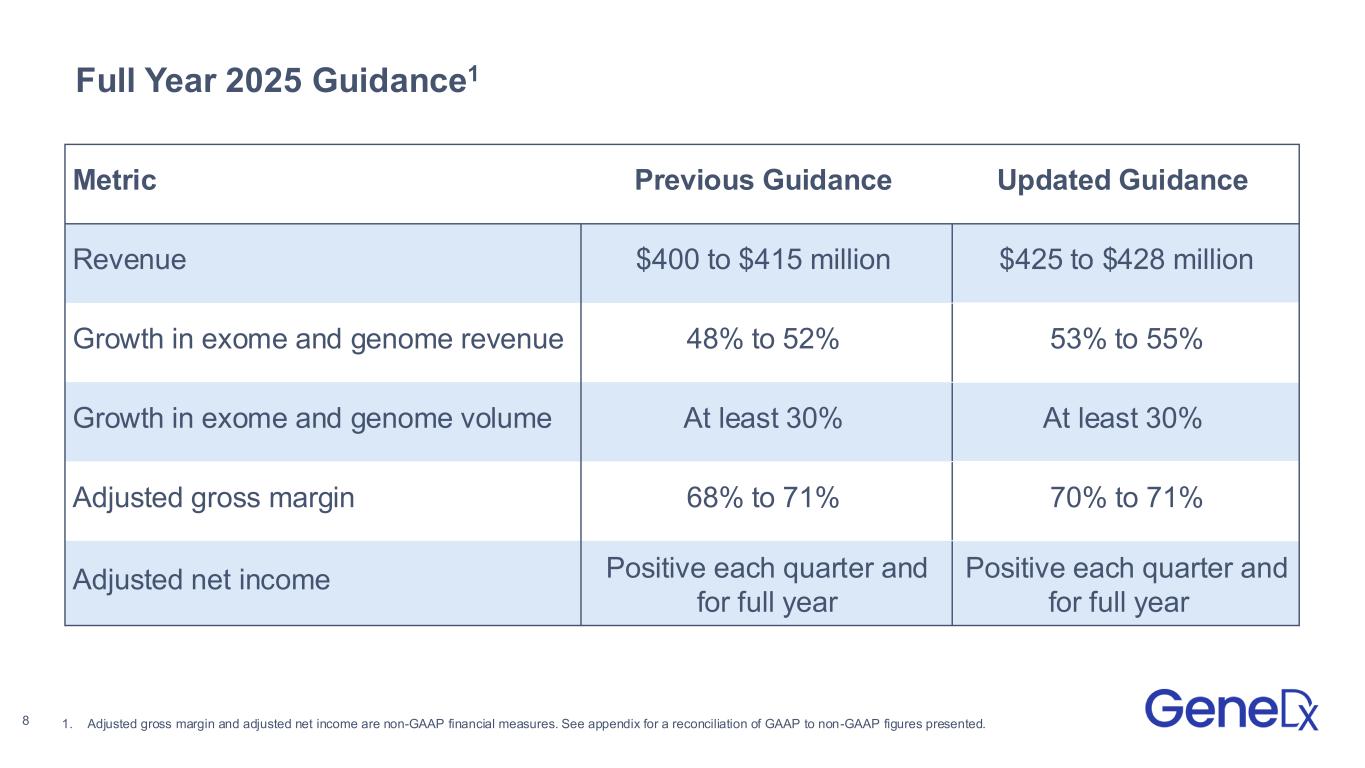
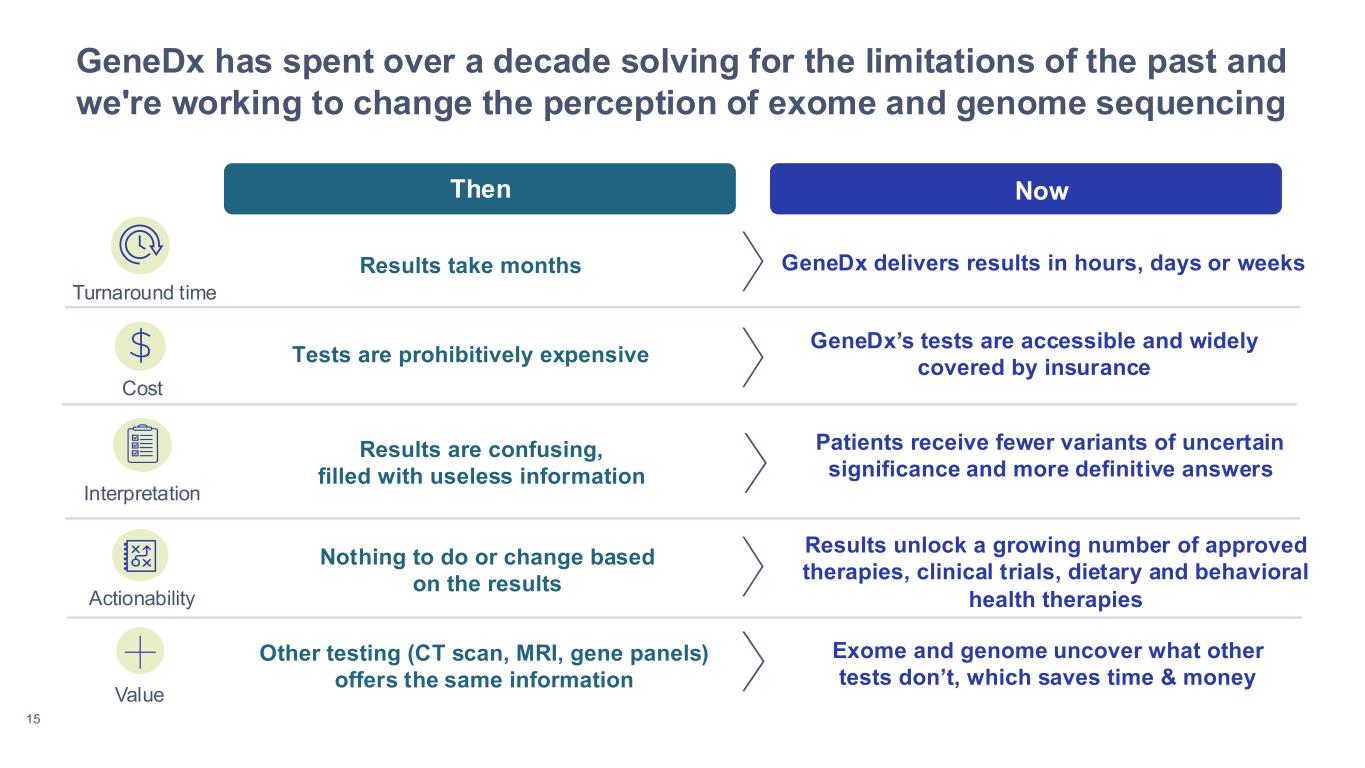
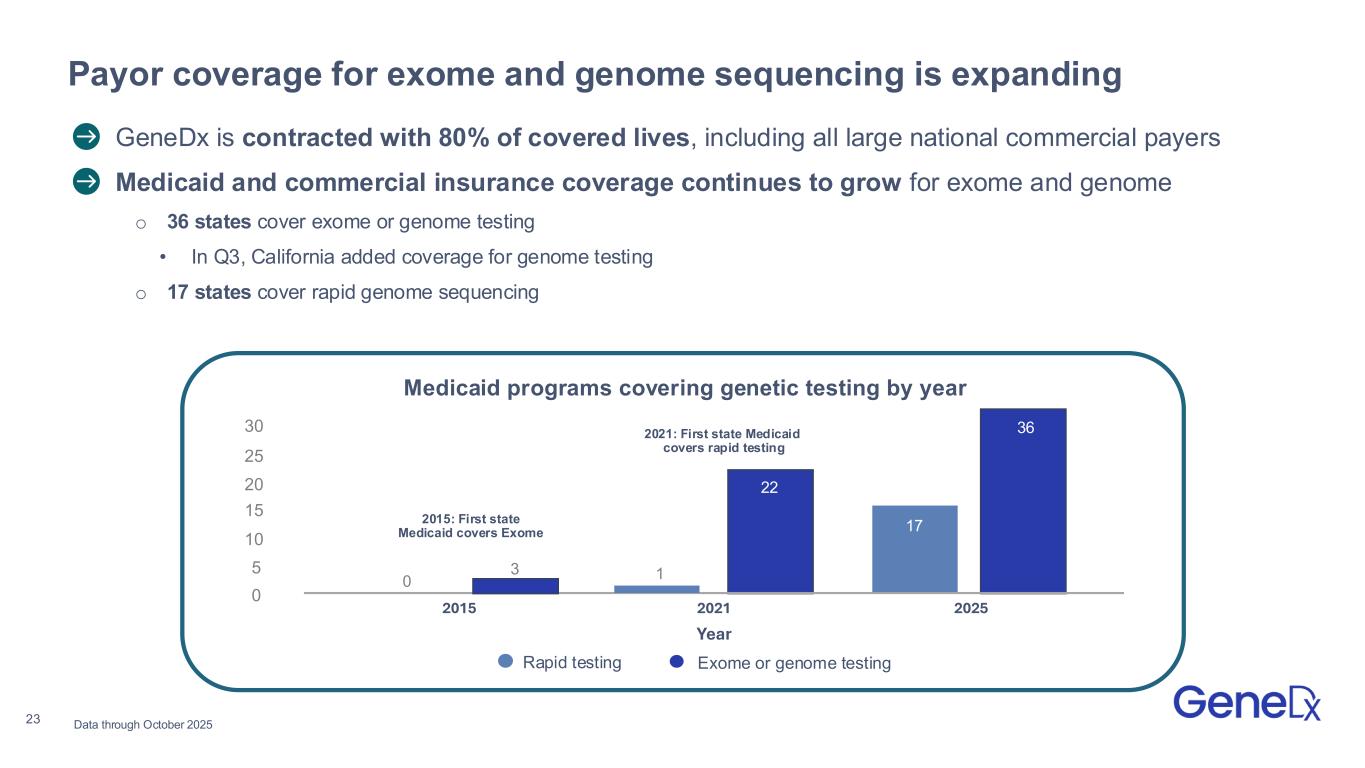
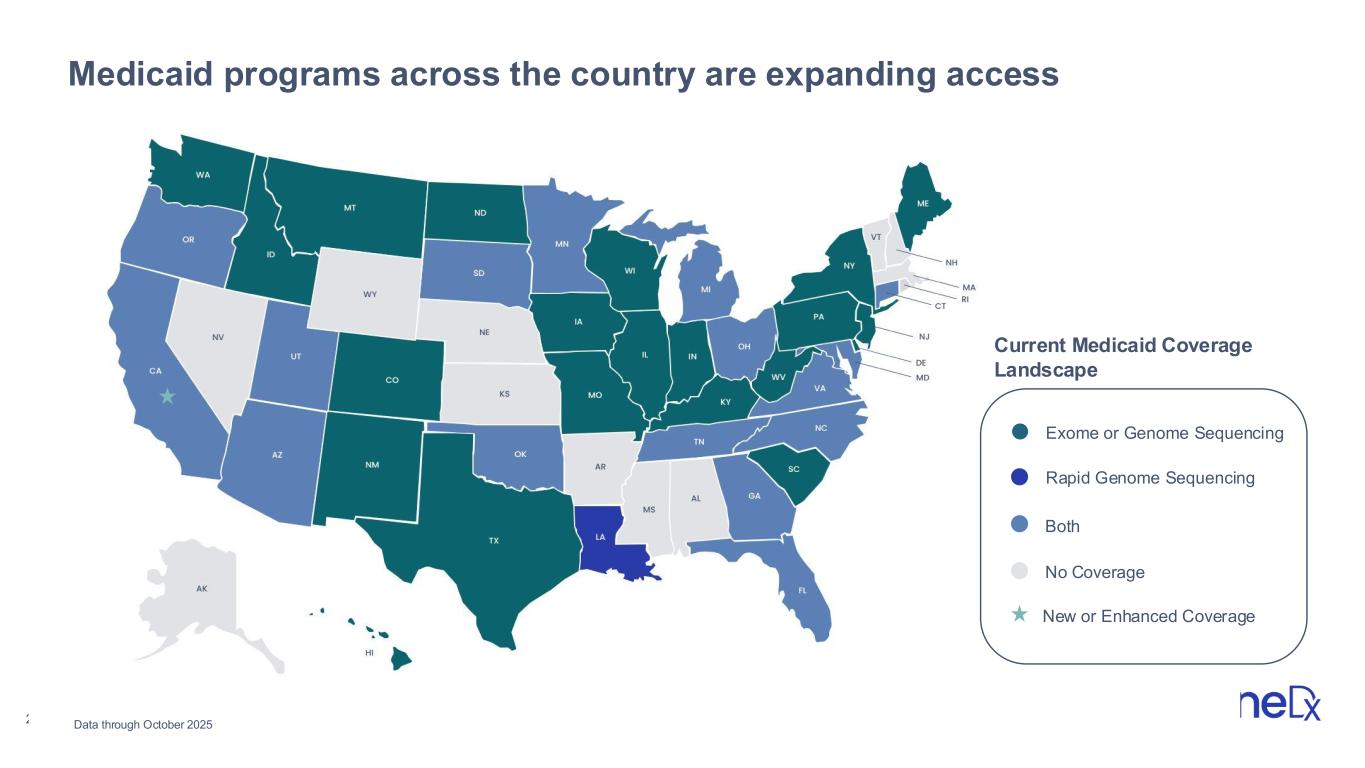
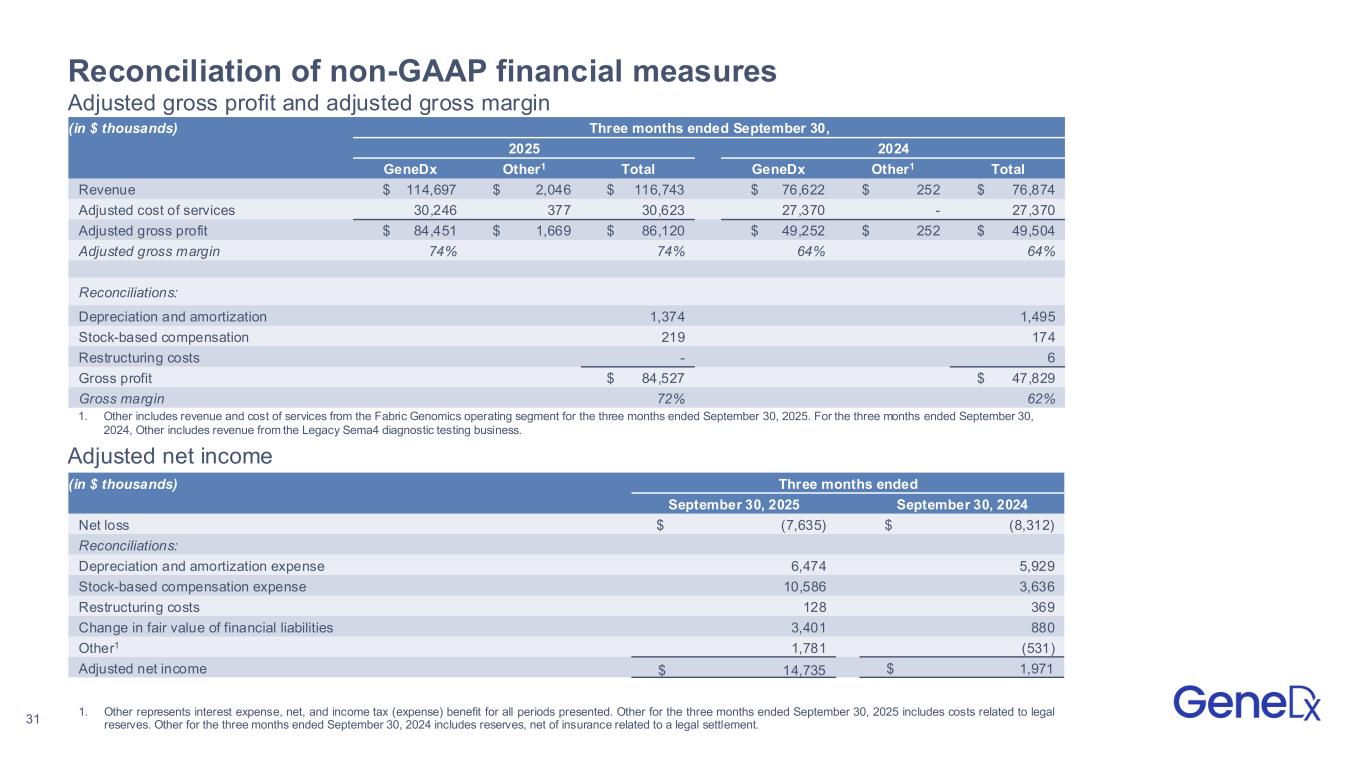
Good morning, everyone, and thanks for joining us today. We reported third quarter 2025 revenues of $116.7 million, a 52% increase year-over-year. That total includes $98.9 million in revenue from exome and genome of 66% from the same quarter last year. In the third quarter, we reported 25,702 exome and genome tests. Growth there has accelerated from 24% year-over-year in the first quarter to 29% in the second quarter to now 33% in the third quarter. We expect volume growth on these tests to continue to accelerate in Q4 and offer high growth for the foreseeable future. For those new to our story, the business began by serving expert clinical geneticists 25 years ago, and now 8 out of 10 in the U.S. order their testing for GeneDx. I mention that because it's been just over two years since we began calling on pediatric neurologists, and already a third of those physicians order from us. Over the next few years, we expect to pull volume from many more call points, the largest of which is the general pediatrician. Near-term growth should continue to be fueled by increased ordering patterns from existing accounts as they continue to convert from panels and activating more untapped pediatric neurologists. We'll also open up and penetrate additional pediatric and adult specialty call points and begin international market development. The NICU remained the compelling market for us, expected to ramp over the next several quarters of years. Of course, all of that is supplemented by the long-term potential to establish a commercial newborn screening market and by our ability to put CMEX into your work for biopharma and other healthcare partners in a way that contributes meaningfully to our revenue base. The average reimbursement rate for exome and genome was over $3,500 a test in the third quarter. That's up from approximately $3,700 last quarter and $3,100 a year ago. With a talented team in place, our cross-functional revenue cycle efforts are positively influencing Medicaid coverage expansion and fighting for fair adjudication. And there's one big recent development to share in that regard. On November 1st, the largest state Medicaid program, Medi-Cal, will begin covering whole genome testing for their members in California. We applaud their decision to become what is now the 36th state to cover exome genome outpatient. As I mentioned on our last call, when we begin to sell into new call points and for new indications, we inherently expect lower initial payment rates compared to our established channels like neuro and genesis. With this strategy to expand into new markets, some new volume may start out at lower collection rates, which in turn may have a modest impact on our average reimbursement rate in the coming quarters. That said, any impact should be transitory. And to be clear, unit economics matter to us. Lessons from this industry's past are always top of mind when contemplating pricing and go-to-market strategies. Our view that rates will be durable and enable both high growth and attractive gross margins well into the future remains. Turning to gross margin, we expanded total company adjusted gross margin to 74%, driven by favorable midship, improved reimbursement, and lower COGS. Brian's team continues to innovate, and they have an impressive roadmap to further reduce COGS by leveraging automation and AI to optimize production. GNDX has achieved an important economy of scale advantage, and we expect to hold on to that advantage well into the future. Adjusted total operating expenses were $71 million. That is up sequentially in terms of aggregate dollars, representing some variable costs growing with the revenue base, but primarily early investments we expect will draw volume growth mid-2026 and beyond. Total OPEX was 61% of revenue this quarter, and that's a number I'm quite comfortable with at this point. I want to underscore the spend here is deliberate, representing strategic investments into accelerating our long-term growth vectors. Specifically, we've begun to build the first phase of a dedicated Gen P sales team. We've added the first few sales heads in these specialty markets and key international markets we're executing against our first ever brand campaign we've ran product and technology talent to design and build our next-gen customer experience for non-experts and R&D includes innovation for genomics program and support for clinical and health economic research as just some examples the expense ramp reflects continued confidence in the ROI they're all designed to drive volume in the future that growth in turn accelerates a flywheel effect whereby our infinity data set expands our competitive mode strengthens we attract new customers and economies of scales continue to improve while these investments impact near-term operating margins every dollar is meant to build high quality durable future revenues expect sequential growth in our operating expense for the next several quarters but all within a framework designed to achieve industry leading growth rates while maintaining attractive gross margins we have demonstrated the ability to drive operating leverage and eps accretion with strong demands and an ever-expanding serviceable market we'll be reinvesting back into the business to capture an exponentially larger future and build long-term value creation the team here has the experience to understand our responsibility to be good stewards of investor capital on the bottom line we generated 14.7 million dollars in adjusted net income and 51 cents of adjusted basic ups in the third quarter of 2025 and we're well capitalized with cash cash equivalents marketable securities and restricted cash totaling 156 million dollars as of september 30th 2025 cash flow for the third quarter included nine million dollars in free cash flow generated and 12 million dollars in atm proceeds net of fees from the issuance of 101 367 shares of common stock now an update on guidance before turning you over to brian we're raising top line total revenue guidance to between 425 and 428 million dollars for full year 2025. just as a reminder in the third quarter we discontinued our hereditary cancer offerings. That business generated $1.2 million in this third quarter of 2025 and $3.3 million in the same quarter last year. It will be near zero in the fourth quarter of this year. We're raising exome and genome revenue guidance to deliver between 53% and 55% growth for full year 2025, which is exome and genome revenues of 358 to 361 million dollars as a reminder when looking at the prior year comp the fourth quarter of 2024 included a discreet benefit of six point eight million dollars we called out on our fourth quarter 2024 call 5.8 million dollars of that benefit was exome and genome excluding that the full-year growth rate is 57 to 60 percent. We again reaffirm our expectation to deliver at least 30 percent excellent volume growth for full year 2025. As had always been expected, volume growth has accelerated throughout the year and the guide implies a fourth quarter exit of at least 34 percent. We're raising expectations for full year 2025 adjusted gross margin to between 70 and 71%. And we once again reaffirm our expectations to remain profitable. I'll now hand it over to Brian, our Chief Operating Officer.
Thanks, Kevin. Good morning, everyone. When children need medical care, parents, like myself, want an accurate diagnosis as soon as possible.
That's what we do every single day at GNDX.
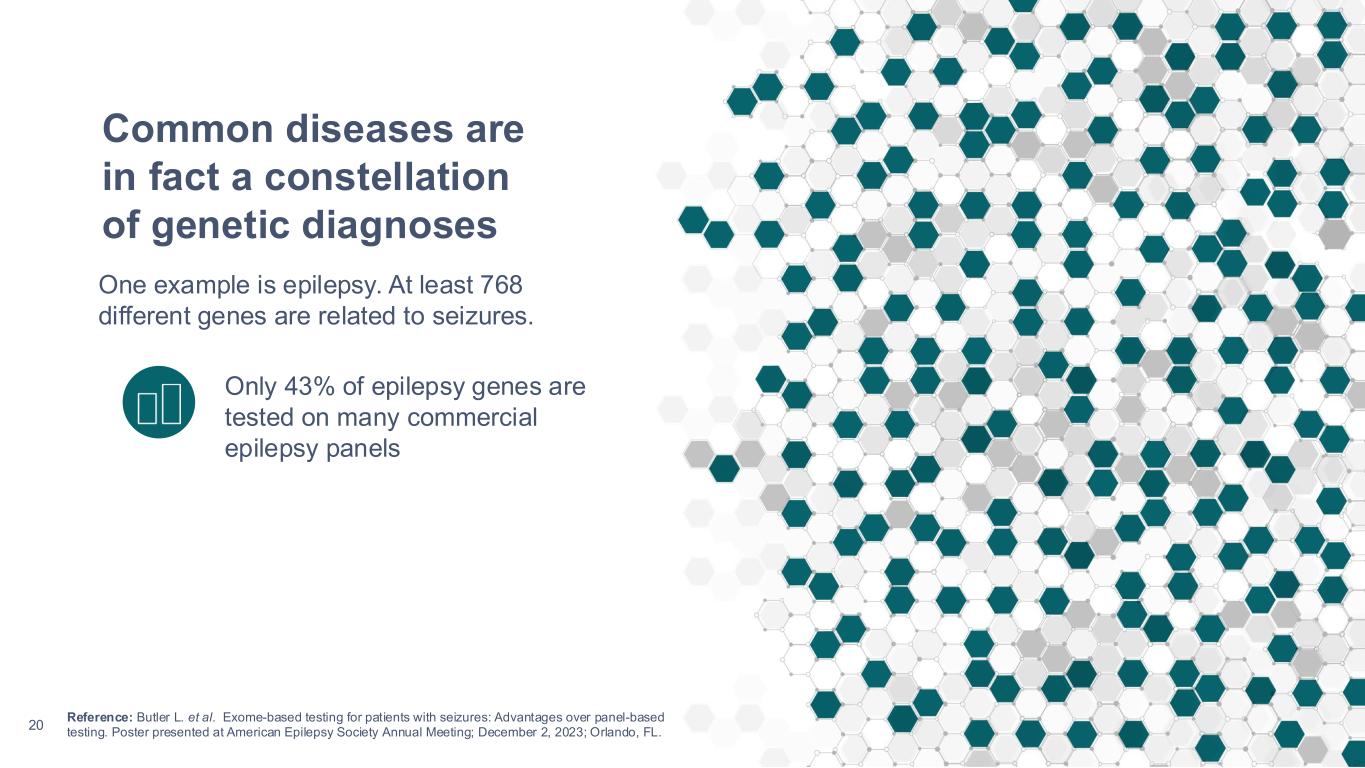
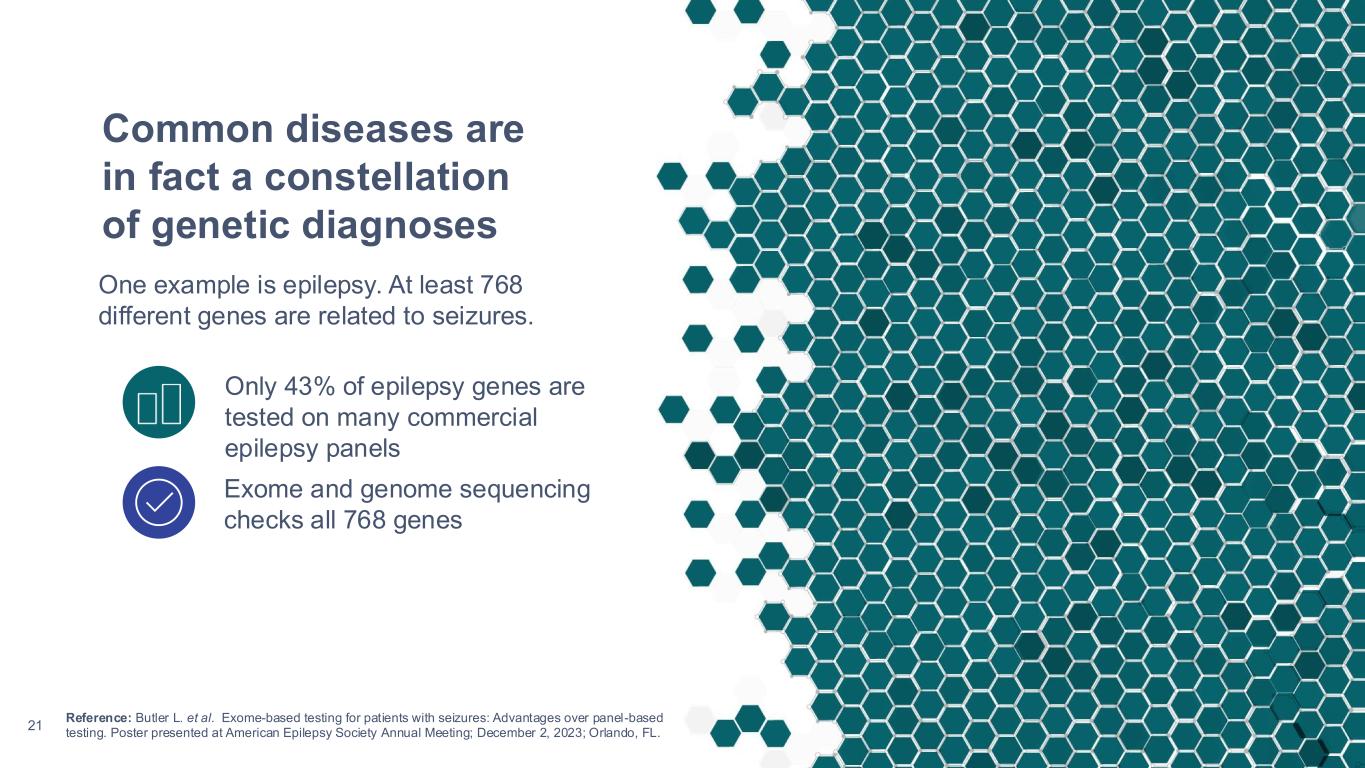
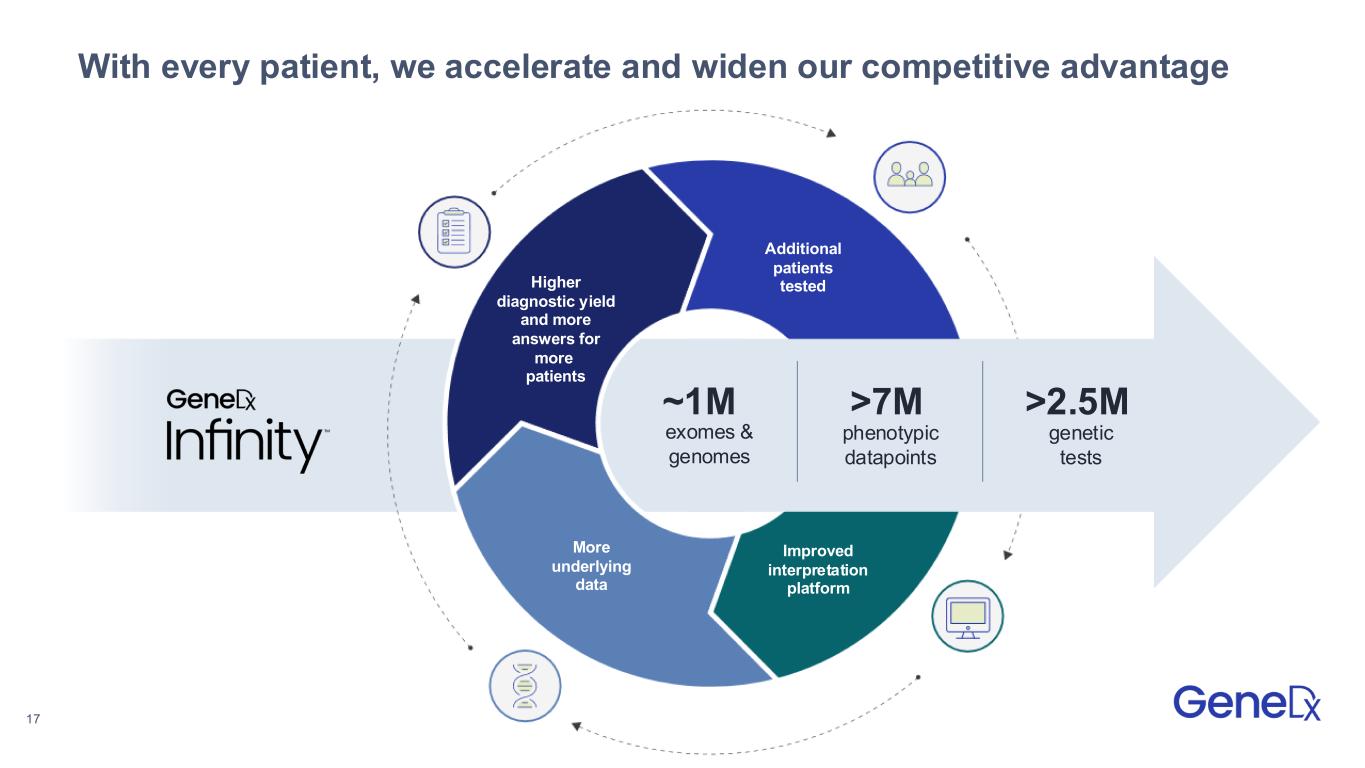
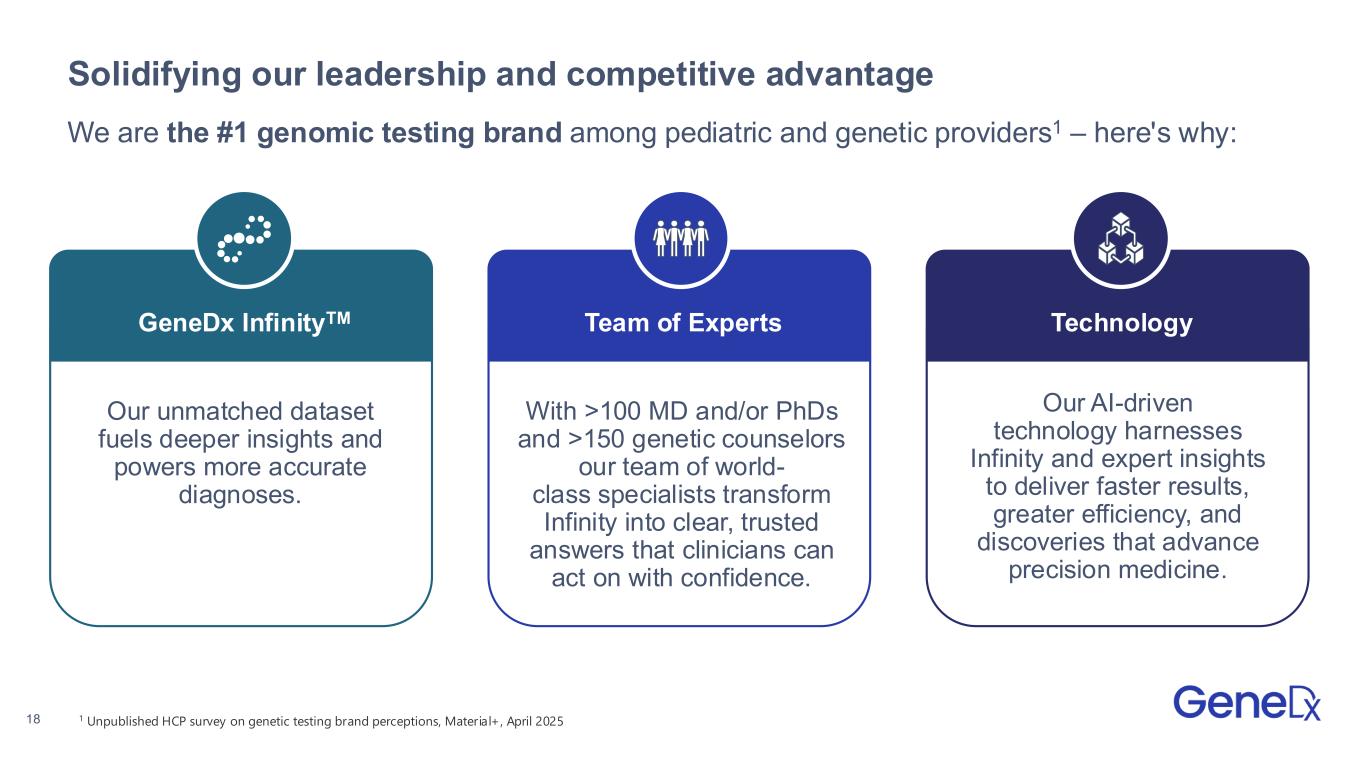
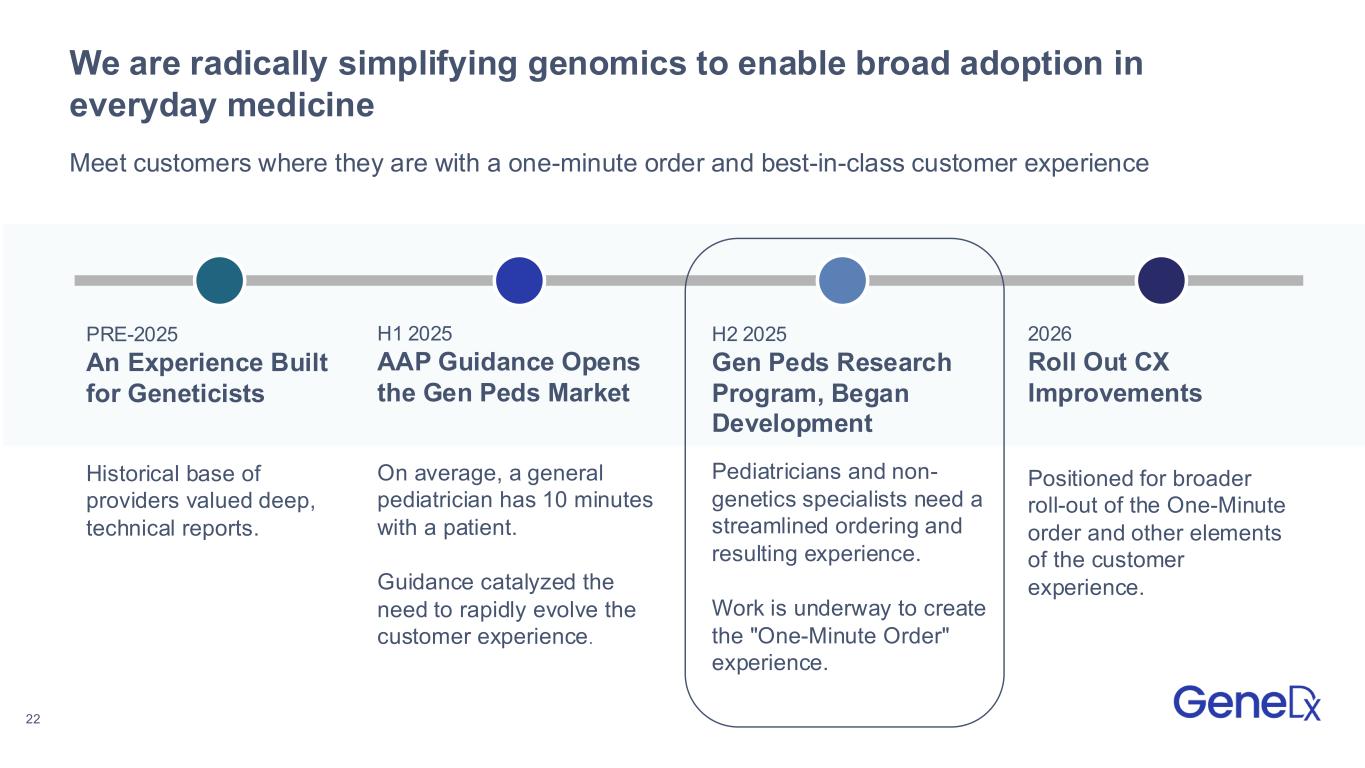
And we do it better than any other lab in the world because of GNDX INFINITY, the leading rare disease dataset. Made up of more than 2.5 million rare genetic tests, including nearly 1 million exomes and denomes, and over 7 million phenotypic data points, INFINITY contains an unparalleled vast and structured reservoir of potential gene variants that cause rare conditions. We reported over 25,000 cases this quarter, and nearly two-thirds of those were parent-child trios capturing mom and dad as comparator samples. That means this quarter alone, we actually sequenced more than 55,000 individuals. The scale of the data is fundamental. It takes at least two children with the same gene variation to validate a diagnosis for both kids. And the greatest chance of finding another child with your child's variant is within gene DX Infinity. Every patient enriches Infinity's data density, creating the flywheel effect and rapidly making it more difficult for competitors to catch up to our quality, speed, and accuracy across diverse populations as we're accelerating this year alone we are projected to add 30 percent more rare disease exomes and genomes into infinity than in the previous 24 years combined tapping into infinity is our brilliant team of more than 100 mds and phd and 150 genetic counselors who transform infinity into clear trusted answers that clinicians can act on with confidence we are also applying ai tools like our ml power gene rank or multi-score on top of gene dx infinity to harness the power of our data scale our platform and increase speed and turnaround time we already deliver answers in as soon as 48 hours in critical care settings like the nicu but by expanding ai across our system there's potential to turn our ultra-rapper turnaround time, and the standard of care in every setting. Infinity, our team, and our technology, have helped us build a best-in-craft genome, and we continue to raise the bar. We are constantly enriching our products with new genomic technologies, including medium and long-reach sequencing and adding multimodal analysis beyond DNA. Partners come to GeneX looking to validate emerging technologies and and pioneer modalities that will forever change how we diagnose disease. That's creating a virtuous cycle of innovation that not only future-proofs our product leadership, but enhances our ability to serve more patients with speed, accuracy, and scale over time. As showcased in the science we delivered at the ASHD conference, these programs generate data that compiles upon our massive library of more than 1,000 peer-reviewed publications, further exemplifying GeneX position at the forefront of genomic innovation. In parallel, we are radically simplifying genomics to enable broad adoption in everyday medicine. GNDX is the number one genetic testing brand amongst pediatric providers, and we are evolving our customer experience to extend that lead. On average, general pediatricians have only 10 minutes with a patient, so we need to meet them where they are with one-minute ordering and best-in-class customer experience. Catalyzed by the American Academy of Pediatrics clinical report in June. We are simplifying, ordering, and result interpretation for clinicians while enriching the patient and family experience. We are already still testing many of these customer experience innovations and our position for broader rollout in 2026 and beyond. With that, I'll hand it back to Catherine.
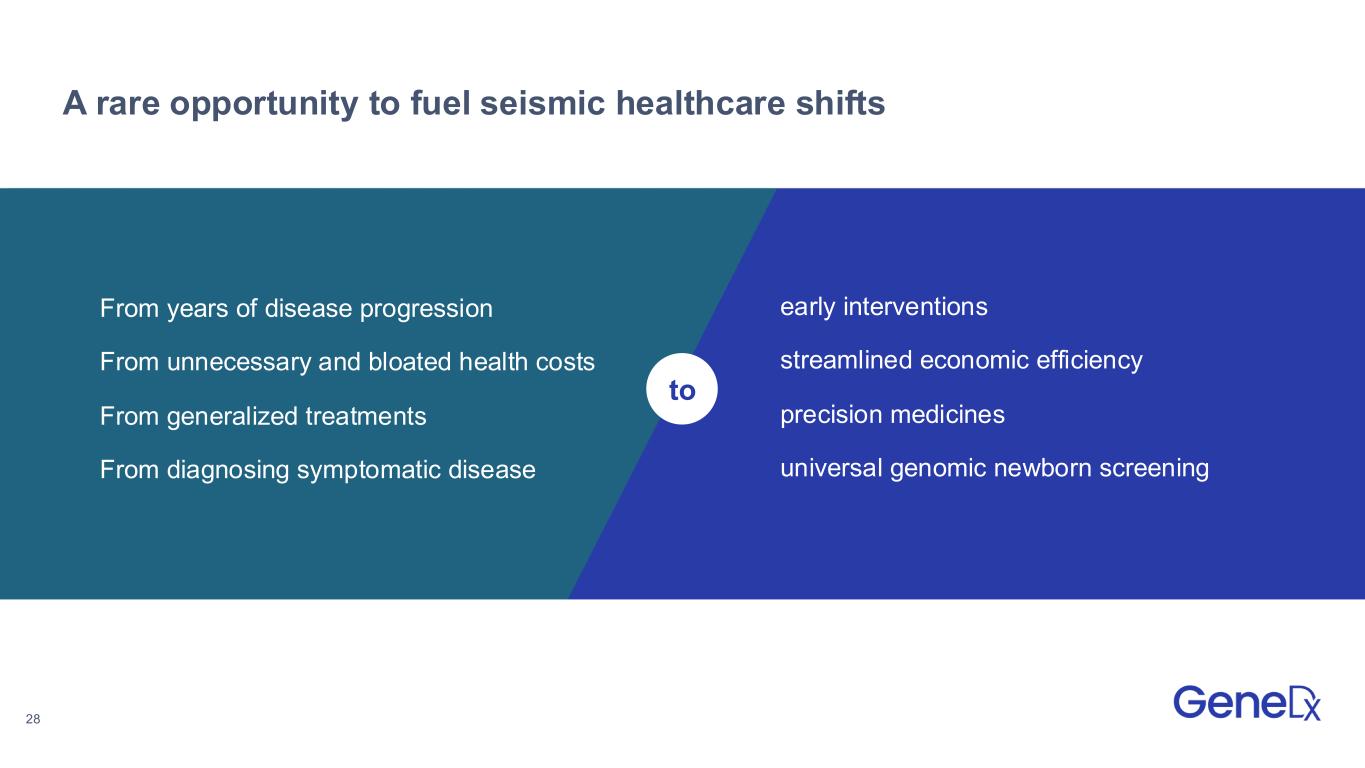
Thank you so much, Brian. We talked about being a fast growth business in volumes because each one of those samples represents a family that is desperate but for an accurate diagnosis. So we act with urgency and purpose because those patients and families are counting on us. There are incredible opportunities ahead as we continue the broader paradigm shift already underway across healthcare, supported by GeneDx Infinity and strengthened by our network of partners. GeneDx is leading the shift to proactive personalized care that begins at birth, unlocking earlier diagnoses, faster breakthroughs, and healthier lives for all, and we're very proud of the work we do each and every day. So thank you. With that, I'd love to open up the line for your questions.
Operator
Thank you. And as a reminder, if you would like to ask a question, please press star 11 on your telephone. You will then hear the automated messages as your hand is raised. We also ask that you please wait for your name and company to be announced before proceeding with your question. One moment while we compile the Q&A roster. And our first question for today will come from the line of Subbu Nambi of Guggenheim. Your line is open.
Hey, guys. Thank you for taking my questions. With emphasis at AAP for clinicians to take a stepwise approach to ordering, beginning with chromosomal microarray, have you seen an uptick in volume there? And if so, how does that change your strategy, if at all, to sunset some of these legacy Absolutely.
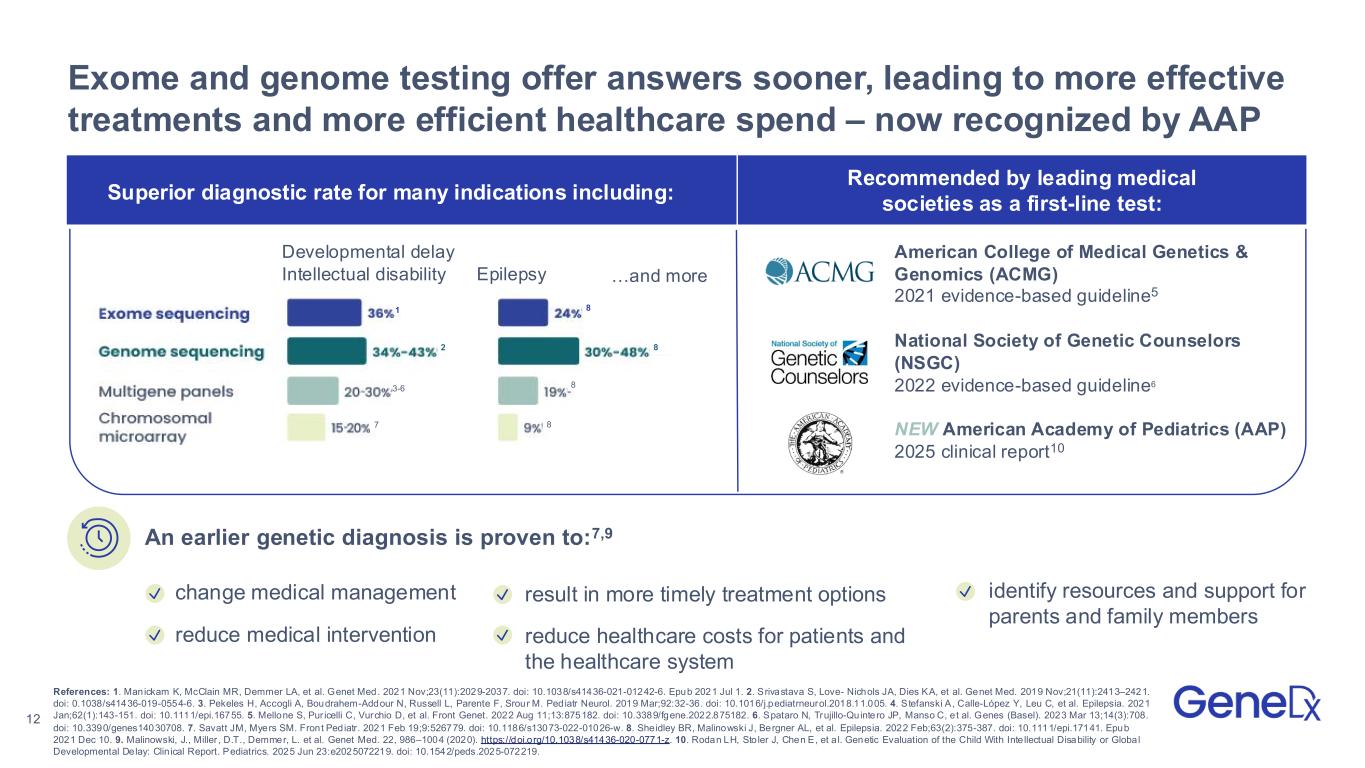
Thanks, Subbu. So, you know, as I mentioned in the script, most pediatricians are hearing about the guidelines update for the first time from us. So whether it is at AAP or as we're starting to engage with pediatricians on education, they're hearing about it from us. So I think that underscores the massive need for education and why it reaffirms our view that it'll take 18 to 24 months beyond education. and it's also going to require workflow. So I would say what we saw in the quarter was the vast majority of growth coming from our core, which is great, and no meaningful uptake in terms of orders from pediatricians from CMA, no notable changes on CMA or orders from general peds, but really good engagement. I would say the research that we've done with pediatricians is affirming how important that opportunity is. And it's not if they're going to order an exome or a genome, it's how they're going to order it. And is it going to be through an improved ordering process that we're building that Brian talked about? One minute ordering we think is an awesome improvement for us as we think about 2026. Doctors are consumers too. And so they're used to fast efficient ordering. And Epic Aura is also going to be a great way. So I would say that the feedback that we're getting from the engagement that we're having at CD Efficiency is really positive about the fact that they are going to order testing and want to order it from us. I think that FDA designation only further reinforces why they should order from us.
Infinity is another reason why they're going to order from us in terms of accuracy so it's not if they're going to order it's how and we feel really confident it will be from from June DX thank you for that Catherine Kevin this one is for you the guide implies ASPs to go down sequentially is that just conservatism or are there any seasonal dynamics to call out even the margin guide implies cogs to increase sequentially any color you could provide and then just a cleanup uh the true apps for 3q24 in this print it says 2.2 million but in the queue it had said 6.3 if if i remember it right so just help us out here please yeah if you
uh and and by the way in case i misspoke in my prepared remarks the third quarter average reimbursement rate was over 3 800 and so representative of a lot of strength in the third quarter and continually reducing denials. So, really pleased with that third quarter result over $3,800. Yeah, the guide would imply that potentially the rate could bounce around some in the magnitude of about $100 down in the fourth quarter. That's really just part of that inherent expectation as we continue to open up new call points, target indication expansion. there may be some experience on the outset where rates are artificially lower to start, and we have to build up some experience and show that demand to payers. And so the guide builds in some conservatism in that regard, just to level set. And then in terms of true-ups throughout the year, the third quarter, nothing to call out, very minimal impact in terms of out-of-period adjustments in the third quarter. So that rate of over $3,800 is representative of what we think the third quarter activity will produce. And historically, we've averaged a couple million dollars of those tariffs each quarter, but nothing that I would call out as extraordinary at one time.
And, Kevin, it was a pretty good margin as well this quarter. So is there any reason for us to believe that it should not be sustainable?
No, look, we raised the guide again in terms of gross margin, and so just wanted to leave some room there should we see some of those reimbursement rates bounce around some in the fourth quarter. So a little bit of a function of raising the guide, but keeping a bit of a conservative stance.
Operator
Perfect. Thank you so much, Craig. Thank you. One moment for the next question. And our next question will be coming from the line of Dan Brennan of TD Calwin. Your line is open.
Thanks for the questions. Maybe the first one, Kevin and Catherine, can you just speak to the NICU? I know you discussed, Catherine, in your prepared remarks. You guys are on track for the number of NICUs that are being able to EMR. But just kind of what did you see in Q3? How do we think about implicit in the volume guide for 4Q what the NICU contribution is and any color on just kind of what some of the early faction and kind of feedback has been?
Yeah, I'll start and then we'll pass it over to Kevin. So the NICU, as I said, remains a really important opportunity. It is shocking to people when you say fewer than 5% of babies in the NICU get a genetic test. We have the clinical data. We've got the health economic data. We have the calculator that can convince the CFO that this is going to be good for their business. Hospitals are running businesses as well. And we have Epic Aura. We're continuing to see growth in that sector. And, in fact, it's a fast-growing part of our business. We're seeing meaningful growth in terms of same-store sales on the MICU side of things. So we definitely see it as an important contributor to our overall goal of getting an earlier possible diagnosis. And what we're also learning is that some clinicians like our portal. And so we're on track to continue to drive Epic Aura. We'll have at least 12 systems activated by the end of this year. We're seeing kind of the full test menu being ordered, which is fantastic. So we think Epic Aura continues to be a meaningful unlock for new clinicians who are working with us. And so we're going to continue to drive utilization of Epic Aura at the health system level in order to impact both outpatient and inpatient.
Yeah, I mean, through the third quarter into date, volumes from the NICU are growing nicely. It's one of our fastest growing channels, albeit from a much smaller pace. But percentage wise, it's growing nicely. You know, throughout the year, we've been tracking, looking to bring in an incremental 2000 units or so in the second half of the year, with most of those coming in the fourth We're going to run through the tape as much as we can through the fourth quarter, whether or not we hit that number exact or not. more than confident that outpatient volumes will supplement and more than make up for that. I think most importantly, we're seeing growth, we're engaging with health system administrators, and our thesis that the NICU market is very compelling and part of our growth story in the years to come remains very much intact.
Maybe just on the quarter itself. I mean, the quarter came in better than expected. I know in past quarters, you've given some color about same source sales growth, maybe some new indications. I know you discussed in the prepared remarks also new doctors. Just any way to frame kind of what's happening with their volumes and how that might inform kind of the implied guide for the fourth quarter with those building blocks?
The strength really driven by those core outpatient markets, continued nice step up from even that innermost core of expert geneticists. So we are seeing strong signals of the continued evolution of those docs, putting down single-gene tests and multi-gene panels in place of exome and genome, and we'd expect that to continue for several more quarters or years to come. So, in terms of same-store sales rates at expert geneticists, continue to see nice uptake there. And in PETE Neuros, good account activation. We're now at a point where just over a third of all p-neurals are ordering their exome genome from us. Not all of those are mature yet in their ramp cycle, and so good growth to come from docs we've already activated, but I think what's more exciting to us in the coming quarters is just the green space to activate more docs there, the messaging we have for how we can serve that cohort in particular is really resonating. And so the next couple of quarters, we'll continue to see growth rates pretty similar to what we just produced from PNURO and Geneticis. And of course, what we remain most excited about is activating even more call points in the coming quarters.
And then maybe just one final follow-up. I heard you mention on the cost side, I'd love to get a little more color on kind of OPEX, I think you said the third quarter OPEX number is a good number. Maybe if you can just elaborate a little bit on the OPEX spending from here. And I think you said it's going to open up growth by mid-26. So is that when we're expecting to see a bit of like some pediatrician volume show up? So maybe to clarify the OPEX outlook and kind of pediatrician call point and the impact there.
Yeah, we've begun to build out the commercial team that, of course, includes building a dedicated general pediatrician sales team. I think we remain anchored on that official expectation we set of about 18 to 24 months from the time those AAP guidelines dropped in June to when we would see sort of escape velocity on incoming volume. That said, we're engaging with the pediatrician community as we speak. we attended their conference in september and all of that has validated our thesis that the markets will be the market will be real and that there will be demand out there but we've got to build some of the tools in medical education and so we'll of course be carrying some incremental commercial costs as we go through that education period and so that's part of the step up there And if we look at overall R&D spend, we continue to rev our genomic assays and technology to keep the best-in-class product in the field and build out that customer experience for non-experts because we continue to see strong ROI opportunities and pulling through volume from even more physician types out there. So the level of step up from Q2 to Q3, you might expect something similar into the fourth quarter from Q3 to Q4, but fall within an eye towards keeping the business profitable. We sort of maintain our commitment to the business in the black hair so that we can continue to reinvest back into achieving industry-leading growth rate.
Operator
Thank you. One moment for the next question. And our next question will be coming from the line of Mark Massero of BTIG. Your line is open.
Hey, guys. Congrats on the strong quarter, and thanks for taking the questions. I wanted to start, you know, you guys indicated, if I heard correctly, that you plan to double the size of your sales force over the coming quarters. You know, just looking at your website, it looks like there's over 80 job openings and over 35 to 40 in general pediatrics. Can you just give us a sense for how quickly you plan to onboard these folks? I think you indicated that you've added the first few reps, but can you just give us a sense of how large of a team this might look like, say, maybe two years from now?
Sure. So we have started hiring our regional sales directors, So the leaders who are coming in and who are starting to form their team. Frankly, there's just really good talent available to us on the market right now. And we wanted to make sure that we're hiring the best of the best. And I'm thrilled to see the talent that's coming in at that RSD level. So we expect that we're going to be, as the regional sales directors get assembled, um we want to make sure that they are uh discerning and recruiting the best so i i expect over the next several quarters we'll we'll get them up to uh you know in in their seats and and activated and then of course it requires training um and um and and ensuring that they have their marching orders in the field so we've said about double the size of the the sales force today. And so we'll be opportunistic and continue to hire over the next several quarters. Our goal is to accelerate that adoption framework. We said 18 to 24 months. We still think that that's accurate. But of course, we're going to push to see if we can pull that in as much as we can. And all centers around that North Star of earliest possible diagnosis for as many families as possible um so we're hiring i i think looking at two years from now um could we grow beyond that possibly but we first need to see i'd like to get this team assembled i'd like to have them activated um we want to get the features up and running in terms of the workflow we know it's going to require more education more medical affairs education um so we have a lot of work to do. So I wouldn't want to commit to building the team beyond what we've built or beyond what we're hiring for today, because I think that's a really healthy investment in forward learning growth. So hopefully that gives you a sense of how we're thinking about it.
Yep, that's great. And I wanted to ask, congrats on all the progress on the newborn side with the Florida Sunshine Genetics Act, the Beacons NIH Award, and the ongoing Guardian study. Recognizing this is, you know, a ways away in terms of recognizing, I would say, perhaps clinical revenue, but can you give us a sense for whether or not you think that this could be, you know, more of a near-term driver as it relates to driving clinical adoption? So I guess what I'm asking is in 20, like first half of 26, would you expect to drive any clinical testing in genetic newborn screening or would this all be basically, you know, precursor work to create the evidence for this in the out years?
Yeah. So, thank you for recognizing that we have been central to all of these studies. And these have all been competitive processes. And we have put our best foot forward with each of them. I think the reason why we continue to be selected is because we've done more of this than anyone in the United States. And now with Fabric, it certainly extends our opportunity to be able to do it in a standardized way, regardless of if a baby is born in Los Angeles or London. Every child deserves results that are coming from the same data set, which is infinity. So we think that we've got a massive opportunity to be able to really lead this new era of genomic medicine. Just to give you a little bit of color on each of these programs. So, obviously, with Guardian, it's established, I think, a responsible, ethical foundation for why you can do newborn screening in a way that is going to be something that parents have demand for, 70% of parents enrolled, and to be able to deliver clinically actionable information. More than 3% of babies had a clinically actionable finding. um with uh with beacons which is the nih grant that is um looking at a federal approach to how do we operationalize it um and so we're going to be gaining more and more information um on how to do this um in a more standardized way across multiple states um so there's inherent goodness, I think, in that. And then, of course, Sunshine really takes it out of a research setting and into the clinic. So, each one of those is playing an important role in how we get to a place where we can drive clinical samples and start getting paid for them, which is ultimately what we want to accelerate. I would say the one piece that we have yet to deliver on, but that we are working on with the various groups that are overseeing the steering committees at these programs is the health economics. We think that's going to be a critically important part of how we can actually start getting paid for it. But as we talk to state Medicaid, we're talking about outpatient health economics, we're talking about inpatient health economics, and we're talking about newborn screening and why they need to start paying attention to it. So I think Florida gives us the first opportunity to say that there is a state that has a progressive approach to genomics and child health, and we want to continue to drive kind of a competition across these other states in order to start getting paid for it. We don't anticipate that that's going to be a 26 driver in terms of revenue, but we'd like to see how we can continue to accelerate some of these policies to get paid as soon as possible.
Yeah, I think that's the base plan, Mark, not counting on anything material in 26, and we'll have further updates throughout 2026 on what that means to 2027 and beyond. But certainly the momentum would say that beginning in 27 and beyond, we may start to see some nice contribution there.
Okay. Fantastic. And then if I can ask one more, I am curious about the FDA path. Nice to see breakthrough device designation come in from the agency. Can you give us a sense for timing here? Are you expecting to have to run any more clinical trial work or samples to prove the evidence to obtain the approval? And I recognize that some clinicians sort of like the stamp of approval from the agency, but there could potentially be pricing or ADLT implications here. So, can you just maybe walk us through the rationale to pursue FDA approval?
Sure. I'll kick it off and then I'll move over to Brian, who's been leading the charge here. So, part of the rationale as we think about the future market, I think a couple things. One, your point about, yes, clinicians do respond to FDA and FDA-approved, FDA-authorized, and see it as a sign of validation. And pediatricians who are really busy looking at everything under the sun, we know that they also respond to FDA-approved, FDA-authorized. So we think that there's a really important message to be delivered to accelerate that market. I think part of what's interesting, and this is different than in the oncology space, and, you know, as we think about the importance of FDA, it's, you know, in rare diseases, we're trying to open up access and open up more diagnoses, not limit them. So, we don't see a real restriction coming through this designation, but I'll let Brian comment some more on what the next steps are and how the path will look moving forward.
So, you know, the breakthrough designation is really important because what it actually shows and signals is that our test is unique. The power of our Infinity database is also unique, and it shows that what we're doing today is actually helping critical patients make decisions that there's nothing else out there to help them with today. And that's what Break the Designation says from the FDA's recognition. It also is letting us know that FDA is working side by side with us in an accelerated laboratory framework to get this critical technology through the agency and to as many people around the U.S. and globally, because FDA is also recognized by many markets around the U.S. as we expand ex-US as well. But the nice thing I would also say is not only expedited regulatory review, we are also working by the fact that we've been around for 25 years. Our process, our test is not changing. And what we're doing is we're working with FDA to understand our legacy data and all the power of our database and how it informs the accuracy that we've already been bringing to patients. It's not a new test. It's a test that we've done for many years that we lead in that place. And so I wouldn't look at this at all as limiting access or limiting reimbursement or limiting the actual diseases that we're answering today. It will just be a partnership to accelerate the regulatory review and give that stamp of FDA approval that pediatricians look for in their medications and they look for that in their diagnostic tests as well.
That sounds great. Great. Thanks so much, guys.
Operator
Thank you. One moment for the next question. Our next question is coming from the line of Tycho Peterson of Jeffries. Your line is open. Hey, thanks.
I want to go back to, you know, the OpEx questions. I know you've had a few already. I appreciate the caller on the sales hires. I guess, Kevin, you know, maybe help us think about the ROI on some of the buckets that you flagged. And I'd love to hear a little bit more, caller, you know, beyond the sales hires. You talked about the first brand campaign, international product and technology investments. Maybe could you bucket those for us, how meaningful they are?
Yeah. In many ways, it's like choosing between your children. They're all really important to create a bit of the virtuous cycle to make us more attractive and more sticky with more and more physician types out there. And so the commercial expansion should be viewed as our confidence in the long-term market, well beyond the existing physician types that we have today. We have about three call points today, at least primarily, the neurogeneticists and then the NICU. You can see that expanding well beyond a dozen towards 20 over time as you slice different physician types. The largest is the general pediatrician. There's 60,000 pediatricians in the U.S. There's about 25,000 of those who are ordering diagnostic tests for developmental intellectual delay, which is covered by the umbrella of those AAP guidelines. So that's a lot of doors to knock on, and we intend to do so, bringing the best available experience to those non-experts. As Brian talked about, those are really busy positions without a lot of face time, And so it's important that we build the experience both on the front end to honor their time, but also on the back end to make them feel comfort in providing what oftentimes is devastating diagnosis to families. And so GNDX is one of the largest employers of geneticists and genetic counselors in the country, if not the world. And so part of the long-term roadmap is to force multiply those resources with technology so that non-experts are comfortable in providing care to patients in the back end of a diagnostic result. All of those we think important to capture a leading market share. Today, we hold about an 80% market share of all clinical exome and genome run in the United States. Whether we hold 80% or give up a few hundred basis points here or there over the next decade, we'll see. But we intend to hold a majority market share in much larger markets to come. And we think now is the time to make some of those investments.
The only thing I would add, Tycho, two things. One, whenever we're putting a sales rep out there, we first are following the patients, and we're also following reimbursements. So we're not going to put a rep in a territory, whether it's in the U.S. or in a region outside the U.S., unless there's ample patience for us to help and a healthy path to reimbursement. So those have been like our core principles that I think are unique to GNDX's business model that we're committed to. Second, on the brand campaign, we are continuing to drive awareness of GNDX because part of the problem is geneticists have known GNDX. Eight out of 10 geneticists know us. We need to continue to raise awareness amongst general clinicians as well as parents. So parents know to ask for the testing that the technology exists today, paid for today by insurance companies. and that we can get them an answer in a short period of time. So we've got a strong effort there that is only being amplified by the addition of Lisa Gurry, who was at Microsoft running marketing across different business units, amongst other roles, for about 25 years. And she was at TruVeta as well. So she's going to help us also really amplify how we communicate the message, both to clinicians and to patients as well.
Okay. Maybe I'll follow up along those lines. I guess CapEx is also up 3x over last year, I guess. Kevin, anything to flag there? Is that the core Maryland facility? Is it Fabrics?
How should we think about CapEx here? uh it's primarily all pulling forward some additional sequencers um as we scale obviously the business we think has um achieved great economies of scale such that we're able to exponentially grow volumes without um matching adding resources one for one but as we grow we're going to have to add more to the sequencer line and so what you see in the third quarter by and large is really just some sequencer technology to keep pace with the volume. The facility itself has plenty of room in it, and yes, we're still operating the one core laboratory down in Davisburg, Maryland. Very little from the fabric side.
Okay. And then maybe just shifting to denial rates, can you give us a sense of where you ended the quarter? I understand your ASP commentary for the fourth quarter, but how are you thinking about, you know, denial rates and how much leverage, you know, you will have maybe first half of 26.
It's a mid to high 50% collection rates, you know, picked up a nice basis point or two on that with the rates in the 3800s, really pleased with the progress of the team. I think what's most exciting is if you look at that Medicaid population in the 36 or 35 states up until um next week to 35 states with coverage outpatient we're seeing a really high payment rate of about 80 percent fairly consistently um pretty clear uh rules to follow um and not some of the non-medical denials that we see over at the commercial insurers but the aggregate rate have picked up some towards the high 50s in terms of collection rate.
Okay. Last point, Catherine, can we get an update on how some of the, you know, earlier launches this year have tracked cerebral palsy, IEI, et cetera?
Yeah. So, I think as we have continued to roll out additional new indications, and again, there's 10,000 of our diseases, so we're just going to be routinely cranking out new indications over time. I think that's part of the reason why we're seeing the strong growth. It's it's contributing.
A lot of the symptoms are overlapping.
So you might have a rep who's talking about symptoms associated with epilepsy, and it turns out it's cerebral palsy. You might have a rep going in talking about cerebral palsy, and it turns out that it's epilepsy. Some of these, there are dual diagnoses. So there are very, the new indications are certainly contributing to our growth, and I think it just speaks to the vast underutilization of testing for so many of these kids. So we'll continue to have kind of rolling indications launched. This is a core part of the way that we operate the business.
Operator
Thank you. Thank you. One moment for the next question. And our next question will be coming from the line of David Westenberg of Piper Center. Your line is open.
Hi, thanks for taking the question and apologize if I ask something. I've been jumping between calls. Can you give us an incremental – a sense for the incremental revenue opportunity with the expansion of Medi-Cal and what the strategy is for securing the remaining 14 states and how should we think about timing there? And I'll just have one more.
Yeah, look, with California being the most densely populated state, certainly a nice win. And the probably next largest to come would be Massachusetts. So really exciting to see California come online next week in a couple days. Today, a couple thousand tests that would have run through as zeros that now we might expect to get paid for. Obviously, we have to build up some history and experience to see that. And, of course, with coverage now, a more focused effort to calibrate and pull more volumes through the state. So excited about a larger opportunity ahead beyond the existing volume that we have. And then the second part of your question, Dave.
Strategy is for other states to come online for Medicaid. So we've got a fantastic market access team that we only continue to bolster. We now have an East and West Government Affairs leader. And so they're continuing to put good data, great guidelines, health economics data in front of the state-by-state Medicaid officers. And we work with local clinicians, local parent advocates. So, I would say it's a well-oiled machine, but it's within their control, not ours. So, we're just going to play a book. We know they respond well particularly to the health economic data. The reality is we are paying for these children and the absence of accurate diagnosis one way or another, using our testing up front as an opportunity to get to the right diagnosis sooner and save all of these payers. So, that message is resonating, so we'll continue to drive that until we have every single state with inpatient, outpatient, and as I said earlier, then we move on a new work screen. So, we've got our work cut out for us, but a very optimistic path ahead.
Sounds great. I just have to ask one longer-term question, and that is about pricing in the longer term. Now, a lot of times you're billing for codes of exome and genome. Now, saying that, not all exomes and genomes are the same, and there's a constant need to integrate things like methylation, long reads, skillful informatics. Do you think that payers understand that constant innovation is necessary to enhance diagnostic yields and you're able to retain pricing over the long term and you know consequently that you know when you're thinking about new competitors coming in do you feel like you know the the the constant need for improving the test does maintain pricing long term uh because you will be constantly needing to enhance the assays thank you yep thank you dave and i asked brian and kevin to to tag team this because I think it speaks to one what we're doing today beyond short read but two also why infinity and that data set sets us apart from others so thanks Catherine so you know
on the technology front uh it's really our job to continue to innovate and fund that innovation to bring the best answers to patients every day uh you know we'd already have seen that with the indication expansions as we move more and more people off of panels and into genome and exome, which is what's driving the growth that we've been seeing and will continue to drive a lot of that growth. And that takes new technologies, technologies around medium and long-reach sequencing, multimodal technologies that we discussed. But what's great is that the scale of our operations that we continue to scale, we are actually able to be driving down cost of good as we bring in more and more innovations. And so you're not seeing an increase in cogs as the innovations roll out into production. You're actually seeing cogs continue to come down with those innovations with higher diagnostic yield. And really only GNDX with our scale can deliver that quality. John, I can't hear anything. Can I hear anything? I'll hand it over to Kevin to talk about the reimbursement.
Yeah, let's assume that's an issue with DATE's technology. To follow up with Brian's comments, look, it's upon us to prove the value proposition of all of our services to payers, and so we're hard at work doing so. We've always viewed the long-term durability of our rates at that average reimbursement or cash collection rate. potentially over time, you might see the billable rate come down. But we're still facing a dynamic today where we just produced $3,800 a test despite having a denial rate in the mid-40s. And we absolutely think that we can improve upon that in a meaningful way. And so continue to believe that that average collection rate will be at or higher than today's level for the foreseeable John, are you there? Over time.
You took up the WGS call.
Yeah, I think we can move on to the next one.
Yeah, maybe we'll move on to the next one, operator.
Operator
Thank you. The next question will be coming from the line of Bill Bonello of Craig Hallam. Your line is open.
Oh, no, I was kind of interested in hearing where David was going to go with that conversation. So, you know, virtually everything interesting and not interesting has already been asked. I just want to clarify one thing on the margin front with the incremental investments that you obviously need to make to, you know, drive growth, drive these new opportunities. Is the thinking right now that you would at least try and sort of maintain the level of EBITDA margin where you are at, or should we think about this more as, you know, in the interim we may see EBITDA margin drop down a little bit as you set up for a future where it could be significantly better?
Yeah, certainly all within the framework and design of a future where it's significantly better. But we're entering an investment cycle here. Not every quarter will be different, and we'll have more to say about 2026 at our Q4 call. So what may see that EBITDA margin come down some in some of these quarters as we ramp up investments and then wait to see those investments mature in terms of top line contribution. Read through the commitment as keeping it in the black and positive, but not necessarily at these levels. But certainly we think the business model has proven the ability to accrete EPS upwards and there'll be a time and place um when we focus back on doing that but for now there's such a large opportunity ahead um we think it's important we make some of these investments take advantage of that okay that that's helpful and then just the the second thing um you know as i talk to people there always seems to be some skepticism about the 18 to 24 months and uh you know to avoid the possibility that people get sort of overly exuberant here.
Can you maybe just talk through in a little bit more detail some of the steps that need to be completed before you can really see a meaningful ramp in the general pediatrician market? You talked about the sales force obviously has to be recruited and trained, but you also mentioned some things that you want to do with the ordering platform and the results delivery platform. Maybe you can tell us a little bit more about that and just some of the other basic nuts and bolts kind of work that is required to expand into a totally new segment of the market.
Yeah, thank you for that, Bill. So education is key. As I said, most of these pediatricians are learning about the guidelines update from us. We need to make it relevant for them. They're seeing a whole host of symptoms and issues coming into their clinic. And we have to do a lot to dispel some of the myths related to genomics. They think that it's going to take a long time. It's going to be confusing to understand. It's going to be hard to order that a geneticist should be the one ordering it. And when we come in and we explain to them that it is covered by insurance, we can turn around their sample within a few weeks, and we're going to provide a simplified report, it changes the way that they're thinking about things. So I would say education is key to kind of setting the record straight about what we can and cannot do. Also, educating them, there's still, you know, there can be 12 to 24 months to begin to see a geneticist. So they may say that they would like to send a patient to a geneticist. But if you say, well, if that delays a diagnosis by 12 to 24 months, then they don't want to see that happen. They want to activate in that moment. So we're getting a lot of good, I would say, market research feedback that affirms the need to continue to educate. So education is one. And coming out of that, too, yes, we talked about workflow. Their time is precious. And so how do we take our ordering platform today and bring it to what Brian said was a one-minute ordering approach? So we're building that capability as well as other ways to ensure that we can unburden the pediatrician from some of the administrative work that they may have to do. So workflow is another key investment. market access and ensuring that our market access team is delivering a dossier with these updated guidelines is going to be critically important. So, they've started doing that. So, that's the third piece. And then fourth is the sales rep and the sales rep going in and doing a lot of the kind of handing out combat in terms of education. But that's part of the reason why we're investing now. We would love to be an acceleration of that 18 to 24 months, but we know that there's a lot of work that we have to deliver on to educate and to smooth things out and make it easier for these clinicians to order.
Yeah, look, if the skepticism is that we'll beat the time frame we set out, I guess I can characterize that as a high-quality problem. Will it be more than zero in 2026? It'll be more than zero in 2026 for general pediatricians. But we want to make sure we're approaching the market in a responsible way. That really sets the stage for the company's growth over the next half a decade to decade. And you only get one good first impression, and we intend to make that.
Yep, that makes a ton of sense. And one last question just along that line, and you just may not care to answer this at this point, but in some of the areas where we've been seeing companies reach out to primary care physician markets, which obviously a lot larger, but not a ton different conceptually than reaching out to the pediatric market. We've seen companies with specialized tests partner with some of the larger lab companies with broad menus to make ordering of testing a little bit easier, even results delivery a little bit easier. Is that something you would consider?
You know, look, we're always thinking about new channels and ways to help more patients. So I wouldn't say no, we would not consider that if there's an opportunity for us to drive our business forward, help more families. Certainly, in our experience, we haven't seen that work because it tends to not be the highest priority on the part of the partner, but certainly we would be open to it. So for now, our plan is to make sure that we can drive as much of the business forward as we can in service with more patients. So we're placing a bet on what we know works, which is our team.
Yeah, perfect. So I'd also say that, you know, we've been around for 25 years, and pediatricians have seen their patients who they stay with for 18 years, these kids, come back to them with our reports. And when we did market research to look at what was the brand that they thought of when it came to genetics, GNDX was the number one brand over all other testing companies, even the ones that they use every day for other tests. And so I think with that recognition and with the understanding that our test is number one in this space, it makes sense for us to continue with the models that we're exploring.
Yep, makes a ton of sense. All right, thank you very much.
Operator
Thanks, Bill. Thank you. One moment for the next question. And the next question will be coming from the line of Kyle Mikson of Canaccord. Your line is open.
Hey, guys. Thanks for the questions. Congrats on the quarter. So, Kevin, on the Medi-Cal impact, California is obviously barred. It's densely populated, as you said. How significant of an ASP and a gross margin headwind is that going to be? And then how long will that dynamic take to stabilize and then approach the higher kind of core ASP and gross margin?
Yeah, look, we're excited that Medi-Cal News, of course, will further bolster the reimbursement environment here. It's certainly positive, so consider it a tailwind. Those are tests, at least the existing volume or tests, that we're running and taking zeros on today. And starting next week, we'd expect to get paid for that volume. The couple thousand tests, I think, would understate the long-term opportunity. With now Medicaid coverage in hand, it's certainly a nice talking point for a commercial to get out there, spread that work, and begin to pull in even more volumes. You know, we're serving all 50 states, but at various levels. And so in those states where there's good reimbursement coverage, that's where we tend to amplify sales resources to pull in more volume, and we certainly plan on doing so moving forward.
Just to clarify, so payment collection rate would go from zero to, like, 80% overnight, you're kind of saying, in the net state?
Yeah, yeah. Still waiting on the ultimate price from the Medicaid administrator, but we expect it to be in line with other states that have gone live with coverage.
Okay, sounds good. And then, Catherine, on the longer-term kind of data business, Infinity AI multiscore, you know, you're kind of emphasizing that recently. Can you just contextualize the competitive mode that provides and what the future kind of holds there? And then I think follow-up to Dave's question, how critical is the longer-range sequencing data going to be to advance that asset, specifically the medium-range kind of sequencing from Roche or longer read with, you know, PecBio, et cetera?
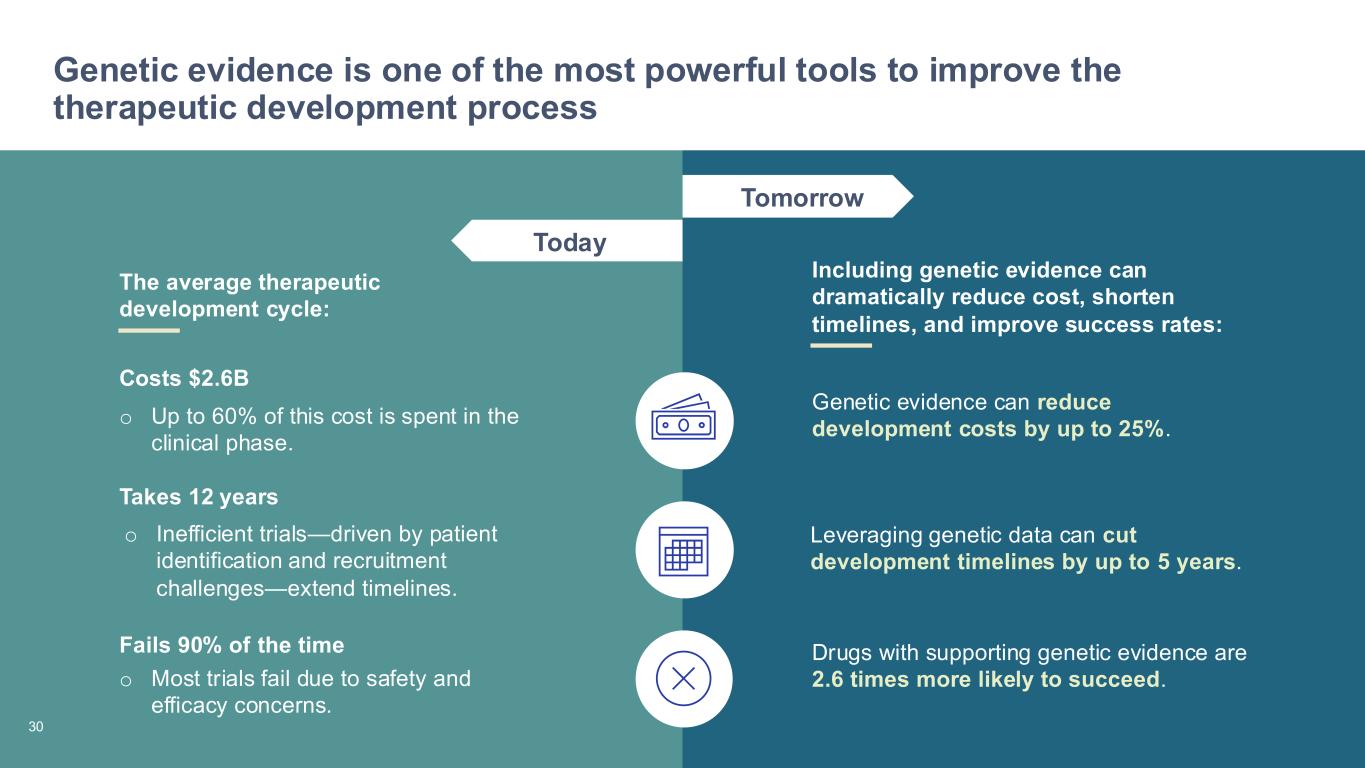
Yeah, let me take that to part. First is the INFINITY database that you just were mentioning. As I mentioned in my earlier comment, the power of that database is the fact that it's a massive reservoir of variants that we have seen in patients that have yet to be validated by a second patient. But every day with the volume that we're having, we're validating more and more and growing that database over time. And so the AI tools that we put on top are machine learning, multi-score, it really just improves the accuracy, the speed, and the efficiency that our clinical experts can go through and find those diagnoses. It gives us the highest accuracy in that space. But as you're also mentioning, those same AI tools become value-add to our partners, like pharma employers and others, as they go out and look at the Infinity database, look at the data that it sees, and really starts to actually open up the ability to have more and more drug targets, more therapies, and bring more solutions to these children with these devastating diagnoses over time. And so we really see that this AI approach is expanding into our pharma and our other partnerships around the globe. As far as our technology, you know, the genome needs, has some gaps in it. There's some difficult to sequence regions that we know about, which is why, you know, there are still some panels that people will order. It's, you know, every time that we bring in a medium read or a long read or other type of technology, it really starts to improve the diagnostic yield for some of these other conditions, which, again, converts more and more from office panels and into the exome and genome as the best answer for all patients. And we're continuing to add more and more of these technologies for the right patients with the right phenotype.
Operator
Thank you. One moment for the next question. And the next question is coming from the line of Keith Hilton of Freedom Capital Markets. Your line is open.
Great. Thanks so much for taking my question. Just two quick ones. First one on the XGen volumes, just based on the volume split for second half of 25 that you talked about on the second quarter call, it seems like volume in the quarter slightly exceeded your internal expectations. So just can you talk a little bit about where you outperformed versus your internal expectations and maybe why you decided to leave the full-year guide unchanged despite the beat?
Yeah, we saw good momentum through the third quarter with accelerating volumes each month of the quarter. And so wrapped up September sort of as expected with the high points of the quarter. and momentum has continued nicely. The outperformance mostly coming in or primarily coming in the outpatient side of the business, really forming that PNURO call point. So most of the outperformance there coming from that physician type and we continue to see a lot of space to go activate more PNUROs and bring in more volume. And overall, really pleased with the third quarter performance.
Okay, great. And then just one more question about the launch in general pediatricians, just less so about the sales force and more talking about any kind of buildup you need to do on the back end in terms of adding additional billing and revenue cycle folks to make sure the ASP doesn't drop too much, DTC spend aimed at parents, anything like that. Can you talk through how we should be thinking about the magnitude there? And also, is there any concern, you know, that there could be a bottleneck around genetic counseling for those patients that do have, you know, variants that come back that they need to better understand?
If part of those investments, as you rightly pointed out, are to ensure that there is no bottleneck in terms of genetic counseling resources or other support for non-experts, both at the front end or back end of the process in translating those results to patients. And so those are core to the experience design changes that we'll be investing in. And, you know, if you look at the expense ramp from Q2 to Q3, as I called out, from Q3 to Q4, expect something in the same order of magnitude. And we'll have more to say as we frame out 2026, but, again, would expect that the sample gross margin to cover those reinvestments back in the business such that we'll keep the business profitable on an adjusted basis.
Okay, great. Thanks so much.
Operator
Thank you. And this does conclude today's Q&A session. I would now like to turn the call back over to Catherine Stoolin for closer remarks. Please go ahead.
Well, on behalf of all the families who we serve, our customers, and all of the employees at GeneDX, I just want to say thank you to our shareholders for continuing to support our long-term growth and changing health care for the better. So thank you all, and we look forward to seeing you soon over the coming days and weeks.
Operator
Thank you. This does conclude today's program. Thank you all for joining. You may now disconnect.