Operator
Good day, and welcome to the West Banco Second Quarter 2025 Earnings Conference Call. All participants will be in listen-only mode. Should you need assistance, please send a conference specialist for pressing the star key followed by zero. After today's presentation, there will be an opportunity to ask questions. To ask a question, you may press star, then one, on your telephone keypad. To withdraw your question, please press star, then two. Please note, this event is being recorded.
Now I'd like to turn the conference over to your host today, John Aynon.
Operator
Sir, please go ahead.
Good morning, and welcome to West Banco, Inc.'s second quarter 2025 earnings conference call. Leading the call today are Jeff Jackson, President and Chief Executive Officer, and Dan Weiss, Senior Executive Vice President and Chief Financial Officer. Today's call, an archive of which will be available on our website for one year, contains forward-looking information. Cautionary statements about this information and reconciliations of non-GAAP measures are included in our earnings-related materials issued yesterday afternoon, as well as our other SEC filings and investor materials. These materials are available on the Investor Relations section of our website, westbanco.com. All statements speak only as of July 30, 2025, and West Banco undertakes no obligation to update them. I would now like to turn the call over to Jeff. Jeff?
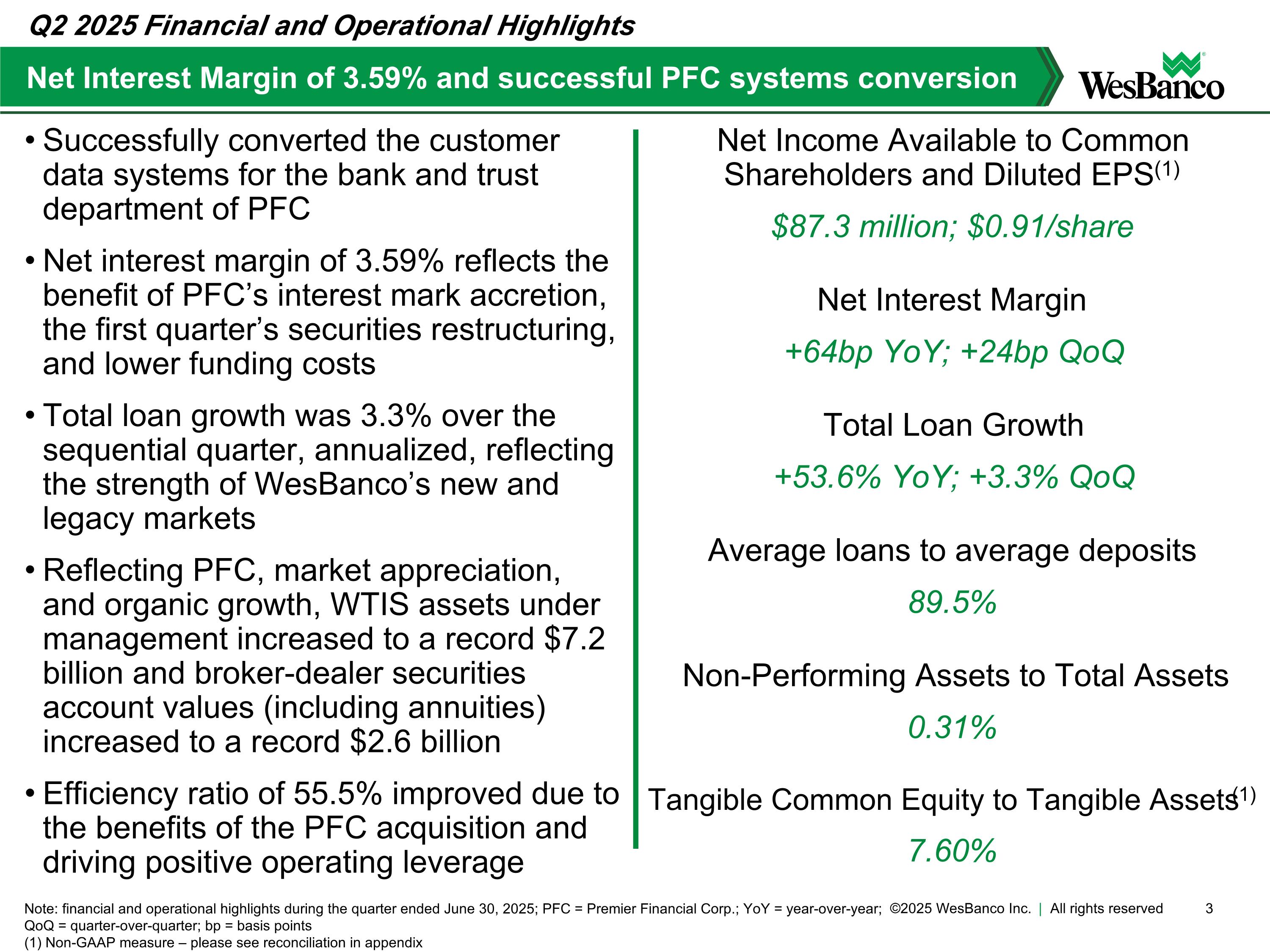
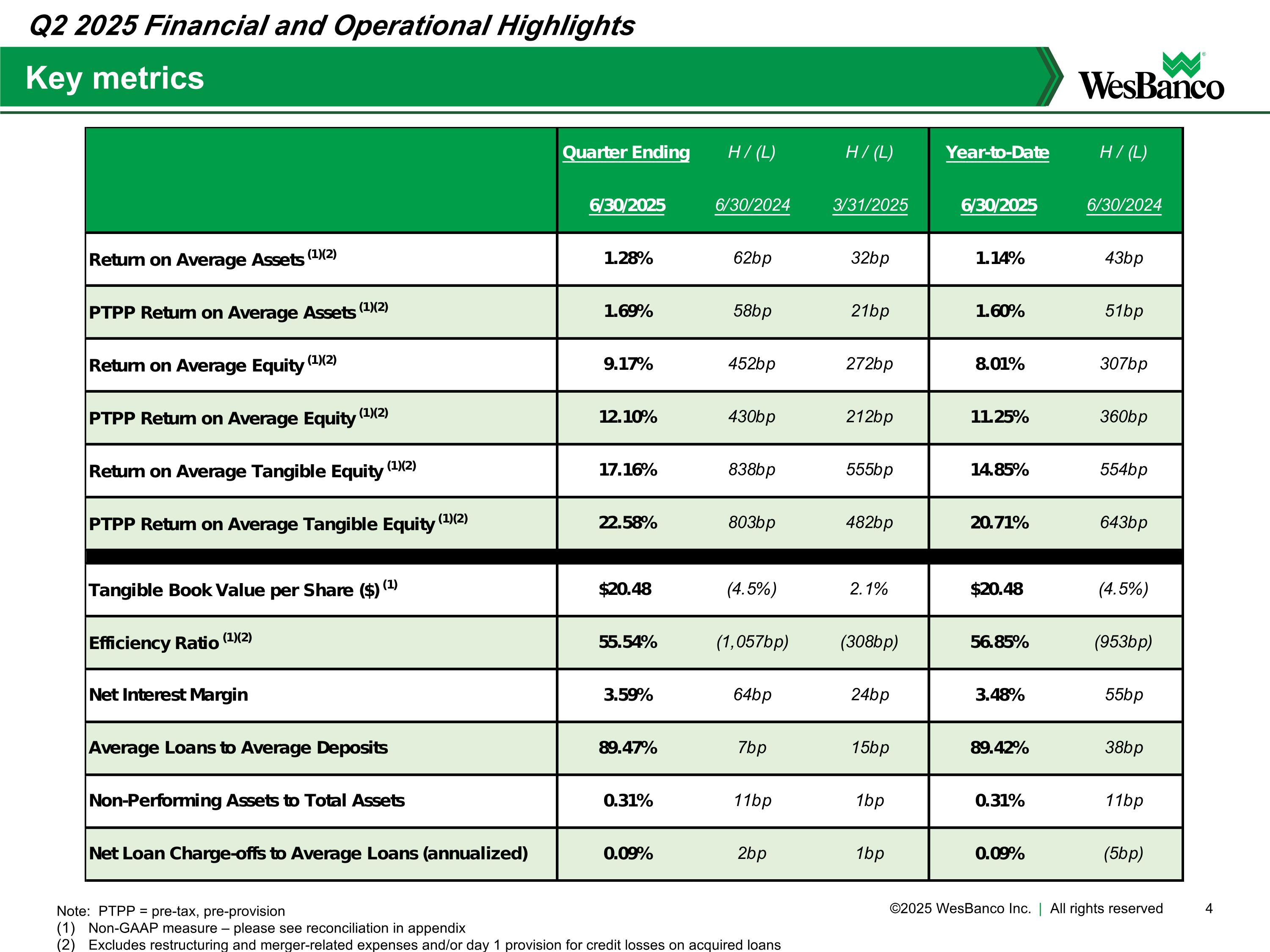
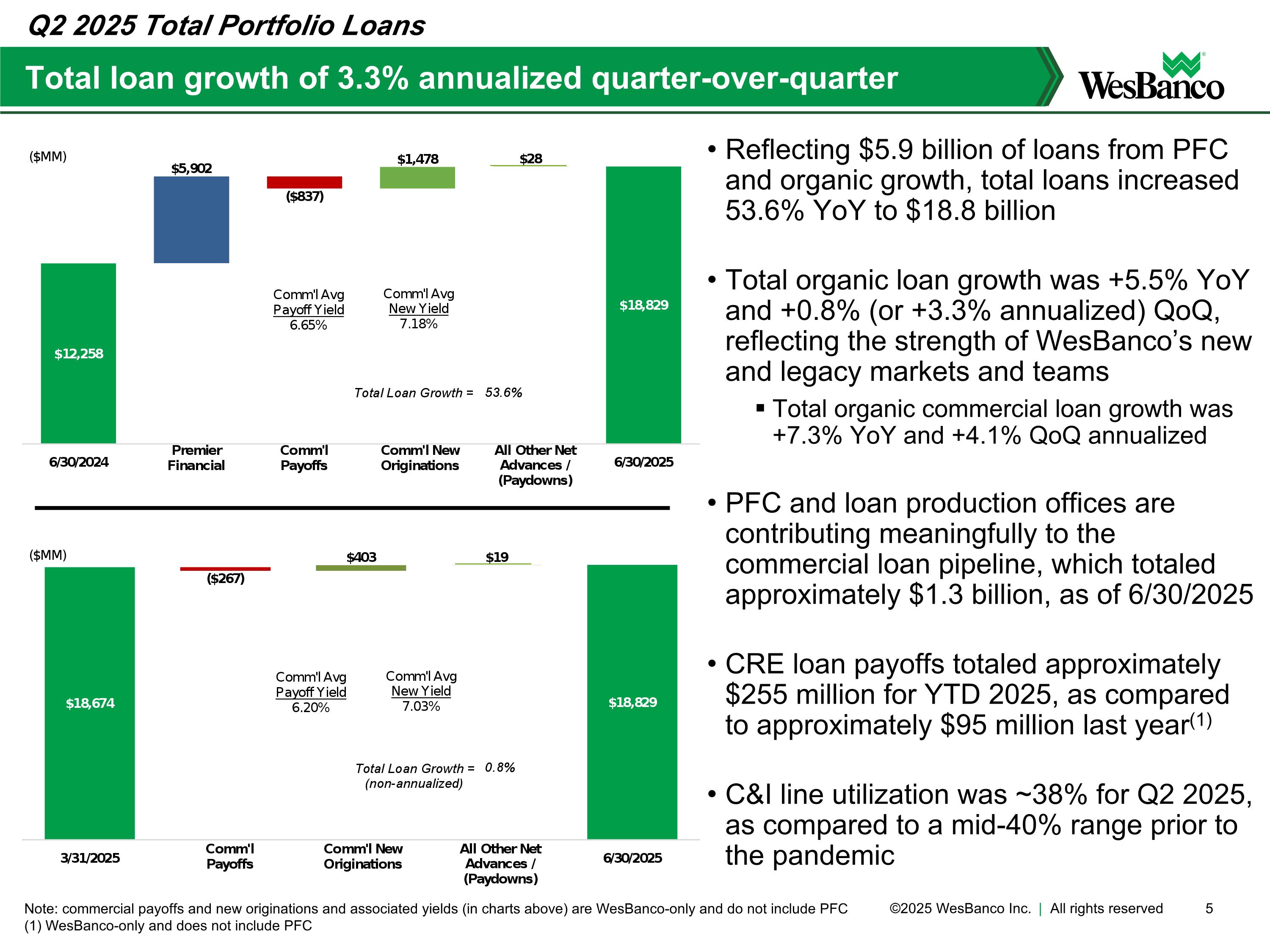
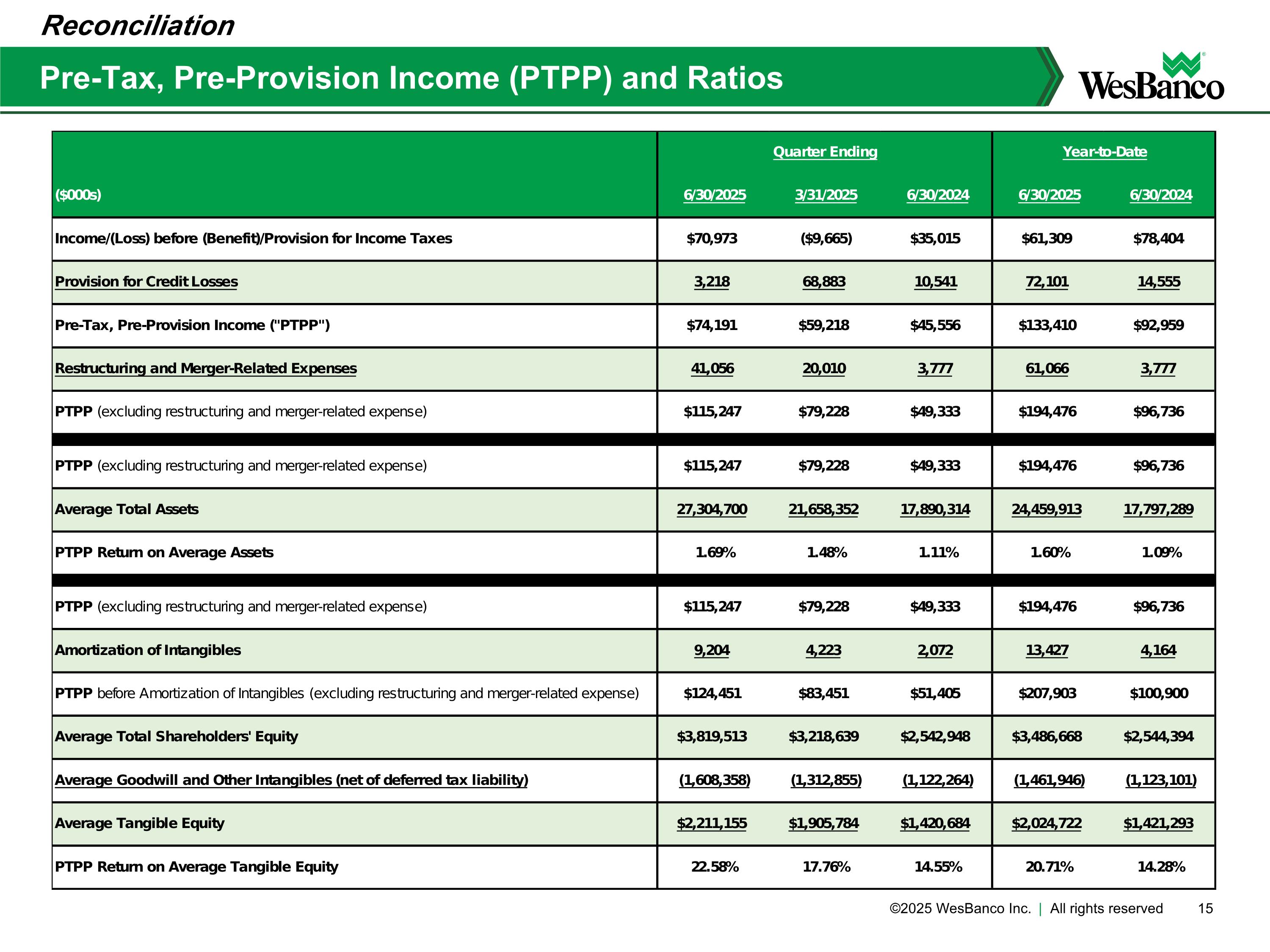
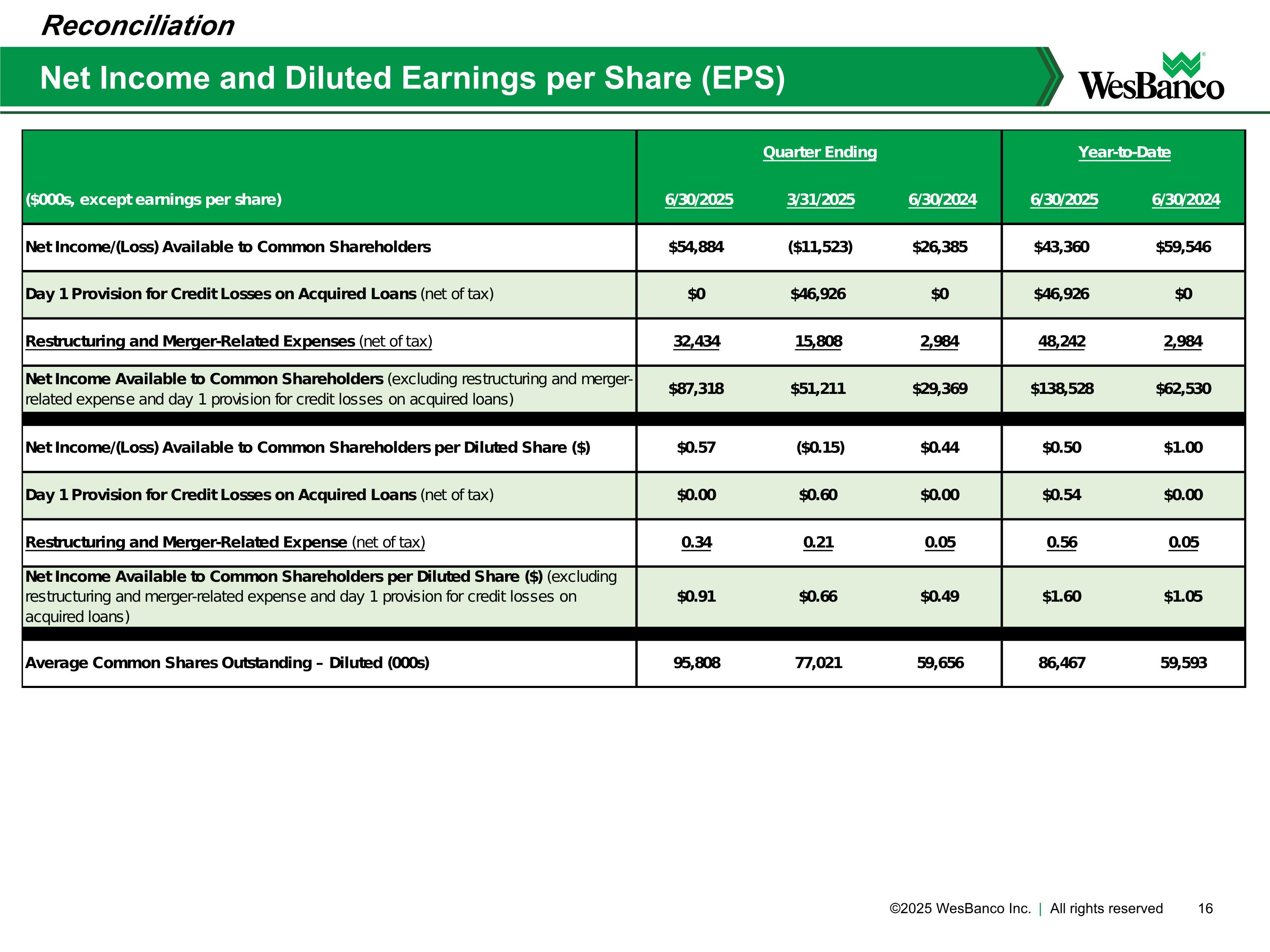
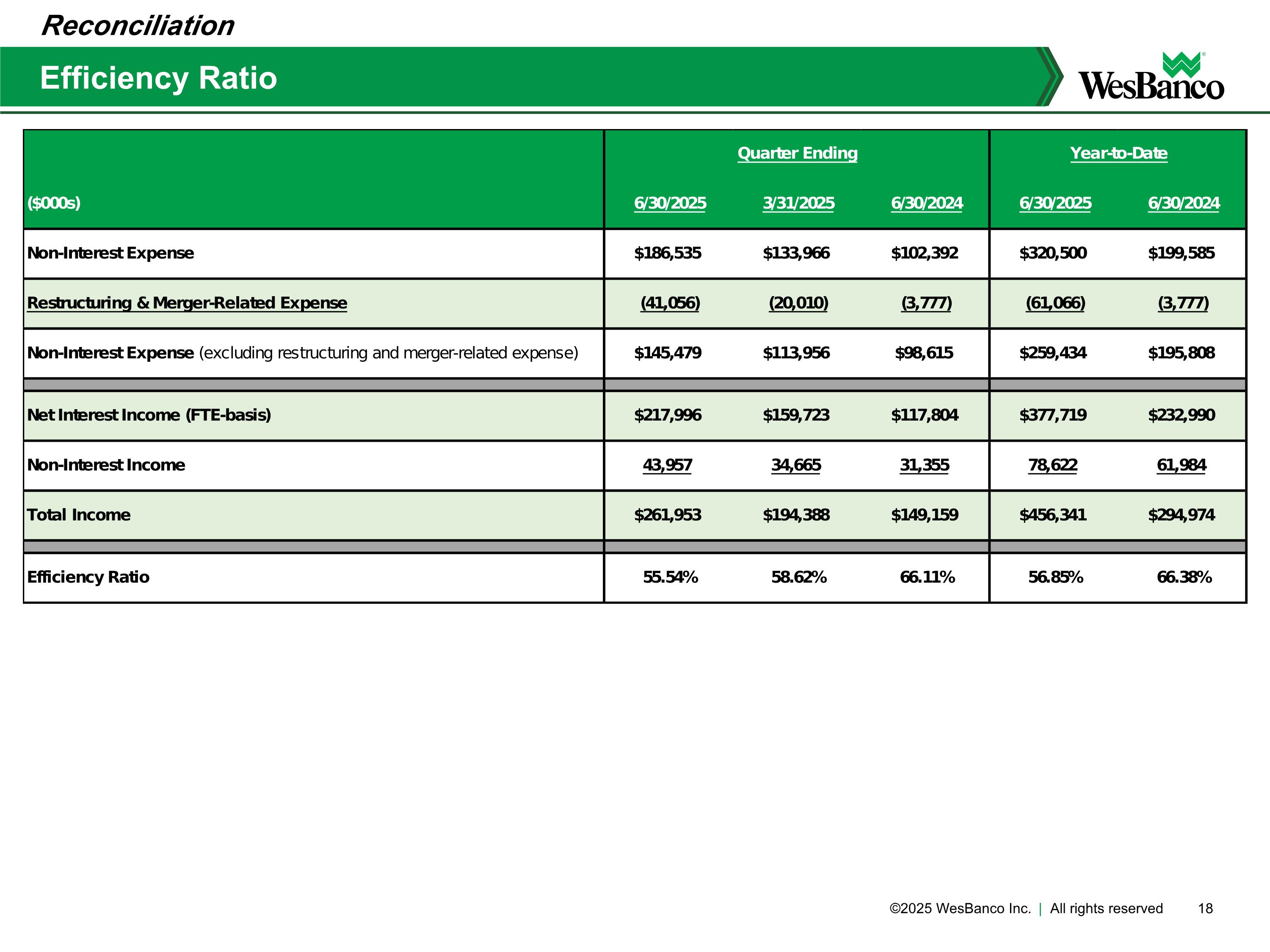
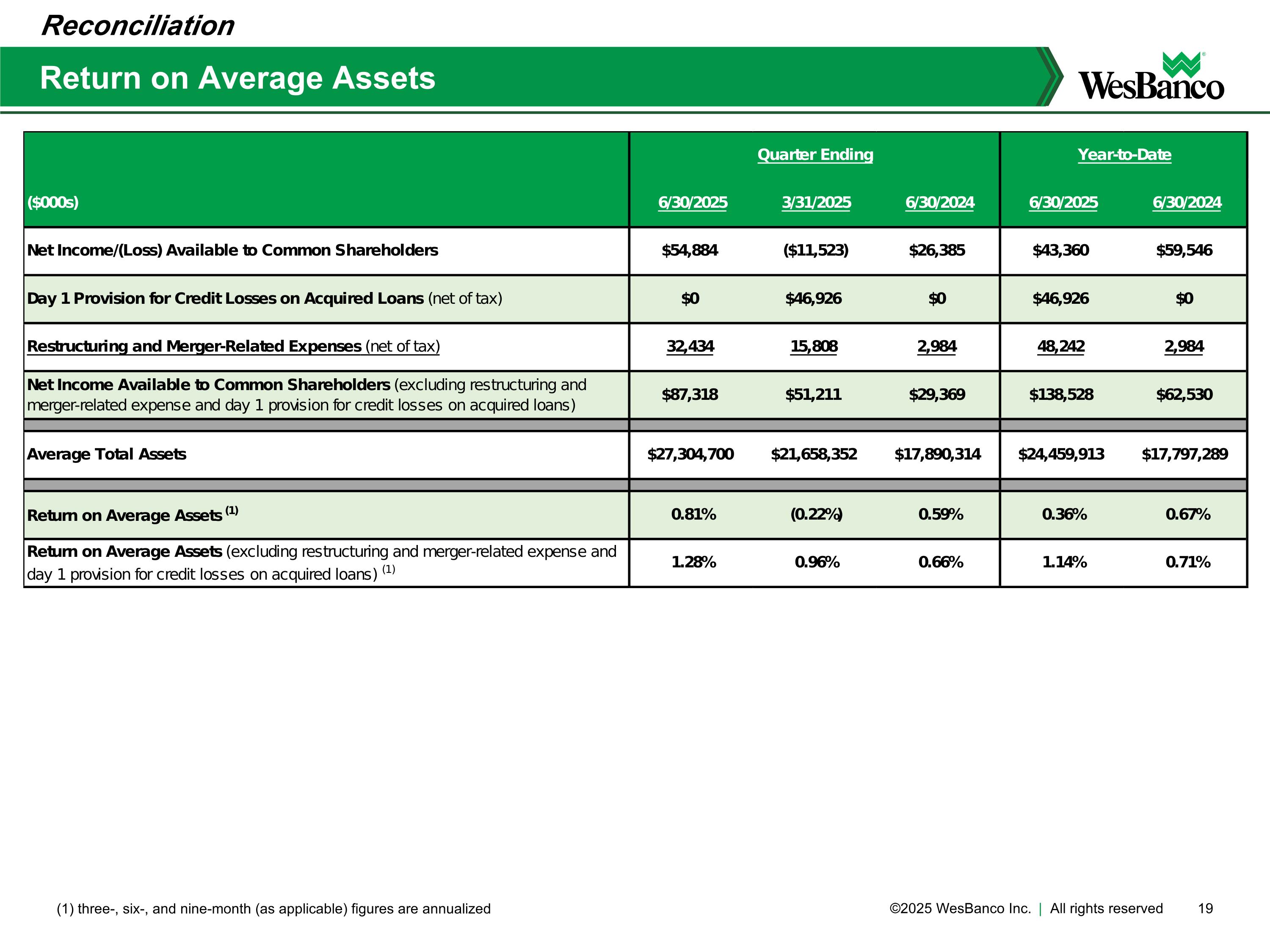
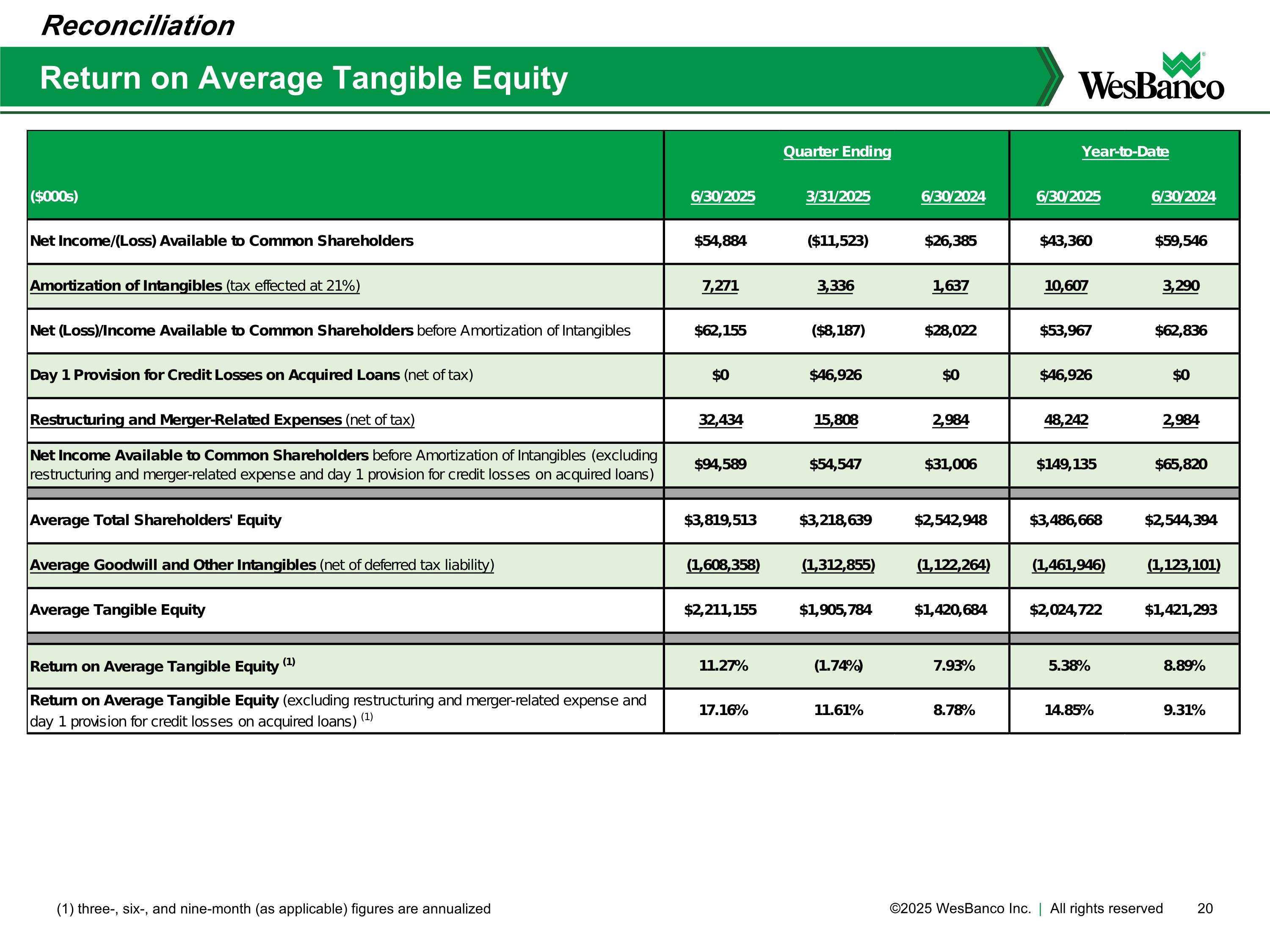
Thanks, John, and good morning. On today's call, we will provide an overview on the integration of Premier Financial and our strong second quarter results, as well as provide an update on our outlook for 2025. Key takeaways from the call today are earnings per share of $0.91 when excluding merger-related charges, which was highlighted by a net interest margin of 3.59% and year-over-year fee income growth of 40%, solid organic loan growth and a foundation for loan and deposit growth during the second half of the year, successful customer data systems conversion of Premier Financial. I'm excited that our second quarter results demonstrate the success of our acquisition of Premier and strong operational performance. Our larger organization delivered solid sequential quarter loan growth while driving positive operating leverage. We also meaningfully improved both our net interest margin and efficiency ratio, further demonstrating our focus on operational excellence for our shareholders. For the quarter ending June 30, 2025, we reported net income excluding merger and restructuring expenses of $87.3 million and diluted earnings per share of $0.91, an increase of 86% year-over-year. On a similar basis, our second quarter returns on average assets and tangible equity improved to 1.3% and 17% respectively. Our net interest margin improved meaningfully to 3.59% due to the benefits of the premier acquisition and our continued focus on loan growth and strengthening our balance sheet. Our efficiency ratio improved 10% hitch points year-over-year to 55.5% when combined with our achievement of our planned acquisition cost saves. Further, we realized strong growth in fee revenue of 40% year-over-year driven by the acquisition and organic growth. These are just a few proof points of our strategic positioning for sustainable long-term growth. This quarter's key story was the successful conversion of the customer data systems of Premier Bank and the trust department. During May, we transitioned approximately 400,000 consumer and 50,000 business relationships, along with the branding and operations of approximately 70 financial centers from Premier to West Banco. This seamless integration was the direct result of the strong collaboration of all our employees working to ensure exceptional service for our customers. We are excited by the customer reception and retention to date and are focused on building even stronger relationships with our newest customers, businesses, and communities. Reflecting the premier acquisition, market appreciation, and organic growth, our trust and securities brokerage business has grown into a $10 billion investment business based on assets under management and securities account values. Combined with our larger customer base and new treasury management products and services, fee income totaled $44 million during the second quarter, an increase of 40% year-over-year. Our focus is to grow fee income as a percentage of total revenue over the near term as we offer our products and services to our newest markets. The strength of our strategies and teams are reflected in our performance, with total commercial loan growth and organic deposit growth continuing to significantly outperform the monthly H-8 data for all domestically chartered commercial banks. For the second quarter, total deposits organically increased more than $800 million year-over-year, or 6%, fully funding organic loan growth. Importantly, this growth was driven by deposit categories other than certificate of deposits, as organic deposit growth, excluding CDs, was more than 5% year-over-year. While we did experience a decline in deposits quarter-over-quarter due to normal seasonality and the intentional runoff of higher-cost CDs and less reliance on premier public funds, we continue to expect to fund full-year loan growth with deposits. Second quarter organic loan growth was 6% year-over-year and 3% quarter-over-quarter annualized, driven by the strength of all of our markets. Further, total commercial loans organically increased 7% year-over-year and 4% annualized sequentially. Our commercial loan pipeline as of June 30th was approximately $1.3 billion, with roughly 30% attributable to our new markets and loan production offices. In the three weeks since quarter end, the commercial pipeline has grown approximately 5%. Based on the current pipeline, we still expect mid-single-digit loan growth during 2025. Recently, a cross-market team from our legacy Columbus and New Toledo Markets masterfully supported a shared C&I client throughout the customer data system conversion through a strong partnership to deliver an exceptional customer experience. The team created a plan that ensured a seamless transition for this critical client and worked tirelessly across business lines and geographies to not only retain but also grow the relationship, securing an additional $10 million deal in Columbus and an additional $25 million deal in Toledo. This is a great example of the strong collaboration across our teams to support our customers and communities. We remain committed to making strategic investments in support of long-term growth. We have recently hired a strong, seasoned team of commercial bankers experiencing the healthcare industry to expand our presence in this attractive sector and bring tailored solutions to meet the unique needs of the healthcare clients. The team has already had some early success, and while still in the early stages, we are excited about the potential opportunities they will bring. In addition, we have continued to expand our loan production office strategy into two new markets with strong demographics and growth potential, Knoxville and Northern Virginia. In Knoxville, we hired a couple of experienced bankers with a long history in the market and plan to make additional hires this year to build out that team. In fact, they have already added potential deals to our most recent commercial pipeline. Our goal over the next several years is to develop this LPO into a strong, sustainable operation, like we did in Chattanooga, with the support of additional top-tiered talent. We also have expanded our presence in Northern Virginia with a commercial LPO that complements our existing residential mortgage LPO and existing presence in the Mid-Atlantic region. We again hired an industry veteran with deep ties to the region to lead this team and grow our opportunities in this economically vibrant market. I would now like to turn the call over to Dan Weiss, our CFO, for details on our second quarter financial results and our current outlook for 2025.
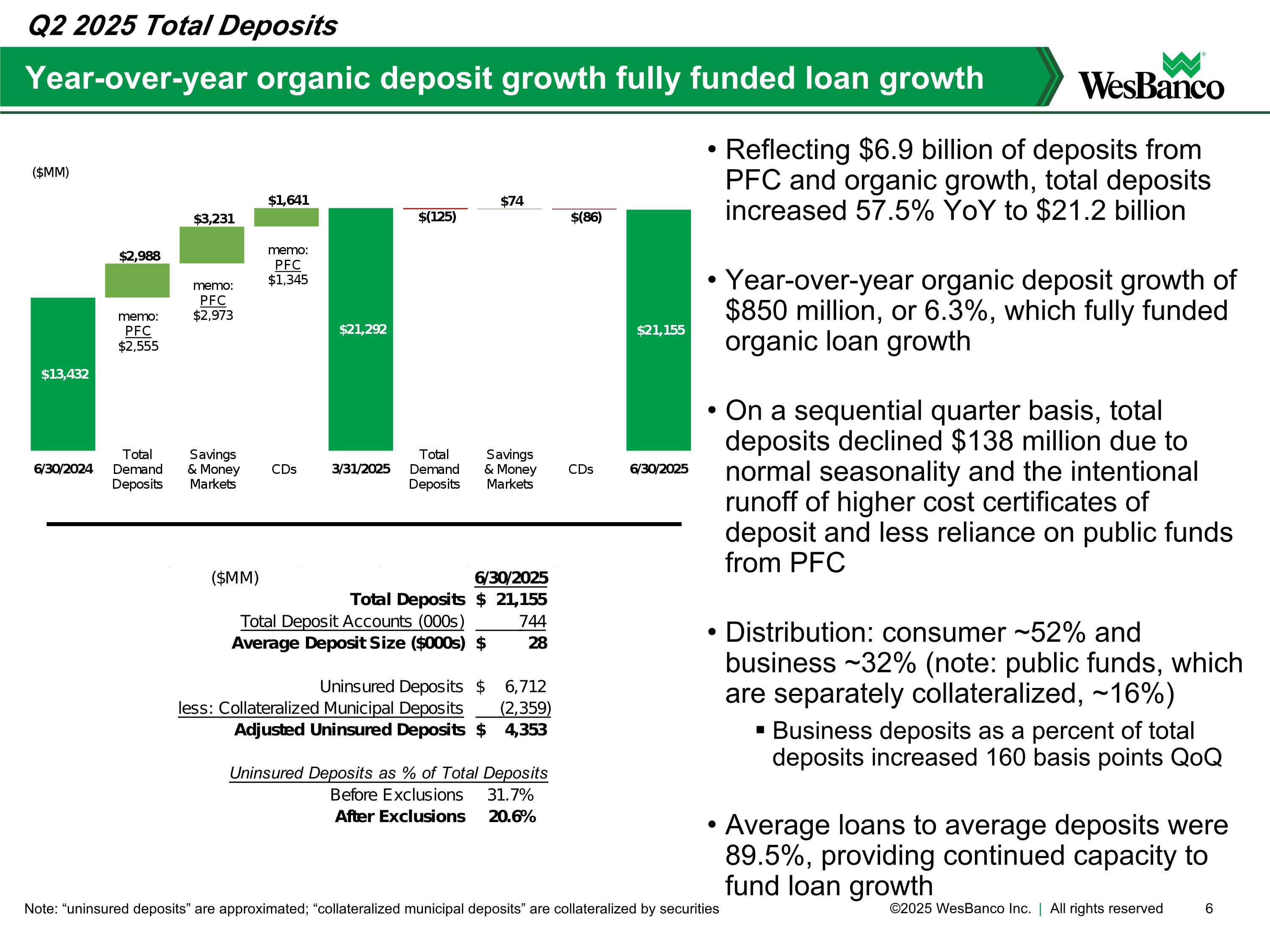
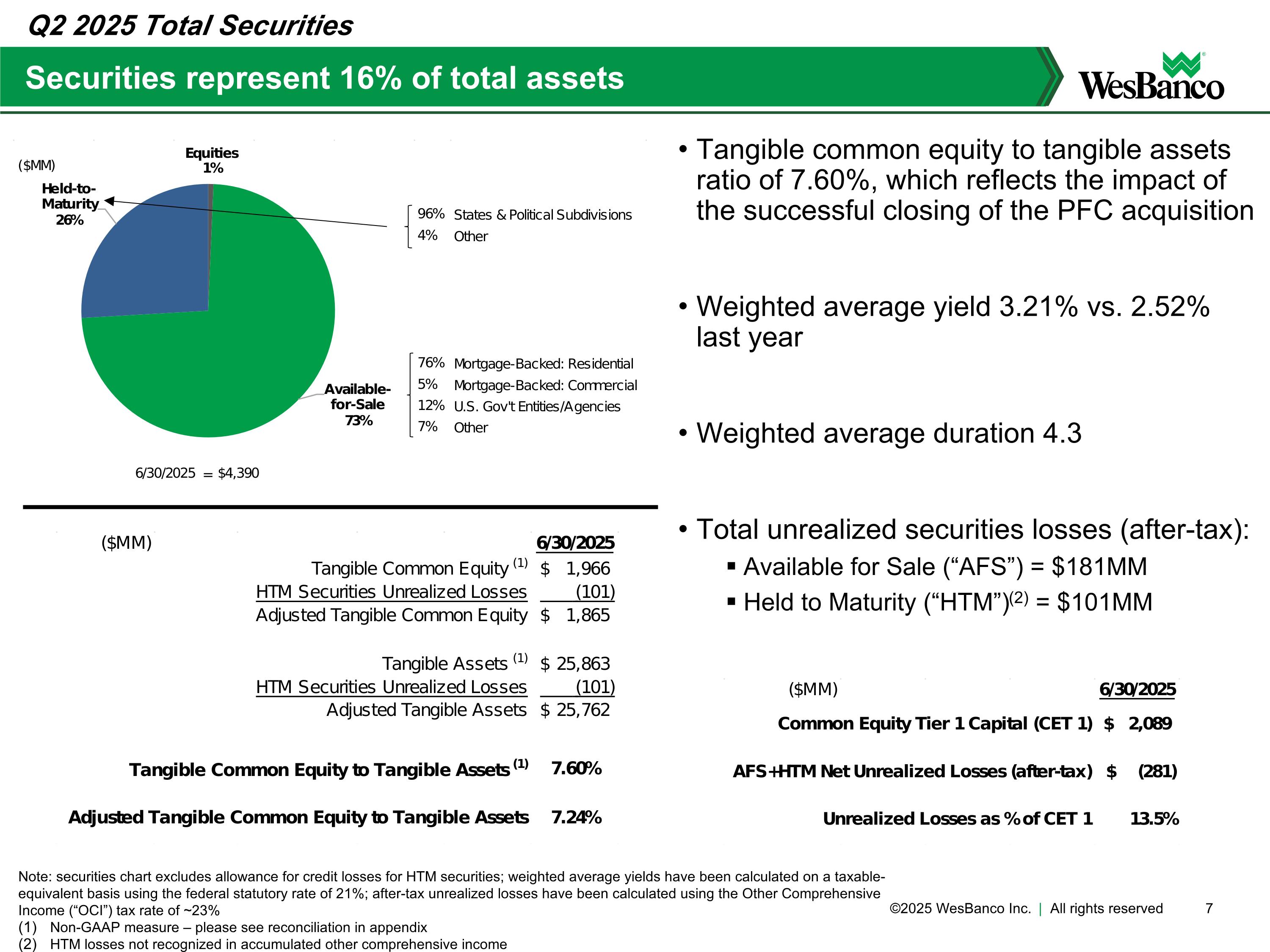
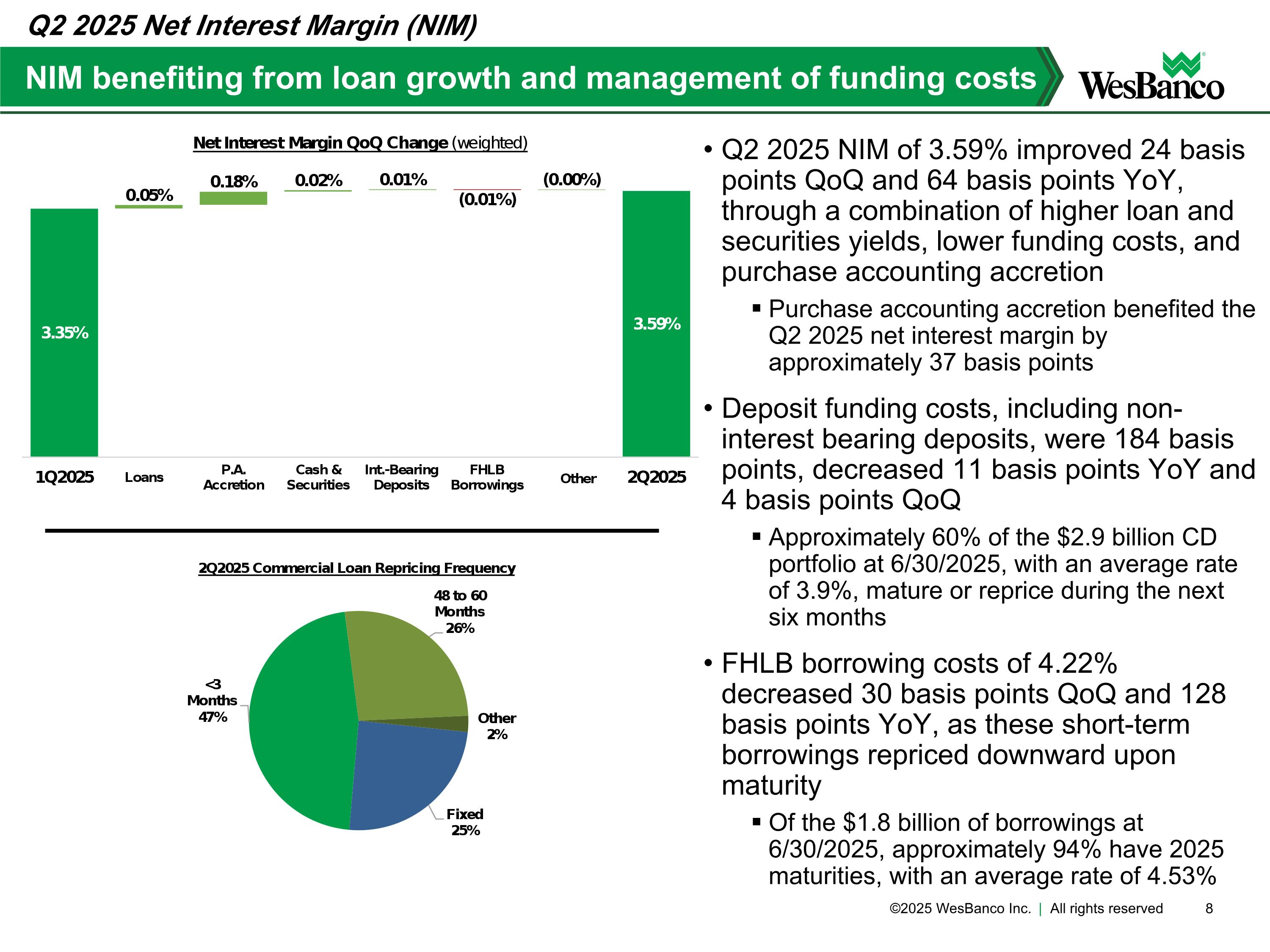
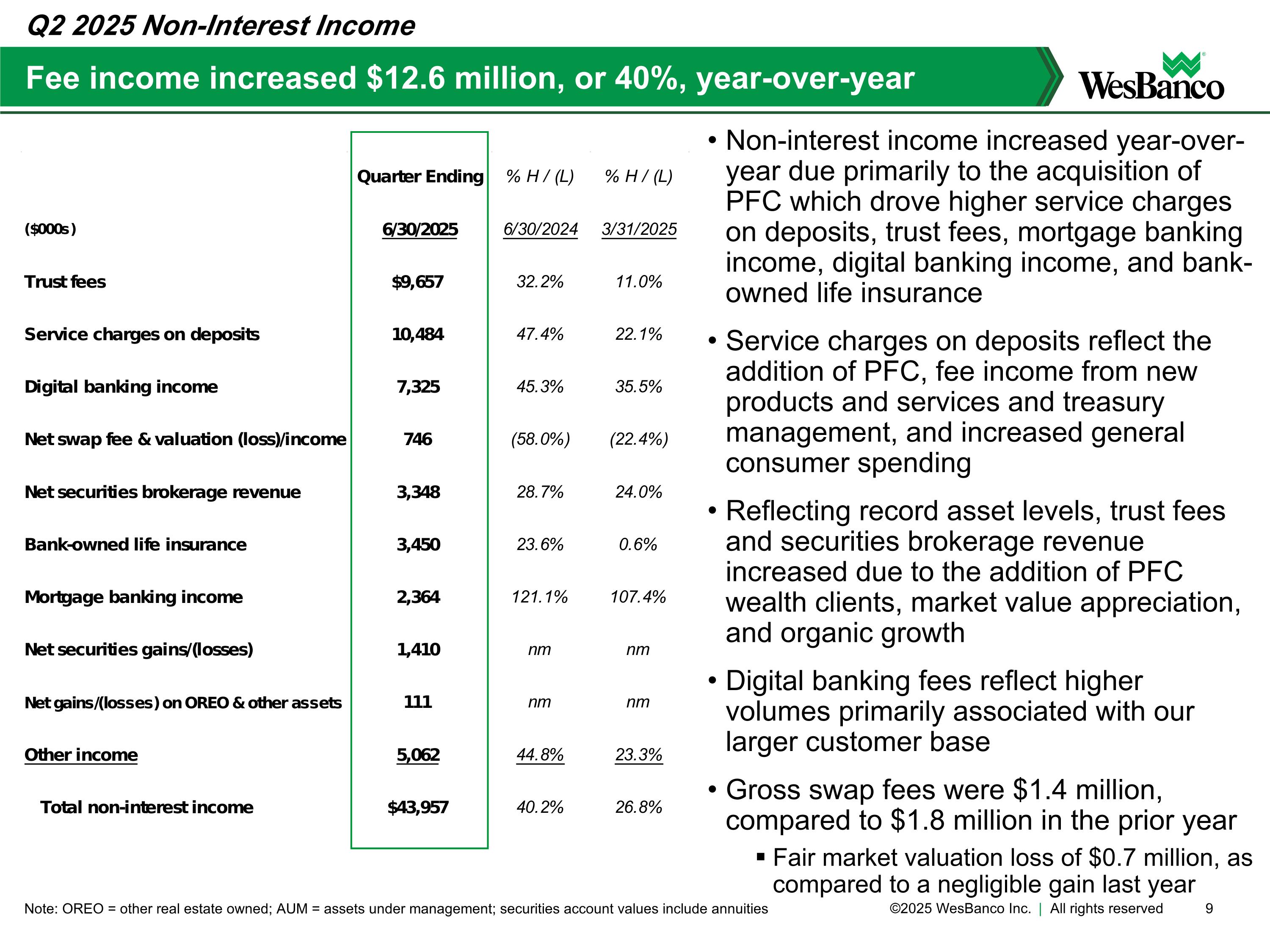
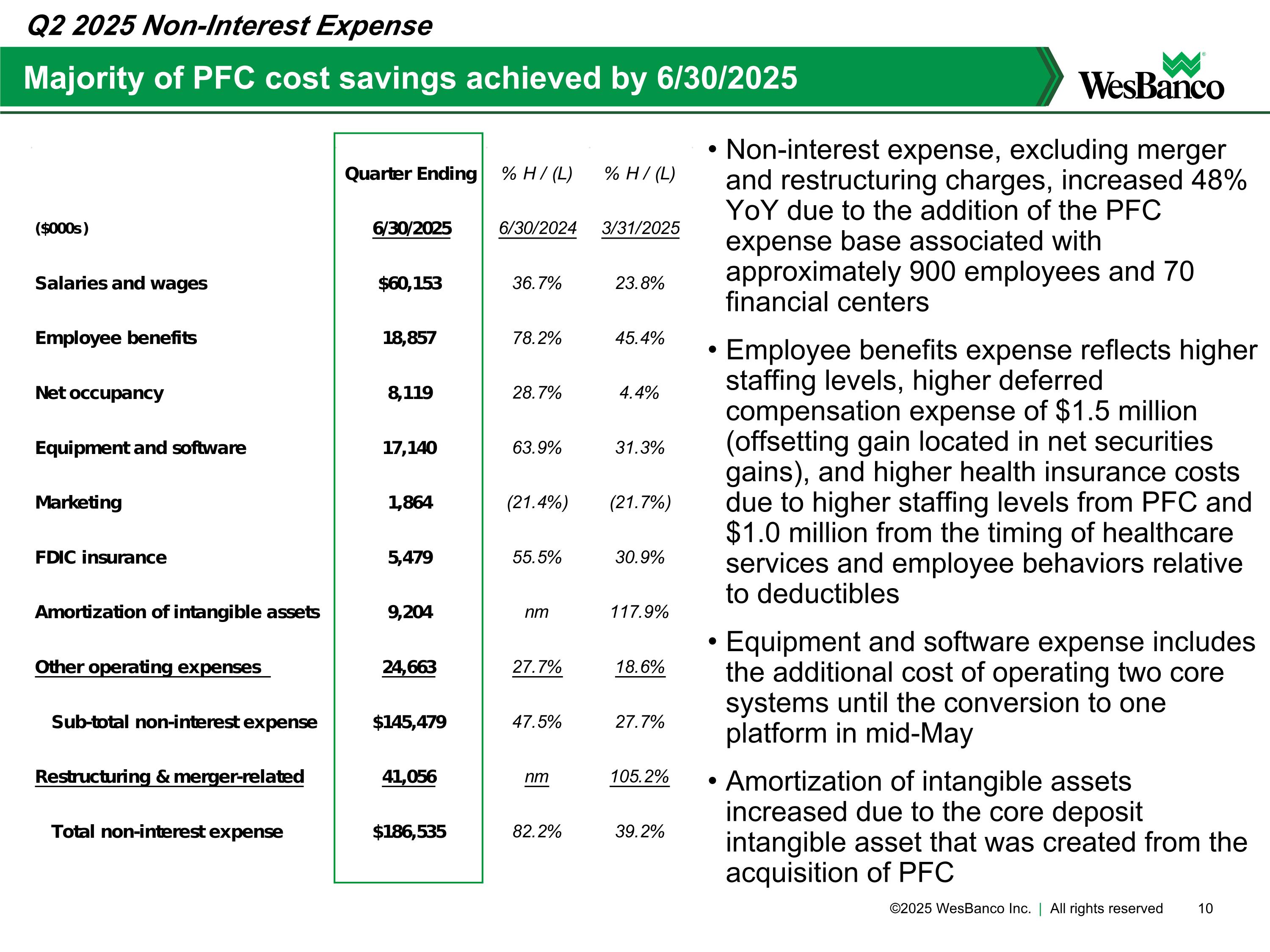
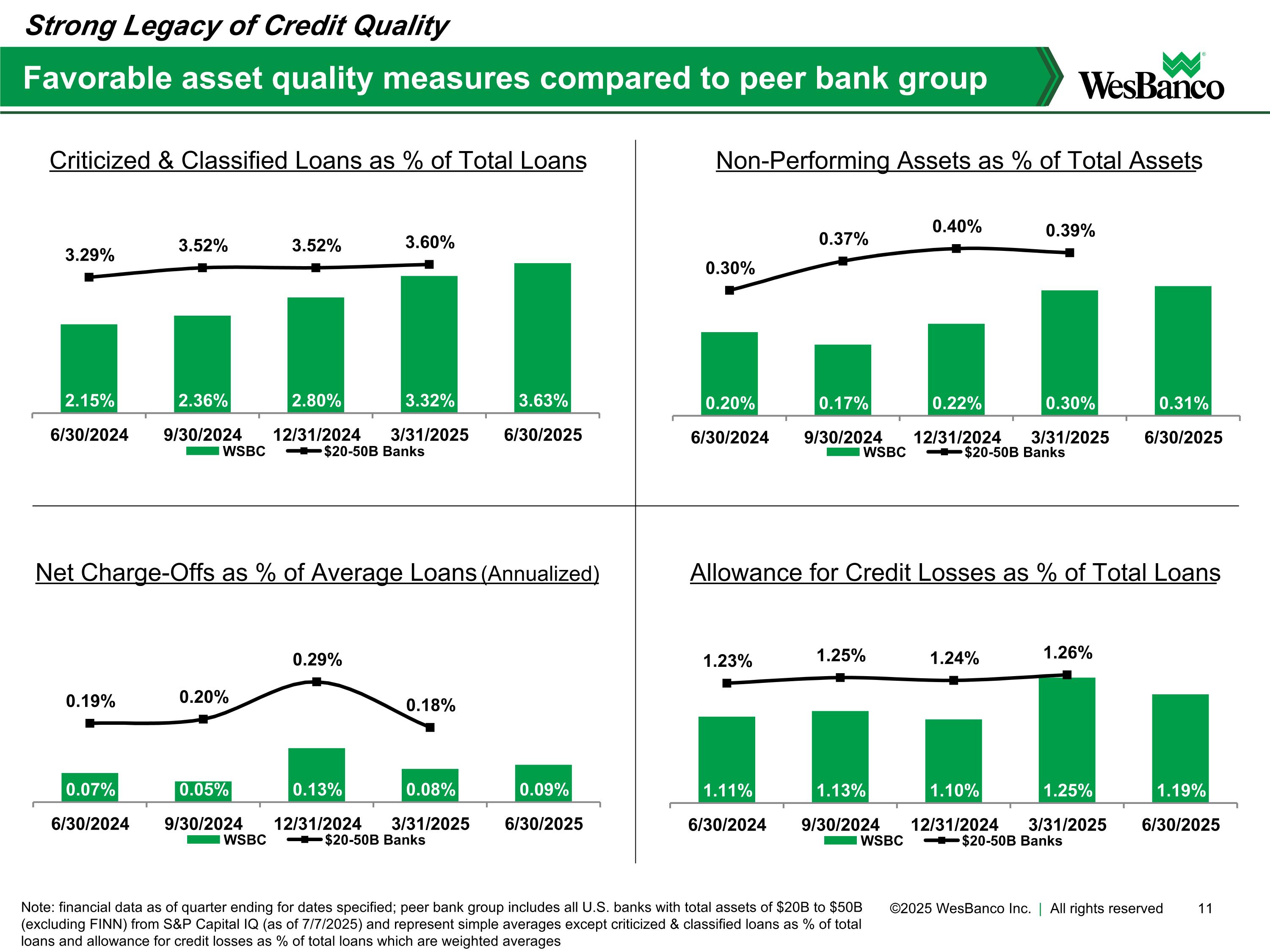
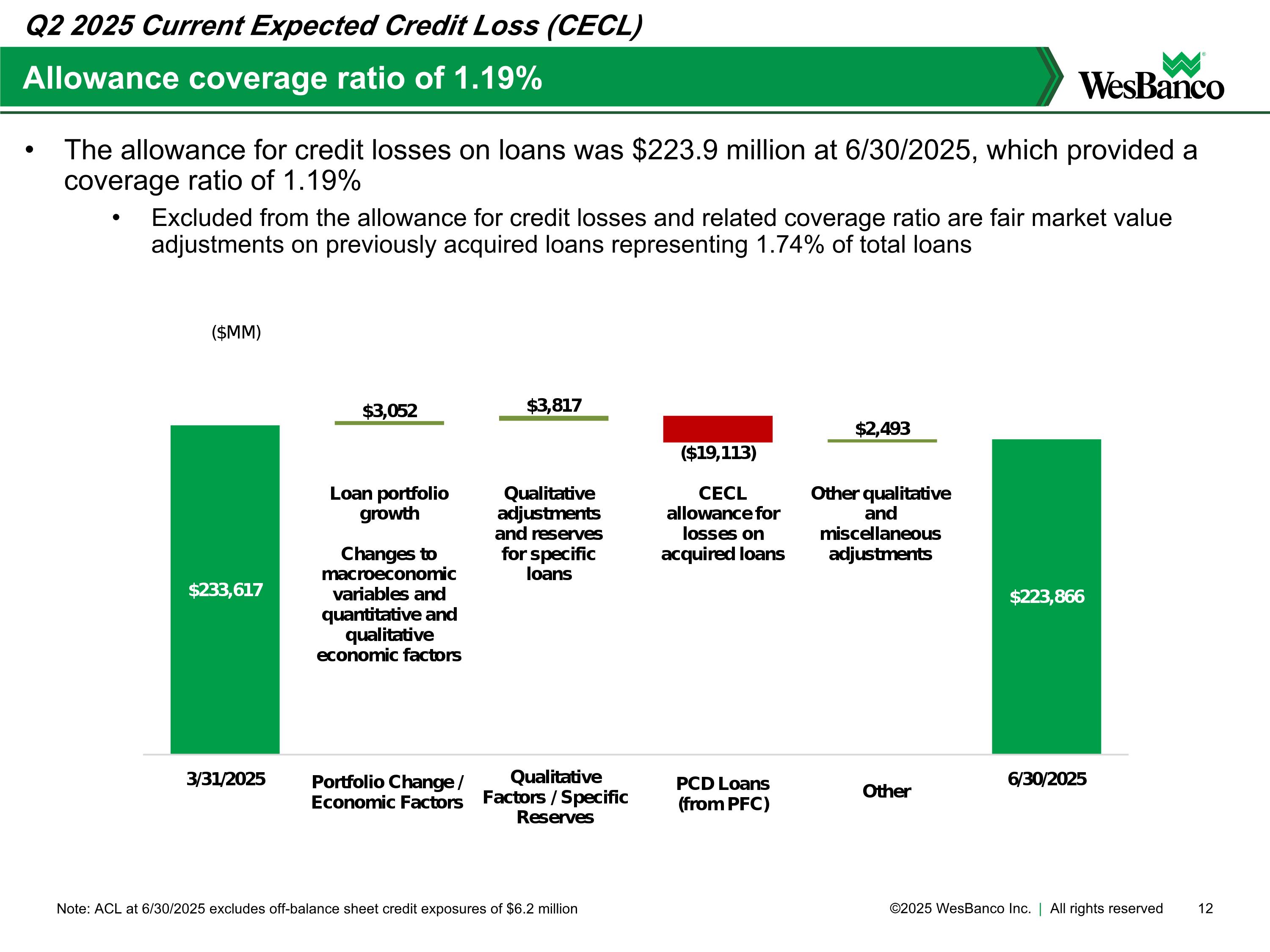
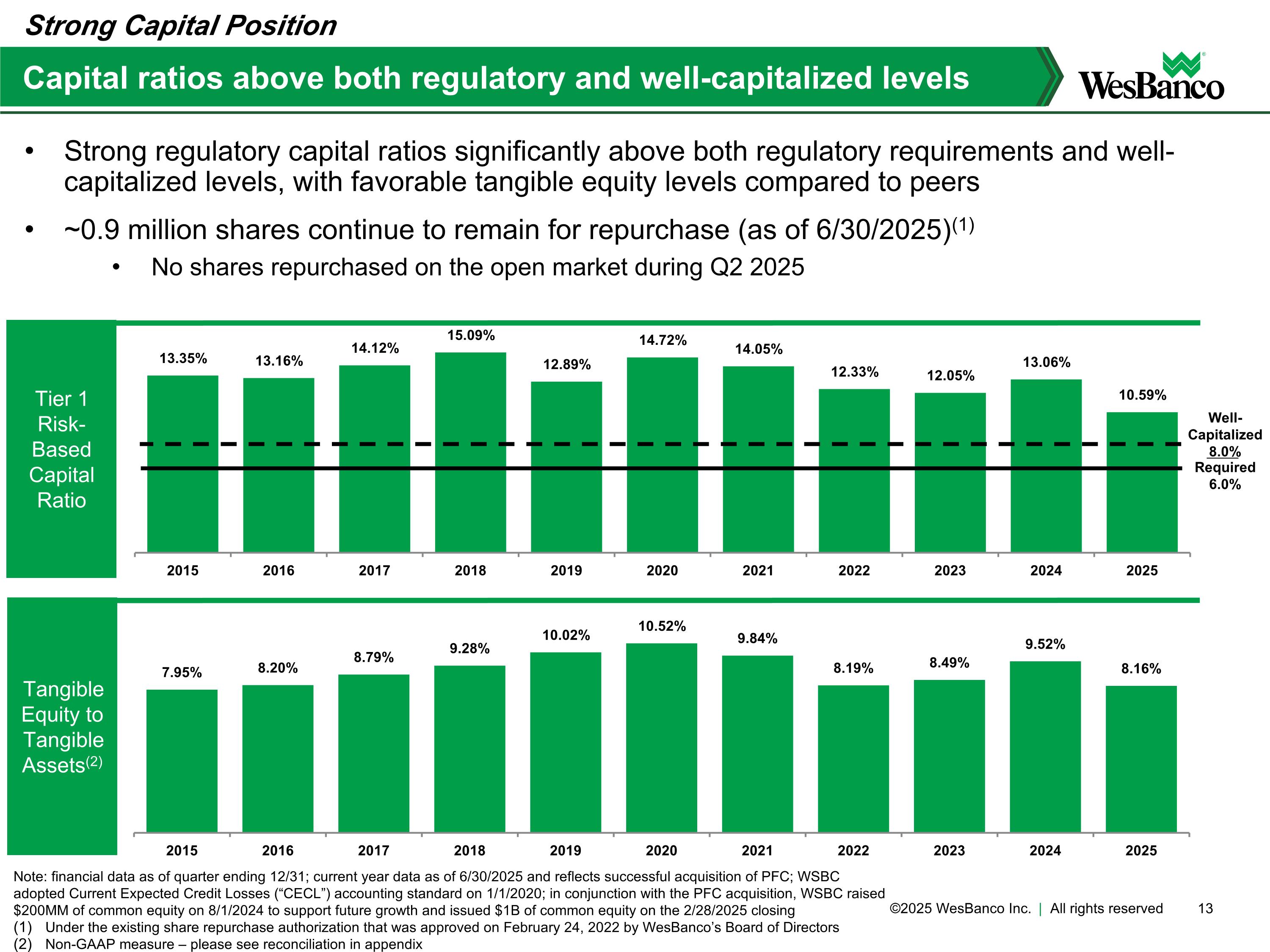
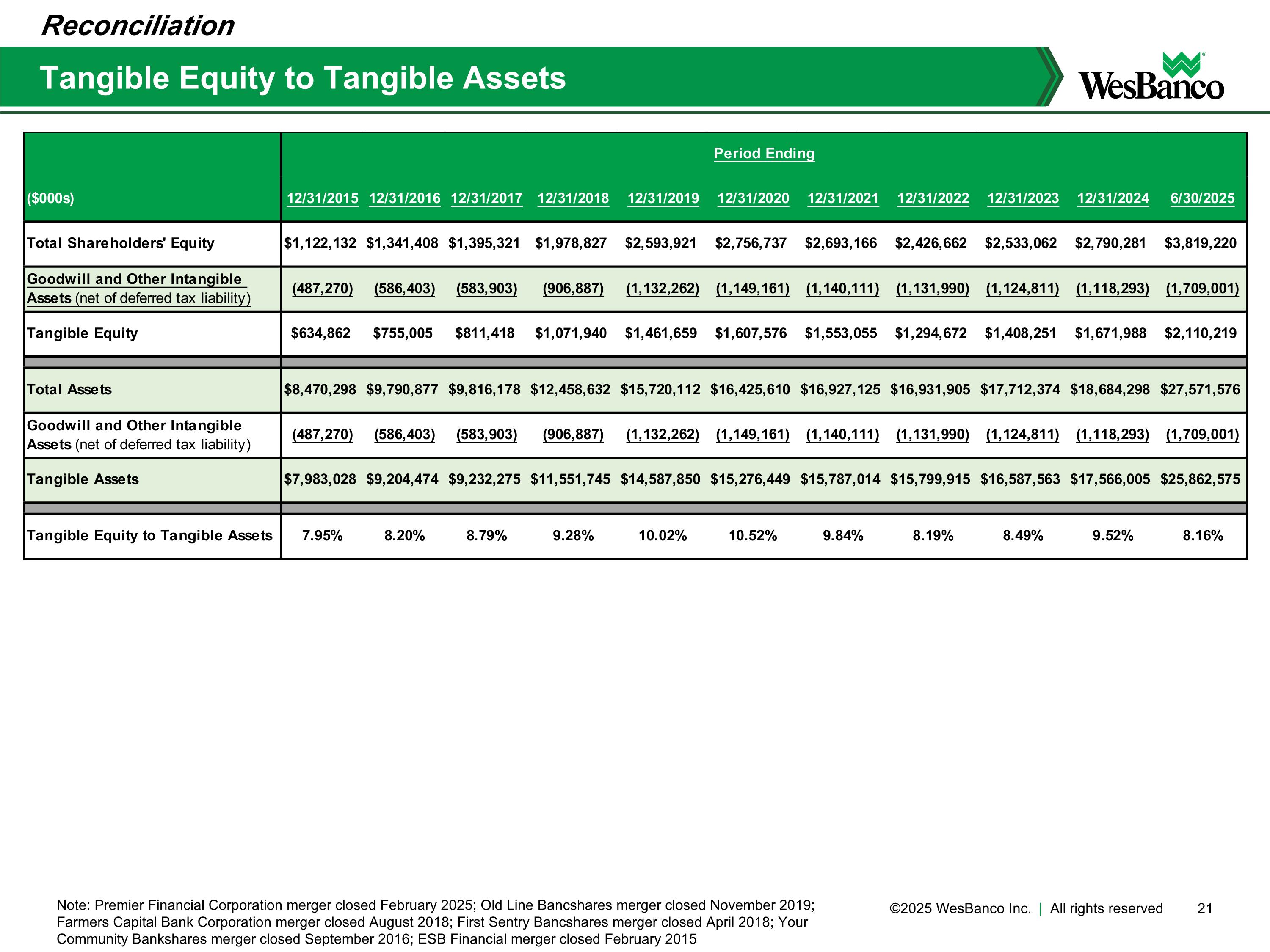
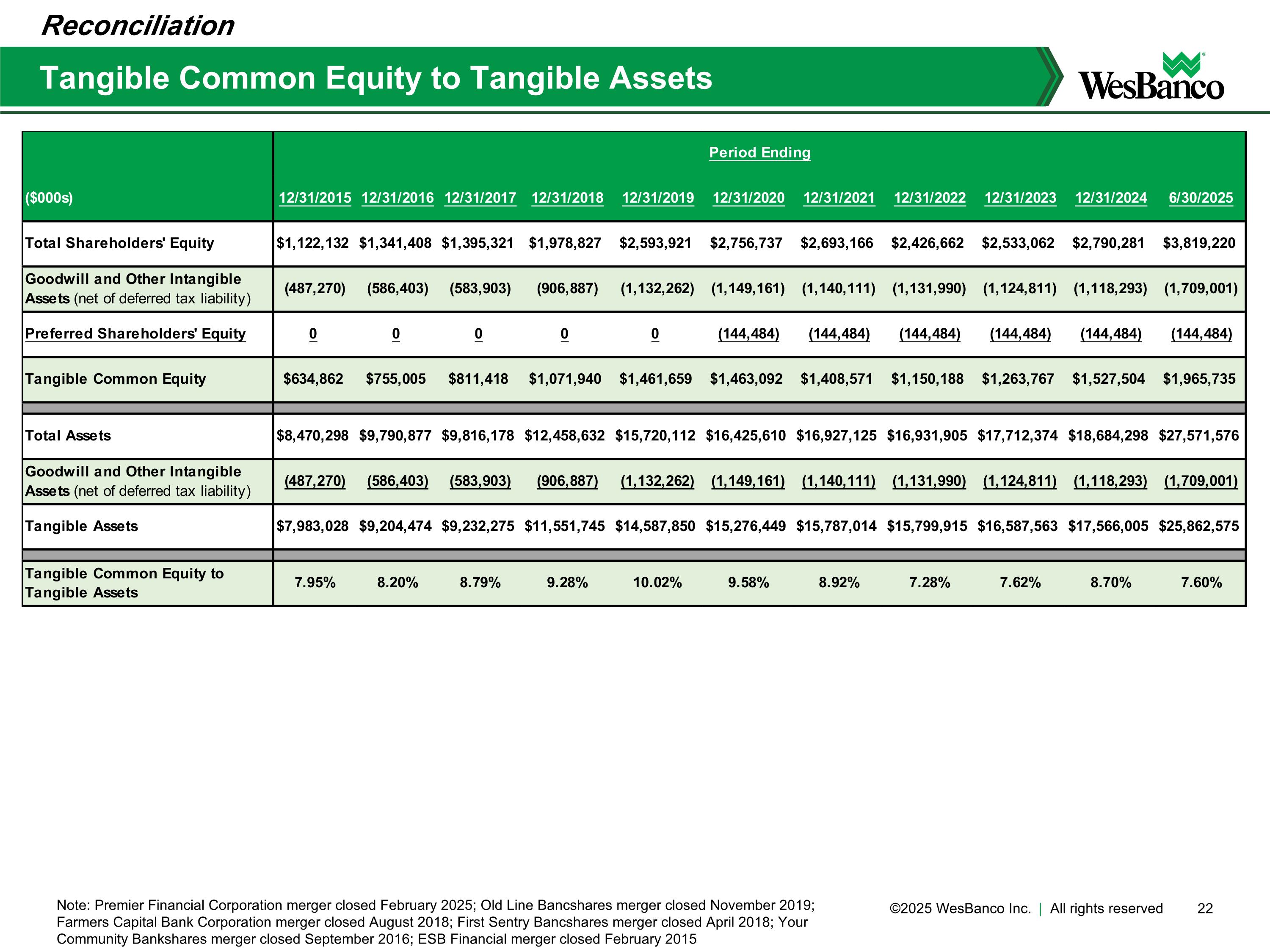
Thanks, Jeff, and good morning. For the quarter ending June 30, 2025, we reported GAAP net income available to common shareholders of $54.9 million or $0.57 per share. And when excluding restructuring and merger-related expenses from the premier acquisition, second quarter net income was $87.3 million, or $0.91 per share, representing an increase of nearly 200% from $29.4 million, or $0.49 per share in the prior year period. On a similar basis and excluding the after-tax day one provision for credit losses on acquired loans, we reported $1.60 per diluted share for the six-month period as compared to $1.05 per diluted share last year. To highlight a few of the second quarter's accomplishments, we generated strong year-over-year pre-tax, pre-provisioned core earnings growth of 134%. We grew both loans and deposits organically, improved the net interest margin, grew fee income 40% year-over-year, and reduced the efficiency ratio. In addition to successfully converting the customer data systems of Premier, we also exited $115 million of Premier commercial loans and sold the mortgage servicing business of Premier. Our balance sheet as of June 30th reflects the benefits of both the premier acquired balance sheet and organic growth. Total assets increased 52% year-over-year to $27.6 billion, which included total portfolio loans of $18.8 billion, total securities of $4.4 billion, and the addition of approximately $480 million in goodwill generated from the acquisition. Total portfolio loans increased 53.6%, reflecting $5.9 billion from Premier and $670 million from organic growth. During May, we sold $115 million of higher risk acquired commercial loans, which had a fair value of $74 million that we had identified for sale as part of our acquisition due diligence. These loans had been reflected in loans held for sale and were primarily higher-risk CRE credits. We have also seen an increase in CRE payoffs as properties are beginning to move to the secondary market for permanent financing or are sold. On a year-to-date basis, we've realized payoffs totaling $255 million and currently anticipate at least a similar amount during the second half of the year. That said, we remain optimistic about future loan growth with our strong pipelines, banking teams, and markets, combined with more than $1 billion in unfunded LCD commitments expected to fund over the next 18 months. Deposits of $21.2 billion increased 58% versus the prior year due to premier deposits of $6.9 billion and organic growth of $849 million, which fully funded organic loan growth. Total deposits declined $138 million on a sequential quarter basis due to normal seasonality, similar to last year, and the intentional runoff of some higher-cost certificates of deposit and less reliance on public funds from Premier of approximately $50 million. dollars. Encouragingly, we have begun to see the rebound in deposits so far in July and still plan to fund loan growth with deposit growth for the full year. Credit quality continues to remain stable as key credit metrics have remained low from a historical perspective and within a consistent range through the last five years. The allowance for credit losses, the total portfolio loans at June 30, 2025, was 1.19% of total loans, or $223.9 million. The decrease of $9.8 million from March 31, 2025, was driven by a reduction in PCD loan reserves from several larger payoffs and portfolio mix changes, which more than offset increases associated with a slightly higher unemployment assumption, loan growth, and other loan portfolio adjustments. The second quarter margin of 3.59% improved 24 basis points compared to the first quarter and 64 basis points on a year-over-year basis through a combination of higher loan and security yields, lower funding costs, and purchase accounting accretion, which benefited the margin by approximately 37 basis points. Second quarter deposit funding costs of 246 basis points decreased nine basis points from the first quarter and 28 basis points from the prior year period. And when including non-interest-bearing deposits, deposit funding costs for the second quarter were 184 basis points. For the second quarter, non-interest income increased 40% year-over-year, or $44 million, primarily due to the premier acquisition. With combined premier fee income, we set record highs this quarter in several fee income categories, including trust fees, service charges on deposits, electronic banking fees, and securities brokerage revenue. Valuations of equity securities linked to the company's deferred compensation plan also increased $1.5 million over the linked quarter, which drove net securities gains. And just as a reminder, these equity securities are held in a deferred compensation plan with the offsetting cost included in employee benefits expense. Non-interest expense, excluding restructuring and merger-related costs for the three months ended June 30, 2025, was $145.5 million, an increase of 47.5% year-over-year due to the addition of Premier's expense base, higher core deposit and tangible asset amortization that was created from the acquisition, and higher FDIC insurance expense due to our larger asset size. During the second quarter, employee benefits included expenses of $2.5 million of additional nonrecurring expenses with the aforementioned $1.5 million related to the deferred compensation plan and approximately $1 million in healthcare costs related to the timing of onboarding premier employees and related healthcare services. When excluding these two items, total operating expenses were $143 million, consistent with our prior outlook. Our regulatory capital ratios have remained above the applicable well-capitalized standards. In conjunction with the February 28 closing of the Premier acquisition, we issued 28.7 million shares of common stock to acquire the outstanding shares of Premier, which increased total capital by $1 billion in anticipated modestly impacted capital ratios. Reflecting the full quarter average of Premier's balance sheet, Tier 1 leverage was 8.7%, and tangible common equity to tangible assets ratio was 7.6%. Turning to our current outlook for the remainder of 2025, which includes the benefits from our acquisition of Premier, we are currently modeling two 25 basis point Fed rate cuts in September and October. However, given our relatively neutral rate-sensitive position, we do not expect a meaningful impact on our net interest margin from these cuts in the near term. We anticipate approximately 60% of the $2.9 billion CD portfolio will mature or reprice during the next six months downward from a weighted average rate of 3.9%, and this should continue to benefit the margin. The acquired Premier CD book, which was marked down to a weighted average of 2%, has mostly run off due to the shorter duration of that book, and we anticipate the renewal rates of those CDs to mostly reprice into our current seven-month CD special in the range of 3.5%, creating a temporary headwind to margin growth here in the third quarter. As a result, we anticipate the Premier-related margin accretion in the third quarter to be down about 7 to 10 basis points from the 37 basis points we reported in the second quarter. While loans, maturities, refinancings benefit overall loan yields and legacy CDs repriced downward, we continue to model legacy margin improvement of 3 to 5 basis points per quarter. And therefore, when combining the effects of the lower purchase accounting accretion, partially offset by the legacy margin improvement, we model a temporary five to seven basis point decline in the third quarter margin with a strong bounce back in the fourth quarter with our margin returning to that second quarter levels in the high 350s. Trust fees, as well as securities brokerage revenue for the remainder of the year, should be modestly higher, reflecting modest organic growth and the benefit of our new markets and newly acquired assets under management. Electronic banking fees and service charges on deposits, which are subject to overall consumer spending behaviors, should be in a similar range to the second quarter. Mortgage banking income should also be in a similar range to the second quarter, reflecting the opportunities in our new markets, but will continue to be impacted by overall residential housing market. And finally, gross commercial swap fee income, excluding market adjustments, should be in a similar range to the first half of the year. As we stated in the past, we've remained focused on delivering disciplined expense management while making appropriate investments to support long-term growth, like our recent LPOs in Knoxville and Northern Virginia. Subsequent to the successful customer data systems conversion of Premier, we achieved the bulk of the planned 26% cost savings by June 30th. And as mentioned last quarter, our mid-year merit increases offset the remaining cost saves from the completion of the systems conversion. Therefore, we continue to expect the expense run rate for the third quarter to be consistent with the second quarter in that low to mid $140 million range. The provision for credit losses will depend upon changes to the macroeconomic forecast and qualitative factors, as well as various other credit quality metrics, including potential charge-offs criticized and classified loan balances, delinquencies, changes in prepayment speeds, and future loan growth. And regarding the FASB rule change related to the CECL double count, if the rule is finalized by October of this year, we will evaluate the potential benefits and risks to adopt that change as it relates to the acquisition of Premier and make a decision at the time on an appropriate course of action. A rough estimate of the potential benefit to capital if we adopted is it would increase capital by approximately $45 million after tax while lowering loan marks by approximately $60 million pre-tax. And lastly, we currently anticipate our full-year effective tax rate to be between 19% and 19.5% subject to changes in tax regulations and taxable income levels. We are excited about the opportunities that lie ahead and pleased with the success of our strategies playing out according to plan. Operator, we're now ready to take questions.
Operator
would you please review the instructions? Yes, thank you. We will now begin the question and answer session. To ask a question, you may press star then 1 on your telephone keypad. If you are using a speakerphone, please pick up your handset before pressing the keys. If any time your question has been addressed and you would like to withdraw it, please press star then 2. As a courtesy to the others, please invite yourself to one question and a follow-up. If you have additional questions, you may re-enter the question queue. This time we will pause momentarily to assemble the roster. And the first question comes from Daniel Tamayo from Raymond James.
Good morning, everybody. Maybe just starting on the credit side, a little bit of an increase in the criticize. I wonder if you could give us a little color there. And then just broader thoughts on the LPOs as it relates to credit. if you can kind of give us an idea of how you are able to kind of maintain the credit culture as you do continue to build out the footprint.
Good morning, Daniel. So I'll start with the CNC being up slightly. A lot of that is due to some regrading of a couple premier clients that we acquired. Once again, we feel like we're still below our peer averages. And we look in the third quarter, we do think we'll see some upgrades into payoffs. So I do expect that percentage to get better as we enter this back half of the year. As it relates to the LPOs, we still do all the same underwriting, the same credit policies. We have credit officers that have been long tenured with our company that approve the credits. So there's no differential in how we look at any credit in any market. And once again, we really use legacy West Banco people to take a look at those credits. We also have the market leaders talk about the types of deals we like, the types of deals we don't. And so we take that very seriously. And I can tell you that our credit's been really good in our LPO markets. And with this expansion, I only expect that to continue.
That's helpful, Jeff. Thanks. And then I guess kind of related, you know, with these LPOs, from a capital perspective, just maybe remind us how you think about kind of the overall capital deployment, you know, priorities or from a strategic perspective. You've got the LPOs. You've got M&A. you've got organic growth within the legacy footprint. You know, within that stack, I guess, you know, how do you think about priorities there or managing the capital overall?
Yes. So we start with our dividend, obviously a lot of shareholders, and we really value the dividend, put that as a strong focus. But then second is really organic growth. So I'm really excited about our organic growth, and that's really where we're focused on today, I think if you look at the premier footprint with all the opportunities that it's going to provide us, along with the LPOs we talked about, and I'm really excited about to be opening Knoxville, Northern Virginia. If you look at Tennessee, you know, we were just getting started a couple years ago. We've got almost $350 million in loans there. Still see tremendous growth with our national and Chattanooga markets. And then finally, health care. We hired on some professionals with really great background in health care that we also see some really great growth on the back half of this year. So I would say dividends and then organic growth, a solid one and two, and then probably M&A buybacks falling much further down there. But I really want to make sure everybody understands our focus is to really execute on the premier transaction, grow in those markets, and then continue with the LPOs and the health care strategy. We feel like we've got, once again, tremendous opportunities for growth that I think you'll see in the back half of this year.
Well, I will step back. Thanks for all the color, Jeff.
Operator
Thank you. And the next question comes from Russell Gunther with Stevens.
Hey, Jeff. First question on the long growth front. Appreciate the puts and takes for the back half of the year. Maybe just bigger picture, is a mid-single-digit type of growth rate, how we should think about West Banco going forward, kind of on the pro forma balance sheet for Premier, or as some of the newer LPOs kick in, perhaps CRE headwinds ease, is that high single-digit you guys have talked to prior still ultimately achievable?
Yeah, we're still targeting mid to upper single digits. As mentioned before, a lot of CRE payoffs have increased. But the nice thing about our balance sheet is when we run kind of the forecast, our capital builds back very quickly. So that does give us continued expansion potentials for CRE growth, which is a very nice thing. But I would definitely say we're still looking at that mid to upper single digits. Once again, it depends on CRE payoffs, but as I said previously, we have a lot of great things to organically grow this company, especially in the second half of the year, so feeling very good about a lot of those items. So once again, feeling good about the growth. I think it's going to be mid to upper, maybe somewhere in the middle there, but the back half of the year, our pipelines are looking really strong, around $1.4 billion. Those are all-time highs, of course, and once again, Premier is just getting used to. our systems, the way we do things, building those pipelines, and I feel very good about the second half of the year.
Great. Thank you, Jeff. And then second question on expenses. I appreciate the puts and takes of this quarter and how 3Q should shake out, but maybe a bit more intermediate term. You know, you guys have north of 250 branches today. Is that the right number going forward? If it's not, kind of what is and what could that mean for potential branch rationalization and cost saves not currently contemplated in the guide?
Yes. So I would say, like we do every year, we do look at branch rationalization efficiencies, and we're going to do that as well in the second half of the year. We do have 250 branches. I'm sure we will look at every branch to make sure that it's very profitable for us, strategically aligned. But as we have done every year, reiterate, we have tended to close some branches. So, once again, just getting started with that work. I don't have a number to give you on that, but that is going to be happening the second half of the year as well, and I would expect there would be some cost saves that come out of that.
Okay, great. Thank you guys for taking my questions.
Operator
And the next question comes from Carl Shever with RBC Capital Markets.
Hey, good morning, Carl. Morning, Carl.
Dan, let's get you involved. You gave some good color on the margin for next quarter. I wanted to just test your accretion assumptions, I guess. So it's 37 this quarter. It drops back to kind of high 20s, around 30. Is that the right number for 2026? It's kind of a sustainable level, 30 bips of accretion. I know it'll kind of trickle down over time. but is that a good starting point?
Yeah, I would say so. Really, if we think about third quarter, you can get into the high 20s pretty easily with my commentary. We see maybe a two or three basis point drop into the fourth quarter, so you're kind of mid-20s, and then from there, it's what we model as about a basis point of the accretion.
That's perfect. And then, Jeff, you sound very optimistic about Premier. I guess my question is the systems conversion is done. Are there other things you need to do to integrate the companies in the coming months, or is it really just going out and getting that growth and driving fees?
I think it's really just going out and getting that growth and driving those fees and making sure our new Premier associates are familiar with our processes about turning around deals quickly and what types of transactions we want to do, the types of products we're selling, getting them comfortable with that. But I can say this is the smoothest conversion I've ever been a part of. Literally no hiccups, great customer conversion. I think the new premier employees are really enjoying our culture and our growth strategies and the way we kind of create a great culture here at West Bank. So, no, I think second half of the year is really let's grow. Let's continue to take market share and continue to add great, talented bankers that help move our company forward. Great. Thank you both. Thank you.
Operator
Thank you. And the next question, Constance Catherine Mueller with KBW.
Thanks. I want to just quick follow-up on the creation just to clarify. Is the CD amortization totally out by third quarter, or is there still a little bit of that coming in?
There is a little bit after third quarter, but I believe it's less than a million dollars.
And then in the third quarter, how much is next quarter?
Okay, got it. Okay, perfect.
And then first quarter of next year, we're assuming it drops down into maybe $600,000, $700,000.
Okay, perfect. That's helpful. Yeah, just goes down from there. Okay, that's great. Thank you for that clarification. And then maybe one more thing on the expenses. It feels like you've got – you said you've got most of your cost savings out. And then I know there's some kind of growth that's offsetting that. But how much of it – I mean, I'm assuming a lot of that was kind of back-end loaded in the quarter. And so is there a way to think about kind of how much is actually further coming out in the third quarter that's offset by growth? Just kind of curious what those puts and takes.
yeah you're you're exactly right most of the the savings came out really at the very end of of june so uh those those savings obviously will third quarter but the mid-year merit increases and and other investments with the lpos and some other things we do expect to be offset you know the mid-year merit increases and other investments and so that's where we still get into that low to mid 140 range from an expense savings standpoint the only things that we really have open we do have still some data processing that's happening it's relatively minor that all and then we've also got our security that will come a couple months so we've still got that that happening and then I would say just from the MSR standpoint sale occurred you know midway through the second quarter, we retained the servicing. Okay, great. And maybe just one thing, just circling back to
the margin, you've talked about the core margin increasing, you know, as you said, three to five basis points kind of per quarter. As we think about going into next year, if we are entering a period where we have, you know, a couple of cuts, do you still feel like there's upward momentum in your core margin just given the back book repricing opportunity that you've still got on the core basis. And just kind of think about, update us on your thoughts on how your margin reacts, you know, as we start to get to cuts. Thanks. Yeah, no,
absolutely. That three to five basis. Great. Thank you
so much. Appreciate it. Thank you.
Operator
And the next question comes from David Bishop with the HUB2 Group.
Hey, good morning, gentlemen. Hey, Jeff, going back to Russell's first question in terms of loan growth, to get you back to maybe on that high single digit run rate. In your sense, is it just maybe the visibility or the headwinds from payoff that would keep you below that? Are you seeing anything on the macro front related to tariffs or borrow hesitancy that could keep you a little bit more conservative in terms of achieving that? Just curious what you're baking in there or seeing in the market.
Yeah, sure. We're not seeing a lot on the tariff front. I mean, obviously, a few customers, I think are more hesitant, but I think it would be more the CRE payoffs that would keep us from the high single digits. That's what we've kind of seen so far in this first half of the year, and I think that would be the main driver there. Once again, I feel like we've got several different levers to continue to pull to grow and continue to expand, as Dan said, our margin along along with our fee businesses. But I do believe loan growth could be somewhat lower than high single digits based on the CRE payoffs potentials. We're seeing more than we've seen in the last couple of years.
Okay, got it. And then, Jeff, maybe sticking with the fee income topic there. I know a lot of your peers doing some of these bigger transactions have implemented maybe some fee waivers on the deposit service charges and such. I think they came in a little bit lighter than I've been expecting. Could easily be a pondering error, admittedly, but just curious if this is a good run rate or have you been doing any waivers, and would they be expiring? If so, thanks.
No, I'm not aware of any waivers, Dan.
No, I think the only thing I would mention is with the Premier accounts, there could be a little bit of benefit.
Operator
Thank you. And the next question is Emmanuel Nollis with DA Davidson.
Hey, good morning. Can you talk a bit more about deposit pipelines? You know, you want to fully fund the loan growth. You have some seasonality shifts in the back half of the year. Just other areas where you're going to get that matching deposit growth.
Yeah, good morning. So if you look at what we did last year, very similar trends. We grew deposits really strong in the first quarter last year. This year we did the same thing. Second quarter we had some seasonality. And then, as we mentioned, we intentionally ran off some of our higher-cost deposits that Premier had in the second quarter. Looking at the pipeline for third and fourth quarter, it's really robust. We're also launching a new deposit campaign as well, which was the same thing that we did in third quarter last year. So we believe between those two things that we should be able to keep up with the loan growth on the back half of the year. Once again, we've really got the deposit machine going. I think you can look at last year as a good result there and feel like we can continue that moving forward. I think some of it we should see from the commercial space. That's been a really nice growth engine for us with commercial clients and launching those new treasury products. One of the things, if you look at our treasury products, You know, we launched that purchase card a little over a year ago. We had about five customers on it. Today we've got about 82 customers with another 40 in the pipeline. So do expect to see continuing increases in the TMT revenue as well.
I appreciate that color. In terms of post-Northern Virginia, you have Knoxville, you have the healthcare team. That's a lot of new stuff. What regions or products are kind of next if you have something to contemplate next in terms of adding to your growth targets and regions and products?
Sure. I think, obviously, building out northern Virginia and Knoxville is really key. We've looked at Richmond a couple times and kind of connecting, right, for an LPO, always looking for great, talented bankers. And then really it's just selling all the treasury products that we just rolled out last year, making sure we're getting a full relationship when we go out and talk to commercial clients. And I think also we've got a lot of room to run there. If you look at the premier footprint, if you look at continuing growth in Indiana, I was just over in Fort Wayne last week. There's a lot of growth there as well. So I think Indiana, when you look at Fort Wayne, Indianapolis, there's still room to add teams there. And then I'll wrap up with Nashville. You know, we've got some bankers there, but we want to add more bankers in Nashville. So I believe we've got a lot of great opportunities to grow. And when I look organically and look at forecasts, I feel like we're really going to have a great growth trajectory over the next couple years.
And you highlighted that PFC is already contributing a bit to the pipeline. Can you just kind of highlight where PFC's growth contribution is so far? and kind of what's still left to do and so forth on the PFC front.
Sure. Sure, yes. Their pipelines are building, I believe, out of the $1.4 billion. I think there are about $400 million of that. I know we've got several large transactions that were approved and were probably closing in the third quarter. I also think, you know, that they are getting back into the rhythm of serving their clients and getting out and selling, and so finding and understanding our processes. So I believe that they're understanding how we do business, how we go to market, what we're looking for. I think all that we kind of went through in the second quarter. So I believe third quarter you're going to see even more contribution from the PFC new employees.
Thank you for the commentary. I'll step back and take you.
Operator
Thank you. And the next question is a follow-up from Daniel Tamayo with Raymond James.
Hey, thanks, guys. Just a quick one here. The preferred, you know, update, maybe updated thoughts on calling the preferred and or refinancing the sub debt that you have, that's going to be repricing higher in the back half of the year?
Yeah, great question, Danny. I think certainly we're probably not interested in the reset rate, a 10-plus percent handle on it, outstanding. It does become callable on November 15th. and certainly evaluate the sub-debt that we acquired from Premier that also, well, so I think, you know, probably more to come over the next quarter. Great.
Operator
Thank you. The next question is also a follow-up. This one from David Bishop with the Huffington Group.
Actually, Dan just took my question, so I'm good to go.
Operator
This does conclude the question and answer session, and I would like to turn the floor back over to Jeff Jackson for any closing comments.
Thank you. I'm excited that we are delivering meaningful improvement in our financial metrics and strategic positioning to deliver enhanced shareholder value. Highlighted by earnings per share of $0.91 and a net interest margin of $3.59, our transformational acquisition of Premier combined with our new LPOs and our other commercial lending strategies have boosted our organic growth engine and efforts to drive positive operating leverage. Thank you for joining us today, and we look forward to speaking with you at one of our upcoming investor events. Have a great day. This concludes the call.
Operator
Thank you. As mentioned, the conference has now concluded. Thank you for attending today's presentation.
May I just connect your lines?