Operator
Greetings and welcome to Tara Wolf Fourth Quarter and Full Year 2025 Earnings Conference Call. At this time, all participants are on a listen-only mode. A question and answer session will follow the formal presentation. If anyone should require operator assistance throughout the conference, please press star zero on your telephone keypad. As a reminder, this conference is being recorded. I would now like to turn the conference over to your host, Mr. John Larkin, Senior Vice President, Director of Investor Relations.
Thank you, you may begin.
Good afternoon and welcome to Tara Wolf's fourth quarter and full year 2025 earnings call. Joining me today are Chairman and CEO, Paul Prager, CTO, Nasir Khan, and CFO, Patrick Fleury. Before we begin, please note that our remarks today may include forward-looking statements. These statements are subject to risks and uncertainties and actual results may differ materially. Words such as anticipate, expect, believe, intend, estimate, project, could, should, will, and similar expressions are intended to identify forward-looking statements. For a discussion of these risks, please refer to our filings with the SEC, available at sec.gov, and in the Investor Relations section of our website. We will also reference certain non-GAAP financial measures. Reconciliations to the most comparable gap measures are available in our earnings release and filings. With that, I'll turn the call over to our Chairman and CEO, Paul Frager.
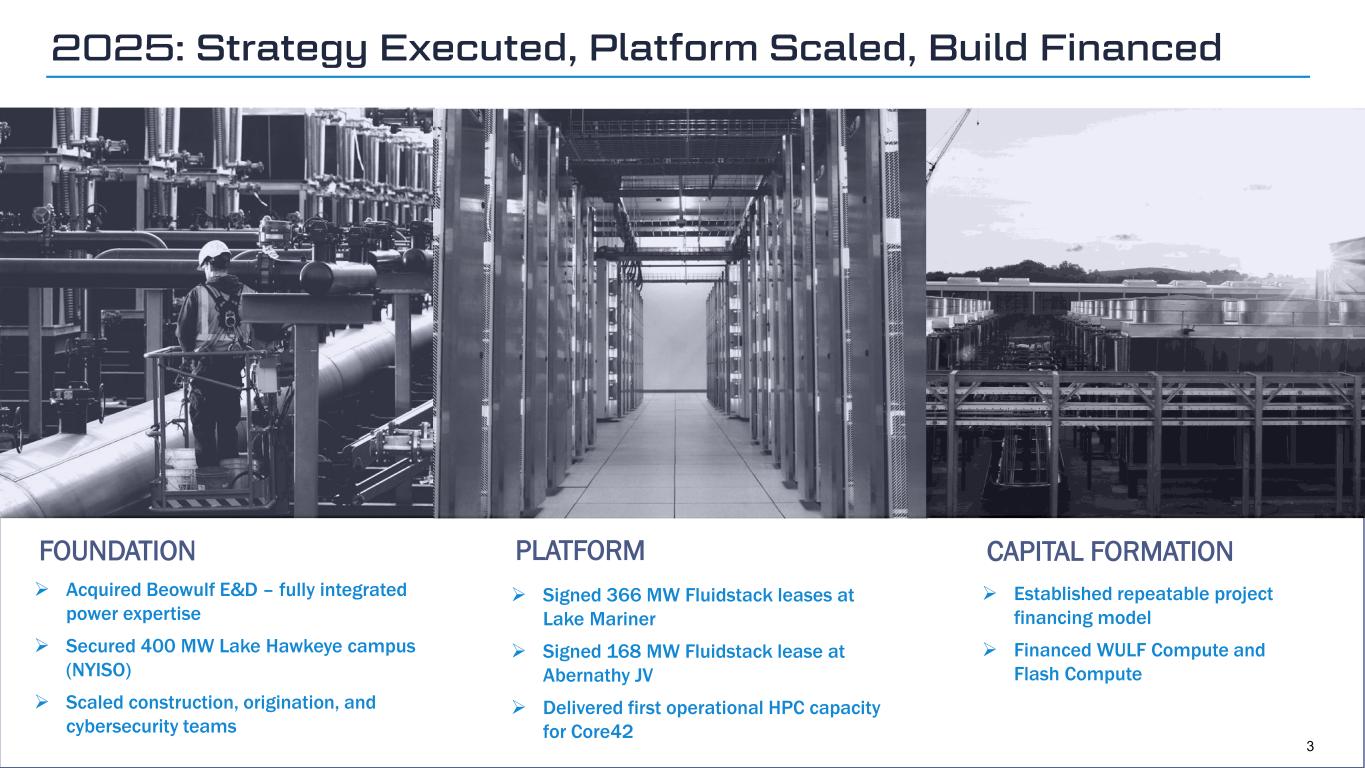
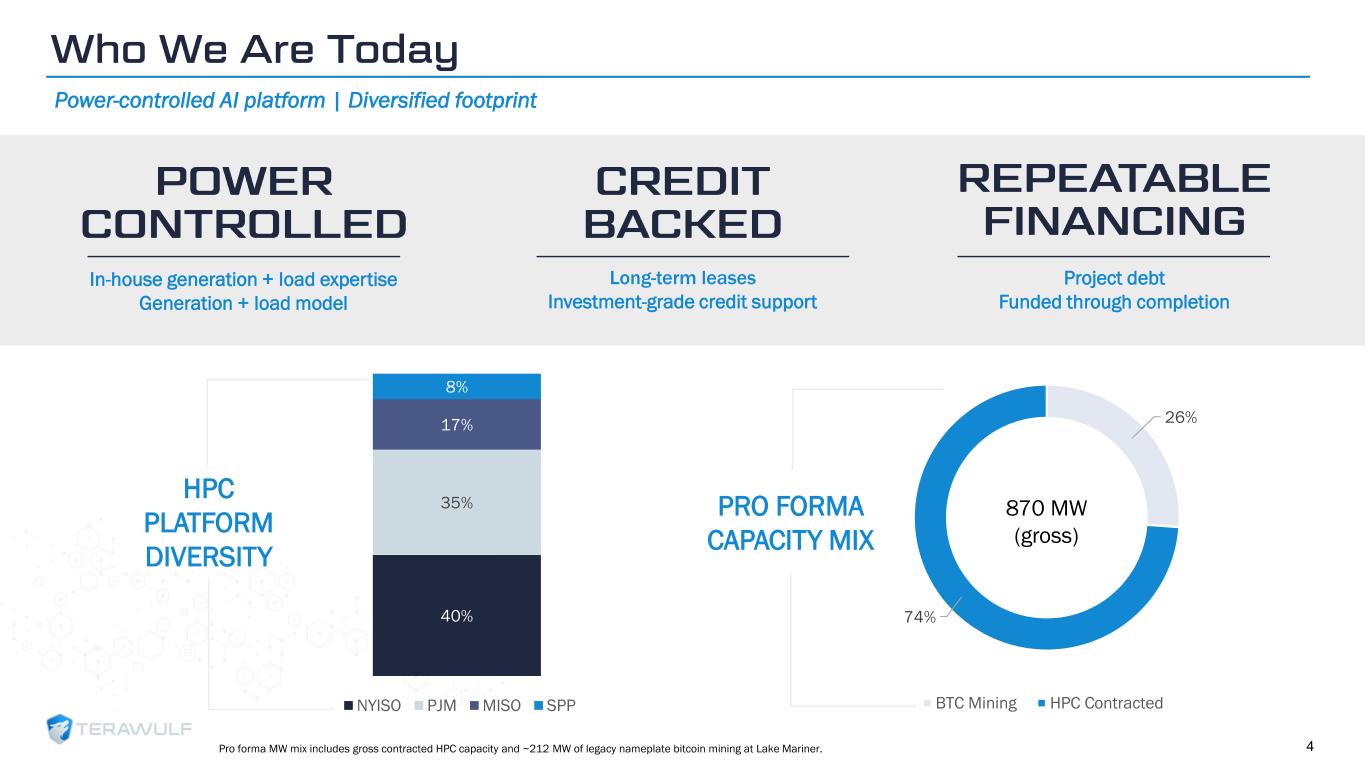
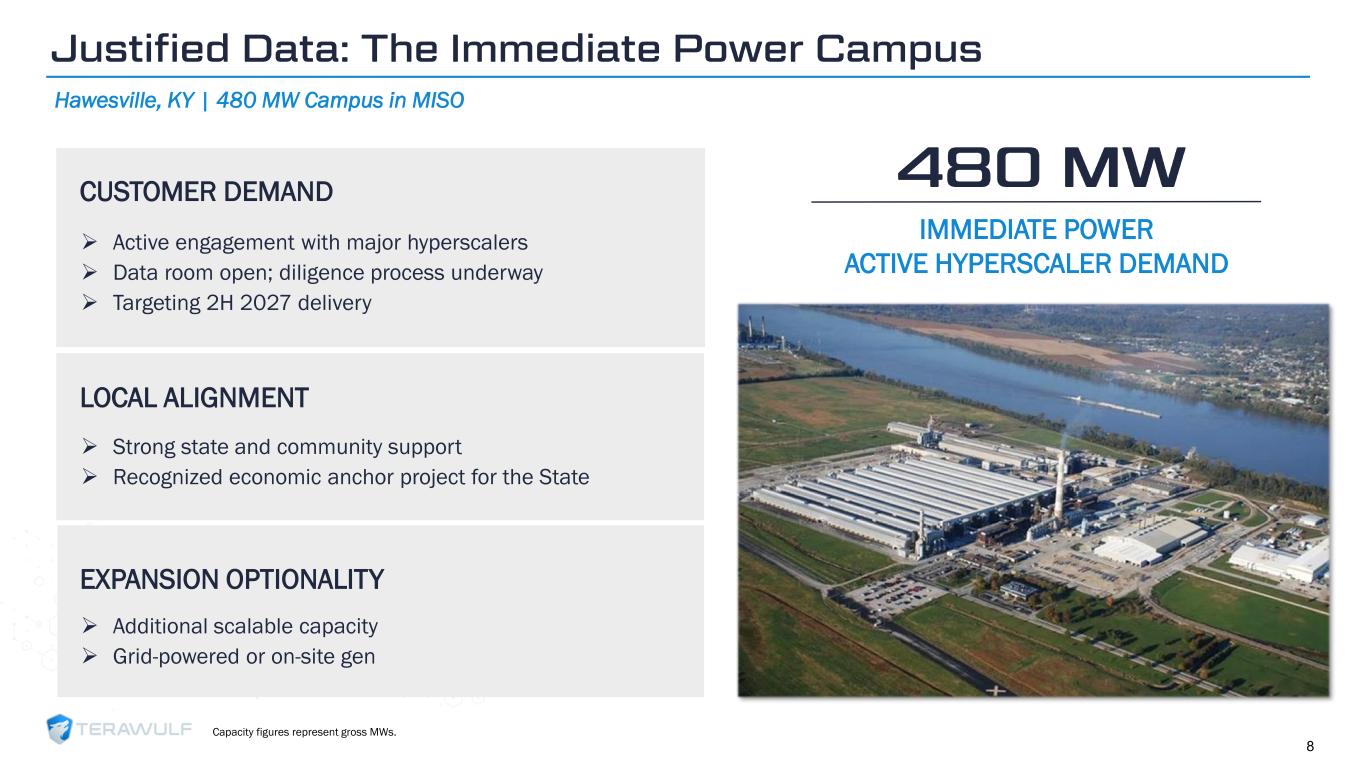
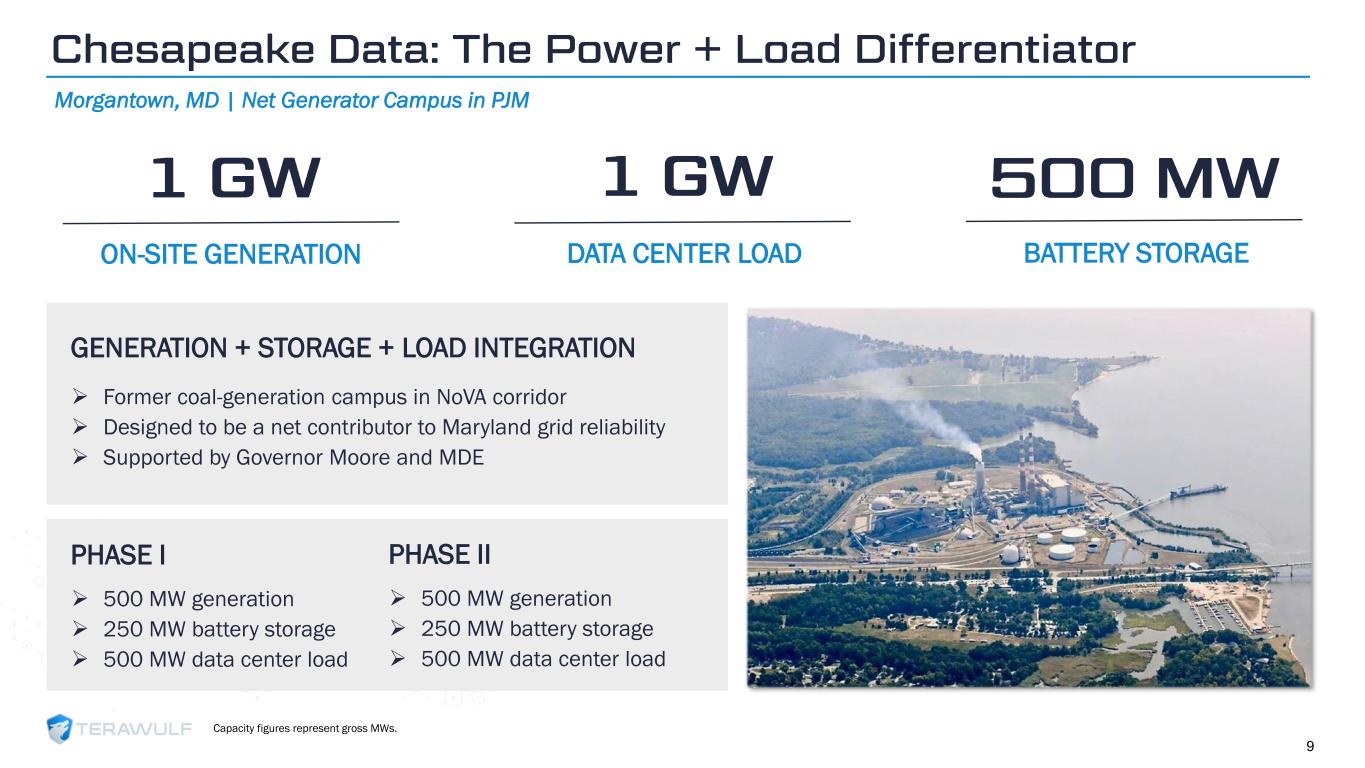
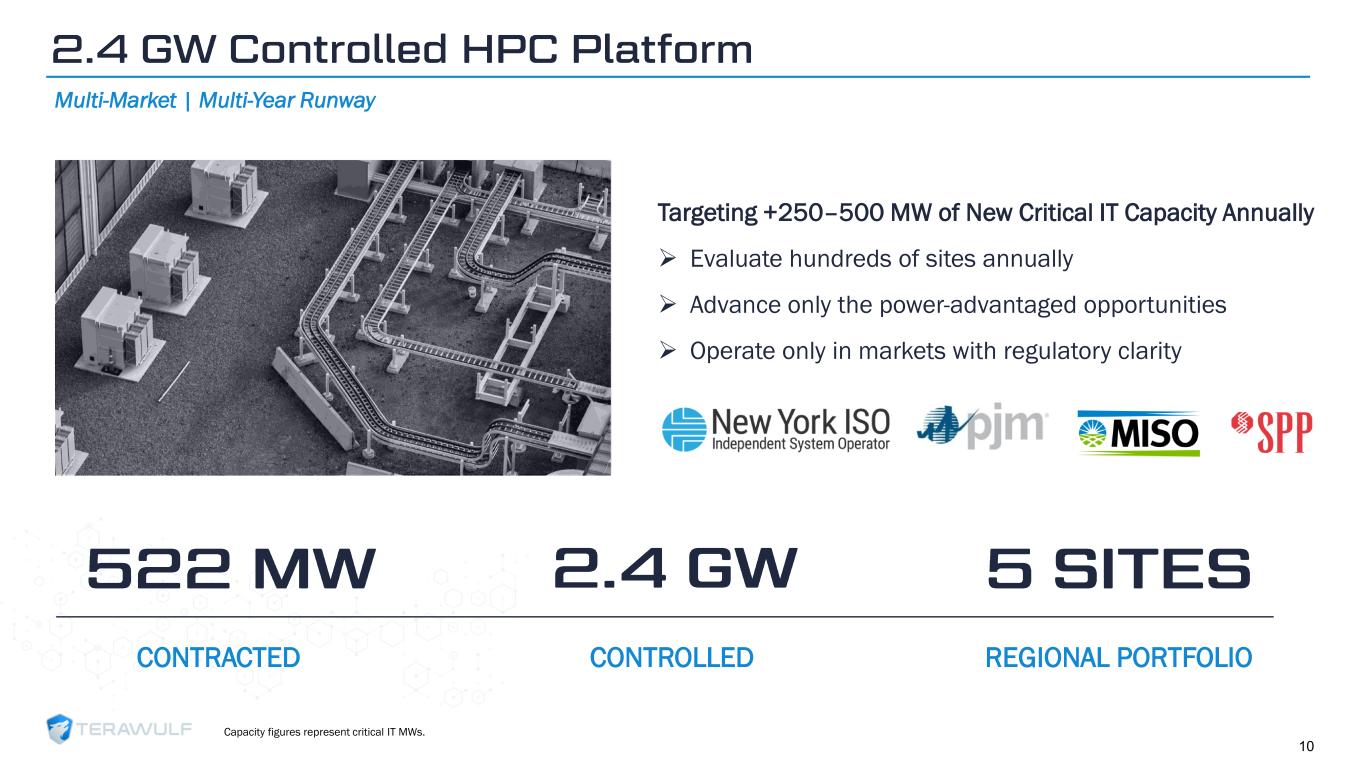
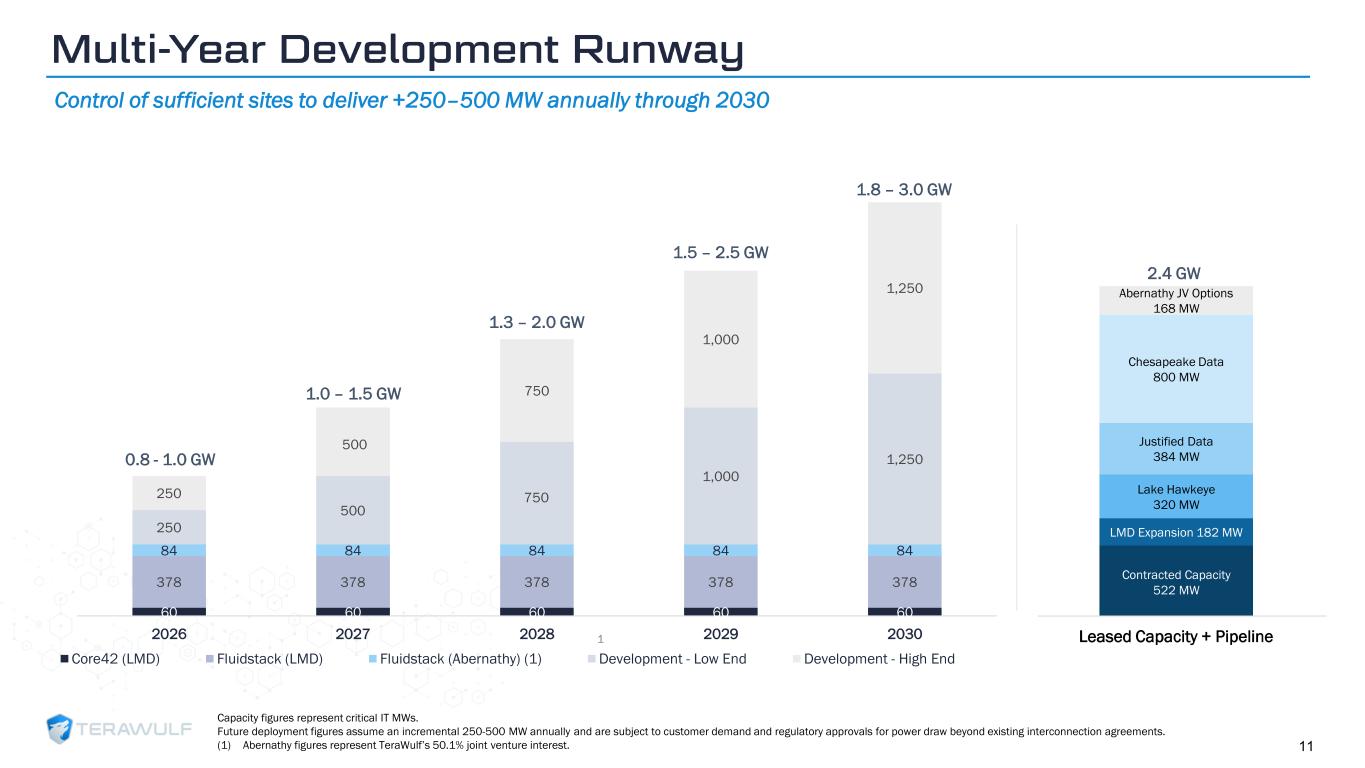
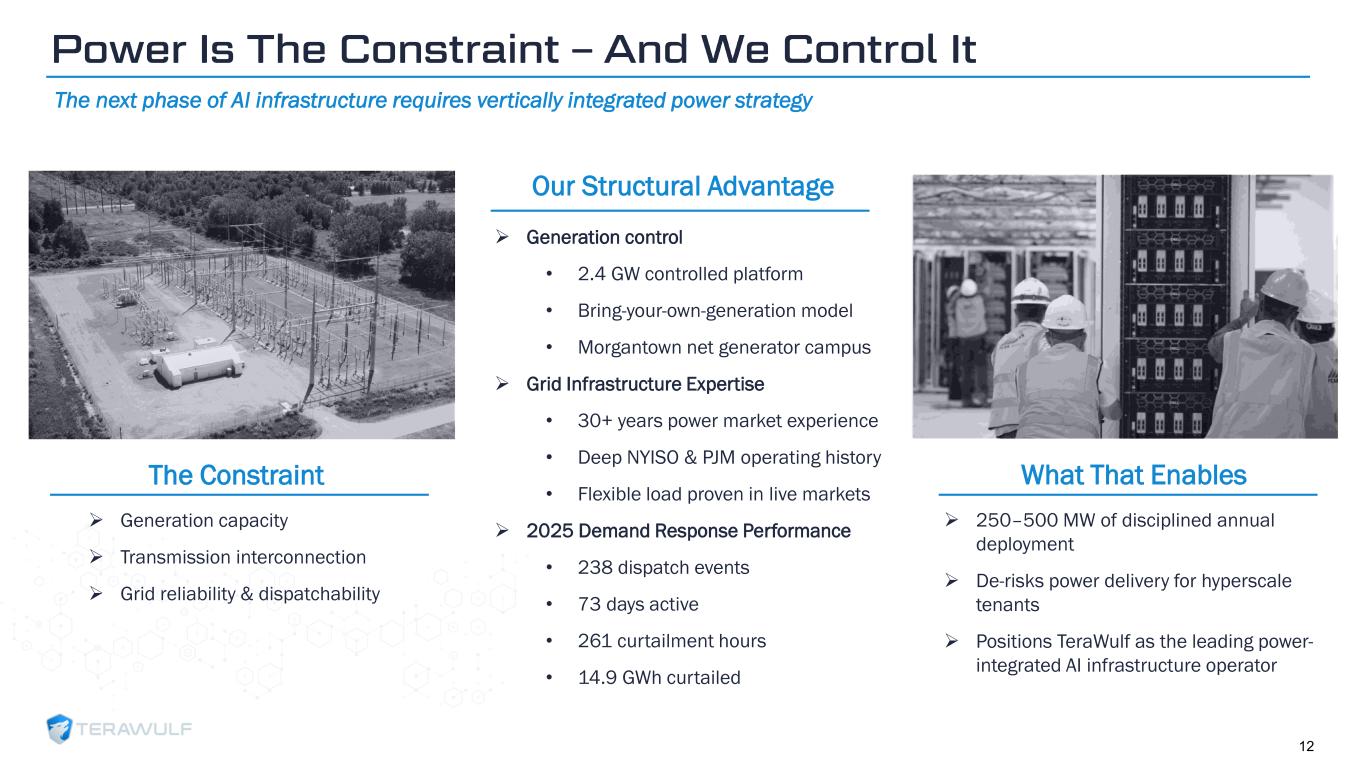
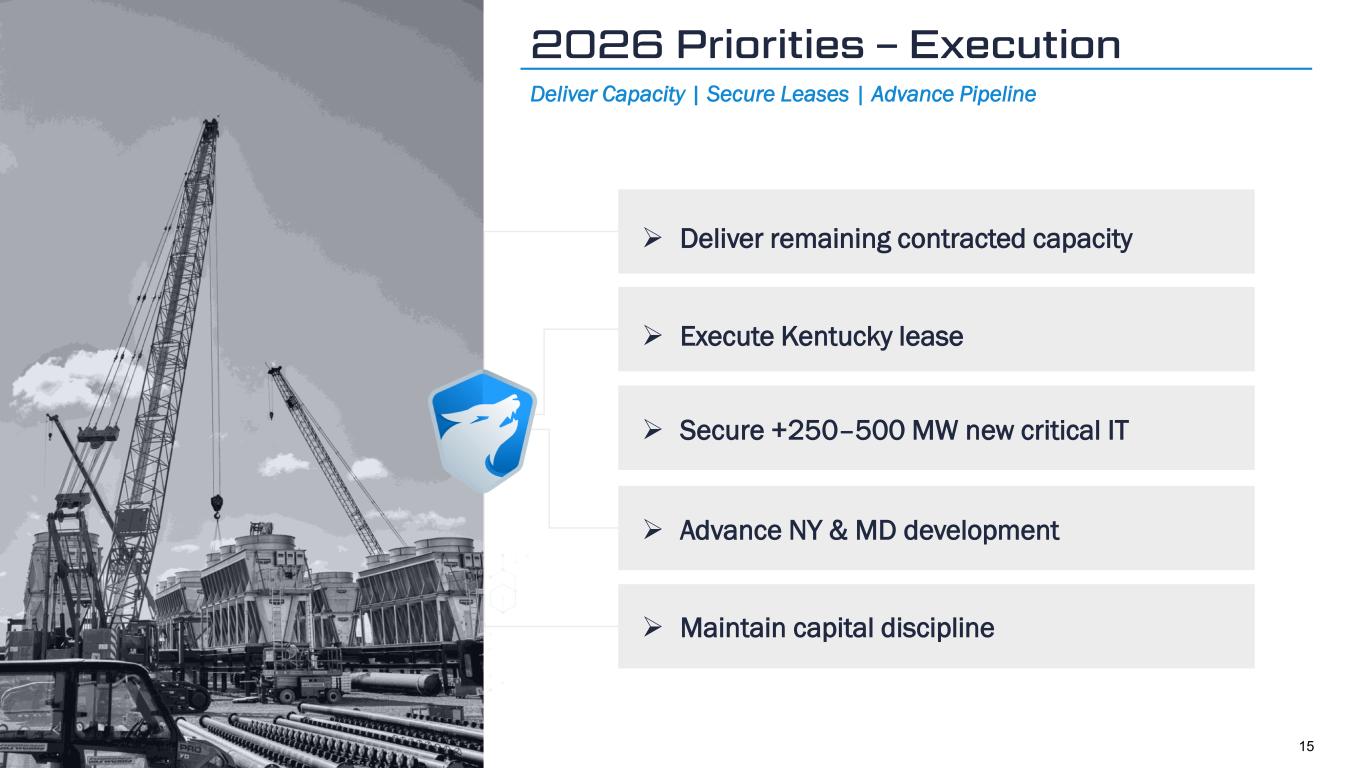
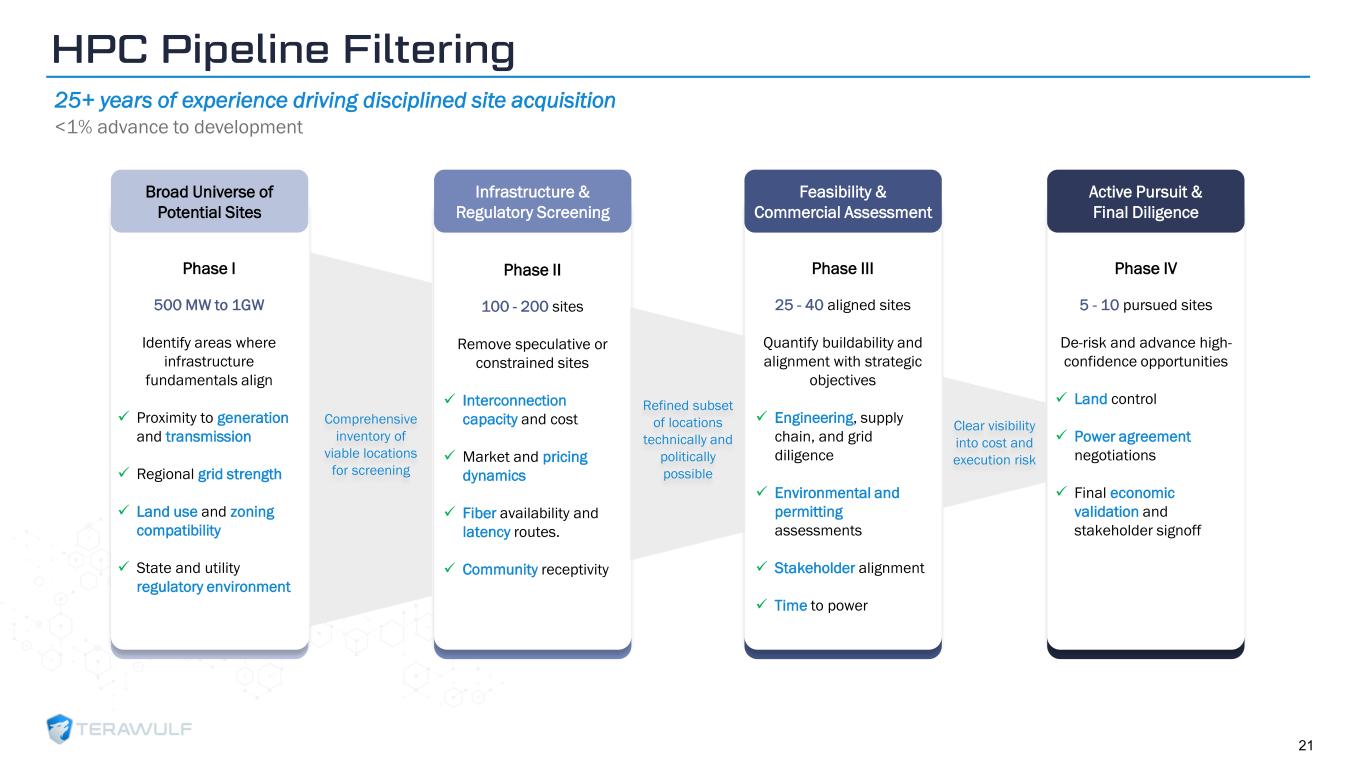
Thank you, John, and good afternoon, everyone. 2025 was a defining year for Terribles. We said we would transition this company into a scaled, power-backed AI infrastructure platform, and we did. Our strategy is simple and disciplined. control energy-advantaged sites, engineer infrastructure around power, and contract long-term credit-backed AI capacity. Everything we did in 2025 supports that strategy. First, we acquired 100% of Beowulf electricity and data, eliminating related party complexity and fully integrating power generation expertise into our platform. In today's market, power is the gating factor. If you don't control power, you don't control your destiny. We do. Second, we've secured long-duration site control at Cayuga, up to 400 megawatts at a retired coal facility with real grid infrastructure already in place. Groundfield, power-back, scalable. That's our model. Third, we signed a 450-megawatt lease with FluidStack supported by Google's credit. That was a platform-defining deal. It validated our model, our execution capability, and ability to contract at scale. With Google's warrants, it will be our largest shareholder. That alignment speaks for itself. Fourth, we replicated the model in Texas through the Abernathy Joint Venture, proving portability across power markets. And fifth, we executed the Wolf Compute and Flash Compute financings. These transactions demonstrated that contracted, credit-enhanced AI infrastructure supports scalable and repeatable capital structure. Operationally, we delivered Wolfden and CB1, began recording HPC revenue, and have now delivered CB2A for Core 42. We are building, delivering, and contracting simultaneously. And since year end, we added approximately 1.5 gigawatts of additional power back capacity in Kentucky and Maryland. Now let's talk about what actually differentiates us. Power and execution. The AI build out is not constrained by GPUs. It is constrained by power, interconnection, transmission, and increasingly new generation. That's why Morgantown matters. Morgantown is not just another data center site. It is a former cold generation facility in the Washington, DC, Northern Virginia corridor, one of the most power constrained data center markets in the world. Our phase one vision includes approximately 500 megawatts of new dispatchable generation, 250 megawatts of battery storage, and 500 megawatts of data center load, followed by a similar phase two. Critically, the site is being engineered to operate as a net generator to the state. We are not just consuming capacity, we are adding it. In constrained markets, that is the only sustainable model at scale. This industry is moving towards integrated, bring your own generation campuses. We are well ahead of that curve because we are fundamentally a power company that builds and operates digital infrastructure, not the other way around. We know how to permit generation. We know how to build generation. We know how to operate generation. We understand grid behavior. And we know how to integrate generation, storage, and compute in a way that works for customers and regulators. There are very few teams that can do that credibly and at speed. We are premier among them. Turning to Kentucky, demand is extremely strong. We are engaged with every major hyperscaler and several large AI compute platforms. A data room is open. Diligence is active. Conversations are robust and substantive. This week, we met directly with Governor Beshear and state leadership. The alignment at the state and local level is clear and constructive. Kentucky understands the economic and strategic import of power-backed AI infrastructure. This is 480 megawatts, a campus with immediate power availability, expansion potential, and strong state support. We are excited and highly confident in the long-term value of this asset. While we execute on the platform, we are consistently evaluating a constant pipeline of additional opportunities. We review hundreds of sites, and most do not meet our standards. We are disciplined around four key elements. Power control and durability. Scalability in 250 to 500 megawatt phases. Signed credit-backed contracts, we do not speculate. And fourth, capital efficiency. We turn sites away all the time, but when we do find one that meets these criteria, we move decisively. Importantly, we already control the sites necessary to deliver our targeted 250 to 500 megawatts of contracted capacity annually through the end of the decade. The runway is in place. Growth from here is execution. Finally, we are building the team to match the ambition of the platform. We recently added a senior data center construction lead for Meta and have strengthened origination, project management, commissioning, and cybersecurity capabilities. This business is one in the trenches of engineering detail, construction discipline, and operational rigor. We are staffed accordingly. So in summary, the strategy is clear. The sites are secured. The capital is in place. Customer demand is strong. The team is built. Now it is about disciplined delivery. turning contracted megawatts into energized capacity and durable recurring cash flow. With that, I'll turn it over to Nazar.
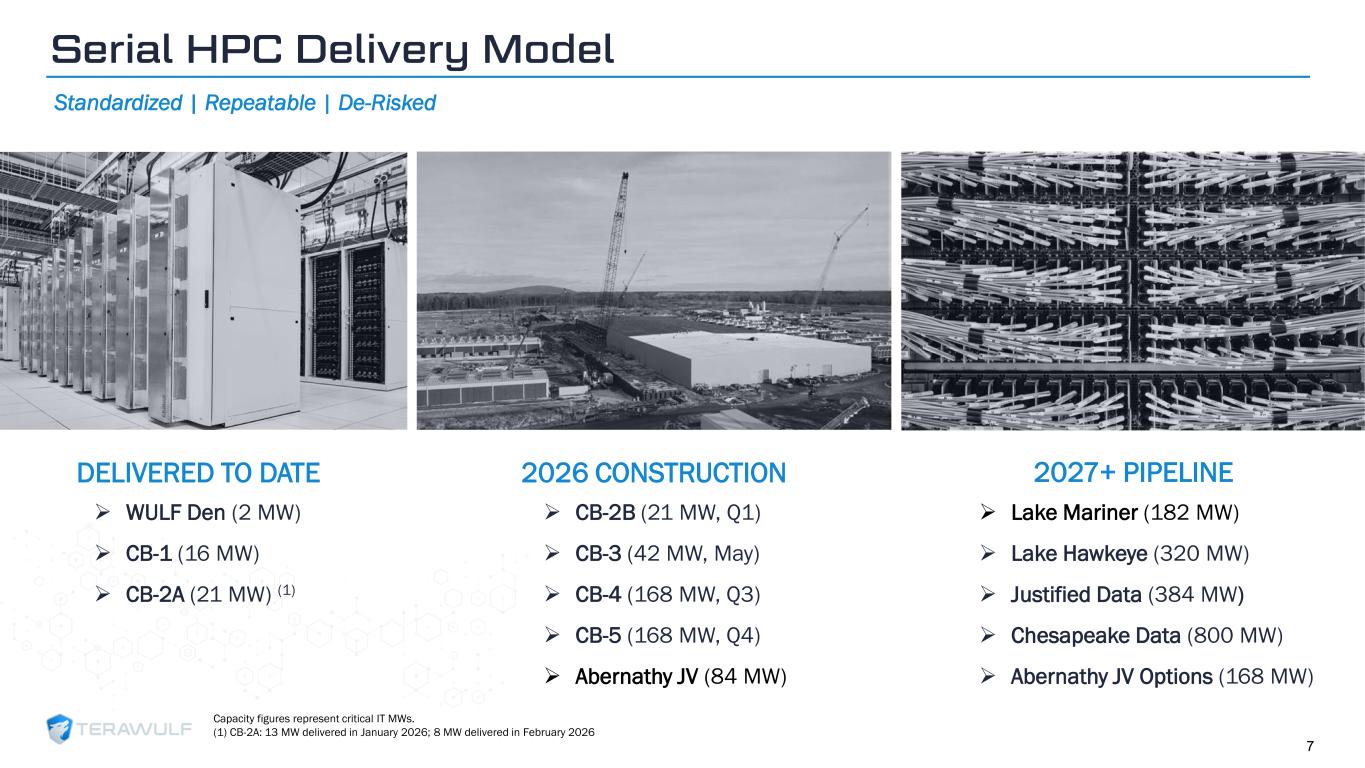
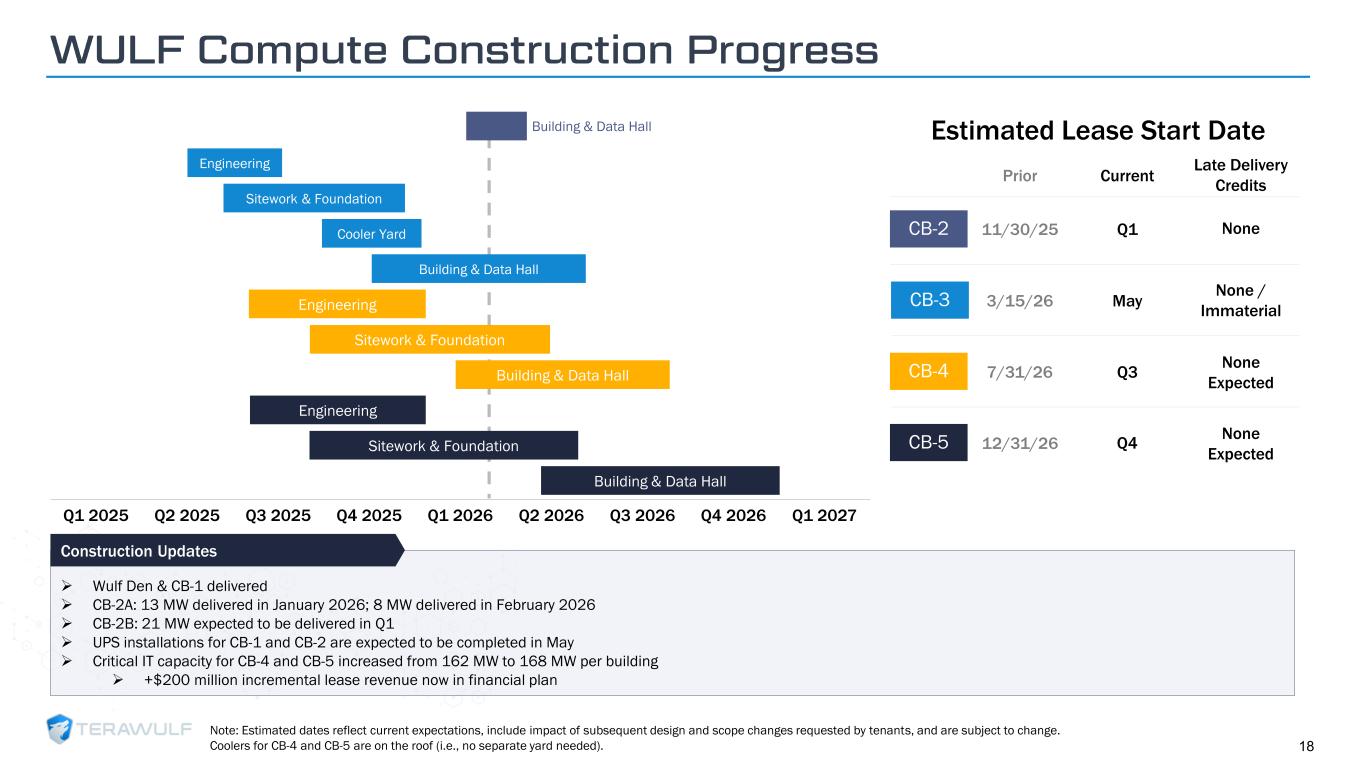
Thank you, Paul. Let me start with delivery and risk compression. Wolfden and CB1 were delivered in the third quarter and generated revenue throughout the fourth quarter. CB2A is operational, and CB2B is expected to be fully online in March. By the end of the first quarter, all Core 42 capacity will be energized and revenue-producing. Following contract execution, Core 42 requested incremental fit-out enhancements. We adjusted sequencing accordingly. The monthly recurring charge was revised, no penalties were triggered, and revenue commencement remains aligned with the customer's deployment schedule. Turning to the fluid stack buildings, CB3 is expected to deliver in mid-May. After signing, the tenant finalized certain design optimizations, which we incorporated without changing building footprint or lease economics. The associated revenue timing impact has been incorporated into the financial model. Importantly, CB4 and CB5 were designed collaboratively with the tenant from inception. These buildings reflect a fully standardized, repeatable design and represent the majority of contracted wolf compute capacity. Several structural improvements materially reduce execution risk. First, electrical redundancy has been optimized and standardized. Second, trade stacking and sequencing have been refined to minimize rework. Third, long lead equipment was procured after final design alignment. And fourth, mechanical and electrical systems now follow a repeatable installation model. Execution risk declines as design standardizes, and CB4 and CB5 reflect a mature, optimized build. Both buildings remain on schedule with targeted lease commencement dates of third quarter and fourth quarter of 2026, respectively. Through design optimization, we increased critical IT capacity from 162 megawatts to 168 megawatts per building without impacting the base construction budget. That incremental 12 megawatts across the campus is expected to generate approximately $200 million of additional lease revenue over the initial term. Finally, Abernathy, our joint venture, remains aligned with its fourth quarter 2026 lease commencement and continues progressing under a fixed EPC structure, which further limits construction cost variability. Execution requires managing scope, timing, and cost in real time. We have incorporated adjustments transparently and remain focused on disciplined delivery. Large-scale AI infrastructure requires active management of scope, schedule, and cost. We have incorporated refinements transparently, preserved economics, increased capacity, and maintained budget integrity. Execution remains disciplined and on track. With that, I'll turn
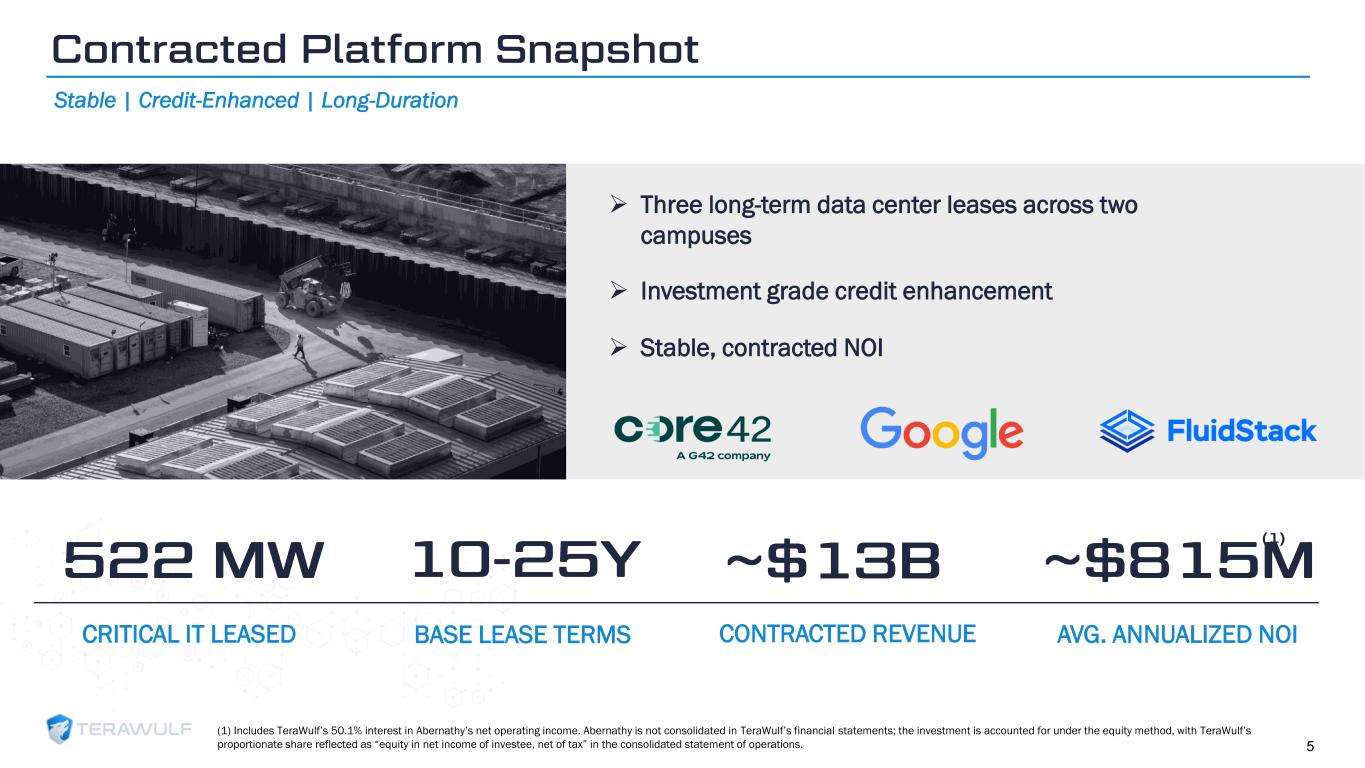
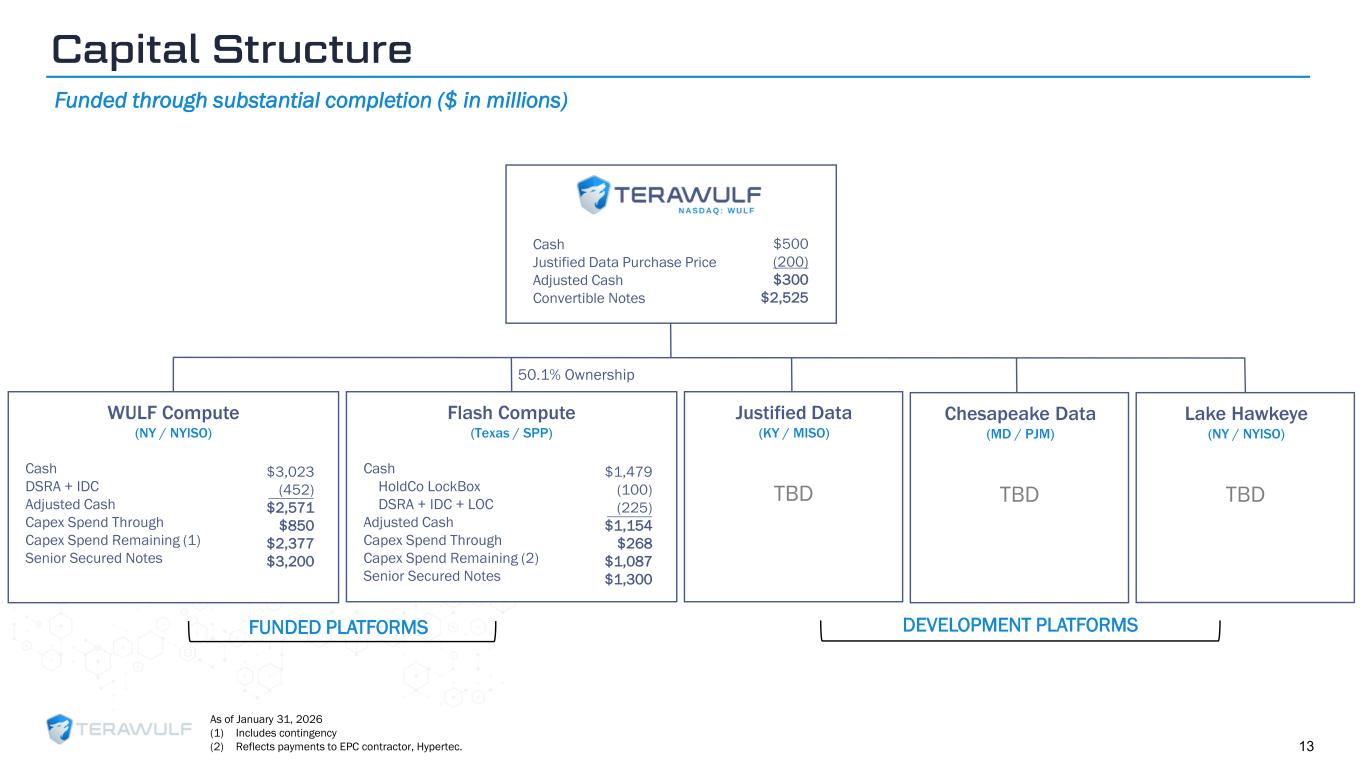
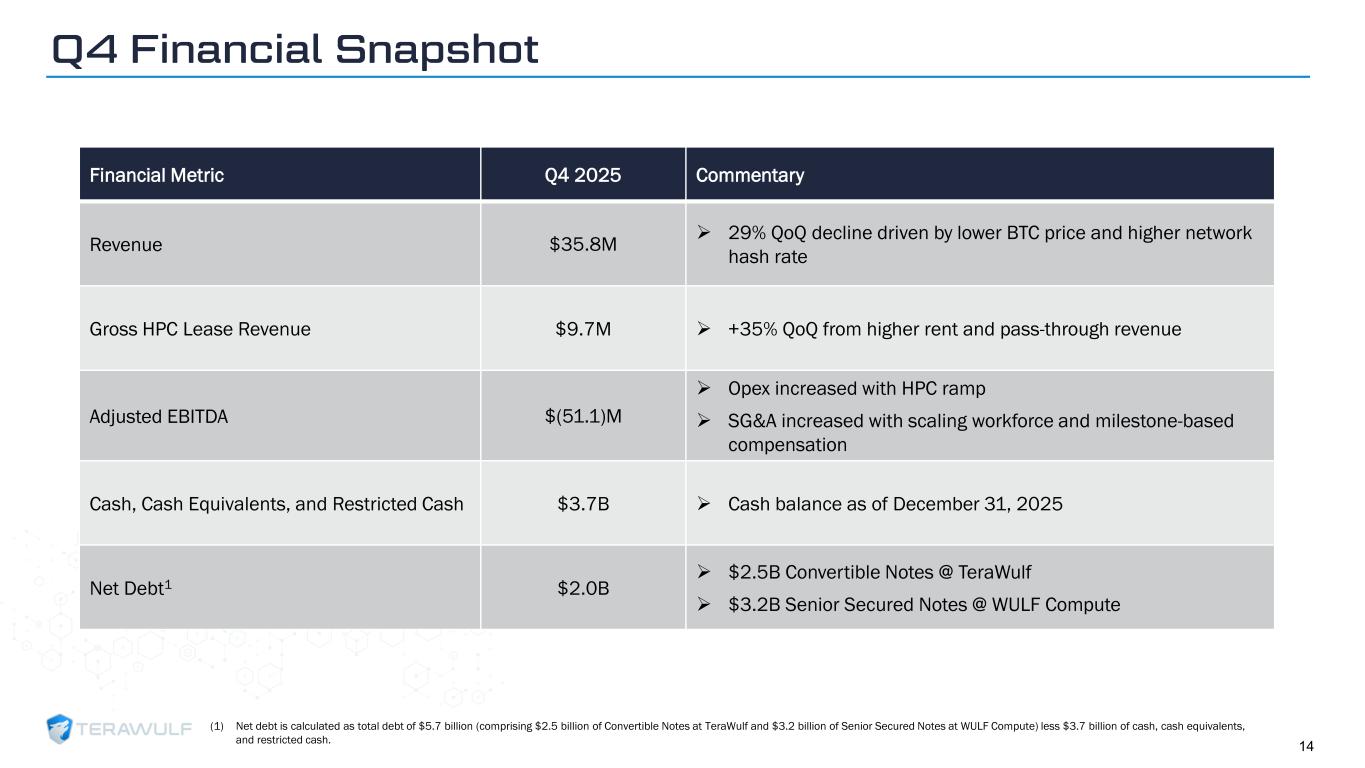
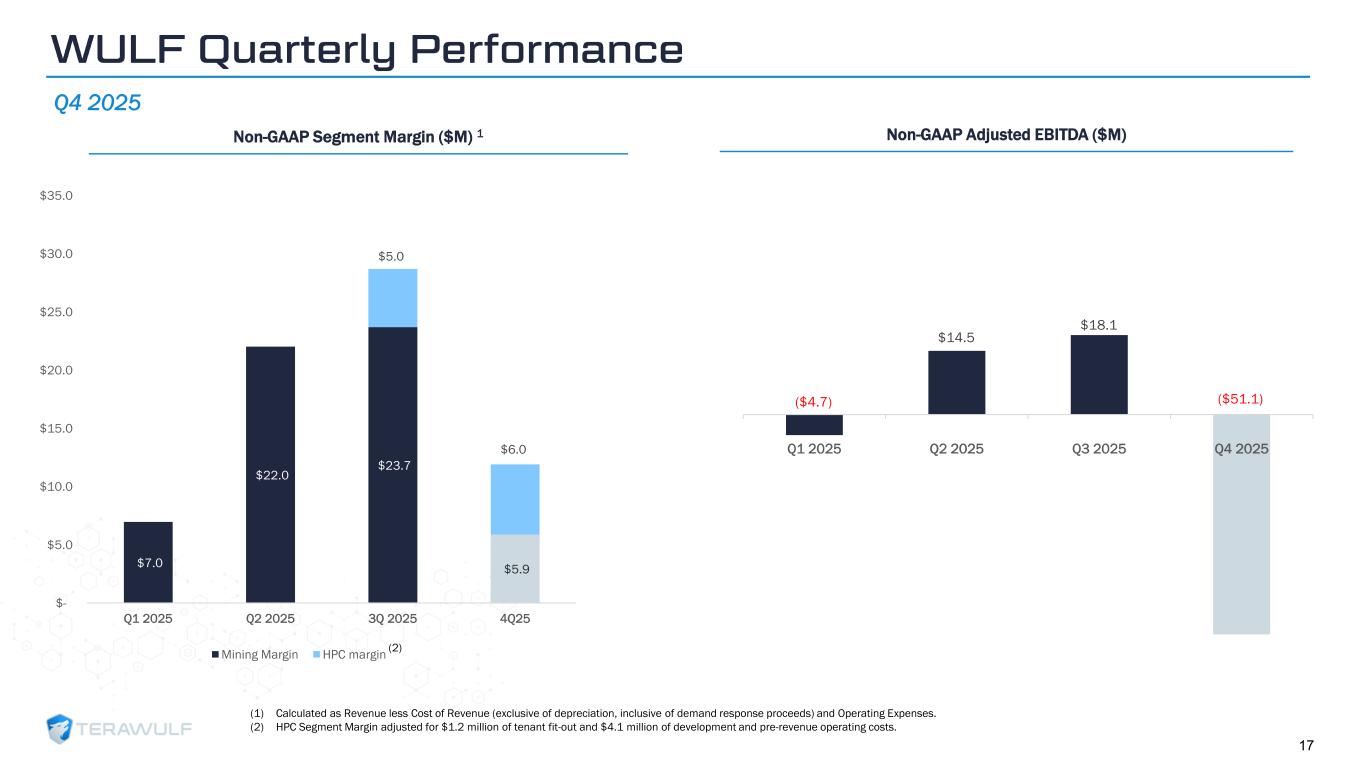
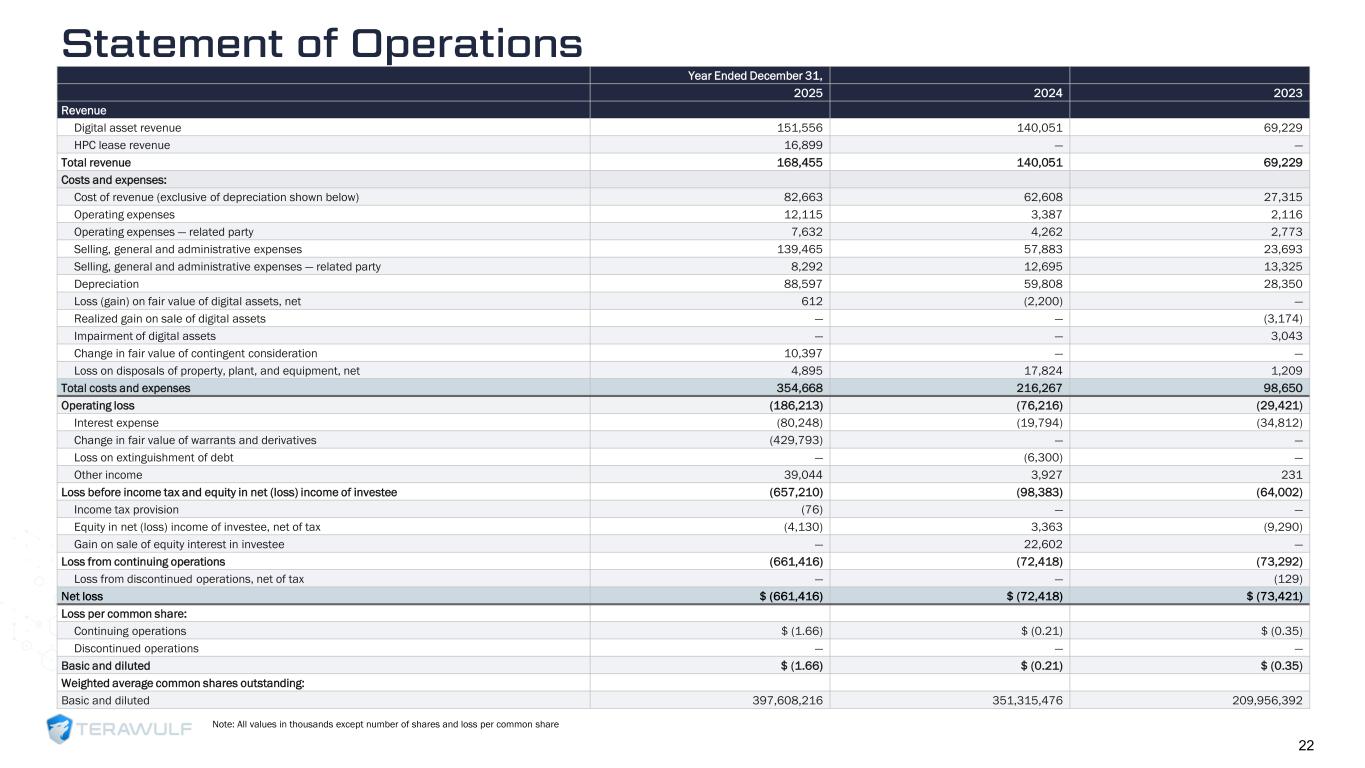
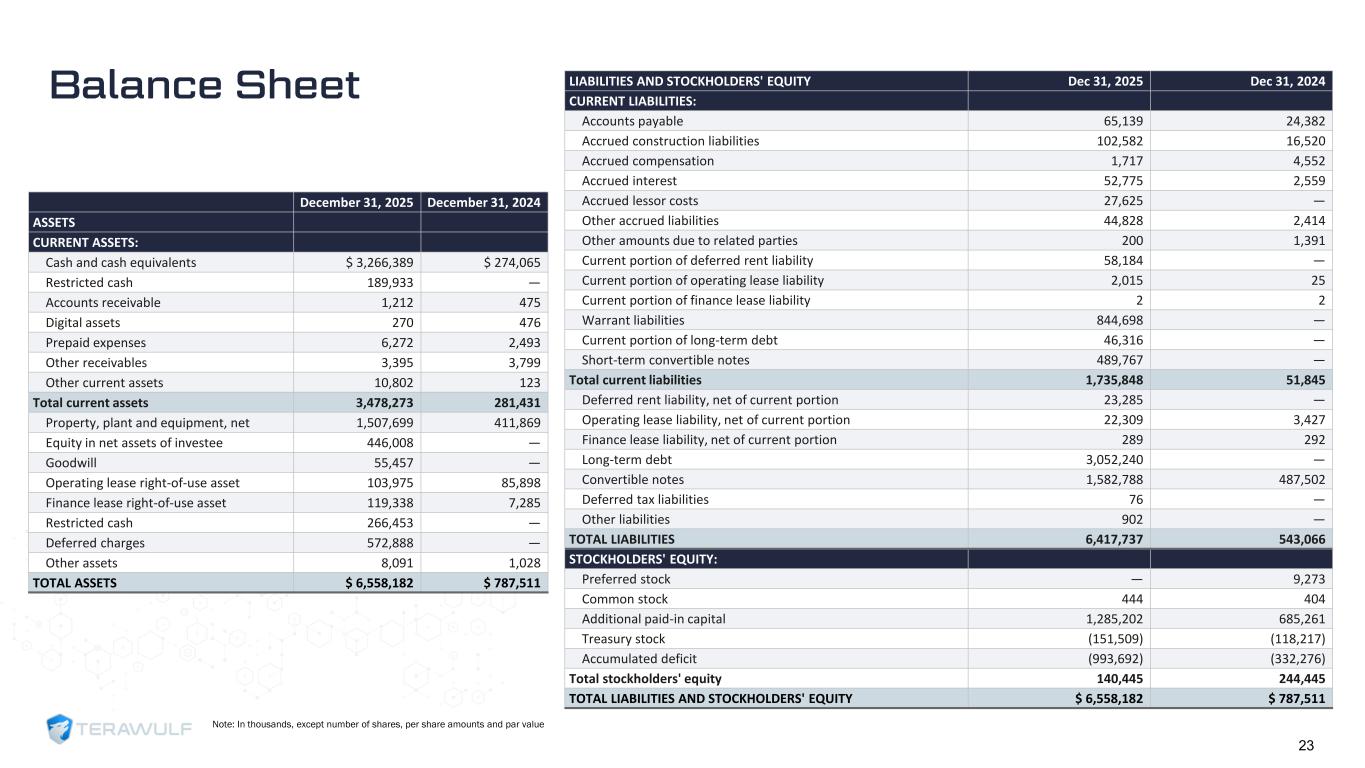
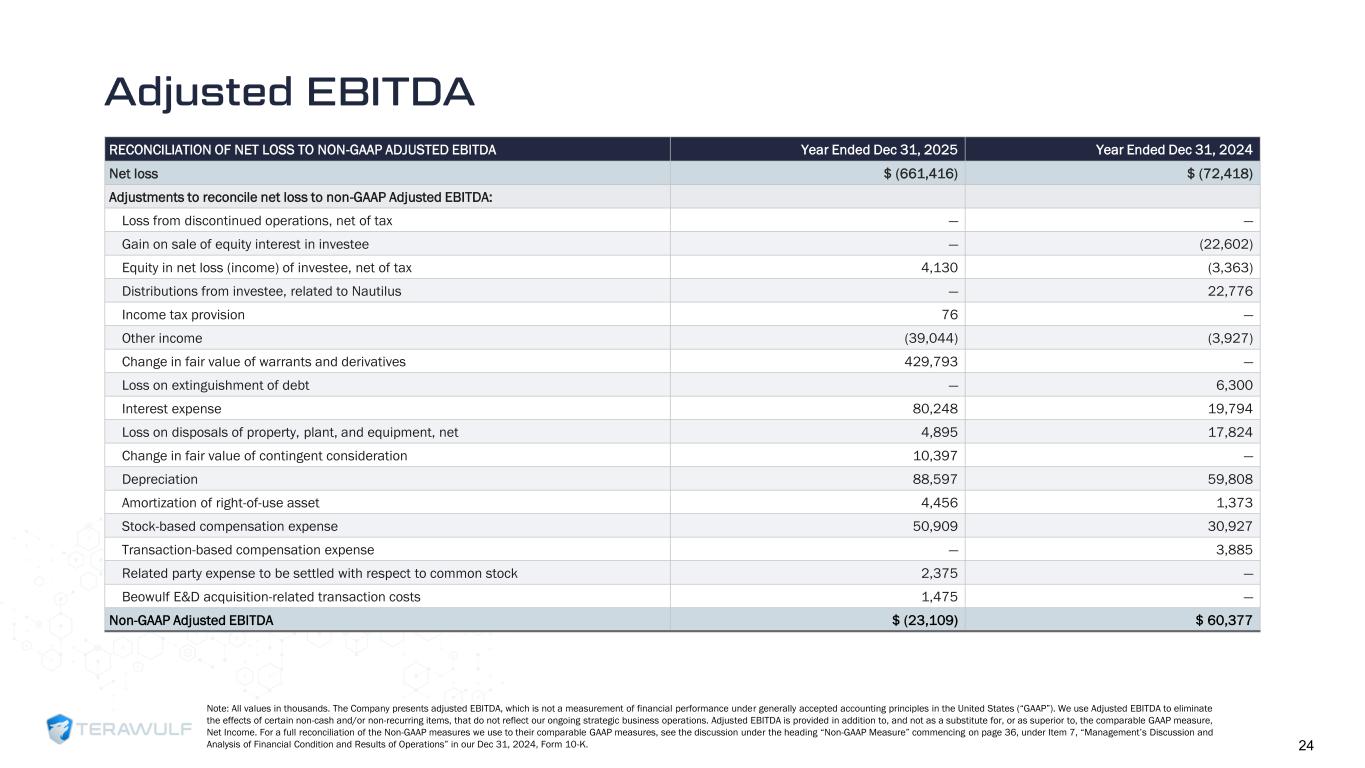
it over to Patrick. Thank you, Nazar. The second half of 2025 was transformational for the company. We secured over $12.8 billion of HPC lease agreements, executed $6.5 billion of debt and equity-linked financing, and materially strengthened our balance sheet liquidity while carefully managing and minimizing dilutions. Let's begin at a high level before diving into the financial details. We are a business in transition and executing on rapid growth. The 2025 results still reflect a meaningful contribution from Bitcoin mining and its inherent volatility, including commodity pricing and complex network difficulty dynamics. Over time, that volatility will decline as long-term credit-enhanced HPC revenues become the dominant driver of results. Importantly, while mining introduces revenue volatility, its flexible load profile has been strategically valuable at Lake Merida, supporting demand response participation and power cost management. Mining is not a long-term growth focus, but it has enabled the transition. The 2025 results of operations reflect that transition in motion, and the balance sheet reflects that we have the capital structure to execute. In the fourth quarter of 2025, revenue was $35.8 million, down from $50.6 million in 3Q25, primarily driven by lower Bitcoin production. Importantly, HPC lease revenue increased to $9.7 million in Q4, up 35% and $7.2 million in Q3. For the full year, revenue increased 20% to $168.5 million from $140.1 million in 2024. The digital asset revenue of $151.6 million and HPC lease revenue of $16.9 million. We commenced HPC leasing in July 2025 and had energized 18 megawatts of critical IT capacity as of year end. As additional buildings come online, revenue mix will continue shifting towards stable, contracted HPC revenue. Cost of revenue, exclusive of depreciation, increased 10% from $17.1 million in Q3 to $18.9 million in Q4. Demand response proceeds recorded as a reduction in cost of revenue decreased $4.4 million in Q4, and then $7.4 million in Q3. For the first year, cost revenue increased 32%, $82.7 million in 2020-25, and then $6.6 million in 2024, primarily due to higher real-life power prices. Demand response proceeds also increased year-over-year from $8.6 million in 2024 to $17.7 million in 2025. Operating expenses increased as we scaled the platform to support HPC deployment. Quarter-over-quarter operating expenses rose to $8.8 million from $4.5 million. Full-year operating expenses increased to $19.7 million in 2025 from $7.6 million in 2024. reflecting staffing and operational readiness. For context, Terra will finish 2024 with under 100 full-time employees and will exit 2026 with close to 300 full-time employees. Let me address the HPC leasing segment profitability as presented in note 19 of our 10-day. The as-reported annual segment profit margin is approximately 42% versus our long-term guidance of approximately 85%. That difference is driven by three factors. First, $1.2 million of pennant fit-out revenue and associated costs during 2025. PFO carries a modest margin as provided for under the HPC leases. Second, $4.1 million of development and pre-revenue operating costs. And third, partial period revenue contribution as buildings ramp. Adjusting for those factors yields approximately 77% segment profit margin in 2025, which is consistent with ramp expectations and converging toward our 85% steady-state margin guidance of utilization stabilizers. SG&A expense also increased as we scaled the platform to support HPC deployment. Quarter-over-quarter SG&A expense rose to $66.6 million from $16.7 million. Full-year SG&A expense for 2025 totaled $147.8 million from $70.6 million in 2024. After adjusting for stock-based compensation, SG&A increased from $39.7 million in 2024 to $94.5 million in 2025. This increase is primarily attributable to an incremental $47.5 million of new hires, strategic growth performance, and milestone-based employee compensation in 2025, reflecting the notable scale of execution achieved during calendar 2025. Adjusting for this item results in total SG&A of approximately $47 million in 2025, in line with our prior guidance of $50 to $55 million. Depreciation increased to $88.6 million in 2025 from $59.8 million in 2024, reflecting infrastructure placed into service and accelerated depreciation of $19.6 million associated with certain mining assets transitioning to HPC use. Interest expense in Q4 was $62.4 million compared to $9.8 million in Q3, and we recognized interest income of $31.5 million in Q4 compared to $4.1 million in Q3. Annual interest expense for 2025 and 2024 was $80.2 million and $19.8 million, and we recognized interest income of $39 million and $3.9 million, respectively. The increases in net interest expense were expected following our capital raises at Terawolf and Wolf Compute in the second half of 2025. Actual cash interest paid during Q4 and calendar year 2025 was $6.9 million and $13.9 million, respectively. Change in fair value of warrant and derivative liabilities in 2025 was a loss of $429.8 million, primarily related to the Google warrant. This is a non-cash loss and therefore does not affect our liquidity. equity and net loss of investee net of tax for 2025 is 4.1 million, which represents Terrell's 50.1% share of the net loss of the Abernathy joint venture, which was formed in October 2025 and has not yet commenced operations. Our gap net loss in 2025 was 661.4 million compared to a net loss of $72.4 million in 2024, with the increase primarily driven by non-cash fair value adjustments related to the Google Warrants and non-cash depreciation. Our non-GAAP adjusted EBITDA in 2025 was negative $23.1 million, down from positive $60.4 million in 2024. As a reminder, these results are inclusive of significant increases in SG&A and operating expenses over the past 12 months as we invest heavily in our HPC business. Turning to the balance sheet and liquidity, as of December 31st, 2025, cash and restricted cash totaled $3.7 billion, total assets amounted to $6.6 billion, with total liabilities of $6.4 billion. Regarding liquidity, as detailed in our fiscal year-end 2025 investor presentation on the slide titled Capital Structure, as of January 31st, 2026, the HOLDCO parent entity had approximately $500 million of available cash, or approximately $300 million, pro forma for the Kentucky acquisition announced on February 2nd. Regarding project-level capital positions and construction progress, both Wolf Compute and Abernathy are fully funded through substantial completion with long-term fixed-rate financing, eliminating construction funding uncertainty, and reducing reliance on near-term capital markets access. Importantly, we do not anticipate the need for additional equity to fund our currently contracted development. As of January 31, 2026, Wolf Compute had approximately $3 billion of gross cash, or $2.6 billion net of debt service reserve, and interest during construction accounts, with $850 million of CapEx spend complete and $2.38 billion remaining. That leaves approximately $200 million of cash cushion, which is incremental to the substantial contingency embedded in the financing structure. As Nasr noted, schedule adjustments resulted in approximately $16 million less projected revenue in years 2025 through 2026. However, design optimization has increased capacity from 162 to 168 critical megawatts across CB4 and CB5, generating approximately $200 million of incremental revenue over the initial lease term. The net effect improves projected cash flows and reduces expected debt and maturity by approximately $45 million versus prior projection. Finally, with regard to the Abernathy JV, as of January 31, 2026, the JV had approximately $1.5 billion of gross cash, or $1.2 billion net of debt service reserve, interest during construction, letter of credit, and hold code lockbox account, with $268 million of CapEx spend complete and $1.1 billion remaining. That leaves approximately $70 million of cash cushion at Flash Compute, with a further $100 million liquidity reserve at the parent JV, supported by a $1.35 billion lump-sum CPC contract with Hypothex. With respect to Kentucky, we have proposals in hand for secured loan facilities to fund pre-lease development to preserve Holdco parent liquidity. Demand for near-term power remains strong, and we are targeting 480 megawatts online in the second half of 2027. We do not build on speculation. In summary, 2025 reflects a business transitioning from volatile Bitcoin mining revenue to stable contracted HPC revenue. Mining has strategically supported that transition. Contracted HPC revenue is ramping. Liquidity and contingency are strong. With that, operator, we are ready to take questions.
Operator
At this time, we'll be conducting a question and answer session. If you'd like to ask a question, please press star 1 on your telephone keypad. A confirmation tone when to get your line is in the question queue. You may press star 2 if you'd like to remove your question from the queue. For participants using speaker equipment, it may be necessary to pick up your handset before pressing the star keys. One moment, please, while we poll for questions. Our first question comes from Mike Rondahl with Norland Securities. Your line is now live.
Hey, guys. Thank you. First, I just wanted to start with Kentucky. That site sounds like the reception has been strong. Could you give us a few more details on the site and what an ideal customer or lease would look like there?
Hey, Mike, this is Paul Prager. It's a fantastic site. This was the site of a former smelter. It's at a transmission superhighway. Multiple utilities can service the property. What was most compelling about it was its central location and the immediate availability of power in scale. Demand for the site is extremely strong. You know, our data room is open. Every major hyperscaler and several large AI compute platforms are doing diligence. The conversations to date have been substantive with some written term sheets already coming over the desk. Earlier this week, I was down in Kentucky. I met with Governor Beshear and state leadership. The alignment at the state and local level is clear, very constructive, very, very, very pro-business. The importance of this project for the local community, particularly the public schools, which Kentuckians are super proud of, is massive. We held a community info session two nights ago. We had a job fair yesterday. We filled the auditorium and then some. We're extremely excited and confident in the long-term value of the asset. You know, as Patrick has said from day one, we're all focused on, you know, the best financial credits to be our long-term customers. I think we've operated that way in the past, and that's, you know, that's the message going forward. I think you'll see a world-class credit as our next customer for, you know, what we're hoping to be a 10- to 15-year deal. I think, you know, we'll see that deal happen pretty soon. I don't want to give you a drop-dead date, but, you know, we're in very, very active and substantive discussions.
And then it seems like a lot of potential, up to one-plus gigawatts, but a little bit more complex. And kind of playing into what you guys have talked about, you know, bring your own power. How does that play into some of TerraWolf's strengths?
Sure. You know, just to be clear, Chesapeake Data, it's about the power and load differentiation. It's a gig site with certainly a gig data center load capability, 500 megawatts of battery storage capability. It's a former coal generation campus. It's in the Northern Virginia corridor, which means prices are exceedingly competitive. It's designed to be a net contributor to the Maryland grid. And it's very well supported by Governor Moore and MDE. Again, both Maryland and Kentucky, by the way, have very sophisticated brownfield programs, which make it really easy for a guy like us who's been around the block and owned and operated coal-fired power plants, shut them down, mitigated them, did everything the right way. These two states have very, very progressive programs on how we do that at commercial feasibility. Listen, the market is moving to bring your own generation. We said that a year ago. In December, Alphabet bought Intersect for almost $5 billion. In January, Microsoft raised dedicated generation as part of their five-point infrastructure strategy. President Trump in January floated the notion that PJM emergency auctions needed to incentivize new generation. New generation projects would go to the top of the queue for interconnect. And then just the other night, in the State of the Union, the president stated data centers need to build and fund their own generation. So that's where the world is going. We have a real and growing power shortfall. Morgan Stanley says potentially 47 gigawatts, 25 to 28. The hyperscalers are openly stating that power is the Beineken Street. Look at anything, recent public commentary by Colette Kress of NVIDIA CFO, Sundar, Alphabet CEO, certainly Jensen Wang, NVIDIA CEO. I mean, it's all about we need power. So delivering generation alongside that load solves the problem. We could bring incremental megawatts to the grid or the system, dispatchable generation using CCGTs, not just bridging power. And we have a history of partnering with grid operators to solve reliability and adequacy challenges. What's our core competency? You know, we've been talking about this. This is the only team out there. For 25 years, we have been developing, building, renovating, rescuing generation. Six gigs of power generation experience on this team, together on this team, and it's been over 25 years. We have deep expertise in siting, interconnection, generation development, And that's why we could go and take on a project like Morgantown and have the support that we can from both the local and state communities as we pursue this. We're really excited about Morgantown. It's a big job, but it fits into our schedule. And, again, we've told the world we're 250 to 500 incremental megawatts of data center load every year. And, you know, this fits right in.
Operator
for 26, guys. Thanks, Mike. Our next question comes from Tim Horan with Oppenheimer. Your line
is live. Thanks, guys. Do you think the pricing in terms and conditions in Kentucky can be, you know, materially better than what you've done in the past? And the construction schedule seems
pretty ambitious. Do you have the labor and, you know, all the equipment you think you'll need and, I guess, the permits to get it done? Thanks. So I think I'll go first and maybe,
and as you can go second, you know, in terms of the labor, yeah, Kentucky is a fantastic, it's just a fantastic place. You have not only the construction expertise and the trades expertise, but you've got people that really want to work. We brought on for that job floor, which I consider to be a world-class contract party. We've dealt with them in the power space for a long time. They have relationships in our C-suite for many, many years at every level. We are already ahead of the curve in sort of procurement. We have a proven design that our hyperscaler customers really like. And, you know, we think because it's immediate available power, we don't think we know because we've got this very robust conversation going on right now with folks that want to come in and be our customers there for competitive pricing. Naz?
Just to add to what Paul said, as Paul said, we brought in a floor on the EPC side so we're already hitting the ground running with respect to the overall development of the project and so the timelines that you see for the second half of 27 are reflective of ongoing and meaningful discussions already with the EPC. So we feel pretty good about the overall timeline. The other big component is gathering the labor that's going to support the project as well. And so there have been efforts already underway for both the mechanical, electrical, and civil scopes to get the requisite labor to support the project as well. So that data is informed by quite a bit of discussion that we've had with FLOR, who's our EPC, as well as the work that we've done on-site since the acquisition. In terms of just the overall economics, you know, I think we've said these on prior calls. We really think about these projects on an unlevered yield basis. And so if you look at where we've been historically, we think, you know, we'll be in that zip code or maybe, you know, better over time. But again, as we think about the overall economics of the project, we're always kind of zeroing in on what's the unlevered yield that we're developing at and pushing to kind of maintain and continue to increase that as well.
Operator
Our next question comes from Chris Bendler with Rosenblatt Securities. The line is live.
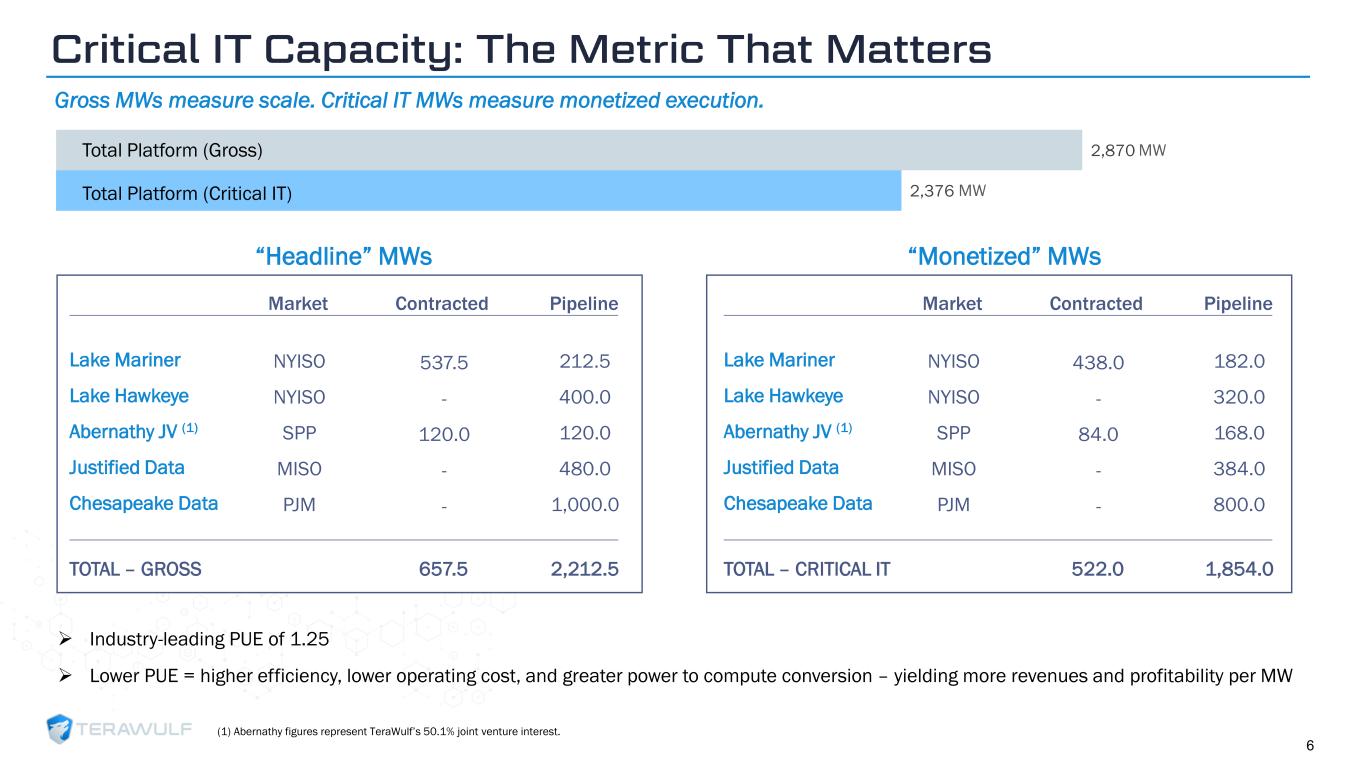
Hey, thanks so much, and congratulations on the progress here. I wanted to ask on the power side. First, I noticed that the PUE across all these sites is right in line with the initial deals at 1.25. And, you know, you mentioned in the slides that that's best in class. And my understanding was there were certain aspects of Lake Mariner and Cuyahoga that drove that 1.25, but maybe I'm mistaken. It seems like it's standard for Terry Wolf to operate at that incredible efficiency. Can you just give us a little cover there on why you're able to, you know, sort of run circles around your competitors when it comes from a PUE standpoint? Thanks. Sure. Hey, Chris, it's Nazer
here. So there's a couple factors in that. As you noted, one is just the geographic location. Again, as we are more in the northern half of the country versus southern half of the country, there are benefits that we have from an ambient conditions perspective with respect to the design and being able to meet that peak PUE. You'll see the Abernathy site is at a 1.4 PUE, again, which is reflective of just the geographic location. In addition to that, we have invested heavily kind of on the cooling side as well. And so we're giving ourselves extra room on the design that we have on cooling as well to maintain that lower PUE. So in general, as we think about, you know, where we are for, you know, generally kind of in the northern half of the country where we have these, you know, off seasons during kind of the winter and the spring and where the summer, you know, isn't sustained heat, you know, we think we can kind of maintain that 1.25 PUE.
okay was there also a redundancy aspect to it are you still not using big diesel generators in
these sites that's correct and again that gets back to these brownfield sites so typically you know you're seeing us play at brownfield industrial sites and the way to think about it is when the smelter was there there was a significant investment to design and build the smelter at that site the last thing that century wanted was a single point of failure on power coming in to the site, no different than a data center, right? So there's five different lines coming into that site, which provides a considerable amount of kind of redundancy. So when we look at sites like that, we see that there are multiple independent pathways for the delivery of power, which obviate the need for on-site kind of backup generation. So again, Morgantown, similar. It used to be a former coal-fired power plant. That one and a half gigawatt coal-fired power plant did not want to have a single point of failure in getting power out. We're utilizing that same system now to kind to bring power back in. So the big benefit with these industrial, former industrial brownfield sites is that usually they have that built-in redundancy that data centers want as well.
I just wanted to thank you for that question regarding PUE because, you know, we put a page
in the deck called Critical IT Capacity, the Metric That Matters. And what we're going to be trying to do and really sort of ensure that the street and our retail shareholders understand And gross megawatts measure scale, but it's critical IT megawatts that measure monetized execution. And we think of TerraWolf as an execution story. So we're really going to be reporting more in the context of critical IT as opposed to just gross megawatt capacity.
Yeah, great. One more quick question is the half gig of battery power caught my eye. Can you just give us a little color on why and what that means?
So as we're adding these large loads, and if you see in the statements that we've made, we want the site to be overall a net supplier of energy back to the grid and to the state. So having that battery storage allows the load at the site to operate in a way where it's really impacting peak demand. And so it's kind of a critical peak demand shaver, which we think, again, provides, makes the loads that are there, you know, assets back to the grid rather than burden. So we think, you know, the right composition is about a half a megawatt of storage per megawatt of load. And so that's why you see in each of the phases at Morgantown, for every megawatt of load, there's about half a megawatt of battery storage.
That's great. Thanks so much, and congrats on the 2025 transformational year. Looking forward to 2026. Thanks, guys.
Our next question comes from Nick Giles with B. Reilly. Please proceed with your question.
Great. Thanks, operator. Guys, I want to congratulate you for the progress across all fronts. Maybe just following up on that last one, you mentioned the battery storage, and there just appears to be some different moving parts at Chesapeake. So can you just give us a sense for how CapEx could differ from Mariner and what you're doing to really de-risk that development?
Sure. So when we think about, as we think about, you know, the composition of Morgantown, as you noted, there's a few different legs here versus what we're doing at Lake Mariner or other sites. On the data center side, we're in that $8 to $10 million per megawatt range for CapEx. And so that's what we've done at Lake Mariner, at Abernathy, and as we look to contract Kentucky, we're in that same range. In Morgantown now, we're adding two incremental legs. You know, one is the power generation side, and the second is the battery storage. On the power gen side, you know, we're in that, we're going to be somewhere in the $2 to $3 million per megawatt range for the fully delivered power plant. Part of that will be time. and part of that will be the type of turbines that we are deploying, and we're working on a number of different alternatives for that site as we speak. But that will be around $2 million to $3 million per megawatt for that capacity. And there's about another million or so kind of dollars per megawatt on the critical IT load. So kind of the battery storage is usually kind of priced in a megawatt-hour basis, but when we translate it back to just kind of the overall load, That's around another million dollars. And so when we think about what we're offering back to our customer, it's the data center that they're already paying for in other deals that we have, that $8 to $10 million per megawatt range. In addition to that, now it's the components on the generation side, the $2 to $3 million per megawatt on the dispatchable gas fire generation, and then another million dollars or so on the battery storage. So all in around $13 to $14 million per megawatt on a fully loaded basis. What that does, you know, kind of embedded within that, we will be seeking to kind of charge that full cost back in a capacity payment back to the underlying customer. So, they'll effectively now be long the value of the generation as well as long the capacity in the data center. With the grid connectivity, we will have now kind of the ability to both bring the power in from the grid as well as generate, you know, more than enough power to offset that load kind of going out. And so on a net basis, we think over time, the net cost of power that the tenant will realize will be meaningfully lower than just a grid solution only. So kind of on the ins and outs, again, they'll be kind of, you know, paying a capacity payment for all of the CapEx, you know, both on the gen side as well as the data center. But they'll be long kind of the value of that gen, the value of that energy, and that will be offset by whatever, you know, they pay for the power coming in. So net, net, net, we think it's a very strong position. It gives the tenant, A, a quicker path to scale up, you know, in scale. That gigawatt's a large amount. And, B, we think over time their net cost of power will be meaningfully lower than a solution that's relying on the grid only.
Hey, Nez, I really appreciate all that detail. I'm sure others will have follow-ups. I just wanted to squeeze one in on the regulatory side. I think you still need approvals from FERC at Morgantown. Can you just walk us through what the timing looks like there and how we should think about, you know, what you ultimately need to get across the finish line from a third-party perspective?
Yeah, this is a pretty pro-former approval process that we've done countless times. It happens any time you transfer an existing power facility to another party. We're certainly – they tend to look for things like are you a monopoly in the area, stuff like that. We are not. We consider this to be just pretty routine. We would expect FERC approval within three to six months.
Well, I'm sure PGM is glad to have you back. And, guys, congrats again on a lot of progress.
Operator
Thank you. Our next question is from Stephen Gagola with KBW. Your line is live.
Hi. Thanks for the question. Can you update us on any remaining zoning requirements or state and local approvals needed to move forward with the Hawesville Data Center campus? That's one. And then two, separately, while Cayuga has already received zoning approval, are there any additional permitting or regulatory steps still outstanding for that site? Thank
We'll go backwards. I'll start with Cayuga. And in Cayuga, we had our first informal session with the planning board a couple of nights ago. It went very well. They were engaged. They asked good questions. And so that process is one where we go ahead and finalize their application. That will take another month or so. They then meet on it. They review it. We come to an agreement together on what that permit should look like. You know, they'll be solving for certain conditions like are you drawing water from the What will noise levels be in the midst of operation? What are you doing for the site in terms of beautification? Things like that. These are all reasonable things. It's what we do. It's what any company in redeveloping a former power plant or industrial complex does. um there the um the cayuga process as you know uh first was uh had to go through zoning board of approval um to ensure that it was consistent with the definition uh required to achieve a permit it did win the day on that um and so we're just ordinary course routine uh working together with the planning board of the town to move forward with respect to kentucky nez yeah so
On Kentucky, Stephen, from a permit perspective, we have to obtain the requisite building permits. That being said, we had a town hall this week in Hawesville. We had a workforce session for potential employees. And so the entire judge executive, economic development director in Hawesville are all kind of fully on board and very eager to kind of get us going. As Paul mentioned earlier, it's an extremely supportive environment, and so while we don't have the permits in hand, everyone's fully aware of what we're doing. We've briefed them on both the scope, size, and scale of the buildings that we're bringing. Importantly, as a part of what we're doing at Hawesville, we're also decommissioning and taking down the old aluminum smelter, so there's a big cleanup that's happening at the site as well, which the town is very eager to have happen. And so we've got to do all that, but that's, I think, you know, going to come in time. We're expecting, you know, as soon as we can get this lease signed up, we will be in a position to kind of submit all those things. We have previewed a number of those things, and we're hopeful that, you know, it should be a pretty smooth process to kind of get approvals around that.
Just two more things. One is with respect to both of these projects, you know, there's not just one permit you get. There's a principal notion of a permit for a facility. But all along the way, whether it's a specific demolition permit or a building permit for a particular structure, you need to get local permits. The second thing I just wanted to mention about Cayuga, which is kind of interesting, as the state has become really a popular place for people and they look forward to doing more data centers, they're starting to come with this notion of what about power. The beautiful thing about the Cayuga site is it was a former power site. It can be, again, we have the ability both, you know, in terms of the landlord's huge site, which is 400 acres, we have the ability to sort of bring in our own power generation if that was ever something important to state or local constituents. So Cayuga is, you know, I think really a much better site than just any other one in terms of that part of the world because of its ability to house, you know, a power plant on it if it's needed.
Operator
Our next question is from Darren Apna with Roth. Your line is live.
Hey, guys. Thanks for taking my questions. First one, if I may, could you kind of characterize the maybe competitive process at Hawesville, maybe comparing that to Lake Mariner? And are we talking about, you know, one entity taking three, 384? Is there going to be multiple entities that have got to follow up?
I'll start maybe just by giving you, you know, in the environment that we were contracting for Lake Mariner. I think, you know, we were very confident we had a really special site. But I think the hyperscalers were on the growth curve in terms of education. They were on the growth curve in terms of figuring out design. You know, when we started Lake Mariner, I think people were not as rock solid in their design notions or in terms of how they would fill out their customers' ledger. So I think we're in a very different environment now. We're in an environment where the hyperscalers are, I mean, this is a bad thing I've been in over the course of the last 45 years. I mean, you've got, Meta's very aggressive, Google's, you know, got a great program, Amazon's got a great program, Microsoft's come back into the market, they're extremely competitive. You've got, you know, some of the NEOs that are really seeking larger and larger facilities. So we're in a much more competitive environment where the customers actually have much more definition to what it is they want. um the second thing is you know when we started out with lake mariner we had already built some buildings a little bit um and so we had to sort of work with our customers for instance in in wolf dan and cb1 and two uh on sort of figuring out the design elements that they wanted even in cb3 whereas four and five we built those buildings from the ground up with the customer which made the whole procurement and build process that much more efficient. So I would tell you we have a much more committed and sophisticated customer right now who knows the design needs that he or she want, and we're in a much more competitive environment. So we're pretty excited about, you know, that was what the beautiful thing about Kentucky is its immediate availability has just enabled a very robust dialogue for us in terms of filling out our customers. But, Naz, do you want to add something?
Yeah, the only thing to add, Darren, is we're targeting one, maybe two customers for the entire site.
That's helpful. And then just as a follow-up, I mean, so you've kind of raised your bogey and given this 250 to 500 range. I guess, what are the, you know, one or two deterministic factors that kind of drive that range? And given your background in power as a team, I mean, is there any reason we could think maybe there's upside to that range? I'm just trying to get an understanding of what that context really means.
I can start here, and then, Paul, you can jump in. the 250 to 500 is a very kind of calibrated range that we're giving you. It factors in the operational and just deployment capabilities. You know, again, this is, you know, getting hundreds of people on site, you know, across multiple trades. It's a procurement process around equipment and ensuring that, you know, we're not the last buyer, but, you know, we have quite a bit of room between, you know, what we need and where the market has availability. And then from a financing perspective, it's what the company can bear from an accretive perspective. So when we talk about 250 to 500 megawatts per year, that's $2.5 to $5 billion of incremental capital per year that we are guiding the market that we're going to spend every year for the next few years. And so when we talk about this 250 to 500, it really is a calibrated guidance around all of the various facets that are required to properly execute and deliver upon capacity. So that's where we are. That's what we see is available. You know, a year and a half or so ago, we were guiding at 100 to 150. As we've been able to now deploy capacity and understand the needs of customers, we've upped that guidance to 250 to 500. We remain very confident that every year for the next few years, we will continue to sign up another 250 to 500 megawatts of critical IT load with customers, deliver that, you know, 12 to 18 months hence, and do that year over year and, you know, continue to kind of, you know, grow shareholder value as we're doing that. Yeah, I would want to add a few things.
Number one is, you know, we selected Florida to be our contractor in Kentucky. Because we think they're the most skilled contractors, you know, in the country. They're particularly good on the front-end projects so that the execution side goes flawlessly. I think as we move forward, the notion of the selection of floor was scalable growth so that we could work with them on additional projects on a national level. The second thing is we're all about execution. Again, whether it's on the development side or the execution side, we could talk as much about our pipeline as you want. We could talk as much about all the projects that we're reviewing before we decide to make a move. But at the end of the day, if we don't deliver for our customers, we are out of business and we have failed our investors. So we need to be conservative here because we're still a nascent business. I mean, we've seen changes in the design of our facilities just between CB2A, B, 3, then 4 and 5. And so I think as we're learning and growing in partnership with our customers and now our leading contractor in Kentucky, we will continue to enhance our execution capabilities. And, you know, if there is an opportunity to grow beyond what we've seen, a 500 incremental IT load, then we will. But for right now, we have to keep our eye on the ball. You know, the table is full of lots of cookies and cakes and candies, but we have to stay focused on the meat and potatoes and deliver for our customers.
Appreciate the insight. Thanks, guys.
Operator
Our next question comes from Brent Knobloch with Cantor Fitzgerald. Your line is live.
Thanks for taking my question. Paul, I guess you have multiple attractive sites that you could see, right? They kind of go and lease out now. I guess from talking to prospective customers, is there a reason why they would want maybe the Kentucky site over Lake Cayuga or maybe the mega campus that you're building in Maryland? And has in your mind what maybe site is next up for grabs changed? Has kind of Kentucky jumped to the top of the list?
Listen, so first off, the answer is the demand is so significant. I think that a party would be happy to take everything off the table at any one time. But it's about time to power, and that's why Kentucky has become so important to the customers that we're in discussion with. You know, the ability to have that kind of scale within this short period of time, or have it promptly, if you will, just makes it, you know, one of the most exciting sites in the country. The one thing that we've been pushing, Brett, is we like regional diversity. We think hyperscaler customers are getting focused on that, too. We think they've seen now, they've experienced what happens now first in Ohio and then now down in ERCOT. When, you know, you get everybody all in one place, it's a question of security, but it's also a question of what can the grid really handle. And so I think having regional diversity is something that our customers find compelling, and that's a good reason for them to really focus on Kentucky, that and the immediacy of its power.
Then I think in the prepared remarks you said that Kentucky could potentially expand beyond the 480. I guess, you know, to what extent have you guys looked into that, and how much do you think it could expand beyond 480?
You know, I think, listen, we've talked to our power suppliers there. We understand the grid there. I think that, and again, I was just with the governor a couple of days ago, and he's really terrific. He runs DGA. He's very commercial. He's very pro-business for the state. I think that we will have opportunities to expand our footprint both in the generation side and on the customer side in Kentucky. But, again, I have to stay focused, right? My job is execution. I've got to deliver these facilities to our customers, and we're doing that at Lake Mariner. and Kentucky is going to be, you know, a very prompt bid. We've already issued a limited notice to proceed to floor just because our customers really want to get onto that property. So we're doing everything we can to facilitate that. Just going to really focus on execute.
Thank you, guys. Congrats.
Operator
Our next question comes from Michael Donovan with Compass Point. Your line is now live.
Thank you, guys. To follow up on what you're talking about, Paul, on sizing and design plans, for Maryland and Kentucky phase build-outs, what is the target critical IT megalot per building or haul you're thinking about today? Should we think about repeatable modules similar to FluidStack, and what drives that sizing decision?
Yeah, it's this nuzzer here. So in the FluidStack context, that 168 megawatts of critical IT load is the base design that we worked closely with them on developing. You know, you've seen that number pop up subsequently with other of our peers as well. But in that context, you know, that's kind of the base design. That puts you a little over kind of 200 megawatts of gross capacity. And so in general, as we're having discussions with various customers, we typically look at that 200-megawatt gross, you know, 160-megawatt net as kind of a building block that we're building off of. And so the designs that we're working on with floor really kind of incorporate that, again, roughly 200-megawatt plus or minus gross, 160-megawatt plus or minus net critical IT megawatts as the base building block from which we're kind of deploying that. And so when we talk about Kentucky, for example, in that 380 of net, that's a couple of those buildings would kind of consume that capacity.
Operator
Our next question is from John Tadaro with Needham & Company. Your line is now live.
Hey, thanks for taking my question. First one is more high-level political regulatory. Sounds like really good conversations with the governors in Kentucky and Maryland. Just wondering, though, more at a broader level, how you are viewing some of the pushback at the state level to data center builds. Just any commentary there, whether, you know, sort of the media articles might be overblown or if there is some risk there.
It all requires, I would say, thoughtful and careful engagement. How you bring your load on is critical to how you're perceived and what impacts you have. And so if you have been listening to us for the last few years when we talk about Bitcoin mining, we've said from the beginning, you know, there's a way to do Bitcoin mining that's accretive and an asset back to the grid, and there's a way to do it where you're not. And so we have been very engaging with, I mean, for example, in Kentucky, you know, we've spent a tremendous amount of time with the energy supplier there, Big Rivers, and have developed a very close and strong working relationship with them where we are, you know, kind of aware of the challenges they have on committing to supporting a large load. And if it's there, it's great. And then when it's gone, it's not so great. That's A, and so kind of ensuring that our interests are aligned with them and they have clear visibility in where we are. And then B, just in terms of the overall load profile and when you're consuming power and what happens at those kind of peak demand hours. And so we've been very, again, thoughtful in thinking through how does our load and where we're locating these loads tie back to what's happening in the grid around it? And how do we ensure that, again, that our loads can be overall assets and kind of beneficial back to the grid and to the local communities versus just kind of coming in and being burdens. And so I think, you know, the articles, the news is news, and kind of it comes out how it comes out. But we, you know, pride ourselves in trying to be very thoughtful around the issues that we think are pertinent and properly addressing them. And so hopefully over time you'll see, you know, even in Kentucky, based upon how we're structuring things with the local utility down there, that it hopefully becomes a model for how things should be done, an example of how data centers should be integrated back to grids.
Great. Thanks for that. And then second one is just on kind of where we are in the headcount growth
for Kentucky and Maryland and just, I guess,
where you're referring to some of the G&A guardrails there.
So we are, you know, in the early stages on both. We have kind of ramped up the Kentucky team to half a dozen or so folks. Over time, including the on-site personnel, that's going to be over 100 people for Kentucky by itself. Each of our sites, we are targeting somewhere in that 100 to 120 people range for fully loaded staffing once the site's fully operational, and we're probably a couple people in Maryland right now. As was noted earlier, we're pending kind of FERC approval to take over the site. There's existing generation at the site, and so we're ramping that team up to kind of support the operations as well. So I'd say, you know, we're in a couple dozen people between the two sites now, but that's quickly, you know, increasing. And, again, we know we should be hitting towards the end of the year, early next year, you know, we should be hitting pretty sizable numbers in Kentucky, and we'll kind of be in that 100-people range at Kentucky by this time next year, I would guess. We've also, of course, added at the corporate level so that we can manage the much larger portfolio
and stay on top of everything from procurement. And so it's legal, it's accounting, it's IT. It's everything that you need at the corporate level to manage projects at this scale.
Understood. Appreciate all the detail. Thanks, gentlemen.
Operator
Thank you. Our final question is from Martin Toner with ATB Cormark. Your line is live.
Thanks for taking the question. And when do you think Phase 1 of Morgantown might be able to be turned on?
We're working through that as we speak. So at Morgantown, in addition to the three legs we mentioned earlier, just kind of run the load, the data center, the gas gen, and the battery storage, there's also a remediation that goes along with that. You know, we were with the MDE just this afternoon and kind of scoping that out. And so once we get definition around the timing and scope of that remediation plan, that will then kind of feed into just the timing. If you look at what we said kind of in the deck, we've kind of, you know, positioned this as kind of end of 28, kind of in 29 and beyond. So generally that's where we are. But, you know, over the next, I'd say, couple quarters a year, we'll have greater definition to provide around, you know, the specific timing on Morgantown.
Coming at it from 10,000 feet, you know, The state of Maryland, you know, had some challenges because they've shut down a lot of their great generation. They weren't really as pro-generation or as prescient as what would happen as a lot of other states, which have been very, very supportive, like Pennsylvania next door. So the governor has really changed policy. policy. We've received written commitments for expedited permitting for our site. I don't think this is going to be business as usual. I think they're really keen to have us come there, create jobs, both at the county level and the state level. The reception's been amazing, but they have literally given us an office to work with to expedite all sorts of permitting from the repowering to the remediation.
That's great. Thanks for all that detail. That's it for me.
Operator
We have reached the end of the question and answer session, and this concludes today's conference. You may disconnect your lines at this time, and we thank you for your participation.