Operator
Good afternoon, and thank you for joining Airbnb's Earnings Conference Call for the first quarter of 2025. As a reminder, this conference call is being recorded and will be available for replay from the Investor Relations section of Airbnb's website following this call. I will now hand the call over to Angela Yang, Director of Investor Relations. Please go ahead.
Good afternoon, and welcome to Airbnb's first quarter of 2025 Earnings Call. Thank you for joining us today. On the call today, we have Airbnb's co-founder and CEO, Brian Chesky, and our Chief Financial Officer, Ellie Mertz. Earlier today, we issued a shareholder letter with our financial results and commentary for our first quarter of 2025. These items were also posted on the investor relations section of Airbnb's website. During the call, we'll make brief opening remarks and then spend the remainder of time on Q&A. Before I turn it over to Brian, I would like to remind everyone that we will be making forward-looking statements on this call that involve a number of risks and uncertainties. Actual results may differ materially from those expressed or implied in the forward-looking statements due to a variety of factors. These factors are described under forward-looking statements in our shareholder letter and in our most recent filings with the Securities and Exchange Commission. We urge you to consider these factors and remind you that we undertake no obligation to update the information contained on this call to reflect subsequent events or circumstances. You should be aware that these statements should be considered estimates only and are not a guarantee of future performance. Also, during this call, we will discuss some non-GAAP financial measures. We've provided reconciliation to the most directly comparable GAAP financial measures in the shareholder letter posted to the Investor Relations website. These non-GAAP measures are not intended to be a substitute for GAAP results. With that, I'll pass the call to Brian.
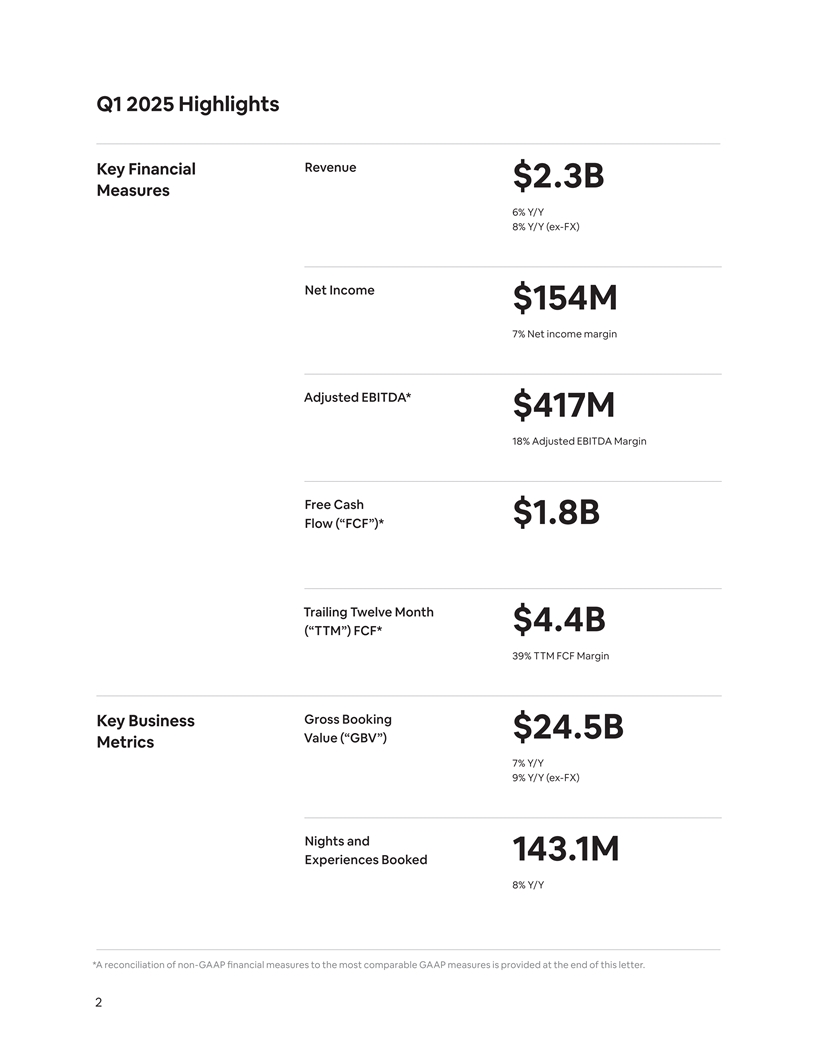
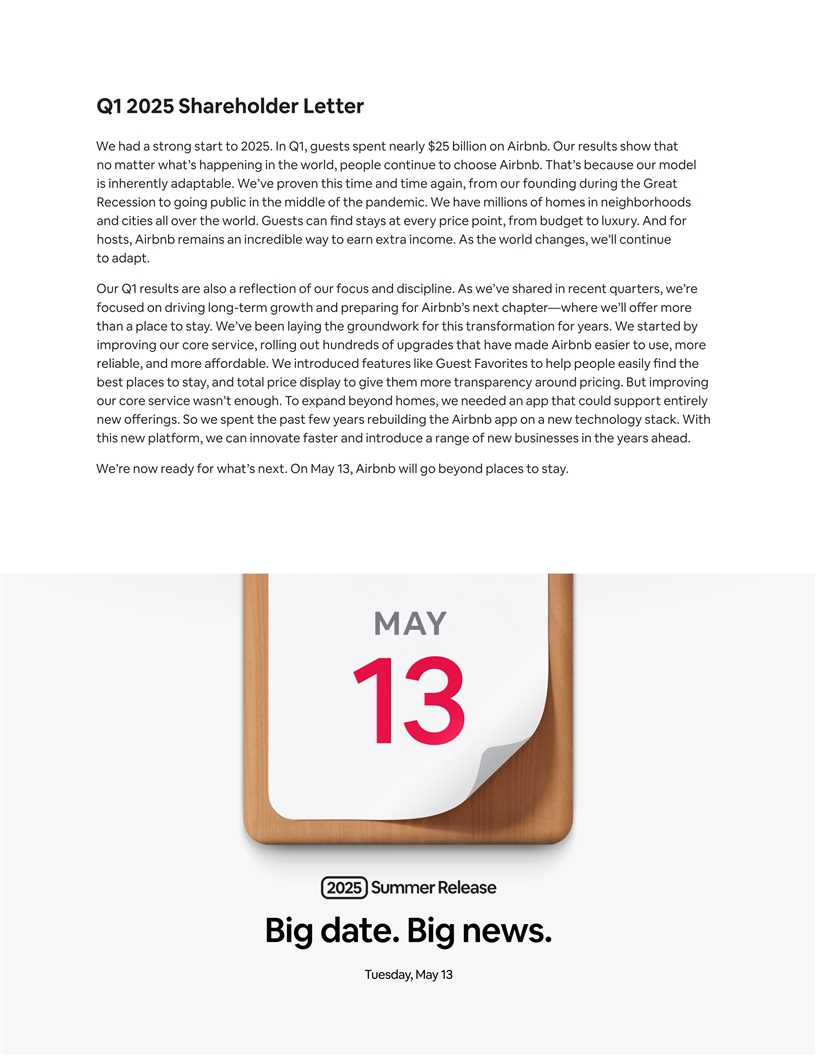
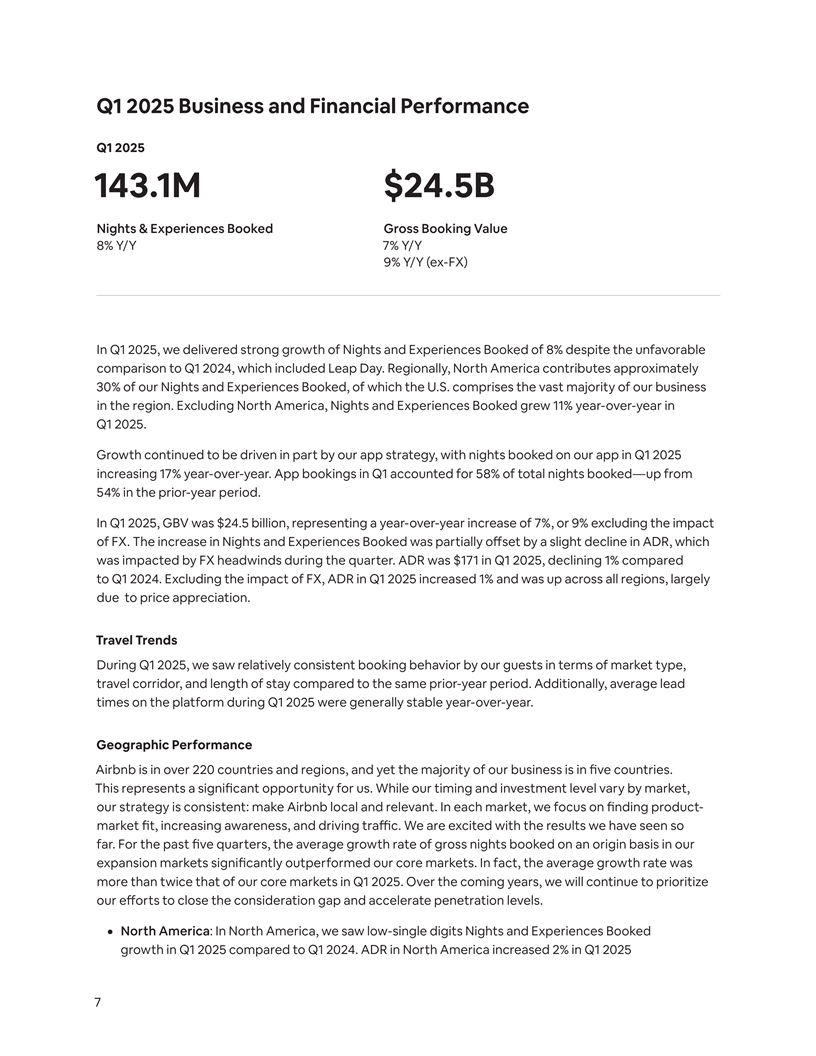
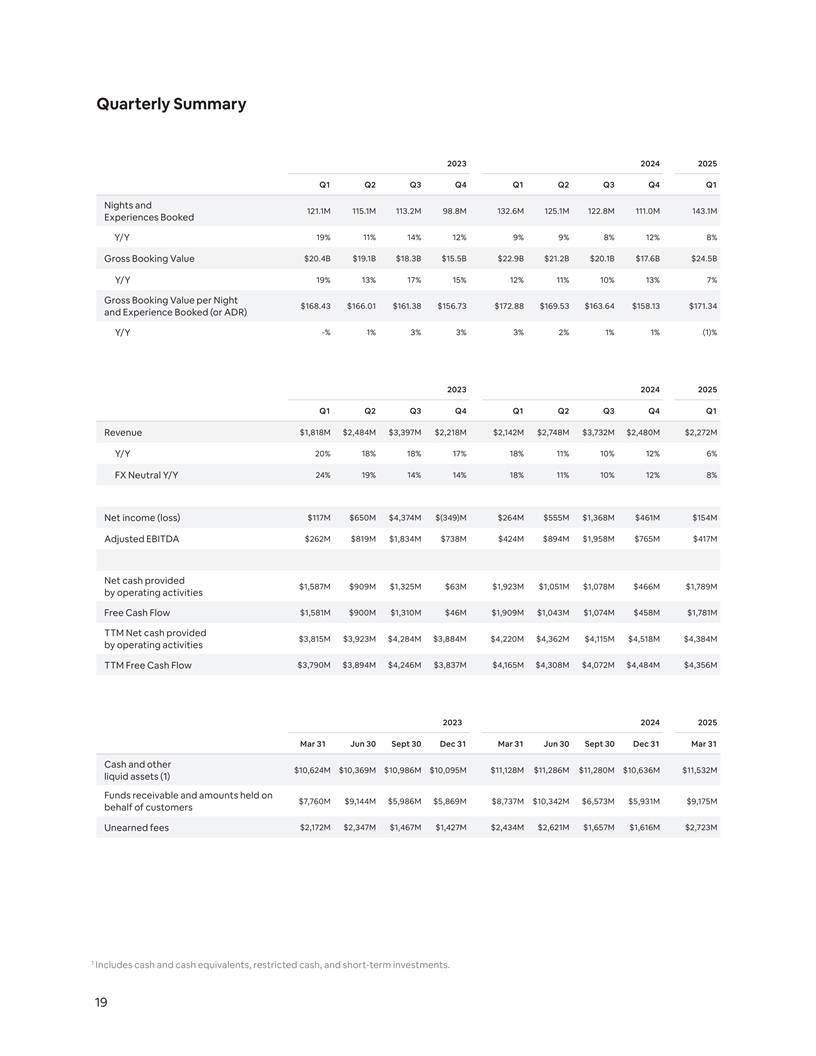
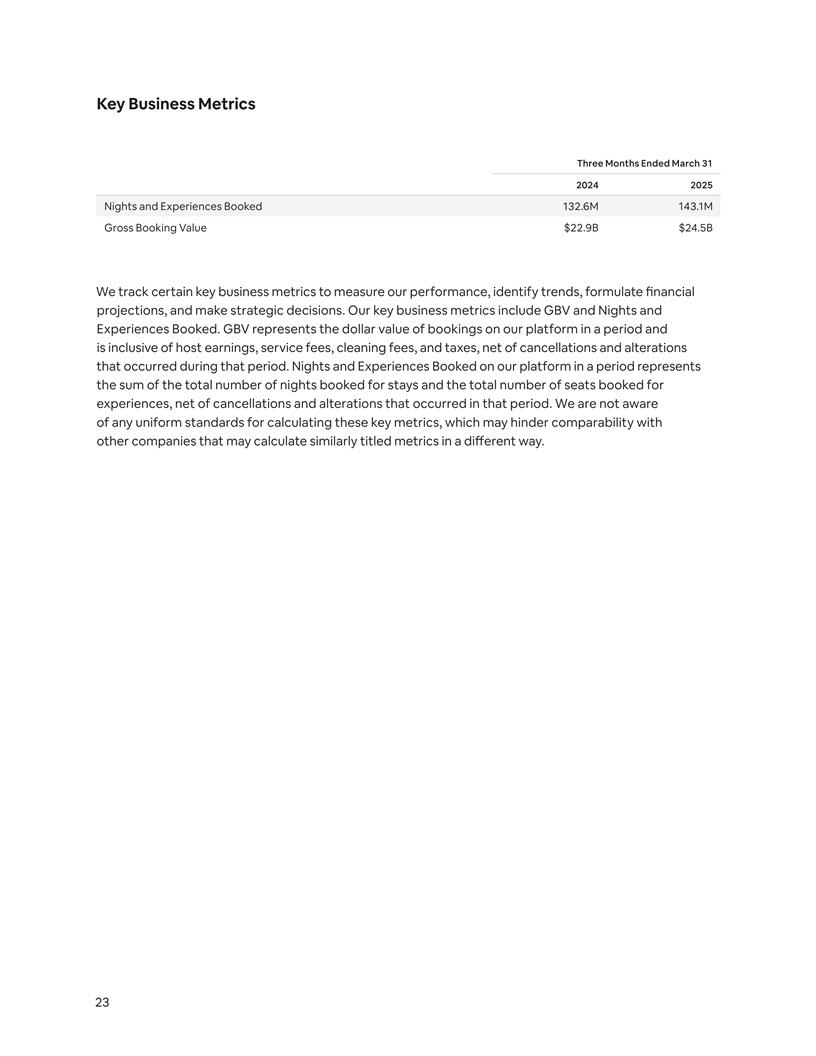
Well, good afternoon, everyone, and thanks for joining. We had a strong start to 2025. In Q1, guests on Airbnb spent nearly $25 billion. These results show that no matter what's happening in the world, people continue to choose Airbnb. And that's because our model is inherently adaptable. It's something we've proven time and time again. We started Airbnb during the Great Recession of 2008. People turned to us for a more affordable way to travel. And they started hosting Airbnb to earn extra income. Then, in 2020, when the pandemic hit, we provided a way for people to travel close to home. And as a result, our business quickly rebounded. And by the end of that year, we've been public. Today, things feel uncertain once again. But just as we've shown in the past, as the world changes, Airbnb will continue to adapt. And that's because we have millions of hosts offering nearly every type of home at nearly every price point from budget to luxury and neighborhoods and cities all over the world. And for hosts, Airbnb remains a great way to earn meaningful income. Now, before we get into Q1 results, I want to just talk for a moment about where we are as a company. We've been focused on driving long-term growth, as well as preparing for Airbnb's next chapter, when we'll offer more than a place to stay. And we've been laying the groundwork to make this transformation for years. And there are two key things we've done to get ready. First, we wanted to make sure that people loved our core service before we launched anything new. So we spent the last few years rolling out hundreds of upgrades to make Airbnb better for guests and hosts. It's now easier to use, more affordable, and more reliable. And just one example of this is the launch of Guest Favorites, which is a way for people to easily find the best place to stay on Airbnb. Since launch, over 350 million nights booked have been booked at Guest Favorites listings. We've also worked hard to improve affordability and price transparency, which are especially top of mind for people today. When guests told us prices weren't transparent enough, we introduced the choggle that let them see the total price up front. Over 17 million guests have used it over the past two years. And last month, we rolled out total price display globally. So now, the price you see up front includes all fees. but perfecting our core service wasn't enough to expand beyond homes we needed an app that could support new offerings now until now our app has really done one thing which is lets you book a home so we rebuilt the app from the ground up on a new technology stack and now we can innovate faster and offer much more than homes so we're ready for urbanby's next chapter on tuesday may 13th, we'll unveil the 2025 summer release, and you can visit our website that day to watch the announcement and see all the details. So with that, I'm going to turn the call over to Ellie for a financial update.
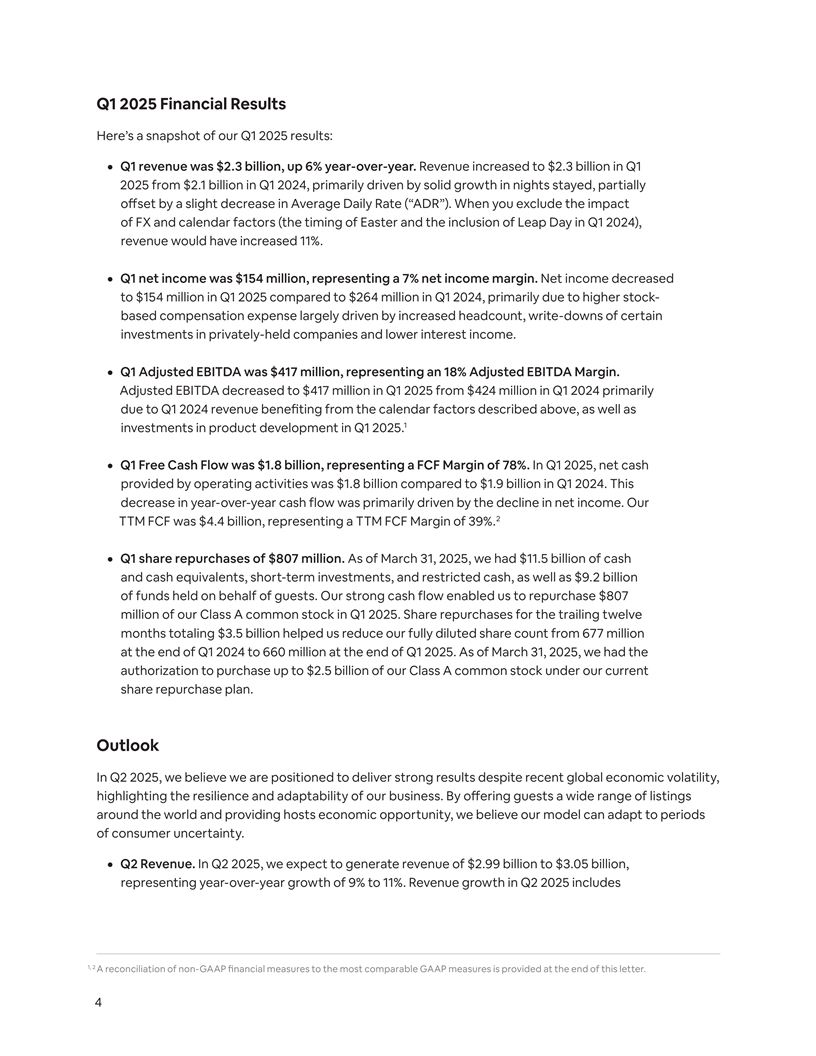
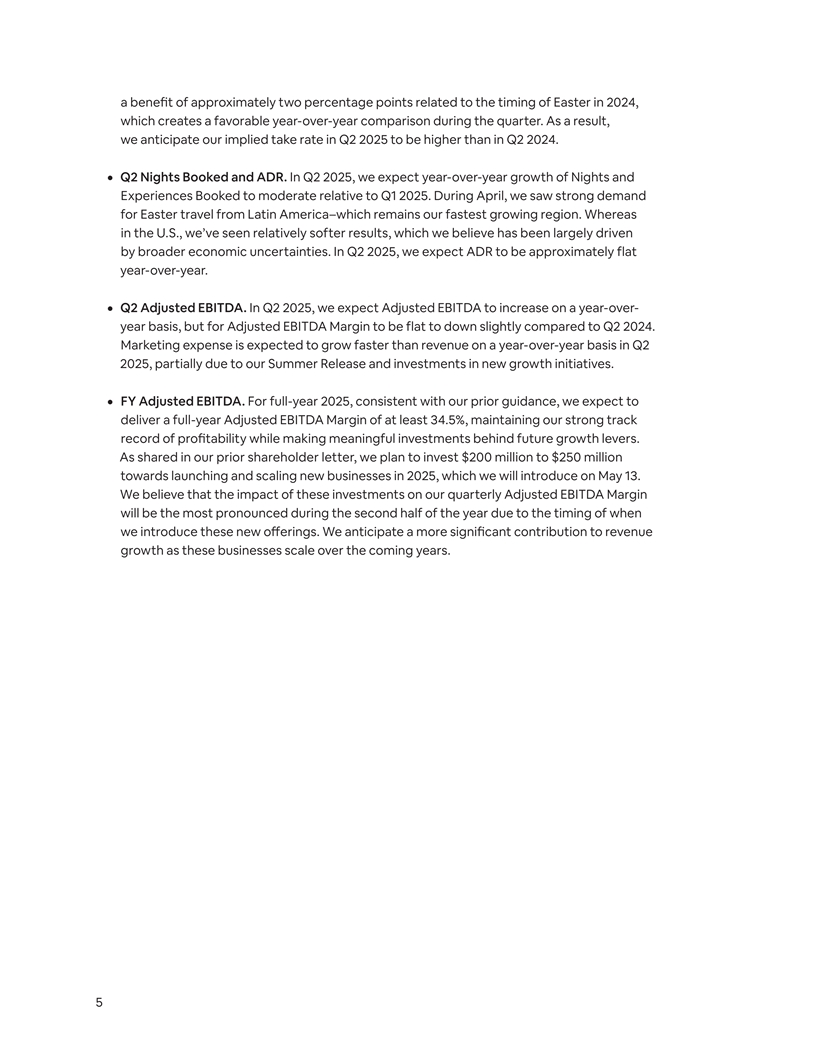
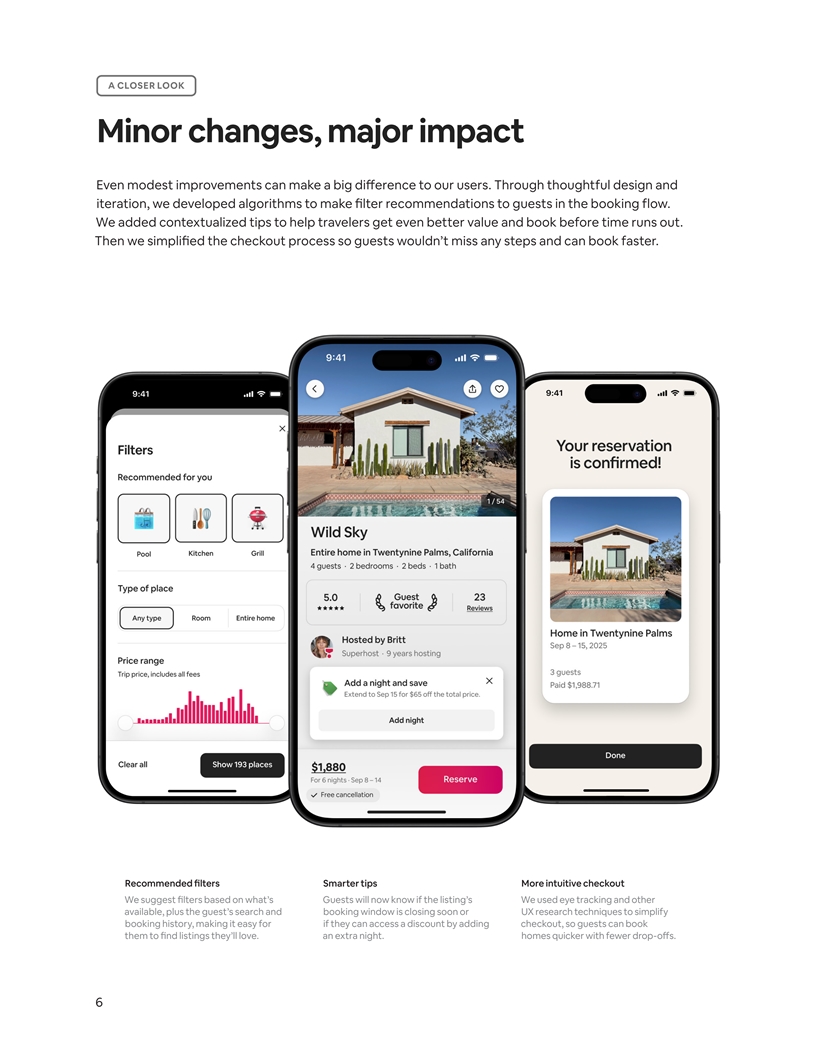
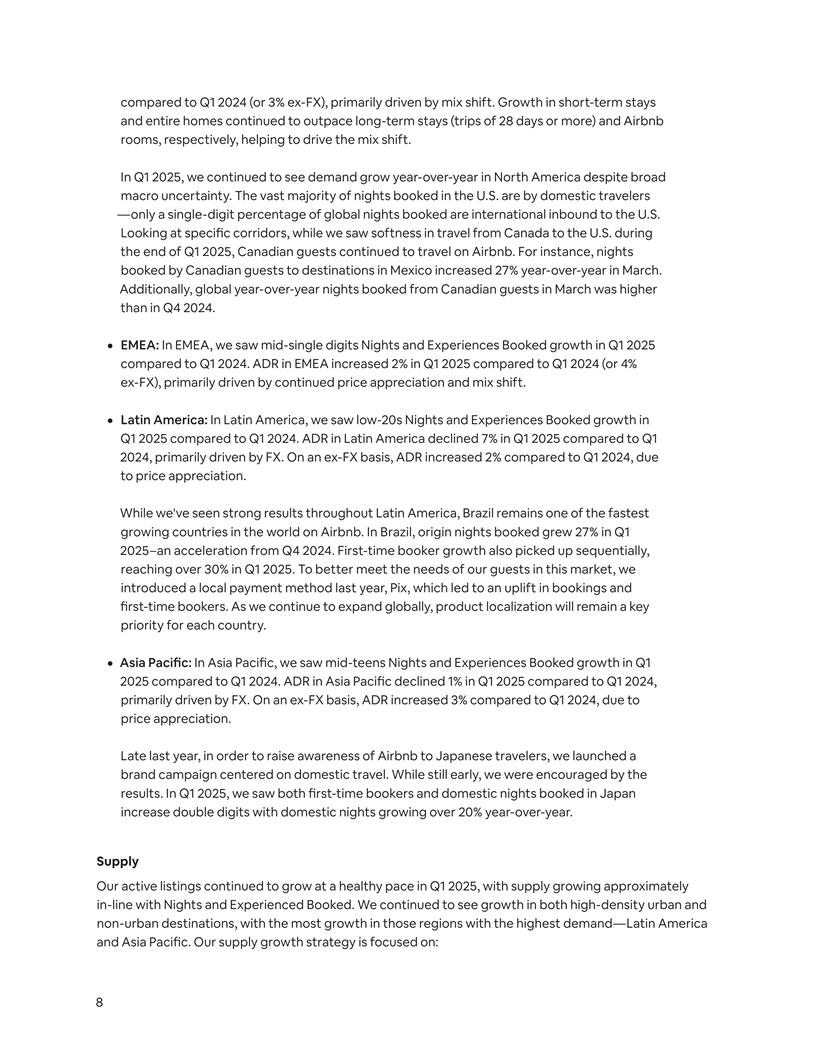
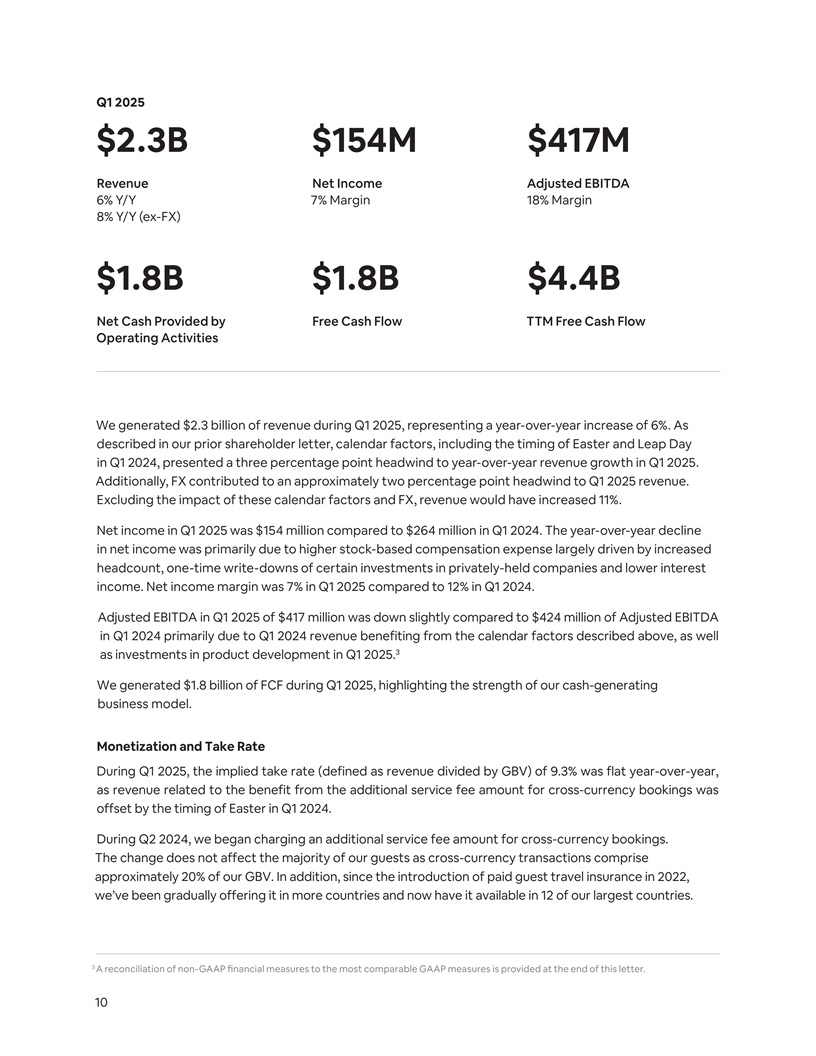
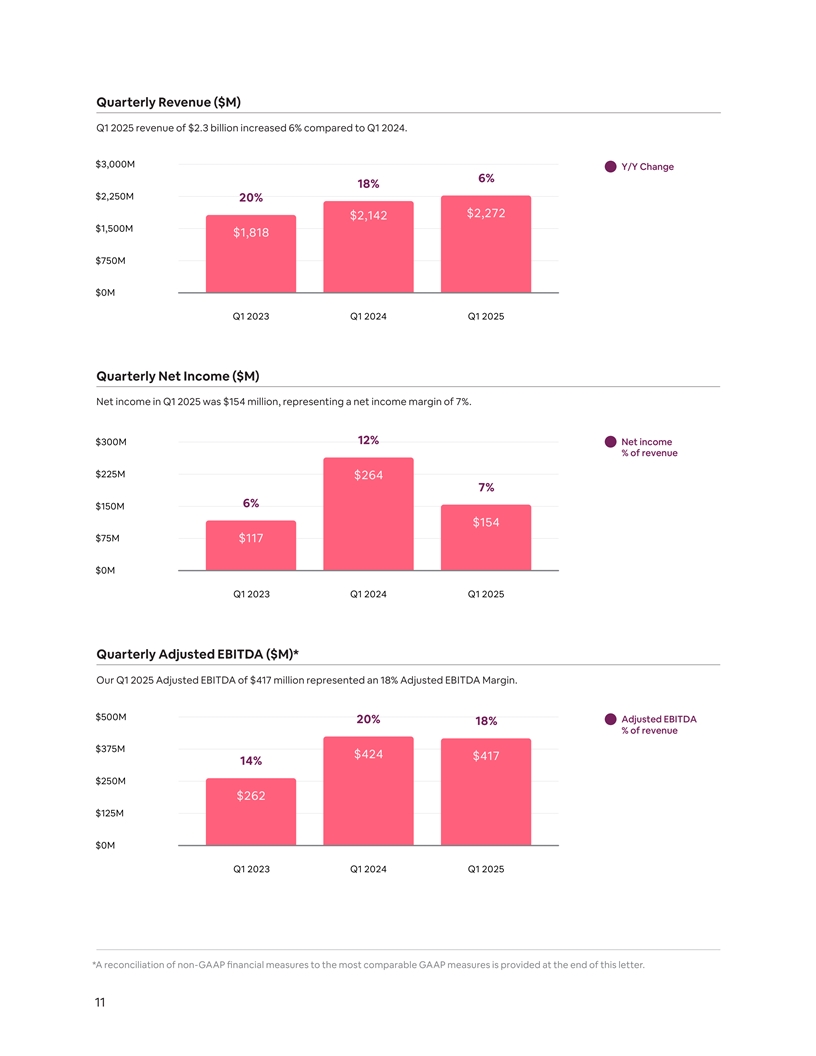
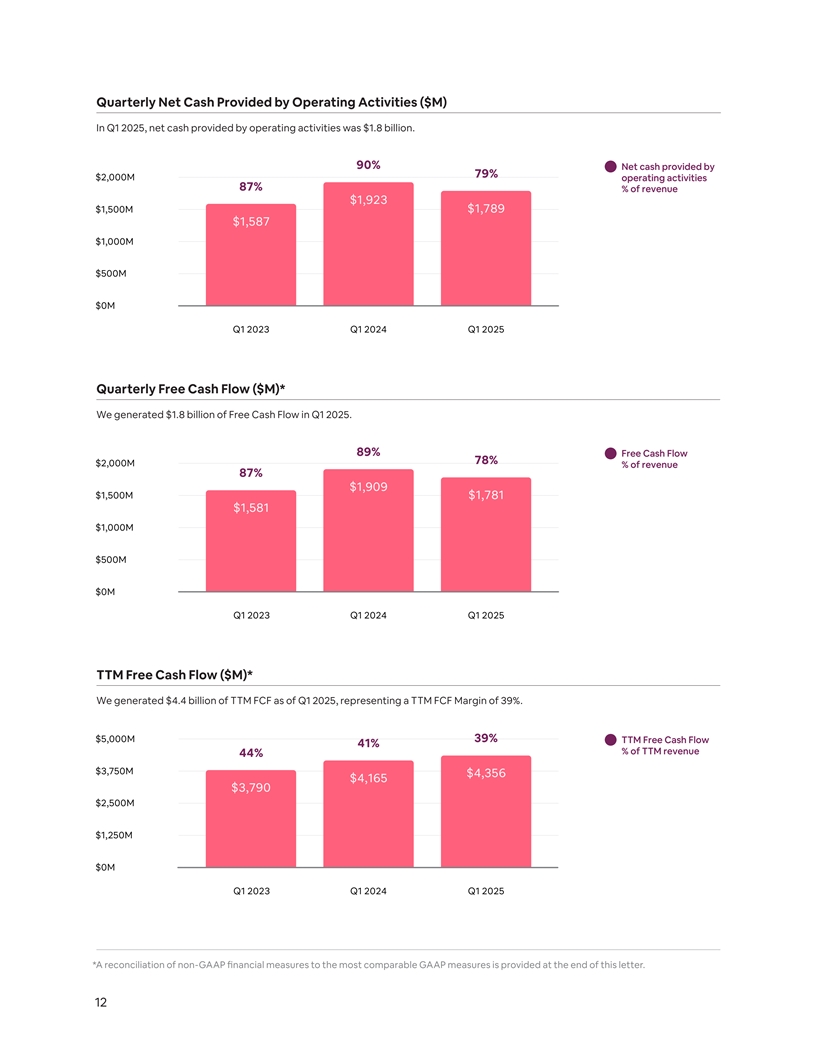
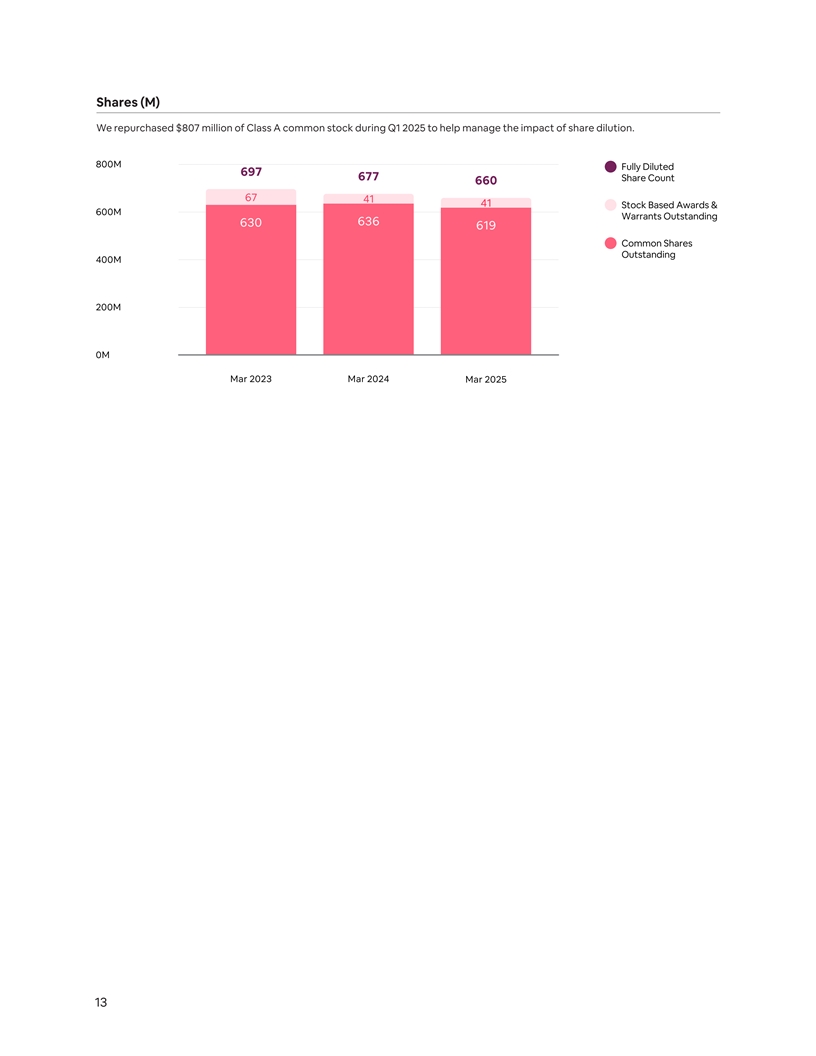
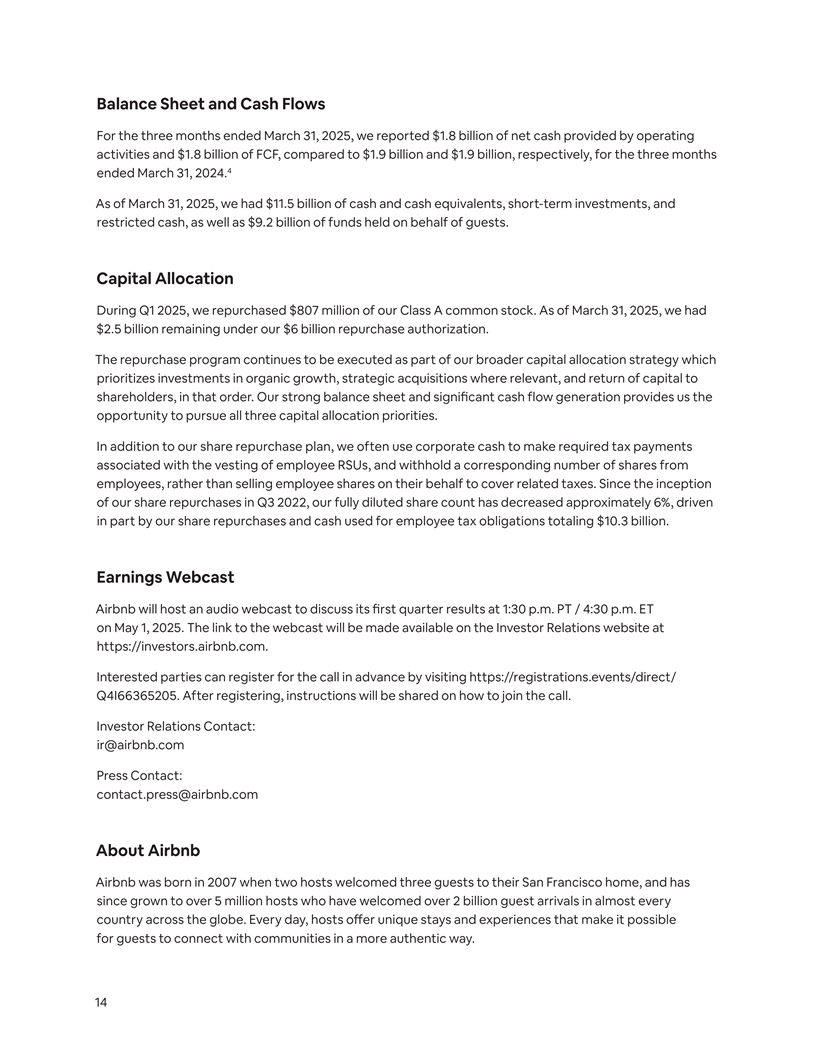
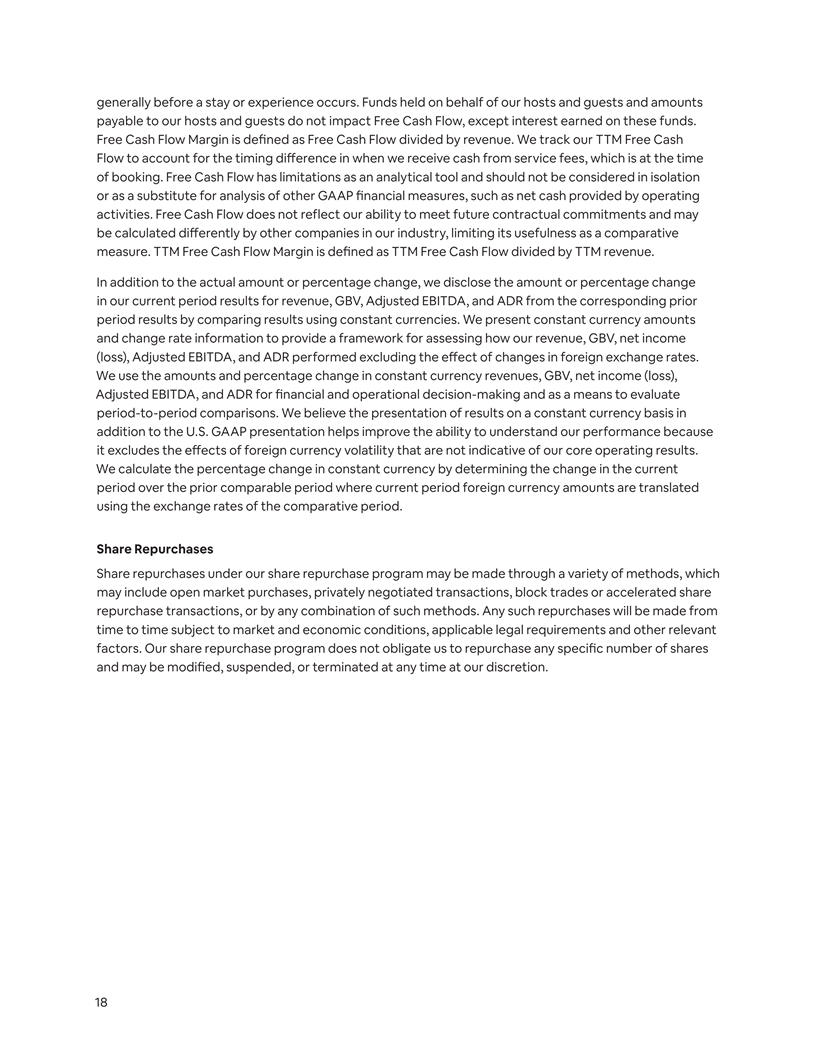
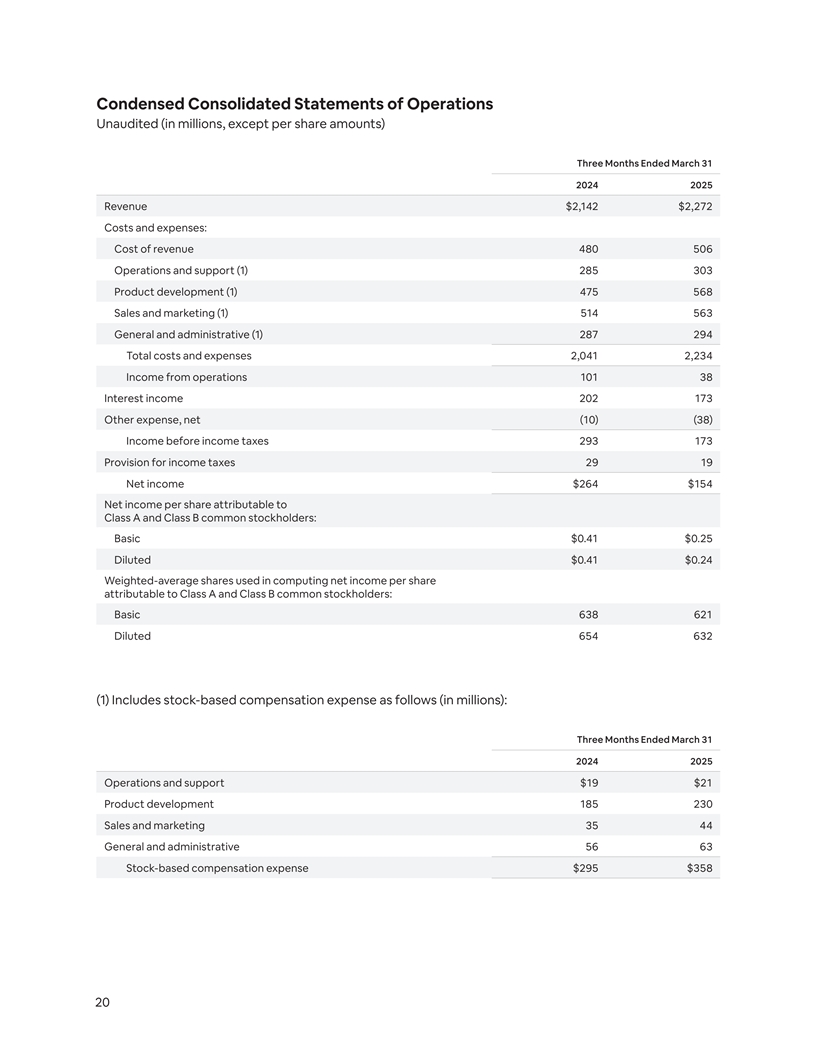
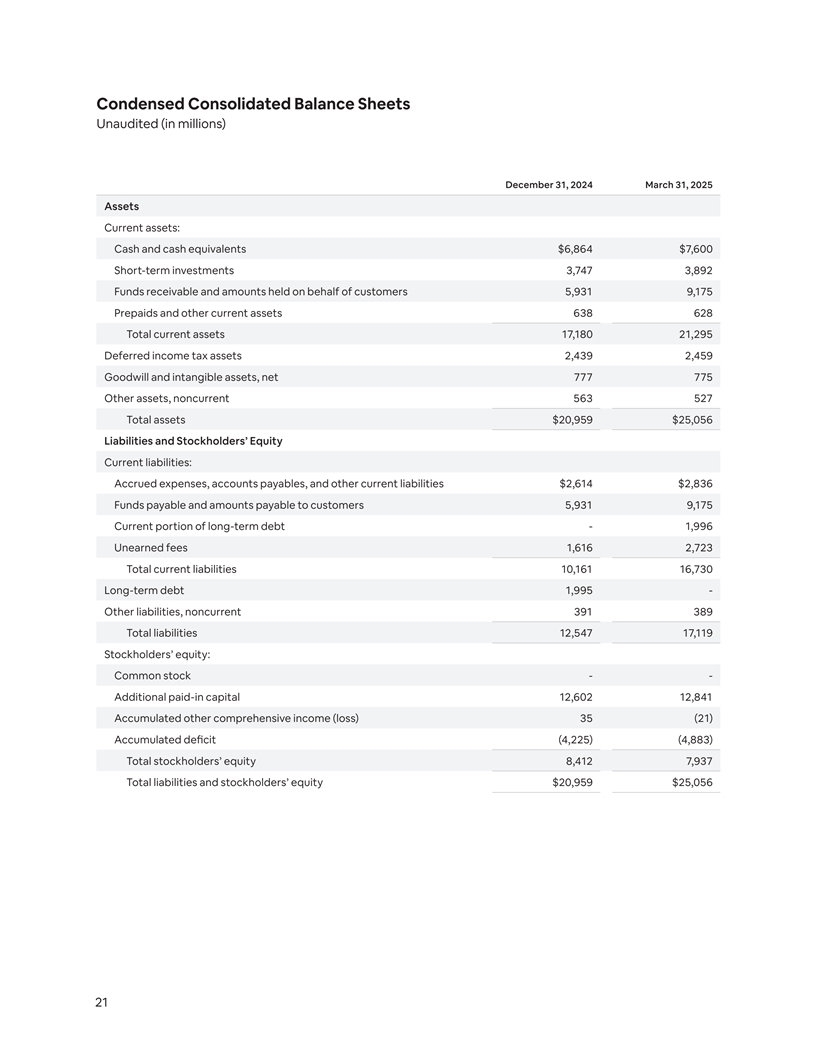
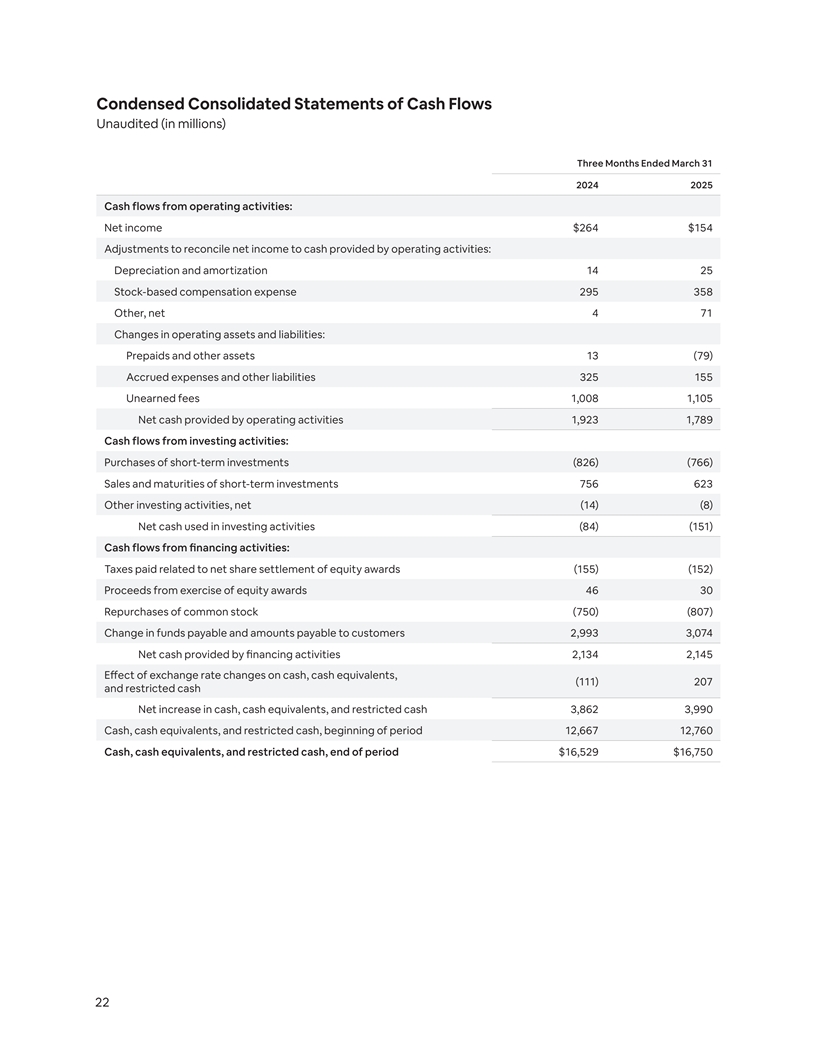
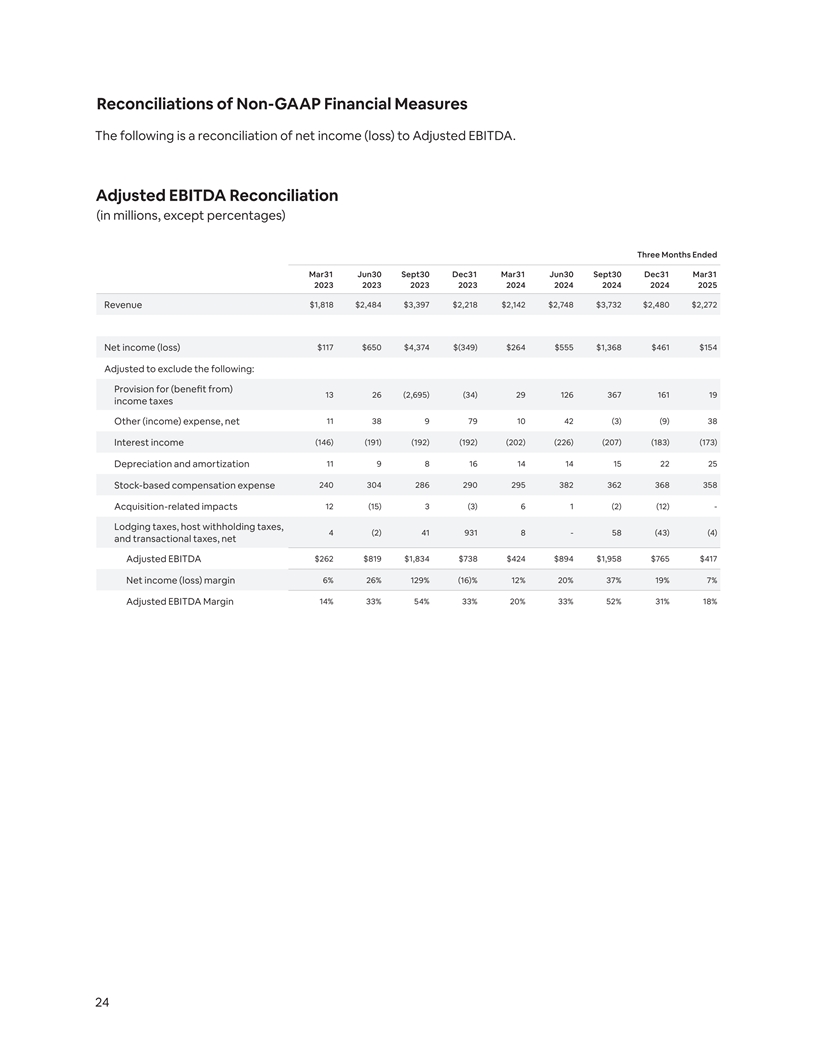
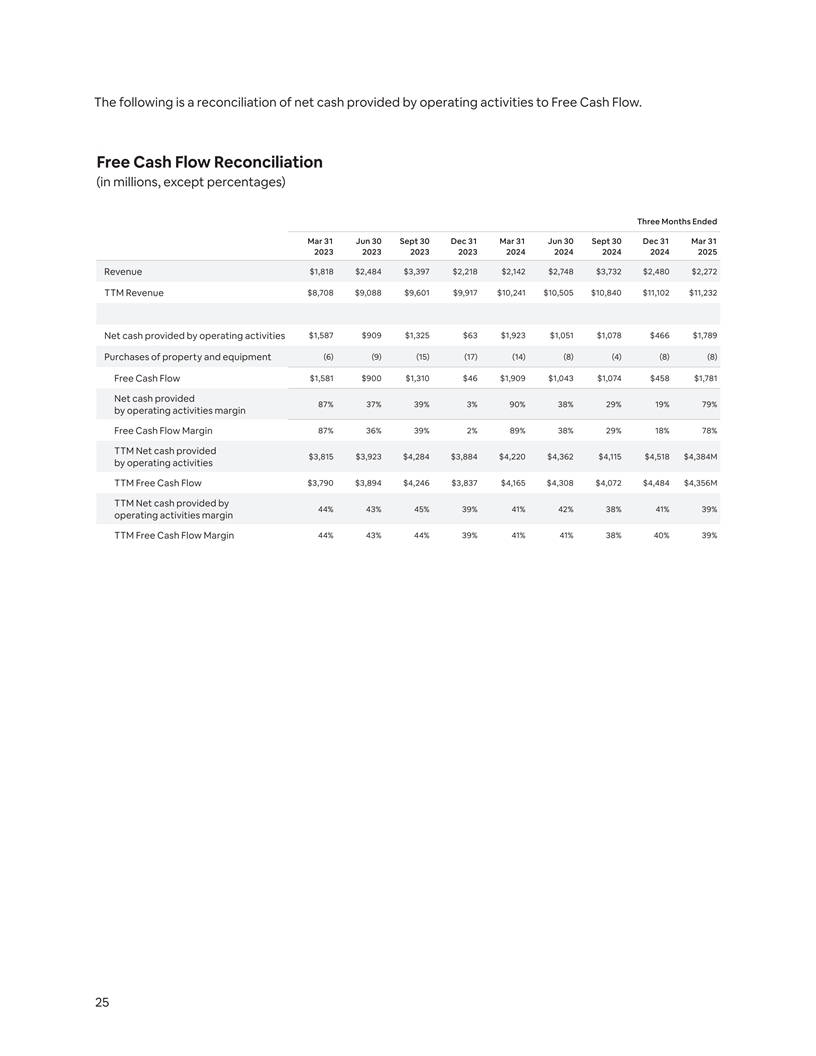
Thanks, Brian, and good afternoon, everyone. I'll start with a review of our Q1 financial results, and then I'll walk through our outlook for Q2. As Brian mentioned, we had a strong first quarter. We had 143 million nights and experiences booked, up 8% year over year. Looking at this year-over-year growth by region, Latin America grew in the low 20s, Asia Pacific grew in the mid-teens, Europe in the mid-single digits, and North America in the low single digits. Revenue for the quarter was $2.3 billion, up 6% year-over-year. If you exclude the impact of FX and calendar factors, revenue would have grown 11%. As a reminder, those calendar factors include Easter falling in Q1 2024, and the extra day from leap day last year. We generated $417 million of adjusted EBITDA, which represents an 18% margin. Next, I'll turn to our balance sheet and cash flow. We continue to generate significant cash in Q1, delivering $1.8 billion of free cash flow. Over the past 12 months, we've generated $4.4 billion representing a free cash flow margin of 39 percent at the end of q1 we had 11.5 billion of corporate cash and investments as well as 9.2 billion of funds held on behalf of guests our strong balance sheet allowed us to repurchase 807 million dollars of our common stock during the quarter and at the end of q1 we had 2.5 billion remaining on our repurchase authorization Now let's shift to our Q2 and full year 2025 outlook. Despite the recent volatility in the global economy, we believe we're positioned to deliver strong results in Q2. We expect to deliver revenue between $2.99 billion to $3.05 billion, representing 9% to 11% year-over-year growth. This includes a benefit of approximately two percentage points due to the timing of Easter. For nights and experiences booked, we expect year-over-year growth in Q2 to moderate relative to Q1. So far in Q2, we saw strong guest demand for Easter travel in Europe and continued momentum in Latin America, which remains our fastest-growing region. In the U.S., we've seen relatively softer trends, which we believe is largely driven by broader economic uncertainty. On profitability, we expect adjusted EBITDA to increase year-over-year with adjusted EBITDA margin expected to be flat to slightly down compared to Q2 2024. Marketing expense will grow faster than revenue in Q2, mostly due to our upcoming summer release and investments in growth initiatives. For the full year, we continue to expect an adjusted EBITDA margin of at least 34.5% in line with what we shared in February. Now that includes $200 to $250 million of investment to launch and scale new businesses in 2025. These investments will have the biggest impact on our margins in the second half of the year since our new offerings go live on May 13th. Now as these new businesses scale over the coming years, we expect them to be significant drivers of future revenue growth. Now looking ahead, our priorities remain consistent with last quarter. As a reminder, we're continuing to drive long-term growth and deliver market share gains through three key growth levers. First, we are perfecting our core service. As Brian mentioned, we've made Airbnb significantly better for both guests and hosts. We've been driving growth from product improvements like enhanced search and better merchandising. One example is a newly redesigned rare finds feature that better highlights popular high-quality listings. We also simplified our checkout page to make booking easier. These are just a few examples of the product optimizations that are contributing to our top line, but we know there's still more work to do. Second, we are accelerating growth in global markets. We're taking a much more localized approach to product and marketing in under-penetrated markets around the world. This is a multi-year strategy, but we've already seen encouraging results. For the first fifth quarter in a row, growth in these expansion markets significantly outperformed our core markets. In fact, the average growth rate in Q1 and expansion markets was more than double that of our core markets. Brazil continues to lead the way. In Q1, Origin Nights in Brazil grew 27%, and first-time bookers grew over 30%, both accelerating from Q4. Third, we are launching and scaling new offerings. This begins on May 13th, so expect more on that soon. Now, to wrap up before we go to questions, we're staying close to geopolitical and macroeconomic uncertainty and monitoring any short-term impact they could have. As Ryan mentioned in his remarks, we have an adaptable and diversified business that has been resilient during periods of uncertainty, most recently as COVID. Despite signs of near-term volatility, remain focused on the long-term opportunity to both grow our core business and expand into new ones. We believe that our efficient operating model, financial strength, and significant liquidity give us the ability to pursue these multi-year initiatives in the current environment. And with that, I will open it up to Q&A.
Operator
Thank you. We will now begin the question and answer session. If you would like to ask a question, please press star 1 in your telephone keypad to raise your hand and join the queue. If you would like to withdraw your question, simply press star 1 again. We ask that you please limit yourself to one question only. Your first question comes from the line of Justin Post from Bank of America. Your line is open.
Great. Thank you. I wonder if you could expand a little bit on the letter on travel corridor changes. Are you seeing any differences in, like, total volumes of bookings from corridor changes, like in Europe? And I know you already mentioned Canada. Is that driving any change for you? And then do you think there's any market share impact in the U.S.? Or do you think you're holding in your share? It's just the whole kind of country is a little depressed.
Great. Brian, why don't I take this? Let me first talk a little bit about travel corridors, and in particular, you mentioned Canada. We called it out in the letter. Let me tell you a little bit about what we are seeing in particular with regard to the inbound corridor to the U.S. We absolutely have seen a decline in popularity of foreign travelers coming to the U.S. What we have seen is that, number one, it's less popular to come to the U.S. from a year ago, also relative to the beginning of the year. And what we're seeing in that segment is two things. One is that that segment is a very small portion of our overall business. As a reminder, U.S. travel is predominantly domestic. And as a result, that corridor of foreign travelers coming to the U.S. is approximately two to three percent of our overall business. So it's frankly not quite material. At the same time, what we're seeing is within that corridor, guess who would have in a prior year come to the U.S. are simply choosing a different location. So I think Canada is the most obvious example where we see Canadians are traveling at a much lower rate to the U.S., but they're traveling more domestically. They are traveling to Mexico. They are going to Brazil. They're going to France. They're going to Japan. And I think what that tells you about the distribution is that in this moment, it's not necessarily that people don't want to travel. They are just choosing different destinations. And Airbnb is a platform, given our distributed supply. It provides an adaptable way for them to find a new location. So that's the comment I would say on the corridors. In terms of market share in the U.S., I would say that we continue to have very strong market share in the U.S. We are not seeing any losses in market share.
Much to the contrary, we continue to gain market share in the U.S., but we do see generally that as a market. north america for the last several quarters has been uh the slowest grower across the industry your next question comes from a line of richard clark from bernstein your line is open all right thanks for taking my question just just want to delve a little bit into what is the behavior you're actually seeing from the the u.s guests slow down is it you know delayed booking windows is a higher cancellation rate shorter trips trading down on some nature of what you're actually seeing. And I guess we've heard some of maybe a few travel companies that things got a little bit better towards the end of April. Are you seeing that? Is there any sort of light at the end of the tunnel there with regard to bookings picking up in the last few days or weeks?
Yeah, thanks for the question, Richard. So let me double click. I just talked about the corridor that is inbound to the US. Let me talk now about what we're seeing with regard to U.S. domestic travel, which, again, is a lion's share of overall U.S. destination. A couple of things to comment on. One is we are seeing the higher income traveler somewhat unimpacted by the current macro conditions. We see in particular at the higher ADRs of our bookings, the growth is very stable and very healthy for the U.S. traveler. In terms of lead times, we're seeing something else. We're seeing that the short lead times, so that would be bookings that are just around the quarter. They could be in two days or a week or two weeks. We're seeing relatively strong growth there, whereas in the longer lead times, and in particular, those bookings that are for more than, say, a month out, that is where we're seeing the relative softness. And so I think what you take from that double click in terms of the lead times is that we do have some U.S. consumers that are waiting and seeing before they book their summer travel. And I think the one thing that gives us some amount of comfort in terms of seeing the weakness at those longer lead times is that we have seen movements in terms of lead time shifts many times in the past. I think the most recent call-out was last summer, where we saw in June and July a truncation of lead times, somewhat similar to what we're seeing today. And what we saw then is that people waited for a while, but they did end up booking that trip. It was just closer to the check-in day. So that's something that we're obviously monitoring quite closely, both globally, but also in particular to the U.S., as we believe the U.S. is obviously the most impacted by a lot of the headline noise currently. The one thing I would also add is we haven't particularly seen consumers trade down in terms of choose a lower ADR booking or a shorter trip. That has not been any behavior that we've seen.
Operator
Your next question comes from a line of Mark Mahaney from Evercore ISI. Your line is open.
I wanted to ask about what you think are the best chances for re-accelerating your units, your nights and experiences. If we just leave aside experiences for now, what in terms of the core accommodations, unit growth, I think you're investing to get back to double-digit unit growth. And of the different things you're rolling out, co-hosting, is it really leaning into the expansion markets? Is there something else, maybe marketing? What are those do you, are you counting on to be most impactful in order to get that, you know, get that recovery back to double digit night's growth? Thank you very much.
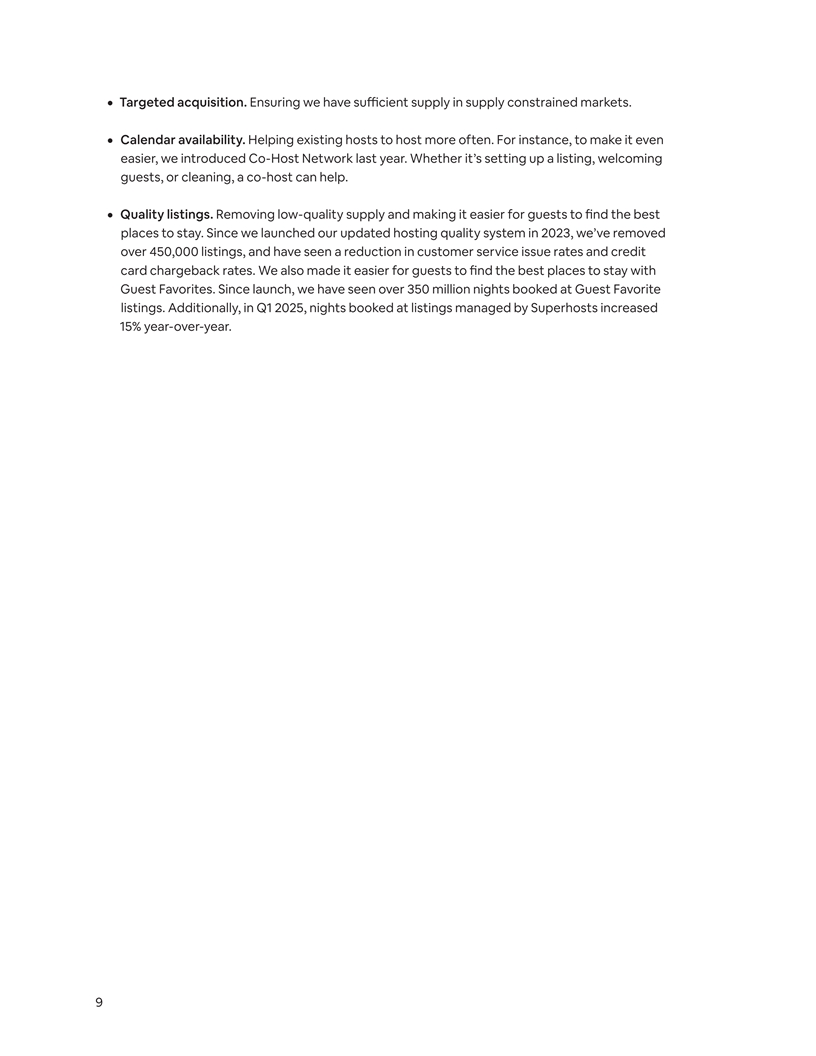
Hey, Mark, I don't know if you take this. So, yeah, I guess I would just say we think we're just scratching the surface of how much bigger our core business could be, you know, and there's no reason to think it could not be double the size that it is today. And then the question is, well, what would you have to believe? I think the first thing we want to do is to continue to perfect the core service. To do that, we really have to do three things. We got to make Airbnb easier to use, we got to make it more affordable, and we got to make it more reliable. So just for example, starting with reliability, for every person who books an Airbnb, we estimate about nine people are booking hotels. So if we could just get one of those nine people to book an Airbnb, that essentially would double the size of our business. And the number one reason people say they don't use an airbnb is they don't find it historically as reliable as a hotel that's why we're really trying to elevate the best homes in airbnb and remove the worst so we now guest favorites 350 million nights have been booked in guest favorites um we've also removed 450 000 listings this has created um you know a lot higher customer satisfaction reduced customer service tickets and we think over time more more people are going to come to airbnb so we're going to do a lot more, Mark, on making Airbnb more reliable. On affordability, we know that that's a big driver of growth. Airbnb started as affordable alternative to hotels. We lost, I think, a little ground versus hotels during the pandemic. But I think in the last couple of years, hotel prices have gone up more than Airbnb. I want to call out that as of last month, we have rolled out total price display globally. So now the price you see before taxes in the United States and really inclusive taxes, say in Europe, include all fees. And I think this is really important because it drives customers to the best value Airbnbs, which we rank higher and incentivize the best behavior for hosts. On the usability standpoint, the vast majority of our people come to Airbnb don't find a booking. Airbnb last year was accessed by over 1.5 billion devices. So think about how many people come to Airbnb they don't find a place to stay. Part of this is having the right homes for them, but also having the right tools. So we think perfecting the core is a huge driver to grow. But that is really going to be a big driver in our core markets. Our core markets are U.S., Australia, Canada, U.K., and France, the four English-speaking countries plus France, which make about 70% of our growth or our business. But the more growth markets, emerging markets, would be Spain, Italy, Germany, Mexico, Brazil, and then the big four countries in Asia are China, India, Korea, and Japan. And these markets are actually growing twice as fast as the aforementioned five core markets. And we're going to step on the gas. And I think that international will be one of the biggest growth drivers that will get us back to double-digit growth on Airbnb. So that's just a little bit. It's really three horizons. Horizon one, the biggest near-term opportunity is continue to increase conversion rate by making it to be easier to use, more affordable, more reliable. Horizon 2 really is international growth. And then, of course, the longest horizon will be expanding our core business to offerings beyond a place today.
Operator
Your next question comes from a line of Jed Kelly from Oppenheimer. Your line is open.
Hey, great. Thanks for taking my questions. Just circling back on the U.S., I think I've asked this before, but just in some of these urban markets, do you think about leaning more into hotels? And then just on the full year guidance, you know, you reiterated your margin guidance, but any reason, given the macro uncertainty for not widening the margin range? Thanks.
Yeah, I can take hotels and I'll let you take the same part, Jed. So yeah, we think hotels is a massive opportunity for Airbnb. You know, in 2019, we acquired Hotel Tonight, and that was basically under the philosophy that while people came to Airbnb looking for a unique place to stay, typically a home, the vast majority of people come to Airbnb don't end up booking. And one of the reasons is they're window shopping and they're not ready to book. But sometimes, especially in popular markets, urban areas, when a lot of people are traveling, Airbnb homes are booked and we have a fairly high occupancy and we need other places to stay. And hotels are a great way to fill in network gaps. You know, during the pandemic, we had to pause some of our efforts and some of our progress because we really wanted to focus on getting back to the basics. But now that we've made a huge amount of progress on our core business, making over 500 improvements and upgrades over the last three years, we are prepared to expand beyond And actually, one of those expansions is hotels. One of the things you saw was we just did a promotional hotel tonight. So now, if you book a hotel on Hotel Tonight, we're offering 10% credit towards an Airbnb booking. This, of course, increases conversion rate on Hotel Tonight, but also introduces the number of hotel travelers to Airbnb. Over the coming years, we're going to be doing a lot more, though, on Airbnb's application to bring more great hotels onto Airbnb. We think almost all the hoteliers in the world would love to have Airbnb as a distribution channel. And so we think there's a lot of opportunity over the coming year. So absolutely going to be part of our strategy.
Again, on the second question with regard to the margin guidance, you know, we reiterated the plan that we had shared in February. We believe it gives us, you know, considerable room to continue to focus on strengthening the core business while investing in growth initiatives and no material change in terms of that investment profile for the year.
Operator
All right. Next question comes from a line of John Colantoni from Jeffries. Your line is open.
Great. Thanks for the question. I wanted to start with sort of momentum in the business. With growth in 2024 peaking in December and strength continuing in early 2025, I'm curious how growth has trended throughout the quarter and into April. Is growth sort of at a low point right now for the year, or did it sort of dip a little bit earlier in the quarter and it's since improved from there. And second question, just sort of looking specifically at the expansion markets, curious if you could just sort of characterize how growth has progressed there specifically this quarter compared to last quarter when you called it out as a key contributor to the strength that you saw. Thanks.
Thanks, John. Let me start with the first question in terms of how growth has trended effectively year to date. So I think it's actually interesting to understand the path that both we and I think the industry went through in Q1. If you recall, January was a very strong month followed by softness in February. You'll recall there was a bunch of revisions to guidance in terms of the airlines. And I think what they saw, but we saw a slightly less degree of it was there was a step down from January to February that coincided with a pretty meaningful decline in consumer sentiment over that sequential month-to-month period. And yet, when we look at our full quarter results for Q1, that softness that we saw in February effectively rebounded and recovered in March, such that the full quarter was generally in line with our expectations. So I think when we fast forward today and the headlines are quite volatile, I think we do have to recall that since the beginning of the year, there has been some temporal shift in terms of when people are booking. But from that Q1 period, what you gauge is that people may pause on the booking, but what we've seen today is that they come back and do it. So I wouldn't say that April is necessarily the low. There has been some week-to-week and month-to-month volatility since the beginning of the year. On the expansion markets, what would I would say. I would say, generally speaking, we see nice momentum in those markets. I think, in particular, what I would say is that Latin America accelerated over the course of full year 2024. And if you look at Latin America's growth in Q1 is actually above where we were in Q1 of last year, which I think gives you a sense of, you know, if we're able to achieve momentum in a particular market based on our product and marketing localization, we can maintain it and accelerate it over time. Obviously, the nuance of every country is slightly different, but I think anchoring on the performance that we've had across Latin America, but in Brazil in particular, gives you a sense of the ability to build momentum in these relatively under-penetrated markets.
Operator
Your next question comes from a line of Lee Horowitz from Deutsche Bank. Your line is open.
Great. Thanks for taking the question, too, if I could. Last quarter, you guys talked about the ability to leverage marketing expense in some of your core markets, which gives you the ability to invest in the growth markets. I guess as things perhaps slow a little bit, how do you think about perhaps leaning into that slowness to take some more share, to take advantage of a weaker market, to pick up share, particularly relative to, say, some of your competitors that have talked to trying to be more aggressive as things slow? Do you still think you can leverage marketing in your core markets under those assumptions?
Lee, I would say absolutely. Obviously, we start the year with a full-year marketing plan, and yet every month we're looking at the relative efficiencies by channel, by market, and adjusting accordingly. So I would say, broadly speaking, for the year, we retain quite a bit of flexibility to put more money into channels that are working and markets that are working and to cut where we see less desirable results. And so, so far this year, we've been doing that on a regular basis. as we would in prior years.
Operator
Your next question comes from a line of Ron Josie from Citi. Your line is open.
Thanks for taking the question. Two, please. I want to ask just on the new product launch on May 13th and experiences or something else. Talk to us a little bit more about the plans, integration plans across the site and how you think or whether any contributions from these new products are included in guidance. And then on the affordability or just the volatile headlines, Ellie, that we've been talking about, I'd love your thoughts on just how Airbnb's affordability initiatives could drive greater We saw the summer travel data where I think U.S. guests are prioritizing vacations and more planned to drive. Maybe that's an opportunity for the team. Talk to us about that, please.
Okay. So, on the first question, I believe it was, what's the impact of the new business launches with regard to our guidance? So I would say the launch date is M13, and we're extremely excited in terms of what is to come and what is to start on that day, but it is just the beginning. And so the impact from a top line in the current quarter will be relatively modest, whereas as we scale those offerings, they will obviously increasingly contribute to the top line. In terms of the expense and the investments associated with that launch, they are building over the course of the beginning of the year. And as we said, in the guidance language, you will see them more meaningfully hit EBITDA in terms of compression in the back half of the year as we scale the investments behind the launch. In terms of affordability, I think your thesis here is exactly right. What we saw, and it's not a perfect comp, but I do think it is instructive here. What we saw five years ago in terms of the pandemic was when, you know, certain portions of travel were inaccessible, people found other things to do on our platform. You know, as Brian and I share in terms of the opening, just to remind everyone, this business model has a huge amount of diversity in its offering, which allows us to be, you know, extremely resilient and adaptable as consumer behavior changes. And so as I think about the current environment that we are in, you can think about, for example, the U.S. guest. There's an opportunity for us to merchandise the lower cost listing or the more proximate listing where the guest doesn't need to take a flight for the summer, but they can drive. There's a huge amount of optionality with regard to the diversity of our offering that can allow us to better merchandise what is applicable to the guest in the current moment.
Operator
Your next question comes from the line of Justin Patterson from KeyBank. Your line is open.
Could you talk more about the behavior of the guests who are booking primarily in-app versus those who are arriving through the web? Are you just saying greater frequency rates, repeat rates, so on and so forth?
So, broadly, I would say the demo is slightly different in terms of the app relative to the web. I would say the broader thing to take away in terms of the movements we've made in terms of booking share moving to the app is that we know the app is a much better experience for the consumer. You know, we see this most notably just in terms of conversion rates, getting people to use our apps, you know, as compared to in particular Moeb. It's a much better experience that we have designed. And so we want to migrate people to that experience. You can see that the booking share has gone up quite dramatically over the last couple of years as we've encouraged people to use our app. And as a result, it's additive in terms of the consolidated conversion level.
Operator
Your next question comes from the line of Doug Enruth from JPMorgan. Your line is open.
Great. Thanks for taking my question. This is up to you. First of all, Brian, you've been pretty vocal about user experience and travel. also curious to hear how you experience on Airbnb to change as you move beyond places to stay and new choices, introducing new frictions. And then secondly, how do you guys think about the long-term sustainability of your margins as your efforts to move beyond the core scales over time? Thank you.
Hey, Doug. Let me just start by saying I think one of the superpowers of Airbnb is our design team and our ability to make something incredibly easy to use. You know, when we started Airbnb, we didn't really invent the idea of vacation rental. They existed before us. But what was true is that they were very hard to book. You know, before Airbnb, you couldn't actually book a vacation rental online. The messaging platforms really were non-existent or very rudimentary. Very few people actually left reviews. People didn't really have an account. And so kind of one of the things we really tried to do when we created Airbnb was design this system of trust. And as something is easier, more people do it. So what we're noticing, for example, is many of the new businesses we're going into, they also have similar frictions as our core business did or vacationals did before we basically created a category, which is what we now call Airbnb. And so that's one of the things is we're going to try to, you know, the things we're going to offer want to be instant book. We want to be like really easy. we want to have that great Airbnb design. But the other thing is a couple other things with user experience. I think a lot of companies have tried to design an end-to-end travel. I think designing end-to-end travel is very, very hard. It's funny. There's this funny thing. One of the most common startup ideas for entrepreneurs is to do a travel planning app. And yet travel planning apps almost always fail so it's almost like a riddle why do travel planning apps fail and every everyone really tries to do it and the reason why is because to plan travel is very complicated in fact it's so complicated many people have assistance and a big part of the job is to plan travel for them and yet you use it infrequently so it's a very difficult thing to do and you do it infrequently and so therefore a lot of companies have failed to design um you know like a so-called connected trip so i think you know to do this a lot of it is to design a really good user experience and i think that's one of the things that we're going to try to do to really design a great end-to-end experience feel the book your entire trip and much more i think the user interface will be important i think ai will be important way to do this as well um you know ai is i think as i said before we're really um we're really focused on customer service and solving the most difficult problems for customers and working backwards towards travel inspiration um just one thing i'll say about ai which is definitely making the customer experience easier is we just rolled out our ai customer service agent um this past month um 50 of us users are now using the agent and we'll roll it out to 100 of us users this month we believe this is the best ai supported customer's travel agent in travel. It's already led to a 15% reduction in people needing to contact live human agents, and it's going to get significantly more personalized and agentic over the years to come. So essentially, that's what we're focused on. We're focused on making everything instant book and easy to use.
We're trying to make sure that the end-to-end travel experience is really, really wonderful with great Airbnb design, and we're going to bring more AI into the application so that everybody you can really solve your own problems with great self-solve through ai customer service agents great let me talk a little bit um let me talk a little bit about long-term margins um i think just starting with our core business obviously our core business has extremely strong ebitda margins and cash flow generation abilities i think you've seen us you know bring that up over time in particular subsequent to the pandemic and where we sit to day, we see incremental efficiencies that we can continue to drive across that core business. And every year, what we're seeking to do is strengthen and make more efficient that core business so that we have incremental room to invest in growth. From year to year, we may choose to invest more in growth relative to the efficiencies that we generate. I think you're seeing that in the current year. But the intent, both with the core and the new businesses, is to invest in growth up front and to optimize the margins over time. I think that the portfolio over time, we expect to have quite compelling margins.
Operator
Your next question comes from a line of Nick Jones from Citizens. Your line is open. Your next question comes from a line of Ken Gorilski from Wells Fargo. Your line is open.
Thank you very much. Appreciate the question. Brian, a question for you as you think about the ADRs and the opportunity, the balance. If you go back over the last couple of years, you've talked about making Airbnbs more affordable. And there's been various initiatives, including the Rooms Initiative, to make Airbnbs more affordable. Do you expect maybe more flexibility in ADRs and room night prices on Airbnbs relative to hotels in a period of weaker consumer spending, especially in the U.S., maybe in urban areas. I'm just curious as how you think about the balance between potential ADRs versus room nights in North America. Thank you. Sorry, I'm not clear what the question is. I'm sorry, let me rephrase. Do you, as you think about the opportunity, if you think about the balance between pricing ADRs, uh average daily room nights relative to total room nights volume do you think that there's uh an opportunity to to have more for your host to have more flexibility on adrs and to see more affordability drive better room nights and and ultimately greater share over the long term and in a period where there's maybe more consumer uh consumer weakness or or uh some pressure on on the consumer wallet yeah okay yeah absolutely um the answer is um yes and i'll try to explain
why this is the case um you know hotels let's just contrast to hotels assume you're referring to airbnbs versus hotels so hotels have most hotels um hotel rooms all hotel rooms have a cost base right and so they need to build in a profit margin on their um you know um on their room they call this rev par revenue brand and um and it's it's really important that for them that they stay within some margin the vast majority of people on airbnb um list only um their home only on airbnb we believe most listings are exclusive to airbnb and most of these homes um are either primary homes or the second homes but the homes don't exist to list on airbnb they exist for somebody to live in summer all the time and so most of the income that people make on airbnb the average host Airbnb in the United States, for example, makes about $15,000 a year, this is supplemental income. And so it's typically all upside for them. So what this means is there's typically a little bit more flexibility on an Airbnb host than say a hotel to be able to move their prices up or down because if they didn't rent on Airbnb, before Airbnb they didn't rent, that night was completely lost. So really any price is upside for them as compared to a hotel. One of the things we do is we try to build really great host tools for them. And four out of five hosts on Airbnb are now using our host tools. To give you a couple examples, compare listings. More than 2 million listings in Airbnb have used the compare listings tool. What the compare listings tool does is shows you how your price compares to prices of similar Airbnbs in your area. We found that when hosts have more visibility, they tend to provide more competitive prices. Another is weekly and monthly discounts. Now, the vast majority of hosts on Airbnb offer a discount if you rent by the week or if you rent by the month. So, these are just some of the tools that we offer, and we're going to continue to offer more and more tools, so our hosts are increasingly responsive. But yes, to answer your question, we do believe that there's more flexibility, and ultimately, while a higher ADR can benefit Airbnb's financial outlook on the short term, in the long run, affordability aligns our interests with customers, which is the best long-term incentive to alignment to align with shareholders. So we always want to drive as much value as possible to our guests.
Can I just also add that when we test elasticity, we often see that driving down prices is more than compensated by increased volume. And that's why when we think about our pricing tools, we are not trying to necessarily drive hosts to offer higher prices. We're trying to get them to the best price for their listing that will drive more booking. And in many cases, that will be to reduce your price.
Operator
Your next question comes from a line of Kevin Kobelman from TD Cowan. Your line is open.
Well, thanks. Another one on ADRs. Given FX, the guide seems to point to softer ADRs for Q2. How much of that is geomix versus softening within the key regions or other factors and what are you assuming for FX benefit in Q2? Thanks.
Yeah, so if we look at the guide for Q2, what is happening, we're seeing a couple of different factors. One is there is underlying real price appreciation, which is a tailwind in terms of bringing prices up. There is a movement in terms of the FX headwind. So the FX headwind relative to Q1 is dissipating in Q2. And then the third component is as our business mix shifts away from North America in particular, that is a headwind, right? It moderates prices because the US prices are significantly above, frankly, ADRs around the world. I would note we do not get the same FX benefit as maybe other platforms in that our exposure to, for example, the euro is much more limited than some other platforms.
Operator
Your next question comes from a line of Tom White from DA Davidson. Your line is open.
Great. Thanks for taking my question. Just one on the international expansion markets. I was hoping you guys could just update us on kind of how those markets are tracking in terms of profitability relative to your core markets, both in terms of absolute level and also just curious about the pace at which they're tracking that way. And then if you could just share a little color on exactly what kind of investments you guys are finding in those markets are helping drive the acceleration and growth you talked about.
So when we think about our expansion markets, what I would say generally about this business is we're able to generate very attractive contribution profit at a variety of ADRs. And that typically is the biggest determinant on the overall level of profitability at a market level, like the relative ADR. I would say, broadly speaking, when we think about investing in a new market, there is some fixed cost up front in terms of, say, launching brand campaigns. and that does drag margins down, but over time we are able to, you know, scale into the marketing load as well as make some efficiencies in terms of the underlying variable cost if they have not already been localized. And so I'll go back to my first comment that, you know, independent of a pretty wide range of ADRs, we're able to deliver very attractive unit economics across the globe. In terms of what the types of investments we're making in those markets are, it really falls into two very simple buckets. One is product and the other is marketing. On the product side, we've been taking a localized approach to look at specific markets to say, what do we need to do to either the global product or, for example, the payment stack to enable more local customers to use Airbnb? be. And, you know, we've been very choiceful with those localizations to make sure they're worth the effort and they aren't too localized. But when they're important, they can be quite meaningful in terms of driving growth in a particular market. I think some of the obvious cases are around adjusting the booking flow to be locally nuanced and in particular to offer the right payment methods for a specific type of customer. So that's one area of investment on product the next is obviously marketing um when we talk about going into a particular expansion market what that means is that we are applying effectively the full funnel of our marketing approach to that market so it's inclusive of some amount of brand marketing performance marketing comms policy etc such that we are um you know hands-on to deliver a differential outcome for that market um versus the light touch approach of some of our long-scale markets Your next question comes from the line of Steven Ju from UBS.
Operator
Your line is open.
Great, thank you. So Brian and Ellie, I think we in the analytics community sort of outside looking in are always probably already focused on the advertising and the monetization angle of product development. And can we talk about like in recenter where your priorities are? Because based on everything that you're talking about, whether it's experiences or the international expansion, the co-hosting and you know Brian your prior analogy with lateral things to sell like Amazon you know it does sound like we should be thinking more about transaction growth versus things that you are doing uh to capture a greater portion of the unit economics so can you kind of recenter us in terms of like what do you think the the primary drivers of gross bookings will be and revenue will be thanks I mean maybe I can talk at a high level Ellie, feel free to elaborate.
But yeah, you have the right mental model. I've always believed that what we should do is focus on the things that are either most perishable opportunities or things that our guests and hosts are asking for. And so most of what we've done is to try to do one of those two things. So whether we're increasing reliability, affordability, making it be more easier to use, those are really in response to what our guests and hosts are telling us. That's, I'd say, the first priority is being responsive to their feedback and listening to them. And the vast majority of the 500 improvements we made over the last three years was based on feedback from our guests and hosts. So then everything else is really a matter of, you know, just a sequencing. And the sequencing that we've chosen is just based on some of the opportunities that are most perishable. And so, frankly, number one would actually be beyond improving our core business, it would be international expansion. And so the international markets are critical. We think, you know, like what Latin America and what Asia have in common, for example, is that the average population is younger in these markets, they're more likely to be on social media, and therefore also less predisposed to staying in hotels. and there's huge populations, huge economies growing very, very quickly. So we think these are huge opportunities for investment. And one of the most important things that we can do at Airbnb is to continue to grow our network effect. And this network effect is really a global network. And so we really want to match the travel corridors. And then obviously expanding beyond a place to stay, we are prioritizing things that increase volume growth versus UN economics. That being said, there are a number of things that we are looking at that would increase monetization of Airbnb, especially on the host side. And the reason why is because almost everything we've done for hosts, we've given away without charging anything incremental from a take rate standpoint in the last five years. You know, we've increased air cover coverage to $3 million. We don't charge more. You know, we can go down the list of other things that we offer. We don't take an additional take rate on co-host listings. They just host an Airbnb. We want to grow unit volume. So we think that growing network effect, increasing market share, is the most important priority for us in the near term.
Operator
Your next question comes from a line of Deepak Methavenen from Cantor Fitzgerald. Your line is open.
Jack
Analyst — Cantor Fitzgerald
Thanks, guys. This is Jack on for Deepak. Just one for you real quick. Are you guys seeing hosts adjust pricing for some of the early demand softness in the U.S.? And kind of moreover, do you expect the marketplace to be relatively price sticky or is it going to be more dynamic should the macro get any worse from here? Thank you.
I would say we haven't seen any meaningful shift to the downside in terms of hosts resetting their pricing. But to parts of the call earlier, I do think there's considerable opportunity for us to encourage hosts to bring down their prices generally. but certainly in this macro to capture more demand. So I would call it an opportunity as opposed to something that we're seeing hosts actively do today.
Operator
Your next question comes from a line of Connor Cunningham from Melius Research. Your line is open.
Hi, everyone. Thank you. So airlines and hotels spend a ton of time talking about the resiliency of loyalty programs during downturns. And I know you guys don't want to copy them, but can you just give us some updated thoughts on a subscription model or a loyalty program. It just seems much more likely that that thing is, that that type of opportunity is on the table after you move into experiences or something else along that line. So if you could just talk about that, that would be helpful. Thank you.
Yeah, I mean, totally agree with you. I think it is absolutely something that we're looking at. I've been actively thinking about this as well. What I've always, what I've always was very intentional about was that we never wanted to necessarily have a essentially like a point subsidy program which to me is in a way the price for not having a lot of loyalty on your platform and um we have a lot of loyalty you know um you know a lot of these a lot of these um other programs they try to get people to join loyalty programs that even have an account information they even have a relationship with the guests um everyone at airbnb we verify their identity the vast majority of people have profiles. We have 200 million verified identities on the platform on Airbnb today. I think that's more than any or almost any other platform in the United States for any, not just travel, but beyond travel. You know, around two out of three people who book Airbnb leave a review. So we have really good retention. We have really good participation. But I've always thought that there could be a membership program, potentially even a paid subscription or membership program, Airbnb, where you pay more to get, you know, differentiated offerings and better service. And I think we're looking at a variety of models there where it's not necessarily subsidizing the business we already have, but, you know, really increasing usage and increasing share of wallet. And I think that, you know, Amazon Prime, one of the things that's compelling about it is they actually were able to get people not just to come back to Airbnb to Amazon, but to use it more frequently. And so I think any program that increases share of wallet or gets people not necessarily to come back to Airbnb, but to use it more frequently for a greater part of their lives, not necessarily just every year, but imagine every month or every week, including in your own city would be really, really compelling to us.
Operator
Your next question comes from the line of Alex Brignall from Redburn Atlantic. Your line is open.
Good evening. Thank you very much for taking the question. At the Q4 results, when you talked about the margin target, you said that FX was a headwind because of the transaction exposure that you have, more of your costs than dollars. That's obviously, and I think you, I'm not 100% interested, I think you said that margin certainly wouldn't have gone down as much, maybe not even down, if FX wasn't going again to be telling me I'm wrong if I am on that. Obviously, FX has gone entirely the other way now, and it would be a tailwind to your numbers. So I would have imagined that all else equal, which of course it's not, that the margin target for the full year would have seen a tailwind from the fact that FX will benefit your U.S. dollar cost base relative to your revenues. Could you just talk about why that's not happening? Thank you.
Yeah, thanks for the question, Alex. So certainly, yes. Between now and February, sorry, since February, we have seen a change in the FX rates. As of February, we were assuming that FX would be a pretty meaningful headwind for the remainder of the year. Fast forward to where we are today, it's obviously less of a headwind. A couple of things that I would note. One is that the positivity we've seen out of Europe in terms of the weakening of the dollar is not necessarily relevant for our entire portfolio. we do continue to have some FX headwinds out of Latin America that do impact a certain portion of our business. Second is we do do some revenue hedging such that the tailwind that some are seeing does not entirely materialize in terms of our hedge portfolio for revenue. And then I would say third, in terms of managing to the guidance that we've provided you, there are some puts and takes with regard to overall volume underlying ADR as well as FX-adjusted ADR.
Operator
And that concludes our question and answer session. I will now turn the call back over to Brian for closing remarks.
All right everyone, well thanks for joining us today. We're incredibly proud of the results and I'm really excited to share what we've been working on at Airbnb. So make sure to watch our 2025 summer release to see what's next. Until then, thank you.
Operator
This concludes today's conference call. Thank you for your participation. You may now Now disconnect.