Operator
Good afternoon, and thank you for joining Airbnb's earnings conference call for the fourth quarter of 2025. As a reminder, this conference call is being recorded and will be available for replay from the Investor Relations section of Airbnb's website following this call. I will now hand the call over to Andrew Slabin, Vice President of Investor Relations. Please call ahead.
Good afternoon, and welcome to Airbnb's fourth quarter of 2025 earnings call. Thank you for joining us today. On the call, we have Airbnb's co-founder and CEO, Brian Chesney, and our chief financial officer, Ellie Mertz. Earlier today, we issued a shareholder letter with our financial results and commentary for our fourth quarter of 2025. These items were also posted on the investor relations section of Airbnb's website. During the call, we'll provide some brief opening remarks and then spend the remainder of time on Q&A. Before I turn it over to Brian, I'd like to remind everyone that we'll be making forward-looking statements on this call that involve a number of risks and uncertainties. Actual results may differ materially from those expressed or implied in the forward-looking statements due to a variety of factors. These factors are described under forward-looking statements that are shareholder letter and are in our most recent filings with the Securities and Exchange Commission. We urge you to consider these factors and remind you that we undertake no obligation to update the information contained on this call to reflect subsequent events or circumstances. You should be aware that these statements should be considered estimates only and are not a guarantee of future performance. Also during this call, we will discuss some non-GAAP financial measures. We provided reconciliations to the most directly comparable GAAP financial measures in the shareholder letter posted to our Investor Relations website. These non-GAAP measures are not intended to be a substitute for our GAAP results.
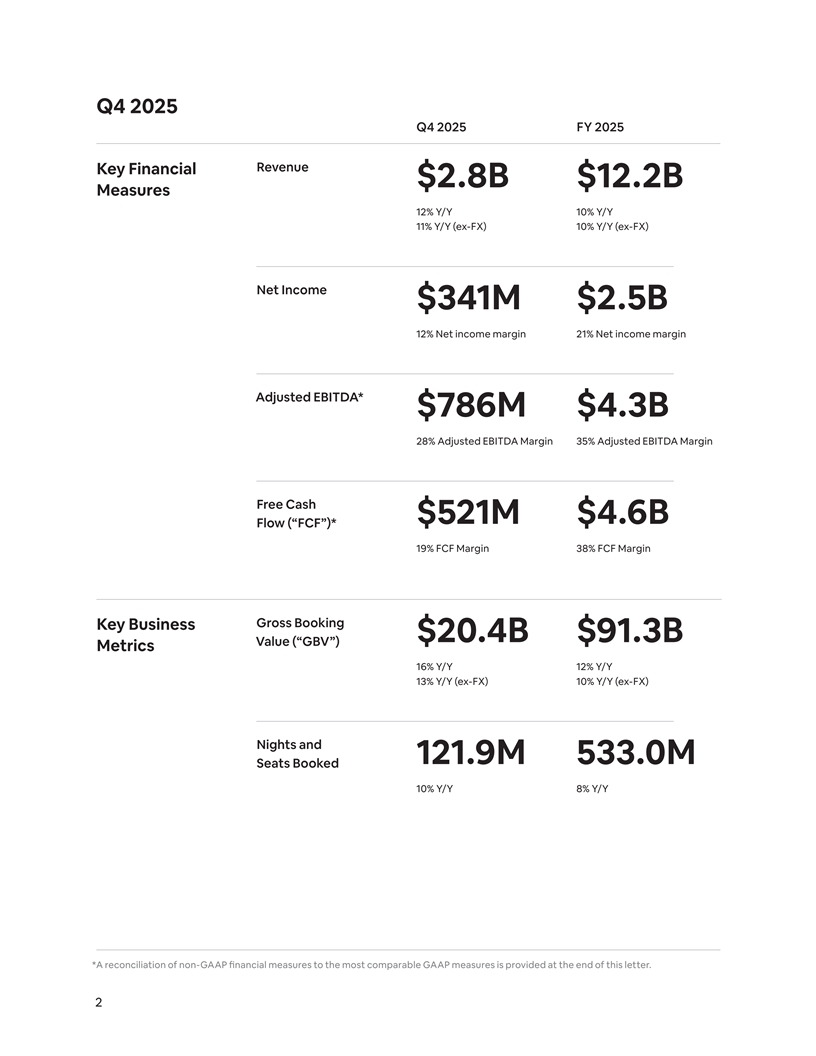
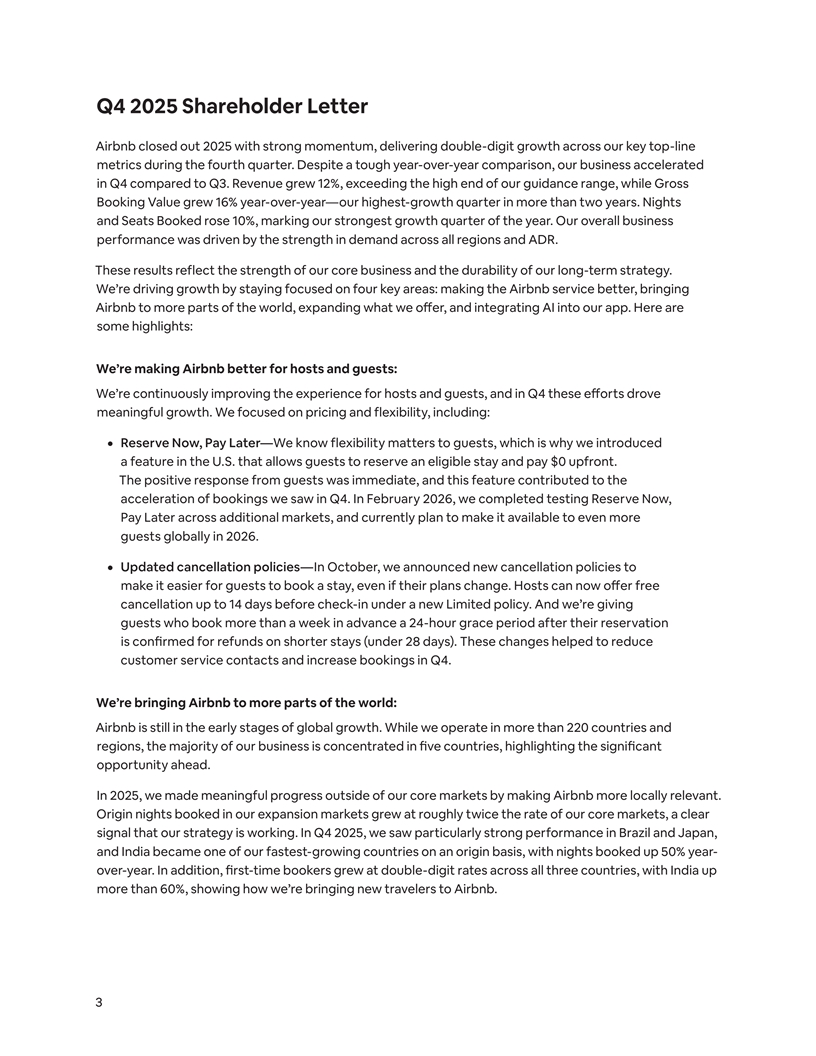
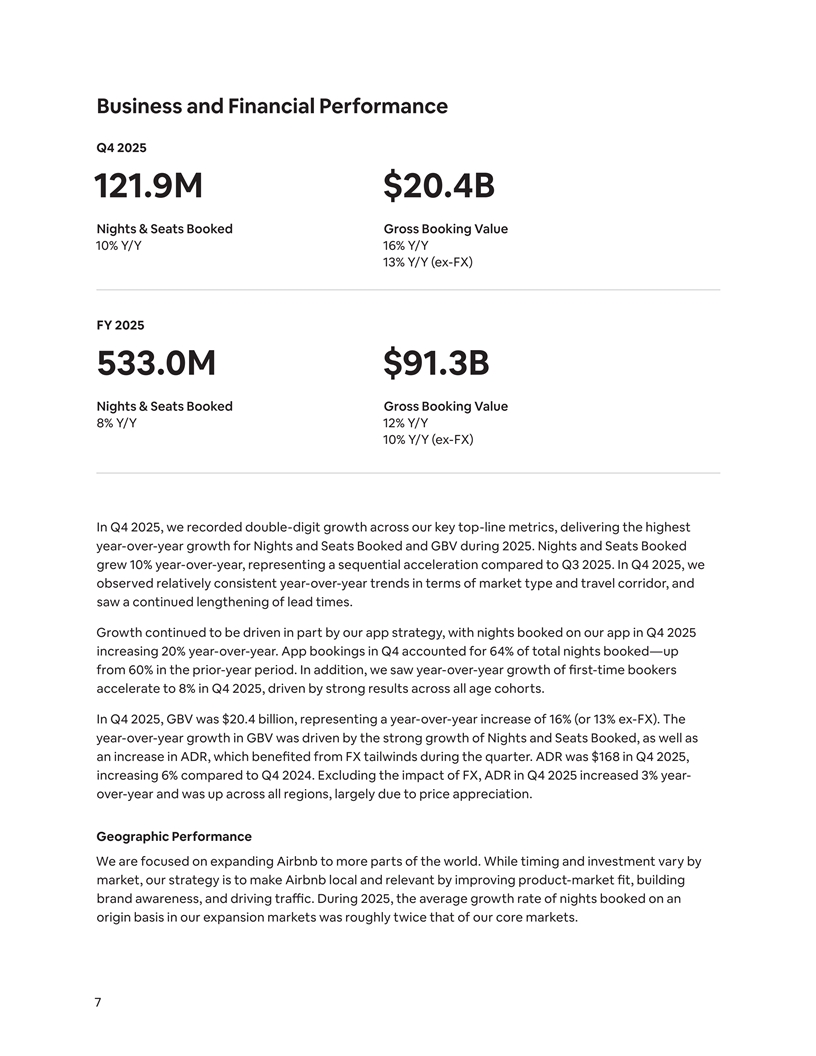
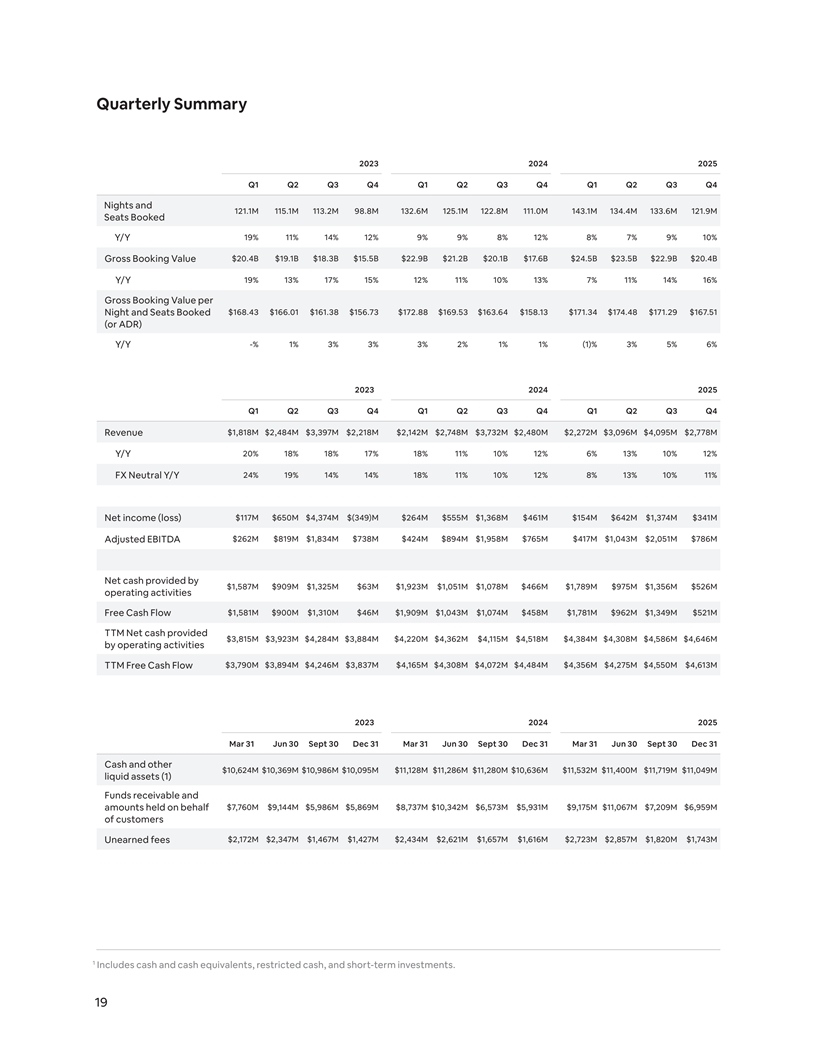
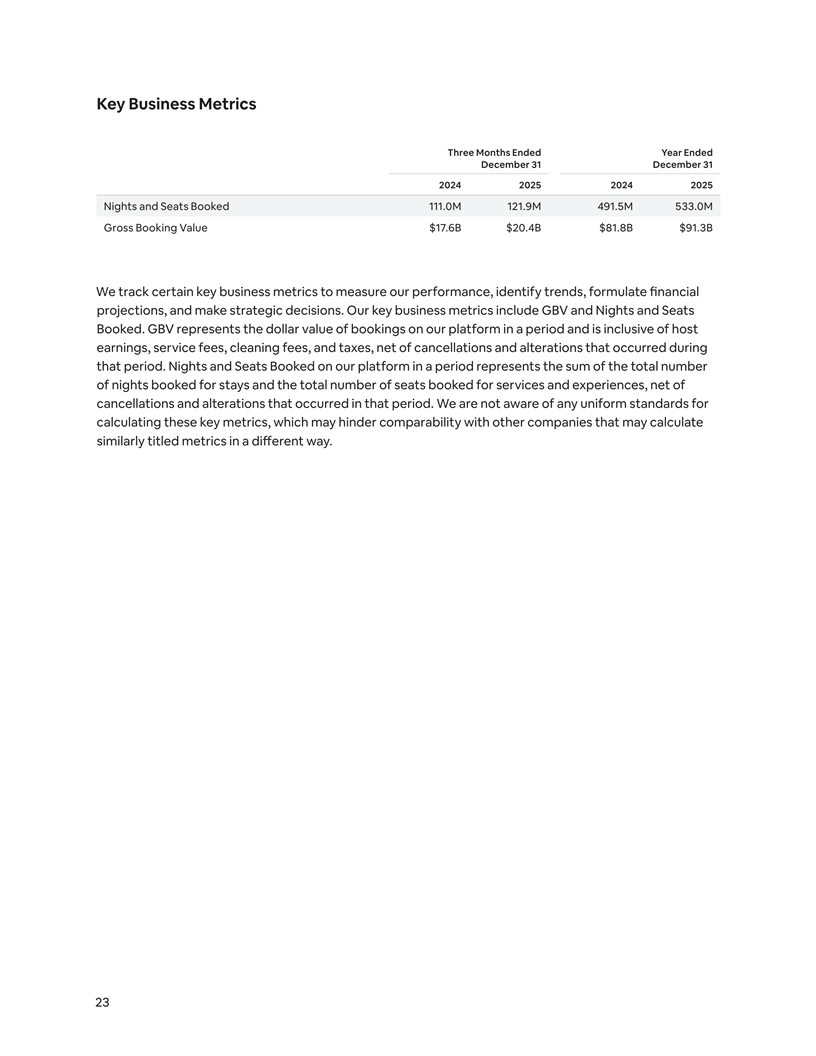
And with that, I'm pleased to turn the call over to Brian. Thank you, Andrew, and good afternoon, everyone. Thanks for joining. I'm going to start with a quick recap of our Q4 results, and then I'm going to spend a little more time on what's driving them, because that's really where the story is. Now, in Q4, we delivered strong results across the board. Revenue grew 12% year-over-year to $2.8 billion, exceeding the high end of our guidance. Gross booking value grew 16% year-over-year to $20.4 billion. This was our highest growth quarter in more than two years. Nights and seats booked grew 10%, our strongest quarter of the year. But what matters most is the momentum that we're gaining. In a marketplace, re-accelering growth isn't as simple as stepping on the gas pedal. It's more like turning a cruise ship. It takes time and discipline, and you don't always see it from one quarter to the next. The acceleration that you're seeing didn't happen by accident. It's a result of a deliberate path we've been on for the past few years. So let me walk you through it. Airbnb grew incredibly quickly in the years leading up to our IPO, faster than we ever imagined. We were like a company built to be a two-story house. But when we went public, we wanted to keep building. But you can't add 10 floors to a house that wasn't designed for it. You need a stronger foundation. So we rebuilt our tech platform. We rebuilt the app tab by tab.
And over the last few years, we improved nearly every part of the guest and host experience. But rebuilding the foundation wasn't enough. We also needed to innovate faster.
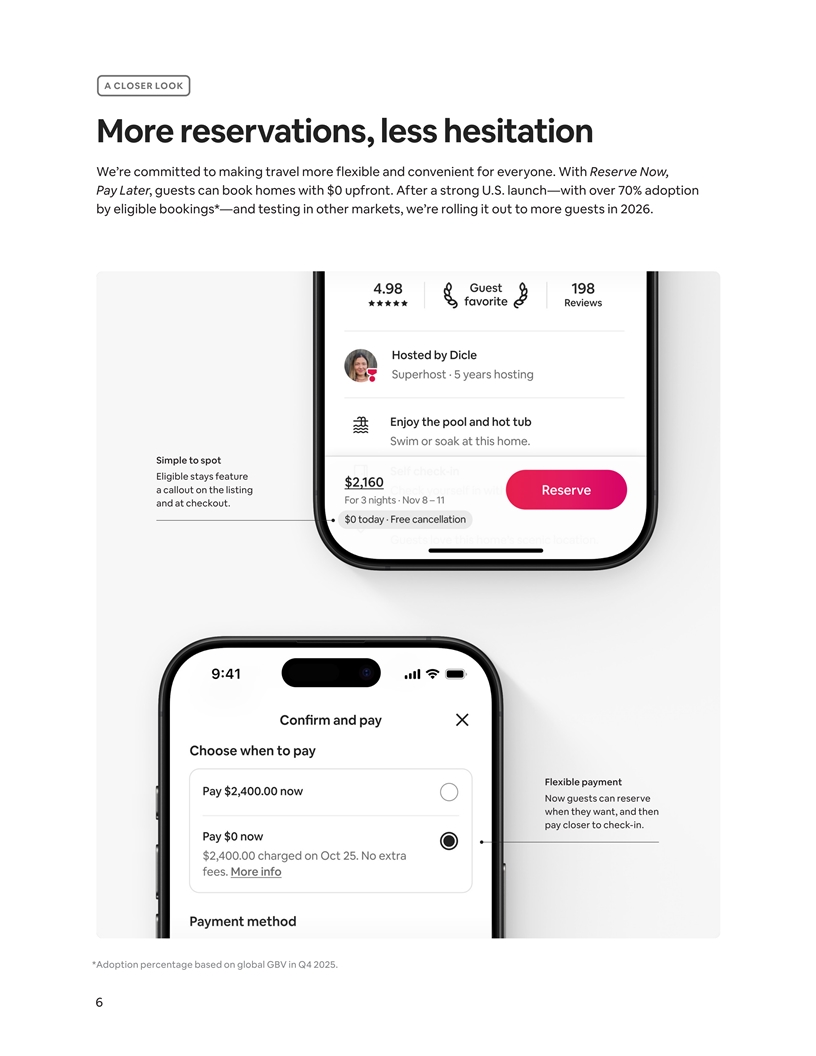
Now, when I look back at what drove Airbnb's early success, it wasn't just the idea. It was how we worked. In the early days, Joe, Nate, and I would sit in our apartment and obsess over every detail. We'd shift something, learn quickly, and double down on what worked. That cycle, focus, shift, learn, scale, is what compounded our initial growth. As companies grow, they often lose that speed and focus. So two years ago, we made a deliberate decision. We were going to recreate the same innovation formula inside Airbnb, but at a global scale. We called it Project Y. We created a small lead team and gave them a really clear mandate. Make it easier to find and book a home on Airbnb. We start with the little things that make booking harder than it needed to be. Simple improvements like better search filters and small tweaks to the booking flow. When those changes worked, we went bigger. We improved how we convert high-intent visitors into long-term users using simple web problems to drive more app downloads. We made search more flexible, helping guests discover homes they wouldn't have seen before. That drove an even greater impact. Eventually, we tackled bigger opportunities, like completely redesigning the checkout flow to make bookings simpler and more intuitive. Now, these are just a few of the hundreds of improvements that teams shipped, driving hundreds of millions of dollars in revenue in 2025 alone. And we believe Project Y will deliver hundreds of millions more this year. Now, once we saw this blueprint work, we began applying it across the company. And what I want to do is highlight four areas where the Hawaii innovation model is driving growth. The first is pricing. Hidden fees are one of the biggest friction points in travel. So we created a pricing team with a clear goal, make pricing simple and more transparent. The first major step was showing the total price up front to guests. In the U.S., we're the first major travel platform to do this. But price transparency was just the beginning. We launched dozens more updates, from more flexible cancellation policies to better pricing tools for hosts. These changes stacked. Then we made the biggest move of all, Reserve Now Pay Later. For the first time, guests in the U.S. could book eligible stays paying euro dollars up front. The response was immediate, driving booking installation in Q4, especially for larger, high-priced homes. We're now expanding this to new markets, and it's a key part of the strength we're seeing in Q1. And we believe that pricing initiatives will drive as much revenue this year as Hawaii and will remain a strong tailwind for years to come.
Next up, supply. Most of our supply growth is organic, with hosts coming directly to us.
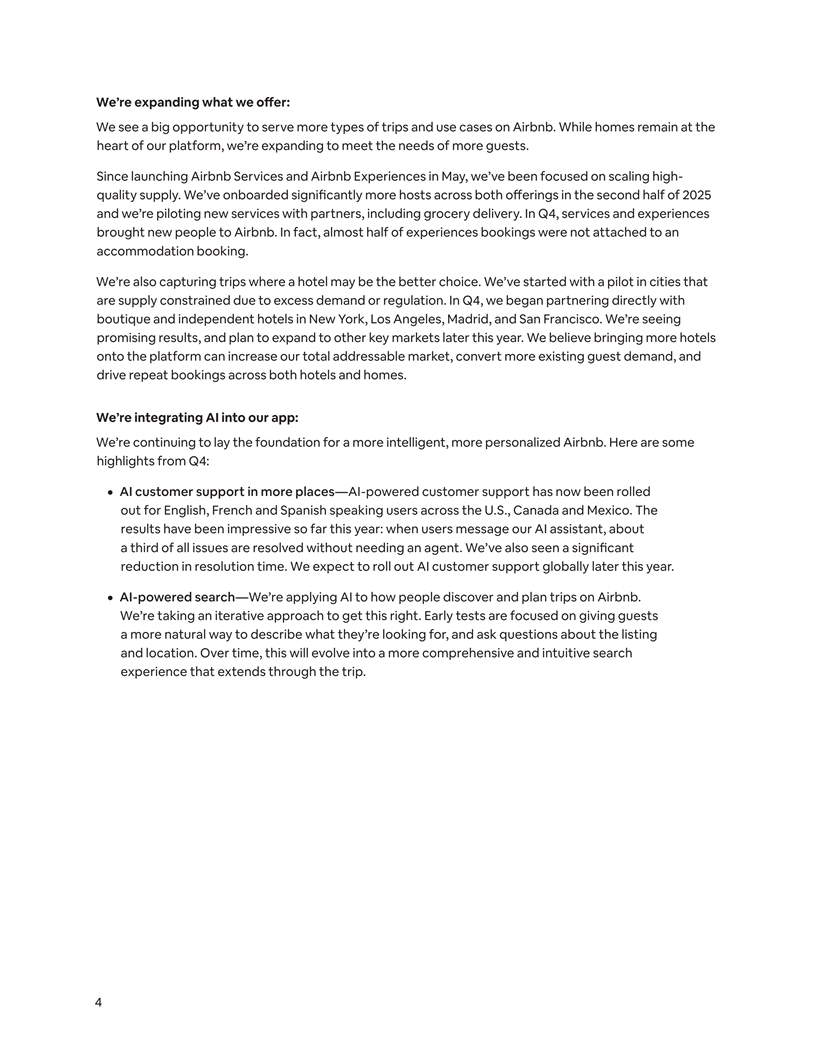
But we've also built a supply engine that lets us be surgical about where we grow. And the best example is how we lean into large events. For example, in Paris, we added over 40,000 listings for the 2024 Summer Olympics. Now, we're repeating that same playbook for the biggest event on Earth, the 2026 FIFA World Cup across 16 cities in North America. At the same time, we're also improving quality. We've removed over half a million low-quality listings, while Guest Favorites, the very best listings in Airbnb, grew 30% in 2025 compared to 2024. And in Q4, Guest Favorites made up nearly half of all bookings on Airbnb. We also applied the Hawaii model international growth. You know, Airbnb operates in nearly every country in the world, but roughly 70% of our revenue comes from just five countries. Now, that's a massive opportunity, and we're unlocking it by going deep in a small number of priority countries. And Brazil is a great example. A few years ago, Brazil was a smaller market for us, so we put a focused team on it. We introduced features that we know matter to the Brazilian market, like interest repayments and local payment methods, and we leaned at the cultural moments like Carnival. We also invested in local campaigns to build relevance. The results have been incredible. Brazil moved from a top-ten market to a top-five market on Airbnb. In Q4, it was our second-largest contributor to first-time bookers, behind only the U.S. This shows what happens when you pair global scale with local executions, and we're applying the same playbook to our highest-priority countries in every region. Finally, we're applying the Hawaii model to new businesses. We launched services experiences globally in May, But to better scale them, we're taking a city-by-city approach. We're going deep in one place, reaching product market fit, and expanding from there. We started with Paris for experiences in L.A. for services, and we're really seeing great results. We're also starting to test new services like grocery delivery and airport pickups to make each trip better from the very beginning. And to capture even more trips, we're bringing boutique and independent hotels onto the platform so that no matter what kind of stay a guest wants, they can always find it on Airbnb. Now, it's still early, but the opportunity with hotels is massive.
We plan to share more about our approach later this year.
But the big idea here isn't just building a bunch of standalone businesses. These are all part of a much larger vision, the Airbnb trip. We are one app and one brand, where every part of the trip makes the other parts stronger. There are multiple entry points in the Airbnb and multiple ways to drive more bookings. A guest might book a service or experience, then discover a home for the trip. Or they might book a hotel for a business trip, then come back here for me to book a home for a family vacation.
Each part of the trip reinforces the others. The final piece that accelerates everything we do is AI.
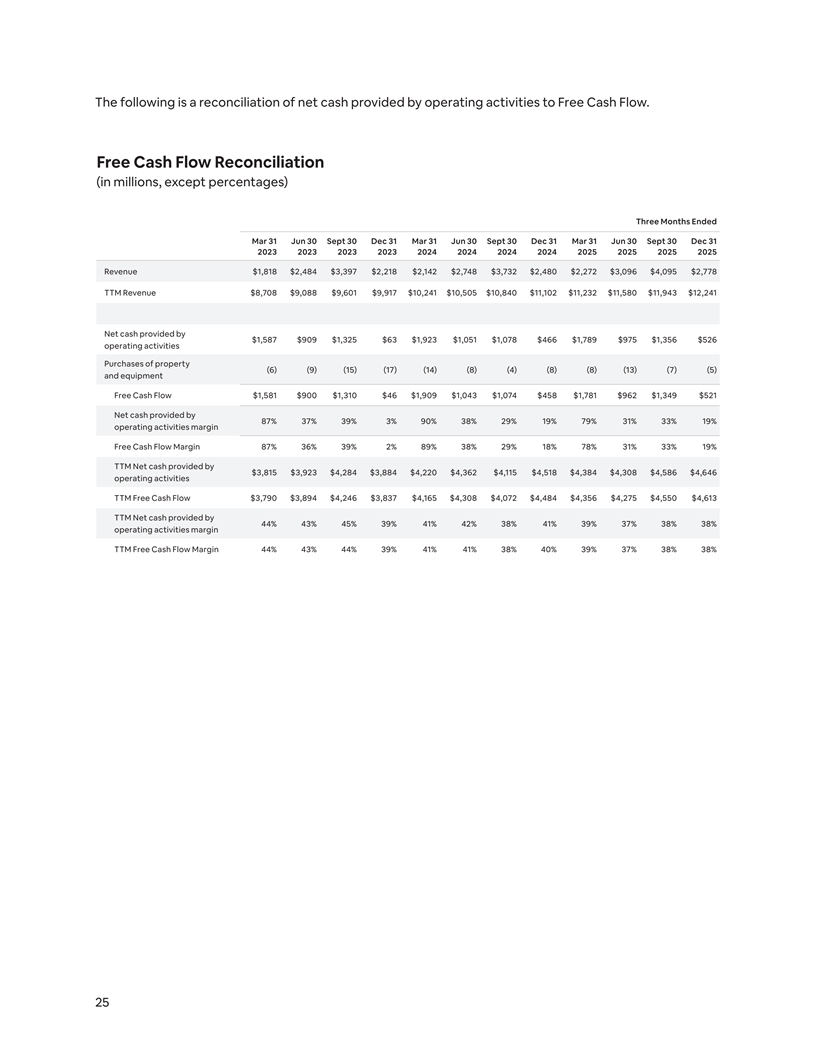
Now, we've taken a really intentional path here. While other companies rushed to bolt chatbots into the existing apps, we started by solving the hardest problem, customer support. We built a custom AI agent trained on millions of our support interactions. It's already resolving a third of our support issues without needing a live specialist, and resolution times are significantly faster. It's live across North America, and we're planning to roll it out globally. But that's just the beginning, because we're building an AI-native experience where the app doesn't just search for you. It knows you. It will help guests plan their entire trip, help hosts better run their businesses, and help the company operate more efficiently on scale. That's a big reason we brought in Amin al-Bali as our CTO. Amin is one of the world's leading AI experts. He spent 16 years at Apple and most recently led the generative AI team at Meta that built the Lama model. He's an expert at pairing massive technical scale with world-class design, which is exactly how we're going to transform the Airbnb experience. This approach is also our strongest defense against disremediation. A chatbot can give you a list of homes, but it can't give you the unique points you find on Airbnb. A chatbot doesn't have our 200 million verified identities or our 500 million proprietary reviews, and it can't message the hosts, which 90% of our guests do. that can't provide global payment processing, customer support, or insurance. By relaying AI over the entire Airbnb experience, we believe we're building something that's impossible to replicate. So you can see why we're so excited about the year ahead, and our guidance reflects that. We expect revenue growth to accelerate to at least low double digits in 2026. We expect adjusted EBITDA margins to be stable year-over-year. And we'll do all of this without investing billions or tens of billions of dollars. We don't need massive capital investment to grow. We don't own homes. We don't operate experiences. And we're not building data centers. What we're doing is finding small wins and scaling them profitably. That's why I've been able to generate free cash flow at nearly 40% of revenue and nearly $19 billion of cumulative free cash flow since our ICO. It gives us the ability to reinvest back in our business while strengthening our balance sheet and maintaining healthy margins. Now, if you look ahead to 2026, we can't predict every quarter with precision. Travel is influenced by everything from currency to macroeconomic conditions to global events. But what we can control is the speed of our innovation.
In the long run, that's what leads to more growth. So, in summary, we rebuilt major parts of the company, we adopted a new blueprint for innovation, and now we're seeing increased momentum.
That doesn't happen by accident. It's a result of an incredible team rowing in the same direction at global scale.
So, to everyone in the Airbnb team who's listening, thank you. The business is stronger because of you. With that, I'll turn it over to Ellie to walk through the financials in more detail.
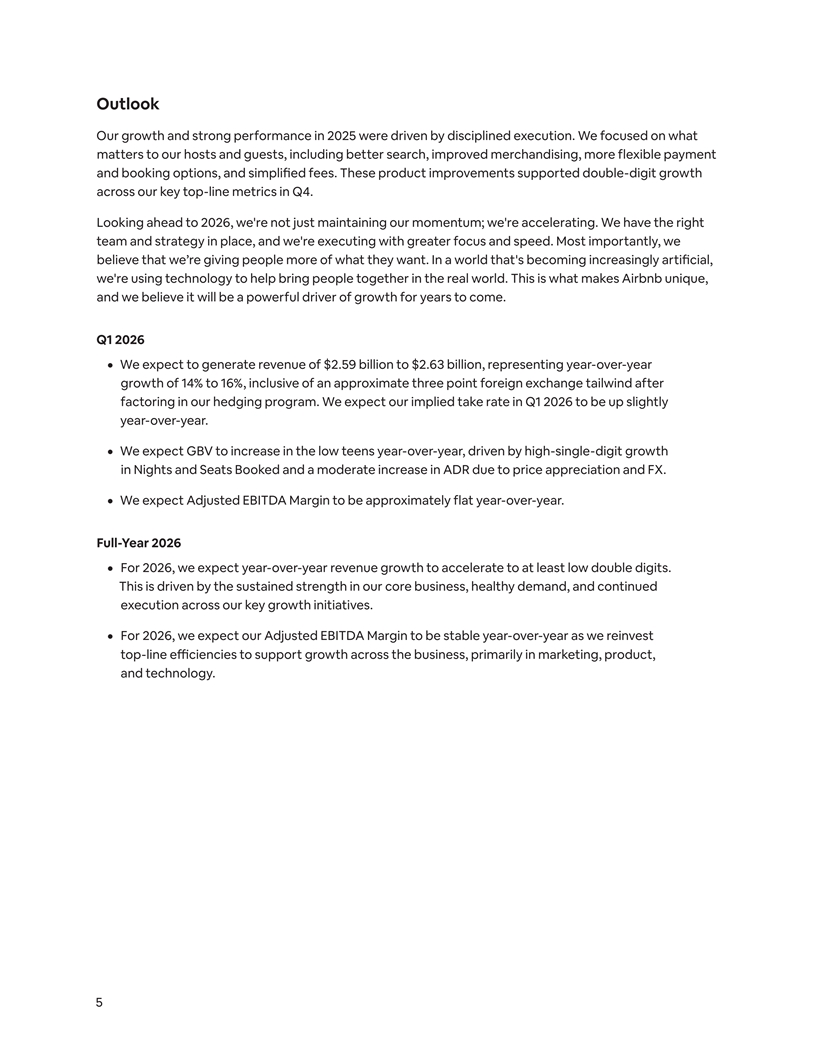
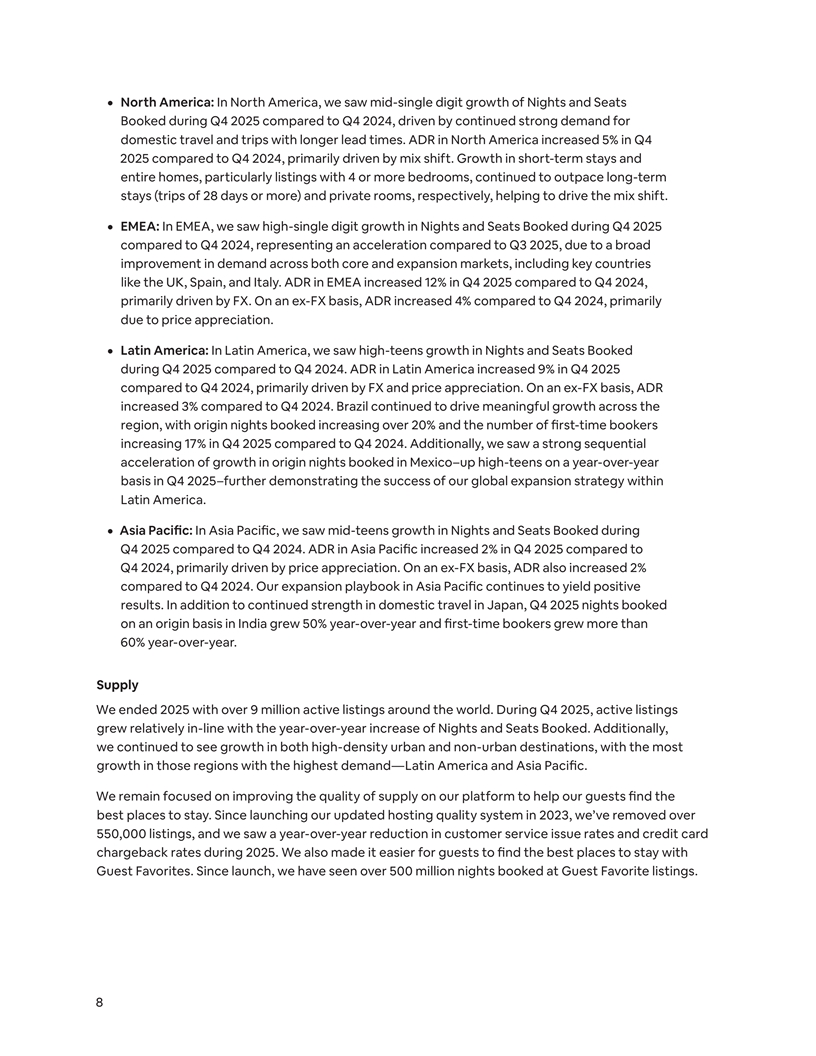
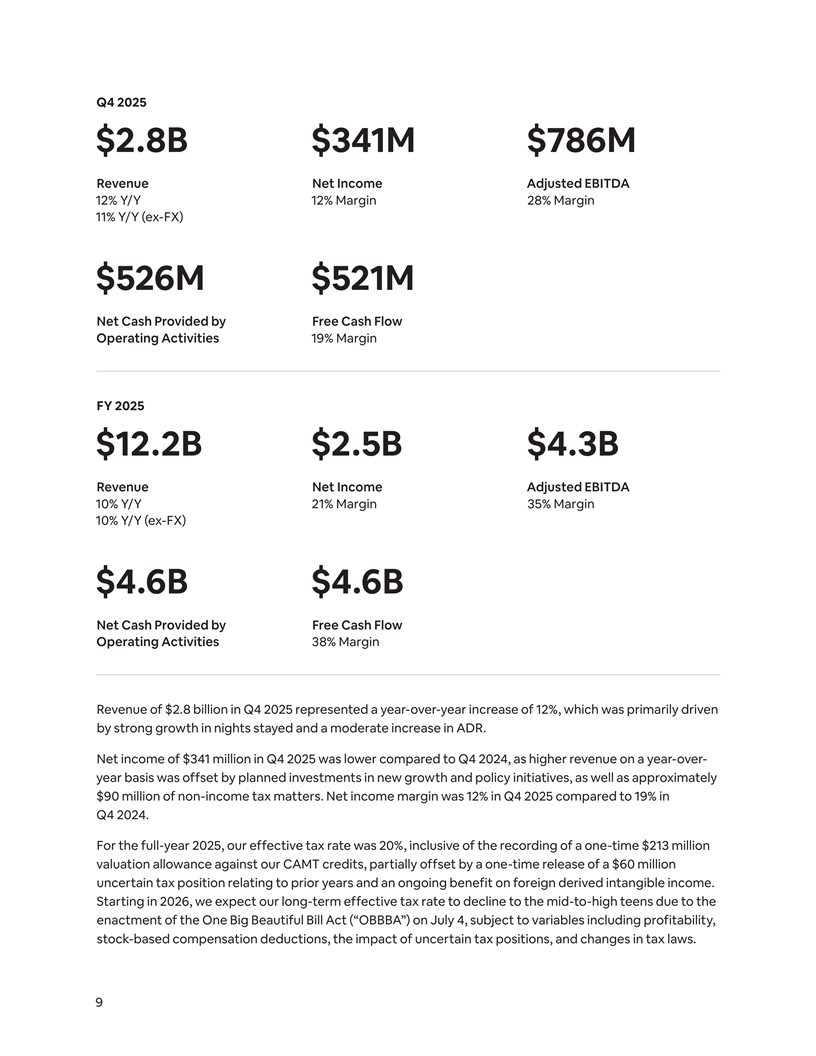
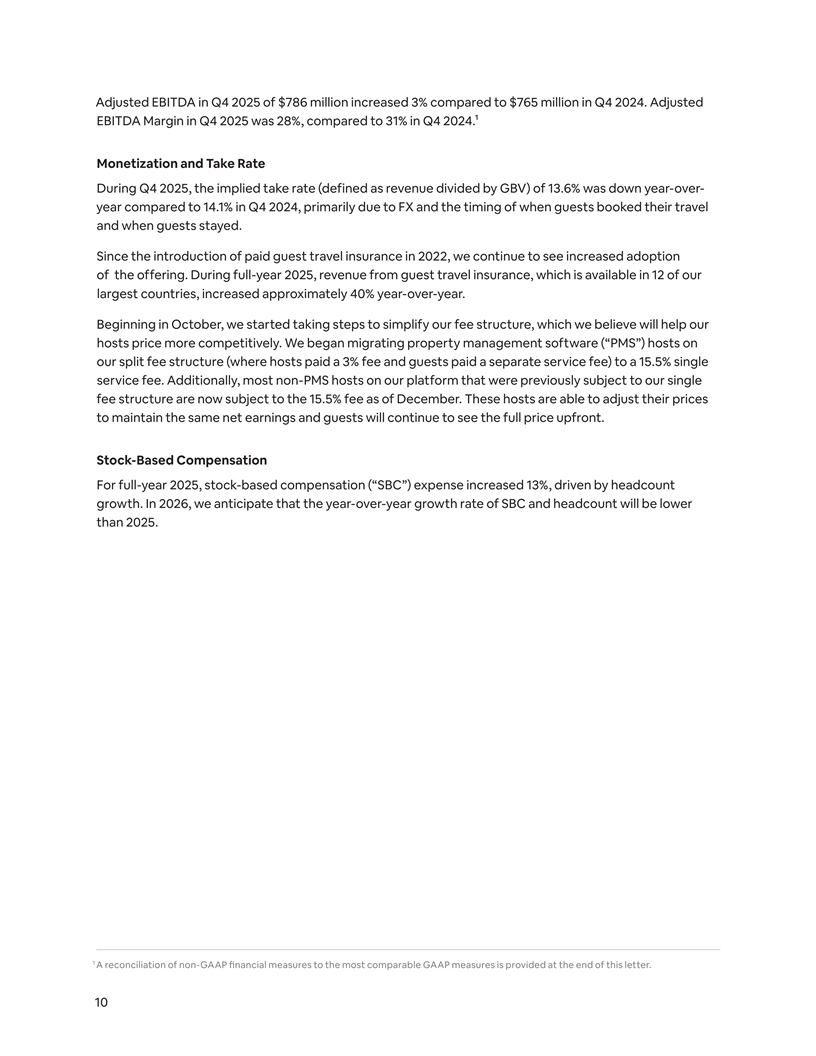
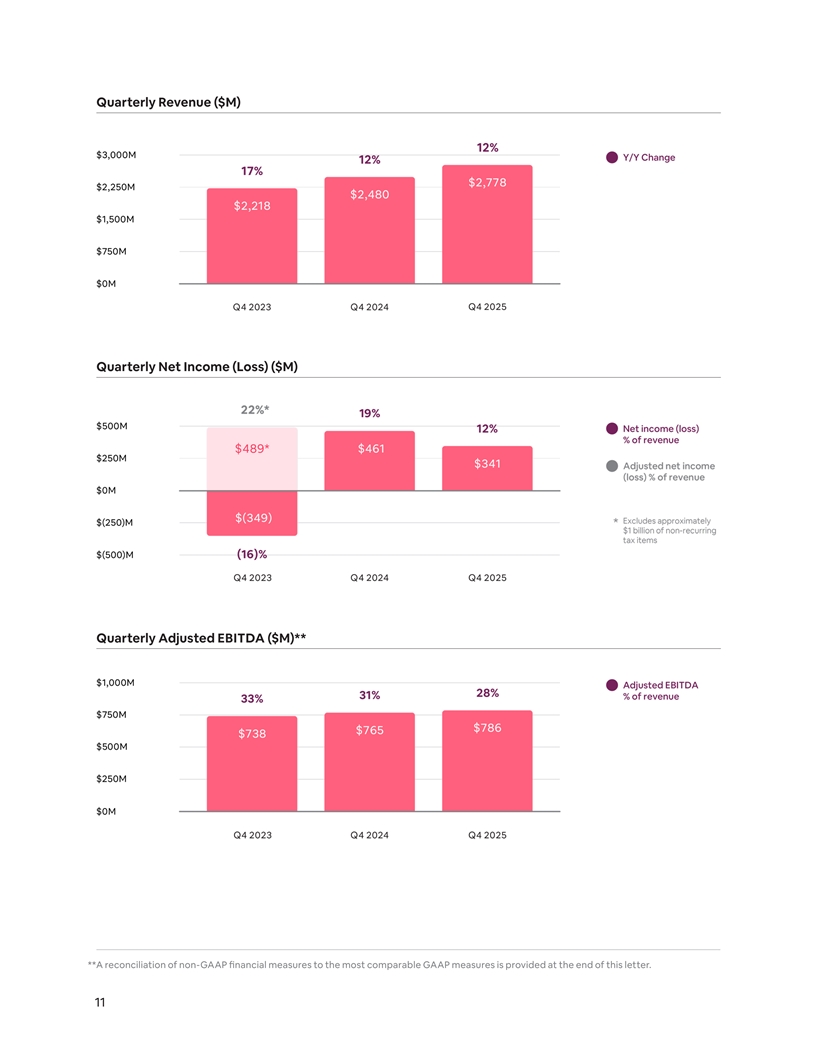
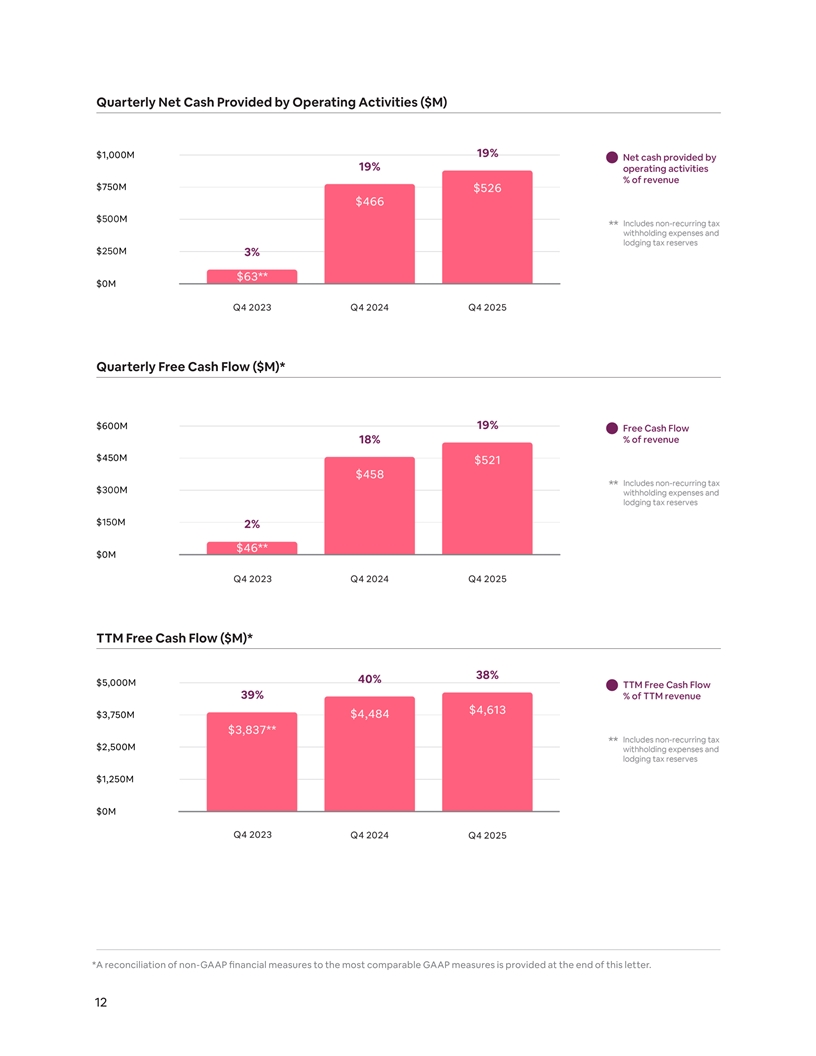
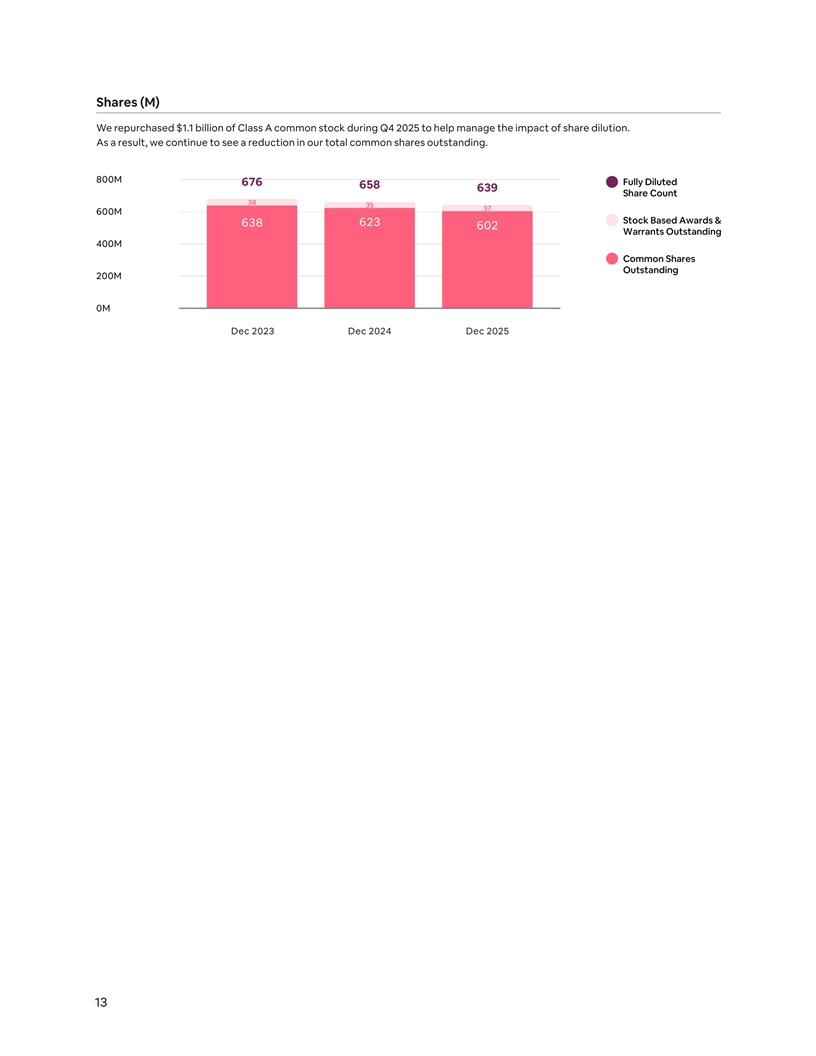
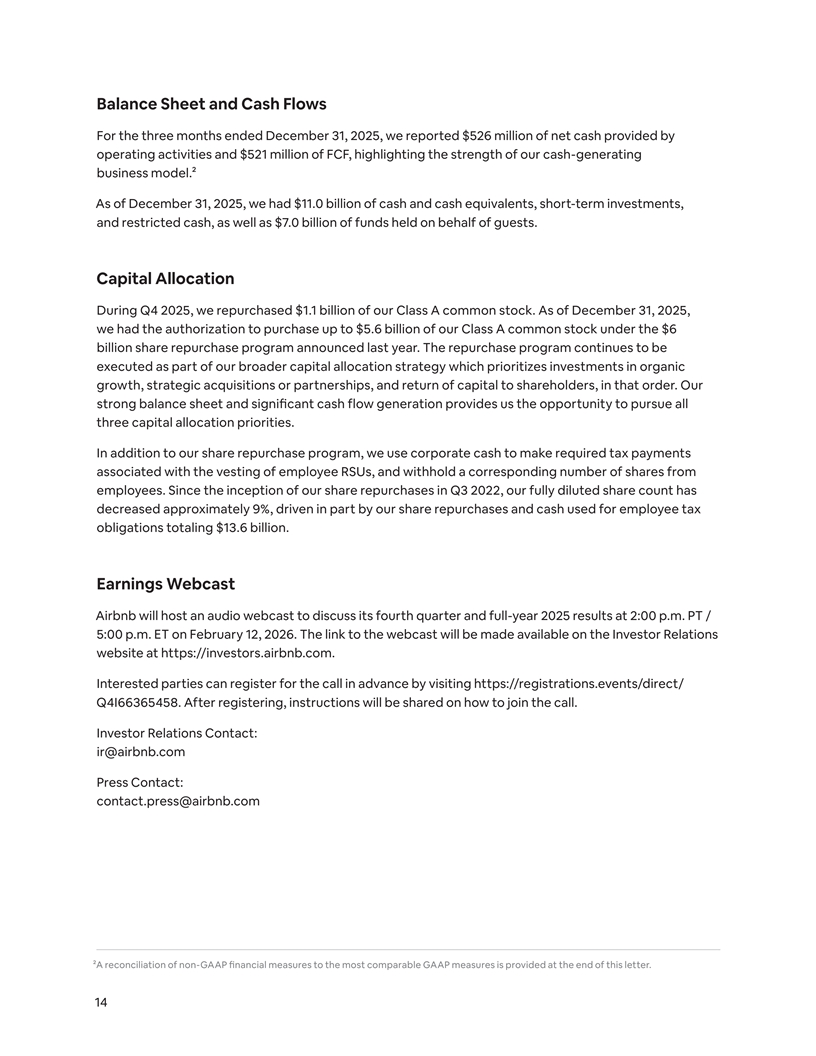
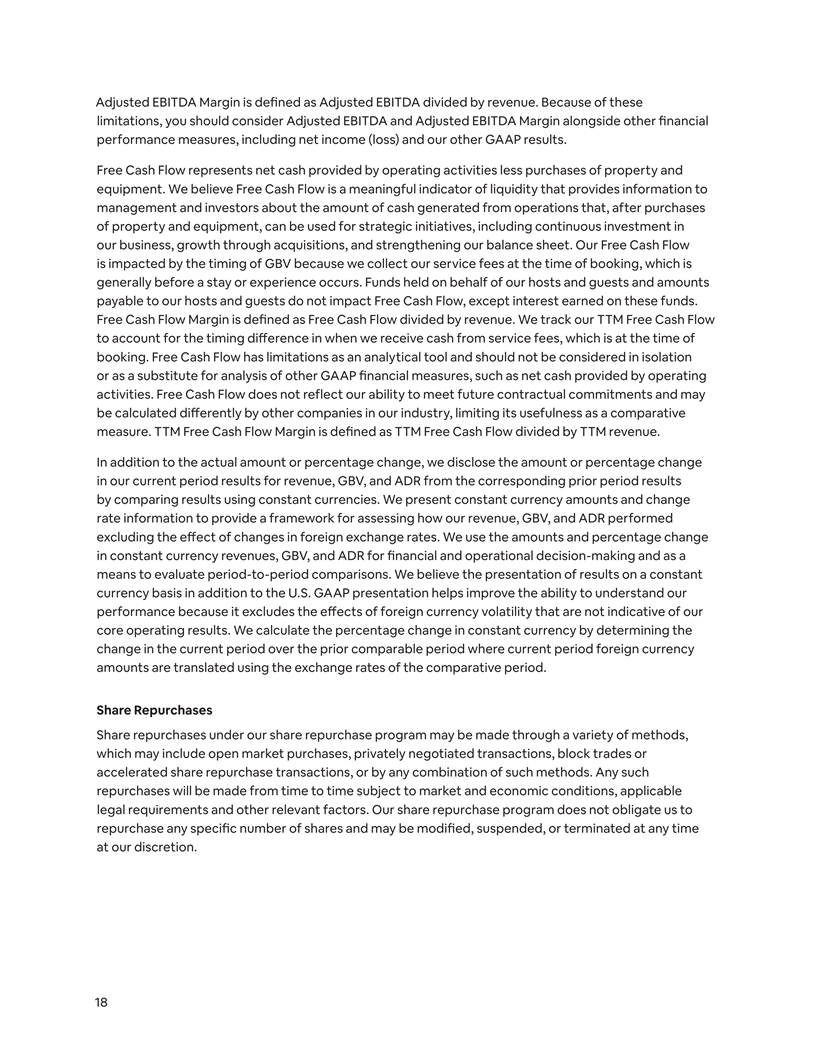
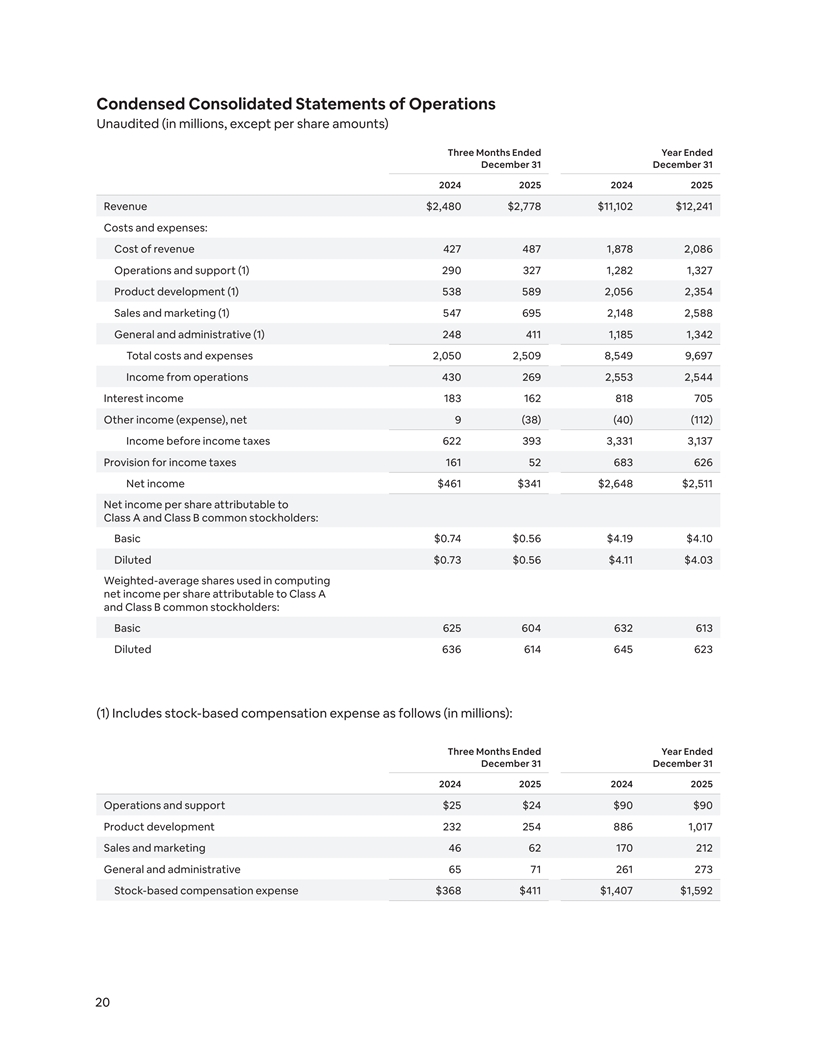
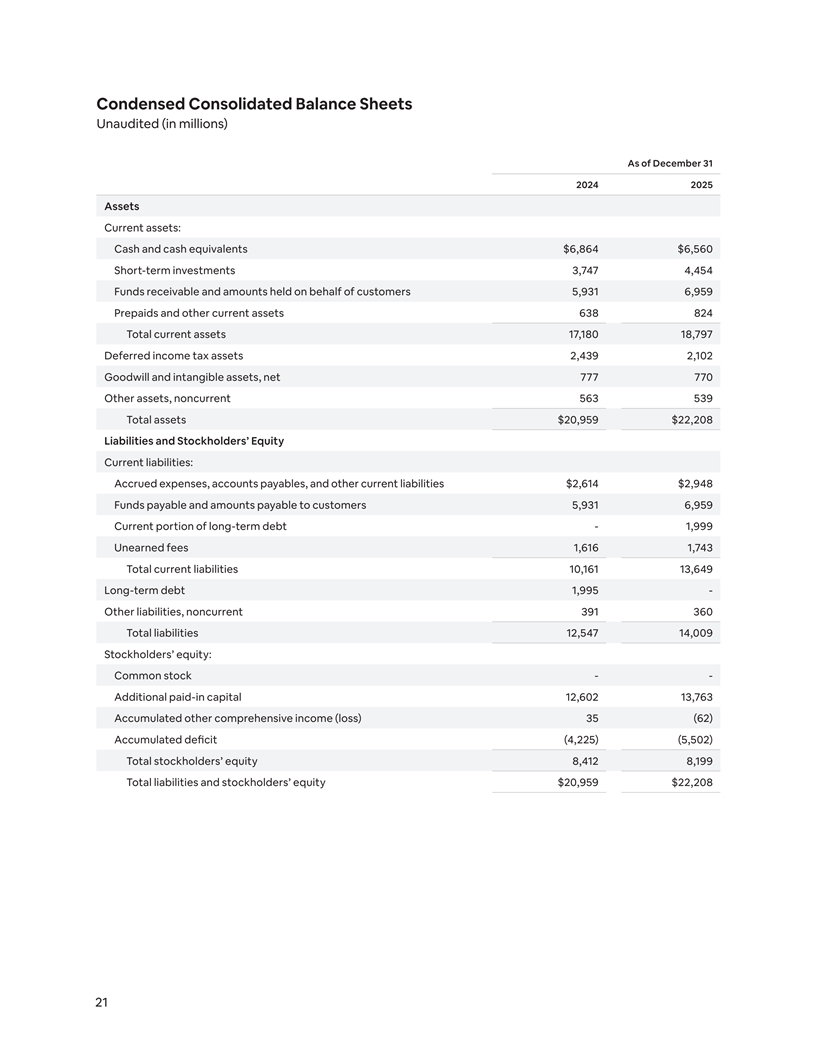
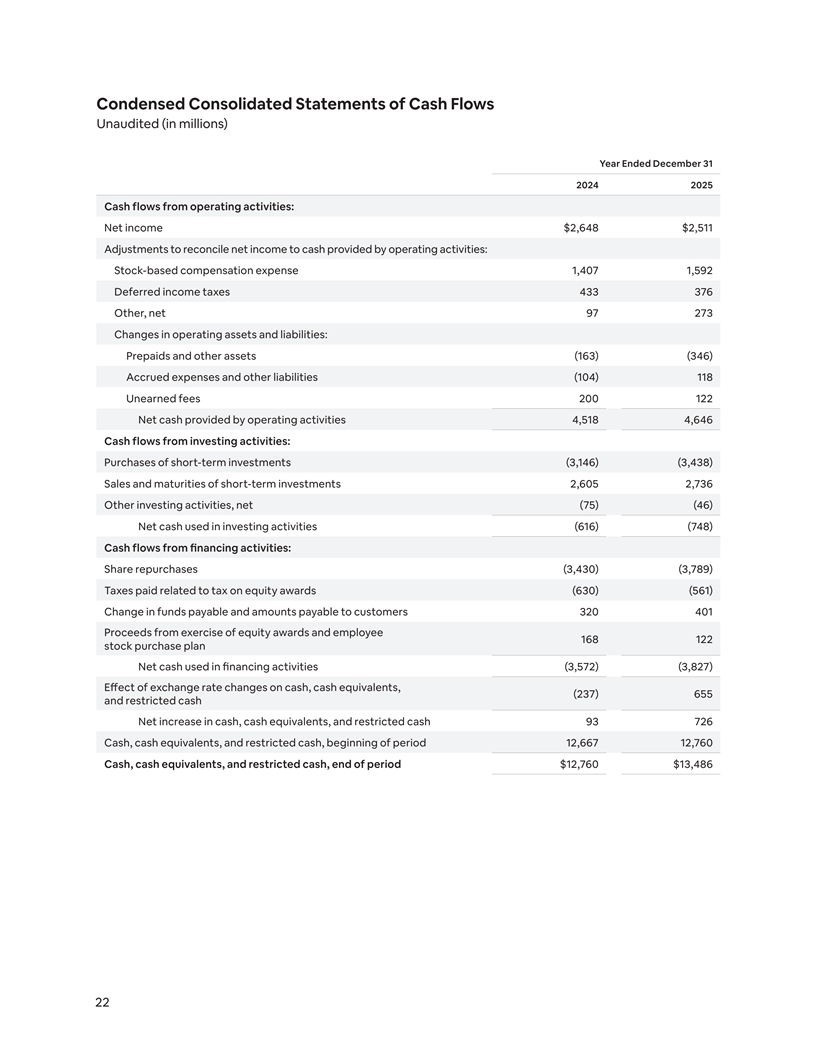
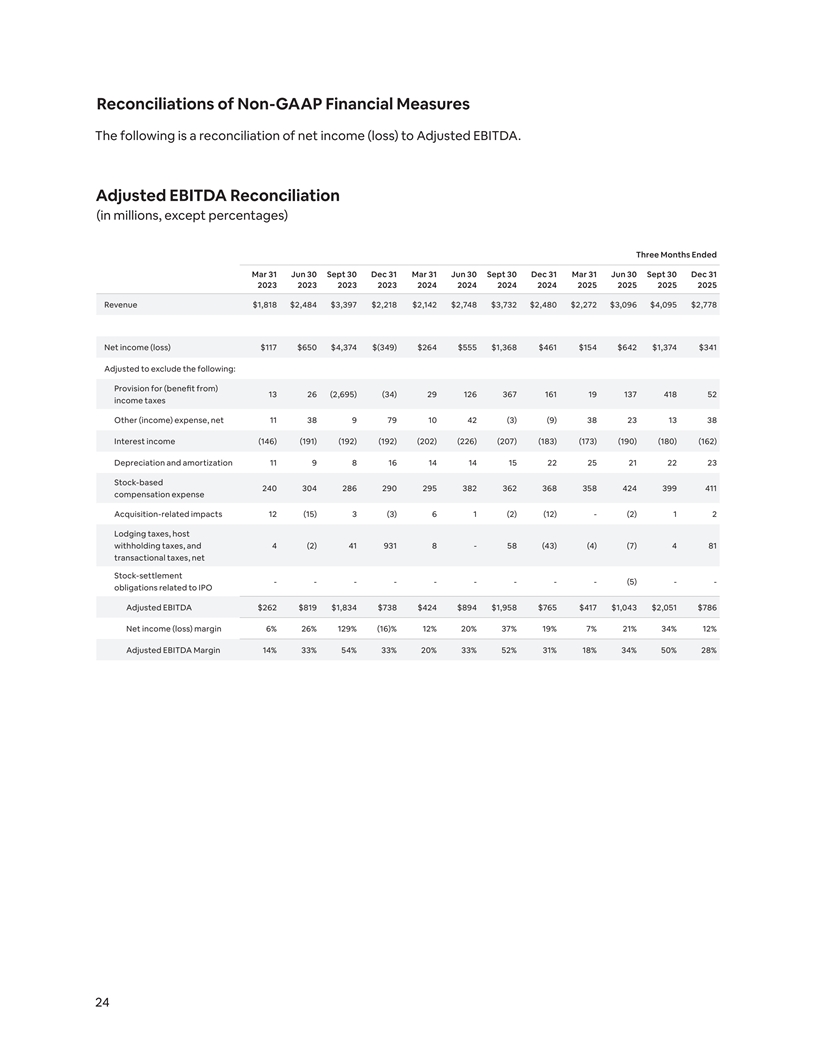
Thanks, Brian, and good afternoon, everyone. As Brian just shared, we're seeing increased momentum in our business. I'll start with Q4 financial results, and then I'll cover our outlook for Q1 and the full year of 2026. Q4 was a great quarter for Airbnb. Growth booking value grew 16% year-over-year to $20.4 billion, driven by strong growth in both bookings and price. NICE and SEEDs booked increased 10% year-over-year, and acceleration from Q3, with strength seen across all regions. By region, Latin America grew in the high teens, Asia Pacific grew in the mid-teens, EMEA accelerated in the high single digits, and North America grew in the mid-single digits. Now, going into the quarter, we expected a tough comp given a particularly strong Q4 in 2024. And as the quarter played out, we saw a slightly better macroeconomic environment than anticipated. But more importantly, our product roadmap delivered material lift to the business. As Brian shared, we've been steadily making it easier to find and book a home on Airbnb. In Q4, a few updates in particular helped drive our acceleration. The launch of Reserve Now Pay Later, updates to our cancellation policies, and the beginning of our migration to a simplified fee structure. Reserve Now Pay Later saw significant adoption among eligible guests in Q4. It's also led to longer booking at any time and a missed shift towards larger entire homes, especially those with four more bedrooms, contributing to the increase in ADI. And as Brian mentioned, given the positive results, we've decided to roll it out to more guests globally and to cross-border states in the U.S. Our updated cancellation policies and simplified fees also contributed to both NICE and GVV growth in the quarter. As a reminder, beginning in October, we started simplifying our fee structure, which we believe will help our host price more competitively. We began migrating our API hosts to a single service fee and now plan to migrate more hosts in 2026. Hosts on a single service fee can adjust their prices to maintain the same net earnings while guests continue to see the full price upside. In total, we estimate these three features delivered over 200 basis points of growth in NiceBooks and roughly 300 basis points of growth in GBV in Q4. In 2026, we'll continue iterating to simplify pricing, improve transparency, and help our hosts stay competitive. Now, turning to our Q4 financials, up 12% year-over-year and exceeded our guidance, driven by the impact of our product updates. In terms of profitability, we generated $786 million of adjusted EBITDA, representing a 28% adjusted EBITDA margin, also exceeding guidance. Finally, net income was $341 million and was negatively impacted by roughly $90 million of one-time non-income tax. For 2025, our full-year effective tax rate was 20%, including one-time-to-treat items that increased our provision for income taxes in Q3. Now, starting in 2026, we expect the One Big Beautiful Bill Act to materially reduce our effective tax rate to the mid-to-high team, primarily due to how foreign earnings are taxed, which will benefit our consolidated earnings. Next, to our balance sheet and cash flow, we continue to generate significant cash in Q4, delivering $520 million of free cash flow. In 2025, we generated $4.6 billion, representing a free cash flow margin of 38%. At the end of Q4, we had $11 billion of corporate cash investments, as well as $7 billion of funds held on behalf of our guests. Our strong balance sheet allowed us to repurchase $1.1 billion of our common stock in Q4, up front $857 million in Q3. And in 2025, we repurchased $3.8 billion of our common stock, using over 80% of our free cash flow. Returning capital to shareholders remains a key component of our capital allocation strategy. Since introducing our share repurchase program in 2022, we've reduced our fully deluded share count by about 9%. Now let's shift to our Q1 and full year 2026 outlook. We're encouraged by the momentum we've seen so far this year and excited about our roadmap to drive growth in 2026. In Q1, we expect to generate revenue of $2.59 to $2.63 billion, representing year-over-year growth of 14% to 16%. This includes an approximate three-point FX tailament after factoring in our hedging program. We expect gross booking value to increase in a low teens year-over-year, driven by high single-digit growth in nice and cheap books, and a moderate increase in ADR to depreciate appreciation and FX. On profitability, we expect Q1 adjusted EBITDA margin to be approximately flat year-over-year. And for the full year, 2026, we expect year-over-year revenue growth to accelerate to low double digits with an ambition to grow even faster than that. While FX tailwinds should fade as the year progresses, we're encouraged by healthy demand and execution across our growth initiative. We're also excited about major events this year, including the Winter Olympics happening now in Milan and the FIFA World Cup coming this summer. Cities continue to look to Airbnb to help meet demand around large events, and our global supply positions us well to support that demand. Overall, we believe continued progress against our promise to optimizations, pilots, and new offerings, together with broader macro conditions, will support incremental growth in 2026. And finally, across the whole TML, we're continuing to drive efficiencies in our platform. We plan to reinvest most of these efficiencies into marketing, product, and technology to support our growth. As a result, we expect our 2026 suggested EBITDA margin to be stable year-over-year. At the close, 2025 was an exciting year, and I'm incredibly proud of what the team delivered. We're carrying that momentum into 2026 with an ambitious set of goals. We'll continue strengthening our core business while accelerating innovation to drive growth. And with that, I will open it up to Q&A.
Operator
Thank you. We will now begin the question and answer session. If you'd like to ask a question, please press star 1 in your telephone keypad. If you'd like to withdraw your question, simply press star one again. Your first question comes from a line of Richard Clark from Bernstein. Your line is open.
Hi. Good afternoon. I guess AI is the topic du jour, and you gave some helpful remarks about why the AI bots today can't match what Airbnb do. But given the sort of speed of innovations going on, why do you think those AI platforms couldn't launch a short-term rental platform over time? And maybe, secondly, do you see any risks that you'll have to share your economics with an AI platform at some point going forward? Or do you expect you'll be able to retain the same level of direct traffic you have today in an AI world?
Yeah, I mean, it's a great question.
Let me start by saying this. The vast majority of what is Airbnb is not the app that you see. First of all, we have a whole host app, which is really critical. and we've built this over 18 years. We handle more than $100 billion in payments through the platform. Customer service is one of the most difficult problems in Airbnb. You know, we don't have SKUs. People, we need to, you know, adjudicate between people speaking different languages. We provide insurance and protection for everyone. You know, we do a lot of verifications. 90% of people who book Airbnb send a message. You can't send a message without a verified ID. We have 200 million Verify IDs, which is more than U.S. passports and circulation. The vast majority of our homes in our unique inventory is only on Airbnb. We're adding more offerings over time, and we think people are going to want to put them together into an itinerary that they could bring in their phone with them when they're traveling. I think these travel platforms are going to be very similar to search. They're going to be really good top of funnel discoveries. And, in fact, what we've seen is I think they're going to be positive for Airbnb. And I'm very, very deep in this space. And what we see is that traffic that comes from chatbots converts at a higher rate than traffic that comes from Google. But the other thing to know, and this is the most important point, is that these models are not proprietary. The models on ChatGPT, the models in Gemini, the models in Quad, and the models by Kiwi are available to every single company. And so pretty soon, every company becomes an AI platform if they make the shift. We will be able to build everything everyone else will have if we use their models. And we believe specialization will win in travel. because if somebody wants to find an Airbnb or have a trip, we can take their model, the same model they use, and we can post-train it and tune it based on our millions of interactions. We can connect it to our customer support agent. We can connect it to our host. And that's fundamentally what we think. It's why we've hired Ahmed Al-Dhali, one of the foremost leading experts in AI. Ahmed Al-Dhali, in fact, built one of the models. He built the LAMA model. And we want to build a team to make our company much more of an AI-native company. So I think that for chatbots or AI companies to win, we don't need to live in a world where everyone else has to lose. I don't think that one company is going to own everything. I think we're going to be able to work together. And these companies will be very helpful top-of-the-file traffic generators for Airbnb, just like Google was.
Operator
Your next question comes from a line of John Calantoni from Jeffries. Your line is open.
Okay, great. Thanks for taking my questions. I wanted to ask one on Asia region. Knight's growth was still strong at the mid-teens, but did moderate from recent quarters. I know it's your smallest region, but I was hoping you could talk to what drove the slowdown and how you think about growth, the growth opportunity in Asia Pacific over time. And second, you know, I was curious on the services and experiences. Have you seen any signs that they're helping you acquire new customers that you can convert to accommodations, given that over half of your experiences weren't attached to an accommodation bookings?
Let me start with the Asia question. So when we look at our performance on APAC from a destination perspective, overall growth has been, I would say, relatively stable over the course of 2025. That being said, we see a tremendous amount of opportunity in terms of future growth for the region. What I would say in terms of AIPAC is that, obviously, there is different pockets in terms of, you know, where we have seen substantial growth. As you're probably aware, we have, you know, relatively high levels of penetration in Australia, whereas we're relatively nascent to, you know, kind of places like India, Southeast. What we shared in the letter is that we're seeing nice performance.
Operator
This question comes from a line of Lee Horowitz from Deutsche Bank. Your line is open.
Great. Thanks so much. I guess, can you give us a sense of how ReserveNow, PayLater cancellations have been pacing relative to your expectations, perhaps particularly in the face of weather disruptions in the 1Q and how you're thinking about baking and cancellation expectations to full-year adjusted EBITDA guide? And then secondly, in the past, you've talked about how AI Search will preclude your deployment of sponsored ads. Can you maybe just unpack that a bit more and explain how AI Search particularly may help you bring sponsored ads to market a bit more quickly? Thanks so much.
So, first on the question of ReserveNow Pay Later and the impact of cancellation, if we just back up for a moment. Before we launched ReserveNow Pay Later in the U.S. back in the summer of 2025, we effectively tested the product to ensure that by the time the cohort's opting into the product, we're doing that level.
Operator
Our next question comes from the line of Brian Nowak from Morgan Stanley. Your line is open.
Great. Thanks for taking my questions. Brian, maybe to go back to that last question on AI search, let me just ask you sort of another bigger picture one.
As you sort of sit here early to the platform using AI this year, and two, maybe one, just on the P&L impact, Any help at all in how you're thinking about the impact on gross margins from increased AI investment this year versus last year?
Yeah, I can answer both of them. And I'll start with the second one. I think one of the great things about Airbnb is that we have a very, very cost-efficient innovation model. So unlike other companies, we're not building models. We do not have a huge CapEx cost base. So, our investment in AI will not affect the P&L. I don't think you'll see it in the P&L. That's number one. Number two, it's a year from now. If we're successful, AI wouldn't be seen. I think three or four things. Number one, let's start with the customer service. Right now, nearly 30% of tickets in North America that are English-based are handled by an AI agent. A year from now, if we're successful, significantly more than 30% of tickets will be handled by a customer service agent in many more languages, in all the languages where we have live agents, and AI customer service will not only be chat, it will be voice, so you can actually call and talk to an AI agent. We think this is going to be massive because not only does this reduce the cost base of Airbnb's customer service, but number two, it's going to make our engineers and everyone at Airbnb significantly more efficient. More than 80% of engineers are now using AI tools. That soon will be 100%. But, of course, that metric is a bit of a VAMI metric. The real question is, what's a lot more productivity and a lot more innovation velocity? The third is you're going to start to see AI through the booking experience. I know because AI is obviously highly unpredictable, but we want to be, we would love to be additional search. I think it's really hard not to contract hard for commerce. It's because they're very visual in different tabs. So a text-forward chatbot interface is not the ideal. So we have to actually innovate on the user interface. In summary, we need many more ticket types to accelerate our innovation. It will be as AI-native as any other company in our space or more. And then finally, the experience is really better.
Operator
Your next question comes from the line of Doug Anruz from J.P. Morgan. Your line is open.
Payon
Analyst — J.P. Morgan
This is Payon for that. Thanks for taking my questions. First of all, looking at the 2026 Revenue Acceleration Guide, could you help us think through the acceleration drivers across the core markets, expansion market services, and perhaps any tailwinds from major events like the World Cup and Olympics? And are you anticipating any top-line benefits from some of these AI innovations that you discussed?
So when we think about the growth outlook for 2026, we are certainly begging into account the momentum that we've seen coming off the launches that we've mentioned driving the Q4 results. We anticipate those will continue to benefit the top line in the beginning of 26, and we're obviously looking to expand upon them. Beyond those that we mentioned, we're obviously continuing to invest in several other growth levers. In particular, we're investing in incremental supply. We're investing in our expansion markets and several other. In terms of the back half of the year, we'll obviously be copying some of the launches that we had in Q4. You asked just about the major events. Obviously, the Milan Olympics is happening right now, and we're looking forward to FIFA this summer. I would say those two events in particular, they are large events on the platform, but in scale are very small portions of the overall business. So we're looking forward to them. They will be additive in the quarters that they hit. But I would say on the larger events, you know, the benefit of those events is not just the booking during the event. Instead, it's the benefits we get from increasing overall awareness of the brand, driving incremental supply in those markets, and more broadly, the brand halo we get from connecting our brand with such a beloved guy. I would say, you know, as Brian shared, we will be, we are currently piling AI search. Your next question comes from the line of Lloyd Walmsley from Mizuho.
Operator
Your line is open.
Thank you. Two, if I can. First, just on hotel, you know, when we talk to hotels and connectivity partners, we hear like an enthusiastic response on working with you guys. But there's also sounds like a lot of friction with the connectivity APIs and sort of supporting multiple rates. It seems like there's a lot of friction today. Just wondering, are you sort of committed to building or rebuilding those connectivity layers, and what other things are you guys doing to sort of build foundations on hotel? And then second question, just stepping back, you know, opening up the aperture of inventory, whether that's, you know, more mainstream hotel or experiences, it would seem like you could unlock significant TAM by just going a bit more mainstream. Brian, how do you feel about having more of that type of content on the site and the tradeoff between sort of keeping things unique versus addressing bigger and bigger portions of the market? We'd love to just hear how you think about that.
Yeah, I mean, it's great category books. They became synonymous with that single category, and eventually they rebuilt their platform to expand to many categories. That's our strategy. And so to answer your question, yes, we are opening the aperture. We're opening the Aperture on accommodations. We're opening the Aperture beyond accommodations and beyond places to stay. One of the reasons we are able to do this is AI allows us to personalize. You know, some people come to Airbnb and all they want to see are unique homes. And before AI, personalization was a little more primitive. So if they saw a hotel, it might be jarring. Now we can really personalize. So people who just want to see Airbnbs can see Airbnbs. People who just want to see hotels, we can eventually personalize. they can just see hotels. If people want to see both, they can know if you're booking last minute one night, then we're going to show you a hotel. If you're booking a family of five in Italy, we're going to show you a home. So it really goes back to personalization. The more personalized we are, the more types of inventory we can offer. So this then I think goes to our broader strategy. What is our strategy for hotels? Our strategy for hotels used to be that we thought of them as filling in network gaps when a home is booked, and when homes are high occupancy, you can get a hotel. What we've now evolved to is a much bigger strategy, a much more expansive strategy. It turns out, obviously, as we spend a lot of time with our guests, that a lot of guests love to book homes and hotels. And, you know, we ran an ad campaign. Some trips are better in Airbnb, but it also means some trips are better in hotels. And so if you're booking last minute, if you're booking one night, if you're booking for business, if you're staying for a conference, this might be a really good reason for a book a hotel. But also, we're really focusing on boutiques and independence. And a large percent of the hotel inventory in the world are boutiques and independence. They provide incredible hospitality. I mean, these hotels really fit the ethos of the Airbnb brand. And these are not niche. This is a huge percentage of the hotels in the world. And as we've spoken to these hoteliers, they've been very, very enthusiastic. They want to lift another channel. They like our low commission. They love the merchandising. They love the types of travelers we have. So we think that as we add more offerings, as we add more categories, it strengthens all the other businesses. So we think as we get more aggressive hotels, not only do we open up the aperture to a huge family hotel, it actually strengthens home.
Operator
Your next question comes from a line of Steven Ju from UBS. Your line is open.
Great. Thank you. So, Brian, can we revisit the halo effect that you might have seen following the Paris Olympics and how that might have helped you from either an awareness or greater user, I guess, experience or comfort perspective and how that might ripple through after the World Cup here in the United States? And, Ellie, even at the low end of your revenue guidance, to keep margins flat, you have to figure out a way to spend some $800 million more year over year. So, just wondering where the larger spend buckets are going to be for this year.
The Paris Olympics was massive for our business, not just in Paris, but really all over France and globally. One of the things that happened was, you know, events are likely the very best way for us to add new supply. And one of the great things about adding supply for events is it's usually, you know, everyday people listing homes that are often exclusive to Airbnb. So this is really, really compelling. And, in fact, this is how we started Airbnb. As many of you know the founding story, we started to provide housing for events. And we designed and built our platform from the very beginning. The great thing about events in Airbnb is a lot of people have no intention of becoming a host. They have no intention of doing this year-round. But an event comes to town, and they want to make money one week. And so they lift their place, and they get introduced to the concept of hosting. And they realize they like it, and they continue hosting. 40,000 people who lift their homes in Paris have continued hosting. And that's been really, really powerful for us. So the other thing was really powerful from a policy standpoint. You know, I think Airbnb goes from, you know, sometimes a problem cities have to deal with to a solution to the problem. And what we know is these large events, hotels can't accommodate everyone. So it's a bit of a reset moment where we can actually come and tell cities that we actually can, you know, be a solution to your challenge. And it is just a great way to experience Airbnb because it's a great way to bring cultures together. And the thing about the World Cup that's so powerful is, obviously, as you know, it's in three countries, and so it allows us to handle really important markets, not only important markets in the United States, but like Toronto and Mexico City, two of our most important markets in the world. So I think the World Cup will be massive. You know, we have the Milan Olympics happening right now. The Milan Olympics was not only great for Milan, not only great for northern Italy, but was great for our relationship with the Italian government. and I think that we don't just need the World Cup. We don't just need the Olympics. We actually can work with smaller events like Lollapalooza. We can work with really local events. So the event strategy scales from big global events down to local events, and we think they're one of the best ways to recruit supply, and that's what we're going to do to grow our supply in Airbnb.
Let me answer the second question about EBITDA. As we look at the construction of the 26 P&L relative to 25, Obviously, the top of our P&L in terms of cost of revenue and often support will scale somewhat linearly. We'll have some efficiencies there, but they will scale somewhat linearly with, obviously, the growth in revenue. Where you will see some incremental investment to drive growth is obviously in sales and marketing. This is both in the form of programmatic marketing, but more so in terms of our go-to-market. What this means is all of our efforts around acquiring supply, not just a greater accelerated pace. I would say more broadly, P&L, hopefully it was clear in our opening remarks as well as in the letter, our vision is to accelerate this.
Operator
Your next question comes from the line of Justin Post from Bank of America. Your line is open.
Great. Brian, in your prepared remarks, you talked about app improvements and obviously improving supply.
are you seeing any improvement in repeat rates or customer service scores, or what kind of feedback are you getting on that? And then, Ellie, maybe you could talk about the U.S. room night growth. It definitely has got back to mid-singles. What's your outlook for that as we look forward?
Yeah, I mean, I could start with, you know,
one of the things we noticed is, you know, the repeat rate of Airbnb is pretty much you can simplify it down to the satisfaction of the gap. The satisfaction of guests first and foremost, the satisfaction of the home, and then if something goes wrong, the satisfaction of customer service. That's why we focus first and foremost on host quality. You know, now that guest favorites are approximately half-card booking, the quality of the trip quality, which is the score we look at, has gone up significantly. That means satisfaction has gone up. That means that repeat use is stronger, is really strong, and I think that explains. And customer service is better than ever.
The question comes from a line of Mark Mahaney from Evercore ISI.
Operator
Your line is open.
Thanks. Two questions, please. When do you think, what's the realistic expectation for when hotels actually start moving the needle in terms of that revenue growth acceleration? Or do you think that that is one of the things this year? And then secondly, could you just talk about the take rate dynamics in Q1, you know, what's embedded in your guidance here? Your revenue growth is sort of accelerating versus Q4, but your room night growth seems like it's slightly decelerating or similar growth, and your bookings growth, XFX, is slightly decelerating. Take rate in Q1, that it causes that revenue growth to accelerate?
In terms of hotels, it's a size hotel today. So as of Q4, hotels was a single-digit percent of total nights books, but growing nearly double that of the overall platform. So, you know, it will take some time for that business to scale to have a meaningful contribution to growth, but the current momentum is quite strong. We'll be, as Ryan shared previously, we'll be expanding the hotel supply over the course of the year and intend to exit 26 with hotels being a meaningfully larger percent of the overall business going forward. In terms of the take rate expansion in Q1 and, you know, what's going on with the high level of growth in Q1 relative to Q4, a couple dynamics. First is the impact of ADR and FX. As we called out in the letter, the realized...
Operator
Question comes from a line of Jed Kelly from Oppenheimer. Your line is open.
Hey, great. Thanks for taking my question. And just, I guess, going back to hotels, and I get how the company was built, unique supply, but can you just talk about, like, why not lean into more brand hotels just because it could give the user and open up more supply and potentially bring in more new users to the platform? Thanks.
Yeah, I mean, well, we're – there are – you know, a large percent of the hotels are boutiques and independent. And we want to just start there. We're not saying what we will or what we're not doing in the future, but we think that we want to, like, just start with a huge number of batiks and independents that are typically paying a higher commission than the chain and have been really aggressive with us reaching out, saying that they would love to have another channel. So that's our starting place. We're not saying where we're eventually going, but this is where we're focused right now. So we're focused on, you know, our top markets in the world where there's a proliferation of great fatigue. We have more than 100 hotels in New York with more than 20,000 rooms available.
Operator
Your next question comes from a line of Kevin Koppelman from TD Cowan. Your line is open.
Oh, great. Thanks. I wanted to ask about the new all-in commission structure for PMS-connected hosts. What are some of the benefits you're seeing from that change? And could you see Airbnb moving all of its hosts over to that structure longer term?
Yes. So I think you're probably aware of our historical structure. You know, the business was set up with a dual fee structure where there was a 3% host fee and then a variable guest fee on top of that. What we found over time is that that dual fee structure makes it difficult for hosts to effectively provide. It's frankly a little bit complicated. and in particular for those listings that are cross-listed and in particular by property managers, it often leads to incorrect prices. So the migration that we complete does only manage the community.
Operator
It comes from a line of Ken Goralski from Wells Fargo. Your line is open.
Thank you so much, too, if I may, please. First, on loyalty, Brian, could you talk a little bit about, you know, you on past calls have talked a little bit about a different approach to loyalty. It really hasn't come up as much, I don't think, on this call, and I apologize if I missed it, but could you talk a little bit about your vision for loyalty and how that spans across the different products and services that you aspire to offer on the platform? And the second thing is maybe referring back to the shareholder letter where you talk about the speed, and I think you called it the Project Y, in terms of the speed of decision-making and new product releases. Will this impact at all the way you think about, you know, you've been on a, you know, a biannular, you know, every six-month cadence for new product releases, you know, consumer, either to the consumer or to the host? Could you talk a little bit about how you maybe what you've learned or the experience you've had with this new, more efficient decision-making could inform the product release going forward?
Yeah, sure. Maybe I'll start with the second question and then go to the first. So we're still going to do biannual product release moments, but our methodology is going to be a little bit different. Last May was kind of a one-time, like, re-building of the platform. We had to basically re-build our app from a home platform to a platform you can book any part of your trip. Hence the tab sign. Now you can book more than Airbnb. Basically, every tab in the app changed. What we're now doing is we're not waiting for a release to ship. We're really shipping every minute and every hour of every day, so the teams are shipping. We still will have a May release where we'll showcase the stuff we're doing, but we're not holding stuff back. When they're ready, we will ship them. We're going to use May as a bit more of a showcase of what the product improvements are you can inspect this summer. So if that makes sense, it's more of a essentially marketing showcase, a product marketing showcase versus us holding back features. But we still do think, you know, telling a story a couple times a year to our guests, our hosts, and our shareholders about the improvements and innovation we make is a really good thing. I think releases are a really good way to tell a story. But, again, Hawaii means that we don't wait for a release to ship. As this momentum builds, we believe the opportunity ahead is even bigger than what you're seeing today. I look forward to seeing you next time.
Operator
This concludes today's conference call. Thank you for your participation. You may now just come.