Operator
Good afternoon, and thank you for joining Airbnb's earnings conference call for the second quarter of 2026. As a reminder, this conference call is being recorded and will be available for replay from the Investor Relations section of Airbnb's website following this call. I will now hand the call over to Andrew Slaben, Vice President of Investor Relations. Please go ahead.
Thank you so much. Good afternoon, and welcome to Airbnb's second quarter of 2026 earnings call. Thank you for joining us today. On the call with us, we have Airbnb's co-founder and CEO, Brian Chesky, and our chief financial officer, Ellie Mertz. Earlier today, we issued a shareholder letter with our financial results and commentary for our second quarter of 26. These items are also posted on the investor relations section of Airbnb's website. During the call, we'll make brief opening remarks and then spend the remainder of time on Q&A. Before I turn over to Brian, I would like to remind everyone that we will be making forward-looking statements on this call that involve a number of risks and uncertainties. Actual results may differ materially from those expressed or implied in the forward-looking statements due to a variety of factors. These factors are described under forward-looking statements in our shareholder letter and in our most recent filings with the Securities and Exchange Commission. That being said, we urge you to consider these factors and remind you that we undertake no obligation to update the information contained in this call to reflect subsequent events or circumstances, you should be aware that these statements should be considered estimates only and are not a guarantee of future performance. Also during this call, we will discuss the non-GAAP financial measures. We provided reconciliations to the most directly comparable GAAP financial measures in the shareholder letter posted to our investor relations website. These non-GAAP measures are not intended to be a substitute for our GAAP results. And with that, I'll pass the call over to Brian.
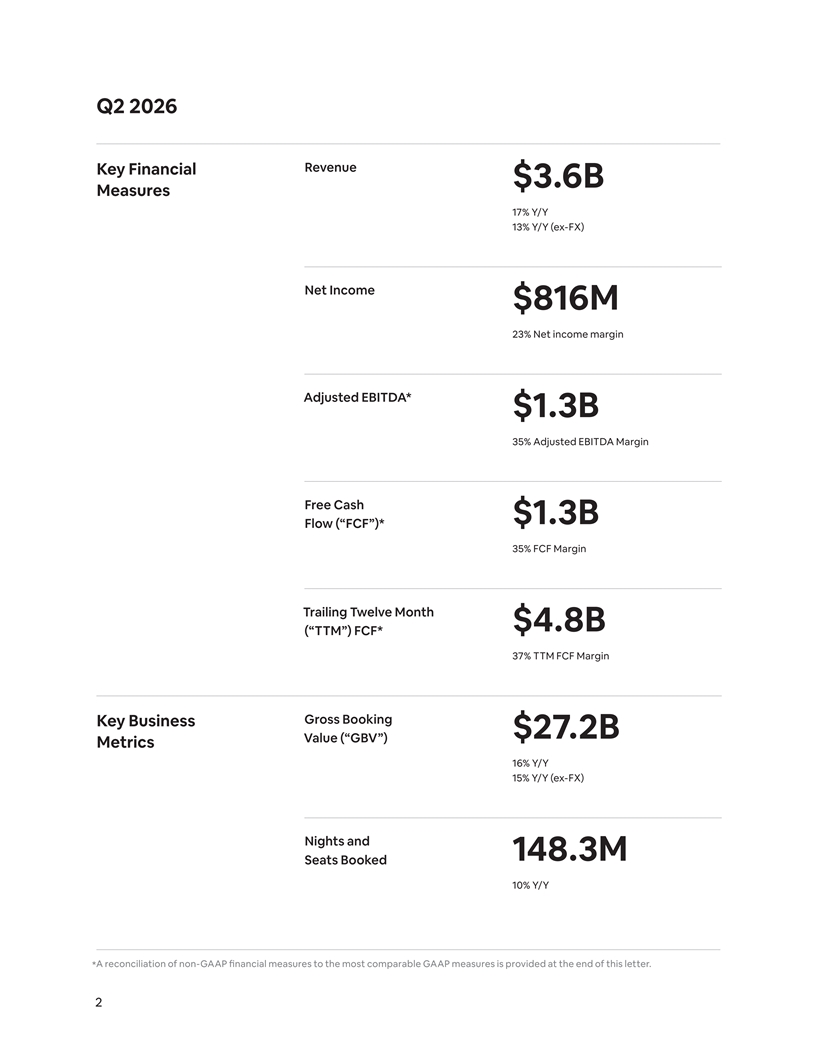
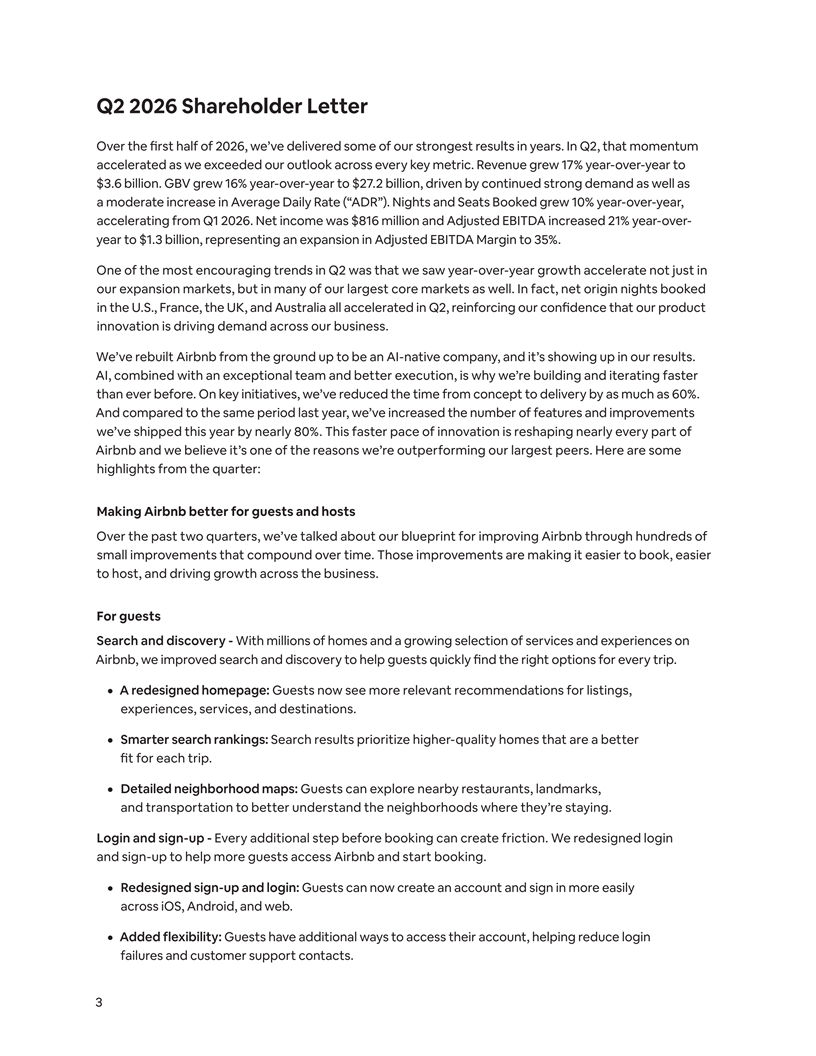
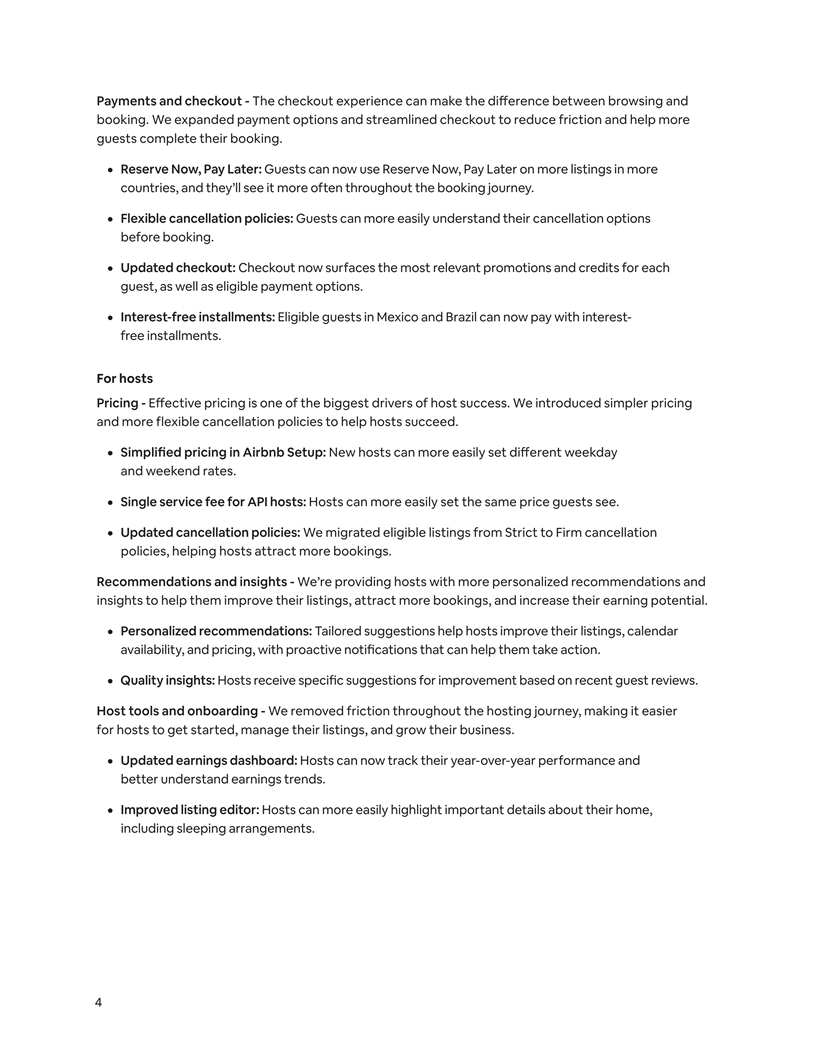
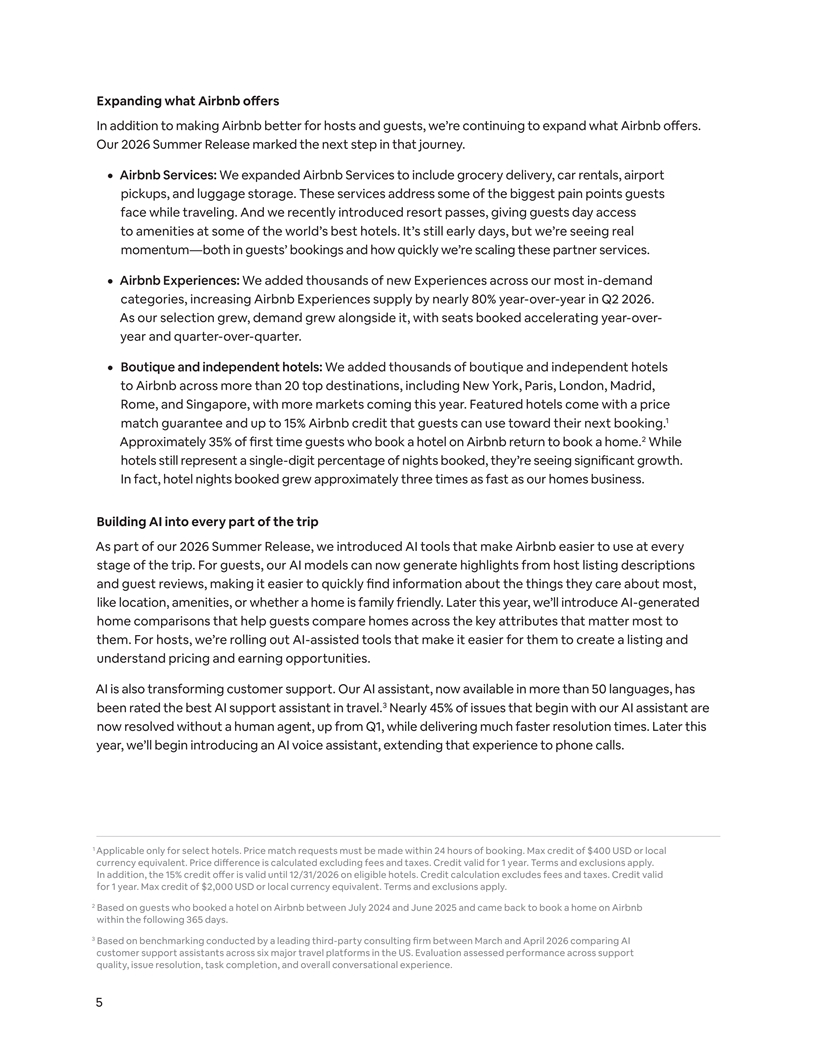
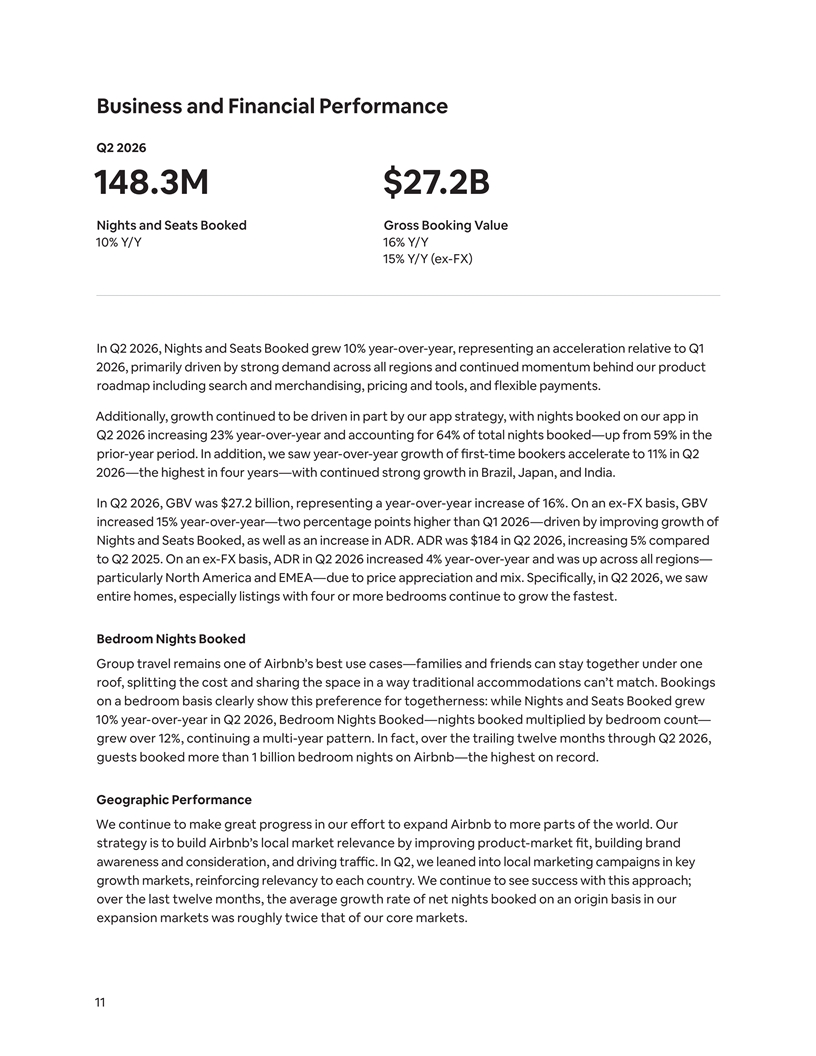
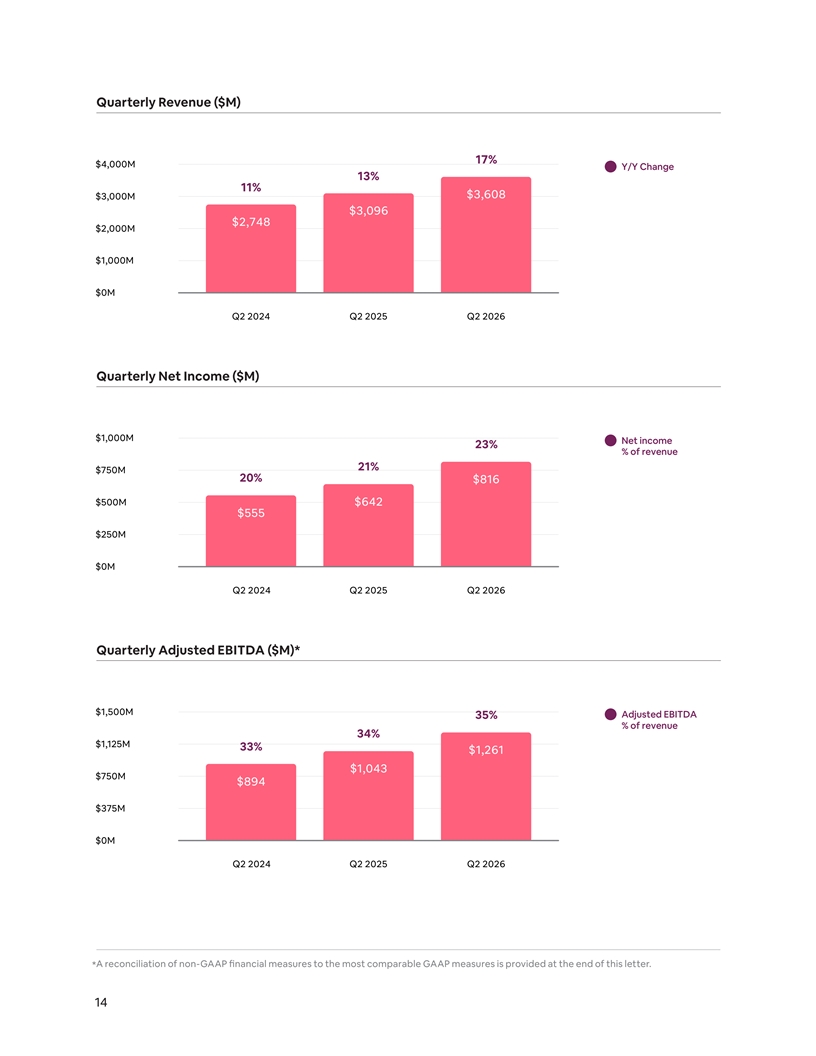
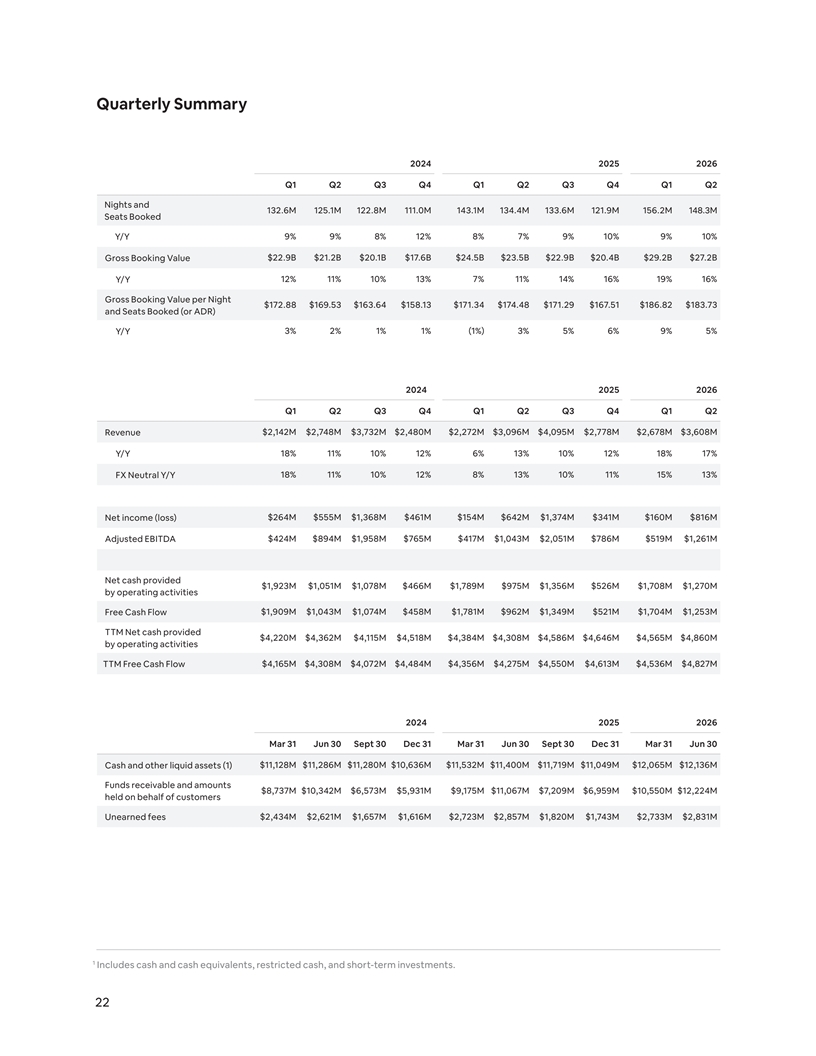
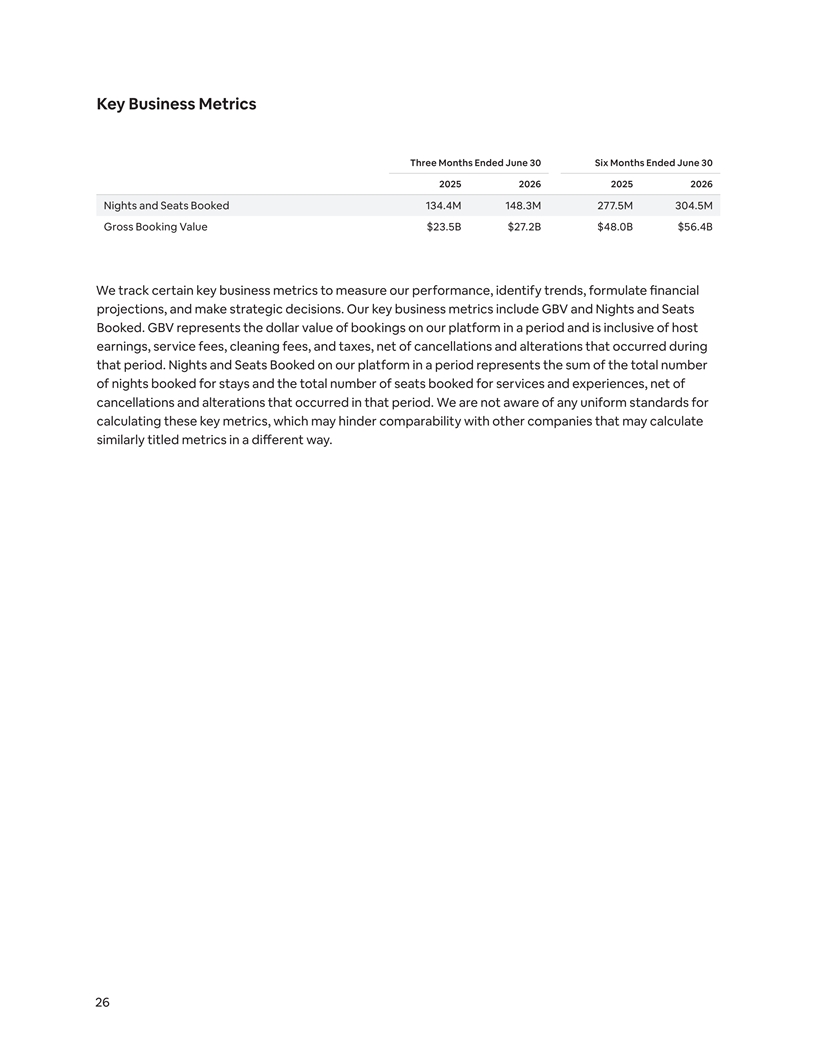
All right. Thanks, Andrew. And good afternoon, everyone. Thanks for joining. Over the first half of 2026, we've delivered some of the strongest results in years. In Q2, that momentum accelerates. We see their outlook across every key metric. Revenue grew 17% year-over-year to $3.6 billion. Gross booking value grew 16% year-over-year to $27.2 billion. And Nights and Seeds Book grew 10% year-over-year, accelerating from Q1. We are seeing this momentum show up across the business. Nights booked on our app grew 23% year over year, and they now account for 64% of total nights booked, which was up from 59% last year. More new guests are trying Airbnb than we've seen in years. In fact, growth among our first-time bookers accelerated to 11%. Now, this is the highest growth that we have seen in four years. And among first-time bookers, the Gen Z cohort is growing the fastest. Our expansion markets continue to outpace our core markets. with Nett Knight's book growing about twice as fast. But what's especially encouraging is that we're not only seeing growth accelerate in our emerging markets, we are seeing growth accelerate in many of our core markets. In fact, the US, France, UK, and Australia all accelerated in growth in Q2. Now these results reflect something much bigger than a strong quarter. What they reflect is a fundamental shift and how we are building products. Now, I think most people naturally want to point to one product or one initiative to explain a strong quarter, but that is not what's happening here. This is a culmination of change we've been making over the last several years. We've rebuilt Airbnb from the ground up to be an AI-native company. We have more world-class talent than ever before, and AI is transforming how we execute and build products. Said simply, AI is the best thing to ever happen to Airbnb. Today, we're building, testing, and iterating faster than we could just a year ago. Across some of our key initiatives, we've reduced the time from concept to launch by as much as 60%. And compared to the same six months last year, we've increased the number of features and improvements we shipped this year by nearly 80%. The acceleration from AI allowed us to make hundreds of improvements across Airbnb for hosting guests. And I want to highlight a few examples that are helping drive the outperformance we're seeing. So first, I want to talk about how we've made it easier for guests to book. I've talked in past quarters about Project Y, which is our innovation blueprint where hundreds of improvements compound over time. AI is accelerating this work across search, sign-up, checkout, and payment. And by reducing friction across the guest journey, we are converting more traffic into booking, and that's become one of the biggest drivers of our growth. We improved search and discovery, making it easier for guests to find and book the right home, hotel, service, or experience. And it's meaningfully improving conversion. We also introduced AI-generated listing highlights so guests can quickly understand the key details about a home. We also launched AI-powered review highlights, surfacing what guest reviews say about a home's location, amenities, and more. Later this year, we'll introduced AI home comparison, allowing guests to compare homes side-by-side before booking. We simplified sign-up and log-in, making it easier for guests to get started on Airbnb. We streamlined checkout by making pricing and cancellation policies clear. And we also continued to expand ReserveNow Pay Later to more listings. And we're making it more visible throughout the booking flow. AI is also making it easier to host. Now, we know that as hosts are more successful when they have the right price, the right insights, and the right tools. And AI is helping us improve all three. We made it easier for hosts to set competitive prices and get more bookings. We also gave hosts more actionable insights to help them improve their listings and increase their earning potential. And we're rolling out AI tools that help new hosts get started faster and better understand their pricing and earning opportunities. AI is also transforming customer support. our AI assistant is now available in more than 50 languages. Nearly 45% of issues that start with our AI assistant are now resolved without a human agent, while they're learning much faster resolution times. Later this year, we will begin introducing AI voice support, extending the experience to phone calls. Now, AI isn't just making the product better, it's also making Airbnb more efficient. In Q2, customer support costs, Purple King, declined about 16% year-over-year, driven in part by improvement by our AI assistant. We expect those costs to continue to decline as our AI assistant resolves more and more issues, and of course, as we bring it to voice. But improving the core experience is really only part of the story because we're also continuing to expand what Airbnb offers. In May, as you know, we expanded Airbnb services across grocery delivery, car rentals, airport pickups, and luggage storage. And recently, we introduced resort passes, giving guests day access to amenities of some of the world's best hotels. Now, it's still early, but what we are seeing is really strong momentum in booking. And every new service that we ship, we can do faster than the service before. So, we're getting much more efficient. For example, groceries took eight months, nine months, and airport pickups took about six weeks to develop. So you can see how these things are compounding. And we're also seeing some momentum with Airbnb experiences. We added 1,000 new experiences across our most in-demand categories, increasing supply by nearly 80% year-over-year during Q2. While experience is still a small part of our business, bookings accelerated both year-over-year and actually sequentially from last quarter and we also expanded our accommodations business adding thousands of boutique and independent hotels across top destinations around the world featured hotels come a price match guarantee and up to 15 credit that guests can use towards future bookings roughly 35 percent of first-time hotel guests return to airbnb to book a home And what this shows is how hotels are introducing new guests to Airbnb, and many of those new guests don't just come back and book hotels, they come back and they book homes. So hotels are making homes stronger. While hotels still represent a single-digit percentage of nights booked, hotel nights are growing approximately three times faster than our home's business. So there's a lot of growth ahead of us. Now, finally, I want to share an update on our event strategy. Many events, major events, help strengthen the Airbnb brand while driving both supply and demand. I will remind you that Airbnb started to provide housing for events. So housing for events is in our DNA. Now, these major events introduce millions of people to Airbnb, encouraging more people to become hosts, help welcome cities, and help cities welcome more visitors without building new hotels. Now, while bookings from any single event may be temporary, the brand awareness to trust and new hosts these partners create benefit our business long after the event ends. And the World Cup is one example of this strategy. As an official tournament partner, Airbnb hosted millions of people during the tournament, many first-time guests. Now, more than 150,000 homes across host cities were listed on Airbnb for the first time, creating new economic opportunities for locals. And it didn't stop with just the World Cup, because we are expanding this playbook to other events, including the Olympics, the Tour de France, Art Basel, La La Palooza, La Liga in Spain, and most recently, NASCAR. Now, when you put all of this together, I think there's a bigger story this quarter. And the story is this. There was no single product. There's no single partnership or initiative that explains our results. It's a combination of stronger execution, a world-class team, and an innovation model that is accelerated by AI. This is what's creating the momentum across our business. There is no silver bullet. And we believe it's one of the reasons we're outperforming our largest peers in travel. It's also evidence that the changes we've made over the last several years are paying off. Because those changes are rooted in the way we build and operate the business, we believe that momentum will continue through the coming quarters. It's given us so much confidence in the second of this year that that's why we're raising our guidance. And with that, I'll turn it over to Ellie to share more.
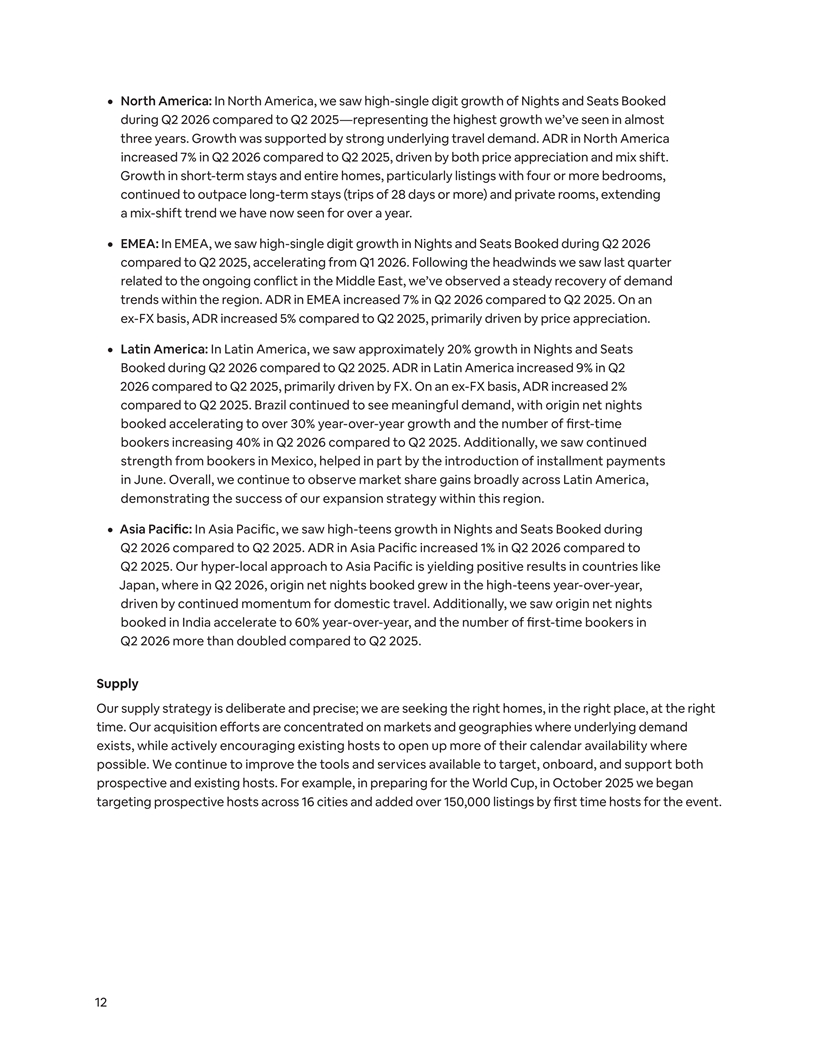
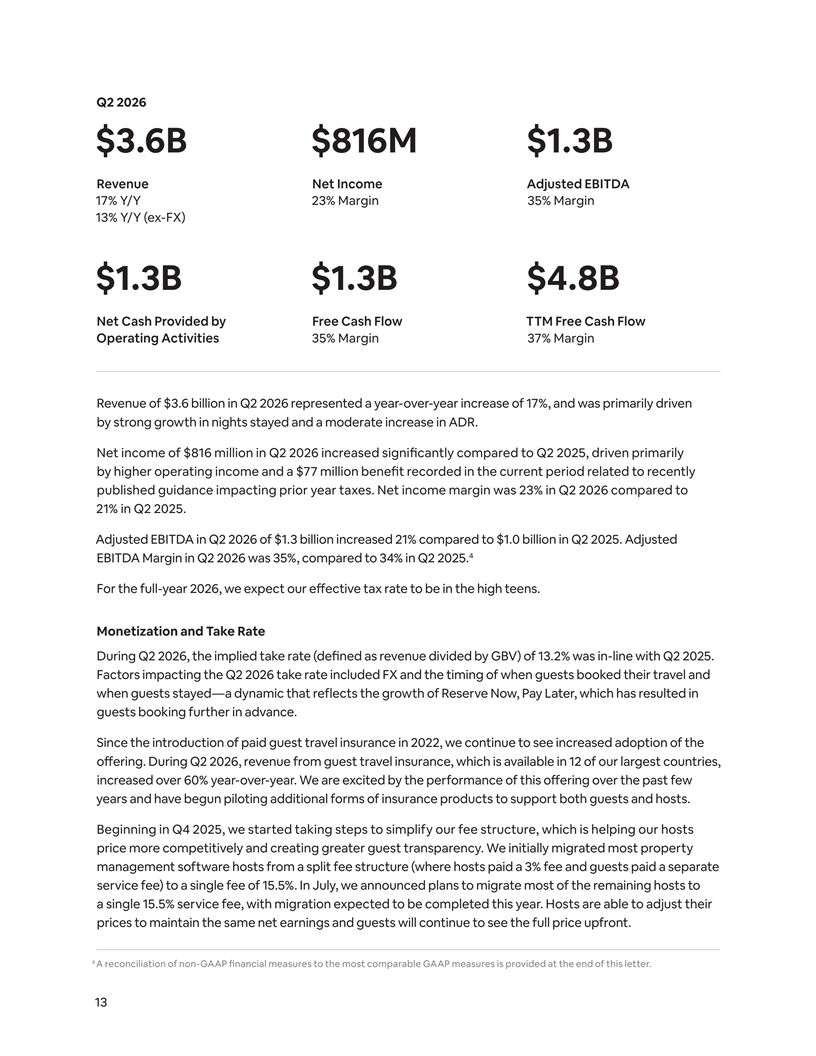
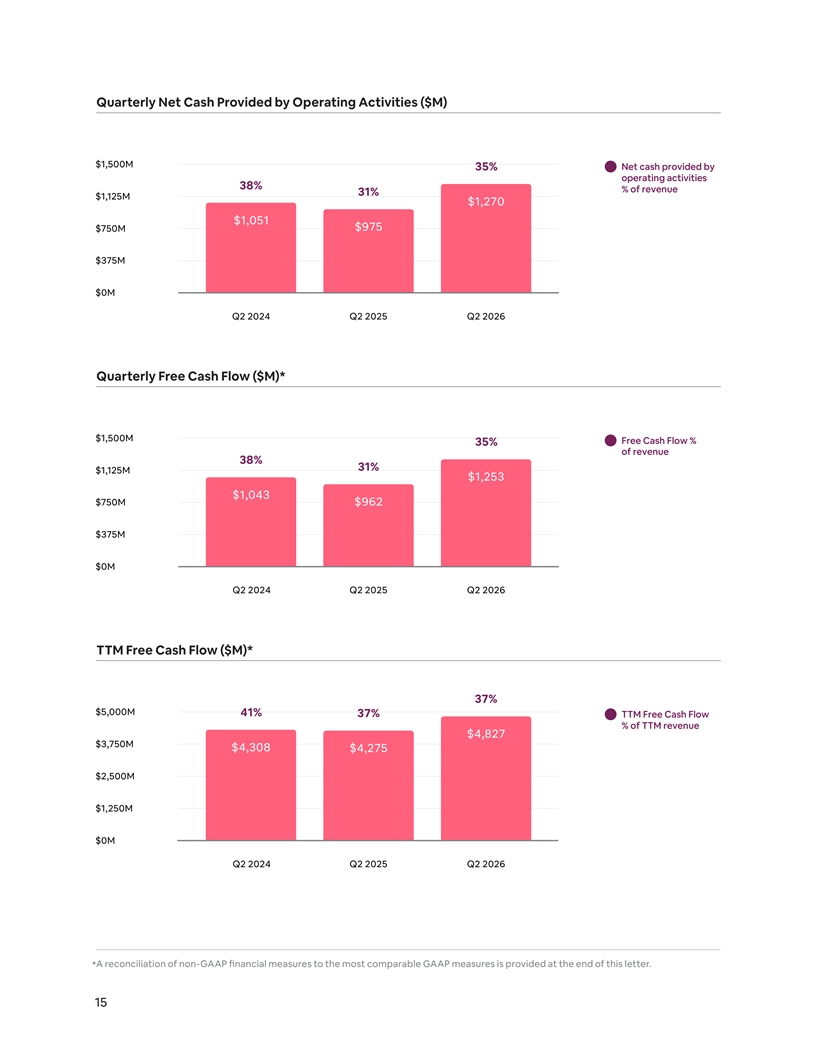
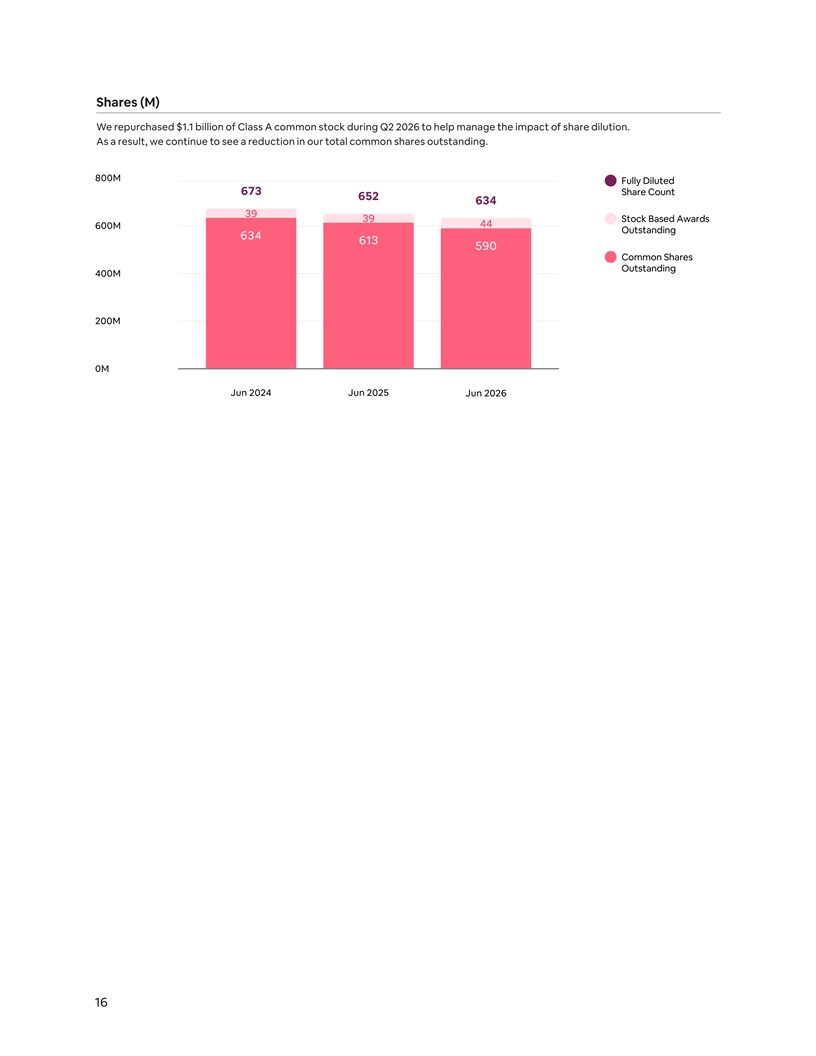
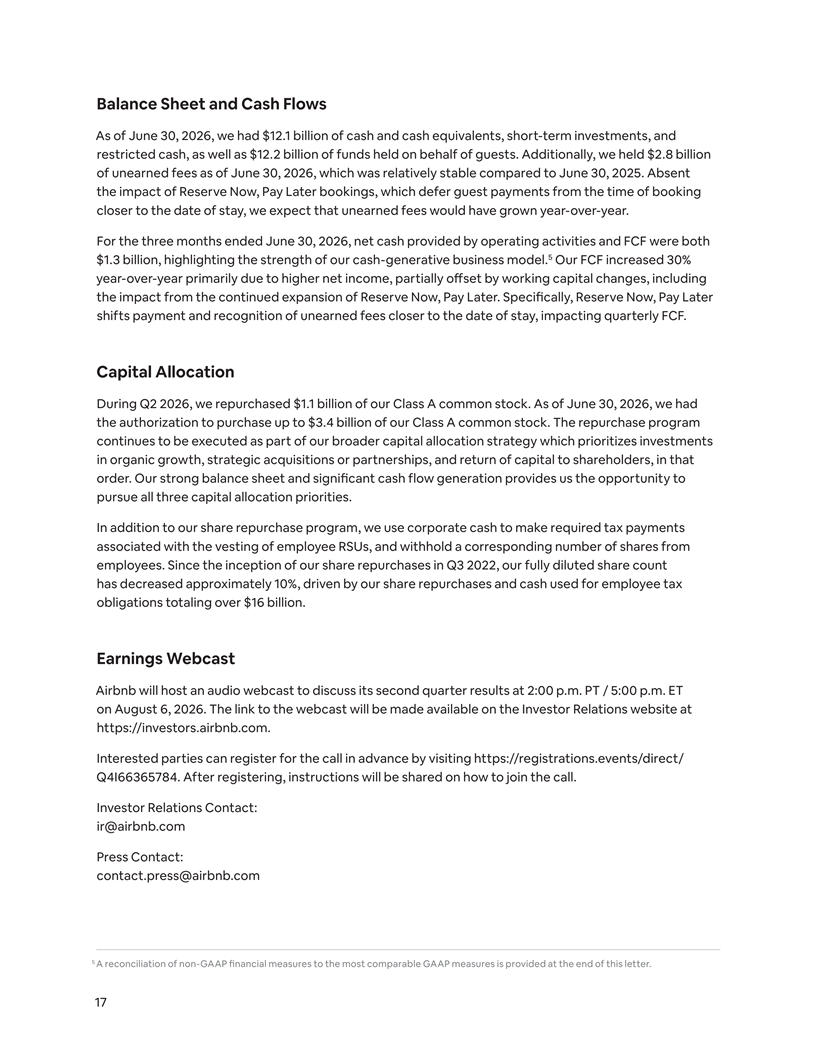
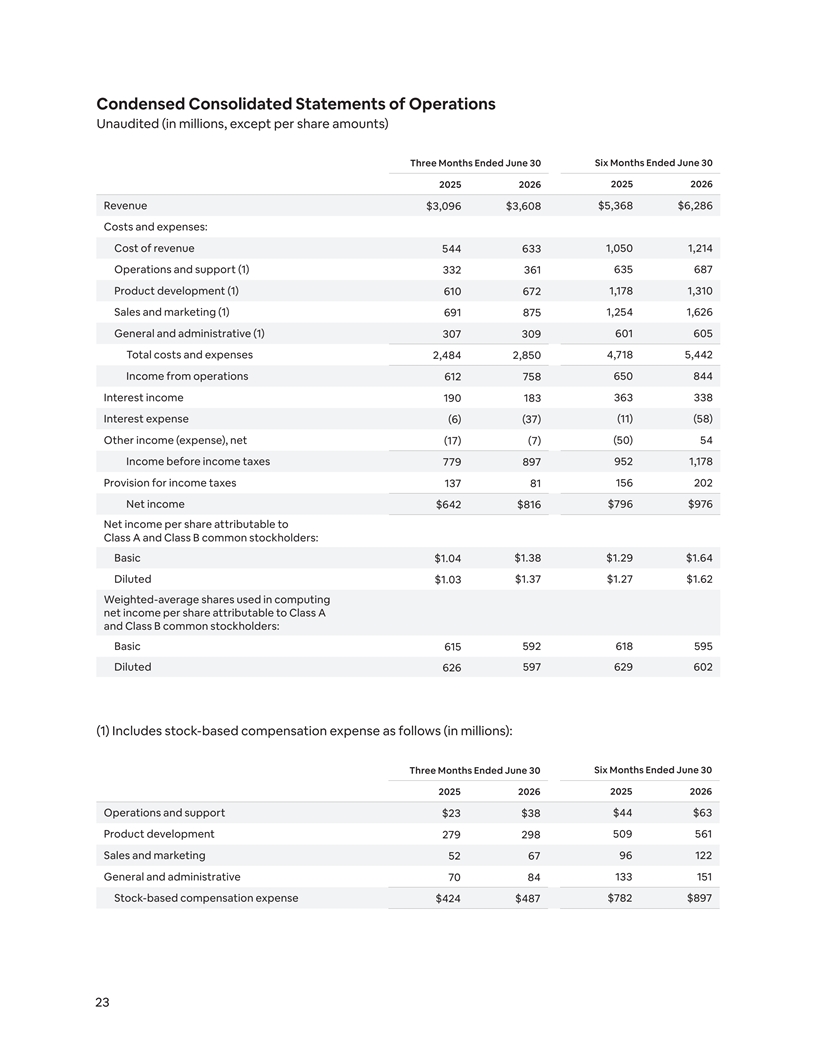
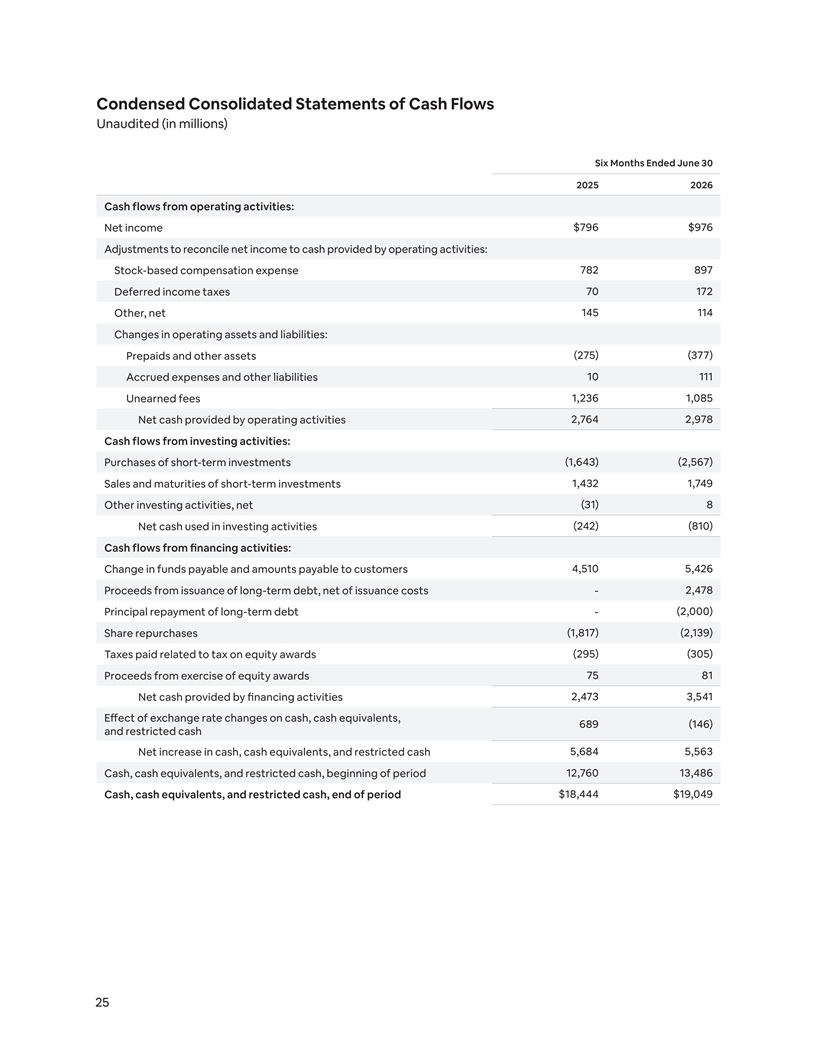
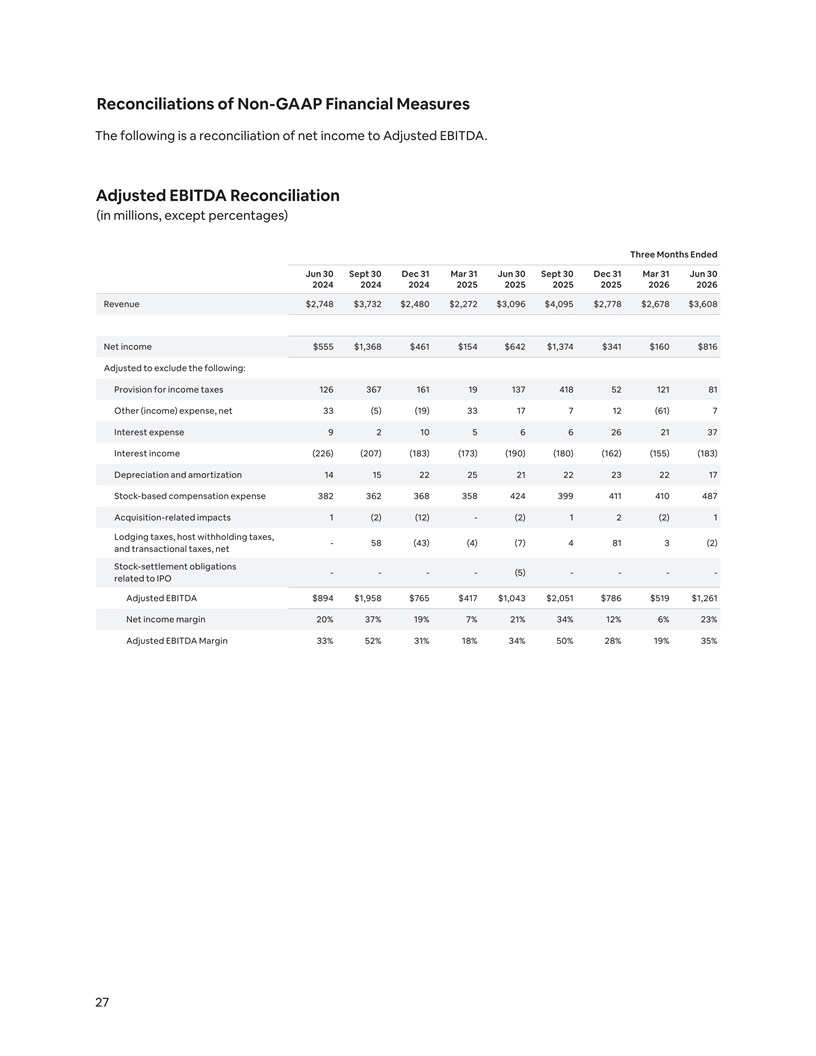
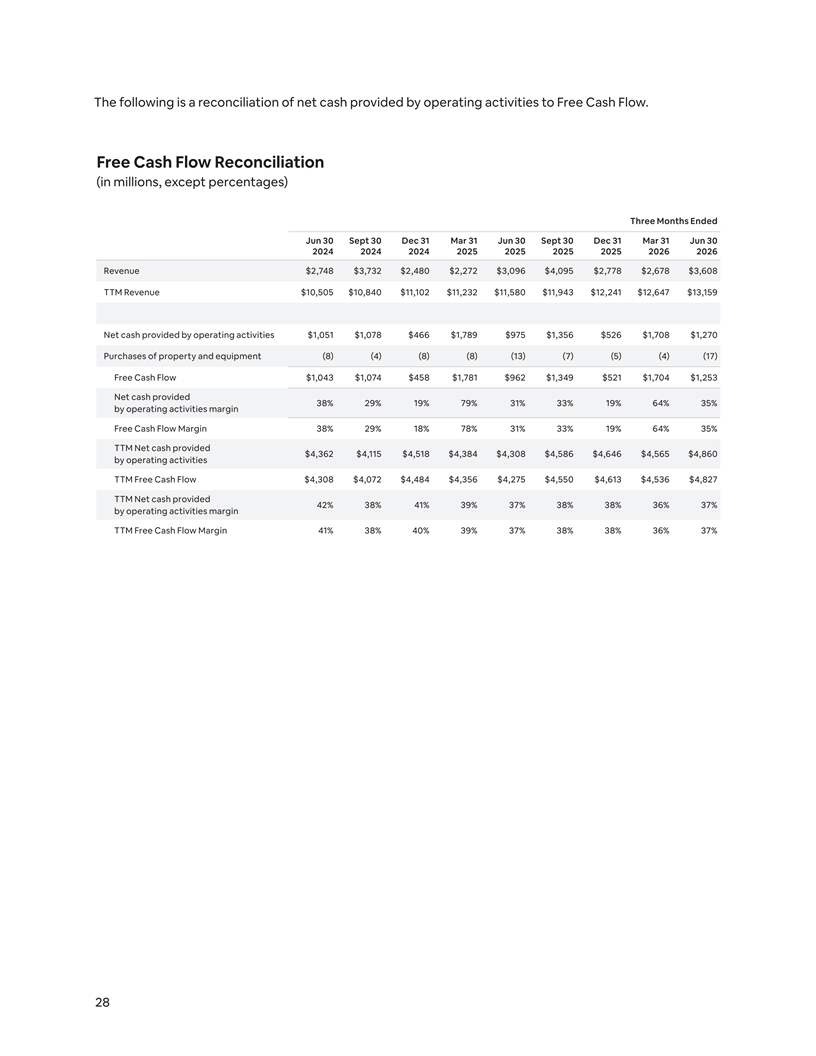
Thanks, Brian, and good afternoon, everyone. I'll start with Q2 financial results, then cover our outlook for Q3 and the full year 2026. As Brian shared, Q2 was another great quarter for Airbnb with continued momentum across the business. Despite the ongoing conflict in the Middle East, we continue to see strong underlying demand globally, and the impact to our business from the conflict was less than we had anticipated. Gross booking value grew 16% year-over-year to $27.2 billion, driven by strong growth in both nights and seats booked and ADR. ADR increased 5% year-over-year, or 4%, excluding the impact of FX, with noticeable strength in North America and Europe. Knights and seed spokes growth was strong across every region. We saw high single-digit growth in both North America and Europe, with Europe marking a steady recovery from the Middle East-related headwinds we saw in Q1, alongside approximately 20% growth in Latin America and high teens growth in Asia Pacific. As Brian mentioned, we've been able to deliver these results not from a single action, but the collective actions across our platform. For guests, these improvements have spanned search and discovery to payments and checkout, and for hosts, we've made it easier to get started and improve pricing and insights to help them become more competitive. Now, of the many changes that have collectively contributed to our strong growth, we wanted to provide an update on two that we've spoken in the past, in particular, Reserve Now Pay Later, and our simplified fee structure. First, we continue to see Reserve Now Pay Later benefit the business. It drove more bookings, longer booking lead times, and contributed to the increase in ADR. Specifically in Q2, over 20% of our total GBV was booked using this flexible payment option. Given the strong results that is delivered, in July, we expanded the types of bookings eligible or reserve now pay later now beyond the immediate uplift in night's book we believe this provides a longer term competitive benefit enabling hosts to lock in earlier calendar share and better aligning our payment options with guest preferences second the migration of api hosts to a single service fee helped our host price more competitively and provided greater price transparency. As a result of its success, we recently announced the broader rollout of the single fee to the majority of our remaining hosts, which we expect to be completed by year end. Approximately half of our active listings are now subject to the single service fee. Now let me spend some time on our Q2 financial results. Revenue grew 17% year-over-year to $3.6 billion, exceeding the high end of our outlook. In terms of profitability, our net income was 816 million, while adjusted EBITDA was 1.3 billion, representing an adjusted EBITDA margin of 35%. Our adjusted EBITDA margin expansion of over 100 basis points compared to last year was driven by strong revenue growth and cost efficiencies in operations and support and product development, partially offset by continued investment in sales and marketing. Meanwhile, the year-over-year increase in net income was driven by higher operating income and a $77 million tax benefit recorded in the current period related to recently published tax guidance impacting prior year taxes. Next, our balance sheet and cash flow. We continue to benefit from our efficient and capital-like business model, delivering $1.3 billion of free cash flow in Q2. Over the trailing 12 months, we've generated $4.8 billion of free cash flow, representing a free cash flow margin of 37%. Now, absent the impact of ReserveNow Pay Later bookings, which deferred guest payments from the time of booking closer to the date of stay, we expect that unearned fees would have grown year over year in Q2. During Q2, we purchased $1.1 billion of our common stock, enabled by our strong balance sheet and significant cash flow generation. Returning capital to shareholders remains a core component of our capital allocation strategy. Now, finally, let's shift to our Q3 and full year 2026 outlook. We're encouraged by the momentum we've seen so far this year and are excited about our roadmap to drive growth in 26 and beyond. Specifically, in Q3, we expect to generate revenue of $4.69 billion to $4.77 billion, representing year-over-year growth of 15 to 17 percent. This includes an approximate three percentage point for an exchange tailwind after factoring in our hedging program. We expect year-over-year GBV growth to be in the mid-teens, driven by low double-digit growth in nights and seats booked and a moderate increase in ADR due to mixed shift and price appreciation. In Q3, we are not assuming any significant impact related to the conflict in the Middle East. On profitability, we expect adjusted EBITDA to increase year-over-year and for adjusted EBITDA margin to be down slightly compared to Q3 2025 due to the timing of investments this year. Now moving to the full year, we are raising our revenue and adjusted EBITDA Outlook, we now expect year-over-year revenue growth to improve to at least mid-teens, up from the low-to-mid-teens guidance we provided last quarter, supported by the accelerated pace of Nights & Seeds books we've observed across our business. For the full year, we expect our implied take rate to be relatively flat compared to 2025, accounting for the timing of bookings versus check-in with reserve now pay later, as well as higher customer incentives related to new businesses during 2026. Absent these incentives, we would have anticipated our implied take rate to be slightly higher during the year, driven by our monetization initiatives and execution across our product And for full-year profitability, we are now expecting our adjusted EBITDA margin to be at least 35.5% up from 35%. Now to close, our results this quarter are proof that the product and business changes we've made are translating into real financial outcomes the improvements we shared making airbnb easier to use helping hosts succeed and running the business more efficiently these improvements are compounding and believe we believe that showing up as real outperformance relative to our peers even against tougher comps in the back half of the year we are raising our full year guidance for both top line growth and profitability a reflection of the pace of innovation, the operating momentum, and the execution we're seeing across the business. And with that, I will open it up to Q&A.
Operator
Thank you. If you would like to ask a question, please press star 1 on your telephone keypad. If you would like to withdraw your question, simply press star 1 again. We ask that you please limit yourself to one question only. Your first question today comes from a line of Justin Post from Bank of America. Your line is Great.
Thank you for taking my question. A lot to unpack. Let's just start with hotels. Can you tell us how the initiative is going and what you're seeing in maybe the cities where you have a lot of inventory, not just the cities where you might have had some regulatory restrictions, but is it improving conversion rates in kind of cities where you already have a lot of inventory? Thank you.
Yeah, I mean, I'll start. Hey, Justin. And the hotel initiative is going significantly better than I expected, and I had high expectations. What we told the team is our strategy is very simple. While we think that some trips are better than Airbnb, we think there's a lot of trips that are conducive to hotels, and those trips are last-minute, short stays, business trips, or where we are supply constrained. And so, as we've been talking about, our goal was to build the best hotel booking product online. We now believe that we have the best hotel booking product online. So, the second question is, can we get supply? And that is, I expected the first thing. I expected us to build the best hotel booking product online. I did not know what the reception would be. And I thought, you know, we're known for homes. It would take a lot of effort for hotels to warm up to want to list an Airbnb. And that's where my expectations were not high enough, because after we began outreach for hotels, things flipped. And what we are now seeing is a huge amount of influx of interest from hotels wanting to list on Airbnb. It's probably no surprise why. Not only do they like our product, but they like that we have a huge amount of traffic. We are one of the most traffic travel sites in the world. We also have a young audience. We have a disproportionately American audience relative to some of our competitors. and we have an extremely favorable take rate. To answer your second question, we are seeing strength in both supply-constrained markets and in non-supply-constrained markets. And maybe the simple way to think about it is that not everyone comes to Airbnb with the intent to look for a home. A lot of people come to, you know, there's three types of people. People that only stay in homes, people only stay in hotels, and most people are willing to stay in both. And so the basic theory of our marketplace is as we add more supply of homes or hotels, conversion rate of our traffic goes up and we see more bookings. What we're also seeing is about 35% of people who come to Airbnb and book a hotel for the first time come back and book a home. So hotels not only are bringing new guests to Airbnb, but those new guests are sometimes, often, choosing to book a home. So essentially, one is making the other stronger. And that's the basic theory of Airbnb. We are absolutely going to be stepping on the gas given the reception.
Operator
And we are focused not just in supply chain markets but all markets so to answer your question they are working well in both your next question comes from a line of richard clark from bernstein your line is open hi thanks for taking my question i guess i just love to understand the sort of ultimate ambition from all the ancillary products you're rolling out are these simply sort of attach rates someone books a home and uh then we'll add on car hire and other stuff but or could you imagine a world where you go to Airbnb and say, please book me a two-week trip to Scotland and it will be able to fulfill the whole trip and be a sort of full-service travel OTA in that regard? And maybe just a small sub-question. I guess your car hire partner has been acquired by a competitor. Does this make M&A a bit more of a nearer-term necessity as you build these ancillary products out?
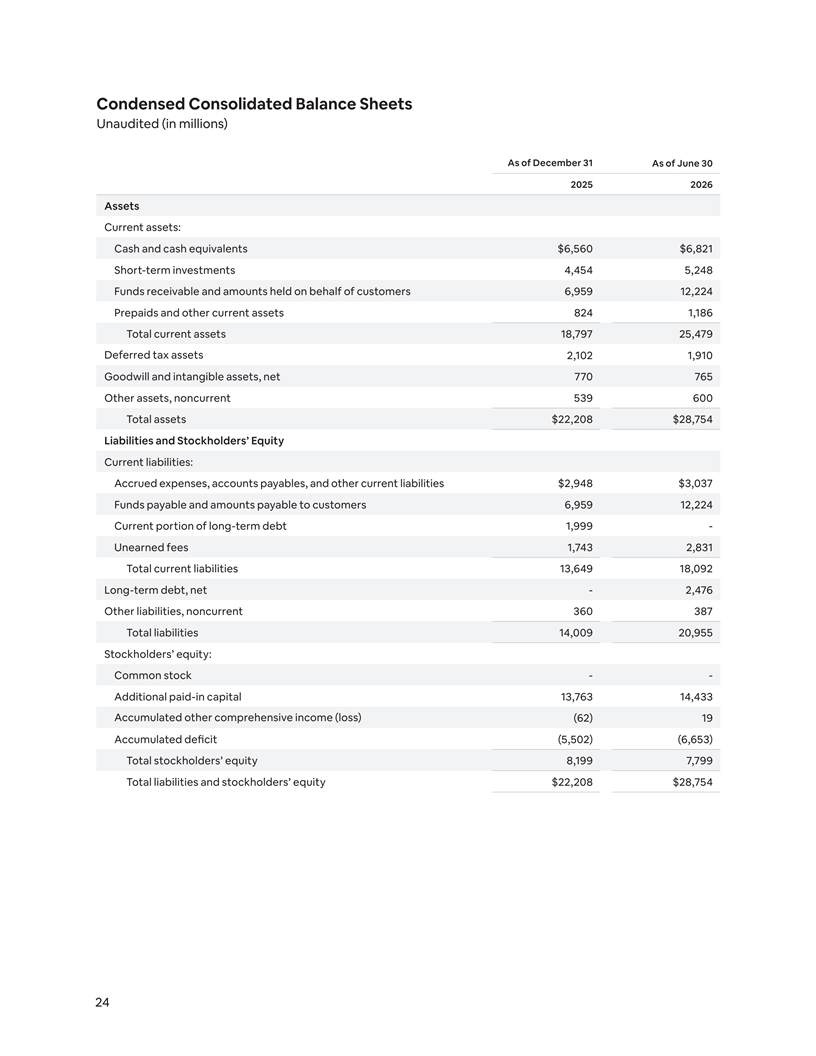
Yeah, I can take both questions. So, you can kind of think of Airbnb as probably going into, like, three different phases of expansion. You know, the prior era was, you know, us being just, you know, homes for travelers. And so, we became a noun verb, kind of like Kleenex or Xerox, that was associated with just one thing. So, the first phase, and you are correct in assessing this, is that, you know, a lot of things will be, most people still come to Airbnb with a home in mind. And so most of our business is going to be for the foreseeable future, certainly this year, attaching to people that have an intent to come finding a home. That would be attaching a service, attaching experience, or people coming to Airbnb expecting a home but discovering hotels and booking a hotel that men have otherwise bounced because they didn't find a home they were looking for. So that's kind of phase one. That's the prior phase. We are now entering the next phase of expansion, which is actually not the endgame. It's just the next stage. And the next stage has become a one-stop shop for travel. So you'll eventually be able to get all of your travel needs through Airbnb, and that's what you're starting to see. And then phase two would be we will go from traveling to living. And phase three, we go from traveling to living to other ways for people to connect on our platform. I think you will expect over the next year for us to be very, very focused on the travel phase, one-stop shop for travel. But I do not think our ambition is limited to travel. The single reason why is because AI is an existential risk to everyone. And last year, I told our company that AI is an existential risk to us. It was the only existential risk to this company. Now, policy is a risk, but it's not an existential risk. It's a risk that we will manage forever. But the existential risk to everyone was AI. Is AI good for you? Is AI bad for you? And I think the moment of truth happened this year, The moment of truth happened. First, we hired our CTO, Ahmed Aldali. He was the leader of Meta Llama Models. He came in, and I think we went from a company that was a middle-of-the-path company for AI to a leader in AI, at least amongst companies that are not frontier labs or hyperscalers. And I think we are amongst the most AI-native companies now in all of Silicon Valley. And so I think because of that, this allows us to go into many new businesses in travel and eventually beyond travel that we might not have been able to go into except for the opportunity that AI affords us. And we are seeing, again, we're able to develop products more quickly. We're able to attach a lot more products and services. So to answer your question, yes, I do imagine that in the near term, in the near term being, you know, over the next year, year and a half, you will absolutely be able to go to Airbnb with a broad travel intent. Like, I like to travel my family to somewhere in Europe. Can you recommend where I should travel? Can you put my whole trip together? And absolutely, Airbnb will be able to do that. And that is just the next phase. It's not the limiting phase. With regards to M&A, you're probably referring to car trawler being acquired by Expedia. We still think that they're going to be a great partner for us with car rentals. I do not think that that's, you know, I'm very confident in that partnership. I think we are going to be a major benefit to that company. And I think that, you know, I'm expecting that they're going to want to continue to partner with us. And I do not think this has any impact on our M&A strategy. Our M&A strategy remains is opportunistic. As we go into a lot of new verticals, there's a lot of M&A opportunities. We're sitting on quite a lot of cash. We generate a lot of cash. Entrepreneurs would love to be part of Airbnb and to hold stock. So I think there's a huge number of opportunities for us. But the great thing is our bias is always to grow organically and to look secondarily at acquisitions.
Operator
Your next question comes from a line of Lloyd Walmsley from Mizuho. Your line is open.
Thanks. Two, if I can. First, just the hotel commentary sounds super encouraging. Maybe you can give us a sense of maybe anecdotes on markets where you're seeing particular conversion rate improvement or areas where you're comprising a meaningful portion of hotels, bookings. Anything you can give us that would help us understand better, you know, either the time frame or scale of the opportunity. And then the second one, just wondering how the AI search tests are going, you know, when you expect that to be, you know, a bigger part of the product. And, you know, what that if that's a gating factor to to to an ad product, kind of what you think about that. Thanks a lot.
Yes, let me just get a little more color on the hotels ramp. As we've shared, we started in those markets that are regulatory constrained because it's an obvious opportunity for us to bring supply to those markets where we're not always able to fulfill demand that we already have. We've expanded our supply acquisition efforts to a top 20 number of cities. And I would say more broadly, we're looking to add inventory that can be accreted to the platform versus compete with homes. And so, we're very selective with regard to what we add to make sure that it's adding, you know, great inventory that our consumers will love. More broadly, when you think about the scaling of this product, we've shared that today, hotels are only a single-digit percent of nights booked on the platform, so a relatively small segment. But as we disclosed in the letter, given our efforts over the last several months. Hotels, that segment, is currently growing about three times as quickly as homes. And we have, as Brian shared previously, we have, you know, large ambitions in terms of continuing to scale not only the rate of growth, but obviously the contribution to the overall business in the coming years.
Yeah, I mean, maybe before I answer the second part of the question, it is kind of notable. Homes and hotels, I like to think we did the really hard business first. I'm not here to say doing hotels is easy, but I'll tell you what's harder, like helping try to create a category. Airbnb homes don't have front desks. We had to teach people hospitality. You know, we had to navigate governments all over the world. We had to max supply and demand. And, you know, we had to, you know, it was not a behavior that people are familiar with. Hotels are no doubt not an easy business, but I actually think the hotels are making it an easier business for us. When you see the reception that they have, their desire to want to listen on the platform, and the fact that we've already done most of the hard work, because in fact, most of the technology and tools we built for homes apply to homes, hotels, that actually it is a very natural extension for our business. And I don't want to say it's easy. Nothing in life is easy. And if it is, you're probably being complacent. but it is a much more natural transition than I ever imagined. And also, I was always worried for years about homes being next to hotels and the platform. It does not bother customers. We have really, really good personalization. And we know now with our personalization and really driven by AI, whether someone wants to see just homes, just hotels, or both. So I'm very, very, very excited, and I just wanted to, like, maybe highlight that point. Now, to the second point on AI search, good news, we are beginning to put it in test this month. Now, that test is going to be a very small percentage of our traffic, and based on those results, we're going to then begin to expand it to more traffic over the course of this year. I just want to point out that the tests that I've seen, I think, are extraordinary. They're really great. That being said, you just have to remember that people come to Airbnb, often most people, a handful of times a year, and they have an expectation that they see a search box with a location. So it's going to take some time, months and months, to retrain the customer. So the way we're initially going to roll it out is the default is going to still be the core search. Above, you'll see a toggle. Once you turn the toggle on, you're going to be able to try the new AI search. We'll have to see how it converts. I think for people who toggle it on, it's going to convert very well. We don't to impose that on everyone we want we by the way we learned this with uh total price display we start with a toggle that toggle for those people who toggled was very positive we wanted to educate people and so i think you're going to see this play out over the course this year and into next um now ai search you can actually think about as really three or four major features one is the search input i can type in natural language whatever i want the second thing is it can essentially respond to you in natural language. Rather than just saying 300 search results, it can respond to you in natural language. Then the title, the titles can actually be AI generated and they can be conversational as if you're reading a chatbot, but more to a visual. Then you get to the product description page and the highlights are AI generated in real time, personalized to you. You go down the page, you have a question. You can ask the PDP through AI. So you see the entire journey, not just AI search, is going to be powered by AI. And what this will feel like is going to feel as – or almost as conversational as a chatbot, hopefully less chatty and fewer words because we think travel is more visual, very, very personalized. And what this will mean is much higher conversion rate.
Operator
Your next question comes from a line of Jed Kelly from Oppenheimer. Your line is open.
Hey, this is great. Just following up on the changes in fees, are you planning to roll that out to every host, or is that mostly still geared towards professional property managers?
Thanks, Ed. Yes, so what we initially launched back in September of last year was rolling out single service fee for our API connected host, which is predominantly property managers. Fast forward, we did extensive testing on, you know, a broader swath of hosts this winter and spring and have begun migrating the remainder of our host to the single service fee. And we anticipate by year end, you know, our entire supply base will be on that single service fee. As a reminder, That single service fee allows us to provide more simplified pricing recommendations and, in aggregate, has a kind of downward pressure on pricing to allow us, one, to offer more value to guests, but also ensure that we are priced competitively relative to other platforms.
Operator
Your next question comes from a line of Ken Gorelski from Wells Fargo. Your line is open.
Thank you very much, too, if I may. First, maybe, Brian, you talked about the reception from your customers to hotels on the platform. Could you talk a little bit more about your hosts and their reception as you continue to roll out new cities with hotel supply? And then, two, could you please maybe talk about, as you think about the personal experience that you're building, the journey on Airbnb, do you think you're going to go, So is it – do you start with kind of certain geos and build out all the experiences and figure out for each geo that you have, you can build an experience in a trip planning? Or are you talking more broadly, like you need to have basically a global trip planning experience? Thank you. Okay.
Thanks, Ken. On the first question, we haven't really gotten much feedback from our core host. I mean, mostly they just want to make sure their bookings are going up, and our results show they are. And if we do get asked, though, I would say that the rise of the tide raises the sales of all boats. So essentially, you know, I don't mean to give our hosts like a business school marketplace lessons, but if they were curious, I would tell them that what Amazon learned in the 2000s was, you know, selling um selling dvds and selling cds help the sales books do not cannibalize them and every time they added a new category it strengthened and lifted the votes of the prior categories and that the most important thing for a host is that it's the jewelry district concept essentially that we bring more people to the platform if we bring more people to the platform then we can match the perfect supply to the exact guest that wants that supply. And so we actually see hotels being creative to the bookings for our home hosts. And I think the results are showing that. So we haven't heard from them. And mostly when we do hear from them, it's about their bookings, but mostly we're seeing very positive results. Now to the second question, And, you know, I think, you know, most supply, we test city by city. So, hotels, we go city by city. Services, we go city by city. Experiences, we go city by city. But most software, we really do globally. We might test it in the country, but we don't really do that city by city. So, to answer your question, this will be broad-based trip planning that we'll be rolling out globally. And we will test it globally. Sometimes we test it in the country, but often we can test it globally.
Operator
Our next question comes from a line of Eric Sheridan from Goldman Sachs. Your line is open.
Thanks so much for taking the question. You've been in an investment cycle for quite a while now, and now you're building a lot of demand coming out of some of the building blocks you've put in place over the last couple Can you talk a little bit about the interplay between incremental margins in the business over the long term and how much of that incremental margin you think needs to be reinvested back into the operating momentum as opposed to how much of that incremental margin might drop to the bottom line. Thanks so much.
Yeah, thanks, Eric. So I'm not going to give you a specific guide for 27 and beyond, but I think looking at our track record, you can see a couple of things. One is the underlying economics of this business are extremely strong from both an EBITDA and a free cash flow basis. Second, last year, we did have a bit of an investment cycle, but given the growth that it helped spawn for the current year, we're able to both accelerate growth, invest substantially behind that growth, and also deliver an expansion in the margin. As we look forward, we're going to seek to do the same. We're constantly looking for opportunities to grow, And so where we have those opportunities, we will lean in. But I think, you know, given the track record and the somewhat steady EBITDA margins that we have delivered, I think you can see there's a relative floor in our ability to continue to invest against that.
Operator
Your next question comes from the line of Ron Josie from Citi. Your line is open.
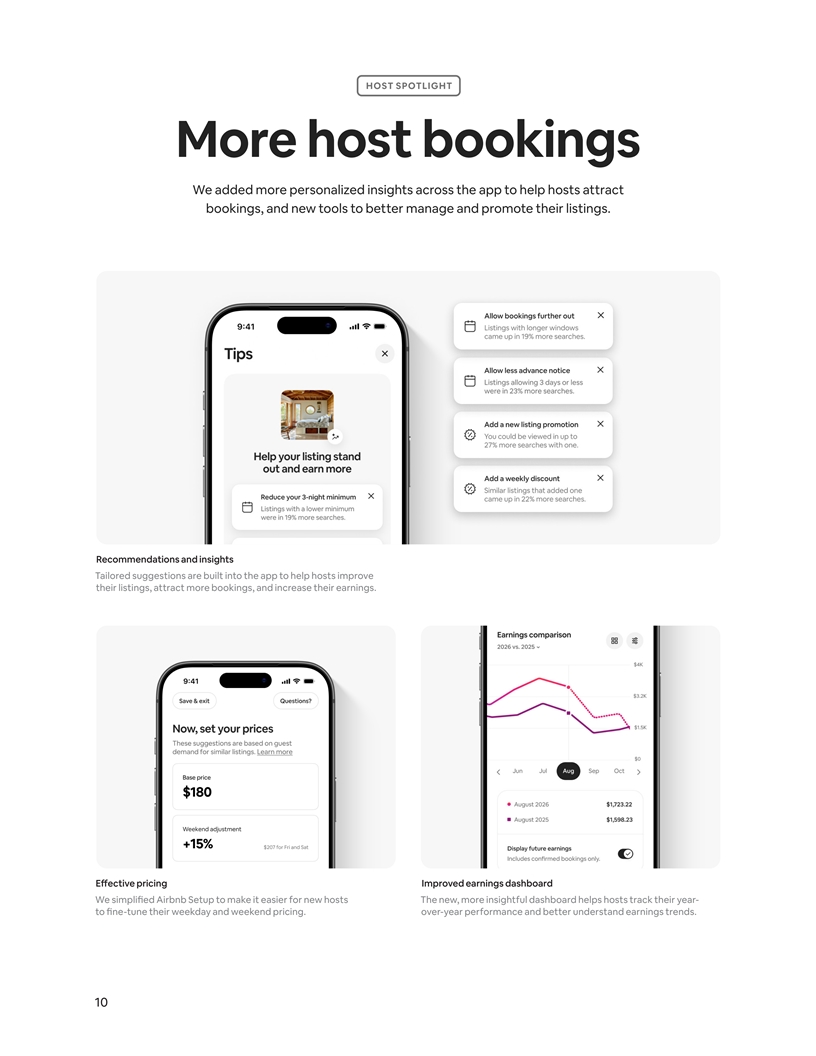
Thanks for taking the question. Brian, when we're talking about all the new products that are coming out, one of them for hosts is called Personalized Recommendations. And, you know, I think it's helped hosts improve listings and calendar and pricing. So I want to hear a little bit more about the pricing side and how Airbnb is helping hosts sort of decide what the optimal pricing is for each home that's available. And then the second question is on experiences. And so we know supply is up 80%. I think I heard that right. Year over year. And we're accelerating bookings as a result. But we'd love to hear more on whether experience is at a size and scale yet to actually contribute to overall nights and seats booked. Thank you.
So, yeah, on pricing, I think this is one of the biggest single levers for growth that we have. I think it's significantly greater than ReserveNow PayLater. So if you want to just put it in perspective, it is, I don't know, I don't want to say a multiple, but many multiples bigger than R&TL. Now, why is this? Well, because, you know, everybody launched and started as affordable alternative to hotels. Affordability and value is one of the most important things we can do. We don't price the listings. The best thing we can do is show hosts that if they were to better price their listings, then they will make more money. And we are essentially building an entirely new pricing model. No surprise, it will be powered by AI. AI is able to take in a lot of data sources. We're able to take in a lot of data sources of hotel prices, of Airbnb prices, events coming to town, the nature of lead time bookings. And based on that, we have a new pricing model that we're rolling out to host. I think this is going to be much more powerful. We're also going to make it much easier for them to update their prices. We're going to be able to let them just tap a button and go immediately with our recommendations. We can coach them on when events are coming to town, how they might want to change their pricing. And what I think this is going to do is this is going to hopefully be generating a huge amount of growth for the company. is frankly one of the single biggest levers that we have to accelerate the growth of our core business. And you can think about this as us making massive changes to the host side of our app. Most people open our app, they only see the guest side. The host side is just as sophisticated and we're putting just as much investment towards it. And pricing and calendar are essentially two sides of the same coin because you see your prices on the calendar, right? Most people don't have a single price. They have different prices for every day. And the best way to price your home, like a hotel is to have different prices on different days and for those prices to be dynamically changed. And I think, I mean, I think that it's very possible that, you know, right now hotels have very sophisticated pricing management. They have entire teams of people doing that. I don't think anyone is going to be better than AI at doing this. And so I think that our models are going to be very, very powerful. And I hope in the future hotels can even use that. Now with regards the experiences, they're growing really quickly, but they're growing on a small base. It's a long term. I think the way to think about experiences is let's talk about time horizon. To drive near term growth, it's mostly homes because that's massive scale. And so homes is the shortest horizon and the biggest drivers are pricing and Project Y type features, conversion rate, getting more supply. The second horizon I would describe as international expansion hotel. And You can see billions of dollars in incremental revenue. It's nearly adjacent. And then the next horizon after that is going to be services and experiences. So those are on a multi-year time horizon. They're going to be a bit smaller. But we are very optimistic about this. We're seeing a lot of growth. The way I'm measuring the growth of experiences is I'm not looking at the global growth rate, although it's great. I'm looking at the growth rate of markets like Paris. And then And we basically have this idea of one to 10 to many. Really try to get product markets in one market. Then take that to 10 markets. Then you take that to many, like thousands of markets. In fact, this is how we did with the core business. You focus the core business on New York City. Then we brought it to many markets. Uber started in, I think, San Francisco. I think DoorDash started in Palo Alto. Uber Eats started in like, I think Toronto and Santa Monica. So it's one to 10 to many is a tried and true. And we are on the, like, tens of markets where we're seeing, you know, growth of, you know, quite high growth. And experience will grow very quick when we take that and industrialize it to thousands of markets. And that's not this year.
Operator
Your next question comes from the line of John Colantoni from Jefferies. Your line is open.
Thanks for taking my question. With AI helping drive faster velocity of innovations, I was hoping to get your perspective on how this transition to AI native could impact your product cost and if there are any operational adjustments you're making to help minimize the impact.
It won't affect us that much. I mean, we may have – let's back up for a second. So, you know, Chachapiti launched three and a half years ago, I think, almost four years ago.
Is it almost four years ago?
Yeah, we are coming on the near four-year anniversary in three months of Chachapiti. And in the nearly four years, almost all the actual business that's been generated is on the enterprise. I think I've mentioned this in the past, but I'm involved in the Y Combinator from the board, and the last batch I saw was 175 companies, 159 were enterprise. I think part of the reason why is a lot of companies have not figured out how to make money on the consumer side. Why is this? Because the inference cost is not cheap, and there's huge capital expenditures. Well, the great thing about Airbnb is two points. Number one, we do not need to make any major capital investments. We are not buying up a whole bunch of GPUs. Second, the inference costs of Airbnb are kind of de minimis relative to the ROI of our business model. Right? We're not like in the business of information where we're trying to monetize. Our transactions are very high-dollar transactions. And if AI can just increase our conversion rate just a little bit, the inference cost is so outweighed by the amount of money we make on that increased ROI. So I think that what you're seeing is the cost of tokens, developed products, and the inference costs around the models is tails in comparison to the incremental revenue we generate and the incremental output or throughput we're seeing. So, you know, I'm sure we can always be a little more efficient, but I think we're really, really disciplined. We're not like so-called token maxing, which I think is like this thing where I think all these CEOs at the beginning of the year kind of like have this mandate. You know, I want to see everyone use AI, you know, with kind of a vanity of trying to have people use as many tokens as possible. Luckily, I have a great technology leader in Ahmed, and, you know, we've been really, really rigorous and thoughtful about it's not about how many tokens you use. It's about the throughput of your product and the quality of your product designs and how much you're shipping. And so, I don't know if, Elle, you want to add anything, but, like, I think it's very efficient.
I would just add tactically, in the updated guidance that we provided, it obviously does assume a material increase in terms of the AI spend over the course of the year. So I would note that, yes, we are expanding margins while absorbing that increased cost. On the flip side, the early offsets that we're already realizing, one is obviously the improvement in our customer service costs. We can call that out in the letter. The customer service cost for booking is down about 16% year over year, in large part due to the AI agent. Second, what we're seeing is that we don't need to grow our headcount at levels that we did in the past because we're getting so much more output and speed from our existing workforce, which obviously also creates efficiencies over time.
Operator
Your next question comes from the line of Kevin Koppelman from TD Cowan. Your line is open.
Oh, great. Thanks a lot. Could you talk more about that 11% growth statistic that you called out for growth in first-time bookers? Anything you can call out that's particularly helping with these new customers? And with all the product improvements you've been rolling out, are you seeing anything you track, like net promoter scores, for example, increasing through these new features?
Yeah, so on the acceleration of first-time bookers, you know, similar to the broader narrative, it is not one single thing that is causing that acceleration. It's the compounding impact of the whole product roadmap. A couple specifics I would note. So first, obviously, we're seeing outsides growth in first-time bookers in our expansion markets. You know, we called out a few in the letter. We're seeing really strong growth in places like India and Brazil, where we're interested reducing large growing numbers of New Year's every year. Second, what is also supporting that number is the core market. Obviously, the growth in recent years of a first-time booker in our core markets has been slower, given the level of penetration we have across those markets. And yet, in recent quarters, we've also seen an acceleration of first-time booker growth in in effectively almost all of our core markets inclusive of the U.S. When you think about some of the specific product features that have helped, you know, one is absolutely reserve now pay later. We see that that is a really attractive payment option, in particular for people who have been aware of Airbnb, they're on the site, but they haven't booked with us yet. And it gives them, frankly, a lot more confidence to book that future stay when they don't need to put down, you know, a sizable credit card fee up front. So I would call that out as one. And then more broadly, a lot of our work just simply on sign-up, login, merchandising, search, all of these are additive in terms of, again, getting that first-time user over the hump of trying to figure out what listing is right for them and having the confidence to go ahead and book.
Operator
Your next question comes from a line of Connor Cunningham from Melius Research. Your line is open.
Hi, everyone. I'd like to get a little bit more detail. If you could just unpack the core growth expansion that you saw in the quarter. You talked about how everything's kind of accelerated. But just, and Brian, I know you just said you didn't want to go down to one single product. But if you could just talk about the innovation in general and how that's playing out. And then just on ADRs, I heard you talk a little bit about that. But if you could just talk about your long-term pricing strategy, I know you're going to roll out some new ADR pricing stuff to your host. So just anything there. The only reason why I flagged that is just the fact that you're seeing ADRs kind of grow faster than hotels at this point. So just any thoughts there would be helpful.
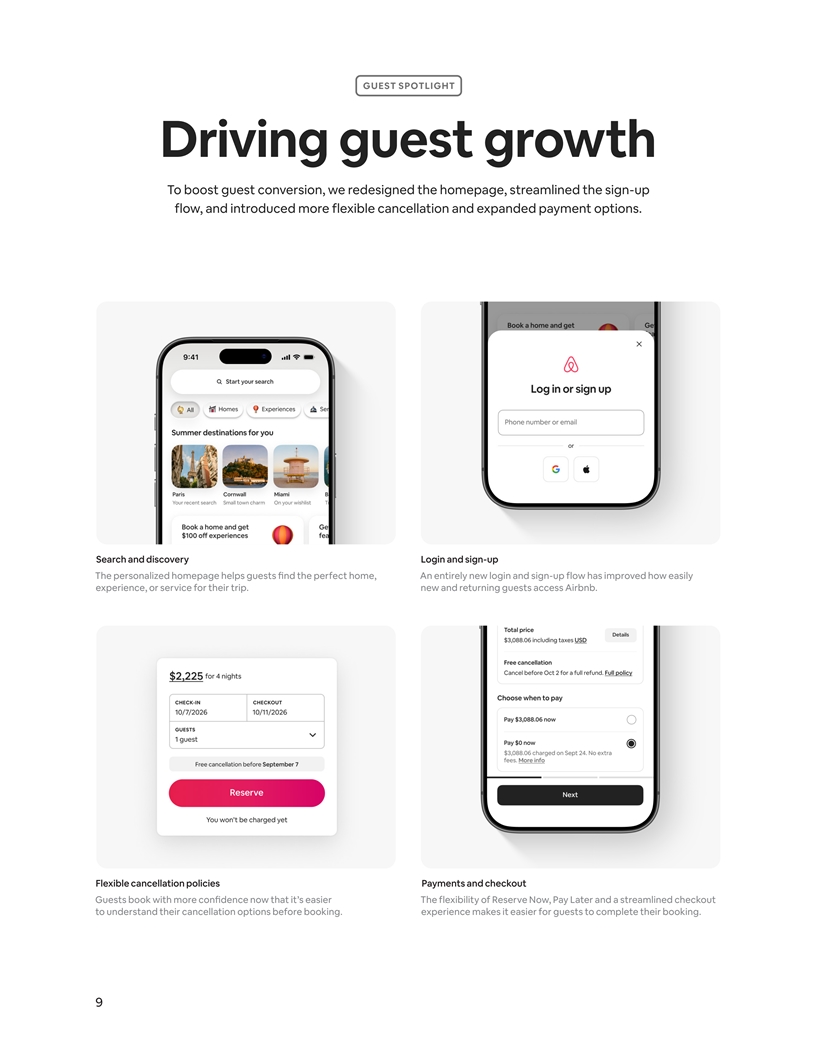
Yeah, I mean, like, there's probably like, you know, a shareholder letter, I think we highlighted like 12 or 15 things. And those 12 or 15 things are 12 or 15 out of hundreds of things, but of course, and I won't list all 12 or 15 right now, but let me give you a couple of examples. So on the guest side, we redesigned the homepage. The homepage is now much more personalized, so you see things that are going to be relevant to you, and we're seeing more people engage the homepage and book right off the homepage. Our search results are much more intelligent, much more personalized to you. are maps. If you go to search result maps or especially maps on each listing, we now show nearby restaurants, landmarks, transportation. So, the maps have really come alive. This seems like a small one, but we've completely redesigned login and sign up. We have so much traffic. We were having as many as like a few hundred thousand people failing to log in every day. This is like, you know, whether they forgot their email or just the friction, small optimizations are master to redesign or set up our login on ios android web that increased a lot of conversion we've added a lot of flexibility and login just other ways to log in on payment i mean in checkout of course there is reserve now pay later we've added to more countries more listings we made it more visible on the booking flow but we've also had more flexible cancellation policies um our our checkout is completely updated we've added interest re-installments and those are just a few of the guest side features and then of course um on the host side you know the single service fee has meant uh prices have become more competitive because a whole bunch of api hosts were accidentally mispricing because they were um pricing on pair other platforms and our guest fee was going on top of that so that's been really big we've had you know major improvements to insights dashboard now i'm kind of giving you a laundry list so you get the idea. But again, there is no one thing. I would recommend you go to our shareholder letter. We have about 12 or 15 things. We also have three graphics that show some of the features step by step. And so those will just give you a bit of defense. Maybe the only other thing I just want to say is we're getting momentum. In other words, a question might be, well, what's next? And the answer is there's a huge pipeline of things on the horizon. I had this theory a few years ago that there'd be like, you know, you get all the low hanging fruit and each new thing would be harder and harder. Actually, it's just the opposite. Project Y taught us that, you know, you get momentum, that the team, you know, finds bigger and bigger opportunities. And so we're kind of layering on all these different features, all these different improvements. I think what you're going to have seeing is this is not a one-time boost in growth. This is durable growth.
Can I just talk a little bit about the pricing strategy? You know, I would say just at a high level, our pricing strategy is to provide hosts the tools to make them as price competitive as possible. We want to make sure that we are consistently delivering value for money to our guests and maximizing earnings for our hosts. In many cases, that means we encourage our hosts to bring their prices down, and in some cases, it means, you know, we want to make sure they're not leaving money on the table. I think, you know, one of the probably, you know, disadmitted points over the last couple of years is that we have been aggressively pushing pricing tips and affordability across the platform, and you've seen yet the nominal ADRs rise over that period. One thing we called out explicitly this quarter is the growth in underlying bedroom nights. one of the factors that has been driving ADR up in recent years has been the continued disproportionate popularity of larger homes. We know people come to Airbnb specifically because we are great for families, for large groups, and that obviously involves larger homes with multiple bedrooms. What we've seen is that the growth in what we call bedroom nights has, one, been at a higher level and also accelerated more on a year-to-year basis than our nights booked, which gives you a sense of, number one, what is differentiated and popular on our platform, but also that component of ADR appreciation that is durable and really a reflection of incremental value delivered, not just rising prices, which is important to note in terms of thinking about the long-term pricing strategy.
Operator
Your next question comes from the line of Colin Sebastian from Baird. Your line is open.
Great. Good afternoon. Thanks for taking my questions. I guess, Brian, first, when we look at the expansion of the services platform outside of lodging, which of the newer categories would you say are signaling the strongest early traction and maybe even unit economics relative to expectations? And then how are you pacing investment across that group as we look ahead over the next year or two, understanding that you have other new products in the pipeline? Thank you.
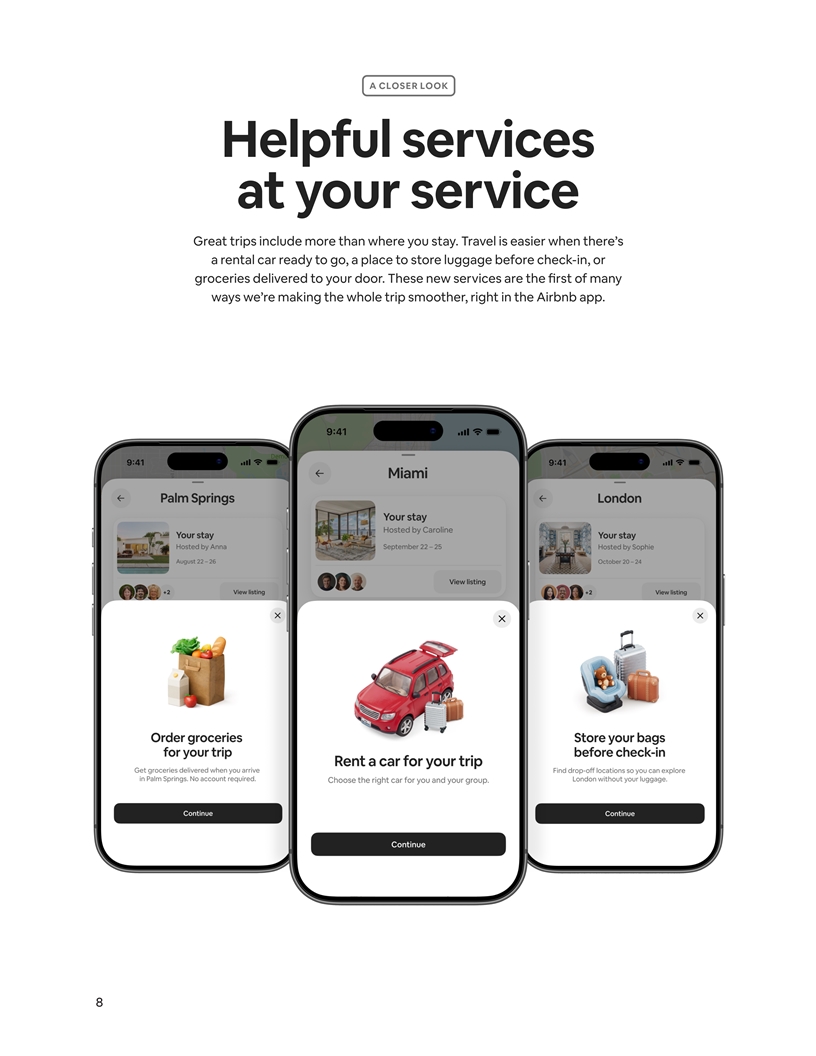
I mean, car rentals is going to be the biggest one by far, just because of how big the asset is. And I think the thing that we're surprised by in a good way is that the length of the reservation is long. In fact, it's longer than the average length of Airbnb stay. We thought the average length of a car rental would be shorter than Airbnb stay. It's actually longer. There's a variety of reasons why. It might be they want the car longer than Airbnb stay. They might be staying somewhere else after they check out. But that was the big variable, and we underestimate how long the reservations would be. And we're going to now expand this globally. I think that's going to be really huge. But at the same time, like luggage storage, what a sleeper hit. I went on stage in this keynote, one, I talked about all these AI features, and the biggest cheer I got was luggage storage. And I finally felt cool on the internet because I posted on Instagram that people are like cheering for luggage storage. So, you know, that's not the sexiest service, I would say. But I will say that, like, what we've learned is that, you know, every service in and of itself has value. Now, some are going to drive a lot more revenue, like car rentals and luggage storage. But what all these services have in common is they make you more likely to want to book a home on Airbnb or a hotel on Airbnb. And so, you know, we have a pipeline of dozens of more services. Some are going to be really big, like groceries, where we're going to be doing international expansion, food delivery. And these are going to be partnerships. We're not building a food delivery service, but it's going to be really integrated well into the app. A lot of people don't know which food delivery or ride-sharing or grocery service to use when they get to a country. It's not the same app everywhere. It's integrated. They have the address. We often offer deals and discounts. So they make the product really, really compelling. um we're going to expand a lot more services but we do not think that they'll incur a lot of cost because most of the big ones we're talking about are partnerships partnerships mean the cost is incurred by the company fulfilling the service not a so we're essentially in lead generation for them and so we do not see a big incurring of cost on the hosted services we might call first-party services where they're hosts we're kind of going um not category by category but by city by city. So like, for example, like in Tulum, a lot of people go there and they want to relax. So no surprise, massages are really, really popular in Tulum. In Paris, massages aren't as popular. People aren't looking to relax in Paris. They're looking at their photos. So therefore, photography is very popular. So we're going to be looking at both hosted services, first-party services, and partner services. A lot of the momentum will be partner services.
Operator
We're going be able to launch a lot of them and we do not think there'll be much cost because they're partners your next question comes from the line of doug anmuth from jp morgan your line is open great thanks for taking the question um brian just given your ai driven product innovation improvements and as you scale hotels more just curious how you might think about a more formal b2b opportunity down the line thanks um can you can you elaborate on the question um just whether or you would do something that would kind of go to market more toward B2B opportunity and travel?
Like, do you mean, like, what Expedia is doing by B2B?
Operator
What do you mean by B2B? Like, yeah. Yeah, exactly. And something more specifically for enterprise and businesses.
I think we're, like, I think, how do I explain this? To use a computer analogy, you know, BlackBerry was a very enterprise-first company. Apple was a very consumer-first company. And I think, ultimately, consumer wins, and the consumers kind of point to enterprises. So I think that enterprise is going to be really important for us. You know, DDB strategy is kind of emerging, but we think that the best strategy, and it's with the one that Apple pursued was to get the consumers to vote and then they tell the employer if they want to use your service and you make it really easy for them. I don't, one thing I will say, I don't know if you're asking this question, but I don't really see us being in the, like the white label business. I think that Airbnb brand is so strong and so powerful that the last thing we want to do is strip that brand away. So I don't know if either of those answered your question at all. Did they answer your question?
Operator
And that concludes our question and answer session. I will now turn the call back over to Brian Chesky for some final closing remarks.
All right. Well, thank you all for joining today. And I just wanted to say, you know, we're really, really, really excited about the results this quarter. We delivered one of the strongest quarters in years. We exceeded our outlook, and we're raising our full year guidance. But what excites me most isn't the quarter. It's we're seeing broad-based momentum across Airbnb. Growth is accelerating poor markets, more people are booking Airbnb for the first time, and we're ibb-ing faster than we've ever had before. And these results are not isolated. I think they're evidence that the changes we made over the last couple of years are working. And that's what gives us confidence that this momentum is here to stay. I'm incredibly proud of our team that's worked incredibly hard to deliver the results that we've talked about today. And I want to thank you all for being investors and partners on the journey.
Operator
We'll see you next quarter. This concludes today's conference call. Thank you for your participation. You may now