Operator
Good day, and welcome to Acadia HealthCare's first quarter 2026 earnings call. All participants will be in listen-only mode. Should you need assistance, please signal a conference specialist by pressing the star key followed by zero. After today's presentation, there will be an opportunity to ask questions. To ask a question, you may press star then 1 on a touch-tone phone. To withdraw your question, please press star then 2. Please note this event is being recorded. I would now like to turn the conference over to Todd Young, Chief Financial Officer. Please go ahead.
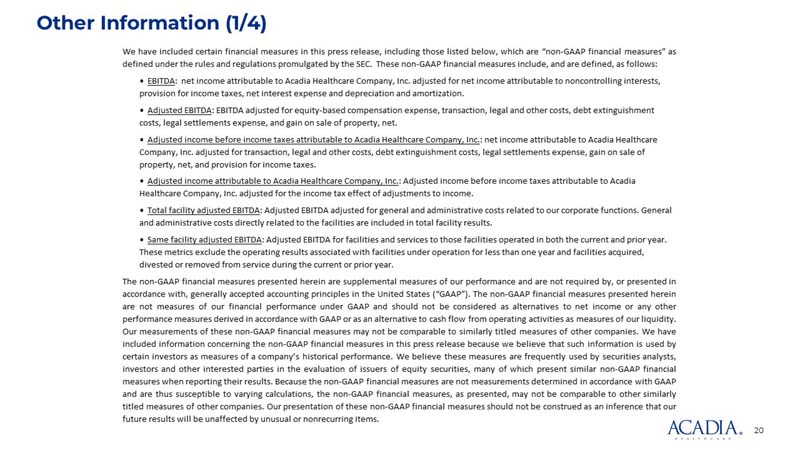
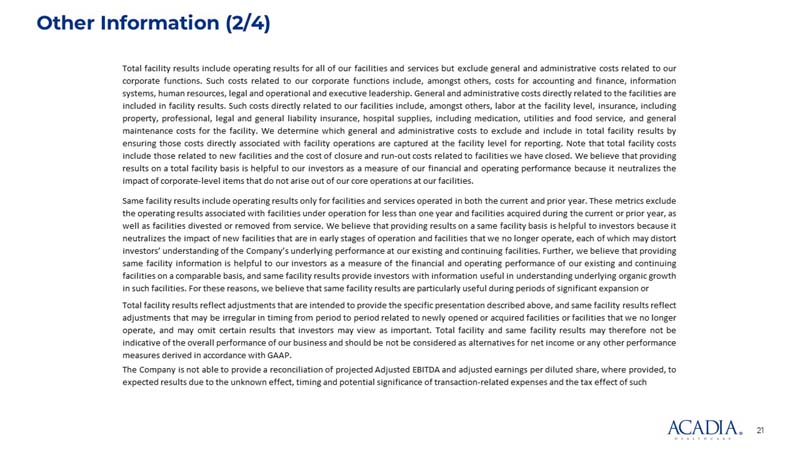
Thank you and good morning. Yesterday after the market closed, we issued a press release announcing our first quarter 2026 financial results. This press release can be found in the Investor Relations section of the AcadiaHealthcare.com website. Today, Debbie Osteen, Acadia's Chief Executive Officer, and myself, Todd Young, Chief Financial Officer, will discuss the results. To the extent any non-GAAP financial measure is discussed in today's call, you will also find a reconciliation of that measure to the most directly comparable financial measure calculated according to GAAP in the press release that is posted on our website. This conference call may contain forward-looking statements within the meaning of the Private Securities Litigation Reform Act of 1995, including statements, among others, regarding Acadia's expected quarterly and annual financial performance for 2026 and beyond. These statements may be affected by the important factors, among others, set forth in Acadia's filings with the Securities and Exchange Commission and in the company's first quarter news release. And consequently, actual operations and results may defer materially from the results discussed in the forward-looking statements. At this time, I would like to turn the conference call over to Debbie.
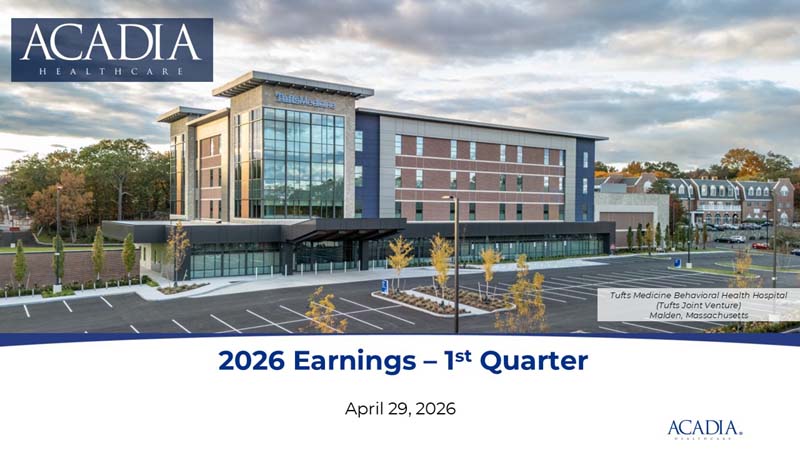
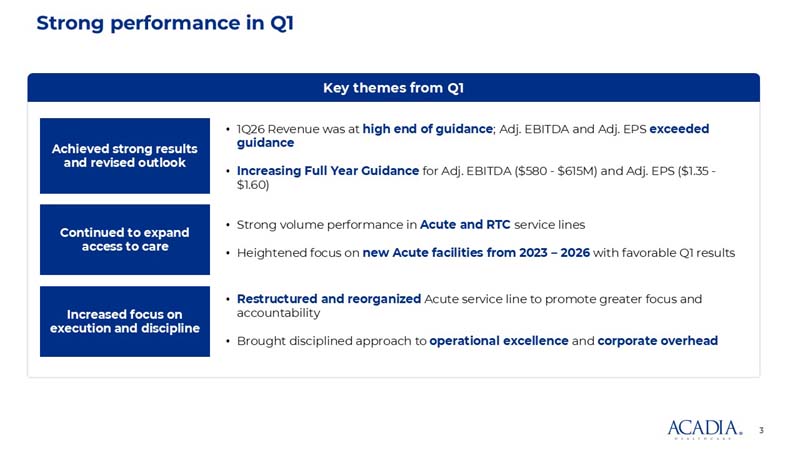
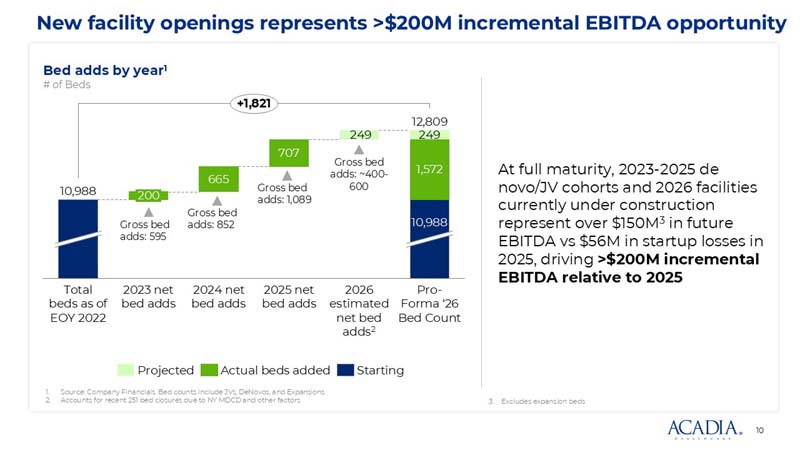
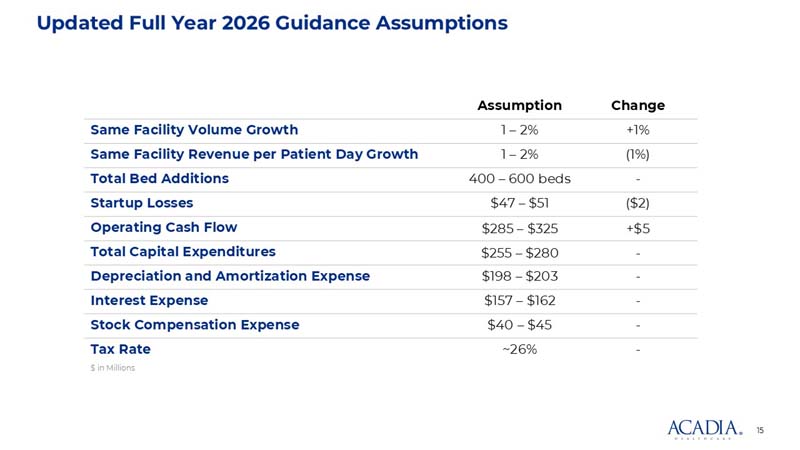
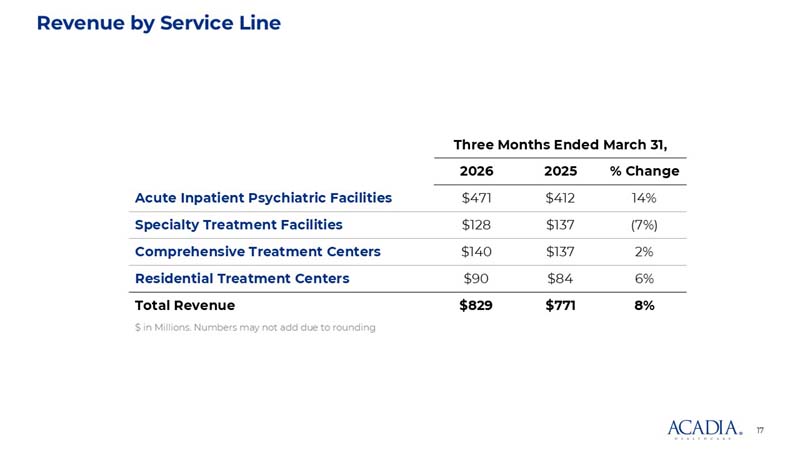
Good morning, and thank you for joining us. I'm pleased to be with you today to discuss Acadia's results for the first quarter of 2026. Since returning as CEO, I have spent time in the business, listening to our teams, assessing operations, and getting close to the drivers of quality and performance. Our mission is unchanged, and I continue to be impressed by the hard work and dedication of our clinicians and employees across the country and the important work we are doing to provide safe, quality care for those seeking treatment for mental health and substance use issues. Across Acadia, we share a clear purpose, meeting a critical need and making a difference in the communities we serve. As the nation's leading pure play provider of behavioral health services, we are uniquely positioned to address this growing unmet need with our 275 facilities serving more than 84,000 patients daily. We have a strong foundation, an integrated model of care, a deep focus on clinical quality, and a proven operating approach. As I shared in our last call, we are focused on building on our strong foundation with operational discipline and consistent execution to deliver significant, sustainable value creation. I have great confidence in our teams and in the near- and long-term direction of the company, and I am fully committed to supporting Acadia through this next phase of execution and improvement. Our first quarter financial and operating results marked a good start to 2026. We delivered revenue at the high end of our guidance range and exceeded the top end of our adjusted EBITDA and EPS range. Our revenue growth was driven by our acute inpatient psychiatric facilities, with 14% growth compared to last year, as we increased inpatient volumes by 6.2%. Our specialty team also delivered better-than-expected results by mitigating some of the challenges in Pennsylvania. On the CTC side of the business, while we grew 2.5% compared to the first quarter of 2025, growth slowed sequentially from quarter four, as that business was impacted by the severe weather we noted on our February call as certain centers had to be closed during that time. The increase in volumes across Acadia reflects the continued strong demand for our services. Our revenue growth and strong focus on operational improvements and efficiencies at every level of the organization drove adjusted EBITDA to $144.2 million, $7.2 million above the high end of our guidance. Our good start in quarter one is allowing us to raise our full year adjusted EBITDA guidance by $5 million. at the midpoint. Todd will walk through the financial results and our guidance in more detail. For 2026, our primary focus is operational execution and deriving more value from our facilities and recent bed additions. That starts with people having the right leaders in place and supporting our operators in the field. It also requires clear decision-making and accountability at every level, so we can drive stronger fundamentals and more consistent performance across all four lines of business. During my first three months, I have conducted talent reviews and reviewed our operational structure across our businesses to evaluate leadership at the facility level and the layers and scope of operational oversight above it. As a result, we have made leadership changes at multiple levels, including bringing new leaders into Acadia. As part of this review, we have reorganized and restructured our acute service line with two changes. First, we reduced the number of facilities and geography within each division to enable greater focus and oversight of our facilities. Second, we have created a new operating group for acute facilities, which will focus on our JV hospitals and recently opened facilities this included hiring a new experienced leader for this group who will be focused on continuing to build strong relationships with our JV partners and strengthening our referral networks these changes in our acute service line are intended to support our teams in the field and improve execution. Alongside the talent work, my leadership team and I have been engaging directly with our teams to reinforce priorities and rebuild a culture of urgency around access to care and patient treatment. We have also focused on our referral relationships. These relationships are critical and we We are pleased with how the teams at the facility level are prioritizing these relationships and working with these partners. We currently have a strong, diversified referral base across all service lines and regions. Over the last three years, we have added over 2,500 beds in new facilities and through expansions in existing facilities. These investments expand access to care and increase the number of patients we can serve each day. The demand is there, and our goal is to meet that demand with high-quality patient care and ensure that we eliminate barriers for treatment through prompt response times. We are focused on execution, referrals, and leadership at all our facilities, but particularly in locations that have not ramped as quickly as expected. We have completed in-depth reviews of facilities opened since 2023, and each of these facilities now has a clear action plan to expand access to care. As a result of this increased focus, this group's revenue and adjusted EBITDA results in quarter one were ahead of our expectations. We remain confident in this group delivering on $200 million of adjusted EBITDA growth relative to 2025. We continue to evaluate each facility and market on an individual basis, and we are applying learnings from past openings through a clearer, more standardized approach to new hospital launches. We are focused on our 2026 openings and have adjusted our planning process to support successful execution. In early February, we opened our JV facility with Tufts Medicine in Greater Boston. We have 24 beds open today, and once fully licensed, we will be able to serve 144 patients. During Quarter 2, we expect to open two facilities in partnership with Premier Health Systems. Our 144-bed JV facility with Orlando Health and our 96-bed facility with Methodist Jenny Edmondson in Iowa. Our joint ventures and the new beds added provide an opportunity to leverage our combined expertise and resources with a shared commitment to provide quality care and achieve strong clinical outcomes. While we are reducing our capital investment by over $300 million compared to 2025, we are finalizing investments in these new JV facilities while also adding beds to existing facilities. In the first quarter, we added 82 beds and are on track to add 400 to 600 beds over the course of the year. This focus on operational execution also drives a focus on efficiency. Over the last few years, Acadia has invested in technology, data tools, and process improvements that give our facility leaders better real-time visibility into day-to-day operations. These tools help us make more informed operational decisions and deploy resources more effectively across facilities. We are aligning staffing resources more effectively with patient needs and operating conditions, improving workforce planning and reducing inefficiencies such as premium labor. We believe this more disciplined approach supports stronger operations, a better working environment for our teams, and a more stable care environment for our patients, while maintaining our commitment to quality, safety, and care delivery. Our corporate team has also reduced headcount to reflect the renewed focus on supporting our operating teams effectively. This renewed focus on management and expense discipline across the organization contributed to adjusted EBITDA exceeding our expectations in quarter one. As we have been evaluating all aspects of our business, the most important driver of our success is our people. We are pleased that for the eighth consecutive quarter, our staff retention has improved. We are focused on talent at every level because the right people with the right training enable us to provide the best care to our patients. We are measuring that care through enhanced outcomes tracking through more programs. The ability to measure and validate outcomes is especially important for collaborating with payers who are very focused on clinical health outcomes for their members. Positive outcomes are equally significant for our referral partners as they reinforce the rationale behind entrusting their patients to our care. As we look ahead, demand for our services remains strong, and we are focused on consistent execution across our care continuum. Above all, we remain committed to our mission and to providing high-quality care for patients and the communities we serve. With that, I will turn it over to Todd to review the financial details and our expectations for the second quarter.
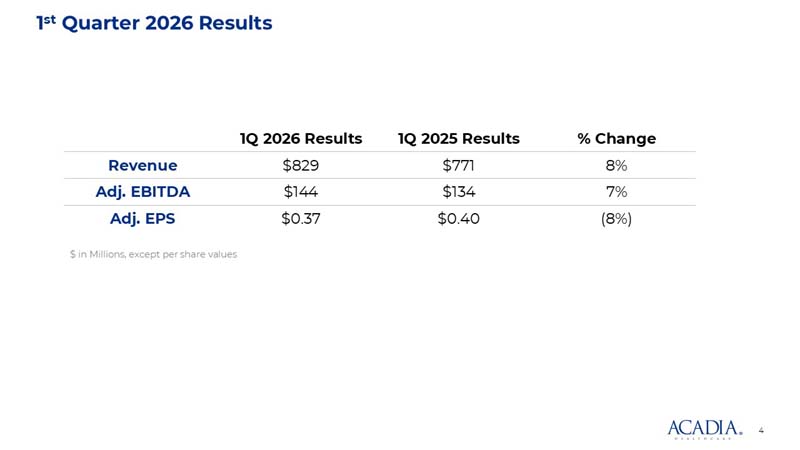
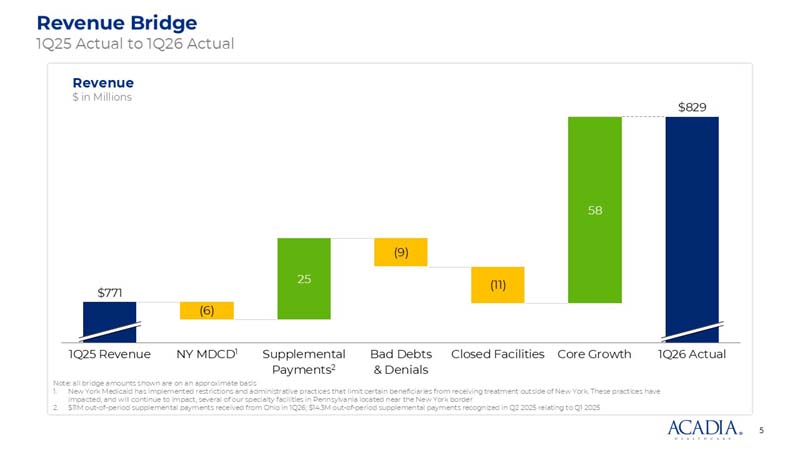
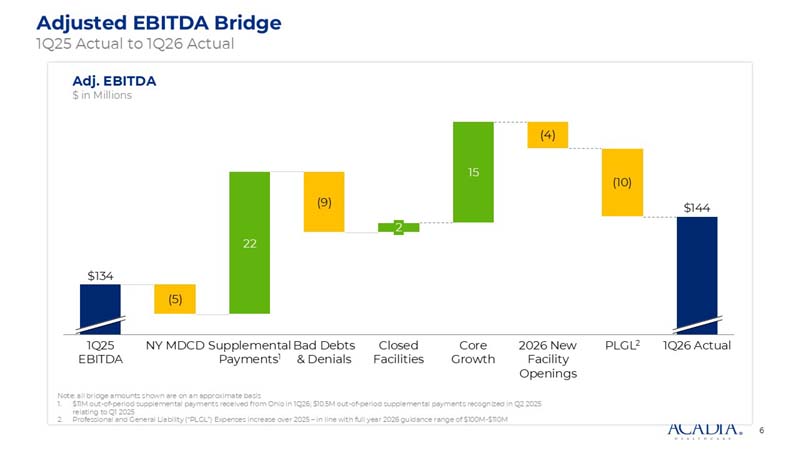
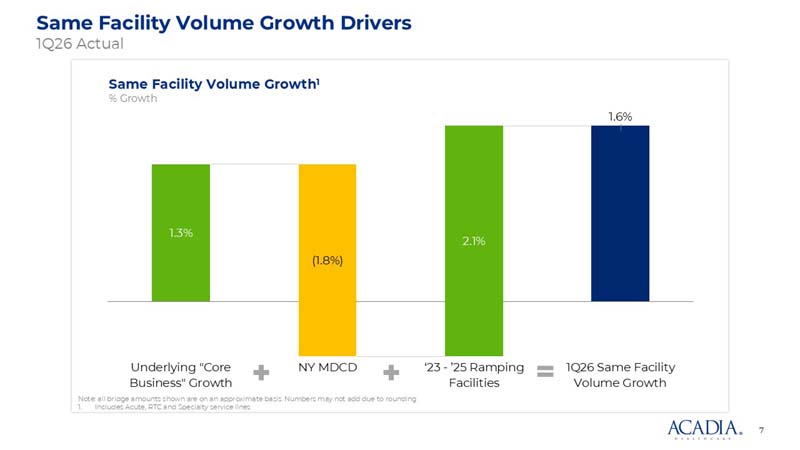
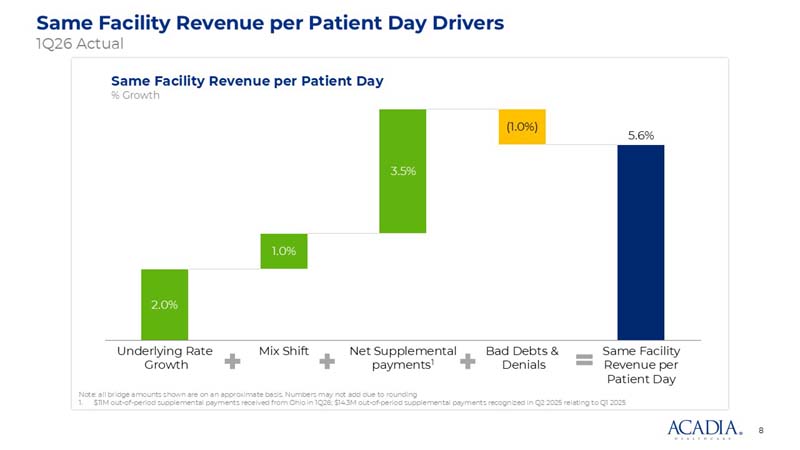
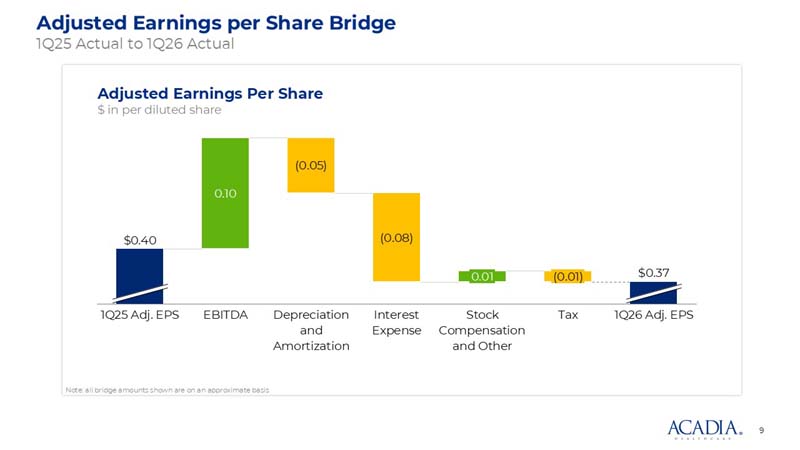
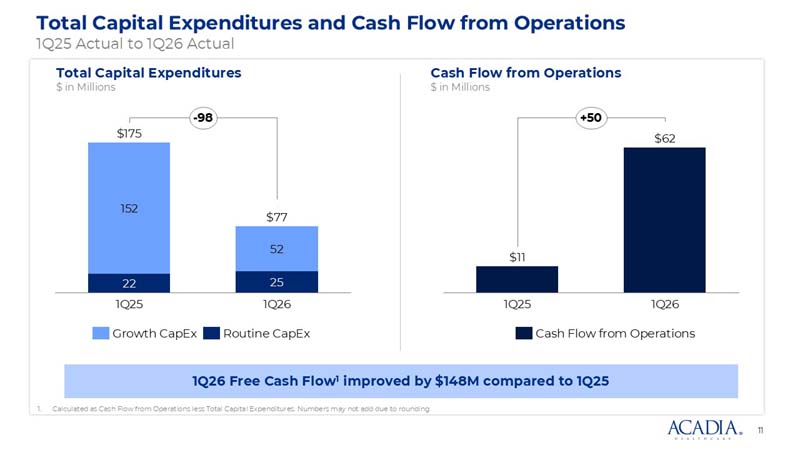
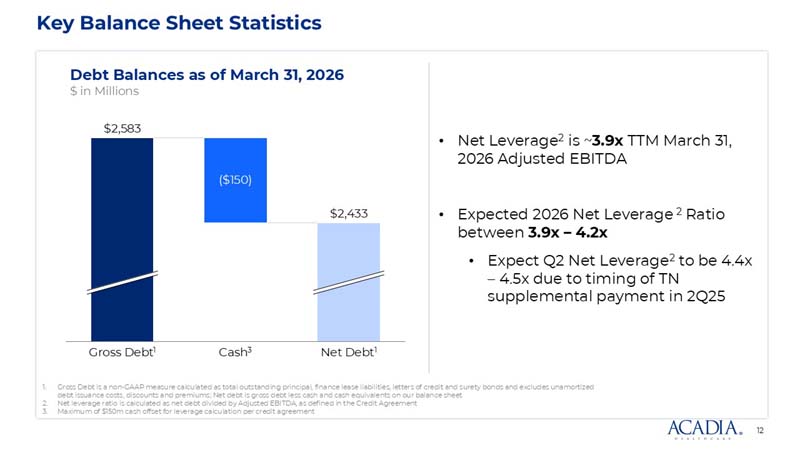
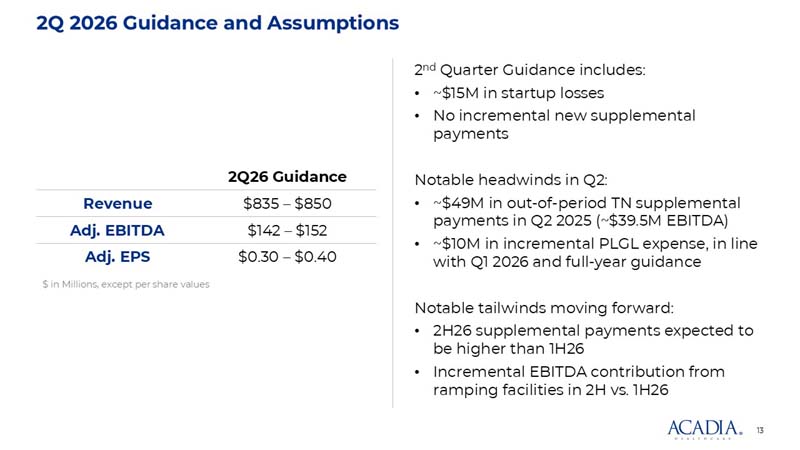
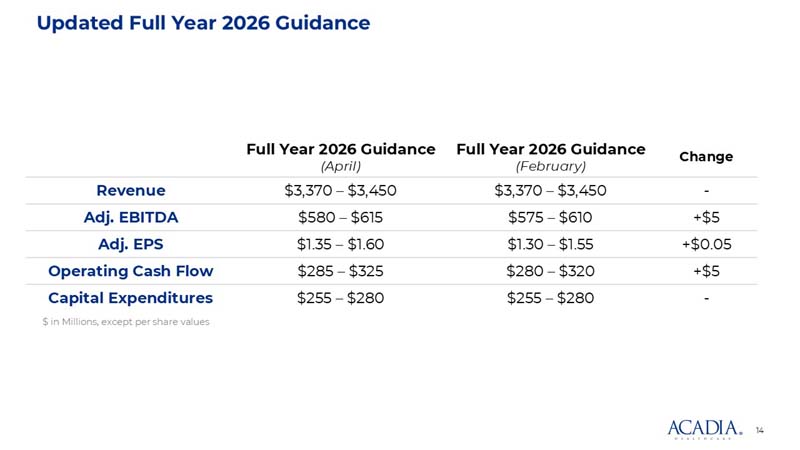
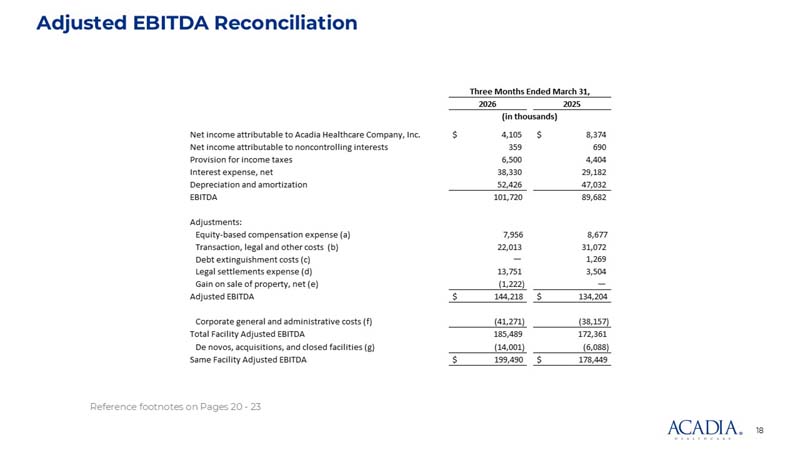
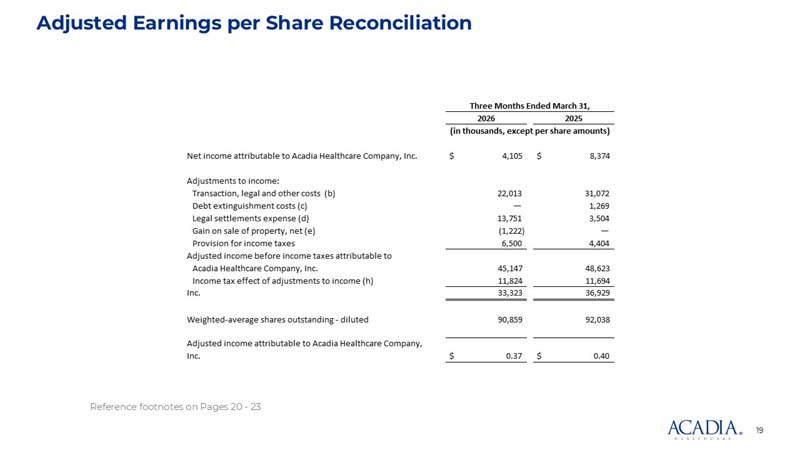
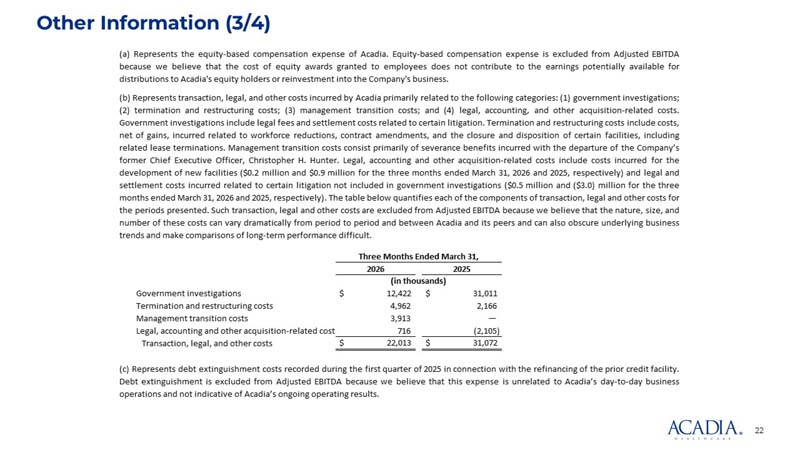
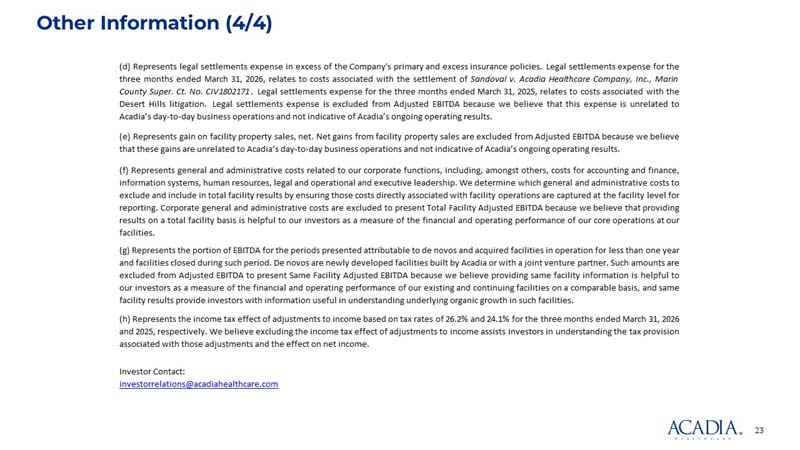
Thanks, Debbie. Turning to our first quarter results, we reported revenue of $828.8 million, representing a 7.6% increase over the first quarter of last year. Same facility revenue grew 7.3% year-over-year, driven by a 5.6% increase in revenue per patient day and a 1.6% increase in patient days. Our Q1 revenue growth was driven by our acute and RTC businesses, which grew 14.2% and 6.3% respectively. Acute performance was driven by increased patient volumes. In addition, we benefited from supplemental payments in line with the Q1 guidance we provided in February from Ohio and Tennessee that were not in our first quarter results last year. We were also pleased with the performance of our specialty business as it mitigated a portion of the expected volume losses in Pennsylvania from New York's decision to not provide care for their residents in our Pennsylvania facilities. We continue to be very focused on diversifying our referral base to surrounding states and Pennsylvania. The decline in our specialty facility revenue of 6.5% was driven by the previously discussed challenges in Pennsylvania and from closing specialty facilities in 2025. The closures created nearly a 6% headwind to growth. Our CTC revenue grew 2.5% compared to the first quarter of 2025, but it slowed sequentially as it was negatively impacted by the severe winter weather we called out on our Q4 2025 earnings call in February. The weather negatively impacted our total adjusted EBITDA in Q1 by $3.7 million, in line with the Q1 guidance we provided in February. Adjusted EBITDA for the quarter was $144.2 million, or 7.5% growth over Q1 2025 and 7.2 million above the high end of our Q1 guidance. Our adjusted EBITDA performance relative to our guidance was driven by strong performance across our acute facilities, including, as Debbie mentioned, outperformance from our new facilities open since 2023. We also delivered better than planned cost efficiencies at both corporate and at our facilities. We did have a $3.2 million dollar benefit related to employee benefit costs that we expect will reverse in the back half of 2026. Our losses from startup facilities were $12 million, $2 million better than our $14 million forecast, primarily from operating efficiency improvements. We had $3 million in net operating costs associated with closed facilities. On the same facility basis, adjusted EBITDA was $199.5 million in the first quarter. From a balance sheet perspective, we remain in a solid financial position. As of March 31, 2026, we had $158 million in cash and cash equivalents and approximately $565 million available under our $1 billion revolving credit facility. Our net leverage ratio stood at approximately 3.9 times adjusted EBITDA. With operating cash flow of $62 million, and CapEx investments up $77 million in the first quarter, our free cash flow was a negative $15 million. Our free cash flow improved $148 million compared to Q1 of 2025. As we previously noted, we expect our total CapEx in 2026 to be between $255 to $280 million, with the second half of the year being lower than the first half as we opened our three new JV facilities in the first half of the year. We continued to expect positive free cash flow in 2026. We also collected $16 million in cash from the sale of three closed facilities. Moving to development activity, during the first quarter, we added 82 beds while closing 251 beds. The closures primarily related to two lease facilities in Pennsylvania and two other facilities that had been announced in 2025. Looking forward to 2026, as Debbie noted, we expect to add between 400 and 600 new beds, primarily through the opening of new facilities nearing completion. While we typically do not provide financial guidance for the second quarter, given the substantial out-of-period supplemental payments received from the state of Tennessee in the second quarter of 2025, we are choosing to do so this year to provide clarity to the investment community. In Q2, we expect to deliver revenue between $835 and $850 million, adjusted EBITDA of $142 and $152 million, and adjusted EPS of $0.30 to $0.40. For the full year, our revenue guidance of $3.37 billion to $3.45 billion remains unchanged. While we expect to do better in mitigating our specialty headwinds in Pennsylvania, this improvement is expected to be offset by modestly higher-than-expected levels of bad debts and denials. With respect to our full-year expectations for adjusted EBITDA, we are increasing the range from $575 million to $610 million to $580 million to $615 million. For adjusted EPS, we are increasing our range from $1.30 to $1.55 to $1.35 to $1.60. I want to note that given the significant EBITDA earned in Q2 of 2025 from the Tennessee Supplemental Plan, our 12-month rolling adjusted EBITDA is expected to be between $559 million and $569 million. As a result, our net leverage will be approximately 4.4 to 4.5 times at the end of Q2. We expect this higher leverage to be temporary as we expect to end the year in the 3.9 to 4.2 times range we guided to in February. Our team continues to focus on supplemental payment programs that we are confident will be approved in 2026, but we have not included any unapproved programs in our guidance. We continue to estimate that certain programs currently under regulatory review could add at least $22 million in incremental EBITDA to our guidance if they receive approval this Based on the latest insights regarding Florida's plan, the $22 million may be conservative. I will now turn the call back over to Debbie for closing remarks.
I want to end our prepared remarks by thanking Todd for his contributions to Acadia, and I wish him well in his next chapter. I'm proud of the important work we are doing across Acadia to address a critical need in our nation. For 2026, our strategic priorities are aligned to improve our financial and operating performance through consistent execution. We are well positioned to apply our scale and expertise to help set the standards for care that address the escalating demand for behavioral health and substance use treatment. We will continue to strengthen our capabilities with discipline, deliver the highest quality patient care, and create value for our shareholders. With that, we are ready to answer your questions.
Operator
We will now begin the question and answer session. To ask a question, you may press star then 1 on your touch-tone phone. If you are using a speakerphone, please pick up your handset before pressing the keys. If at any time your question has been addressed and you would like to withdraw your question, please press star, then two. Please limit yourself to one question and one follow-up. At this time, we will pause momentarily to assemble our roster. Our first question comes from Whit Mayo with Leerink Partners. Please go ahead.
Thanks. Good morning. Debbie, I was hoping that you could elaborate more on the correction plans that you have in place for the underperforming de novos. I hear the organizational changes, the standardization efforts. It just might be helpful to hear more about the specifics on what the action plan is.
Well, good morning, Whit. We have specific plans, as I mentioned, and they really focus on continued ramping of occupancy into the facility. They focus on access with our partner to make sure that we have communication in place. They also focus on service lines that we might do in each facility. So in other words, what services, what are the timelines, do we need, you know, CON approval, do we need other licensure for them. And what we've tried to do is we've been working with our partners to make sure we're aligned with them on these plans. You know, we entered this with them to meet a need they had, and each plan is really tailored to the partner, but also to the market and to the facility, and perhaps in some cases the unique features that we see in some of the states.
Okay, that's helpful. And maybe just on the payer denials, just maybe a little bit more color on that, what's new in terms of payer behavior? Sounds like that's factored in the full year guide. and maybe just how much of the increase in AR days is influenced by that or is something else going on?
Thanks for that question, Whit. Yeah, we thought bad deaths and denials had started to stabilize in Q4, but then they continued to get a little bit worse in Q1 than what we had previously expected. We do have good game plans in place to make sure we're doing everything to advocate for our patients and to improve on overall collections. We're having good responses, but they are running a little hotter than what we had expected them to. And so we've reflected that in the full-year expectations. That being said, there is a lot of focus at our facility level with the finance ops teams on revenue cycle management and doing our best to make that less than what we've currently forecasted.
And I'll just add to that, we are looking at our process and where the improvements can be. We're using tools to enhance what we're doing with respect to documentation, making sure we're in compliance with that. We are appealing denials, as Todd was mentioning. And we've also brought back Larry Herod on a temporary consulting basis. He, as some of you may know, worked with Acadia and retired, but he did an excellent job during my last tenure with just this area. And so he's come in, and he's evaluating where and what we need to improve. And, you know, I think it's fair to say we have a lot of opportunity.
Maybe just one clarification. Was this one specific type of payer? Was it managed Medicaid, something else broad-based, just maybe a little bit more detail, thanks.
It's more broad-based. I wouldn't say there's any one specific area. So, you know, that's why we're taking advantage of it across the entire enterprise.
Operator
Our next question comes from Matthew Gilmore with KeyBank. Please go ahead.
Hey, thanks for the question. I wanted to ask about the seasonality with EBITDA implied in the guide. It seemed pretty typical versus historical, at least the way we were looking at it. I appreciate in the deck you caught out the Medicaid supplementals being higher in the back half, and then you've also got the impact from the ramping facilities. How are you thinking about the seasonality? Are we correct that it's pretty normal? And then can you help size the EBITDA contribution from the Medicaid supplementals and the ramping facilities as we think about the back half EBITDA?
Yeah, Matthew, thanks for the question. I mean, overall, you know, we feel great on how we've started the year and the performance on the EBITDA and our ability based off a good Q1 to increase our full year expectations. We've tried to be very clear on the cadence with the guidance, just given how volatile the quarterly results were in 2025 that creates some noise into that seasonality. But fundamentally, what we said at the start of the year and what's driving the back half now is the same thing. It's what you just called out. It's slightly higher supplementals in the back half on a run rate basis, just sort of the core embedded supplementals we have in our business. It's then the ramping facilities. As we noted, Q1 was better than we expected on the 23 to 25 cohorts. And so that continues to have a bigger incremental year-over-year contribution in the back half. So those are the big drivers. Plus, as Debbie mentioned in the prepared remarks, we have done a number of different cost programs and cost efficiencies at the end of Q1 that we think also provides benefits over the course of the year.
And then as a follow-up, on the New York Medicaid issue, it seems like you're obviously doing better there than you thought. I wanted to see if you could provide some details in terms of how you're backfilling the capacity with those Pennsylvania facilities.
Yeah, I'll take that. We have a very active business development team that is working with referral sources in surrounding states. And one of the states is New Jersey. Certainly, you know, we also have been working with referral sources in Maryland, but we've also seen an increase in Pennsylvania referral sources. So it's a very concentrated effort to try and refill these beds. And I will say we're also still focused on working with New York to see if we can reopen those referrals. We're not at any place right now to talk any more about it because it's a process, but we are in conversation with them. And our referral sources there, I think, have really benefited from having these facilities. So we're focusing and working with those referral sources in New York as well.
Operator
Our next question will be from Pito Chickering with Deutsche Bank. Please go ahead.
Hey, good morning, guys, and thanks for taking my questions. Two questions here, I guess. One more on bed debts and denials. Are the payers pushing back on things like the stay or the actual coverage once they've been admitted? And is that why the admission guidance was increased but the patient days were left unchanged?
So overall, the length of stay change we're seeing across the enterprise is more a math exercise, Peto, than it is anything changing in the business. We closed four specialty facilities last year, plus we now have the challenges on specialty in Pennsylvania. Those are all just longer average length of stays on average than acute. At the same time, we've been bringing a lot of new acute beds into our business over the last year, and that's continuing here in Q1 with the opening of Tufts, and it'll continue in Q2 with the opening of Orlando Health and Methodist Jenny Edmondson. And so it's really just a math exercise of specialty beds being down, acute beds being up, and those length of stays then working through as we've presented. And as you'd guess, right, shorter length of staying acute with more beds there, admissions are going to be higher while the length of stay of those patients is lower. Perfect.
And then, you know, one more follow-up on Matt's question. Can you actually quantify how much more supplemental payments we'll get in the back half of the year versus the first half of the year? Can you sort of quantify actually how the ramping facilities should be growing in the back half of the year versus the first half of the year? And are there other things that you put in our bridge, like the benefit costs for reversing? So any way of quantifying the first half, back half of the year?
You know, overall, Peto, I mean, it isn't a massive acceleration in the back half, given what we've guided to here for the first half on EBITDA. And so, you know, there's a lot of moving parts in our business, as you know. But right now, we're calling out, you know, slight increase in, you know, supplementals, you know, high single digits, low double digits, not, you know, a $30 million sort of thing. And then, as you can imagine, we're really excited about what we're seeing and the progress on the ramping facilities, those open from 23 to 25. They overachieved our expectations in Q1, and so that will be the other contributors. There's also our startup facility losses. They sort of peak here in Q2, and those get better in the back half as well. So there's a lot of good things happening in the business that will help drive that small increase in second half, EBITDA versus first half.
Operator
Our next question comes from Ben Hendricks with RBC Capital Markets. Please go ahead.
Thank you very much. I just wanted to dig into the acute operational restructure a little bit more, specifically around the referral efforts across the acute platform. I just wanted to get an idea of what inning we're in in terms of the referral network enhancements that you're trying to put through there, and how should we think about the magnitude and timing of what you're trying to achieve in acute.
Ben, the referral sources are really critical, as you know, to our business, and we've always had good, strong relationships with them. Really, and I mentioned this in the prepared remarks, through all of our service lines, what we're really focused on, though, is making sure that they're seeing our outcomes, making sure that we make it, you know, our access. We're not putting up barriers for them to refer. We are in communication with them about what services they believe their patients may need. And so there's a very strong team that works with our referral sources. In specialty, they are called treatment placement specialists, and they work with referral sources. We have a team in acute, that service line, as well as our RTC. So each service line has a group that's really in communication, but then we're also making sure they see what we're accomplishing with the patient. And as we have more outcome data, which we started to put on our website, we believe that we will be confirming really what is of most interest to them, and that is their patient gets better in our care. Thank you. Thank you.
Operator
Our next question comes from Brian. Tinky with Jeffries. Please go ahead.
Hey, good morning, and congrats on a good quarter. Maybe, Debbie, as I think about, you know, you've called out some of the changes you've made to leadership. Just curious how you're thinking about the operational or organizational structure where you've had a few months here now in terms of where there are opportunities to either reduce some of that infrastructure or some of the positions there that have been added over time. Just thinking through the GNA opportunity here and where else we can see some areas of improvement as you bring the band back, so to speak.
Well, Brian, we have taken a very hard look at our corporate overhead, who is in place, what's needed now by the facilities. And as you alluded to, there is a middle layer of management that I was able to see that had been added. And as we dialogued with the field and those that are using this support, there were decisions made to eliminate some of that middle layer. We think it's going to speed up decision making. we think it's going to align better with where we see us going, and that is to provide this excellent patient care, but also to improve our performance. So we've made changes there. As far as the structure around operations, as I mentioned in the prepared remarks, we reduced the number of facilities and also the geography that our division leaders were traveling to. And we have tried to make it more manageable so that they can focus more intently on what are the issues, what do we need to do to problem solve, and also to build and to grow, especially with the new facilities. And as I thought about it, and I think had, you know, a lot of support here at the corporate office, there are a lot of common themes with our JVs. They're all different, and they're in different markets, but they're things that are, you know, are common. So as I looked at it, I made the decision that we should align them under a person who, you know, can learn and to take those best practices from one JV to another and also to improve the ramping of those because we've added those beds primarily around the JVs. And I think that it's been embraced by the team. Everyone has been very positive about the changes, and I think they feel like their oversight is more manageable. And I think we're going to see the fruits of that as the year goes by.
Operator
Our next question comes from Andrew Mock with Barclays. Please go ahead.
Haley, go on to the next caller, and we'll see if we can get Andrew later in the queue.
Operator
All right. The next question comes from Ryan Langston with TD Cowan. Please go ahead.
Hi, good morning. Todd, thanks for all the help. Best of luck at NVA. Thanks, Ryan. Maybe just one more on the bad debt. I heard you talk about, you know, improving documentation processes internally. I guess, are those issues that you've identified, can you fix those in the short term, or is that more of sort of a longer-term process to improve?
I mean, Ryan, I'll start and then talk and add. I think that, you know, documentation is the key to what we do, making sure that what we are offering and doing for the patient is in the medical record. And I think there's always room for improvement, but in this case, we have seen in our processes that have been evaluated that there are areas where we think we could better reflect the acuity. And we want to make sure that we are covering everything that our payer needs to see. We're very firmly in belief that the patient that is in our facility needs that level of care. and we want to make sure that that's reflected in the record. And so I think the effort has been ongoing for some time, but we've really escalated that. And we're also using tools in some of our facilities to really create more visibility around that. And we're using in very early stages of incorporating AI into our revenue cycle management. and we are using that to analyze our data and also we're looking at other products for that. But we think we can streamline some. But again, back to the key is the documentation that needs to be present. We also, as a patient, you know, comes into our hospitals, we want to make sure that we are first providing active treatment but then documenting that. And so that's been the view that we've been taking is just are we reflecting that and is there a way to improve it?
Operator
Thank you. Our next question comes from John Ransom with RJS. Please go ahead.
Hey, good morning and good luck, Todd. The legacy management team talked about the fallout from the negative press on the specialty referrals just given people do Google searches and bad stuff pops up potentially. I mean, just given the results, are we finally kind of beyond that effect?
Yes, we are, John. And we actually saw some very strong performance at some of our specialty programs that pull patients from around the country. Our commercial payer mix is up, and I think that team is doing very well. We have outstanding facilities, and I was very pleased to see the results and some of the specialty facilities that pull from around the country. Yep.
And look, was there also, I think you mentioned, and I may be hallucinating, but didn't you also mention that maybe the emphasis historically got a little too B2C and you had some commercial relationships that needed to be reestablished. Am I remembering that right, or am I just making this up, which I do frequently, Debbie?
I don't think you're making it up, John. I think that we had shifted our focus away from commercial. I'm not saying that we weren't still looking at it, but we've really strengthened that, and we've added to our TPS team. And, again, those relationships have, in my mind and what I've seen here, are very strong. But we've tried to do even more with really communicating why we're different, because there is competition for those patients that travel. And I think the team is doing a very good job in making sure they understand what we're offering at our facilities.
Great. And just lastly, you know, I think quality sometimes is a bit nebulous in behavioral health, but what, if you were to grab somebody for an elevator pitch and say that these are the three or four metrics that we really focus on and we think, and of course there's the absence of industry benchmarking, but what are you doing and what sort of metrics on the acute side are you driving home to payers to say, here's why we're different and better in the absence of a robust industry data set?
Well, the first area is patient satisfaction. You know, what is their experience in our facilities? The second would be, are they coming in with, you know, as they come into our hospitals, are they leaving with an improved condition? And so we have measurement tools around that, and we're making sure that we use those tools to measure improvement. And I'm pleased to say that, you know, as I look at those measures, that they are very, very positive. What we are doing now is really making sure we can do that across all our service lines, not just acute, but with specialty as well. But I think the improvement, and then obviously our payers use a readmission metric, and I think, you know, we measure that too. You know, have they had to come back for care? What period of time? So all of that goes into looking at what are we doing for the patient and what are the outcomes that we're achieving. Great. Thank you, John.
Operator
Again, if you have a question, please press star, then one. Our next question comes from Joanna Jagook with Bank of America. Please go ahead.
Hey, thanks. This is Joaquin Ergata on for Joanna Gadget. I just wanted to ask, could you give us an update on labor? How does wage growth, hiring trends, and how has retention been?
Sure, Joaquin. Things were good. Overall, for the eighth consecutive quarter, our retention of our team improved. So that's just a huge value prop from just a training, from a disruption basis, all of that. So really pleased with what our teams are doing at the local facility levels to improve on retention overall. So, you know, on the same facility basis, we were up 3.7%, but, you know, even better on a patient per day basis, it was 2% again, which was the same as it was in Q4. So overall, I think the team's doing a really good job of managing that. I think you heard some of that in Debbie's prepared remarks with regard to, you know, less premium pay, less inefficiencies in when staffing is happening. And the team and our nursing team overall has done some really good training to just improve that, to help facilities understand how to manage the labor better while not sacrificing anything on quality compliance or patient care. So feeling very good about how that's trended. Obviously, overall numbers are up as we open new facilities, and that just improves over time as we fill the beds and occupy more. Great. Thanks.
And I just wanted to touch up on your AI comment earlier. So what are your guys' future plans, and how are you looking about that to implement it further in the future? Thanks.
We're looking at different tools. We're doing some prediction of care just to have a better understanding of different risks. We're looking at it with inside our electronic medical record systems to use those and doing pilots before we roll it out in total. But overall, we're very attuned to the changing environment that we're all living in and making sure we're not caught off guard by something that we're missing. Really strong, you know, IT team that's digging in here and providing us tools to get better. Thank you.
Operator
Our next question comes from Andrew Mock with Barclays. Please go ahead.
Hi, good morning. Wanted to follow up on the strong same-store admissions. I think they were up 6.5% in the quarter. One, can you elaborate on the drivers of the acceleration there, and do you think that's a leading indicator for patient day growth? And then secondly, startup losses are still tracking around $15 million per quarter. When should we see that number start to diminish?
Let me take the second question first. So it was $12 million in Q1, $2 million better than we expected. We pulled down our full-year guidance to reflect that two at the top. So now we expect $47 million to $51 million. We've said we expect $15 million in Q2. That's likely the high end of the number, Andrew, for the year from a quarterly standpoint. So, again, progress on those fronts on that. From an admissions standpoint, again, you know, a lot of this is new acute beds coming on and those ramping of those new facilities. You know, because the length of stay in acute is shorter, admissions are, you know, higher on that. And then, you know, again, as we mentioned on an earlier answer, a lot of the average length of stay change we're seeing is really a mix. As we closed specialty facilities last year, we've got the challenges in Pennsylvania. those were longer lengths of stay that are coming out of the number while we're adding in acute beds with shorter length of stays into the numbers. So, you know, overall, you know, we feel good about the referral network, as Debbie talked about, driving those admissions into acute. And so, again, a lot of good forward momentum here that the business has in progress on, you know, filling up our beds in our new acute facilities.
And I'll just add to that. Our inquiries for acute were up over 20% in the first quarter. Our RTC census was very, very strong. And we also, as I mentioned earlier, had very strong performance in some of our specialty facilities that attract from all over the country. We've made some changes in our marketing approach, and we're looking at our spend on Google, which is a generator of patients in some of our service lines. And I think that, you know, the team is just very, very focused on making sure they understand the referral sources. We're using some tools to bring in new referral sources, so not just taking what we have now, but targeting, you know, individual practices and others that we think could be a referral source for patients. And all of those things are working together to, I think, create the strong volume. Demand is continuing to be strong, and there are individuals that are seeking care, and we have not seen that reduced. We've actually seen it strengthened, and that's contributed to some of our results in the admission area.
Bailey, any more questions in the queue?
Operator
There are no more questions. this concludes our question-and-answer session. I would like to turn the conference back over to Debbie Osteen for any closing remarks.
I just want to end by thanking all of our employees and the corporate staff for their dedication and their hard work to ensure that our patients receive excellent care. I thank you all for being with us this morning and for your interest in Acadia Healthcare. and have a great day.
Operator
The conference is now concluded. Thank you for attending today's presentation. You may now disconnect.