Operator
Good morning, ladies and gentlemen. And welcome to the Alaska Air Group 2024 Fourth Quarter Earnings Call. At this time, all participants have been placed on mute to prevent background noise. Today’s call is being recorded and will be accessible for future playback at alaskaair.com. After our speaker’s remarks, we will conduct a question-and-answer session for our analysts. I would now like to turn the call over to Alaska Air Group’s Vice President of Finance, Planning and Investor Relations, Ryan St. John.
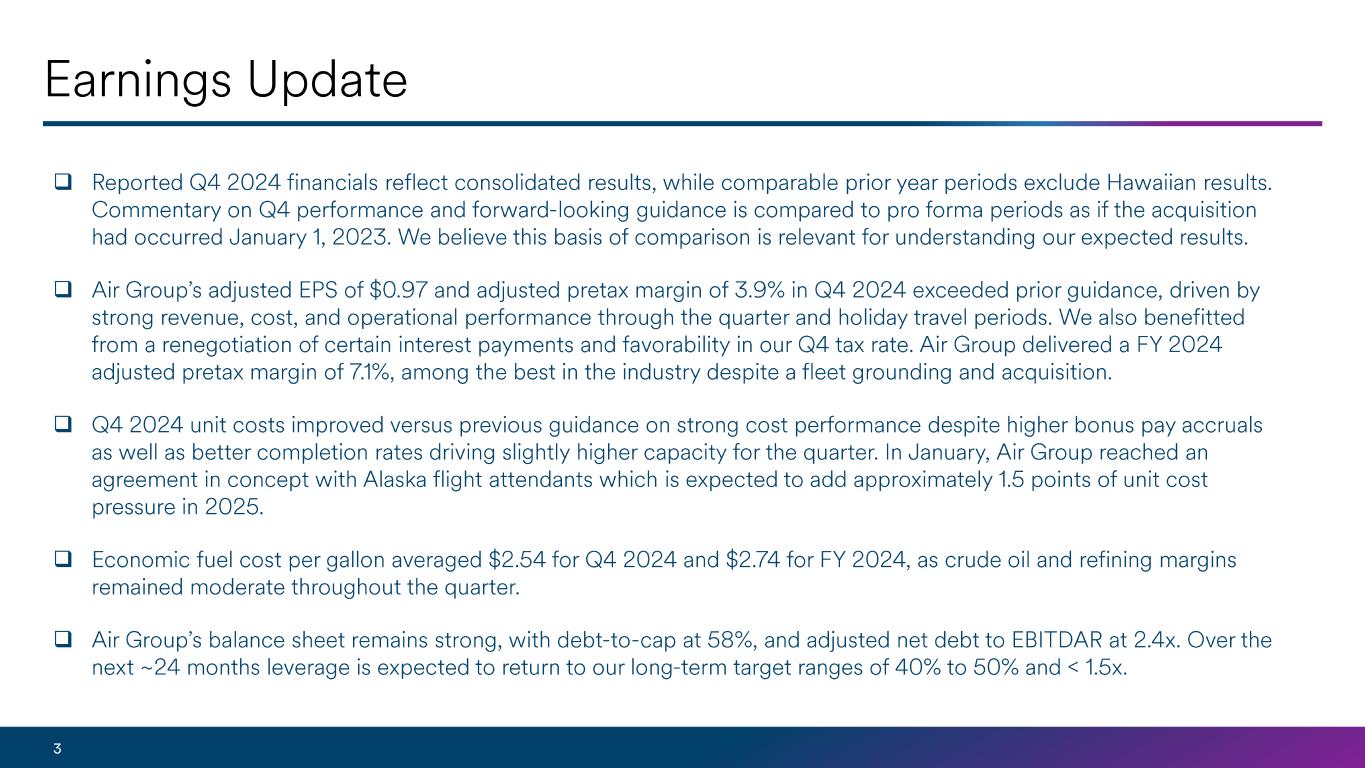
Thank you, Operator, and good morning. Thank you for joining us for our fourth quarter 2024 earnings call. Yesterday, we issued our earnings release along with several accompanying slides detailing our results, which are available at investor.alaskaair.com. On today’s call, you’ll hear updates from Ben, Andrew and Shane. Several others of our management team are also on the line to answer your questions during the Q&A portion of the call. This morning, Air Group reported fourth quarter and full year GAAP net income of $71 million and $395 million, respectively. Excluding special items and mark-to-market fuel hedge adjustments, Air Group reported adjusted net income of $125 million and $625 million. Our comments today will include discussion of Air Group reported results inclusive of Hawaiian Airlines since the closing of the acquisition on September 18th. Fourth quarter and forward-looking guidance are compared to prior year pro forma results as if Alaska and Hawaiian were a combined company for the full periods referenced. Lastly, as a reminder, forward-looking statements about future performance may differ materially from our actual results. Information on risk factors that could affect our business can be found within our SEC filings. We will also refer to certain non-GAAP financial measures such as adjusted earnings and unit cost excluding fuel. And as usual, we have provided a reconciliation between the most directly comparable GAAP and non-GAAP measures in today’s earnings release. Over to you, Ben.
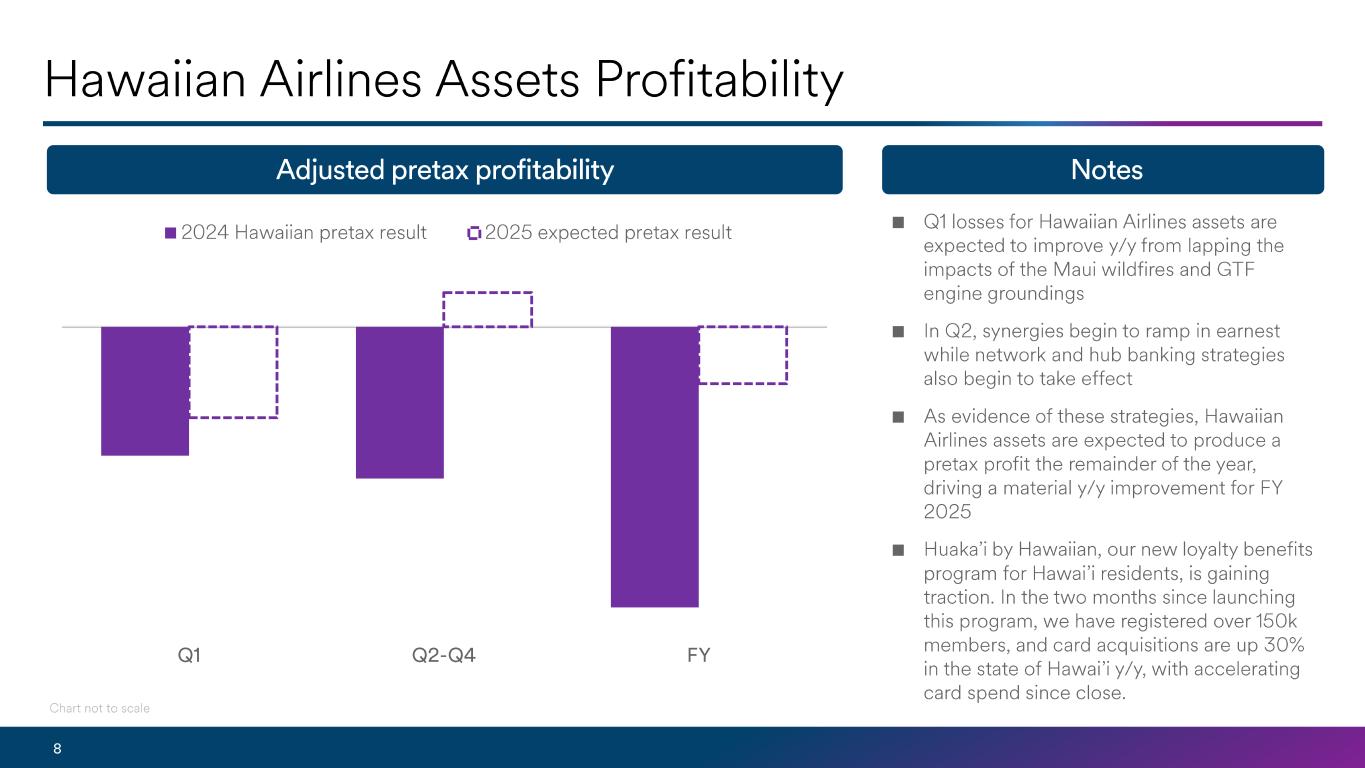
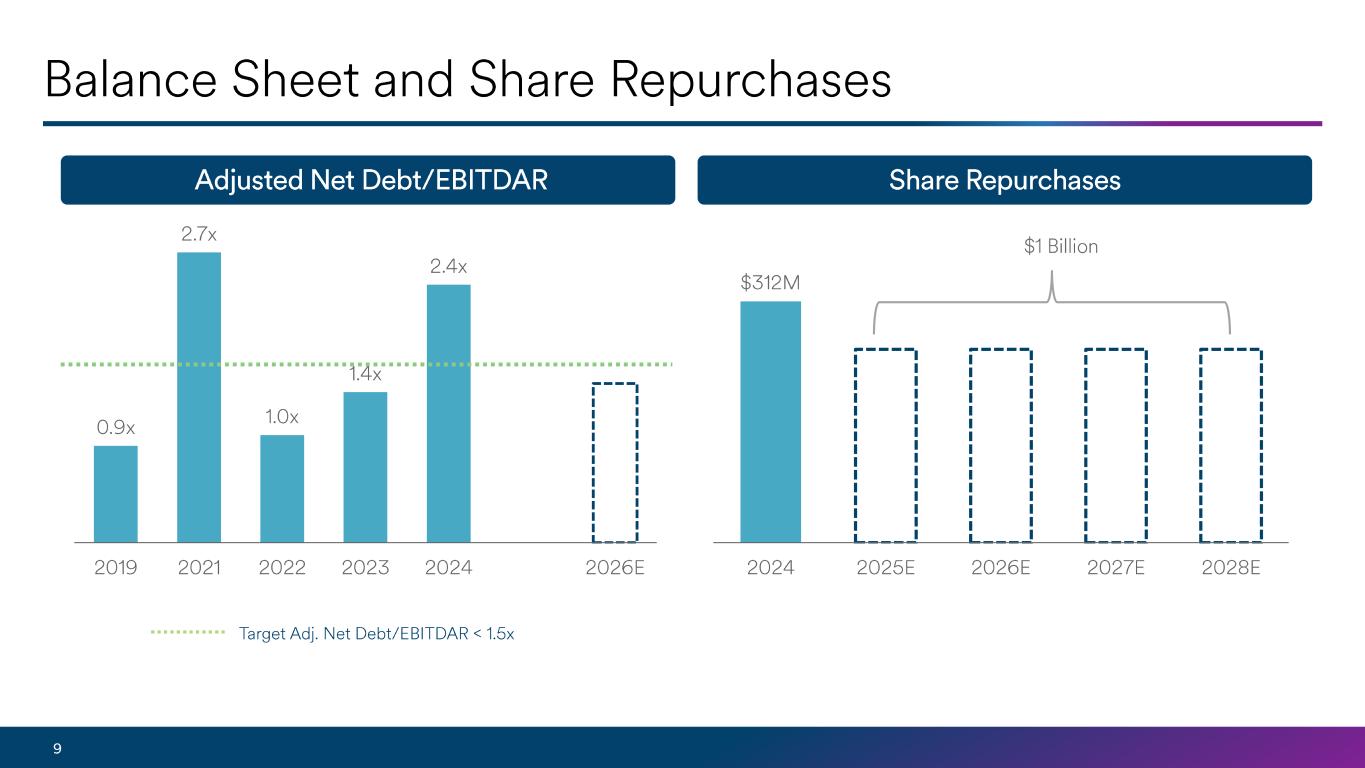
Thanks, Ryan, and good morning, everyone. Just six weeks ago, we shared our strategic plan, Alaska Accelerate, during our Investor Day. This plan is focused on driving scale, relevance and loyalty by connecting our guests to the world through remarkable travel experiences rooted in safety, care and performance. With a clear vision and a strong path forward, we closed out the year with growing momentum and that momentum has only grown stronger since. We’re picking up right where we left off at Investor Day, excited to share our strong results. For the fourth quarter, we delivered an adjusted EPS of $0.97, and for the full year 2024, $4.87, both exceeding our guidance. We reported a full year adjusted pre-tax margin of 7.1% and had it not been for the four-week 737 MAX grounding, Legacy Air Group would have posted the best margin in the industry. To cap off the year, we aggressively repurchased $248 million in shares during December, bringing full year repurchases to over $300 million and fully exhausting our existing program. In January, we launched our newly authorized $1 billion share repurchase program and will continue to leverage repurchases to underscore our confidence in our business. Before diving further into our business update, I want to take a moment to reflect on the pivotal year we had in 2024. Just a year ago, following Flight 1282, a third of our Alaska fleet was grounded, operations were severely disrupted and uncertainty loomed. Yet, our teams rose to the challenge with an unwavering commitment to safety and restored Air Group to the safe, reliable operation we’re known and trusted for. I want to extend a heartfelt thank you to all our employees for their dedication in helping us deliver another strong year. Their commitment to excellence, care and service sets us apart. I’m excited to announce that, due to Legacy Air Group’s outstanding financial performance, Alaska and Horizon employees will receive a record bonus payout this year. We expect to distribute over $300 million, equivalent to six weeks of pay. This is the largest payout in our history and we believe the highest in the industry. Investing in our people and our culture is important, and we hope to have our Hawaiian employees participate in this plan in 2025. In addition, we couldn’t be happier that we reached an agreement in concept with Alaska Airlines flight attendants earlier this month, and we look forward to beginning the joint collective bargaining process with all our unions this year. 2024 was a defining year in which we embarked on the most exciting transformation in our company’s proud history. The most significant and foundational piece of that strategy was closing our acquisition of Hawaiian Airlines in September. This combination strengthens Air Group with several key strategic assets, including a leading position in a top 25 U.S. hub, an incredibly valuable brand, a mix of widebody and narrowbody aircraft, and a legacy of operational reliability and exceptional customer service. Moving to 2025, our work now is geared towards delivering on Alaska Accelerate, our vision for the future and it’s off to a great start. The underlying trends in our core business are improving. Our Legacy Alaska assets are on track to deliver slightly positive profits in the first quarter despite the recent rise in fuel prices. Our Hawaiian assets outperformed expectations in the fourth quarter, and while we expect them to be unprofitable in Q1, from the second quarter on, we anticipate a small pre-tax profit as recent network changes take effect and synergies materialize. Over time, we aim to improve Q1 performance similar to the progress made with Alaska over the last two years. We are confidently shaping the future of our company, building on our strengths, enhancing our business model and elevating our competitive edge through a strategy centered on maximizing our proven approach as a larger company and unlocking new opportunities across our business. First, we’re leveraging the power of our combined network, which Andrew will share more on the benefits we’re already seeing. Our Seattle and Portland hub banking strategy is taking effect, and early data from the launch of our first Seattle to Tokyo international route is progressing as planned. This is helping us build our international gateway in Seattle while strengthening our relevance and loyalty across our West Coast hubs and beyond. Second, as Hawaii’s trusted airline, we’re capitalizing on the combined strength of both networks, oneworld, a powerful loyalty program and the Hawaiian brand to become the airline of choice for both domestic and international flights in Hawaii. Third, we’re focused on meeting all our guests’ needs, including expanding our premium products and experiences at every phase of the travel journey. And lastly, diversifying our business, including growing our cargo business through the combination of Alaska and Hawaiian. Combined with a constructive industry environment, my confidence in our plan and our ability to deliver results has only strengthened. This includes our EPS target of more than $5.75 and no margin dilution in 2025. Additionally, we’re set to unlock a $1 billion in incremental pre-tax profit over the next three years through a combination of commercial initiatives and at least $500 million of synergies. Integration is progressing as planned, with the goal of achieving a single operating certificate by the end of 2025, followed by the transition to a unified reservation system shortly thereafter. As we shared at our Investor Day, this is just the beginning. Our track record and future potential reaffirm our position as industry leaders, driven by clear strategies and the courage to take bold steps. And along the way, we’re delivering value to everyone who depends on us, our people, our guests, the communities we serve and our shareholders. And with that, I’ll turn it over to Andrew.
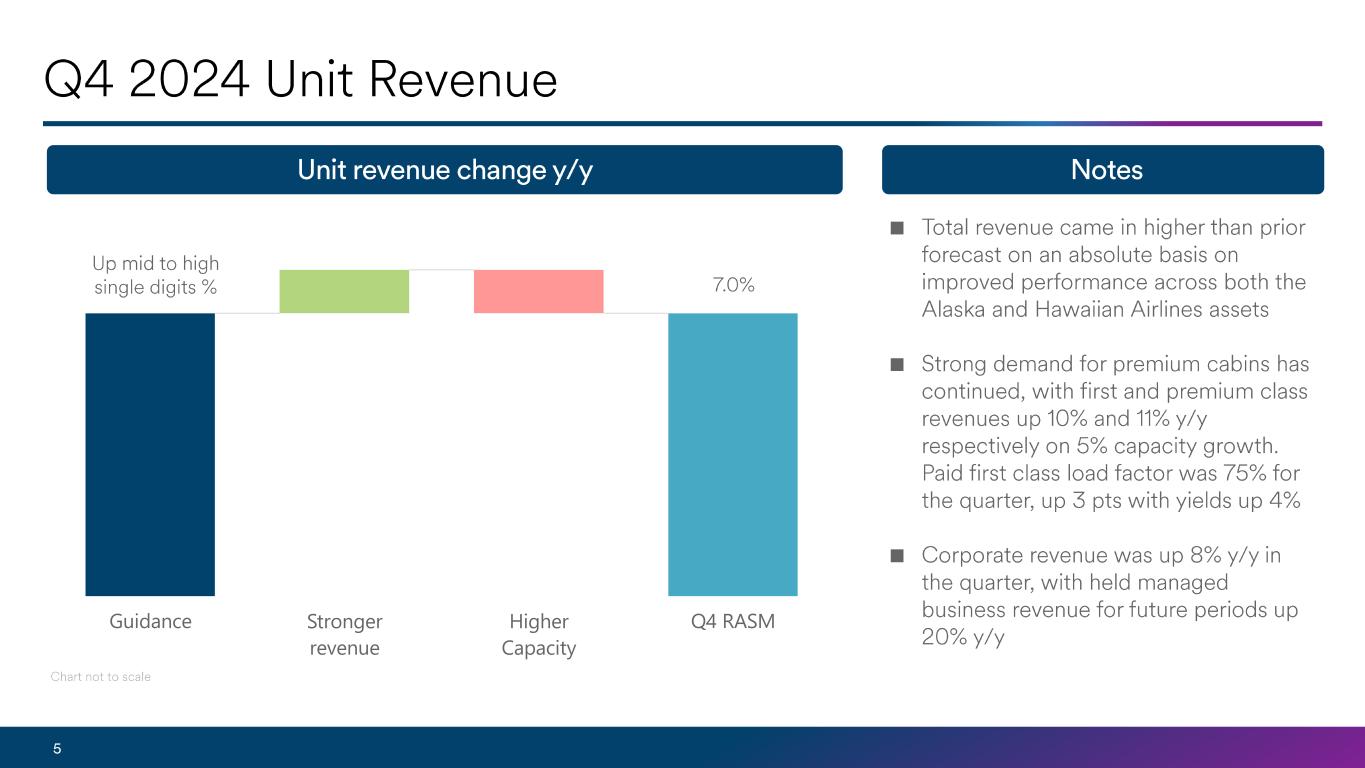
Thanks, Ben, and good morning, everyone. With the first full quarter, including Hawaiian, I’ll focus my discussion on the strength of our core business trends during the fourth quarter and where we are headed for the first quarter. Our business is transforming and I’m excited to share what we are seeing in our network along with the encouraging initial results on the strategy we laid out last month. That is delivering $800 million in profit through a combination of commercial initiatives and synergies over the next three years. In the fourth quarter, we achieved a record $3.5 billion in revenue, up nearly 10% year-over-year on limited capacity growth of 2.5%. This drove unit revenues up 7% year-over-year, continuing an improving sequential trend and up 6 points from Q3. December, in particular, exceeded expectations, driven by a combination of close-in strength from corporate demand, higher load factors and strong operational performance as we connected the Hawaiian and Alaska networks with codeshare. Regionally, areas of strength during Q4 included North America to Hawaii, which represents approximately a quarter of our capacity, and saw revenues grow 15% with unit revenues up 7%, and that’s without having fully connected our networks. Alaska and Latin America improved on better alignment, supply and demand, while neighbor islands showed marked improvement with unit revenues up double digits. We also continue to see strong demand for our premium cabins. First and Premium Class revenues were up 10% and 11% year-over-year, respectively, on 5% capacity. Paid First Class load factor was 75% for the quarter, up 3 points, with yields up 4%. For the full year, total Premium Cabin revenues increased by 10%, with unit revenue increases of 6%. Exceptional performance and we expect that premium products will continue to outperform our Main Cabin product in 2025. As a quick update on our Premium Class seat expansion for the 900ER and the MAX-9, 19 aircraft modifications have been completed to date and we’re on track to have 79 done and ready to fly during the busy summer schedule. Our loyalty programs generated $2.1 billion in cash remuneration in 2024, with exceptionally strong fourth quarter results from promotions, along with several exciting announcements we’ve made that continue to create more value and choice for our guests. Our new premium credit card, announced mid-December and launching this summer, has had strong initial demand across different geographies and demographics, giving us confidence in our trajectory to achieve our targets and expand our loyalty footprint outside of our current geographies of strength. Huaka’i by Hawaiian, our new loyalty benefits program for Hawaii residents, modeled after our successful Club 49 program in the State of Alaska also continues to gain traction. In the two months since launching this program, we’ve registered over 150,000 members and card acquisitions are up 30% in the State of Hawaii year-over-year, with accelerating card spend since close. And finally, Managed Corporate business travel has shown strength all year and really spiked in December, with revenues up 35%, helping drive overall fourth quarter corporate revenues up 8% year-over-year. As we’ve seen in prior quarters, the Technology and Professional Services sector led these increases, up 15% and 13%, respectively. For the full year, our Managed Corporate revenues were up 15%. We continue to see upside from several of our largest accounts, but as we discussed last month, an even greater opportunity for us will come from international business travel. And with the launch of our first international widebody service from Seattle to Tokyo Narita this May, we are eager to begin servicing this demand. Now, turning to our outlook, with continued leisure demand strength, healthy corporate travel demand and a constructive industry backdrop, we’re encouraged by the set-up as we head into 2025. We expect our capacity to be up approximately 2.5% to 3.5% in the first quarter, while industry capacity is expected to be stable, up approximately 1.5%. Our advanced bookings are shaping up well. Withheld managed business revenue up 20%, continuing to support close-in booking strength. In the first quarter, we expect unit revenues to be up high single digits. Our Legacy Alaska assets are building positive loads and yields year-over-year in January and February. And like trends in the fourth quarter, North America to Hawaii and neighbor islands are holding solid unit revenue increases year-over-year for January and February. International, namely international travel to Hawaii, is challenged as it has been for some time, although it remains in line with our expectations and we’re starting to see modest improvements given our network changes and synergy capture. As you’ll recall, the 2027 targets unveiled in our Alaska Accelerate Plan do not assume any material improvement in either neighbor island or Hawaiian international flying, with any recovery providing more upside for our business. The combined Alaska and Hawaiian network provide the foundation for significant revenue unlocks over the next few years. And while changes to our combined network begin in earnest this April, we’re already starting to see our network strategy materialize. Codesharing across the Legacy Alaska and Hawaiian networks began in December and represented double-digit percentages of operating carrier bookings for both Alaska and Hawaiian flights during the month, highlighting the power of selling our combined network through both platforms. The connectivity benefits of our hub banking strategy are also beginning to materialize. Our bank schedule in Seattle began in early January and our connecting passengers via Seattle are up nearly 20% in February with minimal displacement of our local traffic. We just loaded our bank to Portland schedule a few weeks ago and early results point to a doubling of connecting guests. Initial bookings on our first Seattle long-haul route to Tokyo Narita show strong core demand in Seattle with 56% local traffic. But importantly, approximately 25% of flow traffic is coming from east of the Rocky Mountains beyond our core. As we laid out at our Investor Day with efficient itineraries and a great product, we become a top choice for more travelers across Mid-Continent geographies. And lastly, 55% of booked traffic comes from our loyalty members, demonstrating the deep support and demand that we know our members have for our international service. Although a relatively small 5% of our total revenue, our international flying is a key element of our strategy to meet our guests’ demand and continue building relevance in Seattle and beyond. I want to close by reiterating that we are building out the commercial engine of Air Group to an extent we have never done before. We’re capitalizing on our momentum and 2025 is looking strong. As we look forward, our Managed Corporate revenues continue to strengthen, our Premium Cabins continue to perform, our hub banking is already showing positive returns and our synergies from the network are being realized. We are well on our way to achieving the plan we outlined as part of the Alaska Accelerate to unlock $800 million in incremental profit over the next three years, including $300 million in synergies. And with that, I’ll pass it over to Shane.
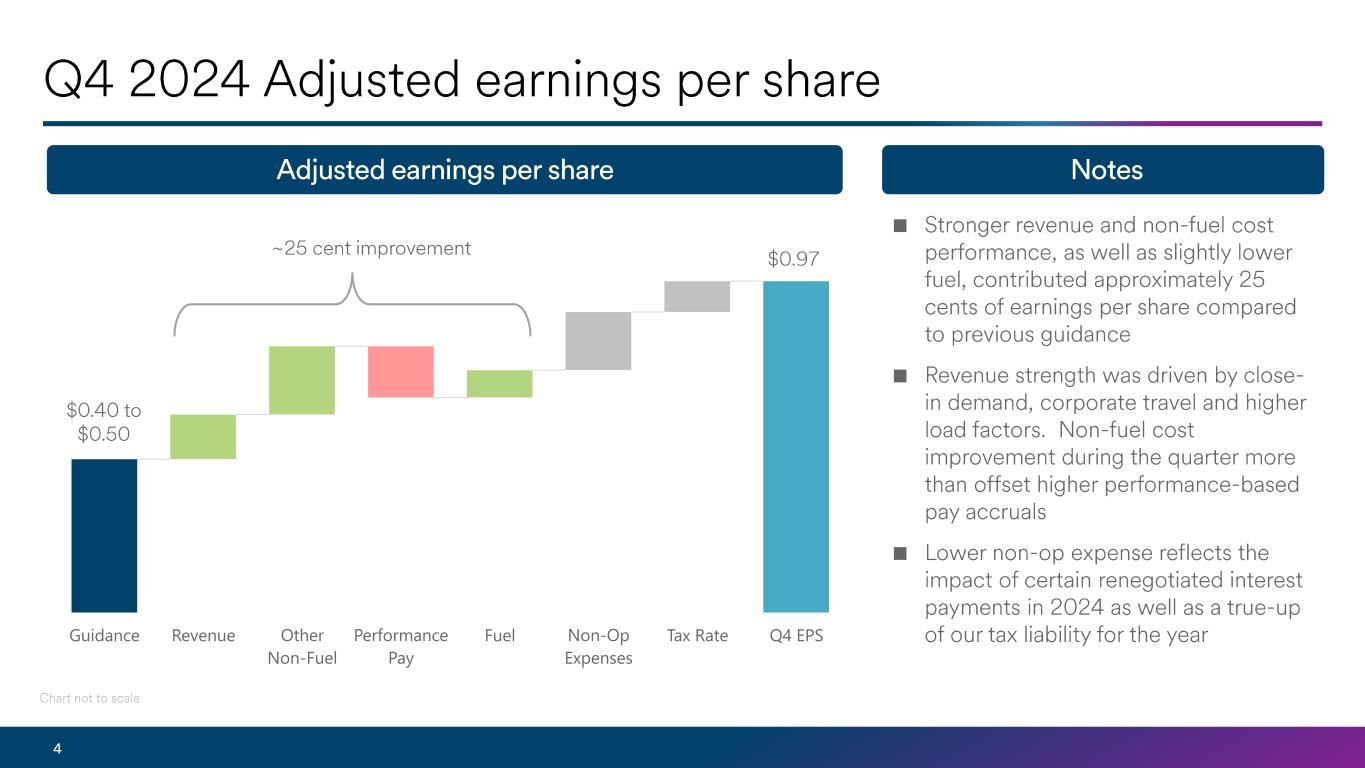
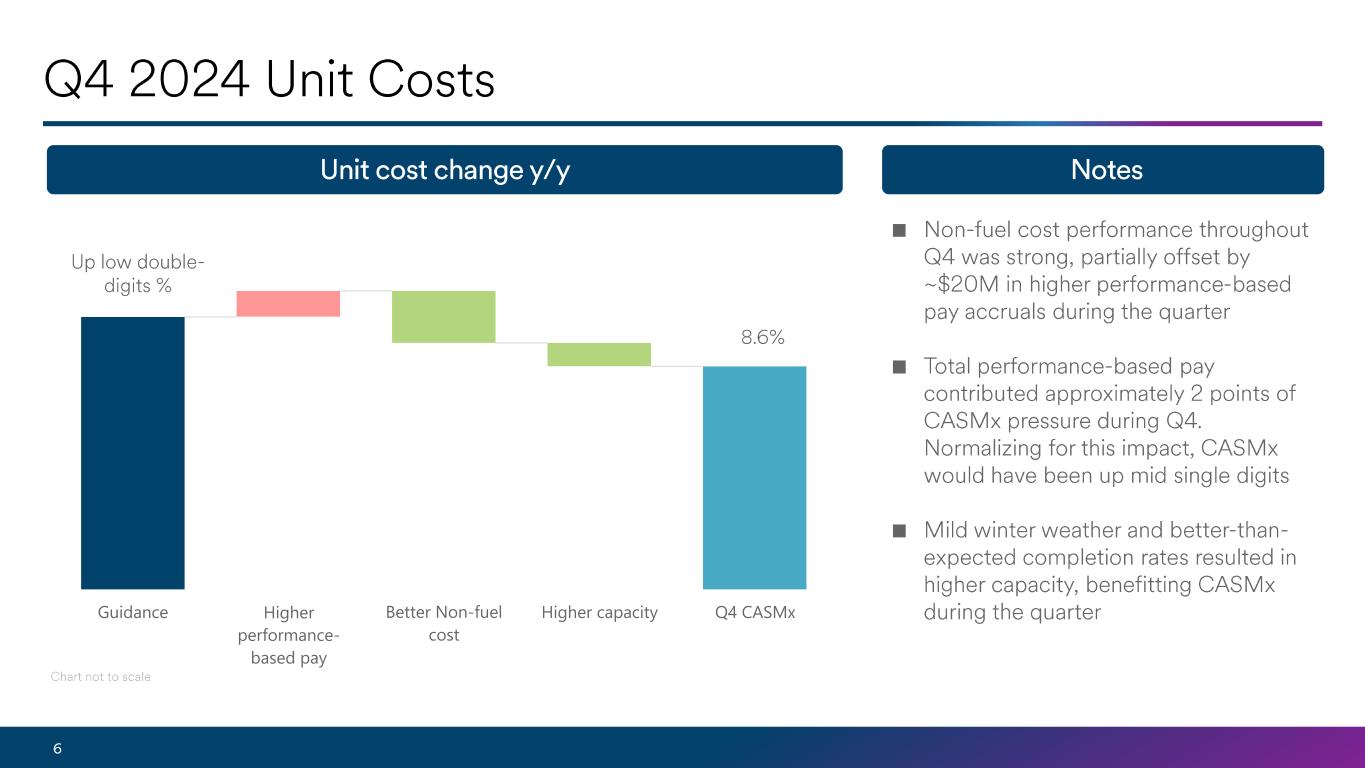
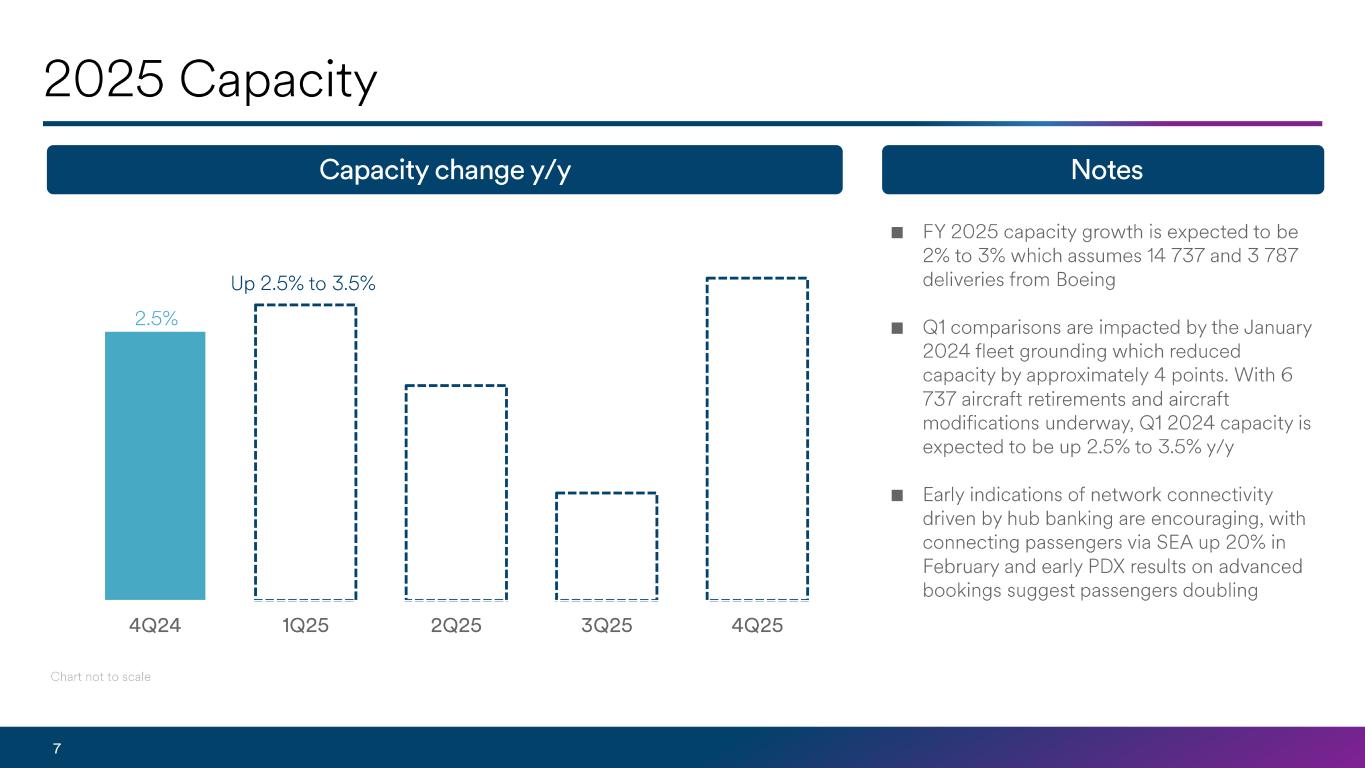
Thanks, Andrew, and good morning, everyone. As you know, we finished the year with a successful Investor Day in December, where we had the chance to speak to the future we are focused on creating at Air Group. And while we are in the early stages of building toward the vision, the strength of our fourth quarter results are a fantastic way to get started on that future. And while 2024 dealt us a tough start with the fleet grounding negatively impacting our results by approximately $200 million, we closed the year strong. And absent the impact of the grounding, Legacy Alaska posted the industry’s best adjusted pre-tax margin. This result speaks to the strength and resilience of our company, our people, and our business model. December closed particularly well for both Alaska and Hawaiian. In fact, Hawaiian posted its best absolute adjusted pre-tax profit and margin in the month of December. We are now focused on our Alaska Accelerate Plan, building on our fundamental strengths, safety and operational excellence, cost discipline, and balance sheet strength, as well as building a strong commercial pillar that we believe is required for longer term success in this industry. In particular, we will be focused on building scale, relevance and loyalty across our network. We are highly confident in our plan and our ability to execute and already are putting into action initiatives that will enable us to deliver on our financial targets. Turning to fourth quarter results, our adjusted earnings per share were $0.97, approximately $0.50 above our guided midpoint. $0.25 of the EPS outperformance is directly attributable to the strength of our core business. We also benefited from a renegotiation of certain interest payments and from a true-up of our tax liability for the year. For the full year, we reported earnings per share of $4.87, similarly above our previously guided range, with an adjusted pre-tax margin of 7.1%, which was driven by continued underlying strength in the Legacy Alaska business model and an improving trajectory of Hawaiian. Our total liquidity, inclusive of on-hand cash and undrawn lines of credit, stood at $3.4 billion at year-end. Scheduled debt repayments for the quarter were approximately $65 million and are expected to be approximately $155 million in the first quarter. In October, we raised $2 billion in the capital markets, borrowing against our valuable Mileage Plan program and achieving amongst the tightest spreads compared to similar debt issued previously by industry peers. In Q4, we used those new funds to repay $1.6 billion of higher-rate debt acquired from Hawaiian. Together with the renegotiation of interest payments, our debt raise and prepayment activity have improved the interest expense profile of the combined business. In 2025, we expect non-operating expense to be about $40 million per quarter. To end the year, our debt-to-cap stood at 58%, with our net debt to EBITDAR at 2.4 times. As we outlined last month, we expect to return to our long-term target of less than 1.5 times leverage in 2026. As Ben discussed in his remarks, we also repurchased $312 million of ALK stock in 2024, as we remain confident in our outlook and the value we’re poised to drive for the business over the next few years. With these purchases, we more than offset dilution and reduced our outstanding share count to 123 million shares, resulting in a share count now on par with 2019 levels. We have begun executing our new $1 billion share repurchase program in earnest in January, which we intend to fully consume within the next four years. Our ultimate repurchase pace will be dependent on the margin profile and cash flow of the business over that time. Fourth quarter unit costs were up 8.6% year-over-year, coming in slightly better than guidance, despite higher performance-based pay accruals. Normalizing for bonus pay, our core unit costs would have been 2 points lower. The teams across Alaska, Hawaiian and Horizon did a great job managing costs all the way through the end of the year. For the full year, Legacy Alaska unit costs ended up approximately 7% year-over-year, despite the grounding and Boeing strike that reduced planned capacity materially and drove an approximate 2-point full year impact to CASMex. Turning to our outlook, while we’ve moved away from granular unit metric guidance, there are a few specifics to keep in mind for 2025. Our full year capacity growth of 2% to 3% assumes we will receive approximately 14 737 MAX aircraft and three 787 aircraft from Boeing this year. We expect flat growth across our Alaska assets given assumed delivery timing and retirement of our oldest 737-900 aircraft and expect a material increase in Hawaiian asset utilization, particularly within the A321 fleet. We expect first quarter capacity to be up 2.5% to 3.5% year-over-year. We expect unit costs to be up low-to-mid single digits in Q1, with greater improvement in the back half of the year as productivity improves, synergy capture begins to ramp materially and we lap the extremely low growth rate for the second half of 2024. A notable cost item for the year we expect will be the pending new contract we reached initial agreement on with our Alaska flight attendants. While it will be several more weeks before we learn if flight attendants approve the deal, the costs for the new agreement are assumed to be effective beginning January 1st and would represent approximately 1.5 points of unit cost pressure for the year. For first quarter earnings, we expect a loss per share of $0.50 to $0.70. This seasonality is, as you know, normal for Alaska, however, represents our expectation of a material improvement on a year-over-year basis. While we will increasingly focus our commentary on combined results, I will note on today’s call that our Legacy Alaska assets are expected to break even in Q1, consistent with the goal we set for ourselves two years ago. And our Hawaiian Airlines assets are expected to improve by over $50 million in the first quarter compared to 2024. To summarize our guidance, in the first quarter, we expect capacity to be up 2.5% to 3.5%, RASM to be up high single digits, CASMex to be up low-to-mid single digits, and a loss per share of $0.50 to $0.70. For the full year, we still expect to deliver EPS of more than $5.75 on capacity growth of 2% to 3%. We also expect $1.4 billion to $1.5 billion of CapEx and to generate positive free cash flow this year. We’ve closed another strong year and have entered 2025 with more momentum and confidence than we felt in a long time. We have a playbook to win in the industry in the years to come, including significant profit unlock from synergies and initiatives, which we have already begun executing on. And all of this is against a constructive industry backdrop, with many airlines increasingly focused on returning to threshold margin performance and guests who are increasingly loyal to airlines that can deliver better and more premium experiences end-to-end. We have a clear strategy of where we want to go and we’re looking forward to delivering on our future vision from here forward. And with that, let’s go to your questions.
Operator
And our first question today will come from Brandon Oglenski with Barclays.
Speaker 5
Hey, guys. Good afternoon or good morning. Thanks for taking the question. I guess, Ben, it seems like everything’s firing on the right cylinders here. As you look at the network reallocation this year, what is most important, because we hear a lot of moving pieces here, like, launching a Narita flight out of Seattle. But then also, I think, the bank structure at Portland and Seattle as well sound pretty important. So can you maybe elaborate more on that or maybe that’s a better question for Andrew. I’m not sure.
Well, maybe I’ll start, and then, I’ll just get Andrew. I think, overall, you’re right, Brandon. It’s a great question. We have a lot going on. And fortunately, I have just an outstanding team across the company. We’ve got an integration that we’re doing. So we’ve got to keep our eye on executing a single operating certificate this year and a unified reservation system. But along that, we’ve got all these synergies coming through. So connecting the networks is extremely top of mind for us, as Andrew mentioned, all the synergies that come from that. International flying, getting the operation really focused on not missing a step is where I’m just keeping the company between the guardrails. But Andrew, just a little more color on that.
I think our capacity growth is very limited this year. We are focusing on strategically moving our aircraft to optimize their positioning. With our re-banking efforts, we are being careful about our connections, and we've seen positive results from that. Additionally, we launched 19 new markets in December and January to replace underperforming capacity in the first quarter, which is crucial to our strategy. Most of these markets are seasonal. We aim to utilize our current assets to unlock synergies and are being intentional about our flight operations.
Speaker 5
Well, it’s definitely a great outlook. And Andrew, really quick, I think you mentioned corporate travel up pretty significantly in December. Can you maybe elaborate on that and the trends that you’re seeing here in January?
Yeah. The corporate travel was up about 8% in the fourth quarter and we see a lot of shorter haul West Coast traffic, business traffic coming back in that. That’s why it drove yields were higher growth than passengers for the full year was 15%. And as we sit here today, our held corporate revenues managed are up 20% as we go into the fourth quarter here. And there’s still a number of clients and other areas of the Managed Corporates that we think will continue to grow. So it’s a really good outlook right now.
Speaker 5
Appreciate it. Thank you.
Operator
And our next question will come from Conor Cunningham with Melius Research.
Speaker 6
Hi, everyone. Thank you. Regarding the banking situation, the 20% increase in Seattle is significant. Are you already seeing benefits from the connection between Hawaiian and Legacy Alaska? Is that what’s driving this growth, or is it mainly the alterations you've made to the Legacy Alaska network that are having the biggest impact? Go ahead.
Yeah. Hi, Conor. It's clearly both factors, but the key point is that we've consistently faced challenges with our load factors in January and February. There's ample capacity on our flights, and we've reconfigured them to enhance connectivity, which our team is improving at. In fact, I'm thrilled to report that we're currently at just above an 80% load factor for January, which has always been our target that we've struggled to achieve, and we're on track to accomplish that this year. It's truly exciting to witness.
And Andrew, we have 350 flights a day, up to 400 at the peak in Seattle. So there’s just a lot of flights coming in, connecting.
Speaker 6
Okay. That’s helpful. And then, not to get ahead of myself, but obviously, a really strong start on unit revenue in the first quarter. There’s some noise from the MAX situation last year. But as we look at the calendar and all that stuff, your own capacity plans, like, it would suggest that you’re actually going to get a little bit better from here. So I know it’s early, but if you could give any indications on how spring breaks kind of your expectation there and how things are booking, and maybe anything you’re seeing on spring trends in general, that would be helpful. Thank you.
Yeah. Thanks, Conor. I mean, spring’s still just starting to come into the window and the team’s actively managing that. So I don’t have anything exciting to report there. I think what we’re really focused on is the continued network synergies with the Alaska assets and the Hawaiian assets, and bringing those together. And as we’ve mentioned in our prepared remarks, the North America to Hawaii and neighbor islands are all continuing to improve. But I fully expect to have a very strong spring break and that gets more into our higher demand period. But things are looking really good as we sit here today.
Speaker 6
Great. Thank you.
Operator
We’ll move next to Scott Group with Wolfe Research.
Speaker 7
Good morning. I want to follow up on the high single-digit RASM. Can you elaborate on the differences you're seeing between Legacy Alaska and Hawaiian? How is cargo, which is performing very well right now, contributing to that? Also, I recall that after the MAX issues last year, March was a particularly strong period for RASM. Do you believe you've factored in the tougher comparisons later in the quarter for this month?
Hi, Scott. Yeah. Just to check through a couple of those. Both the Hawaiian assets and the Alaska assets are performing well on a unit revenue basis. There’s just a lot of noise that occurred last year. You had the rollover impact from the Maui fires. You had Flight 1282. We had a very different network. We didn’t have the combined network and co-chair. As we’ve shared in the past, January and February are always the most opportunity for us to improve, and you’re seeing that, and that’s being done. March and spring break, I think, are always good for us. I think we have a better setup this year as far as our network and what we’re doing. And just to reiterate, we have all the goodness of the synergies and connectivity coming through, so we are very excited about how this season is shaping up.
Speaker 7
Okay. Great. Maybe just, Shane, I think, you’ve got a slide in the deck looking at the lumpiness of capacity. Maybe like help us think what that means in terms of CASM as the year goes on. Does CASM improve? Maybe does it get worse in Q2 and then does it get better in the back half of the year relative to the low-to-mid single-digit you’re doing in Q1?
Yeah. Hey. Thanks, Scott. Well, the simplest way to answer your question is, yeah, pretty much. That’s going to be the contour. We have the lowest rate of growth in the year, probably in the second quarter and the hardest comp because of our growth rate and performance last year on costs. Second half, we’re going to start to see the real benefit of synergy capture, of really starting to get utilization up on the A321 fleet and benefit from the productivity that we’ll sort of be able to drive from those two things. So I think we’re going to have a good quarter this quarter with unit costs. Our hardest comp is going to be next quarter, and I think we’re going to then flow through the rest of the year in a really nice trajectory and exit well. So I think the thing that we’ve continually talked to you all about since December is we do expect RASM to outperform CASM throughout the year and we’re excited about how we can perform this year.
Speaker 7
Helpful. Thank you, guys. Appreciate it.
Operator
Our next question will come from Andrew Didora with BofA Global Research.
Speaker 8
Hey. Good morning, everyone. First question for Andrew, I know it hasn’t really been long since Investor Day, but have you noticed any sort of changes in competitive capacity or competitive behavior after outlining your plan and starting all of your re-banking efforts?
Hi, Andrew. I would say very little. There’s some things around the edges. There’s some equipment changes by some carriers here and there, but on the whole, what we’ve seen is the industry continue to play out and seasonal schedules get trued up further on. But other than that, pretty the same as what we were seeing when we met with you six weeks ago.
Speaker 8
Okay. Makes sense. Then just for Shane, one, thank you for clarifying the CASM comments earlier and nice job just resetting your debt stack since the close of the deal. I’m sure all the heavy lifting is done here, but just in terms of balance sheet, are there any ways to be even more opportunistic on debt pay down from here, or again, are kind of the big opportunities now behind you? Thanks.
Thanks, Andrew. I believe the major opportunities are behind us. We acquired debt at a double-digit rate when we finalized the deal with Hawaiian, and we were eager to act swiftly to adjust that. Emily and her team have done an excellent job in this regard. We'll continue to monitor the environment closely. There’s nothing stopping us from further reducing our rate if possible, and we've also managed the aircraft ownership side of the business well. There are opportunities there, especially as we proceed with the leased portion of the Hawaiian fleet, but it will take some time to unfold.
Speaker 8
Maybe I could sneak one more in. Any thoughts on potentially what you could do with the payroll relief loans as that resets, I guess, later this year on the first tranche? Thanks again.
Speaker 9
Thanks, Andrew. This is Emily. So, we are looking at those PSP loans as they come to convert to higher interest rates starting here in 2025. It’s likely that what we will do is use some of our planned debt repayment to just get ourselves out of those loans, but it’s also possible that if we find some compelling finance opportunities that we would just replace them with more favorable rate debt.
Operator
We’ll hear next from Jamie Baker with JPMorgan.
Speaker 10
Oh! Hey. Good morning, everybody. So, I’m not at all trying to detract from your momentum, but I think I have a fair question to ask. As you now understand the Hawaiian franchise inside and out, what, if anything, and there has to be something, I hope, that has surprised you to the downside. And let me give you an example, because you may recall I asked this question shortly after the Virgin integration kicked off and one of the things you cited then were aircraft leases. Virgin had really good economics, but a lot of duration in those leases. So, that sort of thing. Anything you can call out that has disappointed you?
Thank you for the question, Jamie. To be honest, it’s definitely not about aircraft ownership. We feel confident about the fleet we acquired. One key difference is that while we invested a lot of time and effort into the Virgin acquisition, we dedicated even more for this acquisition. Therefore, I would have anticipated fewer surprises. That said, there may still be challenges ahead, but from a fundamental understanding of how the business operated, we have insights into their evolving cost structure and the soft spots in their network post-pandemic, including challenges beyond their control, like the wildfires in Maui.
… the GTF issues. I think all of those, Jamie, we have not seen a material difference in what our expectation was. I appreciate that you noted that we have complete command over the two companies. We’ve maybe not, I don’t think we would quite say that yet. I think we’re racing to get there. But we’ve had the company for a single quarter and so, there’s still much for us to learn and maybe Ben on people and culture and those sorts of things, which I think have been positive too.
That's a great question, Jamie. I've been looking for anything we may have overlooked during our due diligence. However, as Shane mentioned, our experience with Virgin America prepared us well for this process, and we haven't encountered any red flags. In fact, I would argue that the situation appears to be better than we initially anticipated. Our Hawaiian operations turned a profit in December and are projected to be profitable from Q2 through Q4, with Q1 showing improvement as well. Overall, things are exceeding our expectations, but as Shane noted, there’s still much to come together. There are a few more aspects we need to explore, and you will be the first to know if we discover anything significant.
Speaker 10
All right. I appreciate the thorough response. And just as a quick follow-up and you mentioned in your prepared remarks, getting the Hawaiian franchise to first quarter profitability somewhere down the road by applying some of the, I think, you said lessons or best practices learned at Alaska. Can you remind us in your mind what you think are the largest building blocks or moving pieces that need to be addressed that get Hawaiian to a future first quarter profit? What’s standing in the way?
Just one of the things that we did with Alaska is just, we want to have the right amount of capacity for the demand that’s available in a weaker first quarter. It’s putting the right airplanes in the right markets. It’s staffing, it’s productivity. It’s all those things that we’ve honed over the years that we’re going to duplicate on our Hawaiian brand. And I think there’s just a lot of opportunity there. We’ve learned a lot on the Alaska side. And I think you’re going to see some of that experience and discipline be forced onto that network.
Speaker 11
Hey. Good morning, everyone. Thanks for the time. Maybe first, just two quick follow-ups on the unit cost trajectory question earlier. I guess, first, is the 1.5 points of flight attendants incremental cost as opposed to contract, is that in the 1Q guide and the full year outlook? And then second, understand second quarter sounds like it hasn’t got a bit worse with some of the comps there. But just trying to understand how much better cost could get in the second half based on the tailings you’re talking about. I guess the first half overall is maybe a bit worse than this 1Q guide. Is second half good enough for full year CASM to be better than the 1Q inflation you’re guiding to and I realize that was not too quick follow-up. So thanks for the time.
Thanks, Catie. The flight attendant contract, should it ratify? Yes, that’s in our guidance for Q1 and it’s fully represented there. So it wouldn’t be incremental once it ratifies, which we hope it does. Yeah, I don’t want to get into like, back half of the year guidance at this point. I think, one thing I would say is, we’re not going to grow as much as we have in the past, I think, 2% to 3% for the full year. And we talked before about unit cost trends at those growth rates, they’re likely to be more than flat. I’m actually pretty excited about where we can get to this year as we start to ramp the synergies and the utilizations. And so I guess what I would say is we’re hopeful and optimistic about the back half of the year having a really good, strong cost performance there as we get into the real work of getting the two operations together and getting synergies and productivity up. And I know you’re looking for more specifics in terms of the guide, but just know Q2 is our hardest comp and we’re not really fully ramping synergies or utilization until we get into third quarter and fourth quarter. But I think we’re going to have a nice cost performance this year.
Speaker 11
Great. And then maybe just one more, if you don’t mind. You’ve noted a material improvement in inter-island would be upside to our outlook. I guess, were you expecting Hawaiian to see inter-island RASM up double digits in the fourth quarter and hope for Hawaiian overall to flip to a pre-tax profit in 2Q? I think that’s the first time since the pandemic, when you kind of set these targets in December, just trying to understand like how things have performed since you set that, $575 plus? Thanks.
Yes, I might feel this is more of a question about forecasts. When we examined the fourth quarter, we noticed an improving trend in the neighbor islands. As we discussed in December, when we considered the potential of merging with Hawaiian, we did not make any estimates regarding the improvement of the neighbor island franchise over time, but we do expect it to occur. Our goal is to enhance customer loyalty, and Andrew and the commercial team have done an excellent job initially with the Huaka’i program, having already signed up 130,000 or 50,000 individuals. We aim to become the preferred carrier in the neighbor islands and for Hawaii residents, and we believe we have made a good start on that strategy for the long-term. Additionally, I would like to remind everyone that we noted Hawaiian’s business improved by at least $130 million compared to their first and second quarter results from the previous year, as they moved past challenges like the GTF grounding and the wildfires in Maui in 2023. The business was on an upward trend and performed better than we anticipated, with strong demand that exceeded our expectations in December, ultimately resulting in a nice profit for that month, which we were pleased to see.
Speaker 11
Great. Thanks.
Operator
And we’ll move to our next question from Tom Fitzgerald with TD Cowen.
Speaker 12
Hi, everyone. Thanks so much for the time. I’m wondering if you would mind touching on the cargo business for a little bit, just any new updates since Investor Day and company-wide, but also specifically on the Amazon line? Thanks so much.
Sure. We’ll have Jason take that question.
Speaker 13
Hi, Tom. Great to hear from you. It’s still early days, as we mentioned, as we worked together to get these two carriers integrated to a single selling platform. And a lot of the performance you’ve seen in Q4 was really the two 737 freighters we brought into the Alaska network, and the new Amazon business starts to generate energy. We flew six freighters in Q4. We hope to have all 10 by April and then we’ll really see the kind of full engine running by that time.
Speaker 12
Okay. Thanks. That’s really helpful. Appreciate that, Jason. And then just as a follow-up, if you might maybe just, I don’t know, maybe for Andrew, just touching a little bit more on California. San Diego was a big focus at Investor Day, as well as just curious how the intra-California market’s performing as well as maybe Transcon. Thanks again. Congrats, everybody.
Yeah. Thanks, Tom. We actually had a fair bit of growth in San Diego this year, as in 2024, and it’s absorbed it very, very well, and so we’re very happy about that. The very unfortunate situation with the LA fires, we’ve seen intra-California down quite a bit as a result of those and Burbank, but the rest of the LA stations are continuing on a somewhat normal trend. Overall, I think Transcon, especially for California and the product that we have, the MAX 9, have been doing well. So again, I think across all tides here, we’re really pleased. And again, these synergies are all impacting both the Pacific Northwest and California. So again, as we move forward, those areas of our business continue to get stronger.
Operator
And our next question will come from Ravi Shanker with Morgan Stanley.
Speaker 14
Good morning, everyone. So I know you guys only just got started, but when will you know if you can bring forward some of the timing on the integration gains, especially the combined booking system, the loyalty program and such? Is that something you’ll know right out the gate as you start or does that come in innings five and six?
Yeah. Hi, Ravi. There’s a very clear and definite timetable for that. We’ll stop at single loyalty process this summer and it’ll be fully complete, including the launch of the premium credit card, by the way, by October, and then a single passenger service system by April. These are sort of hard dates that we and the teams are very focused on because both those unlock greater synergies from where we are today and we’re on track to meet those deadlines.
Speaker 14
Understood. And maybe as a follow-up, I know that the industry is moving away from giving specific fuel guidance and that’s probably a good thing, but you guys had probably more fuel noise than most with the cracked threads and such. But how do you think about how we think about that relationship and maybe the volatility coming down between jet fuel price and your all-in price through the course of the year?
Thank you, Ravi. We are on track for around $2.65 in the first quarter, which reflects what we’ve spent so far. As you’re aware, we put our hedging program on hold about 18 months ago. This has a long-term effect since it involves future purchases. Therefore, this year we expect minimal recognized hedging expenses, which is a positive outcome we anticipated earlier. We may need to discuss fuel issues more frequently than we’d like or you’d prefer, due to Hawaiian's unique cost structure and fuel profile, as they source their fuel from Singapore and usually enjoys a favorable rate compared to the West Coast or Gulf Coast. Recently, oil prices have increased slightly over the past 10 days but have stabilized in the last few days, and there’s not much more noteworthy to share at this point.
Speaker 14
Understood. We’d love a specific guide for a few quarters until we kind of get into the swing of things just FY. Thanks a lot.
Thanks, Ravi. We’ll put it on the list of requested guides.
Operator
And we’ll move next to Duane Pfennigwerth with Evercore ISI.
Speaker 15
Hey. Thank you. I don’t know if you should be adding anything to the guides. What you’re doing seems to be working. So anyway, on the transition of widebodies into Alaska hubs, can you just remind us where we are in the ramp of that, and when are the peak seasons that we should be watching as that spools up?
Hey, Duane. So we have two 787s right now. We’ll have three more next year.
Yes. In 2025, we will have five markets by the end of this year and three more next year. We have publicly announced Narita starting this May and Incheon this October, both of which will be year-round markets. We are also planning to announce further growth out of Seattle at the appropriate time. As we mentioned on Investor Day, our goal is to launch 12 markets by 2030.
And the first markets, Andrew, will be on 330s to launch. Eventually, we’ll be moving to…
… 787s in the fall, yeah.
Speaker 15
I just wanted to follow up by asking if there is any seasonality in those markets, such as peaks and off-peak periods. I understand they will be year-round.
We haven’t started in Europe yet, but we know there are peaks and we've seen some traction during the winter holidays there. I can't speak specifically to the seasonality of everything. However, I can remind everyone that we’re reallocating from Honolulu to Narita, which presents a significant economic advantage for us. These specific markets tend to be more stable throughout the year, and we’re optimistic about the bookings we have so far.
And Duane, maybe just directionally, some will be all year-round and some will be seasonal. I think that’s it. It’ll depend where we fly. We’ve only launched two. But when we get to the full 12-plus out of Seattle, you’ll see us keep some all year-round and you’ll see us move some that we need to move based on demand. So you’ll see us do a mix.
Speaker 15
Thanks. And then maybe just for a quick follow-up, just on competitive capacity and I’m talking here more OA capacity cuts, where do you think you’re seeing a bigger benefit right now? Is it on the Alaska side or on the Hawaiian side? And I guess, how do you see that evolving 1Q, 2Q versus the trends that you were seeing in the back half of the year? Thank you for taking the questions.
Yeah. Thanks, Duane. Just sitting here, I’m not seeing anything abnormal or unusual and I think as being well-documented that industry growth period is extremely low. Industry capacity growth is only like 1.5% in the first quarter. So I don’t think there’s anything in our networks. We’re seeing some relief in the neighbor islands starting in April. But other than that, I think it’s fairly stable.
Speaker 15
Okay. Very good. Thank you.
Operator
And we’ll move to our next question from Mike Linenberg with Deutsche Bank.
Speaker 16
Good morning, everyone. Congratulations on the solid results and positive outlook. I want to revisit some of the comments you made, Andrew. Doubling in Portland and a 20% increase in Seattle are impressive numbers, though they seem to come from a low base, which suggests potential for further growth as you become more of a connecting carrier. In terms of Seattle and Portland today, could you provide some insights on the local versus connecting ratios, roughly 70 to 30 or 80 to 20?
Yeah. I think those numbers are in the ballpark. And I suppose I should remind folks again, these volumes in connecting traffic are at a low period of time and I think the whole plan was to have a wider catchment area. As we get into our peak spring breaks and summer, our airplanes are very full. So we’re going to be revenue managing that and being very careful about the traffic we take. So I would not expect to see these levels of connectivity obviously continue at this rate, but in the low seasons, it’s been hugely beneficial for us.
Speaker 16
Okay. Great. Helpful. And then just second, I hate to ask a modeling question, but I think it is going to have some influence on how we think about CASMex through the year. Your freighter costs year-over-year up 100%, more than 100% and I know that that gets cut out. It was $37 million in the fourth quarter. What’s a good run rate? Like how do we think about your freighter costs? Are we going to be looking at like $40 million, $50 million, $60 million a quarter in 2025 so we can get to the right CASMex?
Yeah. Thanks, Mike. I think the fourth quarter we had the full Alaska fleet of five freighters operating and we had six of the 10 Amazon freighters. So there’s four of 10 to go. We can sort of follow up and if we give more specifics, we’ll give it to everybody. But I think it’s almost all the way there in the fourth quarter. A little bit to add here in 2025. And then we’re pretty much at steady state unless we add more units at that point.
Speaker 16
Okay. Great. That’s helpful. Thanks.
Operator
And our next question will come from Dan McKenzie with Seaport Global.
Speaker 17
Oh! Hey. Thanks. Good morning, guys. Andrew, maybe a couple questions for you. Thanks for the perspective on international revenue. Just given the number of new markets, what percent of revenue could international represent say into the year versus say in two years to three years? And I’m curious how you’d characterize the contribution from oneworld as you start to ramp up that international flying.
I think the international, when I say that, there’s long haul internationals like about 5%. So, we’re sort of adding three aircraft a year. So I think for the next few years, it’s going to be a small percentage of our total capacity. I think a lot of it for us too is just the huge loyalty and utility play for us out of Seattle and the world that we can offer directly on Alaska Metal. As far as the alliances go, I think, they’re continuing to track along very well. We’re very happy with this setup that we have with our partners, and again, we’re looking at, as we grow, what can we do to strengthen these relationships and partnerships over time?
Speaker 17
Okay. I have a second question about the IT initiatives you plan to introduce later this year. Is there an opportunity to enhance merchandising? If so, is this already included in the guidance, and if not, what potential benefits could arise?
Thank you, Dan. I believe everything we plan to execute and deliver is included in the full year guidance for EPS. We would certainly be pleased if we can achieve our goals more quickly or effectively, and we fully intend to strive for better performance than what we’ve forecasted. However, all of our e-commerce efforts are incorporated into that guidance. There is a significant challenge in integrating the two reservation systems and aligning the merchandising practices between Hawaiian and Alaska. Additionally, we have the unique opportunity to manage two brands within our network, and we are still figuring out how to optimize this arrangement. I appreciate your question, and we’re enthusiastic about our strategy for distribution, merchandising, and e-commerce, and I'm confident we will have more to share as we progress with the integration.
Speaker 17
Okay. Thanks for the time you guys.
Operator
And we’ll move next to Tom Wadewitz with UBS Financial.
Speaker 18
Yeah. Good morning. So it may be a bit of a high-level question, but you beat by a lot in 4Q. Industry backdrop is pretty favorable, maybe not different than you expected. But I’m wondering why you didn’t, why you chose not to raise the 2025 guide. Is that just, hey, there’s even more upside versus the guide than we thought before? How do you think about that just in light of the pretty big upside in 4Q and a good industry backdrop?
Yeah. Thanks, Tom. And just for a note, this will be our last question. But I think we were just with you all in December and I think we outlined a plan that we’re certainly excited about, confident, and we feel a lot of momentum right now. But there’s a lot to go execute on, a lot to go deliver on. We did acquire a network that wasn’t making money and we’ve got to go make sure we shift assets around and drive synergies and drive productivity and utilization. And if everything goes right, then, like, we’re going to have a great year from a financial performance perspective. And like I said to the last question to Dan, I’m hopeful that we are able to do even better than what we’ve guided to, but this is the number we were confident we can go deliver this year. No dilution of our margin, a nice increase to our EPS in the first year of an integration is unique in the industry and we’re excited to go drive it in a way that I think others haven’t been able to in the past. And certainly, we look forward to upside from there, but not to provide a thought on how much upside there could be.
Speaker 18
Oh! Okay. No. That’s fair. What about just the kind of how we build on the good news in 4Q and 1Q? Were there items that you’d say, hey, I mean, I know you’ve mentioned a lower tax rate 4Q, but were there any other items that you’d say, oh, it’s kind of, idiosyncratic to 4Q, we’re just like temporary for 1Q or should we say, hey, the kind of cost in 4Q and the revenue for 1Q, those are continuing things?
Yeah. No. I think, look, the core business, and I said this in the prepared remarks, drove $0.25 or $0.50 of the outperformance, which is pretty significant relative to a $0.40 to $0.50 initial guide for the quarter. So those trends that we saw in the fourth quarter relative to revenue and cost management, I think, we feel like those are continuing into the first quarter. The other half of the beat were probably more one-time in nature, good work by the Treasury team on the non-op side of the business and then truing up tax rates. But certainly the core business beat, I think, is something that we don’t feel like was one-time in nature. We feel like we’ve got that tailwind with us at least into the first quarter. Again, lots to do, lots to go execute on, certainly on the cost plan, but we feel good about where we ended the fourth quarter and how it sets us up for the beginning of 2025. Thanks for joining us, everybody. We’ll talk to you next quarter.
Operator
This does conclude today’s conference call. Thank you for attending.